Home Posts tagged Departments (Page 9)
Departments

Hampden Bank Opens Second Longmeadow Branch

SPRINGFIELD — Hampden Bank will soon open its ninth full-service branch office at 916 Shaker Road, and officials are planning a grand-opening celebration in early 2009. The branch office is the bank’s second office in Longmeadow. The 2,400-square-foot facility will have a modern look and will offer customers several state-of-the-art conveniences, including drive-thru banking services, a drive-up ATM, and two teller stations with cash recyclers for speed, accuracy, and security. In addition, the facility will have an after-hours conference room available for local community organizations to use for meetings and events. For information, visit www.hampdenbank.com. Hampden Bank has office locations in Springfield, Agawam, Longmeadow, West Springfield, Wilbraham, Indian Orchard, and Tower Square in downtown Springfield.

MassMutual Pledges Fuel-assistance Grants to Salvation Army

SPRINGFIELD — Local families will be getting some much-needed help in paying their heating bills this winter since the Salvation Army of Greater Springfield and Enfield, Conn. will each be receiving a $15,000 fuel-assistance grant from MassMutual Financial Group of Springfield. MassMutual’s contribution will enable the Salvation Army to help nearly 400 area residents keep the heat on in their homes. The Good Neighbor Energy Fund provides energy assistance to residents in temporary crisis who are struggling to pay their energy bills and do not qualify for federal or state energy funds. Trish Robinson, senior vice president of strategic communications and community responsibility, and deputy head of government relations for MassMutual, noted during a press conference that MassMutual was pleased to assist the Salvation Army to help families who are in need. She added that, since some area residents have never had to ask for assistance before, MassMutual was honored that it could help with this cause.

Silvana.Net Designs Web Site for Holyoke

HOLYOKE — The City of Holyoke recently unveiled a comprehensive municipal Web site that makes it easy for residents, visitors, and businesses to access information about the city and its services. The new site was designed by Silvana.Net, a Northampton Web-design firm. Located at www.holyoke.org, the site has been completely revamped to keep pace with Holyoke’s expected growth, according to Mayor Michael Sullivan. The new site is part of a three-year commitment by Sullivan and the City Council to significantly upgrade the city’s information-technology infrastructure. Additionally, a customized content-management system allows city departments to easily update pages. Silvana.Net trained approximately 60 city employees on how to update information about their departments on the Web site. The site also features sections on every municipal department, along with information about tourism attractions for visitors. Among other useful features is one that allows snow days, changes in trash collection, and parking bans to be easily and quickly posted on the home page.

Bank Gives Hospital $40,000

WARE — A $40,000 gift from Country Bank for Savings has enabled Baystate Mary Lane Hospital to purchase a sterilizer for the Surgical Services Department, allowing staff to use the sterile processing area more efficiently. The Steris washer/disinfector has made the cleaning and processing of surgical instruments more cost-efficient by allowing staff to process larger amounts of instruments at one time, which in turn decreases one’s exposure to contaminants, according to Norma Berthiaume, manager of Surgical Services. Donations from Country Bank for Savings over the years have assisted the hospital in purchasing state-of-the-art mammography and X-ray technology and orthopedic equipment, as well as renovating the hospital’s Surgical Services Suite.

Sovereign Consulting Opens Office in Open Square

HOLYOKE — Sovereign Consulting Inc., a growing environmental consulting and remediation company, announced recently that it has relocated its Amherst office to space in Holyoke’s Open Square. Sovereign will lease 3,500 square feet of space at suite 307 in the redeveloped former mill complex. Sovereign, which was recently ranked by ZweigWhite as No. 35 among the top 200 fastest-growing environmental businesses, provides environmental assessment, investigation, design, and construction services throughout the Northeast.

Sections Supplements
Personal Income-tax Considerations for Tax Year 2008

When it comes to the bottom line — meaning the one on your tax return — proper planning is of the essence. And to plan effectively, one must know the rules and how to play them. With proper insight, such as this end-of-year primer, individuals and businesses can make smart decisions that can add up — literally and figuratively — to substantial savings.

The time to do your income-tax planning and implementation of tax-wise strategies is during the tax year, not after it has ended. Part of the reason for this is that there are very few tax-planning opportunities that can be implemented after Dec. 31.

The Emergency Economic Stabilization Act, commonly referred to as the bailout bill, contained a substantial number of tax provisions and/or extensions of tax provisions that were scheduled to have expired at the end of 2007. These income-tax provisions may be a silver lining in an otherwise controversial and challenging piece of legislation.

This article is intended to provide a summary of the more generally applicable rules and provisions for use in connection with preparing and filing your 2008 income tax returns. In fact, it could be used as a checklist for your review and consideration prior to contacting your tax professional before the end of the year, to see how you might be able to maximize the benefits that apply to you during these challenging economic times.

The ‘Kiddie Tax’

In 2007, a child’s unearned income beyond $1,700, such as gains and dividends, was taxed at the parents’ marginal rate until the child is 18 (previously, the threshold age had been 14). Although the threshold increases to $1,800 in 2008, the applicable age is raised to 19, and 24 for full-time students, whose earned income is less than half their support. This way, families can’t shift appreciated assets to their children to take advantage of the 0% rate on certain dividends and/or capital gains, as discussed below.

Capital-gains Tax Rates

Prior to 2008, long-term capital gains from the sale of assets held longer than one year were taxed at a maximum rate of 5% to the extent the seller was in the 10% or 15% tax brackets. In 2008, the 5% maximum rate drops to 0% through 2010. However, the 15% maximum tax rate on other long-term capital gains remains the same for all other tax brackets.

Dividend Tax Rates

Similarly, in 2008, the special 5% maximum rate on dividends of taxpayers in the 10% and 15% tax brackets drops to 0% through 2010.

Increased IRA Contribution Limits

In 2008, the maximum IRA (traditional or Roth) contribution increases from $4,000 to $5,000. Filers who will be age 50 before the end of 2008 can contribute another $1,000.

Higher Income Limits for Deductible IRAs and Roth IRAs

Even if you are covered by a retirement plan at work, you can still take a full IRA deduction if your modified adjusted gross income is less than $85,000 (married filing jointly) or $53,000 (single or head of household).

The allowable deduction is phased out gradually until your adjusted gross income reaches $105,000 (married filing jointly) or $73,000 (single or head of household). The opportunity to contribute to a Roth IRA is now limited once your modified adjusted gross income rises above $159,000 (married filing jointly) or above $101,000 (single or a head of household).

Indexed Tax Brackets

One of the few benefits of inflation is that, due to indexing, the 15%, 25%, 28%, 33%, and 35% tax brackets for 2008 will all kick in at a bit more than 2% higher levels of taxable income than they did in 2007.

Larger Personal Exemptions

Under the theme ‘every little bit helps,’in 2008, each personal exemption you can claim is increased by $100 to $3,500.

Higher Standard Deductions

Along that same theme, in 2008, the standard deduction for those taxpayers married and filing a joint return increases by $250 to $10,950.

For single filers, the amount increases by $100 to $5,450; and for heads of household, the amount increases by $200 to $8,050.

Itemized Deductions and Personal Exemptions

For years, itemized deductions and personal exemptions have been phased out (reduced) as income rose. In 2008 and 2009, these reductions are a bit less painful. This limitation in itemized deductions happens when your adjusted gross income (AGI) exceeds $159,950, regardless of your filing status. Your itemized deductions are reduced by 1% (formerly 3%) of the amount by which your AGI exceeds $159,950, but you can never lose more than 80% of your itemized deductions.

Also, your medical expenses, investment-interest deduction, deductible gambling losses, and any casualty and theft losses are not subject to the cut. Personal exemptions are reduced by 2% for each $2,500 of AGI over $239,950 for married filing jointly, $199,950 for heads of households, and $159,950 for singles, but the reduction cannot exceed $1,167 per exemption.

Increased Section 179 Expense Deduction

The maximum amount of equipment placed in service in 2008 that businesses can expense (deduct in full rather than depreciate over a period of time) increases by $3000 to $128,000. The annual investment limit increases to $510,000 for 2008. Thus, you won’t lose the benefit of expensing until you place more than $510,000 of assets in service in 2008.

Tax-free Parking for Employees

In 2008, employees are not taxed on up to $220 a month of employer-paid parking. The cap on the tax-free transit passes their employers can give rises to $115 a month.

State and Local Sales-tax Deduction

The opportunity for itemizers to choose to deduct their state sales-tax payments instead of deducting their state and local income taxes has been extended through the end of 2009.

Educators’ Deduction

Also extended through the end of 2009 is the deduction for up to $250 of teachers’ classroom supplies.

Tuition and Fees Deduction

Appropriately, in the face of the ever-increasing costs for higher education, the deduction for up to $4,000 of college tuition and fees is also extended through the end of 2009.

Direct Donations of IRAs to Charity

Another example of a positive extension provided in the bailout bill is that IRA owners age 70 or older are allowed, for years 2008 and 2009, to continue to make tax-free contributions up to $100,000 from their IRAs to qualified charitable organizations without having to report the withdrawal as income and then deduct the donation as a charitable contribution.

Additional Standard Deduction for Real Property Taxes

A new tax provision enacted as part of the Housing Assistance Tax Act of 2008 allows homeowners to claim an additional standard deduction for real property tax if the taxpayer does not itemize. The additional amount is limited to $500 or $1,000 for joint filers. Homeowners can still deduct real property taxes and mortgage interest as an itemized deduction. However, now homeowners who don’t have enough itemized deductions to exceed their standard deduction by the otherwise deductible amount noted above for real property taxes could be better off using their standard deduction.

Alternative Minimum Tax Patch

In what is one of the more important components of the bailout bill not relating to the economic stabilization efforts, the patch to the Alternative Minimum Tax (AMT) was extended through 2008. The AMT is a supplemental tax calculation established by the Internal Revenue Code many years ago as part of an effort to try to make sure that higher-income individuals would pay an income tax in spite of their best efforts to use tax-avoidance strategies. When the legislation was written, it did not provide for an increase in the personal exemptions applicable to the tax calculation. The unintended result was that, as more, so-called middle-class taxpayers have seen their earnings increase, more and more of them have been ensnared by this well-intentioned but flawed legislation. Approximately 22 million taxpayers could have seen their 2008 income tax bills rise by anywhere from $2,000 to $7,500.

Generally speaking, it is good strategy for people not to think of their tax return as a destination. Don’t measure the ‘wonderfulness’ of the tax return in question by the size of your refund or balance due. That figure is only a function of how accurately you had your taxes withheld and/or set up your estimated tax payments. Instead, the best result from any tax return is the one that leaves the greatest number dollars in your pocket after having gone through the income-tax tollbooth.

In closing, while all of these issues may not apply to all of you, there are likely to be some that could put you in a position to achieve some tax savings for you or other members of your family. Whether those savings are for one year only or continue for many years to come, it is money that will be left in your pocket for you to elect how to spend and use it.v

Bruce M. Fogel is a partner with Bacon Wilson, P.C. / Morse & Sacks in Northampton. He is a member of the firm’s estate planning, elder, real-estate, and business departments. He has extensive experience in matters relating to income, gift, and estate taxes, and he focuses on the tax implications of all legal transactions. He also co-hosts the radio show “Taxes and Assets” Saturday mornings at 8:30 a.m. on WHMP; (413) 584-1287;[email protected];bwlaw.blogs.com/estate_planning_bits

Cover Story
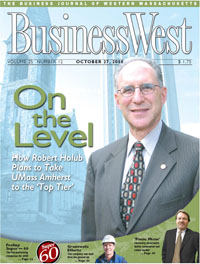
How Robert Holub Plans to Take UMass Amherst to the ‘Top Tier’
Cover 10/27/08

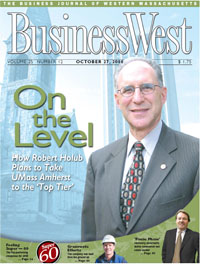
Cover 10/27/08

Robert Holub says it was the first pragraph of the ad placed in a higher-education trade journal that caught and held his attention.

He doesn’t recall the exact wording, but it was something to this effect: that the president and trustees at UMass Amherst were looking to recruit someone who could bring the campus into the top tier of public research universities in the country.

Only a few months before that ad was placed, Holub, then provost and vice chancellor for Academic Affairs at the University of Tennessee, wasn’t looking for another job opportunity. But by the time it appeared, following some leadership changes in Knoxville and greater uncertainty about his future there, he was paying much closer attention to such postings.

He was aware of UMass and its national reputation — like many others, he says the school is better-regarded outside the Bay State than within it — and was intrigued. But it was the ‘next-level’ nature of the assignment that also appealed to him. Many schools are looking to make such a jump, he told BusinessWest, and UMass has been for several decades now, it seems.

Indeed, such ‘top-tier’ language is commonplace in ads posted by schools seeking a president or chancellor, he said, adding that this opportunity — with its blend of timing, institution, and lingering historical challenge — stood out in some ways and got him thinking about what might be the next line on his resume.

By midsummer, Holub, a German scholar, wasn’t thinking about the UMass assignment any longer — he was already hard at work on it, or at least laying the groundwork for it. And by September, when he arrived at the Amherst campus, he was talking to media outlets and other constituencies, including alumni, faculty, students, elected officials, and others, about just what’s involved with taking such a school up a notch.

There is no manual and ‘how-to’ guide for such work, he explained, adding that it comes down to making an across-the-board effort to improve everything from research to the volume of faculty awards; from endowment to the rankings in U.S. News & World Report and other publications.

And Holub has already taken some steps in these directions.

For example, he recently reinstituted the position of ‘vice chancellor for Research,’ and expanded the title to include ‘Engagement,’ in one of several organizational moves.

“In examining the top public research institutions in the country, I have found very few that did not have a research office at the level of vice chancellor or vice president,” he wrote to the campus community. “If we are going to be among these top institutions, I believe it is wise to emulate their emphasis on research and research productivity.”

Following, or attempting to follow, best practices established by the schools well ahead of UMass in the rankings will be part of the strategic plan for the university, said Holub. But such efforts don’t take place in vacuums, and are inherently complicated by a number of factors, he said, putting everything from campus politics to simple economics on that list. And at the moment, state financing is a rather sore subject, with Question 1 (a proposed end to the Commonwealth’s income tax) hanging over every public institution, and $1 billion in cuts already made by the Patrick administration ($12 million at the Amherst campus).

But there are other factors, not the least of which is the fact that schools currently ranked higher than UMass in several of those categories have no intention of moving down the list.

“They don’t sit around and say, ‘we’ve had our time in the top 25; let’s give our spot to someone else,’ and the 20 schools in our position don’t say, ‘we’re happy where we are,’” Holub explained with a laugh, adding that reaching the next level certainly won’t happen overnight.

In this issue, BusinessWest introduces Holub to the Western Mass. region and details (to the extent possible) his intentions and plans to take UMass Amherst where no one has.

School of Thought

As he talked with BusinessWest in his offices in the Whitmore administration building, Holub referenced a wall of framed photographs and architects’ renderings. Together, they convey more than a decade’s worth of expansion and new construction — totaling hundreds of millions of dollars — that crosses several schools and departments at the university.

The collection is impressive, and includes the integrated science building, the new Skinner Hall (home to the School of Nursing), the Isenberg School of Management, the recently opened integrated arts building, a recreational center currently under construction, the new, state-of-the-art central power plant, and many others.

But they will all be coming down soon.

“These are things that are already done, for the most part, and achieved by the previous administration,” said Holub. “There are a host of new projects coming via the capital bond bill; we don’t need to keep up the old ones.”

Re-covering that wall with new building and expansion projects is just one of the official or unofficial goals that Holub has set since learning last summer that he had been the one chosen to take UMass to a higher tier — and a new set of pictures will provide some evidence of progress in that regard.

But the real proof will come in the rankings, specifically those set by the National Research Council, or NRC, said Holub, who told BusinessWest that he wants UMass Amherst to join such schools as Michigan, Penn State, Berkeley, UCLA, and others among the top echelon of public universities.

Gauging the scope of the work ahead, Holub said that several UMass departments have already achieved top rankings from the NRC — in terms of faculty awards, the school is in the top 20, for example — but in others, the school is well down the lists.

“It’s a mixed bag,” he explained. “We do well in faculty awards, but in research, we’re down around 50 or so, and in endowment, we’re down below 100. We have some departments ranked in the top 20, and others that are unranked.”

Questions about how to achieve across-the-board improvement no doubt dominated the interview process for the chancellor’s position, which Holub entered after nearly 30 years in higher education, 27 of them at Berkeley, which he placed in that top tier.

Holub started there as an undergraduate adviser in the German Department, and eventually became chair of that department and served in that post from 1991 to 1997. He would move up the ranks, and eventually be named dean of the undergraduate division of the College of Letters and Science, continuing a career-wide focus on undergraduate education. He left Berkeley for Tennessee and its chief academic post in 2006.

A change in leadership in Knoxville late in 2007 prompted him to start mulling career options, and he set his sights on a chancellor’s or president’s position.

What appealed to him about UMass was the solid foundation on which to build — several academic programs are highly ranked — and the professional challenge that awaited him at the school.

When asked where he starts, he said there will be several initiatives undertaken simultaneously, but research is obviously a top priority — hence the launching of a national search for a vice chancellor of Research.

“We have to improve in research productivity, in terms of federal research expenditures,” he explained. “That’s the way in which the top institutions are measured; we do well there, but don’t do as well as the top tier.”

The administrative change, with an emphasis on that word ‘engagement’ that will now be in the title, is a key first step in this initiative, he continued. “The research office should be able to act more effectively to assist faculty in doing their research, getting out research grants, and working with industry inside the state and outside it to attract research dollars.”

Another priority is communication, he said, meaning both the internal and external varieties.

“We have to make it known what is going on here, and what is so positive about what’s going on here,” he explained, noting that the accomplishments of the faculty are not as known and understood as they should be, for example. “Many of the surveys that you have, whether it’s the National Research Council or US News and World Report, are reputational in nature, and in the past, I don’t think we’ve done a good-enough job of communicating the excellent work that goes on here and the great research and teaching that are accomplished on this campus.”

To achieve improvement, Holub has appointed Tom Milligan to the position of executive vice chancellor for University Relations, and has moved several units and individuals under this unit to “ensure a more consistent and coordinated approach in reaching and engaging our key constituents,” as the chancellor wrote in his E-mail to the campus community.

Milligan is putting together a more-cohesive communications strategy for the campus, Holub continued, adding that several departments at the school have been handling what amounts to public relations, but these have lacked coordination.

Textbook Examples

While discussing what it will take to move UMass up in the rankings, Holub addressed some of the theories offered as to why the school isn’t on a higher tier, and why some question whether it can get there.

The proliferation of quality private schools in the Bay State is often mentioned in this discussion, because of how those schools — Harvard, MIT, Wellesley, Amherst, Smith, and Mount Holyoke, among seemingly countless others — compete with the state university for students, faculty, and the attention of the press, especially the Boston newspapers that cover Harvard like a blanket.

Meanwhile, distance from Boston is sometimes listed as a factor by those who believe Amherst is perhaps too remote to gain consistent attention from the Boston media, or to attract faculty and graduate students.

Holub acknowledged these contentions, but quickly discounted most all of them simply by showing what other schools facing similar issues and challenges have done.

Champagne, home to the Univerity of Illinois, is hundreds of miles of Chicago, he explained, and the Windy City has a number of top-tier private schools. But neither of those factors has kept the state university from reaching the place where UMass wants to be.

Meanwhile, he said, students don’t usually choose between Harvard and UMass, or MIT and UMass — the university traditionally faces different forms of competition for students. And as for the press, Holub took the attitude that, while the university can and will work harder to draw attention to itself — as he outlined above — he believes that if UMass can generate the kind of news he’s looking for (not students getting arrested after Red Sox playoff games), then the media will cover it.

So the task at hand is to create such news or more of it.

Doing so amounts to a process, said Holub, adding that, for the past few months, he’s been engaged in what might be considered the first step: listening.

He’s done a lot of it, while sitting across the desk from or standing at podiums in front of individuals and groups ranging from Allan Blair, president of the Economic Development Council of Western Mass., to distinguished alumni; from elected leaders in Boston and Washington to the school’s foundation board; from every dean on the campus to some current students.

What is he hearing from them? Many things, he said, but one common thread is the need to move quickly and decisively to restore a sense of stability, something that is lost, or perceived to be lost, when a school like UMass loses as many top administrators as it has over the past several months.

What is Holub telling those groups and individuals? Essentially, that he wants to take those departments not ranked among the country’s elite and elevate them there, while taking those with high rankings and pushing them higher still.

“We’re the best public research university in New England,” he said, stating with no lack of confidence in his voice that the school tops UConn in that category. “But we can’t be satisfied with that; we want to be one of the best in the country.”

Overall dissatisfaction with the status quo is what Holub says brought him to UMass.

“If they had said that they were satisfied with the way things were going and that they wanted someone to keep operating in that way, I wouldn’t have been interested in the position,” he said, referring back to that job posting. “This university has achieved some great things, but it can do more and be more.”

By the Book

When asked if there were any often-cited examples of schools reaching that ‘next tier’ that he would attempt to emulate in some way, Holub said there are several, but that each story is different is some ways.

The common thread is achieving a campus-wide commitment to excellence, and not allowing standards — or performance — to slip.

That’s why schools that are that top-echelon usually stay there, he continued, adding that UMass won’t easily take another university’s slot among the elite.

“Every public university that’s in the top 25 wants to stay in the top 25, and everyone who’s 25 to 50 wants to get in the top 25,” he explained. “So, it’s a very hard competition.”

Thus, UMass will have to earn its way to the top echelon, and the processing of doing so is already underway.

George O’Brien can be reached at[email protected]

Features
Now-former Development Leader Says Springfield Is Positioned for Progress
Dave Panagore

Dave Panagore says Springfield has come to recognize that it is not Boston, and has only limited sway over the development community.

Dave Panagore likes to say that he’s been working in the “family business that he never intended to make into a family business.”

By that, he means the art and inexact science of planning and economic development. His father was urban renewal director for the Eastern Mass. city of Marlboro, and Panagore has followed in his footsteps, sort of, in various positions with Boston and Chelsea, Mass.; San Jose, Calif.; Springfield (which he served as chief development director); and, as of this writing, Hartford, which he now serves as director of Development.

While he was wrapping up his duties in Springfield, ‘signing off’ on a host of projects, and readying for the Hartford assignment late last month, Panagore spoke with BusinessWest about the City of Homes, what’s happened over the past 30 months that he’s been here, and what the prospects are for the future. And as he did so, he borrowed a line from his father.

“He always used to say that you can’t stop developers from developing where they want, and you can’t make them develop in places they don’t,” said Panagore, reciting the line as if he’s spoken it many times — and probably has. “The best you can hope to do is shape them and guide them.”

And this pretty much sums up what he and others have been trying to do for the past few years, while also instilling some confidence and a can-do attitude in this city and putting in place an infrastructure — meaning everything from a development team (now minus its leader, obviously) to a plan of action in the form of the Urban Land Institute (ULI) report — to move things forward.

In a word, if one term can cover it, the city now has an agenda, or much more of one than it had even a few years ago, Panagore continued, and it has considerably more stability.

“The reputation of the city — in the state and with the federal government — has been restored,” he explained. “The state views Springfield as a place that’s stable and fairly well-managed currently, has cash reserves, and has policies in place. And our relationship with the federal government, in terms of our ability to spend federal dollars, is restored.

“The city is stable … the spade work, the baseline work has been undertaken,” he continued. “The ground has been turned, and we’re ready to build on it.”

All this has positioned Springfield to more ably survive the current economic turbulence facing the region and the nation, he said, adding quickly that had this downturn hit three years ago it would have devastated the city. “With this economy, Springfield is going to take a hit, just like every other city,” he explained. “But it’s much more resilient now; it can take that hit.”

And these positive developments will help facilitate what are some very difficult development projects.

Indeed, as he has many times since arriving in Springfield, Panagore told BusinessWest that the specific development initiatives facing the city — from Chapman Valve to the South End revitalization; from the York Street Jail site to Court Square — are not easy. “If they were, they would have been done a long time ago.”

Looking forward, Panagore, who was recruited by Hartford and took that job in part because of uncertainty about his status here as the Finance Control Board winds up his work, says the current economic slump and general anxiety about the future will certainly impact Springfield’s short-term prospects for growth. But longer-term, he believes the city is, at the very least, better-positioned to achieve progress in the many ways it can be defined.

Mapping Out a Strategy

The wall outside Panogore’s now-former office in the municipal complex on Tapley Street is covered with some old panels that comprise an aerial photo of Springfield looking west. The composite includes most of the heart of the central business district and extends to the riverfront.

Thus, in the top left corner, one can see the preparation of the site of the new Basketball Hall of Fame, giving a strong hint that the photo is about a decade old. More evidence of the date is provided by the fact that the buildings razed to make room for the MassMutual Center are still intact.

The panels present few real signs of change or progress in Springfield, said Panagore, noting quickly that there have been many such signs outside the confines of this image — farther down the riverfront, at the industrial park at Smith & Wesson, in Indian Orchard, and in the city’s North End.

Meanwhile, some of the indications of progress, from a planning and management perspective, can’t clearly be seen by the naked eye or the camera’s lens.

Many of them are administrative and fiscal in nature, he said, adding that Springfield has managed to restore financial stability four years after the arrival of the control board, and, in the planning realm, has put together what he called a “functioning team.”

Elaborating, he said there is now much more coordination among the various departments within the planning and development sphere — including planning, code enforcement, community development, and economic development — and considerably more communication.

“When the control board arrived, there was little communication between departments,” he explained. “Now, there’s excellent communication, and a very cooperative spirit between those offices.”

The city also has at least a short-term road map for progress in the form of the ULI study, said Panagore, noting that officials are aggressively addressing that report’s stated priorities — Court Square, the South End neighborhood, the now-vacant federal building, and the downtown in general.

Overall, the city has a much more clearly defined agenda than it had even a few years ago, said Panagore, noting that it is one that is grounded in realism and some of those truths that his father professed.

“Springfield needed to recognize, and it has recognized, that it’s not Boston,” he explained. “Our ability to make demands on the market and tell the market what it will do are far more limited than they would be in a city like Boston. But we’ve been able, with each of the projects that have come along, to shape them by being aggressive.”

Running down the list of projects that are in various stages of progress, Panagore said most of them are on track, figuratively if not literally, starting with what he considers to be a new and improved plan for Union Station.

The long-dormant landmark is still slated for restoration, but with a slimmed-down plan — considered more realistic by those who have put it together — that calls for far less retail, an intermodal transportation center, and office space, some of which is already targeted for the Pioneer Valley Planning Commission, the Pioneer Valley Transit Authority, and Square One.

There is forward movement on other projects that are on the drawing board or soon to be there, he said, listing several, including:

  • The Chapman Valve location in Indian Orchard. The site of the former manufacturing complex where valves were built for the Navy and other customers is now predominantly clear, said Panagore, but the extent of sub-surface contamination is not known. An urban-renewal plan for the torpedo-shaped site is being readied, with acquisition by the city likely and necessary if plans to convert it into a business park — perhaps the most feasible use — are to become reality.
  • A shopping center planned for the old Westinghouse complex on Page Boulevard. Panagore said that, since the day he arrived in Springfield, developers have been trying to piece together a project that will give major retailers an attractive demographic between Enfield and Holyoke. The Packard Development Group has, in his words, “solved the puzzle” with a plan, now in the permitting stage, that will create a large-scale retail destination in that East Springfield neighborhood.
  • The federal building. It is now vacant, and while the city waits for the federal government to transfer ownership, various new uses are being considered.
  • The York Street Jail site. After years of trying to sell the landmark to the development community, the city has razed the building and will now to try to sell the land, said Panagore, adding that there is considerable momentum for a ‘court of dreams’ venture that will bring basketball tournaments — and, hopefully, large audiences — to the city.
  • 31 Elm Street (Court Square). The economic downturn will probably slow the progress of plans to convert the landmark into market-rate housing, said Panagore, but the question now is more when the site will developed than if it will be developed.
  • The South End. Recognized as a top priority by the ULI, revitalization of the challenged neigborhood is on track, said Panagore, with $6 million in improvements (parks, streets, sidewalks, etc.) budgeted, and the Hollywood section being the primary target.
  • Beyond specific projects, the city has been able to assert itself in recent years, said Panagore, meaning that it is not simply settling for what developers want to do, and where they want to do it, but setting high standards on design and construction.

    “We’ve been able to not only guide developers by being an attractive place in which to do business, with a short time period for permitting,” he said, “but also to help shape them and have them work in ways that will help the community fight for and achieve a level of design quality that other communities in the region have.”

    As an example, he cited a project to locate a new CVS on Sumner Avenue.

    “In response to our continual drumbeat of concerns about the façade they were planning, they’ve made changes, and they’re now putting glass in,” he told BusinessWest. “It’s a war of attrition to make continual, incremental improvement in process, results, and standards; Springfield deserves as good a building project as any other city in the region.”

    Puzzle Pieces

    That ‘functioning team’ Panagore says is now in place certainly has its work cut for it. As he said, the projects the city and the ULI report have identified as priorities are complicated, and the economy is one giant question mark that has most developers in a holding pattern.

    But, and this is a big ‘but,’ the city is better-positioned to handle these challenges than it was a few years ago — primarily because of a focus on what Panagore described as the fundamentals of economic development.

    These are some of the things his father learned and passed down — along with those principles of ‘shaping’ and ‘guiding’ — while working in the family business.

    George O’Brien can be reached at[email protected]

    Departments

    PeoplesBank Opens Second Springfield Office

    SPRINGFIELD — PeoplesBank has opened a second full-service office at 1240 Sumner Ave. PeoplesBank also has a city location at 1900 Wilbraham Road, as well as offices in Amherst, Chicopee, East Longmeadow, Hadley, Holyoke, Longmeadow, South Hadley and Westfield.

    Employment Supports Program Opens

    AGAWAM — The Work Opportunity Center Inc. recently conducted a grand opening of its Employment Supports Program at 1666 Main St., Springfield. The program’s primary focus will be to assist individuals in Hampden County to find gainful and meaningful employment. The new facility will provide a greater variety of computer skills training, especially in Microsoft Word, Excel, and Publisher, as well as computer basics and Internet navigation. Consumers in the Employment Supports Program are referred primarily by the Department of Mental Retardation, the Department of Transitional Assistance, and the Mass. Rehabilitation Commission. Since 1969, the Work Opportunity Center has been assisting adults with developmental disabilities to secure training and employment.

    ACCGS, Hampden Bank Sponsor Initiative for Business Growth

    SPRINGFIELD — The Affiliated Chambers of Commerce of Greater Springfield (ACCGS) and Hampden Bank recently announced a sponsorship to support the efforts of local small and mid-sized business owners to participate in a successful organization that has helped many local business owners to profitably grow their businesses. The ACCGS will become a sponsor and supporter of the Breakthrough Executive Board, which is comprised of a group of local business owners who have joined together to promote the growth and management of their companies. Both organizations will be inviting local business owners to attend an executive briefing session titled “Seven Things CEOs of Breakthrough Companies Know That You Don’t” on Sept. 24 and Oct. 9 at the Clarion Hotel & Conference Center in West Springfield, 8 to 10:30 a.m. For registration information, call (413) 583-3653 or E-mail [email protected]. Financial assistance for Board membership is supported by the State Workforce Development Fund, and discounted fees are available to ACCGS members and Hampden Bank business-banking customers.

    SPHS Awarded Commonwealth Corps Grant

    SPRINGFIELD — Commonwealth Corps volunteers will join the ranks of the Sisters of Providence Health System (SPHS), thanks to a $131,000 grant from the Mass. Service Alliance in partnership with Commonwealth Corps. Under the grant program, volunteers will work with nonprofit organizations to provide direct services for unmet community needs and recruit new volunteers to encourage continuation of such service. The Mercy Healthy Communities Corps Team will be in place for one year and will serve in various programs and departments throughout SPHS. In addition to recruiting volunteers for the Volunteer Services Department at Mercy Medical Center, the new corps members will assist with Project Homeless Connect and Dress for Success through the Healthcare for the Homeless Department, provide health care education and support at MercyCare-Forest Park and Providence Prenatal Center of Holyoke, and offer mentoring services to children at Brightside for Families and Children. Corps members will receive a living stipend and completion bonus. For more information, contact Colleen Condon, director of volunteer services at Mercy Medical Center, at (413) 748-9078.

    $9.2M Hotel Renovation Underway at UMass

    AMHERST — For the first time since the Campus Center Hotel at UMass Amherst opened its doors in 1970, the facility is undergoing a complete renovation of its guest rooms, lobby, and adjoining areas. Instead of one-bedroom and two-bedroom junior suites, the refurbished hotel will offer a mix of room types with new king, queen, or double beds. In addition, each room will be outfitted with new desks with ergonomic chairs, dressers, coffee makers, hair dryers, plasma televisions, and high-speed Internet connections. Closets with glass doors will be constructed, and in the bathrooms, bathtubs will be removed and replaced with walk-in glass showers. The room doors will be refinished to a dark walnut color, according to Meredith Schmidt, director of the Campus Center/Student Union complex. The remodeling will be completed two floors at a time so that the hotel can remain open and accommodate guests during construction. The tentative completion date is April 2009. The Boston office of the international architectural firm Gensler is overseeing the renovation. Schmidt said the firm’s renovation plans reflect a conscious respect for Bauhaus architect and influential modernist Marcel Breuer, who designed the Campus Center with his associate, Herbert Beckhard. Eastern General Contractors Inc. of Springfield is carrying out the modernization project.

    MMWEC Requests Federal Probe

    LUDLOW — Massachusetts and six other states receiving hydroelectric power from New York are seeking a federal investigation into the causes of multi-million-dollar increases in the cost of delivering the power across New York’s electric transmission system. Allegations of potential illegal activity and abuse of power-market rules have surfaced in calls for a Federal Energy Regulatory Commission investigation into alleged manipulative practices that by one estimate have cost consumers more than $450 million since January 2008. Forty Massachusetts municipal utilities receive a 53-megawatt allocation of low-cost, hydroelectric power generated at the Niagara Hydroelectric Project in Western New York. While the cost of generating the power has remained relatively stable at around 3 cents per kilowatt hour, the cost of delivering the power to the Massachusetts border has nearly tripled in recent months, to approximately $3 million. Massachusetts is represented in the case by the Mass. Municipal Wholesale Electric Co., which manages the state’s allocation of New York power through an agreement with the state Department of Public Utilities. Under federal law, Massachusetts is entitled to a share of the Niagara Project power, which is delivered to the residential customers of the state’s municipal utilities. Other states receiving a share of the power are Connecticut, Rhode Island, Vermont, New Jersey, Pennsylvania, and Ohio.

    Loomis Communities Support Alzheimer’s Association

    Residents and staff of the Loomis Communities have joined forces this year to raise $7,000 to support the Alzheimer’s Association. Activities have ranged from a bridge marathon that raised $2,440, to sales of blueberry muffins, forget-me-nots, and Alzheimer’s Assoc. bracelets. Additionally, residents and their family members and staff will walk in the Alzheimer’s Association Memory Walk on Sept. 21 at Stanley Park in Westfield. The Loomis Communities consists of three not-for-profit continuing-care retirement communities in the Pioneer Valley, including Applewood at Amherst, Loomis House in Holyoke, and Loomis Village in South Hadley. For more information on any of the Loomis Communities’ projects, contact Rob Claflin at (413) 253-9833.

    $40 Million in Improvements, Repairs Undertaken at UMass

    AMHERST — As work on several major building projects continued this summer at the UMass Amherst, more than $40 million in safety, building, and infrastructure improvements and repairs were also in progress across the campus. Safety-related projects included the installation of sprinkler systems and upgraded emergency lighting and fire alarms in several residence halls and other campus buildings, according to Jim Cahill, director of facilities and campus planning. The work was in addition to major projects, including the construction of the central heating plant, Integrated Sciences building, and the Recreation Center, as well as the renovation of Skinner Hall. Other improvements ranged from laboratory renovations and repairs and building facades to roof replacements, the reconstruction of a parking lot, and overhauls of classrooms. The projects were supported by state and federal funds, the UMass Building Authority, and campus monies.

    Sections Supplements
    New Facility at UMass Should Prove to Be a Big Draw
    Ron Michaud

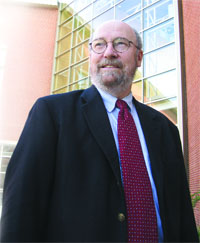
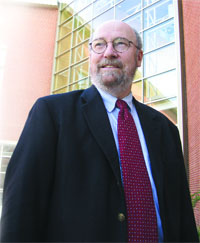
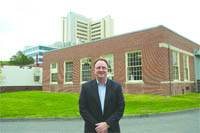
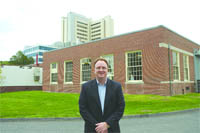
    Ron Michaud stands outside the new Studio Arts Building at UMass Amherst.

    UMass Amherst recently opened the doors to a new, $26 million Studio Arts Building. The facility brings together a number of two- and three-dimensional art programs that had been scattered across the vast campus — often in facilities that were cramped and not up to modern building codes — and creates, with the nearby Fine Arts Center, what one administrator calls an “integrated arts district” on campus. But the center will also benefit the region as a whole, say school administrators, by making the university’s arts programs more attractive, thus bolstering the Western Mass. creative community.

    Joel Martin has a number of descriptive nouns and adjectives he applies liberally to the new Studio Arts Building at UMass Amherst.

    Martin, dean of the College of Humanities & Fine Arts, calls it a “well,” a “source,” a “talent magnet,” and even a “talent factory.” He deployed those terms and others to explain how the $26 million facility, which opened this past month and brings a host of two- and three-dimensional arts programs that were spread across the campus together under one roof and tons of glass, will help bring more talented art students to the school — and thus bolster the region’s creative community.

    He believes this because he has data showing that many of the artists living and working in this area said in a recent survey that they probably wouldn’t be doing business in this market if they hadn’t been exposed to it while attending college here. And the new Studio Arts Building, which has heen roughly 30 years in the making, according to some long-time administrators in the College of Arts & Humanities, will be a very effective recruiting tool.

    “Everything in it is state-of-the-art,” said Martin, acknowledging while also embracing the play on words, as he referred to everything from the air handlers to table saws in the woodworking area in the 47,000-square-foot building. “It’s a wonderful learning facility — it’s makes great use of light, and there are some grand spaces; we really needed to have a state-of-the-art, safe, environmentally sound facility so that our artists’ energies could be best used. And now we have one.”

    Ron Michaud, associate dean of the College of Humanities & Fine Arts, and former chair of the arts program, has been advocating for something like the Studio Arts Building for years now. He said the university’s arts programs have functioned well over the past half-century, and have succeeded in helping a number of accomplished artists — painters Chuck Close and Shan Shan Sheng, among them — develop their talents and find their potential.

    But it can do much more of the same with the gleaming new facility, which, when coupled with the nearby Fine Arts Center, creates what Michaud called “an integrated arts district” on the campus.

    Like Martin, Michaud said the new arts center makes UMass a stronger player as it competes with such institutions as the R.I. School of Design, the Pratt Art Institute, and a host of public colleges and universities for top art students. And the hope — and expectation — is that some of this talent will remain in the Pioneer Valley.

    “A building like this can really become a magnet for talented people across this region and also well beyond,” said Michaud. “This will put this university on a higher level, and also help this region and its economy.”

    The Proper Framework The ‘art barn.’

    That’s the nickname, if one could call it that, attached to one of the now former homes for studio arts programs at the university. The barn, located in the northwest corner of the campus not far from the Mullins Center, hosted painting classes for decades, said Michaud, and is now a facility housing lawnmower-repair operations “or something like that.”

    Another former art program facility, one recently razed to make way for an integrated sciences building, was a post-World War II army barracks annexed by the college. It housed sculpture programs and some instructional space, Michaud noted, adding that, overall, programs have been spread across as many as 19 buildings, most of them cast aside by other departments that didn’t want or need them anywhere.

    Some of these facilities, like the art barn, were considered warm and cozy, and actually had some fans, he continued, but they were not designed to house creative arts programs, were inefficient, and were often several hundred yards away from buildings hosting other programs.

    Even the university’s Fine Arts Center, opened in the early ’70s and designed mostly for the performing arts, lacked what would be considered modern, efficient space for most of the studio arts programs offered by the school, said Michaud, noting that, in many respects, the sprawling complex has been “showing its age” with respect to considerations such as ventilation, waste disposal, ‘green’ design, an even instructional facilities.

    A succession of students and, more importantly, administrators within the vast College of Humanities & Fine Arts, recognized the problem and the need to do something about it, he continued, but it wouldn’t be until the start of this decade before mobilized efforts succeeding in generating some action.

    “In 1995, we conducted a comprehensive study of our inventory of facilities,” said Michaud, “and came away knowing that we needed a new studio-arts building to remain competitive nationally and internationally.

    “People came together behind a common vision, and eventually convinced the administration that we needed something like … this,” he continued as he began a tour of the new facility, one that encountered several classes in progress and artists at work.

    As he started down one wing of the V-shaped complex, it didn’t take Michaud long to make his point about bringing once-scattered programs together in one space. Indeed, the woodworking, welding, sculpture, and ceramics programs were all arranged in a row. “Before, these were spread across campus,” he explained, noting that most former settings simply weren’t designed to house kilns or welding equipment.

    On its ground floor, the center features a high-end digital and computer-graphics studio, a central location for photography, and facilities for instruction in such disciplines as lithography, etching, and silk-screening.

    “The instructional areas are much larger, in most cases, than what we had before, and they’re more efficient,” he explained, “giving students the facilities they need to learn.”

    Martin agreed, and noted that for decades, the College of Arts & Humanities had been adjusting — or trying to adjust — whatever space came its way to accommodate whatever program, be it woodworking or pottery, that needed room. Now, it has space custom-designed for each discipline.

    The center is also one of the ‘greenest’ on the UMass campus, said Michaud, noting that it makes use of sustainable building materials, operable windows for natural ventilation, and a variety of energy and water-conservation measures.

    Breaking the Mold

    As he stopped in the large, open common area that serves as the primary entrance point as well as a gathering space for students and faculty and venue for art shows and guest lectures, Michaud remarked at how quiet it was at that time (late afternoon).

    “You won’t see it like this very often,” he said, adding that he and others expect that space, complete with high windows and expansive views of the campus, to help generate a stronger sense of community among artists who had been working in the four corners of the sprawling campus.

    And that notion of ‘community’ is important, said both administrators, because those in the arts thrive in settings where they can share ideas and critique each other’s work.

    “We now have facilities where people can meet, have lunch, talk about what they’re working on, and compare work,” Martin explained. “And that’s really important as they develop individual arts, but also as they compare and blend different forms of art, and perhaps even create new forms of art.”

    But while creating a larger, stronger, and more-visible arts community on campus where all this can happen, the new Studio Arts Building is also expected to have a broad impact beyond the university’s borders, said Martin and Michaud.

    Noting that many communities across the Pioneer Valley are looking to the arts and the so-called creative economy to help fill old mill buildings left quiet by the exodus of paper and textiles makers and other manufacturers and breathe new life into downtowns that can longer prosper through retail, Martin said the new facility can help provide the key ingredient to all those aspirations — artisans.

    “The creative economy, no matter how you define it, ultimately rests on having creative people with talent generating fresh ideas, approaches, and designs, to help create art, but also to communicate, persuade, and market this art,” he explained.

    And this is where Martin summoned those descriptive terms to drive home his points concerning what the Studio Arts Building is — and will ultimately become — as the region and individual communities focus on the arts as an instrument of economic development.

    “We’re the talent magnet that attracts the greatest number of talented people in the Valley,” he explained. “And with this facility, we can now attract and retain the most talented student artists in the country and the most talented faculty and artists. We have a state-of-the-art facility that is a pump, a source, a well that will feed this Valley.”

    Citing a survey of College of Humanities & Fine Arts alumni, released just a few months ago, Martin that a large percentage (nearly half) of those queried said they likely would not be working in the Valley as writers, photographers, painters, and sculptors if they had not attended the university and thus become exposed to the region’s amenities and quality of life.

    “When you look at those numbers, it’s clear that if we can bring more top talent to this university, we can, potentially, keep more of it in this region,” he explained. “That’s why people pushed so hard for so many years to get a facility like this.”

    Brush with Success

    As he passed two students conversing in the undergraduate studio area on the second floor of the new facility, Michaud offered a question, and an opinion, with the words, “better than the art barn, isn’t it?”

    There was a moment’s hesitation while the students thought this over — a reflection of how some liked the old accommodations, despite their limitations — but eventually some nods of approval.

    There will be more of those as the building’s facilities, amenities, and displayed works of art — including a piece by Shan Shan Sheng due to be installed later this month — come to be known and fully understood.

    That’s to be expected with a building that is truly state-of-the-art, in every sense of that phrase.

    George O’Brien can be reached at[email protected]

    Sections Supplements
    Flexible Arrangements Are Gaining Attention, Acceptance
    Bill Ferris

    Bill Ferris says there is mounting evidence that flexible work schedules lead to greater productivity from those happy to be in such situations.

    Paraphrasing Mark Twain, most business owners and managers today would say that the death of the traditional five-day workweek has been greatly exaggerated. That being said, the so-called flexible work arrangement, of FWA, seems to gaining more acceptance as it garners headlines and attention from the academic community. Some of that study is inconclusive, but much of it suggests that such flexibility yields happier, more productive employees, while helping companies attract and retain top talent.

    Bill Ferris says the acronym FWA hasn’t yet worked its way into the mainstream at most companies or business-related organizations, but it’s probably only a matter of time before it does.

    It stands for ‘flexible work arrangement,’ said Ferris, a professor of Management at Western New England College who has studied the subject extensively, and as that name suggests, it connotes work schedules or conditions that are, well, flexible, as opposed to inflexible, which is the word that ruled in corporate America for decades. It’s a term that now covers everything from telecommuting to variable scheduling to compressed workweeks, he explained, and although it is hardly a recent phenomenon — progressive companies have been employing the concept, if not exactly the acronym, for many years now — it is gaining more attention, and more headlines.

    The state of Utah recently went to a four-day workweek, for example, while France abruptly and unceremoniously abandoned its experiment with that concept and went back to the five-day variety. Meanwhile, as gas prices soared above the $4 barrier there was much talk, and some action, among employers about compressing the workweek, offering more telecommuting opportunities, or both to help their workers save at the pump. And the airline JetBlue has been drawing considerable attention from the press, academia, and the business community for deploying an army of stay-at-home moms to handle its ticket-reservation work, and with apparent success.

    “They just log in and log out according to specific hours, and all seems to work … JetBlue apparently has a much more responsive network than many its competitors,” said Alan Robinson, a professor of Management at UMass Amherst. He noted that the company’s workforce is also more diverse than many others, because it can hire women with young children, and the airline, like other companies, can free up — or not lease — tens of thousands, if not hundreds of thousands, of square feet of prime commercial real estate by having people work at home.

    But in the end, flexible work arrangements shouldn’t be about, or all about, gas prices or real-estate costs, said Debra Palermino, vice president of Corporate Human Resources at MassMutual. Instead, flexibility with schedules is more about productivity, recruitment, and retention, she explained.

    “These are the things that are driving what we do here,” she said, noting the financial services giant has been utilizing flexible work arrangements, if not exactly calling them that, for many years now in several different departments. “This is a matter of work design for us; it’s not a commuter-cost issue here. It concerns how we can do our work in the most efficient way and in the way that is most attractive to the kinds of employees we’re going to need to do that kind of work.

    “We ultimately have a vision to have as much flexibility as the company can afford and can manage,” she continued, adding that this phenomenon includes arranging for a valued employee to stay with the company after relocating to Florida.

    “He had been here many years, was a top performer and an excellent employee, and we just didn’t want to lose him,” Palermino explained. “We worked out an arrangement whereby he could continue to work for us in Florida, and it it’s been quite successful.”

    There are some issues and shortcomings to address when it comes to FWAs — not everyone can work at home, most companies need to staff the office and the phones five days a week, not four, and the FedEx bills can get excessive with many employees working remotely. Meanwhile, for those who can and do work at home, for example, there are matters of isolation and socialization (or lack thereof) to contend with. And there is always the matter of productivity to measure and re-measure, as well as lingering skepticism among many employers.

    Meredith Wise, executive director of the Employers Association of the NorthEast, told BusinessWest that soaring gas prices — which have been retreating but always threaten to skyrocket again — have prompted some of her agency’s members to visit or revisit the subject of flexible work arrangements, and especially the four-day workweek.

    Some are hesitant, she explained, because of studies and anecdotal evidence indicating that productivity declines when people work four 10-hour days instead of five eight-hour days, and additional concern about rising health care claims from such arrangements as minds and bodies tire with a longer day.

    “For many businesses, there are too many challenges to overcome and too many questions with regard to a four-day or four-and-a-half-day workweek,” she explained, noting that this sentiment seems to apply to other types of flexibility with regard to work, especially among smaller companies.

    But Ferris says there is gathering evidence that with such flexibility comes generally happier employers and improved productivity. So much evidence, in fact, that he believes the traditional five-day workweek is, or will soon be, obsolete.

    “It’s dead … it’s gone,” he said, noting, for starters, that people in many professions work, or are on call, literally or figuratively, almost 24/7. Meanwhile, technology enables people to work when and often where they want, and progressive companies must recognize and take full advantage of this phenomenon is they want to compete.

    In this issue, BusinessWest looks at the concept of work, the increasing prevalence of FWAs, and what it all means for companies and their employees.

    Hour Town

    Ferris told BusinessWest that the concept of the flexible work arrangement, like distance learning and its potential and limitations, has become the subject of considerable study, debate, and conjecture within academia — and Corporate America, as well — and he’s one of those involved in such activity … sort of.

    Some of his current students are involved in such study, he said, noting that one, a graduate student, is conducting what’s known as evidence-based management research to test her hypothesis that telecommuting workers who want to telecommute (that’s an important distinction) are more productive than workers who toil in the corporate office.

    “She believes that’s what she’ll find, and there’s reason for her to think she’s right,” said Ferris, who told BusinessWest that many of his current and former students, ages 21 to 30 or so, are working increasingly in flexible work arrangements, giving him a test group, if you will, to monitor and measure.

    “They’re in all kinds of different businesses,” he said of his charges. “They’re working at home, and their companies are looking for ways to have more of their people working at home.”

    Study results, not to mention anecdotal evidence, are varied, said Ferris, but some trends are emerging, with many of them pointing toward FLAs being beneficial to companies and employees alike.

    “What has been discovered, by and large, is that people who want to be on flexible work arrangements are happy about it, and typically produce better or as well as people who are not,” he said. “People even report that they’re sick less and call in sick less, because they’re already home doing their work. They put in more hours per week, typically, than people who go to work.

    “They’re healthier, they work more, and they bill more hours,” he continued, noting that that this healthier state results from not being around sick people at work. And they’re more productive, he conjectured, because they’re not interrupted or sitting in meetings all day that accomplish little if anything.

    Robinson told BusinessWest that, from his view, most of the studies on this matter are in progress, and that he relies mostly on anecdotal evidence — or his own experiences — when weighing the matter of flexible work arrangements.

    “I’m much more productive at home, and part of the reason for that is that you can’t hang a do-not-disturb sign on your office door for three hours,” he said. “There are studies that show that every time you’re distracted, it takes you 15 minutes to get back to you where you were.”

    For these reasons and others, he said, it makes sense for companies to permit telecommuting when and if the technology and the circumstances permit.

    But while the academic community continues to study the various aspects of the flexible arrangements, work — as it is now defined or carried out — goes on in the real laboratory, the workplace.

    Remote Possibilities

    This includes corporations like Mass-Mutual, where flexibility has been part of the equation for many years now, said Angela Derouin, a human resources business partner at the company. She noted that, while some departments can’t really offer such arrangements — security and call-center operations, for example — most can and do, with the extent of the programs typically determined by the manager in question.

    Derouin estimated that roughly 400 of the company’s 5,000-odd employees have some form of flexible work arrangement (matching industry averages), and the number is rising, due to both the popularity of such programs and the company’s degree of satisfaction with what it has seen and heard.

    “We hope that in certain areas where we know the work can be done at home and we can accelerate the technology support it, we can put more people to work in their home,” she said, referring to just one piece of the efforts with regard to FWAs.

    Indeed, flexibility includes telecommuting locally; working in Florida, as that one producer does, or other states; compressed schedules; and flexible schedules — people coming in later and leaving later, for example. “I come in really early, but the person next to me arrives at 9,” she explained.

    Generally, said Derouin, people working in such arrangements are as productive or more productive than they might be in a traditional work arrangement. Why? Because they’re happy to have that flexibility and want to keep it.

    “We find that when people are successful while working at home and want that arrangement to continue because they like it and it benefits them in many ways, they’re wiling to work hard and make sure they’re available on the phone or via E-mail. They work very hard to make the arrangement successful so they can keep it.

    “We want everyone to be productive, whether they’re working here or working remotely,” she continued. “But we see those in flexible arrangements doing whatever they can to make it work, because their ability to work in that way is dependent on business needs, and it’s at the discretion of the company.”

    Ferris said this trend is prevalent elsewhere; those granted flexible work arrangements view them as a priviledge, not a right or something they can take for granted. “So they put in the effort to maintain that privilege.”

    Beyond productivity and morale issues, however, another benefit to FWAs is the ability to recruit and retain employees — most of whom work in and around Springfield, but some others don’t.

    “We have employees spread out across the country, and it has worked out very well,” said Palermino, adding that this ability to have people work in Florida, California, and even overseas will prove valuable as companies across all sectors face the challenge of finding enough qualified workers in the years and decades ahead.

    But as FWAs become more popular, there are issues and challenges that companies must contend with, said said Derouin, who cited isolation as one possible problem. She said the term gaining acceptance in corporate America is ‘social distancing.’

    “Those companies that have done it in a big way are dealing with this now,” she explained. “They’re asking themselves, ‘how do you maintain espirit de corps?’ and ‘how do you maintain your sense of an entity if you’re so isolated?’ Companies are responding by forming agreements where there are certain times in a week or month when people have to come in.”

    Overall, experts say that an array of potential problems and issues — from isolation to distractions from young children — can be overcome (see related story, page 28).

    As for skeptical managers, Palermino acknowledged that there are some gray areas when it comes to productivity within some departments — meaning that it’s not all numbers on a balance sheet — which makes it challenging to gauge whether people are more or less successful in a flexible work arrangement. But in most cases, performance is outcome-based, giving most managers a fairly clearly read on whether something is working or not.

    Meanwhile, not everyone desires flexible work arrangements, said Ferris, noting that many individuals want and need interaction with others in the workplace.

    That’s why the traditional five-day workweek won’t disappear from the landscape any time soon, he noted, adding, however, that flexible work models are becoming more prevalent — where and when they are applicable.

    Time Passages

    Ferris told BusinessWest that, in time, and probably not much of it, the term ‘telecommuting’ will eventually fade from the business lexicon, as will ‘flex time’ and other phrases that seem destined to replaced by FWA or something like it.

    “That’s because ‘flexible work arrangement’ typically means you spend some time in the office and some time out of the office doing office work, so it covers all those terms,” he explained, adding quickly that the issue for business owners and managers certainly isn’t terminology.

    Instead, it’s recognizing that, in many respects and in a great many professions, work is changing, and the old rules — which add up to inflexibility — no longer apply.

    George O’Brien can be reached at[email protected]

    Cover Story
    Young Professionals and the Future of Massachusetts

    Greg Torres, president of MassINC, said that, when it comes to the latest study completed by the nonprofit research entity he leads, the proof is in the statistics, and the devil is in the details.

    “We make it a practice to look at specific demographic groups and their attitudes, and in turn to look at how the economics of the state stack up, given those attitudes,” he said. “But we don’t make any specific recommendations. We frame the problem and get the research out.”

    The latest group studied by MassINC is one that has not been examined closely in the past — young adults in the Commonwealth, ages 25 to 39. The study, titled Great Expectations: A Survey of Young Adults in Massachusetts, delves into this demographic’s views and priorities, with the goal of evaluating what impact these perceptions have on the Massa-chusetts economy.

    “There is plenty of research on Boomers, but very little looking at young adults,” said Torres, adding that what the study found was in parts surprising — including a high level of positive thinking regarding the state and its future — and intriguing, such as the discovery of an equally high level of cynicism when it comes to state and federal government.

    It also touched upon a disparity in opinions and concerns between different types of residents — those who moved here versus those who were born and raised in the Bay State, for instance, or those living in Greater Boston versus those in southeastern, central, and western communities.

    In this issue, BusinessWest takes a closer look at Great Expectations, as well as how it relates — and does not relate — to the pressing issues of Western Mass.

    A Case for Education

    Torres noted that studies like Great Expectations are research-heavy and light on specific recommendations. However, the statistics presented become important tools for regional employment boards and other economic-development entities across the state as they implement new programs to better the Commonwealth’s economic outlook and retain its young population.

    The need to get a finger on the pulse of this age group has become doubly important, Torres added, due to the growing emphasis on the Commonwealth’s knowledge-based economy. It’s a big piece of discussions surrounding the potential for Massachusetts to lead the country in areas such as life sciences and biotechnology, but on a broader scale, education has a marked impact on economic stability, and today’s young-adult population is a more educated group on the whole than the any other, both regionally and nationally. According to Great Expectations, about 46% of this group has earned a college degree or higher, 49% earn $50,000 or more annually, and 54% own a home.

    “When you look at education levels and the extent to which young people are doing well economically, there’s a direct tie-in,” said Torres. “A high-school diploma used to be the standard, but all of our research suggests that a college degree is now the key.”

    There are other trends, Torres continued, that are perhaps more intangible than the education piece, but no less intriguing. The largest common denominator among the young adult set, he said, was an undercurrent of optimism regarding the future.

    “We were struck by that,” Torres said. “The optimism that was reflected regarding their economic standing and that of their children surprised us a little bit, especially with the economic storm clouds on the horizon and no real wage growth over the last decade.

    “It struck us that, as a group, young adults are pretty confident that they’ll be able to do better moving forward,” Torres continued. “They believe they’ll be able to increase their economic standing.”

    The Cynical Side of the Street

    There is a downside to this optimism, however — not only are young adults upwardly mobile, they’re not averse to taking their talents elsewhere if they feel they’re not reaching the heights they’re capable of in the Bay State, an already historically expensive place to live.

    “Twenty percent are saying if they can’t get a handle on costs in Massachusetts, they would consider leaving in the next five years,” said Torres. “We’re a high-cost state, and there’s no getting around that. It’s not going to change in any immediate sense.”

    Even more specifically, Torres said, Great Expectations reveals that this demographic has a greater respect for and confidence in the private sector, and a lack of confidence in public sector.

    “This offers us some interesting insight that we intend to focus on,” he said. “What this means is that the majority of young adults in Massachusetts believe that solutions to problems like environmental issues are going to be driven by creative work in the private sector, and further, that confidence is low in public sectors.”

    He said that while some political candidates, including Gov. Deval Patrick and presidential candidate Barack Obama, have successfully tapped into the overriding optimism of young adults on the campaign trail, MassINC’s research offers an opportunity to delve further into the potential pitfalls of low confidence in state and federal government.

    “The less confident the population, the higher the rates of non-participation,” he said. “People who don’t believe the public sector can do what needs to be done are less likely to vote, and support for taxes goes down. We hope to explore politics more so candidates can reflect on it — and, in general terms, we need more of a balance between public and private sectors.”

    Curb Your Enthusiasm

    Anita Dancs, an economics professor at Western New England College, agreed that the attitudes of this demographic have an impact on the state’s economic outlook, as well as some of its existing realities, including in the political arena.

    “It caught my attention that this group is so cynical about government; I wonder what future impact that could have,” she said. “They’ve heard all through their lives that government fails, but I do find that a concern, because there is a role for government to play, especially in terms of the race with the rest of the world.”

    However, Dancs added that she takes certain aspects of the MassINC report with a grain of salt, particularly when applied to Western Mass., which is working to clear its own hurdles that differ from those in other parts of the state.

    For one, she said, the high percentage of optimism could be colored by certain variables.

    “I think the first thing we need to realize is that this is an age group that is in the prime of their lives,” she said. “Buying a home, starting a family, advancing in a career … these are all things that are happening to these people because of their life stage, and they’re hopeful.”

    More specifically, the optimism reflected in the report is driven in part by people who have moved to Massachusetts because of the better, knowledge-driven jobs in Greater Boston,” Dancs said, referencing one of three groups, ‘the Imports,’ into which the surveyed demographic is broken in Great Expectations.

    According to the report, 37% of the 25-to-39 demographic represent this sub-group — those who grew up outside of Massachusetts and relocated. The remainder consists of ‘the Boomerangs,’ 23% of the total, who grew up in Massachusetts but have lived outside of the state for a year or more before returning, and ‘the Homegrowns,’ the largest percentage of young adults at 40%, who have not lived outside of the Commonwealth for a significant period of time.

    “If you take apart the report a little more and look at the homegrowns, this is the group that is more representative of Western Mass.,” said Dancs. “There’s more concern over finances in this group and more concern over availability of jobs. In Western Mass., wages tend to be lower, and we have fewer high-paying technical jobs.”

    Indeed, the MassINC study states that “imports are the most satisfied with the way things are going for them.” The majority are college graduates (60%), while only 32% of Homegrowns have an advanced degree. Further, three-quarters of Imports work in professional or managerial jobs, compared to 41% of Homegrowns. Finally, 71% of the Imports live in Greater Boston.

    Dancs went on to note that some pervasive economic issues also run contrary to the positive view many young adults have of their own futures and that of the state; it just may take longer for these effects to be felt within the surveyed population.

    “It’s likely that a recession will be coming on, and economic indicators aren’t looking very promising,” she said. “There are also a few general, national trends that Massachusetts follows that need to be taken into account; optimism may exist, but income inequality is also growing tremendously. Massachusetts had the third-largest income-inequality growth in nation in last two decades.

    “There’s also income instability,” Dancs continued. “People’s wages go up and down more than those of their grandparents or parents, and we also know that weekly earnings are lower than in the 1970s in real terms. There’s something about this report that flies in the face of economic reality.”

    Great Expectations does state that outside of Greater Boston, the survey population focuses on a different set of concerns than their Hub-based counterparts. For one, those in the Boston area cite high costs of living as a primary worry, while others — particularly Homegrowns — speak to the need for job creation.

    Offering this research to be applied to new or existing programs to augment the Commonwealth’s young workforce is one of MassINC’s primary goals, according to Torres; however, in areas where problems such as high unemployment and high-school dropout rates already exist, including in many locales of Western Mass., the approach employment organizations and departments must take is not so straight-forward as reading the statistics and trying to reflect them.

    Rather, in many ways, these findings represent an ideal that may exist within much of the 25- to 39-year-old age group now, but could easily wane if the economy continues its downward trend, or if younger populations are not educated on their options and offered opportunities by assistance agencies, schools, and employers alike.

    Tomorrow’s Adults,

    Today’s Concern

    Melissa Scibelli, manager of Youth Projects with the Hampden County Regional Employment Board (REB), said she works primarily with youths ages 13 to 21 to provide educational, career-ladder, and work-training opportunities. She agreed with Torres that education and career experience are intertwined and proven to have a marked effect on employment rates.

    However, in Hampden County, the road to that ‘new standard’ of a bachelor’s degree to prepare for career stability and advancement is a long one.

    “Education and work experience are aligned,” she said, “and with a 50% non-graduation rate over four years in this area, many of today’s students need support that previous generations did not. We have to start early to educate students on their options and cultivate their goals.”

    This is an objective that doesn’t start and stop in high school, either. Scibelli said her department’s work begins with children as early as pre-kindergarten, and carries on to young-adult populations.

    “This is how we are preparing the next generation — by finding every way possible to get kids connected and contributing to the community.”

    Further, this work cannot include only young, developing populations. Instead, Scibelli explained that the latest push in youth development and career training in Hampden County is engaging businesses in the process of developing tomorrow’s workforce.

    “Many businesses are stepping up to the plate,” she said, citing MassMutual, Big Y, Baystate Health, and Western Mass. Electric Co. among the REB’s largest partners. “They’re providing career-ladder training, internships, and educational opportunities that help students develop 21st-century skills. But more importantly, these businesses are signaling to the students what positions exist for them following education and training. This, ultimately, is what’s going to keep those young people in the area.”

    As more area businesses sign on to work more proactively with young populations, Scibelli noted that new opportunities are surfacing, which could lead to further development of the connection between education and economic security cited in Great Expectations among the 25-to-39-year-old set.

    “More partners are realizing they need to be a bigger part of the picture,” she said, “and they’re starting to introduce programs that link to internships and scholarships at the higher-education level. They’re essentially building a new infrastructure that’s aimed at knowledge transfer, and helping younger people to do better overall.”

    Common Ground

    In its closing assessment, Great Expectations reports that, overall, “there is a lot of goodwill toward the state, which leaders can build upon as they try to attract and retain young adults.”

    In response, Dancs said this is the greatest strength of the study and its findings.

    “There are a lot of questions that come up when we read this; it will also be interesting to see five years from now if that level of optimism still exists,” she said. “But in the end, any optimism is going to have a positive effect on the economic outlook.”

    For now, the economic outlook is hazy. But the belief that things will get better, and that the young workforce of Massachusetts will be a driving force thereof, is a documented fact.

    Cover Story
    Those Driving Diversity Say This Is a Matter Involving Everyone

    Visael (Bobby) Rodriguez was exaggerating, but clearly making a point when he said that there are “probably a million” definitions of the word ‘diversity’ being put to use in businesses and organizations across the country.

    He has his own.

    “Diversity includes everyone; specifically, it is the unique combination of human characteristics of self and others,” he said, quoting from a page of a PowerPoint presentation he uses in his role as the chief diversity officer for Baystate Health, a post he assumed in March. “Diversity is the foundation” — a word he underlines — “of cultural competence.”
    And he defines that phrase, as it applies to Baystate, as “the ability of individuals and organizations to effectively understand and address the unique perspectives and health needs of all populations.”

    How all this manifests itself varies, he explained, but includes everything from the fact that the information printed on his business card is also in braille to Baystate’s participation this past spring in Northampton’s Gay Pride Parade, a first for the system.

    “Diversity looks at embracing differences, and means taking into account the needs of everyone,” said Rodriguez, who must have used that word, and with accompanying emphasis, a dozen times as he spoke with BusinessWest. “This includes males, females, whites, blacks, Hispanics, Moslems, Christians, Jehovah’s Witnesses, lesbians, gays, bisexuals, transgenders, single mothers, people caring for elderly parents … everyone! And it means acknowledging differences.”

    Rodriguez is one of a fairly new breed of administrator, at least in this market, the individual charged with not merely defining diversity, but also institutionalizing it and formalizing it within a given organization.

    The titles for such employees vary — ‘chief diversity officer,’ ‘global diversity and inclusion executive,’ ‘vice president of Workplace Culture, Diversity, and Compliance,’ and ‘senior vice president and chief people officer’ are among the myriad contrivances now in use across the country — as do the written job descriptions. But their basic mission is the same: to drive diversity, however it may be defined.

    And this is not an assignment that amounts to political correctness or just doing the proverbial right thing, said Lorie Valle-Yanez, who was recently named vice president of Diversity and Inclusion at MassMutual. Rather it’s an extremely important strategy for long-term growth, one that touches everything from sales to the supply chain; from employee recruitment and retention to strategic thought processes.

    “It’s as much about diversity of thought and perspective as it is about some of the more visible aspects of diversity,” said Valle-Yanez, who came to MassMutual from a similar position at ESPN. “If you’re in a room full of people and there’s visible diversity, you’ll tend to have more diversity of thought, ideas, and perspective — there’s a connection.”

    Valle-Yanez told BusinessWest that, as the huge Baby Boom generation enters retirement, corporate America will be faced with replacing tens of millions of workers, and will be fishing in a smaller, historically diverse pool of workers as it goes about that task.

    Companies that embrace and effectively exude diversity will thrive in this environment, she said, and those that don’t will likely fare less well.

    Greg Michael agreed. He’s the executive director of Human Resources and the Career Center at Western New England College. He told BusinessWest that employers will face two huge challenges in the foreseeable future — attracting qualified talent and then keeping it, at a time when loyalty doesn’t mean what it once did, at least on the employee’s side of the equation.

    “The challenge for people in HR over the next five to 10 years is going to be hiring, because the numbers tell us we’re going to lose more people than there will be available to fill the slots,” he explained. “But getting them in the door is only the beginning of the issue. Retention is going to be more and more of an issue; companies have to look at how they’re going to keep people, and one of the ways to do that is to create an environment that is friendly and tolerant.”

    In this issue and this focus on business management, BusinessWest looks at how diversity managers will go about creating such environments, and why doing so is simply part of their work to create a ‘diversity strategy.’

    Not a Black-and-white Issue

    As he talked with BusinessWest, Rodriguez stopped to retrieve the June edition of DiversityInc magazine from his credenza.

    This was the annual compilation of the national publication’s “Top 50 Companies for Diversity.” Rodriguez referenced it to help refresh his memory regarding which corporations were at the top of the list — Verizon, Coca-Cola, Pricewaterhouse-Coopers, Procter & Gamble, and Cox Communications were the five highest scorers — but also to point out that the Henry Ford Health System in Detroit was ranked No. 40.

    This was the first time that a health care provider had cracked the top 50, said Rodriguez, who told BusinessWest that one of his hard goals is to put Baystate in that position, and within five years.

    “That won’t be easy,” he said, noting that many of those on the top-50 list are seemingly permanent fixtures that continue to hone elaborate diversity strategies. “Displacing any of those companies will be difficult.”

    But Rodriguez is committed to achieving that goal, and he says the reason isn’t the plaque that comes with the honor or the publicity it will generate. Rather, it’s what achieving that status will mean.

    In short, it means the company will have taken some huge steps toward becoming one of those employers of choice that Michael referenced.

    And that will be an important designation because, by his count, the Baystate system will have to fill roughly 18,000 positions over roughly the next decade, a figure he arrived at by calculating needs from continued expansion, especially construction of a $250 million addition, the so-called ‘Hospital of the Future,’ and also turnover and replacing retirees.

    But cracking the top 50 will also mean the system will be better able to serve the region than it is today, he said, because it will better understand the needs and challenges of the many constituencies that comprise the local population.

    As he talked about the work to be done at Baystate, and why he left a similar position at Blue Cross/Blue Shield in Florida to join the system after being recruited by a ‘diversity headhunter’ to interview for the position, Rodriguez used the phrase “starting from scratch.”

    He quickly elaborated, noting that, while diversity has long been a matter of discussion and, in many ways, part of the culture at Baystate, the process of formalizing it, or institutionalizing it, is essentially just beginning.

    When asked how he will go about that assignment, he said the work will take many forms, but the broad mission is to create a workforce within the system that is what he considers “culturally competent, and that reflects changes in the population.”

    And by that, he means a workforce that really understands how various demographic groups are different and is able, in effect, to get inside those worlds.

    “Because I have, say, 100 employees who speak Spanish doesn’t mean they’re culturally competent,” he noted. “Cultural competence means acknowledging differences and understanding them; it’s a male acknowledging that a woman is different and that he understand her needs; it’s understanding that Vietnamese women are five times more prone to cervical cancer than American women; it’s understanding that Hispanics comprise 20% of new tuberculosis cases.

    “That’s what I mean by cultural competence,” he continued, “and having it will make us a better health care system.”

    These are some specific examples of the many ways diversity efforts manifest themselves, he said, adding that his general job description is to make diversity a strategic initiative and not a buzzword.

    Policy Shift

    In many ways, Valle-Yanez assumed a similar challenge at ESPN, which had no formal diversity programs prior to her arrival, and she’s now doing essentially the same at MassMutual.

    She told BusinessWest that the company, which has more than 10,000 employees and financial professionals across the country, has undertaken a number of initiatives in the name of diversity. It will be her job to coordinate all of them and provide more structure.

    “MassMutual certainly has many efforts going on with regard to diversity,” she explained. “My job is to hopefully align them all so they’re all pointing in the right direction and we can leverage those efforts; I’m here to put together an integrated strategy.

    “It starts with understanding the business and its culture, finding out where the company is, and then putting together a strategy that makes sense culturally to create some forward momentum,” she continued. “A company needs to focus on how diversity and inclusion really help from a business perspective.”

    Listing some of the ways it helps, she mentioned recruiting and retaining employees, but said it goes much deeper. It can also help cultivate new customer bases at a time when demographics are changing, in this region and across the country — the term ‘minority majority’ sums up the census numbers in most urban areas.

    “Recruiting and retaining talent is a big piece of the diversity pie,” she said, “but it’s also about really serving the diversity of our customer base and reaching new markets that are untapped or currently underserved.”

    Summing up her assignment at MassMutual, she said it is to create what she calls a “diverse mindset.” Elaborating, she described this as “an overarching strategy that people can align themselves to.

    “This occurs when it starts to really take hold in an organization and becomes part of the culture,” she explained. “Diversity becomes top-of-mind, and people start to think differently … they even think about how to approach their work differently.”

    Valle-Yanez could truly be described as a veteran of the diversity movement, if one could call it that. Before joining ESPN, she worked for more than 20 years at the Lawrence Livermore National Laboratory in California, and eventually took the lead diversity role as group leader of the Diversity Programs Office. She is a member of something called the Diversity Collegium, 25-member think tank dedicated to advancing the field of diversity and inclusion.

    She said there have been diversity directors on the West Coast for 20 years or more — largely because that area has historically been more culturally diverse — and that she has seen this trend, like many others, move west to east.

    Many large companies now have diversity directors and/or departments in place, she explained, and most colleges now have an administrator charged with promoting diversity.

    Myra Smith is one of them.

    A 30-year employee of Springfield Technical Community College, Smith, who has held several titles at the school, including assistant vice president of Human Resources, was promoted in 2005 to vice president of Human Resources and Multi-cultural Affairs.

    One of her first assignments was to create a diversity council. It currently has 27 members from several constituencies, including students, faculty, and staff, and exists not merely to promote diversity but also to celebrate it.

    “The council takes a look at all aspects of the campus, to make sure that they properly reflect the diversity that exists here, especially with our students,” she said, mentioning marketing as one area in which the council has generated change to what existed prior to its existence. “We began to make sure that we had more inclusion in the marketing materials that were sent out, in everything from race to age, so they better reflect the people we serve here.”

    Not by the Numbers

    Smith, like all those who spoke with BusinessWest, said that diversity is often confused with affirmative action when, in reality, it is, or should be, something different and much broader. Corporations and institutions such as colleges must approach their diversity efforts with such a mindset, she added, or they won’t reach their full potential.

    Affirmative action is a term that has come to describe a host of often-controversial efforts to increase the representation of women and minorities in areas of employment, education, and business from which they have been historically excluded. Diversity, meanwhile, according those now placed in charge of it, is not about numbers — although numbers are usually a good barometer of whether diversity programs are working, and they are a big part of explaining why companies are Diversity-Inc’s top 50.

    “I don’t look at the numbers,” said Smith, adding that diversity, as it has come to be defined, doesn’t mean setting out to create quotas for hiring. Instead, it means creating a broad, inclusive pool of candidates that will, or should, help create a workforce that is diverse and, in the case of STCC, more reflective of the student body it serves.

    To achieve this, campuses and companies must be, in a word, “friendly,” or accepting of people who are in some way, or ways, different, said WNEC’s Michael.

    “Everybody works for money,” he explained, “but most people choose to work in a place that provides them with qualitative returns on their investment in labor, rather than just monetary returns. Companies have to create feelings of comfort, feelings of belonging — that’s how they’re going to attract talented individuals and generate loyalty.”

    Like others we spoke with, Smith said diversity must be a top-down process, with a huge commitment from the CEO that moves throughout an institution. This was what happened at STCC, she explained, noting that President Ira Rubenzahl, who arrived on the campus four years ago, brought with him a firm belief in the importance of diversity and making the campus better reflect its student body.

    This commitment was soon adopted by the board of trustees, which moved to create and fund her position.

    This role has evolved since then, she said, but it generally involves helping a host of constituencies (especially students and future students) understand what diversity is, incorporate programs to help achieve it, and, in general, help prepare students for a diverse world.

    “You’re working to ensure that everyone in your business or your school has a seat at the table, everyone has a voice, and everyone is heard,” she said, explaining the basic role for all diversity directors. “Here, we want to help prepare people to succeed in a global world where you do have all these people at the table. To do that, they need to be knowledgeable and sensitive to various cultures.”

    Rodriguez concurred, and referred back to his experiences with Xerox (where he worked before Blue Cross Blue Shield), a company that worked hard to ensure that its teams and divisions were diverse.

    “It’s been proven that, when you have a group that reflects differences in people, the thinking process is different, and you bring ideas to the table that can be very innovative,” he explained. “If I have a team that is only white males or white females, you’re going to get the same input — and output. But if you bring a diverse group together, you’re going to get better input and better ideas.”

    Diversity efforts come with a price tag, say those we spoke with, and one that is not insignificant.

    But rather than a cost, most consider such an expenditure an investment that should, or must, be made.

    “It is an investment, and one we see as critical to our mission,” said Paula Dennison, senior vice president of Human Resources at Baystate Health, who worked with other administrators to create a budget for diversity efforts and then hire an experienced veteran in that field such as Rodriguez.

    “We need someone with the expertise needed to get us where we want to be,” she explained. “This is an important strategic initiative for us.”

    Debra Palermino used similar words to describe the mindset at massMutual, which she serves as vice president of Corporate Human Resources.

    “We have a clear mandate from our CEO [Stuart Reese] that this is not just a workforce imperative, it’s a business imperative,” she explained. “This is a long-term business, and we need to understand our demographics; we’re looking to diversify our sales force, diversify our products and the way we bring them to the market, diversify the customer base, and, because we’re doing all this, we have to diversify our workforce.”

    The Last Word

    Summing up his ultra-broad job description, Rodriguez said his task is to “embed” diversity into everything at Baystate, from hiring to the menu in the cafeteria; from marketing to the supply chain; from community involvement to his business cards.

    Only when such a state is reached can a company or institution truly be “culturally competent,” he explained, adding that, while this phrase doesn’t dominate all of those of millions of definitions of diversity, it does his.

    And so it might be fair to say that his real job description is to make definitive changes.

    Departments

    Baystate Mary Lane Hospital Honored

    WARE — Baystate Mary Lane Hospital, a 31-bed community hospital in Ware, and a member of Baystate Health, was named as a 2008 PRC Five-Star Hospital in a number of clinical areas for scoring in the top 10% nationally. BMLH is one of only 27 hospitals in the nation to receive four five-star awards. Professional Research Consultants Inc. (PRC) is a health care marketing research company headquartered in Omaha, Neb. PRC is the organization that Baystate Mary Lane Hospital uses to gauge patient-satisfaction levels. PRC’s Five-Star Excellence Award is a designation given annually to health care facilities that score in the top 10% of PRC’s national hospital perception database for the prior year. It is based on the percentage of patients who rate the hospital’s service in a particular area as “Excellent.” The Five Star Awards received by BMLH were:

    • Five Star Excellence Award Med/Surg — for scoring in the top 10% nationally for ‘excellent’ responses for inpatient medical/surgical overall quality of care;
    • Five Star Excellence Award Ob/Gyn — for scoring in the top 10% nationally for ‘excellent’ responses for inpatient ob/gyn services overall quality of care;
    • Five Star Excellence Award BMLH — for scoring in the top 10% nationally for ‘excellent’ responses for outpatient surgery services overall quality of care; and
    • Five Star Excellence Award BMLH — for scoring in the top 10% nationally for ‘excellent’ responses for inpatient services overall quality of care.

    Whalley Wins $18 Million State Contract

    SOUTHWICK— Whalley Computer Associates (WCA), one of the leading independent computer hardware and software resellers and system integrators in Massachusetts, was recently selected by the state to supply products under the ITC36 state contract. The state anticipates that $18 million of technology peripherals will be conducted through this contract. One of only two vendors selected, the contract allows WCA to provide IT supply and accessory products such as hard drives, memory, system boards, and more that will support the statewide contract for IT computer hardware and services for state organizations.

    ESB Supports Food Bank, Recycles for a Cause

    EASTHAMPTON — Easthampton Savings Bank recently contributed $5,000 to the Food Bank of Western Mass. The gift is part of ESB’s continuing $25,000 commitment to help the Food Bank feed people in need. “With the rising costs of food, we’re aware that more people are relying on the food pantries, soup kitchens, homeless shelters, elder programs, and child care centers that the Food Bank supplies,” said William Hogan, president and CEO of ESB. “We are gratified that our pledge can help the food bank reduce hunger here in Western Mass.” In other news, the ESB systems department donated several hundred dollars from its recent employee computer-recycling day to the Easthampton Council on Aging Enrichment Center for its technology needs. Bank employees donated a small fee to bring in their old computers, monitors, and printers to the bank for recycling.

    Spalding Introduces Rookie Gear

    SPRINGFIELD — Spalding is introducing Spalding Rookie Gear, a sporting-goods line of youth-sized basketballs, footballs, and soccer balls that weigh 25% less than standard youth products. Specifically engineered for the more than 40 million children ages 8 and under, Spalding Rookie Gear’s authentic, innovative product line is designed so kids can shoot, rebound, kick, and throw more easily and successfully, and with better form. “We want kids to enjoy, embrace, and achieve early success in sports,” said Bob Llewellyn, director of Consumer Marketing for Spalding. “Spalding Rookie Gear is all about keeping young athletes in the game because playing with a lighter ball builds confidence, enables sound fundamental skills, and keeps a child active. The end result is making sports more fun to play.” According to Llewellyn, youth products are traditionally made smaller in size but not appropriately weighted, which can lead to improper form, lack of success, and eventual frustration, which ultimately takes the fun out of play.

    Berkshire Bank Featured in American Banker Article

    PITTSFIELD — Berkshire Bank has been featured in the July 8 issue of American Banker, the financial-services newspaper focused exclusively on the banking and financial-services industry since 1835. The article discusses the bank’s 2007 introduction of its brand identity as “America’s Most Exciting Bank.”

    The article reports on the bank’s success in winning over and engaging new customers and energizing its staff. Sean A. Gray, senior vice president of Retail Banking, stated that the theme of excitement “allows us an emotional connection to our customers.” He added, “I really do believe we have the ability to be exciting because of the autonomy we have in the workplace.” Michael P. Daly, president and CEO, added, “we always believed that if employees feel good about what they’re doing, it will be contagious.” The article reports on the bank’s strong deposit growth and higher earnings in the first quarter of 2008. It also reports on the bank’s largest market share in its traditional Berkshire County market, and on its expansion into contiguous markets in Springfield, Albany, N.Y., and Southern Vermont. It also noted the importance of safety and solidity in bank marketing.

    Baystate Medical Center Is Again Named One of America’s Top Hospitals

    SPRINGFIELD — Baystate Medical Center garnered national recognition as one of the country’s best hospitals for the second year in a row, as the annual hospital rankings compiled by U.S. News and World Report placed Baystate in the top 173 of more than 5,400 medical centers nationwide. Baystate’s medical and surgical endocrinology programs led the hospital to the distinction, placing alongside some of the top endocrinology programs in the U.S. “This honor serves as a tribute to the hard work, dedication, and teamwork of the doctors, nurses, and staff in our endocrinology and bariatric surgery departments — as well as our pathology and clinical laboratory colleagues — and to those who laid the foundation for this success in years past,” said Dr. J. Enrique Silva, chief of the Baystate Division of Endocrinology, Diabetes and Metabolism. “It’s very gratifying to receive this national recognition, especially in a specialty as important as endocrinology to the community we serve. In addition, it’s an added stimulus to continue our mission, to reach out to the community for preventive interventions, and to continue to develop groundbreaking research in this field of medicine.” Dr. Loring S. Flint, senior vice president, Medical Affairs, Baystate Health, said the rankings demonstrate Baystate is a clinically excellent hospital. “We’re proud to be part of such a select group of care providers,” he said. “It means even more that our programs in endocrinology and obesity surgery are being particularly honored, since their work is so integral to our mission of improving the health of the people in our communities.” The U.S. News & World Report rankings, which honor Baystate for the second consecutive year, weigh three elements equally: reputation, death rate, and a set of care-related factors such as nursing and patient services. In 12 specialties, including endocrinology, hospitals have to pass through several gates to be ranked and considered a ‘best’ hospital. Baystate Medical Center is the only medical center in Western Mass. to be recognized by U.S. News this year.

    GCC Receives ‘Promise of Nursing’ Grant

    GREENFIELD — Greenfield Community College announced that it has received $25,000 from the Foundation of National Student Nurses Association’s ‘Promise of Nursing’ program. The funds will be used to develop and implement a recruitment effort directed at licensed practical nurses who are eligible to enroll directly into the second-year nursing program and graduate with their associate’s degree in Nursing (ADN) at the end of that year. “The LPN-to-RN bridge is the shortest route to becoming a registered nurse and, with enhanced advising and counseling support during the program, the most efficient and successful route to full employment in the nursing profession,” said Terri Mariani, GCC’s Nursing program director. GCC will collaborate with area long-term-care facilities, including Amherst Extended Care in Amherst; Buckley Nursing Home and Charlene Manor in Greenfield; Farren Care Center in Turners Falls; Heritage Hall Extended Care Facility in Agawam; Linda Manor, Northampton Nursing Home, and the Veteran’s Administration Medical Center in Northampton; and SunBridge Care & Rehabilitation in Hadley, to identify LPNs in their employment and assist with the transition to nursing school. GCC will use a two-pronged approach to recruit and support the targeted LPNs: first, develop and disseminate a variety of recruitment materials, such as brochures, flyers, mailers, and recruitment fair props, for the GCC ADN program that will market the program and make the case for moving from LPN to RN credentials. Secondly, GCC will extend the enhanced first-year student-retention activities, such as counseling and tutoring support, to the newly recruited second-year students. The LPNs may have completed their schooling many years in the past and may require additional support for math and science coursework, or their level of comfort with being back in school may be low — or both circumstances may be true, requiring the full range of academic and counseling support services. All GCC nursing faculty and staff will work to identify and assist each entrant to the second-year program with both their transition to college and their ongoing scholastic work.

    Features
    Wing Memorial Hospital Opens New, $26.5 Million Building

    The new intensive care unit at Wing Memorial Hospital in Palmer, one of the departments overhauled in a just-completed, $26.5 million expansion project, will soon be equipped with something called the VISICU system.

    That’s a network that uses computer monitors to make each patient’s vital signs — among them blood pressure, oxygen saturation, and heart rate — viewable in real time by critical-care specialists at UMass Medical Center in Worcester, Wing’s parent hospital. Those same doctors can also monitor other patient information, such as current medications and recent test results.

    Proponents of such ‘telemedicine’ technology note that even the slightest change in a patient’s condition can cause potentially serious effects, and the ability to alert doctors to such changes instantly — doctors who, in turn, can immediately notify on-site staff in the Wing ICU — ensures that patients get urgent care when necessary.

    Compared to the manner in which hospital care was delivered only 10 or 20 years ago, that’s a long way for vital information to travel quickly. But Wing has come a long way in many other aspects, too, as evidenced by this week’s opening of the new, 58,000-square-foot Country Bank Pavilion on its campus.

    The addition, named for the Ware-based bank that donated $750,000 to the $26.5 million project, replaces the former operating rooms, intensive care unit, ambulatory surgery unit, and inpatient unit. The original hospital building has been renamed the Paul C. Michalski Pavilion after a former CFO at Wing who was a key player in the hospital’s previous growth, said Wing’s president and CEO, Dr. Charles E. Cavagnaro III.

    Investing in Tomorrow

    The new operating rooms will help Wing more effectively deliver general and laparoscopic surgical services including surgeries of the colon and rectum, gynecology, neurosurgery, orthopedics, ophthalmology, podiatry, urology, and ear, nose, and throat, as well as thoracic surgery and cosmetic and reconstructive procedures.

    The new medical/surgical inpatient unit features 18 private rooms and 11 semi-private units, with all beds featuring an unobstructed view out the window and the private rooms including recliners for family members to stay overnight.

    The mix of private and double rooms “makes it much easier for the staff to put people where they need to be to get the best care possible,” said Edward Noonan, chairman of Wing’s board of directors, at last week’s ribbon-cutting ceremony attended by hundreds of hospital employees, dignitaries, and local residents. “Even though the total number of rooms hasn’t changed dramatically, it extends our ability to take people into the hospital. And with telemedicine capabilities, doctors can look in on patients directly from UMass.

    “These are state-of-the-art operating rooms that no one imagined we would have here in Palmer,” Noonan added. “It’s spacious, and it’s your home when you or a loved one needs help.”

    State Sen. Stephen Brewer said the expansion is one example of the type of health care investment needed to create jobs and keep Massachusetts on the cutting edge of the industry, another being the life sciences bill recently passed by the state Legislature to provide $1 billion over 10 years for what could potentially be an $8 billion sector.

    “That’s a good economic multiplier and job creator, but more important was the person I met recently in Boston — a handsome young man in a wheelchair with Lou Gehrig’s disease.” The man had battled the disease for two years and didn’t have long to live, Brewer said. “I hung my head all the way back to my office thinking about the loss of this beautiful, talented individual. What we do for life sciences, how your tax dollars are invested for life sciences, is about alleviating the pain and suffering of your fellow citizens, and obviously we take it very seriously.”

    Likewise, any public or private investment in health care of all kinds, including Wing’s expansion, continues to benefit society, Brewer said, noting that the average life expectancy in Massachusetts, which stood at 52 a century ago, has now surpassed 78. “I think increasing life expectancy and the quality of life for our citizens happens because of the work that happens here.”

    At the same time, many of the speakers assembled for the ribbon-cutting ceremony on a rainy Monday morning spoke not just to the hospital’s technological advancements, but to a tradition of compassionate care.

    State Rep. Todd Smola, who has four living grandparents, was one of those who touched on the human side of Wing, recalling various occasions when they were admitted to the hospital. “Nobody’s more grateful to the care here than the person standing here,” the Palmer resident said. “Whenever we came to the hospital to visit my grandfather or grandmother, the doctors and nurses took the time to ask how we were doing, not just the people they were caring for.”

    State Rep. Anne Gobi noted that the hospital has made important strides in end-of-life care, including not only hospice care for the dying but bereavement counseling for families, among other services.

    Now and Then

    Wing’s expansion has cleared some space in the old, 111,400-square-foot building, and Wing administrators must still make decisions on the best use of that square footage. But at a time when Massachusetts residents are living longer, all the ceremony attendees said it’s important for Wing to remain in a growth mode.

    “At a time when community hospitals are struggling to stay open, Wing is building and growing,” said James Phaneuf, vice chairman of Wing’s board of directors, noting that the hospital employs 600 people and has benefited from its membership in the UMass Memorial Health Care system beginning in 1999. “We couldn’t have reached this point without the close support of UMass Memorial.”

    That system employs 13,000 people and treats some 3,000 to 4,000 patients per day, said John O’Brien, president and CEO of the health network. “In our system, some of the very best people we have work inside the walls of this hospital,” he said. “This has been a wonderful effort by this hospital to serve all who need help, and I am particularly thankful to this staff that does such an extraordinary job every day providing health care to everyone who comes through these doors.”

    Paul Scully, president of Country Bank, resorted to a little humor in recounting the bank’s decision to financially support the expansion project. “When I started to write a check for $750,000, my hand started to shake, but then a voice said this is the right thing to do,” he said, then turned to Cavagnaro. “Thanks, Charlie, for helping me to finish signing the check.”

    U.S. Rep. Richard Neal wasn’t able to attend the gathering, but his aide, Kevin Kennedy, promised additional federal funding for regional health care endeavors down the road.

    “The critical nature of health care in Massachusetts and all around the country is not something that I have to explain to any of you,” Kennedy said. “Looking at this magnificent structure, you deserve to be congratulated.”

    Departments

    MassMutual Completes Acquisition of First Mercantile Trust Company

    SPRINGFIELD — Massachusetts Mutual Life Insurance Co. announced recently that it has completed its previously announced purchase of First Mercantile Trust Company from SunTrust Banks Inc. Headquartered in Memphis, Tenn., First Mercantile provides retirement-plan record-keeping and investment-management services throughout the U.S. With nearly $5 billion in assets under management as of Dec. 31, 2007, First Mercantile’s operations add complementary products and further scale to MassMutual’s Retirement Services Division.

    STCC Selected for Collaborative Program with Johnson Controls

    MILWAUKEE — In the midst of a national shortage of skilled building technicians, Springfield Technical Community College (STCC) has been selected by Johnson Controls Inc. (NYSE: JCI), a leader in providing smart environments, to participate in a collaborative program dedicated to attracting and recruiting the next generation of heating, ventilating, air conditioning, and refrigeration (HVACR) technicians. Through the CareerConnect program, Johnson Controls donates resources and equipment to partnering schools to simulate the work environment and enhance the program curriculum. The company’s contributions to STCC will include learning materials, instruction from industry experts, and faculty-development opportunities. The market value of the CareerConnect program to STCC is more than $10,000 over three years. In addition, Johnson Controls will team with the school through various community initiatives to increase awareness of local career opportunities available to skilled technicians. In Massachusetts alone, the total number of HVACR-related skilled trade positions will increase more than 7% by the year 2014, with 560 new job openings. Students enrolled in STCC’s HVACR Technology program are also eligible for the Johnson Controls Future Hires Program. This opportunity provides exceptional students with tuition aid and a guaranteed job with Johnson Controls upon graduation. Up to five students from STCC can be selected annually for participation. “Both current and future students will benefit from this program,” said Adrienne Smith, dean of the School of Engineering Technologies at STCC. “Current students have the opportunity to receive an employment offer with a Fortune 500 company upon graduation, and the cutting-edge learning tools will no doubt attract new students to the HVACR Technology program.” To date, STCC is one of 11 CareerConnect partnerships that Johnson Controls has established throughout North America. Colleges are evaluated based on school and program demographics including diversity statistics, curriculum and ability to modify it, geographic areas served, enrollments, placement statistics, strategies, and relationship with Johnson Controls.

    Westfield State College Campaign Spurs 25% Enrollment Increase

    WESTFIELD — Stevens Design Studio’s contribution to the Westfield State College awareness campaign was recently highlighted in the April 2008 issue of Admissions Marketing Report. A 25% increase in enrollment occurred at WSC following the launch of this campaign. The goal of the Westfield State College Awareness Campaign was to raise the profile of the college in the community at large. Stevens Design Studio strategized and conceived an awareness campaign celebrating Westfield State College alumni and the contributions they make to their local communities by highlighting the services they provide in areas of business, government, and education. The campaign’s implementation included an extensive billboard schedule, print advertising, and direct-mail brochures. Stevens Design Studio is an experienced, multi-channel marketing firm. Its services include strategic marketing, print communication, and Web development.

    Hampden Bancorp Inc. Reports Authorization of Stock-repurchase Program

    SPRINGFIELD – Hampden Bancorp Inc., the holding company for Hampden Bank, announced recently that its board of directors has authorized a stock-repurchase program for the purchase of up to 397,493 shares of the company’s common stock, or approximately 5% of its outstanding common stock. Hampden Bancorp is seeking approval under Massachusetts laws and regulations to initiate such repurchases. Any repurchases will be made through open-market purchase transactions from time to time. The amount and exact timing of any repurchases will depend on market conditions and other factors, at the discretion of management of the company, and it is intended that the stock repurchase program will complete all repurchases within 12 months after commencement. There is no assurance that Hampden Bancorp will repurchase shares during any period.

    TechCast at UMass Explores Web-based Learning Systems in Several Fields

    AMHERST — UMass Amherst’s podcast series on breakthrough discoveries by campus researchers focuses this month on OWL, an online, Web-based learning system that is helping students across the country understand chemistry and a variety of other subjects. TechCast at UMass includes interviews with the program’s developers, Peter Lillya, professor emeritus of Organic Chemistry; and David Hart, director of the Center for Educational Software Development (CESD). In addition, Lisa Lockwood from the educational publisher Cangage Learning discusses how OWL is being used in many schools thanks to a licensing agreement with the UMass Amherst Office of Commercial Ventures and Intellectual Property (CVIP). TechCast episodes are created and posted at www.umasstechcast.org, where they can be downloaded to a computer or portable audio player. Visitors to the site can also subscribe to automatically receive new episodes. OWL, short for Online Web-based Learning, was first created by computer scientists at UMass Amherst working with Chemistry faculty about 12 years ago when it became apparent that the existing online homework system used for introductory courses was out of date. The goal was to create a system that motivated students to do the homework, learn the material, and enjoy it at the same time. OWL serves more than 20 departments at UMAss Amherst, and about 20% of fall semester coursework for freshmen and sophomores is supported by OWL-based homework. The university licensed the software with Cengage, and now offers instruction to more than 100,000 college students. TechCast at UMass is produced under the direction of the Office of News and Information at UMass Amherst in conjunction with CVIP. The program host is Francesca Rheannon, an award-winning producer whose work has been heard on National Public Radio. The program is supported by a gift from UMass Amherst alumnus Lewis J Geffen. To learn more, visit umass.edu/research/cvip.

    Cover Story
    Rising Fuel Costs Force Tough Decisions for Businesses

    It’s an election year, so it’s no surprise that, as soaring energy costs fuel increasing concern across America, the rhetoric is flowing as freely as $4-per-gallon gas.
    A Congressional panel recently called a group of oil-company CEOs on the carpet, berating them for profiteering during an economic slowdown. The execs, in turn, blamed Congress for restricting drilling and refining at home, contributing to an unhealthy dependence on oil-rich but often-unfriendly foreign governments.
    Caught in the middle of this heated exchange are average Americans, who increasingly find themselves diverting money from other household needs to filling up the gas tank, leading to often-difficult spending decisions.

    Receiving less media attention, however, are businesses of all kinds, which are also forced to make tough decisions, whether it’s retail stores pondering whether to pass hefty shipping surcharges to customers or construction firms seeing profits shrink as the cost of fuel and supplies far outstrips what they had anticipated during the bid process — not to mention auto dealers watching as consumer anxiety keeps would-be buyers from making that big purchase.

    “It’s certainly having an effect on the auto business,” said Don Pion, president of Bob Pion Buick Pontiac GMC in Chicopee. “Any time people feel uncertain about the economy, they tend to hold back and not make long-term purchases — and that’s what automobile purchases are. Few people are coming in paying cash; it’s a four-, five-, six-year commitment. A lot of people are standing on the sidelines and seeing how this all shakes out.”

    Big Y Foods, with more than 50 stores across the region, has seen its fuel surcharges on produce trucked from California and other distant locales increase by $1 million over just the past six months, on top of everyday energy costs that also continue to rise.

    “Our customers are accustomed to having a great variety of produce, and we want to provide it, but those costs have gone up tremendously,” said Claire D’Amour, Big Y’s vice president for corporate communications. Rising energy costs have also raised the cost of paper and plastic packaging, and while the chain looks for alternative products where possible, that’s not always — or even often — possible. “If you’re buying Cheerios,” she said, “well, that’s the package it comes in.”

    “Paper costs are higher than they’ve been in years, because of the higher fuel costs to get that paper to our door,” added Greg Desrosiers, sales and marketing director at Hadley Printing in South Hadley. “And it’s costing us more to fill up our own delivery trucks.”

    It’s a story BusinessWest heard repeatedly from local companies, which are often saddled with the double burden of their own rising energy costs and the additional costs being passed on to them from their suppliers. No one wants to increase the prices they charge customers, but when the resource that runs much of the American economy costs so much, they often have no choice.

    Cost Drivers

    The auto-sales business would seem to be on especially shaky ground these days, and Pion said it’s difficult to know how much buyer reluctance has to do with gas prices and how much is typical behavior in a softening economy. But car sales have actually been holding up fairly well, he noted — it’s recreational purchases that are being hit the hardest.

    “I think the biggest impact we’ve seen is with the discretionary truck buyer, who doesn’t need to buy a truck, but likes trucks and wants to own one as a first or second family vehicle,” Pion explained. “That person isn’t buying right now, and truck and SUV sales have fallen off because of that.

    “Now, the person who needs a truck for work, or they’re towing a boat or a camper, or need it to do some other job, that customer is still buying,” he added. “But it seems like the only people buying a truck or SUV right now are those people who need it for a specific purpose.”

    Rising fuel costs have forced many businesses to rethink their energy use, and a large, regional supermarket chain like Big Y deals with the issue on multiple levels.

    D’Amour said Big Y buys as many goods as it can with each shipment, “stocking up just as we would encourage customers to do.” And, in fact, she has already started to see changes in customer behavior brought on by higher gas and food prices, such as shopping less frequently, combining food shopping with other errands, and buying more generic brands.

    When examining rising grocery prices, however, factors other than energy costs are at play, she said, including a decline in wheat production in the U.S. while demand for the grain rises worldwide. “Corn is a more lucrative product because you can make more things with it, including ethanol,” she explained. But the fact that consumers demand a wide variety of produce year-round makes the shipping surcharges a more central issue.

    Big Y has taken steps over the years to reduce its energy costs, D’Amour noted, including efforts to fill its own trucks completely before transporting items, installing lighting regulators in stores to avoid peak brightness during less-trafficked times of the day, and reclaiming heat from the freezer generators to heat the stores.

    “The older stores are also replacing equipment,” she told BusinessWest. “After awhile, it becomes cheaper in the long run to replace an older refrigerator case than to keep repairing it.”

    Culture Change

    Municipalities struggle with energy costs on an even larger scale than most businesses; for example, the city of Chicopee spends about $4 million per year on electricity and $750,000 on gasoline and other fuel, out of a total budget of $150 million. Mayor Michael Bissonnette said the city has been proactive in reducing those costs, including implementing a Texas-based conservation program called Energy Education in Chicopee schools — a program that will soon spread to other city departments.

    “It’s not rocket science. Either you’re proactive, or you pay more for energy use,” said the mayor, whose city also benefits from its own electric department to keep costs down. “This program is designed to assess and then curtail the use of energy in buildings. We hired a full-time staff person to take all that data and apply it to reducing energy use. In the past 18 months, we’ve saved $920,000.”

    Energy, Bissonnette said, is something that most municipal governments don’t keep a careful enough eye on, but it can be shocking to discover how many lights, heating systems, and computers are left running all night when offices and buildings are unoccupied.

    Besides cutting down on that type of waste, Chicopee — which boasts a fleet of 225 vehicles, from passenger cars to heavy-duty trucks and police and emergency vehicles — has begun replacing its SUVs with hybrid models and its Crown Victorias with Tauruses, both changes offering better fuel economy. In addition, the routes driven by patrolling police officers and sanitation vehicles have been studied and altered to reduce miles driven.

    “It’s really about changing the culture,” Bissonnette said of the efforts, which will allow him to avoid an increase in the energy budget next year, despite the rising cost of fuel — efforts, he said, that homeowners and businesses can replicate. “If every single household in America were to change from a regular lightbulb to one of those newfangled, funny-looking, energy-efficient lightbulbs — just one bulb per house — it would be the equivalent of taking 600,000 autos off the street in terms of reducing pollution and global warming.

    “People are coming to accept that we can’t use energy the same old way,” he continued. “It’s like it was with recycling — it takes awhile for people to change their behavior and accept a new reality, but that’s what’s happening now.”

    Reality Check

    All industries are now getting an education in that reality.

    “Gas prices are certainly affecting our business,” said Andrew Crane, president of A. Crane Construction in Chicopee. “Every time the trucks leave in the morning, we have to make sure the trips are efficient,” meaning combining trips in order to do the most work on the least miles. “We’re just starting a job in Sturbridge; I made that deal a year ago, and now I’m trying to stay within what I thought the budget would be. It costs me $30 a day, per truck, just to get there and back.

    “How do you stay competitive?” he continued. “Every two months, I get letters from our suppliers saying costs have gone up 8% to 10%. So we have to pay more attention to how we’re managing jobs to make them efficient, and that takes time and energy.”

    Desrosiers said the rising cost of paper, because of production and shipping costs, is unavoidable, but Hadley Printing is reluctant to pass along to customers its own rising energy costs — both from operating the heavy printing machinery and using its own trucks for transport. That makes energy conservation a must if profits are to remain steady.

    “Paper costs more, and that’s figured into costs,” he said. “But for the smaller jobs, we really try to absorb those other increased costs through volume, and try to do more with less.

    “We have to make some tough decisions because people, including our customers, are very sensitive to the way everything is going up,” Desrosiers continued. “This isn’t a nickel-and-dime type of business. I don’t put line items in for fuel charges. I find that to be a big turnoff to many people, and not a good business tactic.”

    In addition, Hadley Printing has embarked upon efforts to win ‘green’ certification from the Forest Stewardship Council, an organization that promotes ethical, environmentally friendly, and economically viable business practices. “We hope that spurs some interest from people and gains us some new business from people looking to print with companies that are greener,” he said — another way to increase volume and lessen the impact of rising fuel and electricity costs.

    Driving Home a Point

    If business owners are finding it challenging to stay profitable in such an environment, gasoline costs often pose a more immediate threat to employees who commute long distances to work.

    Meredith Wise, president of the Employers Assoc. of the Northeast, said members of that organization are sensitive to the fact that employees who live check-to-check can find the extra cost of commuting crippling — and even a reason to search for a different job. But they’re divided on what to do about it.

    “We found a split,” Wise said. “There are some organizations that are saying, ‘you know, that’s just a part of life,’ and continue with business as usual, but there are a few companies doing some neat things — they’re actually looking at the regular commute people have and giving them a monthly fuel adjustment because the price of gas has gone up so much.”

    Companies taking this route are calculating the benefit in different ways. Some are paying a set amount per mile, while at least one takes the total weekly miles commuted and multiplies that by the difference in gas prices between today and 12 months ago. “Others are pulling a number out of thin air,” Wise said.

    “The important thing is, they’re doing it for the regular commute, and that’s not something they have to do,” she continued. “But they’re recognizing that they need to keep their people, some of whom might drive 30 or 40 miles each way to work. This is a way of saying, ‘we understand what you’re going through.’ I don’t know how long these programs will stay in place at companies that have rolled them out, but my expectation is at least for the remainder of this year, as long as gas prices stay high.”

    Wise hasn’t seen a rise in telecommuting at companies that don’t already offer the option widely, but businesses are examining other options, from shifting toward leasing company vehicles to increasing the mileage reimbursement for salespeople and other employees who spend a lot of time on the road. The problem is, it’s difficult to relieve costs for employees and ownership, so companies are forced to walk a difficult tightrope.

    Already, many are preparing for changes in consumer habits. Pion noted that trucks and SUVs actually get better mileage, on average, than they did five years ago, but they’re still a tough sell with gas prices so high. “I think people are being cautious in how they’re spending their money today,” he said.

    “We’re riding it out,” D’Amour added. “It’s a little frightening, frankly.”

    That’s a sentiment that business owners across Western Mass. — not to mention their customers — certainly share.

    Sections Supplements
    More Students in All Disciplines are Taking an Entrepreneurial View of the World
    Bob Hyers

    Bob Hyers says that formalizing the entrepreneurial programming at UMass has had a marked effect on the number of students involved.

    More than ever before, entrepreneurial education is in the spotlight on college campuses, both regionally and nationally. There are many reasons for this, but the overall goal is to hone in on the strengths of students in all majors and tap their entrepreneurial drive, in hopes of giving them some career options, while perhaps creating some jobs in the process.

    Lauren Way, director of Entrepreneurial Programming at Bay Path College, has a succinct way of summing up the importance of teaching entrepreneurship at the collegiate level.

    “The next Steve Jobs is probably going to be a computer science major, not a business major,” she says. “But he’s still going to need the characteristics and skills necessary to form the next Apple Computer.”

    That’s why Bay Path and several other colleges and universities across the region and the nation on the whole are ramping up their entrepreneurship programming — in hopes of conveying to all types of students the hard and soft skills necessary to launch new ventures, introduce new products and services, and diversify the economy while filling needs in the marketplace.

    It wouldn’t be bad to have the next Steve Jobs, or Bill Gates, for that matter, as a member of the alumni.

    Indeed, there are a number of trends colliding nationwide to create greater interest in entrepreneurship as a course of study, not just a way of thinking. Today’s students of traditional age, the Millennials, for instance, are a technology-driven, globally minded set who see no limits to what they can achieve.

    Bob Hyers, professor of Engineering and director of the UMass Entrepreneurial Initiative at UMass Amherst, said this group is actually a major driver behind the evolution of entrepreneurial study on college campuses, shaping the discipline with every new idea.

    “Being involved in this with the students on campus has changed how I work,” he said. “I do a lot of research, and I write my proposals differently now. I’ve gotten involved on an entrepreneurial level with two businesses, and I’m not that far ahead of the students in terms of what I’m doing and what I know. I think today’s students look at successful entrepreneurs and say, ‘there’s someone who’s not any smarter than me who’s really successful; I can do that.”

    And Diane Sabato, director of the Entrepreneurial Institute at Springfield Technical Community College, said today’s students at all age points are changing the face of entrepreneurial study purely through their own drive and interests, introducing intriguing concepts and ideas that can literally change the world, in small ways and large.

    “One thing that’s interesting to me is the amount of innovation and invention happening,” she said. “Students are adapting and creating product lines that lead to real entrepreneurial ventures, and that’s a great way to engage people from a lot of different disciplines. We’re drawing people from all areas, and it’s really having an impact on how we teach entrepreneurship.”

    Everyone’s an Entrepreneur

    Those ideas are coming from all corners, too. Way said the national model for entrepreneurship training is gradually becoming a comprehensive one that spreads across all majors and departments on campuses offering such course tracks.

    “The model casts the net wide with programs that are open to everyone,” she said, noting that Bay Path offers an elevator-pitch contest, entrepreneurial summits, a lecture series, and other events that are open to all students. “So many fields play into entrepreneurship; the trend is to introduce it to non-business majors so they can take their skills to new levels and be innovative within their field.”

    Hyers said there are two such all-encompassing programs on the UMass campus that support entrepreneurship: the Isenberg School of Management and the UMass Entrepreneurial Initiative, which grew out of a student organization called the Entre Club.

    The club has been on campus for 10 years, but reorganized last year to serve as a complement to a for-credit course and a series of networking and business-planning activities.

    “The big driver behind that was increasing the level of engagement with the students,” said Hyers. “To strengthen the value proposition of entrepreneurial activities on campus, we went from just a club to a class — offering credit helps the students justify their time. We also set some goals for the students to be more competitive in contests like the Technology Innovation Challenge, and to focus on the early stages of starting a business. It’s very applied, and the businesses are very diverse.”

    Since the evolution of the Entre Club to a more formal entity at UMass, students have returned some impressive results. Two years ago, involved students produced seven active companies; this year, that number has risen to 47. These ventures are nothing to sneeze at, either. One, Condition Engineering, founded by doctoral student Alaina Hanton, introduced an engineering breakthrough that could help alert communities to catastrophes, while another, Brian Mullins Therapeutic Systems, is a vest that offers the equivalent of ‘mechanical hugs’ for children with autism, a technique that allows them to feel more secure and in control.

    “Even though the businesses themselves are so different, the entrepreneurs are finding that they have more in common than not,” said Hyers. “Through the conversations they have, the people with the music magazine are seeing the similarities their company has to the Web startup. All of the students see their businesses as an opportunity to make a difference, and they’re focused on making the world better.”

    Positive Signs

    It can be a formidable task for colleges and universities to create this synthesis across a diverse set of academic departments. “We might need to create not just one umbrella of programs for all students, but multiple umbrellas,” said Way. “It’s about cultivating an entrepreneurial attitude, one that includes honesty, innovation, and an ability to ‘bend’ a company to accommodate the changing needs of the population.”

    But she added that the demand to offer this kind of instruction exists, and is growing due to a number of variables in addition to the entrepreneurial-mindedness of today’s younger set.

    Recent studies of entry-level salary ranges for students who studied entrepreneurship in college, for instance, don’t hurt the discipline’s reputation much.

    “Looking at programs nationwide, the trend is a high average starting salary for entrepreneurship graduates, so that’s a big draw,” she said. “And one of the main reasons it’s becoming such a trend now is that our economy, as we know, is not looking good. The days of staying with one company for security are gone.”

    However, other studies suggest that entrepreneurship — whether it’s inventing, starting a business, offering a service, or merely applying entrepreneurial skills within a larger company — is gaining acceptance for other reasons; among them, a failure to discriminate.

    “There’s a lifespan of ages being represented,” Way began. “There are a lot of different things coming together, and people are coming at it from different sides. Some want new careers, some are looking for new ventures for economic reasons, others want to fill a need and serve humanity.”

    In addition, entrepreneurs of all ethnicities and backgrounds are making their mark on the U.S. business landscape. According to a study performed at Babson College, Black Americans are 50% more likely than others to start a business. The Small Business Advancement National Center (SBANC) reports that Latinos are the fastest-growing entrepreneurial segment, and according to the Center for Women’s Research (CFWR), 40% of all privately held companies are owned or headed by women, and woman-owned businesses are more likely than all others to stay in business for five years or more.

    There’s also no general ‘type’ of person who is more likely to succeed as an entrepreneur, said Way.

    “There are some born entrepreneurs, and others need to be encouraged,” she said. “There are some students who are naturally inclined to ‘just do it,’ and others who want to approach it in a scholarly way.”

    Courses of Action

    There are several things happening on college campuses in the region to cater to this broad group of students, and to promote entrepreneurship in other areas, including high schools.

    Sabato said there’s a movement afoot both nationally and on the STCC campus to create a culture of entrepreneurship that extends to all age groups — beginning with children. The Entrepreneurial Institute actually begins reaching out to futurepreneurs as kindergartners, and starts guiding students through the business-owning process as early as grade school.

    “Developing a lifelong educational model for entrepreneurship is a trend we’re seeing nationally,” she said. “When the program started, we saw the need to raise awareness that entrepreneurship is a legitimate program of study, regardless of the vocational specialty someone is pursuing.”

    Sabato explained that elementary-school students receive entrepreneurial training, such as financial and workplace literacy lessons, through a variety of means, depending on their grade level. Older students take trips to New York City’s wholesale district to learn about purchasing, for example, after they’ve already toured the STCC institute, its business incubator, and its Entrepreneurial Hall of Fame. For the younger students, there’s something called ‘Play-Doh Economics.’

    “High school students start their own actual businesses and run them,” said Sabato, noting that, during the experience, the students are treated much like any business owner, drafting their own business plans and receiving invitations to networking events, for instance. “Essentially, we’re providing entrepreneurial education and experiential learning opportunities early on.”

    Sabato added that STCC’s entrepreneurial programming for high-school students began more than a decade ago as the YES (Young Entrepreneurs Society) program, starting with four area high schools and expanding to work with more than 25 today. She agreed that entrepreneurship is receiving more attention of late than ever before, and having a program in place from which to build is prompting the entrepreneurial institute to keep a close eye on emerging trends, in order to capitalize on that strong base.

    “I think that we’re fortunate to have a seasoned program. We’ve watched it evolve to include more students every year, and we’ve seen awareness increase at all ages,” said Sabato. “The openness to study entrepreneurship has increased as well. There’s always been a strong student demand, but we’re seeing students at all grade levels and in all kinds of circumstances. Some people have been laid off; others just know what they want to be when they grow up.”

    The Power to Fail

    Once they reach college, however, there are a few constants that students can expect in their academic preparation, though the entrepreneurial field is one that is ever-evolving.

    The first is a strong emphasis on practical application. Way said Bay Path offers case studies of local companies, with the participation of its principals, for students studying entrepreneurship — whether as a major of study or as a complement to a different major.

    “Generally, we have business owners, managers, and CEOs come to our students with a problem, so the students can help address their issues,” she explained. “They problem-solve and give a presentation, and in some cases, there’s hard advice to be given.”

    That’s a prime example, Way noted, of having students ‘learn by doing’ on a very real level. There’s the chance, she said, that a business owner might not like the suggestions the students suggest, and ask them to tweak the model or dismiss it altogether.

    It’s a Good Thing

    But in one way, there’s some success in that.

    “We encourage them to move forward with these projects, as well as their own micro-businesses, without knowing everything first, so they see what they don’t know,” said Way. “Things like product development, manufacturing, inventory, accounting — you can’t learn those things in a class in a month. Failure is a big trend in entrepreneurship, and to some it’s even a badge of honor in the field.”

    Way went so far as to muse that, in the future, she may pursue setting her students up to fail to drive this reality home.

    “Learning how to fail is one part of learning how to succeed,” she said. “I would like to find a way to do this now, in the controlled, college environment, to give them a chance to process their own reactions and learn how to bounce back.”

    On that note, Way cited another well-known entrepreneur as a perfect example of one who’s mastered this skill.

    “We all know Martha Stewart had failed once or twice, but no one knows how to make a comeback like her,” she said. “And Martha Stewart didn’t even go to business school.”

    Jaclyn Stevenson can be reached at[email protected]

    Departments

    Big Y Named Outstanding Recycler of the Year

    SPRINGFIELD — The Springfield Materials Recycling Facility (SMRF) Advisory Board has named Big Y Foods Inc. “Outstanding Recycler of the Year.” The award was created to recognize individuals and organizations that have made contributions toward increasing recycling within their community or region. Big Y was nominated for the award by the Center for Ecological Technology (CET), a local nonprofit organization that helped Big Y increase its recycling efforts. Big Y has been composting food waste at several locations and recycling cardboard at all locations for many years. In 2007, Big Y worked with CET to expand composting and recycling efforts. Seven additional locations started diverting food waste, wood, wax cardboard, and floral waste for composting. In the spring and summer of last year, Big Y started collecting film plastics for recycling at all locations. Shrink wrap from pallet loads and case plastics are collected in the back of the store, and consumer bags are collected in the front. All film plastics are baled and marketed to Trex for use in plastic lumber manufacturing. Big Y’s expanded composting program, new film plastics recycling, and cardboard recycling efforts account for more than 13,750 tons of material diverted from landfills last year. Big Y is also a member of the Mass. Department of Environmental Protection Supermarket Certification Program. In addition, Big Y has been promoting canvas shopping bags which are becoming more popular with shoppers. The SMRF accepts and processes residential recyclables from 78 communities in the four western counties of the state. The SMRF Advisory Board recognizes outstanding individuals, departments, and organizations for their efforts to increase and promote recycling in the region through the Recycler of the Year Awards.

    Russell Biomass Receives Final Environmental Certification

    RUSSELL — The 50-megawatt Russell Biomass project recently received a certificate approving the Final Environmental Impact Report (FEIR) by Ian Bowles, state Secretary of the Executive Office of Energy and Environmental Affairs. Bowles issued a statement that Russell Biomass has adequately and properly complied with the Mass. Environmental Policy Act and with its implementing regulations. Russell Biomass expects its wood-fueled power plant will provide Western Mass. with electricity equivalent to an oil-fired plant that burns 480,000 barrels of oil per year. Russell Biomass notes on its Web site that it expects to generate its power by burning wood chips, a byproduct of the forest-management and wood-product industries. With Bowles’ approval, Russell Biomass can now complete the process of having its 20 permit applications reviewed by state agencies. Russell Biomass anticipates a construction start date of this fall if all applications are approved. The facility will be built on the site of the Westfield River Paper Co. that has been closed since 1994.

    Food Bank Goes Green

    HATFIELD — April’s celebration of Earth Day was especially meaningful for the Food Bank of Western Mass. The Food Bank received its certification from the U.S. Green Building Council through the LEED (Leadership for Energy and Environmental Design) rating system earlier this year. LEED is the internationally recognized standard for environmentally sustainable, or ‘green,’ building. With a Gold rating — the second-highest level possible — the Food Bank’s Hatfield facility becomes one of a growing number of businesses and organizations around the world that are doing their part to minimize the environmental impact of their operations. When the Food Bank began planning the renovation of its warehouse and office space a few years ago, making the building green took high priority, not only to help the environment, but also because there is a cost savings associated with energy efficient design. With lead grants from the Kresge Foundation and the Mass. Technology Collaborative, as well as generous community support, the Food Bank completed the construction of its new building in 2006 and began the process of applying for LEED certification. Dozens of green features made the building eligible for LEED, such as water and energy efficiency, sustainable materials, green cleaning and maintenance products, and recycling. The Gold-level certification that the Food Bank received in 2008 represents above-average compliance and innovation in these areas. Some highlights of the Food Bank’s environmentally designed facility include a 30-kilowatt photovoltaic solar panel system on the roof of the building that supplies about 10-12% of the organization’s electricity; energy-efficient lighting, heating/cooling, and refrigeration systems that have reduced energy use by 35% per square foot despite a building that is twice its previous size; green cleaning products, recycled paper products, and low-toxicity paints and sealants; an employee carpooling program that saves at least 10,000 commuter miles each year; outdoor landscaping that emphasizes native plants and minimizes runoff and erosion; and the 60-acre Food Bank Farm in Hadley that preserves natural riverside habitat and produces dozens of crops each year without pesticides, chemical fertilizers, or herbicides.

    NewAlliance Increases Dividend

    NEW HAVEN, Conn. — NewAlliance Bancshares Inc. recently staged its fourth annual meeting of shareholders, and voting results supported management’s recommendations on all items. Four members of the board of directors were voted in for three-year terms: Douglas K. Anderson, former president and COO, Savings Bank of Manchester; Roxanne J. Coady, founder, president, and CEO of R.J. Julia Booksellers, Ltd.; John F. Croweak, former chairman and CEO of Anthem Blue Cross and Blue Shield of Connecticut; and Sheila B. Flanagan, executive director of SBM Charitable Foundation Inc. Each was elected to a term expiring at the annual meeting of shareholders in 2011. Shareholders also voted to approve the NewAlliance Bank Executive Incentive Plan. The plan is a carryover from one that was in place before the bank’s conversion. However, to allow payments under the plan to be eligible for tax deductibility, shareholder approval of the plan is required periodically. In addition, shareholders voted to ratify PricewaterhouseCoopers, LLP as the independent auditor for 2008. In a separate meeting prior to the annual shareholders’ meeting, the board of directors voted to increase the company’s quarterly dividend from 6.5 cents to 7.0 cents per share, a 7.7% increase. The dividend will be paid on May 16 to shareholders of record on May 6. NewAlliance Bancshares is the parent company of NewAlliance Bank, headquartered in New Haven, with $8.2 billion in assets and a network of 89 branches in Connecticut and Western Mass.

    STCC Receives $150,000 Grant for Photovoltaic Practitioner Training Program

    SPRINGFIELD — Taking another step in a statewide push to promote growth in sustainable energy, or the ‘green’-technology sector, the Mass. Technology Collaborative (MTC) has awarded a $150,000 grant to Springfield Technical Community College (STCC) for development of a photovoltaic (PV) practitioner training program in Western Mass. Photovoltaic, or solar-panel, installations are becoming an increasingly popular strategic initiative for businesses and institutions looking to control and reduce energy costs, according to Thomas Goodrow, vice president for Economic and Business Development at STCC, and the grant will advance efforts to foster job growth and economic-development opportunities in this sector. Elaborating, Goodrow said the focus of the two-year grant is to provide training and practical experience in PV design and installation for licensed electricians, individuals involved in a journeyman electrician-training program, architects, engineers, and general contractors. The project plan includes developing coursework in PV design and system installation, and seeking ISPQ (Institute for Sustainable Power Quality) accreditation for training and continuing education. The program is slated to begin this fall, with a 3- to 4-month certificate course of study that will provide students with hands-on experience in a field that is expected to offer significant growth opportunities. Individuals completing the program will be prepared to sit for the industry certification exam. The PV Practitioner Training program will be conducted by STCC’s Center for Business and Technology (CBT), in partnership with the George W. Gould Construction Institute; the Solar Energy Business Association of New England, a business association of solar-energy companies based or doing business in New England; the STCC Assistance Corporation; and renewable energy companies in Massachusetts, Connecticut, and Vermont. Grant funds will be used, said Goodrow, to support curriculum development efforts that are already underway, to purchase equipment and materials that will allow students opportunities for hands-on experience, to gain national accreditation for the program, and to establish internship opportunities for students at solar-energy companies based in New England. The project team consists of STCC Assistant Vice President Mary Breeding, who directs CBT; Peter Vangel, professor and co-chair of the Laser Electro-Optics Department at STCC, who will serve as curriculum developer; Michael Kocsmiersky, vice president for Research and Development at Solar-Wrights Inc.; and Bill Stillinger, general manager of Pioneer Valley Photovoltaics Cooperative (PV Squared), a PV practitioner with many years of teaching, training, and installation experience in the field. Individuals who are interested in applying for the program should contact CBT at (413) 755-4502 or (413) 755-4225.

    Bradley and Delta Celebrate Cancun Service

    Windsor Locks, Conn. — Bradley International Airport (BDL) and Delta Airlines recently announced the launch of the airport’s first-ever nonstop scheduled service to Cancun, Mexico. The seasonal service to Cancun, which started April 12, operates on Saturdays between BDL and Cancun International Airport (CUN). Delta Air Lines Flight DL497 will depart Bradley at 10:40 a.m. and arrive in Cancun at 1:47 p.m. Delta Air Lines Flight DL498 will depart Cancun at 2:40 p.m. and arrive at Bradley at 7:33 p.m. Delta will operate this service using a Boeing 737-800 aircraft configured with 16 business-class seats and 144 seats in coach class. Customers should visit Delta’s Web site, delta.com, or call Delta Reservations at (800) 221-1212 for the latest flights.

    Sections Supplements
    UWW’s Arts Administration Program Represents a Degree of Progress

    What do a mural and a balance sheet have in common?

    Ask an artist, and he may scratch his head. Ask an accountant, and he’ll probably compare costs of supplies versus profit from the sale of the piece.

    For some artists, it’s all about their passion for a chosen medium, whether it be theater, paint, glass, or design. But what happens when their creativity becomes something more than just a whim, perhaps even a moneymaker? For some, the idea of balancing the accounting books and figuring out grant applications can be a daunting task, but that’s where the UMass Amherst University Without Walls program comes into play.

    With a new Arts Administration focus area, artists and those interested in working for organizations, ranging from museums and nonprofits to personal businesses, can learn how to turn their creativity into a viable, sustainable company and earn a degree they’ve always coveted.

    “A lot of people start working in an artistic field because they have a passion for something,” said Maren Brown, Director of UMass Amherst’s Arts Extension Service, which is collaborating with UWW on the program. “But then they move up the ladder and have to start figuring things out by the seat of their pants. This program is here to help them.”

    For more than 37 years the University Without Walls program has been helping working adults achieve undergraduate degrees through online, weekend, and evening classes. The program allows individuals to not only take classes that fit their schedule and lifestyle, but also tailor their degree concentrations to their interests and goals. Recently, the program adopted a new Arts Administration focus through which students can learn about fundraising, marketing, financial management, and broad planning, among other topics pertaining to the administrative and financial aspects of a business.

    The UWW Arts Administration focus area is the first of its kind for undergraduate arts degrees and is completely conducted online, which makes it even easier for those with busy schedules and family commitments to participate.

    “It’s a unique opportunity for people who find themselves managing a variety of businesses in the creative economy,” said Cynthia Suopis, director of UWW.

    She told BusinessWest that the idea for the degree program came from an Arts Management certificate program that the Arts Extension Service has offered for some time. “It was more like a marriage of convenience between the two entities [UWW and AES],” said Suopis. Since an increasing number of students from UWW were taking Arts Administration courses at AES, the two departments decided to allow students to actually pursue a degree focused on it. Cost per credit for the course ranges from $290 to $350.

    The program also offers a certificate for those who already have a degree but still want the know-how.

    Thus far, the program has seen more than 44 UWW students participate in the three semesters it has been in place.

    But simply teaching individuals how to run a business isn’t the only thing that’s beneficial about the program. Students are also required to have hands-on experience either through an internship or from their own personal experience in a creative field. In addition, the program attracts people from all walks of life, and classes are taught by people working in the industry, making for helpful networking opportunities.

    “We have students who are artists who want to open a business, those who already have one, others who work in nonprofits like museums or galleries, and some who simply want to make a career change to something that identifies better with their personal passions,” said Brown.

    The Arts Administration focus is especially beneficial to those working in a nonprofit organization, maintains Marie Waechter, associate director of Corporate Support for WGBY.

    “Nonprofits have to be more competitive and are often working with fewer resources than a for-profit company, thus nonprofit employees are often doing four jobs instead of one or two,” she said, adding that the program’s fundraising and finance classes can help nonprofit employees learn how to leverage their business enough to accumulate the funds they need to keep it moving forward.

    And that’s not all. With the U.S. Department of Labor estimating a 30% growth in the arts and entertainment industries over the next eight years, more artists and professionals in the creative economy will be seeking business advice. Waechter says that’s especially true for Western Mass., where a number of thriving businesses are centered on the arts.

    “This area is dependent on the arts and has become a cultural corridor that attracts many visitors,” she explained. Travelers are destination-driven, she pointed out, but the area’s cultural atmosphere and artistic feel often inspire visitors to stay longer, and take in more than just Six Flags or the Basketball Hall of Fame.

    “They come for an event,” said Waechter, “but stay two or three more days for the atmosphere.”

    Suopis said she hopes the program will benefit not only the creative community, but the regional economy as a whole, since it will be sending more-educated and newly transformed, business-minded individuals into the workforce.

    “We’re training these students to be very informed, well-rounded, ethical, and critical decision-makers,” she said, adding that another benefit to be gained from the program is that it allows people who may have otherwise thought it unfeasible to pursue a career in the arts by arming them with the right skill sets to be successful. “Finally, people can follow their passion.”

    Features
    2007 Regional ADDY Winners Announced
    Best in Show: Lily Allen microsite, by Ten Minute Media

    Best in Show: Lily Allen microsite, by Ten Minute Media

    Amid the mysterious tricks of professional mentalists and the acrobatic feats of award-winning trapeze artists, the creative professionals of Western Mass. had a chance to show their own magic at the second annual regional ADDY Awards, staged March 20 at CityStage in Springfield. The event was hosted by the AdClub of Western Mass., in conjunction with the American Advertising Federation, and this year celebrated the best design and marketing materials the region has to offer in an atmosphere worthy of any circus or carnival.

    The competition awarded 61 gold, silver, and bronze ADDYs to various marketing and design firms and in-house graphics and advertising departments that do business in all four counties of Western Mass. The winners were culled from more than 160 entries, and gold and silver ADDY winners are eligible to move on to the national-level competition in June.

    The 2007 regional ADDY winners are listed below by category. The entrant as well as the client for which a project was created appear next to each award, as well as the names of staff who contributed to each entry.

    BusinessWest congratulates the 2007 ADDY winners, and wishes luck to the local companies moving on to the next level.

    Best in Show

    Ten Minute Media,

    for Lily Allen LDN microsite, Capitol Records

    Sales Promotion

    (Exhibits and Displays)

    n Point-of-purchase, trade show exhibit

    Bronze — Winstanley Associates, for Smith & Wesson trade show exhibit

    Ralph Frisina, Creative Director

    David Morrison, Art Director

    Annette Ragan, ACD, Copywriter

    Collateral Material

    (Stationery, Brochures, Annual Reports, Posters, etc.)

    n Stationery package

    Silver — Rob and Damia Design, travel stationery for Babydue Travel

    Rob Stewart, Designer

    Damia Stewart, Producer

    n Annual Report

    Silver — John C. Otto Printing, for Springfield College Annual Report

    Radwell Communication by Design, Designer

    Bronze — Springfield Technical Community College, for STCC Annual Report

    Kerry Tufts, Designer/Production Manager

    Setta McCabe, Director of Public Relations

    AM Lithography, Printer

    Bronze — Baystate Health, for Baystate Health Annual Report

    Bronze — TSM Design, for Vision 2006 Mass. Mutual Wholesale Electric Co.

    Marisa Fillippone, Designer

    David Tuohey, Copywriter

    Bassette, Printer

    n Brochure, four-color

    Silver — TigerPress, for Image the Possibilities, Williston Northampton School

    Silver — Meyers Brothers Kalicka, P.C. for MBK 3D Capabilities, Meyers Brothers Kalicka

    Silver — Robert Charles Photography, for Exceeding All Expectations, DuRocher Florist

    Edward Zemba, Creative Director

    Leah Martin, Photographer

    Robert Francis, Photographer

    Julia Goldberg, Designer

    Kara Lavelle, Designer

    Susanna Zemba, Designer

    Graphi Studio, Printer

    Pip Printing, Printer (stickers)

    Silver — Bidwell ID, for Glenmeadow brochure, Glenmeadow Retirement Community

    Todd Verlander, Creative Director

    Bronze — TSM Design, for Convergence, Environmental Compliance Services

    Noel Szado, Designer

    Nancy Urbschat, Copywriter

    Marcus Bordeaux, Printer

    Bronze — Radwell Communication by Design, for the MacDuffie School admissions viewbook

    Laura Radwell, Designer

    Hadley Printing, Printer

    n Publication design

    Bronze — TigerPress, for Supermodels, Supermodels LLC

    n Posters, single

    Gold — W.F. Young Inc. for Absorbine 115th anniversary poster, W.F. Young Inc.

    Jamie Young, Art Director

    Amy Johnquest, Artist

    Bronze — lshd advertising, for USCRA North American Vintage Grand Prix poster, USCRA

    Bob Demetrius, Creative Director, Account Executive

    n Posters, campaign

    Bronze — Springfield Technical Community College, for STCC Black History Month posters, STCC

    Kerry Tufts, Designer, Production Manager

    Myra Smith, VP Human Resources and Multicultural Affairs

    n Special event material/invitations

    Gold — Health New England, for City of Bright Nights Ball 2007 Invitation, Spirit of Springfield

    Leslie Bercume, Manager of Advertising & Graphic Design

    Greg Desrochers, Hadley Printing

    Direct Marketing

    Silver — TSM Design, for Get Watermarked, Southworth Paper

    Noel Szado, Designer

    Soren Johnson, Copywriter

    AM Lithography, Printer

    Silver — lshd advertising, for MassMutual IRA Consolidation direct mailer

    Paul McCullen, Account Executive, Creative Director

    Fred Crisp, Art Director

    Margot Zalkind, Copywriter

    Bronze — chemetal/treefrog for Cubes and Tiles postcard, interior51.com

    Meg Broughton, Graphic Designer

    Geoff Schaefer, Creative Director

    Out-of-home Advertising

    (Billboards and Placards)

    n Single

    Gold — Advertus Media, for In the Way, Westfield State College

    Adam Wright, Creative Director

    Todd Lemieux, Graphic Artist

    n Campaign

    Gold — Winstanley Associates, for Hampden Bank ‘Evolved’ billboards

    Ralph Frisina, Creative Director

    David Morrison, Art Director

    Annette Ragan, ACD, Copywriter

    Consumer or Trade

    Publication Advertising

    n Fractional page, four-color

    Silver — chemetal/treefrog for ‘Palpable Angst,’ chemetal

    Geoff Schaefer, Creative Director, Copywriter, Art Director

    Bronze — chemetal/treefrog for ‘More metal than …,’ chemetal

    Geoff Schaefer, Creative Director, Copywriter, Art Director

    n Full page, four-color

    Silver — Winstanley Associates, Suddekor Dimension Ad, Suddekor LLC

    Ralph Frisina, Creative Director

    Meghan Dewar, Art Director

    Annette Ragan, ACD, Copywriter

    Mark McCarty, Photographer

    n Campaign, four-color

    Gold — chemetal/treefrog for Interior51 campaign, Interior51.com

    Geoff Schaefer, Creative Director, Copywriter, Art Director

    Brent Hale, Art Director, logo

    Gold — Winstanley Associates, for Hardigg Animal Testing campaign, Hardigg Industries

    Ralph Frisina, Creative Director

    David Morrison, Art Director

    Annette Ragan, ACD, Copywriter

    Mary Doherty, Graphic Designer

    Bronze — lshd advertising, for Holyoke Medical Center Short Stay print campaign, HMC

    Bob Demetrius, Creative Director

    Susan Martin, Account Executive

    Fred Crisp, Art Director

    Paul Pereira, Art Director

    Laura Cunha, Production

    Newspaper Advertising

    n Black and white

    Gold — Cardinale Design, for ‘Six’ campaign, Hadley Printing

    Kathy Cardinale, Art Director

    Don Forest, Designer

    Hadley Printing, Printer

    Interactive Media

    n Web sites, B-2-B, HTML/other

    Silver — chemetal/treefrog for chemetal Web site

    Geoff Schafer, Creative Director, Copywriter, Art Director

    Tony Palleschi, Web Programmer

    n Web sites, consumer, Flash

    Gold — visual concepts media, for Spalding Web site

    Silver — Ten Minute Media, for Natalie Cole Web site, Verve Music Group / UMG

    Silver — Ten Minute Media, for Mick Jagger Web site, Atlantic Records

    n Web sites, consumer, HTML/other

    Silver — Ten Minute Media, for Triple Crown Records Web site, Triple Crown Records

    Silver — visual concepts media for Peter Pan Web site, Peter Pan Bus Lines

    Silver — Del Padre Visual Productions, for RileyMartin. com, Riley Martin Enterprises

    Nino Del Padre, Creative Director

    Mark Archer, Producer

    Joe Maki, SEO Programmer

    n Interactive media, online, microsites and minisites

    Bronze — Ten Minute Media, for ‘Dan in Real Life’ Soundtrack microsite, Virgin Records

    Radio

    n Local, 60 seconds or more

    Gold — Goff Media, for ‘Lie Detector,’ Providence Auto Body

    David Goff, Producer

    David Brinnel, Writer, Sound Engineer, Talent

    n Television

    Gold — Winstanley Associates, for Hampden Bank ‘Evolved’ TV spot

    Ralph Frisina, Creative Director

    David Morrison, Art Director

    Annette Ragan, ACD, Copywriter

    Mixed Media

    (Cross Platform)

    n Campaigns

    Gold — Winstanley Associates, for Hampden Bank ‘Evolved Banking’

    Ralph Frisina, Creative Director

    Annette Ragan, ACD, Copywriter

    David Morrison, Art Director

    Mary Doherty, Graphic Designer

    Bronze — TSM Design, for ‘Game Face,’ Springfield Falcons

    Deborah Walsh, Designer

    Jim Langone, Photographer

    Penfield Productions, Video Producer

    Jason Gonat, Talent

    Brandon Dionne, Talent

    Ryan Flinn, Talent

    Advertising for the

    Arts and Sciences

    n Collateral, brochures and sales kits

    Gold — TigerPress, for Japanese Tea Wares, Smith College Museum of Art

    Silver — Rob & Damia Design, for Williams ’62 Center Season calendar, for Williams College Center for Theater and Dance

    Rob Stewart, Designer

    Damia Stewart, Producer

    Ben Ruddick, Photographer

    Olli Chanoff, Copywriter

    Bronze — Rob & Damia Design, for UMass Fine Arts Center Season brochure

    Rob Stewart, Designer

    Damia Stewart, Producer

    n Collateral, Posters

    Bronze — Rob & Damia Design, for Nutcracker poster, the Ballet Center at Manchester

    Rob Stewart, Designer

    Damia Stewart, Producer

    Public Service

    n Collateral, brochures and sales kits

    Gold — TSM Design, for ‘On the Way Home,’ Friends of the Homeless

    Deborah Walsh, Designer

    Nancy Urbschat, Copywriter

    Jim Langone, Photographer

    Getty, cover photo

    Bassette, Printer

    Mt. Tom Box, Printer

    Silver — Rob & Damia Design, for Media Reform Information Sheets, Free Press

    Rob Stewart, Designer, Illustrator

    Damia Stewart, Producer

    n Collateral, posters

    Bronze — Rob & Damia Design, for Step it Up Rally Poster, Step It Up Northampton

    Rob Stewart, Designer

    Damia Stewart, Producer

    Advertising

    Self-promotion

    n Creative services and industry suppliers, consumer

    Silver — TigerPress, for TigerPress 2008 calendar

    Bronze — Six-point Creative Works, for ‘Convicted: Non-profit Marketing’

    Marsha Montori, Copywriter

    David Wicks, Art Director

    White Point Imaging, Photography

    n Creative services and industry suppliers, direct

    Gold — Winstanley Associates, for ‘Winstanley Nothing’

    Ralph Frisina, Creative Director

    Meghan Dewar, Art Director

    Annette Ragan, ACD, Copywriter

    Bronze — Robert Charles Photography, for ‘Celebrating Life in Motion’ fall mailer

    Edward Zemba, Creative Director

    Robert Francis, Photographer

    Leah Martin, Photographer

    Julia Goldberg, Designer

    Kara Lavelle, Designer

    Susanna Zemba, Designer

    Lucky Designs, Printer (postcards)

    Pip Printing, Printer (stickers)

    Marathon Press, Printer (belly band)

    n Creative services and industry suppliers, cards and other printed materials

    Gold — Winstanley Associates, holiday greeting

    Ralph Frisina, Creative Director

    David Morrison, Art Director

    Annette Ragan, ACD, Copywriter

    Winstanley Staff, assembly

    n Campaign, single medium

    Bronze — TSM Design, for ‘Breakout Work,’ AdClub of Western Mass.

    Noel Szado, Designer, Illustrator

    Soren Johnson, Copywriter

    Hadley Printing, Printer

    Elements of Advertising

    n Logo

    Bronze — Bidwell ID, for Glenmeadow Retirement Community

    Todd Verlander, Creative Director

    Bronze — Bidwell ID, for Page Product Design

    Todd Verlander, Art Director

    Mark Verlander, Designer

    Bronze — lshd advertising, for Bacon & Wilson P.C.

    Bob Demetrius, Creative Director

    Mario Pereira, Creative Director

    Maya Whitman, Art Director

    Aliya Mamdani, Account Executive

    Laura Cunha, Production

    n Illustration, illustration campaign

    Silver — MicaBlue Creative, for Paintbox Theatre

    Silver — Rob & Damia Design, for Media Reform Illustrations, Free Press

    Rob Stewart, Illustrator

    Features
    Ad Club’s Second Annual ADDY Awards Slated for March 20

    The Advertising Club of Western Mass. asked marketers across the region to show them some magic this year, and now the group is gearing up to return the favor.

    On Thursday, March 20, the Ad Club will unveil the winners of the region’s second annual ADDY awards competition at a ceremony at CityStage that will feature a magical theme. Kicking off at 5 p.m., the ADDY awards will begin with a cocktail reception at which all of the regional entries will be on display for viewing. In all, 170 entries were received this year representing various media, including print, Web, radio, and television, from creative firms and in-house marketing departments across all four counties of Western Mass.

    In addition to the entry displays, however, which this year will include two multi-media stations to view or listen to audio-visual projects, the reception will feature magician and mentalist Michael Paul, who recently completed a show in Las Vegas and will circulate through the crowd performing his unique brand of tricks.

    Continuing this visual theme, members of the Nimble Arts circus production company, an award-winning collection of performers based in Brattleboro, Vt., will lead attendees into the main event with a floor acrobatic display, followed by a trapeze act performed by the company’s founders, Elsie Smith and Serenity Smith Forchion.

    Following the performance, trophies will be presented to winners, and Paul will perform a more formal magic act for the audience as part of the festivities, which will conclude with a coffee and dessert finale.

    The advertising collateral for the event, including posters, invitations, and tickets, also promotes the ‘show us your magic’ theme, and were designed by last year’s winner of ‘Best in Show,’ Winstanley Associates of Lenox.

    Representing the first level of a three-tier national competition for the advertising and marketing industry, the regional ADDYs recognize creative excellence in all media including print, broadcast, interactive, out-of-home, and public-service advertising. Those contestants who take home a silver or gold ADDY are eligible to continue on to the next, national level of competition.

    Four judges, each part of the American Advertising Federation (AAF) network that sponsors the ADDYs, judged the area’s entries last month. Anne McFadden, creative director emeritus for Blattner Brunner Inc. of Pittsburgh, Pa.; Don Brown, past president of the Houston Advertising Federation of Houston, Texas; Jim Clark, creative director with Clark & Co. of Niceville, Fla.; and Scott Mackey, president and creative director of Mackey Ink of Norfolk, Va., chose 60 winners from the entry pool.

    The AAF, which is headquartered in Washington, D.C, is the country’s leading trade association for the advertising industry. The Ad Club joined late last year, and the ADDY awards competition has replaced the Ad Club’s former annual competition, the Creative Merit Awards.

    The presenting sponsor for this year’s ADDYs ceremony is Baystate Medical Practices, and silver sponsors are Hampden Bank, Health New England, and St. Germain Investing Services.

    Tickets are $50 for members and $60 for non-members; reservations may be made at the Ad Club’s Web site,adclubwm.org, or by calling (413) 736-2582.

    The national ADDYs will be awarded in June 2008.

    Sections Supplements
    Firms Look at Office Design with New Eyes to Reduce Stress, Increase Efficiency

    Earthy colors, a selection of fine teas, water sculptures bubbling quietly in a corner, and whimsical images of butterflies hidden in various nooks and crannies.

    A description of the newest trendy café in Northampton? Not quite.

    This is the scene upon walking into Dr. Sue Keller’s dental office, Strong and Healthy Smiles, in Florence. Keller moved into her new offices in April of last year, leasing space in the former Florence Sewing Machine building.

    Before she opened her doors to patients, however, she hired an architect to help her maximize the space’s historical strengths. She also hired a color consultant, a feng shui expert, a marketing and branding firm, and a ‘design and ergonomics specialist’ with experience in the dental industry.

    The result is anything but clinical. Subdued shades of peach and amber adorn the walls, with a little magenta here and there to add some personality. The reception area isn’t furnished with straight-back chairs, but rather with full recliners, and the hallway to treatment rooms is lined with seashell-inspired sconces emitting diffused light.

    Keller said it has long been her goal to create such an environment — one that alleviates stress for patients who otherwise would often want to be anywhere but at the dentist.

    “I had a feeling for what I wanted: something soft and gentle with no hard edges, inspired by nature,” she said. “The result is something that doesn’t look like a medical office at all.”

    Amy Jamrog, a financial planner with the Jamrog Group, part of the Northwestern Mutual Financial Network, also does business out of an historical space — the former National Felt Building in Northampton. And she, too, has transformed her offices into a modern mecca of peace and tranquility, for reasons that are similar to Keller’s.

    “Having a financial conversation is already uncomfortable,” said Jamrog. “The last thing people need is to walk into a stuffy atmosphere.”

    That said, visitors to her offices will notice a blend of lime green, blue, and turquoise as they enter the Jamrog Group. In the lobby, magazines that all-too-often announce the bad news of the month have been replaced with inspirational books and other light reading.

    In Jamrog’s own office, the absence of a traditional desk is notable, and across the hall in the conference room, a bright red, the color of prosperity, has been used in the décor, including two paintings of cranes (they also signify good fortune).

    “Everything was by design, to make this as friendly and welcoming a space as possible,” Jamrog said of her office’s unique color schemes and layout. “I know it will be a great appointment when a client walks in for the first time and says, ‘this is not what I expected.’”

    Taking the Leap

    Keller and Jamrog are two business owners who’ve created new office environments using the various, diverse tenets of a trend that’s gathering steam across the country.

    The notion of modern office design to create various outcomes — greater productivity and reduced stress among them — is one being seen across many different industries in both urban and more rural areas, and, in many cases, can lead to major cultural shifts within companies of all sizes.

    It draws from various disciplines, including architecture, organizational development, and interior design, and is being used to affect more than just an office’s look and appeal. Rather, modern office design practices are also being utilized to improve the bottom line.

    Alonzo Canada, directing associate at Jump Associates — a unique firm with a national reach that creates growth strategies for clients, including through office design — has seen the effects of this trend first-hand. Headquartered in San Mateo, Calif., with additional offices in New York City, Canada said Jump works with companies of various sizes in a wide range of industries across the country, from financial giants to retail outfits, and increasingly, a wide range of businesses are looking for ways they can foster change within their four walls.

    “Typically, companies approach us when they’re ready to enter new markets or explore new offerings — and usually, they’ve tried a couple of things already that didn’t produce the results they wanted,” said Canada. “Ultimately, we help them achieve their objectives through equal parts social research — who they are, who their clients are, and what both need — as well as engineering and design, and business planning. We help companies become more innovative, and to define what types of culture are needed to build broadly within specific business units.

    “That’s where the space design component comes in most often, because that’s where we affect culture and behavior.”

    In the past, Jump has designed office, product, and strategy overhauls as part of broader efforts to affect future growth and a company’s overall identity. Clients include Nike, Target, Procter & Gamble, and Hewlett Packard (HP), among many others. Perhaps the best example of design as a way to affect culture, however, can be seen in Jump’s own offices, dubbed JumpSpace.

    The property is made up not of departments, for instance, but ‘neighborhoods,’ which allow staff within various disciplines to work together. The company also has an extensive library, ‘front porches’ where teams can post ideas and images relevant to specific projects (thus prompting feedback from passersby), and zen rooms, where employees can work alone quietly or even relax with a cup of tea or a quick siesta.

    The building didn’t feature a staircase before Jump Associates moved in, but Canada said stairs and escalators have been proven to have such a profound effect on idea generation that a set of stairs, painted bright orange, was quickly installed.

    There are other aspects of JumpSpace that serve as a showcase of ideas for other firms to consider, said Canada, listing glass partitions in project rooms to allow natural light to filter in, ‘enclaves’ for impromptu meetings or group work, and two outdoor patios.

    One of Canada’s favorite features at JumpSpace is the Traincar Café, a space modeled after the dining cars on locomotives that doesn’t offer food, but instead an intimate space in which to work, hold informal meetings, and generate new ideas — which are scrawled on the provided napkins at each table.

    “I’m proud of the Traincar Café,” he said. “It’s modeled after the typical art-deco diner tables and booths of the 1950s, although the furniture is contemporary. It’s familiar and cozy, and oddly enough, it’s one of the most-used spaces at Jump. People naturally gravitate there, and start working there.”

    Canada added that these types of environments are a prime example of how design can be used to reach goals and benchmarks.

    “Ultimately, they help a company to achieve a strategic objective,” he said. “Often in today’s modern workplace, facilities managers think about space with the wrong frame of mind, pitting economical, efficient use of space against productivity, and those two get in the way of each other. Progressive companies see that it’s OK to take a hit in areas such as adding square footage or amenities, because they know they will make that loss up in the work produced by happy, healthy employees.”

    All Projects Great and Small

    The changes need not always be major undertakings — Jamrog has injected a bit of fun into her office environment by allowing each staff member to add their own playlists to a community iPod that plays throughout the day.

    “No Muzak here,” she said. “It’s all funky, fun, and light.”

    Adding to that injection of fun in the workplace are brimming bowls of chocolate candies and a gong near the conference room, which new clients are encouraged to ring when they sign on, and staff are likely to tap when certain successes have been achieved.

    “It might take some clients aback at first, but it’s just one way that we’ve made celebration a normal part of the workplace,” Jamrog said.

    For Keller, who had comfort in the front of her mind when planning her dental office, the intrigue of a gong is replaced with home- or hotel-grade sinks for patients and staff — striking glass bowls with elegant gold fixtures and the same nature theme that permeates the space — accompanied by neat pyramids of rolled hand towels.

    Instead of candy jars, Keller fills the office with fresh flowers, and urges patients to pick a bloom to take home at the end of their appointment.

    And less noticeable but no less important, she said, are the ‘pocket doors’ built into work areas, which slide closed, creating a sort of false wall and sound barrier when a staff member is using various pieces of equipment.

    “Good design doesn’t always equal high cost,” she said, noting that while she did make some considerable investments in the space early on, including ‘floating ceilings’ in treatment rooms to create a more sterile environment without altering the mill building’s historic charm, and a floor plan that incorporates natural lines and curves at every turn, she has some further ideas for small changes with the patient in mind.

    “We’re sensitive to where people’s gaze falls in a medical office such as this,” she said. “Color and rounded shapes are important to us; we use color-corrected lightbulbs to soften glare, and the treatment rooms are designed to keep all equipment behind the patient.”

    Her next move won’t be so involved, but nonetheless she still smiles when she thinks about it.

    “I want to have an artist come in and paint a long branch that people can follow with their eyes,” she said. “It will be small and subtle, with a caterpillar crawling across.

    “And at the end of the branch,” she concluded, “the caterpillar will turn into an awesome butterfly.”

    Autos Sections
    The Pion Family Has Long Been a Driving Force in the Industry

    Don Pion has been around cars and car dealerships for pretty much all of his 52 years.

    He has fond memories of cleaning snow off rows of vehicles at a Chevrolet dealership his father worked at in the mid-’60s, and lasting recollections of those intrigue-filled days each fall when the new models would be rolled out.

    “The cars would come covered, and the windows to the dealership would be papered over so people couldn’t see inside,” he told BusinessWest, adding that car makers would use such tactics to build curiosity and essentially compel people to visit the dealerships.

    Today, of course, there is somewhat less fanfare and much less mystery involved with new models — people can see and read all about them on the Internet, for example — but the basic challenge facing dealers is the same today as it was 35 or 75 years ago, when Pion’s grandfather was selling Mercuries on Memorial Avenue in West Springfield: simply getting people into the showrooms.

    And that’s especially true for today’s domestic dealers, said Pion, who is one of them, as the name of the venture that still bears his father’s name — Bob Pion Pontiac, Buick, GMAC — clearly indicates. That’s because those Detroit-based makers, like others, have lost considerable ground to foreign manufacturers in recent years, in large part because they didn’t make cars that could readily capture the attention of increasingly savvy and demanding consumers.

    Pion is careful to use the past tense as he makes such comments. Indeed, he believes domestic makers, including Buick and Pontiac, are taking back some of that lost market share through better cars, better warranties, effective marketing, some incentives (0% financing is still available), and especially hard, often fruitful work to simply convince motorists to give domestic nameplates a good look.

    Tiger Woods has helped. The sports world’s biggest superstar and perhaps its most prolific pitchman has been associated with Buick for nearly a decade, and he’s succeeded, said Pion, in making a noticeable dent in the long-held perception that Buick is an older person’s car.

    “He’s having an impact — people come in and say, ‘I want to see the car that Tiger’s touting,’” said Pion, noting quickly that old perceptions die hard, and it’s still a challenge to get younger audiences to consider Buick.

    Meanwhile, Pontiac has come out with some new nameplates like the Solstice (a roadster) and G6, a convertible, that are helping turn back the clock to the ’60s and ’70s, said Pion, when the company made some of the sportiest, most unique, and most popular models on the road — like the GTO, Firebird, and Lemans.

    “General Motors is trying to give each franchise its own individual flavor,” he explained, noting that for too long, domestics makers, especially the various lines in the GM stable, mirrored each other’s offerings, creating confusion as well as boredom, which prompted many to consider and then purchase foreign options. “If we can get people into our dealership and they try the products we have — then we’re in the game.”

    The task of managing all the change and challenge in auto sales today is now the work of three generations of the Pion family. Bob, now 80, comes to the dealership several days each week. He handles some banking chores, still conducts a sale or two, especially to long-time clients (he recently completed another transaction with a customer he’s been serving since the ’50s), and he remains the face of the company.

    Two of Don’s sons (who both call Bob “Gramps”) have leadership roles: Rob is general manager, and Tom is Internet manager/used car manager, and works to ensure that the company’s Web site is accessible, informative, and effective.

    In this issue, BusinessWest looks at how the Pion family name has endured for more than eight decades, and why it will be a fixture for years to come. This glimpse into a successful family venture provides an indepth look into the challenges facing all dealers today, and especially those selling domestic models.

    Shifting Gears

    As he traced the history of the family’s involvement in the auto business — with some help from his father — Don Pion put his memory to the test, recalling the names and locations of many former dealerships, while also tracing family trees and listing a number of makes and models that have vanished from the landscape.

    It all started with Bob’s father, Francis X. Pion, who was a partner in a venture called Pynchon Motors, which sold Ford, Mercury, and Zepher models. Francis Pion died when Bob was only 10, but the latter had already acquired a taste for the business (he handled a number of chores around the dealership, much as Don did a generation later) and would eventually make it his career.

    Starting in the early ’50s, he sold a number of nameplates, from Chevrolet to Subaru, from GM to MG. In the late ’60s, Pion partnered with Joe Gentile in a venture called Allan Imports in Springfield, which sold MG, Renault, and Subaru. They later sold that venture and eventually opened Hampden Dodge on State Street in Springfield.

    In 1977, the partnership dissolved, with Gentile keeping Hampden Dodge and Pion acquiring a struggling Pontiac dealership on Front Street in Chicopee and putting his name on the sign outside. In 1985, he acquired a GMC Truck dealership in Springfield, and eventually took that larger venture to the current location on the corner of Fuller Road and Memorial Drive. In 1995, the business acquired Mathis Olds Buick, and brought the Pontiac, GMC, and Buick franchises under one roof, a channeling method preferred by GM.

    Bob Pion, who first sold cars at Hampden Dodge and joined his father at the Front Street location in the late ’70s, later went on to be the dealer at Suburban Chevrolet in Southwick in the late ’80s before selling that venture and rejoining the family business in 1989 and becoming dealer in 1992, not long after it relocated.

    The company has put down firm roots on Memorial Drive, which may not be in the same category as Riverdale Road in West Springfield as an ‘auto mile,’ or car shopper’s destination, but is an attractive, accessible location, said Pion, that has seen a wave of development over the past several years, with more on the way.

    The former Fairfield Mall site, located directly across the off ramp of Turnpike exit 5, has been retrofitted into a home for Wal-Mart, Home Depot, and other retail giants, and there are signs (literally — a large one recently went up on the property) of additional development on a large open tract adjacent to the Parwick Center.

    But vehicle traffic is only part of the success formula for dealers, said Pion, adding quickly that facilities must have the cars that consumers want. This is Auto Sales 101, and the reason why domestic makers lost considerable ground to foreign manufactures, from Audi to Toyota; BMW to Volkswagen, over the past 20 years or so.

    “GM got into such bland cars,” Pion said of a trend that began in the late ’80s and prevailed, by and large, until recently. “They did everything by consumer groups; they tried to come up with cars that would appeal to the largest numbers of people, but instead they often ended up with cars that didn’t appeal to anyone.”

    General Motors is gaining some of that ground back by focusing on quality as well as style, said Pion, and restoring a unique identity to each of the franchises. In the case of Buick, it has reduced the number of nameplates to just three — the Enclave (a crossover SUV), and two sedans, the LaCrosse and Lucerne. The shift from quantity to quality and making cars that can cross generational gaps is making a difference, he said, adding that Buick, makers of what are considered “low-profile luxury cars,” is attracting looks from some who have been driving foreign models.

    The same is true for Pontiac, a nameplate steeped in innovation that is returning to those roots with the Solstice, G6, and a G8 model that is in the pipleline.

    “I think the pendulum is swinging back the other way,” Pion said of the apparent momentum achieved by some domestic makers. “We are seeing more people driving into the lot in imports who are looking at what we have.”

    And this looking is critical, he said, because not too long ago, many people were far less inclined to look because of the gap in quality between imports and domestics. That gap was real for many years, and it is still perceived by many, said Bob Pion.

    “Once you lose people to imports, it’s hard to win them back,” he told BusinessWest. “You can’t just tell them your product is as good or better than the others; you have to prove it to them.”

    Economic Engine

    As he talked about auto sales in the 21st century, Pion began with a discourse on the Internet and what it has — and hasn’t — done.

    Specifically, it hasn’t spelled doom for individual dealers, as many predicted it would by putting so much information in consumers’ hands, because most people still want to see and drive a car before they buy it, he said.

    But it has made consumers more knowledgeable when they walk in the doors, he continued, noting that most people know essentially what they want and how much they should be expected to pay when they get to the dealership. This phenomenon, coupled with reduced flexibility on price and, recently at least, less to differentiate models on the market, leaves dealers forced to find new ways to stand out.

    In general, it comes down to making the buying or leasing experience as simple and painless as possible.

    “There are no real lemons out there anymore that are just horrible cars; for manufacturers to be in business today, they have to build something that’s competitive in the marketplace, or they have no shot,” he said, noting that this phenomenon has changed the landscape for all dealers. “Today, so much of it comes down to the experience; we have to make it as non-stressful and as enjoyable for the customer as we can make it.

    “Most people equate it to going to the dentist,” he said of the car-shopping experience. “They just don’t like to do it. And it shouldn’t be that way; it should be a fun thing to go pick out a new car. It’s exciting, you’re going to spend a lot of money … you should get something you like.”

    Efforts at Pion to make visits to the dealership less painful and stressful center on a team effort, he continued, adding that it starts with the initial contact in the showroom and continues long after the purchase is completed, through interaction with those in service, parts, and other departments.

    “People are the biggest thing in any business, but certainly in the automobile business — it truly is a people business,” he explained. “You can have a good product and be in a good location, but if the person you come into contact with when you first walk into the dealership turns you off, everything we’ve done to get you here has gone away; it doesn’t matter anymore.”

    Meanwhile, dealers must make maximum use of the Internet, he said, noting that this means making sites as accessible, informative, and user-friendly as possible. To that end, the company is constantly updating its site, adding new features, and linking with online entities such as Vehix and AutoTrader.

    Looking back at 2007 and ahead to the balance of 2008, Pion said the former was a good year (better than ’06) and for all those reasons listed above. Maintaining such momentum will be challenging, in part because of the economy but also non-stop press coverage, much of it speculative in nature, that is sowing doubt and caution among consumers.

    “Industry-wide, as far as our manufacturers are concerned, the product is better, and if all things were equal, we’d see an uptick in business,” he said, “but the big concern is the economy.

    “You can’t turn on the TV or open the newspaper without reading about whether we’re in a recession or whether we’re heading toward a recession, and all that takes a toll,” he said, noting that talk of a downturn often becomes a self-fulfilling prophecy. “We’re in an area where unemployment is still good, and conditions are better than they are in many other areas. Still, our business is one where people have to feel comfortable about today and the future, because they’re paying over time. And many don’t feel as comfortable as they once did.”

    Drive Time

    Standing in his showroom amidst SUVs, hard-top convertibles, and sales desks dominated by computers, Don Pion noted that much has changed in this industry since he started selling cars — not to mention when his father and grandfather began their careers.

    But the more things change, the more they stay the same, he said, noting that it’s still all about getting people into the showroom, be it through paper over the windows, the time-honored newspaper ad, an engaging Web site, or a TV ad featuring Tiger Woods.

    After that, it comes down to the art and science of the sale — an experience that has driven four generations of the Pion family to succeed.v

    George O’Brien can be reached at [email protected]

    Features
    Vehicle’s Pace May Be Brisker Than Sales, but Retailer Says Innovations Take Time
    George Condon Jr.

    George Condon Jr., son of one of the co-owners of Segway Central Massachusetts, demonstrates the self-balancing, easy-to-use vehicle.

    “Come back in the spring, and we’ll ride them outside for an hour,” Jerry Condon said at the end of his interview with BusinessWest. “Make sure you bring a jacket.”

    Condon, co-owner of Segway Central Massachusetts in West Springfield, had been demonstrating the so-called ‘human transporter’ inside the company’s lobby, due to wintry conditions outside. In that confined space, he could only get the Segway up to 3 or 4 mph. Outside, it hits a top speed of 12.5 mph.

    Hence the jacket — first-time riders are always surprised how fast 12.5 mph actually feels, he said, and how chilly the ride can become if there’s any touch of coolness in the air.

    That brisk ride, as anyone who has stepped onto a Segway knows, is also safe; the revolutionary, self-balancing device unveiled by inventor Dean Kamen in 1999 uses gyroscopes to intrinsically know where the rider is in space at all times. With an ever-so-slight lean of the body in any direction, or just a little pressure on the toes or heels, the Segway moves that way. Lean too far forward or back, and the device automatically moves beneath the rider and keeps him upright. When used correctly, it’s almost impossible to fall off.

    “Typically, it takes less than two minutes to be comfortable with the machine, and two hours to be very good on it,” said Condon. “It’s all about trusting the machine.”

    It’s also a money-saver when it comes to energy costs. In a country where an estimated 50% of all car starts are for trips under three miles, he said, the Segway makes sense — particularly when gas prices have been soaring for some time. “For people who want to be earth-friendly, this will recharge on about 15 cents worth of electricity, and will go 24 miles on that 15-cent charge,” he said.

    It comes down to what’s most efficient, Condon explained. If you’re going from Boston to California, he said, obviously you’ll want to fly, and a car works best between Springfield and Boston. “But if you’re going a few blocks for lunch, the Segway is the fastest way to get there. I can literally race guys in their cars to lunch and win every time.”

    Quick Thinking

    Kamen has produced an impressive series of medical innovations over the years, including IV pumps for premature babies, portable insulin pumps, home kidney dialysis, and a wheelchair that climbs stairs through use of a ‘dynamic stabilization’ system that was a direct predecessor of the Segway.

    Unlike many of Kamen’s other creations, the Segway — which uses five ‘gyroscopes’ that communicate with each other 100 times per second to adjust balance — makes no medical claims, and in fact Kamen sold all medical rights surrounding dynamic balance to Johnson & Johnson, which now manufactures the wheelchair. That hasn’t stopped elderly people and others with mobility issues from using Segways effectively to get around.

    Still, Segways start at $5,200 for the basic model and $5,700 for an all-terrain version with larger tires, so they do require an investment — one that far fewer Americans have made than the national company would like. So why sell such a niche item?

    “We just love the Segway,” said Condon, who partnered with his brother, George, on the venture. They sell about one transporter per week, and sales have steadily increased during their two years in business. But they had to wait awhile before they could convert their passion for the vehicle into a company.

    “When they first came out, they were sold only through Amazon.com, and after that only through Brookstone stores,” he said. “Then they decided to go to dealerships, but we kind of missed the boat at first; someone in Agawam got a dealership first” — and Segway doesn’t allow multiple dealers in one area. But that seller gave up his business after 18 months, and the brothers jumped at the opportunity to take over the territory, which includes Springfield, Northampton, and Amherst, among other communities.

    “No one can open another retail outlet in that area, but we can sell them anywhere in the continental U.S.,” he said.

    About 40% of Segways are sold to police departments, which use them for community policing and neighborhood patrols, Condon said. “They find it makes for very friendly interaction; when you’re riding along, people are willing to go up and talk to you, whereas on a bicycle, you’re moving too fast to be on a sidewalk, so the officer doesn’t get as good a chance to talk to people.”

    Another advantage, Condon said, is the Segway’s height, which adds eight inches to an officer’s own standing, allowing him or her to see over parked cars and crowds. It also keeps the officer from becoming tired during what would otherwise be a foot or bicycle chase.

    “I think it’s been a great tool,” said Holyoke Police Chief Anthony Scott, whose department owns four Segways. “In fact, the mayor, the public works superintendent, and I use them to check several areas of the city. I have several officers trained, and we use them to patrol the shopping center areas on Northampton Street, the downtown area on High Street, and the strip malls. During the summer months, we’re going to be using them at Ingleside in the parking lots and inside the mall.”

    He said the height advantage — enabling the officer to see over crowds, and people to clearly see the officer — isn’t the only advantage a Segway offers.

    “It has better maneuverability than a bicycle, and you can carry a lot more equipment on it,” Scott said. “Plus, people can’t steal the Segway like they can just jump on a bike and ride away.”

    Actually, he clarified, the Segway can be stolen; it’s just useless to the thief. The Segway can be turned on with only one magnetic key, and even if someone tried to bring a stolen Segway to a dealer to have the key replaced, the real owner’s name would pop up on the computer.

    “I realized the year before last that this is a great tool,” Scott said.

    Slow Going

    The fact remains, however, that the Segway has not been the world-changing technology that Kamen and its investors — who poured $100 million into the device’s development and unleashed a torrent of hype before its unveiling — hoped it would be. Segway, which initially boasted that it could produce 40,000 vehicles per month, has always been reluctant to share actual sales figures, but two recent recalls shed some light on how pervasive the machine actually is — or isn’t.

    According to Time magazine, Segway recalled 6,000 vehicles in 2003, a year after it began selling the device, to fix a problem associated with depleted batteries. Then, about 18 months ago, another recall — this time to repair a software issue — revealed that the company had sold only 23,500 Segways to date. Compare the two figures, three years apart, and they reveal steady growth, but also nothing close to serious market penetration.

    “It didn’t catch on like wildfire, but it wasn’t supposed to,” Condon said, noting that Kamen originally anticipated that the vehicle would replace one-third of all cars within 15 to 20 years. “This is an innovation, and innovations take time to catch on.”

    At the same time, some analysts point out, many communities have become more pedestrian- and bike-friendly over the past decade, and many people would rather walk or pedal their way to nearby destinations than pay more than $5,000 to use a Segway and then have to worry about where to park it.

    “From a technological standpoint Segway was a revolutionary invention: a computer-controlled, self-balancing human transporter that was highly maneuverable yet easy and safe to use,” wrote Jeff Foust, an author and blogger who deals with space and technology. “However, to the public, whose expectations had bloomed in a hothouse of hype fueled by the media and the Internet, the Segway seemed more like an odd-looking scooter than the device that was as revolutionary as the Internet and would force people to rearchitect cities.”

    To Foust, the reason is simple: most people have never felt like they need a Segway, which is why its broadest use so far has been among police departments, golfers, and tourism companies, which offer Segway tours in many vacation-destination cities. “In essence, the Segway team had crafted a wonderful technical solution,” Foust said, “but had failed in clearly enunciating the problem it could solve.”

    That doesn’t faze Condon, though, who has sold the transporter to a range of customers, from police to young people who simply enjoy riding them, to people with joint replacements who appreciate the enhanced mobility.

    “I’ve met people who have multiple sclerosis who use it to get around for personal transportation,” he said. “We’re seeing people between age 55 and 75 who don’t want to slow down, and people who have had their knees replaced and are now able to walk with the kids or the dog every day.

    “Well, they’re not actually walking,” he corrected. But they are getting around — and getting around high gas prices at the same time. And, hopefully, wearing a jacket.

    Joseph Bednar can be reached at[email protected]

    Departments

    Hampden Bank announced the following:
    • Shana J. Hendrikse has been named Office Manager for the Wilbraham office, and
    • Bonnie Hull has been named the Assistant Office Manager for the Wilbraham office.

    •••••


    Tucker Kueny

    Tucker Kueny, M.D., FACOG, has been named Medical Director of the new midwifery practice at Cooley Dickinson Hospital (CDH) in Northampton. Kueny will begin at CDH in June, but will be involved immediately in the plans to further develop the midwifery program. He joins CD Practice Associates, Cooley Dickinson’s affiliated physician group, and will provide physician coverage to the midwifery practice in conjunction with WomanCare/Northampton Obstetrics & Gynecology Associates, an affiliated Cooley Dickinson medical practice.

    •••••


    Peter Pan Bus Lines in Springfield announced the following appointments:
    • Brian Stefano has been named Executive Vice President and Chief Operating and Financial Officer, and
    • Christopher Crean has been named Vice President of Safety and Security.


    Brian Stefano

    Christopher Crean

    •••••

    The Mass. Alliance for Economic Development recently elected directors for 2008. They are:
    • Ned Bartlett, a Partner at Bowditch & Dewey, LLP;
    • Tyler Fairbank, President of the Berkshire Economic Development Corp., and
    • Susan Fenton, Vice President, National Grid.
    Directors re-elected to the board are:
    • David Begelfer, Chief Executive Officer of the Mass. Chapter of National Association of Industrial and Office Properties;
    • Jack Burns, Managing Principal at CRESA Partners, LLC;
    • Robert Culver, President and Chief Executive Officer of MassDevelopment;
    • Francesca Maltese, Development Manager for the O’Connell Development Group, and
    • David Tibbetts, General Counsel to the Merrimack Valley Economic Development Council.
    Directors elected as officers include:
    • Girard Sargent of Citizens Bank as Chairman;
    • Robert Brustlin of VHB as Vice Chairman;
    • Susan Fenton of National Grid as Treasurer;
    • David Tibbetts of the Merrimack Valley Economic Development Council as Clerk.

    •••••

    AuPairCare, a child care/cultural exchange organization, has selected Michelle Longey as its Area Director for host families and their international au pairs in Western Mass. Her new responsibilities include providing continual support for area host families and their au pairs, and educating interested families on AuPairCare’s programs. AuPairCare is one of the few organizations designated by the U.S. Department of State to place qualified young people from around the world with American families.

    •••••


    Peter K. Riggins

    Peter K. Riggins has been awarded the Accredited Investment Fiduciary Analyst™ designation from the Center for Fiduciary Studies. Riggins is the Director of 401(k) Plans for Epstein Financial Services in Springfield, where he manages the investment due diligence and plan sponsor reporting processes for more than 80 401(k) plans across the Western Mass., North Central Conn., and southern Vermont regions.

    •••••

    Tighe & Bond in Westfield announced the following:
    • Amy Lane, an environmental engineer who specializes in drinking water, recently passed her Massachusetts licensing exam to practice as a professional engineer, and
    • Ronald Smith, a control systems engineer with 20 years of experience in electrical hardware system design and specification, recently passed his Massachusetts licensing exam to practice as a professional engineer.


    Amy Lane

    Ronald Smith

    •••••

    Elizabeth Taras has launched her own company, Taras Communications, offering 15 years of experience in public relations, event planning, and public speaking. She is a certified speaker for Monster.com’s Making It Count program, and assists municipalities with downtown revitalization initiatives.

    •••••


    Julie A. Dialessi-Lafley

    Bacon Wilson, P.C. in Springfield has named five Partners to the firm. They are:
    • Attorney Julie A. Dialessi-Lafley is a multi-faceted business lawyer with extensive experience in all aspects of corporate and business law, as well as commercial and residential real estate. Her additional specialties include probate, estate and elder planning, and family law.
    • Attorney Gina M. Barry is a member of the Estate Planning/Elder Law Department, whose practice includes sophisticated elder law and estate planning issues, including pet estate planning. Additional areas of expertise include guardianship, conservatorship, planning for long-term care, and residential real estate.
    • Attorney Gary F. Bevilacqua’s primary area of practice is real estate, both residential and commercial. He also does estate planning, banking and finance work, and personal injury representation.
    • Attorney Bruce M. Fogel is a member of the estate planning, elder, real estate, zoning, business, and corporate departments. He also has extensive experience in matters relating to income, gift, and estate taxes, and focuses on the tax implications of all legal transactions.
    • Attorney Peter W. MacConnell is a member of the real estate department, handling both residential and commercial transactions. He also specializes in zoning and land use issues, almost exclusively on the developer side. In addition, he does estate planning and corporate legal work.


    Gina M. Barry

    Gary F. Bevilacqua
       

    Bruce M. Fogel

    Peter W. MacConnell

    •••••

    Heather L. Feltman has been named President/Chief Executive Officer of Lutheran Social Services of New England.

    •••••

    Ronald C. DeCurzio, Chief Operating Officer at Mass. Municipal Wholesale Electric Company (MMWEC), Ludlow, will assume the general manager’s responsibilities with the announcement of Glenn O. Steiger resigning to take a position with Glendale (Calif.) Water & Power. The MMWEC Board of Directors will meet in the near future to discuss Steiger’s resignation and the general manager’s position.

    •••••

    MassMutual Retirement Services in Springfield has adopted an enhanced regional model for its advisor and plan sponsor service operations. The regional service teams, comprised of both relationship managers and account managers, will be led by four newly appointed assistant vice presidents of service. They are:
    • Joanne Kisiel, Assistant Vice President, Southeast Region, joined MassMutual in 1981, and has more than 25 years of experience in the retirement services business including roles in audit, training, project management, customer service and operations management.
    • Eric Leverson, Assistant Vice President, Northeast Region, has more than 18 years of experience in plan administration, compliance and relationship management roles. He joined MassMutual in 1995.
    • Una Morabito, Assistant Vice President, Midwest Region, brings more than 16 years of experience in the retirement services business to her new role, including relationship management, account management, and overseeing MassMutual’s nonqualified compensation business. She joined MassMutual in 1996.
    • Tracy Tierney-Clifford, Assistant Vice President, West/Southwest Regions, joined MassMutual last November from Putnam Investments where she led the relationship management team supporting the Western Region.

    •••••

    Field Eddy & Bulkley Inc. announced the appointment of Daniel A. Britt as an Account Executive for Commercial Lines. He is responsible for providing risk assessment and analysis to the company’s business clients and prospects as well as finding appropriate coverage to meet their specific needs.

    Sections Supplements
    PeoplesBank Puts Its Energies into Environmentally Friendly Business Ventures, Practices
    Xiaolei Hua, William Sullivan, Janice Mazzallo, Marian Poe-Heineman, and Doug Bowen

    Members of the ‘green’ team at PeoplesBank, from left, Xiaolei Hua, William Sullivan, Janice Mazzallo, Marian Poe-Heineman, and Doug Bowen.

    Doug Bowen didn’t actually use the term ‘green banking’ to describe the niche his institution is shaping in terms of environmentally friendly lending and internal business practices — but it essentially works for him.

    That’s perhaps the best way to categorize a multi-layered focus on the environment, helping to fund development of alternative energy sources, and broad conservation efforts at Holyoke-based PeoplesBank, a philosophy or “culture” (that’s the term Bowen, the bank’s president, and others used repeatedly) that is somewhat unique in this sector and manifests itself in a number of ways.

    These include efforts such as recently approved loans for smaller-scale wind power projects in the Bay State; an ongoing business relationship, or partnership, with the Holyoke Gas & Electric Department to develop and expand hydro-electric facilities; lending to develop several brownfield, or contaminated, sites in the region; and even initiatives within the bank to reduce energy consumption, curb the use of paper, and other steps that fall under the category of ‘going green.’

    “The traditional measures of a community bank are asset size, branches, footprint, and lending power,” said Bowen, noting that PeoplesBank is the largest such institution in the Pioneer Valley and thus leads in all those categories. “But we think it goes beyond that. We believe we have a responsibility to the region and its people to create a better place to live and a healthier place to live — and that’s part of our philosophy and our mission.”

    Over the past several years, the bank has developed working relationships with HG&E, for which it has provided funding to update hydroelectric equipment, and, more recently, with the Mass. Municipal Wholesale Electric Co. to develop a wind turbine project in the town of Princeton, just north of Worcester. These experiences and others have helped provide a level of expertise in this sector and both an understanding of the risks involved with such businesses and an appetite for accepting them.

    “We showed a willingness to be creative when these borrowers presented us with alternative types of requests for financing alternative forms of energy,” Bowen explained, noting that these additions to the portfolio, totaling roughly $20 million, have provided a comfort level of sorts for business ventures that some banks wouldn’t be nearly as willing to touch.

    This is especially true with regard to lending for development of brownfield sites, said William Sullivan, a vice president of commercial lending at PeoplesBank, who has roughly $16 million in such loans within his book of business. These are usually complex deals that involve several regulating agencies and often take months if not years to finalize, he said, noting that these factors and others make most lending institutions quite wary of such transactions.

    “But this is good business,” he told BusinessWest, noting quickly that there are many more doable projects across the Valley for those willing to assume the risks. “It’s good for the bank, it’s good for those trying to develop these sites, and it’s also good for the communities involved, which can take properties that have been dormant for years and put them back to productive use.”

    Meanwhile, inside PeoplesBank, ‘going green’ is becoming a growing force within the corporate culture, an attitude that starts at the top, with Bowen, who became president last summer, but now pervades the company.

    Evidence of this came several weeks ago, when the bank sent out a global E-mail seeking suggestions for how to reduce energy consumption and become more environmentally friendly.

    Xiaolei (pronounced ‘chalet’) Hua, bank-wide project manager, and coordinator of the ‘green’ response initiative, said comments and suggestions came quickly and from every department of the bank.

    “It was an overwhelming response,” he said, “one that shows that people understand the importance of making the business more environmentally friendly, and are deeply committed to doing what it takes to get that done.”

    In this issue, BusinessWest looks at how PeoplesBank is giving new meaning to ‘green’ in an industry that has focused on another definition of that word.

    Getting Wind of the Concept “Scary.”

    That’s the word Sullivan summoned as he talked about some of the brownfield sites for which the bank has provided financing for clean-up and planned future development.

    He was referring to the actual accumulation of hazardous wastes on these properties and the challenge of removing them. “There was one site with a waste area 15 feet wide and 15 feet high; it wasn’t easy, but now it’s clean.”

    But he might as well have been referencing the degrees of difficulty and risk involved for the parties developing the sites — and for the institution weighing requests for financing to make such ventures reality.

    “These are challenging projects … the borrower needs to have a good team that understands the government programs and contracts,” he said, adding that a number of players, from state and federal agencies to environmental clean-up firms and lawyers representing several different parties, must work together to make a contaminated site clean.

    “A lot of banks may not want to invest the time it takes to work with these customers to get these deals done,” said Sullivan, noting that PeoplesBank is often so inclined, because it takes the long view. “You need to have the insight into what the long-term picture is for the community.”

    Bowen agreed, noting that imagination, patience, and diligence are also key ingredients in this formula.

    “You have to have creative thinking and willingness to put in lots of hard work to get these environmentally friendly initiatives off the ground,” he told BusinessWest. “That’s because there’s a lot of work involved — more than in a conventional financing situation.”

    Creativity is the common denominator for the many aspects of what could be called a ‘green’ niche, or focus, at PeoplesBank, which now has more than $1.5 billion in assets and nearly $1 billion in deposits. This is not a recent phenomenon, said Bowen, but rather a specialty that is in some ways still in the developmental stage.

    It began with the HG&E and several alternative energy projects it has pursued over the years, said Marian Poe-Heineman, another vice president of commercial loans, who noted that the latest, in 2004, involved purchasing and upgrading several water wheels within Holyoke’s extensive canal system used for generating hydroelectric power.

    “They came to us with a need, and we had to find a way to structure that financing to meet that need,” she said, noting that water power is not a proposition that would have interested most area banks.

    Creative thinking also played a role with the bank’s successful efforts to finance MWEC’s latest development in Princeton.

    There, the company’s Mass. Municipal Light Department Wind Energy Cooperative, formed in conjunction with the Princeton Municipal Light Department, mapped out plans to build install two 1.5-megawatt turbines that would replace eight smaller turbines that were dismantled in 2004 after 20 years of operation. What the company needed, and received from PeoplesBank, was a $6.5 million line of credit needed to keep its place in line with a German manufacturer neck-deep in orders for the equipment.

    “Losing your place means running the risk of not getting your project off the ground,” said Poe-Heineman. “So being able to their respond to their request quickly and get this transaction completed was a key part of the process.”

    Current Events

    Hua told BusinessWest that the global E-mail seeking suggestions on making the company more ‘green’ went out in November, from Bowen, and that some responses started coming back within minutes, while others took a few days, but were clearly the result of pooled thoughts involving teams or entire departments.

    Some proposals were fairly simple — like placement of more recycling bins across the company’s many facilities, providing PeoplesBank mugs to all employees to cut down on use of paper and Styrofoam cups, and removing all space heaters, which are dangerous and use large amounts of electricity — while others were more involved, such as creation of more environmentally friendly products and, overall, reduction of paper consumption in a business laden with forms and printed account statements.

    “There was a really broad range of ideas and suggestions,” said Hua. “And to date, we’ve had responses from 16 different departments. What’s great is that a lot of departments did a team effort, with many members contributing ideas; that’s important because it’s going to take a lot of teamwork for this to succeed.”

    Steps already taken across the PeoplesBank organization, which includes corporate headquarters at 330 Whitney Ave., former corporate facilities in downtown Holyoke, and several branches spread across the region, include replacement of incandescent bulbs with more energy-efficient compact fluorescents and installation of more energy-efficient heating, venting, and air conditioning units. The request for new ideas was part of a broad effort to take initiatives to the next level, said Janice Mazzallo, senior vice president of Human Resources for the bank, and also imbed ‘green’ thinking into the company’s culture.

    “The way you achieve that is first with the support of senior management, and we have that,” she explained, “but also with employees, because you can’t be successful unless employees understand why this is important to us and want to get behind it.”

    Referring to the bank’s ‘green’ lending activities, but to the in-house initiatives as well, Bowen said there are costs involved, in terms of dollars, time, and personal capital. When asked if it was worthwhile, business-wise, to be focused on this niche, he gave a quick ‘yes,’ but said there are considerations beyond the bottom line.

    “We think there’s a corporate responsibility to do these types of projects, and to get contaminated properties back in active use, and thus create jobs,” he explained. “For us, financially, it’s worked out fine, but we also think it’s the right thing to do for the people of this region; it improves quality of life here, and that creates more business for the bank.”

    Gang Green

    As he talked about brownfield-remediation projects, some of which take years to plan and complete, Sullivan stressed how intimidating they can often appear — to both developers and the banks they turn to for financing.

    “You have to approach them with an open mind because, when you first see some of these sites they can be scary,” he said. “You look at them and say, ‘oh my gosh, what are we doing here?’

    “And then, you look at the end result, and it just fortifies why we’re here,” he continued. “Just to see people working in a facility that was dormant for so long … you can see the impact on the community, the positive change.”

    The same can be said for all the other ‘green’ initiatives being pursued by the bank, be they loans for wind power projects or simply changing light bulbs at the bank’s offices. They’re all powerful statements.v

    George O’Brien can be reached at[email protected]

    Sections Supplements
    IBS Charges Ahead with a Unique Management Model Focused on the Future
    Innovative Business Systems

    The team at Innovative Business Systems; president Dave DelVecchio is fourth from left in the front row.

    ‘Five Guys.’

    That’s how the team at Innovative Business Systems (IBS), an information technology support and sales firm in Easthampton, refers to its owners.

    It’s an inauspicious term, perhaps, that is nevertheless part of a democratic culture at IBS that began when a group of employees — Dave DelVecchio, Brian Scanlon, Scott Seifel, Ben Scoble, and Sean Benoit — bought the company from founder Bill Tremblay in August 2003.

    It wasn’t a coup — DelVecchio, now the company’s president, said Tremblay’s reign was a benevolent dictatorship. And as the company moves forward, it carries with it Tremblay’s initial mission: to provide a high level of service, from both a technical and a human standpoint.

    But DelVecchio added that the structure also allows the owners to bring their collective experience in information technology to the management side of the business.

    “It allows us to continue Bill’s vision, with our own unique spin,” he said. “We’ve been a team since the day we signed the papers. The percentages of ownership vary, but only come into play two times a year, at annual meetings.”

    It’s also a management style that’s becoming increasingly notable as IBS nears the close of one of its busiest years to date; DelVecchio estimates that the company will end the year with the highest annual gross revenue figure in its 20-year history.

    Such growth is tempered by a few trends in the IT industry that can pose challenges — among them shrinking profit margins and a continuing need for appropriately trained staff, as technology changes — but it’s a good indicator, said DelVecchio, of the pace at which IBS is growing and how it’s achieving that growth: through an increased amount of “soup-to-nuts clients,” as he calls them.

    “The number of companies who know where they want to go in terms of technology is higher than ever before,” he said. “They’re looking at technology upgrades as an essential task, and budgeting accordingly. Plus, 70% to 80% of those businesses want regular service.

    “The writing on the wall is that IT firms can’t just sell products,” he continued, “and as technology continues to march forward with a focus on efficiency and the needs for the future, that beginning-to-end approach is typically smoother for us, and for the end user.”

    Strength in Numbers

    IBS began as a software-development outfit under Tremblay’s management in 1987, and maintains that aspect of the business. Tremblay, now dubbed ‘president emeritus,’ still serves as a consultant and field representative for the company from South Carolina, where he now lives and where one of IBS’s largest software clients, Carolina Eastern, an agricultural wholesaler, distributor, and retailer, is based.

    The firm also handles PC sales, data analysis, networking, hardware and software support, repair, and maintenance services for businesses of all sizes.

    DelVecchio said the majority of the small and medium-sized businesses IBS services are located in the 413 area code, while its growing presence in the financial-services sector covers about a three-hour radius, from Cape Cod to Connecticut. Additionally, its software-development arm has a national reach, with clients in New Mexico, Florida, Oklahoma, Illinois, Colorado, and several other states.

    About 60% of those annual gross revenues are derived from work with banks and credit unions — both those with their own existing IT departments and those without. DelVecchio explained that, due to the increasing need for a high level of security and well-planned disaster-recovery methods in the banking industry, even those institutions with well-heeled technology departments are seeking outside vendors to offer certain services or to perform audits of existing systems.

    “More than ever, banks and credit unions need to outsource because they need redundancies built in to support their environments,” he said.

    The remaining 40% of IBS’s client list is made up largely of small-to-medium-sized, privately owned businesses, many of which are not large enough to have their own IT departments but view the need for constantly updated technology as a growing necessity. These companies, both for-profit and nonprofit entities, span a wide range of sectors, from health care to manufacturing.

    “IT is the core of many day-to-day functions,” said DelVecchio, “and it’s becoming more cost-effective for even the smallest companies, when as recently as two or three years ago, it was not. These are, essentially, very powerful technologies being implemented behind the scenes that double as small business solutions, often available for companies with five employees or less.”

    Data, Data Everywhere

    DelVecchio said the biggest issue IBS is addressing of late is that of access to data: from various computers, company locations, or remotely, from virtually anywhere. This could translate into outfitting a financial institution’s loan officers with laptops and scanners, for instance, so they can bring the service directly to a client, or supplying home care nurses with tablet PCs, on which they can access and input up-to-date medical information on a patient.

    Data access is also an important consideration in terms of disaster recovery. No longer is it safe to store data in a static office environment; rather, DelVecchio said the trend is toward multiple back-up systems that protect the integrity of information, but also allow for that data to be retrieved from any computer.

    “Current technologies ensure access to information, and that a business will not be crippled by the inability to get at it,” he said, noting that this new attention being paid to data recovery resulted in part from lessons learned following 9/11. “There were some major financial institutions in the Twin Towers that never recovered. Some were located in the North Tower, and had their recovery systems located in the South Tower.

    “People have heeded that warning.”

    In general, said Delvecchio, business owners and managers across the board are recognizing the importance of technology to their daily operations.

    “They are asking themselves the big question: can they support their clients, even without a bricks-and-mortar facility,” he said. “People are getting more forward-thinking, even in those sectors that have historically been less proactive about technology for various reasons, such as nonprofits. They understand that they are a business first and a nonprofit second, and technology allows them to focus on what they know, and do it well.”

    In response, IBS has entered into a number of new vendor relationships in 2007 to continue addressing the myriad needs of its client base, signing on to sell and service such new industry standards as Citrix Solution Advisor, a secure remote-connectivity platform that can be integrated with virtually any existing IT environment.

    The company also became a ‘Symantec SMB (again, small to medium-sized business) Specialization’ partner in October, gaining access to a wide range of benefits including priority and advanced technical support access on behalf of clients, and a Microsoft Gold Certified Partner in August, the technology giant’s highest designation, demonstrating expertise in the installation and support of Windows servers and related technologies.

    The increased awareness has also widened the marketplace, and as such made the need for planned growth at IBS more pressing.

    “We need to be our own best customer,” said DelVecchio. “We’re expanding our own infrastructure along with our clients, improving remote access, taking care of our internal technology, and making sure the ever-important human aspect is being taken care of.”

    Expansions to staff are inevitable, he continued, and network engineers, particularly those with Microsoft certification, are in particular demand.

    This growth pattern also calls, however, for a longer look at retention as well as recruitment.

    “There is generally a very high burnout ratio connected to IT,” he said. “Technology recycles every five years, self-education is imperative, and clients’ needs are endless. Three years is a normal period of time for a staff member to be with a company — this affects that company, but also its clients, who are forever being transferred to new contacts to handle their issues.”

    But DelVecchio said he and his fellow owners have experienced these pressures first-hand, and treat them as a real but curable problem. They’ve put several safety nets in place, including assigning secondary contacts to every job, and approaching benefits packages creatively and in concert with employees when possible.

    The ownership team alone provides for a stable base, but half of IBS’ 20-person staff has been with the company for five years or longer. Over the past two years, there’s been no turnover at all.

    DelVecchio said that’s probably the best example he can give when explaining the collaborative environment at IBS, and how it is pushing the business through one of the most dynamic times in technological history.

    “We transitioned from one owner — a benevolent dictatorship — to an employee group through a careful succession plan,” he said. “With Bill’s vision intact, we’ve become a successful ongoing venture; the technology changes, but the concept stays the same.”

    As such, IBS’s mission persists — multiplied by five.

    Jaclyn Stevenson can be reached at[email protected]

    Sections Supplements
    Colleges Pair Technology and Human Connection to Attract Students
    Joe Wagner

    Joe Wagner, director of Admissions at Elms College, counsels student Lauren LeBlanc.

    For years, college admissions was a fast-paced field that always held a few constants — standardized test scores were commonplace; applications were arduous tasks; and the bulk of the action happened once high school students reached the midpoint of their junior year. All of that has been flipped on its axis, however, as the process becomes more dynamic, and continues to change the world in which admissions professionals work.

    Mary DeAngelo, director of undergraduate admissions at Springfield College, defines hers as an ever-changing field.

    Joe Wagner, director of admissions at Elms College in Chicopee, says that in the past few years, he’s found himself working in a whole new arena. And Julie Richardson, dean of enrollment management for traditional programs at Bay Path College in Longmeadow, simply calls it a zeitgeist.

    “High school students today — the Millennials — are so involved, it’s unprecedented,” she said, noting that a number of factors have converged in recent years to effectively change the face of college admissions.

    For years, the process was defined by a sudden frenzy among college-bound students in their junior year; SAT prep frazzled nerves, piles of glossy viewbooks choked mailboxes, and applications were meticulously completed in ballpoint pen, sealed in a manila envelope along with a personal check and a personal essay, and sent off, marking the start of weeks of waiting and nail-biting.

    Today, though, those archetypal images have been cast aside in favor of online applications and Web-based research. Students are asking more questions, and asking them earlier.

    As for the SATs, they still exist — measuring math and verbal skills in high school cafeterias across the nation. But truth be told, admissions professionals say even standard aptitude isn’t as big a deal as it used to be.

    Instead, colleges and universities, especially smaller, private institutions like Springfield, Elms, and Bay Path, are working toward streamlining their operations to cater to an increasingly engaged audience. They’re reaching a greater number of students at various points in their high school careers, and delivering the most relevant information to them at that time. They’re noticing a trend toward more-involved parents, and working toward striking a balance that keeps moms and dads informed, while still underscoring the importance of follow-through by the child.

    In the face of dwindling numbers of high school students, especially in New England, schools are performing their due diligence to ensure that every applicant understands the missions of their institutions, to boost not only admission, but also retention.

    And admissions departments everywhere are tying this all together with one constant — the power of technology.

    Beyond Bricks and Mortar

    More than any other starting point, said DeAngelo, an institution’s Web site has become the most important aspect of the college-search process. Many students now use the Web as a virtually exclusive search tool, and that alone is causing a shift in how admissions counselors reach them.

    “Certainly, the use of technology has increased dramatically over the past few years, and it’s growing every year,” said DeAngelo. “There has been an increase in visitation of college Web sites, and we find that when students are initiating a search, they’re starting with the Web, so we don’t rely on traditional guidebooks anymore. We’re very conscious that what’s on the site is easy to access and interesting.”

    Wagner agreed, adding that about 50% of Elms’ applicants now apply online.

    “We still reach students in traditional ways, through high school visits and college fairs, but E-mails, instant messaging, and information on our Web site take the place of mass mailings,” he said. “Students use the Web site more than ever, and it’s easier than ever to stay in touch with them.”

    Technology does, however, present a few new challenges for colleges and universities as it matures. Wagner said he’ll soon be taking a look at Elms’ online application process, for instance, which currently requires that the processing fee be mailed separately. That can lead to what are known as ‘ghost applications,’ or students who apply online as a way to test the waters.

    “That means it’s actually too easy to fill out an application online, so we have to be cautious about letting that process become more of a glorified inquiry,” he said.

    More than a mode of communication, however, Richardson said that incorporating technology-based initiatives into college-admissions practices is a necessary step in streamlining the experience for high school students, who today expect to receive different levels of support from colleges and universities as they move through the process.

    “Schools have to incorporate the tech piece to keep up with the students themselves, because they are so tech-savvy,” she said. “But it can’t be all technology. The ideal point is where art meets science, offering better, more sophisticated tools, but holding on to a personal touch.”

    One such tool used often by admissions offices is predictive modeling, the often-database-driven process of using information to create a statistical model for future behavior. In the case of college admissions, it’s used to hone in on where students are coming from — their home states, cities, and schools, for instance — and also what channels they’ve used to connect with a college — via the Web, a phone call, or an in-person visit, to name a few avenues.

    “There’s so much information about measurement and surveying, and looking at trends,” Richardson said. “But we’re not just relying on anecdotal bits. We’re using our gut instinct, and testing that with measurement tools to make sure we’re headed in the right direction.”

    Diving in at the Shallow End

    That’s more important than ever, she noted, given the diminishing numbers of high school-aged college applicants.

    “National demographics show the high school population beginning to decline, especially in the Northeast,” said Richardson. “We’ve hit the peak, and there’s been a lot of panic about passing it, but the key is to be responsive.”

    She said part of that means offering options to students, be they courses, living arrangements, or scheduling choices, and understanding that the term ‘traditional student’ is becoming more archaic every year.

    “The challenge is to cater to lifelong learners,” she said. “Students today learn online, at night, through Saturday school, and through traditional options, and those schools that are responsive to what students need and want will be most successful.”

    DeAngelo said that to prepare for the eventuality of fewer students applying to college in New England, Springfield College will be spending more time on initiatives to recruit students from outside of the college’s traditional recruiting area.

    “We’ll be doing some national college fairs, beginning in the South and in the Southwest,” she said, “and we’ll be looking at ways to engage students to come and visit the campus students from a distance. We have to bring the campus to them early in the process, because typically students at a distance don’t have the opportunity to visit until much later.”

    To help make that early connection, DeAngelo said the college has also reached out to its alumni to work more closely with the Admissions Department.

    “Springfield College has some great alums all over country, and we’re fortunate to have them working for us. They’re often more able than anyone to identify students who are a good fit for the college.”

    Sophomoric Behavior

    DeAngelo told BusinessWest that college admissions departments are seeing other changes, including a trend toward serving a pool of potential applicants that is beginning the college search earlier than ever before.

    “The process has really accelerated,” she said. “I think this Millennial group of students is one with parents who are college-educated, so it’s been talked about at home early and often.”

    As recently as five years ago, most colleges were not dealing with high school sophomores, but now, that’s the norm, she explained.

    “Students enter their junior year having been heavily engaged for several months. Clearly, they’re starting earlier, and we need to plan programs as a result to respond to that need.

    “It’s really become a year-round process,” she continued, “serving different groups of students at the different times.”

    Richardson said she, too, has noticed a diverse set of students in the admissions pipeline at the same time, and added that because the needs of a sophomore are different than a senior or a junior, the onus is on admissions counselors to provide the most appropriate information.

    “We start reaching out when they’re sophomores,” she said, “but it’s not a hard sell at that point. It’s more about getting them in the know about judging what will be a good fit for them, the ins and outs of the application process, and financing options.

    “That way, they go into the process a little more informed; starting earlier, and with smaller pieces.”

    To further assist in that support process, Richardson said informational events are taking on a larger role at Bay Path. Once, open houses on college campuses were relegated to specific weekends or times of year, but no more, she said.

    “More than ever, admissions officers are getting to know their students,” she said. “I feel as though we have an event happening every month, and there’s more catering to these students going on. Open houses aren’t just held on Columbus Day weekend anymore, and that, on the whole, makes students feel more comfortable.”

    It also makes parents more comfortable, and that’s a more important consideration when dealing with Millennials than it has been in the past.

    “Parents are involved more, and I think that’s a big part of what’s going on,” she said. In general, they’re very involved in the lives of this generation. As such, students are making more joint decisions with their parents.”

    Wagner said that in some ways that’s a good thing, but not always.

    “This is a new, generational thing,” he said. “Parents are very much involved now, and they help us ensure that we’re providing the level of attention to safety and assistance they expect. But at the same time, it’s important that students handle as much of the admissions process themselves as possible. It’s an important step in striking out on their own for the first time.”

    To Test or Not to Test

    As for decisions on which students are admitted, that process is changing too.

    Wagner said that generally, strong school records still carry the most weight, as do patterns of community service and co-curricular involvement — two variables that are indicative, he said, of the ideal student for Elms.

    “We have a message and a branding that is important to us as a small, private, Catholic college,” he said. “Often, that message is important to the students who find Elms is their best fit, so we spend a great deal of time matching the strengths of the college with the strengths of our applicants.”

    Concerning the SATs, many institutions across the country have gone ‘SAT-optional.’ Cambridge-based FairTest, a non-profit organization that advocates for improvements to student, faculty, and school evaluations, maintains a list of colleges and universities that have chosen to make SAT scores an optional inclusion with an application.

    Massachusetts is home to 18 SAT-optional colleges, including Mount Holyoke College, Hampshire College, and Simons Rock College of Bard in Western Mass. Worcester Polytechnic Institute, Stonehill College, Wheaton College, Newbury College, and College of the Holy Cross are also on that list.

    They’re still used at Elms, though there’s no set minimum score that applicants must reach, said Wagner, adding that more than anything, they’re used as a supplemental deciding factor for scholarships or within particularly competitive programs, such as nursing.

    “Elms still requires the SAT, but only uses the score in evaluation after it’s been determined how strong a school record is,” he said.

    Springfield College takes a similar approach to SAT scores, said DeAngelo. “A pattern of achievement is weighed more heavily than the SATs,” she explained. “We use the SATs, but they’re not as significant as in the past. We use several other factors that are more personal in nature.”

    Beyond that, said Wagner, there’s no guidebook as to how admissions departments should proceed. Despite the advent of new technology, colleges are largely taking an organic approach to admitting students — reaching them through Web-based channels and supporting them with the latest tools, but also choosing the student population that best reflects the vision of the institution they’ll one day represent.

    “There’s no magic to it,” he said. “Providing as much information as possible to the types of students we’re looking for is the only key.”

    Jaclyn Stevenson can be reached at[email protected]

    Sections Supplements
    EverythingCU Creates a Community for Credit Unions
    Morriss Partee

    Morriss Partee, owner of EverythingCU, says his work with credit unions is providing his Holyoke-based company with a national reach.

    For Morriss Partee, owner and creator of EverythingCU.com, a multi-faceted resource center and online community for credit unions, people are what it’s all about, and what drives his business forward.

    People and gnomes, that is.

    Can’t forget the gnomes, the unofficial mascots and a point of pride for EverythingCU and its members, who join to take advantage of products and services designed to make credit union operations smoother, but also to become part of a community that is far removed from preconceived notions of the world of financial institutions.

    “Other people want to copy us, but so far no one has,” Partee said. “I think it’s the eBay effect: they’re the best online auction site not because of their technology necessarily, but because that’s where everyone is.”

    With 5,620 registered members and counting, EverythingCU.com seems to be positioning itself for a similar reputation.

    “We’ve got a formula that is based on three things: education, innovation, and fun,” Partee explained. “These are what attract and inspire people, and also make our members feel like they’re one of the cool kids.”

    This philosophy is reflected in several aspects of EverythingCU.com, which began as a strictly marketing-based endeavor in the late ’90s and has since grown to become a more far-reaching information portal for credit unions and their marketing departments across the country.

    Understanding Assets

    As exhibited by its garden-dwelling poster children, there’s a certain quirkiness about this business. EverythingCU first unearthed the gnomes three years ago, and members, who became honorary gnomes for participating, refused to give up their status after the event. Today, the pointed-cap-wearing, white-bearded mini-members continue to surface in marketing materials, message boards, and in the company’s virtual Gnome Hall of Fame.

    But the fun and games are just one part of EverythingCU’s business model, albeit an intrinsic aspect that keeps members coming back for more.

    “Just a little bit of personality and character goes a long way,” said Partee, noting that this ‘a-ha moment’ helped to nurture a seed of an idea that began when Partee was a freelance marketing consultant, convinced that the world of financial services didn’t have to be a boring one.

    Partee said he first began working with credit unions in 1996, joining forces with the UMass Five College Federal Credit Union in Hadley to offer design work for logos and other materials.

    At the start, he was afraid the work was not going to be terribly creative.

    “I was envisioning lots of coins and bills and dollar signs,” he said. “I thought it was going to be pretty boring.”

    But with the support of the credit union’s then-president, Jon Reske, Partee decided early on to forgo graphics of piggy banks for more creative imagery, ideally depicting people — members — who are intrinsic to the health and longevity of any credit union.

    “It was at that time that I truly started to understand that credit unions aren’t all about money, they’re all about the members,” he said.

    “And in the sphere of people’s lives, the creative options were endless. We could use images of what credit unions did to make life easier or better, and once we started down that path, everything was a home run.”

    The Loan Ranger

    Partee maintained a working relationship with Reske and the credit union for three more years, when, in 1999, he began thinking about his next venture. At the same time, the Internet exploded, and he began taking stock of his talents, strengths, opportunities, and interests, to see if he might be able to parlay them into a business with an online component.

    “I was trying to think of what I loved and what inspired me,” he said. “I had always enjoyed marketing and business, as well as art, music, computers … by that time, I was working with a few credit unions, but I thought, what do I know about them, besides they all seem to pay me on time? What does the world of CUs look like?”

    That was enough to prompt Partee to delve further into that world, though, by creating a ‘discussion site’ online to serve as a sort of idea generator and focus group all in one.

    “I thought, I may not know everything about credit unions, but I do know I need more clients like Jon Reske,” he said, noting that he obtained a public directory of credit unions across the country and invited their marketing directors to join the forum he’d created. Not long after, he was welcoming between 15 and 20 new members a day.

    “Then after about a year, people started showing up on their own,” he said. “It morphed quickly from a marketing tool to a community of like-minded people.”

    A few “environmental factors,” as Partee calls them, also helped spread the word about what would soon be named EverythingCU. Credit union deregulation created a world of new opportunities as well as a new level of competition.

    “There was a rush among select-employer-group credit unions to go community, and that got people competing with each other more than ever,” he explained. “All of a sudden, credit unions in the same communities didn’t want to talk to each other anymore. On a national level, though, trading ideas and best practices still felt safe.”

    The business began its existence as CUMarketingDept.com, offering marketing, design, and consulting services to the national credit union industry. It operated under that moniker until 2003, when Partee said technology and the need among credit unions for guidance in many different areas of business prompted a name change that would better reflect the diverse services the company offered.

    “It’s been a gradual evolution,” said Partee. “We’ve moved away from just marketing to focus more on products that serve credit unions in general, and we’re offering more strategic planning. A lot of our focus is on consulting and helping credit unions adapt to today’s wired world. In essence, we’re helping credit unions find their way.”

    The Power of the Product

    EverythingCU.com does this through a wide range of technology-based channels. The site is member-based and open only to credit union employees and their dedicated marketing agencies, in order to maintain a level of privacy.

    There’s a strong social media aspect — similar to professional networking sites like Facebook and LinkedIn, members post photos and news bits about themselves and their workplaces, create profile pages, and participate in regular discussions regarding everything from holiday hours to promotions to vendors (who, incidentally, are blocked from joining EverythingCU and soliciting its members).

    A suite of ‘gadgets,’ online and technology-based tools designed by EverythingCU specifically for use by credit unions, is also available. These items include an online switch kit that streamlines the process of joining a credit union for new members (typically, such kits have been paper-based, until recently). Customized with a given credit union’s name, address, and routing numbers, and tailored to match the look and feel of a Web site, the switch kit creates a complete set of letters and forms as a PDF, while allowing members to type their information into a template only once, and negating the need for a credit union to create such an online option for themselves.

    EverythingCU products also include a marketing budget report that allows institutions to compare their own budgets to those of their peers and competitors. The report includes customized Web pages, which show how one marketing budget compares to another using key result metrics such as loan growth, salaries, and expenses.

    The report also includes a display of the top credit unions by asset size and membership, as well as those with the largest marketing budgets.

    In addition, the site includes a section on branding and what EverythingCU can offer as a marketing firm — brand development, branding workshops, and Web site design are among its specialties.

    Meetings of the Mind

    Partee said EverythingCU’s break-out product, however, has proven to be its interactive Webinars, or online seminars that facilitate discussion among professionals in credit unions across the nation. The interface was developed in-house and allows members to glean information from a wide variety of guest ‘speakers,’ as well as virtually raise their hands to ask a question on topics such as developing better relationships with select employer groups or determining a marketing budget.

    “We’ve tried to make the Webinars as ‘live’ and in-person as possible,” said Partee, “and we’ve realized how cool the credit union discussions can be. The Webinars allow people to share ideas, documents, and what has worked and not worked for them. They create a private place for public institutions.”

    The importance of that private place goes back to the trend among credit unions, especially of late, to become isolated as they strive to protect confidential information from their competitors, while at the same time learn new practices in an increasingly competitive climate.

    “Essentially, many credit unions are operating in secrecy,” said Partee. “It’s a big problem facing the industry; while they need to find examples of practices that are successful, they need to protect their own ideas and protect themselves from an onslaught of vendors. And as non-profits, their budgets must be closely monitored constantly.”

    Regardless of the venue, areas in which credit union professionals can have meaningful discussions that sometimes include proprietary information is a key tenet at EverythingCU. The team, which currently includes six employees, also travels frequently to discuss branding and other marketing initiatives, and in 2005 held its first credit union branding conference with a twist — the Triple B, or Branding, Bonding, and Brew — in Portland, Ore. The following year, a similar conference was held in Baltimore, and Partee said he’s currently planning a third event for 2008, which could be located in the central part of the country, in order to cover all territories.

    Gnome-man’s Land

    It’s an extremely diverse business model, but one that has created a niche for credit unions that previously did not exist.

    “We’ve brought credit unions to the forefront of ‘World 2.0,’ and we’re thrilled with it,” said Partee. “I think we have the best people involved, and we’re working for a mission we can believe in.”

    And with a little irreverence for good measure, the company continues to grow its member base and develop new programs and products. At the start of the year, EverythingCU unveiled its latest draw, Stampede! The World’s First Branding Game, starring Tumbleweed the Branding Gnome.

    “It’s our way of being authentic, and showing people that we’re real,” said Partee. “It’s what makes us great; it’s what makes us human.”

    Jaclyn Stevenson can be reached at[email protected]

    Sections Supplements
    BMW’s New West Springfield Facility Will Have Lots of Retail Horsepower
    BMW of West Springfield

    An architect’s rendering of the new facilities for BMW of West Springfield, which will open next spring.

    There’s a sleek, high-performance (500 horses) M-5 model parked just outside George Menard’s office at BMW of West Springfield — just outside it.

    In fact, one has to sort of maneuver around it to get to Menard, the dealership’s general manager, who acknowledged that what passes as a showroom at the facility on Riverdale Street is cramped, to say the least. There’s barely room for three cars, which must share space with desks for eight salespeople.

    Manipulating cars into the spot by Menard’s door takes a little work. “It’s not as bad as it looks,” he explained. “They swing in pretty easily, though you have to pretty much make a three-point turn and move some chairs around to get it in. Obviously, the smaller the car, the easier it is. We couldn’t get a 7-Series in that spot.”

    There will be no such problems at the new dealership being built further north on Riverdale Street for this BMW store, which is part of the Shrewsbury-based Wagner Motors Group and now marking its 12th year in West Springfield. That facility will cover 33,000 square feet, nearly five times the size the current location, a former gas station and later a floor-covering store that has been expanded a few times over the years.

    There will be room for seven cars in the new facility’s showroom — “you can walk around them and even open the doors all the way,” said Menard — with a dedicated entrance for getting them in and, eventually, out. Meanwhile, there’s a row of offices for the sales staff and a much larger, obstruction-free office for Menard, who is counting down the days (around 180 of them) until the new dealership opens its doors.

    As he talked about it with BusinessWest, he used the phrase ‘state-of-the-art’ early and quite often to describe everything from the service area to the waiting room for customers, which will be equipped with a flat-screen TV, coffee bar, and wireless Internet access.

    Overall, this will be a facility worthy of the logo and three letters on the cars being sold and leased, said Menard. He told BusinessWest that a new dealership has been in the planning stages for several years — there have been a number of logistical hurdles to clear — but it will ultimately be well worth the wait for customers, employees, and management alike.

    “We have some great customers, who have been very patient with us,” said Menard. “They own the ultimate driving machine, and they deserve a facility worthy of the name. This new dealership will be fitting of the product being sold.

    “This is going to be a much better environment for the customer, and for our employees as well,” he continued. “Everything is going to be state-of-the-art.”

    But the new facility is about more than additional space for cars and a heated service area. It’s also about business, and doing more of it, said Menard, noting that the Wagner group saw a marked increase in sales volume when it built a new dealership for its Worcester-area BMW store, and expects the same in West Springfield.

    Indeed, at present, the dealership is selling 350 to 375 new cars and about 130 used cars per year, he said, adding that forecasts for the first year in the new facility are for between 420 and 450 new vehicles, and more than 250 used.

    Driving Force

    From the beginning, the goal (more like a mandate) with regard to the new dealership was that it remain on Riverdale Street, said Menard, noting that the thoroughfare is the region’s unofficial, and conveniently located, auto mall, one with many dealerships, including several luxury nameplates.

    But finding another location on that street — one big enough to accommodate everything that BMW and the Wagner Group and its principals, Ronald Wagner and his son, Mark want — proved much easier said than done.

    “Almost all of the real estate on Riverdale Street was locked up … there were hardly any vacant spaces,” said Menard, recalling the situation about four years ago, when talks about building a new facility heated up again.

    But over the past few years, the Wagners have been able to construct a nearly five-acre site by taking a vacant retail site it owned — the former home to an Indian Motocycle dealership (that company has since ceased operations) — and combining it with the site of the former Corral Motel that was acquired and subsequently razed.

    The property is sloped, and will have room to park new and used motels at street level, with the dealership and customer parking on the upper level, he continued. Construction and site work, which includes the building of a bridge across a small brook that runs through the property, began in the spring, and is expected to be completed by next March.

    When completed, the facility will be the largest single-point luxury car dealership in the Pioneer Valley, said Menard, and one of the jewels in the Wagner Group’s stable, which includes six luxury dealerships (Audi, Mercedes, Land Rover, and Jaguar are the other nameplates) as well as a motorsports dealership and a venture called Body Shop World, all in Massachusetts.

    As he talked about the new dealership facilities, Menard couldn’t conceal his enthusiasm about what they mean for his staff and especially his customers.

    He said the West Springfield store serves a wide geographic area — essentially everything west of Worcester and from Springfield into southern Vermont — and to handle that client base with the current facilities, as small and dated as they are, has been quite challenging.

    With 16 service bays (nine more than at present), including ones dedicated for state inspections and front-end alignments, the new dealership will be able to schedule work in a more timely manner, and get customers in and out more quickly.

    “This facility is going to reduce waiting time for service, which has been a concern for us,” Menard explained, adding that modern dealerships, in addition to being much larger than those built years ago, are also being designed to maximize work flow and customer convenience.

    The investment in the new dealership goes well beyond bricks and mortar, glass and blacktop, said Menard, noting that when it opens, the new facility will have 45 employees, 10 more than at present, with additions in several departments, including sales. And there will be extensive training of all staff members, he said, adding that recruiting efforts are already ongoing.

    But Menard, and obviously the Wagners, believe the sizeable investment will ultimately pay off in higher sales volume and greater customer retention. That confidence results from experience, specifically what the Wagner Group witnessed when it built a new, more-than-40,000-square-foot facility in Shrewsbury for its Worcester-area store.

    There, sales rose dramatically in the year after the new building opened, said Menard, who told BusinessWest that there is a direct correlation between the quality of facilities and sales volume.

    “Our experience with our Shrewsbury location was that sales more than doubled, for both new cars and used cars,” he said, noting that while the cars themselves do most of the work when it comes to sales volume, having modern, clean facilities certainly helps. “People who have the wherewithal to drive cars like these want to see a facility that’s clean and accommodating — and has some perks.

    “Being able to log on to the Internet while waiting for your car to be serviced … that means a lot to some clients,” he continued. “We’re trying to make this a destination facility, rather than a place people don’t want to be.”

    Staging a Coupe

    Beyond convenience for customers, a new dealership facility is needed simply to properly showcase all of the BMW models, said Menard, noting that new ones are coming out regularly, and several additions are expected in the next few years.

    Looking to expand its customer base, the car maker will soon be introducing a ‘1’ series, with models featuring price tags under $30,000, he said. Meanwhile, there will be some diesel models coming out shortly, as well as more all-wheel-drive entries and, eventually, one that will run on both gasoline and hydrogen.

    “We generally like to display one of every model,” said Menard. “And at the new facility we might just have a chance to do that.”

    And without having to make any three-point turns inside the dealership.

    George O’Brien can be reached at[email protected]

    Features

    “Going green” is more than just a catchy slogan or marketing campaign.

    To truly “go green” is to comply with a series of state, federal, and international laws and directives. Whether complying with a local ordinance pertaining to recycling or a European Union directive restricting the use of heavy metals in electronics, there are many signposts that can lead a business down the road to green.

    While most companies turn to their marketing departments or consultants when they decide to go green, many are finding that their next call should be to their attorney or compliance department. With the world becoming a much smaller place thanks to the Internet and other technological breakthroughs, and the global marketplace becoming more and more accessible to small and medium-sized businesses, many are finding that it is not only U.S. laws that they need to concern themselves with, but also international treaties and directives.

    With the business of green becoming more and more lucrative, governments around the world have begun to catch up with this trend by passing laws and implementing directives aimed at protecting the environment. Compliance with these laws and directives may be as straightforward as not dumping waste into rivers and streams, or as complicated as which heavy metals may or may not be used in the production of electronic devices.

    In the U.S., most federal laws dealing with the environment date back to the 1970s. The Clean Air Act was passed in its original form in 1970 and amended in 1977 and 1990, while the original Clean Water Act was enacted in 1948 and took its current form in 1972. Most Americans take these laws for granted but do not understand the impact they have had on our environment.

    While public health is the primary goal of both these laws (clean air to breathe and water to drink), there is no doubt that each has had a major impact on our environment. Since the passage of the Clean Air Act, lead emissions have dropped 98%, while emissions from sulfur dioxide and carbon dioxide have been reduced by 35% and 32%, respectively.

    The standards set by and regulations created by the Clean Water Act have resulted in many local success stories, including the Connecticut River being named an American Heritage River and Boston Harbor being transformed from a virtual cesspool into a body of water where striped bass and herring thrive.

    U.S. laws should not be the only concern of businesses that wish to go green. Today, companies looking to capture a larger share of the market must look across the Atlantic Ocean when contemplating compliance with environmental standards. The European Union has adopted the Restriction of Hazardous Substances Directive (RoHS) and the Waste Electrical and Electronic Equipment Directive (WEEE).

    The RoHS restricts the use of six hazardous substances (lead, mercury, cadmium, hexavalent chromium, polybrominated biphenyls, and polybrominated diphenyl ether in the manufacturing of electrical and electronic equipment. The WEEE directive sets collection, recycling, and recovery standards for electrical goods.

    While these directives may seem far removed from the ordinary course of most small and medium-sized businesses in the U.S., if those businesses place goods into European markets, they are absolutely affected. Each European Union member country is scheduled to enact its own legislation using RoHS and WEEE as its guide, so U.S. businesses will have to be attuned to individual countries’ restrictions and regulations as well.

    The trend toward going green makes it likely that more and more states will adopt laws which promote recycling, waste reduction, and environmentally friendly products and services. For example, the Mass. Department of Environmental Protection is currently developing a Greenhouse Gas Registry in cooperation with other states across the country. This registry will create a uniform system for tracking and reporting emissions of greenhouse gases.

    In Connecticut, a state law passed in 2006 requires that all new buildings costing more than $5 million that are financed with state funds must be constructed and designed in conformance with the Leadership in Energy and Environmental Design (LEED) standards set forth by the United States Green Building Council. As a result, contractors who bid on public projects must adhere to the LEED standards.

    California’s Electronic Waste Recycling Act of 2003 prohibits the sale of liquid crystal displays (LCD) and cathode ray tubes (CRT) that contain the heavy metals prohibited under the European Union’s RoHS. Other states have similar bans on mercury and related heavy metals and are considering the adoption of laws similar to California’s.

    These laws and initiatives are just a handful of the local, federal, and international laws and directives with which companies must comply when placing their products and services into the local, national, and international stream of commerce. Companies large and small have found that mere compliance with these regulations is less profitable than implementing a company-wide philosophy of “green.”

    By committing to business plans that embrace environmental protection and sustainability, companies have found that the cost of compliance has decreased and new markets have opened. For example, Xerox has teamed with The Nature Conservancy to ensure that Xerox’s paper is produced from trees from responsibly managed forests. In addition, MTV and Wal-Mart have joined forces to form “Everyday Green,” which is designed to educate consumers as to how to introduce environmentally-friendly products into their everyday lives.

    As more and more states adopt laws that promote protection and sustainability of the environment, businesses will be forced to ensure that their processes and products comply with these laws, or risk losing out on market share.

    As a result, businesses that position themselves ahead of the ‘green’ wave will thrive in this new environmentally-friendly marketplace.

    Meanwhile, those who don’t look upon existing laws and regulations as a sign of what is to come may find themselves constantly playing catch-up, and as a result, unable to take advantage of the new opportunities such laws present.

    While these initiatives may sound costly and idealistic, all signs point to a time when they will become the norm. The question becomes, which businesses will embrace the changes and which will be dragged there kicking and screaming?

    Dennis G. Egan, Jr. is an associate with the regional law firm Bacon & Wilson, P.C, specializing in business and corporate law;[email protected]; 413-781-0560.

    Sections Supplements
    Some Groundbreaking Developments for WNEC’s Law School
    Anthony Caprio and Arthur Gaudio

    WNEC President Anthony Caprio, left, and Arthur Gaudio, dean of the law school, say the addition and planned renovations will modernize the school and more thoroughly integrate it with the rest of the college.

    Arthur Gaudio took his pen and started tapping on features showcased in an architectural rendering of the $5.5 million, 10,500-square-foot addition and accompanying renovations to the Western New England College School of Law, which he serves as dean.

    He started with the front entrance, which is rather unremarkable as front entrances go, except for the direction it faces — toward the rest of the Wilbraham Road campus. Since the law school was incorporated onto that campus in 1978 after operating out of offices in downtown Springfield, Gaudio explained, it has faced Bradley Road, giving the school a touch of separation that was never really appropriate, and is far less so today.

    Indeed, the new entrance and its configuration is a small but significant bullet point with regard to the expansion, the first since the 100,000-square-foot S. Prestley Blake Law Center opened its doors. It is a symbolic gesture, designed to show how the law school is collaborating with other departments within the college, said Gaudio, building synergies for the betterment of both institutions.

    “These include the Law and Business Center for Advancing Entrepreneurship, a joint Juris Doctor/MBA degree, a Biomedical Engineering/JD degree, and other initiatives,” he said, adding that, moving forward, more programs at the college will link with the law school in some way. “From a figurative standpoint, our new front door shows greater integration with the college.”

    All other features of the expansion and renovation are rooted in 21st-century legal education, or, more specifically, how it is different than the 20th- or 19th-century models. While the subject matter being taught is in many ways the same as it was years ago, the methods for teaching it are not. Modern classrooms must be equipped with the latest telecommunications technology, Gaudio explained, and the renovation efforts will enable the law school to accommodate both current innovations — and the next generation of them as well.

    The law school project is the most ambitious capital project undertaken as part of Transformations: The Campaign for Western New England College, the largest fund-raising effort in the college’s history, said long-time WNEC President Anthony Caprio, noting that the campaign is more than $18 million toward its $20 million goal.

    Thus, the start of construction at the Blake Center is just one of many ground-breaking developments at the college, he said.

    Digging for Evidence

    Tracing the history of the law school, Gaudio said it opened in 1919 as part of the Springfield division of Northeastern University. Classes were small, some with as few as three people, he explained, and they were held in several locations downtown, including the old YMCA.

    Incorporated as the Western New England College School of Law in 1951, the institution remained downtown for the next 20 years. In the early ’70s, school leaders decided to bring the law school to the Wilbraham Road campus and launched a capital campaign for the facilities. The school operated out of a building on Tinkham Road in the years before the Blake center opened its doors.

    Talk about expansion of that facility began seven years ago, said Caprio, and centered mostly on the library and the need to make it a larger, more efficient facility. In more recent years, he explained, it became clear that other components, especially classrooms, needed to be modernized.

    As he talked about the expansion and renovations, Gaudio stressed repeatedly that the school itself isn’t getting bigger — meaning from the standpoint of enrollment.

    He said the college placed caps on enrollment several years ago — although there has been a surge in applications over the past five years even as numbers have dipped at other institutions — in an effort to maintain high standards for the school, which recently earned top marks at its most recent accreditation.

    In fact, it was re-accredited unconditionally, which is rare, said Gaudio, and no doubt a reflection of both programmatic changes that have been made in recent years and blueprints for a larger law center.

    Elaborating, he said the project, which will essentially add a floor to the Blake building, is designed to better serve students, give faculty members better and more modern facilities in which to teach and mentor students, and give several facilities and programs an opportunity to grow and better serve those utilizing them.

    At the top of this list is the law school library, which will be expanded to become what Gaudio called a “fully integrated information center” that would serve current students, faculty, and the community as a whole. More than 60% of the lawyers working in Hampden County are graduates of WNEC law, he said, and many make use of the school’s law library.

    The planned renovations will expand the library’s footprint, said Gaudio, noting that all administrative offices, including admissions, will be relocated into the addition, providing several thousand more square feet for the library. But, in essence, the project will remove the library’s walls, from a physical standpoint, and make the Blake building as a whole a learning and research center.

    “The edge of the library is no longer the edge of the library — it’s the edge of the building,” he said, adding that, through wireless technology, students will be able to access information digitally. “We’re expanding the places where you can receive library information and materials, thus allowing people the opportunity to advance their education.”

    Beyond the expansion and streamlining of library facilities and operations, the law school project, designed by Tessier & Associates, with Fontaine Brothers serving as general contractor, will also focus on classrooms, said Gaudio, and specifically the school’s commitment to small, 50-student teaching sections and the new era of information technology in which learning takes place.

    This means that some of the current classrooms will be refurbished and made smaller, while others will undergo similar modernization and made larger.

    “When this building opened, professors used the standard whiteboard at the front of the room; they talked, and students took notes,” Gaudio explained. “We’re moving from notebook paper and pen to notebook computer and mouse, and we are accommodating all the technology that people use to teach now — from PowerPoint to online materials.

    “We’re coming up to date,” he continued, “but we’re doing more than that — we’re looking down the road and anticipating what we’ll need to stay on the cutting edge in legal education.”

    The renovated Law Center will also house the College’s Law and Business Center for Advancing Entrepreneurship, a joint effort of the college’s law school and School of Business that has been housed at the Scibelli Enterprise Center at Springfield Technical Community College since it opened in 2005.

    The entrepreneurship center works with area small business owners by linking them with law and business students who act as unpaid consultants, providing assistance with everything from choosing a business entity to writing a business plan.

    The larger facilities, located right on campus, will enable the center to serve more start-up and small businesses, said Caprio. “It will help furnish the best foundation to sustain their companies,” he said, “while developing them into thriving commercial enterprises, and contribute to a new era of economic and social prosperity for the region.”

    Case Summation

    As he looked closely at the architectural rendering, Gaudio noticed that someone had somehow placed his face on one of the ‘people’ who appear in the drawing.
    Laughing off this development, sort of, he said he doesn’t mind being the face of the law school’s expansion and renovation.

    The real face, however, is the new front door, which has the law school looking in a new direction — literally and figuratively.

    George O’Brien can be reached at[email protected]

    Cover Story
    Hotel Northampton’s New Owners Bring Global Appeal to a National Landmark
    June 25, 2007

    June 25, 2007

    When they arrived at the Hotel Northampton as members of the management team assembled by new owners in 1992, Mansour Ghalibaf and Tony Murkett quickly found that the King Street landmark was not as hospitable as they would have hoped. Now the hotel’s owners themselves, the partners, who helped write an inspiring and still-ongoing turnaround story at the 80-year-old facility, have plans to give this local icon some worldwide appeal.

    When Tony Murkett, one of the owners of Hotel Northampton, arrived in the U.S. via Great Britain earlier this month, co-owner Mansour Ghalibaf had some news for him.

    “He said, ‘I’m sorry, but we’re completely booked — we’ll have to find somewhere else for you to stay,’” said Murkett, who picked up his bags and drove down Route 9 to Hadley, where he checked into the recently opened Courtyard Marriott.

    “But that’s good news,” Murkett added quickly. “I think any hotel owner would be just as overjoyed as I was to be booked out of his own place.”

    Murkett and Ghalibaf, who collectively bring more than 60 years of experience to their new venture, purchased the 80-year-old landmark for $11.8 million on Oct. 23, 2006. Earlier this month, they held a gala to celebrate the purchase, and to thank their many colleagues, employees, and friends.

    But they were also commemorating an already-long history with the hotel, having served as its senior management team for 15 years prior to taking ownership. During that time, the two men played integral roles in rescuing the hotel from Chapter 11 bankruptcy, restoring its historic beauty, and revamping its suite of services to attract the most discerning guests.

    As its owners, they are not wont to rest on their laurels, however. There are plenty of plans brewing for the building, which is listed on the Historic Hotels of America roster, and as such, has some considerable cache both locally and nationally.

    One of the most pressing orders of business, the partners say, will be to preserve that reputation, and make it even stronger worldwide.

    Up Ahead in the Distance

    Work to that end began for Ghalibaf and Murkett in the early 1990s. The hotel was purchased from David, Neil, and Steven Rostoff, by Norwegian hospitality mogul Egil Braathen, now in his nineties, who at one time owned a vast array of properties in locations around the globe. At the time, the hotel was in dire financial straits — Steven and David Rostoff were later sentenced to jail after being found guilty of fraud.

    Murkett, a hotelier with more than 35 years of experience who was once one of the U.K.’s youngest hotel managers, at the posh Grovener House in London at age 33, said Braathen, a mentor, asked him to look after the property for him.

    “He had a huge empire around the world,” said Murkett, “and is a great friend. I felt confident about the opportunity.”

    Braathen actually bought Hotel Northampton sight unseen, and oversaw its operation from afar, entrusting Murkett, who served as a liaison between Europe and the States, and Ghalibaf, who first signed on as general manager in 1990 under the Rostoffs’ management, with the details.

    Ghalibaf has been a hospitality professional for 28 years, the bulk of that time spent in Boston, in a number of positions within Sheraton and Hilton hotels.

    “I started in the front office, and have worked in almost every position since then — food service, housekeeping, accounting, and management,” he said. “Because I gained knowledge in so many departments, I eventually became a sort of trouble-shooter, or internal auditor.”

    When he first arrived at Hotel Northampton as its comptroller Ghalibaf had to validate that reputation rather quickly. He said the historic establishment was in Chapter 11, but also had a number of organizational and infrastructure problems. When he took on the position, one of his first tasks was to actually turn on a cobwebbed computer that would track the hotel’s progress — and its budget.

    “The place was in disrepair,” he said. “I was hired to essentially create a better management system; in many ways, it was still being run as a sort of mom-and-pop shop. We did everything we could to get it out of bankruptcy — we put things in place to create projections and goals, track finances, and improve the service and care of our clients. We also began renovations at that time.”

    Murkett and Ghalibaf, who was soon promoted to general manager, remained Braathen’s trusted advisors, pulling the Hotel Northampton out of the red and also making gradual, yet constant, improvements and repairs to nearly every aspect of the property. Since 1992, the renovations have totaled more than $7 million.

    Improvements have included the addition of six new luxury suites on the Gothic Street side of the property dubbed Gothic Gardens, a renovation and redesign of the hotel’s ballroom, and upgrades to both rooms and facilities, including the exterior of the building, its food service area, and Wiggins Tavern, its onsite restaurant.

    Curbside appeal was improved, and fencing around the perimeter of the building — for security as well as a better definition of the property — was also added.
    “Together, we changed the rules a bit regarding the way the hotel was run,” said Murkett, “and in the process, we developed a rather nice friendship. We’ve been two chaps in it together from day one.”

    A Shimmering Light

    When Braathen decided to sell the property, he gave Murkett and Ghalibaf right of first refusal, and the two chose to finish what that had started — the preservation of an historic site — but also begin their own small empire.

    “My personal plan for this property is to keep the quality consistent and to improve as much as we can,” said Ghalibaf, who noted the deal was financed by Florence Savings Bank. “Taking over its ownership was a very comfortable arrangement; we have a good relationship with the previous owner, and that relationship was very important to the well-being of the hotel. I’m happy to say we’ve done better every year than the last since 1992.”

    Ghalibaf continues to oversee day-to-day operations, keeping a close eye on everything from guest relations to ongoing renovations. When he spoke with BusinessWest, he had just finished helping the maintenance staff hang a framed photo of the Dalai Lama, a recent guest, who joins the ranks of famous visitors to the hotel including John F. Kennedy, Bob Dylan, and king of Saudi Arabia.

    Attention to detail has led to some prosperous business niches for the hotel, including the banquet sector. Today, the hotel hosts about 100 weddings a year, as well as a large number of corporate events.

    “One of the reasons we are very popular for weddings is simply because when the bride leaves the ballroom for the lobby, she doesn’t come face-to-face with another bride,” said Ghalibaf. “And nearly every prestigious company in the Valley has used us for their hospitality needs — the ambiance and the quality we strive to maintain has no match, especially because of its historic nature.”

    But that’s not to say there isn’t room for further improvements or changes to the current business model.

    “We’d like to add an additional 50 or 60 rooms,” Ghalibaf said, “and if the opportunity to do so presents itself in the future, that will definitely happen.”

    Murkett concurred. “At the top of our minds is expansion,” he said, noting that in years past, there have been negotiations to acquire the gas station adjacent to the property with the goal of constructing either additional rooms, a parking garage, or perhaps both.

    Those talks fell through, but Murkett said the plans are not dead on the vine.

    “We are still minded to do that — we have 108 rooms at the moment and one ballroom, and we’d like to put ourselves in the convention market fairly and squarely,” he said. “To do so, we need more guest rooms and larger ballroom space.”

    In addition, renovations both large and small are an everyday reality at the property, and both partners said they see no signs of slowing in that regard.

    “We have a constant refurbishment program that never seems to stop, but that has kept us well ahead of the game,” said Murkett. “We’re currently thinking of a new bedroom and bathroom project, and we’re also concentrating our efforts around food and presentation. Our chef (Robert Tessier) is very entrepreneurial, and we let him be so, because that’s how that department flourishes.”

    Ghalibaf added that Wiggins Tavern is also slated to receive a slightly new identity.

    “There are some plans to reorganize and make the tavern even more of a presence,” he said, “and that’s an example of expanding on good business — it’s doing very well.”

    Murkett, who maintains a post at the Sloan Club in London’s upscale section of Chelsea, visits Hotel Northampton six to eight times a year, and, as he’s found out, doesn’t always have a bed waiting for him. That’s a trend he’d like to see continue.

    “We’ve seen it rise from a hotel on its knees in the early 1990s,” he said, “so in our minds, anything is possible, and there’s no reason why it shouldn’t go even higher.

    “We have an incredible following locally,” he added. “I’m always amazed by how the hotel touches lives. Because of that, we do well as a leisure hotel, and the local community serves as our cornerstones —supporting us, but also lending the flavor that makes us special.”

    While optimism abounds, the partners face a number of challenges as they work to expand and continually improve the hotel. Across the hospitality sector, staffing is a pervasive issue, and as the landmark continues to raise its profile, its employees must reflect that same standard of excellence.

    “Recruitment is a challenge, as is finding and keeping good people,” said Murkett. “There is a huge demand for service people in this part of America, and there’s a great demand for good people everywhere. It’s one aspect of this business we need to remain mindful of, because it ensures that we’re always competitive — it’s easy to become complacent when business has been good to us over the years.”

    Awareness of what other establishments are offering is another part of maintaining that competitive edge, he said, and remaining aware of the wants and needs of various consumer sectors — leisure travelers, but also business and family-stay guests — is a key element of a successful hospitality venture. It ensures that rooms are well-appointed for a variety of clients, and, in turn, that they are easily booked.

    Ghalibaf said the partners’ acceptance that their work to improve and promote the hotel will never truly be done is one reason why they have succeeded.

    “It all comes down to working continuously within a business plan,” he said, “one that results in clients who are loyal.”

    What a Lovely Place

    And Murkett, who found no room at his own inn this month, agrees that it’s a wonderful life.

    “I love it,” he said. “I’ve been blessed with the opportunity to manage some beautiful properties, and this hotel is one.”

    He continues to believe so even from the outside, walking away from Hotel Northampton with his suitcase in hand — happy to let others enjoy the comfort and character that took 15 years to create, and is still in the making.

    Jaclyn Stevenson can be reached at[email protected]

    Features
    Dr. Seuss, Merriam Brothers Among Entrepreneurship Hall Inductees
    Seth Roberts, Steve Roberts and Frank Roberts

    Members of the Roberts family, one of the inductees in the Class of ’07: from left, third-generation members Seth and Steve, and fourth-generation member Frank.

    Tom Goodrow talked of “putting more entrepreneurs in the pipeline.”

    That’s how he described the broad goal for the many entrepreneurship programs at Springfield Technical Community College, which he serves as vice president of Economic and Business Development.

    Like nurses, radiologists, and precision machinists, entrepreneurs are in somewhat short supply — and also crucial to the future of the Pioneer Valley economy, Goodrow told BusinessWest, adding that, as with those professions, increasing the number of entrepreneurs is a challenge. The process starts, he continued, with introducing people to the notion that entrepreneurship is viable career pathway, and continues with efforts to caress ideas into successful ventures.

    The Western Mass. Entrepreneurship Hall of Fame, located at the Andrew M. Scibelli Enterprise Center (SEC) in the Springfield Technical Community College Technology Park, has helped with this mission in several ways, said Goodrow. For starters, the annual inductees — including the recently announced Class of ’07 — provide ample doses of inspiration, he noted, adding that the banquet staged each fall to recognize those inductees raises more than $50,000 each year for a host of entrepreneuship programs.

    These include the YES (Young Entrepreneurial Scholars) program, which serves more than 1,000 young men and women in two dozen area high schools, as well as the Community Foundation of Western Mass. student business incubator in the SEC. That facility hosts up to nine fledgling businesses, with current tenants ranging from a gift basket venture to a company that stages events.

    Those businesses will be on display at the Oct. 4 induction ceremony for the Class of ’07, which has a literary pattern to it — sort of. Among the honorees are the late Theodor Seuss Geisel, a.k.a. Dr. Seuss, who reinvented the genre of children’s books, and George and Charles Merriam, brothers and Springfield print shop owners who would merge their name with that of the father of the American dictionary, Noah Webster, to create the publishing icon Merriam Webster.

    The other inductees, all families that started successful ventures that are still thriving in the Pioneer Valley, are: the Falcone family, founders and owners of the Rocky’s Hardware chain; the Roberts family, founders and owners of the F.L. Roberts chain of gas stations, car washes, and quick lubes; the Bassett Family, which started Bassett Boat Company; and the Gordenstein family, which started Broadway Office Supply, now known as Broadway Office Interiors.

    “The Class of ’07 includes some of the most famous names from Springfield’s business and cultural history,” said Goodrow, one of the lead organizers of the induction ceremonies. “These businesses and individuals reflect the region’s strong entrepreneurial heritage, a tradition that we’re working to continue through YES, the student business incubator, and other programs.”

    Here’s a look at the Class of ’07.

    Theodor Seuss Geisel
    (Dr. Seuss)

    He created some of the most unforgettable characters in children’s literature — the Lorax, Yertle the Turtle, Horton the Elephant, the Grinch, and of course, the Cat in the Hat.

    But Theodor Seuss Geisel, or Dr. Seuss, as the world would come to know him, did much more that. He redefined a genre, children’s literature, by insisting that books need not merely educate: they could also entertain. And he also showed that the word entrepreneur needn’t be saved exclusively for captains of industry; it could also be applied to writers and artisans.

    While Geisel, a Springfield native, made his mark with strange creatures from far-away places, he actually started with a different kind of monster; one of his first jobs was with the Standard Oil Company, for which he drew grotesque, enormous insects to help that company sell a pesticide called Flit. During World War II, Geisel drew editorial cartoons that attacked American isolationism and later made documentary films about Hitler and the Japanese war effort.

    But he is of course best known for his children’s books, which started with And to Think That I Saw It on Mulberry Street. Seuss continued writing children’s books, such as the The 500 Hats of Bartholomew Cubbins, Horton Hatches the Egg, and others, before his breakthrough in 1957 called The Cat in the Hat. Using only 223 different words, he crafted a rhyming masterpiece still regarded by many critics as the best, and most important, children’s book ever written.

    Geisel would go on to write more than 50 children’s books, published in 20 languages, selling more than 200 million copies. Many of them have been turned into television shows and, more recently, movies. Geisel, who died in 1991, lives on through the characters he created — many of them immortalized, along with the artist himself, in a statue garden in the Quadrangle that brings thousands of people to Springfield every year.

    The Cat in the Hat, the character, turned 50 this year, a milestone that was celebrated in March in ceremonies at the Springfield City Library.

    The Falcone Family

    The name Rocky’s has been part of the Pioneer Valley lexicon for 81 years now.

    It has become synonymous with good customer service and a friendly retail environment. But there are some other words for which that corporate name would be a synonym — perseverance, imagination, and entrepreneurship.

    Indeed, while many small, family-owned hardware chains went out of business when the giant big-box retailers invaded the region in the early ’90s, Rocky’s is still here.

    Better than that, it is growing — expanding its reach geographically with stores across Massachusetts and now beyond, and diversifying into commercial real estate with projects like the East Longmeadow Center Plaza, a mix of retail, office, hospitality, and municipal facilities.

    It all started in 1926, when Rocco (Rocky) J. Falcone opened a small hardware store at the corner of Main and Union Streets in downtown Springfield. A few years later, he took a second entrepreneurial risk; knowing that people needed to use power tools but couldn’t afford them, he started a rental business that thrived for decades. He later opened a second hardware store in Springfield.

    Rocky’s is a family business, and each generation has taken the company to a higher level. In 1966, Jim Falcone took over after his father passed away, and eventually took the Rocky’s name beyond Springfield and into many surrounding communities while forging a national affiliation with the ACE Co-op.

    It was the third generation of the family, especially Rocco II, that created a survival plan for the company when Home Depot and Lowe’s arrived on the scene. Instead of surrendering, as other chains did, Rocky’s dug in, redecorating its stores, making them cleaner, brighter, and even more customer-friendly. The strategy was simple: concede some of the decorating, home improvement, and major appliance aspects of the business to the huge chains, and step up in the areas in which it could compete. And Rocky’s has thrived with that model.

    In recent years, the company has added many stores — it is now up to more than two dozen — and it has diversified into commercial estate, a division led by Jayson Falcone, with the East Longmeadow complex and many other projects on the drawing board.

    The Falcone family was recently recognized collectively by BusinessWest magazine as its ‘Top Entrepreneur for 2006.’

    George and Charles Merriam

    It’s one of the most repeated phrases in education, journalism, and politics.

    “According to Webster…” it starts, and people have filled in the blank with hundreds, if not thousands, of different words.

    The people now managing one of Springfield’s most famous, but also quiet, companies would prefer that speech-givers amend that phrase slightly and say, “According to Merriam-Webster.” That’s because there are many dictionaries that borrow the name Noah Webster, known as the creator of America’s first dictionary, A Compendius Dictionary of the English Language, but Merriam-Webster is the only one that has direct ties to that pioneer in lexicography.

    Charles and George Merriam, who grew up in their father’s printing office in West Brookfield, Mass., opened a printing and bookselling shop in Springfield in 1831 called G. & C. Merriam Co. They inherited the Webster legacy when they purchased the unsold copies of the 1841 edition of An American Dictionary of the English Language, Corrected and Enlarged from Webster’s heirs after the great man’s death in 1843. At the same time, they secured the rights to create revised editions of that work.

    The two, who are credited with popularizing, or democratizing, the dictionary, thus began a publishing tradition that has given the world some of the most famous dictionaries ever made, including the groundbreaking Webster’s Third New International Dictionary, Unabridged, or simply Webster’s Third, in 1961, and the popular Collegiate, now in its 11th edition, which was introduced in 1898.

    Today, while researchers and editors continue the ongoing process of adding to the dictionary and refining definitions, they are also delivering the dictionary in ways Noah Webster may not have imagined — then again, he was a visionary. Today, people can check spellings, definitions, and usage via Web sites, CD-ROMs, portable hand-held devices, and even their cell phones.

    While research and development continues on new ways to bring the dictionary to users, editors also continue to add new words. Among the latest additions to the Collegiate: ringtone, phishing, bird flu, cybersecurity, text messaging, and google.

    The Gordenstein Family

    It all started when six brothers decided to go into business together.

    The year was 1910, the brothers were from the Gordenstein family, and the venture was called Broadway Office Supply. The company made deliveries on Indian Motorcycles, and supplied businesses with everything from paper to safes to slide rules.

    The traditional business office and the technology used in it have changed considerably since World War I, and Broadway has changed right along with it. The company now handles office furniture and interior design work, which led to a name change to Broadway Office Interiors. The mix of services has also changed; in addition to selling office furniture and accessories, the company also assists businesses with making workspaces ergonomically correct, while also conducive to effective communication between people and departments.

    Today, Broadway is led by Ron Gordenstein, the third-generation president of the company, who continues to expand and diversify the business, mixing extensive lines of office furniture with a growing office design component that uses state-of-the-art software to help businesses design their spaces and then see what they’ll look like before any furniture is moved.

    Talking about the past, Gordenstein has said that the name Broadway was chosen in 1910 because at the time, Broadway was king, and the six brothers wanted to stress that their company had star power. And for a time, the company was actually located on Springfield’s Broadway.

    Today, the street address, the company’s name, and its overall mission have changed. But the focus on the customer hasn’t, and that’s why this company is still going strong in this, its 90th year.

    The Bassett Family

    Today, Bassett Boat is one of the Northeast’s leading dealers of Sea Ray boats, and is also one of the largest women-led businesses in Massachusetts.
    But to say it had humble beginnings would be an understatement.

    It was in 1943, when World War II was at its height, that Louis Bassett Sr. started a business selling bait — shiners he netted in the Connecticut River. Bassett and his wife, Norma, would later diversify into small rowboats made for fishermen and, eventually, a broad range of customers including many state parks. How that business would become one of the region’s leading dealers of recreational boats is an inspiring story that involves two generations of the Bassett family.

    It was Louis and Norma Bassett who grew the business, made it into one of the region’s first dealers of Sea Ray boats, and established dealerships in Springfield, Westbrook, Conn., and Warwick, R.I., as well as a large service center in Ludlow. It was their daughter, Diane Bassett Zable, who came back to Springfield from the family’s Connecticut location in 1992, after her father died, to take the helm of the Springfield dealership, located near the North End Bridge.

    Bassett Zable has led the company to designation as a master Sea Ray dealership, with sales of more than 300 boats a year, or nearly $30 million in annual sales. She has also found what seems like a permanent home on the list of the largest women-run businesses in Massachusetts, as compiled by Center for Women’s Leadership at Babson College and the Commonwealth Institute.

    Bassett Zable and her husband, Paul Zable, have charted an aggressive course for the company, and they’ve encountered some rough seas — including a few recessions and a luxury tax, repealed years ago, that put some dents in leisure boat sales.

    They’ve survived all that, and guided the company to steady growth since.

    The Roberts Family

    They call him “Grandpa Frank.”

    That’s how members of the third generation to run another family business in the Class of ’07 refer to F.L. Roberts, the man who started it all and whose initials now grace dozens of convenience stores, car washes, and Jiffy Lubes in Massachusetts and Connecticut.

    F.L. Roberts & Company was started in 1920 as an automotive and tire store at the corner of Main and Adams streets in Springfield. Texaco motor oils and gasoline pumps were added soon after opening the first store, and by the mid-’30s, there were 15 more stations in Springfield and surrounding communities.

    Along with geographic expansion came diversity, a process helped along by the next generation in the family, Frank Roberts’ son, Abbott. In the 1940s and ’50s, he expanded both the fuel and motor oil components of the business, and made F.L. Roberts part of the local business landscape.

    By the 1970s, that name was being seen in more places, and over the doors of many types of businesses. By then, third-generation members Steve and Seth Roberts had opened new businesses that would complement gas stations and convenience stores. These included a chain of car washes, a chain of quick-lube facilities, two diners, and even a small hotel and a discount tobacco shop. In the late ’80s, the company’s principals embarked on several commercial real estate developments, including a complex in Springfield’s North End, and the Riverdale Shops in West Springfield.

    Today, F.L. Roberts and Co. is still a family-owned business. It has expanded to more than 500 employees and more than 70 sites. The locations look much different than the one Grandpa Frank started with, 87 years ago, but the mission remains the same — to serve the motoring public. The fact that F.L. Roberts is now a household name speaks to how well they’ve accomplished that mission.

    Today, there are several members of the fourth generation of the Roberts family now working for the company, which continues to extend its reach in Massachusetts and Connecticut.

    More than 450 civic and business leaders are expected to attend the Oct. 4 banquet at the Log Cabin Banquet and Meeting House in Holyoke; for information or to order tickets, call (413) 755-4500.

    Sections Supplements
    Wardrobe Consultant Says ‘Business Appropriate’ Is the New Workplace Standard
    Mary Lou Andre

    Mary Lou Andre says professional dress is less about clothes and more about creating confidence and a “visual resume” through personal style.

    “When in doubt, don’t wear it.”

    Among the many pieces of advice offered by Mary Lou Andre, founder of dressingwell.com and author of Ready to Wear: An Expert’s Guide to Choosing and Using Your Wardrobe, it’s those words that she underscores the most.

    “Clothes should flatter your figure, but also your personality,” said Andre. “And if clothes are stressing you out, something’s wrong.”

    That could be because many professionals do, indeed, carry a measure of doubt about their clothing choices and those of their colleagues.

    New styles — from stain-resistant Dockers to skinny pants — create new challenges, and relaxing dress codes across the country also foster confusion. Ask what, exactly, ‘business casual’ is, for instance, and you’re likely to get more than one answer.

    “Today, dressing for work can definitely throw us,” said Andre, “especially with all of these new terms being thrown at us. The best course of action is to think not in terms of business formal or business casual, but simply business appropriate.”

    Buckle Down and Button Up

    Andre speaks nationally on the topic of professional dress and organization — and did so at Bay Path College’s recent Women’s Professional Development Conference. Her Needham, Mass.-based company serves as a resource for individuals as well as corporations, and she says that when dressing for work, both men and women at all levels must look past trends and lingo, and instead develop a strategy that works for them, while also satisfying the unique requirements and tones of their workplaces.

    She added that, while dressing for work can seem like a small aspect of life when compared to the other tasks that create the busy schedules of professionals, it is nonetheless a topic that many companies have spent countless hours addressing, in the form of corporate dress codes.

    “Especially in recent years, human resources departments have become the fashion police,” she said. “It’s not just jeans vs. khakis on a dress-down day they have to think about. Now, they’re evaluating how appropriate Capri pants, city shorts, and gauchos are. They’re looking at different styles of corduroys and deciding which ones are casual and which ones are not.”

    Even footwear is getting a second look, said Andre, noting that in many offices, open-toed shoes are being outlawed for both hygienic and aesthetic reasons. “Some people just don’t like to look at feet,” she joked.

    But on a more serious note, Andre said those increasingly complicated dress policies make it all the more important for employees at all levels to take charge of their own wardrobes and appearances.

    “People need help defining the different types of business attire so they can adhere to their company’s policies,” she said, “but they also need help creating their own, personal dress codes, so they can dress for work in a way that makes them feel comfortable and confident.”

    Skirting the Issue

    In fact, Andre said dressing professionally is actually less about clothes and more about achieving a look that reflects personality as well as respect for one’s career, workplace, and goals for the future.

    “It’s about achieving a style that is the look of a leader, and also makes you feel your personal best,” she said. “Think of the connections you can make at your personal best.”

    Andre added that employees’ appearance in the workplace is a sort of visual résumé, which translates a number of subtle messages. Someone who is consistently pulled-together and polished, for instance, is generally seen as confident, trustworthy, organized, and credible, while those who are often disheveled can be perceived as lazy, unprofessional, or untrustworthy.

    Those realities add some weight to the notion of dressing well on the job, especially among young professionals who see dress as less important.

    “People who reject professional dress often think they are losing a bit of themselves or their personality, when really it’s not about the clothes so much as it is helping to create a respectful, appropriate environment in which everyone feels safe.

    “It’s not just about you,” Andre cautioned. “It’s about the other people in the office and allowing them to feel comfortable. When you go to work, you have no idea what people’s hang-ups are.”

    That said, Andre was quick to note that improving business dress does not necessarily translate to spending thousands of dollars or to tossing an existing wardrobe.

    “Connect with what’s on the inside, and then just step it up a bit — we don’t all have to be beauty queens or fashionistas.

    “And, it’s also about communication,” she added. “When someone is dressed in a way that doesn’t reflect their company, it is distracting, and they are less likely to be heard as well as seen in a positive way. I have a client who is a news anchor, who told me once, ‘I know I’m well-dressed when people call not to comment on my outfit, but on the stories I’ve reported.’”

    Through her own research, Andre identified three ways in which people form impressions of others — through verbal (word choice), vocal (voice), and visual (appearance) channels. She said visual impressions are generally made first, and weigh most heavily on a person’s assessment of another person — about 55%.
    “That’s not all about clothes, either,” said Andre. “That includes body language, such as someone’s posture, smile, and use of eye contact.”

    Suits U

    She added that even with terms like ‘business casual’ and ‘resort formal’ muddying the waters, there are a few rules of thumb professionals can follow to make dressing for work easier, and they start with rejecting the lingo altogether.

    “Today, professional image is more important than ever,” she said. “When in doubt, forget trying to fit your wardrobe into classes, like business formal and business casual.”

    From there, Andre suggests remaining mindful of professional goals when choosing clothes.

    She begins with the old adage of ‘dressing not for the job you have, but the job you want,’ and expands on that idea.

    “Dress for your day,” she began. “Ask yourself what you’re going to be doing that day — will you be in the office, or traveling? — and try to dress appropriately and comfortably.”

    Andre said another reason why ‘business casual’ can lead to wardrobe misfires is because it discounts the effect and versatility of a standard workplace staple — the suit.

    “Suits are still a very powerful garment,” she said, “and they are an excellent way to incorporate ‘capsule dressing’ into a wardrobe — a few pieces, which can be worn many different ways.”

    When capsule dressing, Andre said pieces in neutral colors such as black, brown, navy blue, and gray are more versatile, and having a few foundation pieces rather than a wide array of outfits that cannot be diversified leaves more time and money to go the extra mile in terms of achieving that polished look. Sleeves and hemlines should be altered for the best fit, she said, and tops in many colors can be used to change the look of an outfit and to add flair.

    “The details matter,” she said, listing a few touches that pull a professional look together.

    “Get one good tote, and outerwear, like a trench, should not be an afterthought. Think of tops as accessories, and think of shoes as investments. People notice your shoes — always put your best foot forward, even when commuting.”

    Trail Blazers

    Finally, Andre suggests taking clothes for a test drive — “in the morning, 10 minutes before work, is not when you want to be trying something on for the first time” – and keeping closets organized at home.

    “You should make your closet look like a store,” she said. “Group shirts, pants, dresses, and suits together, ironed. That will add some peace of mind to the process of dressing, and dressing well.”

    Ensure that zippers, buttons, and snaps are all functional, said Andre, and in time, a professional style can appear effortless to others.

    “The details matter,” she said. “That extra attention creates a look that fits in, while allowing you to stand out in a positive way. But if you’re wearing something that doesn’t make you feel secure, comfortable, and powerful, there’s a good chance that it’s the fit or the style.

    “In that case, put it back.”

    Jaclyn Stevenson can be reached at[email protected]

    Features
    Turley Publications Makes an Award-winning Recovery from the Flood of ’05
    Doug and Keith Turley

    Doug (left) and Keith Turley, stand in the renovated lower-level production room at Turley’s Palmer headquarters. The windows seen at the left were covered by water by mid-morning on that fateful Saturday.

    By mid-morning on that fateful Saturday in October 2005 when the Quaboag River spilled over its banks, Pat Turley had called his wife to tell her he thought they’d lost everything. But then, the water that had invaded the publishing company Turley and his brother started 43 years earlier — and now threatened millions of dollars worth of printing equipment — stopped rising, and it receded almost as quickly as it had risen. The problems facing Turley Publications had really only started, but what would become an award-winning process of disaster recovery was already well underway.

    Pat Turley remembers retiring to his office for a private moment, but not before locking the door.

    He feared that he might get emotional, and didn’t want any of his employees, including his two sons, walking in. It wasn’t that he didn’t want anyone to see him crying — he just didn’t want anyone to think things were “really bad.”

    Which … they were.

    It was Saturday, Oct. 15, 2005, mid-morning by Turley’s recollection. The flood waters that hours earlier had just started to approach the headquarters building of Turley Publications Inc. in Palmer, the business he started with his brother, Tom, some 43 years earlier, had by that time crashed through air conditioners in windows on the lower level, nearly reaching the ceiling tiles in the seven-foot-high newsroom/production department.

    The water was still rising, Turley recalled, and no one knew how high it would go. “If it flooded the upper level, where our printing presses were, we were dead,” he told BusinessWest, admitting that those thoughts, facilitated by the knowledge that he lacked flood insurance, were already crossing his mind. But by the time Pat’s son, Keith, knocked on his father’s door to tell him that things would be OK, the water had started to recede.

    “I thought I was seeing my life’s work floating away before my eyes,” the elder Turley recalled. “This was my baby, and it was disheartening to see what was happening to it.”

    By nightfall, the waters of the Quaboag River had retreated across Water Street, and the Turley company had already shifted gears — from disaster-watching (and praying) to disaster recovery. That Sunday was spent cleaning and mopping up the press room, said Keith Turley, the company’s executive vice president, noting that print deadlines for the Monday editions of the UMass-Amherst and Boston University daily newspapers were met.

    “The presses never actually stopped,” he told BusinessWest, adding that it was only through a heroic effort involving everyone from reporters, editors, and truck drivers to the Palmer Fire Department, that the company was able to make that statement. And there were many other times when that phrase would be put to use, both on that first weekend and months after the waters had receded.

    Indeed, the contributions of many individuals, municipal departments, and local, state, and federal agencies would combine to create an inspiring business-recovery story. So good, in fact, that it recently earned the company the 2007 Phoenix Award for Small Business Disaster Recovery from the Small Business Administration (SBA).

    The award, presented last month in Washington, D.C., was granted in part because the company’s presses, which print 15 weekly and three monthly publications for the Turley chain and a host of other newspapers and magazines, including BusinessWest, kept running. But the bigger story was that Turley achieved its recovery without laying off any of its 230 or so full-time employees, although times would become tough for the business, which was facing $1 million in damages and would wait six months for a disaster-recovery loan from the SBA.

    “We had graphics people working at six-foot-long tables — they were working elbow to elbow and doing it for six months; they were tremendous,” said Pat Turley. “How are you going to lay off anyone like that?”

    Beyond the award, the flood has given those at Turley some practical lessons in disaster preparedness. The business is now the proud owner of flood insurance — it was purchased within days after the water receded — and central air conditioning. It also has a series of contingency plans in place if disaster strikes again.

    Some of the bullet points in that plan were being contemplated just a few weeks ago, when the Quaboag River again spilled over its bank.

    “We didn’t need to implement any of those contingencies,” said Keith Turley. “But we had them if we needed them. We were ready.”

    He couldn’t say that when the subject turned again to that fateful Saturday morning.

    Current Events

    The younger Turley recalls thinking that he suddenly knew what it must be like to live in a fishbowl.

    He was looking out the wide but shallow windows of the newsroom/production area, where 40 people worked, soon after being summoned to Palmer at 6 a.m. … and seeing nothing but muddy water. It had risen well beyond the tops of the those windows, Turley remembered, adding that while there wasn’t much water inside yet, perhaps a few inches, he understood that it was only a question of time — and probably not much of it — before that would no longer be the case. So he, his brother, Doug, several employees, and some firefighters scrambled to get whatever they could to higher ground.

    They grabbed computers, servers, production equipment, some paper records, and whatever else that was easily transportable, and made several dozen trips each up the short flight of stairs to the upper floor of a building Turley compared to a split-level ranch. Only some phones, a few laptop computers, and one desktop model were lost as the water eventually broke through those windows.

    That was just one of the impossible-to-forget scenes that played themselves out over a 48-hour span that began just past 5 a.m. on Oct. 15, the day when a week’s worth of heavy rains that pummeled the Pioneer Valley finally came to a merciful halt — a least a few hours too late.

    “Most of it is a blur,” Turley said of that first weekend. “But there are many things I won’t forget, especially how people came together to help.”

    Turley told BusinessWest that, ironically, among the things lost in the flood of ’05 were the company’s archives on the famous flood of 1955, which devastated many communities in the Pioneer Valley.

    That was the last time the Quaboag River, just a few hundred yards from the company’s front door, had gone over its banks, he recalled, adding that the building on the aptly named Water Street became Turley’s home in 1962, and until the disaster of two years ago there wasn’t anything approaching a flood at that address.

    “That’s why we didn’t have flood insurance — it never entered our minds,” he said, adding that, on a few occasions, there had been flooding of the athletic fields across the street from the plant. So when those fields were again covered with water in the early morning of Oct. 15, there was no immediate cause for alarm.

    But all that changed when the water reached the street, and then started lapping at the building itself. “It was a very fast-moving event,” said Turley, noting that the flood waters rose three feet in one hour that morning and, overall, about 12 feet over three or four hours, and then receded just as quickly.

    Pat Turley also remembers the fast pace of events, and recalled thinking just how quickly all that he had built appeared to be lost.

    “It took me 40 years to build the business, and I thought it was going to be gone in a minute,” he said. “We kept watching the stairs … the water kept climbing up them.”

    Eventutally, though, it would start to retreat, leading to a huge sigh of relief, but also realization that the problems had only begun.

    The Beat Goes On

    Jen Hoboth, editor of the Journal Register, the weekly paper devoted to coverage of Palmer, didn’t witness the flooding of her offices first-hand.

    Like many employees of the company, she had difficulty getting to the plant because the streets surrounding it were flooded and closed off to traffic. And besides, she had work to do; Palmer’s most severe flooding in nearly a half-century would certainly dominate the front page of an edition that would hit the streets a few days later.

    But while gathering news around town, Hoboth also received some from the Turleys, with whom she kept in touch via cell phone. When told that the space in which she worked was now underwater, Hoboth created a mental picture of what she thought that would look like; it turned out to be quite inaccurate.

    “I thought everything would be just where it was before, but under water,” she said, adding that when she was finally able to see the damage, the reality was much different. “This was river water, and there was a lot of mud; the water pushed everything around, and desks were on top of one another. It was a mess.”

    There wasn’t much time to contemplate the scene — again, because there was a newspaper to put out. Working from their homes, where they could write and also download photographs, reporters, editors, and photographers managed to get the Journal Register and the company’s other publications out on schedule.

    While doing so, Hoboth said she and others could easily relate to the situations that faced journalists in Florida during Hurricane Andrew, in New Orleans during Katrina (only a few months earlier), and other disasters where writers and editors weren’t just reporting news, they were part of it.

    “This was a little different because our homes weren’t destroyed and our personal lives weren’t turned upside down,” she said. “Still, our offices were flooded, and we couldn’t work in them. It was surreal.”

    Like Hoboth, Keith Turley told BusinessWest that, for much of that first week after the flooding, he and others were preoccupied with various tasks that were right in front of them. “There just wasn’t much time to think,” he said, adding quickly that when there was time, there was plenty to think about.

    For starters, the news/production area, while now dry, was completely unusable, and it was clear to all concerned that it would be so for several months. The first priority was to find more permanent places for people to work.

    Some were relocated to other offices — Hoboth, for example, was given desk space in the company’s Ware facility, and others went to one in West Springfield — while others were squeezed into every usable space in the building’s upper floor.

    The conference room was soon home to five production personnel, while every bit of floor and wall space was put to use. “We had people working shoulder-to-shoulder and back-to-back,” said Hoboth. “You had to be pretty skinny to get between the chairs.”

    While shuffling personnel into new workspaces, the Turley company started replacing lost equipment and rebuilding damaged space. The process was costly, and money was tight, said Keith Turley, adding that the company was helped through it all by vendors, customers, employees, the Federal Emergency Management Agency (FEMA), MEMA (its Baystate counterpart), and the SBA.

    “This wasn’t long after Katrina, and FEMA was still getting heavily criticized for how it handled that disaster,” he said. “But they were great with us; they helped us get back on our feet.”

    As part of that effort, the agency connected the company with the SBA, which eventually granted it a $977,000, 30-year, low-interest loan that has greatly facilitated the recovery process.

    Both Keith and Pat Turley said the company would have survived without the loan, but it made the process of recovery easier, and without any staff reductions.

    To say that the loan probably saved 25 to 30 jobs wouldn’t be a stretch,” said Keith.

    Bank Statement

    The Turley company now has a wood-and-glass award for its front lobby as a testament to its inspiring recovery story. Pat Turley went to Washington to pick up the hardware and say a few words.

    Not a polished public speaker, by his own account, Turley said his task was made harder by the fact that he had to follow Commerce Secretary Carlos Gutierrez to the podium. He said he told the audience the same thing he was now telling BusinessWest:

    “People are good … their basic instinct is to do good; when they see someone down, they want to help,” he said. “We had employees who were scaling fences — they could have been hurt — to get inside the property and help us. Townspeople helped, and employees from all across the company came in; we had people in the newsroom hauling muck out of the press area.

    “That phrase ‘family business’ is overused somewhat,” he continued. “But that’s how we’ve always run this business; yeah, you’re looking out for the Turleys, but you’re also looking out for 250 families.”

    His son, Keith, agreed. “When adversity strikes, you learn a lot about yourself, and also about who your friends are,” he said. “It’s the same for a company. My father runs this company to high ethical and moral standards, and on the 15th and 16th of October in 2005, that paid us back.”

    Beyond the gleaming award, Turley has taken home many other things from its experiences during and following the flood of ’05. First and foremost, there is respect and gratitude for everyone who helped. There is also a deep appreciation for the need for businesses to think about disaster prevention and recovery — and to ultimately do more than think about it.

    The Turleys shared some of these thoughts in a trade industry magazine piece on that subject. But they told BusinessWest that these lessons, pertaining to everything from back-up generators to the need for regular insurance audits, apply to businesses across every sector.

    The Palmer plant now has thicker windows that will better withstand flood waters that reach them, said Keith Turley, also noting the aforementioned central air conditioning and other steps designed to prevent future calamity. For example, important documents are now stored well above floor level, and the company’s vans and trucks are now moved to a higher, safer location at the first hint of flooding.

    “We’ve changed things around a lot since the flood,” said the elder Turley. “We’re not all set, but we’d do better another time with the same amount of water.”

    While the company has contingencies in place, its larger plan is to move to higher ground — literally, said Pat Turley, noting that he is searching for a site in Palmer that has both the requisite space and desired distance from the Quaboag River.

    Press Run

    What happened at Turley Publications during the flood of ’05 was downplayed somewhat in the Oct. 20, 2005 edition of the Journal Register. It was, as they say in the business, below-the-fold news.

    The bigger, better story, the one about the company’s recovery, will likely see even less press coverage, which is regrettable, because it is inspiring and provides valuable lessons for all businesses.

    As Pat and Keith Turley said, the waters from the flash flood went as quickly as they came. But the lessons — and memories of unselfish acts — will always be there.

    George O’Brien can be reached at[email protected]

    Sections Supplements
    Easthampton’s Arts Revolution Continues at the Old Town Hall

    A new arts initiative is taking shape in downtown Easthampton, in the old Town Hall building. The venture is creating a new hub for activity and commerce, while also generating a renewed sense of community.

    From police to pop culture, and from planning to post-modern art.

    Essentially, that’s the path Easthampton’s former Town Hall is taking, as the municipal offices are slowly converted into a new space for art and performance-based businesses and groups.

    The old Town Hall, which was vacated by the city’s municipal departments in 2003 when they were relocated to more modern trappings on Payson Avenue, is in the midst of a rebirth spurred largely by the wishes of the city’s residents.

    Following the formation of a Future Use Committee to determine a new purpose for the building, a survey was disseminated to residents soliciting suggestions. Nearly 3,000 responses were received, and the overwhelming majority called for an arts, performance, or culture venue.

    The city issued a request for proposals for development or use of the space, and accepted the proposal submitted by one of Easthampton’s more visible developers — William Bundy, one of the creators of Eastworks, a collective of small businesses, eateries, and artists’ studios located at the former Stanley Home Products plant on Pleasant Street.

    “The old Town Hall had been vacant for a few years, and the city was looking to defray the costs of upkeep and use,” said Bundy. “I thought it would be a shame not to get involved.”

    Bundy dubbed the project CitySpace, and created a non-profit organization with the same name to effectively partner with the city and serve as an umbrella for future activity at the site.

    He said his primary goal is to create a vibrant center for arts and culture in Easthampton, while at the same time reducing the burden of maintaining the building for the city’s taxpayers. Now, at the close of its first year in existence, CitySpace is poised to grow further, and to add to the increasingly robust arts scene in this Hampshire County community.

    Canvassing the Area

    Bundy noted that the building, erected in 1868, lends itself to artistic and performance endeavors.

    For one, its Italian-inspired architecture differs from most of the buildings in Easthampton’s central area, which typically reflect the industrial look of the city’s early manufacturing years. That alone makes the hall, which is listed on the National Register of Historic Places, stand out.

    It’s also located in the middle of the city’s downtown, not far from its two arts-driven mill buildings, One Cottage Street and Eastworks, and adjacent to a number of businesses, including Big E’s grocery.

    But beyond aesthetics and location, Bundy said CitySpace also has some of the key elements inside that arts and performance venues typically seek.

    “The building has a large meeting space that can be used for performances,” he said, “and that can help define the building as an arts center.”

    The former Town Hall was built with large town meetings in mind; that was the primary mode of governance in Easthampton before it became a city in the mid-’90s. Subsequently, the second floor encompasses 4,500 square feet, which is almost entirely open, usable space, and includes a stage. Bundy said he’s currently working with Clark and Green Architecture of Great Barrington to redesign the performance area, as well as other areas within the building.

    Windows of Opportunity

    Easthampton’s mayor, Michael Tautznik, said the city must also address safety issues, such as the installation of an up-to-code sprinkler system, before the second floor can be utilized, but agreed with Bundy that the area could prove to be a primary driver for CitySpace.

    “The effort is early and young,” he said, “but it seems as though the use of the upper Town Hall is going to be integral to the future of the project.”

    Tautznik explained that the city will maintain ownership of the building, and expects to continue to foot its operating costs for three years, while CitySpace hones its business model and works to attract new tenants. Businesses will pay $10 per square foot for space on the first floor of the building, with 30% of that going to the city and the rest to the non-profit group.

    “We’ve provided a window of time to give the organization an opportunity to establish itself and clearly define its mission,” said Tautznik, “and after that point we expect it to take over the operating costs of the building.”

    The mayor said the cost to the city for heating, electricity, and other general maintenance will total about $30,000 to $35,000 for those three years.

    Other steps are being taken to further defray costs, such as an agreement with T-Mobile to install a hidden cellular antenna in one of the building’s existing towers. In addition, the city is now seeking grant funding to install an elevator to gain access to the second floor as well as the Town Hall’s basement, where city records are still stored.

    Tautznik said the city’s efforts are aimed at a collaborative reuse of the building, which will in turn benefit the city economically.

    “We didn’t want to sell the building, and had been looking for an adaptive use that would benefit the community,” he said. “By capitalizing on the already-vibrant arts scene in town, I think we can achieve that, and the city fully intends to make the building more accessible.”

    Suitable for Framing

    While much of that work is still in its early stages, the 3,600-square-foot first floor is already occupied, and a handful of future tenants are expected to move their operations to CitySpace this year.

    Among those is the Flywheel Arts Collective, a non-profit arts and performance group that advocates for, and provides opportunities to, local musicians, poets, visual artists, and others.

    “They’ve existed for about eight years, and just lost their space,” said Bundy, who expects the group to take up residence in the back portion of the first floor by this summer. That section of the building once housed the planning offices and, for a time, the Police Department.

    “We felt good about them because they’re a membership organization that allows opportunities for professional advancement — things like apprenticeships.”

    Flywheel and other groups — the Easthampton Cultural Council has expressed some interest — will join the building’s first tenant, Jean-Pierre Pasche, who owns Eastmont Custom Framing and the Elusie Gallery, and set up shop in the old Town Hall last October.

    “Business has been very good,” said Pasche. “This is definitely a location in which I’d like to stay. It’s active, central, and the place looks great.

    “I also think we serve our customers better,” he added. “The space fits my type of business, and people can see us work.”

    Pasche said that as new organizations and businesses move in, the arts will remain a strong focus, and each tenant will complement one another.

    “The arts sector really ties everything together,” he said. “We can have for-profit and non-profit businesses, and display or gallery space, which not only attracts new visitors, but serves the community, too.”

    Strengthening those ties to the community has been one of Bundy’s primary goals for CitySpace, and as the project evolves, he said he too is seeing signs that the model, now closing in on its first year in existence, is beginning to work.

    “We want the building to be defined as one that is used for the arts,” he said. “The time the city has given us is helping as we formulate and re-examine a thoughtful plan for the future, and that, in turn, will help us succeed.”

    Work of Arts

    The days of raucous town meetings are over in Easthampton, but the place where democracy played itself out has a new life as a home for artists who are simply making different forms of expression.

    After years of searching for a viable re-use of Town Hall, Easthampton’s leaders have apparently found one in CitySpace, said Bundy, noting that the first year in operation has provided large doses of optimism for the future.

    And there are many people willing to second that motion.

    Jaclyn Stevenson can be reached at[email protected]

    Sections Supplements
    Convenient, Durable, and Secure, Mobile Technology is at Hand

    Here’s a question:

    How many text messages could just one wireless carrier – say, Verizon Wireless – record in a three-month period?

    The answer: 17.7 billion.

    That was how many fast-flying fingers sent or replied to a text-based message from their Verizon cell phones during the company’s fourth quarter last year, and it’s just one example of the preponderance of mobile access and connectivity that is becoming commonplace among cell phone and laptop users across the country.

    And according to Mike Murphy, public relations manager for Verizon Wireless’ New England region, that’s nearly everyone.

    “Certainly, one trend that we are seeing is the rise in data usage of our subscribers,” he said. “Up to half of our subscriber base uses data – about 35 million customers – and that proves phones are not for voice anymore.”

    Murphy said Verizon, like all major cellular and wireless carriers, continues to roll out new products that can take advantage of improving connectivity and ease in data transfer, including nine PDAs and about six different wireless access cards that plug into a laptop.

    “If you look at people’s ability to move files around, it’s clear that the convenience and the efficiency are there,” said Murphy. “Now, upload speeds are anywhere from 600 to 1.4 kilobytes per second – that means a one MB picture, or a Powerpoint file, for instance, will download in about eight seconds and upload in 13. Speed relates to efficiency, and now more folks can take advantage of it.”

    Murphy added that, from year to year, the growth is a result of continued expansion of broadband access and other connectivity options, such as EVDO – short for Evolution Data Only, or Evolution Data Optimized.

    In short, EVDO provides fast wireless broadband Internet service directly to a laptop without the need for a ‘wireless hot spot,’ or permanent access within a home, business, or public venue.

    “As we expand high-speed networks into more markets, we can offer more of these services … and it just keeps getting bigger and bigger,” he said.

    It’s a world in which wireless connectivity affords the ability to access people, files, or information from virtually anywhere. What’s more, the processes are more convenient, the networks more secure, and the hardware more durable, in response to increasingly constant use.

    From Cops to Coffee Shops

    Jason Turcotte, owner and president of Turcotte Data and Design in Belchertown, specializes in network implementation, including on the mobile front.

    Turcotte works extensively with the law enforcement community, and has an interesting perspective on the mobile technology boom. He’s actually been working with many of the popular applications for some time, and says that in some ways, police departments have been the pioneers with regard to several trends.

    “They were the ones who started the whole trend of mobile laptops and wireless access,” he said, referencing the units present in most police cruisers. “They’ve been using that technology for years, and now it’s only getting more robust.”

    Turcotte said many other businesses are beginning to see the benefits of such technology, once reserved for specific vocations. He said his own business is getting busier, and he’s adding a greater number of private clients each month.

    “What I’m trying to get other businesses to understand is that they can have the same technology,” he said, noting that as the gap between computer and cellular technology narrows, having information at one’s fingertips anytime and anywhere is becoming less a luxury than it is a necessity.

    “All major cellular carriers have wireless data cards available for laptops, and programs to access a computer file through a phone. As long as there is a cellular signal, we can be anywhere we need to be, with all the information we need.”

    Turcotte went on to add that as technology improves, wireless access is becoming vital to businesses of all sizes, in order to keep pace with the competition.

    “We’re hearing a lot about remote desktop capability and VPN (virtual private network) access to files on a company’s server,” he said. “It goes back to that same idea of being able to locate files from anywhere.

    “There is an initial investment in hardware to take into account, but now more than ever that investment is going to save businesses, especially small businesses, money overall.”

    Many companies have already acknowledged that reality, and have put new wireless and remote access systems into place as part of their own operations.
    Steve Holt, director of sales and marketing at Uplinc in West Springfield, said wireless hot spots are popping up everywhere – once reserved for airports or hotels, now wireless users can network in other locales, such as doctor’s offices, and the service is being offered increasingly as an amenity in such places.

    “Overall, there’s just a need for wireless connectivity developing,” he said. “The demand is hitting Western Mass. just like everywhere else, and as the need increases, we will probably see even more devices related to mobile computing.”

    Holt said Uplinc techs are all traveling with wireless broadband cards now, to get access to information such as directions to their service calls, or even to submit time cards.

    “It makes them more productive,” he said. “They’re out doing their jobs instead of checking back in the office each day to do so-called ‘busy work.’”

    He added that tablets – small units with computer functions and connectivity options, as well as the added convenience of note-taking ability directly on the screen with a stylus – are also being used at Uplinc, and within many of the businesses the company serves.

    “They’re already big in health care, but we’re seeing them elsewhere,” he said. “They fit in a coat pocket, and can eliminate the need for a larger computer or even a day planner. Everything happens in one spot.”

    A Sense of Security

    However, with new technology coming at businesses of all sizes fast and furious, security issues are moving to the forefront with equal speed, as owners and managers scramble to stay ahead of the learning curve.

    Many tablets, for instance, now come equipped with thumbprint readers for added security. But in general terms, Holt said his company is seeing growing interest in mobile security devices and applications across the board.

    “We have a product called the TZ190, made by SonicWall, a manufacturer that offers spam filter and firewall appliances,” he began, noting that Uplinc is a re-seller of the product. “It’s already being used by some Western Mass. businesses, and it’s a great fit for them because it offers a wireless connection as well as the added security.”

    Holt explained that the TZ190, which retails for about $500, is the size of a paperback book and accommodates a wireless access card, normally plugged into a laptop for access to additional computers or the Internet.

    In this case, the unit allows for a secure wireless environment across a larger area, such as at a construction site, or within a company’s branch office, if business class access is not already available.

    “It sits on your desk, you plug a wireless card into it, and boom, you have wireless across a job site,” said Holt. “It offers broadband connectivity via a high-speed wireless network, such as Verizon, Cingular, or Sprint … and that opens up a world of opportunities.”

    Rough and Tumble

    The product is also an example of the increased number of offerings geared toward various businesses and lifestyles.

    Murphy said that with convenience and security must also come added durability and ease of use, as wireless users are now taking their phones and laptops just about everywhere.

    In March, for instance, he said a new line of handsets were introduced by Verizon, which included a number of changes and improvements to accommodate increased use.

    “If you look at our product offerings five years ago, you’d be able to count about 12 handsets,” he said. “Now, we have 40 to 50 available at one time. Many have QWERTY keyboards, to make text messaging and E-mailing easier.”

    Murphy said one new model in particular, the G’zOne, is getting a lot of attention from outdoor workers such as builders, as well as sports enthusiasts. It’s water, dust, shock, and wind resistant, with a full complement of wireless features.

    “It can do anything and perform in tough conditions,” he said, “and it speaks to how many people are dependent on the data in, and accessible from, their handsets.

    “Folks need to feel safe,” he concluded.

    Indeed, with data – and billions of text messages – being exchanged and the number only growing, the question is not how will mobile technology become as widely used as the television or phone. Rather, the question is when – and the answer does not seem so far off.

    Jaclyn Stevenson can be reached at[email protected]

    Sections Supplements
    OMG Expands Its Base While Spreading Its Unique Culture
    Hugh McGovern and many members of the family at OMG.

    Hugh McGovern (he’s way over on the left, behind the ‘189’ box) and many members of the family at OMG.

    Tom Wagner says he certainly knows his way around the Itasca, Ill. Best Western.

    By his count, he’s spent 25 to 30 nights at the hotel, just a few minutes away from Chicago’s O’Hare airport, while helping to orchestrate the assimilation of Illinois Tool Works (ITW) Buildex’s roofing business segment into OMG, the Agawam-based manufacturer of fasteners and building products that he serves as senior vice president.

    And he’s certainly not the only one.

    Indeed, many company officials, including President Hugh McGovern and Human Resources Director Sarah Corrigan, have logged significant air miles over the past six months to successfully complete the acquisition and subsequent creation of what is now known as OMG Midwest.

    The $26 million acquisition provides OMG with added measures of diversity, expertise, and geographic reach, said McGovern, noting that the Illinois plant manufactures a number of products that will be new to the OMG catalog. These include such items as the AccuTrac automated insulation and seam attachment system, the polymer batten strip for membrane attachment, the eyehook seam plate, and reel-fast collated seam plates.

    Those names mean little to those not in the commercial roofing business, but they’re well-known to anyone who is, said McGovern, adding that the acquisition makes OMG more of a one-stop shop for those in that multi-billion-dollar industry, and a more convenient stop as well.

    “This acquisition will give us a Midwest presence, which will enable us to better serve customers in that region,” he explained. “When customers place orders, they expect to get those products tomorrow — they may even have a roof open and exposed to the elements. Now, we can serve those customers.”

    When asked about the process of folding the Itasca, Ill. plant into the OMG operation, Wagner joked, “it’s like flipping a light switch,” meaning that it was anything but, and involved quite a bit more than replacing the ITW Buildex sign with the bright red OMG name and logo. There’s also the matter of imparting the OMG culture on the acquired facility.

    And this is a company that does things … well, differently.

    Take, for example, OMG Idol. That’s the name given to a talent contest, based on the wildly popular television show American Idol, that was just one of many events and programs the Agawam facility staged last year to build camaraderie and a sense of family at the seemingly ever-expanding plant. (For the record, the big winner of the singing contest was Alfredo Navarro, who works in the plant’s E-Coat Department, and won $300 for his efforts.

    Other OMG culture-related initiatives include everything from traditional summer picnics to hot-dog-eating contests. Participants have applied some techniques learned from watching professional events on ESPN, from fork truck rodeos to races in Santa Claus suits on the OMG grounds — in August!

    “A lot of companies will say they promote a family-like atmosphere,” said Corrigan. “We don’t just say it, we do it, and all those things we do, from the rodeos to the Frisbee-throwing competitions, have helped us attract and retain employees, and that has played a big role in our growth.”

    In this issue, BusinessWest looks at OMG’s acquisition of the Illinois plant, and how it represents only the latest in a series of efforts to create growth opportunities for a company that has certainly built on its original foundation.

    Fasten Your Seatbelts

    “Tougher than nails.”

    That’s a phrase you hear often these days, but usually in the context of middle linebackers and undersized shortstops. But it can also be applied to many OMG-distributed products — in a very literal sense.

    Actually, the phrase Wagner used was “faster, easier, and stronger” than nails, and he applied it to several components of the company’s FastenMaster brand of products, launched in 2001. That line includes products like the LedgerLok ledger board fastener, which represents a significant improvement from the nail, he said.

    “The typical way you attach a ledger board to a residence is to pre-drill and then crank in a lag bolt,” he explained. “It’s very labor-intensive for the contractor; this new product is saving that contractor time and money, and that’s just one example of how these products work. In an application where someone might have to put in six nails, they can now use two screws.”

    Growth of the FastenMaster line, which now accounts for roughly 25% of OMG’s total sales (that number was slightly higher before the ITW acquisition) is just one of many developments that have shaped dramatic growth at OMG over the past several years, said McGovern, noting that acquisition of the Illinois facility was simply the latest of these steps.

    Others include the ongoing introduction of lean manufacturing processes in both the Agawam and Itasca plants; investments in new equipment, including a $3 million coating facility; a sharp focus on safety that has led to the current run of nearly 600 days (1 million or so hours when one considers all the company’s facilities) without a work-stoppage accident; and the continued introduction of new products in both the roofing and FastenMaster lines, including something called the IQ Hidden Deck Fastener System.

    Launched just a few weeks ago, the IQ system allows deck builders to quickly and easily install boards of various materials, thicknesses, and widths from above the deck, ensuring that no fasteners will be visible on the completed surface. The IQ system helps builders create finished decks that showcase the natural beauty of the wood, without interrupting the surface with visible fasteners, said Wagner, adding that continued new product development, in both business divisions, has been at the heart of the company’s growth in sales — from $60 million in 1999 to the projected $140 million for 2007.

    “The key to our whole program is that we spend a lot of time talking to the end users of our products,” he explained. “I think that’s what sets us apart from other fastener suppliers.”

    Taking the many recent developments and putting them together, McGovern spoke with authority when he said of OMG, “this is not just a screw company anymore.”

    That is how things started, though, in 1981. That’s when the company, created by Art Jacobson and known then as Olympic Manufacturing (the International Olympic Committee forced a name change; it’s the only entity that can legally use that word, and it enforced its will a few years ago), distributed screws made for roof installation.

    The company eventually started manufacturing such parts at a factory/warehouse built on the site of the old Bowles Airport in Agawam, and in both its roofing FastenMaster lines has moved well beyond manufacturing and distribution of what might be considered commodities (common screws).

    “We’re trying to bring products to market that are innovative and driven by end-user needs,” said McGovern. “We’re constantly looking for ways to improve the application of our products.”

    The original plant has been expanded several times over the past quarter-century, including a 128,000-square-foot addition completed in 2005, physical growth that effectively mirrors OMG’s drive to diversify the company.

    But growth is visible well beyond Agawam.

    Not the Usual Drill

    McGovern said OMG has long understood the need for a Midwest presence, and has for some time considered the possible acquisition of ITW Buildex’s roofing division — a competitor across many product lines. The talk turned to action last year, when ITW made clear its intention to exit the commercial roofing business and put the company on the market.

    OMG stepped forward to acquire the plant, thus providing a solid future for a workforce that wasn’t sure it had one, said Corrigan, adding that there were fears among workers that the plant might be closed. Instead, there is simply a new sign on the door and new culture being imparted — hence all those trips to Itasca.

    “This was a great move for us, and it adds a lot to our business,” she explained. “But for the people in Illinois … because ITW was moving out of that area, it wasn’t investing a lot of time and energy in that business unit. Now, those people are pumped, because we’ve come in, and we’re not just continuing operations — we’re talking about growing that facility.”

    The acquisition helps OMG on a number of levels, said McGovern, starting with market share (now roughly 65% of a roughly $200 million market, up from 45%), as well as new product lines, expertise, and that valued Midwest presence, which opens up new markets for the company.

    The assimilation process is carried out on a number of levels, he explained, including integration of manufacturing processes, creation of a new, OMG-operated warehouse (the company has been using a third-party facility), a mountain of office functions, computer systems, even employee badges and building signage.
    And then, there’s the cultural change.

    “We did a lot of hand-holding that these employees simply weren’t used to,” said Corrigan. “ITW had a much more traditional corporate structure and operating philosophy. We have a distinct culture, and I’m not quite sure the people there know what to make of it yet, but they’re certainly having fun.”

    When asked what’s next for OMG, now that the assimilation process is, by his estimate, more than 80% complete, Wagner laughed and said “a deep breath.”
    But the company isn’t showing any signs of taking one. Instead, it is moving forward aggressively with its lean manufacturing efforts, which are already showing some very tangible results.

    Roughly translated, lean means process improvements that lead to savings of time and money, said McGovern, adding that such efforts are being undertaken in all components of the business, not just the factory and warehouse floors. But that’s where most of the effort is being concentrated.

    The company recently conducted a Kaizen event (the Japanese process of continued improvement) for its cellular manufacturing processes, he explained, and has another planned for late May in the packing and finishing departments.

    “There will be 12 to 14 Kaizens over the course of the year, touching all sorts of different areas of the company,” he said. “And they’ll be just a part of a continuous improvement drive.”

    And as the weather turns warmer, there will be more of those camaraderie-building activities that are creating a stronger essence of team, while maybe drawing some strange looks from other tenants of the Agawam Industrial Park.

    “We’re not sure what some of our neighbors think,” said Corrigan, noting that some of the events are unusual, while others come at strange hours — the plants runs three shifts, and events accommodate all of them. “But we’re having fun.”

    Many of the extra-curricular activities are scheduled to coincide with the most stressful sales periods of the year, and the corresponding mandatory overtime often required to meet demand generated by those sales, she said, adding that the various events give employees a chance to release some stress, and the company more and different ways to say ‘thank you.’

    Humming Along

    There is no word yet on whether an ‘OMG Midwest Idol’ event will be staged anytime soon. But one is likely.

    That’s because this is a company that does things differently — and can cite many kinds of accomplishments of note.

    George O’Brien can be reached at[email protected]

    Sections Supplements
    Westfield on Weekends Brings Some Energy to the City’s Streets
    The eye-catching logo used by Westfield on Weekends helps to draw in new supporters and volunteers.

    The eye-catching logo used by Westfield on Weekends helps to draw in new supporters and volunteers.

    Creating traditions.

    That’s what Bob Plasse, president of Westfield on Weekends, says is the group’s most important mission.

    “We’re making connections between people, businesses, and neighborhoods,” he said. “The overriding goal is to market the city as a great place to live, work, and play, and we’re employing some new, innovative concepts to do so.”

    Westfield on Weekends, or W.O.W. for short, is a non-profit organization dedicated to spearheading and promoting the arts, entertainment, and culture in its home city and creating a more cohesive community feel among its many neighborhoods.

    To do so, W.O.W. hosts and promotes arts and culture-based events in Westfield, both independently and in conjunction with other organizations in need of assistance.

    It’s an entirely volunteer-staffed non-profit organization, currently gleaning the bulk of its funding from miscellaneous grants and contributions. But despite small beginnings, some notable developments are sprouting in Westfield with the ‘W.O.W.’ name attached, adding further weight to the notion of the arts as an effective economic driver.

    The W.O.W. board of directors is a diverse, lively bunch made up of area professionals, business owners, and leaders in arts, culture, and community planning. Each member says they got involved with W.O.W. at various times and for different reasons, but agree that the organization’s primary role is to improve the arts, culture, and entertainment profile of Westfield, which had been waning in recent years, by creating unique, branded events that involve all sectors of the community.

    Plasse said he was planning a series of holiday events with the Western Hampden Historical Society when he crossed paths with Chris Dunphy, senior planning manager with the Pioneer Valley Planning Commission and now treasurer for W.O.W.’s board of directors, who was trying to initiate a performing arts series in town.

    The duo joined forces, and soon after, additional members began to add themselves to the fold – many already active members of the community, including Lisa Blouin, a psychology professor at Mount Holyoke College, Jeff Bradford, a sales manager, Kathi Palmer, a school teacher, Kate Pighetti, a Noble Hospital employee, Carl Quist, executive director of Stanley Park, and Chris Lindquist, director of the Westfield Atheneum.

    “The opportunity came at the perfect time,” said Lindquist. “There were a few things going on in town that came together, and everyone seems to bring a different set of interests to the table that click together, and work.”

    The Buzz Patrol

    The group formalized themselves in 2003 with the help of the Westfield Community Development Corp., serving as a committee within the CDC before incorporating and securing its own non-profit status last year.

    “That relationship opened us up to funding sources we wouldn’t have found on our own,” said Plasse, noting that W.O.W. continues to collaborate with the CDC.
    The boost W.O.W. got from the affiliation also led to greater interest and membership, and created a backbone – and a board of directors – to strike out as an independent entity.

    Gary Midura, for instance, was already involved with event planning with the Westfield High School football team, and saw an opportunity to extend his volunteerism, and that of Westfield’s students, into the greater community.

    Pamela White, owner of the With Heart and Hand vintage, gift, and home décor shop on Court Street, said she was “strongly urged” by Plasse to join, and Karen Eaton, an attorney, said she’d been living in Westfield for only two months when she began volunteering, now serving as the board’s assistant clerk.

    “We were looking to create broad themes, which in turn could serve as vehicles for all kinds of groups to market their events,” said Plasse. “Out of that evolved the greater mission of marketing Westfield, and out of that grew our board.”

    W.O.W. secured its non-profit status and incorporated last year, and has since embarked on an extensive branding campaign.

    The board enlisted the help of TSM Design in Springfield to create a cohesive identity, including a logo. To separate the new entity from the Pioneer Valley’s logo, which also used the word ‘wow,’ the group designed on a graphic treatment of just the letter ‘W’, followed by some multi-colored rectangles.

    “It’s exactly what we were hoping to convey,” said Dunphy. “A spirit of movement, of a jumping, lively place.”

    Brand Westfield

    That logo is now the icing on the cake that is W.O.W.’s Web site, www.westfieldonweekends.org, which includes a calendar of events, a description of the many events W.O.W. has either created or participated in collaboratively, a growing list of area businesses that support W.O.W., maps and driving directions around Westfield, and a listing of places to eat, stay, and shop.

    Plasse said the site is attracting a steady stream of visitors and is beginning to spread the arts and culture news of the city across the region.

    “We’re really seeing the Web site take off,” he said. “When we hear of people coming in from other cities and towns to check out our events, that’s the greatest reward. That’s when we feel as though we’ve arrived.”

    Dunphy said it’s also proof that the work W.O.W. has done to market Westfield as a leisure destination among its residents as well as potential visitors is beginning to take hold.

    “The idea is to provide a sort of one-stop shop for non-profits, businesses, and individuals to promote their events, or to receive some assistance in planning one,” he said. “Through that process, some ideas will grow, some will change, and some might be shelved. But we welcome anyone to come to the table with an idea that, in turn, we can help to develop.

    “It’s all geared toward generating interest in Westfield,” he continued, “and promoting the community as another alternative for entertainment, dining, or the arts.”

    But there are a number of ancillary benefits emerging from W.O.W.’s work that also have an impact on Westfield’s overall community and cultural development.
    For one, the events held throughout the year are helping to create a more lively downtown, which Eaton said is beginning to have an effect on the area’s housing market.

    “Property values are rising, people are fixing their houses up, and overall it’s becoming a vibrant downtown community,” she said. “We still need to work on bringing Elm Street back to life, but already these new developments are exciting and energizing, and they add intangibles to the area that we didn’t have before.”

    Dinner, Dancing, and Dickens

    As Westfield on Weekends continues to mature, it’s serving as an increasingly effective umbrella for businesses, non-profit groups, community organizations, and individuals interested in planning or participating in community-wide events throughout the year.

    The organization was recently written into the newly-formed Westfield Business Improvement District’s plan for the city, and will serve as a contractor with the BID to plan and host events.

    In addition, W.O.W has received a handful of grants, including one from the Mass. Turnpike Authority for $50,000, shared with the city, which funded programming, Web site development, and advertising, among other operations. Sponsorships, membership fees (at different levels, similar to a public television or radio station), and private donations also fund programs, and costs are further defrayed somewhat by ticket sales.

    Since its inception, W.O.W has spearheaded a number of arts and culture-inspired events, including:

    • Dickens Days, a holiday celebration with a literary feel, and the first month-long event produced by Westfield on Weekends;
    • Colonial Harvest Day, which celebrates the colonial history of Westfield as well as the autumn harvest;
    • Arts on the Green, a visual and performing arts festival held on Labor Day, now entering its fourth year;
    • Westfield in Motion, a series of events that celebrate the city’s contributions to transportation;
    • Westfield CommUnityfest, held for the first time last year, which celebrated diversity and local heritage through art, music, and cuisine, and
    • Wintergreen Fest, a month-long celebration held in March to mark the end of winter and the beginning of spring.

    There are several other events encapsulated within those larger themes, and others that are on the drawing board now, in order to offer at least one themed event per season.

    A ‘Great American Picnic’ is now being planned to coincide with Independence Day, for instance, and W.O.W. will also collaborate with the Westfield Wheelmen to host the World Series of Vintage Baseball this July and August.

    Already, about two-dozen organizations and businesses collaborate with Westfield on Weekends, as volunteers, sponsors, or event planners. Those groups include churches, historical societies, booster clubs, and a few large employers, such as Noble Hospital, Westfield State College, and the Westfield School Department.

    Westfield restaurants and clubs regularly participate in W.O.W. events, often providing live entertainment or menu choices to coincide with an event’s theme. Eaton said those establishments get an advertising boost from the city-wide events, and in turn W.O.W. enlists the help of area businesses to sponsor the events.

    “There are also opportunities for the smaller businesses in town, which I think is important,” she said. “There’s a greater sense of inclusion and value when a smaller business can sponsor one event or one part of an event in a low-cost way.”

    And in addition to business involvement, Midura, who joined W.O.W. initially to expand his own volunteerism, said the group’s year-round event-planning initiatives have also opened new doors for community service in Westfield, allowing many groups and individuals to contribute on a number of levels, and creating a cross-generation appeal.

    “There are so many events in a year that volunteers can give their time during certain months – a little or a lot,” he said. “Any bit of help people can offer, we can use them.”

    Midura said that model has also allowed W.O.W. to recruit Westfield students to volunteer, yet another byproduct of the organization that is bolstering its membership and its overall presence in town.

    “If kids grow up not forced to volunteer, but rather shown the opportunities that abound, they start to recognize the various community resources that are open to them more quickly,” he said.

    White agreed, noting that she plans on entering the schools in the fall in hopes of adding a few more volunteers to the fold, perhaps as part of a W.O.W. off-shoot for kids.

    “I know that personally, I’m not just in this for the betterment of Westfield’s businesses or for the adult programming,” said White. “There is also a pride issue that’s important. We’re generating excitement about our community, and that needs to extend to our kids, because they’re the ones who will be running this city very soon.”

    The Business of Traditions

    Moving ahead, Plasse said W.O.W. will continue to brainstorm new events and to welcome new, partnering organizations and individuals to the fold. He said using technology as a tool is a prime focus – the Web site is updated constantly to remain up-to-date, and the group recently made itself known on the ubiquitous social networking site, MySpace.

    Adding to the coffers through grants and donation is another concern, as is eventually adding paid staff to W.O.W. to streamline its many operations.

    “Staff, sponsorship, and support are what we need,” said Plasse. “We are all creative, energetic people, but we need new blood to keep things running smoothly.”

    Still, that’s not to say that he’s not pleased with the work W.O.W. has done in its short four-year existence. Indeed, it’s the opinions the group has changed over that time of which Plasse is most proud.

    “Changing perceptions is a difficult thing,” he said. “Initially, there were some nay-sayers who said we’d never get everyone – or anyone – working together, but now we have a number of businesses working with us, faith-based organizations the boys and girls club, the YMCA, city departments, city government … the city in general has been very supportive.

    “And that’s the real success.”

    Jaclyn Stevenson can be reached at[email protected]

    Sections Supplements
    Second-generation Members Become Part of Bacon & Wilson’s Growth Pattern
    Mike and Todd Ratner, and Gary and Jeffrey Fialky

    There are now two father-son teams at Bacon & Wilson: Mike and Todd Ratner, at left, and Gary and Jeffrey Fialky.

    Jeff Fialky didn’t plan to work a few doors down from his father when he set out on a career in law a dozen years ago.

    Neither did Todd Ratner when he started work in the marketing field, starting at Anheuser Busch, before later shifting gears and entering law school.

    But through a blend of fate and geography — specifically a mutual desire to return to the Pioneer Valley — they are practicing law at the Springfield offices of Bacon & Wilson, where their fathers, Mike Ratner and Gary Fialky, have logged more 50 years between them.

    Both members of the second generation applied for openings at the company — there have been several due to an aggressive expansion effort — and prevailed in a hiring process that, by all accounts, granted them no favors because of their last names.

    The younger Fialky, who joined the firm last year, is now a member of the firm’s Commercial/Business, Municipal, and Real Estate Groups, handling a wide array of work, while the younger Ratner, who came on in 2003, is now a member of the firm’s Estate Planning & Elder, Real Estate and Business & Corporate departments, spending much of his time in the burgeoning specialty of estate planning.

    Their fathers say they neither encouraged their sons to enter law, nor to seek employment at the firm where they’ve been partners for many years, but welcomed the developments as they unfolded.

    “They’re both great additions to the firm,” said the elder Fialky, noting, especially in his son’s case, that the timing of the recent openings coincided nicely with the experience he had gained working for large telecommunications companies. “There was a good fit between our needs and his career intentions.”

    Said the elder Ratner, “the firm has been in a real growth pattern; the volume of work has increased steadily, and so has the number of attorneys working here. It just so happens that talented people named Fialky and Ratner wanted to be a part of that growth.”

    The two members of the second generation, who grew up together in Longmeadow, said essentially the same thing when asked about how they arrived at the same work address as their fathers. They said they chose Bacon & Wilson because the assignments they took made good career sense, and they like the quality of life available here.

    Overall, the two new associates’ stories speak to the growth of the firm, but also offer some evidence of a trend that area economic development leaders would like to see more of — young people who leave this region to start their careers but later return for the quality of life in the Pioneer Valley and, while doing so, givie back to the community.

    Jeff Fialky, who described his path to Bacon & Wilson — and his focus on corporate law — as a circuitous route, majored in English Literature at the University of New Hampshire but always knew that he would make law his eventual career.

    He graduated from Western New England College in 1994 (he clerked at Bacon & Wilson while attending school), and, several months later, became an assistant in the Hampden County District Attorney’s office. After two years there, he shifted gears and started what would be a 10-year stretch with the cable television industry at several Boston-area firms. He worked first at AT&T Broadband, where he eventually became senior operations counsel, before moving on to AT&T Corp. and a position as senior attorney, focusing on regulatory matters and litigation.

    In 2004, he went to work for Andover-based Adelphia Communications as senior operations counsel, thus handling most commercial legal matters for the cable television provider.

    The work was rewarding on several levels, but the younger Fialky desired a shift into private practice, a stated goal that coincided with a posting in Mass Lawyers Weekly for a position at Bacon & Wilson, one to which he thought he could easily transfer the skills he had acquired in regulatory work and business transactions.

    “When I decided to leave the telecommunications industry, I was looking for an opportunity to be in private practice, and started talking to a number of Boston firms,” he said. “But when talking to them and meeting with various personalities and looking at the quality of life that type of situation would afford, and comparing it to this firm and the quality of people and the quality of life here, it was essentially no contest.

    “My return to the firm, and my return to the Pioneer Valley, has been much more than I expected,” he continued, adding that he eventually had two solid offers, one in Boston and the other with Bacon & Wilson, and chose the latter. “It’s met, actually, it’s exceeded, every expectation.”

    Ratner’s arrival at Bacon & Wilson has some different story lines, but many similarities, especially the part about wanting to return the Springfield area.

    He took a bachelor’s degree in Marketing and Entrepreneurial Studies at Babson College and went to work for Anheuser Busch, first as part of something called the Contemporary Marketing Team, which coordinated creative brand promotions of both new and existing projects. He then served as marketing supervisor, working in Chicago, and later as market manager (the company’s youngest) in Bloomington, Ind.

    The work was intriguing and rewarding, but Ratner soon had concerns about many aspects of the ladder-climbing nature of the corporate world he was now part of.

    “When I spoke with senior vice presidents and talked about their family life and children, they had mentioned that their 15-year-old sons and daughters had been in four or five different school systems,” he explained, adding that he had already moved four times in six years. “And I realized that, while I loved the company, this wasn’t the way in which I wanted to raise a family.”

    After earning an MBA at Boston University, he enrolled at the Penn State Dickinson School of Law and eventually transferred to the University of Connecticut School of Law. While in law school, and after graduation, he clerked at Bacon & Wilson, and while in that role he gained an appreciation for the company and its team of lawyers.

    He was weighing a possible return to corporate marketing work when a position became available at Bacon & Wilson, he said, adding that he believes his years of experience as a clerk there helped him in his quest to join as an associate.

    Both of the new associates say their return to Bacon & Wilson affords opportunities to develop friendships and become involved in the community in ways that likely would not have been possible in either Boston or Hartford.

    “My wife is a transplant; she came here from Newton,” said the younger Fialky, who recently joined the board of directors of the American Red Cross. “She’s already feels a sense of attachment to the community that is something which she didn’t experience to the same extent while growing up in Boston. And I feel that same sense of attachment.

    “One of the things I really like about being in this area is that you have the ability to immediately effectuate change to the extent that you can become part of the community, join groups, and do things,” he continued. “That’s because organizations in this area are looking for people to raise their hands and get involved. That was really attractive to me.”

    The younger Ratner concurred, noting that he and his wife are actively involved with Baystate Childrens Hospital, the American Cancer Society, and other institutions. “I’m just proud to continue the tradition of giving back that was started by those who came before me.”

    Sections Supplements
    Chicopee Electric Light Partners with HG&E to Offer Fiber Optic Internet Service
    Jeffrey Cady

    Jeffrey Cady, general manager of Chicopee Electric Light, said fiber-optic Internet access in Chicopee is expected to create a new revenue stream.

    Through a unique collaboration, Chicopee Electric Light (CEL) and Holyoke Gas and Electric (HG&E) are now offering fiber optic Internet connections and network services to commercial and industrial customers in Chicopee.

    Jeffrey Cady, general manager at CEL, explained that a 30-mile fiber-optic backbone was installed in 2001 in Chicopee, with the goal of linking the city’s municipal buildings, including the police and fire departments at the Public Safety Complex and the Health Department, for increased productivity and reliability.

    “The purpose was to link our facilities together to improve efficiency, which we felt was important for the community overall,” said Cady. “At that time, we bought and installed additional fiber, with the idea that we could lease that extra cable to generate potential revenue.”

    Fiber optic systems, where available, are often deemed superior to cable modem, T1, or DSL technology in that they provide a direct line connection from host servers to a customer’s site, with no sharing of data and no competition for bandwidth. The connection’s speed is often faster through fiber optic lines, and more cost effective than other fast, reliable connections such as T-3 lines.

    Cady said the last of the city’s buildings and departments were linked through the new system last year (the last to go online was the town’s landfill), and CEL was able to turn its attention to the additional cabling and what could be done with it.

    “We started talking about what to do with the surplus cabling and about putting a structure together at the end of last summer,” he said, “and our first customer went online in January.”

    HG&E has served as an Internet service provider since 1997 through its telecommunications arm, HGE.net. It has constructed one of the most advanced self-healing fiber optic rings in the Commonwealth, extending from Holyoke into Chicopee and to downtown Springfield, at the Tower Square and Monarch Place office towers.

    The network has a redundant design which guards against interruptions, and it has also passed several quality and confidentiality audits, meeting or exceeding the standards set forth by the FDIC and HIPAA, the Health Insurance Portability and Accountability Act.

    Jim Lavelle, general manager of HG&E, said HGE.net’s fiber optic services are currently being used through a similar agreement in Westfield, and he’d like to see such services extend further into other area towns and cities in the coming years.

    He added that the new partnership in Chicopee stems from existing alliances between the Holyoke utility company and Chicopee Electric Light, which creates a natural avenue for gradually adding new and developing services.

    “It first came about primarily because of our longstanding utility relationship with Chicopee Electric,” he said, echoing Cady’s sentiment that the partnership made sense for both parties. “This was a logical extension of existing collaborative efforts, and an opportunity to take advantage of excess fiber.

    “The drivers for such collaborations have always been to improve service and reduce price for customers,” added Lavelle, “and this new partnership falls right in line with those efforts.”

    The initiative will not expend city dollars, but it is expected to generate between $150,000 and $300,000 in revenues for Chicopee.

    Cady said that, essentially, Chicopee will be leveraging Holyoke’s existing expertise to benefit its own business customers through the agreement.

    “It makes more sense,” he said. “Holyoke has very high reliability, and that will support the economic development aspect of fiber optic Internet networking services in Chicopee.”

    Through the partnership, fiber optic customers with multiple locations in Chicopee will also be able to link to each other within the network area of Holyoke, Chicopee, and downtown Springfield, and outside of that network footprint, customers will have the option of linking to branch offices through other types of Internet connections (T1 or T1 copper lines) anywhere in the 413 area code.

    In addition, a company may place servers at HGE.net’s central office location, to take advantage of its climate-controlled facility and back-up power generators, and can opt for dial-up services for remote employees as part of the total package.

    Customers who choose to purchase a fiber optic Internet connection will be connected to the existing ring in Chicopee via a portion of cabling that has been leased to HG&E, which in turn will provide sales, marketing, customer service, and billing support directly to the customer through HGE.net.

    Pricing starts at just under $200 a month, and services can include hosted E-mail service and disk storage space for hosting a company Web site.

    Cady said CEL and HGE.net are now ramping up their marketing efforts to promote the service in Chicopee.

    “We’re really trying to get as many customers as possible,” said Cady. “Another benefit of fiber optic is we can always expand the network, so there’s no cap on how many customers we can serve.”

    Cover Story
    Smith & Wesson’s Aggressive Drive for Growth and Diversity Is on Target
    March 5, 2007 Cover

    March 5, 2007 Cover

    When Mike Golden came to Smith & Wesson in late 2004, he laid out a strategic plan calling for diversification, across-the-board growth in the core product — handguns — and operational improvements to increase margins and profits. Two years later, he and his leadership team have made great strides with all those goals, and as a new fiscal year dawns, this company with the great brand and glorious past has an even brighter future in its sights.

    There are many ways to measure the progress recorded at Smith & Wesson since Mike Golden took over as president and CEO just over two years ago.

    Start with the stock price. It was about $1.40 then; it’s over $13 now. There’s the 76% growth in sales of the core product (handguns) over the past 24 months, and a 465% rise in operating profits, contributing to roughly 250 additional jobs at the Roosevelt Avenue plant in Springfield. S&W has also regained some of the market it once dominated in handgun sales to state and municipal police departments, and was named Manufacturer of the Year (2005) at the National Rifle Association’s annual convention a year ago.

    And then … there’s the magazine covers — 80 of them over the past year at last count, but the number seems to go up virtually every week. These aren’t pictures of Golden, either; rather, it’s a host of new S&W products that are getting face time on some of the shooting and law enforcement realms’ most popular publications.

    The January issue of American Rifleman profiled the company’s new Elite Gold shotguns; the latest cover of Guns & Weapons features both S&W’s new M&P (that stands for Military & Police) 5.6mm tactical rifle and the M&P 45 caliber pistol; the January edition of Shooting Illustrated had a close-up of one of the company’s new .44-caliber Magnum revolvers; and the cover of the current issue of American Cop announces an exclusive review of a compact model of the M&P pistol.

    And these are just the most recent triumphs at the newsstand; over the past 18 months, the company has won cover stories in countless other publications, from Guns & Ammo to Special Weapons to Shooter’s Bible, the self-described “world’s standard firearms reference book since 1924.”

    Spread all these out on a coffee table and they start to convey what has taken place at Smith & Wesson since Golden arrived in the fall of 2004, after 25 years of work with some other famous brands, including Black & Decker.

    But new products and more aggressive marketing (those are the basic ingredients to gaining cover pieces in this industry) are only part of the story.

    There are also investor relations, hard lobbying of elected officials in Washington that helped win the company its first major order from the U.S. government in more than 15 years, investments in new equipment and margin-improving processes, and diversification into product lines well beyond S&W’s bread and butter — handguns.

    All these elements are part of the strategic plan Golden put in place for a company that has always had the name (with an 87% awareness level), but wasn’t, by his account, well managed or marketed when he arrived. There are several prongs to this strategic plan, and all of them essentially involve leveraging that famous brand, and putting the Smith & Wesson name on everything from black powder rifles to leather jackets to the hood of a Busch Series race car.

    “Research shows that whether you like guns or don’t like guns, whether you’re male or female, young or old, Democrat or Republican, it doesn’t matter,” he explained. “The perception of the brand is extremely positive. This is a 155-year-old legacy brand that everybody knows and everybody likes, and that gives us the ability to grow the business.”

    But brand recognition does not necessarily translate into sales — it didn’t at S&W for many years — so Golden and his management team put the focus on creating new products and lines that could outperform the offerings of companies that had taken market share from Smith & Wesson over the years.

    The results are starting to show. The M&P pistols have been turning heads and drawing top marks at so-called T&Es, testing and evaluation periods during which police departments shopping for new weapons test what’s on the market. Those strong performances have netted some new orders from law enforcement agencies, but Golden says the company, now with just over 10% of a $150 million market it once owned lock, stock, and barrel, is just scratching the surface in that sector.

    Meanwhile, it is making strong headway in the product category called long guns, which includes everything from shotguns for sport to tactical rifles for SWAT teams. In that latter category, S&W’s M&P models are so popular the company can barely keep up with orders.

    In this issue, BusinessWest, in yet another cover story for this 155-year-old company, conducts a wide-ranging interview with Golden, in which he explains why, by aiming high, Smith & Wesson’s quest for a return to its glory days is clearly on target.

    Bullet Points

    Golden has logged considerable air miles in recent months. He’s spent a lot of time on Wall Street talking with investors and in Washington conversing with elected leaders and federal officials in efforts to bolster both domestic and international sales. In January, he spent a week in Orlando at the SHOT (Shooting, Hunting and Outdoor Trade) Show.

    Smith & Wesson had two booths at the event, sponsored by the National Shooting Sports Foundation, and it needed them. The company was displaying a wide array of new products, from its new Elite Gold shotguns to six retro revolvers, including the ‘Model 40 Lemon Squeezer,” so-called because it has a grip safety on the back strap (one has to squeeze the grip in order to fire the gun), to its new M&P pistols. Those displays drew considerable attention that will no doubt lead to more magazine covers: The Army Times selected the M&P 45 as its featured product in ‘Best of Day Two’ at the show.

    Beyond the new models, however, what the hordes of shooting industry media noticed from Smith & Wesson was something missing in recent years — energy, said Golden, adding that, overall, instilling some has been his broad assignment.

    He’s done it by assembling an effective senior management team, which includes many newcomers as well as several S&W veterans, and by taking several pages from the scripts he helped write for Black & Decker and, after that, for the plumbing fixtures giant Kohler and the hardware and tool maker Stanley Works. These touch on matters ranging from marketing (NASCAR participation included) to dealer relations.

    He’s also worked to make the company more visible to the industry and the public at large. He oversaw creation of the Smith & Wesson museum, a small, glass-walled room inside the plant that displays many historical pieces, including the S&W 38, perhaps the most famous handgun ever made; dozens of collector’s items, some valued at more than $500,000, and even some Hollywood memorabilia, such as the .44-caliber Magnum toted by Clint Eastwood in the movie Sudden Impact.

    The various steps have been taken to ensure that the company with the glorious past has a real future, said Golden, adding that he believes Smith & Wesson is well-positioned for strong growth for many years to come.

    “The past two years have been the most the exciting thing I’ve ever been involved with,” he said. “We’ve grown in every channel that we do business in, and we take great pride in the fact that we’ve done everything we said we were going to do.”

    Indeed, when BusinessWest talked with Golden soon after his arrival, he laid out many of the points in a strategic plan for the company. It called for diversification on a number of levels, investments in new technology that would make the company more efficient and improve margins without eliminating jobs, and aggressive pursuit of market share in many domains through new sales and marketing tactics.

    There has been progress on virtually all fronts.

    Inside the plant, the company has implemented what it calls the Smith & Wesson Operating System, based on the Toyota Production System (TPS), or lean manufacturing. In response to increased demand for its pistol lines, the company invested more than $40 million in new technology in the form of new machining cells that that have reduced the slide-manufacturing process from 15 steps to three, and manufacturing centers that have reduced the barrel-manufacturing process from 13 steps to four.

    Meanwhile, the company has made fundamental changes in its approach to sales at the sporting goods level, yielding sharp increases in handgun sales within that market.

    “A year ago, we changed our sales strategy,” Golden explained, “from a channel where we used independent reps to represent half the country — salespeople who sell Smith & Wesson but also sell fishing tackle, ammunition, and many other lines — to using all Smith & Wesson factory employees who sell only Smith & Wesson.

    “This was chapter right out of the Dewalt (a division of Black & Decker) power tool book,” he continued, “and it’s focused on the independent dealers. This is where the action happens; it’s where the consumer walks into the store and makes their purchasing decision.”

    The results have been exactly what the company hoped for, he said, noting that the closer relationship between salesperson and dealer and the singular focus on Smith & Wesson have driven at least 30% growth in sporting goods sales for each of the past several quarters, and 52% in the most recent quarter.

    These and other steps have been blueprinted and implemented by a leadership team that blends experience in the gun industry (CFO John Kelly has spent 25 years at Smith & Wesson) with work manufacturing, marketing, selling, and licensing some of the country’s most famous brands.

    Tom Taylor, S&W’s vice president of Marketing, spent 24 years with Coca-Cola and Frito-Lay before joining the company two and a half years ago; Tom Fimmen, vice president of Sales, who joined the team a year ago, has logged a quarter-century of experience with such companies as Union Carbide, GE Silicones, and Stanley Works; Ken Chandler, vice president of Operations, has held similar positions with Ingersoll Rand and Autoliv; and Bobbie Hunnicut, vice president of Licensing, has 25 years of experience with Stanley Works, Meridith, and Harley-Davidson.

    But while the management team has mapped the plan and executed it, the stars of this show are the new products that have rolled off the assembly line. Collectively, they have enabled the company to penetrate new markets, gain coveted federal contracts, and win back some of the police contracts that made the company a household name — and part of some of some of Hollywood’s more memorable lines.

    On the Beat

    Along one wall in an area of the massive plant known as the revolver fitting room are several large cork boards covered with the badges of police departments to which Smith & Wesson once sold handguns, principally revolvers. There are thousands of them on this and other displays around the plant, representing small towns, big cities, and every state police department in the country.

    “It’s my job to get those people back,” said Golden, motioning to the badges and noting that the company, which once owned roughly 98% of the law enforcement market, lost nearly all of that business. It happened because it didn’t take seriously the threat posed by Austrian gunmaker Glock and its superior pistols, and this complacency cost the company dearly. “One by one, police departments converted their primary service weapon from a revolver to a pistol, and today Glock has 65% of the market.”

    Getting all those state and local police forces back in the fold, and not just on the wall, is a simple function of putting out a quality product and effectively selling it, said Golden, adding quickly that law enforcement officers have no room for tradition or nostalgia when choosing weaponry; accuracy and stopping power — the factors measured at T&Es — are what sell guns.

    The M&P model pistols, launched in January 2006, are winning over many departments — nearly 150, representing about 20,000 officers, were using S&W guns at last count, he said, noting that the products have a 78% win rate at the T&Es in which they’ve been involved, and that more than 130 of the nation’s 17,000 law enforcement departments are currently testing the products.

    “This leaves considerable room for growth,” said Golden, adding that the company intends to achieve it by continually listening to end users (something he said it stopped doing years ago), and making products they like and trust.

    But municipal and state police departments constitute just one segment of the handgun market, said Golden, noting that S&W is looking for growth in the other three — retail (for sport and home security), where the company has traditionally fared well, and U.S. government (including the military) and international sales, where, at least recently, it hasn’t.

    But through better products (those M&P models), some effective lobbying (the company hired a firm to keep its name front and center), and support from U.S. Rep. Richard Neal and others, Smith & Wesson is getting some consideration — and some new contracts.

    In late 2005, the company won $20 million in government business (all four of the contracts awarded for firearms) totaling more than 73,000 pistols for the Afghanistan National Police and Border Patrol, said Golden, noting that more penetration in this sector could be on the horizon. Indeed, there are indications that the U.S. armed forces may be switching from a 9mm pistol (Beretta is near the end of a 20-year contract to produce them) to a 45-caliber model — and Smith & Wesson just launched its M&P 45, as Guns & Weapons and some of those other publications announced.

    Details on the new military contract are emerging — specifications are due to be released later this year — but Golden said it may involve nearly 700,000 guns and be worth between $300 million and $500 million. Recognizing the size and scope of that contract led Golden to hire a lobbying firm to state S&W’s case, and he believes the combination of product quality and lobbying will effectively position the company to win that huge contract.

    As for international sales, the company is taking several steps to improve market share in that realm. It is increasing its sales force to develop more contacts within police and military outfits in Europe, Latin America, Asia, and the Middle East. Meanwhile, in Washington, it is lobbying for a shortening of the federal export approval timeline and a raising of the $1 million Congressional approval export threshold.

    Magazine Racks

    As large as the handgun market is (currently about $600 million), the long-gun market is 80% larger ($1.1 billion), said Golden, using that simple statistic to explain why S&W has penetrated many areas within that realm. And it does so with the intention of capitalizing fully on that 87% brand-recognition rate and the apparent across-the-board faith in that brand among Democrats, Republicans, and every other category.

    “Our research showed that many people believed Smith & Wesson was already in the shotgun and hunting rifle business,” he explained. “When we asked them about the brands they preferred in those categories, the No. 3 brand they listed was Smith & Wesson, and we weren’t even in those businesses. That’s when we knew there was an opportunity to get into that.”

    S&W started its long-gun movement with the production of tactical rifles, the fastest-growing segment in that market, because they are used by many constituencies, including the military, law enforcement, sport hunters, and competitive shooters. The M&P 15 series, introduced in March 2006, is proving popular with all
    hose groups, said Golden, noting that the company is being challenged to meet orders.

    “The demand has been phenomenal,” he said, noting that in less than a year, sales and orders for the M&P 15 now exceed 10% of the tactical rifle market (now more than $152 million), and 55 law enforcement agencies have ordered the product. “We’ve told our salespeople, ‘don’t aggressively sell it, because we’re selling every piece we can make.”

    Penetration into the long-gun market has also manifested itself in a partnership with a company in Southern Turkey to produce the first shotguns to bear the Smith & Wesson name. And late last year, the company announced the acquisition of Rochester, N.H.-based Thompson/Center Arms, a 41-year-old venture that is considered a leading player in black powder and interchangeable firearms, for $102 million.

    The Thompson acquisition provides many benefits for Smith & Wesson, said Golden, including immediate entry into hunting rifles, long-gun barrel manufacturing expertise that will help accelerate S&W’s growth in rifle sales, and an expansion and strengthening of distribution channels.

    The move into long guns is part of a broader strategy to diversify the company into products across four main categories — safety, security, protection, and sport. “Because this is what the brand stands for,” he said, adding that this includes products beyond firearms, everything from handcuffs to explosion-detection devices; from flashlights to pocket knives.

    But through licensing, the company will also puts its name on T-shirts, caps, leather jackets, purses, backpacks, and more, he said, adding that this initiative is part of the same marketing plan that has the Smith & Wesson name on the #30 car on the Busch circuit.

    Diversification also comes in the form of specially engraved guns — for which there is a solid market — and commemorative pieces, including two special ones in 2006: the 50th-anniversary edition of the Model 29 .44-caliber Magnum made famous by the Eastwood character character in Dirty Harry, and the 75th anniversary edition of the Walther PPK, made famous by Ian Fleming’s James Bond character.

    Add all this up, and it’s more than enough to keep the sporting arms and law enforcement press busy — and Golden eternally optimistic about 2007 and well beyond.

    “We think there are great opportunities for growth in handguns, long guns, across the board,” he said. “And we’re solidly positioned to achieve that growth. We’ve moved aggressively, and the pieces are in place.”

    Clip Files

    In his piece on S&W’s compact M&P, American Cop writer Mark Henten described the gun this way: “It’s definitely a well-thought-out handgun built with the combat demands of today’s cops and soldiers in mind.”

    He also said it was a return to “the good old days,” referring, ostensibly, to the time when Smith & Wesson dominated the police market through quality products and its reputation.

    This, in a nutshell, is what Golden and his team had in mind when it put together that strategic plan more than two years ago: making the past prologue.

    The sales numbers, stock price, NRA awards, and all those magazine covers show that this company’s broad battle plan is certainly on target.v

    George O’Brien can be reached at[email protected]