Home Posts tagged Employment (Page 33)
Sections Supplements
BerkshireRides Fills a Transportation Need for the North County Workforce

In 2002, the nonprofit transportation-assistance outfit BerkshireRides, based in North Adams, had its maiden voyage, picking up two families to take them to see their children perform at a local theater festival.

Jana Brule, executive director of BerkshireRides, said the organization had scarcely set up shop when the mayor called with a simple request: “can you help these people?”

“We said yes, and that was it,” said Brule. “It was a good example of the connection with the community we were trying to create, and two families got to see their children in their play. Things like that are important.”

Since then, BerkshireRides has completed more than 200,000 rides, delivering Berkshire residents living in Adams, Cheshire, Clarksburg, Florida, North Adams, Savoy, and Williamstown to their jobs, job training, or other community-related events.

The concept is simple: to combat transportation issues — particularly those that affect the workforce, such as bus schedules that don’t mesh with work schedules or a lack of service within certain parts of the service area — BerkshireRides offers van service to work, work-related appointments such as interviews, and training programs. In addition, the organization provides transportation to community-related meetings and events through various partnerships, and serves as a call center for residents in the Northern Berkshire area who need transportation for any reason by helping them locate a ride, either through the Berkshire Regional Transportation Authority (BRTA), or by other means.

Brule said the idea of such a service was born from a Northern Berkshire Community Coalition forum held in 2000, at which residents cited a need for reliable transportation to get to jobs.

From there, U.S. Rep. John Olver lent his legislative support, helping to secure federal funding. BerkshireRides was launched in 2002 as what’s known as a ‘federal demonstration project,’ designed to test a concept and, hopefully, develop a model for other communities across the country.

The organization, which operates in association with the Transportation Assoc. of Northern Berkshire Inc., has a sister project based in Athol called Community Transit Services Inc. that is also a federal demonstration project in Olver’s district.

Wheels in Motion

About 80% of BerkshireRides’ funding comes from the Federal Transportation Authority. The remainder is offset by local grants from entities such as the United Way and the Berkshire Taconic Community Foundation, and by nominal fares collected from riders — $1.25 for transportation within the residential service area, and $4 to Pittsfield or the Jiminy Peak resort in Hancock.

Brule added that, since 2002, Berkshire Rides has grown and diversified its organizational structure. The service runs 24 hours a day, seven days a week, and its two major prongs — what are dubbed ‘employment transportation’ and ‘community transportation’ — operate independently of one another, while still addressing the same needs in the region.

“Employment rides are provided by a for-profit transportation provider that we contract with,” she explained, “and then we also have a community van pool, helped by local grant funds, for which we purchased four of our own vehicles.”

That pool carries people to various specific activities sponsored by other nonprofits and community groups (BerkshireRides partners with 11 different groups that help screen drivers and pay some expenses), including youth programming, leadership workshops, and career-development classes. In addition, Brule said the model is flexible enough to allow for rides for other reasons, including those involving school-related functions and appointments, such as parent-teacher meetings.

But despite the success of the program — it averages 3,100 rides a month on the employment transportation end, and an additional 250 rides a week to community events, meetings, and programming — Brule said it’s not the intention of BerkshireRides to replace any existing services in the region.

“The mission is to remove transportation barriers, period,” she said. “We’re here to augment what’s already out there and to fill gaps, not take passengers away from other services.”

Lines of Communication

Further, Brule said those other services, BRTA busing included, play a strong role in BerkshireRides’ plans for the future.

“We hope to always be able to expand, but also to advocate for good transportation,” she said. “We have a good relationship with the BRTA, and our hope is that we can help them develop new routes that are responsive to residents’ needs.”

Brule noted that it has been several years since the BRTA made a route change, and she’s recognized a need for expanded hours and geographical reach.

“The biggest issue is timing,” she explained. “In North County, a lot of people work in Pittsfield because it is our biggest hub. The hope is to get an express route to Pittsfield, or start buses earlier in the morning for those who need to make a 7 a.m. shift.”

Brule said BerkshireRides will continue to work closely with the BRTA to make those “fine-tunings,” as she called them, and will also continue to offer transportation services in those areas not yet served by the bus lines.

“We will continue to fill in those gaps; we want to be here for folks as a back-up,” Brule said, noting that the organization doesn’t do a lot of aggressive marketing, but awareness of its service continues to gradually spread through word of mouth.

She said she and other representatives from BerkshireRides will most often have face-to-face chats with other groups and individuals in the region to spread the message, and to appeal to younger riders, the group has its own MySpace page.

“We’re out there talking a lot,” said Brule. “When we hit our five-year mark last August, we produced our first report and mailed it to every home in our service area, so that has brought a lot of awareness.”

And, she expects the service to continue to grow; currently, BerkshireRides adds an average of 20% more rides to its load every six months, and with the current state of gas prices, that’s expected to ramp up.

That puts an added squeeze on BerkshireRides’ own business model, which includes vans that drive upwards of 1,200 miles a day. However, Brule said the group is taking advantage of its affiliation with the Community Transportation Assoc. of America and its newly retooled fuel-reimbursement program, and working alongside its service vendors to get them a 3-cent reimbursement on fuel costs.

It’s a small kickback, but a big help in a larger mission — to help the workforce, assist the community, and make school-aged children feel like the star of the show as their parents applaud from the audience.

Jaclyn Stevenson can be reached at[email protected]

Sections Supplements
Some Due Diligence Can Help Employers with This Daunting Task

Massachusetts and federal law prohibits employers from discrimination on a wide variety of bases, including race, color, religious creed, national origin, sex, sexual orientation, genetic information, military status, ancestry, age, or handicap. In order for these laws to have their intended effect, employees need to pursue claims of workplace discrimination without fear of retaliation from their supervisors and employers.

Co-workers and others must also feel free to support victims of discrimination who do come forward without fear that they, too, may be putting their jobs at risk by doing so. Our society has seen the importance of whistleblowers, and what happens when they are ignored, in situations ranging from Enron to events in movies like Erin Brockovich.

Yet courts have expanded the concept of protection from retaliation to the point where many poorly performing employees, sensing discipline or even termination, assert weak or baseless claims of discrimination as a smokescreen in the face of a supervisor’s legitimate criticisms. Recent court decisions seem to give employees who make claims of discrimination a sort of ‘invisibility cloak’ like the one used by Harry Potter to disappear from the prying eyes of his enemies at Hogwarts.

Employers should always address all claims of employment discrimination carefully and thoroughly, but in some cases, employers are forced to simply forego discipline or risk the near-certainty of expensive litigation.

What Is a Retaliation Claim?

Retaliation is a distinct cause of action, motivated at least in part by a distinct intent to punish or to rid a workplace of someone who complains of an unlawful practice.

Employers need to realize that an employee who brings a charge of discrimination as well as a claim of retaliation can bring both claims forward in court. Juries can, and often do, find that an employer did not discriminate against an employee, but retaliated against the employee, often awarding large damages against the employer.

Federal and state laws prohibit a wide category of persons, not merely supervisors or employers, from taking adverse action against a person because he or she has opposed a practice forbidden under discrimination laws or because he or she has filed a complaint, testified, or assisted in any proceeding brought under various discrimination laws. Nor may any person coerce, intimidate, threaten, or interfere with any person for aiding or encouraging another person in the exercise or enjoyment of any of the civil rights granted by federal and state anti-discrimination laws.

Activities protected by the anti-retaliation provisions include speaking to someone at the MCAD, U.S. Equal Employment Opportunity Commission, or another civil rights or law-enforcement agency, or testifying in any proceeding about a charge of discrimination. It can also include complaining to management or filing an internal complaint of discrimination, asking a supervisor or coworker to stop engaging in discriminatory conduct, or cooperating in an internal investigation of discriminatory conduct.

Expansion of Employment Retaliation Claims

The U.S. Supreme Court has continued to widen the courthouse doors to persons claiming retaliation. In June of 2006, the Supreme Court handed down its Burlington Northern and Santa Fe Railway Co. v. White case. Sheila White complained about sexual harassment by a supervisor, and she was subsequently reassigned. She filed a charge at the EEOC and a few days later was suspended without pay for 37 days.

After filing an internal grievance, she was reinstated and received full back pay. She filed a second charge alleging retaliation, and a jury found in her favor, awarding her $43,500 in compensatory damages. The Supreme Court stated that, in order to show a level of harm necessary to support a retaliation claim, a plaintiff must show that a reasonable employee would have found the challenged action materially adverse, which means that it might well have dissuaded a reasonable worker from making or supporting a charge of discrimination.

This standard is a fact-intensive one, and has encouraged courts to allow retaliation cases to go to full jury trials so that these questions as to how a ‘reasonable employee’ would act would be resolved by a jury.

Recently, the U.S. Supreme Court continued the trend toward allowing a wide range of retaliation claims to proceed. Section 1981 of the Civil Rights Act of 1866, a predecessor of Title VII of the Civil Rights Act of 1964, prohibits racial discrimination against those that make or enforce contracts, including employment contracts. On May 27, 2008, the Supreme Court decided the case of CBOCS West Inc. v. Humphries extending Section 1981 to prohibit retaliation against those that seek to “vindicate the rights of minorities.”

Unlike Title VII, which also protects against retaliation, Section 1981 does not require an employee to first file a charge of discrimination, typically within 300 days with the EEOC or MCAD. Consequently, an employee can wait up to four years before brining a wrongful termination or racial harassment claim. While Title VII claims contain caps on certain damages, Section 1981 does not.

One U.S. Court of Appeals has even gone so far as to protect a man who claims he was fired after his fiancée filed a discrimination charge with the Equal Opportunity Commission against their common employer. The 6th Circuit Court of Appeals sitting in Cincinnati stated that Title VII prohibits employers from taking retaliatory action against employees who, although not directly involved in the protected activity, are so closely related to or associated with others who are directly involved that it is clear that the protected activity motivated the employer’s actions.

Discrimination and retaliation claims pose particularly sensitive problems for employees when the complaining employee is still employed by the company. The situation becomes compounded when the employee’s supervisor is also the subject of allegations of discrimination. Tensions may reach the boiling point. Little things can add up. While a snub, a stray remark, or certain looks may not by themselves qualify as adverse actions, the combination of actions may slowly ‘add up to a wound.’ As the Supreme Judicial Court has stated, “One pinprick may not be actionable in itself, and its abusive nature may not be apparent except in retrospect, until the pain becomes intolerable.”

Supervisors often resent being accused of discrimination, maintaining that they are simply enforcing company policies and holding an underperforming employee’s feet to the fire.

Defending retaliation claims successfully can seem hopeless when the employer takes an adverse action, such as disciplining or terminating an underperforming employee shortly after that employee has made a complaint of discrimination. Courts routinely instruct juries that they are permitted to infer retaliation from the ‘timing and sequence of events.’ An inference of retaliation may be drawn if adverse action is taken against a satisfactorily performing employee in the immediate aftermath of the employer’s becoming aware of the employee’s protected activity, or where the adverse employment action follows close on the heels of protected activity.

The terms ‘close on the heels’ or ‘immediate aftermath’ have been expanded to include lengths of time up to four months or more. What is an employer to do? Should he merely wait four months after somebody files a charge of discrimination to even talk about terminating the complaining employee?

Some Practical Tips

1. Train managers in all categories of potential retaliation complaints. The challenge of dealing with possible retaliation claims places a premium on training all managers and supervisors and recognizing categories of potential retaliation claims.

2. Document the company’s business reasons for taking an adverse employment action. Although some employees may believe so, making a complaint of discrimination does not confer immunity upon an employee from discipline or from material changes in conditions of employment, including termination. Documentation in writing, including references to specific written policies, rules, and regulations, are essential. The more documentation, the better. If the employer has a progressive discipline policy, it must be careful to follow each and every step of that progressive discipline system, lest skipping a step would be considered retaliatory.

3. Have a ‘neutral’ party review or administer the discipline. If an employee alleges supervisor discrimination and runs into performance problems, the individual who ultimately administers discipline to address the performance problems should be independent from the accused supervisor. The ultimate decision-maker should be able to demonstrate that she has not merely accepted the recommendations of an accused supervisor at face value, but has made a sufficiently independent determination as to whether discipline or adverse action is appropriate.

4. Investigate all claims of retaliation, and consider using an independent third party to do so. Employers should investigate all complaints of unlawful conduct, including complaints of retaliation. That policy should be in writing and disseminated to all employees. Employers should consider bringing in trained third-party investigators, whether they are consultants or attorneys, to conduct such investigations. A track record for taking all complaints seriously can prove a valuable tool in the defense of retaliation claims. The employer’s goal should be to investigate and judiciously address all complaints of discrimination so that they never ripen into litigation.

5. Consider delaying discipline. An employer needs to consider the timing of taking adverse action against persons who have made claims of discrimination. One of the best defenses against any type of discrimination claim, whether a direct claim of discrimination or retaliation, is that the employer gave the employee a second chance, rather than disciplining or terminating. An employee bringing an unsupported, unfounded claim of discrimination often is an employee who will squander a second chance and commit another workplace rules violation that will justify discipline.

The courts and agencies charged with enforcing anti-discrimination laws will take time to develop workable guidelines on separating legitimate retaliation claims, necessary to protect the right to seek redress for violations of civil-rights laws, from those claims asserted by underperforming employees seeking a legal shield from legitimate discipline. In the meantime, employers need to tighten their policies and practices and ensure that all managers receive appropriate training in preventing retaliation claims.

Sections Supplements
The ‘Next Generation’ Takes the Helm at Cooley Shrair
Peter Shrair, with Motzard.

Peter Shrair, with Motzard.

His name is Motzard, or ‘Motz’ for short.

He’s a 3-year-old, 100-pound ‘gold-oodle,’ as Peter Shrair called it, meaning a cross between a golden retriever and a standard poodle. Shrair took him to work when he was very young so he could keep an eye on him, with the thought that this arrangement would just be for a few days.

Well, Motz has come to work every day since.

“Our people love him, clients love him … he’s just a small part of what makes this firm a little different, said Shrair, referring to Springfield-based Cooley Shrair. “Doing things differently is part of our culture, and it always will be.”

And Shrair will now have a much larger role in defining and shaping that culture. Effective May 1, he became managing principal with the firm, succeeding his father, David, who had held that role for more than 35 years, and just the third person to hold that rank in the company’s 63-year history.

Unlike at other firms, where one might be managing partner for a few years or maybe five, at Cooley Shrair one can have that role that for decades, said Peter Shrair, who expects that scenario for himself.

“I equate it to football,” he explained. “You have this job until you lateral it off to someone else — and I don’t expect that I’ll be doing that for a long time.”

All three generations of managing principals will still be working at the firm’s office on Main Street. This means both Shrairs, and also Sid Cooley, co-founder of the company with his brother, Ed, and a former District Court judge who, at age 94, still reports to work every day.

They and fellow principals Mark Mason and Robert Damrov will plot a course for the firm, but Peter Shrair will take the lead role. He said he has no master strategy other than to simply continue to stay on the course set down by his predecessors — meaning an operating philosophy that provides clients with much more than an opportunity to pet Motz.

That philosophy is summed up, he said, in the company’s relatively new marketing slogan: “Unparalleled Response, Unparal-leled Solutions.”

In this issue, BusinessWest talks with the Shrairs about why they feel comfortable making that claim.

Working Their Tails Off

When asked about how his job description and daily routine will change now that he is former managing principal, David Shrair, now 73, was quick and to the point.

“Not much at all,” he said, adding, “I’m not retiring … I’ll just have a little more time to work harder.”

With this acknowledged oxymoron, the elder Shrair noted that he has passed several administrative duties on to his son, giving him more time to focus on his speciality — business law, and especially work with several area financial institutions.

This has been the crux of the firm’s work since the Cooley brothers set up shop in downtown Springfield 1946, and it explains why the firm’s fortunes are tied tightly to the state of the economy and, more specifically, to the health of the banking community.

During the boom times of the early and mid-’80s, for example, the firm enjoyed explosive growth, and eventually topped out at 22 lawyers. But things changed quickly when the bubble burst, especially for the banking and commercial real-estate sectors.

“I was on vacation when I read in the Wall Street Journal that Bank of New England was in receivership,” David Shrair recalled. “I knew at that moment that we were going to have to let six lawyers go — Bank of New England was that big a client.”

It would be several weeks before the firm actually took that step, said Peter, who joined the company in 1986, noting that the six to be laid off were given time to find other employment.

This act of compassion speaks to the manner in which the company operates, said Peter, who noted that Cooley Shrair refers to itself as a “progressive” law firm. Elaborating, he said this is a mindset, or a family-business mentality, that manifests itself in how clients and staff members are treated.

As for the latter, there is flexibility with schedules, accommodations made for those trying to balance life and work, and a compensation system that rewards people for results.

“People do work long, hard hours to do what’s necessary for their clients,” said Peter Shrair. “But we do build in a lot of flexibility. Overall, it’s just an enjoyable place to work, and that’s why we have very little turnover.”

As for clients, both Shrairs said the company is continuously looking for ways to better serve them, especially in an age when technology and modes of communication prompt expectations of service that run 24/7, not 9 to 5.

“The firm’s culture has always been ‘service first,’ and that goes back to when I was a young lawyer in the early ’60s,” said David Shrair. “That’s because I had to make my own living — that’s the basis on which Ed and Sid Cooley hired me. They said, ‘c’mon in with us, and let’s see what you can produce.’

“Well, young lawyers coming out of law school know absolutely nothing about the practice of law,” he continued. “So you had to go out and do something different.”

That ‘something,’ he said, has been a sharp focus on customer service that he believes is uncommon in the industry — rare enough for him to approve the use of the word ‘unparalleled’ in marketing materials to describe response and service.

“Most lawyers don’t think client service 24/7,” Shrair continued. “We do, because the culture here has always been service-first, service faster than anyone else can provide it, and expertise that’s equal to or better than what anyone else has.”

This operating philosophy differentiates the firm in ways far beyond having Motz greet clients at the reception desk, said Peter Shrair, who told BusinessWest that this “attitude,” as he called it, appealed to him when he clerked at his father’s firm while attending law school in the mid-’80s. He said he considered a number of career alternatives while earning his JD, including opportunities in Boston and New York, but ultimately decided that his best option was Springfield and Cooley Shrair.

“By the time I was midway through law school, I had pretty much made up my mind that this was where I wanted to be,” he said. “I realized that you could do sophisticated work in a small city; you didn’t have to be in Boston or New York.”

The younger Shrair, who became a partner in 1992 and also focuses on banking-related work, takes the helm in the midst of another economic downturn, albeit one that no one is comparing to 1991, especially with regard to the banking and commercial real-estate sectors. And both the current and former managing principal believe the company’s strong track record with regard to customer service and results will help it not only ride out the storm, but thrive.

“We’re extremely busy,” said David Shrair, banking his fist on the wooden conference table as he did so. “We’re on pace to surpass last year, and last year, we set some records.”

Paws for Effect

When asked about his change in responsibilities and what it will mean for him, Peter Shrair shrugged and, like his father when asked the same question, said, “not much.”

“I’ll have the same office, the same dog … I’ll just have a little more to do,” he said, adding that he will handle the same legal workload and will have the same title on his business card: ‘Attorney at Law.’

While the change in command is significant in that the proverbial football has been lateraled after 35 years, nothing much will change at this firm, which has known only one way to do business since the first generation of managing principal.

George O’Brien can be reached atobrien@businesswest

Departments

The following is a compilation of recent lawsuits involving area businesses and organizations. These are strictly allegations that have yet to be proven in a court of law. Readers are advised to contact the parties listed, or the court, for more information concerning the individual claims.

CHICOPEE DISTRICT COURT

Gilbert & Son Insulation v. Creative Design Custom Homes
Allegation: Non-payment of insulation services provided: $4,069.79

GREENFIELD DISTRICT COURT

Weslee Sicard v. Favorites Staffing Agency
Allegation: Emotional distress caused by actions of employee: $5,000
Filed: 4/29/08

HAMPDEN SUPERIOR COURT

C & S Distributors Inc. v. Carlson Siding Company
Allegation: Non-payment of goods sold and delivered: $87,700.84
Filed: 4/17/08

Carol L. and James S. Glanville v. Hu Ke Lau Restaurant
Allegation: Failure to provide alternate transportation to intoxicated patron resulting in motor vehicle injuries: $186,685.46
Filed: 4/18/08

Country Bank for Savings v. Munson Heating
Allegation: Failure to make payments: $49,699.92
Filed: 4/22/08

Peabody Family Investments, LLC v. Turfgrass Environmental Consulting
Allegation: Breach of Contract: $200,000+
Filed: 4/22/08

HAMPSHIRE SUPERIOR COURT

Doris Montgomery v. City of Northampton
Allegation: Failure to provide access to health insurance benefits: $10,000
Filed: 5/05/08

Laura Singleton v. Sinclair Broadcast Group & Patrick Berry
Allegation: Employment discrimination and wrongful termination: $633,197+
Filed: 5/13/08
Miller Development Enterprise Inc. v. World War II Veteran’s Association of Hampshire County Inc.
Allegation: Breach of contract for services, labor, and materials: $52,034.00
Filed: 5/12/08

Murphy Construction v. Mike’s Landscaping and Excavating
Allegation: Breach of contract for services, fraud, and intentional misrepresentation: $41,775.52
Filed: 5/08/08

NORTHAMPTON DISTRICT COURT

Michael & Diane Ventrice v. Diamond RV Center & Bridgestone/Firestone Inc.
Allegation: Plaintiff was sold a recreational vehicle with defective tires, and seller did not remedy: $15,000
Filed: 4/16/08

Rugg Building Solutions v. TNT General Contractors Inc.
Allegation: Non-payment of goods sold and delivered: $16,215.36
Filed: 5/08/08

SPRINGFIELD DISTRICT COURT

Carter-McLeod Paper & Packaging Company v. Iris Media Group Industrial, LLC
Allegation: Non-payment of goods sold and delivered: $7,027.21
Filed: 2/06/08

Reliable Temps Inc. v. C & C Salvage LTD
Allegation: Failure to pay for temporary employees provided by plaintiff: $4,154
Filed: 2/14/08

The Marlin Company v. 135 Benton Drive Operating Company, LLC
Allegation: Non-payment of goods sold and delivered: $10,535.52
Filed: 2/16/08

WESTFIELD DISTRICT COURT

Capital One Bank (USA) v. Gary’s All Nite Towing
Allegation: Non-payment of credit account: $17,563.81
Filed: 4/18/08

Sections Supplements
Use Caution with Non-competes and Confidentiality Agreements

Two areas of employment law often go hand in hand — confidentiality agreements and covenants not to compete (also known as confidentiality agreements.) They are found in many employment contracts with employees and may also be used in at-will relationships between employers and employees.

At the beginning stages of employment, an employer should consider whether to bind the new employee to a confidentiality or non-compete agreement. At the termination stage of employment, the employer should review the employee’s file to ensure that there are fully executed copies of these agreements.

Confidentiality Agreements

Confidentiality agreements focus on the unauthorized dissemination of confidential information by current and former employees. Generally, companies have a legitimate business interest in protecting important, confidential information from landing in the hands of their competitors or other businesses that could benefit from the information. This could be a customer list, sales data, or technical knowledge. Sometimes, the data the employer seeks to protect is so important and confidential; it could be considered a trade secret, like the recipe for Coca-Cola.

Even without a confidentiality agreement, Massachusetts law prohibits any person or corporation from converting any trade secret for its own use. The definition of a trade secret is broad, and includes any information that constitutes “secret scientific, technical, merchandising, production, or management information, design, process, procedure, formula, invention, or improvement.” If a company is found to have misappropriated a trade secret, a court may consider the company’s conduct unfair and deceptive, and award punitive damages.

The difficulty for the aggrieved party will be in showing that the misappropriated information was a trade secret. They will have to prove, among other things, the extent to which they attempted to keep the information safe. In considering the Coca-Cola recipe, it is widely known that the formula is kept in a vault and safeguarded from dissemination.

While Massachusetts law affords some comfort to employers regarding confidential information absent a confidentiality agreement, it is strongly advisable that employers create confidentiality agreements for their employees. These give employers the ability to define the breadth and scope of information they seek to keep confidential. A confidentiality agreement is a wider ‘net’ then the information protected under Massachusetts law and permits employers to protect information that does not fall under the trade-secret definition.

Of course, there are certain exceptions relating to information that employers seek to keep confidential. Information that has already become public knowledge will not be considered confidential under any agreement. The confidentiality agreement not only broadens the scope of information, but also puts the employee immediately on notice regarding their employer’s attempt to keep information secret.

If an employer has information that may not be considered a trade secret, but is critical to the business and is not publicly known, the employer should have its employees sign a confidentiality agreement. In addition, the employer should periodically remind its employees to keep the information confidential, and take steps to limit this information to key employees who need to know. This will provide some protections and, more importantly, an avenue of recourse against an employee in the event the information is used or disclosed.

Covenant Not to Compete

Typically, a non-disclosure or confidentiality agreement will be included in an employment contract or covenant-not-to compete agreement. A non-competition agreement is a contract between an employer and former employee that limits the former employee from competing against the employer. The three major components of a non-competition agreement are time, distance, and subject matter:

  • Time relates to the months or years a former employee must refrain from competing against his or her former employer;
  • Distance relates to the geography in which a former employee may not compete; and
  • Subject matter relates to the type of work and specific competitors.
  • Courts have typically focused on time and distance when considering the validity of a covenant-not-to-compete agreement. In one instance, a court prevented a former employee who moved cross-country from engaging in the same business as his former employer because both businesses were national. Therefore, the court concluded that the former employee would be vying for the exact same business as his former employer. As a result, the court upheld the non-competition agreement.

    Conversely, there are instances where courts are not inclined to uphold non-competition agreements because they are egregious in time and scope. For example, a court may not be inclined to uphold a non-competition agreement that prohibits an employee from working in a specific field for 10 years or from moving to a completely different region of the country and working in the same field. A court will also look to the type of business and determine whether it is national, regional, or local. In short, every non-competition agreement must be examined on a case-by-case basis.

    Massachusetts law also prevents certain professionals such as doctors and lawyers from engaging in non-compete agreements.

    In the absence of a non-competition agreement, a former employee is free to compete against his or her former employer. Therefore, it is advisable to draft and negotiate a covenant-not-to-compete agreement with key employees. While the agreement may be tested after the employee resigns, restricting the employee’s competitive activities during the term of employment is always acceptable. It is also critically important to consult with a legal professional to assist in drafting a covenant not to compete; a generic covenant is more likely to be unenforceable because it may fail to consider the specific circumstances of the employee and employer. Each agreement should be tailored to the specific employee.

    While employment agreements that include a covenant not to compete and a non-disclosure agreement benefit the current employer, a potential employer may be exposed to legal action when hiring a former employee of a competitor who is bound by a confidentiality agreement or covenant-not-to-compete agreement. The new employer may face an injunction if the former employer believes the new employer is benefiting from the confidential information.

    Both non-competition agreements and confidentiality agreements demonstrate an employer’s desire to retain strong employees and keep secret information that is vital to the business. The cost of losing a key employee to a competitor or the cost of the dissemination of a client list may be devastating to a company. While cliché, the saying “an ounce of prevention is worth a pound of cure” rings true in this context. Companies should take preventative steps to ensure that their employment agreements are properly drafted and that the provisions relating to confidentiality and non-competition are reviewed by counsel.

    Kevin V. Maltby, Esq. is an associate with Bacon Wilson, P.C. He is a former prosecutor for the Northwestern District Attorney’s Office with extensive jury trial and courtroom experience. His practice concentrates on employment, litigation, and family matters. He also handles personal injury and product liability; (413) 781-0560;[email protected]

    Sections Supplements
    New Wage-and-hour Provision Will Test Employers

    “Fresh meat for plaintiffs’ lawyers.”
    This is the colorful phrase Fred Sullivan summoned to describe employers in Massachusetts — and, more specifically, what he believes they will become after (and perhaps even before) July 13. That’s the date when new legislation regarding the state’s wage-and-hour statutes will take effect.

    In a way, the measure involves a simple change of one word in one sentence of a statute. But the shift in terms, from ‘may’ to ‘shall’ with regard to the awarding of triple damages for violations of those wage-and-hour laws, could have some serious ramifications for area employers and perhaps for the state’s economy as well, said Sullivan, a principal with the Springfield-based firm Sullivan Hayes & Quinn, which represents businesses in employment-law matters.
    “I think this sends a clear message from the Legislature to American and global businesses to put your jobs somewhere else, and essentially stay out of Massachusetts,” said Sullivan, who told BusinessWest that the new measure effectively removes any and all measures of discretion when it comes to awarding damages in such cases. And because it does, he believes it unfairly punishes employers and makes them attractive targets for plaintiffs’ lawyers.

    “This is unneeded and unnecessary,” he said, adding quickly that there have always been provisions for treble damages in cases where offenses were egregious. The new measure will punish people for making honest mistakes in an area of the law that is very complicated and dominated by “gray” areas, he continued, calling the amendment “overkill.”

    “The damnable thing about this provision is that an employer who attempts to do due diligence, who audits their practice, and who tries to the right thing … all that good faith counts for zero.”

    Pat Rapinchuck had another word to describe the measure: “draconian.”

    An employment-law specialist with the Springfield firm Robinson Donovan, she echoed Sullivan’s comments about the complexity of this area, and how easy it is, especially for small business owners, to make mistakes.

    “And now, they’re going to pay dearly for those mistakes,” she said, predicting that wage-and-hour complaints, which have been on the rise in recent years, could skyrocket. “There’s going to a lot of work for a lot of lawyers.”

    Some of that work should come — and will come — in the form of preventative maintenance, said Paul Rothschild, an employment-law specialist and chief litigator with the Springfield-based firm Bacon Wilson. He told BusinessWest that, in anticipation of the new law (and as a sound business practice), employers large and small should audit their policies and practices regarding such matters as classifying employees with regard to overtime to make sure they are in compliance with state and federal statutes, and then thoroughly train supervisors charged out with carrying out those policies.

    “People are simply going to have to pay more attention to this now,” said Rothschild, who called the new provision a “wake-up call” for all employers. “People are going to have to be more diligent … if not, they could pay a big price.”

    In this issue, BusinessWest examines the change to state wage-and-hour laws, what it means, and what business owners should be thinking about.

    Getting Clocked

    “Big Business Whacked by New Wage Act Provision.”

    That was the headline on the Mass Lawyers Weekly story announcing passage of the damages provision in April. It quoted several employment defense lawyers who, like Sullivan, predict that the measure will be so bad for business in the Commonwealth that it will give some companies reason (or another reason) not to locate here or to move out.

    Gov. Deval Patrick expressed some of those concerns in a letter he sent to legislators back in February, in which he asked for an amendment to Senate Bill No. 1059, “An Act Further Regulating Employee Compensation,” one that would add a ‘good-faith’ provision to the treble-damages clause.

    “I strongly support strict enforcement of the state wage-and-hour laws to ensure that workers are justly compensated,” Patrick wrote. “I am concerned, however, that mandating treble damages in all cases and without any exception for employers who act in good faith is unfairly punitive. Treble damages can be a significant penalty, especially in cases involving multiple plaintiffs, and such damages are neither warranted nor fair in every case, particularly in situations where the wage-and-hour issues may be complex and uncertain, and where an employer relies, in good faith, on the advice of counsel and guidance received from government authorities.”

    Legislators didn’t respond as the governor hoped, however, and the new measure passed as originally drafted. It became law when Patrick opted to neither sign nor veto it, making Massachusetts the only state to have such a provision.

    And now businesses must live with that law, said Rothschild, who told Business-West that the new damages provision essentially takes employers back to where they were several years ago, before the state Supreme Judicial Court provided a measure of discretion when it ruled that treble damages were allowed “only where authorized by statute, and appropriate where conduct is outrageous, because of the defendant’s evil motive, or his reckless indifference to the rights of others.”

    Now, there are no more questions about good faith and whether proof of same can allow an employer to avoid treble damages, said Rothschild. But there are a host of other questions.

    Such as retroactivity. Indeed, there is already ongoing debate about whether claims filed before July 13 but to be determined after that date will be subject to the damages provision. Other questions concern just how big a spike in claims should be expected — most believe it will be a large jump — and how many cases will be settled (and how quickly) because there is no discretion with regard to those damages.

    “Businesses have had all their defenses taken away from them in these kinds of actions,” said Sullivan. “And when I say ‘defenses,’ I mean not simply defenses against the violation, but defenses against excessive damages.

    “By taking away the good-faith defenses or the inadvertent action on the part of the employer,” he continued, “you’ve placed employers in a position where a mistake, a miscalculation, or a supervisor’s error now becomes the subject of an excessive-damages award.”

    And the companies that are perhaps most vulnerable, said Rapinchuk, are smaller outfits that are understandably more focused on their product or their mission than they are on management issues such as compliance with wage-and-hour laws.

    “These might be mom-and-pop operations that have grown into smaller or mid-sized companies,” she explained. “They think they’re doing everything right, and they’ve managed to stay out of trouble to this point, but they don’t know and don’t understand, in many cases, the pitfalls of running afoul of these wage-and-hour laws.”

    Trying Times

    Rothschild predicted that, when area employers start to read or hear about large settlements involving wage-and-hour violations, they will begin to act and take preventative steps. He urges them to do so now, or run the risk of being the subject of one of those settlements.

    “Businesses need to be proactive, not reactive, and need to understand that they face paying out triple damages whether the act was willful or not,” he explained. “Before, if you had an employer who, through some mistake of a bookkeeper, didn’t pay someone the required overtime for a period of time, that employer might say, ‘oops, we’re sorry, here’s your overtime,’ and that would probably be enough.

    “Now, if an employee brings a claim, and it’s warranted, the court is going to order triple damages and attorneys’ fees — without discretion,” he continued. “So there’s a lot at stake.”

    But even being proactive and working diligently to do the right thing may not be enough to effectively shield business owners from litigation, said Rapinchuk, as she referred, again, to the complexity of wage-and-hour laws and all that gray area.

    “Obviously we all want employees to be paid fairly, but this is a very difficult area of the law to fully comprehend and to do everything right,” she explained, “and to penalize people in such a way for making good-faith, honest mistakes does seem to be extreme.”

    Rapunchik cited language in the Mass. General Laws regarding exempt and non-exempt employees as but one example of how confusing these laws can be.

    There are three main categories of employees that are exempt, she explained, listing ‘executive,’ ‘administrative,’ and ‘professional’ personnel, and a host of conditions that must be met to fit into one of those categories. In the case of administrative employees, for example, in addition to earning a predetermined salary of not less that $455 per week, a person must satisfy both of the following tests:

    • the employee’s primary duty consists of performing office or non-manual work directly related to management policies or general business operations or the employer’s customers; and

    • the employee’s primary duty includes the exercise of discretion and independent judgment with respect to matters of significance.

    There are several factors to be considered when determining whether an employee does exercise discretion and independent judgment on those matters of significance, she continued, and they include “having authority to fomulate, affect, interpret, or implement management policies or operating practices,” and “carrying out major assignments in conducting the operations of the business.”

    There is plenty of ambiguity in such language, said Rapinchuk, adding that employers must do more than just read the verbiage and try to understand it.

    Sullivan agreed.

    “Employers certainly have to audit their practices,” he said. “And that means more than just looking at or reviewing the stated policy. It means sitting down with people at the worksite and asking how the policy gets applied. With respect to people exempt or non-exempt, it involves going beyond someone’s title and job description and looking at what that individual actually does.”

    Sullivan went so far as to suggest that companies bring in objective individuals, have them interview employees and listen to comments about what they do, and render opinions on whether there is compliance in each specific case.

    Taking such steps will not make a company bulletproof when it comes to wage-and-hour laws, he explained, but it will provide the equivalent of what he called a “bulletproof vest.”

    Up-to-the-minute Reports

    Summing up one likely impact of the new damages provision, Sullivan said the measure amounts to labor law specialists’ full-employment act. “This will be another gold mine for them to tap.”

    Ultimately, he believes that attorneys representing both plaintiffs and defendants should be quite busy in the months ahead with the expected increase in wage-and-hour claims.

    By changing the word ‘may’ to ‘shall,’ the Legislature has stripped employers of their defenses in such matters, thus making complaints much more appetizing to employees and the attorneys who represent them.

    And that’s why business owners have become fresh meat.

    Sections Supplements
    Training for ‘Green-collar’ Jobs Moves to the Forefront on Campuses and in Communities

    As new opportunities present themselves in so-called ‘green industries,’ the need for a new workforce to fill these positions is building. The region could have a new economic stimulus in environment- and energy-based fields, and while these sectors are still a small part of the business landscape, they’re also a bright spot on the horizon in terms of the jobs of tomorrow.

    Nancy Bair is currently focused on the opportunities she sees in the creation of what are called ‘green-collar jobs.’

    “I did some research, and that phrase is being thrown around like crazy,” said Bair, director of the Office of Workforce Development at Greenfield Community College. “We’re at the very beginning of a new field, and it’s only going to grow and change, so that’s part of our job — to grow and change with it.”

    GCC ramped up its sustainable- and renewable-energy curriculum last year to provide more training for these jobs, which range from the manufacture of wind turbines to installation of photovoltaic (PV) solar panels to energy auditing, not to mention a growing number of more-traditional jobs being expanded with environmentally friendly components. The college has been helped along in part by a workforce-sustainability grant, which helped partner the college with dozens of other businesses and organizations across Western Mass., slowly making ‘green-collar’ a more recognized (and welcomed) term in the region.

    In turn, jobs in environmentally based or sustainable-energy fields of service are under the watch of many as they emerge. Alexandra Risely Shroeder’s title alone speaks volumes about her work, for instance. She’s the ‘green jobs coach’ for the Franklin Hampshire Career Center and Regional Employment Board.

    “We are looking at how to support the growth of renewable and sustainable practices, such as energy efficiency and green construction,” she said. “Sometimes, the economy grows, and a trained workforce doesn’t grow at the same time. We’re trying to synchronize this, and we also want to avoid training for a job that isn’t here.”

    Meanwhile, Mike Kocsmiersky, vice president of research and development with SolarWrights Inc., a renewable-energy company that designs, sells, installs, and services renewable-energy systems across the Northeast, is paying close attention to the needs of his industry as it continues to evolve as an economic engine locally and across the nation.

    “The industry is small, so right now there are only a handful of jobs compared to those in more-traditional fields like HVAC or plumbing,” he said. “But at the end of the day, we will prevail. It’s viable technology, it’s cost-effective, and energy conservation has an outstanding return on investment.”

    The New Recruits

    Despite their different views of the vast ‘green’ industry, all three of these professionals see the importance of finding, training, and employing the people who will populate the emerging green-collar workforce. It’s being culled from many different places; some are making a career change to green industries, while others are adding new skills to existing jobs. Construction outfits, for example, are looking to expand their services by recruiting employees with a background in green design and materials, while electricians and HVAC workers are learning how to properly wire solar-powered water heaters.

    Still others still are choosing ‘green majors’ or certificate programs at community colleges, or learning about job opportunities as early as elementary school.

    Schroeder said that, essentially, her job is to help residents in Western Mass. — and particularly in Franklin and Hampshire counties — identify career opportunities locally, thus stimulating the economy as well as creating important career ladders. She works with various literacy programs for adults, including those learning English as a second language; develops curricula for high-school and college courses to spread awareness of green economies; and also partners with the Franklin County House of Correction promoting new job opportunities.

    However, much of her work as a ‘green’ careers coach is focused on younger populations, and developing a pipeline of trained workers to staff these emerging industries.

    “I work with students from literacy programs, career centers, those who aren’t in school and perhaps are vulnerable,” said Schroeder. “I conduct youth workshops and have conversations with them about green careers, so they can explore their interests and skills to see if there’s a career match.”

    She added that it’s an important part of the Franklin County REB’s overall economic development plan to create jobs that are available to high-school graduates, those who have earned a GED, and those holding associate degrees.

    “One of the commitments of the REB is that, as we grow, the economy can create career pathways that are accessible at the entry level,” she explained. “That creates opportunities for advancement over time, and our vision is that the economy will be large enough to accommodate these over time, as well.”

    The jobs Schroeder often explains to potential green-collar workers are wide-ranging, suggesting an industry that’s not relegated to any one type of training or work. They include solar-energy equipment installers, energy auditors, insulation installers, green construction workers, and a wide array of more-traditional jobs, such as in the fields of plumbing and home building, which can be augmented with an understanding of energy-efficient and environmentally friendly systems.

    Looking ahead, Schroeder said she’s working with instructors at both the high-school and collegiate levels (including at GCC) to create a curriculum for teachers looking at some of the issues that are driving green-collar jobs forward, such as peak oil usage, fossil-fuel conservation, and the benefits of a green economy.

    “The idea is to create an introductory awareness that relates to both the economy and the planet,” she said.

    Sustainable Education

    Bair said GCC is also in the midst of developing a comprehensive career-preparation program focused on sustainable and renewable energy and energy policy. The endeavor has been helped by a three-year, $373,000 grant from the Workforce Competitiveness Trust Fund (WCTF), an arm of the Commonwealth Corp., a nonprofit organization in Massachusetts focused on workforce development.

    “We applied for the grant to develop a workforce around renewable energy — but we already had a sustainable-energy course in place when the grant opportunity came along,” said Bair, adding that the grant gave GCC a chance to build on an existing strength, as well as a jumping-off point to create new inroads to a greener economy in Franklin County. “We said, ‘let’s get local partners and start offering courses.’ That started a year ago, and people have been coming out of the woodwork to take these classes.”

    In fact, the demand has been so great that Bair said GCC has already accounted for and exceeded the amount of the WCTF grant, but plans to move forward with green programming and make it a permanent part of the curriculum.

    “We will figure out the last two years in a modified kind of way because we’re a little over, but we added courses due to demand,” she said. “GCC is expecting this to be an active program forever; the three-year grant should be just the beginning.”

    GCC created a one-year certificate program in renewable energy and energy policy that is up and running now, and in two years, the college expects to launch a two-year degree program. Students now enrolled include those earning college credit as well as professionals looking to boost their skills through non-credit, professional-development classes, sometimes sponsored by employers.

    Both groups attend classes together, creating an exchange of ideas and networking opportunities that are positive byproducts, Bair noted.

    And partners have also come in abundance.

    Bair said that because Franklin County is still a relatively rural area, there is no single, large company involved with the new green programming at GCC, but rather several smaller outfits ranging from nonprofits to community organizations to privately-owned businesses, and even a union: the United Brotherhood of Carpenters and Joiners of America, Local 108.

    “We partner with contractors, plumbers, HVAC professionals, housing authorities, and they’re all from the local area,” she said. “We have several small partners, and they’re all the right people.”

    These partnerships allow for assistance in teaching and planning courses, a pool of employees from which to draw, and a snapshot of what the needs of the region are in these industries, Bair added, especially in the area of energy conservation.

    They’ve also been integral in illustrating just how broad the reach of green-collar jobs can be in the future, and that has been a learning experience for GCC as it unveils its new suite of courses catering to this employee set.

    “We started figuring out what energy efficiency is, and what the demand is,” said Bair. “Photovoltaics, solar hot water, and energy audits are the biggest areas for us right now, but the job opportunities are seemingly endless.”

    She explained that GCC has identified three categories of green-collar jobs that could all benefit from additional training at a collegiate level, for a degree or otherwise.

    The first is a group of traditional jobs in new fields: store managers, sales and marketing professionals, Web designers, and even franchisees are all a burgeoning aspect of the green industry as new businesses are created in this arena. The second is trade jobs to which additional skills can be added, and the third is new jobs created as a part of the green movement. Policy leaders, biofuel chemists, certificate coordinators for green-building councils, and an increasing number of agricultural jobs are among these, in addition to those sustainable-energy jobs GCC has already recognized as an area of growth.

    “We may need to continue to research these fields in the future to stay current, but our long-term goals are to create new jobs and necessitate new hires for those jobs,” said Bair, noting that, while GCC is only at the beginning of this process, some positive signs are already being seen, and recorded carefully.

    “We’re at the beginning in terms of filling jobs, and it’s more complicated than just putting a person into an open spot,” she said. “Some of our students are unemployed, some are in different occupations, and some are taking on new responsibilities at existing jobs.

    “We’re focused on creating pay increases as one byproduct we want to see across the board, and fostering more successful businesses is another,” she continued. “We’re hoping this training will start bringing in more money that is related to renewable energy, and we’re tracking business outcomes, and so far they’re looking good.”

    It’s Not Easy Being Green

    That said, the planning and design of courses to prepare a new green-collar workforce are ongoing tasks on many college campuses, which are navigating a fast-changing set of industries as they simultaneously devise the best academic approach to teaching green skills.

    Kocsmiersky, who is the former owner of Kosmo Solar, bought by Rhode Island-based SolarWrights Inc. this past January, has been immersed in the solar trade (most specifically in the design and installation of photovoltaic systems, which serve as a conduit for solar power, and solar-heating systems) for more than a decade. He has maintained offices in Springfield, now serving as SolarWright’s Massachusetts branch, and has also been tapped by Springfield Technical Community College to assist in the development of its own green-collar curriculum.

    When planning these courses, the needs of his industry are never far from Kocsmiersky’s mind. The paperwork alone, he said, is onerous for green businesses, which depend largely on state and federal tax credits and rebates to stem the costs associated with many of the products they sell and install, including PV systems.

    He added that the skills necessary to thrive in this still-small yet growing sector are much more broad than learning how to install a solar panel on a roof. Rather, green-collar jobs like those in the photovoltaic industry draw from a number of disciplines, ranging from an understanding of building trades to legislative literacy.

    “Presently, there seems to be a strong undercurrent at community colleges in the region trying to develop training programs,” said Kocsmiersky. “That’s where they’re running into difficulty, because very few have funding to develop classes. Curriculum developers are trying to consult people like me regarding what to teach.

    “Another aspect of this ongoing conversation is asking ourselves what we should teach,” added Kocsmiersky, noting that he thinks courses should be broken into four categories.

    These would include ‘solar principles’ — everything from looking at the effects the sun’s rays have on a property at different times of the day to solar thermal and electrical design; a designer’s class, examining the planning components necessary to install a wide array of green structures such as solar panels and wind generators; a practicum, offering experience in the hands-on aspects of green jobs, such as the proper way to mount solar panels to structures and wire systems, or how to prevent leaks; and, finally, an administrative track, designed to explain how complicated rebate programs work, how to process paperwork, and what legislation is driving the industry.

    This last matter is a big, fundamental issue affecting green jobs, said Kocsmiersky — and employees at all levels in green industries must be charged with understanding the role politics plays now and will play later in the health of their sector.

    “All things come back to political willpower,” he said. “The whole industry will continue to grow at the same numbers we’re seeing now, but if we start seeing a real commitment and less political football, there are huge opportunities for growth.”

    Kocsmiersky also noted that tax credits are a big piece of this political puzzle.

    “These are expensive systems, and that creates a need for green businesses to carry a certain amount of credit until rebates kick in,” he said. “People can’t a run business when they can’t get their cash flow under control or secure bank loans without certainty.”

    He added that, on the other side of the coin, when rebates for homeowners and businesses installing energy-efficient electrical, cooling, or heating systems are reduced, they’ll be less likely to take the plunge.

    “If you’re a business considering alternative energy, you might not get them installed until the following year, and that makes the lag in green industries, particularly the photovoltaic industry, even worse,” he said.

    Time for Change

    Still, Kocsmiersky said that main driver behind the green industry is the technology by which it’s defined, and the increasing acceptance of it, especially as electricity, oil, and gas prices soar.

    “The industry is moving fast, and it’s sometimes hard to stay on top of it,” he said. “Six years ago, I knew everyone. Now, there are a lot of new players. The growth rate in my industry last year was about 60% in terms of gross sales — PV gets the lion’s share of the press, and is one of the more financially feasible, proven technologies for consumers. But at the end of the day, things like wind farms and geothermal technology will be even bigger industries — they’re just not talked about as much.

    “We may be small,” Kocsmiersky concluded, “but the potential for big, a
    nual growth is huge.”

    And when that day comes, it’s hoped that a line of green-collar workers will be ready to punch their time cards.

    Jaclyn Stevenson can be reached at[email protected]

    Sections Supplements
    Berkshire Bank Positions Itself for Continued Growth
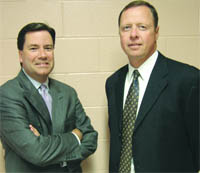
    Tom Creed, left, and Michael Oleksak

    Tom Creed, left, and Michael Oleksak are focused on building the Berkshire Bank brand.

    Long-time area banking executive Tom Creed has joined Berkshire Bank as its new senior vice president and regional executive. He will join his predecessor in that role, Michael Oleksak, now executive vice president of Commercial Lending for the bank, in the broad assignment of expanding the bank’s footprint and building its brand. The latter can be a complicated process, said Oleksak, noting that it doesn’t have to be, because it all boils down to focusing on what he calls the “fundamentals.”

    Tom Creed says he’s seen the many nuances of corporate finance from both sides of the loan officer’s desk.

    By that, he was referring to a resume that includes more than 16 years of work in banking, most all of it in commercial lending — and another six working for one of his former clients, OmniGlow, which he served as vice president of corporate development.

    “My time out of banking gives me an additional competitive edge, because I’ve been on the other side of the table,” he explained. “I hope that when I walk into a company and listen to how they’re operating, I can better understand what some of their issues are because I’ve been there doing it. And I can bring that experience to my team.”

    That would be the team at Berkshire Bank, which Creed recently joined as regional executive, serving Western Mass., and senior vice president. He told BusinessWest that the diversity of his job background will help him as he goes about growing the commercial portfilio, and all other aspects of the Pittsfield-based institution.

    Michael Oleksak, Creed’s immediate predecessor in that position, and now executive vice president of commercial lending for the bank, agrees. He said Berkshire took a long time, perhaps six months, to fill the regional executive’s position in an effort to find just the right person. Creed fits that description, said his new boss, because of his background — and how it jibes with the immediate goals and challenges for the institution.

    Elaborating, Oleksak said the overall mission is to continue building the brand at Berkshire Bank — which acquired Woronoco Savings Bank in 2005, and uses that institution’s Westfield facilities as its regional headquarters — and often in areas that are far removed from that far-western Massachusetts county.

    Neither Oleksak nor Creed believe the name is a problem of any sorts, although they acknowledge that it might have been a hurdle as the bank started doing business in Hampden and Hampshire counties three years ago. In this day, age, and competitive atmosphere, customers care less about what a bank is named — or should — and much more about how it takes care of them, they told BusinessWest.

    “What Berkshire lives by is trying to do things the right way,” said Oleksak, adding that this term needs to be defined as it applies to banking institutions, and he did just that. “It starts internally, and it has to do with respect, integrity, and guts, which is a different kind of phrase for a banker to use.

    “And that’s about making the tough decisions,” he continued. “Sometimes, the right answer isn’t ‘yes’ — at times, you do have to say ‘no.’ That’s what ‘guts’ represents.”

    Summing things up, Oleksak borrowed terminology from the sports world, specifically the gridiron.

    “You can do a lot of exotic things to try and build a brand, but I think it comes down to the basics, the fundamentals,” he explained. “This means blocking, tackling, and essentially treating people the way they want to be treated.”

    Berkshire, which has a footprint that extends into New York and Vermont, now has 11 branches in Western Mass., and Oleksak said the bank will look to increase that number in the years ahead. Like other institutions, Berkshire recognizes the value of having a physical presence in as many of the communities it serves as possible, he noted, and will expand in ways, and directions, that ultimately make sense for the company as it goes about building the brand.

    In this issue, BusinessWest talks with the regional leadership team at Berkshire Bank about the current state of the market, and their plans for achieving continued growth and greater market share.

    Generating Interest

    Summing up what’s on his resume, Creed said that at every stop, starting with the first one at Shawmut Bank in downtown Springfield in 1985, it’s been all about building relationships.

    He prefers that word to loans, or loan volume, because he says commercial bankers, and teams of same, do much more than lend money.

    “It’s about relationships, not just writing loans,” he said, returning to his point about experience, and how it is more important than the name on the letterhead when it comes to serving clients and ultimately building a portfolio.

    At Shawmut, Creed started as a trainee, and was eventually promoted to commercial loan officer, and later, assistant vice president and team leader. In that role, he managed a middle-market loan portfolio and supervised three relationship managers and support staff.

    From Shawmut, Creed went to Bank of Boston, where he served as vice president, with his primary responsibility being to develop new corporate relationships into a $100 million Western Mass. loan portfolio, with a focus on companies with more-complex international and cash-management requirements. He then took a similar role at Citizens Bank, where, as a vice president, he was responsible for the development and management of a middle-market commercial-lending portfolio.

    In 1999, Creed shifted gears and went to work for West Springfield-based Omni-glow, a $70 million manufacturer and distributor of chemiluminescent products, such as glow sticks. He had a variety of roles, including everything from negotiations for potential acquisitions of competitors to planning and completion of a contract-manufacturing strategy in China.

    Creed said these various experiences were invaluable to him as he returned in 2006 to banking, and Sovereign, after helping to negotiate the sale of Omniglow, a transition that ultimately left him without a job.

    Creed was a senior vice president and regional executive with Sovereign, at a time when the bank was shifting away from regional management, when he and Oleksak, another veteran of Shawmut’s commercial-lending division, began talking the opportunity at Berkshire.

    “The timing was perfect in that I was concerned about my future with Sovereign, Creed explained, “and the position at Berkshire was exactly what I was looking for, and I was apparently what they were looking for.”

    Summing up his job description, Creed said work to expand the commercial lending portfolio is obviously a big part of it, but there are many other aspects to the job, including being visible within the community and keeping his finger on its pulse.

    “It’s my job to be as visible in and aware of the community as much as possible,” said Creed, who is active with several groups, including the Affiliated Chambers of Commerce of Greater Springfield, the Economic Development Council of Western Mass., and the Regional Employment Board. “I need to understand what’s happening here — good and bad, and how Berkshire can address some of those occurrences for the good of the community and the good of our shareholders.”

    Creed said he eventually accepted the position to take on a new career challenge, but also as an opportunity to put a quarter-century’s worth of lessons learned in banking and in business to work in helping Berkshire Bank expand its footprint and build its brand.

    Banking on It

    This assignment includes a wide variety of initiatives, from marketing to aggressive efforts to build that commercial portfolio; from community involvement to expanding the bank’s already-sizable insurance business; from customer service to providing an environment in which all team members can thrive.

    And they all have to be carried out simultaneously, said Creed, who, as he talked about his new role and how he approaches it, referenced what he called the 3 ‘P’s — “people, products, and persistence.”

    Elaborating, he said the first refers to a strong focus on employees and giving them the training and other tools needed to succeed and grow professionally. The second is another must in this or any other market, he continued. “We can put up another 20 branches, but if our products aren’t state-of-the-art and competitive, we’re not going to go anywhere.”

    As for persistence, he said he refers to matters across the board. “It means persistence with new-product development, persistence in customer service, in community involvement, and persistence in response to customers’ needs … it’s all those things.”

    Focus on these three areas will help the bank stand out at a time when the Western Mass. area is among the most competitive banking regions in the Northeast, if not the country, said Creed and Oleksak.

    “This market is extraordinarily competitive, and part of the reason why is all the new capital that has come into the region with so many banks going public,” said Oleksak, referencing a lost of institutions, including Berkshire, Hampden, Chicopee Savings, and others. “The way you stand out is to have the right people in place, be super-attentive to what customers’ needs are, and be able to offer the ‘product of the day,’ be it from the Internet or a special CD.

    “You can come up with all the gimmicks in the world to get people into your bank,” he continued, “but once they get there, you have to provide service, service, service — that’s what is going to distinguish you.”

    The commercial-lending market has become extremely competitive in recent years, he continued, but despite this fact, Berkshire has doubled its commercial portfolio locally, from $115 million to $240 million over the past two years. He attributes this to the experience of the lending team, and its relationship-building capabilities.

    “We do have a lot of experience, people who have been in this market for years,” he explained. “And that experience is what counts — it’s invaluable.”

    As for physical expansion, Oleksak said Berkshire has a decent presence in the region, with branches located in Westfield (three of them), Southwick, South Hadley, Ludlow, Longmeadow, East Longmeadow, and Chicopee.

    Missing from that list is Springfield, and he acknowledged that the bank is looking hard at establishing a presence in the City of Homes, and elsewhere.

    But while adding branches is obviously a big part of the growth strategy, so do are those fundamentals that Oleksak referenced.

    “There’s no one thing that’s going to make the difference,” he continued. “It the sum of a great many things that is going to make the difference for us.”

    The Bottom Line

    Brand-building has become a rather sophisticated science in recent years — in banking and in most other fields, said Oleksak, noting a variety of emerging strategies involving marketing, imagery, company names and slogans, and more.

    At the end of the day, however, he continued, those ‘fundamentals’ are the most important ingredient.

    “It’s not rocket science,” he said. “It’s about providing service with a smile and taking care of people’s needs. We’ve seen that here, and it works.”

    This is what he means by blocking and tackling, and, in general, executing the proper game plan.

    George O’Brien can be reached at[email protected]

    Sections Supplements
    Workforce Conference Will Address Recruitment and Retention Issues

    Considering how many other challenges exist in maintaining a productive workforce, one thing companies don’t need is a bunch of employees staring blankly across a generation gap, confused by what they see.

    “There are two issues for employers,” said Greg Michael, executive director of Human Resources and the Career Center at Western New England College in Springfield. “One is the need to keep older workers, who would otherwise be retiring, engaged in the workforce. The other is managing the Millennials — the young people coming into the workforce who, in many respects, have a different perspective on the world of work than their predecessors.”

    And these two matters are by no means separate issues, Michael stressed. That’s because Baby Boomers (and Gen-Xers, too) find themselves managing Millennials as the latter begin their careers, and those differing perspectives and expectations can easily breed workplace conflict if not handled correctly.

    For example, “many younger workers think nothing of having multiple jobs in one year; that’s not necessarily seen as a negative thing, but rather doing what they see fit to accomplish their personal and professional goals,” he said. “It’s a rather different concept than latching onto one employer and working through the ranks in order to achieve one’s goals.”

    Understanding those differences is one focus of a June 18 conference at WNEC, “Massachusetts In Demand: Accessing a Skilled Workforce in Western Mass.” Organized by the Building a Better Workforce Coalition (BBWC), it follows on the heels of a conference in November that focused on the importance of education in cultivating a talented workforce and, hence, a strong economy in Western Mass.

    At next month’s event, keynote speaker Suzanne Bump, the state’s secretary of Labor and Workforce Development, will join Paul Harrington, an economist with Northeastern University, and several workforce-development specialists and regional business owners in discussing how companies can draw upon existing skills in the region to advance their businesses. In addition, Dr. Alan Robinson, author of Ideas Are Free and an expert in workplace productivity issues, will deliver a luncheon address.

    “We haven’t gotten a hit lately with a huge company moving to town,” said Sally Fuller, project director of the Cherish Every Child initiative at the Irene E. and George A. David Foundation, a conference sponsor. “So what we really need to think about is what to do for our existing workforce, how to give them better skills.”

    Starting Young

    The BBWC was formed partly to emphasize the connections between education and workforce development, and last November’s conference featured Dr. James Heckman, a Nobel laureate in Economics from the University of Chicago, who presented an economic case for investing in young children.

    This was the type of message that appeals to Fuller, whose program emphasizes the value of early-childhood education.

    “People don’t think of early childhood as impacting workforce development,” Fuller said, “but, from research on what happens in a child’s brain, we know it absolutely does. Children learn a whole array of soft skills that carry them on into the future, and early childhood is not too early to begin to cultivate that.”

    In fact, in an op-ed piece in the Wall Street Journal, Heckman argued that investing in disadvantaged young children has a high economic return for any region — specifically, that it raises the quality of the workforce, in addition to reducing crime, teenage pregnancy, and welfare dependency. “Focusing solely on earnings gains,” he said, “returns to dollars invested are as high as 15% to 17%.”

    People don’t typically think about such a connection,” Fuller said. “They think of workforce development as teaching the existing workforce and helping them improve their skills and do better at their jobs — which, obviously, also needs to happen.

    “But we’re saying that early childhood is a great place to start because these people are going to compete in a very different work than the one that exists now, and they’ll need these soft skills to compete in the global economy. So, yes, we need to do the other things with the current workforce, but we also have to start now with this generation of young people.”

    Fuller said Cherish Every Child supports the coalition’s work because it wants to remind area business people that the early-childhood workforce is a significant factor in the region’s economic future. “They do a really important job, so we’re helping to professionalize that workforce, and have it be part of the discussion.”

    While that big-picture thinking may be important, the expected knowledge drain caused by mass retirements of Baby Boomers is arguably a more urgent priority, said Nancy Snyder, president of the Commonwealth Corp., another conference sponsor.

    While members of this older generation typically earn more money than Gen-Xers or Millennials, they also come to work with invaluable years of wisdom and hard-earned experience that companies might have trouble replacing. “How do we retain those older workers? We don’t want to lose their knowledge,” Snyder said.

    The Commonwealth Corp. has prepared studies of 16 regions of the Bay State, including Hampden County, examining the dynamics of each region’s employment picture over the past five years — which industries have added jobs, which have shed jobs, and factors contributing to those trends.

    “The goal is to really look at how we can stimulate more graduates in big-demand occupations,” Snyder said. “What are the demand trends? What are the supply trends? What do we need to do to better align them?

    “The data isn’t completed yet, but there are some fairly persistent needs,” she continued. “Health care and manufacturing are two areas in which it has been difficult to find people.”

    Snyder emphasized, however, that there is no one solution to the region’s disconnect between workforce supply and demand.

    For example, “in nursing, it’s probably a capacity issue: do we have enough seats in nursing schools, enough faculty, enough clinical placements,” she said. “But in a field like precision manufacturing, the question might be, how do we get better information to young people about what today’s manufacturing environment is like, in order to generate more interest in precision machining.”

    Stay Awhile

    The more transitory — Boomers might say fickle — nature of the incoming Millennial workforce just adds another layer to the already-difficult challenge companies face in maintaining a skilled group of employees. In short, it makes retention as significant an issue for employers as recruitment.

    “You have one generation with a mindset focused on longevity and the value of loyalty managing younger people who don’t hold the same values,” Michael said, adding that he sees the issue from both sides; his department oversees WNEC’s employees, most of whom are Boomers or Gen-Xers, while the college is sending out an annual stream of Millennials into the workplace.

    “How do companies fill the vacuum left by older workers while effectively recruiting and retaining younger workforce? We’re seeing both points of view here,” he told BusinessWest. “And we really saw that there was some value in this conference for the area’s employers.”

    Snyder agreed that factors like retaining the knowledge base of older employers while convincing talented graduates of the area’s many colleges to stay in Western Mass. are issues that must be addressed simultaneously by employers, schools, and economic-development agencies.

    “To address some of the supply-and-demand misalignment, we need strategies, and we need to work together with our partners,” she said.

    The Building a Better Workforce Coalition was created with those very needs in mind, and the WNEC conference is just the next step in what promises to be a long-running discussion.

    Uncategorized

    Founded 24 years ago by several members of the Sisters of St. Joseph, the Gray House was created in response to the poverty that prevailed in Springfield’s North End and the toll it was taking on that area of the city. Today, the work being done there — which ranges from adult basic education to a summer camp for young people; from a food pantry to collections of Christmas gifts for children — is changing the lives of people in many different neighborhoods.

    Dena Calvanese says it’s hard to do what would be described in the business community as “long-term strategic planning” at the Gray House in Springfield’s North End.

    That’s because the neighborhood it was created to benefit, which has the distinction of being the poorest in the Commonwealth, at least according to the 2000 Census, is constantly changing, said Calavenese, the executive director of this community center, who used the word ‘transient’ early and quite often to describe the constituency in question.

    But while the area bordering Plainfield Street, in the shadow of I-91, is at the heart of the Gray House’s reason for being, its mission has expanded in recent years — geographically and in all other ways, as well — giving new meaning to the preferred term for the facility’s clientele: ‘neighbors in transition.’

    As an example, she pointed to a table in one of the facility’s learning centers where several women from Burundi — a country in Africa’s Great Lakes Region that is, statistically, at least, the poorest nation on the planet — were engaged in basic reading lessons. The women came to Western Mass. from a refugee camp through the assistance of Springfield-based Jewish Family Services of Western Mass. and its relocation program. Officials at that agency had become familiar with the Gray House, its adult-learning programs, and its one-to-one teaching style, and enlisted its help in ongoing work to help refugees and immigrants adjust to American life and become contributing additions to the community.

    On this day, three women who can speak Kirundi, the official language of Burundi, but not read or write in any language, were engaged in Eric Carle’s The Very Hungry Caterpillar, with tutoring from Laura Qualliotine, director of Adult Education at the Gray House.

    “If someone would have said to me a few years ago that we would be working with people from Burundi, I would have said, ‘are you crazy?’” Calvanese told BusinessWest, adding that it is now one of perhaps 20 different countries (and languages) represented by the 75 current students in the Gray House’s Community Education Support Program. It provides instruction in reading, writing, math tutoring, GED preparation, English as a second language, and citizenship preparation, and speaks clearly about why this facility was created.

    But perhaps not as loudly as the programs for children, who, said Calvenese, are especially vulnerable in situations involving poverty, a word that describes more than half the people living in Springfield’s North End. Thus, the Gray House has established a broad suite of initiatives — ranging from an after-school program to gifts for dispersal during the holidays; from a summer camp to amassing donations of prom dresses for neighborhood teens — all aimed at improving quality of life for young people.

    “More than 40% of the food that we give out goes to children,” she said, referring to the Gray House’s food pantry and using it as one example of the strong focus on children. “Without the right nutrition, they’re more prone to illness and hospitalization. Hunger also leads to behavioral issues in school and attendance issues — if they’re sick, they’re not going to be in school. So we look to make sure that the kids have what they need.”

    The facility’s mission has been advanced through the help of many area colleges — students, faculty, and staff members have taken part in several initiatives, ranging from tutoring to Halloween parties — and also the assistance of private foundations and the business community.

    Several sources and programs, including an annual spaghetti supper, contribute to an annual budget now approaching $250,000, said Calvenese, adding that the agency stretches that money as far as possible by keeping operating expenses low (she’s the only full-time employee) and being resourceful in any way it can.

    “We make our money go a long way,” she said, adding quickly that the Gray House is nonetheless limited in what it can do and how many people it can help. She wants to improve those numbers, and said the key to doing so is cultivating relationships with groups and institutions.

    In this issue, BusinessWest goes behind the scenes at 22 Sheldon St. to see how the Gray House carries out its mission and why it has become a positive force in the lives of people of all ages.

    Learning Curves

    The walls of the front hallway of the Gray House are covered with pictures that convey the stunning, two-year-long transformation of this former eyesore into a community center, an ambitious endeavor launched by several members of the Sisters of St. Joseph who acquired the former boarding house at auction for $500 in 1982.

    The photos show people cleaning, sanding, painting, hammering, and collectively working together to forge a new life for the handsome, 17-room Victorian that, by the time it was acquired, had a tree growing through a small room that is now a combination copy center and storage area.

    In many ways, the work depicted in the hallway reflects what now goes on inside Gray House — spirited teamwork, involving a diverse group of individuals and institutions, to achieve a common goal. The big difference is that the current work, while it had a start point, never really ends, again because of the neighborhood in question.

    Indeed, people aspire to move up and out of the area around the Gray House, Calvanese explained, adding that if and when they do, there are always new arrivals, living below or just above the poverty line, to take their place as neighbors in transition.

    And when the constant challenges facing this constituency are blended with a downturn in the economy, such as the current slide, need simply escalates, she said, adding that this phenomenon is borne out by some recent statistics.

    There are roughly 11,000 people living in the North End, but over the past year, the Gray House has provided assistance to more than 16,000 people, said Calvenese, adding that the facility has seen a 25% increase in the number of people seeking assistance from its food pantry over that period.

    “With heating bills so high, gas going up, and some companies having layoffs, there are many people finding themselves in a bind, where they need some assistance when normally they wouldn’t,” she explained. “We’re seeing a fair number of people coming to the food pantry who haven’t been here before.

    “And we’re limited in what we can do … many people need more assistance than we can give them,” she explained, noting that the pantry operates on Thursdays and tries to give each visitor roughly four days worth of groveries. “That’s why people go to the Open Pantry, and the Salvation Army, and then they may come here; no one food pantry can handle the full need.”

    The Gray House is responding to the growing demand, not merely by making more food available, but by watching who comes through the door to try and make sure that the shelves are stocked with items appropriate for the many ethnic groups served by the facility.

    This attention to detail is just what those five Sisters of St. Joseph had in mind, said Calvenese, adding quickly that, while the basic mission at the Gray House hasn’t changed over the past 24 years, the scope of the work and some of the specific directions it has taken might surprise the founders.

    For starters, there’s the diversity on display within the adult-learning programs each morning. On the day BusinessWest visited, Elaine Lampron, a former grade-school teacher, was conducting reading lessons. The three people holding well-worn copies of Harper Lee’s To Kill a Mockingbird had come to Springfield from China, Taiwan, and Azerbaijan. Calvanese has also met people from Yemen, Nepal, and a host of other countries. “I’m learning a lot about geography and culture.”

    There’s also the chart on the back wall of one of the learning centers. It has a long list of terms associated with whales, and it was compiled by students in the after-school program in advance of a whale-watching trip to Plymouth taken just a few weeks ago.

    “None of these kids had ever been on a boat before, let alone on the ocean looking at three different kinds of whales, so this was an incredible experience for them,” said Calvenese, who told BusinessWest that the excursion, planned by students at Western New England College and made possible by a grant from the school’s alumni association, is indicative of the ways in which area colleges and businesses have been consistent, and imaginative, in their support of Gray House.

    Efforts taken on behalf of the Burundian women provide another example, said Qualliotine. Students in Springfield College’s “Humanics in Action” program have worked with the women once a week this semester, she explained, with a focus on basic skills and vocabulary development.

    It’s No Fluke

    Such diligence and imagination are needed, said Calvenese, because need continues to grow, and the work being done at the facility takes on more importance. Indeed, by helping adults gain basic skills that may lead to employment, and by encouraging learning among young people who are at risk to contribute to already-alarming dropout statistics, the Gray House is benefiting the business community and neighborhoods across the region.

    This multi-faceted mission was what drew Calvanese to the Gray House and its executive director’s position about 18 months ago.

    A graduate of Assumption College with degrees in Business and Spanish, she worked as an analyst at MassMutual for several years before discovering that her real passion was social service. “I liked studying business, but living it every day … that wasn’t for me.”

    She took a few classes in UConn’s Social Service program, enjoyed it, and eventually left MassMutual for two part-time jobs, one with the Open Pantry and the other with the Valley Opportunity Council. She shed the latter when she accepted the role of development director for the Open Pantry, a job that she said involved “a little bit of everything,” and that she kept for seven years.

    She later took a job with a large nonprofit group in Connecticut, a position that allowed her to use her business skills, but at the expense of close contact with the community being served. The Gray House position, which came open in late 2006, provided the best of both worlds. “I use a lot of my business skills, but really feel very connected to the community; it’s very rewarding.”

    While Calvanese said her basic job description is to manage the day-to-day operations and help provide a vision for the facility, she considers her real role to be that of relationship-building. And it is through such relationships that the Gray House can create, maintain, and strengthen programs for adults and children alike.

    The collaboration with WNEC, for example, which began not long after Calvanese arrived, has taken many forms, with benefits for both Gray House ‘clients’ and students at the college.

    Rose Gage, service coordinator for WNEC’s Volunteer Connection Center, said students at the college have participated in a wide range of initiatives to support the Gray House and those it serves. They include tutoring, a summer carnival, a Halloween party staged during the college’s “Make a Difference Weekend,” collections of holiday gifts and food at Thanksgiving time, and the purchase of $2,000 worth of gift cards from Borders, which has allowed more than 100 children to receive new books.

    The whale-watch excursion came together through the direct involvement of Sarah Shugrue, president of the college’s CARE (Community Activity Rewards Everyone) program, Gage continued. “She met with administrators at the Gray House and talked about things they could do to provide learning experiences for kids in the after-school program. They thought a whale watch would be something different and educational, and won a $1,000 grant from the Alumni Assoc. to make it happen.”

    A dozen children and six students from WNEC went on the trip, said Gage, noting that it’s an example of how this is a mutually beneficial partnership. “There’s a lot of give and take,” she said. “The students give back, and they take away from their experiences the satisfaction that comes from getting involved in the community.”

    The Gray House has collaborations with several area colleges, including Springfield College, Bay Path, Elms, and Springfield Technical Community College, said Calvenese, and also with area companies, such as Hasbro, which provides funds to the facility through its Summer Learning Initiative.

    The challenge moving forward is to build on these relationships and forge new ones, she said, and thus provide the Gray House with more resources and more opportunities to serve the community.

    Town and Gown

    As she finished giving a tour of the Gray House, Calvanese referenced a trunk full of prom dresses she would soon unload.

    “It’s that time of year,” she said, noting that perhaps 80 dresses had been collected from various sources, including WNEC, and all of them would likely be put to use this spring.

    While perhaps not as outwardly important as the donations of food, the adult-learning and after-school programs, or perhaps even the whale watch, the prom-dress program is still an important function of the Gray House.

    “It’s a quality-of-life issue,” she said, and part of properly serving a constituency in need. And it’s just one example of how this special community center helps a growing number of neighbors in transition.

    George O’Brien can be reached at[email protected]

    Departments

    Care Center Annual Dinner

    April 29: The Care Center on Cabot Street in Holyoke will celebrate its students and staff at its annual dinner from 6 to 8 p.m. at the Log Cabin, also in Holyoke. The event features performances and presentations by Care Center students, including ballroom dancing. The Care Center provides services to pregnant and parenting teen mothers and their children. The celebration is being sponsored by Weiss Consulting, PeoplesBank, and the Northwestern Mutual Financial Network. Dinner and dancing are free, and guests will be invited to make a meaningful gift at the event. For more information, call (413) 532-2900, ext. 128. For details on the Care Center, visit www.carecenterholyoke.org.

    Marketing Program

    April 30: Anne West, founder and president of the Atlanta-based consulting firm Strategic Communication Counsel, will present “Remarketing Marketing … Creatively” at the Log Cabin Banquet and Meeting House in Holyoke. West offers a down-to-earth look at some common strategies and tactics that marketers overlook. The morning event is sponsored by the Ad Club of Western Mass. Registration begins at 7:30 a.m., with the seminar slated from 8 a.m. to noon. Registration includes a continental breakfast, seminar, and handouts. The cost is $75 for Ad Club members, $85 for non-members, and $50 for students. To register online, visit www.adclubwm.org.

    Financial, Estate-planning Workshops

    April 30, May 14, May 21: Applewood at Amherst, a part of the Loomis Communities, will host a free public series of financial and estate-planning talks, all beginning at 7:30 p.m. On April 30, Peter Ziomek, J.D., of Ziomek & Ziomek, will discuss wills, durable powers of attorney, health care proxies, and trusts. On May 14, Eva Thomson of Thomson Financial Management will share methods of maximizing one’s assets for a fulfilling retirement and beyond. The series concludes on May 21 with Hyman Darling, J.D., of Bacon and Wilson, P.C., reviewing ways to personalize one’s legacy through ethical wills, pet trusts, charitable bequests, gift annuities, or specific burial instructions. All talks will be conducted in the meeting room at Applewood at Amherst, One Spencer Dr., Amherst. Reservations are encouraged and may be made by calling Kelley Murphy at (413) 253-9833.

    Women’s Professional Development Conference

    May 1: Bay Path College in Longmeadow will host its 13th annual Women’s Professional Development Conference at the MassMutual Center in Springfield. Actress Jane Fonda will be the keynote speaker for the affair, which is planned from 7:30 a.m. to 4:30 p.m. For a complete list of workshops and speakers, visit www.baypath.edu. Tickets are $250 for the general public and $225 for Bay Path alumni, with an early-bird registration deadline of April 17. A vendor fair is also planned throughout the day.

    RTC Digital Marketing Series

    May 2: “Using Social Networks as Marketing Tools” will be offered by the Regional Technology Corp. (RTC) from 8:30 to 10:30 a.m. in the tele-classroom at the Springfield Technical Community College Technology Park in Springfield. This is the second seminar in RTC’s Digital Marketing Series, and will offer guidance on developing new relationships with clients, partners, and other key players in one’s industry. Presenters at the seminar will include Mark Firehammer, co-founder of Rumetagro Relationship Technologies, and Morriss Partee, the founder of EverythingCU.com. The class is free to RTC members and costs $50 for non-members. Advance registration is required. For more information or to register, contact Suzanne Parker at (413) 755-1301 or via E-mail at [email protected].

    Business Market Show

    May 7: The Affiliated Chambers of Commerce of Greater Springfield Inc. will host its 2008 Business Market Show from 7 a.m. to 5 p.m. at the MassMutual Center in Springfield. The show will feature more than 225 booths offering products and services to help, enhance, and grow one’s business. Attendance is free with a business card, and no registration is required. For a complete schedule of workshops throughout the day, as well as exhibitor listings and parking locations, visit www.businessmarketshow.com.

    Customer-service Seminar

    May 8: Marty Clarke, president of Martin Productions and author of Communication Land Mines: 18 Communication Catastrophes and How to Avoid Them, will present a seminar titled “Customer Service Land Mines and How to Avoid Them” from 8:30 to 11:30 a.m. at the Clarion Hotel in West Springfield. Clarke’s program will lay out a road map of how one can avoid common and damaging customer-service land mines, and begin to set a company apart in the most powerful way possible. Clarke will offer an encore seminar titled “Leadership Land Mines: 8 Managerial Catastrophes and How to Avoid Them” from 1 to 4 p.m. The presentations are presented by the Employers Assoc. of the NorthEast (EANE). The cost for either the morning or afternoon session is $179 for EANE members or $229 for non-members. The cost for the full day is $279 for both sessions for EANE members, and $329 for non-members. For registration information, visit www.eane.org.

    Wine Tasting and Auction

    May 9: The Chicopee Chamber of Commerce will host a wine tasting and silent auction at the Castle of Knights on Memorial Drive. Proceeds raised from the event will be used to fund chamber events. For more information on the event, visit www.chicopeechamber.org.

    ‘Defining the Goals’

    May 20: Agawam High School is hosting a “Defining the Goals” expo from 8 to 10 a.m. Companies are invited to share products or services, as well as employment needs for the future. The event will be an opportunity to showcase a company and enlighten students regarding its operations and the educational requirements necessary to secure employment in various industries. The event is being sponsored by Engineering Projects in Community Service, Life Science Career Development grants, and MassLive. The event will include a coffee reception, scheduled presentations, and a question-and-answer session. For more information or to RSVP, E-mail [email protected].

    Woman of the Year Banquet

    May 21: The Women’s Partnership of the Affiliated Chambers of Commerce of Greater Springfield will honor Kristina Drzal Houghton as its Woman of the Year at its annual banquet planned at Chez Josef in Agawam. The award represents the recognition of extraordinary achievement by a woman in the Greater Springfield community whose efforts exemplify the leadership, community involvement, and professional goals of the Women’s Partnership. A reception begins at 5 p.m., followed by dinner at 6:15. Tickets are $35 each, and the deadline to register is May 9. For more information, visit www.myonlinechamber.com.

    Torch Awards

    May 12: The Better Business Bureau of Central New England Inc. (BBB) will stage its anual Torch Awards & Breakfast at the Orchards Golf Club in South Hadley, starting at 7:30 a.m. At the event, the BBB will honor American Pest Solutions Inc. of Springfield with its prestigious “Torch Award. It will also extend its Honorable Mention distinction to another local company, Moving/Odd Job Unlimited of Chicopee. “The purpose of this award is to recognize businesses that operate with integrity, trust, and marketplace ethics in their approach to commerce,” said Ray Frias, president of the BBB. “The Better Business Bureau is aware that there are businesses that maintain good business ethics and work every day to assure the public of their commitment to fair and honest business practices, and this award was established to focus attention on those good companies.” Also, BBB Student Ethics Award winner Evan Coleman from Amherst Regional High School will be presented with a $500 scholarship. This prestigious award recognizes students who live up to and inspire others with their commitment to ethical living. Individual seats at the event cost $20. Those interested in registering for the event may do so by visiting www.central-westernma.bbb.org/torch  or calling (413) 594-2163, ext. 105

    Departments

    State Adds 2,900 New Jobs in March

    BOSTON — The Executive Office of Labor and Workforce Development recently reported that monthly survey estimates show that 2,900 new jobs were added in Massachusetts in March, its largest monthly increase since November of last year and the sixth consecutive monthly increase in jobs. The state unemployment rate also held steady at 4.4%. Revisions to the February rate, published last month on a preliminary basis at 4.5%, show the rate edging down to 4.4% and an increase of 700 jobs instead of the loss of 700 as originally estimated. The Massachusetts rate continues to outperform the national rate, which increased from 4.8% in February to 5.1% in March. The state rate has been below the U.S. rate since June 2007. Over the year, the Bay State’s unemployment rate dropped two-tenths of a percentage point from 4.6%. The largest job gains in March were recorded in professional, scientific, and business services, as well as leisure and hospitality. New jobs were also added in the trade, transportation and utilities, information, construction, and manufacturing supersectors. Also, education and health-services employment, at 632,600, was off 400 in March. Over the year, this supersector continues to show the strongest job gains at 14,900 and, along with the information supersector, posted the highest annual rate of job increase at 2.4%. Professional, scientific, and business services added 1,000 jobs in March, following a gain of 3,100 the previous month. Most of the 9,700 jobs added over the past year were in professional, scientific, and technical services industries such as computer systems design and scientific research and development. At 488,300, overall employment is up 2.0% from one year ago.

    Financial activities employment was off 200 over the month due to declines in the real-estate and rental and leasing component. At 224,100, financial-activities employment is down 1,600 from one year ago, with real estate and leasing contributing to much of the loss. Trade, transportation, and utilities employment increased by 500 in March, largely due to retail trade posting its first job gain since last November. At 569,100, employment in this supersector is off 1,200 from one year ago. Retail trade lost 2,900 jobs over the year, while wholesale trade and transportation, warehousing, and utilities added 1,400 and 300 jobs, respectively. The leisure and hospitality supersector added 1,200 new jobs, the most jobs added among supersectors in March. At 305,200, jobs in leisure and hospitality have increased by 2,600 over the year. With monthly gains in each of the most recent five-month periods, jobs are up by 4,200 since October 2007. Information employment increased by 200 in March to 89,900. This supersector has added 2,100 jobs over the year and, along with educational and health services, posted the strongest annual growth rate at 2.4%. Manufacturing recorded a 200-job gain in March, its second consecutive monthly increase. At 292,900, employment is still down 4,000 or 1.3% from one year ago. Construction gained 600 jobs in March after having lost jobs over each of the four previous months. At 135,400, employment is off 2,000 or 1.5% from one year ago. The job numbers are the result of a monthly survey that uses U.S. Department of Labor Bureau of Labor Statistics methodology. More than 9,000 Massachusetts employers are surveyed to determine the number of jobs by industry. These estimates are the economic indicator used to gauge employment-growth patterns across the Bay State. The Commonwealth’s labor force increased by 2,300 over the month, as 3,700 more Massachusetts residents were employed and 1,500 less were unemployed. At 3,411,200, the labor force is slightly higher than at this time last year, as 7,500 more residents were employed and 7,000 fewer unemployed. Labor force estimates for Massachusetts, developed using the U.S. Department of Labor Bureau of Labor Statistics model, are based on information on Massachusetts residents’ employment and unemployment status, collected through a small, monthly sample survey of households.

    Easthampton Awards Valley CDC Grant

    EASTHAMPTON — Valley Community Development Corp. (Valley CDC) recently announced it has been awarded a $140,000 grant from the City of Easthampton for the provision of comprehensive business-development technical assistance (TA) to income-qualified Easthampton residents and businesses. Valley CDC is providing TA for a 15-month period that began April 1. The TA services that Valley CDC will provide include one-on-one counseling; business development, marketing, and technical computer workshops and seminars; credit counseling; referral to financial institutions; assistance with applications for financing; referral to professional and other resources for support and services not provided by Valley CDC; and continued outreach to artists and to former mills on Pleasant Street and Cottage Street. The grant also enables Valley CDC to retain its offices in the Eastworks building on Pleasant Street. 

    Departments

    The following is a compilation of recent lawsuits involving area businesses and organizations. These are strictly allegations that have yet to be proven in a court of law. Readers are advised to contact the parties listed, or the court, for more information concerning the individual claims.

    CHICOPEE DISTRICT COURT

    Gerald E. Guiel v. M.J. Nails
    Allegation: Pedicure performed negligently resulting in injury: $15,000
    Filed: 3/31/08

    FRANKLIN SUPERIOR COURT

    Homesavers Council of Greenfield Gardens Inc. v. Shaw Industries Inc. and Continental Flooring Co.
    Allegation: Breach of construction contract: $330,000
    Filed: 4/8/08

    GREENFIELD DISTRICT COURT

    Standard Funding Corp. v. Anthony’s Residential Contracting
    Allegation: Breach of finance agreement: $3,426.36
    Filed: 3/21/08

    HAMPDEN SUPERIOR COURT

    Dale Auto Body Inc. v. Western Mass. Electric Company
    Allegation: Breach of contract to provide services: $29,775
    Filed: 2/25/08

    Denise Melanson v. Video Communications Inc.
    Allegation: Employment discrimination: $25,000+
    Filed: 2/19/08

    Fred Quagliaroli v. The Mardi Gras
    Allegation: Negligence and personal injury suffered by plaintiff when pushed by Mardi Gras employee: $300,000
    Filed: 4/11/08

    Witalisz & Associates Inc. v. Whispering Pines at Root Road, LLC
    Allegation: Breach of contract: $777,979.62
    Filed: 1/30/08

    HAMPSHIRE SUPERIOR COURT

    John C. Urschel v. Bioshelters Inc.
    Allegation: Non-payment of promissory note and unfair and deceptive trade practices: $50,000
    Filed: 3/27/08

    NORTHAMPTON DISTRICT COURT

    Francis Baldwin III v. The Premier Insurance Company
    Allegation: Failure to pay personal injury protection benefit: $7,721.02
    Filed: 3/31/08

    Victory Steel Products v. Quabbin Well Drilling Inc.
    Allegation: Non-payment of goods sold and delivered: $13,640.14
    Filed: 4/2/08

    SPRINGFIELD DISTRICT COURT

    City Line Distributors Inc. v. Robe Inc. and Mark E. Robitaille
    Allegation: Non-payment of produce delivered: $6,671.62
    Filed: 1/29/08

    Roy’s General Contracting Inc. v. MLS and IZS Enterprises
    Allegation: Non-payment of general-contracting services: $2,697.00
    Filed: 3/13/08

    Tri-County Contractors Supply Inc. v. Total Renovations & Construction, LLC
    Allegation: Non-payment of goods sold and delivered: $8,489.29
    Filed: 1/22/08

    WESTFIELD DISTRICT COURT

    International Bar-Tech Solutions Inc. v. Southwick Electric Company Inc.
    Allegation: Breach of contract for goods and services: $11,288.19
    Filed: 3/12/08

    40 Under 40 Class of 2008
    Age 38: President, Innovative Business Systems Inc.

    Dave DelVecchio says he was blogging long before it became a national pastime.

    “I don’t think they called it blogging then,” he said, referring to the mid-’90s, when he started using the Internet to reach out to friends, family, and colleagues in a manner designed to inform and entertain.

    He’s still doing it, through his Web site, davedelvecchio.com, or “the new Dave’s World,” as he calls it, where you could learn much more about this member of the Forty Under 40 than you can in this space — probably more than you want to know. You can even hear a tune from Big Pain, the garage band for which DelVecchio, or the “king of low end,” plays bass — pretty well, actually.

    And you can click on ‘Dave at Work’ and find out about Innovative Business Systems, which he serves as president. It is for his work at Easthampton-based IBS, and also his involvement in the Easthampton community, and not for music, that DelVecchio earned a spot among the ‘40,’ although maybe the judges did give the band a listen.

    It is more likely that they were impressed with DelVecchio’s ability to take IBS, the IT-solutions company that he and four others purchased from founder Bill Tremblay in 2003, and guide it to steady growth, recognition as a Microsoft Gold Certified Partner (the corporation’s highest designation), and a Workforce Development Award from the Hampshire/Franklin Regional Employment Board.

    The “five guys,” as they’re called at IBS — the others are Brian Scanlon, Scott Seifel, Ben Scoble, and Sean Benoit — have created an appealing workplace, said DelVecchio, an environment that provides the tools for professional growth, while also facilitating the often-difficult act of balancing work and life.

    While directing IBS and also taking an active role with the Regional Technology Corp., DelVecchio is also involved, on a number of levels, in the revitalization of Easthampton. The former mill town, now officially a city, has reinvented itself as a center for the arts and home to a diverse mix of small businesses.

    “This is a community on the rise,” said DelVecchio, who works and lives in the town, is former president of the chamber of commerce, and is entertainment committee chair of the Easthampton Fall Festival.

    What else would you expect from the king of low end?

    George O’Brien

    40 Under 40 Class of 2008
    Age 39: President, Johnson & Hill Staffing Services

    One career was beginning while another was ending. And a local success story was born.

    Andrea Hill-Cataldo was pursuing her graduate degree at the Isenberg School of Management at UMass Amherst at the same time Kelly Services, a chain of employment agencies, was taking back its privately managed franchises; one of those had been run by her aunt, who had been with Kelly for 35 years.

    “So my aunt’s daughter and I started a company,” said Hill-Cataldo. “I was the sweat equity, and my cousin was the financial backing.” They hired two key employees of the former Kelly franchise, and Johnson & Hill Staffing Services hit the ground running in 1995.

    “It wasn’t a typical startup,” Hill-Cataldo said of an operation that had plenty of connections right off the bat. “It had different challenges, like, how do I build an infrastructure to support this business coming in? At the beginning, we didn’t have computers, marketing … I was doing payroll for the staff at first, which wasn’t my skill set; I forgot to sign the checks the first week. But we built the business quickly.”

    Johnson & Hill has grown, in fact, even when the general economy has not. “We tend to follow the economy, so if people expect a downturn, we see it first, and we usually come out of it first,” said Hill-Cataldo, explaining that employers will test the waters on an improving economy with temporary or temp-to-hire workers. “No business is recession-proof, but, having been through two downturns, I think we’re less reliant on the economy than some.”

    Working a flexible schedule and juggling work and home obligations — she and her husband have a 4-year-old son, Frannie — can be tougher than a typical 9-to-5 job, said Hill-Cataldo. That’s especially true for someone heavily involved in civic leadership, on organizations including Big Brothers Big Sisters, the American Cancer Society, and the YWCA. “It’s harder because there are so many responsibilities, and people depend on you for leadership, and you’re never done,” she said.

    “But on the other hand, because I work for myself, I can make choices that are right for me personally, that wouldn’t be OK if I worked for someone else. To decide to be with my son today instead of making another sale — to be accountable to myself and not have anyone pressure me or question my priorities — that’s nice.”

    Joseph Bednar

    40 Under 40 Class of 2008
    Age 39: Attorney, Sullivan, Hayes & Quinn

    Melissa Shea was always fascinated by the law. But like many who eventually join the legal profession, she needed some inspiration to convert an interest into a career.

    She found hers in 1981, when Sandra Day O’Connor became the first woman appointed to the U.S. Supreme Court. That moment in history provided a spark for the Shea, now an employment-law specialist at Springfield-based Sullivan Hayes & Quinn, who is inspiring younger generations through her work inside the courtroom — and the community.

    As a labor, employment, and school-law attorney, Shea keeps busy representing many nonprofit organizations, as well as the Springfield, Holyoke, and Chicopee school systems. She has been recognized as a rising star among lawyers in Massachusetts by Boston magazine, and speaks before various organizations in the region, including the National Assoc. of Housing and Redevelopment Officials.

    She also lends her expertise to the Early Childhood Centers of Greater Springfield, the Holyoke Chamber of Commerce, and the Springfield Women’s Committee, an organization dedicated to honoring outstanding women in the community and bringing awareness to issues such as domestic violence.

    Shea has been involved with the Women’s Committee for the past 10 years, and has been devoted to the committee’s annual International Women’s Day celebration, as well as fundraising and holding food drives for area shelters. She says her involvement in the committee is rewarding because she is helping raise awareness of key issues that are important to continuing the success of local women.

    However, just as much as Shea feels at home in the courtroom, working in the legal system, and volunteering, she also feels quite comfortable in the kitchen.

    Fluent in Italian, Shea spent many of her summers growing up in Italy, and her first year of college was in Rome, where she perfected her cooking and gained a fondness for Italian culture and cuisine.

    “I spent a lot of time with my family there, and my aunt passed on her Italian recipes,” she told BusinessWest.

    “Cooking is rewarding, relaxing, and enjoyable, and I often cook with my children, so it provides an opportunity to spend some quality time with them while passing on traditions.”

    Shea hopes to take her husband and two children to Italy in the near future — once again, drawing on her experiences to inspire others.

    Laura DeMars

    40 Under 40 Class of 2008
    Age 38: Partner, Sullivan, Hayes & Quinn

    Imagine walking into a court case thinking you’ll be defending a company that’s having trouble with a so-called ‘alien’ (most often interpreted as a person residing and working illegally in the U.S.), only to find out that the plaintiff actually believes he’s an alien from outer space.

    This is just one of many interesting cases that Meghan Sullivan has encountered during her career. “Sometimes we come across people and cases that give us real pause,” she said, actually pausing for effect. And that partly explains why she loves her job as a labor and employment lawyer.

    “There’s always something,” she said. “You can never begin to anticipate how people’s personal lives influence their work lives.”

    While living and working in New York City in her early 20s, Sullivan ran into a variety of tough hiring and employment decisions, which would eventually lead her to pursue a law degree. “I was managing a retail store and kept running into situations where I’d need my dad’s advice,” she explained, referring to Frederick Sullivan of Sullivan, Hayes & Quinn. “I wanted to learn more about these employment and legal issues, and get my law degree.”

    But doing battle in the courtroom is just one way Sullivan likes to spend her time. She also enjoys taking a spin on the Holyoke Merry-Go-Round, which she has been riding since she was a child. “My grandfather used to take me to the carousel when it was at Mountain Park,” she said. “He stood for hours while I rode it.” After the park was closed in 1987, the ride was moved by a group of citizens to Heritage Park in Holyoke so that people could continue to enjoy it.

    Today, Sullivan serves on the board of the Holyoke Merry-Go-Round, something in which she takes great pride.

    “I often take my children to ride the carousel,” she noted. “It fascinates me that this same bit of amusement has spanned generations.”

    When she’s not visiting the carousel, Sullivan spends her free time with her family teaching her children how to ski, a hobby she recently took up again. She also isn’t afraid to get her hands dirty digging in her garden. “It’s a nice way to spend quality time with my children,” she says. “Their interests have become my hobbies.”

    Laura DeMars

    Departments

    Comcast Launches FOX 6 Springfield

    SPRINGFIELD — Comcast recently announced its launch of the region’s newest television station, FOX 6 Springfield, and the channel’s HD simulcast. The launches of FOX 6 Springfield and FOX 6 Springfield in HD, available on Channels 6 and 861, respectively, provide Comcast customers with some of the network’s most popular shows, from American Idol to 24 and House, along with matchups from NASCAR, Major League Baseball, and the National Football League. With more than 300 HD choices, Comcast plans to significantly expand the number of HD choices to 1,000 by the end of this year. FOX 6 Springfield and FOX 6 Springfield in HD are now available in Agawam, Amherst, Bernardston, Buckland, Chester, Conway, Deerfield, Erving, Gill, Granby, Granville, Greenfield, Hatfield, Holyoke, Huntington, Longmeadow, Monson, Montague, Northampton, Northfield, Palmer, Pelham, Shelburne, South Hadley, Southwick, Springfield, Sunderland, West Springfield, Ware, Westfield, Westhampton, Whately, and Williamsburg. Local Connecticut news, weather, and programming are still available on WTIC Fox 61 on Channel 292 for Comcast basic cable customers with a digital box. In addition to traditional television viewing, Comcast’s HD on Demand platform allows digital-cable customers with an HDTV and HD-capable cable box to choose from a variety of HD selections each month. Comcast’s New England regions serve 2.6 million customers in Massachusetts, New Hampshire, Vermont, Maine, Connecticut, and New York.

    Berkshire Service Experts to Give Away Programmable Thermostats

    WEST SPRINGFIELD — As the 28th annual Earth Day approaches (April 22), Service Experts Inc., and its full-service heating and air conditioning center in the Valley, Berkshire Service Experts, will help customers in the Springfield area recognize they truly can make a difference. Service Experts will install a free programmable thermostat in every U.S. and Canadian household that schedules a heating or cooling system tune-up during the month of April. Service Experts’ Earth Day program will create the same environmental effect as planting 330 trees for every single homeowner who makes one small household change. Thermostat manufacturers such as Lennox that are providing thermostats for the special Earth Day campaign estimate that up to 75% of North American homes do not have programmable thermostats. Most homes between 15 and 25 years old still use the original mercury-based models, which are toxic if not disposed of properly. Service Experts will remove the home’s old thermostat, and properly dispose of and recycle it at no charge.

    Work Opportunity Center Receives Grant

    AGAWAM — The Work Opportunity Center Inc. in Agawam has received a $2,500 grant from the NewAlliance Foundation, which will help purchase a passenger van for the agency. The private, nonprofit organization provides developmentally disabled individuals with vocational training and employment opportunities. Currently, the center serves 110 individuals in three work programs within the Greater Springfield area.

    MassMutual Launches Recruiting Web Site

    SPRINGFIELD — Building on several years of successful efforts to recruit and retain top financial services professionals, Massachusetts Mutual Life Insurance Co. (MassMutual) recently unveiled a Web site that introduces career changers, industry veterans, and college graduates to a career with the company through the eyes and words of its agents. The Web site, one of several initiatives the company has undertaken to grow its ranks of successful professionals, features a MassMutual agency manager, sales team manager, experienced agent, career changer, new agent, and intern who describe their careers and experiences in their own words. Visitors to www.massmutual.com/mycareer hear and see agents describe the company’s entrepreneurial business model, training and support services, and the meaningfulness of their work. The online introduction and other efforts by the company are succeeding, as the number of new agents and the company’s rate of retention have both risen significantly, according to Scott Rich, vice president, Net Field Force Growth. Rich added that, during the past two years, MassMutual has increased its net field force by 10%.

    Capuano Care Moves to New Corporate Location

    EAST LONGMEADOW — Capuano Care is moving into its new corporate headquarters on April 14. The larger office at 265 Benton Dr., Suite 201, will allow the firm to better serve its rapidly growing client base as well as its professional in-home health care staff, according to Fannie Y. Lin, president and CEO. Lin noted that the company has been growing so much in the last two years that it needed a larger and more efficient space to accommodate additional support staff. Capuano Care is a full-service, Medicare/Medicaid-certified, and private home health care business serving clients throughout Hampden and Hampshire counties. For more information, visit www.capuanocare.com

    Sections Supplements
    Grounded Mobile Training Center Needs to Get Back on the Road

    Western Mass. and the nation are now facing a critical shortage of skilled labor. Concerned groups include the Department of Defense, the Aerospace Industries Assoc., the National Defense Industrial Assoc., and the National Tooling and Machining Assoc., and they are treating this as one of the most critical threats to our national security, our economy, and our way of life.

    This problem covers the entire pipeline, from highly skilled machinists who can operate the high-tech equipment utilized in today’s manufacturing facilities, to degreed engineers. If we do not find and commit to a solution, we will no longer be able to compete on the world stage, both economically and militarily.

    According to a survey of local precision manufacturers conducted by the Western Mass. chapter of the National Tooling and Machining Association (WMNTMA), there are more than 400 openings in the 413 area code at the moment. An aging workforce will add 200 to 300 more per year, even if the economy is flat. Nationally, there are tens of thousands of high-paying jobs, and companies in Western Mass. are turning away work due to an inability to find qualified employees.

    There are a number of factors contributing to these sobering statistics, among them being the ongoing challenge of convincing young people and their parents that manufacturing, specifically precision manufacturing, is alive, well, and has a bright future. Another challenge is to simply inspire young people to want to join this sector, and this can best be done by showing and telling them what it’s all about.

    Unfortunately, one of the more effective vehicles — literally and figuratively — for handling these assignments, a mobile training unit operated by Mass. Manufacturing Extension Partnership (MassMEP), has been grounded due to funding cutbacks.

    This unit must be put back on the road, and recent experiences in Western Mass. involving this important teaching tool will explain why.

    A Front-row Seat

    When members of the WMNTMA visit middle schools and high schools, the comment heard all too often from the workers of the future is, “I thought manufacturing was dead.”

    If those in this industry do not change this perception, it will be.

    We continually hear about layoffs and shutdowns. This is the information on which today’s parents and children base their career decisions. The focus is on unemployment, not openings. According to reports issued by the Mass. Department of Labor, there was approximately one unfilled job for every two unemployed people in the state as of last December, and roughly 7% of the unfilled jobs were in manufacturing.

    Meanwhile, 100% of graduates from manufacturing technology programs at local vocational high schools have jobs, go into the military, or go to college upon graduation. Neither our elected officials nor our educators preach this message, and that’s why those in high-tech, precision manufacturing need to educate teachers, parents, and kids — to balance the message.

    Gov. Deval Patrick and top educators in Massachusetts have identified the need to improve interest and performance in grades K-12 relative to STEM (science, technology, engineering, and math) education. I personally sit on the NDIA’s STEM workforce committee, which is addressing the problem on a national level along with the AIA. Keeping in mind this broad-based focus and awareness, I asked my son, Ethan, a high school junior with an interest in engineering, whether his teachers were relating the STEM subjects to real-world applications and careers. Disappointingly, his answer was “no.”

    If we want students to be excited, to learn, and to retain, then we must relate the raw information covering formulas and technologies to exciting real-world applications. This in turn will provide a vision as to how education prepares them for careers and their future.

    Today’s high technology manufacturing world is the broadest, purest application of STEM. At my company, Westfield-based Peerless Precision Inc., we use metrology, physics, chemistry, computers, robotics, engineering, algebra, trigonometry, and geometry every day. The future of manufacturing is not about cheap labor. It is about using all of the STEM disciplines to improve productivity and develop new technologies. We need to include application into education.

    With all this in mind, I called Jack Healy, president of Worcester-based MassMEP roughly a year ago, and asked if the WMNTMA and the Regional Employment Board (REB) of Hampden County could borrow its Mobile Training Unit (MTU) in an effort to reach out to local middle-school students.

    This vehicle had — that’s past tense — 12 computers, a mini-mill, and a mini-lathe. It was in use by MassMEP to train unemployed people in the Northeast to be machine operators. Healy immediately agreed to let us use it for a two-week period, and even provided personnel to operate the vehicle and act as instructors. David Cruise, manager of Regional Networks (part of the REB), worked with middle-school counselors at four Springfield public schools and arranged for the MTU to visit each.

    The result was that 320 eighth-graders participated in 45-minute educational seminars, during which they learned how STEM is used in the real world. Cruise described the program as “an integrated STEM-related education activity that links mathematics and science with practical applications of CAD (computer-aided design) and observation of the operation of a mini-milling machine and a lathe. In addition, each student was presented with career information and informed of the educational requirements that are needed in today’s high-technology, precision-manufacturing environment. The program was presented in a highly interactive manner that gave students and accompanying faculty valuable information that exposed them to a myriad of career pathways.”

    This was followed by tours of EASTEC by 140 students from six middle schools with funding obtained from the Society of Manufacturing Engineers (SME). At EASTEC, the students had their first exposure to the full scope of today’s high-tech, precision-manufacturing equipment.

    This successful program was expanded in the fall of 2007, when the MTU toured 13 area middle schools. This time, almost 1,000 eighth-graders participated in this STEM career-awareness program, which was was followed by Middle School Precision Machining Career Awareness Day, which teamed each of the 13 schools with a local precision machine shop. Almost 200 students who had expressed interest in manufacturing after the seminars were given tours of local high-tech manufacturing facilities. They saw the clean, well-lit, technology-driven companies that are based in this area.

    And here are some of the comments from school personnel after tours of the mobile lab and local manufacturing facilities:

    • “The lab gave students a view of a concept that was totally alien to their world. Some students were very fascinated and truly interested in pursuing this venture”;
    • “I think it was helpful for them (the students) to see the inside of an actual workplace”;
    • “Each student came back with favorable comments”;
    • Faculty members have repeatedly said how important they think opportunities like this are for our students. I will be delighted to support future collaborative projects”; and
    • “We had a great day with the mobile lab. Students liked it, and teachers appreciated the opportunity. Matt [Healy] was great with the kids.”
    • Buck Upson, president of Pioneer Tool Supply Co. in West Springfield, observed one of the seminars at Van Sickle Middle School in Springfield, and came away impressed with what he saw.

      “I was standing in a position where I could observe two students. Two young boys, silent, with boredom and apathy painted across their faces, entered the bus and slouched down nonchalantly,” he recalled. “Within minutes they were sitting up straight and leaning forward to actively listen to the teacher. Very soon thereafter, they were asked to program a basic part on the computer workstation. Both of them finished the task before the teacher completed the step-by-step instructions. They had grasped the concept without aid. At the end of the session, they left the bus energized and openly enthusiastic, talking about what they had learned and wanting to learn more.”

      Meanwhile, Clem Fucci, chair of the Manufacturing Technology Department at Westfield Vocational Technical High School, had a similar reaction.

      “Several parents approached me to tell me that their sons or daughters had toured the bus,” he said. “I cannot stress enough what impact that bus has had with helping to recruit young people into pursuing a precision manufacturing and engineering career here in its first year. I hope the bus will have a long-term relationship with us to help fill the pipeline for precision machining and engineering.”

      Fueling the Imagination

      In the eyes of all of the business people and educators who were involved, this program has been the single most successful outreach program to middle-school students that they can remember. It motivated and excited students, faculty, and parents. It brought STEM to life. It showed that STEM education is relevant to their future.

      Unfortunately, MassMEP no longer has the Mobile Training Unit because it has lost state funding for its traditional program operations. However, based on the success of this outreach program, WMNTMA members are proposing a new, expanded vision and mission for the mobile training unit.

      They believe this program would be a perfect model for outreach to grades 6-8 throughout the state and throughout the school year. It would bring STEM alive by showing our young people how these skills are used every day in precision manufacturing. And to make things ‘real,’ demonstrations would be followed by tours of high-tech manufacturing facilities near the schools.

      Industry leaders know the program works based on the sample of 1,300 students who have participated thus far. We need to build on this successful, tested model. And we need to find funds, whether in the private or public sector, to make this happen.

      Every day we hear about failures in our education system. This program has been a success. And we need to find a way to resurrect and expand it.v

      Larry A. Maier is president of Peerless Precision Inc. in Westfield;[email protected]

      Departments

      The following is a compilation of recent lawsuits involving area businesses and organizations. These are strictly allegations that have yet to be proven in a court of law. Readers are advised to contact the parties listed, or the court, for more information concerning the individual claims.

      CHICOPEE DISTRICT COURT

      Arnold’s Meats v. Iron Door Tavern
      Allegation: Non-payment of meat and food products received: $3,871.54
      Filed: 2-21-08

      Griffin Greenhouse Supplies Inc. v. Westover Greenhouse Inc.
      Allegation: Non-payment of goods received: $3,785.72
      Filed: 2-28-08

      Griffin Greenhouse Supplies Inc. v. Grandview Farms Inc.
      Allegation: Non-payment of goods received: $6,925.69
      Filed: 2-28-08

      State Lottery Commission v. Lacroix’s Market
      Allegation: Non-payment of services rendered: $21,377.96
      Filed: 2-28-08

      HAMPDEN SUPERIOR COURT

      Maria Silva v. Bertera Chrysler Jeep Inc.
      Allegation: Breach of contract: $20,000
      Filed: 2-15-08

      Richard Stanton v. Lauries Glass LTD
      Allegation: Negligence and breach of implied warranties causing injury: $13,365.75
      Filed: 1-22-08

      Superior Auto Transport, LLC v. Phil’s Auto Express
      Allegation: Breach of sales contract: $234,520
      Filed: 2-19-08

      The Sherwin Williams Company v. Engineered Floors Inc.
      Allegation: Non-payment of goods sold and delivered: $29,461.48
      Filed: 1-04-08

      HAMPSHIRE SUPERIOR COURT

      Karen Riley v. Magnat Rolls Inc.
      Allegation: Employment discrimination based on age and disability: $82,878
      Filed: 3-05-08

      Paul & Anne McGrath v. David Campbell Builders
      Allegation: Breach of construction contract and negligence causing fire: $138,281.14
      Filed: 2-29-08

      Scott & Lyndia Brough v. Zerteck Inc., d/b/a Boat-N-Ry Warehouse and Forest River Inc.
      Allegation: Breach of contract and fraud and deceit in sale of motor home: $165,000+
      Filed: 2-26-08

      Whiteway Construction Corporation v. Town of Tewksbury
      Allegation: Breach of contract for construction of Tewksbury Senior Center: $500,000+
      Filed: 2-28-08

      HOLYOKE DISTRICT COURT

      Minerva Lopez v. Holyoke Medical Center
      Allegation: Negligence in property maintenance causing personal injury: $24,476.75
      Filed: 3-07-08

      NORTHAMPTON DISTRICT COURT

      Diane Blahusch v. Remax Teamwork Realty
      Allegation: Breach of purchase and sale contract and professional negligence: $24,000.00
      Filed: 3-05-08

      New Penn Motor Express Inc. v. Johnson Metal Products Inc.
      Allegation: Non-payment of goods sold and delivered: $9,162.53
      Filed: 2-28-08

      Sherwood Lumber Company v. Eastern Lumber & Millwork Inc.
      Allegation: Non-payment of goods sold and delivered: $16,621.49
      Filed: 2-19-08

      Vaughn Munson v. Hotel Northampton
      Allegation: Breach of contract for snow removal: $3,800
      Filed: 2-26-08

      PALMER DISTRICT COURT

      Jeanne Rose v. Lowe’s Inc.
      Allegation: Negligence in property maintenance causing injury: $3,463.00
      Filed: 2-27-08

      Leonard’s of Connecticut Inc. v. The Livery
      Allegation: Non-payment of goods sold and delivered: $12,414.67
      Filed: 2-28-08

      SPRINGFIELD DISTRICT COURT

      Bradco Supply Corporation v. Mello’s Home Improvement
      Allegation: Non-payment of goods sold and delivered: $5,241.48
      Filed: 1-09-08

      PFG Springfield Corporation v. Brennan’s Inn
      Allegation: Non-payment of goods sold and delivered: $42,515.78
      Filed: 3-04-08

      Sunshine Village Inc. v. Superior Mechanical Contractors Inc.
      Allegation: Breach of contract for services: $20,000
      Filed: 2-14-08

      Sections Supplements
      Liability Coverage Is Critical to a Company’s Insurance Planning

      Running a business is an endless challenge to gain and keep customers, control expenses, outwit the competition, and keep a productive and efficient workforce. You also have to prepare for ordinary but potentially critical threats to your company’s survival: physical losses to your building, equipment, or cars; an injury to one of your workers; and, of course, the possibility of someone suing your company, alleging that an employee did something wrong or was negligent in some way.

      Fortunately, much of the impact of these ordinary but very real risks can be reduced or mitigated through the use of an insurance program that includes a general-liability policy and a property-insurance policy. Additionally, Massachusetts requires that corporations purchase workers’ compensation insurance, and also requires all automobiles to have liability insurance.

      With this full insurance planning in place, a business may be financially protected from the impact of most risks it faces. However, this ‘insurance confidence’ may be premature. The company still faces the critical exposure of a lawsuit brought on by an employee. In fact, statistics show that an employer is more likely to have an employment claim than a property or general-liability claim. And, unfortunately, a standard general-liability policy specifically excludes employer’s liability.

      It might be easy to think some types of ‘discrimination’ lawsuits happen only in large companies. Past results show this not to be accurate. A surprising 41% of all employment-practices liability claims are brought against small businesses consisting of 15 to 100 employees. However, many employers reason that they ‘know’ all their employees and this would not happen in their company. However, they do not know everyone they interview for a job, and those applicants can certainly claim discrimination.

      Necessary Measures

      Many business owners may believe that their general-liability policy will respond to any lawsuit brought against them. This is not the case. In order to have insurance coverage for this exposure, an employer needs to purchase an employment-practices liability-insurance (EPLI) policy.

      The EPLI policy has been developing over the past 10 years. It has grown to be more than a policy regarding sexual harassment. When evaluating a proposed EPLI policy, it is important to review the key elements to determine which are more favorable to your situation. The key elements of this type of policy are the acts that are covered, the types of damages covered, and the specifics of your defense.

      Insurance carriers that offer EPLI cover what are considered traditional wrongful-employment practices, such as discrimination, harassment, and wrongful termination. However, employment-practices law has evolved rapidly, and creation of additional causes of action can outpace the development of some insurance policies. Other covered acts to look for include failure to provide equal-employment opportunities, retaliatory discharge, employment-related misrepresentation, wrongful deprivation of career opportunity, wrongful failure to hire, and termination in breach of an implied contract.

      It is common for the EPLI policy to pay for compensatory damages. However, in these types of cases, any ruling of guilty can include fines, penalties, and punitive damages. You should be clear on the types of damages that are covered under the policy before you accept the proposal. You want to be sure that the policy will reimburse you for all the costs to defend the case, regardless of whether you win or lose. In the event the employee wins the suit, you want to be reimbursed for the judgment and settlement costs.

      It is probably true that the majority of employment practices claims are settled out of court. However, that does not mean that the legal costs to dispute a case are insignificant. It is reported that the average defense cost for an EPLI case is over $45,000.

      Because defense costs can be such a significant portion of the claim, it is important to understand how those costs impact the limits of the policy. In some cases there could be a separate limit for defense costs. Other carriers may include defense, judgment, and settlement costs all within one limit.

      Other Issues

      Another issue in regard to the defense of your employment-practices claim is your right to influence the defense attorney and that individual’s strategy. It is important to understand your ability to select or the input you have in the selection of the attorney defending your case. Under some policies, the attorney may be designated entirely by the insurance carrier.

      Another critical element of the defense is the settlement conditions. Some policies may require you to consent to the recommended settlement offer or you will forfeit the coverage provided. Other policies may impose a dramatic increase to your co-insurance percent.

      An employment-practices liability-insurance policy has many critical details that will make a real difference when a claim comes your way. In order to exercise the most influence over the many issues discussed here, you could purchase an EPLI ‘standalone’ policy. This would allow you greater flexibility over the terms of your policy. However, for those business owners whose insurance program consists of a business owner’s policy, many insurance companies now offer some optional EPLI coverage that may be added.

      It is important to discuss what options are available with your independent insurance agent. While it may be a little difficult now to work through the details of such an involved insurance policy, it will be time well-spent in the likely event of an employment-practices claim.

      Opinion
      The Teen Job Crisis

      In the 1990s, many young people worked both year-round and seasonally in communities across Massachusetts — in construction, retail, finance, parks and playgrounds, and community centers. Today, however, the level of national joblessness for teens is greater than at any time over the past 60 years, and this summer will produce a new record unemployment rate unless we take action now.

      The collapse of the teen labor market has affected all demographic and socioeconomic groups. There are, however, large gaps in teen employment rates across race-ethnic and income groups. During an average month in 2007, only 20% of black teens across the nation had jobs, compared to 30% of Hispanics and 40% of white non-Hispanics.

      The teen job market in Massachusetts has also collapsed since the late 1990s. Despite modest growth in overall payroll employment, the state’s teen employment rate last year was only 38%, a 30-year low. The state is no longer a national leader in the employment of teens, whether in school or out of school.

      There are many reasons to care about rising youth joblessness. Path dependency is strong in teen employment behavior. The more teens work this year, the more they work next year. Less work experience today leads to less work experience tomorrow and lower earnings down the road. Disadvantaged teens who work in high school are more likely to remain in high school than their peers who do not work. Teens who work more in high school have an easier transition into the labor market after graduation. National evidence shows that pregnancy rates for teens are lower in metropolitan areas where female teen employment rates are higher.

      Congress had an opportunity to boost teen and young adult employment this year when it passed a fiscal stimulus package to boost consumer spending. Yet despite efforts led by U.S. Sen. Edward Kennedy and evidence that job-creation programs have been found to be effective in creating new jobs for teens, particularly low-income teens, the White House and the congressional leadership killed the proposal to add $1 billion to create jobs for teens and unemployed young adults.

      There are a variety of workforce-development strategies that can be pursued to boost teen employment opportunities this year.

      First, the summer youth employment program funded by Congress for the past 35 years to create jobs in the nonprofit and public sectors should be reinstituted with an appropriation of at least $1.5 billion. Funds also could be used by state and local workforce investment boards to subsidize jobs for teens in the private, for-profit sector.

      Second, the existing network of one-stop career centers should be assigned a priority to recruit and place teens in jobs.

      Third, recent efforts by the Patrick administration to create year-round jobs for youth should be expanded in every region of the Commonwealth and supported by the Legislature.

      Fourth, state funding for school-to- career connecting activities programs that support local workforce boards to develop year-round and summer intern jobs for high school teens should be expanded to boost access to a wider variety of jobs in the state’s economy.

      The U.S. Bureau of Labor Statistics preliminary payroll numbers for February are down 63,000 jobs from the previous month. The governor must provide leadership to engage Congress, the business community, and elected officials to follow the lead of Boston, where Mayor Thomas Menino has aggressively recruited jobs for teens in private sector firms.

      Young people are leaving Massachusetts in record numbers. The state needs to make youth joblessness a priority in order to keep them here.

      Andrew Sum is director of the Center for Labor Market Studies at Northeastern University. Don Gillis is executive director of the Mass. Workforce Board Assoc.

      Departments

      The following is a compilation of recent lawsuits involving area businesses and organizations. These are strictly allegations that have yet to be proven in a court of law. Readers are advised to contact the parties listed, or the court, for more information concerning the individual claims.

      CHICOPEE DISTRICT COURT

      Chicopee Mason Supplies Inc. v. Masonry Restorations of Boston Inc.
      Allegation: Non-payment of goods sold & delivered: $4,051.20
      Filed: 3-04-08

      Gilbert & Son Insulation v. VIP Home Associates, LLC
      Allegation: Balance due for insulation services rendered: $3,595.85
      Filed: 3-03-08

      Instar Services Group v. David Poulin & Sons Construction Inc.
      Allegation: Breach of contract and negligence: $20,650
      Filed: 3-12-08

      GREENFIELD DISTRICT COURT

      David Tower v. Rice Oil Co.
      Allegation: Personal injury due to slip and fall: $10,528.18
      Filed: 2-20-08

      HAMPDEN SUPERIOR COURT

      Lease Corporation of America v. Len’s Heating & Cooling Inc.
      Allegation: Breach of lease agreement: $66,554.03. Filed: 2-07-08

      Liberty Mutual Insurance Company v. Rio Minas Roofing
      Allegation: Non-payment of workers’ compensation policy: $87,054
      Filed: 2-12-08

      Mary Laporte v. Tammy Table d/b/a Yellow Jackets of Springfield, TNC, and Hideaway Bar & Grill
      Allegation: Failure to have workers’ compensation insurance: $144,244.86
      Filed: 1-23-08

      Richard T. Jordan III v. Gamestop a/k/a EB Games
      Allegation: Employment discrimination based on handicap and failure to reasonably accommodate: $50,000+
      Filed: 1-05-08

      William S. Carrol v. AOS Operating System
      Allegation: Breach of contract: $60,000
      Filed: 1-16-08

      HAMPSHIRE SUPERIOR COURT

      Alandev, LLC v. East Coat Construction Services
      Allegation: Breach of contract for construction services: $130,000
      Filed: 3-14-08

      Howard Gorniak v. Hardigg Industries
      Allegation: Wrongful termination: $61,000
      Filed: 3-13-08

      John & Brandy Sullivan v. Anthony’s Residential Contracting
      Allegation: Breach of contract and negligence: $32,044.95. Filed: 2-20-08

      HOLYOKE DISTRICT COURT

      Gerard Morrissette v. Greater Holyoke YMCA
      Allegation: Negligence in property maintenance causing injury: $7,652.62
      Filed: 3-06-08

      Sylvan Corporation v. Mid-Atlantic Postal Properties Inc.
      Allegation: Breach of contract: $6,619.82
      Filed: 3-04-08

      NORTHAMPTON DISTRICT COURT

      Anthony’s Dance Club v. Presstek Inc.
      Allegation: Lost business revenue due to negligence: $5,554
      Filed: 3-07-08

      Fleetcor Technologies Operating Company LLC v. Healy Transportation Inc.
      Allegation: Non-payment of goods sold and delivered: $6,144.71
      Filed: 3-10-08

      Liberty General Contracting Inc. v. Anderson Builders Inc.
      Allegation: Breach of contract and unpaid invoice: $35,823.80. Filed: 3-13-08

      Interim Capital LLC v. Papa George Pizza
      Allegation: Breach of contract and failure to pay promissory note: $4,537.93
      Filed: 3-13-08

      Steven Koledziej v. Scottish Inn
      Allegation: Personal injury due to negligence in property maintenance: $3,534
      Filed: 3-12-08

      PALMER DISTRICT COURT

      Bruce Gilbert v. Bertera Chevrolet Inc. and Todd T. Lamb
      Allegation: Negligence in motor vehicle operation causing injury: $12,261
      Filed: 3-11-08

      Pioneer Valley Renovators v. Penn Lyon Homes Corporation
      Allegation: Breach of contract for construction of modular home: $14,588.96
      Filed: 3-11-08

      SPRINGFIELD DISTRICT COURT

      Jacqueline Stratos v. TLC Health Care Services, Inc.
      Allegation: Failure to pay wages & commissions: $7,000
      Filed: 1-09-08

      Medeiros Real Estate Investments LLC v. Frame & Picture Shoppe
      Allegation: Breach of lease contract: $22,575
      Filed: 1-11-08

      Pramco Cv7, LLC v. Let’s Go Bakery Inc.
      Allegation: Default on commercial promissory note and guaranty agreement: $22,966.43
      Filed: 1-10-08

      WESTFIELD DISTRICT COURT

      Lawrence Pooler & Stacy MacQueen-Pooler v. Sears Roebuck & Co. & Liberty Transportation Inc.
      Allegation: Breach of contract: $12,600.72
      Filed: 3-04-08

      Features
      How a Team Effort Brought Liberty Mutual, and 300 Jobs, to Springfield
      Bob Greeley

      Bob Greeley shows off the space in the Technology Park at STCC that will soon be occupied by Liberty Mutual.

      It was called ‘Project Evergreen.’

      Why? Apparently no one from this region who was involved with it has a clue, nor should they, really. That’s because they don’t name these initiatives, these so-called ‘blind searches’ waged on behalf of companies that are looking for office space or real estate on which to build — and don’t want the world to know they’re looking.

      No, that honor goes to site selectors, said Mike Greaney, senior vice president of business development for the Economic Development Council (EDC) of Western Mass. And he told BusinessWest that such regional and national outfits are getting quite creative in this regard. Indeed, projects code-named ‘Ajax,’ ‘Mercury,’ ‘Apollo,’ ‘Sunshine,’ and even ‘Ocean’s Eleven’ have come across his desk and E-mail box in recent months, he said, adding that the EDC might be involved — to one degree or another — with more than a dozen at any given time.

      Very few have worked out as well as Evergreen.

      At an elaborate yet top-secret (until the very last minute) ceremony staged at the Technology Park at Springfield Technical Community College, it was announced that Liberty Mutual will be assuming 55,000 square feet in the park (the company inked a 10-year lease), for a customer service call center operation that will employ about 150 people to start and perhaps 300 or more down the road.

      Gov. Deval Patrick, eager to showcase examples of job growth and retention across the Commonwealth, turned out for the announcement, ensuring a good crowd (150 people, many of whom had no idea what was being announced) and lots of press — which wanted to know more about casinos than call center jobs, but that’s another story. Patrick was preceded to the podium by Edmund Kelly, president, chairman, and CEO of Boston-based Liberty Mutual, who eventually uttered a line that economic-development leaders in this region have been waiting to hear from someone like him for decades.

      “Massachusetts is not an expensive state in which to do business,” he said in his heavy Irish accent, “if you stay outside of Route 495.”

      Few of the press accounts, which included an item in Forbes via the Associated Press, picked up on the comment, which didn’t seem to faze Allan Blair, president of the EDC, who told BusinessWest that, when it comes to Evergreen and the ceremony to announce its conclusion, “we couldn’t have scripted it any better.”

      Whether the Liberty Mutual deal will help the region write more happy endings of this ilk remains to be seen, but Blair believes it has clearly created some momentum, because of the star quality of the company in question (95th on the Fortune 500 list, with $26 billion in revenues in 2007), the sector represented (financial services), Liberty Mutual’s desire to add jobs in Massachusetts but look outside Boston, and, perhaps most importantly, an apparent willingness on the part of the Patrick administration to help steer such companies to the western part of the state, and especially Springfield.

      “We’re seeing a genuine effort on the part of this administration to sell Western Mass. in the east, in an appropriate manner, and that’s all we ask for,” he said. “But we’re seeing more aggressive behavior on the part of this administration than any previous one in this regard, and it’s very welcome.”

      That said, Blair was quick to note that, despite this sentiment from the Patrick administration, Liberty Mutual conducted Evergreen “by the book,” meaning that the company was out to find the best fit it could in Massachusetts or the Northeast (most believe this search extended into Connecticut), not necessarily Springfield. This means the company became effectively sold on this region, and this bodes well for other sales jobs — involving other projects with imaginative code names — still in progress.

      In this issue, BusinessWest goes behind the scenes on Project Evergreen to show how such initiatives proceed, why this one ended successfully, and what it might mean for the region.

      Policy Statement

      Blair says it’s not uncommon for a search initiative such as Evergreen to have what he called a “big lull.”

      It comes, he explained, when the site selector stops talking with the representatives of one community and starts talking to those in another — while keeping that first locale “on the hook,” as he put it.

      It’s a somewhat nerve-wracking time, which in this case lasted about a month, he said, adding that it’s one of many aspects of such blind searches that make them both exhilarating and frustrating.

      “They generally keep you in the dark right up until the very end,” he explained, noting that communities, or regions, usually have no idea with whom they’re competing or where they stand in a search until the party in question makes up its mind. “You usually don’t know you didn’t get it until they make an announcement somewhere else.”

      Meanwhile, the current weakened state of the economy and generally uncertainty about the future have added some new wrinkles — and layers of anxiety — to the equation with many projects, said Greaney.

      “Sometimes you lose out in these searches,” he explained, “but in a lot of cases, companies are simply delaying their decisions, giving us an ‘on-hold’ category that appears to be growing.”

      Evergreen isn’t in that category, because Liberty Mutual is eager to take advantage of the state’s shift to a ‘managed-competition’ system for auto insurance, and because, by many accounts, the Patrick administration was eager to get a deal done — and in Springfield.

      The search on behalf of Liberty Mutual started late last summer, when, said Greaney, representatives of the Boston-based site section company CresaPartners first dropped the code name ‘Evergreen,’ and issued a request for information and, later, another for proposals to suit an unnamed client searching for roughly 30,000 square feet of office space for an undesignated use.

      That number would eventually increase — twice, in fact, said Greaney, adding that the EDC eventually submitted six or seven possible locations spread across the region, including the STCC Technology Park, located on the grounds of the former Springfield Armory.

      Dave Panagore, director of Economic Development for Springfield, said careful consideration was made to ensure that several downtown Springfield properties were included in the discussion, although none were apparently able to match the tech park’s mix of facilities, fiber-optic connectivity, infrastructure, and ample on-site parking.

      Still, there were some logistical hurdles to be cleared to enable the park to accommodate Liberty Mutual, said Robert Greeley, president of RJ Greeley Co., leasing agent for the park, who noted quickly that no one involved knew it was Liberty Mutual for some time.

      “All we knew was that it was a significant financial institution, Boston-based,” he said, “and that the governor’s office wanted to try and make a deal in Springfield. For a while, we thought it might be Fidelity.”

      Those aforementioned hurdles included some shuffling to get the desired footprint, he explained, noting that at the heart of the discussions was a former call center operated in the park by RCN, which occupied roughly 90,000 square feet before shutting down that facility in 2003. Roughly half that space would eventually go to Western Mass. Electric Co. (WMECO), which moved many of its personnel and operations into the park in 2004.

      To accommodate Liberty Mutual, tech park administrators initiated talks with WMECO that would end with that company effectively giving back about one-third of its space, enabling the park to put together a 30,000-square-foot block of space on one floor that will house phase one of Liberty Mutual’s plans, with subsequent phases to go in adjoining spaces.

      “This was certainly not an off-the-shelf deal,” said Greeley. “It required some maneuvering and, on WMECO’s part, a great deal of cooperation that enabled us to get this done.”

      Art of the Deal

      In response to a question from BusinessWest as to how and why Liberty Mutual came to Springfield and the technology park, Kelly said the choice “made perfect sense,” which is another remark that Blair and others longed to hear.

      He based that assessment on a combination of this region’s comparatively lower cost of doing business; infrastructure, meaning the city’s fiber-optic network and the facilities within the tech park itself; and workforce quality and quantity.

      Whether the region can turn these advantages, coupled with the positive press from the Liberty Mutual lease and support from the Patrick administration, into more jobs for the region remains to be seen.

      But Blair believes the pieces are in place for more success stories like Evergreen, especially if business owners can be persuaded, as Kelly was, to consider locations in this part of the state, and then become properly incentivized to locate in the Valley.

      “I think it certainly makes a difference to the site-selector community and also the CEO community when they read about decisions like Liberty Mutual’s,” Blair told BusinessWest. “Everyone is looking for lower-cost places, and when a leading company like this one makes a move like this, others notice; this will definitely help us.”

      Greaney concurred, adding that the Patrick camp is doing more than any administration in recent memory to prompt companies to choose Western Mass.

      “The Liberty Mutual deal didn’t swing on this, but many times, as we compete, state incentives become a big factor in the decisions,” he explained. “We’re seeing that this administration is becoming as creative in putting incentive packages together in Western Mass. as other administrations historically were for Eastern Mass., Fort Devens, and places like that. So we have to give the Patrick administration high marks for that.”

      But beyond whatever push the governor and his administration may have provided, there were other factors in Liberty Mutual’s decision that bode well for the Valley, said Greaney, noting, especially, the cost factor.

      “We know that part of the analysis the company and its consultants did was a geographic continuum of wages,” he explained. “There were two intersecting lines — one was labor availability, and the other was wage rate; where they got to a rate they could swallow but still had a sufficient labor pool, that was the ideal, and they found it here.”

      Overall, it was a combination of factors that appealed to Liberty Mutual — and will appeal to others, he said. “The infrastructure needs matched the workforce needs, which matched the wage rates that Liberty Mutual needs to be competitive; all the arrows pointed to Springfield.”

      Paul Stelzer, president of Appleton Corp., which manages the tech park and many other commercial properties in the region, said Evergreen went as well as it did because of teamwork and the parties effectively playing the roles to which they were assigned.

      “The EDC was the front door — it got Liberty Mutual here to take a look,” he explained. “But then, the region responded: the Regional Employment Board answered labor force concerns, and an appropriate site with the needed infrastructure was assembled. All the pieces came together — that’s how you prevail in a search like this one.”

      Collision Course

      Greaney told BusinessWest that he has received more than a few electronic congratulatory notes from site selectors in the wake of Evergreen’s successful conclusion.

      “They know how hard it is to close a deal like that, and they also know what it means to the region to have a Liberty Mutual choose to come here,” he said, adding that while this is a fairly close-knit community, news of Evergreen has traveled far and fast.

      That’s just one of the many positive aspects of this deal, one for which, as Blair said, it would be difficult to imagine a better script.

      The task at hand is to write more of them.

      George O’Brien can be reached at[email protected]

      Sections Supplements
      Baystate, Mercy Look to Collaborate on Workforce-development Effort
      Jean Jackson

      Jean Jackson says the stability of the health care industry — after all, people will always need medical care — should be an attractive draw for people looking for a good career.

      As two of the largest hospitals in the Pioneer Valley — and virtual neighbors on the north side of Springfield — Baystate Medical Center and Mercy Medical Centers make no secret of their rivalry.

      And competition between the two entities is even more fierce at a time when medical facilities across the region — and the nation, for that matter — face employee shortages in a number of specialties.

      Respiratory, physical, and occupational therapists. Radiology, nuclear medicine, and ultrasound technicians. Pharmacists and vascular technologists. The list goes on and on, and reads like a who’s who of the backbone of a hospital.

      But that backbone is a little less sturdy these days, as administrators at the two hospitals can testify. All those positions, and many others, fall under the category of ‘allied health’ — a term used loosely to encompass most health care workers outside of doctors and nurses — and workers to fill them are in short supply.

      “These are critical operations for a health care facility,” said Jean Jackson, vice president of workforce planning at Baystate. “But shortages exist in these areas. It has become a very complex problem” — one that affects all providers in the region.

      “We compete with each other as health care organizations to recruit for the allied health positions, and we’re all struggling. There aren’t enough people for all of us,” she continued. “So together we need to find ways to leverage our resources and open these pipelines.”

      That echoes the thoughts of state Sen. Gale Candaras (D-1st Dist.) at a recent Hot Topics in Philanthropy Breakfast at Bay Path College. She told a roomful of nonprofit leaders that redundancy in services in a given region is a difficult hurdle when competing for public funds.

      “When legislators are confronted with three or four nonprofits who want to do the same thing, the natural response is, ‘get together, form a coalition, and speak to us with one voice,’” Candaras said.

      Baystate and Mercy are essentially taking that approach in a grant application that would fund a workforce-development partnership between the two Springfield-based institutions and rivals for talented workers.

      Specifically, they have applied for a $475,000 Workforce Competitiveness Trust Fund Planning Grant from the Commonwealth Corp., a quasi-public, workforce-development agency. The two hospitals would work with the Regional Employment Board of Hampden County on a two-year pilot program that would train 10 current hospital employees for higher-level positions, and another 45 people who want to begin careers in health care.

      “The idea is to begin with this initial partnership, then widen it to include other Pioneer Valley hospitals,” said Kelly Aiken, a program director with the REB. “We need to develop a more regionalized plan for matching supply with demand. We want to look at the health care workforce in general and maximize the resources we have.”

      Broad Scope

      John McGlew, director of employment and employee relations for the Sisters of Providence Health System, of which Mercy is a part, said the shortage of qualified health care workers is not a problem that’s unique to any one hospital.

      “It’s a regional problem,” he said, “and with the aging population, with the expanded life expectancies of people, we’re going to need more and more qualified health care workers. We need to find out how to prime the pump, how to get people into the pipeline who wouldn’t have been in the pipeline in the past.”

      The program would employ the region’s two one-stop career centers, FutureWorks and Career Point, to find people who are motivated to pursue a health care career, as well as local colleges, including Springfield Technical Community College and Holyoke Community College, that offer degree and certificate tracks in health fields. The grant funds would help pay for the education, opening doors financially for people who might otherwise feel they can’t afford to make a career change.

      “A lot of people think it would be great to go into health care, but they don’t know what that entails, or they think they have to know somebody — and they don’t know somebody,” Aiken said. “We need to make sure people have this exposure to the health care field.”

      Participants in the grant program would be expected to work at Baystate or Mercy after receiving the needed training, but McGlew said the partnership, if successful, will benefit several constituencies, not just the hospitals.

      He compared it to CAN DO, or Collaborating for the Advancement of Nurses: Developing Opportunities, another partnership between hospital employers, area schools, and the REB, launched last year to bring more nurses into the local pipeline while supporting the career advancement of current nurses.

      “By establishing these work relationships with our colleagues in the region to come up with regional solutions to long-term employment issues, ultimately it serves the communities by creating more opportunities for employment and a higher standard of living — all the while putting more people at the bedside,” he told BusinessWest.

      “I think this model is going to be the wave of the future, just as CAN DO is a multi-employer approach to the ongoing need for qualified nurses.”

      Healthy Start

      The REB program, assuming it’s even funded, isn’t a fix-all, of course. The partner hospitals continue their individual recruiting efforts to address a growing staffing problem in many specialties — often with decidedly outside-the-box programs.

      Take the Baystate Springfield Educational Partnership, for instance, a series of programs aimed at children and teenagers that form a sort of pipeline to get local youth interested in medical careers — at their hometown institutions, no less — long before they get to college.

      “We’re a large teaching organization, but there’s a lot of passion here because we’re all members of a community,” Jackson said. “It’s not like Boston where people work in the city and go home to the suburbs. My experience here is that people work and live in this community.”

      As for Mercy, “we’re a mission-driven organization, and our mission is to be a transforming, healing presence in the communities we serve,” McGlew said. “Our advertising has been centered around why our employees work for us and why they like working for a mission-driven organization. It sets us apart from other hospitals.”

      Which, in turn, makes coming together with a key rival even more impressive.

      “We’re learning to work in a collaborative way between employers, educational institutions, community organizations, and the one-stop career centers,” McGlew said. “At some level, we have common goals and shared interests, but establishing a relationship of trust around these goals is not something you would have seen five years ago, or even one year ago.”

      Aiken agreed. “What’s important about this program is that it’s being driven by employers,” she said. “They are saying, ‘we cannot solve this problem alone, but we need to work together to develop a pool of applicants, and make sure those coming through the pipeline have the training they need.’”

      Jackson said Baystate boasts solid retention of employees and low turnover, so the main challenge is just getting people interested in joining the organization. And that often entails convincing people with skills gaps that education is plentiful throughout the region, which is why this potential grant is so important.

      “These are lucrative jobs. That’s the upside,” she told BusinessWest, adding that they tend to be stable jobs, too. “Even in hard times, times of recession, people still need health care. So as an industry, we tend to be pretty resilient.”

      Of course, a little teamwork never hurt.

      Joseph Bednar can be reached at

      [email protected]

      Departments

      Business Confidence Index Drops Off Sharply

      BOSTON — The Business Confidence Index measured by the Associated Industries of Mass. (AIM) dropped 2.9 points in January to 50.6, its lowest reading since October 2003, as a sharp slowdown in economic activity brought the state to the edge of recession. “The Commerce Department’s figures for national growth and the reported loss of jobs nationally in January, as well as MassBenchmarks’ indices for the state economy, all point to the end of expansion,” said Raymond G. Torto, Ph.D., global chief economist at CB Richard Ellis Group Inc. and chair of AIM’s Board of Economic Advisors. “The AIM Index shows that while Massachusetts employers may not be resigned to a contraction, they certainly believe that the situation is precarious.” While the overall confidence level was still barely positive, above 50 on the 100-point scale, Massachusetts employers rated current business conditions negatively, and conditions in the state slightly worse than those prevailing nationally. “The Index had weakened in the second half of last year, but within a seven-point band [60.2-53.2] where it had been through 2005, 2006, and 2007,” Torto added. “January’s decline, the fifth in six months, dropped it more than two points below that range, and more than six points below its 17-year average.” Commenting on the January Business Confidence Index, Richard C. Lord, AIM’s president and CEO, said, “I’m not ready to call this a recession — and neither are our members — but the danger is there, and a drastic slowdown is certainly at hand. Business conditions in Massachusetts have been rated negatively for four of the past five months, and employers report essentially no job growth, and weakening sales.” The monthly Business Confidence Index, initiated by AIM’s Board of Economic Advisors in July 1991, is based on a survey of AIM member companies across Massachusetts, asking questions about current and prospective business conditions in the state and nation, as well as for respondents’ own operations. On the index’s 100-point scale, a reading above 50 indicates that the state’s employer community is predominantly optimistic, while a reading below 50 points to a negative assessment of business conditions. A number of component sub-indices are derived by analyzing responses to selected questions or those of particular groups of respondents.

      ACCGS Unveils 2008 Legislative Agenda

      SPRINGFIELD — The Affiliated Chambers of Commerce of Greater Springfield (ACCGS) Inc. recently unveiled its legislative agenda for 2008 as part of its annual Outlook program. The issues are all in keeping with the board of directors’ continuing efforts to ensure that the cost of doing business in Massachusetts is reasonable and to ensure that chamber member businesses are economically competitive in today’s marketplace. Legislative Steering Committee members note that with an ’09 state budget based on a growth rate of 3.8%, a need for key new investments is in order to grow the economy. Areas that should be looked at include infrastructure, local aid, higher education/job training, and health care. Members feel strongly that investments in these areas would encourage economic growth and enable employers to compete in today’s market. Additionally, members feel that unemployment insurance reforms still need to be made, as well as the passage of the Truth in Hiring legislation. On health care, the ACCGS supported Massachusetts’ new health care reform legislation and will continue to be at the forefront of influencing its implementation. The chamber also continues to support affordable health care products and plans that will shift the cost of cross-subsidization of the uninsured away from employers and employees. Also, the chamber will continue to oppose the Nurse-to-Patient Ratio Bill. Members feel the bill proposes rigid and unrealistic levels of hospital nurse staffing in order to appease only one segment of hospital care providers. On Springfield’s financial situation, the ACCGS will continue to monitor issues specific to the city, from the Control Board’s makeup to specific economic-development projects. The Legislative Steering Committee is comprised of 31 business professionals who are members of the ACCGS. The committee has four subcommittees that perform in-depth research on specific issues. The committees are Budget, Workplace Issues, Health Care, and Outreach.

      Samuel’s Sports Bar & Tavern Slates Second Outlet at Hoop Hall

      SPRINGFIELD — Samuel’s Sports Bar & Tavern will open a second Samuel’s this summer at the Naismith Memorial Basketball Hall of Fame. Citing record growth at the 1019 Main St. location over the past four years, owner and president Edward J. Grimaldi felt the opportunity and timing was right to expand Samuel’s Tavern into the redeveloping riverfront area. Grimaldi expects to use the 6,000-square-foot space that was formerly occupied by a McDonald’s.

      Patrick Administration Releases Defense Sector Report

      BOSTON — The Executive Office of Housing and Economic Development (EOHED) and MassDevelopment recently released an economic impact study of federal defense spending in Massachusetts. Conducted for MassDevelopment by the University of Massachusetts Donahue Institute, the report pegs the state’s defense economy at $14.7 billion. According to the report, 2,435 Massachusetts companies received federal contracts for defense-related goods and services in FY 2005. The contracts supported 32,240 direct jobs, while defense-related activity generated an additional 39,187 jobs statewide. The dollar value of the contracts plus salaries paid to in-state military personnel and retirees was $9.2 billion and generated an additional $5.5 billion in related economic activity, for a total of $14.7 billion in direct and indirect spending. The defense sector is a significant economic driver for Massachusetts, according to Secretary of Housing and Economic Development Daniel O’Connell, adding, the state must protect its position in this important arena, and nurture its growth. As a result, Gov. Deval Patrick has directed the Mass. Office of Business Development and MassDevelopment to work with the state’s Congressional delegation, institutions, and industry leaders to preserve and expand programming at military bases in the state, redevelop closed facilities, support cost-saving efficiencies at operating installations, and support businesses seeking defense contract work in Massachusetts. The MassDevelopment/Donahue Institute study, “The Massachusetts Defense Industry: Characteristics and Economic Impact,” tracked and analyzed the scale and value of defense and security contracts awarded to Massachusetts companies; identified key subsectors, products, and services; compiled employment and payroll data; and investigated research and development awards to in-state firms and institutions. The full study is available at www.massdevelopment.com/massachusettsdefenseindustry.pdf

      MassMutual Research: Myths Exist about Retirement Confidence

      SPRINGFIELD — New research recently released by MassMutual Financial Group reveals a surprising contrast in consumers’ confidence about retirement preparedness and their actual savings behavior that could help shape the next generation of retirement savings solutions. The research study, conducted by Massachusetts Mutual Life Insurance Company (MassMutual), included responses from more than 17,000 individuals participating in some 2,300 employer-sponsored retirement savings plans administered by MassMutual’s Retirement Services Division. In examining the relationship between savings confidence and actual savings behavior, the study found that individuals who save more and are more active in managing their retirement savings actually are less confident in their retirement security and the retirement decisions they make compared to individuals with lower savings rates. A key finding showed that those who are more active in managing their retirement savings (79%) are also more eager for help and information about investments and investing vs. those who are less active (47%). The study was conducted by participants visiting the MassMutual Retirement Services Division Web site in September and October 2007.

      Survey: Recruiting Remains Top Concern

      MENLO PARK, Calif. — Recruiting experienced professionals remains a concern for many companies, a nationwide survey shows. One in five (20%) chief financial officers (CFOs) polled recently said finding skilled staff will be their greatest challenge in the next 12 months, up three points from a similar poll in 2003. Meeting customer needs was the second-biggest concern, cited by 16% of respondents. With the national unemployment rate for college-educated professionals approximately half that of the general population, competition for skilled financial talent remains strong, according to Paul McDonald, executive director of Robert Half Management Resources, developer of the survey. To attract top performers, businesses are making recruiting a year-round priority, he added. McDonald cautions, however, against automatically filling an open position without first evaluating strategic personnel requirements. By conducting an in-depth workload analysis, hiring managers can determine if there is an ongoing need that requires a full-time employee or if the work could more efficiently be performed by an interim professional or outsourced to an accounting or consulting firm, said McDonald. The survey also revealed a decrease in the number of CFOs who saw government regulation as their biggest challenge. McDonald noted that since the initial requirements of the Sarbanes-Oxley Act have been met, corporate-governance policies are more established, and the focus is on repeatable processes that ensure internal control over financial reporting. The survey included responses from 1,400 CFOs from a stratified random sample of U.S. companies with 20 or more employees.

      Employees Say It’s OK to Share Political Views

      MENLO PARK, Calif. — Talking politics has long been considered taboo at the office, but a new survey shows most workers aren’t afraid to play pundit at work — 67% of respondents said engaging in political debate is acceptable, within reason; another 14% actually invite these conversations. Nearly four in 10 workers polled said discussing political campaigns and candidates is common practice. With the presidential election drawing near, it’s only natural for politics to be a topic of interest, according to Diane Domeyer, executive director of OfficeTeam, developers of the survey. However, employees should be careful to not allow discussions of the election to become a divisive issue, she added.

      Departments

      The following business incorporations were recorded in Franklin, Hampden, and Hampshire counties, and are the latest available. They are listed by community.

      AGAWAM

      KRIDE Inc., 68 Plantation Dr., Agawam 01001. Mark D. Benedix, 38 Old Farm Road, Somers, CT 06071. Steven D. Stark, 68 Plantation Road, Agawam 01001, treasurer. (Nonprofit) To raise funds for the research, treatment, etc., of cancer, etc.

      AMHERST

      Clemente Course in The Humanities Inc., The, 23 Flintlock Lane, Amherst 01002. Earl Shorris, 444 East 82nd St., Apt. 4N, New York 10028. Grace Glueck 23 Flintlock Lane, Amherst 01002, clerk. (Nonprofit) To provide free education in the humanities at the college level to the multi-generational poor in the U.S. and other countries.

      Pioneer Valley Personal Training Inc., 534 Main St., Amherst 01002. Jessica P. Phaneuf, 24 North St., Hatfield 01038. Physical therapy and rehabilitation, health counseling, etc.

      The Pioneer Valley Gamer Collective Inc., 48 North Pleasant St., Amherst 01002. Michael Whitehouse, 279 Amherst Road, #14, Sunderland 01375. (Nonprofit) To provide a social center for gamers and other geeks to enjoy each other and their hobby and social pursuits.

      BELCHERTOWN

      Marshall Color Studios Inc., 6 Berkshire Ave., Belchertown 01007. Dean Marshall, same. Technical services and prepress for apparel.

      CHESTER

      Gateway Little League Inc., 28 Soisalo Road, Chester 01011. Paul Graham, 23 East Windsor Road, Worthington 01098. (Nonprofit) To provide a supervised program of competitive baseball and softball games for the children of the Gateway School District, etc.

      CHICOPEE

      Anthony R. Kryusz, CPA, P.C. Inc., 77 Yorktown Ct., Chicopee 01020. Anthony R. Krusz, same. Public accountancy.

      Flamingo Property Management Inc., 1981 Memorial Dr., Suite 147, Chicopee 01020. John P. Robillard, same. To deal in real estate and ancillary services.

      EAST LONGMEADOW

      Henry Street Management Co. Inc., 200 North Main St., Suite 204, East Longmeadow 01028. Ernest A. Gralia, III, 24 Ridgewood Road, East Longmeadow 01028. Real estate development.

      FLORENCE

      Breathe Deeply Inc., 101 Black Birch Trail, Florence 01062. Brandt Passalacqua, same. Web design.

      GRANVILLE

      Prince Island Association Inc., 392 Water St., Granville 01034. R. Scott Freebern, 5746 Main St., Manchester VT 05255. Gilbert M. Faulkner, 392 Water St., Granville 01034, resident agent. (Nonprofit) To provide beach and pier facilities for members.

      HOLYOKE

      G & G Restaurant Mfg. Imports Inc., 60-66 Jackson St., Holyoke 01040. Iorgu Rama, 4526 44th St., Apt. 1D, Sunnyside NY 11104. Iorgu Rama, 60-66 Jackson St., Holyoke 01040, registered agent for manufacturing, restaurant equipment, imports.

      HUNTINGTON

      Timothy Hill Christian Camp Inc., 128 Norwich Lake, Huntington 01050. Howard Wright, 4180 Manor Hills Ln., Atlanta GA 30331. Edward D. Etheredge, 128 Baker Hill Road, Florence 01062, clerk. (Nonprofit) To operate an educational outdoor camp to teach children and families leadership skills and life skills with a spiritual foundation, etc.

      INDIAN ORCHARD

      Youth Excellence Through Innovation Inc., 115 Dubois St., Indian Orchard 01151. Jacqueline E. Farrow, same. (Nonprofit) To inspire youth by helping them identify and achieve goals through mentoring, learning experiences, and participation in a powerful community, etc.

      LONGMEADOW

      DHW International Inc., 541 Laurel St., Longmeadow 01106. Tracy E. Carman, same. Marketing of consumer products and components.

      LUDLOW

      Winsor Realty Inc., 119 Winsor St., Ludlow 01056. Lori C. Marta, 33 Bridle Road, Ludlow 01056. Real estate services.

      NORTHAMPTON

      ATA & EFE Corp., 18 Green St., Northampton 01060. Harun Iyigel, 134 Entrynbrook Dr., Springfield 01108. To engage in the pizza restaurant business.


      SOUTH HADLEY

      Legowski Landscaping & Construction Inc., 49 Westbrook Road, South Hadley 01075. Renata A. Legowski, same. Landscaping and construction.

      SOUTHWICK

      Three Sisters Marketing Inc., 41 Foster Road, Southwick 01077. Corine A. Magni, same. To engage in E-commerce.

      SPRINGFIELD

      Helping Hands Collecting and Distributing Inc., 11 Rush St. Springfield 01109. Oliver Figuereo, same. (Nonprofit) To promote the welfare of the Latinos and Children of the Commonwealth of Massachusetts, provide affordable clothes and health opportunities, etc.

      In His Presence Christian Counseling Inc., 205 Florida St., Springfield 01109. Emily Kozodoy Harrison, same. (Nonprofit) To strive to empower people to learn to trust in God, etc.

      Manolyam Corp., 608 Page Blvd., Springfield 01104. Pinar Karaaslan, 15 Wilson St., Wilbraham 01095. Pizza restautant business.

      Oflu’s Captain Pizza Inc., 30 Fort Pleasant Ave., Springfield 01108. Dursun Oflu, same. Restaurant pizza shop.

      Project H.O.P.E. International Inc., 93 Parker St., Springfield 01151. Juliet Maxwell, 14 Berbay Cir., Springfield 01109. (Nonprofit) To promote stability in our immediate communities and the world at large, provide educational instruction and tutoring, etc.

      Ronald L. Mack Tax & Accounting Group Inc., 82 Main St., Suite 1, West Springfield 01089. Ronald L. Mack, 192 Captain Road, Longmeadow 01106. Accounting services.

      Trustcheck Inc., 1 Monarch Place, Suite 250, Springfield 01144. Suzanne F. Murphy, 20 Olde Plains Hollow, South Hadley 01075. Employment verification.

      THORNDIKE

      Combat Veterans of America, Iraq Afghanistan Chapter Inc., 4020 Pine St., Thorndike 01079. Fred Gula, same. (Nonprofit) To promote a public awareness and remembrance of the sacrifices of the members of American Military Forces of all Combat veterans of America.

      WARE

      Expense Control Inc., 73 Beaver Road, Ware 01082. David P. Dylewicz, Sr., same. To provide consulting services related to expense reduction.

      WESTFIELD

      Cocchi Paint Inc., 11 Blueberry Ridge, Westfield 01085. Ralph J. Cocchi, same. Painters.

      Greater Westfield Free Health Services Inc., 60 Court St., Westfield 01085. Candy Dyler, 33 Southview Dr., Southwick 01077. (Nonprofit) To provide free health services to persons with need from the Greater Westfield area who lack medical insurance, etc.

      Proulx & Proulx Inc., 167 Loomis Ridge, Westfield 01085. Gerard E. Proulx, same. Contractor – building.

      Violet-Ion Systems Inc., 28 Laro Road, Westfield 01085. David H. Wicker, same. Computer and computer systems consulting, engineering, sales and services.

      WEST SPRINGFIELD

      Gar Wood Inc., 928 Riverdale St., West Springfield 01089. Naif Makol, 451 Russell Ave., Suffield, CT 06078. Bruce E. Devlin, 1441 Main St., Suite 905, Springfield 01103, registered agent. Operation of gasoline station and convenience store.

      HB Retail Inc., 134 Capital Dr., West Springfield 01089. Norman A. Hannoush, same. Jewelry retail sale and repair.

      Nicola E. Gioscia, P.C., 82 Main St., Ste. 2, West Springfield 01089. Nicola E. Gioscia, same. To engage in the practice of law.

      Rita Bobb-Rollins, DDS, P.C., 36 Memorial Ave., West Springfield 01089. Rita Bobb Rollins, DDS, same. The practice of dentistry.

      Vincent F. Gioscia, PC, 82 Main St., Suite 2, West Springfield 01089. Vincent F. Gioscia, same. The practice of law.

      Sections Supplements
      This Generation Has Some Different Views — on Work, and the World
      Jeanie Forray

      Jeanie Forray, professor of management at Western New England College, says Millennials sometimes lack certain skills, but are very strong in terms of technology and innovation.

      The ‘kids’ aren’t so young anymore. The first wave of the so-called Millennial generation is now a major force in corporate America, and soon, even more members of this large age group will be ready for entry-level positions — and some will be managers. There are several challenges for employers when it comes to this generational shift, among them work habits that are very different from those of older managers and co-workers. But many local experts say it’s less about ‘conforming’ for either party, and more about meeting in the middle.

      “Does a BlackBerry come with this job?” “How about a company car?” “Will they make me take out my eyebrow piercing?”

      These are questions Jennifer Brown has heard from recent college graduates as part of her work with Staffing Now, an employment agency with local offices in West Springfield and Easthampton.

      “We don’t always see that,” Brown, a branch manager, cautioned, “but we are witnessing it more. Even more often than that, we’re seeing some high expectations regarding salary among new graduates … some expect the best, because they’ve been provided with the best.”

      But the questions about high-tech perks and meaty paychecks comprise just one aspect of a larger phenomenon many employers are taking a close look at lately — the effect the so-called Millennials are having on recruitment, retention, and overall management in the workplace.

      “Millennials may come into the marketplace with high expectations, but if we keep the communication lines open and mentor them as well as learn from them, I think companies will find themselves enriched by their ideas,” said Brown. “This is a very smart group of people, and one that is very sophisticated. They have been shaped by things like Enron, handheld communication, and the effect of the media on American business. We shouldn’t be afraid of recognizing some of the things they have to say; that’s what will keep them in a position, and keep them creative, challenged, and happy.”

      Frank Lovelock agreed. He’s an internal organizational development consultant with Baystate Health who told BusinessWest that many organizations are taking a closer look at employees of all ages, in order to better manage them and their strengths.

      “I think that one of the biggest things going on now is an effort to be aware and really learn about each generation,” he explained, “but the Millennials are a special focus. There’s a move to try to provide awareness to managers and employees in general so people can learn to work with them without misunderstanding what they do and why they do it. If we understand a behavior and where it comes from, it’s easier to work and cope with it.”

      In this issue, BusinessWest takes an indepth look at the Millennials, why they are the way they are, and what managers can do to ‘adjust’ — that’s the word HR professionals use — rather than ‘cater’ to this generation.

      Meet the Millennials

      The Millennials, formerly referred to as Gen Y, is the collective name given to the generation born roughly between 1982 and the present. The group, nearly 80 million strong, is quickly surpassing the Baby Boomer generation in size — most Millennials are the children of Boomers — and the oldest members of this group are now in their mid-20s and beginning to make a significant impact on the American business community through both their size and their habits.

      There’s been a lot of talk surrounding all of the five generations present in today’s society of late, and how each group works with others. The ‘G.I. Generation,’ those born between 1901 and 1926 or so, have the smallest impact on the workplace, due to their advancing age and dwindling size. The ‘Silents,’ born between 1927 and 1945, come next — most of them are retired — followed by the Boomers, previously the largest generation in existence, and Generation X, a relatively small group.

      While Boomers and Xers in particular remain a hot topic in terms of management, marketing, wealth transfer, and other areas, Millennials are receiving particular attention because they represent the future of the workplace, and also tend to live life and do business in ways that have never been seen before.

      This generation has been influenced most by the events spanning from the mid- to late 1980s to today, and as such are strongly motivated by technology, environmental issues, and education. It’s an ethnically diverse generation, and one that has been influenced by major events, including 9/11 and Hurricane Katrina.

      It’s a generation that effectively multi-tasks more than any other, values flexibility and work-life integration, and, in general, has been raised by involved parents, which can sometimes make navigating the choppy corporate waters alone a challenge for this set.

      Jeanie Forray, chair of the Management Department at the Western New England College School of Business, said that while not everyone who falls into the Millennial category will display these traits on the job, the trends are no less important to study as a means of better understanding this large generation. This summer, she and Marketing professor Janelle Goodnight will pilot a course called “Professional Presentation” that will speak to many of the areas in which some Millennials need assistance.

      “There are some lessons that other generations have learned that Millennials haven’t,” she said, noting that these lessons include appropriate dress and voice-mail, E-mail, and meal etiquette, as well as acceptable questions or challenges within meetings, for example. “As a college, we focus on career preparation, and as a faculty, we’ve noticed this. We want to teach these people some of the basics that they will face in the workplace, but at the same time, we don’t want to constrain their strengths.”

      As much as most Millennials have yet to learn, said Forray, they also comprise a generation that is not shy about sharing opinions and ideas, and this is where she said their impact will likely be felt most strongly in the future of the corporate sector.

      “It doesn’t have to be seen as catering to them; that has a somewhat negative connotation. But if we look at it as ‘adapting,’ then it’s something we can embrace. It becomes one more aspect of organizational life.”

      Raised to Rebel?

      Lovelock said many ‘Millennial behaviors,’ as he called them, stem from one’s upbringing, generally speaking, as well as from the technology-saturated years in which this group has come of age.

      “A lot of habits spring from what they’ve grown up with. For instance, communication is constant for them. This is a group that multi-tasks; they can work and communicate with friends at other companies via instant messaging, E-mail, and cell phones.

      “Companies have to think about that,” he added. “There are some things you can’t do at work, but there are other areas in which an employer might be well-served to step back, ensure that an appropriate level of productivity is being achieved, and meet halfway.”

      Lovelock added that flex time is another attractive draw for Millennial job-seekers that could help businesses attract and retain young, quality employees.

      “There’s a strong need for flexibility,” he said, noting, however, that this isn’t the first generation to foster change in the workplace. “Gen X came into the marketplace touting work-life values in a big way. But Millennials take it further. They look for flexibility as a requirement.”

      Gen X factors into another variable that is causing managers to take a longer look at their younger Millennial counterparts; because ‘X’ is a small generation, there are too few employees in this age bracket to fill vacancies left by retiring Baby Boomers.

      “The Baby Boomers generation is huge, and X is small, so as Boomers retire, we have to be aware of the Millennials and work to make a bridge to them,” said Lovelock. “Part of that means understanding how they behave in the workplace, and how managers have to be, too.”

      To help foster that understanding Lovelock says is integral, Baystate has developed courses for employees in generational diversity and generational competency that focus on all four generations. These voluntary classes offer training in how to deal with younger employees and, conversely, what younger employees should understand about their older co-workers.

      “These courses have generated a lot of interest, as well as lively discussions,” he told BusinessWest. “The topics also continue to evolve — most Millennials in our organization are still too young to hold management positions, but courses in ‘Millennials as managers’ are coming. I think when that hits, it’s going to stir up a whole new set of comments and questions.”

      He said it’s important to note that Millennials should be involved in those discussions, not just analyzed from afar.

      Questions and Answers

      “Millennials must change and conform to some things,” said Lovelock. “Often, rules and regulations have been put into place after much research and careful thought. I really think that Millennials are not so much resistant as they have a need to understand why things are the way they are. Once they do, they jump to be part of the team.”

      Brown agreed, noting that while she occasionally gets an off-the-wall question from a young job-seeker, more often than not these young employees, like all professionals just starting out, have a burning desire to be heard and to contribute.

      “It’s very possible that they’ll have to modify their behaviors a bit to fit the company culture,” she said, “and it’s just as possible that managers will have to change with the times, too. It’s about moving forward together, in the right direction.”

      Jaclyn Stevenson can be reached at

      [email protected]

      40 Under 40 Class of 2008


      Age 27: Program Supervisor, Best Buddies of Western Mass.

      A lot of people spend their 20s killing time. Matthew Andrews didn’t want to waste any.

      And considering the arc of Andrews’ travels the past few years — volunteering at a South American orphanage, helping people in a remote village in India learn practical trades, working at a soup kitchen in Baltimore, and hiking from Georgia to Connecticut, to list a few — ‘time well spent’ seems like an understatement.

      “I spent my high-school years goofing off. But I turned 21 the day I got to India, and that was the end of it; I was ready to do something else,” said Andrews, whose latest adventure is serving as program supervisor of Best Buddies of Western Mass. That’s the local arm of an international organization that matches individuals suffering intellectual disabilities with adult friends, enhancing their access to community ties and employment.

      After his long walk (he had previously hiked the Appalachian Trail), “my feet gave out on me, so I took a break,” he said, during which time he worked as a carpenter’s apprentice and, significantly, befriended a supporter of Best Buddies. When she secured funding to open a Western Mass. office, she offered Andrews a job.

      Today, his expansive role includes fund-raising and finances, event planning, public-awareness efforts, and supervision of the friendship programs, which currently serve more than 600 clients throughout the region. “The range of activities here is so diverse,” he said. “I never know what’s going to happen next, and I never get bored.”

      To Andrews, the work isn’t far removed from the community-building efforts he has taken on stateside and overseas for much of the past decade.

      “Best Buddies is all about empowerment. A lot of organizations raise money through special events with no connection to the organization’s mission,” he said, explaining that his agency’s clients are consistently involved in such efforts. For example, a benefit concert in Northampton on May 3 will feature national and local musicians performing alongside Best Buddies clients from Berkshire Hills Music Academy, a private music school for students with developmental disabilities.

      “Our mission is to show that people with special needs have talent, so we develop opportunities for them at public events,” said Andrews.

      For many, that alone is a huge step — almost as big as a stroll up the East Coast.
      Joseph Bednar

      Departments

      The following is a compilation of recent lawsuits involving area businesses and organizations. These are strictly allegations that have yet to be proven in a court of law. Readers are advised to contact the parties listed, or the court, for more information concerning the individual claims.

      CHICOPEE DISTRICT COURT

      Sherwin Williams Company v. Moore’s Steeple People
      Allegation: Non-payment of goods and services: $2,365.68
      Filed: 1/16/08

      Teresa Doyle v. Five Star Remodeling
      Allegation: Motor vehicle negligence: $8,192.20
      Filed: 1/11/08

      USA Hauling and Recycling Inc. v. Quicky’s Restaurant
      Allegation: Breach of contract for rubbish removal services: $3,698.99
      Filed: 12/27/07

      FRANKLIN SUPERIOR COURT
      Nalco Company v. RPM Products, LLC
      Allegation: Non-payment of goods sold and delivered: $28,245.64
      Filed: 1/11/08

      HAMPDEN SUPERIOR COURT

      Lucretia Cameron v. The Mercy Hospital Inc. & Pamela Trela
      Allegation: Employment discrimination: $25,000
      Filed: 9/10/07

      Raymon Cooper v. Springfield College, Anthony Regan, and Allen Noble
      Allegation: Employment discrimination: $25,000+
      Filed: 1/04/08

      Management Recruiters Inc. v. Quinn Printing Company, Inc.
      Allegation: Breach of placement service contract: $31,200
      Filed: 11/27/07

      Veronica Estrella v. Ninety-Nine Restaurant Inc. & Daniel Spadola
      Allegation: Employment discrimination: $25,500+
      Filed: 12/24/07

      HAMPSHIRE SUPERIOR COURT

      Merrimack Mutual Fire Insurance Company v. Surner Heating Company
      Allegation: Property damage due to negligence: $196,301
      Filed: 1/14/08

      HOLYOKE DISTRICT COURT

      Book Club of America Inc. v. Hudson News Company Inc.
      Allegation: Non-payment of goods sold and delivered: $13,983
      Filed: 12/03/07

      NORTHAMPTON DISTRICT COURT

      Bonneville Windows and Doors v. Eastern Lumber and Millwork Inc.
      Allegation: Non-payment of goods sold and delivered: $21,596.90
      Filed: 12/31/07

      PALMER DISTRICT COURT

      S & K Lawncare v. Fountainview Estates, Metro Builders, and Paul Lemieux
      Allegation: Breach of contract for services: $3,175.00
      Filed: 12/17/07

      Henry Drapalski v. Park Square Realty
      Allegation: Real estate listing stated central air and after purchasing home plaintiff paid for installation of central air system: $9,250
      Filed: 12/19/07

      SPRINGFIELD DISTRICT COURT

      Thomas Sbrega v. Garken Realty, LLC and Allen & Anne Chase
      Allegation: Negligence in property maintenance (snow and ice) causing injury: $7,869.30
      Filed: 12/07/07

      Pipetek v. Anderson Builders Inc. and Landry Capital Company
      Allegation: Failure to comply with terms of contract for service: $13,988
      Filed: 12/24/07

      WESTFIELD DISTRICT COURT

      United Rentals Aerial Equipment v. Eagle Nest Construction
      Allegation: Non-payment of goods sold and delivered: $2,040
      Filed: 1/03/08

      Sections Supplements
      NLRB Rules that Employers Can Restrict Union Use of Company E-mail

      In a decision that impacts both unionized and non-unionized employers, the National Labor Relations Board ruled late last year that employers who restrict employee use of their E-mail system to business-related purposes do not violate federal labor law.

      The case involved an Oregon-based newspaper publisher, the Register Guard, which had a computer and information system in place since 1996, and provided computers and/or E-mail access to most of its 150 employees. Like many other employers, Register Guard adopted a communications systems policy (CSP) that specifically provided that “communications systems are not to be used to solicit or proselytize for commercial ventures, religious or political causes, outside organizations, or other non-job-related solicitations.”

      Although a violation of the CSP could lead to discipline up to and including termination, Register Guard did not regularly enforce the CSP against employees, and even managers, for sending E-mails over its system regarding parties, jokes, breaks, community events, sporting events, births, or solicitations for the United Way.

      In 2001, the union challenged Register Guard’s CSP as unlawful under the National Labor Relations Act. The union argued that the communications system was a “work area,” and as such, Register Guard could only restrict employees’ use of it during “working time.” Register Guard, however, argued that its communications system was company property, like its bulletin boards, telephones, and televisions, and, thus, it had the right to limit employee use of it to business purposes.

      The union also claimed that Register Guard discriminatorily enforced its CSP against union activity because it disciplined employees for sending union-related E-mails while it allowed employees to send other non-business-related E-mails without punishment.

      The board concluded that Register Guard’s CSP was lawful because its communications system was company property and not a work area. The CSP also served another “legitimate business interest,” according to the board, in preserving server space, protecting against viruses, and avoiding liability for inappropriate E-mails. The board found that the CSP did not “entirely deprive” employees of their ability to exercise their rights under the act to communicate amongst themselves about the terms and conditions of their employment. Even if E-mail activity on that topic was restricted, employees retained the ability to engage in face-to-face communication.

      Having found the terms of the CSP lawful, the board then considered whether Register Guard had discriminatorily enforced the CSP. In the past, the board has generally found discriminatory enforcement where, for example, an employer prohibited employees from using its property for union-related purposes but then allowed employees to use its property for non-work related purposes. A classic example of this would have been allowing employees to post personal notices on a bulletin board, such as a car for sale or a wedding announcement, but then prohibiting union-related postings on the same bulletin board.

      In this case, however, the board abandoned that approach and decided that discrimination under the act exists only where an employer draws a distinction along union-related lines. The board explained its new discrimination rule as “unequal treatment among equals.” It further explained it as “disparate treatment of activities or communications of a similar character because of their union … status.” Some examples include:

      • Permitting employees to use E-mail to solicit for one union but not another; or
      • Permitting solicitation by anti-union employees but not by pro-union employees.

      The board’s new approach to discrimination under the act may not outlast the terms of three members of the majority, and it may not even survive an appeal. Two board members dissented “in the strongest possible terms,” claiming that the majority overruled very settled law.

      E-mail has become an indispensable communication tool in the American workplace because it is so quick and effective. With just a click of a button, you can contact someone, whether across the hall or across the country. For this very reason, it is a coveted way for unions to communicate with prospective and current members.

      Unions are acutely aware that cyberspace is an effective medium with which to recruit and retain members.

      This decision will be upsetting to unions, which will undoubtedly mobilize their resources to overturn it in the courts and in the political arena. For this reason, employers may want to think twice before changing their electronic communications policies to reflect this decision. Chances are this is not the last word on this issue.

      Tim Murphy and Tim Cavazza are partners with the Springfield-based firm Skoler, Abbott & Presser, P.C.; (413) 737-4753;www.skoler-abbott.com

      Sections Supplements
      A Guide to Effective Contract Administration

      In the ordinary course of business, a company will enter into many contracts. If the company is not careful, some of the commitments made in its contracts may expose it to unexpected liability. Unfortunately, there are many cases where an organization inadvertently has been forced to incur great expense or become subject to competitive disadvantage because of its failure to pay attention to the details in its contracts.

      Such contracts arise in various ways. Contractual commitments are made when a company’s products or services are sold, directly or through sales networks, or when supplies and services are purchased. Contracts can be verbal or written. There are some types of agreements that can be repeatedly encountered by a company, such as nondisclosure agreements, that are intended to protect proprietary information owned by the company or by others with whom it does business, purchase orders, quotes and sales forms, and agreements with key employees. There are also non-routine contracts such as leases of commercial space; agreements for the purchase, leasing, or licensing of significant business assets; collective bargaining agreements; and insurance and financing agreements.

      Contract administration is a form of risk control, no less important to a company than having appropriate insurance coverage. Companies that protect themselves through disciplined contract-management programs can also position themselves to take advantage of valuable opportunities. There are several goals of an effective contract-administration program:

      • First, a company should avoid undertaking responsibility for inappropriate risks;
      • Second, it should ensure that its internal policies are consistently reflected in its contracts. Some examples of this include maintaining consistent warranties, or warranty limitations, on products or services sold; maintaining consistent protection of trade secrets and other intellectual property; and having contractual provisions that support a company’s revenue-recognition policies and goals;
      • Third, a company should avoid entering into conflicting contractual commitments. Examples include inconsistent exclusivity commitments in licenses, distributor or sales representative agreements, or commitments that conflict with covenants previously made in institutional financing documents;
      • Fourth, a company should monitor its contracts as part of its internal controls over risk and corporate reporting; and
      • Finally, management should have easy access — for reporting, transactional, and other purposes — to information concerning currently effective contracts and the contents of those contracts.

      The first step is to identify, within the organization, where and by whom contractual commitments are made, and then to develop appropriate controls. In a typical organization, for example, the purchasing department may issue purchase orders or accept quotes from vendors. Sales personnel may accept purchase orders or otherwise enter into contracts to sell, lease, or license the company’s products and services, and may enter into contracts to sell through various distribution channels.

      The human resources department may enter into agreements with employees. Throughout the company, managers may be asked by third parties to sign, or ask others to sign, nondisclosure agreements for various purposes.
      Effective controls include:

      • Identifying those significant contracts that must be reviewed and approved by persons familiar with important company policies. This may include legal review of contracts presented to the company, which may create special risk;
      • Making sure that those managers in each department, who sign off on contracts, are familiar with the company’s policies affecting contractual matters and watch for inappropriate risks;
      • Limiting signature authority to certain officers;
      • Developing standard forms to use for routine agreements (for example, sale agreements, quotes, purchase orders) that contain terms that are friendly to the organization;
      • Developing an approach to identify contract issues that need special attention, and a process to quickly resolve those issues. This is probably one of the most difficult parts of the management process because it usually requires prompt response by various team members, including legal advisors, and a constructive approach to getting to a final agreement, in order to avoid a slowdown in operations; and
      • Finally, effective contract management includes keeping readily accessible records of all the organization’s contracts, and implementing a system to monitor key contract dates and other features. These dates may include deadlines to exercise options such as extension or renewal options, options for price increases, or reminders to begin renegotiations for new contracts (e.g., real estate leases) where significant work is required in advance of the contract expiration date.

      What follows are some common types of contracts, and areas of concern where a company should be careful in managing such contracts:

      Nondisclosure Agreements

      Most organizations have trade secrets and other sensitive information to protect, whether it consists of customer details, formulae, pricing information, designs, or other intellectual property. It is important, especially in order to preserve the trade secret status of such information, for an organization to have a form of nondisclosure agreement that can be used with vendors, business partners, employees, and others who would be given access to such information.

      The company’s attorney can help develop an appropriate form. If a company manager is presented with a nondisclosure agreement from a third party with whom the company does business, the manager should be sensitive to avoid signing any agreement that is overly broad in identifying what information must be restricted or that contains non-competition, non-solicitation, or other restrictions that are excessive, inappropriate, or irrelevant to the purpose of the nondisclosure agreement.

      Agreements with Employees

      Many organizations enter into employment agreements with key management and sales personnel, not only to avoid misunderstandings about duties, compensation, benefits, and other terms of employment, but also to protect against misuse of important company information to which the employee would have access, or to ensure that the company gets the benefit of any intellectual property developed by the employee.

      Agreements with employees to consider in this regard include, where appropriate, agreements:

      • not to disclose or misuse company confidential or proprietary information, or such information received from others with whom the company does business;
      • not to solicit a company’s customers or employees, or not to compete; and
      • to assign to the company any intellectual property created during the course of employment.

      Under Massachusetts law, covenants not to compete are recognized to the extent they are necessary to protect legitimate company interests such as trade secrets. If an employee in Massachusetts has a covenant not to compete, it is important to consider executing a new non-competition agreement if the employee is promoted or changes job functions.

      Note that the laws of other states, regarding covenants not to compete, are not always the same as in Massachusetts. In some states, noncompetition agreements with employees are unenforceable, or are enforceable only under certain conditions that need to be considered in preparing the agreement. Therefore, it is worth checking the status of the applicable laws for employees outside of Massachusetts.

      Agreements for the Sale and Purchase of Products and Services

      These agreements frequently arise from an exchange of preprinted forms such as requests for quotation, quotations, purchase orders and acknowledgments of purchase orders. These forms may be exchanged when an organization sells, leases, or licenses its products and services, or when it purchases products or services from vendors.

      The documents that are exchanged often are not signed, contain conflicting terms between the seller’s document and the purchaser’s document, or are not reviewed by the receiving party before the contract is performed.

      Under the Uniform Commercial Code provisions that have been enacted in Massachusetts and in other states, a contract for the sale or purchase of products can arise even if the forms exchanged by the parties differ from one another. What terms becomes part of the contract depends on timing and the language of the parties’ respective forms. Problems can arise, for example, when goods or services are not timely delivered, are defective, or cause injury or damage.

      This is an area where an organization can be proactive and develop the most advantageous forms, and impose process controls, to ensure that its terms become part of the final contract. In significant situations, it may be better to have a master sale agreement, signed by both parties, that applies to all sales to an important customer, or purchases from an important vendor, over a particular term. Such an agreement would address price, delivery, volume commitment, warranty, liability limitation, intellectual property, and other sale issues.

      Warranties

      Well-drawn warranties, and related limitations on a seller’s obligations for claims relating to defective products and services, will help control the company’s exposure to potentially unlimited consequences from the sale of its products or services.

      The matters that must be included in a warranty, those persons who have the benefit of the warranty, and the extent to which a seller can limit its liabilities are largely addressed by various state and federal laws. In particular, these include the Uniform Commercial Code provisions in effect in Massachusetts and other states, and the Federal Magnuson-Moss Warranty Act, which governs the contents of consumer product warranties.

      Product Distribution

      Companies that contract to use distribution and sales networks may have several sales representative and distributor agreements in place, some of which may offer exclusivity arrangements to representatives or distributors. Any exclusivity commitments should be well-defined and consistent with the company’s plans to sell its products or services directly or through all sales channels. There are also limits imposed by the antitrust and other laws that affect permissible arrangements that can be made relating to exclusivity and pricing.

      Many states, including Massachusetts, also have statutes that address agreements with sales representatives and their termination. Many countries outside of the U.S. have strict dealer protection laws that make it more difficult or expensive to terminate a dealer or distributor than might be the case in the U.S., even if the contract provides otherwise. Experienced business counsel can advise about the applicable limitations in any particular situation.

      Conclusion

      In conclusion, an effective contract administration program will minimize the risk of expensive and inadvertent contractual commitments. Such a program can ensure that a company’s policies and best interests are consistently reflected in its contractual positions, and that unusual risks are considered and addressed before a contract is signed.

      David Parke is a partner with the law firm of Bulkley, Richardson and Gelinas, LLP, specializing in business and corporate matters; (413) 781-2820.

      Cover Story
      The Prospects for a Casino in Western Mass.
      February 4, 2008 Cover

      February 4, 2008 Cover

      Many casino proponents say that when it comes to legalized gambling in the Commonwealth, the question isn’t if it will gain the blessing of the Legislature, but when. Some lawmakers may not agree, but there is mounting evidence that the pendulum has swung in support of casinos. While that debate continues, focus turns to the next matter involving this high-stakes issue — where to put them. At the moment, a plan for a hilltop facility in Palmer seems to have considerable momentum.

      ‘Inevitable’ is one of those words that doesn’t need an accompanying adjective or adverb, but Peter Dragone added one — ‘absolutely’ — just for effect.

      He did so when asked about the prospects for legalized gambling in the Bay State, a subject he’s been involved with for roughly three decades, starting with a plan to put a hotel and gaming facility on Mount Greylock in Berkshire County. There have been other initiatives since, ventures that have made Dragone, a Longmeadow resident, real estate appraiser, and consultant on casinos, one of the foremost authorities on that still-controversial subject, and now part of a group trying to place one on a 150-acre parcel it owns just off exit 8 of the Turnpike in Palmer.

      Using a tone brimming with confidence, he said he believes that it’s no longer a question of if the legislature will make casino gambling legal, but when — and he thinks the answer is ‘soon,’ perhaps this year. There are many reasons for this, he said, including growing support among state residents for legalized gambling; similar support from institutions like the Boston Globe, which has historically opposed casinos; critical need for new sources of revenues for the state that do not include tax hikes (the governor has actually taken the bold step of including casino revenues in his FY ’09 budget — more on that later); and, perhaps most importantly, the fact that casino gambling is already a fact of life for many living in the Bay State, as evidenced by how many trips they make to Foxwoods, Mohegan Sun, and other Northeast facilities on an annual basis.

      Summing things up, Dragone, in a recent interview with BusinessWest, said “there are already casinos in Massachusetts — they just happen to be in Connecticut.

      “It’s an industry that’s already here,” he continued. “The problem is, the tax revenue is going elsewhere.”

      Changing that equation and developing casinos within the confines of the Commonwealth is a multi-step process that begins with the Legislature, said Dragone, noting that he and many others, while certainly not looking past this hurdle, despite that aforementioned confidence, are already focused on that next step — the matter of where to locate said casinos.

      And he’s already rolled the dice in this regard, with a pretty substantial bet.

      Indeed, Dragone is lead partner with the Northeast Group, which owns the Palmer property as well as a 35-acre waterfront site in New Bedford also proposed for a casino. The former is considered the casino site with the most momentum at this date and time. It has caught the attention of Mohegan Gambling LLC, operators of Mohegan Sun, who late last month presented preliminary plans for what is being called Mohegan Sun Palmer, a $1 billion entertainment/gaming facility that would feature a 164,000-square-foot casino, a 600-room hotel, 12 restaurants and food venues, and 100,000 square feet of retail space.

      Paul Brody, Mohegan Gambling’s vice president of development, gave a lengthy presentation that touched on everything from traffic to table games; employment opportunities (3,000 of them) to the projected impact on area businesses.

      Using what’s happened in Connecticut as a predictor of what can happen in Palmer — and with other casinos in the Bay State — Brody said the state can expect good-paying jobs, heavy spending on the part of casinos with locally owned businesses, and a manageable amount of problem gamblers.

      All this was outlined in a PowerPoint presentation that noted, among other things, that Connecticut’s two casinos are now among the five largest employers in the state, that last year, the Mohegan tribe provided the state of Connecticut with $223 million in revenue ($4 billion since it opened), and that the planned Palmer casino will create 1,500 construction jobs in addition to the 3,000 permanent jobs, Such numbers will be just part of the equation for making a casino in Palmer a reality. Gov. Deval Patrick’s casino plan calls for three resort-style casinos to be located in a manner that would spread the wealth to all portions of the state, including Western Mass. But, for the purposes of this exercise, the governor is including Worcester County in Western Mass.

      The myriad matters impacting the ‘if,’ ‘when,’ ‘how,’ ‘where,’ and other questions concerning casinos has fueled considerable speculation — as well as plenty of work for lobbyists. Bill Cass, with the Boston-based Suffolk Group, is one of them. He told BusinessWest that his assignment is to promote Northeast’s interests, and this includes work to sell the Palmer location as a logical site with benefits for both Western Mass. and the state as a whole.

      “I’m confident that if legislation passes, this land would be part of a successful development, due in large part to its attractive location,” he said. “I’m on the Hill to make sure the legislation is fair and that it allows the Northeast Group to compete based on the merits of this site.”

      The $64,000 question, however, said Cass, is whether the Legislature will vote on casinos this year or sometime soon and, if so, whether Dragone and others are correct when they use that word ‘inevitable.’

      “And if someone tells you with a great degree of certainty that they know what’s going to happen,” he said, “they probably don’t know what’s going to happen, because no one knows.”

      Doubling Down

      Jeff Ciuffreda has heard the ‘when, not if’ argument with regard to casinos. He puts some stock in it, but certainly isn’t ready to place any odds on whether a casino vote is imminent or how one may wind up.

      As vice president of Government Affairs for the Affiliated Chambers of Commerce of Greater Springfield, he keeps his ear to the ground on the matter. He told BusinessWest that casinos have not been a direct subject of most conversations he’s had with legislators, but they have certainly been a background topic and, in many respects, the elephant in the room.

      He’s also talked with some developers, whom, he said, are of course interested in coming to the Bay State, but have questions about how many casinos may be developed and what impact these numbers may have on revenues and developers’ ability to recover licensing fees that will run in the hundreds of millions of dollars.

      With regard to a vote, he said the outcome will likely be swayed by House and Senate leadership, which still includes proponents and opponents, the latter list including state Rep. Daniel Bosley, a democrat representing the First Berkshire District and current chairman of the Economic Development Committee.

      “I think you see a lot of people (legislators) out here who are not really passionate about it one way or the other, and are likely to follow leadership closely,” said Ciuffreda, noting that some in those posts do support gambling, while others don’t, and many are not pleased that the governor went against their wishes and included casino revenues in the budget.

      Ciuffreda said there is talk of only a few sites in Western Mass. as potential locations for casinos, and as far as some parcels are concerned, it is simply talk.

      Donald Trump is rumored to have some interest in the Holyoke Mall, he said, adding that the facility has been for sale for some time, and that the casino talk is a “stretch” that has probably resulted “from someone putting two and two together,” with regard to location, accessibility, and possible conversion to gaming resort. Meanwhile, Chicopee Mayor Michael Bissonnette is keeping his options open on a 100-acre parcel located between the Turnpike and the end of the runway at Westover Air Reserve Base. That site is landlocked, said Ciuffreda, and has other challenges beyond access, including multiple owners and strong interest from Westover Metropolitan Development Corp.

      “From everything I’ve heard thus far,” he said, “Palmer is considered the Western Mass. site.”

      The ACCGS has taken no official stance on casinos and probably won’t, at least for the foreseeable future, said Ciuffreda, noting quickly that it has taken part in meetings where questions have been asked about the impact such a facility would have on small businesses, wages, workforce quantity and quality, and other matters.

      “There’s still a lot of questions out there, from developers, legislators, and mayors, and a lot of moving parts to this,” he said, adding that when it comes to casinos and their overall impact, “the devil is in the details.”

      Some of those details, at least as Mohegan Gambling LLC sees them, were put on the table in Palmer on Jan. 22, when Brody and other representatives of the corporation gave a lengthy presentation before the Palmer Citizen Casino Impact Study Committee.

      The well-attended session was significant in that it represented, for the first time in anyone’s knowledge, the first time a casino-development group had actually laid out a plan, with specifics on everything from the number of table games and slot machines (150 and 4,000, respectively) to plans for traffic control, including a flyover that would take vehicles off the Turnpike and directly onto the casino property without clogging local roads.

      The package of proposed attractions for the Palmer site — which go well beyond gambling — and the remote location combine to give this plan the look and feel of what is being called the ‘casino in the woods,’ said Dragone, which is emerging as the preferred venue for Massachusetts, especially in the wake of the mostly positive developments in Connecticut and the opposite trend in Atlantic City.

      “What occurred there — and a lot of it had to do with the state not doing what it said it was going to do — shaped some opinions about casinos here,” he explained, noting that monies that were supposed to go toward revitalizing Atlantic City went instead to plug budgetary holes elsewhere. “A lot of people saw what was happening — or not happening — in Atlantic City, and envisioned that happening here.”

      There have been far fewer problems in Connecticut, he continued, and the familiarity that many Bay State residents have with the casinos there has played a huge role in creating what he called a “sea change” in attitudes about legalized gambling.

      “There’s a very positive feeling about the existence of those casinos in the woods,” he explained. “Their impact has been overwhelmingly positive in the state of Connecticut, with regard to everything from jobs to revenue for the state — and this has changed the way many people think about gambling in this state.

      “And that’s one of the big reasons why the Palmer location works in the minds and eyes of many decision makers and the people themselves,” he continued. “It embodies the spirit of the ‘casino in the woods.’”

      Dicey Situation

      There has been interest in the Palmer site as home for a casino for more than a decade now, said Dragone, noting that there have been other plans forwarded that fall into the category of ‘destination’ venue. Bass Pro Shops was interested in the site as a possible location for a large-scale location in the Bay State before it eventually settled on becoming part of a large-scale retail/entertainment complex being created by the Kraft family, owners of the New England Patriots, adjacent to the team’s stadium in Foxboro.

      Dragone first toured the Palmer parcel, located on a hill off Route 32, in the mid-’90s, and came away impressed with its potential as a development site for a casino or other venue. He acquired an option on the land in 1996 and, along with several other investors, acquired the property in 2006. (Northeast recently acquired site control of an additional 80 acres adjacent to the proposed site.)

      Dragone believes Palmer represents the most logical of the Western Mass. sites for a casino, and perhaps the best option for spreading the gaming wealth to the Pioneer Valley. Peter A. Picknelly, third-generation president of Peter Pan Bus Lines in Springfield, agrees.

      A partner in the Northeast Group along with his brother, Paul, he acknowledged that his interest stems in part from the vast potential growth of an already lucrative business taking individuals and groups to and from casinos in the Northeast; he didn’t have a specific number concerning passenger volume to Foxwoods, Mohegan Sun, Turning Stone resort in New York, and other venues, but said it is significant.

      But he noted that scores of other businesses across many different sectors would also benefit, and that he is committed to seeing Western Mass. get its slice of any casino pie.

      Picknelly told BusinessWest that he and others believe that casinos in the Eastern part of the state would, because of their convenience, draw visitors from that part of the Commonwealth, as well as Rhode Island and Southern New Hampshire. The Palmer facility, meanwhile, would draw residents from the four counties of Western Mass., Northern Conn., Eastern New York, and perhaps from Worcester County.

      This traffic pattern holds some theoretical benefits for Springfield and other Pioneer Valley communities, he explained.

      “I think restaurants in Springfield will benefit,” he said. “And attractions like the Basketball Hall of Fame will benefit as well. If even a small percentage of those traveling to the casinos get off the highway and visit venues like that, there will be a very real impact.

      “I have no doubt that the projects in Palmer and New Bedford will spur economic development and other significant private investments in regions that are currently economically distressed,” he continued, adding that he’s seen it happen in Connecticut, where unemployment rates are so low Peter Pan struggles to find drivers and other employees. “If gaming is legalized, I think Western Mass. ought to be a beneficiary, and I’m convinced that Palmer offers the best site for development.”

      Cass, a former legislator with a diverse lobbying portfolio, said he, like Dragone, believes legalized gambling is inevitable in the Bay State, but the ‘when’ part is still a matter of conjecture.

      The governor has certainly upped the ante, he said, borrowing a phrase from the industry, by including casino revenues in his budget for the fiscal year that will start on July 1.

      “This is a significant development that could play out a number of different ways, and I don’t have a crystal ball,” he said, noting that if the House, which gets the appropriations bill first, takes the casino revenue out of the budget, the Senate could put it back in. The matter would then go to a conference committee, where anything could happen.

      Dragone believes the Legislature will legalize gambling, in large part because it can’t afford not to, given the number of players already in business in New York and New England, and the potential for more in the years to come, in the same way that state lotteries have proliferated and enjoyed explosive growth.

      “The lottery started in New Hampshire and then spread through New England and westward — it was like a domino effect,” he explained. “And table games and slot machines are following that same path. Today, New Hampshire is making a push to put an installation in Rockingham Park on our northern border; you have a slot casino in Bangor, Maine and other initiatives that will bring it to the south counties of that state; there are casinos and slots on our western frontier, in Saratoga, N.Y., for example, and you have the equivalent of a casino in Newport, R.I., and the world’s two largest gaming reports in Connecticut.

      “So there are a number of border wars going on already,” he continued, noting that millions of Masachusetts residents are crossing state lines
      o gamble, taking untold revenues with them.

      Of Wages and Wagers

      Dragone acknowledged that he and his partners have taken a fairly substantial gamble on casinos, and specifically the Palmer site, given the Legislature’s track record on legalized gambling.

      But he believes the odds are now heavily stacked in his favor, given not only the growing sentiment in favor of gambling — from the governor to the Globe to state residents — but also the many factors that point toward Palmer as a logical choice for a destination venue.

      Time will tell, but in looking at all the cards currently on the table, Dragone thinks he’s made a fairly safe bet.

      George O’Brien can be reached at[email protected]

      Departments

      Hasbro Games Set to Eliminate 200 Jobs

      EAST LONGMEADOW — As early as February, 200 local residents will lose their jobs at Hasbro Games as the company retools its manufacturing processes to remain competitive in the games business. The company is currently in negotiations with Local 224 of the Retail, Wholesale, and Department Store Union of the United Food and Commercial Workers to hammer out an agreement on changes to some work practices. The reduction in force includes 180 manufacturing jobs and approximately 20 non-union office jobs, according to Wayne S. Charness, senior vice president for communications at Pawtucket, R.I.-based Hasbro. At press time, Hasbro officials and union representatives were negotiating severance packages and ways to change work practices that are in the best interests of both the employees and Hasbro. If Hasbro can secure the changes it proposes, the company will invest $10 million immediately in the plant, and as much as $40 million over the next few years, added Charness. Hasbro and the union are currently operating under a three-year contract signed in 2007.

      WP Requests ‘Woman of the Year’ Nominations

      SPRINGFIELD — The Women’s Partnership, a division of the Affiliated Chambers of Commerce of Greater Springfield Inc., is seeking nominees for its annual Woman of the Year Award, given to a businesswoman in the Greater Springfield area. The nominee should best exemplify ideals of outstanding leadership, accomplishments, and service to the community. Services can be rendered over a lifetime or for more recent achievements. In either case, her leadership and accomplishments are regarded as a model for the Greater Springfield community. Nomination forms can be requested by calling (413) 543-8000, via E-mail at [email protected], or at the Affiliated Chambers of Commerce of Greater Springfield office, 1441 Main St. The deadline for nomination documents is Jan. 31.

      Picknelly Joins Development Team on Casino Proposals

      EAST LONGMEADOW — Peter A. Picknelly, president of Peter Pan Bus Lines, has joined the development team as an investor in the proposed development of a 150-acre tract in Palmer and a 35-acre waterfront site in New Bedford into destination sites, possibly to include resort casinos. Picknelly is investing in the proposed projects through the Northeast Group, owner of the land in Palmer off Exit 8 of the Massachusetts Turnpike and the entity that has site control of a waterfront tract in New Bedford off Exit 16 of Route 195. Both communities have passed local referenda in favor of legalized gaming, and both represent potential sites for a resort casino and retail complex. Should gaming be legalized by the Legislature, Commonwealth-approved resort casino operators could develop either or both sites. Gov. Deval Patrick has proposed the development of three resort casinos statewide as a means of stimulating economic development and raising revenue for the state. Northeast also recently announced it has hired the Suffolk Group LLC and lead lobbyist William F. Cass of Boston to represent their interests on Beacon Hill, and Paul Robbins Associates Inc. of Wilbraham to assist on communications regarding the real estate development and tourist potential for the Palmer and New Bedford properties.

      Survey: Workplaces Safer in 2006

      BOSTON — The state Division of Occupational Safety (DOS) recently announced that the rate of workplace-related non-fatal injuries and illnesses in Massachusetts dropped by more than 7% from 2005 to 2006, according to the annual Occupational Injury and Illness Survey of private-sector workers. The number of workplace fatalities dropped by more than 13% over the same period. The rate of workplace illness and injuries continues to be below the national average, and by far the lowest rate among all New England states, according to Secretary of Labor and Workforce Development Suzanne M. Bump, who oversees DOS. Bump added that under the Patrick administration, Massachusetts will survey public-sector workers for the first time this year. The state formerly collected data on private-sector employers only. The survey covers 10 ‘super sectors,’ ranging from manufacturing, education, and health services to natural resources and mining. The only super sector to show an increase in injuries and illnesses was natural resources and mining, where the number of injuries (300) remained unchanged while employment dropped. The entire report is available online at www.mass.gov/eolwd

      Survey: Spouse Remains Chief Career Advisor

      MENLO PARK, Calif. — Those considering a job change seek many resources of guidance, but the opinion they value most often comes from the person closest to them. Nearly half (46%) of executives polled said they turn first to spouses or significant others for advice when evaluating a potential job change, up from 42% in 2002.

      Opinion

      Across Western Mass., we hear about the need for new business opportunities daily, and the pressures facing the region in this regard.

      There are a number of ideas on the table to strengthen the economy and the profile of Western Mass. as a player in the Commonwealth and even the nation, ranging from bringing the ‘hidden tech’ sector out of the shadows to entering the life sciences race.

      While the region has a long history in manufacturing of all types, it’s a piece of the economic landscape that is often buried under headlines touting new endeavors and tainted by stories of layoffs, company relocations, and plant closings. However, the manufacturing sector in Western Mass. is one in which we’ve noticed a steady undercurrent of progress lately.

      True, manufacturing is not exactly enjoying a new heyday; companies have continued to close or relocate to other parts of the globe in recent years.

      In the Pioneer Valley, American Pad and Paper Co., Ludlow Textiles, and Holyoke Card Co. have all disappeared. Danaher Tool, which manufactured wrenches in Springfield for more than 100 years, closed its doors in 2006 to relocate operations in Texas and Arkansas, and last year, Springfield Wire phased out its local operations and eliminated 180 jobs in the region.

      Berkshire County also said goodbye to some long-standing manufacturing operations in 2007: MeadWestvaco closed one of its two Lee mills, eliminating 70 jobs; Neenah Paper of Alpharetta, Ga., laid off 137 workers after it purchased the former Fox River Paper in Housatonic; and Schweitzer-Mauduit announced that it would begin to close four mills in Lee in 2008, eliminating 165 jobs.

      Adding insult to injury, there are still too few skilled workers to fill those positions that are available. Technology marches on, and appropriate training has become a dire necessity.

      But perhaps more than any other sector, the manufacturing industry of Western Mass. is one that quietly soldiers on. Just as there have been closings, there have been expansions — AM Lithography, for example, a printing and packaging outfit based in Chicopee, just opened a second location in Holyoke to accommodate its expanding operations.

      And Microtest Labs in Agawam, a medical testing and manufacturing facility, is currently seeking $7 million in funding to expand its ‘fill and finish’ division as it concurrently seeks new opportunities in stem cell research.

      New educational initiatives are also surfacing to train a new workforce, and innovative arrangements are being made in cities and towns to woo new businesses and keep them here.

      For example, five Western Mass. companies are benefiting from a $19.4 million financing program for expansions and renovations announced in November (bonds provided by MassDevelopment are being purchased by several area banks), aimed at strengthening the manufacturing base. Funding has been awarded to Hazen Paper of Holyoke, Argotec of Greenfield, Petricca Industries of Pittsfield, Universal Plastics of Holyoke, and VCA Incorporated of Northampton, and the project is expected to help create 84 new jobs.

      And just last month, the Hampden County Regional Employment Board announced the creation of the E. Herbert Burk Fund, established with a $600,000 gift from Burk’s family, to award scholarships and programs to increase interest and job training in the precision machine and tooling industry.

      Burk’s story was one of hard work and perseverance paying off, and one that his family, the REB, and others want to see replicated. But more importantly, they want people to understand that it can be replicated.

      Industry in Western Mass. is often looked at as the region’s legacy of years gone by. But a point often missed when discussing manufacturing is that it does not stand alone, but rather stands primed and ready to serve as a feeder to countless other promising industries, including biotechnology and life sciences, which received $1 billion worth of attention from Gov. Deval Patrick in 2007.

      As we enter a new year, it’s important to remember that manufacturing is not just a part of our past. It’s a key piece of the present, and of the future.

      Departments

      Precision Timing

      A $600,000 gift to establish a scholarship fund to train a new workforce for the precision machining industry of Western Mass. was made recently by the family of the late E. Herbert Burk, former senior vice president of Mestek Inc. in Westfield. The fund will be managed by the Community Foundation of Western Mass., and the Hampden County Regional Employment Board (REB) will serve as lead adviser in disseminating these funds to individuals and organizations. The gift was recognized and celebrated last month in Springfield by a group that consisted of several Western Mass. business leaders and economic development representatives. Pictured here, the REB presents members of Burk’s family with an award of recognition. From left to right: Mike Nziolek, senior vice president at Hasbro Games, and chair of the REB; Alfred Materas II, Burk’s son-in-law; Judith Materas and Jacky Yiznitsky, Burk’s daughters; Mass. Secretary of Labor and Workforce Development Suzanne Bump; David Cruise, director of the REB’s precision machining project; and Kent Faerber, director of the Community Foundation of Western Mass.


      Insuring for the Future

      OneBeacon Insurance recently made a $2,500 donation to the American Red Cross Pioneer Valley Chapter as part of the company’s charitable trust. The gift was presented by OneBeacon executives recently. Left to right: John Scroope, Regional President, OneBeacon; Dean Florian, President, Insurance Center of New England (ICNE); William Trudeau, Jr., Chief Operating Officer, ICNE and newly elected Pioneer Valley Chapter Board President; Brian Cadigan, Business Development Manager, OneBeacon; and Rick Lee, Pioneer Valley Chapter Executive Director.


      Upper Crust

      The Atrium at Cardinal Drive delivered homemade pies (baked by Chef Mellissa Hathorne) to service professionals in Agawam and surrounding communities. One of the first stops was the Agawam Fire Department, where Judy Bourgeois, director of Community Relations for the Atrium, presented Deputy Fire Chief Michael Mercadante with a pecan pie and Lt. Jim Demming with a pumpkin pie. This was the beginning of two very busy days of deliveries.

      Opinion

      As he talked with BusinessWest about regional economic development and the prospects for 2008, Allan Blair said the region was due — make that overdue — for a “big hit.”

      By that, Blair, director of the Economic Development Council of Western Mass., meant the arrival or relocation to the Pioneer Valley of a major employer, creating several hundred new, hopefully well-paying, jobs. And he’s right, the Valley hasn’t seen such a ‘hit’ for a while now.

      And while it’s possible we may see one in the year ahead — as Blair explained, there is still movement among corporations even in economic downturns, one of which is expected for 2008 — this is not the shape economic development is likely to take for the near future.

      Even though Western Mass. still has comparatively ample amounts of developable land (the Chicopee River Business Park, for instance) and boasts a much lower cost of doing business than Boston and other areas of the state and the country, major manufacturers are simply not coming to the Northeast and the Pioneer Valley. In fact, this region is struggling just to hold onto what’s here.

      Meanwhile, ‘big hits,’ what few there are, in biotech, are occurring in Worcester or Cambridge, which have established clusters of companies in that sector.

      Which means that, unless something unexpected happens, growth is going to come organically, from new-business development and growth of companies that have already planted roots in the Valley.

      For this to happen, economic development leaders have to put renewed emphasis on workforce development and close a wide skills gap that is preventing many area companies — from hospitals to machine shops; public school systems to paper makers — from filling existing vacancies.

      This is not a breaking news story — employers up and down the Valley have been complaining for years about not being able to find enough qualified workers — but the problem is becoming acute, and it is in many ways stifling growth (meaning economic development) in the area.

      Thus, we’re pleased to see that a comprehensive action plan will be prepared early next year to address workforce-development issues. This plan will be demand-driven, says Bill Ward, director of the Regional Employment Board of Hampden County, and must be, because the economy won’t grow and companies can’t reach their full potential if those who comprise the region’s workforce don’t possess the specific skills that employers need.

      Baystate Health can’t fill hundreds of current vacancies — and it has a $239 million expansion project on the drawing board that will probably add hundreds if not thousands of new positions over the next decade. Meanwhile, other health care providers struggle to find nurses, technicians, and other personnel; school systems tax their resources and imaginations to find teachers; machine shops have to turn down millions of dollars worth of work because they don’t have enough qualified people; and area pre-schools are staffed largely by people without college degrees.

      All this leads people like Russ Denver, president of the Affiliated Chambers of Commerce of Greater Springfield, to wonder out loud, “where are we going to find all these workers?”

      The challenge for 2008 and beyond is to find ways to stop asking that question and instead develop a real, long-term strategy for answering it.

      Such a strategy, or plan, might not fit the working definition of “big hit,” but it would provide a big boost to a region that knows only too well that workforce development is indeed economic development.

      Features
      Local Chamber Leader Creates a New Agency for the Commonwealth
      Deb Boronski

      Deb Boronski perceived need for a ‘state’ chamber in the Commonwealth, and created the Mass. Chamber of Business & Industry.

      Deb Boronski says she started thinking about the concept a few years ago.

      Through her involvement with the U.S. Chamber of Commerce Northeast Board of Regents, she met and talked often with those directing statewide chambers, something Massachusetts has never had, and that Boronski started to think it could possibly use.

      Over time, any doubts about such need, at least in her mind, were erased. And thus, after several months of planning, Boronski, long-time senior vice president of the Affiliated Chambers of Commerce of Greater Springfield (ACCGS), has launched something called the Mass. Chamber of Business & Industry Inc.

      That’s the MassCBI, for short, a mostly Web-based organization that will be run out of an office Boronski is now leasing in East Longmeadow. But it will, she says, represent businesses across the state and, in essence, provide a louder, stronger voice than chambers representing individual cities (like Chicopee’s and Holyoke’s) and regions (like the ACCGS, which has seven chambers representing nearly 2,000 members).

      “Our primary focus will be on state issues, those that affect every business in the Commonwealth — we’re going to inform, educate, and then advocate on behalf of businesses so we can affect positive change,” said Boronski, who described her start-up venture as a logical next step for the state — and for her from a professional-development standpoint.

      “I’ve been in this position for 10 years now,” she said of her work with the ACCGS. “I’m ready for a new and bigger challenge.”

      Jeffrey Albright believes that a state chamber can succeed in Massachusetts, primarily because he’s seen such an organization work effectively in another Northeast industrial state. He’s member executive of the Pennsylvania Chamber of Business & Industry, an entity that has been in place since 1916, and currently represents members in all 67 of the state’s counties.

      Albright told BusinessWest that while local and federal legislation certainly affects business owners, the most impactful proposals usually emerge on the state level. And the PA Chamber, as his agency is called, provides what he described as a “unified voice” on the ‘Hill.’

      “The reason all organizations form is to take advantage of the collective power, strength, and unity of the group,” he said. “Numbers speak; this is clout, this is influence. When we go to the Hill we can tell legislators just how many people we have in each of those legislative districts that they represent — and we can tell them what these people are thinking about the issues they’re voting on.

      “You might have some local chambers that have very close relationships with their legislators,” he continued, referring to his state. “But quite frankly, when you take that number to the Hill and try to get something passed, let’s see how well you do. Without the support of other legislators, you’re not going to get anything accomplished.”

      Boronski, who will leave the ACCGS in early February, said she expects the MassCBI will provide a similar, unified voice. Explaining how such a statewide chamber operates, and how it works to complement smaller chambers, not compete with them, is part of a broad education process that she has already embarked on. This assignment will continue for some time, she told BusinessWest, and eventually take her from Williamstown to Nantucket.

      “You eat an elephant one bite at a time,” she said of her plans to take the MassCBI to every corner of the state. “I’m going to take this one bite — one city or town or region — at a time.”

      Chamber Music

      As he talked about the PA Chamber, what it does, and how it works, Albright made frequent use of that word ‘clout.’

      He said that this is what his group provides to roughly 24,000 members (those who pay dues) and customers (those who don’t but participate in chamber-sponsored programs and events). And this clout comes from a combination of that number and the word ‘chamber,’ which carries a good amount of weight, especially with elected officials.

      With its size and clout, the PA Chamber is able to help level the playing field in a state where the Southwest (Pittsburgh area) and Southeast (Philadelphia and its suburbs) quadrants are well-represented, but most other areas feel neglected, he said.

      “What we try to do as a state chamber is enlarge the pie, from an economic development standpoint, and see that everyone gets a slice,” he explained. “First and foremost, what we do is advocacy — we’re the voice of the business community.”

      Enlarging the pie is one way to describe what Boronski wants to accomplish with the MassCBI, and she said her experience with the ACCGS provided some inspiration for her venture in the form of ample evidence that there is indeed strength in numbers.

      She said that through affiliation with the ACCGS, smaller chambers have access to information, expertise, lobbyists, and programs. But even the affiliated chambers are limited in what they can do because of their size and specific geographic focus, so she wants to take that model to a much wider stage — the entire state.

      “The ACCGS does a great job — but that’s just Greater Springfield,” she said. “The Worcester chamber does a good job in that city, and the Boston chamber does, too. But there needs to be a united voice; when the Massachusetts Chamber of Business & Industry goes to Boston, it speaks for the Berkshires, Boston, and everyone in between.”

      The business plan for the statewide chamber is still a work in progress, said Boronski, and it is being shaped by trends and issues involving chambers across the country, and the need for what she described as a “support system” for these municipal and regional chambers.

      The MassCBI will fill this role through a variety of products and services, said Boronski, whose preliminary marketing materials list several of them, including:

      • Membership programs, including discount programs involving health, life, and dental insurance, as well as car rentals, shipping, and even Monster.com;

      • Monthly updates through a MassCBI E-news service, offered free to members, that will provide monthly reviews of legislative and political news (the Web site — www.masscbi.com — goes live Jan. 2);

      • Vote for Massachusetts.com, another online service that enables members to access the voting records of their state and national legislators, and also voice their opinions on issues;

      • Employee training seminars on subjects including human resources, employment law, workplace safety, and health care;

      • Regulatory compliance publications — reference guides covering employers’ rights and responsibilities under state and federal employment, safety and health, tax, and environmental laws;

      • Events including a “congressional dinner,” an annual meeting, a legislative reception, and regular breakfast roundtables she calls “Eggs and Issues.”

      While the times and places for these events have not been finalized, Boronski expects many of them to be staged in the Worcester area, middle ground for members at either end of the state.

      Getting Down to Business

      While finalizing the roster of services, Boronski says she must also go about the task of selling the MassCBI, and convincing business owners that there is real value in what she’s calling the “membership investment” — which ranges from $299 to $2,000 depending on the size of the company’s workforce.

      For this, she’ll call on previous experience with chambers — she was also long-time president of the Chicopee chamber — and also in marketing (which she’s taught at the college level), development, and even as a business author.

      In 1994, for example, she wrote You Don’t Need a Crystal Ball! Visualize Your Future Success Through Market-oriented Strategic Planning. This is a manual of sorts for those starting a business, trying to take one to the next level, or just trying to figure out what the next step might be. There are chapters on identifying one’s customers, doing market research, analyzing competition, performing self-analysis, assessing the business climate, and, finally, formulating a strategy.

      Boronski has followed her own manual as she’s gone about creating the MassCBI, and will continue to do so as works to build a membership base, crystalize her mission, and develop a suite of products and services.

      She told BusinessWest that she did some extensive research before she embarked on her venture, and it revealed a clear need for a state chamber, even at a time when chamber membership is declining in many regions of the country, and when the Commonwealth boasts a statewide business group — the Associated Industries of Mass. (AIM) — that already provides many of the services planned for the MassCBI.

      “We have AIM, we have the Employers Assoc. of the Northeast, and other groups, but there is room for everyone, and not every one program or organization fits every need,” she said. “While AIM is a magnificent resource for the state of Massachusetts, it can’t possibly meet every need for every business.

      “AIM is also not a chamber of commerce by name,” she continued. “It’s an association, and that is different; there are associations for everything. A chamber of commerce is a significantly different creature that has a more united voice.”

      When asked how she intends to build membership, Boronski said she’s having a number of databases prepared, and has a number of target audiences she’s trying to reach. Current chamber members are a logical starting point, she explained, because they obviously have some level of support for the concept.

      “If they see value in a local chamber, they’re likely to also see value in a state chamber,” she said, noting that she plans to speak before area chambers, Rotary clubs, and other business-related groups to outline her venture.

      But a state chamber may provide a solid alternative for those who are not part of a local chamber because they don’t have the time to take part in programs and events because they’re too busy trying to grow their businesses.

      “The state chamber is mostly Internet-based — it’s information, education, and advocacy, so members don’t have to be involved,” she said. “Many people are busy and don’t feel they have the time to commit once they make an investment in an organization. And if you’re going to be active in a local chamber and get value from your membership, you have to make an investment in time and network.”

      But she reiterated that she wants the MassCBI to complement existing chambers, not compete with them.

      “Every business should support their local chamber, first and foremost,” she said. “But they can also support a state chamber and even the national chamber — and they should, because each one plays a different but important role in advocating for the business community.”

      Network News

      Albright said he was one of several members of the Northeast Board of Regents who advised Boronski to meet what he considers an unmet need in the Bay State.

      “It looked to me that (Massachusetts) had a lot of strength in its local chambers, but didn’t have an overall umbrella, or an organization that can pull them all together when needed,” he explained. “It sounds like they’re doing a lot of things individually very well, but collectively, the strength of the group [a state chamber] can do even bigger and broader things.”

      Time will tell if he’s right with that assessment.

      George O’Brien can be reached at[email protected]

      Sections Supplements
      The Jobs Outlook for the Year Ahead
      L.S. Starrett Co

      Potential applicants for jobs at the L.S. Starrett Co. learn about modern machining on a bus that had been converted into a mobile training center.

      The L.S. Starrett Co. in Athol, a maker of precision tools, needed an influx of talented workers. Plenty of folks living in or near the town on the border of Franklin and Worcester counties needed a job — but lacked the necessary skills.

      So they hopped a bus to a better future.

      Michael Truckey, director of the Franklin Hampshire Career Center in Greenfield, said his agency worked with the Mass. Manufacturing Enterprise Program to set up a training center on wheels — a converted bus, actually — and boarded nine people at a time for two-week training cycles to bring them up to speed on necessary manufacturing skills. The result? After two months, Starrett was able to hire 27 new workers.

      “It was about showing people what the opportunities are right there on ground level,” Truckey said. “A lot of machine shops have an aging workforce, so they’re trying to figure out creative ways to meet their employee needs.”

      It’s a story being told over and over across the Pioneer Valley: good jobs are available, but job seekers remain plentiful, in part because they lack the skills necessary to take on the work. It explains why many fret over the region’s employment outlook at the same time that others report positive signs.

      Consider Manpower Inc., for instance, which recently reported that Springfield-area businesses expect to hire at a bullish rate early in 2008, with 53% of the companies surveyed planning to hire more employees and only 7% looking to reduce payroll. But even those projections come with a caveat.

      “It seems positive, but when you dig into the results, it does show that most of these intentions are slight,” said Cathy Paige, a local spokesperson for Manpower. “So I don’t want to put an overly optimistic spin on this, like companies are planning to hire hundreds of people at a time. Some of this is replacement of attrition, not necessarily additional hiring.”

      Still, she said, the survey results show a more-positive outlook, particularly in the manufacturing sector, which, while not booming, is showing signs of life.

      “Even if it’s one head, I’ll take it, because it’s not a decrease,” Paige told BusinessWest. “Those [in manufacturing] are the best kind of jobs for an economy, because they spin off other jobs, like taking orders, shipping, and receiving. Studies have shown that 100 manufacturing jobs lead to 25 to 40 support jobs, in most cases.”

      Mixed Signals

      Still, on the ground in Springfield, reports remain mixed. “At the beginning of the year, we started off gangbusters, but it’s not ending the year that way,” said Mary Ellen Scott, president of United Personnel in Springfield, which works with employers to find administrative, warehouse/light industrial, and medical office support workers. “And I would say it’s like that across the board.”

      Scott attributed that trend to some anxiety among employers about a possible recession looming. “What I’ve heard is people predicting that 2008 will not be a booming year, and I think the more we hear the ‘r-word,’ the more we talk ourselves into it,” she said. “And any time there’s talk about a business outlook that’s not positive, people get very nervous about what they’re spending, and hiring is one of those things they look at.”

      Even strong pockets of hiring aren’t necessarily good news, Paige noted. “Most of the hiring activity has been in the service sector, which is typically not a great sign because service jobs don’t pay as much as, say, durable and non-durable goods.”

      But obscured in these trends is the fact that many employers, particularly in manufacturing, want to hire new workers, but continue to grapple with a skills gap in the Pioneer Valley — one that the region’s career centers are trying to close through training and awareness programs.

      “After the downsizing that happened in the 1980s and 1990s, when a lot of mass production moved elsewhere, you still have a hub of niche companies that survived — but you don’t just walk in without skills,” Truckey said. “Those companies don’t employ hundreds anymore; they might hire 15 or 50, so their margins are tighter. Their machines do more than they used to, and they need people with technical skills, a background in math, computers, or programming … it’s a specialty thing.”

      Truckey said his agency still has “eight or nine pages” of job postings — heavily weighted toward hospitality, service, and health care, but including some solid manufacturing jobs as well — and is working with employers on training programs.

      “We want to upgrade the skills of people presently employed, and we’re also looking at ways to train unemployed people for these types of jobs,” he said. “When you had larger machining companies, they used to bring trainers in and had their own apprentice programs. But that doesn’t happen as much now.”

      Part of the problem is simply attracting job seekers to the manufacturing field, because many of them hold outdated perceptions of what such jobs are like.

      “Machining is a clean industry now, and I don’t think the public knows how clean it is — and you can make some pretty good money working for these companies,” Truckey told BusinessWest. “At a recent legislative breakfast, we talked about trends over the past 25 years like green products and recycling. One owner of a machine company talked about how they used to use oils, and the toxicity of those products, and how it’s totally different today; his oils are of a non-toxic nature now. People don’t know that.”

      Rexene Picard, executive director of FutureWorks Career Center in Springfield, said manufacturers are taking the problem seriously.

      “Local employers are coming together and forming partnerships, saying, ‘we just can’t keep stealing people from each other; we’ve got to have a pipeline.’ So they’re partnering with trade and vocational schools, as well as offering training for their own incumbent workers to bring them up to the next level.”

      Picard noted that 26,000 new jobs were created in Massachusetts over the past year, but at the same time a similar number of job vacancies persist.

      “That’s a sign of a chronic skills gap,” she said, noting that FutureWorks plans multiple job fairs to raise awareness of the opportunities available in Western Mass., as well as launching some cross-border initiatives in Northern Conn.

      “These jobs have been out there for awhile, and the job seekers are out there too, but they don’t have the necessary skills to close the gap. Still, I’d say there’s more good news than bad.”

      Labor Daze

      The skills gap isn’t just a regional problem. Gov. Deval Patrick’s administration has made it a focus of its economic development efforts, attempting to get people trained for the most in-demand professions. Of particular interest in Boston is health care, which continues to be the state’s top-employing industry, encompassing 450,000 workers, or 15% of the state’s workforce — a trend not expected to let up in the coming years.

      “Closing the skills gap in Massachusetts is our top priority,” asserted Suzanne Bump, secretary of Labor and Workforce Development, in a statement last month. “It is important that we pursue sector training through programs such as the Workforce Competitiveness Trust Fund to bridge that gap. Additionally, we are working with the Board of Higher Education and regional workforce boards to increase post-secondary educational opportunities.”

      “Long-term investments in training and education go a long way toward easing the skills gap,” agreed Nancy Snyder, president of the Commonwealth Corp., a statewide workforce-development agency. “A strong economy requires a competitive business community and well-paying jobs for residents; upgrading workers’ skills in coordination with our employers serves both.”

      Picard said those goals can’t be met soon enough, with area employers reporting fewer hires at the moment than they did late in 2006, although health care, warehousing, education, government jobs, and — to some extent — manufacturing all show positive signs. FutureWorks has begun working with some larger employers, such as Big Y and the Sisters of Providence Health System, to assess their needs and help them meet their hiring and growth goals.

      Meanwhile, by using grant money for education and training programs, “we’re trying to get people to consider skilled manufacturing as a career path,” she said. “But things don’t turn around quickly; they take a little bit of time.”
      And sometimes a bus.

      Joseph Bednar can be reached at[email protected]
      Sections Supplements
      Economic-development Leaders Focus on ‘Building Blocks’
      Russell Denver

      Russell Denver says the region needs a comprehensive strategy to close the skills gap that is leaving many positions unfilled at area companies.

      Allan Blair calls it the “rush to the green.”

      That was his way of describing a regional and national thrust toward environmentally friendly technologies, products, and practices that made its presence known in Western Mass. in 2007, in terms of some new businesses and jobs, and may be a harbinger of an economic development niche for Western Mass.

      “It’s not a tsunami of growth that’s going to hit us, certainly,” said Blair, director of the Economic Development Council of Western Mass., in reference to this green wave. “But it’s a very encouraging segment that happens to have some national momentum around it, some state momentum, and some incentives that are being prepared on the state level to nurture it. And that’s exciting because it’s new, it’s fresh, and we have a chance to grab our share.”

      These ‘green’ advances, such as the emergence of SunEthanol, an Amherst-based venture that is trying to revolutionize the production of ethanol through the use of something called the Q-microbe, were some of the highlights of a year that Blair described as mostly “vanilla” from an economic-development standpoint. There were no big “hits,” as he called them, in terms of new employers or relocations, but, conversely, there were no big losses, either.

      “The economy is chugging along in medium gear,” he told BusinessWest, “and given some of the things happening nationally, that’s not such a bad thing.”

      Absent those large hits, the region essentially worked on what Blair called “building blocks,” the ‘green’ movement being just one of them. Others include ongoing efforts to retain and possibly grow the region’s precision manufacturing base; maintaining and bolstering the strong health care and higher education sectors; and continued progress in efforts to revitalize Springfield.

      There was also considerable movement on what would have to be called the transportation front, with a new direct flight from Bradley International Airport to Amsterdam, and the arrival of low-cost airline Skybus at Westover Municipal Airport. The carrier will soon have two arrivals and departures each day, with flights from and then to Columbus, Ohio and Greensboro, N.C.

      Taken together, these building-block-bolstering efforts have provided some momentum for 2008, said Russell Denver, president of the Affiliated Chambers of Commerce of Greater Springfield. He told BusinessWest that while the national economic picture might be quite fuzzy, and there are several factors that could impact things locally in terms of job growth, new business development, and continued progress in Springfield, he is optimistic about this region and its prospects for the short and long term.

      But cautiously so.

      He said that perhaps the biggest of those building blocks to improved economic health and well-being is workforce development, and in Greater Springfield, there is much work to be done in this regard. Specifically, the region has to mount an offensive to close the gap between the skills required by area employers and those possessed by most job seekers and the unemployed, and thus fill an alarmingly high number of vacancies and assure prospective new employers that the region can meet their workforce requirements.

      “The fact that we have so many jobs available is a good sign, but the fact that we don’t have enough qualified individuals to fill these jobs is a real negative; the high drop-out rates that we’ve seen recently in Springfield and Holyoke, especially, have come home to roost,” said Denver, who told BusinessWest that an action plan will be prepared early next year to map a strategy for improving the quality of the region’s workforce.

      Bill Ward, executive director of the Regional Employment Board of Hampden County, which will draft the report at the request of outgoing Springfield Mayor Charles Ryan, said it will go well beyond drop-out rates and focus on factors — ranging from early childhood education to English as a Second Language; from getting more people into area nursing schools to keeping college graduates in this market — that will eventually yield a better-qualified pool of workers.

      “There are some very challenging characteristics to the city of Springfield,” he said, “including a high drop-out rate, a low rate of college graduates within the workforce population, low MCAS scores … these are disturbing trends within the workforce and the population that need to be addressed.”

      Beyond these workforce issues, Denver sees many positive developments, from the emergence of greater fiscal stability in Springfield to the availability of permitted land in the city’s Memorial Industrial Park; from continued healthy growth in new small businesses to new opportunities in tourism.

      In this, our annual ‘Economic Outlook’ focus, BusinessWest looks at the prospects for 2008 and beyond, and the issues that will determine if, where, and how growth occurs.

      How Green Grows the Valley?

      Looking toward the year ahead, Blair acknowledged that the regional and national forecasts are punctuated by question marks and growing concern about a recession. Many of the issues that will determine what happens with the economy — from energy prices to the subprime lending crisis and credit crunch; from soaring construction costs to the strength of the dollar (or lack thereof) — are simply beyond this region’s control.

      “So we need to focus on the things that we can control,” he said, “and to try and be ready when opportunities do arise.”

      This theme of ‘being ready’ is a common thread with many of the region’s economic-development strategies, said Blair, including workforce quality-improvement efforts, readying parcels like the former York Street Jail and Chapman Valve site in Springfield for development, initiatives to put qualified machinists in the pipeline, and even casino gambling.

      “Everyone wants to get in that game,” he said, referring to several area communities that have passed referendums supporting casinos or are readying sites for facilities, “and we don’t even know what the game is yet.”

      And it is especially relevant with regard to the ‘green’ movement, said Ellen Bemben, director of the Regional Technology Council, which is developing a multi-faceted strategy for cultivating a green-related cluster in the Knowledge Corridor.

      Scientists and entrepreneurs will need facilities in which to incubate and grow new ventures, she said, and they will need a workforce that can help take ideas from the lab to the workplace. “Some of those just getting started are being urged to relocate to Worcester and Cambridge,” she said, noting two of the burgeoning centers for biotech-related businesses, “and we’re going to have to work hard to keep those people here in the Valley.”

      Bemben told BusinessWest that SunEthanol, which has garnered press across the country and is starting to amass needed capital, is easily the most visible of the green-related ventures taking root in the region. The company looks to use the Q-microbe, discovered in the soils off a hiking trail on the Quabbin Reservoir (hence the name) to create ethanol from a wide range of plant materials, rather than corn, thus speeding and facilitating production of the alternative fuel.

      But there are many others flying under the radar screen. And they encompass several different components of what is becoming a broad sector, including photovoltaic (solar power) businesses and installations, fuel-cell makers, alternative-fuel providers, and even windpower operations. And there is apparently great interest in further development.

      “We’re getting so many hits on the EDC’s Web site from companies offshore, in Europe, or on the West Coast that want to put something on the ground here, and a lot of it is photovoltaics,” she explained. “I’ve never seen so many inquiries, and there’s so many different ways to go in terms of the products necessary for these installations.”

      Both Bemben and Blair tend to group sustainable energy and biotech developments under the same (green) roof with regard to cluster development and jobs, and Bemben believes there may be anywhere from 3,000 to 5,000 people employed in this sector across Massachsetts and into Northern Conn., with vast potential for more, especially in sustainable energy because of a quicker path from the lab to the production plant.

      “If you look at biotech and the number of years it takes to come up with new products and delivery systems,” she said, “and compare it to fuel cells, photovoltaics, and biofuels, the latter has a better chance for a quick turnaround.”

      Blair agreed, but stressed repeatedly that virtually every region of this state and many other areas around the country are trying to get into this game, and the competition will be steep, meaning that the region has to put its best foot forward and be aggressive — and ready.

      Especially if Gov. Deval Patrick’s plan to pump $1 billion into the biosciences effort is passed by the Legislature — and most believe it will — and $100 million a year will be made available to players in that market for research and development.

      “This region has to be positioned to get some of that windfall,” said Blair. “As an economic developer, you try to identify trends early, rather than when they’re over; this is one that we should be paying attention to, and we will be paying attention to.”

      Getting to Work

      The emerging ‘green’ cluster is one of many that will need skilled workers, at a time when many already-developed sectors, including health care, precision machining, and financial services, are struggling mightily to fill vacancies.

      “I go on the Web sites of major employers once a week to see what they have for job openings,” said Denver, referring to the hospitals, colleges, and some major manufacturers in Springfield and across the Valley. “I’m hearing the same thing — there are jobs, just not enough qualified and educated people to fill those jobs.”

      This trend applies to not only the private sector, but also the public sector, he continued, noting, for example, that area communities have hundreds of openings for teachers every summer, and most struggle to fill them.

      “You start to ask the question, ‘where are we going to find all these workers?’ he said. “‘Why are the people we have here now not capable of filling these jobs?’”

      Filling existing vacancies and closing the sizable skills gap is of paramount importance to the region and its future, said Ward, and for obvious reasons.

      “There’s a very real connection between the ability to grow your labor force and your ability to grow your economy,” he explained. “If you don’t have labor force growth, you can’t get economic growth; so we have to grow some of our own, and we have to do a better job with the people we have here.”

      The workforce plan will identify strategies for doing just that, he said, noting that this will be a collaborative effort involving area employers, economic development agencies, colleges, and other groups. “This will be demand-driven — we’ll be focusing on employer needs — and we’ll be seeking additional resources, public and private,” he said. “And the backbone of this plan must involve across-the-board, new, and better ways to address the adult literacy problem, the English-as-a-second-language problem, and the missing soft skills that employers are complaining about.”

      When it comes to the precision machining sector, it’s hard skills, or the lack thereof, that is dogging those in that industry.

      Larry Maier, owner of Peerless Precision in Westfield and president of the local chapter of the National Machine Tooling Assoc. (NMTA), didn’t raise his name, but implied that shop owners are feeling a little like Sisyphus pushing that rock. Finding enough qualified machinists is certainly an uphill battle.

      A recent survey of area shops revealed vacancy numbers that project to somewhere between 400 and 500 job openings in the region, he said. Meanwhile, with a retirement rate of 3% to 4%, there are another 200 or so vacancies each year, and the six area vocational high schools are graduating perhaps 30 or 40 people a year that are qualified for only entry-level jobs.

      All this math provides ample evidence of the challenge facing area shops, most of which are either farming out work it can’t handle due to a shortage of workers (Peerless is in this category) or simply turning it down.

      “That’s 30 in and 200 out — so there’s a real disconnect,” said Maier. “We’re fighting two battles at the same time; first, we need people to replace retirees, and two, we need people so we can stop turning away work; it’s retention and growth simultaneously.”

      There has been some progress made toward putting more bodies in the pipeline, he continued, noting programs involving Springfield Technical Community College, Asnuntuck Community College, and the Mass. Career Development Institute to enhance the training of those already in the field or actively looking to entering it, and the resumption of the Manufacturing Technology program at Putnam Vocational High School in Springfield next month. But the sector must be diligent in pursuit of new avenues for gaining machinists, even if there is a downturn in the economy, because it takes several years for qualified help to come out of the pipeline.

      “Take the Putnam program, for example; it will be four years before an entry-level person graduates from it — that’s a long time,” said Maier. “To get a skilled machinist, one who could replace a retiree, that takes another five to 10 years.

      “That’s why, when we started this initiative, we said, ‘whatever you do, it will take a minimum of five years to really get the spigot flowing,’” he continued. “So anytime you back off because of a downturn in the economy, it’s going to take you five years to refill the pipeline.”

      Courting Growth

      Workforce issues comprise one of many challenges still facing Springfield in particular, said Denver, who, like Blair, noted that the city, through the Finance Control Board, has managed to put itself back on more-solid financial footing, and probably has the worst of its public relations problems behind it.

      In fact, it has started to pick up some positive press both locally — in the form of a coordinated marketing campaign built around the theme “Springfield’s Back” — and nationally, including a large spread in United Airways Magazine that was seen by an estimated 5 million people.

      But while the city is seeing progress in some areas, said Denver, considerable work remains to reduce both crime and fear, improve on those aforementioned drop-out rates, and put some abandoned or underutilized parcels — several of them identified in the Urban Land Institute report on Springfield — back to productive use.

      The York Street Jail is slated for demolition early next year, he said, and there is considerable interest in the site, including that of an unnamed developer who has forwarded a proposal to build an indoor basketball court complex that will attract youth tournaments and build on the riverfront’s basketball- and fitness-related development pattern.

      The Chapman Valve plant in Indian Orchard is also slated to be razed soon, said Denver, providing several different development prospects, and a request for qualifications will be issued shortly for 31 Elm St. in Court Square, which could be converted into a hotel or market-rate housing.

      The broad goal is to make Springfield a more attractive destination for tourists, professionals, and business owners, said Blair, noting that while many area communities are thriving despite Springfield’s recent problems, a healthier City of Homes benefits the region as a whole.

      “Springfield is three times larger than any other community in the region — it’s the center for a lot of things that are important to us as a region and define our region,” he said. “So we need to pay attention to the city, and we have to do everything we can to help it recover.”

      Airbus can help in this regard, he said, by making the city and its attractions more accessible. The carrier started flying
      n and out of Westover in mid-July, and five months later, Blair is still closely monitoring the passenger counts on the inbound and outbound Columbus flights.

      “There’s been a few dips, but overall, we’re still seeing about 100 people on the outbound flights and maybe 130 on the inbounds,” he said, noting that the numbers may change following a schedule shift from early evening to midday. Inbound flights now arrive in Chicopee at 11:30 a.m., and the outbound departs an hour later.

      “Some people like the change, and other people don’t,” said Blair, noting that some business travelers preferred getting in to Columbus at night, giving them a full day in the city the next day, while others like getting into Ohio earlier in the day and perhaps catching a connecting flight to another destination.

      Monitoring passenger volume is a big part of the effort to gauge the economic impact of Skybus, said Blair, noting that the service is providing a boost to several tourism- and hospitality-related businesses. It is hoped that the airline — and continued improvements to Springfield’s image and finances — will bolster the tourist sector and bring more business to the MassMutual Convention Center.

      “The arena is doing great, but the convention business is still rather anemic,” he said of the two-year-old facility. “There’s a lot of competition for those conventions, and we’re in there slugging it out. It takes some time to become a player in the market, and we’ll get there because this area has a lot to offer.”

      Overall, Blair said he believes Springfield, despite some lingering concerns about education and public safety, has turned some kind of corner.

      “I have a feeling of empowerment in Springfield that I didn’t sense two years ago,” he said. “I feel optimistic, and I think we all need to be optimistic — realistic, but optimistic.”

      Riding a Cycle

      Returning to the subject of the national economy and its impact on the Pioneer Valley, Blair said that even in down times there is “movement,” meaning job growth in the form of new ventures and relocations.

      “Looking back, I’d say that some of our better years have come during down cycles,” he said, citing some large-scale developments in the early ’90s, at the height of that recession, and others in the mid-’80s, during another downturn.

      If history can repeat itself, maybe the region can enjoy a more exotic flavor when it comes to economic development. Perhaps pistachio — it’s green.

      George O’Brien can be reached at[email protected]