Home Posts tagged Employment (Page 7)
Chamber Corners Departments

1BERKSHIRE
www.1berkshire.com
(413) 499-1600

• March 15: Chamber Nite, 5-7 p.m., at Community Health Programs, 71 Hospital Ave., North Adams. Bring your business card so you can enter to win a door prize. Cost: free.

• March 29: Career Fair, 10 a.m. to 4 p.m., at Berkshire Community College, Paterson Field House, 1350 West St., Pittsfield. Get in front of Berkshire-based businesses at this annual event. This event is open to the public and is free. No registration is required.

• March 29: Brown Bag Fundraising, noon-1 p.m., at 1Berkshire Central Station, 66 Allen St., Pittsfield. Cost: Free

Register online for events at www.1berkshire.com.

EAST OF THE RIVER
CHAMBER OF COMMERCE
www.erc5.com
(413) 575-7230

• April 27: The Feast in the East, 5:30-7:30 p.m., at the Starting Gate at GreatHorse, 128 Wilbraham Road, Hampden. This event is open to the public. The ERC5 is preparing to host 30 of the finest restaurants in our area to serve delicious and decadent signature dishes to guests. Tickets and sponsorship opportunities are available at www.erc5.com. Call Nancy Connor, executive director, at (413) 575-7230 with questions.

GREATER CHICOPEE
CHAMBER OF COMMERCE
www.chicopeechamber.org
(413) 594-2101

• March 8: Salute Breakfast, 7:15-9 a.m., at the Delaney House, 3 Country Club Road, Holyoke. Salutes include Berkshire Bank/165-year anniversary; Chicopee Industrial Contractors/25-year anniversary; Chicopee Colleen and her court; and a Bow of Recognition to Clear Vision Alliance for a 10-year anniversary. Cost: $23 for members, $28 for non-members. To register, visit www.chicopeechamber.org.

• March 16: CEO Luncheon featuring Raymond Berry, president and general manager of White Lion Brewing Co., 11:45 a.m. to 1 p.m., at Collegian Court Restaurant, 89 Park St., Chicopee. Cost: $30 for members, $35 for non-members. To register, visit www.chicopeechamber.org.

• March 22: Business After Hours with the Springfield Regional Chamber, 4:30-6:30 p.m., hosted by Springfield Thunderbirds main office, 45 Bruce Landon Way, Springfield. Networking, raffle prizes, shoot-the-puck contest on the ice, Plan B Burger, and a cash bar available. Cost: $10 for members, $15 for non-members. To register, visit www.chicopeechamber.org.

GREATER EASTHAMPTON
CHAMBER OF COMMERCE
www.easthamptonchamber.org
(413) 527-9414

• April 12: Business Expo, 4:30-7 p.m., at the Bartley Center at Holyoke Community College, 303 Homestead Ave., Holyoke. Sponsored by Florence Bank, Williston Northampton School, and Green Earth Energy PhotoVoltaic. The Greater Easthampton Chamber of Commerce is partnering with the chambers of Holyoke, Chicopee, and Northampton for a Business Expo. The chambers are now accepting reservations for tables. The cost is $150 if reserved by March 29, and $200 after that date. Table fee includes a 6’ x 30” skirted table, two entrance passes, a light supper, and free parking. Sponsorships are also available. For more information, call the chamber at (413) 527-9414 or e-mail [email protected].

GREATER WESTFIELD
CHAMBER OF COMMERCE
www.westfieldbiz.org
(413) 568-1618

• March 6: Mayor’s Coffee Hour, 8-9 a.m., at Armbrook Village, 551 North Road, Westfield. Join us for our monthly Mayor’s Coffee Hour with Westfield Mayor Brian Sullivan. Free and open to the public. Call (413) 568-1618 to register for this event.

• March 8: After 5 Connection, 5-7 p.m., at Shaker Farms Country Club, 866 Shaker Road, Westfield. Sponsored by Camp K-9 Doggie Day Camp. Refreshments will be served, and there will be a 50/50 raffle to benefit our CSF – Dollars for Scholars fund. Bring your business cards and make connections. Cost: free for members, $10 for general admission (cash/credit paid at the door). Online registration will be made available at www.westfieldbiz.org. For more information, call Pam at the Chamber at (413) 568-1618.

• March 15: St. Patrick’s Day Dinner, 6-10:30 p.m., at Tekoa Country Club, 459 Russell Road, Westfield. Sponsored by Westfield Bank, platinum sponsor; Savage Arms, gold sponsor; A Plus HVAC Inc., silver sponsor; NorthPoint Mortgage, beer sponsor; and Mercy Continuing Care Network, dessert table sponsor. Join us for our St. Patrick’s Day Dinner, 6-6:30 p.m.; cocktails and networking, 6:30-7:30 p.m.; dinner and program, 7:30-10:30 p.m.; music and dancing. Cost: $38 for singles, $70 for couples, and $300 for a table of eight. Featuring Band O’Brothers, an Irish/American band. For sponsorship opportunities, call the chamber office at (413) 568-1618. To register, visit www.westfieldbiz.org.

• March 24: Employment Law Workshop, 8:30-10 a.m., at the Holiday Inn Express, 39 Southampton Road, Westfield. Topic: “Managing Employee Appearance and Religious Accommodations in the Workplace.” Join attorney Karina Schrengohst for a roundtable-style seminar to discuss appearance in the workplace and religious accommodations, including an overview of religious-discrimination law; dress and appearance standards; body modification (tattoos and piercings); an workplace culture, individual self-expression, and employee retention. Cost: free for members, $30 for general admission paid in advance. Online registration will be made available at www.westfieldbiz.org. For more information, call Pam at the chamber at (413) 568-1618.

PROFESSIONAL WOMEN’S CHAMBER
www.myonlinechamber.com
(413) 787-1555

• March 22: Professional Women’s Chamber Headline Lunch, 11:30 a.m. to 1 p.m. Location to be determined. Cost: $30 for PWC members, $40 for general admission.

SPRINGFIELD REGIONAL CHAMBER
www.myonlinechamber.com
(413) 787-1555

• March 6: Outlook 2017, 11:30 a.m. to 1:30 p.m., at MassMutual Center, 1277 State St., Springfield. Cost: $50 for members, $70 for general admission. Reservation deadline: Feb. 22. No walk-ins accepted. No cancellations after RSVP deadline.

• March 8: Lunch ‘n’ Learn, “Apprentices and Internships: The Real Deal,” 11:30 a.m. to 1 p.m., at Lattitude Restaurant, 1338 Memorial Ave., West Springfield. Presented by David Cruise, president of the Regional Employment Board of Hampden County. Cost: $25 for members in advance ($30 at the door), $35 for general admission ($40 at the door).

• March 14: Speed Networking, 3:30-5 p.m., at Lattitude, 1338 Memorial Ave., West Springfield. Cost: $20 for members in advance ($25 at the door), $30 for general admission in advance ($35 at the door).

• March 22: “Power Play” After 5, 4:30-7 p.m., hosted by the Springfield Thunderbirds, MassMutual Center, 1277 State St., Springfield. Cost: $10 for members, $15 for general admission. Special event presented jointly with the Springfield Regional Chamber and the Greater Chicopee Chamber.

• March 28: Pastries, Politics & Policy, 8-9 a.m., at TD Bank Conference Center, 1441 Main St., Springfield. Cost: $15 for members in advance ($20 at the door), $25 for general admission in advance ($30 at the door).

Reservations for all chamber events may be made online at www.springfieldregionalchamber.com.

WEST OF THE RIVER
CHAMBER OF COMMERCE
www.ourwrc.com
(413) 426-3880

• March 16: Networking Lunch, noon to 1:30 p.m., at Crestview Country Club, Agawam. You must be a member or guest of a member to attend. Enjoy a sit-down lunch while networking with fellow chamber members. Each attendee will get a chance to offer a brief sales pitch. The only cost to attend is the cost of your lunch. Attendees will order off the menu and pay separately that day. We cannot invoice you for these events. For more information, contact the chamber office at (413) 426-3880 or [email protected].

• March 23: Business 2 Business Meet and Greet with West Springfield Mayor Will Reichelt. 7:30 a.m., hosted by Fathers & Sons, 989 Memorial Dr., West Springfield. A casual meet and greet with local businesses and the mayor.

Court Dockets Departments

The following is a compilation of recent lawsuits involving area businesses and organizations. These are strictly allegations that have yet to be proven in a court of law. Readers are advised to contact the parties listed, or the court, for more information concerning the individual claims.

CHICOPEE DISTRICT COURT

Timothy Shannon v. Pride Stores LLC
Allegation: Slip and fall causing injury: $24,999
Filed: 1/19/17

FRANKLIN DISTRICT COURT

Thomas Hodak v. Beau Geste XXV, LLC and Doubletree Suites by Hilton
Allegation: Slip and fall causing injury: $24,999
Filed: 2/1/17

FRANKLIN SUPERIOR COURT

Rexel Inc. d/b/a Capital Light & Supply Co. Inc. v. Atlantic Furniture Inc.
Allegation: Monies owed for services, labor, and materials: $33,496.66
Filed: 1/4/17

HAMPDEN DISTRICT COURT

Luis Hernandez v. Shoukat & Saeed Inc. and S & S Food Mart
Allegation: Slip and fall causing injury: $24,000
Filed: 1/20/17

Jerri Lynn Myrick v. Big Y Foods Inc.
Allegation: Slip and fall causing injury: $9,012.41
Filed: 1/23/17

HAMPDEN SUPERIOR COURT

Richard Aponte v. Crystal Brook Landscape Construction Inc.
Allegation: Negligence in construction of stairs causing injury: $46,800
Filed: 2/6/17

Joshua Lewis v. Hurley & David Inc.
Allegation: Employment discrimination: $25,000+
Filed: 2/7/17

Patrizia Politi v. Springfield Riverfront Development Corp., Springfield Riverfront Condominium Assoc., and the Hanover Insurance Group Inc.
Allegation: Slip and fall causing injury
Filed: 2/7/17

Ondrick Materials & Recycling, LLC v. Palmer Motorsports Park, LLC
Allegation: Monies owed for goods sold and delivered: $98,261.30
Filed: 2/8/17

William Roach v. Joseph Hamm d/b/a Hamm’s Welding & Trailers
Allegation: Slip and fall causing injury: $350,000
Filed: 2/8/17

HAMPSHIRE DISTRICT COURT

Evelyn Stankowski v. the Blue Rock Restaurant and Bar, LLC
Allegation: Non-payment of overtime wages: $1,240.37
Filed: 1/25/17
Sherwin-Williams Co. v. Paul Shepard d/b/a Gentlemen Painters
Allegation: Monies owed for goods sold and delivered: $6,638.18
Filed: 1/26/17

HAMPSHIRE SUPERIOR COURT

Jeffrey Zesiger, MD v. Cooley Dickinson Hospital and Cooley Dickinson Medical Group a/k/a Cooley Dickinson Practice Assoc.
Allegation: Breach of contract: $25,000+
Filed: 2/3/17

David Jackson and Elaine Stinson v. David Kaufman, MD; Fred Kim, MD; Phillip Kick, MD; Valley Medical Group, P.C.; and Urology Group of Western New England, P.C.
Allegation: Medical malpractice: $1,375,000
Filed: 2/6/17

HOLYOKE DISTRICT COURT

Ariana Garcia as mother and next friend of Ariana Garcia, a minor, v. Pyramid Management Group, LLC
Allegation: Slip and fall causing injury: $3,300
Filed: 1/20/17

Daily News

SPRINGFIELD — American International College (AIC) announced that its master’s-level occupational therapy pass rate for 2016 is 100%, as designated by the National Board for Certification in Occupational Therapy Inc. (NBCOT).

NBCOT is a not-for-profit credentialing agency that provides certification for the occupational-therapy profession, setting a world-class standard for certification of occupational-therapy practitioners. It also works with state regulatory authorities and employers, providing information on credentials and professional conduct. NBCOT develops, administers, and continually reviews its certification process based on current and valid standards that provide reliable indicators of competence for the practice of occupational therapy.

Occupational therapists are healthcare professionals, committed to providing safe and effective occupational-therapy services to children, adults, the elderly, and communities. NBCOT initial certification is a requisite for licensure in all 50 states and the District of Columbia. To be eligible for certification, the OTR (occupational therapist registered) or COTA (certified occupational therapy assistant) candidate must meet specific eligibility requirements, and to maintain certification, they must satisfy the professional-development requirement and agree to abide by the organization’s practice standards and code of conduct.

According to Cesarina Thompson, dean of AIC’s School of Health Sciences, “we are extremely proud of this accomplishment at American International College. Employment for occupational therapists is projected to grow by 29% through 2022, a much faster growth than the average for all other occupations. With the growing demand for rehabilitation and disabilities services, there is a need to prepare occupational therapists who will be equipped to practice in an evolving and complex healthcare system and advocate for the profession. As 2017 marks the 100th year of the existence of occupational therapy, this achievement underscores the centennial vision for the practice.”

In addition to the master’s-level OT program at AIC, the college launched a new online post-professional occupational therapy doctorate (OTD) program last fall. The online program, approved by the New England Assoc. of Schools and Colleges, is designed to create faculty and educator leaders for the future who incorporate their occupational-therapy knowledge with experience from clinical practice, research, education, and advocacy while integrating the core philosophy of the profession.

Daily News

GREENFIELD — The Franklin Hampshire Regional Employment Board (FHREB) announced that the Franklin Hampshire Employment and Training Consortium (FHETC) in Greenfield has been selected to provide one-stop career-center services to Franklin and Hampshire counties and the North Quabbin region for the next four years, through June 2022.

The federal Workforce Innovation and Opportunity Act requires that resources to serve disadvantaged adults, dislocated workers, and youth through public employment centers be put out to bid every four years. Prospective providers must submit a detailed plan for marketing, recruitment, assessment, training, and placement of job seekers, as well demonstrate solid and successful experience working with target populations including but not limited to veterans, people with disabilities, and those on transitional assistance.

A team of local partners and REB members from the Massachusetts Rehabilitation Commission, senior-employment-service programs, the Literacy Project, and several other organizations, as well as private-sector employers and state organizations, developed the request for proposals and conducted the review process. A final recommendation was made to the mayors of Greenfield and Northampton, the lead elected officials for the Franklin-Hampshire workforce region, who accepted the recommendation.

“FHETC has been providing related services for years and could have rested on their laurels and submitted a business-as-usual proposal,” said FHREB Director Patricia Crosby. “But the Workforce Innovation and Opportunity Act has a heightened emphasis on demand-driven services and customer-centered design. The FHETC management team took on the new challenges and responded with creativity and gusto. We think area employers and job seekers will continue to greatly benefit from their responsiveness.”

Cover Story

New Sheriff in Town

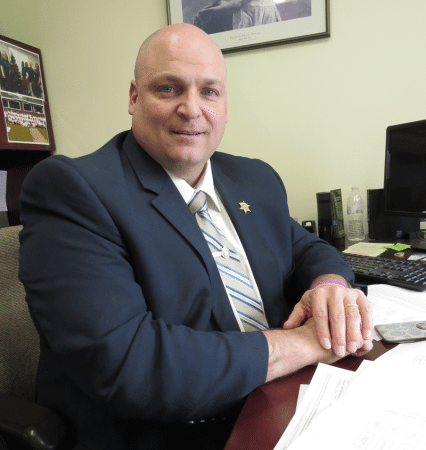
Nick Cocchi

Nick Cocchi

Nick Cocchi called him the “Babe Ruth of corrections.” That’s one of the many ways the current sheriff of Hampden County paid respect to the former sheriff, Michael Ashe. Following the Babe Ruth of anything is an extremely daunting task, but Cocchi says he has the experience, the confidence, and, perhaps most importantly, the blueprint Ashe left him to succeed in that assignment.

Nick Cocchi says he can easily understand why someone would be intimidated by the prospect of succeeding Michael Ashe as sheriff of Hampden County.

After all, Ashe held that post for more than four decades, becoming a regional institution in the process. He won accolades on the local, regional, and national levels — including BusinessWest’s Difference Maker award in 2016 — and received phone calls and letters from correctional leaders across the country and around the world seeking to tap into his vast reservoir of knowledge and experience.

Meanwhile, his annual fund-raiser, known colloquially as the ‘clambake,’ drew a veritable who’s who of local and state elected officials — as well as those hoping to join those ranks. The coveted prize at those gatherings was getting one’s picture with the sheriff in the paper the next day.

Yes, Ashe’s tenure represents the quintessential hard (maybe impossible) act to follow.

And yet, Cocchi was more than enthusiastic about the prospect of being the individual to script the next one. In fact, he told BusinessWest during a very candid interview, he was far more intimidated by the possibility of losing the sheriff’s race — and therefore likely losing his job with the department — than he was by the prospect of being the next individual to wear the badge.

“For all the reasons most people wouldn’t want to follow him, I do,” he explained. “I’ve had the pleasure of working with him for 23 years; this is the Babe Ruth of corrections, and I’ve watched his policies, I watched how he carried himself, I saw how he did things. The former sheriff was all about giving people second chances and opportunities; he spent the taxpayers’ money wisely and appropriately, and he gave people the right tools to go back to our communities. I’ve learned from him.”

Nick Cocchi says his department’s goal is to give inmates at the county’s jails (the men’s facility in Ludlow is seen here) the tools they need to contribute to society.

Nick Cocchi says his department’s goal is to give inmates at the county’s jails (the men’s facility in Ludlow is seen here) the tools they need to contribute to society.

Overall, there are many reasons why the new sheriff isn’t fazed by following such a giant in this profession. For starters, Cocchi, who started working for Ashe when he was a student at Western New England College and never left his employ, is certainly not lacking for confidence. Nor does he want for experience in virtually every aspect of corrections, as the résumé we’ll review shortly will make clear. And, perhaps most importantly, he’s also firm in his belief that he’s had more than a little to do with those aforementioned phone calls, letters, and awards.

“I’m excited about the prospect of following the sheriff because I’m prepared to do it,” said Cocchi, who credited Ashe with creating what would have to be called a blueprint for other correctional leaders, including himself, to follow. “When you look at the work the sheriff has done, we’re not a good facility, we’re one of the best facilities, not in the Commonwealth, but in the country. I’m not the one saying that, and it’s not Mike Ashe saying that; the National Institute of Corrections will tell you that, and the Large Jail Network will tell you that.

“The fact that people come from not only this country but around the world to see our correctional operations speaks to the work that we do,” he went on. “I’ve learned 23 years under Mike Ashe; he came in as a social worker from the outside, and look at what he’s done. Look at how much he’s progressed and advanced corrections around the country. Imagine what I can do after working side by side with Sheriff Ashe and being mentored by him.”

Looking forward, Cocchi displayed some of that aforementioned confidence by saying he doesn’t want to merely continue Ashe’s programs — all designed to rehabilitate inmates, not simply warehouse them — but instead intends to build upon them, improve them, and add to the portfolio.

“I see our future being very bright and very progressive,” he said. “We will continue to set benchmarks and continue to set the pace for corrections around the country, not because of me, but because of our staff.”

For this issue, BusinessWest talked at length with Cocchi about just how he intends to follow Ashe, and why he is not at all intimidated by the huge shadow cast by the man who held the job before him.

Complete Sentences

As mentioned earlier, Cocchi’s path to the sheriff’s office — both the post and his digs at the jail in Ludlow — started when he was a student at WNEC, majoring in government with a minor in criminal justice.

He was approaching the summer break between his junior and senior years and, like most of his classmates, looking for some gainful employment. The rest, as they say, is history in the making.

He applied for a job as a summer correctional officer at the recently opened jail in Ludlow, one of the individuals who would fill in for those on vacation. As you can no doubt gather by now, he was hired, and he came away with a lot more than that summer job.

“I was as low on the totem pole as you can get — I wasn’t even a full-time employee,” he explained. “And as bizarre as it might sound to some people, I absolutely fell in love with the work.”

When asked to elaborate on just what he fell in love with and how, Cocchi started with the teamwork aspects of the assignment.

“At Ludlow High School, I played soccer, hockey, and baseball, and in college, I played fall baseball and then put my focus on hockey; I played for three years,” he explained. “I had always been around teams and embraced the team concept. When you work at the jail as summer relief, you need a team more than ever.

“You went in and you were part of a team,” he went on. “You were told to get out and go home safe, and to make sure the place was safe; you had to act like a team for the eight hours you were there and beyond. That settled well with me. I enjoyed it.”

His specific assignment that summer was working in what’s known as the ‘special operations unit,’ which responded to incidents such as fights, assaults, and shakedowns, where officers go into cells looking for contraband, gang paraphernalia, tattoo guns, homemade weapons and brew, and other items — work he summed up as educational, eye-opening, and “exciting.”

So much so that he was apparently willing to at least suspend his educational pursuits and go to work at the jail full-time. But Ashe wasn’t about to let him do that.

“He said, ‘Nick, if I hire you, you have to graduate from college,’” he explained. “He said, ‘you’ll have two full-time jobs — college and here.’ I agreed, and I held up my end of the deal, going to school during the day and working the 4-12 shift at the jail.”

Thus began a career that would see the title on the business card (when he actually had one) change a number of times. Indeed, after serving as a correctional officer from 1993 to 1996, he was promoted to corporal of that same 4-to-midnight shift, and in 1998 was again promoted to sergeant of the 8 a.m. shift at the Davis Tower living unit.

From there, he went on to serve as a lieutenant in Special Operations, focused on training and staff development, and in 2004, he was named assistant superintendent of Training and Staff Development.

In 2008, he was promoted again, this time to assistant superintendent of Specialized Housing, where he was responsible for the care, custody, and supervision of pre-trial and newly sentenced inmates. And in 2011, he was named assistant superintendent and deputy chief of security, where he was responsible for overseeing the daily inmate operations, the health and safety of all staff and inmates, and the Standards and Compliance Department, as well as the Training and Staff Development Department.

It wasn’t until he was given that assignment in specialized housing, he recalled, that he really allowed himself to think about being Ashe’s successor — about as much as anyone in his department thought about that subject.

“It was at that point in my career that I thought I’d come full circle; I didn’t know it all, but I had an ability to witness and see all or most of what we do,” he said, adding that, while he was progressing through the ranks, as outlined earlier, he understood that he was amassing knowledge and experience, but didn’t feel fully ready until that juncture.

Learning Experience

Thus, when Ashe, who won yet another six-year term as sheriff in 2010, told staff members in February 2014 that it would be his last, Cocchi did some soul-searching and decided that he would, indeed, seek to succeed him.

And from the moment he announced that he was a candidate, Cocchi focused on the depth and diversity of his experience factor and how he understood all aspects of corrections, from day-to-day operations to the many fiscal matters. By doing so, he desired to separate himself from contenders such as former Springfield Mayor Michael Albano.

Nick Cocchi says he will follow Mike Ashe’s blueprint, but he will put his own stamp on programs carried out by his department.

Nick Cocchi says he will follow Mike Ashe’s blueprint, but he will put his own stamp on programs carried out by his department.

When asked about the race, how it unfolded, and the experience of running against politicians with little or no knowledge of corrections, Cocchi paused for a moment as if he was deciding whether to go ahead and say what he wanted to say.

And, in keeping with his character, he did say it.

“It was very frustrating,” he said, referring mostly to Albano (Tom Ashe, the other main primary contender, possesses some experience in corrections). “He was so smooth during those debates, but nothing he said made sense to a corrections professional. It was bad correctional policy, things were fabricated, but man, was he smooth when he was delivering it.”

Cocchi told BusinessWest that he gained both inspiration and even more confidence from others now in what would be considered law-and-order positions who had themselves triumphed over career politicians at the polling booth.

That list includes Laura Gentile, clerk of courts for Hampden County (who also ran against Tom Ashe); Anthony Gulluni, district attorney for the same county; and Suzanne Seguin, who defeated long-time state Sen. Gale Candaras in 2014 to become Hampden County register of probate after serving in that role on an interim basis.

“Laura Gentile runs, and she was getting beat according to the polls four weeks out from the election,” Cocchi recalled. “When all was said and done, the professional in the office doing the job won.

“Then, Anthony Gulluni runs, and he runs against some people who may have more experience in the courtroom,” he went on. “But here was a guy who was in that office as an assistant DA; again, the professional won. And Suzanne Seguin … no one gave her a chance, but she came out on top. Why? Again, she was in the office doing the job, showing up to work every day.

“So when people said to me, ‘you can’t win,’” he continued, “I said, ‘the heck I can’t. I know how to do the job, and I’ll hit the ground running, just like Laura, Anthony, and Suzie.’ These are all county-wide positions, and the voters said, ‘we’re going to stop the politicians from taking soft landings.’ That energized me.’”


When you look at the work the sheriff has done, we’re not a good facility, we’re one of the best facilities, not in the Commonwealth, but in the country.”


As mentioned earlier, Cocchi said he was basically nonplussed about the prospects of having to follow Ashe, but was certainly concerned about his fate should he happen to lose to one of the politicians running against him and campaigning on a platform that serious change was needed. Indeed, he said he would certainly expect that individual to quietly nudge him out the door, a proposition that certainly motivated him as the Democratic primary race progressed.

“I thought about it every single day of the campaign — my wife never let me forget it,” he said, adding that, even with 23 years in, at his age his pension would be maybe 26% of what he was earning. “I would have been out of a job and out of a career; that was quite a motivator, believe me.”

Coming to Terms

As he talked about the primary role carried out by the Sheriff’s Department, Cocchi said it can be described in many ways, but in most respects, it’s a public-safety function.

Indeed, while the office is charged with incarcerating individuals, the primary assignment is making such individuals ready to return to the communities from which they came, and in a position to contribute, rather than be a detriment — a role Ashe fully understood, and Cocchi does as well.

“We take men and women at the lowest points in their lives, where they’ve proven over and over again that they just can’t get it right — they can’t conform to society’s rules,” he explained. “We take them, and we try to put them back into the community, because if you’re doing time in the county facility, your average stay is probably eight months.

“We take the men and women in, and we try to put them back into the community as better husbands, better brothers and sisters, better sons and daughters,” he went on. “And by doing that, we give them tools to be successful.”

By tools, he meant everything from housing to job skills to the ability to battle and hopefully overcome both addiction (nearly 90% of those who arrive at jail come with some kind of substance-abuse issues) and mental-health disorders (some 37% to 42% of inmates have been diagnosed with one).

“We have to do a lot of work in a very short period of time,” said Cocchi. “Our public-safety efforts are, very simply, taking people who come to us angry, violent, addicted, and mentally unstable at times, and putting them back into the community less violent, less angry, less likely to be dependent on substances, and much more able to make cognizant decisions; we want to return someone to their community far more likely to be productive, and less likely to be disruptive.”

When asked how all this is accomplished, Cocchi said a big part of it comes down to making people accountable — not just while they’re serving time, although that’s certainly part of it, but for what they do with their lives.

And it starts with those eight months, on average, that they spend at the Ludlow facility or the one for women in Chicopee.

“We hold our inmates accountable; they have to answer the bell,” he explained. “They get up in the morning, eat, shower, go to classrooms. It’s a 40-hour work week, for them and for us. We’re challenging them to be busy 40 hours a week — we’re not going to let them sit in a pod and watch Jerry Springer; that we don’t do.”

As for how he will go about doing all this and the style he will bring to the job, Cocchi said that, while he admires Ashe, learned a lot from him, and fully intends to follow the blueprint the now-former sheriff laid down, he will certainly put his own stamp on the Sheriff’s Department and the work it carries out.

“When you look at my overall philosophy and the way I’ll manage the department, I’m going to tweak it; I’m going to put my fingerprint and my thumbprint on it,” he explained. “It’s about refining things and moving things forward, being creative and trying new things.

“We never rested on our laurels here — every year, we’d go through our programming and rip it apart, and we’d all get frustrated,” he went on. “Here we are thinking we’re one of the best, and we are one of the best, and yet we tear ourselves apart from within to make it better. That’s not going to change.”

When asked about how he intends to measure success amid what will inevitably be comparisons to his predecessor, he said there will be many barometers, including everything from the funding to be received from the state (Cocchi said Ashe was “brilliant” when it came to bringing home the bacon, as he called it) to those aforementioned phone calls, letters, and visits from other correctional facilities. He fully expects them to continue at their current pace, and if they do, that will be one sign that things are being done correctly.

But on an even more practical level, he said overall success will be measured by the results to be generated at facilities like the setting for his interview with BusinessWest — the Addiction & Wellness Center.

This is the facility carved out of the former Ring Nursing Home on Mill Street in Springfield, where roughly 150 ‘residents’ are trying to turn around a life turned inside out by addiction, in many cases to the opioids that have become the most pressing public-health issue facing the region and the nation.

“With this issue, where the stigma of ‘addict’ has shifted to ‘disease,’ I think I’m going to be judged on our success rate here,” he noted. “And I know that. We must continue to provide aggressive and progressive substance-abuse education and treatment, coupled with mental-health services. That’s one way I’ll know I’ve touched every family in Hampden County, and hopefully around the Commonwealth.”

Food for Thought

Looking down the road, and not that far down it, actually, Cocchi answered the question that seemingly everyone is putting to him: yes, he will have an annual fund-raising get-together like his predecessor.

“We have a committee, and we’re starting to talk about things now,” he said. “It could be a clambake, it could be a barbecue, it could be a pig roast … we don’t know yet; we’ll do something.”

And although he’s not sure about this, he expects that his event will be like Ashe’s in that it didn’t really raise a significant amount of money, but it did bring people out, including governors and lieutenant governors, senators and congressmen, and a whole host of state officials, thus giving the area’s elected leaders and residents access to such people and, thus, a voice.

“They all come, whether they’re Republican or Democrat, office holders or candidates, and why wouldn’t they?” he asked, before answering his own question. “It’s great exposure for them, and it’s great for the people out here; I think it’s incumbent upon me as sheriff of Hampden County to continue to bring Boston to Western Mass.”

Thus, the clambake appears to be yet another part of the Ashe blueprint that his successor will look to emulate, improve upon if possible, but put his own stamp on.

It’s an assignment that would intimidate most, but not Cocchi.

George O’Brien can be reached at [email protected]

Employment Sections

Shifting IT’s Focus

By Joanna Smiley

Keyla Centeno

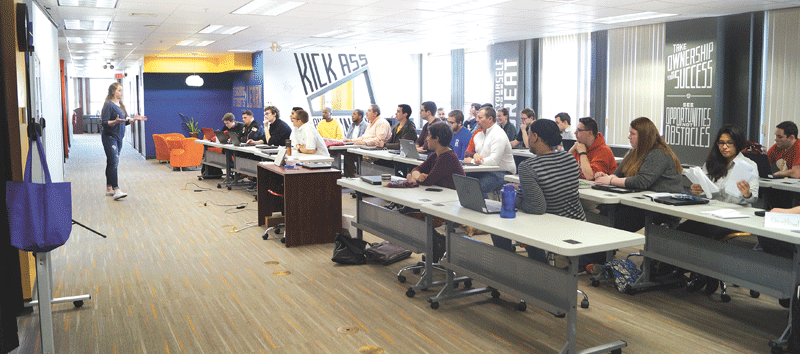
Keyla Centeno, team lead and graphic designer at Tech Foundry, teaches a class on soft skills.

When it was founded in 2013, Tech Foundry, a program conceived to create a steady pipeline of workers for the IT sector, focused primarily on area high-school students. But research — and experience — revealed that these young people were choosing other destinations (especially area colleges) rather than area technology firms. So today, the classrooms feature a much more diverse group of students.

Bruce Stoller is a 58-year-old displaced worker with aspirations to forge a new career in information technology. He holds a law degree, and has a background in facilities management.

Maura Kavanh, 29, used to study political science and women’s gender studies at UMass Amherst, but took a leave from college when she noticed an interesting trend: organizations she aspired to work at, like Planned Parenthood, had a far greater need for those with tech skills than policy work.

What do Stoller and Kavanh have in common?

Both are students in Tech Foundry’s class of 2017, a group far more diverse than those that came before it. And that’s by design and out of necessity.

Indeed, the Springfield-based workforce development program was launched in 2013 and designed to prepare job seekers — and not necessarily individuals like Stoller and Kavanh — for entry-level tech careers. But a year ago, the organization decided to shift its focus from a program designed for high-school students to one that has no age restriction. Tech Foundry’s current class is an eclectic mix of students ranging in age from 20 to 60.

Jonathan Edwards, director of Strategic Partnerships at Tech Foundry, notes that the organization’s shift was about responding to employers’ needs for a bigger pipeline of IT workers.

“We know that people in mid-career transition are the perfect candidates to expand that pipeline,” he explained. “They’re looking for something different; people who wake up and say ‘I want to do IT’ isn’t enough. Introducing people who already possess strong work backgrounds to a sustainable IT career is really a great match between the needs of employers and needs of our student population.”

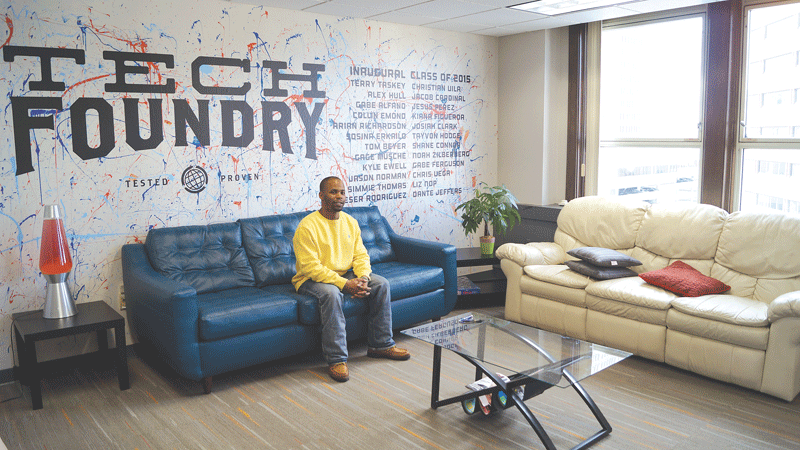
Brandon McGee hopes to land a job in software sales

Brandon McGee hopes to land a job in software sales once he completes the Tech Foundry program in May.

Ann Burke, vice president of the Economic Development Council of Western Mass., agreed.

“The good-news, bad-news experience from the first class was that these young people became excited about fields in technology, but instead of going directly into the workforce, many decided to continue their education in community college or college,” she explained. “This was great for the students, but not for tackling the issue of developing a pipeline for entry-level technology employees.

“Tech Foundry has been piloting different approaches to finding those individuals interested in tech job opportunities,” she went on. “The student body has evolved to include a much more diverse group, including veterans, people with some community-college experience, women, and others with some work experience but not necessarily in the tech field.”

Tech Foundry still welcomes 18-year-olds who would like to go into a job in the tech field, she went on, adding that the program’s leaders found that many employers are looking for candidates with at least some work experience and soft skills, even if they do not have past technology experience.

“Tech Foundry is an innovative program that will continue to evolve to meet the needs of this growing sector,” said Burke. “It actually is interesting and exciting to see the diversity of age, gender, experience, and ethnicity in the most recent graduating class. I’m excited about how the organization is continuing to scale and prepare more candidates to be a part of the technology workforce. We know that there is a need for qualified, entry-level technology workers across industry sectors in the region.”

For this issue and its focus on employment, BusinessWest takes an in-depth look at this change in focus for Tech Foundry and its implications for the workforce, job seekers, and area companies.

Technically Speaking

Tech Foundry prides itself on partnering with a broad range of companies in the region, and Edwards said he has noticed a cross-section of employer size and industry. Partners range from Bay State Health to Smith & Wesson to startups that seek the type of talent Tech Foundry is producing.

Its success in meeting its important mission is made clear by several testimonials from area business owners and one elected official.

Andrew Anderlonis, president of Rediker Software, has been partnering with Tech Foundry for more than a year, and says the organization has helped him solve a major problem — finding passionate, talented, and committed professionals who can meet the continuously evolving workforce needs of the region’s tech community.

“Rediker Software has now hired four graduates from Tech Foundry, and all of them are performing exceptionally well, a testament to the strength of the program,” he noted. “Working with Tech Foundry has been a wonderful experience as they have put together a terrific program for the students.”

Michael Arian, co-founder and CEO of Prophit Insight, says Tech Foundry not only provides him with talented IT employees, but the opportunity to give back to the Springfield community.

“We’ve been working with Tech Foundry since their beginning. It has been a very important program for us,” he told BusinessWest. “Tech Foundry has allowed us to acquire talented IT employees in a more cost-effective manner, and it has been very successful so far.

“It also provides us the opportunity to give back to the Springfield community and help out some fantastic people who just need an opportunity, this is very important to us,” he went on. “We’ve hired three employees from Tech Foundry and currently have another who is interning, and we hope to bring him on full-time shortly.”

State Sen. Eric Lesser agreed, and said Tech Foundry’s model is one he is working to replicate statewide.

“In just three short years, Tech Foundry has shown itself to be very nimble and responsive to our region’s employment needs. Western Mass right now faces a substantial ‘skills gap’ between the available jobs in growing fields like technology and advanced manufacturing, and workers looking for employment. There is a particular challenge facing older workers who are already out of school, who either need to update their training or learn new skills to stay competitive as our region’s economy continues to shift toward fields dependent on technology and innovation. I’m glad Tech Foundry is taking this on. Their model has already proven very successful at getting workers the specific training they need quickly and efficiently for younger students, so expanding to older members of the workforce is welcome and desperately needed.”

Edwards said Tech Foundry’s goal is to eventually have twice the number of employers seeking candidates as there are students in the program. Currently, the agency partners with 60 companies in the area. Starting salaries for graduates of the program can range from $30,000 to $50,000 per year.

tech-foundry-logo

On a recent afternoon at Tech Foundry’s space in downtown Springfield, Keyla Centeno was teaching a roomful of students gathered around ping-pong tables how to hone their professional communication and interpersonal skills. They were taking part in a team-building exercise that required careful listening and negotiation.

“This is one of our most diverse cohorts,” she noted. “It’s a pleasure to see them help each other and come out of their shells. This older demographic we have tells me a lot of people want to change their careers and break off from what they’re doing right now; some employers even require tech training now.”

Stoller, 58, is the oldest student in this cohort. The Springfield native lived in Boston for 20 years and recently moved back to Western Mass. He practiced criminal law before retiring from his legal career to work in facilities management.

Stoller was let go during his company’s “reorg,” and because his position was eliminated, he qualified to be what’s called a displaced worker, meaning any training or schooling he attends is paid for in full for up to one year. His end goal? To land a new job at a help desk, not necessarily doing programming, but using his sales skills.

Brandon McGee, 29, was born and raised in Springfield. He found his calling in technology at the age of 13, when he would sit in his bedroom at 3 a.m. tinkering on his Dell computer. Currently enrolled at Springfield Technical Community College, he said he “took advantage of anything his professors gave me a heads-up on,” and that included a recent suggestion to look into Tech Foundry.

After working in the telecommunications industry for a number of years, McGee knew he needed an additional skill set to advance to his dream career — software sales.

“I knew I wasn’t coming from a top school, I didn’t have the greatest GPA, and I wanted to immerse myself in a way where I could be competitive and acquire transferrable skills; I want to work for a company where staying relevant is a priority,” he explained. “I started out thinking printers and passwords were IT — now I know there’s so many more avenues in the field.”

Bottom Line

McGee says he’s a “little nervous to leave the coop” in May when he graduates from Tech Foundry.

“The people at Tech Foundry have been immensely supportive — it’s a free program with huge opportunity,” he noted. “We’re all in different aspects of our life, and every opportunity here is one to get your name out there and go for it.”

Today, there is a more diverse group of people ‘going for it’ thanks to Tech Foundry, a development that bodes very well for the region, its workforce, and companies struggling to find needed IT workers.

Construction Sections

Driving Forces

An overhead view of work on the inner lanes of I-91’s Springfield viaduct.

An overhead view of work on the inner lanes of I-91’s Springfield viaduct.

In May 2015, the Massachusetts Department of Transportation signed a $148 million contract with the Joint Venture of JF White-Schiavone to overhaul the 1-91 viaduct in Springfield. The project is immense in scope, and although it has inconvenienced drivers, especially during peak hours, it is ahead of schedule and brings concrete benefits for the local economy and area businesses that manufacture or provide products needed for the repair and reconstruction of the 45-year-old section of highway.

Richard Masse says that, when the state Department of Transportation (or MassDOT, as it’s called) developed plans for reconstructing the 1-91 viaduct that runs through Springfield, it was well aware of the impact and inconvenience the project would have on drivers traveling north and south.

Indeed, state officials felt that completing the $148 million project on time or ahead of schedule was so critical that they built an attractive bonus into the contract to keep work moving along as quickly as possible.

“We established an incentive of $50,000 a day for up to 180 days to finish earlier than the contract specified,” said Masse, district project development engineer for MassDOT Highway Division District 2.

This equates to a potential bonus of $9 million for the Joint Venture of JF White-Schiavone if specific conditions are met. And those conditions are clearly outlined: the entire project does not have to be complete, but the ‘full beneficial use’ milestone has to be met, which means work on all lanes and ramps must be finished, and they must be open and functioning, before Aug. 6, 2018. This constitutes the majority of the work.

Such incentives are rare, and this is the largest ever offered by District 2, but it is tempered by a disincentive: There will be a penalty of $50,000 for every day the contractor is late in meeting the milestone.

But that’s not likely to happen. In fact, JF White-Schiavone, benefiting from mostly benign weather (the recent storm was a definite exception), is three months ahead of schedule, and workers continue to labor around the clock to get the project done.

The roadway under reconstruction is only eight-tenths of a mile in length, but the work involves far more than simply removing the old decking on the six traffic lanes and repaving them. There are 96 separate spans of bridge between the south abutment on State Street and the north abutment near the I-291 exit, and each span is supported by a pier that needs to be repaired.

Officials say the viaduct project is proceeding ahead of schedule

Officials say the viaduct project is proceeding ahead of schedule, thanks to relatively mild winters and some attractive incentives.

In fact, the $148 million contract holds enormous weight — literally and figuratively — and area businesses are benefiting due to the materials that are needed and will be used by the time the project is complete.

Specifically, crews will replace 44,000 tons of concrete with the new bridge deck and barriers, use 7.2 million pounds (3,600 tons) of steel reinforcement, install 134 drainage inlets on the bridge, erect 2.5 miles of snow fence on the barriers, and paint 28 acres, or 1.2 million square feet, of steel.

Concrete is being purchased from Construction Service in Wilbraham, asphalt paving comes from Lane Construction Corp. in Springfield, the 600-plus feet of noise-control curtains mounted in front of downtown hotels were purchased from Sound Seal in Agawam, and gravel and stone is being provided by Ginmar Enterprises in Ludlow.

In addition, Commonwealth Guardrail in Westfield is furnishing that product, all catch basins and manhole castings will be purchased from E.J. Prescott Inc. in West Springfield, and CJ’s Towing Unlimited Inc. in Springfield is part of the safety plan to remove vehicles involved in crashes as quickly as possible, which is important because traffic is already squeezed between the barriers on the viaduct.

The project has also had a positive effect on employment. The Federal Highway Administration has done studies on the impact of major undertakings and reports that every $1 billion in spending supports 13,000 jobs for a year. “Since this project will cost $148 million, that translates to more than 1,900 job years of employment that are either created or supported,” Masse said.

For this issue and its focus on construction, BusinessWest takes an indepth look at the I-91 project — what’s been completed, what’s still to come, and what the long-term benefits will be for Springfield and the region.

Route Geometry

Although some people think the $950 million MGM Springfield resort casino has affected work that is being done on the viaduct or the way the on and off ramps will be configured in the future, it’s not true and simply a coincidence that construction on both projects is taking place simultaneously.

“We identified the need for the viaduct project late in 2011 before expanded gaming was even signed into law, and the project was approved and initiated prior to any casino proposals,” said Masse.

The viaduct was constructed and opened in 1971, and no improvements were made to it other than a few limited repairs that took place between 1999 and the early 2000s. As a result, the decking deteriorated as millions of vehicles passed over it and chemicals, salt, and sand were used to combat ice and snow during frigid winter months.

“It had reached the point where emergency repairs of potholes were becoming routine. We had to go out on the road in the middle of commuter traffic without warning, and it became clear that it was time for a long-term fix,” Masse said.

MassDOT did its best to identify challenges that might occur as it developed a plan for the project. The agency determined it was critical to keep the public informed about what was happening on a daily basis, so the contract contained language that mandated hiring a public-relations firm for that purpose.

Regina Villa Associates in Boston was chosen, and the company issues frequent notices and updates about the work in progress to all local media outlines. There is also a project webpage (www.massdot.state.ma.us/i91viaductrehab/home.aspx) where people can sign up to get e-mail alerts about daily or weekly changes.

In addition, work on the project is discussed at biweekly meetings that include officials from MassDOT, the Springfield Department of Public Works, the Springfield Parking Authority (two of its main facilities are under the viaduct), and MGM Springfield.

Masse noted that the casino has initiated its own street closings and plans to install a detection system at the end of the exit 6 ramp to facilitate traffic flow and help prevent accidents; if traffic starts to back up toward the highway, the stoplight will change to allow vehicles to move off the ramp. Other work is also being done on streets around the casino, but that has no bearing on the 1-91 viaduct project.

However, MGM’s presence at the meetings is important. “It gives us an opportunity to coordinate work and exchange schedule updates,” Masse said. “Their cooperation has been an important part of the project and helped to limit disruption.”

Although some media outlets have reported that a number of drivers have avoided the viaduct and will continue to do so until the project is complete, Masse said everything possible is being done to reduce the impact on local businesses.

“We understand that our projects are generally an inconvenience, and we certainly appreciate that there can be some negative impact on local businesses. But we haven’t had any feedback of that nature,” he told BusinessWest, adding that business owners as well as the general public are invited to send comments, suggestions, or inquiries to MassDOT via the project website, and feedback has already resulted in things such as adjustments to signage.

the reconstructed viaduct will help make Springfield an attractive destination

Richard Masse says that, when it’s completed, the reconstructed viaduct will help make Springfield an attractive destination.

Another change that went live Feb. 1 was made in response to input from drivers who expressed concern about safety where lanes on I-91 South are reduced from two down to one.

The feedback led MassDOT to implement a pilot program for a ‘dynamic lane merge system,’ which is designed to make merging safer and alleviate congestion.

It’s the first time this system has been used in the Commonwealth, and it will help to ensure that vehicles familiar with the lane closure don’t bypass others and cause them to wait for a longer period of time than those who use the roadway on a frequent basis. The system works by using computer sensors to monitor traffic and letting drivers know what the best merge strategy is via electronic signage.

Paving the Way

The viaduct project has many goals, including replacement of the reinforced concrete bridge deck, painting of all structural steel, replacing the bridge bearings, improving bridge drainage and highway lighting on and under the structure, miscellaneous structural steel repairs, improving traffic signage on the structure, and other safety improvements in the immediate vicinity, such as installing new sprinkler systems and LED lighting on the upper levels of the 1-91 North and South parking garages, which are run by the Springfield Parking Authority in space leased from the state.

Masse said the project was divided into two main phases so half the decks could be replaced at a time. Last year, work was concentrated on the inside decks, and traffic was moved to the outside, and now that phase I is complete, the process has been reversed, and construction is taking place in the low-speed travel lane and shoulder portions of the viaduct, and on the I-91 northbound on-ramp to I-291 East.

The same ramps that were closed during phase I will remain closed, and the only change is that the exit 9 off-ramp from I-91 North to Route 20 West/Route 20A East will be closed until phase II is complete.

About 100 people show up to work at the site every day, and in addition to day and evening shifts, construction efforts often continue throughout the night. The noisy work of demolishing the existing decks is done during the day, and debris is carried away after dark.

“The crews use very large jackhammers mounted to excavating equipment to break up the deck,” Masse said, noting that saws are also used to cut portions of the material.

Workers recently began painting the steel girders, which is no small task — again, there are 1.2 million square feet of steel to repaint. But when the job is complete, it will help enhance the perception of that section of the highway.

“The beige paint that had reached the end of its useful life is being covered with a blue-green hue that will be much more attractive visually,” Masse said.

In addition to aesthetics, safety will be improved. “When we finish the deck replacement, the shoulder on the median side in the high-speed lane will be wider,” he continued, explaining that, in the past, there were two feet between the guardrail and the edge of the road, but a narrower concrete barrier will allow the inside shoulder to expand to four feet in width.

Other safety improvements include the construction of a barrier to stop I-291 traffic from shooting across several lanes on I-91 South to exit 7 at the Memorial Bridge.

When the project was in the development stage, Masse noted, input about this dangerous maneuver led MassDOT to make plans to install the new jersey barrier.

The number of drainage inlets will also be increased, which will reduce the amount of water that collects along the shoulder of the roadway.

Passing Thoughts

After the roadways are fully open, the remaining work will commence, and by the time the project is finished, the structural steel will be painted, municipal street lights will be installed, all final paving and traffic markings on local streets will be finished, temporary traffic signals will be replaced with permanent ones, and the temporary off-ramp from I-91 South to Birnie Avenue will be removed.

There is no doubt that the project is an inconvenience to drivers who have to schedule additional time to get to their destinations. But the benefits will be concrete: sales of products used in construction will help local companies to flourish, and drivers will have a safer and more appealing roadway to travel on between downtown Springfield and the Connecticut River.

“When everything is newly paved and painted and a modern lighting system is installed, the viaduct should help to make Springfield a more attractive destination,” Masse said. “When people see a highway that is well-cared-for, it will provide a welcoming gateway not only to Springfield, but to Western Mass.”

Employment Sections

Value Proposition

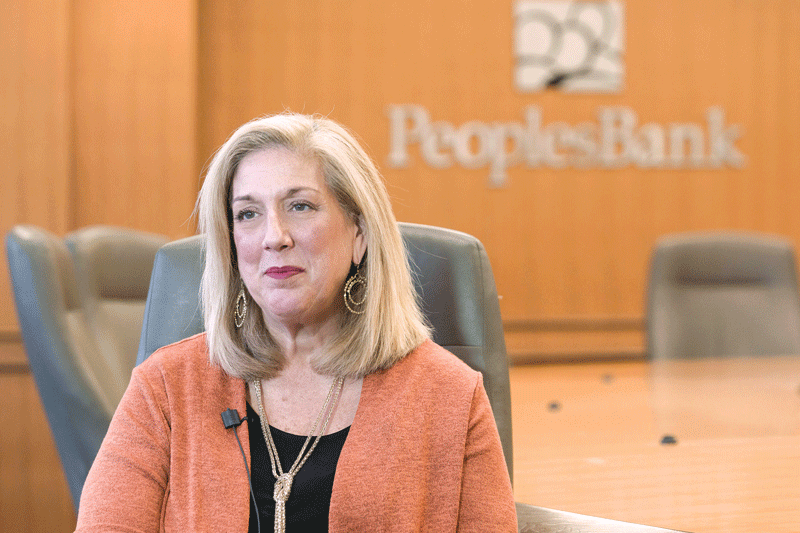
From left, Phil Michaud, Alisa Feliberty, and Robert Raynor

From left, Phil Michaud, Alisa Feliberty, and Robert Raynor say PeoplesBank’s efforts to keep young professionals engaged with the company’s values and connected to the community are among the qualities their generation values in an employer.

It’s difficult to pigeonhole the Millennial generation — though many have tried — in terms of what they want in a job and a workplace.

But one recurring theme is a sense of purpose and meaning, one that goes beyond their list of duties. And on this front, employers are largely falling short.

In fact, according to a recent Gallup study, “How Millennials Want to Work and Live,” only about one-third of young professionals strongly agree that the mission or purpose of their organization makes them feel their job is important. And just 40% feel strongly connected to their company’s mission. This is a problem, the study notes, that leaders need to take seriously because Millennials currently make up 38% of the U.S. workforce, and that percentage will continue to rise.

They might do well to listen to three Millennials whose employer, PeoplesBank, seems to understand what makes them tick.

“As an employee, I feel appreciated, I feel heard, like my opinion actually matters,” said Alisa Feliberty, call center manager. “That’s a big thing for me, knowing I’m not just a body here, but a person considered for her thoughts and beliefs.”

Phil Michaud, a loan service associate, recalled being part of a meeting in which top bank officials candidly outlined their growth strategy for the next decade. “Having that kind of access to the direction the company is looking to grow, getting into the nitty gritty of all that, says they value you, and you’re worth telling.”

Then there’s Robert Raynor, who stumbled into banking after studying business management in college.

“I’d say the biggest thing for me is connection to the community,” said Raynor, now assistant vice president of Compliance. “To be able to work for a company that reaches out to the community, that makes a positive impact in the community and makes a difference, you know you’re working to help out the less fortunate in your area, not just coming in and making a widget and making a profit.”

These opinions aren’t happy accidents, said Janice Mazzallo, the bank’s chief Human Resources officer, but part of an overall strategy to create a culture that draws and retains top talent by making sure they feel connected.

“Values is something we get right in the organization,” she said. “Attracting Millennials isn’t just about having the right employee benefits, though we do that. We also recognize that Millennials — and all employees, for that matter — want to connect; when they go to work, they want to feel engaged, that what they do matters.”


List of area Employment Agencies


These efforts have drawn the attention of the Boston Globe, which has named PeoplesBank among its Top Places to Work five years running — in fact, the only company based in Western Mass. to be named to the most recent list.

“We put a lot of energy into that effort, and we don’t take it for granted,” Mazzallo said. “But it’s also not something that HR does in a vacuum.”

Rather, creating a workplace culture that keeps employees engaged and committed to the brand is an effort that requires buy-in across the organization. For this issue’s focus on employment, BusinessWest explores why PeoplesBank’s leaders feel the effort is worth it.

Making Connections

The benefits of engaging Millennials extends far beyond accolades in a magazine. In the coming years, employers must learn what makes this large, diverse group tick if they want to retain top talent.

The Gallup survey found that 67% of Millennials are engaged at work when they strongly agree that the mission or purpose of their company makes them feel their job is important. In contrast, just 14% are engaged when they strongly disagree with this statement. Because engagement leads to increased retention, fostering a connection to purpose can help companies fight Millennials’ propensity for job-hopping.

“When a company’s purpose is evident through its culture and brand, Millennials are better able to connect it to their role,” write Brandon Rigoni, associate director for Selection and Development at Gallup, and Bailey Nelson, a writer and editor at the polling company. “Leaders should strategically align the company’s purpose, brand, and culture to create an environment in which mission is something employees experience daily. By integrating purpose company-wide, leaders give employees the opportunity to own the company’s mission and transform it into enhanced performance.”

The values PeoplesBank tries to espouse, Mazzallo said, range from an extensive volunteerism culture to environmental awareness (which takes the form of an active committee that seeks out ways to make the bank and the surrounding community ‘greener’); from technological innovation to an emphasis on work-life balance.

Janice Mazzallo

Janice Mazzallo says creating a culture that has earned multiple ‘Top Places to Work’ accolades starts at the top but includes input across the organization.

“I think the fact that we’re an employer that cares about our community and gives employees opportunities to get involved in the community — whether it’s volunteerism or board involvement or the social aspect — that’s certainly important to them,” she went on. “We have a lot of opportunities here to get involved.”

The bank’s employee-driven committees tackle everything from wellness and the environment to organizing social events, such as bowling outings and trivia nights. A popular annual event called Employee Fest is another opportunity to make workers feel connected and appreciated.

“Everyone looks forward to Employee Fest; it’s a week where the company kind of caters to you, but you also realize how everyone contributes to our success,” Felberty said.

Michaud agreed, noting that various departments compete in contests, and it’s good to see people, especially those in far-flung branches, he doesn’t talk to on a regular basis. “At face value, it looks like we’re playing games, but I think about the connections we’re making and what that does for everyone in the bank. It’s more about building community and building relationships in this place where we spend the majority of our time.”

None of these efforts — the events or the committees — would happen if they didn’t have support at the top, Mazzallo stressed. “We have a senior management team that believes strongly that this is important, and support the idea that people want to feel engaged, and without that engagement, the high performance doesn’t come. We know that; we’ve seen it. Our financial performance over the last five years has been phenomenal, and that’s no coincidence — we have highly engaged employees.”

Getting Ahead

The three young professionals we spoke with also praised the company’s advancement efforts, from its management-development program to its support of continuing education and a willingness to move people around if they desire a new challenge.

“Management here supports us and allows us to take time to develop our skills,” Michaud said. “I started off as a less-than-part-time teller, and in a short period of time, I made this position. The opportunities are definitely there. You see people moving up in departments and transferring between them. If you find it’s not a great fit or you’re interested in something else, they’ll move you to another department.”

Feliberty agreed. “They’re interested in making sure you’re happy and successful. It’s important for them to retain you as an employee, and they’d rather move you from one department to another than keep you stagnant in one position.”

That flexibility is married, they added, to encouragement by bank leaders to communicate their goals and ambitions.

“I’m always surprised at the open doors to communication,” Raynor said. “I’ve had the opportunity to sit down with the then-CFO — now president — and talk about my career path, and what my interests are. With that busy schedule, to take time to sit down and talk about my thoughts and plans is pretty amazing to me. You don’t hear about that taking place that often.”

Michaud agreed, citing coffee events held with senior officials, who share their own paths to success. “The feeling is, they’re looking for you to ask questions and discover your own path to success, and then give you the tools to do that. They’re incredible at that. They’re giving you confidence that they’re here for you — you’re not on your own here.”

Added Raynor, “it’s not a canned message. It’s, ‘this is my story, this is what happened — the obstacles I faced, what happened in my personal life that helped me make this decision or that decision.’ It’s incredibly helpful.”

It’s also not the way most companies operate. According to the Gallup survey, only 26% of millennials say that, in the past seven days, they have heard someone talk about how their daily work connects with their organization’s mission and purpose. And just 34% of millennials report that they have heard a story in the past 30 days about how their company impacted a customer to improve their business or life.

PeoplesBank’s openness, Raynor added, breeds pride in the company and one’s place within it, which suppresses the natural urge to believe the grass is greener somewhere else. “Being at a place like Peoplesbank and having those conversations, I know where the grass is greener, and that’s a pretty good feeling.”

Just a Little Respect

Mazzallo called on one more word to describe the workplace culture at PeoplesBank: Respect.

“I’ve worked for a lot of organizations in my life, and there’s something about this bank that, I think, leads with respect. When you have that in place, there are so many lessons that can be learned,” she told BusinessWest. “When we have strategic initiatives, we want to hear from every level of the organization … I think there’s a healthy respect for the people who are directly involved in day-to-day projects.”

Feliberty said young employees definitely want to be heard. “It’s important to feel we’re included, that we matter, that what we think is considered when making decisions.”

There’s also a healthy regard for trying new ideas that arise from those discussions, Mazzallo said, whether it’s a new product or a new technological innovation.

“It’s OK to make mistakes,” she said. “I don’t think a lot of employers will say that. But if you want to have an innovative organization, you have to take risks — smart risks. I think people feel they can be creative and take risks, and, as a result, some very, very innovative ideas have been created.”

Like the brainstorm, cultivated over time, that clearly communicating the company’s values — and making employees feel connected to those values — will not only keep them around, but motivate them to new heights.

Joseph Bednar can be reached at [email protected]

Employment Sections

Help Wanted

By AMELIA J. HOLSTROM, Esq.


In response to an increase in claims of workplace harassment, the U.S. Equal Employment Opportunity Commission (EEOC), the agency responsible for enforcing federal anti-discrimination laws including Title VII, issued a 75-page Proposed Enforcement Guidance on Harassment on Jan. 10.

Amelia J. Holstrom

Amelia J. Holstrom

The majority of the guidance deals with matters previously addressed by the EEOC, including the elements of harassment; the list of protected characteristics under federal law, including the EEOC’s interpretation that ‘sex discrimination’ includes one’s sexual orientation and gender identity; and the defenses available to an employer facing a harassment suit.

Although it has a long-standing practice of issuing harassment-enforcement guidance, the EEOC appears to take things a step further in this proposed guidance and makes suggestions for employers, including policy and training suggestions, among others. Before providing specific suggestions in the guidance, the EEOC begins by articulating that senior leaders are the “cornerstone of a successful harassment-prevention strategy,” and that they have to express frequently and with clarity that harassment will not be tolerated.

As part of that strategy, the EEOC notes that employers must allocate resources and time for harassment-prevention efforts and regularly assess harassment risks and take necessary steps to eliminate them. So, how might an employer implement and enforce such a strategy?

First, the EEOC suggests that employers adopt an anti-harassment policy. According to the EEOC, the policy should include an express statement that harassment on the basis of any protected characteristic is illegal; examples of harassment; details regarding the employer’s complaint system, including how to report; language that encourages employees to report any harassment; an indication that the employer will conduct a prompt and thorough investigation into the allegations and assurance that it will take appropriate corrective action; and a statement that retaliation is prohibited against those who file complaints and/or participate in investigations. Additionally, the EEOC recommends, among other things, that the policy be written and communicated to all employees.

Massachusetts employers should already have an anti-harassment policy that contains the criteria suggested by the EEOC. Under Massachusetts law, employers are required to have a sexual-harassment policy that includes a number of the same criteria. Employers are also required to distribute that policy to all employees both at time of hire and annually. As a practical matter, however, savvy employers have adopted and issued broader anti-harassment policies that include all types of unlawful harassment, as the EEOC suggests. Regardless, this proposed guidance should signal to employers that it is time to review their policies and consider whether changes would be appropriate.

Second, and in follow-up to its suggestion that details of the complaint system be included in the policy, the guidance makes recommendations regarding how an employer should structure its complaint system.  Under state and federal law, an employer has a duty to promptly and thoroughly investigate all allegations of harassment and discrimination.  As a result, every employer should already have a protocol in place for doing so. For example, some employers choose to hire a third party to conduct investigations, while others have an internal person or department such as Human Resources handle investigations.

In its guidance, the EEOC recommends that employers fully resource the complaint system; provide multiple avenues for filing the complaint, such as listing a male and female to which complaints may be brought; have a process to ensure that the alleged harasser is not presumed guilty before the investigation is complete; and have a procedure for informing the complaining party and accused of the outcome of the investigation or corrective action to be taken, to the extent appropriate.

The EEOC also notes that, among other things, those responsible for receiving and investigating the complaints need to be well-trained and neutral, have authority and the resources to investigate, have the ability to make people feel comfortable, and keep adequate documentation during the investigation.

Lastly, the EEOC notes that, even if all employees know about the policy and complaint system, those are only part of an effective strategy to eliminate harassment. To be sure that employees understand what constitutes illegal harassment, the EEOC recommends regular and interactive training that is promoted by senior leaders and conducted and revised regularly. The training should include examples of unlawful harassment, information about employees’ rights, details of the complaint process, and the range of consequences for someone who engages in prohibited conduct. Additionally, because managers and supervisors have additional responsibilities under federal law (and state law too) when it comes to harassment complaints and investigations, the EEOC suggests that managers and supervisors undergo additional training that includes training on recognizing risk factors, methods for addressing harassment, and clear instructions regarding reporting harassment.

The proposed guidance is available HERE. The EEOC recently sought public comment, and will next review all feedback and consider making revisions prior to finalizing its guidance.

Amelia J. Holstrom joined Skoler, Abbott & Presser in 2012 after serving as a judicial law clerk to the judges of the Connecticut Superior Court, where she assisted with complex matters at all stages of litigation. She is a 2011 graduate of Western New England University School of Law, where she was managing editor of the Western New England Law Review. Her practice is focused on labor law and employment litigation; (413) 737-4753.

Company Notebook Departments

MassMutual Continues Support of Legal Clinic

SPRINGFIELD — MassMutual and the Hampden County Bar Assoc. (HCBA) announced MassMutual’s ongoing support for HCBA’s Hampden County Legal Clinic, including a $160,000 grant intended to support its expansion and continuation of legal services. The Hampden County Legal Clinic is a legal-aid program that provides pro bono services to individuals at no charge, most of whom have limited financial resources and who meet specific eligibility guidelines. The Legal Clinic provides services in the Housing, District, and Probate & Family courts in Hampden County. It also works with unrepresented individuals on issues regarding foreclosure, tenant, and consumer matters, and with regional attorneys to match their legal skills and expertise with pro bono opportunities. These opportunities provided by the Legal Clinic include general legal advice and services, limited-assistance representation, mentoring with students at local law schools, legal education programming, and other community outreach programs. MassMutual is continuing its support of the Legal Clinic at a critical time when a significant number of litigants in local courts are unable to afford legal representation. Currently, more than 85% of the cases in the Western Division Housing Court involve people who are without legal representation. The current grant brings MassMutual’s total financial support of the Legal Clinic to approximately $250,000. “MassMutual is proud to continue its support of the Hampden County Legal Clinic, which provides legal guidance and counsel for those in our community with low or no income,” said Michael O’Connor, MassMutual’s general counsel. “MassMutual has a long tradition of supporting the communities in which it does business, and this grant reflects our ongoing commitment to invest our time, talent, and resources to ensure access to legal services for all members of our community.” MassMutual began its association with the HCBA six years ago with grant funding, enabling the Legal Clinic to expand its lawyer-for-a-day programs and increasing the services it provided. The funding from MassMutual has enabled the Legal Clinic to become the centerpiece for pro bono services in Western Mass. Importantly, in addition to the financial support MassMutual has provided, its attorneys have participated in Legal Clinic programming for nearly 10 years. “We’re elated with MassMutual’s increased funding and their involvement in making the Legal Clinic an invaluable community resource,” said attorney Kevin Maltby, president of the Hampden County Bar Assoc.

Country Bank Supports QVCDC with $50,000 Donation

WARE — Country Bank announced it has donated $50,000 to the Quaboag Valley Community Development Corp., to assist the QVCDC in its commitment to economic development and helping small businesses grow and prosper in the Quaboag Hills region. The QVCDC offers many programs to help small businesses, including training programs such as computer courses, how to write a business plan, or individual consulting, in addition to offering small-business loans.

Berkshire Bank Foundation Awards Nearly $1.9 Million

PITTSFIELD — Berkshire Bank Foundation announced that it awarded a total of $1,862,265 in grants to nonprofit organizations operating in the bank’s footprint in 2016. The giving represents a 3% increase in contributions compared to 2015. The grants supported a variety of education and community-development initiatives, as well as health and human service and cultural programs. “Our philanthropic investments impacted millions of individuals in 2016, helping to enhance economic opportunities and improve the quality of life for members of our community,” said Lori Gazzillo, vice president and director of the Berkshire Bank Foundation. “We are so pleased to continue our support of so many community initiatives throughout our footprint.” In total, the foundation’s funding affected more than 5 million individuals who received programming support from nonprofit organizations in the areas of education, especially reading, as well as community and economic development, including affordable housing, downtown revitalization, and employment. In addition, the foundation also helped meet the basic needs of individuals through funding to various health and human services initiatives. Berkshire Bank Foundation recently announced changes to its philanthropic strategy, allowing it to continue meeting the growing needs of the communities it serves, while maximizing the impact of its contributions. As part of the transition, the foundation will continue to focus its funding in the areas of education and community/economic development, but will now seek specific outcomes associated with the programs it supports. In addition, the foundation plans to allocate a limited pool of funds to basic-need funding that will rotate each year to provide organizations doing good work, but that don’t necessarily fall within the foundation’s major focuses, the opportunity to receive funding.

Cambridge College Named a Best School for Latinos

SPRINGFIELD — Aside from purchasing a home, deciding where to attend college is one of the costliest, most long-term investments most individuals will make in their lifetime. Latino Leaders magazine identified the top 50 best colleges in the U.S. for Latinos, and two schools in Massachusetts made the grade, including Cambridge College. Increasingly competitive job markets demand the right academic credentials to more aptly begin a career track. Yet, for minorities like Latinos, only 15% have a bachelor’s degree or higher, according to recent data by the Pew Research Center. Yet, there are numerous reasons why some academic institutions better serve Hispanic students. They include the percentage of total Latino enrollment and the percentage of Latino faculty, the percentage of students who apply and receive financial aid, academic resources for minority students to acclimate to academic rigors of college life, and outreach efforts by schools to add to their overall diversity. Institutional information provided by universities, along with independent sources like the Hispanic Assoc. of Colleges and Universities, joined data by U.S. News and World Report and other reporting agencies to serve as the basis for the research methodology in compiling the top 50 universities for Latinos, institutions that have excelled in their performance, outreach, and academic level in their relation to the nation’s Latino student population.

STCC Offers Fast-track Customer-service Training

SPRINGFIELD — Springfield Technical Community College will offer a 16-week ‘fast-track’ customer-service certificate training program this spring that is designed to help students develop a range of skills, from interview techniques to job-hunting strategies. The fast-track option allows students to earn 24 college credits over two eight-week sessions that begin March 20. They can apply these credits directly to an associate degree in business administration. Four courses are offered per session, and classes are held Monday through Friday, 8 a.m. to 2:30 p.m. An STCC fast-track customer-service certificate allows people to become eligible for jobs in a number of different industries, including call-center operations, financial services, sales, hospitality, customer service for manufacturing operations, and retail and other organizations. “Customer-service employees typically are considered the face of the companies they represent. They need to have good problem-solving skills,” said Lidya Rivera-Early, GPSTEM (Guided Pathways to Success in Science, Technology, Engineering and Mathematics) project director at STCC. “Customer service is a great starting point for a career in any company.”

Rivera-Early said someone working in customer service will need a good foundation of skills in marketing, computer literacy, communication, and business etiquette to support the needs of both the customer and employer. Requested by area industry partners, the fast-track customer service essentials certificate program will help students develop essential workforce-readiness skills.  The program will include speed-interview networking sessions and job-placement assistance. Students will hear from guest speakers and go on company tours. To enroll in the program, call the STCC Admissions Office at (413) 755-3333 or visit www.stcc.edu/admissions. Space is limited. The program is not free, but financial aid is available for those who qualify.

BHN Awarded $100K Mutual Impact Grant

SPRINGFIELD — Behavioral Health Network Inc. (BHN) has been awarded a $100,000 Mutual Impact Grant by MassMutual through the company’s Mutual Impact community-investment program. BHN will use this grant to bring the Elizabeth Freeman Center’s Money School program model to Springfield. These Mutual Impact funds will offer Money School to survivors of domestic or sexual violence who are also in recovery from addiction. BHN will provide participants with the skills and supports necessary to move out of poverty. Participants will be given individually tailored financial and career mentoring as well as intensive advocacy and support for their addiction recovery and healing in the aftermath of domestic or sexual violence. One in four women report experiencing domestic violence. In addition to physical abuse, domestic-violence survivors also experience financial duress, and almost half of domestic violence victims struggle with substance-use disorder. Mutual Impact is funded by the MassMutual Foundation, a dedicated corporate foundation established by MassMutual. The Mutual Impact program is completely driven by MassMutual employees. Employees choose cause areas and nonprofit organizations to receive funding, make donations which are matched dollar-for-dollar by the MassMutual Foundation to fund grants, and volunteer in support of the organization they select. “Corporate responsibility and community involvement are part of our DNA, and we take great pride in helping people in the communities where we live and work secure a better future,” said Dennis Duquette, head of Community Responsibility with MassMutual and president of the MassMutual Foundation board of directors. “BHN tirelessly devotes time and energy in support of families in our local community, and we are pleased to support them through the Mutual Impact program.” Mutual Impact grants were awarded to 21 nonprofit organizations for programs that fit within specific cause areas, including early-grade reading proficiency, food security, violence prevention, family economic self-sufficiency, returning veterans, successful advancement in school, child hunger, and education.

College of Pharmacy Hosts Visitor from Chinese Hospital

SPRINGFIELD — Dr. Yongfang Hu, director of Clinical Pharmacy at Beijing Tsinghua Chang Gung Hospital, recently visited the Western New England University College of Pharmacy to learn about clinical pharmacy education and the program-assessment process from university faculty and students. During the visit, Hu had a variety of discussions with College of Pharmacy administration and faculty, toured the college facility, and observed didactic lectures. Beijing Tsinghua Chang Gung Hospital, a comprehensive public institution, is the affiliated teaching hospital of Tsinghua University. As one of China’s most renowned universities, Tsinghua has become an important institution for fostering talent and scientific research. In 2015, Tsinghua University established the School of Pharmaceutical Sciences, which stemmed from Tsinghua’s strong foundation in biomedical-related disciplines, including life science, basic medical science, chemistry, biomedical engineering, chemical engineering, and material science.

Chamber Corners Departments

1BERKSHIRE

www.1berkshire.com

(413) 499-1600

• Feb. 22: Good News Business Salute, 4:30-6:30 p.m., at Country Curtains, 705 Pleasant St., Lee. Good News Business Salutes recognize major milestones including anniversaries, expansions, and new product lines. This salute is part of 1Berkshire’s Creative Economy Month celebration during the month of February. This event’s honorees include Annie Selke Companies, Pittsfield; Boyd Technologies, Lee; Big Elm Brewing, Sheffield; and Winstanley Partners, Lenox. Cost: $35-$45.

• Feb. 24: BYP Back in Time Bash, 7-11 p.m., at Berkshire Museum, 39 South St., Pittsfield. Berkshire Young Professionals is kicking off another great year with its annual museum party this February. Enjoy a dance party with DJ BFG, sing your favorite karaoke tunes, sample food, snap a picture in our photo booth, play some indoor lawn games, and much more. Cost: $10-15.

• Feb. 28: Spark! Creative Economy Networking Event, 5:30-7:30 p.m., at Kripalu Yoga Center, 57 Interlaken Road, West Stockbridge. Get to know others in the creative industries at our February Spark! creative economy networking event. Hear from Kripalu about all it has to offer as part of our Sparkplug speed-speaker series, then dive deep into icebreaker engagement with mini-workshops offered by key staff members of the Kripalu Center for Yoga & Health. Cost: free.

• March 15: Chamber Nite, 5-7 p.m., at Community Health Programs, 71 Hospital Ave., North Adams. Join us for this popular event and remember to bring your business card so you can enter to win a door prize. Cost: free.

• March 29: Career Fair, 10 a.m. to 4 p.m., at Berkshire Community College, Paterson Field House, 1350 West St., Pittsfield. Get in front of Berkshire-based businesses at this annual event. Connect with employers looking to hire someone like you. This event is open to the public and is free. No registration is required.

• March 29: Brown Bag Fundraising, noon-1 p.m., at 1Berkshire Central Station, 66 Allen St., Pittsfield. Cost: Free

Register online for events at www.1berkshire.com.

EAST OF THE RIVER CHAMBER OF COMMERCE

www.erc5.com

(413) 575-7230

• April 27: The Feast in the East, 5:30-7:30 p.m., at the Starting Gate at GreatHorse, 128 Wilbraham Road, Hampden. This event is open to the public. The ERC5 is preparing to host 30 of the finest restaurants in our area to serve delicious and decadent signature dishes to guests. Tickets and sponsorship opportunities are available at www.erc5.com. Call Nancy Connor, executive director, at (413) 575-7230 with questions.

GREATER CHICOPEE CHAMBER OF COMMERCE

www.chicopeechamber.org

(413) 594-2101

• March 3: Shining Stars Gala, 6-9:30 p.m., at the Castle of Knights, 1599 Memorial Dr., Chicopee. Honoring Business of the Year: Polish National Credit Union; Citizens of the Year: Werner and Chris Maiwald/Renaissance Advisory Services, LLC; Volunteer of the Year: Michael Epaul/Michael Epaul Photography; Nonprofit Organization of the Year: Holyoke Medical Center; and a Tribute to William Wagner/Westfield Bank. Cost: $60 per person. To register, please go to www.chicopeechamber.org.

• March 8: Salute Breakfast, 7:15-9 a.m., at the Delaney House, 3 Country Club Road, Holyoke. Salutes include Berkshire Bank/165-year anniversary; Chicopee Industrial Contractors/25-year anniversary; Chicopee Colleen and her court; and a Bow of Recognition to Clear Vision Alliance for a 10-year anniversary. Cost: $23 for members, $28 for non-members. To register, visit www.chicopeechamber.org.

• March 16: CEO Luncheon featuring Raymond Berry, president and general manager of White Lion Brewing Co., 11:45 a.m. to 1 p.m., at Collegian Court Restaurant, 89 Park St., Chicopee. Cost: $30 for members, $35 for non-members. To register, visit www.chicopeechamber.org.

• March 22: Business After Hours with the Springfield Regional Chamber, 4:30-6:30 p.m., hosted by Springfield Thunderbirds main office, 45 Bruce Landon Way, Springfield. Networking, raffle prizes, shoot-the-puck contest on the ice, Plan B Burger, and a cash bar available. Cost: $10 for members, $15 for non-members. To register, visit www.chicopeechamber.org.

GREATER EASTHAMPTON CHAMBER OF COMMERCE

www.easthamptonchamber.org

(413) 527-9414

• April 12: Business Expo, 4:30-7 p.m., at the Bartley Center at Holyoke Community College, 303 Homestead Ave., Holyoke. Sponsored by Florence Bank, Williston Northampton School, and Green Earth Energy PhotoVoltaic. The Greater Easthampton Chamber of Commerce is partnering with the chambers of Holyoke, Chicopee, and Northampton for a Business Expo. The chambers are now accepting reservations for tables. The cost is $150 if reserved by March 29, and $200 after that date. Table fee includes a 6’ x 30” skirted table, two entrance passes, a light supper, and free parking. Sponsorships are also available. For more information, call the chamber at (413) 527-9414 or e-mail [email protected].

GREATER WESTFIELD CHAMBER OF COMMERCE

www.westfieldbiz.org

(413) 568-1618

• March 6: Mayor’s Coffee Hour, 8-9 a.m., at Armbrook Village, 551 North Road, Westfield. Join us for our monthly Mayor’s Coffee Hour with Westfield Mayor Brian Sullivan. Free and open to the public. Call the chamber office at (413) 568-1618 to register for this event so we may give our host a head count.

• March 8: After 5 Connection, 5-7 p.m., at Shaker Farms Country Club, 866 Shaker Road, Westfield. Sponsored by Camp K-9 Doggie Day Camp. Refreshments will be served, and there will be a 50/50 raffle to benefit our CSF – Dollars for Scholars fund. Bring your business cards and make connections. Cost: free for members, $10 for general admission (cash/credit paid at the door). Online registration will be made available at www.westfieldbiz.org. For more information, call Pam at the Chamber at (413) 568-1618.

• March 15: St. Patrick’s Day Dinner, 6-10:30 p.m., at Tekoa Country Club, 459 Russell Road, Westfield. Sponsored by Westfield Bank, platinum sponsor; Savage Arms, gold sponsor; A Plus HVAC Inc., silver sponsor; NorthPoint Mortgage, beer sponsor; and Mercy Continuing Care Network, dessert table sponsor. Join us for our St. Patrick’s Day Dinner, 6-6:30 p.m.; cocktails and networking, 6:30-7:30 p.m.; dinner and program, 7:30-10:30 p.m.; music and dancing. Cost: $38 for singles, $70 for couples, and $300 for a table of eight. Featuring Band O’Brothers, an Irish/American band. For sponsorship opportunities, call the chamber office at (413) 568-1618. To register for this event, visit www.westfieldbiz.org.

• March 24: Employment Law Workshop, 8:30-10 a.m., at the Holiday Inn Express, 39 Southampton Road, Westfield. Topic: “Managing Employee Appearance and Religious Accommodations in the Workplace.” Join attorney Karina Schrengohst for a roundtable-style seminar to discuss appearance in the workplace and religious accommodations, including an overview of religious-discrimination law; dress and appearance standards; body modification (tattoos and piercings); an workplace culture, individual self-expression, and employee retention. Cost: free for members, $30 for general admission paid in advance.

Online registration will be made available at www.westfieldbiz.org. For more information, call Pam at the chamber at (413) 568-1618.

PROFESSIONAL WOMEN’S CHAMBER

www.myonlinechamber.com

(413) 787-1555

• March 22: Professional Women’s Chamber Headline Lunch, 11:30 a.m. to 1 p.m. Location to be determined. Cost: $30 for PWC members, $40 for general admission.

SPRINGFIELD REGIONAL CHAMBER

www.myonlinechamber.com

(413) 787-1555

• March 1: Business@Breakfast, “The 8 Languages of Money,” with Liz Dederer, 7:15-9 a.m., at the Colony Club, 1500 Main St., Springfield Cost: $22.50 for members in advance ($25 at the door), $30 for general admission in advance ($35 at the door).

• March 2: Leadership 2017 session 4, “Leading with an Entrepreneurial Focus,” 1-4:30 p.m., at the TD Bank Conference Center, Springfield.

• March 6: Outlook 2017, 11:30 a.m. to 1:30 p.m., at MassMutual Center, 1277 State St., Springfield. Cost: $50 for members, $70 for general admission. Reservation deadline: Feb. 22. No walk-ins accepted. No cancellations after RSVP deadline.

• March 8: Lunch ‘n’ Learn, “Apprentices and Internships: The Real Deal,” 11:30 a.m. to 1 p.m., at Lattitude Restaurant, 1338 Memorial Ave., West Springfield. Presented by David Cruise, president of the Regional Employment Board of Hampden County. Cost: $25 for members in advance ($30 at the door), $35 for general admission ($40 at the door).

• March 14: Speed Networking, 3:30-5 p.m., at Lattitude, 1338 Memorial Ave., West Springfield. Cost: $20 for members in advance ($25 at the door), $30 for general admission in advance ($35 at the door).

• March 22: “Power Play” After 5, 4:30-7 p.m., hosted by the Springfield Thunderbirds, MassMutual Center, 1277 State St., Springfield. Cost: $10 for members, $15 for general admission. Special event presented jointly with the Springfield Regional Chamber and the Greater Chicopee Chamber.

• March 28: Pastries, Politics & Policy, 8-9 a.m., at TD Bank Conference Center, 1441 Main St., Springfield. Cost: $15 for members in advance ($20 at the door), $25 for general admission in advance ($30 at the door).

Reservations for all chamber events may be made online at www.springfieldregionalchamber.com.

WEST OF THE RIVER CHAMBER OF COMMERCE

www.ourwrc.com

(413) 426-3880

• Feb. 22: Legislative Breakfast, 7-9 a.m., at Springfield Country Club, West Springfield. Attendees will include state Sens. James Welch and Donald Humason, state Reps. Nicholas Boldyga and Michael Finn, and Mayors Richard Cohen (Agawam) and Will Reichelt (West Springfield). Sponsorship opportunities are available. Cost: $30 for members, $35 for non-members. Register online at www.westoftheriverchamber.com. For more information on ticket sales, contact the chamber office at (413) 426-3880 or [email protected].

• March 1: Wicked Wednesday, 5:30-7:30 p.m. Hosted by Music Speaks Feeding Hills. Wicked Wednesdays are monthly social events, hosted by various businesses and restaurants. that bring members and non-members together to network in a laid-back atmosphere. For more information about this event, contact the chamber office at (413) 426-3880, or register at www.westoftheriverchamber.com.

• March 16: Networking Lunch, noon to 1:30 p.m., at Crestview Country Club, Agawam. You must be a member or guest of a member to attend. Enjoy a sit-down lunch while networking with fellow chamber members. Each attendee will get a chance to offer a brief sales pitch. The only cost to attend is the cost of your lunch. Attendees will order off the menu and pay separately that day. We cannot invoice you for these events. For more information, contact the chamber office at (413) 426-3880 or [email protected].

• March 23: Business 2 Business Meet and Greet with West Springfield Mayor Will Reichelt. 7:30 a.m., hosted by Fathers & Sons, 989 Memorial Dr., West Springfield. A casual meet and greet with local businesses and the mayor.

Court Dockets Departments

The following is a compilation of recent lawsuits involving area businesses and organizations. These are strictly allegations that have yet to be proven in a court of law. Readers are advised to contact the parties listed, or the court, for more information concerning the individual claims.

CHICOPEE DISTRICT COURT

Hector Perez v. TD Bank, NA, USM Inc. and Gleason Johndrow Landscaping Co.

Allegation: Slip and fall causing injury: $3,437.60

Filed: 1/12/17

Halida Begovic v. Russell M. Merrill and Alert Ambulance Service Inc.

Allegation: Negligent operation of ambulance causing collision and injury to plaintiff: $8,939.21

Filed: 1/13/17

FRANKLIN DISTRICT COURT

Edward and Paula Mogelinski v. Patrick J. Jubb, personal representative of the estate of Lawrence Jubb

Allegation: Breach of contract, negligence, unjust enrichment related to construction services: $67,844

Filed: 1/20/17


FRANKLIN SUPERIOR COURT

Thomas Bardsley v. Bryan F. Barlow and Barlow Landscaping, Excavation, Paving and Construction Corp.

Allegation: Unpaid overtime, wages, and prevailing wage: $25,000+

Filed: 1/4/17


HAMPDEN DISTRICT COURT

Cassandra Emery v. CVS Pharmacy Inc.

Allegation: Slip and fall causing injury: $6,262.46

Filed: 1/17/17


HAMPDEN SUPERIOR COURT

Robert Scott Serre v. Poly-Metal Finishing Inc. and Jason Kudelka

Allegation: Breach of agreement, unjust enrichment: $100,000

Filed: 1/30/17

Steven J. Malke Jr. v. R.H. White Construction Co. Inc.

Allegation: Negligence causing injury: $143,224.12

Filed: 1/30/17

Bernadine Smith v. Baystate Medical Center Inc. and Baystate Health Inc.

Allegation: Negligence causing injury: $1,325,000

Filed: 2/2/17

Jacqueline Young v. 110 Monastery Associates, LP and Simsbury Associates Inc.

Allegation: Negligence causing injury, resident left unattended after fall: $396,000

Filed: 2/3/17

Erykah B. McCracken v. Crosstown Courier Service Inc.

Allegation: Employment discrimination: $50,000

Filed: 2/3/17


HAMPSHIRE DISTRICT COURT

Computer Works v. Endurance Fitness 247 LLC d/b/a Snap Fitness

Allegation: Monies owed for work performed: $1,748.90

Filed: 1/10/17


HAMPSHIRE SUPERIOR COURT

Robert J. Holhut v. Smith Vocational and Agricultural High School

Allegation: Employment discrimination: $225,000

Filed: 1/11/17

Katherine Glatter v. Tina Furculo, MD; VMG-Amherst

Allegation: Medical malpractice: $75,000

Filed: 1/19/17

Russell Russo v. Scott Bellemore d/b/a Aaron’s Paradise Transportation

Allegation: Conversion, unjust enrichment, interference with business relations, emotional distress: $35,000

Filed: 1/17/17

Daily News

CHICOPEE — To expand opportunities for school nurses to fulfill Massachusetts state education requirements, the School of Nursing at Elms College announced a new master of science degree and a graduate certificate in school nursing.

In Massachusetts, school nurses are required to earn a board certification in school nursing or a master’s degree within five years of starting employment — but there is currently only one school-nursing-focused graduate program in New England.

“The addition of the school nursing track to our MSN program demonstrates Elms College’s commitment to addressing the needs of the surrounding communities, as well as the needs of nurses to continually develop themselves as professionals,” said Cynthia Dakin, director of graduate nursing studies at Elms.

School nursing is a multi-faceted role that includes assessment; diagnosis; outcomes identification; planning, implementing, and coordinating care; health teaching and health promotion; and consulting. The school nurse must work with school physicians, licensed practical nurses, health aides, counselors, and psychologists. School nurses often oversee the health of a large group of students with vastly different needs, and these students are sometimes spread over several schools.

The new school-nurse track at Elms College will include the college’s current MSN curriculum components, with a special focus on school nursing: four courses in the graduate nursing core, three courses in the direct-care core, four courses in functional-area content (in this case, courses focused on content specific to the role and practice of the school nurses, as defined by professional standards, plus two courses related to technology and informatics), and two school nurse practicum courses.

The graduate certificate in school nursing will be similar to the certificate programs Elms offers for the other MSN tracks. It will not fulfill the state American Nurses Credentialing Center board-certification requirement, but will benefit nurses who have completed a graduate degree in another area or discipline and want to update their knowledge base specifically related to school nursing.

All bachelor’s-level nurses will be eligible to enroll in the graduate certificate in school nursing. This program will consist of 12 credits, with four functional-area courses and one direct-care course from which the student could choose to complete the 12 credits. This track will offer multiple class options over the course of study: traditional classroom attendance, live stream, and archived videos.

The school nursing track is already enrolling students to start in required graduate core classes in fall 2017, and the first school-nursing functional-content courses will roll out starting in spring 2018. Elms College’s MSN program is accredited by the Commission on Collegiate Nursing Education (CCNE), which encourages and evaluates programs for high-quality educational programming that plans and delivers academic excellence and innovation while fostering partnerships within the diverse healthcare setting.

Daily News

SPRINGFIELD — Unpaid or underpaid interns can come with a giant price tag, according to Skoler, Abbott & Presser, P.C., a labor and employment law firm serving employers in the Greater Springfield area. However, they can also help businesses connect with the next generation of business leaders. To help employers provide a mutually beneficial internship program, attorney Timothy Murphy of Skoler, Abbott & Presser will host a live webinar on Thursday, March 2, identifying key laws employers need to know to limit legal liability when utilizing interns.

“An internship should provide value to both the intern and the business,” Murphy said. “However, the line between ‘intern’ and ‘employee’ is fuzzy at best. With spring just around the corner, now is the time when college students and graduates are searching for internships. Business owners and human-resource professionals should be prepared and know how to bring interns on board for mutual benefit and avoid the legal pitfalls that could result in costly lawsuits.”

Those lawsuits can happen to any business failing to comply with wage-and-hour laws. Warner Music Group Corp., for example, home to some of the largest record labels, including Atlantic and Warner Bros., agreed to settle to the tune of $4.2 million when student interns filed a suit claiming that they were owed minimum wage and overtime for performing duties that the company would have had to hire and pay others to perform.

“Coming prepared to work and providing valuable contributions is the responsibility of an intern and something you should expect as an employer,” Murphy said. “They, in turn, expect you to provide an opportunity that complies with the law. These relationships can be, and most often are, positive, and we are here to help you put that framework together for the upcoming internship season.”

The webinar will run from 1:30 to 3 p.m. and cover such topics as rhe benefits of hiring seasonal interns for both the intern and the organization; what interns should and should not be doing as part of their job duties; how to comply with the Fair Labor Standards Act and the Department of Labor’s six-point test, and how courts generally interpret the factors in that test; other recent legal rulings that may affect unpaid internships; how to ensure the intern who agrees to work for the organization understands the duties involved, and that the position is unpaid; how to avoid issues of harassment and discrimination with unpaid interns; and how to ensure the intern is benefiting from the training and experience as in educational environment, and why this is crucial from a legal standpoint.

Professionals interested in attending the webinar can do so online by visiting skoler-abbott.com/news/trainingprograms.

Daily News

CHICOPEE — Last week, the Elms College board of trustees announced that Harry Dumay has been named the college’s 11th president.

Dumay, who was chosen after a nationwide search, has served in higher education finance and administration at senior and executive levels for 19 years. He holds a Ph.D. in higher education administration from Boston College, an MBA from Boston University, and a master’s degree in public administration from Framingham State University.

“Dr. Dumay is a multifaceted leader who understands Elms College and the importance of a liberal-arts education based in the Catholic intellectual tradition. He has a collaborative style and a demonstrated record of strengthening organizational and academic effectiveness, and he is enthusiastic about the future of Elms College,” said Cynthia Lyons, chair of the board of trustees. “At the very heart of his vision for our students, faculty, and the whole college community is excellence for all. He strongly believes education is the best tool to lift people out of poverty, to encourage positive discourse, and to create pathways to successful employment, while also supporting opportunities for strengthening ethical and spiritual development. This vision fits perfectly with the mission of Elms College.”

Dumay, who hails from Ouanaminthe, Haiti, is currently the senior vice president and chief financial officer at St. Anselm College in Manchester, N.H. He formerly served as chief financial officer and associate dean at Harvard University’s Paulson School of Engineering and Applied Sciences, associate dean at Boston College’s Graduate School of Social Work, and director of finance for Boston University’s School of Engineering. He also served as an adjunct faculty member at Boston College for nine years.

“Elms College is committed to serve a diverse group of women and men and to combine an excellent liberal-arts education with strong professional preparation. That resonated strongly with my belief in education that prepares individuals holistically for leadership, service, and citizenship,” Dumay said. “My campus visit reinforced my sense that Elms College is a special community in which the Sisters of St. Joseph’s spirit of Catholic solidarity pervades the campus. The students whom I met were all quite impressive, fully engaged with their campus community, and ready to contribute to the world. The faculty and staff are welcoming and enthusiastically dedicated to the teaching and learning that happens in and out of the classroom. The board is engaged and extremely supportive. I am honored and excited to lead Elms College as, together, we write the next chapter in the institution’s history.”

Sr. Maxyne Schneider, president of the Congregation of the Sisters of St. Joseph and a member of the presidential search committee and board of trustee, noted that, “since its founding by the Sisters of St. Joseph in 1928, the College of Our Lady of the Elms has served those for whom Catholic higher education would be essential to a life rich in faith, learning, and economic opportunity. Dr. Dumay brings the professional and lived personal experience to continue this mission. We sense in him a spirit truly compatible with the charisma of our sisters, and will support him in his leadership with our prayer and good will.”

Elms College’s most important goal is the success of its students, Lyons said. “The value of a liberal arts education, combined with career skills and a strong sense of the Elms values of faith, justice, community, and mission, is a defining strategy for our students now and in the future,” she added. “We look forward to Dr. Dumay’s leadership as we continue to strengthen the Elms experience for all.”

Dumay’s appointment is effective July 1, 2017, and his inauguration will be held in the fall. He succeeds Mary Reap, IHM, Ph.D., who will retire after serving as Elms president for the past eight years. Lyons indicated that, during the rest of the academic year, the campus will celebrate the contributions of Reap and her lasting legacy at Elms.

Daily News

SPRINGFIELD — Skoler, Abbott & Presser, P.C. invites business owners, managers, and human-resource professionals to an informative webinar outlining ways to fight back against leave-of-absence fraud and abuse. This opportunity is timely on the heels of a report conducted by TSheets, a time-management software provider, that shows wage-and-hour lawsuits have increased 450% over the past 20 years. That same report found 75% of suits initiated by the U.S. Department of Labor against employers resulted in financial payouts to employees.

The webinar will be hosted Wednesday, Feb. 15 from 1:30 to 3 p.m. and hosted by attorney John Gannon of Springfield-based Skoler, Abbott & Presser, a boutique firm that exclusively practices labor and employment law.

“Recently, there has been an excess of FMLA-related lawsuits,” Gannon said. “The jump coincides with an increased number of FMLA leave requests, which is likely due to increased awareness about the law. Employers must comply with the law but also be vigilant to signs of fraud and FMLA abuse.”

Gannon will discuss keys to identifying FMLA abuse, including patterns of time off requested; how to lawfully use surveillance and social media to investigate suspicious FMLA use; new laws and regulations from federal or state agencies that may affect FMLA monitoring; how much time is enough to establish a pattern of abuse; the importance of training frontline supervisors on FMLA policies; when to get a second opinion to determine whether the employee or family member has a serious health condition; once an employee is certified for FMLA, when is it legally acceptable to require certification; call-in policies and procedures as a means to control intermittent leave; the importance of requiring notice before time off; keeping communication open with employees using FMLA; and more.

Those interested in the course may register online at store.blr.com/fmla-abuse-021517.

Daily News

SPRINGFIELDSpringfield Technical Community College will offer a 16-week “fast track” customer-service certificate training program this spring that is designed to help students develop a range of skills, from interview techniques to job-hunting strategies.

The fast track option allows students to earn 24 college credits over two eight-week sessions that begin March 20. They can apply these credits directly to an associate degree in business administration. Four courses are offered per session, and classes are held Monday-Friday, 8 a.m.-2:30 p.m.

An STCC fast-track customer-service certificate allows people to become eligible for jobs in a number of different industries, including call center operations, financial services, sales, hospitality, customer service for manufacturing operations and retail and other organizations.

“Customer-service employees typically are considered the ‘face’ of the companies they represent. They need to have good problem-solving skills,” said Lidya Rivera-Early, GPSTEM (Guided Pathways to Success in Science, Technology, Engineering and Mathematics) project director at STCC. “Customer service is a great starting point for a career in any company.”

Rivera-Early said someone working in customer service will need a good foundation of skills in marketing, computer literacy, communication and business etiquette to support the needs of both the customer and employer.

Requested by area industry partners, the Fast Track Customer Service Essentials Certificate program will help students develop essential workforce readiness skills.

“Our fast track program will include career readiness courses to support students as they transition to employment,” Rivera-Early said.

The program will include speed interview networking sessions and job-placement assistance. Students will hear from guest speakers and go on company tours.

To enroll in the program, contact the STCC Admissions Office at (413) 755-3333 or visit www.stcc.edu/admissions. Space is limited. The program is not free, but financial aid is available for those that qualify.

Departments People on the Move

Local news hires, promotions, awards, and appointments February 6, 2017


Barb Chalfonte

Barb Chalfonte

Springfield Technical Community College (STCC) announced the promotion of Barb Chalfonte to serve in the newly created role of Vice President of Institutional Effectiveness. The creation of the new position elevates Institutional Effectiveness (IE) and underscores the importance of seeking to enhance the college’s processes and promote student success, said STCC President John Cook. With Chalfonte at the helm, IE will become its own division and have a broader reach. Previously, Institutional Effectiveness had been nested under Academic Affairs. Chalfonte, who came to STCC in 2010, had served as dean of Institutional Effectiveness and senior research analyst. In her new role, Chalfonte will report directly to Cook and serve as part of his cabinet. Created in 2012, Institutional Effectiveness helps sustain and improve the teaching and learning environment through ongoing data and research-based planning, assessment, and improvement processes. The work of this division going forward will be to facilitate and promote planning and analysis throughout the college. “We collaborate with diverse groups to review the college’s mission, goals, and outcomes and demonstrate the achievements of our faculty, staff, and students,” Chalfonte said. Often colleges have several offices charged with enhancing pedagogy, institutional research, enrollment analysis, and assessment. STCC, however, is one of only a few community colleges in the Northeast that integrates this work into a single entity. Bringing these offices under one umbrella fosters collaboration toward the mission of supporting students as they transform their lives. The Institutional Effectiveness department includes the offices of Assessment, Institutional Research, and Professional Development. The department also supports strategic planning, process improvement, enrollment reporting, and New England Assoc. of Schools and Colleges (NEASC) accreditation activities and reporting, and convenes the Student Success Council. Since 2012, the IE department has helped to obtain more than $2.7 million in funding, including a $650,000 state grant for assessment-related work and a state-funded convening grant to explore initiatives and research related to Hispanic-serving institutions. IE was part of a group that crafted a $2.1 million Title III grant that supports pedagogy- and cultural-competency-related professional development. Members of the IE team contributed to the $3.4 million HSI-STEM grant that the college received last year to help Hispanic and low-income students obtain degrees in science, technology, engineering, and math. Chalfonte brings a background in science and learning research to the position. She earned a doctorate from Princeton University in cognitive psychology and a bachelor’s degree from Williams College in psychology. She is an adjunct faculty member in the Psychology Department at Westfield State University. After receiving her Ph.D., she taught in the Psychology Department at Mount Holyoke College and worked as a researcher at the National Priorities Project in Northampton before joining STCC. She served as data coach for Achieving the Dream, an initiative that champions institutional improvement and student success. Part of her work was to help community colleges close race/ethnicity- and income-based achievement gaps.

•••••

Matthew Sosik, president and CEO of bankESB, announced the promotion of three individuals:

Maryann Geiger was promoted to Senior Vice President and Director of Operations. She joined the bank in 2002 as Deposit Operations supervisor and in 2003 was promoted to Deposit Operations officer. She was promoted to assistant vice president, Deposit Operations in 2006 and was promoted to vice president, Deposit Operations in 2013. Geiger is responsible for implementing strategic initiatives and management of customer service and operations of the bank’s call center, electronic banking channels, ATM network, and processing of deposit products and services. She is also responsible for Bank Secrecy Act and fraud management. She has more than 36 years of banking experience and graduated from the New England School of Financial Studies. She is a volunteer for Highland Valley Elderly Money Management Services;

Michael Fitzgerald was promoted to Assistant Vice President, senior IT officer; He started with the bank in 2004 as a systems administrator and was promoted to IT manager in 2011. In 2014, he was promoted to IT officer and then to senior IT officer in 2015. He graduated from the Graduate School of Banking’s Bank Technology Management School in 2013. He is a volunteer for Junior Achievement of Western Mass. and participates with his family running Toys for Tots fund-raisers and collecting jars of peanut butter and jelly to donate to local food pantries; and

Emily Drapeau was promoted to Assistant Vice President, Electronic Banking. She joined the bank as a teller in 1995 and was promoted to customer service representative in 1997. She became a senior teller in 2000 and Deposit Operations specialist in 2001. She was promoted to Deposit Operations supervisor in 2004 before being promoted to Deposit Operations manager in 2011. She was promoted to Deposit Operations officer in 2014. She graduated from the New England School for Financial Studies in 2012.

•••••

Jessica McGarry

Jessica McGarry

Country Bank announced that Jessica McGarry has joined its Commercial Lending Division. McGarry brings with her 17 years of experience in the industry. Beginning as a part-time teller, she worked her way through the branch system for several years, then to the commercial credit department, where she learned commercial lending from the ground up. She has been a commercial lender in the Worcester market for the past four years, coming to Country Bank from Webster Five. McGarry earned her bachelor’s degree in business from Nichols College, was a recipient of the Forty Under 40 designation in 2014 from the Worcester Business Journal, and was a member of the Leadership Worcester class of 2015-16. “As a person, I am serious and diligent when it comes to my work. I take great pride in making sure my customers are well taken care of, with the right products, a high level of service, and a lender that is both qualified and caring,” McGarry said. “I live and work in Worcester County, so the success of the people and businesses here is something that I hold close to my heart.”

•••••

Margaret Tantiallo

Margaret Tantiallo

For the first time since the organization was founded in 2005, Dress for Success of Western Massachusetts will have a full-time executive director to lead the organization and expand its impact in the region. Margaret Tantiallo brings more than 20 years of experience and proven success in nonprofit management. Her past employment includes a senior leadership position for a nonprofit organization with more than 65,000 members and an $11 million budget. She is experienced in strategic planning, philanthropy, governance, board relations, and program management. “We are beyond thrilled to welcome Margaret to the Dress for Success team,” said Dawn Creighton, president of the Dress for Success board of directors. “It’s amazing what has been accomplished by our team of volunteers over the years. In order for us to grow and positively impact the lives of more women in our community, we needed someone dedicated to work of the organization on a full-time basis. Margaret’s experience and caring, compassionate personality make her the perfect fit.” Margaret earned her undergraduate degree from SUNY Buffalo and her master’s degree from Springfield College. She currently serves as vice president of Belchertown Day School and as treasurer of the Hampton Ponds Assoc. Dress for Success of Western Massachusetts is on a mission to promote the economic independence of all women by providing professional attire, a network of support, and the career-development tools to help women thrive in work and in life.

•••••

Matthew Scott

Matthew Scott

American International College (AIC) has announced the promotion of Matthew Scott to Dean of students. In his new role, Scott will oversee the Department of Student Life, which includes the Office of Residence Life, the Saremi Center for Career Development, and the Center for Student Engagement. Among the services and programs that fall under Scott’s purview are residence education, housing operations, student success and retention, student conduct, student activities, diversity and community engagement, international student advising, and campus recreation programs such as intramural sports, fitness and wellness programs, and the fitness center. Scott served in residence-life and student-involvement roles at area colleges before joining AIC in 2013 as the associate dean of students and director of Residence Life. He graduated with a bachelor’s degree in business administration from Springfield College and received his master’s degree in higher education administration from UMass.

•••••

Lynne Colesano, formerly of Health New England and an insurance professional since 1998, has joined Webber & Grinnell Employee Benefits LLC. She will be responsible for consulting with companies and supporting them with their employee-benefits programs. In addition, her SHRM-CP certification as a professional in human resource management will further help Webber & Grinnell be a trusted advocate for its clients. “I am privileged to introduce Lynne to the community,” said Michael Welnicki, the division’s head. “She brings unparalleled insight into the benefits, insurance, and financial challenges of organizations of all scopes and sizes, and the expansion allows Webber & Grinnell to add group medical, dental, life, and disability insurance to its portfolio of business insurance.”

•••••

Community Enterprises announced the appointment of Paula Tessier as Director of Employment and Training Programs at the Greenfield office. She will manage all aspects of those programs and implement the organization’s mission and values by overseeing community-based employment and training services for individuals with disabilities. Previously in Boston, Tessier managed statewide community programs in youth violence and suicide prevention and also managed federal grants that refined protocols for the state Department of Public Health. She has a history of assisting Greenfield residents, as she was previously responsible for overseeing the coordination of five local, grass-roots, anti-poverty programs. She also managed the Woman in Action Center and the local Food Pantry sites while serving as the Community Programs director for Community Action of Franklin County. Tessier earned her master’s degree in social work from the University of Connecticut and completed master studies in international and intercultural service, leadership, and management at the School of International Training in Brattleboro, Vt.

•••••

Proteus Fund appointed activist, advocate, nonprofit executive, and philanthropic leader Paul Di Donato as its new President and CEO. He brings a wealth of experience from his 30 years of fighting for justice and equality in the areas of LGBTQ rights, HIV/AIDS and public health, gender and racial justice, and other rights and social-change issues. He has served as interim president of Proteus Fund for the past year and worked at the organization for more than nine years. Di Donato served for eight years as director of the Proteus Fund’s Civil Marriage Collaborative (CMC), a funder collaborative that granted more than $21 million in its 11-year existence to advocacy organizations engaged in comprehensive public-education and organizing efforts. The strategic philanthropic leadership provided by the CMC contributed to the massive turnaround in public opinion and support on this issue, culminating in the June 2015 Supreme Court ruling extending marriage equality nationally. “We couldn’t have asked for someone with greater philanthropic, leadership, and networking skills, combined with a deep understanding of Proteus’ social-justice work,” said Jason Franklin, chair of Proteus Fund’s board of directors. “Paul played a central role on a critical issue where our side had a clear win — civil marriage. Philanthropy must play an even greater and more aggressive leadership role to achieve these types of victories which will be needed now more than ever.” This past year as interim president, Di Donato has successfully overseen a record-breaking grant-making year, a deepening of the scope and impact of the program portfolio, and development of important new work opportunities. He feels the organization’s greatest strength is that it engages philanthropists as strategic partners, utilizing a collaborative approach to create outcome-oriented social-justice grant-making initiatives. “Of central importance to our success is the ability to master the delicate balance between crafting and executing effective long-term philanthropic strategies while remaining flexible enough to shift tactics and priorities in response to evolving circumstances on the ground,” Di Donato said. “Every program, every issue area we work on is more relevant and urgent than ever given this current social, economic, and political climate.”

•••••

Maria Acuña

Maria Acuña

Kathy Hardy

Kathy Hardy

Stephen Holstrom

Stephen Holstrom

Stefanie Renaud

Stefanie Renaud

The Gray House recently inducted four new board members to a three-year term: Maria Acuña, Kathy Hardy, Stephen Holstrom, and Stefanie Renaud. The newly elected board president is Kathleen Lingenberg. Other board officers are Susan Mastroianni, Vice President; Rick Marcil, Clerk; and Candace Pereira, Treasurer. Acuña is broker/owner of Maria Acuña Real Estate, a family-owned business located on Sumner Avenue in Springfield. Hardy has been the human resource manager for the Springfield Housing Authority since 2009. Holstrom is an attorney at Alekman DiTusa, LLC in Springfield. Renaud is an associate in the Springfield office of Skoler Abbott & Presser. Lingenberg is the owner of Community Outcomes in Longmeadow, which provides consulting services on housing and community-development activities. Mastroianni is a media consultant and was previously partner and director of Media Services at FitzGerald & Mastroianni Advertising in Springfield. Marcil is the owner of Golden Ear Studios, a voiceover and music studio in Southwick. Pereira is a commercial portfolio loan officer for Farmington Bank in West Springfield. The Gray House is a small, neighborhood service agency located in the North End of Springfield at 22 Sheldon St. Its mission is to help neighbors facing hardships to meet their immediate and transitional needs by providing food, clothing, and educational services in a safe, positive environment.

Features

A Real Page Turner

Diane Pikul

Diane Pikul, Northeast regional sales manager for National Library Relocations.

You might say this is a business that does things by the book. But that tells only part of the story. It also stores, moves, cleans, and inventories everything from maps to photographs; from pieces of art to railroad equipment. And if you called National Library Relocations a ‘volume business,’ that wouldn’t exactly be accurate, either. Here, they measure collections in linear inches and feet — lots of them. In fact, just last summer, the company, with a huge warehouse in Palmer, moved more than 20 miles of books.

As she walked among the seemingly endless rows of books, journals, and boxes of photographs, Diane Pikul stopped to admire what is easily one of the more intriguing items now in her care.

And one that, like those books on the shelves, tells a story. Well, sort of.

The old train lantern is from the collection owned by the National Railway Historical Society. Pikul, Northeast regional sales manager for National Library Relocations (NLR), looked for some clue as to how old this artifact was, and couldn’t find one. She did learn, however, that the lantern was put to use in Chicago.

It is stored next to a large wooden rack that once held dozens of train schedules, an indication of just how dominant that mode of transportation was a century ago and even 60 years ago. And it’s just one small part of a collection measured not in pieces, or volumes, as one might expect, but in linear feet, as will be explained later.

The story it helps tell? Well, it’s more the NLR story than anything else.

Indeed, the railway historical society’s library was kept in the Robert Morris Building in Philadelphia’s Center City, a handsome Gothic Revival structure built in 1914 by hotelier Rutherford Jennings that later served as a college dormitory and academic building and then as an office tower until 2007. That’s when it was acquired by 806 Capital with designs to remake it into a hotel, plans that were scuttled by the recession and later revamped to feature upscale apartments.

We’re unique because we can offer customers a unique blend of experience from the fields of architecture, library science, and transportation.”

To make a long story short, the NRHS needed a new home for its library collection — and it still needs one, although Pikul says it’s closing in on a site. The extended search for new quarters, which has featured a number of twists and turns, explains why this collection, which was supposed to be in NLR’s care for maybe a year or two, has now been at the company’s location in the old Tambrands complex in Palmer for close to a decade.

“It’s a really fascinating collection and a great client — they’re a joy to work with,” said Pikul, who deploys such language to talk about most every client — and means it when she says it.

Indeed, the client list includes some of the most famous and revered institutions in the world, from Harvard University to the Smithsonian to the Clark Art Institute. And what NRL provides to those clients is solutions to problems, or issues.

They range from renovations to fallout from natural disasters; forced relocations (like the NRHS’s) to simple space limitations, which many facilities are now facing.

That constituency includes Wellesley College, which currently stores thousands of books and journals at NLR. Collectively, these items fall into the category of “lesser-used,” said Pikul, which doesn’t mean not used. Indeed, requests from students and teachers at the renowned women’s college for items in the stacks at NLR come in almost daily — with the volume increasing during finals week, she noted, adding that they are overnighted and in the hands of those who requested them within 24 hours.

It also includes Bay Path College, Springfield Technical Community College, and a host of other clients, she said, adding that long-term (or what could also be considered permanent) storage is just one line on the company’s list of services.

Others include far more temporary storage for libraries dealing with some of those aforementioned issues, especially renovations and expansions, and also cleaning of collections, inventorying items, and, as the name of the business suggests, moving them as well.

“We’re unique because we can offer customers a unique blend of experience from the fields of architecture, library science, and transportation,” said Pikul, a former librarian at STCC, as she explained what sets the company apart.

And despite those rumors that the Internet will soon make books and libraries somewhat obsolete, Pikul is firmly of the belief that this is a growth industry. Indeed, as more books are published and institutions grapple with space limitations, storing lesser-used books, as Wellesley and other schools do, is far less costly than building an addition or a new library, she explained.

For this issue, BusinessWest takes an in-depth look at a rapidly growing company in a truly unique industry, a business that continues to add new chapters to a compelling success story.

Reading Between the Lines

Pikul has a large, well-appointed office within NLR’s 28,000-square-foot home in what is now known as the Palmer Technology Center, home to dozens of small businesses. But you won’t find her there much these days.

Instead, she’s on assignment, if you will, handling aspects of a massive initiative involving several of the Five Colleges in the Amherst-Northampton area to relocate parts of their vast library collections in a huge annex now being constructed on a 12-acre parcel in Hatfield.

Due to open in the spring, the facility will have the capacity to shelve 2.1 million to 2.5 million volumes, which is sorely needed because the space now being used by the colleges — the famous Cold War-era bunker built into the side of Bare Mountain in the Holyoke Range in 1957 — has now reached capacity.

The current schedule calls for starting to move things in May, said Pikul, adding that much of her time over the past several months has been spent on this project — “I go into the office on weekends to do payroll; people like to get paid,” she joked — in preparation for the move. NLR has been hired to clean items and get them ready for travel, storage, and, if needed, retrieval.

And in many ways, the annex project, although much larger in size and scope than most initiatives, is exemplary of what the company does and how it does it.

Diane Pikul shows off the train lantern

Diane Pikul shows off the train lantern, part of the collection amassed by the National Railway Historical Society, that is one of the more intriguing items now in her care.

NLR goes  — meaning Pikul usually goes — where its clients need it to go, be it to area libraries or to the University of the Pacific’s main campus in Stockton, Calif. (she and other team members will be going there next month to measure a collection in advance of a renovation project), or to Harvard’s campus in Cambridge, where NLR handled a number of projects over the years, including the relocation of one of the its collections to China.

“That was a fun project … that library was shipped to the Ocean University in Qingdao,” she said, searching her memory bank for details on a project undertaken a dozen years ago. “We packed the books into boxes and then used conveyor belts to put the boxes into sea containers; it took a few months for the books to get there, and they used a manual I wrote to put the collection back on shelves; everything is packed left to right and top to bottom.”

Such projects help explain why Pikul, who has been with NLR for nearly two decades now, talks repeatedly about just how much she enjoys what she does.

“I love my job — I think I have the best job in the world. We have terrific clients, and helping them with their collections is very rewarding work,” she said, adding that her role blends elements of library science, architecture, mathematics (adding up all those linear feet), and even antiquities. The company moved a Gutenberg Bible on one of its assignments, for example, and more valuable items stored at the Palmer site, including some pictures of trains owned by the NRHS, are kept in what’s known as the ‘inner-sanctum room,’ which features additional security and climate control.

Our story begins nearly 50 years ago with NLR President Scott Miller. He was working for a company that was part of the Allied Van Lines family in the mid-’60s when his unit was assigned the task of moving a library. Eventually, the company — and Miller — became good at this kind of work. After struggling to find employment after graduating from college with a degree in architecture, Miller returned to Allied (and moving libraries) before starting his own venture in 1985.

Then, as now, libraries comprised the main focus, said Pikul, adding that, from the beginning, there has always been a steady supply of work, because there are tens of thousands of school, college, and municipal libraries, as well as museums and archives, and eventually, most all of them will require some of the services offered by the company.

This is made clear by a look at NLR’s portfolio of projects. It’s broken down by year, and each one has dozens of bullet-pointed undertakings.

In 2011, for example, the company did work with almost every college in the Ivy League, including Harvard (a frequent customer, as noted), Columbia, Princeton, Yale, and the University of Pennsylvania. But the ledger also lists work with dozens of other colleges, several school libraries, nearly two dozen public libraries, a medical library, and several ‘special libraries,’ including those at the Metropolitan Museum of Art in New York, the Smithsonian Institution in Washington, and Travis Air Force Base in California.

The consistency and high volume of work is also reflected in Pikul’s comments about next summer — and the one after that, as well — because that is traditionally the busiest time of year as colleges and public schools try to get work done when students are on break.

“This coming summer is completely booked,” she said slowly and without acknowledging there was a decent pun within that explanation. “This past week, I’ve been telling people, ‘we’ve been booked for eight months now; I can’t even give you a quote.’ They call and say, ‘we’d like to move in May,’ and I say, ‘this May, really?’

“When things are really good, we’re booked a year in advance,” she went on. “I have several projects booked for 2018 already.”

Good Story Lines

As she talked about the various forms of work undertaken by NLR, Pikul said that, as one might expect, part of it is simple physical labor — loading books onto trucks (or shipping containers, as in that case involving Harvard mentioned earlier) and transporting them to and from the warehouse in Palmer, or to other locations, including China.

But the vast majority of this work would be described as both delicate and intricate, undertaken by people — a good deal of them retired librarians or educators — who have an understanding of books and library science itself.

Indeed, Pikul and those she works with (mostly on a project basis, although she is hopeful to add more permanent employees in the future) have a thorough understanding of not simply the Dewey Decimal System, but the many other library classification methods.

These include the Library of Congress System, the Cutter System, the Pettee, or Union Classification System, and many others, she said, adding that this cumulative knowledge enables the company to play an invaluable consultative role for clients and potential clients.

Elaborating, she said NLR representatives can provide advice on everything from how much space to leave for a collection or parts of it (not only for today but years and decades down the road) to how to design a library or expansion, to the best course of action when mold attacks a book or a collection — which it often does.

And Pikul, as you might expect by now, is well-versed on that subject as well.

“My staff is trained to recognize mold issues,” she said. “Sometimes, you get dead mold, which you can just wipe right off. But sometimes it can be colorful — black or psychedelic (I’ve seen some interesting things out there), and that’s when our staff knows enough to stop, recognize that there’s something wrong, and bring the item to me.

“If it’s a small thing, we can treat it with isopropyl alcohol, isolate the item, see how it dries, and then decide whether it can go back in the collection,” she went on. “If it’s really, really bad, those spores can spread and get into carpeting and curtains and upholstery.”

Meanwhile, simple cleaning of books is not exactly simple, she said, adding that great care is taken to preserve the materials, meaning no chemicals are used in these processes.

the company moved more than 20 miles of books last summer alone

At NLR, they measure volume of business not by volumes, but by linear feet of materials; the company moved more than 20 miles of books last summer alone.

Actually, there are several options for clients when it comes to cleaning, depending on how serious they want to get with such an undertaking.

“If they’re going from one building to another, and it’s a newer collection, we can do a reverse vacuum where we just blow the dust off the tops of the books,” she explained. “We can do a light cleaning where we’re doing the spines and the tops of the books just to get the surface dust off, and then there’s a really detailed cleaning we’ve done for some clients, especially special collections, where we clean all six sides of the book and wipe the shelf down using cloth treated with mineral oil so it’s anti-static and you’re not getting dust glomming back onto the shelf.”

The vacuums are triple-filtered, like those used in hospitals, and the brushes used are made of natural horse hair so as not to scratch the items, she went on, adding that attention to details like this has enabled NLR to become one of the top companies nationally in what is now a highly competitive field.

Looking forward, Pikul said the company is looking to grow, has the capacity to do it — there is considerably more space at the Palmer Technology Park for the company to rent if it so desires, and it has already expanded several times — and the need will certainly be there.

As evidenced by the massive project in Hatfield involving the Five Colleges, schools, public libraries, and other kinds of institutions will continue to add to their collections, and many will need help storing, cleaning, and moving items, or perhaps all of the above.

Part of the growth equation is education, said Pikul, adding that libraries need to understand that those assignments listed above are not — or should not be — do-it-yourself projects.

Thus, the best marketing strategy the company has is word-of-mouth referrals, and there have been hundreds of those over the years, she told BusinessWest.

“We rely on testimonials — they’re very important in this business because of the work that’s involved and the trust that clients are putting in us,” she explained, adding that the phone is ringing even more often these days thanks to the company finally earning placement on the state bid list for such projects involving the moving of libraries.

Tome-honored Practices

As for those references to linear feet, Pikul actually summoned a different unit of measure to convey how busy this company has been.

Indeed, just last summer — remember, that’s the busy season — it moved some 20 miles of books.

How many volumes is that? Pikul doesn’t know, and doesn’t really care, because that number is not particularly relevant; 500 children’s books would certainly take up far less space than 500 books from a law library.

This is just one of the many intriguing nuances in a business where things are done by the book — and the journal, map, microfilm box, and, yes, train lantern.

That’s what makes it so fascinating, and enjoyable, to Pikul, and why it’s a business story that has become a real page turner.

George O’Brien can be reached at [email protected]

Community Spotlight Features

Community Spotlight

By Kathleen Mitchell

Mayor Linda Tyer

Mayor Linda Tyer says Pittsfield has made great strides in re-inventing itself and moving beyond its industrial past, dominated by General Electric.

Mayor Linda Tyer is a strong believer in the power of collaboration.

Several weeks ago, she gave the first State of the City address in Pittsfield’s history and outlined a myriad of multi-faceted projects that have come to fruition in the last year as a result of collaborative efforts.

Tyer told BusinessWest that investments designed to revitalize the city have taken root and change is occurring on a daily basis, which is good, because it’s needed as the city continues the process of reinventing itself.

“Pittsfield has a long history as an industrial town primarily because of GE’s large manufacturing facility,” she explained, referring to the massive complex that once employed more than 13,000 people. “The city relied on it for decades as its economic driver for real-estate taxes, employment, and community engagement.”

GE closed in the ’80s, which was a devastating blow and led to what Tyer refers to as a “grieving period that created self-doubt for the people who live here.”

Although a period of disinvestment followed, change began in 2000 when city officials decided to redefine Pittsfield’s identity.

Tyer was on the City Council at that time and recalled the city realized a robust cultural economy existed in the towns around them, but Pittsfield, which is the geographic and commercial hub of the area, was not participating in it.

Investments began downtown, and thanks to a collaborative effort by partners that included city officials, the community, state and federal legislators, and investors, today Pittsfield’s downtown boasts a thriving district that includes the Barrington and Colonial theaters, an independently owned movie theater, popular restaurants, and market-rate housing that followed as thousands of visitors flocked to the area.

“People want to live in our downtown, which is proof that the investments paid off,” Tyer said.

City officials have also helped local businesses, and the mayor said the belief that there are no jobs in Pittsfield is a myth. Indeed, numbers are rising: last January, the unemployment rate was 6.6%, which dropped to 3.3% by November.

“We strengthened workforce relationships last year and developed innovative training programs,” Tyer said, explaining that the workforce system generated $1.8 million that was used to train 1,250 people in healthcare, advanced manufacturing, STEM careers, finance, and customer service, and 70% of them found employment.

The city has also worked to retain local companies. Last July, after Covanta announced that it planned to close its Pittsfield facility, the City Council granted the waste-burning plant $562,000 to help with capital repairs and keep it open. The move saved 25 jobs and prevented a huge increase in trash-disposal costs, as a shutdown would have forced Pittsfield to have its trash and recyclables hauled away at an estimated annual cost of $462,000, in addition to losing $960,000 in property taxes, water and sewer user fees, and host-community fees over a four-year period.

Fiscal challenges lie ahead. But many steps will be taken to stabilize the issue, including cost containment, debt management, new revenue, and strategic investments that will prepare Pittsfield to not only survive, but thrive well into the future.”

The Hubbard Avenue facility incinerates 85,000 tons of waste per year and turns it into steam energy, which is then sold to Crane & Co. and Neenah Technical Materials. Republic Services hauls the city’s curbside collection to the site, including recyclables that are stored and later shipped in bulk to the Springfield Massachusetts Materials Recycling Facility.

The financial package Covanta received included state energy-tax credits, extended its contract with the city until 2020, and allowed the company to continue to sell steam energy to Crane and Neenah.

“But Covanta wasn’t the only company on our radar,” Tyer said, adding that five additional businesses were provided with assistance from a variety of incentive programs.

For this, the latest installment in its Community Spotlight series, BusinessWest looks at revitalization efforts in Pittsfield and what is being done to make it a place where Millennials want to live, which is one of the mayor’s goals. She noted they typically choose that place first, then look for a job, which is markedly different than past generations who moved to areas where they found employment.

“Millennials have a very different way of planning their lives,” said Tyer. “But we plan to capitalize on our growing art, culture, and entertainment economy; maximize our spectacular natural environment by updating our recreation and open space; invest in our housing stock; safeguard our educational institutions; and support small and mid-sized businesses and their aspirations for growth in new markets for the people who live here now as well as future generations that will call Pittsfield home.”

Neighborhood Focus

Over the past year, the Tyler Street business corridor has been the focus of combined energy, effort, and investment. The area is adjacent to North Street, Pittsfield’s downtown thoroughfare, and is bookended by Berkshire Health Systems, the city’s largest employer, and the William Stanley Business Park.

In December 2014, Pittsfield’s Community Development Department, the Pittsfield Economic Development Authority, and the Tyler Street Business Group applied to have the neighborhood become a state-designated Transformative Development Initiative (TDI) district.

The application was accepted, and the agencies have formed a core partnership in this program, administered by MassDevelopment, that leverages public dollars to stimulate private investment in selected neighborhoods in gateway cities.

“We are very privileged to have MassDevelopment as a partner,” the mayor said. “This will allow Pittsfield to receive enhanced technical assistance, real-estate services, and equity investments to support our vision for redevelopment. We’re learning what the citizens want, as well as working to understand the needs of small businesses there, and will develop a plan to help Tyler Street become a unique, thriving, working, residential neighborhood where typical day-to-day needs can be met within walking distance.”

Amewusika “Sika” Sedzro is the TDI fellow for Pittsfield, and she noted that MassDevelopment hired a consulting firm to conduct an assessment of the area and come up with recommendations for an action plan.

Two meetings were held to get public input, and a forum was staged for developers to find out what is needed to spur interest in structures that have been vacant for long periods of time.

The final report was due when BusinessWest went to press, but Sedzro said it quickly became clear that developers want easy access to data about available parcels, information about incentive programs, and a streamlined process to help bring submitted plans to fruition.

“There is a lot of property of this size available in the Tyler Street District, and we’re working with businesses and developers to understand the barriers to entry given current market conditions,” Sedzro noted, adding that she is available to talk about properties and incentives available from the city and MassDevelopment that include low-interest loans, access to capital, and technical assistance.

The Tyler Street neighborhood has a growing Latino and Asian population, and a number of new businesses have been opened by entrepreneurial immigrants.

“It’s a really positive indicator, especially since Berkshire Health, Sabic Innovative Plastics, and the William Stanley Business Park are in close proximity to the neighborhood,” Sedzro said, explaining that Pittsfield TDI plans to coordinate measures that could lead to an even more diverse economy.

The city is also working to expand the Housing Development Incentive Program into the Tyler Street District, which could benefit a developer who hopes to purchase the St. Mary’s Church campus and convert three of its buildings into market-rate housing. The campus has been vacant for more than two decades and contains the church, a school, a convent, and a rectory.

The developer is in negotiations with the Diocese of Springfield, and the city and state are working to provide incentives to move forward.

The Tyler Street TDI is part of the Morningside neighborhood, and last June that area received a $75,000 grant from the Kresge Foundation.

“It’s a grass-roots effort that includes efforts aimed at the arts, pride of place, and increasing food options and availability,” Sedzro said.

The money will be used to create a soup kitchen in the Berkshire Dream Center, an urban working farm in Springside Park, and an augmentation of community gardens that would allow their produce to be used by local businesses.

Continued Improvements

The cultural and entertainment district in Pittsfield’s downtown continues to grow as infrastructure improvements add to its attractiveness.

A four-phase streetscape project was recently completed, and North Street has a new look that includes street resurfacing, sidewalk improvements, decorative street lighting, increased seating, medians with plantings, and high-visibility crosswalks compliant with Americans with Disabilities Act standards.

New, solar-powered parking kiosks were installed last month as part of the city’s parking-management plan, and are equipped with a parking app that provides a simplified way to manage parking needs.

“Pittsfield’s parking is still friendly; the first 30 minutes are free, and so are nights and weekends,” Tyer said, noting that parking is also free for people with handicap placards.

A grass-roots movement led voters to approve the adoption of the Community Preservation Act in November, which will provide funds that can be used for public and private projects including historic preservation, recreation, open space, and housing.

“The next step is to establish a community-preservation committee that will develop a plan and identify priorities so projects can be funded early in 2018,” Tyer said.

She outlined other collaborations in her State of the City Address that include the revitalization of Willard and Rosemary Durant Park in the Westside.

Neighborhood volunteers installed a new playground and swingset paid for by Community Development Block Grant funds, and Greylock Credit Union has made a commitment to build a permanent pavilion there.

Other collective efforts aimed at youth include a free Sticks for Kids golf program and Dig This Volleyball initiative that have helped children learn new skills. In addition, donations from local businesses have led to innovative art and education programs, and grant money will pay for a strategic plan to provide high-quality education to more preschool children.

The city is also getting help with municipal finances due to a community compact that was formed with Lt. Gov. Karyn Polito’s office and gives officials access to financial expertise from UMass Collins Center.

Tyer said they hope to meet two goals as a result of the collaboration. The first is to create a comprehensive, five-year financial forecast that will serve as a guide in establishing budget priorities and matching them against projected revenues and funding obligations such as pensions, health insurance, and debt service.

The second is the development of a comprehensive budget document that will allow the City Council and residents to understand the mission of different city departments and the spending plan for the upcoming year.

“Fiscal challenges lie ahead. But many steps will be taken to stabilize the issue, including cost containment, debt management, new revenue, and strategic investments that will prepare Pittsfield to not only survive, but thrive well into the future,” Tyer said.

She added that the city is also addressing blight. Last summer, four vacant residential properties were demolished, and six additional properties were scheduled for demolition last month.

Bright Future

All of the economic-development efforts planned or underway have involved a collaborative effort between stakeholders that include community organizations, businesses, residents, and city, state, and federal officials.

“My administration respects and values cross-collaborations internally and seeks partnerships outside of city government that will help Pittsfield to thrive; we have turned the corner in terms of designing our future, and the city is on its way to becoming the vibrant, dynamic place it deserves to be,” the mayor said, noting that many well-attended events were held last year, including the municipal airport’s first air show, the 10th Third Thursday street festival, and the fifth Upstreet Arts Festival, which attracted more than 10,000 people.

Indeed, this former industrial city is on an upward trajectory. Its future is brighter than it has been for decades, and the positive forecast should continue as Pittsfield redefines its image and alerts developers and businesses to opportunities in its diverse neighborhoods.


Pittsfield at a Glance

Year Incorporated: 1761
Population: 44,737 (2016)
Area: 42.5 square miles
County: Berkshire
Residential Tax Rate: $39.78
Commercial Tax Rate: $19.63
Median Household Income: $50,765 (2015)
median family Income: $65,297 (2015)
Type of Government: Mayor, City Council
Largest Employers: Berkshire Health Systems; General Dynamics; Petricca Industries Inc.; SABIC Innovative Plastics
* Latest information available

Law Sections

Value-added Proposition

Amy Royal

Amy Royal says her marketing strategy has long emphasized providing helpful resources through blogs, newsletters, and seminars.

There was a time when law firms simply didn’t advertise their services; it was considered unseemly. Those days are long gone, and marketing is now an accepted, even necessary part of the business. But for today’s practices, marketing goes well beyond print and radio ads. With the help of the Internet, firms are increasingly getting the word out by writing articles and blogs on important legal issues and connecting with the public through informational seminars — building credibility with the public and possibly creating clients down the road, but adding value for audiences in the meantime.

Generations ago, Michele Feinstein said, the legal profession’s code of ethics was simple when it came to promoting a law firm.

“It was, ‘thou shalt not advertise,’” said the shareholder attorney with Springfield-based Shatz, Schwartz & Fentin. “Then it changed, but it’s still a very regulated thing — the question of what constitutes appropriate advertising.”

To prove it, she dug out a thick volume of Massachusetts Supreme Judicial Court codes and eventually found the professional-conduct guidelines addressing marketing, or, to quote the section title, “Communications Concerning a Lawyer’s Services.”

This two-page-long rule governs appropriate outlets for advertising and what firms can and cannot promise in ads, among other minutiae. Feinstein is right: the rules are much more lenient today, with language conceding the importance of television and print media in reaching the public. But — aside from the more-strident messaging sometimes employed by personal-injury firms — it’s still an industry whose marketing echoes its restrained past.

Michele Feinstein

Michele Feinstein

When I started my practice, we never thought about marketing. Certainly, they never tell you about that in law school. But the practice has had to evolve with the modern-day realities of how people meet and connect, and how they find and talk with their lawyers.”


That’s not to say there aren’t other ways to stand out, however.

“When I started my practice, we never thought about marketing. Certainly, they never tell you about that in law school,” Feinstein said. “But the practice has had to evolve with the modern-day realities of how people meet and connect, and how they find and talk with their lawyers.

“Certainly, word of mouth is important, but these days, the modern equivalent is the Internet: search engines, blogs, newsletters, and other forms of Internet presence,” she went on. “That technology didn’t exist 20 years ago.”

Shatz, Schwartz & Fentin has employed the Internet like many other area firms have: not only to get its name out, but to do so in a way that provides value to clients and the public, she explained, such as an online newsletter that focuses on estate planning and elder law, and a blog that addresses issues in myriad areas of the law. Traditional print media is useful too, she said, as seen in the articles the firm writes for BusinessWest and other outlets.

Amy Royal also sees the benefits of a multi-pronged approach to marketing. Her Northampton-based employment-law firm, Royal, P.C., hosts a robust blog; the firm’s attorneys contribute articles to area press outlets (including, again, BusinessWest); and they also conduct seminars and trainings for the public and fellow lawyers alike.

“We stay abreast of developments in the law, both on the federal and state side, and we tailor our trainings as well as our blog posts to making sure our clients stay up to date,” she said. “There are a lot of moving parts, a lot of change happening on the federal side, going to an entirely different administration … on any issue, we want to demonstrate credibility for perspective clients, so hopefully people say, ‘they’re experts in that area.’”

That credibility and recognition often translates into more business, a philosophy shared by Michael Gove, who launched the Gove Law Office, LLC, in Northampton in 2013.

Michael Gove

Michael Gove

I think [our marketing efforts] ensure that we’re top of mind for people. Then, when someone has a legal issue, they may think of us, because they saw us recently in the paper, or online, or at a chamber event. We find we get referrals from those things.”


When it comes to marketing, he told BusinessWest, he has always focused on three areas: personal relationships with referral sources, trying to find reasons to be in the news as much as possible — for example, distributing press releases when the firm adds an attorney — and online marketing, which includes some paid advertising but more informational material, including a blog, providing resources to people who might then turn to Gove for legal services.

“I think it helps ensure that we’re top of mind for people,” he said. “Then, when someone has a legal issue, they may think of us, because they saw us recently in the paper, or online, or at a chamber event. We find we get referrals from those things.”

In a crowded market for law firms, those referrals and phone calls out of the blue are valuable, said the lawyers we spoke with about their marketing strategies. But laying the groundwork for that recognition doesn’t happen overnight.

Standing Out

Royal understands the importance of standing out in the Western Mass. legal community.

“There’s a lot of competition here in a small area; we’re saturated with lawyers in our region, and we have a law school here turning out new lawyers every year,” she said. “So what do you do to set yourself apart?”

The first step, she said, was focusing on a very specific niche — in her case, as a boutique firm that represents employers only — and building a brand around that niche in a number of ways.

“Our  niche provides a natural focus for our marketing strategies,” she explained. “Because of our defined services, we’re not everything to everyone, and maybe that’s a recipe for failure — to be too generalized. We’ve really focused on our marketplace and focused on developing a strong, recognized brand with targeted, consistent messaging.”

That messaging takes both active and passive forms, she added. Passive outreach includes the blog, newsletters, seminars, social-media outreach, trade shows, and anything that establishes the firm’s expertise in its field without being an actual, traditional advertisement — something Royal has largely eschewed, though both her firm and Shatz, Schwartz & Fentin utilize BusinessWest as part of their marketing efforts each year.

“We don’t do passive marketing thinking we’re going to have a direct sale from it, necessarily, but just to build brand awareness in the community,” Royal explained. “Then, of course, we do active marketing, direct relationship building. That happens in a variety of ways: through community involvement, business events, networking events, where we zero in on who our target is.”

Feinstein agrees that outreach that amounts to sharing information with the public brings marketing benefits that may not be realized right away.

“We write articles, we give seminars where we speak to the public, we do advanced trainings for lawyers — quite a bit of that. We feel that these sorts of marketing efforts, if they don’t immediately create a client — though they may — they certainly, at minimum, give us secondary recognition. People see our blogs, read our articles, hear our name when we’re giving a talk, and later on, if they need a lawyer and ask around and our name comes up, it’s familiar.”

In fact, it’s impossible to tell when such efforts will result in client work, she said. Sometimes it’s the next day, and sometimes it’s years down the road, when someone comes in with materials they’ve been saving since the event, and now they need help.

“The fact that they also see we’re doing trainings for other lawyers, which we do a lot of, I think confirms, or enhances, the fact that we are knowledgeable in a particular area and are recognized by our peers as such.”

While passive marketing has its benefits, Gove said, he’s not averse to paid ads as well. Most of his efforts in this area are targeted at avvo.com, a website with a national reach. “It’s a way for people who need answers to legal questions find lawyers. We’ve found a lot of success there.”

As for more traditional media advertising, Gove said he plans more narrowly targeted messaging. As a bilingual firm, he wants to expand more into Spanish-speaking communities, so he intends to approach media outlets that have inroads in that population.

“But, really, the three main pillars to our marketing are personal relationships, getting in the news, and being visible online. We’re definitely not advertising in the Republican or in the yellow pages. It’s not like it was 20 years ago.”

That said, the strategy has largely paid off for this growing firm, which expanded with a second office in Ludlow in 2014. “I think we’ve done a good job of growing, by making sure we’re visible and helpful.”

Word Up

Feinstein also considers her firm’s various passive marketing efforts to be a form of help, of public service.

“All we’ve ever done — writing articles, whether for legal journals or the Reminder or BusinessWest; lecturing and giving talks; that kind of stuff — gets our name out, gets the word out, but it also provides value, and we feel like that comes back to you in one way or another. It doesn’t have to be a one-to-one correlation. That’s fine with us; we have an obligation to serve the public by providing information, which we take seriously.

“People appreciate the difference between that kind of marketing and some general slogan, like ‘call us and we’ll fight for you,’ or ‘we’ll take your case seriously,’” she went on. “We provide real information and something to think about, and if people have concerns, we tell them to see their advisor. Whether that advisor is us or someone else, we’re still providing value.”

The Supreme Judicial Court’s rules on advertising state that “questions of effectiveness and taste in advertising are matters of speculation and subjective judgment,” which is a far cry from “thou shalt not advertise.” But lawyers should take their messaging seriously, Royal said.

“A lot of law firms maybe don’t think of themselves as a business first, which they are; they think of themselves as practitioners first,” she told BusinessWest. “But we treat this law firm as a business and attack our marketing that way. What we’ve done has been very strategic from the beginning.”

Joseph Bednar can be reached at [email protected]

Law Sections

Durational Alimony-award Limits

By Katherine E. McCarthy

Katherine E. McCarthy

Katherine E. McCarthy

The passage of the Alimony Reform Act of 2011 brought about sweeping changes to the alimony laws in Massachusetts. One major change was the implementation of durational limits on alimony awards. For marriages lasting fewer than 20 years, a formula is available to determine the length of time general term alimony may be required.
The statute, M.G.L. c. 208 §48-55, contains language that allows the durational limits to be applied to alimony orders that predate the reform act, providing many alimony payors with hope that their alimony obligation will be terminated. However, the statute also contains language that allows the probate and family court to deviate beyond the durational limits based on an ‘interests of justice’ standard.

Since the passage of alimony reform, attorneys and clients alike have been left wondering how and when the ‘interests of justice’ standard would be applied and what factors a court will consider in deviating from the durational limits. A recent decision by the Massachusetts Supreme Judicial Court provides some limited answers.

Deviation Beyond Durational Limits

Alimony reform states that “alimony awards which exceed the durational limits established in [the law] shall be modified upon a complaint for modification without additional material change of circumstance, unless the court finds that deviation from the durational limits is warranted.” The court must then look to whether deviation is “required in the interests of justice.”

In a case of first impression, in November 2016, the Supreme Judicial Court decided in George v. George two important aspects of the deviation standard. First, the alimony recipient bears the burden of proving that deviation beyond the presumptive termination date is required in the interests of justice. Second, the judge must look at the circumstances of the parties at the time the termination of alimony is sought, as opposed to the circumstances of the parties at the time of the initial award of alimony.

Additional factors that may be considered are the same statutory factors that judges must consider in making an initial alimony award. Those factors include:

• Advanced age, chronic illness, or unusual health circumstances of either party;
• Tax considerations applicable to the parties;
• Whether the payor spouse is providing health insurance and the cost of health insurance for the recipient spouse;
• Whether the payor spouse has been ordered to secure life insurance for the benefit of the recipient spouse and the cost of such insurance;
• Sources and amounts of unearned income, including capital gains, interest and dividends, annuity, and investment income from assets that were not allocated in the parties’ divorce;
• Significant pre-marital cohabitation that included economic partnership or marital separation of significant duration, each of which the court may consider in determining the length of the marriage;
• A party’s inability to provide for that party’s own support by reason of physical or mental abuse by the payor;
• A party’s inability to provide for that party’s own support by reason of that party’s deficiency of property, maintenance, or employment opportunity; and
• Upon written findings, any other factor that the court deems relevant and material.


The court also made clear in its decision that it would not consider an alimony recipient’s argument that, had they known that the alimony laws were going to change, or that durational limits would be applied, they would have negotiated for a larger property division in the original divorce. The SJC reasoned that, if this argument were to be accepted by the courts, it would effectively prohibit any payors with alimony awards that predate alimony reform from terminating their alimony obligation under the terms of the law. In sum, accepting such an argument would nullify that portion of alimony reform in direct contravention of the Legislature’s intent.

Takeaways

As in most cases in the probate and family court, the individual facts of the case are extremely important. However, the George case has provided some clarification of the statute that can be utilized to argue either for or against termination of alimony based on durational limits.

In sum, if a payor has paid alimony beyond the durational limits, it is wise to consider the alimony recipient’s present circumstances in predicting how successful they will be in attempting to terminate the alimony obligation. Conversely, an alimony recipient must be cognizant that he or she will have the burden of establishing that deviation beyond the durational limits is appropriate in his or her case.

Katherine E. McCarthy is an associate with Robinson Donovan, P.C., where she concentrates her practice on domestic relations; (413) 732-2301; [email protected]

Company Notebook Departments

News and notes about area businesses February 6, 2017

Bay Path Launches Graduate Program in Genetic Counseling

LONGMEADOW — The need for genetic counselors keeps growing; there are just 4,000 certified genetic counselors in the country today, or one for every 80,000 Americans. To respond to this need, Bay Path University has launched a new master of science program in genetic counseling, naming Nancy Steinberg Warren program director. “I am excited to help launch Bay Path’s genetic counseling graduate program,” Warren said. “By taking advantage of current instructional technology through hybrid course delivery, students from varied backgrounds will have maximum accessibility and flexibility to become genetic counselors in 21 months. Graduates will be poised to fill future clinical, research, and laboratory-based roles in this growing field.” The program is a hybrid of on-ground and online learning that will prepare graduates for careers in the burgeoning field of genetic counseling. As a profession, genetic counseling is the process of helping people understand and adapt to the medical, psychological, and familial implications of genetic contributions to disease. The program will accommodate students in the university’s East Longmeadow graduate health science facility, the Philip H. Ryan Health Science Center. Online courses and hands-on field-work experience in nearby genomic laboratories will further prepare students for the growing list of jobs available in the industry. Warren comes to Bay Path with more than 30 years of experience in genetic counseling. Her primary expertise has been in education and training of students, healthcare professionals, and the public. She developed and directed the genetic-counseling graduate program at the University of Cincinnati for two decades, and she was interim director of the Long Island University Genetic Counseling Program in 2013. She has held many leadership roles in the field, including serving on the board of the National Society of Genetic Counselors (NSGC) and the American Board of Genetic Counseling. Warren is credited with developing a web-based cultural and linguistic competence toolkit for the genetic-counseling profession and an online case-module series approved for continuing education, the Genetic Counseling Cultural Competence Toolkit, available at geneticcounselingtookit.com. In 2013, she was further recognized as a thought leader in the field as the first recipient of the NSGC Cultural Competency Award. She holds a bachelor’s degree in biology from the State University of New York at Stony Brook, and a master’s degree in human genetics from Sarah Lawrence College.

Square One Awarded Mutual Impact Grant by MassMutual

SPRINGFIELD — Square One has been awarded a $100,000 grant by MassMutual through the company’s Mutual Impact community-investment program. Mutual Impact is funded by MassMutual employees through the company’s annual employee-giving program and matched by the MassMutual Foundation, a dedicated corporate foundation established by MassMutual. This is the second year that Square One has received a Mutual Impact grant. “We are so incredibly grateful to the MassMutual team for their belief in our mission and long-standing, generous support for our work,” said Kristine Allard, chief development & communications officer for Square One. “The funds we receive through this grant will support over 1,000 children and families who rely on Square One for innovative literacy programming.” The Mutual Impact program is completely driven by MassMutual employees. Employees choose cause areas and nonprofit organizations to receive funding, make donations which are matched dollar-for-dollar by the MassMutual Foundation to fund grants, and volunteer in support of the organizations they select. Selected nonprofits have demonstrated excellence in their organization, volunteer opportunities, and community impact. “Corporate responsibility and community involvement are part of our DNA, and we take great pride in helping people in the communities where we live and work secure a better future,” said Dennis Duquette, head of Community Responsibility with MassMutual and president of the MassMutual Foundation board of directors. “Square One tirelessly devotes time and energy in support of families in our local community, and we are pleased to support them through the Mutual Impact program.” Mutual Impact grants were awarded to 21 nonprofit organizations for programs that fit within specific cause areas, including early-grade reading proficiency, food security, violence prevention, family economic self-sufficiency, returning veterans, successful advancement in school, child hunger, and education.

Comcast Donates Computers to CHD Residential Program

SPRINGFIELD — The Center for Human Development (CHD) announced that Comcast has made a donation of 25 Dell Latitude laptop computers with an estimated value of $5,000 to its Caring Together residential programs. “Comcast is committed to digital literacy,” said Dan Glanville, vice president of Government and Regulatory Affairs for Comcast’s Western New England Region, which includes Western Mass. “We want the next generation of young people to be literate, use computers, and understand the resource that computers can be in their lives. Since CHD Caring Together Residential Programs focus on improving the lives of some of our community’s most vulnerable young people, we hope that these laptops can help make a crucial difference in their lives today and for their future. It is truly inspiring to learn of some of the successful stories of these youth, especially considering the challenges they have faced in their life’s journey.” The laptops will be distributed among the eight CHD Caring Together residential treatment group home locations in Western Mass. Caring Together serves youth who struggle with issues related to trauma, abuse, depression, self-harm, and substance use, among others. CHD’s on-site teams provide the youth with integrated mental-health, occupational-therapy, and nursing services, combined with direct-care staff members who are specially trained and included in the treatment plan. Referrals to all Caring Together residential treatment group homes are made through the state Department of Children and Families or Department of Mental Health. “Just about everyone these days has a phone, but the young people we serve through Caring Together do not typically come from homes where computers were either available or seen as a learning resource,” said Kimberley Lee, vice president, Office of Advancement at CHD. “The youth we serve are at transition age and may soon be living on their own, so helping them develop independent living skills is truly critical. Comcast understands the breadth and scope of CHD’s work, and their people determined that CHD Caring Together would be a prime and relevant partner to receive these donated laptops. We could not be more excited.” According to Lee, having computers on site at Caring Together programs will provide great tools to help the residents get organized with homework and research projects at school, access learning resources such as Kahn Academy, improve financial literacy and money-management skills, apply for employment, register for SATs and scholarships, complete applications for higher education, and more. “It’s important to understand that state contracts and federal funds that help pay operating expenses for Caring Together are highly prescriptive and cannot be used for things like computers,” said Lee. “This generous donation by Comcast will help CHD made a crucial difference in the lives of youth who can benefit greatly from the resources available through digital literacy.”

NetLogix Scores 99.4% Customer-satisfaction Rating for 2016

WESTFIELD — NetLogix engaged a third-party monitoring system, SmileBack, in 2016 that allows customers to rate their satisfaction with each service event. In 2016, NetLogix received an extremely favorable customer satisfaction rating of 99.4%. This is an aggregate rating over thousands of service events from clients. “We are honored that our clients are happy with the services we provide,” said Marco Liquori, CEO of NetLogix. “We continue to listen to our clients to understand and deliver the best customer experience and IT services in the region.” NetLogix posts on its website the rolling, 90-day customer-satisfaction (CSAT) scores. SmileBack also recognized NetLogix in its Dec. 21, 2016 blog as being a standout with the highest net CSAT score achieved in 2016. NetLogix is one of thousands of service providers that use the service. Headquartered in Westfield, NetLogix is a network-management, cloud, and systems technology integrator providing end-to-end solutions that ensure business integrity for small, medium, and enterprise-level clients.

Berkshire Bank Receives Three Davey Awards

PITTSFIELD — Berkshire Bank announced it has received three Davey Awards for advertising design. The bank received silver awards for “2015 Berkshire Hills Bancorp,” an annual report; “Firestone Financial, a Berkshire Bank Company,” a brochure; and “What’s Your Game Plan?” direct sales support collateral. The Davey Awards honor the best creative products in design, web, video, mobile, advertising, and social media from small agencies all over the world. Endorsed and judged by the Academy of Interactive and Visual Arts, the Davey is an invitation-only body consisting of top-tier professionals from a host of acclaimed media, advertising, and marketing firms. For more information on the Davey Awards, or to read the full listing of all 2016 winners, visit www.daveyawards.com.

Valley Blue Sox Announce 2017 Schedule

SPRINGFIELD — The Valley Blue Sox recently announced their 2017 schedule. As was the case in 2016, the Sox will play a 44-game slate, with their home opener set for Thursday, June 8 against the Winnipesaukee Muskrats at 6:35 p.m. at MacKenzie Stadium in Holyoke. The Blue Sox have 10 home games slated for the month of June and 12 scheduled for July. The full schedule is available at www.valleybluesox.com. “The biggest and most important thing is that all but three home games this season will be played on a Thursday, Friday, Saturday, or Sunday,” said Blue Sox President Clark Eckhoff. “That maximizes the accessibility for fans — they won’t have to worry as much about school nights, getting to work the next day, and the like. They can come out and do what they’re supposed to do at a baseball game — and that’s have fun with their families.” The Blue Sox will kick off 2017 on the road on Tuesday, June 6 versus North Adams. It’s the first time the Blue Sox have opened on the road in four years. “You know the home opener is coming no matter what — but it’s always nice to have those few extra days to get things ready the way you want them to be,” said Blue Sox General Manager Hunter Golden. “For the fans, the slightly later start date will just mean a better experience right out of the gate.” The Blue Sox promotional schedule will also be released in the coming months, Eckhoff said. “We’ve got some really exciting things on tap. Some staples like Star Wars night and Friday night fireworks will be back — and we’ve got about five new promotions that we think the fans will get really excited about.” Individual game tickets will go on sale starting March 1 and will cost $7 for adults and $5 for kids and seniors. Season tickets, flex packs, and group tickets are already on sale, and can be purchased either online at www.valleybluesox.com or by calling the Blue Sox ticket office at (413) 533-1100.

Daily News

PITTSFIELD — Berkshire Bank Foundation announced that it awarded a total of $1,862,265 in grants to nonprofit organizations operating in the bank’s footprint in 2016. The giving represents a 3% increase in contributions compared to 2015. The grants supported a variety of education and community-development initiatives, as well as health and human service and cultural programs.

“Our philanthropic investments impacted millions of individuals in 2016, helping to enhance economic opportunities and improve the quality of life for members of our community,” said Lori Gazzillo, vice president and director of the Berkshire Bank Foundation. “We are so pleased to continue our support of so many community initiatives throughout our footprint.”

In total, the foundation’s funding affected more than 5 million individuals who received programming support from nonprofit organizations in the areas of education, especially reading, as well as community and economic development, including affordable housing, downtown revitalization, and employment. In addition, the foundation also helped meet the basic needs of individuals through funding to various health and human services initiatives.

Berkshire Bank Foundation recently announced changes to its philanthropic strategy, allowing it to continue meeting the growing needs of the communities it serves, while maximizing the impact of its contributions. As part of the transition, the foundation will continue to focus its funding in the areas of education and community/economic development, but will now seek specific outcomes associated with the programs it supports. In addition, the foundation plans to allocate a limited pool of funds to basic-need funding that will rotate each year to provide organizations doing good work, but that don’t necessarily fall within the foundation’s major focuses, the opportunity to receive funding.

Daily News

SPRINGFIELD — The Center for Human Development (CHD) announced that Comcast has made a donation of 25 Dell Latitude laptop computers with an estimated value of $5,000 to its Caring Together residential programs.

“Comcast is committed to digital literacy,” said Dan Glanville, vice president of Government and Regulatory Affairs for Comcast’s Western New England Region, which includes Western Mass. “We want the next generation of young people to be literate, use computers, and understand the resource that computers can be in their lives. Since CHD Caring Together Residential Programs focus on improving the lives of some of our community’s most vulnerable young people, we hope that these laptops can help make a crucial difference in their lives today and for their future. It is truly inspiring to learn of some of the successful stories of these youth, especially considering the challenges they have faced in their life’s journey.”

The laptops will be distributed among the eight CHD Caring Together residential treatment group home locations in Western Mass. Caring Together serves youth who struggle with issues related to trauma, abuse, depression, self-harm, and substance use, among others. CHD’s on-site teams provide the youth with integrated mental-health, occupational-therapy, and nursing services, combined with direct-care staff members who are specially trained and included in the treatment plan. Referrals to all Caring Together residential treatment group homes are made through the state Department of Children and Families or Department of Mental Health.

“Just about everyone these days has a phone, but the young people we serve through Caring Together do not typically come from homes where computers were either available or seen as a learning resource,” said Kimberley Lee, vice president, Office of Advancement at CHD. “The youth we serve are at transition age and may soon be living on their own, so helping them develop independent living skills is truly critical. Comcast understands the breadth and scope of CHD’s work, and their people determined that CHD Caring Together would be a prime and relevant partner to receive these donated laptops. We could not be more excited.”

According to Lee, having computers on site at Caring Together programs will provide great tools to help the residents get organized with homework and research projects at school, access learning resources such as Kahn Academy, improve financial literacy and money-management skills, apply for employment, register for SATs and scholarships, complete applications for higher education, and more.

“It’s important to understand that state contracts and federal funds that help pay operating expenses for Caring Together are highly prescriptive and cannot be used for things like computers,” said Lee. “This generous donation by Comcast will help CHD made a crucial difference in the lives of youth who can benefit greatly from the resources available through digital literacy.”

Daily News

BOSTON — Local unemployment rates increased in all 24 labor-market areas in the state during the month of December, the Executive Office of Labor and Workforce Development reported. Compared to December 2015, the rates were down in all areas.

Five of the 15 areas for which job estimates are published recorded seasonal job gains in December, with the largest gain in Boston-Cambridge-Newton, followed by the Lowell-Billerica-Chelmsford, Peabody-Salem-Beverly, New Bedford, and Framingham areas. Seasonal losses occurred in the remaining areas.

From December 2015 to December 2016, 13 of the 15 areas added jobs, with the largest percentage gains in the Haverhill-Newburyport-Amesbury, Taunton-Middleborough-Norton, Springfield, and Boston-Cambridge-Newton areas.

In order to compare the statewide rate to local unemployment rates, the Bureau of Labor Statistics estimates the statewide unadjusted unemployment rate for December was 2.8%.
Last week, the Executive Office of Labor and Workforce Development reported the statewide seasonally adjusted unemployment rate dropped to 2.8% in the month of December. The statewide seasonally adjusted jobs estimate showed a 6,600 job gain in December, and an over-the-year gain of 75,000 jobs.

The unadjusted unemployment rates and job estimates for the labor market areas reflect seasonal fluctuations and therefore may show different levels and trends than the statewide seasonally adjusted estimates.

The estimates for labor force, unemployment rates, and jobs for Massachusetts are based on different statistical methodology specified by the U.S. Department of Labor’s Bureau of Labor Statistics.

Class of 2017 Difference Makers

Steady Course

The Community Colleges of Western Massachusetts

Berkshire Community College, Greenfield Community College,
Holyoke Community College, and Springfield Technical Community College

The region’s community-college presidents

The region’s community-college presidents, from left, Bob Pura, Ellen Kennedy, John Cook, and Christina Royal.

Jeff Hayden had spent more than an hour talking about the critical roles played by community colleges in this region — while also listening to colleagues do the same — and desired to put an exclamation point of sorts on matters with a story about a woman whose case he had come to know first-hand.

She was about to earn a certificate of completion in a specific field from Holyoke Community College (HCC), and had a job interview set for the following week. She still had considerable ground to cover in terms of starting and then forging a new career, but she had a new-found confidence and sense of purpose, and wanted to let HCC officials know that — and know why.

“She said, ‘I’ve been out of work for almost five years; I thought I wasn’t worth anything, I didn’t think I could do anything, and my kids thought I could never do anything,’” Hayden, vice president of Business and Community Services at the school, told BusinessWest. “She went on, ‘the opportunity you’ve given us through this program is something that has not only changed my life, but changed my children’s lives as well.’

“Frankly, those of us at the region’s community colleges hear those stories often, which is great, and it’s a feel-good kind of thing,” Hayden went on. “But it’s one story at a time, and with the power of the four institutions here, it’s thousands of stories a year that happen in our region, where people are changed, and hopefully changed in a way that helps them with their family and with their career.”
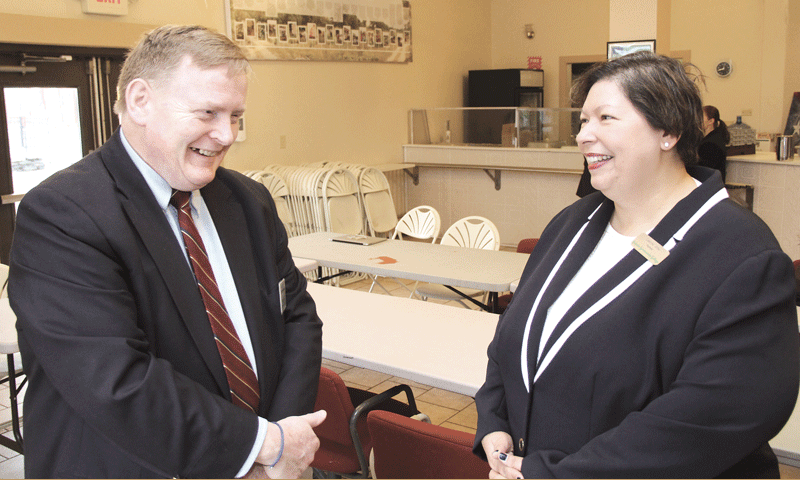
Jeff Hayden, seen here with new HCC President Christina Royal

Jeff Hayden, seen here with new HCC President Christina Royal, says community colleges provide a vital pathway to an education, especially for first-generation college students.

With that, Hayden effectively and somewhat concisely explained why the four community colleges serving residents of Western Mass. — HCC, Berkshire Community College (BCC), Greenfield Community College (GCC), and Springfield Technical Community College (STCC) — have been chosen collectively as Difference Makers for 2017.

Through use of those phrases ‘the power of the four institutions’ and ‘thousands of stories,’ he hit upon the real and profound impact of the four schools, which have been making a difference now for almost 60 years in some cases.

Echoing Hayden, Bob Pura, president of GCC, said the community colleges act as both a door of opportunity, especially for those who don’t have many open to them, and a pathway to both careers and four-year degrees at other schools.

And GCC is a perfect example. It is the only institution of higher learning in Franklin County, the poorest and most rural in the state, said Pura, while stressing that point about access to an education, and it has one of the highest rates of transfer to four-year schools among the state’s 15 community colleges.

“I don’t think there is a region in this state better served by community colleges,” said Pura, who stressed the plural and saw the six other people gathered around the table in a classroom at HCC’s Kittredge Center nod their heads in agreement. “We’re the pathway for the infrastructure in our community; the socioeconomic futures of our communities pass through the doors of our collective colleges.”

By ‘better served,’ Pura meant work beyond the schools’ historic mission of providing potentially life-altering opportunities to their students. Indeed, they are also playing important roles in a host of ongoing economic-development initiatives across Western Mass.
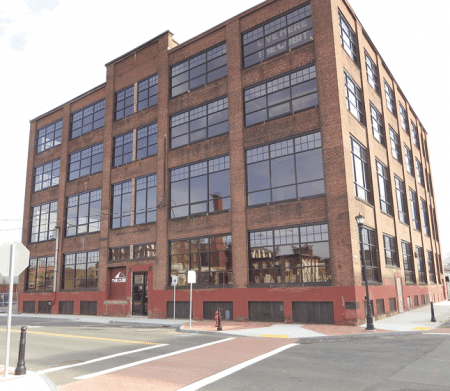
HCC’s involvement in the Cubit building project

HCC’s involvement in the Cubit building project in downtown Holyoke is just one example of how community colleges have become forces in economic-development efforts.

In fact, if one were to name a key issue or specific program, one will likely find one of the community colleges involved with it at one level or another.

Start with the region’s workforce. The schools are the proverbial tip of the spear in initiatives ranging from the retraining of manufacturing workers displaced by the decline of that sector to preparing individuals for the myriad jobs in the broad healthcare field that will have to be filled in the years to come; from training area residents for many of the 3,000 or so jobs to be created by the MGM Springfield casino to providing specific help with closing the so-called skills gap now plaguing all sectors of the economy and virtually every business, a problem addressed mostly through a program called TWO, as we’ll see later.

But there are other examples, as well, from STCC’s work to help precision manufacturers build a steady pipeline of talent to BCC’s involvement with efforts to create new opportunities for jobs and vibrancy at the sprawling former General Electric complex in Pittsfield, to HCC’s decision to move its culinary arts program into a mostly vacant former mill building in downtown Holyoke, thus providing the needed anchor for its revitalization.

All of these examples and many more help explain why the region’s community colleges — individually, but especially as a group — are true Difference Makers.

Schools of Thought

Community colleges, formerly known in some states as junior colleges, can trace their history back to 1901 (Joliet Junior College in Illinois is generally considered to be the first).

There are now nearly 1,200 of them enrolling close to 8 million people. They come in all shapes and sizes, some with just a few hundred students and others with enrollment in the tens of thousands.

In the Bay State, community colleges can trace their roots to 1958, when an audit of state needs recommended the establishment of a community-college system to address the need for more diversity and access to higher education in the Commonwealth, which, then as now, has been dominated by a wealth of prestigious (and expensive) private colleges and universities.

The reality is that the mission of a community college — to provide access to excellent education for the local community — is what we do, and we do it in sometimes unique ways. But what we also do is recognize the fact that there are times when shaking the hand and working together is far more effective than trying to go out on our own.”


The recommendation was adopted by the Legislature in August of that year, and the accompanying legislation included formation of the Board of Regional Community Colleges, which established nine of the current 15 schools within a five-year period, starting with BCC in 1960.

“We were the first one,” said Ellen Kennedy, president of that Pittsfield-based institution, with a discernable note of pride in her voice, while acknowledging that what is now HCC has a longer history, because that school began as Holyoke Junior College, which opened in 1946.

GCC opened its doors in 1962, and STCC, housed in the historic Springfield Armory complex, which was decommissioned in the mid-’60s, opened amid some controversy — HCC is only eight miles away as the crow flies, and many thought there wasn’t a need for two community colleges that close together — in the fall of 1967.

Today, community colleges in Massachusetts and across the country face a number of common challenges, including smaller high-school graduating classes, which are impacting enrollment; funding levels that are imperiled by dips in the economy and devastated by serious recessions, such as the one that began nearly a decade ago; and graduation rates that are impacted by the many burdens faced by the community-college constituency — everything from finances to life issues (jobs and family) to even transportation.

But overall, community colleges are seeing a surge of sorts. Indeed, amid the soaring costs of a college education and the ever-rising amounts of debt students are being saddled with, the two-year schools are being seen by many as a practical option to at least begin one’s education.

Meanwhile, host cities and regions are becoming more cognizant of their ability to help provide solutions to workforce and other economic-development-related issues and problems.

This is especially true in Western Mass., where many gateway cities, including Springfield, Holyoke, and Pittsfield, are facing stern challenges as they attempt to reinvent themselves and move on from their collective past as industrial centers, and regions (especially Franklin County) face spiraling unemployment, aging populations, and outmigration of young people.

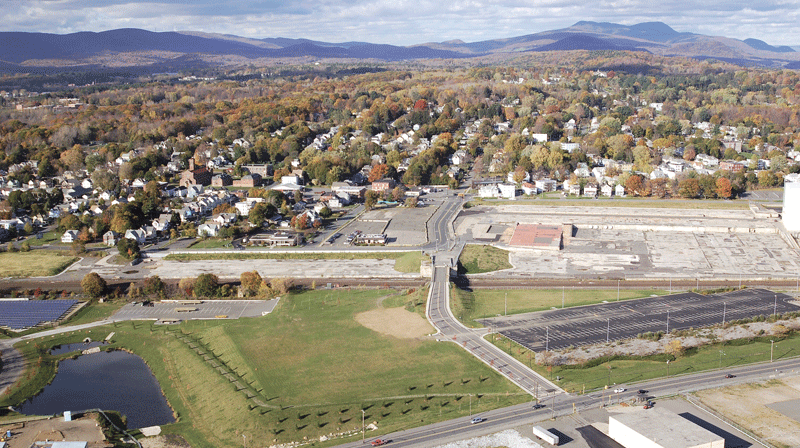
ge-pittsfield-aerial-1946

BCC’s efforts to develop new opportunities for the former GE complex

BCC’s efforts to develop new opportunities for the former GE complex in Pittsfield (in its heyday, above, and today) is another example of community colleges becoming involved in economic-development initiatives.

But at their very core, community colleges are still all about access — that open door that Pura mentioned. They all have what’s known as open admission, meaning anyone who has a high-school diploma or GED must be admitted. But while getting in isn’t a problem, staying in, and hanging in until a diploma or certificate is earned, can be, and often is.

Thus, increasingly, schools have been focusing on that broad, multi-faceted assignment of helping students succeed — with whatever it is they are trying to succeed at.

There are many elements that go into this equation, said those we spoke with, from programs focused on basics, including language skills, to new degree and certificate programs to meet specific industry needs, to a host of partnerships with area four-year schools that include not only articulation agreements but efforts to bring those schools’ programs onto the community-college campuses to help those facing time and transportation issues.

Meeting this role, this mission, makes the community colleges unique in the pantheon of higher education, and even public higher education. It is a niche, if you will, or, for many, including those we spoke with, a career path they’ve chosen for any of several reasons, but often because they can relate to the students in their charge.

Such is the case with Christina Royal, the recently named president of HCC, who is so new to the role she chose to let others, like Hayden, speak about the school’s history and specific current projects while she got fully up to speed.

But in a candid interview with BusinessWest upon her arrival, she said that, when she went to Marist College, a private liberal-arts school in Poughkeepsie, N.Y., she was the first in her family to attend college, and it was a struggle for the family to send her there.

So she understands what community-college students are up against, and chose that constituency, if you will, as the one she wanted to serve.

“The experience of community colleges — dealing with a lot of first-generation college students who don’t always understand the value of what they’re doing and also how to navigate it to be successful — these are things I can relate to from my own background,” she said. “And I think that has created a connection with the community colleges for me and helps me understand the students we serve. I’ve found a home in the community-college system.”
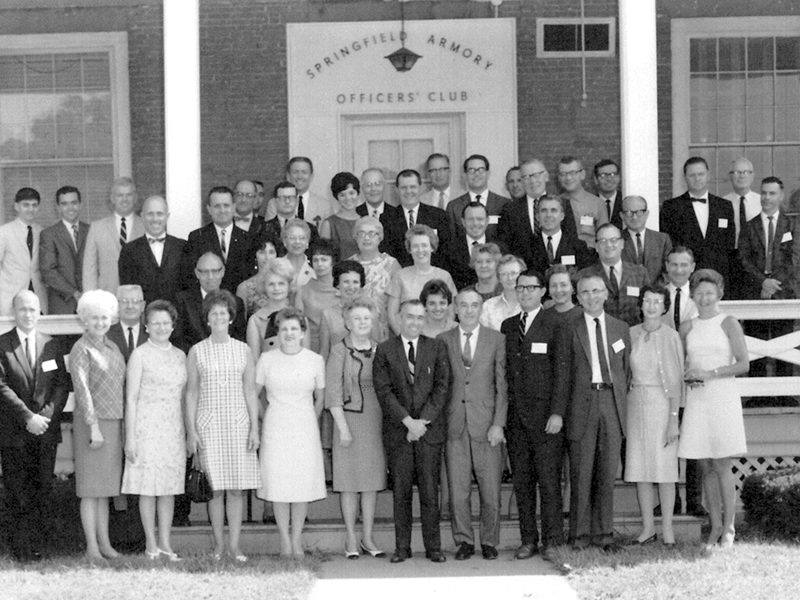
The original faculty and staff at STCC

The original faculty and staff at STCC pose in front of the old officers’ quarters at the Springfield Armory. The school was created in 1967 to focus on preparing students for careers in technology-related fields.

John Cook, who succeeded Ira Rubenzahl as president of STCC last summer, is similarly attracted to the community-college mission and unique role.

Formerly the vice president of Academic Affairs at Manchester (N.H.) Community College, he cast a wide net when seeking opportunities to lead a school, but was specifically focused on community colleges, which, he said, have a direct role in serving their communities (hence that middle name for all these institutions) and their residents, not employers across the country or halfway around the world, as the major private institutions do.

Pura agreed. “The students who come to our colleges are those who stay here,” he explained. “They’re the ones who will run the ice cream shop and the small nonprofit, and they’re going to be part of the leadership for our hospitals.”

The Jobs at Hand

Beyond providing access and pathways to opportunities, however, the region’s community colleges have become increasingly larger role players in area workforce and other economic-development-related initiatives.

Such roles are natural, said Cook, noting that the schools pride themselves on being nimble, responsive, and, overall, good listeners when it comes to the community — including the business community — expressing specific concerns and needs.

And while such programs solve problems for businesses, the communities they’re based in, and the region as a whole, said Bill Fogarty, HCC’s vice president for Administration and Finance, who served as interim president until Royal arrived, they also benefit individuals who may or may not have a job, but instead need a career.

“All of our capital investments, whether it’s the new Center for Health Education or the Cubit Building and the culinary center, or any of the others, have been geared toward getting people in the door,” he explained, “and getting them a basic type of credential they can use, and then providing pathways so they can further their education.”

Examples of economic-development-related initiatives that are also creating opportunities for individuals abound, and we’ll start with BCC, which has been active in efforts to help that region move past the huge shadow left by GE and other elements of a manufacturing-based economy, said Bill Mulholland.

He recently retired after a lengthy career at BCC, most recently as vice president of Community Education and Workforce Development, a title that speaks volumes about the work he was involved with in recent years. And as he started talking about that work, he referenced a Berkshire Eagle headline — “High-paying Jobs Going Unfilled” — from January 1998.

Upon reading it, he called Pura and invited him to lunch, at which there was broad discussion that eventually led to creation of something called the Berkshire Applied Technology Council.

“This is an industry-driven organization focused on workforce development,” Mulholland explained. “As we got all the companies together, we said, ‘what are your biggest needs?’ And when we boiled it all down, the commonality was basic math, writing, all of the basic skills.”

That’s where organizers started with a program that would be called (here comes that word again) Pathways, he went on, adding that the initiative effectively checks many of the boxes community colleges are trying to check, including direct involvement with businesses, providing individuals with the basic skills needed to contend for jobs and careers, working in collaboration with other community colleges and other partners, and creating progress with efforts to keep young people from migrating out of the region.

Another very specific example is the college’s involvement in the work to create an advanced manufacturing facility (the Berkshire Innovation Center) that will become the centerpiece of the William Stanley Business Park, created on the former GE site. Specifically, the school is developing training programs for individuals that will be employed by companies based there.

“What’s significant about this, for us and for the Commonwealth, is that we’re reinventing our manufacturing,” he said. “It’s about high-technology capabilities; so many of the original equipment manufacturers are outsourcing up to 70% to small and mid-sized enterprises because we’re quick, we’re nimble, and we innovate. That’s the focus of the innovation center, and it’s more about the human capital now than it is about the equipment, although that’s important as well.”

Human capital, and creating more of it, is at the heart of many BCC initiatives, he went on, adding that the school is also involved with efforts to bolster the creative economy that is becoming a force across Berkshire County and especially a revitalized Pittsfield, as well as the tourism industry that has always been a pillar.

As examples, he cited a filmmaking course designed to help provide trained individuals for the many film companies and special-effects houses that now call that region home, and also a special customer-service course for those seeking to enter the hospitality industry.

Manufacturing Momentum

Meanwhile, at GCC, manufacturing is also a prime focus, said Pura, adding that the region has lost a number of large employers in this sector over the past several decades and is intent on both retaining the companies that remain and attracting new ones.

To this end, a manufacturing collaborative was formed involving the college, employers such as Yankee Candle and Valley Steel Stamp, the Regional Employment Board, career centers, and area high school.

“What became clear was that we needed to invest in our infrastructure; facilities were very antiquated,” said Alyce Stile, dean of Workforce Development and Community Education (same title as Mulholland) at GCC, adding that, with $250,000 in seed money from many of the employers and grant money attained as a result of that investment, Franklin County Technical School has been transformed into a state-of-the-art facility.

With that foundation, GCC was able to start its first adult-education evening program — one firmly focused on the basics — with the help of considerable feedback from STCC, BCC, and other partners.

No, the region’s community college presidents have not been reassigned

No, the region’s community college presidents have not been reassigned. They’re merely using some artistic license to display a pattern of cooperation and collaboration that is only growing.

To date, more than 100 students have gone through the program, said Stiles, with the even better news being an employment rate of more than 80%.

Other recent initiatives have included a nursing ladder program designed to put more individuals in that important pipeline, and also a comprehensive study of just what area employees want and need from the workers of today and tomorrow. The results were not exactly surprising, but they were enlightening.

“Employers made it clear that what’s needed are the communication skills, the ability to critically think through and problem-solve in an innovative way, and the ability to work well with other people,” he explained, adding that a panel comprised of area employers ranging from Herrell’s Ice Cream to Baystate Franklin Medical Center recently emphasized these needs and discussed the next critical step — programming to help ensure workers possess these skills.

In Hampden County, meanwhile, initiatives involving the two community colleges there have generated considerably more press, and, like those in the other regions, have involved high levels of collaboration between the schools and a wide variety of other partners.

At the top of the list, perhaps, is TWO (Training and Workforce Options), a joint effort between STCC and HCC that provides custom contract training for area businesses and industry-sector collaborations.

To date, TWO has created training programs for call centers and customer-service workers, manufacturing production technicians, hospitality and culinary positions, home-health-aide workers, and healthcare-sector employees who need to become versed in the recently introduced medical coding system known as ICD-10, among others.

Another collaborative effort, this one involving all the community colleges, is the Mass. Casino Careers Training Institute, which, as that name suggests, is designed to help area residents become qualified for many of the positions that MGM Springfield — or any of the other casinos to open in the Commonwealth — will need to fill.

Other specific examples range from STCC’s involvement with CRRC, the Chinese company that will soon be building subway cars in Springfield’s East End, to secure a trained workforce, to HCC’s investment in Holyoke’s Innovation District through the Cubit project.

Degrees of Progress

As the presidents of the region’s four community colleges posed for some photographs for this piece, they each gathered up their respective school’s pennant, in a colorful, pride-nurturing exercise in effective identification.

Then, as a bit of fun, Pura had them shuffle the deck, if you will. This drill yielded some laughs and intriguing facial expressions, but also some symbolism if one chooses to look for it and accept it.

Indeed, while the schools remain immensely proud of their histories and track records for excellence, and do compete on a number of levels — for students, in some cases, and on all sorts of playing fields, especially — they also collaborate, and in ways that are often changing the local landscape.

It wasn’t always this way, especially when it came to HCC and STCC, mostly because of their proximity to one another and often-overlapping programs. But this spirit is certainly in evidence now, and the obvious reason is that the schools have realized that they can do more for the region by working together than by trying to do it alone, often with parallel initiatives.

“The reality is that the mission of a community college — to provide access to excellent education for the local community — is what we do, and we do it in sometimes unique ways,” said Hayden. “But what we also do is recognize the fact that there are times when shaking the hand and working together is far more effective than trying to go out on our own.”

Maybe the best example of both sides of this equation is the TWO program. Prior to its formation, the schools went about trying to forge skills-gap solutions themselves, and would often “bump into each other,” as he put it.

“It was not uncommon for a business owner to say, ‘Jeff, you’re here … but the guy from STCC was here last week,’ or vice versa,” he explained. “What we’ve recognized through some of these partnerships is that we need to work together; it’s better for the customer, it’s better for the student, and it’s better for the business.”

The effectiveness of that particular collaboration caught the attention of the Boston Foundation, which awarded the two schools the inaugural Deval Patrick Award for Community Colleges in 2015 (it came with a $50,000 unrestricted grant that they split), and in many ways it serves as an example of what other schools can do together — if they are so inclined.

The Mass. Casino Careers Training Institute, which will train workers for MGM Springfield

The Mass. Casino Careers Training Institute, which will train workers for MGM Springfield (see here in this rendering) and other casinos, is another workforce initiative involving the region’s community colleges.

“In the Boston market, they’re still really trying to figure out how to put such partnerships in place,” Hayden went on. “We talk about how we’re eight miles away from STCC or 21 miles away from Greenfield or 58 miles or whatever it is from Berkshire, but in Boston, you have four community colleges that could almost throw rocks at one another, and they can learn from this.

“The establishment of that kind of collaboration was more common sense than anything else,” he went on. “Why duplicate efforts? Why waste resources? Why not work together?”

There are countless other examples of this mindset, said Mulholland, who cited BCC’s addition of a medical-coding program.

“Our local health system said, ‘we’re going to ICD-10 — we need help here,’” he recalled. “We picked up the phone and called STCC, and we had the curriculum in no time. We were able to put it in and met the system’s needs in ways we never could have without partnering like that.”

Such partnering continues on many levels, and the schools are constantly looking for new ways to forge collaborations, said Cook, adding that he was calling and texting Royal within days of her arrival on Jan. 9 to initiate such discussions and continue a legacy of cooperation that has been handed down to the two of them.
“We have an obligation to do well by that tradition of cooperation,” he said. “It’s good for our schools, and it’s good for this region.”

Course of Action

Hayden said he doesn’t make a habit of it, but once in a while he will allow himself to think about what it would be like if HCC did not exist in that city.

It’s a whimsical exercise, but a nonetheless important one, he said, adding that, while some schools provide jobs, vibrancy, and a boost to service-related businesses in the city or town they call home, community colleges have an impact that runs much deeper. And it goes back to those words he and others would use early and quite often — ‘door’ and ‘pathway.’

Pura agreed, and to further the point, he summoned a comment he attributes to Allen Davis, former director of GCC’s foundation, and one he relates often.

“He said, ‘if Amherst College were to close, those students would find somewhere else to go; if GCC were to close, it would devastate this community,’” noted Pura. “And I think you can say that about all four of our institutions; if you were to close any of them, students would come to dead ends.”

The community colleges have instead made it their mission to provide inroads to better lives. And their success with that mission makes them more than worthy of the title of Difference Maker.

George O’Brien can be reached at [email protected]

Features

Man of the People

Senate President Stan Rosenberg

Senate President Stan Rosenberg

Massachusetts Senate President Stan Rosenberg — one of the few legislators from Western Mass. who have held that position — began his career as an aide to then-Sen. John Olver, and has served as Olver’s successor for the past 26 years. During that time, he has worked on myriad issues important to his constituents, from education funding to energy policy; from labor matters to mass transit. The common threads, he said, are the importance of continually making investments in the state’s future, and his philosophy of government as a ‘helping profession.’

A leader in the Massachusetts State House with deep roots in Hampshire County. Passionate about issues ranging from wage equity to expanding rail service across the Commonwealth. Known for his lengthy career as a legislator, including election in ’15 as president of the Massachusetts Senate.

Meet Calvin Coolidge, the 30th president of the United States.

Or, alternately, current state Senate President Stan Rosenberg, considering how remarkably those careers intersect, a century apart.

“He was a Republican, but he was quite a progressive in some ways,” Rosenberg, a Democrat, said of someone he counts as a role model; in fact, when he gives State House tours, he always brings visitors to see Coolidge’s desk, which has a home in his suite of offices. “He was involved in the minimum wage, he was involved in rail — his goal was to get rail everywhere in Massachusetts. Then the automobile interrupted the progress they’d made, and the rail system started to diminish while highways expanded.

“Well, guess what?” he went on. “It’s 100 years later, and we’re still working on the same problems. We’re still talking about pay equity. We’re still talking about rail.”

For Rosenberg, 67, whose career as a state legislator stretches back to 1986, transportation issues are matters of access and opportunity for state residents, a concept he would return to several times during his recent talk with BusinessWest.

Sen. Stan Rosenberg arrived at the State House

Sen. Stan Rosenberg arrived at the State House as Sen. John Olver’s aide in 1980 and never left, succeeding Olver in 1991.

“These are 21st-century issues, whether we’re talking about transportation and connecting regions outside metro Boston, or talking about ensuring that everyone has access to higher education. Those are the kinds of issues where, if you don’t ensure availability statewide, then people’s economic opportunities get constrained.

“It isn’t just nice to have rail,” he went on, explaining that getting people back and forth to jobs means allowing them to work far from where they live, which helps fill up underused housing stock. Rosenberg was involved in efforts to secure $33 million to upgrade the Pan Am line from Connecticut to Vermont via Springfield and Northampton, as lawmakers continue to eye east-west rail service from Boston to the Pioneer Valley.

“The same with education,” he said. “If you don’t have access to quality education, you’re not going to line up with the jobs that are available. Even in the Pioneer Valley, we have vacant positions that don’t have people to fill them. The skills gap is a really big issue. The achievement gap is a big issue. We have 100,000 vacant jobs statewide, and 100,000 people looking, according to the unemployment numbers. We’ve got to match them up, and that means education, training, and retraining for opportunities.”

Two years ago, Rosenberg became the first senator hailing from Western Mass. elected president of that chamber since 1971, but he dismisses talk that his region’s issues are pushed to the side on Beacon Hill.

“There’s often a feeling about Western Mass. getting the short end of the stick, but all of the regions — north, south, and west — outside the metro Boston area have a similar feeling,” he said. “We’re not unique.”

One thing Western Mass. legislators have been adept at, he went on, is speaking with a unified voice to promote the region’s shared needs and hopefully impact policy.

“Our delegation in Western Mass. has been very nimble and adept at building coalitions to make sure, when there are opportunities, we have a seat at the table,” he said, citing a few examples, from the MGM casino opening in Springfield in 2018 — area legislators fought to ensure the region would win one of the projects — to ongoing life-sciences and research projects.

“The same thing with high-tech projects: the largest big-data center in the state is actually not in Boston; it’s in Holyoke,” he said of the Massachusetts Green High Performance Computing Center. “Having that center there is an enormous positive for the region.”

Rosenberg also touted the partnership between UMass Medical School and Baystate Health to bring a medical-school campus to Springfield later this year, forming a sort of medical-education and research triangle between Springfield, Worcester, and Amherst.

“We keep finding opportunities to develop things that are uniquely ours while also making sure we are not left out of the discussion when planning statewide initiatives, so the Pioneer Valley gets to be the beneficiary.”

Calvin Coolidge would undoubtedly be proud. But there’s far more to Rosenberg’s personal story and career.

Through the Ranks

Raised in foster care, Rosenberg graduated from Revere High School in 1967 before attending UMass Amherst, and embracing the region he would come to represent in Boston.

“I went to school part-time and worked full-time at UMass because of my financial situation in the late ’60s and early ’70s,” he told BusinessWest. “While attending UMass, he founded and headed the Arts Extension Service and then became director of Community Development and Human Service Programs in the Division of Continuing Education.

“As a result, I started to make a lot of connections with people and became politically engaged,” he explained. In 1980, then-state Sen. John Olver asked if he was interested in working in Boston as his aide. “I left my job on a Friday, and on Monday arrived at the State House for my first day of work.”


All across the country, we’re seeing declining state appropriations and higher education driving up student charges, driving up student debt. And when graduates get into the economy, they have no disposable income, so it’s harder to stay in state.”


Rosenberg went on to serve as executive director of the state Democratic party from 1983 to 1985, and as the district director for U.S. Rep. Chester Atkins from 1985 to 1986. He then sought and won a seat on the Massachusetts House of Representatives in 1986, representing Amherst and Pelham. In 1991, he won a special election for the state Senate seat being vacated by Olver, a role he has maintained for 26 years, representing 25 communities, mainly in Hampshire and Franklin counties.

While in the Senate, he has served as chair of the Election Laws Committee, the Banking Committee, and the Senate Ways and Means Committee, followed by assistant majority leader from 1999 to 2002 and Senate president pro tempore from 2003 to 2013. He was appointed Senate majority leader in 2013 and Senate president at the start of 2015.

The issues he cared about early on aren’t much different than what he prioritizes now, and reflected the mindset of his district. His interest in higher education dovetailed with the fact that the state’s flagship university is located in Amherst. With many environmentally minded residents in his district, he worked on recycling and the greenhouse-gas issue, now commonly known as climate change. And with the closings of Northampton State Hospital and Belchertown State School, social services to help people in need became a main concern as well.

“You can’t live in the Pioneer Valley without thinking about economic development, but also social justice,” said Rosenberg, who has had a personal stake in some of those issues, notably the Bay State’s first-in-the-union legalization of gay marriage a decade ago, a law he and his husband, Bryon Hefner, availed themselves of last year. “In representing that constituency, you’ve got to be prepared to work in both of those areas.”

He recognizes that businesses have concerns about employment regulations that favor workers, such as minimum-wage laws, equal-pay rules, and family-leave advances, but believes that, given enough time to adapt, companies always do. As one example, provisions of the equal-pay law passed last summer, aiming to ensure women are paid equally with men for equivalent work, don’t take effect until the summer of 2018.

“If a business or agency has time to adapt, it is clearly understood in the public-policy realm that you’ll have a very modest impact when you raise the minimum wage, for example. It may be different for individual businesses, but for the economy as a whole, there’s a very minor impact — and it’s even better when there’s warning and you can plan for it.”

Ideally, he said, the public and private sector works together for mutual benefit, as seen in the 2006 health-insurance law that provided tax credits and tools through the Health Connector to help employers ensure their employees were covered in an affordable way. “Not that there won’t be some pain in that or some dislocation in some situations, but by working together, we can minimize that pain.”

Creating a culture where the workforce has access to affordable healthcare, family leave, and other work-life benefits is critical, Rosenberg said, to retaining top talent in the state. “We have a knowledge-driven economy, and we want people to settle here, to locate their businesses here. By doing these things, we are making a difference.”

He noted that Massachusetts was among the first states, more than a century ago, to establish a minimum-wage law. “We were one of the innovators, and now it’s national practice. We have the third-highest per-capita income in the country, and by most measures, the balance between the strength of the economy and quality of life here is extremely strong.”

Providing that quality of life takes public investment, he insists, and public education is a good example. As a co-chair on the Senate Task Force on Public Higher Education and the Public Higher Education Caucus, he advocated for higher state appropriations for colleges, while holding institutions accountable for how they spend the money.

“All across the country, we’re seeing declining state appropriations and higher education driving up student charges, driving up student debt,” he said. “And when graduates get into the economy, they have no disposable income, so it’s harder to stay in state. If they don’t have disposable income, if it’s all going to pay rent and student debt, they don’t have money to go out and buy things. That hurts small businesses in particular.”

Again, it’s that concept, one of the defining ones in today’s Democratic party, that public investment benefits everyone, but Rosenberg doesn’t simply want to issue legislation from on high (well, high on Beacon Hill, anyway); he wants to engage constituents on what matters to them.

“You have to have a robust and open process for people to engage with you,” he told BusinessWest, “so they have a seat at the table and a voice in discussions that are going to affect them.”

Out and About

Rosenberg noted that each of the state’s 40 senators chairs a committee or acts in some other leadership position, and in the past two years, they have been working to “transform the organization” according to best practices of shared responsibility, shared leadership, teamwork, and engagement with constituents to identify solutions to key issues.

“We’re less hierarchical in the Senate than we used to be,” he noted. “Members are much more engaged at every level, and we’re trying to expand transparency within the body and engagement with the public.”

One concrete strategy for doing the latter is a practice known as Commonwealth Conversations. That project divides the state into nine regions, each with their own specific needs and priorities. Groups of senators spend a day in each region talking to constituents about projects they want to see accomplished, but also the community values they hold.

“We hear similarities of concern, but also differences,” he said. “Boston isn’t the Pioneer Valley, and Pittsfield isn’t Springfield, for that matter.”

Sen. Stan Rosenberg says transportation, education, and labor matters aren’t just political issues

Sen. Stan Rosenberg says transportation, education, and labor matters aren’t just political issues; they’re access points to a better quality of life for Massachusetts residents.

The idea, he explained, is to develop statewide policy that can be adapted for regional differences, such as meeting skills gaps that differ throughout the Commonwealth.

“For example, we’ve been rebuilding the machining industry sector in Western Mass. Not that it’s not going on elsewhere, but it’s a big priority in our area,” he said, noting initiatives from the Middle Skills Manufacturing Initiative to train manufacturing workers in Franklin County to efforts to attract the Chinese rail-car manufacturing giant CRRC to Springfield. “The pieces all seem disparate, but they’re all connected.”

Even though a heavily Democratic Legislature and a Republican governor in Charlie Baker make for divided government in the technical sense, those officials maintain strong working relationships, Rosenberg said, noting that he meets with Baker, the House speaker, the Ways and Means chair, and the minority leaders every Monday afternoon — the location rotates between their offices — to talk about current issues before the Legislature.

“Even if we don’t have a specific agenda, we always talk about the common ground we have to build solutions to the problems of the day. Those meetings reach back to Bill Weld, Billy Bulger, and Charles Flaherty, and that tradition has been maintained whether we have a unified or divided government. It really makes a difference when you’re communicating.”

There are issues that rankle one side or the other, of course, and the divisions between Democrat-dominated Massachusetts and the national arena will only grow following the improbable rise of President Trump, who seems poised to lead with the same bluster and scattershot style that proved a winner on the campaign trail — only, with the ability to do actual damage to policies progressives value, beginning with the Affordable Care Act.

“We have to be mindful of a lot of change coming out of Washington,” Rosenberg said. “I’m worried about what’s happening on the health-insurance front. We had a universal plan that was working and got disrupted by the federal plan, but we adapted. The administration signed a $53 million, five-year plan for health transformation in Massachusetts. Now, the question is, will the administration honor that commitment, or will they make so many changes in the universal federal health program that it disrupts the state program again?”

Other shifting priorities in Washington could cause disruption in the Bay State as well. When it comes to climate change, for example, Massachusetts, as a coastal state, is trying to plan for the future, including possible coastline impacts, in a “balanced but aggressive way,” the Senate president said. “Whether or not they upturn federal policies might have an impact on state policies.”

Then there’s marijuana, which is legal for medical use in 28 states and for recreational enjoyment in eight; both apply in Massachusetts. Although using the drug continues to violate federal law, President Obama’s administration took a hands-off policy when the will of the states went their own way.

“If Mr. [Jeff] Sessions is appointed attorney general, will he stick to the policies of the Obama administration, where, if it’s heavily regulated and you follow those regulations, we’ll leave you alone?” Rosenberg asked. “Or will Mr. Sessions follow federal law and say, ‘I don’t care if your voters voted for it; you can’t do it anymore’? If they do come in and start enforcing it, that could be a pretty big deal.”

Helping Profession

It’s clear that legislative matters of all kinds, and the way they impact people’s lives, are a big deal to Stan Rosenberg.

When asked what gratifies him most, though, he returned again to the work he and his colleagues are doing to, as he called it, “transform the Senate as an institution.”

After all, he told BusinessWest, it’s very easy for malaise to set in within legislative bodies. “What we’re doing in the Senate has empowered our members, and that empowerment has excited them, and that excitement leads to an enormous amount of energy around trying to produce quality legislation that moves our communities forward.

“This is a helping profession,” he went on. “Every day, you get phone calls and meetings that challenge your thinking and keep you on the cutting edge of life. Every day you find opportunities to help one person, one business, one institution, one community.”

He likens those opportunities to winning a bit of money on a scratch ticket. “And every so often, it’s like winning the lottery when you pass a big piece of legislation that affects the future of the whole Commonwealth.”

Calvin Coolidge certainly made his mark — eventually, well beyond the borders of the Bay State. For now, Rosenberg is happy to keep making a difference for his constituents at home.

“Every day, you’re presented with opportunities to be helpful,” he said. “That keeps me going.”

Joseph Bednar can be reached at [email protected]

Education Sections

Course of Action

Julia Chevan (right) leads Associate Professor of Physical Therapy Angela Abeyta Campbell

Julia Chevan (right) leads Associate Professor of Physical Therapy Angela Abeyta Campbell through an exercise in the simulation lab at Springfield College.

Many students work hard to earn a college degree, then find there are no jobs that match their credentials.

But the demand for people to work in healthcare settings continues to rise, and high-school graduates or individuals seeking a career change are likely to be hired quickly after graduating from a certificate or degree program in any of several fields.

“Each year, we graduate 125 to 150 students from our healthcare programs, and they walk into jobs within months of passing their exams,” said Julia Chevan, dean of Springfield College School of Health Sciences and Rehabilitation Studies. “In the past three years, our placement rate has been 100%.”

Christopher Scott told the BusinessWest that students in all 75 of the healthcare programs at Springfield Technical Community College are in great demand, and their placement rate is also high. “The lowest figure is 90%; we have close to a 99% placement rate for nursing, and 100% for medical stenography,” said the dean of the college’s School of Health and Patient Simulation.

These numbers bear out what is happening on the job front both regionally and nationally, and what is expected in the years to come.

Indeed, the Bureau of Labor Statistics estimates there will be 2.3 million new jobs in healthcare occupations by 2024. Growth in the field is much faster than the average for all other occupations, and the types of jobs available are almost unlimited.

Several things account for the demand: more people have insurance, and due to advances in medicine, adults are living longer.

“Baby Boomers are getting older, people are having fewer children, and there are not enough young people to care for the aging population,” said Holly Martin-Peele, interim dean of Health Sciences at Holyoke Community College (HCC), adding that there will always be people who get sick and need healthcare.

Elizabeth Hayward-Jansen agreed. “Many students come here with tunnel vision: they tell us they want to become a nurse because it’s a job they know about. There is certainly a demand for nurses, but we try to educate them about other options: there are literally more than 200 allied health careers,” said the professor in HCC’s Foundations of Health program.

Officials from area colleges are doing all they can to prepare students for fulfilling careers in these fields, which includes working with community partners that include Baystate Health and Mercy Medical Center, which is part of the Sisters of Providence Health System.

They have created new degree and certificate programs in response to demand, and some offer options such as hybrid schooling, which is done mostly online and only requires students to be in the classroom for a limited number of sessions.

Christopher Scott and Karolyn Ryan

Christopher Scott and Karolyn Ryan say STCC offers students a 10-month and associate-degree program for students who want to become a medical assistant.

Officials at STCC report that one of the fastest-growing fields is medical assisting. “There is a tremendous demand, and Baystate calls us all the time looking for graduates,” said Karolyn Ryan, chair of the Medical Assistant Department at STCC.

The school offers a two-year degree program as well as a Pathways certificate program that can be completed in one year. Entry-level pay is $14 per hour or about $30,000 annually, and most graduates are hired as soon as they complete their studies.

“These programs also prepare them to go into other fields,” Ryan said, explaining that graduates with an associate degree often end up as office or clinic practice managers or in leadership roles because there are two prongs to the program: clinical skills, and administrative skills, such as billing and coding.

Students in both programs take the same classes for the first 10 months. At that point, they become eligible to take the certification exam, and some start working immediately, while others continue their schooling and complete the requirements needed for an associate degree.

“Many people find this career very rewarding because they can work in an administrative role, have the gratification that comes from helping people at tough times in their lives, or use it as a stepping stone to go on to other programs,” Ryan, said noting that many of their graduates have enrolled in respiratory therapy, nursing, or radiography programs.

The Commonwealth doesn’t require medical assistants to be certified, but due to changing insurance regulations, Ryan said, medical facilities cannot get reimbursed by insurers such as Medicare and Medicaid unless their nursing assistants are certified.

As a result, Baystate Health approached STCC two years ago and asked for help because the exam has to be taken within five years of graduation and many employees had passed that mark. The college responded by starting a program that prepared the working professionals to take the exam. More than 150 students took part, and the final class finished last summer.

Scott said STCC also hopes to start a medical-assistant program with evening classes and will work with its partners to find ways for students in them to fulfill internship requirements that are usually done during the day.

For this issue and its focus on employment, BusinessWest looks at several other college programs in the healthcare field, many of which have been developed, amended, or expanded in response to feedback from community partners.

Expanding Options

Dental hygiene is a popular associate-degree course at STCC, and Scott said it attracts a large number of applicants.

“We operate a clinic for the community and deliver dental care at a reduced cost; we’re trying to increase its size so we can accept more students,” he said, noting that students work in highly supervised settings.

The median wage for licensed dental hygienists is $70,000, although the Bureau of Labor Statistics reports salaries range from $60,000 to $98,000.

Radiology is another fast-growing field, and due to the demand for specialization, STCC will soon kick off two new, one-year certificate programs in MRI and CAT scans. Both will involve hybrid learning and will be open to radiologic technicians who have completed an associate-degree program.

“It will give them the opportunity to go into a specific area where they can work with the latest technology available,” Scott said.

Medical stenography is also popular but highly competitive; there are hundreds of applicants for the ten new spots at STCC each year.


A large number of nurses are retiring, and as graduates advance into specialty areas, there is a real need to backfill open positions.”


In addition, the demand for nurses is so great that the college added 20 openings to its program last year.

“A large number of nurses are retiring, and as graduates advance into specialty areas, there is a real need to backfill open positions,” Scott said, noting that STCC offers an associate-degree program and has articulation agreements with baccalaureate programs in the area, and its advisory boards spend a lot of time researching what the community needs.

“Our community partners ground us and drive our mission of educating students to provide community healthcare, and we adapt to address local needs,” he continued.

Specialized Study

Springfield College offers three graduate-degree programs that include a three-year doctorate program in physical therapy, a master’s degree in physician assistant studies, and a master’s degree in occupational therapy.

“The college also has a number of other programs in healthcare, including nutrition, athletic training, and clinical exercise physiology, and these three specifically address professions with an identified workforce shortage,” Chevan said.

She added that occupational therapy is attractive to adults who want to change careers due to its many rewards and the diverse settings where they are employed.

“Most people only think of three areas when they envision where occupational therapists work: in schools with children who have developmental issues, in outpatient clinics as a therapist, or at a rehabilitation hospital,” she said, explaining that many people don’t know their training includes behavioral health, which qualifies them to work with patients with psychological disorders. For example, they may be employed at a clinic and help people who have panic attacks or a brain injury, or who suffer from depression. Entry-level hourly pay averages $33.39, and in 2014 the median annual salary was $78,810.

“Their goal is to help the person manage the world independently in a way that has meaning to them,” Chevan said.

The physician assistant master of science degree is another popular option. The Bureau of Labor Statistics reports that such professionals are needed in a wide variety of settings, and the career is ranked as one of the fastest-growing areas in healthcare, with a median hourly wage of $47.20 and an average annual salary of $98,120.

“But there are no shortcuts to this degree, and admission is very competitive,” Chevan said, noting that it’s a 27-month, full-time program with seven semesters; students must maintain a 3.0 cumulative grade point average with at least a ‘B’ grades, and must have been employed in healthcare before they can apply for the program.

The college’s doctorate in physical therapy is a clinical degree, which Chevan noted is different than a Ph.D. or doctor of philosophy degree. She told BusinessWest that, although physical-therapy assistants can begin working in the field with an associate degree, only licensed physical therapists with a doctorate can manage a patient’s plan of care.

Students who choose to pursue their doctorate degree can enter an accelerated, three-year undergraduate program, or take the more traditional route that requires three additional years of schooling after earning a bachelor’s degree. Starting salaries for physical therapists with their doctoral degrees begin at about $86,000.

But participants in all of the healthcare programs at Springfield College work together in team settings to ensure they understand their role as part of an interprofessional team of providers and prepare them to collaborate with peers after they enter the workforce.

Chevan said Springfield College works hard to makes changes to programs that reflect what the nation, community, and local healthcare providers need.

For example, after the Institute of Medicine issued a report titled “To Err is Human: Building a Safer Health System,” outlining strategies to prevent accidents from occurring as a result of poor communication between people in the healthcare field, the college made adjustments to its curriculum that put more emphasis on team building, safety, and health simulation.

Unique Program

Holyoke Community College started a Foundations of Health (FOH) program in 2010 that introduces students to a wide variety of careers and includes two tracks; one leads to a certificate or an associate degree, while the other prepares students to transfer to a four-year college or university.

Laura Christoph, acting department chair for the program, says it was developed to meet the needs of local healthcare employers and help the 800 to 1,000 students at HCC who elect to enter the healthcare field each year.

“It’s especially important since most of them start out thinking they want to become nurses, and the college only admits a limited number of applicants each year,” she told BusinessWest.

However, students can begin this pathway by becoming certified as a nursing assistant, which requires completing a 15-week semester, then passing the state exam. Entry-level pay is about $12 per hour, which increases to $15 to $18 with experience, and the demand for people with this training continues is on the rise.

“We recently received a call from a local healthcare organization that wants to start an affiliation with us because they are having a problem attracting and retaining CNAs,” said Hayward-Jansen, explaining that they often get some experience in the workforce, then leave their jobs to continue their education.

However, there are many other career paths to choose from, and one of the first courses all FOH students take is titled “Introduction to Health Careers,” which introduces them to a variety of career choices. Other courses help students determine whether they want to work directly with patients or enter an administrative field, such as the college’s one-year course in medical coding and billing.

“Insurance-company regulations have become so complex that it’s vital for every physician’s office to have a well-trained billing practitioner,” Martin-Peele said, adding that the certificate is ideal for people who need to continue working, as most classes are held online or in the evenings.

However, Christoph noted that, although hybrid or online courses are becoming increasingly popular, some students prefer to be in a classroom, where they can interact with peers and learn directly from the instructor, so HCC does its best to offer students both options.

The school also responds to feedback from its partners. To that end, in 2014 it developed a direct care and community health certificate program.

Janet Grant, the community health worker certificate coordinator and Department of Labor grant manager, says it can be an especially good career choice for people who are bilingual, as these workers provide services that include helping non-English-speaking clients fill out forms and access healthcare, which can be difficult because of issues that range from transportation to language barriers.

Other job-related activities include client advocacy, health education, and health-system navigation to promote, support, and protect the health of individuals and families.

“Many urgent-care centers are starting to employ community healthcare workers,” said Grant, adding that the certificate program takes only a year to complete, and entry-level pay is $15 to $16 per hour.

It has become a popular offering, and students in the program often become certified, then continue their education because an associate degree in the field allows them to become a supervisor or middle manager, while a bachelor’s degree in an area such as public health opens up a wide range of opportunities.

But every student who enters the FOH program is assigned to an advisor who helps them decide what courses to take to meet their goals, and Hayward-Jansen has helped many, whose choices have included public-health professionals, physical-activity therapists, occupational therapists, registered dieticians, or clinical nutritionists.

“These career paths are expanding,” she said, adding that the need for nutritionists and dieticians is increasing to help people with chronic conditions such as diabetes and heart disease.

Changing Landscape

This spring, HCC will launch a new paramedic program in collaboration with STCC, which is one example of how institutions of higher education work closely with each other and their partners to make needed changes to programs or start new ones.

Due to advances in medicine and the way healthcare is delivered, which includes a dramatic increase in walk-in clinics and urgent-care centers, the possibilities are seemingly endless.

It’s good news for people willing to spend valuable time, money, and energy seeking a healthcare certificate or degree because, in today’s world, graduates are almost guaranteed a job that will pay well, be rewarding, and yield untold benefits and opportunities for growth in years to come.

Court Dockets Departments

The following is a compilation of recent lawsuits involving area businesses and organizations. These are strictly allegations that have yet to be proven in a court of law. Readers are advised to contact the parties listed, or the court, for more information concerning the individual claims.

CHICOPEE DISTRICT COURT

Broadcast Music Inc. v. Patti’s Four-Ten Lounge LLC
Allegation: Unpaid monies for services provided: $2,485
Filed: 12/9/16

George Cruz v. Regency Management and Development Co. Inc.
Allegation: Slip and fall causing injury: $24,000
Filed: 12/15/16

HAMPDEN DISTRICT COURT

Maria Campos v. D & F Food Service Inc.
Allegation: Slip and fall causing injury: $24,000
Filed: 12/16/16

Luis Serrano v. Holyoke Mall Co. LP, Pyramid Management Group LLC, and Geeleher Enterprises Inc.
Allegation: Slip and fall causing injury: $24,999
Filed: 12/16/16

HAMPDEN SUPERIOR COURT

Jo-Anne Ferris v. Southwick-Tolland-Granville Regional School District, Stephen Presnal, and Kathleen Jorgensen
Allegation: Employment discrimination: $1 million 
Filed: 12/15/16

Mary Barcome and Mary-Zaida Lopez v. Anamisis LLC, Costas Anamisis, and Emanuel Anamisis
Allegation: Employment discrimination: $1.5 million
Filed: 12/15/16

Kayla Fontaine v. Anamisis LLC and Costas Anamisis
Allegation: Wage claims, including failure to pay minimum wage and failure to pay overtime: $1 million
Filed: 12/16/16

Paul Barkett v. Walgreens Family of Companies, Walgreen Eastern Co. Inc. and Walgreens of Massachusetts, LLC
Allegation: Slip and fall causing injury: $131,301.30
Filed: 12/17/16

Paul and Lisa Forrette v. Cumberland Farms Inc., Servuite Services Inc., and Paul Truehart d/b/a Truehart Paving and Construction Services
Allegation: Slip and fall causing injury: $1,250,000
Filed: 12/19/16

HAMPSHIRE DISTRICT COURT

Center Redevelopment Corp. v. Daniel A. Champagne and Sherrie L. Champagne
Allegation: Breach of contract and failure to pay amounts due under commercial and residential leases: $14,085
Filed: 1/5/17

Thomas J. Tear and Joanne M. Tear v. Eco Roofing LLC
Allegation: Incorrectly installed roof: $7,959.38
Filed: 1/6/17

HAMPSHIRE SUPERIOR COURT

Lidia Lech v. Dorothea Von Goeler, Baystate Medical Center Inc., Maria Diaz, Hampden County Sheriff’s Department, Nicole Skorupski, Elizabeth Meaux, Julie Belle-Isle, Rosado Shantelle, Lynn Chase, Michael Ashe Jr., Patricia Murphy, John Doe 1 and 2
Allegation: Medical malpractice, infliction of emotional distress
Filed: 12/23/16

Joel J. Harder v. R & D Towing & Transport Inc. and Robert Bernier
Allegation: Negligence in operating a tow truck causing injury
Filed: 12/23/16

Joseph F. Dromboski v. Afterburner Inc. d/b/a Wings Over Amherst
Allegation: Motor-vehicle negligence causing injury: $23,032.19
Filed: 12/29/16

WESTFIELD DISTRICT COURT

Linda Marino v. IKO Industries Inc.
Allegation: Breach of implied warranty, negligent misrepresentation involving installation of shingles: $10,400
Filed: 12/19/16

Daily News

SPRINGFIELD — For the first time since the organization was founded in 2005, Dress for Success of Western Massachusetts will have a full-time executive director to lead the organization and expand its impact in the region.

Margaret Tantiallo brings more than 20 years of experience and proven success in nonprofit management. Her past employment includes a senior leadership position for a nonprofit organization with more than 65,000 members and an $11 million budget. She is experienced in strategic planning, philanthropy, governance, board relations, and program management.

“We are beyond thrilled to welcome Margaret to the Dress for Success team,” said Dawn Creighton, president of the Dress for Success board of directors. “It’s amazing what has been accomplished by our team of volunteers over the years. In order for us to grow and positively impact the lives of more women in our community, we needed someone dedicated to work of the organization on a full-time basis. Margaret’s experience and caring, compassionate personality make her the perfect fit.”

Margaret earned her undergraduate degree from SUNY Buffalo and her master’s degree from Springfield College. She currently serves as vice president of Belchertown Day School and as treasurer of the Hampton Ponds Assoc.

Dress for Success of Western Massachusetts is on a mission to promote the economic independence of all women by providing professional attire, a network of support, and the career-development tools to help women thrive in work and in life.

Daily News

GREENFIELD — Dick Venne, president and CEO of Community Enterprises, announced the appointment of Paula Tessier as director of Employment and Training Programs at the Greenfield office. She will manage all aspects of those programs and implement the organization’s mission and values by overseeing community-based employment and training services for individuals with disabilities.

Previously in Boston, Tessier managed statewide community programs in youth violence and suicide prevention and also managed federal grants that refined protocols for the state Department of Public Health. She has a history of assisting Greenfield residents, as she was previously responsible for overseeing the coordination of five local, grass-roots, anti-poverty programs. She also managed the Woman in Action Center and the local Food Pantry sites while serving as the Community Programs director for Community Action of Franklin County.

Tessier earned her master’s degree in social work from the University of Connecticut and completed master studies in international and intercultural service, leadership, and management at the School of International Training in Brattleboro, Vt.

Daily News

SPRINGFIELD — Greentown Labs, a Somerville-based company that provides resources for clean-technology startups, recently announced plans to open an office at Springfield Technology Park.

The alliance between Springfield Technology Park and Greentown Labs will allow those developing prototypes in Eastern Mass. to link with the existing precision-manufacturing industry in Western Mass. to help in the manufacturing of new products. Greentown’s entrepreneurs are particularly focused on early-stage energy and clean-technology startup companies.

Greentown provides space and resources to early-stage companies, including a prototype lab, co-location space, and a shared machine shop and electronics shop, and hosts a range of clean-technology entrepreneurs and startups. Currently, Greentown Labs is home to more than 50 clean-tech startups developing prototypes in its shared lab and office space.

The new Greentown Labs location was made possible with funding from the Irene E. & George A. Davis Foundation along with assistance from the Massachusetts Clean Energy Center and MassDevelopment. Other partners include the Western Mass. Economic Development Council, the Regional Employment Board of Hampden County, and the Massachusetts Manufacturing Extension.

Future plans include the potential development of a Center for Advanced Manufacturing Excellence to be housed at the Technology Park, with the goal to support and grow the region’s precision-manufacturing sector.

Court Dockets Departments

The following is a compilation of recent lawsuits involving area businesses and organizations. These are strictly allegations that have yet to be proven in a court of law. Readers are advised to contact the parties listed, or the court, for more information concerning the individual claims.

Franklin Superior Court

Joan Connors and Sean Connors v. Claude Borowsky, Pioneer Spine & Sports Physicians, Erik S. Rhodes, Baystate Franklin Medical Center, Michael DeBusk, Baystate Medical Center, Christopher J. Ladner, Greenfield Radiology Associates, Stephen H. Fox, and Baystate Medical Practices
Allegation: Medical malpractice: $2,082,250
Filed: 12/9/16

Hampden District Court

Cheryl Roda v. Staples Inc.
Allegation: Negligence causing personal injury: $24,999
Filed: 11/30/16

Hampden Superior Court

Arlene Lizak v. Aspen Dental and Patrick Dermesropian, DDS
Allegation: Medical malpractice, wrongful death: $75,000
Filed: 12/1/16

Timothy J. Jansen Jr., personal representative of the estate of Patricia Ann DiCarlo v. Richard B. Wait, MD
Allegation: Medical malpractice, wrongful death
Filed: 12/5/16

Renia Copeland v. Alert Ambulance Service Inc.
Allegation: Negligence causing personal injury: $200,000
Filed: 12/7/16

Olga Rodriguez v. Mount Holyoke Management, LLC and Cathedral Hill Housing Corp.
Allegation: Personal injury: $43,299.03
Filed: 12/7/16

Mary D’Amato v. Beacon Communities, LLC and Treehouse Easthampton Housing, LLC
Allegation: Slip and fall causing personal injury: $57,886
Filed: 12/8/16

David Larivee v. Suffield Agawam CVS Inc.; Agawam CVS Realty, LLC; CVS Pharmacy Inc.; Caremark PHC, LLC; and Massachsetts CVS Pharmacy, LLC
Allegation: Negligence causing slip and fall resulting in personal injury: $300,000
Filed: 12/12/16

Hampshire Superior Court

Christian Donovan v. University of Massachusetts
Allegation: Plaintiff sustained serious injuries after falling from a ladder at UMass: $522,500
Filed: 12/2/16

Walter Otten a/k/a Walter Twohorses v. J.B. Hunt Transport Inc., C&S Wholesale Grocers Inc., and Phil Estevez
Allegation: Employment discrimination: $790,000
Filed: 12/8/12

David Brewer v. National Nonwoven Inc.
Allegation: Negligence causing personal injury: $13,240
Filed: 12/9/12

Daily News

BOSTON — Confidence among Massachusetts employers hit its highest level in 12 years during December amid the prospect of growth initiatives from the new administration in Washington and a continued strong state economy.

The Associated Industries of Massachusetts (AIM) Business Confidence Index (BCI) rose 2.3 points to 60.4 last month, a full 5.1 points higher than its level in December 2015 and the highest reading since December 2004. It marked the fourth consecutive monthly increase in sentiment among employers in the Commonwealth, where the unemployment rate recently fell to 2.9%.

The November and December BCI readings mirror the post-election rally in U.S. financial markets, which have risen 5% as President-elect Donald Trump prepares to work with a Republican Congress on business-friendly issues such as tax reductions, regulatory reform, and infrastructure spending. The AIM survey showed a 5.5-point jump in confidence in the national economy last month, leaving that indicator at its highest level since 2007.

“Massachusetts employers are taking the president-elect at his word that he will prioritize economic growth at the national level, especially if he is able to work with Congressional Democrats on a $1 trillion infrastructure initiative,” said Raymond Torto, chair of AIM’s Board of Economic Advisors (BEA) and lecturer at Harvard Graduate School of Design. “But employer enthusiasm is also based upon a solid economic expansion during 2016 that most analysts believe will continue in a methodical manner though the first half of 2017.”

The AIM Index, based on a survey of Massachusetts employers, has appeared monthly since July 1991. It is calculated on a 100-point scale, with 50 as neutral; a reading above 50 is positive, while below 50 is negative. The Index reached its historic high of 68.5 on two occasions in 1997-98, and its all-time low of 33.3 in February 2009. The index has remained above 50 since October 2013.

Almost all of the sub-indices based on selected questions or categories of employer were up in December. The Massachusetts Index, assessing business conditions within the Commonwealth, gained 2 points to 61.8, leaving it 5.5 points ahead of the same time last year.

The increase in the U.S. Index of national business conditions put that figure 7.5 points higher than its level of a year ago, but still short of the Massachusetts index. It marked the 80th consecutive month in which employers have been more optimistic about the Massachusetts economy than the national economy.

The Current Index, which assesses overall business conditions at the time of the survey, increased 2.2 points to 59.1, while the Future Index, measuring expectations for six months out, rose 2.5 points to 61.7. The future outlook was 5.5 points better than a year ago and higher than at any point since March 2015.

The sub-indices bearing on survey respondents’ own operations also strengthened considerably.

The Company Index, reflecting overall business conditions, rose 1.4 points to 60.9, while the Sales Index increased 3.2 points to 61.4. The Employment Index was the only indicator to lose ground, falling 0.2 points to 57.2.

The AIM survey found that nearly 38% of respondents reported adding staff during the past six months, while 19% reduced employment. Expectations for the next six months were stable, with 37% planning to hire and only 10% downsizing.

“One of the most positive results of the December survey is that business confidence is strengthening uniformly across almost every sector of the economy,” said Elliot Winer, chief economist at Winer Economic Consulting and a BEA member. “Employers both large and small, manufacturers and non-manufacturers, from the Pioneer Valley to Greater Boston, are more optimistic about their prospects than at any time since prior to the Great Recession.”

The BCI Manufacturing Index jumped 0.6 points during the month and 2.6 points for the year. The overall Business Confidence Index among non-manufacturers was 63.3 compared to 56.7 for manufacturing companies.

Companies in the eastern part of the Massachusetts were slightly more optimistic at 61.4 than those in the western part of the state at 57.6.

AIM President and CEO Richard Lord, also a BEA member, said employers appear to be encouraged by the prospect that Trump and a Republican Congress will be able to pass their tax and regulatory agenda.

At the same time, Lord said, there remains uncertainty about a possible repeal of federal healthcare reform and the future of international trade agreements that are critical to Massachusetts companies.

“The only certainty appears to be uncertainty for the next six months,” Lord said. “The key will be to ensure that any tax reductions and regulatory reforms made on the national level are not obviated by state measures intended to make Massachusetts a progressive model for the rest of the country.”

Community Spotlight Features

Community Spotlight

Chris Marsden and Stephen Shatz

Chris Marsden and Stephen Shatz say the new solar farm on the town’s capped landfill will generate revenue as well as green energy.


The idea of change in Stockbridge might seem antithetical to its nature, because the town’s economy is centered on tourism driven by its quintessential New England charm.

Indeed, thousands of people flock to Stockbridge each year to frequent its quaint downtown shops or visit iconic attractions that include Tanglewood, the Norman Rockwell Museum, and the Kripalu Center for Yoga and Health.

But change has taken place in the town in recent years. Some of it has been unplanned, while other measures have been carefully crafted to retain its ambience, while keeping up with the times.

“Between 1996 and 2010, our population decreased by almost 25%, and the median age went from 39 to 55, which we now think is over age 60,” said Select Board member Stephen Shatz. “Unfortunately, it’s a fact of life in Berkshire County, and even though we don’t have all of the tools we need to respond, we are trying.”

To that end, the town has taken a proactive stance to find ways to keep pace with technology and continue to provide police, ambulance, and fire services to its 1,800 year-round residents as well as its second homeowners and the 7,000 visitors who add to the population every week during the summer.

The cost for those services is high, but Stockbridge has taken a piece of seemingly useless property — its capped landfill — and put it to use in ways that will generate new income as well as green energy.

The first project is a cell-phone tower that Verizon is erecting on the southern end of the landfill. It should be completed next spring and will make a significant difference because 50% of the town has no cell service and downtown tourists are often surprised when told they have to walk uphill to use their phones.

Shatz said some businesses, including the Red Lion Inn, have put in boosters to help with the problem, but the lack of service also presents a public-safety issue as police officers and first responders need to communicate via cell phones when a problem or emergency occurs.

Shatz has been working on the issue for three years, and says town officials were pleased to have Verizon win the bid to build the cell tower.

He added that Verizon spent almost $400,000 to rebuild a 1,500-foot road to provide access to the southern end of the landfill where the new tower is under construction. Underground circuits were also installed; excavation began recently, and plans are in place to complete construction this winter and have the tower operational by April, although inclement winter weather could affect the schedule.

“Verizon has been a wonderful partner in this venture,” Shatz said, adding that Stockbridge will receive $24,000 in rent annually for the next 20 years for the land, plus half of any co-location income received from other cellphone carriers who use the tower.

The access road, which was completed in early October, made a second project possible on the capped landfill, which is also under construction.

Ameresco is building a 900,000-kilowatt solar facility and when it’s complete, the town will receive rent from the company for 20 years as well as net-metering credits.

Shatz noted that crews have been working weekends to ensure the solar facility is mechanically connected to the National Grid’s power grid by Jan. 8, which is the deadline for federal and state tax incentives.

Stockbridge Facilities Manager Chris Marsden has visited the site daily since work began in August and says the project has been complicated by regulations associated with a capped landfill.

“But the Department of Environmental Protection has been very helpful in making the positive reuse of this land possible,” he said. “They have offered us advice and information about how to proceed so we don’t damage the cap and maintain standards that have to be upheld.”

He described the reuse of the landfill as an unusual venture.

“The property couldn’t have been used for recreation or development, and was costing the town money to maintain. But we have turned it into a valuable piece of land that will generate revenue from the leases and net-metering credits, which is icing on the cake,” Marsden told BusinessWest.

Shatz added that every square foot of the landfill has been put to use.

“It’s also important to have Stockbridge become part of the effort to produce renewable energy; we’re a green community and will be the first town in the Berkshires to finish a solar project,” he said, noting that the town’s Green Committee, led by Laura Dubester, received a $140,000 state grant last year to insulate public buildings and continuously work to find funding for green projects.

New Pathways

Stockbridge has six bridges in need of major repairs, and a plan is being formulated to address the problem. Several are on Route 183, a well-traveled corridor that connects Great Barrington and Lenox, continues into Stockbridge, and runs past the main gate to Tanglewood before continuing on toward the Norman Rockwell Museum and the Kripalu Center for Yoga and Health.

“Mass DOT has downgraded one of the bridges every year for the past five years and has restricted access to heavy vehicles on it,” Shatz said, explaining that the town needs six bridges because the Housatonic River runs through it, as do a number of streams.

“We’ve underfunded infrastructure in the past and are paying the price for not having banked money for it. It’s an important issue because, when a bridge fails here, it’s more than an inconvenience, it’s a loss of revenue for our cultural institutions,” he continued. “They provide employment and the tourist dollars that float the Stockbridge boat. Tanglewood alone has a $50 million economic impact on the region, which is very significant.”

A special town meeting will be held next month to authorize spending $2.6 million to repair the bridges, which would be funded through a bond.

“It will cost $1 million in engineering expenses to reconstruct three of the bridges, but we hope to do that next year,” Shatz said, adding that the town will apply for a state grant to make needed repairs to the largest bridge after the engineering report is complete, and further work will be planned for the future.

Raising revenue and cutting costs are two items that rank high on the town’s priority list, and a joint meeting recently took place with the towns of Lee and Lenox to discuss the viability of sharing a town administrator.

In late July, Jorja Ann Marsden retired from her position of town administrator after 31 years of public service. Her position was filled temporarily several months ago when Danielle Fillio was promoted from administrative assistant to interim town administrator, but the future of that position is a matter of speculation.

“There has been a fair amount of disagreement over the idea of sharing a town manager; it’s a contentious issue because some people fear the loss of Stockbridge’s identity,” Shatz said, explaining that a public meeting will be held Jan. 9 to discuss the issue. Discussion could determine whether it is on the agenda at the annual town meeting in May.

He noted that the combined population of the three towns is 12,000, and sharing a town administrator would allow them to hire a full-time finance director and a planner/grant administrator, which none of the communities can afford on their own.

Several years ago, forward-thinking town officials decided the town needed to come up with a plan for the future. To that end, a Visionary Project Committee was formed and two planning consultants were hired to help develop a set of recommendations that could be implemented over the next 20 years and possibly lead to the creation of a new master plan.

The committee issued a report in May titled “Planning a Way Forward” and presented it to the all-volunteer Planning Board.

“It’s important as Stockbridge’s last master plan was completed in 1996, and the time has come to evaluate changes that have taken place or need to be made,” Shatz said.

The report includes input from several public meetings where a wide variety of topics were discussed. Common themes included the need to improve traffic flow and parking downtown as well as to increase transportation options.

The importance of luring new businesses as well as attracting and retaining young people and families were other key elements mentioned in the report.

Planning Board Secretary Jennifer Carmichael said a public meeting was held after the report was made public. In addition, several business owners and residents scheduled meetings with the board to discuss matters that concern them.

“We’re also still getting input from town officials,” Carmichael said, noting that, when the process is complete, the Planning Board will decide how to proceed with the recommendations in the report.

But positive change continues in town. A $4 million renovation to Stockbridge Library, Museum and Archives was completed last spring, and people from nearby towns have been taking advantage of new programs and activities, along with state-of-the-art improvements that include a new multi-purpose room in the main part of the building that holds 35 people.

“The library is absolutely exquisite, and its offerings include a cooking club, book club, speaker series, and expansion of the children’s programs,” Shatz said, explaining that the library houses historic artifacts, dates back to the darkest days of the Civil War, and was started by a group of public-spirited men who believed it was central to the life of the town.

Into the Future

Although Stockbridge is a great place to live and visit, its leader say, the town lacks employment opportunities needed to attract and retain young people.

“We don’t have jobs, so we have find a way to manage our resources better,” Shatz said.

Officials are doing their best to make that happen, and hope revenue from Verizon’s cell-phone tower and the Ameresco solar farm, combined with infrastructure improvements, will help to resolve their challenges without disturbing the character that has made Stockbridge a destination people return to time and time again.


Stockbridge at a glance

Year Incorporated: 1739
Population: 1,800
Area: 23.7 square miles
County: Berkshire
Residential Tax Rate: $9.59
Commercial Tax Rate: $9.59
Median Household Income: $60,732
MEDIAN FAMILY Income: $65,469
Type of government: Town Administrator; Board of Selectmen; Open Town Meeting
Largest Employers: Tanglewood; Norman Rockwell Museum; Red Lion Inn
* Latest information available

Opinion

Opinion

By Jane Banks

With the temperatures dropping into single digits, you can’t help but talk about how cold it is. It was again the topic of conversation at a recent meeting with a colleague who recalled, when she was a little girl, her dad coming into the house on very cold days, rubbing his hands together, and saying, “thank goodness for a warm house.”

Sadly, not everyone has a warm house to live in. On nights so cold you don’t even want to step onto the street — let alone live there — it’s comforting to know that the Center for Human Development (CDH) is working 24/7 to help the most vulnerable families in our community access a warm place to live while working to transition them to permanent housing and self-sufficiency.

Today, there are about 525 families, about 2,200 people altogether, who are sheltered and/or housed within our housing system. Families referred to CHD by the state Department of Housing and Community Development typically spend from 30 to 90 days in shelter. During that time, they receive financial-literacy training, employment and skills training, clinical and mental-health services, and help identifying and qualifying for appropriate permanent housing. Our primary goal is to get families into housing where they have privacy and safety — a place that feels like home.

CHD’s Housing Stabilization Program receives state funding to address specific goals as defined by state law. We help ensure that our veterans, mothers with small children, people with disabilities, and others who are struggling don’t find themselves huddled on a street corner. It may surprise you that people in shelter include families displaced by fire, fathers whose jobs vanished in a tough economy, and persons whose disabilities make finding work and accessible housing extremely challenging.

With help from CHD, families are in from the cold, learning to budget and save money, getting job training or going back to school, and getting help navigating the range of supports to get them back on their feet. Once families leave shelter, they can access a state grant that helps them move into their own place, continue job training, get help with tenant rights and responsibilities, apply for fuel assistance, and secure child-care vouchers so they can work — just the things a struggling family might need to be successful.

Ongoing support for a 12-month, home-based period is dictated by state regulation, and during that period CHD helps families stay on the path to self-sufficiency. It’s especially rewarding when families we’ve helped come back to us to say they’re doing well — and how thankful they are that CHD was there when they were struggling.

If you someone you know is homeless, contact the Department of Housing and Community Development, 310 State St., Springfield, or call (413) 858-1300. A conversation with a homeless coordinator can determine eligibility for shelter, financial assistance, and services (including from CHD) to help transition to permanent housing.

We are thankful for our many collaborations, partnerships, and contributions from a caring community which make our work possible. During these frigid days, we are grateful for the opportunity to provide a warm home, for which we and our families can all be thankful.

Jane Banks is program director, Homeless Services, at the Center for Human Development.

Daily News

BOSTON — The New England Information Office of the U.S. Bureau of Labor Statistics (BLS) released data on occupational employment and wages for scienc, technology, engineering, and math (STEM) occupations in Massachusetts’ metropolitan areas and divisions for May 2015. These data are supplied by the Occupational Employment Statistics (OES) program, which produces employment and wage estimates for the U.S., by state, and by metropolitan area for more than 800 occupations.

Among selected metropolitan areas in Massachusetts, the Boston-Cambridge-Nashua New England City and Town Area (Boston NECTA) had wages that were significantly higher than the respective national averages for three STEM occupations — computer user support specialists ($63,840), applications software developers ($109,540), and systems software developers ($115,180).

Leominster ($58,940) also had above-average wages for computer user support specialists, while Pittsfield ($40,790) had wages that were significantly lower than the U.S. average for this occupation.

Wages for applications software developers in the Lawrence NECTA division ($112,050) were significantly higher than the national average of $102,160. Conversely, Springfield ($94,610) had wages that were significantly below the national average for this occupation.

The Boston NECTA had a combined employment of 69,990 for the three selected STEM occupations, with 49,230 of these jobs in the Boston-Cambridge-Newton NECTA division. Among the other selected areas, Worcester and Springfield had a combined employment of 2,630 and 2,450, respectively, for the three occupations.

Daily News

WARE — Holyoke Community College, in collaboration with the Quaboag Valley Community Development Corp., is offering a busy schedule of non-credit classes this winter and spring.

Registration is open for a variety of convenient and affordable professional-development, workforce-training, and personal-enrichment college courses at the Quaboag Region Workforce Training and Community College Center at 79 Main St., Ware, also known as the E2E — Education to Employment Center. Courses include:

• ServSafe Prep & Exam: Jan. 16 and 23, 9 a.m. to 1 p.m. (two sessions, $109); March 7, 14, and 21, 3-6 p.m. (three sessions, $109); May 9, 16, and 23, 3-6 p.m. (three sessions, $109);

• Emergency Medical Technician Training, Feb. 14 to June 22, 6-10 p.m. (38 classes, $1,099);

• HeartSaver CPR AED, March 14, 6-9 p.m. (one session, $45);

• First Aid, March 16, 6-9 p.m. (one session, $45);

• How to Get Debt Free, April 4, 6-9 p.m. (one session, $39);

• Basic Home Repair, April 13, 20, 27, and May 4, 6-8 p.m. (four sessions, $99);

• Career Planning, Goal Setting, and Assessment, April 18, 6-9 p.m. (one class, free);

• Elder Law and Estate Planning, May 1 and 8, 6-9 p.m. (two sessions, $85); and

• Nursing Assistant Exam Preparation/Home Health Aide: call for class times.

For more information or to enroll, call (413) 552-2500 or visit www.hcc.edu/bce.

Daily News

SPRINGFIELD — The Western New England University Small Business Legal Clinic is now accepting applications from entrepreneurs and small-business owners seeking legal assistance for the spring 2017 semester. Under faculty supervision, law students assist clients with legal issues, including choice of entity, employment policies, contract drafting, regulatory compliance, and intellectual-property issues relating to trademark applications and copyright.

This is a free service available to local businesses that would not otherwise have the resources to obtain these types of services. The Small Business Clinic at Western New England School of Law has assisted more than 300 small businesses.

“The clinic is a great resource for entrepreneurs who lack the finances to retain an attorney,” explained Law Professor Robert Statchen. “By using the clinic’s services, businesses can avoid problems by getting legal issues addressed early and correctly. It also provides students with a great opportunity to get real-world experience.”

Applications need to be submitted by Thursday, Jan. 5, 2017. Applications received after Jan. 5 will be considered if additional resources are available. Students will begin providing services in January. For more information, call the Small Business Legal Clinic at (413) 782-1469 or e-mail Marie Fletcher at [email protected].

The Western New England University Small Business Legal Clinic was established to provide law students with an opportunity to provide practical consultation to entrepreneurs starting new and building existing small businesses in the community.  This initiative strengthens alliances within the community by using the resources of the university to foster new-business development.