Home Posts tagged Manufacturing (Page 7)
Opinion

 By CHRISTOPHER GEEHERN

Massachusetts employers oppose by a wide margin a pending ballot question that would legalize the recreational use of marijuana in the Commonwealth.

Sixty-two percent of 180 employers responding to the special question on the March Associated Industries of Massachusetts (AIM) Business Confidence Index survey said they would vote ‘no’ on the pot-legalization referendum due to appear on the Nov. 1 ballot. Thirty-eight percent were in favor.

The proposed ballot law would authorize individuals 21 and over to possess up to one ounce of marijuana outside of their home and up to 10 ounces of marijuana in their residences. It calls for taxes on marijuana sales and creates a Cannabis Control Commission to handle regulation and licensing. If approved, the new law would take effect on December 15.

AIM opposes the question because the legalization of marijuana in Massachusetts would create considerable uncertainty for employers relative to their legal rights and obligations, particularly with workplace drug policies. These employers would operate in an environment in which state law permits private use of marijuana, while federal law, which is often the overriding jurisdiction in employment scenarios, prohibits marijuana use.

“We’re not surprised by the poll results given the concerns being expressed to us by member employers,” said John Regan, AIM’s executive vice president of Government Affairs. “How will an employer respond to a worker operating heavy equipment on a job site under the influence of marijuana? Many jobs, particularly those in safety-sensitive fields like transportation or manufacturing, must adhere to federal regulations that still prohibit the use of any substance that creates impairment.”

Another issue is that many companies receive favorable workers’ compensation insurance rates by declaring themselves to be drug-free workplaces. That status may be substantiated only through drug-testing employees. Even if employees are, on their personal time, using drugs legal in their state, if those drugs are indicated on their drug tests, their workplace would lose those favorable insurance rates.

Recent surveys have indicated an increase in general marijuana use when states approve the legalization of marijuana. According to the National Survey on Drug Use and Health, between 2012 and 2013 (when marijuana was legalized but states had yet to implement a regulatory framework), the percentage of adults who reported using marijuana jumped by more than 20% in Washington and Colorado.

Marijuana legalization is among a handful of November ballot questions with implications for employers. AIM favors a proposal to lift the cap on charter schools and opposes questions that would end the use of Common Core educational standards and impose de-facto government price controls on hospitals. AIM also opposes a proposed constitutional amendment, which could reach the ballot by 2018, that would impose a 4% surtax on income of more than $1 million.

Christopher Geehern is executive vice president of Marketing & Communication at Associated Industries of Massachusetts.

Daily News

BOSTON — Massachusetts employers grew more confident during March as turbulence in China and other key global markets subsided. At the same time, a significant gap has developed between the bullish outlook of service companies and a less optimistic view among manufacturers that is also reflective of national developments.

The Associated Industries of Massachusetts (AIM) Business Confidence Index rose 1.4 points to 56.5 last month, its highest level since November and well above the 50 mark that denotes a positive economic outlook.

The index for service companies and other non-manufacturers increased to 61.3, while the manufacturing index fell to 54.8, down 7.1 points from its level in March 2015.

The results come a week after the state announced that the unemployment rate dropped to 4.5% during February and that employers added 14,400 jobs during the first two months of the year.

“The good news is that the Massachusetts and U.S. economies have proven remarkably resilient in the face of weak growth globally that unsettled financial markets at the beginning of the year,” said Raymond Torto, chair of AIM’s Board of Economic Advisors (BEA) and lecturer at Harvard Graduate School of Design. “What happens next? Employers here in Massachusetts appear to be generally optimistic about their prospects during the next six months, though the outlook among manufacturers remains muted by global uncertainty, weakening corporate earnings, the strength of the dollar, and rising credit risk.”

The AIM Business Confidence Index, based on a survey of Massachusetts employers, has appeared monthly since July 1991. It is calculated on a 100-point scale, with 50 as neutral; a reading above 50 is positive, while below 50 is negative. The index reached its historic high of 68.5 on two occasions in 1997-98, and its all-time low of 33.3 in February 2009. The index has remained above 50 since October 2013.

Sections Technology

Model Business

3DprintingDPart

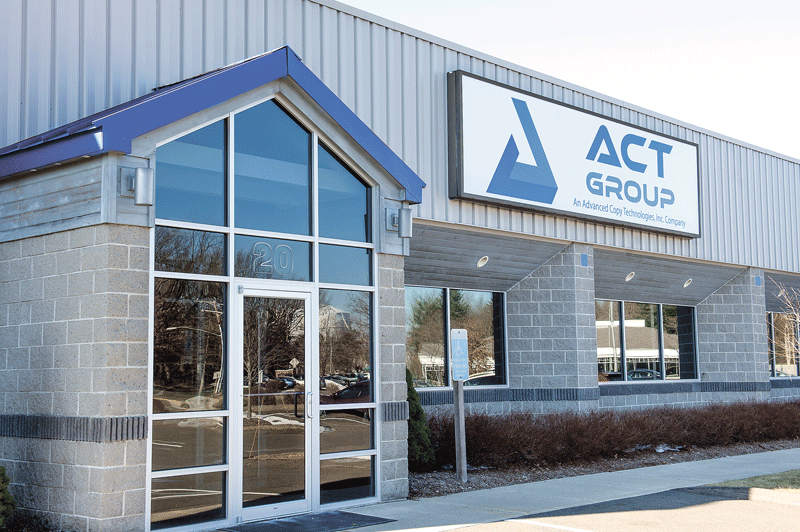
3D printing is hardly a new development, but its applications have rapidly expanded over the past decade as companies use it to produce both inexpensive design prototypes and large runs of manufactured parts. Connecticut-based ACT Group has been at the forefront of this revolution regionally, selling and servicing 3D-printing equipment for a wide range of clients in myriad industries. Its success mirrors that of a technology that, clearly, is no longer flying under the radar.


When it comes to the capabilities and applications of 3D printing, Nick Gondek said, “the sky’s the limit.” Which is why he’s glad his company, ACT Group, has established a strong presence in that field.

Specifically, the firm — based in Cromwell, Conn. and formerly known as Advanced Copy Technologies — sells and services 3D printing equipment to a wide range of clients in fields as diverse as aerospace, medicine, and shoe manufacturing.

The company’s bread and butter, said Gondek, the company’s director of Additive Manufacturing and applications engineer, is a process called rapid prototyping, by which manufacturers can produce individual 3D models of potential products much more quickly and cost-effectively than previously possible.

Take, for example, ACT’s clients in shoe manufacturing, which include Timberland, New Balance, and Puma. Rapid prototyping using 3D printing — also known as additive manufacturing — can produce full-scale models of new designs, which can be easily modified numerous times at little cost, compared to making changes after manufacturing a large run.

Nick Gondek

Nick Gondek

“The technology has been around for some time, but flew under the radar,” said Gondek, whose parents, Greg and Cindi Gondek, purchased the company in 1999, when it focused solely on office-equipment supply. “Now it’s got everyone’s attention.”

They rebranded as ACT Group a couple of years ago to reflect a broadening in scope, including the company’s rise to prominence in the 3D-printing world.

“Five or six years ago, my father was traveling in Europe and was introduced to 3D printing,” Nick Gondek said. “After doing some research to better understand the clientele, he saw opportunity in this industry, on the service side of things.”

3D-printing technology allows users to create three-dimensional, solid objects using a computer-aided design (CAD) program. With a 3D printer, companies can now print a single part, or even complete product, in a matter of hours, when it used to take months. The technology can be used to create both precise, durable prototypes and final products for businesses of all sizes.

“We have a good customer base,” said Gondek, noting that ACT also services clients of 3D Systems, one of the nation’s premier 3D-printing companies, in the Northeast region.

The testimonials and success stories, as shared by Gondek with BusinessWest, are numerous. Daniel Copley, research and development manager at Parker Hannifin, which engineers products for industrial, hydraulic, and aerospace applications, said the company’s in-house 3D-printing capabilities reduced lead time for its prototypes as well as the number of iterations needed, and are saving some $250,000 a year in the cost of prototype parts.

Other clients have similar stories of efficiency and cost savings. Powermate, USA, a provider of power-supply-converting solutions, reports that prototype models of its products can be created in a half-day, with a 65% cost reduction over traditional production.

Meanwhile, John Reed, master prototype specialist at Black & Decker, noted that, “while a design may look good on the computer screen, there is really no substitute for actually holding something in your hand.”

Toby Ringdahl, computer aided design manager for Timberland, cited a dramatic reduction in prototype costs and turnaround time, resulting in more prototyping, better designs, and increased revenue, noting that 3D printing has succeeded in “compressing our design cycles, lowering our costs, and helping us produce better products for our customers.”

Expanding Scope

The 3D-printing process begins with a concept, which is digitally modeled using CAD software — in effect, creating a virtual blueprint of the object to be printed. The program then divides the object into digital cross-sections so the printer is able to build it layer by layer.

The manufacturer then chooses a material, which is sprayed, squeezed, or otherwise transferred onto a platform. The 3D printer makes passes over the platform, much like an inkjet printer, depositing very thin layers of material (each about one-tenth of a millimeter) atop each other to create the finished product.

ACT Group

ACT Group was formerly known as Advanced Copy Technologies, which focused solely on office equipment before expanding its scope, including its recent success with sales and service of 3D-printing equipment.

ACT first specialized in servicing this equipment for its client companies, but, not long after, saw opportunity in the sales of 3D printers, incorporating that end of the business as well.

Increasing numbers of manufacturers are turning to 3D printing, not only for prototyping, but for design, tooling, and delivery of parts and products. Cindi Gondek told Forbes that jewelers can use it to create new pieces, while museums can use it to reproduce rare items for study or display, just to name two applications that might not seem obvious at first.

3D printers can produce precision parts with impressive accuracy in a variety of materials, Nick Gondek said, including plastics, ceramics, wax, and metals.

Invisalign braces, manufactured by Align Technology, are a good example of a rapid-prototyping application most people have heard of, he went on. They are built using CT scanners and 3D printing techniques to fabricate a product that’s different for each user — to the tune of 17 million sets per year.

“Invisalign has a very unique production capacity. They have mastered customized production; every person’s braces are specific to that patient. They 3D print all the models and basically build a retainer over the custom-made molds,” he noted. Without the rapid prototyping allowed by 3D-printing technology, this process — and product — would be much more expensive and labor-intensive.

In fact, the broad field of medicine provides fertile soil for 3D printing, Gondek said, starting with the education and training of future doctors and other medical professionals.

“We have technologies that mimic the properties of human bone for pre-surgical practice, with students cutting bones, drilling bones … and we now have technology to mimic tissue as well, so we can cover them,” he explained.

The technology is also used for designing patient-specific braces and implants to mend broken bones and aid in surgery, Gondek added. “In the news, there’s a lot of talk about printing human tissue. No machine can print organs today, but that’s something that might become a possibility in five or 10 years.”

One ACT client is Maimonides Bone and Joint Center, which produces a 3D color bone model quickly and accurately from a CT scan. This 50% scale model helps doctors discuss medical issues with patients and assists with surgery practice sessions. “I found the 3D model invaluable in patient education, surgical planning, and physician training,” said the company’s Dr. Howard Goodman.

Meanwhile, Battelle Center for Mathematical Medicine developed a full-color 3D model of the F protein, which aided in the development of new perspectives on how respiratory syncytial virus (RSV) works, which promises to aid in vaccine research. “Even with prior access to stereo-3D monitors and professional graphics cards, nothing compares to a full-color, physical 3D model,” said Dr. William Ray, principal investigator and faculty member.

From the Ground Up

Additive manufacturing is also revolutionizing the architecture, engineering, and construction world, Gondek said, producing scale models of buildings faster and at lower cost than before, and allowing designers to make earlier decisions and reduce time to market.

Andrew Chary of Andrew Chary Architect PLLC, another ACT Group client, characterizes 3D printing as a natural outgrowth of building information modeling (BIM), which generates digital representations of buildings in the design phase. “BIM doesn’t reach its full persuasive potential on a computer screen,” he said. “The model comes to life when you hold a 3D print in your hands.”

The dominant material for prototyping is a liquid plastic that turns into a solid when exposed to UV light, Gondek explained. A ceramic material is typically used to mimic human bone, and any number of metals may be used when manufacturing industrial parts.

The move into 3D printing required some major shifts at ACT. The equipment involved in that realm is so different from the traditional office products the company sells that a dedicated team was established for 3D sales, service, and support. They were sent to MIT for professional education in the latest processes. “We couldn’t have their traditional 2D salespeople sell this equipment,” he explained. “The applications are too diverse.”

Thus, ACT Group continues to keep up with the latest 3D printing technology — a rapidly expanding field.

“We do our homework to a high extent so the customer fully understands the capacities as well as the limitations. We can’t be everything to everyone,” Gondek said. “But this is pushing the boundaries of what is possible.”

Joseph Bednar can be reached at [email protected]

Daily News

AMHERST — UMass Amherst is a research partner in Advanced Functional Fibers of America (AFFOA), a new $317 million public-private partnership announced late last week by U.S. Secretary of Defense Ash Carter.

UMass Amherst is the only public university in New England participating in the MIT-led partnership, which includes 31 universities, 16 industry partners, 72 manufacturing entities and 26 startup incubators across 28 states.

The partnership won a national competition for federal funding to create the nation’s eighth Manufacturing Innovation Institute. It is designed to accelerate innovation in high-tech, U.S.-based manufacturing involving fibers and textiles.

UMass Amherst’s involvement in AFFOA draws on research expertise in its departments of polymer science and engineering, electrical and computer engineering and the College of Information and Computer Sciences.

“Through the combination of our polymer science, roll-to-roll nanomanufacturing and electrical engineering expertise, UMass Amherst is well-equipped to make important contributions to the development of new functional fabrics as part of the AFFOA team,” says Mike Malone, vice chancellor for research and engagement. “We expect to conduct research in a range of areas that have important military and commercial applications, including fiber-integrated sensors, energy generation and storage systems, thermal camouflage, optical and photonic components or fibers, fiber-integrated antennas, fiber/fabric surface modifications, and the incorporation of chemical, biological and physical functionality onto woven fabrics and non-woven and flexible substrates.”

As part of the initiative, the university is committing up to $1 million in matching funds to support AFFOA projects, process development, and education and workforce training over the first five years of operation.

AFFOA is the second national Manufacturing Innovation Institute involving UMass Amherst. Last year, the university was chosen to be the lead institution in New England for the Department of Defense’s Flexible Hybrid Electronics Manufacturing Innovation Institute, a $75 million federal initiative to create a competitive, effective and sustainable research-to-manufacturing collaboration between U.S. industry and academia to solve problems in advanced manufacturing.

Features

Forward Thinking

Mayor Domenic Sarno

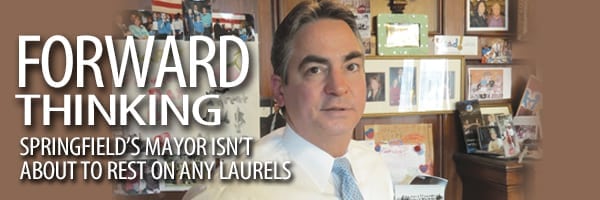
Mayor Domenic Sarno with a just a tiny piece of the vast collection of items now on display in his office.

Now in his ninth year as Springfield’s CEO, Domenic Sarno says much has been accomplished since he took office. He’s proud of these feats and will list them if prodded, but he’s more focused on the hard work still to come in the ongoing efforts to return the city to prominence. He’s buoyed by mounting evidence that cities, in general, are making a comeback, and that his, battle-tested by various forms of adversity, is more than ready to break out.

Domenic Sarno has now been mayor of Springfield for eight years and three months, give or take a few days. That means he’s been in that office longer than anyone in nearly six decades.

And if one wants to get an appreciation for everything’s that’s gone down in that time, all he or she has to do is visit Sarno’s office on the second floor of City Hall and take a good look around. But it would be wise to schedule a good bit of time for that assignment, if one wants to do it right.

Indeed, while most all mayors amass and display items that have come their way over their tenures, it’s unlikely that any corner-office holder can top this collection.

Almost every inch of Sarno’s large desk has been obliterated by a host of items, and all but the highest reaches of the tall, paneled walls are covered, mostly by photographs. Meanwhile, a decent chunk of floor space has been lost to items that can stand, like the nearly two dozen ceremonial shovels given to the mayor at groundbreakings for everything from MGM’s casino to CRRC’s subway-car manufacturing plant; from AIC’s new dining commons to Central High’s new science labs.

As for the photographs, they come in all shapes and sizes and portray a wide range of subjects. Framed shots of his family — father, mother, wife Carla, and daughters Cassandra and Chiara — sit on a shelf directly across the room from the center of his desk, for easy viewing, something he says he does often, and particularly when the going gets tough.

As for the rest of the photos, most of them unframed and printed from his computer or the sender’s, they run the gamut, and feature the mayor with individuals and groups of all sizes. There are some celebrities in the mix — Rob Gronkowski, John Kerry, Hillary Clinton, Charles Barkley, and the late Tom Menino, long-time mayor of Boston, would all qualify for that category. But most portray city residents with no claims to fame, and especially children in settings ranging from the classroom to the Big Balloon Parade.

Together, the items tell a story — actually, two of them.

First, they do a decent job of chronicling major developments and milestones during Sarno’s tenure — a list that includes everything from MGM’s historic decision to choose Springfield for a Western Mass. casino to the 25th anniversary of the Spirit of Springfield, conveyed in a large book that takes up a good amount of that desktop.

But the compendium also tells you a good deal about the person — an admittedly poor delegator who likes to be hands-on — who amassed it, hung all those pictures himself, and defies attempts by his staff to thin the herd of collectibles.

Together, he says, they speak to matters that are important to him — it would appear, then, there is very little that is unimportant — and that he doesn’t display them for his own viewing pleasure.

“People send me stuff all the time, and they love it when they come in, whether it’s for a meeting or a cup of coffee, and they see that photo that they sent or the gift they presented,” said Sarno, adding that he can help people in that quest because he knows where everything is. “It makes them feel part of the city, part of the administration.”

What this vast collection doesn’t convey, and obviously can’t, is what happens next.

Sarno admitted that many of the goals he set when he became mayor — everything from improved finances (the city now boasts the highest bond rating in its history) to more vitality downtown to sharp reductions in crime rates — have been achieved, to one degree or another.

Springfield is primed

Mayor Sarno says Springfield is primed to take full advantage of a movement back to cities by young professionals and retiring Baby Boomers.

But perhaps the biggest goal — restoring a sense of pride that has been missing since long before he took office — is still very much a work in progress.

When he became mayor, Sarno’s stated objective was to prompt people to stop saying ‘why Springfield?’ and start saying ‘why not Springfield?’ And while most have made an adjustment of sorts, many are still using some variation of the old language, and he wants that to change.

“We’ve shown what we can do, but we have to continue to confront, in concrete ways, the naysayers and the haters,” he explained. “I think this happens in every urban center — people get the sense that you can’t succeed. I know we can succeed, but we have to change the morale, the psyche of the city.”

For this issue, BusinessWest talked at length with Sarno about what’s been accomplished, what remains to be done, and how he intends to build on the collection in his office, even though there’s no room left for anything bigger than a commemorative thumbtack.

Picture Perfect

Sarno’s résumé is replete with career stops that have provided him with experience and mentorship that have helped him navigate eight years as the city’s CEO.

That list includes his four terms on the City Council and time as its president; his presence on the Financial Control Board that essentially ran the city for several years, including his early time in office; a lengthy stint as executive director of the South End Community Center; work in Hampden County District Attorney William Bennett’s office, where, among other things, he directed a program for juvenile probationers; and two years spent in the small office just a few feet away from the one he currently occupies, as aide to Mayor Mary Hurley.

But the top line on that résumé — or the bottom one, depending on how things are arranged chronologically — fits that category as well.

It reads simply ‘flooring installer, Corby Co.,’ four words that don’t begin to convey all that Sarno, then in his early 20s, gleaned from that job.

“Let me start by saying that I hated grouting — I mean, I really hated it,” he said, referring to the work of placing grout between tiles to keep them in place. “But I learned a lot on that job about working hard, getting your hands dirty, and taking pride in your work — and that’s why I always leave that line on my résumé.”

There is little, if anything, about his current job that he hates, although he admits there are frustrating days — many of them, in fact.

“There are times when I want to bang my head against the wall, and there are times when I want to bang someone else’s head against a wall,” he said, sounding a tiny bit like the Republican frontrunner for president. “And then you’ll get a thank-you card or letter or run into someone on the street, and they say, ‘thanks, mayor — you helped that individual or that cause or that family.’ And that keeps you going.”

He said he’s also had to endure a steep learning curve, despite all that he observed as Hurley’s aide, a city councilor, and Control Board member, and says the learning never stops.

Echoing sentiments he expressed to BusinessWest just a few months after taking office in 2008, when the top of his desk was uncluttered and the walls clear, he said that one can’t fully appreciate what it’s like to be mayor until one actually has that title on his or her business card — only Sarno doesn’t carry business cards.

Instead, he carries ‘Text-a-Tip’ cards, which, as that name suggests, implores the holder to text in tips that might help prevent or solve a crime, and he hands them out to everyone. But that’s another story.

Getting back to this one, Sarno said that when he talks about how his a 24/7 job, he means it.

“You can never turn off being mayor,” he explained. “When someone reaches out to you, no matter what day or time, night or day, you can’t say, ‘time out, I’m not the mayor right now.’ It’s part of your DNA.”

And this is especially true when his office, and the city itself, are in crisis mode. And there’s been a lot of that over the past eight years, including disasters of the Mother Nature-induced variety, such as the June tornado and October Nor’easter in 2011; the man-made type, such as the 2012 natural-gas explosion; and the Great Recession, which is in a category all its own.

Sarno told BusinessWest that weathering these storms has left the city — and him — battle-tested, for lack of a better term, and in some ways better able to tackle the hard work that remains.

Talking the Talk

Referring back to that learning curve he mentioned, Sarno said it takes many forms and includes virtually all aspects of the job, including that part about not being able to please everyone — something he knew already, but needed to experience as mayor, not as someone merely advising that office holder.

Also in that category is the art of public speaking, something he has to do almost every day. He believes he’s getting better at it, and constantly perfecting a style that blends unprepared remarks, humor, and his signature ending: ‘God bless you all, and God bless Springfield.’

“I don’t like to be on script — I like going off the top of my head,” he explained. “You need to do your homework and know your subject, but you also need to come from your head, your heart, and your gut. And you need to personalize and know your audience; you need to know when a dissertation is not warranted.”

Most all of his speeches also make reference to what he calls ‘priorities 1A and 1B.’ These would be education and jobs, respectively, and they represent the keys, he said, to alleviating the vexing problems of crime and poverty, not only in Springfield, but in every major urban center.

Big Balloon Parade

Seen here at the Big Balloon Parade, Mayor Sarno says Springfield has made progress, but work remains to improve the city’s psyche.

So while maintaining his focus on constituent service and what he calls the “meat and potatoes” of this job — making sure the trash gets picked up and the roads are plowed, for example — he places special emphasis on 1A and 1B, and believes progress has been achieved in both realms.

“People are less likely to get into that vicious cycle of poverty or involved in public-safety issues if they have a career trajectory,” he said, adding that his administration’s focus on jobs includes everything from attracting large new employers like MGM to encouraging entrepreneurship and innovation, through a variety of programs.

Overall, Sarno wants Springfield to be a place where people will want to raise a family, start a business, or both, and that stated goal is a tacit admission that people have been wary of doing so in recent years, and such attitudes still persist.

And this brings him back to that challenge of improving the city’s collective psyche. It won’t happen through a marketing initiative, although that might help, and the city has created one, he said. No, it will come about only if and when Springfield creates sufficient vibrancy and quality of life to become a destination.

Other urban centers have scripted impressive turnaround stories, he said, listing Lowell, Mass. and Brooklyn, N.Y. as examples, while noting that he’s buoyed by mounting evidence that cities are making a comeback decades after many residents and businesses abandoned them for the suburbs.

“We want to build on this phenomenon that’s happening across the country — empty nesters and Baby Boomers, besides young professionals, want to come back to their core city,” he said, “if you keep it clean and safe and give them the amenities they’re looking for — market-rate housing, job opportunities, and excitement.”

As for that marketing video, he said his administration thought about creating one several years ago, but didn’t believe there were enough success stories to tell. Now, there are more than enough, he noted, citing $2.5 billion in public and private investments taking place or recently completed.

Such numbers, and images, should help change some attitudes outside the city, he went on, adding that he’s probably more concerned about the outlook of those already living and or working in Springfield.

“This will get people to take a new look at themselves and the city,” Sarno explained. “Sometimes, we’re our own worst enemy, and we need to address that. I’m not going to paint a panacea of urban America — there are issues that you have to deal with day to day, and we’re doing that, but there are good things happening in Springfield.”

Collective Thoughts

As he looked around his office, Sarno all but acknowledged what his staff has been telling him for a long time now — that his office collection is due for some downsizing.

He’s not sure when or even if he’s going to get started on that project, or where he will put the items that come down off the walls or his desktop.

He does know that he probably has at least three years and nine months still to serve in this capacity, and that means more photos, T-shirts, ball caps, ceremonial shovels, and other items. His office isn’t going to get any bigger, so something will have to give.

What won’t give is his resolve to keep moving forward in his bid to achieve a real turnaround in Springfield. Progress has been made, but the job is far from finished.


George O’Brien can be reached at [email protected]

Education Sections

Now Friendly Rivals

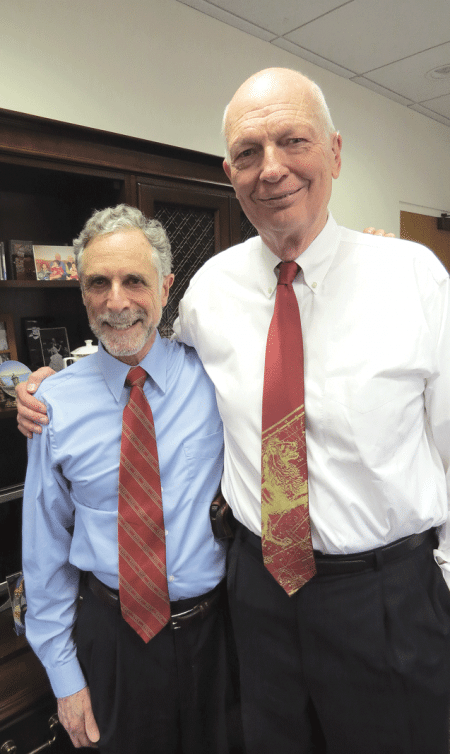
Bill Messner, right, and Ira Rubenzahl.

Bill Messner, right, and Ira Rubenzahl.

Located just seven miles apart as the crow flies, Holyoke Community College and Springfield Technical Community College have always competed, and in vigorous fashion, for everything from students to press coverage to state funding for capital projects. But when they arrived at their respective campuses in 2004, Presidents Bill Messner and Ira Rubenzahl found the relationship between the schools to be a case not of healthy competition, but unhealthy animosity. So they set about changing that equation. And as both men prepare to retire, they talked about what would have to be considered a stunning new attitude that prevails at both schools.

Neither man recalls which one of them actually picked up the phone and called the other.

What they clearly remember, though, is that a call, the first of many, was made. And, considering all that’s happened since the conversation ended, it could only be described with the adjective ‘historic.’

Ira Rubenzahl and Bill Messner had been at their new positions, as president of Springfield Technical Community College and Holyoke Community College, respectively, for just a few months (Rubenzahl arrived a few weeks earlier) in that summer of 2004. And while they hadn’t learned everything about the challenges that lay ahead, they did know one thing — that the relationship between the two schools, located just seven miles apart, had to change, and soon.

“Let’s just say that the institutions had not been working well together,” said Messner, his tone blending understatement with a dose of sarcasm as he described what he found upon his arrival. “And that was really not productive.”

Added Rubenzahl, “it didn’t take long to figure out that there was this problem. And we basically said, together, ‘we have to stop competing and start working together.’”

Actually, the competition hasn’t stopped, and both presidents agree that it can’t and won’t because, as the old saying goes, it’s good for the parties involved. But the animosity that prevailed a dozen years ago is mostly gone. And it hasn’t been missed.

For evidence of this, Rubenzahl and Messner pointed to a number of initiatives involving everything from workforce development to adult basic education; from legislative get-togethers to initiatives to train workers for MGM’s planned $900 million casino in Springfield’s South End.

They even listed the fact that the two travel together to meetings in Boston and elsewhere, and did so with a note of wonder in their tone that speaks volumes about just how bad things were.

Perhaps the very best piece of evidence, though, is the Deval Patrick Award for Workforce Development, presented by the Boston Foundation, which the schools earned together in 2014 for their collaborative effort known as TWO (Training & Workforce Options); more on that later.

Getting from where relations (if one could call them that) were in 2004 to where they are now didn’t happen overnight and would never be described as easy, both men noted.

“There are areas in which we’re much better off collaborating than we are competing,” said Messner. “But it took us a couple of years to get our arms around what those areas were, and how we could collaborate effectively.”

Also, the mountain to climb in terms of the level of animosity to be overcome was high and steep, said Rubenzahl.

“Bill and I got comfortable very quickly,” he noted. “But it took a while for the troops to line up because it was so inbred.”

Eventually, the troops did fall in line, both men noted, but the movement clearly started at the top.

Which is exactly why BusinessWest met with both presidents in Messner’s office in Frost Hall earlier this month. They’ve both announced that they’re retiring, with Rubenzahl due to exit stage left in June, and Messner a month or two later.

Yes, the presidents who arrived in the Pioneer Valley together will be leaving it together. And they’re leaving behind a track record of collaboration that couldn’t have been imagined a decade and a half ago.

Perhaps the best news is that both believe this pattern of cooperation has become so ingrained — and so welcomed by the schools’ respective boards — that they find it difficult to imagine a scenario in which it won’t continue after they’ve left their respective campuses.

“It will probably change in some ways to reflect the personalities of the two folks who are going to be following us,” said Messner. “But I think it’s grounded enough that it will continue. And my sense is that, if those two folks don’t choose to continue to collaborate, they’ll pay a price of some sort.”

New Course of Action

To put the dramatic change in the relationship between the two colleges in perspective, both Rubenzahl and Messner took a quick trip back to last summer and a press event that was significant on a number of levels.

Gov. Charlie Baker was coming to Western Mass. to deliver good news for both schools: HCC was getting $2.5 million for much-needed renovations of its cramped, antiquated, and leaky campus center, and STCC was getting $3 million for design work on a planned $50 million project to convert the historic structure known as Building 19 — one of the oldest buildings on the Springfield Armory complex later repurposed into the community college — into a new campus center.

He would announce both awards in a single ceremony at HCC, an arrangement STCC quickly signed off on.

“Before we came, they would never have dared to do that,” said Rubenzahl, saying those words slowly for additional emphasis and using the word ‘they’ to mean both the institutions and their presidents. “There would have been huge objections to doing that.”

Messner agreed, and, like his counterpart, treaded lightly, and diplomatically, when asked about the root causes of the sentiments that prevailed when he arrived.

HCC’s Kittredge Center

The opening of HCC’s Kittredge Center is one of the highlights of Bill Messner’s tenure, which was defined by improved relations with STCC.

However, it was well-known across the region, and even across the state, that the leaders’ predecessors — David Bartley, previously speaker of the Massachusetts House, at HCC, and Andy Scibelli, former Springfield city official and nephew of powerful state Rep. Anthony Scibelli, at STCC — didn’t exactly get along and were ferociously competitive, to put it mildly. And their institutions followed their lead — with a passion.

To explain the mood, Rubenzahl recalled some dialogue at a meeting he convened with several senior staff members at STCC not long after arriving.

“Someone referred to the ‘enemy,’” he recalled. “I said, ‘what enemy? Do you mean Holyoke?’ And he said, ‘yes, Holyoke.’ I was really taken aback by that, and said, ‘they’re not the enemy.’”

Rubenzahl believes that aforementioned phone conversation with Messner had already occurred by that point, but the chosen terminology cemented in his mind — actually both men’s minds, because similar language was being used in the campus off Homestead Avenue in Holyoke — that change was necessary.

And it came about, they said, partly due to those changes at the top, but also because it simply made sense.

Indeed, both presidents and their staffs had concluded that, while the schools would go on competing — “like Ford and Chevy do,” said Messner — they could also collaborate in many ways and, while doing so, achieve much more together than they ever could separately.

Examples abound, but TWO is clearly the most visible and perhaps the most impactful.

Messner described it as a “mechanism” for collaboration, the initiative that resulted from that somewhat time-consuming process he described earlier of determining in which realms the schools could collaborate, and how.

As the name suggests, the program involves creation of individually tailored programs to help solve workforce problems, specifically those related to the skills gap that has impacted virtually every sector of the economy.

Since its creation five years ago, TWO has assisted large corporations, small businesses, and broad economic sectors, said Rubenzahl, and it’s an example of something the schools could do with some success independent of one another, but to a much greater level of achievement together.

School of Thought

While TWO is the most visible manifestation of the new climate of cooperation between the two schools, there are many others, said the two presidents — starting with the meeting they were at just before sitting down with BusinessWest.

This was a gathering of state legislators to discuss matters involving public higher education, especially funding for the schools and individual initiatives. Years ago, there would have been two of these sessions, said Rubenzahl, one for HCC and one for STCC, because, well, that’s how it was done. (Actually, Greenfield Community College and Berkshire Community College had their own sessions as well.)

Now, there’s a single gathering — a practice that began the spring after the two presidents arrived — and it involves not only those two schools, but all seven public colleges and universities in Western Mass. Thus, the sessions are usually more productive because there are more people in the room, and far more convenient for legislators.

“I called Bill and said, ‘doesn’t it make sense to just have one?’” Rubenzahl recalled. “And for a lot of reasons; you’re more likely to get more legislators, and you can be more effective if you have several colleges saying the same thing as opposed to each one stating their individual needs.”

The legislative get-together is a simple yet effective example of collaboration, said Messner, adding that many others share its basic reason for being: common sense.

STCC

STCC President Ira Rubenzahl says his campus now looks for ways to collaborate with its competitor in Holyoke.

That list includes everything from faculty-development programs to the joint hiring of a consultant to create so-called wage grids; from adult basic education — something STCC has become more proficient at thanks to assistance from HCC — to the somewhat daunting task of training hundreds, and perhaps thousands, of the individuals MGM will eventually hire.

When looking back at how the current partnership on casino training came about, both presidents said this is another example of something that wouldn’t have materialized 13 years ago because of the animosity between the schools.

“We have this trust … we have this agreement — we don’t do things separately,” said Rubenzahl, adding that, years ago, the two schools probably would have fought tooth and nail for the entire pie. In this new era of cooperation, they agreed to split the pie long before the Gaming Commission determined the winner of the Western Mass. license.

“It wasn’t clear where the casino was going. Was it going to go to Palmer? Was it going to Springfield? Was it going to go to Holyoke?” he recalled. “But before we knew where it was going, we said, ‘an individual campus is not going to get involved in the training; we’re going to do it together.

“It winds up going in Springfield, but instead of fighting over it, we had already lined up our ducks,” he went on. “We had already figured out that, because Holyoke is really strong in culinary arts, if there’s culinary training, they’re going to get it. They can do it; we can’t do it. And we’re going to do some of the IT training, perhaps.”

Whenever there’s a meeting with MGM officials, the schools go together, said Messner, adding that the casino project is a good example of how the schools work together to meet the workforce needs of the five major sectors of the economy — manufacturing, healthcare, technology, hospitality, and financial services — because neither school can do all that alone.

As still another example of something happening now that wouldn’t have happened years ago — this one involving geography, or territory, as much as anything else — Messner cited initiatives blueprinted by Holyoke schools’ receiver  Stephen Zrike for Dean Technical High School.

“He wants two programs connected to college work,” Messner explained. “One is going to be in healthcare, and we’ll do that one, and the other is manufacturing, and we’re going to do that in conjunction with STCC; we’re not going to try to do that alone.”

Added Rubenzahl, “because of this [new relationship], we can do things we couldn’t do otherwise. Before, you couldn’t do that — you couldn’t go into the other college’s hometown and run a public-school program.”

Class Act

As for those shared rides to Boston and other destinations for gatherings of public-school leaders, both men laughed as they talked about how the practice has evolved and how it never would have happened with their predecessors.

“I drive, and he talks,” said Messner, referring to how a typical journey unfolds.

But while they carpool to such meetings, they usually don’t sit together once they arrive — a tradition that is more strategic than any kind of statement about how the schools, and presidents, get along.

“We don’t want to look like a two-headed monster,” said Rubenzahl, adding that the two are usually of a similar mind on most matters and don’t want to appear to be delivering comments in stereo.

Messner agreed. “You can’t cluster your strength all in one part of the room — you have to spread it out.”

In truth, and despite those seating arrangements, the schools have indeed become a two-headed monster — of collaboration.

George O’Brien can be reached at [email protected]

Daily News

WESTFIELD — Tighe & Bond recently hired Principal Engineer Wayne Bates to better serve its clients in the Greater Boston area. He will work out of the firm’s Westwood office.

Bates specializes in water and wastewater treatment technologies with a focus on industrial wastewater treatment, process improvement, waste minimization, EH&S compliance, and sustainable manufacturing strategies. He has almost 30 years of engineering and environmental, health, and safety consulting experience, and is also a certified Envision sustainability professional. He holds licenses in Massachusetts, New Hampshire, and Rhode Island.

Bates is also an adjunct professor at Worcester Polytechnic Institute (WPI) and serves on the board of directors for the Center for Business Sustainability at WPI. In addition, he serves on the town of Ashland’s sustainability and water-policy committees, and is a sustainability facilitator for the Associated Industries of Massachusetts.

“We are happy to welcome Wayne to our growing team of experts,” said David Pinsky, president and CEO of Tighe & Bond. “His expertise will benefit our Greater Boston-area clients greatly as they seek process improvements, EH&S compliance, and sustainable-manufacturing strategies.”

Bates earned his Ph.D in environmental/civil engineering from WPI. He also holds a master’s degree in environmental engineering from Northeastern University, as well as a bachelor’s degree in civil engineering from UMass Dartmouth.

Daily News

SOUTH DEERFIELD — Many area businesses are hiring, and that’s good news for job seekers. On Wednesday, March 16, the ninth annual Franklin Hampshire Career Center Spring Fling Job Fair will be held at Frontier Regional High School in South Deerfield from 4 to 6 p.m.

The job fair is free and open to the public. Job seekers are encouraged to bring a résumé and be prepared to interview. A record number of employers — 45 — are scheduled to attend, representing major industry sectors including healthcare, accommodation and food Services, manufacturing, administrative and support services, construction, arts, entertainment and recreation, and transportation and warehousing.

For more information about the fair, call (413) 586-6506 or visit www.fhcc-onestop.com.

Daily News

HOLYOKE — On March 14, Holyoke Mayor Alex Morse was joined by city and state officials to mark the official start of the demolition and cleanup of the former Parsons Paper in preparation for the expansion of Holyoke manufacturer Aegis Energy Services.

The announcement capped a multi-year effort to remediate the site and make it ready for development. The expansion of Aegis Energy Services will entail a private investment of approximately $7 million, the retention of 65 job,s and the creation of at least 30 new jobs, as well as the creation of up to 4 megawatts of renewable energy, making it the city’s largest manufacturing expansion in years.

“This is a significant milestone in our city’s revitalization that should be celebrated and praised. Redevelopment of the Parsons site has been an extremely difficult challenge, bringing with it significant legal, environmental, and financial constraints that have impeded progress for years,” Morse said. “The staff in the Office of Planning and Economic Development and the Law Department should be applauded for their efforts as they’ve worked diligently with the Redevelopment Authority and a cross-collaboration of public and private partners to make this project a reality. I’d be remiss if I did not offer my sincere appreciation to Lee Vardakas of Aegis Energy for his commitment to Holyoke; we are fortunate to have this innovative company stay and grow in our city, and I thank him for his investments and contributions.”

Located at 84 Sargeant St. between the first and second level canals, the 4.7-acre Parsons Paper site has been unused and vacant since 2004. In 2008, a fire significantly destroyed a majority of the structures, and the city officially foreclosed on the property and took ownership in 2012 for failure to pay taxes. In 2014, the Redevelopment Authority engaged Tighe & Bond to undertake environmental assessments, specifications for demolition and cleanup, and project permitting to prepare the site for reuse.

Many sources of funds are being used to make the demolition and cleanup phase of the project possible and have been amassed through the HRA, including $250,000 in funds from an agreement with Eversource Energy (formerly Northeast Utilities) as part of a mitigation payment associated with cleanup of contaminants in the Connecticut River; $2 million from the state Brownfield Fund through MassDevelopment; $1 million in capital investment by Holyoke Gas & Electric, which secures an easement on the site for potentially 2.5 MW of hydroelectric generation; and a $400,000 capital loan from the Holyoke Economic Development and Industrial Corp., to be paid from the sale proceeds of the land to Aegis Energy Services. The city also provided its most aggressive tax-incentive schedule in its history: a 100% property-tax exemption for 10 years.

“This is an incredibly challenging site and a costly endeavor, one that would have been very difficult for the city to do by itself,” said Marcos Marrero, director of Planning & Economic Development for the city, as well as executive director for the Holyoke Redevelopment Authority. “Consequently, the financing framework for this project is probably the most complex that Holyoke has seen in decades. The implications a year from now will be significant: blight reduction, building reuse, job creation, expansion of manufacturing, more renewable energy, and improved property values in the neighborhood.”

Added MassDevelopment President and CEO Marty Jones, “cleaning up and redeveloping this highly visible site in downtown Holyoke will positively impact surrounding businesses, residences, and the city’s innovation district. This project illustrates the vital role the Brownfields Redevelopment Fund plays in transforming parcels around the Commonwealth, and I applaud Holyoke for its commitment to this property.”

The contractor for the work is McConnell Enterprises Inc., which will begin work on the site immediately in order to take advantage of the regularly scheduled canal draw-down on Maech 22-24. Demolition and cleanup is projected to be completed by August, after which the site will be taken over for redevelopment by Aegis Energy Services, rehabilitating one 40,000-square-foot building — a 200% expansion of the company’s square footage — and adding at least 30 new jobs, an approximate 50% growth in the company’s employment.

Opinion

Editorial

As everyone knows by know, the Baby Boom generation is already at or rapidly approaching retirement age. The oldest members of this huge constituency will hit 70 this year, and millions more will reach retirement age, be it 65, 67, or something earlier if they’ve done well for themselves, over the next several years.

This wave of retirements will pose myriad challenges for the region and its business community, especially when it comes to replacing experienced workers, especially in fields such as healthcare and manufacturing. Filling these voids will require diligence and imagination because the problem will surely impact virtually every sector and almost every business.

While the region must look upon this situation with a good deal of dread, we believe the same cannot be said for another realm, or void — that concerning leadership.

Indeed, if there is one thing our planning and economic-development agencies have done well over the past several years, it’s creating and expanding programs dedicated to preparing area young people for leadership roles — be they in business, government, or the nonprofit sector.

There are several programs and groups that fall into this leadership-prep category, among them the area’s young-professional societies; Leadership Pioneer Valley, which was created several ago as a result of a recognized need for more programs of this nature; the Springfield Regional Chamber’s Leadership Institute; and the Women’s Fund’s Leadership Institute of Political and Public Impact (LIPPI), the subject of a story on page 23.

That sounds like it might even be too many programs, but this region needs as many as it can get.

That’s because leadership is an attainable skill, and the more effective leaders we have in Western Mass., the better off this area will be.

As you read the story on LIPPI, you will note many participants saying the program has helped them take on more challenges located outside of their comfort zone, or words to that effect. And the same can essentially be said of the other programs listed above, and this bodes very well for the region, individual cities and towns, and the business community as well.

As comfort zones become larger, people become more willing and, usually, more able to take on challenges and become both problem solvers and innovators, things this region will need more than nurses and qualified precision machinists, although we’ll need them too.

The story on LIPPI also reveals that, through its various programs, many women have been able to reach higher and then attain what they’re reaching for, a very important consideration given that, in this region, as in most others, this is a constituency still defined by the phrase ‘untapped potential.’

Moving forward, we encourage more young people to take full advantage of the many opportunities now afforded them to develop and hone their leadership skills. Doing so will create opportunities for them and the communities they’ve chosen to live and work in. And it will ultimately (we hope) enable this region to remain competitive in what will be an increasingly global economy.

There are many challenges that will induce anxiety in the years to come, especially the retirement of all those Baby Boomers. Thanks to some forward thinking and imaginative new programs, finding qualified leaders shouldn’t be an issue that falls into that same category.

Departments Incorporations

The following business incorporations were recorded in Hampden, Hampshire, and Franklin counties and are the latest available. They are listed by community.

CHICOPEE

Amazon Foods Inc. 168 Center St., Chicopee, MA 01013. Ricardo Contrussi, 49 Azalea Lane, Marlboro, MA 01752. Manufacturing and distribution of sausages, meat products, frozen juices, and frozen foods.

EAST LONGMEADOW

Beauty Times Spa Corp., 16 Maple St., East Longmeadow, MA 01028. Nhac D. Troung, 40 Waterman Ave., East Longmeadow, MA 01028. Hair, nail, skin, and beauty care/salon.

GRANBY

American Legion Auxiliary, Granby Unit 266 Inc., 2 Circle Dr., Granby, MA 01033. Lorraine Uhlig, 101 Abbey St., South Hadley, MA 01075. Non-profit organization established to support the American Legion; support for our veterans, our military, and their families by shaping a positive future in an atmosphere of fellowship, patriotism, peace and security.

GREAT BARRINGTON

Allard.org Inc., 61 Blue Hill Road, Great Barrington, MA 01230. David Allard, same. Provide a working structure for the formation and operation of a scientific and educational non-profit organization.

HOLYOKE

Auto Sales Center Inc., 1607 Northampton St., Holyoke, MA 01040. Ira J. Elfman, same. Auto sales.

B & T Laundromat Inc., 556 High St., Holyoke, MA 01040. Bo Wu, same. Coin-operated laundromat.

LONGMEADOW

China Access Inc., 86 Green Meadow Dr., Longmeadow, MA 01106. Baiqing Li, same. Cultural exchange program with people and organizations located in China.

NORTHAMPTON

Allen Restaurant Group Inc., 8 Crafts Ave., Northampton, MA 01060. Kimberly Allen, same. Restaurant.

PALMER

Azb Logistics Inc., 11 Flynt St., Palmer, MA 01069. Lance Bokowski, same. Transportaion company.

PITTSFIELD

Andromeda Research Inc., 15 Bartleit Ave., Apt. 4, Pittsfield, MA 01201. Robert Keyes, same. Research and development corporation.

SOUTHAMPTON

Castle Architectural Salvage Inc., 8 Pine Meadow Dr., Southampton, MA 01073. Ronald Pike, same. Architectual salvage and sales.

WILLIAMSTOWN

Balkrishna Inc., 824 Simonds Road, Williamstown, MA 01267. Hastinkumar Mehta, 213 Main St., Williamstown, MA 01267. Convenience store.

Daily News

BOSTON — Gov. Charlie Baker and Lt. Gov. Karyn Polito announced $9.3 million in workforce skills equipment grants to 35 high schools, community colleges, and vocational training providers across the Commonwealth for vocational-technical education and training equipment purchases that connect Massachusetts students and residents to economic opportunities in high-demand industries.

“Workforce skills education and training plays an enormous role in economic and personal development by helping residents acquire the skills they need to connect with promising careers,” Baker said. “These vocational-technical education equipment grants will help build stronger communities and a more competitive business environment that ensures more residents have the skills they need to succeed in and support the Commonwealth’s economic future.”

Added Polito, “these workforce-development grants will build bridges between residents seeking careers to build a future on and the employers who need a skilled workforce to grow the state’s economy. Today, too many good-paying jobs are going unfilled because employers are struggling to find skilled employees. This investment in training equipment will enable high schools and community colleges across the Commonwealth to equip students with the skills they need to secure a bright future.”

The Workforce Skills Capital Grant Program is a new initiative of the Governor’s Workforce Skills Cabinet, which seeks to align education, workforce, and economic-development strategies across the state.

Western Mass. recipients of the new round of grants include:

• Berkshire Community College, Pittsfield, $465,119 to upgrade and modernize its manufacturing and engineering program, utilizing new hydraulics, pneumatics, electrical controls, materials testing, CNC, and 3-D printing equipment to train students and adult learners for careers in advanced manufacturing, engineering, and biotechnology;

• Dean Technical High School, Holyoke, $393,156 to transform its existing machine technology shop into an advanced-manufacturing shop that aligns with current industry practices and technologies, in order to connect Holyoke students to career opportunities in the Pioneer Valley’s skilled manufacturing workforce;

• Franklin County Technical School, Montague, $52,500 to revamp its computer programming and web-design programs and expand the programs’ capacity to reach adult learners;

• Lower Pioneer Valley Educational Collaborative, West Springfield, $257,100 to expand the capacity of its recently-founded high school Machine Technology Program, and to extend programming to adult learners, including unemployed and underemployed individuals facing barriers to employment;

• McCann Technical School, North Adams, $121,128 to revamp its welding and metal-fabrication equipment to train students for careers in Berkshire County’s aerospace, defense, commercial, medical-device, and power-generation industries, and enable re-training for unemployed workers;

• Roger L. Putnam Vocational Technical Academy, Springfield, $441,500 to launch a new program to equip students with the skills to enter the construction workforce, including training with heavy equipment; and

• Springfield Technical Community College, $499,785 to enhance training in its Laser Electro-Optics and Advanced Manufacturing Engineering Technology programs by creating an advanced-laser-machining laboratory and a one-year Laser Materials Processing Certificate of Completion, in order to meet the needs of the Commonwealth’s rapidly growing laser-manufacturing industry.

Court Dockets Departments

The following is a compilation of recent lawsuits involving area businesses and organizations. These are strictly allegations that have yet to be proven in a court of law. Readers are advised to contact the parties listed, or the court, for more information concerning the individual claims.

CHICOPEE DISTRICT COURT

Juan Ortiz v. Campagnari Construction, LLC
Allegation: No handrails on stairway causing fall: $3,793.32
Filed: 12/15/15

HAMPDEN SUPERIOR COURT

Christy Real Estate, LLC v. YRC Inc.
Allegation: Breach of real-estate purchase and sale agreement: $60,000
Filed: 1/14/16

Concilio International de Iglesias Hora Zero, WLHZ 107.9, and Casa de Esperanza v. Baystate Gas Co. d/b/a Columbia Gas
Allegation: Gas explosion causing property damage: $1,500,000
Filed: 1/12/16

James Bruno v. Toyota Motor Credit Corp.
Allegation: Consumer claim for wrongful repossession: $9,200
Filed: 1/21/16

Kevin Augustino v. Subaru of America
Allegation: Breach of contract: $27,979.63
Filed: 12/30/15

Paul Giza v. Duravent Simpson Manufacturing
Allegation: Product liability causing property damage: $350,000
Filed: 1/6/16

Piano Distributors of Florida Inc. v. Falcetti Music Inc.
Allegation: Non-payment of goods sold and delivered and services rendered: $555,335.71
Filed: 1/7/16

Sage Engineering and Contracting Inc. d/b/a Furrow Engineering v. Athena Healthcare Associates Inc.
Allegation: Non-payment of services, labor, and materials: $68,114.83
Filed: 1/11/16

HAMPSHIRE SUPERIOR COURT

Alberto Morales and Yaniris Fernandez v. Wyndham Hotel and Resorts, LLC
Allegation: Bedbug bites: $46,000
Filed: 1/6/16

Federated Capital Corp. v. Transmission and Engine Tech and Mark T. MacDonald
Allegation: Complaint to enforce judgment: $108,103
Filed: 12/17/15

HOLYOKE DISTRICT COURT

Travelers Insurance Co. v. East Baking Co. Inc. and David Serra
Allegation: unjust enrichment and conversion: $18,170.04
Filed: 1-21-16

NORTHAMPTON DISTRICT COURT

Blackwood Associates Inc. v. Five Star Building Corp.
Allegation: Non-payment for recruiting services: $24,222.64
Filed: 1/25/16

Marie Higgins v. Quynh Nguyen and Lien Luong d/b/a Nail Pro
Allegation: Negligent application of material during pedicure causing scarring and nerve damage: $1,620+
Filed: 1/29/16

Rexel Inc. v. Jeff O’Connor Electric
Allegation: Non-payment of goods sold and delivered: $5,416.10
Filed: 1/29/16

PALMER DISTRICT COURT

American Express Bank v. Red Bridge Bait and Richard Rubner
Allegation: Breach of contract: $5,375.60
Filed: 1/4/16

SPRINGFIELD DISTRICT COURT

Century Center, LLC v. Karoun Yoga Inc.
Allegation: Breach of lease agreement: $7,990.23
Filed: 1/27/16

Community Spotlight Features

Community Spotlight

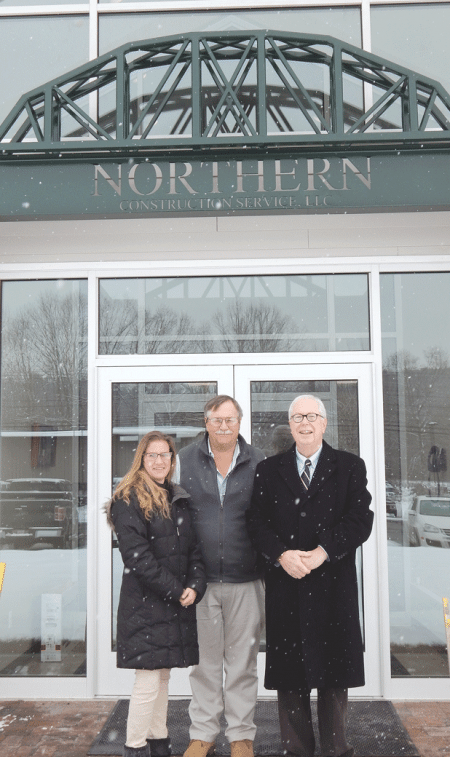
From left, Linda Leduc, John Rahkonen, and Charlie Blanchard

From left, Linda Leduc, John Rahkonen, and Charlie Blanchard say Northern Construction’s new, $1 million office building contains cutting-edge technology that will help the company stay competitive.

The scope of economic development in Palmer is so diverse that Charlie Blanchard had to make a list to ensure he didn’t forget any major projects when he spoke about them with BusinessWest.

“We have a lot of commercial activity taking place. There has also been an increase in high-tech manufacturing; new medical office space is being developed, and we have a new recreational motorsports raceway,” said the town manager. “Progress continues in Three Rivers, and we are working to revitalize the Thorndike Mills.”

Linda Leduc, the town’s planner and economic development director, added that projects that were permitted years ago are coming to fruition, and commercial properties that sat on the market for years are finally being purchased.

“I’ve seen a 180-degree turnaround this year, and it has brought a multitude of new jobs to Palmer,” said Leduc, who attributes recent growth to a resurgence in the economy.

And, as she noted, change and progress is taking place in all parts of the community, including the Palmer Industrial Park in Bondsville.

Blanchard said Detector Technology Inc. needed room to expand and purchased a building from Wayne Buxton, who was using it to house his ShedWorks Inc. business.

“Wayne needed to downsize but wanted to stay in Palmer, so he kept half the lot and built a new, smaller structure on it,” Blanchard noted.

The decision reflects a trend he and Leduc are seeing: businesses are choosing to stay in Palmer, whether they are downsizing or expanding, if they can find appropriate space — a pattern town officials believe is based on the town’s location, competitive tax rate, good school system, and excellent municipal services.

“We’re right on the Mass Pike, which is ideal for businesses and for their customers coming from the east and west,” Blanchard said, adding that interviews with owners and executives of 16 companies showcased in a 2014 promotional video titled “Industry Alive in Palmer: An Inside Look at Local Businesses” showed they are happy with the educated workforce in the area and have dedicated, exemplary employees.

Growth is also occurring in the downtown area known as Depot Village, which is the first commercial district travelers encounter after they exit the Turnpike. It’s a prime commercial area and the place where O’Reilly Auto Parts chose to expand their New England presence.

“They purchased a vacant building on 1569 North Main St. that had been an eyesore for years,” Blanchard said. The old structure was demolished, and a new, state-of-the art distribution center has been built on the lot.

In addition, the American Legion building on 1010 Thorndike St. was purchased by Fire Service Group two days after it went on the market last May; the company was located in a smaller building in town but wanted to expand.

Meanwhile, Michael’s Party Rentals is moving from Ludlow into the former home of Baldyga’s Auto and RV Sales Inc. on 1221 South Main St. Company President Michael Linton said he purchased the 20,000-square-foot building in early January, and it is undergoing a substantial renovation.

“We’re building a showroom and design center so that we have a dedicated space where wedding planners, brides and grooms, and corporate clients can see our inventory and design capabilities,” he noted. “We’re also adding office space, as there wasn’t any in the building, and plan to install a $60,000, state-of-the-art tent-washing machine which will allow us to clean the tents we rent with less labor.”

The cost of the building, renovation, and new machine are expected to total about $712,000, and Linton anticipates moving in May or June when it is complete.

“My entire staff is excited. We are extremely cramped in our current location and looked for a building for two years,” he continued. “A combination of factors led to the decision to relocate in Palmer: the price of the building, its access to the Mass Pike, Palmer’s commercial tax rate, and the proximity to my home in Sturbridge.”

For this, the latest installment of its Community Spotlight series, BusinessWest looks at the many reasons why development is occurring in Palmer, and the various forms it is taking.

Progress Report

While Baldyga’s sold its property for the Michael’s relocation, the business didn’t leave Palmer; Blanchard said the owner purchased an empty lot on Park Street and has plans to construct a new, smaller building on the site, which is in the permitting stage.

In addition, a former Knights of Columbus hall was purchased last fall by Joe Kelley of Angelica Properties. It sits on the corner of Route 32 and River Road and had been for sale for more than a year; it is currently in the permitting stage, and the plan is to renovate it and turn it into state-of-the art medical office space.

Meanwhile, Northern Construction Service Inc. is another company that has chosen to expand in Palmer. About three years ago, owner John Rahkonen purchased a lot adjacent to the business that contained a mini-golf course and batting cages. They were demolished, and a new, state-of-the-art, 7,400-square-foot building, which cost about $1 million, opened in early February.

The company has grown from a $2.5 million operation in 1994 to a $45 million to $50 million business today, and although Rahkonen has two other locations, the new office space, which features skylights and advanced technology, was critical to continued success.

Today, the business occupies about 12 acres, but Rahkonen wishes there were more space available in Palmer so he could continue to expand there.

“I could use another 10 acres,” he told BusinessWest, adding that he agrees with town officials that Palmer’s location is ideal due to its access to key roadways. “We’re in the middle of the state, an hour from Boston and the New York border, and 40 minutes from Hartford. Interstate 91 is around the corner, the Mass Pike is here, and I-84 is 20 minutes down the road.” The company’s work requires moving heavy machinery all over New England, up to the Canadian border, and as far away as White Plains, N.Y., as well as to Block Island and Martha’s Vineyard, so access to a multitude of roadways is helpful.

The town also boasts a new recreational facility called Palmer Motorsports Park. It opened last May on a 500-acre tract of land, and since that time, Road & Track magazine has named it as one of the top 10 racetracks to drive on in North America.

However, it was one of the aforementioned projects that didn’t get off the ground for years due to the flagging economy.

“The Sports Car Club of America permitted the site for a sports motorpark in 2007 because they wanted a track in the Northeast,” Blanchard explained. But the land was not developed until 2012 when club member and private investor Fred Ferguson built the multi-million-dollar recreational facility with its 2.3-mile track, which has since brought new people to Palmer and had a beneficial impact on businesses in the north end of town.

As noted earlier, it is just another of a slew of projects that is expanding and diversifying the economy of a community that just three years ago was pinning its hopes on a resort casino.

New Initiatives

Efforts to revitalize the Thorndike Mills, situated north of Depot Village, are another example of continued progress.

The property consists of seven linked mill buildings that contain 90,000 square feet and sit on 15 acres. They were once home to the thriving Diamond Cascade Manufacturing Co. but have been vacant since 2000, although a hydropower turbine operation has been installed at the site.

“The hydro units are under the floors because the canal runs beneath the buildings,” Leduc said, noting that some units are also located near the dams. But, despite the fact that she has worked with the mill owners for more than a decade to find new uses for the property, they couldn’t seem to make any progress.

However, new hope was generated last fall, thanks to state Sen. Anne Gobi, who was instrumental in introducing them to the Central Mass. Regional Planning Commission (CMRPC), whose work includes revitalizing the Warren Mill in West Warren, the Hardwick Knitters Mill in Hardwick, the Holland Road Mill in Sturbridge, and now, Palmer’s Thorndike Mill.

Leduc said a tour of the properties was conducted last fall as part of a larger project that includes the Jefferson Mill in Holden.

“We’re working with the CMRPC, MassDevelopment, and the Mass. Department of Housing and Community Development,” she noted. “It’s an interesting and important collaboration because these mills are significant historic structures. Our mill was once the center of Thorndike Village.”

The Center for Economic Development at UMass Amherst is also involved, and will hold a conference titled “The Future of the Massachusetts Mill Community” on April 12 in the campus center. In addition, UMass Professor of Planning John Mullin and a group of his students are working to identify common themes shared by these mills.

“We were on our own for years, so it’s wonderful to have this support,” Leduc said.

Growth is also occurring in Three Rivers, and collaborative efforts to revitalize Main Street are coming to fruition, thanks to work by the consortium On the Right TRACK (the acronym stands for Three Rivers Arts Community Knowledge).

Partners include North Brookfield Savings Bank, Palmer officials, the Palmer Historical and Cultural Center, the Three Rivers Chamber of Commerce, the Palmer Redevelopment Authority, and the Quaboag Valley Community Development Corp., all of which have been working to build a cultural and creative economy that will attract visitors.

Alice Davey, the town’s community development director, noted that the Quaboag Valley Community Development Corp. was successful in its bid to win a $13,500 Adams Art Grant for fiscal years 2016 and 2017, and the town completed a market-assessment and business-recruitment tool as well as a feasibility study showing that a building on 2032 Main St. obtained through the tax-title process has potential for redevelopment.

In addition, Davey said, “Palmer also signed a Community Compact agreement with the Commonwealth which will provide us with assistance. We’re taking positive steps forward, and many things are in the planning stages.”

The town also boasts five solar farms, and permits for four new ones have been issued. The newest operations include a five-megawatt farm on the grounds of the former Palmer Metropolitan Airfield that went online last February. It was built by Borrego Solar and is financed, owned, and operated by Syncarpha Capital.

In addition, a 4.8-megawatt operation on Baptist Hill Road, which was developed by Blue Wave Capital and is owned by Sun Edison, went online earlier this month. Blanchard said the town will purchase 2.8 megawatts of the generated electricity, which will meet 100% of its municipal needs and should result in a 20% to 30% savings on its electric bill.

Positive Outlook

Overall, officials expect growth in Palmer to continue. “There is so much going on here, and we are touching so many areas of the economy that are growing,” Blanchard said.

As a result, optimism is running high as new ideas to revitalize the Thorndike Mills are brought forward, and the creative economy in Three Rivers, the new racetrack, and a host of other growing enterprises attract people to “the town of seven railroads” from many different roadways.


Palmer at a glance

Year Incorporated: 1775
Population: 11,049 (2015)
Area: 32.14 square miles
County: Hampden
Tax Rate (Residential and Commercial): Palmer, $21.27; Three Rivers, $22.19; Bondsville, $22.13; Thorndike, $22.30
Median Household Income: $50,050
Family Household Income: $58,110
Type of government: Town Manager; Town Council
Largest Employers: Baystate Wing Hospital; Camp Ramah of New England; Big Y World Class Markets

* Latest information available


Insurance Sections

No End in Sight

Maura McCaffrey

Maura McCaffrey says health plans work with drug companies to negotiate prices and with community physicians to assess patient needs, but rising costs continue to be a concern.

It’s a well-publicized issue in an election year, so it’s no surprise that lawmakers — including several presidential candidates — have been teeing off on soaring drug prices.

“Americans pay, by far, the highest prices for prescription drugs in the entire world,” Bernie Sanders recently noted. “A life-saving drug does no good if the people who need it cannot afford that drug.”

He pointed out that nearly one in five Americans between ages 19 and 64 did not get at least one prescription filled last year because they did not have enough money.

“There is no question that medicines help millions of people live healthier and longer lives, and can also prevent more expensive illnesses and treatments,” Sanders continued. “However, it is unacceptable that the United States now spends more than $370 billion on prescription drugs, and spending is rising faster than at any point in the last decade.”

Rising drug prices are having tangible effects on consumers, including those in Massachusetts. Among 16 carriers that recently testified before the state Division of Insurance, the first quarter of 2016 saw an average rate increase of 6.3%. They were asked to present the data used in determining their proposed rate filings for small-group plans in the second quarter of 2016. There are other reasons behind the increases, including the cost of expanding coverage under the Affordable Care Act, but drug prices are universally cited as a driving factor.

Meanwhile, even amid ever-louder complaints from lawmakers and the media, Pfizer, Amgen, Allergan, Horizon Pharma, and other manufacturers have raised U.S. prices for dozens of branded drugs since late December, with many of the increases between 9% and 10%, according to the Wall Street Journal. Overall, prescription-drug spending rose 12.2% in 2014, after just 2.4% growth in 2013, the Centers for Medicare and Medicaid Services reported.

What’s Happening?

There are a number of factors at play, ranging from the fact that the U.S. government doesn’t regulate drug prices to rising development and production costs; it can take more a decade and more than $1 billion to get a new drug approved. Still, there’s plenty of opportunity, industry critics say, to bring relief to patients.

“Their argument is we can — we can raise prices on this, the market will bear it, people like this drug, they rely on it, their physician will write it,” Marco Rubio recently told an audience on a campaign stop, blasting drug companies. “And so, because we can, we do. And it’s just pure profiteering.”

Insurance companies are feeling the pressure, Maura McCaffrey, president of Health New England (HNE), told BusinessWest. “Health plans have a responsibility to manage the pricing of these pharmaceuticals.”

They do this in two major ways, she explained. The first is to work with a pharmacy benefit manager, a third-party liaison between drug companies and insurers, to negotiate the drug prices. “Over the past year, Health New England did a very large renegotiation with its pharmacy contracts, and that has been very beneficial to members in Western Massachusetts.”

The second strategy is HNE’s clinical care assessment committee, which includes both primary-care and specialty physicians and meets eight times a year to discuss new medications — how they compare with current offerings and who the most appropriate patients would be.

“We come up with clinical criteria to make sure the right people have access to the right medications,” McCaffrey said, adding that, if the drug in question treats an uncommon condition, the committee will go into the local medical community to find additional specialists who can speak to that topic.

Difficult Spot

At the gathering before the Division of Insurance, Elin Gaynor, HNE’s assistant general counsel, cited several recent examples of unsustainable drug prices, including $259,000 per year for a drug treating cystic fibrosis, $118,200 per year for a breast-cancer medication, and more than $100,000 annually for a new hepatitis C treatment.

“As a community, we must be willing to tackle some very tough questions,” added Michael Caljouw, vice president of Government and Regulatory Affairs at Blue Cross Blue Shield of Massachusetts. “What is the right price for new drugs and therapies? What is the appropriate use of them? Who decides? How can we achieve a better balance between medical advances and affordability?”

In making coverage decisions, McCaffrey told BusinessWest, safety and effectiveness always trump cost. “Then, if it looks to be a safe and efficacious medication, we look at what else is on the market and compare the safety profiles and efficacy profiles. The last thing we do is compare the cost profiles. We do this every time.”

Dr. Peter Bach, a physician and director of the Center for Health Policy and Outcomes at Memorial Sloan Kettering Cancer Center, recently explained in the New York Times that drug manufacturers are hamstrung by the complexity of biology, government regulations, and shareholder expectations for high profit margins.

What they’re not saying, he went on, is that they take advantage of laws that force insurers to include virtually all expensive drugs in their policies, and an industry philosophy that demands that every new healthcare product be available to everyone — no matter its cost or how little it actually helps.

In late 2014, the New England Journal of Medicine detailed a number of ways drug companies take advantage of this system. For instance, they buy up the rights to inexpensive generic drugs, lock out competitors, and raise prices. In one example, albendazole, a drug used to treat certain kinds of parasitic infection, was approved 20 years ago and, as recently as 2010, had a wholesale cost of $5.92 per day. Three years later, it was $119.58.

“Many of these drugs remain key therapeutic tools. The number of prescriptions for albendazole has increased dramatically in part because the drug has increasingly been used to treat parasitic infections in refugees,” explained the report’s authors, Drs. Jonathan Alpern, William Stauffer, and Aaron Kesselheim.

“The Centers for Disease Control and Prevention recommends presumptive treatment of refugees arriving in the U.S. if they have not had prior treatment,” they went on. “Because the people who need albendazole are generally disadvantaged, the costs resulting from the enhanced demand and associated price increases are largely borne by the patients themselves through substantial out-of-pocket payments or by taxpayers through public insurers such as Medicaid and the Refugee Medical Assistance program.”

The albendazole situation is hardly unique, they added. “It is well-known that new, brand-name drugs are often expensive, but U.S. healthcare is also witnessing a lesser-known but growing and seemingly paradoxical phenomenon: certain older drugs, many of which are generic and not protected by patents or market exclusivity, are now also extremely expensive.”

For example, the price of captopril, which is used for hypertension and heart failure, increased by more than 2,800% between November 2012 and November 2013, from 1.4 cents to 39.9 cents per pill. Similarly, the price of clomipramine, an antidepressant also used for obsessive-compulsive disorder, increased from 22 cents to $8.32 per pill, and the price of doxycycline hyclate, a broad-spectrum antibiotic introduced in 1967, increased from 6.3 cents to $3.36 per pill.

The practice infuriated a number of U.S. lawmakers, who teed off on drug companies last month during a session of the Senate Special Committee on Aging.

“I find it so disturbing and unconscionable that a company would buy up a decades-old drug that it had no role in developing … and then would hike up the price to such egregious levels that it’s having an impact on patient care,” said U.S. Sen. Susan Collins, who chairs the committee.

Beyond the Status Quo

Solutions have been difficult to come by, but Bach suggests one: what if insurance companies weren’t required to cover all drugs? He explained that, in Europe, many countries reject a handful of drugs each year based on their high cost and relatively low effectiveness — so companies are forced to offer their products at attractice prices.

As a result, prices in Europe for prescription drugs are typically 50% below what U.S. consumers pay. The pharmaceutical industry might argue, he went on, that drug spending accounts for just 10% of all healthcare spending, but that equals around $300 billion per year — no small number.

And those costs are being passed on to patients. The Wall Street Journal noted that Lilly’s drug Cyramza will cost the average Medicare patient $2,600 per month without supplemental insurance — more than most Medicare-age people earn each month, before taxes.

It would make sense, Bach argued, to do one of two things: free insurers and government programs from the requirement to include all expensive drugs in their plans, or demand that policymakers set drug prices in the U.S. equal to those seen in Europe. “Either approach would be vastly superior to the situation we have today.”

The New England Journal of Medicine report offered another strategy for bringing prices under control. The authors suggest that substantial increases in the price of an unpatented drug could trigger the FDA to issue a public announcement seeking other manufacturers for generic versions of the product. Companies responding to such a request could receive expedited reviews of their manufacturing processes, and generic-drug user fees could be waived to further increase incentives for potential competitors.

Meanwhile, they concede, there is little that consumers can do.

“Some patients seek to acquire these drugs in other countries, since many of them are widely and inexpensively available outside the U.S., but such foreign sources may be of variable quality. Until regulatory and market solutions are implemented to reduce prices for these older drugs, patients requiring such drugs and the physicians treating them will continue to be faced with difficult choices.”

McCaffrey said Health New England is trying to maintain as much consumer choice as possible, but not at the expense of ballooning rates.

“Going into 2016, one of our top priorities is to make sure people have access to the medications they need,” she noted, “but at the same time make sure we can control premiums for them so they can afford the health insurance that gives them access to the medications they need.”

Joseph Bednar can be reached at [email protected]

Daily News

AGAWAM — Meredith Wise, president of the Employers Assoc. of the NorthEast (EANE), announced the addition of four executives to the 18-member EANE board of directors: David Leslie, controller of Glenmeadow Inc. in Longmeadow; William Manthey, vice president and chief financial officer at Bridgeport Fittings Inc. in Stratford, Conn.; Erin Gisherman Minior, CEO of Jewish Family Services (JFS) of Rhode Island in Providence; and Michael Rocheleau, executive vice president and chief financial officer of PTA Corp. in Oxford, Conn.

EANE board members offer concrete counsel and valuable perspectives that help the organization remain at the forefront of employment relations and drive member engagement.

Leslie oversees the accounting and information-technology functions at Glenmeadow. Over the 19 years he has been with the company, he has negotiated tax-exempt bond and private-placement issues that have funded expansions and major renovations at Glenmeadow. He has overseen the responses to random audits by the IRS and DOL, both with successful outcomes. He is on the board of directors for the Community Music School of Springfield and has served on the board of directors of the East Longmeadow/Longmeadow Chamber of Commerce and East of the River 5 Town Chamber of Commerce. He remains connected to chamber service, sitting on two committees of the Springfield Regional Chamber of Commerce. He is also an Aging Services surveyor for CARF International.

Manthey has been vice president and CFO at Bridgeport Fittings for 13 years, and has held CFO and administrative positions in general management for Connecticut manufacturing companies over the last 40 years. He is also a certified management accountant, a certificate he received in 1981. He is a former chair of the board for the Manufacturing Alliance of CT and negotiated its acquisition by EANE. In his spare time, he does volunteer work in the Cheshire, Conn. Lions Club and was a co-founder and now vice president of the Cheshire Half Marathon Foundation.

Minior is responsible for the workings of JFS and for all services under its mission to care for families and individuals throughout their life cycle. These services include the Counseling Center, Adoption Options, Lifeline RI, home care, the Kosher Mealsite in Cranston, R.I., and Kosher Meals-on-Wheels, AgeWell RI, and Moes Chitim (the annual Passover appeal). She joined the agency in 1997 as coordinator of elderly services and became director of professional services in 1999. Currently, she is a member of the CEO Council of the Assoc. of Jewish Family & Children’s Agencies. She has been active in leadership positions with the Somerset Council on Aging, the YMCA, and Big Brothers Big Sisters. She has an extensive clinical background in social work and is an experienced instructor and supervisor.

Rocheleau has been with PTA Corp. for more than 20 years. Besides serving as executive vice president and CFO, his additional duties include serving as the general manager of the Oxford, Conn. business unit. Prior to joining PTA, he served as CFO for a multi-state plastics manufacturer with international operations, vice president of Operations for a multi-plant manufacturer and distributor of stainless-steel and specialty alloys, and corporate controller for a security and alarm company with significant growth fueled organically and through acquisitions. Early in his career, he held progressively more responsible positions in financial and operational accounting.

Community Spotlight Features

Community Spotlight

By JACLYN C. STEVENSON

Corydon Thurston

Corydon Thurston says GE served Pittsfield well, but long gone are the days when the city should strive to be a one-industry town.

The pervasive feeling in the city of Pittsfield — the Berkshires’ largest city and county seat — is that it’s done trying to return to its heyday.

Rather, elected officials, business-development professionals, and entrepreneurs alike are calling for a new day in Pittsfield, one that celebrates the creative economy, makes great use of existing resources, and stands ready for entrepreneurial endeavors of all types and sizes.

Mayor Linda Tyer, who took office in January and will serve Pittsfield’s first-ever four-year mayoral term, made these tenets some of her key platform points during her campaign, and the message appears to have resonated. The former Pittsfield City Clerk defeated two-term incumbent Mayor Daniel Bianchi with 59% of the vote, winning all 14 precincts.

Tyer said the city has long suffered from what she calls “group depression” following the departure of General Electric, which became part of the Pittsfield landscape in 1903 and at its peak provided 13,000 jobs in a city of 50,000 residents. Its influence on the city’s economy dwindled steadily through the ’70s, ’80s, and ’90s, but many people long held hope that another outfit similar in size and scope may someday return.


Mayor Linda Tyer Embarks on First Term in Pittsfield

BusinessWest spoke with Pittsfield’s Mayor Linda Tyer on day 11 of her administration.

Read more …


“Pittsfield has a tendency to say, ‘someone is out there,’” Tyer noted. “But we’ve already seen that one business will only be able to sustain us for so long. I’m interested in who is already here, on the cusp of expansion or ready for something new. In the end, the best investment is local, big or small.”

Corydon Thurston, executive director of the Pittsfield Economic Development Authority (PEDA), has a similar, if not more concentrated, view of the city and its opportunities for business development.

“The chances of landing a major corporation are akin to winning Powerball,” he explained. “Today, competition isn’t just statewide, it’s worldwide, and finally the realization here is that we need to support who we already have, help them grow, and find ancillary opportunities for additional growth and added diversity — not create another a one-industry town.”

If You Build It…

The largest development currently underway is the creation of the Berkshire Innovation Center (BIC), which will be located at the William Stanley Business Park (created at the massive former GE complex) and cater to small and medium-sized businesses positioned to add to the supply chain of various life-science and biotechnology projects.

“The BIC is designed to provide access to high-tech equipment that will allow businesses to innovate, grow, and respond to customer demands in an efficient and timely fashion — rapidly prototyping products and bringing them to market,” Thurston said. “Temporary space will be available for lease within the center to allow companies to mature, and hopefully they will stick around. Pittsfield has plenty of existing manufacturing space at low cost, and once we get them here, we can grow them here.”

He added that support of the BIC, which was made possible by a $9.75 million state grant, has been citywide and dovetails with a number of other initiatives in the areas of workforce training, real-estate development, and education. In the coming year, PEDA is expected to blend its efforts with 1Berkshire, a regional economic-development organization, and Pittsfield’s Office of Community Development.

“One of the reasons why we’re so bullish on the innovation center is it has a broad base of community support at every level,” Thurston went on. We also believe that a young startup company, whether it’s in Worcester, Boston, Albany, or Rensselaer, that is looking for a place to commercialize or test their ideas and inventions, will be attracted here because of our existing manufacturing structure and lower costs of doing business.”

A built-in mentor network will be part of the BIC’s offerings, with 19 mentoring partners from across Pittsfield already signed on, along with several academic partners from across the Northeast, including UMass and Rensselaer Polytechnic Institute.

“The support from the education side is rewarding to me because it’s a foundational element that will create a number of new opportunities for our industrial base,” Thurston said, noting that Berkshire Community College has been a particularly active participant.

In the absence of a physical building, for instance, BCC has taken the lead on the programmatic components of the center, identified a variety of courses to complement the BIC’s eventual hands-on work, and set up a temporary center at Pittsfield’s Taconic High School that includes a pipeline for students to pursue advanced-manufacturing careers.

Hire Education

Ellen Kennedy, president of Berkshire Community College, echoed Thurston’s excitement for the BIC.

“This could be the most promising economic-development engine to enter Pittsfield in a long time,” she said. “As the facility itself comes into play, training opportunities are already in place that allow existing businesses to share research and identify workforce-development needs.”

Kennedy said BCC has been instrumental in identifying academic opportunities for Pittsfield students from grade school to college, as well as career-development and refresher courses for the workforce. It received $500,000 in funding from the Massachusetts Life Sciences Center last year in order to create educational components to support the BIC, such as the purchase of state-of-the-art equipment and new courses in advanced manufacturing and engineering technology, and another $10,000 just last month to fund career-path programming for middle- and high-school students.

The BIC has also become the new lead organization of the Berkshire Robotics Initiative, with an eye toward underscoring the use of robotics in today’s manufacturing world and the career opportunities that may arise.

“We’re looking to build on students’ interests, allow them to see the different employment opportunities open to them, and start them on a career path,” Kennedy noted, adding that this and other projects have the dual benefit of increasing the college’s profile among prospective students, and therefore that of the city, which has an aging population.

“Berkshire County’s demographics are challenging, and it has become the job of both Pittsfield and BCC to keep the younger population engaged,” she told BusinessWest. “In a sense, we’re making a commitment to the Millennial.”

For Kennedy, that means offering more opportunities for the community to visit the campus, be it to play sports, attend a career fair, or utilize campus amenities. By extension, she hopes the city’s cultural destinations, retail shops, eateries, and nightlife will also get a boost.

“In order to attract people here to experience what we have to offer, we all need to market the quality of life and the world-class culture. In that respect, we are tied at the hip with the city of Pittsfield.”

North Star of Our Nights

That’s a construct the team involved with Hotel on North, a boutique hotel on Pittsfield’s main thoroughfare that just opened its doors in June, subscribes to as well.

Owned by Berkshire residents David and Laurie Tierney and managed by Main Street Hospitality Group, a hotel-management company based in Stockbridge that manages three other properties in the county, Hotel on North includes a restaurant, bar, event space, and gift shop housed in a pair of adjoining 19th-century buildings that are on the National Register of Historic Places.

Sarah Eustis

Sarah Eustis says Hotel on North was designed to reflect the character of its region, with plenty of local contributions.

Sarah Eustis, CEO and part-owner of Main Street Hospitality Group, said work between the partners began in earnest in 2012, and moved swiftly into “two solid years of highly collaborative project work.”

“We represent two deeply rooted Berkshire businesses with different skills that we wanted to apply to Pittsfield, to contribute to the renaissance that is happening here,” she said, noting that a hospitality venue in Pittsfield has been a goal of Main Street Hospitality Group for several years. “We looked originally to Pittsfield to build on a base, and now we have an undying passion that this is right for the city. That belief comes from both gut and numbers.”

The hotel features brick walls, tin ceilings, and hardwood floors that hearken back to the buildings’ original décor, as well as Victorian themes paired with nods to the Berkshires in the form of vintage maps and organic elements. The scheme is bound together with the ‘on North’ tagline, i.e. ‘Eat, Drink, Stay on North.’

In more ways than one, the entire business was “made on North,” said Eustis, by partnering with local vendors and craftsmen whenever possible, from architects to designers to furniture and décor makers.

“We like to create hotels that give you a sense of where you are, and we realized early on that it had to be ‘by Pittsfield for Pittsfield,’ with influences from around the world. That’s one reason we didn’t partner with a large brand or make a slick New York hotel and plop it in the Berkshires,” she went on. “The ‘on North’ concept arose from that idea of using local businesses.”

One of the hotel’s owners, Laurie Tierney, added that she hopes its luxurious feel paired with local accents will instill a feeling of pride in Pittsfield’s residents, and attract them downtown along with other visitors to the region.

“My goal is to change perceptions so people realize what’s downtown and feel safe,” she said. “The locals need to be brought into the change, and I do believe that there is a movement afoot.”

Sometimes, Tierney added, getting big things to happen in a city is like starting a lawnmower.

“You pull the cord, but it often takes a few times to start. That’s how it’s been in Pittsfield … almost, not quite, almost, not quite. I’m hoping this is what turns the engine.”

Indeed, it’s been nearly 90 years since GE made Pittsfield a boom town, and many people are now seeing the city’s heyday as something ahead of them, not behind. The key, says Tierney, is to maintain momentum.

“We can’t stop; we have to keep going,” she said. “I hope to be in a place someday where I can sit back and watch the ball roll a little, and maybe be a background person who whispers in someone’s ear, ‘hey. You know what we should do?’”

One person Tierney may be able to whisper to is Mayor Tyer.

“I’m interested in anyone who wants to make an investment in the city,” Tyer said in conclusion. “The idea of a hip, walkable urban center is coming back, and we have the infrastructure for it. Now, we just need to be plugged into the modern economy.”


Pittsfield at a glance

Year Incorporated: 1761
Population: 43,697
Area: 42.5 square miles
County: Berkshire
Residential Tax Rate: $18.76
Commercial Tax Rate: $38.06
Median Household Income: $35,655
Family Household Income: $46,228
Type of Government: Mayor, City Council
Largest Employers: Berkshire Health Systems, General Dynamics, Berkshire Community College, SABIC Innovative Plastics

 Latest information available


Community Spotlight Features
Mayor Linda Tyer

Mayor Linda Tyer says her administration is focused more on helping and growing existing busineses, not luring someone “out there.”

BusinessWest spoke with Pittsfield’s Mayor Linda Tyer on day 11 of her administration.

Only 1,450 days to go.

That’s notable because Tyer is serving Pittsfield’s first-ever four-year term, and, as such, she’s in the beginning stages of laying out a map for the long haul that pinpoints high roads, trouble spots, destinations for the future, and plenty of pit stops in between.

The journey began for Tyer last year, while she was still serving as city clerk. She’d served as a member of the City Council for five years prior to taking the clerk’s position, and watching the inner workings of Pittsfield’s government had her mulling a run for its top office.

“I saw the city’s potential being lost to old ways of thinking, governing, and leading,” she said. “It was time for a new generation of leadership, and I wanted the residents of Pittsfield to really think about what they imagined for themselves. I offered an alternative in every way: from gender to voice to style.”

Tyer announced her candidacy for mayor on the City Hall steps in March, and defeated two-term incumbent Mayor Daniel Bianchi in November. Since then, she’s pledged more communication and relationship building between the mayor’s office and all its stakeholders, from elected officials to Pittsfield’s residents and business owners.

“The plan is to have constant, regular communication, both incoming and outgoing,” she said, noting that this will include regularly scheduled public updates on some key issues — among them public safety, workforce development and retention, and ongoing work to create a hip, walkable urban center in the heart of Berkshire County. “We need to invest in public safety and, as part of that, address the underlying issues that are the source of crime, including poverty and feeling disenfranchised.”

Tyer added that there are strategies at play in these arenas, starting with youth initiatives such as a city-wide mentoring program for high-risk young adults. That program has recently been expanded through grant funding to include job training and workforce-development opportunities for men ages 17 to 24, which is one way Pittsfield is also addressing the dual issue of workforce training to fill the area’s job vacancies.

“The business community cares that its investments are being protected, but it also cares about filling the gap that exists between marketing their jobs and finding candidates with the right skills,” she said.

Abandoned sites scattered across the city and outdated technologies are other barriers to recruiting and retaining great talent in Pittsfield, Tyer noted.

“Neighborhood blight and business blight make it very difficult to market our city; it affects community pride, and potential investors aren’t going to announce their arrival so we can show them our best sites … they’re going to be stealth,” she said. “And we need access to broadband in our commercial centers. We have the infrastructure, but we’re not yet plugged in. A modern-day creative economy has to be global.”

Ultimately, that creative economy is what Tyer hopes to nurture through all of these initiatives: a diverse business landscape powered by human capital.

“Our transportation system is not conducive to big manufacturing — that’s not our strength,” she said. “What we can do is ensure that we’re providing young professionals with the tools they need to succeed so we can continue to cultivate the vibrant community we have here.”

To that end, Tyer’s plans for the first leg of her four-year tour of duty include targeting resources to Berkshire-based small businesses; ‘Blight to Bright’ initiatives, such as requiring that vacant buildings are maintained for aesthetics and safety; street-improvement plans; and strategies for expansion of early-childhood education.

It’s a packed itinerary, but Tyer said she has the drive.

“I am motivated by a belief that the city has great potential,” she said.

— Jaclyn C. Stevenson

Sections Technology

A Critical Skills Gap

CyberSecurityAmerican employers have realized the vital importance of cybersecurity — but that realization has created a near-term shortage of workers that may require long-term solutions.

Cybersecurity was once the province of defense contractors and government agencies, but in the third edition of its annual cybersecurity job-market analysis, Burning Glass found that hiring has boomed in industries like finance, healthcare, and retail.

A glance at the headlines is enough to explain why. In addition to the federal Office of Personnel Management, recent cyber breaches have hit major consumer companies like Chase and Target. According to PricewaterhouseCoopers’ 2015 State of U.S. Cybercrime Survey, a record 79% of survey respondents said they detected a security incident in the past 12 months. Many incidents go undetected, however, so the real tally is probably much higher.

Yet, we are also seeing multiple signs that demand for these workers is outstripping supply. Job postings for cybersecurity openings have grown three times as fast as openings for IT jobs overall, and it takes companies longer to fill cybersecurity positions than other IT jobs. That’s bad for employers, but good news for cybersecurity workers, who can command an average salary premium of nearly $6,500 per year, or 9% more than other IT workers.

Or, put another way, there were nearly 50,000 postings for workers with a CISSP certification in 2014, the primary credential in cybersecurity work. That amounts to three-quarters of all the people who hold that certification in the U.S. — and presumably most of them already have jobs.

This is a gap that will take time to fill. The skills for some IT positions can be acquired with relatively little training, but cybersecurity isn’t one of them. For example, five years of experience are required to even apply for a CISSP certification. That doesn’t even consider the rising demand for experience in a specific industry, like finance or healthcare. This suggests that the shortage of cybersecurity workers is likely to persist, at least until the education and training system catches up.

Among the key trends in cybersecurity jobs:

• These jobs are in demand and growing across the economy. The professional-services, finance, and manufacturing/defense sectors have the highest demand for cybersecurity jobs. The fastest increases in demand for cybersecurity workers are in industries managing increasing volumes of consumer data, such as finance (+137% over the last five years), healthcare (+121%), and retail trade (+89%).

• Positions calling for financial skills or a security clearance are even harder to fill than other cybersecurity jobs. The hardest-to-fill cybersecurity jobs call for financial skills, such as accounting or knowledge of regulations associated with the Sarbanes-Oxley Act, alongside traditional networking and IT security skills. Because finance and IT skills are rarely trained for together, there is a skills gap for workers who meet the requirements of the ‘hybrid jobs.’ Meanwhile, more than 10% of cybersecurity job postings advertise a security-clearance requirement. These jobs, on average, take 10% longer to fill than cybersecurity jobs without a security clearance.

• Cybersecurity positions are more likely to require certifications than other IT jobs. About one-third (35%) of cybersecurity jobs call for an industry certification, compared to 23% of IT jobs overall.

• Cybersecurity employers demand a highly educated, highly experienced workforce. Some 84% of cybersecurity postings specify at least a bachelor’s degree, and 83% require at least three years of experience. Because of the high education and experience requirements for these roles, skills gaps cannot easily be resolved though short-term solutions. Employers and training providers must work together to cultivate a talent pipeline for these critical roles.

• Geographically, cybersecurity jobs are concentrated in government and defense hubs, but are growing most quickly in secondary markets. On a per capita basis, the leading states are Washington D.C., Virginia, Maryland, and Colorado; all have high concentrations of jobs in the federal government and related contractors.

Burning Glass is a Boston-based firm that delivers job-market analytics that help employers, workers, and educators make data-driven decisions. Its full report on cybersecurity jobs is available online at burning-glass.com/research/cybersecurity.

Opinion

Opinion

By Domenic Sarno

The New Year is an appropriate time to reflect on all of the important milestones that have been achieved in Springfield over the past year, and to prepare for a 2016 that promises to be even more prosperous.

It is clear that 2015 has been extremely significant in terms of our city’s economic development history. The city’s largest project ever, MGM Springfield, has progressed from an interesting concept several years ago to a fully realized $950 million project in 2015 with site preparation and demolition now underway. This project will result in 3,000 new, permanent jobs and will bring new amenities to our downtown that will help support and attract further development.

CRRC Corp. also made great progress in 2015, completing its site purchase and breaking ground on a $95 million railcar production facility that will bring state-of-the-art manufacturing and assembly back to the historic former Westinghouse site. As many Northeastern cities deal with a continuing loss of industry, Springfield is welcoming 150 new, permanent jobs to the CRRC facility, with the possibility of many more to come as the company seeks additional contracts across the country.

While projects of this scale are incredibly important to our city and regional economy for many reasons, what is even more exciting is the spinoff that will be created. MGM Springfield will spend $50 million on local contracting each year, which means more small-business jobs, more tax revenue, and more activity than what happens just within the project footprint.

We’ve already seen a hospitality-driven company like Falvey Linen, an 85-year old Rhode Island business, making the largest investment in its history in establishing a new facility here in Springfield. CRRC Corp. will have a similar effect on our local small-shop manufacturing economy because its production will require a constant influx of specialized parts and products.

The positive impact of the rebirth of Union Station is obvious. Vacant since the 1970s, the station is now undergoing an extensive renovation, and many signs of progress are evident. With the former baggage building now fully demolished, the historic terminal building being fully restored, and a 377-space parking garage starting to rise, the future of transit in our city is starting to come into focus.

By the end of 2016, we will have reopened a gleaming new Union Station. Soon thereafter, we will welcome regular commuter service to Hartford, New Haven, and beyond, in addition to our regular Amtrak service. This project, too, will generate tremendous spinoffs of economic and real-estate development.

These two mega-projects, Union Station and MGM Springfield, will become thriving bookends for our very walkable downtown, which is itself experiencing a rebirth. Springfield Museums is working diligently on a new Dr. Seuss Museum that will become a major attraction. And Silverbrick Lofts, with assistance from the city’s market-rate-housing program, has become a huge success in redeveloping the former Morgan Square apartment complex into a place where young professionals have started to flock for urban living.

The city has also partnered with MassDevelopment to create a Transformative Development Initiative district, which has brought with it a host of tools for revitalizing the former Entertainment District as a fully functioning innovation and dining district.

Of course, innovation is nothing new to the ‘City of Firsts,’ and we have been steadily putting the pieces together to a downtown that is truly unique. From Valley Venture Mentors to Tech Foundry; from TechSpring to DevelopSpringfield’s Innovation Center, substantial momentum is building in Springfield. And this trend is attracting a wide range of entrepreneurs and innovators.

Ultimately, what this wide swath of economic activity means is we are entering a year when workforce readiness will be a priority. All of the exciting projects currently underway will not be successful if we cannot link our Springfield residents with appropriate skills-training programs to prepare them for the opportunities on the horizon. The city has already begun investing in workforce training related to these opportunities, and that focus will only become more intense as we move closer to fruition on so many of these projects.

The public sector, of course, cannot move forward on these projects and efforts alone. It will take the cooperation and participation of businesses, nonprofit organizations, higher education, neighborhood councils, and many others. It will be absolutely critical that we are all rowing in the same direction.

Domenic Sarno is mayor of Springfield.

Education Sections

A Winning Hand

Jeffrey Hayden

Jeffrey Hayden says HCC has expanded its hospitality and culinary programs to provide a needed pipeline of skilled workers to fill emerging jobs in Western Mass.

Robert LePage has lost track of how many times someone has told him, ‘I want to become a dealer.’

The pronouncements began long before MGM and Springfield were selected as the casino developer and city of choice in Western Mass., and LePage, executive director of Training and Workforce Options (TWO) at Springfield Technical Community College (STCC), said they increase by the day.

His observation constitutes a reality check, because he knows that most people aren’t aware of what the job entails.

“I ask whether they like doing basic math, if they enjoy interacting with people all day, if it would bother them to stand on their feet for seven hours at a time, and if they realize they will have to work nights, weekends, and holidays because these are the busiest times in a casino,” said LePage.

STCC and Holyoke Community College (HCC) have formed a collaboration to provide knowledge about jobs, training, and qualifications that will be required by MGM Springfield when it begins hiring, and have joined forces with numerous local organizations that have a vested interest in filling the gap for the estimated 3,000 employees the casino will need.

Efforts began with TWO program, which was established by the presidents of the two community colleges with the goal of supporting regional workforce needs. Since its inception, a seemingly endless amount of work has been done to create custom-designed programs and provide employee assessments, skills training, and professional development, while strategically recruiting students for credit and non-credit programs.

“We have worked on joint projects in the industrial sector, manufacturing, IT, and hospitality, along with basic workforce literacy,” LePage explained.

Two years ago, TWO conducted a study with the largest hospitality/culinary employers in the area, including Sheraton as well Sodexho and Aramark, which provide food-service operations for local hospitals, schools, and colleges.

The study uncovered a significant finding: although the casino will need about 1,000 people to fill jobs in this sector, there is already a dearth of qualified individuals to meet the needs of local employers in the Pioneer Valley, where about 400 new positions open each year.

“We suspected this in the past and had talked about the need to expand our programs, but with the advent of the casino, the timing was finally right,” said Jeffrey Hayden, vice president of Business and Community Services for Holyoke Community College, adding that the hospitality/culinary field is one of the largest entry-level job markets in Western Mass. “MGM adds to the need, but it is the industry itself that is driving our new offerings.”

In the past two years, HCC has established a large number of new non-credit and credit courses in that field of study. In addition, as an offshoot of TWO, the colleges have taken the lead in establishing the Massachusetts Casino Training Institute, which will offer a gaming school in Springfield as well as hospitality and culinary training in Holyoke.

A tremendous amount of collaboration has taken place to get this off the ground between the colleges, the Greater Springfield Convention & Visitors Bureau, the Regional Employment Board of Hampden County, the area’s one-stop career centers, and local nonprofits and businesses whose clientele or employees could benefit from earning a certificate or advancing their hospitality/culinary and customer-service skill sets.

“We have also worked with our sister community colleges in the East and Southeast, and are trying to create a casino-training model that will be replicated across the state,” LePage said. “We have done a lot to figure out how to build this system. People have no idea how complex it is, but this gaming scale-up is the largest that has been done in decades. When MGM Springfield opens, it will be among the top five employers in Western Mass.”

Chipping In

STCC and HCC are working closely with MGM and the Mass. Gaming Commission to create the curriculum for a certificate program in gaming-related occupations, and a workforce plan that has taken several years to complete will be submitted to the commission within the next three to six months.

“Our goal is to assist in providing a labor pool and ensure the availability of training programs that will provide general instruction for careers, and specific training for licensed occupations such as table dealers, slot attendants, slot-repair technicians, and surveillance,” LePage explained.

Informational sessions are expected to begin as early as this summer, which will allow interested people to gain critically important information about gaming jobs and what is required to work at them. The sessions will include talks by employees from operating casinos, who will likely share the pros and cons of their positions to ensure prospective candidates know what to expect.

LePage said an announcement is expected next month that will let people know where the school will be located in Springfield.

“The courses held there will run about 20 hours a week and for six to 14 weeks, and will include basic competency skills, as well as technical training. There will also be simulated hands-on training stations where students will learn to deal cards as well as how to deal with customers,” he told BusinessWest, adding that the colleges are working with the state to provide free tuition to qualified applicants.

Robert LePage

Robert LePage says a center will open in Springfield to teach people the skills they need for gaming-related occupations.

However, these sessions will not begin until about 90 days before MGM begins hiring to prevent a gap between learning and putting newly acquired skills to work.

Although these courses of study are still in the definitive stages, HCC has already begun to fill the existing gap of qualified employees in the hospitality/culinary industry that will grow when MGM begins hiring.

Hayden said the need is so great that HCC has been able to place close to 80% of its hospitality/culinary graduates into jobs, while incumbent workers who enrich their education have attained an 85% increase in pay, position, or responsibility.

“This is one of the largest occupational sectors in the Pioneer Valley,” he noted. “It employs about 30,000 people, so our goal is to provide basic training so people can get a job, get a better job, or be able to do their job better.”

New non-credit courses for restaurant, food-service, and hotel workers include “ServSafe Food Safety,” “Customer Service and Workplace Communication,” “Management and Leadership,” “Goal Setting and Productivity,” and a number of other professional-development offerings. There are also one-year certificate programs and associate-degree programs in hospitality and food-service management.

“We have the only post-secondary program for this field of study in the region,” Hayden said.

HCC plans to open a new Center for Hospitality and Culinary Excellence in January 2017 that will offer workforce and credit programs.

“It’s a highly anticipated investment by the college, the state, and the federal government because we recognize the need extends across the marketplace in Hampden County and the Pioneer Valley,” Hayden explained. “The new, 20,000-square-foot facility will have state-of-the-art hot and cold labs, a bakery, a dining area, a demonstration area, and a mock hotel room where people can learn skills like how to make a bed.”

Training is also ongoing in Springfield and Northampton, and may begin in Ware to accommodate people with transportation issues. In addition, two 14-week training sessions have been offered at Dean Technical High School in Holyoke in collaboration with the Hampden County Sheriff’s Office.

“It’s part of the sheriff’s effort to have people leave with workplace skills,” Hayden said, adding that, although former inmates might not be able to work in the casino, they can enter many of the positions available in the area.

A significant amount of effort has also been expended to help people pay for their education. Over the last three years, HCC has received Rapid Response grants from the Department of Higher Education totaling $182,000 that have allowed more than 250 people to earn more than 300 certificates in these fields, and the college recently applied for a Workforce Competitiveness Trust Fund grant to provide more scholarships.

“There are more than 400 new job openings in the Pioneer Valley every year, and employers are looking for people who have some kind of training or experience,” Hayden said, noting that one local employer recently pledged to hire people who completed a ServSafe Food Safety course.

The Stakes Are High

STCC kicked off a new, 14-week advanced customer-service credit program last October to help build a stronger pipeline of employees.

“The casino will present a significant opportunity in terms of jobs, and a good body of work has already been done, which is important because, to capitalize on these opportunities, we have to get people prepared to move in and up in the workforce,” LePage explained. “It’s a pretty large project, and shovels are growing in the ground.”

Which means the time is right for people to begin researching gaming occupations or take part in hospitality/culinary training if they hope to embark on an entry-level casino career, change careers, or advance in their own workplace.

Daily News

BOSTON — Gov. Charlie Baker, Secretary of Education James Peyser, Secretary of Labor and Workforce Development Ronald Walker II, and Secretary of Housing and Economic Development Jay Ash announced a series of new initiatives to support career vocational technical education, including $83.5 million to be proposed between the governor’s FY 2017 budget recommendation and new capital grant funding to be filed in an economic-development bill this week.

“With too many good-paying jobs going unfilled, we are pleased to announce this critical investment in our career and technical schools,” Baker said. “Our proposal will make it possible for more students to explore a pathway to success through stronger partnerships with our schools and local businesses in the Commonwealth.”

The funding in the FY 2017 budget will be coupled with a substantial capital-grant program for vocational equipment that further aligns the administration’s investments with local economic- and workforce-development needs and employment partnerships.

“Massachusetts has some of the strongest career-technical programs in the country, at both the high-school and college levels, but access and quality are uneven across the Commonwealth, and there’s currently little alignment across education levels,” said Peyser. “Our efforts will significantly expand student access to high-quality career-education programs in STEM fields, manufacturing, and traditional trades, with a focus on underserved populations and communities.”

Added Walker, “finding ways to make sure people get the skills and job training they need to get a good-paying job is one of the biggest challenges before us. With these initiatives, we will engage employers as full partners in program design and implementation to help them create a pipeline of workers.”

Ash noted that “vocational institutions are an important part of training the workforce to address the skills gap. These additional resources will continue to equip vocational institutions as they train the next generation of skilled workers who will help grow the Commonwealth’s economy.”

Departments Incorporations

The following business incorporations were recorded in Hampden, Hampshire, and Franklin counties and are the latest available. They are listed by community.

ADAMS

CT Plunkett PTG Inc., 14 Commercial St., Adams, MA 01220. Erin Mucci, 37 Upton St., Adams, MA 01220. Charitable and educational purposes; bring together persons interested in welfare of CT Plunkett Elementary School of Adams students; promote free-flow of ideas by teachers, parents, and children; assist teachers in programs for children to become good citizens; use meeting forum for suggestions or ideas by parents, teachers, and students to develop potential of children, community, and the school; support educational and arts enrichment activities and programs for the school and community.

AMHERST

Woodside Daycare Center Inc., 155 Woodside Ave, Amherst, MA 01102. Catherine Epstein, 90 Spring St., Amherst, MA 01002. Charitable and educational purposes to provide day care, nursery, child care, and related educational services in the greater Amherst area.

BRIMFIELD

Laser Converting Concepts Inc., 109 Brookfield Road, Brimfield, MA 01010. Gregory Flamand, same. Laser manufacturing.
CHICOPEE

Templo Misionero El Buen Smaritano, 48-C Riverview Terrace, Chicopee, MA 01013. Teresa Martinez, same. Preach the word of God; reach to those in need; teach the gospel.

CLARKSBURG

North County Church of the Rebellion Inc., 28 Cross Road, Clarksburg, MA 01247. Jesse Leydet, 17 Phelps Ave., North Adams, MA 01247. Printing, publishing, designing, creation, assembly and shipping of merchandise.

HOLYOKE

The Miracle League of Western Massachusetts Inc., 106 Chapin St., Holyoke, MA 01040. Ernest Fitzell Jr., same. Provide special needs children a chance to play baseball and other sports.

SHELBURNE FALLS

Charlemont Historical Society Inc., 7 Avery Brook Road, Shelburne Falls, MA 01370. Beth Bandy, 7 Avery Brook Road, Charlemont, MA 01370. Collect, preserve, and display objects, records, and folklore of historic significance of Charlemont’s earliest habitation, and maintain a museum for these artifacts; provide organization for those interested in preserving, researching, and maintain local history of Charlemont; familiarize citizens with Charlemont’s history, and increase interest in local history and traditions through exhibits, educational programs, publications, and historical records.

SPRINGFIELD

Family Business Center of Pioneer Valley Inc., 1500 Main St., Suite 2700 Bulkley, Richardson and Gelinas, LLP, Springfield, MA 01115. Ira Bryck, 255 Strong St., Amherst, MA 01002. Charitable and educational purposes to provide educational programs for family and closely held businesses and opportunities for educational interaction among such business owners, and related charitable and educational purposes.

Real Estate Rehab Inc., 408 Sumner Ave., Springfield, MA 01108. Gerald Beaulieu, same. Commercial and residential construction.

United Professional Horsemen’s Association Chapter 14 Inc., 1500 Main St., Suite 2700 Bulkley, Richardson and Gelinas, LLP, Springfield, MA 01115. John Lampropolous, 99 Amesbury Road, Newton, NH 03858. Non-Profit organization to better the conditions of those engaged in the pursuit of equine related activities; support research to improve horses; promote development of higher degree of efficiency for its members in their efforts to improve general conditions of the show horse industry.

WARE

Your Deal Source Inc., 277 Palmer Road, Ware, MA 01082. Matthew Woodward, 20 Beach Dr., West Brookfield, MA 01585. Retail store.

WEST SPRINGFIELD

The Sangria Shack Inc., 15 Sagamore Road, West Springfield, MA 01089. Anthony Martone, same. Wine production.

WILLIAMSBURG

Girls on the Run of Western MA Inc., 10 North St., Williamsburg, MA 01096. Alison Berman, same. Religious, charitable, scientific, literary and educational purposes to educate and prepare girls for a lifetime of self-respect and healthy living.

Daily News

HOLYOKE — The Baker-Polito administration recently announced the availability of $9.2 million in Skills Capital Grants for vocational-technical equipment investments to improve the quality of education and vocational training, provide career technical training to increase program capacity, and enable students to improve their skills to meet the needs of employers in the Commonwealth.

“The skills gap is real across the country, and many companies cannot find the talent they need to fill positions and further develop their local economic impact,” said Gov. Charlie Baker. “By investing in capital equipment at vocational and technical schools that are focused on training, we will ensure more residents get the skills they need to get good-paying jobs in growing industries across the Commonwealth.”

State officials announced the availability of the Skills Capital Grants at the future site of Holyoke Community College’s (HCC) Center for Culinary and Hospitality Excellence, located in the heart of the Holyoke Innovation District, which is experiencing significant investment and growth. The center is being funded by a $1.75 million capital grant from the former Manufacturing Training Equipment Grant program, which is being combined with the Vocational Opportunity Challenge Grants to create the new Skills Capital Grant. The Holyoke grant was awarded from a prior funding round. High demand for career training programs like Holyoke’s led to the creation, and expansion in scope, of the Skills Capital Grant program.

“We are proud and excited to see the expansion of Holyoke Community College’s Culinary Arts program into a larger center which will provide critical skills to our residents for jobs available that are available now,” said Holyoke Mayor Alex Morse.

Added HCC President William Messner, “Holyoke Community College is committed to continuously improving our academic program offerings. We have invested $20 million in such efforts over the past few years in areas directly related to regional employment opportunities, including this culinary center, as well as healthcare, STEM fields, and adult literacy. We are pleased to be able to expand our culinary and hospitality program at a critical time for the region and look forward to increasing the educational opportunities for hundreds of local residents.”

The Skills Capital grants will range from $50,000 to $500,000, and while the grants do not require a match, applicants are encouraged to demonstrate cash and/or in-kind matches.

Eligible applicants include Massachusetts schools, institutions, and organizations that provide career/vocational technical education programs, including all Chapter 74-approved vocational tech schools, community colleges, and providers of training programs that meet the federal Perkins Act definition of career and technical education. Grant applications must be submitted by Jan. 29.

Community Spotlight Features

Community Spotlight: Ware

Stuart Beckley

Stuart Beckley says Ware is on the cusp of a rebirth.

“Ware is somewhere worth investing in.”

That’s the new tagline for this Hampshire County community of nearly 10,000 people. That statement is already true, said town officials who spoke with BusinessWest, but a host of initiatives are underway to make it even more so, and to make the slogan resonate with those who hear or read it.

Indeed, major efforts are underway in Ware to stimulate growth and economic development, projects focused on everything from increasing access to higher education to expanding public transportation.

“There’s a lot going on, and it’s an interesting story, but no one entity is responsible; it’s a core effort aimed at revitalization,” said William Braman, president of the Ware Business & Civic Assoc., or WB&CA.

Tracy Opalinski agreed, and said several initiatives were initiated or advanced last year, when the Edward and Barbara Urban Charitable Foundation decided it wanted to do something to make a significant impact in the town.

Opalinski, a trustee of the foundation, told BusinessWest it gave the town $45,000 to hire community marketers to provide a visioning statement, community branding, wayfinding, and economic-development services, and since that time, the foundation has donated another $50,000 for execution of the wayfinding system, which includes logos and new signage.

Progress began after the initial donation was made, and Arnett Muldrow & Associates Ltd. was chosen via a request-for-proposals process.

“They’ve done this for more than 180 mill towns in the country,” Opalinksi noted, adding that the firm mailed a survey to business owners and got a 65% response, held 15 focus groups, and conducted 50 interviews with a cross-section of people from the community that included representatives from businesses and industries, youth, retired residents, outdoorsmen, and artists, to discover what they wanted and needed in terms of services.

Arnett discovered an untapped potential for new and expanded restaurants to make $24 million and small to medium-sized businesses to make $139 million in sales each year.

“They found a need for a small, independent furniture store, a family and women’s clothing store, and an outdoor store,” Opalinski said, adding that Ware is a hub for the surrounding 15 towns in the Quaboag region.

The project was completed in April, and one of the most significant suggestions involved establishing a community-college satellite program, since education and workforce development are critical to economic stability and growth. Coincidentally, the WB&CA had begun working on the same goal four months earlier.

“Their initiative included the Ware Literacy Group, the Ware Business & Civic Association, Country Bank, the Behavioral Health Network, Quabbin Wire, Baystate Mary Lane Hospital, the town, the Franklin and Hampshire Regional Employment Board, Pathfinder Vocational Technical High School, and, most importantly, the Quaboag Valley Community Development Corporation in Ware, which helps businesses start, stabilize, and grow,” Opalinski said.

She added that the WB&CA has a number of teams, including one that does advocacy work for businesses, and another group focused on helping property owners on Main Street fill empty space. That subcommittee contacted Greenfield Community College, Quinsigamond Community College in Worcester, and Holyoke Community College, and asked if they were interested in establishing a satellite site in Ware.

The reaction was positive, and since Ware falls under HCC’s geographic territory, it has taken a lead role in the project, although the other two schools and Springfield Technical Community College are involved and contribute to what will be known as the Community College Educational Incubator.

“This is the first time in history that four Massachusetts community colleges have worked together on a project like this,” Opalinski said, noting that many businesses have contributed to the effort, and the facility will open in February in a space donated by a business in a prime location on Main Street.

“Businesses in this area are starved for qualified employees, so we’re trying to create our own feeder program and build a base so people can live and work locally instead of having to move far away or commute to find employment,” she noted.

For this, the latest installment of its Community Spotlight series, BusinessWest looks at the many initiatives taking place in Ware and how, collectively, they make that new marketing slogan ring true.

Solid Growth

As officials in Ware noted, progress is being made on a number of fronts.

Town Manager Stuart Beckley noted that an international manufacturing firm known as G&G Medical Products recently purchased an underutilized mill that was owned by American Disposables and is investing about $1 million in the building.

He said the structure was run down, and the town just approved a 10-year tax break for the company to rehabilitate it and move in. That equates to about $6,500 each year, in addition to assistance the company will receive from the state.

“The purchase took about a year,” Beckley noted. “We worked closely with the company, and they told us they plan to add 70 employees over the next five to 10 years, which is huge for Ware.”

He added that workforce development is a primary focus for officials.

“This is a working-class town with lower incomes than most of Hampshire County, so jobs are important,” Beckley said, adding that some businesses are in the process of downsizing. For example, Kanzaki Specialty Papers recently put in a new treatment plant that allows for more efficient operations.

“Over time it will set them up for new products, but it has cost us 25 jobs in the last year,” he noted.

In addition, Baystate Mary Lane Hospital may move its inpatient services to Baystate Wing Hospital in Palmer, which would eliminate 35 more jobs.

However, hospital officials have approached the town and are working with them and local service agencies to identify other potential uses for that space.

“We hope that, since Baystate owns other hospitals, it will bring its services here or enhance the emergency room in Ware; it’s very important to the town as well as to the other 15 communities in the Quaboag region,” Beckley continued, explaining that Ware is one of the major commercial and service hubs for these small, outlying towns.

While efforts are being made to retain and create jobs, other initiatives, and especially the program involving area community colleges, are designed to help ensure that a qualified workplace is in place.

Initial offerings will include free basic education classes and workshop-training certificate programs in culinary and hospitality, which will run for eight to 12 weeks. Organizers hope to add a certified nursing assistant program in the spring, along with a bank of computers next fall that people can use to register for college or to take classes, since not everyone in the region has access to a computer.

“The goal is to offer coaching, enrollment, and certificate programs to students in the Quaboag region because towns such as Hardwick and West Brookfield have the same transportation issues as Ware. It’s located at the outermost corner of Hampshire County, so there is no viable transportation between Springfield or other cities aside from a car,” Braman said.

Opalinski added that many working people already travel a half-hour or more to get to work and are unlikely to drive an additional hour back and forth to college classes in the evening, even though it could improve their lives. Meanwhile, although people can take online courses, only 30% of students complete programs on their own. However, studies show that adding an instructor and fellow students, which will happen in Ware, pushes the graduation rate to 90%.

Meanwhile, other forms of economic development are taking place. As one example, efforts are being made to market Ware as a place with great recreational opportunities, since the access points to the southern portion of Quabbin Reservoir are in town.

“We plan to stage a fishing tournament in 2017 in partnership with the Quabbin Reservoir; it’s a hidden jewel and has been named the 37th-best spot in the country for bass fishing,” Beckley noted, explaining that the tournament is one of a number of activities on the drawing board that will focus on the outdoors and scenic beauty of the town.

“Ware is a great place to live; housing is very affordable, and our public schools are about to get a very positive accreditation. The report will show how much has been done in the past five years in terms of creating quality education,” he continued, explaining that, in the past, Ware lost many students to regional school systems due to a lack of programs, but that is expected to change due to the addition of new technology, advanced-placement courses, and strengthening of basic coursework.

In addition, new streetscape and infrastructure improvements are planned for 2019. “We’ll repave roads and install new lighting and sidewalks on Main Street,” Beckley said.

Future Outlook

The town manager describes Ware as a “community that cares,” which is highlighted by the amount of effort residents and businesses are putting into current revitalization efforts. “There is a lot of local pride and belief that the community can and will grow,” he said.

Along with measures taken to create a new master plan for the town, which is expected to be complete next year, marketing the Quabbin Reservoir as an ideal place for recreation that includes fishing, hiking, hunting, and boating will continue.

“Ware regularly celebrates the Quabbin’s history, and two years ago we held a 75th Anniversary Ball commemorating its creation,” Beckley said.

Improving public transportation is also a recognized priority. “There’s also an effort underway to collaborate with a group called Growing Transit & Growing Communities that is made up of businesses and municipal leaders from the 15 towns in the Quaboag region,” Opalinski said, adding that the Quaboag Valley Community Development Corp., Ware Business & Civic Assoc., Behavioral Health Network, Citizens for Palmer Rail Stop, and two regional planning commissions have banded together to improve and add to public transportation offerings and meet on a regular basis with the state Department of Transportation Rail & Transit Division to explore existing models and develop unique solutions for transportation.

“Ware is a special place that’s about to undergo a rebirth and blossom,” Beckley said as he summarized all that is taking place and might transpire in the years to come.

Opalinski concurred. “People and groups were doing good things on their own, but now we are supporting each other and working together,” she said. “As a result, Ware is poised for tremendous growth and development.”

Ware at a glance

Year Incorporated: 1775
Population: 9,872 (2010)
Area: 40.0 square miles
County: Hampshire
Residential Tax Rate: $19.65
Commercial Tax Rate: $19.65
Median Household Income: $36,875
Family Household Income: $45,505
Type of Government: Open town meeting
Largest Employers: Baystate Mary Lane Hospital; Kanzaki Specialty Papers; Walmart; Quabbin Wire & Cable Co Inc.
* Latest information available

Opinion

In the last episode of ‘what we’d like to see in 2016,’ you might recall that we desired to see — and actually expect to see — progress on a number of fronts — everything from efforts to promote entrepreneurship to workforce-development initiatives in light of retiring Baby Boomers; from strategies to bolster the once (and still) proud manufacturing sector to what we called a ‘normalizing of relations with MGM’ after an unnecessarily stormy 2015.

For part 2, we have something else for the wish list — something probably more elusive but in many ways just as important. Let’s call it an attitude shift, or adjustment.

You know what we’re talking about, and it goes by different names in these parts. Some would label it an inferiority complex, while others, those who are slightly more cynical, might describe it as a ‘can’t-do attitude.’

It’s the sentiment that there’s something wrong, or lacking, in this region, and that we can’t ever rise above it and be like Boston or Cambridge, or even Lowell or Worcester. Such sentiments are reinforced every December when BusinessWest presents its annual Economic Outlook. Economists from area colleges and universities and AIM talk about how great the state’s economy is doing, and then present the obligatory caveat — ‘except in Western Mass.’

So there are some good reasons why this attitude prevails, especially when one considers the city of Springfield, the unofficial capital of this region.

Indeed, when people talk about it glowingly (which isn’t that often), it is almost always with the past tense that they get the job done. That’s what’s needed when we talk about everything from vibrancy downtown to the state of the manufacturing sector, to the health and vitality of specific neighborhoods. The good old days were decades ago, and by most accounts, especially from those who fuel the inferiority complex, we’re not likely to see them again, at least anytime soon.

Meanwhile, the skyline of the city — maybe the most telling sign of progress when it comes to a metropolitan area — simply hasn’t changed (unless one counts the MassMutual Center) since Ronald Reagan was in the White House and Mike Dukakis was in the State House. That’s a long time to go without a major new building initiative. In the 30 years prior to that, the downtown changed dramatically.

And this brings us back to our hope for an attitude adjustment. It’s not going to instantly change our fortunes, but it certainly can’t hurt.

We have to accept the fact that this region is not going to Boston, any more than Albany or Troy can be New York City, or Augusta can be Atlanta, or Bethlehem can be Pittsburgh. And in the meantime, there is a lot to be proud of here — a high quality of life, affordability, culture, history, tradition, and some extremely livable communities.

What we don’t have … OK, that’s a long list. We don’t have a large biotech sector or major technology employers or a robust financial-services sector. Perhaps more importantly, we don’t the vibrant nightlife and myriad entertainment options often needed to attract and retain the professionals needed to fuel all of the above.

But people are working on it. Dramatic change won’t come overnight, but it’s very easy to envision a Springfield, and therefore a region, that is more vibrant — and still has all those other qualities listed above.

How easy? Much more easily than any time in the past 30 years.

Will it happen? Maybe. We’ll even offer a ‘probably.’ And an attitude adjustment might just help get it done.

Sections Technology

Growing Concerns

EpiCenter President Jeff Glaze

EpiCenter President Jeff Glaze

Jeff Glaze was happy running a successful family business, a manufacturing company that, at its peak, employed 120 people. But when the climate changed in that industry — at a time when he was becoming heavily involved in a business-consulting model known as enterprise resource planning (ERP) — Glaze decided to transition into that latter business full-time. He called his new enterprise EpiCenter, and, almost five years later, once again finds himself at the forefront of his field.


Jeff Glaze thought the second-generation manufacturing company he led in Westfield would survive a lot longer than it did, “but the rules changed.”

It’s a story with a happy ending, however — not that it’s anywhere close to ending. Instead, EpiCenter, the business-consulting company that emerged four years ago from his previous enterprise, is growing by some 20% per year, boasting a national and international reach.

“We were a contract manufacturer of metal nameplates, labels, and signs; 80% of our business was making nameplates for companies,” Glaze said of a family business called Decorated Products that his father launched in the 1950s and peaked in the 1990s with 120 employees at the Westfield plant.

“Frequently, our niche was items that had to be UL-approved, giving safety information. They weren’t just pretty; they had to be functional also, carrying a serial number and critical information about how to operate the equipment safely,” he explained, with national clients including Black & Decker, Singer, Craftsman, and Tappan Appliances.

“In 2007, we won the Pioneer Valley Business Excellence Award, modeled on the Malcolm Baldridge National Quality Award,” he went on. “We wanted to be the very best we could, to set the highest standards so our customers would be happy with us and know we were providing the best-quality products.”

But by then, the writing was already on the wall.

The turning point came in 1994, when President Clinton granted most-favored-nation status to China, opening up the Chinese market for American companies, which started moving to China and building factories and paying workers 5 cents an hour instead of $15, Glaze recalled.

“I’ll never forget the day Black & Decker called,” he said, noting that Decorated Products manufactured a stainless-steel gauge for a radial arm saw. “For 10 years, we were shipping 4,500 parts a week. In 2001, the Black & Decker guy called during lunchtime and said, ‘well, Mr. Glaze, it’s $4.15 from you, $2 from China. So, how much inventory do you have?’ And that was that. We were losing customers.”

However, a parallel story was emerging. Decorated had been working with an enterprise resource planning (ERP) provider that went out of business during the late 1990s. “Any large manufacturing facility has this type of system; it’s a necessity if you’re going to be efficient and meet customer requirements,” Glaze said.

An ERP system — essentially a suite of business-management software and consulting services that helps clients manage business functions ranging from IT to accounting to human resources —  is so critical, in fact, that Glaze and several of the failing provider’s other clients hired one of its employees to keep those functions afloat.

Eventually, Glaze became involved with Epicor, an international leader in ERP. “They had a great product and had grown over the years, and I wanted to make sure we partnered with someone who’d last a long time; I didn’t want the same thing to happen again.”

The EpiCenter team

The EpiCenter team includes about 25 local employees and dozens more scattered across the country.

Soon, he got involved in a local Epicor user group, a group of committed users who provide suggestions and feedback on service changes and enhancements. Later, he became president of Epicor’s New England user group, started attending national conferences, and ascended to president of a global user group in 2005, representing 20,000 users of the software around the globe.

Consulting for Epicor had become a major part of his business — so much that, in 2006, Glaze told BusinessWest, “the president of Epicor said, ‘why don’t you become a partner? We’ll give you some training, and you can do the same things you’re doing now, helping customers use the software, but we’ll pay you to do it.’”

A few years later, Decorated Products was no more, and EpiCenter was born.

Avoiding Disaster

There was, of course, the issue of all the employees that had worked at Decorated — for a long time, in many cases. The manufacturing business didn’t seem viable anymore, a sentiment Glaze’s children seconded and thirded.

“They said, ‘realistically, it’s not a great business model; we’re not really interested in continuing it.’”

Still, “nothing is more hurtful than laying people off,” he continued. “Fortunately, I had a friendly competitor in Stafford Springs, called Willington Nameplate. I said, ‘why don’t you buy my manufacturing company so my remaining employees have a place to go?’”

Willington agreed, and the vast majority of Glaze’s workers joined the Willington team, and EpiCenter emerged as a full-time ERP business — and a successful one, with about 60 employees scattered across the U.S; of 140 Epicor partners worldwide and 100 in the U.S., it ranks in the top five in overall size.

“A company might buy software from Epicor or someone else and ask us to implement it for them. We can sell to them as well and implement our expertise in all facets of running their business — accounting people, tech people, operations,” Glaze explained. “We try to become an ongoing resource for our customers, too. We’re their outside ERP firm.”

Enterprise resource planning is used by organizations to collect, store, manage, and interpret data from many business activities, including product planning, costs, service delivery, marketing and sales, inventory management, shipping … the list goes on, and ERP systems are highly adaptable to each client.

EpiCenter has some financial-services clients, but 80% of its customers are in manufacturing and distribution. “We have expertise in capacity planning and scheduling, job costing, and much more,” Glaze saide. “This is very important to all kinds of manufacturing companies.”

While some companies might opt to handle those functions internally with Quickbooks and other software, he continued, they often wind up with a hoghepodge of systems that don’t talk to each other, and they require human capital to enter information from one system to another.

An effective ERP solution, on the other hand, can cut overhead by 30% to 50% in certain cases, he went on. “Nobody has to re-enter information three or four times. As a result, you have better communication, reduce inventory, improve scheduling, improve profitability, keep overhead down … it really is a necessity. When you have a company that’s doing $10 or $20 million in sales, especially in the manufacturing world, it’s pretty hard to operate without that.”

Because the software is scalable, Glaze said, some startups will become partners, and the ERP expands as they do. “Those are the fun ones. It’s really great to see those success stories in Massachusetts. A lot of biotech companies we have as customers have certainly followed that model.”

Most EpiCenter clients are small to medium-sized businesses. Large, Fortune 500 companies may opt instead for platforms like Oracle and SAP. “Those systems are much larger and require a large, technical staff to keep them going. They do a great job, but they’re not appropriate for smaller companies.”

About 25 of EpiCenter’s employees work in Westfield, while the rest are spread out across the country, either in satellite offices in New Jersey, New Mexico, and Minnesota, or working from their homes, ready to travel where clients are.

“The limit on growth, for us, is finding qualified people. We need people with all these different backgrounds,” Glaze said. “We recruit nationally; it’s a very rigorous screening process and very vigorous training process. Basically, I need to add one or two consultants a month.

“Customers don’t want to train us in how to run their business, so the qualifications to be a consultant with us are pretty stringent,” he went on. “We have, in a few cases, hired people right out of school and brought them along with lower-level support work until they get enough experience to do consulting, but they’re much better off with a degree in business or engineering and five to 10 years experience using the EPR system, so they can hit the ground running. If we can’t find those people, we’ll certainly train.”

More Than Customers

Glaze was quick to stress that EpiCenter clients are more than customers. He told of one Worcester company whose IT official needed to donate a kidney to his son, so EpiCenter sent one of its own people there to do his job until he returned to work. “That’s the level of support we give. We feel very strongly that our customers are like our family, and we want to treat them right.”

That said, he concedes that, for a company doing $500 million annually in sales, EpiCenter is a bit of a secret in Western Mass.

“We work nationally and go where people ask us to go,” he told BusinessWest. “But we’re a great option for companies in Western Massachusetts.

“We’ve been in a tough economy, and while there are some bright spots, this region has lost a tremendous amount of manufacturing,” Glaze went on. “But there are some niche areas that are doing well, and that’s great; we’re serving those industries that are doing well — and we can make them that much more successful.”

Joseph Bednar can be reached at [email protected]

Departments Incorporations

The following business incorporations were recorded in Hampden, Hampshire, and Franklin counties and are the latest available. They are listed by community.

BRIMFIELD

Laser Converting Concepts Inc., 109 Brookfield Road, Brimfield, MA 01010. Gregory Flamand, same. Laser manufacturing.

CHICOPEE

FLNY 413 Mass Motorcycle Club, LTD, 91 New Ludlow Road, Chicopee, MA 01020. Michael Jenkins, 132 West Alvord St., Springfield, MA 01108. Non-profit organization Motorcycle Club; support and charitable purposes supporting local community events; contributing and supporting local schools and other charitable organizations.

EAST LONGMEADOW

The Gentlemen’s League Inc., 5 Ruffino Road, East Longmeadow, MA 01028. John Pantera, same. Charitable, religious, educational, and scientific purposes to raise money for the betterment of young men in Western Massachusetts and collaborate with other charities focusing on vesting in youth.

HADLEY

Meghan’s Light Inc., 1 Rocky Hill Road, Hadley, MA 01035. Linda Kenny, 71 Homer St., Feeding Hills, MA 01030. Support finding a cure for cystic fibrosis and inspire hope and courage in patients, families, and communities impacted by the disease.

HOLYOKE

Pheet Inc., 10 Hospital Drive # 306, Holyoke, MA 01040. John Swierzewski DPM, same. Manufacturing, promoting, distributing and selling foot hygiene products, including cleaners, powders, creams, implements used to clean and care for feet.

NORTHAMPTON

The Studio Potter, A Nonprofit Corporation, 231 Elm St., No. 1R, Northampton, MA 01060. David McBeth, 111 Landrum Dr., Martin, TN 38237. Record, publish, and promote critical dialogs in ceramic arts and fine crafts through a semi-annual journal.

SPRINGFIELD

David G. Street, P.C., 175 State St., Suite 300, Springfield, MA 01103. David Street, 121 Moulton Hill Road, Monson, MA 01057. Provision of legal services to the general public.

Ministerio Vencedores Para Cristo Inc., 843 Beacon Circle, Springfield, MA 01119. Sylkia Rivera, same. Non-profit organization spreading the word of God in the area; feeding hungry and bring hope to needy.

SSD Tactical Training Inc., 100 Verge St., Unit 2, Springfield, MA 01129. Crystal Williams, 50 Holy Cross Circle, Ludlow, MA 01056. Fire-arms safety training, self-defense training, and retail sales.

SVK Dental PC, 1225 Liberty St., Springfield, MA 01104. Dr. Srinivas Desaneedi, 1401 Rockwood Drive, Saugus, MA 01906. Dental offices.

WEST SPRINGFIELD

Professional Traffic System Inc., 425 Union St., West Springfield, MA 01089. Michael O’Donnell, same. Engage in transporting general commodities.

WILBRAHAM

Cima Restaurant Corp., 2200 Boston Road, Wilbraham, MA 01095. Melinda Sullivan, 178 Roosevelt Avenue, Springfield, MA 01118. Full- service restaurant.

Daily News

SPRINGFIELD — Beginning Feb. 16, Springfield Technical Community College (STCC) will again offer a 16-week (two 8-week sessions) “Fast Track” option of the new certificate program in Customer Service Essentials. Students will earn 24 college credits that can transfer into an associate degree in business administration.

Customer service representatives are in demand in a variety of fields including financial services, call centers, manufacturing services, retail organizations, inside sales, and small business services. Working in customer service requires a good foundation of skills in marketing, computer literacy, communication, and business etiquette to support the needs of both the customer and the employer. These front-line employees are problem solvers and often considered the “face” of the companies they represent.

“STCC’s Fast Track Customer Service Essentials Certificate option provides an educational career pathway to employment in advanced customer service representative roles that are in high demand by local employers,” said STCC Vice President of Foundation and Workforce Training Robert LePage. “Students will work together in a structured group to support learning and team work.”

The Fast Track Customer Service Essentials Certificate program, requested by area industry partners, will place emphasis on essential workforce readiness skills to support graduates as they transition to employment. The program will include industry-enhanced engagement with guest speakers, company tours and speed networking (interview) sessions. Job placement assistance will be provided.

“The concepts learned in the degree courses will add to the workforce readiness skills that students develop in the certificate courses and prepare them for larger roles in the companies they join,” said Dean of the School of Business and Information Technologies Leona Ittleman.

Students will complete the program in two sessions (eight weeks each) starting Nov. 2 and ending June 27. Classes run Monday through Friday, 8 a.m. to 2:30 p.m. Space is limited and financial aid is available to those who qualify. Information sessions will be held at FutureWorks on Jan. 8, Jan. 15, and Jan. 22. For more information, visit www.stcc.edu/csvc.

Daily News

WESTFIELD — The board of directors of the Greater Westfield Chamber of Commerce elected new officers and directors at its recent annual meeting. They include Dan Burack, president; Dawn Thomas, first vice president and treasurer; Kevin O’Connor, second vice president; and Cindy Lacoste, secretary.

Burack is the owner of Tekoa Country Club as well as a real-estate developer. Thomas is a vice president and chief financial officer at Instrument Technology Inc. O’Connor is vice president of retail banking and marketing at Westfield Bank. Lacoste is a senior paralegal at Mestek Inc.

The new directors ratified include Andrea Allard, CEO of the Westfield YMCA; Calvin Annino Jr., managing partner of Annino, Draper & Moore, P.C.; Lt. Col. Brenda Hendricksen, 104th Wing executive officer at Barnes Air National Guard Base; Jay Kline, business and finance manager at Westfield Gas & Electric; and Ann Woodson, property owner of George’s Jewelers.

The remaining board of directors includes Ron Bryant, president of Baystate Noble Hospital; Todd Brown, vice president at Tighe & Bond; Vincent Carbone, vice president of operations at Savage Arms; Anne Faunce, branch manager at First Niagara Bank; Kenneth Magarian, director of advancement and college relations at Westfield State University; Kim Rexford, owner of Betts Plumbing & Heating; Ali Salehi, senior vice president of engineering and plant operations at Columbia Manufacturing Inc.; and Alfonso Santaniello, president and CEO of the Creative Strategy Agency Inc.

“Our board has never been stronger,” said chamber Executive Director Kate Phelon. “We make every effort to add diversity to our board that includes not only specific industry sectors, but all business sizes ranging from small to large. Our board is committed to implementing our strategic goals and to growing the chamber with their plethora of talent, experience, and skill sets.”

For more information about the chamber, visit www.westfieldbiz.org.

Sections Travel and Tourism

Steeped in History

Wistariahurst

Kate Preissler says she wants history to come alive for Wistariahurst visitors.

Throughout its history, the property now known as Wistariahurst Museum — which draws guests for myriad events and individuals who simply enjoy stepping into the past — has been referred to as one of the “showplaces in Holyoke.” The museum’s director says she wants to make history fun, and the visitor count — up to 14,000 annually — suggests she’s succeeding at her goal.

Throughout its history, the property now known as Wistariahurst Museum has been referred to as one of the “showplaces in Holyoke.”

Indeed, during the holidays, the former home of silk manufacturer William Skinner and his wife, Sarah, is truly a sight to behold with its enormous curved stairway draped with holiday garland and Christmas trees twinkling throughout its 22 spacious rooms where lofty ceilings and elaborately detailed architecture speak to a bygone era.

Tickets were sold out weeks in advance for performances of “Nutcracker & Sweets” staged by the Massachusetts Academy of Ballet, which ran Dec. 11-13. The annual event captures the magic of the holidays in the spacious Music Room that Belle Skinner, daughter of William and Sarah, built to house a collection of musical instruments after her parents’ deaths.

“This season’s performance of the Nutcracker was set in Holyoke, rather than Russia, and there were references in it to the city’s history. The father figure was cast as William Skinner, and his daughters Belle and Katharine were also depicted,” said Museum Director Kate Preissler.

Although the event is extremely popular, December is actually a quiet time for Wistariahurst, which stages a plethora of programs throughout the year that appeal to children, families, adults, and people of varying interests.

“The Nutcracker is our biggest holiday event, but we’re owned by the city of Holyoke, and our mission is preserving the history of Holyoke and inspiring an appreciation of history and culture through educational programs, exhibits, and special events,” Preissler told BusinessWest, adding that, over the past decade or so, those events have shifted from museum tours and formal affairs to a wide variety of offerings.

For example, last month Holyoke Wellness Coordinator Julia Wilkins began holding strength-training classes for city employees in the Music Room, while a few weeks later an elegant event called Winter Festivitea 
was held in the same space, and guests sat at elegantly decorated tables and sipped tea while they were entertained by live music.

“We are complex and use the physical space to provide as much value as we can,” Preissler said, as she conducted a tour through two of the home’s three stories, including a visit to the Leather Room with its leather wallpaper, a noteworthy library, Belle’s bedroom, the conservatory where a stained-glass peacock window is believed to be a Tiffany original, the dining room next door with two fireplaces, and the grand, sweeping staircase Belle added to the home.

Kate Preissler
Kate Preissler says Wistariahurst, donated to the city of Holyoke by the Skinner family, has become a real community asset.

“We hold a wine tasting here in February, and our annual gala takes place in June in the gardens,” Preissler noted. “It’s our primary fund-raising event, and people come outfitted in period dress and dance to live music in Belle’s Music Room. Last year it was held on a beautiful night at sunset, and you could see people throughout the garden in ’20s clothing who were probably imagining what it would have been like when the Skinner family lived here.”

The museum greets 12,000 to 14,000 visitors a year, and most come for events, rather than tours of the home. About 15 wedding ceremonies take place in the Music Room each year, and some couples hold their receptions in tents on the manicured grounds.

“We’re an exclusive venue for people looking for a historic place to get married in; Wistariahurst offers an intimate and beautiful setting,” Preissler said, adding that photos are often taken on the grand staircase, and harpists, classical guitarists, and pianists have been hired to play before and after ceremonies.

There are also seasonal holiday teas and a Mother’s Day Tea, which Preissler said give people an opportunity to have fun in the museum.

“Last fall we held a Mad Hatter Tea which was really popular. It attracted a lot of people who had never been here before, and many came in costume,” she noted. “They enjoyed a formal tea in the Music Room, played croquet on the lawn, and did crafts. It was a multi-generational event that was meant to be a way for kids and families to relax and enjoy themselves here.

“There is always the feeling of being in a historic home where Belle Skinner entertained her guests, but it’s important for our visitors to have fun,” she went on, repeating the word that she used frequently to describe what goes on inside Wistariahurst today.

Links to the Past

Curator and City Historian Penni Martorell said William Skinner emigrated to the U.S. from England in 1874. “He was a skilled silk dyer and established a silk-manufacturing and dyeing business on the Mill River in Haydenville,” she noted.

Penni Martorell

Penni Martorell says Belle Skinner took a real interest in the gardens of Wistariahurst and added a rose garden and Japanese tea house.

The business was destroyed when the river flooded following a dam breach in 1874, and Skinner relocated the operation to Appleton Street in Holyoke. He also relocated his Haydenville home, which had been designed by William Fenno Pratt, who also designed Northampton City Hall and other noteworthy structures. “Skinner had the home dismantled and moved to Holyoke,” Martorell said.

His second wife, Sarah, was an avid gardener, and although photos from 1875 show the home surrounded by barren grounds, her letters and diaries are filled with references to the plantings and trees she established on the site, which include the renowned wistaria vines that still bloom profusely every May.

They became widely acclaimed for their beauty, and their flowering was reported in local papers, which eventually led to the home’s name.

After William and Sarah died, their two unmarried children — Ruth Isabelle (“Belle”) and her brother William — inherited the home and used it as a summer residence.

“They entertained quite frequently, and Belle added onto the home,” Preissler said, including the addition of a sweeping staircase so she could make a grand entrance at parties, as well as the magnificent Music Room to house her collection of antique musical instruments.

“Belle’s collection was well-known and contained a spinet reputedly owned by Marie Antoinette and a Stradivarius violin,” Preissler added. “It was donated to Yale University and resides there today.”

The home and grounds remained in the family until 1959, when Katharine Skinner Kilborne, the youngest child of William and Sarah Skinner, and her heirs donated Wistariahurst to the city of Holyoke for cultural and educational purposes.

It operated as a museum under the auspices of the Holyoke Public Library for many years, but today a private foundation called Historic Holyoke at Wistariahurst supports its programming, events, and communications.


Click HERE to download a PDF chart of area tourist attractions


“The annual operating cost is $200,000, and the city pays $170,000 of that amount, while the remainder comes from fund-raisers, membership programs, and donations,” Preissler said, adding that the facility has two full-time employees, three part-time employees, and a large, dedicated staff of volunteers.

Martorell said a lot goes on behind the scenes.

“We have a docent program, and the collections we house are an important part of Holyoke’s history. They include letters, photographs, records of businesses, the Skinner family’s collection of correspondence, and records for Skinner and Sons Manufacturing, as well as the Carlos Vega Collection of Latino History in Holyoke,” she told BusinessWest, adding that the Vega collection was established in 2012 and is significant because nearly 50% of Holyoke’s population is Latino.

The museum also houses a textile collection containing many Skinner silk and satin wedding gowns and period clothing, and the archives are used by the Five College community and local genealogists.

“We want to use the past to inspire residents and visitors and give them new perspectives on life,” Preissler said. “History doesn’t have to be boring. People understand it better when it is presented in a way that allows them to be active participants, and our goal is to have them leave feeling that they want to come back and experience more.”

To that end, a Pumpkin Glow was held in October. Teens from the city and professional artists carved faces and designs on a large number of pumpkins, which became an outdoor exhibit that was viewed by about 250 people.

“The pumpkins were lit in the gardens at dusk, and a lot of families and people who had never been here before came to see them,” Preissler said. “It’s the combination of activities that gives us our identity, and we try to provide opportunities for different interests. For example, we hold a historical lecture series as well as Family Fun Days.”

Concerts are staged inside and outside Wistariahurst on its beautiful grounds that have been restored over the past decade. “They provide a lot of green space that is open to the public at no charge from dawn to dusk,” Preissler continued. “The gardens were inspired by designs created by Sarah Skinner and the three acres contain a beautiful rose garden, an azalea garden, 53 types of trees, 43 types of hosta and our signature wisteria, which was planted in the 1880s and grows up the side of the house. People come here to read books or walk the grounds; families bring picnics and we have had kids playing tag in the roses. It’s a particularly magical place for children where they can run around, feel safe and have fun.”

Martorell said the museum also houses a gallery that exhibits works by local artists that change every two months. In 2016 the facility will host a landscape show staged by Holyoke Art League and a spring program titled ‘Nuestras Abuelas de Holyoke,’ which is Spanish and translates to “our grandmothers.”

It will include photos and oral histories of residents and will be put on by curator Waleska Santiago and invited guests, she noted. “There will also be an exhibit by students from Holyoke Community College and a Rotary collection that will put on display from our archives.”

Preissler noted that Wistariahurst wants to become known as a premiere cultural venue, so it strives to hire exceptional musicians and performances.

“We’re planning a curated music series for next year and have brought musicians here that have a distinct sound that is new and fresh in the area,” she said, adding that performers have included jazz musician Michael Sheridan, gypsy music from the Roma culture performed by The Bohemian Quarter, and banjo music played by Cynthia Sayer.

“We are supported by the community, so it’s important for our programs to improve the quality of life and involve things that people can enjoy and respond to,” she added.

Bright Future

Preissler said the programming at Wistariahurst has evolved in conjunction with events held at other historic homes and museums. “There is a realization that we need to have more participatory experiences where visitors are actively engaged,” she noted.

Next year a member of the board of directors, a grandson of Katherine Skinner and the last living descendant to live in Wistariahurst as a child, will give a number of guided tours. In addition, there will be plenty of fun-filled events to round out the agenda.

“We will continue work to engage our audiences in new ways,” Preissler continued.

Which is exactly what Belle Skinner did when she built rooms in Wistariahurst to house her collections and entertain guests in a grand style.

So, the tradition of transforming Wistariahurst to bring it into the present will continue long after the holiday season is over in a home resplendent with history that sits quietly right in the heart of Holyoke.

Community Spotlight Features

Community Spotlight

David Nixon says Texas Roadhouse expects to open soon on Route 9

David Nixon says Texas Roadhouse expects to open soon on Route 9, one of several new businesses that went through with their plans even after a moratorium on new natural-gas hookups.

Officials in Hadley recently met with a developer to go over some technical zoning issues for a new retail establishment he hopes to build in town.

Town Administrator David Nixon said it’s one of many projects that are underway or on the drawing board, and a combination of factors make Hadley a great place for a business to grow and flourish.

“We have low property taxes, a stable single tax rate, affordable water and sewer utilities, appropriate zoning, and good access to transportation,” he told BusinessWest. “The town is in a strong financial position and has a AA+ rating from Standard & Poor’s, so as a package Hadley is an attractive place for businesses.”

However, last spring Berkshire Gas issued a moratorium on new or expanded service in Hampshire and Franklin counties due to a lack of pipeline capacity, which led town officials to become concerned that the decision would impact economic-development potential, not to mention a number of projects that had been started but were not complete.

Nixon said he took a proactive stance and voiced his concerns when he met with Berkshire Gas representatives as well as state Rep. John Scibak, chair of the Joint Committee on Labor and Workforce Development, and state Sen. Stanley Rosenberg to talk about possible consequences of the moratorium.

“You don’t know what will happen when a major energy provider tells you, ‘sorry, there is no more,’” Nixon said, adding that the decision affects all towns in both counties. “But we have been very pleased that it hasn’t caused a slowdown in economic development in Hadley. Companies are continuing to build here; they are using propane instead of natural gas.”

Indeed, Bob Bolduc said the lack of the energy source did not hinder progress on a new, $6 million Super Pride station and 6,000-square-foot convenience store being built on Route 9 that can be seen immediately upon crossing the Calvin Coolidge Bridge into Hadley.

“Route 9 has a high traffic count, and the visibility of the site is excellent,” Bolduc said, explaining that Pride accumulated 4.5 acres of the choice property over a period of several years and nine structures, including the former Aqua Vitae restaurant and several houses being demolished to make way for the new facility that will occupy two acres.

“Although we were disappointed that we couldn’t have natural gas, a large propane tank will be satisfactory because it’s what we have in Southwick, Belchertown, and Palmer,” he noted.

Other commercial construction projects that have moved forward since the moratorium include a new, 7,163-square-foot Texas Roadhouse which is nearly finished; a 6,192-square-foot Advanced Auto Parts store; a new, 10,000-square-foot mall containing five storefronts that will be known as Mill Valley Commons, which is expected to open in February or March; and American River Nutrition, a manufacturing firm that makes vitamin E and is building a 24,192-square-foot plant on Venture Way, expected to open sometime in the near future.

“They had all planned to heat with natural gas, but switched to propane,” said Building Commissioner Tim Neyhart, explaining that piping designed for natural gas has been modified accordingly.

Development of East Street Commons, which consists of 32 new, affordable, and energy-efficient single-story homes for people 55 and older, was also affected by the moratorium. “They had to decide whether to continue building, and it drastically slowed down the project because the developer has to change every unit,” Neyhart said, adding that natural gas pipes do exist on East Street, and if the moratorium is lifted, people could tie into them in the future.

For this, the latest installment in its Community Spotlight series, BusinessWest looks at how neither the natural-gas moratorium nor anything else has failed to slow the pace of progress in this farming community turned retail mecca situated strategically between Northampton and Amherst.

What’s in Store?

Bolduc told BusinessWest that navigating the state permitting process for his project has taken took two years and cost $200,000, which is typical for a new gas station on a state highway because a bevy of environmental and traffic studies must be undertaken to ensure the facility won’t affect endangered plants, endangered species, or their natural habitats.

But it is finally complete, and although construction will not begin until spring, when it is complete, the new Pride complex will be among the largest in the region, with a drive-up window for coffee and a Subway restaurant with a seating area inside.

“We’ve applied for a license to sell beer and wine, which Pride does in five other stores,” Bolduc continued, adding that the company is working closely with the UMass Campus and Community Coalition to Reduce High Risk Drinking. The organization’s efforts are highlighted on a billboard that went up in late October near the Calvin Coolidge Bridge that bears the group’s website and the message “Working Together to Prevent Underage and Dangerous Drinking.”

“It’s an impressive group, and they have a lot of good ideas about where to place alcohol in the store, as well as the signage for it, and the optimal hours of operation,” said Bolduc. “We will be their poster child; it’s a first for a business to roll up their sleeves and do proactive work based on their recommendations.”

The Pride complex is one of many initiatives underway or in the planning stages, said Nixon, adding that the town is taking a proactive stance to reduce energy costs and officials are supporting projects related to alternative energy.

They include a new solar farm on Mill River Road built by Nexamp that is expected to be operational by the end of the month. He said the town offered Nexamp the option of making payments in lieu of taxes over a period of 20 years, which will increase by about 2% annually.

“It helps everyone avoid a roller-coaster ride. If we collected taxes right away, we would get a lot of money up front before they started making much, but as their property and equipment depreciated, we would get a lot less,” Nixon explained, adding that another solar farm that was completed by Nexamp about two years ago subsidizes 70% of the town’s municipal power at a 21% discount and Nexamp has agreed to subsidize the remaining 30% at a 16% discount.

“The town spends $225,000 annually on electricity, so it will be a significant savings,” he noted.

In addition, Hampshire College plans to build a solar farm in Hadley to power its buildings, and town officials are working out a pilot agreement with the institution.

“We also partnered with the Hampshire Council of Governments and were able to get a three-year extension on a fixed rate for municipal electricity. So we are looking at a stable cost that will be discounted by the two solar farms, above and beyond any conservation measures we take,” Nixon continued.

In other news, the Municipal Building Committee is working to renovate old structures, and progress has been made on that front. Asbestos flooring in Town Hall was removed and replaced during the summer, and lighting in the building was improved.

Nixon said Town Hall operations were moved to the public-safety complex during the six weeks it took to complete the project.

“We used the temporary move as an exercise related to our emergency-management plan,” he noted. “Outside of a few technical issues, it went very smoothly, and the issues were documented so know what works, what doesn’t, and what changes we need to made for a real emergency.”

There are also plans to install new front doors on the facility and new roofs on the three buildings — the senior center, public-safety complex, and garage used by the Department of Public Works — which is all being paid for with local funding.

And although cutting costs, making improvements to municipal buildings, and fostering economic growth is important, Hadley has no plans to ignore its agricultural history. In fact, the town recently implemented a Farmland Preservation Agreement, and is working to transfer property-development rights to preserve farmland that is put up for sale.

“We’re in the process of buying 100 acres through a partnership with the state,” Nixon said, adding that this land will be protected from development. “Hadley leads the Commonwealth in open-space preservation; we have 3,000 acres of preserved land, not counting state forests, which speaks to food security and natural-habitat preservation. It’s important because farming is a lifeway and part of our heritage.”

Hadley has also done millions of dollars of infrastructure work over the past year. “We’ve been working on culverts, bridges, roads, and sewer and water lines. Two existing pumping stations were refurbished at a cost of $1.86 million, in addition to $182,000 spent on the design and engineering,” Nixon said. “And we’re working on a state-funded culvert project that will cost $900,000, and replacing water and sewer lines at a cost of $377,000 and $240,000.”

Moving Forward

Hadley is doing well in terms of economic growth, and the prospects for more in the year ahead look good.

“I’m seeing solid growth,” Nixon said. “There is still commercial land left to build on and places that can be rebuilt, which is what Pride is doing on the land near the bridge. About 21,000 vehicles travel along Route 9 every day, and businesses there provide employment as well as goods and services that people want and need: food, entertainment, gardening centers, movie theaters, dining facilities, a pet motel, and commodities that range from sporting goods to electronics. Overall, Hadley is an attractive place to do business.”

The town’s master plan is being updated, and surveys, focus groups, and public hearings have been held to get public input. “It should be completed in another year and will have a lot to say about housing, zoning, roads, population, and land preservation,” Nixon noted.

Which will all add up to change that officials believe will make Hadley an even more vibrant town in the years to come.


Hadley at a glance

Year Incorporated: 1661
Population: 5,013  (2011)
Area: 24.7 square miles
County: Hampden
Residential Tax Rate: $11.15
Commercial Tax Rate: $11.15
Median Household Income: $51,851 (2010)
Family Household Income: $61,897 (2010)
Type of government: Open Town Meeting, Board of Selectmen
Largest Employers: Super Stop & Shop; Evaluation Systems Group Pearson; Elaine Center at Hadley; Home Depot; Lowe’s Home Improvement
* Latest information available

Opinion

Editorial

As 2015 draws to a close, it’s time to look back, and ahead, with some thoughts on what we would like to see happen — and need to see happen — in 2016.
This past year was supposed to be one in which the landscape in Springfield and its downtown was supposed to change and the many signs of progress would become evident. We saw some of that — work progressed at Union Station, though the parking garage has still to take shape; work has begun on I-91, and the Route 5 rotary project is nearing completion; and ground was broken for the subway-car manufacturing facility in East Springfield — but not as much as expected.
Hopefully, 2016 will be the year when cranes start filling the skies and, more importantly, the construction job growth that everyone has anticipated becomes reality.
Here are some other things we want to see in 2016:

• A normalizing of relations with MGM: It was a trying, frustrating year for the company, and, as its president told BusinessWest see story, page 6), much of the pain was self-inflicted, primarily because MGM didn’t anticipate the level of public scrutiny that comes in a state, and city, new to the casino industry, and thus didn’t communicate plan changes early enough or with the proper sensitivity.
Mike Mathis said changes such as a scrapping of the hotel tower in favor of a different design would be a “non-event” in Las Vegas or Macau. The company knew that wouldn’t be the case here, but it still badly underestimated the scope of the reaction. The same was the case when the overall size of the footprint was reduced.
Still, and we’ve said this before, the company is one of the most prolific casino builders in the world, and it deserves to get the benefit of the doubt in such matters.
We hope that MGM receives such a response in the years to come.

• A continued focus on entrepreneurship: It will be some time before the current focus on inspiring and facilitating entrepreneurship generates real results in the form of good-paying jobs. Indeed, most of the companies now involved in such programs are very small and have only limited potential to get much bigger.
But that doesn’t mean this initiative is not important. The current renaissance in entrepreneurship has several potential benefits — from new jobs to filling office and old mill space in a host of area cities; from sparking a rebirth in interest in downtown Springfield to keeping emerging companies in the 413 area code.
Such ventures are not something we can base an economy on, to be sure, but they can be — and will be — an important piece of the puzzle.

• More work to close the skills gap: You hear it now from business owners in every sector of the economy: ‘We need help, we have job openings, but we can’t find the right people.’
It’s not merely a problem, it’s an epidemic, and it’s only going to get worse in the years to come as Baby Boomers head into retirement.
A few years ago, it seemed that many business owners and economic-development leaders were in denial on this issue and didn’t recognize it for what it was. We think that threshold has been passed, and people are now taking it seriously. What’s needed is a comprehensive action plan involving employers, area colleges and universities, and other key stakeholders, to not only make sure individuals have the needed skills, but that they don’t take them to another state.

• Renewed efforts to bolster the region’s manufacturing base: The subway-car plant has put manufacturing in this region front and center once again in terms of perception and pride. But the reality is that the manufacturing sector — though certainly smaller than it was decades ago — has always been a vital part of the economy.
And it can be a source of growth, even with those workforce issues cited above. This region has a number of assets, and one that is often overlooked or taken for granted is the skilled precision-manufacturing workforce.
It’s a saleable commodity, and the EDC needs to be more aggressive in its efforts to sell it. Yes, money is tight when it comes to marketing this area, and competition for manufacturing jobs is immense and global.
But this is one of the region’s strengths, and it should be exploited.

Briefcase Departments

Business Confidence Up, Manufacturing Challenged

BOSTON — The Associated Industries of Massachusetts (AIM) Business Confidence Index rose 1.3 points in November to 56.9, almost exactly where it stood a year before (56.8). “The story here is less the monthly gain than the longer-term pattern,” said Raymond Torto, Chair of AIM’s Board of Economic Advisors and lecturer at Harvard Graduate School of Design. “Over the past year, the index rose nicely for five months and then started a fitful decline back to where it was last November. The hidden trend behind that pattern is a divergence in confidence levels between manufacturers and other employers.” He added that “our state’s manufacturing sector, which relies heavily upon international demand for its world-class products, is up against a strong dollar and weak conditions in all its major export markets — China, Japan, Canada, and Western Europe. Domestic demand is down as well because of global conditions and large inventories. In March, manufacturers were almost as confident as other employers, but the confidence gap has grown significantly since then.” Torto noted that the manufacturing sector is overrepresented in AIM’s survey, but that it plays a vital part in the Massachusetts economy. “If the sector continues to struggle in 2016, other sectors will feel the repercussions, especially in regions of the state with concentrations of manufacturing industries.” AIM’s Business Confidence Index has been issued monthly since July 1991 under the oversight of the Board of Economic Advisors. Presented on a 100-point scale on which 50 is neutral, the index attained a historical high of 68.5 in 1997 and 1998; its all-time low was 33.3 in February 2009.

State Issues Financial-literacy Report

BOSTON — State Treasurer Deb Goldberg, accompanied by her Financial Literacy Task Force, released their statewide report on the status of financial education in the Commonwealth. “I have always understood the responsibilities of the Treasurer’s office include insuring economic stability within our state,” Goldberg said. “This means building a robust financial-literacy program, which is a critical step toward strengthening economic security for everyone in Massachusetts.” The task force, under the direction of the Treasurer’s Office of Economic Empowerment, launched a comprehensive research effort in April. The diverse group of policymakers, educators, bankers, and advocates convened for six months. Their goal was to develop a road map to resources that will empower every Massachusetts resident with the skills they need to manage their money, plan for college, save for retirement, and better understand the impact of their economic decisions. “Implementing the recommendations of this task force will make a difference in the quality of the lives of Massachusetts citizens of all ages and backgrounds,” said former Undersecretary of Consumer Affairs and Business Regulation Barbara Anthony, who chaired the task force. “The task force work presents the vital road map for the future of financial literacy in our state.” Some initiatives within the report include increasing accessibility to all financial education activities and programs throughout the state, promoting a public financial-education awareness campaign, communicating the family-dynamic principle to stakeholders, and incorporating it in all financial-literacy programming within the Office of Economic Empowerment. The 31 task force members identified three key demographic groups — K-12 students, college students, and adults — for the largest scope of fiscal impact on the state. The task force’s final report serves as an action plan for Goldberg and the Economic Empowerment Trust Fund Board. “Though we are keenly aware all adults can benefit from financial services, the adult subcommittee of Treasurer Goldberg’s Financial Literacy Task Force determined low-to-moderate income families, first-generation immigrants, women, seniors, and veterans are particularly vulnerable, and have set forth recommendations to ensure their financial well-being throughout their lifetime,” said Sylvia de Haas Phillips, subcommittee co-chair and senior vice president of United Way.

Standard & Poor’s Affirms State’s AA+ Bond Rating

BOSTON — In a communication to the Commonwealth, Standard & Poor’s Ratings Services shared that it has affirmed Massachusetts’ AA+ credit rating on its general obligation bonds, while also providing notice that it is changing the Commonwealth’s outlook to ‘negative’ due to concerns about a multi-year trend on spending and the use of reserve funds. “While we have retained our current AA+ rating, we recognize and acknowledge the areas of concern raised today by Standard & Poor’s revised outlook,” Treasurer Deb Goldberg said. “I will continue to emphasize the importance of building our reserves, and I look forward to working with the administration and Legislature to establish the path to a healthier, stronger reserve balance for Massachusetts.”

Daily News

BOSTON — The Associated Industries of Massachusetts (AIM) Business Confidence Index rose 1.3 points in November to 56.9, almost exactly where it stood a year before (56.8).

“The story here is less the monthly gain than the longer-term pattern,” said Raymond Torto, Chair of AIM’s Board of Economic Advisors and lecturer at Harvard Graduate School of Design. “Over the past year, the index rose nicely for five months and then started a fitful decline back to where it was last November. The hidden trend behind that pattern is a divergence in confidence levels between manufacturers and other employers.”

He added that “our state’s manufacturing sector, which relies heavily upon international demand for its world-class products, is up against a strong dollar and weak conditions in all its major export markets — China, Japan, Canada, and Western Europe. Domestic demand is down as well because of global conditions and large inventories. In March, manufacturers were almost as confident as other employers, but the confidence gap has grown significantly since then.”

Torto noted that the manufacturing sector is overrepresented in AIM’s survey, but that it plays a vital part in the Massachusetts economy. “If the sector continues to struggle in 2016, other sectors will feel the repercussions, especially in regions of the state with concentrations of manufacturing industries.”

AIM’s Business Confidence Index has been issued monthly since July 1991 under the oversight of the Board of Economic Advisors. Presented on a 100-point scale on which 50 is neutral, the index attained a historical high of 68.5 in 1997 and 1998; its all-time low was 33.3 in February 2009.

Company Notebook Departments

Baystate Health Announces Changes to Eastern Region Services

WARE, PALMER — A year after adding Wing Memorial Hospital in Palmer to its family of community hospitals, Baystate Health announced it is seeking regulatory approval to integrate what is now known as Baystate Wing Hospital and Baystate Mary Lane Hospital in Ware into a single-license regional hospital network. This change in status will involve a consolidation of all inpatient services to Baystate Wing and begin a transition of the Baystate Mary Lane campus into a regional outpatient services center. The transition process will formally begin in December with applications by Baystate Health to Massachusetts regulatory authorities to consolidate both facilities onto a single license. Pending those approvals, the change is expected to take place in the spring of 2016. “Providing the right care in the right place at the right time is the notion that’s driving our efforts to evolve and succeed for our patients in the era of healthcare reform,” said Dr. Mark Keroack, president and CEO of B aystate Health. “Transitioning inpatient services to a single campus allows us to provide the safest and highest-quality hospital care at a single site.” With 74 beds, Baystate Wing Hospital has the ability, with its existing capacity, to care for patients who are now hospitalized at Baystate Mary Lane, said Dr. Charles Cavagnaro III, president of Baystate Health’s Eastern Region, which includes the Palmer and Ware facilities. “On average, there are fewer than 10 patients being cared for on the inpatient unit at Baystate Mary Lane each day,” he added. “Consolidating the region’s inpatients in one location would be a more efficient use of our limited resources at a time when all healthcare organizations need to receive and deliver the greatest possible value for every healthcare dollar spent.” Particularly following an expansion of Wing’s inpatient units in 2009, adding 40 medical-surgical beds, six ICU beds, and 28 psychiatric beds, the Palmer campus is more than capable of handling additional traffic, Cavagnaro noted. “That’s one of the reasons behind this consolidation. It’s certainly more efficient to keep inpatient care in one location. It also allows us to think about how to transform healthcare to meet the future needs of the region. “Healthcare is moving increasingly away from inpatient care to outpatient care,” he elaborated. “I think everyone is trying to make do with fewer inpatient beds and pushing that care into the outpatient arena. It’s something we want to do — move away from volume-based care to value-based care, how well we’re keeping the population healthy.” That’s why the Baystate Mary Lane campus — where, even now, 80% of visits are outpatient — will remain an important part of the Baystate system, which, like all providers in the age of accountable care, is focusing more on keeping people well and out of the hospital than just treating them when they’re ill, Cavagnaro said. Therefore, Baystate Mary Lane will continue to provide outpatient services for the Ware community, and the region’s primary-care network will not be affected by the inpatient consolidation. “That piece of the business is not changing,” he told HCN. “My feeling is, whatever we’re doing now for patients in this region, we’ll continue to do for the foreseeable future, and we’ll make changes on the basis of what the community needs and what we can sustainably deliver.” The move of inpatient services will lead to a reduction of jobs at Baystate Mary Lane. While Baystate Health is still determining the eventual job impact, the consolidation is expected to affect 25 to 30 full-time positions, including management and front-line employees. The system has a workforce-transition policy that supports employees displaced by these changes in numerous ways, including offering placement into open positions within the organization for which they are qualified, Cavagnaro explained. “We are committed to a transparent process with our team members and our community throughout this period of change,” he said, “and we hope many of the affected employees will find positions within our Eastern Region or the Baystate Health system. We are grateful to all the region’s team members for their dedication and service.” In the meantime, Baystate Health will continue to monitor community needs as it determines the roles its facilities in Palmer and Ware will play. “We have a direction and a pathway forward. We kind of know the ultimate destiny, but in healthcare, it’s always going to be fluid,” Cavagnaro said. “Every year, we have a strategic plan, a community-needs assessment. It’s unfair to say, ‘this is what the future is going to be, and it’s written in stone.’ We do know we need to add more value to healthcare, and we need to keep patients healthy wherever they are, here or in their homes. And we need to do this in a way that adds sustainability and quality.”

United Personnel Ranks 17th Among Women-led Businesses in State

SPRINGFIELD — United Personnel was awarded 17th place out of 100 Top Women-led Business in Massachusetts, as identified by the Commonwealth Institute and Boston Globe Magazine in an awards breakfast held at the Seaport Hotel in Boston, marking the eighth straight year United Personnel was recognized on the list. The rankings represent a wide range of industries, including manufacturing, business services, healthcare, education, human services, and retail. Cumulatively, these 100 women-led companies produce $70 billion in revenue annually and employ 70,000 people in Massachusetts. These nominated companies were selected for revenue, women in leadership board and management roles, diversity among staff, and innovation for 2014. United Personnel’s ingenuity focused on improving recruitment, retention, and performance of contract employees as well as developing additional services to support the human-resources needs of clients. Additionally, United Personnel developed new search strategies to identify strong candidates for full-time hire in this tight labor market. “We are both thrilled and honored to be recognized among such a well-respected group of companies, and hope to continue our growth and innovation in order to deliver great service to our clients and candidates,” said Tricia Canavan, United Personnel president.

Bay Path Awarded Grant for STEM Education

LONGMEADOW — Thanks to a recently awarded grant from the National Science Foundation (NSF), Bay Path University will undertake a three-year project aimed at increasing the academic success, engagement, and retention of undergraduate women enrolled in bachelor’s-degree programs in biology, forensic science, and cybersecurity, particularly those students from underrepresented groups. The grant, totaling $300,300, will be awarded over a three-year span. The funding provides resources and programmatic support for student tutors and mentors, materials and stipends for student research, student travel, and guest speakers. In addition, funding was allocated for upper-level course redesign and faculty professional development around mathematics. “Providing access and support to women entering careers in the STEM (science, technology, engineering, and math) fields is one of Bay Path’s highest priorities,” President Carol Leary said. “This grant will help us nurture essential skills critical for future scientists, chemists, and biologists, ultimately increasing the representation of women in these valuable professions.” The project will strengthen STEM curricula at Bay Path, expand peer academic support, and broaden student participation in high-impact practices. These practices include early student research, mentoring by faculty and STEM professionals, academic enrichment, and career exploration through internships and other experiential learning opportunities. Project activities will be coordinated through a new academic center at Bay Path University, called the Center of Excellence for Women in STEM. Through the support provided by NSF, Bay Path faculty will implement and extend recommendations for effective teaching in the biological sciences defined by the Vision and Change in Undergraduate Biology Education Initiative, an initiative of the American Assoc. for the Advancement of Science. This initiative is being further advanced through the work of faculty fellows nationwide as part of the Partnership in Undergraduate Life Science Education (PULSE).

WNEU Ranks Among ‘Best Value’ Colleges

SPRINGFIELD — Western New England University is ranked in the top 3% of colleges and universities among the top 1,275 public and private institutions reviewed in the U.S. by the Economist. The rankings analyzed which institutions offered the best value for the education received. This new ranking formula utilizes data from the national College Scorecard released by the U.S. Department of Education in September 2015, and factors in how much college students are projected to earn after graduating versus what they actually earn. The Economist’s results showed a predicted salary for undergraduates from Western New England University of $47,947, while the reported salary 10 years after enrolling was $55,100. Western New England University over-performed by $7,153 in predicted annual salary. The data is consistent with findings recently published by the Brookings Metropolitan Policy Program, a larger and broader study, where Western New England University is ranked in the top 17% of nearly 8,000 college and universities in the U.S. “For students who want to know which colleges are likely to boost their future salaries by the greatest amount, given their qualifications and preferences regarding career and location, we hope these rankings prove helpful,” the Economist noted. “The college rankings are based on a simple, if debatable, premise: the economic value of a university is equal to the gap between how much money its graduates and former students earn, and how much they might have made had they studied elsewhere.”

SBA Massachusetts Announces 2015 Lender Awards

BOSTON — The Massachusetts District Office of the U.S. Small Business Administration (SBA) announced its fiscal year 2015 lender awards. Massachusetts District Director Robert Nelson called 2015 “an amazing SBA year in Massachusetts. It is awesome to recognize the many significant accomplishments of our lenders and small-business resource partners helping to make life-changing impacts here in Massachusetts. Congratulations to the entire Massachusetts small-business team for their continued focus on the small-business economy.” Among the banks with a Western Mass. presence that won awards:
• Easthampton Savings Bank, Q4 Lender of the Quarter;
• Santander Bank, Massachusetts Lender of the Year to Restaurants;
• NUVO Bank and Trust Co., Western Mass. 3rd Party Lender (dollars and volume);
• New England Certified Development Corp., Western Mass. 504 Lender (dollars and volume); and
• Berkshire Bank, Western Mass. 7(a) Lender of the Year (dollars and volume).
In fiscal year 2015, the Massachusetts District Office supported a total of 2,667 loans totaling $657 million through its 7(a) Loan Guaranty Program, Certified Development Company/504 Loan Program, and Microloan Program.

Community Spotlight Features

Community Spotlight

Carmina Fernandes and Douglas Stefancik

Carmina Fernandes and Douglas Stefancik say the redevelopment of Ludlow Mills will preserve the town’s history while providing opportunities for economic growth.

Town Planner Douglas Stefancik calls it “the crown jewel of the mills.”

He was referring to the recently completed HealthSouth Rehabilitation Hospital of Western Massachusetts, the first new structure to be built on the Ludlow Mills property, owned and being redeveloped by Westmass Area Development Corp.

The $28.5 million, 74,000-square-foot hospital has 53 private rooms and a state-of-the-art physical therapy center, said Stefancik, adding that the project received the prestigious national Sustainability Impact Award at the Redevelopment and Renewal Awards Ceremony in Chicago.

“It is serving as a model for other HealthSouth facilities, and our intent was for it to become a catalyst to other growth and development on the Ludlow Mills site,” he went on. “Fortunately, we’re seeing that come to fruition.”

Indeed, officials are happy to have HealthSouth in the mill district and are looking forward to another exciting project.

“The HealthSouth building is historically accurate, and the second jewel will soon be built,” said Stefancik, referring to the town’s decision on Oct. 8 to grant Winn Development and Westmass the approvals needed to transform what’s known as Mill #10 into a senior-housing development.

The four-story structure will be converted into 75 one- and two-bedroom apartments; 66 will be affordable, and the rest will be rented at market rate.

“It’s fantastic because it will preserve the whole building and help continue revitalization of the downtown area,” said Stefancik. “There will be new landscaping surrounding the parking lot, traffic islands with seating areas, and a patio, which will help it to become a nice residential community.”

Westmass President and CEO Kenn Delude said the plans were approved in 17 days, which is highly unusual, because it typically takes months for a project of this magnitude. “We’re proud because the town found these plans consistent with their master plan,” he told BusinessWest. “It shows how strong the partnership is between WestMass, Winn Development, and the town.”

Westmass will sell Winn three acres of the mill property, with closing anticipated to take place at the end of December. The work should start in February, and the units should be complete and occupied by June 2017, Delude said, adding that the town has a backlog of 150 seniors seeking affordable housing, and this will help fill the gap.

“Winn will spend $19 million in 14 months, and we anticipate 300 new construction jobs; we’re pretty proud of this,” he continued.

In addition, the first phase of a 1.5 mile Riverwalk is complete and just opened to the public. It runs behind the mill property along the Chicopee River, features beautiful overlooks, and was a private project; HealthSouth contributed $600,000, and WestMass did the engineering, permitting, and other necessary work.

“We’re excited about the redevelopment of the mills and the partnership with the town, as well as the shared vision for the preservation of some of the buildings,” Delude said. “We’re on our way, and although the project is not near completion, $74 million has been invested in Ludlow Mills over the last four years. It’s a great start, and we hope to work with other developers to preserve things like the historic clock tower.”

But while Ludlow Mills continues to be the story in this community of 21,000, it is far from the only news.

There is a solid mix of residential and commercial development taking place, said Stefancik, adding that the town has a number of attractive selling points, including its reputation as a safe community, a relatively low tax rate, and many amenities, such as free limited trash pickup, a free van service for seniors, and its own ambulance service, which people can subscribe to for $40 annually and use as often as they need.

Together, these attributes make this an attractive community in which to live, work, and do business, its leaders say. For this latest installment of its Community Spotlight series, BusinessWest looks at how Ludlow intends to build on a current wave of momentum.

A Developing Story

Carmina Fernandes, chair of the Board of Selectmen, said the mills were the heartbeat of the town in their heyday, and the redevelopment is encouraging reinvestment within the community.

“The Iron Duke Brewing microbrewery moved into a mill building two years ago and is already expanding; they want to put in an outdoor patio near the Riverwalk,” she said, adding that the former Montelegre Restaurant on State Street, located across the street from HealthSouth, is under new ownership and has been renamed the Com e Cala-Te Restaurant. It’s owned by Pedro and Joe Fernandes (Carmina’s brothers), and since it reopened two months ago, it has been booked solid on weekend nights.

Those are are just a few of the many signs of progress in the community. Indeed, Stefancik said, additional residential development is taking place, and the town is continuing to grow in every respect.

Last year, HAPHousing completed a $7.4 million conversion of the Stevens Memorial Building into 28 affordable rental apartments for seniors. The three-story 23,760-square-foot building at 12 Chestnut St. was built in 1906 by the Ludlow Manufacturing Co. as a recreation facility for its employees. The town acquired it in 1949, and it was home to the Ludlow Boys & Girls Club until 2005.

“It’s a great project because it’s across from the senior center and near restaurants, the library, shops, the post office, and a number of mom-and-pop stores,” Stefancik said.

He added that, in addition to affordable housing, there has also been an uptick in the number of proposed subdivisions. Roughly 40 single-family lots were approved earlier this year as the second phase of a Parker Lane Extension project, with an estimated infrastructure cost of $1.5 million; a 19-lot subdivision extension on Cislak Drive with an infrastructure cost of $780,000 was just approved; and a definitive plan is expected late this month for 14 lots across the street from Cislak Drive on Maria’s Way.

“These homes will bring in additional tax dollars to the community,” Stefancik said. “It’s a positive sign when this much building is going on.”

However, commercial growth is also taking place.

The Cumberland Farms store on West Street is undergoing a $500,000 renovation, and the Planning Board approved a site plan and special permit for the East Street store, which will result in a new building that will help to further revitalize the street, Fernandes said.

Stefancik explained that the company purchased a former bar with two parking lots on East Street next to the existing store, which will be knocked down to make way for a new building.

It’s a project that was planned with community feedback, and is in line with the Board of Selectmen’s request that businesses seek input from neighbors when making changes. In this instance, the feedback led to an agreement to install a fence to block views of the store, additional landscaping, noise deflectors on the air-conditioning units, and glare-free lighting.

In addition, the Colvest Group has begun work on the former Mobil station property at 450-456 Center St. across from CVS. The firm received approval for two commercial buildings in April; one will have a drive-thru, and both can house up to three suites.

Growth is also taking place on Holyoke Street, where Black Diamond Development LLC just completed work on a new medical building.

Commercial investments are definitely on the rise, but Fernandes says town officials strive to balance residential and commercial growth. Still, the town is doing everything it can to make it easy to open a new business. Its permitting process went online in the last year, which helps the growing number of home-based firms.

“In the past, people had to go before the Planning Board, but we have eliminated that step,” Fernandes told BusinessWest. There is also a new computer screen outside the entrance to the Building Department which allows people to access information if they are closed, and Ludlow Community Television installed new technology on their website that allows viewers to look at presentations put before the Board of Selectmen.

Continued Progress

Everything being done falls in line with Ludlow’s master plan, which was approved last year.

“Ludlow is a great place to own a business, live, and play. It’s a vibrant town, and we were recently selected to be on Terry Bradshaw’s Communities of Distinction TV show because of our economic development and quality of life,” Fernandes said.

The hope is that Ludlow Mills will become the heart of the community once again as redevelopment efforts transform the property. “It’s in an ideal location and will become vibrant because it’s within walking distance of restaurants, storefronts, hairdressers, and many other businesses on the intersecting streets,” Fernandes said. “But the most wonderful thing is the symbiotic relationships that are being created with the town. There are a lot of things in the pipeline that are very exciting.”

Delude agreed. “We are proud of this project,” he said, “and it’s important to the community.”


Ludlow at a glance

Year Incorporated: 1774
Population: 21,103
Area: 28.2 square miles
County: Hampden
Residential Tax Rate: $17.29
Commercial Tax Rate: $17.29
Median Household Income: $57,803
Family Household Income: $71,601
Type of government: Town Administrator; Board of Selectmen; Open Town Meeting
Largest Employers: Hampden County House of Correction; Ludlow Public Schools; R & C Floral Inc.; Town of Ludlow; HealthSouth Rehabilitation Hospital
* Latest information available

Opinion

Editorial

Ron Littlefield, the former mayor of Chattanooga, said municipal leaders in Tennessee’s fourth-largest city haven’t been too proud to listen to others’ ideas — and steal them.

For example, in 1981, before launching a decades-long revitalization plan, Littlefield — then a city planner — and other officials visited Indianapolis to talk economic development, but also found inspiration in the recreational activities taking place along Indy’s White River. Once back at home, they launched efforts to promote recreation — kayakers, regattas, and the like — on the Tennessee River.

They weren’t done. A visit to Baltimore spurred the construction of the Tennessee Aquarium. The Creative Discovery Museum was inspired by children’s museums in Charlotte and Birmingham. And so on.

“We shamelessly stole things from all over, and we’re proud of it,” Littlefield said. “We tried to do it better than they did.”

That spirit of sharing — or stealing, as the case may be — is the driver behind City2City Pioneer Valley, a program that, every year or two, brings a host of Springfield-area leaders to a city with similar demographics and challenges; Chattanooga was the fourth such stop after visits, over the past several years, to Grand Rapids, Mich.; Winston-Salem/Greensboro, N.C.; and Allentown/Bethlehem, Pa.

And Chattanooga certainly had no shortage of ideas to chew on (see story, page 6), from its high-speed broadband network, which has drawn a number of high-tech businesses the city, to the way its public, private, and nonprofit sectors work closely together to fund projects; from its riverfront revitalization to its ambitious efforts to cultivate innovative startups. All have parallels to challenges the Pioneer Valley is facing.

So, what happens now?

That’s the big question, and one that has dogged the City2City program since its inception. The only initiative launched in Western Mass. as a direct result of a City2City visit is the Healing Racism Institute of Pioneer Valley, a Springfield-based program modeled after a similar initiative in Grand Rapids.

That’s about it. There has been plenty of talk about what Greater Springfield can do better, but little in the way of tangible changes based on these trips. That’s not to say the education, inspiration, and idea sharing that participants experience isn’t valuable; it certainly is. But what’s the next step?

After all, Springfield today has an underutilized riverfront, a waterway far cleaner than the polluted Tennessee River of the 1960s and 1970s, when efforts began to connect Chattanooga’s riverfront with its downtown district. Springfield faces the same type of manufacturing skills gap Chattanooga does, as well as similar challenges graduating students from underperforming schools.

To be fair, there are some lessons Chattanooga could take from Springfield, should their leaders ever come here. Connections between our region’s colleges and workforce-training organizations seem more robust than in Chattanooga, for instance. Leaders in Chattanooga seem hesitant to fully discuss the racial gentrification issues that beset their downtown neighborhoods. And healthcare drives economic development in far deeper ways in the Pioneer Valley than they do in Southeastern Tennessee.

It’s probably most accurate to say both cities have something to learn from each other. The challenge now, in Springfield and its environs, is to put into action what we’ve learned, and get to work turning this region into a destination officials from other cities will want to visit — and steal from.

In some respects, it’s already there.

Briefcase Departments

Difference Makers Nominations Due Nov. 20

WESTERN MASS. — Do you know someone who is truly making a difference in the Western Mass. region?
BusinessWest invites you to nominate an individual or group for its eighth annual Difference Makers program. Nominations for the class of 2016 must be received by the end of the business day (5 p.m.) on Friday, Nov. 20. Nominations can be completed online HERE and clicking ‘Our Events.’ Difference Makers was launched in 2009 as a way to recognize the contributions of agencies and individuals who are contributing to quality of life in this region.

Four Nonprofits to Share Space at GCC’s Downtown Center

GREENFIELD — Four nonprofit organizations that serve Western Mass. will share office space at Greenfield Community College’s Downtown Center as a base for building stronger relationships with the people and organizations of Franklin County. The Community Foundation of Western Massachusetts, the Economic Development Council of Western Massachusetts, Leadership Pioneer Valley, and the Women’s Fund of Western Massachusetts will each staff the office one day a week. “In general, the idea behind this partnership is that we are stronger together,” said Katie Allan Zobel, president and CEO of the Community Foundation of Western Mass. (CFWM). “We’re all better, more effective, and more well-informed when we can share our resources, information, and energy.” She noted that the Community Foundation has had an office at the GCC Downtown Center since January 2014. “GCC President Bob Pura generously provided us with a space where we could hold regular office hours, offer training opportunities, and have donor conversations that would be more convenient for those we served in the Upper Valley. This has resulted in many, many more conversations and, thus, more learning about the specific issues and needs in Franklin County.” Allan Zobel continued, “we realized that other organizations serving the Pioneer Valley without offices in Franklin County might also benefit from using this space. Since the CFWM was only using the office one or two days a week, it seemed obvious that others could benefit from sharing the space with us. Bob agreed. After several conversations, the groups selected days of the week each would hold office hours and one day a month when all the groups would gather to update each other on work and to explore possible collaborations.” Pura, applauding the new collaboration, added, “this is a win for each organization, a win for the community, and especially a win for those who will benefit directly from this collaboration. As I have said on many occasions, this community is a best practice for collaborations, and this adds to that body of evidence.” Lora Wondolowski, executive director of Leadership Pioneer Valley, noted that “Leadership Pioneer Valley is committed to the whole region, but having a primary address in Springfield can be offputting for those in Franklin County. We look forward to expanding our presence in the community and to getting beyond the traditional boundaries that separate Western Mass. counties and organizations. I believe there is power in this collaboration that will be greater than the sum of what each organization is doing individually.” Added Rick Sullivan, president and CEO of the Economic Development Council, “it is important to have a physical presence in Franklin County and to build working relationships with the leaders, businesses, and citizens of the County. Bob Pura has been very helpful in providing this opportunity for our four organizations to have a base in Franklin County.” Finally, Elizabeth Barajas-Román, CEO of the Women’s Fund, said that “Franklin County residents can teach us a lot about how to work together for greater impact. This partnership with like-minded organizations is a terrific example of how we are deepening our understanding of the region and each other.”

EANE Announces Findings of Salary & Budget Survey

AGAWAM — The Employers Assoc. of the NorthEast announced its findings from the 2015-16 Salary & Budget Survey, with close to 100 companies participating from Massachusetts, Connecticut, and Rhode Island. The survey results include numerous breakout reports to meet employers’ diverse data requirements for compensation planning, including salary and pay increases based on industry segment, job category, and more. The survey addresses salary increases for the period of July 2014 to June 2015, and also forecasts salary changes for July 2015 to June 2016. Overall, manufacturing employers participating in the survey indicated employees received, on average, a 2.7% increase for 2014-15, while non-manufacturing participants averaged a 3.0% increase. Both categories are holding steady with the forecast for pay raises. Manufacturing participants projected an overall 2.8% increase for 2016, while the non-manufacturing group forecasted a 2.6% increase, on average. Factored into the data are companies that reported there would be no increase or decrease. “Given the multitude of other factors competing for funds — from healthcare and other benefit costs to capital investments — it is not surprising to see limited increases,” said Mark Adams, director of HR Solutions for the Employers Assoc. “That said, we know that employers want to give raises to keep top talent.” For a full summary of results, visit eane.org/salary-budget-survey-results.

Redevelopment Authority Approves Two Proposals

HOLYOKE — The Holyoke Redevelopment Authority (HRA) board reviewed and accepted two private investment proposals at its Oct. 21 meeting, directing Planning & Economic Development staff to negotiate and finalize agreement terms over the next few weeks in accordance with the city’s Urban Renewal Plan (URP) titled “Connect. Construct. Create. — A Plan for the Revitalization of Center City Holyoke.” The first proposal, by WinnDevelopment, would create approximately 100 units of mixed-income housing for rent at 216 Appleton St., with on-site parking on the first level of the building, community space, and on-site leasing offices for tenants. The development concept for the property will seek funding through historic preservation and housing tax credits over the next two years, which Winn has abundant experience securing for similar mill-redevelopment projects throughout Massachusetts. The project is estimated to represent a $38 million investment. The second proposal, submitted by Bueno y Sano/Good & Healthy Inc., intends to temporarily lease land between Main and Race streets along the second-level Canal Walk to establish a mobile-food-truck operation that would produce a new line of smoked-meat menu items, for sale both on site and at its stores in Northampton, Springfield, West Springfield, Amherst, and Acton, as well as Burlington, Vt. Bueno y Sano is a Western Mass.-based, family-owned restaurant business serving burritos, tacos, quesadillas, and salads. The operations are expected to be set up during the spring of 2016. “We’re happy to be part of the excitement in Holyoke,” said Bob Lowry, owner of Bueno y Sano/Good & Healthy Inc. “There is a strong sense of possibility and purpose. That is a great combination.” Mayor Alex Morse praised the Redevelopment Authority for its actions, noting that “the success in attracting projects like these isn’t a coincidence. It takes many years of aggressive marketing and hard work to make sites ready for private interest and successfully execute the city’s Urban Renewal Plan. I thank WinnDevelopment and Bueno y Sano for their interest to invest here and look forward to welcoming them to Holyoke.”

Daily News

SPRINGFIELD — United Personnel was awarded 17th place out of 100 Top Women-led Business in Massachusetts, as identified by the Commonwealth Institute and Boston Globe Magazine in an awards breakfast held at the Seaport Hotel in Boston, marking the eighth straight year United Personnel was recognized on the list.

The rankings represent a wide range of industries, including manufacturing, business services, healthcare, education, human services, and retail. Cumulatively, these 100 women-led companies produce $70 billion in revenue annually and employ 70,000 people in Massachusetts. These nominated companies were selected for revenue, women in leadership board and management roles, diversity among staff, and innovation for 2014.

United Personnel’s ingenuity focused on improving recruitment, retention, and performance of contract employees as well as developing additional services to support the human-resources needs of clients. Additionally, United Personnel developed new search strategies to identify strong candidates for full-time hire in this tight labor market.

“We are both thrilled and honored to be recognized among such a well-respected group of companies, and hope to continue our growth and innovation in order to deliver great service to our clients and candidates,” said Tricia Canavan, United Personnel president.