Home Posts tagged Manufacturing (Page 6)
Daily News

WATERTOWN — Three companies from Western Mass. are among the 18 businesses from across the state selected as finalists for the 2016 Team Massachusetts Economic Impact Awards, awarded annually by MassEcon. They are Jarvis Surgical of Westfield, PV Sullivan Supply of Chicopee, and Prolamina of Westfield.

These finalists will present one-minute elevator pitches describing their growth in the Bay State to a panel of judges and business leaders on Sept. 14 at Nutter McClennen & Fish LLP in Boston. Secretary of Housing and Economic Development Jay Ash, will be the featured guest at the event.

The awards celebrate companies that have made an outstanding contribution to the Massachusetts economy. The winners from each of the five regions will be announced in October and recognized at an awards luncheon on Nov. 22 in Boston.

The finalist companies range in size and are drawn from different industries, including manufacturing, biotechnology, medical devices, technology, and education. MassEcon selected the finalists based on their job growth, facility expansion, and investment since Jan. 1, 2015, as well as other criteria, including community involvement. Together, this year’s finalists have added more than 2,000 jobs to the Commonwealth, invested more than $450 million, and expanded their facilities by nearly 1.5 million square feet since January 2015.

Finalists compete on a regional basis, defined as West, Central, Southeast, Northeast, and Greater Boston. From the pool of finalists, a gold, silver, and bronze winner will be selected from each region.

Features

A Focus on ‘Tomorrow’

WMassBusinessLogo2016

The Western Mass. Business Expo, produced by BusinessWest since 2011, has always put an accent on the future when it comes to programming and exhibits.

But this year, that emphasis will be taken to a still-higher level, said Kate Campiti, the magazine’s associate publisher. And this is out of necessity.

“Anticipating the future and preparing for it have always been stern challenges for all business owners,” she explained. “But now, these assignments take on even more urgency because the business world is changing rapidly and there are many powerful forces that will shape the competitive landscape in the years — and even the weeks — to come.

“These include everything from evolving technology, which presents a host of challenges and opportunities, to the emergence of younger generations, especially the difficult-to-read Millennials, in leadership positions, to a host of new social and employment issues that business owners and managers must face,” she went on.

All these focal points and more will take center stage at the Expo, set for Nov. 3 at the MassMutual Center in downtown Springfield. Details of the day-long event are still being finalized, but the broad themes have been identified, and organizers are now filling in the canvas. Here’s what we know:

• The Expo’s overriding emphasis will be on the future, meaning the short term, long term, and intermediate term, because business owners must keep their focus on all three.
• There will be a special accent on what would have to be called the ‘workforce of tomorrow,’ with emphasis on the issues facing all employers — those of quantity and quality.
• Education will again be one of the main stress points of the Expo, with three stages, or rooms, for informative seminars — one to focus on sales and marketing, another on emerging trends in the workplace, and the third on the younger generation now coming of age in the business community.
• Innovation will also be on display, and in many different forms, from robotics demonstrations to exhibitors on the cutting edge of technology and manufacturing.
• The Expo will again put the region’s business sectors in the spotlight. More than 150 companies of all sizes are expected to exhibit on the show floor, gaining the attention of more than 2,000 visitors.
• Also in the spotlight will be many of the emerging startups across the region — the Expo exhibitors of the future, if you will — that are taking full advantage of the services now available to them through a burgeoning entrepreneurial ecosystem.
• Networking, networking, networking: there will be opportunities for this most important of exercises at the day-opening breakfast, again presented by the Springfield Regional Chamber of Commerce; at a lunch presented by BusinessWest; on the show floor; and at the popular, event-capping Expo Social.

“Since BusinessWest began producing the Expo five years ago, the basic strategy has been the same — to provide a value-laden event that will help business owners and managers gain exposure and also gain insight that will make them ever-more competitive in this increasingly global economy,” said Campiti. “For this year, the mission is the same, and this is shaping up as the biggest, best Expo ever.”

For details on the Expo as they emerge, and for sponsorship and exhibitor opportunities, visit www.wmbexpo.com.

What: The 2016 Western Mass. Business Expo

When: Thursday, Nov. 3

Where: The MassMutual Center, Main Street, Springfield

Features: More than 150 exhibitor booths; educational seminars; breakfast hosted by the Springfield Regional Chamber of Commerce; lunch hosted by BusinessWest; day-capping Expo Social

Sponsors: Comcast Business (presenting sponsor); Express Employment Professionals; Health New England; Isenberg School of Management at UMass Amherst; Johnson & Hill Staffing Services; MGM Springfield; Wild Apple Design


Community Spotlight Features

Community Spotlight

Susan Bunnell and Jeffrey Smith

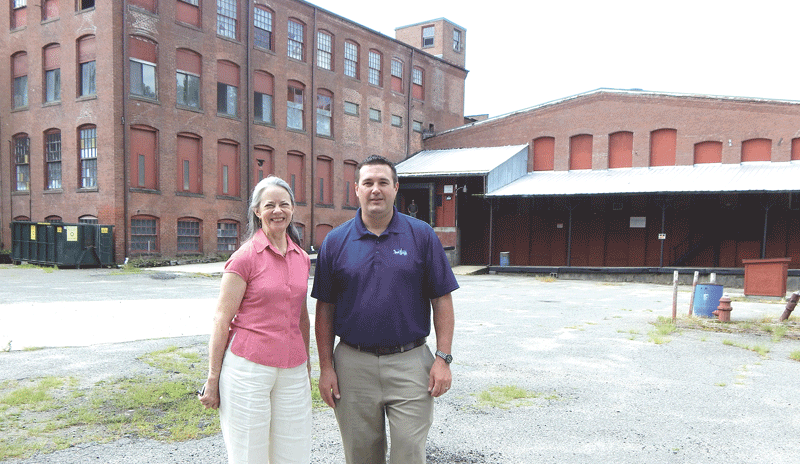
Susan Bunnell and Jeffrey Smith say businesses that choose to open in the former Collins Paper Co. will find that Wilbraham has a streamlined permitting process.

When Brian and Tanya Miller walked into Building 2 at the former Collins Paper Co. in Wilbraham, they knew immediately they had finally found the perfect place to open their new business.

The couple is about to launch Movement Terrain LLC, which they describe as a “functional fitness obstacle-course gym,” and they spent a year looking at sites throughout Western Mass. before their visit to Wilbraham.

“We saw many standard buildings that would be great places to get fit, but we wanted a place that had real charm,” said Brian as he talked about the mill’s brick walls, its high ceilings, and the Chicopee River that runs alongside the property, which he envisions as a place where prospective clients can kayak and enjoy nature in a soothing surrounding.

The new facility will combine elements of mud run races and the type of competitive challenges seen on the CBS TV show American Ninja Warrior, which will allow people to get fit by helping each other overcome obstacles.

“It’s more fun than lying on a bench doing bench presses and builds camaraderie,” Brian told BusinessWest, adding that his wife is a yoga instructor and he came up with the idea for their new venture after taking part in a mud run with 20 people.

“As soon as we walked in, we loved everything about the building, and we’ll be happy if we can help with the mill’s revitalization. We hope we’ll become a catalyst for other businesses to move here,” he told BusinessWest, adding that their new venture is in the permitting stages, and they hope to open in January, but the mill property, which is being revitalized, would also be perfect for a yoga studio, coffee shop, or holistic-health service provider.

The Collins Mill redevelopment effort is at the top of the town’s list of intriguing development initiatives, but there are others. They include new green-energy-generating facilities, and Wilbraham has two new solar farms that will soon be operational. The first is a 925-kilowatt facility on the town’s capped landfill that is expected to reduce the municipal electric bill by $100,000 annually for the next 20 years, while the second is situated at Merrick Farm off Tinkham Road on a six-acre wooded lot that was damaged during the June 2011 tornado.

“It was an ideal site to develop,” said town Planning Director John Pearsall. “It doesn’t affect the existing farmland and will provide the farmer with a new source of income.”

Wilbraham is also building a new, $8.2 million, 16,000-square-foot police station at 2780 Boston Road to replace its current facility, which is located inside the oldest building in town and is grossly inadequate for today’s needs.

We’re welcoming and willing to be flexible, and because we are a small town, the boards tend to work well together and are willing go the extra mile.”

A groundbreaking ceremony was held in April, and the station is expected to be finished next March. It is adjacent to the fire station, which received a $2.4 million renovation in 2012 that expanded the building from 3,600 to 11,500 square feet.

Infrastucture work has also been taking place, and the East Street Bridge, spanning the Chicopee River between Ludlow and Wilbraham, has been closed due to structural damage. But requests for proposals recently went out for the $2.3 million project, and state officials expect work to begin in the late fall.

There has also been an uptick in new subdivision activity; 11 homes will be built in the Willow Bark Estates neighborhood on acreage that once housed Bennett Turkey Farm, while a six-home development on Sherwin Road is under review.

For this, the latest installment of its Community Spotlight series, BusinessWest looks at the mill project and other intriguing developments in this community that has long been known as a great place to live but is also becoming a more attractive option for those looking to do business.

Progress Report

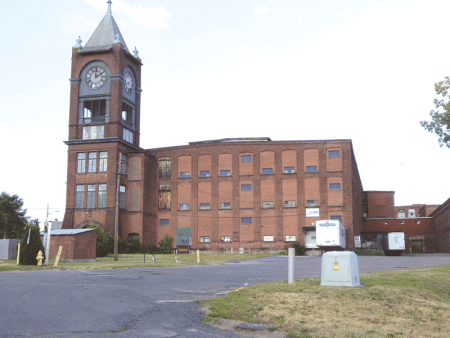
Collins Manufacturing Co., which later changed its name to Collins Paper Co., was built in 1872. In its heyday, it was the primary employer in Wilbraham and was known for the fine writing paper it produced.

The mill officially closed in 1940, but continued partial operations until the 1950s. After that, it was used primarily for cold storage before becoming home to a number of small businesses and a plastics-manufacturing firm.

Doug Maxfield, who has maintained the property since 1972, said many Wilbraham residents and people who drive over the East Street Bridge in front of the mill don’t know it exists because it is hidden behind trees and underbrush and cannot be seen from the road.

But that is about to change, thanks to a new company called Wilbraham Land & Development, LLC, which purchased the property two years ago. Since that time, it has spent more than $500,000 to clean the interiors of the buildings, make needed repairs, and put a new roof on Building 5.

“The complex contains five main buildings and has 250,000 square feet of usable space,” said Wilbraham Land & Development Asset Manager Courtney Desmond, adding that three of the buildings are ready for tenants.

Renovations to Building 5, which contains 15,520 square feet on three floors, are complete; Movement Terrain LLC plans to occupy the 13,000 square feet in Building 2; and improvements to another structure with an elevator have been finished.

Desmond said architects and engineers were hired to work at the site shortly after the company took control of the property to identify areas that needed to be prioritized.

“It’s a very large project, and we’re approaching it on a step-by-step basis,” she explained, adding that space in the mill buildings can be customized to suit individual businesses.

Although she expects the revitalization to take a decade to complete, the mill is already attracting attention: a group of students from UMass Amherst filmed a movie there last summer, a number of businesses have approached her about moving in, and the Millers plan to open their fitness facility there.

“We hope to attract new businesses as our renovations continue,” Desmond went on, adding that the revitalization will bring new jobs to Wilbraham, and the vision for the future is to make the mill into a work/live space with residential units, retail operations, and a restaurant overlooking the river.

Maxfield says the mill is historically significant to the town. It produced its own hydroelectric power for generations thanks to its easy access to the Chicopee River, and at one time railroad cars carrying frozen foods traveled there frequently via a rail spur that was added to the main railway route for that purpose.

“The mill has had a number of owners and a multitude of tenants that included companies that built teepees and businesses that made casket liners,” he noted “It offers unlimited opportunities for the future.”

New Ventures

Part of Wilbraham’s appeal is the quality of education offered in its public schools and at Wilbraham Monson Academy, and improvements to that campus are made on a frequent basis.

“Right now, they are renovating Rich Hall, which is their anchor building, and they are also adding a new, multi-level dormitory for middle-school students,” said Jeffrey Smith, Planning Board chair.

Susan Bunnell, chair of the Board of Selectmen, says Wilbraham is an attractive place to live. “It is a great place to raise a family, educate your children, and retire in,” she told BusinessWest, adding that Wilbraham has also earned the reputation of being a business-friendly town. “We receive feedback regularly from developers, architects, and others that our professional staff and relevant elected and appointed boards work together to make the permitting process among the most efficient in the state.”

Pearsall agreed. “Wilbraham is very pro-business. We’re welcoming and willing to be flexible, and because we are a small town, the boards tend to work well together and are willing go the extra mile,” he said. “FloDesign recently requested that we approve a zoning change so they could purchase a small parcel next to them to expand their operation. It had been zoned residential, but the voters approved the change.”

Indeed, zone changes are not uncommon; another was recently made to enhance the desirability of the former Belli Restaurant site on 2451 Boston Road. The town took possession of the property in December through the tax title process and has plans to demolish the condemned building and clean up the overgrown lot to prepare the site for a new business.

However, Smith said the lot is too small to accommodate parking, so town officials approached the owner of the parking lot next door and asked him if he would be willing to sell it or lease it to the prospective owner of the new property.

“He agreed to the idea, but half of the land his parking lot sits on was zoned residential, so we changed the entire lot to a general business zone,” Smith explained.

Future Growth

Bunnell noted that Wilbraham offers myriad opportunities for new businesses.

“We have several properties available in prime locations: at least three in the town center and a number along the busy Boston Road corridor. And the former Collins Mill offers desirable space for everything from fitness centers to studios for artists,” she noted. “It’s an exciting time for Wilbraham, and the mill is ripe for innovative use.”

Brian Miller has begun collaborating with other business owners near the mill and recently visited a nearby taproom and grill, suggesting that once Movement Terrain LLC opens they could promote one another, which he says will also work well when other businesses are established within the mill property.

He noted that other revitalized mills throughout New England are flourishing, and he and his wife hope people will travel to Wilbraham to use their gym, which will offer people the opportunity to get in shape by joining together to overcome obstacles.

So while new members of Movement Terrain work to get fit, town officials and Wilbraham Land & Development LLC will do their part to help businesses overcome their own challenges as they look toward the future of one of the town’s most historic sites.

“It’s exciting and an enormous opportunity for Wilbraham. The space is an empty canvas and different from anything else we have to offer, so we hope it will bring in businesses that otherwise wouldn’t consider moving to the town,” Smith said. “And as new companies come here, it will only promote more and more growth.”

Wilbraham at a glance

Year Incorporated: 1763
Population: 14,484 (2016)
Area: 22.4 square miles
County: Hampden
Residential Tax Rate: $21.60
Commercial Tax Rate: $21.60
Median Household Income: $95,395 (2016)
Family Household Income: $107,715 (2016)
Type of government: Open Town Meeting
Largest employers: Baystate Wing Wilbraham Medical Center; Friendly Ice Cream Corp.; Big Y; Home Depot

Sections Technology

Code Talkers

Blair Winans, president of Rhyme Digital

Blair Winans, president of Rhyme Digital

Blair Winans had forged a successful small business in website development when a larger company from across the state came calling. The acquisition that ensued brought more frustration than growth, and lasted just over a year. But it did generate lessons for Winans and his team, who regrouped in Easthampton, rebranded as Rhyme Digital, and refocused their efforts on not just designing websites, but helping clients understand how to get the biggest marketing bang for their money and time.

Blair Winans’ professional journey has weathered a few bumps. But those bumps have been valuable, he said, by teaching him what he and his Easthampton-based company, Rhyme Digital, do best.

When he launched his website-design firm in 2005, it was known as Winans Creative, and over the next several years, he built up a cadre of loyal clients and a small staff. Things were on the right track — he assumed.

That all changed three years ago, however, when Winans was approached by HB Agency, a much larger marketing firm in Boston, about a possible acquisition. The company lacked digital capabilities and wanted to offer such services to its clients, and they thought the expertise of Winans Creative would fit nicely into their business model. Winans agreed.

“We were excited about it, and a bit nervous,” he said, but he took the leap, acting as vice president of digital marketing in what was essentially HB’s Western Mass. satellite office. “But it brought all sorts of challenges. As a satellite office, it’s tough to merge cultures, which was a tough stumbling block. It also turned out that a lot of our existing clients didn’t fit in with this new company’s business model, and those clients were let go in favor of bigger ones. A lot of us were upset about it; that wasn’t part of the expectation.”

After a year, it was clear that the acquisition wasn’t bearing fruit for either side, and Winans was given the opportunity to take his firm back. And he did, in February 2015, bringing his five employees with him.

“It’s not a scenario where everyone looks back and says, ‘that was a fantastic time,’” he told BusinessWest. “But, in retrospect, we learned who we are and what we’re good at — and what we don’t want to be, which I think was a really helpful part of that process. Thankfully, we came out of it with all the same team; that’s one of the things that really helped us become stronger.”


Click HERE for a list of Web Development Companies in the regions


Taking the company back was also a chance to reassess the company’s direction, he went on. He and his employees wanted to stress the team aspect of the operation, hence the name change to Rhyme Digital. They also sensed increasing opportunity in not only building websites for companies, but teaching them how to turn their online presence into an effective marketing tool with measurable results.

“We were great at building and designing websites, and a lot of times clients think a website is the end-all, be-all,” Winans said. “But a lot of what we do revolves around helping people market themselves and build an online brand presence and sustain that over the long term. That’s where we shifted the focus — not just building these tools, but helping people understand the different pieces to it.”

That’s an issue today, he said, for companies that have websites and receive reports back from digital marketing firms that don’t really tell them anything. Rhyme’s goal is to track and clearly communicate not just a website’s hit count, but where the traffic is coming from, which campaigns potential customers are responding to, and what they’re doing on the website once they’ve arrived.

“We’ve had clients come to us saying, ‘I signed up for this digital marketing package, and I get reports of how many clicks are coming through my website, but not much more than that. Can you help me?’ We sit down and show them what’s happening once people come through. Once you make the connection, you can really put a dollar amount on the traffic coming onto your site.”

In other words, there’s a technical component to setting up a website and its features, but the end result has to bring return on investment, and ways to effectively measure it. “The question a client needs to ask,” he said, “is not ‘can you build me a website,’ but ‘I need my website to do x, y, and z.’ Or, ‘I need my website to be a lead-generating tool.’ We’re going to give you all the data to help your company continually improve what it’s doing online and in all its marketing.”

Come Back Home

After the failed acquisition, Winans said he was gratified — but perhaps not totally surprised — when Rhyme reached out to the clients it been forced to drop and was met warmly.

“The response was fantastic,” he told BusinessWest. “We’re really thankful we have a loyal client base; we’ve been working with some of them for more than 10 years. They see us as a partner and a resource. That always makes us feel good.”

The most successful relationships between Rhyme and its clients are the ones that have grown over time to the point where Winans and his team understand everything about the client and its marketing goals — both in online and traditional advertising.

Blair Winans

Blair Winans says constant advances in website coding, graphic design, and marketing strategy lends his work variety and keeps it fun.

Rhyme’s clients run the gamut from manufacturing to retail (both brick and mortar and purely online); from outdoor adventure sports (Zoar Outdoor is one of its longest-running clients) to publishing and nonprofits.

“We end up treating each client as its own specific case. We’re never going to be a one-size-fits-all solution,” Winans explained. “We do a bit of e-commerce development, and no e-commerce store does things the same way another one does; they have very specific differences and needs.”

Rhyme helps its clients consider the many possible facets of an online campaign — banner ads, search-engine optimization, Google AdWords, and, especially, landing pages with optimized content that gets visitors to take action, not just click on through. Then there are newer, cutting-edge tools such as radio-frequency identification and geofencing, which are used to target potential customers by location.

“The possibilities are enormous right now, better than they ever have been before, and we help clients set up these types of campaigns,” Winans said, noting that, for one of his clients, a publisher targeting first-year law students, he used geolocation to focus mobile pitches around college campuses. “One of the best things about digital marketing is that fluidity, and the ability to pivot based on the data that comes in.”

It’s also more cost-effective to test multiple messages digitally before deciding on the best one and launching it through larger, traditional-media campaigns, he went on. “We’re helping people make the most of their budgets, looking at how technology plays a role, and helping them figure out where they should be spending money.”

Websites weren’t Winans’ first career path, or even his second. He enrolled in college looking to be a lawyer, but then switched gears and transferred to the Boston University College of Communication to study advertising, marketing, and public relations. It was a field where he could put his graphic-art skills to good use, doing branding and design for a number of companies.

This was the late ’90s, a time when websites were first coming online, and he had a chance to play around with early marketing models, including working with Dunkin’ Donuts on its first website. “It’s kind of the equivalent to what’s happening now, with all these different technologies, seeing which ones are panning out,” he said. “I learned a lot of different stuff very early on; actually, I taught myself how to do it.”

In addition to leading a team that now numbers seven, Winans characterizes his day-to-day work at Rhyme as half coding, half design, and appreciates the variety offered by both — and the challenge of keeping abreast of the latest developments in the world of dynamic websites.

“For my development team, every week there’s a new platform or technology or script or language they need to be aware of,” he told BusinessWest. “We don’t just want to sell our clients a bunch of tools, but the right set for what they’re trying to do. It puts a lot on our shoulders — but it’s fun. We love learning about different types of technologies and seeing what these capabilities are. It’s an ongoing process.”

What makes it work here is, we’re all interested in the same thing: to make our work the best it can be and push each other — and in the process have fun. In our business, you never know what kind of work you’ll get on any given day. You could be coding something one day, working on the checkout process for an e-commerce site another day.”

But one, he said, made easier by the closeness and longevity of his team. “Everyone here is excited about coming to work every day, excited about who they’re working with and what they’re doing for clients. We’ve been through some ups and downs as a team as part of the whole process, but we’ve built something we feel is more than just a business. That’s important.”

There’s the Rub

That’s not to say website design and marketing it’s sometimes stressful, Winans added, but the team at Rhyme — based out of an airy space in the Eastworks complex — has created an environment where everyone encourages each other and helps each other out, and nobody is afraid to step up and ask for help.

“What makes it work here is, we’re all interested in the same thing: to make our work the best it can be and push each other — and in the process have fun,” he said. “In our business, you never know what kind of work you’ll get on any given day. You could be coding something one day, working on the checkout process for an e-commerce site another day.”

The reward, he went on, is seeing the sites go live.

“There’s a pretty big sense of excitement when we look at all the projects we’ve done and hear the way our clients talk about them, when they come back and tell us, ‘we get nothing but praise for our site now.’ A couple of clients go back 10 years, and they’re on the fourth iteration of their website, and you see the transformation. We have archives of sites we’ve done, and it’s fun to see the progressions in them. When we can help businesses utilize their sites to their fullest capacity, that’s what really makes what we do worthwhile.”

In other words, Rhyme Digital is certainly not going to the dogs — unless you count Winans’ two furry friends, a yellow lab named Butters and a pug named Flora, who join him at work every day. The other employees are encouraged to bring their dogs occasionally as well.

“They provide some comic relief,” he said. “When things get stressful or we’re under a heavy deadline, and Butters is upside-down on the floor, wagging his tail hard, you realize we’re not doing brain surgery. Sure, you’re dealing with deadlines, but there’s always time for a belly rub.”

For someone who’s been coding websites going on two decades and still finds excitement in the details, it’s a healthy perspective.

“You get to learn something new every day here,” he said. “It’s a good spot to be in.”

Joseph Bednar can be reached at [email protected]

Daily News

GREENFIELD — Greenfield Community College announced that Catherine Seaver has been named chief academic and student affairs officer.

“Catherine Seaver is a great fit for GCC,” said college President Bob Pura. “Catherine understands the joy, privilege, and the challenges of teaching and learning at a community college because she attended a community college, she has taught in the classrooms of one, and has worked in leadership positions in a community college. She understands the challenges of working in and running a tech-based business because she has worked in that environment. Catherine fits here because she gets how important relationships and community are to student success, how important the ongoing commitment to betterment and improvement is, and why it is essential that our student outcomes are comprehensive and sustainable. Catherine totally gets the importance of access, excellence, and our mission.”

Seaver holds a bachelor’s degree in applied science: manufacturing engineering technology from Miami University, a master’s degree in computer information systems from the University of Phoenix, and a master’s degree in educational technology from Eastern Connecticut State University. She will complete a PhD in leadership from the University of the Cumberlands in December.

Seaver worked at Manchester Community College from 2002 until this past spring. Her positions included division director for Business, Engineering & Technology; interim associate dean of Student Affairs; and department chair/professor in Engineering & Technology. While in administrative roles, Seaver taught one online or on-campus course each semester as an adjunct professor, including “Introduction to C++ Programming,” “Introduction to 3D AutoCAD,” “Object-Oriented C++ Programming,” and “Introduction to Engineering Analysis.” Prior to working at Manchester Community College, Seaver held systems-engineering, project-management, and technical-instructor positions with Hallmark IT, General Cigar Co., IKON (formerly HBM Technology Group), KTC Software Services, and Carrier Corp.

“GCC’s President Bob Pura and GCC as a whole have a superb reputation throughout Massachusetts, Connecticut, and beyond,” Seaver said. “I’m honored to be able to work here. When I was teaching at Manchester Community College, students would take a few classes at MCC with the intention of transferring to GCC to finish. I am very committed to community colleges. Their smaller classes and teachers focused on teaching instead of research make all the difference in student success.

“I was a finalist for a position at a selective four-year college that admits only 50% of their applicants,” she went on. “Thinking about what happens to the other 50%, I realized how much open access means to me and that I want to focus my career on community colleges. GCC is a great school doing powerful work in the community, and I look forward to being part of what GCC does so well.”

Daily News

BOSTON — A resurgent U.S. stock market, better-than-expected job growth, and growing labor-force participation failed to make believers of Massachusetts employers during July as business confidence fell for a second consecutive month.

The Associated Industries of Massachusetts (AIM) Business Confidence Index declined one point to 55.1 last month, leaving it more than four full points lower than in July 2015. The confidence reading remained above the 50 mark that denotes an overall positive economic outlook, but optimism dimmed across the board on employment, the Massachusetts economy, and employers’ outlook on their own companies. The index has now declined in three of the past four months.

Economists suggest that employers may be caught between the expectation of an expanding U.S. economy and concern about anemic growth and instability overseas. It’s a paradox that has resulted in the stock and bond markets, which usually move in opposite directions, rising in tandem this year.

“We see a familiar pattern in what is now the fourth-longest economic expansion since World War II — employers remain optimistic about the state of the economy, but it is an optimism marked by fits and starts and reactions to all sorts of political and economic events,” said Raymond Torto, chair of AIM’s Board of Economic Advisors (BEA) and lecturer at Harvard Graduate School of Design.

The AIM Business Confidence Index, based on a survey of Massachusetts employers, has appeared monthly since July 1991. It is calculated on a 100-point scale, with 50 as neutral; a reading above 50 is positive, while below 50 is negative. The index reached its historic high of 68.5 on two occasions in 1997-98, and its all-time low of 33.3 in February 2009. It has remained above 50 since October 2013.

Most of the sub-indices based on selected questions or categories of employer declined during July. The Massachusetts Index, assessing business conditions within the Commonwealth, dropped 1.3 points during July and 0.3 points over the year to 57.2. The U.S. Index of national business conditions, in contrast, bucked the downward trend of the past year (in which it dropped 3.0 points) by gaining 1.5 points. Even so, employers have been more optimistic about the Massachusetts economy than about the national economy for 75 consecutive months.
The Current Index, which assesses overall business conditions at the time of the survey, fell 0.2 points to 55.3, while the Future Index, measuring expectations for six months out, slid 1.8 points to 54.8.

“July marked the first time since September 2015 that employers were more positive about current conditions than those six months from now. It’s something to watch, since confidence drives employer decisions on hiring and investment moving forward,” said Elliot Winer, chief economist for Northeast Economic Analysis Group LLC. “It’s also worth noting that employer confidence in their own companies has declined by 5.8 points, albeit from a high level, during the past 12 months.”

Indeed, the three sub-indices bearing on survey respondents’ own operations all weakened. The Company Index, reflecting overall business conditions, fell 1.8 points to 55.9, while the Sales Index lost 1.4 points to 55.6, and the Employment Index dropped 2.0 points to 52.5.
The AIM survey found that nearly 39% of respondents reported adding staff during the past six months, while 19% reduced employment. Expectations for the next six months were stable, with 37% expecting to hire and only 10% downsizing.

“A tightening labor market is finally beginning to put upward pressure on wage growth as employers compete for skilled workers,” said Michael Goodman, executive director of the Public Policy Center (PPC) at UMass Dartmouth. “Wages rose 2.6% for the 12 months ended in June, the fastest annual growth rate since 2009. While this is welcome news for the state’s working families, whose wages have been stagnant for an extended period, it represents a challenge for those employers with limited pricing power who can expect it to be increasingly difficult and expensive to obtain the labor they need to support expected growth in coming months.”

Confidence levels in July were higher in Greater Boston (56.8) than in the rest of the Commonwealth (52.2). Non-manufacturing companies enjoyed a significantly brighter outlook at 58.0 than manufacturing employers, who posted an overall confidence level of 52.6.

AIM President and CEO Richard Lord, a BEA member, said employers should take encouragement from the moderate approach to business issues taken by state lawmakers during the two-year legislative session that ended Sunday night. Beacon Hill balanced a difficult budget with no tax increases, passed economic-development and energy legislation, and developed a consensus pay-equity measure that balances the needs of employers and workers.

“The Legislature and the Baker administration again showed an understanding of the factors that contribute to business growth and job creation,” Lord said. “We give particular credit to House Speaker Robert DeLeo, who forged meaningful compromises on pay equity, non-compete agreements, and other key issues.”

Daily News

BOSTON — The state’s seasonally adjusted unemployment rate remained at 4.2% in June for the third consecutive month, the Executive Office of Labor and Workforce Development reported Thursday.

The preliminary job estimates from the Bureau of Labor Statistics indicate Massachusetts added 16,400 jobs in June. Some of the job gains reflect the resolution of a temporary labor dispute in the information sector.

Over-the-month job gains occurred in the education and health services; information; professional, scientific, and business services; financial activities; construction; and manufacturing sectors.

Year to date, from December 2015 to June 2016, Massachusetts added 48,100 jobs, and over the year, from June 2015 to June 2016, the state added 67,300 jobs.

The Bureau of Labor Statistics also revised over-the-month job losses initially released for May, reporting job losses totaled 5,200 as opposed to the 6,400 originally estimated.

At 4.2%, the unemployment rate is down 0.7% over the year, with the state’s seasonally adjusted unemployment rate dropping from 4.9% in June 2015. There were 25,000 fewer unemployed people and 49,600 more employed people over the year compared to June 2015. The Commonwealth’s unemployment rate remains lower than the national rate of 4.9% reported by the Bureau of Labor Statistics.

“The good news here is all private sectors show over-the-year job gains with the exception of manufacturing, and private-sector job gains are up 2.2% over the year,” Labor and Workforce Development Secretary Ronald Walker II said.

The state’s labor-orce participation rate — the total number of residents 16 or older who worked or were unemployed and actively sought work in the last four weeks — decreased slightly to 64.9%. The labor-force participation rate over the year has decreased 0.1% compared to June 2015.

Over the year, the private sectors with the largest percentage job gains were construction; education and health services; professional, scientific, and business services; information; and financial activities.

Daily News

CROMWELL, Conn. — Local organizations banded together to support STEM education in Connecticut while making a positive difference in the community. The ACT Group, Mystic Aquarium, and Mystic Middle School, with assistance from 3D Systems, designed and produced an orthopedic boot for Purps, an African penguin and life-long resident of the aquarium.

In 2011, Purps was left with a non-functional flexor tendon following an altercation with another penguin on exhibit. Since then, she has been wearing a traditional hand-casted boot to support her injury. While the traditional boot adequately immobilized, supported, and protected her injury, it posed some concerns for the veterinarian staff at the aquarium. The moldable plastic material it was made of deteriorated quickly, forcing the veterinarian staff to reproduce the boot frequently, a very time-intensive process.

The collaboration between local organizations began when Sue Prince, library media specialist at Mystic Middle School, started an innovation lab with the goal of introducing students to 3D technology. She applied for and won a grant from the Stonington Education Fund and used the funds to purchase a 3D printer for the lab.

Prince worked in conjunction with Kelly Matis, a member of Stonington Education Fund’s community board and director of Education and Conservation at Mystic Aquarium. Matis, aware of the diverse applications of 3D technology, shared the need for a new orthopedic boot for Purps with Prince. Eager to help and put the 3D printer to use for a great cause, Prince contacted the ACT Group to inquire about assistance with computer-aided design (CAD) and 3D scanning.

Nick Gondek, ACT Group’s director of Additive Manufacturing, led his team in demonstrating state-of-the-art 3D technology to Prince and her students. These demonstrations gave the students of Mystic Middle School invaluable hands-on experience using technology from 3D Systems and allowed the ACT Group to provide technical expertise through the course of the project. The ACT Group’s assistance was a crucial part of the successful design of Purps’s boot, ultimately completed by the students of Mystic Middle School.


“It was so rewarding to teach the students how end-to-end manufacturing solutions by 3D Systems work,” noted Gondek. “Helping to stimulate creative thinking through the use of 3D technology is a way for us to pay it forward at the ACT Group,” he concluded.

“It’s been truly amazing to be able to work with the middle-school students, the ACT Group, and their 3D technology, as well as veterinarian staff here at the aquarium,” Matis said, “and to use this 3D technology to benefit the health of one of our endangered species.”

Impressed by the dedication and eagerness of the students, the ACT Group hopes this project inspires other educators to infuse 3D-printing technology within their STEM curricula to inspire future innovators.

Community Spotlight Features

Community Spotlight

Brian Mannix

Brian Mannix says plans to transform the clock tower building into market-rate apartments, with retail and office space, could bring young professionals to the community.

Brian Mannix stood at the foot of Ludlow’s new riverwalk behind Ludlow Mills and talked about a future he could clearly picture.

“Think of what it would be like to clear away some of this greenery and have a restaurant with seats facing the river and boutique shops with benches outside,” said Mannix, chair of the town’s Board of Selectmen, as he spoke about Ludlow Mills, the projects underway on its campus, and the unlimited potential the property will hold for years to come.

Eric Nelson says Mannix’s vision may become reality. “We have one building now with the potential for a view of the river, and when we create Riverside Drive, which is on the comprehensive plan for the site, it will open up new vistas,” said the recently named president and CEO of Westmass Area Development Corp., which owns the site and is working to revitalize it. “Plus, we just knocked down two large structures with asbestos between the large mill buildings and the river, and the vistas from them are tremendous.”

The mills encompass a sprawling complex of more than 60 buildings set on 170 acres, and Westmass predicts that, over the next 15 years, more than 2,000 new jobs will be created and retained there, and more than $300 million will be spent in private investments.

Two years ago, HealthSouth Rehabilitation Hospital of Western Massachusetts opened a new, $28 million acute-care facility on the grounds, which marked the beginning of the revitalization of the largest brownfield mill-redevelopment project in New England and kept 75 to 100 jobs in Ludlow.

“HealthSouth was a big jump start,” said Lawrence Curtis, president and managing partner of WinnDevelopment, which specializes in housing and mill redevelopment and has two projects planned at the Ludlow Mills. One is a $24.5 million adaptive reuse of Mill 10 that will result in 63 one-bedroom units and 12 two-bedroom apartments for seniors.

Curtis said that project is fully funded and expected to be complete in the fall. “We’re transforming a vacant building with broken windows into a vibrant space that will contain subsidized and market-rate apartments with beautiful architectural features, including exposed beams and brick and large windows,” he said.

The ambitious second phase of the company’s work was announced at the recent Developers Conference in downtown Springfield, and involves the conversion and reuse of Mill 8, which features the town’s iconic clock tower. The plan is to turn the building’s 231,000 square feet across several floors into 100 to 136 market-rate apartments with commercial, retail, and office space on the first floor. The estimated cost is $60 million, and Curtis said significant funding needs to be secured before work can get underway.

But he considers it an ideal site.

“Ludlow Mills is a beautiful, intact complex situated in the center of town; it’s a great location, and Winn Development and the town of Ludlow are fortunate to have married to take advantage of the space there,” he said, adding that, in the past, many people wondered what would become of the property.

And indeed, the revitalization of the complex and the new projects will make a decided difference.

“The potential of what this will bring to the town is overwhelming,” Mannix said, noting that many fund-raisers have been held over the years to repair the clock tower, and the news that the building will remain and be put to new use makes many residents happy.

“The clock tower is a signature piece that people see when they drive into town, and we hope it will become the icon of the new project,” he continued, as he lauded Westmass and Winn Development for their efforts.

Westmass purchased the site five years ago, and since that time, it has attracted $75 million in public and private investment, outside the newly announced $60 million clock-tower building renovation.

“WestMass has a real desire and determination to use the mill property to put Ludlow on the map, and the redevelopment is a step forward in Ludlow’s future,” Mannix told BusinessWest, noting that the loft-style apartments planned for the clock tower could bring new, young professionals to town, hopefully followed by small boutiques and restaurants to enhance the site.

Nelson said the work that is complete, in progress, and in the planning stages speaks to the partnership that the town formed with Westmass.

“This is the fruit of all that has been done. When the comprehensive zoning and master plan were created, we envisioned these types of projects,” he said, explaining early public meetings with residents to determine what they wanted in terms of preservation and development, which included senior housing.

Progress Report

The majority of buildings that make up the heart of Ludlow Mills on State Street were built between the 1870s and 1920s by Ludlow Manufacturing and Sales Co. From the 1860s through the 1970s, it made cloth, rope, and twine out of Indian-grown jute, flax, and hemp, employing about 4,000 people in its heyday.

the historic clock tower building

Plans are on the table to convert the historic clock tower building into market-rate housing.

Although the property fell into a state of decline after the operation shut down, great strides have been made toward revitalization, thanks to public and private investments, including the one by HealthSouth, which paid tribute to the town’s history by using 100,000 salvaged bricks and planed wooden beams from old mill buildings in its new hospital. Today, the complex is a mixed-use district and home to many small manufacturing and design businesses that include Iron Duke Brewery, which opened in a 3,000-square-foot space in December 2014.

Mannix said the microbrewery has done so well, it plans to add an outside patio with entertainment in the near future.

Potential to build a new senior center also exists at the mill site, and the selectmen recently listened to a proposal presented by Council on Aging officials and Friends of the Senior Center who want the town to build a $10 million, 23,000-square-foot facility on a 4.4-acre parcel of land next to HealthSouth. “They did a lot of groundwork and had a great presentation,” Mannix said.

The mill property has also been enhanced by a riverwalk that officially opened several months ago. It starts behind the clock tower and ends at HealthSouth.

Mannix said the town just received a $429,500 MassWorks grant for the riverwalk that will be used to install new signage to educate people about the history of Ludlow and Ludlow Mills, as well as new lighting and markings that will help make it more accessible.

A great deal of needed infrastructure work has also been completed in the area.

“The water and sewer lines downtown were installed when Ludlow Mills was in its heyday, but were never mapped out. We needed to bring them up to code to have the ability to attract developers and all types of businesses,” Mannix said, noting that a $5 million sewer-separation project was just finished, and close to $4 million has been spent to upgrade the utilities on State Street.

In addition, new curbing, sidewalks, and lighting have been installed along a 1.5-mile stretch on East Street that runs from the bridge to Williams Street.

Although downtown vacancies were on the rise a decade ago, over the past few years new restaurants and beauty salons have been filling empty storefronts.

“We’re finally moving forward in the right direction. We’re looking to improve our downtown district and constantly looking for businesses that want to locate there,” Mannix said.

He noted that Cumberland Farms on West Street just expanded, and the one on East Street recently purchased a former restaurant next door, razed the building, and is building a new, expanded storefront.

A new solar farm is also in the planning stages. Mannix told BusinessWest that Ed Godin, who owns Ludlow Auto Salvage, has closed his decades-old family business and is turning it into a solar facility. It will be the second solar farm in town; several years ago, the Ludlow landfill was converted into a 2.7-megawatt facility by California developer Borrego Solar Systems Inc.

“All of the electricity generated at the landfill is sold to the town at a substantially reduced rate; it saves us $120,000 each year,” Mannix said, adding that he is happy the land owned by Ludlow Auto Salvage will be used to generate green energy.

A new public cemetery may also become part of the landscape; the town is in the process of purchasing 40 acres next to Ludlow Auto Salvage for that purpose. The site was once home to a driving range and has been unused for about a decade.

Mannix said the purchase is important because the town’s current public cemetery will be filled in two or three years, and the new cemetery, located off Center Street or Route 20, will be large enough to last for decades.

View to the Future

Nelson said the town vigorously supported Westmass after it purchased the property, and partnered with the state to secure enough state and federal funding to complete the cleanup of the brownfield site and get the needed infrastructure work done.

“Having these things complete makes it attractive to developers like Winn. Their projects are challenging enough, and having the infrastructure and cleanup completed allows them to do what they do best,” he said. “We’re starting to see people focusing not only on the mills, but on Ludlow itself.”

Indeed, the new HealthSouth Rehabilitation Hospital and work being done by WinnDevelopment are already bringing new life to the area.

“The community has been very receptive to what we are doing, and thanks to our track record, skill set, and interest from the town, a real transformation is happening at the Ludlow Mills,” Curtis said.

Mannix agreed. “The clock-tower project and the transformation of Building 10 will be a giant step forward for the future of the town,” he said, adding that Ludlow already has a lot to offer. “We have top-of-the-line schools and a sports complex behind the high school, our own golf course, a beach at Haviland Pond and a town pool on Whitney Street which both offer extensive youth programs during the summer, a community center, great services which include free trash pickup, a reasonable tax rate, and Lupa Zoo, which is a real asset as it constantly brings new people into town.

“Things are very positive, and a lot of it has to do with the Ludlow Mills and people like Ed Godin,” Mannix went on. “We are very pleased with the growth that is taking place.”

Nelson said every dollar invested in revitalizing a mill property multiplies and has a ripple affect in the community and region in general: contractors get work, there is a need for building supplies, and new jobs are created once projects are complete.

“If you throw a rock in a pond, it makes waves, and the largest waves are right where it lands,” he said.

With a view of the river that will be seen not only from the new apartments facing it, but from many businesses that occupy the property in the future, it’s not hard to see why officials can easily imagine a bright future for Ludlow.


Ludlow at a glance

Year Incorporated: 1774
Population: 9,872 (2010)
Area: 28.2 square miles
County: Hampden
Residential Tax Rate: $18.13
Commercial Tax Rate: $18.13
Median Household Income: $53,244
Family Household Income: $67,797
Type of Government: Town Council; Representative Town Meeting
Largest Employers: Hampden County House of Correction; Massachusetts Air National Guard; Kleeberg Sheet Metal Inc.; R&C Floral Inc.
* Latest information available

Opinion

Editorial

You won’t find it at or anywhere near the top of those oft-cited lists of all the economic-development activity happening in Springfield, a compilation dominated by MGM’s casino, CRRC MA’s subway-car-manufacturing facility, the I-91 reconstruction project, Union Station, and Silverbrook Lofts.

But the recently unveiled $1.8 million purchase and renovation of the historic Merrick Phelps House on Maple Street is significant in its own way — many ways, actually.

The property, once the home to Solymon Merrick, inventor of the monkey wrench, was an eyesore, a blight on the once-proud Maple Street-area neighborhood. No one wanted anything to do with it, and for years it sat there deteriorating, a highly visible symbol of all of the many things wrong with Springfield.

Enter DevelopSpringfield, the nonprofit, 501(c)(3) corporation created in 2008 to advance development and redevelopment projects, and its energetic president and CEO, Jay Minkarah. Unofficially, the agency’s mission is to generate momentum and progress in the City of Homes through a number of initiatives, one of them being the acquisition and repurposing of properties like the Merrick Phelps House.

And this project has created both.

Beyond restoring one of the proud properties that gives the city its nickname and converting it into business space, this effort is now a highly visible symbol of the many things going right in Springfield — specifically a strong blend of public and private investments that can only succeed in generating more of the same.

Indeed, when residents, business owners, developers, and even state officials see a project like this, they become far more likely to look upon Springfield as a place they want to invest in. They look upon an initiative like this and say, ‘well, if someone can do that, then we can…’

Anyone with an imagination can fill in the blank. And as DevelopSpringfield, other agencies, and private developers undertake more projects like the Merrick Phelps House, more groups and individuals will be inspired to try and do so.

This is the basic formula for redeveloping properties, blocks, streets, neighborhoods, and communities. Progress begets more progress. It’s a simple theory, but it works, as we’ve seen in cities across the country, and locally, in Lowell and even Holyoke.

It is through projects like this that progress spreads beyond the central business district and into surrounding neighborhoods, where people live — and more would choose to live if it were a place they could take pride in.

Springfield, as we all know, is all about neighborhoods, and many of them — in fact, most of them — need to turn to the past tense when putting that word ‘pride’ to use.

When officials and organizations like DevelopSpringfield talk about progress coming one building at a time, it sounds cliché. But it’s not. This is how cities rebuild themselves and restore lost pride — one property, one important project at a time.

Banking and Financial Services Sections

Focus on the Fundamentals

team members

John Howland, far right, with team members (from left) Mark Grumoli, commercial loan officer, Denise Coyle, chief operating officer, and Tom Meshako, treasurer and chief financial officer.

Blocking and tackling.

Those are the fundamentals of winning football at any level, or so most coaches would say. But John Howland uses that phrase often as he talks about banking.

He uses it, as those on the gridiron do, in reference to maintaining a keen focus on the basics, the things one has to do right in order to achieve success. And in the case of financial institutions, that list includes some things that most would consider obvious — everything from good customer service to attractive products and services; from having competitive rates on those products to giving back within the community.

But there are also many items that fall into the category of ‘fundamentals’ that are perhaps less obvious, said Howland, president and CEO of Greenfield Savings Bank, a position he took roughly 16 months ago.

In that category would fall such things as imaginative new products, such as GSB’s ‘express business loan,’ a name that pretty much says it all (more on that later), as well as efforts to stay on the cutting edge of technology. Also fitting that description is the bank’s recent hosting of a meeting of the Franklin County Young Professionals Assoc. and other efforts to help foster leadership, as well as a somewhat related philosophy, said Denise Coyne, GSB’s executive vice president and COO, one centered on the notion that taking care of employees is as important as taking care of customers.

Then, there was the recent Asparagus Festival in Hadley, the town famous for its production of that vegetable. GSB was a sponsor of that event, said Howland, noting this alone constitutes blocking and tackling by supporting a local tradition and helping it continue. But the bank went further, renting additional space beyond that traditionally given to sponsors and awarding some of it to commercial customers who could benefit from the exposure and foot traffic.

“They were able to show their goods and gain awareness,” said Coyne. “It was a great opportunity for them, and for us as well, to show we’re working with businesses like that.

“We continue to do the blocking and tackling of banking — looking at updating technology, continually refining the offerings we have for our customers, and facilitating and expediting the interaction between the customer and the bank,” he added in an effort to sum things up. “We’re committed to organic growth through customer demand — it’s as simple as that.”

But there’s nothing inherently simple about executing all of that, and for this issue and its focus on banking and financial services, BusinessWest talked with several leaders at GSB about how it’s accomplished by a focus on fundamentals — and the expansion of that term as it applies to banking.

Sticking with the Game Plan

As he talked about his first 16 months at the helm and the bank’s broad strategic plan moving forward, Howland interspersed those thoughts with observations — and commentary — about the bank’s hometown of Greenfield.

Where once its economy was in many ways dominated by large manufacturers that employed hundreds who filled the downtown’s restaurants and lunch counters, it is now characterized by smaller businesses, many of them in an emerging ‘green’ energy sector as well as the centuries-old and still-stable agricultural sector.

“Going back 40 or 50 years, there might have been 30 or 40 fairly good-sized companies headquartered here,” he explained. “Most of those have consolidated and been rolled up into large, national organizations.

“What we see now is the next generation coming through,” he went on. “And this is in many areas — food service, manufacturing, green energy. We now have a large number of small companies that make product here and ship it elsewhere; we’ve created a new economy.”

In many respects, GSB is well-suited to meeting the needs of this changing business landscape, he said, adding that very large manufacturers would likely do business with a considerably larger institution. Meanwhile, the bank’s lending sweet spot and small-business focus positions it to serve these emerging ventures.

“We have an opportunity to fuel some of this growth,” he explained. “We can be the institution that can lend to these people when they need a piece of equipment or buy a piece of land. We can be there to assist them.”

That’s just one of many reasons why Howland and his team are optimistic about the prospects for the future — when it comes to the community and the bank. Both are at intriguing junctures in their history.

When he talked with BusinessWest soon after his arrival early last year, Howland, who came to Greenfield from First Bank of Greenwich, described the institution, and the cities and towns it served, with terms like ‘stability,’ ‘continuity,’ and ‘community-centered flavor,’ and what he’s seen and heard since has only reinforced those sentiments.

“This is a wonderful area, not just Greenfield but all of Franklin County,” he said, noting that he and his family have relocated there. “It’s an incredibly close-knit community, and one of the things I really like about this area is that multiple generations can live together; I’ve lived in areas where we have more transient populations where people come and people go. But in this part of the state, it’s not unusual to see parents and children living next door to each other. And that makes for a very special community.”

Later in that discussion with BusinessWest early last year, Howland said the bank was well-positioned for continued stability and growth because of its firm roots in the community, expanding commercial-loan portfolio, and presence in a region that was not as heavily banked — or ‘overbanked,’ as many would say — as other areas in Western Mass.

And, again, his experiences to date have only added figurative exclamation points to all of the above.

For these reasons, Howland said GSB doesn’t have to become preoccupied with gaining size and scale — as so many other institutions across the region have, as witnessed by the spate of mergers and acquisitions and rash of new branch openings — and remains focused on growing organically.

“Growth through acquisition is not really our strategy,” he continued. “We would consider an acquisition if we felt that it made sense, but we really are focused on enhancing our position within the markets that we serve and complementing the services we provide to our customers to expand our relationships with them.”

Gaining Ground

Overall, GSB is focused mostly on maintaining the status quo and growing market share across the spectrum of product lines — through more of that blocking and tackling.

“Our strategy is pretty straightforward, and there’s no magic to it, really; it’s about providing the best service we can provide for customers, and attracting both loans and deposits,” he explained. “There are no silver bullets, and no rabbits you can pull out of a hat.”

But there is plenty of room for innovation and creativity, he went on, pointing to products like the express business loan. Through the program, said Mark Grumoli, senior vice president and commercial loan officer, businesses can get up to $100,000, sometimes in 24 or 48 hours.

Products like this one have enabled the bank to maintain strong market share in Franklin County but also move well beyond ‘dabbling’ in neighboring Hampshire County and especially Northampton, a term he said he would apply a decade ago.

“Over the past eight years, much of the loan growth, especially on the commercial side, has come in Hampshire County,” he said, adding that this has been achieved through a combination of awareness, direct presence (new branches in Amherst and Northampton), and a relationship-driven focus.

There’s also — and this is quite timely — ‘Buy in July,’ a program the bank has staged for a quarter-century now that encourages homebuyers to step up during what is a traditionally the busiest time for that market through incentives such as a 25-year, biweekly product that is fairly unique.

“It’s programs like this that really help the mortgage department,” said Coyne, adding that, for the past 14 years, the bank has been the top residential lender in Franklin County and has registered 38% growth in that realm within neighboring Hampshire County. “It’s because of programs like this that really help borrowers out.”

But this business of blocking and tackling goes beyond products and services, said those we spoke with, a philosophy that brings Howland back to that meeting of the young professionals and, more importantly, a commitment that goes beyond making the lobby available for a meeting.

“We believe that this group is very important to the future of Franklin County,” he explained. “A lot of the outlying areas in the state, those outside the urban areas, are suffering from an aging population; in Amherst, the fastest-growing segment of the population is 80- to 90-year-olds.

“So we’re trying to support, in any we can, the environment for younger people in Franklin County,” he went on. “And we’re doing the same in Hampshire County. This is the kind of basic stuff a community bank needs to do. I’m not expecting any transactions out of this; it’s about building community and making the community stronger.”

Scoring Points

As he continued to talk about continuity and a desire to continue doing what the bank has always done, Howland pointed to the name over the door and on the stationery as perhaps the most visible example.

Indeed, at a time when almost every other institution has dropped the word ‘savings’ for one reason or another, GSB has no plans to follow suit.

“We were Greenfield Savings Bank then, and we’re Greenfield Savings Bank now,” he said, adding that this consistency has a lot to do with history, tradition, pride, and mission.

But also, it’s not really something that needs to be done to propel the bank forward and generate growth.

That assignment comes down to blocking and tackling — and the bank has no intention of losing its focus on those fundamentals.

George O’Brien can be reached at [email protected]

Banking and Financial Services Sections

Proposed Rule Changes the Playing Field in Many Ways

By Charlie Epstein

CHARLIE EPSTEIN

Charlie Epstein

After a five-month comment period, four days of public hearings, more than 3,000 comment letters, some 300,000 petitions, more than 100 meetings with industry stakeholders, and nearly a year to the day that the Department of Labor (DOL) unveiled its ‘conflict of interest’ proposed rule, we ‘the people’ have a new fiduciary regulation.

The new rule is meant to move the needle when it comes to advice offered to the largest pool of retirement savings in America today — nearly $12 trillion in retirement assets and $7 trillion in IRA assets.

Depending on who you talk to and which side of the investment-advice-fiduciary industry you are in, this more than 1,060 pages of regulation by the DOL represents the best of times, the worst of times, or, more likely, something in between.

So, what’s in this final regulation — and what do you, as a consumer with an IRA or business owner offering a 401(k) plan to employees, need to know?

The ‘New’ Fiduciary

First of all, any individual (think of your current advisor, broker, or consultant) receiving compensation for making investment recommendations that are individualized or specifically directed to a particular plan sponsor running a retirement plan, plan participant, or IRA owner for consideration in making a retirement decision is now a fiduciary.

Prior to this rule, the majority of broker-dealers and wire houses refused to allow their brokers to be fiduciaries when providing advice to a retirement plan. The fact of the matter, is, in reality, in spite of what these organizations may have said about their brokers, it was the actions of their brokers that actually ‘deemed’ them to be fiduciaries, regardless of what their parent companies, legal departments, and executives may have said.

Someone is a fiduciary by their actions, not by who they say they are. This new rule was the path forward for the DOL to insure that any advisor, regardless of what they may say they are, will now be a fiduciary and will need to behave with the highest standard of care, prudence, diligence, and loyalty to 401(k) plan participants and IRA holders (more on this to follow).

Beginning in April 2017, if an advisor provides recommendations regarding any and all retirement accounts, such as 401(k), 403(b), IRA, etc., they will be a fiduciary under ERISA.

Being a fiduciary under the final regulation means an advisor must provide impartial advice in the clients’ best interest and cannot accept any payments creating conflicts of interest — this would be compensation that varies based on the recommendations — unless the advisor qualifies for an exemption to what would otherwise be considered a prohibited transaction (the BIC exemption).

Being a Fiduciary

Anyone who is a fiduciary must adhere to the following requirements:

• They must have a duty of loyalty to the person or persons they serve — think 401(k) plan participants or IRA holders;

• They must have a duty of prudence, acting with a standard of care, skill, prudence, and diligence and to act in the same way that someone ‘familiar with such matters would act’;

• They must disclose all the services being provided;

• They must disclose the fees and expenses for offering such services;

• They must make sure those fees are ‘reasonable’; and

• They must disclose and avoid any conflicts of interest.

Fiduciary Compensation

As already mentioned, anyone acting as a fiduciary can only receive ‘levelized compensation.’

For many advisors providing advice to the 401(k) and IRA industry, this will represent a significant change in not only how they offer their services, but how they will be compensated going forward. Many 401(k) plan providers pay both direct and indirect compensation to both brokers and the broker/dealers they work for. This indirect compensation may be paid as 12b-1 compensation from the mutual funds inside a 401(k) or IRA. It may be in the form of indirect compensation brokers receive from the companies they work for in the form of incentive compensation arrangements, trips, even seminar training and dinners. All of this ‘indirect compensation’ will be prohibited under the new standard of care.

Benefits to the IRA Consumer and Plan Sponsors of 401(k) Plans

Going forward, it will be much easier for consumers in IRAs and businesses that sponsor 401(k) plans to understand the services their advisor provides and the compensation they receive for those services. While the new rule does not require that a fiduciary to a 401(k) plan have a contract, this author believes it would be in the best interest of all parties that the advisor/consultant to a 401(k) plan have a service agreement (contract) that details the specific fiduciary and non-fiduciary services they will provide to the plan, the ‘level fee’ they will charge, and an industry fee-benchmarking report that demonstrates the ‘reasonableness’ of the fees being charged. In this fashion, the plan sponsor fiduciary will have a prudent and documented due-diligence process from their advisor to justify their services and fees.

The BIC

For advisors interested in preserving (or establishing) a variable compensation model, the DOL has paved a path, though one fraught with a number of complicated and potentially expensive disclosures. Known as the ‘best interest contract exemption’ (BIC), this exemption requires a commitment by the firm and the advisor to:

• Provide advice in the best interest of the client;

• Charge only reasonable compensation;

• Avoid misleading statements about fees and conflicts of interest;

• Adopt policies and procedures designed to ensure that advisors provide best interest advice; and

• Prohibit financial incentives for advisors to act contrary to the client’s best interest.

The Treasury Department and the DOL made it clear that advisors can continue to sell commission-based products (think variable annuities and indexed annuities) and that these products have a place in an individual’s financial plan, provided the advisor demonstrates they are in the client’s best interest and not the advisor’s. The DOL’s concern for many years has been that these are complicated products that most individuals do not understand and therefore may have been sold not in their best interest.

In addition, many in both the DOL and Treasury have long been concerned that, since these products are more expensive than non-guaranteed products (think low-cost index funds), and typically pay variable compensation to agents and brokers, it is harder to discern whose best interest they are being sold for.

The BIC exemption will allow advisors to offer these valuable products where they are and can be demonstrated to be in the best interest of the client. As Tom Perez, Labor secretary, stated during the announcement of the new fiduciary standard, not everyone should drive a Yugo.

Price alone, in the absence of value, is not and should never be the deciding factor for every consumer. The new regulation contains language that emphasizes that fees alone are not the only factor when making investment decisions.

Takeaways

1. A two-year phase-in of the new regulations. First, beginning on April 1, 2017, all advisors to any new 401(k) plan or IRA arrangements will be fiduciaries, and may only receive level compensation, unless they plan to qualify under the BIC exemption.

Second, beginning on April 2, 2018, all existing client-advisor IRA relationships will need to provide new disclosure to the investor.

All of this will require a massive undertaking by a significant segment of the investment industry in increased disclosure, compliance, and government oversight. Look for fees and expenses to the consumer to rise for the small consumer and shrink for the larger 401(k) and IRA accounts.

2. Exodus from the 401(k) business. It is the opinion of this author that 50,000 to 100,000 advisors and firms will exit the 401(k) business in the next two to five years due to increased compliance and litigation.

State Farm already has announced it will exit the 401(k) business and its advisors will not be allowed to sell 401(k) plans.

3. Increased fee litigation. There have already been numerous cases against 401(k) service providers for ‘excessive fees’ that have settled in the $30 million to $100 million range. One case has gone to the Supreme Court (see Tibble vs. Edision). Look for the number of cases to increase, and the size of the 401(k) plans that will be sued to decrease from $100 million plans down to mom-and-pop $1 million plans, as the legal community lines up to be the ‘enforcer’ of this new fiduciary enforceable standard of care. The reality is, the DOL does not have the legal power in the Constitution to enforce the regulation it writes; only the U.S. Treasury can.

The U.S. Treasury has already acknowledged it does not have enough auditors to investigate and enforce this new regulation. The DOL, knowingly and willingly, wrote this rule, all 1,060 pages, with the intent that the legal community would be the enforcer of the regulation.

In addition, five industry groups have already filed lawsuits to block the DOL’s fiduciary rule for the negative impact against consumer choice and government overreach. Look for these cases to accelerate over time.

For a lively and entertaining view of the ongoing fiduciary debate that will certainly continue for years to come, I encourage you to visit YouTube’s “Last week Tonight, John Oliver Retirement Plans” (HBO) and my “America’s 401(k) Coach Rips John Oliver over Retirement Plan Slam!”

Charlie Epstein is the author of two industry leading books — Paychecks for Life, How to Turn Your 401(k) Into a Paycheck Manufacturing Company, and Save America Save, the Secrets of a Successful Retirement Plan. He is the president of Epstein Financial Services, a fiduciary and registered investment advisory firm; [email protected]

Daily News

HOLYOKE — The Greater Holyoke Chamber of Commerce’s next Coffee Buzz morning networking event, sponsored by Lyon and Fitzpatrick, LLP, is scheduled for Wednesday, July 13 at 7:30 a.m. The morning event is designed to help business professionals connect before starting the work day and includes short introductions by attendees and a brief business presentation by the host, with the remainder of time devoted to exchanging business leads and information.

The Coffee Buzz series is wrapping up the 2015-16 season with Ruwac Industrial Vacuums, a Holyoke manufacturer located at 54 Winter St., Holyoke. Ruwac has been manufacturing portable, explosion-proof, central, silo, and specialty industrial vacuum-cleaner systems since 1985. A tour of the manufacturing facility will be offered to attendees.

The event is free with advance notice and is open to all business professionals. A continental breakfast is complimentary for all who attend. To sign up for the Coffee Buzz, call Wanda Zabawa at (413) 534-3376 or visit holyokechamber.com.

The Coffee Buzz is an ideal way to jump-start the day by meeting business and community leaders while enjoying coffee and a light breakfast. Chamber President Kathleen Anderson announced that 2016-17 Coffee Buzz events will be increased from quarterly to bimonthly, occurring six times per year.

Daily News

SPRINGFIELD — The Pioneer Valley Planning Commission (PVPC) recently released its 2016 Comprehensive Economic Development Strategy (CEDS) annual update, as part of its larger Plan for Progress, a 10-year blueprint for economic development in the region.

The CEDS features a description of regional economic development conditions and sets forth goals and objectives for the future, as well as a list of projects seeking the U.S. Department of Commerce’s Economic Development Administration (EDA) Public Works funding in the next year.

The report highlights the region’s continued decrease in unemployment, an improved workforce talent pipeline, and increased early education enrollment and high school and community college graduation rates, among others, as metrics illustrating the overall progress being made.

The CEDS also lists many major committed projects of regional significance such as the Center for Hospitality and Culinary Excellence at Holyoke Community College, the Springfield Innovation Center, CRRC Subway Car Manufacturing Plant, and the Aviation Research and Training Center – a collaboration between UMass Amherst and Westover Air Reserve Base.

A full digital copy of the 2016 CEDS is available on the PVPC website: www.pvpc.org. Hard copies are also available upon request.

The PVPC, which administers this process, has been the EDA-designated regional planning agency for the Pioneer Valley region since 1999, which includes 43 cities and towns comprising the Hampshire and Hampden county areas in western Massachusetts.

Daily News

You won’t find it at or anywhere near the top of those often-cited lists of all the economic development activity happening in Springfield, a compilation dominated by MGM’s casino, CRRC MA’s subway-car- manufacturing facility, the I-91 reconstruction project, Union Station, and Silverbrook Lofts.

Opinion

But the recently unveiled $1.8 million purchase and renovation of the historic Merrick Phelps House on Maple Street, is significant in its own way — and many ways.

The property, once the home to Solymon Merrick, inventor of the Monkey Wrench, was an eyesore, a blight on the once-proud Maple Street area neighborhood. No one wanted anything to do with it, and for years it sat there deteriorating, a highly visible symbol of all of the many things wrong with Springfield.

Enter DevelopSpringfield, the nonprofit, 501(c)(3) corporation created in 2008 to advance development and redevelopment projects, and its energetic president and CEO, Jay Minkarah. Unofficially, the agency’s mission is to generate momentum and progress in the City of Homes through a number of initiatives, one of them being the acquisition and repurposing of properties like the Merrick Phelps House. And this project has created both.

Beyond restoring one of the proud properties that gives the city its name and converting it into business space, this effort is now a highly visible symbol of the many things going right in Springfield — specifically a strong blend on public and private investments that can only succeed in generating more of the same.

Indeed, when residents, business owners, developers, and even state officials see a project this, they become far more likely to look upon Springfield as a place they want to invest in. They look upon an initiative like this and say ‘well, if someone can do that, then we can …’ Anyone with an imagination can fill in the blank.

When officials and organizations like DevelopSpringfield talk about progress coming one building at a time, it sounds cliché. But it’s not. This is how cities rebuild themselves and restore lost pride — one property, one important project at a time.

Daily News

NORTH BROOKFIELD — The Baker-Polito administration announced recently that more than $8.47 million in Workforce Training Grant funds to 101 companies, which will enable the businesses to train current or newly hired workers.

Lt. Gov. Karyn Polito announced the grants at Vibram USA, a global leader in the design and manufacturing of high performance shoe soles, outdoor products, and FiveFingers athletic shoes.

Among the local companies receiving grants: Sound Seal Inc. in Agawam was awarded $168,360 to train 59 workers, six additional jobs expected by 2018; Lake Region Medical in Brimfield was awarded $46,002 to train 79 workers; Tiger Press in East Longmeadow was awarded $105,500 to train 65 workers, with five additional jobs expected by 2018; Tapestry Health Systems Inc. in Florence was awarded $58,585 to train 90 workers; Eye & Lasik Center in Greenfield was awarded $61,590 to train 10 workers, with two additional jobs expected by 2018; Valley Steel Stamp Inc. in Greenfield was awarded $123,120 to train 27 workers, with 27 additional jobs expected by 2018. Also, CSW Inc. was awarded $27,500 to train 32 workers, with two additional jobs expected by 2018; Monson Savings Bank was awarded $58,675 to train 84 workers, with two additional jobs expected by 2018; Interprint Inc. in Pittsfield was awarded $38,900 to train 132 workers, with three additional jobs expected by 2018; Modern Mold and Tool Inc. in Pittsfield was awarded $41,280 to train 31 workers, with two additional jobs expected by 2018; Big Y Foods Inc. was awarded $217,123 to train 183 workers; and Kielb Welding Enterprises Inc. in Springfield was awarded $30,385 to train nine workers, with one additional job expected by 2018. Also, Placon IM Inc. in West Springfield was awarded $28,530 to train 28 workers, with 16 additional jobs expected by 2018; EpiCenter in Westfield was awarded $31,170 to train 29 workers, with 10 additional jobs expected by 2018; Sonicron Systems Corporation in Westfield was awarded $30,385 to train nine workers, with one additional job expected by 2018; and Transcon Technologies in Westfield was awarded $109,020 to train 80 workers, with three additional jobs expected by 2018.

Opinion

Editorial

If nothing else, the recently announced initiative to take Valley Venture Mentors’ accelerator model for helping startup businesses and customize it for existing manufacturing companies wins high marks for originality (see story, page 6).

But we hope — and fully expect — that it will achieve much more than it.

Indeed, we anticipate that it will provide an important spark for this sector — which is steeped in history and part of this region’s DNA — by opening new doors to opportunity and offering greater potential for overall sustainability.

As conceived by the quasi-public agency MassDevelopment, in conjunction with VVM and several other partners, including the National Machine Tooling Assoc., this initiative will attempt to do for small to mid-sized precision manufacturers what the accelerator does for startups: find them dance partners.

Those are the words that VVM co-founder and Executive Director Paul Silva used to sum things up, and while they need to be explained, they are nonetheless quite effective.

In the case of startups, dance partners are angel investors and venture capitalists willing to roll the dice and help entrepreneurs take an idea to the next level. In the case of existing manufacturers, such dance partners are original equipment manufacturers (OEMs) for which they can solve problems and fill orders.

With both constituencies, finding people to dance with is difficult. Startups are, as that name indicates, just getting started. They often don’t know where or to whom to turn for help with gaining the critical capital needed to take their concept forward. Meanwhile, small- to mid-sized precision manufacturers have their noses to the proverbial grindstone, both literally and figuratively.

Indeed, they are so involved with the day-to-day challenges of putting out parts for their long-time customers that they are often unable to look up and out toward potential new customers.

VVM’s accelerator program, while still in its relative infancy (its second cohort just completed its three-month tour of duty) has nonetheless been successful in linking startups with both insight and capital. Can it enjoy the same success with manufacturers?

There is general optimism concerning this project, but only time will tell.

Manufacturers that fit the profile described above are so busy that many may not even be able to find the time and energy needed to participate in a project that will help secure them new customers — and a more solid future.

But if VVM can recruit companies for this project, it stands to reason that it can succeed with its broad mission. OEMs need partners, and contrary to popular belief, they may well not know that a company in Springfield, Westfield, or Greenfield has the equipment, know-how, and talent to make a part currently fashioned hundreds or thousands of miles away.

Again, this initiative is bold, potential-laden, and quite imaginative. And it’s one more thing — critically important.

As we’ve said many times, for this region to effectively compete for jobs, it must be strong across many sectors of the economy. Precision manufacturing has long been a pillar of strength, but it is not what it once was.

VVM’s initiative holds vast potential for making this sector an even more vital force in the overall health and well-being of the region’s economy. v

Features

The Goal: to Make Progress

VVM-DPpageART

In an effort to bolster the region’s manufacturing sector by opening doors to opportunity for many of the smaller firms that dominate the landscape, Valley Venture Mentors will customize its startup accelerator program for use with existing businesses. The goal is to create matches between these companies and original equipment manufacturers that will lead to contracts, jobs, and a broad ripple effect.

When asked what the team at Valley Venture Mentors intends to do with and for area manufacturing companies through a unique and intriguing adaptation of its startup accelerator program, Paul Silva flashed a broad smile and said simply, “we’re going to show them how to dance.”

That word ‘dance’ is a euphemism for many things in this case, said Silva, co-founder and executive director of VVM. He summed them up by noting that many of the region’s small to mid-sized manufacturers are too bogged down in the day-to-day work of producing parts for a client — quite often one of the nation’s larger defense contractors — to introduce themselves to potential new customers.

Nor do they often have the time, inclination, or, in some cases, the know-how to put their machinery and expertise to use in different markets and for different customers — and for understandable reasons.

“These are, by and large, family-owned, multi-generation enterprises, small shops with 50 or fewer employees, so they don’t have the resources to do anything different than what they’ve been doing all along,” he explained while painting a profile of the target companies. “Many of them have one customer, Uncle Sam, directly or indirectly, and they just don’t have the experience to go find other customers.

“They’re literally world class at what they do, but they do the things they do, and they’ve made money doing that for decades,” he went on. “But the margins in that business are such that there’s not a lot of room to go out and do crazy experiments. You have lots of expensive capital equipment and highly trained, expensive employees — you can’t just go off and try new things. It’s not a risk-tolerant business, and for very good reason; the people who take on too much risk very often wind up dead.”

Paul Silva

Paul Silva says VVM’s program with existing manufacturers will allow those companies to make important connections with OEMs.

A $320,000 pilot program to be undertaken in conjunction with MassDevelopment (the primary funding agency putting up $200,000), the National Machine Tooling Assoc. (NMTA), the Economic Development Council of Western Mass., and other partners will seek to change many aspects of this equation. It will enable, and essentially force, participating companies to become more willing and able to take some calculated risks.

Here’s how it will work: VVM and its partners will spend the next several weeks recruiting companies that fit the profile described above for a three-month, boot-camp-like experience that will, in many ways, mirror VVM’s accelerator program for startups (its second class just graduated a few weeks ago; see sidebar on this page).

But while the accelerator introduces startups to venture-capital companies and angel investors, this pilot program will put manufacturing companies in the same room as several growth-minded original equipment manufacturers (OEMs), with the goal of creating matches, or dance partners, said Rick Feldman, development director for VVM and veteran of the manufacturing sector.

“The idea behind this accelerator is to have a lot of match-up,” he explained. “You’re a small manufacturer … here are the OEMs in the region who are looking for skill, machine, ability to produce those kinds of parts. Go talk to each other.”

Like Feldman and Silva, Veda Clark, vice president of Manufacturing Initiatives for MassDevelopment, said there are many goals — and thus many ways to ultimately gauge the success — with this program. They include jobs, obviously, but also revenues, profits, and, in some cases, the ability to keep companies and jobs in this region.

Indeed, many of this area’s smaller manufacturers are “aging out,” said Feldman, using that term to describe a Baby Boom-age owner mulling various exit strategies.


Celia Grace Takes Top Accelerator Prize > Read More


There may well be more opportunities to keep companies from being closed or sold to outside entities if they have a broader, more diverse customer base and better prospects for the future, he told BusinessWest. “As soon as we have 10 to 15 companies needing to produce new products, on time and high-quality, for several OEMs, we should expect some ripples through the economy. And we’ll be tracking those — things like revenue, profitability, jobs, new industries, or existing sectors expanding.”

For this issue, we take a preliminary look at this pilot program and its prospects for providing a boost for one of the region’s most prominent — and important — business sectors.

Parts of the Whole

Silva admitted that the initial phone call from Clark that eventually brought VVM to this point caught him more than a little off guard.

He was and is quite familiar with MassDevelopment, which is kicking in $2 million for the accelerator facility currently being built in downtown Springfield, but far less so with its so-called Advanced Manufacturing Futures Program.

As Clark explained to Silva — and later to BusinessWest — MassDevelopment has been addressing the many issues and challenges confronting the state’s manufacturing sector through that initiative and, more specifically, grants awarded for several pilot programs across the state. It attempts to deal with specific concerns identified in a comprehensive study of the Commonwealth’s manufacturing industry, funded by MassDevelopment and undertaken by a team at the Massachusetts Institute of Technology, which outlines several potential action areas.

One of them involves providing more educational opportunities to the owners and managers of SMEs (small and medium-sized enterprises), with an eye toward enabling those companies to run more efficiently, seize new business opportunities, and initiate comprehensive succession-planning efforts, among other things.

The desire to address this concern brought Clark to VVM and that phone call to Silva.

“She said, ‘we have this bucket of money to help advanced manufacturing in different parts of the state; there’s a bucket for Western Mass., and no one has asked for it the right way,’” he recalled. “And I said, ‘we haven’t asked for it, either; thank you for calling, but we help startups.’”

Fast-forwarding through events, that phone call led to a request for a lunch meeting — “you’re asking me to lunch so you can give me money; I think the answer is ‘yes,’” said Silva, recalling his thought process — which led to more meetings, at which the attending parties agreed that the VVM model could and should be utilized for a very different purpose.

“In talks with those at VVM and other agencies, it became clear there was a need to help the owners of SMEs, especially the small machine shops, with diversifying their companies, growing their businesses, and developing succession plans,” Clark explained, adding that business and management schools had little interest in trying to meet that need, prompting efforts to look elsewhere.

Familiar with VVM’s success with its accelerator, which involved 30 startups in three months of programming, Clark believed that model could help another constituency with the universal goal of working on the business, not in it.

“We needed something that would help these executives think beyond their four walls,” she noted. “When you’re a small to medium-sized manufacturer anywhere in the state, you tend to be head down, day-to-day, grinding out the business, rather than looking ahead.”

Rick Feldman

Rick Feldman says many OEMs are simply not aware that there are companies in this region that can make parts they need.

Silva agreed, and noted that, while the pilot program will indeed involve existing companies, some of them several decades old, it will in some ways be addressing them as startups.

“They’re there to think about new products,” he explained. “We want them thinking, ‘how can I use my existing equipment and teams to make something else?’

“The way we look at it, and the way the manufacturers we’ve talked to look at it,” he went on, “yes, these are existing businesses, but it’s really a startup inside of their business — a startup that has access to a manufacturing facility and a staff, but they have to treat it like a whole new business.”

Pilot’s License

Silva said the pilot program will entail learning curves not only for participating manufacturers, but for VVM as well as it customizes its well-regarded accelerator model for this new purpose.

“We’re spending the summer designing the program and doing customer development, which is our fancy term for talking to people and designing the product right before you build it,” he explained, adding that the agency won’t be reinventing the wheel, only modifying it slightly.

Indeed, like the accelerator program, the pilot will make use of what’s known as the Lean Launchpad philosophy, which simplifies and accelerates the process of developing new businesses and plans for them. And this approach should certainly resonate with those in this sector.

“They’re very familiar with the concept of lean manufacturing,” he explained. “And the lean startup philosophy is descended from lean manufacturing. So we’re going to go in there and say, ‘you know all that ‘lean’ stuff you know … we’re just applying the same concept you know and love and that has generated profit for you, and apply it to other parts of your business.”

When asked to sum up Lean Launchpad as it applies to concepts and the potential to create a successful business with them, Silva did so with his now-familiar — and colorful — way of getting his points across.

“Translated into plain English, it’s just ‘stop thinking that you know shit,’” he explained. “Instead, write it down as a hypothesis as a scientist would, then figure out the cheapest, easiest way to determine if you’re smoking something or not. Go do the tests, and if the tests come back positive, do a bigger test, then rinse and repeat until you’ve got a business.”

Silva said these sentiments will be expressed to members of the pilot program’s first cohort, which will likely include six to eight manufacturing companies as well as a number of OEMs — CRRC, the company that will soon will assembling subway cars in Springfield, is likely to be one of them — with the explicit goal of creating matches, or dance partners, as the case may be.

And in this respect, the pilot is again like the accelerator program, said Feldman, adding that, with the latter, startups and investors learn about each other. It will be the same with the precision manufacturers and the OEMs.

And this is an important consideration, because there is considerable learning to be done on both sides of the equation.

“The OEMs have told us, ‘we would love to hire these companies, but we literally can’t find them,’” Silva told BusinessWest. “They say, ‘it’s too hard for us to find them because they’re small firms, they don’t go to the trade shows we go to, they don’t speak our language; it’s a pain in the neck, and we end up having the work done far away or not as well.’”

As mentioned earlier, this pilot program comes complete with a number of goals, the most overarching being the creation of new opportunities for companies and that resulting ripple effect that Feldman described.

And the pilot program calls for a hard assessment after one year to see if those goals are starting to come into focus.

“After a year, the state wants to see how many jobs are created, how many companies have expanded their markets, whether new technologies emerge, and whether revenues and profitability have gone up,” he explained. “What we find with many manufacturers is that sales revenues improve, but profitability doesn’t because it’s such an expensive industry to be in.”

Positive Steps

When asked about the next steps in the process for this pilot program, Silva said one of them is the task of recruiting manufacturers to take part, and this, in itself, will likely be a stern challenge.

“That’s because they’re really busy — they have to run their shop; they don’t have time to do this,” he explained, adding that the hope, and expectation, is that forward-thinking business owners will somehow find the time.

They will need to if they want to open some doors, forge relationships, fashion new opportunities, and create sustainability.

Because, for all that to happen, they must learn how to dance.

George O’Brien can be reached at [email protected]

Company Notebook Departments

Steel Partners Recognizes OMG Inc. for Excellence

AGAWAM — Three kaizen teams from OMG Inc. have been recognized as 2016 Steel Partners Business System Hall of Fame winners. The announcement was made by Jeff Svoboda, president and CEO of Handy & Harman, a Steel Partners subsidiary. The Steel Partners Business System uses lean principles and tools, including kaizens, to increase sales, improve business processes, and reduce and eliminate waste and variation. Kaizen is a strategic activity where employees at every level of a company get together to work on a targeted improvement project. In manufacturing in particular, kaizens often demonstrate that big changes come from many small changes made over time. Kaizens are focused three- to five-day events that generally include defining a problem or goal, documenting the current state, brainstorming and developing a future state, implementing change, developing a follow-up plan and measurement metrics, presenting results, and celebrating success. “We complete over 40 kaizens a year, each involving on average a team of five, so for these three teams to be recognized by our parent companies is certainly a high honor for which we are very proud,” said Hubert McGovern, president and CEO of OMG Inc. A total of 19 employees participated in the three winning kaizens. Two of the kaizens were held at OMG’s headquarters location in Agawam, and one was held in the company’s Asheville, N.C. facility. “OMG is committed to lean manufacturing, and kaizens are just one of the tools we use to drive significant improvement to our overall effectiveness as a company,” said McGovern. “As a result of our lean initiatives, we’ve seen great progress throughout the company, including gains in reducing waste, improving product quality, and bringing value to our customers.” Some of the more significant results for these winning kaizens include a 66% increase in drain-assembly output; a 250% reduction in the need for overtime; a $10,000-per-day increase in sellable units assembled by a packaging team and a related $36,000 annual labor savings; and a $100,000 annual cost reduction related to quality improvement. Headquartered in Agawam, OMG Inc. is North America’s largest supplier of specialty fasteners and products for commercial and residential construction applications. The company operates two business units: OMG Roofing Products (www.omgroofing.com) and FastenMaster (www.fastenmaster.com). OMG is a subsidiary of Handy & Harman Group Ltd., a wholly-owned subsidiary of Handy & Harman Ltd.

Massachusetts Green High Performance Computing Center to Expand

HOLYOKE — The Massachusetts Green High Performance Computing Center (MGHPCC) announced a $1.6 million expansion of its state-of-the-art facility on June 1. The center is located in downtown Holyoke, at 100 Bigelow St. Holyoke Mayor Alex Morse; Rick McCullough, vice provost for Research at Harvard University; and MGHPCC Executive Director John Goodhue will be on hand. The Massachusetts Green High Performance Computing Center provides state-of-the-art infrastructure for computationally intensive research in the increasingly sensor- and data-rich environments of modern science and engineering. Computers at the MGHPCC run millions of virtual experiments every month, supporting thousands of researchers in Massachusetts and around the world. The MGHPCC was developed through an unprecedented collaboration among the state’s most research-intensive universities, including Boston University, Harvard University, Massachusetts Institute of Technology, Northeastern University, and UMass; the Commonwealth of Massachusetts; and private industry (Cisco and EMC). The member universities fund the ongoing operation of the data center, which is open for use by any research organization. For more information, visit www.mghpcc.org.

The Creative Opens Office in Thornes Marketplace

NORTHAMPTON — The Creative, a collaboration of three local businesswomen, has opened an office in Thornes Office Suites. The collaboration, which launched in April 2013, is made up of Janice Beetle, principal of Beetle Press; Ruth Griggs, principal of RC Communications; and Maureen Scanlon, principal of Murre Creative. Together, they provide strategic marketing, messaging, and design services. The trio provide flexible services to clients, combining forces to match clients’ needs and offering a full complement of agency services where necessary. The Creative provides its clients with the opportunity for comprehensive marketing and communications services, including assistance with advertising campaigns, branding, public relations, print collateral, strategic marketing planning, and fund-raising campaigns. For more information, call (413) 727-3354 or visit thecreativemarketing.net.

Country Bank Awards Scholarships to Students

WARE — Officials at Country Bank announced the presentation of 15 scholarships in the amount of $2,000 each to area high-school seniors. The newly formed Country Bank for Higher Education Scholarship was offered to graduating students within the region. The recipients needed to demonstrate a commitment to their communities through volunteerism and leadership by submitting an essay outlining their experiences. “We are so pleased with the response we received for our new scholarship format,” said Shelley Regin, senior vice president, marketing at Country Bank. “Each applicant had a unique perspective on their involvement in helping others, from taking the lead on building a playground to feeding the homeless on Christmas Eve and developing a summer STEM program for underprivileged kids. We were so inspired by the great work these students are doing in their communities and how they are making a difference in the lives of others.” The recipients include Lily White, Auburn High School; Patrick O’Brien, Queen of Heaven Academy; Dong Liang Dzindolet, Leicester High School; Caleb Carr, MA Academy of Math & Science; Sarah Springer, Minnechaug Regional High School; Alexander Reed, Olivia Murray, and Serena Sandoval, Palmer High School; Alexis Nason and Riley Mucha, Quaboag Regional High School; Brittany Como, Emily Rusack, and Olivia Kiritsis, Shepherd Hill Regional High School; Kyle Hill and Sadie Simons, Ware High School.

Daily News

WARE — Calling it a great day for Ware and a great day for the region, business leaders, elected officials, and representatives from Holyoke Community College recently celebrated the opening of a new education and workforce-training center in downtown Ware.

The center, called E2E, short for Education to Employment: Quaboag Region Workforce Training and Community College Center, is a collaboration between HCC and the Quaboag Valley Community Development Corp.

“We are so thrilled to welcome Holyoke Community College to our community,” said Sheila Cuddy, executive director of the Quaboag CDC. “As a CDC, we are here with a focus on business development and to better our economic community. What better way to make that happen than to focus on giving the folks who live here the skills they need to become good employees for our local businesses?”

More than 60 people attended the grand opening, ribbon-cutting and reception.

HCC president Bill Messner told the crowd he was impressed by the persistence with which representatives from Ware courted the college to establish a presence there.

“We’re delighted,” Messner said. “We’re Holyoke Community College, and we take the community very seriously, and you are part of our community, so we’re here. We’re here because of the efforts of a lot of people in this room.”

Also speaking at the opening were John Carroll, chairman of the Ware Board of Selectmen; state Sen. Anne Gobi; state Rep. Todd Smola of Warren, a 2005 graduate of HCC; Vincent McCaughey, board chairman of the Quaboag Valley CDC; Paul Scully, president of Country Bank, who donated the space for the E2E center; Tracy Opalinksi of the Ware Business and Civic Assoc.; and Steve Lowell, president of Monson Savings Bank.

The roughly 3,000-square-foot center located at 79 Main St. includes two classrooms, as well as private study areas and office space. Ten computer workstations will be available for community members interested in enrolling in credit classes at HCC as online students.

The center is already offering non-credit classes in hospitality and culinary arts. The expectation is that course offerings will expand to include manufacturing and health careers. For some courses, classroom education will be supplemented by hands-on training at Pathfinder Vocational High School in Palmer. HCC will also offer academic-advising and career-counseling services.

“This is a great day for Ware and a great day for our region, which has been lacking in sources of education beyond high school for so long,” Cuddy said, “so we could not be more pleased that HCC has shown the willingness to be our partner in this endeavor and to move the project forward.”

Departments Incorporations

The following business incorporations were recorded in Hampden, Hampshire, and Franklin counties and are the latest available. They are listed by community.

AMHERST

Corporate Automobiles Inc., 398 Northampton Road, Amherst, MA 01002. Luke Zbylut, same. Sales of pre-owned automobiles.
 
Pilotmade Inc., 17 Pray St., Amherst, MA 01002. Noah Brooks Kuhn, 9 Newell Court, Amherst, MA 01002. Website design.
 
CHICOPEE

K & M Youth and Family Services Inc., 71 Roosevelt Ave., Chicopee, MA 01013. Madeline Colon, same. Non-profit agency designed to help support youth development and social growth through as well as supporting women dealing with domestic abuse issues.
 
GREENFIELD

Four Corners Fine Wine & Spirits Inc., 402 Federal St., Greenfield, MA 01301. Steven Schecterle, 36 Hoe Shop Road, Gill, MA 01354. Liquor store.
 
PITTSFIELD

D & D Transportation Inc., 1450 East. St., Suite C-6, Pittsfield, MA 01201. Yohanny Mercado, 14 Plantation St., Worcester, MA 01604. Door-to-door transportation services.
 
New England Basset Hound Rescue Inc., 34 Dexter St., Pittsfield, MA 01201. Jillian Bamford, same. Non-profit organization to care for and protect Bassett Hounds by rescuing them, relocating them, providing them with veterinary services and educating the public about breed rescue.
 
SOUTH DEERFIELD

New England Meetinghouse Design Inc., 55B North Main St., South Deerfield, MA 01373. David Satkowski, 392 Greenfield Road, Deerfield, MA 01342. Retail and wholesale sales of building supplies.
 
SOUTH HADLEY

Music and Art South Hadley Inc., 100 Morgan St., South Hadley, MA 01075. Ira Brezinsky, 93 Woodbridge St., South Hadley, MA 01075.
 
SOUTHAMPTON

Michael J. McKenna Inc., 209 Pomeroy Meadow Road, Southampton, MA 01073. Michael J. McKenna, same. Masonry services.
 
SOUTHWICK

Johnson Management Company, 35A Tannery Road, Southwick, MA 01077-9735. Robert Johnson, same. Management, consulting, and advisory services.
 
SPRINGFIELD

DS Markets Inc., 1182 Main St., Springfield, MA 01103. Armando Feliciane, same. Retail sales of food and other products.
 
DTG Solutions Corp., 343 Tiffany St., Springfield, MA 01108. Daniel Gondek, same. Software development and services.
 
Dynasty Lin Inc., 5 Locust St., Springfield, MA 01108. Ying Lin, same. Chinese restaurant.
 
Fit Staffing Inc., 25 Bremen St., Springfield, MA 01108. Jacqueline Fallon, same. Staffing agencies.
 
Hope and Dreams Inc., 120 Federal St., Springfield, MA 01105. Alsia Lopez-Buchanan, same.
 
Mejia Professional Painting Corp., 1563 Dwight St., Springfield, MA 01107. Rafael Mejia, same. Professional painting services.
 
North Edge Dental Laboratory Inc., 1795 Main St., Suite 115, Springfield, MA 01103. Majed Baki, same. Dental laboratory.
 
Palate Inc., 8-11 Temby Road, Springfield, MA 01119. Jose Hernandez, Jr., 21 Garvey Dr., Springfield, MA 01119. Restaurant and sports bar.
 

WEST SPRINGFIELD

Digicomct Inc., 2460 Main St., West Springfield, MA, 01107. Jatinder Lamba, 119-12 Rockaway Blvd., Queens, NY 11420. Cell phone sublicensee.
 
WEST STOCKBRIDGE

Fearless Innovations Inc. 148 Cross Road, West Stockbridge, MA 01266. Tereza Hubkova, same. Manufacturing, medical apparel and cosmetics.

Cover Story

Entrepreneurial Drive

Kevin, left, and Devin Murray

Kevin, left, and Devin Murray, the father-and-son co-founders of better.bike.

It was born out of a blend of need and desire. Nevin Murrary wanted something that would get him to high school in a manner that would by healthy, environmentally friendly — and cool. He and his father, Kevin, came up with the PEBL, described as a bridge between a bike and a car. But beyond becoming an effective means for the younger Murray to commute, it is evolving into a business concept with recognized potential.

When Nevin Murray arrives at Greenfield Community College in September, he’ll do so with most of the usual questions and anxieties that most all entering freshmen have. Well … maybe not; he certainly has a lot of poise and confidence for an 18-year-old, and with good reason, as we’ll see in a bit.

One thing’s for certain, though. His arrival will be totally unique in one aspect: he’ll be driving something no one else on that campus (or any other campus, for that matter) has — a PEBL.

That’s technically still an acronym (it stands for Pedal Electric Bike Lifestyle), but Nevin and his father, Kevin, who together conceptualized, designed, built, and soon plan to manufacture this vehicle, consider it more of a model name than anything else.


PEBL from GCAi on Vimeo.


As one discusses it, the word ‘vehicle’ is certainly the safest term you can use. But it’s not a car, although it looks like one (sort of, anyway), especially the tiny Smart cars now gaining traction in this country. And it is not technically a bicycle in the strictest sense of the word, although the name the Murrays have chosen for their enterprise is better.bike, which uses the tag line ‘Solutions in Transportation,’ which is quite effective and totally accurate (more on why later).

No, this product is a ‘velomobile.’ That’s a technical term in transportation circles, and one that’s been around for a least a century, by most estimates. It is used to describe, well, a bicycle/car, or a bicycle that is enclosed for aerodynamic advantage and protection from the weather. In those respects, the PEBL is not really unique. But in many others, it certainly is — from the material used to make the body (it’s actually a hemp-and-soy composite, rather than fiberglass) to the lithium-ion battery-powered motor.

In other words, the PEBL is both eco-friendly and human-friendly, said Kevin, an acupuncturist by trade, noting that, in his estimation, fiberglass is one of the most toxic substances used in manufacturing today.

“One of my passions is looking after people’s health,” he said, adding that this mindset explains many aspects of the PEBL, from its conception to the component materials used in making it.

The Murrays say their vehicle was born from need and desire — for a four-season velomobile that could handle the rigors of a Western Mass. winter — and came together over three years of searching junkyards for parts, trial and error, and the maturation of an innovative streak that both men possess.

 The same goes for another trait — entrepreneurship, although the two acknowledged they had a lot to learn about the difficult process of transforming an idea into a business. With that in mind, they applied to become part of Valley Venture Mentors’ second accelerator class, and were accepted.

They didn’t make the list of finalists — honored at ceremonies last week — and thus didn’t win one of the larger monetary prizes distributed to those chosen 12. They both say they came away with something inherently more important, though — invaluable insight into maneuvering the many forms of whitewater facing startups, from identifying potential markets to raising the capital needed to advance the concept.

For this issue, BusinessWest continues its recent efforts to spotlight emerging startups across the region by talking with the Murrays about their concept and why they believe it can be a vehicle for business success, figuratively and quite literally.

Putting the Wheels in Motion

The senior class at Amherst Regional High School recently voted on a number of the usual honors presented at this time of year — to individuals of both sexes deemed the most popular, most likely to succeed, best dressed … the list goes on.

There’s one for ‘best car’ as well. One young woman earned the prize for the Mercedes she parks every morning, while Nevin Murray took the honor with his red PEBL, the second prototype built by the father/son team, which he has been driving for about a year now, and with a purpose.

“I’ve been testing every possible aspect of it,” he explained, “to make sure that we’ve covered everything we need to cover.”

He knows this is technically not a car, but he’s not about to give his award back; he’s rather proud of it. But he and his father are soon hoping their concept will win much more — specifically the attention of the buying public, or at least a decent-sized component of it.

This would be the segment (or segments) that care about the environment, and themselves, and want a healthy alternative, or solution (there’s that word again), for their transportation needs.

Right now, though, the Murrays are also hoping to win some financial support. Indeed, a Kickstarter campaign is being planned  — one that seeks to net at least $50,000 for a mold and tools that will help get production of the vehicles off the ground.

Kevin told BusinessWest that the company is currently searching for manufacturing space, preferably in the Deerfield area, and needs about 2,000 square feet to get started. It took months to build each of the first few prototypes, he went on, but the process has been refined and formalized, and a team can now assemble one in a day or two. They expect that people who want a PEBL can get one as soon as this fall.

Before looking toward the immediate and long-term future, though, this would be a good time to go backward — something else the PEBL can do that a bike can’t — and look at how we arrived here.

Our story begins in the summer of 2013, said Kevin, who started by noting that, while his career has been in healthcare, he minored in engineering in college and has always enjoyed working with his hands and building things — character traits passed down to Nevin.

“Since he could pick up Legos, he’s been a builder,” he said of Nevin, adding that the two have collaborated on many initiatives. “We’ve been in science fairs and all kinds of projects, each one more complex.”

When Nevin turned 15, he went on, conversations within the family began to include talk about how the then-high-school student could, or should, get around. “We didn’t want to get a third car — we’re a very environmentally conscious family, and Nevin is even more so — so we started hunting around for a different kind of alternative vehicle for him that would hopefully include bicycling.”

The two saw some things online that caught their attention, but nothing effectively checked all the boxes they wanted to check. So they decided to design and build something that would.

“We wanted something he could use all year-round,” Kevin explained, “and also something where he wouldn’t be all sweaty when he got to school — we live seven miles from the high school — and that looked cool.”

The process of coming up with something that did all that started with visits to the nearest Home Depot and several area junkyards, said Nevin, adding that, as the concept starting coming together, they eventually realized it had potential as a marketable product, and this realization prompted a far more serious approach to their R&D.

“After we built the first prototype, we realized that to refine it enough to be a product wouldn’t take much more work,” he explained. “From there, it was a year of materials research and figuring out what goes where.”

What they pieced together — quite literally — is something that bridges the gap between a bike and a car. It has a 750-watt motor, powered by a 48-volt, 16-amp lithium-ion battery that on flat roads provides up to 30 miles of continuous riding without using the pedals. (Users can buy additional batteries for longer trips.)

PEBL

The Murrays say that is all goes well, consumers should be able to get their own PEBL this fall.

As for those pedals, PEBL owners can use them for short stretches, but the vehicle weighs 200 pounds or so, meaning one wouldn’t want to pedal uphill or very far. There’s an electric heater to keep the user warm in winter, and the doors come off to create air flow in the summer. The PEBL (sticker price $6,000) can accomodate a rider well over six feet tall, and even has the ability to tow a bicycle.

A license is not required to drive one, and the vehicles themselves are not registered, said Kevin, adding that he keeps expecting to get pulled over by the police while he’s out driving in his PEBL, the first prototype, but hasn’t yet.

While many of those features listed above are unique to one level or another, what makes the PEBL stand alone among vehicles like it is the materials used to assemble it.

“We spent hundreds of hours experimenting and researching different materials,” said Kevin. “We finally developed a combination of hemp cloth, instead of fiberglass cloth, combined with a non-toxic epoxy that’s made from soy and peanut oil.”

These materials, as he noted earlier, are safer for those doing the assembly — one doesn’t need to wear a respirator. But they are also more practical. “We feel they make for a better body for the vehicle,” he explained. “It’s not as brittle as traditional fiberglass.”

Getting Up to Speed

As one reads the list of standard features on the PEBL, one would think it might be for a Honda Civic or even one of the myriad crossovers now flooding the market: ‘expandable cargo space,’ ‘cruise control,’ ‘standard rear suspension, ‘great visibility,’ among others.

It’s the lines at the top of that list, though, that make it readily apparent that this is not a car, or anything else currently on the road: ‘zero emissions,’ ‘pedal and electric,’ ‘hemp-and-soy composite body,’ ‘20 miles per hour top speed,’ ‘removable and stowable doors.’

It is the sum of all the items on that list that the Murrays believe will propel them to success with their venture — a vehicle that is in many ways practical, but also environmentally friendly and, if you get some pedaling in, good exercise.

They believe this product will play in cities and regions populated with individuals who value such things — and that have what they would consider a PEBL-friendly infrastructure. That would largely rule out New York, said Kevin, noting that residents would still have to find parking, which is always a struggle.

But he listed mid-sized, spacious cities such as Portland, Ore., Seattle (especially the sprawling tech-industry campuses there like Microsoft and Amazon), Denver, Austin, San Antonio, and others, as well as most all rural regions, as ideal for their concept. He believes there would be a strong market in Europe, where gas is very expensive, as well.

With an eye toward sharpening their focus on a target audience — and the many other aspects of making their PEBL company a reality — the Murrays sought to become members of VVM’s second accelerator class, were accepted, and found the experience invaluable.

It included use of the so-called ‘Lean Canvas’ to form a business plan, a one-pager that entrepreneurs can use to identify everything from the specific problem they’re trying to solve with their product or service to its unique value proposition; from channels for getting the product to consumers to a list of customer segments.

In the case of those customers, the team at better.bike identified several, including retired individuals, those with physical or fitness limitations, tech-loving Millenials, a parent with one or two small children, and commuters who want to ride in all seasons and all weather. Similarly, for early adopters of this concept, they identified these groups: those who care about the environment, individuals who want to get exercise, those who want to commute or ride in “something that is fun and looks cool,” and people put off by the expenses associated with using a car.

As they talked about the VVM experience, the Murrays used language similar to other participants.

“It was a real kick in the pants,” said Kevin. “It really moved us — it forced us to move quickly and focus. It put us in touch with reality.

‘From the beginning, they said, ‘don’t focus on the prize money, focus on the information and the connections that you’re going to get out of this,’” he went on, adding that they’ve done just that.

Nevin agreed, noting that the process of moving from product conceptualization to starting a company to market that product has been a learning experience on many levels.

“Getting the company going was definitely the most stressful part of this, but it’s also the one I’ve most enjoyed,” he said, adding that the experience has provided lessons in not only business, but life.

“As a teenager, I’ve been growing up as this has been happening,” he explained. “This has definitely shaped my perspective, especially on how I approach things and how I’m going to approach college. This experience has given me a better picture of how an idea transforms into an actual thing. And you can apply that to other things.”

The Ride Stuff

Nevin Murray, who plans to build one of those so-called ‘tiny houses,’ find a plot of land to put it on in Montague, and commute from there to GCC, told BusinessWest that he’s not sure where he’s going to park his PEBL on campus.

He said the school has a few spaces equipped with charging stations, but he’s not sure he wants to — or is even qualified to — take one of those. Wherever it’s parked, though, his velomobile is sure to turn some heads, as it has everywhere else it has appeared.

Whether it evolves into a decent-selling product that becomes part of the landscape in this region or those cities listed earlier remains to be seen. But what is certain is that this father-son team has no shortage of entrepreneurial drive, which should, like the PEBL itself, take them where they want to go.

George O’Brien can be reached at [email protected]

Commercial Real Estate Sections

Building Momentum

Ken Vincunas

Ken Vincunas stands near the bulldozer that will soon take down the Clarion Hotel & Conference Center, which will become the site of additional office facilities.

Over the years, Agawam-based Development Associates has steadily grown its portfolio to more than 2 million square feet of space under management. Behind those numbers are some intriguing new projects, including additional development just off I-91 in Northampton at the former Clarion Hotel & Conference Center property.

The walls of Ken Vincunas’ office in Agawam Crossing, the property his company built on Silver Street, are covered with photos that he and his daughter have taken in Italy, Spain, and other travel destinations over the past several years.

The front lobby of that space is another matter. The photos there feature landmarks of a different kind, specifically some of the properties Development Associates has built over the years and now manages. There’s one of the Greenfield Corporate Center, for example, as well as 8 Atwood Dr. in Northampton, one of two 40,000-square-foot buildings at that site, known collectively as the Northampton/I-91 Professional Center.

The list of properties, and collection of photos, has grown steadily over the years, said Vincunas, adding that the goal has always been to achieve smart growth when it comes to the portfolio — and thus cover more wall space — through new ventures with sound potential.

And if things go as planned, Development Associates may need to buy some more frames in the months and years to come.

Indeed, the company, which currently has roughly 2.1 million square feet under management in Western Mass. and Connecticut, is mulling additional opportunities at the Atwood Drive complex, if you will, including the former Clarion Hotel & Conference Center, which is set to be demolished.

Permitting has been obtained for 120,000 square feet of new buildings on the north side of the property, across from the two existing 40,000-square-foot structures — 8 and 22 Atwood Dr., respectively, said Vincunas.

But depending on how, and what type, of demand emerges, plans could change, and the site might instead be used for two 60,000-square-foot business facilities.

“We have something permitted, but there is a lot of flexibility with that site, and a number of potential uses,” he said, adding that the picture will likely come into focus over the next several months.

the former Dow Jones warehouse

Located just off the junction of Route 291 and the Mass Pike, the former Dow Jones warehouse is now part of the Development Associates portfolio.

Meanwhile, Development Associates recently acquired the 80,000-square-foot former warehouse property operated by Dow Jones on First Avenue in Chicopee. Located just a few hundred yards from where the Mass Pike and Route 291 come together, the site is easily accessible and well-suited for distribution and manufacturing uses, said Vincunas, adding that there has already been significant interest expressed in the site from a variety of potential users. The company also completed a purchase/leaseback of two buildings at Westover owned by Ethos Energy.

For this issue and its focus on commercial real estate, BusinessWest talked with Vincunas about his company and its ongoing efforts to expand its portfolio of properties — and opportunities.

Success Stories

As he talked with BusinessWest at the Clarion site — just a few feet from the then-idle bulldozer poised to start tearing down the long-time Northampton landmark, which was home to the restaurant Page’s Loft and many other names over the years — Vincunas pointed in a few different directions on the parcel as he talked about what could happen there next.


Click HERE for a listing of available commercial properties


He said the property, owned by Atwood Partners, an entity whose partners include members of both the O’Leary and Shumway families (the latter has owned or developed a number of hotels in the Amherst/Northampton area), has a variety of possible uses, and a tentative plan has emerged.

It calls for a smaller hotel, a restaurant, and a four-story, 80,000-square-feet office facility slated to be built on the site of famous (or infamous) domed pool on the Clarion footprint. A sign now appears in front on the property announcing that the space is for lease.

But the hotel market is becoming more crowded, he said, noting a number of recent additions, including a new facility less than a mile away on Conz Street. So a hotel may not be in the cards.

Additional office space — an expansion of the professional center complex — certainly is, though.

The planned 80,000-square-foot structure is being described as ‘professional and medical space’ — there are plenty of both types of businesses at 8 and 22 Atwood Dr. — with spaces from 2,500 square feet all the way up to 70,000 (essentially the entire building) available. It would be built on a parcel that would make it very visible from I-91, and just a few hundred yards from exit 18 off that highway.

“It would be pretty much a landmark right off the highway when it’s done,” Vincunas noted.

But development of such large properties hinges on signing one or more large, or anchor, tenants early enough in the process to justify construction, he noted, adding that the days of spec building are long over in this market. (Clinical & Support Options is an anchor at 8 Atwood Dr., while Cooley Dickinson Hospital is an anchor in both existing structures).

“In order to move forward with a venture of that magnitude, you need to have some pre-leasing on a major scale,” he explained. “And there just aren’t that many of those anchor tenants out there — they’re getting harder to find.”

He is conducting an ongoing hard search at the moment, and already has a few solid leads.

If enough demand materializes, the plans for the site may be altered to feature two 60,000-square-foot buildings, he told BusinessWest, adding that there is ample parking on the site to support such development.

While efforts to secure anchor tenants for the planned Northampton development continues, the company continues work to add tenants to existing properties, said Vincunas.

Agawam Crossing

Agawam Crossing, now home to an eclectic mix of businesses, is at full occupancy.

And there are many of them, scattered across Hampden, Hampshire, and Franklin counties and into Northern Conn. The portfolio is diverse, and includes everything from what’s described as ‘industrial/flex/technology space’ in South Deerfield, now available for leasing, to ‘flexible automotive space’ at property on Palomba Drive in Enfield, Conn. — 8,000 square feet of space is available — to the 145,000-square-foot Greenfield Corporate Center, home to a number of businesses and agencies.

One of them is the Greenfield District Court, which is scheduled to relocate soon to new space downtown and become part of ongoing revitalization efforts in that central business district. That will leave Development Associates with a large vacancy to fill; however, Vincunas is confident that, with the momentum now evident in Franklin County’s largest community, the building will gain new tenants.

“This is an excellent office park setting, and we have a great deal of flexibility with the property,” he said, adding that the space is ideal for a call center, medical facility, education, and other uses.

Meanwhile, the Chicopee property represents an intriguing addition to the portfolio, he said, adding that the property has been underutilized, and could be an attractive option for businesses across several sectors of the economy, given its strategic location.

“With such a great location and a good quality building, we could either take on multiple tenants or try to get a single tenant for the whole building,” he noted. “We’re entertaining a number of proposals to try and maximize the use of that building.”

Bottom Line

Development Associates recently moved into its own new space in the Agawam Crossing building, joining Comcast Spotlight and physicians affiliated with Mercy Medical Center as recent tenants.

The company has about 2,000 square feet, with a number of private offices, a large business hub, and a sizable front entranceway that has plenty of wall space.

That’s a commodity that will surely be put to use as this company continues to expand its portfolio with new properties that are suitable for a variety of tenants — and for framing as well.

George O’Brien can be reached at [email protected]

Daily News

AGAWAM — Three kaizen teams from OMG Inc. have been recognized as 2016 Steel Partners Business System Hall of Fame winners. The announcement was made by Jeff Svoboda, president and CEO of Handy & Harman, a Steel Partners subsidiary.

The Steel Partners Business System uses lean principles and tools, including kaizens, to increase sales, improve business processes, and reduce and eliminate waste and variation. Kaizen is a strategic activity where employees at every level of a company get together to work on a targeted improvement project. In manufacturing in particular, kaizens often demonstrate that big changes come from many small changes made over time.

Kaizens are focused three- to five-day events that generally include defining a problem or goal, documenting the current state, brainstorming and developing a future state, implementing change, developing a follow-up plan and measurement metrics, presenting results, and celebrating success.

“We complete over 40 kaizens a year, each involving on average a team of five, so for these three teams to be recognized by our parent companies is certainly a high honor for which we are very proud,” said Hubert McGovern, president and CEO of OMG Inc.

A total of 19 employees participated in the three winning kaizens. Two of the kaizens were held at OMG’s headquarters location in Agawam, and one was held in the company’s Asheville, N.C. facility.

“OMG is committed to lean manufacturing, and kaizens are just one of the tools we use to drive significant improvement to our overall effectiveness as a company,” said McGovern. “As a result of our lean initiatives, we’ve seen great progress throughout the company, including gains in reducing waste, improving product quality, and bringing value to our customers.”

Some of the more significant results for these winning kaizens include a 66% increase in drain-assembly output; a 250% reduction in the need for overtime; a $10,000-per-day increase in sellable units assembled by a packaging team and a related $36,000 annual labor savings; and a $100,000 annual cost reduction related to quality improvement.

Headquartered in Agawam, OMG Inc. is North America’s largest supplier of specialty fasteners and products for commercial and residential construction applications. The company operates two business units: OMG Roofing Products (www.omgroofing.com) and FastenMaster (www.fastenmaster.com). OMG is a subsidiary of Handy & Harman Group Ltd., a wholly-owned subsidiary of Handy & Harman Ltd.

Opinion

Opinion

By Nancy Urbschat

Several weeks ago, I received notification that my agency had not been selected for final consideration for a rebranding project for this region. I knew that all of the area’s agencies had been invited to participate, and therefore I assumed one of my fine competitors would eventually win the business.

Not so. And that is not only disappointing, but also quite puzzling.

The organization heading the project, the Economic Development Council of Western Mass. (EDC), chose Cubit, an agency from Tulsa, Okla. Naturally, the EDC had no obligation to choose a local agency. Or did it?

I don’t think I am alone in believing that an agency that puts the phrases ‘economic development’ and ‘Western Massachusetts’ on its letterhead has, or should have, as the case may be, an obligation to try and keep the branding of the region in the region.

My intention in writing this piece is to drive home the strength of the region’s creative community and implore the EDC and other companies to think about the message the EDC’s action reinforces. And that is, if you want something great, you have to look somewhere else; you won’t find it here. Coincidentally, some of the EDC’s members — including those in healthcare, higher education, and manufacturing, among other sectors — fight this same battle.

Since it was created roughly 20 years ago, the EDC’s mission has been to essentially sell to others this region’s strengths, abilities, and potential. Shouldn’t the EDC make a point of trying to buy locally?

Let’s start with the strength of the region’s creative community. On May 19, the Ad Club of Western Mass. held its Creative Awards show. The region’s creative community submitted its work for judging by two award-winning creatives from New York City. They were impressed with the region’s talent.

The judging was tough but fair. Receiving an award — any award — felt like a significant accomplishment. But we went home feeling satisfied knowing the region’s creative community is alive and well.

On May 20, the EDC’s director, Rick Sullivan, and 50 business leaders met with Massachusetts House Speaker Robert DeLeo regarding how to grow the region’s economy and finally put an end to the economic disparity between Boston and the western part of the state. Speaker DeLeo wants the Bay State’s businesses that are searching for products and services to look in Massachusetts first. This is not a new concept. Just take a look at what’s happening in Northeastern Ohio. Major employers in Cleveland are building a robust regional economy, in large part, by doing business regionally.

The EDC has indicated that a local agency will be selected to partner with Cubit. But given the scope of the work outlined in the request for proposal and the announced budget of $80,000, I question just how much of a role the local agency will have.

In the RFP, The EDC mentions Michigan’s “Pure Michigan” campaign as a model. This is a robust, overarching brand for the entire state. The EDC’s objective is limited to branding the region.

To the EDC’s credit, it is thinking big. That said, I don’t believe they had to go outside Western Mass. to hire talented branding resources. Local talent would have brought a little extra: a willingness to go to the mat to make sure this brand gets done right.

After all, this is where we all live and work. As the region goes, so go our businesses. It’s critically important this brand truly captures the region’s essence and its impressive features that go beyond the usual talking points.

There are a number of local firms that could have gotten the job done.

Nancy Urbschat is president of Springfield-based TSM Design.

Daily News

AGAWAM — Recognizing that farming is essential to the region, the Harold Grinspoon Charitable Foundation and Big Y awarded 47 local farmers from the Berkshires to the Pioneer Valley $2,500 each to make physical infrastructure improvements to their farms.

Along with the support of sponsors Harvard Pilgrim Health Care Foundation and MGM Springfield, farmers have already put to use the awards for farm-improvement projects. This represents a 42% increase in awards from the 2015 inaugural year.

With the collaboration of local agriculture advocacy organizations Berkshire Grown and CISA (Community Involved in Sustaining Agriculture), the applications selected for the Local Farmer Awards were announced in December. More than 120 farmers submitted applications describing their improvement projects. The award recipients are diverse: 32% have been farming for more than 20 years, and 23% for five years or fewer; and more than 40% of the farms have sales of more than $100,000, while another 30% recorded sales of less than $49,000.

A winner from 2015 and 2016, Julia Coffey of Mycoterra Farm in Westhampton said, “we are thrilled to be a Local Farmer Award recipient. The projects that these awards have helped fund are making our farm more viable.” This year, Coffey is purchasing equipment required for outfitting a commercial kitchen that will allow the farm to begin manufacturing value-added food products with unsold fresh mushrooms.

Jennifer Salinetti, owner of Woven Roots Farm in Tyringham, will install a permanent vegetable wash station which will directly impact the farm’s productivity. Gideon Porth of Atlas Farm in Deerfield will install a pump system for a new well to increase the supply of potable water for the farm’s packing house and greenhouses, which will double its current watering abilities.

Harold Grinspoon, founder of the Harold Grinspoon Charitable Foundation, who launched the Local Farmer Awards in 2015, noted that “farmers don’t typically ask for help. They are genuinely appreciative of these awards and use the money in creative ways for projects to help their businesses.”

Charlie D’Amour, president & COO of Big Y, added, “through our partnership with the Grinspoon Foundation, we are providing one more way to help local growers thrive in our community.”

The goal of the Local Farmer Awards is to strengthen farmers’ ability to compete in the marketplace so the region benefits from the environmental, health, and economic advantages of local farming. A farmer appreciation event is held yearly for all applicants and awardees to honor and recognize farmers and promote the importance of local farming.

Daily News

BOSTON — The state’s unemployment rate dropped to 4.2% in April from the March rate of 4.4%, the Executive Office of Labor and Workforce Development announced Thursday.

The preliminary job estimates from the Bureau of Labor Statistics indicate Massachusetts continues to gain jobs, with 13,900 added in April. The April gain follows March’s revised gain of 6,600 jobs. From December 2015 to April 2016, Massachusetts has added 35,600 jobs.

In April, over-the-month job gains occurred in the professional, scientific, and business services; leisure and hospitality; trade, transportation, and utilities; education and health services; other services; information; financial activities; and manufacturing sectors. The April state unemployment rate remains lower than the national rate of 5.0% reported by the Bureau of Labor Statistics.

“We see continued strong job gains in many of the traditional economic drivers for the state,” Secretary of Labor and Workforce Development Ronald Walker II said. “The strong job gains in April are on the heels of 6,600 jobs added in March and 13,900 jobs added in February.”

The labor force increased by 15,400 from 3,581,500 in March, as 19,000 more residents were employed and 3,500 fewer residents were unemployed over the month.

Over the year, the state’s seasonally adjusted unemployment rate dropped 0.8% from 5.0% in April 2015. There were 27,100 fewer unemployed people and 404,000 more employed people over the year compared to April 2015.

The state’s labor force participation rate — the total number of residents 16 or older who worked or were unemployed and actively sought work in the last four weeks — increased 0.3% to 65% over the month. The labor-force participation rate over the year has decreased 0.3% compared to April 2015.

Over the year, the largest private-sector percentage job gains were in construction; professional, scientific, and business services; other services; information; and education and health services.

Manufacturing Sections

Making a Strong Case
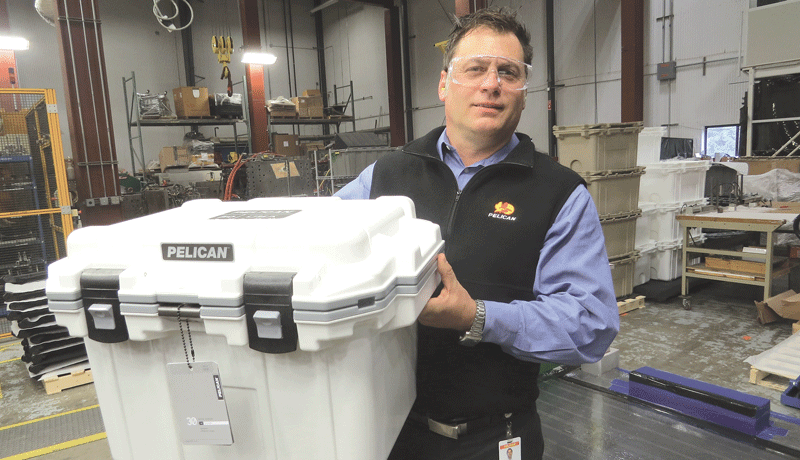
Joe Eckerle

Joe Eckerle, Pelican’s vice president and general manager, with one of the company’s high-end coolers.

For decades now, the names Pelican and Hardigg (which came together through a merger in 2008) have been well-known in the commercial, government, and public-safety realms, with containers used to ship everything from missile guidance systems to laboratory specimens. Now, the company — and the plant in South Deerfield that has been one of Franklin County’s largest employers for 60 years — is also making coolers, luggage, and cell-phone protectors, taking this brand places it’s never been before.


Joe Eckerle calls it ‘Pelican DNA.’

That’s a term — one he would use often — with roots that actually go back long before that corporate name and logo went up on the sprawling manufacturing complex in South Deerfield in 2008, and also well before Pelican products hit the market in the mid-’70s.

It refers, at least in part, to design, performance, and quality standards set more than six decades ago by James Hardigg when he started a company that would design and produce material, like foam, to protect products and, later, hard-plastic containers of all shapes and sizes.

Torrance, Calif.-based Pelican Products acquired Hardigg, its main competitor, because its standards, and culture, mirrored those set by Pelican founder Dave Parker, said Eckerle, vice president and general manager of the South Deerfield operation. And, in recent years, this international corporation has applied this collective DNA to an ever-growing roster of products that has made this brand something it really wasn’t before — a true household name.

Indeed, the name ‘Pelican,’ which was mostly known for commercial, military, and public-safety applications — its cases have protected everything from hunting rifles to missiles to parts for the Hubble telescope — is now also on cell-phone protectors, coolers, suitcases, GoPro cases, and even backpacks.

“They all have that Pelican DNA,” Eckerle said of the new products, referring not only to their hard-plastic backbones, but also to a reputation for durability — practically everything that is shipped out the door comes with a limited lifetime guarantee and is described with the adjective ‘indestructible.’

The recent efforts to expand the product line and enter new markets, such as the one for high-end coolers, is part of an ongoing effort to create more vertical integration at Pelican, said Joe Baltronis, senior vice president of Worldwide Marketing.
Joe Baltronis

Joe Baltronis says Pelican has vertically integrated its operations and entered a number of new markets in recent years.

He told BusinessWest there are now separate divisions devoted to the commercial/government, ‘BioThermal,’ and consumer components of the company’s portfolio of products, with all three (and especially the consumer side) seeing impressive growth in recent years, triggered in large part by the specific focus — and expertise — brought to those divisions.

“Pelican was very much a matrix organization … everybody worked on everything,” he explained. “We realized while getting into the consumer world, especially, when we had been so entrenched in that commercial/government world, that we needed new expertise, we needed people who understood consumer retail cycles, we needed people that understood the variances of the various markets we were going after.”

This vertical integration and penetration into new markets has spurred a roughly 10% increase in the workforce in South Deerfield, said Eckerle, to about 400 people, 300 of them in manufacturing jobs.

But innovation certainly hasn’t been limited to new-product development, said Baltronis, who took a quick break from his conversation with BusinessWest to retrieve one of six sizes of protective cases now bearing the brand name ‘Pelican Air.’

“This represents a significant breakthrough — it’s an innovation statement,” he noted, while explaining that the case he was holding was roughly 40% lighter than its predecessor of the same dimensions.

Pelican Air went on the market just a few weeks ago, he said, joking that he believes a good deal of the sales to date have been to competitors bent on reverse engineering these cases to figure out how all that weight was taken out.

When pressed by BusinessWest on that subject, he was understandably shy with specifics, but did offer some generalities.

“Through our engineering efforts, we’ve been able to take a significant amount of weight out of the case, not only in the manufacturing process, the molding, but also with the components, where we’ve been able to do things like honeycombing, coring, and other processes,” he explained, adding that part of the equation is the material that goes into the mold, which is proprietary.

“It’s all top-secret,” Eckerle noted with a laugh, adding that it is certainly not a secret that the company, now with sales offices on four continents, is looking to take the Pelican and Hardigg brands to places they’ve never been — in every sense of that phrase.

For this issue and its focus on manufacturing, BusinessWest talked at length with Eckerle and Baltronis to get an in-depth look at the many forms of progress that have taken place at this Franklin County stalwart, and about all that goes into that term ‘Pelican DNA.’

A Different Mold

While the Pelican name is not always visible to moviegoers — although sometimes it stands out — there’s no debating that this company’s products have logged considerable time on the big screen (as well as the small screen) in recent years.

Indeed, its containers were omnipresent in The Martian, and made several appearances in the latest Star Wars installment. Products have appeared in some of the Iron Man movies — Tony Stark keeps his arc reactor in a case made by Pelican — and those with sharp eyes could also spot them in episodes of Alone and Dexter, among many other shows.

“Any military movie where there are cases in the background — that’s us,” said Eckerle. “We make for great background material.”

But while the company is making its presence known on Hollywood production lots, that’s not exactly one of the specific goals put down in a broad-based, constantly changing business plan — although such exposure certainly helps. Instead, the primary mission is to make that name ‘Pelican’ more and better known to a host of constituencies, including home and business owners, by putting it on more of the products they use.

It already resonates with a number of groups — from hunters and fishermen who walk the aisles at Cabela’s or Bass Pro Shops, to police and fire departments in most every community in the country (the company makes everything from the flashlights officers carry to the cases used to hold materials used to train bomb- and drug-sniffing dogs), to major defense contractors and the small shops supplying them with parts.

The company has done well meeting the specific needs of these consumer groups, enough it to make the global leader in high-performance protective cases. But in recent years, it has recognized opportunities to put that Pelican DNA into a host of new products, said Eckerle, and it is seizing those opportunities and gaining new visibility in the process.

“One of the big changes seen over the past five years is that you can actually walk into a store and see our products,” he explained. “Before, you would have gone to a dealer or gone online; now, you can walk into Dick’s and see our coolers.”

Before elaborating on the present and future, though, we first need to take a look back to understand how we arrived at this point.

Our story begins with James Hardigg, an aerospace engineer noted for his work to create what’s known as the cushion curve, which, as that name suggests, involves determining how much cushioning is needed to keep a product safe during transport.

He started a company that was initially focused on manufacturing protective materials, said Baltronis, adding that the industry term ‘cushioning’ goes well beyond foam, and extends to cradling systems and what amount to shock absorbers. It was years later that the company directed much of its focus to cases.

“Mr. Hardigg used to say that the only real purpose of the case is to protect the foam; the purpose of the foam is to protect the product,” he said, adding that, nonetheless, by the late ’60s or early ’70s, the company was far better known for those cases.

Indeed, Hardigg became the industry leader in a process known as roto molding, or rotational molding, whereby a heated hollow mold is filled with a material, in this case plastic, and is then slowly rotated, causing the softened material to disperse and stick to the walls of the mold.

Pelican Air

Pelican Air makes what the company calls an “innovation statement,” and represents a key improvement to a core product.

Over the years, the Hardigg name was attached to a growing number of products, some manufactured in large quantities, but many of them custom-built for the specific customers. Cases built by the company, some as large as a room, were designed and built to protect everything from hunting rifles to cameras; from parts for the Apache helicopter to delicate medical instruments.

Meanwhile, a continent away, in Torrance, just south of Los Angeles, the next compelling chapter in this story was unfolding.

Dave Parker, an avid scuba diver, recognized the need for rugged flashlights and cases that wouldn’t leak, so he and his wife, Arlene, started a company that would manufacture one in his garage.

Named Pelican Products, this venture would soon move on from the SABRELITE flashlight to waterproof first-aid kits. Dissatisfied with the quality of the work turned out by a contract manufacturer assigned to make the cases, Parker decided to produce them himself.

The company would go on to expand its line to include a host of protective cases and other products such as industrial dive lights, said Eckerle, and become an industry leader in injection molding.

In 2004, the company was acquired by the private-equity firm Behrman Capital, and four years later, it would effectively double in size through the acquisition of chief rival Hardigg, making it the largest manufacturer of equipment-protection cases in the world.

Cold-case Files

In recent years, the company has taken the logical step of introducing consumer products imbued with the same standards of quality and durability, said Baltronis, who initiated this line of conversation by digging into his pocket, grabbing his cell phone, and proudly displaying its back side, which displayed the name ‘Pelican.’

It’s getting easier for consumers to duplicate that maneuver, he told BusinessWest, adding that the company now makes its Voyager cases for Samsung Galaxy S7 and S7 Edge, as well as a host of iPhones.

“This is a rugged, high-end protector — that’s the segment we’re in; it’s built to last,” he said of the one in his pocket, adding that this same philosophy and DNA (there’s that term yet again) is being applied to a host of new products, which bodes well for the company and the South Deerfield manufacturing facility.

As Eckerle (alongside Baltronis and Les Rhodes, facilities manager for the operation) offered BusinessWest a tour of that plant, he stopped for several moments in the large area now dedicated to the production of the company’s Elite coolers.

While pausing at one of the 30-quart models being readied for shipping, he turned his body in several different directions to point out the many different sizes and shapes now being produced, all the way up to 250 quarts, a popular model with commercial fishermen.

He then pointed to the wheels on one of the models.

“That’s something we do that no one else does,” he said proudly, adding a quick ‘to the best of my knowledge’ in acknowledgment of a market where things can change quickly.

The wheels on the coolers — those products are also certified ‘bear resistant’ by the Interagency Grizzly Bear Committee — constitute just one example of how the company doesn’t want to simply be in a market, he explained: it wants to be a leader and an innovator in that specific market.

The South Deerfield plant

The South Deerfield plant remains a world leader in the process known as roto molding, or rotational molding.

Consider this language from the ‘cooler’ section of the company’s website: ‘We hold ourselves to a higher criteria than other cooler makers,” it states. “From the latches to the freezer-grade seal to the toughest handles in the business, every part is engineered to our extreme durability and performance standards.”

There is similar verbiage in the description of luggage, cell-phone protectors, and backpacks (which are assembled overseas and feature crushproof, watertight laptop and tablet compartments).

But while new-product development has been the primary focus within the business plan in recent years, innovation involving what would be considered the company’s traditional, or core, product lines is also a big part of the equation, especially as competitors have encroached on that territory and taken market share by cherry-picking popular models to emulate, said Baltronis.

Pelican Air is a prime example of such movement. Marketed using catchphrases such as ‘floats like a butterfly, protects like a Pelican,’ the lighter protective cases represent, as he said, an innovation statement, and an answer to perhaps the only major concern voiced about Pelican products over the years: weight.

“We’ve launched a number of new products on the consumer side in recent years, with the cases on the core side taking somewhat of a backseat,” he explained. “As we started to look at encroachment, we brought our gaze back to the core products — and it wasn’t just ‘let’s come out with a few new sizes or form factors,’ it’s ‘what can we fix?’ And that’s what we feel we’re doing here.”

Case in Point

Baltronis told BusinessWest that the Hardigg name lives on today because it resonates across many industry sectors  — although the containers sent out of the Deerfield plant are co-branded ‘Hardigg’ and ‘Pelican.’

That’s fitting because the two iconic names in this increasingly competitive industry share the same standards — the same DNA, if you will.

And that DNA is giving birth to not only new product lines, but new product innovations that will take those names from Mars (well, at least in the movies) to the kitchen closet to the cell phone in your pocket.

This would seem to herald more growth and vitality for that plant built by James Hardigg all those years ago, one that continues to break the mold in more ways than one.

George O’Brien can be reached at [email protected]

Community Spotlight Features

Community Spotlight

Mayor William Martin

Mayor William Martin says renovations are being made to transform the century-old former Lunt Silversmiths building into medical offices.

Mayor William Martin says projects that were started years ago are coming to fruition in Greenfield, and new ones are underway that will help the town continue down its path to independence, as well as addressing areas that need revitalization.

The Town Council just approved a $5 million bond to create a municipal Internet, phone, and data-services company called Greenfield Community Energy and Technology (GCET) that will be paid for by the company after it is established. Free Internet service is being provided on Main and High streets until the project is completed, thanks to a $500,000 pilot program, and 82% of voters voiced approval for GCET, which will provide the bandwidth and speed needed to stay competitive and attract new businesses, as the town has lost some in the past due to a lack of technology.

“We’ve been given the green light to move forward with this project,” Martin said, noting that, in addition, Greenfield Light and Power began operating as a municipal aggregation plan more than a year ago and brought not only lower-cost electricity to the community, but measures to procure the energy from renewable sources.

“The company went online Jan. 1 last year, and now all of our electricity is 100% green,” the mayor told BusinessWest, adding that the public utilities will increase the likelihood of retaining businesses, encouraging them to expand, and enticing new businesses to move to the community.

GCET will also allow the Greenfield School Department to administer the Partnership for Assessment of Readiness for College and Careers (PARCC) exam to public-school students; the test is aligned with Common Core standards and replaces the Massachusetts Comprehensive Assessment System (MCAS) test.

Other compelling reasons for installing an up-to-date fiber-optic system include the fact that Greenfield Community College has a downtown campus, and the town established the Mass. Virtual Academy at Greenfield five years ago on Main Street, the Commonwealth’s first virtual K-12 public school.

Public utility companies will play a vital role in maintaining the town’s independence, but they are only a part of other major initiatives taking place. The new, $66 million Greenfield High School opened its doors last September, and the new, $73 million Greenfield Trial Court is expected to open in October, benefiting downtown businesses and restaurants that suffered when construction began on the courthouse about three years ago and operations were temporarily moved several miles away.

Keeping Pace

Martin told BusinessWest that, although some people over the age of 50 still think of downtown Greenfield primarily as a place to do retail shopping, that business has moved to malls, which makes developing a new identity critical to the neighborhood’s future.

“Greenfield is fortunate to have maintained some of its luster and attractions that are extremely unique, such as the century-old Wilson’s department store and Gardens seven-screen cinema,” he said, noting that the downtown area also contains new ethnic restaurants as well as federal, state, and county agencies, including the courthouse, Baystate Franklin Medical Center, the county jail about a mile away, and the new, $14 million intermodal John W. Olver Transit Center that serves Franklin County Transit Authority bus routes and provides intercity bus service as well as a train station that houses Amtrak’s Vermonter line.

Greenfield Trial Court

The new, $60 million Greenfield Trial Court is expected to open in October and restore lost foot traffic to downtown businesses and restaurants.

In spite of these major institutions, the temporary courthouse move did affect a number of downtown businesses. However, some made accommodations to make up for revenue that was lost, including restaurants that started delivery services.

But when the Greenfield Trial Court opens next fall, the attorneys, courthouse employees, and people scheduled to appear in court are expected to help to restore the regional downtown center to its former vitality.

However, city officials are well aware that academics, government, education, and manufacturing are the fast-growing industries in the Pioneer Valley.

“So we’ve applied a special focus to advancing our downtown in these specific areas,” Martin said. “Downtowns of the future will be more service-oriented, with attention paid to the needs of individuals and families, rather than the wants. And an increase in pedestrian traffic will stimulate the development of other small businesses offering entertainment, food, boutique shopping, and social, cultural, and religious gatherings.”

He added that the town’s focus on healthcare is exemplified by the planned development of the former Sears Department store into medical, dental, and professional offices. The Lunt Silversmiths property about 1.5 miles from Main Street is also undergoing substantial reconstruction for conversion to a residential medical treatment center of 65 beds operated by Behavioral Health Network and other clinics, which complements Greenfield’s regional position as host to Baystate Franklin Medical Center.

“We’re actively soliciting medical groups,” Martin noted, adding that Patriot Care, which provides medical marijuana, has purchased the former American Legion building at 7 Legion St. just off Main Street, and is renovating it to suit its needs, and a former convenience store a half-mile from downtown was purchased by a cardiology practice with several hundred clients and is expected to open in June.

Other efforts are being made to enhance the downtown, and last month the Town Council approved spending $4.2 million to build a new community center on a one-acre site a block from Main Street, which will serve as a senior center during the day and offer space for classes in the evenings and on weekends.

Martin said a 100-year-old building on the site which currently houses the central office for the school department will be either demolished or converted to housing, and the office will be moved to the middle school.

In addition, a central communications center for the county is in the planning stages, and will be located in a strategic area on West Main Street, which Martin describes as “an area that requires stimulation and planning with both private and public development.

“It is blighted, so we want to fill it in and make it more attractive to stimulate further development,” he told BusinessWest, adding that a number of buildings there have already been demolished, redeveloped, or scheduled for major renovations or redevelopment.

Town officials are also working to create a village of tiny houses, which are growing in popularity, on a ¾-acre lot at 102-106 Deerfield St. A bike path is situated to the rear of the lot, and a formal bike lane was established on Route 2 after the town adopted the Complete Streets program, a transportation and design initiative that promotes safe travel for walkers and cyclers.

Greenfield also received a $177,000 grant to create a new dog park a short distance away at Green River Park off of Petty Plain Road, as well as a $400,000 PARC grant to install a new playground, signage, basketball court, and pickleball court and revamp the parking lot.

“It will be a big expansion,” Martin said. “Right now, the park only contains two softball fields, a basketball court, and a parking lot. But in addition to the improvements and expansion, next year we expect to create a mile-long walking and biking path around the park that will provide a quiet, meditative place where individuals and families people can take their kids to enjoy a walk by the river.”

Measures have also been taken to address flooding from the Green and Deerfield rivers on Deerfield Street, which have caused real problems in the past for Mohawk Meadow Golf Course and the Department of Public Works treatment plant. Streetscape and engineering work has been done to prevent future floods, including the installation of a unique set of storm doors on the DPW building.

Martin added, however, that condemned properties with flooded basements are still monitored, while fire ravaged-buildings have been removed.

Continued Growth

Greenfield hopes to build a new library to replace the current structure on Main Street, built in 1880, which lacks the space and modern amenities needed to keep pace with today’s needs. A state grant was procured to pay for a design, and a forum was held last month to inform residents about evolving plans.

Martin said the town’s finances are in good shape, and it was fortunate to be able to negotiate contracts with the unions that will allow it to maintain a steady cost of living, while reducing the increase over time.

Although the residential tax rate is high, he noted — Greenfield ranks fourth in the state in that category — valuations are low, so the average homeowner pays $3,934 in real-estate taxes, ranking 211th in the Commonwealth.

So, the combination of new projects and long-awaited ones coming to fruition has officials excited about the future.

“We’re looking to continuously strengthen our unique approach to reframing Main Street, and our next step will be to make it an attractive destination for young people with curious minds,” Martin said, adding that the town hopes to open an innovation center and a program that would allow businesses to share services.

He told BusinessWest that two manufacturing companies have plans to move Greenfield, and officials hope to build on the success of businesses that have been in town for years and work with the school department to shorten the path from graduation to job security.

“We believe that municipal investment will act as a catalyst for private investment and set the town up to repair and replace institutional buildings and needed infrastructure,” the mayor added, noting that new sewer and water lines and pump stations are being installed throughout the town.

Upcoming challenges will include a lack of parking when the new courthouse opens because it was built on a former parking lot.

“But we’re looking forward to the revival of foot traffic, which will help downtown businesses, although things won’t really settle down until construction on a new multi-storied garage is complete,” Martin continued, explaining that strategies to deal with the issue may include measures such as a shuttle service to distant parking lots.

But the town is keeping pace by installing utilities and technology that will keep it independent, attract young people, and offer businesses all they need to be successful in the years to come.

Business Management Sections

Getting to Know You

Ross Giombetti

Ross Giombetti, president of Giombetti Associates

Thirty years ago, Rick Giombetti developed a concept, called Performance Dynamics, that links personality with business productivity and potential. His Hampden-based company, Giombetti Associates, has grown significantly since then, helping hundreds of companies succeed by understanding personalities and building better leaders. His son, Ross, recently took the reins of the firm, but doesn’t expect much to change — least of all the passion he and his father share for making a difference in clients’ lives.

It’s not always easy, Ross Giombetti says, to be a client of his business-consulting firm, Giombetti Associates.

“We want to build the relationship and build the trust so clients know we care about the demands of their business, then deliver feedback that is true, real, and honest — tell them what they need to hear, not what they want to hear. And sometimes it stings,” said Giombetti, who recently succeeded his father, Rick — who co-founded the Hampden-based firm 30 years ago — in the president’s chair.

“I’ve certainly been called ‘direct’ before,” Ross went on, “but you’ll also find we back that up with support and compassion, so when we have to deliver a message you’re not going to like, you walk away trusting it, and knowing it’s what you needed to hear to make you and your organization better.”

That message varies wildly from client to client, as it always has; Giombetti Associates deals in leadership development and training, team-building, talent acquisition and recruitment, pre-employment assessment, and strategic executive coaching, among other roles.

“But the foundation of it all is building high-performance, world-class companies through people,” he explained — an idea he would return to several times during his talk with BusinessWest.

“There’s one constant in every business, regardless of size or industry — people, who have character traits that drive their behavior, and can cause issues and conflict,” he explained. “Our clients come to us to help them solve challenges related to personality and leadership. It could be they have a team that doesn’t get along really well or isn’t maximizing their potential or their results. There could be a talent gap in the organization that they want us to help solve, or it could be them wanting us to protect their business from making bad hiring decisions.”

The heart of Giombetti Associates is a concept called Performance Dynamics — a means of assessing personality and understanding how it affects behavior in the workplace — created in 1986 by Ross’s father, Rick, and his business partner, Paul Alves. At the time, the pair — former human-resources professionals who had struck out on their own — had virtually no money, and even scraping up enough to fly to Washington to visit the U.S. Patent and Trademark Office was a challenge.

But their idea paid off, and today, the company boasts hundreds of business clients worldwide — from mom-and-pop operations to Fortune 500 companies — helping them make hiring decisions, train executives, build leadership skills, handle office conflict, and perform a host of other interpersonal tasks.

Simply put, Performance Dynamics explores personality and applies it to leadership in business. Before quitting his job to become a consultant 30 years ago, Rick Giombetti used his human-resources experience and psychology education to develop personality-assessment exercises that companies could use to understand and manage their hiring and personnel issues. These assessment tools measure factors ranging from personality traits and mental maturity to overall understanding of leadership and how people cope with conflict.

“They’re validated and defined by major psychological think tanks,” Ross said. “We put them together in a trademarked process. My father and Paul Alves, they were well beyond their time, extremely progressive as it related to personality and leadership. That’s how it all started — with a dream and a philosophy.”

With clients boasting anywhere from five employees to 100,000, in industries ranging from landscape design to advanced manufacturing; from medical facilities to banking and insurance, the one common denominator is people, he went on. “That’s one reason why we work in all those different industries. You can change the function, change the geography, but people exist in every single one of them.”

Let’s Talk

When a company hires Giombetti, it should be ready to talk.

“Our work is a combination of things and involves a lot of fact finding, a lot of exploration, a lot of open-ended conversations in an attempt to get to know a person, a team, an organization, or an entire culture. That’s where we start,” he said.

That said, “we don’t take on new business without knowing what we’re walking into. They have to believe philosophically same things we believe. If they don’t, we’re not afraid to walk away from business. We’re not afraid to fire a customer.

“Once we know what we’re looking at,” he explained, “to really help develop an individual, a team, or a culture, we have a series of personality instruments we use that go really deep, identify the ‘why’ behind the ‘what.’ It’s not hypothetical, not conceptual; it’s concrete and real.”

A few of the team members

A few of the team members at Giombetti Associates, from left: Miklos Ats, Ross Giombetti, and Amanda Collins.

As one example, he cited a client in the Midwest founded on the core belief of purpose-driven products. “They don’t really care as much about the money they make or the success they have; they want their employees to wake up with purpose. So they’re founded on the right philosophy.”

However, Giombetti went on, the company’s leader was simply too nice and struggled with making difficult decisions, and that held his organization back.

“I’d like to think that, after working more than five years with them, his own leadership and the culture as a whole have gotten much stronger and better,” he said. “They now blend family and balance of life with accountability.”

After all, he continued, bosses can care deeply about their employees’ family time, work-life balance, and having fun at work, but at the end of the day, there has to be accountability and a focus on growing the business. Now, he said, “their organization is an example of an organization we would all want to work for.”

Another client — a local firm, Notch Mechanical Constructors in Chicopee — had a much different issue. It’s a company run by five siblings who balance their input well. “They maintain boundaries and keep each other accountable and grounded, and they make good business decisions,” Giombetti said. But they struggled with finding a strong financial leader.

“We have close to a 20-year relationship with this family, and we wanted to make sure they hire the right person. We went through a lot of due diligence, and it took us longer than we or they would like, but the story has a happy ending. We found somebody who is a great cultural fit — the same philosophy, grounded, humble, but tough and smart. They’re pretty happy with the decision we made. Sometimes making the right decision takes longer.”

In both cases — a company leader who had to change his way of thinking, and bringing in the right person from the outside for a key role — it all came down to the importance of people, he stressed.

“Great organizations believe that building a strong team with great people is largely what makes you successful. You can have a great product, you can have great service, you can have a great business model, but without the people, you won’t capitalize on your opportunities. You’ll have nothing.”

Smart Growth

Giombetti currently employs six people and is actively looking for a couple more to meet the needs of an expanding client base nationwide.

“But we’re careful about the business we take on,” he said. “We don’t take on business just for the sake of growing. That philosophy will never change as long as I’m tied to the organization. I learned that from my father, that bigger is not always better; better is better. I want to do it the right way, to continue to treat our clients like their business was ours, and I don’t want to lose touch with the close relationships we have with most of them. So we’re really careful about how we run our business.”

In part, that means running the business like that client in the Midwest who prioritizes his workers’ lives away from the office, saying he wants to do the same for team members like Miklos Ats, senior associate; Amanda Collins, office manager (who’s being groomed for a larger, human-resources generalist role), and Monica Childers, who doesn’t have a title beyond ‘protector’ and ‘boss of all of us,’ Giombetti joked.

“When I’m not working, I’d rather be spending time with my wife and three kids and a million hobbies,” he said. “I’d rather see Mik spend time with his lovely wife and go eat at more great restaurants. I’d like to see Amanda spend more time honing her trivia skills, and see Monica spend more time with her awesome husband, who recently learned how to make sushi, and their fantastic two boys. We believe in ‘work hard, play hard.’”

At the same time, he wants the firm to continue giving back to the community, through its efforts with Habitat for Humanity and other local organizations. Meanwhile, Giombetti coaches youth sports and launched a mentorship program at Minnechaug Regional High School in 2012 — efforts that, along with his business success, contributed to his selection to BusinessWest’s 40 Under Forty class of 2016.

“We’re passionate about developing young people,” he said. “Most students don’t know who they are or what they want to do, but if we can help them better understand who they are, they’ll have a lot less stress and anxiety in their young life and career.”

These efforts are just one more way Giombetti is committed to the Western Mass. region. “The Pioneer Valley will always be our home. I don’t have visions about moving our office into a big city to be closer to bigger business and more opportunities. I’m happy being where we’re at, doing what we do, supporting awesome clients and individuals.

“Philosophically, we treat our clients’ businesses like our own, and we’re going to protect that,” he went on. “Our clients trust us to know their people, know their culture, know their business, and protect it like it was our own.”

As for Ross’ father, Rick Giombetti may have relinquished his president’s title this year, but he remains active in some project work as a strategic advisor, which Ross appreciates. “His legacy will live on forever here. He’s a fantastic leader.”

One who has long been committed to building up the leadership potential of others, a passion he certainly passed along to his son.

“It sounds cliché, but I wake up every morning truly being motivated to inspire people and make a difference,” Ross said. “When students are coming out of college, when they’re asked the question, ‘what do you want to do?’ a majority say, ‘make a difference,’ but they don’t know what that means — and don’t know how.

“That is the passion I live every day,” he went on. “When I see somebody grow, develop, and become a better person, become a better husband or wife, become a better teammate or leader, that keeps me coming back for more.”

Joseph Bednar can be reached at [email protected]

Manufacturing Sections

On Schedule

David Cruise

David Cruise says partnerships to raise up a workforce for CRRC MA USA. will benefit the region’s entire manufacturing sector.

When a company from across the globe sets up shop in Springfield, it can’t exactly bring its workforce with it.

“We need 100% new employees,” said Bobby Doyle, senior consultant for CRRC MA USA, the Chinese rail-car manufacturer currently building a $95 million production plant at the former Westinghouse site on Page Boulevard. “We can’t transfer people from China here; it wouldn’t work.”

Among the reasons CRRC — formerly CNR Changchun Railway Vehicles — chose Springfield, however, was optimism that the city and region could supply a workforce to support what will become the company’s North American headquarters. “The capital investment we’re putting in, that’s a big commitment,” he said, “and there’s got to be a long-term labor force.”

That’s why CRRC has forged a number of interlocking partnerships — with the Regional Employment Board (REB) of Hampden County, the local sheet-metal and electrical unions, Roger L. Putnam Vocational Technical Academy, and the engineering departments of area colleges and universities, for starters — to build that workforce.

But local economic-development leaders see potential benefits to these partnerships beyond the CRRC jobs, said David Cruise, the REB’s president and CEO.

“We’ve been working with [Doyle] to identify very specific production positions they will need on the factory floor,” he said. “They’ll need some administrative positions and engineering positions, but at the Regional Employment Board, we’re focusing on how to help them on the factory floor, where the heart of the work is going to get done.”

At the same time, Cruise continued, “we’re also concerned with not just identifying the workforce for CRRC, but with the broader regional metal-fabrication industry as well, hoping other companies benefit from the presence of CRRC in the region. We want to be sure that any sort of workforce training we develop benefits that broader metal-fabrication industry. That’s been our strategy.”

He explained that CRRC could present some spinoff work for other manufacturers and perhaps attract new manufacturing business to the region.

“We certainly want to be a conduit and help with CRRC Massachusetts, but we also shared with them, and they understand the value of, our intent to build training programs and build a delivery system that can respond to all the needs that may develop here in the region.”

Local Flavor

In 2014, CNR Changchun received a $566 million contract to manufacture 284 new subway cars for the Massachusetts Bay Transportation Authority (MBTA — 152  for the Orange Line and 132 for the Red Line.)

Construction at the 40-acre site — including a new, 220,000-square-foot factory building and conversion of the former Westinghouse administration building into CRRC’s administrative, engineering, and research offices — is underway. When it’s fully operational in 2018, the factory will employ 150 production workers with starting salaries of at least $66,000 a year, on top of about 150 construction workers needed to build the new plant. The MBTA cars will be built over a five-year period.

To develop a worker pool with the necessary skills, the REB is working closely with Sheet Metal Workers Local 63 and Electrical Workers Local 7 to develop training programs to be hosted mainly at Putnam after school hours.

“Putnam has some of the latest technology and equipment in the area, and I felt it was really critical to build that relationship between Local 63, Local 7, and Putnam,” Cruise said.

Along with training workers currently in the field for CRRC’s immediate demand, another goal is to attract unemployed and underemployed individuals into the training programs to prepare for a surge in demand as the rail-car plant grows beyond its initial buildout.

“As this facility comes online, the majority of initial-wave workers will be individuals who have experience in sheet-metal and electrical work,” Cruise said. “But as the facility expands and grows, clearly there will be some opportunities for entry-level positions.”

Cruise believes that, indeed, CRRC will be that kind of catalyst.

“We think this assembly facility will lead to the development of contracts with other municipalities and states around the country, with hope that some, if not all, of that work finds its way back to Springfield,” he told BusinessWest. “We’re not building programs just to get to opening day, but that can grow with them — and they can have some assurances that broader training is in place to meet future demand. There will be times when their workforce will be expanding pretty dramatically.”

Doyle agreed. “We’re pursuing two other contracts right now, one in Pennsylvania and one in Los Angeles, and both would be manufactured in Springfield, so Springfield is going to be a very busy location in the next five years,” he said. “We’d like to see the workforce keep doubling if we’re successful.”

Cruise said the after-school programs at Putnam — say, 3 to 9 p.m. — will complement offerings at Local 63’s own training center during the day. “That gives us 12 hours a day, which is exciting for us. It gives us some real bandwidth in terms of not only building great programs, but having some flexibility in scheduling.”

Meanwhile, the REB is working on a similar arrangement with Local 7, developing a curriculum for training programs to meet CRRC’s specific needs. “They’re excited to partner with us. They have a training facility in Chicopee, so we can run the same kind of afternoon program at Putnam, and at the same time utilize Local 7’s training facility during the day should demand dictate.”

The REB will look to competitive state grants to fund these programs. “It’s a challenge to identify funding to do this; unions are not allowed to use their funding for apprenticeship programs.”

That issue aside, Doyle called Putnam a “tremendous resource” and noted that CRRC officials have visited several times already. “We see them as a huge long-term partner.”

Once the initial hiring process is complete, a group of 20 to 30 employees, maybe more, will relocate to China for 10 months to a year to train on light rail cars in that country, learning how to test all the systems in the trains and bringing that technology back to Springfield. A second group of employees will go to China for four months to learn the assembly process. Production of the MBTA cars will begin in Springfield early in 2018.

College Try

CRRC is starting to build other connections as well, working with Western New England University’s College of Engineering to develop talent for the design and research operations at the new plant, and examining similar opportunities with UMass Amherst and Springfield Technical Community College. Meanwhile, FutureWorks, the one-stop career center located in Springfield, will serve as a resource for the hiring process.

“For them to be able to see that these kind of partnerships can be developed quickly — that they’re coordinated, agile, flexible, and can respond to their business demands — to me is adding great value and ensuring this corporation, and the industries that will benefit from it, will have a very bright future, not only here in Massachusetts, but across the country,” Cruise said.

Doyle admitted that, during CRRC’s search for a North American home, Springfield posed some negatives, including one of the highest commercial tax rates in the Commonwealth. But other positive factors outweighed that, including the city’s proximity to two major interstates and a CSX Transportation rail line, and, yes, those aforementioned partnerships, and the enthusiasm of the municipal and economic-development leaders who forged them.

“I’m excited about where we are,” Cruise said. “We’ve worked over time with a lot of different companies and a lot of different partnership arrangements. This is especially exciting because the parties we pulled together do not have an established history of working as partners in this workforce-development space.”

Therefore, he went on, “we are excited about the opportunity this company presents to the city of Springfield and the region and job-creation efforts here in the Valley. Quite honestly, I can’t wait to get started.”

Joseph Bednar can be reached at [email protected]

Daily News

SPRINGFIELD — Smith & Wesson Corp. recently hosted its annual live comedy show, “A Night of Laughter,” to support two local children’s charities: Shriners Hospitals for Children – Springfield and the Ronald McDonald House of Connecticut & Western Massachusetts. The show featured two comedians, local morning-show host Chris Zito and National Comedy Clubs comedian Tony V.

Sponsors included EMT Metals, United Personnel, Springfield Spring, and PIP Printing. In addition, staff and students from the Chicopee Comprehensive High School’s culinary-arts program volunteered their services to prepare food for event attendees. Sponsors and the local community also supported the event by purchasing tickets and donating raffle items.

Those efforts, combined with support from Smith & Wesson, yielded a successful event that allowed both charities to receive funding for their initiatives. Over the past five years, donations from the annual comedy night have totaled more than $200,000 to benefit Shriners Hospitals for Children and the Ronald McDonald House.

Shriners Hospitals for Children is changing lives every day through innovative pediatric specialty care, world-class research, and medical education. It provides advanced care for children with orthopedic conditions, burns, spinal-cord injuries, and cleft lip and palate. The Ronald McDonald House program provides a home away from home for hospitalized children’s families so they can remain nearby their child at little or no cost.

Smith & Wesson, headquartered in Springfield, is a leader in firearm manufacturing and design. The company gave back more than $250,000 last year to organizations in the region.

Daily News

WILBRAHAM — Friendly’s Ice Cream announced it has sold its retail ice-cream and manufacturing business to Texas-based Dean Foods Co. for $155 million in cash.

“We are thrilled at the prospects the Friendly’s Ice Cream acquisition brings to Dean Foods,” said Dean CEO Gregg Tanner. “Coupled with the momentum of Dean Foods’ current regional brands, the Friendly’s brand will be a catalyst in our strategy to grow our existing ice-cream business and branded portfolio. Friendly’s is an ideal complement to our other heritage brands across the country and fills a manufacturing and retail ice-cream void in our nationwide footprint.”

Dean Foods is the largest processor and direct-to-store distributor of fresh fluid milk and other dairy and dairy-case products in the U.S., the company said. Friendly’s Ice Cream had $166 million in net sales of ice cream to supermarkets in 2015.

After the transaction closes late in the second quarter of 2016, Dean Foods plans to continue producing ice cream at the current Friendly’s plant in Wilbraham, which employs about 200 people.

“Friendly’s ice cream strongly resonates with consumers throughout the Northeast,” Tanner added. “Very similar to the traditions shared by consumers who grew up enjoying our existing regional milk and ice-cream brands, such as Mayfield or Dean’s, we believe the Friendly’s Ice Cream brand represents and promotes what Dean Foods has built itself around and is a great fit in our branded portfolio. Dean Foods is rooted in the traditional goodness of dairy, making Friendly’s more than just a good business and financial opportunity.”

Added Friendly’s President and CEO John Maguire, “today marks a new chapter for Friendly’s retail and manufacturing ice-cream business. Dean Foods Company has recognized the growth momentum that Friendly’s retail ice cream has experienced over the last five years, and I am thrilled that Dean Foods will be the ongoing steward of the retail ice-cream business, led by the current experienced retail and creamery teams.”

Friendly’s Restaurants, which boasts 260 locations in the U.S., will continue to be owned and operated by an affiliate of Sun Capital Partners Inc. and will license use of the Friendly’s trademark to Dean’s under a license agreement entered into as part of the transaction.

Banking and Financial Services Cover Story Sections

Dollars and Sense

Westfield Bank President and CEO Jim Hagan

Westfield Bank President and CEO Jim Hagan

Westfield Bank and Chicopee Savings Bank will come together in the first merger of locally based institutions in more than two decades. The $2.1 billion entity will have a solid foundation on both sides of the Connecticut River, said Westfield Bank President and CEO Jim Hagan, and the capital with which to undertake further territorial expansion.

He couldn’t pinpoint exactly when they started, but Westfield Bank President and CEO Jim Hagan said the talks he’s had with his counterpart at Chicopee Savings Bank, Bill Wagner — about this marketplace, the changes taking place in it, and a possible merger of their institutions — are not exactly a recent development.

Well, that’s true of those first few subjects of conversation, anyway.

“Bill and I had a number of discussions about this market, what was happening in it, bank consolidations, and the importance of size and scale in the industry,” said Hagan, who took the helm at Westfield in 2005, adding that these talks took a different tone and moved to a much higher level of intensity last fall.

That’s when both men were working together on what could be called the financial institutions’ component of the capital campaign to raise funds for the Sr. Caritas Cancer Center at Mercy Medical Center, and thus seeing much more of each other.

Summing up those discussions in general terms, Hagan said the two presidents agreed that there were many shortcomings — and, yes, risks — to remaining at their respective sizes (roughly $1.4 billion in assets at WB and $650,000 at CSB) given the many changes in the region’s banking community and the growing dominance of larger players.

He and Wagner eventually concluded that a merger of their banks not only made sense, but easily made the most sense of the many options that had presented themselves in recent years.

“We were both well-capitalized institutions, and we both felt strongly that we wanted to have what we considered to be a strong, independent bank headquartered in Western Massachusetts, one that would be locally owned and locally managed,” Hagan explained. “And, together, we felt we had a great opportunity to do just that.”

It took several more months to hammer out the details, but those discussions last fall certainly laid the groundwork for the announcement made early last month — that the two institutions would merge and thus become the second-largest locally managed bank in Hampden County, a $2.1 billion entity (to operate under the name Westfield Bank) with 21 locations in Western Mass. and Northern Conn.

As he elaborated on why this was the most sensible route for the banks, Hagan said this would be a merger of two local institutions with long histories in the region — and with footprints that featured hardly any overlap. (The only community where both banks have a branch is West Springfield, and those facilities are separated by several miles, not several blocks or even yards, as is often the case in a region almost always characterized by the term ‘overbanked.’)

These historical and geographical considerations will translate into fewer redundancies and therefore fewer reductions in workforce when the banks come together later this year, said Hagan, as well as less encroachment in this market by the larger regional banks that had shown interest in acquiring CSB.

Meanwhile, the two institutions have similar philosophies, nearly identical operating systems, and even a common marketing approach — one with the accent on a highly personalized brand of service, said Kevin O’Connor, senior vice president of Retail Banking, Retail Lending, and Marketing for Westfield Bank.

All of this should lead to a smooth transition and greater customer retention when the dust eventually settles, said Hagan, as well as a financial institution that will play a much more significant role in the local economy than the banks could individually.

For this issue and its focus on Banking & Financial Services, BusinessWest looks at this latest merger to reshape the local banking community and what the emerging $2.1 billion institution will bring to the proverbial table.

Points of Interest

As he returned to the subject of when and how this merger started to come together, Hagan said it was born from the knowledge — possessed by everyone conducting banking in this market — that size really does matter.

Elaborating, he said that size, or ‘scale,’ the other term used to convey the same points, amounts to far more than bragging rights or a significantly larger limit on commercial loans (although that certainly is an important factor, as will be discussed in a bit).

WestfieldBankLogoChicopeeSavingsLogoInstead, size is easily the most effective means with which to effectively cope with razor-thin margins and significantly deeper layers of regulation that resulted from the financial crisis — caused in good part by a lack of regulation of financial institutions — of nearly a decade ago.

“Size and scale creates efficiencies in terms of your operating costs,” he explained. “And having that 21-branch network creates efficiencies with products, services, and the delivery network.”

Elaborating, Hagan noted that, while there are few redundancies to result from this merger when it comes to physical locations, there will certainly be some redundancies — which can be reduced or eliminated — that involve operations and the staffing of same.

Meanwhile, the merger will enable the larger institution to spread the costs resulting from greater regulation over a wider footprint, he went on, adding that, in simple terms, the costs for the new, larger Westfield Bank will be significantly less than what the two current institutions are paying together at present.

This phenomenon goes a long way toward explaining much of the recent movement within the market, and why a number of brands have disappeared from the landscape.

Along with these mergers have come some growing pains during the process of transforming two banks into one, Hagan acknowledged, adding quickly that he expects this merger to go rather smoothly because the banks operate on different platforms of the same system and there will be few of what would be called ‘institutional changes.’

Kevin O’Connor

Kevin O’Connor says Westfield Bank and Chicopee Savings Bank have similar cultures and operating systems, which should make for a smooth transition.

“What we found is that the culture of Chicopee Savings Bank is very similar to the culture of Westfield Bank,” he explained. “So we expect that the integration of the systems, the people, and the philosophies will go very smoothly.”

But efficiencies constitute only one of the benefits of size, he went on, adding that the merger with CSB takes the Westfield Bank name to places it has never been (physically, anyway), starting with Chicopee, the second-largest city in Western Mass. and one with a huge business community.

Chicopee also has branches in Ludlow, South Hadley, and Ware, locations that will greatly increase Westfield Bank’s presence on the east side of the Connecticut River, which is limited (if that’s the right term) at present to locations in Springfield, East Longmeadow, and Enfield, Conn.

And while the bank has historically done business with residents and businesses in virtually all communities in Western Mass. and Northern Conn., including those on the east side of the river, having one’s name on buildings in more of those cities and towns is a tremendous benefit, Hagan explained.

“A greater percentage of the businesses we lend to — the machine shops, the universities, healthcare institutions — are on that [east] side of the river,” he explained. “And we think we can increase our loan portfolio, our deposits, and more based on the success we’ve already had with a limited presence in those communities.”

Taking Note

In practical terms, the merger will significantly increase the emerging bank’s lending capacity, said O’Connor, noting that the current limit at WB is $22 million, and for CSB it’s $16 million. The larger Westfield Bank will have a $35 million limit. This will enable it to write more loans and generate more deals without the need to collaborate with other institutions, he explained.

“There would less need to do participations with other banks,” he said of the higher limit. “And it broadens the view of what Westfield Bank can do for people in sectors like manufacturing, healthcare, and others that we do well in, even though we can do a lot now.”

Beyond this greater lending capacity, the merger will enable Westfield Bank to greatly accelerate that process of territorial expansion that has been ongoing for several years now, said Hagan.

Significant milestones include a move into downtown Springfield (Tower Square) in 2000, a move that has paid significant dividends, said Hagan, noting more than $65 million in deposits at that location, as well as the East Longmeadow branch, opened in 1997.

These steps were followed by penetration into the Northern Conn. market with branches in Granby, just a few miles from a location in Southwick, in 2013, and the one in Enfield, opened a year later.

Both moves were common-sense expansions of what is truly a network, he said, adding that both Connecticut branches, and especially the one in Enfield, have done extremely well despite the fact that they have the name of a small Western Mass. city over the door.

When this merger is completed, that name should resonate even more, said Hagan, who anticipates further territorial expansion in the years to come.

When asked where it might take place, he was understandably vague, but did offer some insight, hinting that the institution will likely look south to Connecticut, east toward Quabbin and perhaps Worcester County, and within the city of Springfield for potential opportunities. And the merger greatly increases the list of possibilities.

“With the combined capital we’d have, we’d be able to look at additional acquisitions in different marketplaces where we may have an interest in expanding,” he explained. “We like the Northern Connecticut marketplace, we would look at Central Mass., and I’d like to expand in Springfield; there are many possibilities.

“But first and foremost,” he went on, “we want to make sure this merger is successful.”

Bottom Line

As he talked about Chicopee, the pending loss of the community’s name from the institution that has had a huge presence in its downtown since 1854, and how well the new name would play in that proud community, Hagan acknowledged that all this will constitute a significant change that might take a while for some to digest and accept.

Then again, he told BusinessWest, the reaction he’s seen thus far in that city has been overwhelmingly — but not, in his mind, at least, surprisingly — positive.

“That’s because this is the first in-market merger in more than 25 years, and because we’re a local institution, and because of our reputation of being community leaders and community supporters,” he said by way of explaining his theory.  “It’s gone  very well.”

And he expects things to continue to go well, for all those reasons listed above, but mostly because of what they all verify — that this is the option that makes the most sense for both institutions.

George O’Brien can be reached at [email protected]


Departments People on the Move
Arlene Rodriguez

Arlene Rodriguez

The Professional Women’s Chamber (PWC) announced that Arlene Rodriguez, Vice President of Academic Affairs for Springfield Technical Community College, has been named the PWC 2016 Woman of the Year. The Woman of the Year is presented to a woman in the Western Mass. area who exemplifies outstanding leadership, professional accomplishment, and service to the community. The award has been given annually since 1954 and is publically recognized as one of the most prestigious honors given to any citizen for distinguished service and selfless giving.

“We’re thrilled with this year’s honoree — a truly inspiring and accomplished woman like Dr. Rodriguez,” said PWC Board President Janet Casey. “She is a trailblazer amongst women and a staunch advocate for education, empowerment, and advancement, and her passion to help young people succeed is unparalleled.”

A celebration in her honor will be held on Tuesday, May 24 at 5:30 p.m. at the Carriage House, Storrowton Tavern, 1305 Memorial Ave., West Springfield. Reservations are $55 and may be made online at www.springfieldregionalchamber.com or by contacting Kara Cavanaugh at [email protected]. At STCC, Rodriguez oversees all faculty in the academic schools at the college, and formerly was the school’s dean of the School of Arts, Humanities and Social Sciences. She has also served as the Honors College coordinator and professor at the college, and is the first Latina vice president of academic affairs at the College.

Rodriguez grew up in New York City, spending each of her summers in Aibonito, Puerto Rico, a rural mountain town where her parents’ roots grow deep. Life in New York taught her an appreciation for an expansive, fast-paced city life with all peoples, cultures, and languages, while Aibonito showed her the importance of family, neighbors, and their stories. Born in the Bronx to parents who never finished high school, Rodriguez, the youngest of four, learned to read by reading articles aloud from the newspaper to her mother as she cooked breakfast every morning. At a young age, she developed a love for the written word, devouring everything from newspapers to magazines and classic literature. Rodriguez speaks English and Spanish, and longs to add Italian to that list. Her love of literature led her to earn three degrees in English, including her undergraduate degree from Fordham University, a master’s from Lehigh University, and her doctorate from UMass Amherst.

Rodriguez has been a journalist and a short-fiction writer. For more than 10 years, she taught English at Springfield Technical Community College. She has served as the college’s dean of the School of Arts, Humanities, and Social Sciences from 2005 to 2015, when she was then promoted to vice president of Academic Affairs, the first Latina to serve in that position. She was recently honored with the Springfield Women’s Commission Unsung Heroine Award, was named among BusinessWest’s 40 Under Forty in 2007, and was honored with the STCC Anthony Scibelli Endowed Chair in 2005.

She is a member of the YWCA Board of Directors, and serves on Springfield’s Rosa Parks Organizing Committee, the Springfield Ward 7 Democratic City Committee, the Springfield Armory Council, and the WGBY Board of Tribunes and Latino Advisory Board.

•••••

Florence Bank, a mutually owned savings bank serving the Pioneer Valley through nine branch locations, has promoted Kurt Shouse of to the position of Information security officer/cyber security administrator. Shouse joined Florence Bank in 2014 as a cyber security administrator. He earned a bachelor’s degree from UMass Amherst, as well as a master’s in cybersecurity, with a concentration in computer forensics and cyber operations. He also has earned a Global Essentials Security certification. Florence Bank President and CEO John Heaps Jr., said, “we’re pleased to promote Kurt to this expanded role with our bank. We take a very proactive stance where security and information security is concerned, and Kurt is someone whose expertise will continue to be of great value to our bank and our customers.”

•••••

Jean Deliso

Jean Deliso

Jean Deliso, CFP, from the CT Valley General Office of New York Life, recently joined a select group of agents who are authorized to offer AARP members a range of financial solutions through AARP life insurance, annuity, and long-term-care options from New York Life. To become part of this group of agents, Deliso followed a certification process established by New York Life, which includes extensive training on products and regulations, education on evaluating client needs, state licensing, and a commitment to service. AARP Services, AARP’s for-profit subsidiary, provides quality control over the certification process and training. Deliso is president and owner of Deliso Financial and Insurance Services, a firm focusing on comprehensive planning designed to help position clients for a solid financial future. Her extensive experience in several areas has helped lead to a reputation for certain specializations, such as assisting people in planning for their financial future, particularly in preparation for retirement as well as in times of transition such as divorce or widowhood. After graduating from Bentley University, Deliso spent seven years in the public accounting profession before transitioning to financial services, in which she has been working for more than 20 years. New York Life has been offering AARP-branded products to AARP members since 1994. Since then, the relationship has grown to include a portfolio of annuity products (added in 2006) and, most recently, long-term care options in 2016.

•••••

David Bohl

David Bohl

Garvey Communication Associates Inc. (GCAi) recently announced that David Bohl has been promoted to digital marketing analyst. GCAi also announced that Bohl is now the agency’s third Google AdWords qualified planner. Bohl started his career at GCAi in 2014 as a digital marketing intern. When he was hired as digital marketing assistant by GCAi in 2015, he began to develop e-mail marketing campaigns. Mr. Bohl now manages content marketing, e-mail marketing, and social-media marketing campaigns for GCAi and clients in entertainment, healthcare, financial services, manufacturing, and hospitality.

He also presented, along with Google, Carbonite, Corporate Ink, and Brandwatch, on e-mail marketing at the recent Digital Marketing Innovation Summit in Hyannis. As a Google AdWords qualified planner, Bohl is required to pass tests in the areas of AdWords fundamentals, search advertising, display advertising, and video advertising on a recurring basis. GCAi is the only agency in the region to hold the Google Partner status. Bohl is a magna cum laude graduate of Western New England University in Springfield, where he earned a bachelor’s degree in communications with a concentration in public relations. He is a member of the Advertising Club of Western Mass. and the Young Professional Society of Greater Springfield, and is an associate member of the Public Relations Society of America.

•••••

van Schouwen Associates, LLC (vSA) announced the addition of Todd Lucht as art director and web developer for its business-to-business marketing team. Lucht adds extensive graphic and interactive design and creative software engineering to vSA. As the head of creative for Sounds True, a Colorado-based multi-media publisher, Lucht most recently oversaw that firm’s art direction and brand management. Previously, he supervised the art department for mortgage broker Urban Lending Group and worked with Florida-based ad agency Provident Creative. “Todd’s interactive development and design skills will enhance our programs for our many business-to-business clients,” said Michelle van Schouwen, vSA president. “His experience producing digital assets will appeal to our clients as B2B and launch marketing rapidly continue to expand.” Lucht has a master’s degree in technology management from the University of Denver and a bachelor’s degree from International Fine Arts College. He has developed asset-management websites and applications, motion graphics, and online catalogs. In addition to his work in the creative and marketing industry, Lucht played professional hockey in Russia for four years.

Daily News

AGAWAM — The Employers Assoc. of the NorthEast (EANE) is currently accepting applications for the Employer of Choice award, which recognizes companies and organizations for developing workplaces that value employees, build engagement, invest in training, and reward performance. Applications are due June 24.

Employers from Massachusetts, Connecticut, and Rhode Island who have been in business for at least three years and have a minimum of 25 employees are eligible. Both company size and resources are considered in the screening and selection process. Awards are given in two categories: manufacturing and non-manufacturing.

Winners view the Employer of Choice award as a cornerstone of their company credentials and often use it in recruiting and retention, grants and funding, and business development. Winners receive a professional video that spotlights the company’s achievements and is customized to reflect the organization’s targeted initiatives.

In 2015, three area businesses were selected as Employer of Choice Award recipients: Bemis Associates Inc., Big Y Foods Inc. and Cadence Inc.

“We were thrilled to see our applicants focus on employee engagement, often implementing surveys and translating the findings to mission-vision-culture strategies,” said Meredith Wise, EANE president. “Traditional benefits such as tuition reimbursement were still strong, but contemporary offerings from wellness to flexible scheduling to community service were widespread, too. We look forward to learning about more outstanding companies in 2016.”

Learn more and download the 2016 application at eane.org/employerofchoice.

Daily News

SPRINGFIELD — John J. Garvey, President of Garvey Communication Associates Inc. (GCAi) recently announced that David Bohl has been promoted to digital marketing analyst. GCAi also announced that Bohl is now the agency’s third Google AdWords Qualified Planner.

Bohl started his career at GCAi in 2014 as a digital marketing intern. When he was hired, as digital marketing assistant by GCAi in 2015, he began to develop e-mail marketing campaigns. Mr. Bohl now manages content marketing, email marketing and social media marketing campaigns for GCAi and clients in entertainment, healthcare, financial services, manufacturing and hospitality.

He also presented, along with Google, Carbonite, Corporate Ink and Brandwatch, on e-mail marketing at the recent Digital Marketing Innovation Summit in Hyannis. As a Google AdWords qualified planner, Bohl is required to pass tests in the areas of AdWords Fundamentals, search advertising, display advertising, and video advertising on a recurring basis. GCAi is the only agency in the region to hold the Google Partner status.

Bohl is a magna cum laude graduate of Western New England University in Springfield, where he earned a bachelor of Arts in Communication with a concentration in Public Relations. He is a member of The Advertising Club of Western Mass., Young Professional Society of Greater Springfield, and is an associate member of the Public Relations Society of America (PRSA).

Daily News

Opinion

EditorialBWlogoIf the media reports are accurate, Springfield will soon be without professional hockey — and professional sports of any kind — for the first time in more than 50 years.


The Springfield Falcons have been sold, according to multiple reports, and it is very likely that the franchise will be relocated to Arizona. If that’s true, the question becomes, ‘what does Springfield do now?’

The natural reaction would be to say that the pursuit of a professional sports team — or another team — moves from something somewhere in the middle of the to-do list (a phrase that sums up the quiet efforts recently to attract the Red Sox’ Triple A farm team, which is still looking for a new home) to a real priority.

The theory goes that a city like Springfield needs a professional sports team to have an identity, to bring additional vitality to its central business district, and to make its arena or convention center profitable. And there are many that subscribe to that theory, including some here in Springfield.

But that’s just one theory. There are many cities that thrive without professional sports and don’t need it to have what would be called an identity.

Springfield is experiencing progress on a number of fronts — from MGM’s casino, to new manufacturing jobs, to a growing culture of entrepreneurship. If it continues to move forward in these areas, it’s easy to envision vitality without a sports franchise playing at the MassMutual Center, or anywhere else.

And in the meantime, the city may not really have a choice in this matter. While the Springfield Falcons have long been part of the city’s fabric — and BusinessWest presented its Difference Maker award to Bruce Landon for keeping hockey in the city for decades — one would have a very hard time making the case that Springfield, and this region, truly supported the Falcons. Having a legacy of hockey isn’t enough to make it work in this city.

We advise Springfield Mayor Domenic Sarno and his economic development team to address this matter with proper due diligence, and not pursue a professional sports team merely to secure dates for the MassMutual Center’s arena and to attempt to bring people downtown.

Moving forward, we believe that sports should just be one priority, and like other pursuits that fall in the category of economic development, it would have to make sense for all parties involved.

And that’s something that couldn’t be said of the Falcons and their recent history in the city.

40 Under 40 The Class of 2016

Corporate Engagement Coordinator, Training & Workforce Options; Age 30

Christina Grass

Christina Grass


Christina Grass says it’s often difficult for friends and family members to get both hands around what she does for a living.

But to those in the business community or the region’s network of economic-development agencies, the words on her business card certainly resonate. All of them.

Indeed, the program known colloquially as TWO (Training & Workforce Options) has increasingly become part of the local lexicon since it was established five years ago, and the title ‘corporate engagement coordinator’ speaks volumes about her role with this initiative, launched jointly by Holyoke Community College and Springfield Technical Community College.

In short, she engages with individual business owners and leaders within individual economic sectors to devise solutions to that perplexing problem known as the ‘skills gap.’

Specifically, she plays a lead role in identifying needs (usually in the form of workers with a certain set of skills) and then blueprinting initiatives to put more of these workers into the pipeline. Her résumé includes work on a project to develop the Advanced Call Center & Customer Service Training Program, an endeavor to provide training in lean manufacturing to area companies, and a collaboration, led by Dress for Success, to pilot a workforce-readiness certificate training program, among others. Such work, she said, is rewarding on many levels.

“That side of my job is amazing … I get to work with individuals who are looking for a second chance; they’re looking for a career instead of just another job,” she noted. “They just need help getting their foot in the door. It’s been great for them, but also for employers, because we’ve been able the deliver the type of candidate they’ve been looking for.”

While helping close the skills gap, Grass has also been active in the community, especially in her native Holyoke. She’s a member of the St. Patrick’s Day Parade Committee and strong supporter of the city’s Boys & Girls Club, especially through a program called “A Night for Nick.”

This was a fund-raising initiative — one that garnered more than $120,000 for the agency — named in honor of her bother, Nick, who was killed tragically in a car accident in 2003 along with three fellow Yale classmates.

She completed the New York City Marathon last fall, her first, and has signed up to run the Hartford Marathon in October. That’s appropriate, because her career is now devoted to helping people reach higher and cross the finish line.

— George O’Brien


Photography by Leah Martin Photography

40 Under 40 The Class of 2016

Chief of Staff, Office of State Sen. Eric Lesser; Age 26

Michael Clark

Michael Clark


When asked about everything that goes into his job description and how he carries out that broad assignment, Michael Clark summoned some phrases and analogies straight from one of his boss’s top priorities at the moment — gaining expanded rail service for the Greater Springfield area.

“I keep the train on the tracks,” said Clark, who works with other members of state Sen. Eric Lesser’s staff on everything from drafting legislation to crafting press releases; from meeting with constituents to handling questions from the press. “You might say I’m the conductor.”

Putting aside the railroad terminology for a moment, Clark, who worked on Lesser’s campaign for the Senate in 2014 and eventually led that effort, said that perhaps his most important function — and it’s not written down anywhere — is to act as the senator’s sounding board.

“I spend a lot of time with him myself, and we do a lot of strategic planning,” he said, adding that there are many issues to contend with in Lesser’s extremely diverse 1st Hampden and Hampshire Senate district, one that includes Longmeadow, East Longmeadow, and other affluent suburbs, but also roughly half of Springfield and two-thirds of Chicopee, the region’s largest urban centers.

Some issues are specific to one city or town, he said, but most, like the opioid crisis, rail service, and boosting the manufacturing sector, cross all border lines.

When asked what he likes most about his broad role, Clark paused and said, in essence, everything.

Indeed, he told BusinessWest that he very much enjoys the challenge of running a political campaign — and he’s been involved with several beyond Lesser’s — but also likes the hard work that follows a race, especially the part about listening to constituents and working to address their concerns.

He does this not only in his role as Lesser’s chief of staff, but also as a member of Longmeadow’s School Committee, which is tasked with maintaining one of the state’s best school systems and serving an extremely demanding constituency.

When asked about the 2016 presidential race, shaping up as one of the most intriguing in the nation’s history, Clark, who can look at it from several angles, summoned just a single word to describe it all: crazy.

That adjective would also apply to his schedule, workload, and the sum of those efforts to keep the train on the tracks.

And he wouldn’t have it any other way.

— George O’Brien


Photography by Leah Martin Photography