Home Posts tagged Manufacturing (Page 8)
Daily News

On Wednesday, Nov. 4, Comcast Business will present the fifth annual Western Mass. Business Expo at the MassMutual Center in downtown Springfield, produced by BusinessWest and the Healthcare News.

The day-long event is crammed with programming designed to promote awareness of the depth and breadth of the region’s economy and help business owners and managers better navigate the myriad challenges they face.

The day will get off to an entertaining start with the Springfield Regional Chamber’s October breakfast and keynote speaker Dan Kenary, CEO and co-founder of Harpoon Brewery, who will engage in a “casual conversation” with BusinessWest Editor George O’Brien. Later, at the luncheon hosted by the Professional Women’s Chamber, Alison Lands, senior manager in Deloitte’s Strategy & Operations practice, will present a program based on a report she co-authored and edited titled “Advanced to Advantageous: The Case for New England’s Manufacturing Revolution.” She will discuss the challenges facing this resilient, innovative sector, particularly a persistent skills gap and a lack of brand awareness, and how they present real opportunities for workforce development in New England.

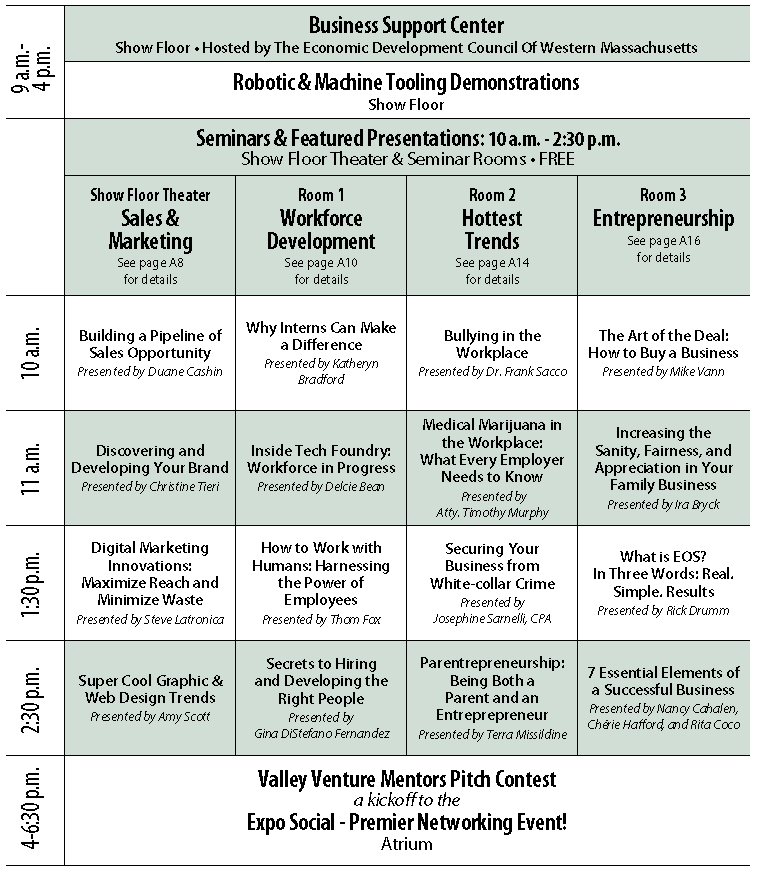
Throughout the day, there will be informative seminars across four tracks: Sales & Marketing, Workforce Development, Hottest Trends, and Entrepreneurship. Also slated are robotics and machine-tooling demonstrations, a Technology Corridor, a Business Support Center, the ever-popular Pitch Contest staged by Valley Venture Mentors, the day-capping Expo Social (always a great networking opportunity), and much more.

Sponsors include Comcast Business, presenting sponsor; Health New England, Johnson & Hill Staffing Services, MGM Springfield, and Wild Apple Design, director-level sponsors; the Isenberg School of Business at UMass Amherst, education sponsor; 94.7 WMAS, media sponsor; Peerless Precision, Smith & Wesson, the NTMS, and the Larry A. Maier Memorial Educational Fund, robotics and manufacturing sponsors; and Meyers Brothers Kalicka, entrepreneur sponsor. For more information, call (413) 781-8600, ext. 100, or visit www.businesswest.com.

Environment and Engineering Sections

What Goes Around …

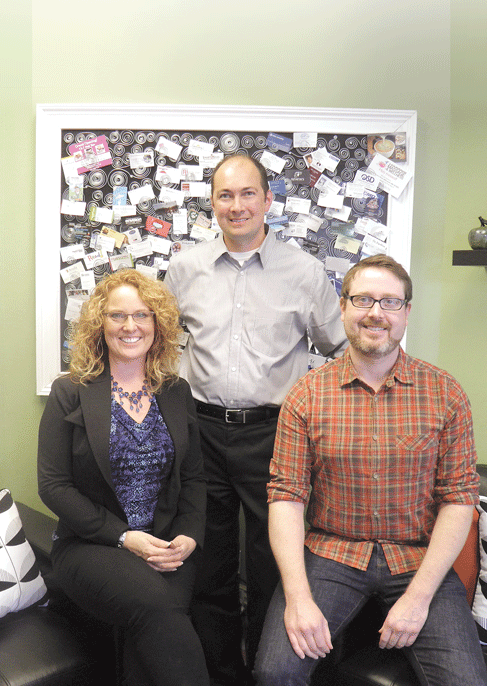
Noah (left) and Seth Goodman

Noah (left) and Seth Goodman left their family’s paper recycling business to establish Northstar Recycling and fill a void in the marketplace.

Noah Goodman scrolls through photos on his smartphone, searching for a picture of a whiteboard.

It was taken before he and his brother, Seth, opened Northstar Recycling, and showcases the first step they took in establishing their company: Creating a set of core values.

The list includes, “We Do First Things First”; “We Count on Each Other for Help”; “We Do Our Personal Best Today”; “We Do the Next Right Thing”; and “We are Impeccable With Our Word.” But the final item, which is underlined and was written in capital letters, reads “WE HAVE FUN!”

It’s a principle they both subscribe to, and although making sure employees have a good time at work is hardly a priority for many business owners, these partners attribute their accelerated growth and success to the combination of these core values and the atmosphere they have carefully crafted in their East Longmeadow facility.

They say it has helped them attract graduates from prestigious schools such as Princeton — they actually have five Ivy Leaguers on the payroll — as well as employees from large urban centers such as New York City, who joined their firm because they want to work in a place where their well-being is a primary consideration.

In fact, that premise recently earned the company accolades when Fortune magazine ranked Northstar Recycling as one of the top places for women to work in the U.S.

Teresa Chamberlain graduated from Lehigh University last year with a degree in environmental engineering and environmental studies and moved from Ohio to work at Northstar. Her story, and remarks, are typical.

“It’s a relaxing, professional environment,” said the client development executor, who takes a proactive stance in her job. “I’m not micromanaged and because the responsibility to get my work done is my own, I am empowered to do things well.”

The Goodmans told BusinessWest that Northstar is filling a need in the marketplace, and has experienced phenomenal growth. “Four years ago, we had 11 employees. Today, we have 34,” Noah said. “We’ve grown so quickly that we are doubling our space in January and taking over the entire 8,000 square foot building we are in.”

The interior of their space also reflects attention to detail. The entranceway is dominated by a soothing, 9-foot waterfall with Northstar’s logo imprinted on the rock surface beneath the flowing water. The ceilings are lofty and a hallway with an arched faux metallic-patterned silver ceiling leads to spacious offices and a break room, which is kept well stocked with free food and snacks.

There is a picnic area outside with a barbeque grill and patio tables with umbrellas; they are installing a horseshoe pit; employees are treated to a meal each week at the local Coughlin’s Place restaurant, can bring their dogs to work, and get free haircuts, courtesy of their employer, at Ace Barber Shop in the building.

And of course, they have their own composter. “We are a zero- waste-to-landfill office,” said Noah, explaining that Northstar’s purpose is to create recycling programs for national manufacturing firms and other businesses, and materials they deal with include cardboard, plastic, metal, wood, and organics.

“We partner with companies and manage their recycling, because they typically have environmental goals they have to achieve by a certain date and time,” Seth noted.

Noah explained that the company’s clients can’t find outlets for their raw materials, so Northstar does that for them in a way that creates a revenue stream, an important goal in addition to achieving sustainability and their environmental goals.

It’s an arena Northstar not only excels in, but one in which it is pushing the boundaries of what can be accomplished (more about that later). It also makes sure the recycling takes place as close to the manufacturing firm as possible.


Click HERE for a listing of area environmental services companies


“We’re always looking to reduce the distance where materials are recycled; a lot of things today are being sent to China and India in overseas containers,” Noah explained. “Recycled paper is the largest item exported out of the U.S. by volume.”

As a result, they work hard to find local recyclers wherever their client has a facility. “We make it as easy for the manufacturer as possible,” Seth said. “We coordinate everything, including the containers they use and the trucks and trailers that transport materials.”

Solid Foundation

The Goodman brothers are fifth-generation entrepreneurs. “Our great, great grandfather was a peddler in Western Mass., and he and our great grandfather had a scrap metal recycling company on Ferry Street in Springfield,” Seth explained.

Their father and uncle joined the business in the ’60s, but changed its focus and turned it into a private paper-recycling firm. “It grew to be one of the largest paper recyclers in New England, and we both worked in the business for 20 years,” Noah said, adding that these experiences helped them develop strong work ethics and they “did every job there that anyone could do.”

Seth Goodman

Seth Goodman says Northstar has employees whose only job is to continuously improve recycling programs at clients’ manufacturing plants.

However, five years ago the brothers developed a different vision, and made the decision to branch off on their own. “We felt there was a real need to help companies reduce what they were putting into landfills and increase what they were recycling,” Seth recalled.

Noah told BusinessWest they realized that U.S. companies had begun to take sustainability seriously and knew that large Fortune 500 firms didn’t have the expertise to meet stringent standards, which require them to reduce their carbon footprint as well as the amount of material they put into the trash.

They said the U.S. produces more than 50 millions tons of waste every year (more than any other country in the world), and more than half of it is dumped into landfills, contaminating water supplies and polluting the air with dangerous amounts of methane gas, which is 23 times more potent than carbon dioxide.

This factual information, coupled with their shared values and relationship — “we’re best friends and very much in tune with each other; we communicate openly and honestly and defer to whoever is the most passionate about something, which means there is harmony at the top,” Noah said, — led them to launch Northstar Recycling in 2011 with 11 employees.

Their core belief was simple: Waste has value, and it is damaging to the planet and financially irresponsible to send reusable resources to a landfill. And from that their mission statement was born — to help businesses recycle more and send less to landfills.

“We felt we had the experience and know-how to help companies and saw a huge future in it,” Noah said.

But before they started, they spent time designing the culture of their future workplace.

“We wanted to create a workplace where people felt emotionally safe; where they could speak up openly and have their opinion heard and considered,” Seth said. “We also wanted our employees to have fun and care enough to really want to help us succeed.”

The brothers each have three young children, and because spending time with them is a priority, they felt it was only fair to provide employees with the same luxury.

“So, if someone has to leave work for a family issue, the first thing we ask is: ‘Is everything OK?’ and the next is ‘What can we do to support you?’” Seth said.

“Every decision we make day-to-day is in line with our core values — they are what and who we are as human beings,” he went on. “It’s also what drives our business and our culture, which are the foundations for our success. We have a great strategy and execute really well, but we couldn’t do it without our values; the people who work for us really want to see us succeed because of the environment we’ve created.”

In addition to those in East Longmeadow, the company has three employees in New York, two in Philadelphia, and one in Cincinnati.

However, everyone is brought to East Longmeadow on a quarterly basis, and after working together, they enjoy a fun-filled evening activity.

“We’ve staged a scavenger hunt in Springfield; a square dance with a professional caller and country western band; a team-building event; and a painting party,” Seth recalled. “And every year, everyone goes on a two-to four-day trip. Last year we saw Broadway shows. We have also gone to Mohawk Mountain (in Connecticut) to go horseback riding, and our sales marketing team (which goes on different trips) has gone to a dude ranch in Montana, skied in Jacksonville, Wyoming, gone white water rafting in West Virginia, and visited South Beach in Miami.”

Noah said the perks are important. “We want our employees to be happy, because if they are happy and healthy, they are more productive. So although we do have hourly weeks, we aren’t clock watchers,” he noted. “And everything that has happened in the last four years has exceeded our expectations.”

New Solutions

Seth said that when Northstar goes into a company for the first time, it conducts an initial assessment, which includes looking at areas where trash is generated.

“We typically find they are throwing away material that is recyclable,” he said.

At that point they assign two teams to work with the client. One of their primary roles is to find outlets for material that is being discarded, but could be diverted. Items often include stretch film, plastic strapping, and cardboard, which is frequently not all recaptured, even if attempts have been made to recycle it.

A Northstar team also creates a set of internal standard operating procedures for the client, because in many instances even if the company has established these measures, they are not efficient or inclusive enough.

“We have people whose sole job is to work at manufacturing sites to continuously improve their recycling programs,” Seth said.

The Goodmans are proud that their business has a positive impact on the environment and say the potential for growth is unlimited.

“There is a lot of opportunity because many companies have set goals to be more environmentally proactive. In fact, one of the nation’s largest fast food chains told all their suppliers if they want to continue to do business with them, their manufacturing facilities have to be ‘zero waste to landfill’ by a certain date,” Seth told BusinessWest. “Our business is being driven by large consumer-product companies throughout the country.”

Clients are visited on a frequent basis, and in addition, the home team constantly looks for new, innovative ways to recycle items traditionally considered non-recyclable. Success stories include selling textile scraps to a company that is using them to make bow-and-arrow targets.

“We also work with a large pet food manufacturer who used to send all its wet scraps to a landfill; now they go to a composter,” Seth said, noting that Northstar’s employees think creatively or out of the box.

“We research everything scrap items could possibly be used for, and are creating markets where there weren’t markets before,” he went on. “For example, we have a client that produces the film used to package coffee; it’s made of three layers of plastic and one layer of metal, and the scraps were going into the trash. But we found a company that turns them into a reusable packaging product.”

Noah said it’s a plus when consumer product firms can state in advertisements and literature that they are a sustainable company and all their manufacturers are zero waste to landfill.

“Northstar becomes a resource for these major corporations, and in many cases they refer their vendors to us; if they are having trouble meeting their goals, we can help,” he noted. “They realize they can devote a lot of time, energy and resources to the issue or bring their problem to us as we have a proven track record of getting the job done.”

Moving Forward

The Goodmans are proud of their company and what they have accomplished.

“When we began, we realized there were not enough nimble companies to help national corporations reach their goals,” Noah said. “There was a void in the market and we bet our financial livelihood on the belief that we could fill it, which we have done.”

They are also happy to continue their family tradition of entrepreneurship.

“Our company is located in East Longmeadow and our family has been in the area for five generations, so we’re proud to be able to help revitalize the business community in Western Mass. and are really excited to be bringing new jobs to the area,” Seth said. “But it all goes back to our core values.”

Events Features WMBExpo

This year’s show to feature programs and exhibits focused on manufacturing

“Oscar’ the robot

“Oscar’ the robot will be putting talents on display at the Western Mass. Business Expo on Nov. 4.

The large team of organizers for the Western Mass. Business Expo is busy with hundreds of details, large and small, as the Nov. 4 show approaches, including creation of nametags for those in the many categories of ‘participant.’

One of those tags will require just a single word: ‘Oscar.’ That’s the name given to the robot created by a team of Agawam High School students for a FIRST (For Inspiration and Recognition of Science and Technology) Robotics Competition staged earlier this year.

FIRST, an international, K-12, not-for-profit organization founded to inspire young people’s interest and participation in science and technology, said there were more than 3,000 entries, including Oscar, for a competition, or game, called Recycle Rush. As the name suggests, these robots were programmed to stack storage totes and recycling bins; Oscar ranked 65th in New England, just missing qualifying for the NE FIRST District Championships by five points.

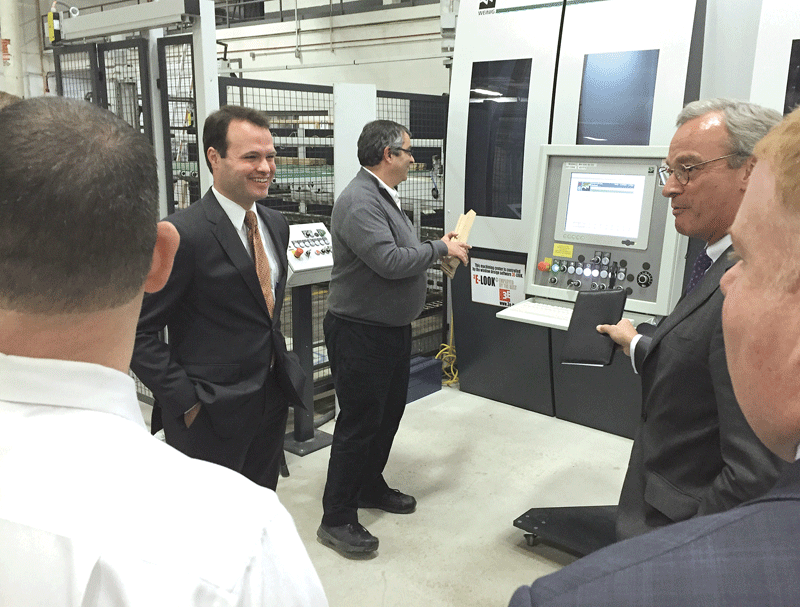
Oscar, created by a team called ROSIE (Recognizing Outstanding Science-inspired Education) Robotics, will be putting his various talents on display at the Expo — show attendees may actually get an opportunity to take the controls — thus playing a significant role in a multi-faceted effort to spotlight one of the most important sectors of the region’s economy, precision manufacturing, and the many challenges facing it.

Indeed, while the Expo will showcase virtually every sector of the local economy — from banking to retail; healthcare to technology; education to tourism — this, the fifth edition of the show, will feature a number of programs and exhibits focused on manufacturing and efforts to return this once-proud industry to prominence in the region.

Individual elements of this focus on manufacturing and the workforce issues it now faces include a luncheon program hosted by the Professional Women’s Chamber of Western Mass. The keynote speaker will be Alison Lands, senior manager in Deloitte’s Strategy & Operations practice. She served as a co-author and editor of the New England Council and Deloitte’s recently published report, Advanced to Advantageous: The Case for New England’s Manufacturing Revolution, which will form the basis of her talk.

It will also include participation by several area high schools, which will be spotlighting not only robotics, but also their machining programs, which play a vital role in maintaining a steady flow of workers to area manufacturers.

In addition to Agawam High School, Putnam Vocational Technical Academy and Westfield Vocational Technical High School will be taking part in the show. They will be showing off display computers, 3-D printers, and other equipment, and providing simulations of precision-manufacturing processes.

The focus on this sector is critical, said Kristin Maier Carlson, president of Westfield-based Peerless Precision Inc., who noted that many young people — and their parents, unfortunately — have a perception of manufacturing that is outdated and inaccurate.

“The view that people have is from way back when — that this is not a job to be in,” she told BusinessWest. “Actually, you need a lot of skill to be machinist, and this is a very viable alternative for those who are not looking to go to college.”

She said that, while running operations at Peerless, she’s also on a mission to help people get an accurate look at her industry and perhaps become motivated to join it. Actually, her work is a continuation of her father’s mission to achieve that same end.

Larry Maier acquired Peerless in 1997, and years later took a leadership role with the National Tooling & Machining Assoc. (NTMA) and its efforts to educate several constituencies about precision manufacturing with the goal of securing an adequate future workforce for shops here and across the country.

When her father was diagnosed with colon cancer, Maier Carlson, who said she grew up working at the shop sweeping floors and later cutting material on a band saw, returned to this region from San Diego to help determine its future course. By the time Larry succumbed to the disease, she had made up her mind not to sell the operation, but lead it to new heights.

While doing so, she is continuing her father’s work in education and building a workforce, and currently playing a leadership role at the NTMA. As part of that, she and other family members created the Larry A. Maier Memorial Educational Fund to help carry out the task of enlightening young people — especially those at the middle-school and even elementary-school levels — about the opportunities in manufacturing.

Money from that fund will be used to offset the costs associated with bringing the various high schools to the Expo and enabling them to show how their programs are both creating job opportunities and helping area manufacturers tackle the challenging workforce issues confronting them.

“Far more of our workers are closer to retirement than not,” said Maier Carlson. “We’re going to need to replace those workers, and this is an ongoing challenge. Area manufacturers need to partner with our area schools to not only educate people about opportunities in this field, but also provide the training necessary to help people become qualified to take these jobs. The Expo will showcase how these partnerships are working.”

As for Oscar, he will be one of at least two ‘competition robots’ that the ROSIE team will bring to the Expo, said Dana Henry, chief mentor for the team, adding that he expects these machines to turn some heads, impress attendees, and bring attention to careers that fall in the broad category called STEM — science, technology, education, and mathematics.

“We’ll have a half-dozen students there talking about the science, engineering, and manufacturing that goes into this,” said Henry. “We have to do all our own programming, wiring, machining, and CAD work for this — the whole ball of wax to build this 120-pound machine in six weeks. It should be very eye-opening.”

As will many other aspects of an Expo that has added a number of compelling elements to this year’s itinerary. Visit www.wmbexpo.com for more information and to register.


George O’Brien

Opinion

Opinion

By Domenic J. Sarno

In July 2013, when Springfield voters approved MGM’s development of an $800 million hotel-casino complex in our downtown, it was an historic event and the culmination of a two- year process. The vote backed a vision of transformation for an area destroyed by a tornado and a city devastated by the loss of manufacturing jobs. As I stated then, the proposal would not be a panacea, but, as the largest development in the history of Western Massachusetts, the benefits outweighed the costs, and it was worth pursuing.

In addition to local approval, last November in a state-wide referendum, support from voters in virtually every city and town across the Commonwealth validated our selection process. In fact, the Mass. Gaming Commission recommended to the Japanese government, which is considering legalizing casinos, that they study Springfield’s selection process. Based on their recommendation, last month the Japanese government sent its representatives to interview me and our internal team about how we established the process.

However, I have always known that, no matter how successful we were in attracting and reaching a contract with one of the largest corporations in the entertainment and gaming industry, the most difficult part would be making sure that the development was completed as promised.

To assist us in the enforcement of the promises made by MGM, we have a binding host community agreement with enforceable legal remedies and damages for non-compliance. In addition, I have the assurances of the chairman of the Mass. Gaming Commission that he will defer to the City’s design concerns in the commission’s enforcement of MGM’s gaming license conditions.  These tools will allow us to keep MGM’s feet to the fire, and should assure the naysayers that, working together, we can be successful in seeing the fruits of our labor and our hopes and expectations realized.

Indeed, these tools already helped us negotiate through the I-91 delay, and I will continue to aggressively enforce the binding agreement in the negotiation of any changes that are in the best interests of the city. As further proof that this process works, although I initially was skeptical about losing the original glass tower, I now believe that the benefits to our community of relocating the market-rate housing offsite outweigh the intangible, yet perceived, loss of a new addition to Springfield’s skyline.

Now, a new challenge is presented by MGM’s proposal to reduce the size of the original project. I pledge that I will not agree to any changes that negatively affect MGM’s promises of employment opportunities and revenue. We again will utilize our consultants to assure that the city is protected as we review and negotiate over the latest proposed changes. MGM will pay for our review costs including our team of gaming law, design, and engineering experts that have been with us since the beginning of our casino selection process.

I have asked my internal team, together with our outside experts, to provide me and the City Council with the analyses that we need to make decisions in the best interest of the city. I am confident that our rigorous review process will result in the city realizing the vision it had when it selected MGM: developing a first-class resort casino project benefitting the city, region and Commonwealth. I will settle for nothing less.

 Domenic Sarno is mayor of Springfield

Company Notebook Departments

International Container Co. Plans Holyoke Facility Expansion

HOLYOKE — In an effort to accommodate a growth in production, International Container Co., LLC will build an expansion to its facility and operations headquartered at 110 North Bridge St. in Holyoke. The expansion is planned with the assistance of both local tax incentives and tax credits provided through the Commonwealth’s Economic Development Incentive Program (EDIP).
International Container Co. (ICC) purchased its 150,000-square-foot facility in Holyoke in 2001 and has since made many improvements to the property. Since moving to Holyoke, business has increased each year for the company. The tax-increment financing (TIF) agreement lasts for five years and allows for a property-tax exemption on the newly created real-estate value. In return, ICC has agreed to create a minimum of five new jobs and invest between $900,000 and $1 million in the project.
The agreement has been submitted to the Holyoke City Council for approval. In addition, ICC will receive state investment-tax credits, pending review and approval of the application by the Mass. Economic Assistance Coordinating Council, based on the amount of sales generated from the expansion.
“The expansion of International Container is another indicator that manufacturing is alive and well in Holyoke,” Mayor Alex Morse said. “Our city’s manufacturers are a vital part of the community and our economy. This local incentive will ensure that this project can be brought to completion to retain and create dozens of employment opportunities in our own backyard.”
Over the last two years, ICC has made substantial efforts to expand, now servicing all of New England and selling products across the U.S. ICC currently employs 45 people, noting a growth in employment since 2013 when there were 24 employees at the facility.
“We are very excited to be working with the city of Holyoke on our expansion project,” said Joseph Searles, general manager of International Container.

Curry Printing Changes Logo to Reflect Shift in Business

WEST SPRINGFIELD — Curry Printing in West Springfield is changing its logo to better reflect its core business.
Since opening in 1976 as Curry Copy Center, the printing business has experienced a paradigm shift. “Ninety-eight percent of what we do today is print, and not copy,” owner Stephen Lang said. “In the old days, customers would come in with their camera-ready originals. We would make a plate and then run off copies. Today, those originals are electronic files sent directly as e-mail attachments or uploaded on our website. No plates need to be made; we print direct to different devices depending on the job. Blueprints, full-color brochures, reports, manuals, newsletters, banners, signs, and all kinds of collateral material go direct to print.”
To reflect this change, Curry has updated its logo. “It’s still OK to call us Curry Copy if you want; we really don’t mind,” Lang said. “But we are so much more than copies these days.”

Country Bank Contributes $7,250 to Local Schools

WARE — Country Bank surprised 29 local schools that participate in the bank’s Savings Makes Sense School Banking Program with $250 gift cards to Staples. Each school received the donation to help cover the cost of back-to-school supplies. “We know how difficult it is for the schools to have the supplies they need when budgets become tight. They are truly so grateful and appreciative of this gift,” said Jodie Gerulaitis, Financial Education officer at Country Bank, adding that teachers typically spend about $250 of their own money annually to purchase items for their classrooms. Country Bank serves Central, Western, and Eastern Massachusetts with 15 offices in Ware, Palmer, Brimfield, Belchertown, Ludlow, Wilbraham, Paxton, Charlton, Leicester, West Brookfield, and Worcester. It sponsors the Savings Makes Sense program and the award-winning Credit for Life program in its communities. For more information, visit www.countrybank.com.

A Plus HVAC Recognized

WESTFIELD — A Plus HVAC of Westfield is one of nine New England-based contractors to receive a 2015 COOL SMART award. The firm, led by owner and President Nathan LeMay, has received this honor for three consecutive years. The honors were presented recently at the annual golf tournament of the Air Conditioning Assoc. of New England. Sponsored by the Massachusetts/Rhode Island COOL SMART program, the awards are given out during the sporting event held in Stow. The winning contractors specialize in heating, ventilation, and air conditioning and are recognized for quality installation of energy-saving equipment and their overall contributions to the program. COOL SMART is a high-efficiency heating and cooling rebate program for residential customers of National Grid, Eversource, Unitil, and the Cape Light Compact. These program administrators sponsor the awards and the tournament to recognize contractors in Massachusetts and Rhode Island for outstanding service and an ongoing commitment to energy efficiency. Launched in 2004, COOL SMART promotes the purchase and installation of Energy Star-qualified and high-efficiency air conditioners, heat pumps, and water heaters. Awards are distributed annually to recognize outstanding contractors for leadership, quality work, and active program participation. “For the past decade, we have witnessed more and more contractors participating in COOL SMART,” said Kevin Parse, Unitil program coordinator. “This program is important to public health because greenhouse-gas emissions and pollution are reduced by up to 30% as a result of their outstanding work. On behalf of Eversource, we are proud to be affiliated with the program and its committed contractors throughout the region. We applaud A Plus HVAC for its third consecutive win and hope to see even more participants next year.” To learn more about becoming a COOL SMART contractor, or for general program information, visit www.masssave.com or call (800) 473-1105.

Webber and Grinnell Unveils New Look

NORTHAMPTON — Webber and Grinnell recently unveiled a new look and logo. “We felt it was time to contemporize things at the agency,” said President Bill Grinnell. “We wanted a logo that reflects our progressive culture and makes a statement to current and future clients.” Webber and Grinnell has been serving personal and business insurance clients throughout the Pioneer Valley for more than 100 years. For more information about its services, visit www.webberandgrinnell.com.

Aaron Smith, P.C. Supports United Way Day of Caring

EAST LONGMEADOW — Aaron Smith, P.C., a certified public accounting firm serving individuals and businesses in the Pioneer Valley, supplied 10 volunteers for the United Way of Pioneer Valley Day of Caring last month. The Day of Caring is the largest day of service in the Pioneer Valley, bringing more than 1,000 people together to complete community-service work throughout the region. Aaron Smith employees participated in the Day of Caring by working with a local YMCA to close up a summer camp for the season. Camp Weber, part of the West Springfield YMCA, has been serving young people for more than 150 years. Generations have enjoyed the 75 acres of wooded property located on Dewey Street, which needs a thorough cleaning at the beginning and end of each season. “It was a pleasure working with Camp Weber as part of the United Way Day of Service,” said Joanna Smigiel of Aaron Smith. “We helped by sweeping out the various buildings at the camp and cleaning refrigerators, sinks, cabinets, and washrooms. We also moved picnic tables inside for the winter, moved various supplies into an indoor storage unit, and generally cleaned up the grounds.” The Day of Caring was established to promote the spirit of volunteerism, increase awareness of local human-service organizations, and demonstrate how people working together for the common good can accomplish great things. “It’s such a rewarding experience to help an organization that brings joy, education, and life skills to our area youth,” said Scott Betsher, certified public accountant and director at Aaron Smith. “We pride ourselves on our relationship with the United Way of Pioneer Valley, knowing that what we do together really makes a difference in the communities we serve. We are not afraid to roll up our sleeves to get the job done. This is how we approach our volunteer work and how we work on your business.”

Departments People on the Move

Webber and Grinnell Insurance Agency announced several recent changes at its North King Street office in Northampton:
• Mat Geffin has been named Vice President and Equity Partner at the firm. He started at the agency in 2009 as vice president of business development in the commercial-lines department, and quickly established himself as a leader at the agency. Geffin leads the sales efforts at Webber and Grinnell, in addition to managing a large book of business encompassing the construction, habitational, manufacturing, and nonprofit market niches. He is an active board member for the United Way of Pioneer Valley, Tech Foundry, and the philanthropic services committee at the Community Foundation;
• Jenna Rodrigue has been promoted to Commercial Lines Supervisor. She leads a team of eight business-insurance specialists and is responsible for the day-to-day service of the agency’s commercial clientele. She began her career at Webber and Grinnell 12 years ago as a commercial lines customer-service representative;
• Kathy Cusson has been named Personal Lines Supervisor. Part of the Webber and Grinnell team since 1989, she leads a staff of nine and is responsible for the day-to-day servicing of the agency’s personal-lines clients.
•••••

Alison Shilinsky

Alison Shilinsky

Country Bank announced that Alison Shilinsky has been named senior vice president of Human Resources. With 10 years in the industry, Shilinsky is an experienced human-resources professional. She earned her master’s degree in management from UMass Amherst and her bachelor’s degree in English and communications from Assumption College. Shilinsky’s previous work at Brown Rudnick LLP, a prominent Boston law firm, has had a significant impact on her approach to human resources and business. She is an active member of the Society for Human Resources Management, the New England Human Resources Assoc., the New England Employee Benefits Council, and the Mass. Bankers Assoc. “Alison is an exceptional example of what a human-resources professional is supposed to be,” said Paul Scully, president and CEO of Country Bank. “Not only is she knowledgeable and dedicated, she demonstrates compassion and empathy to all employees. We are thrilled to have her join our team, as we know she will be a valued resource for Country Bank and its employees.”
•••••

April Healey

April Healey

Greenfield Cooperative Bank announced that April Healey has joined the bank as a Mortgage Originator at the bank’s main office on Federal Street in Greenfield. Healey has more than 14 years of experience in real estate, most recently at a local, regional bank. She will be responsible for originating residential mortgage loans in Franklin and Hampshire counties. She attended Holyoke Community College and has held various positions with the Realtor Assoc. of Pioneer Valley, including director and chairperson of its Realtor Public Image Committee. Greenfield Cooperative Bank and its Northampton Cooperative Bank division is a community-based institution with more than $525 million in assets and $60 million in capital reserves. The bank provides residential mortgages, commercial loans, and deposit products at 10 offices in Western Mass.
•••••

Tim Irwin

Tim Irwin

Chris Mader

Chris Mader

Tim Irwin and Chris Mader of OMG Inc., have been named in the annual 30 Under 30 Awards given jointly by Young Fastener Professionals and the Fastener Industry Coalition. “To be recognized by this prestigious group is certainly a high honor for these two outstanding individuals, and also for OMG,” said Hubert McGovern, president of OMG. “We are very proud of their accomplishments and for this great industry recognition.” The 30 Under 30 Awards are given annually to young industry professionals who are making a difference in the fastener industry. Ideal candidates are leaders who are driven, motivated, and passionate about their jobs and the future of the fastener industry. Individual nominations are selected based on several criteria, including their contribution to measurable results in the form of cost savings, sales increases, and design-efficiency increases. Irwin is a Product Manager with FastenMaster, where he is responsible for the LOK line of structural wood fasteners. He was cited for his team leadership as well as significant contributions he has made on the success of the FlatLOK, the ThruLOK, and the FastenMaster business as a whole. In his role as product manager, he has been able to significantly impact sales revenue and profits and has demonstrated a keen ability to drive product development based on end-user needs. Mader is a Codes/approvals Support Engineer for OMG’s Roofing Products division, responsible for helping evaluate new products, as well as developing and maintaining technical product specifications, maintaining code approvals, and keeping abreast of technical changes and advancements in the commercial-roofing industry. He has been instrumental in helping OMG understand critical compliance standards and requirements for products sold in various international markets and for his work with products designed to secure solar PV racking systems to commercial roofs. The winners from this year’s 30 Under 30 Awards were recognized at the National Fastener Industrial & Mill Supply Expo in Las Vegas on Oct. 21. Headquartered in Agawam, OMG Inc. is North America’s largest manufacturer of specialty fasteners and products for commercial and residential construction applications. The company operates two business units: OMG Roofing Products and FastenMaster.
••••
Beloved Earth, the Pioneer Valley’s first green cleaning company, has promoted Lynn Moynahan to the position of Assistant Vice President in charge of the residential services division. Beloved Earth co-founders David and Terra Missildine serve as company president and vice president, respectively. David oversees commercial services, and Terra oversees general operations. Moynahan has been with Beloved Earth for three years and previously served in the role of residential services manager for Hampshire County only. In her new position, Moynahan will oversee the entire residential services team, including managers in other counties. Beloved Earth employs a total of 12 staff members in its two divisions. The business primarily serves Hampshire County, but also Hampden and Franklin counties.
•••••

Edward Garbacik

Edward Garbacik

Edward Garbacik has joined the team at Private Financial Design, LLC in South Hadley. For more than 30 years, he has been providing individuals and small-business owners with comprehensive financial planning as an advisor and planner, including investment-advisory services, retirement planning, estate planning, and other wealth-management needs. He earned the certified financial planner designation through the CFP certificate program at Boston University and has also been awarded the accredited investment fiduciary (AIF) designation, widely considered the fiduciary standard for business retirement planning and plan-sponsor services. Prior to joining Private Financial Design, Garbacik held the title of partner at a boutique investment firm specializing in retirement-income planning. He was also vice president and managing partner of investments at FSB Financial Group, where he led the group’s financial-planning and wealth-management team. Private Financial Design offers comprehensive financial planning for both personal and business needs, including fee-based investment-advisory services, retirement plans, and other wealth-management services.
•••••
Dakin Humane Society has appointed Kimberly Hannah and Brendan Wood to serve three-year terms on its board of directors, according to interim Executive Director Nancy Creed. Hannah currently serves as office manager and executive assistant to the president and CEO for the Sisters of Providence Health System. Prior to that, she was the office manager and executive assistant to the president and CEO of Cooley Dickinson Hospital and worked at Baystate Health for several years. She has volunteered for animal-rescue organizations including FACES and the Westfield Animal Shelter, and is a graduate of Bay Path College. Wood is a wealth-management advisor with the Foundation Management Group at Merrill Lynch. He previously taught at independent schools in Santa Barbara, Calif., and is a graduate of Princeton University. Dakin Humane Society delivers services that improve the lives of animals in need and the people who care about them from its two locations in Springfield and Leverett. The organization shelters, treats, and fosters more than 20,000 animals each year and has performed more than 62,000 spay/neuter surgeries since 2009.

Chamber Corners Departments

GREATER EASTHAMPTON CHAMBER OF COMMERCE

www.easthamptonchamber.org
(413) 527-9414

• Nov. 4: Networking by Night, 5-7 p.m., at Cooley Dickinson Hospital. Join the Greater Easthampton, Greater Northampton, and Amherst Area chambers along with our host, Cooley Dickinson Hospital, for a networking extravaganza. Sponsored by Duseau Trucking.

• Nov. 6: 
CheckPoint 2015 Legislative Summit. Registration and networking, 11 a.m.;
 welcome, lunch, and keynote speaker, noon to 1:30 p.m.; Chamber View
Dialogue with chamber executives, followed by legislative response, 1:30-3 p.m.; cocktail reception with heavy hors d’oeuvres, 3-4 p.m. Keynote speaker:  state Senate President Stanley Rosenberg. Also hear from Tim Wilkerson, regulatory ombudsman of Economic Policy Development at the Executive Office of Housing & Economic Development. Guests will have the opportunity to ask questions to invited legislators.

• Nov. 7: 15th Annual Greater Easthampton Chamber Viva Las Vegas Bowl-a-Thon, at Canal Bowling Lanes, 74 College Highway, Southampton. Two sessions:  3 p.m. and 6 p.m. A night of fun, laughs, music by DJ Jay Paglucia, and pizza as you help support funding this season’s holiday lights.

• Nov. 11: Monday Morning with the Mayor, 8-9 a.m., Burger King, Easthampton.

• Dec. 3: Holiday tree lighting and visit from Santa, 6:30-8 p.m., at Pulaski Park, Easthampton.

• Dec. 4: Greater Easthampton Chamber Snow Ball, 6-11 p.m., at the Garden House, Look Park. An old-fashioned, elegant, holiday affair. Sit-down dinner featuring Meyers Catering, live music, and dancing featuring Maxxtone. Dress in style, black tie optional.

GREATER NORTHAMPTON CHAMBER OF COMMERCE

www.explorenorthampton.com
(413) 584-1900

• Nov. 4: November Arrive @ 5 Open House, 5-7 p.m. Hosted by Cooley Dickinson Hospital, 30 Locust  St., Northampton. Cost: $10 for members.

• Dec. 2: December Arrive @ 5, 5-7 p.m., at Hampshire Council of Governments, Northampton. Sponsored by Applied Mortgage. Cost: $10 for members.

GREATER WESTFIELD CHAMBER OF COMMERCE

www.westfieldbiz.org
(413) 568-1618

• Nov. 2: Mayor’s Coffee Hour, 8-9 a.m., hosted by Amelia Park Children’s Museum, 29 South Broad St., Westfield. Event is free and open to the public. To register, call Pam at the chamber office at (413) 568-1618.

• Nov. 6: CheckPoint 2015 Legislative Symposium, 11:30 a.m. to 3 p.m., hosted by the Log Cabin Banquet & Meeting House, Holyoke. Cost: $50 for chamber members, $60 (paid in advance) for non-members. For sponsorship opportunities, call Pam at the chamber office at (413) 568-1618.

• Nov. 9: Eat & Educate: Business Insurance Options, 11:30 a.m. to 1 p.m., hosted by Westfield Bank, 141 Elm St., Westfield. Presented by Shawn Torress & Kevin Green of Westfield Wealth Management and Westfield Bank. Cost: free for chamber members, $30 for non-members; $75 to attend all three Eat & Educate workshops. RSVP required. To register, call Pam at the chamber office at (413) 568-1618.

• Nov. 12: November After 5 Connection, 5-7 p.m., hosted by Ezra’s Mercantile, 34 Elm St., Westfield. Refreshments will be served. Bring your business cards and make connections. Cost: $10 for members, $15 cash for non-members. To register, call Pam at the chamber office at (413) 568-1618.

PROFESSIONAL WOMEN’S CHAMBER

www.professionalwomenschamber.com
(413) 755-1310

• Nov. 4: PWC Headline Luncheon, 11:30 a.m. to 1 p.m., co-located at the Western Mass Business Expo, MassMutual Center, 1277 Main St., Springfield. “New England’s Skills Gap in Advanced Manufacturing,” featuring Alison Lands, senior manager of Deloitte Consulting, LLP. Cost: $40. Reservations may be made online at www.professionalwomenschamber.com. The Professional Women’s Chamber is a division of the Springfield Regional Chamber.

SPRINGFIELD REGIONAL CHAMBER

www.springfieldregionalchamber.com
(413) 787-1555

• Nov. 4: Springfield Regional Chamber Business@Breakfast, 7:15-9 a.m., co-located at the Western Mass Business Expo, MassMutual Center, 1277 Main St., Springfield. Pull up a bar stool for a casual conversation with Harpoon Brewery CEO and co-Founder Dan Kenary. Cost: $30 in advance, $35 at the door). Reservations may be made online at www.springfieldregionalchamber.com.

• Nov. 12: Springfield Regional Chamber After 5, 5-7 p.m., hosted by Tech Foundry, 1391 Main St., 9th Floor, Springfield. Cost: $5 for members, $10 for general admission. Reservations may be made online at www.springfieldregionalchamber.com.

• Nov. 19: Springfield Regional Chamber Government Reception, 5-7 p.m., hosted by Carriage House, Storrowton Tavern, 1305 Memorial Ave., West Springfield. Meet socially with your local, state, and federal officials. Cost: $50 for members, $70 for general admission. Reservations may be made online at www.springfieldregionalchamber.com.

• Nov. 24: Springfield Regional Chamber Pastries, Politics and Policy, 8-9 a.m., hosted by TD Bank Conference Center, 1441 Main St., Springfield. Featuring Hampden Country District Attorney Anthony Gulluni. Sponsored by the Regional Employment Board of Hampden County. Cost: $15 for members, $25 for general admission. Reservations may be made online at www.springfieldregionalchamber.com.

Agenda Departments

Western Mass. Business Expo

Nov. 4: Comcast Business will present the fifth annual Western Mass. Business Expo at the MassMutual Center in downtown Springfield, produced by BusinessWest and the Healthcare News. The business-to-business show will feature more than 100 booths, seminars and Show Floor Theater presentations, breakfast and lunch programs, a day-capping Expo Social, the annual pitch contest, robotics and machine tooling demonstrations, flu shots, and much more. Sponsors include Comcast Business, presenting sponsor; Health New England, Johnson & Hill Staffing Services, MGM Springfield, and Wild Apple Design, director-level sponsors; the Isenberg School of Business at UMass Amherst, education sponsor; 94.7 WMAS, media sponsor; Peerless Precision, Smith & Wesson, the NTMS, and the Larry A. Maier Memorial Educational Fund as robotics and manufacturing sponsors, and Meyers Brothers Kalicka as entrepreneur sponsor. For more information, call (413) 781-8600, ext. 100, or visit www.businesswest.com.

Senior Health Fair

Nov. 4: Baystate Franklin Medical Center and the YMCA of Greenfield will hold a Senior Health Fair and Functional Fitness Assessment from 9 a.m. to 1 p.m. at the YMCA, 454 Main St. The event, for individuals age 60 and older, will feature a variety of screenings, fitness assessments, information stations, guest speakers, and healing modalities to explore. The event is free and open to the public; lunch will be provided at noon. YMCA staff will administer the functional fitness assessment, which includes six elements: lower body strength, upper body strength, aerobic endurance, lower body flexibility, upper body flexibility, and agility and balance. BFMC departments represented will include the Emergency Department, Medical-Surgical, Birthplace, Cardiopulmonary, Physical and Occupational Therapy, Audiology, Case Management, and Baystate Home Infusion, offering various screenings (such as hearing and balance testing), information on assistive devices, heart-healthy information, and Reiki and stroke education. Participants can test their healthcare knowledge with a ‘Wheel of Health’ game. In addition to YMCA and BFMC staff, vendors from other healthcare-related services will be exhibiting at the fair. During lunch, three guest speakers will be featured: Dr. Tom Higgins, interim president and CEO of Baystate Franklin Medical Center, speaking on senior health; cardiologist Dr. Heba Wassif, on what to monitor with new medications and the side effects they can cause; and nurse practitioner Pamela McLean, on cancer prevention. The event is free, but pre-registration is encouraged. For more information or to register, call (413) 773-3646, ext. 448, or register at the YMCA Welcome Center.

Spirit of Skiing Award

Nov. 7: Cal Conniff will be honored by the New England Ski Museum (NESM) at the Log Cabin in Holyoke. The event is open to the public. NESM’s Spirit of Skiing Award is given to honor a skiing notable who manifests the motto, “skiing is not just a sport, it is a way of life,” attributed to ski pioneer Otto Schniebs. Previous winners include Olympic medalists Stein Eriksen and Penny Pitou, U.S. Olympians Tom Corcoran and Tyler Palmer, Killington Ski Resort founder Preston Smith, renowned ski instructor Herbert Schneider, and ski-show impresario Bernie Weichsel. Conniff spent his professional life working for the betterment of the ski-area industry, managing the Mt. Tom Ski Area from 1968 to 1973. He put the small facility on the national map by developing extensive night skiing and one of the earliest snow-making systems in the country in the 1960s, two innovations that were soon emulated throughout the resort industry. During his tenure at Mt. Tom, Conniff targeted the youth market, introducing thousands to the thrill of downhill skiing through numerous school programs. Conniff took over leadership of the National Ski Areas Assoc. in 1973, moving its offices from New York City to West Hartford, Conn. and ultimately downtown Springfield in 1978, where it remained until his retirement in 1990. He now lives in Wells, Maine. Conniff was an accomplished ski racer in college and won the four-way combined championships for the American Armed Forces in Europe when he was stationed in Germany in the 1950s. A graduate of American International College (AIC), he hosted a TV show on WWLP called Skiers’ Corner. He was inducted into AIC’s Athletic Hall of Fame in 2011, and to the U.S. Ski & Snowboard Hall of Fame in 1990. He is the former president of the New England Ski Museum, where an annual grants program was established in his name. Tickets to the event, which starts at 5 p.m., cost $75 and available by calling the NESM at (603) 823-7177 or visiting www.skimuseum.com/events. Proceeds support the museum’s mission to preserve the history of skiing.

Neuroscientist to Visit Springfield College

Nov. 19: The Springfield College Center for Wellness Education and Research (CWER) will host world-renowned neuroscientist and nutrition and diet expert Nicole Avena at 7 p.m. in the Fuller Arts Center. Avena’s presentation, “Why Diets Fail: Because You’re Addicted to Sugar,” will focus on years of research showing that sugar is addictive, and present a science-based plan to stop cravings. The event is free and open to the public. Author of more than 50 scholarly journal articles, Avena’s research suggests that overeating of palatable foods can produce changes in the brain and behavior that resemble addiction, findings that have jump-started an entire new field of exploration and discovery related to the obesity epidemic. She has presented her research to an array of audiences, including pharmaceutical companies, diabetes-prevention groups, food-industry marketing executives, nutrition groups, and obesity-education groups, and has contributed to articles in Men’s Health, Psychology Today, Bloomberg Businessweek, and WebMD. The New York Academy of Sciences, the American Psychological Assoc., and the National Institute on Drug Abuse have honored her research achievements. Housed in the Springfield College School of Health, Physical Education and Recreation, CWER’s mission of is to serve as the region’s pre-eminent source for best practices in nutrition and physical-activity programming for young people.

Daily News

AGAWAM — The Employers Assoc. of the NorthEast announced its findings from the 2015-16 Salary & Budget Survey, with close to 100 companies participating from Massachusetts, Connecticut, and Rhode Island.

The survey results include numerous breakout reports to meet employers’ diverse data requirements for compensation planning, including salary and pay increases based on industry segment, job category, and more. The survey addresses salary increases for the period of July 2014 to June 2015, and also forecasts salary changes for July 2015 to June 2016.

Overall, manufacturing employers participating in the survey indicated employees received, on average, a 2.7% increase for 2014-15, while non-manufacturing participants averaged a 3.0% increase. Both categories are holding steady with the forecast for pay raises. Manufacturing participants projected an overall 2.8% increase for 2016, while the non-manufacturing group forecasted a 2.6% increase, on average. Factored into the data are companies that reported there would be no increase or decrease.

“Given the multitude of other factors competing for funds — from healthcare and other benefit costs to capital investments — it is not surprising to see limited increases,” said Mark Adams, director of HR Solutions for the Employers Assoc. “That said, we know that employers want to give raises to keep top talent.”

For a full summary of results, visit eane.org/salary-budget-survey-results.

Daily News

HOLYOKE — In an effort to accommodate a growth in production, International Container Co., LLC will build an expansion to its facility and operations headquartered at 110 North Bridge St. in Holyoke. The expansion is planned with the assistance of both local tax incentives and tax credits provided through the Commonwealth’s Economic Development Incentive Program (EDIP).

International Container Co. (ICC) purchased its 150,000-square-foot facility in Holyoke in 2001 and has since made many improvements to the property. Since moving to Holyoke, business has increased each year for the company. The tax-increment financing (TIF) agreement lasts for five years and allows for a property-tax exemption on the newly created real-estate value. In return, ICC has agreed to create a minimum of five new jobs and invest between $900,000 and $1 million in the project.

The agreement has been submitted to the Holyoke City Council for approval. In addition, ICC will receive state investment-tax credits, pending review and approval of the application by the Mass. Economic Assistance Coordinating Council, based on the amount of sales generated from the expansion.

“The expansion of International Container is another indicator that manufacturing is alive and well in Holyoke,” Mayor Alex Morse said. “Our city’s manufacturers are a vital part of the community and our economy. This local incentive will ensure that this project can be brought to completion to retain and create dozens of employment opportunities in our own backyard.”

Over the last two years, ICC has made substantial efforts to expand, now servicing all of New England and selling products across the U.S. ICC currently employs 45 people, noting a growth in employment since 2013 when there were 24 employees at the facility.

“We are very excited to be working with the city of Holyoke on our expansion project,” said Joseph Searles, general manager of International Container. “We are a family business that has been manufacturing in Holyoke for 14 years and are looking forward to our future growth and success here in Holyoke in the years to come.”

ICC was founded in 1996 by William Searles Jr. The company, now operated by brothers Joseph, Kenneth, Sean, and Daniel Searles, serves the New England and Mid-Atlantic areas with products for the solid-waste industry. The company specializes in roll-off, hook-lift, and front- and rear-load containers, as well as a wide variety of special-application containers, including rolling roofs, square- and octagon-style breakaway boxes, self-contained and stationary compactors, recycling containers, flat beds, and custom containers.

Events Features WMBExpo

Wednesday, November 4, 2015
MassMutual Center, Springfield

WMBExpo 2015 LOGOWMBExpoSponsors2015

Since it was launched in 1984, BusinessWest, known back then as the Western Mass. Business Journal, has been on a mission — not only to hold up a mirror to the region’s business community, but to serve it through editorial content and programming that’s informative, thought-provoking, and often entertaining.

The process of fulfilling that mission has changed with the times, and involved new avenues for communicating with, and engaging, the business community of Western Massachusetts. Examples of this evolution include everything from doubling the magazine’s frequency from monthly to bimonthly to launching a separate publication, the Healthcare News, devoted entirely to that sector; from putting content online to launching recognition programs, including 40 Under Forty and Difference Makers.

The latest step in this evolutionary process came in 2011, when BusinessWest determined that, despite ample evidence to the contrary, the era of the large-scale, business-to-business trade show wasn’t over.

Rather, we decided it was time to enter a new era — one where the show would become bigger, broader, and even more focused on providing value for exhibitors and attendees alike. Thus, BusinessWest created the Western Mass. Business Expo, and has spent the past four years refining and enhancing a quality product.

The fifth edition of the show reflects these efforts. The day-long event is crammed with programming designed to promote awareness of the depth and breadth of the region’s economy and help business owners and managers better navigate the myriad challenges they face.

The day will get off to an entertaining start with the Springfield Regional Chamber’s October breakfast and keynote speaker Dan Kenary, CEO and co-founder of Harpoon Brewery, who will engage in a “casual conversation” with BusinessWest Editor George O’Brien.

Later, at the luncheon hosted by the Professional Women’s Chamber, Alison Lands, senior manager in Deloitte’s Strategy & Operations practice, will present a program based on a report she co-authored and edited titled “Advanced to Advantageous: The Case for New England’s Manufacturing Revolution.” She will discuss the challenges facing this resilient, innovative sector, particularly a persistent skills gap and a lack of brand awareness, and how they present real opportunities for workforce development in New England. If you’re invested in manufacturing, you’ll want a seat at this event.

Throughout the day, there will be informative seminars across four tracks: Sales & Marketing, Workforce Development, Hottest Trends, and Entrepreneurship. Also slated are robotics and machine-tooling demonstrations, a Technology Corridor, a Business Support Center, the ever-popular Pitch Contest staged by Valley Venture Mentors, the day-capping Expo Social (always a great networking opportunity), and much more.

This show was created for you, the hardworking people who shape the region’s business community. We hope you will join us for what will be a memorable day.

George O’Brien, Editor
John Gormally, Publisher
Kate Campiti, Associate Publisher

WMBExpo Schedule

WMBExpoSchedule2015

Community Spotlight Features

Community Spotlight

Courtney Hendricson spends a moment with Sean Vaccarella

Courtney Hendricson spends a moment with Sean Vaccarella in the newly opened Vitamin Shoppe on Elm Street.

Courtney Hendricson thinks of herself as a matchmaker.

Although it’s an unusual way to describe the job of a town official, she is doing all she can to strengthen and facilitate the growth of Enfield’s key industries by introducing people to each other and keeping them informed about opportunities via networking events and social-media platforms.

“Some of our key industries are really strong, and others are burgeoning, but we’re taking a very proactive approach to growth, and I have relationships with builders, developers, site selectors, property owners, and brokers,” said the assistant town manager of development services. “It’s my job to connect them and let them know what is happening in town.”

Retail business is among the community’s key industries, and it is home to 3,000 stores. “Enfield is a regional retail destination, and many people spend their Saturdays here,” Hendricson said, pointing to the presence of industry giants such as Sears, Home Depot, and Costco, as well as a plethora of other stores and eateries found in the mall, shopping centers, and business corridors easily accessible off Interstate 91.

She added that the retail corridor — which starts immediately after vehicles exit from 91, runs along Elm Street, and connects to Freshwater Boulevard — continues to grow.

“Starbucks and the Vitamin Shoppe opened in late August in a renovated building on Elm Street that used to be an Arby’s restaurant, Asian Grille and OMI Grocery are opening this month on Enfield Street, and a new, 14,500-square-foot Goodwill store is under construction on Palomba Drive,” Hendricson said. “Hannoush Jewelers put up a new building on Elm Street, expanding from a much smaller space in the Stop & Shop Plaza, and Chick-fil-A built a pad site and opened in the parking lot of an existing shopping center on Hazard Avenue.

“We rarely have vacancies in our retail corridors, and when they occur, the space is filled very quickly,” she continued, adding that the town is working with a food franchiser who hopes to move into the former Rockville Bank building, which sits on 1.1 acres and has been empty for several years.

One of the town’s many retailers, Vitamin Shoppe Manager Sean Vaccarella, views Enfield as an ideal location.

“We’re really excited to be here; the economy is thriving in terms of retail, and there are acres of stores in Enfield,” he said. “We’re looking to penetrate the market and develop a footprint here.”

Advanced manufacturing is another thriving industry, and a pipeline of employees is continually being created, thanks to the strong program at Asnuntuck College.

“They’re known as the leader in Connecticut for this type of education. In fact, the governor took their model and replicated it in other community colleges across the state. Enfield students are exposed to the program in middle school, and every grade from that point on has a program for interested young people,” Hendricson said. “The advanced-manufacturing industry here is robust. ”

The third key industry in town is logistics and distribution. “We’re very strong in this area,” she told BusinessWest. “Advanced Auto Distribution Center moved to Enfield after completing a major renovation of a former 400,000-square-foot Lego warehouse and brought more than 200 jobs here in the last year, and Brooks Brothers Distribution Center is in Enfield and is thriving in our industrial park.”

Hallmark Cards Distribution Center plans to close next June, but town officials are working to connect Hallmark’s commercial real-estate team with interested brokers. “It’s critical to fill all of our buildings to their best use, and we are very proactive in this area,” Hendricson said.

The town is also looking for an interested manufacturer or tenant to occupy a 235,000-square-foot building on 19 acres at 35 Manning Road. “It’s zoned industrial and is part of the commercial real estate that is available,” she told BusinessWest.

Meanwhile, growth is occurring in residential real estate, and revitalization efforts continue in the Thompsonville section of town.

For this, the next installment in BusinessWest’s Community Spotlight series, we look at the many forms of progress being recorded in this community just south of the Massachusetts state line.

Raising Awareness

While existing, traditional sectors of the economy are thriving in Enfield, town officials want to build even more diversity into the equation.

For example, while there are some biomedical-related companies in Enfield, officials want to increase their number.

“The industry is growing, and we’re trying to cultivate it here. Johnson Memorial Hospital has a campus in Enfield, and we have companies that are thriving,” Hendricson said, mentioning Davita Enfield Dialysis on Palomba Drive as an example. New zoning was created about 18 months ago within a few industrial sites to spur growth and facilitate the use of properties for biomedical manufacturing, which include Metro Park North on Route 5, a 135-acre site that could be subdivided.

Town officials are encouraged by the decision by Cirtec Medical Systems, LLC to move from East Longmeadow into a new, 35,000-square-foot plant in Enfield. It will have a 5,000-square-foot clean room and a 6,000-square-foot, controlled-environment assembly space, in addition to a machine shop and laboratory. The company provides outsourced services for the medical-device industry that are used in stroke recovery and heart-disease treatment.

“The move will bring 100 jobs to Enfield, and they have told us they plan to add another 50,” Hendricson said. “We’ve made a concerted effort in the past year to do more outreach to spur additional economic growth. We have also strengthened our revitalization efforts in Thompsonville, and continue to foster an environment that provides new ways to unite our business community.”

To that end, the city’s Economic Development Commission held its first Business Development Summit on Sept. 23, and the 150 available slots were filled quickly.

“It highlighted all of our key industries, and people came from both the Greater Hartford and Springfield areas,” Hendricson said, adding that there were breakout sessions with panels composed of experts who discussed the town’s main industries: advanced manufacturing, logistics and distribution, healthcare and the environment, and the future of retail.

“These are areas where we are really strong, and our goal was to showcase them,” she told BusinessWest, adding that each participant received a booklet with photos and detailed information about every available commercial property in town. “The properties range from 600 to 235,000 square feet; from small, rentable spaces downtown and in Thompsonville  to an available building in our retail corridor that was a car dealership. We worked hard on the summit in hopes that, by bringing players to the table together, they could make deals.”

She added that copies of the booklet, which contain photos and detailed information about available property, were given out last year during a breakfast for commercial real-estate developers.

Hendricson also records quarterly video news clips called “V-News,” which can be seen on YouTube and keep viewers up to date on economic development.

She just finished her third video, and a link to each broadcast is e-mailed to more than 3,000 of what she refers to as “key players,” who range from commercial and residential real-estate developers to businesses and CEOs of leading companies.

Efforts have also been made to streamline the town’s permitting process and make sure it is consistent and predictable. To that end, Enfield recently purchased new, customer-friendly software that is being customized and will allow people to apply for a permit online, 24 hours a day, then check its status.

“It’s exciting. We’re really trying to serve developers and businesses and figure out what we need to do to get people to invest and grow their companies,” she explained.

Growth is also being recorded in residential real estate. A 340-unit, luxury apartment community called Mayfield Place is under construction, and will contain 10 two-story buildings.

“There is a real demand for this type of housing. Bigelow Commons is completely filled, and these units are likely to appeal to professionals,” Henricson said, referring to the former carpet mill that was renovated and converted to apartments.

In addition, revitalization efforts continue in Thompsonville, which include infrastructure improvements. “We’ve been very proactive; we have formed partnerships with building owners and continue to work with state officials to make sure a new transit center there becomes a reality,” she went on, explaining that the vision for Thompsonville is to turn it into a vibrant, walkable village centered around the transit center, as a commuter rail line between New Haven, Hartford, and Springfield is slated to begin operating next year.

Moving Forward

Town officials urge business owners and investors to visit www.thinkenfield.com, a site established a year ago devoted entirely to news and opportunities related to economic development.

“It contains demographics on all of our commercial properties,” said Hendricson. “There is also a calendar of current events and information about revitalization work being done.”

In addition, Enfield offers space for business classes and meetings free of charge, and employees in its information-technology department help new businesses with tasks ranging from creating Excel spreadsheets to establishing websites.

“We continue to show investors and developers the potential of Enfield,” she went on. “The town is on the move, and we are making things happen. There is room to grow and open a business here.”

Enfield at a glance

Year Incorporated: 1683 in Massachusetts; annexed to Connecticut in 1749
Population: 44,654 (2010)
Area: 34.2 square miles
County: Hartford
Residential Tax Rate: $29.89 (plus fire district tax)
Commercial Tax Rate: $29.89 (plus fire district tax)
Median Household Income: $68,356
Type of government: Town Council; Town Manager
Largest Employers: MassMutual; Hallmark Cards Distribution Center; the Lego Group
* Latest information available

Departments People on the Move
Lisa Pack

Lisa Pack

Holyoke Medical Center (HMC) announced that Lisa Pack has been named Nurse of the Year by the March of Dimes Massachusetts Chapter in the category of Labor and Delivery. This is the third consecutive year a Holyoke Medical Center nurse has received this elite distinction. “Lisa is highly deserving of this prestigious recognition,” said Spiros Hatiras, president and CEO of HMC and Valley Health Systems Inc. “Holyoke Medical Center prides itself on its exemplary team of professionals such as Lisa, who demonstrate consummate skill and deep compassion in providing critical nursing care.” Added Pack, “I am humbled to be recognized by the March of Dimes to be chosen for this award. I feel blessed to be a member of the Birthing Center staff, where I have now worked for 22 years since it opened. It is a job I love and where we work as a team to support and empower women to have the birth they desire. I am also deeply committed to MotherWoman and postpartum depression, for which I facilitate a weekly support group at Midwifery Care of Holyoke.” Pack will be honored at a reception in the Holyoke Medical Center lobby on Monday, Oct. 26 at 2 p.m.

•••••

Berkshire Hills Bancorp Inc. announced the promotion of Richard Marotta to president of Berkshire Bank and Sean Gray to chief operating officer of the bank. Marotta will be responsible for all aspects of administration, risk, and infrastructure, including people and systems, compliance, and credit. He has been serving Berkshire as executive vice president, chief risk and administrative officer since 2013. Gray will be responsible for the operating teams of the bank, including retail, commercial, small business, home lending, wealth management, and insurance. He has been serving Berkshire as executive vice president, retail banking since 2010. “Richard and Sean are results-driven, high-integrity leaders that have been integral to the growth of this company, and this promotion reflects their contributions. As we continue to execute on our strategic vision, their leadership and ability is increasingly important to our success,” said Michael Daly, CEO of the bank and the company. Additionally, the bank promoted three executives — George Bacigalupo, Josephine Iannelli, and Linda Johnston — to senior executive vice president, while promoting eight others to the executive team, broadening the responsibilities of these leaders and creating a more effective operating structure. They are Michael Carroll, executive vice president, chief risk and credit officer; James Curran, executive vice president, regional commercial leader, Central Mass. and Connecticut; Mark Foster, executive vice president, regional commercial leader, Eastern Mass. and ABL; Tami Gunsch, executive vice president, retail banking; Scott Houghtaling, executive vice president, regional commercial leader, New York; Allison O’Rourke, executive vice president, investor relations and financial institution banking; Deborah Stephenson, executive vice president, compliance and regulatory; and Gary Urkevich, executive vice president, IT and project management.

•••••

Miranda Rowe

Miranda Rowe

United Personnel announced the promotion of staff member Miranda Rowe. Formerly an administrative coordinator in United Personnel’s main office in Springfield, Rowe has been promoted to a recruiter. In her new role, she will be assisting United’s Light Industrial and Professional divisions in sourcing and interviewing candidates. She will also oversee community-outreach activities including off-site recruitment, attending job fairs, and working with training programs to place graduates.

•••••

St. Germain Investment Management announced the hiring of Richard Bleser as vice president and portfolio manager, and Thaddeus Welch as portfolio manager. Bleser manages investment portfolios, assists with trading, and performs analytical duties on both the fixed-income and equity sides. He brings experience and knowledge in fund analysis and portfolio management. He was previously the chief investment officer at Berkshire Bank in Pittsfield. While
at Meridian Capital Partners Inc., he was responsible for macroeconomic, S&P 500, and hedge-fund analysis. Prior to Meridian, Bleser was an equity analyst with Paradigm Capital Management Inc., where he generated long- and short-investment ideas in the small-cap specialty retail, leisure, and technology-distribution sectors. He began his career as a client analyst with Ayco Co., a Goldman Sachs Company. Active within the community, he has been involved with nonprofits and is also a trustee for the Berkshire Housing [401(k)] Plan. He holds bachelor’s degrees in economics and business administration from the State University of New York at Albany. Welch is responsible for managing trading activities and performing fundamental economic and sector research to assist in investment strategy development. He comes to the firm from Berkshire Bank in Pittsfield, where he managed portfolios in addition to providing analysis and research on market, corporate, and economic activities. Prior to Berkshire Bank, Welch was an assistant portfolio manager and a member of the investment committee at Spinnaker Trust in Portland, Maine. He received his bachelor’s degree in economics from Bowdoin College. He has completed all three levels of the CFA (Chartered Financial Analyst) program.

•••••

Beetle Press, a public-relations and communications firm in Easthampton, recently welcomed Ruby Dillon to the team to serve as an editorial assistant. Dillon earned a bachelor’s degree in public relations this year from Champlain College in Vermont. While in college, she served as a PR intern for a mission-driven nonprofit that provides respite for cancer patients by giving them a therapeutic sail on Lake Champlain. Through this experience, Dillon realized her passion for standing behind a cause and has since worked to promote various nonprofits. Janice Beetle, principal of Beetle Press, said Dillon is a key Beetle Press partner, handling the development of press releases and overseeing internal writing and web projects as well.

•••••

Leesa Wallace

Leesa Wallace

Kevin Matheny

Kevin Matheny

The Employers Assoc. of the NorthEast announced that Leesa Wallace has joined EANE as its new director of Learning & Development, and Kevin Matheny will serve as the new controller. Wallace will spearhead the EANE learning and development offerings, designing and customizing a diverse array of more than 500 substantive training programs each year. She replaces Susan Miller, who served in the role of director of Learning & Development for more than 18 years. Wallace is a learning strategist, guiding individuals, teams, and organizations to help them identify their most critical needs and create solutions that have real impact. She helps strengthen the capacity of individual contributors, creates clarity and collaboration on teams, and teaches leaders how to engage and tap into the potential of their people. Matheny has more than 15 years of progressive management experience across a broad range of business functions and industry segments including manufacturing, property management, financial services, and not-for-profit. He guides EANE with a combination of talent, technical knowledge, and business acumen in all reporting, operations, internal controls, and compliance areas. He replaces Paul Correia, who will assume full-time responsibility for membership as the new director of Member Relations. With a focus on maximizing revenues via budgeting and other strategic initiatives, Matheny, a certified public accountant, is known for his ability to manage costs through improved efficiencies and the elimination of redundancies. He has increased profitability by seeking out lower-cost solutions, implementing stricter purchasing protocols, and reducing overhead costs.

•••••

Springfield Technical Community College (STCC) recently named Beth McGinnis-Cavanaugh the recipient of the Anthony M. Scibelli Endowed Chair and Gary Masciadrelli and Paul Thornton recipients of the Joseph J. Deliso Sr. Endowed Chairs. Each year, STCC faculty are nominated for an endowed chair by their colleagues and then invited to apply. Applications are reviewed by an award-selection committee composed of faculty and staff. Winners are then selected by the STCC Foundation executive committee. The awards include a $3,000 grant given to each recipient, half of which is applied to professional development for the recipient and half of which is given to the recipient’s academic department. The Anthony M. Scibelli Endowed Chair was established in 1992 to recognize and foster faculty excellence. McGinnis-Cavanaugh, professor of Physics and Civil Engineering, will donate her funds to STCC’s chapter of the Society of Women Engineers (SWE) to fund service projects and cover event costs. She is the faculty advisor to the chapter, which she created last year. Established in 1993 by the family of industrialist Joseph J. Deliso Sr., the Deliso Endowed Chair is awarded annually by the STCC Foundation in recognition of excellence in teaching. Masciadrelli, a professor and department chair in Mechanical Engineering Technology, will use the award funds to update software in his department to an industry standard product called PC-DMIS for coordinate-measuring machines. Thornton, professor and tri-chair of Business Administration, said award funds will be used to purchase a new printer and flip charts for his department as well as a set of multi-walkers which will be used in team-building exercises with his students.

•••••

Dani Klein Williams, owner and lead photographer at Dani Fine Photography, was approached earlier this year by Amherst Media Publications about creating a book, set to be released in early 2016, focusing on the art and business of boudoir photography. Covering an array of topics in keeping with this theme, the book will comprise practical business advice as well as the step-by-step photographic techniques used by a successful professional photographer. For updates and more information on the progress of this project, follow the studio on Instagram and Facebook.

•••••

The Gilded Lily Florist, a Sixteen Acres business for more than 30 years, announced a new owner, Brian Grisel. A Springfield resident, Grisel began working in a flower shop during his teens and is currently a floral designer with more than three decades of experience. Previous clients include Katherine Hepburn, Andy Williams, Oprah Winfrey and Gayle King, Barbara Bush, Conan O’Brien, Mikhail Baryshnikov and Rudolph Nureyev, Lee Radziwill (sister of Jacqueline Kennedy Onassis), the Baroness Philippine de Rothschild, Princess Maria Trubetskaya, Princess Irina Bagration, Countess Sophia Cheremteff, the Baroness Carmen Thyssen-Bornemisza, as well as several previous governors of Connecticut and local politicians and corporate heads.

Agenda Departments

Warm Up the Night

Oct. 22: The Family Outreach of Amherst will host its fourth annual Warm Up the Night event from 5:30 to 8:30 p.m. at Lord Jeffery Inn, 30 Boltwood Ave., Amherst. The tent at Lord Jeffery Inn will be transformed into a strolling culinary extravaganza. Enjoy delicious small bites, sips, and tastes from an eclectic mix of local food vendors, including 30Boltwood, Bistro 63 at the Monkey Bar, the Blue Heron, Bread and Butter, Carr’s Ciderhouse, the Alvah Stone, Jasper Hill Farm, Sun Kim Bop Food Truck, and more. Features this year include a pig roast, live music by musicians the Winterpills and Roger Salloom, and a special appearance by local guitar legend J Mascis. Tickets are $45 per person. Visit www.chd/familyoutreach for more information or to register, or contact Rachel Condry at (413) 548-1272 or [email protected].

Survivor Journeys Halloween Gala

Oct. 30: Survivor Journeys invites the community to its first annual Halloween Gala at 6 p.m. at Storrowton Tavern Carriage House. The cost of the gala is $50 per person and includes dinner, music, and dancing. A cash bar will be available. Entertainment includes psychic mediums Nicky Taylor and Drianna Buonaducci, as well as practitioners from the Feeding Hills Wellness Center. Costumes are optional. Survivor Journeys provides social and emotional support services to cancer survivors, families, and caregivers. Services are built on collaboration with local providers and cancer survivors, along with regional and nationally recognized cancer organizations. Survivor Journeys, which serves adults, young adults, and pediatric cancer survivors, was co-founded by Dr. Jay Burton, founder and medical director of the Primary Care Cancer Survivorship Program of Western New England, and Maryann Palealogoupolus, a licensed independent clinical social worker. Survivor Journeys also announced that the organization will benefit from the generosity of S. Prestley and Helen Blake, who have offered a $25,000 matching grant challenge to the organization. The Blakes will match all funds raised by the end of year, up to $25,000. Visit survivorjourneys.org to register for the gala or for more information about support groups and developing programs.

Western Mass.Business Expo

Nov. 4: Comcast Business will present the fifth annual Western Mass. Business Expo at the MassMutual Center in downtown Springfield, produced by BusinessWest and the Healthcare News in partnership with Go Graphix and Rider Productions. The business-to-business show will feature more than 100 booths, seminars and Show Floor Theater presentations, breakfast and lunch programs, and a day-capping Expo Social (see the special section in this issue for details). Current sponsors include Comcast Business, presenting sponsor; Health New England, Johnson & Hill Staffing Services, MGM Springfield, and Wild Apple Design, director-level sponsors; the Isenberg School of Business at UMass Amherst, education sponsor; 94.7 WMAS, media sponsor; and Peerless Precision, robotics and manufacturing sponsor . Additional sponsorship opportunities are available. Exhibitor spaces are also available; booth prices start at $750. For more information on sponsorships or booth purchase, call (413) 781-8600, ext. 100.

Spirit of Skiing Award

Nov. 7: Cal Conniff will be honored by the New England Ski Museum (NESM) at the Log Cabin in Holyoke. The event is open to the public. NESM’s Spirit of Skiing Award is given to honor a skiing notable who manifests the motto, “skiing is not just a sport, it is a way of life,” attributed to ski pioneer Otto Schniebs. Previous winners include Olympic medalists Stein Eriksen and Penny Pitou, U.S. Olympians Tom Corcoran and Tyler Palmer, Killington Ski Resort founder Preston Smith, renowned ski instructor Herbert Schneider, and ski-show impresario Bernie Weichsel. Conniff spent his professional life working for the betterment of the ski-area industry, managing the Mt. Tom Ski Area from 1968 to 1973. He put the small facility on the national map by developing extensive night skiing and one of the earliest snow-making systems in the country in the 1960s, two innovations that were soon emulated throughout the resort industry. During his tenure at Mt. Tom, Conniff targeted the youth market, introducing thousands to the thrill of downhill skiing through numerous school programs. Conniff took over leadership of the National Ski Areas Assoc. in 1973, moving its offices from New York City to West Hartford, Conn. and ultimately downtown Springfield in 1978, where it remained until his retirement in 1990. He was inducted into AIC’s Athletic Hall of Fame in 2011, and to the U.S. Ski & Snowboard Hall of Fame in 1990. Tickets to the Nov. 7 event, which starts at 5 p.m., cost $75 and are available by calling the NESM at (603) 823-7177 or visiting www.skimuseum.com/events.

Departments Picture This

Send photos with a caption and contact information to: ‘Picture This’ c/o BusinessWest Magazine, 1441 Main Street, Springfield, MA 01103 or to [email protected]

Focus on Manufacturing

Focus on Manufacturing
State Sen. Eric Lesser (D-Longmeadow) recently hosted a visit to Western Mass. by the Commonwealth’s Joint Legislative Manufacturing Caucus, which Lesser co-chairs. The group toured Menck Windows in Chicopee, Excel Dryer in East Longmeadow, and Hasbro/Cartamundi in East Longmeadow. Pictured at Menck Windows are Lesser and company Chairman Bodo Liesenfeld (left and right), flanked by state Rep. Brian Ashe and state Sen. James Welch (far left and far right).

Designs on Reading

Designs on Reading
The West Springfield Public Library announced a $10,000 capital-campaign contribution from Caolo & Bieniek Associates, the lead architectural firm for the library’s renovation and expansion project. The firm’s donation will be permanently recognized in a section of the new library’s greatly expanded children’s area. The campaign has now received more than $1.4 million in contributions and pledges, about 70% of its $2 million goal. Pictured, from left, are capital campaign committee representative Katie Harrington, West Springfield Mayor Edward Sullivan, library Director Toni Golinski-Foisy, architect Curtis Edgin of Caolo & Bieniek Associates, library trustee Carol Hegeman, and campaign committee member Karen Simpson.

Daily News

NORTHAMPTON — Webber and Grinnell Insurance Agency announced several recent changes at its North King Street office in Northampton.

Mat Geffin has been named vice president and equity partner at Webber and Grinnell. He started at the agency in 2009 as vice president of business development in the commercial-lines department, and quickly established himself as a leader at the agency. Geffin leads the sales efforts at Webber and Grinnell, in addition to managing a large book of business encompassing the construction, habitational, manufacturing, and nonprofit market niches. He is an active board member for the United Way of Pioneer Valley, Tech Foundry, and the philanthropic services committee at the Community Foundation.

Jenna Rodrigue has been promoted to commercial lines supervisor. She leads a team of eight business-insurance specialists and is responsible for the day-to-day service of the agency’s commercial clientele. She began her career at Webber and Grinnell 12 years ago as a commercial lines customer-service representative.

Kathy Cusson has been named personal lines supervisor. Part of the Webber and Grinnell team since 1989, she leads a staff of nine and is responsible for the day-to-day servicing of the agency’s personal-lines clients.

In addition, Webber and Grinnell recently unveiled a new look and logo. “We felt it was time to contemporize things at the agency,” said President Bill Grinnell. “We wanted a logo that reflects our progressive culture and makes a statement to current and future clients.”

Webber and Grinnell has been serving personal and business insurance clients throughout the Pioneer Valley for more than 100 years. For more information about its services, call (413) 586-0111 or visit www.webberandgrinnell.com.

Daily News

BOSTON — The state’s total unemployment rate dropped to 4.6% in September, the Executive Office of Labor and Workforce Development announced Thursday.

The preliminary job estimates from the Bureau of Labor Statistics indicate Massachusetts lost 7,100 jobs in September. The job losses occurred in the education and health services; trade, transportation, and utilities; construction; and manufacturing sectors. However, year-to-date, Massachusetts has added 46,900 jobs.

The preliminary estimates show 3,406,700 Massachusetts residents were employed in September, and 163,100 were unemployed, for a total labor force of 3,569,800. The labor force decreased by 21,900 from 3,591,700 in August, as 17,200 fewer residents were employed and 4,600 fewer residents were unemployed over the month.

The statewide unemployment rate in August was 4.7%. Over the year, the state’s seasonally adjusted unemployment rate fell 1.0% from 5.6% in September 2014. The September state unemployment rate remains lower than the national rate of 5.1% reported by the Bureau of Labor Statistics.

“The Massachusetts unemployment rate continues to decline. Although the state experienced job losses in September, the overall jobs picture is strong,” Labor and Workforce Development Secretary Ronald Walker II said.

The state’s labor force participation rate — the total number of residents 16 or older who worked or were unemployed and actively sought work in the last four weeks — decreased 0.4% to 64.9% over the month. The labor-force participation rate over the year has decreased 0.6% compared to September 2014.

September 2015 estimates show that 3,406,800 residents were employed, and 163,100 were unemployed. There were 35,400 fewer unemployed persons over the year compared to September 2014.

The largest private-sector percentage job gains over the year were in professional, scientific, and business services; leisure and hospitality; and education and health services.

Daily News

SPRINGFIELD — Advanced manufacturing in New England and the skills gap will be discussed as part of a national report produced by Deloitte Consulting, LLP and the New England Council at the Professional Women’s Chamber (PWC) Headline Luncheon at the Western Mass. Business Expo on Wednesday, Nov. 4, from 11:30 a.m. to 1 p.m. at the MassMutual Center.

Alison Lands, senior manager for Deloitte Consulting’s Strategy and Operations practice and co-author and editor of “Advanced to Advantageous: The Case for New England’s Manufacturing Revolution,” will present highlights of the report as well as the strength of this backbone industry and the skills-gap challenges facing it.

According to the report, the industry sector has evolved to encompass aerospace and defense, medical devices and biotechnology, complex electronics, precision machining and optics. Despite the difficulties of the recession, advanced manufacturing has proven to be a resilient sector of the economy and is poised for a revolution.

However, it faces numerous challenges. It no longer relies on unskilled labor but rather requires a workforce skilled in technology, innovation and information. In addition to a generation of workers facing retirement, there exists a dearth of skilled workers qualified to work in manufacturing as well as an underskilled labor pool to fill available job vacancies within the industry. In addition, the report notes, the industry “suffers from a lack of brand awareness that keeps talent at arm’s length from meaningful employment opportunities.”

Lands will discuss the evolution of the industry, the challenges associated with such a skills gap, and the opportunities that New England can capitalize on to serve as accelerators for growth.

With a background in economics and more than 15 years of experience in public administration and professional services, Lands partners with leaders of state, local, and regional agencies to achieve results in the areas of health and human services, economic and workforce development, disaster recovery and resiliency, and transportation.

She holds a master’s degree in public and economic policy with a concentration in urban policy from the London School of Economics, a master’s degree in public administration with a concentration in urban policy from Columbia University’s School of International and Public Affairs, and a bachelor’s degree from Trinity University.

Prior to joining Deloitte Consulting, she served as the senior economic-development specialist for the city of San Antonio, Texas.

James Brett, president and CEO of the New England Council, will join Lands for the presentation, made possible by the office of U.S. Rep. Richard Neal.

Advance registration for the luncheon is suggested, the cost is $40 per person. While this luncheon is included in the PWC Headline Luncheon Season Pass, season pass holders are required to pre-register. Registrations may be made online at www.professionalwomenschamber.com or by e-mailing [email protected].

Features

Making It Happen

The final countdown is underway.

Indeed, the fifth annual Western Mass. Business Expo is now a month away, and the final details are falling into place. The show, which will showcase more than 150 area businesses and feature more than eight hours of programs that will be informative, educational, and inspirational, will bring together popular elements from Expos past, and introduce some new ones.

“Since we started the show in 2011, one of the slogans we’ve used to promote it has been, ‘why would you be anywhere else?,’” said Kate Campiti, BusinessWest’s associate publisher and sales manager. “And that’s especially true this year. On November fourth, the MassMutual Center is the only place you’d want to be.”

WMBExpo 2015 LOGOIf you were anywhere else, you’d miss what promises to be an enlightening and entertaining start to the day at the Springfield Regional Chamber’s October breakfast. It will feature Dan Kenary, CEO and co-founder of Harpoon Brewery, in a “casual conversation” with BusinessWest Editor George O’Brien. Kenary will also take questions from the audience.

If you were elsewhere, you would miss a timely and thought-provoking talk by Alison Lands, senior manager in Deloitte’s Strategy & Operations practice. She served as a co-author and editor of the New England Council and Deloitte’s recently published report, “Advanced to Advantageous: The Case for New England’s Manufacturing Revolution,” which will form the basis of her talk at a lunch hosted by the Professional Women’s Chamber.

If you were anywhere else, you couldn’t take in any of the 16 educational seminars scheduled on four tracks: Sales & Marketing, Workforce Development, Entrepreneurship, and ‘Hottest Trends.’ The 45-minute talks, scheduled throughout the day, include “Building a Pipeline of Sales Opportunity,” “Inside Tech Foundry: Workforce in Progress,” “Bullying in the Workplace,” “How to Work with Humans: Harnessing the Power of Employees,” “Securing Your Business from White-collar Crime,” “7 Essential Elements of a Successful Business,” and much more.

And if you happened to be elsewhere, you’d miss a number of special features and programs; the return of last year’s highly successful Retail Corridor; the ever-popular Pitch Contest staged by Valley Venture Mentors; a Healthcare Corridor; a robotics demonstration by students at regional schools, including Pathfinder Regional High School; a Technology Corridor; the day-capping Expo Social (one of the best networking events of the year); and much more.

Comprehensive details of the show and a map of the show floor will be presented in a special Expo Preview to appear in the Oct. 19 issue of BusinessWest, and also in a special Show Guide to be inserted into the Nov. 2 issue of the magazine and distributed at the Expo itself.

The Expo will again be presented by Comcast Business, which has been the show’s lead sponsor since BusinessWest began producing it in 2011. Director-level sponsors are Health New England, Johnson & Hill Staffing Services, MGM Springfield, and Wild Apple Design Group. The Isenberg School of Management at UMass Amherst is the education sponsor, and 94.7 WMAS is the media sponsor.

Fast Facts

What: The Western Mass. Business Expo
When: Nov. 4
Where: The MassMutual Center, Springfield
Events and Activities: Breakfast hosted by the Springfield Regional Chamber, featuring Dan Kenary, CEO and co-founder of Boston-based Harpoon Brewery; lunch hosted by the Professional Women’s Chamber; Show Floor Theater presentations; informational seminars; Pitch Contest; matchmaking opportunities; robotics displays; Business Support Center hosted by the Economic Develoment Council of Western Massachusetts; and more.
Exhibitor Information: 10’ x 10’ booths from $750.
For More Information: Call (413) 781-8600, or go to www.wmbexpo.com

Retirement Planning Sections

By the Book

Charlie Epstein

Charlie Epstein

Charlie Epstein, president of the 401(k) Coach, LLC, says his new book, Save America, Save! The Secrets of a Successful 401(k) Plan, could not be considered a sequel to his first offering, Paychecks for Life, published in 2012. The latter was intended for employees, while the former was written for plan fiduciaries (employers) who face a long list of responsibilities. And failure to live up to them can have consequences, as a recent Supreme Court ruling shows.

Charlie Epstein calls them “blind squirrels” and “two-plan Tonys.”

These are just some of the colorful names he has for individuals and firms who don’t handle a lot of retirement plans — hence it’s a ‘two-plan Tony’ — but can still manage to sell themselves and their services to employers looking to save a few bucks, cut a few corners, or do a favor for an old friend.

“They have a couple of retirement plans, they’re overcharging fees, there’s bad investments … there’s no process in place for monitoring anybody; nobody’s sitting with the employees and helping them, guiding them,” Epstein, president of Holyoke-based 401(k) Coach, LLC, told BusinessWest. “Even a blind squirrel finds an acorn once in a while, but…”

He didn’t finish that sentence, but didn’t really have to; the implication was clear. Most of the time, the blind squirrel doesn’t find the acorn.

That’s why employers large and small looking for someone to manage the retirement plan they’ve created for their workers should look upon two-plan Tonys with a very wary eye, said Epstein, adding that this isn’t just his opinion or what most would consider sage advice.

Instead, it’s what he called a “duty” that employers share, and, even more importantly, it’s the law, as a number of recent court cases have shown.

It’s all spelled out on page 51 of Epstein’s relatively new book (it came out several months ago) titled Save America, Save! The Secrets of a Successful 401(k) Plan. It’s a how-to book of sorts, and while writing it, Epstein probably broke the ‘m’ key on his computer while repeatedly typing out the word ‘must.’

“If you’re an employer and you sponsor a 401(k) plan, you have a fiduciary responsibility to do what’s in the best interests of your employees,” he writes in a chapter titled “Your Role as a Fiduciary.” “Employers must remember that a 401(k) plan is established under ERISA (the Employee Retirement Income Security Act of 1974) for the exclusive purpose of providing benefits to participants and their beneficiaries.

“As a plan fiduciary, you have a duty of loyalty and a duty of prudence,” he went on. “You must be loyal to your participants and their beneficiaries, and avoid any conflicts of interest or prohibited transactions. You must act prudently in managing the plan and the plan’s investments. That means you must have a repeatable process to monitor the plan’s investments, and to fire and hire the managers if they are not performing to certain metrics.”

He explains those metrics in great detail in a book that is his second on the broad subject of the 401(k) but would not be considered a sequel. In fact, Epstein calls them “bookends.”

Indeed, while Paychecks for Life: How to Turn Your 401(k) into a Paycheck Manufacturing Company, published in 2012, was, as that title implies, intended for the employee, Save America, Save! was written for the employer, spelling out those obligations and ‘musts.’

It differs from Paychecks for Life in a few other respects as well. Epstein’s first book took him three and a half years and two ghostwriters to complete — he says he wound up rewriting 90% of their contributions — while the second was penned over a weekend, by his estimation. And while the former was intended for sale ($22.99 is the listed price) and has sold more than 15,000 copies, the latter is essentially being given away to all who want and need to read it.

What’s more, Epstein is committed to helping financial advisors like him across the country to write their own version of the same book.

“I’m now in the author business, and I’m helping advisors across the country become authors,” he explained, adding that he’s partnering with his publisher, Advantage Media Group, to put similar works in print and thus add another element to his coaching activities.

He admits that this strategy seems nonsensical to the casual observer, but to him it makes all the sense in the world, because his ultimate goal is not only to have employees commit themselves to creating paychecks for life, but also to help employers make sure the job gets done. And that means sharing the wealth, or, in their case, the insight, into not only 401(k) management, but how to write the definitive book on that subject.

For this issue and its focus on retirement planning, BusinessWest talked at length with Epstein about his book, but especially the larger issue of effective plan management and how it doesn’t happen by accident.

Saving Grace

As he talked about his book, why he wrote it, and the growing sense of urgency attached to the matter of the responsibilities incurred by plan fiduciaries, Epstein borrowed the famous quote attributed to the prolific bank robber Willie Sutton.

Only, he didn’t know it was Sutton who, according to lore, when asked by a reporter why he robbed banks, said, “because that’s where the money is.”

Epstein deployed the line as he explained the importance of the case known as Tibble v. Edison, in which the Supreme Court ruled that fiduciaries have a continuing duty to monitor the investments in a retirement plan, the service providers, the fees, and more — and why he believes there will be many more suits like it in the years to come. (Actually, others are already winding their way through the courts.)

“There have been numerous ERISA lawsuits, and there will be a lot more,” he explained. “Why? Simply stated, the lawyers sued the tobacco industry, they sued the pharmaceutical industry, they sued the asbestos industry, and now that we have $4 trillion or $5 trillion in retirement-plan assets, the lawyers are licking their chops.”

Charlie Epstein says his new book

Charlie Epstein says his new book is designed to help business owners with the task of enabling employees to do as the cover suggests.

Edison International, a holding company for a number of electric utilities and other energy interests, provided a 401(k) plan serving 20,000 employees that was valued at $3.8 billion during the litigation. Epstein said his book wasn’t really written for those kinds of companies — although he admits that maybe their top executives should read it anyway — but was intended for employers dealing with plans involving two or three fewer zeroes.

Such companies don’t have large departments handling their 401(k) plans, and, more to the point, the entrepreneurs behind them need to be more focused on running their venture than on administering a retirement plan.

“A plan sponsor fiduciary’s roles and responsibilities are very clearly spelled out under ERISA,” he noted, “but in the small and mid-sized workplace, business owners are not professional fiduciaries — they’re running businesses; they’re making widgets.”

But, as he said, regardless of the size of the company, the basic responsibilities with regard to managing a plan are the same, as are the many forms of trouble a company can run into if those responsibilities are not met, as evidenced by what happened to another, now much-better-known energy company.

“Along came Enron a few years back, which woke everyone up and had people thinking, ‘what is a fiduciary?’” he told BusinessWest. “Enron taught us all the bad things that bad people can do as fiduciaries to their participants, and that set in motion where we are today.”

And by ‘today,’ he meant, among other things, the Supreme Court ruling in Tibble v. Edison. The corporation tried to argue that the statute of limitations had run out and it didn’t have to continue monitoring certain investments (those initiated more than six years earlier, to be specific).

“But the judges said ‘au contraire,’” noted Epstein, “because the laws used in a retirement plan are trust laws, and under trust laws, a fiduciary’s duty never ceases.”

Chapter and Verse

So what does the court’s ruling mean? “It means people need to read this book,” said Epstein with a laugh, noting that its 130-odd pages comprise “a compilation of everything that I have taught and preached for the last 30 years — but in simple terms.”

He said he wrote it because there are, indeed, two parts to the equation when it comes to whether employees can effectively save enough for retirement, and both are equally important. Actually, the employer’s role is more so.

“Even if the employee does everything I say in this book,” said Epstein, holding up Paychecks for Life, “if the employer screws it up…”

The book has five parts, each with its own set of ‘action steps.’

Part one is titled “Our Savings Crisis,” which, as those words suggest, outlines why there is a crisis when it comes to retirement savings and how it can be stemmed. It includes sections on the very uncertain future of Social Security and the emergence of the 401(k) as the “best place to save.”

Part two, meanwhile, is called the “Power of Auto5,” and deals with, among other things, the five automatic features in a plan — enrollment, QDIA (qualified default investment account), escalation, re-enrollment, and something called the ‘stretch match,’ designed to incentivize employees to save a greater percentage of their pay.

While there are detailed references to these automatic features in Paychecks for Life, Epstein said he revisits them here to drive home the point that employers need to be proactive when it comes to helping their employees save.

“Employees, left to their own demise, won’t get it done,” he explained, “so there are some things that I think employers need to do automatically with their retirement plan, such as automatically enroll and automatically increase the contribution.”

Part three is titled “Your Role as a Fiduciary,” and goes into great detail about all those ‘musts’ listed earlier. Part four is called “Creating Smart Savers,” and the concluding section is titled “Measuring Employees’ Success.”

Throughout, there are formal industry terms such as ‘safe-harbor match,’ and far-less-formal phraseology, such as ‘the green-bathrobe effect,’ an anecdote designed to show the folly of taking unnecessary risks with OPM (other people’s money). It would take too long to explain in this space (there’s another reason to get the book).

Overall, the book is designed to create a world of better-informed fiduciaries, said Epstein, adding that, with that knowledge, plan managers can help foster an appetite for more — and more effective — retirement-savings activities, and avoid common mistakes, such as hiring blind squirrels, not monitoring investments, and failing to benchmark those investments.

And that brings him back to that new wrinkle — helping other financial advisors write their own book on the subject.

Already, three advisors he’s working with — in Idaho, New Jersey, and Colorado — are writing their own versions, he told BusinessWest, and there are roughly eight more in the pipeline.

Bottom Line

On the inside of the book jacket for Save America, Save! Epstein writes, “are you doing everything you can to ensure your employees feel confident that they will have enough money to retire and pay for all they desire to do someday? Save America Save! reveals the ‘secret strategies’ that will significantly impact retirement-outcome results for you and your employees.”

By publishing the book, Epstein is making sure those strategies are no longer secret, and that’s exactly what he wants.

Instead, he wants them to be common knowledge. If that goal can be reached, fiduciaries can stay clear of trouble, and, far more importantly, this country can retire that word ‘crisis’ when it comes to retirement savings.

George O’Brien can be reached at [email protected]

Sections Technology

Capturing Attention

Amy Scott, Eric Belliveau, and Rory Hurlburt

Amy Scott, Eric Belliveau, and Rory Hurlburt offer a next-generation model of marketing, expressed in their tagline, “Marketing Agency, Evolved.”

Amy Scott and her team at Wild Apple Design Group say technical expertise is a must when designing websites that engage customers, but so is an element of “surprise and delight.” The goal, she insists, is to create relationships with clients that are transformational, not transactional — and fun to boot.

The little critters are called Worry Eaters.

Their names are Betti, Bill, Flamm, Polli, Enno, Saggo and Schnulli, and more than 2.5 million of the plush characters, with zippered mouths that allegedly ‘eat’ a child’s worries when they are written down and fed to them, have already been sold in Europe.

“Let us carry your worries so you don’t have to,” they shout on their newly developed website, which includes a video in which a worry eater banishes a little girl’s fear that a monster is lurking under her bed.

The website launched earlier this summer, and purchases can be made on an e-commerce shopping cart, thanks to Wild Apple Design Group in Wilbraham, which was hired earlier this year to introduce the toy to the North American market by the Haywire Group, a Springfield-based game designer and manufacturer.

The result is not only endearing, it earned the company marketing awards from the Advertising Club of Western Massachusetts. Wild Apple was recently feted as a Silver winner for consumer-product website design in the Summit Creative Award competition for its work on the Worry Eaters microsite, and received a Summit Creative Bronze for website redesign for its work for Kino West Media, a cinematic videography company in Palmer. In addition, that website redesign earned Wild Apple a Silver Creative Award.

Overall, the firm is known for its unusual creativity, and founder Amy Scott says that, although clients don’t expect it, there is always an element of “surprise and delight” in their finished product.

“Our major goal is to create a relationship with our clients that is transformational, rather than transactional,” said the director of project management and business development. “We want to listen to them, learn about their goals, then surprise and delight them by exceeding their expectations.”

This stems from work done by Rory Hurlburt, Scott’s brother and the company’s creative lead, art developer, and senior designer.

“Clients usually have no idea that we will do something fun,” Hurlburt said. “But we’re a modern marketing agency, and these things make someone want to watch a video or talk about what they have seen.”

However, the lure of an attractive site has to be backed by technical expertise, and that’s where Eric Belliveau enters the picture.

“There are many considerations and elements that go into a website and digital marketing; for example, it requires science, analytics, and technology to get someone to add something to an e-commerce shopping cart, then complete the sale,” said Wild Apple’s director of operations, technology, and Internet marketing, who explained that Worry Eaters are sold at a number of retailers, and creating the e-store was an important piece of the development process.

“It had to be responsive, which means it was built so the different characters could be viewed on smartphones,” he told BusinessWest. “But this all takes place behind the scenes, and the user is completely unaware that the intersection of more than one technology is required.”

Amy Scott

Amy Scott says her company was one of the first in the area to design responsive websites, which work on multiple platforms.

A new site for LEAP Bookkeeping in West Springfield and Greenfield was just launched, and although it contains all the pertinent and necessary information potential clients need to know, there are also unexpected — nee, delightful — surprises: Bakers showing off rising dough, a panting dog, two people raising their fists and giving each other a high five, and a woman wearing a cape with the LEAP logo on it, who is standing on the edge of a building that overlooks a city skyline, which seems to suggest she could easily leap into those buildings to help them solve their bookkeeping problems.

Hurlburt says creating such a finished product is neither quick nor easy, and it requires not only technical acumen, but a complete understanding of the clients and their needs.

“I live, eat, and breathe the project I’m working on at any moment in time,” he noted. “I want to understand as many facets of the business or organization as I can, and also seek to learn who the client is, and how that personality can shine through the company or organization.

“But technology is behind everything we do; we’re experts at leveraging it and provide outstanding designs with a ‘wow’ factor,” he went on, adding that data is brought together into a visual design that represents the brand they are working on.

Scott said that’s important. “Almost every company has a website. But they often have an unfulfilled dream to convey their business digitally in a way that draws more prospects and tells their story.”

Talent Merger

Scott says she cut her teeth in marketing during a stint in the garment-manufacturing industry.

“I was the buyer, not the provider, but always felt there was so much room for improvement in leveraging the multitude of services required to drive successful marketing campaigns,” she said. “I was driven to create them.”

That drive compelled her to embark on a career change, and in time, her vision, energy, and success in graphic-design artistry inspired her to open Wild Apple Design in 2000, focusing on print marketing.

However, Scott occasionally collaborated with Belliveau. He began working in the field of web development in 2000, shortly after the dot-com crash, and eventually opened his own web-design and development company, which included consulting services.

Scott also called on her brother for help with a number of projects. Hurlburt was working as a freelancer and started his career with the idea of pursuing comic-book illustration, but soon found he enjoyed layout and design. “I spent 15 years designing for everything from web to print, which taught me that being well-equipped with information and strategy increases the value and viability of any well-designed art,” he said.

Although the trio had worked together on an occasional basis, their collaboration morphed into something much larger in 2009, after it became clear that the combination of their honed talents and expertise made them a unique team.

At the time, ABC decided to film an episode of the popular show Extreme Makeover: Home Edition in Suffield, Conn.  Scott was hired to do the publicity, and after being told she needed to create a website, she contacted Hurlburt. Coincidentally, Belliveau got in touch with her and asked her to create a logo, explaining that he had a few clients serving as vendors for Extreme Makeover.

The trio ended up working together for ABC, and after overcoming a multitude of challenges, they decided to do another project together.

Eric Belliveau

Eric Belliveau says it requires science, analytics, and technology to get someone to add something to an e-commerce shopping cart, then complete the sale.

That happened in 2011 after Scott was awarded a contract by Rockville Bank to build a website for the institution. Although the project turned out to be larger than they expected, their success resulted in a major decision to work together on a permanent basis under Scott’s umbrella.

She rented space in Post Office Park in Wilbraham and was joined by Hurlburt and Belliveau, who left his business, then religiously began evaluating every available technology.

Today, he focuses on digital marketing and the complex mechanics involved with setting up and maintaining websites. Meanwhile, Hurlburt is responsible for the creative-design work, and Scott focuses on marketing.

It’s all come together nicely, but when they first joined forces, their new, combined venture was a gamble.

“We felt we could do better and more business together, but it was an investment that involved blood, sweat, and tears; when we moved into this building, we were not sure if it would pay off,” Hurlburt said. “At the time, our goal was simply to survive.”

Fast-forward to 2015, and the company has not only survived, it is thriving. Rows of awards line the walls, and a year ago, Wild Apple created the tagline “Marketing Agency — Evolved,” which is indicative not only of its success and the wide range of services it offers, but the risks it has taken, which includes a foray into the world of responsive websites.

“We were one of the first to adopt the technology. When mobile traffic started to increase, it only involved an avenue or two and was an innovative area,” Belliveau recalled, explaining that, four years ago, sites were built either for desktops or mobile devices and typically didn’t function for both.

“But today, it’s becoming standard; all sites need to be responsive and function on tablets, smartphones, desktop computers, Kindles, and tablets,” he said, noting that the smartphone is usually the first point of contact.

“Roughly 40% of a website’s traffic will be on a mobile or handheld device; it’s also the place where most people access their e-mail,” Belliveau continued, adding that responsive websites need to be tactile, which means they can be manipulated by swiping or touching the screen, then clicking on an option.

The firm’s entry into this arena resulted in a world of experience, and today Wild Apple is able to deal with the entire ecosystem of marketing, which can include a responsive website; e-mail; social media; print, TV, and radio advertising; and a logo, branding, and identity design.

Detailed Process

When the firm gets a new client, Scott conducts an in-depth interview to unearth its specific goals, needs, and vision for its products and services.

Once she has gathered all the information she needs, Hurlburt puts pencil to paper and begins sketching, and typically comes up with three or four ideas.

Rory Hurlburt

Rory Hurlburt takes pride in the creativity he brings to websites developed by Wild Apple Design Group.

“What he creates has to align with the client’s goals, have a ‘cool’ factor, and yield results, which means grabbing someone’s attention,” Scott explained. “First impressions are important, as the general rule is that you have between eight and 10 seconds to get someone’s attention.”

Since about 35% of their clients are schools, creating surprise and delight can mean showcasing their colors, mascot, or “whatever their pride and joy is, in a unique way,” Scott continued.

For example, she discovered that the mascot for Cross Schools in South Carolina was a stingray, but they weren’t using an image of one. So Hurlburt took that information and created a happy little sea creature which has been imprinted on the students’ uniforms as well as the school’s signs, website, and marketing materials.

However, Belliveau’s expertise is also critical to the development process. “I’m in the forefront of emerging technologies such as responsive mobile website design and deploying the next generation in content-management systems,” he said. “I keep the team up to speed with the latest and greatest technologies so they can articulate what’s new or, in some cases, what’s changed in the ever-evolving landscape of web-based software.”

This work is ongoing for many clients as well as those who come to Wild Apple for an initial visit. “They want our critical eye on their brand. It’s about how it will hold up in a mobile environment, which involves more than aesthetics,” Hurlburt said. “And that’s what makes us different: we have design, marketing, and technology well in hand.”

Thanks to that winning combination, the company’s clients are unlikely to need to unzip the mouth of a Worry Eater and feed it to banish their marketing fears.

Daily News

AGAWAM — The Employers Assoc. of the NorthEast announced that Leesa Wallace has joined EANE as its new director of Learning & Development, and Kevin Matheny will serve as the new controller.

Wallace will spearhead the EANE learning and development offerings, designing and customizing a diverse array of more than 500 substantive training programs each year. She replaces Susan Miller, who served in the role of director of Learning & Development for more than 18 years.

Wallace is a learning strategist, guiding individuals, teams, and organizations to help them identify their most critical needs and create solutions that have real impact. She helps strengthen the capacity of individual contributors, creates clarity and collaboration on teams, and teaches leaders how to engage and tap into the potential of their people.

She worked in learning and development positions for more than 20 years in a variety of industries such as retail, manufacturing, nonprofit, and financial services. Her latest roles were in the financial-services sector for companies including Travelers Insurance, ING, and Liberty Bank.

Matheny has more than 15 years of progressive management experience across a broad range of business functions and industry segments including manufacturing, property management, financial services, and not-for-profit. He guides EANE with a combination of talent, technical knowledge, and business acumen in all reporting, operations, internal controls, and compliance areas. He replaces Paul Correia, who will assume full-time responsibility for membership as the new director of Member Relations.

With a focus on maximizing revenues via budgeting and other strategic initiatives, Matheny, a certified public accountant, is known for his ability to manage costs through improved efficiencies and the elimination of redundancies. He has increased profitability by seeking out lower-cost solutions, implementing stricter purchasing protocols, and reducing overhead costs.

Daily News

GREENFIELD — In celebration of Manufacturing Day 2015, Greenfield Community College (GCC) will open its doors on Thursday, Oct. 1 between 5 and 7 p.m. to students, parents, and others interested to learn more about manufacturing practices, free training programs, and the outstanding opportunities a career in manufacturing can provide.

Manufacturing Day is an annual national event at the local level supported by area manufacturers as they host students, teachers, parents, job seekers, and other community members at open houses, plant tours, and presentations designed to showcase modern manufacturing technology and careers. The goal is to expand the community’s knowledge of manufacturing and improve the public perception of manufacturing career opportunities.

“GCC is responding to the growing demand for highly skilled professionals in the manufacturing sector who can design, program, and operate technology,” said GCC President Bob Pura. “According to the Fabricators & Manufacturers Association, the average age of a manufacturing employee is now 56, and by the year 2020 they project an unprecedented shortage of skilled manufacturing workers who will need to be replaced.”

The event will be held in the Core Lobby of GCC, One College Dr., Greenfield. Activities will include an opportunity to meet and greet area manufacturing companies and learn about what they make, as well as explore GCC’s training programs. Attendees can join a scavenger hunt, enter to win prizes,and enjoy refreshments.

Immediately following Manufacturing Day, attendees are invited to join GCC’s Pioneer Valley Institute presentation by Journeyman machinist Jim Terapane, who is also president of the Museum of Our Industrial Heritage. His presentation, titled “North from the Springfield Armory II: Local Industrial DNA,” will discuss the industrial lineage of the machine-tool industry of the Pioneer Valley and goes back to the manufacturing of arms at the Springfield Armory, which was a springboard to machine-tool industries stretching up the Connecticut River to Windsor, Vt. The event, which is free and open to the public, will run 7 to 9 p.m. in the Sloan Theater.

Those interested in applying for the free training programs should also attend the information and application session on Monday, Oct. 19. For details, visit www.gcc.mass.edu/manufacturing or contact Jeremiah Riordon at (413) 775-1611 or [email protected].

Education Sections

A New Test for a Turnaround Specialist

Stephen Zrike

Stephen Zrike says he’s still in the “listening phase” of the process of turning around Holyoke’s schools.

From the start of his career, Stephen Zrike has had a fascination with what would be called ‘urban education.’

He got a strong taste of this genre, for lack of a better term, while working in a number of positions in Boston, including principal, leadership coach, and ‘turnaround principal,’ and developed a real passion for it as chief of elementary schools in Chicago, where he led instructional-improvement efforts across 26 K-8 schools with 18,000 students, 92% of whom were from low-income families.

He was a finalist a few years ago for a job he coveted — superintendent of New Bedford’s school system — but didn’t prevail in that search, settling instead for the superintendent’s post in Wakefield, which is near home (the Boston area) but wouldn’t exactly be considered urban.

But this past spring, Zrike landed a different version of his dream job, and perhaps an even sterner challenge, when he was appointed receiver for the Holyoke Public Schools by Elementary and Secondary Education Commissioner Mitchell Chester.

The appointment puts him in a place he wants to be, both literally — one of the Commonwealth’s so-called gateway cities (Boston and New Bedford are also in that group) — and figuratively, in a position to lead a turnaround.

“This was the kind of opportunity I was looking for,” he said. “My heart and passion has been in urban education, and from a young professional age I wanted to be a superintendent of a gateway city — these communities are very intriguing to me.”

Holyoke’s situation is uncommon. Only two other Massachusetts systems have been in receivership: Chelsea, which saw its schools turned over to Boston University and its School of Education in a landmark case, and Lawrence, now in its fourth year under receiver Jeff Riley. But, unlike those other two communities, officials in the Paper City did not exactly embrace this move.

In fact, they did quite the opposite, with most elected leaders, including Mayor Alex Morse, strongly opposing a state takeover of the system.

Overcoming this resistance is in many ways Zrike’s first challenge, and be believes he’s making considerable progress in achieving a buy-in.

“There was certainly skepticism coming in, but I believe there’s more optimism now — cautious optimism, to be sure,” he noted. “I knew coming in that it was important to build relationships with people who have a lot of pride in this city, care deeply about Holyoke, and have lived here for a long time.”

The next steps in the process will be much more difficult — creating an action plan for turning around the city’s schools, and then executing it. The first part of that assignment is well underway, he said, adding that the plan will be multi-faceted in its approach and address everything from high-school graduation rates to the role of preschool programs.

As for the latter, Zrike said there is no set timetable on the project, and he has made at least a three-year commitment to achieving the ultimate goal — returning control of Holyoke’s schools to the city.

For this issue and its focus on education, BusinessWest talked at length about the means to that end, and how Zrike — and Holyoke — intend to pass their respective tests.

Study in Determination

Zrike told BusinessWest that his wife’s family has roots in Holyoke. In fact, her grandfather was one of the founders of the city’s fabled St. Patrick’s Day Parade.

He said much of what he knew about this planned industrial city and its schools was gleaned through conversations with those relatives.

“They conveyed a lot of pride in the community, and they had a lot of questions about the schools, which they had seen as being very successful for their children, now in their 40s,” he said, adding that his unstated job description is to restore that pride.

And, as mentioned earlier, he will bring to that assignment a diverse résumé dominated by experience in urban settings.

A graduate of Dartmouth University, where he majored in history, Zrike would later enroll in the Urban Superintendents Program within the Graduate School of Education at Harvard, earning both his master’s degree and doctorate there.

He focused on administration in urban settings after starting out as a fifth-grade teacher in the Andover public-school system, and later became principal of John D. Philbrook School in Boston.

From there, he was assigned the task of orchestrating a turnaround at one of the Hub’s largest elementary schools, William H. Ohrenberger School, and a year later was given the same challenge (this time in the official capacity of ‘turnaround principal’) at William Blackstone School.

Only eight months into that assignment, though, he left for the Windy City, a job as an assistant superintendent, and his broad role with its elementary schools. In that capacity, he said he worked with school leaders and their instructional leadership teams to assess the needs of their schools through the analysis of student outcomes, and then “develop goals, a targeted theory of action, and a school-improvement plan.”

In simplistic terms, he’ll be doing much the same thing for Holyoke’s two high schools, its middle school, a lone K-3 facility, seven K-8 schools, and an early-childhood center.

He arrived in July, and when he talked with BusinessWest as school was set to start this fall, he said he was very much still in what he called the “listening stage,” while working to soften the strong resistance to Holyoke’s receivership status.

“There’s a strong sense of urgency, but it’s also important to acknowledge the enthusiasm people feel about the schools and this city,” he said, adding that, in addition to that enthusiasm, he has encountered considerable frustration and a desire for progress.

In addition to his diverse background, Zrike brings to the job a fascination for the state’s gateway cities, mostly older manufacturing centers, and their school systems. In Andover, he gained an appreciation for the challenges in neighboring Lawrence, and his roles in Boston and Chicago offered myriad opportunities to learn and hone his skills.

Wakefield offered a different kind of experience, he said, adding that, when the state forced Holyoke into receivership early last year, he sought out the opportunity to lead the comeback efforts here.

School of Thought

Zrike noted that Holyoke’s schools didn’t arrive at this state — what’s known in education circles as ‘level 5,’ the lowest level of performance it shares with only Lawrence — overnight, and they won’t achieve turnaround status that quickly either.

Elaborating, he said there are many factors that contribute to a school system declining to level 5, ranging from ineffective use of resources to failure to meet the needs of some students.

“I think our population has shifted, and as a system we need to adapt to the needs of our students and our families,” he explained. “I think our families are really disconnected, in general, from the educational process, and if you talk to many of our parents, particularly low-income parents, they don’t have a lot of confidence and trust in the school system, and that doesn’t bode well in terms of performance outcomes.

“If they would rather send their kids to a different school … that’s not the level of investment and confidence that we would want in our schools,” he went on. “We need to do better with regard to supporting children who are developing English, and we have many students who come with social and emotional needs, and I think our system needs to continue to improve when it comes to meeting those needs. It’s hard for a child to learn if they don’t feel safe or comfortable, or if there are social or emotional challenges getting in the way of their learning.”

While focusing on students and their needs, Zrike went on, the system must also do a better job of working with teachers and staff to improve morale and involve them in the decisions regarding how the schools will be run.

“I think we’ve disempowered our educators,” he told BusinessWest, “and if you look at successful school systems, urban or suburban, educators have a voice in the change process, and I’m a big believer that morale is critically important in the success of any organization.

“And, unfortunately, I believe the teaching profession has been much maligned across the country and across the state,” he continued, “and we have to do a much better job of not only recruiting strong teachers, but retaining, supporting, and developing our quality people. We have some really quality educators in Holyoke, and we have to make sure we hang on to them.”

The process of returning the schools to the city begins with a strategic plan, Zrike noted, adding that such a plan is now being drafted with the input of a stakeholders group and should be ready by early October at the latest. He has also met with a host of groups and constituencies, including the School Committee, now acting in a purely advisory role, to gain input.

Overall, that plan is designed to enable the system to hit the quantitative targets necessary for the schools to be returned to city control. There are targets for everything from graduation rates (Holyoke currently has the lowest rate among gateway cities) and dropout rates, attendance, reading proficiency, and other student outcomes, he said, adding that the basic mission is to achieve continuous improvement.

One key measure is something called the student growth percentile, he said, adding this is a metric that compares how students do relative to peers that perform similarly the prior year across the state.

“Are you adding more growth than the average teacher or school?” That’s what this measures, he said, adding that Holyoke has obviously lagged in this realm in recent years.

Zrike noted that the strategic plan isn’t likely to identify any problems that Holyoke hasn’t been addressing for years. But it will provide a firm blueprint, and the receiver will have the requisite power to carry out that plan in a quicker, more effective manner.

“The receivership allows for greater acceleration of what can take a long time in districts,” he explained. “It allows for greater flexibility and leverages more resources. I do think the district had put some measures in place that were important to move the needle with regard to performance, but the receivership allows for an acceleration of that.”

Stern Test

When asked to pinpoint what will ultimately allow Holyoke to effectively send him off to his next challenge in urban education, Zrike said that, in many ways, it comes down to leadership — not in his office on Suffolk Street in the heart of the city’s downtown, necessarily, but in the city’s 11 school buildings.

“A big part of my theory of change involves strong leadership at the building level, the school level,” he told BusinessWest. “A district is only as strong as the teacher leaders and the principal leaders at the respective buildings. If you build that critical mass of people, then the system can sustain itself.”

Zrike’s unofficial job description is to build that critical mass. it will be a stern test, but one he believes he has the power — and, more importantly, the passion — to pass.

George O’Brien can be reached at [email protected]

Departments Incorporations

The following business incorporations were recorded in Hampden, Hampshire, and Franklin counties and are the latest available. They are listed by community.

AGAWAM

Louis Pallotta Paving Co. Inc., 15 Keating Lane, Agawam, MA 01001.Vincent Pallotta, 66 Alexander Place, Westfield, MA 01085. Asphalt paving services to the general public.

Malkoon Motor Sales Inc., 825 Springfield St., Agawam, MA 01001. Paul E. Malkoon, 80 Hillside Road, Southwick, MA 01077. Sale of motor vehicles.

EASTHAMPTON

PFM Enterprises Inc., 193 Northampton St., Easthampton, MA 01027. Thomas L. Warren, 188 Kings Highway, Westhampton, MA 01027. Manufacturing.

WWC Inc., 4B Liberty Street, East Hampton, MA 01027. Shelley Wilton, same. Chiropractic services.

EAST LONGMEADOW

Fertility Laboratory Consultants Inc., 15 Channing Road, East Longmeadow, MA 01028. Tayyab Rahil, same. General healthcare consulting.

Orloff Corporation, 95 Edmund St., East Longmeadow, MA 01028. Andre A. Orlov, same. Plumbing and heating contractor.

Robertson Trucking Inc., 154 Smith Ave, East Longmeadow, MA 01028. Charles A Robertson, same. Transport.

PITTSFIELD

Shamrock Dog Grooming Inc., 10 Lyman St., Suite 10, Pittsfield, MA 01201. Thomas M. Phillips, 10 Bonny Lane, Peru, MA 01235. Dog Grooming and Day Care.

The Danny Boy Adoption Fund Corp., 16 Mountainview Dr., Pittsfield, MA 01201. Nancy O’Malley, 35 Forrest St., Winthrop MA, 02152. Helping senior dogs and cats.

NORTHAMPTON

Sunergix Inc., 109 High St., Florence, MA 01062. Ali Usman, 20 Hampton Ave., Suite 150, Northampton, MA 01060. Business consulting services.

The Light House Center Inc., 45 Main St., Florence, MA 01062. Joseph Worpek, same. To initiate and administer programs exclusively for charitable, educational, scientific, and literary purposes.

SPRINGFIELD

Holistic Industries Inc., C/O Gary Fialky 33 State St., Springfield, MA 01103. Jonathan Genderson, 300 Massachusetts Ave, NE, Washington, DC 20002. Corporation organized for any civic, educational, charitable, benevolent, or religious purpose.

Romeo and Sons Milk Inc., 95 Hall St., Springfield, MA 01008. Pasquale A. Romeo Jr., same. The sale and delivery of dairy products.

Sangy Inc., 119 Boston Road, Springfield, MA 01109. Mazhar Iqbal, 35 Stocker Street, Springfield, MA 01109. Convenience store with gas station.

WEST SPRINGFIELD

Semia Education Technology Inc., 289 Woodmont Street, West Springfield, MA 01089. Eugene Zhang, same. Market and sales of robotics education products.

Briefcase Departments

CRRC USA Rail Corp. Breaks Ground on $95M Springfield Plant

SPRINGFIELD — Gov. Charlie Baker and Springfield Mayor Domenic Sarno joined a host of local and state officials and representatives of CRRC USA Rail Corp. recently for a groundbreaking ceremony at the city’s former Westinghouse site on Page Boulevard, where the company will build its first North American plant. CRRC, a Chinese-based manufacturer of urban mass-transit vehicles, won a $565 million contract with the state last year to build nearly 300 subway cars for the MBTA’s aging Red and Orange lines — a project that promises 100-plus construction jobs from the building of a 220,000-square-foot plant, and more than 150 new manufacturing positions. CRRC visited about 50 North American sites before settling on Springfield. “Today is a great day in Springfield, and in Massachusetts, with CRRC, the largest railway company in the world, coming to Springfield,” Sarno said, noting that, while manufacturing was the city’s strong industrial base for generations, it started to erode in the 1970s, but has never gone away, and CRRC could be a catalyst to further shift the needle in a positive direction. “We now have a $95 million project here at the old Westinghouse site. This will be CRRC’s North American hub. It’s important that we use this as leverage and momentum,” the mayor said — not just for further manufacturing in Springfield, but a for a boost in regional rail service. “I’d love to see that east-west rail connecting Boston to Springfield to Washington, D.C.” While calling the groundbreaking “an exciting day for Springfield, an exciting day for the Commonwealth, and an exciting day for Western Mass.,” Baker said the MBTA is in dire need of new cars on its Red and Orange lines. During Boston’s crippling winter earlier this year, he said, it was pointed out to him that the rail cars pressing through the storms were the same ones that endured the Blizzard of ’78. “Think about that — that was a really long time ago, folks,” he told hundreds of people in attendance at yesterday’s ceremony, calling CRRC’s arrival a piece of the state’s “strategy to bring jobs, economic development, and transit improvements for the benefit of all people in the Commonwealth of Massachusetts.” Weiping Yu, vice president of CRRC Corp. Limited in Beijing, said he was “honored” to partner with officials in Massachusetts and Springfield on the $95 million construction project and the economic benefits it will generate. Yi Lu, general commercial counselor for the New York Chinese Consulate, added that he’s confident the new Springfield plant will be a strong engine for the local economy, generating hundreds of new jobs and perhaps spurring further Chinese investment in the region. “Looking back on our initial discussions when we first visited Massachusetts,” added Chuanhe Zhou, president of CRRC USA Rail Corp., “I’m proud of the strides we’ve made, the relationships we’ve built, and the partnerships we’ve formed — from meetings with city officials to tours of local manufacturers to visits to local educational institutions. We couldn’t have found a better partner than you.” Jay Ash, the state’s secretary of Housing and Economic Development, said CRRC wants to be a good neighbor by hiring local people, taking advantage of local supply chains, and engaging with companies around Western Mass. as it expands in the future. And expand it should, added Stephanie Pollack, the Commonwealth’s Transportation secretary, if only because much of the country is dealing with the same issues as Massachusetts when it comes to aging rail cars. “We know what CRRC knows, which is that the MBTA is hardly the only transit system in the United States with 1970s-era cars,” she noted. “In fact, a lot of cars in this country were bought in the 1970s with what was then a relatively young federal program for producing them.” Baker credited his predecessor, former Gov. Deval Patrick, and his team with much of the legwork to bring CRRC to Massachusetts. “They did make this day possible. Sometimes you get credit for stuff that happens on your watch, whether you had anything to do with it or not.” That said, the governor went on, “our administration is thrilled to be here today. We consider this project to be not just an important part of the economic-development story in Springfield, but an important part of the future of the MBTA and transit in Massachusetts.”

Parent Companies of Local TV Stations Announce Merger

SPRINGFIELD — Media General Inc., owner of NBC-affiliated WWLP 22 and the CW Springfield, has agreed to buy Meredith Corp., owner of WGGB abc 40, CBS 3 Springfield, and Fox 6, for about $2.4 billion in cash and stock. The combined company, Meredith Media General, will be the third-largest local television station owner, initially with 88 television stations across 54 markets that reach 30% — approximately 34 million — of U.S. TV households. It anticipates annual revenue of $3 billion. Stations in six markets, including Springfield, will be swapped or otherwise divested in order to address regulatory considerations. The other five such markets are Portland, Ore.; Nashville, Tenn.; Hartford-New Haven, Conn.; Greenville-Spartanburg, S.C. and Asheville, N.C.; and Mobile, Ala. and Pensacola, Fla. “This merger creates greater opportunities for profitable growth than either company could achieve on its own,” said Media General Chairman J. Stewart Bryan III. “Importantly, shareholders of both companies will benefit from the upside potential of a diversified and strategically well-positioned media company with a strong financial profile and the ability to generate significant free cash flow.” Added Meredith CEO Steve Lacy, “we are excited about the opportunity to create a powerful new multi-platform and diversified media company with significant operations on the local and national levels. This merger will create a strong and efficient company positioned to realize the significant earnings and cash flow potential of local broadcasting, leverage the unparalleled reach and rich content-creation capabilities of Meredith’s national brands, and capture the rapidly developing growth potential of the digital media space. It also positions Meredith Media General to deliver enhanced shareholder value and participate in future industry consolidation.”

Unemployment Rate Steady in New England

BOSTON — The New England Information Office of the U.S. Bureau of Labor Statistics (BLS) has released New England and state unemployment numbers for July. These data are supplied by the Local Area Unemployment Statistics program, which produces monthly and annual employment, unemployment, and labor-force data for Census regions and divisions, states, counties, metropolitan areas, and many cities. Among the highlights of the release:
• The New England unemployment rate was essentially unchanged at 4.7% in July. One year ago, the New England jobless rate was higher, at 5.8%. The New England unemployment rate was lower than the national rate of 5.3%.
• Three New England states posted jobless rates that were significantly different from the U.S. rate of 5.3%: Vermont (3.6%), New Hampshire (3.7%), and Maine (4.6%).
• Over the last year, five New England states recorded statistically significant unemployment-rate decreases, with declines ranging from 1.8% in Rhode Island to 0.5% in Vermont.

Departments Picture This

Send photos with a caption and contact information to:  ‘Picture This’ c/o BusinessWest Magazine, 1441 Main Street, Springfield, MA 01103 or to [email protected]


Fantastic Pour

Celebrity Bartenders 1Celebrity Bartenders 2Celebrity Bartenders 3Celebrity Bartenders 4

On Sept. 10, the Springfield Boys & Girls Club partnered with the Student Prince/the Fort in a celebrity bartending event. All tips and a portion of the proceeds from sales benefited the club and its services. From top to bottom: from left, celebrity bartenders Nick Tokman, cast member on Deadliest Catch; former NBA players Travis Best and Lou Roe; former UMass basketball coach Bruiser Flint; and current UMass basketball coach Derek Kellogg share a moment with Fort partner Andy Yee.  Peter Picknelly, partner at the Fort and president of Peter Pan Bus Lines, chats with patrons. From left, celebrity bartenders George O’Brien, BusinessWest editor; Brittany Decker, reporter for Western Mass News; and radio personality Mike Baxendale from Rock 102 with Yee. From left, celebrity bartenders Malcolm Getz, retired CPA and serial entrepreneur, and Springfield Mayor Domenic Sarno with Picknelly and Fort bartender Matt Dessereau.


All Aboard

CRRC USA Rail Corp groundbreakingCRRC USA Rail Corp groundbreaking 1CRRC USA Rail Corp groundbreaking 2

Springfield Mayor Domenic Sarno and Gov. Charlie Baker (center) joined a host of local and state officials and representatives of CRRC USA Rail Corp. recently for a groundbreaking ceremony (above) at the city’s former Westinghouse site on Page Boulevard, where the company will build its first North American plant — a project that promises 100-plus construction jobs from the building of a 220,000-square-foot facility, and more than 150 new manufacturing positions. Among the company officials on hand was Weiping Yu, vice president of CRRC Corp. Limited in Beijing (bottom). “We have an exciting road ahead as we embrace this unique opportunity to partner with Massachusetts on our first transportation project in the United States,” he said, adding that the company sees potential for significant growth in the U.S., and has increased overseas investments by 61% over the past year. “We have a focused vision and a strong commitment not only to being the best, but understanding the infrastructure needs of our global partners and working together to achieve them.” Others sharing thoughts at the ceremony included Yi Lu, general commercial counselor for the New York Chinese Consulate; Chuanhe Zhou, president of CRRC USA Rail Corp.; Jay Ash, the state’s secretary of Housing and Economic Development; and Stephanie Pollack, the Commonwealth’s Transportation secretary. See page 60 for more extensive comments from the event.

Commercial Real Estate Sections

Part and Parcel

Kevin Kennedy

Kevin Kennedy stands at the site of the former Chestnut Junior High School in Springfield’s North End. Below left: the school during demolition.

School demolition

Recent calamities in Springfield, including the tornado of 2011 and the natural-gas explosion of 2012, created hardship — but also intriguing development opportunities. The same can be said of the 2013 fire that leveled the historic Chestnut Street Junior High School. It eventually resulted in four shovel-ready acres in the heart of what has come to be called the Medical District.

Kevin Kennedy says that, before Chestnut Junior High School was essentially destroyed by fire in 2013, Springfield had what amounted to a development opportunity in the city’s North End.

It just wasn’t a very solid opportunity, Kennedy, the city’s chief development officer, went on, as evidenced by the fact that at least three requests for proposals (RFPs) involving that property over the past decade or so — he admits to actually losing count — failed to yield a workable project.

The reason was simple: the cost of repurposing the school or demolishing the structure, built in 1901 and vacant since 2004, and then remediating the four acres it sat on, made redeveloping the site financially prohibitive.

And there were other issues as well, said Kennedy, adding that the building was listed on the Massachusetts Register of Historic Places, thus limiting what could be done with the building and even making demolition a stern, time-consuming hurdle to overcome.

But the fire changed the dynamic in many ways by essentially removing all those obstacles.

Amid safety concerns, the city demolished the four-story structure, and, to apply a lesson it learned from what it did (or, more to the point, didn’t do) following a fire at the former Gemini manufacturing complex in the South End, it remediated the site, including removal of the foundations, said Kennedy.

“This site is now highly developable,” he told BusinessWest, adding that, while the price tag for razing and cleaning the site exceeded $1.5 million, the city may well come to consider that bill a sound investment rather than an aggravating expense.

Thus, like other recent calamities in Springfield — most notably the 2011 tornado and 2012 natural-gas blast — the suspicious fire at the Chestnut Street school has created an intriguing development opportunity.

But, as with those other opportunities spawned from disaster, this one comes wrapped in challenges, the biggest being the fact that those four acres lie in what is statistically one of the poorest neighborhoods in the Commonwealth, a possible stumbling block when it comes to some of the possible strategies for redevelopment, including retail.

But that area is rich in other ways, said Kennedy, adding that it lies in the heart of what city economic-development officials have come to call the Medical District.

Springfield’s Medical District

The former Chestnut Junior High School is at the center of this map showing Springfield’s Medical District.

Indeed, Baystate Medical Center, Mercy Medical Center, and Shriners Hospital for Children are all within only a few hundred yards of the school site, he explained, adding that a number of other medical facilities, many under the Baystate umbrella, are now located just off Main Street in the so-called Wason section of the North End.

More than 10,000 people, many of them in well-paying positions, work at facilities considered part of the Medical District, said Kennedy, adding that the numbers add up to some compelling opportunities, ranging from the broad spectrum of retail to the creation of market-rate housing for some of those workers, including the hundreds of young doctors in residence at Baystate.

For this issue and its focus on commercial real estate, Kennedy laid out some of the possibilities for this potential-laden blank canvas in the North End’s Memorial Square neighborhood.

Out of the Ashes

The deadline for responding to the RFP for the Chestnut Street site was Sept. 14, said Kennedy, adding that it will be extended to Oct. 5 (with questions due by Sept. 25) to give the development community more time to consider options.

“We’ve had a number of calls, and for that reason we think there’s a bit of interest,” he noted. “And that’s why we’re going to extend it and give people a few more weeks.”

At the very least, he is expecting a far more energetic response than when the 82,000-square-foot school was still standing, with its hundreds of windows boarded up, a state it had been in for several years.

“We had some proposals,” he said, referring to those RFPs issued while the imposing school was still standing. “But when the developer actually got down to brass tacks and put pencil to paper, it didn’t pencil, and all those RFPs went for naught.”

The shovel-ready nature of the property distinguishes it from most not only in Springfield, but also neighboring communities, he went on, as does its close proximity to so many prominent healthcare facilities.

The fire that engulfed the Chestnut Middle School

The fire that engulfed the Chestnut Middle School in 2013 has in many ways created a better development opportunity.

Indeed, the North End has been the site of a number of new developments in recent years, topped by Baystate’s massive $270 million expansion formerly known as the Hospital of the Future. But it has also been a source of speculation about what could — and should — happen next.

So much so that the city commissioned the UMass Amherst Center for Economic Development to undertake a study of the area. That document, “The Springfield Medical District: An Analysis of the Medical Industry and Its Workers,” was completed in 2012.

The report’s authors identified opportunities and challenges in equal abundance.

“The concentration of the medical industry in the district offers many opportunities for commercial and residential development,” they wrote. “However, the city must overcome considerable barriers if it wishes to realize this potential; there is a large potential market for additional shopping, eateries, and other services that cater to medical workers and clients — although few such opportunities currently exist.”

Expanding on those challenges, the report’s authors list everything from I-91, which slices through the North End and creates what they call a “spatial barrier to pedestrian circulation within the district,” to the low-income nature of the residential neighborhood, which is currently home to a very small percentage of the medical personnel working in the district.

The report implies that, if the city could create more attractive housing in the area and, overall, make it a more sought-after place to live, it could capture a large amount of purchasing power it is currently losing to surrounding communities.

“There is a fairly consistent trend — the more one earns, the further away they live from the district, with the highly paid physicians and administrators living the furthest away,” the authors note. “We estimate roughly $400 million in aggregate purchasing power of employees who live outside the city. This means that Springfield fails to capture the indirect economic benefits of its medical industry — the jobs and businesses that are supported by the spending of households.”


Click HERE to download the latest list of available commercial properties in Western Mass.


The Chestnut School site won’t change this dynamic on its own, certainly, said Kennedy, noting quickly that market-rate housing on the site could keep some employees not only in Springfield, but in the North End.

“We’ve had conservations with both hospitals,” he said, referring to Baystate and Mercy. “And they both have a need for housing for both employees and trainees. Baystate, for example, is a teaching hospital, and you have residents who aren’t looking for permanent housing, but may need something.”

But there are several options for the property, which is currently zoned residential, he went on, adding that there are several potential opportunities within the broad realm of retail.

The Memorial Square area lacks a major supermarket and other types of shopping, he noted, adding that the parcel is large enough for a supermarket or a chain pharmacy such as CVS. Inquiries to date have reflected an interest in both commercial and residential developments, he went on, adding that the city doesn’t really have a preference.

“We don’t want to presuppose anything,” he told BusinessWest. “We want to see what we think the best deal is and talk with the residents of the neighborhood to see what they want, and then balance the economics with those preferences.”

Razing Expectations

Looking at the Chestnut Street opportunity and the circumstances that created it, Kennedy mixed optimism with some philosophy.

“Oftentimes, as we’ve seen several times in Springfield in recent history, when something bad happens, something good can come of it,” he said, adding that the tornado’s path of destruction certainly contributed to MGM’s choice of the South End for its $800 million casino project.

Whether a similar, smaller-scale success story can be written a few miles to the north in another challenged neighborhood remains to be seen.

But Kennedy believes that fateful fire may have set the stage for another landscape-altering development.


George O’Brien can be reached at [email protected]

Opinion

Editorial

Stephen Zrike admitted he had a limited base of knowledge about Holyoke before he arrived in July as the state-appointed receiver for the city’s beleaguered school system with the challenging assignment of orchestrating a turnaround.

Most of what he did know was gleaned from relatives of his wife, who grew up in the city, attended its schools, and achieved success in their careers. The basic messages that they conveyed consisted of enormous pride in their city — something people born and raised in the city are well-known for — as well as dismay over the current state of affairs and general uncertainty about what went wrong and how to fix the problems.

This enormous pride helps explain why Holyoke strongly resisted a state takeover of its schools. Only two other cities had suffered such a fate — Chelsea and Lawrence — and it’s certainly not something a community wants on its résumé, for a number of reasons.

But, as we wrote several months ago, this takeover will likely ultimately become a very positive development for this manufacturing center that is now, like many of the other so-called gateway cities, struggling to find a new identity.

That’s because it takes many factors coming together to restore a once-proud city to prominence, and an effective school system is at the very top of that list.

Other factors are important as well. These include a willingness to live and start a business in that community, getting a hold on crime and making residents feel safe, new job opportunities, and that intangible known as hope.

But before you can have most, if not all, of the above, you need quality schools that are graduating workforce-ready individuals.

Holyoke is making progress on many fronts. For example, it was recently included on Popular Mechanics’ list of the “14 Best Startup Cities in America,” an acknowledgement that it has, for lack of a better word, a solid infrastructure for new businesses, meaning available and affordable real estate, comparatively low taxes, and officials in City Hall who are cooperative.

The city is also building its economy through the arts, technology, and green business, with two of those realms coming together in the Massachusetts Green High Performance Computing Center.

And some pride is being restored as well, with more business owners and homeowners looking Holyoke’s way, instead of the other way, or any other way.

But the city won’t achieve a full and effective recovery if its schools continue to lag, with some of the lowest, if not the lowest, rates for high-school graduation and third-grade reading proficiency in the Commonwealth.

Unless or until Holyoke’s schools improve those rates, it will be difficult to attract new families and new businesses, and therefore it will be an extreme challenge to script the kind of turnaround that Chelsea, Lowell, and other cities have achieved.

In his interview with BusinessWest, Zrike said orchestrating a turnaround of Holyoke’s schools will not happen quickly or easily. Achieving that feat that will require time, dedication, creativity, and the full power of a receiver to slice through bureaucracy and politics and therefore accelerate the process.

He says it will only happen through leadership — not just from his office, but in every one of Holyoke’s 11 school buildings. And he’s right about that.

We sincerely hope that leadership can be found, because a sound school system is one of the big pieces of the puzzle missing in Holyoke, and until improvement is achieved, the turnaround picture will not be complete.

Daily News

BOSTON — The state’s Executive Office of Labor and Workforce Development was awarded a $2.9 million federal grant to expand apprenticeship opportunities in high-growth industries in Massachusetts.

The American Apprenticeship Grant, awarded by the U.S. Department of Labor, will enable the state to help 300 residents gain apprenticeship training in industries with a growing demand for new employees, such as healthcare, technology, and advanced manufacturing.

The funds will support the Massachusetts Apprenticeship Initiative (MAI) to increase the number of apprenticeship and pre-apprenticeship opportunities in those industries. There are more than 7,500 registered apprentices in the state in 2015.

“As many employers in Massachusetts struggle to find the skilled labor to fill available jobs, this grant will enable training for individuals in high-demand industries and provide more job opportunities for the people of the Commonwealth,” Gov. Charlie Baker said.

The U.S. Department of Labor awarded $175 million in American Apprenticeship Grants to 46 awardees across the nation to expand apprenticeships in high-growth industries. The Executive Office of Labor and Workforce Development will use the grant to build upon apprenticeship opportunities and address the skills gap for underserved residents.

“Our team worked incredibly hard to be awarded one of these highly competitive grants,” said Labor and Workforce Development Secretary Ronald Walker, II, who chairs the Workforce Skills Cabinet. “These funds will help us in our mission to meet employers’ demands for highly skilled workers so they can continue to grow their businesses. Businesses cannot grow if they cannot find enough skilled workers.”

Created by the governor through an executive order, the Workforce Skills Cabinet’s goal is to align education, economic- and workforce-development programs, and policies to increase opportunities for training and employment for residents while helping businesses meet their growth needs.

Cover Story

By Any Measure

Bill Bither, co-founder of MachineMetrics

Bill Bither, co-founder of Machine Metrics, on the shop floor at Valley Steel Stamp in Greenfield.

Western Massachusetts has a rich history of entrepreneurship that dates back more than 300 years. Springfield, but also the entire region surrounding it, has been home to a number of innovations — and also companies that manufactured those products. Now, a new and very strong wave of entrepreneurial energy is sweeping across the region, and it is taking many forms, especially a slew of startups and next-stage companies trying to develop the proverbial next big thing. Over the next several months, BusinessWest will profile some of these emerging companies to provide its readership with deep insight into some of many positive developments taking shape here. We start with a Northampton-based venture that has brought to the market a software system that measures manufacturing productivity. The president of a Greenfield-based company now using it was direct in his assessment: “It’s a game-changer.”

They call it “being in the green.”

And that short, simple phrase has become a huge part of the lexicon at Valley Steel Stamp (VSS) in Greenfield — and with good reason.

To explain why, Rico Traversa, the company’s operating manager and a manufacturing engineer, took BusinessWest to the so-called war room, what those at this rapidly growing precision manufacturer of parts for the aerospace industry, major arms makers, and other customer groups call the operations center, located just off the shop floor.

There, on one wall, are two large, digital display boards, or dashboards, as they’re called, an integral part of a performance-monitoring system created and installed by Northampton-based MachineMetrics. One dashboard shows 11 circular graphs, or rings, that essentially chart the execution of each machine tied into the system and each production shift — in real time.

It is 2:05 p.m., so the second shift has just started, and therefore all but one of the rings are green, meaning the machines are operating at or above the desired performance levels. One is orange, which means it is operating slightly below that level. If one should happen to turn red, it means what that color usually means — trouble.

But because of the dashboards and other elements of this system, that trouble can be identified, and dealt with, much sooner and more effectively than previously possible, said Steve Capshaw, president of VSS, who spoke about Machine Metrics with an enthusiasm that was clearly evident.

“This is an absolute game changer for us,” he said, adding quickly that it could also be considered one for the precision-manufacturing industry as well, a sector that has for years been starving not only for big data, but, more importantly, a way to effectively digest it.

Capshaw said the MachineMetrics system has yielded a roughly 20% increase in efficiency since it was implemented about a year ago, a huge number in this industry. When asked to qualify and quantify what that meant, he said this improvement will not only accelerate the company’s already-ambitious growth projections — Capshaw said VSS has tripled in size, from $3 million to $10 million over the past five years, and expects to reach $20 million in another five years — but enable it to navigate this industry’s most pressing, and perplexing, problem, a deep talent shortage, far more effectively.

“If you can put out 20% more parts per year, that directly lands on your bottom line,” he explained. “MachineMetrics will allow us to negate roughly $2 million in capital expenditures in the next five years as we double the size of the business. If you’re less efficient, you have to buy more machines.”

This simple arithmetic means that Bill Bither, Eric Fogg, and others involved with MachineMetrics seemingly have the right product at absolutely the right time.
Eric Fogg

Eric Fogg says the MachineMetrics system analyzes performance in real time and sends alerts to clients when production falls behind.

A trio of partners — Bither, Fogg, and Jacob Lauzier — came together on the concept roughly two years ago in an effort to capitalize on emerging technology that has essentially created a language that allows shop operators to read how their machines are functioning. And they have brought that concept to a critical stage in its development.

Indeed, with successful stories being scripted at VSS and a handful of other clients, the company is poised to greatly expand its customer base and geographic reach. Fogg, whose business card declares that he is vice president and “chief evangelist” of this venture, was readying for a trip to Colorado when he spoke with BusinessWest, and was expecting to advance and perhaps close a significant deal.

Bither said the company recently closed on a round of venture-capital funding that exceeded $1 million. That infusion will be used to help scale up the venture and “prove out the sales model,” thus broadening the company’s customer portfolio to manufacturers of all sizes.

“Right now, it’s about product development and making sure we have the capability of selling this to many types of manufacturers that have different types of needs,” he said, adding that, while the company has shown it can serve a relatively small shop like VSS, it must shape the model to accommodate corporations with billions in sales and thousands of machines.

Parts of the Whole

As he talked about the MachineMetrics product, Capshaw noted that the precision-machining industry generally runs at least five years behind other sectors when it comes to advances in IT and, especially, the interpretation of big data.

That’s primarily because the equipment being used on shop floors today is quite complex, and IT is generally applied to those machines long after they are up and running.

“We can generate and consolidate vast sums of data,” he explained. “That’s great, unless you can’t do anything with it, which is where this industry was until only a few years ago.”

What was needed, he went on, was a standard language by which the controls of machine tools could export common information for which applications could be written.

The machine-tool industry eventually came together to create that language, called MTConnect, said Capshaw, adding that what has followed could best be described as attempts to harness that language. Overall, advances have come slowly and marginally — until MachineMetrics.

“Five years ago, we went to the International Machine Tool Show in Chicago, a huge show that comes every two years, and looked at machine-monitoring software,” he explained. “There was basically one company there that did it; they didn’t use the MTConnect standard, and the system was clunky. It’s like, if you were looking for a computer today, you knew what you wanted, you went to a store, and all they had was a Commodore 64 or Apple IIe.

“So we decided to wait a few years,” he said, adding that the next Machine Tool Show featured perhaps 20 vendors with monitoring software, with most of the products still lacking in one or more ways.

Machine Metrics wasn’t one of those companies, because it hadn’t yet been incorporated, but the seeds were being sown for a system that could potentially change the landscape.

The principals would bring to the table experience in entrepreneurship, software development, problem solving, and precision machining. Indeed, by that time, both Bither and Fogg could already be considered serial entrepreneurs.

Bither, a member of BusinessWest’s first 40 Under 40 class in 2007, founded the enterprise software company Atalasoft, which he later sold to Kofax, now Lexmark. Prior to that entrepreneurial episode, he worked in aerospace engineering — he was a design engineer at Hamilton Sundstrand for several years — and knew Capshaw from his work in that field.

Fogg, meanwhile, began his career in a machine shop in his hometown of Brattleboro, Vt. He started out packing boxes and washing parts, and eventually worked his way up to programmer.

He later started his own machine shop, Greentech Engineering, in Holyoke, which, as that name suggests, specialized in the engineering and prototyping of green-technology products, including mounts for solar panels and prototype wind turbines.

To make ends meet, he took on some aerospace work at night, he said, adding that the recession that started in 2008 put a rather large dent in both aspects of his business, prompting a shift into consulting work that focused on his strengths in precision manufacturing and ‘green’ product development.

Fogg said he met Bither at a Valley Venture Mentors meeting soon after he sold Altalasoft, and the two began looking at challenges they could undertake together. Their knowledge of the precision-machining field made them keenly aware that there would be a huge opportunity awaiting those who could develop software that could effectively monitor and record the performance of machines and people, and they set out to create it.
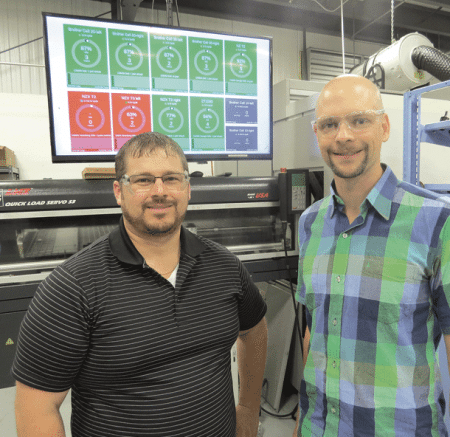
Rico Traversa, operating manager at Valley Steel Stamp (left), and MachineMetrics co-founder Bill Bither

Rico Traversa, operating manager at Valley Steel Stamp (left), and MachineMetrics co-founder Bill Bither stand near one of the dashboards on the VSS shop floor.

Soon after founding MachineMetrics, they brought on a third partner, Jacob Lauzier, the company’s chief technology officer, who brings to that post a background as a user-interface designer and web-application developer.

Together, they brought MachineMetrics to the market using VSS as a pilot company — one that has seen results far exceed expectations.

Form and Function

As he discussed what the MachineMetrics product means to manufacturers, Fogg related what sounded like a not-so-hypothetical situation involving that machine shop he worked for years ago.

“My boss would come down and say, ‘I need to ship 300 of these parts, and we’re already a week late,’” he recalled. “I would say, ‘well, there’s only 60 of them complete.’ He would get angry and say, ‘what went wrong?’

“The thing about manufacturing, and probably a lot of other industries, is that I could have given him the top 10 reasons why that job was behind, and it wouldn’t have constituted 5% about why it was actually behind,” Fogg went on. “There’s so much stuff that can happen, so many discrete things that can go on, that there’s really no way you can sit down with your boss and explain why a job is behind. So I would come up with some cop-out answers like ‘we’re having some trouble with second shift’ or ‘maybe there’s trouble with materials,’ and he would nod his head and go upstairs to call a soon-to-be-angry customer and eat crow.”

Machine Metrics was designed to make such discussions a thing of the past, said Fogg, adding that the software can not only pinpoint what what wrong, when, and where, but it can alert supervisors to potential problems before they happen and keep shop owners from having to make phone calls like the one mentioned above.

“There are thousands of pieces of data that can be pulled from any discrete machine tool every minute, and all that data has value,” Fogg explained. “That data can tell you about loads on tools or about problems with any part of the manufacturing process.”

Effective retrieval and analysis of that data has enabled VSS to improve what’s known as OEE (overall equipment effectiveness) from around 70% to roughly 90%.

While visiting the war room at VSS, Bither explained just how the software works.

“Each ring represents a shift,” he explained while motioning toward the dashboard. “As the ring fills in, that’s indicative of how many parts are created; when the ring is completely closed, the goal is met for the shift. There’s a white dot that moves around the ring, and it’s essentially a rabbit that you’re chasing. If you’re ahead of the white dot or on it, it’s green; if you’re behind, then it’s orange or red.”

The system tracks performance in real time, said Traversa, adding that this represents a vast improvement over the conditions that existed before the software was installed.

The MachineMetrics system

The MachineMetrics system has made the phrase ‘being in the green’ — as most all of the machines at the company are at this moment in time — part of the lexicon at VSS.

“You get text alerts and e-mail alerts as soon as a machine starts falling behind,” he explained. “In real time, we know that production is going down and we can try to solve it; we’re not waiting until 6 a.m. the next day to find out that a machine shut down at 8 the night before. You see it, you get alerted, and there’s no operator input — you’re not waiting for them to call you or e-mail you; it does it on its own.”

Making Progress

Capshaw, who spoke with BusinessWest by phone while vacationing on the Cape, said the system allows him to see what’s happening at the shop on a host of devices. He noted that productivity at VSS has increased 10% not from really doing anything with the data specifically, but simply from having it and making sure employees know they have it.

Employees simply have to look up at the dashboards on the shop floor to track how the machines they’re assigned to are performing, he went on, adding that no one wants to see the color red appear, and everyone wants to stay firmly in the green.

Roughly another 10% improvement has come from going back over data, identifying issues, streamlining production, and improving maintenance, he went on.

“We look at how efficient we are shift by shift and product by product, and see where we need to improve,” he explained. “The result is that we can more finely tune our training programs for employees, which is typically the reason for downtime, or improve our maintenance system so we have more uptime on our machines.”

Thus, benefits come in a number of forms, he said, listing everything from enhanced productivity to improved morale, especially among third-shifters, who seemingly toiled in anonymity.

“We had employees come up to us after we put up the boards,” said Capshaw. “They worked third shift, and they said to us that, if they did a great job, they never got a pat on the back. But they said having this is like getting a pat on the back — they work to get back in the green, and we see that, and we e-mail them and congratulate them.”

Perhaps the biggest benefit, though, is some reduction in stress when it comes to the nagging issue of finding enough talent as a result of that improved efficiency.

“Instead of having to recruit and hire 40 employees, we’ll have to hire 30,” he said. “We’ll still have to hire a lot of people, but it will relieve that bottleneck, which allows us to expand quicker.”

Moving forward, the obvious goal for the principals at MachineMetrics is to scale up their venture, and the recent infusion of capital will be used for the many aspects of that assignment.

Fogg said one of the company’s major challenges, not unlike the one confronting its customers, is finding talent.

“We have a lot of customers who are interested in this product, but one of the difficulties is integrating it into the machines,” he explained. “That’s something I know how to do, but it’s very difficult to find people who know machine integration; we’re actively trying to hire people like that, but we can’t even find them, let alone give them offers for jobs.”

Overall, the potential for growth is immense, said Bither, adding that the market for performance-monitoring software in the precision-manufacturing sector will reach into the billions of dollars.

Just how big that number will get, he doesn’t know, but he does know Machine Metrics should be well-positioned to seize considerable market share.

“There are a few competitors, but this is fairly new technology, so there isn’t one company that’s out there dominating,” he explained, adding that a company in Germany and another based in Silicon Valley are gaining some traction in the industry, while others are struggling in their attempts to do so.

“Production-monitoring technology is still in its early stage,” he went on. “But there is a lot of opportunity, because these companies are recognizing that measuring data is critical to staying competitive; they have to be efficient to win these deals.”

It’s Not Easy Being Green

Throughout business history, company owners have made it their mission to both keep out of the red and be in the black. For precision manufacturers, there is now a third mantra — ‘being in the green.’

As mentioned earlier, this is now an informal mission statement and both a spoken and unspoken rallying cry at Valley Steel Stamp.

Just how prevalent that phraseology becomes in this industry remains to be seen, but from all accounts, MachineMetrics seems poised to turn out some solid growth patterns of its own.

And it also appears destined to be part of the wave of entrepreneurial energy sweeping over the region.


George O’Brien can be reached at [email protected]

Opinion

Editorial

Since BusinessWest began publishing in 1984 as the Western Mass. Business Journal, it has shined a bright spotlight on both entrepreneurs and entrepreneurship.

The former, of course, refers to people — adventurous, forward-thinking, ambitious people who have taken ideas and converted them into successful businesses. Over the years, the magazine has devoted thousands of words and front-page photos to entrepreneurs who have shaped the local business landscape, from Peter Picknelly to Delcie Bean — with hundreds in between.

The latter, meanwhile, refers to the ongoing work to encourage people to become entrepreneurs and then assist and mentor them as they bring ideas to the marketplace, a centerpiece of regional efforts in the broad realm of entrepreneurship.

In short, we’ve celebrated entrepreneurs — BusinessWest even created an annual award to recognize the region’s ‘top entrepreneur,’ and Bean was the latest to receive that honor — and we’ve encouraged and recognized efforts to create more stories like his. Indeed, the magazine recognized Valley Venture Mentors as one of its Difference Makers for 2015 for its efforts to foster entrepreneurship and help business owners reach that critical ‘next stage’ — whatever it might be.

With this issue, BusinessWest takes its focus on entrepreneurs and entrepreneurship to a different, even higher level, with a new series of profiles that will collectively capture a new wave of entrepreneurial energy sweeping across the region.

Over the next year, we’ll relate some very intriguing stories about people young and old, with concepts ranging from software to hard cider; wedding dresses to pet-security devices, and how they are working to caress these products and services into thriving businesses.

As we’ve mentioned before and in many different ways, this enprepreneurial energy and the forces behind it constitute a far bigger story than the casino soon to take shape in Springfield’s South End, and a far bigger story than the subway-car-manufacturing facility soon to build on the other end of the city.

For while the casino will create a few thousand jobs and provide a spark for the convention and tourism business, and while the new manufacturing plant will come with hundreds of those proverbial good jobs and good wages, the stories of entrepreneurship unfolding across the entire region hold the key to a stronger, more sustainable economy for Western Mass.

We begin our series with a story on Northampton-based Machine Metrics (see story, page 6). This is an emerging company started by serial entreprepreneurs Bill Bither and Eric Fogg that has created a potentially game-changing software product that enables precision manufacturers to track the performance of each machine and each production shift.

This is a very specific, but also potentially lucrative, niche — but so are most of the others we’ll be profiling in the months to come.

The principals at Machine Metrics are in the process of scaling up their venture and will be aided in those efforts with a recent round of venture-capital funding. They exude optimism as they talk about the size of the market they’re penetrating and their ability to grab a huge share of that market.

It’s impossible to say where this venture will be in five years or even five months, but in many respects, it seems like the sky is the limit.

Getting to this point has taken imagination, hard work, and determination, and much more of each will be required to navigate the many challenges that lie ahead.

It is the same for the dozens of other risk takers trying to build on this region’s lengthy and distinguished history of entrepreneurship. That’s what makes these stories so compelling.

And that’s why we’re proud to be telling them.

Sections Women in Businesss

The Art and Science of ‘Finding Out’

Julie Pokela

Julie Pokela

Much has changed since Julie Pokela and partner Nancy Mihevc decided to go into business doing market research nearly 40 years ago. One thing that hasn’t changed is the simple mission for the company now known as Market Street Research: finding answers for clients who need information to understand their audience and grow their business.

Julie Pokela says it was already shaping up to be a busy summer for Market Street Research (MSR), the firm she helped lay the groundwork for nearly 40 years ago. And then, some additional work start pouring in.

Funneled by the Wallace Foundation, started by the founders of Readers Digest, as part of an ongoing initiative concerning the arts, these projects involve several noted institutions — the Seattle Opera, the Pacific Northwest Ballet, and the New York-based Alvin Ailey American Dance Theater — that want some insight into how to grow their audiences.

A major focal point of these analyses will be the Millennial generation, members of which now statistically outnumber the Baby Boomers, said Pokela, and remain a point of fascination — and mystery — for businesses across all sectors.

“People are trying to figure out how to tap into this generation,” she said, adding that these arts-related projects will utilize focus groups and a host of other methodologies to gain some insight.

When asked to speculate on what these studies may reveal about the Millennials and their attitudes about the arts, Pokela thought for a second and said, “I don’t know … we’re going to find out.”

‘Finding out’ has been the simple two-word answer to the question of what this company does since Pokela and partner Nancy Mihevc joined together in a venture called the Research Group in 1978 (more on the company’s history later). They’ve been finding answers for clients ranging from political candidates to regional and national banks; from private colleges to major medical systems; from retail chains to nonprofit agencies.

The specific questions to which they’ve sought to find answers have varied, but the common denominator has essentially been market share and the universal goal of improving it.

Today, achieving that goal involves successfully marketing to and then serving several generations, each with distinct attitudes and preferences, said Pokela, adding that the Millennials are proving to be particularly challenging for many sectors.

“Banks are really interested in this subject,” she noted. “And we do a lot of work with independent schools and colleges to help them figure how they’re positioned among the students and parents looking at colleges — and how to grow their enrollment.”

Over the years, the size and composition of MSR’s client base has changed, said Pokela, noting that, in the ’80s, the company did considerable work with banks, and later put a heavy focus on healthcare, specifically hospitals and medical systems that wanted insight into what the public thought of the services they were providing.

While the company still serves both those sectors, its overall strength has been diversity, said Pokela, adding that this trait has enabled it to survive the many economic downturns over the past four decades.

The business itself has also evolved. Years ago, MSR employed those who would do the actual data collection for the research projects. Now, those services are outsourced, noted Pokela, adding that, while laying off dozens of employees constituted the most painful moment of her career, the resulting entity is smaller and more manageable, and enables her to spend the vast majority of her time doing what she likes most — research and interpreting what it means.

For this issue and its focus on women in business, BusinessWest talked at length with Pokela about her company, the intriguing world of research, and the art and science of ‘finding out.’

Answering the Call

Tracing the history of her company, Pokela said the intriguing story began when she was pursuing her doctorate in communication at UMass Amherst, studying under, among others, Mihevc, who taught political communication.

One of Mihevc’s other students at the time became involved with Ed McColgan’s campaign to unseat Congressman Silvio Conte, and she asked Mihevc to conduct some research for the candidate.

She agreed, and asked Pokela if she wanted to assist with the polling, which she did.

Those efforts didn’t succeed in getting McColgan elected — he triumphed in the Democratic primary, but was buried by Conte in November — but they did get the attention of other candidates, who recruited the two for similar polling.

“Eventually, a business person with one of the campaigns asked if we could do some market research for his company,” said Pokela, “and from there, an advertising agency asked if we could do marketing research for their clients.

“We got to the point where Nancy was coming up for tenure, and I was looking at finishing my Ph.D., and had to decide — do we want to start a company or continue with our expected lives of being academics?” she went on. “We decided that it wouldn’t hurt anything to start a company, so we did.”

Given a boost by some work they did for the Center for Human Development in Springfield, which received a grant to conduct a telephone survey on community attitudes toward foster parenting, the pair enjoyed success early on, working mostly on political campaigns and projects for ad agencies.

The recession of the early ’80s nearly took them out, though, said Pokela, adding that she and Mihevc turned to the Mass. Small Business Development Center and then-Director Merwin Tober for some assistance on how to position the company for growth and sustainability.

Tober came up with the idea of generating a recurring form of income — or several of them — rather than being solely what amounted to a job shop. And from that suggestion, the two partners eventually conceptualized something they would call the “Quarterly Bank Survey.”

As that name suggests, the initiative surveyed area residents on a quarterly basis about their banking habits and preferences, said Pokela, adding that most all area banks bought the reports.

“It ended up being a great product and a solid source of regular, predictable income — we did it for maybe 10 years,” she said, adding that this effective niche was substantially weakened by a wave of consolidation that swept over the industry in the late ’80s and other consequences of a deep and prolonged recession that took a severe toll on the financial-services sector.

But, while bolstering its portfolio with banks, the company — which became known as Market Street Research in 1986 after Pokela and Mihevc parted ways and the former joined forces with Elizabeth Denny — was doing the same with the healthcare industry.

Julie Pokela says there are businesses

Julie Pokela says there are businesses across many sectors that want to know what the Millennials are thinking — and how they’re spending.

That remains the primary source of business today, accounting for roughly 70% of annual revenues, said Pokela, adding that now, as then, the industry relies on a steady flow of data concerning its services and how they are perceived.

The company started with a hospital survey similar to the one produced for banks, she said, adding that, by the late ’80s, most healthcare providers were ratcheting up their marketing efforts in response to changes within the industry, especially a shift from inpatient to outpatient care and the resulting increase in bed capacity.

“Length of stay was greatly reduced, and as a result, hospitals had all this excess capacity for inpatient beds,” Pokela explained. “So they started looking at the edges of their markets and saying, ‘where can we pick up more patients in areas that we haven’t traditionally looked at?’ So hospitals learned how to compete very quickly.”

Surveying the Landscape

This phenomenon has generated a steady source of revenue for the company ever since, she went on, noting that MSR has a number of prominent hospitals in its portfolio, including Mass General, NYU Langone Medical Center, the Cleveland Clinic, Dartmouth Hitchcock, and many others.

Most are steady, repeat customers that require in-depth marketing studies at least every two years, and often on a more frequent basis.

The nature of the work varies, but much of it comes down to two key issues in this sector and most all others — awareness and image.

“If you look at the process by which someone makes a decision to use any kind of organization, it starts with awareness — people are more likely to use an organization they’re aware of,” she explained. “So we track what their awareness levels are, and ask people, ‘when you think about hospitals in your area, which ones come to mind?’”

Overall, the company tailors its questions and surveys to meet the specific needs of clients and business sectors, and the ability to help companies in a host of industries has driven solid growth over the years and enabled MSR to weather the economic downturns in recent years.

The firm has clients in healthcare, financial services, the nonprofit arena, governmental agencies, retail, technology, manufacturing, and, especially this summer, the arts, which Pokela has identified as a potential source of growth for MSR.

In higher education, for example, the company has worked with a number of institutions, including Bryn Mawr College, Mount Holyoke College, Smith College, Western New England University, and UMass Amherst, with research focused on a number of areas, including:

• Satisfaction of faculty, staff, and students with the services the school provides;
• Effectiveness of communications, including marketing and promotional materials; and
• Satisfaction of alumni or alumnae regarding services for alumni and communication with their alma mater.

The company also works with private elementary and secondary schools and also public school systems and school boards, in matters ranging from attracting and retaining high-caliber students to communicating information and specific strengths to the community.

In retail, meanwhile, the company has provided services for national chains, mom-and-pop stores, and entities that fall in between. It helps those clients with everything from assessing awareness (there’s that word again) to customer satisfaction, site-location selection, market feasibility of new products, and more.

Increasingly, those in each sector want to know what the members of each generation are thinking and what they’re looking for in terms of products and services.

She joked that those in healthcare are not yet fascinated by the wants and needs of the Millennial generation — “young people don’t get sick” — but just about everyone else is, including those arts institutions that have recently become clients.

“They want to know how to get the next generation interested in the arts,” she explained. “They want to know how to get them interested not only in going to see these groups, but also interested in becoming subscribers and then eventually donors.

“At the focus groups I’ve been going to with people in their 20s and 30s who are going to the arts — they’re very passionate about it,” she went on. “That’s very exciting to see. The question is how to translate the passion exhibited by the people who are going, to the people who are not going.”

As for the answers to that question … the reports commissioned for those arts institutions should be completed by this fall, she went on, adding that there may be some answers there.

Poll Position

Looking ahead, Pokela said the company’s primary goal is to continue to log steady, manageable growth.

She believes it can continue to do so because, overall, it scores well in those areas for which it gauges results for its many customers — awareness, quality of service, and image. And, especially, because it continues to raise and clear the bar in that one realm for which it was formed, a service that has become both an art and science: finding out.

George O’Brien can be reached at [email protected]

Company Notebook Departments

CPA Firms Whittlesey & Hadley and Weinstein & Anastasio Join Forces

HARTFORD, Conn. — Whittlesey & Hadley, P.C., a regional CPA firm headquartered in Hartford, Conn., announced that Weinstein & Anastasio, P.C., a regional CPA firm located in Hamden, Conn., will join the firm effective Sept. 1. Weinstein & Anastasio provides a broad range of accounting, audit, tax and business-consulting services to closely held businesses in a variety of industries, as well as to high-net-worth individuals throughout New England and New York. This merger represents Whittlesey & Hadley’s growth plan to expand services, diversify geographically, and continue to grow in size, services, and staff. The combined three offices will employ 155 people, including 21 partners located in Hartford and Hamden, Conn., and locally in Holyoke. Weinstein & Anastasio, with roots back to 1927, will continue to serve clients and function in key leadership roles in Southern Conn. communities from its Hamden office, while acquiring the Whittlesey & Hadley brand. Founded in 1961, Whittlesey & Hadley provides accounting, audit, tax, technology, and business-consulting services to clients primarily throughout the Northeast, with access to a worldwide network of resources through PKF North America. For more than 50 years, the firm has served closely held businesses, including manufacturing, construction, distribution, real estate, financial, healthcare, government, and technology industries, as well as the nonprofit sector, the firm’s largest niche focus.

Valley Vodka Celebrates 10 Years in Business

HADLEY — Valley Vodka Inc. the owner of luxury brand V-One Vodka, will celebrate the 10-year anniversary of its first sale on Sept. 1. “Over the past 10 years, V-One sales have consistently grown, with 2014 being the company’s best financial year,” said founder Paul Kozub, adding that, this year, Valley Vodka is poised to significantly improve on last year’s performance. Since its inception, V-One Vodka has won numerous international awards, said Kozub, including nine medals at the World Spirit Competition, including its highest honor, the unanimous Double Gold. V-One Vodka has also expanded its distribution from just 50 locations in the first year to now well over 1,400, in both Massachusetts and Connecticut. For the first time, this year, he noted, V-One will enter the European vodka market with sales in both Denmark and Poland. V-One has successfully launched four successful flavors over the past few years, including its two most recent, V-One Triple Berry and V-One Grapefruit. The company is also in discussions with several companies about expanding its distribution in 2016 to additional New England states with eventual distribution to all 50 states.

HMC to Open Satellite Location for PT Services

HOLYOKE — Holyoke Medical Center will open a satellite location for physical-therapy and rehabilitation services at Healthtrax Fitness & Wellness, 155 Ashley Ave., West Springfield, on Monday, Aug. 31. The location is part of HMC’s newly named Centers of Rehabilitation Excellence (CORE). The satellite location is part of HMC’s ongoing commitment to physical therapy and rehabilitation services, which includes a full renovation and expansion of its in-house physical and occupational therapy and pulmonary and cardiac rehabilitation services. The West Springfield CORE location reflects a key strategic priority of HMC in offering community-based services at locations throughout the Pioneer Valley. Noted Marina Lebo, executive director at Healthtrax, “the Healthtrax Fitness Center offers a wide variety of fitness options for the Holyoke Medical Center and CORE patients as they progress in their health goals and recovery. We have amenities for all ages and fitness levels, including a new functional-fitness training area, personal and group training programs, over 60 motivating group classes weekly, from gentle yoga to cycling, and more.”

Amherst Copy & Designworks Acquires Ferguson Signs

AMHERST — Amherst Copy and Designworks (ACDW) announced that it has acquired Ferguson Signs of Hadley.
Sean Cleary, owner of Amherst Copy & Designworks, said the addition of Ferguson Signs — which will now be known as Ferguson Signworks, a division of Amherst Copy & Designworks — enables his company to better serve customer needs. AC&DW can now offer all manner of banners and signs — from business, yard, parking, and directional signs to wall treatments, floor decals, magnetic signs, stickers, and vehicle lettering — as well as specialty items such as printing on granite, ceiling tiles, cell phones, and more. Additionally, Duncan Ferguson will continue to manage Ferguson Signworks, bringing his more than 30 years of sign expertise to the new shop. Cleary purchased the former CopyCat Print Shop in Amherst approximately four years ago. In March 2014, he changed the name to Amherst Copy & Designworks.

Daily News

SPRINGFIELD — Gov. Charlie Baker and Springfield Mayor Domenic Sarno joined a host of local and state officials and representatives of CRRC USA Rail Corp. yesterday for a groundbreaking ceremony at the city’s former Westinghouse site on Page Boulevard, where the company will build its first North American plant.

CRRC, a Chinese-based manufacturer of urban mass-transit vehicles, won a $565 million contract with the state last year to build nearly 300 subway cars for the MBTA’s aging Red and Orange lines — a project that promises 100-plus construction jobs from the building of a 220,000-square-foot plant, and more than 150 new manufacturing positions. CRRC visited about 50 North American sites before settling on Springfield.

CRRCGroundbreaking“Today is a great day in Springfield, and in Massachusetts, with CRRC, the largest railway company in the world, coming to Springfield,” Sarno said, noting that, while manufacturing was the city’s strong industrial base for generations, it started to erode in the 1970s, but has never gone away, and CRRC could be a catalyst to further shift the needle in a positive direction.

“We now have a $95 million project here at the old Westinghouse site. This will be CRRC’s North American hub. It’s important that we use this as leverage and momentum,” the mayor said — not just for further manufacturing in Springfield, but a for a boost in regional rail service. “I’d love to see that east-west rail connecting Boston to Springfield to Washington, D.C.”

While calling the groundbreaking “an exciting day for Springfield, an exciting day for the Commonwealth, and an exciting day for Western Mass.,” Baker said the MBTA is in dire need of new cars on its Red and Orange lines. During Boston’s crippling winter earlier this year, he said, it was pointed out to him that the rail cars pressing through the storms were the same ones that endured the Blizzard of ’78.

“Think about that — that was a really long time ago, folks,” he told hundreds of people in attendance at yesterday’s ceremony, calling CRRC’s arrival a piece of the state’s “strategy to bring jobs, economic development, and transit improvements for the benefit of all people in the Commonwealth of Massachusetts.”

Weiping Yu, vice president of CRRC Corp. Limited in Beijing, said he was “honored” to partner with officials in Massachusetts and Springfield on the $95 million construction project and the economic benefits it will generate.

“We have an exciting road ahead as we embrace this unique opportunity to partner with Massachusetts on our first transportation project in the United States,” he said, adding that the company sees potential for significant growth in the U.S., and has increased overseas investments by 61% over the past year. “We have a focused vision and a strong commitment not only to being the best, but understanding the infrastructure needs of our global partners and working together to achieve them.”

Yi Lu, general commercial counselor for the New York Chinese Consulate, added that he’s confident the new Springfield plant will be a strong engine for the local economy, generating hundreds of new jobs and perhaps spurring further Chinese investment in the region.

“Looking back on our initial discussions when we first visited Massachusetts,” added Chuanhe Zhou, president of CRRC USA Rail Corp., “I’m proud of the strides we’ve made, the relationships we’ve built, and the partnerships we’ve formed — from meetings with city officials to tours of local manufacturers to visits to local educational institutions. We couldn’t have found a better partner than you.”

Jay Ash, the state’s secretary of Housing and Economic Development, said CRRC wants to be a good neighbor by hiring local people, taking advantage of local supply chains, and engaging with companies around Western Mass. as it expands in the future.

And expand it should, added Stephanie Pollack, the Commonwealth’s Transportation secretary, if only because much of the country is dealing with the same issues as Massachusetts when it comes to aging rail cars.

“We know what CRRC knows, which is that the MBTA is hardly the only transit system in the United States with 1970s-era cars,” she noted. “In fact, a lot of cars in this country were bought in the 1970s with what was then a relatively young federal program for producing them.”

Baker credited his predecessor, former Gov. Deval Patrick, and his team with much of the legwork to bring CRRC to Massachusetts. “They did make this day possible. Sometimes you get credit for stuff that happens on your watch, whether you had anything to do with it or not.”

That said, the governor went on, “our administration is thrilled to be here today. We consider this project to be not just an important part of the economic-development story in Springfield, but an important part of the future of the MBTA and transit in Massachusetts.”

Briefcase Departments

MGM Springfield Opening Delayed by One Year

BOSTON — The Massachusetts Gaming Commission, receptive to arguments regarding the impact of a major highway reconstruction on I-91, agreed to allow MGM Springfield to push the opening of its $800 million resort casino to September 2018. It was originally expected to open in the fall of 2017. MGM Springfield officials said the state’s reconstruction of the I-91 viaduct through downtown Springfield — a project expected to begin this year and end by August 2018, although financial incentives to finish by 2017 are in play — must be complete before MGM Springfield can open. The highway project includes ramp closures next to the casino site, and severe traffic congestion would keep visitors away and inconvenience those who do show up, said MGM officials, who still need the city’s approval to push back the opening date.

Business Confidence Up in Massachusetts in July

BOSTON — The Associated Industries of Massachusetts (AIM) Business Confidence Index added 2.9 points in July to 59.2, ending a string of three consecutive monthly losses. “Bouncing back from its dip in the second quarter, confidence among Massachusetts employers is fairly strong,” said Raymond Torto, Chair of AIM’s Board of Economic Advisors (BEA) and lecturer at Harvard Graduate School of Design. “The AIM Index is up three points from last July and, apart from its recent crest in February and March, is at its highest level since December 2006.” Torto noted that the Index’s recent performance extends a pattern that has prevailed for much of the post-Great Recession period. “Like the economy itself, the Index has followed a long-term trend of improvement, but the upward course has been longer and bumpier than most past recoveries.” AIM’s Business Confidence Index has been issued monthly since July 1991 under the oversight of the Board of Economic Advisors. Presented on a 100-point scale on which 50 is neutral, the Index attained a historical high of 68.5 in 1997 and 1998; its all-time low was 33.3 in February 2009. The sub-indices based on selected questions or respondent characteristics all rose from June to July, and most were up from a year before. The U.S. Index assessing national business conditions gained 2.5 points to 50.1, and Massachusetts Index of conditions within the Commonwealth rose six-tenths to 57.5. “The domestic economy, after a weak first quarter, is experiencing solid expansion, and Massachusetts continues to perform well in the national context,” said BEA member Sara Johnson, senior research director of Global Economics at IHS Global Insight. “Growth in international trade, however, has been disappointing, as improving conditions in Europe have been more than offset by the slowdown in Asia.” The Current Index, tracking employers’ assessment of existing business conditions, was up 3.5 to 59.7, while the Future Index, measuring expectations for the next six months, added 2.2 to 58.6. “The rating of current conditions is the best we have seen since the same reading in October 2006,” Johnson said. “The slightly lower future expectations probably reflect the Federal Reserve Board’s expressed intent to raise interest rates.” The three sub-indices related to survey respondents’ own companies were all well ahead in July. The Company Index, which assesses the overall situations of their operations, was up 3.7 points to 61.7; the Sales Index rose 5.3 to 63.2; and the Employment Index added 2.5 to 57.2. “The Company and Sales indicators are at their highest levels since 2006, and the Employment Index is also in its pre-recession range,” noted Elliot Winer, chief economist at Northeast Economic Analysis Group LLC, a BEA member. “These results are consistent with survey respondents’ favorable appraisal of prevailing business conditions and with recent state employment reports.” In July, confidence remained higher among employers within Greater Boston (61.3, up 3.9) than among those outside the metropolitan area (55.8, up 1.1). Manufacturers continued to be less confident (55.7, up 3.1) than other employers (62.9, up 2.9). “Massachusetts manufacturers, many of them in the central and western parts of the state, are seeing exports suffer because of the strong dollar and difficult conditions in key markets,” Winer said. “The indicators from the manufacturing sector and for the state outside Greater Boston are the only sub-indices that have lost ground, though less than a point each, over the past year.” There was little variation in confidence between small, medium-size, and larger employers.

Report: America’s Economy in Good, but Not Great, Shape

WASHINGTON, D.C. — The U.S. economy added 215,000 jobs in July after economists surveyed by CNNMoney predicted the economy would add 216,000 jobs. Anything above 200,000 is considered very solid. The unemployment rate stayed the same at 5.3%, which is its lowest point since April 2008. Wage growth — the missing piece to America’s economic progress — remained sluggish in July, the report notes. Average hourly earnings only rose 2.1% compared to the prior year. Wage growth is the reason many Americans haven’t felt the benefits of the economy’s recovery. The Federal Reserve wants to see annual wage growth closer to 3.5%. The jobs report is especially important now because the Fed is close to raising its key interest rate for the first time in over nine years. The Fed has said it will hike rates only if it believes the economy is healthy enough, especially for workers. A rate increase would be a good sign for how far the economy’s health has come since the recession ended. Although the Fed wants to see better wage growth before raising rates, wage growth isn’t a requirement. The Fed raised its key interest rate in June 2004 when average weekly earnings were 1.7% compared to the prior year. Average weekly earnings in July were 2.4%. Economic growth has been solid this year, though weaker than in 2014. Last year, the economy added 240,000 jobs a month on average between January and July. This year, that figure is 178,000. However, CNNMoney reports, many experts believe the current jobs report is strong enough to justify the Fed’s first rate hike taking place in September.

Volunteers Needed for Source to Sea River Cleanup This Fall

GREENFIELD — The Connecticut River Watershed Council’s (CRWC) 19th annual Source to Sea Cleanup will be held Friday and Saturday, Sept. 25 and 26. The annual, two-day event is coordinated by CRWC in all four states of the 410-mile Connecticut River basin. Each fall, thousands of volunteers of all ages and abilities head out to clean the Connecticut River and its tributaries on foot or by boat. Volunteers remove trash along rivers, streams, parks, boat launches, trails, and more. “Source to Sea Cleanup volunteers have worked hard to combat litter and illegally dumped trash,” said Alicea Charamut, CRWC river steward and organizer of the cleanup. “Their hard work and dedication is impressive and inspiring.” In 2014, more than 2,000 volunteers hauled over 47 tons of trash from riverbanks and waterways in Massachusetts, New Hampshire, Vermont, and Connecticut. Volunteers use human power and sometimes heavy equipment to pull out everything from recyclables, fishing equipment, and food waste to tires, televisions, refrigerators, and junk cars. To date, volunteers have prevented more than 897 tons of trash from polluting area rivers. There are three ways to get involved in the cleanup: report a trash site in need of cleaning, find a cleanup group near you to join, or organize and register your own local cleanup group. For more information or to register for the event, visit www.ctriver.org/cleanup. “If your group wants to get involved but needs a cleanup site, contact us to learn about reported trash sites that may be near you,” said Charamut. Anyone with questions or trash tips can contact Charamut at [email protected] or (860) 704-0057. “Generous financial support from lead sponsors — NRG’s Middletown Generating Station, Pratt & Whitney, and TransCanada — enables us to organize the thousands of volunteers who participate in the cleanup, and to take on complex projects that require the use of heavy equipment, scuba divers, and other professionals to get those really trashed places cleaned up,” said CRWC Executive Director Andrew Fisk. CRWC plans to continue efforts on cleaning up the tire dump along the Deerfield River in Greenfield, as well as removing an abandoned exposed pipe in the Connecticut River in Holyoke and a number of fuel tanks in various rivers in New Hampshire and Vermont. The Connecticut River Watershed Council works to protect the watershed from source to sea. To learn more about CRWC, or to join the effort and help protect local rivers, visit www.ctriver.org.

Springfield Seeks Developer for Former Chestnut Junior High Site

SPRINGFIELD — The city of Springfield is releasing a request for proposals (RFP) for the eight parcels of land that formerly comprised the home of the Chestnut Junior High School at 495 Chestnut St. The school building was destroyed in a fire in September 2013, and the site has since been fully cleared. “With $2.8 billion in ongoing economic development in the city of Springfield, now is not the time to rest,” said Mayor Domenic Sarno. We are looking to capitalize on our momentum and bring new jobs and development to the city.” The RFP became available yesterday. Interested parties must return their proposal to the city by Monday, Sept. 14. The site is a total of 166,617 square feet, or 3.825 acres. The lump assessed value for all eight parcels is $127,900. The property was cleared by Associated Building Wreckers of Springfield, which removed all building elements, including foundations. “While the fire resulted in a great loss of the historic school, the site is now fully cleared and available for development,” said Springfield’s Chief Development Officer Kevin Kennedy. “To find a nearly four-acre site so close to major employers is rare. We expect strong interest in this property.” The neighborhood is home to Baystate Health, Mercy Medical Center, and Shriners Hospital for Children, as well as numerous private medical office buildings. Among many potential uses, the site could be appropriate for additional office development, retail development, or workforce housing targeting employees in the so-called ‘medical district.’ Proposers will be expected to address any zoning needs as well as work closely with the neighborhood to ensure a positive redevelopment of the site. The city recently commissioned an economic analysis of the medical district to examine its employee base of more than 10,000 people to better understand the opportunities that exist for new housing, retail, and commercial space that would not only serve the neighborhood but also these employees. The report can be found on the city’s Planning and Economic Development website at www.springfieldcityhall.com. Parties interested in obtaining the RFP should call the Office of Procurement at (413) 787-6284.

Daily News

HARTFORD, Conn. — Whittlesey & Hadley, P.C., a regional CPA firm headquartered in Hartford, Conn., announced that Weinstein & Anastasio, P.C., a regional CPA firm located in Hamden, Conn., will join the firm effective Sept. 1. Weinstein & Anastasio provides a broad range of accounting, audit, tax and business-consulting services to closely held businesses in a variety of industries, as well as to high-net-worth individuals throughout New England and New York.

This merger represents Whittlesey & Hadley’s growth plan to expand services, diversify geographically, and continue to grow in size, services, and staff. The combined three offices will employ 155 people, including 21 partners located in Hartford and Hamden, Conn., and locally in Holyoke.

“We look forward to combining the exceptional strength and expertise of the Weinstein & Anastasio team of professionals and their history of quality service with our mutually superior team members who have served multiple generations of families and businesses alike,” said Drew Andrews, managing partner of Whittlesey & Hadley. “The joining of our teams will allow us to demonstrate to our clients that, while we continue to grow, we are committed to retaining our valued reputation as having the expertise of a national firm but the responsiveness of a local firm.”

Roger Sciascia, managing partner of Weinstein & Anastasio, added, “we are excited to join Whittlesey & Hadley, a firm we have known for many years, and with whom we have partnered, through our PKF North America affiliation. Our firms share a common philosophy when it comes to the delivery of client service and a common vision toward future success and growth in the New England and New York marketplaces. Through this combination, we will integrate our technical resources and accomplishments, which will allow for continued delivery of exceptional service to our clients.”

Weinstein & Anastasio, with roots back to 1927, will continue to serve clients and function in key leadership roles in Southern Conn. communities from its Hamden office, while acquiring the Whittlesey & Hadley brand.

Founded in 1961, Whittlesey & Hadley provides accounting, audit, tax, technology, and business-consulting services to clients primarily throughout the Northeast, with access to a worldwide network of resources through PKF North America. For more than 50 years, the firm has served closely held businesses, including manufacturing, construction, distribution, real estate, financial, healthcare, government, and technology industries, as well as the nonprofit sector, the firm’s largest niche focus.

“We are committed to an aggressive plan to grow our firm and to add to the depth of our team throughout the Northeast while continuing the value of high-quality client service, a tradition that distinguishes us from our competitors,” said Andrews.

Health Care Sections

Down to a Science

Dr. Barrie Tan

Dr. Barrie Tan, seen here in the early stages of construction of American River Nutrition’s plant in Hadley, says he’s “all in” when it comes to researching and manufacturing tocotrienol vitamin E.

For some time now, Dr. Barrie Tan says, vitamin E suffered from what might be considered a public relations problem of sorts.

Indeed, the dietary supplement, a noted antioxidant discovered in 1922 and available to the public for decades now, had been drawing mostly unfavorable reviews for its disappointing lack of benefits for cardiovascular health. One large-scale clinical study even concluded that it actually increases the risk of prostate cancer.

But Tan, president of American River Nutrition (ARN), stressed that the bad press essentially concerned what would be considered one form of vitamin E.

As he explained, the supplement is not a single compound — contrary to popular belief up until a few decades ago — but rather a family of at least eight similar, yet structurally different, molecules. And while the once-popular vitamin E alpha-tocopherol has seen its stock fall somewhat in recent years, the lesser-known form of the supplement — tocotrienols, as they’re called — have seen theirs rise amid links (through tests on animals) to everything from improved cardiovascular health to delaying the onset of cataracts; from enhanced bone health to cancer treatment and prevention.

And it is a product known as DeltaGold, with the marketing slogan “Simply Tocotrienol,” that Tan will be manufacturing at a 25,000-square-foot facility now taking shape in Westmass Development’s Hadley University Business Park, in the shadow of the UMass Amherst campus, where he was once a professor of Food Science and Nutrition.

In recent months, the company, the plant, and Tan have been in the news — primarily because the facility will use propane rather then natural gas, simply because there is a moratorium on new natural-gas hookups in that region, a ban that has many concerned about possible long-term effects on economic development and that has also thrust the proposed but highly controversial Kinder-Morgan pipeline even further into the spotlight.

But Tan hopes to change the tenor of the headlines concerning his venture, and, in many ways, he already has.

Indeed, there’s been a steady stream of articles in various health publications regarding tocotrienols, DeltaGold, and Tan. Most of these stories talk about the supplement’s potential and about ongoing studies and trials. However, evidence is mounting that this natural form of vitamin E, derived from annatto (an orange-red condiment and food coloring derived from the seeds of the achiote tree — more on that later), could have a number of significant health benefits.

“We’re engaging a study on cardiovascular benefits, and there are also studies on several forms of cancer,” said Tan, adding that the phrase “Simply Tocotrienol” captures the essence of this development, and its significance, because DeltaGold is considered to be the only natural, annatto-derived tocotrienol that is free of tocopherols.

And that’s important because research has shown that tocopherol interferes with tocotrienol benefits, essentially resulting in that aforementioned bad press, he explained, adding that, in 1996, it was first determined that the cholesterol-modulating properties of tocotrienol were found to be compromised by what Tan called a vitamin E “sibling” — alpha-tocopherol.

“The researchers concluded that effective tocotrienol preparations should contain less than 15% of alpha-tocopherol and more than 60% of desmethyl tocotrienols [gamma- and delta-tocotrienol],” he told BusinessWest, adding that the only natural source of tocotrienols that fits those tight parameters is annatto, derived from trees grown mostly in Central and South America, but also India and Sri Lanka.

annatto

Tocotrienol is extracted from annatto, a substance derived from the seeds of the achiote tree.

Tan has found a way to extract the tocotrienol from annatto through a proprietary distillation process that produces no toxic or harmful byproducts, and he’s ready to take his venture to a much higher level.

For this issue, BusinessWest talked at length with Tan about DeltaGold, American River Nutrition, research on possible pharmaceutical versions of the product, and where he wants to take this company in the years to come.

A Venture Takes Root

Tan has taken a rather circuitous route to his current station as an entrepreneur and researcher at the forefront of developments with vitamin E. In fact, he summed up that path and detailed what’s transpired over the past several years by borrowing from Robert Frost.

“We certainly took the road less-traveled,” he said, referring to what became years of research and development of the far-lesser-known variety of vitamin E, and eventually DeltaGold. It’s a trek that’s taken him from his native Malaysia to Amherst and eventually to South America, where he found not only what he originally set out to find — a plant rich in carotene — but also something more promising, and lucrative, just a few yards away.

Our story begins in late November 1982, when Tan arrived at UMass Amherst. He taught there for more than a decade, first in the Chemistry department and later the Food Science department. It was during that latter assignment when he initiated work with vegetable oil and, through that, the tocotrienol form of vitamin E, which he found in palm oil.

“We didn’t know much more than that this was a different kind of vitamin E,” he explained. “We started doing research and found that it was different in its properties than tocopherol.”

Research in this area eventually led to formation of a business venture called Carotech, which, as the name suggests, was involved in products derived from carotene. It was later sold to a Malaysian concern. At  the time, Tan said, he lacked the skills needed to lead a business, and when the Asian economy tanked in the mid-‘90s, Tan started a lab from which he created American River Nutrition in 1998. He told BusinessWest that he soon put aside work with tocotrienols and went back to researching potential medical uses of carotene.

This work took him to South America in early 2000 to search for a plant said to be a potent source of carotene. He found that plant, a much larger version of the traditional, garden-variety marigold, but 30 feet away, he found something else.

“It’s what the British call the ‘lipstick plant,’” he noted, referring to the achiote, which bears a red fruit, or seeds, which natives of that region used as body paint and, yes, lipstick; other uses include the coloring of cheese, margarine, fabric, and other products.

But Tan made another key discovery.

“The chemist in me hypothesized a theory,” he explained, “which is that there must be something very powerful that protects the carotene color from this annatto, which is not protected otherwise, from degradation. I wondered what it might be.

“This question that I raised eventually helped us in the discovery of this form of vitamin E [natural tocotrienol],” he went on. “We thought that it could be a powerful antioxidant, or anything, really. But shocking to us, and to everyone else, it was the most potent form of vitamin E.”

Seed Money

Fast-forwarding a little, Tan said ARN eventually filed a patent and commenced work on a method for effectively extracting this new form of vitamin E, one free of tocopherol, from the plant’s fruit.
“I decided that this was a gamble worth taking,” he said. “So … to use the simplest term I can think of, I was all in.”

Over the next six years, research continued into the engineering of a process to extract the tocotrienol and take what eventually became known as DeltaGold to the marketplace.

“It was very risky — we weren’t making any sales,” he said. “Those were lean years, but we had a rich patent, and we found places that would process this for us in the United States and were able to get into the business.”

The timing wasn’t ideal — the nation’s economy nosedived in 2008, slowing Tan’s pace of progress with his venture. But a critical mass of sales had been achieved, and solid foundation had been established on which to build.

And he’s doing just that — figuratively and quite literally.

Indeed, with financing from Citizens Bank and the U.S. Small Business Administration, Tan is erecting his facility in Hadley, one in which he expects to grow the workforce from the current nine to 15 or 20.

Meanwhile, he’s working to broaden a customer base that already includes a number of manufacturers of dietary supplements and related products, including Nutricology, Biotics Research Corp., Bronson Laboratories, and many others who use DeltaGold in products bearing their brand names.

Tan’s undertaking is another gamble, but he remains all in, as he said, because the news on tocotrienols, and especially those derived from annatto, is increasingly promising.

One recent study conducted by scientists at the University of Missouri, for example, found that certain doses of tocotrienol, combined with a healthy diet, decreased lipid levels significantly after four weeks. According to another report’s findings, published in Evidence-Based Complementary and Alternative Medicine, tocotrienols from annatto, mainly composed of delta-tocotrienol, stimulated bone formation and cut back bone decay in a post-menopausal osteoporosis rat model.

Another study found that vitamin E tocotrienals from annatto may slow the development and reduce the number and size of breast tumors in rats, and still another concluded that annatto tocotrienol may delay the onset and progression of cataracts when given in a topical formulation.

“There might be 100 researchers at universities and institutions conducting research on tocotrienols, and they seem to say that they are good for chronic conditions,” said Tan, listing as examples type-2 diabetes and certain types of cancer, such as breast cancer, ovarian cancer, and prostate cancer.

Research involving DeltaGold and a number of cancers is ongoing, with involvement from students at the university, he continued, adding that others, as noted, are exploring its potential benefits with cardiovascular health, bone health, cholesterol, and other health issues.

“Over the past five years, we’ve been focusing on investments in clinical studies,” Tan went on. “Everyone wants to know what this will do in human beings. It’s an easy question to ask, but not an easy question to answer.”

Fruits of His Labor

Just how that question is eventually answered will obviously be a huge factor in the future of DeltaGold and ARN, Tan acknowledged.

But in many ways, the gamble he has taken is already paying off.

That chance discovery in South America years ago is bearing fruit in many ways, and this venture has tremendous potential to blossom into a business with national and international reach.

Indeed, by taking that road less traveled, Tan and ARN have embarked on an intriguing and potentially lucrative entrepreneurial path.

George O’Brien can be reached at [email protected]

Daily News

BOSTON — The Associated Industries of Massachusetts (AIM) Business Confidence Index added 2.9 points in July to 59.2, ending a string of three consecutive monthly losses.

“Bouncing back from its dip in the second quarter, confidence among Massachusetts employers is fairly strong,” said Raymond Torto, Chair of AIM’s Board of Economic Advisors (BEA) and lecturer at Harvard Graduate School of Design. “The AIM Index is up three points from last July and, apart from its recent crest in February and March, is at its highest level since December 2006.”

Torto noted that the Index’s recent performance extends a pattern that has prevailed for much of the post-Great Recession period. “Like the economy itself, the Index has followed a long-term trend of improvement, but the upward course has been longer and bumpier than most past recoveries.”

AIM’s Business Confidence Index has been issued monthly since July 1991 under the oversight of the Board of Economic Advisors. Presented on a 100-point scale on which 50 is neutral, the Index attained a historical high of 68.5 in 1997 and 1998; its all-time low was 33.3 in February 2009.

The sub-indices based on selected questions or respondent characteristics all rose from June to July, and most were up from a year before.

The U.S. Index assessing national business conditions gained 2.5 points to 50.1, and Massachusetts Index of conditions within the Commonwealth rose six-tenths to 57.5.

“The domestic economy, after a weak first quarter, is experiencing solid expansion, and Massachusetts continues to perform well in the national context,” said BEA member Sara Johnson, senior research director of Global Economics at IHS Global Insight. “Growth in international trade, however, has been disappointing, as improving conditions in Europe have been more than offset by the slowdown in Asia.”

The Current Index, tracking employers’ assessment of existing business conditions, was up 3.5 to 59.7, while the Future Index, measuring expectations for the next six months, added 2.2 to 58.6.

“The rating of current conditions is the best we have seen since the same reading in October 2006,” Johnson said. “The slightly lower future expectations probably reflect the Federal Reserve Board’s expressed intent to raise interest rates.”

The three sub-indices related to survey respondents’ own companies were all well ahead in July. The Company Index, which assesses the overall situations of their operations, was up 3.7 points to 61.7; the Sales Index rose 5.3 to 63.2; and the Employment Index added 2.5 to 57.2.

“The Company and Sales indicators are at their highest levels since 2006, and the Employment Index is also in its pre-recession range,” noted Elliot Winer, chief economist at Northeast Economic Analysis Group LLC, a BEA member. “These results are consistent with survey respondents’ favorable appraisal of prevailing business conditions and with recent state employment reports.”

In July, confidence remained higher among employers within Greater Boston (61.3, up 3.9) than among those outside the metropolitan area (55.8, up 1.1). Manufacturers continued to be less confident (55.7, up 3.1) than other employers (62.9, up 2.9).

“Massachusetts manufacturers, many of them in the central and western parts of the state, are seeing exports suffer because of the strong dollar and difficult conditions in key markets,” Winer said. “The indicators from the manufacturing sector and for the state outside Greater Boston are the only sub-indices that have lost ground, though less than a point each, over the past year.” There was little variation in confidence between small, medium-size, and larger employers.

Commenting on the July Business Confidence Index survey results, Richard Lord, AIM’s president and CEO and a BEA member, stressed the positive assessment of business conditions among respondents.

“Over the previous three months, we saw that confidence can be damaged by uncertainty, even in peripheral areas like the Greek crisis,” he said. “In July, we see that, as such concerns fade, the underlying strength of the economy, and of confidence among Massachusetts employers, comes to the fore again.”

Lord noted, however, that the results included contrasting views of the state’s business climate. “There is a 10-point regional gap in how respondents rate Massachusetts conditions — very positive within Greater Boston, barely positive elsewhere. This reminds us that good economic analysis and policy must take account of the broad range of industries and communities.”

By employer size, Lord added, the smallest firms, up to 25 employees, rated in-state conditions higher than mid-sized and larger employers.

“Here we see a significant turnaround compared to the recent past,” he said. “Along with a stronger economy, these small employers — who often feel vulnerable to government mandates — are encouraged by a sense that Beacon Hill recognizes their concerns on issues ranging from MBTA reform to smooth implementation of the paid-sick-leave law.”

Daily News

WATERTOWN — Twenty-one companies from across the state, including three from Western Mass., have been selected as finalists for the 2015 Team Massachusetts Economic Impact Awards, awarded annually by MassEcon.

These finalists, representing companies from Boston to the Berkshires, will present one-minute elevator pitches describing their growth in the Bay State to a panel of judges and business leaders on Wednesday, Sept. 16 at Nutter McLennen & Fish LLP in Boston. Katie Stebbins, assistant secretary for Technology and Innovation at the Executive Office of Housing & Economic Development, will be the featured guest at the event.

The awards celebrate companies that have made an outstanding contribution to the Massachusetts economy. The winners from each of the five regions will be announced in October and recognized at an awards luncheon on Nov. 24 in Boston. The west region finalists include Berkshire Sterile Manufacturing in Lee, Kennametal in Greenfield, and Mohawk Fine Papers in South Hadley.

The finalist companies range in size and are drawn from different industries, including manufacturing, life sciences, hospitality, technology, and food and beverage. MassEcon selected the finalists based on their job growth, facility expansion, and investment since Jan. 1, 2014, as well as other criteria, including community involvement. Together, this year’s 21 finalists have added more than 1,600 jobs to the Commonwealth, invested more than $403 million, and expanded their facilities by nearly 2 million square feet since the start of 2014.

“We are delighted to recognize the businesses in Massachusetts that contribute so much to our state’s success, said Susan Houston, executive director of MassEcon. “The diverse set of industries and regions represented by this impressive group of companies demonstrates the overall strength of our Commonwealth.”