Daily News

FLORENCE — For the second straight year, Keiter Corp. has made a large donation to the Greater Northampton Chamber of Commerce for a promotion that allows consumers to purchase a $25 Northampton gift card and receive $50 in actual spending power.

The most recent gift of $20,000 — twice the amount Keiter donated in August 2021 — was made to provide economic stimulus in the post-pandemic era and also create goodwill in the community. Billed as the “Strengthen the Community with a Keiter Card” campaign, the latest donation will be supplemented by a $5,000 contribution from the chamber’s Community Revitalization Fund, meaning 1,000 of the double-valued gift cards will be sold.

The promotion will launch today, Aug. 9, and the $25 Keiter gift cards will be sold, while supplies last, only at the chamber offices at 99 Pleasant St. in Northampton on weekdays between 9 a.m. to 5 p.m. Consumers must mention that they want a Keiter card, and the promotion applies only to $25 Northampton gift-card purchases. (A $50 gift card would not be valued at $100, for instance.) There is a limit of one card per customer, per transaction.

“Our community matters to us,” said Scott Keiter, founder and president of Keiter Corp. “This is where we live and where our families live, and the COVID-19 pandemic has had an impact on all of us. After the campaign’s success last year, we’re thrilled to invest even more in our community this year to keep Northampton thriving.”

Based in Florence, Keiter has provided general-contracting and construction-management services in the Valley since 2010 for its commercial and residential projects.

Scott Keiter is a member of the Northampton Chamber’s board of directors and its finance committee, so he is personally aware of the financial challenges that local merchants continue to experience post-pandemic.

Last year’s “Kickstart the Community” promotion was a huge success, infusing $27,500 into the local economy in eight days. “That was an unprecedented boost to local businesses in the wake of the pandemic,” Keiter said. “The community’s engagement and participation inspired us to help with recovery once again.”

The Keiter Corp. tagline is “Develop. Build. Manage.” It reflects what Keiter is doing in the community through these investments.

The Northampton gift card is currently accepted at more than 80 local businesses, including restaurants, shops, service locations, spas, and other establishments.

Daily News

SPRINGFIELD — The community is invited to view the Ground Zero flag when it comes to Springfield’s September 11th Monument in Riverfront Park today, August 9, at 11 a.m.

Springfield Mayor Domenic Sarno; Springfield Fire Commissioner B. J. Calvi; Springfield Police Superintendent Cheryl Clapprood; Jordan Lemieux, retired Holyoke firefighter and member of the Massachusetts chapter of Honor and Remember; and public-safety officials will greet the flag as it arrives. It will be escorted into Springfield over the Memorial Bridge by the Springfield Police and Fire departments, American Medical Response (AMR), the Hampden County Sheriff’s Department, and the Massachusetts Patriot Guard Riders.

The flag was flown between the World Trade Center’s North and South towers following the terrorist attacks on Sept. 11, 2001, outside the New York Port Authority makeshift office trailer, deployed to Iraq, and flown around the country. It has numerous signatures and can be touched only by white cotton gloves to protect it from being damaged.

The flag arrived in Massachusetts on Aug. 7 and was presented to the Massachusetts Honor and Remember chapter, led by chapter director Brian Miller. After it departs Springfield, it will go to Northampton as it prepares to be carried in the New England Run for the Fallen on Aug. 19-21, from Bernardston to Kittery, Maine. The New England Run for the Fallen is a tribute to every fallen service member from New England who died as a result of serving from any circumstance during the war on terror.

Daily News

SPRINGFIELD — United Way of Pioneer Valley announced that the 2022 Day of Caring will take place on Friday, Sept. 23.

“The autumn Day of Caring is always a popular event that benefits many nonprofits in the region. Our business partners generously give their time to help with meaningful projects such as painting, landscaping, and assembling play equipment at locations throughout Hampden County, Granby, and South Hadley,” said Paul Mina, president and CEO of United Way of Pioneer Valley.

Anyone interested in local volunteer opportunities can visit volunteer.uwpv.org to register as a volunteer. Day of Caring opportunities will be posted as the details are finalized, and other opportunities year-round are hosted on this site as well.

Agencies who are interested in hosting a Day of Caring location, or corporations interested in sponsorships and/or bringing a group of volunteers, can contact Jennifer Kinsman, director of Community Impact, at [email protected] or (413) 693-0212.

Daily News

SPRINGFIELD — St. Louis Blues President of Hockey Operations and General Manager Doug Armstrong announced that the club hired Jordan Smith as an assistant coach for the Blues’ AHL affiliate, the Springfield Thunderbirds.

Smith spent the last five years in the Ontario Hockey League (OHL) as an associate coach with the Sudbury Wolves (2017-18) and Soo Greyhounds (2018-22). He was on the same coaching staff as current Thunderbirds Goalie Coach Dan Stewart with the Greyhounds from 2018 to 2020. Smith reached the postseason with Soo in 2019 and 2022.

Smith is now the third member of the Thunderbirds’ coaching staff with ties to the Soo organization. Head coach Drew Bannister served in the same position for the Greyhounds from 2015 to 2018.

A native of Sault Ste. Marie, Ontario, Smith began his coaching career in 2012-13 with the Thunder Bay North Stars of the Superior International Junior Hockey League before serving four seasons as a head coach with the Soo Thunderbirds of the Northern Ontario Junior Hockey League (2013-17), where he won four division titles and compiled a 176-29-10-3 record.

In his playing career, Smith was a second-round selection by the Anaheim Ducks in 2004 but was forced to retire from professional hockey due to injury after two AHL seasons with the Cincinnati Mighty Ducks and Portland Pirates. He also skated for the Greyhounds from 2001 to 2005, putting up 68 points in 211 games in the OHL.

In addition, the Springfield Thunderbirds announced two staff promotions and two new hires ahead of the 2022-23 season.

Matthew McRobbie has been promoted to director of Business Development. An original member of the Thunderbirds’ front office, this is McRobbie’s third promotion within the organization. He served as a senior account executive from 2016 to 2021 before taking on the role of manager of Ticket Sales last season, where he oversaw the Thunderbirds’ team-record year in tickets sold and ticket revenue. In his new role, McRobbie, an alumnus of Springfield College, will be focused on working with local and national brands in the Thunderbirds’ Corporate Sales department.

“Matt has been a dedicated and reliable member of our team from our very first day,” Thunderbirds President Nathan Costa said. “He has repeatedly met and exceeded every goal thrown his way, and we could not be happier to see him continue to grow his career here in Springfield.”

Additionally, John Jones, Jr. has been promoted to senior account executive. An alumnus of Florida State University, Jones has been a member of the Thunderbirds’ Ticket Sales department since the 2018-19 season.

The Thunderbirds have also announced the hires of Nate Lynch and Alana Mather as account executives in ticket sales. Lynch joins the Thunderbirds full-time after serving as an intern in the team’s Ticket Sales department. He graduated from Eastern Connecticut State University in 2021. Mather joins the Thunderbirds after serving as an intern with the team for two seasons while a student at Western New England University.

Business Talk Podcast Special Coverage

We are excited to announce that BusinessWest has launched a new podcast series, BusinessTalk. Each episode will feature in-depth interviews and discussions with local industry leaders, providing thoughtful perspectives on the Western Massachuetts economy and the many business ventures that keep it running during these challenging times.

Go HERE to view all episodes

Episode 124: August 8, 2022

George Interviews Lisa Ekus, founder and partner with the Ekus Group in Hatfield

On the next installment of BusinessTalk, BusinessWest Editor George O’Brien has a lively discussion with Lisa Ekus, founder and partner with the Ekus Group in Hatfield, which likes to say it’s in the business of “creating culinary celebrities.” The two discuss everything from the massive, and still growing, business of food, to her 8,000-volume library of cookbooks and what it takes to become part of that collection. It’s all must listening, so join us for BusinessTalk, a podcast presented by BusinessWest  and sponsored by PeoplesBank.

Sponsored by:

Also Available On

Daily News

LENOX — The Assoc. for Theatre in Higher Education (ATHE) awarded the 2022 Ellen Stewart Career Achievement Award in Professional Theatre to Tina Packer, founding artistic director of Shakespeare & Company in Lenox.

The award is named for American theater director and producer Ellen Stewart (1919-2011) and is awarded annually to an individual primarily based in professional theater, honoring a career of distinguished service to the field.

ATHE Executive Director Aimee Zygmonski lauded Packer for her work, noting that it has “inspired generations of actors and spectators.”

“Tina Packer’s Shakespeare & Company develops and performs classical and contemporary works, houses one of the largest theater-in-education programs in the Northeast, and offers year-round actor-training opportunities,” Zygmonski said. “She has developed transformative training methodologies and, for four decades, been an advocate of collective storytelling, both nationally and in her local community.”

According to ATHE, Ellen Stewart Career Achievement awardees are recognized for superlative contributions to the field over the span of a career and exhibit significant selfless service; serve as authentic role models to peers and students; are original thinkers whose work has established new frames of reference; are instrumental in nurturing careers of others; are proven, effective advocates for the field; and are known for supporting multiculturalism and diversity in theater and education. Honorees were announced at ATHE’s annual conference last month.

Daily News

AMHERST — Tricia Serio has been named provost and senior vice chancellor for Academic Affairs at UMass Amherst. She started her new position on July 18.

Serio previously served as dean of the College of Natural Sciences (CNS) and associate chancellor for Strategic Academic Planning. Over the course of five years of service to UMass, she has demonstrated her strong commitment to academic excellence, student success, and faculty advancement. She has established a record of innovation, a collaborative and compassionate leadership style, and a commitment to systematic planning and data-informed decision making. As a first-generation college graduate, she has a passion for the university’s goal of inclusive excellence.

Serio joined UMass as dean of CNS in August 2017 after serving as professor and head of the department of Molecular And Cellular Biology at the University of Arizona. Her professional honors include the 2016 Mid-career Award for Excellence in Research from the American Society for Cell Biology, the Pew Scholar in the Biomedical Sciences for 2003-07, and the National Cancer Institute’s Howard Temin Award for 2001-06. In 2022, she was selected to be a fellow in the American Assoc. for the Advancement of Science (AAAS), the pre-eminent scientific institution in the U.S.

Serio earned a bachelor’s degree in molecular biology from Lehigh University and a master of philosophy degree and Ph.D. in molecular biophysics and biochemistry from Yale University. She was a postdoctoral fellow in molecular genetics and cell biology at the University of Chicago.

Daily News

EASTHAMPTON — bankESB recently donated $5,000 to the Hampshire Regional YMCA to help fund continued wellness programming and family services in Hampshire County. This brings the bank’s total contributions to the organization over the past two years to more than $20,000.

The Hampshire Regional YMCA aims to strengthen the community by fostering healthy living, the development of young people, social connection, and responsibility in a welcoming environment for all. Each year, it serves more than 10,000 people through membership and programs. The funds donated by bankESB will provide scholarships to camp, childcare, and other programs for those who otherwise would not be able to attend.

“We greatly appreciate bankESB’s partnership, which helps us to expand our reach and impact to those in need,” said Julia Bianco, CEO of the Hampshire Regional YMCA. “Participants utilize these scholarships for a variety of programs, including providing care for their children while at work or in school, participating in a Parkinson’s program to help quality of life for individuals with Parkinson’s, attending our Livestrong at the Y cancer-survivorship program, and much more. Without the help of community organizations like bankESB, our YMCA would not be able to offer these life enhancing opportunities to all.”

The donation was made as part of bankESB’s charitable giving program, the Giving Tree, which reflects the roots the bank has in its communities, its commitment to making a real difference in the neighborhoods it serves, and the belief that everyone’s quality of life is enhanced when organizations work together to solve their communities’ biggest problems.

“The Hampshire Regional YMCA provides such important programs that are vital to the health and well-being of those in our community,” bankESB President and CEO Matthew Sosik said. “We are proud to support them as they continue to foster a welcoming environment for community members to unlock their health and wellness potential.”

Daily News

ENFIELD, Conn. — Asnuntuck Community College will hold an open house on healthcare and personal-services careers on Wednesday, Aug. 24 from 5:30 to 7 p.m. Those interested are welcome to drop in any time during the event. The open house will showcase in-demand careers, various short-term certification programs, and Asnuntuck’s expert instructors.

Attendees can learn about healthcare and personal-services career certificates and potential SNAP scholarships. Fourteen different non-credit career programs are available at Asnuntuck. They include medical billing and coding (CPC-certified professional coder), certified pharmacy technician, CNA/certified patient care technician; emergency medical technician (EMT), electrocardiogram (ECG) technician, dental assistant, sterile processing technician, ophthalmic assistant, veterinary assistant, esthetician, nail technician, personal trainer, cosmetology, and medical interpreter programs.

Attendees can also experience a live demonstration from the following career programs: CNA/certified patient care technician, emergency medical technician (EMT), dental assistant, cosmetology (hairdressing), esthetician, nail technician, and veterinary assistant.

Those who register for a certificate program at the open house can receive a $100 discount toward registration (restrictions apply). Registration to attend the open house is not required. For more information regarding programs, call (860) 253-3010.

Daily News

BOSTON — The Massachusetts Gaming Commission (MGC) recently approved awards of more than $10.6 million in Community Mitigation Fund grants to numerous municipalities and other eligible entities across Massachusetts.

Since 2015, the MGC has awarded approximately $37.7 million in grants from the Community Mitigation Fund. The fund, established by the state’s gaming law, helps host and surrounding communities and other qualified applicants to offset costs related to casino construction and operation. Grant awards support a range of community needs, including education, transportation, infrastructure, housing, environmental issues, public safety, and emergency services.

“The more than $10 million in grants awarded through the 2022 Community Mitigation Fund is yet another example of the Commonwealth’s commitment to fully realize the benefits of its gaming industry as well as the Gaming Commission’s continued fulfillment of the mandate made by the Legislature to mitigate any unintended impacts tied to gaming in Massachusetts,” MGC Chair Cathy Judd-Stein said.

“The MGC is proud to support communities in the Commonwealth as they seek to improve government services and make advancements in road safety, tourism marketing, wellness and recovery services, public-safety training and personnel, and job-readiness programming,” she added. “On behalf of the Massachusetts Gaming Commission, I extend congratulations to all of our 2022 grant recipients and look forward to the numerous ways those awards will make innovative, tangible improvements to the Commonwealth and its communities.”

In Western Mass., the grants include:

• Agawam: $833,300 for reconstruction of the intersection at Suffield, Cooper, and Rowley streets;

• Hampden District Attorney’s Office: $75,000 to continue funding for personnel to handle casino-related prosecutions. The funding has been in place for three years;

• Hampden County Sheriff’s Department: $400,000 to provide lease assistance for the Western Massachusetts Recovery and Wellness Center after having to move its location to make way for the MGM Casino;

• Holyoke Community College: $500,000 for Work Ready 2022, a collaborative effort of HCC, Springfield Technical Community College, and Springfield Public Schools to provide adult education, career readiness, and occupational training to connect unemployed and underemployed residents to education, training, and employment opportunities to meet the workforce needs of MGM Springfield and the region;

• Longmeadow: $85,900 to provide funding for cameras at the intersection of the I-91 and Longmeadow Street/Route 5 junction. Monitoring this site will determine the most effective methods of deploying law enforcement and public-safety resources;

• Northampton: $75,000 to provide continued funding for development and improvement of the northampton.live website;

• Springfield: $300,000 to advance the site feasibility, design, and financing/development options for a new mixed-use parking garage recommended in the Springfield Parking Authority parking study;

• Springfield: $766,700 for the revitalization of East Columbus Avenue and Hall of Fame Avenue. Major elements will include roadway resurfacing, sidewalk and median improvements, bicycle accommodations, guardrails, and safety upgrades;

• Springfield: $1,500,000 to help fund the construction of near-term priority public realm improvements to reopen roadways, improve overall access, upgrade utilities, and enhance the pedestrian environment to reestablish connectivity with MGM and the 13-31 Elm building renovation project;

• Springfield Fire Department: $41,300 to purchase extrication tools for the apparatus that primarily responds to the casino area;

• Springfield Metro Police: $16,000 to address unforeseen deficits in the area of IT connectivity in support of the Gaming Enforcement Office;

• West Springfield: $200,000 to fund additional police and fire/EMS personnel hired to increase staffing for the impact to municipal services resulting from the opening of MGM; and

• West Springfield: $1,266,600 to fund Complete Streets transportation improvements of Elm Street (Route 20) from Park Street/Park Avenue to Garden Street.

Daily News

CHICOPEE — The Greater Chicopee Chamber of Commerce announced Melissa Breor as its new executive director.

“It brings me great joy to return to the city where I grew up, sharing my passion and skills to continue to create new opportunities for and strengthen the Chicopee business community,” Breor said. “I have always been confident that, in whatever work I’m doing, I want to support other people thriving in what they do and create community around it.

Breor spent four years at the Northampton Chamber of Commerce. Inspired by her work there leading the launch of Hampshire County tourism platforms, she co-founded Western Mass Beer Week in 2016 to celebrate the economic impact of the region’s burgeoning local craft-beer industry. After her time at the chamber, she worked as the assistant director of Marketing and later interim director at the UMass Amherst Fine Arts Center, finding new ways to connect, grow, and measure audience development. Most recently, she worked for Gateway City Arts in Holyoke as Press & Outreach coordinator, as well as in customer service at various businesses in the region.

“I can’t wait to meet you all and learn how you make our community so special and what more we can accomplish for Chicopee,” Breor added.

Daily News

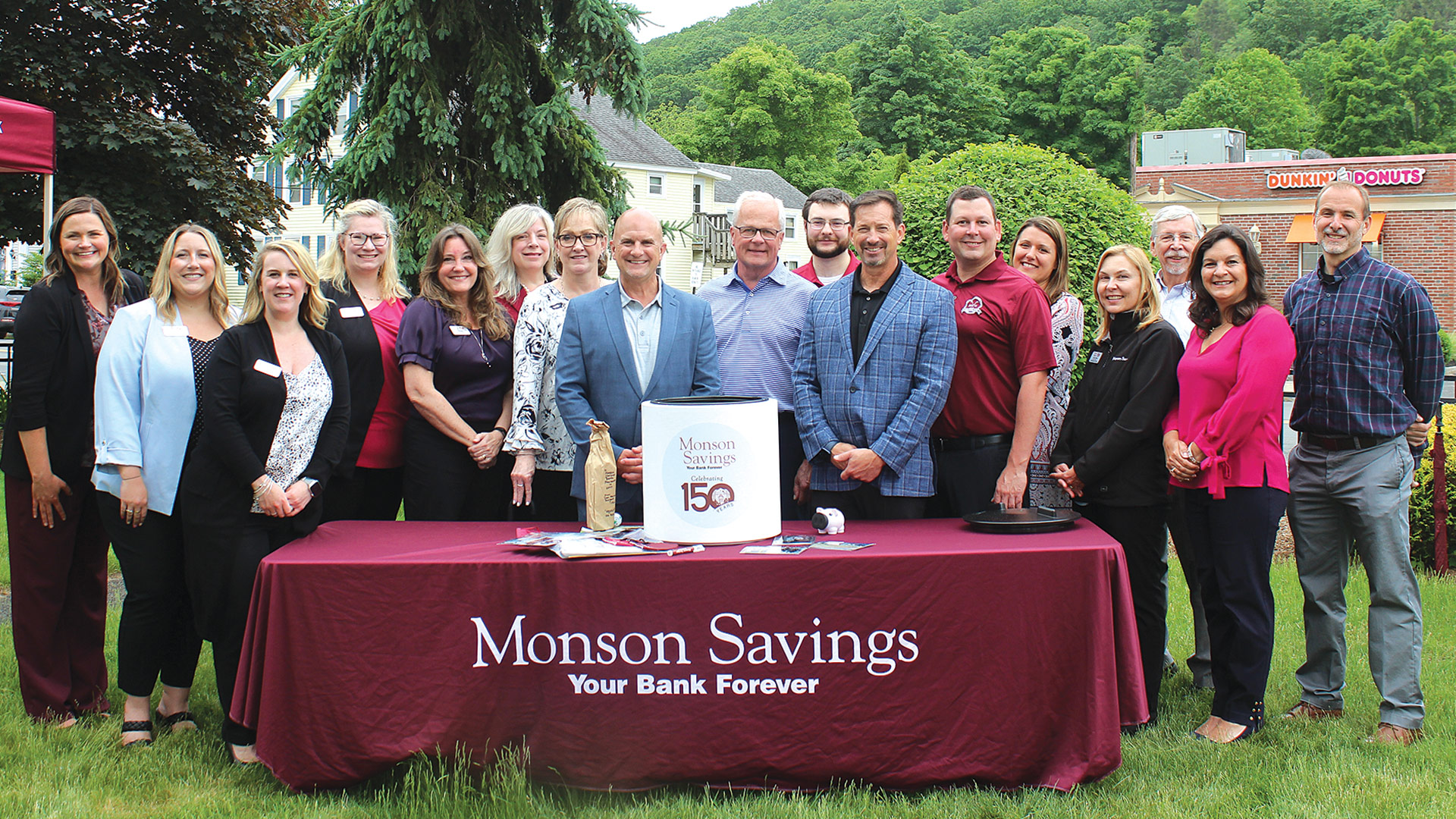
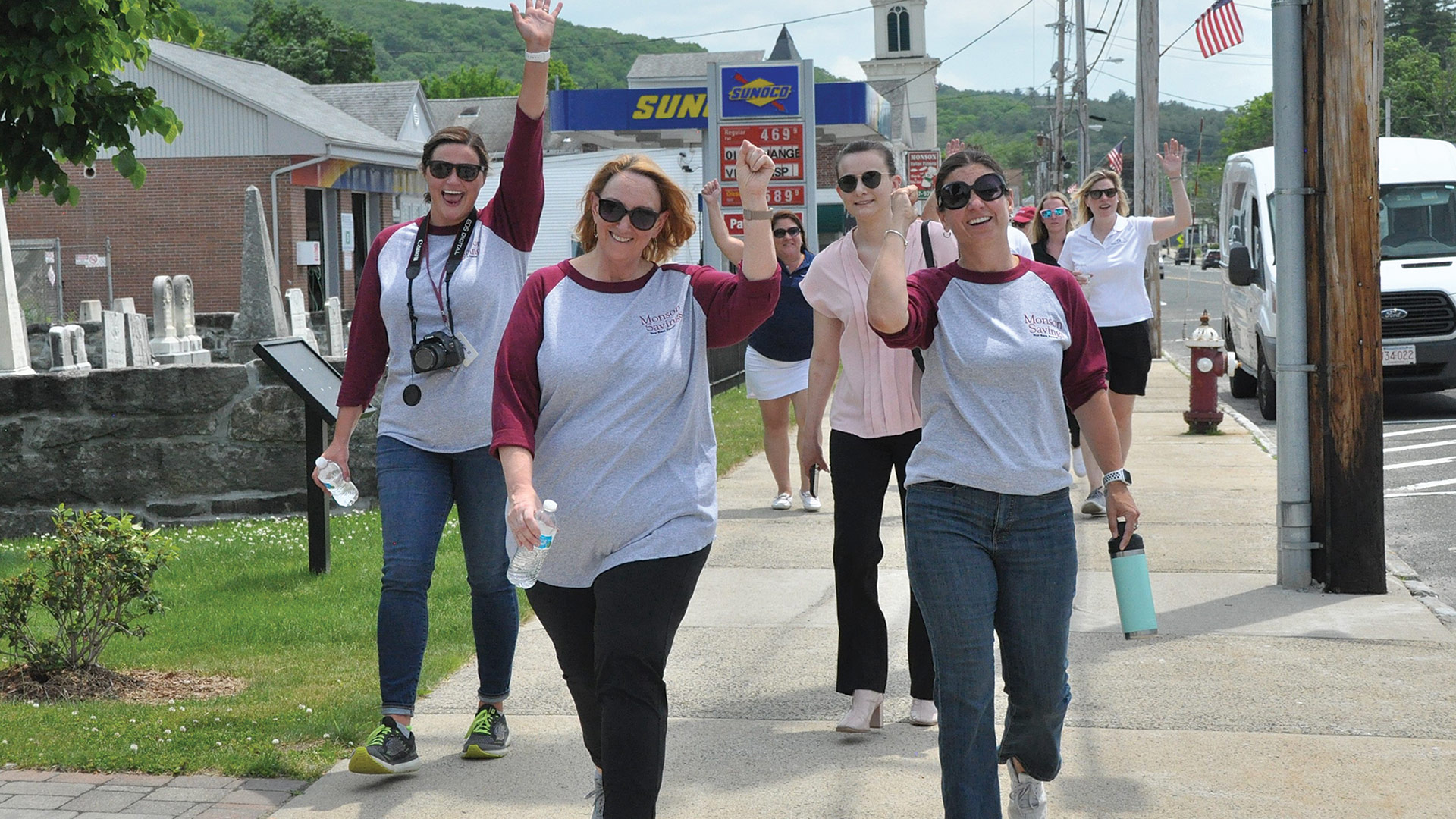
MONSON — Monson Savings Bank has a long history of supporting literacy in its communities that continues as the bank celebrates its 150th Anniversary. Recently, Monson Savings Bank President and CEO Dan Moriarty met with Laurie Flynn, Link to Libraries president and CEO, to present her with a $1,500 donation. This donation was made as a part of the 2022 Monson Savings Bank Community Giving Initiative, where the public was given the opportunity to submit their votes asking the bank to support their favorite local charitable organizations.

“Monson Savings Bank is proud to show our support to the wonderful local organization Link to Libraries,” Moriarty said. “Unfortunately, not all children have access to age-appropriate reading materials. Link to Libraries fills this gap. This organization gives our local youth the valuable gift of reading, providing so many children in our communities with access to books. Because of Link to Libraries, children’s literacy and language skills are positively impacted, helping them to find success in their educational and life journeys.”

Flynn added that “we are very appreciative of Monson Savings Bank’s longtime support of Link to Libraries. Monson Savings is an incredible community partner, not only to our organization, but also to many others throughout our community. Thank you to everyone who voted for Link to Libraries in Monson Savings’ Community Giving Initiative. We are excited to put these funds to good use, purchasing books and distributing them to the children who need them most.”

Daily News

SPRINGFIELD — The Springfield Symphony Orchestra (SSO) announced that three new members have been elected to the SSO’s board of directors: Andrew Cade, Margaret Mantoni, and Evan Plotkin.

Cade is the senior vice president of the Urban League of Springfield Inc., which serves the Greater Springfield African-American community by advocating for and providing model services that enhance the academic and social development of young people and families, promoting economic self-sufficiency, and fostering racial inclusion and social justice. Apart from his job at Urban League, Cade also serves as president of the Springfield Cultural Council.

Mantoni is president and CEO of the Loomis Communities. She served for 30 years as the organization’s CFO prior to taking her current position. She is a certified public accountant and worked in a local accounting firm for eight years before joining the Loomis Communities. She serves on the Audit Committee of the United Way of Pioneer Valley, is a member of the LeadingAge Massachusetts board, and serves on the Capital Projects Planning Committee for the city of West Springfield. Mantoni has a bachelor’s degree from the University of Massachusetts and an MBA from Western New England College.

Plotkin is president of NAI Plotkin, a full-service brokerage and property-management company. He has extensive experience in all aspects of property management and commercial brokerage, including commercial office buildings, medical office buildings, industrial buildings, shopping centers, and condominium/residential management. Plotkin is one of the lead organizers of the Springfield Jazz & Roots Festival and the City Mosaic project, as well as the force behind Art & Soles. He was recently named the 2022 Richard J. Moriarty Citizen of the Year by the Springfield Regional Chamber. He has served on the boards of the Springfield Museums and Holyoke Community College.

“We are extremely pleased to add these new members to the SSO board, each bringing a unique set of skills as we rebuild the organization after the two-year hiatus brought about by the pandemic,” interim SSO Director Paul Lambert said. “Andrew Cade is heavily involved in the community through the Urban League and as president of the Springfield Cultural Council. Marge Mantoni brings business expertise in serving the Loomis Communities, the premier senior-living nonprofit in the region. Evan Plotkin owns and operates One Financial Plaza, and his love of jazz in establishing the Jazz & Roots festival is a demonstration of his commitment to the arts and to a vibrant central city.”

The SSO also recently announced its 2022-23 season, which will include six classical performances and two pops concerts, featuring an array of world-renowned guest conductors and soloists. Two of the guest conductors coming to Symphony Hall in the coming season, JoAnn Falletta and Theodore Kuchar, were included in a recent ranking of the 10 best living conductors in the world. For more information about the concerts and season subscriptions, visit springfieldsymphony.org.

Banking and Financial Services

Matters of Interest


team of mortgage consultants

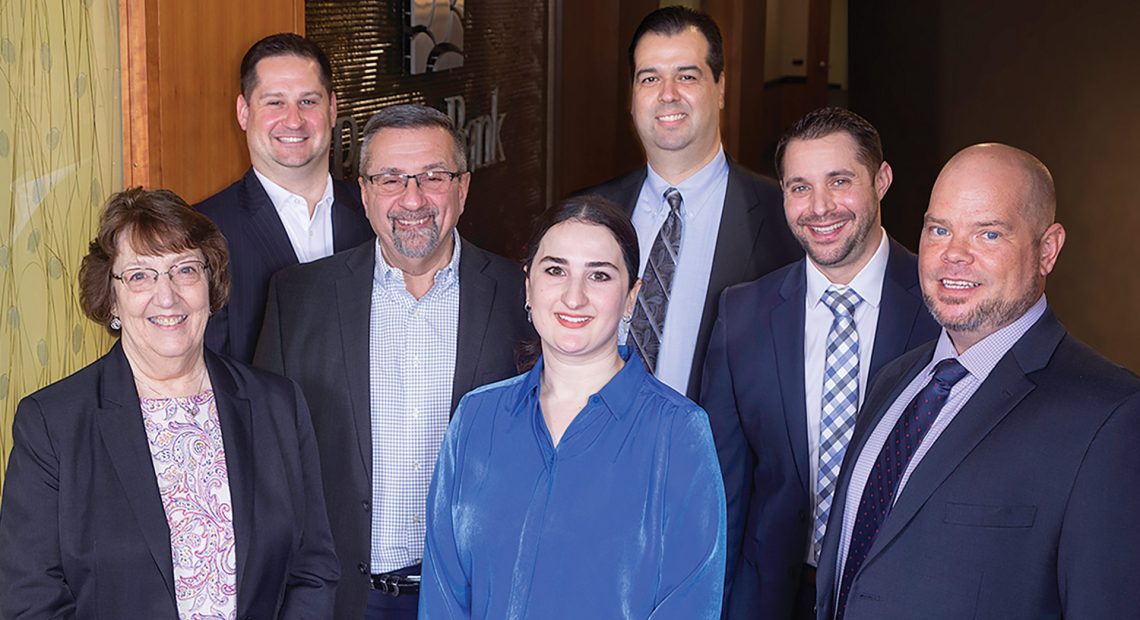
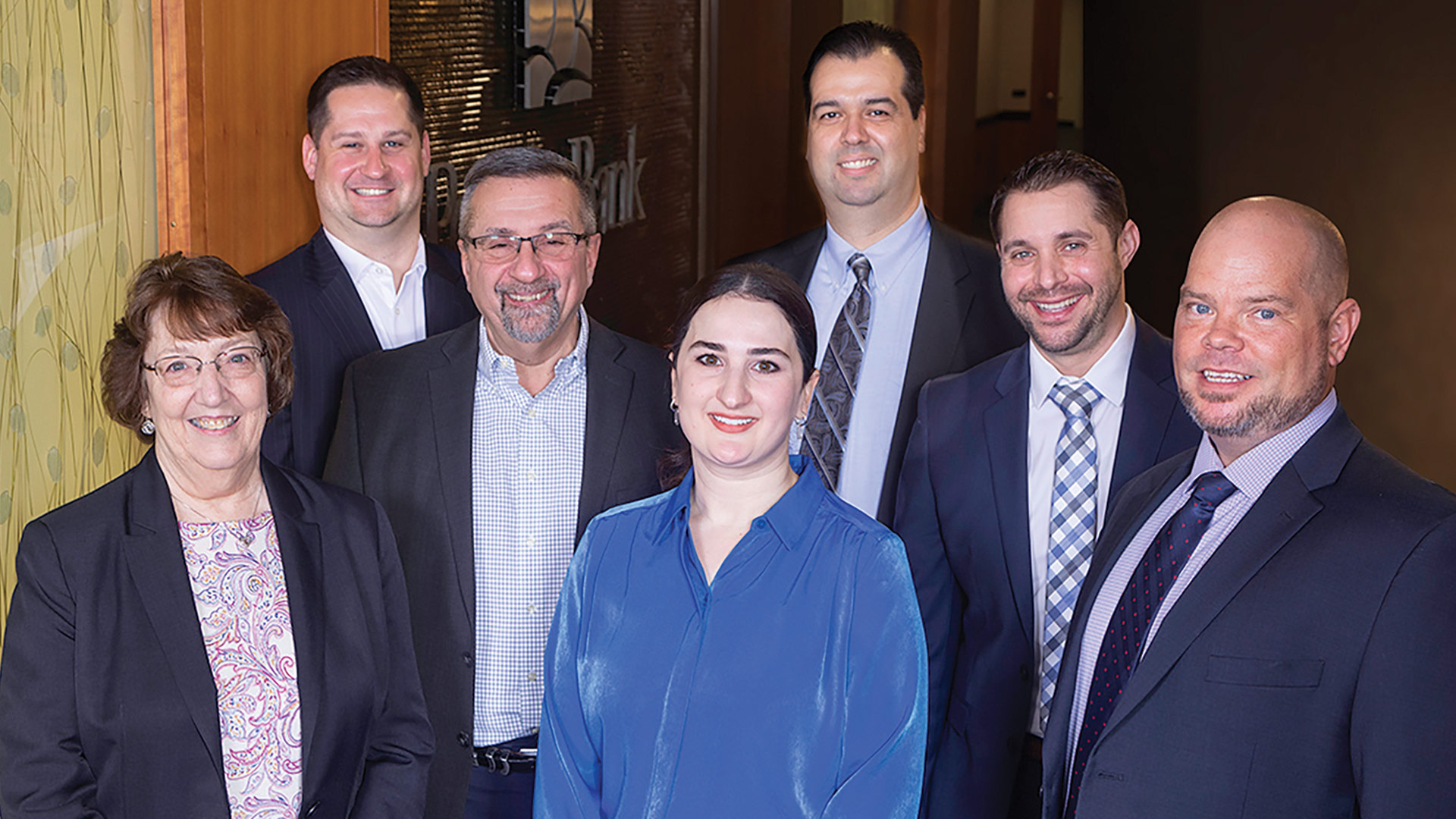
James Sherbo (third from left), senior vice president of Consumer Lending at PeoplesBank, with his team of mortgage consultants.


Mike Ostrowski remembers signing for his first mortgage.

The year was 1982. The 30-year adjustable rate was … wait for it … 16.37%.

“You could put a house on a credit card and beat that rate,” said Ostrowski, president and CEO of Arrha Credit Union. From that historical perspective, he noted, today’s rates, typically between 5% and 6%, don’t seem so onerous.

“We don’t make the market. We would like to see a nice, steady rate that does not fluctuate and move, but the fact of the matter is, even if the rates are hovering around 5% or 6% right now, that’s still a great rate,” he went on. “Did you catch the bottom of the market at 3%? Maybe some people did, and that’s great, but 6% isn’t ridiculous. It needs to be put in perspective. People forget.”

That they do, said Kevin O’Connor, executive vice president of Westfield Bank. “People were really used to rates of 3% for 30 years fixed,” he said, though he was quick to note that doubling that rate does alter the affordability of some houses when shopping in today’s market, and he’s sensitive to that reality. Still, “people are surprised right now, but 15 years ago, 8% to 9% was common, so a lot of us still view 5% as a good rate.”

Mike Ostrowski

Mike Ostrowski

“The whole goal in all of this is to cool down the overheated market, try to slow it down. If the Fed doesn’t take any action, you could be mired in inflation for a long time. And that’s certainly not to anyone’s benefit.”

James Sherbo, senior vice president of Consumer Lending at PeoplesBank, had similar thoughts, noting that, while 5% to 6% mortgage interest rates are historically low, they don’t seem low when people have been accustomed to a long stretch of much lower rates. And he understands why those interest rates, which are not directly tied to the Federal Reserve’s actions but tend to follow that pattern, are rising.

“Overall, it’s to slow inflation down, and part of that formula is the housing market,” Sherbo explained. “The thought is that, as rates increase, it will slow down the activity we’ve seen in the market the past couple of years.”

That activity has included an unprecedented swelling of home prices, driven by the laws of supply and demand — the former dragging way behind the latter in the wake of the pandemic and building-supply shortages.

“The whole goal in all of this is to cool down the overheated market, try to slow it down,” Ostrowski said. “If the Fed doesn’t take any action, you could be mired in inflation for a long time. And that’s certainly not to anyone’s benefit.”

O’Connor noted that the Fed’s recent moves to boost the prime lending rate, which has led to increases in other areas of the rate environment, including mortgages, have required banks to balance that reality with the needs of borrowers.

“In our case, how do we best position that rate for what the bank needs as well as what is good for customers and the community as a whole?” he said. “When rates were rising, we were probably looking at it daily. That’s not typical; we try to set rates as best we can for a week, so customers and Realtors are looking at something they can rely on, so they can plan.”

That daily whiplash has stabilized somewhat, to where the bank may alter the rate an eighth of a point during any given week, he added.

For this issue’s focus on banking and financial services, BusinessWest talked with several area industry leaders about why mortgage interest rates have been so volatile lately, and how they’re addressing the needs and concerns of borrowers.


Bottom-line Impact

Craig Boivin, vice president of Marketing at UMassFive College Federal Credit Union, understands the historical picture of mortgage rates, but also sees consumers’ side: that buying a house in 2022 will cost them significantly more on their monthly bill than a house bought for the same price in 2021.

“Compound that with the fact that rents are higher, and it puts people in a position of ‘should I bid on houses when the values haven’t come down yet, or pony up another year of rent, which has increased a couple hundred dollars as well?’

“We’ve had a lot of conversations internally about how to help people get into homes,” Boivin went on. “Home ownership is one way people move into a higher economic class. We also know how homeowners benefit from values going up, as they can tap into home equity. So, how do we help people navigate this crazy environment?”

Craig Boivan

Craig Boivan

“We often tell folks who are getting into the homebuying game, especially people entering this crazy world for the first time, ‘take the workshop. We’ll show you different rate options, who you’ll be working with, finding your agent, all those things. Just talk to us.”

One way is by offering a wide range of products and matching borrowers to the right ones. For instance, UMassFive’s adjustable-rate mortgage product, which offers lower fixed rates over the first several years, followed by variable rates later on, can be a solid option for certain people.

“Those loans got a bad rap in the 2000s leading up to the housing burst because there was a lot less strict criteria around granting mortgages; some financial institutions were giving loans to people who couldn’t afford them,” he explained, which led to financial pain when a loan’s rate shot up.

But some customers are ideal fits for these types of loans, he said, such as first-time homebuyers who are already planning to move to their next home early in the loan, or medical residents who move around often, or professors who don’t have tenure and expect their current job to be transitory.

“One of the main reasons we can offer such a wide range of products is the way we set up our mortgage department,” Boivin said, noting that UMassFive invested in a credit-union service organization, or CUSO, called Member Advantage Mortgage, back around 2008. CUSOs allow a number of credit unions to create scale by pooling their resources on a particular program — in this case mortgages — which allows them to craft unique products for their members while weathering the kind of economic volatility that can upend business.

Lauren Duffy, chief operating officer at UMassFive, is executive chair of the Member Advantage Mortgage board of directors, “so we have direct oversight and a lot of influence,” Boivin noted.

O’Connor said Westfield Bank helps potential borrowers through its pre-qualification program, called ‘lock and shop.’ “They leave here knowing what their level of affordability will be, and their payment, based on current market rates. Then they can go out there and do some shopping.”

The idea is to avoid situations where shoppers think they’ve found the perfect home, only to find it’s unaffordable later, based on current rates, he explained.

Kevin O’Connor

Kevin O’Connor

“We want to take the uncertainty off someone’s head and give them some stability. We try to work with people in that way in these unsettled times.”

“That’s certainly helpful. We want to take the uncertainty off someone’s head and give them some stability. We try to work with people in that way in these unsettled times. Certainly, as a community bank, we feel a strong obligation to the community to find security and peace of mind for customers through this process.”

Boivin said UMassFive likes to “lead with education,” which is the motivator behind its educational programs, like Home Buying 101.

“We often tell folks who are getting into the homebuying game, especially people entering this crazy world for the first time, ‘take the workshop. We’ll show you different rate options, who you’ll be working with, finding your agent, all those things. Just talk to us.’”


Dollars and Sense

While mortgage volume hasn’t gone down at most institutions, refinancing has understandably taken a hit.

“We saw lots of refinancing from 5% to 3%; these people are not going to give up their rate now for any reason,” O’Connor said. “But a home-equity line of credit is an alternative, so they can preserve their lower interest rate, and we’re seeing home-equity volumes back up. A line of credit is variable to prime, and people understand that, but for many people, it’s worth doing that rather than give up their fixed-rate mortgage.”

Ostrowski said there will always be some refinancing business “because there’s always a need for money. People always need to send their kids to college, and they always want to make improvements to their homes.”

On the mortgage-origination side, the first-time homebuyer segment is most affected by higher interest rates, Sherbo said, simply because they don’t have a home to sell in this inflated market.

“They have the double whammy of higher rates and higher prices at the same time, and they often don’t have the wherewithal to withstand a bidding war on a property. So we have to do our best and be as competitive as we can on our products and our rates. We historically have low loan fees compared to our competitors, and a strong relationship with the real-estate community here in our footprint. Over time, we’ve developed a very good reputation for getting things done.”

The good news is that higher rates, married with a slight easing of the supply-and-demand conundrum, may push prices down, “but I don’t think we’ve seen that happen quite yet,” Sherbo added. “I think things should at least start settling down a little bit. We’re not seeing the bidding wars as hot and heavy as we have in the past. In some areas, there are some signs things are cooling down a little bit, which will help prices stabilize.”

He emphasized the importance of a community bank’s role in guiding customers to good decisions. “We know the market, and we can make adjustments quickly. We’re very agile when we have to adjust and change our programs a bit. We have to be focused on being competitive on rates, and we want to give buyers options. As soon as you feel you’ll be in the market, come talk to us, get pre-qualified, and we can guide you through what your options are.”

Ostrowski hopes home prices ease as well, but new housing starts nationally remain slow, which is indicative of the still-high cost of building materials, among other factors. But considering the big picture, he doesn’t think current mortgage rates should stop potential buyers from jumping into the pool.

“Realtors care about making a sale as quickly as possible. I don’t blame them; that’s their job. So they’re going to take a more negative view on this,” he told BusinessWest. “I don’t look at it as negative. You have to deal with normal fluctuations in this business. It might be slightly more than normal right now, but I wouldn’t hesitate in buying in the current market.”


Joseph Bednar can be reached at [email protected]

Innovation and Startups

The Art of Connection

ArtsHub of Western Mass is a website, but for the region’s artist community, Lisa Davol and Dee Boyle-Clapp say, it’s so much more.


“Like the steampunk aesthetic, Bruce Rosenbaum thrives on paradox. His artwork is a blend of gilded era opulence, modern functionality, and futuristic aspiration,” author Daniel Hales recently wrote about the Palmer-based artist who specializes in creating steampunk-inspired objects. “Similarly, Bruce himself is simultaneously an unapologetic dreamer — an artist building fanciful castles in the clouds out of very heavy materials — and also a very pragmatic and successful businessman.”

That article, one of many on the ArtsHub of Western Mass website, perfectly encapsulates the dual worlds of art and commerce that so many creatives must inhabit. They may create in isolation, but rely on connection — of many different kinds — to bring their work into the light and make a living.

The ArtsHub, a free, centralized online portal that seeks to forge those connections, could be a game changer in that regard, said its founders, Dee Boyle-Clapp, director of the UMass Arts Extension Service, and Lisa Davol, Marketing manager for the Franklin County Chamber of Commerce.

Lisa Davol

Lisa Davol

“We’ve all been trying find a way to get artists together because artists are kind of working in their own silos, and they really needed a place to gather to see who’s doing what and to find access to resources, technical assistance, funding, and collaborators.”

Rosenbaum, Boyle-Clapp said, is “a person who’s an artist, but he’s always looking for other artists to hire because he needs people who have specific skills based on whatever art project he’s currently working on. And he needed a place to find other artists. So the ArtsHub is a spot for him to quickly find people who are in the region he can reach out to and hire. That’s one of the roles the ArtsHub is going to play.”

One of many, in fact.

“It’s a concept we’ve been talking about, and that the arts community has been talking about, for years,” Davol said. “We’ve all been trying find a way to get artists together because artists are kind of working in their own silos, and they really needed a place to gather to see who’s doing what and to find access to resources, technical assistance, funding, and collaborators. There’s such a huge arts economy in this area, but there’s a need for connection around that.”

The pair worked on creating an arts database in Franklin County, and similar efforts have been attempted in other areas of Western Mass. But the vision for ArtsHub, which caters to artists — visual, performing, written-word, you name it — across Hampden, Hampshire, Franklin, and Berkshire counties, started coalescing in earnest after the Western Massachusetts Economic Development Council convened a creative-economy network.

“It was really the first time everyone in the whole region was able to come around the table together and say, ‘hey, this is what’s going on in my region; what’s going on in your region?’” Davol recalled. “And all of the needs are the same, basically.”

Next came a planning grant from the Community Foundation of Western Massachusetts, followed by a much larger $186,000 grant from the Massachusetts Office of Business Development. After much planning and a virtual summit that drew artists around the theme of “How to Recover and Thrive” after the pandemic, the website was launched in January.

“Now we have a place to find resources,” Davol said. “This is sort of like a chamber of commerce for artists. It’s the same concept. They’re all small businesses, and they really need support and connection.”

As the website explains, “we want to collaborate across diverse sectors of the creative communities in Western Mass. and help one another locate opportunities for funding, studio and rehearsal space, collaborations, commissions, training, careers, storytelling, promotion, and more. A good hub makes space for all local creatives, from studio and performing artists to architects and spacemakers, graphic and web designers, photographers and videographers, singers and musicians, arts managers and administrators, employers and funders, tourists and visitors, audiences and customers.”

Boyle-Clapp noted that “we needed a website, a home base, a place to have an artists’ directory, a place where artists can find access to resources and studio spaces and answer the question, ‘how do I hire somebody?’ Those are all really important.”

Dee Boyle-Clapp

Dee Boyle-Clapp

“It’s a one-stop place for artists to find out what’s going on, what’s available, what can I learn, and what can I access that will help me with my career?”

Artists create a profile on the site and are able to interact with hundreds of other artists on matters like locating talent, professional development, public art opportunities, grants — the sky’s the limit, really. “It’s a one-stop place for artists to find out what’s going on, what’s available, what can I learn, and what can I access that will help me with my career?”


Making Contact

One reason ArtsHub has succeeded so far where other efforts have fizzled out is that its founders thought more strategically about how to partner with different entities to make it sustainable.

“A big part of it is the artists’ database. They’re so expensive to create and so hard to maintain,” Davol said. So ArtsHub has partnered with the New England Foundation for the Arts on that aspect, which broadens the range of exposure for participants.

Meanwhile, ArtsHub has enlisted a number of community liaisons to reach out to artists in specific communities — not just geographic, as in individual cities and towns, but into the Native American, Hispanic, African-American, and other demographic communities in the local creative ecosystem, to get them involved and develop a richer and more robust membership.

“The liaisons are working to help us understand what the needs are of those artists who represent those communities and help them tap the resources of the ArtsHub,” Boyle-Clapp said. “We think of the ArtsHub as a platform, and now we’re inviting other people to participate. Do you have a studio for rent? Are you looking for an actor or artist? Do you have a grant available? This is where to post it.

“It opens up opportunities for everyone, so it’s not an exclusive group, which is why the community liaisons are so important,” she went on. “They’re helping to open this up to the wider community of who’s working here.”

This effort comes at a time when the arts community is recovering from unprecedented challenge, particularly for those who depend on public gatherings, which were shut down for long stretches during the pandemic. The $186,000 grant, in fact, specifically targeted COVID-recovery efforts.

“The arts were hit so hard. Arts organizations were slammed. It’s one thing to be closed down, but another thing to have absolutely no access to venues and no place to be found.”

“How can we help this sector revive?” Boyle-Clapp said. “The arts were hit so hard. Arts organizations were slammed. It’s one thing to be closed down, but another thing to have absolutely no access to venues and no place to be found. One in six jobs in the Valley is tied to the creative economy, so it’s critical that this sector be supported and have access to resources. We are here to help facilitate that as much as possible.”

Most of the initial effort was building the site, Davol said, and now the engagement piece is in full swing, getting artists to sign up. And it’s been successful, with about 2,500 Western Mass. artists on ArtsHub now, many busy connecting over shared resources and opportunities, while posting events to a calendar page.

“I think at the one-year mark, we’ll be able to see what the impact has been,” she added. “There’s a lot of engagement on Facebook, a lot of people signing up. And the more people we can get, the better a resource this is for the creative community, and the more job postings there will be. It looks really great now, but it could be so much bigger.”

ArtsHub has also been engaging writers to share stories on the site, from the Rosenbaum profile to a recent discussion about non-fungible tokens, or NFTs. “We have writers doing stories about individual artists and concepts,” Boyle-Clapp said. “These are topics of interest to folks in the arts.”

A Lunch and Learn workshop series will likely follow, with artists given the chance to speak for 15 to 30 minutes about their work, she added. “I’m going to kick off the first one by talking about internships.”

Davol noted that the virtual creative-economy summit in January featured workshops on everything from how to get leads and market one’s work to how to get into galleries. “The Lunch and Learn may be a way to continue that. We’ll see what happens the first year and what needs are brought to the surface. What have we learned from this, what has been brought to our attention, and where can we go? We’re very open to possibilities.”


Developing Story

Not only is ArtsHub connecting artists with resources and encouraging the community to hire locally, Boyle-Clapp said the general public might find the site useful as well, whether they’re looking for a musician for a bar mitzvah or planning on visiting the region and seeking cultural activities to fill their itinerary.

“People have wanted this for a really long time. It’s a dream come true,” she told BusinessWest. “We’re really excited that it’s here, and now we’re just trying to get more people to know about us, to understand it, to access its potential. It’s a site that should be utilized as much as possible.”


Joseph Bednar can be reached a [email protected]


Daily News

SPRINGFIELD — Chase Bank plans to open its first Springfield branch next year at 1391 Main St. in downtown Springfield. There are plans to add at least three more locations in the Greater Springfield area over the next few years.

The expansion is part of the bank’s recently announced plans to more than double its presence in Massachusetts by 2025. The firm opened its first Massachusetts branch in Boston in 2018 and now has 36 statewide. Beyond Springfield, Chase will open its first branch in Worcester next month.

“Springfield is a great city with a rich economic, cultural, and educational environment, which makes it an ideal place for Chase to grow,” said Ali Zaidi, Chase’s market director for Springfield and Worcester. “Our goal is to help the community and support our customers during their most important moments.”

Roxann Cooke, regional director for Chase in New England, added that, “when Chase enters a community, we bring the resources of a global institution with a focus on local solutions. In addition to going above and beyond to serve our customers, we are going to engage and collaborate with our neighbors to create more equitable economic growth here in Springfield.”

This first branch will be about 3,000 square feet in size and feature modern, bright designs with comfortable meeting areas and state-of-the-art banking technology. A dedicated Chase Private Client team will provide premium banking services, personalized attention, and access to the expertise and investment capabilities of J.P. Morgan to help families reach their goals. Customers may also meet with financial and home-lending advisors and business-banking relationship managers.

“Branches are critically important to our customers, but our mission goes beyond service and convenience,” said Jennifer Piepszak, co-CEO of Chase Consumer & Community Banking for JPMorgan Chase. “We’re hiring locally, investing in the community, and bringing all the benefits our firm has to offer to drive economic growth.”

Daily News

EASTHAMPTON — bankESB recently promoted Karen DeMaio to assistant vice president, IRA and Operations Risk Management.

DeMaio joined bankESB in 2006 as an IRA specialist and was promoted to IRA and Deposit Services officer in 2014. She is responsible for IRA services, vendor management, business-continuity planning, and insurance for the Hometown Financial Group family of banks, which includes bankESB, bankHometown, and Abington Bank.

Prior to bankESB, DeMaio served as senior Marketing analyst at Friendly Ice Cream Corp. and as senior auditor at KPMG Peat Marwick. She earned her bachelor’s degree in accounting from Western New England College, completed the certified public accounting exam, and earned her Certified IRA Services Professional designation. She currently serves as vice chairperson for the town of Southwick Finance Committee and is a board member of Westfield Credit for Life.

Daily News

EAST HARTFORD, Conn. — American Eagle Financial Credit Union (AEFCU) announced the appointment of Ashley Rollins as vice president of Consumer Lending. In her new role, Rollins will focus on all aspects of lending, including consumer and real-estate originations, collections, process improvement, automation, and loan reporting.

“We are very pleased to welcome Ashley to American Eagle and our leadership team,” said Howard Brady, president and CEO of AEFCU. “We believe she brings tremendous value to our organization and possesses the right qualities to advance our credit union in the marketplace.”

Dianna Wilson, senior vice president and chief lending officer of American Eagle, added that “Ashley possesses in-depth knowledge of the financial-services market, substantial experience in lending, and a passion for serving people. She will be integral in servicing American Eagle’s members and communities — and I am confident her addition strengthens our lending operations.”

Rollins assumes her new role at AEFCU with more than 11 years of experience in financial-services operations, quality control, and consumer loan products. She most recently served as Loan Administration officer for Justice Federal Credit Union in Washington, D.C.

She earned certificates from the National Assoc. of Federally Insured Credit Unions Management and Leadership Institute and the Harvard Business School Leadership Academy, as well as a Yellow Belt certification from Lean Six Sigma. During her time in the D.C. region, she volunteered at the Central Virginia Food Bank and taught financial-literacy classes at Richmond, Va. elementary schools.

Daily News

SPRINGFIELD — United Way of Pioneer Valley announced the return of the Fiat at 1441 Main St., Springfield, in the interior rotunda. This time, anyone interested can stop by and make donations of school supplies to fill the Fiat as part of United Way’s Stuff the Bus initiative. Stuff the Bus provides backpacks filled with school supplies for students who are homeless throughout Hampden County, Granby, and South Hadley.

United Way works with McKinney-Vento representatives in each school district to gather the number of students K-12 who are homeless. This year, more than 2,000 students are in need. United Way relies on donations of school supplies from the community, and volunteers assist with the packing.

“We are fortunate to have generous donors who want to ensure that every student begins the school year with the supplies they need. And we are grateful to Peter Pan Bus Lines, who lend a bus and driver each year to deliver the backpacks to the school districts,” said Paul Mina, president and CEO of United Way of Pioneer Valley.

Items needed most include notebooks, composition books, filler paper, crayons, index cards, pencil sharpeners, erasers, highlighters, and rulers. Supplies may be dropped off at 1441 Main St. by the Fiat through Aug. 16. Other drop-off sites include Target and Macy’s at the Holyoke Mall and Balise dealerships.

For more information on our Stuff the Bus initiative and needed items, visit www.uwpv.org/stuff-the-bus.

Daily News

SPRINGFIELD — Rocky’s Ace Hardware, one of the country’s largest family-owned Ace Hardware dealers with 47 locations in nine states, will host a Children’s Miracle Network (CMN) bucket-sale fundraising campaign in eight Western Mass. stores and two Connecticut stores, with 100% of all money raised going to benefit CMN hospitals.

Customers can purchase a bucket for $5 and receive 20% off all regularly priced items they fit in the bucket from Friday, Aug. 5 through Sunday, Aug. 7 at the Island Pond Road and Liberty Street stores in Springfield; the Agawam, East Longmeadow, Westfield, Ludlow, Palmer, and South Hadley stores in Massachusetts; and the Vernon and Stamford locations in Connecticut.

“This is such a great way to give back to sick children in our area as well as provide our customers with a great discount at the same time,” Rocky’s Ace Hardware President Rocco Falcone said. “CMN helps more than 10 million kids each year who rely on care from a children’s hospital. We are proud to give back to the communities we serve in such a meaningful way and know this is important to our customers as well.”

To provide the best care for kids, Children’s Miracle Network hospitals rely on donations and community support, as Medicaid and insurance programs do not fully cover the cost of care. Since 1983, CMN hospitals have helped fill funding gaps by raising more than $7 billion. Its various fundraising partners and programs support the nonprofit’s mission to save and improve the lives of as many children as possible.

Cover Story

High Flight

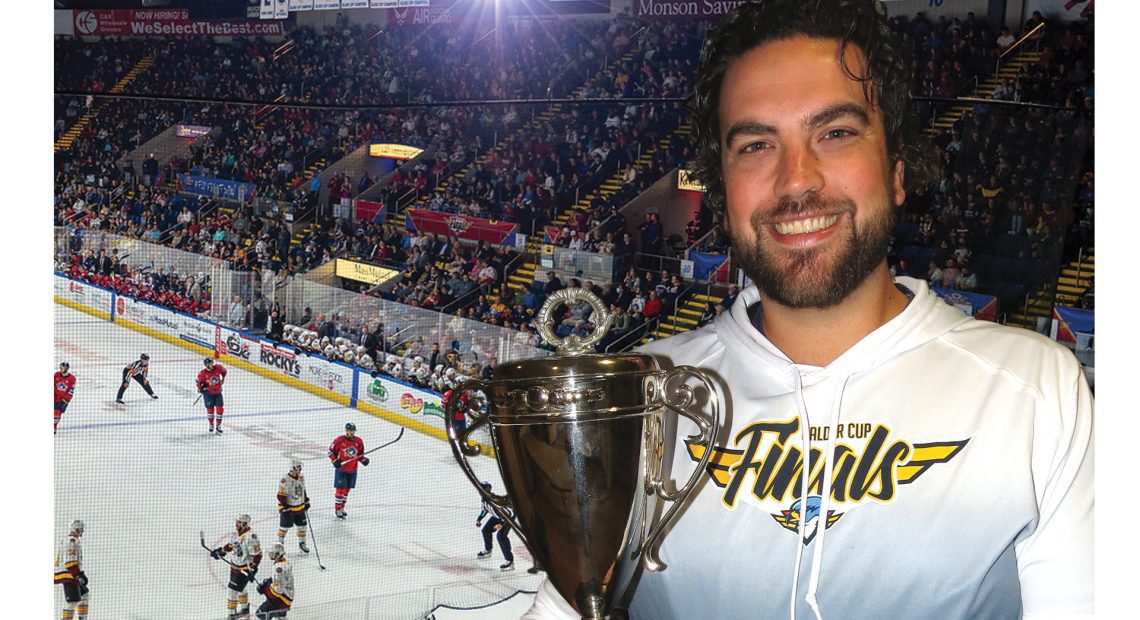
Nate Costa with the AHL’s Eastern Conference Championship trophy

Nate Costa with the AHL’s Eastern Conference Championship trophy and his AHL Finals jersey.

The Springfield Thunderbirds soared to new heights during the 2021-22 season, making the playoffs for the first time in their existence and taking Springfield to the championship round of the playoffs for the first time in three decades. As the franchise enters what will be an abbreviated offseason, it does so with momentum and a championship-caliber team to sell to a more engaged fan base, and management is laser-focused on taking full advantage of this opportunity.

Within the pantheon of ‘good problems to have,’ specifically in the world of professional sports, it doesn’t get much better than this. Although, yes, it does get a little better.

Indeed, after a lengthy playoff run that took the team to within a few wins of a Calder Cup, the Springfield Thunderbirds are looking at a short offseason — as in two full months shorter than the norm.

That’s a problem, said team President Nate Costa, because there’s a lot to do before the 2022-23 season starts, from season-ticket sales to scheduling promotions to lining up special guests and programs. But it’s a good problem, obviously, because of everything that happened during those aforementioned two months and what they mean to this franchise, and this brand, moving forward.

What happened, said Costa, is that the Thunderbirds, the franchise that brought pro hockey back to Springfield in 2016 after a brief time without a team, became “the talk of the town” during that playoff run. Elaborating, he told BusinessWest that the team took a huge leap forward in terms of visibility, prominence, and, yes, relevance. It always had a core of solid fans, but it hadn’t truly arrived. Until this spring.

“It all came to fruition when the playoff run happened,” he told BusinessWest. “All the stuff we thought could happen — that we would be the talk of the town, that we could be the focal point of downtown Springfield … it all came together. And now, it’s about trying to capture some of that momentum and keep things moving.”

The team took this huge step forward in large part because the team seized a huge opportunity during the playoffs to capitalize on the 11 extra games and the excitement generated with each passing round by promoting the brand in every way imaginable, from ceremonial posters and rally towels handed out at the home games to extensive social-media coverage of the team’s run to the Eastern Conference title and the brink of a Calder Cup.

The challenge — and huge opportunity — moving forward, as Costa said, is to build off this hard-earned momentum, and this is what management will be doing in this abbreviated offseason.

Thunderbirds

The extended playoff run gives the Thunderbirds a short offseason, but in the larger scheme of things, that’s a good problem to have.

“All the positives around the business now, and all the stuff that comes from having a nice run like this is … huge, and it’s something we’ve never had before — we’ve never even made the playoffs before in my time with the Thunderbirds,” he noted. “We’re in a good position to take advantage because we’ve laid a really solid foundation that we can build on.”

Looking back on a memorable season, one that earned the T-Birds Team of the Year honors (the President’s Award) from the AHL, Costa said it happened because many pieces fell in place and because all the various players — from the local ownership group that provided the needed resources to a parent team, the St. Louis Blues, that “understands the value of winning at this level,” as he put it, to the players and management — did their respective jobs.

Overall, he said the deep playoff run was and is validation of everything that management and ownership have done to not only bring hockey back to Springfield but to generate interest in hockey and build a successful brand.

“It all came to fruition when the playoff run happened. All the stuff we thought could happen — that we would be the talk of the town, that we could be the focal point of downtown Springfield … it all came together. And now, it’s about trying to capture some of that momentum and keep things moving.”

“It’s been a huge validation, not only for me personally, but for the owners, who stepped up for the city, made a big investment, and did it the right way,” he said. “To be able to get the Eastern Conference championship and do something that hadn’t been done in 30 years … that’s pretty special.

“Getting to the playoffs is really important to the development of these players; these guys are getting extra games, they’re getting extra high-pressure games … that all means a lot to development,” he added. “The really cool thing is that there is lot of continuity between last year’s team and this year’s team, which is a testament to the Blues — they’re bringing back a lot of guys.”

For this issue, BusinessWest talked with Costa about the season — and postseason — that was, how the team made the most of that unique opportunity, and how it intends to build on all that was gained during the 2022-23 season and beyond.


Banner Year

One of the many items on the to-do list for Costa and his team this offseason is to order a ‘2022 Eastern Conference Champions’ banner to hang in the rafters at the soon-to-be-renamed MassMutual Center.

Costa said research revealed the name of a company in Waltham that makes such banners for a number of professional sports teams, and preliminary talks with that outfit will commence soon.

Thunderbirds fared well

While the playoffs are not a ticket to guaranteed financial success, the Thunderbirds fared well, selling out each of its three games in the Finals.

“We want to do it right — to go the company that does this for everyone,” he said. “I want to get their input — I want to get some direction on how to design this the right way, because it’s going to live in our rafters for a long time.”

Finding a company to make a banner for the rafters was about the last thing on anyone’s mind during a very challenging start to the 2021-22 season, said Costa, adding that this past year was a stern test on many different levels.

For starters, the team was starting up again after deciding not to play during the 2020-21 season, when COVID was at its height and the AHL was playing a shorter schedule with a host of restrictions and, for the most part, no fans. This meant assembling a team of employees (with many returnees from before COVID) and re-engaging with a fan base.

But mostly, it meant dealing with a pandemic that kept coming in waves and was still very much a disruptive force, especially for businesses dependent on bringing large numbers of people together in closed spaces.

“All the positives around the business now, and all the stuff that comes from having a nice run like this is … huge, and it’s something we’ve never had before — we’ve never even made the playoffs before in my time with the Thunderbirds.”

“It’s been a long year,” said Costa, putting heavy emphasis on that word ‘long.’ “We dealt with a lot of ups and downs; there were a lot of challenges. Groups were essentially non-existent because schools weren’t doing anything, and we were living in a real COVID world for half the year. January and February were some dark months where we still wearing masks and there were potential capacity limitations … we were dealing with that all year, and it was a really taxing and challenging environment to work through. It was exhausting.”

While dealing with these challenges, the Thunderbirds, thanks to a solid mix of established veterans and emerging prospects, established themselves as not only a playoff contender (23 of the league’s 31 teams would qualify for postseason play for the 2021-22 season following some changes to the format), but as a frontrunner. Indeed, the team forged its way near the top of the Atlantic Division of the Eastern Conference and stayed there for the bulk of the season.

By the spring, the team’s consistently solid play made a playoff birth likely, and then inevitable, giving Costa and his team a chance to start planning — as much as any organization can plan a playoff run, even with a bye in the first round, which the T-Birds earned by finishing second overall in the Atlantic Division.

Indeed, the playoffs are to be taken one series — and, in many respects, one game — at a time, he said, adding that, while a playoff run can benefit a team’s bottom line, there are many additional expenses, especially travel and logistics, and some challenges when it comes to ticket sales, including the loss of all-important group sales.

playoff experience different

Nate Costa says one of the team’s goals was to make the playoff experience different for the fans and the players, with rally towels and banners like this one.

“Every series is like a mini-season, the way we market it and the way you go through the process, because you don’t know what’s going to happen; it’s all dependent on your performance on the ice. At the beginning of the run, we wanted it to make it feel different and feel separate from the regular season, and so, from a marketing perspective, we put together an entire campaign around the playoffs,” Costa explained, including a hashtag slogan — Fly, Fight, Win! — that was a nod to the Air Force. “It was completely different from what our regular-season marketing campaign was.”


Winning Formula

Such marketing efforts included everything from lawn signs to new signage around the arena to stickers placed in the windows of downtown businesses, as well as that hashtag. They were a necessary expense, but ones with a very uncertain ROI.

“You can do all that planning and do all those things, and then get knocked out in the first round,” Costa explained. “We were really fortunate that we got to go all the way to the end, but every round you have to redo the schedule, get tickets up on sale, set the pricing on tickets, get the tickets sold, getting marketing in place and buying the advertising — and it all happens within a week.”

“The other blessing about going so late into the playoffs is that it’s only three months from the end of our year to the start of the new year. I think there’s still going to be a lot of pent-up excitement, especially with the number of guys we have coming back and the continuity with raising the banner and all that.”

And there are no guarantees that a playoff run will be a financial success, he said, noting that some teams in the playoffs — including the Chicago Wolves, who triumphed over the T-Birds in the Calder Cup Finals in five games — played before crowds that were far from sellouts, and one of the playoff teams from the Western Conference, Stockton, was averaging just over 1,000 per game.

“At this level, though tickets were in demand, you still have to grind, and you still have to have relationships with people in the region to try to move tickets,” Costa said. “And if you’re not prepared to do that at this level, you’re not going to succeed.

“The first two rounds are really challenging, and teams traditionally break even or lose,” he explained. “But you maximize those opportunities to build momentum for future rounds, if you can get there, and that’s what we did.”

Overall, the Thunderbirds did well with playoff ticket sales, he went on, noting that each of the three Finals games hosted in Springfield was a sellout (6,793 seats), and the earlier rounds averaged more than 5,000, with some games coming on weekdays and even Mondays.
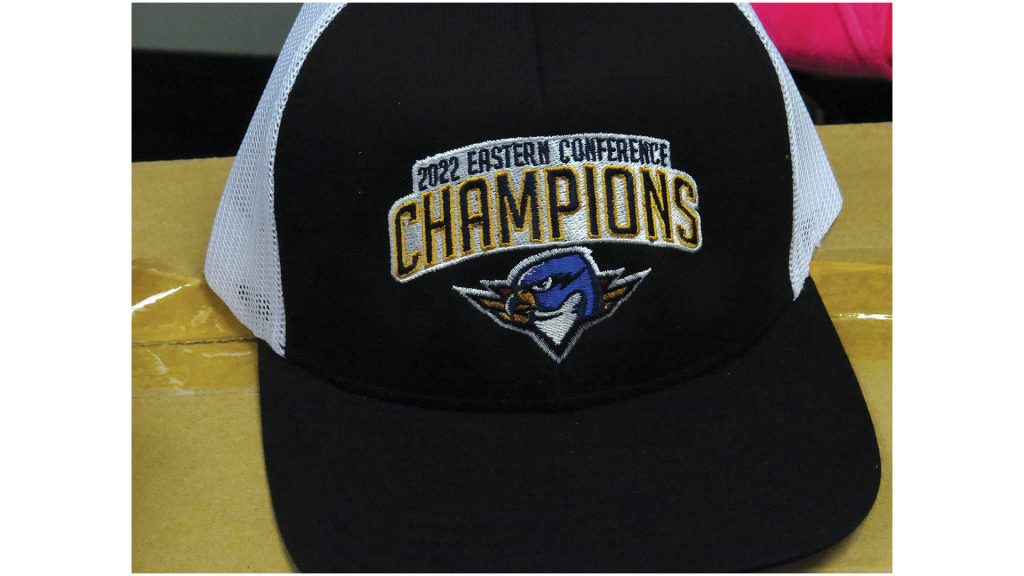
Eastern Conference Champions’ hat.

There are many benefits to an extended playoff run, including merchandise, such as this ‘Eastern Conference Champions’ hat.

But beyond ticket sales, Costa said he saw the playoffs as an opportunity to build the Thunderbirds brand, and he invested heavily in many different initiatives.

For starters, he made sure all three of the team’s media members went to every playoff series to cover the Thunderbirds for social media.

“From the beginning, I wanted to feel like a pro hockey team, and that means getting photography, video, and social media on the road,” he said. “That’s what separates us from a lot of AHL teams; not many teams in this league are willing to invest in this stuff. But I think it’s important for perception of the brand.

“If you can do the little things like that, if you can let the players feel like real pros, then the fans, by extension, the people who are following your brand, can also feel that, and that gives you a lot to sell,” he went on. “The playoffs, to me, was all about maximizing the opportunity.”


Setting Sale

As he talked with BusinessWest, Costa was wearing a ‘Calder Cup Finals’ pullover. At one point in the proceedings, he paused to show off the AHL’s Eastern Conference Championship trophy, named for former AHL President Richard Canning.

These are just a few of the symbolic ways in which he and his team are still living in the moment, if you will.

But in most other ways, the team is putting its deep playoff run behind it and moving onto next season. Indeed, Costa made a point of referring to the 2021-22 campaign as ‘last season,’ and to 2022-23 as ‘this season.’

Which brought him back to the ‘good problem to have’ he mentioned at the top.

“It’s a blessing and a curse,” he said of the shortened offseason, noting that it’s too short for everyone involved — players, many of whom will be back with the team, as well as coaches and administrators.

But from a business perspective, and most all other perspectives, it certainly beats the alternative — another season with no playoffs.

“I’m going to take the playoff run and everything that came with it over a longer offseason,” he said, adding quickly that some, but not all, of the page-turning work that comes after a year’s final game is over had to wait until the playoff run ended.

The mission now is to make up for that lost time, and Costa and his team are now forging ahead with the plans for 2022-23. The schedule has been officially released, which means the team can now start slotting in everything from annual events to who will sing the national anthem at each game.

And, as he mentioned, there is momentum to build on, and it is already showing up in season-ticket sales; by mid-July, the team had more than 1,150 season tickets sold for the coming season, a jump of nearly 100 from last year, with more than 200 still to renew and a projected 80% of those coming back. That means the team is looking at perhaps a 30% increase in season-ticket volume.

And that should be just one area of growth, he said, adding that, overall, a short offseason isn’t beneficial only because of what it means about last season.

“The other blessing about going so late into the playoffs is that it’s only three months from the end of our year to the start of the new year,” Costa explained. “I think there’s still going to be a lot of pent-up excitement, especially with the number of guys we have coming back and the continuity with raising the banner and all that.

“Early on in the year is typically really hard for us,” he went on, adding that the team is competing with pro and college football and other sports as well. “But coming out of this, I think we’re going to have a lot of momentum. We don’t really hit our stride typically on the business side with big crowds until December, when people really start to turn the page and think hockey. This will help us early in the season; we’re going to come out of the gates strong.”

As the team continues its budgeting for the coming year, it will be aggressive as it sets goals for ticket sales and revenue because of last year’s success, Costa said, but it will also look for new areas in which to grow and improve, on both the revenue and expense sides.

“It’s just the maturation of the business,” he explained. “We’re in a healthy place now, and it’s all about how we take advantage of our momentum. When we took this over, it was obviously exciting, but there wasn’t a ton of value built up in the brand, and now we’ve gotten to the point where we have some value built into the brand, and we have to take advantage of that.

“Now, we have a winning team to talk about and a championship-caliber team,” he went on. “And that just adds to everything that we’re doing, and it makes our job easier.”


Soar Subject

Summing up the playoff run that was, from both a personal and professional perspective, Costa said it was, in a word, “special.”

“It was one of the coolest experiences I’ve had in my career,” he said, noting that the team won the Eastern Conference title exactly six years from the day the new franchise was announced. “I’ve been in pro sports for more than 15 years now and had never gotten to that point — it was fulfilling on many levels.

“And that’s one of the things I hammered home with our staff. I said, ‘I know it’s exhausting, and I know we’re working extra games, but this doesn’t happen every year,’” he went on, adding that, when it does happen, a team has to take full advantage of the moment — and the momentum created by that moment.

And he and his team are fully committed to doing just that.


George O’Brien can be reached at [email protected]

Banking and Financial Services Special Coverage

Pedal to the Mettle

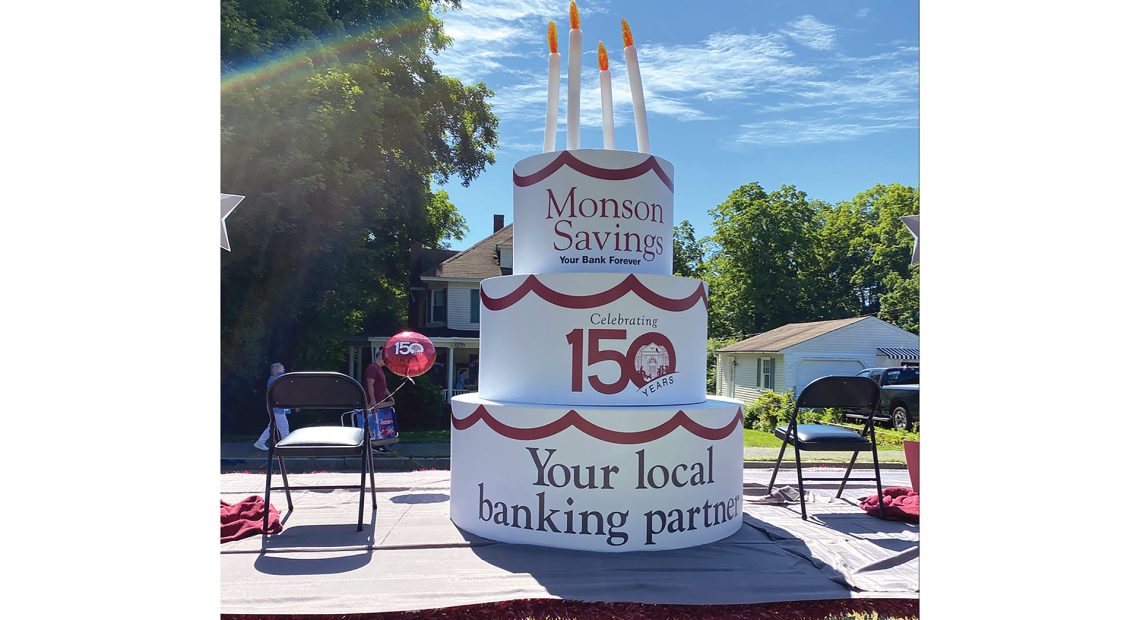
Monson Savings Bank’s birthday celebration

Monson Savings Bank’s birthday celebration

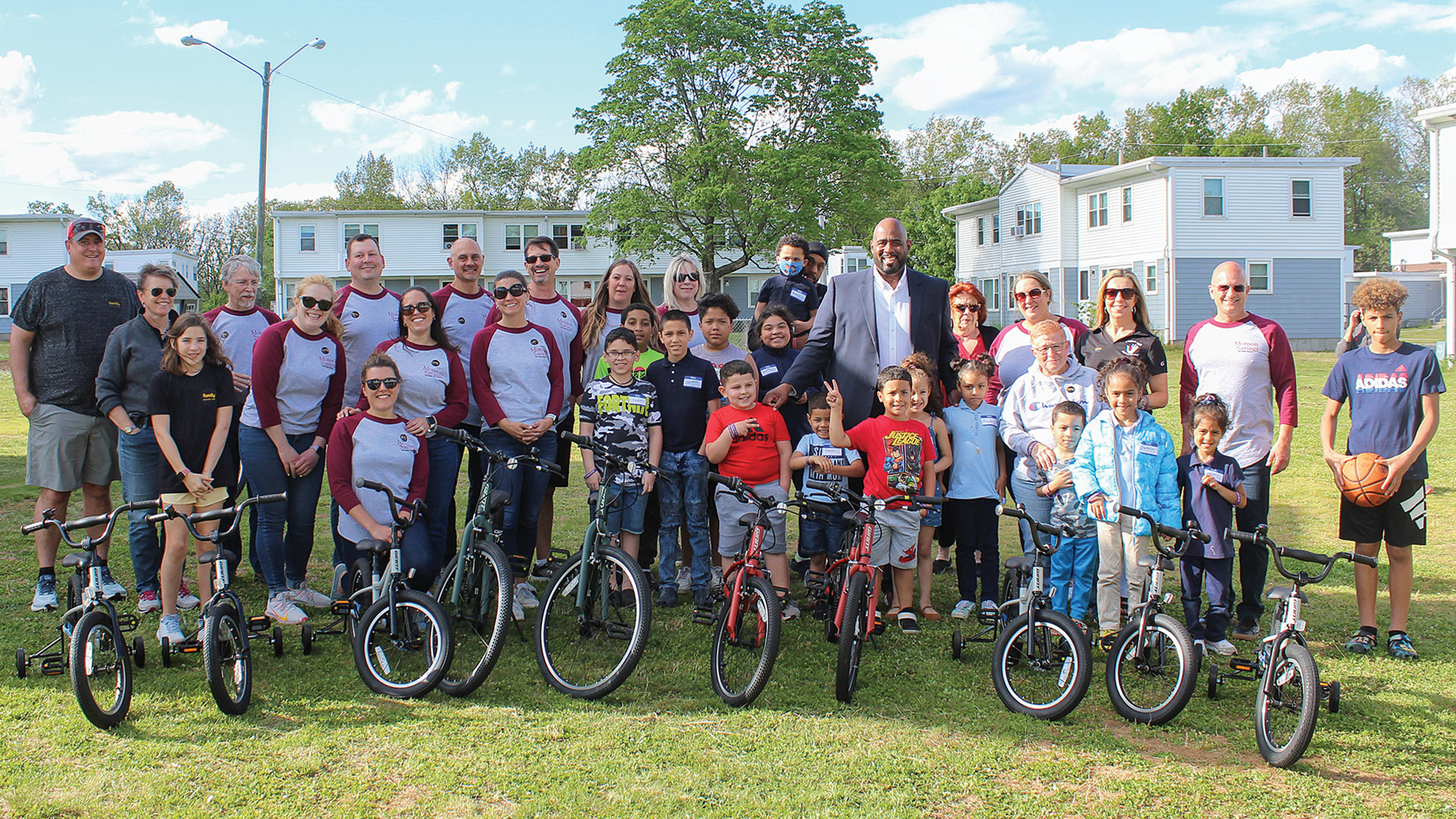
Monson Savings Bank has been commemorating its 150th birthday in many different ways, from a time capsule to assembling and donating $15,000 worth of bicycles to several area charities. Through all these efforts, the bank is celebrating its continuity and its commitment to a community that is now much larger then when it took its first deposit back in 1872.

Dan Moriarty called it a ‘trial run.’

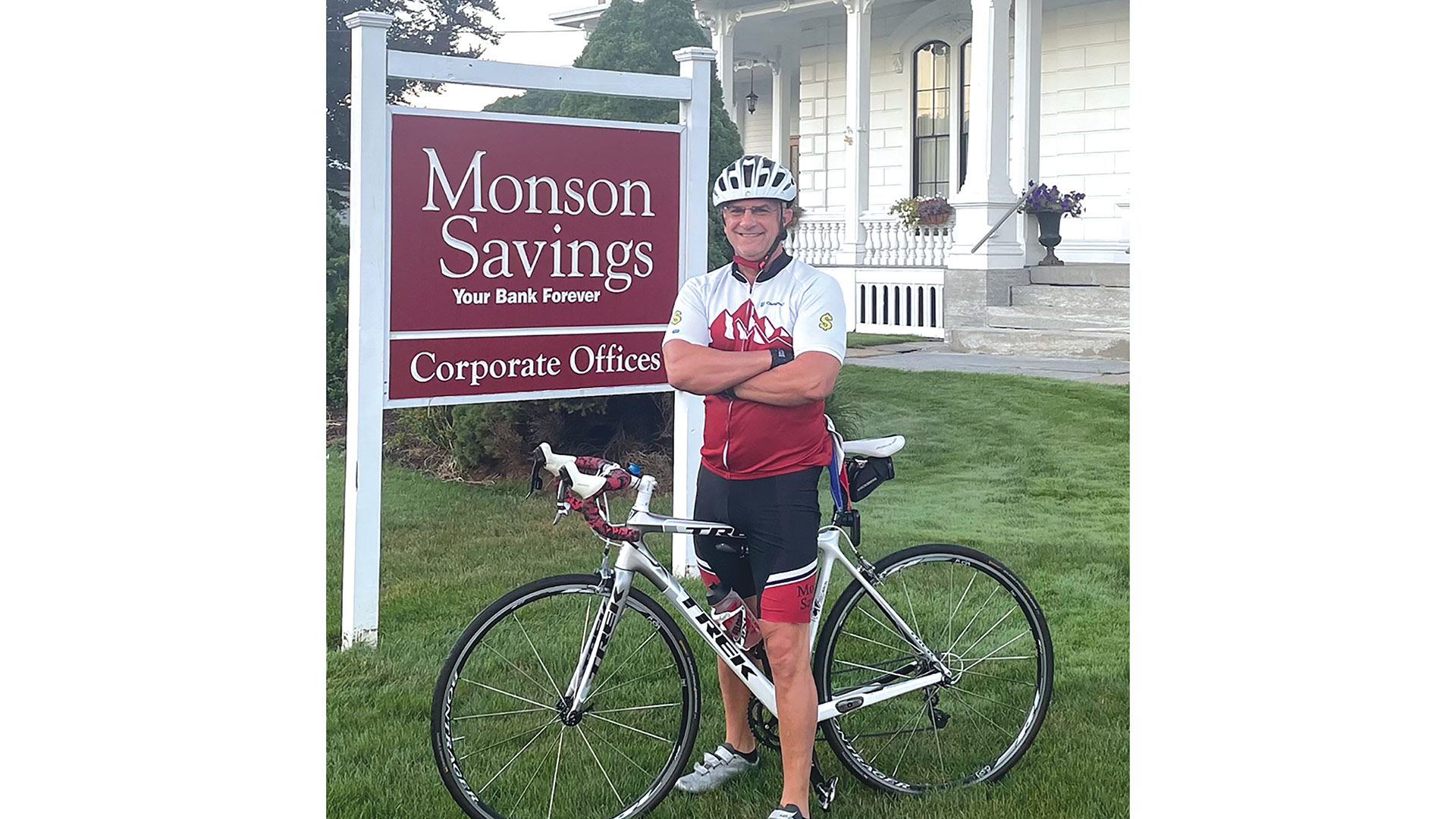
That’s how he referred to his 60-mile bike ride, which he also called the ‘Tour de Branches,’ on July 17, during which he visited all seven Monson Savings Bank (MSB) locations — five branches, the headquarters, and a loan center — on a trek that took him from Monson to East Longmeadow, with stops along the way in Ware, Wilbraham, and Hampden.

Moriarty, the bank’s president and CEO, said this was a tuneup for a ride two and a half times that length, a number that is significant because 150 is also the number of years the bank is celebrating this year, and the ride, still very much in the planning stages, has now become a poignant part of the celebration.

Dan Moriarty’s ‘Tour de Branches’

Dan Moriarty’s ‘Tour de Branches’ helped him prep for a 150-mile ride as part of Monson Savings Bank’s birthday celebration

“My goal is to raise money to give to a local charity … I’m thinking I could ask for per-mile pledges from friends, family, customers, and businesses,” Moriarty told BusinessWest, adding that the charity is still to be determined. “I’m guessing no other bank president belonging to a bank older than 100 years has done this.”

He’s probably on very safe ground with that statement. Not many bank presidents pedal such distances, although he’s certainly comfortable doing so having competed in several Ironman triathlons, where participants cycle 120 miles while also swimming 2.4 miles and running a full 26.2-mile marathon. And, more to his point, there simply aren’t many banks that can boast about being around for 100 years, let alone 150.

And that, more than anything else, is what MSB is celebrating this year, said Mike Rouette, executive vice president and chief operating officer, noting that this longevity, this stability — not only the same bank, but the same name since Ulysses S. Grant was patrolling the White House — is rare in this era of ongoing mergers and acquisitions.

bank employees buried a time capsule

As part of the 150th birthday celebration, bank employees buried a time capsule filled with a number of items reflective of 2022.

It is reflected, he said, in a borrowed slogan that the bank has adopted: ‘Never forget who you are and where you came from; it’s an important part of you that you will find strength and peace from.’

“It’s short, and it’s sweet, and it says a lot about us,” Rouette noted, adding that, while the bank has grown and expanded its presence within the region, it remains loyal to the principles on which it was founded in 1872.

Moriarty agreed.

“I think it takes a strong sense of loyalty to the legacy of the organization to hang on for that long,” he said. “As we know, in this area, some long-lasting institutions decided to go a different route and either merge or combine. It starts with the organization and how it feels the future can be laid out for a bank that’s been around a long time; if they feel they’re not going to make it, they look to a different situation or combination. So far, we’re not committed to looking in a different direction.”

Moving forward, he said the bank “has a lot to talk about” at its upcoming annual meeting and strategic planning sessions in September, from where, when, and how to expand geographically to anticipating where technology is going and how to maximize it to better serve customers.

“We had very big ideas, and I’m happy to say that we made most of them happen — and very successfully.”

“It’s all about delivery systems, customer service, where we’re physically going next, which means market analysis and possible branch expansion,” he explained. “We’re going to do it in a controlled and managed method.”


To a Higher Gear

While Moriarty is, indeed, a veteran of Ironman triathlons, it had been a while, seven years by his estimation, since he had taken part in one of those competitions. Thus, he admits to being a little sore after that 60-mile trial run.

“It was a reality check when I came off the bike that day,” he explained. “I said, ‘whoa … that was 60 miles; I have to do that twice plus another 30 miles.’ This will be a good challenge for me; there was about 3,500 feet of climbing for one loop — that’s like going up half of Mount Washington.”

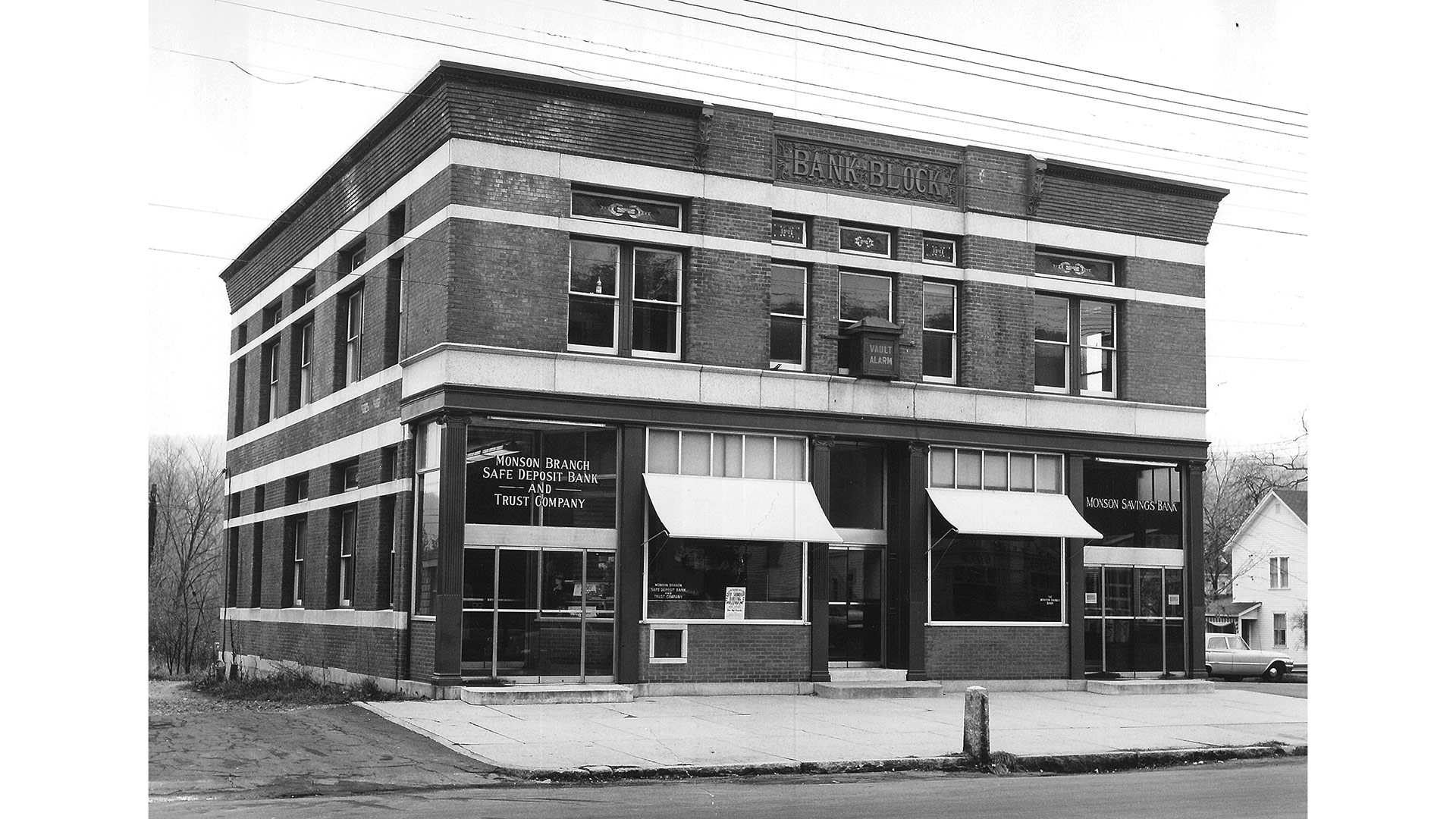
Monson Savings Ba

Monson Savings Bank has retained its original name and home city for 150 years, a rarity in the banking world.

He’s presently training with long-time friend and Ironman coach Kevin Moloney, who took the 60-mile ride with him. He’s also mapping out a course, one that will essentially take him on the 60-mile loop twice, with an additional loop, totaling 30 miles, tacked on.

As he said, it’s a work in progress when it comes to planning the ride, choosing a beneficiary, and filling in other details. And this ride will, as noted, will be a capstone — along with a formal gala in September to be attended by employees, board members, and plus-ones (total guest list of … you guessed it, 150) — to what has been a full year of activities marking the bank’s milestone.

Recapping them, Caitlin O’Connor, vice president and Marketing officer, said there has been a wide variety of events and programs, from the burying of a time capsule to the commissioning of a painting of the bank’s first president, Charles Merrick; from a traveling historical display featuring antique currency to monthly $150 cash prizes; from the placing of a marker where the original bank building stood at the corner of Main and State streets in Monson to several build-a-bike initiatives, whereby bank employees have assembled and donated $15,000 worth of bicycles to several nonprofits in the area, including I Found Light Against All Odds, Educare Springfield, and the South End Community Center.

“We had a ‘Cheers to 150 Years’ event starting on March 19 to really kick things off; that’s was an employee event and the starting point,” O’Connor told BusinessWest. “And from then on, it just grew and took on a life of its own. We had very big ideas, and I’m happy to say that we made most of them happen — and very successfully.”

Collectively, these events and programs have punctuated the bank’s place in the community — literally, as with the marker placed at the original bank location, but also figuratively, as a community bank that is very much involved in the cities and towns where it has locations, and the region as a whole, Rouette noted, adding that the 150th anniversary has been a great vehicle for making introductions, forging new relationships, and reinforcing existing ones.

“What a great way to walk into a nonprofit that you’re hoping to bring into the bank or a commercial or residential customer,” he said of the celebration and everything that it conveys about the bank, its history, its stability, and a future that will look very much like the present and the past.

“It’s an opportunity to give them your story — who you are, what you’re about, and your overall legacy,” he went on. “People want to do business with people that have been around, that are part of the community — not just here today and gone tomorrow, but institutions that are truly the cornerstone, the bedrock of the area.”


The Ride Stuff

That word ‘area’ has taken on new meaning for MSB since its last major anniversary — its 100th, in 1972 — and especially since 1998.

It was during that year that the bank opened its first location outside of Monson, a branch in Hampden. Five years later, a third branch was opened in Wilbraham, and new locations were added in Ware in 2103 and East Longmeadow in 2020. During that same memorable year, MSB’s Loan and Operations Center moved to a state-of-the-art facility in Wilbraham.

‘Build a Bike,’ where employees assemble bikes and donate them to area charities

The 150th celebration has featured a number of programs and events, including ‘Build a Bike,’ where employees assemble bikes and donate them to area charities, in this case, I Found Light Against All Odds.

With these moves, the bank is now serving a much broader area and becoming more involved in the region’s unofficial capital, Springfield, and serving a broader demographic mix of commercial and residential customers, said Dina Merwin, senior vice president and chief risk and senior compliance officer for the bank.

“We’ve well beyond the towns in which we have branches, and so we recognize that we want to reach all potential customers in our market,” she explained. “We recognize also our desire to include financial inclusion in reaching all potential customers in our market, whether that cuts across lines of income levels, race, ethnicity, and any other basis.

“Many of our recent events were focused in the Springfield area,” she went on, “while we continue to support and celebrate all the communities in which we are committed. We also recognize that there have been some demographic shifts in our market area in age and different types of population, so it’s important for us to recognize that and make sure we’re inclusive in all our efforts.”

While the area being served by the bank has changed, the name over the growing number of doors hasn’t, said Moriarty, noting that his institution, unlike many others, has chosen to keep the name of the community where it began as part of the brand, as well as that word ‘Savings.’

“I think the recession will be short and challenging, but I think Monson Savings and other banks are positioned well to weather, manage, and help customers through this period.”

“We’re going against the grain on that in some respects,” he noted. “Mike and I met with the board of directors during a strategic planning session, and we feel that the reputation that the bank has built the past 150 years does mean something, and we believe it’s recognizable in the community. We want to leverage that from a standpoint of legacy — Monson itself, where it all began — and then ‘Savings’ connoting security and trust, even though we feel we are a commercial player in the market.”

Indeed, while celebrating its 150th anniversary in all those ways mentioned above, MSB has also been carrying on with business, said Moriarty, noting that it has been a solid year in many respects, despite a sagging economy, with continued growth in commercial lending and, overall, a $30 million increase in total assets, bringing the bank near the $650 million mark.

“We’re working to strengthen existing relationships while also fostering new ones across the board, from individuals to businesses,” he said. “We’re trying to help them navigate where this challenging environment is going.”

On the commercial-lending side of the ledger, an already competitive landscape has become even more so as rates start to edge up, said Rouette, adding that many businesses are being more cautious amid general uncertainty about where the economy is headed and, overall, a decline in confidence.

“You’re seeing a bit of a slowdown, especially as people hear of the inflationary environment we’re in,” he went on. “People are pushing back potential projects that they have; maybe they were going to start in the third quarter or fourth quarter of this year, and now they’re saying, ‘let’s pump the brakes a little bit and possibly look at next year and see where we land from a rate standpoint and with the economic environment.’

“We had a great first and second quarter,” he went on. “But when you’re out talking to customers, you can hear the apprehension and cautious tone of voice that business owners are using right now.”

Moriarty concurred, and noted that a recession is now more likely than not, in his opinion, and this will add to the many challenges business owners and managers are currently facing.

“I think the recession will be short and challenging,” he said, “but I think Monson Savings and other banks are positioned well to weather, manage, and help customers through this period. And once the Fed gets control of inflation and the employment market evolves a little bit, we’ll see some improvement.”

Looking ahead, and toward creation of a new strategic three-year plan for the bank, Moriarty said a number of topics will be considered, including the need to be more “customer-centric versus product-centric,” as he put it.

“That means that we have to make sure we’re creating frictionless opportunities and delivery systems that make it easy for customers to manage their banking,” he explained. “That includes digital banking; we know we have cutting-edge products now, but we know things are going to change drastically in the next three to five years, so we have to make sure we’re positioned to give those offerings to our customers.

“Artificial intelligence will come more into play in the next three to five years,” he went on. “The usefulness or the quickness with which we can do data analysis of what our customers have and what they need will be important. Customers want to have things at their fingertips; they want to maximize and analyze their financial situation and be able to look forward and make good decisions.”

As for possible geographic expansion, Moriarty said there are many possibilities, and he’s not ready to talk about any of them.

He did say that the consensus among experts in the industry is that the recent pattern of consolidation within the sector will continue, leaving opportunities for smaller, community banks like Monson Savings.

“We feel that we benefit from other mergers and acquisitions because we’ve been around for so long, and we know that where there’s shakeup, there’s also opportunity,” he said. “We’re going to keep an open mind to that.”


Going the Last Mile

Returning to the subject of his planned bike ride, Moriarty joked that now that he’s started to talk about it, he’s pretty much committed to doing it.

He’s training two or three times a week with Moloney and looking at a number of options for which charity or charities (probably the latter) he will be fundraising for.

It’s been a while since he’s taken part in an Ironman competition or even a marathon — he’s run in several of those as well, including Boston a number of times. But he said it’s like … well, riding a bike. Not really, but close.

In any case, like the institution he now leads, he’s proven that he’s in it for the long haul — as in the very long haul: 150 miles for him, 150 years for the bank.

They’ve both put the pedal to the mettle.


George O’Brien can be reached at [email protected]

Education Special Coverage

Grade Expectations

Michelle Schutt says that, while it may seem like Greenfield, Mass. is a long way from Twin Falls, Idaho (3,160 miles, to be exact), it’s really not.

At least when it comes to the issues and challenges facing the institutions that now comprise the top lines on her résumé — College of Southern Idaho (CSI), where she was vice president of Community and Learner Services, and Greenfield Community College (GCC), where she started just a few weeks ago as the school’s 11th president — and their overall missions.

“There are many similarities between these communities,” she explained. “There’s a high number of first-generation college students, people who are hungry for educational opportunities, definite need within the community … they are very much alike, which lends itself to the applicability of what I’ve done in the past and what I hope to do the future. I’m a big believer that education opens doors and changes family trees, and that we can all be educated.”

Schutt comes to GCC with a résumé that includes considerable work in the broad realms of student services and diversity, equity, and inclusion, and she said this will be one of the main focal points at GCC.

“If we’re going to recruit and retain students,” she told BusinessWest, “we’ve got to take into account their entire experience because often, it’s not the academic rigor or even the finances that keep them from succeeding; it’s the social-capital issues of how they’re maneuvering through life.

“COVID definitely exasperated the social needs of our students,” she went on. “But they were always there.”

Regarding diversity, she said this issue is often looked at through the lens of ethnic diversity — and that is certainly part of it. But there are many aspects to this matter, some more visible than others, and they must all be considered at institutions like GCC.

“If we’re going to recruit and retain students, we’ve got to take into account their entire experience because often, it’s not the academic rigor or even the finances that keep them from succeeding; it’s the social-capital issues of how they’re maneuvering through life.”

“It’s a little cliché, but this is a bit of an iceberg topic,” she explained. “There are the physical things that we notice about each other, and then there’s the 90% of the iceberg that’s below the water line; you really need to get to know someone before you can fully understand how they, too, are diverse.”

Schutt told BusinessWest that, after more than 20 years of work in higher-education administration — work that had taken her from St. Cloud, Minn. to Hanover, Ind., Laramie, Wyo., and then Idaho, she considered herself ready to be a college president, and began looking to apply for such positions.

This recognition didn’t come overnight, she said, and it was actually several years after the then-president of CSI asked her to consider that position before she considered herself truly qualified and ready to take the helm at a campus.

She said she looked at a few opportunities that presented themselves — there have been a number of retirements and shifts in leadership in higher education (as in other sectors) over the past few years — but soon focused her attention on GCC.

Schutt said the school — which this year celebrates its 60th anniversary — and its mission, the area it serves, the team in place, and the institution’s prospects for future growth and evolution all appealed to her.

Her immediate goals are to become acquainted with the school, its staff and faculty, as well as Greenfield and the broader area served by the college.

Looking longer-term, she said she wants to properly position GCC for a future where enrollment will be even more of a challenge than it is today, and where students’ ‘needs,’ a broad term to be sure, will only grow.

“Nationally, we’re heading for an enrollment cliff,” she said, adding that 2025 is the year when already-declining numbers are expected to reach a new and more ominous level. “We have to ensure that we’re offering what people need and what people are looking for; we have to take a look at what we’re doing in workforce and in community education and what we’re doing with credit-based courses, and align those with good outcomes.”


Course of Action

As noted, Schutt brings to GCC a résumé dominated by work in student services, with a focus on diversity and inclusion.

At the College of Southern Idaho, where she started in 2015, she held several positions, starting with associate vice president of Student Services, then vice president of that same department, and, starting just last year, vice president of Community and Learner Services.

“If they’re stressed about some sort of insecurity or some issue related to childcare or transportation, it’s really difficult to focus on calculus. That’s where student affairs and student services come in — to educate the entire student.”

She lists a number of accomplishments, including a sharp rise in enrollment for the 2020-21 school year; steady increases in Hispanic student enrollment, from 17.8% in 2015-16 to 26.3% in 2109-20; and improvement in the graduation rate from 20% in 2016 to 34% in 2020.

But she believes many of her most significant gains came in the realm of diversity, equity, and inclusion.

Indeed, Schutt noted that, in helping CSI become a Hispanic Serving Institution (HIS), she recruited and hired bilingual staff members for each area of Student Services, spearheaded CSI’s first HIS Week, lobbied the board of trustees for gender-neutral bathrooms on campus, developed and offered a program called Parent College in both English and Spanish, established the Gay-Straight Alliance student group, and advocated for and hired the school’s first full-time veterans’ coordinator.

Prior to CSI, she served as director of Student Affairs at Penn State University’s campus in Scranton. As a member of the school’s senior administrative leadership team, she was engaged in strategic planning, policy development, and problem solving.

She said that she gravitated toward work in student services (she also teaches) because of its importance to the success of not only students but the institution in question. Summing it up, she said such work falls into the realm of student success and making sure they can get on — and stay on — a path to achieving their goals, whatever they may be.

“It’s about ensuring that their housing and food and social integration and mental health and physical health are all taken into account as it relates to their journey,” she explained, “because all of those things play a factor in their academic success.

“If they’re stressed about some sort of insecurity or some issue related to childcare or transportation, it’s really difficult to focus on calculus,” she went on. “That’s where student affairs and student services come in — to educate the entire student.”

When asked what she liked about this aspect of higher education, she said there are many rewards that come with it, especially those derived from helping students clear some of the many hurdles to success.

“I love that we’re able to help each and every student achieve their goals, and that we are looking at them as individuals, as humans, and not another person in a seat, and that we’re educating the whole person.”

“I love that we’re able to help each and every student achieve their goals, and that we are looking at them as individuals, as humans, and not another person in a seat, and that we’re educating the whole person.”

Looking to take her career in higher education to a higher plane, Schutt looked at several job opportunities, but eventually focused on the presidency at GCC because of what she considered a very solid match.

Compatibility was revealed the initial interview, conducted via Zoom, and then reinforced at a day-long, in-person session, during which she met and took questions from several constituencies, including faculty, staff, students, and other stakeholders.

“There is a shared set of values that focuses on students and recognizes the importance of community integration for a community college,” she said when asked what she came away with from that day’s experiences.

“When I came to campus, it was validating to meet people who truly care about students,” she went on. “And that was conveyed in every group that I met with; that was conveyed by the students — that they felt they were cared for. And those things are really important to me; you can’t make that up. And the end of the day, if you don’t care about students, the students know that.”


School of Thought

As noted, Schutt will bring a deep focus on the importance of equity, diversity, and inclusion to her new role, noting that, while she has always had an appreciation for these matters, it reached a new and much higher level through her experiences teaching English and social justice.

“I was teaching in the evening, when we had the greatest diversity of students,” she explained. “And to understand the general college-student experience was really eye-opening to me and made me a better administrator.

“That’s because, as a vice president, you see the highly successful students, or the students who were in great despair, who may not persist no matter how we helped them,” she went on. “To see the 40-year-old mom coming back to school, the 16-year-old dual-credit student, the student with limited English acquisition, the working dad … all those people coming together in one class really opened my eyes to the immense diversity in who we educate in community college.”

At CSI, Schutt said, it became a priority for the school to become a Hispanic Serving Institution, and the many steps taken to achieve that status became learning experiences on many levels. And, ultimately, they helped enable the school to better serve all its students.

“We worked really hard to make sure we were understanding the Hispanic student experience and that we were ensuring equitable outcomes and inclusionary practices,” she explained. “There were always critics who would say, ‘you’re focused on Hispanic students only.’ Well … no, we were making all our practices and policies better for all of our students.

“We worked very hard to get designation, but along the way, we also worked on broadening our understanding and awareness of all students,” she went on. “I lobbied in front of the board of trustees for more gender-neutral bathrooms and started a food bank and made sure we had a full-time veterans’ coordinator. Those are things that improve opportunities for all our students.

“When we’re taking about equity, we’re making sure that everyone has the same opportunity,” she continued. “But how they get there may look very different, and the inclusion component of it is celebrating those differences, and there’s a lot of work to be done — in the field, in society — and Greenfield isn’t any different.”

Elaborating, she said it’s one of her goals to soon have an administrator focused specifically on diversity, equity, and inclusion, a broad realm that, as she said, goes beyond ethnic diversity and to those matters below the tip of the iceberg.

“DEI here might look at educational attainment, it might look at poverty and wealth inequities, it may include LGBTQ identities — there’s diversity everywhere,” she said. “We can’t say, ‘we all look the same here in Greenfield or in the Pioneer Valley, so there is no diversity.’ Diversity is everywhere; it just may not be as obvious.”


Class Act

Looking ahead, Schutt said she’s looking forward to filling her calendar with meetings with local officials and members of the business community as she works to gain a broader understanding of the community served by the college.

She’s also looking forward to the fall, and a projected increase in enrollment as the school looks to fully recover from the pandemic and its many side effects, as well as the coming year, an important milestone for GCC as it celebrates 60 years of growth and change.

Mostly, though, she’s looking forward to continuing what has become, in many respects, her life’s work in student services and diversity, equity, and inclusion.

As she said, if schools like GCC are to successfully recruit and retain students, they must take into account their entire experience. And this will be the focus of her efforts.


George O’Brien can be reached at [email protected]

Innovation and Startups Special Coverage

Going with the Flow

customer site in Detroit

From left, Aclarity’s Chief Science Officer Orren Schneider, CEO Julie Bliss Mullen, Application Engineer Liz Christ, and Senior Operations Engineer Chris Hull at a customer site in Detroit.

They’re called per- and polyfluoroalkyl substances. But they’re known by a much simpler, and more troubling, moniker.

“They’re nicknamed the ‘forever chemicals’ because they don’t break down in nature,” said Orren Schneider, chief science officer at the Hadley-based startup known as Aclarity. “The bonds in them are so strong that essentially nothing natural breaks them down. Maybe if you hit them with lightning, they’ll break down.”

Lightning isn’t exactly a feasible solution. But Aclarity — which has made waves (no pun intended) in the water industry with a its novel electrochemical approach to combating pollutants — offers a better one.

“We can actually destroy these compounds and break them into their component parts,” Schneider told BusinessWest. “There’s a big focus at the state level — and also starting at the federal level — on how to get these compounds out of the environment.

“The reason they’re there is they’re incredibly useful in a lot of different consumer and industrial products,” he explained. “Scotchgard, for instance. They’re also used in firefighting foam to help put out fires. They’re used on pizza boxes and Chinese food containers. So they’re very useful, and those same properties that make them useful make them difficult to break down. Right now, our main focus is, how do we break these down?”

Several years ago, BusinessWest told the early part of the Aclarity story, of how CEO Julie Bliss Mullen, as part of her PhD research, discovered an electrochemical technology that could treat water by passing a small electric current through it to destroy contaminants.

“They’re nicknamed the ‘forever chemicals’ because they don’t break down in nature. The bonds in them are so strong that essentially nothing natural breaks them down.”


It immediately stood out from other solutions on the market due to both the lack of resulting waste products and its versatility. So in 2017, she co-founded Aclarity, which won the top award at the UMass Innovation Challenge, claiming $26,000 in seed money to help jump-start the company.

Julie Bliss Mullen co-founded Aclarity to sustainably and cost-effectively clean the world’s most challenging waters.

Julie Bliss Mullen co-founded Aclarity to sustainably and cost-effectively clean the world’s most challenging waters.

Essentially, she explains, electricity is applied to an anode and cathode, water flows through the reactor, and contaminants are destroyed by strong oxidants such as free electrons (which break the PFAS bonds), hydroxyl radicals, ozone, and chlorine that are generated inside of the Aclarity reactor. The result is harmless byproducts — essentially water that is free of PFAS and other harmful contaminants.

“Think about a battery,” Schneider said. “You have electrodes in there, and it takes chemical energy and turns it into electrical energy. We do the opposite. We put electrical current into the electrodes, and chemistry occurs. What we’re trying to do is break down a lot of different chemicals that are found in water. And most of the ones we’re focused on right now are PFAS.”

Aclarity isn’t the only company trying to develop a workable and scalable solution for this type of water pollution, he added. “The first company that can commercialize a product that can destroy these compounds is going to be a big winner. And we think we are in the lead there. We know the technology works, and now we’re just figuring out how to make a product that we can sell to do it.”


Water, Water Everywhere

Schneider said the original product was just a small reactor that could handle a couple of gallons a minute, which proved out the technology.

“We used that with potential customers to run samples, run water through it, to show them what we can do,” he said, adding that Aclarity has recently built the next stage, scaling up from a single electrode to 10 electrodes in a reactor, and that is being used to further show potential customers that the system works.

“We’re working right now with landfills; we’re going to be starting a project in Warren at the end of August with one of these pilot units,” he noted. “Landfill leachate looks like Guinness beer when it comes out — dirty, dark brown. We turn it into something that looks a little more like Coors Light. And we destroy a lot of the stuff that’s in there, organic compounds, things like ammonia and PFAS. Landfill leachate is an ideal application for us because it’s really high concentration and relatively low volumes. That really favors our economics.”

Aclarity is also starting a pilot system in North Carolina at a water-treatment plant, working with an engineering firm there. “The levels of PFAS found in drinking water are generally pretty low, and the existing technologies work well to remove them,” Schneider explained, but not destroy them. So after small volumes of PFAS are separated from the water using membranes and a technology called foam fractionation, Aclarity will be on site trying to destroy those compounds.

“The first company that can commercialize a product that can destroy these compounds is going to be a big winner. And we think we are in the lead there.”

“You probably won’t see us bolted onto the end of a water treatment plant,” Schneider said. “In New York City, their small system treats 290 million gallons a day. Their large system, over a billion gallons. We just can’t treat that much. But this particular plant treats about 20 million gallons of water a day, and when you concentrate it all the way through foam fractionation, you might be down to 20,000 gallons, and at that level, that’s something we can treat. So it’s a combination of concentration technologies followed by destructive technologies.”

Meanwhile, in Northern Italy, Aclarity is working with a textile plant, treating PFAS at the factory rather than letting it get out to the enviroment and having to worry about treating it there, Schneider explained.

“One other area we’re looking at is Department of Defense bases and firefighting academies. A lot of these compounds are found in firefighting foam. They’ll spray it down, and it keeps oxygen away and stands up to high heat, but then you have this lagoon of water that’s highly contaminated. So we’re discussing building a mobile treatment system where we can come in, treat the lagoon for whatever amount of time is needed, then move on to the next site.”

Orren Schneider (left) brought decades of experience

Intrigued by the company’s promise, Orren Schneider (left) brought decades of experience in the water industry to Aclarity.

Schneider said Aclarity was looking for someone like him who knows the water industry — he’s been working in it for 35 years — and understands these technologies. And he was intrigued by the potential of Bliss Mullen’s startup.

“There are other emerging destructive technologies out there, but, putting on my scientific hat, my engineer’s hat, I have doubts about some of them, how well they’ll scale up or how much energy they’ll use or the materials that are required. I follow trends of new technologies that come out, and I think electrochemical is the next one that’s really going to make a change and emerge from the lab into something that becomes commercially viable.

“That’s one of the reasons why I joined Aclarity. None of our existing technologies really deal with PFAS well,” he went on. “We can get it out of the water, but we just transfer it to something else, whether it’s a more concentrated water stream or granular activated carbon or ion exchange, but then, what do we do with it? It’s still there. Electrochemistry has promise; we’re showing that we can actually destroy these compounds and render them harmless.”


Listen Up

That result, on a broad scale, would be life-changing for many, Schneider said. And it starts with an increasingly fine ability to detect pollution in water.

“I use this line a lot: one of the best things I learned in high school was that the number-one cause of pollution is analytical equipment. What that means is, if we can’t measure something, we don’t know it’s there. Our measurement technologies are equivalent to a blade of grass in Central Park. It’s that fine; we can find so many things, and we’re finding adverse health outcomes from these compounds.

“The goal is not just removing them, but being able to destroy them to very low levels,” he went on. “We can destroy things down to the limits of detection that we have now, and there’s no scientific reason to think that we can’t go even lower. It’s just a matter of how much money it’s going to cost and how much electricity it’s going to use. But the science is there.”

He’s excited about the flexibility and adaptability of Aclarity’s process.

“While we are focused on PFAS now, there’s a whole market out there that we can potentially deal with. Also, in things like landfills, because we can treat multiple contaminants at the same time, that just makes us more cost-effective. So rather than have technology A for this compound, technology B for that, we can treat both of those at the same time. So, hopefully, we can be not just a solution, but a cost-effective and the go-to solution.”

After all, Schneider said, until PFAS are out of the manufacturing stream and the environment — and that day seems a ways off, to say the least — there’s going to be a need for technologies like Aclarity. “But there’s always going to be something else. The beauty our technology is that it works for so many different things.”

The key to advancing ideas like this and making them marketable is cooperation between government and the private sector, he added.

“We’re a small company. We want to be the industry leader, but it’s going to take a lot of different people, different technologies, different ideas to figure our way out of this problem. We need government support to help drive this; if there aren’t regulations, people aren’t going to pay to treat things they don’t have to.”

His advice to leaders everywhere?

“Listen to the public. This is one of the few environmental issues where it’s not just caught up in the science; the public is aware and want things done. So it’s going to take cooperation between the public, private industry, and government, all coming together to help solve this big issue.

“We’re not a solution looking for a problem,” Schneider added. “We want to be part of solving that problem. I’m a big believer in the public-health part of this as well as the environmental part. I wouldn’t be doing it otherwise.” u


Joseph Bednar can be reached at

[email protected]

 

Community Spotlight Special Coverage

Community Spotlight

By Mark Morris

Mayor Nicole LaChapelle

Mayor Nicole LaChapelle’s priorities have included housing, business development, infrastructure, schools, and the emerging cannabis sector.


When people ask Easthampton Mayor Nicole LaChapelle to list her priorities for the city, her answer is always, “housing, housing, housing, and housing.”

And there’s a reason for that — actually, several of them, which LaChapelle summed up in this poignant way: “Easthampton is the cool-kid city.”

By that, she meant that this former mill town has become a destination for businesses, but also a very desirable place to live because of its arts, culture, attractive neighborhoods, and recreational spaces. That mix has created a need for housing — a major need.

“If we don’t put a huge focus on housing, and if we don’t get housing units done by 2025, our city will be in trouble,” said the mayor, adding that her administration has, indeed, focused significantly on this issue, and it has yielded results, such as the One Ferry project, an initiative that is creating not only new housing but retail and office space as well.

Several old mill buildings on Ferry Street are undergoing a massive effort converting the former factories there to condominiums and rental housing, as well as some retail and office space.

So far, the renovation work has focused on three buildings: 3 Ferry St. was finished in 2020, and it is now fully occupied with residents and several businesses. Meanwhile, 5 Ferry St. consists mainly of apartments with condominiums on the top floor; it is expected to open later this year.

“All but two condos are sold at 5 Ferry St., and the developer reported a 65% lease rate,” LaChapelle said, adding that “70% occupancy is usually the goal for a new development, so they are right there.”

Work has also begun on Building 7, scheduled to open in 2024. When complete, the three buildings will add nearly 150 units of housing to Easthampton.

“The Ferry Street project is what we hoped it would be, a spark for community development and neighborhood pride,” the mayor said. “Watching the progress at the site has been a real confidence booster for the city.”

While housing is indeed a priority, it is just one of many priorities in a community that has seen a great deal of change, evolution, and growth over the past quarter-century, and is poised for more of all the above.

“COVID was a huge challenge for businesses. This site allows them to respond to those challenges and to build more resiliency for changes in the future.”

Other focal points for LaChapelle and her administration include new business development, business-sector recovery from COVID, infrastructure, schools, growth of the city’s emerging cannabis sector, and more, and the mayor reports progress on all these fronts, especially those involving assistance and mentoring to small businesses.

Many are included in a broad initiative called Blueprint Easthampton. Designed to promote entrepreneurial innovation, the initiative also emphasizes partnerships with key constituents in the community such as nonprofit organizations and educational institutions.

Keith Woodruff

Keith Woodruff was one of the first local business owners to open an online store on the Shop Where I Live site.

LaChapelle said Blueprint Easthampton is like an octopus in the way it keeps reaching out to different areas. One notable partnership is with the Coalition for Community Empowerment, a collaboration with the Massachusetts LGBT Chamber of Commerce, the Black Economic Council of Massachusetts, and Lawyers for Civil Rights. They have embarked on a statewide program to provide small-business technical assistance and open paths to entrepreneurs from at-risk populations. LaChapelle said at least a dozen businesses in Easthampton have benefited in some way from this effort.

“At a deeper level, three businesses have received grants, and two others have signed up for extensive business coaching,” LaChapelle said, explaining that startup businesses often have to realign their ideas to serve the market that exists.

“In one case, a baker had a business plan based on a delivery and storefront model,” she noted. “After coaching from the coalition, she realized her idea would work better without the storefront.”

For this, the latest installment of its Community Spotlight series, BusinessWest takes an in-depth look at Easthampton, the many forms of progress being seen there, and what’s next for the ‘cool-kid city.’


‘Shop Where I Live’

In January, LaChapelle began her third term as mayor. Unlike her previous terms, which each lasted two years, the mayor’s term now runs four years. It’s a change that makes long-term planning easier on many fronts.

“With a four-year term, the mayor isn’t distracted with campaigning after only 18 months,” she said. “The longer term also makes it easier to manage the timing of grant cycles.”

The longer term is beneficial when coping with pressing issues, said LaChapelle, adding, again, that there are many of them, especially in a community that has become home to small businesses across many sectors, from technology to the arts to hospitality, that were negatively impacted by the pandemic.

In partnership with the Greater Easthampton Chamber of Commerce, the city secured a grant from the state’s Rapid Recovery Plan, which was set up to address the economic impact COVID-19 had on cities and towns. The grant resulted in an online retail effort run by the chamber known as easthampton.shopwhereilive.com.

Moe Belliveau, executive director of the chamber, explained that the Shop Where I Live program is an Amazon-type experience involving local businesses.

“Many businesses don’t have the resources or the time to set up online shopping, so this site makes that possible,” she said.

Consumers can choose offerings from several local businesses, put them all into an online shopping cart, and make one payment. Because the site is supported by a state grant, it’s open to all Easthampton businesses whether they belong to the chamber or not.

Moe Belliveau

Moe Belliveau said Shop Where I Live will help businesses respond to economic challenges both now and in the future.

“For members, this will be an ongoing benefit,” Belliveau said. “For non-members, the first year is free, then they can choose to join the chamber or pay a service fee to remain on the site.”

Each merchant can offer up to 100 products in their online store, said Belliveau, adding that Shop Where I Live is not restricted to retail operations. Services such as health clubs, web developers, and insurance agents can be found there, too.

“COVID was a huge challenge for businesses,” Belliveau said. “This site allows them to respond to those challenges and to build more resiliency for changes in the future.”

KW Home, an interior-design firm and retail showroom, was one of the first businesses to open an online store on Shop Where I Live. Owner Keith Woodruff expects the site to benefit his business going forward.

“For the last two years I’ve had to operate by appointment only with limited hours,” he explained. “Many consumers are still concerned about shopping in person, so having the online store will be a big help.”

KW Home is an example of a business that provides a service and sells products. Most of Woodruff’s work is driven by working with clients to present design plans specific to their homes and then providing the furniture, lighting fixtures, and other items to execute the plan.

He said 80% of what he sells are special orders for clients. Most items run the gamut from a specific type of fabric for a chair or couch to custom window treatments. He also carries items in limited fabric offerings that are more easily available and work well with the online store.

“In order to make the launch date of June 30, I put only a few items on the site,” Woodruff said. “As this rolls out, I plan to add smaller accessories on there to give people more choices.”


Work in Progress

One of the many disruptions COVID caused was the nature of where people work. Even now, some people have returned to their worksites, some continue to work from home, while others have left their jobs to pursue the business idea they’d always wanted to try.

Amid these changing dynamics, Belliveau conducted research on how best to use the space at the chamber office on Union Street. The result is a new co-work space called Work Hub on Union.

“We’re looking to address folks who still work from home but need a temporary space, as well as entrepreneurs who are just starting out but are not yet ready for a permanent space,” said Belliveau, adding that the chamber will remain on site, so those in Work Hub can benefit from its support.

“We are designing this so the furniture can be moved around to create educational space,” she explained. “We’ll be able to run things like development programs and entrepreneurial support programs. In short, it’s a much more productive use of the space.”

While inclusivity is a big part of Blueprint Easthampton, so is accessibility. Working with two land trusts, the city recently bought 22 acres of land near Mount Tom that connect to state-owned property. The purchase was intended to save the land from development. Instead, that area will soon have an ADA-accessible trailhead that goes up to the summit of the mountain.

“I ran on improving accessibility for everyone, so this project makes me very proud,” LaChapelle said.

Riverside Industries was a partner in the trail project. Located in the center of Easthampton, Riverside’s mission is “empowering people of all abilities to help them achieve their highest potential and live their best lives.” It is best-known for placing people with intellectual and developmental disabilities into employment throughout Hampshire, Hampden, and Franklin counties.

Lynn Ostrowski Ireland, president and CEO of Riverside, said anyone can use the new trail because it can accommodate manual or electric wheelchairs, and the ascent along the trail is no greater than the inclines in Riverside’s Cottage Street headquarters.

As someone who has previewed the trail, Ostrowski Ireland reported the summit view is “beyond spectacular.”

“There are plenty of places along the trail to pull off and take a break or just to stop and enjoy the view along the way,” she said. “We will definitely bring clients there and let their families know about it, too. It’s really something everyone can enjoy.”

Natural surroundings like Mount Tom are part of the attraction for new students at Williston Northampton School. The private college-prep school approaches the fall with a full enrollment. Ann Hallock, director of communications at Williston, said 495 students will be on campus, hailing from all over the U.S. as well as 30 different countries.

“We consider our location in Easthampton to be a unique selling point of the school,” Hallock said. “Students love the location, especially being able to walk into town for restaurants or visit shops or go for hikes on Mount Tom. Parents like all that too when they come to visit their kids.”

Williston students also get involved with several local organizations, such as the Easthampton Community Center and the Emily Williston Library.

When classes begin in the fall, the new Mountain View School, housing students in grades K-8, will be fully open to all its students. As the finishing touches were added this year, middle-school students moved in during the spring. Now that construction is complete, the elementary students will begin their classes at Mountain View in the fall.

With the new school project done, LaChapelle has shifted her attention to finding a reuse for the Maple Street, Center, and Pepin schools, the three buildings replaced by Mountain View. Later this summer, the mayor will issue a request for proposals that she hopes will attract the attention of developers who are planning their next construction season.

Naturally, the mayor would like to see the buildings turn into housing.

“Depending on how they are developed, the three buildings could add as many as 150 rental housing units,” she said. “Realistically, we’re hoping to see 70 to 80 units get added to the housing rolls, with 20% to 25% of those designated affordable.”

The search for a developer comes after 18 months of residents working with a consultant to determine the needs and wishes of each neighborhood where the schools are located.

“It’s exciting because every step of the way, we have been talking with residents about the buildings,” the mayor said. “The residents have done an amazing job, and after all their input, it’s safe to say the people have spoken.”

When the people spoke and voted to allow cannabis sales in Easthampton, no one knew what the impact might be on the city. In the beginning, there were fears of higher crime, underage use of cannabis, and fire-suppression issues in the shops. Now, with five dispensaries operating in the city, LaChapelle said none of those concerns came to pass.

Instead, the biggest effect was increased wear and tear on their roads.

“The revenue we’ve received from cannabis has largely been spent on our roads because they have been heavily impacted with the additional traffic,” she told BusinessWest.

The mayor added that it’s actually good news that the impact was on roads because many of them weren’t in good shape before cannabis came to town.

“We had to reprioritize which roads get paved because suddenly there are thousands more people driving on these roads,” she said.


Bottom Line

Now that the city is in a good place with its budget and has improved its bond rating since COVID, LaChapelle is reflective on how far Easthampton has come.

“I’m super proud of the people in our city departments and their leaders in how they’ve taken all our projects head on,” she said. “I feel we haven’t dropped any of the balls we were juggling before COVID.”

She quickly added that, because Easthampton is such a desirable place to live, there’s plenty of work to be done going forward.

That’s the reality when you’re the ‘cool-kid city.’

Daily News

It took a few years longer than it should have, but sports gambling finally seems to be a reality in the Bay State.

The Massachusetts Legislature has approved a sports-betting bill, and Gov. Charlie Baker has said he will sign it. If all goes well — something that doesn’t happen often in this state — systems should be in place for sports betting for later this year and certainly by the time the Super Bowl rolls around next February.

This news is cause for celebration in the state’s three casinos, which have been pushing hard for such a measure, and for good reason. Gaming revenues have certainly not been what they were projected to be nearly four years after MGM Springfield opened its doors to great pomp and circumstance. And the lack of sports betting has given gamblers one more reason to cross the border and go to facilities in New Hampshire, Rhode Island, Connecticut, and New York. Sports betting seemed to always make sense as a way to help these casinos improve traffic, bring more revenue to the state, and add some jobs. But that didn’t stop the Legislature from doing what it does all too often: sit on its hands.

Indeed, state lawmakers tend to overthink these things, if that’s even the right term, and this leads to indecision. It happened with gaming for several years, and it happened with sports betting as well.

After four years of “painstaking work and research,” as state Sen. Eric Lesser called it, the Legislature was able to come to an agreement on a bill providing for both retail and mobile sports wagering, one that will allow betting on college sports, with some restrictions, and also comes with a number of consumer protections. These include a provision whereby, for online and mobile betting, bets cannot be linked to credit cards — a measure implemented to make sure consumers are wagering with funds on hand and not borrowing.

Projections of revenues vary, but the measure is expected to bring in more than $35 million annually. That’s not a huge number, but right now, it’s money that’s going elsewhere, and that the state could put to good use in areas ranging from workforce development to public health.

The state is once again late to the party. But late is better than never — or even later.

Daily News

BOSTON — The Massachusetts Legislature passed legislation, An Act Relative to Equity in the Cannabis Industry,cthat encourages and facilitates participation in the cannabis industry from communities disproportionally harmed by marijuana criminalization by creating a Social Equity Trust Fund. The bill also strengthens the host-community-agreement process and clarifies procedures for permitting social-consumption sites.

“This legislation will create a more equitable cannabis industry in the Commonwealth, and I am pleased to see it reach the governor’s desk,” state Sen. Jo Comerford said. “I am deeply grateful for the hard work put into this bill by the conferees, led by Senator [Michael] Rodrigues and Representative [Daniel] Donahue. They approached this issue with expertise and compassion, and the resulting bill will bring more diversity and equity to this industry.”

The legislation creates a trust fund to make grants and loans to social-equity program participants and economic-empowerment priority applicants, which will give entrepreneurs from communities that have been disproportionately harmed by marijuana prohibition and enforcement better access to grants and loans to get their businesses off the ground.

Fifteen percent of the revenue collected from the sale of marijuana and marijuana products must be transferred to the trust fund, which will be administered by the Executive Office of Housing and Economic Development in consultation with a newly created Cannabis Social Equity Advisory Board.

The legislation clarifies the Cannabis Control Commission’s (CCC) role in reviewing and approving host-community agreements (HCAs), which are executed between marijuana businesses and their host municipalities. It authorizes the commission to prioritize social-equity program businesses and economic-empowerment priority applicants for expedited review.

The legislation also clarifies the scope of HCAs and adds new criteria. No host-community agreement can include a community-impact fee that is beyond the business’s eighth year of operation, the community-impact fee must be reasonably related to the actual costs required to operate a cannabis business in a community, the CCC must review and approve each host-community agreement as part of the license application and renewal process, and all host communities must establish procedures and policies to encourage full participation in the regulated marijuana industry by people from communities that have been disproportionately harmed by marijuana prohibition and enforcement.

The social-consumption policy, which would allow the sale of marijuana and marijuana products for consumption on the premises where sold, is authorized by existing law. However, this new legislation amends it to ensure proper procedures are taken regarding local initiative petitions. Under this legislation, as an alternative to local initiative petitions, a city or town may also allow for social-consumption sites through the passage of a bylaw or ordinance.

In addition, for individuals seeking to expunge a record for previous offenses that are now decriminalized, this legislation requires the court to order the expungement of the record within 30 days of the request and expunge records for possession of marijuana or distribution of marijuana based on the now legal amount.

“Communities of color across our country have historically been criminalized, prosecuted, and left out of the conversation in regards to cannabis legalization,” state Sen. Adam Gomez said. “When cannabis was legalized in Massachusetts, those same communities continued to be barred from the conversation table and left behind, with historic barriers preventing them from growing small businesses in meaningful ways. The legislation passed by the Legislature will remove those barriers while making changes to expedite the expungement process. It is incomprehensible that anyone who was charged with a marijuana-related offense still has that on their record in our state, especially when you can drive down the street to a dispensary to buy the same product that that person was arrested for. I was proud to support this legislation and can’t wait to see cannabis businesses run by BIPOC owners flourish as a result.”

Having been passed by the Senate and the House, the bill now goes to Gov. Charlie Baker for his signature.

Daily News

SPRINGFIELD — Registration is still open for the 34th annual golf tournament to benefit the Children’s Study Home on Friday, Aug. 5 at the Country Club of Wilbraham. Registration and breakfast will begin at 9:30 a.m., with a shotgun start at 11 a.m. The day will conclude with a cocktail hour, dinner, speaker, awards, and raffles.

In supporting this year’s tournament, sponsors and participants will provide the opportunity for the Children’s Study Home to make much-needed improvements to the Mill Pond School.

The Mill Pond School is dedicated to helping students who experience social-emotional and/or behavioral issues as well as learning difficulties. The staff develop comprehensive, individualized education plans for each student. Students receive academic, therapeutic, and extracurricular services that help them achieve their identified goals and eventually gradate or move on to a new school placement better prepared to cope with and conquer the challenges they face.

“Through the 34th annual golf tournament, we are hoping to raise the $47,000 needed to modernize and improve the Mill Pond Springfield athletic spaces,” said Dr. William Davila, executive director and CEO of the Children’s Study Home. “This includes a new gym floor, scoreboard, bleachers, weight-room equipment, and overall remodel and modernization of the spaces.”

This year’s event will also include guest speaker Kellie Letendre, a former client of the Children’s Study Home, who will be receiving special acknowledgement along with her foster mom, Ms. Ann.

Top sponsors of this year’s tournament include Health New England, Bertera Subaru of West Springfield, Gyre9, and Excel Dryer. To register, attend, or donate to the cause, visit studyhome.org or contact Yamilca Nogue at (413) 739-5626 or [email protected].

Daily News

NORTHAMPTON — Fierst Bloomberg Ohm LLP recently made several personnel announcements.

Michael Simolo joined the firm as a partner. A graduate of Hobert College and Cornell Law School, he has 20 years of experience in corporate matters, tax, estate planning and administration, probate litigation, and related areas. He is admitted to practice in Massachusetts, the U.S. District Court of Massachusetts, and New York.

Daniel Fierst has become a partner of the firm. A graduate of the University of Colorado and UMass Dartmouth School of Law, he began his career as in-house counsel for Wargaming.net in Austin, Texas. Since joining the firm in 2016, he has focused on assisting film, television, and video-game clients with their transactional, licensing, and intellectual-property matters. He is admitted to practice in Massachusetts and Florida.

Frederick Fierst and David Bloomberg were recently named 2022 Massachusetts and New England Super Lawyers. Fierst was honored in the entertainment and sports category for the 15th consecutive year, and Bloomberg in the category of real estate.

Super Lawyers is a rating service of lawyers from more than 70 practice areas who have attained a high degree of peer recognition and professional achievement. Super Lawyers selects attorneys using a patented, multi-phase process that includes peer nominations and evaluations as well as independent research, and selections are limited to the top 5% of lawyers in each state.

Additionally, Global Law Experts named Fierst Bloomberg Ohm LLP the 2022 Massachusetts Media Law Firm of the Year for the 10th year in a row.

Daily News

SPRINGFIELD — Freedom Credit Union recently announced the promotion of Andrew Sullivan from commercial loan officer to assistant vice president, member business lending.

Sullivan has been with Freedom since 2019 and is based in the main office in Springfield. He will continue his role providing financing for new and existing business members along with managing the existing commercial-loan portfolio.

“Andrew joined our team with experience as a small-business lender and portfolio manager and quickly showed his value to our members in his role as a commercial-loan officer,” Freedom Credit Union President Glenn Welch said. “This well-deserved promotion will allow him to continue to serve our members while mentoring others on our lending team.”

Sullivan earned a bachelor’s degree in accounting/business management and an MBA from Elms College. He is also the founder of Andrew Sullivan’s Swing for a Cure to benefit the Cystic Fibrosis Foundation.

Banking and Financial Services

Making Contact

Jeff Sullivan

Jeff Sullivan says New Valley came into the market wanting to cater to small and medium-sized businesses, and that philosophy has served the bank well.

When BusinessWest spoke to Jeff Sullivan in late 2019, about six months after New Valley Bank & Trust opened in downtown Springfield — the first Springfield-based bank to open in more than a decade — he talked about focusing on smaller commercial loans than larger banks prefer to take on, and quick turnaround times as well.

The driving philosophy, amid a landscape of ever-larger mergers and acquisitions in banking, was to serve small to medium-sized businesses in a high-touch way they don’t necessarily experience at large institutions.

That philosophy is still true today — and it works, to judge by the growth of New Valley in its first three years, with 35 employees, just under $300 million in assets, and a third branch set to open in West Springfield in September (more on that later).

“Some of our bigger competitors, just as a function of their size, have to do larger deals. It’s just a math equation; they’ve got to feed a bigger engine,” Sullivan said during our recent visit, noting that many large banks don’t want to focus on deals under seven figures.

“But all those $100,000 and $500,000 relationships really mean a lot to us,” he went on. “We like hitting singles, and we think we do it well; we think that’s an overlooked part of the market.”

While many large banks have long assumed that non-bank lenders, like LendingClub and Kabbage, would grab significant market share in the small-business community, Sullivan said, people still value local banking relationships.

“They say, ‘I know these people, I trust them, and if I have a really bad year or something bad happens to my business, I know somebody at that bank I can call to help me.’ If you’re dealing with an 800 number of a Wall Street bank or a Silicon Valley fintech firm, you’re probably not going to get that level of service.”

And in granting that kind of quick, personal service, Sullivan said the bank is growing the economy by encouraging the region’s extensive small-business ecosystem.

“We just continue to execute on our plan. We have plenty of liquidity, plenty of capital. We can continue to grow for a couple more years with the framework that we have.”

“We serve the entrepreneurs, people with energy and a lot of enthusiasm and optimism by nature. A lot of really smart, enthusiastic people are living here who have good ideas, and turning those good ideas into real businesses is an incredible challenge,” he said. “So, I think our customer base is inherently a little more optimistic about the future and thinking about growth, and it’s great to work with people like that.”

Just past its three-year anniversary — the time when the startup phase is over and regulators “take some of the handcuffs off,” Sullivan said — New Valley is slightly ahead of the pace of its original business plan. Deposit growth is certainly ahead of schedule, but that’s true of all banks after the federal government poured trillions of stimulus dollars into the economy between mid-2000 and early 2021.

But loan growth is on target at New Valley as well, with about $175 million in outstanding loans, about $25 million of that residential and the rest commercial.

“The pipeline is good,” he said. “We’re in a time now when rates have gone up, there’s a lot of talk about a recession, and you hope it’s not a self-fulfilling prophecy, where if enough people talk about a recession, they’ll kind of speak it into existence. We’re cautious about the end of this year and going into 2023, but our pipeline is as big as it’s been. We’re having really solid production months, with lots of new customers signing up with us every month.”

New Valley’s third branch

New Valley’s third branch, at 333 Elm St. in West Springfield, is expected to open in September.

As a result, he expects that outstanding-loan figure to top $200 million by year’s end, and maybe by the third quarter. “We just continue to execute on our plan. We have plenty of liquidity, plenty of capital. We can continue to grow for a couple more years with the framework that we have.”


Over the River

While the last bank launched in Springfield before New Valley, NUVO Bank (since acquired by Community Bank), focused on a mostly digital banking model, New Valley wanted to stress more of a brick-and-mortar foundation. It currently has two branches in Springfield, both downtown and on Wilbraham Road in Sixteen Acres.

A third branch is expected to open in September on a former Holyoke Credit Union site at 333 Elm St. in downtown West Springfield.

“We evaluated it and thought it was a really good opportunity,” Sullivan said. “There’s some old-school thinking that people don’t like crossing the river; they don’t like to be forced to go to downtown Springfield. We had a steady chorus of people saying, ‘could you please open something on the west side of the river?’ So we were pretty sure our next branch would be on the west side of the river, but we weren’t sure exactly where. This opportunity just kind of dropped in our lap.”

One advantage of the new office will be drive-up convenience, which downtown Springfield customers don’t have. But there are other reasons customers value conveniently located branches, even at a time when adoption of mobile and online banking has soared.

“There have been barriers getting to parity. But as those barriers disappear, we’re seeing a swell of Latino and African-American businesses that are starting up — really smart, talented people who are choosing to move to this area because they feel like there are resources here.”

“People say bank branches are going to go away at some point and go fully electronic. But I think there is still a safety blanket when people know there’s a bank branch close to their location, and when they go in for some of the important transactions, like opening accounts or applying for a loan, or when they really need advice, they can show up in person.

“That builds confidence,” he added. “They probably go to our branches very infrequently, unless they’re in some kind of cash business where they have to go all the time. But I think people want to know there’s somebody that they trust within a relatively short drive of where they are, and they can lean on that person if they need to.”

The team at New Valley makes a point of engaging with customers, he added. “If they’ve got any questions, we try to give them advice as best we can. And people are just very appreciative of that. We’re so small that, if I get a call and it happens to be about a customer-service issue, I can run right upstairs and take care of it pretty much on the spot.”

That was especially true during the pandemic, when community-focused banks and credit unions helped customers navigate some truly trying times, with Paycheck Protection Program (PPP) loans and in other ways.

“There’s nothing better than somebody calls a year later and says, ‘I may not have told you at the time, but I was really struggling, and you guys really helped me out.’ That’s always great to hear.”

The pandemic also saw banks expand their digital capabilities as customers embraced those technologies like never before.

“Our industry was behind the curve in terms of adoption of technology in a lot of ways,” Sullivan said. “But since 2020, everybody knows how to use their phone to do their banking transactions. Most people know how to make a deposit with their mobile device. People are more savvy. Banks, as a result of that, are trying to automate more and more their processes.

“With the PPP loans, people could apply online and didn’t have to talk to a human being; they could sign up electronically, and we could get everything done remotely — because we had to do it remotely,” he went on. “Now, we’ve taken those best practices and rolled them into normal post-pandemic business. We want people to be able to go online with a few clicks and apply for a loan, and we can deliver the documents electronically.”

At New Valley — and at most other banks, it seems — there’s certainly a place for both high-tech and in-person services, and neither are fading away.

“It’s not that we don’t want to have those in-person interactions with people,” he added, “but sometimes it’s just a whole lot more convenient to be able to email the documents to somebody, they sign it — whether at 7 at night or 7 in the morning — and it’s back in our inbox the next day, and we take care of it.”


Long-term Partners

Sullivan was quick to tout other aspects of the New Valley task and spending our dollars wisely, and that opens up opportunities for us. While we’re small, we’re not inefficient in terms of our overhead compared to the overhead of a bigger bank. So we have the ability to offer more products to people.”

Meanwhile, the bank’s lenders have met what Sullivan called “a steady stream of people” bringing experience and good business plans to the table, in many cases, but needing help getting to the next level.

“A lot of them are walking in the door with so much growth in front of them, and their biggest question is how to manage it. They’re not asking, ‘how do I start from zero?’ They started from zero, but they’ve gotten to a certain point, and now the hockey stick is going straight up, and the question is how to manage it. ‘Do I have the right management team? Do I have enough employees? Do I have the ability to buy materials?’ Those are good problems to have, but they’re still problems; they’re still challenges.”

Sullivan is gratified that many small-business owners dealing with those challenges locally hail from the Latino and African-American communities, which have been historically underserved by entrepreneurship resources — but that’s changing in Greater Springfield.

“There have been barriers getting to parity. But as those barriers disappear, we’re seeing a swell of Latino and African-American businesses that are starting up — really smart, talented people who are choosing to move to this area because they feel like there are resources here.

“That’s a big part of our business for the future as well, just playing whatever small role we can play in wealth creation for those families, helping them to build wealth for future generations,” Sullivan added. “And hopefully we can hit those singles, and they turn into doubles and triples and the occasional home run, and hopefully we’re with those families, building multi-generational relationships, for a long, long time.”


Joseph Bednar can be reached at [email protected]

 

Education

A Class Act

By Keara Moulton


Educational assistance programs provide access to learning opportunities for staff members to gain new skills and maintain up-to-date knowledge in their field with financial assistance from their employer.

This is a commonly offered employer benefit, but not all business owners might be aware of the current opportunity to expand this offering.

Keara Moulton

Keara Moulton

“Whether your business already has an educational assistance program in place or you are considering providing one as a benefit soon, this can be a great recruitment and retention program.”

The CARES Act of 2020 included an expansion of Section 127, which allows employers to expense payments to employee student loans in addition to previously allowed payments on tuition, fees, books, and supplies. This expansion was extended through Dec. 31, 2025 by the Taxpayer Certainty and Disasters Tax Relief Act.

Whether your business already has an educational assistance program in place or you are considering providing one as a benefit soon, this can be a great recruitment and retention program. With the expansion to include public and private student-loan payments toward both principal and interest, employers have the potential to provide educational assistance not only to employees currently enrolled in courses, but also to recent graduates who are already making monthly payments using their post-tax income.

To qualify as an educational assistance program, the plan must be written, accessible to all employees, and spell out what the money can be used for. The business can either directly pay the educational institution or student-loan servicer on behalf of the employee, or they can pay the employee directly and then potentially request a receipt of employee payments if their specific written plan requires it.

If the total payments for educational assistance are under $5,250, the employee will not be taxed on this additional benefit. However, if the payments for tuition and loan assistance exceed $5,250, the employee would then pay taxes on the overage as it would now be included in box 1 of their W-2.

Recently, we had a local business reach out to inquire about the potential implementation of an educational assistance program that takes advantage of this expansion of Section 127. One of their key questions was ‘is this something you think we should offer to employees, knowing that we handle payroll in house using QuickBooks?’ Ease of implementation to process this pre-tax contribution will vary with the type of QuickBooks product the business uses (i.e. desktop or online).

QuickBooks payroll will need to be set up to accept and track the payments by going through the CARES Act section to check off the applicable pay items to include. With this expansion available through 2025, your employees can benefit from it for more than three years if your bookkeeper can adapt your program to your payroll system now.

This fringe benefit does mean that employees who receive this money will not be able to claim any of the tax-free education expenses (the amount received under $5,250) as the basis for another deduction or credit on their 1040 tax return. This includes the Lifetime Learning Credit and Student Loan Interest Deduction. However, the Lifetime Learning Credit is limited to a maximum of $2,000 per return and is non-refundable. In other words, the employee could use the credit to pay any tax owed, but they wouldn’t receive any of the tax credit back as a refund.

This credit is also phased out completely if the employee has an adjusted gross income over $69,000 as a single filer or $138,000 if married filing jointly. Moreover, the Student Loan Interest Deduction is limited to $2,500 and is eliminated by a phaseout if adjusted gross income is more than $85,000. With the income limits in place on the credits and deductions currently available to individual students and student-loan borrowers, this expansion to Section 127 has the potential to benefit a broader base of employees than the credits and deductions.

If you have any questions about how this might affect your educational assistance program or any other programs, deductions, or credits, please feel free to reach out for detailed tax advice. u


Keara Moulton is an associate at the Holyoke-based accounting firm Meyers Brothers Kalicka, P.C.

Opinion

Editorial


The jersey barriers have gone up on Harrison Place, Dwight Street, and Bruce Landon Way.

They inform us that the Civic Center Parking Garage will soon be coming down — slowly and carefully, we’re told, because there just isn’t much real estate around it to accommodate demolition and all that comes with it.

All we can say is, ‘it’s about time.’

Often, but not always, with demolition, there is a sense of loss when it comes to what is being torn down to make way for the new. It was like that when the old Forbes & Wallace department store came down to make way for what is now Monarch Place. And while you’d have to be pretty old to remember, it was like that when the Everett Barney mansion had to be torn down because it was in the path of I-91.

It certainly wasn’t like that when the Hotel Charles, an eyesore for decades, came down well in advance of the Union Station complex in the North End, or with a number of older industrial properties that were demolished to make way for the new Basketball Hall of Fame along the riverfront.

And it certainly won’t be like that with the parking garage, except for Springfield Thunderbirds management, who face the start of a new season in just a few months with no parking garage next to the arena.

Indeed, the Civic Center garage, the workhorse facility that had served the city for nearly a half-century, had become the butt of jokes in recent years as increasingly larger blocks of its space were declared unsafe for parking.

More than that, the garage had become a symbol, if you will, of what you could call the ‘old Springfield,’ the city that was in receivership, the city that had hit rock bottom in terms of both perception and reality when it came to vibrancy and this being a place where people and businesses wanted to be.

As new developments emerged — MGM Springfield, Union Station, redevelopment of the old Peter Pan Bus terminal, and others — the Civic Center garage remained a crumbling symbol of what was. In recent years, as larger sections were rendered unusable, many who came to downtown every day found other places to park. It was only during college graduations, T-Birds games, the Bay Path Women’s Leadership Conference, and other large gatherings that the garage was a real asset for the city.

Now, after years of elected officials talking about it and considering several alternative sites, the garage is coming down to make way for a new, state-of-the-art facility on that same footprint. There will be some disruption downtown, but not much. Indeed, with many people still working remotely or in hybrid situations, there is plenty of parking downtown to handle what would be considered ‘routine’ days.

Things will get more dicey for the larger events, especially the hockey games. But the disruption will be well worth the eventual benefit — a modern facility in keeping with what the city has become and what it hopes to be in the years and decades to come.
The garage is coming down, and a symbol of the ‘old Springfield’ is coming down with it.

Picture This

Email ‘Picture This’ photos with a caption and contact information to [email protected]


Achieving the Dream

Gateway to College at Holyoke Community College (HCC), an alternative high-school program for dropouts and students at risk for dropping out, has been recognized with a national award for its outstanding graduation rate. The award recognizes institutions that exceed Gateway’s national graduation benchmark of 50%. HCC’s three-year graduation rate was 88%, while the network average was 68%.

Pictured, from left

Pictured, from left: Gateway’s former Special Programs Coordinator Julissa Colon (now director of HCC’s El Centro program), Gateway to College Director Vivian Ostrowski, and Shannon Glenn, Gateway’s resource specialist.


Moment of Gratitude

In a fast-paced work environment and especially over the last few months, the leadership of A Better Life Homecare feel it is important to recognize their workforce’s perseverance and loyalty. To that end, on May 11, A Better Life Homecare honored employees’ dedication by providing them with a dinner at Dewey’s Jazz Lounge in Springfield. The evening served as a time to acknowledge the post-pandemic struggles faced within the healthcare field, as well as celebrating the agency’s ability to overcome obstacles by excelling in communication and unity. Employees shared anecdotes, laughed, and enjoyed the evening together.

A Better Life Homecare honored employees’ dedication by providing them with a dinner at Dewey’s Jazz Lounge in Springfield

A Better Life Homecare honored employees’ dedication by providing them with a dinner at Dewey’s Jazz Lounge in Springfield


Stepping Up for Fitness

Employees at Monson Savings Bank (MSB) outstepped a team of town of Monson employees to win the Monson Step-Up Fitness Challenge, a walking competition run by Health New England. From June 1-21, MSB’s team of 56 employees walked, on average, four and a half miles per day compared with town of Monson employees, who walked approximately three miles per day. In honor of their win, Health New England is donating $500 to Educare of Springfield, the bank’s chosen charity.

Pictured, from left: bank employees Caitlin O’Connor, Dodie Carpentier, Carla Carnevale, and Kandy Tranghese.

Pictured, from left: bank employees Caitlin O’Connor, Dodie Carpentier, Carla Carnevale, and Kandy Tranghese.


Court Dockets

The following is a compilation of recent lawsuits involving area businesses and organizations. These are strictly allegations that have yet to be proven in a court of law. Readers are advised to contact the parties listed, or the court, for more information concerning the individual claims.


HAMPDEN SUPERIOR COURT


Lisandra Virella v. Related Management, LLC and Chestnut Park Reservation, LP

Allegation: Negligent maintenance of the property, violation of covenant of quiet enjoyment: $4,301.64

Filed: 7/14/22


Michael Gosselin v. Commonwealth of Massachusetts, Executive Office of Environmental Affairs, Department of Conservation & Recreation

Allegation: Age and disability discrimination, retaliation: $200,000

Filed: 7/14/22


Letticia J. Chacon v. New England Farm Workers’ Council Inc.

Allegation: Violation of employment contract

Filed: 7/15/22


Evelio Rivera v. Anderson Cleaning, et al

Allegation: Damages to person, labor abuse: $50,000

Filed: 7/18/22


Yolanda Canivares, personal representative of the estate of Ismael Mignucci v. Multicultural Community Services of the Pioneer Valley Inc., Marvin Bosompem, Gustavo Figuereo, and John/Jane Doe

Allegation: Wrongful death, negligence, gross negligence: $50,000+

Filed: 7/18/22


Danny Coles v. Howard S. Ying, M.D.; Lauren Freeland, O.D.; Andrew Wialkowiak, O.D.; Franklin Eye Care Associates, LLC; and Eye & Lasik Group, P.C.

Allegation: Medical malpractice, negligence resulting in personal injury

Filed: 7/19/22


Martin Kucharczyk and others similarly situated v. North Atlantic Trucking Inc. and Nicholas Mercolino

Allegation: Defendant misclaimed plaintiff and others as independent contractors, statutory and common-law violations, failure to pay proper wages and improper deductions from pay: $75,000

Filed: 7/19/22


Automotive Industries Compensation Corp. v. Rodman Ford Sales Inc.

Allegation: Breach of written contract, breach of implied contract, assessment due for workers’ compensation

Filed: 7/21/22


155 Maple Condominium Trust, Martin O’Connell, Salvatore Cangialosi, and Ama Kyereme, trustees v. Zahn Property, LLC and Daniel Cohen

Allegation: Condominium charges, assessments, and fees

Filed: 7/21/22


Mian Yasir Hameed and Afshan Safdar v. Cornerstone Mortgage Corp., its successors, assigns, and/or any persons claiming by, through, or under any of it

Allegation: Seeking to quiet title to premises due to improperly discharged mortgage

Filed: 7/25/22


Tiffany Figueroa v. Armoury Park Gardens and Springfield Gardens

Allegation: Negligence; slip and fall resulting in personal injury: $58,379.87

Filed: 7/25/22


Agenda

New Year’s Eve Party (Take 2!)

Aug. 5: The pandemic may have canceled its planned New Year’s Eve celebration last year, but local comedians are having the last laugh. Happier Valley Comedy is throwing a New Year’s Eve Party (Take 2!) and annual fundraiser where people are invited to come ring in the improvised New Year. Tickets include entry to the party, two tickets to the raffle, finger food, and something fizzy to toast. The festivities take place at Happier Valley Comedy’s Next Door Lounge in Hadley, where partygoers can choose from a curated selection of mostly local alcoholic and non-alcoholic beverages. Ginger Love Cafe Food Truck will be on site, and raffle prizes include goodies from Bueno Y Sano, Animal Alliance Dog Training School, Ecstatic Rabbit Tarot, the Ekus Group, Home Depot, Trader Joe’s, and more.  To purchase tickets to the event and raffle, visit www.happiervalley.com.
 

Brew at the Zoo

Aug. 6: After a three-year hiatus due to COVID-19, the Zoo in Forest Park is bringing back its popular Brew at the Zoo, presented by PDC Inc., from 1 to 5 p.m. The 21+ event features beer samples from local craft breweries, a home-brew competition, food trucks, live music, games, a raffle, and animal interactions. Attendees can choose from four ticket types: VIP, VIP Designated Driver, General Admission, and Designated Driver. Attendees with a VIP ticket will enjoy an extra hour of sampling beginning at noon, the opportunity to participate in up-close animal encounters, and grain to feed the animals. All attendees must be age 21 or over. The current list of breweries attending the event include Loophole Brewing, One Way Brewing, Vanished Valley Brewing Co., Broad Brook Brewing Co., Connecticut Valley Brewing Co., Berkshire Brewing Co., Rustic Brewing Co., Iron Duke Brewing, Two Weeks Notice Brewing Co., Brew Practitioners, and New City Brewery, in addition to nine home brewers. The zoo will be closed to the public on Aug. 6. Advanced tickets are required to attend this event, and IDs will be checked at the door. Tickets are limited and on sale at www.forestparkzoo.org/brew.

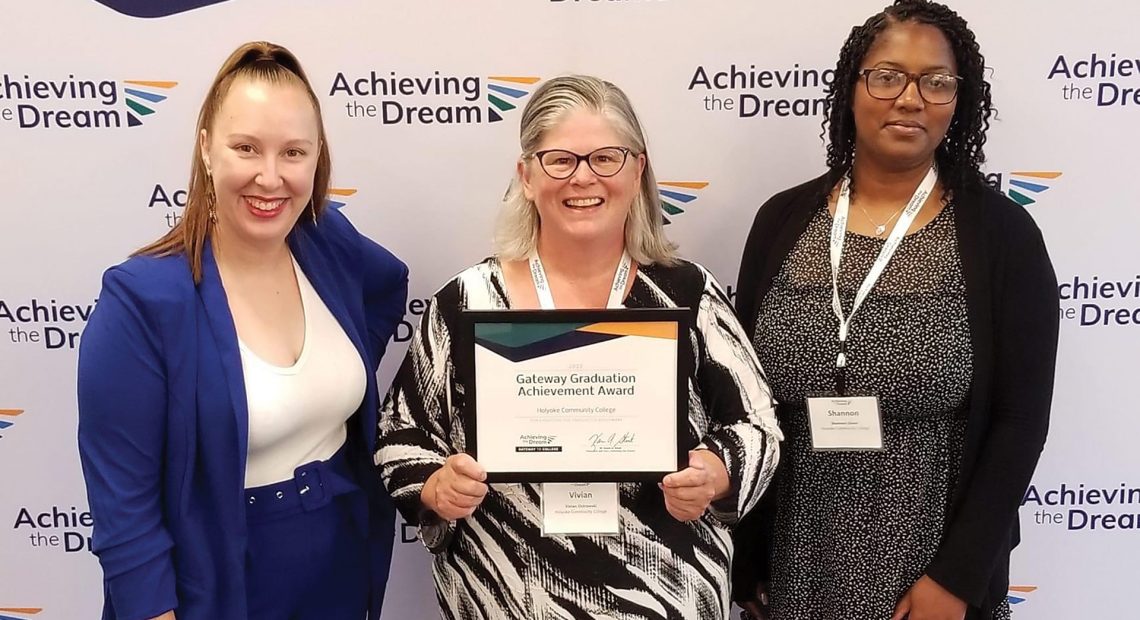
 

Business Resource Expo

Aug. 9: Entrepreneurship for All Berkshire County is coordinating a half-day Business Resource Expo at the Stationery Factory in Dalton. A collaborative effort of EforAll, 1Berkshire, Pittsfield Economic Revitalization Corp., and the Berkshire Regional Planning Council, this event will feature booths from more than 25 organizations that support small business, panel discussions, and plenty of opportunities for networking. Business owners and managers will be able to connect with organizations and programs that have resources to help them, whether with technical assistance, funding or grant programs, marketing, or other advice or support. The program will be valuable for existing businesses, would-be entrepreneurs, and solo service providers and consultants. Participants will be able to access experts through a series of panel discussions led by regional experts, including “Which Organization Can Help Me with What?” moderated by Ben Lamb of 1Berkshire; “Fueling Your Business: Where’s the Money?” moderated by Raymond Lanza-Weil of Common Capital; and “How Can I Find More Customers…What Marketing Works?” moderated by Noah Cook-Dubin of Kanoa Consulting. The event will be inside at the Stationery Factory on Flansburg Avenue in Dalton. Doors open at 8:30 a.m., and the event will conclude by 1 p.m. A networking area will be open throughout the event for one-on-one conversations and meetings. Admission is free of charge, but pre-registration is required at bcbizexpo.com.


Springfield Jazz and Roots Festival

Aug. 12-13: The Springfield Jazz and Roots Festival will be staged over two days this year with a broad mix of music; arts activities; talks on arts, culture, and social justice; and local pop-up crafts, food, and beverages. The internationally heralded festival features national stars and local talent playing jazz, blues, funk, Latin, and African music. Admission is free, but donations are appreciated. This year’s full musical lineup can be found at springfieldjazzfest.com. The festival will also offer a sneak peek (or an unveiling, depending on its progress) of the iconic Worthington Street mural project celebrating Springfield history. The mural is being painstakingly restored by Springfield artist John Simpson, who has studied old photographs of the building’s wall in an effort to accurately recreate as much of the original mural as possible. Musical performances on Aug. 12 feature soul and R&B legend Shor’ty Billups, valley legends FAT with Peter Newland and special guest Scott Murawski from Max Creek, Valley blues/rock icon Mitch Chakour and friends, popular Valley blues rockers the Buddy McEarns Band, and soulful blues belter Janet Ryan and her band. The festivities on Aug. 13 commence at 12:30 p.m. with a parade led by New Orleans ensemble the New Breed Brass Band starting from the Wood Museum of Springfield History, where attendees will have free access to the “Horn Man: The Life and Musical Legacy of Charles Neville” exhibit. The parade will end at the stage for the kickoff performance of the Saturday shows. In addition to the musical performances, the multi-faceted festival will feature various arts activities and presentations and workshops. Puerto Rican jazz trombonist William Cepeda will lead a workshop about traditional Afro-Puerto Rican music on Aug. 12 at 5 p.m. at the Hispanic American Library. Cuban jazz vocalist Dayme Arocena, will lead a workshop about traditional Afro-Cuban music on Aug. 13. Attendees can also participate in a mural paint party (a separate mural project from the one on Friday) and a presentation by Puerto Rican mural artist Betsy Casanas, and conversations connecting arts with food and climate justice.


ACC Car Show and Next Step Registration Event

Aug. 13: Asnuntuck Community College’s (ACC) Advanced Manufacturing Technology Center will host a car show from 8 a.m. to 1 p.m. The day will also include a college-wide Next Step Saturday registration event beginning at 9 a.m. Tours of the Advanced Manufacturing Technology Center will also be held. The car show, located in the college’s back parking lot, near the Advanced Manufacturing Technology Center building, will include music by Cruisin’ with Bruce Marshall. All owners are welcome to bring their cars free of charge, with no pre-registration, and there is no charge to the public to come and view the cars. The car show has a rain date of Aug. 20, with the open house and registration day taking place rain or shine on the 13th. Next Step Saturday helps new and continuing students apply and register for the fall semester. Advising assistance will be offered, and staff will be on campus to assist with questions regarding financial aid and registration. Participants will also be able to learn about the college’s more than 50 academic programs, in addition to Asnuntuck’s Advanced Manufacturing program.


Housatonic Heritage Walks

Weekends from Sept. 3 to Oct. 2: The Upper Housatonic Valley National Heritage Area announced the 20th annual autumn Housatonic Heritage Walks on five weekends: Sept. 3-4, 10-11, 17-18, and 24-25; and Oct. 1-2. More than 80 free, guided walks will be offered throughout Berkshire County, Mass., and Litchfield County, Conn. The public is invited to participate in these family-friendly, informative walks, offered in partnership with our region’s historic, cultural, and outdoor recreational organizations. The Heritage Walks are an ideal opportunity to experience and learn about this region’s rich and varied local heritage. Historians, naturalists, and environmentalists will lead participants on explorations through historic estate gardens and town districts, behind-the-scenes cultural-site tours, nature walks, trail hikes, and tours of many of the industrial-site ruins that were once thriving local industries. There will be Native American and African-American history walks, a canoe paddling trip on the Housatonic River and a bike tour on scenic country roads. Detailed Heritage Walks brochures will be available at libraries, post offices, restaurants, and grocery stores in the region. The schedule is also available at housatonicheritage.org/events/heritage-walks. To request a brochure by mail, email [email protected].

People on the Move
Kyle Toelken

Kyle Toelken

Jean Monska

Jean Monska

Florence Bank hired Kyle Toelken as assistant vice president and branch manager of the Belchertown branch and promoted longtime employee Jean Monska to branch manager of the Easthampton branch. Toelken was hired in May and has 12 years of banking experience. Committed to community involvement, he has volunteered with Junior Achievement of Western Massachusetts, helping present lesson plans to school-aged children. He holds a bachelor’s degree in business management from Franklin Pierce University. Monska has worked for Florence Bank since 2002. Before the promotion to branch manager, she served as assistant branch manager in the Hadley location for 14 years. In March 2020, she was promoted to senior assistant branch manager before transferring to the Easthampton branch in the same role. She holds an associate degree in business administration from Holyoke Community College and a bachelor’s degree in business administration from Southern New Hampshire University. She is also a graduate of the New England School of Financial Studies. In 2005, Monska was named to the Florence Bank President’s Club. The honor recognizes superior performance, customer service, and overall contribution to Florence Bank.

•••••

Bay Path University announced the promotion of Michael Giampietro to senior vice president for Finance and Administrative Services. Giampietro joined Bay Path in 2006 as vice president for Finance and Administrative Services following a 16-year career at Holyoke Community College. A member of the university’s executive staff since arriving at Bay Path, he oversees significant areas of the university, including budget development, human resources, student financial services, facilities and capital planning, the bursar’s and controller’s offices, campus public safety, procurement, auxiliary services, and enterprise risk management. He also serves as staff liaison to a number of Bay Path board of trustees committees and has participated on New England Commission on Higher Education teams evaluating other accredited institutions. Currently, Giampietro serves on the finance committee at Baystate Health, and previously sat on the town of Longmeadow audit and capital planning committees, as well as the finance committee for St. Mary’s Parish in Longmeadow. He holds a bachelor’s degree in history and a master’s degree in public administration from UMass Amherst, and also attended the Institute for Educational Management at Harvard.

•••••

Thomas Dowling

Thomas Dowling

Whittlesey announced the promotion of Thomas Dowling, CPA to partner. He is the newest member to join the growing leadership team. Dowling joined Whittlesey in 2017 and has more than 15 years of public accounting experience with a concentration in assurance, advisory, and tax services for nonprofit organizations and closely held businesses. He has expertise in advising clients on internal controls, fraud risk assessments, and strategic planning, and actively participates in the nonprofit and manufacturing niches. Outside of work, he is a committee member for the Make-A-Wish Massachusetts and Rhode Island Swish Night. Dowling earned a bachelor’s degree in accountancy and a master’s degree in taxation from Bentley University. He is an active member of the American Institute of Certified Public Accountants and the Massachusetts Society of Certified Public Accountants, as well as the Association of Certified Fraud Examiners.

•••••

Julie Copoulos, executive director of the Greater Chicopee Chamber of Commerce, announced that she will step down from the organization on Aug. 19. “Since 2019, I have been supported and challenged by an adaptable and sharp board of directors, cohesive membership, and motivated municipal partners,” Copoulos said. “Together we have served the Chicopee business community in a meaningful and measurable way. I am humbled to have been in your service.” The Greater Chicopee Chamber is actively seeking an executive director who is committed to Chicopee business and community and has a strong background in business, advocacy, and leadership, she noted. To chamber members, she added, “thank you for remaining the heartbeat of our community.”

•••••

Peter Picknelly IV

Peter Picknelly IV

Lauryn Picknelly-DuBois

Lauryn Picknelly-DuBois

Peter Pan Bus Lines’ Peter and Melissa Picknelly announced that their son, Peter Picknelly IV, has been promoted to director of Safety & Security. While in high school and college, Peter IV has worked in both Operations and Customer Service. He recently graduated magna cum laude from Western New England University with a degree in business management. He joins his sister, Lauryn Picknelly-DuBois, who was recently named controller for Peter Pan Bus Lines.

•••••

MOSSO (the Musicians of the Springfield Symphony Orchestra) has named Maestro Kevin Rhodes, former music director of the Springfield Symphony Orchestra (SSO), the ensemble’s artistic advisor. Rhodes’ contract was not renewed by the SSO in 2021, ending his tenure as music director at 20 years. Rhodes was recently appointed chief conductor of the Slovak National Opera and Ballet in Bratislava, the capital city of Slovakia, giving him an artistic leadership role in a European city noted for its cultural diversity. He will continue to serve as music director for the Traverse City Symphony Orchestra in Michigan and as principal conductor of Boston’s Pro Arte Chamber Orchestra. He has been a presence in the major musical capitals of Europe for more than 25 years, with credits including the Paris Opera, the Vienna State Opera, the Berlin State Opera, La Scala of Milan, the Dutch National Ballet, the Verona Ballet, the Stuttgart Ballet, and many others.

•••••

Nicole Acevedo

Nicole Acevedo

Eastern States Exposition (ESE) announced that Nicole Acevedo is the newest addition to the organization’s Marketing department as Communications & Social Media manager. Acevedo graduated from Western New England University in May 2022 with a bachelor’s degree in creative writing. Over the course of her collegiate career, she served as assistant editor of the Westerner, the university’s newspaper; served as hospitality chair for Spring Event, the campus’s largest music festival; wrote and voiced two scripts for WAMC Northeast Public Radio; and was a two-time winner of the BOLD Media Festival’s written category for her prose poems. In her new role, Acevedo will be responsible for print publications and projects, content creation for all social-media platforms, and maintaining a positive and effective presence across the digital spectrum.

•••••

Jane Ralph, executive director of Construct Inc., has been elected to the Massachusetts Nonprofit Network (MNN) board of directors, succeeding Liana Toscanini of the Nonprofit Center of the Berkshires as regional representative. The transition will take place in September. The Massachusetts Nonprofit Network is a statewide organization dedicated to uniting and strengthening the entire nonprofit sector through advocacy, public awareness, and capacity building. MNN represents over 600 members and recently visited the Berkshires to provide policy and program updates. Ralph joins the board as Toscanini concludes a six-year stretch, the term limit for MNN board members.

•••••

Wilbraham & Monson Academy has named former prep and collegiate standout and renowned coach Annie Kandel as head coach of its girls lacrosse team. Kandel will take the helm of the program at the start of the 2022-23 school year. Kandel will also assume the role of director of Parent Programs for the Academy and will coordinate advancement and development efforts with parents, alumni parents, and grandparents. She brings an array of experience in admissions, athletics, and student life from within the boarding school world to WMA. Kandel joins WMA after successful coaching stints at Groton School, Stuart Country Day School, Tabor Academy, Cheshire Academy, Stoneleigh-Burnham School, and the University of Colorado. She has led her teams to multiple state and New England championships as well as an undefeated, untied season. She also coaches for the Baystate Bullets Lacrosse Club. She is a product of independent schools, having been a standout athlete in field hockey, basketball, and lacrosse at Governor’s Academy before excelling in both field hockey and lacrosse at Lehigh University. She earned league, regional, and All-American honors in lacrosse and was named the Lehigh University Outstanding Athlete her senior year. She was also honored as a member of the Patriot League All-Decade team and played for the U.S. Women’s National Team in 1992-93.

•••••

Patrick Carpenter

Patrick Carpenter

With extensive experience in resource development at Holyoke Community College, Boston College, Elms College, and Westfield State University, Patrick Carpenter is joining New England Public Media (NEPM) as senior director of Development. Most recently, he served as director in Institutional Advancement at HCC, where, under his leadership, annual giving increased dramatically, new-donor participation grew substantially, and a multi-year capital campaign was designed. Carpenter was the first Major Gifts officer at Westfield State University and increased private support of endowed funds through his major and planned giving work. He is a sponsor liaison for the Council for Advancement and Support of Education District 1, president of the Southampton Youth Athletic Assoc. board of directors, and has served as president of the Elms College Alumni Assoc. Carpenter holds a bachelor’s degree in English from Elms College and a master’s degree in higher education administration from Bay Path University. He currently teaches sociology at Elms College as a member of its adjunct faculty.

•••••

Holyoke Community College (HCC) Anthropology Professor Vanessa Martínez is the recipient of the 2022 Antonia Pantoja Award from the Latino Scholarship Fund of Western Massachusetts. The award, named after the noted Puerto Rican organizer and education activist, was presented on June 23 at the Latino Scholarship Fund’s 32nd annual meeting at the Log Cabin. The organization presents the award annually to an individual who has made a profound and significant contribution to education, demonstrating a dedication to the academic achievement of Latinx students. Martínez is co-director of HCC’s Honors Program and co-founder of the Women of Color Health Equity Collective, a Springfield-based nonprofit. In addition, her HCC classes frequently engage with community groups and Holyoke schools through service-learning projects. She has been teaching at HCC since 2006. In January, she also received the 2022 Thomas Ehrlich Civically Engaged Faculty Award from Campus Compact, a national coalition of colleges and universities committed to the public purposes of higher education. Martínez was born in San Sebastian, Puerto Rico, and holds a bachelor’s degree from Columbus State University, a master’s degree from Georgia State University, and a PhD from the University of Massachusetts. In 2011, she received the Latino Teaching Excellence Award from then-Gov. Deval Patrick, and was selected in 2015 as a Leadership Fellow by the American Anthropological Assoc.

•••••

Florence Hearing Health Care (FHHC) recently hired two new team members: Susan Pepin-Phillips, practice manager; and Dr. Cassandra Falvey, audiologist. They join Dr. Jennifer Sowards, audiologist and founder; Dr. Anna Niemi, audiologist; and Robin Verteramo, receptionist. Pepin-Phillips forged a career in marketing at two local community banks before moving into practice management at a local dental practice five years ago. She will be responsible for running the business side of the practice, but with her marketing eye, she’ll also be focused on making sure the brand is represented well in the running of the business. Falvey came to Florence Hearing from Baystate Health in Palmer. She has always been drawn to the field of communication sciences and disorders, earning a bachelor’s degree, magna cum laude, in communication sciences and disorders from the College of Saint Rose in Albany, N.Y. in 2015. She then returned home to Western Mass. and earned her doctorate in audiology at UMass Amherst in 2019. Falvey completed her fourth-year externship at Baystate Wing Hospital and Medical Centers, where she continued to work and serve patients until joining the team at Florence Hearing Health Care. She holds a certificate of clinical competence from the American Speech, Language, and Hearing Assoc.

Company Notebook

UMass Amherst Forges Partnership with Kyiv School of Economics

AMHERST — UMass Amherst has signed a series of memoranda of agreement with the Kyiv School of Economics (KSE) to assist students and scholars affected by Russia’s war with Ukraine. UMass Amherst’s new multi-level partnership with KSE will establish several modalities for Ukrainian students and scholars to be part of the UMass academic community. An academic exchange program for students will enable undergraduate and graduate students from Ukraine to study at UMass for a semester or academic year with nearly all costs waived.

In conjunction with the academic exchange program for students, a non-resident, virtual Scholar in Residence program will be created for scholars affiliated with KSE. Selected Ukrainian scholars will collaborate with centers, departments, and faculty at UMass Amherst on relevant research topics virtually and will receive a stipend through the KSE Foundation.

The agreements were finalized between March and July 2022 by KSE President Tymofiy Mylovanov and Rector Tymofii Brik and John McCarthy, now emeritus provost and senior vice chancellor for Academic Affairs for UMass Amherst. Anna Nagurney, professor and the Eugene M. Isenberg Chair in Integrative Studies in the Isenberg School of Management at UMass Amherst, played a central role in driving these collaborative efforts. As a longstanding member of the International Academic Board at KSE, and now also co-chair of the board of directors at KSE, Nagurney was instrumental in nurturing the relationship between the two institutions. Most recently, Nagurney has been a leading expert in providing insights on Russia’s ongoing war with Ukraine.


Arrha Credit Union Opens New Branch in Enfield

ENFIELD, Conn. — Arrha Credit Union announced the opening of a new branch at 231 Hazard Ave. in Enfield, Conn. “Arrha Credit Union will bring hometown banking back,” said Michael Ostrowski, president and CEO. “This location is perfect to make that happen. Rockville Bank, also known as the Savings Bank of Rockville, once held this location, and they had the same style of hometown, superior customer-service banking. We are excited to welcome these customers back and become members, part of the Arrha financial family. This means offering home-style banking to meet the personal and business needs for families, individuals, and businesses.” Amanda Howie, the branch manager, is sought after for her advice on vehicle lending, low-interest credit cards, free checking with convenient app downloads, online banking, and virtual deposits, Ostrowski noted. Adam Baldwin is the assistant vice president, regional branch and Business Development manager. With more than eight years of banking experience, he has been recognized throughout his career as a rising star with superior service awards. He is a Rotarian, on the board of the Enfield Food Bank, and actively involved in the community. Anthony (Tony) Franco is the vice president of Commercial Lending. With more than 25 years in the financial-services and commercial-lending industry, he has been helping area businesses achieve their goals and direct them to what commercial deposits and lending services work best for them.


Springfield Thunderbirds Named AHL’s Team of the Year

SPRINGFIELD — The American Hockey League (AHL) announced the Springfield Thunderbirds as the winner of the President’s Award for the 2021-22 season during the Board of Governors’ annual meeting in Hilton Head Island, S.C. Bestowed upon the team that demonstrates overall excellence both on and off the ice, the Thunderbirds captured Team of the Year honors following a historic season that set team records across a wide range of business categories, including average attendance (5,375), season tickets sold, overall ticket revenue, and corporate sales revenue. The T-Birds achieved these milestones while winning the AHL’s Eastern Conference Championship. This marked the franchise’s first-ever playoff appearance and Springfield’s first trip to the Calder Cup Finals since 1991. See page 4 for much more about the Thunderbirds’ recent success.


Hazen Paper Wins Gold Leaf Award for 2021 Hall of Fame Yearbook

HOLYOKE — Hazen Paper Co. was presented a Gold Leaf Award by the Foil and Specialty Effects Assoc. (FSEA) at Amplify: the Print, Finishing, and Embellishment Event, held recently by FSEA and the Assoc. for PRINT Technologies in Minneapolis. Hazen garnered recognition in the category “best use of overprinting foil” for the 2021 enshrinement yearbook produced for the Naismith Memorial Basketball Hall of Fame in Springfield. Hazen used custom holography to replicate the brilliant LED lighting of the iconic Hall of Fame dome, employing edgeless Hazen-Lens technology to create a pulsating play of light in front of a brilliant radial burst of two-channel holography. Treatment of the Basketball Hall of Fame logo also utilized holography to emphasize the basketball’s pebbled texture against the smooth reflective sphere of the dome. The holography was registered to a tolerance of 1/16” for near-perfect alignment during printing. Hazen originated the holography for the yearbook completely within its vertically integrated Holyoke facility. The custom holograms were created in Hazen’s holographic laser lab, then micro-embossed and transfer-metallized onto smooth, 12-point WestRock Crescendo C2S using Hazen’s environmentally friendly Envirofoil process. Agency GO of Hartford, Conn. designed the limited-edition yearbook cover, which was printed and individually numbered for authenticity on an HP Indigo digital press by Starburst Printing of Holliston. Hazen also received a Silver Leaf Award from FSEA for “best use of foil/embossing in a calendar (industry)” on the holographic Hazen 2022 calendar “Here Comes the Sun.


Berkshire Bank’s Foundation Gives $205,000 to Nonprofits

PITTSFIELD — Berkshire Bank recently presented a total of $205,000 in funding to Springfield non-profit organizations during Berkshire’s BEST Community Comeback Tour. The grants aim to help power the financial potential of the local communities the bank serves through organizations impacting the areas of gender equality, small-business technical assistance, housing, neighborhood stabilization, and education. The grants included $75,000 to the Women’s Fund of Western Massachusetts, $25,000 to Revitalize CDC, $5,000 to Martin Luther King Jr. Charter School of Excellence, and $100,000 to Common Capital, a subsidiary of Way Finders.


Berkshire United Way Renews Funding to 40 Programs

PITTSFIELD — Berkshire United Way (BUW) announced renewal funding of $1,029,500 for 40 programs across 24 community partner organizations, providing a much-needed additional year of support. This funding will be for a one-year period, from July 1, 2022 to June 30, 2023, and will continue to stabilize BUW’s three main community-impact areas: early childhood development, positive youth development, and economic prosperity. Visit www.berkshireunitedway.org/our-impact to learn more about the 40 programs. BUW’s investments in these programs support family well-being and address gaps in services in the community. Programs generate a whole-family, integrated approach focusing on educational advancement and economic mobility. A new round of funding requests will be announced in early 2023. To donate to BUW’s fundraising campaign, visit www.berkshireunitedway.org/donate.


Beauty Batlles Lounge Successfully Hosts Comedy Fundraising Event

CHICOPEE — Beauty Batlles recently welcomed the community to its lounge, hosting a successful fundraising event, Beauty Batlles Moving Forward. About 60 guests were in attendance, and all had the opportunity to participate in a silent auction, raffles, and 50/50 drawing, all while enjoying a cash bar and food at the comedy show. With support from clients, family, local business owners, and others in the community, the event raised about $4,000 that will assist Beauty Batlles in its move. The facility will now be able to offer a larger scale of services to its clients and offer new job opportunities at the new location. Beauty Batlles Lounge offers microblading, waxing, lash lift tint, facials, brow lamination, BB glow, and body-sculpting services. It uses cutting-edge technology and medical-grade products to customize treatment to each client’s specific needs. The goal is to deliver self-confidence to individuals who have been struggling with different insecurities, and the support the community has continued to show will help the facility expand to its new location, allowing it to service the community more effectively.


PeoplesBank Named Top Charitable Contributor by Boston Business Journal

HOLYOKE — PeoplesBank’s record-setting charitable contributions in 2021 earned recognition from the Boston Business Journal, as the bank secured a spot on the region’s Top Corporate Charitable Contributors list for the 15th year in a row. In 2021, while focusing on food insecurity, housing, and literacy, PeoplesBank announced record donations reaching $1,315,000, with a total of close to $11 million donated since 2011. The bank has doubled its donations in the last five years. “It is a big part of who we are as an organization, our employees, and how they volunteer in the community,” said Tom Senecal, president and CEO of PeoplesBank. “I see 2022 as a tremendous opportunity for us to give back and be committed to the communities that we serve.” PeoplesBank’s associates donate 10,000 volunteer hours per year, and 74 of them have served on 54 nonprofit boards. The region’s top charitable companies will be honored at the Boston Business Journal’s Corporate Citizenship Awards on the Sept. 8 at Revere Hotel in Boston.


Incorporations

The following business incorporations were recorded in Hampden, Hampshire and Franklin counties and are the latest available. They are listed by community.

AGAWAM

Double Vision Fabrication Inc., 547 Franklin St Ext., Agawam, MA, 01001. Joshua Shea, same. Welding business.

BELCHERTOWN

Law Office of Kara L. Parks, P.C., 16 Blacksmith Road, Belchertown, MA, 01007. Kara L. Parks, same. Law practice.

CHICOPEE

JBC Distribution Inc., 21 Taxiway Dr., Chicopee, MA, 01022. Chad Weatherwax, 59 Fernwood Dr. Windsor Locks, CT 06090. Bakery delivery services.

Trouble Street Inc., 4 Valley Lane, Easthampton, MA, 01027. Norman Amandi, same. Motion picture production.

FEEDING HILLS

The Wellness Point Inc., 569 A Springfield Street, Feeding Hills, MA, 01030. Kelly M. O’Connor, 108 East St. Granby, MA 01033. Acupuncture and all related services.

GREAT BARRINGTON

Finding Peace Farm Inc., 40 Everett St., Great Barrington, MA, 01230. Karen Lindstrom, same. Non-profit organization designed to help horses and humans heal from the trauma of abuse: physical and psychological.

LEE

Burmese Bowl Corporation, 114 Housatonic Street, Lee, MA, 01238. Min Khant, 240 High St., Lee, MA 01238. Restaurant.

MONTAGUE

Dahlia & Moon Inc., 158 Old Sunderland Road, Montague, MA, 01351. Sarah E. Blackmore, same. Hair salon.

NORTHAMPTON

Ecce Arts Inc., 32 Round Hill Road, Unit A, Northampton, MA, 01060. John Aylward, same. Non-profit organization.

PALMER

Able Cleaning and Safety Inc., 241 Wilbraham St., Palmer, MA, 01069. Mendy E. Mota, 269 Ventura St., Ludlow, MA 01056. Cleaning and safety services.

PITTSFIELD

DHC USA Inc., 82 Wendell Ave., Suite 100 , Pittsfield, MA, 01201. Gary Guantt, same. Retail sales.

Gilgamesh Pharmaceuticals Inc., 82 Wendell Ave., Suite 100, Pittsfield, MA, 01201. Jonathan Sporn, same. Research, development, and commercialization of pharmaceuticals.

OMJ Barbecue Company, 15 Crown St., Pittsfield, MA, 01201. Jeffrey A Yeager, same. Barbecue restaurant and barbecue product sales.

SOUTH HADLEY

New England Candle Company Of New England Inc., 117 Main St., South Hadley, MA, 01075. V. James Gagne, same. Manufacture and wholesale of candles.

SPRINGFIELD

Casa De Restauracion Familiar Inc., 329 Central St., Springfield, MA, 01105. Rey Reyes, same. Non-profit organization is founded on prayer, the word of God, unity, the active participation of the believer and a life in love.

Junior Transport Inc., 64 Fresno St., Springfield, MA, 01104. Jose Melendez, same. Trucking delivery service.

STURBRIDGE

AMT Jr. Inc., 103 Shore Road, Sturbridge, MA, 01566. Alfred M. Trifone Jr., same. Engineering services.

WEST SPRINGFIELD

Compass Transportation Inc., 94 Baldwin St., West Springfield, MA, 01089.
Makhmud Kadimov, same. Transportation services.

WESTFIELD

VNG Home Improvement Inc., 46 Western Circle, Westfield, MA, 01085. Valeriy Gavrilyuk, same. Construction services.

DBA Certificates

The following business certificates and/or trade names were issued or renewed during the month of July 2022. (Filings are limited due to closures or reduced staffing hours at municipal offices due to COVID-19 restrictions).

DEERFIELD

Bolton Crest Farm
641 River Road
Donald Bolton

EASTHAMPTON

Acorn Studios and Handyman Services
6 Apple Tree Lane
Jesse Morrisey

AZ Cleaning Services
46 Townhouse Dr.
Atif Mian

Baker Landscaping
9 Stanley St.
Patrick Baker

Barthelette Plumbing
6 Pomeroy St.
Timothy Barthelette

Brayden’s Landscaping
33 Brook St.
Brayden Burgielewicz

Cat’s Cleaning Co.
11A High St.
Allegra Jones

CRP Home Improvement
73 Glendale St.
Corey Pease

Grey Street Photography
173 Main St., Apt. R
Danielle Vengrove

Level Studio Arts
150 Pleasant St., Studio 236
Jena McNerney

Molly Montgomery Keep Easthampton Beautiful
222 Park St.
Molly Montgomery

New England Executive Transport
198 Line St.
Christopher Roy

Prestige Landscaping
164 Everett St.
Gavin English

The Rust Temple
142 Pleasant St., Unit 401
Wouter Schievink

Sacred Roots Healing Yoga, Massage & Wellness
116 Pleasant St., Suite 247
Jennifer Parmentier

TMC Bookkeeping Service
3 Ferry St., Suite 417
Teresa Cotnoir

WT Moore Solutions
20 Davis St.
William Moore

EAST LONGMEADOW

Rockstar Brow Lounge
69 Maple St.
Denise Pelletier

Volo Aero MRO
19-21 Fisher Ave.
Andrew Walmsley

SOUTHWICK

First Choice Staffing Services
32 George Loomis Road
Marc Beaulieu