Daily News

LUDLOW — Sharon Dufour, chief financial officer for Luso Federal Credit Union, and Kimberly Anderson, Community Relations representative for Luso, were recognized on National Financial Educators Day for their hard work and dedication to promoting financial-literacy education in Ludlow, Hampden, and Wilbraham.

Nominated by Junior Achievement of Western Massachusetts, Dufour and Anderson, supported by Luso Federal Credit Union and a grant from the Joseph and Anna C. Dias Family Foundation, help bring financial-literacy education to thousands of youth in the three communities.

Every child in Ludlow schools and St. John the Baptist School, kindergarten through grade 8, participates in a JA program each year, as well as all the students at Thornton Burgess Middle School in Hampden and Wilbraham Middle School. Dufour and Anderson not only secure the funding for the programs, but recruit and train nearly 100 volunteers to deliver the programs. Dufour and Anderson also teach multiple JA programs each year.

“It is important to help our youth develop the skills they will need to manage their personal finances as well as develop work-readiness skills,” Dufour said. “The Junior Achievement program offers an easy-to-follow, age-appropriate curriculum to teach these skills while allowing the volunteer to enrich the program with practical applications from the volunteer’s experience. Working with the students and teachers is a pleasure. I enjoy every minute in the classroom helping the students learn and watching them as they grow more confident in their knowledge and gain new skills each year.”

Added Anderson, “I first became involved in the Junior Achievement program four years ago, and, to be honest, at that point the program was just part of my job. However, as I began to work with the materials and became involved in the classroom, JA is no longer just a job. I look forward to spending time in the classrooms with the students and teacher each year. I encourage everyone to volunteer and become involved in this very important literacy program. The only requirement you need is a desire to spend time with students, as all materials for the program, including volunteer training, are provided.”

Jennifer Connolly, president of Junior Achievement of Western Massachusetts noted that “it is an honor to be able to work with Sharon Dufour and Kimberly Anderson and Luso Federal Credit Union. They both have amazing passion and an enduring drive to make sure that our young people are able to make sound financial decisions in the future. Junior Achievement is proud to be able to support their financial education efforts.”

Daily News

HADLEY — The UMass Donahue Institute released a compilation of results from two years of new employee questionnaires at Plainridge Park Casino. This report is the latest in a series of studies focused on the economic impacts of the gaming industry in the Commonwealth. Representatives from the UMass Donahue Institute presented its findings to the Massachusetts Gaming Commission (MGC) during a public meeting on May 10.

The findings reveal several important characteristics of new hires at Plainridge Park Casino and the emergent casino workforce in Massachusetts:

• 50.1% of new hires worked part-time or were unemployed before obtaining their job at Plainridge Park Casino;

• Major reasons for seeking employment included career advancement, improved pay, and improved benefits;

• 40.1% of new hires said they needed work due to being unemployed, part-time, or underemployed. 86.2% had no gaming experience prior to their jobs at Plainridge Park Casino;

• 96.5% of new hires did not transfer from other Penn National Gaming locations, and 92.8% did not move to take their jobs at the casino. Of those who moved, one-quarter originated from cities or towns within Massachusetts; and

• Nearly three-quarters of respondents come to their job without pre-employment training for their position.

The vast majority of survey respondents are people who are new to the gaming industry and are now being hired for gaming and non-gaming positions at Plainridge Park Casino, including its food-court vendors. Very few workers (only 7%) moved to take their job at Plainridge Park Casino, and those who did were mostly from Massachusetts and Rhode Island. This suggests that most new employees live close enough to commute to their positions at Plainridge Park Casino.

“As we have pointed out repeatedly, the Legislature made broad-based economic development a key focus of the Gaming Act, with a particular focus on local employment for those underemployed and unemployed,” said MGC Chairman Steve Crosby. “This report, thus far, demonstrates that legislative intent is being achieved. We are also pleased to see the implementation of the legislative mandate to objectively and rigorously assess the economic and social impacts of gaming. This report represents one of the many important research topics fulfilling that objective.”

Added Rachel Volberg, principal investigator of the Social and Economic Impacts of Gambling in Massachusetts (SEIGMA) group, “one of the most important positive impacts of expanded gambling is increased employment. However, in assessing the overall impacts of expanded gambling, it is important to understand whether employment gains at the casino result in the loss of employment in other sectors of the economy and in surrounding communities. This report establishes a basis for making this determination going forward and will help us understand the role of casinos in increasing economic activity, and overall employment, in Massachusetts.”

The on-going SEIGMA group, of which the Economic and Public Policy Research (EPPR) team at the UMass Donahue Institute is a part, strives to understand the impacts of the introduction of casinos on the people and economy of the Commonwealth. Of interest in this endeavor is a better understanding of new employment opportunities offered by casino operators and characteristics of the workforce at point of hire. To this end, a survey was designed to gather a range of information on work-related characteristics and aspirations of new employees.

“As our research continues to move forward, we will further refine and expand our data collection around casino employees to better understand issues of professional experience, training needs, and job turnover,” said Mark Melnik, EPPR director. “This information will be critical in understanding the economic impacts of casino workers, as well as ideally helping plan training around casino-employment opportunities.”

Daily News

BOSTON — The Massachusetts Department of Public Health (DPH) recently released its first quarterly opioid report of 2017, which shows an increase in opioid-related overdose deaths attributed to fentanyl and declines in the presence of heroin and prescription opioids in opioid-related deaths.

There are also signs of progress in fighting the opioid epidemic, as the increase in death rates appears to have slowed. Based on estimated numbers, in 2014 there was a 40% increase in the opioid-related overdose death rate from the prior year, in 2015 there was a 31% increase, and in 2016 there was a 16% increase.

“This enhanced level of data collection is a critical resource to help the administration, public-safety officials, and healthcare professionals understand the destructive impact of opioid-related overdoses in every corner of the Commonwealth,” said Gov. Charlie Baker. “We will continue to monitor trends and respond through targeted prevention, treatment, and recovery services to break the negative momentum of this crisis.”

Among the report’s findings:

• The rate of heroin or likely heroin present in opioid-related deaths continues to decline, from a high of about 74% in the second quarter of 2014 to a low of about 33% in the fourth quarter of 2016;

• The rate of fentanyl present in opioid-related deaths reached 77.5% in the second quarter of 2016, from a low of 18% in the third quarter of 2014;

• In the fourth quarter of 2016, prescription opioids were present in 9% of opioid-related overdose deaths where a toxicology result was available. In the first quarter of 2014, when DPH began tracking such data, prescription opioids were present in 26% of overdose deaths with a toxicology result; and

• In the first quarter of 2017, there were approximately 650,000 Schedule II opioid prescriptions reported to the Massachusetts Prescription Monitoring Program, a 23% decline from the first quarter of 2015 and a 13% decline from the first quarter of 2016.

“We continue to invest new resources to strengthen services and to underscore our commitment to an intensive focus on this crisis,” said Health and Human Services Secretary Marylou Sudders. “Commencing in FY18, MassHealth will provide additional funding to expand long-term, residential treatment beds in Massachusetts as a result of our recently negotiated federal waiver.”

Daily News

AGAWAM — The West of the River Chamber of Commerce, in conjunction with the town of Agawam and the town of West Springfield, hosted its first annual job fair on May 10 at Crestview Country Club.

The job fair focused on bringing together, in one room, local business owners looking to hire and people of all ages looking for employment. More than 40 local businesses showcased their opportunities to more than 300 local people looking for employment during this event.

Local vendors included OMG, Big Y, Friendly’s, Six Flags, Dave’s Soda & Pet Food City, Spherion Staffing, U.S. Army, Baystate Health, and many more. The evening was topped off with the awarding of two $500 business grants from the West of the River Chamber Foundation, presented to CHD in West Springfield and Reliable Temps in Agawam, both vendors at the event.

Daily News

PIONEER VALLEY — Residents will have ample opportunity to celebrate bicycling in the region during the 18th annual Pioneer Valley Bike Week starting Saturday, May 13, with local events scheduled in more than a dozen communities through Sunday, May 21.

Part of the larger statewide Bay State Bike Week celebrations, biking enthusiasts will have no shortage of opportunities to get out and join group rides, learn more about bike safety and maintenance, and meet some of the people working to improve biking options in the region.

“Here in the Pioneer Valley, Bike Week has been a yearly staple in the cycling community, and a week of very diverse bicycle-related events that allows riders of all types to celebrate a machine that can be used for transportation, fitness, or just plain fun,” said Sean Condon, MassBike’s Pioneer Valley Chapter president.

Added Wayne Feiden, Northampton’s director of Planning and Sustainability, “our investments in bicycle infrastructure have helped lead to the increase in bicycling we are seeing in Northampton. The financial payoff from increases in public health as a result of increased bicycling alone justify these investments, to say nothing of the fact that these are the least expensive transportation investments we can make per person/mile traveled.”

With more than 35 events taking place across Hampden, Hampshire, and Franklin counties, residents of all ages and abilities should be able to find ideal events for them.

Pioneer Valley Bike Week events are being organized and carried out by local coordinators — a majority of whom are volunteers — and is sponsored by MassBike, the Pioneer Valley Planning Commission, the state Department of Transportation, the Pioneer Valley Transit Authority, and NuRide.

For a full listing of Pioneer Valley Bike Week events, click here, or visit baystatebikeweek.org for more information on Bay State Bike Week in general.

Daily News

SPRINGFIELD — The Springfield Preservation Trust will host its annual Preservation Awards ceremony to honor individuals and organizations that help restore and preserve historic places in Springfield. The event is open to the public and will take place on Wednesday, May 17 at 6 p.m. in Center Court of Tower Square, 1500 Main St., Springfield. The recipients for 2017 are:

• 1104 Worthington Street LLC for sensitive additions to 1104 Worthington St.;

• Demetrios Panteleakis for the restoration of 38 Greenleaf St.;

• Neil Greene for the restoration of 43 Firglade Ave.;

• Three Palms LLC for restoration of 176 Florida St.;

• Colony Hills Neighborhood for advocating for the creation of the Colony Hills Local Historic District;

• The Commonwealth of Massachusetts for the exterior restoration of the Junior Officers Quarters at the 
Springfield Armory;

• The Springfield Redevelopment Authority for the restoration of Union Station;

• CRRC for saving and rehabilitating the Westinghouse Administration Building on Page Boulevard;

• Rod Sitterly for advocating for the creation of the Thomas Wason House Local Historic District; and

• Baystate Health for the saving and moving of 35 Pratt St.

In addition, the Edward Sims Award for Stewardship will go to Deborah Smith for 53 Dartmouth St.; the Robert Holbrook Award for Stewardship will go to Paula Schendledecker for 25 Green Lane; and the George Pooler Award for Stewardship will go to Robert & Patricia Triggs for 21 Greenleaf St.

Photographs of 2017 and previous award winners will be on display at Tower Square through May 21. Photo galleries of previous year’s awardees can be found online at springfieldpreservation.org/preservation-awards.

Daily News

GREAT BARRINGTON — Community Health Programs has named Thomas Walbridge its new chief financial officer. He will oversee the health network’s budget, financial operations, and planning.

Walbridge has served as chief financial officer and vice president for the Kinsley Group Inc. and as CFO for the Pioneer Valley Transit Authority; he was also director of finance and human resources at Six Flags New England. His early professional career was spent in the banking sector in Pittsfield. He holds a business degree from Babson College and an MBA from Western New England University.

“Tom’s background in executive-level financial management, human resources, and business operations suits us perfectly for the CFO position of our growing health network,” said Lia Spiliotes, CEO of Community Health Programs. “We look forward to working with him and welcome him to the CHP team.”

CHP finished its 2016 fiscal year with an operating surplus of nearly $700,000, on revenues of $14 million. During that year, CHP increased its patient and client numbers from 16,000 to more than 22,000, with the addition of two new practices in North Adams and other new-patient outreach. During 2016, employment at CHP grew from 140 to 175 and continues to expand.

Walbridge is also the founder and operator of LuckBridge Sports LLC, a company that creates affordable, inclusive team-building opportunities for youth and coaches in the developmental and advanced instruction of baseball and basketball. He volunteers in his community with youth sports programs, the American Red Cross, the March of Dimes, the Agawam Chamber of Commerce and the Agawam Rotary.

Daily News

HOLYOKE — The Greater Easthampton and Greater Holyoke chambers of commerce have joined together to sponsor their first leadership summit for women in business, titled “Women and the Art of Risk,” on Friday, Sept. 22 from 9 a.m. to 3 p.m. at the Log Cabin in Holyoke.

The conference will feature speakers, workshops, and power-networking opportunities, led by distinguished women from the Pioneer Valley. Registration for this event is now open, and attendance is limited to 150. Click here to register. The cost is $99 if tickets are purchased by Aug. 25 (table of eight: $675).

Call ‪(413) 527-9414 if you would like to sponsor this event. Current sponsors include United Personnel, Easthampton Savings Bank, Innovative Business Systems, Freedom Credit Union, and TurningLeaf Design.

Daily News

SPRINGFIELD — Skoler, Abbott & Presser, P.C. invites business owners, managers, and human-resource professionals to an informative webinar outlining ways employers can build the documentation they need to back up terminating an employee for poor performance and avoid costly lawsuits.

The webinar will be held Thursday, May 25 from 1:30 to 3 p.m. and hosted by attorney Susan Fentin of Skoler, Abbott & Presser, in conjunction with BLR.

“It’s essential that employers create written employment documentation for performance, conduct, and disciplinary issues in a way that’s objective and, most importantly, legally defensible,” Fentin said.

During the webinar, she will explain how to master the toughest aspects of employment documentation; address performance and conduct-based issues with actionable language that focuses on the behavior, not the person; include the right amount of detail in describing the employee’s actions; follow up with the employee to evaluate whether necessary progress has been made; and plan the next steps if the employment issue isn’t improving, and how to document decisions.

Those interested in registering for the webinar can do so by clicking here or by calling (800) 274-6774.

Daily News

SPRINGFIELD — Peter Pan Bus Lines announced a deal Tuesday to move its Springfield operations into Union Station, with a plan to bring 100 long-distance, inter-city buses through the station every day, and carry more than 1 million passengers a year through the facility, the Republican reported.

Peter Pan will rent nine bus berths and 2,000 square feet of interior space, and will also move its ticketing and dispatch operations and its driver’s lounge into Union Station, which is nearing completion of a $94 million rehabilitation. A grand opening is planned for June 24-25.

Daily News

WEST SPRINGFIELD — The Hampden County Bar Assoc. is partnering with Pro-Shred Security and Century Investment Co. to hold a community shredding day on Friday, May 12 from 11 a.m. to 2 p.m. at Century Shopping Center, 219 Memorial Ave., West Springfield.

Shredding protects private information, and recycling helps the environment. This event is free and open to the public (four-box limit) with a donation of a non-perishable food item for a local food pantry.

Daily News

SPRINGFIELD — White Lion Wednesdays return to Springfield on May 17 and will run through August 27, presented by Berkshire Bank in partnership with the Springfield Business Improvement District (BID) and Springfield’s White Lion Brewing Co.

Touted as one of last summer’s “Best Pop-up Beer Gardens” by Food & Wine magazine, Raymond Berry, president of White Lion, said this season will be even better.

“White Lion is ecstatic to kick off this year’s beer garden series in May. Last year’s series had great attendance and obtained national recognition; we will look to capitalize on its success, and we are honored to be part of a collection of creative programs in the heart of downtown Springfield,” he said. “During the series, brewer Mike Yates will introduce a new beer commemorating the grand opening of Springfield’s Union Station. The honorary selection follows last year’s releases, which celebrated the Eastern States 100th anniversary, and the history of Springfield brewing in partnership with the Springfield Museums.”

Again, the Springfield Business Improvement District will host White Lion Wednesdays, rotating between three locations from 4 to 8 p.m.: One Financial Plaza at 1350 Main St., Tower Square Park at 1477 Main St., and the Shops at Marketplace at the rear of 1341 Main St. Each location offers its own unique al fresco experience.

“The simplicity of this event is what people love the most. We provide a welcoming space with White Lion, and we’ve amassed quite a following. Wednesdays downtown are now a time to relax and connect with friends or co-workers in our beautiful outdoor spaces,” said Chris Russell, executive director of the Springfield BID. “This year, we have partnered with the several local purveyors to offer something different at each location. Local musicians perform live every night, and attendees are encouraged to play giant jenga or cornhole, both set out among picnic tables and chairs.”

More details on White Lion Wednesdays, including locations and dates, can be found at springfielddowntown.com/white-lion-wednesdays.

Daily News

SPRINGFIELD — The Professional Women’s Chamber (PWC) announced that Jacqueline Charron, chief risk officer and senior vice president of Operations and Information Technology for PeoplesBank in Holyoke, has been named the PWC 2017 Woman of the Year.

The Woman of the Year award is presented to a woman in the Western Mass. area who exemplifies outstanding leadership, professional accomplishment, and service to the community. This award has been given annually since 1954.

Liz Rappaport, secretary of the PWC board committee, said the selection committee was thoroughly impressed with Charron’s work-life balance, as evidenced by her pursuit of education while managing her career and being the mother of four children.

“The PWC recently had a work-life balance panel at a luncheon, and we loved how, through her application, Jackie personified work-life balance,” Rappaport said.

Charron earned a bachelor’s degree in economics at Mount Holyoke College while working as a teller at PeoplesBank. She went on to receive an MBA from the Isenberg School of Management at UMass Amherst. She has done post-graduate work at Babson College (Mass. Bankers Assoc. School of Financial Studies), Villanova University (master certificate in Lean Six Sigma), and the Dartmouth College Tuck School of Business Leadership Program.

After 32 years, Jackie continues to build a successful career at PeoplesBank, where today she leads a team of 40 associates in deposit operations, information technology, electronic banking, and risk and compliance.

She has served at the leadership level of many community and business organizations, including the Food Bank of Western Massachusetts, Girls Inc., the South Hadley and Greater Holyoke chambers of commerce, and United Way of Pioneer Valley. She also enjoys volunteering at the Holyoke St. Patrick’s Day Road Race and at activities and fund-raisers that support her children’s academic and athletic interests. She can be found working the concession stand at a high-school girls’ soccer game or attending a gala for the Fine Arts Center or Bright Nights.

“We are so fortunate to have Jackie on the Food Bank board of directors and next in line to serve as board president,” said Andrew Morehouse, executive director of the Food Bank of Western Massachusetts. “Simply put, Jackie is committed to our mission. She takes her role very seriously and comes to meetings prepared, having reviewed all agenda materials, and, yes, ready with a boatload of penetrating questions.”

A celebration in Charron’s honor will be held on Thursday, June 1 at 5:30 p.m. at the Carriage House, Storrowton Tavern, 1305 Memorial Ave., West Springfield. Reservations may be made online at www.springfieldregionalchamber.com or by contacting Jessica Hill at [email protected].

“I am extremely honored to have been named Woman of the Year by the PWC,” Charron said. “This award is meaningful to me because it recognizes so many of the things I value and enjoy in my life — family, friends, community, career, and personal accomplishments. I credit my success in managing work life integration to my mother, Priscilla (Brooks) Charron, who taught me that kindness, respect, hard work, and helping others are key cornerstones to strength, ambition, and achievements in the business world and in personal life. When I think of this award, I don’t believe it is based upon just what I have accomplished alone. Instead, I think of what we have accomplished. By working together with my family, friends, co-workers at PeoplesBank, and fellow board members through the years, we have been able to reach our goals, while enjoying the experience and the journey together.”

Daily News

SPRINGFIELD — Healthcare Heroes, an exciting recognition program involving the Western Mass. healthcare sector, was launched this spring by HCN and BusinessWest. Sponsored by American International College, Bay Path University, Elms College, and Renew.Calm, with additional sponsorships available, the program was created to shed a bright light on the outstanding work being done across the broad spectrum of health and wellness services, and the institutions and individuals providing that care.

Nominations are now being sought — and will be accepted until June 29 — in the following categories: Patient/Resident/Client Care Provider; Innovation in Health/Wellness; Community Health; Emerging Leader; Collaboration in Health/Wellness; Health/Wellness Administration/Administrator; and Lifetime Achievement.

The guidelines to consider when nominating individuals, groups, or institutions in these various categories are available at healthcarenews.com and businesswest.com/healthcare-heroes. The nominations will be scored by a panel of judges to be announced in the coming weeks. The winners will be chosen in July and profiled in the September issue of HCN.

Daily News

SPRINGFIELD — The Hampden County Bar Assoc. (HCBA) celebrated National Law Day on May 1 in the Hampden County District Court in Springfield. The theme of this year’s event was “The 14th Amendment: Transforming American Democracy.”

The event was organized by the HCBA President-elect William Travaun Bailey and the master of ceremonies, the Hon. Matthew Shea. Massachusetts state Sen. Eric Lesser was also in attendance to share remarks. There was a presentation by the Mock Trial Team from Pioneer Valley School of Performing Arts as well as the presentation of the prestigious John Greaney awards to attorney Jeffrey Morneau and Jaime Morrow, Hampden County Legal Clinic coordinator.

Daily News

SPRINGFIELD — Pioneer Valley Credit Union (PVCU) announced the recipients of its 2017 College Scholarship Awards. Each year, Pioneer Valley Credit Union selects four deserving students to receive a $1,000 scholarship to help with college expenses. Since the inception of the program in 2000, PVCU has awarded nearly $65,000 to local young adults continuing their education.

The Pioneer Valley Credit Union 2017 College Scholarship recipients are a group of young adults who have proven themselves in the classroom, on the athletic fields, and in various activities and clubs. Dorilyn Castillo of Chicopee High School received the Maurice O’Shea Scholarship. Kaitlyn Feyre of Westfield High School received the Richard Borden Memorial Scholarship. Daniel Sexton of the Springfield Renaissance School received the Ignatius Collura Scholarship. Kamran Noori Shirazi of Springfield Central High School received the Ted Klekotka Memorial Scholarship.

The 2017 recipients were honored at the credit union’s 94th annual meeting. The scholarships are named in honor of board of directors members who have dedicated their time and service to Pioneer Valley Credit Union and to the credit union movement.

Daily News

SPRINGFIELD — Bacon Wilson announce that attorney Kevin Maltby is a recipient of 2017’s Excellence in the Law Pro Bono Award from Massachusetts Lawyers Weekly. He was recognized for his pro bono efforts in connection with the Springfield District Court’s Lawyer for a Day program.

With the support of the Hampden County Bar Assoc., Maltby led the 2012 effort to establish the weekly program, and he is currently working on significant expansion of pro bono services offered by the Hampden County Legal Clinic. He was inspired to initiate the Lawyer for a Day program after taking note of numerous people trying to represent themselves in court, often unsuccessfully, due to their unfamiliarity with the law and court procedures.

In Maltby’s interview with Massachusetts Lawyers Weekly, he humbly refers to the program as “just a place to get an answer.” But colleagues know the program is much more than that. Upon learning of the award, Bacon Wilson’s managing partner, Kenneth Albano, noted that “the Lawyer for a Day program led by attorney Maltby and the Hampden County Bar Association’s Legal Clinic is an incredibly valuable — and successful — service to our community. The program provides free counsel to many people who have nowhere else to turn for legal advice. Bacon Wilson is proud of Kevin’s long record of service to our community, and we are very pleased to see him get the recognition he so richly deserves.”

In addition to the District Court Lawyer for a Day program, Maltby contributes his time to numerous other pro bono programs, including the Massachusetts Bar Assoc. Dial-a-Lawyer program, and the Hampden County Bar Assoc. Lawyer on the Line program. He is the current president of the Hampden County Bar Assoc., where he also serves on the pro bono committee. He is a member of the Massachusetts Supreme Judicial Court’s standing advisory committee on professionalism, and is an adjunct professor at Bay Path University, where he teaches advanced litigation.

Daily News

By Jane Roulier

In schools, on the streets, in relationships, and online, girls in communities across the country are experiencing bullying and harassment. In addition to sexual harassment, many girls experience discrimination based on their race, sexual orientation, gender identity, ability, religion, and more.

Over the past year, one in four high school girls has been bullied on school property, which negatively affects everyone involved — the victim, the harasser, and the bystanders — as well as the learning environment.

While Massachusetts has laws requiring schools to develop and implement plans to address bullying, Girls Inc. of Holyoke recognizes that bullying is not limited to the school grounds. Indeed, the prevalence of social media means that bullying follows girls into their homes and lives outside of school. Children who are bullied often have little reprieve.

To address this pervasive problem, Girls Inc. dedicates Girls Inc. Week 2017, May 8-12, to helping girls advocate for change and make our communities better places to live.

But this is an initiative that goes on year-round — because it must.

Girls Inc. recently surveyed nearly 800 members of our national network, including girls and alumnae, parents, staff, board members, and donors, to determine the top challenges facing girls today. Nearly 70% of respondents identified ‘bullying, harassment, and sexual violence’ as an issue of concern to them. We can’t ignore this. This is a problem that affects us all.

It is important we understand the facts and myths about bullying and harassment in order to effectively address this issue.

Myth: Bullying is just ‘kids being kids,’ and we should stop making it such a big deal.

Fact: Bullying can cause lasting harm. Repeated or severe conduct based on sex or other protected categories is unlawful harassment.

Myth: If it happens off school grounds, it’s not the school’s responsibility.

Fact: Under Title IX, schools have to address conduct they know about, or should know about, that leads to a hostile environment or impedes a student’s ability to benefit from the educational program.

Myth: Bullies are ‘problem kids’ who have aggression issues and should be punished.

Fact: Actually, it is quite common for kids who bully to be victims themselves.

Myth: Bullying will stop only if the victim stands up to the bully.

Fact: Just as society does not expect victims of other types of abuse to “deal with it on their own,” we should not expect this from victims of bullying or harassment.

Girls Inc. encourages girls to be change agents within their communities, boldly advocating for themselves and others. Along with more than 450 other attendees at Girls Inc. of Holyoke’s Spirit of Girls breakfast fund-raiser last month, I witnessed girls doing this. Girls as young as 7 through 17 spoke confidently in front of this large crowd about how the programs at Girls Inc. have impacted their lives by building their self-esteem and encouraging them to make sure their voices are heard. Because of what they are learning, these girls will not be afraid to advocate for themselves or others.

Girls Inc. of Holyoke is also working every day to change policies, attitudes, and beliefs to improve the conditions in which girls are growing up. It takes all of us coming together to ensure that girls feel safe in their schools, in their communities, and with their peers.

Together, we can put an end to bullying and harassment to create more inclusive, kind, safe, and supportive schools and communities.

Jane Roulier is chair of the board of directors for Girls Inc. of Holyoke.

Daily News

SPRINGFIELD — Rhonda Kallman, breast cancer survivor and founder of Boston Beer Co., brewer of Samuel Adams, will be the keynote speaker at the 20th annual Rays of Hope Breast Cancer Survivors’ Day on Saturday, May 13 from 8 a.m. to 2 p.m. at the MassMutual Center, 1277 Main St., Springfield.

After founding Boston Beer Co. at the age of 24, Kallman left the company in 2011 to purse her next challenge, founding New Century Brewing Co., where once again her unique contributions were recognized by her peers, and in 2014 she founded the Boston Harbor Distillery. An acclaimed professional speaker and breast-cancer survivor, Kallman delivers inspiration and motivation to audiences by focusing on entrepreneurial business, sales, and marketing, as well as women’s empowerment and overcoming adversity. During her talk, “Beer Battered: Overcoming Personal Adversity,” she will discusses what it takes to be a leader, how to accept the pitfalls of business and life, as well as having the courage to try again.

In addition to Kallman’s keynote address, participants can select two workshops to attend from, among “Fabulously Functional Fitness,” “Rolling the Dice: Chance, Fate, and Risk — What Would You Do?” “Project Life — Papercrafting with Pocket Pages,” “Treat Yourself — Make and Take,” “Thriving with Breast Reconstruction: Patient Perspectives and New Directions,” “The Healing Labyrinth,” “Updates in Breast Cancer: A Surgeon’s Perspective,” “What’s New (or Not So New) in Breast Prosthesis and Pocketed Lingerie,” and “Healthy Eating for Stronger Bones.”

There will also be two interactive stations from which those attending can choose to participate in during the day. In “Paint Social Art,” local artists will guide painters — no experience necessary — in creating their own mini-painting, which they can display at home. At the “Paper Craft Cafe,” the ladies of Life’s Memories and More will provide a choice of three kits to make on site. Additional kits may be available for purchase.

There will also be networking opportunities throughout the day and the chance to visit with several exhibitors who will sell a variety of breast-related products and more. A continental breakfast will be served, as well as a buffet luncheon.

Registration is required. The cost is $35 per person, with the remaining dollars underwritten by the Rays of Hope. For those unable to afford the fee, a limited number of scholarships are available for breast-cancer survivors by calling Sue-Ann Hilton at the Rays of Hope Outreach office at Baystate Medical Center at (413) 794-9556.

For more information, or to request a registration form, call (413) 794-9556. Also, for more information on Rays of Hope, visit www.baystatehealth.org/raysofhope.

Daily News

NORTHAMPTON — Cooley Dickinson Health Care, the United Way of Hampshire County, and the Jandon Center for Community Engagement at Smith College are addressing the issue of racism, as well as race-related incidents that continue to occur both locally and nationally, by offering a series of community dialogues on race in Northampton and Amherst. Community members who live or work in Hampshire County are invited to attend either of the sessions.

The two-part dialogue will be offered Friday, June 2 from 6 to 8 p.m. and Saturday, June 3 from 10 a.m. to 4 p.m. at the Jandon Center for Community Engagement at Smith College, Wright Hall, 5 Chapin Dr., Northampton. A second two-part session will be offered Friday, June 9 from 6 to 8 p.m. and Saturday, June 10 from 10 a.m. to 4 p.m. at the Amherst Survival Center, 138 Sunderland Road, Amherst.

Event organizers say they aim to move toward solutions rather than continue to express or analyze the problem; to reach beyond the usual boundaries, offering opportunities for new, unexpected partnerships; and to unite divided communities through a respectful, informed sharing of local racial history and its consequences for different people in today’s society.

The community dialogue is free, and lunch will be provided. Attendance is limited to 30 people, and participants must attend both Friday and Saturday. When registering, people will be asked their name, the organization they represent, if any, and their race/ethnicity. Organizers are asking about race/ethnicity as they have a goal of 50% participation from people of color.

To register, call (888) 554-4234 by Tuesday, May 30. You will receive confirmation on whether you have been selected to attend a session.

Daily News

GREAT BARRINGTON — Berkshire Taconic Community Foundation invites regional nonprofit staff to attend “An Afternoon with Tom Ahern,” a two-part workshop on Thursday, June 1 from 1 to 4 p.m. at Jane Iredale Cosmetics, 50 Church St., Great Barrington.

Back by popular demand, Ahern will present two back-to-back workshops: “The Big (little) Diff: Writing for Online Readers,” a discussion of best practices in writing for web, e-mail, and social-media platforms; and “Writing a Powerful Case for Support,” which will review effective fund-raising methods. The New York Times calls Ahern “one of the country’s most sought-after creators of fund-raising messages.”

This event is part of Berkshire Taconic’s popular annual Seminars in Nonprofit Excellence series. Tickets are $40 per person, and light food and beverages will be provided. To register, visit www.berkshiretaconic.org/ahern.

Daily News

SOUTH HADLEY — Residents of South Hadley and Holyoke, and people from around the state and the region, will come together on Sunday, May 7 from 11 a.m. to 3 p.m. for the River Roll and Stroll, an open-streets festival on the Route 116 Vietnam Veterans’ Memorial Bridge, which connects the two communities.

This is a an unprecedented event for the Pioneer Valley; the local MassDOT office has never before agreed to close a bridge to vehicular traffic and open it up exclusively to pedestrians, bicyclists, rollerskaters, or anyone else traveling under their own steam. This event promises one-of-a-kind views of the Connecticut River, the Holyoke Dam, Mount Tom, and numerous family-friendly activities as well.

“We’re going to have lots of entertainers from the two communities, as well as the region — musical groups, street busker performers, face painting, chalk art stations, you name it — not to mention the local food trucks that will be there,” said Mariann Millard, South Hadley co-chair of the River Roll and Stroll steering committee. “It’s going to be a very special, family-friendly event that brings everyone together on the bridge. I’m especially looking forward to the parade and short ceremony honoring our veterans, scheduled for 1 p.m., which will be kicked off by a musket volley from the End Zone Militia who perform at New England Patriots games.”

The River Roll and Stroll is one of many open-streets events that take place around the country. From San Antonio to Cambridge, numerous communities have closed roadways to vehicular traffic for a day and opened them to families, community groups, and entertainment. This year, the River Roll and Stroll will serve as the kick-off event for Bay State Bike Week, put on by MassDOT and the Massachusetts Bicycle Coalition.

“Roll and Stroll will showcase Holyoke’s and South Hadley’s shared commitment to livability and active living,” said Holyoke co-chair Sean Condon. “The amount of community support has been amazing, from cash sponsorships to volunteers to in-kind donations. This event is truly going to set the standard for similar efforts around the Valley.”

The alcohol-, drug-, and smoke-free festival and all of its activities are free to the public except for the food and beverage vendors. To keep everyone safe on the bridge, there will be no coolers allowed and no fishing from the bridge (underneath is allowed) from 10 a.m. to 3 p.m., no climbing on bridge railings, and all dogs must be leashed. The event will be held rain or shine unless the weather is forecasted to be hazardous, which will force a broadcasted cancellation; no rain date is available. Plenty of free parking is available near both ends of the bridge on streets and open lots in South Hadley and Holyoke. Special ADA parking has been designated at the South Hadley police station, 41 Bridge St. The bridge and its immediate entrance areas will close to vehicular traffic from 10:30 a.m. to 3:30 p.m., and detour signs will be posted.

For more information, visit the event on Facebook at www.facebook.com/riverrollandstroll or e-mail [email protected].

Daily News

EASTHAMPTON — Celebrate the creative work coming out of Western Mass. at the Advertising Club of Western Massachusetts Creative Awards 2017, set to take place Thursday, May 11 at the Boylston Room in Easthampton, starting at 6 p.m.

The event will include heavy hors d’oeuvres, drinks, and entertainment — and, most important, the best creative work in the valley. This year, the Ad Club will be handing out over 65 awards honoring creative professionals from copywriters to videographers. The cost is $35 for club members, $50 for non-members, and $20 for students. For more information and to reserve your ticket, click here.

Daily News

CHICOPEE — J. Polep Distribution Services announced its recent acquisition of certain assets, including inventory, from Garber Bros. Inc., other than accounts receivable or its facilities in Stoughton.

J. Polep is now New England’s largest family-owned convenience-store distributor, servicing over 6,000 customers weekly. To balance the continued leveraged growth, J. Polep was able to retain a majority of Garber’s sales force. J. Polep is excited about the opportunities this acquisition gives its employees and customers. Heavy concentration will be on the development and growth of customers’ in-store sales and improving their margin dollars.

With the newly acquired assets, J. Polep will present newly obtained value-added services and food service programs to its customers.

One of the new food-service offerings acquired from Garber Bros. is the popular branded coffee program, Beantown Coffee. J. Polep holds the exclusive rights to Beantown Coffee, allowing customers to have a coffee shop within their convenience stores featuring specialty roasted Beantown blend and flavored coffees, cappuccinos, iced coffee, and beans.

Beantown Coffee is being added to the already extensive hot beverage category at J. Polep, which includes Keurig Green Mountain, Baronet, and New England Coffee.

These assets and operation synergies will give J. Polep a stronger presence within the convenience-store industry throughout the Northeast and will further strengthen its business.

Daily News

SPRINGFIELD — The fifth annual Springfield Dragon Boat Festival will take place on Saturday, June 24 from 8 a.m. until 4 p.m. at North Riverfront Park, 121 West St. in Springfield. Racing begins at 9 a.m. Registration is now open for teams wishing to participate at www.pvriverfront.org/db-fest-reg.

In addition to dragon-boat races, the festival will feature family-friendly events such as music, performances, food, vendors, and children’s activities.

The boat races will have both community and club racing categories. For businesses and organizations looking for a team-building opportunity, the $2,000 race fee includes a coached training session the week prior to the race, the use of boats and paddles, and personal flotation devices. On race day, teams will participate in three 200-meter races. No prior experience is necessary to participate.

Proceeds from the event will provide support for riverfront programs for youth and adults at Pioneer Valley Riverfront Club as it grows and strengthens its presence in Springfield and the Pioneer Valley.

“Our mission is to connect the community to the Connecticut River,” said Ben Quick, executive director of the Pioneer Valley Riverfront Club. “Past community team participants have included MassMutual, Health New England, the Center for Human Development, and more. It is a great way for community groups to have fun and create awareness. They love that they can enjoy a great team-building event and support programs that help our local youth and adults get fit.”

Daily News

SPRINGFIELD — As part of the ongoing BusinessWest and HCN Lecture Series, Comcast Business will host an informative program titled “Big Data … Your Strategic Advantage” on Wednesday, May 10. The event is part of a series of lectures, panel discussions, and presentations that address timely and important business information. This is an opportunity to meet industry leaders and network with area business professionals.

“Big Data … Your Strategic Advantage” will be presented by Dennis Perlot, vice President, Enterprise Architecture at CleanSlate Centers, and former ‘technology evangelist’ at Microsoft and BI specialist master at Deloitte. It will take place at La Quinta Inn & Suites, 100 Congress St., Springfield. Perlot will address how other organizations are using their data to provide them with a competitive advantage. Attendees will learn how data can be analyzed for insights that lead to better decisions and strategic business moves.

On-site parking is available. Registration is scheduled for 7:15 to 7:30 a.m., followed by breakfast and Perlot’s presentation from 7:30 to 9 p.m. RSVP at businesswest.com/lecture-series.

Daily News

BOSTON — Massachusetts employers hit the pause button on a seven-month rally in business confidence during April, but their outlook remained solidly optimistic in the face of mixed political and economic signals.

The Associated Industries of Massachusetts (AIM) Business Confidence Index lost 2.2 points to 60.2 last month, 4.0 points higher than its level of a year earlier. Every constituent element of the confidence index lost ground after reaching a 13-year high during March.

The results came as the Massachusetts economy contracted at a 0.5% annual rate during the first quarter and state unemployment rate rose to 3.6%.

“We should not be surprised to see confidence readings correct slightly after advancing six points since September,” said Raymond Torto, chair of AIM’s Board of Economic Advisors (BEA) and lecturer at Harvard Graduate School of Design. “It bears watching to determine whether the broad April decline becomes a trend as we move into the summer.”

Analysts believe the numbers may also reflect growing concern among employers about the ability of the Trump administration to deliver the many pro-growth policies it promised during the campaign.

The AIM Index, based on a survey of Massachusetts employers, has appeared monthly since July 1991. It is calculated on a 100-point scale, with 50 as neutral; a reading above 50 is positive, while below 50 is negative. The Index reached its historic high of 68.5 on two occasions in 1997-98, and its all-time low of 33.3 in February 2009. The index has remained above 50 since October 2013.

Employers grew less confident about both the overall economy and their own operations during April. The Massachusetts Index, assessing business conditions within the Commonwealth, lost 0.4 points to 63.3, leaving it 6 points higher than in April 2016.

The U.S. Index of national business conditions shed 2.7 points after gaining ground for the previous sixth months. April marked the 85th consecutive month in which employers have been more optimistic about the Massachusetts economy than the national economy.

The Current Index, which assesses overall business conditions at the time of the survey, declined 1.9 points to 59.9, while the Future Index, measuring expectations for six months out, dropped 2.5 points to 60.5. The future outlook remained 3.2 points higher than a year ago.

The Company Index, reflecting overall business conditions, fell 2.6 points to 60.2. The Employment Index fell 2.8 points to 56.2, and the Sales Index declined 2.1 points to 60.5.

The AIM survey found that nearly 39% of respondents reported adding staff during the past six months, while 19% reduced employment. Expectations for the next six months were stable, with 37% planning to hire and only 10% downsizing.

The April survey also reversed an unusual result in March, when Western Mass. companies were more confident than those in the eastern portion of the Commonwealth. Eastern Mass. employers posted a 61.7 confidence reading in April versus 58 for employers in the western part of the state.

AIM President and CEO Richard Lord said employer confidence is facing headwinds from accelerating healthcare and health-insurance costs. Massachusetts has exceeded its objective for healthcare spending in each of the past two years, and employers continue to pay some of the highest costs in the nation.

“The good news is that Massachusetts is beginning to identify some answers. And there appears to be enough common ground and political will on the issue to pursue some solutions,” Lord said. “New research conducted by the Massachusetts Health Policy Commission suggests that Massachusetts employers, insurers, and policymakers could reduce total healthcare expenditures anywhere from $279 million per year to $794 million per year, or 0.5% to 1.3%, by making several key improvements to the healthcare system.”

Daily News

CHICOPEE — For typical youth in their high-school years, summer vacation provides a break from academic and social pressures. But for youth with autism spectrum disorder (ASD), this break in their normal school-year routine can lead to substantial regression.

For summer 2017, the Center for Human Development (CHD) is providing an Extended School Year (ESY) Autism Coaching Program in support of select school districts in Hampden and Hampshire counties. The program, developed by Jennifer Bogin, coordinator of Autism Initiatives for CHD, is designed specifically for a higher-functioning population of youth with ASD. The program was designed for a specific population:

• Diagnosis or presumed diagnosis of ASD/asperger’s, non-verbal learning disability, social communication disorder, or any other disability that leads to social/emotional challenges;

• Co-occurring behavioral-health challenges (depression, anxiety disorder, OCD, ADHD);

• Age 16 to 22;

• Average IQ (either mild or no intellectual disability); and

• Skills deficit in relationship skills, communication, adaptive/life skills, employment/pre-employment, self-regulation, time management, community participation, and self-advocacy.

CHD’s ESY Autism Coaching Program runs from 8:30 a.m. to noon on Mondays, Tuesdays, Wednesdays, and Thursdays from July 5 to Aug. 10. The program is located at Chicopee Comprehensive High School, 617 Montgomery St., Chicopee. The co-location with the other Chicopee Public Schools Extended School Year programs on site will allow students possible vocational or volunteer placements as well as access to full culinary-arts facilities.

“CHD conducted a needs assessment from September 2016 to February 2017 and found there was a wide service gap in ESY programming for a higher-functioning population,” said Bogin. “While it’s not designed as a summer-camp experience, CHD’s ESY Autism Coaching Program does allow youth and families living with autism to participate in a fun, social learning program designed for their needs. It helps keep youth engaged academically and involved socially so their summer isn’t spent alone or glued to a video game. Some ESY programs exclude youth based on the need for a mental-health component, but CHD has built this program with that in mind.”

ESY program participant will gain new and transferrable skills, such as time management, grooming and self-care, budgeting, using transportation, as well as soft skills, such as making small talk, taking a break, and making plans with a peer. “Some social-skills programs focus on the hard skills and lack intentional work on soft skills, but this program is combining both,” said Bogin. “Community inclusion is the goal, and independence, socialization, and transition readiness to adulthood are the objectives.”

One intended outcome of the program is building a regional cohort of youth who share similar interests. “Naturally developing communities are based more on interest than geography,” Bogin explained. “So instead of forcing socialization based on a specific school district, we’re attracting youth from all over the region, and providing an engaging, supportive environment where similar interests will be whatever develops organically.”

A typical program day starts with a brief small-group check-in and review of the daily schedule. Students are then brought to one of three different community sites to work on the skills targeted in their individualized education program and ESY plan. Following community time, students are transported back to the program site for a professionally facilitated lunchtime social-skills group followed by a half-hour of unstructured (though supported) generalization and recreation time.

Students spend the final hour of their day in a small group facilitated by a clinician to focus on interpersonal relationships, dressing for success and grooming, self-regulation and cognitive behavior therapy, time and money management, or self-advocacy. A new topic is chosen each week and is repeated three times per week to allow students an opportunity to practice what they are learning in the group and report on how they are able to generalize skills.

School-district and private-pay options are available. Space is limited. For more information, visit www.chd.org and search ‘autism’ or e-mail Bogin at [email protected].

Daily News

NORTHAMPTON — The Western Mass Green Consortium has slated its next Green Night for Wednesday, May 10 from 5 to 7 p.m. at the Platform Sports Bar in Northampton.

Greenfield Community College (GCC) has significantly contributed to Massachusetts’ national prominence in renewable energy and energy efficiency, and its interns are often on the forefront of these fields. Student interns have contributed to such forward-looking developments as manufacturing fuel from recycled vegetable oil, assessing the energy performance of the region’s building stock, increasing outreach to businesses and volunteers for a local low-income housing franchise, and designing and installing solar arrays.

At Green Night, recent and current interns will give a thumbnail sketch of their experiences working for local organizations such as Northeast Biodiesel, Power House Energy Consulting, and Pioneer Valley Habitat for Humanity. Representatives of host sites will also be on hand to discuss their perspective of the internship process. Teresa Jones, GCC’s Renewable Energy/Energy Efficiency (RE/EE) program director; Christine Copeland, GCC’s internship coordinator guru; and Beth Paulson, adjunct faculty for the RE/EE program, will update attendees on GCC’s accomplishments, describe how other businesses can get involved, and introduce the presenters.

GCC’s pioneering Renewable Energy/Energy Efficiency degree and certificate programs have been closely aligned with local sustainable businesses since the program began in 2008. It is a leader in not only the state, but the country. It has graduated 29 students in the degree program and 79 students in the intensive, one-year certificate program.

Daily News

WEST SPRINGFIELD — On Thursday, May 4, the Melha Shriners will launch four days of wholesome family fun at the Big E Coliseum on the grounds of the Eastern States Exposition. The 63rd Melha Shrine Circus will present seven shows through Sunday, May 7.

The circus begins with a grand entry at 6:30 p.m. on May 4. Inside, circus-goers will enjoy entertainment from the Hamid Elephants, the Vincent Von Duke Tigers, daredevil Johnny Rockett, human cannonball Shawn Marren, the Flying Angels trapeze artists, and Neecha Braun and her Amazing Dobermans.

The circus schedule will be as follows: Thursday, May 4, 7 p.m.; Friday, May 5, 7:30 p.m.; Saturday, May 6, 10 a.m., 2:30 p.m., and 7:30 p.m.; and Sunday, May 7, 12:30 and 4:30 p.m.

Prices are $15 for general reserved seats and $18 for box seats (no discounts apply to box seats). Children under age 3 seated on an adult’s lap do not need a ticket. To purchase tickets, call (413) 205-5087 or visit the Eastern States Coliseum box office, 1305 Memorial Ave., West Springfield, daily from 10 a.m. to 6 p.m. (On performance days, the box office will remain open until 9 a.m.) In addition, all Western Mass. Big Y locations are offering a buy-three, get-one-free promotion.

When ordering tickets, indicate if a ticketholder uses a wheelchair or requires special assistance; the Shriners will make every effort to accommodate attendees’ needs. In such situations, there will be room for only one other person to sit with the ticketholder.

As always, all proceeds from this annual tradition of family fun stay in the Western Mass. area to assist the work of the Shriners.

Daily News

SPRINGFIELD — The WGBY Asparagus Festival returns to the Hadley Town Common on Saturday, June 3 from 10 a.m. to 6 p.m. to once again celebrate the region’s legacy of agriculture and community.

The family-friendly, outdoor event features more than 90 local food, crafts, and agricultural vendors at a Farmers’ & Makers’ Market. In addition, there will be entertainment displays, kids’ games, and a live visit from PBS Kids character Curious George.

A large “Rooted in the Valley” stage will feature popular performers. Family entertainer Tyler Conroy will start off the day, followed by bands Western Den and Parsonsfield, which were selected by Northampton-based Signature Sounds. Western Den blends “compelling lush harmonies with ambient textures,” and Parsonsfield “trades instruments, shares microphones, and sings in tight multi-part harmonies,” according to each of the bands’ websites.

“As a public television station, our WGBY Asparagus Festival is so rewarding to us because it not only raises funds for local educational programs and services, but also helps fulfill our mission of connecting Western New England,” said Lynn Page, WGBY’s interim general manager. “Seeing so many community partners and so many neighbors from around the region, you really leave the event feeling good, feeling like you’re a part of the community.”

Attendees will leave the event feeling well-fed, too. More than a dozen Pioneer Valley culinary artisans, local brewers, and regional food vendors will offer a wide variety of snacks and meals. Taste original dishes from Mi Tierra, Esselon Café, or Spoleto. Visit the Wheelhouse Farm, UMass Dining, or Hadley Fry King food trucks. Or, go on the sweeter side and sample asparagus-flavored ice cream from Flayvours of Cook Farm, maple treats from the North Hadley Sugar Shack, or a specialty from the Florence Pie Bar. Other food vendors include North Hadley Congregational Church, Harmony Springs, and Dean’s Beans. In addition, a large craft-beer tent will provide tasting opportunities from popular local breweries (craft beer tasting tickets available at wgby.org/beer).

The WGBY Asparagus Festival is open to the public and free with a recommended donation of $5 per person. It will be held rain or shine. Donations directly benefit public television and education efforts in the Western New England region. The event is sponsored by the Dennis Group, Greenfield Savings Bank, Whole Foods Hadley, and Alternative Recycling Systems. Media sponsors include the Daily Hampshire Gazette, MassLive, and Yankee magazine.

Features

Real-world Education

Valley Venture Mentors co-founder Paul Silva

Valley Venture Mentors co-founder Paul Silva

Valley Venture Mentors has long cultivated entrepreneurship in the Pioneer Valley through programs like its signature Accelerator, which provides education and support for aspiring business owners to hone their ideas. VVM’s Collegiate Accelerator, set to begin in June, is a different beast, focusing on a younger group with startup ideas and tossing them into a more demanding, time-intensive experience than the traditional Accelerator. But they do have something in common with their older peers: they don’t know anything. Yet.

Paul Silva recalls how Valley Venture Mentors was born out of entrepreneurship classes he and his fellow co-founders, Scott Foster and Jay Leonard, were teaching at UMass. But the vast majority of participants in VVM’s programs have been past their college years.

“But the student demand was there all along,” Silva said. “College students needed this.”

Which is why the Springfield-based nonprofit — which aims to build, support, and maintain an entrepreneurial renaissance in Western Mass. — launched a Collegiate Accelerator program this summer for college students and recent graduates. Twenty startups have been chosen to participate in the eight-week program, which was funded by multiple sources, including an anonymous donor who made a significant contribution.

“The donors agreed with us: ‘hey, we have great kids in our schools, or great kids are born here and go somewhere else to school. What they need is a great reason to stay,’” Silva told BusinessWest. “We want to show them that, if they want to create a startup, this is the place you can do it, and there’s no better time in their lives.”

There are some important differences between VVM’s traditional Accelerator and the collegiate version. While the adults in the former program dedicate one long weekend a month, the college students are essentially working a 40-hour schedule for eight weeks, with 20 hours per week spent in the classroom and another 20 in the field, meeting potential customers and honing their idea into a workable business plan. The accelerator will run weekdays from mid-June through August, and participants will receive a $2,000 stipend.

“We can run the program over the summer and not conflict with their studies,” Silva said. “Local kids can participate over the summer, and kids who come here for school can stay here over the summer. So we’re keeping all these great kids here; we give them our intensive program, and we get those great minds to stay local.”

We’re giving them an internship at their own startup, and they’re getting paid. We’re taking eight weeks of their summer, leaving time at the beginning and end, and we make it intense.”

Silva noted that participants will learn how to pitch their startup and how to raise capital, and will benefit from successful entrepreneurs and business leaders who will serve as speakers and mentors.

It is in some ways the best job of their lives so far, he added. “We’re giving them an internship at their own startup, and they’re getting paid. We’re taking eight weeks of their summer, leaving time at the beginning and end, and we make it intense. It’s a full-time job.”

VVM worked with a variety of partners, from the Grinspoon Charitable Foundation to area colleges, to publicize the Collegiate Accelerator and attract applications. Being chosen for one of the 20 slots was a two-part process. In the first, the applicants judged each other’s ideas blindly — no name, age, gender, or race information was attached. From that peer review, a number of startups were chosen to attend a screening party where they made their elevator pitch before at least 10 different VVM members, who grilled them about their ideas.

It’s an intense process, Silva said, but superior to coming before, say, a three-member panel and needing unanimous approval. With that model, if someone has an idea involving video games and one of three judges simply hates video games, it’s over. With 10 or more judges, there’s more leeway for those biases to be filtered out. And applicants who were not chosen were given plenty of practical feedback that might make them more likely to be chosen next summer.

Knowing Nothing

For those taking the plunge this June, the first lesson is a mantra that has been used often at Valley Venture Mentors.

“The foundation of our program is, you don’t know anything, and neither does your business partner,” Silva said. “All you have is a good idea.”

That idea requires testing through actual field work, he said. “Maybe I want to make video games for blind people. And it turns out that blind people are mostly older and don’t give a darn about video games, but they do miss socializing. So now I’ve learned more about them, and about social isolation.”

Perhaps that leads to a different idea for a video-game company, or a completely different type of company focusing on the needs of blind people. Those crossroads pop up all the time for young entrepreneurs, he explained. In fact, Silva said most entrepreneurs at the idea stage are 90% wrong, and the idea is to discover where they’re 10% right, and build on that.

VVM’s overarching goal is to catalyze the entrepreneurial renaissance in the Pioneer Valley.

VVM’s overarching goal is to catalyze the entrepreneurial renaissance in the Pioneer Valley.

A few of the 20 participants in the Collegiate Accelerator have actually received money in exchange for products, but most have not gotten that far, nor should that be expected at this stage of the game, Silva said.

“I tell them a startup is not a job where you make money; it’s where you figure out how to make money. A business is a job where you make money. The goal is to grow your startup into a business. If people are already giving you money, that’s a great signal, but it’s not the goal.”

The students participating in the 2017 Collegiate Accelerator include:

• Boman Container Homes, Springfield Technical Community College (STCC): offers a variety of customizable container homes, offices, and cabins for sale, ranging from economic to luxurious;

• Bystand, Hampshire College: connects certified bystanders, who rarely use their skills, with people nearby who are in need of immediate medical assistance;

• CognitEyes, UMass Amherst: makes affordable, comfortable, eye-tracking glasses, helping identify diseases, assess fatigue, and understand consumer behavior;

• DetraPel, Babson College: a super-hydrophobic liquid repellent that repels any liquid from almost any surface;

• El Cherufe Chile Paste, Greenfield Community College: offers a unique hot flavor profile to lovers of all things spicy in a versatile paste form;

• In Case Audio, UMass Amherst: installs speaker systems into vintage suitcases to create a stylish yet portable speaker and amp;

• Love Jones Renaissance Café & Lounge, STCC: a cozy, sophisticated lounge and café that provides customers with an ambiance that fosters individual and group creativity and networking;

• Lymph + Honey, Hampshire College: provides access to healthful, wholesome, and sustainable natural hair- and body-care products;

• Mitho MoMo, Mount Holyoke College: brings authentic Nepalese foods back to their people in the U.S. at affordable prices with the convenience of a microwave;

• Peace of Mind Home Inventory, STCC: personal asset inventory for insurance and estate planning;

• Redflowers, Smith College: promotes, empowers, and engages black identities and black women;

• Salad Express, Elms College: an inexpensive healthy fast-food experience;

• Shesabelle Chandeliears, Smith College: adds versatility and variety to modern jewelry owners’ earring selection;

• Socialopolis, UMass Amherst: a virtual and augmented reality software and hardware development firm;

• STEAMporio, STCC: STEAM education marketplace with a focus on the maker and DIY communities;

• Studio 26, Holyoke Community College: an inspiring network that strengthens the community and encourages growth and self-expression through the arts;

• The Schwa Company, Smith College: provides on-demand, real-life translators through an app 24/7, eliminating language barriers;

• The Travel Unicorn, Mount Holyoke College: an LGBTQ+ travel guide dedicated to sharing stories of love and travel, connecting LGBTQ+ travelers to safe and fun travel destinations;

• Vidvision, Babson College: offers a suite of interactive lead-generation tools to help SMBs drive ROI on their video content; and

• Zirui Collective, Mount Holyoke College: a beauty tech company that builds a compact, modular, customizable makeup kit that is space-efficient and travel-friendly.

Catalyzing the Valley

When asked what the end goal of the Collegiate Accelerator should be, Silva said it’s similar to VVM’s overarching goal of catalyzing the entrepreneurial renaissance in the Valley.

“One of the most underutilized assets in the Valley is our college students,” he said. “We know from personal experience, and from the experience of others around the country, that if you shower young entrepreneurs with love and support, they’ll be more likely to find success, to remember you, and to stay here. Not everyone is going to stay, of course, and not everyone should stay; if what you’re doing is perfect for Silicon Valley, then you should go to Silicon Valley. But this is a great region for all kinds of startups.”

Besides, he added, startups that leave the area often become ambassadors of sorts, or allies, of the Pioneer Valley. One team from London that took part in a VVM Accelerator has since helped three other teams expand their business in the United Kingdom.

“We are dedicated to helping entrepreneurs launch and thrive. Students are one of the most high-potential populations our region has, and with a bit more help, they could really have an impact here,” Silva said. “We can’t wait to learn about their ventures and help them take the next steps to launch.”

Joseph Bednar can be reached at [email protected]

Community Spotlight Features

Community Spotlight

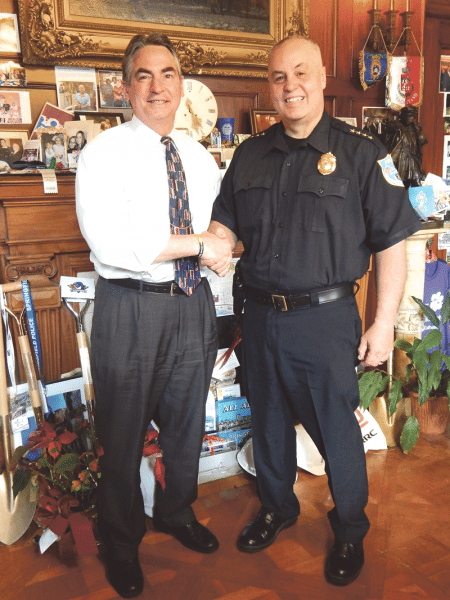
Springfield Mayor Domenic Sarno (left) and Police Commissioner John Barbieri

Springfield Mayor Domenic Sarno (left) and Police Commissioner John Barbieri say community-policing efforts are changing perceptions — and reality — about crime in the city.

Most people are familiar with the major projects underway in Springfield: the $950 million MGM casino, the $90 million renovation of Union Station, and the $95 million CRRC MA rail-car factory being built at the former Westinghouse site.

But a highly successful, multi-pronged program to improve public safety that was created by Mayor Domenic Sarno and the Springfield Police Department has gone on mostly behind the scenes and yielded remarkable results.

“We have had a 20% drop in crime since 2015,” said Police Commissioner John Barbieri.

Officials attribute the dramatic reduction to a number of factors. They include an increase in police officers (48 were added from the last academy, and in about a month another 50 will be sworn in), a highly effective C3 (community policing) program, an ongoing strategic analysis of crime by a division in the police department that has been dramatically increased, leadership classes for police officers, a new computer program on laptops in cruisers that pinpoint where recent crimes have occurred and allows police officers to read reports about them, and other measures that have made a decided difference.

Officials are proud of the recorded success, but know that changing public perception remains an ongoing challenge.

“Perception and attitude equal reality, and we are continuing to battle the negative perceptions people have toward crime and urban cities by enhancing public safety and providing increased police visibility,” Sarno said, noting that, in the past, businesses interested in moving to Springfield typically asked about public safety, but that conversation rarely occurs today.

downtown police presence

The downtown police presence will be boosted by a number of well-lit kiosks and substations.

Barbieri agreed. “The goal for the future is to create a high degree of police visibility downtown which reflects modern-day standards,” he said. “Whenever people travel to a metro area, they worry about crime, but an increase in police presence combats their fear.”

He added that public safety and economic development complement each other, and the entire police department has been reorganized.

“We’ve a made a commitment to the community in terms of accountability and responsiveness,” Barbieri noted, explaining that the department’s approach has differed from most large cities, where attempts to suppress crime are not typically linked to accountability. For example, some police departments might increase arrests or tickets for offenses such as littering, but since 99% of people are law-abiding, those tactics don’t generate cooperation or lead to an increase in information from residents about problems that haven’t yet surfaced.

“Our officers will never know the neighborhoods they work in as well as the people who live there, no matter how long they are assigned to an area,” Barbieri said, as he spoke about the difference community policing has made in establishing respect and rapport between Springfield police officers and residents.

“Crime is complex, and it takes a unified approach by nonprofits, businesses, schools, and local, state, and federal partners to deal with the issues that cause it,” he continued. “Reducing crime is not just about making arrests; it’s about arresting the right people who will not reform or seek help, as well as resolving neighborhood problems.”

They can include derelict properties, and to that end, Sarno created a Quality of Life/Ordinance Flex Squad in 2008 to deal with properties that are neglected or affect the quality of life of nearby residents. Members include the police department, building and code enforcement, the city’s law department, and the mayor’s office. The fire department and housing department also offer assistance when needed, and the collaborative approach has proven effective.

Sarno noted, as an example of success, a project that involved multiple entities to deal with the old River Inn at the corner of State and Thompson streets. It had been a troubled location for two decades before it was condemned in 2011, then purchased by DevelopSpringfield at a foreclosure auction and demolished. There are other examples of success related to the vision of creating a vibrant downtown where people feel safe and can enjoy and appreciate the Innovation District, Union Station, the Quadrangle, the MGM casino, and the businesses and eateries that already exist as well as those that will grow around them.

“But no matter how much money is spent on marketing, word of mouth is key,” Sarno said, adding that highly successful events, such as the Jazz & Roots Festival in August that attracted more than 12,000 people from all over New England and New York, are making a difference in perception and reality, which is critical because Union Station will be used by 4 million people each year and the MGM casino will bring in at least 10,000 guests on a daily basis when it opens.

For this issue, BusinessWest focuses on measures that officials in Springfield and its police department have taken to improve public safety and the overall perception of the City of Homes.

Ongoing Work

When Sarno was elected mayor in 2008, the city had significant problems and was being managed by a state Finance Control Board due to a $41 million budget deficit. But that board was dissolved in 2009, and in addition to addressing the city’s finances, Sarno took steps to improve public safety and quality of life in all of Springfield’s neighborhoods.

New lighting was installed downtown, the police presence was strengthened in the former entertainment district, which had been attracting large numbers of undesirable people, and the size of the police force was increased.

In addition, MGM made a commitment to spend $1.5 million annually for 15 years to create and maintain a public-safety district downtown due to the traffic it will bring to the city. The district runs from the south end of Mill Street to Union Station, to Riverfront Park, which is being renovated, and up to the Quadrangle.

But perhaps one of the most important changes was the establishment of C3 policing in vulnerable neighborhoods where high levels of poverty, truancy, and healthcare problems exist. Special police units have been created and put in place in four areas: Mason Square, the South End, the North End, and lower Forest Park.

MGM will be an important piece of Springfield’s resurgence

MGM will be an important piece of Springfield’s resurgence, Mayor Domenic Sarno says, but it’s only one piece.

Police officers in these units have formed strong bonds with families and children through a number of measures. They have walked thousands of students to school via a program called the Walking School Bus, attend school sports events and cheer students to success, participate in community events, and recently collaborated with neighborhood agencies to hold an Easter-egg hunt.

Every police academy recruit receives C3 policing and de-escalation training and volunteers on a regular basis in the community, where they mix and mingle and take part in a wide variety of activities.

Weekly meetings are held in each neighborhood that are attended by representatives from 60 agencies, including churches, local businesses, and nonprofits such as the YMCA, YWCA, and Big Brothers Big Sisters. The number of residents who attend the meetings is growing, and many provide information about issues that need to be addressed.

“The philosophy of C3 policing is carried over into our entire uniformed division,” Barbieri said, noting that all concerns expressed by residents are taken seriously.

The mayor said the city’s C-3 policing program (which was named a Difference Maker by BusinessWest in 2013) has been so successful, it is being used as a model across the country, and Barbieri has spoken about it before many audiences.

In addition, the police commissioner established a Crime Analysis Unit in 2014 that allows the police department to determine trends and patterns.

“We look at trends from the previous year and hold weekly meetings with all of our commanding officers and supervisors to go over crime that has occurred,” Barbieri said, explaining that they discuss problem properties, prolific offenders, and strategies that will be used to resolve issues. “There is a high level of accountability.”

Sarno works closely with Barbieri and gave a green light to the idea of installing a Crime View program on the laptops in every police cruiser. The technology gives officers detailed information about incidents that have taken place over the previous seven days in the area they are assigned to patrol.

“It pinpoints where the crime occurred and allows officers to read reports related to each incident, including the time of day and day of the week it took place, so they can self-deploy into the areas where they are needed the most,” Barbieri said, noting that residents can also text tips or reports anonymously about problems or concerns.

Although a police presence is not always visible in some neighborhoods, that happens for a reason, as it doesn’t make sense for officers to be limited to a very small area. For example, if a rash of housebreaks are occurring in a neighborhood, an appropriate contingent can move into that area.

However, in the near future, the police presence downtown will increase and be highly visible. Plans are in place to build a number of well-lit police kiosks and substations in the public safety district, and Union Station will have its own police office.

Call-for-service kiosks will also be installed throughout the area, containing cameras that videotape action on the street, and the C3 squads will be expanded.

“People will see blue wherever they go,” Barbieri said, noting that additional police officers assigned to the area will be hand-picked and will adopt a customer-service approach.

In addition, programs in the schools and community centers are yielding positive results: the truancy rate has been cut in half, and young people are forming relationships with police due to their participation in community events and the Walking School Bus program.

The entire police department is making strides, and is the only one in the country that provides peer-to-peer anti-corruption training without being mandated to do so by a federal consent decree. In addition, the strategic crime unit will eventually become a 24/7 operation and will provide information to officers in real time as crime is occurring.

Sarno believes that, as Springfield adds more attractions and confidence rises, there will be an increase in demand for housing downtown, and Baby Boomers who left years ago may want to return.

The $6 million renovation of the former Morgan Square complex at 15 Taylor St., located a block from Union Station, serves as a cornerstone of new residential redevelopment and potential for growth in the future. The complex has been named SilverBrick Lofts Springfield, and 25 of its one- to three-bedroom apartments, with rents ranging from $795 to $1,235, have been reserved for teachers.

Kevin Kennedy, the city’s chief Development officer, said another example of progress is the $40 million renovation of the Chestnut Towers complex by Related Beal. When the towers were built 40 years ago, the property was known for its luxury apartments, but the state foreclosed on the complex in 1996, and after that occurred, it became a hotspot for drugs, violence, and other crimes.

But that is another site where progress is occurring. “Related Beal plans to spend about $100,000 on each of the 489 apartment units,” said Kennedy. “A key component of its plan involves working with the police department to get rid of negative tenants and provide reassurance to the good families who live there.”

He noted that there has been a change in management, the developer is working with police to hire a new security director, and it has partnered with the city to provide better housing and improve the quality of life for new and existing residents.

In addition, Pynchon Plaza will be updated and renovated. It was built in 1976 as a gateway between downtown and the Springfield Museums and Quadrangle, and the city is going out to bid for designer services for a plan to improve it in phases.

New Chapter

Sarno believes confidence in public safety will grow alongside new entertainment venues and spur more investment.

“MGM put Springfield on the map, and the new CRRC MA plant and Union Station revitalization has led to meetings every week with businesses and developers who want to come to Springfield,” he said, noting that the City of Homes has an AA+ rating from Standard & Poor’s, and the last two city budgets were not only balanced, but contained reserves.

Crime — as well as the perception of it — is being reduced, and officials are proud of the work being done by the police department. “When Springfield police officers were asked to stand up to prepare the city for growth, they stood tall and embraced the community,” Barbieri said.

Sarno calls Springfield police officers “sentinels of peace” and says they are making a positive difference 24 hours a day.

“In the next five years, there will be dramatic changes in Springfield,” he said, “and we are working hand in glove with the police department to keep our city safe.”


Springfield at a glance

Year Incorporated: 1852
Population: 156,000 (2016)
Area: 33.2 square miles
County: Hampden
Residential Tax Rate: $19.66
Commercial Tax Rate: $39.07
Median Household Income: $38,398 (2015)
median family Income: $43,289 (2015)
Type of government: Mayor; City Council
Largest Employers: Baystate Medical Center; MassMutual Financial Group; Big Y; Center for Human Development; American Outdoor Brands Corp.
* Latest information available

Cover Story Sections Women in Businesss

Words to Live By

lussierbooksIt took just nine words to change Angela Lussier’s life: “you’ll never be ready; you just have to start.” That’s good advice for entrepreneurs of all kinds, but it was especially relevant for a shy, self-conscious, but creative and ambitious woman who decided her path to leadership was learning to overcome her fear of public speaking. Today, through the Speaker Sisterhood, she’s helping women around the world do the same — and, in the process, discover who they really are and what they were meant to do.

Angela Lussier has a surprising entrepreneurial bent — surprising to herself, that is.

It began at UMass, where she studied a VHS tape to learn how to cut her boyfriend’s hair. “My neighbor walked by and said, ‘can I have a haircut too?’ I said, ‘why not?’ Then his roommate walked in and said, ‘can I have a haircut?’ I said, ‘sure.’ Soon a whole bunch of guys on the floor wanted haircuts.”

Soon, she was setting up shop in a back room and charging for haircuts, which she did until the dorm shut her down. It wasn’t until later that she realized she had been an entrepreneur, if only for a short time.

It never occurred to me that it was a business,” she said. “I just wanted to make some money to put gas in the car and buy clothes.”

Lussier tells the story to demonstrate how opportunities cross our paths all the time, and sometimes what seems to be the least likely possibility can become a successful business.

Which explains why someone who was terrified of speaking now runs a business teaching women how to find their voice.

It’s called the Speaker Sisterhood, and it helps women become more effective public speakers. But it’s much more than that, she said. “It creates a safe space for women trying to find out who they are and what they’re meant to do.”

It’s a winding story that can be told only from the beginning, after college, when Lussier went to work in marketing for Rock 102 and Lazer 99.3, a job where her natural creativity was encouraged and rewarded. But she soon learned not every job was like that; an executive at her next employer, an executive recruiting firm, eventually told her, “we knew your creativity would be an issue when we hired you.”

So, in 2009, she started out on her own, initially as a career consultant, helping people figure out what jobs were the best matches for their skills and passions. Her grounding philosophy? “You have to work in a place that respects your talents and gifts and uniqueness.”

Lussier knows something about that, having had to overcome her own physical uniqueness. She stood six feet tall at age 12 and had to endure barbs like “ogre” and “jolly green giant” — experiences which led, she realized years later, to an intense shyness and anxiety about public speaking.

“At the recruiting firm, I realized that being shy was not a great attribute to have. Looking back to the radio station, the people who were the most respected, the most followed, were people who were excellent communicators, and even better public speakers. I had this fear of being seen, being made fun of, but I wanted to be a leader. So I signed up for Toastmasters.”

It didn’t go exactly as planned at first. “I said, ‘OK, I’m going to tackle this fear of speaking because I want to be a leader.’ Six months later, I’d never said a word.” That’s when the club’s leader told her she was on the agenda for the next meeting, where she would deliver a four-minute speech about her job. “I said I wasn’t ready, but she said something that changed my life: ‘you’ll never be ready; you just have to start.’”

It wasn’t easy. In fact, she sat in her car outside that next meeting, petrified of going in, wondering if people would make fun of her or think she sounded stupid. But she took that first step, even though she read completely from notes, never looking up at the audience.

“The important thing was, I didn’t die,” Lussier said with a laugh. “So I continued to go back and give more speeches, and every time I gave a speech, not only did I not die, but I learned something about myself. I learned why I was so shy; I was able to connect it to my adolescent years, feeling so different, feeling like people didn’t understand my creativity, feeling like the black sheep in the family, like I didn’t relate to other people. Public speaking gave me not only a voice, but insight into who I am.”

That recognition would eventually form the basis of the Speaker Sisterhood, though the story would take a few more turns first.

First Steps

Lussier’s first step was recognizing she needed public-speaking skills to advance her career-consulting business, so she developed a free workshop series on how to find a job in a tough economy (remember, this was right after the recession peaked), interviewing skills, self-marketing, résumé writing, and other topics.

She pitched the idea to area public libraries without success, until Forbes Library took her up on it, allowing her to stage two separate eight-week series, a daytime series for unemployed job seekers, and an evening series for people with jobs looking for a change. After that first booking, other libraries came on board.

But she still needed to write the material. And deliver it. And she was still far from fearless on that front.

“When the first workshop came around, I drove there thinking to myself, ‘who do I think I am? No one’s going to come to this. I’m not a business owner. I’m only 28 years old; why would anyone take career advice from me?’ I sat there in the library parking lot, and a voice told me, ‘maybe you should do this because you want to be a leader.’”

Not only was the workshop a success, but Lussier gained a paid booking through it, and people kept showing up at the free library events, leading to more exposure and more paid bookings, including, eventually, one for a local Fortune 500 company. She had no idea of her worth at that point — the firm seemed surprised when she came up with a fee of $200, and she realized later she should have charged 10 times that — but she started to recognize that speaking about careers, which originally was a way to boost her consulting business, had potential as a revenue stream in itself.

“That was a huge turning point for me,” she said. “I had become a professional speaker; I’d built this skill, and people like hearing me speak. I thought, ‘I’m actually a leader; I actually did this. I can’t believe it’s happening.’”

So, while she continued her career-coaching business, she started asking herself a few questions: “where have I been most successful? What do I enjoy doing? What do people always ask me about?”

She sat down one night in front of a fire, coffee at the ready, and filled a journal with the answers to those three questions. And the one common denominator to all three was public speaking, her former nemesis. “It was like a neon sign blinking from the highway. I thought, ‘why did I not see this until right now?’”

She had already enrolled in the Valley Venture Mentors Accelerator program, but decided to switch gears midstream and morph into something different, to build an online school to teach women how to be professional speakers.

Angela Lussier

Angela Lussier addresses a Washington, D.C. audience at a TEDx event in 2010.

“We need more women on stages, more women getting paid what they’re worth, more women leading conferences,” Lussier told BusinessWest. “It took me a long time to see there should be a Toastmasters for women — a place where women can get together and share their voices and be honest and say the things they don’t get to say in the world.”

As an experiment, she co-hosted an open house for her first speaking club to see who would respond. About 10 women showed up, all strangers. At first.

“Each woman shared her story about fear of speaking up, being belitted at work, being told their opinions don’t matter, feeling like they don’t have any idea how to say what they’re thinking. Or, they’re working in a job now where they have to train people, and they’re terrified, but they don’t want to lose their job.”

Something happened that day that surprised Lussier.

“As we went around the circle, it was like each woman was giving the next woman permission to tell the truth. They came as strangers, but they left as sisters. I had never experienced that kind of transformation; I had chills for two hours. I knew this was not just a public-speaking club, but an opportunity for women to walk in the door and shed their role as wife, mother, boss — to show up as themselves and say what’s on their mind.”

She knew she had something special, and the e-mails that followed proved it — e-mails from women who didn’t attend the meeting, but knew someone who did, and wanted to join. So she built waiting lists and eventually launched clubs in Springfield, Northampton, Amherst, and South Hadley, training the women who would lead each one. Recently, a Greenfield club opened its doors, as well as a second club in Northampton.

Gaining Momentum

But Lussier saw potential for the Speaker Sisterhood clubs well beyond Western Mass., creating a curriculum and licensing model to take the concept nationwide and even international. Lehigh, Pa. and Portland, Maine were the first club sites outside the Commonwealth, and a New Zealand club marked the first overseas expansion.

“You don’t have to be a public-speaking expert to start a club, but you do need to have leadership experience and meeting-facilitation experience, and a sincere interest in helping women build this skill set,” she said, reiterating what she considers the heart of the clubs’ popularity.

“Yes, we’re running speaking clubs that teach skills, but these clubs also use public speaking as a tool for self-discovery,” she went on. “What I say to members is, ‘this is your public-speaking journey, and the more you learn, the more you’ll find out how little you know.’”

And they are learning about themselves, she noted. One woman, who works in a healing field, signed up because she wanted to build her skills to teach workshops, and after a few months, she remarked that, when she spoke before a group, she felt like a floating head, disconnected from her body. What she came to realize was that she spent so much time talking to people one on one, in a spirit of empathy, that she started to take on the energy of each person she spoke with.

“She said, ‘I become them, so in front of a group of people, I have no idea who I am. That teaches me I’ve spent my whole life being other people, and now I have to discover who I am.’ To hear someone say that is transformative — not just for the speaker, but for the audience. We’re all learning from each other’s journeys.”

Those journeys vary, she said, from business owners who want to get better at promoting their services, to teachers who interact with kids all day, only to freeze up when they meet with parents. “One has experienced several tragic deaths over the past few years and felt she’s lost herself in grieving those deaths, and she wants to discover herself again.”

The curriculum takes the form of an ‘adventure guide,’ with chapter titles like “Adventures in Storytelling,” “Adventures in Humor,” “Adventures in Audience Interaction,” and so on.

“It was a thoughtful decision to call it an adventure because anything can happen. It’s not about perfection; it’s not about doing it right. The emphasis is not on trying to be a perfectionist, but enjoying the journey. It helps a lot to reframe public speaking that way.”

By prioritizing sharing experiences over perfection, she added, participants feel less alone as they realize so many others feel the same way they do. “And that helps them build confidence in themselves.”

The meetings include prepared speeches, but also a lot of improv games, which challenges club members to be present in the moment while stretching their creativity. She knows it’s a lot to ask from new members, many of whom are approaching the club from a place of anxiety.

“The first day, there’s a lot of fear. Their voices are trembling; they’re looking around the room, thinking, ‘do I belong here?’ Then they speak again at the end, and there’s a transformation over two hours. They go, ‘wow, I’ve never been able to speak like this. This is what I need.’ I feel like the biggest step you take on your public-speaking journey is the first step. Every single step after that gets easier. So I always applaud the guests for showing up. That’s not easy.”

By the Book

Amid her transformation into the leader she’d long wanted to be, Lussier has also shared her words with the world through her books. The first, The Anti-Résumé Revolution, was a direct result of that first eight-week workshop, inspired by one attendee asking her for her notes — which totaled 120 pages. So she combined them with her own story, interviewed others who had followed her advice, and self-published in 2009.

“The whole concept is not just waiting for opportunities to show up on a job board or the newspaper, but to go out and create your own future and taking action on your ideas,” she explained.

She managed to get the book into the hands of Seth Godin, one of her heroes and the author of Purple Cow, which drives home the importance of being different and standing out fron the crowd. He recommended Lussier’s book on his blog, broadening her visibility immensely.

“That changed my whole perspective on what’s possible,” she said. “I wrote a book in my basement which was now being shared with millions of readers, being taught in colleges, and being read by people all over the world. It helped me see that, even if you think what you’re doing is only for a small audience, you never know what could happen.”

Two more books followed. She published Who’s with Us? in 2015 — sporting the subtitle From Wondering to Knowing If You Should Start a Business in 21 Days. It was the result of talking to hundreds of people about their business ideas, and takes the form of 10 self-assessments potential entrepreneurs can use to gauge their next move. She recently followed that with Do + Make: The Handbook for Starting Your Very Own Business, which progresses beyond the assessment phase and dives into practical action.

Clearly, Lussier has found multiple outlets for her entrepreneurial bent and her passion for writing. But her heart lies mostly in the work she’s doing with women — not to give them a voice, but to help them discover their own.

“It’s the most amazing work I’ve ever done. I know I was born for this reason — to start the Speaker Sisterhood and build clubs around the world,” she told BusinessWest. “I want to help thousands, if not millions, of women discover who they are, and how amazing they are, so they can go out and do what they were put here to do. Ever since I was 5 years old, even when I was a teenager and felt like an outcast, I knew I would do something important someday.”

That’s the voice that echoed in her head the night she sat in her car, stricken with anxiety, ready to drive away and abandon her dream of becoming a better speaker.

However, “I thought, ‘I’m not going to do something important if I go home.’ And even when I started my business, that was just the road to the thing; it wasn’t the thing. Now, every meeting I go to, I can’t believe I get to do this; I can’t believe this woman is discovering things about herself because, years ago, I sat in a car and said, ‘you’re going to go in and give a speech.’ That blows my mind.”

Joseph Bednar can be reached at [email protected]

Sections Women in Businesss

Laying the Groundwork

The Women’s Fund of Western Massachusetts recently announced a slate of initial appointments to the steering committee of the Partnership for Young Women’s Progress (YWP), its multi-sector partnership aimed at driving economic prosperity for young women in Springfield.

In February, the MassMutual Foundation and the office of state Treasurer Deb Goldberg announced their participation as lead corporate and government partners, respectively, for the project. The MassMutual Foundation awarded $150,000 to the Women’s Fund to support the launch of the partnership, while Goldberg’s office will offer its Women’s Economic Empowerment series, share state-agency-generated research and data, and participate in final recommendations.

“The YWP initiative is a new, innovative way to showcase the talent and leadership skills of young women in the city of Springfield. We are excited to be a part of this initiative and look forward to working with the young women selected for the program,” said Sarah Williams, vice president of Global Capital Risk at MassMutual, and one of the steering committee members chosen in April.

The YWP aims to elevate the leadership of local young women (ages 12 to 24) and design a lasting blueprint for investing in the Springfield community that addresses the needs, programming, best practices, policies, and research that will build the pathways to economic prosperity for themselves, their families, and their community.

The pilot is made up of two core groups, the Young Women’s Leaders Advisory Council (YAC) and the steering committee. The YAC will consist of up to 20 young women (again, ages 12 to 24) who will be selected by a competitive, city-wide nomination process that opened last month.

The steering committee is comprised of cross-sector leaders from the education, government, business, philanthropy, and nonprofit sectors (see list below). The committee’s purpose is to provide thought leadership, as well as leadership development and mentorship opportunities, for the young women on the YAC. They will also help facilitate community outreach, help attract additional resources to the project, and assist with sequencing final recommendations.

“What we know from available data is that young people, and particularly young women, are leaving our region for perceived lack of economic opportunity,” said Layla Taylor, board chair of the Women’s Fund. “While these statistics are troubling, we are excited about the opportunity to work closely with city leaders to make this project transformative for our community, and as a model for peer cities across the country.”

The three-year YWP challenges partners to:

• Create leadership and high-level decision making opportunities for young women, and reward their efforts as part of the YAC;

• Encourage the participants to become peer educators by launching philanthropy clubs or hosting workshops at their school;

• Analyze available data, examine current investments, and identify where partners can make a lasting impact;

• Create a public document with young women’s economic growth and empowerment recommendations;

• Engage message research conducted by a leading national firm to help shape strategic communications, which will be aimed at creating a positive shift from the current negative cultural narratives regarding young women; and

• Generate and fund a phased action plan for the region that will include re-granting partnerships.

“What a wonderful opportunity this initiative offers for young women in our community,” said Lydia Martinez-Alvarez, assistant superintendent of Springfield Public Schools and a member of the steering committee. “I am extremely proud and excited to be part of an initiative that will make a real difference in the lives of our young women. The guidance and mentorship they will receive is beyond measure, and we will be keeping our eyes on these young women and expecting great things from them in their future.”

Besides Williams and Martinez-Alvarez, other members of the steering committee include Ann Burke, vice president, Western Mass. Economic Development Council; Michael Clark, senior advisor and director of Strategic Engagement, office of state Sen. Eric Lesser; Dawn Creighton, Western Mass. regional director, Associated Industries of Massachusetts; Ernesto Cruz, legislative aide to state Rep. José Tosado; Dawn Forbes DiStefano, chief finance and grants officer, Square One; Pattie Hallberg, CEO, Girl Scouts of Central & Western Massachusetts; Denise Hurst, Springfield School Committee member; Justin Hurst, Springfield City Council member; Ronn Johnson, President and CEO, MLK Family Services; Rachel Parent, vice president, MassMutual, and chief of staff, MassMutual U.S. Business; Suzanne Parker, executive director, Girls Inc. Holyoke; Marian Sullivan, communications director, office of Springfield Mayor Domenic Sarno; and Samantha Washburn-Baronie, deputy director, Office of Economic Empowerment, office of the state treasurer.

“As a husband and father of two daughters, I recognize the importance of young women being able to have equal opportunities to succeed and contribute to their communities,” Tosado said.

Added Sarno, “this is all about empowerment access and pathways to secure better educational, social, and economic-development opportunities for the women of our community.”

Goldberg noted, when the YWP program was launched, that public-private partnerships like this one are crucial in creating opportunities to empower young women across the state.

“We truly value this partnership that leverages available resources in an innovative and collaborative way,” added Ali Mathias, MassMutual’s director of Charitable Giving and vice president of the MassMutual Foundation. “This program will not only expand the economic opportunity for young women, but also economic development in the city of Springfield.”

Even as it transitions from the leadership of former president Elizabeth Barajas-Román, who stepped down in March, the Women’s Fund has been busy with new initiatives. It recently announced a partnership with Bay Path University aimed at driving women’s leadership and educational access by providing college credits as part of the Women’s Fund’s Leadership Institute for Political and Public Impact (LIPPI) program.

Through that partnership, which aims to educate women for leadership roles, LIPPI will give participants access to Bay Path’s online classroom tools, including virtual sessions with instructors. LIPPI participants will also be able to earn three undergraduate or graduate credits from Bay Path or, upon approval, credits that can be transferable to a college or university of their choice. To date, more than 250 women have graduated from the LIPPI program.

Nonprofit Management Sections

Strong Foundation

By Kathleen Mellen

eureka-2The reach of Girls Inc. of Holyoke — which operates programs for elementary-school-aged girls as well as teenagers — is striking, serving more than 1,750 girls each year through programs, peer education, and community outreach on a budget of $1.3 million. But other numbers are more impressive, such as statistics showing that Girls Inc. participants are more likely than their peers to get good grades, attend college, and find learning fun and valuable. What it all adds up to is a priceless foundation for success.

You could call it a lunch break on wheels.

Every Monday through Friday during the school year, Dianette Marrero uses her lunch hour to drive her daughters, Jasminn, 7, and Tatianna, 10, from their hometown of Chicopee to 52 Nick Cosmos Way in Holyoke, where the girls attend a licensed after-school program for ages 5 to 12, sponsored by Girls Inc. of Holyoke. And when her workday is done, Marrero returns to pick her daughters up.

Marrero says she doesn’t mind the drive in the least. She’s been sold on the nonprofit organization that educates and empowers girls from underserved communities ever since her daughters started attending its girls-only after-school program nearly two years ago. Through the program’s breadth of activities — including an in-depth literacy program, educational field trips, outdoor activities, and experiential, hands-on learning opportunities — she says her daughters are learning to be confident and motivated young women.

“Girls Inc. allows the girls to be confident with their peers,” Marrero told BusinessWest. “We’re a girls-only family, so this has been great for my daughters.”

Stella Cabrera, 16, has had a similarly positive experience: she has participated in nearly every program offered by Girls Inc. of Holyoke since joining up in the fifth grade. She first heard about the organization from a friend, and pleaded with her mother to let her attend.

The Girls Inc. Eureka! program is a STEM-based approach to education

The Girls Inc. Eureka! program is a STEM-based approach to education that places girls in labs and classrooms at UMass Amherst for intensive training.

“I was getting bullied by boys at school, and I wanted to try something new,” Cabrera said in an interview at the Girls Inc. administrative office and teen center at 6 Open Way in Holyoke. “It was really exciting because I’d never been in a place where it was just girls.”

Since then, she’s become more confident, and she credits Girls Inc. with the transformation.

“When I started out, I was a really shy person; I didn’t talk to many people,” she said. “Now I make friends with everybody. I don’t judge people. I’ve learned to accept people for who they are.”

Testimonials like these are music to Suzanne Parker’s ears.

“It’s our mission to inspire girls,” said Parker, the organization’s executive director. “The work that we’re doing, helping them to be successful, is really important.”

Girls Inc. of Holyoke, formerly the Holyoke Girls Club, operates programs for elementary-school-aged girls, as well as Holyoke’s only teen center just for girls. Serving more than 1,750 girls each year through programs, peer education, and community outreach, the organization aims to equip girls to navigate gender, economic, and social barriers, and grow up to be healthy, educated, and independent. It is one of more than 90 Girls Inc. affiliates of a network across the U.S. and Canada that serves more than 138,000 girls, ages 5 to 18.

“The programs we provide are developed to meet the very specific needs of girls,” Parker said. “Having the research and the support of the national organization really helps us with that.”

Why Girls Only?

Girls live in a society with different expectations about success for boys and girls, Parker said, and Girls Inc. aims to close that gap. By teaching personal-development and communications skills, conflict resolution and problem solving, and how to make healthy choices relating to their bodies and relationships, it aims to “inspire girls to be strong, smart, and bold by offering life-changing experiences and real solutions to the unique issues girls face,” according to its website.

“We work to build up their confidence, making sure they have self-esteem, but first and foremost, we make sure they’re exposed to opportunities that they wouldn’t otherwise have,” Parker said. “All of those things are best done, we feel, in a girl-only environment, where they feel safe. They know they have a sisterhood here.”

From left, Girls Inc. of Holyoke participants Brandy Wilson and Stella Cabrera with Executive Director Suzanne Parker.

From left, Girls Inc. of Holyoke participants Brandy Wilson and Stella Cabrera with Executive Director Suzanne Parker.

The organization’s hallmarks are its mentoring programs, the girls-only environment, and its research-based, hands-on approach to learning. It also advocates for legislation and policies to increase opportunities for all girls.

The staff includes 11 full-time and four part-time professionals year-round, as well as an additional eight to 10 staff members who work in the full-day summer programs. In addition, more than 100 community members volunteer with the organization in a number of ways.

Nearly 70% of those who attend programs at Girls Inc. of Holyoke live in households earning $30,000 a year or less; one in 10 lives below the $10,000 line. The majority of members are Latina, Parker noted. While most live in Holyoke, some come from Chicopee, like Jasminn and Tatianna, and others live in Longmeadow, Wilbraham, South Hadley, Westfield, and West Springfield.

The organization’s newest strategic plan includes initiatives to broaden the organization’s reach, with in-school programs now being developed in Holyoke’s Peck Middle School, as well as Alfred G. Zanetti Montessori Magnet School and M. Marcus Kiley Middle School, both in Springfield.

In April, the organization was one of 17 Girls Inc. affiliates to receive a three-year grant award of $100,000 from the S.D. Bechtel Jr. Foundation to expand strategically to serve more girls growing up in low-income communities.

“Girls Inc. of Holyoke has a strong track record of making a measurable difference in the lives of girls,” said Judy Vredenburgh, president and CEO of Girls Inc. “As a well-run, sound organization, they are poised for expansion and growth, preparing more girls for responsible and confident adulthood, economic independence, and personal fulfillment.”

The programming reflects those initiatives, and its successes are measurable. For example, according to a national survey, one in six girls will not finish high school; by contrast, three-quarters of high-school girls who attend Girls Inc. programs report earning As and Bs on report cards, and 85% say they plan to attend college.

Finding Their Voice

Still, Parker said, girls who do well in math and science can pay a price socially at school, where they are often teased, even bullied, by other students. “We hear it from girls all the time. Bullying continues to be a major issue with girls across the country. And when you’re in school and you’re facing that, it’s hard to be successful.”

Girls Inc. addresses these gender-specific problems — and, more importantly, crafts solutions — in its girls-only environment.

“In order to be successful, girls have to have confidence, and they have to understand they have a voice and that they have the tools needed to be successful in that co-educational world we all live in,” she told BusinessWest. “There’s a need to provide a space for girls where they can come together, where they can take risks, try things they wouldn’t otherwise try.”

To that end, the organization fashions programs that promote academic success for girls in fields previously thought to be the domain of males. Chief among them is the Eureka! program, a STEM-based approach to education for eighth- through 12th-graders, which places girls in labs and classrooms at UMass Amherst for intensive training in science, technology, engineering, and math.

More than 100 girls are currently involved in Eureka!, attending the program for four weeks in the summer and on one Saturday a month during the school year, where they work with UMass professors who volunteer their time to offer hands-on experiences in fields like nanoscience, robotics, DNA research, and forensic science. In addition, the students are active daily in physical fitness and sports training, healthy living, and financial literacy.

Data shows that girls participating in Eureka! stay engaged in math and science throughout high school; many go on to higher education, often becoming the first in their family to attend a college or university, Parker noted. According to a recent survey, the percentage of girls participating in the program who identify themselves as “smart” increased by 13%, girls who think math is fun and interesting increased by 10%; and girls who feel comfortable in science class increased by more than 20%.

“Exposing girls to STEM skills and proficiencies is absolutely critical,” she went on. “While they might not all go into traditional STEM careers, the types of skills they’re learning, and the exposure they’re having, is absolutely critical. I believe that to the core.”

In the same survey, more girls also reported a positive body image, and nearly 90% of Eureka! girls see school as an opportunity “to learn as much as I can.” It also showed that the percentage of girls planning to go to a four-year college increased more than 10%.

Cabrera, now a high-school junior, and one of the original Eureka! scholars, wants to be a math teacher, and plans to attend college after she graduates from high school.

“I’ll be the first grandchild [in my family] to graduate and plan to go to college,” she said, adding that the program has significantly bolstered her confidence. “I really thrive, and I’ve gotten so much support for being strong. It’s a really inspiring program, and it really does help girls to understand their power and their impact on the world, and the amount of strength they have in themselves that they probably haven’t tapped yet.”

Avenues of Support

Girls Inc. of Holyoke’s annual budget is about $1.3 million, with between 55% and 60% of funding coming from the state. As a licensed after-school provider, it receives some funding from the state Department of Early Care. The teen center also receives support from the state Department of Public Health to run programs in pregnancy prevention and youth violence prevention. Specifically, the organization’s Healthy Relationships module helps girls learn to “identify, establish, and cultivate healthy relationships through assertiveness and negotiation skills,” and Project Bold works to “ensure that girls have the skills, knowledge, and support to be safe and reduce their risk of experiencing violence.”

But, Parker says, those funds don’t begin to cover the cost of providing a high-quality experience. For the past 10 years, the organization has held a Spirit of Girls breakfast, its signature fund-raising event; this year, on April 4 at the Log Cabin in Holyoke, a record crowd of about 450 people donated more than $140,000.

The organization also relies on foundation grants, as well as corporate and private donors. Indeed, Parker says there’s been a significant uptick in recent years in support from individuals. For example, participation in the three-year-old Champion for Girls initiative, through which individuals donate $1,000 or more, has risen from 15 annual donors to close to 100.

The organization also launched a program this year for ‘corporate champions,’ which is also seeing growing success, Parker said, with recent donations from CheckWriters Payroll, MassMutual, and PeoplesBank.

“Companies are definitely seeing the value of partnering with Girls Inc.,” she added. “We have to work hard; we’re always looking for people who are interested in investing in our work. We can’t do it alone.”

That work continues to enrich the lives of its members, from the STEM education of Eureka! to myriad teen-center programs offered on a drop-in basis, including art, creative writing, spoken-word expression, computer coding, and entrepreneurship, among others, as well as myriad field trips, classes, and workshops.

The success-based programming is not just reserved for the older girls. Last year, for example, a group of younger students, including Jasminn and Tatianna, developed a business model for a lemonade stand and put it into practice; the girls tested their lemonade recipe, did a market survey, and created a business plan to determine how much were they would charge for the lemonade. Then they launched their business in a real-life setting, setting up their stand at Celebrate Holyoke. Finally, the girls deposited the proceeds into a bank account and, together, decided how they would spend it.

That program, like others at Girls Inc. of Holyoke, builds a knowledge base that is useful in the real world, while building self-confidence, said Brandy Wilson, director of middle- and high-school programs.

“It’s all about exploring their options. So many times, girls who come in from what we consider an underserved community don’t know what their options are,” she explained. “We’re giving the girls experiences that make that lightbulb go off — that makes them realize, ‘I can do this.’”

Nonprofit Management Sections

Growing Opportunities

Peter Gagliardi

Peter Gagliardi says Way Finders’ mission comes down to helping people solve problems, not just getting them into homes.

When the Housing Allowance Project opened its doors in 1973, the idea of providing people with assistance to pay their rent was a novel concept.

“Giving people a housing allowance was a radical concept, but poor people were concentrated in projects and high-rises that had become real problems, especially in large cities,” said Peter Gagliardi, president and chief executive officer of Way Finders in Springfield and Holyoke. “Many were poorly built and filled with children who had no place to play other than the hallways and elevators, so the idea was to stop building projects where the poor were all housed in one place, and give people choices about where they could live.“

HAPHousing, which changed its name to Way Finders on March 31, was one of 10 sites across the country selected to host a three-year experimental federal pilot program to provide this rental assistance. The project led to the creation of Section 8 housing, a federal program that provides vouchers to low-income families, the elderly, and people with disabilities to help them afford decent, safe places to live in the private market.

When the pilot program morphed into Section 8, HAPHousing was tasked by the state to administer it in Hampden and Hampshire counties. But today, that is only a small part of the scope of its work, which has extended into many arenas.

The organization holds periodic strategic planning sessions, and in 2014 it became clear that its name and narrative did not convey the agency’s purpose and may have led potential clients to believe they couldn’t find the help they needed from their staff.

“Our old name didn’t provide a sense of the magnitude of our work,” Gagliardi said, noting that, although the Section 8 housing program still exists, 28,600 people in Hampden and Hampshire counties and more than 100,000 people across the state are on waiting lists. Since new vouchers are not being issued given today’s turnover rate, the statewide wait equates to 166 years.

“People need better options than vouchers that don’t exist,” he continued, explaining that the agency’s clients have needs ranging from finding jobs to getting an education, improving their credit scores, and other measures that open up opportunities for a better life.

“Getting people into homes is important, but having a roof that is affordable over your head is just the beginning,” Gagliardi noted, as he spoke about difficulties homeless families face and the multi-faceted approach Way Finders takes to connect clients to appropriate resources.

The organization’s history has been marked by many twists and turns as it responded to crises caused by changes in the economy, so choosing an appropriate new name was important to everyone who worked there.

HAP hired TSM Design in Springfield to facilitate the effort. The name Way Finders resulted from a collaborative brainstorming effort by staff members dedicated to ensuring their moniker reflected their mission, coupled with the creativity of TSM Design, which was responsible for suggesting names that matched the passion and commitment of the staff. Every employee participated in a survey that asked them about the most important part of their job, and a committee of 12 was eventually formed to represent the findings and share the thinking of the staff as a whole.

“Our mission came down to finding a way to help people solve problems. It begins by finding them a decent place to live, but we wanted to let the public know that we offer a wide range of programs through collaborations with partners that include finding jobs for people who don’t know where to start,” Gagliardi said, noting that, in the past three and a half years, the agency has helped place 480 people into jobs as an alternative to those non-existent housing vouchers he talked about.

Indeed, the new name is fitting because clients literally need help finding their way to a better life.

“We started out with a staff of about 20, and this year we have 250 employees who are very mindful of our philosophy,” Gagliardi said. “When they go home at the end of a day, they know that someone has a better home or opportunity in life than they did when they arrived.”

Over the past four decades, the organization has grown from an experimental housing-assistance program to an agency that provides rental assistance, housing-support services for homeless families as well as prevention, education about home ownership, foreclosure counseling, real-estate development, property and asset management, and community building and engagement in neighborhoods to improve health and safety.

For this issue and its focus on nonprofits, BusinessWest looks at the storied history of Way Finders and how the agency stepped in to help people and improve the community through the many changes in the economy.

Critical Response

When the Housing Allowance Program morphed into the Section 8 housing program, the state Department of Housing and Community Development hired eight regional agencies to administer it, including HAPHousing.

“For the first time, people in every town and city in the state had an opportunity to live where they wanted,” Gagliardi noted.

During the early ’80s, HAP added a program for first-time homebuyers that included information about how families could strengthen their credit so they would be eligible for bank loans. Some were purchasing multi-family houses, so they also needed to learn how to become a good landlord, and HAP published a manual that contained all of this and more, which has undergone multiple revisions and is sold on Amazon.

By the mid-’80s, homelessness had become a glaring problem, and HAPHousing opened Prospect House in Springfield, which was the first family shelter in Massachusetts funded by the state.

“We started out with nine families and a manager,” Gagliardi said, noting that the shelter is still operating and the program has served thousands of people.

In the ’90s, when the U.S. entered a recession, HAP took action again and focused its efforts on distressed properties on Byers Street in Springfield. Its work led to the creation of the Armory Quadrangle Civic Assoc., which still exists and plays an active role in the neighborhood.

HAPHousing continued to acquire properties and create affordable housing as the years went on, and eventually became involved in the Old Hill neighborhood after a Springfield College study showed it was home to 4,500 people and 150 vacant lots and boarded-up buildings.

“About 10% of the residential properties were blighted, and we worked with the neighborhood, the city, Springfield College, and our housing partners, Springfield Neighborhood Housing Services and Habitat for Humanity, to renovate properties that could be saved and replace housing that couldn’t be repaired. We also filled in some of the vacant lots with new homes,” said Gagliardi, adding that the collaboration between Springfield College, HAPHousing, and Habitat resulted in 50 new or renovated homes.

After the recent recession hit in 2008, HAP again took the lead in helping homeless families. It created a new partnership with the Center for Human Development and New England Farm Workers Council in anticipation of the state’s new HomeBASE program, and when the tornado hit in 2011, representatives from all three groups were able to work with the city and others to help more than 400 displaced families.

“These groups had never joined forces before, and the way everyone worked together was unprecedented. By the time FEMA showed up, we were already getting people into housing,” Gagliardi noted.

After that was accomplished, HAPHousing began implementation of the state’s new HomeBASE program, which offers an alternative to living in a shelter for families at serious risk of becoming homeless. It provides them with time-limited assistance that allows them to find long-term accommodations and get help from stabilization services, which is paid for buy the state.

But this avenue wasn’t new to HAP, because it had pioneered a program in the ’80s that worked with landlords and tenants to negotiate settlements to prevent homelessness. It had attorneys on staff and was able to resolve many situations that would otherwise have resulted in eviction.

Programs to prevent homelessness continue to be offered, although they have changed over the years. Gagliardi said many clients have lost jobs and fallen behind in their rent, missed work due to illness, or been part of a family breakup that led them to get behind in their rent. “These situations can easily spiral out of control if they are not addressed,” he told BusinessWest.

The current program, known as RAFT (Residential Assistance for Families in Transition), serves 600 to 700 families a year at an average cost of $2,500, which is a small investment compared to the $3,000 a month it costs the state to house a family in a shelter, especially since the average length of stay is six months.

But HAP has always stepped in when it was needed, and in 2008, it played a significant role in the formation of the Western Mass. Foreclosure Prevention Center.

“The number of people losing their homes was staggering, and we helped families through a partnership with the attorney general’s office that saved their homes or allowed them to make a graceful exit without completely ruining their credit,” Gagliardi said.

He noted that the agency has assisted thousands of property owners over the past eight years, and although the worst of the crisis has passed, over the past year, it helped 85 homeowners. “Thirty-five managed to preserve their homes, 25 were successful loan modifications, eight were able to bring their mortgage current, and two refinanced into more sustainable mortgages,” he continued, adding that another 43 were referred to legal assistance, and only two lost their homes.

Over the years, HAP also became involved in developing affordable housing and managing rental properties. Today, it has its own management company that oversees 700 units in towns and cities including Amherst, Hadley, Southwick, Southampton, Easthampton, Northampton, Charlton, Ware, Wales, Springfield, and Holyoke. It has also built and renovated properties, and has 10 projects underway, including construction of a $19.9 million, four-story, mixed-use building on Pleasant Street in Northampton that will have 2,600 square feet of retail space on its first floor and 27 studio apartments and 43 one-bedroom units in its upper stories.

“We also played a leadership role in creating the Western Mass. Nonprofit Housing Developers Group 20 years ago, and partnered with Nueva Esperanza in Holyoke and another organization to restore a number of four-story apartment buildings in South Holyoke,” Gagliardi said, as he recounted decades of work in Hampden and Hampshire counties.

Growing Enterprise

The mission of Way Finders continues to expand, and Gagliardi said its new name belongs to the next generation of leaders.

“We found that the best way to create affordable housing and revitalize a neighborhood is to collaborate, and in several situations organizations have become our affiliates,” he noted, explaining that news of the name change was accompanied by an announcement that Way Finders is forming strategic partnerships with Common Capital Inc. of Holyoke and MBL Housing and Development LLC of Amherst that will allow the parties to develop and finance projects that will benefit area residents, businesses, and communities.

Common Capital provides small loans to help businesses, while MBL Housing consults with developers interested in building affordable housing. That group was in danger of closing because the owner wanted to retire, but Way Finders found a way to allow it to stay in business.

“We know that no organization can do everything, but we have played a leadership role, and collaboration has always been important to us,” Gagliardi said. “Stable housing is a starting point, not an end point, and we have seen many former voucher holders move into new homes.”

So, although the sign in front of its Springfield office reads “Way Finders Housing Center,” the hope is that this rebranding will attract people in a variety of situations who need help finding a path to a better life.

Sections Technology

Virtual Breakthrough

Dr. Glen Brooks

Dr. Glen Brooks demonstrates how patients can adjust specifications on a screen before viewing themselves with virtual-reality goggles.

Dr. Glen Brooks, who runs a cosmetic-surgery practice in Longmeadow, says he was initially “awed” by a virtual-reality device that allows breast-surgery patients, using 3D goggles, to view their own post-surgery bodies — before the actual surgery — in a virtual-reality space. He says Crixalix, as the technology is known, has helped ease patients’ anxieties, while assuring him they’re getting exactly what they want.

Dr. Glen Brooks understands that preparing for cosmetic surgery can be an anxious time, especially for women unsure of what the end result will look like. Take breast augmentation, for example.

“The biggest fear of the patient is that she’s going too big. But the biggest fear of the doctor is that I have to reoperate because she’s gone too small,” Brooks said, explaining that, while the fear of choosing too large an implant is a common concern, the patient typically discovers she had nothing to worry about.

Still, he added, “I don’t want to do a revision, and the patient wants to get it right the first time. A revision costs someone money, takes time, and has risks. If we can avoid a revision, that’s an excellent outcome.”

If only there were a way for a woman to see the end result, on her own body, before the surgery.

Now there is.

Five months ago, Brooks, who owns Aesthetic Plastic & Reconstructive Surgery, P.C. in Longmeadow, started using Crisalix, a virtual-reality technology developed in Switzerland that allows patients, using 3D goggles, to view their own bodies — not just on a screen, but in a virtual space, as if they were looking down at themselves — exactly how they will look after the breast surgery.

“I was really awed when I watched a demonstration,” Brooks said of his first exposure to the device. “What it allows us to do is create a 3D image of someone’s chest. Then, we can image every single breast manufacturer, any size, any shape implant, and using 3D goggles, the patient can view herself from all angles.”

The result, he said, is a true ‘a-ha moment.’

“The first time they look down and see they have cleavage, they’re like, ‘oh my God.’ It’s an a-ha moment because they’re seeing themselves; it’s a real view of what they look like, not like in a mirror.”

Indeed, Crisalix markets itself as a way for doctors and patients to answer the common question, ‘how might I look after the procedure?’ The goal is to increase patient satisfaction and decrease anxiety, both during the consultation and post surgery.

brooksscreen1art

Crisalix markets itself as a leader in web-based, three-dimensional, virtual-reality simulations for plastic surgery and aesthetic procedures. The company is a spin-off from the Swiss Federal Institute of Technology, a fast-growing life-science cluster, and the Institute of Surgical Technology and Biomechanics at the University of Bern.

“It gives the patient a chance to see herself,” Brooks said, “and know precisely what she’s going to look like afterward.”

First Steps

But first, the patient sees herself on a screen. Brooks scans her chest and uploads the image to a tablet, where he can help the woman decide on which implant manufacturer to use and which volume and shape to use. They can test out myriad options on the screen, rotating the image to see the change from multiple perspectives.

When both doctor and patient are comfortable with a particular option, the patient dons goggles and enters a 3D, virtual-reality world where she can view herself with the new breast size and shape, and either approve the specifications or go back to the tablet for something else.

Brooks told BusinessWest that breast augmentation, reduction, and reconstruction — Crisalix is effective on all three — are more science than art, a matter of delivering precisely what the patient is asking for. What the VR technology does is help the patient clearly communicate that decision.

“The patient predetermines beforehand what volume they want to have — ‘this is what I am, and this is what I want to be,’” he noted. “It’s a very different type of technological advance because so much of the surgery is objective, but showing patients their size in advance in this way is more powerful than a verbal discussion.

“Most of the other technological advances in this field tend to be things like lasers and non-surgical devices to either remove fat or tighten skin,” he went on. “This is more on the side of patient awareness of outcomes than the actual outcome. It’s the first device that helps on the awareness side so well. There are other imaging systems out there, but this is the first true VR system, and it’s so simple to use.”

The reasons women ask for augmentations varies greatly, Brooks said, but there are a few common categories: early-20-somethings whose breasts are mismatched in size; women in their late 30s or early 40s who want a “mommy makeover,” feeling they’ve lose some volume and gained some sag after having kids; and women of any age who feel more attractive or confident with a different look, to name a few.

“This gives them a really great education in what I need to correct,” he said, adding that the technology is just as effective with reconstructions, typically after mastectomies with cancer patients, in that it can formulate a completely symmetrical look to the patient’s specifications.

According to data from the American Cancer Society, breast cancer is the most common cancer among U.S. women after skin cancer, representing nearly one in three cases. Furthermore, the ACS notes, seven out of 10 women diagnosed with breast cancer who are candidates for breast reconstruction are not aware of their options. As a result, fewer than one in five American women who undergo a mastectomy go on to have breast reconstruction.

“Many women are able to get an immediate breast reconstruction performed at the same time as the mastectomy, but that option depends on what treatment is necessary after surgery,” Brooks said. “Patients with breast cancer have numerous options to help them restore a breast to near-normal shape, appearance, and size following mastectomy or lumpectomy.”

Seeing the Future

Crisalix is only the latest option to reach that goal, and Brooks said patients have been pleasantly surprised at what the virtual images tell them. The technology to convert 2D images to 3D virtual reality is currently being used on five continents.

Dr. Glen Brooks says he was “awed” the first time he used the Crisalix technology.

Dr. Glen Brooks says he was “awed” the first time he used the Crisalix technology.

“Months ago, they asked whether I would re-up next year for the software license, and I said ‘absolutely,’” he told BusinessWest. “It makes what I do so much more precise, putting together the right outcome by showing exactly what we’ll provide to patient. It’s absolutely a home run.”

And it’s far from the only potential use of VR in the surgical world. The Wall Street Journal recently reported on others, such as GE’s early-stage testing of technology that will allow a doctor wearing a Rift headset to take a virtual tour of a patient’s brain and perhaps determine how surgery might affect various parts of it, and pediatric surgeons at Stanford University Medical Center who have used a virtual-reality platform from EchoPixel, a California startup, to plan surgeries on newborns missing pulmonary arteries. Another promising use of VR may be in medical training, as universities that can’t afford to store cadavers for education may be able to rely on virtual reality instead.

Even in cosmetic surgery, Crisalix isn’t limited to breast surgeries; the company also touts its use for eyelids, faces, and other body parts, though Brooks says the impact on patients’ expectations isn’t as dramatic.

“For breast surgeries, it’s absolutely fantastic,” he said. “It’s a great feeling, seeing the change for themselves.”

Joseph Bednar can be reached at [email protected]

Sections Technology

View to the Future

By Janet Lathrop

With a new cluster of specialized graphics processing units (GPUs) now installed, UMass Amherst is poised to attract the nation’s next crop of top Ph.D. students and researchers in such fields as artificial intelligence, computer vision, and natural-language processing, said Associate Professor Erik Learned-Miller of the College of Information and Computer Sciences (CICS).

“GPUs are critical for modern computer-science research because they have such enormous computational power,” Learned-Miller said. “They can address extreme computational needs, sol­­ving problems 10 times faster than conventional processors, in days rather than months. They can run neural network algorithms that are prohibitively slow on lesser machines. Our new network of 400 GPUs is unusually large for an academic cluster.”

UMass Amherst’s new GPU cluster, housed at the Massachusetts Green High Performance Computing Center in Holyoke, is the result of a five-year, $5 million grant to the campus from Gov. Charlie Baker’s administration and the Massachusetts Technology Collaborative last year. It represents a one-third match to a $15 million gift supporting data science and cybersecurity research from the MassMutual Foundation of Springfield.

Deep-learning research uses neural network algorithms to make sense of large data sets. The approach teaches computers through trial and error to categorize data, much as human brains do.

“Deep learning is a revolutionary approach to some of the hardest problems in machine reasoning, and is the ‘magic under the hood’ of many commercial products and services,” said Learned-Miller. “Google Translate, for example, produced more accurate and natural translations thanks to a novel deep-learning approach.”

Andrew McCallum, professor and founder of the Center for Data Science at UMass Amherst, added that “this is a transformational expansion of opportunity and represents a whole new era for the center and our college. Access to multi-GPU clusters of this scale and speed strengthens our position as a destination for deep-learning research and sets us apart among universities nationally.”

He noted that the campus currently has research projects that apply deep-learning techniques to computational ecology, face recognition, graphics, natural-language processing, and many other areas.

The state funds must be used for computing hardware at UMass Amherst, its Springfield Center for Cybersecurity and for terminals at Mount Holyoke College and the UMass Center in Boston, the researchers noted.

Learned-Miller says he and colleagues are now in the first year of the grant, during which about $2 million has been spent on two clusters: the GPU cluster dubbed ‘Gypsum’ and a smaller cluster of traditional CPU machines dubbed ‘Swarm II.’ Gypsum consists of 400 GPUs installed on 100 computer nodes, along with a storage system and a backup system. It is configured with a leading software package for deploying, monitoring, and managing such clusters.

Not only do the researchers hope the GPUs will accelerate deep-learning research and train a new generation of experts, but an important overall goal is to foster collaborations between UMass Amherst and industry. For example, if MassMutual data scientists design a practical problem with high computational needs, they can collaborate with sponsored UMass faculty and graduate students to solve it on the Gypsum cluster.

Janet Lathrop is associate news editor and science writer for the UMass Amherst Office of News & Media Relations.

Sections Technology

The Best Defense

By Sean Hogan

Hogan Technology recently announced it is educating small to mid-sized businesses (SMBs) on password-protection policies to help safeguard their businesses from a variety of threats.

Sean Hogan

Sean Hogan

Password management has become increasingly important, with daily attacks from hackers specifically targeting SMBs. For example, some 6 million LinkedIn account passwords were compromised just few years ago, and the list of breaches has grown dramatically since. Anyone who has been using major social-media sites, like LinkedIn, may have received a notification forcing them to reset their passwords. This is the result of colossal breaches in Internet security, and Hogan Technology has been advising businesses on how to protect themselves.

As the Internet continues to expand in complexity, so do its vulnerabilities. In order for business owners to protect their organizations, they need to utilize best practices in password security. Here are some steps that business owners can take immediately.

1. Never use the same password twice. One of the most effective ways to prevent breaches is also the simplest: never use the same password for multiple accounts. Strong, unique passwords, with symbols, numbers, and capital letters are usually far more effective than anything else.

2. Enable two-step authentication and verification. This is one of the other simple ways a business can instantly upgrade the security of its entire network by simply passing a company policy. Two-step password authentication essentially means that, when a user logs into their account, they’ll be required to confirm that log-in attempt by replying to a text message or phone call. This best practice makes it much harder for hackers to impersonate the true account owner because it requires them to have access to multiple accounts before their hacking attempts can be effective.

3. Stay vigilant against phishing. Hackers have long relied on phishing, a common strategy in which a hacker attempts to defraud an online account holder of financial information by posing as a legitimate company. For example, a hacker will gain access to your account information by purchasing your e-mail and password on the black market, and then they will log into your e-mail and send a desperate note to one of your contacts, posing as you, something like, “John! My transmission just blew, and I’m stranded out here. My phone is about to die. Can you send me $2,000 to this account? I’ll pay you back as soon as I get into town.”

Users need to constantly remain vigilant against attacks like this because they are prevalent and have proven effective over the years. While these are a few proactive steps a company can take in the right direction, they are only a mere shadow of what is possible if they work with a true managed IT services provider. Hogan Technology partners with SMBs that need to secure a competitive advantage with advanced technology and want to remain focused on growing their business, instead of keeping up on the latest in online security.

Sean Hogan is president of Easthampton-based Hogan Technology, a business-technology company that specializes in increasing customer profitability and efficiency through the use of technology; (800) 929-5201; teamhogan.com