DBA Certificates Departments

The following Business Certificates and Trade Names were issued or renewed during the month of June 2011.

AGAWAM

Healthy Homes
430 Main St.
Walter Thorne

Michael’s Home Improvement
88 Chestnut Lane
Michael Gregory

Noel E. Brown & Sons Farm
443 North West St.
Mark G. Brown

OCS Outstanding Customer Service
9 Henry St.
Albert McLean

Peppo’s Pizza
421 Springfield St.
Guiseppe Odierna

Primewickerfurniture.com
490 Southwick St.
Eleanor Stepanik

AMHERST

Amherst Media
246 College St.
Edward Severance

Auction Shipper Inc.
330 College St.
Aytac Candleviren

Buddhist Cultural Encounters
37 South Pleasant St.
Mark Hart

Ginger Garden
351 Northampton Road
Amherst Gourmet Inc.

Roger Magnus Research
19 Trillium Way
Roger Magnus

HOLYOKE

Bebe’s Pawn Shop
123 High St.
Ramon A. Gracia

Colly’s Barbershop
153 Sargeant St.
Rolando L. Pabon

Diamond Light
63 Jackson St.
Igor Poltalets

Ghost Armor
50 Holyoke St.
Justin Lomelivgen

Golden China
455 South St.
Dan J. Pan

NORTHAMPTON

Autumn Inn, LLC
259 Elm St.
Sheila Somers

Northern Lights
53C Hatfield St.
Daniel Ogrypziak

Outside Inn
50 Chapel St.
Gerard Sodano, Jr.

Purple Rose Healing Arts
245 Main St.
Chaya Aronson

The Collared Scholar
557 Easthampton Road
Debra Wysocki

Turnkey Imaging Consultants
161 Crescent St.
William Orr

SOUTHWICK

Gia Professional Service
1 Granaudo Circle
Virginia Schwarzenbach

Keenkut Landscaping
146 Vining Hill Road
Lailonnie Keene

Splatter Room
108 Congamond Road
Jeffrey Caron

SPRINGFIELD

Mass Food Safety Alliance
217 Cabinet St.
Gisela Elias

Metropcs & Connective Wire
296 Cooley St.
Barry Zenstein

Michael James Photography
24 Puritan Road
Michael W. Mettey

Mommasboyz Customs
256 Laconia St.
Andrea Weller

New Tech Wireless
135 State St.
Larry Beckett

Nu Yu Hair Studio
1366 Allen St.
Stacy Harris

Rodriguez Family Mart
119 Wilbraham Ave.
Jose O. Rodriguez

Royal Seasons Restaurant
339 Boston Road
Carlos A. Pereira

San Lorenzo Social Club
895 Carew St.
Alberto Medina

Savers
1277 Liberty St.
TVI Inc.

Soca Sweat
64 Denver St.
Kafi A. Martin

Son’s Landscaping Services
392 Page Boulevard
Sarinh P. Son

T & S Associates
668 Dickinson St.
Son T. Vo

The Cozy Cottage Garden
39 Lorimer St.
Kathleen M. Caban

Why Not Pen Pals
53 Lester St.
Morning Bambi

Your Best Accessories
180 Massachusetts Ave.
Perla Quioto

Zumba With Shelly
24 Arcadia Blvd.
Shelly A. Sankar

WESTFIELD

Friends of the Columbia Greenway Rail Trail
55 Franklin St.
Don Podolski

Gregory
356 Valley View Dr.
Grigoriy Ruge

LTW Custom Cosmetics
32 White St.
Lyn Wegiel

Northeastern Exterior Makeovers
2 Klondike Ave.
Michael Forrett

Street Hair Company
32 Main St.
Nancy Whittier

Tiny Paws
362 Montgomery Road
Eileen M. Scully

Union Mart
420 Union St.
Meet Patel

Wizard Cycle Supply
8 Schumann Dr.
Paul E. Jaeger

WEST SPRINGFIELD

Bertera Mitsubishi
526 Riverdale St.
Bertera Automotive Corporation

Chili’s Grill & Bar
1175 Riverdale St.
John McGlone

Family Dollar Stores of Massachusetts
1120 Union St.
Christal D. Powell

Handi-Hands
617 Dewey St.
Jeffrey D. Paquin Sr.

Public Employees Retirement Insurance
37 Elm St.
Owen Freeman-Daniels

Smiling Stars
59 Irving St.
Catherine Well

Western Mass Chimney Service
103 Craiwell Ave.
Robert Boido

BANKRUPTCIES

The following bankruptcy petitions were recently filed in U.S. Bankruptcy Court. Readers should confirm all information with the court.

American Inventories
Graveline, Ronald G.
PO Box 1111
Sturbridge, MA 01566
Chapter: 7
Filing Date: 05/22/11

Anthony, Aryn A.
a/k/a Breveleri, Aryn A.
40 Fredette St.
Chicopee, MA 01022
Chapter: 13
Filing Date: 05/17/11

Atlas Appraisal
Brayton, Peter J.
Brayton, Claudine A.
53 Amostown Road
West Springfield, MA 01089
Chapter: 13
Filing Date: 05/24/11

Bailey, John Guy
172 Highland Ave.
Greenfield, MA 01301
Chapter: 7
Filing Date: 05/27/11

Barnes, Gordon W.
592 Stony Hill Road
Wilbraham, MA 01095
Chapter: 13
Filing Date: 05/19/11

Bigos, John S.
Bigos, Sally A.
44 Russell Ter.
Chicopee, MA 01020
Chapter: 7
Filing Date: 05/20/11

Birchem, Mark A.
6 Cowdry Lane
Wakefield, MA 01880
Chapter: 13
Filing Date: 05/20/11

Biskup, Robin H.
22 Enfield St.
Indian Orchard, MA 01151
Chapter: 13
Filing Date: 05/18/11

Blankenship, Rush G.
Blankenship, Diane G.
141 Thayer Road
Monson, MA 01057
Chapter: 13
Filing Date: 05/19/11

Bonafilia, Joan M.
610 County Road, Unit 3
Holyoke, MA 01040
Chapter: 13
Filing Date: 05/19/11

Boyle, Francis Joseph
Boyle, Tammy A.
1369 Page Blvd.
Springfield, MA 01104
Chapter: 7
Filing Date: 05/24/11

Bradley, Scott E.
51 Garfield St., Apt 1
Greenfield, MA 01301
Chapter: 7
Filing Date: 05/23/11

Cardin, Dennis Michael
Cardin, Debra Claire
22 Sanford St.
Chicopee, MA 01013
Chapter: 7
Filing Date: 05/18/11

Castilla, Johanna M.
75A Wells St.
Greenfield, MA 01301
Chapter: 7
Filing Date: 05/16/11

Chaplin, Valerie R.
376 King Road
Athol, MA 01331
Chapter: 7
Filing Date: 05/25/11

Civilian Staff
Walton, James G.
1760 Westover Road, Trail
Chicopee, MA 01020
Chapter: 7
Filing Date: 05/25/11

Clark, Lynn Ann
63 Oakridge Dr.
Belchertown, MA 01007
Chapter: 7
Filing Date: 05/20/11

Clow, Sandra L.
47 Basil Road
Chicopee, MA 01020
Chapter: 7
Filing Date: 05/19/11

Coblentz, Linda S.
200 Wisdom Way
Greenfield, MA 01301
Chapter: 7
Filing Date: 05/16/11

Collette, Jason A.
Collette, Nikki S.
PO Box 310
Sturbridge, MA 01566
Chapter: 7
Filing Date: 05/19/11

Colson, Raymond W.
Colson, Joan L.
138 Lucerne Road
Springfield, MA 01119
Chapter: 7
Filing Date: 05/27/11

Complete Construction
Dave’s Painting
O’Brien, David P.
O’Brien, Veronica L.
a/k/a Orlich, Veronica L.
P.O.Box 1245
East Otis, MA 01029
Chapter: 7
Filing Date: 05/26/11

Cote, Keith D
Cote, Patricia M.
769 Allen St.
Springfield, MA 01118
Chapter: 7
Filing Date: 05/25/11

Coughlin, Brian
Coughlin, Laura J.
80 Milford St.
Hanson, MA 02341
Chapter: 13
Filing Date: 05/16/11

Dassat, William P.
Dassat, Susan M.
22 Egremont Ave.
Pittsfield, MA 01201-7208
Chapter: 13
Filing Date: 05/16/11

David Wood Electrician
Wood, David C.
Wood, Julie M.
325 Fenn St., #1
Pittsfield, MA 01201
Chapter: 7
Filing Date: 05/22/11

DeSimone, Richard D.
DeSimone, Stephanie L.
a/k/a Spence, Stephanie L.
4M Culdaff St.
Easthampton, MA 01027
Chapter: 7
Filing Date: 05/23/11

Deuso, Nicole
200 Narragansett Blvd.
Chicopee, MA 01013
Chapter: 7
Filing Date: 05/20/11

DiNicolantonio, Robert P.
DiNicolantonio, Jean M.
178 Legate Hill Road
Charlemont, MA 01339
Chapter: 7
Filing Date: 05/19/11

Dones, Felipe
233 Denver St.
Springfield, MA 01109
Chapter: 7
Filing Date: 05/16/11

Downer, David A.
18 Lynn Dr.
Southampton, MA 01073
Chapter: 7
Filing Date: 05/27/11

Downer, Tertia M.
18 Lynn Dr.
Southampton, MA 01073
Chapter: 7
Filing Date: 05/27/11

Dupee, William F.
32 Greylock Ave.
Adams, MA 01220
Chapter: 7
Filing Date: 05/20/11

Egan, Richard C.
90 Harris St.
Granby, MA 01033
Chapter: 7
Filing Date: 05/24/11

Fortier, Russell James
575 Bridge Road
Florence, MA 01062
Chapter: 13
Filing Date: 05/17/11

Funari, Bethany Alice
16 Vermont St.
Greenfield, MA 01301
Chapter: 7
Filing Date: 05/26/11

Gambrell, James Oakley
61 Langevin St.
Chicopee, MA 01020
Chapter: 7
Filing Date: 05/27/11

Gates, Justina M.
2 Balance Rock Road
Pittsfield, MA 01201
Chapter: 7
Filing Date: 05/20/11

Gelinas, John P.
136 Amherst Road
Granby, MA 01033
Chapter: 7
Filing Date: 05/19/11

Gonzalez, James
42 King St.
Westfield, MA 01085
Chapter: 7
Filing Date: 05/20/11

Gray, Shain Edwin
65 Gilbert Ave.
Springfield, MA 01119
Chapter: 7
Filing Date: 05/16/11

Griffin Spirito, Donna M.
9 Feeding Hills Road
Southwick, MA 01077
Chapter: 7
Filing Date: 05/17/11

Haesaert, Daniel L.
Haesaert, Carol J.
62 Eddy St.
Springfield, MA 01104
Chapter: 7
Filing Date: 05/18/11

Harris, Kim M.
a/k/a Gauthier, Kim M.
59 Cote Road
Monson, MA 01057
Chapter: 7
Filing Date: 05/25/11

Haueisen, Nathan P.
519 East River St. Lot 33
Orange, MA 01364
Chapter: 7
Filing Date: 05/17/11

Haymes, Michele L.
36 Fowler St.
Westfield, MA 01085
Chapter: 7
Filing Date: 05/31/11

Hennessey, Sean T.
3 Valentine Ter.
Agawam, MA 01001
Chapter: 7
Filing Date: 05/20/11

Houghton, Brian R.
Houghton, Kerry Ann M.
9 Baltic Ave.
Chicopee, MA 01020
Chapter: 13
Filing Date: 05/25/11

Humphrey, Ellen G.
155 Marble St., Apt. 42
Lee, MA 01238
Chapter: 7
Filing Date: 05/26/11

Jablonski, Alan P.
47 Hillcrest St.
Chicopee, MA 01020
Chapter: 7
Filing Date: 05/20/11

Jediny’s Doggy Bed Breakfast
Jediny, Todd J.
Jediny, Julie
a/k/a Smith, Julie
4 Waterman Ave.
East Longmeadow, MA 01028
Chapter: 7
Filing Date: 05/19/11

Jeffery, Barbara E.
5 Weymouth St.
Springfield, MA 01108
Chapter: 7
Filing Date: 05/23/11

Johnson, Erik Raymond
Johnson, Erin Leslie
94 Marble St.
Athol, MA 01331
Chapter: 7
Filing Date: 05/19/11

K C Air Duct Cleaning
Engley, David M.
14 Western Ave., Apt. 2
Westfield, MA 01085
Chapter: 7
Filing Date: 05/25/11

Kelley, Gail S.
659 Nassau Dr.
Springfield, MA 01129
Chapter: 7
Filing Date: 05/23/11

Kendall, Jennifer A.
55 Searles St.
Chicopee, MA 01020
Chapter: 7
Filing Date: 05/31/11

Kimball, Lee H.
P.O. Box 450
Granby, MA 01033-0450
Chapter: 7
Filing Date: 05/20/11

Lassiter, Leslie
15 Shaw St.
Belchertown, MA 01007
Chapter: 7
Filing Date: 05/16/11

Lavalley, Lisa Jean
a/k/a Kibbie, Lisa J.
8 Dewey St.
Chicopee, MA 01020
Chapter: 7
Filing Date: 05/19/11

Lewis, Wesley F.
75 Cuff Ave.
Springfield, MA 01104
Chapter: 7
Filing Date: 05/16/11

Lindemann, Richard J.
Lindemann, Rita B.
421 Turners Falls Road
Montague, MA 01351
Chapter: 7
Filing Date: 05/23/11

Lippman, Amber L.
16 Knightville Dam Road
Huntington, MA 01050
Chapter: 7
Filing Date: 05/16/11

Llewellyn, James D.
108 Dartmouth St.
Springfield, MA 01109
Chapter: 7
Filing Date: 05/24/11

Lockett, Chekesha S.
15 Fern St.
Springfield, MA 01108
Chapter: 7
Filing Date: 05/30/11

Lone Wolf Design
Yost, Colleen R.
P.O. Box 801
Becket, MA 01223
Chapter: 7
Filing Date: 05/26/11

Love, James J.
59 Park St.
Lee, MA 02138
Chapter: 13
Filing Date: 05/18/11

Love, James J.
59 Park St.
Lee, MA 02138
Chapter: 13
Filing Date: 05/18/11

Lyons, Kevin A.
19 Evergreen Dr.
Holyoke, MA 01040
Chapter: 7
Filing Date: 05/17/11

Madeen, Mohammed Hassim
Madeen, Nona Lifthika
34 Meadow St. Apt #45
Westfield, MA 01085
Chapter: 7
Filing Date: 05/20/11

Malin, Stephen W.
2 Dewey Way, Apt. 3
Sheffield, MA 01257-9603
Chapter: 7
Filing Date: 05/18/11

Mandel, Harvey S.
P.O.Box 60907
Longmeadow, MA 01106-5907
Chapter: 7
Filing Date: 05/17/11

Marek, Jennifer Jean
a/k/a Lastowski, Jennifer I.
3 Claren Dr.
Holyoke, MA 01040
Chapter: 7
Filing Date: 05/25/11

Market America
Arond, Daniel Joshua
a/k/a Lord-Arond, Daniel J.
Lord, Heather Amara
10 Deep Woods Dr.
Amherst, MA 01002
Chapter: 7
Filing Date: 05/18/11

Martinez, Juan
PO Box 2735
Springfield, MA 01105
Chapter: 7
Filing Date: 05/29/11

Martins, Katrina
70 Main St., Apt. 3
Monson, MA 01057
Chapter: 7
Filing Date: 05/19/11

Mattern, Elizabeth C.
4 Veterans St.
Millers Falls, MA 01349
Chapter: 7
Filing Date: 05/16/11

McDonnell, Meaghan M.
225 Pelham Road
Amherst, MA 01002
Chapter: 7
Filing Date: 05/16/11

McManus, Kirk W.
McManus, Marsha E.
108 Monson Turnpike Road
Ware, MA 01082
Chapter: 13
Filing Date: 05/27/11

McPheters, Stephen R.
153 Amherst Road
Sunderland, MA 01375
Chapter: 7
Filing Date: 05/25/11

Messier, Robert C.
281 Chauncey Walker St., #546
Belchertown, MA 01007
Chapter: 7
Filing Date: 05/23/11

Miller, Christopher
PO Box 209
Brimfield, MA 01010
Chapter: 7
Filing Date: 05/17/11

Moran, Angel
82 Edbert St., Apt. D.
Chicopee, MA 01020
Chapter: 7
Filing Date: 05/31/11

Muzzy, Susan M.
25 Clyde Ave.
West Springfield, MA 01089
Chapter: 7
Filing Date: 05/17/11

Naginewicz, David J.
116 John St.
Ludlow, MA 01056
Chapter: 13
Filing Date: 05/23/11

Nevue, Marie A.
16 High St.
South Hadley, MA 01075
Chapter: 7
Filing Date: 05/24/11

Newton, Josephine Catherine
66 Plain St.
Easthampton, MA 01027
Chapter: 13
Filing Date: 05/27/11

Nimtz, Kurt D.
Nimtz, Suzanne G.
5 Second St.
Palmer, MA 01069
Chapter: 7
Filing Date: 05/23/11

Nitri, Michael A.
161 Hartford Ter.
Springfield, MA 01118
Chapter: 7
Filing Date: 05/23/11

O’Connor, Sean Patrick
13 Pomeroy St.
Easthampton, MA 01027
Chapter: 7
Filing Date: 05/17/11

Orlandi, Michael J.
811 East St.
Ludlow, MA 01056
Chapter: 7
Filing Date: 05/25/11

Ortiz, Irma E.
75 Balis St.
Springfield, MA 01109
Chapter: 13
Filing Date: 05/25/11

Ouimette, Timothy J.
41 Sawmill Road
West Springfield, MA 01089
Chapter: 7
Filing Date: 05/22/11

Owczarski, Karl M.
Owczarski, Ellen J.
179 Newbury St.
Chicopee, MA 01013
Chapter: 13
Filing Date: 05/30/11

Pelchat, Thomas C.
51 Belleclaire Ave.
Longmeadow, MA 01106
Chapter: 7
Filing Date: 05/23/11

Pereira, Ramiro Santos
Pereira, Cynthia Anne
34 East Palmer Park Dr.
Palmer, MA 01069
Chapter: 7
Filing Date: 05/25/11

Perez, Lisa Marie
1157 Sumner Ave.
Springfield, MA 01118
Chapter: 7
Filing Date: 05/26/11

Pires, Alberto
Pires, Yvette C.
22 Wilson St.
Pittsfield, MA 01201
Chapter: 13
Filing Date: 05/19/11

Powers, Pamela J.
298 New Boston Road
Sturbridge, MA 01566
Chapter: 7
Filing Date: 05/19/11

Quirk, Alice Mary
281ChaunceyWalker St.
Belchertown, MA 01007
Chapter: 7
Filing Date: 05/19/11

Radiance Wellness Center
Llewellyn, Will G.
a/k/a Vance, William G.
108 Dartmouth St.
Springfield, MA 01109
Chapter: 7
Filing Date: 05/24/11

Reyes, Gladys
70 Alexander St.
Springfield, MA 01107
Chapter: 7
Filing Date: 05/24/11

Robinson, Terez C.
31 Pomona St.
Springfield, MA 01108
Chapter: 7
Filing Date: 05/29/11

Robles, Maria
49 Plante Circle
Chicopee, MA 01013
Chapter: 7
Filing Date: 05/25/11

Roman, Andrea L.
47 North Main St., Apt. 1B
South Hadley, MA 01075
Chapter: 7
Filing Date: 05/18/11

Ross, Alyssa N.
785 Williams St.
Longmeadow, MA 01106
Chapter: 7
Filing Date: 05/16/11

Roughley, Cynthia A.
15 Mead Ave.
Pittsfield, MA 01201
Chapter: 7
Filing Date: 05/27/11

Roy, Alfred J.
46 Van Horn St.
West Springfield, MA 01089
Chapter: 7
Filing Date: 05/19/11

Roy, Eric M.
369 Old Enfield Road
Belchertown, MA 01007
Chapter: 7
Filing Date: 05/18/11

Sayres, Ronald M.
176 Columbus Ave. #415A
Pittsfield, MA 01245
Chapter: 7
Filing Date: 05/18/11

Schilling, Rolf G.
248 Amherst Road
Sunderland, MA 01375
Chapter: 7
Filing Date: 05/24/11

Scott, Lorraine H.
18 Amore Road
Springfield, MA 01109
Chapter: 13
Filing Date: 05/24/11

Scruggs, Cheronique S.
49 Montrose St.
Springfield, MA 01109
Chapter: 7
Filing Date: 05/24/11

Seeling, Holly Anne
a/k/a Nipson, Holly Anne
68 Lake George Road
Wales, MA 01081
Chapter: 7
Filing Date: 05/20/11

Seymour, John W.
Seymour, Colleen M.
1608 North Main St.
Palmer, MA 01069
Chapter: 7
Filing Date: 05/19/11

Smith, Stephen C.
Smith, Elizabeth M.
29 Kulig St.
Springfield, MA 01104
Chapter: 13
Filing Date: 05/24/11

Soares, Elizabeth J.
290 State Road
North Adams, MA 01247
Chapter: 7
Filing Date: 05/16/11

Spaulding, Robert N.
Spaulding, Julie A.
177 Kerry Dr.
Springfield, MA 01118
Chapter: 7
Filing Date: 05/29/11

St. John, Michael P.
St. John, Darcy L.
28 Wellington Ave.
Pittsfield, MA 01201
Chapter: 7
Filing Date: 05/16/11

Summers, Latasha R.
443 Newbury St.
Springfield, MA 01104
Chapter: 7
Filing Date: 05/26/11

Sweet, Jennifer L.
27 Royal Ave.
Holyoke, MA 01040
Chapter: 13
Filing Date: 05/20/11

Swierzewski, Paul J.
17 Western View Road
Holyoke, MA 01040
Chapter: 7
Filing Date: 05/23/11

Tatta, Louis T.
Tatta, Ellen F.
36 Highland St.
Orange, MA 01364
Chapter: 7
Filing Date: 05/31/11

Tolzdorf, Debra A.
90 Hamilton St.
Belchertown, MA 01007
Chapter: 7
Filing Date: 05/17/11

Tremblay, Karen A.
2 Montgomery Ave.
Holyoke, MA 01040
Chapter: 7
Filing Date: 05/20/11

Turcotte, Teresa A.
11 Sherwood Ter.
Holyoke, MA 01040
Chapter: 13
Filing Date: 05/16/11

Vega, Jacquelyn
92 San Miguel St.
Springfield, MA 01104
Chapter: 7
Filing Date: 05/25/11

Vincent, Gerard Joseph
9 Plantation Dr.
Agawam, MA 01001
Chapter: 13
Filing Date: 05/20/11

Ward, Victoria Jeanne
12 Williams St.
Shelburne Falls, MA 01370
Chapter: 7
Filing Date: 05/23/11

Warren, David J.
4 Isabella St.
Northampton, MA 01060
Chapter: 7
Filing Date: 05/17/11

Wetherby, Jennifer J.
PO Box 395
Orange, MA 01364
Chapter: 7
Filing Date: 05/25/11

Wiles, Barry David
Wiles, Marguerite Bessie
78 Colrain-Shelburne Road
Shelburne Falls, MA 01370
Chapter: 7
Filing Date: 05/19/11

Williams, Roger A.
Williams, Inez
37 Grover St.
Springfield, MA 01104
Chapter: 7
Filing Date: 05/19/11

Wilson, Frederick L.
54 Mathieu Dr.
Chicopee, MA 01020
Chapter: 7
Filing Date: 05/19/11

Winter, Paula A.
43 Garfield Ave.
Easthampton, MA 01027
Chapter: 7
Filing Date: 05/24/11

Wood, Edward M.
Wood, Kathleen E.
174 Ellendale Circle
Springfield, MA 01128
Chapter: 7
Filing Date: 05/20/11

Yando, Donna L.
61 Mark Dr.
Agawam, MA 01030
Chapter: 7
Filing Date: 05/16/11

Yeomans, Katherine L.
179 Eddy St.
Springfield, MA 01104
Chapter: 7
Filing Date: 05/29/11

Zebrowski, Martin P.
122 Main St.
South Hadley, MA 01075
Chapter: 7
Filing Date: 05/18/11
Health Care Sections
Tornadoes Spur New Chapters in Hospitals’ Books on Preparedness

Ann Carroll

Ann Carroll had already been thinking about tornado preparation when the events of June 1 put Springfield’s hospitals to the test.

Ann Carroll spent most of the morning on June 1 preparing a PowerPoint presentation on, of all things, tornadoes and what hospitals should be thinking about to be fully ready in case one strikes.
This work, which falls under her job description as emergency preparedness coordinator at Mercy Medical Hospital, was inspired by the events in Joplin, Mo. eight days earlier, when a mile-wide tornado devastated that community, killing at least 155 people. It hit the nine-story St. John’s Regional Medical Center head-on, and many of the stories of out of Joplin detailed how the hospital’s staff scrambled to safeguard patients during the few moments of warning they had, and how they carried on, despite great adversity, after disaster struck and cleared the hospital in less than 90 minutes.
Believing there were poignant lessons from Joplin, Carroll started logging information about that event and tornadoes in general to add to Mercy’s database on such matters. What she learned, or had reinforced, among other things, was the fact that tornadoes can ‘hop’ — touching down in one area, rising off the ground for what could be a few hundred yards or several miles, and then touching down again.
“Another thing I learned is that they generally take on the color of the ground,” she said. “If they’re coming just over grass, they’re green, but when they’re black, it means they’re picking up debris.”
Little did Carroll know that, by day’s end, she would have some first-hand knowledge of these phenomena and many others to add to her presentation — which remains a work in progress — and perhaps a few new pages for the binder on the bookshelf behind her desk titled ‘Weather Emergencies.’
Indeed, the series of tornadoes that hit Western Mass. late that afternoon, and especially the one that arrived in downtown Springfield around 4:30, gave new meaning to the phrase ‘learning experience’ for all involved, said Carroll, and in this case provided just one of the myriad ironic twists that fateful day.
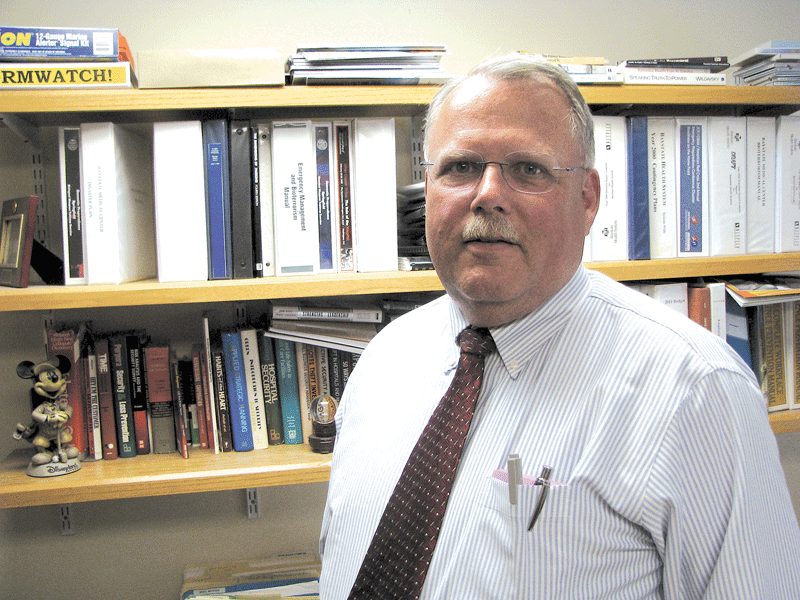
Tom Lynch

Tom Lynch said any emergency plan has a certain amount of flexibility built into it, because it’s impossible to predict precisely what type of disaster will strike.

Tom Lynch agreed. He’s the director of Security at Baystate Health, and he, too, was going over material written about Joplin in the days leading up to the Massachusetts tornadoes. And while doing so, he put special focus on how St. John’s and its parent system, based in Springfield, Mo., handled the broad matters of information management and communication.
“One of the things that becomes critical is how you communicate with your staff and how you communicate with the community,” he said, “because, if there’s a need to access services or if there’s a question of whether you should come to work and, if so, how you should do it, then the ability to get that information out becomes a challenge.”
Like Carroll and most everyone else at Baystate and Mercy, he would have some personal accounts to add to his base of knowledge by the time the sun went down on June 1, and some thoughts about where changes or improvement may be needed in disaster readiness. Like Carroll, he said the collapse of cell-phone service was unexpected and problematic. Meanwhile, he said, overall, things could have been much worse that day if, for example, the tornadoes had done considerable damage to one of the arteries it passed right over, including I-91, Route 5, and the Memorial Bridge. And he believes plans should be made for such specific calamities.
For this issue, BusinessWest looks at how Joplin put tornadoes on the radar screen here and elsewhere, in a figurative sense, and how this region’s own experiences brought those lessons home in ways no one could have imagined on May 31.

Getting Wind of It
Recalling the events of that fateful Wednesday, Dan Moen, president and CEO of the Sisters of Providence Health System, which includes Mercy Medical Center, said there wasn’t much talk of tornadoes that morning, and very little in the way of what would be considered heightened alert of additional preparedness other than people “being aware of what could be a pretty significant storm.
“I think that, sometimes, we don’t pay enough attention to those types of storm warnings,” he continued, adding that it’s fair to say that the word ‘tornado’ will never be regarded the same way in this region. “I don’t think anyone will underestimate those storm warnings in the future.”
Although the first tornado touched down in Westfield, and then again in West Springfield, there was very little warning to speak of at Mercy Medical Center, said Carroll, whose basement-level office at Mercy has no windows. She added that there was a warning around 1 p.m. that conditions were ideal for severe thunderstorms and perhaps a tornado, and the first real warning — but for possible tornadoes much further north, in the Amherst/Belchertown area — came at 4:23 p.m., just seven minutes before the funnel cloud then making its way across the Connecticut River showed up on a camera fixed atop the hospital’s roof.
No one at Mercy really knew about the tornado until they heard about that image from the roof camera or saw the funnel for themselves, said Carroll, adding that she was walking through a tunnel between the hospital and Memorial House when the tornado crossed the river into Springfield, and first saw it when she emerged at the other end. She immediately told staffers to seek shelter, and within seconds, warnings had been sent to the pagers and cellphones of employees, and Mercy swung into what’s known as a ‘Medical Alert Code 1,’ the lowest of four levels, with a ‘4’ translating into full-scale evacuation of the hospital.
In the Code 1 scenario, personnel at the hospital were asked to work beyond their traditional shifts (which vary with the position in question), and additional personnel were placed on standby. Meanwhile, patients were moved away from windows — a step already in the response book but reinforced by the events at Joplin — and Moen took up a command post in the hospital’s ER with the mindset that a tornado in an urban area like Springfield could result in a large number of injuries.
“We anticipated that there would be many more victims than what we actually experienced,” he said. “We started to work on the staffing piece — asking people to stay beyond their shifts and calling some people whose skills we knew we’d need, not knowing whether they could get in at that point.”
At Baystate, very much the same thing was happening as that hospital shifted into what it calls a Plan D (for disaster), said Lynch, noting that the facility first went into standby mode for that particular response scenario, and then, when the tornado officially touched down in Springfield, went into the actual Plan D.
There have been a few occasions over the years when this has happened, he said, adding that, in his 16 years at the hospital, the only direct comparison he could draw to the tornado in terms of the type and degree of response and general level of mobilization was the Jahn Foundry explosion in February 1999 that sent 12 workers to Baystate with burn injuries; three of them would later die as a result.
“The similarities are the spontaneity of it, the fact that we had some self-drives — not everyone came by ambulance — and the level of preparation activity,” he said, adding that the nature of the foundry injuries, severe burns requiring that patients be stabilized and then moved to burn centers, made that case different in some respects.
Baystate does not have a specific contingency plan for a tornado, said Lynch, adding that such a development would be covered under what’s known as hazard-vulnerability analysis, which looks at 35 to 40 different things that can happen — from a terrorist attack to a severe blizzard — and prioritizes them in terms of the likelihood of their occurrence, the kinds of damage each might cause in terms of operation, and preparedness level. Tornadoes do not appear on the list (although ‘severe weather’ does), he told HCN, and they’re certainly not a high-priority consideration, or at least they weren’t before June 1.
“When you design a weather-emergency plan, there’s a certain amount of flexibility in there,” he explained. “It might be snow, ice, or severe thunderstorms that take things out of play.”

Imperfect Storm
Given the population density in downtown Springfield and the neighborhoods surrounding it, personnel at both Mercy and Baystate were preparing for a high volume of injuries that, thankfully, never materialized.
At Baystate, for example, the hospital moved into what the system calls ‘mass casualty mode.’
“With the damage you’re hearing about — with the collapses, the closed-off neighborhoods, and the closed-off streets, the anticipation is that you’re going to get large numbers of wounded people here,” Lynch explained. “So you move into the mass-casualty mode, which then ramps up different aspects of the operation, particularly the clinical things.”
Elaborating, he said that Dr. Reginald Alouidor, attending physician in Baystate’s Level One trauma unit, the only facility of its kind in Western Mass., was forming trauma teams, and the Emergency Department staff were moving patients and creating room for a crush that was far less severe than it could have been.
Baystate eventually treated 25 people, 10 of them in the trauma unit; seven were admitted. Mercy, meanwhile, treated a total of 35 people, none of them with life-threatening injuries, and all were treated and released.
Many of these individuals transported themselves to the hospital, which made this situation unique in some ways. “I remember this one car that drove up … the roof was V-shaped,” said Carroll. “A tree had fallen on top of it, and the windows were blown out; there was a baby in the car, and they needed two wheelchairs to get the occupants out and into the emergency room.”
While dealing with the injured from the first tornado, both hospitals soon went on alert for more twisters, especially one that was reportedly moving southwest from Chicopee, right into the path of the two facilities.
Moen said these reports prompted staffers to once again move patients away from windows and consider additional steps to ensure both patient safety and efficient handling of large numbers of injuries.
When asked what lessons Mercy and other hospitals could take away from the events of June 1 — just as they are all learning from Joplin — Carroll started with the need to pay a little more attention to the weather, a need she’s already addressed.
“Someone told me Radio Shack was having a special on hazard-alert radios, for $29.99,” she said. “They were getting rid of last year’s models, so I went and bought five of them; we’re going to place them at the security booth, the front desk, at the switchboard, which is also in the basement, and the fourth floor of the Weldon Center, because they saw it out the window about the same time I did.”
Beyond that, she and Lynch said much of the focus has been on the ineffectiveness of cellphones — again, something that wasn’t anticipated — and steps that may be taken in the future as a result.
“I received only one call in two hours, and every call I tried to make didn’t go through,” she said, adding that backup contingencies, ranging from land lines to two-way radios to texting, kept most of the lines of communication open.
In the wake of the tornadoes, Mercy will look into having more ham radios tuned to the SkyWarn channel, another stormchasers’ outlet. “Many times, they’re the first to see the first touchdown.”
Said Lynch, “It’s a stunning thing for people to dial something on a cell phone and get busy circuits all the time. You have to look at what that impacts. It didn’t affect our operations, but when you live though it like this, you ask questions about what happens next time.”
As is typical with such events and the drills that replicate them, he added, there is a comprehensive debriefing exercise, at which those involved discuss what went well and what didn’t. In this case, most all matters fell into that first category.
“But in this particular case, we’re going well beyond that, because it was an actual event, and we’re really soliciting information from our clinical people,” Lynch said. “They did fabulous work, and they organized this so rapidly; it’s not a surprise, but it’s always great to see. People take the training, and they take the understanding, and they do what they have to do, and do it remarkably well.”

Lasting Impressions
Caroll is still working on that PowerPoint presentation she talked about. The pictures and accounts of the Joplin disaster offer some important lessons for Mercy and all hospitals.
“We wanted to look at the types of damage done to the hospital in Joplin, and the things that we would need to consider in our planning,” she said, “such as the safest places to seek shelter in the buildings, warning systems, and so on.”
All that will still go on, but now there are other, far more personal accounts of what to do when a tornado strikes. They are one of the more positive things to take away from a day that won’t ever be forgotten. n

George O’Brien can be reached at [email protected]

Banking and Financial Services Sections
Start by Creating a Budget and Trimming Some Fat

Thomas J. Fox is

Thomas J. Fox is

Stress is a word we’ve become all too familiar with throughout the recession. According to the American Psychological Assoc. 2010 Stress in America survey, 76% of Americans say money is the significant cause of their stress. Although the economy has shown signs of improvement, many of us are still concerned about the future.  If you’ve seen your home lose a quarter of its value, watched your retirement account dwindle, or been forced to live a more frugal lifestyle, you know what I’m talking about.
Needless to say, no matter how good the country’s economy gets, we won’t consider the recession over until our personal economy rebounds. Now, we don’t know when that’s going to happen, but there are some things you can do to make things a little less stressful on yourself and your family until the situation has stabilized.
First, let’s look at the bright side of our economy. The Associated Press’s Economic Stress Index, a monthly release analyzing the financial strain of the nation, shows promise in our recovery. The Stress Index calculates the pressure Americans are feeling by county, and assigns a score, from 1 to 100, to the overall pressure the nation is feeling. Factors such as unemployment, foreclosure, and bankruptcy filings are considered when weighing economic pressure. As things get worse, the Economic Stress Index increases; as things get better, the score decreases.
According to the AP’s April release, America’s economic stress fell to a two-year low of 9.8, down from 10.5 in March. The decrease is attributed to strong private-sector hiring and lower bankruptcy filings. That’s great news, but we’ve still a ways to go before we can claim a full recovery. Plus, we have to contend with higher food and gasoline prices, which hamper our overall economic growth.
Even though there are signs things are improving, we may still be feeling the stress of a beleaguered economy for a while. So, what else can you do to keep calm during the recovery? The American Psychological Assoc. has some great tips on how to take the edge off your financial woes.
First, don’t panic. I know, easier said than done, but think about it. What have you gone through in your life? Have some experiences left you feeling like this is the end of the world? From my own personal experience, I know I’ve felt that way on a few occasions, but you know what? Things worked out, sometimes even better than I imagined. The point is, don’t worry about things you can’t control. You can’t put your life on autopilot, either, but you shouldn’t fret about the overall economy. Focus on your personal situation and make the best decisions you can to make things easier.
Some decisions require soul-searching and communication. Many of our expenses are personal in nature. However, when we really look at where our money is going, there’s always room to trim the fat. Sit down with your family and have an honest discussion of what you can eliminate from your budget or spending plan. If you don’t have a budget, make one. You can’t make a plan to alleviate your stress if you don’t know what’s stressing you out. There are plenty of online tools you can use to develop a budget, such as Mint.com, that will help you to create one in a jiffy. Once you know where your money is going, start to think about areas where expenses can be reduced. If you are having some difficulties cutting back, call your bank, utility companies, and creditors to see if there are any programs available to help reduce the amount of your monthly obligations.
The next bit of advice works in conjunction with cutting expenses. Most of us never took a course in personal finance, and to some, budgeting sounds about as fun as a root canal. The good news is that there are many services available to you that can help you to create a budget and reduce your expenses. Credit-counseling services employ financial professionals who have a great deal of experience helping people make sense of their finances. Each year, millions of Americans reach out to these nonprofit agencies for relief, guidance, and the expertise to deal with a host of financial issues. Even better, talking to a counselor is free — how’s that for reducing your stress?

Thomas J. Fox is the Community Outreach Director at Cambridge Credit Counseling, an Agawam-based professional housing and debt-counseling agency. He is an AFCPE-accredited credit counselor, a CFC-certified educator in personal finance, and an NCHEC-certified housing counselor; (413) 241-2362; [email protected]; twitter.com/thomasjfox

Banking and Financial Services Sections
STCU Stays True to Its Roots by Providing Education to Its Members

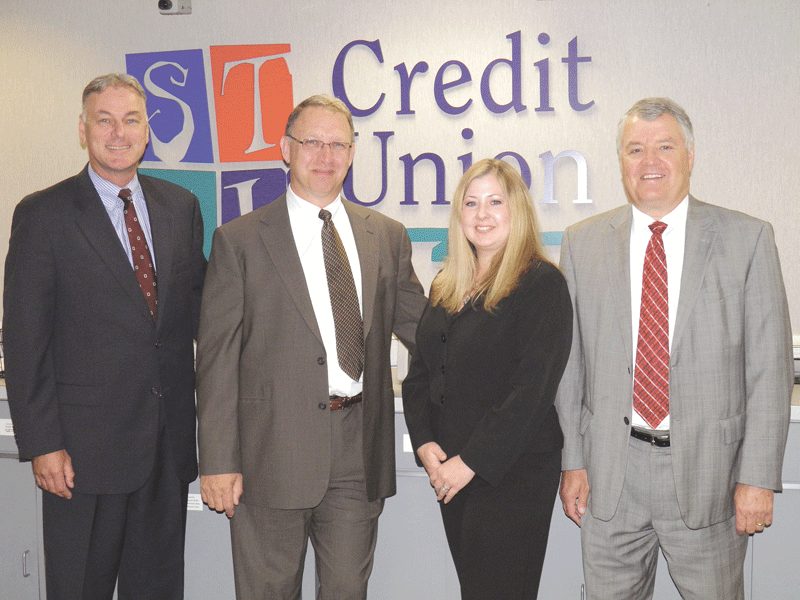
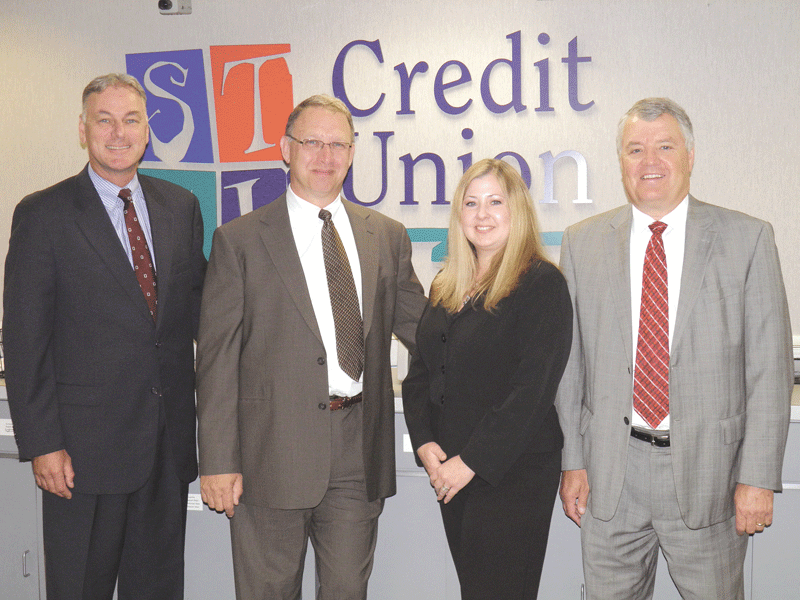
From left, STCU executives Michael Ostrowski, John Klimas, Jennifer Beylard, and Denny Keyes

From left, STCU executives Michael Ostrowski, John Klimas, Jennifer Beylard, and Denny Keyes say their institution is focused on helping its members achieve their financial goals.

Michael Ostrowski was talking about doing the “right thing.”
But the president and CEO of STCU Credit Union, who took over the helm June 10, wasn’t referring to moral choices. Instead, he was explaining the importance of helping members make sound decisions about how to save, invest, and spend their money based on financial literacy and education, which he says is integral to the institution’s mission.
“People come in here and they think they know what they need,” he said. “But we get the broad picture of where they stand financially and then try to encourage them to do what we think is in their best interests. Credit unions are about people helping people, and we try to make sure each person has the ability to make payments on a loan and is making prudent financial decisions. For example, someone might think they want a home-equity loan because of the low rates, when it may be smarter for them to rewrite their first mortgage. We look at what is best for them, as it’s part of our mission to guide them to make better decisions than they might make on their own.”
STCU was founded during the Great Depression by a group of teachers at Commerce High School in Springfield. It has come a long way since its beginnings in 1929, and today serves about 11,000 members who reside in Hampden, Hampshire, and Franklin counties. Although it is open to the public, the majority of members are educators who come from Springfield Public Schools, American International College, Springfield Technical Community College, Minnechaug Regional High School, and the Massachusetts Career Development Institute, among others.
The credit union has always been a place where members give their all to benefit fellow teachers. In fact, its first full-time manager, Joseph Della-Giustina, left a teaching job he loved at Commerce High School in 1988 and took early retirement because state officials wanted to take the credit union over and gave it a month to find a full-time person to run it.
“I loved to teach, but we were going to lose it; there were many times when we had to stretch our necks out to help people,” said the 88-year-old. “We listened to people’s stories, and during my time there, I saw many who left here with things looking up for them. To this day, I have people who come up to me and thank me for what we did for them.
“We started in one room,” he continued, “and worked on the credit union, and as long as we had people interested and willing to stick their necks out, we got things done.”
For this edition, BusinessWest takes a look back at STCU’s history and the factors that allowed it to grow and remain financially healthy through turbulent times and difficult periods in history.

Pooling Resources
In 1929, 31 teachers at Commerce High School pooled their money to start the Springfield Teacher’s Credit Union. It was housed in Room 125 at the school, and the records were kept in a locked closet. The hours were few: it was only open for about a half-hour each day after school closed.
“But it was a place where teachers could save and borrow during one of the most difficult times in U.S. financial history,” Ostrowski said. “STCU was born out of necessity. These people needed loans, so the founders did what they had to do to fulfill their fellow teachers’ needs. There were a lot of bank failures at the time, and it must have been very difficult for people who were gainfully employed not be able to get a loan or save properly, so this provided a solution to the problem.”
The members pooled their savings, which were recorded at $2,160. After several meetings, on Oct. 5, 1929, the credit union received a certificate of incorporation from the Commissioner of Banks and the Secretary of State.
Anthony Serafino, who was a former teacher at Commerce, was one of the key players in its history, as was Della-Giustina, who joined the credit union in the ’50s when he was teaching business math at the high school.
He remembers people who needed to borrow as little as $150 and were thrilled to have their requests met at STCU. However, he made it a point to tell members that membership was a two-way street and that, in order for the credit union to successfully serve their needs, they needed to support it by borrowing and saving there. He also told them to keep in mind that it was their credit union, which meant they had the opportunity to have a say in how it was run, elect people to the board of directors, and directly influence the products and services that were provided.
“Our sole purpose is to serve our members in good times and bad, and all the benefits of membership derive from that single purpose,” he said in a statement made in 1988.
As the membership grew, it became necessary for the credit union to move its operation out of Commerce High. Della-Giustina said a three-story building was available next door on 427 State St., and they rented it for a time before purchasing it.
The ground floor was a store, and one of the teachers who was handy and lived a distance from Commerce was given free rent in an upstairs unit in exchange for doing the work necessary to make it operational. Della-Giustina and Serafino oversaw a lot of the construction and made sure it continued to meet the needs of the teachers it served.
“But as time went by, we grew, and it became too small,” Della-Giustina said. He had a friend in the construction business who had purchased the piece of property the current main branch stands on at 145 Industry Ave. in Springfield, who was unable to use it for what he wanted and sold it to the credit union at his cost so it could put up its own building.
Ground was broken on Nov. 4, 1988, and the credit union opened its doors on Aug. 7 that year. By that time, STCU offered a wide array of products and services, but as its new manager, Della-Guistina had to petition city officials to allow direct payroll deposits and deductions for members, which he successfully obtained.
The credit union has continued to expand since that time and opened a branch in the Westfield Shoppes in 2006. Ostrowski said the name was changed about 10 years ago from Springfield Teacher’s Credit Union to STCU as it hoped to attract more members from  the general public and didn’t want people to think it was only for teachers.

Bright Future
Ostrowski, who has spent his life in banking in the Greater Springfield area, said he’s excited to be at the helm of STCU. He knows what it’s like to struggle, as he worked his way through pre-med school with a night job before a chance encounter led him to switch career paths. He has handled mortgage banking at Boston Pioneer Financial Cooperative Bank, started the residential mortgage department at Multibank National Bank in Springfield, and was a commercial lender at Ludlow Savings Bank, vice president and chief lending officer at Freedom Credit Union in Springfield, and vice president and senior lender at Barre Savings Bank before coming to STCU.
He likes the fact that credit unions work together, and is very committed to continuing the education that has been part of the mission of the credit union. “Teachers are a close-knit group and want to do the right thing, which falls into place with this credit union. We have the same attitude, which is a tradition that has been carried on since its beginning,” he said.
One of his goals is to work with schools in Springfield and Westfield to develop programs that will teach high-school students financial literacy.
“It’s important; you see so many college students who are in trouble due to credit cards and solicitations because they don’t know how to handle money,” he said. “I want to make sure we are doing everything we can to get kids on the right track.”
Classes would include an introduction to checking and how to save, and may also include sending a credit-union representative to the schools each month to make it easy for students to make deposits.
“Teens need to learn to be savers and understand when to get loans and when not to get them,” Ostrowski continued. “We see a lot of people who have overextended themselves financially because they are not financially literate, and since we are a teacher’s credit union, it’s really important to build that bridge, which ties in wonderfully to our roots.”
Ostrowski says the board of directors has always been financially responsible, and although the credit union took some losses two years ago, “we have turned the corner and are very much on solid ground. We are well-capitalized and are earning money.”
In short, it all comes back to doing the right thing — first and foremost for individual members, which translates into the bigger financial picture of the entire credit union.
And to this day, as Della-Giustina said, people who go there for help don’t forget what they learned in the hallowed halls of this teacher-founded banking institution that is still dedicated to education.

Education Sections
Initiative Creates an Ambitious Agenda for Public Higher Ed

VisionProjectThere are many moving parts to the state Department of Higher Education’s Vision Project, but the bottom line is jobs, or, to be more precise, properly preparing individuals for the jobs that define a new, technology-centered economy. The Vision Project aligns all 29 public colleges and universities behind seven identified goals — from improving graduation rates to getting more people into math and science fields — and adds several layers of accountability.

Richard Freeland says there’s nothing new or particularly imaginative about the goals spelled out in the Mass. Department of Higher Education’s so-called Vision Project.
They range from improving graduation rates to increasing the numbers of people entering college; from eliminating historical disparities among racial and ethnic groups to encouraging more people to enter the math and science fields of study — and they’ve been goals for individual colleges and universities for decades.
What is new, said Freeland, the state’s commissioner of Higher Education, is a heightened sense of urgency attached to these goals, created by truly global competition and technology-focused jobs that increasingly demand a college education.

Richard Freeland

Richard Freeland

“Given where our economy is and given where our state is demographically, and given the competitiveness of the economic world, both nationally and internationally, we’re at a point in the history of Massachusetts where we need first-class public higher education,” he explained. “And I don’t think that, historically, public higher education has been the kind of priority that it needs to be today.”
And what’s imaginative is the Vision Project’s approach, a coordinated effort involving all 29 public colleges and universities that adds several layers of accountability.
“This is an attempt to pull together, against the background I’ve described, the coordinated efforts of all public high education,” Freeland explained. “We have a highly decentralized system that features a great deal of autonomy granted by statute to the colleges and local boards of trustees. That makes it extremely difficult for public higher education as an entity, as a statewide institution, to respond in a collective and focused fashion to statewide needs.
“There is a bit of a mismatch between the structure — the decentralized, desegregated, fragmented structure of public higher education — and the urgency of the concentrated focus on building a first-class system of public education,” he continued, adding that the Vision Project was created to align the 29 public campuses behind a short list of critically important goals.
To show how it will all work, Freeland talked about one of the items on that short list, the often-controversial matter of graduation rates.
“This is where the rubber meets the road,” he said of the need to see people who enroll through to commencement night. “When people talk about graduation rates, the answer, across the country, is that they’re not high enough; too many people are falling by the wayside.
To address the problem in the Bay State, a comprehensive, three-part program, developed as part of a national initiative known as Completing College America, has been implemented to move the needle in the right direction.
“The first part calls for every institution to have specific goals to improve student success,” he said, citing just one example of how the Vision Project operates. “When we surveyed our institutions, we found that that was not currently the case; while everyone’s working to do better, a number of our institutions had not formulated specific aspirational goals against national benchmarks to hold themselves accountable for forward motion.”
Ira Rubenzahl, president of Springfield Technical Community College, said he’s a strong proponent of the Vision Project, although, like others, he stressed that it will need a strong funding commitment from the Legislature to meet its goals, and he has concerns about whether that will materialize.
He stresses that the need for the initiative is real, and that while the initiative has a number of moving parts, at its core it is about one word: jobs, and, more specifically, adequately preparing people for the jobs of tomorrow — and today, for that matter.
Ira Rubenzahl

Ira Rubenzahl

“We recognize that some college is critical for young people to get jobs in this new economy, and it’s critical to grow this new economy,” he said. “All the elements — getting more students to attend college, getting more students to complete, getting students to be successful while they’re at college, eliminating disparities, and aligning with local businesses — have an economic lens to them.”
For this issue and its focus on education, BusinessWest takes an indepth look at the Vision Project, its goals, and the unique strategy mapped out for attaining them.

Schools of Thought
Freeland told BusinessWest that there are several reasons why Massachusetts has historically lagged when it comes to attention to and funding of public higher education. One has been the predominance of private institutions that attract students from across the state and around the globe.
“The success and sheer number of these schools have made it possible for state leaders at different kinds of institutions, as well as the general public, to believe that, because we have Harvard and MIT, not to mention all those other great places like my alma matter, Northeastern, we don’t necessarily have to invest in public higher education the way California does or Texas does or Ohio does,” said Freeland, who speaks with decades of experience working in the public higher realm, including a lengthy stint at UMass Boston. “But that perspective is way, way out of date.
“Over time, public higher education has grown increasingly important as an educator of young people in this state,” he continued. “When I started in 1970, the majority of high-school students were still going to private institutions for college, but today, two-thirds of the students who graduate from our high schools are going to public institutions if they pursue education in this state; we have become overwhelmingly a primary provider of higher education for the broad population of this state at a time when we’re not having a lot of in-migration, we’re not having any population growth, and we have a workforce that needs a large number of highly educated workers.”
All this adds up to what Freeland called a heightened sense of urgency that hasn’t existed before, and the need for a plan of action, or agenda, moving forward.
And thus, the Vision Project was conceived in late 2009, and officially adopted by the Board of High Education in May 2010. It completed its first full year of implementation on June 30, and the Legislature is earmaking several million dollars in the fiscal 2012 budget for the Department of Higher Education to provide incentive grants to individual colleges and universities to organize activities around the goals of the vision project.
In a nutshell, the initiative was launched with the recognition that the state is in fierce competition with other states and countries for talent, investment, and jobs, and that its primary assets in this competition are the overall education level of its people, its workforce, and the overall competence and creativity of individuals and organizational leaders driving the state’s knowledge-based economy.
“There is a heightened sense of urgency, because I do believe that Massachusetts needs the best-educated citizenry and workforce in the country, because that’s about all we’ve got in the competition among states,” he said. “And if we neglect public higher education, we’re simply not going to have that.”
The Vision Project is, in essence, the vehicle through which public higher education will remain focused on preparing individuals for this economy — and holding itself accountable for results.
Several key outcomes have been identified, said Freeland, noting that, for the state to thrive in this highly competitive environment, it must achieve national leadership in several realms, including:
• College participation, or the college-going rates of high school graduates;
• College completion, or graduation and success rates of the students enrolled;
• Student learning, academic achievements by students on campus-level and national assessments of learning;
• Workforce alignment, or alignment of degree programs with the key areas of workforce need in the state’s economy; and
• Elimination of disparities, meaning achievement of comparable outcomes among different ethnic/racial, economic, and gender groups.
Meanwhile, the University of Massachusetts must claim national leadership in research activity related to economic development, and economic activity derived from research.
As it went about creating the Vision Project, the Commonwealth’s public higher-education community considered what other states are doing well in this regard, said Freeland, adding quickly that the state’s highly de-centralized system makes it difficult to replicate what other systems are doing. Meanwhile, the state’s track record with public higher education and a lingering lack of urgency in some camps makes it hard just to put such an agenda in place.
“You don’t have to make much of an argument in Ohio that public higher education is critical to a state that has been losing altitude as the Rust Belt has declined,” he explained. “There, public higher education is understood to be the name of the game, and Ohio State is the Harvard of that region. But you do have to make that case in Massachusetts much more strongly.”

Extreme Measures
As he talked about specific goals within the Vision Project, Freeland said there is a universal aspiration for each  — that phrase “national leadership.”
This is inherently a subjective phrase, he said, but not in the case of such matters as graduation rates and diversity, where there are hard numbers to compare and contrast performance. It is one of the underlying missions of the project to create meaningful measures for the specific goals, and then to score high in each category.
Returning to the subject of graduation rates, he said the numbers used are broad and often misleading.
“The best metric for measuring student success and graduation rates, particularly at community colleges, is a vexed question,” he said. “The rate that is often cited as the national standard [about 25%] is based on whether or not students who begin as full-time students graduate in three years, which is a very small percentage of the students who actually attend our community colleges.
“So we are working to develop a much more useful metric,” he continued, “which would measure such things as how successful we are in graduating part-time students, how successful we are in graduating people who transfer in from someplace else, and how successful we are transferring students who start at community colleges and transfer on before completing a degree.”
And while graduation rates are certainly one strong focus of attention, there are several other goals within the Vision Project that are key to achieving that overarching goal of making the Commonwealth more competitive on the global stage, said Freeland.
And with that he referenced an acronym, and statewide initiative, that is gaining visibility and attention across the state: STEM. That stands for science, technology, engineering, and mathematics, and increasing the numbers of students enrolled in these fields — and then graduating them from those programs — are top priorities, said Freeland.
“Far too few young Americans are pursuing academic studies and scientific and technologically oriented careers, and far too few are coming out of our colleges with appropriate skills to drive an innovation-oriented economy,” Freeland told BusinessWest. “This has been a major focus in the business community as well as the education community.”
Local programs have been created to help spawn interest in the STEM fields, he said, listing everything from field trips to manufacturing plants to scientists coming into the classrooms to talk about careers, a “traveling road show,” as he called it, designed to inform and even entertain students.
One of the Vision Project’s goals is to build on these programs aimed at energizing students about STEM and graduating more students in those fields. “We get a good number of people coming out of high school who say they want to major in STEM fields, and start out in them,” he said, “but the dropout rate is very high.”
And the so-called ‘persistence rate’ is comparatively low, he continued, adding that this gauges how many students stay in the field of study they’ve chosen. Work to move those numbers higher is still another matter that the Vision Project will measure — and inject accountability.
The goal with all the initiatives is to prepare individuals for the job market they will face and create a workforce that will enable the state to compete for companies and jobs, said Rubenzahl, who echoed Freeland when he said the landscape has changed in nearly all aspects of business, and public higher education now has a larger role than ever in helping to create a pipeline of qualified workers.
He cited manufacturing and related fields such as biotech as examples of how things have changed, and how the role of public higher education has been broadened.
“We had some pretty good-paying jobs in various industries — originally it was textiles — that left,” he said. “And for many of those jobs, you didn’t need a college education. However, for many of the industries that stayed here or grew up here, you need much more education.
“The economy has changed, and public higher ed has a much larger role than it had before,” he continued. “Let’s face it, Harvard and MIT are not going to train highly skilled factory workers who can run these CNC machines or production workers in these biotech plants. They have a role, but we think we have a greater role as well.”

The Bottom Line
Summing up the Vision Project, Freeland said it is a comprehensive — and very visible — attempt to take public high education to a new level of excellence, responsiveness, and accountability.
“The campuses believe in these things … this isn’t about persuading schools to do things they don’t want to do,” he explained. “It is about taking it to a higher level of focus and having a higher level of aspiration and holding ourselves accountable.”
And it’s a long-term initiative, one that will play itself out over the next several years, involving perhaps many different gubernatorial administrations and college presidents. But he believes the program will stay on track, mostly because it has to if the state is going to thrive in this truly global arena.
“It’s easy for institutions to run out of gas addressing these very tough problems,” Freeland said. “You can bank on the fact that I’m not going to be here forever and Gov. Patrick isn’t going to be here forever, but these issues are going to be here forever.
“These are not issues for one day or one week,” he continued. “But once we get focus on them and get some momentum behind them, the gravitational force of statewide need will keep us focused. But it’s not going to be easy.”

George O’Brien can be reached at [email protected]

Features
A look at the event from June 23, 2011

More than 600 people gathered at the Log Cabin Banquet & Meeting House on June 23 for the fifth annual 40 Under Forty Gala, a celebration of the Class of 2011. The overflow crowd enjoyed a wide selection of food and some excellent networking opportunities before getting down to the real business of the night — the introductions of the Class of 2011, with each member choosing their own music for their moment in the spotlight.

Click Here: 40UnderFortyGalaBW0711a


••• Click here for more photos •••

Opinion
The Law of Unintended Consequences

I had an appointment with a client recently who told me that she was shocked to see how empty a restaurant was in downtown Springfield a few nights earlier. The reason she was so surprised was that this particular restaurant was relatively untouched by the tornado that tore through the center of the city on June 1. The owner stated that the reason things were so quiet was that people were simply afraid to come back.
Having read or viewed many articles and newscasts discouraging people from traveling to impacted areas (for completely understandable reasons) immediately after the tornadoes struck, I believe the law of unintended consequences might be starting to take effect in this region.
For instance, I myself have tried to stay clear of any impacted areas (unless going there to help with cleanup efforts). However, even though these intentions have been sound, the businesses that exist in these locations are suffering continued damages by this mindset. Many of these organizations were already struggling due to the recent, prolonged recession well before the tornadoes touched down. If their difficulties are now compounded by a sustained dropoff in business, a large number of them might not make it through to the other side. This could create a second wave of negative events for our region.
I write this in the hope that those who are in a position to do so can help spread the word regarding those conducting business in areas impacted by the recent tornado. I’ve already reached out to the leadership of Springfield encouraging them to use their amplified microphone to continue to spread the word that businesses are open and eager to serve — and that, when possible, individuals and business owners should do what they can to support these ventures.
I truly feel that those living and working in bordering communities need to be encouraged to travel back into impacted areas. The average local resident catches the news only on occasion, so it will take a genuine, concerted effort to convince people that it’s not only OK to come back, but such support is genuinely needed.
What we need is for individuals and business owners to think about both the direct and indirect victims of the tornadoes when they make decisions about where to stage the next staff luncheon or where to have their next date night. I’m a small-business owner in East Longmeadow, and I’ve been thinking a lot about how fortunate I’ve been to escape these tornadoes unscathed. But I’ve also been thinking about my counterparts in downtown Westfield, the center of West Springfield, the South End of Springfield, Wilbraham, or Monson who have been far less fortunate.
All businesses in our area are challenged by the economy, competition, and other factors. Businesses located in the paths of the tornadoes have been dealt an added blow that may prove crippling unless people step up and help in very simple ways.
My concern is long-term. If things are handled well, our entire region could use this experience as an opportunity to grow and prosper. However, if mishandled, we could see large-scale business closures and abandoned homes that could take many years to recover from.
Perhaps if we each do a little, then it might be enough to keep our collective community growing in the right direction.

Edward Zemba is president and co-owner of Robert Charles Photography; (413) 525-4263.

Opinion
Launching a Quest for Leadership

When we think about leaders, the discussion tends to gravitate — as it does when the subject is entrepreneurs — toward whether such individuals are born or cultivated.
The answer, with regard to each, is both.
Leaders, like entrepreneurs, simply must possess certain inherent traits, without which they won’t succeed. But we believe that leadership, like entrepreneurship, can be encouraged, developed, and, in effect, produced.
Which is why we are very encouraged by the creation of an initiative known as Leadership Pioneer Valley (see story, page 6). Spawned by the Plan for Progress and, more specifically, Action Item 7 in a 2004 update of that document — “Recruit and train a new generation of leaders” — the program was launched with the broad goal of creating an abundance of something the region will certainly need in the years to come.
Based on models created locally and in other communities, Leadership Pioneer Valley (LPV) will attempt to take people with inherent leadership qualities and provide training and insight that will help shape them into effective leaders than can serve — and benefit — this region in the decades to come.
In the ‘About Us’ section concerning LPV on the Pioneer Valley Planning Commission’s Web site, it notes that the 10-month program that recruits enter “immerses participants in an inspiring and enlightening curriculum that examines critical issues that the region’s numerous and diverse areas. During the program, participants expand their leadership skills while gaining connections, greater commitment to community stewardship, and cultural competency.” Roughly translated, this means that LPV intends to give participants an education in the Valley, its assets, challenges, goals, and aspirations — and then provide them with some opportunities to do something meaningful with that education.
We’re obviously hopeful that LPV can succeed with that overall mission, because this region has a number of very large challenges facing it, and none of them can be overcome without leadership.
For example:
• The region as a whole and most all of its larger communities must still reinvent themselves from former manufacturing centers into … well, something else. Unfortunately, most cities in the Valley carry that descriptive phrase ‘former manufacturing hub’ and have nothing to replace it with;
• While developing new sources of jobs, the region and its individual communities have to create a workforce with the skills needed to take on those new jobs, and thus attract new employers to the 413 area code;
• Springfield, the capital of Western Mass., is emerging from the economic meltdown that made it the butt of jokes for the better part of a decade, but it is still far from being the vibrant urban center everyone wants it to become; and
• The minority populations (soon to become the majority) in cities like Springfield and Holyoke need to become much more engaged in their communities and part of the pattern of progress. They have strength in numbers, but they’re not fully utilizing this asset.
These are just some of the myriad issues and challenges confronting our region, and the truth is that none of them are recent phenomena. They have been issues for many years — decades, actually — because the solutions are elusive; they don’t come easy.
And they won’t come through chance, fate, or the law of averages. They will come only through effective leadership that understands the region and the people who call it home, and are committed to moving it forward.
That’s why LPV is a critical development for Western Mass., and why we hope it will succeed in its all-important assignment.

Features
A Mill Town Writes a New Chapter in Its History

Aaron Saunders

Aaron Saunders says the Ludlow Mills site reflects one part of the town’s history, but farming has been another important aspect.


As he surveyed the landscape — old yet solid brick factory buildings bordered by broken expanses of asphalt with lanky grass growing in patches — Aaron Saunders said that this property is filled with the stories that gave birth to his town.
Walking around the Ludlow Mills, the chairman of the town’s Board of Selectmen remembered one particularly extreme tale — of the old smokestack, which he said was covered in diesel fuel and set afire to demolish it. “There are families living here that can trace their history there 100 years or more,” he said. “Those are the stories that maybe only one or two people still remember.”
Gesturing to the brick mills all around him, he added, “some of the older generations are still alive, and that means there’s a lot of living history here.”
He was at the property to tell BusinessWest about history in the making at this site bordered by State Street and the Chicopee River. The former Ludlow Manufacturing Associates jute mill has been selected as the latest property development undertaken by Westmass Area Development Corp. This past March, that organization secured funding to go forward with the remediation and redevelopment of this 170-acre site on the town’s southern border.
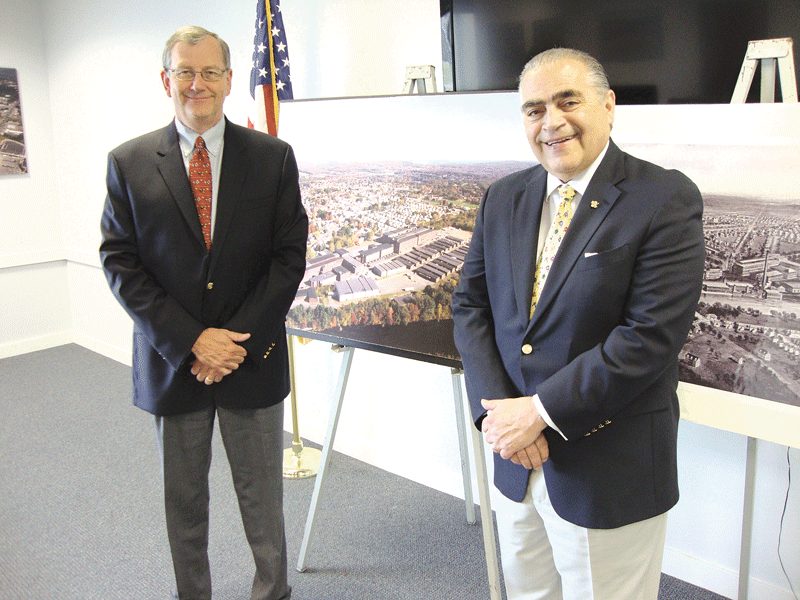
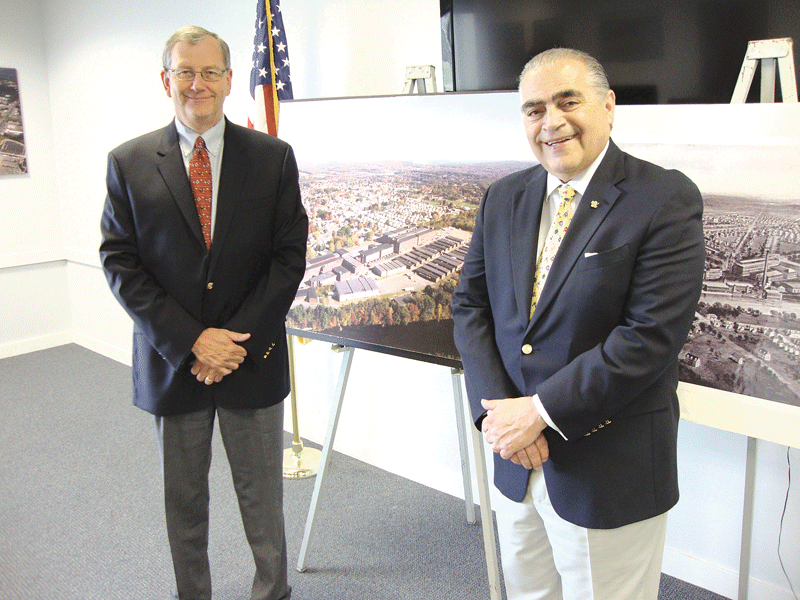
Bill Wagner, right, with Kenn Delude

Bill Wagner, right, with Kenn Delude, says the Ludlow Mills project, if done right, could serve as a blueprint for other cities’ riverfront development projects.

At Westmass headquarters in Chicopee, Kenn Delude, president and CEO of  the agency, and Bill Wagner, chairman of the board, sat before two posterboards: a present-day aerial shot of the property, and an historic etching of that same view.
Wagner said that, while Westmass has a history of successful site development, including the business and industrial parks at Westover, the project in Ludlow has some important and distinct qualities, some measured by the property itself, but also by the residents in town.
“When people in Ludlow first heard that we were involved in the property,” he said, “their first response was, ‘what can we do to help?’”
From the outset, the community has been invited to meetings intended to help determine the fate of this property, and both men agreed that Ludlow has been actively concerned with the property whose iconic clock tower graces everything from the town’s seal to its stationary to the high school’s class rings.
Doing business in Ludlow has long been reflective of many small towns in the area, with many primary services provided by locally owned operations. But as the mill property that gave the town much of its urban shape is redeveloped, an important aspect of this project stands a good chance to reinvent much of the way the Pioneer Valley looks at its riverfront industrial property.
It’s a big-picture perspective, but as Wagner pointed to a bucolic photograph of the greenway in front of the Ludlow Mills, he said, “the board’s opinion is that, if we revitalize this, and do it successfully, it will establish the blueprint for all the other communities to go forward with their riverfront property.”

Flower Power
Saunders was one of many people who spoke openly about their hopes for the future of the Ludlow Mills project. But he also mentioned the interesting nature of the town’s business profile. “Sure, this site is what built up all the houses in this part of town, but go just a couple miles east, and it’s all farmland.”
And while that agricultural legacy might have been eroded as the family farms were replaced by housing developments — another homegrown industry, you might say — Ludlow is still a place to get some of the finest local produce.
“Well, right now we’re in strawberry season,” Karen Randall said, “along with asparagus. This time of year is really the kick-off for the area’s growing season, and people have been busy putting in their perennial gardens, too.”
The second-generation owner of Randall’s Farm and Greenhouse on Center Street, she listed off all the local bounty that can be found in the market area of her operation. “Red and green leaf lettuces, summer squashes, tomatoes in late July, and then corn after the fourth of July. It’s really the exciting time of year for us. And if Mother Nature cooperates with sunny days, the ice-cream stand will be busy also.”
As she gets ready to celebrate the 50th birthday (next year) of the family business — what started out as a farmstand run by her mother and father — Randall said that her business has stayed in bloom throughout an otherwise down economy.
“The last two seasons have been good,” she explained, “and I’m really happy to say that. People do seem to be more relaxed. I haven’t quite figured out if people’s circumstances are better, or they’re just used to the way things are now, but people seem to be less nervous about the economy.”
While her business has a broad appeal far beyond the town limits, she said that efforts have been made to secure that market share. “We’ve developed our e-mail lists of customers, and our marketing through that. By touching our customers in that way, it has helped.”
But, as owner of one of the popular places for people to gather for coffee in the morning, she does see that there are other sectors that aren’t as rosy. “We do have a high concentration of construction companies in town who have taken a hit because there just isn’t a lot of new building out there,” she said.
That’s a sentiment that Bruce Libby said is unfortunate, but true.
He’s also a second-generation owner of a family business in Ludlow — Contemporary Structures Construction was started by him and his father back in 1975. They started as general homebuilders way back when, but in the early 1990s, during another downturn in the construction sector’s fortunes, a decision was made to hammer out some changes.
“We started doing staircases as a fill-in-the-gaps thing,” he explained. “Then it evolved into a great niche as the construction tide ebbed. So we focused on that, and today there are nine guys who work for me all year long — installers, shop people, estimators. Building finely crafted staircases is a nice area of focus.”
Today, that niche operation has ascended to a business that builds, on average, 200 to 300 staircases per year, from Worcester west to New York, up and down from Vermont to Connecticut.
In talking about the town’s construction economy, which saw a boom in houses built both in Ludlow and by its talented local builders in other communities, he tracked the changes from the perspective of his corner of the market.
“Five years ago, we probably did 95% new, and now it’s probably 50-50,” he explained. “There is still a market for new construction, but people are increasingly using remodeling as a means to get more out of their investment. New stairs, hardwood flooring, these are big improvements that add a lot of value to a home.”
He credits the Home Builders & Remodelers Assoc. of Western Mass as a key player in keeping the industry on a solid tread. “I’d say 80% of my contractor clients are from there,” he said of that trade group. And as tornado reconstruction gets underway, he’s looking to those colleagues to help rebuild the area. Ludlow, he said, will be well-represented in that effort.
“In general, Ludlow has a lot of contractor companies,” he added. “You won’t see a harder-working group of people.”

Rolling on the River
The development-update materials from Westmass refer to the Ludlow Mills project as “Our Next Challenge.”
While it is the largest brownfield mill-redevelopment project in New England, with nearly 1.5 million square feet of space in 66 buildings on 170 acres, the property is still in decent overall shape, both Delude and Wagner said. And, they agreed, the people of Ludlow have been vocal and helpful about what they hope to see both before and after the official sale — on track for early this month.
“The larger issue for the people of Ludlow,” Wagner explained, “was that they didn’t want it to deteriorate like other riverfront mill properties in the area, and become a potential big environmental hazard. They were very pleased that we were going to come in while the mill was still in a useful state.”
Delude said that Ludlow’s citizens have been engaged in meetings from the outset, to help determine what would be a good shape for the final results of the project. And, of course, his office’s track record speaks for itself.
“When people found out it was Westmass,” he said, “they knew that we’re looking for business uses, industrial uses, maybe in some cases a small residential component. This is contrasted with what they’ve seen in the past, when maybe there was a fear that there was too much of an emphasis on residential development.
“The focus here is on the creation of jobs still, with some mixed-use development,” he continued. “And that scope gives the plan its strength. If one sector is a little softer than others, you’ve got the others to support it.”
To elaborate on much-anticipated details is premature, Delude said, but he did note that two businesses have expressed strong interest in the property. “And both of them would be embraced by the community,” he added.
But one component to the Ludlow Mills which has both men, and indeed most everyone attached to the project, brimming with enthusiasm is the greenway along the property’s river edge. “There’s been a fence along State Street for almost 160 years,” Delude said, “prohibiting the people who live in these houses just across the street from getting to the river. In fact, by virtue of the infrastructure in town, there is no public access to this beautiful stretch of water.”
In response, Delude said that 50 acres of the project is to be set aside for a greenbelt and walkway along the river, stretching from the westernmost point, close to the town common, all the way along the property’s waterfront, up to a rail trestle spanning the bridge.
Putting that into perspective, Wagner said, “almost since we started talking about doing this, about five years ago, everyone is struck by the fact that, here in the Pioneer Valley, some of our most valuable land — the land along these clean and beautiful rivers — is banked with these old mills that are becoming more and more functionally obsolete. The real estate isn’t being put to its highest and best use.
“That has an economic cost to Western Mass. and to cities like Holyoke and Springfield and Chicopee,” he continued. “The fact that, thus far, you can’t use this shore property is a big negative. It’s a monumentally important effort that we’re putting forward here for not just Ludlow, but the future of our valley.”
It might sound like a lofty goal, but, then again, Delude and Wagner don’t limit the scope of what their office can accomplish. Looking at the images behind him of not just the Ludlow Mills complex, but of other Westmass projects, Delude said, “I think you can see why we chose this site in Ludlow; it does have the beauty, and it has the ability to create a model that Westmass could use going forward.”

Health Care Sections
How Best Buddies Helps Young People Come to an Understanding

Theresa Ruszczyk (right) and her buddy, Lucy Pasche

Theresa Ruszczyk (right) and her buddy, Lucy Pasche, say their friendship has benefited both of them in several ways.

“So far this month we have done the movie night at Cinemark. This event was a lot of fun and we both enjoyed the movie. We have also gone out to lunch at Wendy’s in Hadley. We were originally going to do ice cream but then Liz wanted to go out to lunch and Wendy’s is her favorite restaurant. Liz’s best friend Charlene came with her buddy Emily. This was really fun and it also gave me the chance to meet her dad for the first time. Liz has also come to one of my soccer games. She came to the game because she really wanted to see me played [sic]. I really wanted her to come. Overall, me and Liz [sic] are getting along really well and we already have a bunch of fun activities planned for the upcoming months :)”
This synopsis, known in the parlance as a ‘friendship update,’ does a remarkable and efficient (just 139 words) job of explaining just what the program Best Buddies is all about, and how it creates an abundance of those grammatical smiley faces like the one seen at the end of this missive.
Written by a young woman from Northampton, this monthly update report tells of how two people have become, well … buddies, and how they are spending increasing amounts of time together, finding out about one another, supporting each other, and anticipating a relationship that will continue to grow.
Better than any lengthy brochure, this simple update gets to the heart of the matter when it comes to Best Buddies, which pairs individuals who have intellectual and developmental disabilities (IDD) with people of the same age who do not. New friends, or buddy pairs, commit to contacting each other weekly and participating in a one-to-one activity together monthly. In addition, members plan and participate in at least four group activities each year.
Participation in the program becomes a unique growing and learning experience, said Kate Crowther, director, since last fall, of an area that includes Central and Western Massachusetts.
“While there is a service component and a mentoring component to the programs,” she explained, “we really try to support and enforce the idea that each student is of service to the other; it’s a mutually benefiting relationship. And so it’s not about spending an obligated amount of time with someone to fulfill your own personal desire to be of service to someone — it’s about taking steps to become more aware of people with intellectual and developmental disabilities, what their capabilities are, and to integrate the two demographics together.”
Theresa Ruszczyk (pronounced ruzz-ik) would certainly agree.
A junior at Northampton High School, she’s been involved with Best Buddies for two years now and is currently president of the Northampton Club, as these groups are called. At a matching party last fall, she was paired with Lucy Pasche, a senior at NHS who has Down syndrome.
Over the past several months, the two have gone to a number of Best Buddies-organized events together, including a dance, a few movies, a day of ice skating, a Halloween party, and a holiday-season get-together at which participants crafted gingerbread houses to be displayed in downtown businesses. Meanwhile, they ‘talk,’ which usually means texting, every day, and have formed a friendship that has benefited both young women in a number of ways.
“I’ve gained a lot more respect and patience and the knowledge that everyone is capable of doing something,” said  Ruszczyk. “I’ve realized a lot more about everyone, especially people with disabilities. I never look at Lucy and think about what she can’t do. I’m focused on what she can do, like run track and be a team captain, be a teacher’s assistant, and much more.”
Meanwhile, Pasche used the phrase “that was fun” to describe a number of the activities that have been part of the Best Buddies experience, especially the dance and gingerbread-house-building activities.
For this issue, BusinessWest takes an indepth look at Best Buddies and how Crowther is being aggressive in her efforts to build awareness of the program and thus create more opportunities for those smiley faces and strong relationships like the one forged by Theresa and Lucy.

The Buddy System
When asked about these efforts to raise the profile of Best Buddies in her large region, Crowther offered a significant sigh and a telling smile.
“It’s a 24/7 effort,” she said, adding quickly that she was exaggerating, but only slightly. Indeed, getting the word about this organization and expanding its already considerable footprint constitutes the top line of Crowther’s job description. It’s an intriguing challenge for an organization that locally is far less a household name than its leading spokesperson — New England Patriots quarterback Tom Brady.
But it has made significant strides over the past several years, said Crowther, noting that the area she leads now boasts more than 800 members and 19 chapters involving colleges, high schools, and a few middle schools.
In Western Mass., the colleges are Mount Holyoke, Smith, Springfield, and UMass Amherst. Meanwhile, there are eight area high schools involved — Amherst, Athol, Chicopee, Minnechaug, Monument Mountain, Northampton, Pittsfield, and Westfield — and two middle schools, Amherst and Glenbrook, both in Longmeadow.
Crowther said her twin goals are to grow the number of chapters  — to the extent the budget will allow — and strengthen existing programs. This is what’s happening nationally and internationally for an organization started in 1989 by Anthony Kennedy Shriver and that exists with the ultimate goal of essentially putting itself out of business.
“We enhance the quality of life for people with IDD,” Crowther explained, “while striving toward our long-term goal of establishing a society in which people with IDD are so successfully integrated that our services are no longer needed.”
Best Buddies pairs non-disabled students (peer buddies) with individuals (participant buddies) who have intellectual and developmental disabilities such as Down syndrome, autism, William’s syndrome (a genetic condition characterized by medical problems, including cardiovascular disease, developmental delays, and learning disabilities), Asperger’s syndrome, and other conditions.
The Boston-area office of the organization opened in 1995, said Crowther, and as demand for such programs in the central and western parts of the state grew, an office to serve that large region opened in 2005. It operates with the same guiding principles as the others, and that overriding goal of creating learning experiences for all those involved.
The many benefits of the program can be seen in the findings of a study conducted at Yale University in 2005. “Best Buddy relationships appear to offer unique benefits to the psychological adjustment of adolescents with mental retardation,” wrote the physicians who conducted the study. “The frequency of contact [adolesecents with intellectual disabilities had with their non-disabled peer buddies] was associated with lower frequencies of peer victimization, better adaptive behavior, higher levels of self-esteem, fewer psychological symptoms, and increased socialization.”

Equal Share
They can also summarized in an annual survey of the Best Buddies program conducted by Michael Hardman, dean of the Department of Special Education at the University of Utah. Results of several recent years showed that:
• 90% of high school peer buddies and 86% of college peer buddies have a more positive attitude about people with intellectual disabilities;
• 80% of the participants with intellectual disabilities demonstrated improved social behaviors;
• 77% of special-education faculty felt Best Buddies heightened awareness of the special-education department and its students among other faculty and non-disabled peers;
• 74% of the participants without intellectual disabilities were more aware that people with intellectual disabilities can hold jobs; and
• 92% of high-school peer buddies (without intellectual disabilities) and 85% of buddies with intellectual disabilities viewed their Best Buddies experience as enjoyable. Meanwhile, 97% of college peer buddies and 83% of college buddies viewed their Best Buddies experience as enjoyable.
“As with any successful social movement, the key to reform is changing people’s minds and hearts,” Hardmann wrote. “By introducing one person with a disability to a peer who does not have a disability, Best Buddies Massachusetts meets the immediate need for socialization and effects long-term change in people’s attitudes toward those with intellectual disabilities.”
Ruszczyk said the Northampton chapter has grown and evolved over the past few years. When she joined, most members were seniors, and when she graduated, the chapter had just a handful of participants. But it has grown to nearly 50 over the past year.
Some of these members have buddies, but many do not (lack of transportation often makes it difficult to meet some of the requirements), and these individuals are essentially friends to all those with IDD, said Ruszczyk.
“They don’t look at not having a buddy as being a barrier,” she explained. “They went beyond that; they’re very social and friends with everyone.”
“We want to be as welcoming as we can,” she continued, adding that the chapter’s get-togethers are open to all students at the school, not simply members. Meanwhile, the Northampton chapter will collaborate with the one at Amherst High School on events to create larger gatherings that help build awareness of the organization and its many goals.
By building greater awareness, Crowther hopes to be able to take the Best Buddies model to more middle schools, high schools, and colleges in Western and Central Mass., and, ultimately, make her region self-sustaining.
Achieving this goal will require greater financial stability and flexibility, she continued, adding that Best Buddies Massachusetts provides most of the funding for the regional office, but grants have also been secured and several fund-raising events have been added in recent years to provide that stability.
A fashion show staged at Thornes Market in Northampton this past spring was one such activity, while a golf tournament, slated for later this month, is another. The most successful fund-raiser to date, however, is an endeavor known as Artistic Abilities, an event that showcases and various talents of area buddies. Artists from the community will partner with individuals involved with Riverside Arts Industries, an Easthampton-based organization that provides services to those with intellectual and developmental disabilities.
Moving forward, the organization wants to take its fund-raising activities to a higher level, she continued, but from a big-picture perspective, the success of best Buddies lies in relationship-building on a number of levels — with participating schools, area businesses, and the community at large.

Getting Together
Pasche will be attending Holyoke Community College this fall, with a specific course of study to be determined later. Ruszczyk, meanwhile, is just starting the process of looking at schools, and for now, she’s equally undecided about a career path.
One thing she has decided is that she wants to continue her involvement with Best Buddies. “I hope the school I go to has a chapter — I’m pretty passionate about it,” she told BusinessWest, to which Crowther replied that, if that institution didn’t, she could always try to start one.
But that’s down the road. For now, she and Pasche are focused on the summer, finding ways to stay in touch (a cell phone greatly facilitates that process), and building upon a friendship that has already provided some enduring memories and important lessons that will linger well beyond their time at Northampton High School.
And that, in a nutshell, is what Best Buddies is all about.

George O’Brien can be reached at [email protected]

Bankruptcies Departments

The following bankruptcy petitions were recently filed in U.S. Bankruptcy Court. Readers should confirm all information with the court.

American Inventories
Graveline, Ronald G.
PO Box 1111
Sturbridge, MA 01566
Chapter: 7
Filing Date: 05/22/11

Anthony, Aryn A.
a/k/a Breveleri, Aryn A.
40 Fredette St.
Chicopee, MA 01022
Chapter: 13
Filing Date: 05/17/11

Atlas Appraisal
Brayton, Peter J.
Brayton, Claudine A.
53 Amostown Road
West Springfield, MA 01089
Chapter: 13
Filing Date: 05/24/11

Bailey, John Guy
172 Highland Ave.
Greenfield, MA 01301
Chapter: 7
Filing Date: 05/27/11

Barnes, Gordon W.
592 Stony Hill Road
Wilbraham, MA 01095
Chapter: 13
Filing Date: 05/19/11

Bigos, John S.
Bigos, Sally A.
44 Russell Ter.
Chicopee, MA 01020
Chapter: 7
Filing Date: 05/20/11

Birchem, Mark A.
6 Cowdry Lane
Wakefield, MA 01880
Chapter: 13
Filing Date: 05/20/11

Biskup, Robin H.
22 Enfield St.
Indian Orchard, MA 01151
Chapter: 13
Filing Date: 05/18/11

Blankenship, Rush G.
Blankenship, Diane G.
141 Thayer Road
Monson, MA 01057
Chapter: 13
Filing Date: 05/19/11

Bonafilia, Joan M.
610 County Road, Unit 3
Holyoke, MA 01040
Chapter: 13
Filing Date: 05/19/11

Boyle, Francis Joseph
Boyle, Tammy A.
1369 Page Blvd.
Springfield, MA 01104
Chapter: 7
Filing Date: 05/24/11

Bradley, Scott E.
51 Garfield St., Apt 1
Greenfield, MA 01301
Chapter: 7
Filing Date: 05/23/11

Cardin, Dennis Michael
Cardin, Debra Claire
22 Sanford St.
Chicopee, MA 01013
Chapter: 7
Filing Date: 05/18/11

Castilla, Johanna M.
75A Wells St.
Greenfield, MA 01301
Chapter: 7
Filing Date: 05/16/11

Chaplin, Valerie R.
376 King Road
Athol, MA 01331
Chapter: 7
Filing Date: 05/25/11

Civilian Staff
Walton, James G.
1760 Westover Road, Trail
Chicopee, MA 01020
Chapter: 7
Filing Date: 05/25/11

Clark, Lynn Ann
63 Oakridge Dr.
Belchertown, MA 01007
Chapter: 7
Filing Date: 05/20/11

Clow, Sandra L.
47 Basil Road
Chicopee, MA 01020
Chapter: 7
Filing Date: 05/19/11

Coblentz, Linda S.
200 Wisdom Way
Greenfield, MA 01301
Chapter: 7
Filing Date: 05/16/11

Collette, Jason A.
Collette, Nikki S.
PO Box 310
Sturbridge, MA 01566
Chapter: 7
Filing Date: 05/19/11

Colson, Raymond W.
Colson, Joan L.
138 Lucerne Road
Springfield, MA 01119
Chapter: 7
Filing Date: 05/27/11

Complete Construction
Dave’s Painting
O’Brien, David P.
O’Brien, Veronica L.
a/k/a Orlich, Veronica L.
P.O.Box 1245
East Otis, MA 01029
Chapter: 7
Filing Date: 05/26/11

Cote, Keith D
Cote, Patricia M.
769 Allen St.
Springfield, MA 01118
Chapter: 7
Filing Date: 05/25/11

Coughlin, Brian
Coughlin, Laura J.
80 Milford St.
Hanson, MA 02341
Chapter: 13
Filing Date: 05/16/11

Dassat, William P.
Dassat, Susan M.
22 Egremont Ave.
Pittsfield, MA 01201-7208
Chapter: 13
Filing Date: 05/16/11

David Wood Electrician
Wood, David C.
Wood, Julie M.
325 Fenn St., #1
Pittsfield, MA 01201
Chapter: 7
Filing Date: 05/22/11

DeSimone, Richard D.
DeSimone, Stephanie L.
a/k/a Spence, Stephanie L.
4M Culdaff St.
Easthampton, MA 01027
Chapter: 7
Filing Date: 05/23/11

Deuso, Nicole
200 Narragansett Blvd.
Chicopee, MA 01013
Chapter: 7
Filing Date: 05/20/11

DiNicolantonio, Robert P.
DiNicolantonio, Jean M.
178 Legate Hill Road
Charlemont, MA 01339
Chapter: 7
Filing Date: 05/19/11

Dones, Felipe
233 Denver St.
Springfield, MA 01109
Chapter: 7
Filing Date: 05/16/11

Downer, David A.
18 Lynn Dr.
Southampton, MA 01073
Chapter: 7
Filing Date: 05/27/11

Downer, Tertia M.
18 Lynn Dr.
Southampton, MA 01073
Chapter: 7
Filing Date: 05/27/11

Dupee, William F.
32 Greylock Ave.
Adams, MA 01220
Chapter: 7
Filing Date: 05/20/11

Egan, Richard C.
90 Harris St.
Granby, MA 01033
Chapter: 7
Filing Date: 05/24/11

Fortier, Russell James
575 Bridge Road
Florence, MA 01062
Chapter: 13
Filing Date: 05/17/11

Funari, Bethany Alice
16 Vermont St.
Greenfield, MA 01301
Chapter: 7
Filing Date: 05/26/11

Gambrell, James Oakley
61 Langevin St.
Chicopee, MA 01020
Chapter: 7
Filing Date: 05/27/11

Gates, Justina M.
2 Balance Rock Road
Pittsfield, MA 01201
Chapter: 7
Filing Date: 05/20/11

Gelinas, John P.
136 Amherst Road
Granby, MA 01033
Chapter: 7
Filing Date: 05/19/11

Gonzalez, James
42 King St.
Westfield, MA 01085
Chapter: 7
Filing Date: 05/20/11

Gray, Shain Edwin
65 Gilbert Ave.
Springfield, MA 01119
Chapter: 7
Filing Date: 05/16/11

Griffin Spirito, Donna M.
9 Feeding Hills Road
Southwick, MA 01077
Chapter: 7
Filing Date: 05/17/11

Haesaert, Daniel L.
Haesaert, Carol J.
62 Eddy St.
Springfield, MA 01104
Chapter: 7
Filing Date: 05/18/11

Harris, Kim M.
a/k/a Gauthier, Kim M.
59 Cote Road
Monson, MA 01057
Chapter: 7
Filing Date: 05/25/11

Haueisen, Nathan P.
519 East River St. Lot 33
Orange, MA 01364
Chapter: 7
Filing Date: 05/17/11

Haymes, Michele L.
36 Fowler St.
Westfield, MA 01085
Chapter: 7
Filing Date: 05/31/11

Hennessey, Sean T.
3 Valentine Ter.
Agawam, MA 01001
Chapter: 7
Filing Date: 05/20/11

Houghton, Brian R.
Houghton, Kerry Ann M.
9 Baltic Ave.
Chicopee, MA 01020
Chapter: 13
Filing Date: 05/25/11

Humphrey, Ellen G.
155 Marble St., Apt. 42
Lee, MA 01238
Chapter: 7
Filing Date: 05/26/11

Jablonski, Alan P.
47 Hillcrest St.
Chicopee, MA 01020
Chapter: 7
Filing Date: 05/20/11

Jediny’s Doggy Bed Breakfast
Jediny, Todd J.
Jediny, Julie
a/k/a Smith, Julie
4 Waterman Ave.
East Longmeadow, MA 01028
Chapter: 7
Filing Date: 05/19/11

Jeffery, Barbara E.
5 Weymouth St.
Springfield, MA 01108
Chapter: 7
Filing Date: 05/23/11

Johnson, Erik Raymond
Johnson, Erin Leslie
94 Marble St.
Athol, MA 01331
Chapter: 7
Filing Date: 05/19/11

K C Air Duct Cleaning
Engley, David M.
14 Western Ave., Apt. 2
Westfield, MA 01085
Chapter: 7
Filing Date: 05/25/11

Kelley, Gail S.
659 Nassau Dr.
Springfield, MA 01129
Chapter: 7
Filing Date: 05/23/11

Kendall, Jennifer A.
55 Searles St.
Chicopee, MA 01020
Chapter: 7
Filing Date: 05/31/11

Kimball, Lee H.
P.O. Box 450
Granby, MA 01033-0450
Chapter: 7
Filing Date: 05/20/11

Lassiter, Leslie
15 Shaw St.
Belchertown, MA 01007
Chapter: 7
Filing Date: 05/16/11

Lavalley, Lisa Jean
a/k/a Kibbie, Lisa J.
8 Dewey St.
Chicopee, MA 01020
Chapter: 7
Filing Date: 05/19/11

Lewis, Wesley F.
75 Cuff Ave.
Springfield, MA 01104
Chapter: 7
Filing Date: 05/16/11

Lindemann, Richard J.
Lindemann, Rita B.
421 Turners Falls Road
Montague, MA 01351
Chapter: 7
Filing Date: 05/23/11

Lippman, Amber L.
16 Knightville Dam Road
Huntington, MA 01050
Chapter: 7
Filing Date: 05/16/11

Llewellyn, James D.
108 Dartmouth St.
Springfield, MA 01109
Chapter: 7
Filing Date: 05/24/11

Lockett, Chekesha S.
15 Fern St.
Springfield, MA 01108
Chapter: 7
Filing Date: 05/30/11

Lone Wolf Design
Yost, Colleen R.
P.O. Box 801
Becket, MA 01223
Chapter: 7
Filing Date: 05/26/11

Love, James J.
59 Park St.
Lee, MA 02138
Chapter: 13
Filing Date: 05/18/11

Love, James J.
59 Park St.
Lee, MA 02138
Chapter: 13
Filing Date: 05/18/11

Lyons, Kevin A.
19 Evergreen Dr.
Holyoke, MA 01040
Chapter: 7
Filing Date: 05/17/11

Madeen, Mohammed Hassim
Madeen, Nona Lifthika
34 Meadow St. Apt #45
Westfield, MA 01085
Chapter: 7
Filing Date: 05/20/11

Malin, Stephen W.
2 Dewey Way, Apt. 3
Sheffield, MA 01257-9603
Chapter: 7
Filing Date: 05/18/11

Mandel, Harvey S.
P.O.Box 60907
Longmeadow, MA 01106-5907
Chapter: 7
Filing Date: 05/17/11

Marek, Jennifer Jean
a/k/a Lastowski, Jennifer I.
3 Claren Dr.
Holyoke, MA 01040
Chapter: 7
Filing Date: 05/25/11

Market America
Arond, Daniel Joshua
a/k/a Lord-Arond, Daniel J.
Lord, Heather Amara
10 Deep Woods Dr.
Amherst, MA 01002
Chapter: 7
Filing Date: 05/18/11

Martinez, Juan
PO Box 2735
Springfield, MA 01105
Chapter: 7
Filing Date: 05/29/11

Martins, Katrina
70 Main St., Apt. 3
Monson, MA 01057
Chapter: 7
Filing Date: 05/19/11

Mattern, Elizabeth C.
4 Veterans St.
Millers Falls, MA 01349
Chapter: 7
Filing Date: 05/16/11

McManus, Kirk W.
McManus, Marsha E.
108 Monson Turnpike Road
Ware, MA 01082
Chapter: 13
Filing Date: 05/27/11

McPheters, Stephen R.
153 Amherst Road
Sunderland, MA 01375
Chapter: 7
Filing Date: 05/25/11

Messier, Robert C.
281 Chauncey Walker St., #546
Belchertown, MA 01007
Chapter: 7
Filing Date: 05/23/11

Miller, Christopher
PO Box 209
Brimfield, MA 01010
Chapter: 7
Filing Date: 05/17/11

Moran, Angel
82 Edbert St., Apt. D.
Chicopee, MA 01020
Chapter: 7
Filing Date: 05/31/11

Muzzy, Susan M.
25 Clyde Ave.
West Springfield, MA 01089
Chapter: 7
Filing Date: 05/17/11

Naginewicz, David J.
116 John St.
Ludlow, MA 01056
Chapter: 13
Filing Date: 05/23/11

Nevue, Marie A.
16 High St.
South Hadley, MA 01075
Chapter: 7
Filing Date: 05/24/11

Newton, Josephine Catherine
66 Plain St.
Easthampton, MA 01027
Chapter: 13
Filing Date: 05/27/11

Nimtz, Kurt D.
Nimtz, Suzanne G.
5 Second St.
Palmer, MA 01069
Chapter: 7
Filing Date: 05/23/11

Nitri, Michael A.
161 Hartford Ter.
Springfield, MA 01118
Chapter: 7
Filing Date: 05/23/11

O’Connor, Sean Patrick
13 Pomeroy St.
Easthampton, MA 01027
Chapter: 7
Filing Date: 05/17/11

Orlandi, Michael J.
811 East St.
Ludlow, MA 01056
Chapter: 7
Filing Date: 05/25/11

Ortiz, Irma E.
75 Balis St.
Springfield, MA 01109
Chapter: 13
Filing Date: 05/25/11

Ouimette, Timothy J.
41 Sawmill Road
West Springfield, MA 01089
Chapter: 7
Filing Date: 05/22/11

Owczarski, Karl M.
Owczarski, Ellen J.
179 Newbury St.
Chicopee, MA 01013
Chapter: 13
Filing Date: 05/30/11

Pelchat, Thomas C.
51 Belleclaire Ave.
Longmeadow, MA 01106
Chapter: 7
Filing Date: 05/23/11

Pereira, Ramiro Santos
Pereira, Cynthia Anne
34 East Palmer Park Dr.
Palmer, MA 01069
Chapter: 7
Filing Date: 05/25/11

Perez, Lisa Marie
1157 Sumner Ave.
Springfield, MA 01118
Chapter: 7
Filing Date: 05/26/11

Pires, Alberto
Pires, Yvette C.
22 Wilson St.
Pittsfield, MA 01201
Chapter: 13
Filing Date: 05/19/11

Powers, Pamela J.
298 New Boston Road
Sturbridge, MA 01566
Chapter: 7
Filing Date: 05/19/11

Quirk, Alice Mary
281ChaunceyWalker St.
Belchertown, MA 01007
Chapter: 7
Filing Date: 05/19/11

Radiance Wellness Center
Llewellyn, Will G.
a/k/a Vance, William G.
108 Dartmouth St.
Springfield, MA 01109
Chapter: 7
Filing Date: 05/24/11

Reyes, Gladys
70 Alexander St.
Springfield, MA 01107
Chapter: 7
Filing Date: 05/24/11

Robinson, Terez C.
31 Pomona St.
Springfield, MA 01108
Chapter: 7
Filing Date: 05/29/11

Robles, Maria
49 Plante Circle
Chicopee, MA 01013
Chapter: 7
Filing Date: 05/25/11

Roman, Andrea L.
47 North Main St., Apt. 1B
South Hadley, MA 01075
Chapter: 7
Filing Date: 05/18/11

Ross, Alyssa N.
785 Williams St.
Longmeadow, MA 01106
Chapter: 7
Filing Date: 05/16/11

Roughley, Cynthia A.
15 Mead Ave.
Pittsfield, MA 01201
Chapter: 7
Filing Date: 05/27/11

Roy, Alfred J.
46 Van Horn St.
West Springfield, MA 01089
Chapter: 7
Filing Date: 05/19/11

Roy, Eric M.
369 Old Enfield Road
Belchertown, MA 01007
Chapter: 7
Filing Date: 05/18/11

Sayres, Ronald M.
176 Columbus Ave. #415A
Pittsfield, MA 01245
Chapter: 7
Filing Date: 05/18/11

Schilling, Rolf G.
248 Amherst Road
Sunderland, MA 01375
Chapter: 7
Filing Date: 05/24/11

Scott, Lorraine H.
18 Amore Road
Springfield, MA 01109
Chapter: 13
Filing Date: 05/24/11

Scruggs, Cheronique S.
49 Montrose St.
Springfield, MA 01109
Chapter: 7
Filing Date: 05/24/11

Seeling, Holly Anne
a/k/a Nipson, Holly Anne
68 Lake George Road
Wales, MA 01081
Chapter: 7
Filing Date: 05/20/11

Seymour, John W.
Seymour, Colleen M.
1608 North Main St.
Palmer, MA 01069
Chapter: 7
Filing Date: 05/19/11

Smith, Stephen C.
Smith, Elizabeth M.
29 Kulig St.
Springfield, MA 01104
Chapter: 13
Filing Date: 05/24/11

Soares, Elizabeth J.
290 State Road
North Adams, MA 01247
Chapter: 7
Filing Date: 05/16/11

Spaulding, Robert N.
Spaulding, Julie A.
177 Kerry Dr.
Springfield, MA 01118
Chapter: 7
Filing Date: 05/29/11

St. John, Michael P.
St. John, Darcy L.
28 Wellington Ave.
Pittsfield, MA 01201
Chapter: 7
Filing Date: 05/16/11

Summers, Latasha R.
443 Newbury St.
Springfield, MA 01104
Chapter: 7
Filing Date: 05/26/11

Sweet, Jennifer L.
27 Royal Ave.
Holyoke, MA 01040
Chapter: 13
Filing Date: 05/20/11

Swierzewski, Paul J.
17 Western View Road
Holyoke, MA 01040
Chapter: 7
Filing Date: 05/23/11

Tatta, Louis T.
Tatta, Ellen F.
36 Highland St.
Orange, MA 01364
Chapter: 7
Filing Date: 05/31/11

Tolzdorf, Debra A.
90 Hamilton St.
Belchertown, MA 01007
Chapter: 7
Filing Date: 05/17/11

Tremblay, Karen A.
2 Montgomery Ave.
Holyoke, MA 01040
Chapter: 7
Filing Date: 05/20/11

Turcotte, Teresa A.
11 Sherwood Ter.
Holyoke, MA 01040
Chapter: 13
Filing Date: 05/16/11

Vega, Jacquelyn
92 San Miguel St.
Springfield, MA 01104
Chapter: 7
Filing Date: 05/25/11

Vincent, Gerard Joseph
9 Plantation Dr.
Agawam, MA 01001
Chapter: 13
Filing Date: 05/20/11

Ward, Victoria Jeanne
12 Williams St.
Shelburne Falls, MA 01370
Chapter: 7
Filing Date: 05/23/11

Warren, David J.
4 Isabella St.
Northampton, MA 01060
Chapter: 7
Filing Date: 05/17/11

Wetherby, Jennifer J.
PO Box 395
Orange, MA 01364
Chapter: 7
Filing Date: 05/25/11

Wiles, Barry David
Wiles, Marguerite Bessie
78 Colrain-Shelburne Road
Shelburne Falls, MA 01370
Chapter: 7
Filing Date: 05/19/11

Williams, Roger A.
Williams, Inez
37 Grover St.
Springfield, MA 01104
Chapter: 7
Filing Date: 05/19/11

Wilson, Frederick L.
54 Mathieu Dr.
Chicopee, MA 01020
Chapter: 7
Filing Date: 05/19/11

Winter, Paula A.
43 Garfield Ave.
Easthampton, MA 01027
Chapter: 7
Filing Date: 05/24/11

Wood, Edward M.
Wood, Kathleen E.
174 Ellendale Circle
Springfield, MA 01128
Chapter: 7
Filing Date: 05/20/11

Yando, Donna L.
61 Mark Dr.
Agawam, MA 01030
Chapter: 7
Filing Date: 05/16/11

Yeomans, Katherine L.
179 Eddy St.
Springfield, MA 01104
Chapter: 7
Filing Date: 05/29/11

Zebrowski, Martin P.
122 Main St.
South Hadley, MA 01075
Chapter: 7
Filing Date: 05/18/11
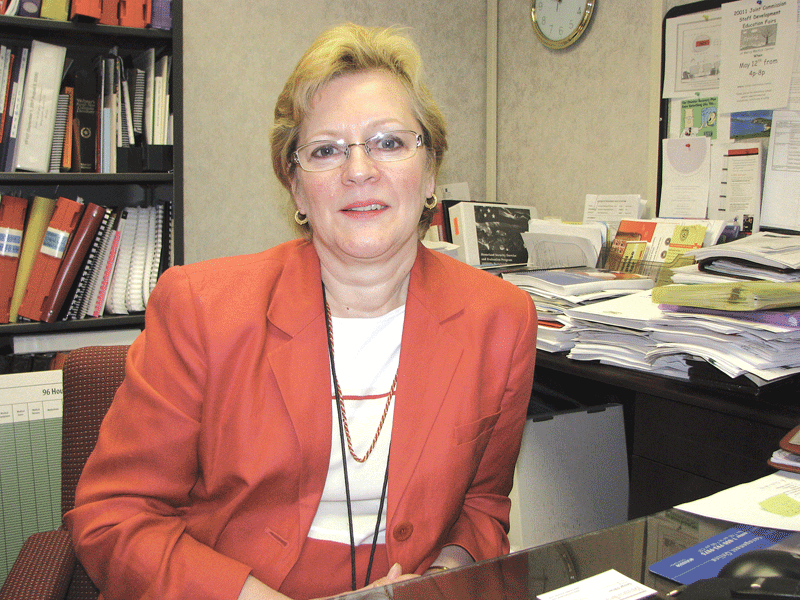
Departments Incorporations

The following business incorporations were recorded in Hampden, Hampshire, and Franklin counties and are the latest available. They are listed by community.

AGAWAM

Murphy Ventures Inc., 22 Lakeview Circle, Agawam, MA 01001. Timothy Murphy, same. Retail athletic footwear.

AMHERST

Full Extent Fitness Inc., 451 Pleasant St., Amherst, MA 01002. Charles Harner, same. Nonprofit organization aimed at providing a high quality fitness experience to everyone.

Norwood Laboratories Inc., 194 Lincoln Ave., Amherst MA, 01002. David Sloviter, same.

CHICOPEE

Handle with Care Inc., 254 Hampden St., Chicopee, MA 01013. Lori Demarco, same. Bottle and can redemption.

Next Level Sports and Education Inc., 328 East Main St., Chicopee, MA 01020. Rodney Smith, same. Provides educational information on health and sports fitness.

Phoenix Services and Solutions Inc., 105 Woodlawn St., Chicopee, MA 01020. Evelyn Cruz, same. Cleaning services.

EAST LONGMEADOW

Huang Garden Inc., 422 North Main St., East Longmeadow, MA 01028. Hong Mei Hong, same. Chinese Restaurant.

Luci Technologies Inc., 61 Prospect Hills Dr., East Longmeadow, MA 01028. Grace Lucia, same.

EASTHAMPTON

Park View Landscaping Inc., 170 Park St., Easthampton, MA 01027. Brian Colby same. Commercial and residential landscaping services.

FEEDING HILLS

Micro Mode Logistics Inc., 32 Horsham Place, Feeding Hills, MA 01030. Steven William Marasi, same. Transportation logistics.

HATFIELD

Gay’s Package Store Inc., 17 Scotland Road, Hatfield, MA 01038. George Gay Jr., same. Package and convenience store.

HOLYOKE

Holyoke Butcher Shop Inc., 502 Westfield Road, Holyoke, MA 01040. David Amedeo, 110 Park River Dr., Westfield, MA 01085. Meat market and deli.

Holyoke Community Music Inc., 147 Brown Ave., Holyoke, MA 01040. Megan Barber, same. Non-profit organization designed to support young people in Holyoke through music education, performance, and the development of a strong and vibrant music community.

Mega Express Transportation Inc., 256 Maple St., Suite5, Holyoke, MA 01040. Pedro Payano, same. Transportation services.

LUDLOW

Legacy Fire Protection Inc., 592 Center St., Ludlow, MA 01056. John Manganaro, same. Design, installation and inspection of commercial and residential fire suppression systems.

Modern Castle Inc., 592 Center St., Suite B, Ludlow, MA 01056. Jason Carrington, same. Sales and service of electronics.

NORTHAMPTON

Noviello Anesthesia, P.A., 141 State St., Northampton, MA 01060. John Noviello, same. Registered nurse anesthesiologist.

SOUTHWICK

JVJ Distributing Inc., 297 North Loomis St., Southwick, MA 01077. Jeffrey Pelinsky, same. Sales and distribution of food products.

SPRINGFIELD

Harder Work Inc., 46 Groveland St., Springfield, MA 01108. Yusuf Abdul-Ali, same. Non-profit organization designed to raise money for foundations who meet specific requirements for help.

Ministerio De Fuego Inc., 752 Belmont Ave, #1, Springfield, MA 01108. Bienvenido Vazquez, same. Youth and adult ministry.

New Dawn Healthcare Inc., 32 Dickinson St., Springfield, MA 01108. Dawn Hunter, same. Alternative low-cost affordable home healthcare services.

WESTFIELD

Friends of the Westfield Senior Center, 40 Main St., Westfield, MA 01085. Thomas Humphrey, 84 Cardinal Lane, Westfield, MA 01085. Raise funds to support the Westfield Council on Aging.

Gopal Krishna Convenience Inc., 420 Union St., Westfield, MA 01085. Vinod Kumar, 77 Sibly Ave., West Springfield, MA 01089. Convenience store.

Miss Sweets Inc., 4 Russell Road, Westfield, MA 01085. Tracy Gillespie, 6 Woodland Road, Westfield, MA 01085. Preparation and sales of sweets.

WILLIAMSBURG

Joshua Montgomery Inc., 39 Petticoat Hill Road, Williamsburg, MA 01096. Joshua Montgomery, same.

Louis Montgomery Inc., 39 Petticoat Hill Road, Williamsburg, MA 01096. Louis Montgomery, same.

Briefcase Departments

Pair Tapped to Head Tornado Recovery
SPRINGFIELD — Gerald Hayes, vice president for administration and finance at Westfield State University, and Nicholas Fyntrilakis, assistant vice president for community responsibility at MassMutual, have been selected to lead the city of Springfield’s long-term rebuilding campaign following the tornadoes of June 1. At a news conference last week, Mayor Domenic Sarno said both men have extensive credentials in urban development and knowledge of Springfield’s history and character. They will serve at no cost to the public. In the wake of the disaster, 22 buildings in the city were demolished, 171 condemned, and more than 1,000 damaged. Hayes and Fyntrilakis will coordinate the tornado-recovery effort until Dec. 31, at which time the arrangement will be reevaluated. The rebuilding campaign, a public-private partnership that will involve the Springfield Redevelopment Authority and DevelopSpringfield, will operate out of a downtown office and will be advertising for a consultant to write a multi-year plan for recovery efforts. Hayes has more than 30 years of economic-development experience, and Fyntrilakis is a former School Committee member and current chairman of DevelopSpringfield.

PVLSI Collaborates with Seahorse Biosciences
SPRINGFIELD — The Pioneer Valley Life Sciences Institute (PVLSI) and its Center of Excellence in Apoptosis Research (CEAR) have entered into a translational-research collaboration with Seahorse Biosciences of North Billerica and Chicopee. Dr. Nagendra Yadava will be the principal investigator for the program at the PVLSI and will receive the title of John Adams Investigator, in appreciation of support from the John Adams Innovation Institute to create CEAR. Alejandro Heuck, an assistant professor of biochemistry and molecular biology at UMass Amherst and a collaborator with Yadava on this project, will also be named a John Adams Investigator. The program will foster shared research between PVLSI scientists and industry partners, to accelerate new products to the market and foster regional economic development. The new project uses intellectual property developed at the PVLSI to create a new reagent kit aiding scientists in quantifying cellular bioenergetics using Seahorse’s XF Analyzer, an instrument that measures different aspects of cell metabolism. “I am delighted to extend our relationship with Dr. Yadava, the PVLSI, and the University of Massachusetts Amherst,” said David Ferrick, chief science officer for Seahorse. “The collaborative research and development performed under this agreement will simplify mitochondrial assays and expand our understanding of the role of mitochondrial dysfunction in aging and disease.” D. Joseph Jerry, PVLSI’s science director, added that the agreement “sets the stage for PVLSI scientists to leverage their intellectual discoveries into new products, fulfilling the institute’s mission for translational research.” Patrick Larkin, director of the Massachusetts Technology Collaborative’s John Adams Innovation Institute, added that “this is exactly the type of project we were hoping for when we invested in the PVLSI. It demonstrates the importance of the institute to the region in providing an interface for the life sciences with local advanced manufacturers.” In related news, Yadava was recently named the Western Mass. Mitochondrial Champion by the United Mitochondrial Disease Foundation, and will serve as an expert on mitochondrial function to researchers and clinicians in the region. Yadava and his team recently published a paper titled “Mitochondrial Dysfunction Impairs Tumor Suppressor P53 – Expression/Function” in the Journal of Biological Chemistry.

Westmass to Finalize Acquisition of Ludlow Mills
CHICOPEE — Westmass Area Development Corporation (Westmass) recently informed the Ludlow Board of Selectmen it planned to acquire the Ludlow Mills property on or about July 1, according to Kenn Delude, president and CEO of Westmass. With a combination of state grants, private debt financing, and equity investments, Westmass has put into place a finance program that will enable the project’s permitting to commence immediately and allow building utility modifications to be made before winter. “After two years of due diligence investigations, we are now prepared to begin our long-term partnership with the community and start work on the project,” Delude said. He noted that the first visible signs of activity will occur in late summer when the Columbia Gas Co. installs a new gas main along State Street. This work will then be followed by the road reconstruction and other related infrastructure improvements. The goal is to have all the roadway improvements completed by December 2012, according to Delude. The improvements will be funded by a $3.7 million state grant the town received under the MORE JOBS program. “Westmass is committed to seeing that Ludlow Mills once again becomes a major contributor to the economic prosperity of our region,” added Delude. He noted that businesses seeking a new or expanded location, whether to lease or own, are encouraged to contact Westmass for more information.

Grants Available to
West of the River
Chamber Members
WARE — The West of the River Chamber of Commerce is taking its mission of helping local businesses to the next level with the launch of a workforce-education initiative. The chamber will award $500 grants to four businesses which can be used for classes, seminars, and workshops that will develop employees’ skills and ultimately help the business. The idea was proposed by the West of the River education committee and is based on the concept that an educated workforce equals a stronger economy. Grants are open to all members of the West of the River Chamber. The winners will be drawn lottery style at the beginning of August. For an application or more information, call (413) 426-7077 or send an e-mail to [email protected]. All applications must be received by Aug. 1. The chamber serves the business communities of Agawam and West Springfield.

Link to Libraries
Donates Books to
Monson Tornado Victims
EAST LONGMEADOW — Link to Libraries recently donated more than 250 new books for youths of all ages to Monson Savings Bank, which will be distributed to tornado victims in town. The books will be distributed to the children left homeless or with tornado damage to homes in the Monson area through the bank, according to Susan Jaye-Kaplan, president of Link to Libraries. “The books donated by Link to Libraries, we hope, will give much needed enjoyment to the families hit by this devastating tornado,” said Jaye-Kaplan. “It is our hope that the children will find pleasure in reading and an opportunity to have time to relax and be relieved of some stress and worry.” The books include reading material for preschool through the teenage years.

Salvation Army Receives Recognition, Financial Gift
SPRINGFIELD — Major Thomas Perks and his wife, Major Linda Jo Perks, both of the Greater Springfield Salvation Army, have been recognized locally with a monetary donation for the organization they manage, as well as by the national office of the Salvation Army. The Affiliated Chambers of Commerce of Greater Springfield honored both the Salvation Army and the YMCA of Greater Springfield during its annual meeting on June 15. Both organizations were recognized for their strong business models and community presence that have had a direct impact on quality of life in the Greater Springfield area. Both also received a check for $1,000. In related news, Perks and his wife were recently honored by the national Salvation Army with pins for 25 years of service. The designation illustrates the tireless efforts of the couple and the organization they oversee. In addition to assisting first responders and victims of natural disasters, the local Salvation Army helps more than 30,000 families throughout the year and more than 6,000 families during the holiday season.

Chamber Corners Departments

ACCGS
www.myonlinechamber.com
(413) 787-1555

• July 8: ACCGS Legislative Steering Committee, 8-9 a.m., TD Bank Conference Center, Springfield.
• July 11: ACCGS Annual Golf Tournament, Ludlow Country Club, 11 a.m. to 7 p.m., $150 per person.
• July 20: ACCGS Ambassadors Meeting, 4-5 p.m., EDC Conference Room, Springfield.

Amherst Area
Chamber of Commerce
www.amherstarea.com
(413) 253-0700

• July 18: 8th Annual Amherst Area Chamber of Commerce Golf Tournament, 11:30 a.m. to 7 p.m., Hickory Ridge Golf Course, Amherst. Sponsors: Hampshire Hospitality Group, Cooley Dickinson Hospital, Applied Mortgage Services, Blair, Cutting & Smith, J.F. Conlon, Blue Cross Blue Shield, the Mass. Business Assoc., MetLife, Health New England, and Fallon Community Health. Cost: $125 per player, $500 per foursome, includes lunch, tournament, dinner, gift, and goody bag. Register at [email protected] or (413) 253-0700.

Greater Easthampton
Chamber of Commerce
www.easthamptonchamber.org
(413) 527-9414

• July 14: Networking By Night Business Card Exchange, “Waterski Show Night,” 5-7 p.m., hosted by Oxbow Water Ski Show Team, 100 Old Springfield Road, Northampton. Sponsored by Columbia Gas of Massachusetts. Gala waterski show, door prizes, hors d’ouevres, host beer and wine. Cost: $5 for members, $15 for non-members.
• July 29: 27th Annual Greater Easthampton Chamber of Commerce Golf Tourney, 9 a.m. shotgun start – scramble. Hosted by Southampton Country Club, College Highway, Southampton. Major sponsor: Easthampton Savings Bank. Golf with cart, lunch, dinner, gift, contests. Win a Buick hole in one sponsored by Cernak Buick; $10,000 hole in one sponsored by Finck & Perras Insurance. Cost: $100 per person, $400 per foursome.

Greater Westfield
Chamber of Commerce
www.westfieldbiz.org
(413) 568-1618

• July 14: 34th Annual Pancake Breakfast, 7-11 a.m., Westfield South Middle School, rain or shine. Cost: $5, $4 for seniors, $2 for children. Vendor tables available for $75 for members, $100 for non-members. Call chamber office at (413) 568-1618 for tickets.

Departments People on the Move

Daniel X. Montagna has joined the law firm of Brodeur-McGan as an Associate Attorney. He graduated cum laude from Western New England College School of Law in Springfield, where he was a member of Western New England Law Review.
•••••

Jaimye R. K. Hebert

Jaimye R. K. Hebert

Jaimye R. K. Hebert has joined Monson Savings Bank as Vice President and Commercial Loan Officer. Hebert brings more than 10 years of commercial lending experience to her position, including managing all aspects of a commercial-loan portfolio in excess of $80 million.
•••••
Deborah Gagnon has been appointed Corporate Outreach Officer for Country Bank. In the newly created position, she will oversee the implementation of the bank’s Community Advisory Council and community-outreach activities.
•••••
Christopher Venne is the winner of United Bank’s Service Excellence Award for the second quarter of 2011. The quarterly award recognizes an employee whose on-the-job performance exemplifies excellence in service. As a floating teller, Venne helps keep staffing levels consistent by moving among United’s Springfield branches as needed. In addition, he can be seen escorting customers to their car if the occasion demands, as well as helping foreign-speaking individuals communicate with bank staff.
•••••
STCU Credit Union has hired Michael S. Ostrowski as its President and Chief Executive Officer. His career in financial services spans lending, branch administration, and senior management.
•••••
Nancy Bazanchuk

Nancy Bazanchuk

Nancy Bazanchuk, Disability Resources Program Director for the Center for Human Development, has been inducted into the New England Wheelchair Athletic Association (NEWAA) Hall of Fame. The NEWAA Hall of Fame recognizes the accomplishments and contributions of people who promote sports for disabled persons, are role models for disabled youth, and encourage people of all ages to become more active. The NEWAA also selected Natalie Stebbins as its Female Athlete of the Year. Stebbins has been a Disability Resources member for seven years.
•••••
Greenfield Fire Chief Michael Winn has graduated from the 19th offering of the state firefighting academy’s chief fire officer management training program in Stow.
•••••
Christine Finnie has joined the Coldwell Banker Residential Brokerage office in Longmeadow. As a Sales Associate, Finnie provides residential real-estate services in Longmeadow and the surrounding communities of East Longmeadow, Hampden, and Wilbraham.
•••••
Steven Weiss

Steven Weiss

Steven Weiss of Shatz, Schwartz and Fentin, P.C., of Springfield, is included in a new book titled Inside the Minds: Representing Small Businesses in Bankruptcy, from Thomson Reuters’ Aspatore Books. Weiss, Shareholder and Chair of the Bankruptcy Department, wrote the chapter “Advising Small  Business Clients About Chapter 11,” which includes critical bankruptcy information, guidance, and a checklist. Weiss concentrates his practice in the areas of commercial and consumer bankruptcy, reorganization, and litigation. He supervises the firm’s bankruptcy, reorganization, and workout practice, and represents creditors, debtors, and others in commercial and consumer bankruptcy cases throughout the state.
•••••
The Pioneer Valley Planning Commission, based in Springfield, recently honored three area leaders for their contributions to the region and the commonwealth at its 49th annual meeting on June 9.
• Paul E. Hills, Executive Director of the Ware Community Development Department, was recognized for his work in support of regional initiatives and programs and for his successful efforts in community development for the town;
• Stanley W. Kulig, Public Works Superintendent for the city of Chicopee, was honored for his work in promoting and overseeing Connecticut River cleanup efforts, bike path and walkway projects, and infrastructure improvements; and
• David F. Woods, Chair of Leadership Pioneer Valley, was honored for his dedication to creating an advanced leadership-development program that will support emerging and existing leaders in the region’s business, nonprofit, and public sectors.
•••••
The Massachusetts Municipal Wholesale Electric Co. (MMWEC), based in Ludlow, elected its officers and four directors during the Joint Action Agency’s May 4 annual conference. They are:
• Kevin P. Kelly, Manager of the Groton Electric Light Department, was elected to the Board of Directors to complete the one year remaining on the term of Thomas R. Josie, retired General Manager of Shrewsbury’s Electric & Cable Operations;
• Jonathan V. Fitch, Manager of Princeton Municipal Light Department, was reelected to a three-year term as a Director;
• Robert V. Jolly, General Manager of the Marblehead Municipal Light Department, was reelected to a three-year term as a Director;
• James M. Lavelle, Manager of the Holyoke Gas & Electric Department, was reelected to a three-year term as a Director;
• Jonathan V. Fitch also was elected to his second one-year term as Chairman of the Board; and
• Peterf D. Dion, General Manager of the Wakefield Municipal Gas & Light Department, was reelected to his third one-year term as President of MMWEC.
• Additional MMWEC officers for the coming year, as elected by the board, are Ronald C. DeCurzio, Chief Executive Officer and Secretary; James B. Kline, Treasurer; Alan R. Menard, Assistant Treasurer; Nancy A. Brown, Assistant Secretary, and Nicholas J. Scobbo Jr., General Counsel.
• Other MMWEC directors, elected previously by the membership, are Gary R. Babin, Director of the Mansfield Municipal Electric Department; Jeffrey R. Cady, Manager of the Chicopee Municipal Lighting Plant; and Sean Hamilton, General Manager of the Sterling Municipal Light Department.
• Michael J. Flynn and Paul Robbins serve on the board as Gubernatorial Appointees. Flynn also represents the Town of Wilbraham on the board, with Luis Vitorino and John M. Flynn representing the towns of Ludlow and Hampden, respectively.

Agenda Departments

Jazz & Art Festival
July 8-10: A Mardi Gras theme will kick off the 5th annual Hampden Bank Hoop City Jazz & Art Festival on July 8, featuring Glenn David Andrews with the Soul Rebels, and hosted by Wendell Pierce, star of the HBO series Treme. The celebration, planned at Springfield’s Court Square on the Esplanade, continues throughout the weekend with a lineup of world-class entertainment. On July 9, performances are slated by Marcus Anderson, the UK Kings of Jazz Groove, Down to the Bone, 17-year-old jazz newcomer Vincent Ingala, and Gerald Albright. On July 10, performances begin with the Eric Bascom Quintet, followed by Samirah Evans and Her Handsome Devils. Kendrick Oliver and the New Life Orchestra will also perform, and Latin jazz performer Poncho Sanchez will close out the festival. Organizers will also be increasing the number of merchandise vendors, artisans, and crafters, as well as food vendors. For more information, visit www.hoopcityjazz.org.

Big Band Celebration
July 9: The Springfield Armory National Historic Site will be the setting for an evening of music and dance to salute Benny Goodman’s 1943 concert in the city. The Memories Big Band Sound will kick off the celebration from 6 to 8 p.m., performing the music of Glenn Miller, the Dorsey Brothers, the Andrew Sisters, and Benny Goodman. The USO Retro Show will be performed by two dance troupes as Jitterbug Dancer, of Chicopee, and Small Planet Dancers, of Springfield, take the stage at 8 p.m. with a look back at the 70th anniversary of the USO. The dancers will be dressed in World War II-era uniforms. Jitterbug will also offer free swing dance lessons to the audience from 5 to 6 p.m. The evening culminates with a performance by the U.S. Northeast Navy Pops Band from 8:30 to 10 p.m., playing top-10 music hits from the past three decades. Picnicking is encouraged. There will be ample parking, including handicap parking, and indoor restroom facilities. The rain site is Scibelli Hall at Springfield Technical Community College. The museum will also be open during all event hours. For more information, call (413) 734-8551 or visit www.nps.gov/spar.

Autism Conference
July 9: The Elms College Division of Communication Sciences and Disorders and Autism Spectrum Disorders, along with the River Street Autism Program, will host “The New Face of Autism” from 9 a.m. to 4 p.m. in the college’s Alumnae Library Theater. This first annual conference is designed for parents and professionals, and topics will include critical communication skills in autism, the future of autism treatment, teaching children with autism to ask for what they want, making psychoactive medication decisions, and quality-of-life issues for individuals with Asperger’s. Educators and professionals in the field of speech and language pathology and board-certified behavior analysts will conduct the conference sessions. The $95 cost to attend includes all presentations and lunch. Registration is required. For more information, contact Dee Ward at (413) 265-2253 or [email protected].

Western Mass. Business Expo
Oct. 18: Businesses from throughout Hampden, Hampshire, Franklin, and Berkshire counties will come together for the premier trade show in the region, the Western Mass. Business Expo. Formerly known as the Market Show, the event, produced by BusinessWest and staged at the MassMutual Center in Springfield, has been revamped and improved to provide exposure and business opportunities for area companies. The cost for a 10-by-10 booth is $700 for members of all area chambers and $750 for non-members, corner booths are $800 for all chamber members and $850 for non-members, and a 10-by-20 booth is $1,200 for all chamber members and $1,250 for non-members. For more information, log onto www.businesswest.com or call (413) 781-8600, ext. 100.

Departments Picture This

Send photos with a caption and contact information to:  ‘Picture This’
c/o BusinessWest Magazine, 1441 Main Street, Springfield, MA 01103
or to [email protected]

Lucky 13th

Joe-and-Carm-ManziBrothers Joe (left) and Carmino Manzi, co-owners of Villa Napoletana restaurant in East Longmeadow, recently celebrated their 13th anniversary in business with a party at the restaurant on North Main Street. They’re standing in front of a Sunoco modified racecar they sponsor that is driven by John Catania at Thompson Speedway in Connecticut in the NASCAR Whelen All-American Series.


Link to Libraries

Link to LibrariesGeorge Burtch, vice president for Global Integration at Hasbro, is seen with fourth-grade students at the Center for Excellence School in Holyoke, where he is participating in the Link to Libraries nonprofit celebrity read-aloud program. The Link to Libraries program offers youth in underserved communities reading programs, new books, and opportunities to meet area business executives who often mentor area youth. For more information on Link to Libraries, go to www.linktolibraries.org.


NCCJ Honorees

NCCJThe National Conference for Community and Justice staged its annual Human Relations Award Banquet on June 14 at the Basketball Hall of Fame in Springfield. The agency, founded in 1927 as the National Conference for Christians and Jews, is a human-relations organization dedicated to fighting bias, bigotry, and racism in America.  Honored with
NCCJ Human Relations Awards for 2001 are, from left, Dr. Saleem Bajwa, Thomas Burton, youth award recipient Rosaline Abraham, James O’S. Morton, and Hyman Darling.


Read-aloud Event

Read-aloud Event 1Read-aloud Event 2Read-aloud Event 3Read-aloud Event 4The United Way of Pioneer Valley and BusinessWest’s Difference Makers collaborated to present a special read-aloud session at the Holyoke Public Library that was part of the Connect to Reading Book Drive staged to collect books for the Hasbro Summer Learning Initiative. From top, BusinessWest Senior Writer Joe Bednar engages a pair of young people in a reading exercise; BusinessWest Advertising Consultant Gwen Burke has one of the young people read to her; dozens of young people and their parents take part in the reading initiative; BusinessWest Advertising Consultant Tina Kuselias reads to a group of young students.

Sections Supplements
Forget Time Management … Are You Managing Your Energy?

Phrases like ‘manage your time’ and ‘do more with less’ have become buzzwords for this decade. The idea is that, if you can manage your time well, you’ll be more productive in all areas of life.
The only flaw in this thinking is that time is finite. In other words, you can manage time all you want and continually push yourself to get more done. But all this managing and pushing tires your brain, drains your spirit, and disengages your soul. That’s when mistakes occur and burnout ensues. The key, then, is not simply to manage your time, but also to manage your energy.
Unlike time, energy is restorable. And when you manage your energy well, you’ll have more energy for your priorities, whether they are personal or professional in nature. If you don’t manage your energy, you can’t manage your time. Sure, you can think about all the things you need to do, and you can even schedule them, but if you don’t have the energy to do the tasks, you won’t be able to accomplish them appropriately.
Realize, too, that managing your energy goes beyond work/life balance. While many people talk about work/life balance (devoting ample time to all areas of your life), few address those things that make life rich and fun.
With so many things competing for your attention daily, you need to give attention to energy replenishment so you can devote time your life’s priorities demand. This is why it’s important to manage your energy before you manage your time.
Keeping your energy in check means giving attention to your brain, your spirit, and your soul. Think of it like a three-legged stool. For the stool to be useful, you need all three legs. Remove one leg from the equation, and the stool topples over and is useless. The same is true for your energy. Therefore, to keep your energy replenished, implement the following suggestions into your daily life.

Stimulate Your Brain
The human brain likes control and certainty, and it’s very good at predicting the next thing that is likely to happen based on the information it has. That’s why you often feel better when you perceive you have control over a situation and feel stressed if you think you have no control over events.
Additionally, the brain is programmed to fear. This is a good thing, though, because the inborn fear is what has allowed our species to evolve. The only drawback to this natural fear is that the brain will take three pieces of information and make a story out of it — usually a negative one. This negative story becomes your reality until you get another piece of data. Talk about an energy drain on your brain!
In order to replenish your brain’s energy, do the following:
• Since your brain is part of your body, it needs to be fed the right food for optimum health. Eat three nutritious meals a day, exercise to increase the oxygen flow to your brain, and drink plenty of water to keep hydrated.
• Reconstruct your stories. You have to purposefully stop the story and seek out the missing pieces of information. For example, if you get an e-mail from your boss telling you not to take part in a task you volunteered for, with no explanation why, you would likely think your boss doesn’t believe you’re capable of the task. In reality, your boss may need you for another task, he or she may think the task is not challenging enough for you, or your boss may simply not need any assistance on the task any longer. But you’ll never know (and never stop the negative story) until you ask.
• Analyze what helps and hurts your thinking ability. For instance, do 200 e-mails staring at you first thing in the morning make you exhausted before you even start the day? If so, then don’t do that task first thing. Do the most important things when you’re alert and at your best, as those tasks will actually energize you so you’re able to handle the stressful tasks later.
• Give yourself two hours a day for focused attention on a key project — the earlier in the day, the better. No multi-tasking during this time! Whether you are a night person or a morning person, the fact is that your brain is rested after you sleep, so this is the key time for focused attention and productivity.

Awaken Your Spirit
The human spirit yearns to soar. The spirit enjoys lofty goals and challenging tasks to accomplish. How spirited someone is often relates to how purposeful he or she is. In fact, it’s common that, when people lose their purpose in life, they feel deflated and even depressed. Hence the phrase ‘her spirit was broken.’
An energized spirit is what catapults you out of the mundane and into a new and exciting endeavor. In order to replenish your spirit’s energy, do the following:
• Do one thing every day that makes your spirit soar. Whether it’s reading poetry or listening to music, if you feel your spirit is fed by that, do it.
• Think about what you want to do in your life. Dream big! Give planned time to your future in order to nurture your spirit.
• Read things that stretch your mind. Your spirit wants to reach for the next best thing. Unleash the power of your spirit by exposing your mind to new things — even things that you feel are impossible to accomplish right now.
• Take time each day to think and concentrate. Many people are in knowledge-oriented jobs and need some degree of quiet time. So even though a particular task must get done, that task often requires planning and thinking. Your spirit can’t gain energy to tackle big goals unless it has some quiet time to prepare. So let people know that you require quiet thinking time, and actually put this time in your schedule. If others know your needs and intentions, they will respect them.

Feed Your Soul
The human soul likes the familiar, the deep, and the poignant. The soul likes ritual, doing the same thing at the same time every day. It also enjoys the simple things in life, beauty, and nature. The soul is what connects you to life and to what is deeply meaningful to you.
In order to replenish your soul’s energy, do the following:
• Clarify your intentions and plan what you want your tomorrow to be like before you go to bed. This allows your subconscious to work on your challenges and big decisions while you sleep.
• Take time for enchantment. Linger through a museum. Enjoy preparing a simple, elegant meal. Go outside regularly and really look at nature. Your soul loves beauty and wants a connection with the earth.
• Experience the present fully. Focus on the things around you — the colors and textures. Be mindful of your current surroundings and activities rather than always trying to multi-task. Really engage in life in the moment. Feel yourself breathe.
• Build rituals for yourself and your family. Even something as simple as eating dinner at the same time every day is a ritual. Both your soul and your brain crave ritual and gain energy from it.

Energize!
By focusing on these three areas of your life — your brain, your spirit, and your soul — you’ll gain the much-needed energy to tackle life with enthusiasm and zest. With your energy fully replenished, time will no longer be an issue. You’ll feel ready to handle anything that comes your way with ease … and you’ll do it much faster.
So make it a habit to stimulate your brain, awaken your spirit, and feed your soul. It’s one investment in yourself you can’t afford not to make.

Jean Kelley, industrial sociologist and founder of Jean Kelley Leadership Consulting, has personally interviewed more than 20,000 people.  She is the author of Get a Job; Keep a Job and Dear Jean: What They Don’t Teach You at the Water Cooler; www.jeankelley.com.

Sections Supplements
New Initiative Strives to Identify and Develop Regional Leaders

Lora Wondolowski

Lora Wondolowski

Recognizing the need to identify and cultivate young leaders, area civic and economic development leaders have created an initiative called Leadership Pioneer Valley. As the name suggests, this is a regional program — covering Franklin, Hampden, and Hampshire counties — crafted to take emerging and existing leaders from the public, private, and nonprofit sectors, immerse them in a program to build leadership skills and educate them on the Valley, and then provide them with opportunities to put what they’re learned to work. This is a program, said its recently appointed director, that will have benefits for participants and the region as a whole.

In 2004, the Pioneer Valley Planning Commission’s Plan for Progress, initially created a decade earlier, was overhauled, with 13 new strategic goals identified as “critical for growing the people, companies, and communities that grow the region.”
Lora Wondolowski is now working out of a small office just down the hall from PVPC Executive Director Timothy Brennan because of what’s known colloquially as Action Item 7: “Recruit and train a new generation of regional leaders.”
Indeed, Wondoloski, hired in April, is program director of an initiative known as Leadership Pioneer Valley, which operates with a simple core mission: “To identify, develop, and connect diverse leaders to strengthen the Pioneer Valley.” As she talked with BusinessWest about her new assignment, she conveyed the message that each word in that mission statement was chosen carefully, and it’s her job to sharply define each one.
That starts with ‘identify.’ Wondoloski is now in the process of recruiting the first class of 40 to 50 emerging and existing leaders (ages 25-45) from the private, public, and nonprofit sectors to participate. “These are mid-career professionals, people who have been identified as having potential for leadership within their own company or organization,” she explained, “or people who have gotten involved locally somehow; we’re not looking for recent college graduates, and we’re not looking for CEOs ready to retire next year. For employers, these are people they want to keep around, people they want to root in the community.”
‘Develop’ is the next key word in the mission statement, and it will be addressed through a 10-month curriculum (one day per month) that will include a balanced combination of retreats, day-long seminars, and small-group activity, and is still a work in progress, with several weeks remaining before the start of the first planned program in October.
Which brings us to ‘connect’ — once the leaders have been identified and developed, they will be connected to the communities in ways designed to utilize the skills and knowledge they have acquired to benefit the region and specific communities and agencies as program alumni — and ‘diverse.’ Wondoloski said those chosen will, as a group, accurately reflect this region’s changing demographics and, in the process, develop leaders from several different ethnic groups. But it will be diverse in other respects as well, including industry representation.
As for Pioneer Valley, this is a truly regional concept, involving all of Franklin, Hampden, and Hampshire counties, she explained, which separates LPV, as it’s called, from some other leadership programs created in Springfield and Northampton. Meanwhile, one of the goals of the curriculum is to familiarize participants with the whole of the Valley and the specific challenges and assets of specific areas and communities.
“We want participants to get a deep understanding of the Valley and the communities that make up this region,” she explained. “A lot of people don’t leave their communities — people from Springfield don’t often get up to Franklin County, and vice versa; we want to get people out of their silos.”
For this issue, BusinessWest talked at length with Wondolowski to gain some perspective on Leadership Pioneer Valley, it’s goals and emerging strategies for meeting them, and the reasons why it has become the embodiment of Action Item 7.

A Leadership Position
Since starting her new assignment, Wondolowski, formerly the founding executive director of the Mass. League of Environmental Voters, has been working with a 27-member steering committee on several components of that aforementioned mission statement, from curriculum development to the multi-faceted task of recruitment.
For example, she was in attendance at BusinessWest’s 40 Under Forty gala on June 23 at the Log Cabin Banquet & Meeting House, meeting with several potential members of the first class of leaders. She’s also been finalizing the application form for those desiring to be members of the first class — it now appears on the recently launched Web site www.leadershippv.org — and meeting with area business and civic leaders to gauge what they want and need to see result from this initiative.
The broad yet simple goal is developing leadership, she continued, adding that this has been identified as one of the more critical economic-development priorities in the region for some time. And to achieve that goal, the PVPC, the Community Foundation of Western Mass., and several area businesses are collaborating to create a program modeled after several local, regional, and national initiatives, said Wondolowski.
As examples, she cited a one-year pilot program created six years ago by the Northampton Chamber of Commerce and the United Way called Leadership County, an effort launched nearly 30 years ago called Leadership Greater Hartford — administrators there have served as consultants for LPV — and an initiative in the nation’s capital called Leadership Greater Washington.
LGW, as the Washington-area program is called, was created in 1986, put together by six area chambers of commerce and three economic-development-related organizations — the Greater Washington Board of Trade, the Eugene and Agnes E. Meyer Foundation, and the Junior League. The linchpin of the program is its so-called Effective Leadership Institute, which provides one-day-per-month coursework focusing on communication, team building, emotional intelligence, and diversity.
“We’re taking the lessons learned from Hampshire County and applying them to a region-wide leadership program, and the Hartford team has helped put together a business plan for us,” said Wondoloski. “We’re taking best practices from a number of different models.”
Hiring a director and assembling a steering committee were the first real steps in the process of getting LPV off the ground, said Wondolowski, adding that recruitment and curriculum development are the next matters in the to-do list, and there has been significant progress with both.
The recruiting process will be highly competitive, she told BusinessWest, adding that she expects the volume of applications to far exceed the number of seats in the classroom. But more important than the quantity of applicants is the quality, she went on, noting that is why she’s working hard to get the word out to individuals and constituencies like the 40 Under Forty Class of 2011 and those that preceded it, as well as the area’s young-professionals organizations.
Meanwhile, she’s reaching out to LPV sponsors, which include MassMutual, Baystate Health, PeoplesBank, United Bank, Westfield Bank, and others — who are each contributing $5,000 to $10,000 toward the program’s $257,000 annual budget — to help recruit candidates.
Diversity is also a key factor in finalization of the first class, she said, adding that there will be targets established for specific ethnic groups, and to reach them, organizers will reach out to groups like the Latino Chamber of Commerce and others like it that serve a specific constituency.

Course of Action
While recruitment work continues, Wondoloski and the steering committee are also finalizing the curriculum for the 10-month program, the cost of which will vary according to a sliding scale. For participants from large companies, the price tag will be roughly $2,500, while those from the smallest nonprofits will pay $850. Participants will be asked to contribute $300 themselves, and scholarships will be available.
Most of the components are in place, she told BusinessWest, adding that they include:
• A retreat, to be staged in September, which will focus on self-assessment of leadership skills, an introduction to the region, and selection of group projects;
• Challenge days, or day-long seminars, held monthly, that will focus on leadership skills and significant challenges facing the region such as education, sustainability, transportation, and the regional economy;
• Field experience in the shape of day-long workshops, also held monthly, at locations around the region to introduce participants to local leaders, the diversity of the region, and an area’s challenges, assets, and potential; and
• Leadership learning labs. Each class will work in small teams to devise strategies to address one of the themes or challenges identified in the PVPC’s Plan for Progress. The teams will have time to meet on training days, but will also meet independently between the monthly sessions.
The seminars will be held at venues across the region, said Wondoloski, listing the Springfield Museums, Greenfield Community College, and Yankee Candle as examples of potential sites chosen to connect participants with the businesses and institutions that shape the Valley.
Meanwhile, to provide what she called a 360-degree view of the region, the field experiences will be staged at locations chosen to broaden participants’ knowledge of the entire Valley. Details have not been finalized, she said, but there will likely be a Springfield Day; a Five College Day to familiarize the class with the Amherst-Northampton area; a day in Holyoke, Chicopee, and perhaps South Hadley to gain perspective on that area; and a Hilltowns and Franklin County Day.
The sum of these curriculum elements will provide participants with opportunities to refine their personal and public leadership skills, said Wondolowski, while also developing diverse contacts and an effective communication network, receiving recognition for themselves and their organization, and gaining opportunities for taking an active and effective role in addressing community needs.
In short, participants will be gaining and honing leadership skills, while also getting a comprehensive education in the region as a whole, but also its specific areas and communities — and then opportunities to apply what they’ve learned.
Looking down the road, Wondoloski said that some of the programs that LPV is modeled after have developed some measures for quantifying the success of their initiatives. These include everything from the percentage of participants gaining promotions in their firms to the number of nonprofit board seats filled by individuals who have taken part in the training regimens.
Ultimately, though, success will more likely be qualified, and the indicators will be quality of life, overall vibrancy, and greater diversity in the business sector, government, and other realms.

Class Act
Graduates of the LPV program will receive a certificate of some sort identifying them as a participant and perhaps some course credits, said Wondoloski, adding that these are some of the details still being worked out.
But they’ll get much more than a piece of paper, she told BusinessWest, adding that they’ll gain not only additional leadership skills, a new network, and a broad education on the Valley, but also, and more importantly, motivation and opportunities to put what they’ve learned to work.
In that respect, they will be helping to address Action Item 7, but also address the critical need for leadership across the region.

George O’Brien can be reached at [email protected]

Cover Story
Former Musician Ron Ancrum Now Hits High Notes with the Community Foundation

July 4, 2011

July 4, 2011


Growing up, Ron Ancrum wanted to be the next Quincy Jones. He was a skilled trumpet player, but liked writing music even more than performing it. He put aside those interests a quarter-century ago as he was shaping a career in higher education and the broad realm of philanthropy, which continues today as president of the Community Foundation of Western Massachusetts. He’s not writing music in that position, but he is working to orchestrate progress for the Pioneer Valley.

Ron Ancrum says he fell in love with jazz — and discovered the trumpet — when he was in the 7th grade.
And by the time he graduated from Rippowam High School in Stamford, Conn., he was, by his own admission, quite good at the craft, which he honed while playing with such groups as the Silver Falcon Drum & Bugle Corp and the Stamford Young People’s Symphony Orchestra. He wasn’t alone in that opinion, either; he earned a mention in Downbeat magazine in 1967 as a promising up-and-coming jazz musician.
“I was a senior in high school at the time,” he recalled. “They [Downbeat] did these jazz competitions where the magazine would go to different cities and have different groups compete; we didn’t come in first, but we got a mention.”
But as much as he liked playing music, he enjoyed composing it even more, and majored in theory and composition at UConn.
“My dream was to be the next Quincy Jones — I wanted to write for motion pictures,” he told BusinessWest, noting quickly that, while he had some success in music — one of many bands he played with, ANKH (his nickname), opened for Gladys Knight and the Pips back in 1973 at the Bushnell in Hartford, and another jazz band, Quintessence, released an album in 1981 — his career has gone in a completely different direction (actually, several of them), mostly out of necessity, but also desire.

Ron Ancrum (center) on the back cover of the 1981 album recorded by his former jazz band, Quintessence.

Ron Ancrum (center) on the back cover of the 1981 album recorded by his former jazz band, Quintessence.

“The major record labels were not picking up jazz — they were more into pop and R&B,” he said of the then-unusual step of releasing the album himself, as well as the primary motivation for his entry into the higher-education sector in the early ’80s, and then a subsequent move into the broad arena of philanthropy, first as a consultant with his own company and later with an outfit called Associated Grant Makers.
His current assignment, as president of the Community Foundation of Western Massachusetts, carries with it some composition work of a different kind — in the realm of what’s known as ‘community leadership.’
Explaining the concept, Ancrum said it involves groups like the Community Foundation moving well beyond the work of managing funds and distributing grants to area nonprofits (although those are still important parts of the whole), and into efforts to address some of the many social and economic issues impacting the region — from school dropout rates to the creative economy to social entreprenuership.
This work has manifested itself in a number of ways, from the coordination of the first of what is expected to be several so-called ‘City to City’ tours — Springfield-area business and civic leaders visited Winston-Salem and Greensboro, N.C. last fall to learn how those communities have bounced back from adversity — to the funding of a new leadership-development program (see story, page 50). And more initiatives are in the formative stages, said Ancrum.
For this, the latest installment of its Profiles in Business series, BusinessWest talked with Ancrum about jazz, philanthropy, and community responsibility, and how they all involve hitting the right notes at the right time.

On-the-record Comments
Ancrum said his interest in jazz these days is confined mostly to listening to it — “picking up an instrument and playing is not what I’m interested in, although I would like to start writing again; that’s what I really enjoy.” But since he’s in Western Mass. at least five days a week (his permanent home is in Canton, Mass.), finding good listening can be challenging.
“I’m used to being in Boston, where there’s tons of jazz,” he explained. “There’s some here, but certainly not as much; there’s been a lot of good jazz at UMass through the Fine Arts Center, for example.”
He is putting his knowledge of the genre and the business to work as a member of the planning committee for the upcoming Hoop City Jazz & Art Festival, slated for July 8-10 at Court Square in downtown Springfield. “I found out that the person organizing it, John Osborn, is a UConn grad like myself, so we got together over lunch and I got involved,” he said, adding that his role is simply as adviser rather than band recruiter. “John’s more into smooth jazz, and I’m more into traditional jazz; I recommend people, but he doesn’t necessarily gravitate toward them.”
Ancrum thought he was destined for a career in music after UConn, where he ran the jazz band and was the arranger, French horn, and electric piano for a multimedia rock production of the Who’s Tommy, among other things. But the stars were simply not aligned for that eventuality.
“I actually took off for California right after graduating, but eventually turned around and came back,” he said, not wanting to go into details of that excursion. Instead of Hollywood, his next stop was a short stint in graduate school, studying music theory at UConn, while also finding different ways to remain active in the music business.
He wrote music and performed with the Voice of Freedom Gospel Choir, for example, and was leader, manager, arranger, and composer for Quintessence, which released an album with that same name in 1981 that has become a collector’s item of sorts.
“There’s a guy in New York who has it listed as a ‘rare-find album’ — he came up and purchased 200 of them from me,” said Ancrum, who found a copy for BusinessWest.
And while he continued to perform and compose until 1987, Ancrum was by that time well into a career in higher education. He started at UConn as a staff assistant in the Student Activities Department in 1972, and later became director of Admissions at Connecticut College. Next was a two-year stint as associate dean of Admissions at Colgate University in Upstate New York. “That’s one of the nicest places to work; it’s just in the wrong place,” he joked. “It’s in the middle of nowhere, and it snowed from Columbus Day to Easter.”
He then spent nearly a decade at UMass Boston as director of Undergraduate Admissions before starting his own consulting business in the Boston area, which provided services to numerous nonprofit organizations and higher-education instituitions. From there, he went to a Boston-based company called Third Sector New England, again providing consulting services to nonprofit organizations, and eventually on to a lengthy stint as president and CEO of Associated Grant Makers, a membership association for foundations and corporate-giving programs serving Massachusetts and New Hampshire.
During his tenure there, Mary Walachy, executive director of the Springfield-based Irene E. and George A. Davis Foundation, and Kent Faerber, then-president of the Community Foundation, both served on the board of directors, providing him some insight into Springfield and the Pioneer Valley in the process.
Over time, Ancrum said he developed a desire to work at a foundation, rather than for them, and began looking for such a position around the time Faerber announced that he would be retiring from his post. Following conversations with Walachy and others about the job and the region, Ancrum decided to apply and was ultimately chosen.

Projects of Note
Ancrum said that, when he took the helm at the foundation, he knew little about Springfield other than what he’d learned from Walachy, Faerber, and other funders. He had read of the city’s deep financial problems, but also that they were mostly a thing of the past by the time he started moving into his office on the 23rd floor of Tower Square.
“When I came here, I saw a lot of opportunity to do something,” he said, acknowledging that this was an outsider’s perspective, although little has changed since he’s become an insider. “I thought this was a place ready to take off; it has a lot going for it. There’s clearly some strength in the quality educational institutions, and the health community is quite strong.
“There are assets here,” he continued, “and culturally, there’s a lot of potential; there’s music and art and some museums. This should become one of the places in the state that people come to visit. It’s a destination stop; however, it needs to be marketed better.”
But along with all this potential there are issues and challenges, not only in Springfield, but in communities across the three-county (Franklin, Hampden, and Hampshire) area served by the Community Foundation, said Ancrum, noting, among things, a clear need to create new sources of jobs, efforts to replace lost manufacturing companies, and a need to rebuild what he called the “economic infrastructure.”
The sum of these challenges and the need for a coordinated response have been the primary motivators for the foundation taking big strides into the realm of community leadership, he continued, noting that this is now the third leg of the Community Foundation’s mission.
The first leg is essentially providing a vehicle for individual donors to engage in philanthropy, he said, adding that the foundation manages roughly 500 funds ranging in size from $10,000 to $12 million. The second leg is grant making, including the largest scholarship program in the region, awarding nearly $2 million in the most recent cycle.
There are also competitive grants, awarded in several cycles, that have recently totaled roughly $1.4 million. “We recently made 77 awards totaling $720,000,” he said of the most recent round, which featured 104 requests, one of the highest totals in recent years. Following the recent tornadoes, the foundation created a relief fund and directed $50,000 toward it, with other donations coming from a number of financial institutions and other area companies (see related story, page 28). At present, the fund now totals more than $125,000, and will be used to assist nonprofits directly impacted by the tornadoes (and there were several) or that provide assistance to victims.
The community-leadership component is part of a nationwide trend among community foundations, said Ancrum, adding that the agency’s board of directors approved a broad plan to move in this direction in late 2008, and a big part of his job description is carrying out that assignment.

Getting Creative
There have been several manifestations of this initiative, he explained, many of them sparked by what he called “community conversations.”
“These are simple convenings where we invite our donors as a way of educating them, and we invite other people in the field who can contribute to the conversation,” he said of the sessions. “We basically try to figure out what the really hot issues are and bring in national, regional, and local speakers who we feel can add to the discussion and provide direction moving forward.”
One such conversation was about the controversial subject of dropout rates in inner-city schools.
“We took an angle that it’s not just an educational issue — it’s really an economic issue, and it’s really a public safety issue as well,” he explained. “So we had the sheriff there, the superintendent there, someone from the state who could talk about the research done on the subject … we brought people together who we thought would be good to have in the room for the kind of conversation that probably should happen.”
This was followed up by a session on the creative economy, he continued, adding that this featured speakers such as state Sen. Stanley Rosenberg and others, who focused on the success achieved by North Adams and other communities as they have used the arts to stimulate economic development.
One of the most visible of the community-leadership initiatives was last fall’s City to City tour of Winston-Salem and Greensboro, this region’s first foray into a national program designed to let business and civic leaders in one area see, hear, and analyze how other urban areas of similar size and demographics have achieved progress with economic-development initiatives.
More than 50 representatives of area businesses, colleges, and nonprofit agencies spent three days in North Carolina, learning how the two cities had succeeded in revitalizing their downtowns, generating new sources of jobs, and making their cities safer and, overall, more livable.
Ancrum said he believes the program was a success on a number of levels, starting with how it brought a number of area leaders together for three days, giving them a chance to get to know one another, build relationships, discuss matters of importance, and analyze what they were seeing and hearing.
“We had people from the nonprofit sector talking with business leaders and also officials from the city,” he explained. “When you’re with people for several days like that, you can create relationships, and that makes it easier for people to pick up the phone later and talk with people and collaborate with them.”
The other obvious benefit was the rich learning experience, which yielded a number of potential takeaways, either in the form of projects to emulate or attitudes to embrace.
“Because we saw a baseball park in Greensboro, that doesn’t mean we need one here, necessarily,” he explained. “The lesson for me was that creating a venue that will bring families and individuals to the center of your city creates other business in that area that will help your economy overall; we need to create something like that, but it doesn’t have to be a ballfield.”
Another City to City tour is planned for late this fall, he explained, adding that trip organizers are currently researching several options, with Grand Rapids, Mich. and Jersey City, N.J. heading the list of possible destinations.
Meanwhile, the foundation continues to look for other ways to meet that stated commitment to community leadership.

A Major Hit
For $74.99, one can still obtain a copy of the Quintessence album. An outfit called Rarebro Records has it in stock, apparently.
Next to the item on the company’s Web site is a quick description and review of the album. “Recorded in 1980, the jazz arrangements here are soulful and full-bodied,” it reads, “with some nice texturing with the rhodes, saxophone, flute, trombone, flugelhorn, recorder, congas, bongos, bass, acoustic bass, handicaps, drums, and vocals by the lovely Kharmia.”
For this critic, at least, it appears that Ancrum was able to take a number of diverse elements (the flugelhorn?) and blend them into something distinct and meaningful. That’s not exactly his job description with the Community Foundation of Western Massachusetts, but, given its new focus on community leadership, it would seem to fit.
He’s dying to start writing music again, but in the meantime, he’s helping to script some economic-development success stories.

George O’Brien can be reached at [email protected]