Bankruptcies Departments

The following bankruptcy petitions were recently filed in U.S. Bankruptcy Court. Readers should confirm all information with the court.

Aguirre, Victor
Aguirre, Milagro
a/k/a Medina, Milagro
256 Union St.
Springfield, MA 01105
Chapter: 7
Filing Date: 10/12/11

Aliperti, Jeffrey David
Aliperti, Jean Brockenbroug
113 Farmington Road
Longmeadow, MA 01106
Chapter: 7
Filing Date: 10/14/11

Altman, Reginald A.
250 Walnut St.
North Adams, MA 01247
Chapter: 13
Filing Date: 10/04/11

Asadoorian, Alexandra
22 Whitney Ave.
West Springfield, MA 01089
Chapter: 7
Filing Date: 10/12/11

Athol Orange Driving School
Mailloux, Albert J.
271 South Royalston Road
Athol, MA 01331
Chapter: 7
Filing Date: 09/30/11

Bessette, Michele N.
550 South Mountain Road
Pittsfield, MA 01201
Chapter: 7
Filing Date: 10/11/11

Bliss, Dale A.
68 Kulessa Cross Road
Sunderland, MA 01375
Chapter: 7
Filing Date: 10/14/11

Bryant, Jeremy P.
Bryant, Kellie A.
248 Adams Road
Greenfield, MA 01301
Chapter: 7
Filing Date: 10/05/11

Bunnell, Cynthia M.
136 Mary Coburn Road
Springfield, MA 01129
Chapter: 7
Filing Date: 10/03/11

Cardinal, Margo L.
80 Columba St., Apt 7B
Chicopee, MA 01020
Chapter: 7
Filing Date: 10/14/11

Cayea, Michael
Cayea, Caroline
1235 Main St.
Warren, MA 01083
Chapter: 7
Filing Date: 10/13/11

Christiansen, Craig A.
Christiansen, Tracy R.
15 Hampden St.
Indian Orchard, MA 01151
Chapter: 7
Filing Date: 10/06/11

Chunhasuwan, Suchan
Chunhasuwan, Rudee
59 Maui Dr.
Chicopee, MA 01020
Chapter: 13
Filing Date: 10/04/11

Condino, David J.
Condino, Jean M.
123 Melvin St.
Chicopee, MA 01013
Chapter: 7
Filing Date: 09/30/11

Contreras, Victoria
89 Sherman St.
Springfield, MA 01109
Chapter: 7
Filing Date: 10/07/11

Dearborn, Laurie A.
a/k/a Watts, Laurie Ann
a/k/a Matthews, Laurie Ann
67 East St.
Springfield, MA 01104
Chapter: 7
Filing Date: 10/05/11

DeSimone, Connie Lynn
129 Tobacco Farm Road
Feeding Hills, MA 01030
Chapter: 7
Filing Date: 10/03/11

Dickinson II, Paul R.
Dickinson, Susan K.
83 Lumae St.
Springfield, MA 01119
Chapter: 7
Filing Date: 10/01/11

DiSanti, Robyn K.
107 Gerrard Ave.
East Longmeadow, MA 01028
Chapter: 7
Filing Date: 10/13/11

Duhart, Scott G.
25 Franklin St., Unit H
Easthampton, MA 01027
Chapter: 7
Filing Date: 10/03/11

Ellard, Nancy K.
45 Pidgeon Dr.
Springfield, MA 01119
Chapter: 13
Filing Date: 10/11/11

Evans, Robert B.
PO Box 152
Pittsfield, MA 01202
Chapter: 7
Filing Date: 10/12/11

Facto, Kelly Lynne
PO Box 184
Goshen, MA 01032
Chapter: 7
Filing Date: 10/10/11

Ferrigno, Maryann A.
176 Forest Hill Road
Feeding Hills, MA 01030
Chapter: 7
Filing Date: 09/30/11

Foley, Karen Lynne
39 Plateau Ave.
West Springfield, MA 01089
Chapter: 7
Filing Date: 10/03/11

Foley, Michael J.
80 Fairview Ave.
Chicopee, MA 01013
Chapter: 7
Filing Date: 10/06/11

Follett, Stephanie F.
177 Polikoff Road
Ashley Falls, MA 01222
Chapter: 13
Filing Date: 10/07/11

Forbes Photo & Frame, LLC
Franz, Kerry
30 Prospect St.
Greenfield, MA 01301
Chapter: 7
Filing Date: 10/14/11

Forget, Lawrence R.
19 Hamlet St.
Springfield, MA 01104
Chapter: 7
Filing Date: 10/07/11

Gagne, Joseph E.
Gagne, Dorothy A.
13 Sullivan Ave.
P. O. Box 184
Hardwick, MA 01031
Chapter: 7
Filing Date: 10/15/11

Galuszka, Irene L.
30 Crestview Dr.
West Springfield, MA 01089
Chapter: 7
Filing Date: 10/07/11

Garny, Paul C.
20 Powers Mill Road
Phillipston, MA 01331
Chapter: 13
Filing Date: 09/30/11

Golemo, John S.
Golemo, Helen E.
19 Quebec St.
Chicopee, MA 01020
Chapter: 7
Filing Date: 10/12/11

Grover, Ricky A.
86 McCarthy Ave.
Chicopee, MA 01020
Chapter: 13
Filing Date: 10/03/11

Hall, Deborah A.
96 Holmes Road
Pittsfield, MA 01201
Chapter: 7
Filing Date: 09/30/11

Hallett, Lynn A.
22 Lyman St.
Easthampton, MA 01027
Chapter: 7
Filing Date: 10/12/11

Hughes, Richard F.
379 Tully Road
Orange, MA 01364
Chapter: 7
Filing Date: 09/30/11

James, Jason S.
24 William St.
West Springfield, MA 01089
Chapter: 7
Filing Date: 10/13/11

Jandreau, D. Kevin
11 Tulsa St.
Springfield, MA 01118
Chapter: 7
Filing Date: 10/05/11

Karas, Julia P.
Karas, Stephen
399B Gooseberry Road
West Springfield, MA 01089
Chapter: 7
Filing Date: 10/04/11

Kavanagh, Peter John
42 Woodlawn St.
Springfield, MA 01108
Chapter: 13
Filing Date: 10/06/11

Ketcham, Lillian C.
56D Highview Dr.
Pittsfield, MA 01201
Chapter: 7
Filing Date: 10/05/11

Krieger, Scott Alan
7 Water St.
Leeds, MA 01053
Chapter: 7
Filing Date: 10/05/11

Martin, Fred A.
P.O. Box E
Cheshire, MA 01225
Chapter: 7
Filing Date: 10/06/11

Matos, Virgilio
Frias, Ana I.
87 Belle St., Apt. 4R
Springfield, MA 01104
Chapter: 7
Filing Date: 10/13/11

Mayrand, Paul M.
1 Springfield St., Apt. A103
Chicopee, MA 01013
Chapter: 7
Filing Date: 09/30/11

McLoud, Bonnie J.
a/k/a Souness, Bonnie J.
48 Holy Family Road
Holyoke, MA 01040
Chapter: 7
Filing Date: 10/13/11

Momo Maintenance and Cleaning
Nguessan, Kouadio M.
49 River St.
West Springfield, MA 01089
Chapter: 7
Filing Date: 10/12/11

Moran, Debra A.
989 Granby Road
Chicopee, MA 01020
Chapter: 7
Filing Date: 10/14/11

Morris, John J.
13 Highland Village Apts.
Ware, MA 01082
Chapter: 7
Filing Date: 10/11/11

Murphy, Kevin P.
2 Standish Court, Apt. A
Greenfield, MA 01301
Chapter: 7
Filing Date: 09/30/11

Nadeau, Stephanie Lynn
a/k/a Galas, Stephanie Lynn
274 Centre St.
Indian Orchard, MA 01151
Chapter: 7
Filing Date: 09/30/11

Nadeau, Timothy R.
39 Riverboat Village Road
South Hadley, MA 01075
Chapter: 7
Filing Date: 10/06/11

Negron, Rosemary
34 Mayfair Ave.
Springfield, MA 01104
Chapter: 7
Filing Date: 10/12/11

Nguyen, Thanh V.
14 Meredith St.
Springfield, MA 01108
Chapter: 7
Filing Date: 10/14/11

Osowski, Walter F.
Osowski, Julie A.
3 Fritz Ave.
Westfield, MA 01085
Chapter: 7
Filing Date: 10/03/11

Parker, Caleb J.
49 Wholey Road
Conway, MA 01341
Chapter: 7
Filing Date: 10/07/11

Pasterczyk, Heidi A.
62 South Winthrop St.
Chicopee, MA 01020
Chapter: 7
Filing Date: 10/09/11

Petell, Laurie B.
80 Merriam St.
Pittsfield, MA 01201
Chapter: 13
Filing Date: 10/14/11

Peterson, Carl P.
Peterson, Kim J.
48 Dean Circle
Athol, MA 01331
Chapter: 7
Filing Date: 10/12/11

Pettibone, Kenneth E.
Pettibone, Michele L.
226 Huckleberry Lane
Becket, MA 01223
Chapter: 7
Filing Date: 10/06/11

Phillips, Joseph W.
Phillips, Gail A.
60 Division St.
Easthampton, MA 01027
Chapter: 7
Filing Date: 10/05/11

Pieciak, Joseph A.
136 Queen Ave.
West Springfield, MA 01089
Chapter: 7
Filing Date: 10/11/11

PKC Plumbing & Heating
Laflam, Paul R.
16 Fairfield Ave.
Haydenville, MA 01039
Chapter: 7
Filing Date: 10/14/11

Potvin, Raymond D.
Potvin, Dianne M.
65 Pondview Dr.
Chicopee, MA 01020
Chapter: 7
Filing Date: 09/30/11

Punch, Theresa G.
32 Lower Westfield Road
Holyoke, MA 01040
Chapter: 7
Filing Date: 10/12/11

Purcell, William Michael
11 Cummings St.
Ware, MA 01082
Chapter: 7
Filing Date: 10/12/11

Ramos, Wilfredo
77 Longhill St.
Springfield, MA 01108
Chapter: 7
Filing Date: 10/14/11

Ratte, Laurette M.
291 Poplar Ave.
West Springfield, MA 01089
Chapter: 7
Filing Date: 10/07/11

Reid, Clarence Mitchell
37 Waldorf St.
Springfield, MA 01109
Chapter: 13
Filing Date: 10/03/11

Richardson, Donna M.
20 Elmshade Way
Springfield, MA 01119
Chapter: 7
Filing Date: 10/03/11

Rodriguez, Fernando
Rodriguez, Mirtha
20 Sullivan St.
Springfield, MA 01104
Chapter: 7
Filing Date: 10/14/11

Rosario, German
5 Columbia St.
Holyoke, MA 01040
Chapter: 7
Filing Date: 10/11/11

Ross, Michael A.
72 Monrovia St.
Springfield, MA 01104
Chapter: 7
Filing Date: 10/13/11

Santiago, Carmen I.
561 S. Canal St.
Holyoke, MA 01040
Chapter: 7
Filing Date: 10/13/11

Schomer, Todd J.
Schomer, Karen F.
5 Tobacco Road
Southwick, MA 01077
Chapter: 7
Filing Date: 10/11/11

Serrano, Jose A.
P.O. Box 1305
Holyoke, MA 01041
Chapter: 7
Filing Date: 10/13/11

Silvano, Mary C.
99 Meadow Road
East Longmeadow, MA 01028
Chapter: 7
Filing Date: 10/03/11

Simon, Nicholas D.
19 Skyline Dr.
East Longmeadow, MA 01028
Chapter: 7
Filing Date: 10/14/11

Skuse, Martin E.
Skuse, Karen M.
14 Field St.
Holyoke, MA 01040
Chapter: 7
Filing Date: 10/11/11

Smith, Melissa Jane
883 Bay Road
Amherst, MA 01002
Chapter: 7
Filing Date: 10/13/11

Spinney, Jessie E.
102 East Main Road
Peru, MA 01235
Chapter: 7
Filing Date: 10/11/11

Spire USA
Barnes, Cory Patrick
Barnes, Alexandra Ramsay
a/k/a Lexie, Barnes
56 Chestnut Plain Road
South Deerfield, MA 01373
Chapter: 7
Filing Date: 10/11/11

St. Germain, Mark J.
69 Hadley Village Road
South Hadley, MA 01075
Chapter: 7
Filing Date: 10/11/11

Storey, Laurie A.
7 Overlook Road
South Hadley, MA 01075
Chapter: 7
Filing Date: 10/14/11

The Learning Garden
Fellows, Andrew J.
Fellows, Jericho
375 Walnut Hill Road
Orange, MA 01364
Chapter: 7
Filing Date: 09/30/11

TL Boutin Transportation
Boutin, Therese L.
a/k/a Wheeler, Therese L.
51 Pleasant St.
Granby, MA 01033
Chapter: 13
Filing Date: 10/10/11

Tomala, Walter J.
132 Lapointe Road
Westfield, MA 01085
Chapter: 7
Filing Date: 10/06/11

Torres, Rosa M.
37 Kingsley St.
Springfield, MA 01104
Chapter: 7
Filing Date: 10/06/11

Usher, Judith A.
193 Oak St.
Indian Orchard, MA 01151
Chapter: 7
Filing Date: 10/14/11

Valdez, Lissette
654 Beacon Circle
Springfield, MA 01119
Chapter: 7
Filing Date: 10/13/11

Vasquez, Eva E.
a/k/a Gonzalez, Eva E.
86 Barber St.
Springfield, MA 01109
Chapter: 7
Filing Date: 10/05/11

Vazquez, Elba I.
180 Northampton Ave., 2nd Fl.
Springfield, MA 01109
Chapter: 7
Filing Date: 09/30/11

Welzyn, Patricia
81 Polaski Ave.
Chicopee, MA 01013
Chapter: 7
Filing Date: 09/30/11

Wernsing, Diane S.
31 Highland Ave.
Westfield, MA 01085
Chapter: 7
Filing Date: 10/14/11

Whitney, Gardner
Whitney, Robin
19 Sunbriar Dr.
Westfield, MA 01085
Chapter: 7
Filing Date: 09/30/11

Wondoloski, Jean M.
5 Hillside Ave.
Turners Falls, MA 01376
Chapter: 7
Filing Date: 10/05/11

Wood, Michael S.
Wood, Jonencia
21 Anderson St.
Three Rivers, MA 01080
Chapter: 7
Filing Date: 10/13/11

Wrona, Jaroslaw
55 Empire St., No. 58
Chicopee, MA 01013
Chapter: 7
Filing Date: 09/30/11

Opinion
The Challenge for Domenic Sarno

When Springfield officials set the wheels in motion for a charter change that would double the length of mayoral terms in office to four years, we heralded the move as a tremendous opportunity for the city.
The sea change would enable the corner office holder to act and govern without the many pressures and limitations — real and imagined — that are part and parcel to running for re-election every two years.
Now, Domenic Sarno has that opportunity. We urge him to make the most of it, and we expect that he will. Indeed, he will welcome the breathing room and operating room that a four-year term provides, and in the meantime, we expect that he’ll be spending a lot less time over the next several years talking about how resilient the city is and how it plans to bounce back from the latest natural disaster;  the city is certainly due for a break.
Sarno’s four-year mission is rather simple, yet also quite complex: create real progress as this city, like many major Northeast urban centers that were once manufacturing centers, tries to reinvent itself. The main goal (again, simple to say but quite difficult to do) is make the City of Homes a place where people want to live and companies want to do business.
That’s it. There are myriad specific assignments and goals — improving schools and reducing a cripplingly high drop-out rate; making the streets safer; revitalizing neighborhoods; re-invigorating the downtown; and bringing more people out of poverty — but they are merely the means to accomplish those primary objectives.
Reversing a city’s fortunes certainly isn’t easy, but there is plenty of evidence that it can be done here. In the ’70s, Boston was one of the poorest cities in the nation, a community people were fleeing; now it’s among the wealthiest. Two decades ago, Cambridge was among the least-popular mailing addresses for businesses, and especially startups, in the state. Now, it’s one of the most popular. Only 15 years ago, Lowell was experiencing another in a seemingly endless string of declines. Now, it has become a model for urban revival that many cities are trying to emulate, following enormous success with those two basic missions listed above.
The common denominator in each case was hard work, effective planning, and realization that there are no short cuts and no silver bullets. In Springfield, this means resisting the inevitable proposals to place a casino here — perhaps even in the embattled, tornado-ravaged South End, where a casino will be billed as a savior  — and going about urban revitalization the old-fashioned way.
Jobs are at the heart of this assignment, as they are in every other city in this region, and across the country for that matter, and what the city needs is a multi-faceted approach to address this concern by focusing on several fronts: from workforce training, to creating a downtown that will attract and retain young professionals; from fostering a much stronger creative economy, to transforming the city’s ethnic diversity into a real asset.
There are other pieces to this puzzle — everything from effective marketing of the city and its attributes to increasing the inventory of market-rate housing in and around downtown — and they need to be addressed simultaneously.
The good news, as we said at the top, is that the mayor now has more time and freedom from the pressures of constant re-election campaigns with which to operate. That’s not a license to take one’s foot off the gas, but it is an opportunity to govern more effectively and aggressively.
It’s now up to Sarno to seize that opportunity.

Features
Here, Shop Owners Help Foster Community Spirit

Bobby Scott and Jess Imbriglio

Bobby Scott and Jess Imbriglio say East Longmeadow was and is the perfect location for their Brush Salon.

Giuseppe “Pino” DeGuglielmo is a man who knows pizza.
He joked that he loves food. “Take a look at me,” he laughed, holding his sides. He’s really not as wide as he thinks, though, and talking about the scope of his business, he said that he’s just one guy making pizza every day, seven days a week. But the busy stream of customers, in and out of his restaurant, Peppa’s Pizza, on Harkness Avenue, tells a different story.
He’s lived in a few different places since he was born in Springfield, perhaps most notably as a pizza man in New Haven, but he went to school in East Longmeadow. When a location opened up in the small plaza just off the bustling thoroughfare of Route 83, he knew it was time to come home.
East Longmeadow’s business community is among the more vibrant in the towns of the southern Pioneer Valley. On the one hand there is an industrial sector, with, among many others, Hasbro Games and Lenox, but for much of the populace in the smaller outlying towns, this is the destination for their retail needs.
The larger shopping plazas, containing chains such as Starbucks, Panera Bread, and Home Goods, are attractively maintained, and vacancies, if any at all, are neither large nor visible. This creates a bustling venue for smaller operations, and alongside the famous national names, are a few local stand-outs. With A.O. White, Rocky’s Hardware, Spoleto’s Italian restaurant, and numerous others, East Longmeadow is a busy town.
When Kate Vishnyakov was deciding where to open a clothing store for women, to be called Kate Gray, this was the strong retail environment that she had in mind.
“To say that all roads go into East Longmeadow … it’s a bit of a trite statement, but it is, if anything, an understatement,” she said.
“Just to think about that rotary,” she continued, referring to the famous, or infamous, union of seven roads, just outside her store. “All those spokes — there are times of the day that it’s incredibly busy.”
Her clothing store is a destination for shoppers from not only East Longmeadow and surrounding towns, but also for clients willing to travel an hour or more. “Customers do business with people whom they know and trust,” she said, “and we work to provide that. There’s much more to this business than just selling clothes.”
In another facet of the world of fashion and beauty, the same philosophical statement could just as easily be applied. For the co-owners of Brush Salon, Bobby Scott and Jess Imbriglio, the ability to transform lives, both for clients and charitable deeds, is very important.
Kate Vishnyakov

Kate Vishnyakov says the line ‘all roads lead to East Longmeadow’ is, if anything, an understatement.

“We make people feel good about themselves,” Scott said. Of his salon’s work with local groups like Girls Just Want to Have Fun, and organizations helping survivors of breast cancer, he added, “Helping women change the way they feel is something that you just couldn’t put a value upon. And is it that much out of our lives to make such an impact on someone?”
Their salon is just over a year old, and opened during a slow time for the beauty industry and the economy in general. But, like others in town, it’s that role in their community which makes them happy to be doing business in East Longmeadow.
As Vishnyakov added, “It’s not about being in a centralized location, but in a good location.”

I Did it My Way
Across the room from a glass display case stuffed with pizza varieties like cheeseburger, Buffalo chicken, and one with a particularly interesting combination — bacon, seasoned french fries, and cheddar — DeGuglielmo hooked his thumb at that array and said, “we try to make things a bit different here.”
He’s been making pizza since he was 11 he said, and during that spell in New Haven, a foodie mecca, he said he was given some pointers on the bench. But it was while he was running his cousin’s restaurant in Chicopee, John’s Pizza, that he realized he wanted to own his own shop.
Nine years ago, he bought the business, and in short order, he transformed the operation. “It was smaller scale, no delivery,” he said. “I brought in a fryer, really started up the ability to do more for sporting events. And it was then I brought in a lot of crazier ideas for pizza also.”
Cheese fries, barbecued chicken, shepherd’s pie, and garlic knot crust, are just a few of the “reinventions” of pizza, as he calls them, that have people lining up to order by the slice or entire pie.
He says that his current store is a little hidden, off the main road, but on a weekday during lunch, and in fact for many times throughout the week, no one has any trouble finding it. DeGuglielmo recently opened another branch, called Peppa’s Express, in close proximity to Western New England University.
Business is brisk at the home location, though, so much so that he said at some point soon, he’s going to have to expand, either in the present location or one close by. He’s pretty modest about what he does, stating matter-of-factly, “I love to make pizza, I’m here seven days a week, and my wife comes in to work, also.”
But one thing that is as important to him as his love of food is helping out in his hometown, “any way I can,” he said. “Anytime there’s something going on in the community, I like to be a part of it.”
A business can only benefit from that level of charitable commitment, Scott agreed. And in the one year that his salon has been transforming hair and makeup for its clients, it also strives to make over an entire brand.
“Yes, this about hair and aesthetics,” he continued, “but if you really need to put your donated time into a business perspective, sure, it is free advertising. We speak at colleges, and hospitals, and if we get two people that become customers from it, then that’s beneficial for everyone.”
Scott and Imbriglio make beauty look easy — he as a master stylist for hair and she as a skin therapist — but their business involves hard work and long days. When asked to recall their shared backstory, Imbriglio smiled and deferred to her co-owner’s memory. “He tells it so much better.”
“She was a model at a fashion show where I had been doing hair, and I couldn’t for the life of me remember her name,” he said. “I kept calling her ‘Blondie’ that entire night, and through some subsequent social events. But then I found out that Jess, when finally learning her real name, was more than a model; she was a professional aesthetician who also had an interest in creating her own business.
“We chatted, and realized that our visual concepts for a salon were very much on the same page, from how it should be run, to what the vibe would be like, how people should be treated,” he continued. “And here we are.”
Here is also on Harkness Avenue, and Scott explained that there never was a thought to open his first salon anywhere but East Longmeadow.
“This town is kind of like the Las Vegas strip with the amount of salons here,” he said. “Everyone tends to come to East Longmeadow to get their hair done. I boomed fast when I was younger, getting a good clientele; it was important for me to have a place convenient for them.”
That level of competition is good, Imbriglio said, because it keeps their business on its toes. “It makes you want to do that much better. One key message here above all else is to focus on our clients, making them feel welcome.”
And that simple message is one of the key components to what their far-reaching clientele says makes Brush a salon like none other. But not for long, because the pair have grand designs on taking that first location and branching out elsewhere.
“Not that we aren’t content to be here, not at all,” she explained. “But there is always the thought of what more can we do, and where can we go from here?”
Scott joked that people accuse him of too frequently looking into “the crystal ball” at what the future might hold. “Initially, I could see three or four stores. But still where everyone knows your name.”
It’s not hard to imagine that growth, either, because the pair has racked up a strong and successful business in such an unforgiving economy. “Everyone strongly advised us against opening,” Scott remembered of their debut in June 2010. “We were crazy, they’d say. Even our clients were saying that. It is naturally slower during the summer months for a salon, and then to add the recession on top of that; my philosophy was that it can’t get any worse.
Fast forward to today, and he said that the salon has grown every month, not exponentially, but steadily. The partners carry the TIGI line of products, makers of Bed Head, and that company recently told them that theirs is the number-one small business in sales for the line in Massachusetts.
Looking across to his business partner, Scott added, “They say that during a recession, everyone wants to feel better.” After an appointment with those two and their staff, everyone would look better, also.

Gray Matters
“I knew I wanted to have the business named after a person, and my last name wasn’t the best choice,” Vishnyakov told BusinessWest. “It’s neither memorable, nor easy to say!”
Growing up in Russia, she said that her dolls had the best wardrobe of any that she knew. The passion for fashion may have been lifelong, but it was honed during the final days of the clothing store Yale Genton, where she managed the women’s clothing section for six years. “Being there really allowed me to fine-tune my approach to quality clothing,” she added.
The process of creating a brand wasn’t one she took lightly, and that went all the way to what the name would be. “Gray for gray matter — the brains,” she explained. “I have always loved to work with women who are grown-up, confident, who just enjoy being the way they are. She doesn’t necessarily need to be professional, she could be a mom — but definitely sophisticated.
“One of the sales reps with whom I had worked for a long time said, ‘Oh, gray the color — not so black and white,’” she continued. “Everyone’s perception is different. But in the end, I had a box of Earl Grey tea before me, which I drink constantly. I wrote ‘Kate Gray’ down, and I said, ‘This is it.’
She did some research after that, talking to her customers from all professions and backgrounds, and asked what the name ‘Kate Gray’ conveyed to them. “They said it sounds like it had been in business for a long time, it sounded reliable,” she explained, “and that was the message I wanted to send — quality, tradition, classical, but very modern as well.”
After four years of owning her own store, Vishnyakov said that her clientele has come to appreciate her role not just as a merchant, but in matters less tangible. “This is a business of trust. I sell clothes, yes, but more than that, I sell confidence.”
Reflecting on her role in the tightly-knit community of East Longmeadow — whose connections were once again put to a test by Mother Nature, this time in the freak October snowstorm that knocked out power town-wide for almost a full week — she said that beyond even her role as a trusted salesperson, being a small-business owner means so much more than just the items on the rack.
“Yes, it can be exciting, going shopping in Boston or New York, but in the end, the money that you spend here in your home community stays here,” she said. “We merchants shop locally, we employ people from the community, and we donate to local organizations.
And those relationships are beneficial to her customers, as well, she said. “I get so much repeat business every year at the holidays because people know they can get a gift very easily here with personalized care. Sometimes we’ll even know the person well, and can prepare very special gifts, just for them.”

Health Care Sections
The Employment Outlook Remains Strong in Health Care

In many respects, the phrase ‘jobless recovery’ still applies to the landscape in Western Mass. But one key sector where that term doesn’t fit, or at least to the same degree, is health care. Indeed, shortages exist in many specialities, and hiring remains steady across the field. This situation presents opportunities for job seekers and career changers, but many positions require degress and completion of challenging programs.

In the midst of a still-sluggish economy that, overall, is adding jobs at a frustratingly slow pace, Cathy Dow-Royer paints a significantly rosier picture.
“We’re seeing an increase in the number of students coming through,” said Dow-Royer, director of the Occupational Therapy program at American International College. “A lot of students are interested in medical fields like occupational therapy, and they’re seeing no problems getting jobs at all.”
Overall employment trends are packed with good news for the health care sector. According to the U.S. Bureau of Labor Statistics, about 26% of all new jobs created by the nation’s economy between 2008 and 2018 will be in health care and social assistance — a broad category encompassing hospitals, nursing and residential-care facilities, and individual and family social services.
Those fields overall are expected to expand by about 24% over that 10-year period — an increase of about 4 million jobs — driven largely by an aging population and longer life expectancy in the U.S.
David Miller, dean of the School of Health Sciences and Rehabilitation Studies at Springfield College, cited data from the same report as he talked optimistically about this sector and its future. He noted that, for specialties represented in his institution’s roster of programs, the numbers are often even better — 39% for physician assistants, 37% for athletic trainers, 30% for physical therapists, 26% for occupational therapists, 21% for substance-abuse counselors, 19% for rehabilitation counselors, and 19% for speech and language pathologists.
As a result — at least in Springfield College’s case — young people mulling career options are increasingly giving health care serious consideration. “Enrollment in our [health] programs a few years ago was in the 500s, then the 600s, then the 700s, and now the 800s, so we’ve had steady, incremental growth,” Miller said.
“One of the reasons for that,” he continued, “is that prospective students and their families see that there are very good opportunities for employment on the other end — and that is, in fact, the case for 100% of our graduates, or very near that.”
Many of these programs require some clinical rotations or other field work, which exposes students and employers to each other, often greasing the tracks to a full-time job, he added. “Once they’re there, and they like the job and the employer likes them, our students are often offered employment in that setting. It’s a great opportunity for employers to work with our students and supervise them during their training.”

Cathy Dow-Royer

Cathy Dow-Royer says most graduates from programs at American International College have little trouble finding jobs in their chosen fields.

Dow-Royer added that internships in occupational therapy are usually a significant step toward employment. “Ninety-nine percent of graduates end up getting hired at field work sites; they go into internships and usually get hired by one of those.”
These employment success stories are being echoed across the region, in a wide variety of medical disciplines. But in many cases, job seekers must complete much more education and training than in the past, and need to be more flexible about where they want to work. But in most cases, the end result — a steady, good-paying job — is more than worth the effort and expense.

Outside the Office
According to Dow-Royer, one reason her department’s graduates are experiencing a solid hiring outlook is because occupational therapy has expanded its reach into so many areas of health care.
“Hospital outpatient rehabilitation is one area of practice, as well as prevention and chronic care management,” she said, which can include care at home, at skilled-nursing facilities, and elsewhere. “We’re working in primary care, with intensive care units, we’ll always be involved in mental health, and then there are extremity programs — working with doctors doing surgery on hands and arms, and getting people back to work again.”
Miller agreed. “To some extent, this is not necessarily hospital-based,” he said. “Some of the robustness is due to a shift away from bricks and mortar, from acute-care hospitals, into community-based settings. Home care, for instance, is projecting a 46% increase.
“There are rich opportunities — I don’t mean fiscally rich, but robust opportunities — in geriatrics,” he continued, citing the ever-advancing age of the Baby Boom generation, many of whom are living longer with chronic medical conditions than ever before. “Many of us are crossing that threshold into our 60s. People are living longer and want to be active and well and continue to work.”

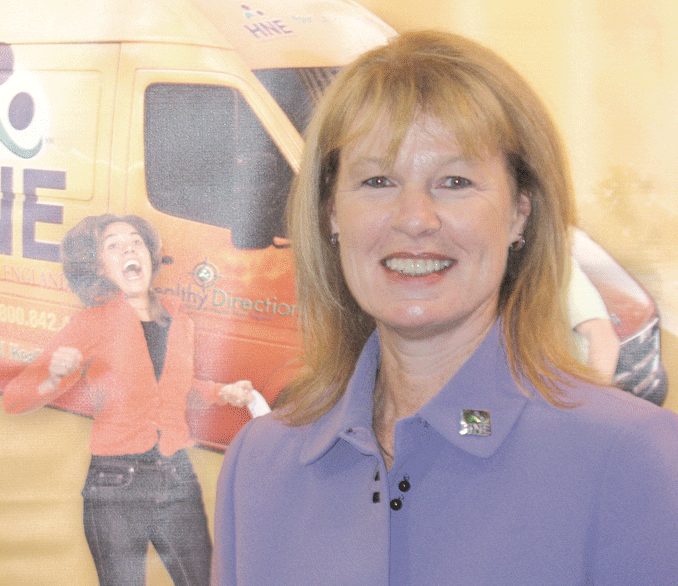
Lynn Ostrowski, director of Health Programs and Community Relations at Health New England

Lynn Ostrowski, director of Health Programs and Community Relations at Health New England, says health insurance is just one of many fields experiencing job growth.

Another rapidly changing field is health insurance; that industry has spawned a need for more workers with specialized skills, said Lynn Ostrowski, director of Health Programs and Community Relations at Health New England.
“Even in this economy, we have been measurably growing,” she said. “It’s been slow but steady growth, and as we have entered new lines of business and marketed a variety of products, we’re looking for a trained workforce to come in and do these jobs. It’s getting more and more specialized. Medicaid product requirements are very different from Medicare products, and so on.”
That means looking for employees with a variety of skill sets, Ostrowski explained. For instance, “we have this brand-new role today — it’s a Medciaid community outreach leader, and we have a huge need for people who are bilingual. It was very difficult for us to fill this position. It took us almost six months to find someone with some knowledge of medicine with communication skills, who could work with members, someone we could teach the plan to and have them hit the ground running.”
At a recent seminar in Springfield on health-insurance reform (see story, page 32), state Rep. Michael Finn, D-West Springfield, said lawmakers recognize a shifting of jobs across the health care landscape, and have created a workforce-development fund that helps people working in struggling health care fields to transfer into areas with healthier employment rates.
In addition, he noted the state’s chronic shortage of primary-care physicians, exacerbated by pay disparities with other specialties and the five-year-old mandate that every citizen must carry insurance, creating access issues at doctors’ offices. In response, the state is exploring options such as loan-forgiveness programs and regional-disparity payments to try to broaden the pool of medical students entering primary care.

Back to School
While opportunities in many fields are expanding, however, education requirements are increasing as well. Occupational therapy, for example, is now typically a master’s-level program, while incoming physical therapists almost universally need a doctorate today. Even careers that once required just an associate’s degree now demand a four-year track of study.
Ostrowski’s “other hat,” as she called it, is coordinator of the Health Services Administration degree program at Elms College. “I teach mostly students who have an associate’s degree in some form — it may be occupational therapy assistant, nursing assistant, physical therapy assistant, dental hygienist — but most of these jobs we’re talking about need a bachelor’s degree just to be looked at.”
However, through a partnership between Elms and Holyoke Community College, these students can complete their bachelor’s degrees in less than two years through a Saturday program, making the track ideal for students who need to work or support a family while moving toward greater career opportunity.
“The tuition is the HCC tuition structure, but they get the degree from Elms College, so it’s a great opportunity for people to come into the health care field who have only an associate’s degree, but need to get their bachelor’s degree quickly.”
“From skilled-nursing facilities to the managed-care environment to teaching hospitals to rehab facilities, there are just so many different places where people can work,” Ostroski said. “The goal of the program is to give people experience across the entire industry so they can get an idea of what role they want to have, and then prepare them to take on that role. As soon as they get that bachelor’s degree, their salary goes up significantly.”
But it’s more than salary, Miller said. For those willing to make the necessary commitment to education, the result is usually a job that’s both well-paying and personally gratifying.
“There are wonderful opportunities — good jobs with good benefits — and if you look at job satisfaction, these are people who like some control over their day, respect, and work that makes a meaningful difference in someone’s life,” he said. “These are really positive things.”

Joseph Bednar can be reached at  [email protected]

Health Care Sections
Baystate’s New COO Puts the Focus on Quality and Value

Greg Harb was asked about the job description for the title on his business card — chief operating officer/executive vice president at Baystate Health, a newly created position at the region’s largest health network.
He said part of it is creating an operational road map for this system, which has a wide array of facilities stretched across three counties and more than 10,000 employees, a task he says involves everyone at Baystate Health. “But it’s more about keeping everyone on course — following that map and getting to where we want to go.”
Elaborating, he said that it’s one thing to have a plan or a multi-faceted strategy for providing quality care in an increasingly challenging environment for all providers (and Baystate has one, which he would expand on in great detail), and it’s quite another to properly execute that plan. And in many ways, his job description comes down to leading, or enabling, effective execution.
“I’m working closely with physician leaders, and also interacting frequently with front-line co-workers,” he said by way of explaining his role within the system. “We’ll have open forums on a regular basis, and I’m also working with the leaders of our different operating entities — the hospitals, the physician practices, our home health and visiting nurses associations — to make sure we’re executing those system objectives and system strategies.
“We’re constantly spending time evaluating our strategies,” he continued, making use of the collective ‘we,’ as he would repeatedly as he talked with BusinessWest, “and ensuring that we’ve got the right tactics to execute those strategies.”
And, as he said, there are many components to the system’s strategic plan. He identified five core strategic objectives, all in support of the integrated health network he says is the model of the future:
• A focus on quality of care provided;
• “Financial stewardship of this community resource”;
• Ensuring that the system is providing innovation in how it provides care;
• Commitment to academic endeavors; “we want to continue to educate health care professionals in the future”; and
• Ensuring that the system “has the most talented group of co-workers in this part of the country.”
Summing all that up, while also condensing his own job description even further, he said it comes down to that simple (yet also exceedingly complex) term ‘value’ and how to provide it in everything the system does.
For this issue, BusinessWest talked at length with Harb about his new assignment at Baystate Health, the many components of his job description, and that all-important focus on value.

Background Check
Harb comes to Baystate from the St. Joseph’s/Candler (SJC) Health System in Savannah, Ga., where he took the same title he has now: chief operating officer. Prior to that, he was COO and executive vice president of the Baptist Health System of East Tennessee, and held similar positions at Valley Baptist Health System in Harlington, Texas, and Memorial Hermann Healthcare System in Houston.
Like Baystate, SJC is an integrated system with a number of components, including two hospitals (St. Joseph’s and Candler, each with roughly 300 beds), a home-health component, the Lewis Cancer and Research Pavilion, and many other programs.
Harb listed a number of accomplishments from his five-year stint at SJC, including an improvement in net operating income from $336,516 in FY 2007 to $3.1 million in FY 2008 and $8.6 million in FY 2010; development and implementation of a strategy that decreaed premium pay 30% compared to the same period the prior year, resulting in a $4.4 million annual savings; decreasing labor as a percentage of net patient revenue from 44.6% in FY 2005 to 39.9% in FY 2010; work with the system’s board to establish a ‘collaborative’ with a competing health care system, with the primary objective of reducing supply cost; and co-leadership of an enterprise-wide “patient throughput initiative,” which resulted in a 0.4-day reduction in average length of stay at each hospital.
He told BusinessWest that recruiters brought him into the search for a COO at Baystate last fall, and he was attracted by the prospect of working with others there to lead the system through a challenging period of transition for all providers.
“What was most appealing about Baystate is that this is truly one of those integrated regional health networks,” he explained, “where you’ve got Health New England as the payer partner, comprehensive and regionally distributed acute-care hospitals, an integrated, multi-specialty physician practice within the system, all the outpatient services, and parts of the continuum of health with home care and hospice,” he explained. “So Baystate is very well-positioned to really lead the transformation of care, and that was very exciting to me as a professional.”
During the interview process, he said he had the opportunity to meet with Baystate leadership, including CEO Mark Tolosky, whom Harb described as “dynamic,” as well as board members, and came away impressed with the common vision and the basic approach to achieving it.
“There was singularity in terms of their focus on wanting to be that integrated regional system and trying to position Baystate to really change the way care is delivered,” he explained.
Upon arriving in March, Harb said he spent a considerable amount of time acclimating himself to the Baystate system and understanding the dynamics of the many moving parts within the delivery network.
When asked what he took away from that acclimation process and the many forums he had with administrators, physicians, and employees at every level, he said it was the sense that everyone is pulling in the same direction.
“There’s a real commitment to Baystate Health’s strategies, a commitment to the execution of those initiatives, and a real positive outlook that, if we do execute those strategies, we’ll continue to be a leader in Western Massachusetts,” he said. “There was a positive outlook that we’re well-positioned as a system, but that doesn’t mean that there weren’t or aren’t significant challenges facing Baystate and everyone else in health care.”

Care Package
Which brings him back to the five core strategic objectives he mentioned earlier, and how they are all integral to that process of providing value and enabling systems to effectively serve the public when the costs of providing services (especially in the case of Medicaid and Medicare) are not fully reimbursed by payers.
Starting with that term, or philosophy, of quality, he said that it comes in three areas: clinical — the outcomes provided — as well as patient experience, which Harb described as a “core deliverable,” and access. “We want to ensure that our community has access to our physician practices, acute-care services, as well as our outpatient services.”
And a big component in the effort to deliver quality is transparency, he told BusinessWest, adding that the system posts all clinical outcomes on its Web site.
Regarding financial stewardship, Harb said a key part of this strategic initiative is removing waste from the system in order to provide care in the most cost-efficient manner.  As part of that effort, the system started down what he called a “lean journey” nearly 18 months ago, and now applies lean practices in a number of departments, leading to significant gains in efficiency and plans to expand the program.
Meanwhile, the system, which has undergone a large reduction in force (185 positions were eliminated in late June), has also focused on non-labor expenses, such as costs within the supply chain, he continued, and has managed to reduce expenses by roughly $40 million to $50 million over the past several years. “We’re constantly looking at ways to remove waste without compromising quality,” he explained, adding that such efforts are helping Baystate toward its three-year goal of breaking even on Medicare services (which constitute a large percentage of total volume within the system).
Innovation in the delivery of services plays a part in both the achievement of quality and financial stewardship, he continued, citing as one example, the advent of patient-centered medical homes (the system has 16 of them), a relatively new model of the organization of primary care. It involves an individual’s primary-care physician and family and focuses on care needs, including prevention and wellness.
“These homes, which coordinate care across the entire continuum, are a real innovation and an opportunity to improve the way in which we provide care,” Harb said, adding that another key to Baystate’s success quotient is recruitment of top talent across the board.
“We need to make sure that we recruit, retain, and develop the best physicians, the best nurses … all parts of our delivery system,” he said. “We have an aging workforce, so the constant challenge of recruiting and retaining our caregivers is something we spend a lot of time on. And we understand that this is at the core of all that we provide; the people — the team — are the most important element in the process.”
And the ongoing task of proper execution of strategic initiatives is a total team effort, he went on, summing up the many financial and operational challenges facing providers by saying that they must continue to “appropriately redesign care and remove waste, but not impact quality of care.”
Elaborating on this redesign process, he said it involves reduction, or elimination, of the fragmentation process in health care today, and the creation of truly integrated systems. This is a large component of Harb’s assignment, and one of the many motivations behind the $250 million Hospital of the Future expansion now taking shape on the Baystate campus.
“One of the core parts of my responsibility is seeing that we’re truly integrating our care,” he said, “and that we’re not just approaching it from a hospital perspective, or from a physician-practice perspective, or a post-acute perspective, but making sure that we are truly coordinating that across the system.”

Bottom Line
When asked how he would evaluate his level of success in his new position, Harb said there would be a number of effective measures.
“Are we hitting our quality metrics? Are we hitting our patient-experience metrics? Are we performing well financially? Are we recruiting and retaining our talent? Are our co-worker engagement scores improving? It’s very much based on how we perform against the measured objectives of our system,” he explained.
In more simple terms, though, he’ll be successful if he can keep the system on course, able to follow that roadmap for progress in a changing health care landscape, and, in a word, execute.

Health Care Sections
Most Sports-related Neck and Back Injuries Are Preventable

Dr. Julio Martinez-Silvestrini calls them “the terrible toos.”
“People do too much, too fast, too soon,” said the sports medicine physician from Baystate Rehabilitation Care in East Longmeadow, as he talked about how and why sports-related injuries to the spine occur.
“If people followed simple rules, they could avoid most injures. But getting in shape takes time, and people are impatient. As soon as the snow melts every year, golfers go out and play 18 holes without stretching. And someone who has never run before will decide to run a marathon, put their sneakers on, and run two miles the first day,” he said, adding that such individuals usually end up getting hurt.
Dr. Charles Mick agrees. “If you want to lift weights, don’t try to lift 250 pounds the first day,” said the orthopedic surgeon from Pioneer Spine and Sports Physicians in Northampton. “Athletes want to maximize their ability, but they need to do it gradually with common-sense training.”
But many people make the wrong choices. In addition, some sports injuries cannot be avoided. As a result, physicians see adolescents and adults who have injured their neck and/or back playing sports. Their conditions range from muscle strains and sprains to ruptured discs and, in rare cases, spinal-cord damage, which can result in paralysis or even death.
The injuries occur from participation in a wide variety of activities, which include golf, running, football, baseball, BMX biking, martial arts, cheerleading, lacrosse, diving, horseback riding, car racing, surfing, and more.
“Most of the time, back injuries are not related to an acute event,” Martinez-Silvestrini said. “They result from overuse and repetitive movements using bad body mechanics.”

Anatomy Lesson
Martinez-Silvestrini says the back can be divided into three parts: the cervical or neck region, the mid-thoracic spine, and the lower or lumbar spine.
In general, muscle strains are the most common type of injury. “At some point, almost every athlete strains a muscle,” Mick said. “Sore backs are common, and aches and pains are part of getting stronger.”
However, Dr. Christopher Comey of New England Neurosurgical Associates in Springfield says it’s not unusual to see patients with injuries that range from nerve irritation to cervical spinal fractures.
“Lumbar or lower back strain usually responds to pain medication, restriction of activity, and anti-inflammatory medication. Longer-lasting injuries can involve pinched nerves, which can happen when a disc is herniated and a piece of it lodges against the nerve. The pain can start out in the back and, several days later, travel down the leg. But only 10% of patients with these conditions require surgery,” he said. “The majority respond to physical therapy, rest, and, on occasion, cortisone injections.”
The most common injury to the neck is whiplash. “It can happen in any sport where the person is moving at high velocity; if a football player is tackled in the chest, his neck continues to move forward, which stretches all of the ligaments and muscles that support the cervical spine,” Martinez-Silvestrini said. “Once you get to the point of maximum deformity, there is a recoil mechanism, and the neck goes backward.
“Sometimes, it overcorrects and bounces back and forth,” he continued. “The opposite happens when someone is tackled from the back. Their neck snaps backward, which stretches all of the front neck muscles because the head is moving at a different velocity than the trunk of the body.”
In most cases, whiplash results in nothing more than a stiff neck, which improves with rest. “The way to differentiate between a mild sprain versus a more serious one is pain that doesn’t improve with rest, or tingling or numbness,” said Martinez-Silvestrini. “In more severe cases, there may be weakness, walking difficulty, or problems with bowel or bladder control.”
A common football and wrestling injury is called a ‘stinger’ or ‘burner’ because it causes sudden pain and/or numbness and tingling that lasts for a few seconds and feels similar to hitting the ‘funny bone.’ It results from overstretching the brachial plexus network of nerve fibers that run from the neck to the arm.
Mick says stingers can be frightening, but are usually not dangerous. However, in rare instances there can be permanent nerve damage, and symptoms should not be ignored if the athlete has another episode during play.
Injuries to the thoracic vertebrae in the back are typically mild, since the rib cage provides protection and stability. However, if and when they do occur, they can result in damage to the spinal cord.
But lower back pain is the complaint that sends most people to their doctor. And although many people ignore it, Comey said chronic low back pain in young athletes should be taken seriously.
“There is a tendency to think, ‘it’s a kid, so what could possibly be wrong?’ But I have seen children who have developed stress fractures in the lower spine,” Comey told HCN. “If they’re recognized early, they can usually be treated with non-surgical means, including external bone stimulators that encourage bone growth.”
However, if a stress fracture in a young person goes untreated, they can develop slippage of the spine, or spondylolthesis, which typically occurs when the L5 bone slips out of the proper position and slides forward on the first bone in the pelvis or sacrum, which causes back and leg pain.
Braces are sometimes used to treat stress fractures in young athletes, and they may be able to return to playing sports after the fracture heals, Comey said.
But in many cases, the fracture never heals, and although the pain subsides, it can reoccur if the person returns to play. “I’ve had several UMass varsity football players who were unable to play again,” Mick said.

Prevention Matters
Correct posture, proper equipment, maintaining flexibility, and overall conditioning can go a long way toward reducing neck and back injuries, experts say.
“People need to be fit to play a sport, rather than playing sports to be fit,” Martinez-Silvestrini said. “Three major elements that are important are flexibility, strength, and good aerobic capacity.”
Mick agrees. “A sports program needs to be balanced,” he said. “Sometimes football players will only do strength training and not work on balance, which is very important. And when people think about baseball, they think about the shoulder. But if someone wants to throw a pitch at 90 mph, they need to use their leg, trunk and back muscles. So if they just exercise their shoulder and arm muscles, they may injure their back when they are throwing fastballs.”
Golf is another sport where posture is critical. “When someone wants to pick up a golf ball, they should bend down or use a golfer’s reach,” Martinez-Silvestrini said. He demonstrated the move by leaning forward while keeping his back straight and reaching out with one hand while extending the opposite leg.
Comey says golf is not bad for the spine, but people with low back problems need to warm up and do some stretching before they begin to play. He recommends people visit www.spineuniverse.com to learn helpful exercises.
Physical therapy can be useful after an injury, and sessions with an athletic trainer or coach can make a difference after initial healing takes place. “A trainer can create a program that focuses on strength, endurance, balance, and coordination,” Mick said.
However, some people are unable to return to the sport that led to their injury, especially if their lower back pain is caused by degenerative changes.
“Distance running can be very difficult on the lower back due to the constant pounding transmitted to the spine with each step,” Comey explained. “Pain can come from discs which no longer function as shock absorbers. They literally wear out, which is no different than wearing out a hip or knee.”

Worthwhile Pastime
The bottom line is that most spinal sports injuries are mild and don’t cause permanent damage. “If pain goes away within a day or two and is fairly mild, there is no need to get excited,” Mick said. “But it does need to be evaluated if it is severe, keeps coming back, or doesn’t go away.”
Comey agrees and says 90% of people develop debilitating back pain at some point in their life.
But the risk of hurting one’s back or neck is not a reason to avoid sports, Mick said. “The benefits of regular exercise and participation in sports far outweigh the risk of injury.”

Construction Sections
Raymond James Restoration Has This Art Down to a Science

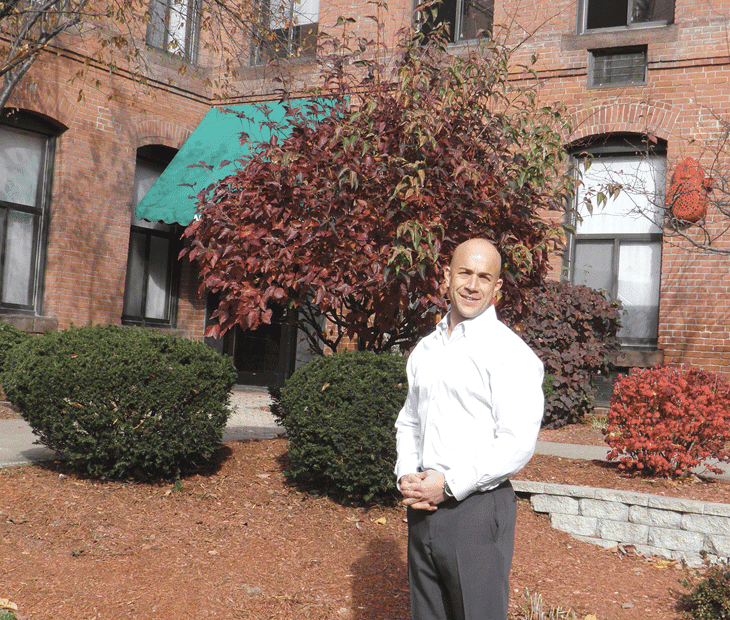
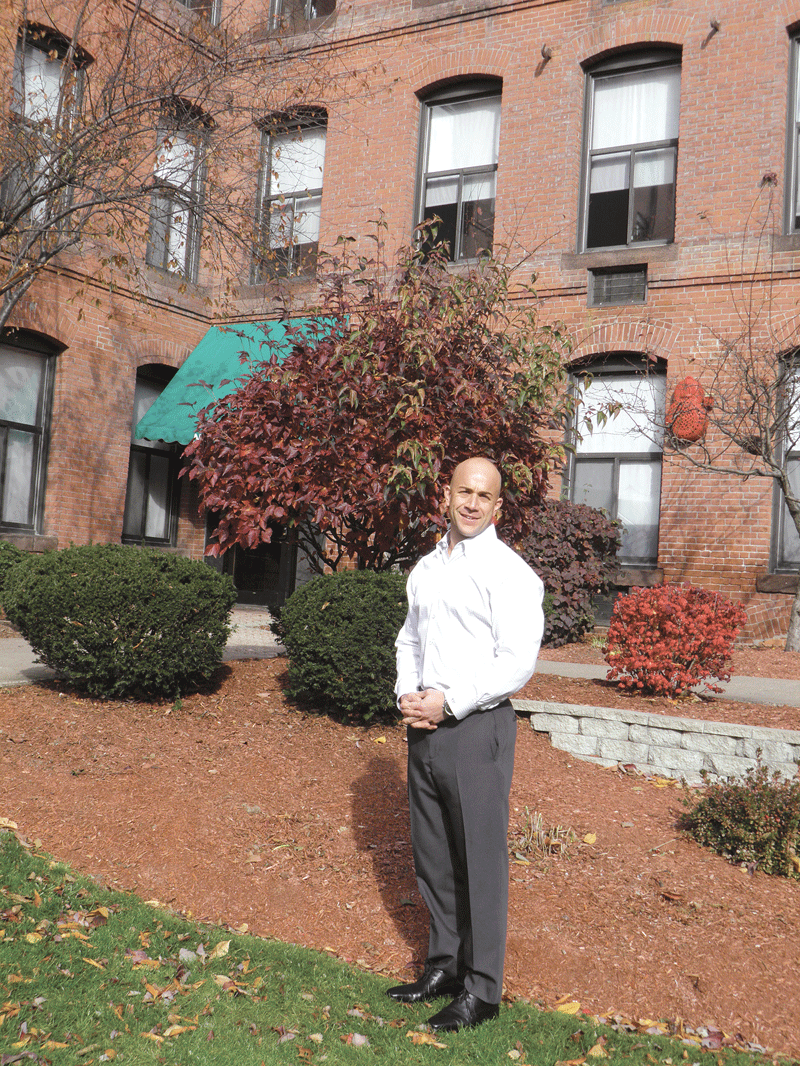
James Simoncini

James Simoncini says his company specializes in matching original work with such quality that observers wouldn’t know a restoration project was undertaken.

A century ago, craftspeople spent endless hours doing intricate work on the exterior of buildings that is seldom replicated today.
So, when an old structure such as a museum, library, or brick apartment complex needs restoration, many people believe it will be impossible to reconstruct portions of the original façade or match it exactly without spending a lot of money, especially since colors of brick and mortar change and fade over time.
But Raymond James Restoration Inc. of Worcester and Springfield has been debunking that notion for 15 years. “Restoration work is an art, and a lot of projects can be expensive. But restoration is all we do and because of our background, experience and knowledge, our repairs match so well no one ever knows they were done,” said Raymond James Simoncini, who founded the business. He added that although perfect matches take extra time, the company’s well-honed methods allow them to complete projects at reasonable prices.
Details are important to Simoncini, and like the craftsmen of yesterday, he has dedicated his career to restoring buildings to their former grandeur so people can continue to enjoy their original beauty for generations to come.
“I want things to look right. I love old buildings and their history,” he said. “Appearance is very important to me and it doesn’t take that much more time to do something correctly, which is one of the secrets to my success.”
Simoncini grew up in the construction business and sharpened his skills under the tutelage of a dedicated mason who had taught the craft at a vocational high school and loved restoration work. Since that time, he has gone from working for others, to operating a one-man operation, to managing a business which employs eight people with services that range from masonry restoration of building facades, to historic revitalizations, to the many aspects of masonry repair, masonry cleaning and protection services, and maintenance consultation services. His roster of services also encompasses concrete precast repair and replacement and waterproofing coating and painting.
The majority of the work is done in the commercial arena. Currently, the company is engaged in the first phase of a project on one of the buildings that make up Stockbridge Court in Springfield.
“It’s made of concrete, and some of the material was falling off,” Simonici explained, adding that water had seeped in behind the façade. The job involves treating the steel frame, which has rusted, and re-coating the entire structure with waterproof paint.
However, many of his projects are far more challenging and range from sites in Worcester and the Boston area to UMass Amherst. And since some sites are large and the work must be done in stages to accommodate budgets, Simonici also does consultation work and develops plans that prioritize the importance of repairs that need to be done.
“They can range from safety issues to cosmetics,” he explained. “So, I fine tune the jobs so people know where to spend their money.”

Concrete Examples
Simoncini’s introduction to the construction business came at a young age when he began working for his father. He studied business in college, and although he continued working for his dad, he began taking on jobs of his own. In time, he was hired by a masonry-restoration company whose work included many high-end projects in Boston, on Newbury Street, Beacon Street and Commonwealth Avenue.
While employed there, he was mentored by Michael McCarthy, a mason and teacher who cared deeply about restoration work. “He taught me how to match bricks and mortar, which has allowed me to separate myself from my competitors,” Simoncini said. “He sculpted me into restoration.”
During that time, Simoncini gained two clients who had so much for him to do, the time he spent on their projects soon equaled the 40 hours he was putting in at with his employer.
When the firm’s business began to slow, Simoncini did some work for other companies, as he had joined the local mason’s union. But at age 24, he made the decision to go into business himself, and quickly became extremely busy due to word-of-mouth referrals, which to this day is how he gets most of his work.
“I can find any brick and make it look old, and can match any mortar in a wall,” he said, adding that his company has doubled the amount of work it has done each year for the past three years.
Simoncini has never shied away from a challenge, and has faced many during his career. A good example is the historic Edgell Memorial Library in Framingham, which was built in 1872 to commemorate the service of Civil War soldiers.
The slate roof was being replaced, and that meant the library’s two stone chimneys needed to come down and put back up exactly the way they had been built.
“Every stone had to come off and be labeled; we took photos and made a diagram, but putting something like that back together is not foolproof,” Simoncini explained. “The biggest challenge was that the mortar joints had to be exactly the same size as they had been and had to line up perfectly.”
The crews were able to accomplish the painstaking job to Simoncini’s standards, which he said are often higher than those expressed by the clients who hire him.
And that’s one of the reasons why there are many similarly challenging assignments in the company’s portfolio. Another example is the work undertaken at the   Worcester Historical Museum.
Crews from Raymond James tore down its chimney, and, while rebuilding it,  discovered that 100 of its 300 bricks were not salvageable. Rather than putting all of the new bricks in one section, they carefully mixed them into the design so they were not visible.
Simoncini said it would have been easier to put them all at the top or bottom of the chimney, but his focus has always been on restoration that is not visible.
It was also difficult to match the 50-year-old mortar, but the ability to do such detailed work is what sets him apart, he said, adding, “I am very, very particular in everything I do.”
Another assignment that came complete with a number of challenges was the courtyard of the Rhode Island Federal Courthouse, where some of the pillars needed brick-replacement work. Simoncini explained that water had gotten between the bricks and the steel supporting rods and had pushed the bricks out. In order to get an exact match for 300 bricks, he purchased 1,600 so he could carefully pick and choose among them. “When you order bricks, they come in cubes of 500, and the shades are different colors,” he explained.
But he wasn’t content until he had found a perfect match. “I believe that the work I do is a direct reflection of me, and I won’t use something that isn’t right,” Simoncini said.
“Some people have been told that a certain color brick doesn’t exist anymore,” he told BusinessWest. “But it’s not true. In 15 years, we have never run into a brick we couldn’t find.”
He added that he does a good deal of work for property managers. “They are always trying to save dollars, but they want things to look right, and the reason I have been successful is because that is exactly what I do.”
His company also did brick-replacement, repointing, and sealant work on the Student Union at UMass Amherst. “The sealant was challenging because we were removing mortar in between the capstones and replacing it with the sealant and it had to match the original mortar that we removed. But the project engineer for UMass told us it was the best caulking job he had seen during his career,” Simoncini recalled with pride.

A Full Slate
By utilizing its own team members, Raymond James Restoration is able to control quality as well as project timelines and budgets, since it doesn’t have to wait for subcontractors, which means there no scheduling delays.
And although Simoncini said he could choose to take on more-costly projects in large cities such as Boston, his goal has always been to use his expertise to restore old buildings at rates that people could afford — providing a perfect match even when others have said it cannot be done.
And that has helped him cement a reputation that is, well, rock solid.

Commercial Real Estate Sections
Holyoke Project is a Study in Perseverance

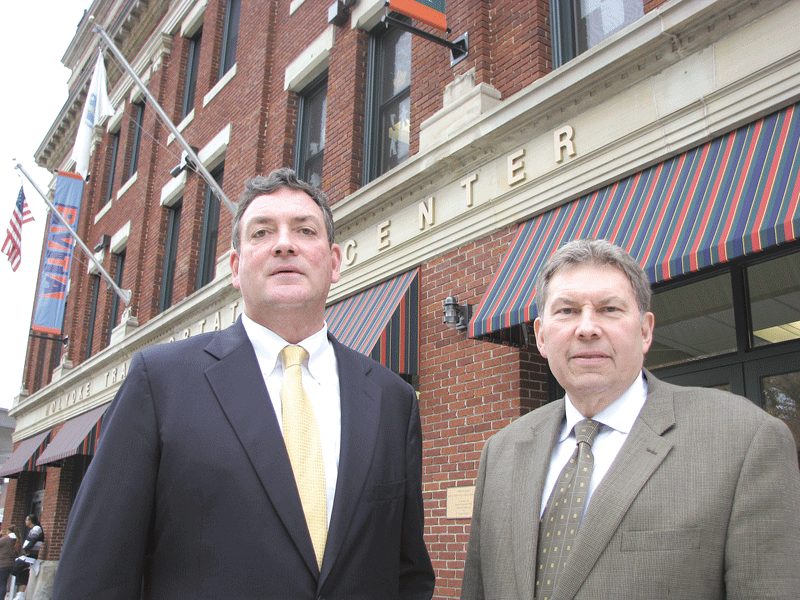
Mike Crowley, left, and Bob Schwarz

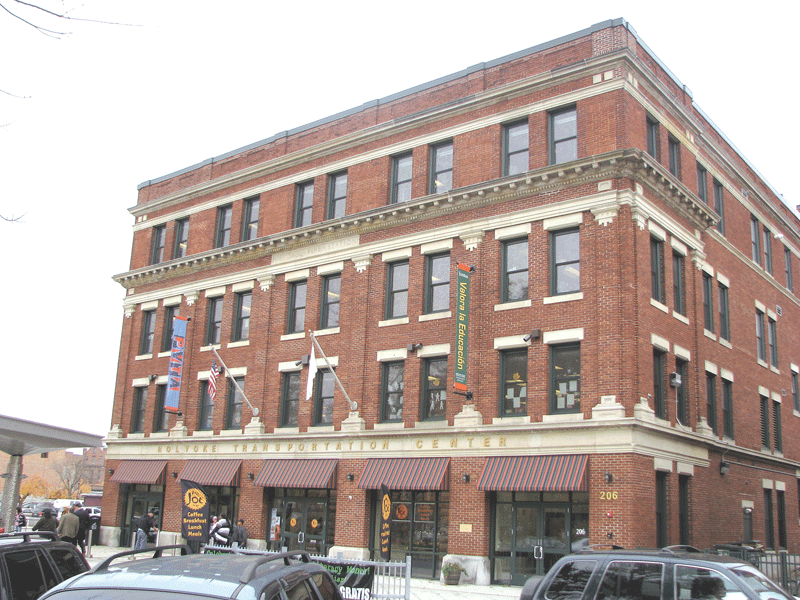
Mike Crowley, left, and Bob Schwarz in front of the Holyoke Transportation Center, a unique project that overcame innumerable hurdles.

The concept initially came together nearly a decade ago. It was a unique and ambitious plan — to combine a transportation center with adult basic education programs and a childcare facility — but it made sense on many levels. So much so, that the Holyoke Transportation Center was able to withstand myriad challenges, many of them capable of scuttling the initiative. The end result is what one of the private-equity investors calls “a one-stop shop to improve your life.”

Mike Crowley says that from a strict bottom-line perspective, the initiative that became known as the Holyoke Transportation Center never really made complete sense, and always came complete with a large amount of risk.
Indeed, when asked when and if this unique commercial real estate venture will become a financial success, Crowley laughed and then offered an expression that seemed to say, ‘who knows?’ — a reaction that essentially told the story. Well, not really.
That’s because this project was never about economics — or all about economics, said Crowley, a commercial real estate consultant, developer, and eventual partner with members of the Picknelly family and a host of public entities in this initiative that transformed the old central fire station on Maple Street in Holyoke into a transportation and education complex that those involved say should become a model for other communities.
Instead, it was about fulfilling a commitment made by Peter L. Picknelly more than a decade ago to create a groundbreaking public-private partnership that would blueprint and then build a unique facility that would become both a transportation hub and center for adult basic education programs — two passions for Picknelly, who was still conceptualizing the facility when he died in 2004.
And it was essentially the unwavering desire on the part of his son, Peter A. Picknelly, to honor this commitment that enabled the project to overcome a lengthy laundry list of challenges and the temptation on the part of any or all of the various players — the Commonwealth, the Pioneer Valley Transit Authority, the Federal Transportation Administration, Holyoke Community College, and other entities — to say that this project just wasn’t doable.
“Every time we were faced with a 10-foot wall with barbed wire on top, we somehow found a way get over it,” said Crowley, who has a number of successful real estate ventures, including several medical offices, on his portfolio, and has worked with the Picknelly family on several of its projects over the years.
He said the barriers in Holyoke were both bureaucratic — an inevitable scenario when one considers the alphabet soup of federal, state, and local agencies involved (from HCC to the PVTA to the FTA), as well as the leadership changes that took place within some of these agencies— and construction logistics he summed up neatly and succinctly when he joked, “they told us this building had great bones; well … they lied.”

The Holyoke Transportation project

The Holyoke Transportation project was a complicated endeavor that involved a number of federal, state, and local agencies.

Indeed, detailed inspections revealed serious problems ranging from asbestos in the flooring (originally thought to be concrete), removal of which added $500,000 to the pricetag, to greatly deteriorated steel under the main floor, where the weight of fire trucks and the corrosive effects of road salt took their toll.
Eventually, state funds were secured to cover some of the additional costs, imaginative solutions were found for each of the construction challenges, and the parties involved essentially drew their own map for navigating uncharted waters in the form of an unprecedented public-private collaboration to create the center.
“We were essentially paving new ground; this was the first joint-development agreement undertaken in the country under the new FTA rules and regulations,” said Bob Schwarz, executive vice president of Communications for Peter Pan Bus Lines, and an individual Crowley credited with keeping the project on the rails during the innumerable times it appeared to heading off the tracks. “So we had nothing to go on; no one had ever done this before; we were laying the road.”
And as result of all this imagination and determination, the participatinbg parties were able to cut the ribbon last fall on a facility that Picknelly says makes a great deal of sense for the community.
“It’s a one-of-a-kind concept that has received national attention,” he said. “The components come together naturally — adult basic education, transportation to take people to those programs, and a childcare center for those with children.
“This is a one-stop shop to improve your life,” he continued, referring specifically to the many programs taking place in the Picknelly Adult and Family Education Center, named for his father. “It’s a place where people can make connections that can change their life.”
For this issue, BusinessWest chronicles the Holyoke Transportation project, a triumph over adversity in many respects, and now a working model that other communities may be looking to emulate.

Route of the Problems
As Crowley retold the story of how the center eventually came to fruition, he said that by the time Picknelly called him in 2006 and asked him to get involved, the project had been effectively dormant for some time.
There had been a memorandum of understanding inked between the Picknelly family and the PVTA in 2003 that outlined the partnership and the main battle plan for building the center, said Crowley, and many additional partners, from HCC to Head Start, to the city of Holyoke (which provided the real estate), had come on board, and thanks to the ardent support of U.S. Rep. John Olver, the various components of the project, and needed funding sources, were coming together nicely.
“They visualized a multi-modal transportation facility that would link inter-city and intra-city bus services involving carriers like the PVTA and Peter Pan, that would provide superior transportations services for the people ot Holyoke and the surrounding communities,”Crowley explained. “But what they also recognized was an absence of critical adult basic education services in the community, and looking at the demographics, this was a glaring problem — the fact that none of these services were being provided in a cohesive fashion.”
“What Peter (Picknelly), Bob (Schwarz), and Congressman Olver realized was that many of the people who needed adult basic education needed transportation to those services,” he continued. “Further, they understood that many of them also had kids, and in most cases, couldn’t leave those children to receive these education services — so Head Start became another critical element in the equation.”
This apparently solid game plan gained the support of the FTA and the state Executive Office of Transportation), which together had committed grants covering two-thirds of the project’s cost, and HCC had agreed to become anchor tenant and provide the adult basic education services.
But due to a series of circumstances — from the death of the elder Picknelly, who was providing the private equity for the project ($1 million) to turmoil at the PVTA and a subsequent change in leadership at the agency — the ambitious plans had been effectively back-burnered, although certainly not forgotten, said Crowley.
Indeed, by 2006, the PVTA, then being led by Mary MacInnes and determined to upgrade its facilities in Holyoke, one of the larger communities served by the agency, generated some dialogue about getting the initiative back on track.
But the landscape had changed considerably since 2003, said Crowley, noting that by then, the commercial real estate market was booming and construction costs were soaring, which meant that that the agreements between the parties would have to be renegotiated.
“When I looked at the development proposal that Peter had agreed to, and looked at the agreements that Head Start and Holyoke Community College had agreed to as tenants, and looked at the agreement that the PVTA had, it was evident to me that the project was financially unfeasible, and I indicated that (to the younger) Peter,” he explained. “But Peter, who recognized and appreciated that this was one of his father’s principle goals in life — to create this adult basic education center — didn’t want to give it up.”
Fast-forwarding a little, Crowley said the various agreements with the parties involved were revisited, and those leading the initiative went to Olver in the hopes of securing additional funding from the FTA to cover those escalating costs; a revised budget from the architect had moved the pricetag from the $7.5 million in 2003 to roughly $9.3 million (for both the building and an adjoining parking garage that was never built).
However, by this time (late 2006), the country was starting to slide into recession, and the federal government was putting the brakes on a number of projects, including many that were transportation related. So the parties involved with the Holyoke project agreed to essentially move forward knowing that there was a significant funding gap, said Crowley, adding that this was only one many serious problems lying in wait for this initiative.
“There were a number of points in the JDA where I think all the stakeholders, at one point or another, and for various reasons, almost threw in the towel,” he explained. “It was a daunting, daunting process. There was a ton of agencies involved — at the federal level, the state level, the city level … it was incredibly complex.”

Miles to Go …
Meanwhile, close inspections of the old central fire station revealed that those claims of ‘great bones,’ were untrue, or at least greatly exaggerated, and this meant that the recently revised budget was certainly imperiled.
For starters, the building, vacated at the start of the decade but still used for some training programs, had been exposed to the elements for seven years before construction was due to begin. This led the developers to do their own structural and environmental analyses — earlier reports indicated that the building was ‘clean’ — that found a number of large and costly problems.
Chief among them was the asbestos-based coating on the floors on the second, third, and fourth levels, a material applied 70 years earlier. “Everyone thought it was concrete, and we planned to just skim-coat over it,” Crowley explained. “And there was no way to get it up, other than with jackhammers and hand demolition.
“We had two options — encapsulating it, or removing it,” he continued. “But knowing that we were going to have Head Start and their children, and knowing the level of traffic this building was going to get from the general public, we made the decision to remediate it in its entirety, and if we couldn’t remediate it, we were going to scrap the plan.”
A subsequent inspection revealed that the deterioration of the I-beams that were carrying the first floor was so significant that they would have to be replaced, adding another $250,000 to the project’s cost.
“So now, we’re $770,000 behind the 8-ball, and this is before we’ve gone to bid to find out what it’s going to cost us to do the building,” he went on. “So that delayed us probably four months, because we, as the private-equity investors said, ‘we’re not going forward this — this is crazy; there are just too many unknowns.’”
But eventually, the many delays in negotiating agreements, securing the needed funds, inspecting the building, and resolving construction issues, turned out to be a blessing, because the rapidly deteriorating economy served to bring down the constructions costs associated with the project — and in a dramatic fashion.
“In most cases, time is you enemy with projects like this; in this instance, it was our friend,” said Schwarz, adding quickly that even with the attractive bids that would eventually be recived, the project would likely have been scuttled if state legislators had not secured a $750,000 grant from the EOT to handle the asbestos-removal efforts and floor replacement.
Construction wound up coming in two phases — demolition, handled by Kurtz Inc., in Southampton, and then reconstruction, undertaken by Western Builders in Granby, a subsidiary of Daniel O’Connell’s Sons in Holyoke — and there were myriad challenges in both cases.
Indeed, demolition of the floors proved to be a formidable obstacle, said Crowley, noting that due the composition of the concrete under the asbestos coating (sand mixed with large stones), the demolition efforts left a scarred, pitted surface that “looked like the surface of the moon.”
Rectifying the situation would require roughly three inches of new concrete, he continued, but the structural steel wouldn’t support that much weight. So a silicon-based substance, five times more expensive than concrete, had to be used.
Eventually, officials at HCC were able to secure a $550,000 federal grant that effectively enabled the developers to absorb ballooning expenses from the construction challenges and bring the project to completion, said Crowley, who stressed repeatedly, that there many figurative 10-foot walls with barbed wire that appeared to be insurmountable barriers, but solutions were ultimately found.
As they provided BusinessWest with a tour of the center, Crowley, Schwarz, and George Kohout, who directs the System for Adult Basic Education Support (SABES) for Holyoke Community College, at the Picknelly Center, all implied on numerous occasions that the facility was certainly worth all the aggravation, and that the unique model is working as those who blueprinted it intended.
Kohout said there are a number of programs conducted on the third and fourth floors of the facility, involving a number of agencies, from HCC to the New England Farmworkers Council; from the HALO (Holyoke Adult Learning Opportunities) Center to the Community Education Project; from the Holyoke Public Schools to CareerPoint.
Together, these partners offer services that include English as a Second language classes, GED testing, MCAS preparation, career counseling, “fast-track math,” English writing and composition, and computer training.
The central location, coupled with the accompanying transportation and childcare elements, not to mention the modern facilities, have all contributed to high enrollment and attendance levels that are certainly not coincidences, Kohout continued.
“Attendance has gone off the charts,” he explained. “And part of the reason for that is that many of these programs have been offered in places like the basements of churches or in other buildings with used furniture; when people come here and see the modern facilities, the state-of-art technology, bright colors, and the clean walls, it really ramps up what we call their ‘persistence’ in classes.”
In the big-picture perspective, that’s a word that can be applied to every aspect of this project.

Passing the Test
Looking back on all that transpired since that conversation with Peter Picknelly back in 2006, Crowley shook his head and said, “had I known then, what I know now …”
He didn’t finish the sentence, but the implication was certainly clear enough, and if it wasn’t, he then made it so by adding, “was this a labor of love? Maybe, but mostly, it was a just a labor.”
And mostly because all the parties involved didn’t know then what they know now, this unique project was able to come to fruition, bringing transportation, adult basic education, childcare, and even a coffee shop, together in an historical and improbable setting.
And so, the Holyoke project has become a study in perseverance — in more ways than one.

George O’Brien can be reached at [email protected]

Features

In August, BusinessWest presented its 2011-2012 Resource Guide. What follows are needed additions and corrections to the charts that appeared in that issue:

Addition to Accounting Firms:
Pignatare & Sagan, LLC
1098 Elm St., West Springfield, MA 01089
(413) 746-9465; www.pignatareandsagan.com
Number of CPAs: 4
Number of Partners: 2
Total Staff: 18
Offices: 2
Managing Partner: Charles Sagan
Specialties: Certified public accountants; enrolled agents; tax planning and tax-return preparation; personal and business consulting; personal financial planning; retirement planning; business purchase, sale, and financing; financial-statement preparation; computerized accounting and bookkeeping; incorporating a business

Addition to Audio-Visual/Multimedia:
New York Sound and Motion
181 Doty Circle, West Springfield, MA 01089
(413) 734-3456; Fax: (413) 734-3457
www.nysmtv.com
Services: Full-service video production company; all forms of digital and audio media; specializes in high-definition production as well as post-production in two AVID suites; provides solutions to nonprofits, educational organizations, small-business owners, and others
Contact: Edward Brown III

Addition to Banquet Facilities:
Marriott Courtyard Hadley Amherst
423 Russell St., Hadley, MA 01035
(413) 362-8405; Fax: (413) 256-5422
www.marriott.com
Capacity: 200
Contact: Sean Welch
Services: Offers 2,880 square feet of meeting space; can accommodate meetings from two to 200 people; full catering capabilities on property

Change to Computer Network/IT Services:
Squad 16
16A Pasco Dr., East Windsor, CT 06088
(860) 758-7250; www.squad16.com

Additions to Financial Services/Brokerage Firms:
First Niagara Private Client Services
225 Park Avenue, 4th Floor, West Springfield, MA 01089
(413) 747-1465; www.fnfg.com
Licensed Brokers in Western Mass.: 4
Branch Manager: Michelle Hagan
Services: Full-service wealth, investment, and fiduciary services

New England Financial Group, LLC
17 North Main St., West Hartford, CT 06107
(860) 521-2250; Fax: (860) 521-2214; www.nefghartford.com
Licensed Brokers in Western Mass.: 15
Branch Manager: James Marlor Jr.
Services: Family protection; wealth accumulation and distribution strategies; business-continuation planning; tax-qualified retirement plans; employee benefit plans; executive benefit plans

Change to Financial Services/Brokerage Firms:
Charter Oak Insurance & Financial Services Co.
Licensed Brokers in Western Mass.: 80
Services: Personal and life insurance; employee benefits; investments

Change to Insurance Agencies:
Berkshire Insurance Group
66 West St., Pittsfield, MA 01201
(Local offices in Dalton, Greenfield, Great Barrington, Longmeadow, Pittsfield, Shelburne Falls, South Deerfield, Stockbridge, and Westfield)
(866) 636-0244; Fax: (413) 447-1977
www.berkshireinsurancegroup.com
Full-time Agents: 70
Full-time Employees: 80
Offices (Locally):  10
Type of Insurance:  Commercial, Personal, Life, Employee Benefits
Top Local Officers: James Herrick, Vice President, Personal Lines; Steven Cronin, Vice President, Commercial Lines

Change to Largest Employers and Largest Manufacturers:
Lenox Industrial Tools
Top Local Officer: Rich Wuerthele

Addition to Largest Manufacturers:
MicroTek Inc.
36 Justin Dr., Chicopee, MA 01022
(413) 593-1025
www.microtek-cables.com
Total Employees: 120
Top Local Officer: Anne Paradis
Business: Custom cable assemblies and wire harnesses; control panels and boxes

Departments Picture This

Send photos with a caption and contact information to:  ‘Picture This’ c/o BusinessWest Magazine, 1441 Main Street, Springfield, MA 01103 or to [email protected]

CHD Turns 40

The Center for Human Development celebrated 40 years of service to the community at its recent annual meeting, staged at the Storrowton Tavern and Carriage House. The event featured keynote speaker Bob Fazzi, managing partner of Fazzi Associates and CHD co-founder and former presudent, as well as presentation of the Rick Moriarty Volunteer of the Year Awards. The winners were Doris Chrzanowski, Nancy Evans, and Janice Morin. Clockwise, from above, three of CHD’s founders (from left), Fazzi, Bill Seretta, and Art Bertrand share a moment with CHD President/CEO Jim Goodwin; standing (left to right) are: Jeff Sattler, president, Nuvo Bank; Heidi Delisle, vice president, AW Hastings; Mat Geffin, Webber & Grinnell Insurance. Seated (left to right) are: Hannah Butler, Human Resources director at Lenox Saw; Amy Royal, principal of Royal LLP; Carol Fitzgerald, vice president of CHD; and Amy Roberts, vice president of Kollmorgen; standing (left to right) are: Terry Regina, board member, CHD; Jim Goodwin; Mike Williams, vice president with Chicopee Savings Bank CHD and board member; Bill Seretta; and Michael Weekes, president, Mass. Providers Council. Seated (left to right) are: Art Bertrand; Jay Primack, principal, Moriarty & Primack and chairman of the CHD Board of Directors; Bob Fazzi; and Diana Buckley, principal, Buckley Consulting and wife of Bob Fazzi; Seated (left to right) are: Doris Chrzanowski; her husband, Tom Chrzanowski; Nancy Bazanchuk, CHD; Michelle Theroux, vice president of CHD; and Ron Ancrum, executive director of the Community Foundation of Western Mass. Standing (left to right) are: Denise Dukette, vice president of New England Bank and CHD board member; Evan Plotkin, NAI Plotkin and CHD board member; and Karen Cabana, CHD.

Chamber Corners Departments

ACCGS
www.myonlinechamber.com
(413) 787-1555

• Dec. 2: East of the River 5 Town Chamber Annual Holiday Breakfast, at Twin Hills Country Club, Longmeadow. Doors Open at 7:15 a.m. Tickets: $20 for members; $30 for non-members.
• Dec. 6: Springfield Chamber of Commerce Executive Directors’ meeting, noon-1 p.m. in the  EDC Conference Room, Springfield.
• Dec. 7: ACCGS Business@Breakfast, at the Delaney House in Holyoke. Doors open at 7:15 a.m. Tickets: $20 for members; $30 for non-members.
• Dec. 9: ACCGS Legislative Steering Committee, 8-9 a.m. in the TD Bank Conference Center, Springfield.
• Dec. 14: ACCGS After 5, 5-7 p.m., at WWLP TV-22, Chicopee. Tickets: $10 for members; $20 for non-members.
• Dec. 15: ACCGS Executive Committee meeting, noon-1 p.m., in the TD Bank Conference Room, chamber offices.
• Dec. 21: ERC Board of Directors’ Meeting, 8-9 a.m., at The Gardens of Wilbraham, Community Room, 2 Lodge Lane, Wilbraham.
Dec. 21: ACCGS Ambassadors Meeting, 4-5 p.m., EDC Conference Room, Springfield.

AMHERST AREA CHAMBER OF COMMERCE
www.amherstarea.com
(413) 253-0700

• Dec. 14: Amherst Area Chamber After 5/Holiday Party, 5-7 p.m. at the Amherst Brewing Company, 100 University Dr., Amherst, MA 01002. Admission: $5 for members; $10 non-members. For more information, visit www.amherstarea.com

CHICOPEE CHAMBER OF COMMERCE
www.chicopeechamber.org
(413) 594-2101

• Dec. 6: Holiday Party, 4:30-6:30 p.m. Hosted by the Chicopee Chamber of Commerce. Free to members.
• Dec. 21: Salute Breakfast, 7:15-9 a.m., at the Castle of Knights, Chicopee.  Advance tickets: $19 for members; $26 for non-members; at the door: $21 for members; $28 for non-members.

FRANKLIN COUNTY CHAMBER OF COMMERCE
www.franklincc.org
(413) 773-5463

• Dec. 2: Holiday Hor D’oeuvres Party, 6-9 p.m. This is a great event for adults to socialize, learn about wine, and jazz. Live music by Espresso jazz (6-9). Hosted by Chandler’s located at Yankee Candle Village, Routes 5 &10 in South Deerfield. Tickets: $40 per person.

GREATER HOLYOKE CHAMBER OF COMMERCE
www.holycham.com
(413) 534-3376

• Dec. 14: Holiday Salute Breakfast, 7:30 a.m., at the Yankee Pedlar, 1866 Northampton St. Co-sponsored by Holyoke Gas & Electric and Health New England. Tickets: $20 for members; $25 for non-members.
n Dec: 21: Holyoke Chamber After Hours, 5-7 p.m. Hosted and sponsored by the Delaney House, 3 Country Club Road, Holyoke Tickets: $10 for members; $15 for non-members.

GREATER NORTHAMPTON CHAMBER OF COMMERCE
www.explorenorthampton.com
(413) 584-1900

• Dec. 7: December Arrive @5, 5-7p.m. at Thornes Marketplace. Sponsored by King Auto Body, Johnson & Hill Staffing, and United Bank. Tickets: $10 for members
• Dec. 13: New-member lunch, noon-1 p.m. Hosted by the Northampton Chamber of Commerce, 99 Pleasant St., Northampton.

NORTHAMPTON AREA YOUNG PROFESSIONAL SOCIETY
www.thenayp.com
(413) 584-1900

• Dec. 8: NAYP monthly networking event, at the Hotel Northampton
36 King St., Easthampton. Featured nonrofit is the Food Bank of Western Mass.

SOUTH HADLEY/GRANBY CHAMBER OF COMMERCE
www.shchamber.com
(413) 532-6451

• Dec. 3: South Hadley Holiday Stroll, 2:30 p.m. The event begins for youngsters at the Town Common where festive music will ring out beginning at 2:30 p.m. At 3, Santa and his elves will parade to the Common with the help of the South Hadley High Tiger Pride Marching Band. There will be an opportunity for youngsters to sit with Santa and have mom or dad take pictures. New this year, bring your own camera for pictures with Santa. Musical performances will continue until 5 p.m. when the tree lighting will take place on the Common. Festivities will be held at the Common in South Hadley.

THREE RIVERS CHAMBER OF COMMERCE
www.threeriverschamber.org
(413) 283-6425
• Dec. 5: Monthly meeting of the Three Rivers Chamber of commerce, 7-8 p.m.Hosted by the Three Rivers Chamber of Commerce, 2376 Main St.

WEST OF THE RIVER CHAMBER OF COMMERCE
www.ourwrc.com
(413) 426-3880

• Dec. 8: Food Fest West, 6-8 p.m., at Crestview Country Club, 281 Shoemaker Lane, Agawam. Tickets: $25 in advance; $30 at the door. All proceeds go to WRC’s Educational Fund, providing scholarships and business education grants to West Springfield and Agawam. For more information, contact Tamara Fricke, [email protected] or (413) 426-3880

GREATER WESTFIELD CHAMBER OF COMMERCE
www.westfieldbiz.org
(413) 568-1618

• Dec. 9: Holiday breakfast, 7:30-9 a.m. at Shaker Farms Country Club, 866 Shaker Road.  Sponsors: Gold, Westfield Bank; Silver, Easthampton Savings Bank and The Carson Center for Human Services Inc. Highlights: the holiday benefactor this year is the Boys & Girls Club of Greater Westfield; attendees are asked to bring unwrapped gifts for children ages 5-15; age-appropriate games and toys are desired. Tickets: $25 for members; $30 for non-members

YPS-Young Professional Society of Greater Springfield
www.springfieldyps.com

• Dec. 15: Third Thursday, 5-7 p.m., Mckinney & Burbach Tavern, 1127 Main St., Springfield, 01105.  For more information on this event, visit www.springfieldyps.com

Agenda Departments

MassEcon Awards
Nov. 22: Massachusetts Gov. Deval Patrick will be the featured speaker at the eighth annual Team Massachusetts Economic Impact Awards Luncheon at the Seaport Hotel in Boston. Registration begins at 11 a.m., followed by networking at noon and a lunch with master of ceremonies Anthony Everett, co-anchor and reporter of WCVB-TV’s Chronicle. Honorees are: ‘Gold,’ A123 Systems, Central; Airxchange, Southeast; Communispace, Greater Boston; Kiva Systems, Northeast; and Smith & Wesson, West; ‘Silver,’ Acacia Communications, Central; Coca-Cola, West; Dassault Systemes, Greater Boston; Horizon Beverage, Southeast; and Jessica’s Brick Oven, Northeast; ‘Bronze,’ General Dynamics AIS, West; GT Advanced Technologies, Northeast; HubSpot, Greater Boston; Reinhart Food Service, Southeast; and Simonds International, Central. Those named Gateway City Champions are Biomedical Research Models, Worcester; and Solectria Renewables, Lawrence. Jerry Sargent, president of Citizens Bank, will receive the Chairman’s Award. For information on tickets and sponsorships, contact Sean Getchell at (781) 489-6262, ext. 13.

Forum Welcomes Chris Matthews
Dec. 1: The Springfield Public Forum series will host Hardball host Chris Matthews at 7:30 p.m. at Springfield Symphony Hall. Matthews will present “JFK and the Presidency, Past and Present.” The lecture is free to the public; no reservations are required. For more information, visit www.springfieldpublicforum.org.

Anthropologist Lecture
Feb. 22: Susan Darlington, a professor at Hampshire College, will discuss her latest book, The Ordination of a Tree: the Thai Buddhist Environmental Movement, as part of the Ovations series at Springfield Technical Community College. Darlington has studied the work of Buddhist monks in Thailand who are engaged in rural development and environmental conservation. The science-based talks, at 10:10 a.m. and 11:15 a.m. in Scibelli Hall Theater, will also include insights into religion and social activism. The presentations are free and open to the public. For more information, call (413) 755-4233.

Author Lecture
March 28: Internationally acclaimed author Tom Perrotta will read from his upcoming novel, The Leftovers, at 10:10 a.m. and 11:15 a.m. in Scibelli Hall Theater, as part of the Ovations series at Springfield Technical Community College. The talks are free and open to the public. Two of Perrotta’s books, Election and Little Children, have been made into movies, and five novels have been national bestsellers. For more information, call (413) 755-4233.

Slam Poet Lecture
April 13: Taylor Mali, a former high-school teacher who has emerged from the slam poetry movement as one of its leaders, will discuss his performances at 10:10 a.m. and 11:15 a.m. in Scibelli Hall Theater, as part of the Ovations series at Springfield Technical Community College. The talks are free and open to the public. For more information, call (413) 755-4233.

Company Notebook Departments

Easthampton Savings Bank Surpasses $936M in Assets
EASTHAMPTON — At the end of the third quarter, Easthampton Savings Bank had total assets of $936 million, according to William S. Hogan, Jr., president and CEO. Assets were up more than $86 million from a year ago, an increase of 10%. Also, over the past year, total loans increased 8% or almost $49 million, an increase of almost $18 million over the last quarter. Total loans now stand at $635 million. Hogan noted that the bank’s deposit growth was more than $87 million or 13% from a year ago. Deposits were up almost $11 million for the quarter. Total deposits now stand at $755 million. “This past quarter has been another successful one,” said Hogan in a statement. “We achieve this level of success with exceptional employees and support from all of the communities we call home.” Hogan added that bank officials look forward to completing the year on an “up note” with strong performance.

Big Y Foods Opens
Store in Lee
LEE — Big Y Foods opened a 45,900-square-foot World Class Market at 10 Pleasant St. on Nov. 3, at the site of the former truck stop Diesel Dan’s. The new Big Y reflects today’s modern supermarket standards along with an in-store pharmacy, prepared meals section and eat-in cafe, according to store director Steve Gigliotti. Additionally, there is 5,000 square feet of retail space that is available for a future tenant. Cocca Development of Boardman, Ohio, served as general contractor for the expansion in conjunction with several local subcontractors for the completion of the $15 million development. Gigliotti and his team has hired approximately 150 employees to operate the store. The hours of operation will be 7 a.m. to 10 p.m. daily. Big Y’s pharmacy will accept most major insurance plans and will be managed by Darice Taxter, R.Ph., along with John Graham, R.Ph. Wellness services include flu shots, total cholesterol and blood pressure, glucose and body fat and osteo with blood pressure. Pharmacy hours are 9 a.m. to 7 p.m. weekdays, 9 a.m. to 5 p.m. on Saturdays, and 9 a.m. to 1 p.m. on Sundays. As part of Big Y’s grand opening celebration, the four schools in Lee each received $500 as part of the company’s longstanding commitment to education.

MassMutual Plans $1.33B Dividend Payout for Policyholders
SPRINGFIELD — Massachusetts Mutual Life Insurance Company (MassMutual) recently announced it has approved payment of an estimated $1.33 billion in dividends to eligible participating policyholders in 2012, an increase of $105.5 million over the prior year, representing an 8.6% increase. The annual dividend, which MassMutual has paid to policyholders consistently since the 1860s, is one of the key benefits of purchasing a participating policy from a mutual company that is operated for the benefit of its policyholders, according to Roger Crandall, chairman, president and CEO, MassMutual. “The value of doing business with a mutual company has never been more abundantly clear, and MassMutual is proud to deliver on that enduring value by continuing our legacy of strong dividend payouts,” said Crandall in a statement. “Our increased dividend payout in 2012 demonstrates our longstanding commitment to mutuality, financial strength, and those who matter most to us, our policyholders.” The total dividends for 2012, approved by MassMutual’s Board of Directors, include a dividend interest rate of 7.0% on all eligible participating life insurance policies. This announcement comes at a time when MassMutual maintains among the highest financial strength ratings in its industry and is reporting record levels of surplus ($11.2 billion as of Sept. 30) and total adjusted capital ($13.4 billion as of Sept. 30), which are key indicators of the company’s overall financial strength, added Crandall.

Carrazza Financial Merges with St. Germain Investment Management
SPRINGFIELD — Michael R. Matty, CFA, CFP president, of St. Germain Investment Management announced the merger of his company with Frank Carrazza Financial Planning. Frank A. Carrazza Jr. assumes the position of director of Financial Planning for the firm. He will oversee the financial planning services of St. Germain while continuing his responsibilities of managing client assets and providing financial and insurance planning advice to individuals and small business owners. Carrazza brings a broad range of knowledge and experience in areas of investments, income and capital preservation.  Since 1976, he has been an independent professional since leaving a senior position at IBM in Boston. As a financial advisor, he offered securities through Commonwealth Financial Network, a broker/dealer and member of FINRA and SIPC. He has served as president of the Estate Planning Council of Hampden County as well as president of the Western Mass Chapter of Financial Service Professionals. Because of his expertise in financial planning, business succession planning, insurance and estate planning, Carrazza holds the following certifications: certified financial planner [CFP], chartered life underwriter [CLU], chartered financial consultant [ChFCA], accredited investment fiduciary [AIF] and registered investment advisor [RIA]. St. Germain is a privately held company specializing in investment management for individuals and institutions. Founded in 1924, St. Germain services national and international clients from two offices, one in Springfield,  the other in Hartford.

UMass Amherst Police Have New Station
AMHERST — The UMass Amherst Police Department recently conducted a ribbon-cutting ceremony for its new building at 585 East Pleasant St. At the ceremony, speakers included Robert C. Holub, UMass Amherst chancellor, Henry Thomas III, UMass trustee from Springfield, who represented the UMass Board of Trustees and the UMass Building Authority, and Johnny C. Whitehead, UMass Amherst police chief. During the festivities, the department opened the building for tours and had specialty units, including the police horses and motorcycle officers, available. The $12.5 million facility is located at the intersection with Tillson Farm Road, across from the Amherst Fire Department’s North Fire Station. The department began full-time use of the new building in April. The building, designed by the firm Caolo & Bieniek Associates, is also the first new construction on campus to meet leadership in energy and environmental design (LEED) certification standards. Whitehead noted in a statement that the new station provides the department with all of the tools that a highly professional police force needs.

Departments People on the Move

Josiah B. Neiderbach recently joined the Pioneer Valley Planning Commission in Springfield as a Land Use and Environment Planner.
•••••

Lynn Brown

Lynn Brown

Lynn Brown has been appointed First Vice President of Commercial Banking at PeoplesBank in Holyoke. Brown joins PeoplesBank with more than 26 years of experience in the financial-services industry. She is a seasoned commercial banking professional who has worked in the area for the majority of her career. At her previous position, Brown was responsible for managing a commercial-loan portfolio totaling more than $85 million. She is the chair of the board of directors for the Behavioral Health Network and is a member the board of directors for the East Longmeadow Education Endowment Fund.
•••••
Amy B. Royal has been named a Director of Aditus Inc., a community-based education and employment agency serving individuals with developmental disabilities. She is a Senior Partner at Royal LLP, a management-side labor- and employment-law firm.
•••••
Nancy Milkey

Nancy Milkey

Nancy Milkey, PG, LSP, has been named Tighe & Bond’s Technical Practice Leader for the Environmental Practice Group. In this role, she coordinates and champions the Westfield firm’s extensive environmental-assessment capabilities and ensures the group stays abreast of local, state, and federal regulations that impact clients. She is a registered brownfields professional, a Massachusetts-licensed site professional, and a professional geologist in New Hampshire.
•••••
Alicia M. Szenda has been appointed Director of Sales at the Greater Springfield Convention and Visitors Bureau. She previously served as Group Sales Manager. In her new position, Szenda manages convention and meetings sales for all member properties in the Pioneer Valley, and serves as the hotel liaison for the TEAM Springfield sales strategy for conventions. She will also coordinate group tour activities for the bureau.
•••••
Elisabeth E. Johnson has been appointed by TD Bank as Vice President, Portfolio Manager in Commercial Real Estate in Springfield. She is responsible for managing a $280 million portfolio of commercial mortgages and lines of credit, as well as credit administration, risk management, and compliance of existing loans.
•••••
Katya Cerar has been named Director of Transition Aged Youth Services at ServiceNet.
•••••
United Bank, based in West Springfield, announced the following:
Donna George-Ebbeling

Donna George-Ebbeling

• Donna George-Ebbeling has been named Senior Vice President and Chief Credit Officer. She brings with her more than 25 years of banking experience in credit administration, most recently with People’s United Bank and previously with the former Bank of Boston. Her experience includes credit analysis, management of regional credit departments, and risk-management responsibilities.
• Donna Easton-Vicalvi has been promoted to Vice President, Government Banking. A former town treasurer with more than 15 years experience in municipal government and banking when she joined United Bank in 2008 as assistant vice president of government banking, Easton-Vicalvi has since built and maintained significant customer relationships with numerous municipalities in the surrounding area. She also plays an active role with various industry and community organizations.

Briefcase Departments

Ameristar Casinos Announces Agreement to Purchase Former Westinghouse Site
LAS VEGAS — In anticipation of the legalization of casino gaming in Massachusetts, Ameristar Casinos Inc. (NASDAQ-GS: ASCA) announced last week it has entered into a definitive agreement to purchase land in Springfield, Mass., with the intent to apply for the sole casino license for Western Mass. and, if awarded, build a luxury hotel and entertainment resort. “This is a great opportunity for Ameristar to build on a one-of-a-kind site within the city limits of Springfield, a city that would greatly benefit from an economic development project of this magnitude,” said Gordon Kanofsky, Ameristar’s CEO. “There are not many attractive new-market growth opportunities for casino companies, and this one in particular fits squarely within the Ameristar business model as an upscale regional destination casino operator.” Ameristar has agreed to purchase the 41-acre site at Page Boulevard and Interstate 291 (the former Westinghouse complex) for $16 million from an affiliate of the O’Connell Development Group Inc., which had anticipated a large-scale retail project on the site. Since Westinghouse vacated the property in 1970, it had been utilized for light industrial purposes, but more recently had been vacant. The buildings on the site are being razed, and the property will be delivered to Ameristar substantially ready for construction. Ameristar’s development plans are preliminary but are expected to include a state-of-the-art casino continuously updated with the newest and most popular slot machines and a variety of table games, a luxury hotel, a diverse offering of dining venues, retail outlets, entertainment and meeting space, and structured parking. “As with all of our other properties, we look forward to partnering with the city and community to ensure our project visually complements the surrounding neighborhood and suitable street improvements are made to accommodate increased traffic in the area,” said Kanofsky. Subject to the satisfactory completion of Ameristar’s due diligence, the closing of the purchase is expected to occur in January 2012. Ameristar Casinos  has eight casino hotel properties primarily serving guests from Colorado, Idaho, Illinois, Indiana, Iowa, Kansas, Louisiana, Mississippi, Missouri, Nebraska and Nevada.

Poll: Palmer Resort Casino Favored Over Springfield Venue
WILBRAHAM — By a margin of 61.4% to 42.5%, residents of four Western Massachusetts counties who have visited a casino during the past two years would prefer visiting a Palmer destination resort casino over a Springfield venue, should gaming become legalized. Market Street Research of Northampton conducted the survey from Oct. 20-26. The survey included 350 residents of the four counties with a margin of error between 3.1% and 5.2%, according to Julie Pokela, principle of Market Street Research. “We interviewed those who have visited a casino, and who don’t live in either Palmer or Springfield, determining preference in Western Massachusetts between a possible Palmer or Springfield resort casino,” said Pokela. The survey also found that a large majority of residents of Berkshire, Franklin, Hampden, and Hampshire, 75.8%, have visited a resort casino, while 23.9% have never visited a casino. Of those who have visited a casino during the past two years, nearly half, 48.5%, have visited two or more times. The Mohegan Sun has proposed a resort casino for Palmer on 152 acres of land owned by The Northeast Group, and Penn Gaming recently announced interest in a Springfield casino venue. “One of the considerations was to determine if the public prefers venues ‘in the woods’ such as Mohegan Sun and Foxwoods or in urban areas such as Springfield,” said Paul Robbins, public relations consultant to Northeast. “The survey was designed to determine preference among those in Western Mass. who are located within an hour’s drive of both Palmer and Springfield.”

October Employment “Stable”
WASHINGTON — The nation’s labor market posted stable growth in October, according to Secretary of Labor Hilda L. Solis. “The economy added 104,000 private sector jobs last month, and we also added 102,000 more jobs than had previously been reported in August and September,” said Solis in a statement. The unemployment rate dropped to 9%, its lowest level in six months. “The number of long-term unemployed — defined as Americans out of work for 27 weeks or more — fell by 366,000 in October, the biggest drop since 1948,” she said. Additionally, the jobless rate for African-Americans dropped a percentage point to 15.1%, its lowest level since August 2009. “We’ve now created 2.8 million jobs over 20 consecutive months of private sector growth, including more than 1 million jobs this year alone,” she said. GDP growth in the third quarter was 2.5% — the fastest rate in more than a year and nearly twice that of the previous quarter. Businesses reported significantly fewer layoffs in October. Consumer and business spending are both up, reflecting Americans’ increased confidence in our recovery progress. “Unfortunately, we continue to see job losses in government and construction, both areas where passage of the American Jobs Act would have a direct and immediate effect on job creation,” said Solis. Overall, non-farm payroll added 80,000 jobs in October, reflecting the loss of 24,000 government jobs and 20,000 jobs in construction. “The policies this administration has pursued have added jobs back into the economy, but the pace of our recovery continues to be influenced by the failure of Congress to pass legislation to put Americans back to work,” she said. In the week ending Oct. 29, the advance figure for seasonally adjusted initial claims was 397,000, a decrease of 9,000 from the previous week’s revised figure of 406,000. The total number of people claiming benefits in all programs for the week ending Oct. 15 was 6,781,960, an increase of 103,117 from the previous week. Extended benefits were available in Alabama, California, Colorado, Connecticut, Delaware, the District of Columbia, Florida, Georgia, Idaho, Illinois, Indiana, Kansas, Kentucky, Maine, Maryland, Massachusetts, Michigan, Minnesota, Missouri, Nevada, New Jersey, New Mexico, New York, North Carolina, Ohio, Oregon, Pennsylvania, Rhode Island, South Carolina, Tennessee, Texas, Washington, West Virginia, and Wisconsin during the week ending Oct. 15.

Census: Re-Emergence of Concentrated Poverty in Local Cities
SPRINGFIELD — As the first decade of the 2000s drew to a close, the two downturns that bookended the period, combined with slow job growth between, clearly took their toll on the nation’s less fortunate residents, according to a new report, The Re-Emergence of Concentrated Poverty: Metropolitan Trends in the 2000s, by the Brookings Metropolitan Policy Program. Over a 10-year span, the country saw the poor population grow by 12.3 million, driving the total number of Americans in poverty to a historic high of 46.2 million. By the end of the decade, more than 15% of the nation’s population lived below the federal poverty line — $22,314 for a family of four in 2010 — though these increases did not occur evenly throughout the country. An analysis of data on neighborhood poverty from the 2005-09 American Community Surveys and Census 2000 reveals that: After declining in the 1990s, the population in extreme-poverty neighborhoods — where at least 40% of individuals live below the poverty line — rose by one-third from 2000 to 2005-09. By the end of the period, 10.5% of poor people nationwide lived in such neighborhoods, up from 9.1% in 2000, but still well below the 14.1% rate in 1990. For the Springfield metropolitan area, which includes Holyoke, a total population of 520,801 included 58,565 classified as “poor” while 16,311 were classified as “poor in extreme poverty.” The extreme poverty areas in Springfield cited in the report included the neighborhoods of Brightwood, Memorial Square, McKnight, Old Hill, Six Corners, Lower Liberty Heights and the South End. In Holyoke, tracts considered in extreme poverty were bordered by Interstate 391, Beech Street and the Connecticut River. Local officials have cited the weak economy and job losses as reasons for these extreme poverty neighborhoods. The report noted that in the past decade, the Springfield Metropolitan Area has seen a 2% increase in concentrated poverty neighborhoods.

DBA Certificates Departments

The following Business Certificates and Trade Names were issued or renewed during the month of November 2011.

AGAWAM

Grooming with Jenna & Matt
1325 Springfield St.
Jenna Scully

M.J.D. Renovations
55 Highland St.
Michael Drisdelle

Nanny’s House
67 Monroe St.
Choan Hermans

Scentational Marketing
350 Meadow St.
David J. Girard

Swift Roofing
71 High St.
Josh Swift

CHICOPEE

Blue Marble Carpet and Upholstery Cleaning
16 Amherst St.
Julie M. Murphy

Kelly Liberty Photography
47 Abbey St.
Kelly Liberty

Martinelli, Martini, and Gallagher Real Estate
1643 Memorial Dr.
Paul R. Gallagher

Transformations
12 Center St.
George Walden-Baez

GREENFIELD

Cherry Rum Laundry
343 Federal St.
Jung Yu

C.L. Keniston Home  & Yard Improvement
259 Log Plain Road
Carl A. Keniston

Hair by Lindsey
41 Bank Row
Lindsey Gilbert

Mattress Outlet
142 Main St.
Harry Foster Jr.

Roberto’s Pizzeria
80 Federal St.
Rhina Naranjo

The GRC Inc.
12 Lakeview Dr.
Peter L. Kramer

Yankee Realty
74 Mohawk Trail
Cheryl A. Ingersoll

HADLEY

Kentucky Fried Chicken
3 South Maple St.
Michael Houston

M. Jolly Trucking
45 Knightly Road
Matt Jolly

HOLYOKE

Amedeo’s Restaurant & Pizzeria
8 North Bridge St.
Antonio DiBenedetto

Apple Inc.
50 Holyoke St.
Terry Ryan

C & J PC Repairs
98 Suffolk St.
Yelfry Torres

James W. McCann
1353 Dwight St.
James W. McCann

Lindo Landscaping & Construction
227 Pine St.
Felix Rodriguez

Rayzor Sharp Images
118 Maple St.
Raymond Rodriguez

Sporting Change Inc.
50 Holyoke St.
Rick Gileau

The Whole Donut
187 South St.
Jagdish Patel

Vivian’s Craft & Art
254 Maple St.
Vivian Feliciano

Zee Convenience Store
132 High St.
Mohamed Nagooradumai

LUDLOW

Affiliated Construction Services
123 Center St.
Craig Orn

Balance Professional
77 East St.
Lori Miller

Hair West Services
322 West Ave.
Christine Percy

Ludlow Golden Seniors Club
37 Chestnut St.
Francis Krzanik

NORTHAMPTON

Comfort Heating & Cooling
7 Hinckles St.
Dale R. Simmons

KBH Enterprises
183 Main St.
Karin I. Muller

Misty River Ballooning
82 Bliss St.
Donald A. LaFountain

Mobile Design Lab
38 Henry St.
Lisa Depiano

My Garage
109 Bridge St.
Diane Todrin

Qi Internetics
241 King St.
John Zebrun

River of Grace Yoga
176 Crescent St.
Carole Bell

SOUTHWICK

Killiney Floor
1 Lexington Circle
Erick Serna

M.M. Automotive Repair
39 West Road
Michael Massai II

SPRINGFIELD

Premier Lifestyle
148 Jamestown Dr.
Kyle Griffith

Primo Ticket Sales
1113 Main St.
Jose M. Santiago

Resources and People
29 Ridgecrest St.
Elizabeth Hogan

Ruth Sweet Tooth Booth
125 College St.
Sherrie A. Burrell

S & B Motors
1608 State St.
Jorge L. Ortiz

Saludy Vida Hoy II
2660 Main St.
Blanca Nieves

Sandra’s Accessories
318 St. James Ave.
Diana C. Alsina

Smily’s Spot
471 Boston Road
Fazul U. Rehman

Smith’s Landscaping
25 Foxwood Dr.
Gary Smith

Surgery Center of New England
55 St. George Road
Wendel M. Wainner

Valdes Construction
52 Loring St.
Victor Valdes

Vinh Chau Restaurant
409 Dickinson St.
Phuong Nguyen

Walther America
2100 Roosevelt Ave.
John Dineen

Windowshopshop.com
170 Main St.
Michael Opeyemi

WESTFIELD

Antique Cars
21 Charles St.
Ivanov Kostyantyn

Dave’s Auto Sales
256 Union St.
David Allen

G4 Graphics
1 Arch Road
Justin Glaze

Lilley Pro Cleaner
4 Linda Dr.
Cindy Locklear

WEST SPRINGFIELD

Bertucci’s Brick Oven Ristorante
847 Riverdale St.
Bertucci’s Restaurant Corp.

C.M. Jenkins Property Service
59 Verdugo St.
Corey M. Jenkins

Firestone Tire & Service Center
501 Memorial Ave.
BFS Retail and Commercial Operations Inc.

Friendly Hair Salon
553 Union St.
Tatyana Yermakov

Rite Aid
99 Westfield St.
Matthew Schroeder

Shri Ghanshyam Subway LLC
356 Memorial Ave.
Navin Patel

Sky’s the Limit
257 Cold Spring Ave.
Patrick S. Brown

S.T.A.N.
791 Piper Road
Stanley J. Zalewski

The Packing House
1434 Memorial Ave.
Howard A. Goldberg

Verizon Wireless
1123 Riverdale St.
Cellco Partnership

Whiting Appraisals
112 Partridge Lane
Debra Whiting

Cover Story
Troy Industries Has Growth, Diversification In Its Sights

Steve Troy calls his venture, “the biggest company no one’s heard of.” And that’s largely due to his hard work to fly under the radar screen as he’s nurtured Troy Industries, a government contractor that designs, manufactures, and markets advanced small arms components and other products, into a diverse, cutting-edge company that will soon have 100 employees. But remaining anonymous is becoming increasingly difficult as this unique success story adds new and intriguing chapters.

Steve Troy already had plenty of evidence that his company was becoming a real force in the large but mostly unseen world of modern small arms design and manufacturing.
There were the soaring revenues, which had doubled nearly every year since the venture was started in 2003, as well as a rapidly expanding workforce, which stood at six only a few years ago, and is now approaching 100. And then, there was the growing collection of trade magazine covers featuring company products —  publications such as Guns & Ammo, Tactical Weapons, American Rifleman, Shotgun News, and SWAT magazine.
But then came some additional proof that made him pause and reflect.
Indeed, when Troy, a Massachusetts state trooper stationed in Lee (he calls that his “night job”) was issued his MP 15 semi-automatic patrol rifle roughly a year ago, he noticed that the Smith &Wesson-made product bore several components with the Troy Industries name on them.
“I looked down, and there they were, a Troy sight and a Troy handguard,” he said, adding that he was not involved in the procurement process, and, to the best of his knowledge, the state police didn’t know he manufactured the components. “For them to endorse that product was personally rewarding, and it also drove home the importance of the high quality standards we set here; I’m using this gun.”
Personal satisfaction has come in a number of forms for Troy since he started the company not long after a deployment in Kuwait as a security forces team chief with the  U.S. Air Force in 1998, during which he concluded that he could design and manufacture a gun sight better than the one on the weapon he was issued — and then set out to prove his point.
Since then, Troy Industries has seen its product catalog expand to more than 300 items — including sights, slings, upgrade kits for existing weapons (much more on that later), and a gun stock that comes complete with an embedded GPS device — and revenues skyrocket. (Troy, the sole owner of the venture, wouldn’t release specific numbers, but said sales are now in eight-digit territory and he believes they could hit nine in only a few years.)
The company is now a vendor for some of the best-known arms makers in the world, including Smith & Wesson, Sturm Ruger, Viking Tactics, LaRue Tactical, and many others, and its products are being used by U.S. Army Special Forces (Green Berets), SEAL teams, SWAT units, traditional law enforcement, government agencies, the Colombian National Police, and similar outfits in other countries.

Law enforcement is another market in which Troy Industries is looking for greater market share.

Law enforcement is another market in which Troy Industries is looking for greater market share.

Along the way, there have been several prominent success stories, probably the most significant of which is an upgrade kit, known as the “M14 modular chassis system,” that has enabled the U.S. military to take thousands of mothballed M14 carbines produced at the Springfield Armory in the years just prior to its closure in 1968 and put them back into productive use as a more attractive alternative to the smaller-caliber M16.
“We’ve taken a weapon that was 50 years old and transformed it into the front-line, tip-of-the-spear of American special operations and airborne brigades,” he said, adding that the chassis system reduces recoil, enabling users to fire more quickly and accurately, while also allowing users to add scopes and other hardware that transform the basic M14 into a sniper weapon. “These are being used all over Afghanistan and Iraq, and soldiers are doing very well with them.”
Meanwhile, the company has produced its own version of the M-4 carbine, one of the mainstays in the U.S. military today, and has submitted the entry in hopes of winning a large government contract to replace the current Colt product now in use.
At least that’s the ultimate goal.
At the very least, Troy Industries wants to use this exercise to showcase individual components of the product — everything from the sight to the magazine — with the hope and expectation that some of those parts will become specifications for the eventual weapon chosen for production.
As that project and a host of other initiatives are advanced, the main challenge for this company moving forward, said Troy, who is still a part-time CEO in this venture — he parks his state police car, No. 2061 in a designated spot behind the building — is to effectively control the growth of this rapidly expanding company and create an effective balance of on-site production and outsourced work.
“The growth has been phenomenal, but we need to carefully control growth going forward,” he explained. “The business is there for us because of the reputation we’ve built, and it’s easy to attract new business, but we want to make sure that we can deliver on what we promise.”

Taking His Shot
The Troy Industries logo says a little about the company, sort of, but a lot more about its founder.
And it’s not the design — a somewhat mean-looking Trojan horse with what appear to be heavily armed soldiers rappelling down it — that speaks volumes, as much as the time and energy Steve Troy says he put into it.
“I came up with it myself and I’m rather proud of it,” he said, adding that there was much thought and imagination that went into the concept, which is both a play on his last name and a nod to modern weaponry and technology, as well as great attention to detail.
And the same can certainly be said for every other aspect of this venture, which Troy started with a $10,000 home equity loan, some mechanical ability but no formal training in that area (he said he built that house himself), and certainly no shortage of confidence as he went about designing and manufacturing improvements over what he saw and experienced first-hand when it came to weaponry.
Retelling the story, Troy said that he was already involved in a different kind of entrepreneurial venture with a colleague from his deployment in Kuwait when he started to conceptualize what would become Troy Industries. That business was called Basher Tactical, which he started with Matthew Picardi, now a lieutenant colonel in Homeland Security. It provided training seminars for police departments and federal agencies seeking to learn how to handle so-called “active-shooter disturbances,” such as the incidents at Columbine in 1999, Heath High School in West Paducah, Ky., in 1997, and Virginia Tech in 2007.
“We’d set training scenarios for between 100 and 150 students,” he explained, “where we had both a classroom session and an active portion where we actually seize control of a school; we’d teach the history of active shooters, and some theories on response, touch on motivation, and then do a training scenario in which they’d be responding, containing, and assaulting the situation.”
Eventually, Picardi would opt to continue his work in training, while Troy would launch his own venture, focused on small arms components and accessories, that started with some R&D and crude prototyping in his basement.
“While I was in Kuwait, I saw some shortfalls in the weapons they had,” said Troy, an expert marksman, “pistol master,” and trained sniper. “I decided that I could do better; I saw what was out there, and no one was really hitting it right on the head, so I developed a set of folding sights for a federal contract that I responded to and won for internally silenced rifles for tunnel fighting for homeland security.”
To date, the company has delivered more than 500,000 of these or similar sights, while also expanding the product catalog to more than 300 products. These items come with names — such as ‘battlerail,’ ‘prograde sling adapter,’ ‘low-profile gas block,’ ‘mash hook,’ ‘NAV stock’ (that’s the GPS device), and ‘Medieval flash suppressor,’ to name just a few — that mean little to those not versed in automatic or semi-automatic weapons, and some sell for just a few dollars each.
But together, this roster of products has become a very effective niche for the company, and for a number of area manufacturers as well; while Troy produces some of these components and accessories at its facilities on Capital Drive in West Springfield, a former U.S. Postal Service processing facility, many others are outsourced to a host of businesses, all within 10 miles of the Troy plant.
Most all the products now in the catalog have come to fruition though the same basic formula, if you will, that Troy employed with the folding sight that he started with: observing, listening, and learning, and then applying that data to improve upon products already on the market.
And it has obviously been a winning formula, based on Steve Troy’s ambitious sales projections, as well as the amount of expansion going on at the company’s facility. And if the growth has come quickly and steadily, it has also come quietly. Indeed, with the exception of those trade-industry magazine covers and stories — seen by a relatively small percentage of the population — Troy Industries has flown effectively under the radar, especially in this region.
“We’re probably the biggest company no one’s heard of,” said Troy, adding that BusinessWest’s look inside is the first provided to local media. Nationally? Well that’s a slightly different story; Troy has been starting to get some attention, he noted, adding that one of the Hollywood studios has expressed interest in doing a television segment on the company and recently asked for background information with which to start preliminary research.

Staying on Target
While giving a tour of his facility — which included stops at everything from the injection molding area to the procurement warehouse, complete with razor wire (security is ultra tight here) to a new employee-wellness center now taking shape in an area being built out on the second level of the 55,000-square-foot complex — Troy stopped to pick up one of the M4s that he and his engineering team designed from scratch.
Moving his hands quickly across the weapon, Troy pointed out several features that he thought made the gun stand out, from the sight to the hand rest, and reiterated his hope that at least some of these individual components will catch the attention of those who will eventually award the contract.
“We’re competing against 60 other companies, and from what we understand, we’re in the top of the competition,” he said. “What we think the Army will do is say, ‘we’d like to take the features on these various weapons and combine them’; we’re just trying to enable the government to see our accessories, which is our main line, and our enhancements, and maybe incorporate them into the rifle of the future for the military.
“Right now, basically only commando forces are using our products,” he continued. “They’re choosing them over the general-issue items, because we’re superior to everything that is issued in the Army, but we’re not mainstream, or general issue.”
While gunning hard for such broader customer bases, Steve Troy is focused on many other aspects of a rapidly evolving business plan.
Chief among is them is the expansion of his operations and manufacturing facilities, a definite work in progress being undertaken with expected further growth, diversification, and new-product development in mind. Indeed, as he showcased different areas of the business, Troy noted that many were at some level of transition to new and larger quarters.
One in particular is the engineering department; 10 people are currently crowded into cramped quarters that will soon be replaced by a much larger suite of offices on that second level.
Meanwhile, in addition to an ongoing push to increase the quantity of items in the colorful product catalog, there is also a greater stress on quality and efficiency. The company recently received ISO-9001 status — Troy proudly displayed the plaque — and is engaged in an organization-wide ‘lean’ initiative.
“Most people in our industry choose not to do this,” he said of ISO certification. “It’s not required in our industry, but as a growing company working toward being different and unique among the competition, I chose that as a way of strengthening our quality and our processes.
“With this rapid growth that we’ve had, we just haven’t had time to slow down,” he continued. “With many things, we’ve just thrown money at them; we’ve characteristically had a high scrap rate, rather than really getting into the problems that were scrapping parts.”
The stronger focus on lean will enable the company to continue its insistence on only sending out parts that meet the highest of standards — “the user is betting his life that the product will perform properly,” said Troy — while also reducing waste and therefore cost.
Part of the quality initiative is to continue to increase the amount of work done on-site, he continued. “We’re not looking to take all our production in-house, but we certainly want to have more involvement in especially our military product line,” Troy told BusinessWest. “Doing so will only help ensure quality.”
Marketing is another area in which the company is sharpening its focus. While it is still somewhat press shy (and that is changing), Troy is being aggressive with getting its name and product list known across the broad market in which it operates. Initiatives include everything from a large, high-tech trade booth display, taken to several dozen shows a year, to an interactive Web site designed, in large part, to tell the company’s story.
There is also ongoing work in research and development, much of it following intensive research, consultation with customers and potential customers, and lots of hard questions about what’s needed in the field.
“There are some incredible things that are happening around the world that we’re involved in,” he said. “We’re doing consultation for governments, as well as counter-terrorism training, consultation on product design and development for larger weapons manufacturers, and other work that I’m passionate about.”

Bullet Points
‘Passion’ was the word Troy used to also describe his work with the State Police, and explain why he is still a part-time CEO at the company he started.
“I guess it’s one of the ways I give back the community,” he said of his police work, adding quickly that he is at least thinking about retirement and devoting more time and energy to Troy Industries.
For now, though, his police uniform still hangs on a locker in his cramped office (he’s also due to get larger quarters through the renovation project), where the walls feature photos, citations, and assorted memorabilia from his days in the military.
Those experiences helped provide the spark for the largest company that most people have never heard of, but will probably know much more about soon, because it’s going great guns — and in more ways than one.

George O’Brien can be reached at [email protected]