Building Permits Departments

The following building permits were issued during the month of January 2013.


AGAWAM


Ellen Dave, LLC

151 Springfield St.

$116,000 — Convert space to sports facility


Keith and Kevin King

168 Elm St.

$105,000 — Construct loading dock and ramp


CHICOPEE


Doverbrook Estates

1140 Pendleton Ave.

$24,000 — Replace vinyl siding


GREENFIELD


31 Ames Street, LLC

31 Ames St.

$3,500 — Repair ceilings, walls, and floors on the first floor


FBBT/US Properties, LLC

137 Federal St.

$67,000 — Interior renovations


Franklin County Community Development Corporation

324 Wells St.

$107,000 — Replace insulation and siding


HOLYOKE


Holyoke Gas & Electric

30 Water St.

$20,000 — Install new flooring and replace cabinets and backboard


Holyoke Mall Company, L.P.

50 Holyoke St.

$43,000 — Install new ‘cash wrap counter’ and lighting for Gap store


Holyoke Mall Company, L.P.

50 Holyoke St.

$15,000 — Install new store signs for Hobby Lobby


SBA Communications

88 Southampton Road

$20,000 — Remove and replace electrical equipment cabinet and backboard


YMCA

171 Pine St.

$31,000 — Cosmetic update


SOUTH HADLEY


Interlock Industries

17 Lyman Ter.

$50,000 — New roof


SPRINGFIELD


Eight Iron, LLC

145 Armory St.

$5,000 — New roof


Joseph Bonavita

1504 Allen St.

$49,500 — New roof


STCC

1 Armory Square

$17,000 — Renovation of 675 square feet in Building 6


WESTFIELD


Cellular Sales

495 East Main St.

$249,000 — Interior renovations for a store


WEST SPRINGFIELD


Tween Brands

935 Riverdale St.

$239,000 — Renovation of tenant space

Construction Sections
Cissell Investigative Engineering Gets to the Bottom (and Top) of Things

Jeff Cissell saw many scenes like this throughout New England

Jeff Cissell saw many scenes like this throughout New England during the harsh January of 2011.

When homeowners call Jeff Cissell about a damaged roof or a crack that suddenly appeared in a wall, they have a tendency to think the worst.

That’s why he considers peace of mind one of the many services his company, Cissell Investigative Engineering, provides.

“I feel like we’re actually helping people in that way,” he said. “People don’t know why something is happening, and they get scared. Sometimes all we’re doing is giving them peace of mind. They see a crack and think the structure is ready to fall down. But 99% of the time, it’s a common thing, and we can make a simple suggestion to keep it from happening again. Most times, they’re just happy to know they don’t have to move out.”

Cissell’s job is essentially to uncover why an adverse event — from a torn-up roof to a workplace accident — took place, and the extent of the property damage. He works for a variety of clients, but mostly insurance companies — specifically, claims adjusters trying to assess liability after a storm, fire, or other incident causes damage to a property.

He said 2011 — which began with a harsh, icy January that took its toll on roofs, but also included the June 1 tornadoes, a microburst and a tropical storm later in the summer, and the freak snowstorm just before Halloween that took down countless trees — was an exceptionally busy year, but every season provides plenty of opportunities.

“A lot of damage, a lot of structural issues arose out of those events,” he said. “Usually what happens is, claims adjusters will call us to take a look at a problem when they have questions about whether a policy would cover it.

“We don’t interpret the policy,” he emphasized, “but we interpret why the damage occurred. We go in there and objectively look at what the problem is and come up with a conclusion about what caused it, and the insurance company uses that information to decide whether it’s covered and what the extent of that coverage should be. We also provide some qualified ideas about how to make the repairs.”

For example, he said, “a lot of times, we’re asked to come take a look after a hailstorm comes through. Hail generates different-sized pellets, with different wind velocities and different wind directions. We’ve been successful in ascertaining when hail has damaged a roof and when it hasn’t. We’ve developed some fairly sophisticated ways to ascertain that.”

It’s an important task, and not just for insurance purposes, but sometimes to save homeowners money out of pocket. Cissell noted that many out-of-state roofing contractors moved into Massachusetts after the ice and snow of January 2011 and stuck around after the tornado, and they typically want to push customers for major repairs.

“People want an objective opinion. When they ask a roofer what the problem is, they’ll say they need a new roof. The same goes for a window salesman; they’ll say you need a new window. We don’t sell anything; we just tell you why something happened. I’ve personally been involved in dozens of cases where we come in after someone told a homeowner they needed a new roof, and we find something that can be fixed quickly.”

For this issue’s focus on construction services, Cissell spoke recently with BusinessWest about how his Connecticut-based company, which works at sites across Southern New England and beyond, is bringing clients a welcome dose of clarity when it’s needed most.


When Disaster Strikes

The 2011 tornado rattled plenty of Western Mass. home and business owners — not just those with obvious, catastrophic loss, but those whose properties might have been buffeted by wind and debris to a lesser — and difficult-to-determine — extent.

“When the tornado went through, a lot of people were scared; it’s one thing to lose a few shingles, but another to sustain roof damage to the structure itself,” Cissell said. “If a structure has been compromised, there are clues for us to find. We’ve done about 5,000 of these, so we know where to look.”

Roofs, in fact, comprise a good portion of Cissell’s investigative business, and on this front he’s seen it all, from a shopping-center roof that collapsed weeks after the building was vacated to flat-roofed schools that couldn’t handle ice and snow buildup — some of which had inherent structural defects to begin with.

Property managers reach out to Cissell as well, when they’re unsure about the extent of storm damage or don’t understand where a water leak is coming from. “A large complex in New York called us when people were getting mold on their walls and they couldn’t understand why,” he said. “We can determine where the potential water sources are.”

Cissell is also called upon in legal proceedings in cases like slip-and-fall injuries, to determine whether a property or business owner should be liable for damages. “Are there code-related conditions? We determine who’s responsible for the accident — did someone just lose their balance and fall, or did something contribute to that?

“Sometimes we’re working for the defense, and sometimes we’re working for the plaintiff,” he added. “It doesn’t matter who is buttering our bread. But we don’t take sides; we apply scientific methods to come up with an answer. For example, we have a machine that tests the friction of surfaces. And we can stand up in court and take a lot of the subjectivity out of insurance liability.”

He said building a reputation for objectivity is critical to the success of his business, and clients appreciate that quality — even when his findings don’t match up with their hopes. “I tell them, ‘I’ll tell you what you need to know, not necessarily what you want to hear, and let the chips fall where they may.’”

He recalled a case where a worker was installing trim on a building and fell over a handrail. But the investigation concluded that he had failed to secure himself according to normal worksite protocol. “That’s why he fell. He was suing the property owner, but he was, in fact, violating all kinds of OSHA rules. He should have known better.”

Whether it’s a home or business owner faced with such an incident, he added, “most people don’t know why something happens and what they are obligated to do. But we look at these things objectively.”

By ‘we,’ Cissell is also referring to a team of independent professionals who work as subcontractors for his investigative business. Paul Huijing, a Wilbraham-based general contractor, is one of them.

“I’ve done mostly roofs lately — looking at storm damage, hail damage, and whether it’s significant or not,” Huijing said. “I’ve also looked at structural issues with severe winters, where we’ve had the weight of ice and snow cause cracks and structural problems.”

Some of these are minor and easily fixed, he explained, but homeowners usually can’t determine this on their own. He echoed Cissell’s contention that a roofer or other contractor isn’t always the best source of information because they’re trying to sell additional products and services.

“I was on a roof the other day; there were some cracks in the roofing,” he recalled. “A roofer had gone up there and told the homeowner they had some wind damage; I went there and looked at it, and they had some cracks in the roofing material, but it wasn’t the result of wind damage, just the expansion and contraction of the shingles themselves.”


Career Change

Cissell, who studied engineering in college and earned his master’s in environmental engineering, has worked in a variety of settings over the years, specializing in power and petrochemical plants, wastewater-treatment facilities, and construction, along with a stop in Clinton, Conn. as the town engineer. In 1991, he hung out his own shingle, doing mainly design work for various clients.

But when an attorney for an architect asked him to look at a slip-and-fall claim, his career path began to change. “I was looking for another revenue stream and include more of my talents. So I started doing more and more of this, and by 2003, I was doing very little site-design work; that just kind of faded away. By 2005, my work was almost exclusivfely forensics-related.”

Cissell Investigative Engineering performs work throughout Connecticut, Massachusetts, and Rhode Island, as well as Western New York — essentially anywhere within a two-hour drive.

“There aren’t a lot of people doing this, in part because it’s so multidisciplinary; not everyone has the tools to do it,” he said. “The guys who work best for me get their hands dirty and aren’t afraid of climbing a ladder. They think of the big picture and don’t focus on just one possibility; they bring all the tools to the table.”

Even though he might show up at a house as a representative of an insurance company, Huijing said his role as an investigator provides an opportunity for education as well.

“I usually end up meeting the homeowner there, so I can at least educate them about what’s going on,” he told BusinessWest. “So I feel that adds value; what I find may or may not be covered, but hopefully they learn more about their house and other peripheral issues — what does the chimney look like? Do they have enough ventilation? If I’m in an attic, I might talk about how they need more insulation, and how they can get that through the MassSave program at reduced cost. I try to bring my broad experience to the homeowner in addition to the specific thing I’m looking at.”

But the education aspect is often a two-way street, Huijing noted.

“It’s an interesting sideline for me because my main business is building and remodeling, and it’s useful and instructive to see these problems,” he said. “You are only the sum of your mistakes or what you’ve learned from other people’s mistakes, so it’s a good way for me to gain even more experience on items I might not normally see.”

As for Cissell, he loves the variety of the work, with a roster of jobs that constantly changes. “This just conglomerates all the experiences I’ve had in my career,” he said. “Plus, it’s fairly quick; I get an assignment, and we usually have things figured out in a day or two.”

Which is a relief for property owners clamoring for answers — and a little peace of mind.


Joseph Bednar can be reached at [email protected]

Banking and Financial Services Sections
How Do I Know If My Business Should Be Filing in Multiple States?

Jennifer Reynolds

Jennifer Reynolds

With the speed at which technology is changing and the borderless environment in which we now live, businesses often find themselves unknowingly doing business in states other than the one they call home.

In fact, in today’s business environment, very few companies do business in only one state. Further, it is not unusual to find that small to medium-sized closely held companies are doing business in several states — or even all 50. And it’s no secret that states are struggling financially. As such, they are all competing for your tax dollars.

A review of your company’s interstate activities can help comply with the various tax laws and identify valuable tax-saving opportunities.


So, how do you know if your business should be filing in other states?

A state’s power to tax your business depends on its connection (or nexus, as it is referred to in the world of accountants and attorneys) with the state. The level of nexus required, however, may vary depending on the tax involved. The four most prevalent state taxes are:

• Sales and use taxes;

• Corporate income taxes;

• Franchise taxes; and

• Payroll taxes.

Many early nexus cases involved sales and use taxes. Technically, the consumer is responsible for those taxes, but because of the impracticality of collecting them from individuals, states have placed this burden on the seller.


Do you have an economic presence?

Going back to the founding fathers, the Commerce Clause prohibited states from imposing tax on out-of-state businesses unless that business had a ‘substantial nexus’ with the taxing state. Substantial nexus, as you can imagine, can be interpreted differently by each person. So how do we know what constitutes substantial nexus?

Well, as with all interpretations of the Constitution, the courts interpret the meaning. Here, U.S. Supreme Court decisions have determined that, for purposes of applying the commerce clause, ‘substantial nexus’ means physical presence. Thus, states cannot constitutionally tax an out-of-state business unless that business has some form of physical presence in that state.

In its landmark 1992 decision in Quill v. North Dakota, the U.S. Supreme Court ruled that a state cannot require an out-of-state seller to collect sales or use taxes unless it has a substantial physical presence in the state. Again, the meaning of ‘physical presence’ depends on the facts and circumstances. But, in general, you have a physical presence if you maintain offices, stores, manufacturing or distribution facilities, property, or employees in the state.

In the age of e-commerce, it’s extremely easy for companies to do business remotely with customers in states or countries where they have no physical presence. Many courts and state legislatures believe that economic presence is a more relevant indicator of a business’s connection with a state.

Over the last few years, there has been a trend in the courts toward eliminating the physical-presence requirement, at least for purposes of income and franchise taxes. But for now, physical presence is still required today to trigger sales and use tax-collection obligations, but many states require only a very minimal presence to establish nexus, and the courts are agreeing.

However, under Federal Public Law 86-272, states are prohibited from taxing a company’s income if its only activity in that state consists of the solicitation of orders or the sale of tangible personal property that is approved and shipped from outside of that state.

One caveat, though: this law does not apply to intangible property. Hence, several recent cases have allowed states to tax an out-of-state firm’s income on intangibles such as credit cards or trademark licenses, even though the firm had no physical presence in that state. A substantial ‘economic’ presence was sufficient.

For example, Connecticut has now instituted a ‘bright-line’ economic nexus test. A taxpayer is deemed to have substantial economic presence if it generates receipts of $500,000 or more attributable to the purposeful direction of business activities toward the state, examined in light of the frequency, quantity, and systematic nature of a company’s economic contacts with this state, without regard to physical presence, to the extent permitted by the U.S. Constitution.

However, Public Law 86-272 will continue to restrict Connecticut’s ability to impose a tax on income derived within its borders from interstate commerce if that activity was only the solicitation of orders of tangible personal property, and where those orders are sent from outside of Connecticut for acceptance and subsequently shipped from outside of Connecticut. And Connecticut is not alone. More states are pushing for economic presence in lieu of a required physical presence.


Am I doubling my tax obligations by crossing state lines?

You might think that establishing nexus with a state increases your tax exposure, but in some cases it does the opposite.

Consider corporate income taxes. Many states determine the portion of your income subject to their tax using a three-factor formula based on the percentage of your sales, property, and payroll attributable to the state. (In some states, the sales factor is double-weighted.) Others use a single-factor formula based on sales. If you’re able to apportion some of your income to a state with a lower tax rate, it can actually reduce your company’s tax bill.


Taking the ‘I’ll take my chances and let them find me’ approach can be a gamble.

Revenue-hungry states will continue to extend the geographical reach of their tax laws, and state agencies will continue to communicate with each other about state taxes. Along with companies, state revenue departments are also becoming more sophisticated.

For example, many states are starting to query vendor files of customers within the state. In-state auditors are looking at invoices to ensure that proper sales and use taxes are being paid for the out-of-state businesses with potential nexus in their state. From there, the states are generating nexus questionnaires to businesses that appear in their audits but are not showing as being registered in their state.

States are not only going after current taxes, but targeting businesses and individuals for back taxes from the date they first started doing business in that state. In addition to the tax, states are imposing penalties for not registering to do business in the state (which itself requires a fee and generally requires the company to file annual reports). The penalties for not registering, and penalties and interest for late filing and payment of taxes, can be substantial.


How can I be proactive to determine my company’s exposure to other states?

To ensure compliance with all applicable laws, be sure to periodically review your business’s interstate activities either internally with your accounting staff or with a qualified tax or legal advisor.

A nexus study may help you to understand your company’s obligations in the various states. It helps to identify your company’s normal business activities in relation to the various nexus standards, based on the type of tax (i.e. income, franchise, payroll, sales and use, or even a ‘privilege tax’ imposed by some states) and the states with which you may have connections.

Having the information up front before you begin a job or do business in another state can help you manage your company’s bottom line. Managing and planning for potential filing and tax obligations in advance can mean the difference between a profitable job and an unprofitable job.

This article is intended to provide a general overview of the multi-state tax environment. As always, you should consult your tax and/or legal advisor regarding the applicability of this general information to your business’s specific situations.


Jennifer Reynolds is a tax manager with the Holyoke-based certified public accounting firm Meyers Brothers Kalicka, P.C.; (413) 322-3542; [email protected]

Sections Women in Businesss
For Some Businesswomen, Roller Derby Has Become a Big Hit

The women competing in the growing sport of roller derby

The women competing in the growing sport of roller derby say the benefits are many, from camaraderie to hard work to empowerment.

Malea Rhodes called it “love at first bruise.”

That’s how she chose to describe her introduction roughly four years ago to the sport of roller derby — no, not that roller derby that Baby Boomers would remember watching on their Zeniths in the ’60s and ’70s, an activity that was more stage production than actual sport.

This is so-called flat-track roller derby, said Rhodes, and it’s real, and she and other members of an outfit called the Pair O Dice City Rollers (they broke off from a squad in Northampton, hence the name), have the bruises to prove it. But they also have some other things as well, she told BusinessWest, listing everything from a heightened sense of empowerment to the camaraderie that comes from both going into battle and the hours of practice and scrimmaging it takes to be ready for a bout.

“It’s a great sport because, in roller derby, everybody matters — it’s a total team effort,” said Rhodes, the team’s captain, who by day owns a pottery studio in Northampton and still works part-time at Webs America’s Yarn Store in Northampton, but when she puts on her skates becomes ‘Halle Pain Yo.’ “It really empowers everyone and gives them way more self-esteem than before they started.”

Words to this effect are being spoken by a growing number of women, from across many sectors of business and levels of entrepreneurship, who have discovered or rediscovered this sport in recent years. Some are invited by friends who have already learned how to hit and be hit, while others see the ads for something called ‘Fresh Meat Recruitment Night’ and show up, usually having no idea what they’re going to find.

Greta Shaver falls into the former category. She’s a sales associate and website assistant at Webs, who took up Malea on her invitation to check out roller derby. That was two years ago, and she’s still at it, serving the Rollers as a blocker or the player designated as the ‘swing,’ a more versatile blocker. “The swing’s job is to do everything in her power to get in the other team’s way,” she explained. “When I’m on the track, I’m looking around and usually trying to hit everything that’s not in a purple jersey.”

Meanwhile, Katie Stebbins is in the latter group.

“I showed up to fresh-meat night never thinking that I would love it almost as much as my children,” she joked. “I went to see what it was all about and how legitimate it was, and from the very first night when I hit the track and met the women and saw the seriousness they brought to this, I was hooked. I was completely hooked.”

Elaborating, Stebbins, who spent a decade working as a city planner in Springfield and currently has her own consulting firm as well as an online publication (more on that later), originally looked at roller derby from purely an economic-development standpoint. “My first reaction wasn’t necessarily that I wanted to skate for them; it was ‘what a great economic-development opportunity this is for the city — here’s this fast-growing sport that’s all over the world, and Springfield has a group of women dedicated to developing a team for the city.’”

But she’s passed the first two levels of training needed to get into game action, and is now anxious to hear her playing name (Springfield 413) heard at one of the Rollers’ tilts.

Her first opportunity may come on Feb. 17 in a game against the Baystate Brawlers, out of Worcester, at Interskate 91 South. Like other contests, this one will benefit a specific charity, still to be chosen. Previous bouts have benefited groups and causes ranging from the Westfield Boys & Girls Club to activities involving area Shriners, to something called Stupid Cancer, a nonprofit group that supports young adults battling the disease.

“There are many programs for kids battling cancer, and quite a few for older people, but not much for those in between, so we did something for them,” she said, adding that games have been attracting about 200 spectators on average, and she anticipates that this number will go up as the sport continues to gain acceptance.

For this edition and its focus on Women in Business, we take a break from the traditional issues and challenges facing this constituency and talk at length with some roll players — puns and plays on words are huge in this sport — about some of their greatest hits.


Jam Sessions

The Pair O Dice City Rollers

The Pair O Dice City Rollers draw women from all walks of life who are up for a challenge — and a good time.

The playing names on the Pair O Dice City roster speak volumes about the mindset of those who play this sport — or at least about their efforts to intimidate the opposition.

There’s ‘Reckless B Havior,’ ‘Eve N. Meaner,’ Olive R. Twisted,’ ‘Meryl Creep,’  ‘Donny Brook,’ and ‘Killer Krush,’ among others. Stebbins acknowledged that ‘Springfield 413’ probably won’t scare anyone, but she took that name to convey her passion for the City of Homes, not frighten the other team.

“My derby name is ‘Springfield,’ because I’m doing it for the city and for myself,” she explained. “Plus, Springfield’s a pretty badass city with all the natural disasters it’s had.”

Choosing a roller-derby name is maybe the last thing Stebbins thought she’d be doing as she navigates her way through life in her early 40s, but she’s certainly not alone with that task as the sport continues to pick up more participants and fans.

For those not familiar with the sport — and there are still many in that category — roller derby is played by two five-player teams skating in the same direction around a track. (The tracks used to be banked decades ago, but they are flat in most cases now). Games, or bouts, consist of a series of short matchups called ‘jams,’ during which a team’s designated scorer, called a ‘jammer,’ will attempt to lap the opposition.

Players on the track essentially play offense and defense at the same time — helping their own jammer while opposing the other team’s — although some play more of one than the other.

For each of the nearly two dozen people on — or nearly on — a Pair O Dice City roster, there is a different story about just how they came to be involved in this unique sport and its current resurgency worldwide.

Malea remembers watching the movie Whip It — which is about a teenager who joins a roller derby team, but Malea saw the poster featuring a girl in a helmet and figured it was about horseracing — and seeing a good deal of herself in one of the characters.

“Three-quarters of the way through the film, one of the main characters makes this comment, ‘I’m 36, and this is the first thing I’ve been good at,’” she recalled. “I’m 38 now … I thought that was pretty cool, so I put on some skates and went skating with some friends to make sure I still could, and later I saw a flyer to join roller derby.”

She told BusinessWest that roller-derby leagues — and there are now several of them across the region — are attracting a diverse mix of women of all ages, many of them professionals. When she first got involved with the Northampton team, there were a few lawyers, some nurses, and several schoolteachers on the roster. At present, the Rollers roster is most dominated by teachers and librarians, she said.

They will play several bouts over the next several months against teams from Maine, New Hampshire, and other parts of the Bay State.


Turn for the Better

Stebbins certainly wasn’t thinking about joining the ranks of those who are taking up the game when she saw the notice for fresh-meat night. Indeed, she was already juggling a few different career ventures.

One is her consultancy business, which currently involves a contract to be the project manager of Holyoke’s fledgling Innovation District. In that capacity, she manages the various opportunities involving economic investment around the Massachusetts Green High Performance Computing Center, which opened its doors late last fall. “I’m working with others to make sure that center isn’t an island, but is instead relevant to the rest of the community.”

And then, there’s her online publication, called byofamily.com, which Stebbins calls a “parenting lifestyle e-zine” focused on Holyoke and Springfield. She cashed out her retirement account to get it off the ground, but has never looked back.

“It’s Springfield’s first lifestyle magazine for families,” she explained, adding that it has enjoyed steady growth since it was launched nearly a year ago. “It’s not, ‘you should love Springfield; don’t be afraid of it’ — it’s not hit-you-over-the-head stuff. It’s 15 articles a month about people raising their families in Springfield and Holyoke.

“Being an entrepreneur is a pretty exciting adventure,” she went on. “I have ambitions to expand the magazine into Worcester and Albany, and eventually move it into several post-industrial cities on the Eastern Seaboard and then west.”

Stebbins never imagined adding at least two nights of roller-derby practices and scrimmages a week to what was an already-crowded schedule, but she found herself drawn in by the sport, its team atmosphere, the camaraderie, opportunities to compete, and even the hitting.

“I went from thinking, ‘I want to help this team become a part of Springfield’s economic-development future’ to ‘I want to skate for this team,’” she told BusinessWest. “I’ve never played team sports before like this, so it was whole new experience — working together as a team to accomplish a common goal.”

Shaver tells a somewhat similar story.

“I was a little intimidated at first, because sometimes you walk in and see a bunch of girls who look really tough,” she explained while recalling her first encounter with the sport and those who play it. “However, it turns out, when you join a roller-derby team, it’s like joining a family of 30 or 40 people; everyone is really supportive of one another, and that’s one of the big reasons why I’ve stuck with it for more than two years now and have no intention of stopping anytime soon.”

Elaborating, she said she graduated from Smith College, a women’s school where there was an “intense atmosphere of sisterhood,” something she missed after getting her diploma. Roller derby fills the gap in many ways.

“I really enjoy having a close-knit group of female friends who really support one another,” she explained. “We play hard on the track, we play hard at the after party, and we just have a great time.”


Taking It on the Shin

Shaver told BusinessWest that Rollers players and others who have taken up the sport usually make sure to tell family members, co-workers, the boss, and anyone else they’re close to just what they’re up to.

Doing so helps explain bruises, assorted injuries, and other things that can happen to the body, she said with a laugh.

“One time, a friend got hit in the face, and she had to go into work with a shiner,” Shaver explained. “All you have to do is say ‘roller derby,’ and people get it.”

Saying those two words means much more to those who have discovered this fast-paced activity, who now enjoy a good track record — in more ways than one.


George O’Brien can be reached at [email protected]

Features
Difference Makers to Be Revealed in February, Saluted in March

BizDiffMakrsLOGO2011The Difference Makers Class of 2013 has been chosen, and BusinessWest Associate Publisher Kate Campiti believes it provides five good reasons why this recognition program was created in 2009.

“There are many different ways that a group or individual can make a difference and positively impact quality of life in this region,” said Campiti, who was among those who selected this year’s honorees. “This year’s stories really capture this sentiment and relate some of the wonderful things that are happening in this region.”

These stories will be told in the Feb. 11 edition of BusinessWest, which will truly be must reading. And on March 21, the Class of 2013 will be feted at the annual Difference Makers gala, to be staged at the Log Cabin Banquet & Meeting House in Holyoke.

Campiti and BusinessWest Editor George O’Brien both said the selection process this year was equal parts inspiring and challenging, primarily because of the quality and quantity of the nominations received.

Indeed, there were more than three dozen individuals and organizations nominated, which is a record, said O’Brien, noting that, in some way, each nominee is making a difference in this region.

“This was a very difficult selection process; there were so many outstanding candidates this year,” said O’Brien. “We could easily have chosen any of them. In the end, we selected a mix of individuals and groups that clearly show how, with some perseverance, imagination, and determination, it is possible to change lives for the better.

“These are very compelling stories,” he continued, “and, more importantly, they are very inspiring as well, and that’s one of the reasons we created this award — to help inspire individuals and groups to find their own ways to make a difference.”

Tickets for the March 21 gala are now on sale. Seats cost $55 each, with tables of 10 available. To reserve tickets or for more information, call (413) 781-8600, ext. 100, or e-mail [email protected].

This year’s Difference Makers gala is being sponsored by Baystate Medical Practices, Health New England, Meyers Brothers Kalicka, Royal LLP, Sarat Ford Lincoln, and Six Point Creative Works.

Opinion
Mentoring Positively Impacts Two Lives

The beginning of the year is a time when people make resolutions and think about things they want to improve in their lives. From exercising more to eating healthier to making a career change, people use the new year to make a personal goal or commitment to they want to achieve.

The new year is also when we celebrate National Mentoring Month and raise awareness about mentoring and its impact in our communities. January is a time to highlight the importance of mentoring for young people while also putting a spotlight on the need for more caring adults to step up and become mentors. At a time when people are assessing their lives and identifying ways to improve them, mentoring a young person is a valuable option for impacting the community and oneself.

This year’s National Mentoring Month theme is ‘mentoring works.’ Research shows that the presence of a caring adult in the life of a young person helps prepare them for school, set them on a career track, and develop important life skills. All of these things also help to prevent many of the challenges that young people can experience, such as violence, substance abuse, and bullying. Spending consistent, quality time with a young person makes a big difference in their life, as it helps to give them guidance, support, and a caring role model to look up to.

What people might not realize is that mentoring actually impacts two lives. The impact for the young person is well-known, but the difference that mentoring makes for the mentor is an unknown benefit to most. The experience of spending time with a young person, listening to them, and building a friendship with them makes a huge impact on an adult and enables them to both learn and be a part of new things while sharing their skills and life experiences. Mentoring works by impacting both the mentee and the mentor, and when you stop to think about it, most of us have benefited by someone who mentored us along the way.

As the CEO of Mass Mentoring Partnership, with more than 15 years of management experience in nonprofits in Boston, I personally know the impact that mentors and caring adults have made in my own life. Growing up in a single-parent household with a mom who often worked two or three jobs just to support our family, mentoring was vital to my future path. As part of the first generation in my family to go to college and achieve things that others in my family never had the opportunity to experience, I remember those mentors who helped give me confidence and guided me down the right path. It was those caring adults that helped prepare me to go to college and think about the skills and lessons I needed to learn to get a job and plan for my future career.

They helped me figure out my path and plant the seed that my interest in giving back to others could turn into a nonprofit career. Their support and guidance enabled me to figure out what my interests were, what my goals could be, and what I could become.

My personal experience and life story proves to me that mentoring works. Professionally, there is so much we can do to help bring more caring adults into the lives of young people and give them that same chance at a brighter future. Using National Mentoring Month to highlight this issue is a great time for all of us to think about what we can do to impact young people and support this important prevention strategy in our communities.

As we march into this new year and reflect on those things we want to improve in our lives and changes we want to make, think about getting involved as a mentor and spending quality time with a young person. Not only can it impact and improve our communities, but it can make a big difference in your own life. Let’s resolve to invest our time, our energy, and our resources to close the mentoring gap and ensure that every young person who needs a caring adult in their life has one.

Marty Martinez is president and CEO of the Mass Mentoring Partnership.

Opinion
Gaming Panel Got Competition It Wanted

When Stephen Crosby, the chairman of the Mass. Gaming Commission, sat down for an interview with BusinessWest nearly a year ago in the restaurant at the Newton Marriott, he spoke at length about the process that would soon commence to identify casino operators who would be granted the coveted licenses to do business in the Bay State.

He used words like ‘public,’ ‘transparent,’ and ‘optimize’ to describe both this process and the goals for it. But the term he came back to repeatedly was ‘competition.’ Paraphrasing the so-called casino czar, he said the Gaming Commission didn’t want to merely award licenses, it wanted to create intense competition for them.

A year later, that goal has been accomplished, even though at times it didn’t look that way, especially in the eastern part of the state.

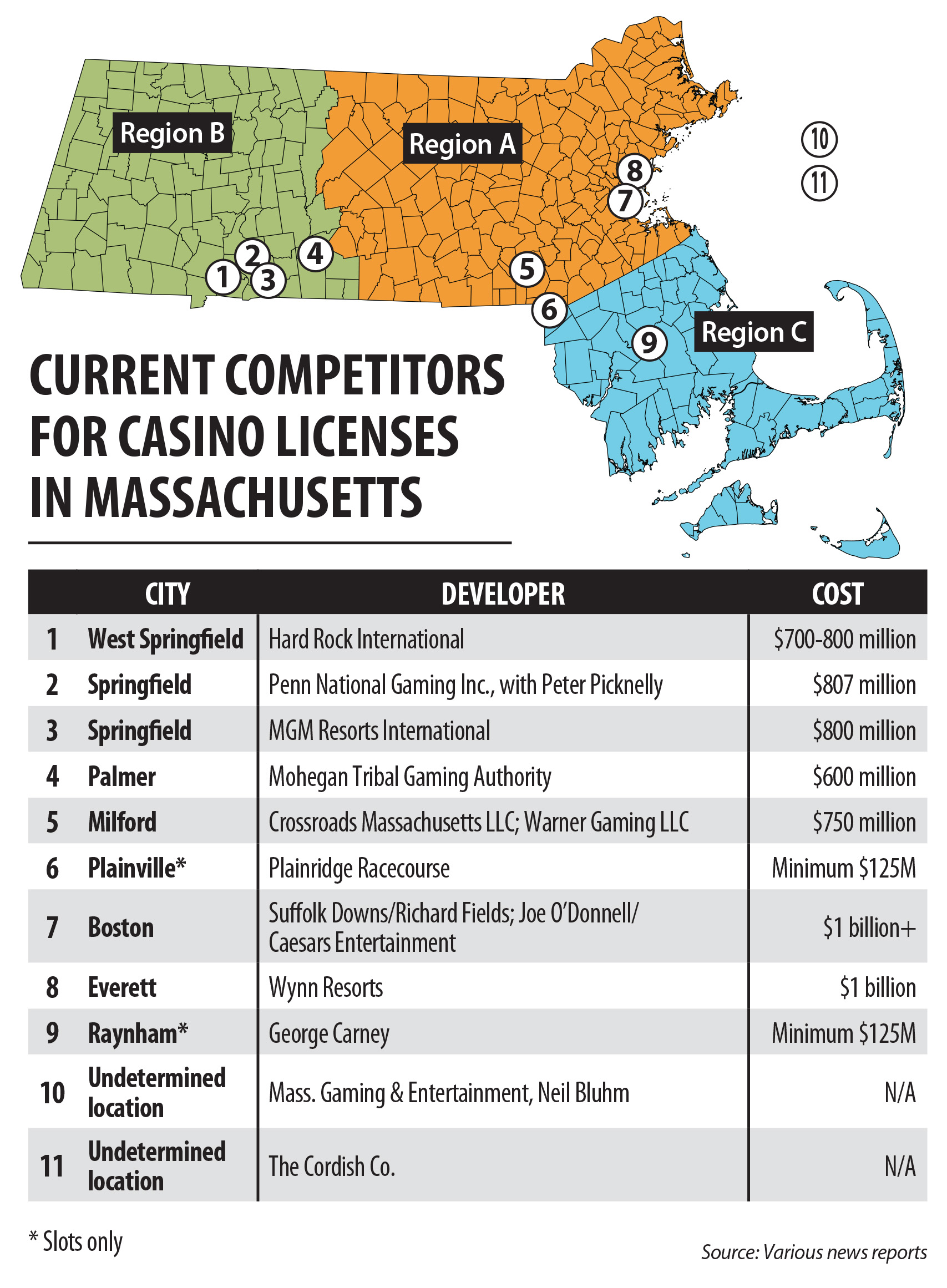
Indeed, by Jan. 15, the deadline to file extensive financial documents and pay a non-refundable $400,000 fee, there were 11 players in the mix, including four in the Western Mass. region, and two who have undetermined locations and could conceivably intensify the battle already taking shape within the 413 area code. Chicopee Mayor Michael Bissonnette has a site at the Cabotville Industrial Park, for example, that could come into play.

What people will soon realize, if they haven’t already, is that, when it comes to the fight for a casino license, competition is a very, very good thing. Look at the battle taking shape in Springfield as just one example.

Already, MGM Resorts and Penn National Gaming Inc. (in partnership with Peter Picknelly) seem to be trying to outdo each other when it comes to who can do the most for Union Station, one of the economic-development priorities identified by city officials. MGM says it will lease 44,000 square feet in the long-dormant station for a training institute that includes a hiring center, training rooms, and a regional call center — and it is taking out full-page ads in the local paper to announce these intentions. Penn National, meanwhile, says it will be catalyst for new development in the station by leasing office, retail, and garage space, and linking the station to the casino complex with a skywalk. These plans can now be seen on the sides of Peter Pan buses.

But it goes much deeper than Union Station. The dueling casino operators are announcing their presence, and their intentions, with philanthropic initiatives that indicate that 2013 should be a great year for organizations ranging from the Spirit of Springfield to Square One to the Dunbar Community Center.

And now, the competition is truly regional. In addition to the two Springfield proposals, there is the Mohegan Tribal Gaming Authority’s plans for Palmer, and Hard Rock International’s recently released plans for a casino complex at the Big E. As a result, the Springfield proposals not only have to compete against each other, but also against the other area players.

This should prove very beneficial for the Western Mass. area as a whole because it should — that’s should — result in a casino project that takes a more regional approach, and becomes much more than a contest to see who can take the most square footage in Union Station or write the most checks to area nonprofits. The casino will be located in one city or town, but it will impact a number of communities, to one extent or another, and the final plans should reflect this.

People in business all say they love competition (although most would probably admit privately that it is more of a love/hate relationship) because it makes them try harder, never allows them to rest easily, and drives them to continually raise the bar.

As the battle for the coveted Western Mass. casino license reaches its next critical stage, this region will find out why Crosby placed such heavy emphasis on competition. It’s because, when it exists, there are far more winners than those who are granted the casino licenses.

Commercial Real Estate Sections
New Property Owners Can No Longer Opt out of These Programs

Michael Fenton

Michael Fenton

Business Improvement Districts (BIDs) are special districts in which owners of real property vote to initiate, manage, and finance supplemental services in addition to those services already provided by their municipal governments.

In the past, owners of real property located within a BID were allowed to convey their property interest without saddling the new owner with an absolute obligation to pay annual BID fees. These new owners were allowed to ‘opt out’ of their respective BIDs; however, this opt-out power was recently extinguished by state law and replaced with a mandatory BID-renewal procedure. The new law significantly impacts the rights of property owners in BIDs across the state and deserves the attention of any entity or individual with a current or future interest in such property.

On Aug. 7, 2012, Gov. Deval Patrick signed into law an “Act Relative to Economic Development and Reorganization,” which substantially amended Mass. General Laws (M.G.L.) chapter 40O, dealing with BIDs. Under the new law, purchasers of real property located within a BID no longer have 30 days to opt out. Instead of the opt-out power, all participating owners of real estate located within a BID are able to take part in a renewal vote on the BID every five years.

The renewal meetings are to be called by the BID board of directors or its designated agent on or before the fifth anniversary of a newly created BID and then again on or before each fifth anniversary of the date of the most recent renewal vote. If a majority of the eligible participating property owners present at the renewal meeting, in person or by proxy, vote to renew the BID, then the BID will continue for an additional five-year term.

If, on the other hand, said eligible participating property owners vote not to continue the BID, the BID will proceed to conclude its business in accordance with M.G.L. chapter 40O. This renewal procedure is a simple proposition for BIDs created after the effective date of the new legislation on Aug. 7, 2012, but it presents serious complications for property owners in BIDs created prior to said effective date.

BIDs formed prior to Aug. 7, 2012 are also required to have renewal meetings every five years. As specifically provided in M.G.L. c. 40O, the initial renewal vote for BIDs in existence prior to Aug. 7, 2012 may be held at any time on or before Jan. 1, 2018. Accordingly, an existing BID may hold its first renewal meeting at any time on or before Jan. 1, 2018, subject to the giving of notice to the BID’s participating property owners at least 30 days prior to the meeting.

Property owners who opted out of participation in a BID prior to Aug. 7, 2012 will remain non-participating owners until the date of the first approved renewal vote, at which point such property owners automatically become participating property owners. However, since property owners who previously opted out of the BID are non-participating owners at the time of the first renewal vote, they are not entitled to notice of the initial renewal meeting, and are not permitted to participate in the initial renewal vote.


What Does This Mean?

As a result, it is likely that existing BIDs will be motivated to call for the first renewal vote far in advance of 2018 in the interest of collecting revenues from previously non-participating owners in the near future. This could prove to be frustrating for property owners who opted out of participation in the BID when they acquired their property interest.

After the initial renewal meeting of an existing BID, if the participating property owners vote to continue the BID, the BID will no longer have any non-participating property owners, and, accordingly, all property owners in the district (including owners who had previously opted out) will be entitled to notice of, and have the right to participate in, future renewal meetings.

With Western Mass. serving as home to four BIDs that were in existence prior to Aug. 7, 2012 (Springfield, Amherst, Westfield, and Northampton), the impacts of this legislation hit close to home. Property owners who previously opted out of participating in a BID can be forced into participating without notice at any point between Aug. 7, 2012 and Jan. 1, 2018. If renewal votes are passed by participating property owners, then an owner who previously opted out of the BID will have to wait up to five years before being able to vote on the renewal of the BID.


Attorney Michael Fenton is an associate with the Springfield-based firm Shatz, Schwartz and Fentin, P.C. He concentrates his practice in the areas of business law, real-estate development, and estate planning. He has served on the Springfield City Council since 2010; (413) 737-1131;

www.ssfpc.com

Bankruptcies Departments

The following bankruptcy petitions were recently filed in U.S. Bankruptcy Court. Readers should confirm all information with the court.


Allen, Robert Charles

8C Maplecrest Circle

Holyoke, MA 01040

Chapter: 7

Filing Date: 12/27/12


Allen, Sara Louise

a/k/a Borden, Sara

8C Maplecrest Circle

Holyoke, MA 01040

Chapter: 7

Filing Date: 12/27/12


Barratt, William E.

9 Swamp Road

Montague, MA 01351

Chapter: 7

Filing Date: 12/18/12


Bishop-Cook, Rachel D.

18 O’Connor Ave.

Holyoke, MA 01040

Chapter: 7

Filing Date: 12/18/12


Blanchard, Bruce Gary

39 Andersen Road

Chicopee, MA 01022

Chapter: 7

Filing Date: 12/21/12


Brooker, Mary

25 Coles Meadow Road

Northampton, MA 01060

Chapter: 7

Filing Date: 12/26/12


Cass, Richard Todd

Cass, Claudia V.

22 Alpine Trail

Pittsfield, MA 01201

Chapter: 7

Filing Date: 12/29/12


Chabot, Troy A.

85 Twin Oaks Road

Feeding Hills, MA 01030

Chapter: 7

Filing Date: 12/26/12


Chichester, Richard J.

Chichester, Lee Z.

212 Captain Whitney Road

Becket, MA 01223

Chapter: 7

Filing Date: 12/23/12


Cook, Kenneth J.

Cook, Susan J.

49 Phyllis Lane

Greenfield, MA 01301

Chapter: 7

Filing Date: 12/18/12


Drobot, Jason J.

Drobot, Melanie Jane

a/k/a Grey, Melanie J.

PO Box 451

Chicopee, MA 01021

Chapter: 7

Filing Date: 12/28/12


Fabrycki, Alexander W.

Fabrycki, Maryann

207 Munn Road

Monson, MA 01057

Chapter: 7

Filing Date: 12/29/12


Fandreyer Electric

Fandreyer, Gerhard R.

210 Royalston Road

Phillipston, MA 01331

Chapter: 13

Filing Date: 12/26/12


Godbolt, Josephine

65 Pendelton Ave.

Springfield, MA 01109

Chapter: 7

Filing Date: 12/19/12


Gonzalez, Ismael

a/k/a Ramos, Ismael Gonza

12 Montclair St.

Springfield, MA 01104

Chapter: 7

Filing Date: 12/21/12


Gooden, Alwin A.

Gooden, Veronica C.

119 South Branch Pkwy.

Springfield, MA 01118

Chapter: 7

Filing Date: 12/27/12


Gregoire, Lauretta

26 Gilman St.

Holyoke, MA 01040

Chapter: 7

Filing Date: 12/26/12


Harwood, Arthur Holden

Harwood, Melissa Robin

7 Osgood St., Apt. 3

Greenfield, MA 01301

Chapter: 7

Filing Date: 12/17/12


Hermanson, Melinda Morgan

219 Elm St.

Northampton, MA 01060

Chapter: 7

Filing Date: 12/19/12


Howard, Jeffrey S.

Howard, Michelle M.

447 Barre Road

Oakham, MA 01068

Chapter: 7

Filing Date: 12/19/12


Jones, Icie B.

a/k/a McMullen-Jones, Icie B.

211 Crane Hill Road

Wilbraham, MA 01095

Chapter: 13

Filing Date: 12/29/12


Ladouceur, Joseph F.

Ladouceur, Tina L.

43 Montgomery Ave.

Pittsfield, MA 01201

Chapter: 7

Filing Date: 12/21/12


LaRose, Richard Albert

459 Fairview Ave

Athol, MA 01331

Chapter: 7

Filing Date: 12/20/12


LaShier, Gary R.

LaShier, Sheila C.

214 Silver St.

Greenfield, MA 01301

Chapter: 7

Filing Date: 12/21/12


Latorre, Juan F.

Colon-LaTorre, Myrna

216 Ellsworth Ave.

Springfield, MA 01118

Chapter: 7

Filing Date: 12/20/12


Lungarini, Rita E.

54 Ionia St.

Springfield, MA 01109

Chapter: 7

Filing Date: 12/28/12


Narvaez, Rosa M.

12 Montclair St.

Springfield, MA 01104

Chapter: 7

Filing Date: 12/21/12


Orvis, Julie M.

a/k/a Marcinkiewicz, Julie O.

PO Box 189

Deerfield, MA 01342

Chapter: 7

Filing Date: 12/29/12


Privedenyuk, Vadim P.

116 Berkshire St.

Indian Orchard, MA 01151

Chapter: 7

Filing Date: 12/21/12


Rock, Richard Ernest

7 Howe St.

Belchertown, MA 01007

Chapter: 7

Filing Date: 12/21/12


Savage, Joseph R.

14 Monument Court

Charlestown, MA 02129

Chapter: 7

Filing Date: 12/17/12


Scibelli, Jamie J.

Scibelli, Jeanann M.

140 Prentiss St.

Orange, MA 01364

Chapter: 7

Filing Date: 12/18/12


Sheppard, Christina Anne

56 K St. #2

Turners Falls, MA 01376

Chapter: 7

Filing Date: 12/19/12


Smith, Daniel James

597 Westhampton Road

Florence, MA 01062

Chapter: 7

Filing Date: 12/28/12


Statewide Mechanical Contractors

Dickson, Daniel D.

11 Greenwich Road

East Longmeadow, MA 01028

Chapter: 7

Filing Date: 12/17/12


Szymonik, Edmund S.

Szymonik, Frances A.

41 Chestnut St., Apt 6

Holyoke, MA 01040

Chapter: 7

Filing Date: 12/18/12


Torres, Elizabeth Maria

197 Westford Ave.

Springfield, MA 01109

Chapter: 7

Filing Date: 12/28/12


Washington, Lyle D.

Washington, Kerri M.

178 County Road

Southampton, MA 01073

Chapter: 13

Filing Date: 12/28/12


Williams, David R.

51 Monson Turnpike Road

Lot #1069

Ware, MA 01082

Chapter: 7

Filing Date: 12/26/12


Wolowicz, Donna Jean

39 Norris St.

Feeding Hills, MA 01030

Chapter: 7

Filing Date: 12/19/12


Company Notebook Departments

Paragus IT Makes Inc. 5,000 Ranking

HADLEY — Inc. magazine recently named Paragus IT to its annual ranking of the 5,000 fastest-growing businesses. With a 232% growth rate between 2008 and 2011, Paragus is the second-fastest-growing outsourced IT firm in New England. Since CEO Delcie Bean founded the company at the age of 13, Paragus has grown from a one-man operation to a regional leader in business computer service, consulting, and information-technology support. And, despite a sluggish economy, Paragus IT continues to thrive and expand. The company now employs a staff of 24 and has recently added a satellite office in the backyard of its Russell Street headquarters to accommodate the growth.


United Bank Again Named Top SBA Lender to Women

WEST SPRINGFIELD — Richard Collins, president and CEO of United Bank, announced that the bank was named the state’s “#1 Lender to Women” by the U.S. Small Business Administration (SBA). This is the second consecutive year United has earned this honor. Of all participating SBA lenders, United once again approved the highest percentage of total loans to women in fiscal year 2012. “We are always eager to help women in business achieve their goals,” said Collins. “Their success is always significant to the growth of the economy, and their contributions are more vital than ever in today’s economic environment.” Barbara-Jean DeLoria, senior vice president of commercial and retail lending, said there is a reason for the bank’s success. “We have a team in place that is personally committed to making United Bank the number-one choice for local residents and businesses. We promise, and we deliver, the most responsive and attentive service, competitive rates, and fast answers.” United Bank has 16 branch offices and two express drive-up branches in the Springfield region of Western Mass.; six branches in the Worcester region of Central Mass., with a seventh branch to open in Northborough this month; and 15 branches in Connecticut’s Hartford, Tolland, New Haven, and Litchfield counties. The bank also operates loan-production offices in Beverly, Mass. and Glastonbury, Conn.


DiGrigoli School of Cosmetology Honored

LINCOLNSHIRE, Ill. — Modern Salon Media has named the 2012 class of Excellence in Education honorees in its annual program recognizing leadership and best practices among cosmetology schools. DiGrigoli School of Cosmetology in West Springfield was chosen to represent excellence in the category of ‘school culture.’ This category recognizes unique programs offered to enhance the cosmetology-school experience and to foster the personal development and growth of students. Modern Salon Publisher Steve Reiss announced the honorees during the 2012 AACS (American Assoc. of Cosmetology Schools) annual convention in Orlando last fall. Hundreds of entries were submitted from cosmetology schools across North America, in eight categories ranging from marketing to placement to school culture. Honorees were determined based on school size and number of locations, with one overall honoree chosen from a list of finalists within each category. “We are absolutely dedicated to providing our students with education at the highest level,” said Paul DiGrigoli, president and CEO of DiGrigoli School of Cosmetology. “Beyond the standard cosmetology curriculum, we offer ‘Life Skills’ personal-development classes and feature guest educators at the top of their respective fields within the beauty industry. We also offer business classes, such as ‘How to Own and Operate Your Own Salon,’ and much more. I am so proud of my dedicated team of instructors and administrators, who devote their very best to our students.”


AirFlyte Inc. Acquired by Rectrix Commercial Aviation Services

BEDFORD — Rectrix Commercial Aviation Services recently announced the acquisition of AirFlyte Inc. of Westfield, a full-service executive-terminal fixed-base operator with state-of-the-art maintenance and hangar facilities. “We’re pleased to welcome AirFlyte’s employees into the Rectrix family,” said Thomas Russell, executive chairman of Rectrix Commercial Aviation Services (RECAS). “The substantial reputation enjoyed by AirFlyte is consistent with our company’s mission of offering high-quality services to all aviation segments in which we operate. Further, this acquisition represents a strategic link in the East Coast expansion of RECAS.” Terms of the acquisition were for an undisclosed sum of cash. AirFlyte founder Gary Potts will remain as president of AirFlyte. The company maintains a respected FAA Part 145 certified repair station. AirFlyte’s capabilities include maintenance of most corporate jet aircraft within its 43,000-square-foot facility at Westfield’s Barnes Regional Airport. AirFlyte can fulfill other needs, such as professional photo shoots and interior restorations. AirFlyte’s premier FBO provides business suites, concierge services, crew lounge, quiet rooms, refueling services, aircraft de-icing, and the availability of a conference center. “AirFlyte has been providing premier service to the executive traveler since 1988. By becoming a part of the Rectrix family of companies, we have the opportunity to grow further and do even more for our loyal clients,” said Potts. “We are extremely excited about our future with Rectrix.”

Briefcase Departments

Mohegan Sun Taps Partner for Casino Project

PALMER — Mohegan Sun has announced a strategic partnership with Brigade Capital Management on its project to build a destination resort casino in Palmer. The agreement with Brigade — a $12 billion New York-based investment advisor — coincides with Mohegan Sun’s formal application for a casino license to the Mass. Gaming Commission.
“This is an important day for Mohegan Sun, for Western Mass., and the entire Commonwealth. Today, we take the next critical step in fulfilling our commitment to bringing new jobs and economic growth to the region,” said Bruce “Two Dogs” Bozsum, chairman of the Mohegan Tribal Council. “It’s our intent to be the first casino to open its doors in Massachusetts.”
Added Mohegan Tribal Gaming Authority CEO Mitchell Etess, “Brigade Capital Management will be a great partner and important asset to this project. They are experienced as institutional investment partners on gaming projects in several states across the U.S., and understand the business that Mohegan Sun has been successful in for 16 years.” Through this agreement, Brigade will invest capital into the corporate entity that is being established to develop Mohegan Sun’s project in Western Mass. “Mohegan Sun is one of the most recognized casino gaming brands in the U.S., and they embody the proven model of success for gaming in New England,” said Don Morgan, managing member of Brigade. “This project will be built at the best location for a casino in Massachusetts, by a team with combined experience in multiple licensing jurisdictions, and managed by one of the premier gaming operators in the U.S. We are excited to be a partner in this endeavor and to have a role in establishing the Massachusetts casino gaming industry.”
Mohegan Sun is planning a world-class destination casino resort in Palmer that promises to create thousands of jobs and bring economic growth to Western Mass. Mohegan Sun established a storefront office in Palmer more than three years ago, and has conducted outreach to thousands of area residents through its Community Conversations series, appearances at other community meetings, a Mohegan Sun in Palmer newsletter and social-media outreach. Mohegan Sun is also far along in discussions with Palmer officials on a host community agreement, which is required under the Massachusetts casino-gaming legislation.
“Our project has distinct and unique advantages with regard to location, access, and infrastructure. Its rural setting on 150 acres — adjacent to other large parcels that present ancillary development possibilities — is ideal for creating the type of gaming facility that New England patrons are familiar with and have made successful over the past two decades,” Etess said. “Moreover, our host community of Palmer has been welcoming, motivated, and supportive. The community is excited about the jobs and economic development that Mohegan Sun will bring to the entire region.”


MGHPCC Awards $500,000

in Grants for Research

HOLYOKE — The Massachusetts Green High Performance Computing Center (MGHPCC) has announced $500,000 in seed grants to six multi-university teams to support cross-institutional research among MGHPCC members.
The MGHPCC, which opened in November, is intended to promote research collaboration among the participating universities — Boston University, Harvard University, the Massachusetts Institute of Technology, Northeastern University, and UMass — through high-performance computing, a pillar of major scientific research today. The seed grant program is intended to accelerate the MGHPCC’s mission of computational collaboration. This is the second round of seed grants awarded by the MGHPCC Consortium, and it brings the total amount of awards to $1.1 million. The six winners were chosen from a field of 26 applications by a committee of researchers from the participating universities. The funded projects are: “The CaterPillar Project: Exploring the Dark Matter Substructure of Milky Way Galaxies”; “Designing Cloud and Big Data Platforms for Scientific and HPC Applications”; “Strength and Fracture Mechanisms of Hierarchical Biological Materials”; “Computational Identification of Outcome-Associated DNA Alterations in Neuroblastoma”; “Genome-Scale Characterization of Chromosonal Aberrations Using Parallelizable Compression Algorithms”; and “Automated Segmentation of Vessel Network Structures in Large Image Stack Sets.” The grant amounts ranged from $52,000 to $131,000. The request for proposals sought “novel collaborative researchactivities addressing significant and challenging problems at the forefront of high-performance technical computing.” Proposals also had to include a strategy for followup research that would attract external funding.
“This year’s awards span basic astrophysics research, computer-systems innovation, and real-time clinical application, and highlight the richness of the region as a world leading center of gravity for academic discovery,” said Chris Hill, an MIT researcher who served on the committee.


MassDOT Releases

Transportation Plan

BOSTON — The Board of the Mass. Department of Transportation (MassDOT) and Transportation Secretary and CEO Richard Davey have announced a plan for the next generation of transportation investment in the Commonwealth. The plan includes passenger-rail service connect Boston and Springfield, commonly known as the “Inland Route,” and the rehabilitation of infrastructure to support rail service between Pittsfield and New York City. A $362.4 million investment to fund the Inland Route will cover rehabilitation along the route, creating a second track, widening bridges, upgrading signals purchasing train equipment, and constructing or rehabilitating stations. This will also support future high-speed rail connection to New York City via Springfield. Another $113.8 million in funding for rail service between the Berkshires and New York City will include rehabilitation of track, signals, and structures between Pittsfield and the Massachusetts-Connecticut state line to support future rail service between Pittsfield and New York City. The current line is served by freight carriers and is not up to standards necessary for commuter service. The plan also includes a $32.2 million increase to the Pioneer Valley Transit Authority in fiscal year 2014, a $3.2 million increase to the Berkshire Regional Transit Authority (BRTA), and a $1 million increase to the Franklin Regional Transit Authority (FRTA). The PVTA is receiving the largest increase of all regional transit authorities in the state. Additional Western Mass. investments in the plan, including funding for the 1-91 Viaduct in Springfield, reconstruction of Route 2 in Erving Center, and investments in the Mohawk bike and pedestrian trail in North Adams and the Skyline Trail in Hinsdale, promise to further ensure regional transportation equity, create jobs, and expand economic opportunity.  “We have parts of this Commonwealth whose opportunities are constrained by substandard service and lack of access. Our plan outlines increased investments in passenger rail in Western Mass. and regional transit authorities to unlock opportunities across the board,” said Gov. Deval Patrick. “Improving our transportation system is key to meeting our economic potential, for Western Mass. and every region of the Commonwealth.”


Hospitals Request Response to Community Health Survey

PIONEER VALLEY — The Coalition of Western Massachusetts Hospitals is conducting a community-health-needs assessment to identify and address the most pressing public health needs in the Pioneer Valley. Community members are encouraged to participate in this process by taking the Community Health Survey. The link to the survey can be found on the participating hospitals’ websites and at www.surveymonkey.com/s/masschna.
The coalition is a partnership between eight area tax-exempt hospitals: Baystate Medical Center, Baystate Franklin Medical Center, Baystate Mary Lane Hospital, Cooley Dickinson Hospital, Holyoke Medical Center, Mercy Medical Center, Shriners Hospitals for Children – Springfield, and Wing Memorial Hospital and Medical Centers. The survey is currently available online in English and Spanish and will soon be available in Russian and Vietnamese (paper copy only).
The coalition began meeting to plan the process for this community-health-needs assessment in August, and is scheduled to have reports finalized by this spring. Its goal is to identify the health and safety assets of area communities and also to determine the potential concerns they face. They will do so by asking residents for their opinions about these issues, services presently available, their satisfaction with these services, and identification of others programs that may be needed. The survey should take no more than 15 minutes to complete and will be available through Feb. 15. Survey respondents will be identifiable only by ZIP code, and all individual responses will be kept confidential.
All survey respondents will have the option to enter a drawing for an iPad Mini and several gift cards. Personal contact information entered for drawing registration will be kept confidential and used solely for the purpose of this drawing and not for any marketing purposes.


Chamber Seeks Input for

2013 Woman of the Year

SPRINGFIELD — The Professional Women’s Chamber, a division of the Affiliated Chambers of Commerce of Greater Springfield, is seeking nominations for the 2013 Woman of the Year Award. This award has been presented annually since 1954 to a woman in the Western Mass. area who exemplifies outstanding leadership, professional accomplishment, and service to the community. The nominee’s achievements can be representative of a lifetime’s work or for more recent successes. Any woman in the Pioneer Valley is eligible for nomination, and a chamber affiliation is not required. A Woman of the Year nomination form may be obtained online at www.professionalwomenschamber.com or by emailing Nancy Mirkin, committee chair, at [email protected]. Nomination documents are due by Feb. 15.


Consortium Plans Program

to Train Casino Workers

SPRINGFIELD — In an effort to prepare local residents for future casino jobs, a consortium of community colleges from across the state, led by Springfield Technical Community College and Holyoke Community College (HCC), recently signed worker-training agreements with four prospective casino developers. The group, called the Community College Casino Careers Training Institute, gives casino developers a single point of contact to help develop their workforce. William Messner, president of HCC, said the consortium hopes to have a training program up and running sometime in 2015, about one year before any of the proposed casinos would open.


MassINC Program Aims to

Stimulate Gateway Cities

The Gateway Cities Innovation Institute, an entity run by MassINC, is proposing a $1.7 billion public investment in Massachusetts’ Gateway Cities, which include Springfield, Holyoke, Pittsfield, and Westfield. The Gateway Cities Innovation Institute focuses on the 24 cities designated by the Massachusetts Legislature as Gateway Cities — midsize urban cities, typically former manufacturing centers — that anchor their regional economies but have had trouble attracting new growth and investment. MassINC predicts that its $1.7 million investment would stimulate at least seven projects totaling $3.4 billion of new development or reuse, which could in turn leverage nearly $7 billion in investments and create about 80,000 jobs. The money would be split between public funding and loan guarantees, tax incentives, regulatory reform, and technical assistance.

Departments People on the Move

Jeffrey McCormick

Jeffrey McCormick

Jeffrey McCormick, a Partner at Robinson Donovan, P.C. in Springfield, who concentrates his practice in the area of civil litigation, has been named the 2013 President of the Massachusetts Chapter of the American Board of Trial Advocates (ABOTA). Formed in 1958, ABOTA is dedicated to the preservation of the Seventh-Amendment right to civil trial by jury, to the promotion of the legal profession and civility among the trial bar, and to the support of an independent judiciary and the rule of law. Applicants must have tried at least 20 civil cases to verdict and must practice with the highest ethical and professional standards of conduct. Massachusetts was the first colony in America to guarantee a right to a civil jury trial with the adoption of the Bodie of Liberties in 1641. McCormick, a past president of the Mass. Bar Assoc., is a fellow in the American College of Trial Lawyers. He has taken more than 100 trials to conclusion and has settled, mediated, and arbitrated hundreds of other cases. Among other appointments and honors, he has served on the Mass. Judicial Nominating Commission, the Mass. Board of Bar Overseers, and the Supreme Judicial Court Committee on the Rules of Professional Conduct. He has consistently been listed in The Best Lawyers in America, and in the past has been named a Best Lawyer of the Year in the area of personal-injury litigation in Springfield. He has also been named a Massachusetts and New England Super Lawyer and has received the Super Lawyer designation of one of the top 100 lawyers in Massachusetts. He has been inducted as a fellow in the Litigation Counsel of America.

•••••

Bacon Wilson, P.C., with law offices in Springfield and Northampton, recently announced that Mark Tanner, Esq. has been named a Partner. Tanner, a trial lawyer, works predominantly out of the Northampton office and represents clients in court cases involving business disputes, serious personal injury, land use and zoning, will and estate disputes, and criminal defense. He is currently the president of the Northampton Soccer Club and serves on the Board of Directors of the People’s Institute Inc., the Franklin County Community Development Corp., and the Hampshire County Bar Assoc. A former president of the Hampshire County Bar Assoc. and recipient of the SuperLawyers Rising Stars award for five years, Tanner is also an author of numerous local articles and a member of BusinessWest’s 40 Under Forty class of 2007. Tanner earned his J.D. with honors from the University of Wyoming, his M.B.A. from University of Colorado, his B.S. cum laude from UMass, and his A.A. from New Mexico Military Institute, where he was commissioned as an officer in the Army Reserves.

•••••

Susan Kelly

Susan Kelly

Susan Kelly, CPC, was recently honored as the 2012 Corporate Consultant of the Year by Management Search Inc. (MSI), one of the largest privately held executive-search firms in New England. As Managing Partner, Kelly specializes in placing professional positions within manufacturing and service companies in the Northeast and has been instrumental in the company’s growth. She joined MSI in March of 1987, swiftly developing her client base in the manufacturing and service industry throughout Massachusetts and Connecticut.

•••••

David Cameron has joined the Northampton office of engineering and design firm Stantec. An environmental scientist with more than 20 years of experience, Cameron has particular expertise in evaluating and permitting the natural-resources impacts of land development related to electric generation and transmission projects. Cameron will serve as a Senior Project Manager on environmental permitting projects across New England and help support Stantec’s power projects across the country. Stantec employs more than 120 employees across Massachusetts.

•••••

Jessica Ridley

Jessica Ridley

TransFluenci Interpreting and Translations Services recently promoted Jessica Ridley to Partner. Ridley was formerly the Operations Manager and has been instrumental in the company’s growth and expansion over the past six years. She previously worked at Meadowbrook as Director of Admissions and Director of Marketing. Ridley will continue to add new customers, provide more languages, and oversee the selection of high-quality interpreters and translators who provide service to state agencies, hospitals, community clinics, school districts, and legal services.

•••••

The UMass Donahue Institute (UMDI), the public service, outreach, and economic-development unit of the UMass President’s Office, recently named Daniel Hodge as the new Director of Economic and Public Policy Research. An applied economist and lifelong resident of Massachusetts, Hodge brings to his position more than 18 years of experience assessing local, regional, state, and multi-state economies in terms of economic impacts, competitiveness, target industries, strategic plans, and infrastructure investments. Most recently, he was the principal and owner of Hodge Economic Consulting, and he has held prior positions at HDR Decision Economics, Cambridge Systematics, and Regional Economic Models Inc. His unique background combines rigorous, data-driven, quantitative economic analysis with significant experience developing strategic plans and policy initiatives, and his work has impacted major projects in Massachusetts, New England, and nationally. He was the project manager for the widely praised Innovation-based Economic Development Strategy for Holyoke and the Pioneer Valley, as well as a study for the Boston Redevelopment Authority on the Economic and Sustainability Benefits of Boston’s ARRA Investments. Most recently, he served as the on-call economist for the Appalachian Regional Commission and the Florida Department of Transportation. Hodge earned his master’s degree in Applied Economics and master’s in Public Policy from the University of Michigan, and holds a B.A. in Economics and Business from Lafayette College.

Agenda Departments

HP Vendor Showcase

Feb. 5: Entre Computer and vendor partner Hewlett Packard (HP) will exhibit the latest technologies and products for 2013 from 4 to 9 p.m. at the Naismith Memorial Basketball Hall of Fame in Springfield. The event, hosted by Hewlett Packard and strategic partners, will introduce new information from Entre, Intel, and Microsoft, who will all be present to discuss the latest innovations from their companies, including the new HP Business Tablet featuring Windows 8 and Intel technology, HP point-of-sale products, and digital signage. The event will highlight HP’s innovation in personal computers and printing. Some of the educational topics covered will include mobile computing, Microsoft Windows 8, and a host of leading-edge solutions, followed by dinner and a partner technology exposition. Entre Computer invites all qualifying customers, businesses, healthcare providers, manufacturers, banks, and retailers to the exhibit, and all are welcome to a complimentary, self-guided tour of the Hall of Fame at the conclusion of the program. Attendance and seating are limited, and pre-registration is required by visiting hpbroadband.com. For additional information, contact Entre Computer at (413) 736-2112 or e-mail [email protected].


Essence Editor to Speak

Feb. 5: Susan Taylor of Essence magazine will speak at Springfield Technical Community College at 11 a.m. in the Scibelli Hall gym as part of the STCC Diversity Council Event Series. The presentation, which coincides with Black History Month, is free and open to the public. Taylor’s name is synonymous with Essence magazine, the brand she built as the magazine’s fashion and beauty editor, editor in chief, and editorial director. For nearly three decades, Taylor has been the driving force behind one of the most celebrated black-owned businesses of our time and a legend in the magazine-publishing world. For 27 years, Taylor authored one of the magazine’s most popular columns, “In the Spirit.” She is the only African-American woman to be recognized by the Magazine Publishers of America with the Henry Johnson Fisher Award, the industry’s highest honor, and the first to be inducted into the American Society of Magazine Editors Hall of Fame. Taylor also is the recipient of the NAACP President’s Award for visionary leadership and has honorary degrees from more than a dozen colleges and universities.
A fourth-generation entrepreneur and the author of four books, she supports a host of organizations dedicated to moving the black community forward, but her passion and focus today is with the National Cares Mentoring Movement, a call to action which she founded in 2006 as Essence Cares. The National Cares Mentoring Movement (www.caresmentoring.org) is a massive campaign to recruit 1 million able adults to help secure children who are in peril and losing ground. Taylor’s presentation is sponsored by PeoplesBank, Hampden Bank, the STCC Diversity Council, the Springfield Department of Health and Human Services, Baystate Health, Health New England, MassMutual, and the United Way of Pioneer Valley.


Business-law Basics

Feb. 5, March 12, April 16: Get the business-law basics that every small-business owner and entrepreneur needs to know from the legal experts at the Center for Innovation & Entrepreneurship at Western New England University. This series of free information sessions is focused on key topics to help plan and grow a small business. All sessions will be held from 5 to 7 p.m. at Western New England University School of Law, in the Blake Law Center. All events are free and open to the public. Light refreshments will be provided. The topics and presenters are: Feb. 5, “Legal Issues in Finance,” with attorneys Scott Foster of Bulkley Richardson and Michael Sweet of Doherty, Wallace, Pillsbury and Murphy; March 12, “Intellectual Property Law Basics,” with attorneys Peter Irvine of Peter Irvine Law Offices, Leah Kunkel of the Law Offices of Leah Kunkel, and Michelle Bugbee of Solutia Inc.; April 16: “Bankruptcy,” with attorneys George Roumeliotis of Roumeliotis  Law Group, Justin Dion of Bacon Wilson, and Kara Rescia of Eaton & Rescia. To learn more about upcoming events hosted by the Center for Innovation & Entrepreneurship, visit www.wne.edu/cie.


40 Under Forty Reunion

Feb. 7: BusinessWest will stage a reunion featuring the first six classes of its 40 Under Forty program at the Log Cabin Banquet & Meeting House in Holyoke. The event, open only to 40 Under Forty winners, event judges, and sponsors, will begin at 5:30 p.m. and feature a talk from Peter Straley, president of Health New England, about leadership and community involvement. For more information on the event, call (413) 781-8600 or e-mail [email protected].


Dress Down for Animals

Feb. 15: Employers, are you looking for a fun way to engage your staff while helping local shelter animals? By participating in Dress Down for Animals Day, your business can help provide life-saving care to dogs, cats, and other small animals at the Thomas J. O’Connor Animal Control and Adoption Center in Springfield. Through this program, employees will make a minimum donation of $5, $10, or whatever level the employer sets for the privilege of wearing whatever they wish to work on Feb. 15, with proceeds donated to the shelter. Prizes will be awarded based on donation total and number of employees participating. Businesses can compete for a $590 advertising package from Reminder Publications, a chair yoga session for up to 50 employees, a catered dessert party, a chance to introduce a business to 7,000 people on the Thomas J. O’Connor Facebook page, and more. To request a form to fill out and return with donations, call (413) 533-4817 or e-mail [email protected]. For more information about the adoption center, visit www.tjofoundation.org.


Difference Makers 2013

March 21: The annual Difference Makers award program, staged by BusinessWest, will be held at the Log Cabin Banquet & Meeting House starting at 5 p.m. Details on the event will be published in upcoming issues of the magazine. Difference Makers is a program, launched in 2009, that recognizes groups and individuals that are, as the name suggests, making a difference in this region. Several dozen nominations for the award were received this year, and the winners have been chosen. They will be announced in the magazine’s Feb. 11 issue. For more information, call (413) 781-8600.

Chamber Corners Departments

ACCGS

www.myonlinechamber.com

(413) 787-1555


• Feb. 6: Business@Breakfast, 7:30-9 a.m., at the Springfield Marriott. The monthly Business@Breakfast series pays tribute to individuals, businesses, and organizations for major contributions to civic and economic growth and for actions that reflect honor on the region. The Business@Breakfast gives your company exposure to business owners, upper management, and salespeople. For reservations, contact Cecile Larose at (413) 755-1313.

• Feb. 13: Murder Mystery! After Hours, 5-7 p.m. at City Place Inn and Suites, 711 Dwight St., Springfield. For reservations, contact Cecile Larose at (413) 755-1313.


AMHERST AREA

CHAMBER OF COMMERCE

www.amherstarea.com

(413) 253-0700


• Feb. 13: Amherst Area Chamber Breakfast, 7:15-9:05 a.m., at the Hampshire College Red Barn. Features a Hampshire County Regional Tourist Council update. Cost is $17 for members, $20 for non-members. RSVP to [email protected] or register online at www.amherstarea.com.

• Feb. 27: Chamber After 5, 5-7 p.m. at the Hampshire Athletic Club, 90 Gatehouse Road, Amherst. Admission is $10 for members, $15 for non-members. For more information, visit www.amherstarea.com.


CHICOPEE CHAMBER OF COMMERCE

www.chicopeechamber.org

(413) 594-2101


• Feb. 20: February Annual Meeting/Salute Breakfast, 7:15-9 a.m., at the Castle of Knights. Tickets are $20 for members, $26 for non-members.

• Feb. 27: February Business After Hours, 5-7 p.m., at NUVO Bank & Trust Co. Admission is $5 for members, $15 for non-members.


GREATER HOLYOKE

CHAMBER OF COMMERCE

www.holycham.com

(413) 534-3376


• Jan. 28: Basics of Marketing Seminar, 8:30-10 a.m., chamber office. Learn some free and low-cost ideas on marketing your business. Cost is $10 for members and $20 for non-members. A continental breakfast is included in the price. Call the chamber at (413) 534-3376 to register or visit holyokechamber.com to sign up.


GREATER NORTHAMPTON CHAMBER OF COMMERCE

www.explorenorthampton.com

(413) 584-1900


• Feb. 6: Arrive @5, 5-7 p.m., at Easthampton Savings Bank, 241 Northampton St., Easthampton. Arrive when you can, stay as long as you can; a casual mix and mingle with colleagues and friends. Admission is $10 for members, $15 for non-members.


WEST OF THE RIVER

CHAMBER OF COMMERCE

www.ourwrc.com

(413) 426-3880


• Feb. 6: Wicked Wednesday, 5-7 p.m., at Chez Josef, 176 Shoemaker Lane, Agawam. Free for chamber members, $10 for non-members. Wicked Wednesdays are monthly social events, hosted by various businesses and restaurants, that bring members and non-members together to network in a laid-back atmosphere. For more information, contact the chamber office at (413) 426-3880, or e-mail [email protected].

• Feb.  28: Legislative Breakfast, 7-9 a.m., at Springfield Country Club, 1375 Elm St., West Springfield. Panel of elected officials will include state Reps. Nicholas Boldyga and Michael Finn, Agawam Mayor Richard Cohen, West Springfield Mayor Greg Neffinger, and state Sen. Michael Knapik. Tickets are $25 for members, $30 for non-members. For more information, contact the chamber office at (413) 426-3880, or e-mail [email protected].


GREATER WESTFIELD

CHAMBER OF COMMERCE

www.westfieldbiz.org

(413) 568-1618


• Feb. 4: Mayor’s Coffee Hour, 8-9 a.m., at Miss Sweets, 4 Russell Road, Westfield. The mayor will share information about what’s happening in the city. For more information or to register, contact Pam Bussell at the chamber office at (413) 568-1618.

• Feb. 13: February WestNet, 5-7 p.m., at Shaker Farms Country Club, 866 Shaker Road, Westfield. Meet chamber members and bring your business cards. Sponsored by Ashton Services. Admission is $10 for chamber members, $15 for non-members. Payment can be made in advance or at the door with cash or check. Walk-ins are welcomed. Call the chamber at (413) 568-1618 or e-mail Pam Bussell at [email protected]. Your first WestNet is always free.


YOUNG PROFESSIONAL SOCIETY OF GREATER SPRINGFIELD

www.springfieldyps.com


• Feb. 21: February Third Thursday Networking Event, 5-7 p.m., at Samuel’s Tavern, 1000 West Columbus Ave, Springfield. The event is free for members, $10 for non-members. For more information, visit www.springfieldyps.com/events.

Court Dockets Departments

The following is a compilation of recent lawsuits involving area businesses and organizations. These are strictly allegations that have yet to be proven in a court of law. Readers are advised to contact the parties listed, or the court, for more information concerning the individual claims.


FRANKLIN SUPERIOR COURT

Donna M. Billings v. Rick Greenfield, UC c/o Arin Realty Inc. and Walgreen Eastern Co. Inc.

Allegation: Negligence in property maintenance causing injury: $21,323.89

Filed: 11/26/12


Faye Ainsworth and Charles Chandler v. Vermont Mutual Insurance Co. Inc., Servpro Industries Inc., et al

Allegation: Unfair insurance-claims practices, unfair business practices, theft of property, and damages to home: $1,440,000

Filed: 12/5/12


GREENFIELD DISTRICT COURT

Matthew Boron v. Burt’s Bees Inc., the Clorox Co., and Target Stores Inc.

Allegation: Plaintiff purchased Burt’s Bees Almond Milk Beeswax Hand Crème and sustained injury after using the product, which contained glass shards: $8,443.02

Filed: 11/20/12


HAMPDEN SUPERIOR COURT

Acme Site Work Inc. v. Geeleher Enterprises Inc.

Allegation: Non-payment for services, labor, and materials provided: $112,239

Filed: 12/14/12


Christine Greco v. Microtest Laboratories Inc.

Allegation: Plaintiff seeking damages for back pay: $27,592.80

Filed: 12/12/12


Philadelphia Indemnity Insurance Co., as subrogee of Springfield Library and Museums Assoc. Inc. v. Western Mass Electric Co.

Allegation: Defendant negligently failed to maintain, inspect, and update the distribution lines to the Elijah Blake House, resulting in a fire: $353,534.19

Filed: 12/17/12


SPRINGFIELD DISTRICT COURT

Donna Jacobs v. the Stop & Shop Supermarket Co., LLC, and the TJX Companies Inc., d/b/a AJ Wright Stores

Allegation: Negligent maintenance of property causing injury: $7,105.94

Filed: 12/21/12


WESTFIELD DISTRICT COURT

Midland Funding, LLC, as assignee of GE Money Bank/Toro Consumer v. Mario Landscaping

Allegation: Unpaid balance for monies loaned: $13,527.19

Filed: 12/17/12

Departments Picture This

Send photos with a caption and contact information to:  ‘Picture This’ c/o BusinessWest Magazine, 1441 Main Street, Springfield, MA 01103 or to [email protected]


Showing Off

PicThis 0113baPicThis 0113bbPicThis 0113bcThe Professional Women’s Chamber of Western Massachusetts held their annual Table top Business Expo in the MassMutual Room at Max’s Tavern.  The room was filled with area businesses exhibiting their products and services.  From top, Caleigh Creighton and Kathleen Plante of Care@Home, Dawn Creighton of Associated Industries of Mass., and David Paquette from Community Enterprise; from left, Jeanne Filomeno, Rachel Ames, Lisa Piwcio, and Bonnie Nieroda of Marcotte Ford; from left, Patricia Faginski, Laurie Long, and Amy Santarelli of St. Germain Investments.


Photos by Denise Smith Photography

Features
Hard Rock Submits a Casino Proposal of Note

Hard Rock International’s plans for a resort casino on the grounds of the Eastern States Exposition

Hard Rock International’s plans for a resort casino on the grounds of the Eastern States Exposition

Eugene Cassidy had been on the job as president and CEO of the Eastern States Exposition (ESE) for less than a week when officials at the Bronson Companies initiated discussions that eventually led to serious talk about the possibility of locating a casino on the Big E grounds.

And it was very soon thereafter that he started canvassing members of his board for their thoughts on that subject. What he found was that, as with the general public in most respects, there was little, if any, middle ground on the matter; some were quite supportive, while others, he said, used direct and sometimes profane language to make it clear that they were not.

“One of them said to me, ‘are you out of your … mind — you’ve only been CEO for a matter of days; do you want to get yourself … fired?” he recalled, deleting the expletives, but adding pauses for effect.

But he said he was able to change such attitudes with what he considers some powerful arguments, presented at subsequent, and very intense, board meetings. The first is that a casino paying a sizable lease to the Big E for the property that would be needed for parking and the assorted facilities would ensure the survival of the century-old institution for the foreseeable future.

The second is that he considers the Big E to be the best steward to operate a casino in the western region of the state.

“The Legislature has said that gaming is now legal in Massachusetts, so now it’s a question of who’s going to be the most responsible party to be involved with this,” he told BusinessWest. “And I could make an argument all day long that this organization is precisely the most responsible host; there’s no one more well-equipped than the Eastern States Exposition, and the town of West Springfield, to handle this.”

It is these arguments, and especially the latter, that Cassidy, who took the reins at the Big E in June, hopes will bring town and area residents, not to mention the Mass. Gaming Commission, around to the idea of embracing Hard Rock Entertainment’s plans to build a $700 million to $800 million resort casino on land at the Big E currently used for parking.

He knows there are questions, and many of them, about parking, traffic, how to juxtapose an immensely for-profit venture with the exposition’s nonprofit status, and many other concerns, and he expects that they will all be effectively answered in the weeks and months to come. For now, though, he’s ecstatic to simply be in a position to have to answer such questions and, as he put it, “have a seat at the table” in the great casino contest.

So is Jim Allen, Hard Rock’s chairman.

For more than a year now, the company has been actively engaged in nailing down a site for a Western Mass. casino, after concluding, as others have, that this area presents the best odds for gaining a foothold in the Bay State. Hard Rock looked at perhaps seven or eight sites in Western Mass., including one in Holyoke and several in downtown Springfield, he said.

It was only after the Bronson Companies, serving as a consultant to several casino entities, engaged Cassidy in those aforementioned discussions that Hard Rock eventually narrowed its search to a 38-acre tract in the southeast corner of the Big E property.

Allen acknowledged that the site has its obvious challenges, especially traffic, but he said all the Western Mass. proposals have challenges, and, in some respects, the Big E site presents fewer than the downtown Springfield locations, while also offering more flexibility with its size.

Ultimately, he believes the plan that emerges, coupled with Hard Rock’s brand and strong track record in both gaming and entertainment — the company has facilities in 58 countries — will enable the project to win over both voters in West Springfield and members of the Gaming Commission.

For this, the latest in a series of stories about the contest for the Western Mass. casino license, BusinessWest talked with Cassidy and Allen about what has become the fourth entry in the pitched battle for the Western Mass. casino license, and why they believe they can, and will, triumph in that contest.


Working in Concert

Eugene Cassidy

Eugene Cassidy says a casino on the Big E grounds would ensure the long-term survival of the nearly century-old fair.

Cassidy said he knows the ‘casino-at-the-state-fair’ model works — because he’s seen it up close.

He told BusinessWest that he pays an annual visit to the Delaware State Fair, which became the site for a casino in the late ’90s, and has made fairly regular trips to the Erie County (New York) State Fair, which added one several years ago. He’s also been to the famous Calgary Stampede, which has long had a gaming facility on its grounds.

In each instance, he said, the revenue gained from leasing land to the casino has become a game changer for the facility in question.

“What the casino does in all those cases is provide the kind of economic support that only an operation of that size and scope can provide,” he explained. “The economic wherewithal of a casino is such that they can afford to really play an active role in the infrastructure of the facility.

“I’ve seen Delaware improve dramatically in just the few short years they’ve had it,” he continued. “And in New York, they’ve done dramatic things to the fairgrounds.”

The Hard Rock proposal has the same potential for the Big E, said Cassidy, noting that the revenue gained from leasing land to the casino operator could be put toward renovating many of the older facilities at the ESE, including the 97-year-old Coliseum.

“We’re trying to struggle along and preserve a 100-year-old facility that has 44 buildings, 31 of which were built before World War II,” he explained. “It’s an incredibly capital-intensive plant; I have an engineering study in my drawer completed in 2008 that shows that to rehabilitate the Coliseum — the gem of the fairgrounds, the jewel in the crown of West Springfield, the place where the American Hockey League was founded — would cost more than $52 million.

“We just had the biggest fair in our history, and we’re going to probably earn, after depreciation, $1.3 million, $2.8 million before depreciation,” he continued. “There’s no possible way that you can capitalize a $52 million rehabilitation, which today is probably $62 million, on $2.8 million before depreciation.”

But generating revenue for capital improvements is merely one of the benefits to be derived from having a casino on the grounds, he went on, putting simple survival at the top of that list.

Indeed, he listed a number of state fairs, including those in Virginia and Michigan, that have gone out of business in recent years due to a combination of declining state support and increased competition for the entertainment dollar from, among other things, casinos.

He said that such a fate is not inconceivable for the Big E, despite its continued success at the gate, and that, at the very least, a casino located across the river in Springfield — and two are proposed for the City of Homes — would negatively impact the ESE in matters ranging from its book of business on conventions, meetings, and traveling shows to its ability to book musical talent, something that’s already impacted by the two casinos in Connecticut.

These were some of the many points he made at an elaborate red-carpet rollout of Hard Rock’s plans at Storrowton Tavern earlier this month. Bret Michaels, from the rock band Poison, was in the house, doing two sets, which included an acoustic version of “Every Rose Has Its Thorn.” Hard Rock also brought along a few of the tens of thousands of pieces of music memorabilia in its vast collection, including a bass guitar used in concert by Gene Simmons of KISS and Michael Jackson’s red leather “Beat It” jacket.

Amid all the hype, music, and visuals was some plain talk, especially from Cassidy, who called the Hard Rock proposal “a once-in-a-lifetime economic-development opportunity.”

How it came into focus is an intriguing example of what some might call trial and error or a process of elimination, but which Allen described as a scientific search for a location that offered accessibility, flexibility, and, in broad terms, the best chance for success in the competition for the casino license.

Like MGM, Penn National, and Ameristar (before it dropped out of the race), Hard Rock was attracted to Springfield because of its location, accessibility, and demographics, said Allen, adding that the company simply wasn’t able to piece together a site that worked in the city.
“We felt that, in downtown Springfield, there were some great opportunities, but we just couldn’t come to grips with land assembly that would give us the appropriate acreage to design something that becomes more than a casino or a slots-in-a-box facility,” he said. “When you’re dealing with a downtown city grid and the restrictions that go with that, we just didn’t feel we could design something that would be beneficial to our brand and beneficial to the citizens who live in that area.

“And, frankly, when the opportunity came about to be involved with the Big E, this was truly a marriage made in heaven,” he continued. “With 175 acres, all that history, and the Big E’s focus on entertainment, we thought this was something that would be very positive.”


Ready to Rock

Allen said his company’s proposal, named Hard Rock New England, would feature a 200,000-square-foot casino with 100 to 125 table games and 2,500 to 3,000 slot machines, a 400-room hotel, a spa, a restaurant, shops, a pool area, a concert and show venue, and a permanent music-memorabilia collection.

He told BusinessWest that the proposal reinforces Hard Rock’s reputation for building not just gaming facilities — or “machines in a box,” as he called them — but entertainment complexes.

And this specific model, he believes, will dovetail nicely with the Big E and its brand of family entertainment — complementing it, but not competing with it.

There are obviously concerns about traffic, he noted, adding that he believes a downtown Springfield casino, such as those they considered, would present even more challenges in that realm. “How do you find 3,000, 4,000, or 5,000 parking spaces in downtown Springfield and get the people in and out of there, along with the people going to the central business district?”

In West Springfield, he said the company is looking to work with the community, consulting engineers, and the state to create a comprehensive access plan that addresses both historical traffic problems that have characterized the fair throughout its existence and additional volume from a casino complex.

“We want to be part of the solution, not part of the problem,” he said, acknowledging that his ability to back up those words will go a long way toward determining how the residents of West Springfield may vote on gaming referendum — one of the many hurdles this project will have to clear to become reality.

“This will be a ground-zero, door-to-door approach,” he said. “It starts with the community’s concerns and addressing them in our design thought processes. If one looks at gaming on a national basis, the majority of people now look at it as a form of entertainment that creates a tremendous amount of jobs.

“If we use that as the foundation block,” he continued, “the key for us is to design something that will be an additional attraction to the community and not something that is going to create additional stress on the infrastructure, the police, or the fire department.”

Hard Rock’s plans put the Big E in a much different situation than it was in just a few months ago, said Cassidy, acknowledging that this position — one where the institution is a competitor to other casino operators, rather than an observer or potential collaborator — comes complete with great opportunity, but also sizable risk.

But it’s a position he felt he needed to be in, primarily because he believes he wasn’t getting anywhere in his efforts to gain the attention of casino developers, and was putting his operation in jeopardy by merely taking the role of bystander.

“I was, and I still am, extraordinarily concerned about the ability of this organization to function in the future, because no one is looking out for the Eastern States Exposition,” he explained. “In fact, to the contrary, there are those who feel we don’t do enough or we don’t provide enough, when, in fact, we are the biggest economic cultural event that takes place east of the Mississippi, generating a quarter of a billion in revenues brought into Hampden County in just 17 days.

“Now, the town of West Springfield, rather than bordering a community that’s been incredibly parochial in its discussions about a casino, has a seat at the table,” he continued, adding that it wasn’t until very recently that he believes he heard a Springfield official use the word ‘regional’ when discussing a casino.

“Up until then, it had been all about Springfield,” he went on. “I don’t want to make this a war between Springfield and West Side, but now, the town of West Springfield and the Big E have that seat at the table, and I’m going to be able to provide a means by which this organization can carry on.”

Cassidy told BusinessWest that, in many ways, he regrets the way casinos have almost completely dominated his first six months at the helm. He said that it was his intention upon taking over — something that was planned and scheduled nearly a year earlier — to reaffirm the need for philanthropy to the organization, and to be what he called the “reincarnation” of Joshua Brooks, who founded the fair in 1917.

But in many respects, pursuing a casino is the kind of ambitious, entrepreneurial venture that Brooks would have embraced, he went on.

“Mr. Brooks was an incredibly dynamic thinker and a very progressive man,” said Cassidy. “It’s my goal to see to it that he’s not lost to the history books; as a young man, he was incredibly successful because he was a forward thinker who embraced change. And I have every confidence that Mr. Brooks himself would embrace this change.”


The Big Finale

Cassidy told BusinessWest that, if he had his druthers, he would have had the state Legislature pass a gaming measure similar to the one approved in Indiana.

There, he explained, there is a provision that roughly 6% of the receipts from casino operations sent to the state are routed to the state fair — a windfall he puts at $6 million to $8 million per year.

“If we had that here, we wouldn’t be going through this,” he said with a laugh, referring to the multi-stage “beauty pageant” involving the Western Mass. casino license and the Big E’s presence as one of the contenders.

But the reality is that there is no such provision, so Cassidy is left to work in concert with a casino operator, which eventually became Hard Rock, to secure such revenue in a far different way.

Whether things go as Cassidy and Allen hope remains to be seen, obviously, but it is clear that they intend to make the most of their seats at the casino table.


George O’Brien can be reached at [email protected]