Home 2018 May (Page 9)
Education Sections

Smart Strategy

Adam Metsch says he works to help make the many moving targets that emerge in the college-selection process move a lot less.

Adam Metsch says he works to help make the many moving targets that emerge in the college-selection process move a lot less.

Adam Metsch was asked to explain why individuals who retain his services should look upon the fees they pay him as an investment, rather than merely an expense.

And he would spend the next several minutes answering that question in several different ways, using both words and numbers. They were all effective in getting the point home, but perhaps none more so than his simple comparison to buying a home.

“When you buy a house, there’s a mortgage broker, a Realtor, and a lawyer to ensure that the transaction goes through smoothly,” said Metsch, president of East Longmeadow-based the College Advisor of New England. “When people buy a college education, very often, it’s on the emotions of a teenager, because the parents are going through the same learning curve at the time the kid is. So there’s no way to protect their $250,000 investment or their $125,000 investment, whatever it might be.

“If you look at what someone might pay me in fees, that’s about one-fifth what someone would pay to the lawyer, for the Realtor’s commission, and the broker when they buy that house,” he went on. “And the investment is nearly as big; think about it.”

As noted, he had several other methods for answering that question, including a very powerful use of numbers. Indeed, 91% of what he called “College Advisor students” — those who arrived on campus through his assistance — stayed that their enrolled college for four years, compared to the national average rate of 51%, a huge consideration given the soaring sticker price of a college education today.

Metsch, who’s been helping students and parents make what he called “more scientific decisions” about which college to attend for more than two decades now, offers these words and numbers often, because even though his profession has grown considerably in recent years in terms of the numbers of people handling such work, many people are still not aware that such advisors exist and that they can make an extremely daunting process far less so.

Getting that message across is one of the items on Metsch’s do-list, but he’s far busier handling a client list involving parents and students across the region. He provides a wide array of services and coaching on everything from when students should take certain standardized tests to which schools would make the best fits, to how parents can go about paying for the school their child eventually settles on.

Slicing through it all, Metsch said he and his staff help “reduce the movement in a lot of moving targets.”

That’s a colorful phrase he used to describe how his company helps take time, complexity, confusion, and anxiety out of a process that might (maybe ‘would’ is the better word) otherwise involve much larger quantities of each.

When asked how it does this, Metsch would go on in great detail, and we’ll get to those of those thoughts later, but he summed most of it up by saying his company works very hard to get young students to take ownership of the college-selection process, a necessary quality given the high financial stakes involved, but also because many of them don’t take such ownership, and with often dire consequences, poor decision making, and missed opportunities.

For this issue and its focus on paying for college, BusinessWest talked at length with Metsch about his business, his profession, and the mindset students and parents should take as they approach one of the most important decisions they’ll ever make.

Schools of Thought

There’s a map on the wall in the lobby area of the College Advisor’s suite of offices. It identifies essentially every college and university in the country, and at a glance, it’s quite revealing.

Massachusetts has so many of these institutions, there isn’t room for all the names within the confines of the state’s borders, thus they’re placed out over the Atlantic Ocean. In Wyoming, by way of contrast, there are just a few lines for the entire state.

Knowing where the colleges are, however, is just a very small part of the equation when it comes to the process of choosing a school, and the many moving parts, or targets, as Metsch called them, now explain why this profession of college advising has grown considerably after the past quarter-century.

Back in the early ’90s, this was the domain of high-school guidance counselors and a few individuals (mostly women) with backgrounds in social work who often worked part-time out of their homes helping parents and students navigate school-selection matters and options for financing an education.

Over the years, as many of these issues became more complex and parents and students realized they could use some assistance, more of it became available, although there are still not many people doing this kind of work, said Metsch.

And there are tiers within this profession, he noted, adding that some financial advisors will add these services to their portfolios, often as a way to sell more annuities and related products. Parents should look for individuals who can put the letters CEP (certified educational planner) on their business card, said Metsch, adding that he has done so for years now.

As such an advisor, he said he provides counsel on a broad range of subjects, which, as noted earlier, include such things as tests and when they should be taken, colleges and which ones might make the right fit, timelines for decision making, and how to pay for an education.

He said that many parents and students are still of the belief that they can do all this themselves, perhaps with some help from the high-school guidance counselor, and often find out that they’re in over their head or that they’re wasting money and an equally precious commodity — time.

He offered an anecdote to get some of his points across.

“I got a call two months ago from a family that said they thought they could do this on their own,” he recalled. One of the parents said, ‘when we went to Northeastern University, we realized they didn’t have the major my daughter wants. She was interested in looking at the school, but she didn’t realize they didn’t have her major; that was half a day we didn’t need to spend.’”

Busy parents don’t have many half-days to waste, he went on, adding that this family may have been using outdated information or relying on word of mouth. In any case, the proper research wasn’t done before the student and parents gassed up the car and drove across the state.

That’s one very simplistic example of how unscientific many searches are, said Metsch, adding that his business specializes in removing the prefix from that word.

And it does so with every aspect of the process, he added, noting that his team, which has more than 90 years of combined experience, has visited more than 550 colleges and universities across the country and can offer first-hand insight into a broad range of schools.

Staying with that anecdote he offered earlier, Metsch said this was a case where the parent clearly wanted the student to take ownership of the process — and that student did, but wasn’t properly equipped, or properly motivated (or both), to carry out that assignment responsibly.

Which brings him back to that notion of moving targets.

“If you look at financial-aid eligibility, many parents have no idea what they can afford,” he explained. “They’re just looking at a $60,000 price tag, and that’s paralyzing them. Then you have the question about how this school figures out who gets scholarships or need-based aid, so that’s a moving target. The kid doesn’t know what he wants to study, so that’s a moving target. So where do you start the process?

“We’re able to come up with a plan that takes into account how much it’s going to cost at a variety of schools based on the different formulas schools use,” he went on. “We can do an eligibility analysis, and, like an accountant, can reduce your tax burden and increase your eligibility for financial aid.”

There is both an eligibility review and an affordability review, he went on, which really does a deep dive into just what parents can realistically afford, taking into account a host of factors including everything from how loans are paid back to how many children the couple has, to how much money the family will save when the child leaves the house for college.

“Some families may not be able to afford what the formulas say they have to pay,” Metsch went on. “So that means we have to look more at schools where the student can get academic scholarships. We may also say to a student, ‘here’s the threshold you want to get your test scores to, because if you just go up another 20 points, you’ll get another $10,000 from this particular school.’”

Grade Expectations

This is what Metsch means by a more scientific approach to this complex, time-consuming process.

And such science is obviously critical given the high stakes for all those involved and the long-term implications of the decisions being made.

“There are all these moving targets,” he said in conclusion. “And if you can’t freeze-frame them, it’s a complete crapshoot, and no parent wants that.”

And that’s probably the best reason, he went on, why people should look at his services as an investment, not an expense.

George O’Brien can be reached at [email protected]

Commercial Real Estate Sections

Making a Move

Two architect’s renderings of the planned new home of Way Finders at the site of the Peter Pan bus station.

Two architect’s renderings of the planned new home of Way Finders at the site of the Peter Pan bus station.

The nonprofit group Way Finders, formerly known as HAPHousing, has released renderings of the new 35,000-square-foot home it intends to build on the site of the soon-to-be abandoned Peter Pan Bus station. The move to the North End will bring benefits for the agency and its many types of clients, but it will also generate momentum — and economic development — at two locations, a trickle-down effect not always seen with relocations of this type.

From the start, Peter Gagliardi said, the goal was to find something on the major bus routes and, preferably, near the bus station.

Turns out, he accomplished all that and then some.

Indeed, the new home for Way Finders, formerly HAPHousing, will be the bus station — or the old bus station, to be more precise, the long-time home to Peter Pan Bus Lines. Which just happens to be across Main Street from the new bus station, the renovated, 90-year-old Union Station.

“I had really hoped that we would have a place near the bus station, but I never expected that we would buy the bus station — you can’t get any closer than that,” said Gagliardi, long-time CEO of the agency, which rebranded to Way Finders last fall in a reflection of its broadened mission.

But this ambitious, $15 million project (that’s the latest estimate) will achieve much more than added convenience for and clients served by Way Finders, many of whom don’t own cars or have reliable transportation, said Gagliardi.

It will also become an important additional component of broad revitalization efforts in downtown Springfield and especially the area just north of the Arch — and a likely catalyst for still more, he noted. It will also bring roughly 200 workers to that area, providing opportunities for service businesses already in that quadrant and those looking to expand into it. And it will give a growing, evolving agency the room and the facilities to better serve clients and continually expand its portfolio of services.

Indeed, a nonprofit that was once focused mostly on securing housing for those who could not afford it has morphed into a truly multi-faceted agency focused on everything from financial education to helping individuals buy a home to assisting them with finding employment so they can rent a home or apartment.

“Because there’s not enough housing to go around, we’re helping people avoid homelessness by becoming employed,” said Gagliardi, obviously proud of the results generated by this relatively new initiative. “We’ve placed about 560 people over the past four and half years, and at the end of 12 months, 80% to 90% of those people are still employed. We don’t have [housing] vouchers for everyone, so we tell people employment might be their best bet.”

But while this relocation will bring many benefits to Way Finders and its many clients, there will be a trickle-down effect as well, and one not always seen when a large employer leaves one home for another.

Peter Gagliardi says the new Way Finders headquarters will be a solid addition to Springfield’s North End.

Peter Gagliardi says the new Way Finders headquarters will be a solid addition to Springfield’s North End.

Indeed, this relocation, announced late last year, is not a case of musical chairs — the commercial real-estate variety, anyway — a phrase that brokers and those involved in economic development like to use when a tenant within a property abandons it for something similar a few miles or even a few blocks away.

Such moves often don’t have a significant net impact on the real-estate market or the economy of the area in question, experts say, because the only thing that’s really changing is the tenant’s street address.

In the case of Way Finders, so much more is changing. It’s soon-to-be-former home in Springfield — the agency also has an office in Holyoke — at 322 Main St. in the South End has been acquired by Balise Motor Sales. And while no plans have been announced, it seems likely that property will be put to new and different use as Balise expands its already considerable footprint in that part of the city.

Meanwhile, Way Finders’ move to the North End, coming as Peter Pan moves its employees into Union Station, provides another shot of adrenaline for a section of the city that had been mostly dormant for years.

To borrow a phrase used often in business and politics, this move would appear to constitute a win-win-win for the South End, the North End — and specifically Union Station — and the nonprofit agency and its clients. Maybe that’s a win-win-win-win.

In any case, for this issue and its focus on commercial real estate, BusinessWest takes a look at this relocation and its many implications.

Space Exploration

As he talked about how Way Finders arrived at that press conference where its purchase of the Peter Pan property for $2.75 million was announced, Gagliardi said the seeds for that acquisition were planted quite some time ago.

To make a long story somewhat short, the nonprofit has grown significantly over the past several years as its mission has been expanded, he explained, adding that the workforce, or at least those members of it working in Springfield, outgrew the property at 322 Main St. a few years ago.

“We were comfortable at 120 people, but not at 160,” said Gagliardi as he got specific with the numbers of employees working at that site a few years ago. “It really compromised the quality of the space the staff was working in, and it also cramped the quarters we were using to work with clients; our foot traffic just kept increasing, especially with the issue of homelessness and people trying to keep a roof over our heads.

“It was getting to be untenable,” he went on, adding that parking was another issue, especially after MGM acquired the former Orr Cadillac property (Way Finders was leasing 40 parking spaces there) and converted it into the new Springfield Rescue Mission and Balise acquired an adjacent property, eliminating another 25 spaces. “The handwriting was on the wall. It was a 15,000-square-foot parcel with a 13,000-square-foot building; there wasn’t even room to put in a dumpster.”

By that time, “Balise had us surrounded,” said Gagliardi, adding that the car company had acquired several parcels around 322 Main St., and the logical step for Way Finders was to offer that building as the next addition to the portfolio, lease back office space and parking spaces, and commence a search for a new headquarters.

Which it did, while also moving about 40 employees to a large suite of offices on Maple Street, just a few blocks away.

As for that search, a request for proposals yielded several options for buying and especially leasing space, said Gagliardi, acknowledging the obvious — that a stable, growing nonprofit with roughly 200 employees would be a very attractive tenant for a number of landlords in the city.

The bus station became one of those options, he went on, adding that, after careful consideration, it became the best option, for reasons ranging from location — that first consideration in commercial real estate — to the footprint’s size and flexibility, especially with regard to parking (there will be room for 180 spaces).

Being near the new bus station, or transportation center (there is rail service at Union Station as well) was a big factor, he told BusinessWest.

“We needed a place well served by public transportation because a lot of our clients don’t have cars or don’t have reliable vehicles,” he explained. “And we have a lot of staff that live in the city and could use buses if they were convenient.”

Initially, the thought was to renovate the existing facilities at the bus station, said Gagliardi, adding that a detailed review determined that new construction would allow better utilization of the footprint and better service to clients.

“We looked at it closely, but the cost of bringing facilities up to code was substantial,” he said. “It would cost even more to do it as new, but a new building will be far more energy-efficient than we can make the old one; it will be a much more efficient use of space. The end result was that it just made more sense to do this.”

Way Finders, which recently took title to the property, is in the process of putting together financing for the project, said Gagliardi, adding that it will include New Markets Tax Credits, a tax-exempt bond through MassDevelopment, and significant fundraising, perhaps a total of $3 million to $4 million. The goal is to move in by September 2019.

As for that trickle-down effect mentioned earlier, often there isn’t much of that phenomenon with moves such as this, only that musical-chairs outcome seen in this city and many others when new properties are constructed.

“Often, with relocations like this, you’re worried about the place left behind,” said Kevin Kennedy, Springfield’s chief Development officer, adding that this thought process went through his mind even on projects like the new federal courthouse on State Street, an initiative he led as an aide to U.S. Rep. Richard Neal. The new facility changed the landscape on State Street and greatly upgraded the facilities for the court — but it also left a huge vacancy at 1550 Main St.

That property rebounded nicely and is now home to a diverse group of new tenants, but such bouncebacks don’t always occur.

With Peter Pan relocating to Union Station, the bus station would be left behind, said Kennedy, adding that Way Finders’ relocation was both a quick and extremely positive reuse of a highly visible piece of property.

“To get a brand new building there with a significant number of employees was a good result,” he said in a voice that certainly conveyed understatement, adding that the second parcel to be left behind, 322 Main St., will likely have an equally positive outcome.

“With a family like Balise that has accumulated a significant amount of property in that area, I expect a that we’re going to see a significant development there that will be good for the city and good for the tax base,” he told BusinessWest.

Room for Improvement

All that certainly constitutes a win-win-win, with maybe a few more wins as well.

It started with a desire to be near the bus station and ended with a purchase of the bus station. That wasn’t the expected route, to borrow a phrase from the transportation business, but this relocation will help several parties get to their desired destinations.

“We could have gone outside the city; we could have done something in an industrial park,” said Gagliardi. “But that wouldn’t have been good for our clients or good for the city. The idea that someone that can hop on a bus in Chicopee, take it to Union Station, and walk across the street is a good thing.

“We’d like to be part of the good stuff that’s happening this city,” he went on, adding that this relocation, not to mention the agency’s many initiatives to improve quality of life for area residents, will certainly make that a reality.

George O’Brien can be reached at [email protected]

Construction Sections

Framing the Issue

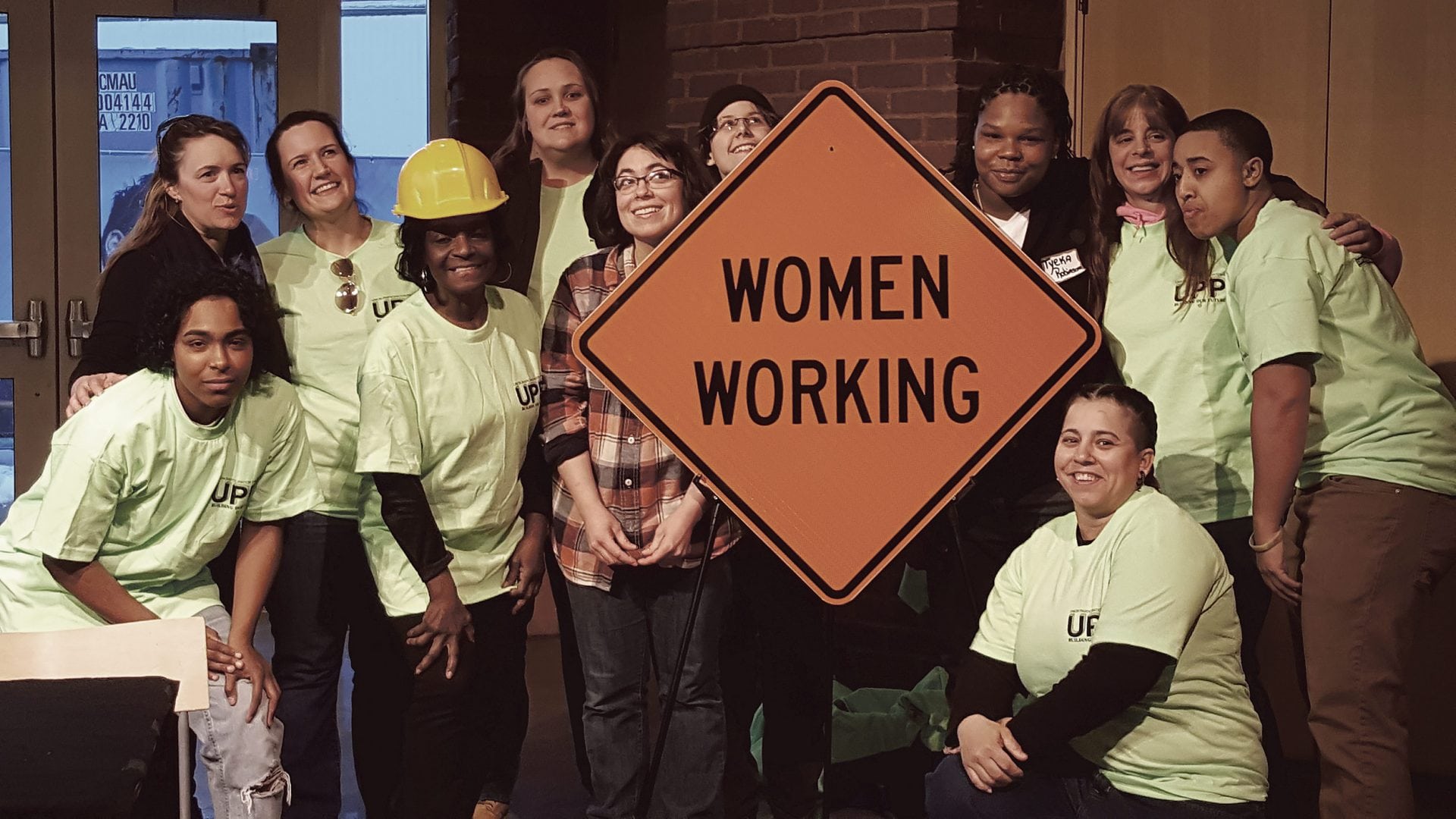
Local union carpenters gather for a forum on women in construction at Mount Holyoke College.

Construction has long been a male-dominated industry, but the playing field doesn’t have to be so uneven, several carpenters with Local 336 told BusinessWest. They all took different paths to the field, but all say women with an interest in working with their hands shouldn’t shy away from a career society has too often said they’re not suited for. Progress in diversifying the workforce has been incremental, but several regional developments offer reason for optimism.

Lily Thompson laughs when she hears that women can’t handle themselves on a construction site.

“That’s a societal thing as much as anything,” said Thompson, a journey-level carpenter with Local 336 of the New England Regional Council of Carpenters. “If a mother can pick a sleeping child out of bed 2,500 times, there’s no reason she can’t pick up metal studs and shlep stuff around; 90% of this business is moving and fastening.”

Yet, the stereotypical messages persist. “You wouldn’t believe how many times kids are told, ‘that’s a boy thing,’ or ‘that’s a girlie thing,’” she went on, recalling the day her young daughter was helping her install a barn door, and a passerby took note of them and commented, ‘a lady with a saw — how unusual.’

“It doesn’t get any more basic than that,” she said of how gender roles get reinforced in traditionally male professions. “But society has changed a lot lately, and Western Mass. is prime territory for people doing non-traditional things.”

Julie Boucher, another journey-level carpenter, didn’t get those messages at an early age, or, if she did, she ignored them.

“I wanted to be a carpenter since I was a little girl, probably since I was 4 or 5, playing with Lincoln Logs and Legos,” she told BusinessWest. Her route to that career was a circuitous one.

“I went to vocational school and learned the trade, but when I got out, it was difficult to find a job,” she said. “Being a woman, a lot of companies took one look and said I wasn’t needed or wanted, so I got a little discouraged.”

After serving in the Navy for a time before getting a medical discharge and then studying business administration at Holyoke Community College, she again became interested in carpentry, and after a professor handed her a pamphlet for the carpenter’s union, she applied.

“The job can be difficult mentally and physically, and sometimes I think the mental struggle is harder than the physical struggle,” she said. “But if building and working with your hands is something you love to do, you should follow your dreams.”

Katurah Holiness

Katurah Holiness, here pictured at the MGM Springfield site, says she appreciates the different avenues of training available in her union.

Lisa Clauson, director of Strategic Partnerships for the union’s Carpenter’s Labor Management Program, loves testimonials like that one.

“We’ve been working aggressively over the past two years to expand our union’s diversity and ensure we reflect the communities we work in and our members live in,” she said, noting that this effort includes bringing in more men of color, but in particular has focused on recruiting women of all backgrounds.

Tradeswomen, Clauson noted, represent fewer than 3% of the construction industry nationally, and closer to 2% in Springfield. “We, and many other building trades, all have very successful tradeswomen, so it is not an issue of women not being physically capable, but it is an issue of women being recruited and encouraged to do this work — and an issue of contractors being willing to employ them. The construction trades are one of the last industries to diversify opportunities for women.”

Indeed, while female representation in the construction trades rose steadily between the 1980s and 2007, the number then leveled off and has decreased ever since. One factor was certainly the Great Recession, which hit construction hard and chased many professionals out of the field — women at a higher rate.

They should come back, Thompson said, with opportunities on the rise.

“I’ve been doing this almost 16 years,” she said. “The pay and benefits are great, and I work with a great group of people. It’s something I like to do, versus sitting at a desk. I tried making sandwiches and was a receptionist in a hair salon, but that wasn’t where I wanted to be.”

Test of Time

Thompson graduated from Franklin County Technical School in 2001, and decided to focus on carpentry after trying out some trades — auto-body and electrical work, to name two — that she found less appealing.

“I like building things, and seeing things that are long-lasting. You get to look at it and have pride in your work for years to come,” she said, noting that her skills translate well to her personal life, too; she and her husband, a mechanic, bought a run-down property 12 years ago and worked to turn it into a home.

A home is something Katurah Holiness didn’t have when she entered the world of carpentry. An Air Force veteran, she was driving for Uber and sleeping on a series of friends’ couches, and when she got tired of hopping around, she went to stay at Soldier On in Leeds, where she lived for much of 2016 and 2017.

She had never had much interest in carpentry, but one day she gave a union carpenter a ride, and chatting with him piqued her interest. She applied with the union and quickly became an apprentice and got hired on the MGM Springfield job.

“With the carpenter’s union, there are so many avenues you can go as far as interest,” she said. “You can take a welding course, learn about framing and sheetrock … the avenues don’t end. There are a number of things you can get into, specialties and certifications you can train for.”

Her car broke down shortly before she started as a carpenter, and Holiness initially was able to get to work through getting rides with other members and sometimes from other women who lived at Soldier On. Steady work at the union apprentice rate enabled her to save, pay off some of her debts, and eventually move to an apartment.

Besides those pluses, she enjoys the work, and feels at home working alongside almost all men.

“I came from a male-dominated background in the military, so it’s not new to me in the least,” she said. “I can vouch for the men I’ve worked with; they’re for the most part good guys, and they’re willing to train you and educate you if you’re willing to learn.”

That’s not to say some stereotypes of the field aren’t occasionally true, Thompson said, including ribald or condescending teasing.

“I just put in my imaginary earplugs. Its ‘hey, you’ve got your sexy jeans on today,’ or ‘where did you get your boots from, the kids’ section?’ You take it with a grain of salt — smile, wave, give some s–t back when it comes down to it. As for the physical part, well, if you’re active in life and don’t want to go to the gym every day, come give this a whirl.”

The union has been trying to motivate more of that whirl-giving among women in several ways, Clauson said. One is recruiting aggressively from members’ networks, community organizations, career centers and job-training programs, vocational schools, and other sources.

“We’re spreading the word about the opportunities for this work and letting women know that, when this work is done union, they can earn living wages, be fully trained in the craft for free, and get great benefits. Our recruitment work has involved intensive outreach in the vocational schools throughout Western Mass. as well.”

Meanwhile, to retain women in the trade, the union has created a ‘Sisters in the Brotherhood’ chapter for its women to come together regularly to network and support each other.

“We have mentorship programs and are working to educate our members on the value of diversity and the need for harassment-free worksites. We are also working with our contractors on these issues,” she explained.

Finally, the union has been persuading developers to require diversity in their contractors.

“This last step is key to ensuring women get hired and get work,” she said. “Contractors are slow to change their hiring practices, but if owners of construction work require them to bring in a diverse workforce, they will do so. This often gives women — and people of color — a foot in the door to demonstrate their work ethic and skills, and many are then kept for other jobs that don’t have requirements.”

Success stories in this realm have included MGM, with women accounting for at least 6.9% of all work hours, people of color 15.3%, and veterans 8% — minimums that are consistently being exceeded. “MGM is a remarkably different worksite than most,” Clauson said. “Our women constantly talk about how different it is to be seeing other tradeswomen all around them.”

Lily Thompson

Lily Thompson takes a break from work renovating Blanchard Hall at Mount Holyoke College.

Meanwhile, the UMass Amherst Building Authority has also set work-hour goals of 6.9% for women and 15.3% for people of color. Three years ago, she added, these goals existed but were ignored, but a compliance officer started enforcing them in 2015, and now the all jobs are exceeding these numbers.

Mount Holyoke College recently completed its first project (a renovation of Blanchard Hall) with work-hour requirements of 7% for women and 16% for people of color. And Smith College recently announced it will require the same percentages on its $100 million Neilson Library project.

Finally, the city of Springfield is reworking the Springfield Responsible Employer Ordinance, which requires city construction contractors to employ 35% Springfield residents, 20% people of color, 6.9% women, and 5% veterans.

“It has largely been unenforced, and they are now creating a new enforcement plan and have recently hired a compliance officer to oversee it,” Clauson said.

Small Steps

Boucher said every additional woman on a job site makes the environment healthier for all women. That’s partly why she coordinates the training center of the union’s apprenticeship mentoring program and helped launched its Sisters in the Brotherhood chapter.

“I naturally wanted to help other people; that’s in my blood,” she said. “I started a mentorship program at my local because I know how important it is to have that support. I wanted to be there for the apprentices coming in and help guide them in any way I can. Not all apprentices want mentoring, but the ones that do, I try to provide a support system for them. We have a great team of mentors to help out.”

The progress achieved in diversifying the construction workforce regionally is exciting, Clauson said, but much more needs to be done.

“Women historically have done many physically demanding and dirty jobs, but traditionally they are doing work of this type in low-wage and low-skilled industries,” she said, citing jobs in cleaning, food service, and personal care. “Construction careers, in contrast, are higher-paid, skilled, and, when unionized, have good wages, free training, and strong benefits. Women need to be able to access these opportunities.”

And be treated equally on the job site, Boucher said.

“There are companies that allow me to do my job, and then companies that don’t allow me to do my job, in the sense that I’ll get put on menial tasks, easy tasks, because my foreman or journeyman I’m working with don’t think I’m capable of doing it. I wish I was challenged a little more. Let me do the framing; let me handle drywall. But that’s not always the case.”

It helps that the union supports workforce training, she added. For example, Boucher earned a construction management degree at Wentworth Institute of Technology in Boston, and the local paid for one-third of the tuition; most of the classes were held at Springfield Technical Community College through an exchange between the two institutions.

Thompson said women are ultimately responsible for taking such opportunities to better their careers. “Women today want to be 50-50, want to feel like they’re equal partners,” she noted. “Whether just out of college or age 50, as long as you’re physically able, there are lots of positions in construction. I didn’t see myself doing this full-time, but it works. I’m much happier than I’d be in an office.”

Holiness agreed. “A lot of people think it’s only for males because they’re stronger, but that’s not true,” she said. “Where there’s a will, there’s a way. There’s nothing you can’t do.”

Joseph Bednar can be reached at [email protected]

40 Under 40 Class of 2018 Cover Story

Announcing the 12th Annual Cohort of 40 Under Forty Honorees

40under40-logo2017aWhen BusinessWest launched a program in 2007 to honor young professionals in Western Mass. — not only for their career achievements, but for their service to the community — there was little concern that the initial flow of nominations might slow to a trickle years later.


We were right. In fact, 40 Under Forty has become such a coveted honor in the region’s business community that the flow has turned into a flood, with more than 180 unique nominations arriving this year, making the job of five independent judges tougher than ever.

They did their job well, however, as you’ll find while reading through the profiles on the coming pages. The format is a bit different this year — instead of being interviewed, the winners were free to craft and write out their own thoughts — but, collectively, they speak of a wave of young talent that is only getting larger during what can only be described as an economic renaissance in Western Mass.

As usual, they hail from a host of different industries, from law to banking; from education to healthcare; from media to retail, just to name a few. Many are advancing the work of long-established businesses, while others, with an entrepreneurial bent, created their own opportunities instead of waiting for them to emerge.


40 Under Forty Class of 2018

Amanda Abramson
Yahaira Antonmarchi
Lindsay Barron
Nathan Bazinet
Andrew Bresciano
Saul Caban
Jamie Campbell
Crystal Childs
Nathan Costa
Jamie Daniels


But there are, as always, some common denominators, including excellence within one’s profession, a commitment to giving back to the community, dedication to family and work/life balance, and a focus on what else they do in each of those realms.

The class of 2018 will be celebrated at the annual 40 Under Forty Gala on Thursday, June 21 at the Log Cabin Banquet & Meeting House in Holyoke. A limited number of tables are available, and a number of individual seats and standing-room-only tickets are available as well — but they will sell out quickly.

The gala will also feature the announcement of the winner of the fourth annual Continued Excellence Award, a recognition program that salutes the 40 Under Forty honoree who has most impressively added to their résumé of accomplishments in the workplace and within the community, as chosen by a panel of judges. Nominations are still being accepted through Monday, May 14 at businesswest.com/40-under-forty-continued-excellence-award.

Speaking of judges, we thank those who scored the more than 180 nominations for this year’s 40 Under Forty competition (their story HERE). They are:

Ken Carter, member of the UMass Amherst Polymer Science and Engineering Department;
Mark Fulco, president of Mercy Medical Center;
Jim Hickson, senior vice president and commercial regional president for the Pioneer Valley and Connecticut for Berkshire Bank;
Angela Lussier, CEO and founder of the Speaker Sisterhood; and
Kristi Reale, partner at Meyers Brothers Kalicka, P.C..

Presenting Sponsors

nortwestern-mutual peoplesbank-logo

Sponsors

hne_logo_cmyk_stack-page-001 isenberg
renew-calm-logo-002

Partner

yps


Photography for this special section by Leah Martin Photography