Daily News

HOLYOKE — Meyers Brothers Kalicka, P.C. announced three new hires: Catherine O’Connell as A&A (Audit and Assurance) associate, Katrina Arona as Marketing and Recruiting associate, and Taylor Bahn as A&A associate.

Catherine O’Connell

O’Connell first joined the firm as an A&A intern and has been promoted to associate in the firm’s A&A department. Her professional focus includes assurance services, with industry concentrations in not-for-profit sectors. She received her bachelor’s degree in accounting from Westfield State University and is a member of CPAmerica and the Massachusetts Society of Certified Public Accountants.

“Catherine approaches customer service with professionalism, patience, and a people-first attitude, emphasizing the importance of collaboration, efficiency, and adaptability in achieving optimal solutions for clients and the firm,” MBK Partner Howard Cheney said. “Her approachable and friendly demeanor makes her a valuable asset to any client interaction.”

Katrina Arona

Arona joins MBK with five years of experience in administrative and project management. She received her bachelor’s degre from Springfield College and is a member of CPAmerica, the Massachusetts Society of Certified Public Accountants, and the Assoc. for Accounting Marketers.

“Known for her exceptional organizational skills and willingness to assist, Katrina thrives on guiding projects from vision to fruition,” MBK Partner Jim Krupienski said. “In her new role, she will oversee marketing activities related to business development, niche development, thought leadership, and social media. Additionally, Katrina will serve as the firm’s primary contact for recruitment, participating in college recruiting fairs, and working to attract both emerging and experienced professionals to the team.”

Taylor Bahn

Bahn was promoted to associate after initially joining the firm as an intern. He holds a bachelor of business administration degree, and his master’s degree in accounting is slated for completion this summer from UMass Amherst. He is also a member of CPAmerica, the Massachusetts Society of Certified Public Accountants, and the Assoc. for Accounting Marketers.

“Taylor believes that an exceptional customer experience is built on respect, politeness, and attentiveness,” Cheney said. “Coupled with his academic credentials, his active lifestyle in running and rugby underscores his dedication to teamwork and resilience. We are confident that Taylor will be a valuable asset to our Audit and Assurance department.”

Daily News

BOSTON — State Sen. Adam Gomez announced that a pair of initiatives he sponsored during the Senate budget debate aimed at expanding access to financial resources for minority and disadvantaged business owners have been included in the final version of the budget signed by Gov. Maura Healey on Monday.

Through amendments submitted by the second-term senator, the Coalition for an Equitable Economy and Amplify LatinX will receive $250,000 and $300,000, respectively, to support the success of Black, Latino, Indigenous, and other underserved small businesses in the Commonwealth.

“I am proud to see this Legislature prioritize funding and directing resources toward marginalized and still-disadvantaged groups as they aim to make their mark in our state,” Gomez said. “It is important that these individuals are connected directly to the resources they need, resources they have been previously denied, as we look to make our state more equitable for all citizens.”

The Coalition for an Equitable Economy was formed in response to the need for more support for smaller and most-vulnerable businesses, particularly those owned by minorities, disabled individuals, veterans, and low- and moderate-income people. Their mission is to ensure equitable access to capital, business networks, education, technical support and other resources for Black, Latinx, immigrant, and low-income small-business owners in Massachusetts while eliminating any barriers to investment and growth.

“On behalf of our entire Coalition for an Equitable Economy community, I extend our deepest gratitude to Senator Gomez for the generous earmark of $250,000,” said Tracye Whitefield, the coalition’s executive director. “This critical funding will enable us to sustain and grow our small-business ecosystem. Your support is instrumental in helping us achieve our goals and improve the lives of those we serve. Thank you for your unwavering dedication and commitment to small businesses.”

Amplify LatinX is a Massachusetts-based nonprofit formed in 2018 by the Latina Circle Inc. that serves as a non-partisan, collaborative convener advancing Latino leadership representation, economic prosperity, and civic engagement. Its mission focuses on accelerating pathways of prosperity and leadership growth, advancing Latine representation into positions of power and influence, creating advocates for racial equity and economic mobility, prioritizing policies that impact the Latine community, and championing Latine civic and business leaders and entrepreneurs.

“Amplify LatinX extends our deepest gratitude to Senator Adam Gomez for his continuous and unwavering commitment in supporting our work advancing Latino prosperity. The $300,000 in funding secured through his leadership will contribute to the ALX Small Business Program, which works closely with small-business owners to give them the tools they need to succeed,” said Eneida Román, president and CEO of Amplify Latinx. “This investment is a vital step toward creating systemic change and ensuring that our community and Massachusetts’ economy thrives.”

Daily News

NORTH ADAMS — Massachusetts College of Liberal Arts (MCLA) announced that Gov. Maura Healey has appointed three new members to its board of trustees: Darlene Rodowicz, Yvonne Spicer, and Buffy Lord (’98), who was voted to represent the MCLA Alumni Assoc. All three trustees begin their terms of service this summer.

“I’m excited to welcome Dr. Spicer, Ms. Rodowicz, and Ms. Lord as our newest MCLA trustees,” MCLA President James Birge said. “They are extremely accomplished professionals who will add a wealth of knowledge to the board, and I am grateful they agreed to join us.”

The three new trustees join a board of volunteers chaired by Mohan Boodram, who has served on the board since 2012 and also served as chair from 2020 to 2022.

“I am pleased to welcome three members who have shown such dedication to the communities they serve,” Boodram said. “I look forward to working with these new outstanding trustees and am honored to serve alongside them on a board that boasts such a diverse range of talent.”

Rodowicz, president and CEO of Berkshire Health Systems, joined BHS in 1984 and has served on the system’s executive leadership team since 2005. She has played a crucial role in the evolution of BHS through her various leadership positions, including ensuring the financial strength of the organization during her 15 years as chief financial officer.

A longtime educator, Spicer is currently the executive director of Life Science Cares Boston and an adjunct lecturer at UMass Boston. A highly sought-after speaker on the topics of leadership, STEM, and diversity, equity, and inclusion, she was also the first mayor of Framingham, serving from 2018 to 2022.

A practicing attorney with the North Adams-based law firm Donovan O’Connor & Dodig, LLP since 2005, Lord’s main practice area is civil litigation, but her work with the firm encompasses multiple practice areas, including personal injury and workers’ compensation, domestic relations, municipal law, and appellate work.

Daily News

SOUTH HADLEY — All Our Kids, a nonprofit organization dedicated to supporting foster and adoptive families in Western Mass., announced a partnership with Pampered Chef for an online fundraising event. This virtual party will take place on Facebook from Aug. 8 through Aug. 22.

The fundraiser will be hosted in the public Facebook group All Our Kids Connect Pampered Chef Party (click here). During this event, supporters can purchase high-quality kitchen tools and cookware while contributing to a worthy cause.

Pampered Chef has committed to doubling donations for the month of August. For orders between $200 and $649.99, 20% will be donated to All Our Kids. For orders of $650 or more, 30% will be donated.

Community Spotlight

Community Spotlight

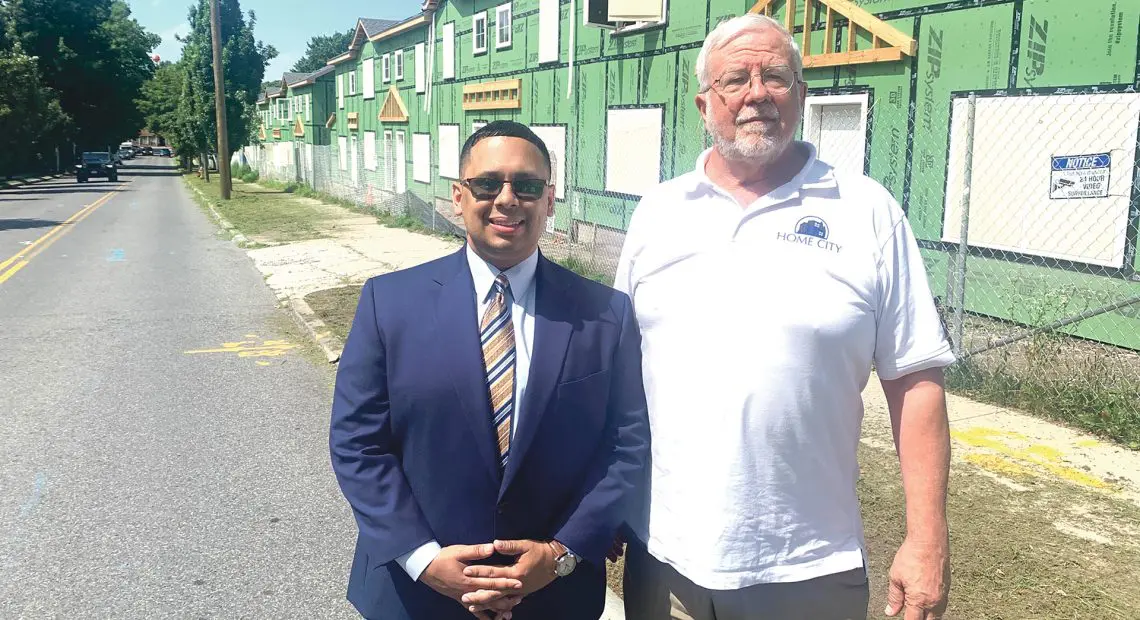
Joesiah Gonzales, left, with Home City Development Executive Director Thomas Kegelmen

Joesiah Gonzales, left, with Home City Development Executive Director Thomas Kegelmen at the Gemini Townhomes project in Springfield’s South End.


Joesiah Gonzalez calls it a “game changer.”

He was referring to the Gemini Townhomes project in Springfield’s South End, an initiative that will create 40 single-family homes, specifically for first-time homebuyers, on the site of a long-dormant parcel that was once home to the Gemini clothing manufacturing facility, which was destroyed by fire in 2003.

“This project will expand homeownership in the South End by more than 150%,” said Gonzalez, chief Philanthropy and Communications officer for Home City Development Inc., a nonprofit focused on housing, noting that this is the agency’s first foray into homeownership initiatives.

“This will greatly improve that Central Street corridor,” he went on. “For the families, it’s a great opportunity to build equity and generational wealth. And, most importantly, it will bring vested families that want to be near the downtown district; that’s why this is a game changer.”

The $20 million Gemini project is one of many housing initiatives in various stages of development in Springfield, and just one of many intriguing storylines in the City of Homes.

“Springfield was once the place that was incredibly affordable. Now, it’s not as affordable; if you compare our home values today to our suburban counterparts and smaller urban counterparts, like Chicopee and Holyoke, we’re right on par with a lot of these places.”

Others include the upcoming sixth anniversary of the opening of MGM Springfield and the lingering questions about whether the facility is being sold and what they will mean for the city and the region, the opening (probably early next year) of the new parking garage downtown, the state’s ongoing but slow-moving search for a site for a new courthouse, the next stages in the much-anticipated development of the former Eastfield Mall, Chicago-based McCaffery Interests’ redevelopment of the Clocktower Building and Colonial Block downtown, and the planned $31 million expansion of Performance Food Group in the Smith & Wesson Industrial Park, an initiative that will bring 350 new jobs to the city, just to name a few.

Quickly updating some of these initiatives, Tim Sheehan, the city’s chief Economic Development officer, said the McCaffery project, facing challenges such as rising construction costs and interest rates, may benefit from creating a mix of market-rate and workforce housing, the latter of which would enable the project to access state support. Meanwhile, the state has identified five potential sites for a new courthouse, all in the downtown area, but hasn’t said what they are. The likely plan is to build new and not rehabilitate the existing courthouse, giving the city two intriguing development opportunites.

As for the Eastfield Mall, city officials will soon be considering a TIF (tax increment financing) agreement needed to proceed with the construction phase of a mixed-use development now that demolition of the massive parcel has been completed. And the parking garage should bring much-needed relief after what will be more than two and a half years of being without such a facility.

As for other housing issues, while there are several projects in the pipeline, there is still a housing crisis due to a lack of inventory, said City Council President Michael Fenton, adding that there is another potential crisis emerging — one of affordability.

Michael Fenton

Michael Fenton says there is considerably more vibrancy in Springfield’s downtown than when he was first elected to the City Council more than 14 years ago.

Indeed, Springfield’s home prices have risen at one of the sharpest rates in not only the region, but the state, a development that brings benefits for existing homebuyers, but also hurdles to those looking to buy into the community nicknamed the City of Homes.

“Springfield was once the place that was incredibly affordable,” Fenton said. “Now, it’s not as affordable; if you compare our home values today to our suburban counterparts and smaller urban counterparts, like Chicopee and Holyoke, we’re right on par with a lot of these places.”

For this, the latest installment of its Community Spotlight series, BusinessWest turns its lens on the region’s largest community and its many converging storylines.


Living Proof

For roughly four decades now, Evan Plotkin has been working in downtown Springfield — and working to bring about the vibrancy he remembered when he would come into town as a kid.

That work has come in myriad forms, from organizing the Jazz and Roots Festival (the latest edition of which was staged last month) to commissioning artists for mural projects to spearheading efforts to revitalize parks and other public areas, such as Stearns Square.

That work goes on today, but now, Plotkin brings a different perspective to it — sort of.

Indeed, he now not only works in downtown Springfield (and co-owns the office tower at 1350 Main St.), he lives there as well.

He’s a tenant at 31 Elm St., the mostly market-rate apartment complex created in the former Court Square Hotel, and has one of the sought-after units that looks out on the park. He could walk to his office in a minute, but because Court Square is under reconstruction, it takes two or three.

“It’s a blast living downtown,” he said simply, noting the sum of all there is to do in the city’s central business and entertainment district, almost all of it within easy walking distance of his new address.

Still, while he’s bullish on Springfield and its downtown, Plotkin noted there is considerable work to do to bring more tenants (of all kinds) and vibrancy to the many vacant, or mostly vacant, properties on Main Street and adjoining streets.

“We need to bring back Main Street — that’s what’s weak right now,” he said, referring to the broad stretch between the casino and the Arch. “We need to have more activity; we need to activate vacant spaces and attract more new businesses.

Evan Plotkin in the lobby of his new residence, 31 Elm St. in Springfield.

Evan Plotkin in the lobby of his new residence, 31 Elm St. in Springfield.

“The investment has not been made to change Main Street,” he went on, citing everything from long-stalled plans to redevelop the Hippodrome and adjacent hotel to the many decades that the floors above the Student Prince restaurant have been dormant. “And Main Street will drive everything in the city, as far as I’m concerned.”

Fenton agreed there is still work to be done, but took a moment, or two, to reflect on the progress he’s seen in the 14 years that he’s been on the City Council.

And it’s come in many forms, he said, starting with the $1 billion MGM Springfield development — how it has transformed that part of the downtown and how it has facilitated other developments, including 31 Elm, for which it served as one of many funding partners.

“It’s a delicate balance. For years, the city wanted to create safe neighborhoods, generate economic development, and promote safe schools. Why? So we could increase property values and attract more middle-class residents. But if property values go up too much, too quick, now you have an affordability crisis.”

“If you look back 15, 20 years ago, the downtown Springfield core was largely hollowed out,” he said. “We had an unimproved riverfront, no downtown grocer, a very dormant Worthington Street, and a South End that was dangerous to walk around in, especially in the areas where the casino is now — Union and Howard streets.

“When you think about the things we’ve done since … for a lot of it, we’ve been able to capitalize on the billion-dollar MGM investment,” he went on. “But a lot of it is also a lot of hard work and good economic-development practices.”

Elaborating, he noted everything from an AHL franchise — the city was without one for a short time — to some new restaurants and clubs on Worthington Street and beyond; from new hotels and the return of the Marriott flag to what was known for a time as the Tower Square Hotel to strong movement on market-rate housing.

Indeed, while Stockbridge Court, the massive complex just off Main Street near the South End, was an outlier for many years, Fenton noted, now there are several other projects open or in various phases of development.

“Stockbridge Court used to be an island of market-rate housing; it was an example of what could be done, but no one could seem to replicate it,” he said. “Now, we’ve got 31 Elm, which is full, has a waiting list, and is a really impressive property bringing people with spending power into the area.

“You also have the Willys Overland property, which is also at capacity, and interest in continuing to pursue this across the metro center, most recently with the McCaffery proposal and the city’s investment in the Masonic Block and our foresight in taking that property and conveying it to a developer that’s going to put more than 100 market-rate units there,” he went on. “Add all this stuff up, and it’s really made a difference down here.”

An architect’s rendering of the Clocktower Building

An architect’s rendering of the Clocktower Building, one of many housing and mixed-use projects in various stages of development in the City of Homes.

Discussions about planned and potential new housing (more on that in a bit) and the still-vacant properties downtown and what can be done with them lead Plotkin back to the long-held chicken-or-egg discussions about what Springfield needs most in his downtown — housing to bring residents with spending power to spur new developments, or new retail businesses and hospitality venues that will attract new residents and enable the region to retain more of the students who graduate from its many colleges and universities, strengthening its workforce.


More Living Proof

The reality is that both must happen concurrently, said Plotkin, adding that housing of all kinds, including market-rate and affordable, are needed to create a critical mass of people all hours of the day, every day.

“You don’t want to be a 9-to-5 city,” he explained. “Restaurants shouldn’t be closed on Saturday in a city like Springfield, but many of them are. We need to be a destination.”

As noted, there is considerable progress being made on the housing front, with initiatives ranging from 31 Elm to the Gemini Townhomes to the more than 100 units planned for the Clocktower Building and nearby Colonial Block.

In all, there are more than 850 units of housing in various stages of development, said Sheehan, listing everything from redevelopment of the former Federal Land Bank at 300-310 State St. (60 units), a project known as Residences at the Vault, to the reimagining of the former Kavanagh Furniture store (35 units) further down State Street; from work at the former Brightwood Elementary School (57 units) to an additional 29 units at the former site of the YMCA of Greater Springfield on Chestnut Street.

The last of those projects is another Home City initiative, said Gonzalez, noting that the agency has 130 units in the residential portion (floors 2-6) of the structure, and will redevelop the remaining space on the ground floor of the building, formerly used for offices and programming, to create an additional 29 efficiency units. The remaining back portion of the building will eventually be demolished.

The agency is also working on another homeownership initiative, this one involving the redevelopment of 10 vacant lots in the Old Hill neighborhood into single-family homes. The lots have been identified, he said, and the project is still in the planning phases.

Meanwhile, work proceeds at the Gemini project, which has several funding partners, including the state and the city, which has directed ARPA money toward the initiative. The first 20 of the units are expected to be completed by this fall, with the remaining 20 to come online next spring.

Home City prevailed in a request for proposals for the Gemini site, which, as noted, has been dormant for two decades, said Gonzalez, adding that the agency has been trying to develop a first-time-homebuyers initiative somewhere in the city, and most recently had targeted the site of the former Chestnut Middle School in the North End before refocusing on the Gemini site.

While the additional housing coming onto the market is a huge storyline, so too is what is happening with the values of existing property and what this trend means for the city, those who live there, and those who may want to live here in the future.

Indeed, according to the Warren Group, a real-estate information firm, the median sale price of a home in Springfield rose 68% in Springfield between 2018 and 2023, the highest rate in Hampden County and the highest in Western Mass., outside of a cluster in the Berkshires, a region that greatly benefited from the trend toward remote work.

Fenton told BusinessWest that this dramatic rise brings with it both benefits and potential drawbacks, especially when it comes to affordability, something Springfield has long been able to hype as one its strongest assets.

“It’s created increases in taxes and valuations and demand on services, and it’s also affected affordability — what’s affordable for a renting market or first-time homebuyers,” he asked. “It’s also a huge wealth generator for residents and homeowners who have historically had undervalued properties.

“It’s a delicate balance,” he went on. “For years, the city wanted to create safe neighborhoods, generate economic development, and promote safe schools. Why? So we could increase property values and attract more middle-class residents. But if property values go up too much, too quick, now you have an affordability crisis.”


Betting Lines

While housing is perhaps the biggest issue confronting the city, the casino, and its future, are others.

It was roughly five months ago that Bloomberg reported that MGM had expressed interest in selling one or more of its casinos, including the Springfield facility. That report spurred a good deal of conjecture about a new owner for the existing facility or even a different use for the property, said Fenton, who tried to put some of the chatter into perspective.

He said the property is strictly zoned for a casino and thus cannot be used for other purposes. Meanwhile, any new operator must adhere to the same host-community agreement signed by MGM Springfield, one that requires $25 million in annual payments to city entities, 12 entertainment acts in various downtown venues, and other provisions.

As for the current operation, as the six-year anniversary of its opening approaches, Louie Theros, who took the helm as president in January, said the facility has put the headwinds from COVID in its rear view, is now “fully operational,” and has seen the surge in gross gaming revenues experienced in the second half of 2023 continue into this year.

Springfield at a glance

Year Incorporated: 1852
Population: 155,929
Area: 33.1 square miles
County: Hampden
Residential tax rate: $16.14
Commercial tax rate: $35.49
Median Household Income: $35,236
Median Family Income: $51,110
Type of government: Mayor, City Council
Largest Employers: Baystate Health, MassMutual Financial Group, Mercy Medical Center, Big Y Foods, Center for Human Development, MGM Springfield
* Latest information available

He said the goals moving forward are to focus on what the casino does well and do more of it — he put the ROAR Comedy Club shows and the Free Music Fridays in that category, for example — while also integrating more events at the MassMutual Center (which MGM Springfield manages) into the casino.

“We’ve got AEW Wrestling coming there in the next few months, an event that will be broadcast live on TNT — we’re hoping to do something with that event, obviously — and we have a boxing event coming up where we’ll bring the weigh-in to the casino, so we can bring people into the casino before and after the fight.”

Theros said MGM Springfield has hired Springfield native Andres Gomez, who was part of the initial team that helped launch the MGM Springfield brand in 2018 when he served as director of Restaurants and Nightlife Operations, as executive director of Hospitality.

“He’s really excited about activating the property; he has some great ideas and really wants to liven up the restaurant spaces and common areas,” Theros said. “I’m really excited about what we have coming up in the next year.”

Overall, he’s encouraged by what he’s seeing downtown, especially at 31 Elm, and is looking forward to the completion of the parking garage and the adjoining parking lot as well as Court Square. And, like others we spoke with, he said additional residential units — in the properties across Main Street from the casino and other locations — will bring additional vibrancy to the downtown area.

“To get more people living in the core city center brings more vibrancy to it,” he explained. “And the more people we have walking around, hanging out, and participating in economic redevelopment in the city … it really helps springboard other activity.

“I’m really excited about McCaffery putting hammer to nail and starting to redevelop those properties,” Theros went on, adding that, while the residential component of that project is important, so too is the retail component slated for the ground floors of those properties and the need for a broader retail plan for those buildings, MGM, and other properties in that area.

Sheehan agreed.

“McCaffery has brought back to us that there should be a district-wide, ground-floor commercial plan as to what kinds of businesses can function in this marketplace,” he said. “And all property owners in that district should be sharing in that plan so there’s continuity around what that ground-floor retail experience is, not just from MGM’s perspective, but for the whole district.”

He went on to say that development of such a comprehensive plan is one of many initiatives that fall into the category of long-term planning. He would also like to create a plan for redevelopment of the current Roderick Ireland Courthouse, property that will likely be demolished as the state pursues construction of a new facility elsewhere in the downtown area.

“I think that we should begin master planning now for what that site could ultimately be,” Sheehan told BusinessWest, adding that the city should also start planning now to assist businesses, like Performance Food Group, with expansion plans in various stages of development.

“We only have a limited amount of land in this city,” he said, “and we really need to be looking at ways in which we can be encouraging more existing business expansion in Springfield and creatively work to advance plans companies have for expansion — sooner rather than later.”

 

Women in Businesss

Agents of Change

Change.

In most respects, it’s right there with death and taxes when it comes to constants in life. And in business as well.

“We process change, but since COVID, change has just accelerated, and it’s going to continue to accelerate exponentially. And how do we manage through that in both our businesses and our professional careers?” asked Moe Belliveau, executive director of the Greater Easthampton Chamber of Commerce, noting that change — and coping with the many aspects of it — will be the broad theme running through the third annual SheLeads women’s conference series this fall in the PeoplesBank Conference Room at the Kittredge Center of Holyoke Community College.

Change applies to the conference as well, she told BusinessWest, noting that, in a departure from years past, when the conference was a day-long event, it will now be a series running over four days, starting Sept. 13.

“We process change, but since COVID, change has just accelerated, and it’s going to continue to accelerate exponentially. And how do we manage through that in both our businesses and our professional careers?”

“We think this might fit people’s schedules better; it might be a little easier to manage,” she said, adding that a full day is a rather difficult commitment for many to make.

Programs will begin at 7:30 a.m. with breakfast; proceed with a ‘world café,’ an informal setting whereby participants can explore issues by discussing them in small table groups; then feature a guest speaker, followed by a guest panelist one-on-one interview and discussion facilitated by Belliveau.

Programs will be wrapped up by 10 a.m., and they will be taped as part of the chamber’s Mind Your Own Business podcast.

Again, the common thread running through each program will be change, she said, adding that there are myriad subtopics, including managing conflict during change, leading staff through change, managing burnout through change, vulnerability during change, and authenticity during change.

“We look forward to change, but there’s also some fear that gets generated around that,” she said. “How does it affect your business? How does your own fear affect your business? How do you lead people through change? How do you avoid burnout?”

Answers to these and other questions will be sought at the SheLeads conference, she went on, adding that, over the years, the sessions have drawn women from all sectors and at all stages of their careers.

Belliveau said each of the four speakers has dealt with change on many levels and has gained insight and lessons to share with participants.

“Each one of our guests has a different perspective coming from a different business sector and from a different life-experience perspective,” she went on. “Each one will have their own offerings on different stages of their lives and careers.”

The four sessions are:

Marissa Kulig Crow

Marissa Kulig Crow

• Sept. 13: The series will kick off with a program led by Class A LPGA professional Marissa Kulig Crow, owner of Marissa Golf Movement and creator of the Golf Fore Women program. Kulig Crow had to reinvent her business and career in some respects due to COVID.

Burns Maxey

Burns Maxey

• Sept. 19: The featured speaker is Burns Maxey, who, in addition to owning and operating a small business, BurnsMax Creative, is also an artist, illustrator, designer, and social entrepreneur. Named a Difference Maker by BusinessWest in 2023, she also serves as president of CitySpace, a nonprofit located in Easthampton that restores and manages the historic Old Town Hall as a vital and affordable center for the arts.

Gen Brough

Gen Brough

• Sept. 26: The featured speaker is Gen Brough, president of Finck & Perras Insurance Agency in Easthampton and Florence. Brough began her career in the insurance industry in 1994 as a customer-service representative for Gifford & Perras Insurance Agency. In 2004, after working in various capacities within the industry, she became a partner with Finck & Perras, and in 2015, she purchased the agency from the three other partners to become the sole owner.

Mary Hamel

Mary Hamel

• Sept. 27: The featured speaker is Mary Hamel, owner of Glendale Ridge Vineyard in Southampton. Hamel and her husband, Ed, who manages the vineyard, started the business in 1992 after purchasing Sankey Farm. In 2017, the Glendale Ridge Vineyard brand was born, featuring a variety of estate wines including Cabernet Franc, Vidal, Traminette, and Corot Noir, as well as producing unique wines using grapes carefully sourced from vineyards on Long Island and in the Finger Lakes region.

“We’re thrilled to evolve our women’s professional-development conference into a series, amplifying opportunities for our female leaders to forge connections and glean insights from the tapestry of successful women within our region,” Belliveau said. “With each installment, the series becomes a roadmap for professional advancement, empowering them to thrive in every facet of their careers.”

Attendees can purchase a package of all four sessions in the conference series or customize their professional development and purchase sessions individually. The series package is offered at $119 for members of the chamber ($199 for non-members), and individual sessions are $35 for members ($55 for non-members).

A business showcase sponsorship opportunity is also available at $350 for members ($600 for non-members), affording participants the opportunity to showcase their products and services to attendees. The sponsorship is available per session and includes three complimentary tickets to that session.

For more information, visit www.easthamptonchamber.org or email [email protected].

—George O’Brien

Breweries & Wineries

True Entrepreneurial Spirit

Echo Hill Orchards & Winery is a family business

Echo Hill Orchards & Winery is a family business that includes younger-generation members (from left) Chris, Mia, and Ashley.


When Ashley Krupczak says Echo Hill Orchards and Winery is a family business … she means it.

Indeed, while there are other team members at this Monson institution, the driving forces — figuratively but also literally when it comes to the tractors — comprise two generations of this entrepreneurial family.

There’s Rich and Terry Krupczak, who purchased this orchard more than 25 years ago, and three of their children, Ashley, Chris, and Mia. There’s also, Greg, their oldest child, who passed away in 2022, but remains a huge presence in this multi-faceted operation.

“He was a big part of Echo Hill, and he’s what keeps us going together,” said Ashley, who handles most of the marketing and public relations and acts as official spokesperson, adding that he is remembered with one of the many signature drinks created by the team at Echo Hill.

It’s called Farmer Greg, and it’s a mix of raspberry moonshine and iced tea. It’s part of a growing roster of specialty drinks that also includes Beach Cowboy, made with Jamaican apple rum mixed with orange juice and pineapple juice, with a sugar cinnamon rim and a grenadine floater; Painkiller, made with Jamaican apple rum, cream of coconut, pineapple juice, orange juice, and shaved nutmeg on top; Hoochie Coochie, which features spicy Monson apple vodka, margarita mix, fresh jalapenos, a Tajin rim, and fresh lime; and the OG Mule, made with Monson apple vodka, Goslings ginger beer, and fresh lime.

The offerings are always changing, said Ashley, noting that the depth of this drink list provides just some evidence of how much this family business has evolved over the years — and continues to evolve.

“My brother handles all the farm work, but during the winter, we’re closed down, so I’ll help him trim the apple trees and get the orchards ready.”

Indeed, when the family acquired the orchards 26 years ago, it was a pick-your-own-apples operation, with peaches and pears added to the mix over the years. The ‘you-pick’ offerings have since expanded to now include pumpkins and sunflowers, and blueberries should be added to the portfolio over the next few years.

“People come in, buy their bag, walk out into the orchard, and pick their own,” she explained, adding that this remains a large and important part of the overall operation, especially in the fall months to come.

But the biggest change has come over the past decade or so, when the Krupczak family started making wines from their various fruits, she said, adding that it soon added vodkas, whiskeys, and moonshines to the mix.

These are acquired tastes — and acquired talents, she went on, noting that, like everything else, this is a family affair; Rich handles most of the wine making and distilling, while Ashley is in charge of coming up with the various drink options.

And with these new offerings, Echo Hill has added tastings and winery and distillery flights, whereby consumers can sample five selections, she said, adding that there is a now a full bar and winery where there are tastings, wine by the glass, alcoholic slushies, and those aforementioned signature drinks, which vary with the season and even the week.

For the last weekend in July, after which the winery shut down for a month so the staff could prepare for the busy pick-your-own season, several fall favorites were offered, including a cotton candy slushie, Blue Collared Boys (made with Monson bourbon whiskey, ginger ale, and a splash of apple cider and lime), and the Sugar Daddy, made with Echo Hill’s cider donut whisky, apple cider, and a sugar and cinnamon rim — as well as the a caramel apple sangria and pumpkin pie sangria.

As for wines, Echo Hill now has more than a dozen offerings, including the hugely popular Goblin Grog, a pumpkin chardonnay that goes very quickly in the fall, as well as a sour wine made with apples and blueberries and a blue sangria offered around Halloween called Spooky Sangria.

Meanwhile, Echo Hill books a full schedule of local food trucks — everything from Cousins Maine Lobster to Tony’s Happy Valley Pizza to Rooster’s Roaming Cantina — making the orchard a true destination throughout the year, like many area wineries and breweries.

With its Monson location, Ashley explained, Echo Hill draws visitors from not only Western Mass., but also Connecticut (with easy access off I-84) and, during the fall season, “from all over, really — New Hampshire, Vermont, Florida, you name it.”

As for the pick-your-own aspect of the business, it remains a huge part of the operation, she said, noting that the season officially begins Aug. 30 with apples (more than a dozen varieties) and sunflowers, with pears, peaches, and pumpkins added to the mix by the end of September, with the weather determining exactly when.

Last year was a difficult one, she went on, adding that heavy and persistent rains washed out the peaches and pears, as well as many of the pumpkins. This year — and she acknowledged that it’s still quite early in the game — the outlook is much brighter, in every respect.

As she noted, this is truly a family-owned and operated business, where everyone works together, but each member has a realm that is largely their own.

“My brother handles all the farm work, but during the winter, we’re closed down, so I’ll help him trim the apple trees and get the orchards ready,” said Ashley, noting that her younger sister, Mia, will soon be coming on full-time and will help both in the orchards and in the winery.

Meanwhile, they all work together to develop new offerings and keep the operation on the cutting edge, if you will, when it comes to bringing various audiences to the farm — and then bringing them back.

The Krupczaks have enjoyed great success doing just that over the past quarter-century, and they are on a trajectory for continued growth and ongoing evolution of its varied offerings.

In short, their hard work and entrepreneurial spirit is bearing fruit — in all kinds of ways.

—George O’Brien