Home Articles posted by George O'Brien (Page 21)
Education

Center of Attention

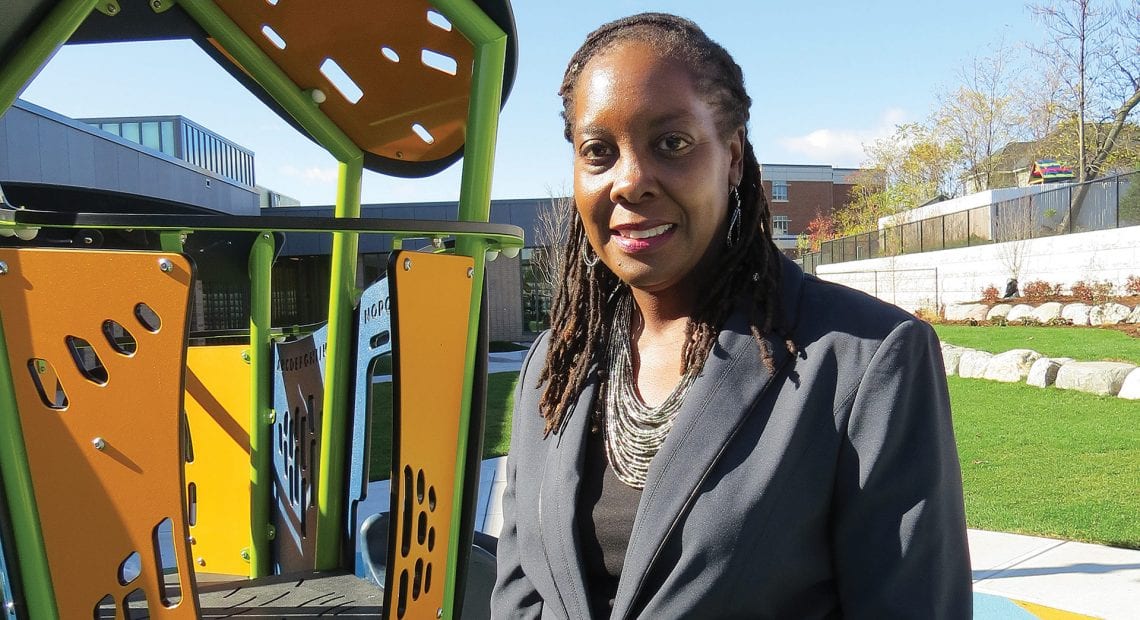
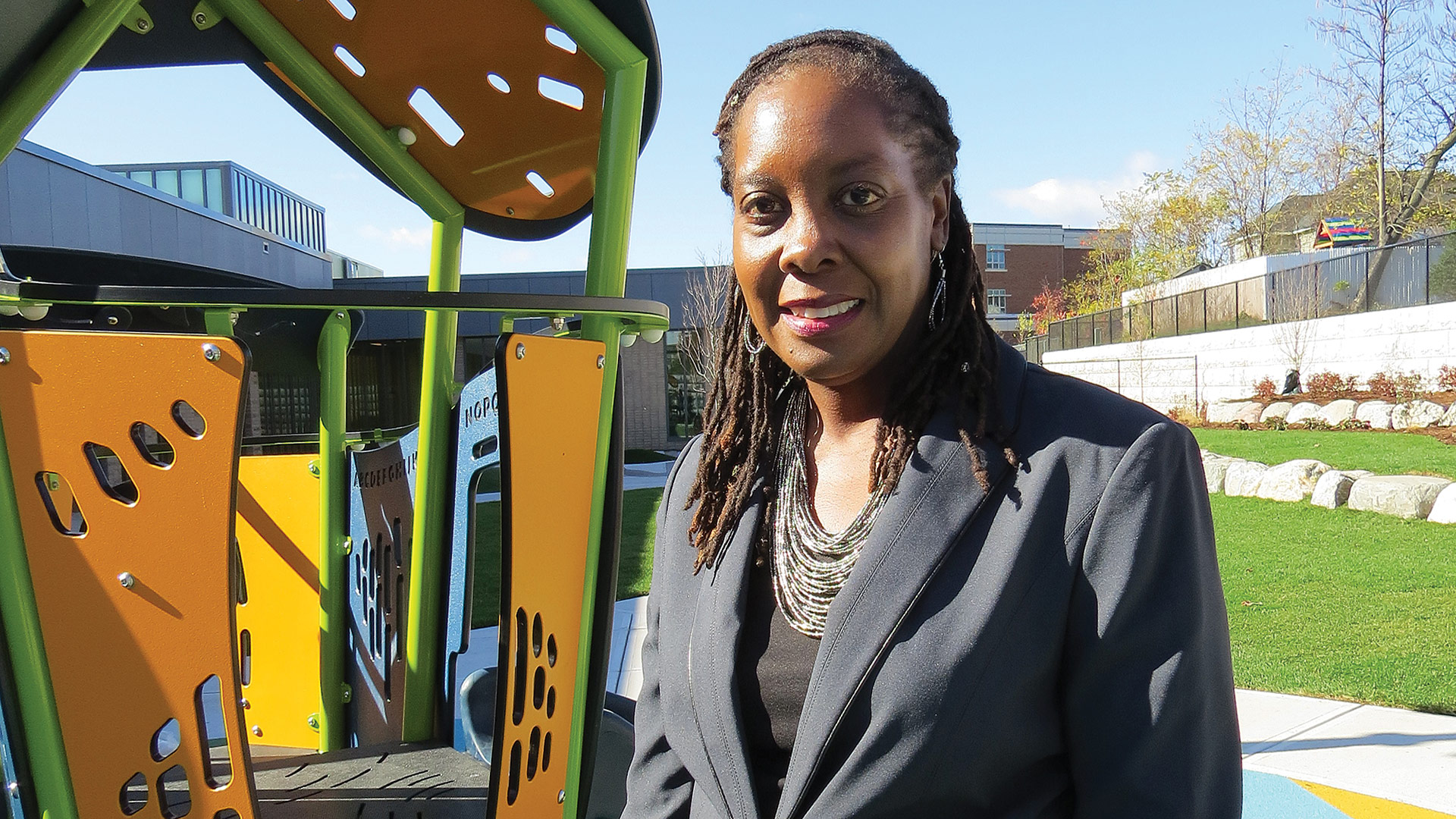
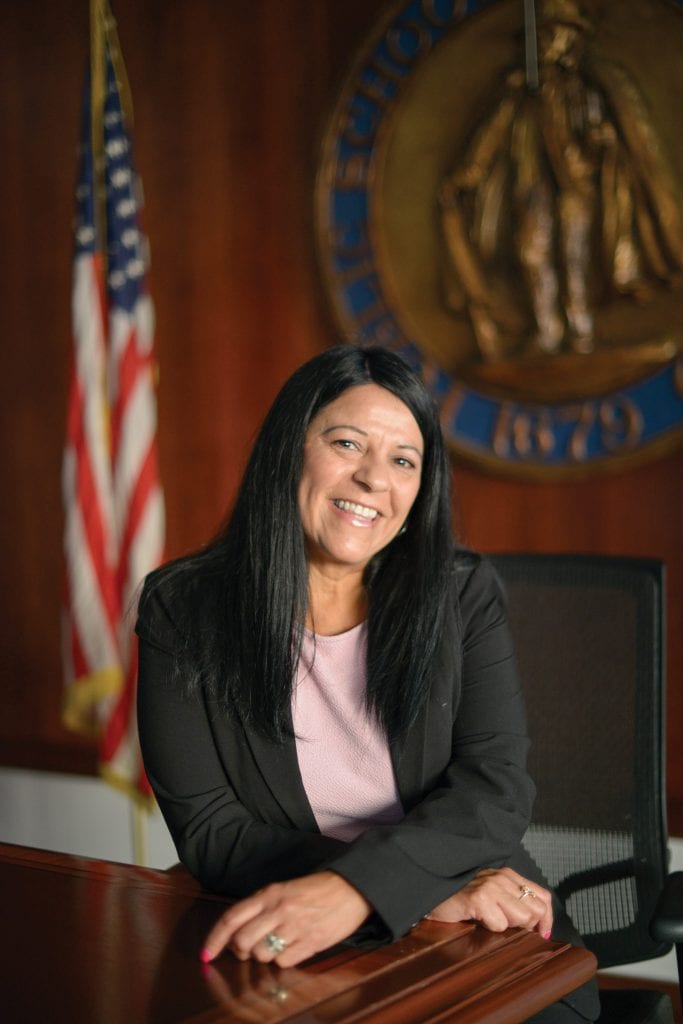
Nikki Burnett, seen here in one of the Educare center’s outdoor play areas, says the facility is a showcase of what early education should be — and what all young children deserve.

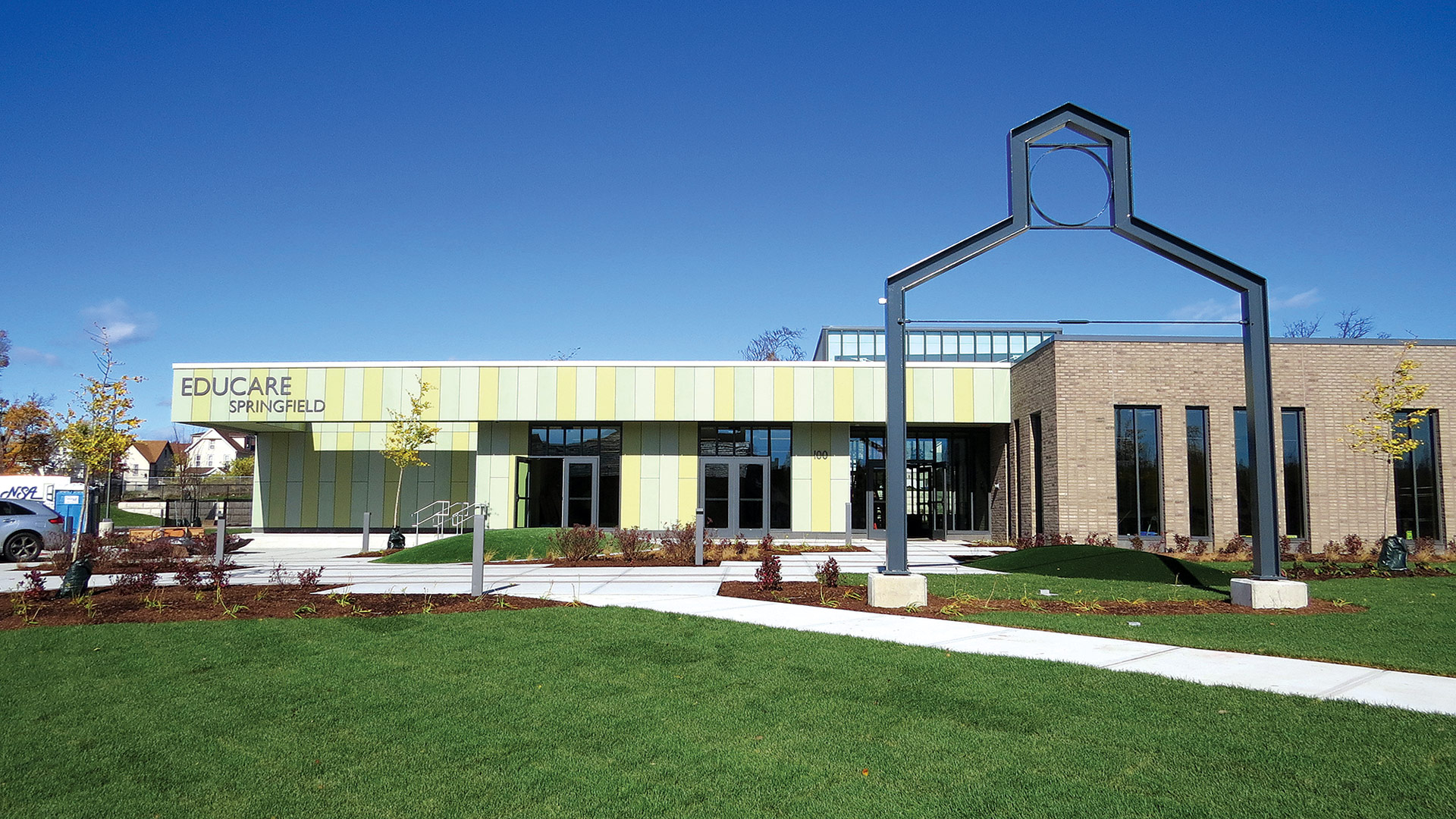
Nikki Burnett says Springfield’s Old Hill neighborhood and those surrounding it certainly need the gleaming new $14 million Educare facility constructed next door to the Elias Brookings Elementary School on Walnut Street.

More to the point, though, she told BusinessWest, they deserve this facility, which can only be described with that phrase state-of-the-art when it comes to everything from its programs to its play areas to its bathrooms.

“Mason Square, Old Hill, McKnight, Bay, all those neighborhoods … they’re so rich in history, so they’re rich in great success stories that have come out of here and are still coming out of here,” said Burnett, the recently named executive director of the 27,000-square-foot facility, who should know; she grew up there herself. “People like Ruth Carter, who just won an Oscar for the costume design in the movie Black Panther — she’s from Springfield.

“We have to celebrate those things, and we have to model those things for our children so they can see that they have greatness in them,” she went on. “One of the very important things about Educare is that it aligns potential with opportunity. I believe all children are born with immense potential, but many do not have the same opportunity to realize that, so Educare will give them that push — it will help readjust their trajectory.”

That’s why this area of the city, traditionally among the poorest neighborhoods in the state, deserves this Educare facility, just the 24th of its kind in the country and the only one in Massachusetts, she continued, adding quickly that this building, and the Educare model itself, were designed to show decision makers and society in general what all young children deserve and what has to be done so that they can all enjoy a similar experience.

Mary Walachy, executive director of the Irene E. and George A. Davis Foundation, which spearheaded efforts to bring the Educare facility to fruition, agreed.

“The message being sent here is that it costs money to do this work well,” she said. “It costs money to fund quality at the level that children in this community and others deserve, and we can’t expect outcomes that we want from children if the investment is not there at the front end.”

Considering those comments, Educare is certainly much more than a building, and those who visit it — and many will in the weeks and months to come — will come to understand that.

Indeed, the facility set to open later this year, supported by the Buffett Early Childhood Fund and to be operated in partnership with Holyoke Chicopee Springfield Head Start, is, for lack of a better term, a standard — or the new standard when it comes to early-childhood education.

And it is, as Burnett and Walachy noted, a model — hopefully to be emulated — that incorporates everything science says young children need to flourish. This includes data utilization, high-quality teaching practices (three teachers to a classroom instead of the traditional two), embedded professional development, and intensive family engagement.

All this and more will come together at the much-anticipated facility, which will provide 141 children up to age 5 (already enrolled at a Head Start facility in that neighborhood) and their families with a full-day, full-year program that Burnett projects will be a place to learn — and not just for the young children enrolled there.

The Educare facility in Springfield is just one of 24 in the country and the only one in Massachusetts.

“Educare is going to be a demonstration site; we’re going to be able to bring in students of education, social work, counseling and therapy, and other areas from across the state and have them observe and learn our model,” she explained. “We understand that 141 children is not every child; however, what we learn here, we’re going to be able to send out — others can do what we’re doing. And on a policy level, it’s my hope that legislators can see the success of this and realize that, when they’re making out the budget, it needs to be funded so everyone can enjoy Educare quality.

“Educare is not going to be on every corner,” she went on. “But that doesn’t mean that the quality of Educare cannot be beneficial to all children.”

For this issue and its focus on education, BusinessWest toured the Educare facility and talked with Burnett and others about what this unique early-education center means for Springfield and especially those young people who walk through its doors.

New School of Thought

Janis Santos, the longtime director of Holyoke Chicopee Springfield Head Start, recalled that, when she toured the Educare facility recently as construction was winding down, she became quite emotional.

“I have to be honest, I started crying,” said Santos, honored roughly a year ago by BusinessWest as one of its Women of Impact for 2018. “One of the construction-crew members said, ‘why are you crying?’ and I said, ‘because I’m so happy.’

“Educare is going to be a demonstration site; we’re going to be able to bring in students of education, social work, counseling and therapy, and other areas from across the state and have them observe and learn our model.”

“This is a dream come true,” she went on, adding that the facility provides dramatic evidence of how far early-childhood education has come during her career — it was considered babysitting when she got her start — and how important it is to the overall development of young people.

Tears of joy have been a common emotional response among those who have toured the site, especially those involved in this initiative from the beginning, but there have been others as well. Indeed, Burnett told BusinessWest, when the staff members assigned to the Educare center visited the well-appointed teachers’ room, many of them started clapping.

These reactions provide ample evidence that the six-year journey to get the facility built and the doors open was certainly time and energy incredibly well-spent.

By now, most are familiar with the story of how an Educare facility — again, one of only 24 in the country — came to be in Springfield. It’s a story laced with serendipity and good fortune at a number of turns.

It begins back in 2014 when an early-childhood center on Katherine Street in Springfield closed down abruptly, leaving more than 100 children without classroom seats, said Walachy, adding that the Davis Foundation began looking at other options for early education in that building.

One of them was Educare, she went on, adding that officials with the Buffett Foundation and other agencies involved, as well as architects, came and looked at the property. They quickly determined that it was not up to the high standards for Educare centers.

“Their model is ‘make it a state-of-the-art, unbelievable building to send a strong message that this is what all kids deserve,’” said Walachy, adding that, after those inspections and being informed that a new facility would have to be built at a cost of more than $12 million, the Educare concept was essentially put on the shelf.

And it stayed there for the better part of two years until an anonymous donor from outside the Bay State who wanted to fund an Educare facility came into the picture.

“This individual pledged to pay for at least half the cost of building an Educare somewhere in the country, and she was willing to do it here in Springfield,” she said, adding that the donor has written checks totaling more than $9 million for both the construction and operation of the facility.

With this commitment, those involved went about raising the balance of the needed funds — the Davis Foundation and another donor committed $2 million each, and state grants as well as New Market Tax Credits were secured, bringing the total raised to more than $20 million — and then clearing what became another significant hurdle, finding a site on which to build.

Indeed, the Educare model is for these facilities to be built adjacent to elementary schools, and in Springfield, that proved a challenging mandate. But the tornado that ravaged the city, and especially the Old Hill area, in 2011, forcing the construction of a new Brookings School, actually provided an answer.

Indeed, land adjacent to the new school owned by Springfield College was heavily damaged by the tornado, making redevelopment a difficult proposition. Thus, the college became an important partner in the project by donating the needed land.

But while it’s been a long, hard fight to get this far, the journey is far from over, said both Burnett and Walachy, noting that another $500,000 must be raised to fund an endowment that will help cover operating expenses at the school.

And raising that money is just one of many responsibilities within Burnett’s lengthy job description, a list that also includes everything from becoming an expert on the Educare model to attending regular meetings of Educare facility directors — there’s one in New Orleans later this year, for example.

At the moment, one of the duties assuming much of her time is acting as a tour guide. She even joked that she hasn’t mastered the art of walking backward while talking with tour participants, but she’s working on it. To date, tours have been given to city officials, funders and potential funders, hired staff members, like those aforementioned teachers, and, yes, members of the media.

BusinessWest took its own tour, one that featured a number of stops, because items pointed out are certainly not typical of those found in traditional early-education centers.

“I literally cannot wait to see the children in there — that will be a special moment.”

Starting with what Burnett and others called the “outside-in” of the building’s design, which, as that phrase indicates, works to bring the outside environment into the school to provide continuity and the sense that the school is part of the larger world. Thus, green, grass-like carpeting was put down in the entranceways, and green carpet prevails pretty much throughout the facility. Meanwhile, the brick façade on the exterior is continued inside the building.

Throughout the building, there are generous amounts of light and state-of-the-art facilities throughout, from the well-equipped play areas inside and out to the two sinks in each of the classrooms — one for food preparation, the other for hand washing — to the restrooms designed especially for small people.

In addition, each classroom is equipped with small viewing areas with one-way mirrors so that so-called ‘master teachers’ and others can see and evaluate what’s happening.

In all, there are 12 classrooms, seven for infants and toddlers and five for preschool. As noted earlier, they will be places of learning, and not just for the students.

Model of Excellence

Returning to that emotional tour of the Educare facility she took a few weeks ago, Santos said that, as joyous and uplifting as it was, she’s looking forward to the next one even more.

“I literally cannot wait to see the children in there — that will be a special moment,” she told BusinessWest, putting almost a half-century of work in early childhood behind those words.

She can’t wait because students will be learning and playing in a facility that really was only a dream a few years ago — a dream that came true.

It’s a facility that those students truly need, but as Burnett and all the others we spoke said, it’s one they deserve — one that all students deserve.

George O’Brien can be reached at [email protected]
Veterans in Business

Retired Marine Corps Major Stresses Teamwork, Accountability

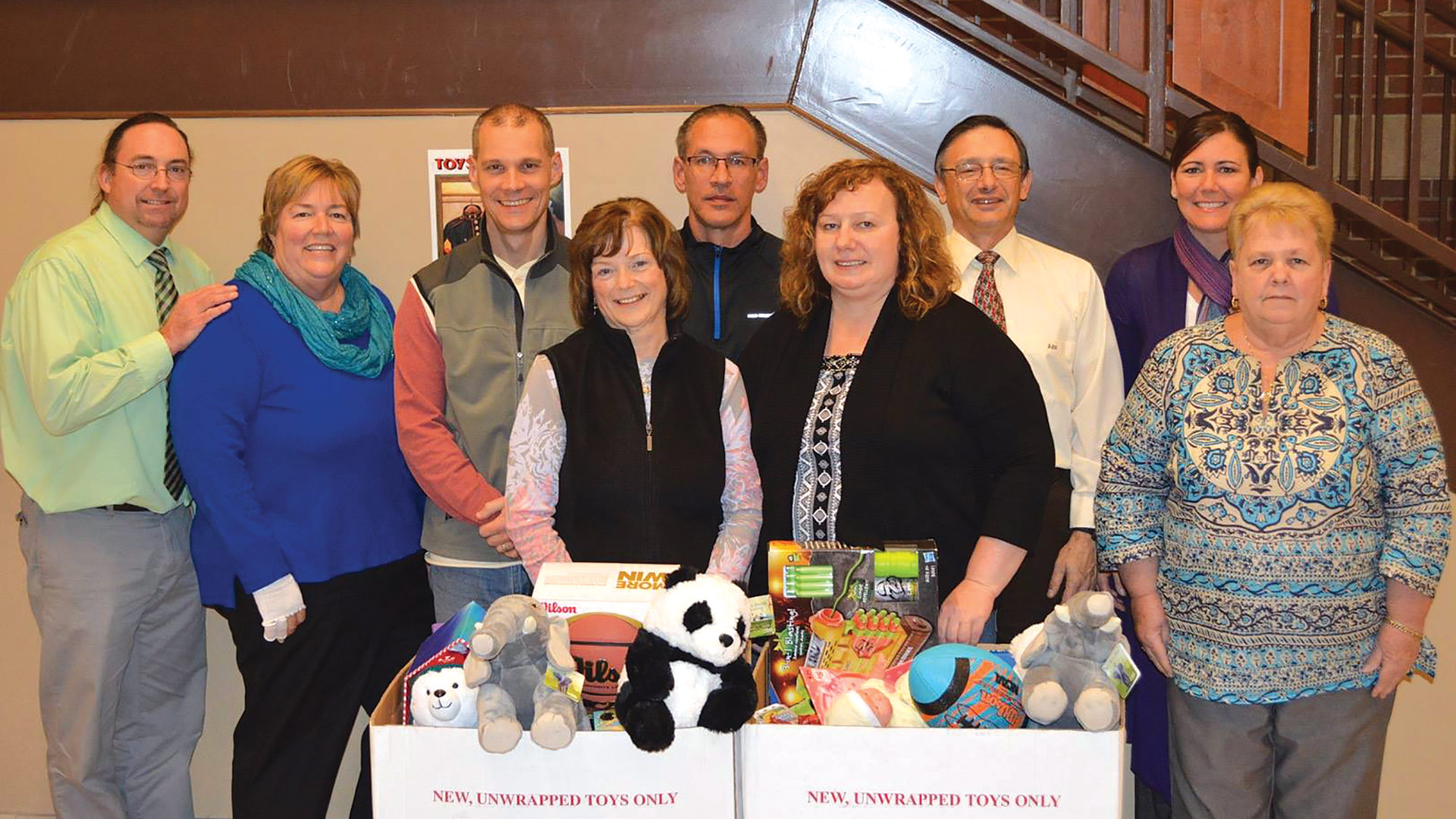
Corey Murphy, third from left, with several First American Insurance employees during a Toys for Tots campaign the company helped launch.

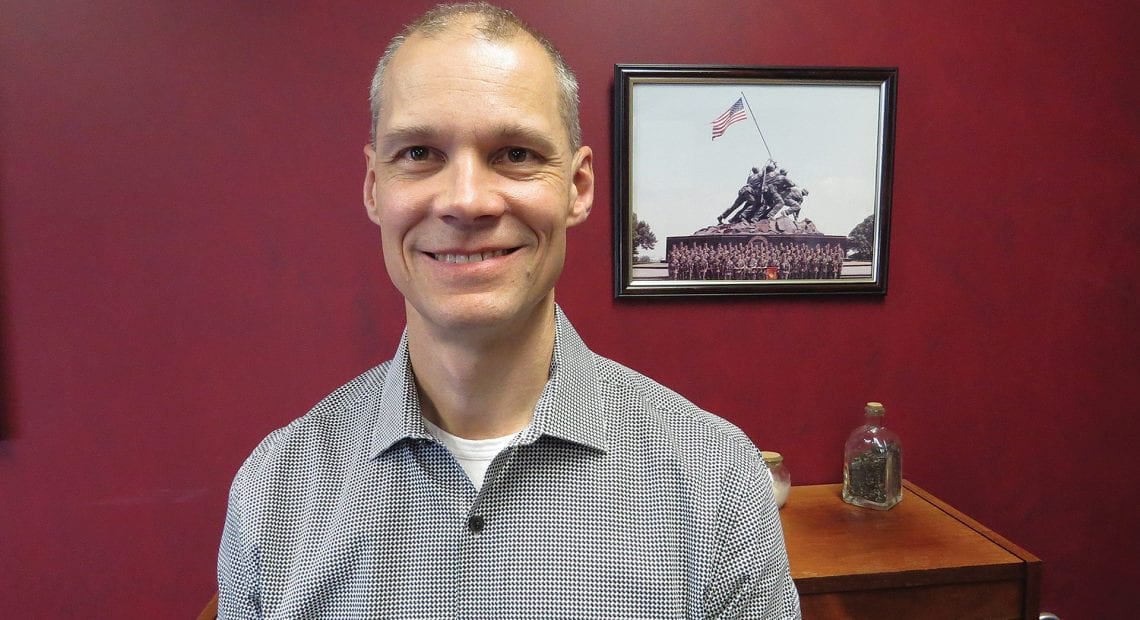
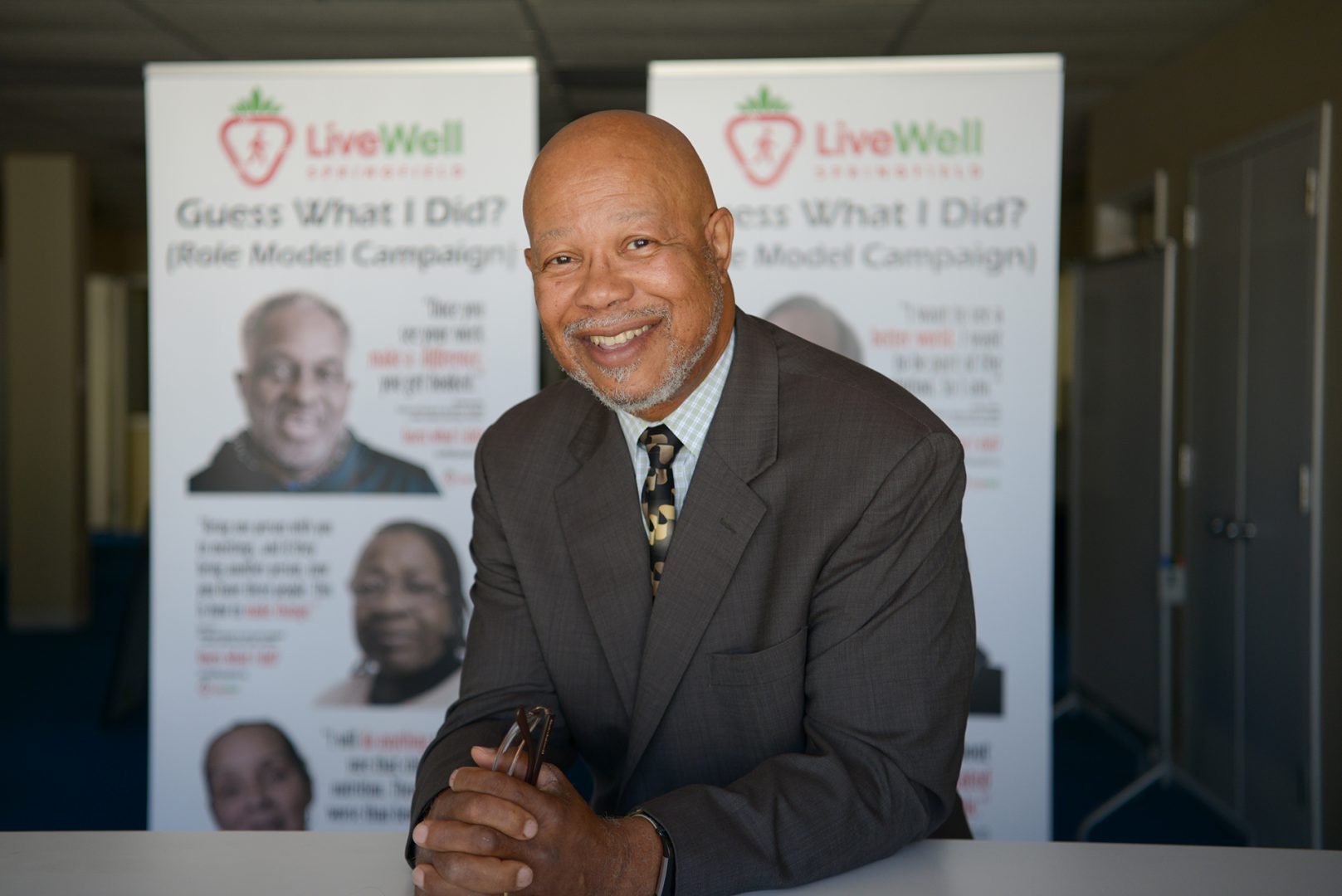
Corey Murphy knew he was no longer on active duty with the Marine Corps when he walked into his first staff meeting at his family’s business — Chicopee-based First American Insurance — with the accent on when he walked in.

Indeed, that meeting was scheduled for 8 a.m., and from his years as a Marine officer, Murphy translated this to mean that he should arrive no later than 10 minutes before the hour.

“You never, ever walk into a meeting if the boss is already there; you just don’t do that,” he told BusinessWest, referring to life in the Marine Corps. “So I show up at 10 of 8, because … if you’re on time, you’re late. I’m looking at my watch, and I’m the only one sitting there. I look at my watch again at 8, and I’m still the only one sitting there, and I’m thinking to myself, ‘what’s going on here?’ I couldn’t comprehend the idea of having an 8 o’clock meeting and have it not start by 8 o’clock.”

This wasn’t a serious wake-up call, but simply a reminder that life in the business world is not exactly like life in the Corps. He would get other lessons to this effect, he went on, adding that he once asked someone to get him something by the ‘close of business.’

“Two of the biggest similarities between the military and the business world are teamwork and accountability.”

“The military interpretation of that is that is ‘when you’re done, then you can close your business day,’” he explained. “As opposed to ‘it’s 5 o’clock, and I’m going home.’ They didn’t get it done by 5 and went home, and I said, ‘wait, I said close of business.’”

So there was certainly a period of what Murphy called “transition and adjustment” from life in the military to work at the office on Front Street. But, overall, many of the tenets, if you will, of life in the service do carry over to the workplace, often creating a more focused, more efficient, more sustainable workplace, he said, listing everything from an emphasis on teamwork to the need to keep up with — and take full advantage of — ever-improving technology, to stepping up when the need arises.

But there are other, perhaps even more important takeaways (if that’s the right term) from the military, he said, citing both the company’s philosophy of continuous education and training, and its commitment to the community.

There is a heavy emphasis on the former in the military and especially the Marine Corps, he noted, adding that there is now a similar degree of importance attached to it at First American.

“This is something I have tried to instill with everyone; training is very critical,” he said, adding that an even heavier emphasis on community involvement — one existed already at this company— stems from his experiences with the Marines is such places as Okinawa, the Philippines, and Korea.

“Coming home, I realized we have resources that we can use to try to make a difference, and so we try to help where we can,” he said, mentioning, as just one example, the company’s visit to a nearby elementary school on Halloween to distribute candy to the students.

Overall, Murphy spent 20 years with the Marines, on active duty and with the reserves, and retired as a major. He said joining the Corps was something he “always wanted to do,” although he couldn’t pinpoint a reason for this. He said his uncle served in the Marines during Vietnam and took part in the prolonged siege of Khe Sanh, but doubts whether that was a motivating factor in his decision.

Murphy went into the Marine Corps Officer Candidate School at Quantico, Va. while attending Virginia Military Academy, and, after gaining his commission, was stationed in Hawaii and, later, Korea and Okinawa.

In the fall of 1998, he finished his four-year tour of duty and joined the family business. He would eventually buy it from his father in 2014.

After only six months of being home, he joined the Reserves, and would continue to serve — he did take a break at one point to earn his MBA — for another 16 years, before retiring in 2016. The last five years were spent with Marine Forces Pacific, leaving First American for stretches lasting several weeks on average to take part in exercises across that vast theater.

To be able to take part in such assignments, Murphy said he knew he needed a capable team behind him, one he knew he could trust to carry on without him — although, with technology, he was able to keep in touch.

And this is one of the many aspects of military service that has carried over to the workplace, he said, noting that teamwork and doing what’s necessary are some of the guiding philosophies at First American.

“Two of the biggest similarities between the military and the business world are teamwork and accountability,” he said, adding that they are necessary in both settings, and he has worked to instill these attributes in his team of nearly 20 employees. “If someone’s out sick or if we’re down a person or things get busy, there’s an expectation that people are going to pitch in and do whatever they need to do.”

Overall, Murphy said what he’s brought back from the Marine Corps is a philosophy of “adapt and overcome,” which is a big reason for the success the company has enjoyed.

“You adapt to the situation, and you overcome,” he explained, adding that this what happens in the Marines. “You go in with aplan, but the enemy has a plan, too. So you have to adapt to the situation you’re presented with and come up with a new plan.”

Murphy said he’s adjusted well to the business world and how it differs from the military, right down to what time people are expected at meetings and what ‘close of day’ means in this setting.

But the two worlds are actually more similar than they are different, he added, and those basic tenets of teamwork and accountability are the cornerstones on which success is built.

George O’Brien can be reached at [email protected]

Veterans in Business

Her Afghanistan Tour Brought Many Lessons for Life, Business

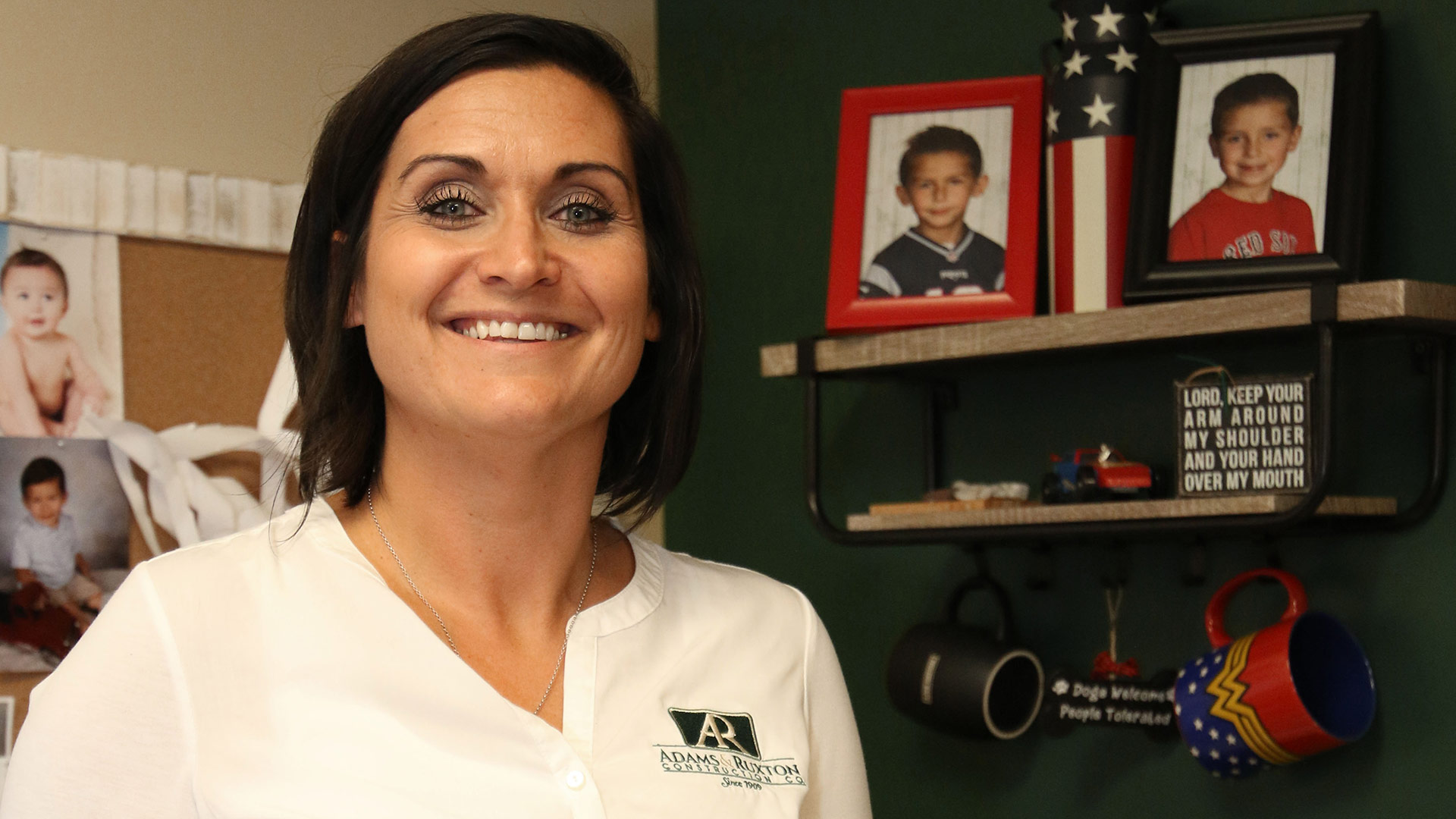
Dorothy Ostrowski is seen here during her tour of duty in Afghanistan with Gen. Karl Eikenberry (center) and fellow military police officers (from left) Ryan Stone, Dominic Cirillo, and Jeffrey Botcher.

Dorothy Ostrowski was only 17 when she joined the Army National Guard.

She needed her parents’ consent to do so at that age, and she got it, because they knew — and, more importantly, she knew — that this was something she needed at that critical junction in her life.

“I didn’t have probably the best circle of friends at that time,” she told BusinessWest, turning back the clock more than 23 years. “I was looking to get some direction in my life.”

To say she found some through her seven years in a military police company, serving in locations ranging from Italy to Panama to Afganistan, where she became a chase driver for Gen. Karl Eikenberry, would be a huge understatement.

Indeed, she said, during that time of service, she gained invaluable lessons in teamwork, trusting those you’re working beside, being ready for essentially anything, taking nothing for granted, and taking good care of team members.

And they have served her well since, in positions ranging from emergency-room nurse to president of the company that she and her husband, Mike, purchased at the start of this year, West Springfield-based Adams & Ruxton Construction.

“There are many ways in which what you learn in the military impacts what you do in life and in business,” she noted. “There’s the teamwork dynamic, the attention to detail, and the mindset of taking care of the troops — your troops eat first. It’s about taking care of the people around you, because they’re the ones who are going to pull you through things. And that directly impacts where I am now.”

“There would be times when you were out on convoys and there would be explosions, or you’d be out on a mission … and you’re not really thinking that you might not come back at the end of the day.”

Afghanistan was essentially the final stop in a lengthy stint with the National Guard that, as noted, took Ostrowski to several other countries and working situations. She told BusinessWest that her first ambition was to be a police officer. But, as she said, she needed to bring direction to her life, and so, while still enrolled at Chicopee Comprehensive High School, she made the decision to join the Guard with the stated goal of becoming a military police officer. Boot camp was the summer after her junior year.

Looking back on her time in Afghanistan, Ostrowski said it wasn’t until that tour of duty was over and she was back in this country that she could really put those experiences into their proper perspective.

“When you’re there, you’re just doing your job,” she told BusinessWest. “There would be times when you were out on convoys and there would be explosions, or you’d be out on a mission … and you’re not really thinking that you might not come back at the end of the day.”

Her Guard unit was there to be part of the efforts to train the Afghan national army, she explained, adding that her specific role with the Military Police was to protect Gen. Eikenberry, an assignment that often put her at the wheel of the chase car that rode close behind his Chevy Suburban.

“We would ensure that no one tried to drive into him or drive him off the road,” she noted. “Our mission for those several months was to get him where he needed to go safely, whether that meant chase-driving him or accompanying him in Blackhawks or Chinooks to different villages in Afghanistan.”

When that tour of duty ended, Ostrowski enrolled at Holyoke Community College, with the goal of joining the law-enforcement field, but instead took a different career path — into healthcare. She eventually became an emergency-room nurse after gaining her degree at Springfield Technical Community College, and later, while seeking work that would allow her to spend her time with her family, joined Sound Physicians, a medical process-improvement company. Along the way, she earned a dual master’s degree in nursing and business administration at Elms College to better position herself for new opportunities and, ultimately, a leadership position.

Dorothy Ostrowski says she won’t hesitate to do anything she asks her team members to do.

She created one for herself by acquiring Adams & Ruxton, a move she categorized as part of a lifelong pattern of continually seeking out new challenges and raising the bar when it comes it comes to her career ambitions — something else she took home from her time in the military.

Today, she leads a team of 25 people and boasts a broad job description, everything from meeting with clients to coordinating the subcontractors to handling the financials. And she brings her experience in the military to the workplace seemingly every day, especially those lessons in teamwork and working as a unit to achieve a mission, whatever it may be.

To get her points across, she referenced a cartoon a friend sent her that effectively illustrates — literally and figuratively — the difference between a manager and a true leader.

“In one panel, there’s a picture of a boss sitting up on a rock with all his employees pulling him,” she recalled. “And then, in the other, there’s a picture of a leader, the one at the front of that rope helping all his people pull that big rock; that’s the kind of leader I am, and I think a lot of it comes from my time with the Guard.

“It’s about not being afraid to do anything that you ask the people you’re surrounded by to do,” she went on. “But I think it’s also about recognizing the qualities of the people around you and being humble enough to say, ‘hey, I don’t know how to do this,’ and allowing those that know how to do it to teach you to do it.”

“In the military, you rely on each other,” she said in conclusion, adding that this mindset has helped enable her to be a driving force in business, long after she was a driving force in Afghanistan.

George O’Brien can be reached at [email protected]

Veterans in Business

His Time in the Navy Provided an Education on Many Levels

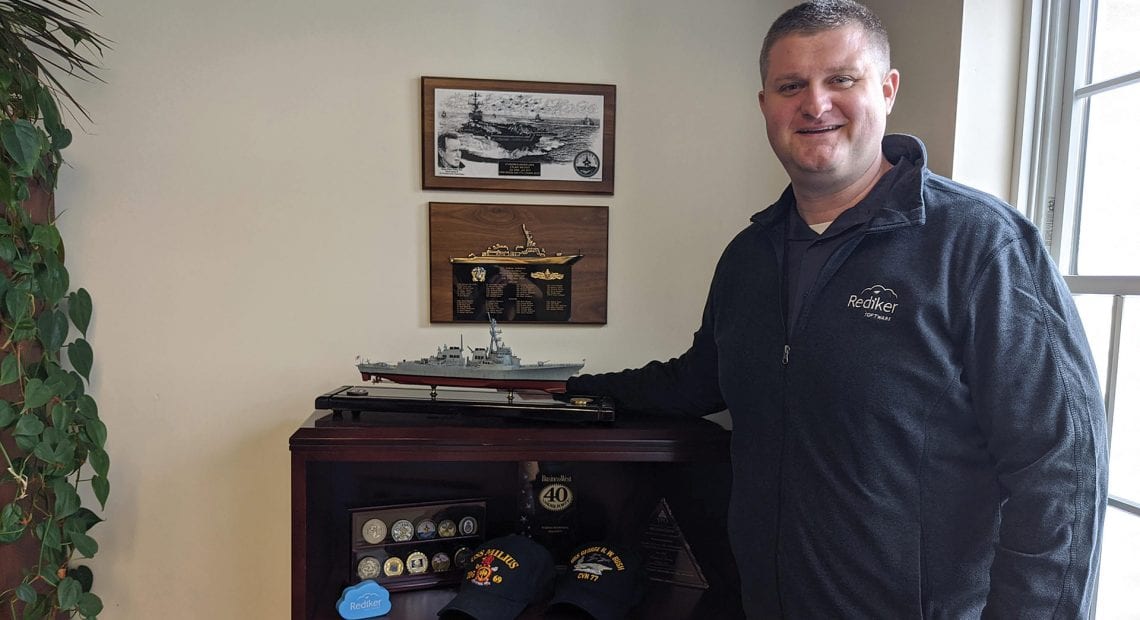
Andrew Anderlonis says his time in the Navy helped him become an effective, people-oriented leader.

Andrew Anderlonis laughed as he noted that one of the Navy’s better selling points is that, no matter where you’re stationed, you’re certain to be close to be a beach.

And that was certainly the case when he was assigned to the destroyer USS Milius (DDG 69), which was based in San Diego; there are lots of fine beaches there.

But Anderlonis said he didn’t join the Navy to sit in the sun. No, he did so to get an education — in every sense of that term.

Indeed, through the Navy, he was awarded a full scholarship to attend George Washington University, earning degrees in international business and management information systems. But that’s just one aspect of the education he received. Later, serving on the Milius and then the aircraft carrier George H.W. Bush, he was put in situations where he could lead people, develop management skills, test himself, and grow as an individual.

And he credits those experiences — everything from work on nuclear reactors to missions to thwart pirates in the Middle East — with helping him become an effective, people-oriented leader at Rediker Software, which he now serves as president.

“I call my time in the Navy the ultimate leadership experience,” he told BusinessWest. “The experience that the Navy gave me, from an early stage, right out of college, put me into some really tough, really challenging situations that helped build my confidence, helped build my humility, and helped make me the kind of manager I am today.

“There’s different styles of leader out there,” he went on. “Through the Navy, I found out I was a people-first person. Taking care of people, taking care of the sailors under me really became how I was successful. I knew that if I took care of them, they would do their jobs and take care of me, and thus we would accomplish the mission — and I carry a lot of that same methodology to how I lead and manage today.”

“I call my time in the Navy the ultimate leadership experience.”

Before elaborating, Anderlonis flashed back a few decades to his decision to commit to the Navy.

As he noted earlier, this was, as they say in the military, a tactical decision. He knew that beyond a beach — somewhere — the Navy would help provide him with both a college education and invaluable work and life experience.

And it delivered all that and more.

“The Navy was really appealing to me, and I liked the opportunities that it offered — you’re given a lot of responsibility as soon as you graduate, especially as an officer,” he recalled, adding that, after graduating from the ROTC program as a midshipman, he started his career on the Milius, a guided-missile destroyer.

There, he wore a large number of hats, as he put it; he served as a gunnery officer, a legal officer, and was the ‘vessel-boarding, search-and-seizure officer.’

After two years in San Diego, he moved on to Charleston, S.C. for a year and switched gears, becoming a nuclear engineering officer. He earned his qualification to work onboard an aircraft carrier, and was later assigned to one of the reactors on the George H.W. Bush.

All told, he served more than five years of active duty that included those two ship tours and several deployments, including (while on the Milius) some anti-piracy operations off the coast of Somalia and in the central and southern Arabian Gulf, previously known as the Persian Gulf.

“I was the vessel-boarding, search-and-seizure officer … I had an 18-person crew that was under me,” he recalled. “We would board ships and look for pirates; I was out there in my desert camos climbing up the side of tankers.”

Those were among the myriad experiences that, in total, helped prepare Anderlonis for his transition to the business world, specifically Rediker Software, a venture started by his wife’s father that specializes in integrated school-management systems.

And that preparation involved everything from technology and how to make the most of it, to management and how to handle just about anything that can be thrown at the leader of a small business.

Elaborating, he returned to that mindset, or philosophy, of being a people-oriented leader, a methodology that has worked at Rediker in the same way it did on the George H.W. Bush.

“I make sure that I take care of them,” he said, referring to his team of 95 employees. “I make sure their needs are met and that they’re happy. And I know that, in the end, they’ll take care of me and work as a team to accomplish the business objectives that we’ve laid as we move forward.”

Another tangible benefit from his years in the Navy, he said, is how it has helped him with the broad realm of crisis management and what falls into that category of ‘crisis.’

“It puts everything into perspective when you’re in a war zone and there are actual casualties or something happens and your training kicks in,” he explained. “That’s helped me decide here what’s a true emergency and what’s not. It’s also helping me to maintain a level head and manage stress. And while others are panicking or might be having a really difficult day, I’m able to help them keep a level platform and get through what they might be going through from a leadership perspective.

“At a young age, I was put in a lot of stressful situations, and there were a lot of challenging moments early in my career,” he went on. “And I think those really helped define who I am as a manager and a leader today.”

Meanwhile, there was certainly some beach time in the Navy as well, especially in San Diego. But that’s another story.

George O’Brien can be reached at [email protected]

Features

Driving Force

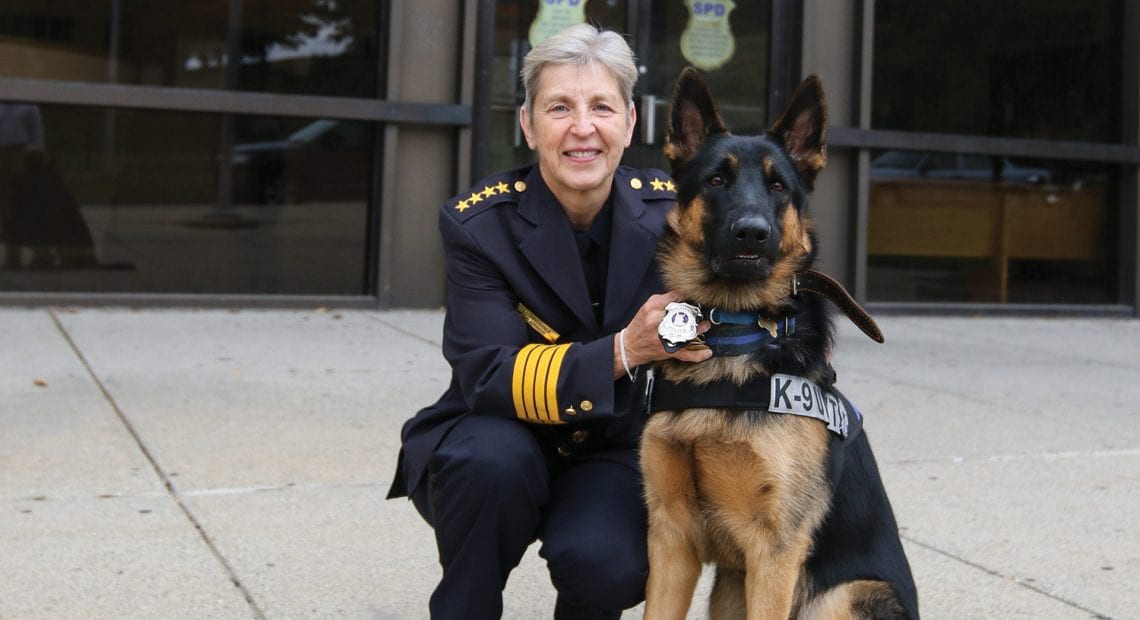
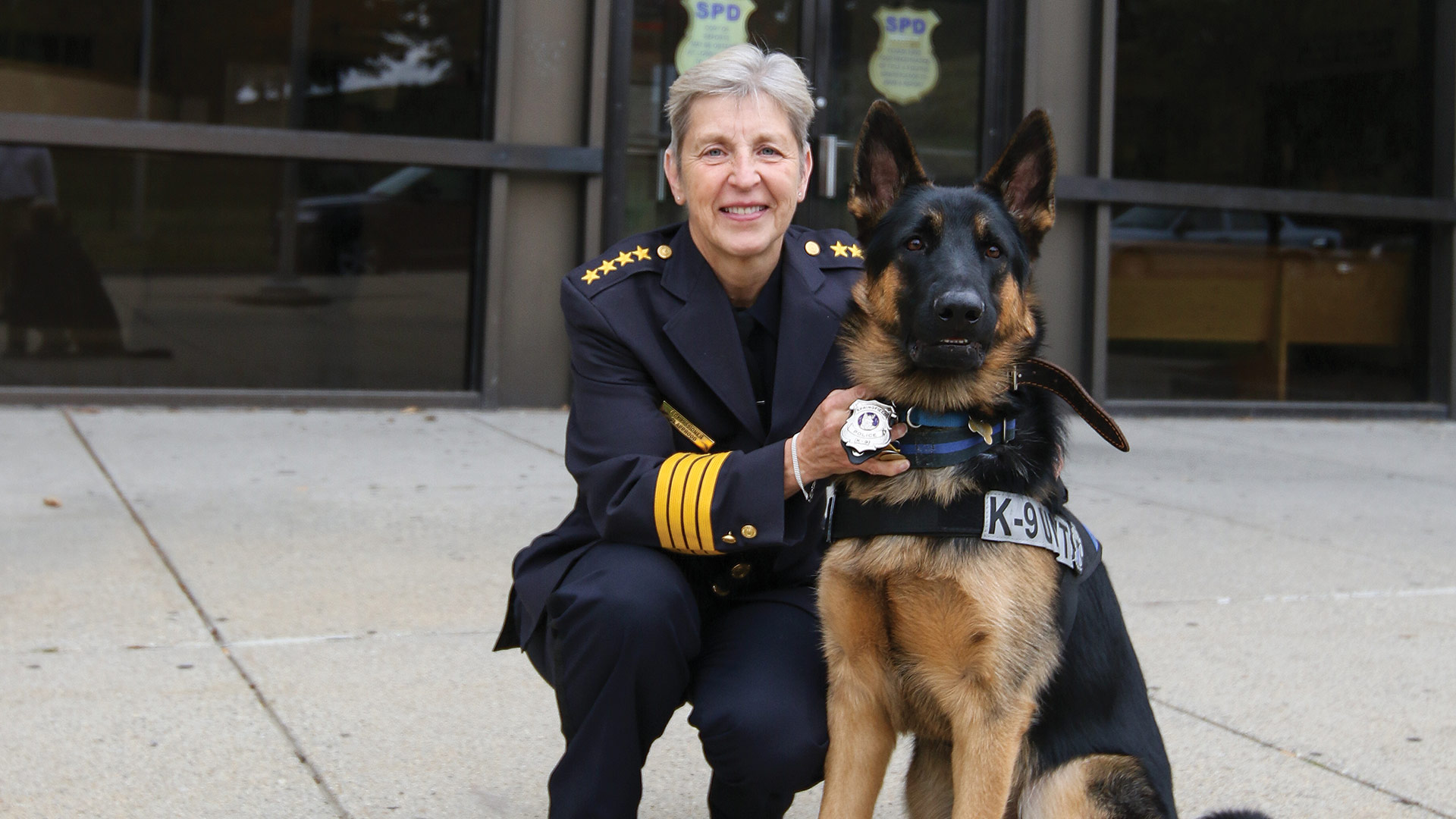
Police Commissioner Cheryl Clapprood with Mango.

A few years ago, Cheryl Clapprood was thinking about retirement. But a love of the work and opportunities for advancement kept her in uniform, and with the abrupt resignation of Commissioner John Barbieri, she was put on a path to lead what has become an embattled department, one dealing with fallout from scandals, controversy, and staffing issues.

His name is Mango.

He’s a 1-year-old German shepherd who carries a badge.

Legend has it — and he’s already becoming legend — that he lacked the temperament or concentration needed to be to be a medical alert dog, like his parents — a highly trained canine that can sense when its master is about to have a seizure, for example. And he wasn’t (and still isn’t) aggressive enough to be a true police dog.

So … he has become a comfort dog for the department (more on that later) and an ambassador of sorts — his business card (yes, he has one) reads ‘Comfort K9’) — visiting area schools, showing up at various events, and becoming a face of the Springfield Police Department.

He joined the force, if that’s the proper term, in June, and he is getting comfortable in his new role and seemingly enjoying it more every day.

Those are sentiments are shared by the person he shares an office with — Springfield Police Commissioner Cheryl Clapprood, who dropped ‘interim’ from her title and was officially sworn in to her new position a month ago.

But she has been leading the force for roughly nine months now, since the abrupt resignation of John Barbieri amid a growing number of scandals involving the department. These include the arraignment of 13 current or former police officers on allegations that they either participated in or helped cover up the alleged 2015 off-duty police beating of four men outside Nathan Bill’s Bar & Restaurant, and also federal indictments stemming from alarming video showing Officer Greg Bigda threatening two juvenile suspects arrested for stealing an unmarked police car, among other recent incidents.

“When a couple of incidents happen, it sets you back, and people tend to lump us all together — it’s a profession where, when one officer does something, the rest of us pay the price, and that’s nationwide.”

In the wake of these scandals, Clapprood said, all those in the department are being painted with the same broad brush as those accused of abusing their power, and this is unfortunate, because the vast majority of officers don’t.

“When a couple of incidents happen, it sets you back, and people tend to lump us all together — it’s a profession where, when one officer does something, the rest of us pay the price, and that’s nationwide,” she said. “They treat us all the same, as if we had all committed these crimes. The video got out of Bigda in the cell block, and a lot of people were appalled and shocked at the behavior, but now, people think, ‘oh, that’s how the Springfield Police Department treats prisoners, that’s how they treat juveniles; it’s like we were all in that cell block with him.”

Still, the culture of the department needs to change, she said, adding that these scandals are just one of the challenges facing a department of roughly 500 officers. She told BusinessWest that police work is not as popular and glamorous as it was years ago, and it is, by almost all accounts, more dangerous. That means there are fewer people looking to enter law enforcement, she went on, and when you couple this with the number of officers currently on suspension and those planning to retire early next year, the department is facing a potential staffing crisis.

“We cannot recruit, and we cannot retain,” said Clapprood, adding that Springfield is certainly not alone when it comes to this challenge — other departments are facing the same issues. “We’re having a very difficult time recruiting and retaining officers, and every city in Massachusetts, and, from what I hear, every major city in the country, is facing the same problem.”

Despite these pressures and challenges, the department is, by most measures, creating progress when it comes to the incidence of many types of crimes, and in improving the perception of the city when it comes to public safety, especially in a downtown that is drawing ever-larger numbers of visitors since the opening of MGM Springfield.

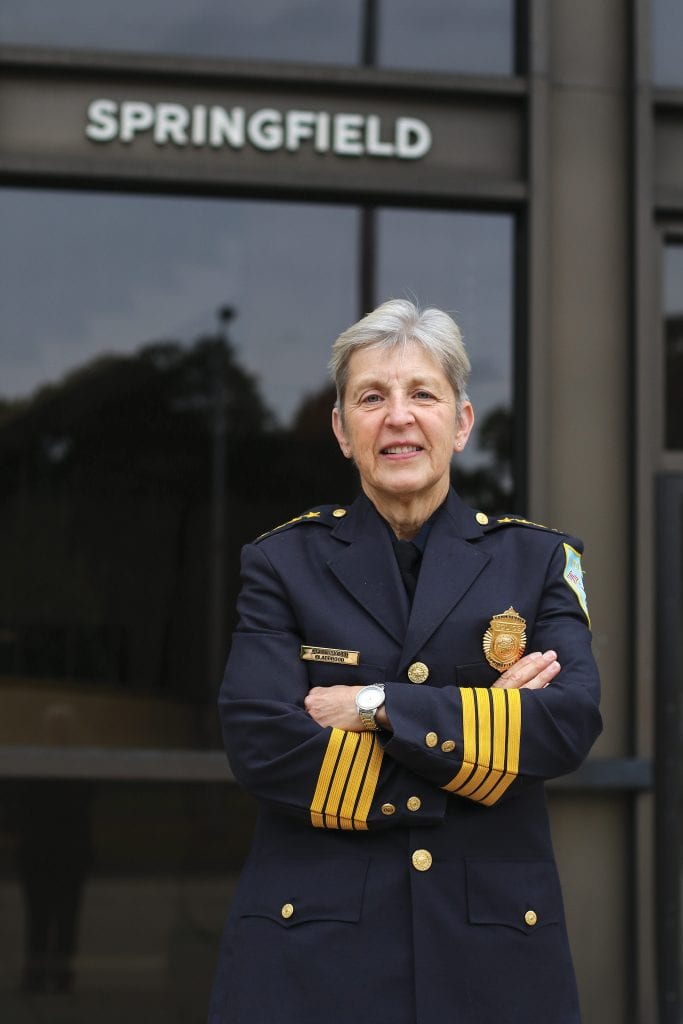
Cheryl Clapprood, see here being sworn in as police commissioner, says the Springfield Police Department must change its culture to regain the confidence of the public.

“Violent-crime numbers are down, in large part because there are a lot of officers in the downtown area now,” she said, adding that the department’s relatively new Crime Analysis Unit, which crunches the numbers when it comes to what types of crimes are being committed and where, is also helping make the streets safer.

For this issue, BusinessWest talked at length with Clapprood about the state of public safety in the City of Homes and her efforts to change the perceptions of, and the culture within, the department she has been part of for four decades.

Out of the Blue

Clapprood told BusinessWest she recently met up with a woman she attended elementary school with a half-century or so ago. “She gave me a hug and said, ‘do you remember in the second grade when you said you wanted to be a cop?’”

Clapprood didn’t remember actually making that specific comment at that time, but she did recall always being drawn to that type of work.

“I was the crossing guard, I was in school security — I was in all those things,” she recalled, adding that her family lacked the money to send her to college, so she joined the Air Force, where she also gravitated toward the security side of the equation, and fully embraced it.

“It’s going to take some time. I knew we would not win back a good reputation in a short amount of time. It’s going to take some years to build this back up again. But you do it slowly; you show the community that you have officers who are professional officers who have integrity and do a good job.”

While stationed at Westover, she read in the local paper about the upcoming Springfield police cadet exam.

“I was 19, and I said, ‘that sounds really interesting,’” she recalled. “I took it, I passed, and became a police cadet in April 1979. And it’s just followed a course from there — I love the Springfield Police Department; it will be 41 years next April.”

Most police officers retire long before getting to 41 years — a fact of police work that is contributing to the staffing issues we’ll get to later — but Clapprood said she loved the work, and opportunities to advance continued to present themselves.

Fast-forwarding through four decades with the force, she said she gradually moved up in the ranks and eventually reached captain and eventually captain of the Community Action Division, which includes traffic, canine, C3 Policing (or what Clapprood calls “community policing on steroids”), and other programs. And that experience inspired her to stay on for a few more years.

She then took the assessment test for deputy chief, thinking it would be a good experience for her. She would soon discover that everyone else on the list for that post had retired, and with more retirements pending, she decided to hang in still longer.

It was a decision that would eventually propel her to the commissioner’s office, first as interim in February, and then on a permanent basis earlier this fall.

Since taking the helm, she has made it a point to get out in the community and meet with as many constituencies as possible, learning of their needs and concerns and letting them know what the department is doing to address them.

She’s also brought Mango into the department, giving him a role that is new to the force — comfort dog.

Police Commissioner Cheryl Clapprood says one challenge facing the police department — and all departments — is recruiting and retaining new officers.

“I don’t think people realize what the police officers go through on a daily basis, the things they see, and how it affects them,” she explained. “And he’s been a home run; I bring him to roll calls and the report room, and so far, everyone loves him. He makes trips around the station every day and goes to community events and meetings.

“Sometimes people come in here and they can be jacked up a little bit — they have problems and complaints,” she went on, referring to both members of her department and the general public. “I always ask, ‘are you all right with a dog?’ By the time they’re done petting him and him kissing them, they’ve come down to a level that’s very amicable for me.”

Arresting Developments

But there are a number of issues and problems that can’t be solved with a visit to or from Mango, and these are the matters currently absorbing most of Clapprood’s time.

The department’s scandals and the image problems they’re creating are at the top of this list, she said, adding that she knew changes needed to be made even before she became commissioner.

“You can’t waffle, and you can’t wait for problems to go away — that tends to cause you more problems than you had before,” she told BusinessWest, adding that she is taking a proactive approach to the issues facing the department and bringing about a change in the culture.

“It comes back to instilling discipline, it comes back to training, it comes back to accepting responsibility,” she explained. “That’s what I preach at the staff meetings and with the officers, and you have to lead by example.

“When I was a young police officer here, you’d have to force people out at 65; they were fighting it, calling it age discrimination and threatening to file suit. They didn’t want to go at 65. But it’s a tough job now, and I can’t blame people for wanting to retire earlier.”

“And it’s going to take some time,” she went on. “I knew we would not win back a good reputation in a short amount of time. It’s going to take some years to build this back up again. But you do it slowly; you show the community that you have officers who are professional officers who have integrity and do a good job.”

Meanwhile, another matter is keeping the department staffed, a considerable challenge given the fact that many officers are retiring at an earlier age than a generation ago and fewer young people are looking to enter what was once a proud profession.

“They go early now,” she said, referring to officers and retirement. “When I was a young police officer here, you’d have to force people out at 65; they were fighting it, calling it age discrimination and threatening to file suit. They didn’t want to go at 65.

“But it’s a tough job now, and I can’t blame people for wanting to retire earlier,” she went on. “There have been a few on-duty deaths in recent years, and the last one [Officer Kevin Ambrose] shook up a lot of people.”

Clapprood told BusinessWest that the staffing challenges will soon force some hard decisions on which programs it can continue to operate. For the long term, she worries that such issues will force her department and others to lower their standards when it comes to who can eventually wear a badge.

“In time, lowering standards can cause more problems,” she said, adding that, while once the department desired a bachelor’s degree and later an associate degree, it will now accept a GED. “You might see people here who maybe are not mature enough or didn’t want it for the right reasons; it will bring about a host of other issues.”

As she noted, there are positive things happening within the department and across the city from a public-safety perspective, but these developments are getting lost amid the scandals and negative press.

In an effort to shed some light on them, Clapprood has gone on radio talk shows and writes a regular column for the Republican in an effort to get the word out.

This month’s offering is typical of the submissions: there is commentary on timely topics — October is Domestic Violence Awareness Month, so she discussed the department’s team of domestic-violence advocates — as well as relevant updates, specifically one on the pending decision on which vendor will supply the department with body-worn cameras.

“Cameras aren’t perfect, but they will be beneficial both to our officers and our residents,” she wrote, echoing comments she offered to BusinessWest on this subject. “Just about every department to which we’ve spoken said complaints about officers nearly disappear once they implement a body-worn camera program.”

She also shares news about the department — this month there was mention of how Bill Schwarz, the department’s Crime Analysis director, was recently presented with the International Assoc. of Crime Analysts membership award — as well as another warning about scams and a reminder that photos of she and Mango for the police officers’ ball book can be seen on Mango’s Facebook page.

“I’m trying to get out a lot of good and a lot of the things that we do here,” she said. “And it’s been received very well.”

Paws for Effect

Like most dogs, Mango now has the run of the house — well, Clapprood’s office, anyway

There’s a dog bed not far from the commissioner’s desk, and she likes that he recently developed an affinity for the couch that sits in the corner.

“No one else likes to sit there, so I guess it’s Mango’s,” she said, adding that she and the department’s comfort dog are both growing into their jobs — and they both have a detailed job description.

Clapprood’s can be boiled down to putting her department and all its officers in a position to succeed while also changing the culture within the department, and, at the same time, making the city a safe place to visit and for those who live and work here.

There is considerable work to be done and challenges to be overcome, but Clapprood believes the department can get where it wants and needs to go. It won’t happen overnight, as she said, but it can happen slowly but surely.

Leading those efforts has been a life-long ambition, or at least since the second grade, according to at least one account.

George O’Brien can be reached at [email protected]

Women of Impact 2019

Partner, Shatz, Schwartz & Fentin, P.C.

She’s Made It Her Mission to Help Others Get Connected

‘Hi, Ellen. I hope all is well. I can’t wait to see you soon and hear all about your trip! My colleague Erica is very interested in getting even more deeply connected to the philanthropic life of the Greater Springfield area. Your name immediately came to mind, and I thought you both would have a lot to discuss.

Erica: Ellen is incredible! Please feel free to connect directly.’

Ellen Freyman doesn’t know how many e-mails like this one she’s received over the past few decades, but she does know it’s a big number. And she’s proud of each one.

The subject matter varies slightly (she’s obviously not recently back from a trip in all cases), but there are similar themes and like words and phrases used, and, yes, probably lots of smile emojis.

In short, this missive she agreed to share, sent by an executive at a large local employer, sums up perfectly why Freyman, an attorney with the Springfield-based law firm Shatz, Schwartz & Fentin, is a Woman of Impact and, well, what makes her tick, to summon a phrase from another time.

In short, Freyman’s name is the one that immediately comes to mind when people such as the executive who sent this note want to help others get more connected to the philanthropic life of this region.

“What I like to do is bring together people who should know each other, who should be working together and collaborating.”

That’s what Freyman does. It’s not all she does, as we’ll see. But that’s mostly what she does, and that’s what she believes is her biggest impact within the region.

She connects people with opportunities to get involved with their community, especially people new to this region and its business community, and also members of what would still be called the ‘minority community’ even though they’re not the minority anymore in Springfield, Holyoke, and other communities.

“What I like to do is bring together people who should know each other, who should be working together and collaborating,” she told BusinessWest, adding that she regularly gets e-mails like the one above asking her to make connections and introduce people to one another. “That’s what we need in this community — people working collaboratively — and that’s what I like to do.”

These sentiments explain why she founded an organization called OnBoard, which works to make some of those connections she spoke of and help organizations achieve not only diversity but cultural sensitivity by enlisting women, people of color, and other under-represented populations to their boards.

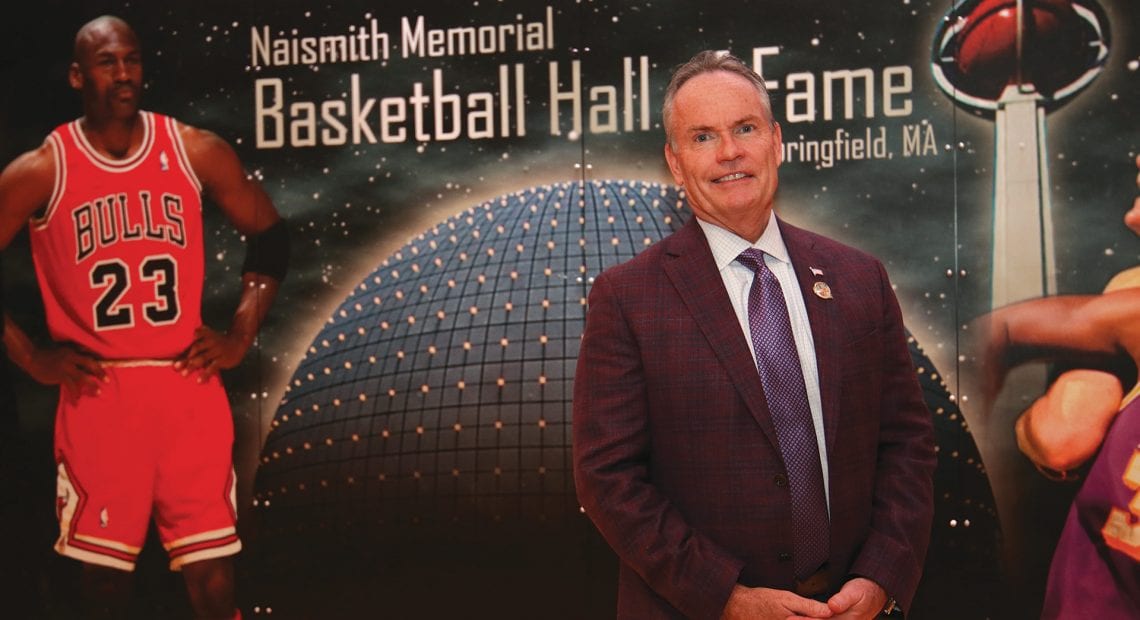
The nonprofit organization stages a biannual event at the Basketball Hall of Fame designed specifically to help organizations and people looking to get involved make much-needed introductions.

“I call it a cross between speed dating and a job fair,” said Freyman, noting that the event involves a host of area nonprofits with small tables arranged in a horseshoe. Attendees — those individuals looking to get involved — move from table to table looking for good fits.

The next event is slated for December (no specific date has been set), and Freyman is working hard to secure strong representation on both sides of the equation.

As she talked with BusinessWest for this story, Freyman brought along a cheat sheet of sorts — and she really needs one. It’s a running list of the boards and organizations she’s serving on or has served on in the past. There’s also a compilation of awards she’s won — and there have been many.

They range from BusinessWest’s Difference Makers Award (presented a decade ago) to the Pynchon Award; from Rotary International’s coveted Paul Harris Fellowship to Mass. Lawyers Weekly’s Top Women in Law Award.

The board-activity list is quite impressive as well, and includes everything from the Community Music School to Elms College to the World Affairs Council. Equally impressive, though, is her desire, as she put it, to replace herself on all those boards and get other people involved with those organizations and the community at large.

“I want all of these boards to have younger people on them — new blood,” she said as she ran her finger down the list. “And I want these boards to have memberships that look like the community today — not what it looked like years ago.”

She said this process of replacing herself will take place over the next few years and certainly by the time she retires — six years from now is the plan. In retirement, she might sit on a board or two, but her real ambition is to return to the classroom (that’s where she started her career) and teach adult basic education to refugees and others. But that’s another story.

This one’s about making connections and creating diversity, and those are the reasons why Freyman is a Woman of Impact.

Creating a Deeper Pool

Freyman said she’s made it a habit in recent years to stop for a minute at each event she attends — and there are several each week, and often a few each day, during the busy seasons in the spring and fall — and also at each board gathering, and do some counting.

Ellen Freyman says she launched OnBoard to help individuals get involved in their communities, and also assist area nonprofits and institutions with achieving diversity.

Specifically, she’s counting the Hispanics and African-Americans in whatever room she happens to be in, hoping that the number will represent something approximating the demographic profile of the Greater Springfield area.

Rarely, she said, does it meet that threshold.

“No one wants it to be that way — no one,” Freyman told BusinessWest, adding that there are reasons why boards and gatherings lack diversity. For starters, while there are some candidates, the number is not as high as it should be given this region’s demographic profile, she said, adding that many groups need introductions to the many fine candidates that are in the 413.

Creating a larger pool of candidates, and then making these connections, has become Freyman’s life’s work outside of her life’s work.

And that is a law practice focused on several specialties, but especially commercial transactions and commercial real estate.

She segued into law after stints in the classroom and as a commercial banker, and joined Shatz, Schwartz & Fentin in 1988. Even before that, though, she was getting involved in the community.

She started with Jewish Family Services (JFS) in 1984, not long after she relocated to this region and joined Third National Bank as an auditor training to be a loan officer — and also not long after she enrolled at Western New England University School of Law.

“I want to help empower people who haven’t been involved and contributing and volunteering, and give them entrée to all that.”

She recalls having lunch with Steve Dane, principal with the accounting firm Themistos & Dane, and asking how she could get involved. Dane was on the JFS board at the time and asked her if she wanted to join him.

She did, got very involved with the group’s efforts to assist Russian refugees, and soon added the board of the Springfield Museums to her schedule. And many others followed.

But her work in the community has involved much more than board sitting. Indeed, she has been very active in raising money for many of the groups she’s been involved with, and also with identifying, and in many cases mentoring, the next generation of leadership for those organizations.

Indeed, looking back to that lunch with Steve Dane, she said she’s doing for others what he did for her nearly 40 years ago — helping them get involved in their community.

Freyman said the initial impetus for OnBoard, which she created in the mid-’90s, was to get more women involved and on area boards.

“But immediately afterward, I realized that we’re not the only voice that’s missing,” she said. “We need to focus on all under-represented groups, and we have.”

In December, the nonprofit will stage its sixth board-matching event, she noted, adding that, to date, the initiative has had a good amount of success with connecting members of those under-represented groups to opportunities to get involved. But there is still work to be done when it comes to making boards, businesses, and, yes, those myriad events where Freyman takes a head count more diverse.

Overall, she wants other boards, commissions, and businesses to look like the Springfield Rotary Club, which is much smaller than it was years ago (all service clubs are), but more diverse, in large part because Freyman, who has been a member for nearly 30 years now, has recruited members of minority communities. And like the Springfield City Council, which is far more diverse than it was years ago because candidates from underserved constituencies have come forward and become candidates for those seats.

“The Springfield City Council looks like the city,” she said, putting a verbal exclamation point on that statement, adding that other groups need to take on that quality, not for the sake of numbers, but because boards and commissions are more effective, she believes, when their membership mirrors the community they’re serving.

How can boards become more diverse?

Well, Freyman, without exactly saying so, suggested this goal could be achieved if more people worked as she does to make connections and help others get involved.

This, as she said, is her most meaningful contribution locally, far more than her work on any specific board — or all the boards she’s served on over the past 35 years.

“I want to help empower people who haven’t been involved and contributing and volunteering, and give them entrée to all that,” she told BusinessWest. “What’s nice is that people do think of me as someone who can help them connected. People will say, ‘someone told me you’re the person I need to talk with if I want to get involved’ — I get those calls and e-mails all the time, and it makes me feel like I am helping to create progress.”

And these efforts extend to replacing herself on many of the boards she’s currently on.

“I want to open up my seat — I don’t want to take the spot of someone who should be there,” she said, using that phrase to reference younger people and those of color.

Overall, she believes progress is being made on this broad front — she noted that Springfield’s hiring of a diversity officer is a significant step in the right direction — but that much work still needs to be done.

Walking the Walk

The OnBoard website features a quote from Martin Luther King Jr. that sums up not only its mission, but Freyman’s considerable impact in the community: “Life’s most persistent and urgent question is: what are you doing for others?”

Freyman has always done a lot for others, whether it’s donating time and imagination to a board, helping to raise money for a nonprofit, or assisting refugees as they try become part of the community.

But her biggest contribution has been prompting others to ask that question posed by Dr. King — and then answer it in a resounding, meaningful way.

And that’s why, as the e-mail writer noted, “Ellen is incredible.”

George O’Brien can be reached at [email protected]

Women of Impact 2019

Assistant Superintendent, Springfield Public Schools

Lydia Martinez-Alvarez

This Educator and Leader Strives to Position Students for Success

Lydia Martinez-Alvarez says she entered the education field somewhat by default.

As she tells the story, she was working first at American Airlines at its reservation desk in Hartford and then Peter Pan Bus Lines in Springfield doing similar work just to make ends meet.

And then … she took a job as a substitute teacher and, as she put it, “got the bug.”

Big time.

Nearly a quarter-century after entering that fifth-grade classroom at Samuel Bowles Elementary School as a sub, she is the assistant superintendent of Springfield Public Schools (SPS). This is a position with a broad job description, as we’ll see, and one that ensures that each day is not like the one before it or the one after it.

She likes that aspect of it, certainly, but what she enjoys most is the challenge — and the opportunity — of positioning young people for success later in life, and this, when you get right down to it, is the basic job description for every one of the more than 4,000 people working for Springfield Public Schools.

It’s one of the many aspects of her work she is passionate about, as evidenced by these comments about the Working Cities Challenge — an initiative led by the Federal Reserve Bank of Boston to create opportunities for low-income residents of smaller cities in Massachusetts and Rhode Island — and Springfield’s involvement in it.

“When I saw the unemployment gap involving the 18- to 24-year-olds, I took it personally,” said Martinez-Alvarez, a core member of the team leading the city’s efforts within the program. “I thought, ‘we’re contributing to that gap — we’re letting them go at 18, and we’re sending them off to become unemployment statistics.

“That didn’t sit well with me,” she went on. “So when the opportunity came about to create a group to try to close that gap of unemployed and underemployed individuals, I jumped on it.”

“When I saw the unemployment gap involving the 18- to 24-year-olds, I took it personally. I thought, ‘we’re contributing to that gap — we’re letting them go at 18, and we’re sending them off to become unemployment statistics.”

She has jumped on a number of strategic initiatives to take what has long been one of Springfield’s weakest links — its school system — and make it an asset.

These efforts are still very much a work in progress, but there are encouraging signs.

Indeed, when Martinez-Alvarez and Superintendent Dan Warwick took their respective positions in 2012, the graduation rate in Springfield was 56.6%, and the dropout rate was 6.5%. Today, those numbers are 76.9% and 5.1%, respectively, rates of improvement that are among the most, if not the most, significant in the Commonwealth.

When asked what’s behind them, Martinez-Alvarez said there are many factors, but especially ongoing work to promote parental engagement and work vigorously to keep kids in school.

Summing it all up, she said it comes down to building relationships with those at every level of the equation — students, teachers, coaches, administrators, parents, and the community — and also creating more accountability.

While building these relationships, SPS works to develop plans for specific schools that will set goals for improvement, measure results, and keep the school in question on the desired track. And these are group efforts that involve many stakeholders.

Such efforts have generated improvement on many levels, including progress with taking a number of underperforming schools (formerly known as Level 4 schools) off that list (although many remain on it), and moving the needle in the right direction on graduation and dropout rates.

But the ultimate goal is to ensure that students can take those diplomas and use them to not only enter the workforce, but thrive within it.

And Martinez-Alvarez believes the system is making progress in this realm through initiatives ranging from internship and work programs to the new Conservatory of the Arts being created in the former Masonic Temple on State Street.

While playing a significant role is all these initiatives, Martinez-Alvarez, the first Hispanic to hold the assistant superintendent’s position in Springfield, has become a role model to all young women, Hispanic and non-Hispanic alike, who aspire to careers in education.

Lydia Martinez-Alvarez, left, seen here with Annamarie Golden, director of Community Relations at Baystate Medical Center at Baystate’s recent Adopt-a-Classroom Challenge, has been instrumental in helping Springfield’s schools get the tools they need to succeed.

That’s a role, like her one with the School Department, that she takes very seriously, and that’s one of many reasons why the judges have chosen her as a Woman of Impact for 2019.

Learning Curves

Martinez-Alvarez remembers a few intriguing, somewhat awkward, but ultimately “neat” moments when she became assistant principal of Chestnut Accelerated Middle School.

And perhaps with good reason.

After all, she attended the old Chestnut Middle decades earlier, and some of those who taught her were still at their jobs.

“All of a sudden, I became their boss, and that was interesting,” she recalled. “I would still call them … Miss Taylor, for example, and she would say, ‘no, Lydia, you don’t have to call me that.’ It was like I was still afraid of her, she was still my teacher; I couldn’t flip the relationship for some reason. But we did some really good things, and they were very supportive.”

Martinez-Alvarez has enjoyed a good deal of support during a 23-year career that has taken her from the classroom at Forest Park Middle School to the principal’s office at Chestnut to the administration offices of Springfield Public Schools.

Looking back on it, she said there has been a succession of opportunities made available to her, and she has taken advantage of each one — starting with that substitute teaching assignment.

After getting the ‘bug,’ as she put it, she knew she would need more than her degree in Business Management from Westfield State University to go any further in education. She consulted with David Cruise, then HR director of SPS (now director of MassHire Springfield) about charting a new career course. She earned her MAT (master’s degree in teaching) at Elms College, and while doing so took a job teaching Spanish part-time at Forest Park Middle School.

That job eventually led to a full-time teaching post at Forest Park Middle, during which Martinez-Alvarez said she was encouraged by her principal to get her administrators license. She did, taking part in both the Lead program within SPS and returning to Westfield State to earn her certificate of advanced graduate studies in education administration. She eventually became certified as a principal.

When asked about the shift from teaching to administration, Martinez-Alvarez said she started to take on administrative duties at Forest Park Middle — everything from the yearbook to creation of an annual talent show to MCAS tutoring — and enjoyed those assignments. With some encouragement, she decided to alter her career goals.

“Over the course of my career, there have been many instances where someone saw something in me that I didn’t necessarily see in myself,” she told BusinessWest, adding that this was the case with her principal at Forest Park Middle, Carol Fazio, who became a mentor in many respects.

“Over the course of my career, there have been many instances where someone saw something in me that I didn’t necessarily see in myself.”

“She said, ‘I would love for you to become an assistant principal,’ Martinez-Alvarez recalled. “When I asked her if she thought I could do it, she said ‘absolutely,’ and that prompted me to go back to Westfield State and enter Project Lead.”

She interned at Forest Park Middle, and when Jesus Jara was named superintendent of the High School of Science and Technology in 2003, he asked Martinez-Alvarez to join him as one of four assistant principals, a challenge she accepted.

“He gave me the 9th-graders,” she recalled, putting an exclamation point on that comment while acknowledging that was a logical move because she just came from a middle-school environment and knew many of the 9th-graders. “That’s a hard assignment for a newcomer like me, but it was fascinating; I really enjoyed the challenge.”

That has been a consistent theme throughout a career that saw her then take the helm at Chestnut Accelerated Middle School, which at the time, in 2004, had more than 1,200 students, an assignment that is in many ways a microcosm of her career and her commitment to help students succeed.

Grade Expectations

Like Sci Tech, as it’s called, Chestnut was facing a number of serious challenges when she arrived, including high absenteeism, a high suspension rate, test scores she described simply as “not so great,” and a relatively poor level of parental engagement.

She addressed those issues the same way she and the team at Sci Tech did, and the one the current administration does now.

“We really took a deep dive into what was happening through quantitative and qualitative data,” she explained. “We took a good look at who the teachers were, their strengths and weaknesses and attributes, and made some changes around the needs of the children.

“We had to look at everything, from the way the children were interacting in the halls to the PE schedule to the lunch schedule, and adjust according to the needs of the children,” she went on, stressing that word ‘we,’ and noting that this was a team effort.

And an effort focused on building those relationships she mentioned earlier, including one with the neighborhood, Plainfield, that surrounded the school.

“Many of our teachers at the time didn’t know the community, and they were afraid of it in many ways,” she explained. “Plainfield had a reputation which I didn’t agree with because I’d always lived in that part of town; I didn’t see what others saw. I saw a beautiful community filled with beautiful people. So we did a lot around the community so people would get to know it and people would get to know us.”

Martinez-Alvarez remained at Chestnut until 2008, when she became senior administrator for the Leadership Continuum and was named to the system’s senior leadership team.

Near the end of 2009, she became chief schools officer for Zone 3, meaning she supervised and led nine middle schools and high schools in the city. And when Warwick became superintendent in 2012, he asked Martinez-Alvarez to join him as assistant superintendent.

As noted earlier, this position comes with a detailed job description and a host of responsibilities.

Running through them quickly, she’s involved in all school initiatives, but specifically oversees everything from IT to attendance; from college readiness to summer school; from student services to Springfield School Volunteers.

That list also includes athletics and, most recently, work to identify the latest members to be enshrined into the SPS Sports Hall of Fame and the naming of its class of 2019, to be honored on Nov. 23 at Central High School.

Slicing through everything within her job description, Martinez-Alvarez said she and all those in administration at SPS are charged with positioning teachers, schools, and students for success.

This brings her back to those aforementioned strategies developed for specific schools within the system in conjunction with the state — and the relationship-building efforts with the many stakeholders involved with these strategic initiatives. And also to something she called “learning walks,” which are taken after plans are created and put into place.

“We need to monitor things and make sure these plans are not dust collectors on the shelf — that they’re live plans that are being fulfilled,” she explained. “We do learning walks — we go through the classrooms and look for evidence that change is occurring and that we’re doing what we told the state we were going to do to in order to make progress and close the learning gap for our students.”

Such initiatives have succeeded in helping 10 city schools exit the list of underperforming facilities, she went on, adding that several are still in underperforming status.

Overall, she believes SPS has turned a corner of sorts over the past several years.

“There are many things we’ve been doing, and that I’ve become personally involved with, to change the dynamics of what’s happening not only in our schools, but in our city,” she told BusinessWest. “And I believe we’re making some real progress.”

That phrase extends to efforts to close that gap involving the unemployed and underemployed, she said, adding that, through a host of initiatives, students are more workforce-ready when they take their diploma on graduation day.

Class Act

When asked to look back at her career to date and identify what she’s most proud of, Martinez-Alvarez didn’t hesitate.

“It’s the work to ensure that our students have the best possible learning experiences before they leave us, and that there’s something for them to go to when they leave,” she said. “It’s not just taking them to the end of their time with us — it’s about where they’re going next and preparing them for that.”

As noted, significant progress has been made in this realm, and Martinez-Alvarez has been a real force in making it come about.

And that’s just one of many reasons why she’s a Woman of Impact.

George O’Brien can be reached at [email protected]

Women of Impact 2019

Executive Director, Girls Inc. of the Valley

Girls Inc. Leader Is an Innovator, Role Model, and Inspiration


The phone call came roughly 13 years ago, but Suzanne Parker remembers it like it was yesterday.

It came several days after she had agreed to become the new executive director of Girls Inc. of Holyoke, but a few days before she officially took the helm. The caller was informing her that the nonprofit was not going to be able to make payroll that week — unless some action was taken.

“I said, ‘you have a line of credit — and you’re going to have to use it,’ she recalled, adding that this was an expensive but very necessary step for an organization that had relied heavily on a federal grant that was due to expire soon and essentially lacked a plan for sustainability.

As she recounted that phone call all these years later, Parker said she wasn’t entirely surprised by it — “I went into this with my eyes wide open,” she told BusinessWest, noting that she was well aware of the agency’s fiscal condition — and not at all fazed by it.

“I like a good challenge — I knew what I was getting into,” she said, adding that she was in many ways motivated by the situation she found herself in.

Indeed, within a year she had righted the financial ship at the agency through a series of cost-cutting and revenue-generating steps (more on those later) and recalls with a huge dose of pride that she has never again had to tap that aforementioned line of credit.

“Suzanne lives and breathes Girls Inc.’s mission and vision — for girls to be strong, smart, and bold.”

But Parker, who earned a law degree earlier in her career and has certainly put it to very good use in her position, has done much more than put Girls Inc. of Holyoke on solid financial footing. Since becoming executive director in late 2006, she has led the nonprofit on an ambitious course of expansion — geographically, programmatically, and in terms of its overall impact to the region as a whole and to the individual girls who walk through the door.

For starters, she has taken the organization beyond its original borders and into Springfield and Chicopee, territorial expansion that has prompted a name change to Girls Inc. of the Valley. She has also helped introduce new programs, including the hugely successful Eureka program, an innovative and intensive five-year program that Girls Inc. operates in partnership with UMass Amherst and which is developing a pipeline of girls into STEM majors and careers.

Overall, Parker has become deeply and energetically involved in every aspect of the program, from board recruitment to fundraising; from events management to marketing.

And the results have been stunning, with the local chapter of Girls Inc. winning recognition for its efforts regionally — the nonprofit was named one of BusinessWest’s Difference Makers for 2018, for example — and within the Girls Inc. network, especially for its innovative programming.

Melyssa Brown-Porter, chair of the Girls Inc. board, put Parker’s impact on the nonprofit, area girls, and the region in its proper perspective while nominating her to be a Woman of Impact.

“Suzanne lives and breathes Girls Inc.’s mission and vision — for girls to be strong, smart, and bold,” she wrote. “She is extremely passionate about the work that GI is doing for girls and the communities they live in. She is always looking out for the best interest of the girls and concentrates very hard on the results programming has on their lives. Her focus is to reach and serve more girls with impact on our community.

“Suzanne has been an innovator and leader throughout her career,” Brown-Porter went on. “In tune with workforce needs and changes in the economy, Suzanne was piloting state-of-the-art science, technology, engineering, and math programs for girls long before STEM became the focus that is today.”

Innovator. Leader. Inspiration. These are the words many people have used to describe Parker’s work not only at Girls Inc., but at Holyoke Chicopee Springfield Head Start before that and other stops on a lengthy career working with and on behalf of young people.

Some of her best work, however, may be as a role model for the girls who come into the program.

Indeed, Parker, who became a mother at 41, has managed to effectively balance work, life at home, and deep involvement in the community, meaning that girls looking for proof that all that can be accomplished need only walk down a few doors at the Girls Inc. complex in Open Square.

And now, those looking for more descriptive terms that can be applied to Parker have three more — Woman of Impact. Although, truth be told, they’ve probably been using them all along.

Orchestrating Progress

Parker joked that, while she played the clarinet well in her youth growing up in Belchertown — and later in some impressive performance venues, like the Esplanade and Government Center in Boston — she didn’t play it well enough to get paid to do it.

But her love of music prompted her to get a degree in music education from UMass Amherst and eventually teach instrumental band music at Cohasset Middle School. And that’s a good place to begin our story, because it was there that Parker developed an interest in working with young people — and a passion for helping those less privileged.

Seen here with some members of Girls Inc. of the Valley, Suzanne Parker has become a mentor and role model for many members.

“Cohasset was a very affluent community, and, with my humble beginnings in Belchertown, it was a little bit of a culture shock for me,” she explained. “The students I connected with the most were those who were part of the METCO program, mostly students of color living in Dorchester.

“It was important to me to make sure they were included in the band,” she went on. “I also wanted to include kids of different abilities, something that wasn’t the case when I got there, thus creating an environment and atmosphere where there was a lot of inclusion. That’s what I was most proud of from my work there.”

These themes of inclusion and working to provide opportunities to those less fortunate would define her work throughout her career.

Fast-forwarding a little, Parker said she soon realized that she wanted and needed more than teaching, but didn’t know exactly what. She started by returning to Western Mass. and working in sales for a time. Her career path took a rather sharp turn, however, when she saw a sign on the roadside advertising for Head Start substitute teachers.

She knew was overqualified, but took the job anyway, with her first assignment at the Westover Air Reserve center for Head Start. She spent the next 16 years moving up the ladder, serving in a number of roles and eventually deputy director.

Along the way, she realized she needed another degree, and after considering several options, including a master’s in social work and a master’s in education — she settled on a law degree.

“A friend of mine who I grew up with decided to go to law school at Western New England University, and he passed,” she recalled. “And I said to myself, ‘I know that guy — I think I’m as smart as this guy; I think I can do it.’”

So she applied, received some needed financial aid, and went to law school part-time at night, commencing an arduous journey that ended in 2003 when she passed the bar.

“There were many days of tears because I was working tons of hours as a senior-level exec at Head Start,” she said in reference to the difficult task of balancing everything she was doing at the time. “But I did it.”

And now, her very unofficial job description at Girls Inc. is to not only show young girls that they, too, can do it — but to give them a road map for getting where they want to go and the tools to get on the right course and stay on it.

Degrees of Progress

As noted, she has put that law degree to good use, providing ample evidence that such an education isn’t just for those who want to work in the courtroom.

“I use it every day,” she told BusinessWest. “That law-school education helps you every day as an executive director. I use it with everything I’m involved with: contracts, employees, real estate, administrative law — we have federal and state funding — as well as writing skills — I was on the Law Review. It was a really great education, and it has really helped me.

Beyond serving as a great advertisement for law school, those comments hint at Parker’s broad job description at Girls Inc. Slicing through it all, though, her primary work early on involved turning the organization around, putting it on solid financial ground and a path to sustainability — and keeping it on that path.

“It’s all about the mission. It’s so empowering, and there is such a need; we know that there are still gaps that exist with women and girls with regard to opportunities and pay and STEM fields … there’s still such a need, and that’s why we do what we do.”

She’s done that through a variety of measures, including some restructuring, belt-tightening, and the establishment of several of reliable fundraisers, especially the annual Spirit of Girls breakfast, launched in 2007, which does a lot more than raise roughly $150,000 each year, although that is certainly significant.

Indeed, girls involved in the program are heavily involved with the event, and several take to the microphone — in front of an audience of more than 500 people — to talk about Girls Inc. and how it is impacting their lives.

“We keep the expenses incredibly low; it’s a light breakfast, and we don’t pay for speakers — the girls are the speakers,” she told BusinessWest. “It’s an empowering experience for the girls themselves — they take leadership roles in this event.”

The breakfast is just one of the ways the organization works to empower girls and put them on the path to becoming leaders — in their chosen fields and the community as well.

Looking ahead, Parker said the obvious goal is to broaden the regional impact of Girls Inc. and continue those efforts to give the nonprofit the same qualities it strives to give young girls — to be strong, smart, and bold.

Thus, the agency will look to continually extend its reach within Springfield and Chicopee, while keeping Holyoke as its home and base. Finding a new, permanent home is one of the assignments moving forward, said Parker, as is creating sustainability for the Eureka program, conducted in partnership with UMass Amherst and its College of Natural Sciences, Bay Path University, and several other area colleges, and scaling up that initiative. A capital campaign to pay for all this is also in its formative stage.

As for Parker, who has continually sought out new challenges throughout her career, she’s looking forward to being with Girls Inc. as it strives to get to the next level.

“It’s all about the mission,” she noted. “It’s so empowering, and there is such a need; we know that there are still gaps that exist with women and girls with regard to opportunities and pay and STEM fields … there’s still such a need, and that’s why we do what we do.

“Every year, we have the conversation — am I still helping this organization, and is it still a win-win, for me and Girls Inc.?” she went on. “As long as I can still feel challenged and that we’re growing and we’re changing, and that I have something to give and I’m making a difference, I’m in.”

Leading by Example

And there are a great many people who are happy she’s in.

Indeed, Parker has become a Woman of Impact not just because of what she’s done as the leader of a nonprofit clearly in need of strong leadership.

She’s also reached that status by being an effective role model for the girls who join her program — and girls across the region. Years ago, she set goals for herself, understood what was needed to reach those goals, and positioned herself to succeed.

That, in a nutshell, is what Girls Inc. is all about, and while its success doesn’t stem from the work of a single woman, Parker’s influence has greatly enhanced its ability to carry out that all-important mission.

George O’Brien can be reached at [email protected]

Women of Impact 2019

Managing Director, Golden Seeds

This Investor and Mentor Is Making a Difference within the Entrepreneurship Ecosystem

Katherine Putnam was a history major in college, and she certainly knows her stuff.

While she really likes European history, she knows all about this country — and this region — as well. She knows, for example, about the very rich tradition of entrepreneurship in Western Mass., and what it meant for the development of individual cities and towns.

“From the 1880s to the turn of the century, Holyoke had more millionaires per capita than any city in the country,” she said, referring to the dozens of mill owners living in the Paper City. “There are two McKim, Mead & White buildings in Holyoke; there was so much money, they were paying for world-renowned architects to come in and design their buildings. And it was the same in Springfield.

“When you read your history books, for 100 to 140 years, this region was a hotbed for entrepreneurial activity,” she went on. “But that hasn’t been true for 50 years.”

Putnam knows that a return to those glory days is certainly not likely, given how global the economy has become and the development of innovation and entrepreneurship hubs such as Silicon Valley, Cambridge, and the Research Triangle. But she firmly believes that the region can once again be a thriving center of new business ventures, and she’s playing an active part in such efforts as managing director of Golden Seeds — a national investment firm that focuses on early-stage businesses that have women in management and leadership roles — and in a host of other roles within this region’s entrepreneurship ecosystem.

As an investor and a mentor — the two primary roles she plays — she has a number of goals and missions. They include sparking levels of entrepreneurial activity reminiscent of those from generations ago, and also leveling what is currently a very uneven field when it comes to which demographic groups receive venture capital and mentoring, and which ones don’t.

“We have two main problems overall. We have less money flowing to diverse teams, and there’s less advice flowing to diverse teams. And my mission right now is to try to change that.”

“We have two main problems overall,” she noted. “We have less money flowing to diverse teams, and there’s less advice flowing to diverse teams. And my mission right now is to try to change that.”

Putnam brings an intriguing background, a wide variety of experience, and a host of skills sets to this mission and her various roles within the region’s growing entrepreneurship infrastructure.

Indeed, she started her career in the banking industry before shifting to corporate treasury work and then deciding she wanted to run her own company. In 1996, she put together a group of angel investors and purchased Package Machinery. Before selling it 20 years later, the company had become a technology leader in wrapping machinery for consumer-product manufacturers.

Today, while investing in some developing ventures, she spends most of her waking hours advising and mentoring entrepreneurs, especially women.

Meanwhile, she’s working diligently to create strategies for helping women and minorities crash through the many barriers facing them as entrepreneurs.

“Statistics tell us that 70% of angel money and about 95% of VC [venture capital] money go to teams that are all white males,” she told BusinessWest. “I love white males — I had one as a father, I have one as a son, and I have one as a husband — but that’s not equitable. What are the barriers that are keeping women and minorities — diverse teams — from getting more money?”

There’s no quick or easy answer to that question, she went on, adding that she and some colleagues are hard at work trying to not only find some answers, but develop strategies for somehow changing this equation.

Ali Usman, founder and president of PixelEdge and a fellow investor and mentor of entrepreneurs, summed up Putnam’s work in this region while nominating her for the Woman of Impact award.

“Kate should win this award for her consistent commitment to the entrepreneurial ecosystem,” he wrote. “Kate is not just involved with one project or company at a time. She is constantly using her knowledge and expertise to help others day after day, week after week. Currently, she serves on three different boards, is a managing director of an angel-investment group, and, in her spare time, manages to mentor entrepreneurs through several different programs.”

Actually, mentoring is much more than a ‘spare-time’ pursuit. For Putnam, it’s her passion, and that’s one of many reasons why she’s a Woman of Impact.

Ventures and Adventures

When asked to summarize the best advice she gives to entrepreneurs at all levels, Putnam didn’t hesitate and recited the lines as if she’s uttered them hundreds of time, which she is undoubtedly has.

“Have lots of conversations with your customers and your prospective customers,” she said. “Most people come into this thinking, ‘I have this really cool idea — the world must want this.’ And then they get out there and they realize that the world does not feel enough pain to switch from however they’re solving that problem now.

Kate Putnam says it’s her mission to level the playing field when it comes it diverse groups and their efforts to gain capital and mentors.

“If you get out and make a lot of your widgets without figuring that out, you’ve wasted a lot of time and money,” she went on. “Whether it’s something really cool that you’ve developed in some esoteric lab at UMass at the Institute for Applied Life Sciences or you did it in your garage, you have to figure out who is feeling enough pain to change however they’re doing it now and adopt whatever it is that you’ve developed.

In short, she explained, people are more motivated by pain then they are by gain. “People will go a lot further to avoid losing $10 than they will to gain $10, and so I tend to ask people to think in terms of whether they’re solving someone’s pain and if people will be uncomfortable enough in their pain to switch.”

Steve Jobs was famous for not asking customers what they wanted and for actually saying that “customers don’t know what they want if they haven’t seen it before,” she noted, but he is certainly the exception to the rule with development of such products as the iPhone, and young entrepreneurs would be wise not to emulate that approach.

Passing on such advice has become a career of sorts for Putnam — or the latest career, to be more precise. Indeed, as noted earlier, she’s had several, which in sum have given her exposure to business and entrepreneurship from all angles.

That includes the finance, or funding, side, and also the entrepreneurial, risk-taking side with Package Machinery, which was struggling when she took it over, and she guided it back to prominence within that specific manufacturing niche, increasing machine sales by more than 300%.

In this, her latest career, she spends a good deal of time on the road — she’s put 40,000 miles on her car over the past 15 months by her reckoning — working in a variety of settings and with companies of all shapes and sizes.

Currently, she’s mentoring a few entrepreneurs involved in a program called I-Corps, a National Science Foundation initiative to increase the economic impact of research the agency funds.

“It uses the Lean LaunchPad model for getting people to identify a problem to solve,” she explained, adding that she’s mentoring teams behind ventures in Connecticut and Vermont. “You’re a scientist, and you’ve invented something cool; now you have to figure out if anybody wants it.”

She’s also involved with MIT and its Venture Mentoring Service, and also Valley Venture Mentors in Springfield, which she has served in a number of capacities, including entrepreneur in residence for its most recent accelerator class, as well as Greentown Labs. She’s a founding member of Women Innovators & Trailblazers, which strives to make Western Mass. a more vibrant hub for women innovators and entrepreneurs, and also serves as an instructor with RiseUp Springfield, a seven-month, intensive, hands-on program for established small business owners created through a collaboration between the city of Springfield, the Assoc. of Black Business and Professionals, and the Springfield Regional Chamber.

All this keeps her quite busy and her car’s odometer spinning, but it’s work she’s passionate about.

That’s especially true when it comes to mentoring women, leveling the playing field when it comes to capital and opportunities for women and minorities, and launching — and keeping — more businesses in the 413.

Capital Ideas

And the playing field is certainly not level, she told BusinessWest, citing those statistics concerning venture capital awarded to teams comprised of white men given to white men and noting that, by and large, the investing community has historically treated women differently than men, holding them to what amounts to higher standards.

When asked to elaborate and offer a tutorial, she talked about questions asked by potential investors and some of the categories they fall into, including ‘promotion’ and ‘prevention.’

“Most people come into this thinking, ‘I have this really cool idea — the world must want this. And then, they get out there and they realize that the world does not feel enough pain to switch from however they were solving that problem now.”

“A promotion question would be ‘how big would the market for your product possibly be globally?’” she explained. “And a prevention question would be ‘how are you going to reach your first $1 million in sales — how are you going to do that?’”

Prevention questions are associated with raising less money, she went on, adding that the more of these questions an individual or team gets, the less money they are likely to raise.

“We know that women get more prevention questions than promotion questions,” she went on, adding that she can’t get inside the heads of investors and come up with an answer to why this is the case, but she had some guesses.

“The sense of it is that the general theory is that women are less competent than men,” she said. “It’s also true that most of the people who are doing the investing are white men, and that they prefer to invest in and mentor people who look like them.”

Diversity refers to geography as well, she said, adding that there is less money flowing to people in more remote areas because, well, there is simply less money there, from the seed (friends and family) level on up to the VC rounds.

“If you’re in Wellesley and you want to raise seed money, it’s a lot easier there than if you’re in Holyoke,” she explained. “In Wellesley, you’ve got friends and family who are likely to have money, and in Holyoke, you’re less likely to have that.”

As she mentioned, changing this equation has become a mission, and she’s carrying it out in a number of ways, from creation of Golden Seeds to involvement with groups like VVM and SPARK EforAll Holyoke, to mentoring in places like Springfield, Holyoke, and other communities in this region.

These are cities, which, as she noted at the top, have a rich history of innovation, entrepreneurship, and risk-taking that is, unfortunately, referred to mostly in the past tense.

“That kind of attitude toward building it, and taking the risk, and making that investment has been gone from this region for quite a while,” she noted. “And it’s tough to recreate it; it’s a real challenge.”

She acknowledged that the needle is moving in the right direction when it comes to entrepreneurial energy and startups taking flight, but not enough movement to suit her.

“I’m impatient — I want to see more activity, sooner, faster, all those things,” she said, adding that the two main ingredients needed are capital and mentoring. There is some of each, but there needs to be more if companies are going to get off the ground and then remain in the 413 rather than packing up and going to where the capital is, be it Cambridge, Boston, San Francisco, or somewhere else.

In Good Company

Reflecting on what has happened in recent years when it comes entrepreneurial activity in this region and efforts to level an uneven laying field when it comes to opportunities and capital for women and minorities, Putnam said there has indeed been change.

Just not enough of it.

As she said, it is her mission to create more of it. That’s the latest focal point of a career that has included success in business and a host of initiatives to help others enjoy some of that same success.

And it’s just another way in which she’s certainly a Woman of Impact.

George O’Brien can be reached at [email protected]

Cover Story

The Next Steps for Springfield

Tim Sheehan, who succeeded Kevin Kennedy as Springfield’s chief Development officer in July, may be new to the job, but he’s certainly not new to the city. He grew up there, and later worked for two different mayoral administrations. In recent years, he’s seen the city go from the depths of receivership to what many are calling a renaissance. Looking to build off created momentum, he said there is still considerable work to do.

Tim Sheehan left Springfield, and a job with the state agency MassDevelopment, in 2002 to become director of the Redevelopment Agency in Norwalk, Conn.

But he didn’t exactly leave his birthplace behind.

Indeed, with a number of family and friends still living in and around the City of Homes, he returned frequently — at least once a month, by his estimate — and thus was keeping pace with all that happened in the city over that time.

That’s a lengthy list that includes everything from receivership to the opening of MGM Springfield to the revitalization, decades in the making, of Union Station, a project he’s quite familiar with because, starting in 2017, he took the train to Springfield for those visits.

So Sheehan didn’t have to reacquaint himself with the city, its challenges, and its opportunities when he accepted Mayor Domenic Sarno’s proposition to succeed Kevin Kennedy as Springfield’s chief Development officer.

In this important role, he has some big shoes to fill — Kennedy played a huge part in bringing more than $4 billion in development to the city since that tornado touched down in June 2011 — but also some momentum to build on and opportunities to add new chapters to an ongoing success story.

Indeed, while noting that considerable progress has been made with everything from vitality in the central business district to jobs to the city’s fiscal health, Sheehan concedes that much work remains to be done.

“There’s a very positive perception regarding where the city has positioned itself as a city within Western Mass.,” he said. “But there’s still room to grow on that, and I think Springfield can become a real leader in urban development.”

“The casino has met us a long way in the objective of encouraging people to go out from the casino and explore the city. What we need to do is take the next step so that there’s some sense of equivalence between what’s at the casino and what’s outside on Main Street.”

In no particular order, he listed the city’s many neighborhoods and needed work to revitalize the ‘Main Streets,’ if you will, of Indian Orchard, Forest Park, Six Corners, Boston Road, and even 16 Acres, where he grew up, as well as the need to create more market-rate housing in the city, a realm where he enjoyed success in Norwalk.

Sheehan also mentioned some specific projects that most might think of when they hear the term ‘economic development’ — 31 Elm St. was at the top of that list — and some initiatives they might not connect with that term, such as job training and assistance to small businesses, which are the backbone of the city’s economy.

“There are some studies that looked at employment and job-training initiatives in the city and discussed ways they could be improved,” he noted. “And there are studies that looked at how we could expand and assist the industrial and manufacturing sectors that exist here, and still others that look at the importance of the small-business sector within Springfield’s larger economy, the role it plays, and what government could provide to strengthen small business.

“As much as the large-scale development in the city has been fantastic and they’re a beacon to attract people,” he went on, citing MGM, CRRC, and other eight- and nine-figure projects, “we can’t lose sight of the fact that the smaller businesses — employers with fewer than six people — are the vast majority of the businesses, and they contribute significantly to the economic health of the city.”

And then, there’s MGM Springfield, or what’s happening across the street from it, to be more precise. Actually, it’s what’s not happening that needs to be addressed moving forward, said Sheehan, citing the need for balance or ‘equivalence,’ as he put it.

“The casino has met us a long way in the objective of encouraging people to go out from the casino and explore the city,” he explained. “What we need to do is take the next step so that there’s some sense of equivalence between what’s at the casino and what’s outside on Main Street.”

For this issue, BusinessWest talked at length with Sheehan about his return to Springfield and how he intends to help build on the positive energy that’s been created and take the city to a still-higher plane.

Tracking Results

Looking out the windows of the train during those trips from New Haven, Sheehan said he could certainly see progress coming to the city he grew up in — and not just in the gleaming casino taking shape in the South End.

He noted improvement in everything from the entertainment district to parks; from public safety to job creation.

But, as noted, there is still considerable work to do, he said, adding that the prospect of leading such efforts was enticing enough to make ‘chief Development officer, city of Springfield’ the next line on an already-intriguing résumé.

And, as mentioned, some of the earlier lines involve Springfield as well. Indeed, he worked for two mayors — Richard Neal (before he become Congressman Neal) and his successor, Mary Hurley, in the Community Development and Planning office.

From Springfield City Hall, Sheehan moved to work for the state at the Executive Office of Communities and Development, and later at MassDevelopment, both at that agency’s Boston office and its first regional office in Springfield, which he directed.

He enjoyed the work, but eventually he desired a return to working on the municipal level and in development work.

“At the time, MassDevelopment was doing a lot of community-development lending, and I was doing projects on the North Shore and Lawrence, and then projects in the Berkshires,” he recalled. “One of the problems, from my perspective, is that I was drifting toward being more of a banker and less of a hands-on community-development/economic-development person.”

While MGM is thriving, Tim Sheehan says, one of the challenges facing the city is the need to achieve what he calls ‘equivalence’ on the other side of Main Street, seen here.

He found an opportunity to get back to the latter in Norwalk, and its Redevelopment Agency, a broad, one-stop shop for planning, housing, and economic development.

In Norwalk, a city roughly half Springfield’s size (85,000 people), one of his biggest achievements involved increasing the number of market-rate housing units in and around downtown, thus growing the population in the central business district.

The city had a number of factors working in its favor as it went about this assignment, he noted, especially its proximity to New York and status as a bedroom community for Gotham.

“It’s an hour by train to Grand Central Station, and 45 minutes to be in Manhattan proper,” he said, adding that these numbers translate into a fairly attractive commute, thus making such projects doable from an economic perspective in terms of the prices developers could charge for such properties.

Springfield doesn’t have such geography working for it, he went on, adding quickly that it can take advantage of some demographic shifts, especially retiring Baby Boomers and Millennials both becoming more drawn to walkable cities and the amenities of urban living.

What’s more, the city has a large stock of older buildings, many of them architectural gems, that could be converted to market-rate housing, perhaps with retail or other uses on the ground floors.

“The architecture in Springfield is far beyond what new development would be able to accomplish today,” he noted. “What we would like to see is a dedicated effort to look at repurposing those buildings with residential uses.”

Still, the numbers have to work for developers to move forward with projects like the one now underway at the former Willys-Overland building, and in some cases, it might be challenging to make them work.

“Springfield has the capacity to absorb more market-rate housing, but I think there’s going to have to be some level of government support for that,” he said, citing statistics showing that, while Worcester added more than 600 new housing units between 2013 and 2017, Springfield added 230. “But these projects have to pencil out from an economic standpoint. That was a challenge in downtown Hartford, but both the state and the city stepped up to understand that.”

“The importance of having a downtown residential population is critical to the long-term economic viability of your municipality,” he went on, underscoring the importance of such initiatives. “This is one of the challenges that Springfield needs to address.”

Overall, the city needs to create much more of a balance downtown between market-rate housing and the large amounts of subsidized housing that still exist in the central business district, he said, adding that this has been a long-standing issue for Springfield and a key to continued revitalization.

“You can’t have all or mostly subsidized housing — that’s not good for your downtown,” he went on, adding that Springfield’s housing stock downtown has been out of balance for some time.

Down on Main Street

But housing is just one of the issues and challenges facing the city, said Sheehan, who returned to the subject of MGM Springfield and the work needed to match the glitter on the west side of Main Street with some on the east side.

At the moment, there is little if any glitter there, he said, noting that there are several vacant or underutilized properties in the shadow of the casino, and this is a situation that needs to be addressed if the property is to reach its full potential and become even more of a catalyst for development.

“You have to give a nod to MGM in terms of the architectural design of the casino — it was meant to be porous, and that’s atypical of casino design, but a net positive for Main Street in Springfield,” he noted. “But in order to have people traversing between Main Street and the casino, there needs to be a sense of equivalence on both sides of the street.

“If I didn’t necessarily want to stay on the casino floor and wanted to come out and see what downtown might have to offer, I’m inhibited from doing that by coming to the front door on Main Street, looking across the street, and seeing that there’s no ‘there’ there for me,” he went on. “I’m going to turn around and go back into the casino.”

Creating a ‘there’ will require private investment, he continued, adding that a consortium of investors have expressed some interest in taking on properties that are “not meeting their full potential.”

And while downtown and the blocks around MGM are certainly a priority for the city, Sheehan said, Springfield’s other neighborhoods need some attention as well, especially their main commercial districts.

“If you look at the neighborhood commercial corridors, there is a lot of work to be done,” and strengthening those corridors is a priority moving forward, he told BusinessWest, listing Main Street Street in Indian Orchard as one such corridor, the ‘X’ in Forest Park as another, and Boston Road, which he grew up near, as still another.

“If you look at Boston Road, there is significant vacancy there,” he said, referring not only to the Eastfield Mall and the exodus of stores there but the full length of that commercial thoroughfare. “It’s not the Boston Road I used to remember as a kid; there are some challenges there.”

Six Corners is another neighborhood corridor where improvement is needed and work is in progress, he said, noting the infrastructure work taking place there, especially a new roundabout designed to ease traffic flow in that area.

The hope is that such civic improvements there and elsewhere will generate private-sector investments, he went on, adding quickly that revitalization of neighborhoods such as Six Corners requires collaborative efforts among a number of parties — and healthy doses of imagination.

We’ve made a big investment in the public infrastructure there,” he said. “Now, we need to look at the sustainability of the businesses that exist there; we’re doing some early planning activity with regard to what commercial activity is appropriate for there.

“We’re also trying to get more engagement in these centers from the institutions that surround them,” he went on. “How can we engage better with AIC and Springfield College to ensure that the businesses that surround them are made more healthy by their populations?”

These projects are often much more difficult to undertake because they do involve private investment, he went on, adding that the public (government) side has to inspire such investments and make them easier through planning and a roadmap for the future.

“In order to entice the private developer to come to those areas, from the city’s perspective, you need to have a plan as to what you want to happen there, and you have to have everything aligned with that plan, so that, if I’m making the investment after reading your plan, I don’t have to deal with zoning in terms of having to change something to fit your plan; it’s already been done,” he explained. “I’ve read the plan, I understand what the city wants, and the city’s done all the heavy lifting to get my project approved.”

Along for the Ride

Talking about the train he took into Springfield, Sheehan raved about everything from the price of the ticket to how full the cars were — at least to the Hartford stop.

“The train is fantastic; the ability to go from Springfield to Hartford or Hartford to Springfield or New Haven to Springfield for $6 or $12 one way … that’s a bargain and a very convenient form of transportation,” he said, adding that the train has become a very attractive alternative to those not looking to battle the traffic on I-95 or I-91 on a Friday afternoon, or any afternoon, for that matter.

It’s not his official job description, but as chief Development officer, Sheehan’s goal is putting even more people on those trains coming into Springfield — professionals, tourists, and those, like him, coming to visit family and friends.

It’s also his job to give them not only more to see out the windows, but more to experience once the train pulls in.

It’s a challenge he certainly embraces, and one that brings his career full circle in many respects — back to the city he grew up in, and back to the city he wants to take the next level.

George O’Brien can be reached at [email protected]

Features

Warning Signs on the Horizon

John Regan says the state should do what many business owners are doing with a possible recession looming — refrain from taking on too much at once.

John Regan says Associated Industries of Massachusetts (AIM) recently surveyed a cross-section of its members regarding the economy, the direction they believe it will take, and the steps they are themselves taking as a result.

Roughly 75% of those surveyed anticipate an economic contraction before the end of 2020, and a sampling of the gathered remarks hints strongly at an undercurrent of caution, if not outright concern:

• “Scaling back on hiring plans; slowing down certain capital expense/equipment purchases until we get a clearer picture of what the next six months will bring.”

• “Concentrating on expense reduction … evaluating closely the need to replace positions.”

• “Diversifying our service options.”

• “We have temporarily eliminated overtime, which was formerly unlimited.”

Slicing through all that, Regan said AIM’s members are looking at the conditions, gauging how they will effect things short-term and long-term, and, by and large, deciding not to take on too much until the picture becomes much clearer.

And, as the organization’s new president and CEO — he took the helm in May — he is essentially advising the state to do the same.

“A possible takeaway from the survey for state policymakers as they begin considering billions of dollars in new spending is this could be a difficult time ahead for the state economy,” Regan told BusinessWest. “Businesses are assuming a defensive posture, and significant tax increases — beyond the $1 billion for the new paid family and medical leave system — even for worthwhile causes, could harm the overall economy, most especially the manufacturing sector.

“This might not be the time to really go all in on lots of different tax proposals,” he went on, listing everything from new spending initiatives to the so-called ‘millionaires’ tax,’ a step he believes will pose dire consequences for the Commonwealth. “Legislators should do what our members who answered the questions are doing — delaying their ambitious agenda and letting the things they’ve already done take their course and put some away for a rainy day.”

Passing on members’ concerns about the economy and urging caution when it comes to business-related legislation are two of the many lines on the job description for AIM’s president, said Regan, who moved to the corner office after a dozen years as AIM’s executive vice president of Government Affairs and almost two decades with the agency in that realm.

Another line on that job description involves presiding over annual ceremonies such as the one staged earlier this month at Wistariahurst in Holyoke, at which three area companies — MGM Springfield, American Saw, and Peerless Precision — were presented with Next Century and Sustainability awards for their efforts in creating the next era of economic opportunity for state residents.

A few hours before that ceremony, Regan sat down to talk with BusinessWest about a variety of topics, including his appointment, the state of AIM and its 3,500 members, and even his thoughts on how to achieve more balance between east and west in the Commonwealth.

“Businesses are assuming a defensive posture, and significant tax increases — beyond the $1 billion for the new paid family and medical leave system — even for worthwhile causes, could harm the overall economy, most especially the manufacturing sector.”

But the condition of the economy and the results of that aforementioned survey soon dominated the conversation.

Regan noted that, overall, the state’s economy continues to expand, albeit at a slower pace than earlier in the year. Meanwhile, AIM’s Business Confidence Index, generally a reliable barometer of economic conditions, remains in optimistic territory (58.9), although it has lost nearly four points over the past 12 months. Unemployment remains low (2.9%), and private employers created nearly 7,000 jobs between August 2018 and August 2019.

Still, there are some ominous warning signs of a recession, and a number of businesses are already starting to feel the effects of tariffs and other federal and state measures, said Regan, adding that these businesses are starting to play defense — and the state should do the same.

Background — Check

If Regan seems to know his way around the State House — in every sense of that phrase — it’s because he does.

Indeed, before coming to AIM, before serving as vice president of Operations for MassDevelopment and leading its efforts to repurpose Fort Devens, before directing the Massachusetts Office of Business Development (MOBD) for five years, and even before serving as chief of staff to the mayor of Marlboro, he worked in the State House, first as a researcher on the Joint Committee on Banks and Banking, and then as a special assistant to the House Ways and Means Committee.

“I started out on the constituent side, and quickly moved to the policy side,” he said of his work with the Legislature. And, on many respects, he has remained on the policy side ever since.

When asked how he went from working for the state to becoming an advocate for its business community, Regan said there’s a story there. It involves the former Lunt Silversmith (an AIM member) in Greenfield, he recalled, adding that, as director of MOBD, he was asked to help convince the state Highway Department to put up signs that would direct motorists to the company’s new showroom facility. Long story short, he played a big role in getting the signs up.

“AIM was so impressed that state government actually got something done that they asked if I would consider joining the agency and its Government Affairs Department,” he recalled. “At the time, I wasn’t really looking, but I knew AIM from my days at the State House — it was a well-respected group and well-regarded in the building — and I thought this was a good opportunity for me.

“I never wanted to be a lobbyist in that sense that you’re out chasing clients to represent individually,” he went on. “The opportunity to come to AIM represented a chance to use my relationships in the building, but not lobbying for individual clients; at a 3,500-member organization, you’re working on policy, not just individual company issues.”

And over the years, he has advocated for members on issues ranging from unemployment-insurance reform to non-compete agreements; from pay-equity law changes to paid family and medical leave.

Since taking over as president and CEO, Regan said he spent much of the first several weeks focusing largely on internal matters, including membership, marketing, finances, technology, and hiring his successor in Government Affairs — Brooke Thomson, formerly with AT&T.

“I wanted to make sure I understood the parts of AIM I never really had to worry about as head of Government Affairs,” he noted. “And part of what the board charged me with was coming up with an operational plan for the balance of 2019 through 2021.

“It’s not a strategic plan,” he went on, “but just making we’re able to explain what we thought we could do and should do, and get that on paper and in front of the board.”

Reading the Tea Leaves

These days, though, he’s more focused on the Commonwealth’s businesses, the uncertain state of the economy, and policy matters, such as helping to secure a three-month delay in the start of payroll deductions to fund the program.

Returning to that recent survey of members, Regan said it is quite revealing and clearly depicts both the concern felt by business owners and their commitment to act responsibly, and defensively, in such a climate.

“They’re doing the things you might expect,” he noted. “They’re saving money versus investing it, and they’re only doing capital projects that have a very swift return on investment. They’re looking for additional, profitable product lines that might allow them to weather the storm. But mostly, they’re thinking ahead and being ready.”

And this is the mindset Regan believes both the federal and state governments should embrace given both the current conditions and the possibility, if not likelihood, of a recession in 2020.

“Uncertainty around trade, in particular, grows by the day. It seems like every day you wake up and there’s another round of tariffs. One of our longest members is Ocean Spray cranberries, and they’re getting killed by tariffs.”

With the former, Regan noted that tariffs and the trade war are already taking a steep toll — on manufacturing but also other sectors of the economy, including agriculture — and the threat of more such actions loom large over the state and the region.

“Uncertainty around trade, in particular, grows by the day,” he said. “It seems like every day you wake up and there’s another round of tariffs. One of our longest members is Ocean Spray cranberries, and they’re getting killed by tariffs.”

As for the State House, Regan said lawmakers there should consider the current economic conditions and the threat of recession as they ponder additional mandates and taxes, including what is known officially as the Fair Share Amendment, but has been dubbed the millionaires’ tax.

That name conjures up thoughts of rich people sitting on a beach, he told BusinessWest, but the reality is that most of those who would be impacted by this measure, which would impose a 4% income-tax surcharge on annual income beyond $1 million, are business owners, as in the small to medium-sized business owners who dominate the state’s economy and especially the Western Mass. economy.

And recent research, including an in-depth report by Bloomberg News, shows that individuals hit with such taxes often leave for safer havens, taking their income with them, he noted.

“Bloomberg found that Connecticut, New York, and New Jersey face the largest financial drains from the 5 million Americans who move from one state to another each year,” AIM wrote in a recent blog post, citing other states that had passed taxes on high earners. “Connecticut lost the equivalent of 1.6% of its adjusted gross income, according to Bloomberg, because the people who moved out of the Nutmeg State had incomes that were 26% more, on average, than those people who moved in.”

Regan agreed, and said these numbers paint a grim picture and present a competitive disadvantage for the Commonwealth, one the Legislature should consider as it moves closer to joining other states in enacting such measures.

“I love it when elected officials roll out statistics that show ‘30 states do this’ or ‘20 states do that,’” he said. “We can tell them we have a whole list of states that have tried the wealth-tax approach, and it’s bombed, and they say, ‘well, that’s different.’

“How is it different?” he went on. “How are we not going to experience the same things that they’ve experienced?”

Bottom Line

Returning to that survey of AIM members, a few of the business owners polled expressed confidence about riding out what appears to be a storm on the horizon.

“We think we’ll be immune from the contraction,” wrote one, while another said, “our industry is counter-cyclical; when the economy contracts, our industry usually receives a boost.”

Those sentiments don’t apply to most businesses, certainly, and Regan knows that. And that’s why AIM’s new president and CEO is working hard to convince lawmakers to do what his members are doing — what’s best for business and what’s best for long-term economic health.

George O’Brien can be reached at [email protected]

Features

Warning Signs

John Regan

John Regan says Associated Industries of Massachusetts (AIM) recently surveyed a cross-section of its members regarding the economy, the direction they believe it will take, and the steps they are themselves taking as a result.

Roughly 75% of those surveyed anticipate an economic contraction before the end of 2020, and a sampling of the gathered remarks hints strongly at an undercurrent of caution, if not outright concern:

• “Scaling back on hiring plans; slowing down certain capital expense/equipment purchases until we get a clearer picture of what the next six months will bring.”

• “Concentrating on expense reduction … evaluating closely the need to replace positions.”

• “Diversifying our service options.”

• “We have temporarily eliminated overtime, which was formerly unlimited.”

Slicing through all that, Regan said AIM’s members are looking at the conditions, gauging how they will effect things short-term and long-term, and, by and large, deciding not to take on too much until the picture becomes much clearer.

And, as the organization’s new president and CEO — he took the helm in May — he is essentially advising the state to do the same.

“A possible takeaway from the survey for state policymakers as they begin considering billions of dollars in new spending is this could be a difficult time ahead for the state economy,” Regan told BusinessWest. “Businesses are assuming a defensive posture, and significant tax increases — beyond the $1 billion for the new paid family and medical leave system — even for worthwhile causes, could harm the overall economy, most especially the manufacturing sector.

“This might not be the time to really go all in on lots of different tax proposals,” he went on, listing everything from new spending initiatives to the so-called ‘millionaires’ tax,’ a step he believes will pose dire consequences for the Commonwealth. “Legislators should do what our members who answered the questions are doing — delaying their ambitious agenda and letting the things they’ve already done take their course and put some away for a rainy day.”

Passing on members’ concerns about the economy and urging caution when it comes to business-related legislation are two of the many lines on the job description for AIM’s president, said Regan, who moved to the corner office after a dozen years as AIM’s executive vice president of Government Affairs and almost two decades with the agency in that realm.

Another line on that job description involves presiding over annual ceremonies such as the one staged earlier this month at Wistariahurst in Holyoke, at which three area companies — MGM Springfield, American Saw, and Peerless Precision — were presented with Next Century and Sustainability awards for their efforts in creating the next era of economic opportunity for state residents.

A few hours before that ceremony, Regan sat down to talk with BusinessWest about a variety of topics, including his appointment, the state of AIM and its 3,500 members, and even his thoughts on how to achieve more balance between east and west in the Commonwealth.

But the condition of the economy and the results of that aforementioned survey soon dominated the conversation.

Regan noted that, overall, the state’s economy continues to expand, albeit at a slower pace than earlier in the year. Meanwhile, AIM’s Business Confidence Index, generally a reliable barometer of economic conditions, remains in optimistic territory (58.9), although it has lost nearly four points over the past 12 months. Unemployment remains low (2.9%), and private employers created nearly 7,000 jobs between August 2018 and August 2019.

Still, there are some ominous warning signs of a recession, and a number of businesses are already starting to feel the effects of tariffs and other federal and state measures, said Regan, adding that these businesses are starting to play defense — and the state should do the same.

Background — Check

If Regan seems to know his way around the State House — in every sense of that phrase — it’s because he does.

Indeed, before coming to AIM, before serving as vice president of Operations for MassDevelopment and leading its efforts to repurpose Fort Devens, before directing the Massachusetts Office of Business Development (MOBD) for five years, and even before serving as chief of staff to the mayor of Marlboro, he worked in the State House, first as a researcher on the Joint Committee on Banks and Banking, and then as a special assistant to the House Ways and Means Committee.

“I started out on the constituent side, and quickly moved to the policy side,” he said of his work with the Legislature. And, on many respects, he has remained on the policy side ever since.

When asked how he went from working for the state to becoming an advocate for its business community, Regan said there’s a story there. It involves the former Lunt Silversmith (an AIM member) in Greenfield, he recalled, adding that, as director of MOBD, he was asked to help convince the state Highway Department to put up signs that would direct motorists to the company’s new showroom facility. Long story short, he played a big role in getting the signs up.

“AIM was so impressed that state government actually got something done that they asked if I would consider joining the agency and its Government Affairs Department,” he recalled. “At the time, I wasn’t really looking, but I knew AIM from my days at the State House — it was a well-respected group and well-regarded in the building — and I thought this was a good opportunity for me.

“I never wanted to be a lobbyist in that sense that you’re out chasing clients to represent individually,” he went on. “The opportunity to come to AIM represented a chance to use my relationships in the building, but not lobbying for individual clients; at a 3,500-member organization, you’re working on policy, not just individual company issues.”

And over the years, he has advocated for members on issues ranging from unemployment-insurance reform to non-compete agreements; from pay-equity law changes to paid family and medical leave.

Since taking over as president and CEO, Regan said he spent much of the first several weeks focusing largely on internal matters, including membership, marketing, finances, technology, and hiring his successor in Government Affairs — Brooke Thomson, formerly with AT&T.

“I wanted to make sure I understood the parts of AIM I never really had to worry about as head of Government Affairs,” he noted. “And part of what the board charged me with was coming up with an operational plan for the balance of 2019 through 2021.

“It’s not a strategic plan,” he went on, “but just making we’re able to explain what we thought we could do and should do, and get that on paper and in front of the board.”

Reading the Tea Leaves

These days, though, he’s more focused on the Commonwealth’s businesses, the uncertain state of the economy, and policy matters, such as helping to secure a three-month delay in the start of payroll deductions to fund the program.

Returning to that recent survey of members, Regan said it is quite revealing and clearly depicts both the concern felt by business owners and their commitment to act responsibly, and defensively, in such a climate.

“They’re doing the things you might expect,” he noted. “They’re saving money versus investing it, and they’re only doing capital projects that have a very swift return on investment. They’re looking for additional, profitable product lines that might allow them to weather the storm. But mostly, they’re thinking ahead and being ready.”

And this is the mindset Regan believes both the federal and state governments should embrace given both the current conditions and the possibility, if not likelihood, of a recession in 2020.

With the former, Regan noted that tariffs and the trade war are already taking a steep toll — on manufacturing but also other sectors of the economy, including agriculture — and the threat of more such actions loom large over the state and the region.

“Uncertainty around trade, in particular, grows by the day,” he said. “It seems like every day you wake up and there’s another round of tariffs. One of our longest members is Ocean Spray cranberries, and they’re getting killed by tariffs.”

As for the State House, Regan said lawmakers there should consider the current economic conditions and the threat of recession as they ponder additional mandates and taxes, including what is known officially as the Fair Share Amendment, but has been dubbed the millionaires’ tax.

That name conjures up thoughts of rich people sitting on a beach, he told BusinessWest, but the reality is that most of those who would be impacted by this measure, which would impose a 4% income-tax surcharge on annual income beyond $1 million, are business owners, as in the small to medium-sized business owners who dominate the state’s economy and especially the Western Mass. economy.

And recent research, including an in-depth report by Bloomberg News, shows that individuals hit with such taxes often leave for safer havens, taking their income with them, he noted.

“Bloomberg found that Connecticut, New York, and New Jersey face the largest financial drains from the 5 million Americans who move from one state to another each year,” AIM wrote in a recent blog post, citing other states that had passed taxes on high earners. “Connecticut lost the equivalent of 1.6% of its adjusted gross income, according to Bloomberg, because the people who moved out of the Nutmeg State had incomes that were 26% more, on average, than those people who moved in.”

Regan agreed, and said these numbers paint a grim picture and present a competitive disadvantage for the Commonwealth, one the Legislature should consider as it moves closer to joining other states in enacting such measures.

“I love it when elected officials roll out statistics that show ‘30 states do this’ or ‘20 states do that,’” he said. “We can tell them we have a whole list of states that have tried the wealth-tax approach, and it’s bombed, and they say, ‘well, that’s different.’

“How is it different?” he went on. “How are we not going to experience the same things that they’ve experienced?”

Bottom Line

Returning to that survey of AIM members, a few of the business owners polled expressed confidence about riding out what appears to be a storm on the horizon.

“We think we’ll be immune from the contraction,” wrote one, while another said, “our industry is counter-cyclical; when the economy contracts, our industry usually receives a boost.”

Those sentiments don’t apply to most businesses, certainly, and Regan knows that. And that’s why AIM’s new president and CEO is working hard to convince lawmakers to do what his members are doing — what’s best for business and what’s best for long-term economic health.

George O’Brien can be reached at [email protected]

Business Innovation

A Novel Approach to Co-working

Greg Peverill-Conti, left, and Adam Zand stand on the steps of the Lenox Library

In many respects, public libraries were the original co-working spaces, and they’ve always been a good place to get some work done. To bring attention to these sometimes hidden, unappreciated resources and actually rank the state’s 450 or so public libraries, two business partners have embarked on a unique endeavor they call the Library Land Project.

Greg Peverill-Conti says a few of the locals have called it “a library for bears — right in the forest.”

He was referring to the tiny — as in tiny — municipal library in the Berkshire County community of Mount Washington in the southwest corner of the Commonwealth.

“It’s located within a town hall built in the 1780s or 1770s; it’s maybe 25 feet by 18 feet — it’s just a big empty hall with a little office built out in the corner and three or four bookshelves,” said Peverill-Conti. “There’s no librarian there, so when you take a book out there, you have to take the slip out of the book, write your name and the date, and when you bring the book back, you put in a pile.”

The library in tiny Mount Washington, located in Town Hall.

Still, there are tables and benches at which people can work, and municipal wi-fi with which to stay connected. And so, this facility in Mount Washington is becoming another intriguing chapter — yes, that’s an industry term — in an ongoing story (there’s another one) called the Library Land Project.

Peverill-Conti and Adam Zand, co-owners of a PR agency called SharpOrange, are criss-crossing the state in an effort to visit, catalog, and rank each library they visit as a co-working space. It’s an endeavor that started, well, because they like working in libraries — as opposed to an office, home, Starbucks, WeWork, or other monthly-fee shared spaces — and they firmly believe that others should be working in them as well.

“Libraries will say that they’re the original co-working spaces, and they are,” said Peverill-Conti, adding that they are accessible, public, generally quiet, almost always equipped with wi-fi, and will loan visitors everything from books to telescopes to carpet cleaners, as the two have learned in their travels. And they provide all this free of charge.

“Libraries have always been a place where people can go and do work,” he noted. “And the best thing about libraries is that very town in Massachusetts has at least one. Commercial co-working spaces can be few and far between, especially when you get into more rural areas.”

Zand told BusinessWest there are somewhere between 450 and 480 public libraries in Massachusetts (the number varies, because some don’t count branches and community libraries toward the total), and he and Peverill-Conti are determined to visit every one of them and rate them on a host of criteria, from parking to noise to restrooms. A of their journey, their rankings, stories about their visits, and more can be found by visiting librarylandproject.com.

They’re about halfway to that goal, and recently began to add libraries in the 413 to the list of those visited.

Indeed, during a three-day blitz through Berkshire County, they visited more than 20 libraries, including the one in Mount Washington, and are in the process of adding them to the map and a grid of ranked libraries.

A look at that map reveals that most of the facilities in Hamden, Hampshire, and Franklin counties have yet to be visited, and the partners plan to add them to the list in the coming months.

The library in Monterey is one of more than 200 that have now been visited during the Library Land Project.

To date, their work has revealed a number of architectural gems, somewhat hidden treasures, and, yes, a host of intriguing places where people can bring a laptop — or not — and get some work done.

To get that point across, they summoned an anecdote they retell often as they explain their project and the value of public libraries.

“We had one particular client contact … he was always just really busy when we met with him in his office,” said Zand. “He was distracted by his desktop computer, requests for meetings, and phone calls. So we said, ‘there’s a beautiful library in Lincoln,’ which is one town over from where he was. ‘ Come with us and we’ll meet there.’ We got him out of the office, and we were super-productive, and we have a lot of stories like that.”

For this issue and its focus on business innovation, BusinessWest talked with Zand and Peverill-Conti about the Library Land Project and what they seek to accomplish through this massive undertaking.

Volume Business

Peverill-Conti said this project — this journey — began, essentially, because he and Zand didn’t have a traditional office as they carried out their work at SharpOrange, so named because they both like the color —Peverill-Conti wears something orange every day, and Zand went to Syracuse University — and SharpOrange was considered the most attractive among the options for which they could still get a URL.

“When we started, we didn’t have offices, and we still don’t,” said Peverill-Conti. “We didn’t want to work from home; I live in Natick, and Adam lives in Arlington, so we decided to meet somewhere in between — the Newton Free Public Library in Newton.

“It was great — they had nice study rooms, fast wi-fi, plenty of parking, and we had a very successful meeting there,” he went on. We decided to do it again, but, because we’re curious people, we decided to try a different library.”

Zand said this collective curiosity took them to neighboring communities such as Wellesley, Weston, Wayland, and others, and each visit essentially inspired more.

“Both of us have been in the PR and marketing business for more than 25 years each,” he told BusinessWest. “And there’s something about the excitement of visiting a town we knew of but maybe had no idea what the library was like and finding out if they had study rooms, finding out what the libraries were like.

“We started noticing differences in the libraries, whether that was parking or access to wi-fi or things like study places and quiet places to work,” he went on. “And Greg is kind of a quantifier by nature, so we came up with a formal approach to rank them.”

Adam Zand, left, and Greg Peverill-Conti inside the Mount Washington Library.

Indeed, inspired by these experiences, the two essentially made a pact to visit and rank every public library in the state. On the website, a map traces their progress. Each public library in the state has a pin; unvisited facilities are blue, while those that have been toured and ranked are — you guessed it — orange.

When Zand and Peverill-Conti visit a library, they rate it on 11 criteria, many of them somewhat subjective in nature — parking/transportation, wi-fi, meeting rooms, condition, ‘completeness,’ community, friendliness, restrooms, noise, comfort level, and a category they call ‘good place to work?’ Up to five points are awarded for each category.

Thus far, just one facility — the Gladys E. Kelly Public Library in Webster, southeast of Worcester — has earned a perfect 55, but several, including the Woburn Public Library, the Hamilton-Wenham Library in Hamilton, the Cambridge Central Library, and the Groton Public Library, have just a 4 or two on their scorecard, with the rest 5’s. At the other end of the spectrum, several branches of the Boston Public Library and facilities in Lynn and Belmont did not score very high. In the 413, Pittsfield’s facility was toward the bottom of the list, with decent scores in most categories, but poor showings in work space and friendliness.

As for the library for bears in Mount Washington, as one might expect, it didn’t get high scores for meeting rooms and completeness, but it earned a 5 for wi-fi, friendliness, noise, and comfort level, and, overall, a 3.91 rating, putting it firmly in the middle of the pack.

In 2018, the two visited roughly 100 libraries, and by June of this year they had doubled that number, picking up the pace, as Peverill-Conti noted, adding that, as they met with clients at their places of business in various communities, they would make an effort to also visit that town’s library, thus turning another pin orange.

And while ranking the libraries, they will also write what amount to reviews, also posted on the website. Here’s what they had to say about that library with the perfect score:

“The Gladys E. Kelly Public Library in Webster has everything we look for in a library — and then some. Plenty of free parking? Check. Fast and easy wi-fi? Check. Comfortable study rooms? You bet! The scorecard says it all — and yet there’s so much more to say.

“The exterior is glass and dark wood and slate and brushed metal, rising up from a grassy area, and older town buildings and a gazebo. It’s stylishly modern, but the materials make it feel almost classical in a way, especially the tall, dark, and handsome wooden columns. Once inside, you find yourself in a big, bright, open space with tons of natural light pouring in from above. Before you is the circulation desk, which has some amazing bevels…

“Another thing that makes the Webster library so stunning is the fact that this isn’t a big city or super-affluent suburb. It’s an old mill town that managed to secure solid funding from the state, raised additional funds through active friends’ efforts, and won the support of voters. The result of these efforts is a truly amazing library — the nicest new construction that we’ve seen here in Massachusetts. The staff is rightly proud of their library, and while it may be a bit off the beaten path for some, it’s well worth the effort to visit if you love libraries.”

Tale End

Overall, Peverill-Conti and Zand note that, while they are, indeed, rating each of the facilities they visit to provide a resource to those who might use them, perhaps their larger goal is to simply bring attention to public libraries as an attractive alternative workplace.

While there are still a number of libraries to visit, especially in this region, they believe they’ve already accomplished that mission.

As Zand said, libraries may be the original co-working spaces, but they’re still among the best.

George O’Brien can be reached at [email protected]

Wealth Management

Reaching the Summit

Several of those who hiked Mount Washington as part of a team-building exercise at St. Germain Investments pose for a photo at the summit.

For a good part of its 95-year existence, St. Germain Investment Management has been focused on the last two words in its name. But over the years, it has evolved into a financial-planning company that will take a check and invest it, but also help clients with everything from devising a plan to pay for college to determining when someone can retire.

Mike Matty was dressed casually on this Friday, which was unusual, because, in general, he doesn’t do casual Friday — or casual any other day, for that matter.

But there was a reason.

In a few hours, he would be heading up to Mount Washington in the Presidential Range to do some advance work — such as collecting the keys for the rented condos and other logistical matters— for a rather unique team-building exercise, with the emphasis squarely on exercise.

“A lot of those rules of thumb came about decades ago, back when there were traditional pensions and people retired at 65. And if you did retire at 65, you didn’t have 15 years worth of traveling ability in front of you because you didn’t have artificial knees and hips and stents; all that has changed.”

Indeed, as he did last year, Matty, a seasoned climber who has accomplished the rare feat of summiting the highest mountain on every continent, would be leading a team of employees at St. Germain Investments, spouses, and even a few children on a hike up Mount Washington, the 6,288-foot peak — the highest in the Northeast — famous for everything from its cog railway to its notorious, quickly changing weather.

“You’re not starting at zero, you’re starting at 2,600 feet or so, but it’s still a good hike up, and it’s a great challenge for people,” said Matty, president of St. German, who could have used those same words (and does) to describe the task of financial planning. “There are a lot of people here who have never done anything like this.”

Matty told BusinessWest that, while it might seem natural that he would take the point, as they say, in this climb and lead his team up the mountain from the front, he would instead be “leading from behind,” as he put it in an e-mail to the roughly 30 people, representing all age groups, who would be joining him.

“I’m back there cheering on the people who are having a hard time and struggling a bit and feeling that maybe they should turn around or that they’re going too slow and holding everyone up,” he said, adding that the first mile or so “isn’t bad,” then the next mile is very steep, then there’s another generally flat portion, and then it gets quite steep again.

Listening to this, one could, and should, see myriad parallels between what Matty was doing for his employees on the Mount Washington climb and what his team at St. Germain does for clients on a daily basis — provide advice and encouragement, help others take advantage of accumulated knowledge and experience, and yes, assess risk.

“It is a lot like financial planning and investing,” he said. “You set a goal and a path for getting there. And if conditions aren’t right, you pull back and turn around; it’s all about risk assessment and doing everything you can to be ready. That’s what we help people do.”

These thoughts sum up what has been a significant change at St. Germain, one that has taken place over the past few decades or so. In the past, the company was strictly as asset manager, while today it is engaged in virtually every kind of financial planning, right down to the well-attended seminar on Medicare planning that it staged recently.

“Years ago, this was an asset-management business,” he explained. “It was really just ‘come in, give us a check, and we’re going to manage the assets for you.’ Today, we’re much more actively involved with the financial-planning side of it.”

Elaborating, he said the company is now involved with helping clients decide when they can retire, when they should start taking Social Security, whether they can afford a vacation home, whether they should invest in municipal bonds in the state they intend to move to, and myriad other aspects of financial planning for today and especially tomorrow.

Mike Matty says climbing a mountain is a lot like financial planning — they both involve setting goals, devising strategies for meeting them, and assessing risk.

It’s a sea change of sorts, and the evolutionary process continues — the company recently hired someone to exclusively develop financial plans for clients through the use of acquired software, a hire that speaks volumes about how the company has grown and evolved in recent years, said Matty.

For this issue and its focus on financial planning, BusinessWest talked at length with Matty about how the company serves clients on perhaps the most important climb of their lives, and how it works with them to help ensure that achieving financial security isn’t necessarily an uphill climb.

Upward Mobility

Like anyone who has climbed Mount Washington a number of times, Matty has his own large supply of stories about the peak — and especially about its famous weather and measured wind speeds well north of 100 miles per hour.

“I have a video that I took two years ago,” he said. “I’m literally standing on top of Mount Washington; there’s a 50-mile-per-hour wind, a few inches of snow on the ground, there’s snow blowing by me — and it’s September 1st!”

That anecdote provides yet another parallel between climbing a mountain and achieving financial security for the long term, said Matty, adding that life, much like the weather on Mount Washington, can change quickly and, quite often, unexpectedly.

Thus, the very best strategy is to have a good plan and be prepared — for anything.

And that, in a nutshell, is what St. Germain Investments has been helping its clients do for nearly a century now — the company is marking its 95th anniversary this year.

Much has changed since 1924, as Matty noted, and even over the past few decades, as the company’s focus has shifted from simply managing money to assisting clients with the myriad aspects of financial planning — from determining how college can and should be paid for (often, several generations of a family share the load these days), to determining when to sell the family business, to deciphering how Medicare works, hence that aforementioned seminar.

Which was not your run-of-mill Medicare seminar, such as the one you might see at the local senior center, said Matty, but rather one led by experts who can speak to questions and concerns raised by the typical St. Germain client, a couple or individual who has managed to accumulate some assets and save successfully for retirement.

That seminar, as well as the recently hired financial planner — who was among those on the hike to the top of Mount Washington — are some of the many obvious indications of change and growth at the firm, said Matty, who said there are a number of ways to measure success at St. Germain.

He listed such things as profound growth in assets under management (the number is now just over $1.5 billion) to similarly profound growth in the workforce — there are now 23 employees. There’s also a new satellite office in Lenox with its own brand (October Mountain Financial Advisors) and consistent presence — four years in a row — on the FT (Financial Times) 300 list of the top financial advisors in the country.

“There’s a lot of stuff out there you can get named to because you paid 50 bucks — this list isn’t one of them,” he said, adding that there is a very rigorous set of criteria that must be met to be so honored and there are only a few firms in this region on that list.

But the best measure of success is clients’ ability to successfully navigate their climb to financial security, he said, adding that the firm helps them accomplish this by first getting to know them and their specific circumstances, and then leading from behind, if you will, by providing guidance and working in what amounts to a true partnership with the client.

As Matty noted, this is a long way from the days of taking a check and investing the amount written on it.

Peak Performance

As he talked about financial planning and how his company goes about serving clients, Matty noted there are, or were, several rules of thumb, if you will, in this business, regarding everything from life expectancy to retirement age, to the percentage of money in one’s portfolio that should be invested in stocks.

He believes most of them are obsolete and that, in general, as people live longer and are able to do more in retirement than they were a generation or two ago, there are no more rules.

“A lot of those rules of thumb came about decades ago, back when there were traditional pensions and people retired at 65,” he told BusinessWest. “And if you did retire at 65, you didn’t have 15 years worth of traveling ability in front of you because you didn’t have artificial knees and hips and stents; all that has changed.

“You have 70-year-olds getting new knees and going skiing,” he went on. “That was unheard of 30 or 40 years ago; people didn’t ski at 70, let alone take up skiing at 70.”

When the company runs financial plans for couples now, said Matty, it does do knowing that the odds are good that one of the spouses will live until age 95.

“So if you want to retire at 65, you need to be planning on 25 to 30 years of your money working for you,” he continued. “That’s a long time. I get it — you want to travel for the next 10 to 15 years, when you’re between the ages of 65 and 80. How do we structure a plan that’s going to support all that?”

Overall, Matty said, as his firm works with clients in this environment, there are certainly talks that are financial in nature. But an equal number of them — if not a greater number of them — are “psychological” in nature.

And they involve everything from often-complicated end-of-life matters to simply convincing people who have, indeed, done very well when it comes to saving for retirement that, when they get there, it’s OK to spend the money they’ve accumulated.

And there are many people who need convincing, he told BusinessWest.

“People get to that stage [retirement] by foregoing and saving for the future, foregoing and saving for the future,” he explained. “At a certain point, you have to flip that switch a little bit and say, ‘it’s OK; this is why I did all that — I don’t have to keep doing this for the rest of my life.’ Sometimes, your job really is to tell people, ‘it’s OK to spend it.’”

As for end-of-life issues, Matty said these emotional times are often made even more difficult by uncertainty about whether survivors will be adequately taken care of, and the pressing need to make sure they are.

“Often, you’re having a conversation with them, and one of them is lying in a bed they’re never going to come out of,” he said. “And often, it’s the one in worse health, the one who’s passing away, who wants to make sure that the other one is OK financially, and they really need that assurance.

“It’s a fairly easy financial conversation to have at times, because the money is there,” he went on. “But it’s really, really, really about trying to make that heartfelt assurance to someone to things are going to be OK, especially if the one who’s passing is the one who made all the financial decisions.”

Matty said he’s had a number of these discussions, and he remembers one instance where he was called to a home for a talk with a woman who was about to enter hospice and wanted assurances that her husband, suffering from Alzheimer’s disease, would be OK.

“She knew nothing about the financial situation, she knew nothing about how their will was structured, etc., etc.,” he told BusinessWest. “I called back to the office and asked the receptionist what I had on the schedule, and then I told her to call and cancel.”

He spent the next several hours going through the will, looking over insurance policies, and making sure all questions were answered and every matter was resolved.

There have been a number of cases like that, he said, adding that all the financial advisors at the company have what amounts to a license to clear their schedules in such instances because they’re paid a salary, not commissions.

Getting to the Top

These anecdotes show clearly just how much St. Germain has changed over the years.

Instead of taking a check and investing the money, the company is leading from behind and guiding clients on a certainly challenging trek, one in which a plan has to be made, risks have to be assessed, and unforeseen circumstances — life’s equivalent of 50- or even 100-mile-per-hour winds — are anticipated and accounted for.

Returning to the hike up Mount Washington, Matty said his goal for the day “was not to make good time, but to have a good time.”

That’s the goal for retirement as well, and this company has moved to the top within this industry when it comes to helping people do just that.

George O’Brien can be reached at [email protected]

Wealth Management

Stay the Course

Jean Deliso, CFP said she started calling her investment clients several days ago to gauge how they’re feeling amid some growing turbulence for the economy — and on Wall Street.


As she talked with BusinessWest about this initiative, she paraphrased the message she would leave if she encountered voicemail. “We just want to check in to see how you’re doing. The market has done very well, but we’ve seen some volatility in the market, and want to know how comfortable you are. On a scale of 1 to 5 (with ‘5’ representing the highest level of anxiety), how are you feeling about volatility, because there’s a political environment going on, we have China going on. Are you comfortable that your assets are positioned well?”

Again, that was the gist of the call. Deliso, owner of Agawam-based Deliso Financial and Insurance Services, said the firm has contacted about half the investment clients, and so far, there have a lot of 1’s and 2’s and generally nothing higher than a 3. And she’s not exactly surprised.

She believes those numbers tell her she’s doing a good job of helping her clients not just invest, but create and execute a plan. It also means she’s done well explaining to people that volatility — and yes, the markets have seen some this year amid trade turmoil, interest-rate movement, the dreaded inverted yield curve, and recession talk — is part of investing and nothing to really be feared.

“It’s important to keep their timeline in mind and not panic,” said Deliso, adding quickly that matters change the closer one is to retirement. “If you have 20 years … take a long-term perspective, don’t panic, don’t sell, and learn to live with volatility, because you can benefit from it because there are opportunities.”

That last comment is a perfect segue to the three words investment managers and financial planners always summon at times like these, especially for people with a long time window — ‘stay the course’ — as well as the seven words they also put to frequent use — ‘you shouldn’t try to time the market.’

“My job is to make sure, when these clients go into retirement, or are in retirement, that they have peace of mind. I want to make sure they’re not going to be emotional when the market drops. I want them to be secure that they know that, if it drops, they’re OK.”

Karen Dolan Curran, MBA, CFP, a principal with the Northampton-based firm Curran & Keegan Financial, used both phrases, and turned the clock back to 2008, the start of the Great Recession, to get her points across.

“In 2008, most portfolios lost an average of 30% to 40% of their value,” she recalled. “But if you stayed in those portfolios, they fully recovered after close to 18 months; you had to play the cycle out. And if you tried to go or if you tried to time the market as to when to go and when to jump back in, most people failed — because the most challenging part is trying to figure out when to jump back in. Those who stayed did fine.”

Neither Curran nor anyone else we spoke with is predicting anything close to 2008 again. In fact, some are hedging their bets on whether there will be a recession, not only this year but next year.

“In 2008, most portfolios lost an average of 30% to 40% of their value. But if you stayed in those portfolios, they fully recovered after close to 18 months; you had to play the cycle out. And if you tried to go or if you tried to time the market as to when to go and when to jump back in, most people failed.”

“We don’t believe that recession is coming necessarily in the next 12 months,” said Curran, noting that, while there a number of matters contributing to tension nationally and globally, overall, the economy is quite solid and unemployment and interest rates remain quite low, and investors should keep this in mind moving forward.

Still, the dreaded ‘R’ word is being heard and read more frequently these days, and that’s one of the reasons why Deliso launched her survey, noting that it’s a good conversation to have and she has it at least annually with clients.

The results of her polling, as noted, show there is not a high level of fear, a reaction that seems to mirror what’s happening on Wall Street, where, despite some turbulence and uncertainty, the S&P is up nearly 20% (or was at press time; things can change quickly), and when most of those ‘fear/greed’ gauges are tilting more toward the latter.

Beyond that, the comments seem to indicate that she’s doing well with what she considers her primary assignment. And that is to take fear out of the equation for her clients, even at times, like this one, in some respects, when one might be tempted to show some fear.

“That’s how this practice works; we provide a tremendous amount of education,” she explained. “And we make sure clients are positioned well with fixed assets and investment assets, because when we set people up for success, there’s a balance between the two.

“My job is to make sure, when these clients go into retirement, or are in retirement, that they have peace of mind,” she went on. “I want to make sure they’re not going to be emotional when the market drops. I want them to be secure that they know that, if it drops, they’re OK.”

Curran said her firm works in much the same way, with an emphasis on financial planning, not simply investing. As a result, she said she rarely gets a ‘panic’ call from an investor when the market takes a tumble, as it’s done a few times this year, or even when it takes a hard fall, as it did in the fourth quarter of last year.

She told BusinessWest that her firm helps clients plan against the backdrop of what she called the ‘worst-case scenario,’ meaning what happened in 2008.

“We do a lot of stress-case analysis,” she explained. “Saying, ‘well, what is the basic assumed market return? What if the market fluctuates downward during a particular time? What if it is nothing but positive for a particular time?’ And in certain cases, we replay 2008 right at a point of retirement, because that is the worst-case scenario — the moment you retire and you draw on your investment, the market comes down.

“We do all those simulations with clients so, when there are swings, like that 800-point drop recently, we get few, if any, calls, because we’ve already considered the worst-case scenario,” she went on, adding that, when people retire, they have more free time and spend some of it watching — and worrying about — the markets and their investments. “We don’t want them to have those reaction swings.”

Thus, the firm, like Deliso’s, recommends that those entering retirement do so with six months or perhaps a year’s worth of cash reserves to draw on, rather than their retirement savings.

Curran said effective planning, not to mention a willingness to stay the course, or “play the cycle out,” as she called it, is critical in this environment where interest rates on CDs and other very conservative forms of investing are far too low to generate real returns.

“The new norm is that people can’t go to a conservative portfolio of bonds and cash in retirement and live comfortably,” she said. “They have to be in the market, and they have to feel the weight of the ebb and flow of the market and understand that, if they stay long enough, the market will give them a positive return.”

Deliso agreed and reiterated that a big part of her job is to remove fear from the equation through proper planning and an effective mix of investments and fixed assets.

That’s why she hasn’t had anything over a 3 yet from her phone poll, and why she isn’t expecting any, either.

— George O’Brien

Education

Doctors in Residence

Dr. Lauren Wagener

Dr. Lauren Wagener says she discovered roller derby before she enrolled in medical school, and continued to play while earning that degree.

She told BusinessWest she started playing in a league, taking shifts as both a ‘jammer’ and a ‘blocker,’ terms most Baby Boomers might remember — that’s might — from when they watched the sport on TV back in the ’70s.

Things are different now, said Wagener, noting that today’s game features less violence and fewer of the pro-wrestling-like antics that Boomers might remember.

“Roller derby has revamped into more of a fully realized team sport with rules and regulations and safety — we’re not allowed to trip, no punching, no hitting,” said Wagener, who did some extensive research on the scene well before she moved here and identified two leagues she might play in locally.

But she has a few problems.

The first is a completely torn anterior cruciate ligament in her knee, an injury suffered while playing the sport; she is scheduled to have surgery soon. The second is that she just started her residency at Baystate Medical Center.

“No one likes working on the computer, on the notes; it’s the patient care everyone enjoys. This is what internal medicine offers, and I wanted to be a part of that.”

And while residents don’t have the crazy schedules they did until a decade or so ago, they still put in 80 hours a week over six days, the equivalent of two full-time jobs. That won’t leave much time for roller derby, although Wagener is determined to make some — after the knee is healed, of course.

In the meantime, she plans to take some of the lessons she’s learned from roller derby about teamwork into her daily duties at Baystate’s Mason Square Neighborhood Health Center and myriad other settings she finds herself in. And there are many such lessons, as she will explain later.

Wagener is one of 90 new residents and fellows to arrive at Baystate this summer to begin the next chapter in their healthcare education. Each one has a different and compelling story.

Dr. Zoha Kahn is from Pakistan. But she was already quite familiar with Baystate and Western Mass. before starting her residency a few weeks ago because her sister is a cardiology fellow at the hospital, and her brother-in-law is a pulmonary and critical-care fellow.

Kahn is an internal-medicine resident who hasn’t quite figured out what she wants to a specialize in, and plans to spent at least the next year narrowing her focus.

“Internal medicine is very broad — you deal with everything,” she explained. “This gives you the opportunity to look at the full spectrum of diseases before choosing what you want to do; I get to find out what I truly like.”

Dr. Zoha Kahn

Dr. Tiago Martins, meanwhile, is from Ludlow. While attending Ludlow High School, he took part in a job-shadowing program that brought him to Baystate Medical Center, an experience that inspired him to choose healthcare as a career. Later, he did rotations at Baystate while attending the University of New England College of Osteopathic Medicine in Maine and was actually on a trauma-surgery rotation at the hospital when he learned he had matched there.

Today, he’s essentially starting his professional career there with the stated goal of becoming a hospitalist, a specialist who, as that name implies, cares for individuals while they are hospitalized.

“It provides a different type of challenge,” he said of the hospitalist role. “You see patients not on a long scale, like a primary-care physician does, but you deal with more healthcare needs, and you also get to work with them more on a social level; I really enjoy it.”

For this issue and its focus on education, BusinessWest talked with these residents and some of their supervisors about these intense experiences and how they help these newly minted doctors prepare for the careers in front of them.

Learning Curves

Kahn told BusinessWest there is certainly no shortage of poverty in Pakistan. She cared for that population while attending medical school in that country, and she said she’s generally aware of the myriad challenges that those living in poverty — there and here — face as they struggle to survive day to day.

But none of this prepared her for what’s known as ‘poverty simulation,’ an experience that seemingly every participant describes with the same adjective — eye-opening.

Kahn is no exception. She played the role of a young, single mother in this exercise, and over the course of the fast-moving, four-hour simulation, she learned first-hand all that life can throw at you — and take from you — when you’re living at a certain income level.

Dr. Tiago Martins

“When you’re in that place, it is so difficult,” she recalled. “I was a single mother with two kids, and I was going to school. The first week, I couldn’t pay my rent, my kid was taken away … it was really crazy. You don’t know how to handle all your expenses along with taking care of kids; it’s really eye-opening and gives you a better perspective on how to deal with the kind of patients you’re going to see.”

The poverty simulation is part of the orientation process for all new residents at Baystate, she explained, and, as she said, it’s designed to help ease residents into the community they’re going to serve and give them perspective into one of the larger populations they will serve.

Kahn said she knew more than a little about Springfield from visits to see her sister and brother-in-law, both of whom also did their residencies at Baystate. This familiarity, not to mention a host of positive reviews, put the hospital at or near the top of her wish list when it came to the matching process for her internal-medicine residency.

“When I came for the interview, it felt right,” she said, adding that feel is all-important when one is considering where to spend their next three years on their career journey.

In addition to the array of options it presents, she said she chose internal medicine for the high level of patient interaction.

“You get these long-term relationships — you’re following that one patient for a while, and you build a relationship with that patient, which is very important to me,” she said. “No one likes working on the computer, on the notes; it’s the patient care everyone enjoys. This is what internal medicine offers, and I wanted to be a part of that.”

“Some rotations are harder than others, so we try to pick the schedules carefully so the rotations are balanced in terms of the intensity of the number of hours they do.”

Since starting her residency, Kahn has been working mostly on the ‘floors,’ or wards within the hospital. The cardiac ward is coming up soon on the schedule, and she expects to be working with her sister. She described life so far as “crazy,” in part because she’s learning a new system.

“The way medicine is practiced in Pakistan is different from the way it’s practiced here,” she explained. “It’s a steep learning curve, even with something like the electronic system of documentation.”

Kahn said she’s managing to navigate all this change thanks to a solid support system, a sentiment echoed by all the residents we spoke with.

“Everyone is super helpful,” she explained, adding that it certainly helps to have family in the area — and at the same hospital. “I feel more confident in my ability to deal with patients, and things have gotten better with time, but in the first few days it was really tough; what’s helped has been all the support.”

Support System

Dr. Reham Shaaban is a big part of that support system that Kahn mentioned.

She’s program director of Internal Medicine Residency at Baystate and an academic hospitalist there. She also did her own residency at Baystate.

Each year, she told BusinessWest, a class of 18 new residents arrives at the Baystate system. The doctors come from across the region and around the world, she noted, adding that the class of 2019 is quite typical.

“They all have different backgrounds, different experiences, and different expectations,” she explained. “And knowing that, we start with a blank slate and put together a six-week orientation period for them to get them familiar with all of our resources, all of the help, to get to know them a little better, and ease them into understanding our system and what’s expected of them.

“And introduce them to our community,” she went on, adding that there is quite a bit that goes into that part of the equation.

Part of it involves work at Baystate’s various neighborhood clinics, like the one in Mason Square, she said, adding that the six-week orientation also involves rotations in various wards at the hospital. There are also shadowing programs with nurses and other healthcare professionals, and so-called boot camps, simulation-lab cases conducted with supervisors and chief residents to focus on some of what Shaaban called the “bread-and-butter medicine aspects we see in internal medicine to help them hit the ground running.”

The poverty-simulation program is another big part.

“This is the third year we’ve been doing it, and it’s a very powerful experience for our residents to understand our community and have a different perspective going into medicine,” she explained. “And we do it purposefully before they start seeing their first patients.”

When they do start seeing patients, they do so with large amounts of supervision and support from senior residents, who are two years ahead of them in training, she went on, adding that guidance is provided in everything from patient diagnosis and treatment to use of the computer system.

And the schedule is carefully choregraphed, she went on.

“Some rotations are harder than others, so we try to pick the schedules carefully so the rotations are balanced in terms of the intensity of the number of hours they do,” she explained. “We try to put easier rotations between harder rotations to give them some breathing room.”

Describing the sum of all this, both Shaaban and Marie Housey, administrator of the internal-medicine program, said it extremely rewarding work — and it’s a lot like parenting.

“It’s the best job I ever had,” said Shaaban, who devotes much of June and July to the new residents before shifting back to the second-and third-year doctors. “It’s like being a parent and seeing your kids go through and learn new things and grow each day until you let them out to real life.”

Housey agreed. She said she starts corresponding with residents soon after match day and continues to do so on a weekly basis, dealing with subjects ranging from the location of housing to how and when they get paid.

“It’s like having a lot of children and nurturing them and watching and helping them grow,” she said. “It’s a lot of work, but it’s very, very rewarding.”

At Home with the Idea

Flashing back to the job-shadowing experience nearly a decade ago, Martins said he was able to shadow a wide variety of professionals, including Emergency Department staffers, radiologists, physician assistants, nurses, and a variety of doctors.

The experience, as noted earlier, put his career path into focus.

“From that point, I knew that I wanted to go into medicine,” he told BusinessWest. “And, ideally, I knew that I wanted to work at Baystate.”

And today he is, with a badge that declares that he is a doctor of Osteopathic Medicine.

Martins said he has a number of connections to Baystate, and collectively they make the hospital feel like home.

Listing more of them, he said his mother works there as a housekeeper; he now rides to work with her most days. Also, he became familiar with the hospitalist and that unique role while visiting — and translating for — grandparents and parents when they were in the hospital.

“Coming from a first-generation family, I always had to interpret for my parents and grandparents,” he explained. “And I found myself always connecting very well with the hospitalist team that took care of them, one of them being my current advisor; she took care of my grandfather when he was here with cancer four years ago.”

This explains the wide range of emotions when he received the e-mail on match day informing him that he would be doing his residency at Baystate.

“It’s hard to describe,” he said. “It was a happy, emotional type of experience, but at the same time it was kind of surreal; I was very excited.”

When he spoke to BusinessWest, Martins was on rotation at the Cardiac Intensive Care Unit (CICU) at the hospital, but, like Wagener, he’s also doing work in the clinics as well, specifically the one on High Street, another facility that serves a generally low-income population.

“We see a wide variety of conditions, and we also deal with some complex social backgrounds that are not unique to Springfield but are very common here,” he explained. “In a sense, we’re helping them with the social determinants of healthcare; many of these patients can’t afford some of their medications and have to make decisions about what they can afford and can’t afford.”

The clinic setting contrasts sharply with the CICU, he said, adding that those working in the latter setting are far less focused on social concerns than the immediate medical necessities; going from one world to the other is part of the residency experience.

“There are high points of stress and low points of stress,” he said, referring initially to the CICU, but also the clinic setting as well.

Like Kahn, he said the poverty simulation brought home the challenges facing many of his patients in a very powerful way.

“Even though we all knew it was a game,” he recalled, adding that he played the father and head of a household in his simulation, “it became very real.”

Rolling with the Punches

Wagener told BusinessWest she had heart surgery as an infant and has vivid memories of some of the follow-up visits to the hospital.

She recalls having a temper tantrum upon being informed that she couldn’t keep an X-ray taken of her.

Overall, she said science and medicine are in her blood, and that’s why she took the healthcare fork along the career path. “I took an anatomy class in junior or senior year of high school, and that got me full into it,” she said, adding that further inspiration was provided by listening to the stories of some classmates diagnosed with cancer.

Dr. Lauren Wagener, seen here in her other uniform, will struggle to fit roller derby into her life — even after knee surgery.
Photo by Phantom Photographics

A native of the Pittsburgh area, she preferred to stay somewhat close to home for her residency, but she also read — and actually called up the quote on her phone to verify — that Baystate “has the happiest residents in the country.”

On match day, she got a text informing her that she would be one of them.

As noted, her residency is in what’s known as ‘med-peds,’ a combination of internal medicine and pediatrics, which means she has many career options to consider as her residency plays out over the next three years, both general and very specialized.

Early into her residency, she has spent considerable time at the clinic in Mason Square, where she’s taking care of patients and getting a first-hand look at the challenges facing a population that is, for the most part, living at or below the poverty line.

“At Mason Square, we have a very underserved population of patients,” she explained. “These are people not only with complicated medical issues, but also people who might struggle to get the resources that would help with their treatment. In the clinic, it’s not only learning the medicine, it’s also learning how to navigate the resources that we have for patients and helping them get what they need, not only medicine-wise, but with things in the home as well.”

Overall, it’s work that is in many ways different from medical school.

“It feels different when the decisions are yours and you’re not just recording for someone else,” she said, adding that she is new to such duties as ordering tests and prescribing medications. “There is a lot of responsibility that comes with that, and you want to do well by your patients.”

As for roller derby, she said it’s like medicine in a lot of ways, especially when it comes to teamwork.

“You have to have a good team and a strong sense of teamwork and collaboration,” she said, referring to both the roller-derby rink and a hospital or clinic. “Communication is the name of the game.

“You’ve got to put yourself out there,” she continued while expanding the analogy to her current work in residency. “In roller derby, one of the first things they teach us is falling and how to fall safely; they teach you how to fall so hopefully you can fall less in the future. If you make a mistake by falling, you know to get back up again and jump back into it — it’s in the same in this setting. And there’s a lot of encouragement as well; we pick each other up.”

Study in Determination

Wagener told BusinessWest she’s going to be very careful and patient when it comes to roller derby, and she wasn’t just talking about her knee.

“It’s a sport that can easily take over your life,” she said, while quickly noting that she’s already had her life taken over by something else — her med-peds residency.

It’s a three-year journey and a critical step in one’s career in healthcare. It’s a learning experience, but also a life-changing experience, as these residents, only a few weeks into the process, already know.

George O’Brien can be reached at [email protected]

Features

Transition Game

Photo by Sandra Costello

As the founding director of the Family Business Center of the Pioneer Valley, Ira Bryck has spent countless hours talking about the importance of succession planning and how to execute it properly. When it came time for his agency to transition, he — and his board — followed his own advice.

Ira Bryck knew it was time — as in time to put a succession plan in place — when he attended a gathering of family business center directors just over a year ago, took a quick look around the room, and concluded that he was the only first-generation leader still on the job roughly a quarter-century after this “movement,” as he called it, began.

“They were all second- and third-generation administrators,” he said of the other 39 people in the room. “I was the elder statesman, and that was a wake-up call.”
He laughed as he recalled this — it was one of those Baby-Boomer-realizing-he’s getting-on-in-years laugh — but there was considerable seriousness in his voice as he talked about the subjects of succession and succession planning.

As leader of the Family Business Center of the Pioneer Valley Inc., and as a fourth-generation member of a family business himself, he knows that far too many companies, large and small, don’t have succession plans, or don’t have them until it’s too late.

For this reason, the transition in leadership at the FBC, as it’s called, from Bryck, whose name is pretty much synonymous with that agency, to Jessi Kirley became not just a succession, but what amounted to an exercise in successful succession planning.

And, no, these two are certainly not shy about using that phraseology this early on — just as Kirley is about to officially take the reins at the FBC’s 25th anniversary gala next month at the Log Cabin. They really believe that this is how it should be done.

“The family business, as a topic, has a lot to do with succession, and I have coached a lot of other people how to go through succession, and I did see it with my own family,” said Bryck, who will remain with the FBC on a very part-time basis working on special projects and coaching. “I believe what we’ve done here is a good model to follow.”

Kirley concurred, and noted that this transition has been different from most she’s observed in the way that the process used has enabled her to establish relationships and trust with the board and the FBC’s members before her tenure officially began, helping to ensure a smooth passing of the baton.
“Ira’s been talking about this transition for a long time,” she explained, “giving the members time to absorb it, to ask questions, to share concerns, and being really available.”

Elaborating, the two said the board of the FBC, which currently boasts nearly 60 members, was involved in not only making sure Kirley was a proper fit — she and Bryck both took a battery of personality tests — but that the transition was given the time, resources, and blueprint to help ensure success.
By time, they meant nearly 10 months of the two working together at the FBC, and by resources, they meant the payroll flexibility to have them both on the clock for that extended period.

And by blueprint, they meant a plan of action whereby Bryck would hire a program manager who then would be assessed to determine if he or she had what it took to become the FBC’s second executive director. And for this assessment, the chosen candidate (Kirley) would quickly start making key decisions and assuming a leadership role.


“One of the first things I said to her was, ‘I’m throwing you in the deep end of the pool and making sure you don’t drown,’” said Bryck, adding that this strategy paid off. “Right away, she took ownership.”

Kirley agreed, and described this succession as a “slow, conscientious hand-off.”
For this issue, BusinessWest takes an in-depth look at this handoff to detail both this important change at the FBC at its 25th anniversary, and also the manner in which this became what Bryck and Kirley both believe could be a model transition.

Following the Script

Bryck called it a “rainy-day fund.”

That’s what the FBC, like many businesses, agencies, municipalities, and states, calls money put aside for emergencies and unforeseen expenses.
It was this account that was tapped to enable Bryck and Kirley to be on the payroll for several months together — budget flexibility that they readily acknowledged that many businesses and nonprofits don’t have.

The FBC didn’t officially rename the fund, but Kirley did unofficially, suggesting that it might be called the ‘growth and sustainability fund.’
Such thinking helps explain the mindset that all those involved in this transition — Bryck, Kirley, the FBC’s board, and its membership — took with this exercise.

“One of the first things I said to her was, ‘I’m throwing you in the deep end of the pool and making sure you don’t drown.”

Photo by Sandra Costello

It was, indeed, a slow, conscientious handoff, one designed to secure perhaps another 25 years for this agency, devoted, as the name suggests, to providing education and insight to those involved in family businesses — however they are defined, and there are several working definitions.

And while this story officially began with Bryck walking into that conference meeting room, it started to gather steam when he got back. Not long after, he talked with his board and conveyed the need to start the process of succession.

“I knew I needed to find someone who did what I did, but would do it differently if they really wanted to increase the capacity,” said Bryck, “and do the second quarter-century the right way.”

This was a huge moment in the FBC’s history, because Bryck had been there from the beginning and was (and still is) quite popular with members — and for many reasons.
They include his innovative methods — right down to writing and then performing plays about various aspects of being in business with family members — as well as a hands-on approach and first-hand experience with being in a family business, specifically a children’s clothing store.
So it was important not only to pick the right successor but orchestrate a smooth transition that would not only retain members, but create momentum and enthusiasm for the next 25 years.

The process started with finding the right person. Kirley was recommended to Bryck by a mutual friend who, Bryck recalled, kicked things to a higher level with the comment, ‘why haven’t you hired Jessi Kirley yet?’

Jessi Kirley says the deliberate, well-orchestrated passing of the baton at the FBC helped her build confidence before officially taking the helm.
Photo by Sandra Costello

After several interviews with Kirley, who was looking for a new challenge after working in administrative positions for a succession of healthcare-related businesses, Bryck decided she had the requisite skills and potential. And she decided that was where she wanted that search for a new challenge to end.
“It was clear that there was a growth-oriented mindset built into the fabric of what Ira has created over 25 years,” she recalled. “I felt like I was home, that I was around people who want to learn and love and care for their business; it’s what I had always been looking for.”
Thus began a lengthy process of making sure she was the right fit for the executive director’s position, one that included several personality assessments, for both Kirley and Bryck.

“They wanted to make sure that she had the leadership style, the ability to gather a community together, and the ability to tap into what a lot of people have in common,” Bryck explained. “They also wanted to determine if she was coachable and if she could scale this over the next 25 years.”

Bryck originally thought this process of evaluation and eventual succession would take roughly two years. But in practice, it has gone much more quickly, roughly 10 months, in part because of that decision to throw Kirley into the deep end of the pool.

“He let me try things,” she recalled. “Within my first month, he let me book a speaker, which was a big risk for him. He’s let me try to throw on new systems that ask him to do things differently. He could have said, ‘we’re going to do things this way, and then when you have full reins, you can do what you want,’ but he didn’t.

“There’s something to be said for taking risks with a safety net,” she went on. “Having Ira there and being able to test ideas and try things little by little … I don’t know if enough rising leaders get to do that. And it built my confidence quicker, as well as my credibility, and it allowed us to know sooner that this was going to go well.”

“There’s something to be said for taking risks with a safety net.”

Bryck and Kirley acknowledged that certainly not all businesses and nonprofits can transition in this manner. Many simply wouldn’t have the payroll flexibility or an environment that would allow responsibilities to be shared in such a manner. But when possible, they said, the slow, conscientious handoff could help ensure a successful succession.

Bottom Line

Several weeks ago, both Bryck and Kirley both went to the 2019 edition of the gathering that triggered this succession process.
Still the elder statesman in the room, Bryck felt much more comfortable this time, because he no longer had to be concerned about succession; he and his board had found a successor.

Not only that, they provided to their members a real-life demonstration of how to put a plan in place and then execute it.
And that’s something else to celebrate as this important resource for the region’s business community celebrates a critical milestone and moves on to what’s next.

George O’Brien can be reached at [email protected]

Healthcare Heroes

This Public Health Leader Is a Visionary and Innovator

Frank Robinson, Ph.D.

“Dr. Frank Robinson is a true visionary. He sees partnerships and systems that most other people don’t see. He doesn’t stop there … and he doesn’t allow other people’s short-sightedness or lack of imagination to get in his way. He persists because he loves to see other people, particularly young people, grow and thrive and achieve their dreams.”

Over the next few pages, you’ll read quite a bit of material that will help explain why Robinson, currently vice president of Public Health for Baystate Health, is one of two Healthcare Heroes in the Lifetime Achievement category for 2019. But none of the words to come can do that more effectively that those at the top.

They’re from the nomination form submitted by Jessica Collins, executive director of the Public Health Institute of Western Mass., a job Robinson once held himself, when the agency was known as Partners for a Healthier Community.

And Greater Springfield has, indeed, become a healthier community because of Robinson, who, over the past 35 years or so, has conceived or been closely involved with initiatives in realms ranging from children’s oral health to asthma; from food insecurity to sexual health; from health education to overall population health.

And who really knows if he would have been involved in any of that had it not been for … Hurricane Agnes.

The storm barreled into Elmira, N.Y. in late June, 1972, flooding the recently opened Elmira Psychiatric Center, where Robinson was working as a psychiatric social worker. That’s was, because the storm put him out of work.

He found new work essentially counseling youths displaced by the hurricane and relocated to nearby Elmira College.

“Dr. Frank Robinson is a true visionary. He sees partnerships and systems that most other people don’t see. He doesn’t stop there … and he doesn’t allow other people’s short-sightedness or lack of imagination to get in his way.”

“A call came out for help because these youngsters were running wild in the dorms unsupervised,” Robinson recalled, adding that he and a friend were dispatched to the scene because they were staff at a facility called the Elmira Neighborhood House — Robinson taught boxing there and knew most of the teens.

In some ways, Hurricane Agnes blew Robinson onto a different, more community-focused career path that, early on, featured extensive work with young people. And, by and large, he has stayed on that path.

Fast-forwarding through his résumé, he worked locally for the Mass. Department of Mental Health (at the same time as the other Lifetime Achievement hero for 2019, Katherine Wilson; see story on page 22); the W.W. Johnson Life Mental Health Center in Springfield; the Springfield Community Substance Abuse Partnership and Prevention Alliance, part of the Springfield Department of Health and Human Services; Partners for Community Health; and Baystate Health, first as director of Community Health Planning and now as vice president of Public Health.

At each stop, he has been a visionary and an innovator, leading initiatives ranging from the BEST Oral Health program to Baystate Academy Charter School to the Baystate Springfield Educational Partnership.

“Over the years, I have worked in positions that have advanced my specific interest in creating a healthier community and preventing health problems from occurring by giving people what they need,” he said while summing up his life’s work in a simple yet effective way, adding quickly that, while progress has been made, there is still a great deal of work to be done.

And he’s still doing it.

Indeed, Robinson, who turns 70 this month, acknowledged that he is working past what would be considered retirement age. He attributes this to both a passion for his work and the simple fact that he has some projects he’s still working on that he wants to see to conclusion.

These include something called 413 Cares, an online community-resource database that provides resource and referral information to residents as well as healthcare and social-service agencies across the region, and also works to make Baystate an “anchor network” within the region.

Explaining the latter, he said that, by adjusting and refocusing some of its spending — in such areas as goods and services, hiring, and real-estate facilities — an institution like Baystate can have an even more profound impact on the communities it serves.

“Simply by changing our business practices in terms of how we spend money — spending it deliberately, intentionally, to benefit communities where there’s been substantial disinvestment or there are substantial disparities — we can change those community conditions,” he noted. “That’s the healthcare anchor institution mission and vision.”

A lifelong desire to change community conditions for the better explains not only why Robinson is still working — and still innovating — but also why he’s a Healthcare Hero. Again.

Background — Check

Indeed, this will be Robinson’s second trip to the podium at the Healthcare Heroes gala.

He was one of a large contingent on hand to accept the award in 2017 in the category called Collaboration in Healthcare. The name on the envelope, if you will, was the Healthy Hill Initiative, or HHI, a broad effort to change the health landscape in the Old Hill neighborhood of Springfield.

Robinson, one of nearly a dozen players involved in the initiative who were gathered around a conference-room table at Way Finders to talk about it, described it as a program that existed at “the dynamic intersection of two social determinants of health — public safety and access to physical activity.”

And he should certainly know. In many respects, he has spent his whole career working to address the many social determinants of health, including poverty, food insecurity, inadequate housing, lack of transportation, domestic abuse, and the stress that results from all of the above.

Retracing his career steps, Robinson said there have been some pivots — such as the one forced by Hurricane Agnes — along the way, and also some pivotal moments.

One of the latter was the consent decrees that eventually closed Northampton State Hospital and Belchertown State School and the creation of community-based programs to serve the residents of those facilities.

Frank Robinson has been called a true visionary by those who have worked with him over the years, and a long list of accomplishments bears this out.

Robinson was involved in this work during his time with the Department of Mental Health, and he remembers it leaving him inspired in many ways.

“Both of those institutions were closed by forward-thinking insiders who worked with progressive outsiders, or advocates, and formed this sort of perfect union around change,” he told BusinessWest. “That was a pivotal event; I knew I could create large-scale community change if you got the formula right and if you got in front of problems, prevented problems, and worked to change the lives of individuals.”

And over the past 40 years or so, he has repeatedly demonstrated his ability to create community change by getting in front of problems and using teamwork to address them.

This has been the formula at each career stop, including a brief stint as deputy commissioner and superintendent of the Northeast Ohio Development Center in Cleveland in the early ’80s before returning to this area and working at the W.W. Johnson Life Mental Health Center, the community substance-abuse partnership, and especially at Partners for a Healthier Community, where Robinson spent nearly 20 years at the helm.

During his tenure there, his ability to convene, create partnerships, and stare down difficult problems resulted in several new initiatives to improve the overall health of the Greater Springfield community.

One such effort is the BEST Oral Health program, blueprinted to address the alarming problem that children with MassHealth had very limited access to oral-health preventive and comprehensive treatment services. Robinson secured state funding to launch a demonstration project in Springfield that became the BEST program; it created a local system of education, screening, and treatment for preschoolers to decrease oral-health disease.

Another example of coalition building during his tenure at PFC is the Pioneer Valley Asthma Coalition, which strives to improve asthma management and indoor air quality in Springfield and other area communities where substandard housing contributes to this ongoing health problem.

The Big Picture

Looking back over his career, Robinson said one of the goals — and one of the big challenges — has been to create change and generate solutions that would have an impact much longer than the typical three-year grant cycle.

“What you really need are initiatives with lasting impact where you can see change occur at a level where you improve the conditions of a whole population — where you can say, ‘we’ve changed community conditions,’” he explained.

With that thought in mind, he said there are two programs that “rise to the top,” as he put it, when he talks about career accomplishments.

One is the Baystate/Springfield Educational Partnership, an initiative that brings hundreds of students into the Baystate system to learn about careers in healthcare and places many of them in internships.

“Over the past 20 years, there have been substantial gains from our ability to work together across sectors and across organizations. And that’s new; there’s that essential element of trust across organizations that didn’t exist 15 years ago or 20 years ago, to be sure. And in spite of the competitive nature of social-service organizations in healthcare, there tends to be more agreement today that there is a public space where we can all come together and make a difference.”

These internships often lead to careers in healthcare, he went on, adding that, over the first 10 years of the program, there are many examples of this.

“Some of them are physicians, some of them are nurses — it’s across the whole spectrum,” he explained. “I know there are youngsters who are now physicians because of this program.”

The other program is the Baystate Academy Charter School, a 6-12 grade school based in Springfield and focused on healthcare careers.

The school graduated its first class of students, 45 of them, in June, said Robinson, adding that there was a 100% graduation rate and each graduating student was accepted at a two- or four-year college.

“The social determinant of health solution there is education,” Robinson explained. “The idea is that, if you graduate from Baystate Academy Charter School, you are college-ready.

“These two programs will be around long after I’m gone, producing change on a large scale and at a population level for our community,” he went on. “I’m very proud of both of them.”

Looking at the proverbial big picture from his unique vantage point, Robinson told BusinessWest there have been significant gains in many areas and many respects, especially when it comes to agencies and providers of healthcare working collaboratively, but significant challenges remain.

“Over the past 20 years, there have been substantial gains from our ability to work together across sectors and across organizations,” he explained. “And that’s new; there’s that essential element of trust across organizations that didn’t exist 15 years ago or 20 years ago, to be sure. And in spite of the competitive nature of social-service organizations in healthcare, there tends to be more agreement today that there is a public space where we can all come together and make a difference.

“This is especially true with matters of equity,” he went on. “We understand that there are significant challenges for large segments of our community, and the only way you’re to change those conditions is if people work together collaboratively and pool resources. There’s a clear recognition that this is the way to go.”

Elaborating, Robinson said there have always been coalitions, but today there is greater strength and “sophistication” to such partnerships, which has generated progress in a number of areas.

But when asked if Springfield is a much healthier community than it was 20 or 30 years ago, Robinson paused for several seconds and said ‘no.’

He based that answer on standard health measures and still-apparent gaps, or disparities, in overall care as viewed through what he called a “racial-equity lens.”

“If I compare poor people to the average, and black or brown people to the average, there are huge health-disparity gaps,” he noted. “The infant-mortality rate is still three times higher for black women than it is for white women; although the rate for black women has improved over time, the gap still exists.

“We find that same gap in issues such as low birth rate,” he went on. “These are measures not necessarily of the quality of healthcare, but measures of the conditions under which people live. Those gaps still exist, and so this city is still not healthy.

“We’re great as a community, and as a health system, when it comes to dealing with stuff that occurs inside the skin,” he continued, referring to the care provided at Baystate and other area facilities. “But if you think of health as things outside the skin that actually determine one’s health, we haven’t really improved there; poor people are sicker.”

These problems are not unique to Springfield, obviously, said Robinson, adding that most large urban centers continue to have these inequities in overall health based on income and opportunity. Progress has come, slowly, and the hope is that, by continuing to build coalitions and get in front of problems, more progress can be achieved.

This is what Robinson has spent a career doing, and he shows no signs of slowing down.

View to the Future

“Dr. Frank Robinson has worked tirelessly over the past 30 years to address public health and health inequities in our city and beyond. He is a recognized leader and a visionary in creating systems that make it easier for people to access needed healthcare services and creating systems in our neighborhoods that make it easier for people to make the healthier choice.”

There’s that word ‘visionary’ again. This time, it was put to use by Springfield Mayor Domenic Sarno, in that same nomination submission, as he went on about trying to put Robinson’s career, and his contributions, in perspective.

And visionary certainly fits. He’s been able to look at the community he serves, identify needs, and most importantly, create solutions for meeting those needs.

He’s spent a lifetime doing that, and that’s why he’s a Healthcare Hero.

George O’Brien can be reached at [email protected]

Healthcare Heroes

While She Manages People and Programs, Her Job Is About Changing Lives

Katherine Wilson

It’s probably fair to say that the discussions had at the dining room table when Katherine Wilson was in high school were not like those going on in most households in the mid’-60s.

Indeed, Wilson’s father was a physician, specializing in family medicine. Beyond the work at his practice, he was one of the pioneers of a sort when it came to the broad subject of healthcare management.

“From having a solo private practice, he got into the development of systems of delivery of healthcare,” she recalled. “He started an HMO, he was the first medical director of Community Health Center … my father was a big part of the systems that are now in place.

“We had discussions around the kitchen table about healthcare,” she went on. “His interest was in healthcare management, and he was progressive in his thinking at a time when they didn’t have community health centers and they didn’t have HMOs; he did a lot of work with the community physicians and community hospitals.”

One might say that Wilson, certainly inspired by not only those dinnertime talks, but later work at her father’s practice and in one of the first community health centers, has a made a career — a long and very successful career — of working innovatively and in partnership with others to find new and better ways to manage healthcare, and especially mental and behavioral healthcare, in this region and across the Commonwealth.

She’s done this in a variety of settings, most notably, for the past 30 years, as president and CEO of Behavioral Health Network Inc.

Created in 1992 through the merger of four entities — the Child Guidance Clinic of Springfield, Agawam Counseling Center, Community Care Mental Health Center, and the Hampden District Mental Health Clinic — BHN now serves more than 40,000 individuals annually in a service area that stretches across the four western counties.

There are 40 locations in all and more than 2,000 employees. Together, they provide and manage services that come in a variety of forms, from detox centers and ‘step-down’ facilities to a wide variety of counseling services for adults, youth, children, couples, and families; from a 24-hour crisis-intervention service to a host of developmental and intellectual disability services.

“In a society where, even today, stigma may still surround mental illness and those it affects, Kathy not only keenly understands, but goes to every length to help others understand as well. Kathy Wilson has changed innumerable lives for the better, and she’d be the first to say her work is far from finished.”

Wilson has spent the past three decades building and shaping BHN into a $115 million network that continues to expand and find new ways to provide care and a support network to those in need. In recent years, she has been at the forefront of efforts to better integrate general healthcare with behavioral healthcare, particularly in the Medicaid population, with the goal of driving down the ballooning cost of care nationally (more on that later).

And certainly this work to build and manage BHN goes a long way toward explaining why Wilson was chosen as a Healthcare Hero for 2019 in the Lifetime Achievement category. Actually, she is one of two who tied for the high score. The other winner is Frank Robinson, vice president of Public Health at Baystate Health (see story, page 19). Suffice it to say, these two won’t have to introduce themselves when they meet at the Healthcare Heroes gala on Oct. 17. They both worked for the Department of Mental Health in the late ’70s, and both worked to create community programs for residents of Northampton State Hospital and Belchertown State School after those institutions were ordered closed. And they’ve been working in concert on many initiatives ever since.

But there is more to this honor than the vast portfolio of programs and initiatives that is today’s BHN. Indeed, it’s also about a lifetime spent advocating for those with mental illness, substance-abuse issues, or developmental disabilities, anticipating and then meeting their needs, and then asking the difficult but necessary question, ‘what else can be done?’

It’s a philosophy, or mindset, perhaps best summed up with these words from her nomination form, submitted by her daughter, Amy Greeley, formerly a nurse manager at BHN:

“Kathy exemplifies a unique combination of innate compassion and fervent determination that’s led to the helm of a regionally renowned institution. It’s from a position from which she never stops working for greater, more advanced, and even more accessible services for all who need them.”

“In a society where, even today, stigma may still surround mental illness and those it affects, Kathy not only keenly understands, but goes to every length to help others understand as well. Kathy Wilson has changed innumerable lives for the better, and she’d be the first to say her work is far from finished.”

Care Package

It’s called the ‘Living Room.’

As that name suggests, this is a warm, home-like place where anyone age 18 or older can come to “regroup and get help,” said Wilson.

Elaborating, she said the facility, one of many that BHN has carved out of old, mostly unused or underutilized manufacturing buildings in the Liberty Street area, is one of the latest additions to the agency’s portfolio. It was designed for people in a developing crisis, a current crisis, or a post-crisis situation, and is a place where people “can find help from others who have had similar experiences and who can provide support, encouragement, and guidance,” according to a brochure on the facility.

The Living Room, as noted, is just one of dozens of facilities under the BHN umbrella, and its creation speaks to Wilson’s ongoing work — and mission — to continually find new and different ways to meet unmet needs and build support networks for those who desperately need them.

And, as mentioned, this has been her career’s work — going all the way back, in some ways, to those discussions at the dining-room table.

Retracing her route to the corner office at BHN, Wilson said that, after working at her father’s practice and other health settings while in high school and college, she eventually decided that psychology, not healthcare, would be her chosen field; she earned a bachelor’s degree in that field at Denison University and a master’s in clinical psychology at SUNY Plattsburgh.

After a very short stint as a psychotherapist, she applied for a job with the Department of Mental Health, and was hired as a planner during that critical time when Northampton State Hospital and Belchertown State School were ordered to close.

“It was my responsibility to identify individuals from both institutions, look at what their needs were, and see what we could create in the community,” she recalled, adding that she worked to develop some of the group homes that are in use today. “I also worked with agencies that began to adopt the agenda of creating community programs to support people, such as the Community Care Mental Health Center in Springfield, which created day programs so individuals could get some of their rehabilitation in a clinical setting.”

The consent decrees that shuttered the institutions in Northampton and Belchertown coincided with national initiatives imbedded within the Community Mental Health Act, established by President John F. Kennedy. It made federal funds available to create more community systems of care, said Wilson, adding that, locally, a consortium of agencies was created to administer this flow of federal money.

“We got together and said, ‘survival means you have to get bigger, you need to have a stronger base at the bottom to support what we do, and this will give us a platform for growth.”

Called the Springfield Community Mental Health Consortium, it administered a number of initiatives, including hospital supports, group-living environments, outpatient systems of care, emergency services, and more, said Wilson, who transitioned from working for the state to being employed with the consortium as a planner.

“It was my responsibility to help establish the Community Mental Health Center range of services,” she explained. “Now that we had more people in the community living with mental illness, we needed to create the system of healthcare support.”

When the Reagan administration closed the tap on federal money for these services, with funding to be secured through state-administered block grants instead, the agencies that were part of the consortium broke apart and continued to do their own work, said Wilson, who then went to work with Child Guidance Clinic of Springfield, first as Business and Finance director and then executive director of the Child Guidance Clinic of Springfield.

As funding for mental-health programs became more scarce, Wilson said, she and the directors of three other agencies — Agawam Counseling Center, Community Care Mental Health Center, and the Hampden District Mental Health Clinic — decided that the best strategy was to merge those entities into one corporation.

“We got together and said, ‘survival means you have to get bigger, you need to have a stronger base at the bottom to support what we do, and this will give us a platform for growth,’” she recalled, adding that this new entity would become BHN.

And over the years, it would continue to get bigger and widen that base of support, as those administrators knew it had to, through additional mergers and the addition of many new programs.

Room to Grow

As president and CEO of BHN, Wilson wears a number of hats and logs tens of thousands of miles each year traveling back and forth to Boston for meetings on a range of topics and with a host of groups and individuals.

As for those hats, Wilson said she is the face of BHN and, for many, a first point of contact. She also considers herself a problem solver and a “convener,” a strategist, a mentor for many, and even an interior designer.

“I’m often the one that picks the colors for the walls,” she said, referring to the seemingly constant work to open and renovate new facilities, not only at what has become a ‘BHN campus’ off Liberty Street in Springfield, but across the region, while also noting that much goes into to picking those colors.

All those skills have been put to use over the past 30 years, an intriguing time of growth and evolution for BHN as it responds to emerging needs within the community, said Wilson, who cited, as one example, profound expansion into addiction services.

“One of the areas we identified maybe 10 years ago is that we were seeing many more of the parents of the children we were seeing at the Child Guidance Clinic, and many more adults coming in to adult outpatient clinics having mental-health issues co-occurring with substance use,” she explained. “And we said, ‘we can’t just treat mental-health problems without acknowledging the fact that there is a substance-use disorder concurrently, and that we really need to think about building a system of care that serves that population.’”

As a result, BHN collaborated with Baystate Health, which had a community-based system of care that included a detox and some community group-living environments for post-detox care, said Wilson, adding that Baystate asked BHN to manage those facilities and eventually transfer them into its system of care.

“We inherited Baystate’s system of community services for those with addiction,” she said. “And once we did that, we got established with the Department of Public Health and its Bureau of Substance Abuse Services, and we became known as an agency that could handle co-occurring treatments as well as individuals whose primary diagnosis was addiction, and from there, they helped us grow a system of treatment for people with substance-abuse disorder, and that really took off because the state was making significant investments in that world.”

That system now includes two detox operations, two step-down facilities, and a number of beds in what are called ‘residential recovery,’ or group-living facilities, she told BusinessWest, adding that this is just one example of how BHN continues to grow and evolve.

And it’s also just one example of how Wilson has led efforts to improve access to a wide array of care at a time when more people need access. The creation of the Northern Hope Center and Recovery Services in Greenfield, blueprinted in response to needs created by the opioid crisis in Franklin County, is still another case in point.

And these initiatives provide ample evidence of the additional emphasis placed on integrated healthcare and behavioral healthcare with the twin goals of improving population health and bringing down the cost of care, said Wilson, adding that BHN has been at the forefront of these efforts.

“This is what the federal government wants its funding to support, particularly for the Medicaid population,” she explained. “This is the population whose behavioral health — addictions or mental health — really interfere with their managing health.

“You have this small group of people that is driving high costs to Medicaid and both commercial and private insurance,” she went on. “So the move these days is for physicians and healthcare systems to work with behavioral-health systems of care and provide wrap-around services for individuals to see if you can manage the behavioral health, because that will help bring the cost of healthcare down.”

BHN adopted this rather profound operational shift several years ago, said Wilson, adding that, overall, it is part of her job description to keep the agency on the cutting edge of trends and developments in healthcare, while also making sure it remains viable and able to function properly in the years to decades to come.

That means continuing to find more ways to grow the network (the ‘N’ in BHN), building upon its base of support, and developing new methods for providing all-important access to care.

When asked about her most significant accomplishment, she quickly changed the subject of that question to ‘we,’ meaning BHN, but in doing so still managed to sum up her career’s work.

“I think we’ve created excellent, value-based, top-of-the-line service delivery for people who need access, sometimes very quickly, to good treatment,” she noted. “I have excellent medical leadership on both the addiction and behavioral healthcare side, and we hire really good, skilled, competent people. So I think people who are not used to getting good access to care now get it.

“Also, we’ve hired so many people that we have helped come from an addiction to sobriety, reunification, and now they’re BHN employees,” she went on. “To me, that warms my heart to know that people have been able to turn their lives around with the help of BHN.”

Change Agent

Which brings us back to that passage from Wilson’s nomination form. There are a number of key phrases within it that explain why she will be at the podium on Oct. 17 to receive her Lifetime Achievement award.

There’s the part about battling the stigma attached to mental illness, something she’s been doing for more than four decades. There’s also that point about how she would be the first to acknowledge that her work isn’t finished — because it never is.

But perhaps the words to remember most are those concerning ‘changing thousands of lives for the better.’

Indeed, while Wilson manages people, programs, and facilities for BHN, changing lives is what she does for a living.

And that’s why she’s a Healthcare Hero.

George O’Brien can be reached at [email protected]

Healthcare Heroes

This Leader Is Focused on Dismantling the Barriers That Limit One’s Ability to Thrive

Cristina Huebner Torres, Ph.D.

Dr. Cristina Huebner Torres was moving into a new home a little while back, and during the unpacking process happened to come across the essay she wrote while applying for entry to New York University for her master’s degree.

Re-reading it gave her the feeling that, career-wise, she really was doing exactly what she knew she always wanted to do. Well, sort of.

“I have always had a goal of creating a multi-cultural wellness center where people explore their health, bodies, creativity, minds and their holistic self through integrating movement, art, nutrition and other forms of … biomedical and traditional medicine,” she said, quoting from the essay, adding that at the time her work was largely focused on women and women’s reproductive health.

As things worked out, as vice president of Research & Population Health for the Caring Health Center (CHC) in Springfield, she’s working with a much larger constituency — and a much broader range of health matters. And rather than just ‘having a career’ at this facility, she has assumed a pivotal leadership role in efforts to not only study the many and persistent social determinants of health — such things as poverty, food insecurity, inadequate housing, crime, lack of transportation, and more — but doing something about them.

Her ongoing work has earned her the 2019 Healthcare Heroes award in the highly competitive category called ‘Innovation in Healthcare and Wellness.’

Huebner Torres has helped develop and administer a number of initiatives designed to improve the overall health and well-being of the generally underserved population that comes to the Caring Health Center, including creation of its Wellness Center.

Opened a decade ago — a significant milestone, to be sure — this facility lives up to its name and is a unique, innovative addition to a federally qualified community health center. It includes both a fitness center and a full kitchen, where individuals (generally referred to as patients, but also clients) can learn about general nutrition and how to prepare healthy meals for their families.

“After conducting a year and half of focus groups with community and patients, we found that the community was asking for a place where they could engage in group-based exercise, that was cost-free, culturally tailored, taught by someone who was licensed or trained in the area, and located within primary care,” she said, adding that the Wellness Center was developed to meet these community-identified needs.

“She is steadfast in her belief that services that are respectful of gender and sexual identity, widely accessible, culturally tailored, and based on the individual strengths and interests of the patient stand the best chance of bringing about long-lasting health.”

Huebner Torres said there are many ways to qualify and quantify the impact of the many facets of her work, and especially the wellness center, on the overall health and well-being of those served by the CHC. And she’s currently working to attain grants to help with this measuring process. But she believes there is already ample evidence that the center and other initiatives are helping to support patients actively engaged in their wellness.

And all of this is embodied — figuratively, but also quite literally — in an individual who asked to be identified only as ‘Lamont.’

He started coming to the wellness center the first day it opened, not long after his cancer surgery and when Huebner Torres was leading the fitness classes. Today, he leads several classes himself, helping a wide range of individuals with stretching, cardio exercises, and more.

He said these classes are doing what they did for him back when he first started.

“I had lost quite a bit of weight and wasn’t in very good shape,” he said, referring to the impact of the cancer medication. “I told my doctor, ‘I don’t want to stay home, I don’t want to deteriorate, I want to do everything possible that I can to get healthy.”

Many of those he’s now instructing arrive with a similar attitude, and this is exactly what Huebner Torres had in mind when she conceptualized the facility.

Her work, and her approach to it, is best summed up in this summation in the nomination submitted by CHC’s president and CEO, Tania Barber:

“Cristina’s core values and goals are informed by her belief that people are healthier when they feel safe and respected, eat nutritious foods, have opportunities for regular exercise, are knowledgeable about health and well-being, openly celebrate their cultural traditions, and receive services in their own language,” she wrote. “Her work is focused on dismantling the barriers that limit each person’s ability to thrive, both in the community at large as well as the healthcare setting, increasing access to community and social support, addressing structural bias, and promoting peer-led models are important aspects of her approach. She is steadfast in her belief that services that are respectful of gender and sexual identity, widely accessible, culturally tailored, and based on the individual strengths and interests of the patient stand the best chance of bringing about long-lasting health.”

Stress Test

As she talked about her work at the Caring Health Center, especially in the broad realm of the social determinants of health, Huebner Torres honed in on the subject of stress.

More specifically, she talked about how those who come to the CHC combat what would have to be considered a different, more virulent strain of stress.

“We’re not talking about a morning being stressful because you had some extra traffic on your daily commute,” she explained. “We’re talking about not having sufficient food every day for you and your family, and not having sufficient housing for you and your family, or many of those things co-occurring, and the effects of that over time.”

One might say researching this higher level of stress — resulting from those aforementioned social determinants of health — and doing something about it have become Huebner Torres’s life’s work.

As she noted, it was essentially her life’s ambition and she went on to earn a bachelor’s degree in Medical Anthropology from Mount Holyoke College, while also focusing on modern dance. She earned a master’s degree in somatic studies from New York University, and her doctorate in Epidemiology at the UMass School of Public Health and Health Sciences.

Cristina Huebner Torres stands in the kitchen in the Wellness Center at the CHC, which hosts many popular classes in cooking and nutrition.

Building on her undergraduate and master’s studies, she focused her doctorate in social epidemiology on the social determinants of chronic disease management. Her work considers the role of food insecurity and social stressors on the ability to prevent or manage diseases like diabetes and hypertension within community health center settings. She started her career at the Hispanic Health Council in Hartford, where she also interned while in college.

“This was an applied-research environment in a community-based setting, and it really set the stage for my career,” she told BusinessWest, “because I’ve been a community-based investigator, meaning that I find ways to create and partner in opportunities for conducting research within a public health practice and applied framework.

“It’s research driven by emerging trends within the community,” she went on, “and we use that research to inform opportunities for intervention that are culturally and community informed and making sure those interventions are actionable and integrated and sustainable.”

This explanation sums up her job description at the CHC, which she came to in 2007 as director of Research and Wellness. Since opening in 1995, the CHC has become the preferred health provider in Springfield serving a population that is diverse and challenged in many ways. Indeed, 70% of the more than 21,000 are Medicaid beneficiaries and the majority have one or more chronic illnesses. Nearly half of the patients speak languages other than English, and most live with medically complex conditions, often comprised of two or more chronic diseases, such as diabetes, hypertension, emphysema, heart disease, viral hepatitis, and chronic pain. And many patients also navigate behavioral-health conditions such as bipolar disorder, schizophrenia, depression, anxiety, post-traumatic stress disorder, or engage in opioid, alcohol, or other substance abuse.

The culturally diverse population served by CHC has many strengths as well as complex needs, and in her time at the CHC, Huebner Torres has collaboratively led the development of a number of services and programs to address them. These include an award-winning community health worker program that addresses the social determinants of health, as well as writing the grant to integrate the behavioral-health department with staffing and innovative programming to meet the culturally and linguistically diverse needs of refugee and immigrant individuals and families, and to support patients navigating multiple chronic co-morbidities.

Each of these innovations has been supported by leadership at CHC, she went on, and are sustained by a “tremendous collaborative team of dedicated and talented staff at CHC.”

The Shape of Things to Come

As she led BusinessWest on a tour of the Wellness Center, Huebner Torres started in the Wellness Center teaching kitchen.

There, she said, the center provides both nutrition education and cooking demonstrations, such as the very popular “Ask and Cook with the Dietitian!” sessions staged every Thursday by CHC’s registered dietician Vela Nicasio.

The kitchen-focused programs are designed to support patients as they look to follow primary-care treatment plans and recommendations for dietary improvements. The same is true of the workout facilities, which feature a number of cardio machines, weights, and large spaces for group classes in ‘stretching and restoring,’ cardio fitness, and open wellness (including one for women only).

‘Lamont,’ who first came to the Wellness Center the day it opened as a participant recovering from cancer surgery, is now an instructor.

The foundation of all that takes place in the center is the acronym CLAS, which stands for culturally and linguistically appropriate services, said Huebner Torres.

“It’s in the mission of what we do; it’s the heart of what the Caring Health Center does,” she explained, adding that the underlying goal behind creation of the center was to create a place where everyone could exercise and feel comfortable, including populations that just didn’t have such a space.

As an example, Huebner Torres listed Muslim women.

“They didn’t have a place to go because that place couldn’t include men, and it needed to not include music,” she explained. “And if you walk into any gym environment, there’s men and music. So early on, we created a Muslim-women-only exercise class, and it’s the first and only one in this area that we’re aware of.”

That class eventually became simply a women-only class because the Muslim women decided to open it to all women, she went on, adding that, overall, these classes and other programs are designed to help patients deal with health issues, but also the enormous amounts of stress they face in their lives — and do so in a group setting where they can interface with others facing similar challenges.

“A huge part of what people said they wanted in a center like this was for it to be group-based, and I think the concept of social support and social engagement, for many patients, becomes the number-one driving factor in why to attend,” she explained. “It’s not about ‘did I lose a pound or 10 pounds in so much time’; instead, it’s about ‘I was able to join in with other people like me and with some leadership that cares. And it was fun, I learned something, and I was engaging with people.’”

In short, the center and its programs are designed to educate and inspire commitment to getting healthy and staying healthy.

Which brings us back to Lamont.

“I started going to the wellness center once or twice a week, and I could really see myself making changes in my health,” he recalled, returning to the days and weeks after his cancer surgery. “I started to regain some strength and stamina, and from there I took it to another level; I started getting out to the park and running three or four miles a day, every other day. And I started working out at the wellness center four times a week.”

As he continued to grow stronger health-wise and become a role model, Lamont was advised by his doctor to become involved with a movement known as MOCHA — Men of Color Health Awareness, a name that goes a long way toward explaining what it is and does.

“Men of color have issues with going to the doctor and talking to the doctor, and that’s why a lot of us are dying today,” he said, adding that, as part of his participation in MOCHA, he gave a speech on this subject on the steps of Springfield City Hall.

He credits the Caring Health Center with saving his life when he had cancer, and now he gives back to the center through his role as a certified group exercise instructor and overall work to help others become actively engaged in their health and wellness.

“When it comes to stress, nutrition, getting off the couch and working out two or three times a week … all these things I learned from here,” he said, referring to the CHC and its wellness center. “I learned how to be proactive in talking to my doctor when things are going on and having a conversation.”

From a big-picture, community-health perspective, this is exactly what Huebner Torres had in mind when she blueprinted the Wellness Center a decade ago based on community and patient input.

Practicing Patience

In nominating Huebner Torres as a Healthcare Hero for innovation, Barber listed a number of attributes, all quite necessary for this kind of work.

For example, “Cristina demonstrates respect, consistency, and graciousness toward everyone she encounters. She listens well, speaks directly and honestly, and displays a quiet, well-timed sense of humor … she is intelligent, patient, and calm under pressure, and widely admired by those around her.”

When asked which of these is perhaps her strongest trait, Huebner Torres didn’t hesitate in saying ‘patience,’ adding that it’s more than a virtue when dealing with the complex issues she addresses every day — it’s a necessity.

“The other key factor — and perhaps most important of all — is partnership,” she said. “All of these initiatives are innovative and successful because of the team at CHC, the community, the patients, partner organizations and investigators, and the funders who have supported our efforts.”

“Nothing happens overnight — you have to be able to stick with it over time,” she went on.

Throughout her career, she has shown an ability to do just that, and the nutrition classes and group workout sessions at the Wellness Center are evidence that, when you do stick with it, you can bring about positive change in the lives of individuals — and in a community.

George O’Brien can be reached at [email protected]

Healthcare Heroes

This Nurse Midwife Gave Birth to an Intriguing Concept in Care

Amy Walker

‘Accountability.’

After pausing to give the matter some thought, this was the word a woman who chose to be identified only by her initials — S.M. — summoned when asked about what the New Beginnings program at Cooley Dickinson Health Care has given her.

There were other things on that list, to be sure, she said, listing camaraderie, friends, ongoing education, and even role models of a sort. But accountability, on many levels, was what was missing most from her life, and New Beginnings, which supports pregnant women with an opioid-use disorder with education, skills development, peer support, and goal setting, helped her develop some at a time when she needed it most.

“I wanted to come even though I was struggling to stay sober,” she said, referring to the regular group meetings attended by mothers facing similar challenges. “I didn’t have to come, but I wanted to; it’s hard to explain, but it was the beginning of me being responsible and accepting the fact that I was pregnant and here with the other women in the same situation.”

These sentiments speak volumes about why Amy Walker, a certified nurse midwife at Cooley Dickinson Hospital (CDH), created the program in 2018, and also about its overall mission.

“We want to empower women to be successful mothers,” said Walker, whose efforts to create New Beginnings have not only filled a critical need within CDH’s broad service area but earned her the Healthcare Heroes award in the ultra-competitive Community Health category.

She said the foundation of the program is a group approach, which is nothing new when it comes to expectant mothers, but it is new when it comes to this specific at-risk population, which makes New Beginnings somewhat unique and innovative.

“I wanted to come even though I was struggling to stay sober. I didn’t have to come, but I wanted to; it’s hard to explain, but it was the beginning of me being responsible and accepting the fact that I was pregnant and here with the other women in the same situation.”

“There are a couple of other places in the country that are doing this,” she explained. “There’s not a lot of studies on this yet, but it made sense, because it works so well in general and has these added benefits of providing community and more education, that it seemed like the way to go.”

While the program is still in its relative infancy (pun intended), it is already providing some rather dramatic, and measurable, results. Indeed, since the initiative was launched, 10 women with substance-abuse disorders who have participated in the program have delivered at the Childbirth Center at CDH, and nine of the 10 babies went home with their mothers. Walker believes that number would have been much lower had it not been for New Beginnings.

To send more mothers suffering from opioid-abuse disorder home with their babies, New Beginnings provides the many things these women need at this critical, and vulnerable, time in their lives. That list includes what amounts to a support network at a time when family and friends may be unable or unwilling to fill that role.
Indeed, S.M. told BusinessWest that, while her mother was quite supportive during her pregnancy and the period to follow, her friends were still using drugs, and thus, she didn’t want to be around them.

Support is provided in the months and weeks prior to delivery, during delivery, and then during the post-partum period, said Walker, adding that, while post-delivery is a challenging time for most all mothers, it is especially so for those suffering from opioid-abuse disorder.

“The riskiest time for relapse is in the post-partum period,” she explained. “We find that many women are able to maintain sobriety during pregnancy, but of course, the stresses of parenting, and sometimes parenting with limited resources, can be a triggering factor when it comes to relapse.”

The program also provides education and help to mothers with babies diagnosed with neonatal abstinence syndrome (NAS), the incidence of which is growing as the opioid crisis continues, said Walker.

Such babies are fussy, cry a lot, and are hard to soothe, she went on, adding that many remain in the hospital for several weeks. New Beginnings addresses these needs through something called the ‘eat/sleep/console’ method of evaluating and treating newborns with NAS, an initiative that results in shorter hospital stays and less opioid use for the newborn.

Above all else, New Beginnings provides a judgment-free zone that offers both compassion and quality care, said Walker, adding that all three ingredients are needed to properly provide for both mother and baby.

Pregnant Pause

Flashing back to her first New Beginnings group session roughly 16 months ago, S.M. remembers feeling relatively calm, but also a little uneasy about what she was getting herself into.

“I think was kind of numb and a little nervous,” she recalled, adding that she was struggling with sobriety at that time, when she was on methadone. “But at the same time, it felt comforting knowing what it was for; it was for women with addiction problems who were having babies. It was exactly what I needed at that time.”

S.M. said she was referred to New Beginnings several weeks earlier, about three months into her pregnancy and while she was still using heroin, which she described as her “drug of choice.” She said she was experiencing a number of emotions, but mostly anger — directed at herself.

“I was going through a really tough time accepting that I was pregnant,” she told BusinessWest while sitting in the same small room where the group sessions are held. “I couldn’t face the fact that I was using while I was pregnant, because I was really mad at myself. I came here because I wanted to do everything I could to try to do my best and get my life in order.”

Amy Walker says the New Beginnings program provides a critical judgment-free zone for pregnant women and new mothers battling opioid addiction.

In most every case, these emotions, these sentiments, and this particular drug of choice make S.M. typical of a growing number of women who are going through pregnancy while still using opioids or struggling with sobriety, usually through medication-assisted treatment such as methadone or Subutex, said Walker. She added that this growing demographic is an intriguing and sometimes overlooked aspect of the opioid epidemic — one that has now become a focal point of her work as a certified midwife.

And in many ways, this work reflects the values and passions (that’s a word you’ll read often) that brought her to the rewarding profession of midwifery — and will her bring to the podium at the Healthcare Heroes gala on Oct. 17 to accept the award in Community Health.

Our story begins during her undergraduate work when Walker took a job with Planned Parenthood in Gainesville, Fla. She worked at the front desk, selling birth-control pills and checking people in for their appointments.

“I was really inspired to grow in women’s health,” she explained. “I met nurse midwives and nurse practitioners who worked there, and started working in the Health Education department there, doing sex education, HIV-prevention outreach, and more, and from there I decided I wanted to go to midwifery school.”

She would earn her degree at Columbia University and, while doing so, see her career ambitions crystalize.

“My roots were really in gynecological care, but then I developed a love for caring for women and families during pregnancy and birth,” she explained. “I found that I love that intimate connection that you make with families.

“Meanwhile, one of my biggest passions was caring for underserved populations — people who maybe didn’t have access to all the care options,” she went on. “I wanted to provide them with the same type of care as someone who was more able to select what kind of care they wanted; that was really important to me.”

These twin passions have come together in a powerful way with New Beginnings, which Walker conceptualized several years after coming to CDH in 2014 after stints at Leominster Hospital and in St. Croix.

Tracing the origins of the program, she said it was one of many strategic initiatives that sprang from the work of an opioid task force created by CDH in 2016. That group’s work revealed that there were many unmet needs and, overall, that services needed to be better-organized and better-focused.

“I really wanted to be involved with that task force because I felt that the care we were giving to patients with substance-abuse disorders wasn’t really poor care, but it was all over the map,” she told BusinessWest. “There was no consistency in the messages that patients were getting and the education they were getting, and I knew that we could do better.”

One of those many efforts to do better is New Beginnings.

Delivering Results

At the heart of the program and its group sessions is the belief that women going through pregnancy while using opioids or trying to stay sober can benefit from being in the same room together, talking about their experiences, their emotions, their fears, and their hopes for the future.

And S.M.’s story, and her recollections of her year in the program, provide ample evidence that these beliefs are well-founded.

“It was really helpful coming here and knowing that there were other pregnant women who were either going through the same thing or had been there,” she said. “There were other women I’d met through New Beginnings who had kids and had them taken away. That made me feel … I don’t want to say better. It made me feel … well, not as mad at myself, knowing that someone else had been through this and had struggled with being able to have their kids in their life because of their addiction.

“I also came to know the risks of actually having her taken away,” she went on, referring to her daughter, who was playing with other children in the middle of the room as S.M. talked. “And knowing how mad I was just for using, that made me want to just do everything I could.”

These sentiments speak to that goal of empowering women to become successful mothers, said Walker, adding that empowerment comes through accountability and being responsible, but also through education.

And from the start, education has been one of the main focal points for New Beginnings, said Walker, who cited neonatal abstinence syndrome as an example.
“We expect it, and it’s treatable, but it can be challenging, because that baby may need a lot of soothing care, and sometimes needs to be held or soothed or rocked 100% of the time,” she explained. “All this could be challenging for anyone, but if you are someone with your own chronic illness who may not have a lot of support … all those things add up to make it really challenging.

“So if someone was coming into that without having any knowledge of how to care for their baby or what to expect from their hospital stay, that can be really shocking,” she went on. “I felt that we could do a better job of providing that educational prenatally, and there needed to be an avenue for that.”

Elaborating, she said that, typically, most pre-natal visits (for all women) run only about 15 minutes or so. This isn’t much time for women to learn or be supported. In response to this, she created two-hour group prenatal sessions for those involved with New Beginnings. The first hour would be the physical exam, she noted, while the other 90 minutes would be spent providing education and support in a group setting.

“We can cover so many more topics in that amount of time, as opposed to the 15-minute sessions, and you’re also speaking to many patients at a time,” Walker said. “And one of the great things about group prenatal care is that patients are able to hear from other patients and get their perspective.”

As noted earlier, the group sessions can extend to the post-partum period, which, as Walker said, is an extremely vulnerable time for those trying to stay sober.

“What we’re finding statistically is that the biggest risk for relapse is in the six- to 12-months post-partum time,” she noted. “Initially, in the first six months, there’s still a lot of that new-baby glow — even though it’s a hard time, there can still be sweetness. As they get older, it can get more draining; as one patient, who framed it in a good way, told me, ‘the newness wears off.’”

Only a year or so since working with its first participants, New Beginnings is generating measurable results.

Changing Room

S.M. told BusinessWest that the post-partum period was, indeed, a difficult time for her as she worked to keep sober amid the many changes and challenges that came into her life with motherhood.

She said she kept coming to group sessions staged by New Beginnings not because she had to, but because she wanted to — and needed to.

“I was having a hard time, but I just kept holding myself accountable,” she said. “There were days when I wanted to stay home and watch TV, but I made myself come to those meetings.”

She still struggles with being a mother — and with staying sober — but she knows she doesn’t have to face these challenges alone.

And that’s what New Beginnings is all about.

George O’Brien can be reached at [email protected]

Cover Story

MGM Looks to Step Things Up in Year Two

It’s been nearly a full year since MGM Springfield opened its doors in Springfield’s South End. It’s been a year of learning — for both the casino’s team and the consuming public as well. As the headlines have announced, the casino has fallen well behind projections for gross gaming revenues (GGR), but in most all of the other ways to measure the success of the operation, it has not underperformed.

Mike Mathis started by stating what has become obvious — and also addressing the topic on the minds of most everyone in this region when it comes to MGM Springfield.

Gross gaming revenues (or GGR, an acronym that is increasingly becoming part of the local lexicon) are not what they were projected to be for the first year of operation, which will end August 23.

Those projections, made several years ago during the licensing process for the $960 million facility in Springfield’s South End, were for roughly $400 million this first year. Instead, the resort casino is on pace to record closer to $275 million, as the chart on page 8, which includes numbers through the end of July, makes clear.

“In the context of a three-year ramp, which is how we view it, we’re off to a slower ramp-up than we’d like,” Mathis, president and COO at MGM Springfield, admitted. “The gaming revenues are less than we hoped for, and the work is understanding where we are performing well and where we are underperforming.”

With that, Mathis hit upon ongoing work that began literally within days of the casino’s opening. And it continues in earnest today, with the expectation that those numbers can and will improve in year two.

Repeating what he said at the six-month mark for MGM Springfield, Mathis noted that new casinos generally go through a lengthy ramp-up period (three years is the timeframe he repeatedly mentioned) before fully hitting their stride. And that this ramping process involves some learning curves, especially when gaming is being introduced to a region, as is the case in Massachusetts.

And much was learned, said Mathis, referencing everything from Super Bowl watching habits — it became clear that most people would rather watch at home than go to the casino, although Mathis still hopes to change that — to the bands that people will come out to watch (it appears locals really like local groups rather than imports), to the casino games people like to play.

A promotion to give away a Mercedes Benz each week for a month is one of many strategic initiatives to drive visitation to MGM Springfield.

Looking ahead to year two, which will kick-off with four performances by Aerosmith and a host of other birthday-celebration events, Mathis said MGM Springfield will enter it with considerable acquired knowledge, as well as what appears to be some momentum.

Indeed, while June’s GGR numbers were the worst for any full month since the facility opened — Encore Boston opened that same month and probably had something to do with that performance — July’s numbers were better, said Mathis, and slots GGR has been generally higher over the past several months.

“There are many examples of facilities that have taken their first year to figure out what the customer is going to react to, what the competition is doing, and achieve real growth,” he said, adding that he firmly believes MGM Springfield will join that list.

He’s pinning those hopes on everything from changes and additions to the casino floor (more on those later) to the possible introduction of sports betting within the Commonwealth, an addition to the gaming landscape now being considered by the Legislature, to the ‘growing-the-pie’ impact of Encore Boston’s opening earlier this summer.

But while the focus has been on GGR, as it should be, said Mathis, there are many other means by which to measure success during MGM’s first year. And with most all of these, the casino has been on target.

These include overall visitation (more than 6 million by the end of the first year); non-gaming revenues (the restaurants and hotel, for example); impact locally in terms of providing a boost to other businesses, especially those in the broad realm of tourism and hospitality; bringing people to the region; boosting the business of meetings and conventions; and employment, especially with regard to hiring Springfield residents and promoting people through the ranks.

“We’re very excited about all the visitors and tourists and eyeballs we’ve brought to the downtown — I know I’ve met many customers who have said ‘this is my first time in Springfield,’ or that they’ve brought their families from other areas to the downtown to show it off,” Mathis told BusinessWest. “One of the emotions I have is a huge sense of pride in what we’ve done here; we’ve given the people of Springfield and Western Mass. a headquarters tourist destination that they can show off to friends and family.”

Rick Sullivan, president of the Western Mass. Economic Development Council, agreed. Using yardsticks as unscientific, but still effective, in his view, as waiting times for a table at restaurants in the downtown area, he said the Casino has brought more vibrancy to the central business district. Also, it has deeply broadened the region’s tourism portfolio, prompting not only greater visitation, but longer stays.

Mike Mathis says year one has been a learning experience on many levels for all those on the MGM team.

“The biggest impact MGM has had in the year it’s been open, and the biggest impact it will have going forward, is that you now have gaming and increasing entertainment opportunities to marry to the other tourist attractions that we can be more than just a one-day travel destination,” he said.

Raising the Stakes

Mathis calls it ‘keeping the floor fresh.’

That’s an industry phrase — one of many that are new to people in this region — and one that refers to the need to constantly change, or freshen, the casino floor to bring both more new business and more repeat customers, said Mathis.

“You can’t get complacent about continuing to earn customers’ loyalty in a highly competitive market,” he noted, adding that efforts to freshen the floor at MGM Springfield include the construction of a new bar just inside the Main Street entrance to the casino — what Mathis calls the ‘back corner,’ because most people enter from the parking garage side — as well as some new electronic table games, some ‘stadium gaming,’ described as a mix of table games and slot machines, and special promotions.

“There’s a whole new zone in that corner, where we’re trying to bring some energy to what would otherwise be the back of the building,” he explained. “We’re trying to drive more business to the back; it’s a heavy investment but part of our work to improve the product.”

These steps are part of the ongoing efforts to improve GGR, said Mathis, but also part of what would be considered normal ramp-up of a casino facility as it adjusts to customers’ wants and needs, and the ebb and flow of the competitive landscape.

“I’ve said this in the past, and our competitors have the same view, which is that you need three years to get to a normalized operation,” he said. “And we’re seeing that ourselves; there are holidays and certain events we think are going to be some of our busiest, and for whatever reason they’re quieter. And then we’ll have a random day in the middle of the week that exceeds a weekend day.

“It’s really about trying to understand the patterns and being nimble and reacting to the patterns,” he went on. “Obviously in a market like this, weather is a factor, and we’re learning what the impact of weather is — good and bad.”

Local sports teams are a factor as well, he said, adding that while they have huge followings, this support doesn’t necessarily extend to viewing at the casino, as was learned during the first Super Bowl of the casino era in Massachusetts.

“In this case, business was less than we would normally see in one of other operations — although it was still a really strong day,” he said, “I think there’s a tradition of going to a house party because of the success they’ve had; we’ve got to figure out how to make MGM Springfield the regional house party for the Super Bowl.

“We’ve got great relationships with all the franchises, and we have strategies on how to activate the space and make it fun and interesting, fun and familiar,” he went on. “It’s a fun challenge; it’s not what we expected, but it’s a good problem to have because there’s a huge opportunity there.”

This process of watching, listening, learning, and responding to trends that were not expected extends to every aspect of the operation, he said, including entertainment and that aforementioned affinity for local acts.

“There are some acts that we think that would traditionally do well as they route the country, that don’t perform as well here,” he explained, “And there were other acts where we were pleasantly surprised by the response; country is popular here, so we’re going to look at country a little more.

“Thematically, there are really great regional bands that have a following here that aren’t national and that we’ve had a lot of success with,” he went on, mentioning Trailer Trash, a ‘modern country band,’ as one example. “Anyone in a new market has to figure out what are those great local bands that drive big crowds, local crowds.”

GGReat Expectations

Of course, there are many other things to figure out as well, said Mathis, adding that the broad goal, obviously, is to bring more people to the casino and inspire them to do more (and spend more) while they’re there.

This explains the freshening of the floor, as well as the four Aerosmith shows (now nearly sold out) and a number of other initiatives designed to bring people to the casino — and bring them back repeatedly.

These are the simple forces that drive GGR, said Mathis, who returned to that ongoing work to identify areas where the casino is underperforming, and addressing them.

Overall, he said the broad assignment is to build loyalty, not merely a visit or two to the resort and its casino floor.

“Part of the first year is gaining new visitors and customers who are seeing it for the first time and building loyalty,” he explained. “And in this market, because of the existence of some pretty strong competitors, there’s already strong loyalty and traditions and gaming habits that, quite frankly, we have to disrupt, and that takes some time.”

Meanwhile, there are some lingering patterns when it comes to where customers are coming from — or not coming from — that still need to be addressed.

Indeed, while MGM Springfield is overperforming, in Mathis’s view, when it comes to drawing customers from along the I-91 corridor, “north-south,” as he put it, things are different when it comes to east-west flow.

“It’s been a challenge to get folks to go west within the Commonwealth and give the facility a chance,” said Mathis adding that bookings like Aerosmith are designed to address that specific problem, and he believes there have been some inroads.

As for those efforts to disrupt current gaming patterns and loyalty with other casinos, Mathis noted that there are several arrows in that quiver, including everything from some new games to be introduced in the coming weeks, to a new promotion that involves giving away a Mercedes each week for several weeks, to a recently concluded program called MGM Millions, a lottery-like game that enabled players to win a wide variety of prizes including bonuses and loyalty privileges.

“That was very successful,” said Mathis, “and what we learned is that people like the lottery, and they’d rather have a smaller chance of winning a larger giveaway than a higher chance at smaller gifts — and that’s part of the learning curve.”

It also includes the addition of Symphony Hall to MGM’s portfolio of performance venues (the casino recently assumed management of that facility), which enables the team to book acts such as Steve Martin & Martin Short, coming Sept. 12, Boyz II Men (Sept. 22), and Smokey Robinson (Oct. 18).

“It’s another great venue that fills a niche we didn’t have previously,” he said, noting the hall’s 2,500 seating capacity. “That’s something in the tool shed we didn’t have our first year, especially since we can program into it, so we’re excited.”

He’s excited also by the prospects of sports betting.

“We’ve seen in our other markets that it can provide as much as a 10% lift to the overall business, not just the sports-betting component,” he said. “People will tend to stay longer, they’ll eat in the restaurants, they’ll place a bet, and spend some time on the casino floor on the machines or on the tables. So it’s an important initiative for us, especially in a market like Springfield and New England where people are passionate about their sports; we think it’s a manner of when, not if, this will happen.”

And, moving forward, Mathis said that while Encore Boston might impact MGM negatively in some ways, overall it will grow the pie when it comes to gaming, as evidenced, he believes, by the Springfield casino’s improved numbers for July.

“That demonstrates what we’ve always said — that there’s an ability to grow this market; there’s different customers for different experiences,” he said. “I like to think that the people in Boston will grow the market.”

Beyond the Floor

While much of the focus has been on the casino floor and GGR, Mathis said there are many other facets to this business, and he’s pleased with, and somewhat surprised by, the performance of some of these operations.

“I’m pleasantly surprised by how well-received our non-gaming amenities have been,” Mathis told BusinessWest. “The hotel is far above our projected occupancy rates, and the rate we’ve been able to charge is above what we project as well.”

He said the hotel has been generating a wide mix of business, from casino guests, to families visiting the area, to convention and meeting groups.

“We’ve done entire hotel blocks for different corporate groups that have come in and let us host their annual meetings or their incentive meetings for top salespeople,” he noted. “On every given day there are different types of customers in the hotel. We’ve been really pleasantly surprised by the amount of cash business we’re driving, the occupancy; that’s translating into the restaurants, exceeding our expectations on the amount of business overall.”

So much so that the MGM team is looking at perhaps adding more offerings, on top of the Wahlburger’s restaurant due to open next spring according to the latest estimates (groundbreaking will be within the next few weeks).

Meanwhile, business at the casino’s many bars has also exceeded expectations.

“We’ve also been pleasantly surprised by the amount of night life and bar business we’ve been doing,” said Mathis. “New Englanders enjoy their local IPAs and enjoy our nightlife lounges, so we’ve built some extra bars, such as the plaza bar to support our outdoor entertainment, and it’s been very successful.”

While generally pleased with what’s been happening within the casino complex itself, Mathis said the first year has shown that MGM Springfield’s impact extends beyond those four walls — and also that block in the South End.

As an example he points to the Red Rose restaurant abutting the property. Already a mainstay and hugely popular eatery, the restaurant has clearly received a tremendous boost from the casino.

“I was talking to the owner, Tony Caputo, on a Friday night recently,” Mathis recalled. “And he talked about business being up considerably since our opening, and how it actually started before we opened, during the construction process.

“Anecdotally, I’ve heard that many of the restaurants are up 20%, based on the overflow visitation we’re bringing — there’s more people than we can lodge and more people than we can feed,” he went on. “That was part of the strategy intentionally, and it’s bearing out.”

Rick Sullivan agreed.

“There’s more activity downtown now, there’s more people walking around,” he told BusinessWest. “It’s not like you can’t get a seat at a lunch place, but it is busier and that’s good; I never mind waiting a little longer to get a table — that’s a good thing.”

An even better thing, he went on, is MGM’s apparent ability to ‘extend the stay,’ as those in the tourism business say. Elaborating, he said there is some anecdotal evidence building that the addition of the casino is prompting more people to look to the region as something more than a day trip.

“People are looking to match a day at the casino and the Seuss Museum, or the Basketball Hall of Fame, or Six Flags, or the Big E,” he said. “People will do the Big E for the day and the casino for a day; we’re starting to see that.”

Likewise, he and others are seeing people visiting the region for special events and happenings make a point of also visiting the casino and, therefore, downtown Springfield.

He said he witnessed this first-hand when it came to teams that came from out of town for a sled hockey tournament at Amelia Park ice rink in Westfield, and he expects the same for the Babe Ruth World Series, also to take place in that city.

“It’s a place to take people,” he said, adding that as more of this happens, the overall impact of the casino will only grow.

Toward Year Two

As he talked about what’s coming up for the casino’s first birthday party — Aerosmith, a huge cake, the Patriots cheerleaders, and more, Mathis flashed back 350 days or so to when he and Springfield Mayor Domenic Sarno rode down Main Street in a Rolls Royce manufactured in Springfield during a parade that preceded the formal ribbon cutting.

The year that followed that triumphant moment has been one of intrigue and learning, for many constituencies, and one where expectations have mostly been met.

In year two, the focus will be on maintaining the current course, but also achieving progress with those expectations that haven’t been met. u

George O’Brien can be reached at [email protected]

Autos

Ben Sullivan, COO of Balise Motor Sales, says pick-up truck sales, especially those involving small trucks, have been moving steadily higher in recent years.

As Pick-ups Evolve and Offer Consumers More, Sales Spiral

While most of the focus in the auto-sales market has been on the meteoric rise of the SUV, pick-up truck sales have also been climbing, and for the same reasons. Like SUVs, the trucks now offer many of the features and amenities of a car — from leather seats to solid gas mileage.

Ben Sullivan notes that while SUVs and cars seem to be making all the news these days — the former because of how well they’re selling, and the latter because how they’re not selling — there is that third segment of the market that is making a lot of noise in its own right; trucks.
This is not a recent phenomenon, noted Sullivan, chief operating officer for Balise Motor Sales, adding that truck sales have been solid for some time and especially since the end of the recession and during the recent, and prolonged period of relatively low gas prices. But the number of truck sales continues to be move higher, and for several reasons, one in particular.

“What we’ve seen over the past decade is a significant investment by the manufacturers in not only styling, but ride comfort, quietness, electronics, safety equipment, and especially fuel economy,” said Sullivan. “To the point where they’ve made the pick-up truck probably the primary choice for people; they can drive it to the country club on the weekend and to a work site during the week. It gives people a lot of flexibility.”

He noted that while the sales of mid-sized, half-ton trucks (think Ford 150, Chevy Silverado, and Dodge Ram, the three most popular sellers, and in that order) have been relatively flat, there is considerable movement in the smaller-truck market, featuring brands like the Toyota Tacoma, Ford Ranger, and Chevy Colorado.

He called this development a “resurgence,” because small trucks were popular in the ’80s, then things cooled off considerably, and now, they’re picking up again (pun intended), and in rather dramatic fashion.

“For years, the small-pick-up-truck market fell dormant behind the explosive growth of the half-ton-pick-up-truck market,” he explained. “Been there’s been a real resurgence in the small pick-up.”

But while the smaller trucks are selling, there is solid movement across the board, especially when there are incentives available.
Indeed, Jeff Sarat, owner of Sarat Ford Lincoln in Agawam, said he normally sells about 20 to 25 super-duty trucks — that would be the F-250 through F-550 and up — each July. Last month, he sold 54, more than a 100% increase.

Jeff Sarat says pick-ups now offer almost everything cars and SUVs do, including solid gas mileage.

“Ford came out with some really aggressive programs — 0% for 72 months – so they created a market, which was phenomenal for business,” he said. “I had multiple customers buy more than one, because businesses — and that’s really who’s buying those type of trucks — they haven’t had that deal for three years.”

The response was quick, too, he added, as Ford didn’t even start the promotion until mid-July. “My guys just got on the phone and started calling people: “hey, we can lower your payment 100 bucks and put you in a brand-new truck.’ And people were flocking in. It was awesome.”
Ford agrees, extending what was supposed to be a two-week promotion through Labor Day, creating worries that Sarat might actually run out of trucks before the October-through-December season, which is traditionally a good time for truck sales — he usually sells about 100 super-duties over those three months — as businesses make year-end purchases for tax purposes.

Looking ahead, those we spoke with said truck sales, like SUVs, will continue to move higher at the expense of the car, because, again like SUVs, the product continues to evolve, improve, and provide more of what consumers are demanding.

Work in Progress

Sullivan recently relocated to Western Mass. from Texas, specifically the Dallas area. The Lone Star State is known for many things — from oil to cattle to Friday night football — but it might just be the pick-up truck capital of the world.

“They really like their pick-ups in Texas,” he said with a smile, noting that while nationally, one auto purchase in five is a pick-up, in Texas, it’s at least one in four. And in keeping with the state’s character, bigger — and better-appointed — is better.

“You’re not a gentleman cowboy unless you’re driving an F-250, which is a diesel engine, with King Ranch leather interior,” he said referring to the expensive brand of leather from that ranch in Texas. “And that thing is probably an $80,000 truck by the time everything is said and done.”
Western Massachusetts, and the Northeast as a whole, is a long way from Texas, geographically and also with regard to the popularity of pick-ups, but this region is gaining some ground in that regard, if you will, and numbers supplied by Sullivan bear this out.

He said that since the start of the year in Massachusetts, Connecticut, and Rhode Island, roughly 300,000 vehicles have been sold. Of those, 31,000 would be considered mid-sized, half-ton trucks; 20,000 are larger work trucks, and 13,000 are smaller, quarter-ton trucks, leaving a total of 54,000 pickups sold to date, not quite 20% of the total volume of vehicles.

And, as noted, while the biggest surge has been with the smaller trucks, sales are steady across the board, thanks to a still-solid economy that is fueling sales to consumers and businesses alike, and especially the former.

“Those guys are having good years, and they’re adding people,” said Sarat, referring to the builders, contractors, landscapers, and others that rely on larger trucks and work them hard. “When the economy is up, it’s good for everybody, and that especially helps us because we specialize in trucks.”

And the numbers are only expected to climb higher for those reasons cited earlier by those we spoke with. Where once people had to sacrifice things like comfort, luxury, room, technological bells and whistles, and especially gas mileage when they bought a pickup, now, they don’t have to.

Indeed, Sarat used the Ford F-150 to get his points home. This model remains popular among non-commercial drivers, although some businesses use them in their fleets as well. ‘I drive one,” Sarat said. “If you have a family of five, you can all hop in it and go somewhere — and put something in the bed if you need to.”

And, as noted, the trucks are becoming more car-like in terms of comfort and features which each passing model year.

“Every year, the technology gets better, and the safety features get better,” Sarat said. “I have an app on my phone that I can use to start my truck anywhere in the world. If a check-engine light goes on, from that app on my phone, I can see, ‘OK it’s an oxygen sensor, I’ve got to get it in for service,’ or maybe it’s nothing major, and it’s on because this is something I can fix.”

Safety features like self-parking and anti-collision assist are common in today’s trucks as well, and self-driving vehicles aren’t far away, he added. Plug-in hybrid options are creeping into the truck market as well, for people who crave fuel efficiency – or just want to use less fossil fuels. Even traditional, gas-powered trucks are being built with fuel economy in mind.

“I just drove to Ohio last week with my son, 580 miles. And I got out there on one tank of gas,” he said. “My fuel economy was better than I’ve ever had in any truck. Once I got out there, I still had about 100 miles left. That, to me, was impressive.”

Whether it’s efficiency, safety, or other technology, “it’s slowly getting better,” Sarat said. “It’s ever-changing. They’re definitely not stagnant, that’s for sure.”

Sullivan agreed, adding that all these amenities obviously come with a cost, but it is one that consumers seem ready and willing to pay.

“Manufacturers still have to make the affordable work trucks,” he explained, adding that there’s a work-truck grade, a grade above that, and maybe a few above that. “But by the time you’re done with the leather interiors, the technology and the touch-screen displays, the heated and cooled leather seats, you can drive the price of those trucks up quite a bit.”

By that he meant north of $60,000 or $70,000 — and even higher if one wants a fully loaded F-150 King Ranch. And what’s interesting, he noted, is that the manufacturers haven’t yet determined just what the ceiling is for these vehicles in terms of luxury and appointments — and what people might be willing to pay for all that.

“What the manufacturers have been playing with at the top is … ‘how much truck is too much so that no one will buy it?’” he told BusinessWest. “I don’t think they’ve found that yet.”

The Ride Stuff

While Texas and the rest of the pick-up-truck buying world awaits an answer to that question, dealers here and seemingly everywhere continue to record healthy sales of the vehicles.

It’s a movement that seems destined to continue and probably accelerate, because today’s trucks are not yesterday’s trucks.
As Sarat noted, they are anything but stagnant. They are moving — in every sense of that word.

George O’Brien can be reached at
[email protected]

Autos

Rob Pion, says Buick is trying to make inroads in the SUV market and has a lineup to do just that.

Buick’s SUV Lineup Helps Company Shed ‘Uncle Car’ Image

Editor’ Note: With this issue, BusinessWest launches something new and different for its auto-sales section — first-person looks, and some commentary — about some of the vehicles that are, let’s say, in the news.

And that person will be me.

That laughing you just heard was brother Robert. He’s reading this and thinking, if not saying out loud, ‘George is going to do car reviews?!?’

Well, sort of, as I will explain.

First, as to why my brother is laughing … while, like most all guys (and people for that matter), I like cars and shared every Baby Boomers dream of owning a 1972 Dodge Challenger, I am not a ‘car guy.’

Am I, however, like most people. My ability to ‘work’ on cars is limited to adding washer fluid and putting air in the tires. I wash it, I vacuum it, I put Armor All on the steering wheel, I put gas in it, and I drive it. That’s most people. So am I qualified to do this? I guess. As much as anyone else.

What is this? Well, it’s not reviews of the cars and trucks coming onto the market these days. I won’t be rating cupholders, trunk space, and headlights — although they’re all important. I’ll be using test drives to talk about emerging stories in this business — and talk a little about the cars, trucks, and SUVs themselves.

First, more about me … my first car was a 1973 Chevy Impala. There are a lot of Boomers nodding their heads right now. That was a lot of people’s first car. It was a large, four-door sedan, and I have been driving those ever since, with one real exception.

My now ex-wife and I were in Aruba in 1994, visiting the far side of the island. Those who have been there know it looks like the kind of place Kirk, Spock, Dr. McCoy and the crew member destined to die in that episode would beam down to and put the phasers on ‘stun.’ It’s desolate, with lots of sand and pink rocks and things like that. Anyway, to get around, you need a four-wheel drive vehicle, so we rented a Chevy Tracker, a small, as in very small, domesticated version of a Jeep.

We liked it so much, we said ‘when we get back, we gotta get one of these.’ And we did.

My sister in law likened it to a ride at Six Flags. ‘You have to be at least this tall to ride in it,’ she would joke, ‘and you must keep your hands and feet inside the vehicle until it comes to a complete stop.’

Other than that, large four-door sedans. With big back seats and big trunks. This, despite the fact that I don’t think I’ve had a human passenger in my back seat since a funeral procession. In 1993. But I have to have a big back seat. As for the trunk, it’s for the golf clubs, but hardly anyone builds a trunk big enough to put all the clubs down sideways or even on an angle. So I have to take the driver out, which is a pain.

All of this provides a nice segue to … Buick.

This is the company that invented the large four-door sedan. Well, not really, but everyone thinks they did. That’s seemingly all they made for decades, for guys (and women) like me.

I had an uncle who only bought Buicks. I think everyone has an uncle who only bought Buicks. They’re an ‘uncle’ car. Or at least they were.

For some time now, Buick has been working hard to put young people into their vehicles. In the late ’90s and early 2000s, you might remember that GM hired Tiger Woods to be its Buick spokesperson. His mission wasn’t to sell to golf fans, but to the younger audience, and he had some success. That’s some.

Today, Buick is letting its cars do the talking, only the cars are, for the most part, SUVs. (I have been told that in the lingo of the industry, SUVs are not cars; they are SUVs. Large four-door sedans are cars. That’s what I’m told.)

Back to Buick … they’re not selling many cars anymore, but they’re selling more SUVs — and to people of all ages, as Rob Pion, third-generation general manager of Bob Pion GMC Buick in Chicopee, explained as we took the Buick Enclave (Avenir model), the largest of the models in the lineup, for a spin.

Big Improvement

At first, I thought it was the SUV.

The world really does look much different when you’re riding high in a large SUV (maybe 30 inches from the ground) as opposed to your standard four-door sedan (maybe 20 inches).

But it’s not the vehicle, Memorial Drive looks much different from any height, as became clear as we headed north on that road from the Pion dealership toward South Hadley.

Back when Tiger Woods was plugging Buicks and Bill Clinton was in the White House, BusinessWest operated out of a small office on Memorial Drive. Back then, this was the land that time forgot — there was a dead mall (Fairfield), a Ponderosa Steak House (maybe it was a Bonanza), and other chain restaurants seen nowhere else. Things look much better now with new hotels, a strong lineup of stores where the mall was, and many new businesses.

But there is that huge open lot where the Hu Ku Lau used to be.

“We’re not sure what’s happening there,” said Pion as we drove by the grassy lot, obvious concern in his voice. “Everyone’s watching that closely to see what develops.”

Enough about Memorial Drive … back to the Buick and the Enclave Avenir, sticker price just under $60,000. It’s large, with three rows; looking in the rear-view mirror, the back window looks like it’s in another state — one of those in the Midwest — and well-appointed. It features what’s called ‘intelligent all-wheel drive,’ which means it did well on its SATs, and has every safety device one might expect, as well as all the technology, meaning connectivity. It’s six-cylinder engine delivers 310 horses and decent mileage for something this large — 17 city/25 highway mpg (see, I can do car talk). Meanwhile, it easily passes the golf-bag test.

And it’s really, really quiet, meaning my tape recorder had no problem picking up Pion as he talked about how Buick’s SUVs — the smaller Encore, mid-sized Envision, and large Enclave — are expected to compete with the top luxury brands in the market and bring younger audiences into the Buick showrooms.

BusinessWest Editor George O’Brien tries out the Enclave Avenir, the top of the line.

“GM’s vision for this is to go against BMW, Lincoln, Mercedes … the premium SUVs,” he said, referring specifically to the Enclave Avenir, but ostensibly to the whole lineup. And while Buick is still lagging well behind other brands when it comes to SUV sales, it is starting to gather some momentum, especially with the smaller model, the Encore, priced in the mid 20s to just over $30,000.

“We’re getting young people to at least come in and give it a look,” Pion said of the SUV lineup. “Many wouldn’t even do that before.”

Buick still has a long way to go to not only shed it’s old-person’s-car image but also become a serious player in the white-hot SUV market.

But based on this drive down Memorial Avenue and the vehicles now in the Buick showrooms, the carmaker known for sedans, as in big sedans, would appear to have a fighting chance. u

2019

There’s a reason why chambers of commerce, throughout their history, have taken a minute or two at their regular breakfast meetings to recognize their members celebrating important birthdays or key developments in their history.

And that reason is … milestones are certainly worth celebrating.

Indeed, as anyone in business will tell you — and they undoubtedly have — while launching a new venture is anything but easy, staying in business is much, much more difficult.

Especially when we’re talking about staying in business for 100 years or 50 or even 20. All one really needs for perspective is to think about all the businesses and nonprofits that cannot make such claims.
Staying in business for even a decade or two almost always requires perseverance, imagination, some daring, some sacrifice, the ability to look around the proverbial corner, and, yes, luck.

All of the above, and especially that last ingredient can and usually are required because there are myriad things that can keep a company or an institution from reaching some of the milestones being marked on the pages that follow.

Just a partial list includes a serious recession — or two, or three, or four; the lack of a ‘next generation’ to carry things on; developments that seem to come from nowhere — everything from digital photography to the automobile itself (yes, the car destroyed a good number of buggy-whip-manufacturing businesses in Westfield); from those red boxes dispensing videos in the supermarket or pharmacy, to the chain pharmacy itself.
Yes, staying in business is extremely difficult, and that’s why milestones are celebrated.

And while celebrating years and significant developments, companies use such occasions to reflect not only on what has happened, but what can happen moving forward. It is the same reason why the country is stopping to celebrate everything from the moon landing to Woodstock this year.

People are stopping not just to note that 50 years has gone by since those events, but to ponder how those developments have changed the landscape since.
And so it is with milestones being celebrated by companies in this region and on the pages that follow. These institutions are marking not just the passage of time, but how a company like Balise Motor Sales or a ground-breaking development like the Bay Path University Women’s Leadership Conference can change the landscape, literally and also figuratively.

And in many cases, as you’ll see, what allows companies and institutions to survive and thrive for years and decades is not only a willingness to adapt and the ability to adapt, but also a resolve to remain true to the mission and the principles that were there in the beginning.
So it is with BusinessWest magazine, which is celebrating its own milestone — 35 years since it was launched by John Gormally, a man who has become a serial entrepreneur.

There has been considerable change, but what hasn’t changed is the mission of providing comprehensive, reliable, sometimes entertaining business news.
The stories on the pages that follow have similar threads. Many things have changed over the years, but what’s really important is what hasn’t changed.
And that’s a big part of celebrating a milestone.


Cover Story Uncategorized

Cannabis Ink.

Michael Kusek

Suffice it to say the cannabis industry in Massachusetts is growing and changing at a torrid pace, and it will continue at this speed for some time to come. There are myriad aspects to this sector, from the many different kinds of businesses within it to the dizzying number of products now on the shelves. Michael Kusek, a veteran journalist, has now made it his business — literally and figuratively — to help the public understand all it needs to know.

$20 billion.

That’s the number Michael Kusek offered — somewhat reluctantly and after some hemming and hawing — when he was asked to try to guesstimate how big the still-fledgling cannabis industry might become in the Bay State.

He was reluctant because no one really knows the answer to that question at this point, and they may not for some time. And Kusek knows that better than anyone, which is why he was asked in the first place.

Indeed, Kusek has established himself as the pre-eminent journalist in these parts when it comes to the broad, as in very broad, subject of cannabis, status earned by starting a publication devoted entirely to that subject.

It’s called A Different Leaf, with the subtitle A Journal of Cannabis Culture, and it hit the streets — that’s an industry term — just a few weeks ago. This will be a quarterly publication, sticker price $7 ($10 in Canada), and it now carries the tagline “Bringing You the Best of Cannabis in Massachusetts.”

It is, as Kusek will tell you himself, just the latest of many entrepreneurial endeavors rooted in (yes, that will be the first of many puns you’ll read) the cannabis industry. And he obviously believes it will be a success.

The first issue provides ample evidence of the fact that this subject matter, and this industry, are now quite broad, and Kusek and his team will have plenty to write about. Story headlines include these:

• “Tale of Two Cities: Cannabis may be legal statewide, but what gives with certain cities?”;

• The Grandfather of Cannabis: If you want to learn Massachusetts cannabis history, start with Lester Grinspoon”;

• “And Justice for All: The cannabis industry holds huge promise for new jobs, but who is getting to start companies?”;

• “The Women of Cannabis: These women are shaping the industry”;

• “Going Gourmet with Cannabis: Chef David Yusefzadah’s gourmet take on cannabis edibles and fine dining”; and even

• “Sex & Cannabis: Strategies for combining sex and cannabis.”

To put out such a publication credibly, Kusek has obviously had to set himself up as an authority on this subject, something few other individuals can claim. And as BusinessWest talked with him, he certainly spoke the part.

The cover of the first issue of A Different Leaf, featuring a piggy bank with the word ‘weed’ on it, sends a strong message about the industry and its potential impact in and on the Bay State.

When asked about the pace of businesses opening and some of the latest additions to the landscape, he rattled off the names of new dispensaries in far corners of the state. He knows which communities have voted to ban such enterprises, and he’s even put together a color-coded map to show people the breakdown, a map he says is quite revealing and shows a different twist on business in the Bay State when it comes to east-west dynamics.

“Start on the Cape, and at Provincetown and work your way west — from Provincetown to the elbow, all legal; from the elbow to the armpit, all banned,” he explained. “You get to the South Coast, there’s a smattering, a few banned, and then you get to the suburbs of Boston: the majority of ‘banneds’ in the state form a giant red ‘C’ around the city of Boston, which is this green dot right in the middle.

“That ‘C’ ends at Route 495,” he went on. “And from there to the Berkshires and the New York border, it’s all green with the exception of a handful of towns. So in a state where the gravitational pull of Boston for industry is so strong, the cannabis industry is 495 west.”

As for that question about how big the industry might get in the Bay State, Kusek offered that number, $20 billion — the high end, he acknowledged — but quickly added a caveat.

“In a state where the gravitational pull of Boston for industry is so strong, the cannabis industry is 495 west.”

“It all depends on what our neighbors do,” he explained, noting that, while Massachusetts is alone in the Northeast when it comes to states that have legalized cannabis and also have mechanisms in place for selling it, this probably won’t be the case for long.

As for how big the playing field might get in terms of locations and how many might eventually become too many, Kusek said the market will essentially determine this.

“Right now, there are only 20 businesses in the state, and they’re all pretty much opening their doors to a reasonably healthy amount of traffic,” he said. “That’s going to change over time.”

For this issue, BusinessWest talked at length with Kusek about his new publication, but mostly about the business of cannabis what dimensions in might take in the years to come and how this ultra-intriguing development will change life in the Bay State.

Stirring the Pot

“I didn’t smoke pot until college, when one night my freshman roommate and a friend sparked up my first joint. Two things happened: I didn’t get high, but my fear of cannabis evaporated. This thing I had been taught would ruin my life didn’t seem frightening — and from there it became part of my social life.”

That’s how Kusek began his “From the Editor” piece that introduced his magazine to the reader on page 3 of the first edition. He would go on to talk about how he found that cannabis helped him sleep better, and a few sentences later, he hit at the heart of what this venture is all about.

“Much of the cannabis media is aimed at people who are knowledgeable about cannabis, work in the industry, and/or are in their 20s. Where was the magazine for the older occasional user looking to expand their horizon now that legalization is real?” he wrote, adding that A Different Leaf is the answer to that question.

This map, indicating which communities have banned cannabis businesses (red) and which ones haven’t (green), shows how Western and Central Mass. are the big players in this emerging industry.

It is, indeed, intended for those who, like Kusek in his freshman dorm room, may have overcome their fear of cannabis (that’s may) but still have questions about this product that until very recently was illegal in this state. And Kusek backed up his assumptions that there are many, many people in this category with some anecdotes.

He mentioned a woman in her 70s who was wondering, as he did, if cannabis might help her sleep better without having to resort to sleeping pills, while a younger man asked him if cannabis might provide some relief for his aching knees.

These are the kinds of questions, coupled with growing certainty that a publication targeted to the people who were asking them would be viable and profitable, that prompted Kusek to greenlight his media venture.

Actually, it’s his latest media venture.

Indeed, Kusek, who told BusinessWest he has ink in his veins, has an extensive background in journalism, a second career launched after years of working as a development professional left him looking for something new and different.

“People started running in the other direction when they saw me,” he joked, referring to the latter stages of work raising money for various institutions, including the Springfield Symphony Orchestra.

He changed course and went into public relations and communications work for several years, and while doing that was recruited to handle marketing for the Valley Advocate.

“I had been on the outside of media for a number of years, but this was my first professional stint inside the media, and I really liked it,” he said. “I thought I liked the journalism side of it, which I do; I’m fascinated by it. But what I really began to get interested in was the business side of media.”

He left the Advocate in 2008 with designs to start an arts magazine for New England, but quickly surmised that 2008, the climax of the Great Recession, wasn’t a good time to start any business, so he put those plans on ice and went back into communications.

When times were better, the start of 2014, he launched Take, an arts and culture magazine that, while well-received by readers and crtitics, “never found its niche with advertisers,” said Kusek.

By 2017, Take was winding down, and Kusek was again looking for another challenge. He found one, eventually, in cannabis and a need he identified to create something for older, as in over 50, audiences.

There is a need to stress eventually, because he Kusek certainly didn’t rush into this. He said he did his homework, in the form of extensive research concerning both the emerging industry and the press devoted to it.

“I went to the Barnes & Noble in Hadley and purchased every cannabis magazine they had on the stands, and then I drove to the one in the Northampton and did the same thing,” he recalled, adding that, by the time he was done, he had quite a pile.

He would break these publications down into three categories — the ‘legacy’ magazines such as the well-known High Times, a huge number of business-to-business magazines, and a smaller number of titles he labeled ‘bro’ magazines, aimed at a decidedly younger audience.

What was missing from this pile, he determined, was something devoted to those 50 and over and not exactly experts on this subject.

Growing Like Weed

He describes what he came up with to fill that void this way: “Wine Spectator meets High Times for the 45-to-50-plus crowd,” an intriguing combination editorially that he was reasonably certain would be well-received.

But he knew that solid content without advertising support wasn’t going to get him very far. So he said his next step was to Google ‘cannabis and advertising,’ and the first thing that came up was a Boston Globe article quoting sources talking about how businesses within the cannabis industry were struggling to find media outlets to take their advertising dollars.

“I said, ‘I can take their advertising dollars,’” he told BusinessWest, adding that laws prohibit such companies from advertising on the Google Display Network, Facebook, and other platforms. “I thought there was some space there from a revenue standpoint.”

The first issue gives some evidence of this space, with ads from a number of recreational and medical dispensaries, agencies such as the Mass. Recreational Consumer Council, a hydroponics outfit, and businesses that support the industry, such as Brigade, a Hadley-based company that has helped a number of cannabis-related businesses with branding.

“I think the biggest threat to what could be a really interesting and dynamic industry is if big money rolls over the small businesses. You have some large multi-state operators that could, with their capital, become like Dunkin, with locations on every corner; they have enough capital to make that happen.”

With enough of these advertisers secured — and it took some time to secure them — Kusek decided to let the presses roll. He’s optimistic about the venture and predicts that, as the industry grows and more businesses across the sector open their doors and then desire to market their goods and services, he will have a sustainable business model. And looking down the road, he said the venture could certainly be expanded into other states and parts of the country as legalization continues to spread.

While watching for business opportunities, Kusek is also watching the industry as it grows and evolves in the Bay State. And while watching, he noted that things are certainly happening quickly and the picture is changing almost every day, something he finds both intriguing and challenging as a journalist.

“What’s interesting about being in the industry as a relative newcomer is how dynamic it is and how it changes week to week and month to month,” he noted. “There are always new businesses coming into the pipeline, and there’s new people coming on to the scene. As a journalist sort of keeping an eye on that industry, it’s a lot — there’s a lot of info coming in.

“In this business, a week feels like a month, and a month feels like a year because things move so quickly,” he went on. “We’re in a state where highway improvements are measured in 20- or 30-year increments, so the idea that we have a state agency that got an industry up and running in two years is pretty amazing.”

Also intriguing is the high level of transparency in this new industry, something Kusek said is unique within state government — “you don’t see the head of the DMV writing any open letters right now” — which he believes is a byproduct of expectations.

“This is an industry that grew out of a political movement,” he explained. “Legalization was a political movement, so you have activists, even though it’s legal, continue to pay attention. You have patient activists continue to pay attention to the medical program to make sure it’s serving people really, really well.

“And that’s very different from saying, ‘we’re going to expand the alcohol program, and there are a bunch of activists making sure it’s done right,’” he continued. “Lobbyists, yes, but activists? That’s a different story, and that’s been the genesis for the openness you get from the cannabis commission. If you want to follow how this industry grows, you can look in and see how the sausage is made.”

Stirring the Pot

Kusek said he has been struck by, and quite impressed by, the entrepreneurs now doing business across this broad sector.

They are pioneers of sorts, he said, charting new territory in a fledgling industry, and they’re also survivors in what has become a rugged contest to gain a license and open the doors to a business, an assignment far more difficult than it might look to the casual observer.

“I spend a lot of time with people in this industry, and I have rarely met harder-working people,” he told BusinessWest. “The idea of these people being lazy stoners is far from the truth. These people work around the clock to make their businesses work, and you have to give them credit for that, because it’s not easy.

“They got a lot of curveballs thrown at them,” he added, referring to, among other things, the often complex and taxing host-community agreements and the many hurdles that must be cleared on the way to getting a license. “These people just keep slogging forward, and it’s pretty impressive.”

Elaborating, he said it takes at least a year to attain a license, and there are significant upfront costs and expenses to be incurred before one can earn a nickel.

“One of the challenges with opening a cannabis business is that the license is attached to an address,” he explained. “So once you get your host-community agreement and start the application process, you have to buy or rent a building. And it can take months before you get that license; there’s a pretty good burn rate on your capital before you earn any money.”

This hard reality was one of the factors that delayed the first issue of A Different Leaf, he said, adding that many of the businesses he was counting on to support that venture were still waiting to secure a license.

When asked to look down the road and project what the scene might look like in a year or two — or 10 — Kusek reiterated that this is difficult because Massachusetts certainly won’t be the only state in the Northeast doing this for much longer.

At present, large numbers of people are crossing over the borders to the Bay State to buy cannabis products, he said, adding that soon, a relative term to be sure, they may not have to.

When asked about what might go wrong as the industry expands and broadens its influence, Kusek this, too, is difficult to project.

“I think the biggest threat to what could be a really interesting and dynamic industry is if big money rolls over the small businesses,” he explained. “You have some large, multi-state operators that could, with their capital, become like Dunkin’, with locations on every corner; they have enough capital to make that happen.”

At present, the Cannabis Control Commission has governors in place to limit such a threat, he added quickly, noting that entities are currently limited to three stores. But moving forward, the state needs to keep such measures in place to prevent monopolies from developing.

Meanwhile, there is the state’s Social Equity Program, designed to provide a pathway for individuals and businesses in communities of “disproportionate impact” to enter the adult-use cannabis marketplace. That program is laudable, said Kusek, and it provides opportunities for certain demographic populations, but these individuals face stern challenges to enter the growing cannabis marketplace.

“Overall, I think the state is doing a commendable job, from where I sit, trying to balance fostering small businesses, fostering this cadre of businesses that are applying under the Social Equity Program, with the big companies that are coming to Massachusetts,” he said. “It’s a very delicate balancing act.”

What also remains to be seen is how and to what extent the cannabis industry and players within it become part of the business community on a regional and statewide basis, he said.

“Cannabis people are thinking, ‘are we going to be welcome?’” he said. “Traditional industry organizations like AIM [Associated Industries of Massachusetts]… AIM was not in favor of legalization, but now it’s like, ‘we have this multi-billion industry on our hands — how do we make them part of our organization?’ It will be interesting to see how traditional industries embrace this.”

Give and Toke

“One thing I’ve discovered about cannabis in the last year is that it is a topic full of evolution, learning, and change.”

That’s how Kusek chose to essentially wrap up his initial message to his readers.

To some, that might seem like understatement given how the landscape has changed over the past year and how it is destined to continuing changing in the months to come.

But it also a reality.

Kusek now has a front-row seat for one of the most compelling business stories in this state’s history, and he is really enjoying both the view and the challenge of trying to capture it all.

George O’Brien can be reached at [email protected]

Community Spotlight

Community Spotlight

Cynthia West says Easthampton had the best ‘feel’ for the business she launched with her daughter, McKenzie, the Sonnet & Sparrow ‘curated thrift store.’

It was the food that brought Cynthia West to Easthampton.

Well, sort of.

It was the food, in the form of weekly visits to restaurants like Galaxy, Kisara, and others that gave West … well, a flavor of Easthampton and, eventually, the opinion that this was the place to bring a business she had been thinking about and dreaming about for some time.

It’s called Sonnet & Sparrow, a “curated thrift store” she operates with her daughter, McKenzie West, in space that was once part of the historic, yet also somewhat notorious, Majestic Theater on Cottage Street. Notorious because 30 years ago it was showing adult films and had become a symbol of the decline of Easthampton and the Cottage Street area.

Now, Cottage Street, and the city as a whole, have been reborn, and West decided she had to be part of what is generally referred to as a renaissance in this old mill town.

“I chose Easthampton because I love to eat here,” West, who opened her store just two months ago, said matter-of-factly. “We found the community very welcoming; we wanted to be in the Valley, and we found that Easthampton had the best feel for what we wanted to do.”

She’s certainly not alone in these sentiments about Easthampton’s feel and it being an ideal home for a new business, as made clear in an anecdote the city’s mayor, Nicolle LaChapelle, related about a manufacturing firm that expressed interest in this community in the shadow of Mount Tom as a landing spot.

“They’re looking for 40,000 square feet, and they’re looking in Easthampton because, when they surveyed their employees, who have an average age of 47, they found that they want to be able to live and walk to work, have some options when it comes to leisure recreation, and be part of a city,” she said. “Easthampton checks all those boxes.”

Suffice it to say Easthampton checks a good many boxes for entrepreneurs across the broad spectrum of the regional economy, with a number of new ventures opening over the past few months, and even the past few weeks.

Businesses like INSA, a multi-faceted cannabis complex in the Keystone mill complex on Pleasant Street that includes a cultivation facility, dispensary, lab, kitchen, and more. The company, led by CEO Mark Zatyrka, has other locations in the region and is expanding into other regions of the state, but Easthampton is the headquarters location.

And like Prodigy Minigolf & Gameroom, located in the basement of the Eastworks building, also on Pleasant Street, and home to an eclectic mix of businesses. Founder Jeff Bujak, a musician looking to hit some different notes, calls this the most challenging mini-golf to be found anywhere, but there’s much more to the operation, including an extensive list of board games and video games that would make any Boomer nostalgic and any Millennial quite intrigued.

And like Veracruzana Mexican restaurant, or should we say the latest Veracruzana. Phil Pallante and his wife, Sunia Hood, had already purchased the restaurant’s two locations in Northampton and Amherst, but even before they did that, they informally decided Easthampton would be the next push pin on the map. They eventually found a spacious storefront on Union Street right next door to the Chamber of Commerce, and opened just a few weeks ago.

Mark Zatyrka, seen here in INSA’s dispensary, says he and his partners were drawn to Easthampton because of its amenities and welcoming approach to the cannabis industry.

Collectively, these entrepreneurs and others we spoke with say they came to Easthampton for the same reasons West did — they saw a city on the rise, one that that boasts vibrancy, arts and culture, a growing restaurant sector, healthy tourism, no shortage of things to do, and a very ‘green’ mindset.

Comparisons to neighboring Northampton are inevitable and seemingly constant. There are many who call this the ‘new Northampton.’

But while flattered by such comments, Maureen Belliveau, executive director of the chamber, doesn’t believe they accurately describe what’s going on here. Indeed, she told BusinessWest that, while there may be some similarities, Easthampton has forged its own identity.

“We’re not the ‘next Northampton,’” she said. “Northampton does Northampton really, really well. And we do Easthampton outstandingly well. I like to say that our community is hip, cool, wow, and now.”

For this, the latest installment of its Community Spotlight series, BusinessWest explores all that goes into that phrase and why Easthampton is becoming the landing spot of choice for a growing number of businesses.

Getting On Board

Casey Douglass says that, when he arrived on the scene in Easthampton roughly 15 years ago and opened his first restaurant in the city, the community was, in his estimation, like that literary little engine that could and its signature phrase ‘I think I can.’

By that, he meant the city was emerging and developing what became a healthy dose of confidence. It’s no longer saying ‘I think I can,’ but instead has shown that it can do it, he suggested.

“Now, we’re moving like a bullet train, and I’m happy to be on it,” said Douglass, owner of Galaxy, a fixture on Main Street and his third such venture in the city after Apollo and what is now Coco and the Cellar Bar. “And there are plenty of seats available.”

As noted earlier, seemingly every month, if not every week, another business owner is getting on board, keeping Belliveau and her ceremonial ribbon-cutting scissors quite busy.

Before getting to some of the recent arrivals, and others, like Douglass, who can talk about the scene in Easthampton with decades of perspective, we need to talk about how Easthampton got here, a state where it is being increasingly compared to its neighbor, a destination that is still the most economically vibrant community in the region.

Summing things up, LaChapelle, a labor attorney who came to the city in 1997, said that, in the mid- to late ’90s, Easthampton laid the foundation for a revival, a reinvention of itself from a mill city to an arts and cultural center, and it has carefully built on that foundation ever since.

Phil Pallante says Main Street in Easthampton was the logical location for the third Veracruzana restaurant.

The bedrock on which it’s built is effective zoning, a huge inventory of old mill buildings ready to be repurposed, a business-friendly government, and a community that can blend affordable housing, plenty of recreation, and that increasingly ‘green’ mindset mentioned earlier.

Over the past few decades, it has steadily added building blocks, she said, in the form of new businesses across many sectors, a slew of new restaurants and cultural attractions that are bringing people into the city, and, perhaps most importantly, jobs to replace those lost when the mills closed.

LaChappele was quick to note that this business-friendly attitude certainly applies to the burgeoning cannabis industry. Indeed, while some communities have outlawed such ventures or are just putting a toe in the water, Easthampton, like another neighbor, Holyoke, has rolled out the red carpet, but in a careful, thoughtful way.

“We’re head over heels in love, I would think, with cannabis, and I don’t that’s overstating it,” she told BusinessWest, referring to everything this industry is generating, from tax dollars to jobs to foot and vehicular traffic.

“This is a unique industry; it’s very rare in these days that a person on the street or a collection of investors can get in on a new industry and be a part of the regulations,” she went on, adding that the community currently hosts one such business, INSA, but it has several other host-community agreements in place and other ventures in various stages of progression. “It’s a unique opportunity where we, as a community, get to write the rules and work with entrepreneurs on something that provides local tax revenue. I can’t imagine when that will happen again, and I expect the presence of cannabis-related businesses to grow in Easthampton.”

This open affection is no doubt one of the factors that brought INSA to Pleasant Street.

“Pretty early on in the process, we realized how much time and money went into creating this business and how important it was to be timely,” said Zatyrka. “So we wanted to find a city that was welcoming to us. At the time, there were a lot of cities that weren’t as welcoming, and it gets expensive to push your agenda on a city and its constituents.

Mayor Nicolle LaChapelle says Easthampton can “check a number of boxes” for business owners across a number of sectors.

“I was born in Easthampton,” he went on, adding that the other founders are local as well. “In combination with the progressive nature of Easthampton as well as what the mill district and the mills had to offer, we thought this was the perfect home for us.”

There are now more than 150 people working in the company’s facilities at the Keystone complex, in operations ranging from cultivation to retail, he went on, adding that there is plenty of room to expand.

Scoring Points

Prodigy’s Bujak noted, in what can’t be considered an upset, that his favorite Seinfeld episode is the one called “The Frogger.”

You remember (even if you’re a Millennial) … that’s the one where George discovers that, years after he last played a Frogger machine at a pizza parlor he’s revisiting, he’s still the high scorer. And he attempts to take the machine home, an adventure that ends, predictably, in calamity.

Prodigy has been bringing in a lot of George Costanza types since it opened in the spring of 2018, said Bujak, noting that they come to play a wide array of video games that took up a good part of their lives in the ’70s, ’80s, and ’90s. And they’re playing them on a collection of vintage TVs that he’s had no problem assembling because their previous owners were happy to find someone to take them off their hands. He’s also drawing many teenagers and older individuals (this course is not for young children) to his challenging mini-golf operation.

“I’ve played mini-golf everywhere in this country, and this is by far the most challenging — I won’t say difficult, but challenging — and I wanted it that way,” he said, adding that it plays as much like a video game as it does like golf.

Jeff Bujak made Easthampton home to what he calls the most challenging mini-golf facility in the country.

While he’s lived in Northampton for many years, Bujak noted, he never thought of opening his venture there. Instead, he always focused on Easthampton. He said Will Bundy, owner of Eastworks, made him one of those deals that couldn’t be refused. And he didn’t.

“It’s been very successful,” he said of his first 16 months in business. “I’m doing three times the business I thought I thought I would, and that I put down in my original business plan.”

Early on, he was relying heavily on his large fan base, acquired through many years as a touring musician, but visitation from area communities has escalated, and he’s now averaging 500 to 700 people a week.

“And these 500 to 700 people are now also going to the mill district, and to Food Truck Fridays, and to INSA, and to the Mill Pond concerts,” he said, adding that business has become another of those aforementioned building blocks that support one another and bring ever-greater vibrancy to the community.

Pallante agreed, telling a story with many of the same themes as those told by West, Bujak, and Zatyrka.

He said he and his wife would often eat in Easthampton to avoid the congestion in Northampton and Amherst, and in doing so came to understand that the community was building momentum and had become a true destination in its own right. Together, the two drew up plans for the latest Veracruzana on a napkin while having a bite at still another of the city’s restaurants, Amy’s Place, on Cottage Street.

“We knew that, from everything the city had to offer, and logistically as well, this was the place we wanted to be,” Pallante said. “It became very apparent that Easthampton is aggressively seeking and helping people come here, and creating a culture where people want to be.”

Michael Poole, a welder and sculptor and thus one many artisans now working (and in many cases also living) in Easthampton, echoed these sentiments.

He joked that, if they did one of those Taste of Easthampton-type of events when he first arrived in the city in the early ’90s, it would have featured “a few slices of pizza, and none with pineapple on them.”

That last reference was an attempt to accentuate just how much has changed in a quarter-century or so. There is now a solid portfolio of restaurants acting not only as drawing cards bringing visitors and even entrepreneurs (like West), but as anchors for a host of other businesses that need foot traffic to succeed.

Poole noted that a diverse mix of businesses now exist, and many people are choosing to live and work in the community, a change from when he first arrived.

Easthampton at a glance

Year Incorporated: 1785
Population: 16,059
Area: 13.6 square miles
County: Hampshire
Residential Tax Rate: $15.46
Commercial Tax Rate: $15.46
Median Household Income: $45,185
Median Family Income: $54,312
Type of Government: Mayor, City Council
Largest Employers: Berry Plastics Corp., INSA, Williston Northampton School, National Nonwovens Co.
* Latest information available

“There weren’t a lot of jobs back then,” said Poole, owner of Blue Collar Artisans and noted for his ornate ‘tree’ handrails, furniture, and other forms of home décor, as well as the bicycle rack on Main Street he fashioned out of the numbers in the city’s zip code — 01027. “People lived here and worked someplace else.”

Now, many more people are coming to Easthampton to work, he noted, quickly adding that many now choose to settle in Easthampton because of all it has to offer and commute to work.

He measures the progress, unscientifically to be sure, by the volume of traffic on Holyoke Street.

“My business is at the far end of East Street, and I can tell what time it is by where the line of traffic stops,” he said. “Our house is right on Holyoke Street, and we joke about the ‘Easthampton rush hour’; every year it gets a little longer. But those are the problems you want.”

Right Place, Right Time

Indeed they are.

Easthampton didn’t have to worry about traffic jams or finding enough parking spaces 20 years ago. Now, it does, to some extent, and, as those we talked with agreed, those are good problems to have.

As is being called the ‘new Northampton.’

It’s always meant as a compliment, said Belliveau, but, as she noted, it’s not really accurate. The city is indeed thriving and establishing itself as a destination, but it’s not the new Northampton; it’s the new Easthampton.

George O’Brien can be reached at [email protected]

Cover Story

Getting a Boost

Lisa Papademetriou, founder of Bookflow

The name tells a good part of the story. Launch413, one of the latest additions to the region’s entrepreneurship ecosystem, exists to help developing companies get to the proverbial next level. It does so by linking entrepreneurs with seasoned experts in everything from marketing to supply-chain dynamics, thus enabling them to soar higher — and, hopefully, within the 413.

Lisa Papademetriou is a wordsmith.

She’s a novelist specializing in young-adult fiction — she’s written, among other things, the New York Times bestseller Middle School: My Brother is a Big, Fat Liar — but she’s also been an editor at Harper Collins, teaches writing, and is a sought-after public speaker.

But she also knows how to use numbers effectively, especially when it comes to the business she’s trying to take to the next level.

She knows, for example, that publishing is a $77 billion business. Further, she knows that something like 1.2 million different books are published each year, many of them self-published. And perhaps most importantly, especially when it comes to her venture, she knows that perhaps one in 10 people who start writing a book will actually finish it.

With all these numbers in mind, Papademetriou created Bookflow, a cloud-based tool for writers that helps them become more creative — and more productive.

“It helps writers build skills, with a framework that’s built out to support specifically long-form fiction,” she explained. “It provides information on structure and checklists to help people keep their scenes on track and accomplish what they want to do.

“It helps build motivation with Fitbit-style trackers on both a daily and a project level so that you have a certain amount of accountability,” she went on. “And it also offers rewards.”

Those aforementioned numbers also help explain why she enlisted the help of Launch413, an initiative, but also a business itself, that has become an intriguing addition to the region’s entrepreneurial ecosystem.

In a nutshell, Launch413 helps take startups to their first $10 million in revenue, said Paul Silva, co-founder along with Rick Plaut. Silva is perhaps best known for his work to create Valley Venture Mentors, but he now wears many hats, as we’ll see, including president of River Valley Investors, an angel-investor network.

Paul Silva says Launch413 was created to address a gap in the region’s entrepreneurship ecosystem — specifically companies ready for venture funding.

When wearing his Launch413 hat, he and other members of the team help people like Papademetriou take an existing venture to that proverbial next level through guidance and consultation on matters ranging from sales to technology to supply chain.

This consultation is provided in exchange for what amounts to royalties in the business — not an equity stake — payable down the road.

That’s how Launch 413 does what it does. As for the why, that’s summed up in this simple line from its website: “we believe there is no better way to create prosperity than to help entrepreneurs turn their crazy dreams into innovation and jobs for the future.”

For Papademetriou, her crazy dream is what she calls “the world’s first online writing mentor,” which provides an organizational framework for helping writers stay on point, on target, and finish what they start.

She told BusinessWest she clearly understood what the market wanted and needed, but she didn’t know everything she needed to know to convert the service, currently available for free, into a successful business.

So, with some urging from Silva, she enlisted help from Launch413 — specifically, from people like Eric Ashman, CFO of the Huffington Post and serial entrepreneur; Meghan Fitzgerald Henshon, global brand manager for Procter & Gamble; and Randy Krotowski, CIO of a Fortune 100 company with vast experience in negotiating joint ventures and acquisitions.

Consultation from such individuals would otherwise be prohibitively expensive, if you actually get them on the phone, said Papademetriou, adding that Launch 413 provides such access, and she is taking full advantage.

Thus, her story — that’s an industry term — provides a perfect example of how Launch413 is becoming an important addition to the entrepreneurial landscape. And there are many others, such as Wooftrax, maker of the Walk for a Dog app, and a company with this marketing slogan: “Don’t just take your dog for a walk … take your walk for a dog.”

Indeed, this venture, launched by Doug Hexter, enables users to raise funds for an animal organization every time they take their dog for a walk.

Revenues are generated from advertisements, said Hexter, adding that some 50 million walks have been taken since it was launched two years ago, benefiting 9,000 animal charities.

“Launch413 is helping take things to the next level,” Hexter told BusinessWest. “They’ve been great in, well, helping us focus on what makes sense to focus on.”

For this issue, BusinessWest takes an indepth look at Launch413 and how it is becoming an exciting new plot line in ongoing efforts to foster entrepreneurship in the region and create more jobs and vibrancy in the process.

A Real Page Turner

When she was teaching, Papademetriou said, she was struck by just how many students had a good idea for a story and the motivation to write it, but had trouble organizing it into a cohesive manuscript and identifying the objectives they were supposed to accomplish with their work.

“On the sentence level, their stuff was great,” she told BusinessWest. “On the big-picture level, on the strategy level … not so much. They had no trouble with descriptions or even creating vibrant characters, but they couldn’t make a whole story, and they couldn’t get to the end.”

Bookflow was created to help them get to the end, and in that respect, it is much like Launch413 itself; both concepts are focused on the big picture, strategy, and putting the pieces together — for a specific venture, but also the region itself.

“We believe there is no better way to create prosperity than to help entrepreneurs turn their crazy dreams into innovation and jobs for the future.”

As Silva explained, River Valley Investors (RVI) has long been interested in investing in more local companies, but it has struggled to identify enough local ventures that were far enough along for investors to feel comfortable taking on the risk.

“When VVM took off, we had hope that we could invest in VVM graduates,” he went on, referring to the agency’s accelerator program. “And we invested in one or two of them, but VVM has graduated some 200 companies. So there was a gap between what VVM was graduating and what RVI could comfortably invest in.”

Launch413 was created to help close that gap.

Elaborating, Silva said most of the companies VVM has been graduating are led by first-time founders.

“And these first-time founders have to make all the first-timer mistakes — those are the rules,” he explained. “And we don’t want to invest in someone who we know is going to make all those first-timer mistakes, because they’re going to make them on our dime.”

Meanwhile, such first-time founders generally don’t have the money needed to hire people have essentially been there and done that, he went on, thus creating a frustrating catch-22 — one that needed to be addressed.

Launch413 was born from that frustration, said Silva, adding that it provides entrepreneurs with access to people who have been there and done that and are willing to share their wealth of knowledge for a share of the profits down the road.

Doug Hexter, founder of Wooftrax, is one of many entrepreneurs who have received consultation from those behind Launch413.

“I realized that I knew a bunch of crazy-smart people who don’t need to get paid today,” Silva said. “They can take a risk and help the companies, and thus help solve the chicken-and-egg problem.”

The operating model for Launch413, he went on, is to invest in a company by providing ongoing consultative support in the crafting of a strategic plan, focusing on the areas where the entrepreneur or group needs technical assistance to get from here to there.

“We’ll say, ‘OK, what are your biggest challenges?’” he explained. “‘Do you need to redo your branding or build a robust marketing strategy? The former global brand manager for Procter & Gamble is going to meet with you every two weeks to get that done. You need to get your financials straightened out before you meet with venture capitalists? This is the founding CFO of the Huffington Post; he’s going to meet with you every two weeks until you’re done and ready, and if you impress him, he’ll introduce you to his VC friends.’

“And so on and so forth,” he continued, adding that Launch413 has more than dozen such consultants ready to assist. And when companies being helped then come to RVI and other groups in search of capital, that team behind them certainly helps eliminate some of the risk that might be involved.

This support comes in exchange for royalties, or a percentage of top-line revenue, a few years down the road and until the company reaches $10 million in revenues, said Silva, adding that this overall model is somewhat unique. He’s seen it done with one-offs and unicorn companies (revenues in excess of $1 billion) but not in a structured format like this.

As for that royalties structure, he believes it works more effectively than taking an equity stake, something most entrepreneurs don’t want to do anyway.

“Our incentive is not to encourage the entrepreneur to sell the company,” he said, adding that ‘413’ exists in the name as a nod toward the goal of creating more businesses for this region. “By taking a royalty, our only incentive is to help the entrepreneur earn money. If the entrepreneur wants to sell the company, they can certainly do that, and we’ll get paid then. But they know our only incentive is to make the company more successful.”

The Plot Thickens

Returning to the many motivations for Bookflow, Papademetriou noted that, when she encountered students who had trouble getting to the finish line, she would usually recommend that they read books on writing to find some inspiration and a roadmap.

“Invariably, they would try to apply everything all at once and get frustrated,” she said. “And I kept thinking, ‘if I can just be there with them as they’re trying to compose, encouraging them or reminding them gently that this scene needs to have an emotional transition, or some technical thing, it would be a lot easier.’”

Through Bookflow, that’s essentially what she does — she’s there with the writer as he or she continues their journey to the final page. “You can’t always be sitting next to someone as they’re composing,” she explained, “but you can offer a piece of software that serves as that kind of mentor.”

In a way, Launch413 provides a similar service to the entrepreneur — helping that individual or team get to where they want to go.

“As someone who has been in publishing and has been a novelist, I didn’t necessarily have contacts with the kind of business background that one needs if one wants to launch a product and create a business,” said Papademetriou. “I knew what the consumer needed, but I didn’t know how to conceive a business strategy. I didn’t know how to craft an investor pitch, and I didn’t even really know how to create a cohesive marketing plan. And Launch 413 has been instrumental in helping me with all of those things.”

Hexter tells a similar story with Wooftrax, adding that the company was already established when it became involved with Launch413, which has been instrumental in helping it scale up.

“It’s a process,” he said. “They’ve been helping us in identifying strategies to get to that next step, partnerships, helping us in the decision process, and more.

“They have expertise in the areas that we need help in, without actually having those people on staff, which we couldn’t afford to do,” he went on. “And they’ve helped us make connections — connections in the community, connections to other entrepreneurs, connections to venture-capital people, and other people doing interesting startup activity — and all those connections become useful in the short term and the medium term.”

“On the sentence level, their stuff was great. On the big-picture level, on the strategy level … not so much. They had no trouble with descriptions or even creating vibrant characters, but they couldn’t make a whole story, and they couldn’t get to the end.”

As for the consultants working with the entrepreneurs, each one brings vast levels of experience and success to the equation. In Fitzgerald Henshon’s case, that experience comes in the realms of marketing and brand building, areas she said many business owners don’t fully understand.

“I do a lot of educating entrepreneurs on just what marketing is strategically,” she explained. “I think people think of marketing as websites and ads, but it’s what goes into that — that knowledge of the consumer and the benefits the business is trying to bring to the consumer — and then how to communicate it in a way that’s really authentic to the brand that they’re creating.”

She said there are many types of consumers, obviously, and ventures like those now being assisted by Launch413 must identify their specific consumers and craft a message intended specifically for them.

For that reason, the work she does with these entrepreneurs is very hands-on, it involves imparting decades of acquired knowledge, and it’s quite rewarding on a number of levels.

“I really love it,” she said. “I’m impressed with the quality of the entrepreneurs and the ideas. And I think that this [Launch413] is a marriage that works very well. You’re helping meet specific needs, so it seems like every time you meet, something concrete is being tackled.

“It’s not advice and then ‘take it or leave it,’” she went on. “It’s something really tangible to be worked on, and then we roll up our sleeves and get it done. We don’t offer a few ideas in a presentation, for example; we go through it slide by slide.”

By the Book

Papademetriou isn’t sure how her latest work — meaning Bookflow, not the next young-adult novel to hit the shelves — will end or even how the next chapter will develop.

She’s confident, though, that this will be the story of a new and intriguing product that will meet a critical need — helping all those writers who start a book and never finish it, for example — in a meaningful and profitable way.

It’s a story with an intriguing cast of characters and several potential plot twists, all resulting from the help of Launch413.

And, as all those who spoke with BusinessWest noted, it’s a story that needs to be written many more times as the region seeks to grow and add more jobs.

George O’Brien can be reached at [email protected]

Modern Office

They’re Not Sitting Still

Mark Proshan

When the Lexington Group was launched in the waning days of the 1980s, the office was in many ways a different place than it is today. Spaces are more open, people can now stand at their desks, and the ‘world of sitting’ has evolved in ways that might not have been imagined years ago. As it celebrates 30 years in operation, the Lexington Group embraces change, but really embraces what hasn’t changed — the basic fundamentals of serving customers.

It’s been not quite 30 years since the collapsing Monarch Insurance Co. handed employee Mark Proshan an additional assignment — find a buyer for roughly $3.5 million in office furniture it no longer needed — one that ended with him becoming that buyer.

With that acquisition, he founded the Lexington Group, which, now as then, operates out of former manufacturing space in the old Gilbarco complex on Union Street in West Springfield, selling and repairing new and used office furniture.

As he talked with BusinessWest about those 30 years, Proshan noted two things that might seem obvious. The first is that they’ve gone by very quickly. The second is that they have been marked by constant and sometimes profound change.

Indeed, Proshan now regularly attends ergonomics conferences — there weren’t many, if any, of those in 1989. He sells sit-stand desks and something called the Magis Spun chair (it’s large, orange, looks more like a sculpture than a chair, and, yes, it rocks and spins; it’s popular in college dorm lounges). And today, rather than browse the showroom (although some still do that), many customers come in with a cell phone and show Proshan a picture of what they want. They weren’t doing that in 1989, either.

But what’s far more significant to him — not that these changes are not noteworthy — is what hasn’t changed.

Mark Proshan says there have been many changes in the inventory on the showroom floor over the past 30 years, but what’s more important is what hasn’t changed — the fundamentals of business.

“The fundamentals of doing business have never changed, in my opinion,” he told BusinessWest. “The technology and the gadgetry and the wizardry of doing business have changed, but the need to listen, establish relationships, understand, and guide someone to what would be a good solution for them — those don’t change, and that’s what we’ve always done.”

This focus on listening, guiding, and relationship building has enabled Lexington Group to enjoy consistent growth over the years, to the point where it now occupies roughly 165,000 square feet, more than eight times the amount it struggled to fill with inventory when it first opened, and employs 30 people full-time, as opposed to the two part-timers Proshan started with.

Change, as noted, has been a constant when it comes to everything from products to how people shop to the height of cubicle walls (they were 70 inches on average, and now they’re typically 48 to 54). Meanwhile, the percentage of used furniture sold compared to new, which was roughly 60-40, is now the exact opposite, and probably closer to 20-80 as customer demands change.

The client list has changed and grown as well, said Proshan, adding that it includes many of the region’s colleges and universities, hundreds of businesses large and small, and a growing number of entrepreneurs launching new ventures.

These are just some of the things the company is celebrating as it marks this important milestone, with the official anniversary date coming in December.

It will celebrate in unique style well before that, though, with an event that’s been staged in most other markets before, but not this one, to the best of Proshan’s knowledge.

We’re talking about chair hockey.

Yes, this is hockey played in chairs — specifically Aeron Chairs manufactured by Herman Miller, a company that has been helping to stage such competitions across the country and around the world. In fact, the phrase often used is Aeron hockey.

Set for Oct. 2 at Lexington’s facilities — the center aisle in the main showroom is 30 feet wide, ample enough for such a purpose — this event will feature top collegiate teams squaring off, with the winner moving on to play a delegation from the Springfield Thunderbirds. A contingent from American International College, which last spring sent a team deep into the NCAA tournament, has signed on, as has UMass Amherst, which went all the way to the championship game last spring (won by Minnesota-Duluth) to participate as well.

“The technology and the gadgetry and the wizardry of doing business have changed, but the need to listen, establish relationships, understand, and guide someone to what would be a good solution for them — those don’t change, and that’s what we’ve always done.”

Proceeds — and Proshan is hoping to raise $5,000 to $7,000 — will go to the Foundation for TJO Animals.

Funds will be raised by selling Aeron chairs to be used in the tournament to participating companies (at an amount well below sticker price). Companies get their name on the back of the chair for the tournament, and when it’s over, they get to keep the chair.

Ultimately, Proshan is hoping this becomes an annual event, and he has ambitions to take it to a larger venue (the MassMutual Center, perhaps) and involve dozens of area businesses in the competition.

“We’re excited about this because a lot of people do walks, a lot of people do runs, and a lot of people do golf tournaments, but this has never been done before,” he said, adding that this year’s hockey competition doubles (or triples) as an anniversary celebration and networking event for the region.

And it’s an appropriate way to mark the company’s milestone because it represents something new, different, and forward-looking, qualities the company has strived to embody from the very beginning.

Chair Man

As he talked about his business and his industry, Proshan acknowledged what many probably knew already: office furniture is not exactly rocket science.

But it is certainly more than filling a warehouse with desks, chairs, file cabinets, and credenzas and waiting, as he noted, for people to come in, bring their phones out, and show pictures of what they want. This is, indeed, a customer-service-focused business, even if the customer might not fully grasp this at the beginning.

“With office furniture, people will often come in thinking that they know what they want,” he said. “But when you question them as to why, they start to look at things differently.”

To get his point across, Proshan summoned one of the myriad anecdotes he’s collected over three decades as a business owner.

Mark Proshan, seen here with his dog and frequent work companion, Beckett, says the company will celebrate 30 years with an Aeron hockey competition.

“A guy came in a few years ago, and he wanted a very traditional, bank-like-looking leather chair to sit at his desk in,” Proshan recalled. “It had all of the looks of old-school banking and power, and that’s what he wanted. And when I talked with him, he said he was also having trouble with his back.

“I told him this chair would do nothing to help with any physical ailments he was experiencing, and also told him I understood what he was going for in terms of a look,” he went on. “But I told him he needed to weigh that against the benefits of some of the technological advancements that have come out in the world of sitting.”

Fast-forwarding a little, Proshan said he showed the customer an Aeron chair, and the response was “absolutely not — this is not what I have in mind.” He then enticed him to sit in one. When the customer left the showroom, he took one of the chairs with him.

That story provides a simple yet effective tutorial in how this business is carried out, or should be carried out.

“It’s that kind of guiding people to what may be a more favorable outcome that they may not have been aware of when they came in that still takes place,” he said. “And that’s really the key to success in this business.”

Meanwhile, that story also provides more evidence of how things have changed.

Exhibit A is that phrase Proshan used above — ‘the world of sitting.’ It has changed considerably in 30 years, and even in the past few years. And, as noted with that reference to the sit-stand desks now populating the workplace (Proshan has one himself), people are doing less of it.

But when they do sit … well, there are options, more of them than some might imagine.

Like the Magis Spun chair, made by Herman Miller and described in marketing materials as “a fun and functional chair that lets you rock side to side or spin around.” And like the Berdi Perchiching sit-stand stool, made by Ergonomic Solutions. As the name suggests, it’s designed for use with sit-stand desks, and, further, it’s designed to enable people to exercise their core while sitting and working.

Proshan, who also has one of these, explains, with insight gathered at one of those ergonomics conferences he now attends:

“The experts say that not only should we stand, but we should be constantly engaging our hips and our core,” he said, referring to the now-universally accepted opinion that people need to sit less. “And I have a chair with a bottom that moves so that you constantly engage the hips and your core and are more active than if you were just standing.”

As for the aforementioned height of cubicle walls, and the more-open nature of today’s offices, a topic of considerable import in this business, Proshan won’t predict anything, but he said he’s heard anecdotally that they may be soon be rising again.

“Things seem to cycle, and there’s a question about how long it will be before the walls go back up and people want their private and individual spaces again,” he told BusinessWest. “And that’s good news if you’re in this industry, because then you’ll have an opportunity to provide product in that new design mode.”

He added that it’s not his job to predict what will come, but to be ready for it, and to help customers be ready for it. And that’s another thing that hasn’t changed since he put a sign over his door.

Bottom Line

Returning to the question of what has changed and what hasn’t in 30 years, Proshan said his office provides ample evidence of the former, between his desk and his ergonomically correct chair.

As for the latter, he goes back to his comments about the fundamentals of business — and his in particular.

“The basics of office furniture haven’t changed that much in a very long time,” he said. “There’s a place to sit, a place to stand, and a place to collaborate. It’s not that dynamic.

“It’s still about the fundamentals — paying attention to who your customers are and what they’re asking you to do, and being there when they need you to be there,” he went on. “Those are the things that are constants, and they’re as important now as they were back then.”

A sharp focus on those fundamentals has helped Lexington Group grow and thrive through three decades of change to the so-called ‘modern office,’ and this is what will carry it through the next chapters in its intriguing history.

George O’Brien can be reached at [email protected]

Features

Making Courage Contagious

Kirk Jonah has devoted himself to making sure fewer families must suffer the kind of tragedy his did — the death of his son Jack (inset) to a heroin overdose in 2016 at age 19.

Kirk Jonah doesn’t rely on a set script when he gives one of his talks; he’ll vary the message to the setting and the audience.

But generally speaking, he’ll wrap things up the same way, especially when he’s speaking to young people.

He puts up an image of a form. He’ll usually ask if someone knows what it is, and often, someone will offer that it’s a birth certificate. He focuses in closer with the next PowerPoint slide, and it becomes clear that is instead a death certificate — one for his son, Jack.

Then he focuses in even closer on the ‘cause-of-death’ line and the words ‘acute heroin intoxication.’ “I tell them, ‘this is what you get, as a parent, five or six weeks after you bury your child — a death certificate,’” he told BusinessWest.

And he leaves the image there for a few moments — usually to very dramatic effect.

Jonah started giving these talks not long after Jack died of that overdose in April 2016. He says he probably averages one a month now, although the talks frequently come in spurts. And, as noted, the audience varies. Often, it’s young people, but sometimes it’s parents. And at other times, it’s a mix of both.

He talks about Jack — his life as well as his death — but he also makes a point of talking about survivors, those who are fighting addiction, to show there is a path to a better life.

Overall, he talks about the choices people have to make and the need to make smart ones (much more on this later). There are three themes — honor those who have died, educate people about those choices to be made, and support those who are fighting the fight. Honor, educate, and support.

And if there is an overriding message, it’s that everyone, that’s everyone, has to do all they can to prevent more parents, more families, from being mailed a death certificate like the one sent to the Jonah residence.

Today, he’s presenting this message and those themes on platforms far beyond the podium. Indeed, Jonah and his family — wife Nini, son Dan, and daughter Karlye — have created the Jack Jonah Foundation, which this spring staged its first fundraising walk.

Jack Jonah, far right, with his siblings, Dan and Karlye, and grandmother, Anita Barrett.

It netted more than $70,000 in contributions that will be distributed to nonprofits helping to wage the fight against opioid abuse, but it much more than that. It brought more than 1,000 people together behind a cause that has too often been relegated to the background because of the stigma against drug abuse.

And soon, there will be a movie about the Jonah family and its work, to be undertaken by JCFilms, a maker of family-friendly, faith-based narratives; the working title could also be called the unofficial mission of the recently formed foundation — Jack Jonah: Making Courage Contagious.

Dean Cain (Lois & Clark: The New Adventures of Superman, Out of Time, Rat Race, and, more recently, a host of JCFilms productions) has been cast in the role of Kirk Jonah, and other roles will be filled soon. In fact, a casting call was issued, and auditions were held on July 20 at West Springfield High School. The poster declared there are more than 13 adult roles, more than 25 teenage roles, and 200 background actors.

“This is not a biography; it’s not a chronology,” said Jonah. “It’s about Jack, and it’s about our family, but there will be a lot of moving parts; it’s an opportunity to engage people in fighting this epidemic.”

For this issue, BusinessWest talked at length with Jonah about the film, the foundation, and the sum of his efforts to prevent more tragedies like the one that befell his family.

Bitter Pills

Jonah recalls the short conversation as being somewhat odd.

A friend with the West Springfield police called and told him he needed to get home as quick as he could. But he didn’t say why.

Upon arriving, Jonah, who theorized it might have something to do with his alarm system, was told why. His son had been found dead in his room with hypodermic needles around him. Jonah had to take the police at their word because his room was now a crime scene and he was not allowed in.

“The room was locked off — there were police officers at both stairwells,” he recalled. “I called family, they started coming to the house, and we sat in the kitchen while the coroner came and went up to the room, and then the body was taken out of the house; we were not allowed to see any of it.”

Thus, Jack’s death became the latest in an epidemic of fatal overdoses rocking this region and this nation. This one was a little different, though.

Jack’s family had absolutely no idea he was using heroin. None whatsoever.

Kirk Jonah ends most of his talks by putting his son’s death certificate on the screen and focusing in on the ‘cause of death’ line.

“We didn’t see any signs,” said Jonah. “A lot of people who have come up to me over the years have said that a loved one had been fighting addiction for five years or 10 years and they had gone through a lot of difficult moments. We didn’t have that with Jack — we were completely surprised.”

The basic reason for this surprise was all the good that was going on in Jack’s life in the months and years leading up to this tragedy, none of it really consistent with heroin addiction.

“He was going to HCC [Holyoke Community College] and was dean’s list,” Jonah explained. “He was deciding what he wanted to do, and he had kind of narrowed it down to working with animals — he worked at Boston Road Animal Hospital, where he assisted surgical vets — or the medical field, like nursing.

“He was very artistic,” he went on, adding that Jack created a self-portrait in charcoal that hangs in the family’s living room. “He played guitar, he played the piano, and he was also involved in drama — he did some acting and was involved with other students in writing a play called Labels. He was fiercely loyal to his friends and family, and he was just a great kid and a wonderful young man.”

To this day, Kirk Jonah still doesn’t know when or how his son became hooked on heroin. Since Jack’s death, no one has come forward with any information that might help him solve that puzzle.

But in most all respects, it doesn’t matter. What does is that someone died of a heroin overdose. And Jonah, with the help of his family and a very supportive employer, Holyoke Gas & Electric, has dedicated himself to saving some of the lives that might otherwise be lost to drug addiction and overdoses.

When asked how this work began and why, Jonah started by referencing the many sleepless nights he was experiencing after his son’s death.

“A person said to me, ‘that’s Jack and God speaking to you — listen to them, open up, invite them in,’” he recalled. “So I said, ‘OK.’”

He said he was asked to speak at Holyoke Mall at an event called “Living in Plain Sight,” put on by the CARE (Collaborative Accountability Reaches Everyone) Coalition of West Springfield, and from there, the requests have multiplied.

He’s spoken at events ranging from assemblies at area schools to a gathering at Baystate Noble Hospital to Mercy Medical Center’s annual Caritas Gala; Channel 57 recently made the family’s story the basis of an episode of its Connecting Point show.

“People just kept reaching out to me asking me to speak,” he said, adding that he now gives about a dozen talks a year.

Talking Points

As noted earlier, his presentations vary in their specific talking points, depending on the audience.

When he’s talking to the those who have suffered a loss like his, he has some poignant thoughts on coping, advice handed down from his grief counselor.

“I tell them, ‘you’re going to be sad every day, but don’t make it all day — make it part of your day,’” said Jonah, who can tell you at any moment how many years, months, and days it has been since his son’s death. “I say, ‘manage it as best you can; that’s what I do.’

“I have this imagery vault, and I’m the only one who has a key,” he went on. “I open that vault every day, and I take out that sadness; it’s overwhelming. Sometimes it can last 10 minutes, sometimes it’s 30 minutes, sometimes it’s longer. But then you take this sadness, put it back in the vault, lock it, and say, ‘I’ll see you tomorrow.’”

In all cases, though, Jonah’s talks come back to choices, and the need to make smart ones.

These choices come in all varieties, he went on, from young people deciding whether to pop a few prescription pills while at a friend’s party to adults deciding how to store and dispose of such pills, to the friends of those who are abusing drugs deciding whether to intervene and tell the parents of such an individual.

“In a lot of cases, it starts with prescription medication,” Jonah said of heroin addiction. “It might be at a party, and they took their parents’ prescription pills,” he said. “One person gets addicted, and the other one doesn’t; you don’t know which one you’re going to be, and that’s why you have to make smart decisions.”

He also encourages people to speak up, as difficult as that might be in many situations.

Specifically, he often relates the story of one young person who did speak up and told his parents that his brother had a problem that needed to be addressed.

“This person called his parents, and they said, ‘OK,’ and they started watching for signs,” said Jonah. “When they found their son overdosed, they had Narcan, and they revived him; he’s now been clean for many, many years.

“I say to the kids, ‘how do you think that brother who was doing the heroin felt when his brother spoke up?’” he went on. “They all say, ‘not good.’ I ask, ‘how do you think he feels now?’ They’re best friends.”

He also relates the story of someone who didn’t speak up about an individual who eventually died of an overdose. “And I ask them, ‘which one are you going to be?’”

And, as noted, he finishes with that death certificate.

“I say, ‘when you leave here today, you may remember Mr. Jonah, or you may not; you may remember Jack, or you may not,’” he said. “‘But when you’re out in the world and you’re faced with a challenging decision, think of that death certificate, and hopefully it will give you the strength and confidence to make the right decision.’”

The talks were followed by a website, a logo, a Facebook page, and, eventually, the foundation, a 501(c)(3), all of which came about through the help of a number of supporters, said Jonah, adding that the film, production of which will begin next month, is the latest platform for telling the story.

The short informational piece on the Jack Jonah Foundation website pretty much tells the story about why the film is being made and what those behind it hope to accomplish.

“Jack Jonah was an extraordinary teen with real dreams and a bright future,” it reads. “On April 6, 2016, that ended, and he quickly became a statistic.

“Will you join this project to challenge teens in the community and communities around the country to be courageous in speaking out against drug usage among teens?” it continues. “This is bigger than just a film about Jack’s life; it’s about his voice being echoed throughout this film to save lives.”

In a nutshell, that’s what Kirk Jonah’s talks, the website, the foundation, and everything else are all about.

Inspiration that Lives on

Jonah told BusinessWest that he reaps many rewards from his ongoing work. The most important to him are the comments from those who approach him after one of his talks, at the fundraising walk, or just on the street.

Parents have told him that he has inspired them to become more open about a child’s problem and not be caught up in the stigma of drug abuse. Young people have told him that, because of his words, they have intervened in an effort to help a friend, or plan to.

In short, he believes he is creating some progress in an ongoing war against opioid addiction — progress that will hopefully translate into fewer people getting a death certificate like he did.

And he gives all or most of the credit for this progress to Jack, and the way his story continues to move others.

George O’Brien can be reached at [email protected]

Cover Story

Capturing a Journey

Chris and Missy Thibault

Chris and Missy Thibault

Chris Thibault has spent his professional career helping companies and institutions — from MassMutual to Spirit of Springfield — blend words and pictures to send meaningful and powerful messages. Now, he and his wife and business partner, Missy, are producing one for and about him, and certainly not the one he planned at age 36. It’s about living with, running a business with — and hopefully not dying from — a disease that’s not only attacking his body, but that recently took the life of his brother. They’re going public and telling this story to maybe help Chris and the family, but certainly to help others.

“All I know is that I have been behind on projects for the past six months. It pains me to tell clients, ‘I’m sorry, we just fell a little behind.’ And I have said that over and over again. I not only want to do good work, I want to do great work. And not only that, I want my clients to have the best customer service possible. Excellent work, done on time. I’ve created unique systems within my company to do just that. But cancer is a bitch.”

That’s just one of the many powerful passages from a blog post that Chris Thibault wrote a few weeks back at christeebo.com/.howtocancer.

It came complete with a title — “How to Run a Production Company While Living (or Dying) of Stage 4 Cancer” — that hits the reader right between the eyes and almost compels that person to move on to the next sentence and the next gripping photograph.

And that was the whole idea.

“I haven’t figured that one out yet,” wrote Thibault, 36, president of Chris Teebo Films, in reference to the question posed by that working title. “And to be honest, I wrote the title to get your attention so you actually start reading this thing.”

If one keeps reading, they’ll take in a brutally honest portrayal of what it’s like to be told that one has stage 4 cancer, in this case a return of the breast cancer that struck Chris four years ago, only this time with it spreading to several parts of his body — and then live, and work, with both that knowledge and the disease itself.

The blog post is merely the beginning — the first act, if you will — of a larger presentation intended to capture what Thibault called a “journey,” one where no one really knows what’s ahead, where the current path leads, or even whether he will stay on this path.

Elaborating, Thibault and his wife, Missy — who is also a co-worker and business partner, serving Chris Teebo Films as editor and producer, thus the title ‘preditor’ — said they will soon bring a camera directly into their home in an effort to capture this difficult but also compelling time in the lives of everyone in this family of five.

Chris Thibault titled his blog post “How to Run a Production Company While Living (or Dying) of Stage 4 Cancer.”

Chris Thibault titled his blog post “How to Run a Production Company While Living (or Dying) of Stage 4 Cancer.”

“It will be very weird in the beginning, but if I stick with it, it will become less weird,” he explained. “I’m going to direct it even though I’m going to be living my life.”

Missy agreed about the ‘weird’ part, but said that, ultimately, the family is doing what Chris Teebo Films asks those taking part in its productions to do.

“We’re constantly telling people to ‘just be you and tell us your story,’” she explained. “We tell them to just open up and share their story, and that’s what we’re going to do.”

Before the camera starts rolling, though, Chris and Missy will be getting away for a while to the Vancouver area in Canada. It’s not a vacation, although they may try to relax a bit. Instead, they’re going for some alternative treatments for Chris, specifically hypertherapy (more on that later).

The junket to Canada and the comments you’ll hear about it speak volumes about where the Thibaults are in this journey. They’re searching — for answers, for a possible cure, and for a way a survive the disease that just claimed Chris’ brother, Brandon, a few weeks ago; he ultimately lost a lengthy, difficult fight with melanoma in mid-June.

As noted earlier, they don’t know where the journey will take them. At this point, Chris said the doctors tell him the cancer cannot be stopped; it can only be slowed. His oncologist at the Dana-Farber Cancer Institute has offered what Chris called a “menu” of options to battle the cancer, and none have produced what anyone would call encouraging results.

As for the ongoing efforts to chronicle this journey and the upcoming film work in the Thibault home, they are being undertaken in part to help the family. Indeed, donations are requested to help offset the costs of treatment and, really, just pay the bills at a time when Chris is forced to miss more time at work.

“We’re constantly telling people to ‘just be you and tell us your story. We tell them to just open up and share their story, and that’s what we’re going to do.”

But this effort is also intended to help others finding themselves in a similar battle by providing them with words and pictures intended to educate, but also inspire.

For this issue and its focus on healthcare, BusinessWest talked with the Thibaults about their journey and their willingness to go public, as in very public, and share their story.

The Big Picture

“Make no mistake, the cancer cells in my body are on a mission from hell to grow and kill me. Is it stage 4? Yes. Is it considered a terminal illness? Yes. Has it spread to my lungs, spine, ribs, hip, and pelvic bone? Check. Do I cough constantly and get winded from simple things like walking up the stairs? Yessir. Is there a known medical cure? Nope.”

This passage, which succinctly summed up both Thibault’s condition and thought pattern as he talked with BusinessWest, represents more of the frank, sometimes blunt commentary in his blog post, which, again, is designed to tell his story but also relay the feelings of all those who have battled or are currently battling the disease.

He said taking on cancer is, all at once, humbling, frustrating, and especially tiring — mentally as well as physically. There are, as almost everyone who has been through it has said, good days and bad days, but eventually the latter start to seriously outnumber the former. Chris said he still has a number of good days — like the one when he and Missy sat for this interview — meaning there was very little of the coughing and the pain that comes with it. But every day is clouded by the huge question marks about the future.

Chris and Missy Thibault, here with their children, Brayden, Sklyar, and Cassidy, will soon bring the cameras into their home to record their journey.

Chris and Missy Thibault, here with their children, Brayden, Sklyar, and Cassidy, will soon bring the cameras into their home to record their journey.

Before we talk about that, though, we need to go back to last fall and a phone call Chris said he won’t ever forget.

The person at the other end of the line wanted to know what Chris was doing at that moment. Specifically, she wanted to know if he was driving. Apparently, those in the healthcare community are trained to ask that question if they’re going to deliver bad news.

“She said the results from the scan ‘didn’t look good,’” recalled Thibault, who was on a shoot in Boston at the time, adding that she didn’t say much of anything else, which was somewhat annoying to him. And really annoying to Missy, who was, in fact, driving when Chris relayed that skimpy yet distressing news to her.

“I get a text from him that says, ‘doctor says scans don’t look good,’” she recalled. “I said, ‘what the heck does that mean?’”

What it meant was that their lives were going to change in a profound way.

The chest scan in question came after Chris started experiencing what he called “weird symptoms” during his recovery from surgery after he tore his biceps while reaching out and grabbing the treadmill he was on after it had started to tip over (a story told in great detail in the blog post).

“One day, I got on the treadmill and just did a light jog. I found that I couldn’t really catch my breath. Strange. I actually thought it was something in the air at the studio. Maybe the air was a little ‘thick’ that day? But in the coming weeks I had more and more symptoms, persistent cough, strange pain in my leg, and some vision problems.”

And with those symptoms came some commentary from the voice inside his head, commentary in the form of questions — about whether the cancer that had rocked his world years earlier might be back.

In fact, it was. It had metastasized, and there were, as those tests indeed revealed, a number of tumors, as Chris relayed in another poignant passage from his blog.

“‘Too many [tumors] to count,’ the doctor said with a sad, straight-face look that I read as ‘you’re fucked, kid.’”

Chris recalled ‘too many to count.’ Missy remembers hearing ‘innumerable.’ One phrase, one word that mean the same heartbreaking thing.

And so this journey began, and it came — not that there’s a good time — at an extremely bad time, professionally and also personally. With regard to the latter, the Thibaults were now a family of five with the birth of their daughter, Cassidy, a year earlier. Meanwhile, Chris’ brother Brandon was losing his fight with cancer.

As for the former, the business, Chris Teebo Films, was really hitting its stride, producing a wide range of work for a host of regional and national clients that included MassMutual, the pharmaceutical giant Novartis, Bay Path University, Spirit of Springfield, FastenMaster in Agawam, Mercedes-Benz of Springfield, BusinessWest (he has produced sponsor videos for many of the magazine’s events), and many others.

As noted earlier, as the cancer has spread, Chris has found it more difficult to work, although he presses on, a task made easier by the support he’s received from his clients, who have been not only understanding of missed deadlines, but willing to send him more work — including a project for Spirit of Springfield’s 25th anniversary — and assist him in his fight. Peter and Michelle Wirth, owners of the Mercedes dealership, even offered to send cars to take him to treatments.

“The support of the business community has been unreal,” said Chris, adding that he was at first reluctant to tell clients about his condition out of fear they may not have faith that he can finish projects he takes on. But those fears proved ungrounded, and he continues to get new work.

Bringing a Cancer Fight into Focus

“My skinny ass lifted weights for the first time in about 7 months the other day. I’m about 35 pounds lighter than I was back then, mostly all of it muscle weight. … I never realized how much muscle I had in my ass! After losing a bunch of weight, I was towel drying out of the shower and noticed … it wasn’t there! This was at a time when I was really feeling the effects of the tumor in my hip and couldn’t bend down at all. The atrophy in that portion of my body was really noticeable. Still is. It sucks because, a mere half a year earlier, I was physically, and probably mentally, the strongest I have ever been.”

This passage from the blog captures some of the observations, thoughts, and raw emotions that are part and parcel to a cancer fight.

So does this one.

Chris Teebo says his doctors have tried a number of steps

Chris Teebo says his doctors have tried a number of steps from a menu of treatment options, but none have succeeded.

“I am bent over on a hospital chair with my right foot on the floor and my left knee resting on the chair. My pants are pulled down just below my butt. I am sitting alone in a room at Dana Farber bent over with my full ass out, waiting for the nurse to come back into the room. Oh, and the room doesn’t have real doors, just one of those thin hospital curtains. So at any point, someone could walk by and catch a glimpse. Is there anything more humiliating?

‘Did it get cold in here?’ I quietly asked myself.

It felt chilly. I might as well be bending over in front of an open fridge.

The nurse finally comes in.

‘How we doing?’ she asked with an over-the-top caring voice, like a firing squad was about to come in and put some bullets in my crack.

‘I’m fine.’

I was anything but fine, of course, mentally and physically, but that’s what you say.”

The nurse in question would proceed to administer what Chris called a large dose of a drug called Fulvestrant, being taken in combination with a newly approved drug called Piqray, made, coincidentally enough, by Novartis.

Ultimately, this combination became the third different set of chemo and hormonal treatments to have been tried, and all have failed. So Chris and Missy — the two are in this fight together, every step of the way, sharing the research, and the hope for something that will work — are on to option number four.

“At this point, they’re really throwing things at the wall; they don’t know what’s going to work, so they’re trying all these things,” said Chris. “They haven’t been able to stop it — there’s no cure for what I have — but there are drugs that will slow it down, basically.

“And these things are toxic — they ship them to me in what amounts to a haz-mat bag,” he went on. “It says ‘keep this away from people — no one can touch it’ — but I have to take it.”

And while battling the cancer with chemo and other regimens, the Thibaults are looking at alternative treatments, like the hyperthermia Chris will receive in Vancouver, designed to generate changes in the cancer cells that can (that’s can) make the cells more likely to be affected by other treatments such as radiation therapy or chemotherapy.

“As I understand it, and I don’t really understand it, cancer cells don’t survive in hot — they don’t like to be heated up, and that’s what this treatment does,” he told BusinessWest. “We did a lot of research on it, and it was recommended by our naturopathic doctor.”

“The support of the business community has been unreal.”

Missy said she understands it better because she’s taken it upon herself to do much of the research and work to understand the many new forms of treatment that are becoming available and which ones hold the most promise.

“I had heard about and read about it,” she said of the hyperthermia treatments, which focus heat on a specific area — in this case, the target will be Chris’ lungs. “I’m immersing myself in that radical-remission, naturopathic world just to inform myself as much as possible.”

Screen Test

“I love creating. If I can’t create, I’ll just load the bullet now. But this is about more than that. It is a way to potentially raise the money needed to actually sustain my life through this journey and at the same time help others going through a similar thing. We will document the process in every way we can.”

That’s how Chris described the ongoing project to chronicle the fight, the journey that he and his family are now taking.

By ‘every way we can,’ he meant videos, blog posts, pictures, and podcasts. Eventually, all of this gathered material will be molded into a feature-length documentary, designed, as noted earlier, to educate and, hopefully, inspire.

There have been many successful and poignant efforts to chronicle a cancer fight in the past, but the Thibaults intend to use their unique and considerable skills in the art of storytelling to do something different — and compelling.

This was something Chris made a plan to do four years ago with his first brush with cancer, a project that took on the working title “Breast Cancer Boy,” an obvious reference to the fact that men rarely contract this form of cancer.

There were a few blog posts and an effort to relate what he was experiencing, he recalled, but this time the effort will be much more comprehensive and personal — because it needs to be.

And, as noted, it will involve a number of vehicles for getting the message across, from blog posts to podcasts, to what Chris called “TV-show-like material.”

“Nick’s going to come in with a camera and hang out with us,” he said, referring to Nick Laroche, an editor and production assistant with Chris Teebo Films. “He’s going to come to our house and hang out.

“It will be weird, because you really put it all out there when you do it like that,” he went on. “We don’t have a big budget — we don’t have any budget — so it’s not going to be like the Kardashians. But it will be a behind-the-scenes look at what goes into this.”

By ‘this,’ he meant everything involved with a cancer fight, from the research of various treatments to the wide range of emotions experienced by all those involved.

“People can see our confusion with medications, our frustration with doctors — they’re going to see all that,” he went on. “And I didn’t want to do this; I’m doing it because I feel it’s time and I need to. It’s not because I want to.”

Missy agreed and said, again, that this bit of storytelling aims to do what they ask their many clients to do.

“We steer away from scripted video content,” she explained, adding that the company has been doing a number of documentary-style productions for clients, including the American Women’s College at Bay Path University and MassMutual, and it will put that experience to good use as they tell their own story.

Things will be much different when the camera is pointed at them, but they both believe this something they need to do.

Indeed, when Missy noted that it will be difficult to find the time to do this, given work, medical treatments locally, and trips to places like Vancouver, Chris replied simply, “we’re going to have to make the time.”

A Message of Hope

“Lastly, I love you. I mean it. The good thing about going through this is that you look at people differently. I am convinced that the majority of humanity is good, regardless of what the news tells you.

OK, get on with your day. You’ll hear from us soon.”

That’s how Chris wrapped up his blog post. Each word, each phrase was chosen carefully, and each one has meaning.

‘You’ll hear from us soon’ makes it clear that the efforts to chronicle this story are only beginning. The words that come before explain why he and Missy are doing this.

In short, it’s a story that needs to be told. And there’s probably no one in the region who can tell any story — let alone this one — in a better, more powerful way.

As for ‘OK, get on with your day’ … well, none of us are likely to take that simple assignment for granted ever again.

George O’Brien can be reached at [email protected]

Banking and Financial Services

Steady Course

President and CEO Michael Tucker

President and CEO Michael Tucker

Like most all bank presidents in the 413, Michael Tucker would concede that a great many of the region’s communities are heavily populated with financial institutions, or “overbanked,” to use the term most would put into play.

He’s inclined to include Greenfield on that list, and gestures out the window of his office to make his point. “They used to call the other end of the street Bank Row,” he said, referring to a stretch of Federal Street now occupied by what once were stately bank offices, many of them redeveloped for other uses. “They really should call this Bank Row now.”

Tucker, president and CEO of Greenfield Cooperative Bank (GCB) and Northampton Cooperative Bank (the two institutions merged in 2015, and the former name was kept) was referencing the number of competitors who call a different stretch of Federal Street home, and it’s a large number.

But, unlike most of the other bank leaders who bemoan the overbanked nature of this region, Tucker sees the landscape through a slightly different lens.

“Some bankers would say we’re overbanked; I would say we have choices,” he explained. “It forces you to be more competitive, and it gives people choices. It doesn’t hurt to have competition — otherwise, you get complacent.”

So perhaps all that competition should get some of the credit for what has been a consistent pattern of growth for the bank, especially since Tucker took the helm at GCB in 2003. Since then, the bank has seen assets rise from roughly $175 million to more than $630 million, its branch count soar from three to 10, and its commercial-lending portfolio take a quantum leap.

Overall, the bank’s strategy has been to gradually expand its footprint in Franklin and Hampshire counties, growing mostly via the organic route (although the merger with Northampton Coop certainly accelerated that process), and achieve more of the size that is needed to thrive in today’s banking landscape.

The plan also calls for seizing opportunities when and where they arise, which brings us to the institution’s latest expansion effort — a branch in South Hadley at the Woodlawn Shopping Plaza that will bear a Northampton Cooperative sign over the door and open next January.

Formerly a Bank of America branch — that institution has been closing a good number of facilities in recent years — the new location gives Greenfield Coop presence in another Hampshire County community, but one that enables it to serve residents of several nearby Hampden County cities, especially Chicopee and Holyoke.

The plan for the foreseeable future is summed up neatly in the bank’s annual report, issued just a few weeks ago.

“Our primary strategy remains to look for prudent and measured organic growth right here in Western Massachusetts,” Tucker wrote in the report, noting that many of those aforementioned competitors have ventured into Central Mass., Connecticut, or both. “We need to remain a lean organization, especially in light of the growth of mobile and electronic banking in today’s world. Our branch strategy recognizes the new world order with the continued growth of the internet.”

Michael Tucker says the GCB branch is just one of many banks located on Federal Street

Michael Tucker says the GCB branch is just one of many banks located on Federal Street, a proliferation that provides competition, which he believes makes his bank better.

For this issue and its focus on banking and financial services, BusinessWest asked Tucker to elaborate on all those points and essentially draft a quick blueprint of the bank’s plans for the future. In a nutshell, it simply calls for more of what of what the bank has been achieving under his leadership — smart growth.

Points of Interest

Tucker said he ventured into banking, if that’s the word for it, while he was in law school at Western New England University.

He took a teller’s job at the institution known then as Springfield Institution for Savings (SIS), while attending night classes, not knowing this would be his employer for some time to come.

He remembers his first boss, John Collins, telling him that his law degree could be put to good use in the banking industry.

“He said, ‘I have a lot MBAs who could use some help, because we have this new thing called compliance,’” he recalled, referring specifically to the Truth in Lending Simplification Act of 1981. “That was my first foray into banking law.”

He took the title ‘counsel and compliance officer,’ and later worked his way up to senior vice president and general counsel. When Peoples Heritage acquired SIS, Tucker, like many others, was soon out of work, but he eventually landed at what is now bankESB for several years before being recruited to lead GCB.

When he arrived in Greenfield, he took over one of the smallest banks in the region with a simple goal — “I told the board I was going to keep this place mutual and hopefully leave it a better bank than I found it” — and set about a course of steady if unspectacular growth, which was by design, as he explained with a little humor.

“Our growth is roughly 4% to 6% a year,” he noted. “If we were a stock bank, they would have thrown me out the door. Because we’re a mutual bank, we can take our time. Where I see banks get in trouble is when they try to grow too fast and lose sight of their basic principles.”

GCB hasn’t done that, and its strategic goal — and operating philosophy — are summed up by its web domain name, www.bestlocalbank.com, and a comment from the annual report. “As I’ve often said before, we’ll probably never be the biggest bank,” Tucker wrote. “But we always strive to be the best bank in Western Massachusetts.”

During Tucker’s tenure, the bank has, as noted, expanded to 10 branches. There are two in Amherst (although they will soon be consolidated; more on that later), one in Florence, another in Northampton, two in Greenfield, as well as a commercial and residential and loan-services facility, and single locations in Northfield, Shelburne Falls, Sunderland, and Turners Falls.

Meanwhile, it has also greatly expanded its commercial-lending team and its commercial portfolio, which, like that at many banks in the region, is dominated by commercial real-estate loans, but also reflects the diversity of the local economy, especially in the bank’s hometown.

Indeed, this is an intriguing time for Greenfield, said Tucker, noting that the community once dominated economically by manufacturing has varied its economy, making great strides in technology and hospitality.

“Our growth is roughly 4% to 6% a year. If we were a stock bank, they would have thrown me out the door. Because we’re a mutual bank, we can take our time. Where I see banks get in trouble is when they try to grow too fast and lose sight of their basic principles.”

“There is a lot of energy in the town,” he said. “We have the new courthouse and the new parking garage; they opened the Olver [Transit Center], and there have been many other new developments.”

Still, this region, and especially Franklin County, where many communities are struggling to maintain population and especially young people, would be considered a low- or no-growth area, he acknowledged, meaning growth is a challenge for any financial institution.

This is why many area banks, as he noted in his annual-report comments, have ventured into Connecticut, Central Mass., or both, and why others have grown through acquisition or merger.

GCB has done some of that with its merger with Northampton Coop, a move that Tucker described as “logical” for both institutions because of that overbanked nature of this sector, and the lack of population growth in Franklin County.

“That’s why we looked at Hampshire County and why I talked to Northampton [Coop],” he explained. “It would have been silly for us to build another branch down in Hampshire County and fight 10 other banks for the money when we can partner with another bank.

“That worked out well for everyone because we didn’t have to lay anyone off,” he went on, adding that he spends one day a week in Northampton at that division of the institution. “It was a smooth transition. We were both very small — and we’re still one of the smaller banks — but we now have more size, and that helps. It was a good merger.”

By All Accounts

As he talked about his bank’s branch strategy, Tucker reached for his cell phone and held it aloft.

“This is our fastest-growing branch,” he said, noting that internet banking is becoming an ever-stronger force in this sector.

But brick-and-mortar branches are obviously still needed, he went on, adding that they probably don’t need to be as large as they once were, and they are far less transaction-oriented than they once were.

But they serve an important purpose in that they give a bank a presence and enable it to better serve customers in a particular region or community.

Which brings us to the new South Hadley branch.

The most logical expansion point for the bank moving forward is probably Hampden County, said Tucker, adding that the South Hadley branch provides an opportunity to make some strides in that direction.

Tucker found the branch while on one of his many drives around the area looking for opportunities.

“We keep our eyes open, and I drive around the area a lot and take a look at the communities,” he explained. “South Hadley was a community that I thought had some upside, and I was surprised when I read that Bank of America was closing that branch because they had a fair amount of deposits in that office.

“With this branch, we can serve some customers that we have already in Springfield and Chicopee,” he went on. “But it also gets us to reach a base in South Hadley that BOA is telling, ‘if you want to bank with us, you have to drive over here.’”

BOA’s departure will ultimately lead to GCB’s arrival, specifically its Northampton Coop division, said Tucker, adding that, while moving into South Hadley, the bank will continue to look for other growth opportunities as well as ways to become the ‘leaner organization’ he mentioned in the annual report.

Toward that end, the bank will consolidate its two branches in Amherst into one, a nod to the fact that specific branches are simply handling fewer transactions these days.

“When I was a teller in Forest Park [for SIS], we had seven or eight tellers plus a manager and an assistant manager,” he noted, turning the clock back four decades or so. “People were lined up out the door — we didn’t have deposit — and everyone came in to cash their Social Security checks on the first of the month.”

Elaborating, he said the branches in Amherst that saw 10,000 transactions a month several years ago were down to 5,000 maybe five years ago, and are now seeing roughly 3,000 a month, thanks to ever-advancing technology.

This phenomenon will eventually lead to fewer branches, and, more immediately, smaller facilities.

“The industry is moving in that direction,” he said while again holding his phone aloft and explaining it is now a branch itself in most all respects. “But I don’t think branches will be obsolete; they will be smaller and leaner.”

As for future expansion geographically, Tucker said GCB will continue to look for potential landing spots. “We’ll continue to look south and possibly east to Worcester County,” he told BusinessWest. “A lot depends on what happens; with some of the branches we’ve opened, I didn’t anticipate doing it at that time, as in Turners Falls, but the opportunity arose.”

Bottom Line

In his annual-report statement, Tucker noted that, over the past 114 years, GCB has had three basic operating slogans.

It’s gone from ‘Traditional, Progressive, Locally Focused,’ to ‘In the Community, for the Community,’ to the current ‘Come on Over to the Coop.’

The words are different, but they say the same thing, essentially — that this isn’t the biggest bank on a block crowded with other banks, but it strives to be best, and it’s generally successful in that mission.

This is the strategy that has worked since Teddy Roosevelt was in the White House, and there isn’t any sentiment to change it, said Tucker, because it works, not only for the community, but for the institution as well.

George O’Brien can be reached at [email protected]m

Sports & Leisure

Star Power

They’re calling it a “pairing party.”

And, as that name suggests, this is a party at which the pairings for the MGM Springfield Basketball Hall of Fame Golf Classic Hosted by Ray Allen!, will be announced.

Most golf tournaments in this region, and there are a great many of them, don’t have a pairing party. This one does, and for a good reason — players are being paired with Hall of Famers and legends of the game. The list of those signed on to participate include players such as Allen, Dominique Wilkins, Gary Payton, Dave Cowens, Rick Barry, Bernard King, Muggsy Bogues, and Alex English. And there are others coming, such as ESPN personality Jackie MacMullan.

The opportunity to play with one of these stars is just one of the intriguing aspects of this tournament, which will benefit both the Hall of Fame and local schools, said Jason Fiddler, vice president of Sales & Marketing for the Hall.

Others include the fact that this is a two-day event, with day one being the pairings party at MGM Springfield, and the second day being all golf — at the Ranch in Southwick, one of the region’s premier courses, and also the fact that, the higher the participation level, the more a group gets to choose the star they’ll play golf with.

The tournament, slated for July 25 and 26, is actually a rebirth of a fundraising tournament staged by the Hall of Fame roughly a decade ago, one that was staged in conjunction with enshrinement weekend in September, said Fiddler, adding that it is now one of three golf events the shrine conducts over the course of a year. The others are in Los Angeles in the fall, and in Phoenix in the spring.

“We wanted to bring a premier event back to Springfield — that was one of our primary missions,” he said, noting that Springfield is the birthplace of the sport and home to its Hall of Fame. “We wanted to do something that would bring our Hall of Fame talent back to Springfield on a regular basis.

“We had long conversations with various Hall of Famers to see who we could get engaged,” he went on, “and then had various conversations with local and regional parties to get a title partner involved in the event, and both kind of came together on the same day.”

Elaborating, he said MGM showed great interest in putting its name on the event, and Ray Allen, the former UConn great and key player in the Boston Celtics 2008 championship run, communicated the same level of interest in doing the same — hence the first annual MGM Springfield Basketball Hall of Fame Golf Classic Hosted by Ray Allen!, complete with exclamation point.

In addition to raising funds for the Hall of Fame, proceeds will, through Ray Allen Charities, be channeled to a Springfield-based school to be determined later.

“We’re trying to raise enough funds to revamp a computer room or robotics program here in the city,” said Fiddler, adding that $40,000 has been earmarked for such a project. “Everyone’s working behind the scenes to select an appropriate school.”

This latest addition to the Hall of Fame golf portfolio will be like the others in that it will enable participating golfers to play with a legend, said Fiddler, adding that there has been a good deal of positive response to the tournament, although there are still a few foursomes to be filled.

Foursomes cost $2,500, and, as noted, there are higher participations levels and other ways to support the endeavor. Sponsorships opportunities are also available. For more information, visit www.hoophall.com/events/mgm-springfield-hall-of-fame-golf-classic/schedule-of-events.

—George O’Brien

Features

Grade Expectations

Trisha Canavan tells the story often, and for a reason — it resonates with everyone who hears it.

United Personnel, the staffing agency she serves as president and CEO, used to make candidates for jobs in warehousing and manufacturing, two of the company’s strongest niches, take and pass what she called a “basic math test” before they could be considered for placement with a client.

That’s ‘used to.’

United stopped the practice some time back, said Canavan, because no one — and she was only slightly exaggerating when she says ‘no one’ — passed the test.

“This was a very, very basic math-skills test, fourth- or fifth-grade level if I had to guess,” said Canavan, a former educator herself (she taught at Berkshire Community College and Cambridge Rindge & Latin School). “We’re talking about basic measurements with a ruler or tape measure, addition, subtraction, multiplication, and division, and pretty much everybody, I would say 95% of those who took it, was unable to get a passing grade.

“We had used it as a screening tool but stopped doing that — otherwise, we wouldn’t have any employees,” she went on. “This wasn’t just people from Springfield, but because our headquarters are in Springfield, we’re seeing a lot of Springfield residents who really don’t have the basic knowledge to be successful.”

With these experiences concerning the math test ringing in her head — and filling her with frustration — Canavan offered a resounding ‘yes’ when asked a few years ago if she would like to join a group called Springfield Business Leaders for Education, or SBLE, as it has come to be called, a name that certainly tells all or most of the story.

This is a group of Springfield-area business leaders focused on education in the community and, more specifically, strategies for improving it. John Davis, president of the Irene E. and George A. Davis Foundation, which helped lead efforts to create the SBLE and now co-chairs it with Canavan, called it “a critical friend of the Springfield public school system.” And by critical, he meant both important and judicious in its assessment of what’s happening — and not happening.

The group’s unofficial mission is to ensure that students not only receive a diploma signifying they have fulfilled the requirements needed to graduate from high school, but that they have the skills needed to succeed in the workplace. One is clearly not the same as the other, said those we spoke with, using one loud, resounding voice.

“This was a very, very basic math-skills test, fourth- or fifth-grade level if I had to guess. We’re taking about basic measurements with a ruler or tape measure, addition, subtraction, multiplication, and division, and pretty much everybody, I would say 95% of those who took it, was unable to get a passing grade.”

Put another way — not that Canavan actually said this — the group exists to perhaps create a day when United Personnel can dust off the basic math test it put on the shelf, once again give it to candidates, and see the vast majority of them pass.

That day, unfortunately, seems far off, she said, adding that SBLE is obviously working to bring it closer. It does this through advocacy, enlightenng its members about the issues in education — it recently hosted a well-attended talk by Gov. Charlie Baker on the subject of education reform at the Basketball Hall of Fame — and, most importantly, through partnerships with other advocacy groups.

These include Massachusetts Parents United (MPU), a statewide group comprised of concerned parents, and the Massachusetts Business Alliance for Education (MBAE), which has a mission similar to SBLE, but is also statewide.

Trisha Canavan

Trisha Canavan says too many students are graduating from high school without the basic skills needed to succeed in the workplace.

Keri Rodrigues, founder of Mass. Parents United, now headquartered on Maple Street in Springfield, said the group started as three women meeting in a public library. Today, it has more than 7,000 members and is the largest urban parent-advocacy organization in the Commonwealth.

The work of these groups, individually and collectively, comes at what many describe as a watershed moment for education reform in Massachusetts — when dueling education bills (more than $1 billion apart in overall funding) are being debated in the State House and when those in Gateway cities such as Springfield say students of color are disadvantaged by what they call systemic educational inequity.

Collectively, these groups intend to use this critical moment to press for real and lasting change, adequate funding, far greater accountability when it comes to how education dollars are spent, and, overall, an end to those inequities they cited.

For this issue, BusinessWest talked with those involved with SBLE and other advocacy groups about just what is at stake when it comes to education reform in the Commonwealth, but also the broad work of making students workforce-ready when their days in school are over.

School of Thought

It’s called “Defining Our Path: A Strategic Plan for Education in Worcester 2018-2023.”

It’s a 40-plus-page document that, as the name suggests, is a strategic plan for the school system for the next five years. Sections in the document have titles ranging from “Culture of Innovation” to “Investing in Educators” to “Academic Excellence.”

Davis presented BusinessWest with a copy for the sole purpose of pointing out that Springfield doesn’t have such a plan — and it desperately needs one.

“There are three things that have to happen in Springfield, three questions to be asked and answered, and it’s an open discussion among all the players — the parents, the educators, the political establishment, and others,” he said. “First, where are we? We need a real, open, and honest discussion about that, because it’s never really happened. Two, where are we going, and where do we want to go? What skills will our kids need?’ And, three, how do we get there? We have to come up with a plan.”

Work to create such a plan has become a priority for the SBLE, said Davis, adding that, as it goes about such work, it knows it needs to partner with other groups, and especially those that involve parents.

Which brings us to the MPU. Rodrigues said she started the organization out of frustration born from how the system was failing her three children, especially one with special needs.

Keri Rodrigues

Keri Rodrigues says Massachusetts Parents United was formed to give a voice to an important, and often overlooked, constituency.

“I saw that my child was already falling through the cracks in kindergarten,” she told BusinessWest, adding that she knew there were others and that it was time to advocate on their behalf. “I saw all these inequities with my kids and could actually fight a little bit. I decided to use my skills as an organizer to help those who were underserved. But I was also looking around and seeing how parents were being left out of the conversation completely.

“Parents are kind of pushed in when it’s convenient and we want to hear them and their little anecdotes, and then we push them along,” she continued. “But we’re prime stakeholders; we have to be advocates for our kids, who are supposed to be the center of the education conversation. So many of us are survivors of our public education system — I was a foster kid myself and got expelled from a public high school and was lucky to get to college — and then to watch my children, from kindergarten on, be underserved, is really frustrating.”

Not wanting to see that cycle perpetuated, she started MPU, which has steadily grown both its membership and its influence, said Rodrigues, and has been especially visible during the ongoing debate over education reform and school funding.

“A few weeks ago, we had more than 150 parents get on buses and go directly to Beacon Hill and advocate for education funding,” she said, “and making sure there’s some accountability with how this money is spent.”

But as large and powerful a constituency as parents may be, MPU knew early on it needed allies in this ongoing fight, said Rodrigues, adding that MBAE has become such an ally.

“Parents are an important constituency, and so is the business community,” she explained. “We’re both invested in these outcomes in our children because it’s not just about getting them to graduation day and handing them a diploma; we want our kids to have access to these wonderful jobs.”

Ed Lambert, executive director of the MBAE, which has been in existence for nearly 30 years, agreed, and noted that, while significant progress has been achieved since the Education Reform Act was passed in 1993, there are still significant achievement gaps — and opportunity gaps — that exist in this state.

“Our achievement gaps are among the largest in the country,” he told BusinessWest. “Students are passing MCAS and graduating, but many are inadequately prepared for college and a career.”

Thus, MBAE, working in partnership with other groups, has been examining and using data to question and “critically, but diplomatically” challenge the establishment.

“We think that, with this next iteration of education reform, with the new funding that is going to come, particularly to the Gateway cities like Springfield, there is an opportunity to close those achievement gaps,” he said. “But only if there’s continued emphasis on improvement and reform.

“Money alone is not is not going to move the needle for a lot of students,” he went on. “We have data and information showing that, statewide, some school systems, with the same or comparable demographics, are spending much more, sometimes twice as much, per student, and not getting the results.”

Subjects Matter

Returning to the state of public education in Springfield, Davis and others said the city needs a strategic plan — and the state needs to further reform education — because inequities persist, and there are serious ramifications stemming from these inequities.

“I was very, very struck by the inequities that exist,” said Canavan, again speaking from experience as an educator and screener of potential employees. “Kids who are living in the surrounding suburbs have different experiences, different opportunities, and different outcomes than their peers in Springfield and other Gateway cities, and we should all be outraged, frankly.

“There have been improvements in the school system,” she went on. “But they’re too incremental for our kids to get where they need to be fast enough. And this is an economic-development issue; employers will not locate here, and they will not stay here, if they do not have the workers they need.”

Rodrigues agreed, noting that her group was inspired by, and outraged by, recent comments she attributed to Springfield’s school superintendent to the effect that the main problem with the city’s schools wasn’t one of performance or results, but merely one of “public relations.”

“That presentation wasn’t based in reality,” she said. “When you take a look at the numbers, the outcomes we’re getting for children … they show something much different. They were talking about growth percentiles, not proficiency.”

John Davis

John Davis says Springfield lacks a strategic plan for its public school system and needs one moving forward.

Indeed, hard data suggests there are problems, and the numbers come to life in a document prepared for SBLE as it goes about its mission of education and advocacy.

Titled “A Call to Action: Building a 21st-century Education System,” the report uses numbers and words to paint a disturbing picture. Here are some examples:

• “Only 33% of third graders meet expectations for grade-level reading, which means that two-thirds of Springfield’s third-graders don’t read at grade level. Children who are not proficient readers are more likely to drop out, not attend college, and are more likely to be incarcerated.”

• “By eighth grade, only 22% are reading at grade level; only 19% are at grade level in math. That means nearly 80% of Springfield’s eighth-graders are not at grade level for math or reading.”

• “The graduation rate for Springfield’s Latino population is only 74%, and only 9% of Latinos have a bachelor’s degree.”

• “Springfield’s dropout rate is more than two times higher than the state average.”

• “While 72% of jobs will require a career certificate or college degree by 2020, only 17% of Springfield ninth-graders go on to earn a college degree or certificate within six years of leaving high school.”

The numbers are followed by that call to action, and for formation of a plan that will, among other things, improve the quality of education in Springfield by ensuring the attraction of talented, high-quality teachers; establish universal pre-K; introduce acceleration academies for immediate intervention in schools in critical condition; and lengthen school days for extended learning time with high-quality teachers.

And with that plan, those with SBLE and MPU want more transparency from school leaders and, overall, more accountability.

“We’re not getting the information, and we can’t even agree to the fact there’s a problem,” said Rodrigues. “If we’re lucky enough to get our kids to graduation day, we hand them a piece of paper that says, ‘you have a foundation, and you’re ready to access all of this opportunity in your future.’ And then we find out that the paper means nothing — they have to take two years of remedial courses before they can take a college-level course.”

Canavan agreed, and stressed, again, that lack of proficiency in school translates into both employment issues and economic-development issues.

“We continue to see a persistent skills gap, a persistent gap in work behaviors that would torpedo people’s efforts to be in the workforce,” she said in reference to what she’s observed in her business. “It’s creating more and more challenges for us as a company, but also for employers — we hear over and over again that they don’t have the qualified employees that they need to meet production needs and to meet operational needs.

“We need to look at not just whether people are qualified to get a job,” she went on, “but are they qualified, and do they have the persistence and problem-solving skills to keep a job?”

Doing the Math

Returning to the matter of that very basic math test that United Personnel once gave to candidates, Canavan said the exam had become, toward the end, what she called a “waste of paper.”

“If we used it as a screening tool, we literally would have been unable to run our business,” she said. “But what that means is that, when people go to work, they need much more training and support, and sometimes they can’t even be successful with that support and training.”

But if those tests can, indeed, become part of a movement that brings about real change and an end to the persistent inequities in education that still exist in this state, then they won’t be a waste at all.

That is Canavan’s hope, and the hope of all those in SBLE, MPU, and MBAE, who, as critical friends of the school system, have decided to take on a larger, more impactful role in trying to bring about change.

George O’Brien can be reached at [email protected]

Community Spotlight

Community Spotlight

Woodlawn Shopping Plaza

An architect’s rendering of the housing project planned for the Woodlawn Shopping Plaza.

Rocco Falcone acknowledged that, when he and fellow partners Andy Yee and Peter Picknelly acquired the Woodlawn Shopping Plaza on Newton Street in South Hadley in 2016, they were making that sizable investment at a time when the world of retail was changing — and shrinking.

And they knew then that the plaza, dominated by a closed Big Y supermarket, might not look like it did years down the road — not that they didn’t try to find a strong retail anchor to fill the role that Big Y played.

“We knew there was going to be an unlikelihood that we’d be able to get another supermarket, although we tried like heck to — we talked to a number of chains, local, national, and international,” said Falcone, manager of South Hadley Plaza LLC, the entity created to acquire the property, and perhaps better known as president and CEO of the Rocky’s Ace Hardware chain. “When we bought it, we kept it in our minds that it might not be a supermarket — or even retail.”

And the Woodlawn Shopping Plaza will, indeed, take on a new look — and role that goes beyond shopping — with the announcement of plans to build 72 mixed-income apartments on a three-acre portion of the plaza where the Big Y once stood; a public hearing is slated on the proposal for June 26 at the South Hadley library.

Town Administrator Mike Sullivan, former mayor of Holyoke, sees the proposed housing project as an opportunity for the community, one that could change the face of an underperforming property (the plaza), perhaps spur new business development at the site and elsewhere, and even boost enrollment at the town’s schools, which have seen their numbers declining in recent years.

“We knew there was going to be an unlikelihood that we’d be able to get another supermarket, although we tried like heck to — we talked to a number of chains, local, national, and international. When we bought it, we kept it in our minds that it might not be a supermarket — or even retail.”

The announced plans for the plaza comprise one of a number of intriguing developments in South Hadley, a community of nearly 18,000 people that has always been an attractive place to live and has been working for decades to balance its strong neighborhoods with new business opportunities.

Others include progress toward an update of the community’s master plan; introduction of a new option for ultra-high-speed internet service, called FiberSonic, to town residents; efforts to work with neighboring Granby to bring more order to a hodgepodge of zoning on the Route 202 corridor; apparent progress in bringing the town’s long-underperforming municipal golf course, the Ledges, to self-sustainability; and even a new dog park on the Ledges property.

“Dog parks have become somewhat of a recreational amenity in many communities, including Northampton, Granby, and many other cities and towns,” said Sullivan. “It’s surprising how many people are really into their dogs; this is a quality-of-life issue, and at least this will put another 100 to 200 South Hadley residents onto property that they’re paying for. They don’t golf, but they have a dog.”

For the latest installment of its Community Spotlight series, BusinessWest looks at these various developments in South Hadley and how they are part of ongoing efforts to make the community a better place to work, live, and start a business.

Getting out of the Rough

Golf courses, especially municipal golf courses, usually don’t generate many headlines.

The Ledges has been a notable exception to that rule. Since it opened at the start of this century, it has been in the news often — and for all the wrong reasons. Indeed, conceived and built as Tiger Woods was rocketing to stardom and golf was booming as a sport and a business, the picturesque Ledges, with breathtaking views of the Holyoke Range, was projected to a be a strong revenue generator for the community.

Suffice it to say things haven’t worked out that way. In fact, the course has been a financial drain, racking up deficits of more than $1 million some years, and into six figures most years.

Town Administrator Mike Sullivan

Town Administrator Mike Sullivan says new high-speed Internet service, called FiberSonic might spur more young professionals to move to South Hadley.

Sullivan, who inherited this problem, took the aggressive step of outsourcing not only maintenance of the course, but overall management of the facility, with the goal of turning things around and making the Ledges self-sustaining.

Mike Fontaine, the course’s general manager and an employee of Lakeland, Fla.-based International Golf Maintenance (IGM), which manages more than 30 courses across the country, is optimistic that some kind of corner has been turned at the Ledges. He noted that the shortfall was smaller last year (Sullivan pegged it at roughly $35,000) — despite unrelenting rains that made 2018 a difficult year for every golf course — and that, even with more rain early this year, the course is on track to improve on last year’s numbers and continue on an upward trajectory.

He said IGM’s efforts comprise work in progress, but added that a number of steps have been taken to improve the visitor experience and, thus, generate more revenue for the town. Work has been done to build a management team, place more emphasis on customer service, and give the 19th hole, an important revenue stream for all golf operations, a new look and feel. And even a new name.

“We gave the whole place a facelift, especially the restaurant,” he explained. “It was time for a fresh coat of paint, work behind the bar, new pictures of the golf course on the walls, moving the TVs, changing the name from Valley View restaurant to the Sunset Grille, and going with a whole new brand and marketing campaign.”

The new name highlights one of the course’s hallmarks — dramatic sunsets — and attempts to capitalize on that asset, said Fontaine, who said was inspired by what he saw in Key West, which is famous for its sunsets and people turning out to watch them.

He said the course has generally done well with visitation — 25,000 rounds last year — but needs a break from Mother Nature as well as a break from the negative publicity that hasn’t been good for business.

South Hadley at a Glance

Year Incorporated: 1775
Population: 17,791
Area: 18.4 square miles
County: Hampshire
Residential and commercial tax rate: $20.15 (Fire District 1); $20.55 (Fire District 2)
Median Household Income: $46,678
Median Family Income: $58,693
Type of government: Town meeting
Largest Employers: Mount Holyoke College; the Loomis Communities; Coveris Advanced Coatings; Big Y
* Latest information available

“We’re beating the numbers from last year, and we’re hitting our revenue goals despite losing three weekends in a row, including Mother’s Day weekend, due to rain — money we’ll never get back,” he said. “We’ll have a much better understanding of where we’re at when this year is over.”

While the picture seems to be improving at the Ledges, the picture is changing on Newton Street, especially at the Woodlawn Shopping Plaza.

While there is still significant retail there — the plaza is home to a Rocky’s, Dunkin’ Donuts, Dollar General, the Egg & I restaurant (a recent addition), the Parthenon restaurant, Mandarin Gourmet, and more — the former Big Y site was proving difficult to redevelop, said Falcone, noting that, after efforts to find a replacement supermarket were exhausted, the building was razed in 2018 with the goal of bringing more options to the fore, including residential.

The proposed 72-unit apartment complex will fill a need within the community for both affordable and market-rate housing, said Falcone, adding that this reuse is consistent with how many malls and shopping plazas are being repurposed at a time when stores are closing at an alarming rate and malls — and communities — are forced to be imaginative in a changing retail landscape.

“We looked at options to possibly subdivide the Big Y property, but we couldn’t get any junior anchors,” said Falcone, adding that the owners spent roughly the past year and half looking for smaller tenants, but to no avail.

“Retail is changing — people are getting away from retail and putting more focus on service and entertainment,” he said, adding that the town created an overlay district within the Newton Street area that allows for mixed-use development and residential space, which brings us to the plans currently on the table.

“We thought this would be a good option and a good opportunity,” said Falcone, adding that research revealed demand for such housing. “If you look at Village Commons, those apartments are always full, and my understanding is there’s a waiting list to get in there. So we think South Hadley is a great community for some additional housing.”

Sullivan agreed. “We’re a vibrant community for condominium development, and there’s considerable demand for them — we have condominiums on the riverfront selling for more than $400,000,” he noted. “But we think this proposed development balances things out; it provides another option for housing.”

The Gig-speed Economy

They’re called ‘fiberhoods.’

That’s the name the South Hadley Electric Light Department (SHELD) has given to areas, or neighborhoods, in the community that will be provided with FiberSonic, which will make gigabit-speed internet available to residential homes; the service is already available to South Hadley businesses.

SHELD is starting in the Ridge Road area — the service will be available there in July — and will proceed to the Old Lyman Road fiberhood in August, and the Hollywood Street area in September. By year’s end, 700 homes should be covered by the project, and the 32 identified fiberhoods will be added in phases over the next five years, said Sean Fitzgerald, SHELD’s general manager.

“Establishing fiber-optic internet service throughout the town will bring added convenience and, more importantly, will accommodate the ever-growing bandwidth need for South Hadley customers,” said Fitzgerald, who described FiberSonic as “home-grown, gig-speed Internet.”

This service should help make South Hadley a more attractive option for a growing number of professionals who essentially call the office home, even as they work for companies in Boston, New York, and Seattle, said Sullivan.

“When you can access a high-paying job in New York City, Boston, Montreal, or even Los Angeles, and you might have to only go to the home office once a month or once a week and the rest of the day work at home, your housing costs are lower and quality of life is higher in Western Mass.,” he explained. “We’re seeing more of this in South Hadley, and the new internet service will make this community even more attractive.”

As the overall pace of change accelerates, the town looks to anticipate what the future might bring — and be prepared for it — with an update to a master plan drafted roughly a decade ago.

That document, the town’s first master plan in more than three decades, included no less than 200 recommended actions, said Town Planner Richard Harris, noting that this represents an obviously unachievable number, although many have been implemented, especially in the realms of housing, recreation, and creation of growth districts.

He expects that the updated plan, to be completed by year’s end, will be more strategic in nature.

“While it will still be broad, because the nature of a master plan is broad, we’re expecting it to be more strategic in focus and more related to the current organizational structure and long-term needs of the community,” he told BusinessWest. “I wouldn’t expect as much focus on zoning and land use as the last plan, and instead more on how to capitalize on what we have done.”

There have been a number of community forums staged to solicit commentary and input about the plan and what it should include, as well as smaller, more informal sessions within neighborhoods called “meetings in a box,” said Harris, adding that a draft of a new plan should be ready for additional review by the fall and a final document in place by the end of the year.

Meanwhile, the town isn’t waiting for the new plan to address a long-term concern and probable hindrance to growth — the hodgepodge of zoning along the Route 202 corridor, roughly from Route 33 into Granby Town Commons.

“Both towns have the leftover remnants of a ’60s regional road,” he explained, noting that there are homes next to dinosaur-track stops next to other forms of business. “It’s not very well-organized; there’s a weird mix, and we think there is a real need for conformity.

“If we could get that conformity, there’s enough business traffic going into Belchertown, Ware, and, beyond that, Amherst — and we can harness that traffic,” he went on, adding there have been discussions with officials in Granby about zoning and also infrastructure and perhaps tying properties along that corridor into South Hadley’s sewer system, a development that would benefit both communities.

“We hope this will bring more investment to those commercial properties along 202 in South Hadley,” Harris explained. “That will result in more tax dollars — and it would be great to have more people to share the tax burden with.”

Bottom Line

Those last sentiments accurately reflect a goal, and an ongoing challenge, spanning decades: creating more opportunities to share the tax burden.

South Hadley has always been a great place to live — and now also play golf and walk your dog. Greater balance in the form of new businesses and better use of existing and potential commercial property has always been a goal and priority.

And between the proposed new housing project, faster internet service, and progress along the Route 202 corridor, the community is making more headway toward realizing that goal.

George O’Brien can be reached at [email protected]

Nonprofit Management

Y’s Plan of Action

Dexter Johnson

Dexter Johnson says the Springfield Y’s move downtown is a significant cost savings, but there are other reasons why it makes sense.

The YMCA of Greater Springfield has had a long-standing policy: once someone has logged 50 years of continuous membership, their days of paying to work out are over.

Dexter Johnson, CEO of the nonprofit, told BusinessWest that there are at least a few dozen people currently taking advantage of this benefit, including one who recently crossed that threshold. “He was counting down the days until April 15, and kept reminding us,” said Johnson. “It’s a badge of honor for them.”

Some of those in this exclusive club can trace their membership back to when the YMCA was located a few blocks to the south of its current home on Chestnut Street, in the heart of the city’s downtown. And most all of them will be turning back the clock in a way and staying with the Y when it makes its move back downtown — to Tower Square — in a matter of weeks.

Johnson hasn’t officially polled these long-time members, but he has gathered some feedback on this move, one that has been accompanied by no end of questions concerning everything from where people will park to why this relocation was necessary, to where people might be able to swim a few months from now.

We’ll get to all those later. First, back to Johnson and those in the ‘membership is free’ club.

“We’re hoping that they stay with us through this transition, and most are keeping an open mind,” he said. “They understand that transition has to happen, it has to happen in life in general, and all businesses go through it some point. Our message to them has been, ‘just wait and come check it out; there’s no need to run somewhere else.’”

And this is the mindset — especially that open-minded part — that Johnson hopes all current members, prospective members, and the community at large will take as the Springfield Y, one of the oldest such institutions in the country, embarks on what will certainly be one of the most intriguing chapters in its history.

“We’re hoping that they stay with us through this transition, and most are keeping an open mind … Our message to them has been, ‘just wait and come check it out; there’s no need to run somewhere else.’”

The lease with Tower Square is for 10 years, and the ensuing decade will be spent exploring and perhaps implementing any of a number of options for securing long-term sustainability for the Y, a nonprofit that has struggled financially not only for the past several decades, but most of its existence, said Johnson, who has researched the matter thoroughly.

However, the fiscal picture became even darker in recent years, said Johnson, adding that the Y essentially reached a point where it needed to get out from under a half-century-old facility that had become an untenable money pit.

But while the move to Tower Square will ultimately save the Y roughly $150,000 a year, the relocation and sale of the property on Chestnut Street should be looked upon not merely as a cost-saving measure, but as a real opportunity for the agency.

Indeed, Johnson estimates there are at least 2,000 people working in Tower Square and the other office buildings abutting it, and within those ranks are undoubtedly people who could benefit from having a well-equipped gym just a few hundred feet from their office or cubicle. Likewise, there are parents perhaps looking for day-care services more convenient than the one they’re using.

Meanwhile, the Y will have a front-row seat for, and perhaps play an important role in, the revitalization of Springfield’s downtown.

“There’s a lot of activity happening downtown right now, and this gives us the opportunity to be part of that rejuvenation that’s going on,” he said.

These are just some of the ‘glass-more-than-half-full’ takes that Johnson has concerning the Y’s new home. For this issue and its focus on nonprofits, he offered much more on how and why this step was taken and what it means for this institution.

Positive Steps

As he talked with BusinessWest in his office at the Chestnut Street facility, Johnson said the Y recently received an appraisal ($1.3 million) on the building — or, to be more specific, the non-residential component, with the five-story living quarters having already been acquired by Home City Housing — and said the property will go on the market later this month.

When asked to speculate on possible future uses, potential buyers, and degree of retrofitting likely to be involved, he obliged.

“If it was a school that really wanted a pool and a basketball court, then there wouldn’t be as much repurposing to do,” he explained. “But if someone wanted to turn it into office or retail space, then obviously there would be significantly more repurposing.”

But at present, Johnson has his mind on many other matters beyond what will hopefully be a quick sale, especially the work to get the Y’s new digs, especially the child-care component, ready for primetime, meaning August by his calculations.

But before we go there, we need to go back and discuss the many factors that brought us to this moment. Recapping, albeit quickly, Johnson said a number of factors and circumstances in recent years — everything from escalating competition in the fitness business to the miscalculation that was the Y branch that opened in Agawam in 2014 and subsequently closed less than two years later, to the ever-rising costs of operating and maintaining the Chestnut Street facility — brought the Y to the point where something needed to be done, and soon.

He said a number of options have been considered in recent years, from new construction — pegged at $12 million to $15 million — to renovation of the existing structure, to retrofitting another building. But the numbers didn’t seem to work with any of them.

A different kind of option presented itself when the new owners of Tower Square — even before they actually owned the property — approached Johnson about the prospects of the Y moving there.

“There’s a lot of activity happening downtown right now, and this gives us the opportunity to be part of that rejuvenation that’s going on.”

And the talks quickly escalated to action.

“The opportunity at Tower Square was chosen because it did allow us to make a quicker move than any other options we explored,” he explained, adding that, as those talks continued, a plan emerged that would bring the old Y, or at least most of it, to two different locations within Tower Square. The childcare unit would be relocated to an area on the ground floor, formerly occupied by Valley Venture Mentors, a travel bureau, dry cleaners, and other businesses. Meanwhile, the wellness center would be located in a large space across from the Food Court, perhaps best known in recent years as the home to the Boys and Girls Club’s Festival of Trees.

The two sides came to an official agreement in the spring, and work has been ongoing at the childcare facilities and, more recently, the wellness center. Meanwhile, logistics have been worked out regarding parking — members can park for free in the Tower Square parking garage — and for the dropoff and pickup of children at childcare in a designated area created along Bridge Street.

The Y will be trading its current 85,000 square feet of space for less than half that (35,000 square feet), said Johnson, but a good portion of the existing footprint is unused or underutilized anyway, including the basketball court and squash courts, which in recent years have been put to other uses. And there are options available for adding more space in the future.

The move is somewhat unusual, but not without precedent, he added, noting that, as the retail scene changes and many YMCAs face fiscal challenges and upkeep expenses at aging facilities, some have found new homes in closed malls and supermarkets, and others, like Hartford’s, have found their way back downtown.

Space Exploration

But while a move to Tower Square was the most sensible option on many levels, it obviously comes with a good amount of risk, Johnson acknowledged, noting that the downtown location brings with it questions, challenges, and limitations.

Starting with the obvious lack of a pool.

Johnson said there are a number of members who make use of the pool at the Chestnut Street location — just how many he couldn’t say — but these individuals will certainly be among those who won’t be going with the Y to its new home.

“The question about the pool is the one that’s raised the most, and that’s a loss for us, no question about it — especially for the adults who use the pool for lap swimming,” he noted. “But for us, that’s not a huge number right now. The pool sees more activity from youth swim lessons and exercise classes happening in the pool, and we’re looking to continue those at other sites.”

Elaborating, he said the Y is exploring partnerships with a number of entities, including Boys and Girls Clubs, schools in Springfield, and other facilities.

As for the membership in general, Johnson said there have been a lot of questions and some anxiety about the move, both of which were expected. But he believes when the dust settles — literally and figuratively — most will stay with the Y.

“There are a lot of great members who have been here 40 and 50 years — we have some long-term members who are used to being here,” he said. “Once they’ve seen the renderings of what the new place will look like and they understand that it’s the same great staff … they’ll realize that, if everyone goes over, then the small groups that have formed and the friendships that have formed can continue.

“We’re not looking to change any of that,” he went on. “We’d just like to change the location and create something that’s more attractive to new membership.”

Overall, Johnson is expecting an attrition rate of perhaps 20% among the Springfield Y’s roughly 1,100 members, a number he admits is a calculated guess based on the feedback he’s received.

That’s a big number, but he’s optimistic when it comes to the prospects for recovering those losses with new members, especially from the ranks of those working in and around Tower Square, a number that will climb by roughly 200 with the arrival of Wellfleet in August (see related story, page 39).

Johnson acknowledged there are already a few gyms downtown — one at the Sheraton hotel in Monarch Place and another just a block down the street at 1350 Main St. — but none right in Tower Square. And none that have the far-reaching mission of the YMCA, where dollars spent on a fitness membership ultimately wind up helping fund a number of youth programs within the community.

He’s already reached out to those at the UMass campus located on the second floor of Tower Square and plans to do the same with Cambridge College, located on the ground floor. Meanwhile, the Y is planning a membership drive and grand-opening specials, to help spur interest in the new facility, as well as half-hour classes designed specifically for business people on tight schedules.

The Shape of Things to Come

In discussing the move to Tower Square, Johnson refrained from describing the new mailing address with the term ‘temporary,’ although he hinted strongly that it probably won’t be permanent.

“As we looked to our future, we saw this as a great opportunity for more immediate stability,” he told BusinessWest. “Our options are open to continue once we get this move done and stabilize ourselves a little bit. I wouldn’t call this ‘temporary,’ but I also wouldn’t say it doesn’t mean that we’re not going to explore standalone ownership somewhere else in Springfield down the road.”

In other words, the move buys the Y some precious time and, by all accounts, a much better chance than it previously had of putting itself on better financial footing for the short and long term.

Which means that, in most all respects, this was a gamble worth taking.

George O’Brien can be reached at [email protected]m

Cover Story

Bringing the Future into Focus

Tim Brennan has made rail service one of many points of emphasis during his tenure.

Tim Brennan has made rail service one of many points of emphasis during his tenure.

Tim Brennan’s almost-half-century-long career with the Pioneer Valley Planning Commission will draw to a close later this summer. As he pivots into retirement, Brennan talked with BusinessWest about the many ways the landscape has changed over the past four and half decades, and especially the emergence of a more regional focus in the Valley.

Tim Brennan says that planners — good ones, anyway — live in what he calls “two time zones.”

“One is the present, and the other is typically 20 years out,” he told BusinessWest. “You’re dealing with the here and now, but you’re also trying to anticipate a problem that might hurt us and ward it off, or an opportunity that we should grab and not squander — and all that makes for an interesting career.”

Brennan has been living in these two time zones for nearly 50 years now, the past 47 of them with what is now known as the Pioneer Valley Planning Commission (PVPC), and the past 40 as executive director of that agency, which has a mission effectively summed up in its name.

Over those years, Brennan and the PVPC, always working collaboratively with municipalities, state leaders, and other business and economic-development-related agencies, has succeeded in changing the local landscape in all kinds of ways — from cleanup of the Connecticut River to creation of the Western Mass. Economic Development Council; from the building of bike trails across the region to the re-establishment of north-south rail service to a number of Western Mass. communities.

“You’re dealing with the here and now, but you’re also trying to anticipate a problem that might hurt us and ward it off, or an opportunity that we should grab and not squander — and all that makes for an interesting career.”

It was primarily a desire to continue working on the front lines to expand that north-south rail service, among other pressing projects, that has kept Brennan in this job into his 70s (he’s now 71), although he is coming to the end of the line, as they say in the rail industry, when it comes to this phase of his life.

Indeed, Brennan will be officially retiring toward the end of August, handing over the reins of the PVPC to a successor to be chosen in a matter of days.

So, for this issue, we conducted what amounts to an exit interview with Brennan, whose work has been spotlighted in this magazine on countless occasions, perhaps most notably when BusinessWest bestowed its coveted Difference Makers award upon him in 2011.

Looking back on his career, Brennan said there have been a number of success stories, none of which were scripted quickly or easily. In fact, he said, over the course of his nearly 50-year career, patience and tenacity have been his (and his agency’s) best virtues — out of necessity.

the Connecticut River is no longer the “best-landscaped sewer in the country.”

Tim Brennan says there’s still work to do, but the Connecticut River is no longer the “best-landscaped sewer in the country.”

“One of the hardest lessons I learned, and I learned it early on, is that oftentimes, you can make the best of plans, but that doesn’t guarantee they’ll get implemented,” he noted. “You’ve got to stay with it because the planner is frequently not the implementer; you have to keep trying if it’s a good idea.”

As an example of this phenomenon, he cited the PVPC’s long and hard work to create bike trails.

“Back in the ’70s, a concept that came up was the Five College Bikeway; it got a lot of attention and a lot of buzz,” he explained. “But after the buzz wore off, everyone abandoned it. I thought, ‘this has merit; we ought not let it drop.’ It took us 20 years, but I was up cutting the ribbon for the Norwottuck Trail.

“My mantra here is, ‘we plan, we do, and we measure what we do,’” he went on. “And with the doing, you always have to have partners, whether it’s communities at town meeting, a City Council, the state Legislature, MassDOT — whoever the implementers are, we have to tag-team to get our plans to fruition.”

As he winds down his career in planning, Brennan noted that, in many ways, things have come full circle — for both himself and this region.

Elaborating, he said one of the first projects he embraced was cleaning up the Connecticut River, a discussion he introduced by citing that often-quoted line from the early ’70s (he believes it’s from the New York Times) about the river being the “best-landscaped sewer in the country.”

“It’s not a sewer anymore,” said Brennan. “We now have class-B water above the Holyoke Dam; we’ve been working at it for more than 30 years, and we’ve cut the pollution levels by more than 50%. We still have a long way to go, but it’s not a landscaped sewer anymore, and above the Holyoke Dam, it’s a real treasure.

“One of the hardest lessons I learned, and I learned it early on, is that oftentimes, you can make the best of plans, but that doesn’t guarantee they’ll get implemented. You’ve got to stay with it because the planner is frequently not the implementer; you have to keep trying if it’s a good idea.”

As prepares to step away from the PVPC and shift his focus to travel, working for his daughter’s flower-growing business, traveling, and perhaps sailing (more on all that later), Brennan said the environment is once again perhaps the top focus of the agency’s energy.

That’s made clear by the title on the program for the organization’s annual meeting on June 13 in Northampton — “Combating Climate Change” — and the accompanying artwork, a thermometer positioned over a globe taking on a decidedly reddish hue.

Regionally, Brennan and the PVPC have helped changed the climate in this region in a figurative sense. For this issue, we take a look back and, in the spirit of working in two time zones, ahead.

On the Right Track

Brennan told BusinessWest that his daughter first started asking him when he might retire maybe six or seven years ago. His standard response — and he obviously gave it more than a few times — was “in a few years.”

A few became more than a few, and he pressed on well beyond what is considered traditional retirement age (if there is still such a thing) because he found his work in those two time zones “intoxicating,” a word he would use at least a few times.

Besides, he wanted to help steer those efforts to expand north-south rail to a successful conclusion. And it appears he has.

Indeed, the state is close to finalizing an agreement to increase the runs from Springfield north to such communities as Holyoke, Northampton, and Greenfield from the current one a day (the Vermonter) to two a day in the morning and two more in the afternoon, in addition to the Vermonter, on a two-year trial basis.

The additional runs will become permanent, said Brennan, if 24,000 net new riders can be added over the next two years. And he’s confident that threshold can be met.

“Every single year since we moved the train back onto the main line, there’s been steady growth, double-digit growth,” he said. “Northampton has been the standout, but overall, the service has worked as we had imagined — ‘put the train where the people are, and if you have a service that’s attractive, they’ll use it.’ But the service is lean north of Springfield, and we think we can attract those 24,000 riders if we can offer more variety.”

Work to secure this expansion of rail service would be a fitting bookend to a career with the PVPC that saw a young Brennan accept, as one of his first assignments with the agency, creation of the Pioneer Valley Transit Authority.

Tim Brennan says it has taken time to materialize, but the Springfield renaissance is real.

Tim Brennan says it has taken time to materialize, but the Springfield renaissance is real.

“The state Legislature, then led in the House by David Bartley from Holyoke, created regional-transit-enabling legislation, and my boss got the job and essentially said to me, ‘go make it happen,’” recalled Brennan, who said his career has been marked by, and really prolonged by, a string of intriguing projects like that one.

He traces his love affair with the region to the many times he drove across the state while moving his sister to a succession of new residences while she was attending Northeastern University.

Those rides coincided with a search for graduate schools as he was wrapping up his bachelor’s degree work at SUNY Buffalo.

“I just sort of become fascinated with New England,” he explained. “And that’s when I narrowed my search for graduate schools. I came out here to visit UMass, and I just loved the region from the get-go.”

Near the end of his graduate training at UMass, Brennan had the opportunity to work in Northampton under Mayor Shaun Dunphy, at the time the youngest mayor in the Commonwealth.

“He was incredible mentor — I really enjoyed working for him,” said Brennan, adding that his time in the city coincided with the beginning of what become a meteoric rise that has in many ways sustained itself for more than four decades.

“He had me working in solid-waste management,” Brennan said of Dunphy. “And then two projects bubbled up downtown; one was Fitzwilly’s, and the other was Thornes Marketplace, and it was with those two that the resurgence of Northampton really began, and it goes on to this day.”

On a more gradual pace, he believes progress has spread across the region over the past four decades, and the planners at the PVPC have had a lot to do with that.

Brennan joined the agency in 1973, and was one of a handful of staffers. He took the helm in late 1980 and has presided over continuous growth of the PVPC to a staff of more than 50.

Current Events

When asked to compare things in the Pioneer Valley today to the way they were when he took the helm at the PVPC (when Jimmy Carter patrolled the White House), Brennan said the picture has improved in a number of ways.

Progress in and on the Connecticut River is one of the most obvious, he noted, but the cities are, by and large, healthier and more vibrant, and the region as a whole is in many ways more competitive from an economic-development standpoint than it was all those years ago.

And one of the reasons for that is a … well, more regional approach to doing things, something the PVPC helped inspire through another of Brennan’s many success stories — the Plan for Progress.

First drafted a quarter-century ago, the plan was intended to be a blueprint, or road map, for progress, with a focus on both the present and especially the future, said Brennan, adding that one of its first main thrusts was for the creation of a regional economic-development council. Two years later, the EDC was born.

“There was sort of a breakthrough in Boston — for the first time, an administration acknowledged, ‘hey, wait a minute, Massachusetts is not one homogenous economy, it’s a set of discrete regional economies,’” he recalled, referring specifically to the administration of then-Gov. William Weld. “The state realized it needed to set the big table for the entire state — policies, regulations, and programs — but it really needed the regions to do the nitty-gritty details of the economy of the Pioneer Valley versus the Cape or the Berkshires.

“It was sort of a challenge, and we took on the challenge — we went after this,” he went on, adding that the Pioneer Valley was really the first region to take on the assignment of creating a plan for progress.

Over the years, this plan has seen a number of updates — major revisions every 10 years and smaller ones every five years — that have added new points of emphasis, everything from pre-K-to-12 education to workforce building (work prompted by the mass retirement of the Baby Boom generation); from the arrival of MGM Springfield and its impact on traffic to creating a new generation of leaders, a movement that sparked creation of the Pioneer Valley Leadership Council.

“Every year, we actually take a look and do an annual report that the feds look for,” Brennan told BusinessWest. “But the five-year and the 10-year updates … those are the real opportunities to take the car into the garage and really tear the engine apart and make sure it can run for another five years.”

“Overall, the service has worked as we had imagined — ‘put the train where the people are, and if you have a service that’s attractive, they’ll use it.”

As for the EDC, it came about out of recognition that the private sector needed to play a role in economic-development efforts, he noted, adding that the regional-planning mindset has been taken to a new, higher, and, in his view, necessary plane, with creation of the Knowledge Corridor, which packages the area between Greenfield and New Haven into one “super region.”

“The geography of the region is not municipal,” he said. “You have to operate at a regional level in order to be consequential when it comes to the economy. And we’ve actually tried, in an informal way and with some modest success, to go interstate with that with the Knowledge Corridor partnership — you have to be super-regional.”

The Heat Is On

Brennan told BusinessWest that, while a regional approach is critical, healthy cities, and especially a healthy capital city — and Springfield is considered the capital of the Valley — are critical.

And that’s why the progress the City of Homes has enjoyed over the past decade in particular is so important for the region.

“It’s taking a long time, but the renaissance in Springfield is real, and there’s evidence of it everywhere you look,” he said. “Some of it has come through work that we’ve helped with, like Union Station and the rail projects, but much of it has come from the work of the city itself through projects like MGM, CRRC, and work that’s starting to happen with housing.

“They’ve come from a place that’s pretty dark,” we went on, referring to Springfield’s leaders, “to a place that’s pretty interesting, exciting, and building momentum as time goes on.”

ValleyBike, a regional bike-sharing program, represents just one of the many ways the landscape has changed during Tim Brennan’s tenure leading the PVPC.

ValleyBike, a regional bike-sharing program, represents just one of the many ways the landscape has changed during Tim Brennan’s tenure leading the PVPC.

Surveying the scene in Springfield, and the region as a whole, Brennan said the linchpin to further progress and taking the renaissance to a much higher level is attracting young people.

“I hear this refrain all the time — when young people are prepared to settle down and have kids, they return to the Valley,” he said. “But many leave in the first stage of their career to chase bright lights, whether it be Boston, Atlanta, or Austin, Texas. We have to continue to look for ways to get into that vibrant mid-city niche.”

And one of the obvious keys to attracting young people is jobs, he went on, adding that this brings him to one project he knew he couldn’t finish before he left the PVPC, but wanted to at least see into the implementation stage — a high-speed east-west rail line.

He hasn’t been able to do that, either, but the planning commission, again, working with other agencies and individuals such as state Sen. Eric Lesser, has at least swayed the state to again study the concept.

“We did manage to convince the state not to throw the idea away entirely,” he noted, adding that the ongoing study will likely be wrapped up in a year or so.

East-west rail is critical to this region, he said, noting specifically the plight of many rural communities seeing their populations age and decline — a dangerous double whammy — and looking toward high-speed rail as one way to put their communities back on the map, especially as potential homes to young professionals who could work in the eastern part of the state, where the preponderance of good jobs are.

But Boston needs it as well, he said, adding that the Hub, while exploding economically, is suffering from a number of growing pains, including choking traffic and sky-high real-estate prices that threaten to limit its ceiling.

“It’s about 90 miles to Boston; if you equip the train with state-of-the-art wi-fi, we can replicate what my colleagues in California have talked to me about for years,” Brennan explained. “You get employers to allow their staff to log on to work while they’re on the train, so their commute time is work time. And they don’t necessarily have to go to work every day the way the world works now.”

However, Boston is facing what he sees as a much bigger problem — potentially devastating consequences from climate change.

“I’ve read the reports from the fourth climate assessment, and that was pretty startling in terms of what the scientists are saying,” he noted. “They’re saying, ‘folks, we don’t have a lot of time; get on this now.’”

Thus, it’s with those warnings that Brennan is coming full circle, as he noted, with the focus on the environment. Specifically, the annual meeting will feature a keynote address from Kenneth Kimmell, president of the Union of Concerned Scientists. The title of the program? “The Heat Is On: The Compelling Case for Confronting Climate Change and Realizing a Better Future.”

“I’m trying to leave here saying, in a backhanded way, ‘I came in here to this office, and the biggest challenge was the Connecticut River cleanup,’” Brennan said. “And I’m leaving with this — a warning about something that could kill people and create economic and other forms of devastation. We really do need to get on it.”

Living in the Present

As noted, climate-change work and helping to bring east-west rail service to fruition are assignments that will fall to the next director of the PVPC.

As for Brennan, the planning he’ll be focused on concerns his retirement, and he intends to carefully plan that as well.

He said there won’t be any consulting work for him — even though there would undoubtedly be many opportunities to do that. He plans to work for his daughter, do some traveling — he’s thinking about a trip to Spain and Portugal — and maybe learn how to sail. He has his pilot’s license but intends to keep his feet firmly on the ground.

He’ll also do something he hasn’t done in close to 50 years — work in one time zone. His goal is to find that equally intoxicating.

George O’Brien can be reached at [email protected]

Entrepreneurship

Stout Measures

Ray Berry and business partner Ashley Clark

Ray Berry and business partner Ashley Clark at the company’s beer garden in Tower Square Park.

Ray Berry said he recently delivered what amounted to the commencement address for the most recent accelerator class at SPARK EforAll Holyoke.

When asked for a synopsis of that speech, Berry, founder and general manager of Springfield-based White Lion Brewing Co., said he talked to the fledgling business owners about the roller-coaster ride that is entrepreneurship — the ups and downs, successes, failures, and inevitable pivots.

“They’re traveling the same journey I traveled,” he said of his time working with Valley Venture Mentors and taking part in its accelerator program. “I talked about what worked and what didn’t work, what I would do if I had the opportunity to change something, and how, at the end the day, you win some along the way and you lose some, and that just makes your company stronger and the team around you stronger; you ride that wave of experience.”

He was speaking, of course, from experience — lots of wave riding, in fact, as he’s taken White Lion from a part-time pursuit, a concept he launched while working for the United Way of Pioneer Valley, to a full-time passion.

“At the end the day, you win some along the way and you lose some, and that just makes your company stronger and the team around you stronger; you ride that wave of experience.”

Indeed, he told BusinessWest that the casual observer might not be aware of those turns, dips, challenging times, and pivots, but there have been many of each on this ride, which started in 2011.

“A lot of people see what’s on the surface, but they rarely get a glimpse of what’s going on behind the scenes,” he explained. “The late nights, a lot of conversation, a lot of strategy … and during that process, there are some wins, and there are some losses. In our business, it’s about sales, and through that journey, you gain accounts, and you lose some accounts.”

For White Lion, the journey has come to an intriguing place — one where the venture is taking dramatic steps to expand its footprint geographically, while also increasing its presence in the region and playing an ever-larger role in the ongoing renaissance in Springfield.

These efforts take several forms, especially the ongoing plans to create a brewery and taproom in Tower Square, specifically at the long-vacant site of the former Spaghetti Freddy’s restaurant.

Berry and other partners recently appeared before the Armory Quadrangle Civic Assoc. to talk about their plans and what they might mean for the city and Tower Square, and in a few weeks they’ll do the same before the City Council, which must grant a special permit for the project to move forward.

Meanwhile, the company has moved forward with plans for a beer garden in Tower Square Park, the small park across Main Street from the office/retail complex. Actually, Berry likes to call this “an outdoor beer, music, food, and family venue,” a phrase that certainly captures what it’s all about.

Indeed, there’s White Lion on tap, but there’s also music — the Standing Bear Band and the Buddy McEarns Band were among the first acts booked — as well as rotating food trucks and other food providers, and activities for the entire family.

The venture is a logical extension of the White Lion Wednesdays pop-up beer gardens that drew a popular response, said Ashley Clark, a cash-management officer at Berkshire Bank, part of the White Lion team for several years, and now a managing partner. And it is an important step forward as the company works to build its brand while also being part of the efforts to bring more vibrancy to Springfield and its central business district.

“The White Lion Wednesdays were created so that everyone could leave work, stop, have a beer, hang out for a little bit, and be on their way,” said Clark. “Now, with the beer garden stationary in one place, the event is created not just for people leaving work, but also for families.”

White Lion’s new beer garden was designed to be enjoyed by the whole family.

White Lion’s new beer garden was designed to be enjoyed by the whole family.

Combined, these ambitious steps add up to a critical moment in the company’s brief history and represent an intriguing new chapter in the story.

“We’re at a pivotal stage of growth — we have strong programming, we have strong community engagement, we’re in the midst of building a brewery, and we’re clearly growing by way of volume and the amount of sales that are hitting the market,” Berry said, adding that, once the downtown brewery opens, the company will add another six to 12 employees, taking growth to another, much higher plane.

For this issue’s focus on entrepreneurship, BusinessWest talked with Berry and Clark about White Lion and the latest strategic initiatives in its business plan — but also about those basic tenets of business that Berry passed on in his recent address — especially the part about riding that wave of experience.

Lager Than Life

Returning to that address at the SPARK EforAll event, Berry said he spent a good deal of time talking about pivoting, how natural it is, and how important it is.

“I talked about how people in business often get stuck in their lane — we don’t want to venture out, for whatever reason,” he explained. “So I was very strong in touching on fear of failure, the risk quotient, the need to pivot, the need to listen … but how also, at the end of the day, you’re responsible for the decisions you make, and you have to live by them.

“To change course is a natural part of a growing business,” he went on. “And sometimes, those forces are financial, demand, supply, government regulation, and more, so you always have to be aware of all of those fronts.”

Listening, pivoting, and moving out of the lane pretty much sum up what is approaching a decade of business for White Lion, a brand that now boasts several different labels and has made the White Lion imagery part of the landscape in Springfield — and beyond.

But none of it has been easy, said Berry, who cited his plans — first envisioned several years ago — for building a brewery downtown as a solid example.

“It’s been a journey, and we’ve really come full circle,” he told BusinessWest. “From day one, we wanted the brewery to be part of the downtown fabric; we wanted to be in the heart of what was being called a renaissance, a resurgence in downtown Springfield.”

While many breweries are located in more rural areas, in old mills along rivers and streams, Berry said some have set up shop in the central business district and been part of downtown revitalization efforts.

He noted Brooklyn Brewery — a venture that has played an important role in the meteoric rise of that New York borough in recent years — as an example he’s in many ways trying to emulate.

“They took it upon themselves to invest in a highly dilapidated area in Brooklyn,” he said. “And since that investment, that entire area has been redeveloped, and it’s become a destination.

“White Lion is anchored in the heart of a metropolitan area,” he went on, adding that he was determined to build a brewery somewhere downtown.

But the search became more complex than he could have anticipated.

“I think that, in the beginning, I might have been a little naïve, feeling right from the onset that there would be a lot of opportunity, and space, for a brewery, and that was just not the case,” he said, adding that it soon became clear that the company was going to have to fit, or “mold,” itself into a suitable location downtown.

He looked at a number of options, including the old Rain nightclub building in Stearns Square, a property in Market Place that was eventually deemed more expensive to rehab than new construction, and 1350 Main St., also known as One Financial Plaza, before the focus shifted to Tower Square.

Actually, it was the new ownership of that landmark property that approached him.

White Lion partners

White Lion partners Ashley Clark and Ray Berry with brand ambassadors Scott Freniere, second from left, and Jeremy Eickelberg at the beer garden.

“They wanted us to be part of their plans to make Tower Square a destination of its own,” he said. “We were intrigued and felt very comfortable in those discussions.”

One of the new owners of Tower Square, Vid Mitta, has also become an equity partner in White Lion, said Berry, adding that the ownership team has expanded in recent months and now includes several managing partners, including Clark and brewer Mike Yates.

What’s on Tap?

It was this expanded team that appeared before the Armory Quadrangle Civic Assoc. last week, and is slated to make its case to the City Council later this month (they certainly believe they have a strong one).

If all goes as planned — and the brewing equipment has already been moved in — roughly 98% of production will take place in downtown Springfield, said Berry, adding that the remaining 2% — the bottles supplied to MGM Springfield (the rest are cans) — will be contracted out.

And while pressing on with the plans for the brewery, the owners are taking bold steps to build the brand and expand its footprint.

The beer garden is one of these steps, said Clark, adding that a permanent location for the beer garden and an expansion from Wednesdays to Wednesday through Saturday was a logical progression, and one that made this a family event.

“We’ve created an environment where, if you’re a mother and father with two young kids, everyone can come down on Saturday afternoon or Friday night and listen to some music and play games, and all have a good time,” she said, adding that the garden is open from 4 to 9 p.m.

Meanwhile, outside the city, the brand, which self-distributes, has now extended its reach across the state to Cape Cod and continues to look for new growth opportunities, said Berry, adding that it now has more than 750 accounts — and counting.

“We’ve been able to grow in Central and Eastern Mass. through hard work and forging relationships,” said Berry, who credits another fairly recent addition to the team, Blair Landry, a veteran of the craft-beer industry who had already forged a number of relationships on the distribution side within the industry with another label, and has been re-engaging with the White Lion brand. “Locally, it’s a much cleaner and clearer conversation because we’re local. Through the relationships that all of us have, we’ve been able to onboard a number of accounts that have enabled us to grow considerably over the past two years.”

He said the decision to self-distribute, while somewhat unusual, is a pivot— again, one of many — that has benefited the company in a number of ways.

“Early on, we relied too heavily on distribution partners,” he explained. “Those distribution partners can open doors, but they’re also managing another 100 to 150 brands, and that led us to make a pivot; we felt we could have a stronger level of engagement by doing it on our own, and we’ve been able to demonstrate that by opening up many more accounts and strengthening our outlook going forward.”

He acknowledged there is a tremendous amount of competition within the craft-beer industry, and new brands enter the market seemingly every week. But he said this competition provides both challenges and opportunities, with the latter coming to those willing to put in the work and make their brand stand out in a crowded marketplace.

“Craft is about local; craft is about conversation and fostering relationships,” he explained. “If you can engage and foster relationships and have good beer and be true to your word, you’re going to be able to open some doors, and we’ve done that.”

Hip Hops

Berry told BusinessWest that, if all goes smoothly — and what he told the accelerator graduates at commencement is that things certainly don’t always go smoothly — the first can of White Lion will be rolling off the line at the facility in Tower Square late this summer.

It will be an important moment for the company given the stage in its development and the location of the brewery — the heart of downtown Springfield.

But, in reality, it’s just the latest in a number of big moments, with many more likely to come as the team at White Lion continues to ride that wave of experience and continue its remarkable journey.

George O’Brien can be reached at [email protected]

Features

Fabulous Five

With a whopping 480 past 40 Under Forty winners, it’s no easy task to choose the one who has accomplished the most since his or her selection. But, for the fifth straight year, our judges are giving it a try.

“So many 40 Under Forty honorees have refused to rest on their laurels,” said Kate Campiti, associate publisher of BusinessWest. “Once again, we want to honor those who continue to build upon their strong records of service in business, within the community, and as regional leaders. And, like previous years’ finalists, these five individuals have certainly done that.”

This year’s crop of finalists were chosen from a field of 60 nominations by three independent judges: Elizabeth Cardona, executive director of Multicultural Affairs and International Student Life at Bay Path University; Scott Foster, partner with Bulkley, Richardson and Gelinas; and Susan O’Connor, vice president and general counsel at Health New England.

Four years ago, BusinessWest inaugurated the award to recognize past 40 Under Forty honorees who had significantly built on their achievements since they were honored.

The first two winners were Delcie Bean, president of Paragus Strategic IT, and Dr. Jonathan Bayuk, president of Allergy and Immunology Associates of Western Mass. and chief of Allergy and Immunology at Baystate Medical Center. Both were originally named to the 40 Under Forty class of 2008. The judges chose two winners in 2017: Foster (class of 2011); and Nicole Griffin, owner of Griffin Staffing Network (class of 2014). Last year, Samalid Hogan, regional director of the Massachusetts Small Business Development Center (class of 2013), took home the honor.

The winner of the fifth annual Continued Excellence Award will be announced at this year’s 40 Under Forty Gala, slated for Thursday, June 20 at the Log Cabin Banquet & Meeting House in Holyoke. The nominees are:

Michael Fenton

Michael Fenton

Michael Fenton

When Fenton was named to the 40 Under Forty in 2012, he was serving his second term on Springfield’s City Council and preparing to graduate from law school. He was also a trustee at his alma mater, Cathedral High School, where he dedicated countless hours to help rebuild the school following the 2011 tornado.

Since then, Fenton continues to serve on the City Council — including as its president from 2014 to 2016 — and is a shareholder at Shatz, Schwartz & Fentin, P.C., practicing in the areas of business planning, commercial real estate, commercial finance, and estate planning. He received an Excellence in the Law honor from Massachusetts Lawyers Weekly and was named a Super Lawyers Rising Star from 2014 through 2017.

Meanwhile, in the community, he is a founding member of Suit Up Springfield; a corporator with Mason Wright Foundation; a volunteer teacher at Junior Achievement; a member of the Hungry Hill, Atwater Park, and East Springfield civic associations; and an advisory board member at Roca Inc., which helps high-risk young people transform their lives.

Anthony Gleason II

Anthony Gleason II

Anthony Gleason II

Gleason was just 24 when he earned the 40 Under Forty designation in 2010. At the time, he was commercial sales manager at Roger Sitterly and Son, overseeing about 20 people, while also managing the operations of his own company, Gleason Landscaping, which at the time was bringing in $500,000 in annual revenues.

Today, he’s no longer affiliated with Sitterly, as his landscaping and snow-removal outfit now services all of New England, employing more than 100 people during the landscaping season and 300 during the winter. The firm grosses more than $10 million annually and is the 32nd-largest snow-removal company in the country. He also co-owns Gleason Johndrow Rentals, which has a portfolio of properties valued at $10 million. He’s also a co-owner of MAPAM-1, LLC and a director of Gleason Brothers Inc.

Meanwhile, Gleason is active with Spirit of Springfield, leading the largest cadre of volunteers for the annual World’s Largest Pancake Breakfast, serving on the organization’s golf committee, and sponsoring Bright Nights and the Bright Nights Ball. He has also donated landscaping services to a number of municipal and nonprofit projects.

Cinda Jones

Cinda Jones

Cinda Jones

Jones was a member of the inaugural 40 Under Forty class of 2007, chosen not just for her role as president of the Amherst Area Chamber of Commerce board of directors, but for her ninth-generation leadership of WD Cowls Inc., which managed timberland in 31 communities. At the time, she managed the company’s real-estate division and oversaw its sawmill and planing mill.

Since then, Jones has grown Cowls’ timberland base by more than 1,000 acres, closed the unprofitable sawmill, and built nothing short of a new town center, called North Square, in its place. She also hosts two major solar farms and is planning more, and sold the largest conservation restriction in state history; the 3,486-acre Paul C. Jones Working Forest raised $8.8 million and was named for her father. This year, she will add 2,000 more across to her conservation legacy.

Jones also stays active in the community with the Amherst Survival Center, donating her contractors’ time to mow and plow for this food bank and sponsoring community food-collection programs.

Eric Lesser

Lesser was chosen for the 40 Under Forty class of 2015 following his election to the state Senate in November 2014. Elected at just 29 years old, he represents nine communities in the First Hampden & Hampshire District. His legislative agenda focuses on the fight for greater economic opportunity and quality of life for Western Mass., with initiatives around high-speed rail, a high-tech economy, job training, and innovation in government. He also spearheads the Senate’s agenda on millennial issues, including technology policy, student debt, and greater youth engagement in public affairs.

Since 2015, in addition to securing several leadership positions in the Legislature, Lesser has been overwhelmingly re-elected senator twice, and has authored several pieces of successful legislation, including lowering the cost of Narcan for first responders, which has contributed to a decrease in the Commonwealth’s overall opioid deaths for two straight years.

Lesser has also supported economic programs that bridge the gap between Boston and Springfield and has secured hundreds of thousands of dollars for area organizations, including Valley Venture Mentors, the Women’s Fund of Western Massachusetts, Greentown Labs, and more.

Meghan Rothschild

Rothschild, then development and marketing manager for the Food Bank of Western Mass., was named to the 40 Under Forty class of 2011 mainly for her tireless work in melanoma awareness. A survivor herself, she began organizing local events to raise funds for the fight against this common killer, and launched a website, SurvivingSkin.org, and TV show, Skin Talk, that brought wider attention to her work.

Since then, Rothschild has stayed busy, increasing her profile with the Melanoma Foundation of New England and IMPACT Melanoma, and hosting a community talk show on 94.3 FM. Most notably, however, she has grown Chikmedia, a woman-focused marketing firm, into a true regional force. The firm recently marked its fifth anniversary and continues to expand its roster of clients, community workshops, branded events, and social-media impact.

Rothschild also teaches at Springfield College and is a board member at the Zoo at Forest Park, donating her time to its marketing and PR initiatives. She has also participated in events benefiting the Holyoke Children’s Museum, Junior Achievement, and a host of other groups.

Health Care

Leveling the Playing Field

Spiros Hatiras

Spiros Hatiras says the Massachusetts Value Alliance has created what he called a “virtual system” for the state’s independent hospitals.

Spiros Hatiras was asked about the Massachusetts Value Alliance and, more specifically, how it improves the buying power of its members, including the one he serves as president and CEO — Holyoke Medical Center (HMC).

He handled the assignment by referencing the hospital’s ongoing work to implement a new electronic medical record (EMR) system, and with an analogy that puts this concept in its proper perspective.

“Let’s say you went to Ford and asked them to build you a car, but told them that, instead of putting the power-switch buttons on the window side, you wanted them on the center console — the cost to customize the car the way you wanted it would be enormous,” he explained. “It’s the same with EMR; what hospitals used to do, and still do, is go to an EMR vendor and ask them to come in and build and install a system for that hospital.”

The Massachusetts Value Alliance, or MVA, as it’s called, is a coalition that is enabling its members to depart from that expensive scenario.

Indeed, several members of the alliance, which now includes 14 community hospitals, have come together to order an EMR system that will be customized for a group — with minor tweaks for each specific facility — and not one hospital. The savings will be substantial — in fact, Hatiras pegs the cost at roughly $5 million for HMC, close to half of what the cost might have been.

“Instead of us individually customizing, we get three hospitals to come together and say, ‘what are the features that make sense for all of us, and let’s build it one time and implement it in three locations.’”

“Our patients are not that different; in fact, they’re not different at all from the other hospitals, and the processes that we use are very similar — the order set, the treatment protocols, are all very similar,” he told BusinessWest. “So, instead of us individually customizing, we get three hospitals to come together and say, ‘what are the features that make sense for all of us, and let’s build it one time and implement it in three locations.’”

This is the very essence of the MVA, which was formed three years ago by founding members Emerson Hospital in Concord, Sturdy Memorial Hospital in Attleboro, and South Shore Health in South Weymouth. It has added new members steadily since then, and the alliance now also includes HMC, Berkshire Medical System, Harington Healthcare System, Heywood Healthcare, Lawrence General Hospital, Signature Healthcare, and Southcoast Health.

These are smaller, independent hospitals that enjoy the benefits of being independent and the ability that gives them to be focused on the needs of their respective communities, said Dr. Gene Green, president of the MVA board of trustees and president and CEO of South Shore Health. But they don’t enjoy the buying power and other cost-saving benefits of being in a larger healthcare system.

Dr. Gene Green

Dr. Gene Green says the MVA gives its members a very potent commodity in these challenging times — buying power.

The MVA, operating under the slogan “Health Care Is Better When We Work Together,” was created to level the playing field in at least some ways.

“There’s always greater bargaining power with numbers,” Green explained, adding that the MVA has helped its members reduce the cost of everything from laboratory services for their patients to health insurance for their employees. “Although a lot of people do group purchasing on common things, there are other things, especially within hospitals and healthcare systems, that are specialized, and so the question was, ‘how do we help each other bring our numbers together and help each have more bargaining power with third-party vendors?’”

The MVA was the answer to the question. It was in many ways inspired by a similar system in Connecticut called the Value Care Alliance (VCA), said Green, and today, the two alliances are collaborating to create additional economies of scale.

For this issue, BusinessWest takes an in-depth look at the Massachusetts Value Alliance and at how it is benefiting its members across the state during what remains a very challenging time for all hospitals, but especially the smaller, independent institutions.

Group Rates

Hatiras told BusinessWest that he was approached by the president of Sturdy Memorial not long after the MVA was created and encouraged to become part of the new group.

As he recalls the conversations, it wasn’t a very hard sell.

That’s because the value — yes, you’ll be reading that word a lot during this discussion — was readily apparent. And value is something these hospitals certainly need.

“We were quick to join — we’ve been a member almost from the beginning,” said Hatiras. “This is something we ought to be doing because, as independent hospitals, our resources are much more limited.

“This was a way to bring these hospitals together and join forces in terms of acquiring resources without merging assets or governance,” he went on, recounting two of the obvious downsides to becoming part of a large healthcare system. “We’re creating an almost virtual system.”

And within this virtual system, there exists that all-important commodity of businesses of all kinds, but especially hospitals that purchase a seemingly endless array of products and services — buying power. The alliance uses it with everything from laboratory services — there’s a contract with Quest Diagnostics — to elevator services, Green explained.

“The question was, ‘how do we help each other bring our numbers together and help each have more bargaining power with third-party vendors?’”

“It was a way for us to help each other find cost reductions and efficiencies to help drive down the cost of care, hopefully — unfortunately, revenues are declining at the same time we’re doing the cost cutting — and serve our communities.”

Hatiras agreed.

“We don’t have the benefits of a, quote-unquote, system,” he said, referring to the independent hospitals in the MVA. “But we replicated a lot of the those benefits with this alliance.

“We don’t have a mothership that can come to the rescue if one of its members isn’t doing so well — we don’t have that backup,” he went on. “But aside from that, all the other benefits of a system are there — the sharing of information, the sharing of best practices, collaboration, shared negotiation on resources, and more.”

And the alliance enables its members to enjoy greater buying power while also remaining independent, meaning decisions are made locally, a quality these hospitals covet.

“As independents, we’re very focused on our communities, and we’re very proud of that,” said Green. “That’s one of the reasons we came together — to see how we could help one another through cost-effective measures to be able to carry on our missions. We all have the same mission and focus on patient care, patient experience, and high quality.

“All of us are good at partnering with people in our own communities,” he went on, “which made us naturals to be able to partner with one another.”

Green said the group will collectively decide where opportunities to collaborate may exist, and then individual members have the opportunity to opt in or not, an operating mindset that provides members with a good deal of flexibility.

“We didn’t want to force anyone into doing something,” he explained. “If you had a contract that was good for five years, when that expires — and we have one — you can opt in, or you can stay with your own, depending on the relationship.

Which brings us back to that example of EMR that Hatiras mentioned. It’s a perfect example of just how and why the alliance works.

This is a project that involves HMC, Harrington Healthcare System, and Heywood Healthcare, all working with EMR-system designer Meditech.

“This allows to take advantage of tremendous economies of scale because we work on a common build and share common resources, which allows to do this build at a significantly lower cost than if we did it alone,” said Hatiras, adding that HMC will go first, with the other hospitals to follow, with an August 2020 ‘go live’ date for the system.

Bottom Line

Green told BusinessWest that, as reimbursement rates for care decrease, or hold steady, and as the price of technology and everything else hospitals buy continues to increase — the savings generated by the MVA are even more important.

“They enable us to stay afloat,” he said in a voice that clearly conveyed just how challenging these times are for all hospitals, but especially those who have chosen to remain independent.

That choice has left them without a safety net, if you will, but in the MVA, they have something that replicates a system in so many ways.

As that chosen slogan suggests, healthcare is better when people work together.

George O’Brien can be reached at [email protected]