Home Articles posted by George O'Brien (Page 22)
Entrepreneurship

Becoming a Resource

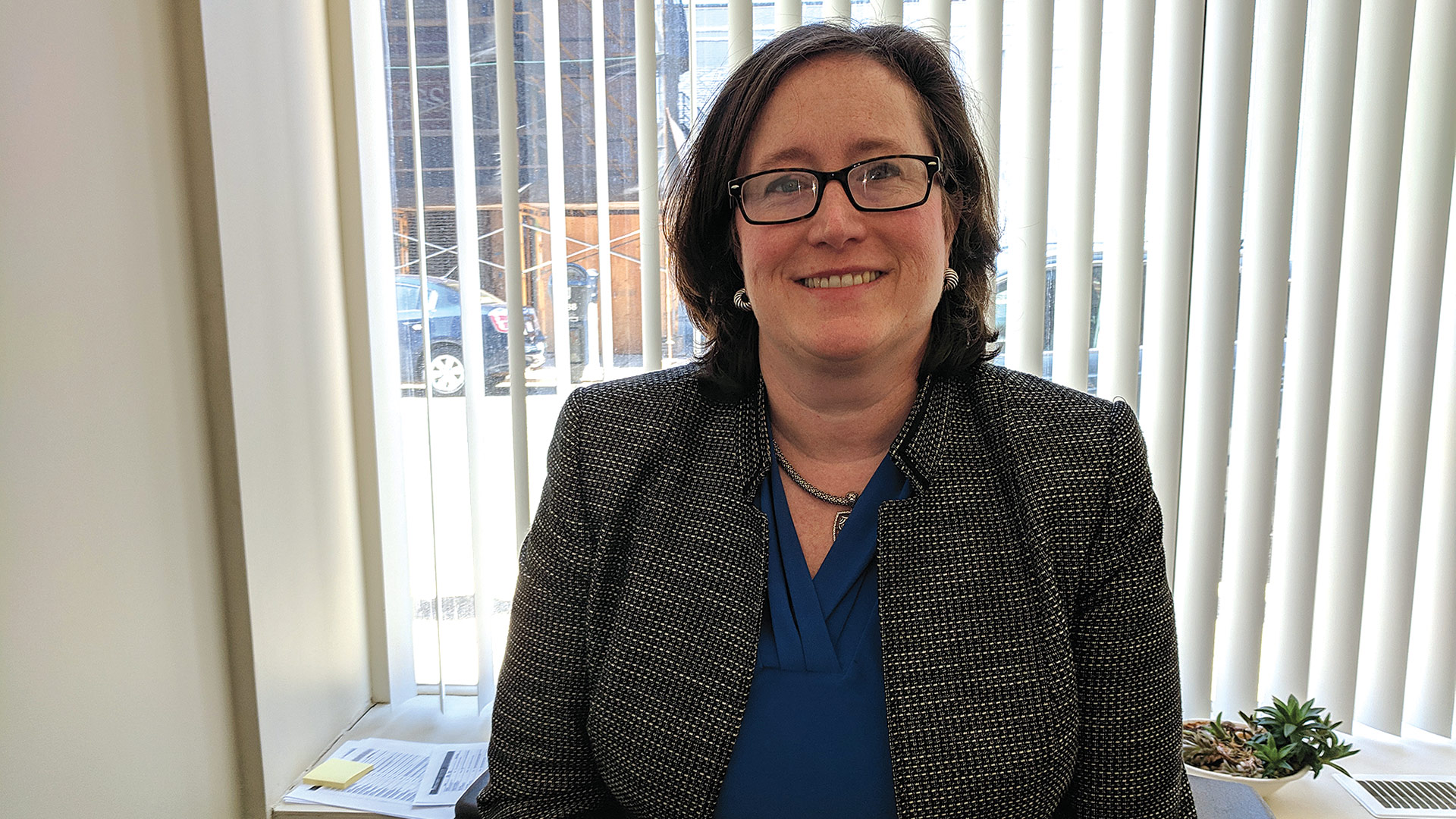
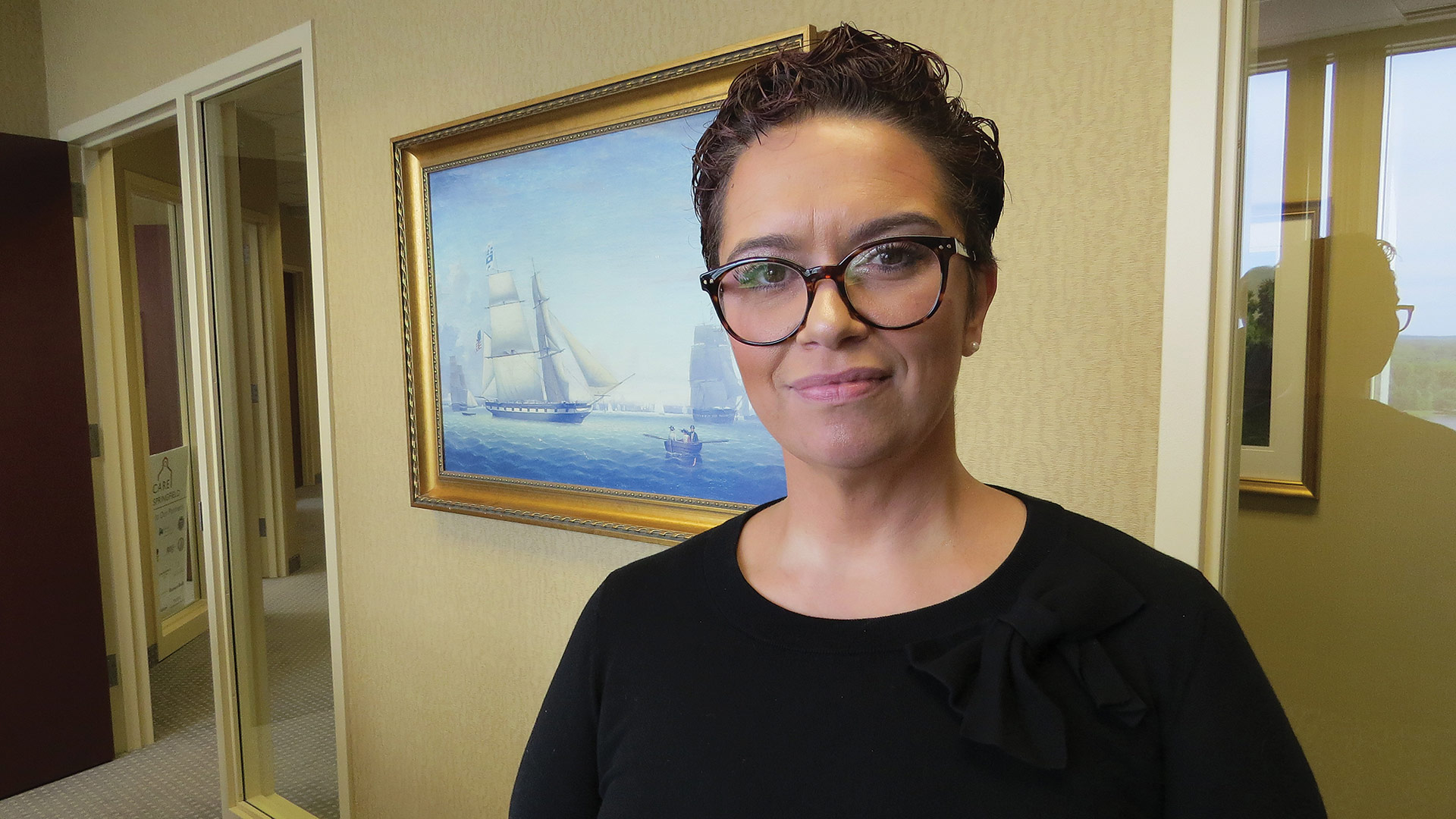
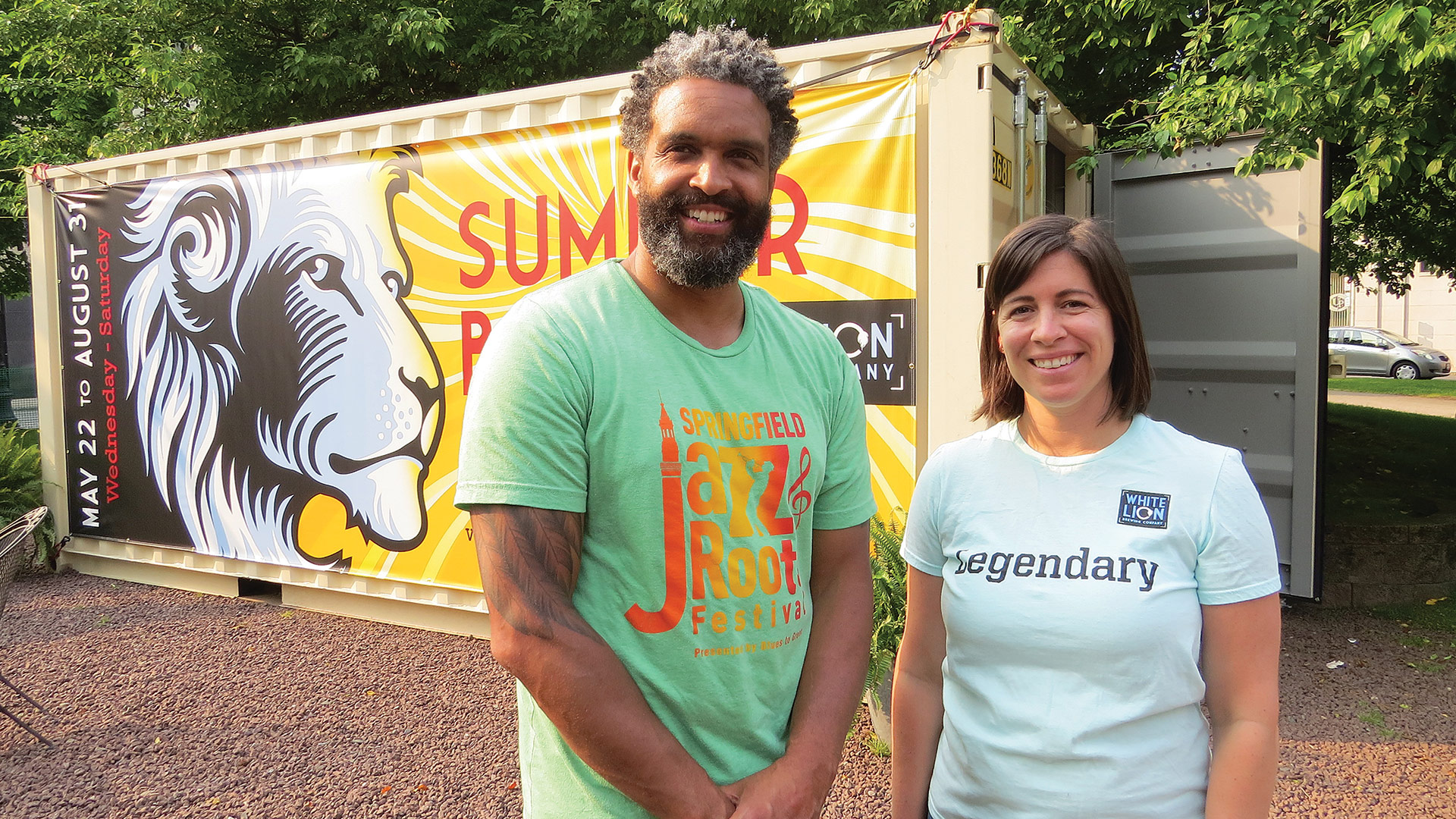
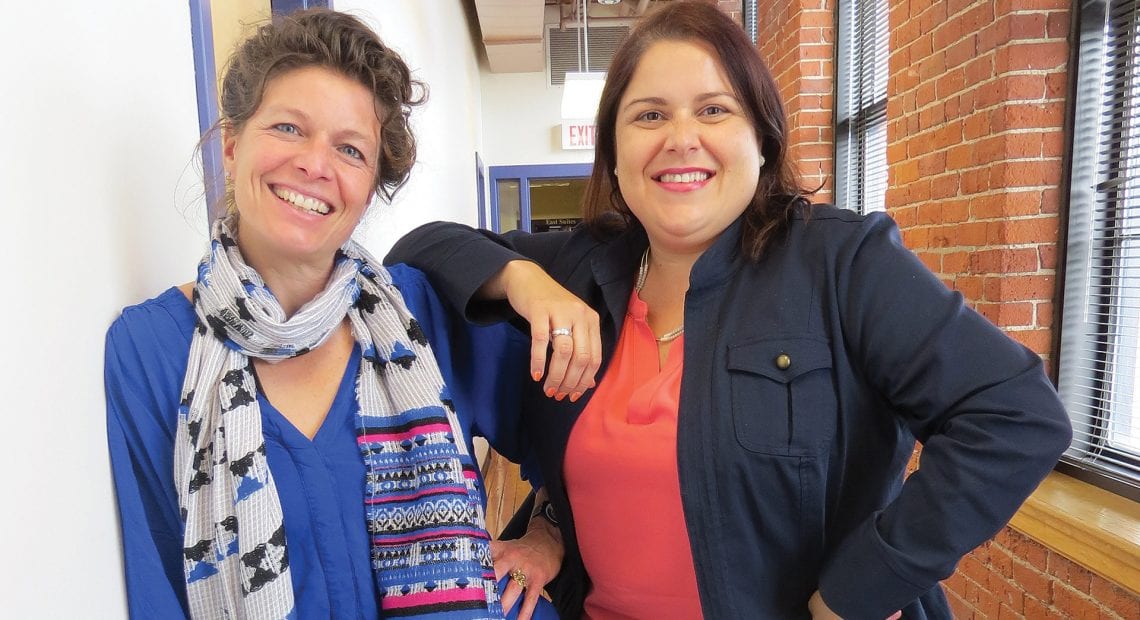
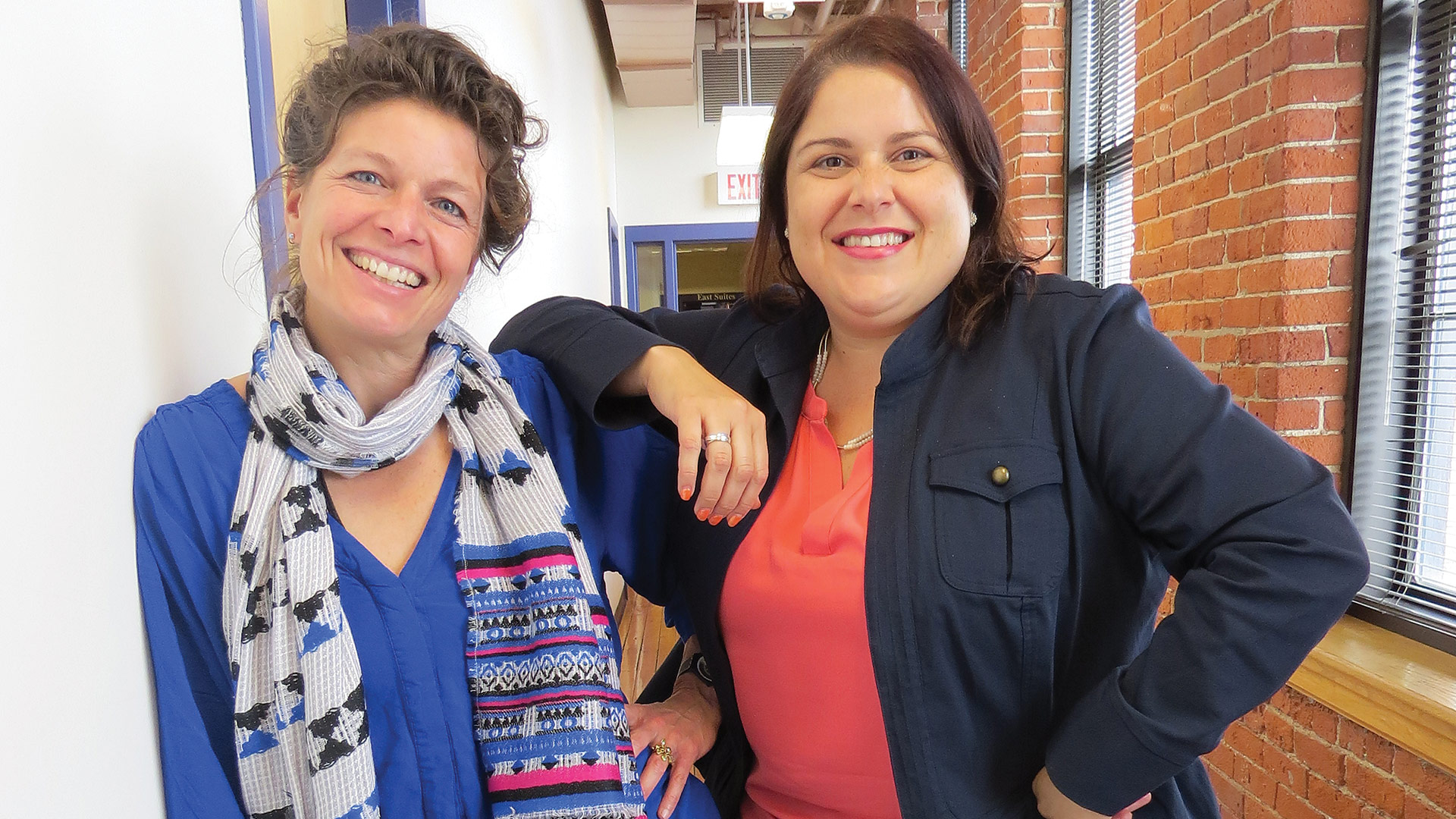
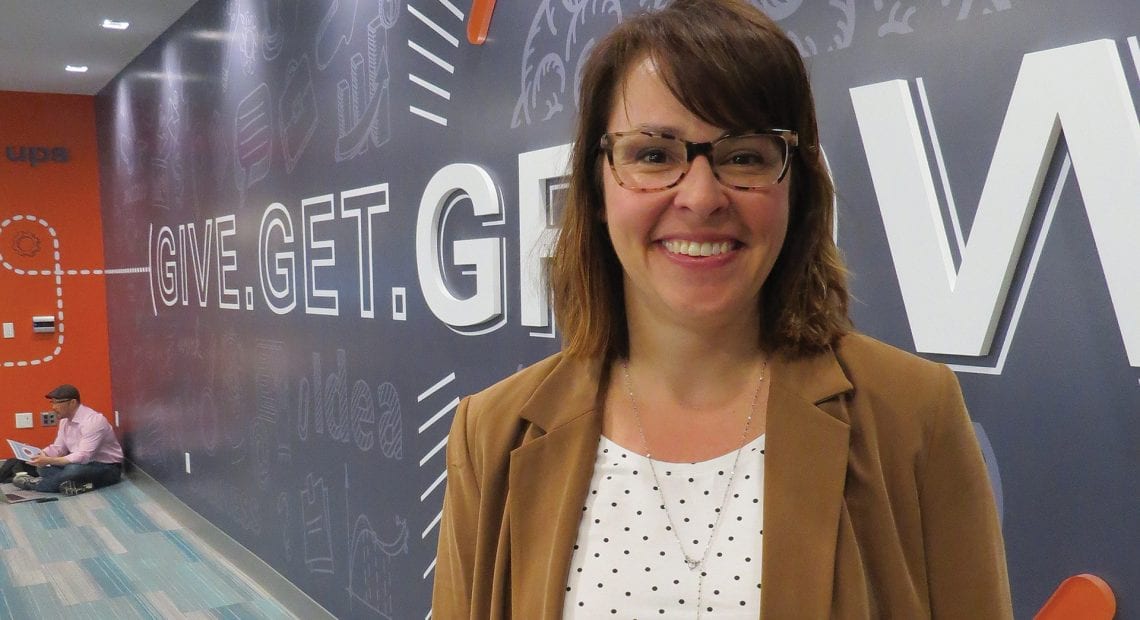
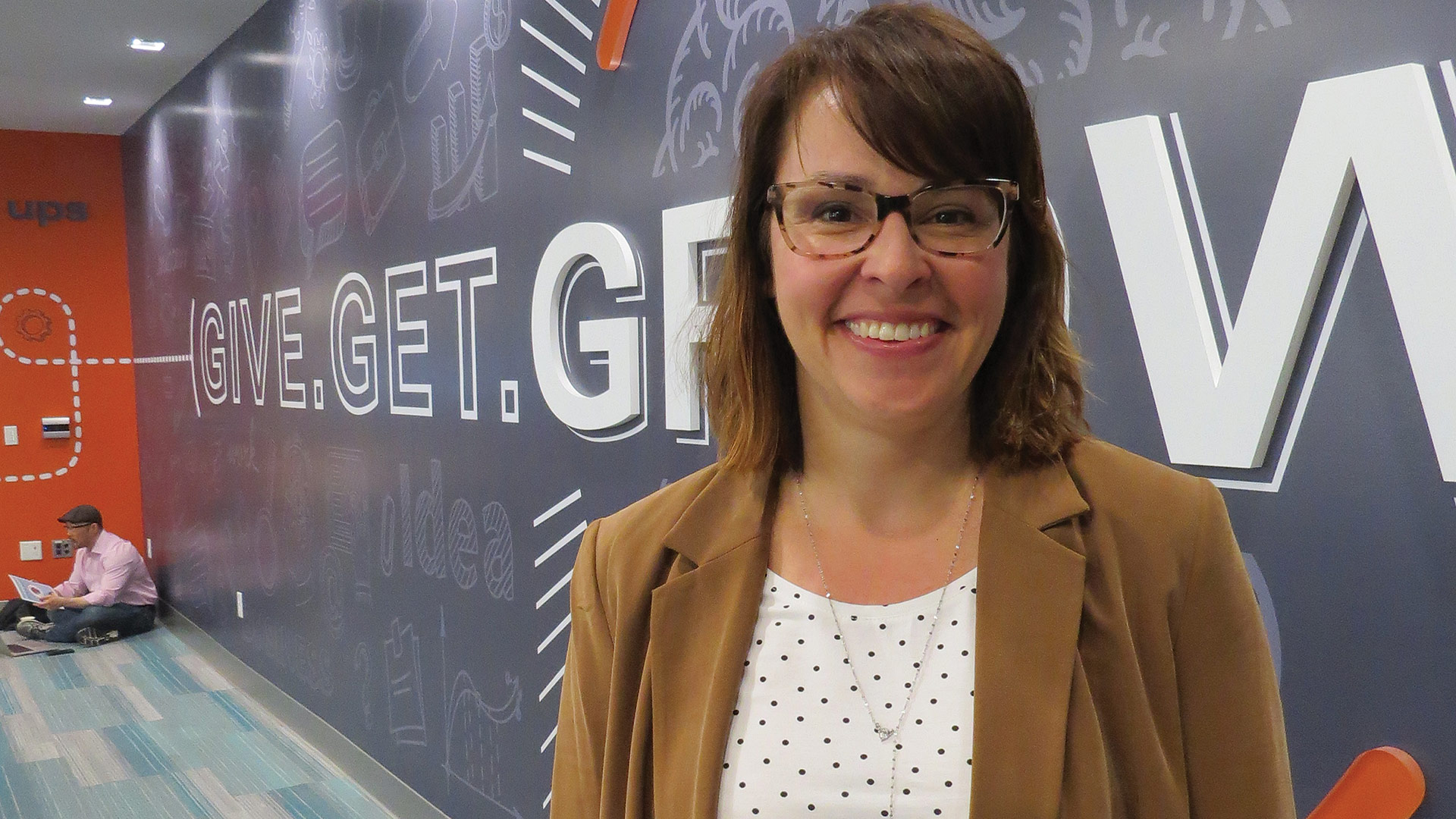
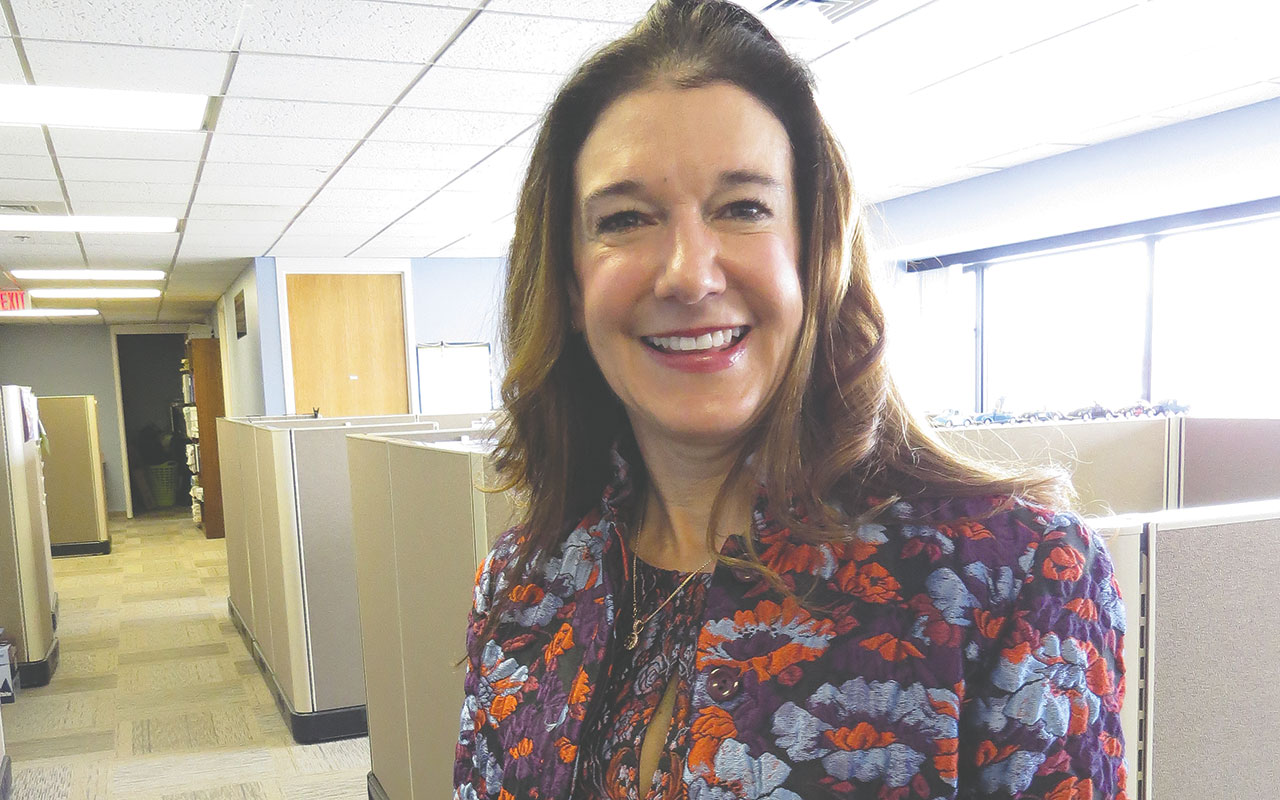
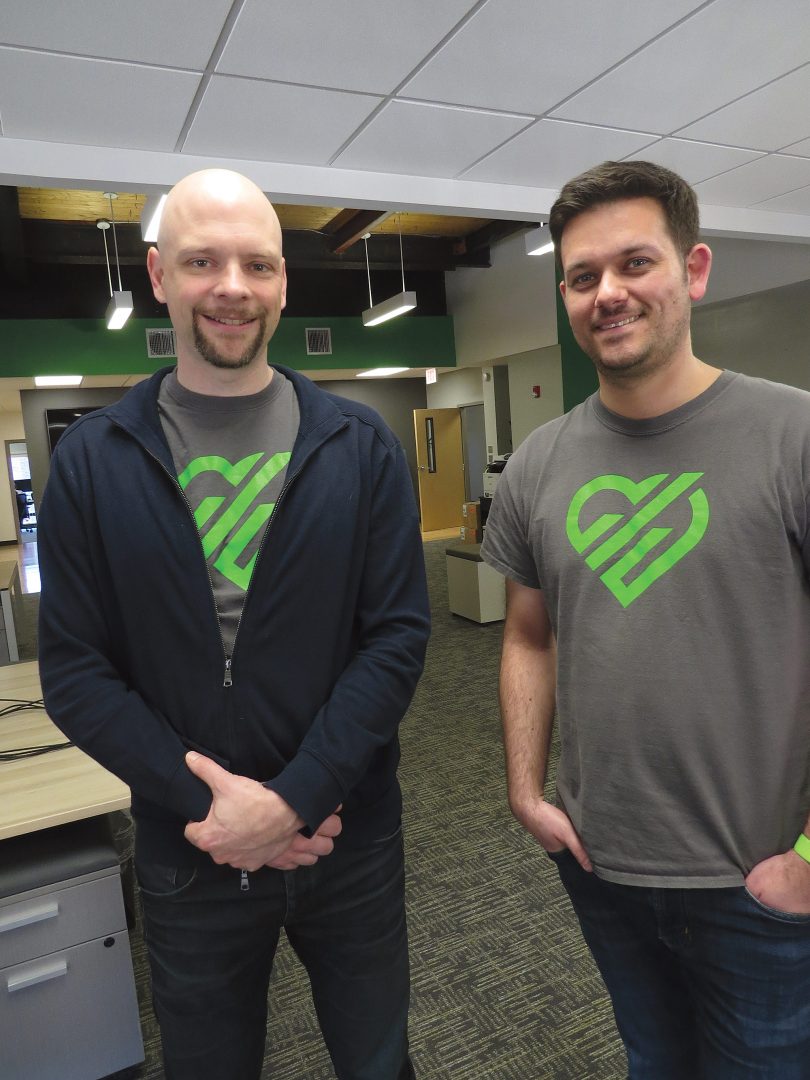
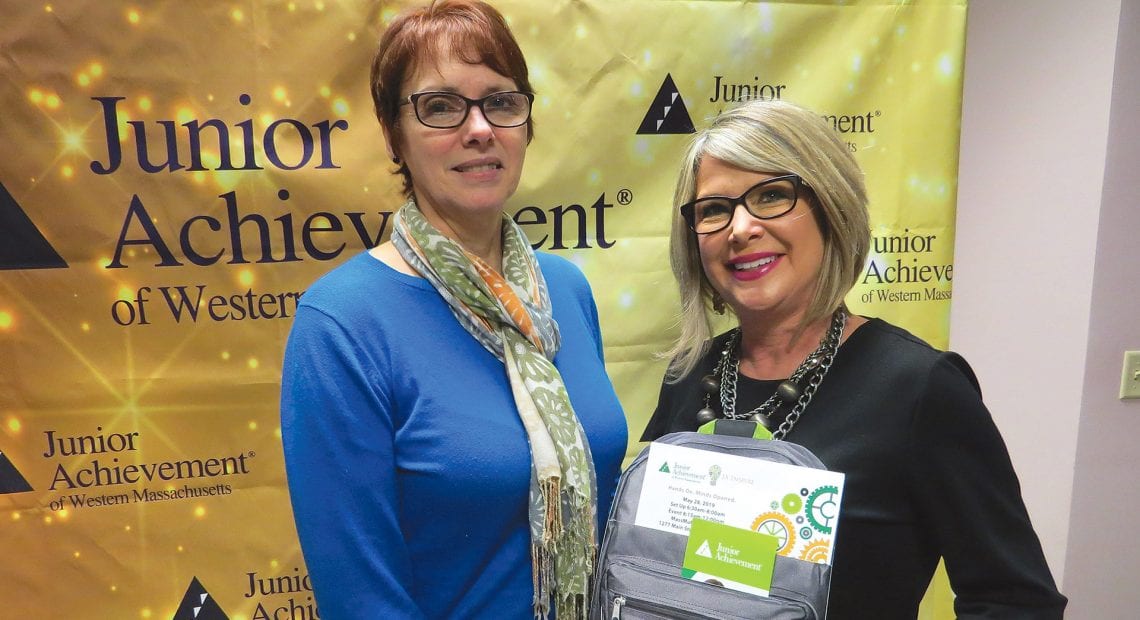
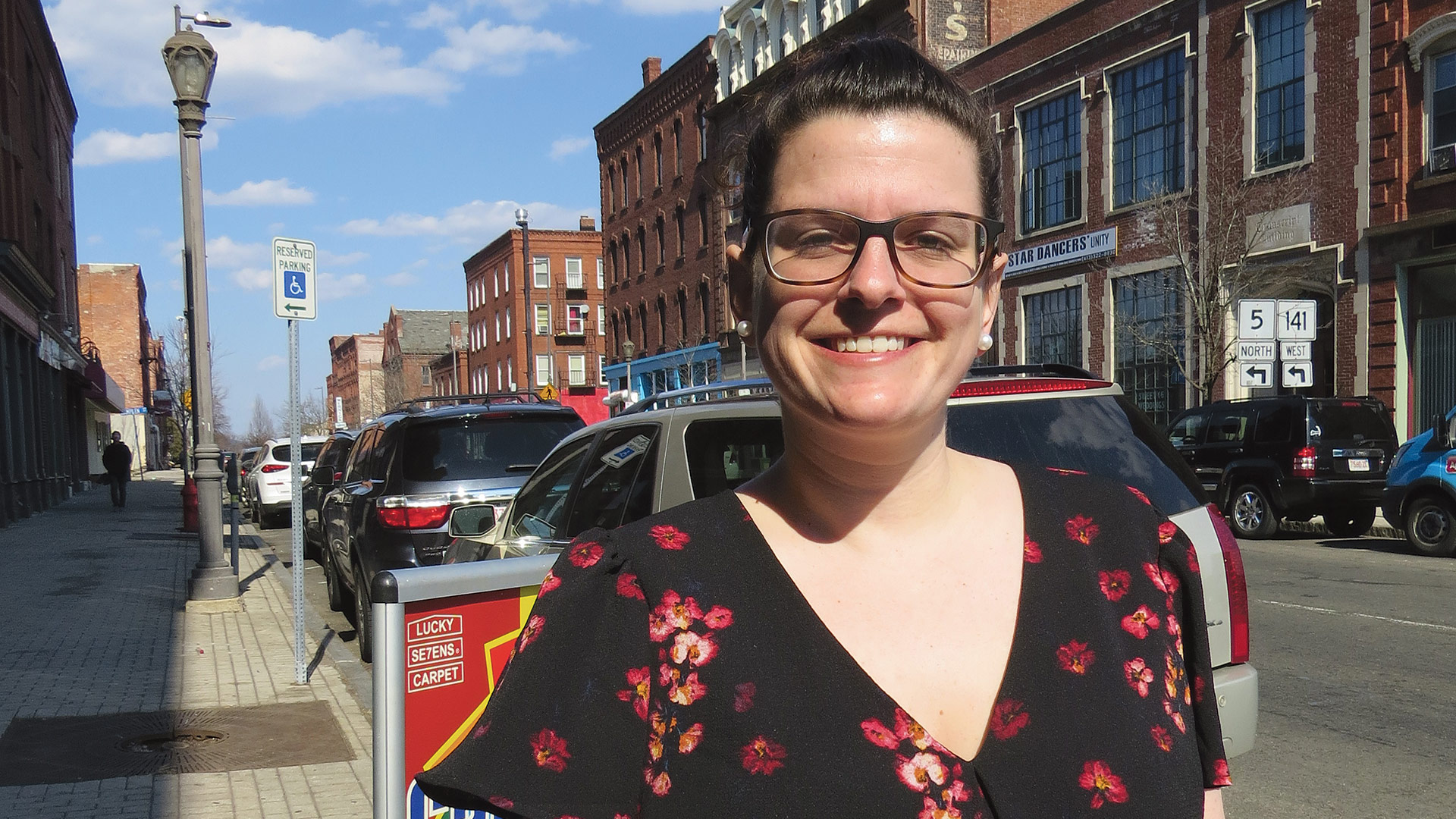
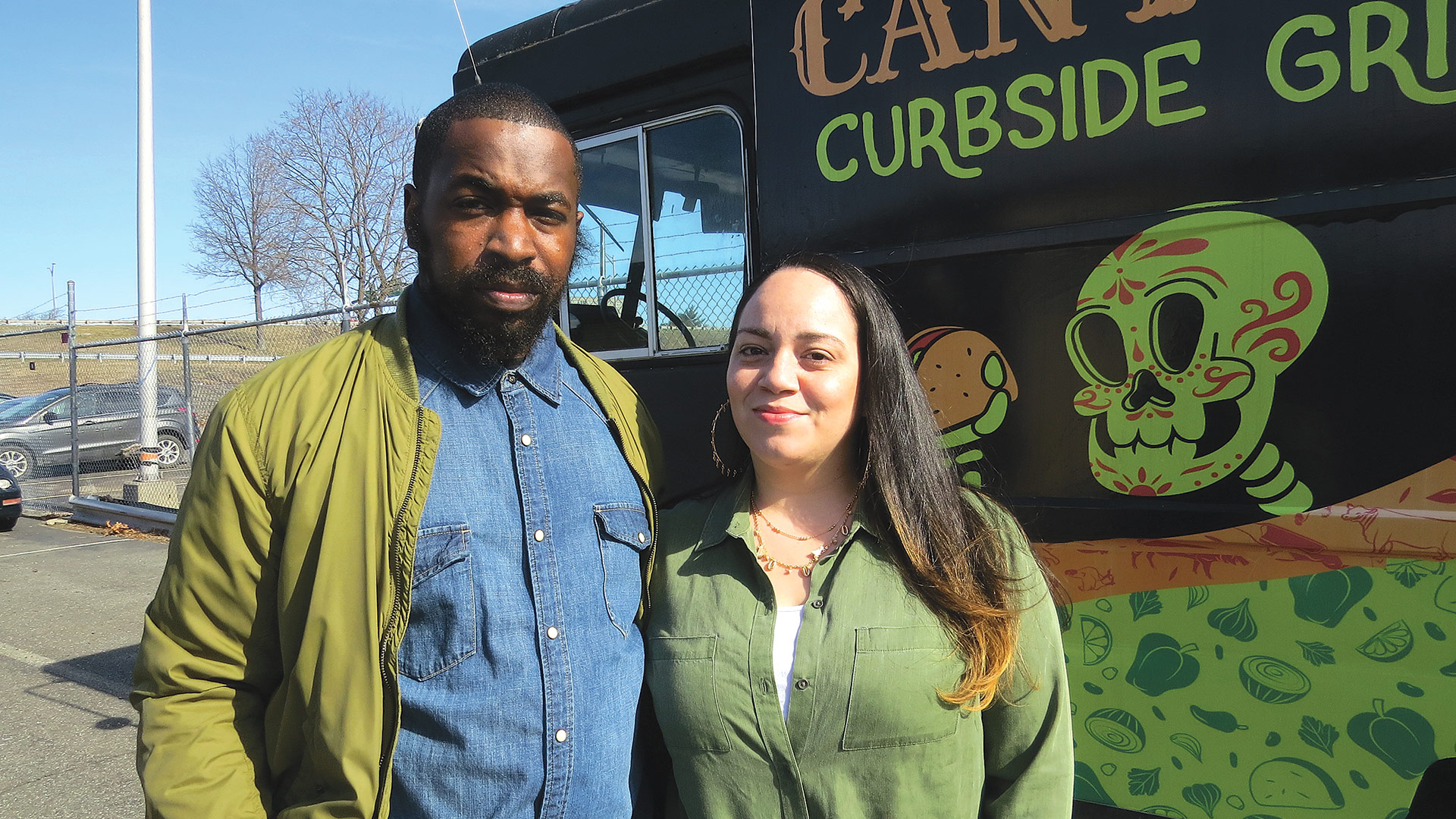
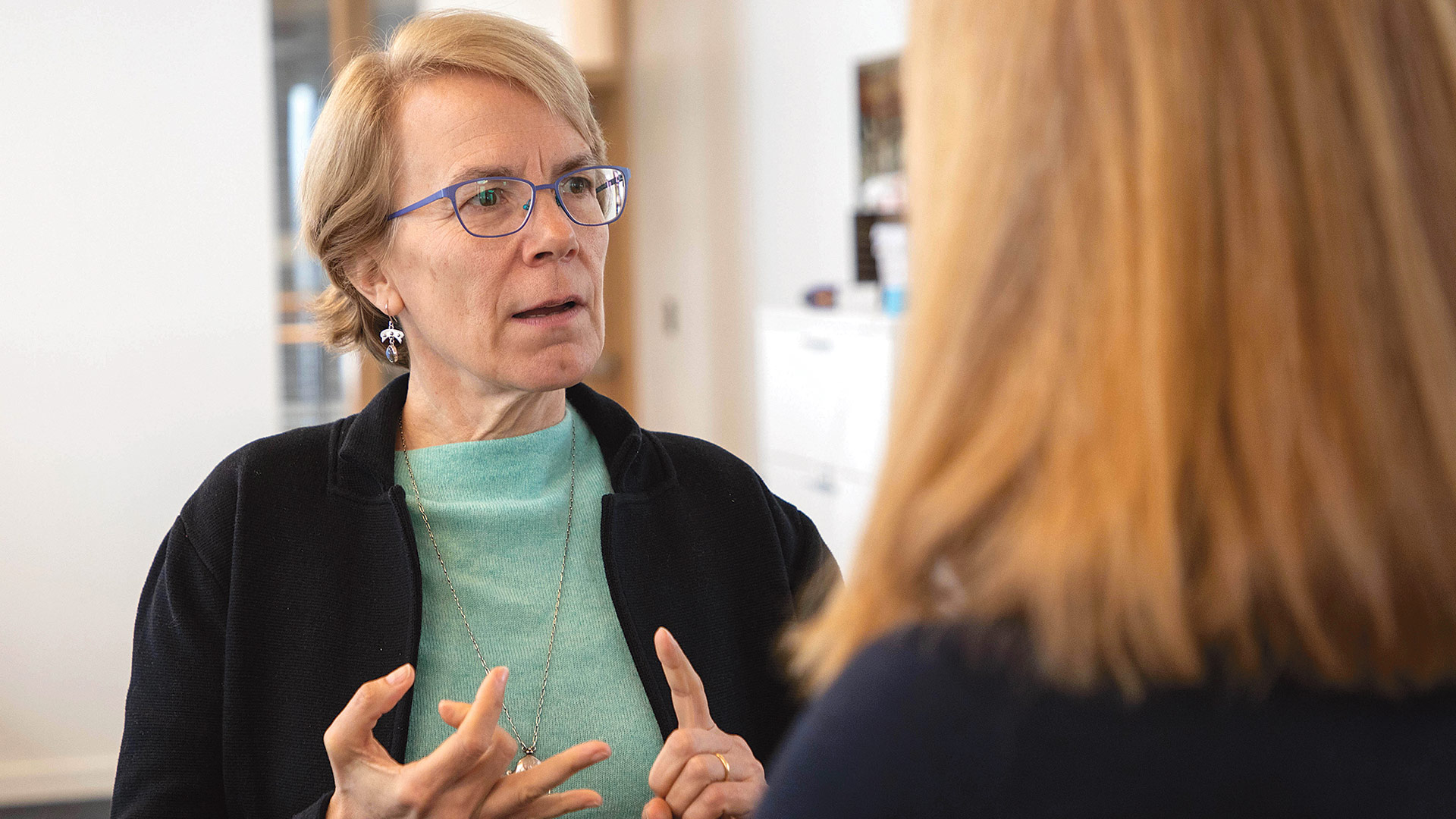
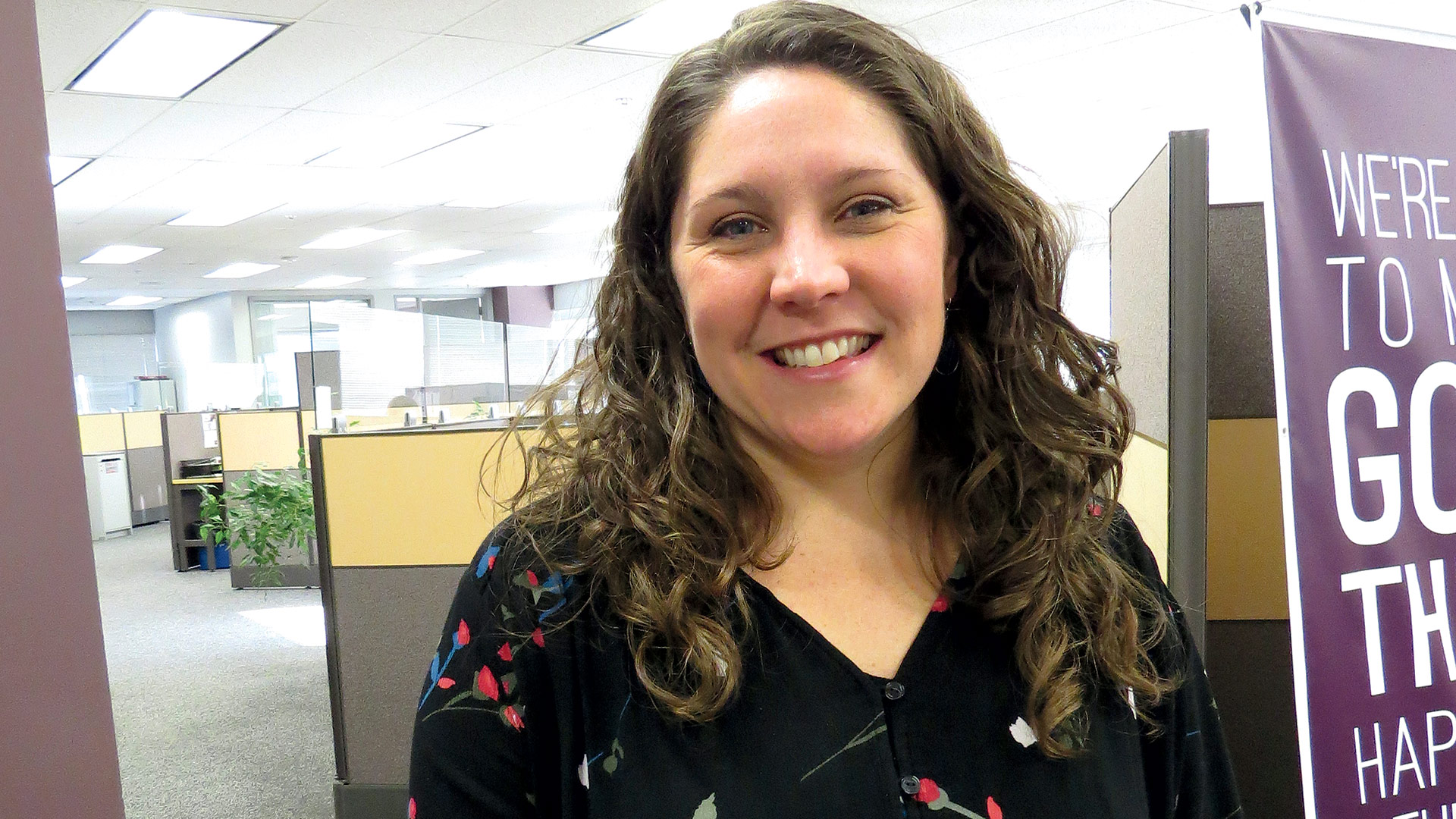
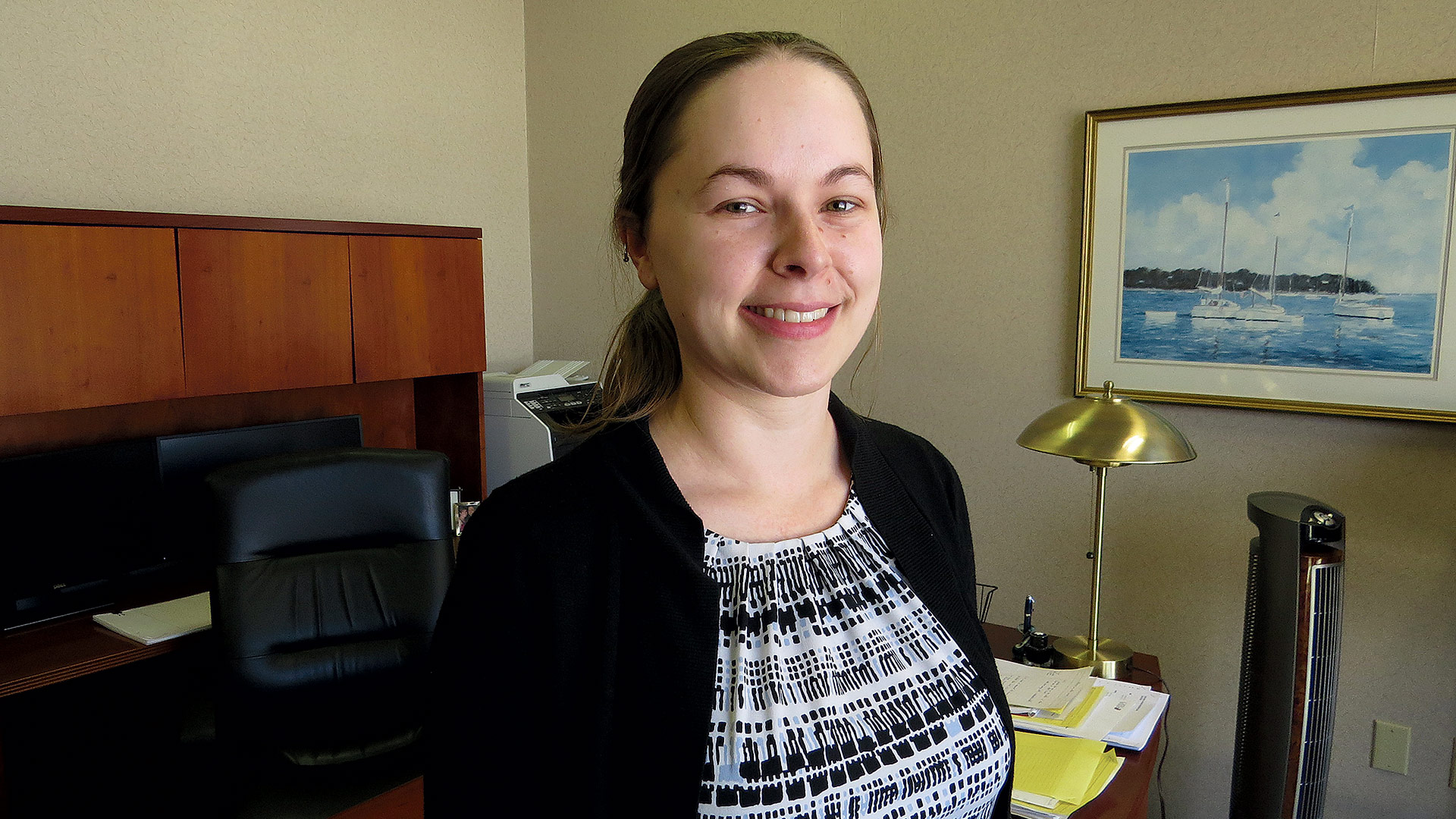
Robyn Caody, left, and Samalid Hogan are working to take Innovate413 to the next level as a resource to the region.

Robyn Caody, left, and Samalid Hogan are working to take Innovate413 to the next level as a resource to the region.

Samalid Hogan says that, when the website Innovate413 was launched roughly four years ago, it was with a desire to not only promote entrepreneurship and innovation in the region, but to inspire more of both.

And when she agreed to essentially take over the initiative early last year, she admitted the original goal was just to “keep it going,” as she put it, because she could clearly see the value it represented.

But rather than just keep it going, she has committed herself to taking its mission, and its offerings, to a much higher level. And with the help of a growing team that includes Robyn Caody, a business-culture and brand strategist who relocated to the region from New York City, Hogan, best known as director of the Western Mass. Small Business Development Center and winner of BusinessWest’s Continued Excellence Award last year, is doing just that.

Indeed, Innovate 413, or Inno413, for short, has become a multi-platform initiative, with a website (www.innovate413) as well as a monthly newsletter and comprehensive calendar of events related to entrepreneurship, professional development, and business management.

In addition to publishing original content, Innovate413 also aggregates and links to entrepreneurial news from outside sources, provides resources for entrepreneurs in the Pioneer Valley, and encourages its partner organizations to submit their own content highlighting innovative trends within their businesses.

The broad goals, said Hogan, are to educate and motivate the audience and also promote the region and all that’s happening within it, especially when it comes to a steadily growing startup community.

“There’s a big start-up culture here, a culture of creativity — I could sense that. But since I moved here, it’s been hard to find these people; I know they’re here, but where’s the community hub? How can I find out what people are doing? Innovate413 is a way to make that more obvious.”

“When I took it over, the goal was to just keep it alive and post items on the site,” she explained. “But now we’re actively engaged in taking this to the next level and making it much more of a resource.”

Caody agreed. She said she relocated to this region partly because of the large amounts of creativity and entrepreneurial spirit that exist here, and a desire to be part of all that. She joined Innovate413 to help shed some light on all that’s going on.

“There’s a big startup culture here, a culture of creativity — I could sense that,” she explained. “But since I moved here, it’s been hard to find these people; I know they’re here, but where’s the community hub? How can I find out what people are doing? Innovate413 is a way to make that more obvious.”

The content currently on the site provides an effective snapshot of the mission and how it’s carried out. There are several stories from the pages of BusinessWest — including those highlighting agencies such as TechSpring, Valley Venture Mentors, the Berthiaume Center for Entrepreneurship at UMass Amherst, 1Berkshire, and others — and other media outlets. But there is more original content, such as a piece on the upcoming Demo Day, written by Paul Silva, president of Launch413, and short stories on individual businesses.

The site prints articles from agencies like TechSpring (one of the original founders of the site, along with Click Workspace and PixelEdge), Greentown Labs, and others, and submissions from individual entrepreneurs looking to help educate others or just tell their own story.

Headlines on educational stories currently on the site range from “Five Signs You Might Have Second-stage Business” to “Should You Get a Business Certification?” Meanwhile, there are profiles (again, many from BusinessWest) on agencies and businesses ranging from Happier Valley Comedy to Central Rock Gym.

The team at Innovate413 now includes Hogan; Caody, serving as chief Development officer; and Mychal Connolly Sr., an entrepreneur (he founded the venture Stinky Cakes), author, and speaker who serves as chief Marketing officer.

Together, they’re working to make the initiative more of a resource for area entrepreneurs — and the region as a whole — and an ever-more-important part of the entrepreneurship ecosystem in Western Mass.

“There’s a lot of opportunity here because a lot of organizations that are not really innovative have found themselves wanting to innovate. And we can really be a resource to these agencies.”

The goal moving forward, said Hogan, is to create more original content, build a subscriber base for the monthly newsletter — there are currently a few hundred, and the goal is 1,000 — and continually build the calendar, which is becoming a popular and valuable resource,

Indeed, the calendar posts events being staged by 16 different area organizations within the ecosystem, and organizers do the hard work by pulling the items off those agencies’ websites.

“We post anything that helps entrepreneurs,” said Hogan. “That includes training and educational programs such as those on how to start a business, networking events, pitch competitions, leadership programs, things like Demo Day, blockchain-technology meetups … anything that helps educate entrepreneurs.”

And, looking down the road, those at Innovate413 have a vision of perhaps creating events to help promote entrepreneurship. As with the startups it spotlights, the initiative’s business plan is evolving, said Caody.

“Ultimately, we want to create a community of entrepreneurs and small-business owners,” she said, adding that there is a considerable amount of momentum building within the startup community and the ecosystem that supports it, and Innovate413 wants to tap that energy and use it to fuel additional growth.

Like any business in this region, Innovate413 has the broad goal to be sustainable, said both Hogan and Caody, adding that the initiative is laying a solid foundation that will enable it to do just that.

“There’s a gap when it comes to this kind of service in this region, and we’re filling it, slowly but surely,” said Hogan. “We’re getting there.”

Caody agreed. “There’s a lot of opportunity here because a lot of organizations that are not really innovative have found themselves wanting to innovate,” she explained. “And we can really be a resource to these agencies.”

—George O’Brien

Cover Story

Community Spotlight

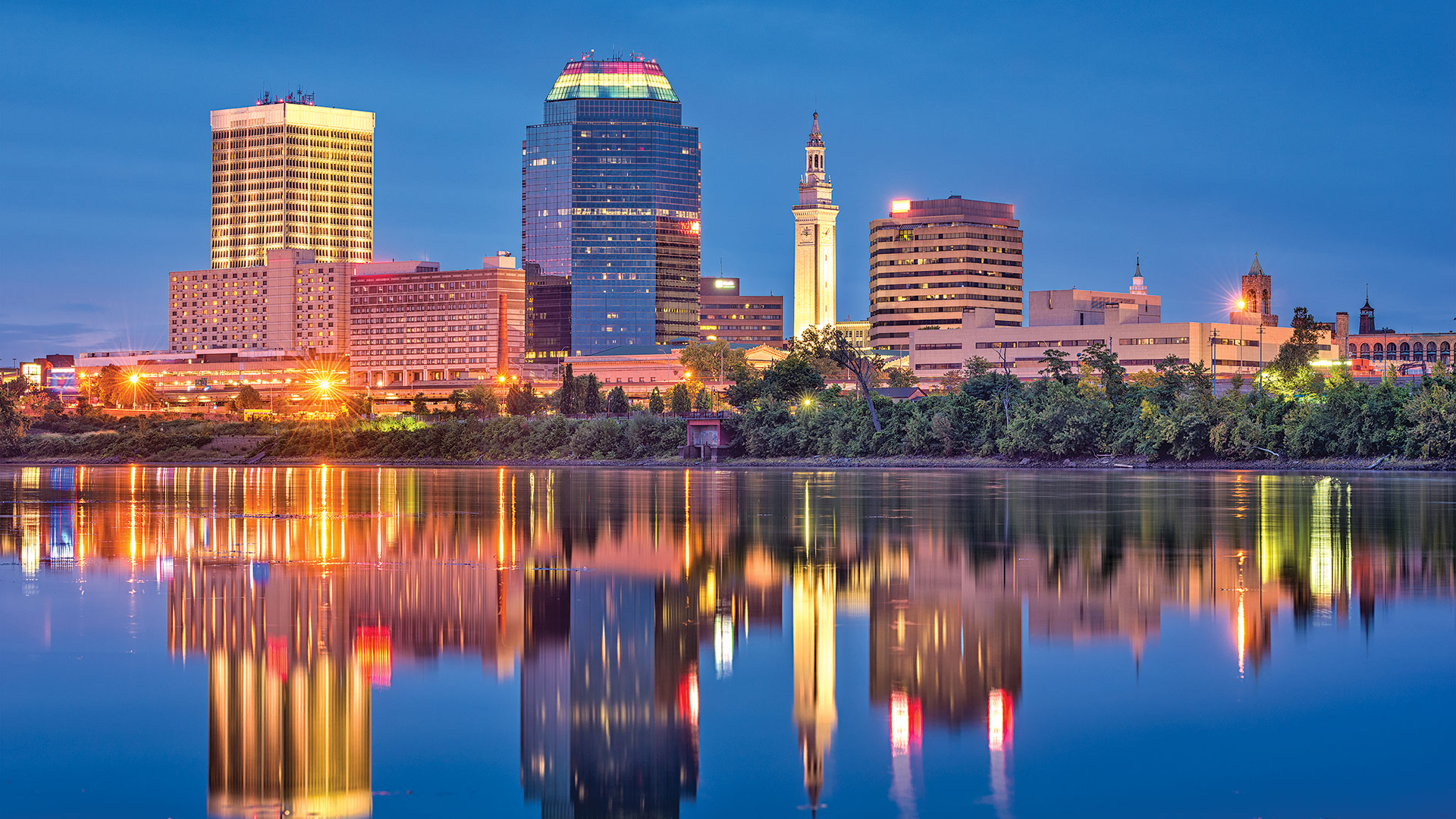
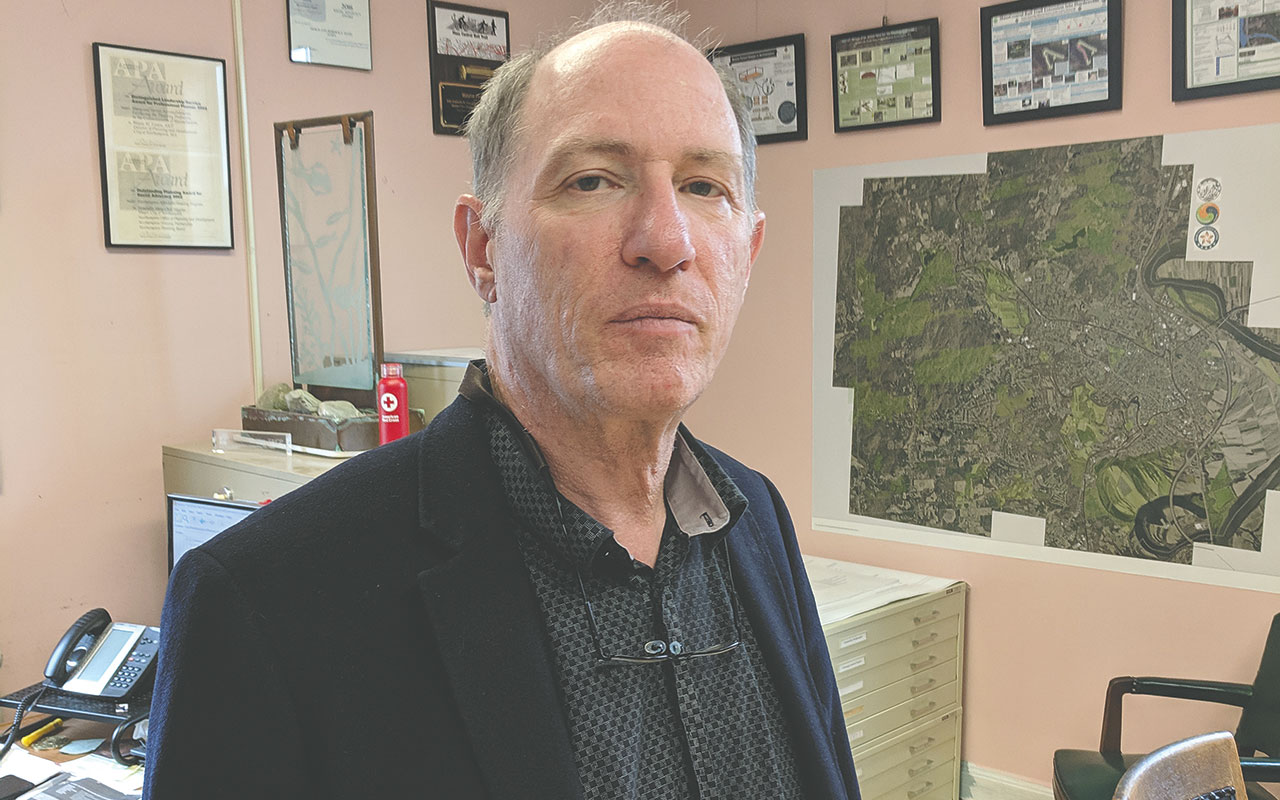
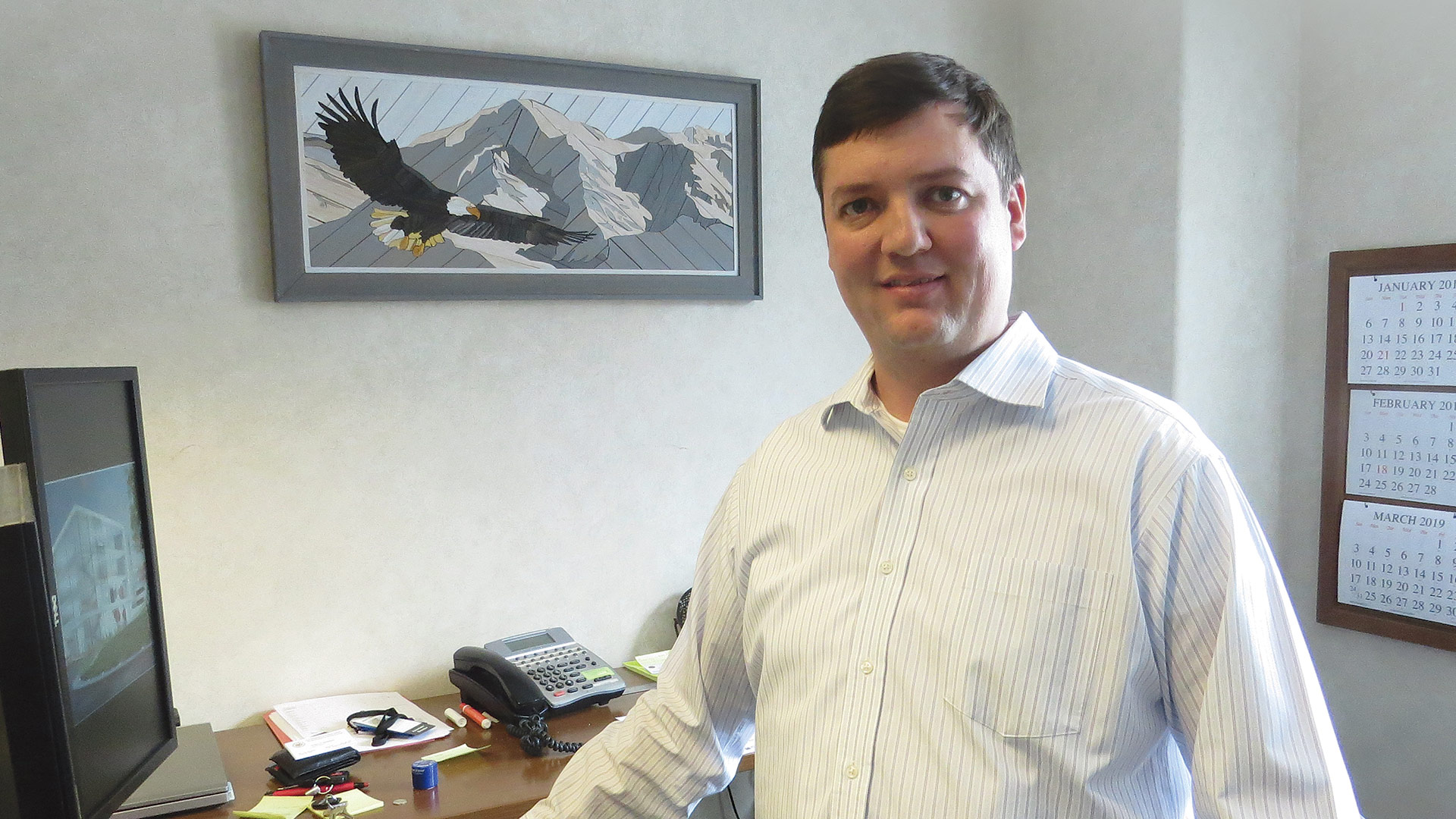
There’s a stunning new aerial photo of downtown Springfield gracing the wall outside Kevin Kennedy’s office in the municipal complex on Tapley Street.

The panoramic image captures the view from above the Connecticut River looking east, with the new MGM Springfield casino prominent in the foreground. Kennedy, the city’s chief Development officer, is quite proud of the photo and all that it shows, but regrets that it was taken in the very early stages of the elaborate work to renovate Riverfront Park, and thus doesn’t include that important addition to the landscape.

He joked about Photoshopping something in to make the image more current, but then acknowledged that, at the rate things are changing, he would be doing a lot of Photoshopping — or swapping out that photo for a new one on a very regular basis.

Those sentiments speak volumes about the pace of development in the city over the past decade or so, and especially the past five or six years, as Springfield has rebounded dramatically from the fiscal malaise — and near-bankruptcy — that enveloped it only 10 years ago.

Indeed, Kennedy said he doesn’t have to ‘sell’ Springfield to potential developers anywhere near as much as he did when he assumed this office in 2011 after working for many years as U.S. Rep. Richard Neal’s aide. Nor does he have to tell the city’s story as much — people seem to know it by the time they’ve entered the room. And many are certainly entering the room.

“Development in an urban area like this isn’t really development — it’s redevelopment, and that, by its very nature, is usually very complicated.”

“We don’t have to explain ourselves — when people walk through the door, they know what’s happened over the past five or seven years,” he explained, adding that, overall, he doesn’t have to convince people that the city is a good investment — most are already convinced, which, again, is a marked change from attitudes that prevailed at the start of this century and even at the start of this decade.

As he talked with BusinessWest, Kennedy equated Springfield’s progress over the past several years to a large jigsaw puzzle, with many of its pieces falling into place. These include everything from the casino to a renovated Union Station; from a restaurant district now taking shape to restored and expanded parks, such as Steans Square, Riverfront Park, Pynchon Plaza, and Duryea Way.

And still more pieces are coming into place — everything from a CVS on Main Street to a Cumberland Farms at the site of the old RMV facility on Liberty Street; from market-rate housing at the old Willys-Overland property on Chestnut Street to a new home for Way Finders at the site of the former Peter Pan bus station in the North End; from new schools to improved traffic patterns.
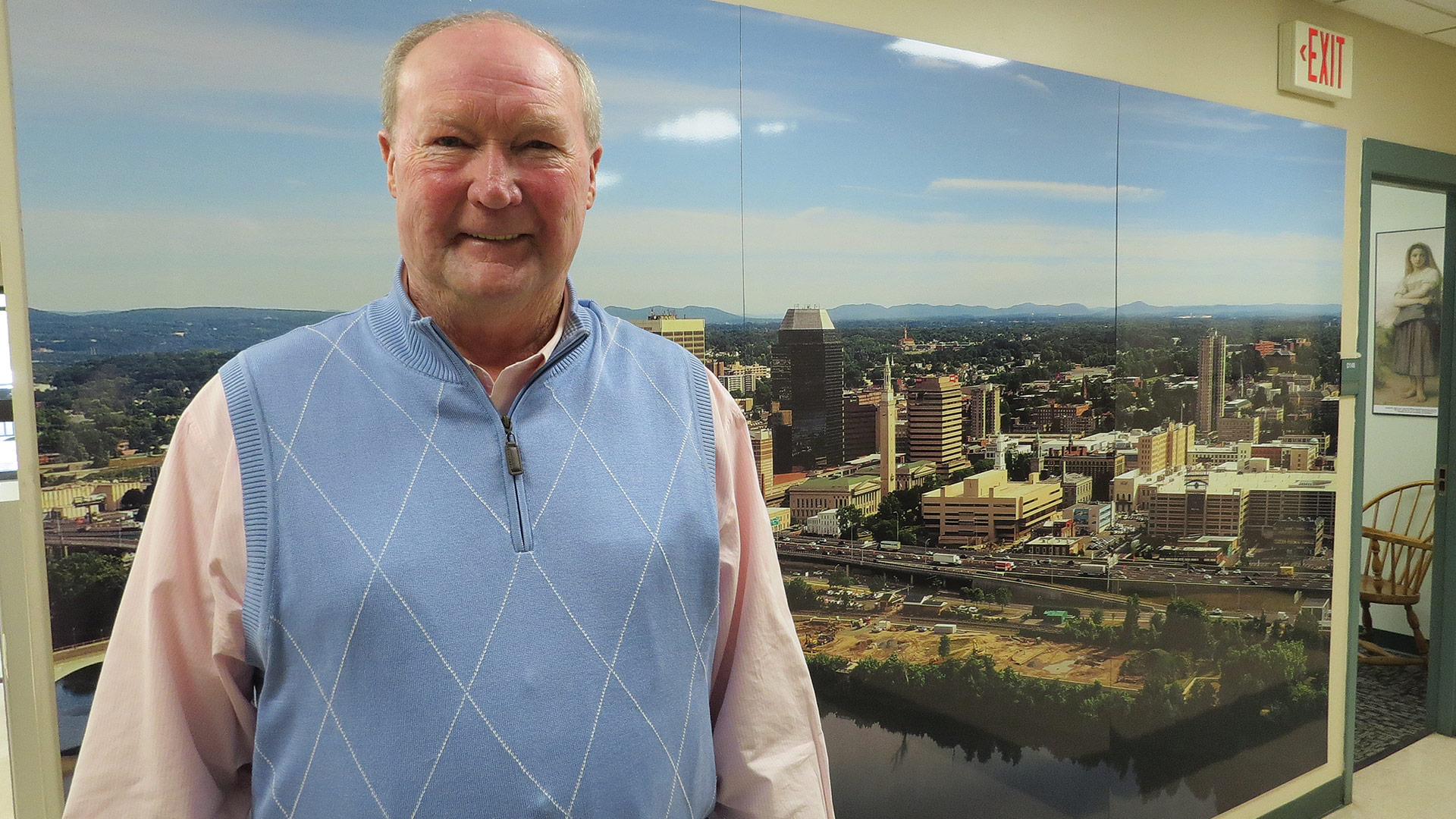
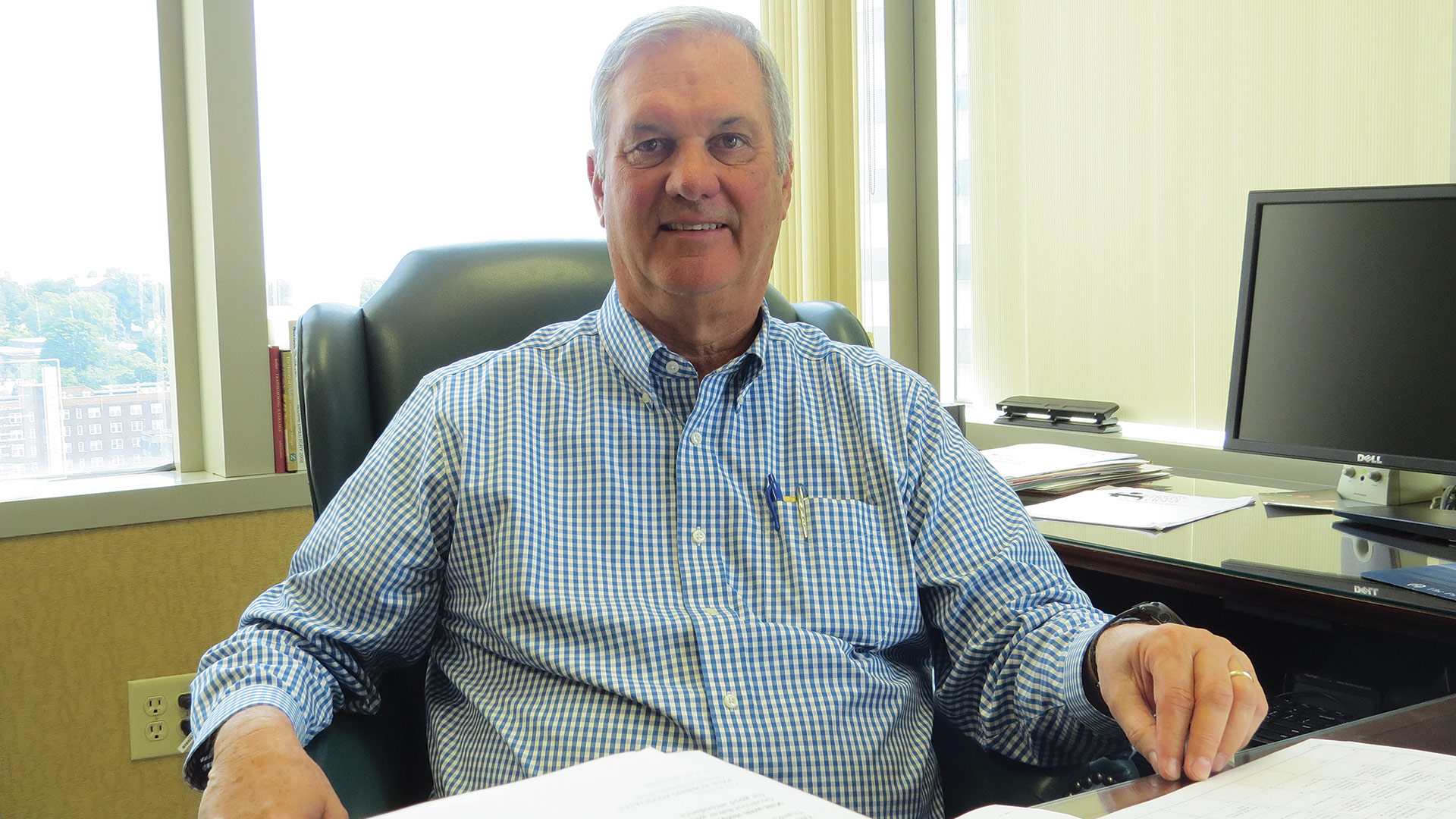
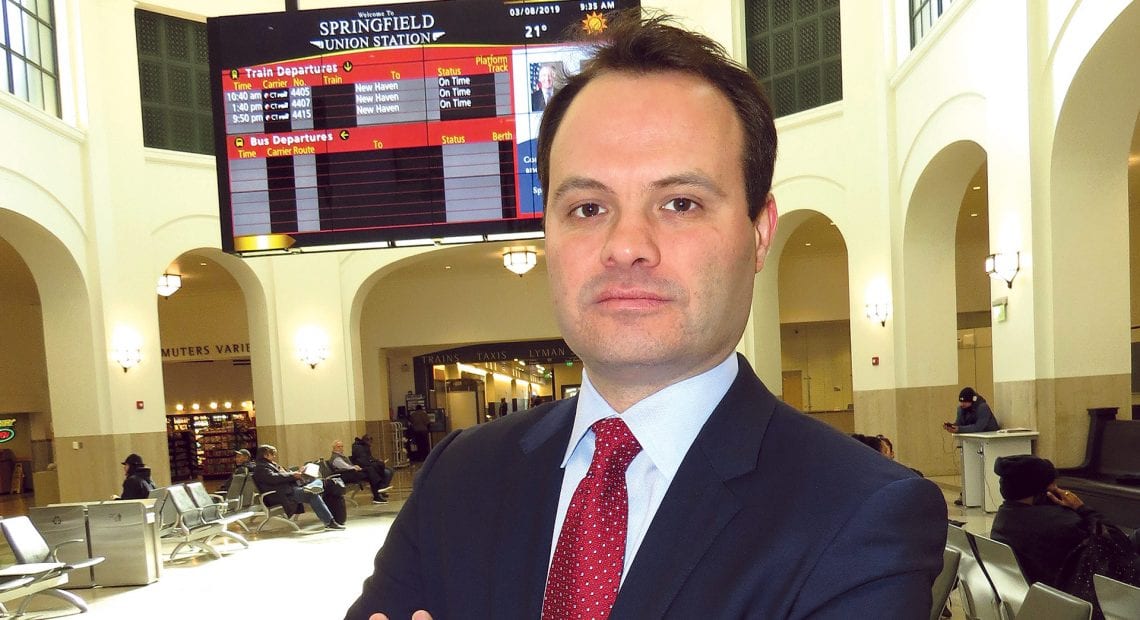
Kevin Kennedy

Kevin Kennedy stands next to the new panoramic photo of Springfield outside his office, the one he’d like to Photoshop to keep up with recent changes to the landscape.

But there are a number of pieces still missing, Kennedy acknowledged, adding that they’re missing for a reason — these are the hardest ones to fall into place because of their complexity.

Among the items on this list are a replacement for the decrepit Civic Center Parking Garage, which is literally crumbling as you read this; 31 Elm St., an all-important component to the downtown’s recovery because of its location and historical importance; the Paramount Theater project, equally important for all the same reasons; CityStage, now dormant for close to a year; and redevelopment of what has become known as the ‘blast zone,’ the area directly impacted by the natural-gas explosion in late 2012.

To explain their complexity, Kennedy started by making a simple yet poignant observation about development in a city like Springfield.

“Development in an urban area like this isn’t really development — it’s redevelopment, and that, by its very nature, is usually very complicated,” he explained, adding quickly that there are signs of progress with each of those initiatives, and some may be moved over the goal line in the months to come.

Mayor Domenic Sarno agreed, noting that, among those missing pieces, the top priority at this point is probably a new parking garage, primarily because it is essential to realizing many of the other items on the to-do list, such as a deeper restaurant district, more new businesses, and, overall, greater vibrancy downtown.

“The garage is a mainstay for our business community, and the MassMutual Center is a state facility — the garage is an integral part for the programming that goes on there, whether it’s MGM, the Thunderbirds, or college commencements,” said Sarno, adding that he’s already had discussions with both state and federal leaders about potential funding sources for such a facility. “We’re looking to move on this ASAP.”

For this, the latest installment its Community Spotlight series, BusinessWest looks at the jigsaw puzzle that is Springfield — meaning the pieces that have fallen into place and those that are still missing.

Rising Tide

‘The New Wave.’

That’s the name those in the Planning office and the Springfield Regional Chamber gave to what has become an annual presentation detailing planned and proposed projects in the City of Homes.

And ‘wave’ fits, said Kennedy, because new developments have been coming in waves, one after another, and there is a new one making its way to shore.

“One thing that people know is that my team will do business with them. I might not be able to give you 10 out 10 things you might be looking for, but maybe I can give you six or seven or eight. They also know that we know how to connect the dots.”

It follows previous waves that brought MGM Springfield, CRRC, a revitalized Union Station, and a repaired I-91 viaduct, projects that were of the nine-figure variety (MGM was almost 10) or very close — the final price tags for CRRC and Union Station were just under $100 million.

The newest wave has just one initiative of that size, and it’s a municipal project — a new pumping station to be built on part of the land once occupied by the York Street Jail. But while many of the projects are smaller, eight- and seven-figure endeavors, they are equally important, said Kennedy, adding that they represent a mix of expansion efforts by existing companies, or ‘legacy businesses,’ as he called them, and relative newcomers.

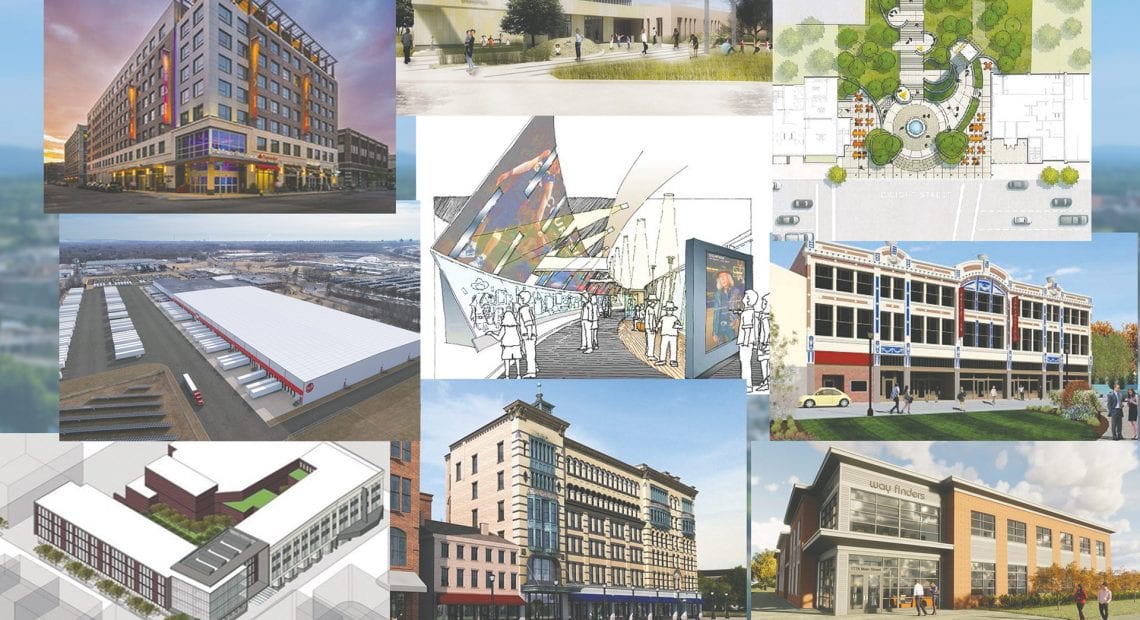
Together, the projects touch many different sectors of the economy, include both new construction and renovation of existing structures, and total several hundred million dollars in new development. The lengthy list includes:

• MassMutual expansion. The financial-services giant is relocating 1,500 workers to Springfield, increasing the workforce in the city to 4,500. A $50 million project to renovate and expand facilities in Springfield is slated to be completed by 2021;

• Big Y, with a 232,000-square-foot expansion of the current distribution center in Springfield, bringing the total to 425,000 square feet. The $46 million project is due to be completed later this year;

• Way Finders, which is constructing a new, $16.8 million headquarters building at the location of the Peter Pan bus terminal. The 23,338-square-foot structure, to house roughly 160 employees, is slated to open in the spring of 2020;

• Willys-Overland development, a planned 60-unit, market-rate housing project in the one-time auto showroom. Construction is slated to start soon on the $13.8 million project;

• Innovation Center. Grand-opening ceremonies for the $7 million facility on Bridge Street were staged in February. Work continues on the façade, and a new restaurant is planned for the ground floor;

• CVS. Work is set to commence shortly on a new CVS to be constructed at the corner of Main and Union streets. The $2 million facility, to feature what developers are calling an ‘urban design,’ is slated to open this fall;

• Redevelopment of the former RMV site. The location on Liberty Street will be converted into a Cumberland Farms. The $3 million project will benefit a neighborhood that city officials say is underserved when it comes to convenience and gas;

• The Springfield Performing Arts Academy, specifically a $14 million project to relocate the academy in the former Masonic Temple on State Street;

• Tower Square. The office/retail center is the site of several new developments, including renovations to the hotel (which will be rebranded back to Marriott), a new White Lion brewery, and relocation of the YMCA of Greater Springfield into several locations within Tower Square; and

• Educare. A $14 million, 27,000-square-foot, state-of-the-art early-education facility is currently under construction in the Old Hill neighborhood. The project, a joint partnership between Holyoke Chicopee Springfield Head Start, the Irene E. and George A. Davis Foundation, and Springfield College, will serve 141 children and is slated to open this fall.
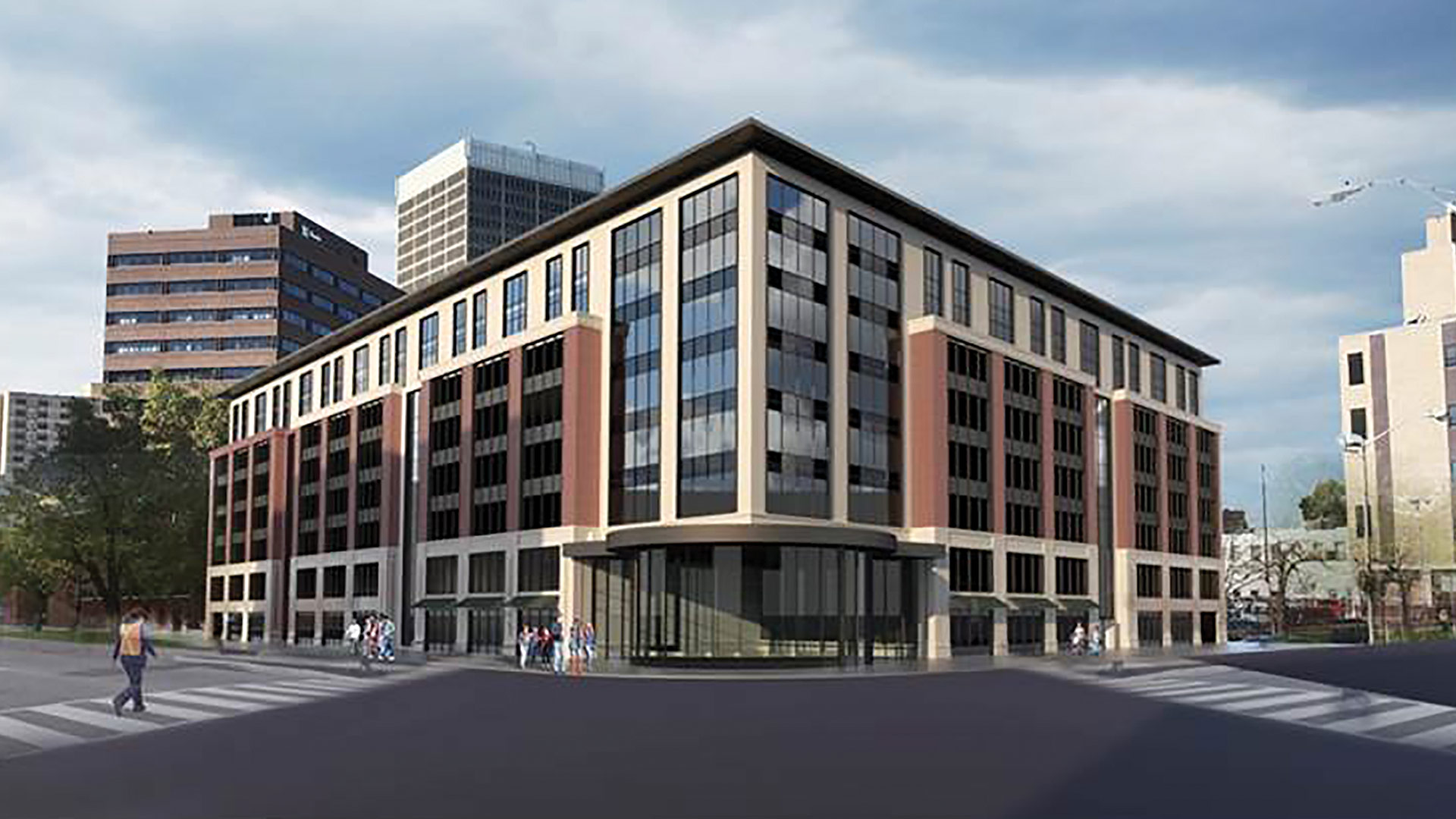
An architect’s rendering of a proposed new parking garage

An architect’s rendering of a proposed new parking garage on what’s known as parcel 3, the parking lot behind the TD Bank tower. City officials say a new garage is a must for Springfield.

That’s quite a list, said Kennedy, adding that it’s come about largely because of renewed confidence in the city and its future, an attitude far removed from the one that existed even a decade ago, when there were far fewer businesses willing to bet on the City of Homes.

Getting Down to Business

Indeed, today, as evidenced by all the projects in progress or on the drawing board, there is renewed interest in Springfield across many sectors of the economy — from tourism and hospitality to startups looking for a place to launch, to those looking to be part of the burgeoning cannabis industry in the Bay State.

The city has a message for all these constituencies — that it’s open for business and willing to work with those who would make Springfield their home.

“One thing that people know is that my team will do business with them,” said the mayor. “I might not be able to give you 10 out 10 things you might be looking for, but maybe I can give you six or seven or eight.

“They also know that we know how to connect the dots,” he went on. “We know how to work with all the players — federal, state, and on the local level, all the way down. And they know that we’re willing to put skin in the game, too, and that’s been very advantageous.”

Kennedy agreed, and said that, overall, the city has become what he called a “reliable, predictable partner,” something every business is looking for as it considers locating or relocating in a specific community.

“They don’t need showhorses, they don’t need a lot of glitz,” he told BusinessWest. “They simply want to do their business and know they have a good partner, and I think that’s what we’ve done from the start, and when we sit down to negotiate with people, I think they understand that, and they feel comfortable.”

Kennedy traces this growing sense of comfort to the lengthy and involved process of bringing a casino to the area.

“I think the thing that showed people we were serious was the whole casino process — not necessarily MGM, but the whole process,” he explained. “How we did it, and how upfront with everyone we were. People talk about being transparent, and that’s a jargony-type of a word, but we see it that way … and I think that, by virtue of having a billion-dollar investment come your way, a lot of other companies externally took a look at it, and internally said, ‘look what’s happened.’”

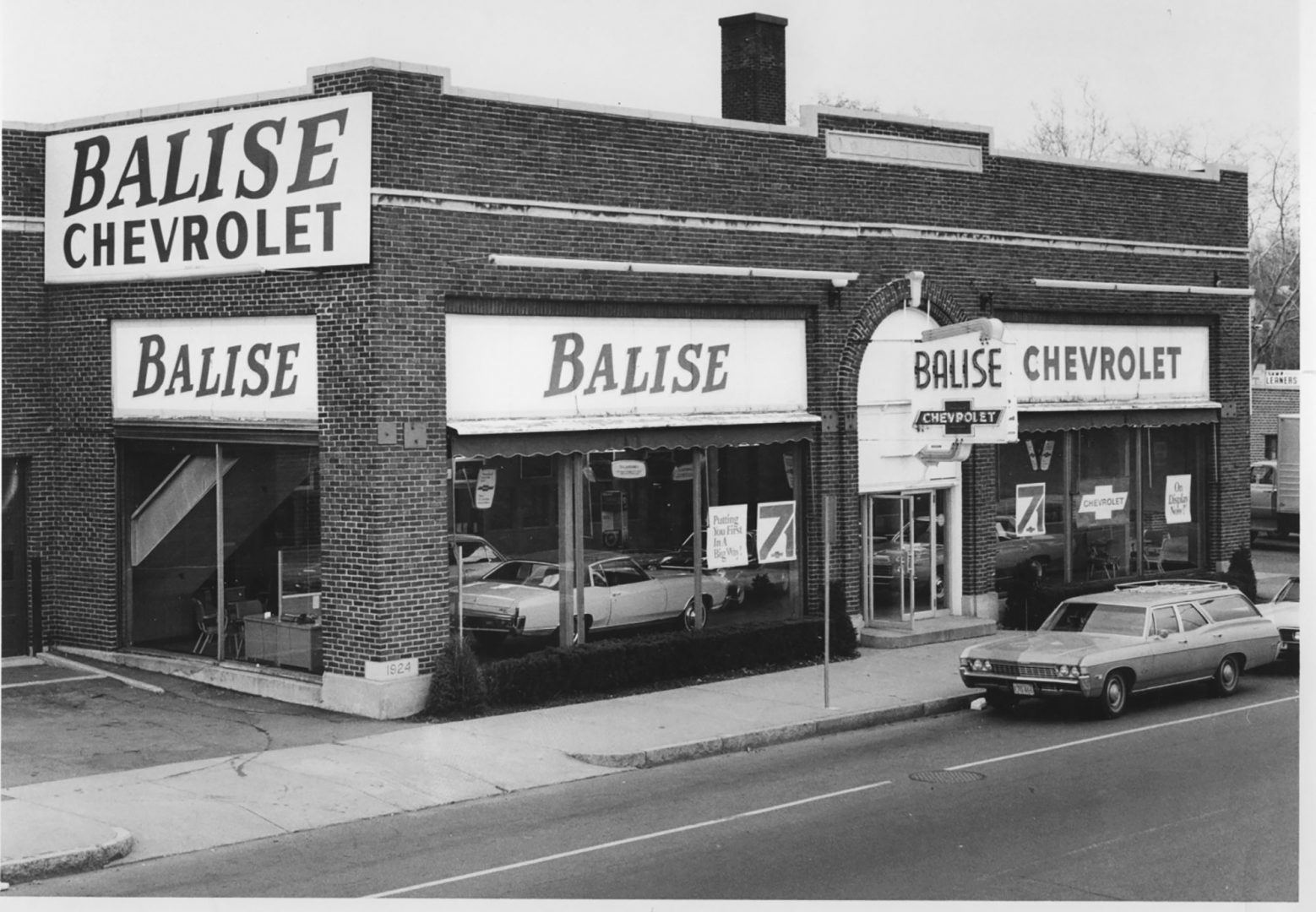
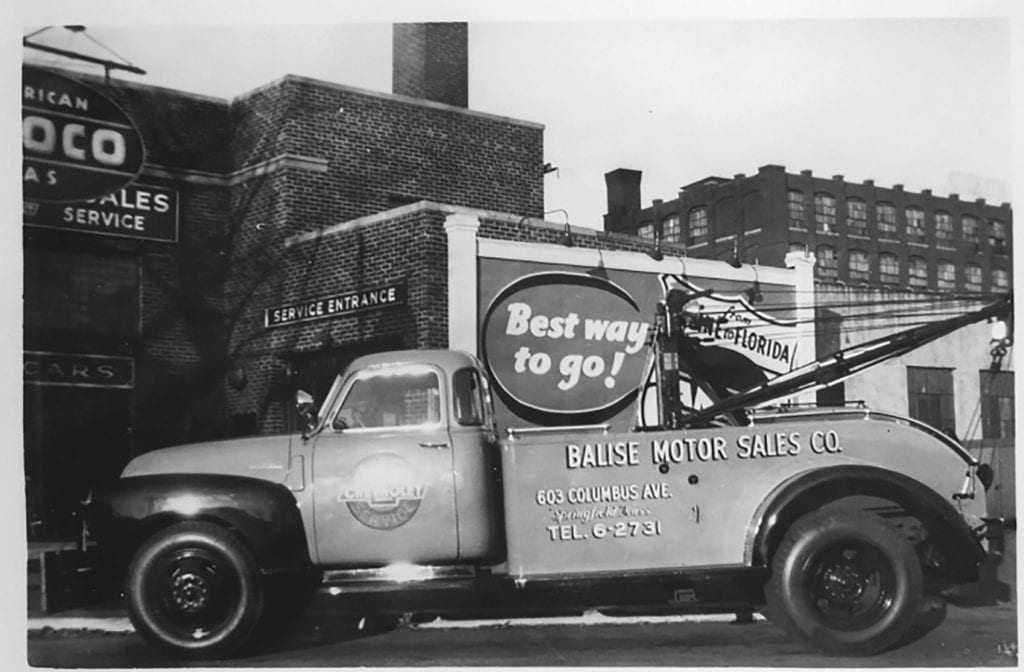
That was a reference to those legacy companies he mentioned, including MassMutual, Big Y, Balise Motor Sales, which is planning another major project in the city’s South End, and many others.

This ability to connect the dots, and be a reliable partner, is creating some progress with some of those aforementioned missing pieces to the puzzle, and will hopefully generate momentum with other initiatives in that category, said Kennedy, who started by referencing two important projects downtown — Elm Street and the Paramount project.

The former, the six-story block at 13-31 Elm St., has been mostly vacant for the past three decades. Plans to convert it into market-rate housing received a significant boost earlier this year when MGM Springfield announced it would was willing to invest in the project as part of its commitment to the city and state to provide at least 54 units of market-rate housing in the area near the casino.

“We’re hoping that we have a development deal struck in a matter of weeks,” said Kennedy. “We’re waiting for the last one or two pieces to fall into place. It’s a tough project, but it’s a necessary project.”

Meanwhile, the $41 million Paramount project — renovation of the historic theater and the adjoining Massasoit Hotel — is moving forward, with preservation work on the roof and façade slated to begin later this year.
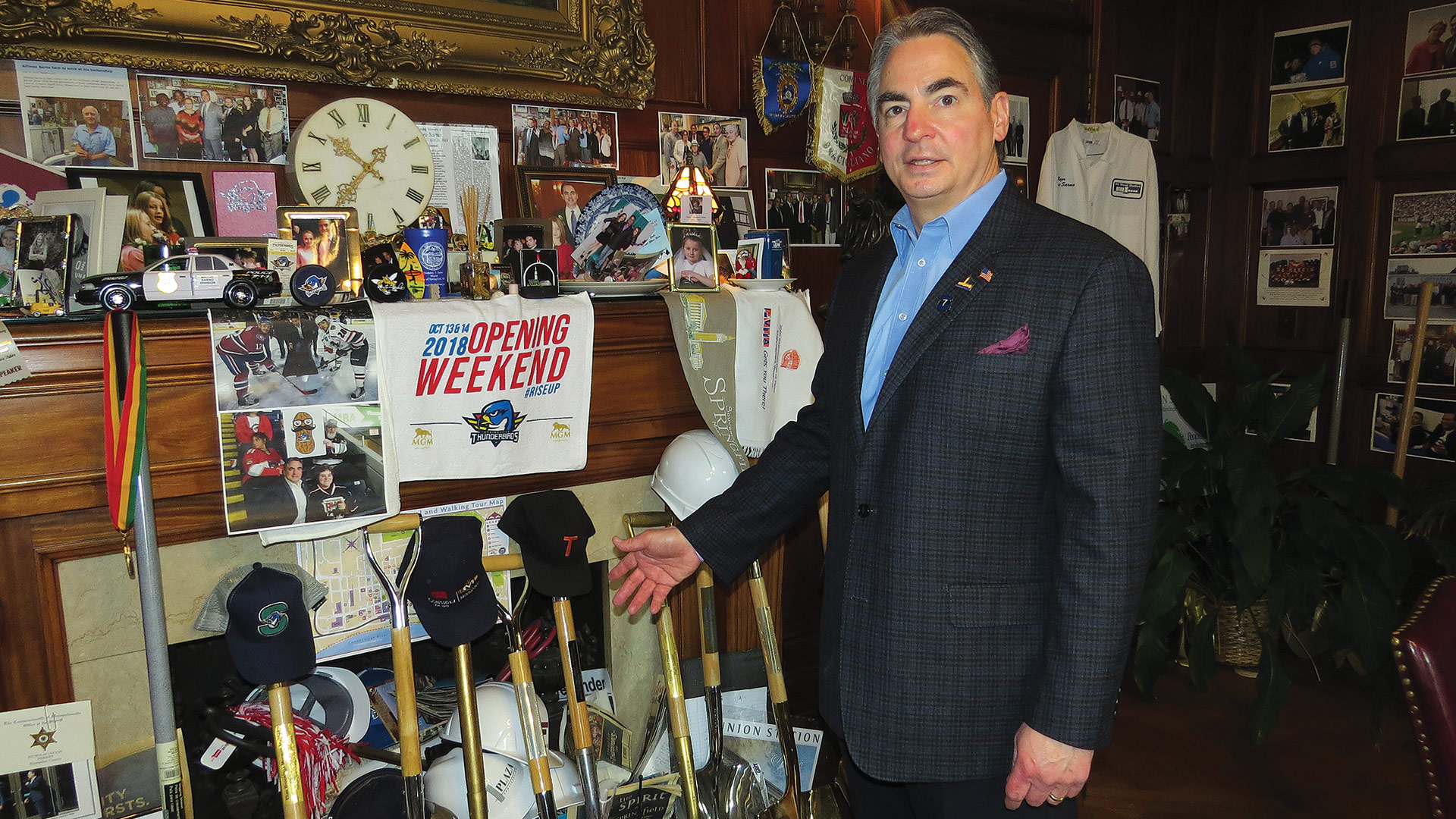
Mayor Domenic Sarno

Mayor Domenic Sarno has a healthy collection of ceremonial shovels in his office, one visible sign of the progress the city has made over the past several years.

Another large missing piece is activity in the so-called blast zone, he said, referring to the area from Lyman to Pearl streets and from Dwight to Spring streets. He said the Willys-Overland development, in the heart of this zone, may be a catalyst to more development there.

“Once that project gets going, I’m hoping it will give some push to further development in the blast area, which is probably the next horizon for Springfield,” he noted. “Some property owners have done things — there’s been some clearing and demolition — but others are just waiting and being patient. That’s why this [Willys-Overland] development is important; you have to get that first one in the ground and hope things happen from there.”

Still another missing piece is aggressive marketing of the city and its many assets, said Sarno, adding that may not be missing much longer. Indeed, the city, working in conjunction with the Western Mass. Economic Development Council and a number of area media outlets, is getting closer to launching a marketing campaign for Springfield and the region.

It will focus on a number of audiences, he said, including residents of this region, many of whom need to know about the many good things happening locally, and businesses owners far outside it, who also need to know.

“We have a lot to offer in Springfield — and in Franklin County, Berkshire County, and across Hampden County, and we have to do a better job of telling our story,” the mayor said “When you’re making a sauce, you put in the ingredients; we have all the ingredients here — we just need make a push and send out a clarion call. We need a push locally — sometimes we’re our own worst enemy — but then we need to make a regional push.”

But perhaps the biggest missing piece isn’t actually missing — though it will be soon — and that’s a working parking garage downtown.

Spot of Trouble

Which brings us to a downtown property known as ‘parcel 3.’

That was the name affixed to a number of assembled parcels of land that eventually became the surface parking lot behind the TD Bank office tower on Main Street, an initiative that was part of the Court Square Urban Renewal Plan, drafted nearly 40 years ago and amended several times since.

And that name has stuck — well, at least with city development leaders. To the rest of the world, it’s ‘the parking lot behind the TD Bank building.’ But ‘parcel 3’ is becoming part of the lexicon again as discussions concerning the Civic Center Parking Garage and the glaring need to replace it heat up — out of necessity.
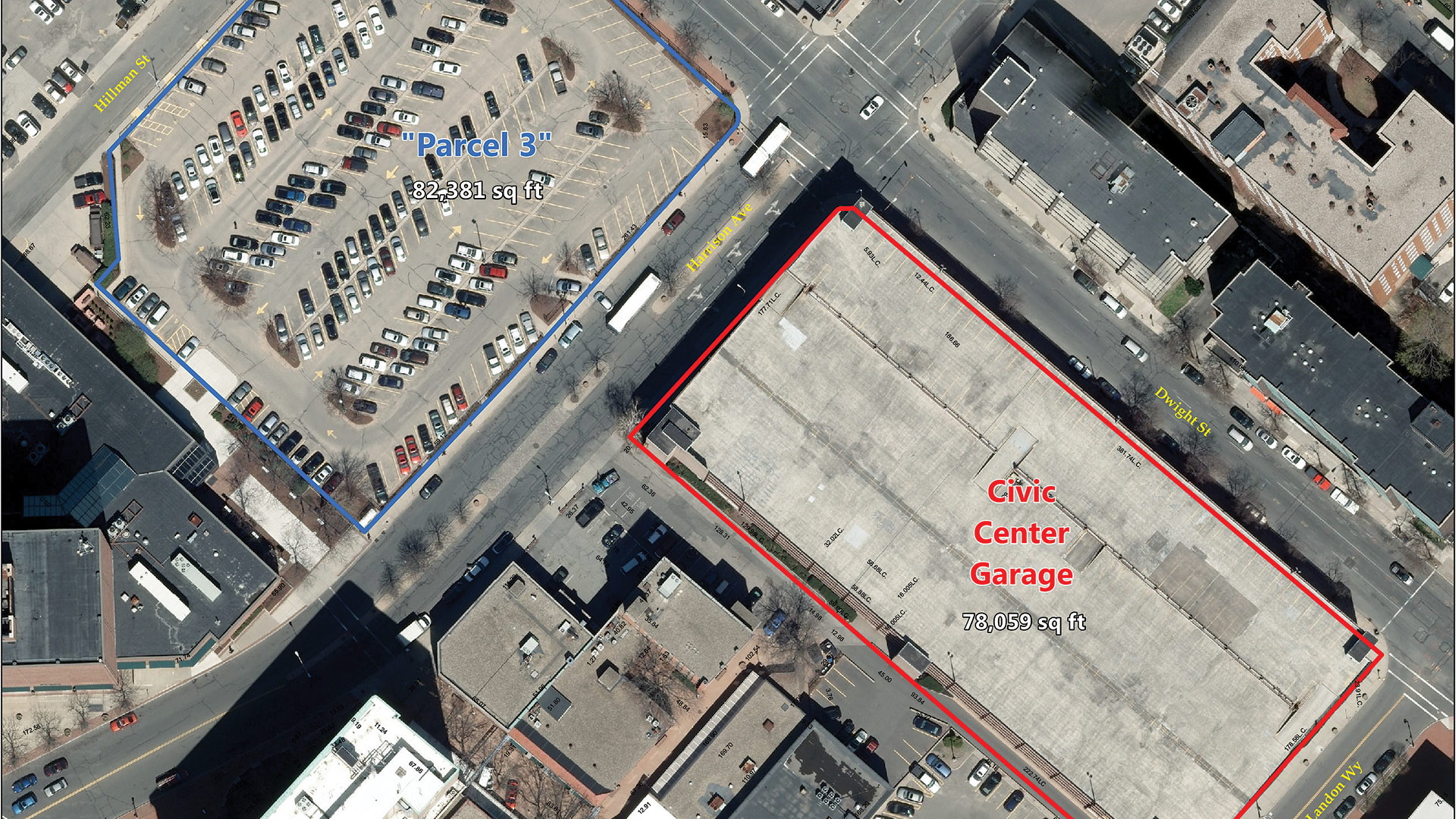
Parcel 3 — better known as the parking lot behind the TD Bank building

Parcel 3 — better known as the parking lot behind the TD Bank building — could give rise to a modern parking garage — and open up a development opportunity on the site of the current, deficient garage across the street.

“The garage is on borrowed time,” said Chris Moskal, executive director of the Springfield Redevelopment Authority (SRA), quickly adding that this sentiment certainly represents an understatement. The garage probably has only a few years of useful life left, he went on, noting that there are areas on several floors that are currently unusable for parking, thus heightening the need for action.

The SRA, which owns parcel 3, currently leases it to an entity called New Marlboro Corp., which owns the TD Bank facility, a.k.a. 1441 Main St.

That lease, originally 30 years in duration when signed in the early ’80s, was extended several years ago to 2028. And this lease and the fine print within it will obviously become the focal point of discussion in the coming months, said Moskal, as the city tries to move forward with plans to replace the Civic Center Parking Garage with a 1,400-spot facility on the most obvious site for such a facility — parcel 3.

Kennedy agreed, and noted that this is a complex project, in terms of both financing — the projected pricetag is $45 million, and several funding sources would likely be involved, from the Springfield Parking Authority (SPA), which owns the current, failing garage, to the state and the federal government — and the number of players involved, from the SRA to the SPA to TD Bank.

“But just because it’s complicated, we can’t walk away from it,” he said. “A new garage is necessary for downtown; that parking facility at the Civic Center is the main commercial-district parking facility.”

And a new parking garage downtown not only secures a replacement for a long-deficient facility, said Kennedy, but it creates a new and intriguing development opportunity in the central business district — the current garage site.

“You have not only MGM here, but a rehabbed Pynchon Plaza, a burgeoning museum district, especially with the new Dr. Seuss Museum, and other things happening downtown,” he said. “I think we could have a nice mixed-use residential complex there with some indoor parking.”

The mayor agreed. “That’s a very valuable piece of property,” he told BusinessWest, adding that, while it while it might become a surface parking lot for the short term, there are a number of more intriguing possibilities for the long term.

While the city continues to reshape and revitalize the downtown, progress is taking place outside it in the many neighborhoods that define the community, said both Sarno and Kennedy.

Springfield at a glance

Year Incorporated: 1852
Population: 154,758
Area: 33.1 square miles
County: Hampden
Residential tax rate: $19.68
Commercial tax rate: $39.30
Median Household Income: $35,236
Median Family Income: $51,110
Type of government: Mayor, City Council
Largest Employers: Baystate Health, MassMutual Financial Group, Big Y Foods, MGM Springfield, Mercy Medical Center, CHD, Smith & Wesson Inc.
* Latest information available

They noted a number of projects, including the planned new Brightwood/Lincoln School, a $70.2 million facility that would replace both the Brightwood and Lincoln elementary schools, and be located adjacent to the existing Chestnut Middle School on Plainfield Street; the new branch of the Springfield Library in East Forest Park, due to be completed this fall; expansion of the residential complex in the former Indian Motocycle manufacturing complex in Mason Square (60 new affordable units are planned); a new Pride store at the corner of State Street and Wilbraham Road; several park projects; a redesign of the troublesome ‘X’ traffic pattern; reconfiguration of the Six Corners intersection; and renewed efforts to reinvent the Eastfield Mall into a community with a mix of housing, retail, and other components.

“We’re making a lot of progress in our neighborhoods,” the mayor said. “People are focused on downtown, but our neighborhoods are important, and we’re making great strides there, too.”

The Big Picture

Getting back to that picture on the wall outside his office, Kennedy acknowledged that, as beautiful as it is, it doesn’t tell the full story of all that’s happened in Springfield over the past several years.

And it will only become less accurate, if that’s the proper word, in the months and years to come.

But that, as they say, is a good problem to have. A very good problem.

For years, Springfield was the picture of stagnancy. Now, it’s the picture of motion and continued progress.

There are still some missing pieces, to be sure, but the puzzle is coming together nicely.

George O’Brien can be reached at [email protected]

Features

A Different Time

Jessica Roncariti-Howe, here displaying one of her own paintings

Jessica Roncariti-Howe, here displaying one of her own paintings, says efforts to shine a spotlight on the arts and culture is just one of the ways the Greater Chicopee Chamber is working to build a stronger community.

Years ago, joining the local chamber of commerce was a knee-jerk reaction for a new business or a venture moving to a new community. Today, it’s far less a given, especially with the budgetary and time constraints facing all business members. To attract and properly serve members — and their communities — chambers must focus on creativity and collaboration, as we learned from several chamber leaders relatively new to their roles.

They call it ‘Run the Runway.’

Because that’s what you do.

Indeed, participants in this reincarnated version of the Greater Chicopee Chamber’s fundraising 5K road race actually run down the runway at Westover Air Reserve Base on part of the course. They traverse roughly three-quarters of the main runway’s length, turn off along one of the aprons, pass under the wing of one of the giant C-5s, and then back again.

The second edition of the event will be staged June 8, and while the inaugural run was hugely successful, this year’s version will raise the bar much higher — and probably raise considerably more money. That’s because organizers have added a large ampersand to the event logo, as well as the words ‘Festival’ and ‘Car Show.’

“This used to be a minor fundraiser, but now it’s probably our biggest,” said Jessica Roncariti-Howe, president of the Greater Chicopee Chamber of Commerce. “And having our major fundraiser be an event that is signature to Chicopee and highlights some things are very unique to our city is really heartening to us; it’s very exciting.”

“We try very hard to stay away from the ‘mingle around the bar with a glass of wine’ model; our goal is to bring some fun to everything we do.”

Thus, Run the Runway is in many ways a solid example of changing times for area chambers of commerce and the need to adapt to these changes. In this climate, chambers are being more creative, finding ways to bring more value to members and the communities they serve, and doing far more partnering and collaborating — with other chambers, different business- and economic-development-related agencies, and civic groups.

In the case of Run the Runway, these partnerships are with Westover itself, Westover Metropolitan Airport, and the Galaxy Community Council, said Roncariti-Howe, who is one of several area chamber leaders relatively new to their assignment — she’s been at the helm for roughly two years.

For this issue, BusinessWest talked to several of the region’s new chamber leaders about their work, how it is changing in many ways, and what chambers must do to remain relevant and maintain strong membership at a time when joining such an organization is far from the given it was a generation ago.

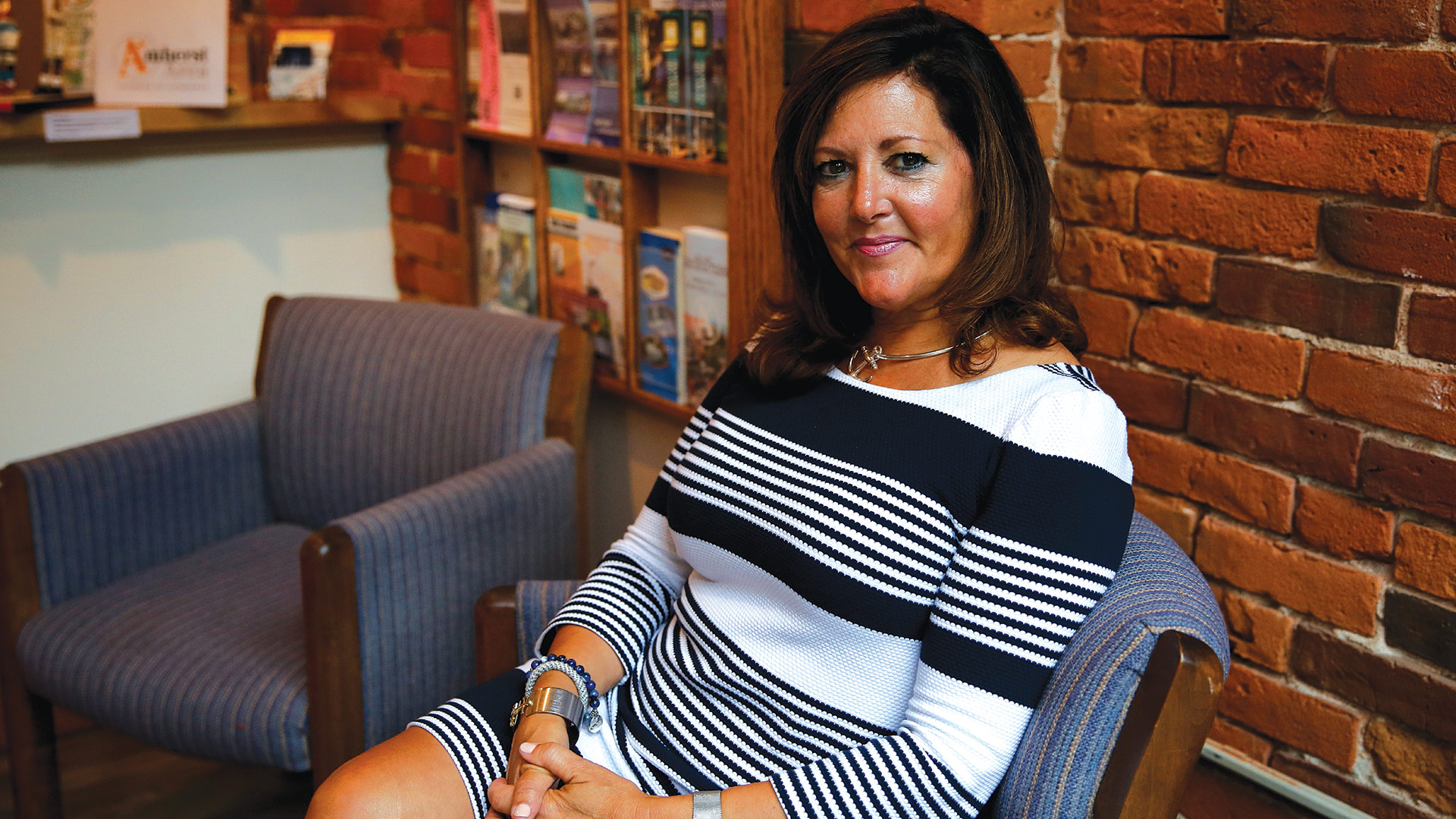
Claudia Pazmany is another of these new chamber leaders. She took the helm at the Amherst Area Chamber of Commerce roughly a year ago, at a critical time in the history of the agency.

Indeed, the Amherst chamber had gone through several directors over the previous decade and had become a volunteer organization for a short time before the board handed the reins to Pazmany, a veteran development strategist and consultant — she’s worked for agencies ranging from Providence Ministries for the Needy to CHD’s Big Brothers Big Sisters of Hampshire County — with the goal of putting the chamber on far more solid footing.

She told BusinessWest her basic strategy has been to raise the chamber’s profile, inject some energy, and establish the chamber as a valuable resource for members, and she believes she’s achieving results. Those efforts are summed up nicely in the name she chose for the newsletter she distributes weekly: “In Your Corner.”

Claudia Pazmany

Claudia Pazmany says signing on with a chamber is the easy part for a business. Leveraging membership and getting the most of it takes some work.

“I’ve been reintroducing the chamber to people and sending a consistent message — we’ve really upped our game with our e-contacts and e-newsletter,” she said, describing these efforts as ‘Marketing 101,’ but something that wasn’t being done at the chamber.

She added quickly that there are many challenges facing chambers today, and, more than ever, these agencies must be focused on those three letters so well-known to everyone who sells a product or service: ROI.

Diana Szynal, executive director of the Franklin County Chamber of Commerce (FCCC) since late last fall, agreed.

Szynal was looking for a challenge — and a job, really — after coming up short in her bid to succeed the late Peter Kocut, the state representative she served for many years as district representative.

She said the chamber job is in many ways a natural for her because she can easily find a number of similarities between serving constituents and serving business owners — and the communities of Franklin County.

“This was a natural progression, to trade constituents for businesses. In both cases, there’s a lot of listening and responding to what you hear,” said Szynal, adding that the FCCC will be celebrating its centennial this year, a milestone that will be marked in a number of ways.

As it looks toward the next hundred years — or even the next few years — the goal will be to continuously find new and different ways to make membership not a cost, but an investment — a challenge shared by all the area chambers.

Mission Statements

As Roncariti-Howe talked with BusinessWest in the Greater Chicopee Chamber’s conference room, the office was noticeably quiet.

She was the only one in that moment — and in a few weeks, she noted, that would be the situation for some time to come.

Her two staff members are both leaving the agency (one is going to work in the mayor’s office), leaving Roncariti-Howe alone — and also with a chance to take a hard look at the organization and perhaps do some restructuring and reorganizing.

Again.

Indeed, she went through this same scenario roughly a year ago, she noted, adding quickly that finding, retaining, and ultimately replacing talent is just one of the challenges she’s taken on since coming to the chamber after several years spent in nonprofit management, most recently with the AIDS Foundation. And she acknowledged that she’s certainly not alone.

“I tell people I’m in their corner. I want people to know that we’re reliable, we’re consistent, and our marketing is here to support them; we’re here to highlight our members.”

Other challenges include membership — numbers are way down from years ago, when chambers were able to include health insurance to members as part of their package, and maintaining current levels is always a struggle — as well as finding new and creative ways to engage members and bring value to their participation.

Roncariti-Howe explained her work this way: “Working for a nonprofit, I always served one mission. This job gave me the opportunity to serve 300 — to figure out what helped the local business community, what made all these individual organizations tick, and how to build relationships among them and bring them together.”

To explain how she goes about all that, she summoned two words that provide some alliteration — ‘creativity’ and ‘collaboration’ — and offered a quick explanation.

“Creativity manifests in the form of creating events that are either in unique or attractive venues or have some sort of draw that’s different than what other people would typically get,” she said. “We try very hard to stay away from the ‘mingle around the bar with a glass of wine’ model; our goal is to bring some fun to everything we do.”

Diana Szynal

Diana Szynal, who recently took the helm at the Franklin County Chamber of Commerce, says collaboration is the key to getting things done in that rural region.

A few decades ago, chamber leaders didn’t have to worry much about providing fun — or about membership in general. Pazmany, like the others we spoke with, noted that, in the past, chamber membership was in many ways a knee-jerk reaction for new business ventures or those moving into a community. Today, it is anything but, especially with the time and budget constraints facing small-business owners today.

So the chamber has to make membership worth the time and expense, said those we spoke with, adding that this is being done in a number of ways, from offering resources to providing valuable content in newsletters, and creating networking opportunities that, as Roncariti-Howe noted, go well beyond a glass of wine at the bar.

“I tell people I’m in their corner,” said Pazmany, adding that her chamber lives up to the name on its publication. “I want people to know that we’re reliable, we’re consistent, and our marketing is here to support them; we’re here to highlight our members.”

Working with graduate research students at UMass Amherst, the Amherst Area Chamber, which also represents Hadley, Pelham, and other communities, has worked to fill holes on its website and update Google Analytics to provide optimal exposure for members on that website.

“Some people’s member listings are coming up higher than their own,” said Pazmany, with a large dose of pride in her voice, adding that this is one of the ways the chamber is providing value and ROI. “We want to remind people that a chamber membership can be part of their marketing plan, and if they do it well — meaning they’re networking, they’re showing up at events, they’re sponsoring an event or speaking at an event — they can really benefit.

“But they need to take full advantage of it — it’s a partnership,” she said of chamber membership. “Signing on is the easy part; it’s how you show up. You get out what you put in.”

Concepts That Are Taking Off

That’s especially true with the FCCC, which, as that acronym denotes, represents not a city or a few communities but an entire county, one populated by small and very small communities, some with fewer than 100 residents.

“We try to focus on things that can help county-wide,” said Szynal. “We focus on supporting businesses and social-service agencies — we have many of them in this region — but we also focus on tourism and especially outdoor recreation, and in doing that, we’re able to help communities across the entire county. We’re unique — most chambers are much more focused in terms of the number of communities they serve — and we have our hands full, but we’re doing it.”

And doing it largely through a focus on collaborative efforts with other agencies — because that’s how things get done in such a rural setting, she went on.

“I’ve learned there’s a huge amount of collaboration up here, more so than I’ve ever witnessed anywhere,” she explained. “Businesses and organizations really want to work together to grow the economy in Franklin County and make this a place that’s great to live and work in, and it’s very encouraging to see that; by working together, we can do so much more than we could by ourselves.”

Those sentiments bring us back to Run the Runway.

Only a few years ago, the chamber was hosting a 5K run as one of many annual fundraisers, said Roncariti-Howe, adding that, by collaborating with the Galaxy Council and other entities, it has become a much larger community event.

As noted earlier, the run is a particularly poignant example of what all chambers must do today to effectively carry out their missions — collaborate, be creative, and focus on ways to not only serve members, but strengthen the communities they serve.

The Greater Chicopee Chamber is doing that in a number of ways, said Roncariti-Howe, who had only to gesture around the conference room to get that point across.

“They need to take full advantage of it — it’s a partnership. Signing on is the easy part; it’s how you show up. You get out what you put in.”

Indeed, that room — and the outside rooms as well — were crowded with works of art as part of the Lights on Art and Culture program, which, as the name suggests, puts a spotlight on the arts by engaging local businesses, and the chamber, in displaying the works of local artists, a constituency that now includes Roncariti-Howe, who showed off one of her paintings.

“We do this quarterly, and we do something different each time,” she said, adding that the most recent offering featured live music, tours of new living units in redeveloped mills, food trucks, and more. “It’s a collaboration among the chamber, Cultural Council, city, and downtown businesses, and it’s one of the ways we support our local businesses and our community, which is an important part of our mission.”

Szynal agreed, noting again that, with the FCCC, ‘community’ means one city (Greenfield) and 25 small towns with a total population of roughly 70,000 people.

“There are differences among the communities and what their focus points are,” she said. “But they’re all unique, and they all contribute to the rich fabric here in Franklin County in their own special way, and we work to support each one of them.”

Bottom Line

Pazmany told BusinessWest that some of her members had remarked that there weren’t enough pictures of her in “In Your Corner.”

“I told them that it’s not about me, it’s about them,” she said with a laugh. “It’s all about our members.”

It always has been, but today, that mantra is even more important than at any time in the past. And as these chamber leaders noted, it’s not about getting members, it’s about providing value to them, retaining them, and working with them to improve their community.

That’s why you can now run the runway — and many people are.

George O’Brien can be reached at [email protected]

Education

Taking Center Stage

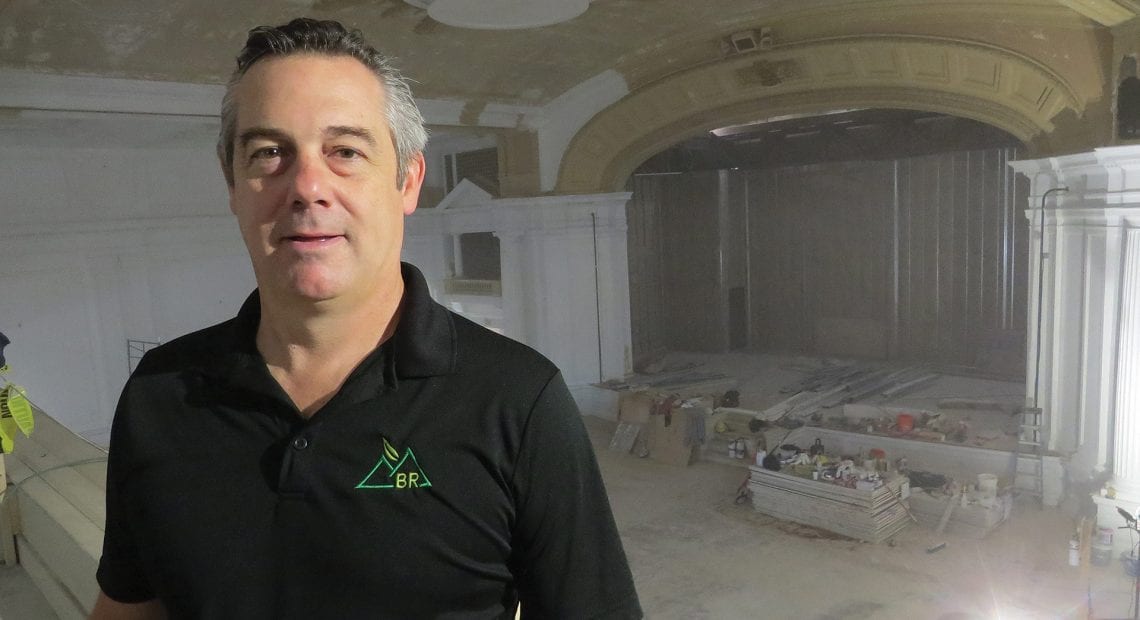
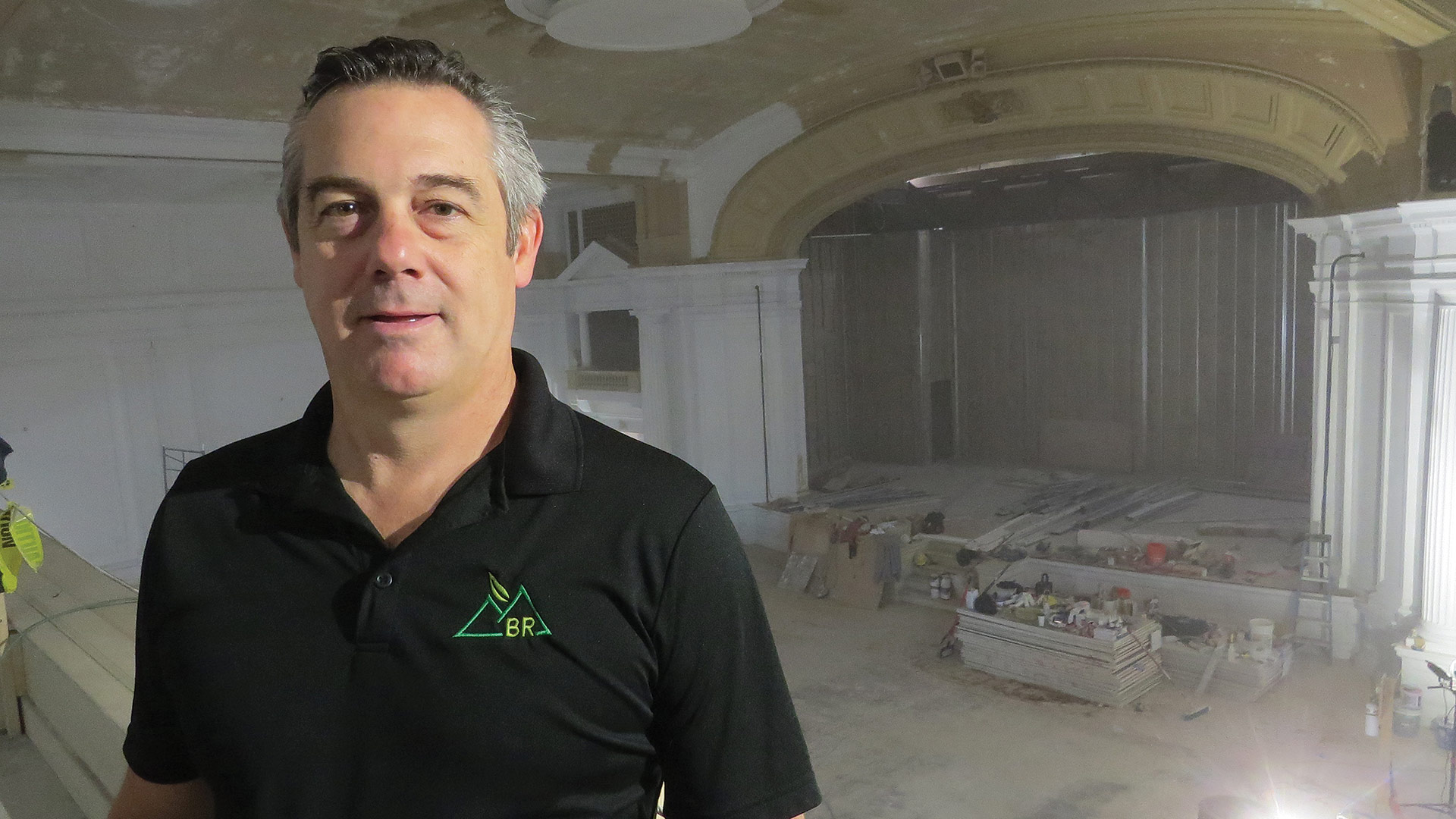
Frank DeMarinis stands in the balcony

Frank DeMarinis stands in the balcony overlooking the stage of the massive auditorium in what will soon be the new Springfield Conservatory of the Arts.

Frank DeMarinis understands that people frequently used the phrase ‘white elephant’ in association with the massive former Masonic temple on State Street.

What he could never understand is why.

Indeed, while many saw a property that was too big and too difficult to redevelop into something for the 21st century, he saw only potential.

“This is a piece of history — it is what you make of it,” said DeMarinis, owner of a number of businesses, with the lead being Westfield-based Sage Engineering & Contracting, adding that, when the property first came onto his radar screen and then into his possession (he acquired it for the bargain price of $100,000 from the church looking to unload it), he envisioned a boutique hotel to coincide with the arrival of MGM Springfield.

Those plans never materialized, but something different and with certainly greater implications for Springfield and its School Department did — conversion of the property into the new home of the Springfield Conservatory of the Arts, a magnet middle school and high school that, as the name suggests, offers an arts-infused curriculum and enables students to focus on their interest in the arts, whether they’re dancers, painters, musicians, or playwrights.

“The idea was to have a place for the kids who have an inclination for the performing arts to go to school,” said Conservatory of the Arts Principal Ryan Kelly, who arrived three years ago. “There’s now a place where singers and dancers and musicians can go to perform.”

At present, though, that ‘place’ — both schools are operating out of former Catholic schools, one in Indian Orchard (the middle school) and the other off Liberty Street — is limiting, and in all kinds of ways.

The middle-school students perform in the basement of a church, said Kelly, while the high-school students perform in an old gym that doubles as a music room.

“Everyone’s really excited to have a 21st-century arts building; this will be a tremendous showcase for the city.”

Things will change in a … well, dramatic way come September, when both schools move into what will be a state-of-the-art facility created out of the cavernous spaces within the old Masonic temple, including the huge, nearly 1,000-seat theater on its fifth floor, previously known as the ‘sanctuary,’ now undergoing a significant facelift.

“It’s an awesome facility — it’s going to be a great performance venue,” said Kelly, adding that the theater is just one of the facilities that represent a tremendous leap forward for the school and its students. Others include a black-box theater for drama classes, a large, modern dance studio on the same floor as the theater, a recording studio, a media center, a tech lab, state-of-the-art classrooms, and more.

Actually, there will be two of many of these facilities, one each for middle school and high school, said Kelly, adding that the former will be located on the first and second floors, and the latter on the third and fourth.

The much-anticipated opening this fall will put a bright spotlight not only on the Conservatory of the Arts, which has enjoyed steady enrollment but should get a significant boost with this new facility, but also on one of Springfield’s forgotten architectural gems.

The Masonic temple has been vacant and unused for years now, said DeMarinis, adding that it had fallen into a significant state of deterioration by the time he acquired it. The exterior has been preserved, but the interior has been largely gutted and significantly altered — entire floors have been added — to repurpose the landmark for its new use.

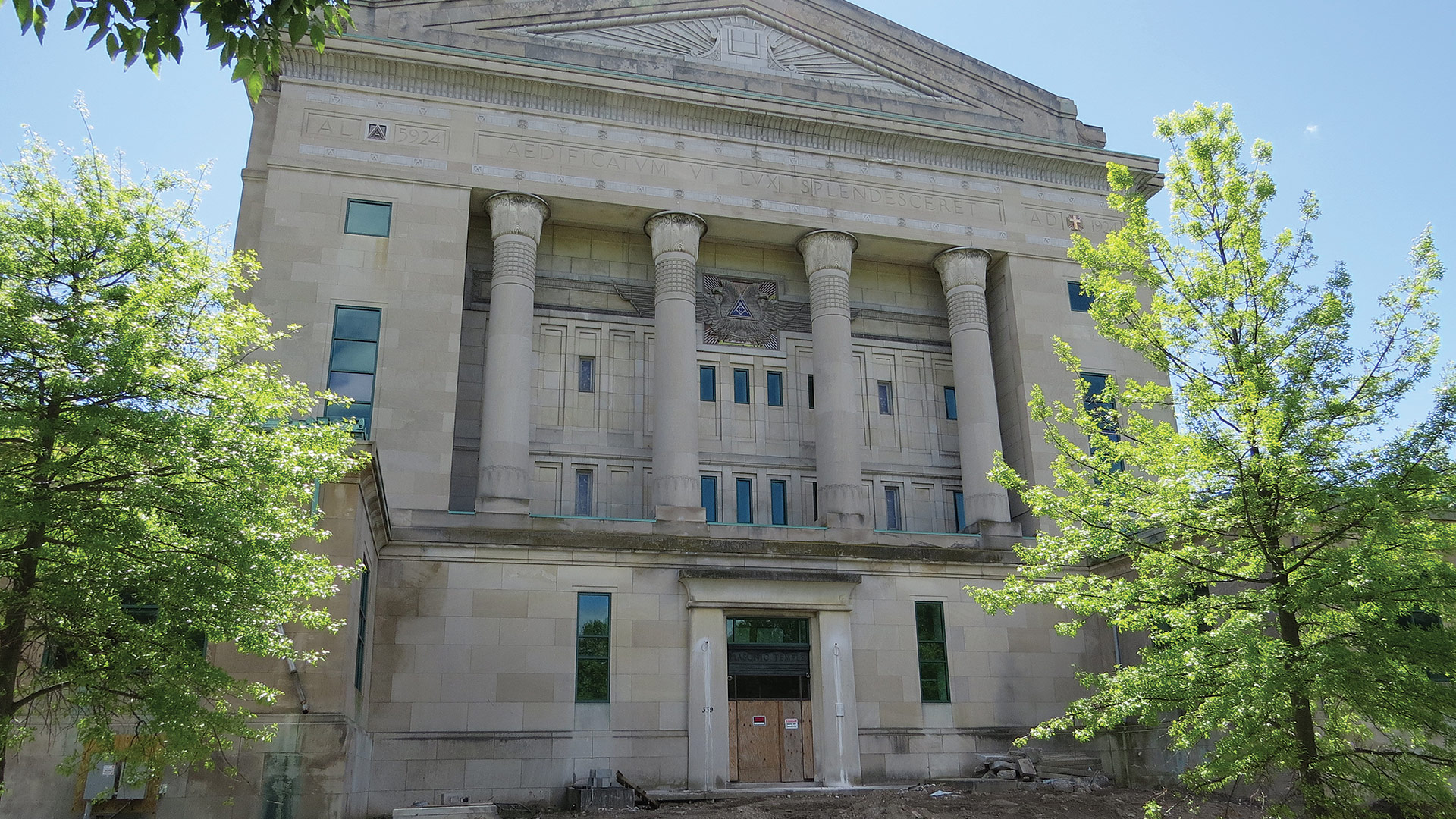
The Masonic temple on State Street

The Masonic temple on State Street has been mostly vacant and unused for many years, but it will now play a leading role in Springfield’s future.

For this issue and its focus on education, BusinessWest toured the work in progress that is the new Conservatory for the Arts to get a feel for how a big piece of the city’s past will play a large and intriguing role — that’s another arts-industry term — in the future of the community and the students who come through the facility’s doors.

Development of Note

As his tour stopped in what will be the teacher’s lounge, located on one of the upper floors of the new Conservatory of the Arts, DeMarinis pointed out the recently added windows on the west wall and, more specifically, the view they provide.

“You can see all of downtown Springfield,” he said, pointing out several of the landmarks, including the MGM casino.

With that, he noted that his original idea for the Masonic temple, a boutique hotel targeted toward high rollers, would have been an intriguing addition to the business landscape and, in his view, an almost-certain success story. He said he had some regret that those plans never materialized, but not much, because of what has emerged instead.

Flashing back roughly five years, DeMarinis said he was looking for his “next project” when the Masonic temple caught his attention, primarily because of its proximity to downtown Springfield and the announced site of the MGM casino.

There were already several ventures in his portfolio, including everything from the various Roots facilities in Westfield — an aquatic and fitness center and indoor and outdoor soccer fields among them — to an independent-living facility in Suffield to several distribution centers, including one for Utz potato chips. The temple offered the promise of further diversification.

“I toured the facilities, and it was in absolute shambles,” he recalled. “That’s why I picked it up really cheap.”

More than $1 million in cleanup later, including remediation of an asbestos-laden boiler room, DeMarinis was ready to look at potential opportunities.

One came his way with a request for proposals from Springfield school officials who acknowledged that a new home was needed for the school for the arts. They desired a location downtown, in or close to the “theater district,” as DeMarinis called it, a facility that would have state-of-the-art facilities and ample room for the school to grow.

DeMarinis said he had all that in the Masonic temple, and he also had a pricetag that others couldn’t approach because of the bargain price he paid for the property.

“It was a change of plans, but you adjust accordingly,” he said of his vision of the property. “I felt it was a much safer investment to work with the city.”

But getting the 88,000-square-foot, century-old temple ready for prime time has been a two-year process laden with challenges, from creating parking where there was none — a three-story garage was built behind the facility with room for 50 cars — to gutting and rebuilding the massive auditorium at the top of the building, to adding more than 100 windows to let natural light in.

The new facilities represent a quantum leap forward for the arts school, said Kelly, adding that he expects the new home to spark a rise in enrollment — the middle school is at or near capacity, but the high school is not — and also create much better learning and performance opportunities.

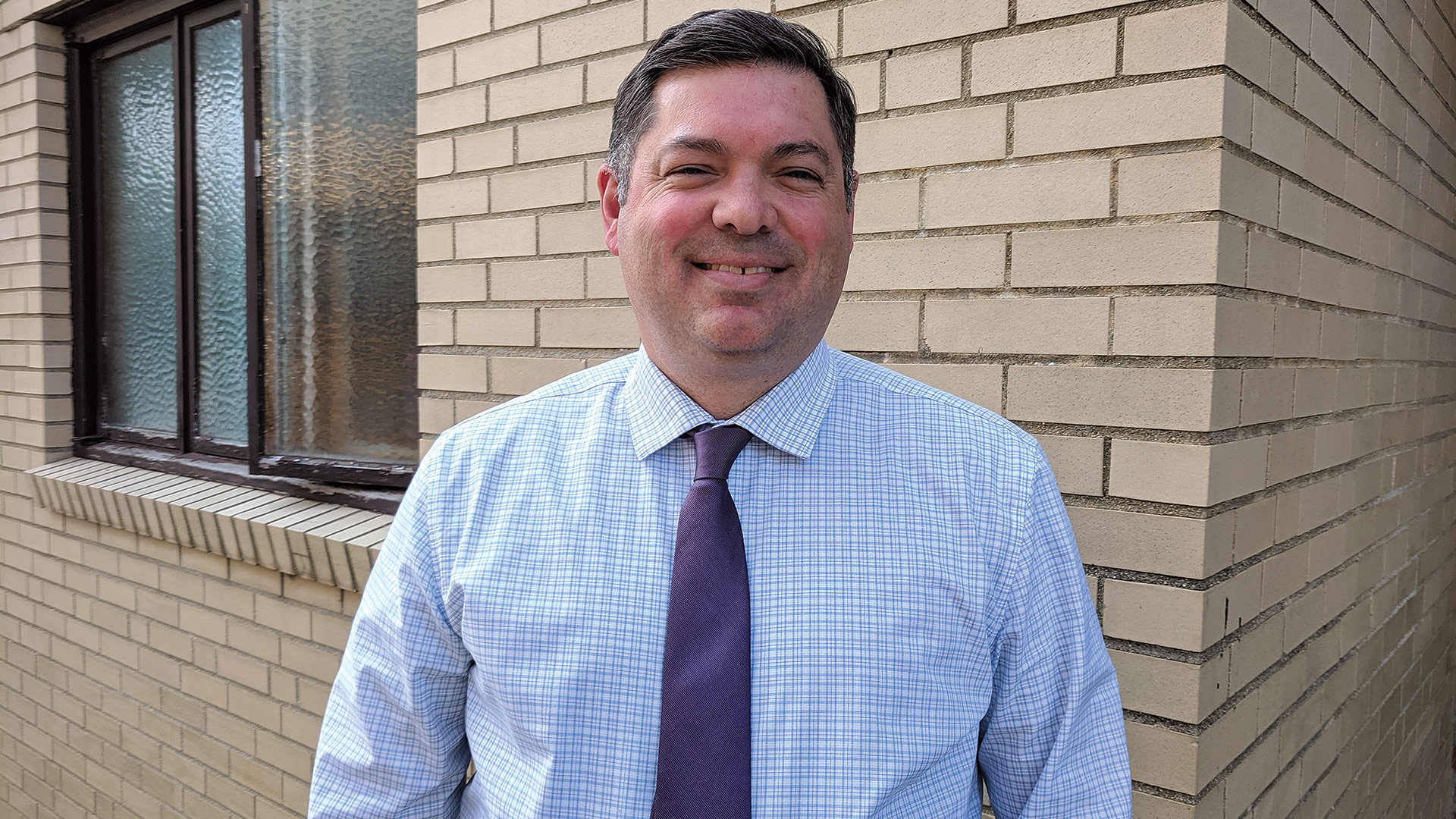
Ryan Kelly, principal of the Springfield Conservatory of the Arts

Ryan Kelly, principal of the Springfield Conservatory of the Arts, says the new facility will provide state-of-the-art learning experiences for students.

“It’s a real step forward,” he told BusinessWest. “The students will have real performance space, and we’re going to have full science labs, the auditorium for shows, a sound and recording room, a room with a greenscreen so we can make videos and newscasts … the facilities allow the teachers and the students to be more creative and express themselves more.

“We’re very much limited where we are,” he went on. “And now, the limitations will mostly be gone, so I’m really excited to see what the students can do with all this.”

To showcase the new school and reach full capacity (420 students, with current enrollment at roughly 350), Kelly said he’s forging plans to have fifth-graders, and perhaps parents as well, attend performances starting in the fall.

He believes the new building, and the learning experiences it creates, will inspire arts-oriented students to think about careers in that broad field and give themselves the best opportunity to pursue them.

“We figure that, if we bring them into the school, put on a show, and let them see the place, that should increase enrollment,” he said. “Everyone’s really excited to have a 21st-century arts building; this will be a tremendous showcase for the city.”

Show of Force

Referencing the current performance venues — the church basement and old gym — Kelly said they are woefully inadequate for what the school for the arts is trying to do with and for its students.

And that’s why the new facility is so important.

“It will enable them to be completely creative and just be released, and we’re really looking forward to that,” he explained.

Meanwhile, the Masonic temple is also being released. For decades now, it has been relegated to being a part of the city’s past, and, yes a white elephant.

Now, it has a starring role in the future of this intriguing school.

George O’Brien can be reached at [email protected]

Features

Getting Creative

Kristin Leutz

Kristin Leutz says the inaugural Innovation Fest will provide a solid foundation on which to build.

HUBweek in Boston. Denver Startup Week. The Tom Tom Summit & Festival in Charlottesville, Va. South by Southwest in Austin, Texas.

These are just a few of the many highly successful and very well-attended entrepreneurship and innovation events now taking place across the country.

Some of them go on for a few days, others for a whole week, as their names make clear, said Kristen Leutz, executive director of Springfield-based Valley Venture Mentors (VVM), who has been to Startup Week and will likely attend some of those other gatherings in the months and years to come as she seeks to learn more about entrepreneurship ecosystems, how they work, and how they can be developed and expanded.

For right now, though, she’s busy putting together the latest addition to that list of summits. It will be called the Springfield Innovation Fest, or SIF for short, although its probably too early for an acronym to take hold.

Indeed, Leutz and her team at VVM are essentially starting from scratch and scrambling to pull things together for the June 12 event, to be staged at the Innovation Center on Bridge Street in Springfield. As she tells the story, those at VVM had been thinking about and talking about a summit — an event that would showcase this region’s burgeoning entrepreneurship ecosystem (and the many other things that are happening in and around Springfield) and take VVM’s Accelerator Awards banquet to a new and much higher plane. But they were initially focused on 2020, a round-number year with all kinds of meaning — until they decided not to wait that long to get the ball rolling.

“We decided to do this on a very short time frame,” she said. “Once we came up with the vision, we were all excited; we didn’t want to wait a another year. We said, ‘let’s lean into it and see what we can pull off.’”

Leutz told BusinessWest that the Springfield Innovation Fest certainly has a long way to go before it can be mentioned in the same sentence as those events in Boston, Denver, Central Texas, and Northern Virginia, but one has to start somewhere, create some buzz, and continually build on the foundation that’s been laid, and that is the very informal business plan for the festival.

“We decided to do this on a very short time frame. Once we came up with the vision, we were all excited; we didn’t want to wait a another year. We said, ‘let’s lean into it and see what we can pull off.’”

“Startup Week certainly wasn’t built in a day — or a week,” she said. “We want to see if we can gain some excitement and momentum for next year.”

The inaugural event, still very much in the planning stages, as noted, will feature a number of speakers, ample amounts of networking, and opportunities to get a taste of Springfield — figuratively and quite literally, with tours of the Springfield Museums and Fresh Paint mural art, as well as a visit to What’s on Tap Wednesday.

There are many goals for this year, said Leutz, listing everything from celebrating this region’s history of innovation and ‘firsts’ to recognizing the winners (and all the companies) in this year’s VVM Accelerator class, to moving the needle when it comes to putting Springfield and this region on the map as a startup and innovation hub.

“In the vein of these other festivals that showcase the startup and innovation economies, I thought that, given all that’s happening in Springfield, it was time for our own startup event,” she explained. “I want visibility for the work of entrepreneurship and innovation and how it affects our economy and how it affects traditional businesses as well as startups.

“The idea of being innovative goes beyond a startup company — it infiltrates everything that we do,” she went on. “Springfield is a city of firsts, and we really believe in that heritage and history, and we want people to see that it still is a city of innovation.”

For this issue and focus on business innovation, BusinessWest talked with Leutz about the launch of the SIF, what to expect this year, and where this summit can go in the years to come.

Summit Meeting

“How to Bootstrap the Bejeezus out of Your Startup.” “Think Like a Placemaker Transforming Neighborhoods.” “Future Forward: Live Better with Innovation in Healthcare.” “How to Help Female Founders Succeed (and Every Other Founder, Too).”

These are titles for just some of the presentations scheduled for the SIF, said Leutz, noting that they will cover two tracks — a startup track and an innovator track — and feature speakers that include both young entrepreneurs and leaders of several of the groups within that aforementioned entrepreneurship ecosystem.

And these presentations represent just one aspect of the festival, she went on, adding that there will be, as mentioned, several breaks for networking and collision-making, a showcase and lunch at which attendees can meet the VVM Accelerator and Summer Collegiate Accelerator startups as they showcase their businesses and compete for ‘VVM bucks,’ and also a pitch competition featuring the top five in the Accelerator and the awarding of prizes.

The full lineup is still very much a work in progress, even at this late date (remember, they started late), and the general ideas are to both call attention to the growing startup community and innovative energy in the region, and also give attendees something to take back home — whether that’s across the state or maybe cross-country (although that’s more likely to happen down the road).

This is the formula that those festivals mentioned at the top have followed, said Leutz, noting that many of them are works in progress as well.

That’s certainly the case with HUBweek, which was launched just three years ago, but now brings together attendees from 59 countries, 46 states, and 38 industries, according to the event’s website. Marketed as a gathering “where art, science, and technology collide,” HUBweek was founded by the Boston Globe, Harvard, MIT, and Massachusetts General Hospital, and its website describes it as “a giant petri dish welcoming impact-oriented artists, entrepreneurs, researchers, executives, makers, and up-and-comers. HUBweek brings together the curious, those building our future.”

Startup Week in Denver is in many ways similar, said Leutz, adding that she attended last fall’s festival and came away inspired to bring something with the same vibe, and energy, to the City of Homes.

“It was incredible,” she said, using that adjective to describe the scope of the show, the depth of the speakers, and the amount of planning and marketing that went into the event. “They had 1,000 applications for talks.”

While something to aspire to, these shows more importantly represent a model that can be replicated on a considerably smaller scale, she said, adding that, like the Boston show, she wants an event where worlds can collide, and, like Denver, she wants a “community-created event,” where people submit ideas for talks.

For this first show, organizers have put together a schedule of talks targeted toward entrepreneurs and would-be entrepreneurs, and ‘innovators,’ a broad constituency to be sure, said Leutz. Speakers, many of them still to be confirmed, include Christian Lagier, executive director of TechSpring; Mo Reed-McNally of the MassMutual Foundation, and Laura Masulis, transformative development fellow with MassDevelopment (they’re handling the talk on transforming neighborhoods); Bill Cole, leader of Living Local, and Tessa Murphy-Romboletti, director of SPARK EforAll Holyoke, who will lead a discussion titled “How to Revive Main Street”; and Daquan Oliver, president of WeThrive, the first-prize winner in last year’s VVM Accelerator Awards.

As for this year’s Accelerator class, it is smaller — by design (16 companies) — in order to provide more in-depth, customized support to the startups, said Leutz, adding that a smaller group enabled VVM to have a higher ratio of entrepreneurs in residence to startups.

Meanwhile, some of the cash traditionally handed out at the annual banquet as prizes has been awarded already in order to help the startups advance their ventures, said Leutz, adding that there is still plenty at stake at the June 12 showcase and final pitch.

All-day passes to the SIF are $50 each ($45 each for blocks of three or more), and potential attendees can buy an extra ticket so an entrepreneur can attend for free, said Leutz, adding that the admission charge is essentially to cover the cost of the event. Sponsorship opportunities are available, starting at $1,000. For more information, visit www.valleyventurementors.org.

Getting Started

Like the companies taking part in the VVM Accelerator, the SIF is essentially a startup venture, Leutz acknowledged, and one with considerable promise to grow well beyond its current size and scope.

It will likely never be on the same level as HUBweek or Denver Startup Week, but like those other events, it provides an opportunity to bring several worlds together and spark more innovation.

SIF is not part of the local lexicon yet, but Leutz and her team believe it soon will be.

George O’Brien can be reached at [email protected]

Cover Story

Pedal Power


Catherine Ratté, principal planner and Land Use & Environment section manager at the PVPC

Catherine Ratté, principal planner and Land Use & Environment section manager at the PVPC

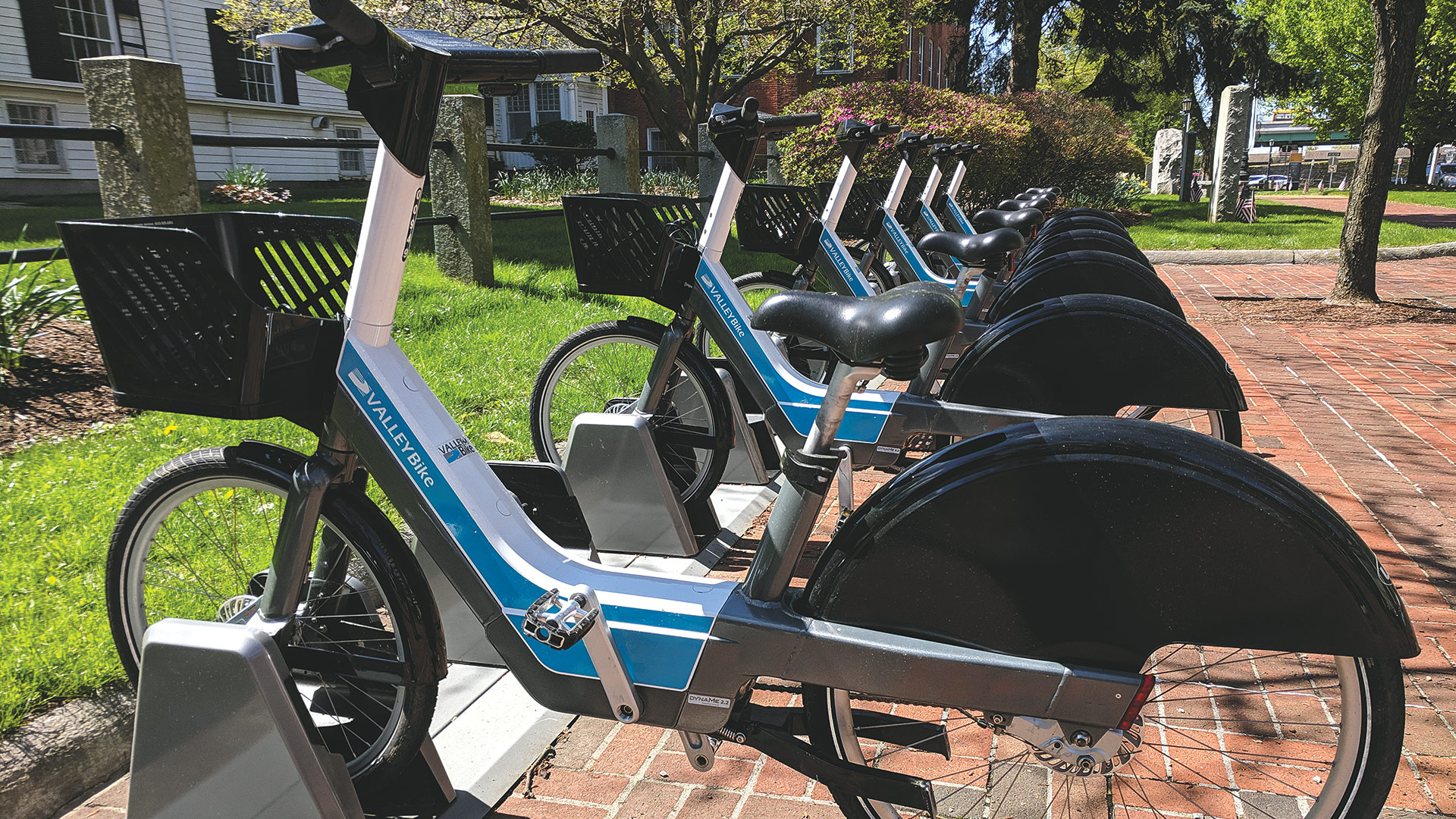
ValleyBike had, by most accounts, an up-and-down first year, and we’re not talking about the hills its bikes make a little easier through electric pedal assist. But on the whole, 2018 was an encouraging success, with gradually increasing ridership across the network’s six municipalities, despite a slow and incomplete roll-out of the 50 stations and 500 bikes. With further expansion possible, hopes are high that more people will ditch their cars for a bike ride in 2019 — and then turn that ride into a habit.

A regional bike-share program may have seemed like a novel idea for many Pioneer Valley denizens last year, but for those who helped bring it about, it’s far from a new concept.

“We’ve been talking about it in the Pioneer Valley for 15 years,” said Catherine Ratté, principal planner and Land Use & Environment section manager at the Pioneer Valley Planning Commission. In fact, the PVPC produced a report in 2008 documenting previous bike-share programs around the world — including the Yellow Bike program that once existed at Hampshire College as well as the Bixi Bikeshare program in Montreal — and encouraging Pioneer Valley municipalities to look into establishing a regional program.

A lot has happened since then, but the main development was the emergence of electric pedal-assist bikes that help riders navigate hills and long distances they might not have wanted to attempt before. It was a game changer, Ratté said.

“Part of it was being a broad region — how can people get from Amherst to Northampton to Springfield? Then electric pedal assist came along, and we said, ‘oh, this could be a regional program,’” she told BusinessWest.

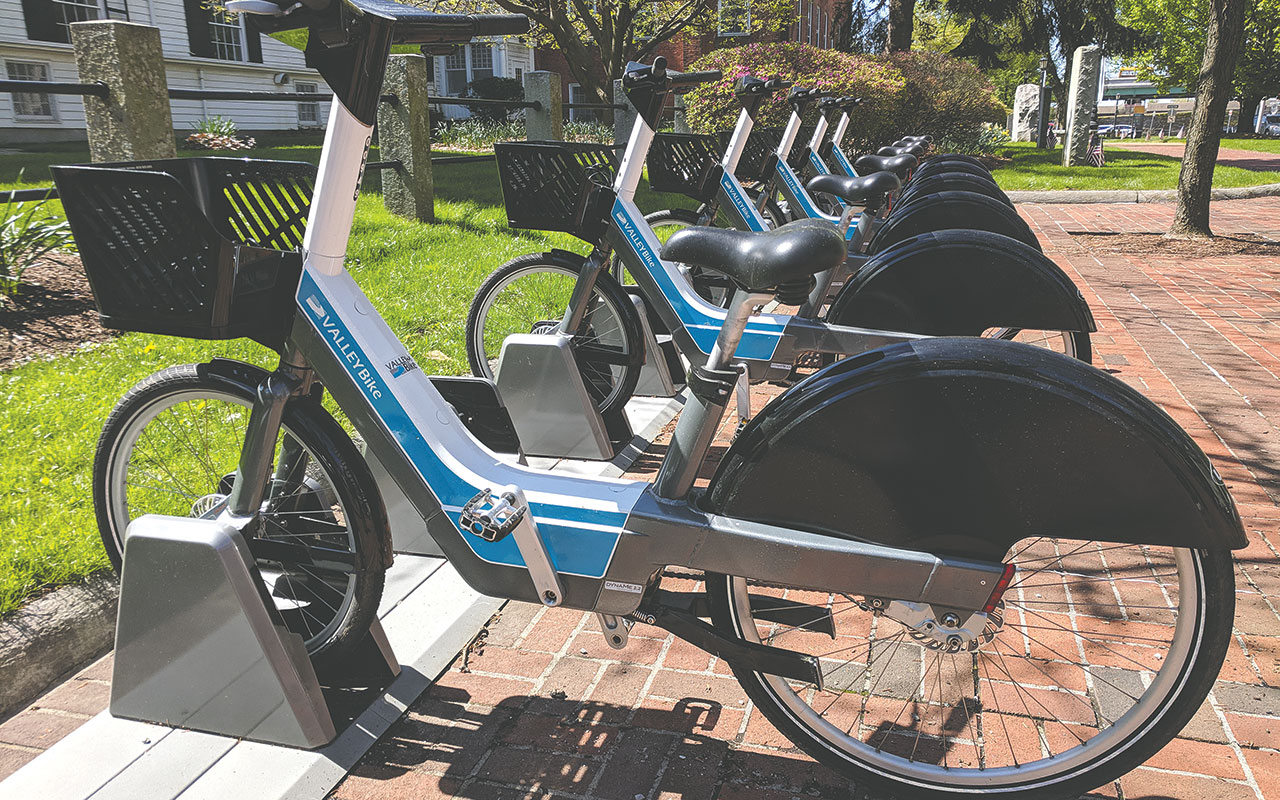
That program, known as ValleyBike, currently encompasses six communities — Northampton, Amherst, Springfield, Holyoke, South Hadley, and Easthampton — with others possibly on the horizon. A rider is free to pick up a bike at any of the 50 stations and drop it off at any other.

“The idea is to replace car trips with bike trips, and pedal assist makes it easier for all ages and abilities to use,” said Ratté. “It’s a big piece of acting on the climate crisis, but we also have a public-health crisis, and people don’t always have the opportunity to be physically active. ValleyBike makes it easier for people to bike to work. Maybe they aren’t physically fit enough to bike without pedal assist, and they don’t want to arrive at work sweaty — but they’re still exercising.”

A recent PVPC report detailed use of ValleyBike during 2018, its inaugural year. Even with limited availability and a slow ramp-up of stations (more on that later), the service logged 26,353 trips last year, an average of 170 per day, generating 83,735 miles — the equivalent of 3.3 times around the earth.

With the numbers expected to increase in 2019, that represents a significant front in the battle against traffic and air pollution, said Wayne Feiden, Northampton’s director of Planning & Sustainability.

“Our biggest commitment this year is to get more people to say, ‘yes, I really want to use this,’” said Feiden, who has long been one of the region’s strongest proponents of a bike-share network. “Nationwide, about a third of the people using bike shares are coming out of their car — making what would have been a car trip otherwise. If we can get you out of your car, that’s great from an environmental standpoint and a congestion standpoint. And that’s the part we need to grow most in the system.”

According to the year-end rider survey that helped the PVPC generate its report, the vast majority of users — 77.9% — rode ValleyBike less than five times per month, and 2.8% used it daily, with another 2.8% riding five or more times per week. These figures suggest that many users rode the bikes for leisure rather than to commute, which isn’t necessarily a bad thing, Feiden said.

Wayne Feiden says ValleyBike organizers have several goals

Wayne Feiden says ValleyBike organizers have several goals, from reducing traffic and air pollution to getting people more physically active.

“We have a lot of goals, and each one serves different purposes,” he noted. “One is just to get people to exercise more. So that’s been great, and it’s also been a diverse set of users.”

Indeed, 28.8% of survey respondents were between 18 and 30, 52.1% were between the ages of 30 and 60, and 6.9% were over 60 years old, while the gender split was close to even.

“People who use bikes tend to be younger, but these bikes are reaching a broader range of users, which is great,” he said. “Getting people healthier is wonderful, as is giving people transportation options, whether they can’t afford a car or don’t want to drive a car for environmental reasons.”

“The idea is to replace car trips with bike trips, and pedal assist makes it easier for all ages and abilities to use. It’s a big piece of acting on the climate crisis, but we also have a public-health crisis, and people don’t always have the opportunity to be physically active.”

One goal moving forward, he said, will be to increase usage of memberships. Annual passes ($80) accounted for just 13% of all rides in 2018, and monthly passes ($20) represented another 28%.

Those riders, Feiden said, are the ones more likely to use ValleyBike Share for commuting to work or other daily commitments, and to turn biking from a leisure activity into a habit and a lifestyle. “Once you sign up for a year, you tend to build your commitment.”

For this issue, BusinessWest looks at the ways ValleyBike is building on its own commitment — and its momentum, both electric-assisted and figuratively.

Winding Path

To its proponents at the PVPC, ValleyBike is a key component of the region’s path to a sustainable future by promoting healthy habits and reducing greenhouse gases emitted by vehicle trips. If managed effectively, the year-end report notes, the program could also reduce the need for road repairs and expansion, and has the potential to improve the effectiveness of the region’s transit system.

Following the 2008 report exploring the concept, UMass Amherst launched a free bike-sharing program in 2012 funded by student government fees. The same year, Northampton’s Planning and Sustainability Department began researching a program for that city.

Mayor David Narkewicz approved a single bike-share station downtown, but by early 2013, officials determined that a larger system, either city-wide or, better yet, region-wide, was preferable. At the same time, Amherst officials were meeting with representatives from Amherst College, Hampshire College, and UMass to explore a town-wide bike-sharing program.

Soon after, the PVPC secured a Massachusetts Clean Energy Center grant to work with several area communities to advance clean-energy strategies, selecting advancement of a regional bike-share initiative as a priority for funding.

The ValleyBike station at Court Square

The ValleyBike station at Court Square, one of 11 in Springfield, saw the sixth-most ride starts across the entire network in 2018.

Between 2014 and 2016, the PVPC worked with a group of member municipalities — Amherst, Holyoke, Northampton, and Springfield — to research and advance regional bike-sharing. In 2016, Northampton, with PVPC and regional support, applied for and obtained federal Congestion Mitigation and Air Quality funds for a regional bike-share network for four communities, later adding South Hadley as a fifth member.

A year later, Northampton, with PVPC and regional support, released a bike-share RFP and awarded a contract to Bewegen Technology for a 500-bike, 50-station system in the five communities. Toward the end of 2018, Easthampton obtained a Massachusetts Housing Choice grant for ValleyBike and joined the regional consortium, growing it to six municipalities.

The year-end report notes that ValleyBike had a rocky start due to issues with station installation, bike availability, and kiosk usability. Only 26 stations were open when the system went online on June 28, and another 17 were added in July and August. The remaining seven opened at the start of the 2019 season, bringing the total to 50.

After a slow start, the popularity of ValleyBike saw large increases in the first few weeks of August, reaching its peak ridership between Aug. 21 and Sept. 3, dipping slightly as temperatures dropped and students went back to school in early September.

“This is the first regional, multi-community, all-electric-pedal-assist bike-share program in the world. It was a really ambitious idea,” Ratté told BusinessWest. “It could have been smoother, but we had fantastic numbers of riders from all communities. And we definitely are eager to expand the coalition.”

She noted that possible expansion communities include Hadley, Chicopee, and West Springfield, should the PVPC secure the necessary additional funding. “We hope to keep it growing and expanding as well as adding some stations in the existing communities.”

“Nationwide, about a third of the people using bike shares are coming out of their car — making what would have been a car trip otherwise.”

With a longer season this year and more bikes — the network typically had about 167 available last year, but will offer 500 at the 50 stations in 2019 — she expects an uptick in ridership and increasing interest from the communities not yet on board.

“Hadley and Chicopee are the two holes in the system we’re trying to fill. We’re also trying to expand to West Springfield, but that’s more expanding out rather than filling in holes,” Feiden added. “Obviously we have to get more funding for new stations; there are many more locations that would make sense than we have money for.”

He added that more corporate sponsors are needed to make the system more sustainable. “But businesses are seeing the value for it — a third of the stations in Northampton are on private property. People gave us easements or licenses, whatever they needed to do, because they saw the value. One is at Cooper’s Corner in Florence, a small grocery store, and I hope people shop there because they gave us some really valuable real estate.”

Sustainable Future

Between climate concerns, public-health awareness, and simply enjoying the outdoors, bicycling — especially when pedal-assisted on those tricky hills — holds appeal to many demographic groups, Ratté said.

“If you ask people what they want in their region, a bike share is a popular thing. People expect their cities to fund options for getting around. And the cool thing is, you don’t have to stay inside your municipality; the same bike can go from place to place. It’s very convenient.”

That said, the program would benefit by coordinating more closely with public transit systems, she noted. According to the year-end survey, 27.5% of riders used ValleyBike in conjunction with other types of public transportation (such as rail or bus services). Organizers had hoped that bike stations could be located close to public transportation so public-transit riders could utilize the bikes to reach their final destinations. However, due to complications regarding the need for electrical outlets in close proximity to stations, this goal was not always met. That’s something planners are looking to remedy with future bike-station placements.

“People rely on the bus,” she said, “and to be able to use ValleyBike to get to and from the bus stop would be great.”

On a related note, the Community Foundation of Western Massachusetts worked with the Pioneer Valley Regional Ventures Center, the not-for-profit arm of the PVPC, to allocate $12,000 per year over three years to provide subsidized memberships for economically disadvantaged residents of the region, particularly those who live in transit-rich urban cores. Bewegen was not able to launch this aspect of the ValleyBike initiative in 2018, and more people are expected to use ValleyBike when the access passes become available this year.

So far, however, people seem to be using the bikes mostly for enjoyment. Of the year-end survey respondents, 52% said they used ValleyBike mostly for leisure, while 21.2% used them to commute, 5.5% wanted to reduce pollution and traffic congestion, and 5.2% were focused on the health benefits. Notably, 36% reported an increase in riding bikes of all kinds since using the system.

“In some ways, the biggest criticism is people asking, ‘why didn’t you come to my neighborhood?’” Feiden said, noting that Northampton added one stop this year and has applied for a grant to establish four more. “And that’s great. It’s nice to get beat up for not doing it.”

The hope is that the coming years will see fewer of those complaints as ValleyBike continues to expand, giving more people an excuse to leave their cars behind, get their legs moving, and maybe leave the air a little cleaner.

Joseph Bednar can be reached at [email protected]

Green Business

Saving Graces

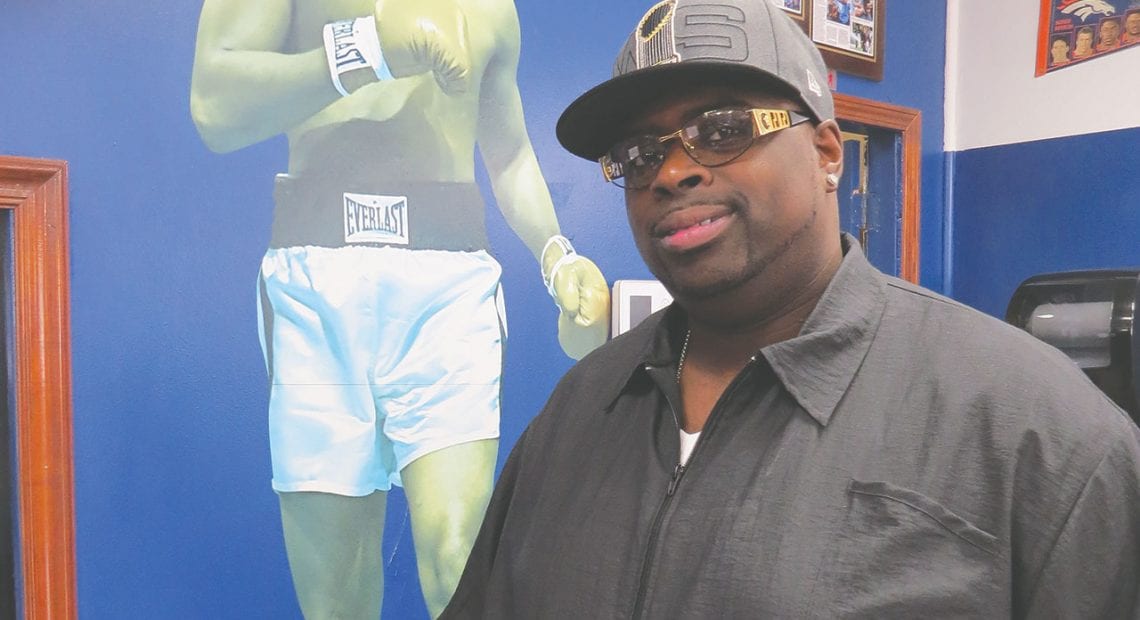
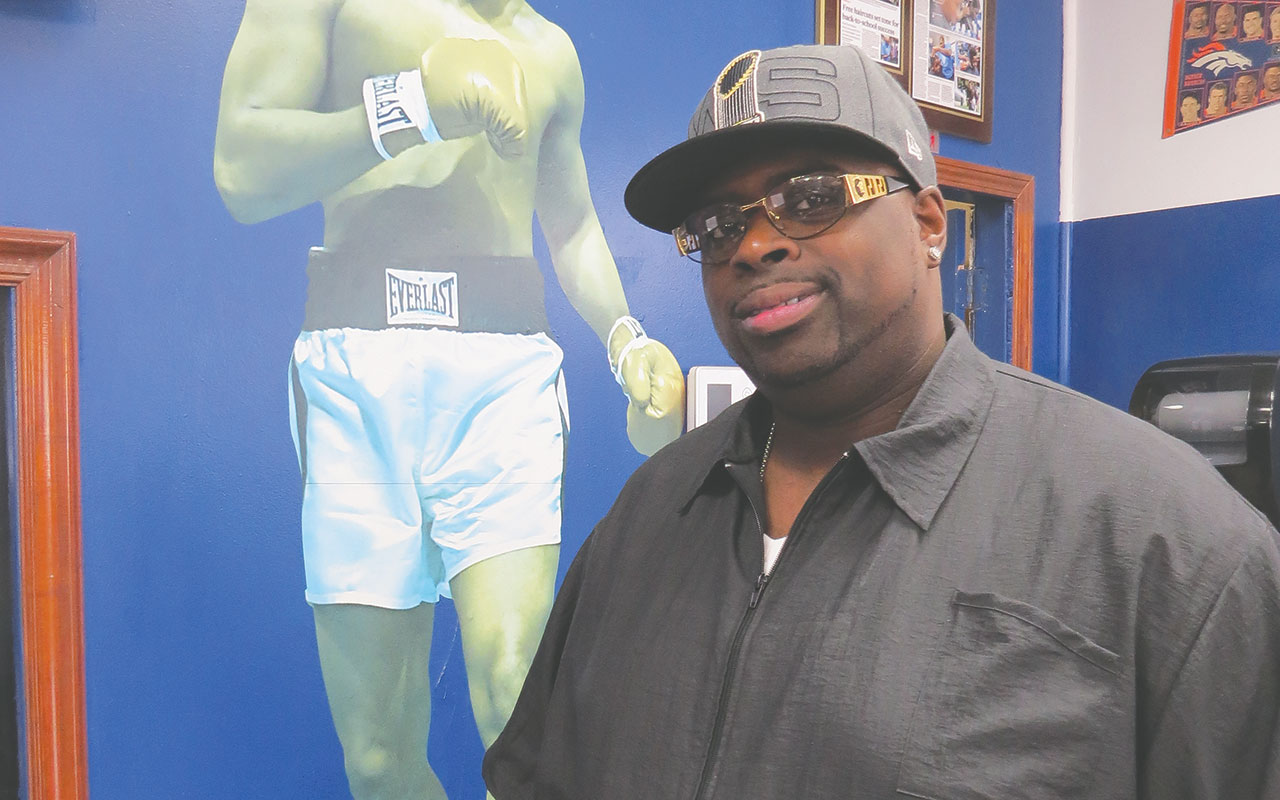
Clarence Smith, owner of Final Touch Barber Shop in Springfield

Clarence Smith, owner of Final Touch Barber Shop in Springfield

While outwardly in the business of providing energy, Eversource is making a name for itself in the business of conserving energy as well. Indeed, it has a deep portfolio of initiatives that are slicing energy bills, reducing peak-demand periods, and making a real impact — on both Main Street in Springfield and main streets across the Northeast.

Clarence Smith doesn’t have any trouble remembering when Eversource Energy entered his life — and his business — and helped him see the light, in all kinds of ways.

It was early June 2016. Muhammad Ali had recently passed away, and the boxing legend was on everyone’s mind. Coincidentally enough, he was also on Smith’s wall — the back wall of Final Touch, his barber shop on State Street in Springfield, to be more precise.

A representative of Eversource, the energy company based in Hartford and Boston, with a large presence in Springfield, happened to walk by and see the mural, said Smith, adding that he came in for a closer look, an impromptu visit that led to a wide-ranging discussion and, eventually, some improvement in the numbers on his electric bill.

“He was coming from a meeting at the health clinic across the street … he walked by and said, ‘wow, that’s a beautiful picture,’” Smith recalled. “We talked about Muhammad Ali, I showed him other pictures I had, and I eventually learned that his father used to do some boxing.

“We had a conversation about boxing, and then he said, ‘hey, I work for Eversource. We run a program — how would you like to be part of it?’” Smith went on, finishing the story (sort of) about how he became involved with the utility’s Main Street Energy Efficiency program, which has now impacted businesses on a great many streets in several different communities, and is now focusing on the Indian Orchard section of Springfield.

Through the initiative, business owners save an estimated $600 to $1,000 a year in energy costs through steps that include new and more efficient lighting, occupancy sensors, programmable thermostats, and water-saving devices.

Penni McLean-Conner

For both Eversource and Massachusetts, Penni McLean-Conner says, conservation is the “first fuel.”

The Main Street initiative is one of many that Eversource has launched with the broad goal of reducing overall energy consumption across the region and across the Northeast, involving communities, neighborhoods, and landmarks ranging from the corner market to Springfield’s Union Station; from Fenway Park to TD Bank Garden.

Others include a small-business program that provides no-interest loans to ventures to undertake similar energy-efficiency projects, often with dramatic results, such as those recorded by the Dakin Humane Society at its facilities in Springfield and Leverett.

There’s also a new focus on solar power, electric-car charging stations, and initiatives to improve storage in many locations — from UMass campuses to Cape Cod — with new technology, including lithium ion batteries and so-called ‘ice batteries’ (more on them later) to better handle peak loads, help alleviate outages, and improve reliability.

And while reducing the amount of energy consumed may seem counterproductive for a utility that sells that commodity, it makes perfect sense, said Penni McLean-Conner, senior vice president and chief customer officer for Eversource, noting that energy conservation is now a state priority and a state mandate.

“We’re at the end of the pipeline, so energy is expensive, and therefore it’s important that we leverage this resource and use it as wisely as possible,” she explained. “And Massachusetts leaders have recognized that conservation is the first fuel, something that was established with the Green Communities Act. And with that, the state has created the regulatory framework and policy framework that has allowed utilities to thrive by investing in energy-efficiency solutions.”

And Eversource has, indeed, invested in a number of these solutions, designed, overall, to help reduce the state’s carbon footprint and, locally, enable utility customers of all sizes and all business sectors to do what Smith did — trim (that’s one of his industry’s terms) his energy consumption.

“Our entire energy-conservation portfolio looks like an asset,” said McLean-Conner, who oversees a team of some 1,200 employees charged, overall, with managing the customer experience and developing ways to improve it. “In a three-year period, our energy-efficiency programs will build the equivalent of a 750-megawatt power plant. That’s powerful, because can you imagine siting a 750-megawatt power plant and getting all the lines up?”

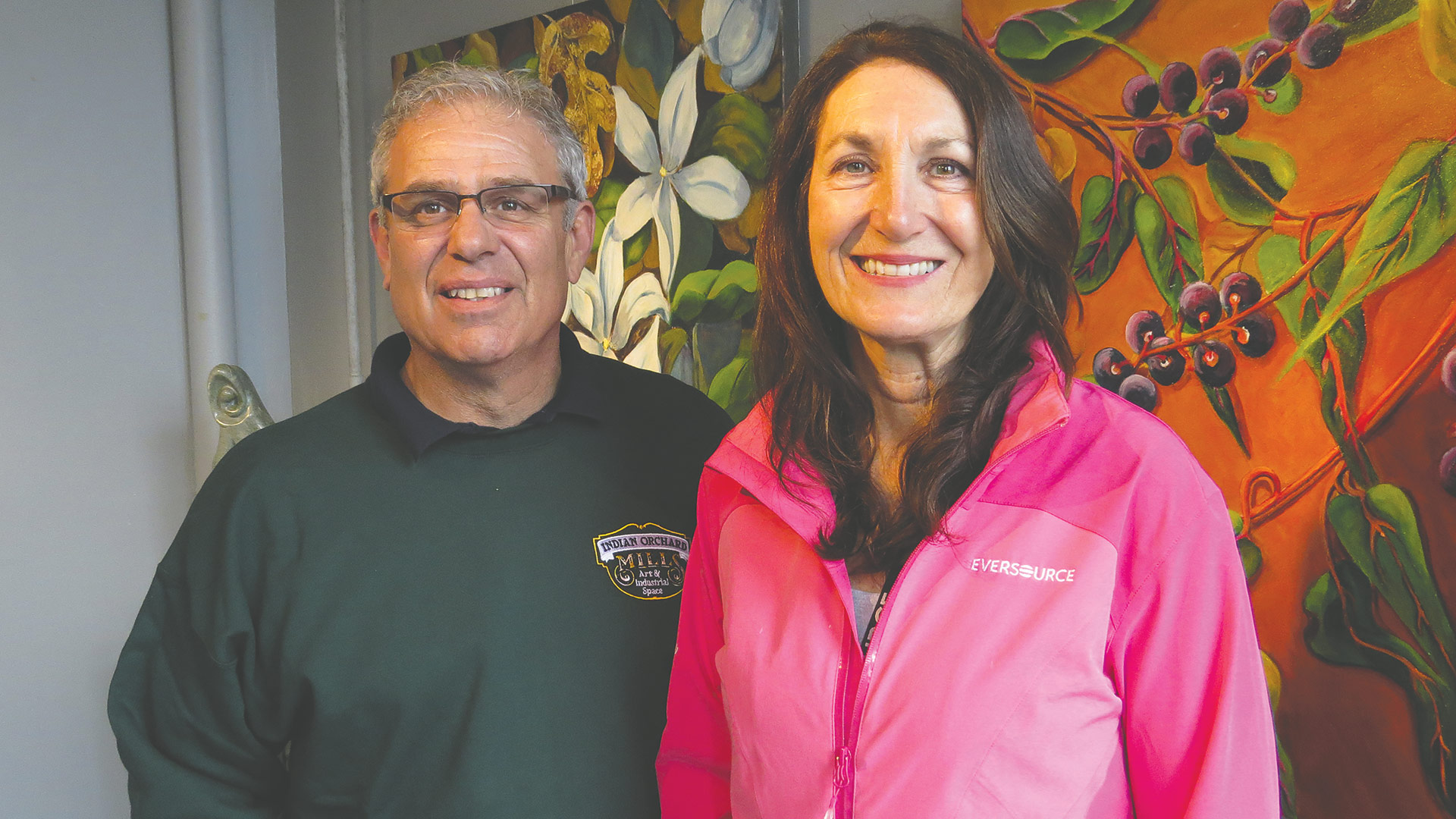
Kim Kiernan, energy efficiency consultant for Eversource

Kim Kiernan, energy efficiency consultant for Eversource, with Charles Brush, owner of Indian Orchard Mills, which has benefited from the utility’s energy-conservation programs.

For this issue and its focus on green energy, BusinessWest takes an in-depth look at Eversource’s Main Street program and its many other initiatives aimed at helping businesses become greener — and save green at the same time.

Current Events

Charles Brush says he’s “a small business that manages space for lots of small businesses.”

That’s an intriguing, but accurate, description of the Indian Orchard Mills, a large mill complex along the Chicopee River that is home to more than 150 businesses. Many of them are artists who don’t use large amounts of electricity, but maybe half are manufacturers that do, especially those that make use of compressors.

“When machines start up, they create a demand — when machinery kicks on, it creates a higher rate that we pay,” said Brush, who has already had the lighting at the mill changed once through the Main Street program. With another upgrade to LED now in the discussion phase, he’s also hoping to perhaps implement some other electric-efficiency programs regarding machinery and compressors.

“We’re talking about doing what’s known as soft-starting,” he explained, “so that when a compressor comes on, it doesn’t just go from ‘off’ to ‘on,’ which creates that load; it soft-starts the motors so it doesn’t create a spike in demand.”

As noted, Brush is not your typical small business participating in these energy-efficiency programs — his mill complex boasts more than 500,000 square feet of space being put to all kinds of uses. But his issues are in many ways the same as those facing business owners occupying one-tenth, one-hundredth, or even one-thousandth of that footprint, which is about what Smith’s barbershop covers.

Every small-business owner is looking to reduce energy consumption and, therefore, their monthly bill, said Kim Kiernan, energy efficiency consultant for Eversource and manager of the Main Street program, and the utility is committed to helping as many as it can.

“Our plan is to have everyone changed over to LED lighting by 2021,” she said, stating just one of the program’s goals, adding that the Main Street program, which started in Springfield and has been expanded to several other communities, has assisted more than 600 businesses to date.

While all business owners are in the same boat when it comes to energy consumption and the need to reduce it, very large customers do have their own specific issues and challenges, said McLean-Conner, adding that Eversource breaks down the business community into several categories of customers, with usage being the determining factor.

“We don’t look at business customers as one homogeneous group; we realize that our customers have different needs, so we do a lot of segmentation,” she said, adding that very large customers — think colleges and universities, hospitals, the new MGM casino, large manufacturers, and refrigerated warehouses — have their own account executive assigned to them.

But there are also teams assigned to different business sectors comprised of large users — education, healthcare, food-processing plants, and others — with the specific goal of identifying ways to save.

“And each of the solutions for those sectors is different,” she explained, citing the example of higher education and work the utility has done in partnership with the Massachusetts Institute of Technology (MIT).

“When I’m working with education, there’s considerable focus on labs, said McLean-Conner. “Those labs have intense energy needs, so the focus is how we reduce that. MIT was one of the first customers to sign on with us with a strategic energy agreement, a multi-year agreement and a public commitment by MIT and Eversource to reduce energy use over a period of time.

“They have actually increased square footage and reduced overall energy consumption — it’s a tremendous story,” she went on. “But it’s been done through the investment of wise energy-efficiency efforts, whether it’s building envelope and ensuring that the building itself is well-insulated, or heating and ventilation to make sure those systems are increasingly controlled, and lighting, which is obviously huge.”

There are a number of these tremendous stories being written, said both McLean-Conner and Kiernan. Like the one at MIT, they involve the customer partnering with Eversource to achieve stated goals when it comes to reducing energy consumption.

“In a three-year period, our energy-efficiency programs will build the equivalent of a 750-megawatt power plant. That’s powerful, because can you imagine siting a 750-megawatt power plant and getting all the lines up?”

They involve communities — Springfield was among the first, if not the first, city to ink what’s known as a strategic energy agreement with the utility — as well as large customers (UMass Amherst and Yankee Candle in this market are some of the examples cited), and literally thousands of small businesses.

“We try to develop custom solutions for these large organizations,” said McLean-Conner, noting that, at Yankee Candle, for example, the utility worked with the company to showcase various lighting options for franchisees — systems that would not only enhance the customer experience but reduce energy consumption and lower electricity bills.

Watt’s Happening

One of the keys to achieving those goals is making a dent in peak-demand periods, an important development for all commercial consumers, said McLean-Conner, because they pay not only for the energy for they use, but for the peak usage as well.

And recent trends show the peak moving higher, she said, motivating utilities like Eversource to look for innovative solutions, many of them involving a combination of energy conservation and storage of power for use during those peak-demand periods, usually in the middle of the summer when chillers of all sizes are operating at once.

“We want to avoid building resources just for those peak moments — we want to clip those peaks,” she explained, adding that one initiative in that realm is the installation of a large lithium-ion battery-storage system with the goal of reducing peak energy demand on the campus.

Funded through a $1.1 million state grant from the Advancing Commonwealth Energy Storage project, the battery-storage system will provide power that would otherwise have to be purchased from the power grid at premium rates — and it will also provide a research site for clean-energy experts, researchers, and students, said McLean-Conner.

Ice batteries do much the same thing, she noted, adding that there are a few in place across the state. These thermal storage systems produce ice at night when the demand for energy is at its lowest point. When the outside air is hot, the stored ice melts and is used to cool the building with existing air conditioning ducts and fans, but not the compressor, which requires power, she explained, adding that shifting power demand from peak times to non-peak hours is one of the major goals of the energy efficiency programs.

While working to reduce those peak-demand periods through storage initiatives, Eversource continues to work with business owners of all sizes to reduce energy consumption.

With the Main Street program, it works with very small businesses, generally shop owners who are leasing property. Launched in 2015, the program has program has focused on different communities — Pittsfield, Easthampton, Southwick, West Springfield, Ludlow, and Greenfield among them, with Hadley and Amherst next on the schedule — and sections of Springfield each year.

In the City of Homes, work began, appropriately enough, on Main Street, moved to State Street, then to the ‘X,’ and now, as noted, it is focused on Indian Orchard and customers like Charles Brush. There are some 400 small businesses in the Orchard, as it’s called, and Kiernan would like to sign up at least half of them.

That will be a challenge, she noted, because these are partnership efforts, and sometimes, some selling is required to recruit these partners.

Indeed, Kiernan noted that small-business owners, especially those who take part in the Main Street program, are, generally speaking, understandably worried about possible scams and wary of claims of reduction in their energy bills. But once Eversource can convince them to not only listen to the pitch — sometimes it’s difficult to even get a foot in the door — but implement many of the suggested steps, they’ll discover that the savings are real.

The process, with both the small-business initiative and the Main Street program, begins with an assessment by electrical contractors and then development of a detailed plan to reduce consumption. Lighting, specifically a switch to LED lighting, is a big element in these plans, said Kiernan, calling it “low-hanging fruit,” but important fruit, generally able to yield a 40% reduction in cost over what was in the ceiling.

But there are other considerations as well, such as refrigeration, HVAC, motors and compressors, occupancy sensors, programmable thermostats, and others, she went on, adding that measures are implemented without interruption to the business in question.

Eversource provides an incentive to participate, Kiernan added. With the Main Street program, 100% of the project’s cost is covered by the utility, and with the small-business program, 70% of a project’s cost is covered, and the utility will finance the rest over two years, with a zero-interest loan.

Generally, the cost of the loan is more than covered by the savings generated by the measures implemented, she went on, adding that the customer’s bill doesn’t increase through participation. When the loan is paid off, the bill will then decrease by that amount.

In many cases, as noted, all this sounds too good to be true, and utility customers need to be convinced that it isn’t, Kiernan went on, adding that, while it works diligently to do this, often it has help from those who can see first-hand that the benefits are real.

Positively Charged

People like Clarence Smith. He’s become an ambassador of sorts for the Main Street initiative, encouraging many of his business neighbors to take part.

“People don’t believe it until they see it,” he explained, noting that he’s encountered plenty of initial skepticism about the project. “I’m a testament to this program; I’ve seen how it’s worked for us, and if people ask me, I’ll tell them it can work for them, too.”

It all started when someone from Eversource saw his mural of Muhammad Ali and came in for a look and a talk — a talk that led to another of thousands of small steps to reduce energy consumption across the state and the region.

As McLean-Conner noted, conservation has become the first fuel for Eversource, as well as the state, and this mindset is creating a spark — in all kinds of ways.

George O’Brien can be reached at [email protected]

Business of Aging

On the Path of Discovery

Skip Matthews says Louis & Clark

Skip Matthews says Louis & Clark is continuing a process of evolution and response to changes in the marketplace that began in 1965.

By now, a good number of people in this region know the story of how the second-generation, 55-year-old company known to most as Louis & Clark came to take that name.

The sign over the pharmacy on Memorial Drive in Chicopee in the mid-’60s read ‘Airline Drug,’ an obvious nod to what was then known as Westover Air Force Base, just a few hundred yards away. But before long, many customers had unofficially renamed it, using the first names of the partners — and pharmacists — who had acquired the business, Louis Demosthenous and Clark Matthews, who just happened to share names with those famous explorers (sort of).

“There weren’t really marketing companies back then,” Skip Matthews, Clark’s son, explained with a laugh. “It was just … we were Airline Drug, the customers started calling it Louis & Clark, and they kept calling it that, so they changed the name. I imagine that feeds your ego pretty well, too.”

Perhaps a less-known story (although the company is investing considerable time and energy in telling it, as we’ll see later) is how this company continues to evolve and respond to change — within the industry, in societal needs, in demographics, and even in the way companies are operated.

We’ll start with the much longer name over the door. Under the ‘Louis & Clark’ in large type (with a stick figure in a wheelchair taking the place of a traditional ampersand) are the words ‘Pharmacy & Home Medical Supplies,’ and they go a long way toward telling this story.

“Our employees possess a world of knowledge. Our emphasis is on unlocking all that knowledge instead of having people place an order, come in and pick it up, and leave.”

Indeed, a company that once had several pharmacies scattered across this region has seen that division of the company remain vibrant while also taking on a different look and feel. There are fewer locations — in fact, just one — but also a greater focus on convenience and delivery.

It’s all on display at the company’s recently opened pharmacy on Brookdale Drive in Springfield.

Formerly located on Page Boulevard in the same city, the company calls this a ‘long-term-care-facility’ pharmacy, one that focuses on delivery, packaging, and medication management, especially through a relatively new service called the MediBubble, its new medication-management system delivered to those in assisted-living facilities, group homes, nursing homes, and independent-living situations within the community.

The MediBubble is a medication package that helps individuals safely manage what prescription medications they take, and when, he explained, adding that each package contains all of one’s medications for a specific time of day, this reducing confusion when taking multiple medications.

Diane Cordeiro says one of the main focal points for Louis & Clark

Diane Cordeiro says one of the main focal points for Louis & Clark is to build relationships and boost awareness of its many products and services.

“Sometimes it’s hard for people to remember if they’ve taken their pills,” he went on. “With MediBubble, they simply have to look at the sheet. If that bubble has been opened, they’ve probably taken their pills.”

Meanwhile, the medical-supplies side of the operation, which itself dates back to 1978, has grown considerably and also evolved to meet new and different needs and bring a higher level of service to customers. Matthews explained this by stressing that the company doesn’t simply supply medical equipment. It also provides education and advice, something that isn’t available to those who might be tempted to merely order something online.

“The big point of emphasis now is becoming more and more knowledge providers as opposed to order takers,” he explained. “That’s a challenge for us and a challenge for our industry; people have options — they can go to a pharmacy, or they can try to find something online. For people to come into our location, there has to be a reason — it’s too easy to buy things anywhere else.

“Our employees possess a world of knowledge,” he went on, adding that some have been in the business for three decades or more. “Our emphasis is on unlocking all that knowledge instead of having people place an order, come in and pick it up, and leave.”

Over the years, the company has developed a number of specialty services, including the Pink Mermaid Mastectomy Boutique, located in the medical-supplies location in Groton, Conn., and a focus on foot care in all its medical-supplies locations — in Springfield, Easthampton, and East Longmeadow.

And it continues to find new ways to bring quality service and convenience to customers, a pattern that has continued for 55 years. For this issue, BusinessWest looks at how this ability to respond, adapt, and evolve has positioned Louis & Clark for continued growth in an always-changing healthcare landscape.

Blazing New Trails

Before talking about the present and especially the future, Matthews first stepped into the way-back machine and returned to 1965 — and actually a few years before that, when his father and Louis Demosthenous were classmates at the Hampden College of Pharmacy in Chicopee, long since merged into the Massachusetts College of Pharmacy and Health Sciences in Boston.

After graduation, they went in different directions — mostly work at pharmaceutical chains — before deciding to go into business for themselves. They acquired Airline Drug, and as you now know (if you didn’t know before), the partners’ first names, not their last, as is so often the case, became a brand.

And a brand that quickly expanded its presence across the region as the partners opened additional pharmacy locations.

Indeed, just a few years after acquiring the Chicopee facility, they opened a second on Breckwood Boulevard in Springfield, across from Western New England University. Additional pharmacy locations were opened in the center of Wilbraham (1970), Ludlow (1971), Page Boulevard (1972), Baystate Medical Center (1988), Mercy Medical Center (1992), and Holyoke Health Center, among others. The first medical-supplies facility was located in one of the company’s pharmacies in West Springfield.

Kim Vigliotte, seen here in the fitting area

Kim Vigliotte, seen here in the fitting area in the East Street, Springfield location, is a compression specialist and pedorthist who consults with 25-30 customers a day.

As the landscape changed and pharmacy became much more of a volume business, the company consolidated those operations and focused its attention on the types of business that the large chains dominating that landscape were not interested in — specifically delivery and packaging, like the MediBubble, said Matthews, who has been involved with the business since graduating from college in 1987 and assumed full ownership a few years ago.

The recently opened facility on Brookdale Drive will deliver to individuals and facilities within a wide geographic radius, from Greenfield to the north to Westfield and beyond to the west, to Monson and Palmer to the east.

As noted, the service specializes in bringing packaged medications to those who take anywhere from five to 15 medications a day, and it is becoming increasingly popular, said Matthews, adding that the pharmacy side of the business remains vibrant — but different than it was decades ago.

And the same can be said of the medical-supplies division, which has seen more dramatic growth over the years.

Indeed, there are now four locations — what Matthews calls the ‘hub,’ a large showroom and warehouse on East Street in Springfield; a satellite location in Easthampton; a recently opened retail location in the Heritage Plaza in East Longmeadow; and the location in Groton, which was an acquisition of an existing facility.

As was noted earlier, Matthews said the focus is on not merely supplying or resupplying a wide range of items — from catheters to compression socks; from incontinence products to wheelchairs — but also supplying information, education, and guidance.

“People need help, and sometimes they don’t even know what’s out there to help them — like a different product or a different size of a given product,” he said, again stressing that the company strives to move well beyond merely taking and filling orders and dispensing more knowledge.

This is especially true when it comes to foot care, said Kim Vigliotte, a compression specialist and pedorthist, who spends much of her time at the East Street location, but rotates to all of the company’s medical-supply locations.

She told BusinessWest she assists individuals with a range of foot problems, including diabetes, vascular disease, and non-healing wounds, and sees, on average, 25 to 30 people a day at the Springfield location.

“A patient comes in with a prescription from their podiatrist or primary-care doctor, and we do a foot evaluation or evaluation of their legs, and determine which product would be most appropriate for them to address whatever issues they’re having, be it pain, swelling, or ulceration,” she said, adding that there are a number of products on the market now that can improve quality of life for such patients. Her work is focused on matching them with the right ones, and she acknowledged it’s very rewarding work.

Charting a New Course

While working to improve service to customers, Louis & Clark has also been working to improve efficiency and develop and then follow a roadmap for continued growth, and it has been helped in this regard by adaptation of what’s known as the entrepreneurial operating system (EOS).

In simple terms, EOS is a system by which companies large and small can manage and strengthen six key components of business operation: vision, data, process, traction, issues, and people.

Rachel Duda says Louis & Clark has been very proactive

Rachel Duda says Louis & Clark has been very proactive in its outreach to a number of constituencies.

The company now has separate leadership teams for its two divisions — pharmacy and medical supplies — thus enabling Matthews to focus more on the vision side of the equation and long-term strategic planning.

This new structure has allowed for better, sharper focus within each division, said Diane Cordeiro, the company’s marketing manager and also the integrator, or chief operating officer, for the medical-supplies division, adding that it also enables them to work better together toward the same goals.

“The integrator is the individual who is responsible for keeping all the different business units working together — finance, HR, operations, marketing — and just make sure that each unit is working to the best of their ability and that their leader is having them maximize everything they do on a day-to-day basis,” said Cordeiro, who joined the company in 1990 as a cashier and moved steadily up the ladder. “We want to have everyone working toward the same goals and being enthusiastic about their day-to-day, helping customers, working with referral groups, and enabling us to stand out from every other standard medical-supply location.”

Elaborating, she said one of the emerging priorities for the company is to make the public fully aware of all it does — and all the knowledge its employees possess, work that dovetails nicely with the main title on her business card: ‘marketing manager.’

“I want to see that part of the business grow,” she said, referring specifically to medical supply. “And, obviously, this involves making new relationships with new referral groups, maximizing outreach for relationship building, and just letting people know who we are and what we do.”

Rachel Duda, a marketing assistant for the company, said Louis & Clark has been very proactive in its outreach to a number of constituencies, including physicians’ offices, assisted-living facilities, nursing homes, and group homes, in both Massachusetts and Connecticut, in an effort to build awareness of the company as a resource.

“It’s all about education — individuals don’t know what they don’t know,” she explained, adding that the company has taken things to a higher level in recent years with a program called ‘lunch and learn.’

As the name implies, it involves lunch and learning — about Louis & Clark and its various services, said Cordeiro, adding that lunch is very often the only time to get the full attention of a staff at a physician’s office or residential facility.

“We offer these to any new opportunity or referral group,” she explained, “including doctor’s offices, home-care agencies, physical-therapy offices, rehab facilities, anyone who would be prescribing products that we dispense.”

The lunches are definitely having an impact, Cordeiro went on, adding that company is receiving prescriptions from a number of new sources. And they are just one example of more aggressive outreach that benefits both parties.

Another is a relatively new initiative involving on-site visits to senior centers and senior-living facilities for everything from ice-cream socials to hot lunches to what are known as ‘tune-up clinics.’

“Our in-house technician will go on site on a scheduled day, and any individual who is from that community can bring down their walker, their wheelchair, anything that might need some sort of adjustment, new wheels, new brakes, whatever,” she told BusinessWest, adding that for parts under $5 there is no charge, and for parts over that amount, the individual pays just the retail cost.

That explains why these tune-ups have become hugely popular and also a huge part of the company’s efforts to tell its story and build new relationships, something it’s been doing since Lyndon Johnson was in the White House.

Making More History

After Louis Demosthenous retired more than a dozen years ago and Skip Matthews took on a leadership role, there was brief — as in very brief, apparently — discussion about changing the company’s name again to Skip & Clark.

Those talks were brief because it was decided this name didn’t roll off the tongue as well and didn’t have the historical connection. Besides, Louis & Clark had become a regional brand, one that had become synonymous with service and innovation.

So, while the name hasn’t changed, the company remains, in a word, fluid as it continues to discover — pun intended — ways to better educate and better serve its customers.

George O’Brien can be reached at [email protected]

Green Business

Pet Project

Carmine DiCenso

Carmine DiCenso stands by the solar installation on the roof of Dakin’s facility in Springfield.

Carmine DiCenso says there’s a changed atmosphere at the Dakin Humane Society facilities in Springfield and Leverett these days — in many different respects.

Indeed, due to comprehensive spaying and neutering programs, overpopulation among canines and felines is far less of a problem than it was even a few years ago, and, as a result, there are, generally speaking, fewer animals up for adoption in these centers.

Meanwhile, societal changes have made adoption a more accepted and therefore more popular practice. “Culturally, everyone wants to rescue a pet now,” said DiCenso, Dakin’s executive director, adding that, as a result, many of the pets that wind up in the adoption centers are not there for long stays.

Those that are tend to be older and often have physical and/or behavioral-health issues and thus need more time at the shelter to become ready for adoption, said DiCenso. “We’re spending more time and resources to rehab animals, and that’s a bigger challenge,” he explained, adding that the agency is shifting its focus to work with animals in the community — by providing food, vaccinations, and other necessities — with the goal of keeping them out of shelters.

But these are not the only changes to the environment at Dakin.

The others involve energy-efficiency, and while many cannot be seen (such as the solar installations on the roofs) or heard, they are important developments in Dakin’s ability to carry out its broad mission.

That’s made clear by current numbers and those that DiCenso is projecting for a few years out. He expects that, when the latest round of planned improvements — efforts to better seal skylights and windows to improve efficiency and replacement of a 21-year-old, very inefficient inefficient chiller — are implemented, the nonprofit agency will see annual energy savings approaching $50,000 at the Springfield site. In six to 10 years, he projects that the number will be closer to $200,000.

“And that money would be diverted right into director programming,” he explained, “and meeting the needs of our animals who need more from us — here in the shelter and out in the community.”

Backing up a bit, DiCenso said Dakin has undertaken a number of significant steps to become more energy-efficient over the past few years, many in what amounts to a partnership with Eversource, largely because it needed to, especially in Springfield.

The 47,000-square-foot facility, formerly home to the MSPCA, was built just over 20 years ago, a different era when it comes to energy efficiency, said DiCenso, adding that discussions about doing something with a building that had become a large drain on the budget began years ago.

And with a two-year, $95,000, no-interest loan from Eversource as part of the utility’s small-business retrofit program (see related story, page 18), Dakin has addressed many of these glaring needs. Indeed, starting in late 2016, the nonprofit has undertaken several initiatives, including:

• Lighting conversions. Dakin switched from fluorescent to LED lighting in many areas of the Springfield building. The parking-lot lights, formerly multi-vapor models, have also been converted to LED. Meanwhile, occupancy-sensor switches were installed in several rooms, replacing traditional on/off switches that are often left on long after people have left the room.

• An HVAC upgrade, specifically adding a dedicated domestic hot-water system that uses just the right amount of energy needed to have hot water on tap. Previously, Dakin relied on large boilers to heat even the smallest amounts of hot water.

• Variable-frequency drives. As part of the HVAC upgrade, Dakin added these drives to achieve more scalability in controlling indoor climate, said DiCenso, adding that it also installed carbon-dioxide detectors to control the amount of outside air (hot or cold) coming into the building to control costs.

“The fans were either on or off, and it took a tremendous amount of energy for them to cycle up and turn on fully, and that’s a waste of energy,” he explained. “What we have now are variable drives, which slowly build up to speed and only bring them to the level you need; instead of going from zero to 100 every time you turn them on, if they only need 25% of the energy, that’s what they’ll turn on to.”

As for the solar installations, installed in 2018, they were made possible by a gift from area residents Brian Adams and Morey Phippen, who have funded solar projects for a number of nonprofits in the area, said DiCenso, adding that, through these installations, both facilities are realizing substantial savings on their electric bills, especially the Leverett site.

“It will take a few years to really see those cost savings,” he said. “But we’ll get a bigger bang for our buck in Leverett because it’s a smaller building and the solar installation will be able to take more of the load; we do think our energy costs will drop 50%.”

Between the two buildings, as he noted, the overall savings will likely exceed $200,000, a budgetary windfall, if you will, that will be needed in the years to come.

That’s because, while the landscape has changed, overpopulation is no longer a real issue, and rescuing animals has become more popular, there are still many needs to be met when it comes to that constituency.

Because it now far more energy-efficient, Dakin will be better able to meet them.

— George O’Brien

Green Business

A Change at the Checkout

Volunteers at the annual Source to Sea Cleanup

Volunteers at the annual Source to Sea Cleanup always seem to pick up the same amount of plastic waste, meaning something has to change further up the chain.

Americans need to start talking about plastic waste, Bob Bolduc said. For proof, look no further than the customer who visits Pride Stores regularly for lottery tickets — and wants them in a plastic bag.

“What does that tell you and me? That the world has a big education problem. We need to talk about it.”

Bolduc, who owns the Pride chain, and his team have done just that, deciding to eliminate plastic bags at checkout counters across the chain. The ban went into effect on May 1.

“We’re happy to do it,” he went on. “We’re getting mixed reviews, but we think people in time will come around. Everyone’s got to do their share. This is a little thing we should have done a long time ago.”

As part of the conversion, Pride will give away reusable bags as long as supplies last, and give a 5-cent discount whenever a reusable bag of any kind is used.

“It was the right thing to do; it’s that simple,” Bolduc said. “Anybody who cares about our planet realizes it’s one of the easy fixes, so we decided to do it right away. There have been a few customers who complained, but most customers have been understanding, some have applauded us, and some — here’s the good news — said, ‘I don’t need a bag at all.’ That’s the best response, because paper bags aren’t the solution, either.”

Pride isn’t alone. Big Y Foods recently announced it will eliminate single-use plastic bags from checkouts at its 70 supermarkets and specialty stores, along with its Big Y Express gas and convenience locations, in 2020.

“We’re getting mixed reviews, but we think people in time will come around. Everyone’s got to do their share. This is a little thing we should have done a long time ago.”

Big Y supermarkets in six area communities — Adams, Amherst, Great Barrington, Lee, Northampton, and South Hadley — have already made the switch to comply with municipal bag bans, and that got the company, which has implemented a number of sustainability-minded practices over the years, thinking.

“We have a handful of stores that are in towns with bag bans, which makes it a hodgepodge for us,” said Claire D’Amour-Daley, Big Y’s vice president of Corporate Communications. “The first stores were tougher — people got mad at us. But it’s much more commonplace now, with these town ordinances. Most people support it, and the employees support it.”

Eliminating the single-use bags chain-wide, she added, simply made sense.

“It’s a start. We continue to look at all types of packaging we can substitute — we’re looking at alternative sources of everything — but we figured we’d start with the bags.”

Massive Impact

As one might imagine, plastic bags create an inordinate amount of waste. According to the Environmental Protection Agency, more than 380 billion plastic bags are used in the U.S. each year. If not disposed of properly, this plastic can end up in waterways and forests, where it can harm fish, marine animals, birds, and other wildlife.

As a large chain, Big Y uses 100 million plastic bags and 3.5 million paper bags at its checkouts each year. The company recognizes that paper isn’t the answer to this waste problem, as the paper-production process is harmful to the environment, causing increased greenhouse-gas emissions and deforestation, which is why it’s promoting the adoption of reusable bags through in-store promotions (like buy one bag, get one free) and signage.

Signage at the South Hadley Big Y

Signage at the South Hadley Big Y reminds shoppers they won’t be getting plastic bags there.

The Connecticut River Conservancy understands the impact of waste more than most. CRC volunteers have cleaned up more than 1,000 tons of trash over the course of 22 years at its annual Source to Sea Cleanup.

“It’s clear that repeated cleaning is not the solution to our trash problem,” said Andrew Fisk, executive director. “We need to redesign our economy so there isn’t waste in the first place.”

The CRC is taking a three-pronged approach to that campaign: corporate pressure, consumer pressure, and legislative efforts.

“We realize, by going out and cleaning it up, how big it is, but we’re still doing the same work year after year,” said Angela Chaffee, communications director.

“There are things that can be done to stop trash from ending up in riverbanks in the first place. That’s what we want to start working toward,” she went on. “Littering is definitely part of the problem, and we encourage people not to be litterbugs. But there are choices people can be making every day at the consumer level — things like reusable bottles, shopping bags, and coffee mugs. A lot of people think that doesn’t make a difference, but it absolutely does.”

On the subject of corporate pressure, she mentioned Dunkin’ Donuts as an example of a company that needs to do more — as evidenced by the countless plastic DD cups that get picked up at every cleanup.

“We see those all the time; they tend to gather in parking lots and storm drains on the street, which directly connect to our rivers. We got to thinking, why are these businesses making things that end up as trash in the rivers? They say, ‘it’s not us, it’s our consumers’ — but why not give your consumers better options? Dunkin’ does have a reusable mug program, and they could be incentivizing that a whole lot more.”

The goal isn’t to burden companies, Chaffee said, but to sit down at the table with them to formulate strategies for reducing waste. If that doesn’t work, she encourages consumers to speak up with their money.

“They can say, ‘hey, I’m a customer, and I love your coffee, and I want you to do it this way, not that way.’ That has been downplayed a little bit. The power of that dollar is more than people think. The public has a role and a voice.”

The third step is working with legislators to craft laws, like plastic-bag bans. “We support any municipality that wants to pass a ban because it does contribute,” she said. “But we feel the best way to solve the problem is a statewide ban, not different rules depending on what town you’re in.”

Northampton was among the early adopters of a plastic-bag ban about five years ago. Mayor David Narkewicz recalled that some shop owners were concerned about the impact on their business, that it might put the city at a competitive disadvantage. But they were given plenty of transition time, and the fears turned out to be unfounded.

“I don’t think anyone has been able to say it had an impact,” he told BusinessWest. “Stop & Shop totally ran with it. They switched without any issues — Walmart, too. And Big Y is voluntarily getting rid of plastic bags in all their stores. So I think we were ahead of the curve.”

He noted that entire states — California, Hawaii, and New York — have banned single-use plastic bags without much pushback from customers. “I think it’s part of the environmental ethic we have here in Northampton. On so many levels, it made sense to people here.”

Terry Masterson, the city’s Economic Development director, agreed. “My job for a while was to deal with businesses that didn’t comply — and we had one. Customers want to see it, and store owners want to provide it.”

Next Steps

D’Amour-Daley agreed that banning plastic is a positive step customers will adjust to — hopefully by embracing reusable bags, not relying on the paper bags available at checkout for 10 cents a pop. “California has had a ban for years. People get used to it once you put a line in the sand.”

Big Y has a history of promoting sustainability, she noted, including almost daily donations of unsold food to the five food banks within its marketing area. Last year, the company distributed 6.4 million pounds of food, including 2.4 million pounds of meat and 1.4 million pounds of produce. Big Y locations also participate in paper and cardboard recycling programs and composts 2,500 tons of food annually. In addition, it has championed other energy-saving initiatives, such as the use of solar arrays, LED lighting, and reclamation of heat from refrigeration systems to heat the stores during the winter.

“We continue to look for other types of packaging that are better for the environment,” she added. “People expect that now, and we recognize we have more work to do.”

Bolduc noted that Pride looks for ways to be more environmentally progressive as well, including charging stations for electric vehicles at new stores; the use of high-efficiency refrigeration, heating, and air conditioning in all stores; conversion of all hand dryers to cold air only; and climate-controlled stores for optimum energy reduction.

The bag ban, he said, was a comparatively simple step, and one that raises awareness of sustainable practices among customers. After all, he added, “we’re all in this together.”

Chaffee welcomes such moves. “The fact that we’re having this conversation at all is a good step forward,” she told BusinessWest. “Every little bit helps move us in the right direction. We want companies to step up and do more.”

As for individual consumers, “a lot of times, people think just one person won’t make a difference,” she added. “But you don’t have to do everything 100% perfectly. If you’re doing one small thing to make a difference, think about the millions of people across the country and around the world; it does add up and has a huge, positive impact.”

Joseph Bednar can be reached at [email protected]

Features

The Stars Were Aligned

A high-resolution image of the black hole at the center of the galaxy known as M87.

A high-resolution image of the black hole at the center of the galaxy known as M87.

The image of the black hole in the center of the galaxy known as M87 that was released earlier this month was a groundbreaking development in many respects. It was the first direct visual evidence of a black hole, and it validated Einstein’s century-old theories of relativity. But it also put the spotlight on astronomers at UMass Amherst and a telescope, known as the LMT, that the university operates in partnership with the Mexican government.

Gopal Narayanan wasn’t totally sure, but he recalls that his gut told him “that we had … something.”

‘We’ is the collective that Narayanan, a research Astronomy professor at UMass Amherst, used to describe both his team stationed in April 2017 at the LMT (Large Millimeter Telescope) erected atop a 15,000-foot-high volcano in southern Mexico, and teams at seven other telescopes around the world. And the ‘something,’ as the world now knows, was what would become the first direct visual evidence of a supermassive black hole and its shadow.

Indeed, after a series of new conferences staged around the world announced the breakthrough on April 10, media outlets published what many would call a ‘photograph’ (see above) of the black hole at the center of Messier 87, or M87, as it’s called, a massive galaxy in the Virgo galaxy cluster, some 55 million light years from Earth.

It’s not a photograph in the traditional sense of the word, said Narayanan, but rather, as he’ll explain later, what amounts to a mathematical interpretation of data retrieved from those eight radio telescopes, known collectively as the Event Horizon Telescope, or EHT, a name that denotes the point at which light, matter, and other energy fall into a black hole.

From left: Aleks Popsefanija, Gopal Narayanan, and Peter Schloerb, members of the team at UMass Amherst that helped capture that first image of a black hole.

From left: Aleks Popsefanija, Gopal Narayanan, and Peter Schloerb, members of the team at UMass Amherst that helped capture that first image of a black hole.

While most of the world’s focus has been on that image, what it shows, and what it means — essentially validation of Einstein’s theories of relatively forged nearly a century ago — the collaborative effort that produced that image is an equally compelling and far-less-known story.

As is the large contribution made by UMass Amherst astronomers and the LMT, a facility the university operates jointly with Mexico’s Instituto Nacional de Astrofisica, Óptica y Electrónica (INAOE).

The LMT, at 50 meters in diameter, more than half a football field, is the world’s largest single-dish, steerable, millimeter-wavelength telescope in the world, said Peter Schloerb, UMass Amherst’s LMT principal investigator professor, and early on, those working to create the EHT recognized that it could play a vital role in those efforts.

Specifically, an initiative to create what would be become, in effect, a telescope the size of the planet, Schloerb went on, adding that, by combining results from large telescopes scattered across the globe, those searching for a black hole could create a virtual telescope some 9,000 kilometers in diameter.

“It’s quite rare to get eight telescopes scattered around the world in completely different geographic locations — northern and southern hemispheres, east and west — to all have good weather for a stretch of several days, which we did. And you also need to have all the telescopes working technically well, which we did. It took a lot of doing, and there was a lot of preparatory work that had to be done for this campaign.”

“Such a telescope would have the resolution power to detect an orange on the surface of the moon or read the words on a quarter held up in Los Angeles — from Washington, D.C.,” said Schloerb, adding that getting this global telescope network in sync is a huge feat.

Narayanan agreed, noting that, to eventually create that image broadcast to the world earlier this month — nearly two years after the data was actually collected — all eight telescopes had to be operating in perfect weather and with all instrumentation functioning properly, a difficult assignment, especially for the four-day window that was needed.

“It’s quite rare to get eight telescopes scattered around the world in completely different geographic locations — northern and southern hemispheres, east and west — to all have good weather for a stretch of several days, which we did,” he explained. “And you also need to have all the telescopes working technically well, which we did. It took a lot of doing, and there was a lot of preparatory work that had to be done for this campaign.”

In many ways, the image of the M87 black hole justifies decades of hard work at the LMT, a facility located in a challenging environment that has seen its share of struggles over the years, noted Narayanan, adding that the project puts the full potential of the facility on display.

“This is a fantastic validation of all the effort we have put in on the LMT,” he said. “It shows that the telescope works and that it can do ground-breaking science.”

The LMT (Large Millimeter Telescope) in Mexico

The LMT (Large Millimeter Telescope) in Mexico is operated jointly by UMass Amherst and Mexico’s Instituto Nacional de Astrofisica, Óptica y Electrónica.

And the LMT will certainly play a large role in what will hopefully happen next when it comes to capturing images of black holes, said Narayanan. This includes attaining similar images of the black hole at the center of the galaxy known as Sagittarius A* — data is still being collected on it — and it might also include what he called a movie of a black hole — again, not one in the traditional sense (more on that later).

For this issue, BusinessWest talked at length with Narayanan, Schloerb, and astronomy graduate student Aleks Popsefanija about the black-hole project and what will likely come next.

It’s All Relative

Returning to the subject of those observations captured by the EHT, Narayanan said they reveal the image of a black hole and the event horizon surrounding it.

The bright yellow and gold colors seen in the bright ring, which results from the incredible pull the black hole exerts on nearby matter, are not real, he told BusinessWest. They were chosen to convey the intensity of the emissions.

“Typically, astronomers use orangish-red hues to show when things are hot,” he explained. “These are super-hot objects around the black hole.”

This image has been literally decades in the making, he went on, adding that, while scientists have long coveted visual proof of a black hole to validate long-held theories on these mysterious and massively powerful objects, until recently, attaining one was merely a pipe dream.

The key to making it reality is the EHT and an earth-sized telescope it creates, said Popsefanija, an Amherst native who told BusinessWest that, after earning a degree in physics at Carnegie Mellon University in 2014, he was looking for a job, and his search took him the Astronomy department at UMass Amherst. Just a few years later, he would be part of the team at the LMT that made history.

And part of a larger team that would work in sync to gather and coordinate the data from those eight telescopes, which was, as noted, as almost herculean feat.

At the heart of it all is a 1-millimeter-length receiver built for the LMT that would be used to collect the EHT data. Essentially, this receiver, what Narayanan called a “super-conducting mixer” not built specifically for this purpose, takes signals from the black hole, brings them to lower frequencies, digitizes the signals, and sends them on to data recorders.

This same work was being done at the other seven telescopes simultaneously, he went on, adding that synchronizing the telescope network was an exercise in extreme precision, to say the least.

The engineering team responsible for building the 1-millimeter receiver that was installed on the LMT and used for the EHT campaign

The engineering team responsible for building the 1-millimeter receiver that was installed on the LMT and used for the EHT campaign. From left to right, Joe Crowley (MIT Haystack), Gopal Narayanan (UMass), and Ron Grosslein (UMass).

“We had to have very accurate timing in the collection of data,” he explained. “We had to know when the signals arrived at each telescope to a precision of a nanosecond, which is one-billionth of a second.”

So, to get the image that was eventually shared with the world earlier this month, the stars have to be aligned, in every sense of that phrase, said Narayanan, from the weather to the instrumentation. And those weren’t the only challenges to be faced.

Indeed, at 15,000 feet, the view from the LMT is spectacular — for telescopes, as well as the people working at one — but it’s difficult working at that altitude, said Narayanan, adding that one can remain at that elevation for maybe a dozen hours because there is far less oxygen than there is at sea level.

“Every step you take is hard, and thinking is hard, because your brain lacks oxygen,” he explained, adding that these conditions necessitated the need for two teams that would work in shifts at the telescope. “You always question any action you take, and it’s very strenuous work. At the same time, driving up the mountain and seeing the entire world beneath you, seeing the clouds beneath you, is a wonderful and emotional experience as well.”

Through all of that, Narayanan had that gut feeling that the teams working at those telescopes around the globe had ‘something.’

“I had a great deal of confidence that we had collected great data,” he explained, adding that this data then had to be analyzed and vetted, a lengthy, nearly two-year-long process during which astronomers had to keep quiet about their groundbreaking discovery.

Coming into Focus

With that, Narayanan explained how the image was attained. As for what it shows — that asymmetric ring-like structure around a central dark region — this is equally groundbreaking.

Indeed, the findings, as laid out in six papers published in a special issue of the Astrophysical Journal Letters, essentially support Einstein’s theories of relativity and confirm what scientists have long theorized about black holes without actually ever seeing one.

“Professor Einstein’s work has stood the test of time,” he said. “It’s been nearly 100 years since he came up with the two relativity theories — a special theory of relativity dealing with traveling near the speed of light and a general theory of relativity to do with gravitation. Black holes are direct predictions from his GR, general relativity theory, and multiple experiments show the theory works, and works in extreme regimes.

“But this particular regime, a 6-million-solar-mass black hole, was thought to be a place that would really test the limits of that theory,” he went on. “Our big hope was that we would obtain an image that would conclusively prove there is a black hole, and that was without a doubt the case, and that’s the sweet part of this.”

Part of the team in front of the LMT. From left, Gopal Narayanan, Aleks Popstefanija, Sandra Bustamante, Antonio Hernandez (Crya, Morelia, Mexico), David Sanchez, and Lindy Blackburn.

Part of the team in front of the LMT. From left, Gopal Narayanan, Aleks Popstefanija, Sandra Bustamante, Antonio Hernandez (Crya, Morelia, Mexico), David Sanchez, and Lindy Blackburn.

This is uplifting in many respects, said Narayanan, before adding quickly that he would likely have been equally excited, if not more so, if the evidence didn’t support those long-held theories.

“Perhaps if we had found something that violated the predictions of Einstein’s theories of relativity, we would come up in new, uncharted territory that makes us rethink the theories,” he told BusinessWest. “And that’s the way we basically make progress.

“You make a model of the universe and go out and observe to see if that model can be validated by actual observations, which is reality,” he went on. “And then you find out that the theory is not quite right because the observations belie the earlier predictions; that’s how you make progress. That’s not to say we didn’t make any progress — we made a lot of progress.”

And in a many different ways, he said, adding that the M87 project has certainly laid the groundwork for further developments in the search for — and study of — black holes.

And also in the emergence of the LMT. UMass has been involved with that facility for 20 years now, said Narayanan, who offered a quick history lesson.

He said UMass was one of the birthplaces of the pioneering field known as millimeter-wave astronomy back in the 1970s. As part of that effort, the university’s Astronomy department built a 14-millimeter radio telescope just north of the Quabbin Reservoir called the Five College Radioastronomy Observatory, which it operated until roughly 10 years ago, providing training for a few generations of students.

Years ago, it became apparent that the department had achieved about all it could with a facility of that size and commenced a search for a larger telescope. That search led to a partnership with the Mexican government and specifically the INAOE, and eventually the construction of the LMT, which saw what the industry calls ‘first light’ in 2010.

The first receiver built onto it was designed not to look at black holes, but rather the first galaxies to be created after the Big Bang.

The chosen site, the Sierra Negra volcano in the Mexican state of Puebla, brings many benefits, including location (close to the equator), that made it a pivotal piece of the EMT puzzle, said Narayanan, adding that its performance in that project bodes well for the future.

And that includes more work on black holes, including the one in Sagittarius A*, a much smaller black hole than that at M87, with a 4 million solar mass. Astronomers are still collecting data on that object, said Narayanan, adding that there many additional challenges (on top of those already mentioned) when it comes to observing and studying a black hole in the center of our galaxy.

“It’s a smaller black hole, so things move around faster,” he explained. “Also, looking through our galaxy itself produces some scattering of the light coming from the center of our galaxy. But we’re working through the data, and we should produce some results soon.”

As for that movie he mentioned, that may also become a reality through efforts to expand and enhance the EHT process through additional telescopes and other additions.

“We can make multiple images and stack them together to make a movie, as it were, of how things vary around a black hole,” he explained. “And that has fantastic scientific implications that will tell us a lot of things about black holes and the structure of our universe.”

Bottom Line

The image of the black hole at M87 that sped across the globe soon became the star of the show when it came to the groundbreaking discovery — pun intended.

But, in reality, there were many stars, including the teams of astronomers who collaborated on the project, and the LMT itself, a facility that, as Narayanan noted, has put its full talents on display.

Moving forward, the challenge — and the opportunity — lies in building on this breakthrough.

And the stars seem aligned for that to happen as well.

George O’Brien can be reached at [email protected]

Manufacturing

Scaling Up

CEO Bill Bither

CEO Bill Bither

Over the past five years, Machine Metrics, a company that specializes in predictive analytics for manufacturers, has been scaling up its operation. But with an infusion of $11.3 million in venture capital last fall, this process enters a new and dynamic phase. The company has nearly doubled its workforce, expanded with a new office in Boston, and become much more aggressive in efforts to educate potential clients about its game-changing software.

Bill Bither was asked where he wanted to take Machine Metrics, the five-year-old startup he co-founded that specializes in predictive analytics for manufacturers.

He paused for a second or two, and then, in a voice that brimmed with confidence and conveyed the sentiment that he’d been asked this question — and given this answer — before, said simply and almost matter-of-factly, “we’re really looking to build a billion-dollar company.”

That’s not a phrase you hear often from entrepreneurs based in the 413, but Bither, who launched this venture with Eric Fogg and Jacob Lazier and serves as its CEO, believes that stated goal is certainly attainable. And those who have watched this company grow quickly and profoundly since it first gained attention as a member of one of Valley Venture Mentors’ first accelerator classes would certainly agree.

The company develops software systems that measure manufacturing productivity. To be more specific, these systems analyze performance in real time and send out alerts to clients when production falls behind.

Clients generally see a 20% improvement in efficiency, and the phrase most often used in relation to the software and its overall impact within a given shop is ‘game changer.’

There are now more than 100 manufacturers around the world using the company’s products, and Bither expects that number to climb steadily as awareness of the software, its capabilities, and the results it has generated for customers grows.

Bill Bither, left, seen here with co-founder and CTO Jacob Lazier

Bill Bither, left, seen here with co-founder and CTO Jacob Lazier, says Machine Metrics is adding clients across the country and overseas.

“What we’ve discovered since 2015 is that the market that we’re in is really large, and that industrial technologies are moving very quickly,” he told BusinessWest. “There’s a really high demand for companies to digitize their factories, and the key missing component to doing that is getting data from the factory floor; that’s the first step in digitizing a factory, and that’s what we do very well.”

To continue to do this well on a much larger scale, the company needed to move quickly on a number of fronts — from expanding its customer base beyond this region and this country to greatly expanding its team of engineers, salespeople, and marketers, to being far more aggressive when it comes to getting the word out.

And it has moved forward on all those fronts thanks in large part to an an infusion of $11.3 million in capital late last year.

The company has put that money to work to expand its data-science and product-development teams while accelerating global sales, said Bither, adding that, while the company has been scaling up on an ongoing basis over the past five years, that process has essentially entered a new, more dynamic phase.

“Last year, we grew about 200%, and this year we’ll probably be around that same number,” he explained, adding that this is now a truly global company that continues to expand geographically and in all other ways.

Now headquartered on Pleasant Street in Northampton — a move necessitated by the growth of its workforce — Machine Metrics has also opened an office in Cambridge, and now employs roughly 50 people, a number that has almost doubled since the company announced that infusion of capital.

“What we’re doing now is going even faster, looking at international expansion; having more engineers on the team helps us fulfill our vision quicker. We’ve shown that we’re leading the space that we’re in, and we need to keep leading the industry toward digitizing their factories.”

“We’ve doubled the size of our executive team, we’ve almost doubled the size of the workforce, and our customer count is now over 100,” said Bither. “What we’re doing now is going even faster, looking at international expansion; having more engineers on the team helps us fulfill our vision quicker. We’ve shown that we’re leading the space that we’re in, and we need to keep leading the industry toward digitizing their factories.”

For this issue, BusinessWest talked at length with Bither about the process of scaling up one of the most-watched startups in this region — and about the roadmap to becoming a billion-dollar company.

The Light Is Green

When he talked with BusinessWest earlier this month, Bither was in Toronto on vacation visiting family. Well, sort of.

“I have back-to-back meetings with clients today, which is what usually happens,” he explained. “A vacation trip turns into a work trip.”

There have been a number of work trips and vacations doubling as work trips for Bither and his partners over the past years, as they continue to bring awareness to a product that represents pioneering on a number of levels.

Indeed, while there have been production-monitoring software products on the market for some time, the software systems the company is now offering represent a huge step forward in what’s known as industrial IoT (Internet of Things) technology.

For clients, it has meant adding the phrase ‘being in the green’ to their lexicon. That’s the color that shows up on the dashboards, or large display boards, when machines are operating at or above the desired performance levels. An orange color means they are operating slightly below that level, and red means there’s trouble.

But beyond letting companies know how machines — or shifts of employees — are performing, the software can also predict when errors will occur and machines will fail, thus enabling manufacturers to avoid costly breakdowns that greatly impact overall productivity.

And as productivity improves, companies are better able to navigate what has long been the manufacturing sector’s most pressing — and perplexing — problem: a deep talent shortage that shows no signs of letting up any time soon.

All this explains why that phrase ‘game changer’ is being used so often by those who now have these systems operating in their plants. And it’s being heard both in this region — VSS CNC Inc. in Greenfield, Marox Corp. in Holyoke, and others are on the client list — and well outside it.

“We’re spread out across North America — I think we’re in roughly 40 states now,” he said. “And we’re starting to see some growth in Europe and South America. There’s still so much opportunity in this country, though, and that’s where we’re focusing most of our efforts.”

Bither, when pushed to guesstimate just how big the market is for industrial IoT technology, put the number at $85 billion, and said the mission moving forward, obviously, is to garner as large a share of that market as possible.

To do that, the company knew it had to expand its workforce, adding people in a number in a number of areas, but especially engineers in the field working with customers to digitize their factory floors.

As he talked with BusinessWest, Bither admitted he’d actually lost track of just how big the workforce was at that moment, a clear indication of how fast things are changing and how many people have joined the team.

“We’ve hired software developers, and we’ve added to our marketing team, our sales team, and our customer-success team,” he said, adding that the company has also brought on a chief financial officer, a vice president of Product, a vice president of Business Development, and a vice president of Sales, taking Machine Metrics and its leadership team to a much higher plane.

Meanwhile, the company has also opened an office in Boston, a step taken to not only better serve customers in that area, but also take advantage of the extremely deep pool of IT talent inside the 128 corridor.

“At the rate that we’re growing, it’s difficult to hire enough really skilled people in Western Mass. quickly enough,” he explained. “We’re combining the best manufacturing talent with the best software talent, and Boston really has a heavy concentration of software executives.”

Bither, who has been through the scaling-up process before — he grew the software company Atalasoft to 25 people before he sold it — said this experience at Machine Metrics is different in many ways, primarily because the company is a venture capital (VC)-backed enterprise.

“Therefore, the focus is on growing fast, not about being profitable — that’s the life of a VC-backed technology company,” he explained. “You’re really measured in growth and cash, more so than profits, and that’s different from what I’m used to.”

Moving forward, he said one key to continued growth and effective scaling of this venture is effective website content marketing, an approach designed to help educate and hopefully inspire movement within a sector, manufacturing, that has traditionally been slow to embrace new technologies and different ways of doing things.

Profound growth of its workforce forced Machine Metrics to seek larger quarters

Profound growth of its workforce forced Machine Metrics to seek larger quarters, and it found them in the old Post Office building on Pleasant Street in Northampton.

“We’ve been able to build quite a presence in this space without spending too much money because we’ve been able to build out content on our website and write a number of articles and blogs,” he explained. “And because of that, we’ve been able to bring in a lot of interested buyers that come through our website; our sales team will then talk to them, and a certain percentage of them will actually close.”

Another important marketing vehicle has been industry trade shows, such as the EASTEC show slated for next month at the Big E, but also the recent event in Hanover, Germany (the company’s first international show), where Machine Metrics had a large presence and was able to introduce itself and its software to new audiences.

“It was interesting because we were able to see what the landscape looks like in Europe,” he explained, adding that the company partnered with Amazon Web Services, a subsidiary of Amazon that provides on-demand cloud-computing platforms to individuals, companies, and governments, and thus gained considerable attention at the show.

The company also takes part in the International Manufacturing Technology Show, staged every other year in Chicago, and will be in Las Vegas in a few weeks for another large industry event, said Bither, adding that this exposure is critical to those scaling-up efforts.

Getting Things in Gear

Bither did not want to disclose current revenue figures for Machine Metrics, but he hinted strongly, not that he had to, that this venture is a long way from being a billion-dollar company.

But it seems to be on a path that would make that number more than a fantasy or pipe dream. This is a fast track greased by obvious need among manufacturers large and small to be able to track their performance in real-time analytics, and not rely on guesswork.

Whether the company can get to that magical milestone — or when, obviously — remains to be seen, but the scaling-up process continues, and like those clients it serves, this intriguing startup is certainly operating in the green — figuratively, if not literally.

George O’Brien can be reached at [email protected]

Community Spotlight

Community Spotlight

Mayor Will Reichelt

While the city will miss out on opportunities from its full ban on cannabis-related ventures, Mayor Will Reichelt says, there are new businesses of many kinds coming to the community.

West Springfield Mayor Will Reichelt recalls that, after his community’s City Council voted in the spring of 2018 to place a ban on any and all cannabis-related businesses, he received some texts from his counterparts in Holyoke and Westfield.

He doesn’t remember the exact wording of either one, but he told BusinessWest that they amounted to thank-you notes, as in — and he’s paraphrasing here, obviously — ‘thank you for the tax revenue that might be coming to our cities because it won’t be coming to yours.’

More than a year after that vote and those texts, Reichelt feels confident in saying that the full ban, while obviously well-intentioned, amounts to some missed opportunities for this community, for both the short and long term.

Indeed, West Springfield exists at the intersection of the Massachusetts Turnpike and I-91 (quite literally), and therefore, in many respects, it is the retail center of this region — complete with dozens of big-box stores, car dealerships, restaurants, and more — and draws people from across the region. But this retail hub will not include any cannabis dispensaries, despite a number of ideal sites for such facilities, resulting in, as those mayors pointed out in their texts, tax revenue that will go elsewhere.

But in Reichelt’s view, the ban has potentially deeper ramifications.

“A lot of our tax revenue comes from retail, most of it on Riverdale Street and Memorial Avenue; it’s car sales, it’s big-box stores — that’s a large portion of our commercial tax revenue,” he said. “And to not be open to new discussions, new ideas, and new businesses is going to hurt us in the long run because retail is changing; Amazon is coming, and not everyone is going to want to shop in Riverdale Plaza.

“If things change, we’re really going to struggle,” he went on, quickly adding that things certainly won’t change overnight or even over the next few years. “If we’re looking out 25 to 50 years, and West Springfield gets a name for itself that it’s not into these somewhat controversial but new and innovative business ideas, and the communities around us are, it will be easy to pass West Springfield by.”

Fortunately, at present, most traditional retailers, and consumers, have no intention of passing this community by. In fact, many retailers want in — and in a big way, for those reasons (and because of those roads) listed earlier. As an example, the mayor related the story of how Starbucks is very interested in landing a spot on Riverdale Street — specifically that very popular stretch south of I-91 — and how it will certainly be challenged to find one.

So while West Side won’t be entering the high-stakes competition for cannabis-related businesses any time soon, Reichelt and his administration will be focused on doing what this community has long been able to do — take advantage of its ideal location, already-deep portfolio of retail outlets, and heavy volume of traffic to attract more new businesses.

The team at 1105 Main: from left, Joe Stevens, Eric Waldman, Alex Waldman, and Liz Stevens.

The team at 1105 Main: from left, Joe Stevens, Eric Waldman, Alex Waldman, and Liz Stevens.

And it is enjoying success in this realm, as we’ll see later, with developments ranging from a new hotel on Riverdale Street to a new life for an old landmark just off Memorial Avenue, to the community’s first brewery just down that street.

Meanwhile, beyond those two main retail corridors, there are other intriguing prospects for development. One involves the property known to most as the United Bank building on Elm Street. That’s not its official name, but the bank has long occupied it and is therefore associated with it.

But United has all but moved out, and there us now a huge ‘for sale’ sign on the side of the property.

As the mayor gestured toward it while walking downtown with BusinessWest, he noted that, years ago, there were a number of a small storefronts within that footprint along the street. Turning back the clock and creating a new generation of destinations along that block would help build on growing momentum in that area of the city, he said.

Meanwhile, a former mill property along the Westfield River just over the line from Agawam is being gifted to the city by Neenah Paper, the manufacturer soon to vacate the property, said the mayor, adding that a number of new uses, including some residential options, are being explored.

These are just a few of the intriguing developments unfolding in West Side, a city that won’t be entering the intense competition for cannabis-related ventures anytime soon, but still has a host of other emerging business and economic-development stories.

Ale’s Well

Reichelt laughed heartily as he recalled the e-mail that is at the heart of a story he’s now told more times than he can count.

It was from his city planner, and typed onto the subject line was the phrase ‘Two Weeks Notice.’ Upon further reading, the alarmed mayor learned that this was not a reference to another job opportunity seized, but rather an update on the plans for an intriguing new business coming to the community.

“After that, I said, ‘can we just put ‘brewery’ in the subject line?’” said Reichelt, noting that the Two Weeks Notice Brewing Co., located in the former Angie’s Tortellinis facility since late last year, makes some nice IPAs, and has become a solid addition to the business landscape in West Side.

And it is just one of several of those over the past several months, including a new name over a familiar door.

That would be 1105 Main, an address, but also the name of a new eatery at the site of what would have to be considered a West Side landmark — the old Hofbrahaus restaurant.

Joe Stevens, who owned and operated that German restaurant with his wife, Liz, for decades, closed it roughly a year ago. The couple thought they had the building sold, but the deal fell through, prompting a reassessment of their plans.

“We starting talking about a theme restaurant,” said Joe, adding that what eventually emerged is a true family affair, involving sons Eric Waldman, who had been sous chef at a restaurant in Westchester County, N.Y. and was looking for a new and different challenge, and Alex Waldman.

Joe told BusinessWest they are calling this “an American eatery,” offering “familiar food with a twist.” As an example, he cited the lasagna, which is pan fried after it’s baked and includes a wild boar and bison bolognese.

The property at 1105 Main St. was substantially renovated for this makeover. The bar area, popular with regulars then and now, has a fresh look, as does the dining room, which has a brighter atmosphere and a hardwood floor, found underneath an inch of carpet glue after the old flooring had been ripped out.

The new eatery is drawing a mix of families and business people, said Joe, and it even complements another new business just across the street — Hot Brass, a firearm and bow range that shares space with Guns Inc., a seller of firearms.

“We like to say, ‘after you’re done shooting, come in for a shot and a beer,’” said Stevens, adding that a number of people have done just that, thus bringing still more vibrancy to the Memorial Avenue area that has changed dramatically over the past several years.

Indeed, the face of the street — home, of course, to the Big E — has been altered by the addition of Fathers & Sons’ new Audi and Volkswagen dealerships, as well a new retail plaza featuring a Florence Savings Bank branch and new stores in the Century Plaza.

West Springfield at a glance

Year Incorporated: 1774
Population: 28,529
Area: 17.5 square miles
County: Hampden
residential tax rate: $16.96
commercial tax rate: $32.55
Median Household Income: $40,266
Median Family Income: $50,282
Type of government: Mayor, City Council
Largest Employers: Eversource Energy, Harris Corp., Home Depot, Interim Health Care, Mercy Home Care
* Latest information available

Memorial Avenue, like the city’s other main retail corridor, is in a seemingly constant state of change, said Reichelt, adding that still more change is likely as new tenants are sought for two locations across from the Big E — the former Monte Carlo restaurant and the former Debbie Wong eatery.

Still further down the road is more property in flux, the former Medallion Motel and the vacant lot next to it, formerly the site of an auto-repair shop. Redevelopment of those parcels will likely have to wait for another day, said Reichelt, because they sit in the shadow of the Morgan-Sullivan Bridge, which crosses the Westfield River and connects West Side with Agawam and is still in the early stages of what is expected to a four-year reconstruction and widening project.

Traffic is often backed up at the site, which is why developers are unlikely to do anything in that area for some time, said the mayor, adding, as his counterpart in Agawam did a few months ago in this space, that the goal is to minimize the disruptions from the bridge project, especially during the 17 days of the Big E, and try to incentivize construction crews to reduce that four-year timetable for this initiative.

Forward Progress

Back on Riverdale Street, a new Marriott Courtyard is set to open later this spring, one of several new developments on or around that busy retail corridor, which, like Memorial Avenue, is in a seemingly constant state of the change.

Others include a gas station at the Costco in the Riverdale Shops, a project expected to commence later this year; the opening of a 1.5-mile bike path behind those shops, due to open in May; and a $21 expansion of the Agri-Mark facility on Riverdale Street, completed last fall.

Looking down the road, Reichelt said the site of now-closed Bertucci’s, located along that stretch south of I-91, is still awaiting new development, and he’s optimistic one will come because properties don’t generally remain vacant for long on that stretch of road.

Meanwhile, as noted, there are developments unfolding outside of those two main retail corridors that could have important ramifications for the community. This is especially true of the United Bank property on Elm Street.

“That used to be a collection of small stores,” he said of the facility, adding that it was renovated to house a bank branch and several of the institution’s departments. “There was a nice bookstore and coffee shop, a restaurant … it was a real destination.”

It can be that again, he went on, adding that his vision includes the community petitioning the state for additional liquor licenses and perhaps transforming the property into a home for a number of hospitality-related businesses that would complement those already thriving in that area, such as the Majestic Theater (located on that same block) and bNapoli restaurant.

Mayor Will Reichelt says redevelopment of the former United Bank building on Elm Street could be a catalyst for growth in the city’s downtown.

Mayor Will Reichelt says redevelopment of the former United Bank building on Elm Street could be a catalyst for growth in the city’s downtown.

“I’d like to section that property back off again,” he said. “If we can get two more restaurants down there, a coffee shop or bagel place, and businesses like that, we could get a lot more life in the downtown, creating a real destination.

“Everyone always talks about how they’d like to have a mini-Northampton,” he went on. “That’s never going to happen if you don’t have stuff for people to do. This [property] represents a huge opportunity for us to create more things to do.”

And while hopefully generating more things to do with that downtown project, another initiative may well create more places to live.

The Neehah Paper Co. has donated the 100,000-square-foot mill property (formerly Strathmore Paper and then Fibermark) to the city, said the mayor, adding that residential is perhaps the best reuse option, be it elderly housing, affordable housing, or perhaps some combination, although other opportunities for development exist.

“We’ve run some breweries through it, and there’s been some interest,” he explained. “But we can’t really do much until we own it. This represents a great opportunity because we’re going to an actual section of riverfront property, which we don’t have in town.”

Location, Location, Location

Returning to the matter of cannabis-related ventures and the ban that covers the full spectrum of such businesses, Reichelt reiterated his concern that this goes well beyond lost commercial tax revenue.

“Councilors like to say that we’re business-friendly,” he told BusinessWest. “I say, ‘well, no, you’re not; you just completely wiped out an entire industry from coming to town.’”

This makes West Side an island of sorts when it comes to the cannabis trade, he went on, adding that there is still a lot of business activity happening on that island, with the promise of more to come in the months and years ahead.

The great location and easy access to major highways that would make West Side a perfect host for marijuana-related businesses also make it ideal for most any type of retail and hospitality-related venture.

And, as it has for decades, the city will continue to make of the most of all that it has to offer.

George O’Brien can be reached at [email protected]

Opinion

Opinion

By John Regan

Evidence from states that have imposed a surtax on incomes of more than $1 million shows that the policy causes irreparable harm to the economy while generating far less tax revenue than promised. A millionaires tax will cause the same harm in Massachusetts.

Lawmakers have refiled a proposal to amend the state Constitution to impose a graduated income tax, adding a 4% tax (representing an 80% increase in the personal income-tax rate) on all incomes over $1 million. The amendment would dictate that the revenue be spent on transportation and education.

A graduated income tax would eviscerate the small, family-owned businesses that form the heart of the Massachusetts economy. The surtax would take an estimated $2 billion from some 17,000 Main Street businesses and others that pay taxes at the individual rate and who would otherwise use the money to hire additional employers or expand their companies.

These companies are already drowning in more than $1.5 billion in new taxes and fees to pay for a financial shortfall in the Medicaid program and to fund the new paid family and medical leave program.

How do we know that surtaxes don’t work? Because our neighbors in Connecticut just drove their economy off a cliff by raising taxes three times in the past 10 years. Connecticut in 2009 added a 6.5% income-tax bracket for those earning more than $500,000 per year. The state followed up with a comprehensive $1.5 billion tax increase in 2011 to deal with a budget shortfall. A final round of tax increases took effect in 2015.

A graduated income tax would eviscerate the small, family-owned businesses that form the heart of the Massachusetts economy. The surtax would take an estimated $2 billion from some 17,000 Main Street businesses and others that pay taxes at the individual rate and who would otherwise use the money to hire additional employers or expand their companies.

According to information compiled by Pew Charitable Trusts, tax revenue for all 50 states is averaging 6.3% higher than it was at the start of the 2008 recession. Connecticut tax revenue, on the other hand, is only 3.8% higher, despite the three tax increases.

Once the economic heavyweight of New England, Connecticut is the only state in the nation which has yet to recover the jobs lost during the economic downturn. In addition, the state has seen an outmigration of residents since 2013 and the loss of major financial investors. Data from the Internal Revenue Service showed a spike in residents earning more than $200,000 per year leaving the state in 2015, and studies conducted by Connecticut state agencies and commissions have confirmed the loss of higher-income residents to other states.

Income-surtax laws have failed in other states as well. Within three years of Maryland enacting its millionaire tax, 40% of the state’s seven-figure earners were gone from the tax rolls — and so was $1.7 billion from the state tax base.

Similarly, in 2010, Boston College researchers released a report on the migration of wealthy households to and from New Jersey. They concluded that wealthier New Jersey households did in fact consider the high-earner taxes when deciding whether to move to or remain in New Jersey. From 1999 to 2003 — before the millionaires tax was imposed — there was a net influx of $98 billion in household wealth into the state. After the tax was implemented, an increasing number of wealthy families left the state, resulting in a loss of $70 billion in wealth.

Many of the business owners who fled Connecticut, Maryland and New Jersey moved to states that have worked to reduce, rather than boost, taxes, including North Carolina, New Hampshire, Georgia, and Tennessee.

John Regan is executive vice president of Government Affairs for Associated Industries of Massachusetts.

Cover Story

Providing a Light

Executive Director Elizabeth Dineen

Executive Director Elizabeth Dineen

Helping survivors heal. That’s been the mission of the YWCA of Western Mass. for 150 years. Today, the agency does this in a number of ways, some well-known, such as its 58-bed domestic-violence shelter, and others far-less-heralded but still important, such as helping area young people attain their high-school equivalency. In each case, the key is providing these survivors with the tools they need to achieve a higher quality of life.

Azreal Alvarez calls this his third crack at high school, or the equivalent thereof.

That’s how he referred to YouthBuild Springfield, a workforce-development initiative operated by the YWCA of Western Massachusetts, a program that is succeeding where the first two stops didn’t. Indeed, Alvarez said that, when he attended one of Springfield’s charter schools, he was bullied so much, he couldn’t stay in that environment. Later, he enrolled in what he described as an online endeavor that didn’t inspire him in any real way.

That left YouthBuild as a last hope that soon became his best hope. The program is designed to not only help young people get their high-school equivalency, but also become introduced to careers in construction or healthcare.

Alavarez, 18, who wants to follow in his father’s footsteps and become a scaffolder, described the program this way: “For some people, this is their third chance or their second chance; for others, it’s their fifth. There’s really not much hope for them, so they come here, and they find a light that no one else can explain.”

With that, whether he knew it or not, Alvarez neatly summed up the first 150 years of the organization now known as the YWCA of Western Mass., the 10th-largest YWCA in the country and one of the oldest as well. Since Ulysses S. Grant patrolled the White House, it has been helping people find a light that, yes, is often hard to explain, but very often leads to a higher quality of life.

“I love this job because we’re able to serve women and children who are desperate to receive professional services, so that they can move on with their lives.”

And that light comes in many different forms, said the agency’s executive director, Elizabeth Dineen, a former prosecutor and supervising district attorney in Hampden County who spent more than a quarter-century handling special-victims cases including those involving child abuse, sexual assaults, domestic violence, and murder, and was recruited to lead the YWCA by several of its board members in 2016.

It might simply be a voice at the other end of a hotline that operates 24/7 and handles more than 10,000 calls a year, she told BusinessWest. Or it might be the peace, safety, and opportunity to start a new and better life that all come with a room in the 58-bed domestic-violence shelter. Or it might be the enlightenment gained through one of the agency’s newer counseling programs, called Children Who Witness Violence, an ambitious undertaking aimed at preventing domestic abuse, sexual abuse, and other forms of criminal behavior from becoming generational.

Or it might come in the form of exposure to a career in the medical field or construction, something a young person might never have considered as they were struggling with traditional high school, said Dineen, adding that YouthBuild and related programs are solid examples of how the YWCA has evolved and expanded well beyond its original mission and even the ‘W’ in its name.

All of this is what the agency is celebrating as it marks its sesquicentennial, an ongoing story that is driven home by the case of Linda Anselmo, who came to the agency last year at a time when she had nowhere else to turn.

A recent transplant to the area, she found herself the subject of intense and relentless verbal and emotional abuse from her partner, who, among other things, “threated to commit suicide and take me with her,” said Anselmo, noting that she was lost and alone when she found the YWCA, but never after that, thanks to the agency.

“I was completely lost — I had just moved to Massachusetts and into this relationship, and things got bad very fast,” she explained. “I didn’t know anyone, I had no family up here, nothing.”

Fast-forwarding, she said the agency helped her find temporary housing in a shelter and then transition to permanent housing in a community she chose not to disclose. More importantly, perhaps, the YWCA helped her move on from what happened to her emotionally.

“I had to heal,” she said. “I didn’t know how, but they showed me how.”

Helping people learn how to heal would be a good way to describe what Dineen and her staff of 150 do 24/7/365. For this issue and its focus on area nonprofits, BusinessWest takes an in-depth look at how the agency does just that.

Answering the Call

‘Survivors.’

That’s the word those at the YWCA use when referring to the various constituencies they serve. It works much better than ‘clients’ or ‘residents’ or any other collective that might come to mind.

That’s because all those who come to the facility at 1 Clough St. (or who simply call the hotline number) are survivors — of domestic violence, sexual assault, child abuse, bullying, human trafficking, stalking, or a combination of the above.

They find this YWCA, which serves communities in both Hampden and Hampshire counties, because, while they have survived what has happened to them, they are still in need of a great deal of compassionate help as they seek to put their lives back together. Providing that help has essentially been the mission of this agency for the past 150 years.

“I love this job because we’re able to serve women and children who are desperate to receive professional services, so that they can move on with their lives,” said Dineen, who has made a very smooth transition from the courtroom to the classroom (she chaired the Criminal Justice department at Bay Path University for several years after leaving the DA’s office) to the challenging world of nonprofit management.

Indeed, while the work address and the title on her business card are different, Dineen is, in many ways, continuing the work with survivors that marked the first 25 years of her career, work she described as both extremely rewarding but very challenging.

Azreal Alvarez says the YWCA’s YouthBuild Springfield program is his third crack at high school, and his best chance to succeed.

Azreal Alvarez says the YWCA’s YouthBuild Springfield program is his third crack at high school, and his best chance to succeed.

“When you win a case, it’s very rewarding, but when I lost a case, it was excruciating, because you knew the person was going to be released to the community and would re-offend,” she explained, providing some unique insight into a realm few really know and understand. “Overall, these are some of the most challenging types of cases to prosecute.

“Children who testify in these cases are usually testifying against someone they loved, respected, and admired; it could be a coach, a parent, a teacher, or a relative, so it’s very hard to go into a courtroom and testify against them,” she went on. “And with regard to domestic-violence cases, very often the person they’re testifying against is someone they loved or still love,” she went on. “And when you’re dealing with adult rape cases, whether the survivor is male or female, it’s very challenging; people have to talk about an extremely horrific, traumatic experience.”

Dineen said her work in the DA’s office, which focused on high-profile cases including child-abuse murders, domestic-violence murders, and sexual-assault cases, has benefitted her in a number of ways as she guides the YWCA. For starters, she has a number of connections with area law-enforcement agencies and the legal community, connections that ultimately help her and her team better serve survivors.

Meanwhile, her time in law school and then as a lawyer has certainly helped her handle all the contract work that is part and parcel to managing a nonprofit these days, and especially this one.

But the greatest benefit from her work as a prosecutor is gaining a deep and unique understanding of what survivors go through — and what services they need to move forward with their lives.

This perspective has helped in the development and refinement of a number of programs and initiatives, and it comes across clearly as she talks about facilities such as the domestic-violence shelter, which is filled 24/7 as evidence of what she called an epidemic in this country and this region. She knows about the women and families who come there because she’s operated in their world throughout her career.

“When women come to the shelter, they come very often with just the clothes on their back,” she said, adding that only those deemed to be in eminent danger are assigned rooms. “If they bring anything for their children, it’s usually some kind of comfort object like a blanket or a toy.

“Many women come here right from the hospital or a police station, or they come here when there’s an opportunity to flee their abuser,” she went on. “The person might be going to work or to the supermarket, and there’s a window of opportunity that the woman has to literally flee their abuser.

“When you come to the shelter, it’s not uncommon to see people who might have a black eye, might have chunks of hair removed, might have a cast on their arm or leg,” she continued. “These are women who have experienced and endured, in some cases, long-term physical, sexual, and emotional abuse.”

Forward Progress

Thus, when they arrive, they need a full array of services, said Dineen, listing everything from direct counseling to getting children into schools or daycare as soon as possible, for their benefit, but also to help staff members focus on helping mothers prepare for the day when they will leave the shelter; from work to secure, permanent housing to assistance with entering or re-entering the workforce.

To accomplish all this, the YWCA works with a host of partners, from area school departments and daycare providers such as Square One to Way Finders (for housing and employment services) to Dress for Success (to ensure that women have suitable clothes for an interview or the first day on the job).

“Everything we do with women once they enter the shelter is designed to make them self-sufficient and independent,” she explained. “We’re trying to create conditions of success so that when they leave, they can thrive.”

This independence and self-sufficiency almost always comes through employment, Dineen went on, noting that many who come to the shelter have been out of the workforce for some time and thus need help to re-enter it. Thus, the YMCA has a computer lab and services to help survivors write a résumé and cover letter, apply for jobs online, and conduct themselves at an interview.

“No one is sitting around the shelter,” she told BusinessWest. “When you first come here, yes, you want to breathe and maybe have a couple days of just feeling safe and being able to sleep through the night without fear, but after that … everyone is assigned a case manager who will work with this person to figure out how to get her back on her feet, get her a job, get her to be economically independent, and think about where she wants to live.”

While the domestic-abuse shelter is perhaps the best-known of the programs and facilities operated by the YWCA to assist survivors, it is just one of many, said Dineen.

The YWCA facility on Clough Street

The YWCA facility on Clough Street offers a number of services and programs — all of them designed to help survivors heal.

There are other residential programs, including a transitional housing program in Springfield and teen-parenting residential programs in Springfield and Holyoke, she said, as well as a human-trafficking initiative undertaken in partnership with the Hampden County Sheriff’s Office, the U.S. Attorney’s Office, the Homeland Security Department, and other local, state, and federal agencies, and a host of community programs.

These include the hotline, which Dineen called a critical service to the people of this region and even some who have moved outside it and call the hotline for tips on how to locate services in their new place of residence.

“Each one of those phone calls to our hotline is a cry for help,” she told BusinessWest. “So we try to be as incredibly supportive as possible; if we don’t have a bed available, we’ll try to help someone find another bed within this state. We try to make sure that everyone who calls knows the resources available to them.”

Other services and programs include medical advocacy at hospitals for sexual-abuse victims, sexual-assault and domestic-violence counseling, SafePlan court advocacy, services for young parents, and many others.

They are all designed to help people, like Anselmo, with what can be, and usually is, a complicated healing process.

Complicated, because survivors often try to blame themselves for the abuse inflicted upon them, which is not conductive to recovery.

“I can speak for all women when I say that we go through something traumatic … you’re lost, you’re scared, and you think ‘what did I do?’” she told BusinessWest. “That’s one of the questions that each and every one of us asks ourselves. We have to realize that it’s not us.

“The YWCA gives you tools so you can understand that domestic violence isn’t just physical,” she went on. “It’s mental, it’s emotional, and those two are really hard to heal from; the bruises, they fade, but the emotional and verbal abuse really tears you down a lot.”

Courses of Action

One program that is gaining traction — and results that may be difficult to quantify but certainly can be qualified — is the counseling service for children who witness violence, said Dineen, adding that it is designed for children ages 3 to 18 and provides tools to help those who have experienced violence firsthand, or witnessed it, to cope.

They attend nine to 12 sessions, at which they are encouraged to identify their emotions and learn how to talk about what’s bothering them rather than resort to their fists or cruel words to vent frustration.

“They talk about their feelings, and they talk about what makes a healthy relationship,” she noted, with the goal that such experiences won’t be repeated and won’t become generational, as so often happens.

And, as noted, while she doesn’t have any statistical evidence with which to show progress, she has anecdotal evidence.

“When I see kids come into our shelter and I meet and talk with them, I can see how aggressive some of them, and especially the boys, are,” she explained. “And I see how they talk to their siblings, especially their female siblings, and their mother. They can be very disrespectful and bossy; they’re repeating what they saw.

“And as I see kids go through the Children Who Witness Violence program, I can see a sea change in terms of how they interact with their moms and other females in authority,” she went on. “The moms will say, ‘thank God my child had an opportunity to participate in this.’”

As for the YouthBuild and GED workforce-development programs, they are helping young people like Alvarez get a second, or third or fourth, chance at not only finishing school, but developing self-esteem and perhaps finding a career.

The program has existed for several years, said Dineen, but recently it was retooled (a new director was hired) and expanded to include not only a construction track, but one in healthcare as well, a path more attractive to most of the young women who participate.

“They have a week on campus here where they’re taking academic classes, everything they need to pass their GED,” she explained. “And the other week they’re either doing construction — we’re partnering with Habitat for Humanity — or they’re going to Baystate Health and learning to become a certified nurses’ assistant or a phlebotomist.”

The program is starting to generate results, she said, and it is becoming a last/best option for students who have not enjoyed success in a traditional setting. And, like all the other initiatives at the YWCA, it’s focused on giving people the tools they need to succeed after they leave the agency’s programs behind them.

With YouthBuild and each of the other programs, there are measures of success, some more obvious than others, said Dineen.

“I measure success when my hotline is ringing off the hook — that shows people are using it,” she noted. “I measure success when people stay in our shelter, get the services they need, and then leave — and when they leave, they leave having a job, having safe housing, and having been through counseling so they can understand their own self-worth so they don’t need to get involved with a jerk.

“When I look at YouthBuild, I measure success by how many kids get their GED, by how many kids get a job, by kids getting certified in construction or to be a CNA,” she went on. “And I measure success when people have the courage to pursue prosecution and hold someone accountable for what they’ve done. And in all those areas, we’re seeing progress.”

Seeing the Light

Alvarez and other participants in the YouthBuild program recently traveled to the State House. There, they met with members of the Western Mass. delegation and got some impromptu civics lessons. But this wasn’t just a learning experience.

Indeed, while there, the students were also advocating for the YWCA and programs like YouthBuild, an assignment Alvarez undertook with considerable enthusiasm, telling legislators the same thing he told BusinessWest — that YWCA programs can provide light to someone who has been experiencing dark times and needs an opportunity to heal.

It’s been doing this for 150 years now, and that’s truly worth celebrating.

George O’Brien can be reached at [email protected]

Health Care

On the Front Lines

VA Hospital in Leeds, Mass.

Early aerial photo of the VA Hospital in Leeds, Mass.

Gordon Tatro enjoys telling the story about how the sprawling Veterans Administration facility in Leeds came to be built there.
The prevailing theory, said Tatro, who worked in Engineering at what is now the VA Central Western Massachusetts Healthcare System for 20 years and currently serves as its unofficial historian, is that the site on a hilltop in rural Leeds was chosen because it would offer an ideal setting for treatment and recuperation for those suffering from tuberculosis — one of its main missions, along with treatment for what was then called shell shock and other mental disorders.

And while some of that may be true, politics probably had a lot more to do with the decision than topography.

“President Warren G. Harding came out and said, ‘stop looking for places … we’re going to put it in Northampton,’” said Tatro, acknowledging that he was no doubt paraphrasing the commander in chief, “‘because Calvin Coolidge is my vice president and he lives in Florence, and we want it to be in or around Florence.’”

Nearly 95 years later — May 12 is the official anniversary date — it is still there. The specific assignment has changed somewhat — indeed, tuberculosis is certainly no longer one of the primary functions — but the basic mission has not: to provide important healthcare services to veterans.

Overall, there has been an ongoing transformation from mostly inpatient care to a mix of inpatient and outpatient, with a continued focus on behavioral-health services.

“We’re more of a managed-care facility now,” said Andrew McMahon, associate director of the facility, adding that the hospital provides services ranging from gerontology to extended care and rehabilitation; from behavioral-health services to primary care; from pharmacy to nutrition and food services. Individual programs range from MOVE!, a weight-management program for veterans, to services designed specifically for women veterans, including reproductive services and comprehensive primary care.

Andrew McMahon says the VA facility in Leeds is undergoing a massive renovation

Andrew McMahon says the VA facility in Leeds is undergoing a massive renovation and modernization initiative scheduled to be completed by the 100th anniversary in 2024.

“When this facility was established, the mission of the VA was much different than it is today,” McMahon told BusinessWest. “We were a stand-alone campus in a rural part of the state that had 1,000 beds and where veterans went for the rest of their lives.

“Now, we are one facility within a network of eight serving Central and Western Massachusetts. We have this beautiful, 100-year-old campus, but the needs of today’s veterans are changing — they need convenience, primary care, and specialty care, and we’re trying to establish those services in the areas where the veterans live, primarily Worcester and Springfield.”

Elaborating, he said that, as the 100th anniversary of the Leeds facility in 2024 approaches, the hospital is in the midst of a large, multi-faceted expansion and renovation project designed to maximize its existing facilities and enable it to continue in its role as a “place of mental-health excellence for all of New England,” as McMahon put it, and also a center for geriatric care and administration of the broad VA Central Western Massachusetts Healthcare System.

By the 100th-birthday celebration, more than $100 million will have been invested in the campus, known colloquially as ‘the Hill,’ or Bear Hill (yes, black bears can be seen wandering the grounds now and then), said McMahon, adding that an ongoing evolution of the campus will continue into the next century.

“President Warren G. Harding came out and said, ‘stop looking for places … we’re going to put it in Northampton, because Calvin Coolidge is my vice president and he lives in Florence, and we want it to be in or around Florence.’”

Round-number anniversaries — and those not quite so round, like this year’s 95th — provide an opportunity to pause, reflect, look back, and also look ahead. And for this issue, BusinessWest asked McMahon and Tatro to do just that.

History Lessons

Tatro told BusinessWest that, with the centennial looming, administrators at the hospital have issued a call for memorabilia related to the facility’s first 100 years of operation. The request, in the form of a flyer mailed to a host of constituencies, coincides with plans to convert one of the old residential buildings erected on the complex (specifically the one that the hospital directors lived in) into a museum.

The flyer states that, in addition to old photographs, those conducting this search are looking for some specific objects, such as items from the old VA marching band, including uniforms and instruments; anything to do with the VA baseball team, known, appropriately enough, as the Hilltoppers, who played on a diamond in the center of the campus visible in aerial photos of the hospital; any of the eight ornate lanterns that graced the grounds; toys made by the veterans who lived and were cared for at the facility; copies of the different newspapers printed at the site, including the first one, the Summit Observer; and more.

Collectively, these requested items speak to how the VA hospital was — and still is — more than a cluster of buildings at the top of a hill; it was and is a community.

The oval at the VA complex

The oval at the VA complex has seen a good deal of change over the years. Current initiatives involve bringing more specialty care facilities to that cluster of buildings, bringing additional convenience to veterans.

“It was like a town or a city,” said Tatro, noting that the original campus was nearly three times as large as it is now, and many administrators not only worked there but lived there as well. “There was a pig farm, veterans grew their own food, there were minstrel shows, a marching band, a radio station … it really was a community.

“In that era, everyone had a baseball team, and we played all those teams,” he said, noting that the squad was comprised of employees. “The silk mill (in Northampton) had one, other companies had them; I’ve found hundreds of articles about the baseball team.”

This ‘community’ look and feel has prevailed, by and large, since the facility opened to considerable fanfare that May day in 1924. Calvin Coolidge, who by then was president (Harding died in office in 1923) was not in attendance, but many luminaries were, including Gen. Frank Hines, director of the U.S. Veterans Bureau.

He set the tone for the decades to come with comments recorded by the Daily Hampshire Gazette and found during one of Gordon’s countless trips to Forbes Library on the campus of Smith College. “President Coolidge has well stated that there is no duty imposed upon us of greater importance than prompt and adequate care of our disabled. And every reasonable effort will be made in that direction. I consider it the duty of those in charge of the veterans’ bureau hospitals to bring about a management and an administration of professional ability in such a manner as to recover many of those whose care is entrusted to them.”

“It was like a town or a city. There was a pig farm, veterans grew their own food, there were minstrel shows, a marching band, a radio station … it really was a community.”

The facility was one of 19 built in the years after World War I to care for the veterans injured, physically or mentally, by that conflict, said Gordon, adding that the need for such hospitals was acute.

“There was a drive in Congress to get the veterans returning from World War I off the streets,” he said. “They were literally hanging around; they had no place else to go. Public health-service hospitals couldn’t handle it, and the Bureau of War Risk Insurance couldn’t handle the cost, and I guess Congress just got pushed to the point where it had to do something.”

That ‘something’ was the Langley bill — actually, there were two Langley bills — that appropriated funds to build hospitals across the country and absorb the public health-service hospitals into the Veterans Bureau Assoc.

The site in Leeds was one of many considered for a facility to serve this region, including a tissue-making mill in Becket, said Tatro, but, as he mentioned, the birthplace of the sitting vice president ultimately played a large role in where the steam shovels were sent. And those shovels eventually took roughly 12 feet off the top of the top of the hill and pushed it over the side, he told BusinessWest.

As noted earlier, the facility specialized in treating veterans suffering from tuberculosis and mental disorders, especially shell shock, or what is now known as post-traumatic stress disorder (PTSD). In the early years, there were 300 to 500 veterans essentially living in the wards of the hospital, with those numbers climbing to well over 1,000 just after World War II, said Tatro.

Gordon Tatro, the unofficial historian at the VA hospital

Gordon Tatro, the unofficial historian at the VA hospital, says the facility is not merely a collection of buildings on a hill, but a community.

With tuberculosis patients, those providing care tried to keep their patients active and moving with a range of sports and games ranging from bowling to swimming to fishing in ponds stocked by a local sportsman’s club, or so Tatro has learned through his research.

As for those with mental-health disorders, Tatro said, in the decades just after the hospital was built, little was known about how to treat those with conditions such as shell shock, depression, and schizophrenia, and thus there was research, experimentation, and learning.

This added up to what would have to be considered, in retrospect, one of the darker periods in the facility’s history, when pre-frontal lobotomies and electric-shock therapy was used to help treat veterans, a practice that was halted in the late ’40s or early ’50s, he said, adding that this is one period he is still researching.

Battle Tested

Over the past several decades, there has been a slow and ongoing shift from inpatient care to outpatient care, said McMahon, who, in his role as associate director, is chief of all operations. He added that there are still inpatient wards at the hospital, and it retains its role as the primary regional provider of mental-health services for veterans.

But there is now a much broader array of services provided at the facility, and for a constituency that includes a few World War II and Korean War veterans, but is now dominated by Vietnam-era vets and those who served in both Gulf wars.

Overall, more than 28,000 individuals receive care through the system, which, as noted, includes both Central and Western Mass. and eight clinics across that broad area. The system measures ‘encounters’ — individual visits to a clinic — and there were more than 350,000 encounters last year.

The reasons for such visits varied, but collectively they speak to how the hospital in Leeds has evolved over the years while remaining true to its original mission, said McMahon.

“We haven’t really downshifted in our inpatient mental health — that’s an area of strength for the VA, and we continue to invest in that area,” he explained. “But in geriatrics, we’re looking to expand our nursing-home footprint, and hopefully double the size of those facilities by the time the 100th comes around — we have 30 beds now, and we’re looking to add maybe 30 more.”

McMahon, an Air Force veteran, said he’s been with the VA hospital for more than seven years now after a stint at Northampton-based defense contractor Kollmorgen. He saw it is a chance to take his career in a different, more meaningful direction.

“To get over into this area and serve the veterans … it’s a job that has a mission behind it,” he told BusinessWest. “It’s more than a paycheck.”

That mission has always been to provide quality care to those who have served, and today, as noted, the mission is evolving. So is the campus itself, he said, adding that ongoing work is aimed at maximizing resources and modernizing facilities, but also preserving the original look of the campus.

Current projects include renovation of what’s known as Building 9, vacant for roughly 15 years, into a new inpatient PTSD facility, with those services being moved from Building 8, an initiative started more than two years ago and now nearing its conclusion.

The new facility will be larger and will enable the VA hospital to extend PTSD care to women through the creation of a dedicated ward for that constituency.

Meanwhile, another ongoing project involves renovation of a portion of Building 4. That initiative includes creation of a new specialty-care floor, a $6 million project that will include optometry clinics, podiatry services, cardiology, and more.

Set to move off the drawing board is another major initiative, a $15 million project to renovate long-vacant Building 20 and move a host of administrative offices into that facility, leaving essentially the entire ‘Hill’ complex for patient care and mental-health services.

“We’re going to get HR, engineering, and other administrative offices down to Building 20 and expand our mental-health facilities around the oval,” McMahon said, referring to the cluster of buildings in the center of the campus. “There’s $40 million in construction going on at present, and by the end the this year, we expect that number to be closer to $60 million.

“There’s a lot of construction going on right now,” he went on. “But things will look good for the 100th.”

That includes the planned museum. The search goes on for items to be displayed in that facility, said Tatro, adding that he and others are working to assemble a collection that will tell the whole story of this remarkable medical facility that became a community.

Branches of Service

Tatro told BusinessWest he’s been doing extensive research on the history of the Hill since he retired several years ago. He’s put together thick binders of photographs and newspaper clippings — there’s one with stories just from the Gazette that’s half a foot thick — as well as some smaller booklets on individual subjects and personalities.

Including one Cedric (Sandy) Bevis.

There’s a memorial stone erected to him in what’s known as Overlook Park, created with the help of that 12 feet of earth scraped off the top of the hill. Tatro found it while out on one of his many walks over the grounds, and commenced trying to find out who Bevis was (he died in 1981) and why there was a stone erected in his honor.

But no one seemed to know.

So Tatro commenced digging and found out that Bevis was a Marine officer who served in Vietnam as a helicopter pilot. He had been shot down more than once but survived. After attaining the rank of lieutenant colonel, he left the service in June 1971, married, and settled in the Florence area. As a Marine Reservist, he got involved with a Vietnam veterans organization called ComVets (short for Combat Veterans) at the VA Hospital and was elected its first president.

“He was honored for his impact on other Marines who were part of ComVets, and they initiated and obtained a plaque for him,” said Tatro, adding that the saga of Sandy Bevis is one of thousands of individual stories written over the past 95 years. And those at the VA facility are going about the process of writing thousands more.

The last line on Bevis’ plaque reads, “He served when called.” So did all those all others who have come to the Hill since the gates opened in 1924. That’s why it was built, and that’s why it’s readying itself for a second century of service.

George O’Brien can be reached at [email protected]

Sports & Leisure

Diversity, Revenue Streams Are Key to Clubs’ Success

Attilio Cardaropoli displays one of the new four-passenger carts

Attilio Cardaropoli displays one of the new four-passenger carts at Twin Hills Country Club, one of many steps taken to make the game more enjoyable.

The golf business has never been entirely about golf. There has always been a need a diversity in the form of food and beverage, weddings and other events, and even cross-country skiing in the winter. But at a time when clubs are being challenged by declining play and rising expenses, the need to create revenue streams and put all their facilities to use has never been greater.

The ‘10-year challenge.’

That was the social-media phenomenon that started in early January and fizzled out … maybe in mid-January. You remember. Everyone was posting photos of themselves from then and now in an effort to judge who fared best over the ensuing decade.

People did it. Internet companies did it. If Twin Hills Country Club in Longmeadow did it, it would certainly have fared well against like facilities. Indeed, a decade ago, it was almost a casualty of a changing golf business and a new subdivision in a town that hadn’t seen one built in decades.

But Attilio Cardaropoli, a Twin Hills member who thought the club’s day hadn’t yet come, bought it and commenced writing a remarkable turnaround story. There were 85 members when he acquired it; now there are north of 300, and the number is holding steady. Back then, the course was tired and needed a facelift; same for the clubhouse. He’s done all that work and continues to make improvements every year inside and out, a formula that is certainly working.

“We keep making improvements — every year, we designate some area that needs some attention and improvement, and we continue to do that,” he explained. “Our members like to come in every season and see something new that’s been added on. It’s been a big factor in our success.”

But not many golf operations would have fared nearly as well with the 10-year challenge. The past decade has been a continuation of challenging times that peaked with the Great Recession and improved only slightly in the intervening years.

The story has been told many times. It’s about a falling level of interest in the game, especially among young people, families putting their time and money into avenues that don’t include the local country club, some closures among the area’s large roster of courses, and intense competition among the courses that remain for a shrinking pool of golfers.

And then, in the summer and fall of 2018, the story got even worse, as seemingly relentless rain, a lot of it coming on all-important weekends, erased days from the calendar, robbing clubs of revenue they couldn’t recover.

Dave DiRico, seen here with his son-in-law, Drew Michael

Dave DiRico, seen here with his son-in-law, Drew Michael, says both public and private courses must be diverse operations with a number of revenue streams.

“We had nine rainouts on Tuesdays, and it rained quite a few Saturdays and Sundays, too,” said Ryan Hall, head pro at Springfield’s two municipal courses, Franconia and Veterans, referring to both leagues and daily-fee golf. And with such washouts, a club loses more than greens fees — there’s also cart rentals and food and beverage.

“And people aren’t going to go out and play twice as much the next week,” said Hall, adding that this revenue is essentially lost.

As the 2019 season commences — thankfully early for the clubs able and willing to welcome players in early April or even late March — many challenges remain, said Hall and others we spoke with, but so does a high level of determination to find solutions to the current problems in the golf industry.

Some of them don’t necessarily involve golf, although they relate back to it some ways.
Indeed, diversification and securing new revenue streams are a huge component of the success formula for any club today, public or private, said those we spoke with. This means everything from the 19th hole — many clubs are redoing them and retooling menus at the same time — to more special events, from Mother’s Day brunches to cruise nights to weddings and banquets.

Meanwhile, on the golf side, the driving forces, as always, but especially in this climate, are providing value to existing customers, generating repeat business, and trying to grow the pie by attracting new players, especially when it comes to women and young people.

In some respects, Hall said, a large number of people now in their 20s, 30s, and early 40s are not involved with the game because they were not actively introduced to it and encouraged to play it. The industry seems intent on not making this same mistake with today’s young people.

Indeed, it is being more aggressive in getting them on the course through programs like the PGA Junior League, which creates teams of young people who practice together and play against teams from other area courses in an effort to introduce them and ease them into a game they can play into their 90s.

Springfield’s municipal courses have not participated in the program to date, but Hall plans to change that because of the program’s proven success in generating enthusiasm for the game.

“We just have to get golfers out there,” he explained. “We have to get these young kids to start to understand the game a little bit; it starts at the junior level, and if we can start to develop those skills a little bit and develop a love for the game at that age, we can grow the game.”

For this issue and its focus on sports and leisure, BusinessWest talked with a number of area club owners and operators and pros to gauge what the 2019 season holds. In most all respects, it holds more of what’s been seen over the past decade, which means still more grinding things out.

Course of Action

As he offered BusinessWest a quick tour of Twin Hills to highlight the latest changes and improvements, Cardaropoli stopped by the first tee. There, he asked one of the attendants to bring around one of the new four-passenger golf carts the club put into operation last year.

The majority of the club’s golfers make a point of walking, he noted with a discernable dose of pride, adding quickly that, for those who want or need a lift, the new carts have proven to be quite popular, especially with young families.

“Dad can go out with two or three kids, and they can all ride together,” he said, adding that, while this was the constituency everyone had in mind when the carts were ordered, others have taken a liking to them as well.

Ryan Hall says it’s imperative for those in the golf business to grow

Ryan Hall says it’s imperative for those in the golf business to grow the market by encouraging young people to take up the game.

“Older members are saying that this is a way they can be more sociable — they like them, too,” said Cardaropoli, adding that they are also popular with some playing in the many charitable tournaments hosted by the club, especially those where pace of play is generally slow and four people driving around in the same cart hunting down golf balls won’t slow things down any further.

In many ways, these four-passenger carts are an example of how Twin Hills, and all clubs, are reacting to changing forces around them. They’re responding with strategies to perhaps bring more people into the game and also make it more enjoyable.

And it’s all necessary because, unlike 20 years ago, as Tigermania was sweeping the country and clubs merely had to open the register and point to the first tee, now they have to work at it — and work pretty hard.

Assessing the situation, Dave DiRico, owner of DiRico’s Golf & Racquet in West Springfield, a course pro for more than 30 years, and a close observer of the region’s golf market (for obvious reasons), said the laws of supply and demand have certainly caught up with the golf industry — nationally and also locally.

In short, there’s more supply than current levels of demand would dictate. That’s great for people looking for tee times, but not for course owners facing ever-climbing expenses for everything from personnel to fertilizer and an ultra-competitive market where raising prices is essentially not an option.

All this has led to a thinning of the herd. In late 2017, Southwick Country Club was sold to a residential real-estate developer, and houses are now taking shape along the old fairways. And in Amherst, Hickory Ridge Country Club has closed and will become a solar farm.

These developments certainly benefit the courses remaining in those respective areas, said DiRico, noting that Agawam’s four public courses, Wesfield’s three, and the two remaining in Southwick all picked up some business from the closure of Southwick Country Club. Likewise, remaining courses in Amherst and neighboring Belchertown stand to benefit from Hickory Ridge’s demise.

But the market is still saturated with both public and private courses, he went on, adding that, to be successful, operations must focus on the total experience and not just 18 holes — although that’s a big part of it. And they have to put all of their facilities to work generating revenue.

This is nothing new, really — it’s always been this way — but in this environment, such diversity takes on heightened importance.

“A lot of clubs are doing functions now — weddings, showers, whatever they can book,” said DiRico. “That’s a big part of supplementing their revenue; they need to do those things.

“You need food and beverage,” he went on. “That’s a big revenue center. Years ago, many of the courses didn’t have elaborate food and beverage operations; now they’re adding them because they’re so important.”

Elaborating, he said such amenities enable clubs to book more tournaments because they can handle not only the golf but the networking, dinner, and awards presentation that come after — one-stop shopping that tournament organizers desire, and often demand.

Franconia has historically lost some events and been able to handle only the golf side of many tournaments because it didn’t have a facility on site, said Hall, adding that this will change this year with the addition of a large pavilion built late last year.

It’s a simple structure that is not enclosed, but still, it will enable tournament organizers to stage a dinner on site, rather than forcing participants to drive to the nearby Elks lodge or an area restaurant. And Hall said he can already see the impact in the number of events he’s booking this offseason.

“Having that pavilion is going to help us a great deal — we’re really growing that outside tournament business already,” he told BusinessWest. “People are excited about it, and they want to take advantage of it.”

Going for the Green

Looking back on his first 10 years of ownership at Twin Hills, Cardaropoli said a number of factors have contributed to the club’s turnaround.

He listed everything from some good fortune in the form of some private clubs moving to a semi-private format (Crestview and nearby Elmcrest, for example) and some struggles at other clubs, to strict policies at Twin Hills regarding assessments (there are none) and rate structures — the only real deals are given to long-standing members.

“A lot of clubs are doing functions now — weddings, showers, whatever they can book. That’s a big part of supplementing their revenue; they need to do those things.”

But the real keys have been continuous investments in all aspects of the property, from the course itself to the banquet rooms to other facilities.

Like the pool area, which is currently being expanded to create a larger play area for children, said Cardaropoli, who pointed out the ongoing work while offering his tour.

Meanwhile, on the course, work will start soon on the second and 11th holes — drainage, bunker work, and more — following improvements made last year to the seventh and eighth holes to enlarge the greens, reposition bunkers, and remove dozens of trees, a step taken to help improve drainage and even speed up play.

“Every year, we have a course designer come in and help us renovate the golf course, and every year we end up doing complete renovations on several holes,” he explained. “This past year, we removed 225 trees from the golf course, which makes it a lot healthier and able to dry up quicker after we have rains.”

Ongoing improvements are needed to retain members and attract new ones, he went on, adding that investments in the banquet facilities have also opened the door to additional bookings of weddings and other events, key revenue generators that help enable Twin Hills to avoid the assessments that have plagued other clubs.

And while private clubs are a breed apart in the golf industry, a focus on the customer and providing value are needed at all clubs, said DiRico, who noted, again, that the equation must involve more than just golf.

“To be more successful, clubs have to be more universal in what they provide,” he told BusinessWest. “And that’s not just for public golf, but private golf as well. The private clubs have to do a better job of keeping the families there — they have to be value-added facilities, and by that I mean that it’s not just golf anymore.”

But golf is the foundation for most of those other revenue streams, said those we spoke with, so it’s imperative to bring new players into the game. And the obvious focal point is young people, said Hall, adding that the PGA Junior League has enjoyed a great deal of success in this realm.

“You take kids and create teams — in Springfield, we could probably have one to three teams of maybe 12 kids — and you give them practice once a week, and then we set up matches against other clubs,” he explained, adding that the team format and scramble mode of play (everyone goes to where the best shot came down and plays from there) help ease people into a game that is in many ways daunting and even scary.

“You get kids who may be intimidated by golf because they don’t want to play off their own ball or be by themselves, so you play that scramble format and as a team against other kids their age,” Hall went on. “You develop their skills that way, and this is imperative to growing the game.”

Imaginative Strokes

DiRico said that, despite all the rain last year — or maybe in part because of it — he had his best year since he opened his store eight years ago.

He theorizes that people who couldn’t play focused at least some of those energies on buying new equipment and accessories for when they could play. It’s just a theory, and he listed several more solid reasons why business was so good in 2018 and the first three months of 2019.

These include everything from the store’s fitting services — no one should play clubs off the rack anymore — to the hot new drivers that everyone wants.

Whatever the reason, that side of the golf business is apparently holding its own. The rest of it? It’s as challenging as ever, as any club taking the 10-year challenge can attest.

George O’Brien can be reached at [email protected]

Nonprofit Management

In Good Company

Jennifer Connelly, left, and Dawn Creighton

Jennifer Connelly, left, and Dawn Creighton display promotional materials for the JA Inspire program’s career-exploration fair set for May 28.

The 100th Anniversary Gala for Junior Achievement of Western Massachusetts will have a decidedly ’20s flair — as in the 1920s. In fact, the theme is “The Roaring ’20s are Back.”

Attendees are encouraged, but not required, to come in period dress, a challenge that Jennifer Connelly, executive director of the local JA chapter, met (with considerable help from her daughter) by doing a hard search online that yielded the appropriate dress as well as a headband with a feather.

“I’ll have the long gloves and the long cigarette holder — a full outfit; it will be very interesting to see what people come up with to mark the ’20s,” she said with a trace of understatement in her voice.

But while the gala will amount to an effort to turn back the clock in many respects, Junior Achievement, and especially its Western Mass. chapter, have been turning the clock forward, focusing on the 2020s — and the decades to follow — with a host of programs that are seemingly far removed from the organization’s original mission to introduce young people to the principles of business — but then again, not very far removed at all.

Programs like JA Inspire.

Created by a coalition of education and industry leaders led by JA of Western Mass., this endeavor is designed to introduce young people to industry sectors and careers, and also provide awareness of what skills will be needed to thrive in those settings.

At the heart of the initiative is a massive career fair set for May 28 at the MassMutual Center that won’t follow the typical model for such events.

Actually, it will, but the audience will be decidedly different. Instead of people looking for jobs they can enter in a few weeks or even a few days, those roaming the aisles will be middle- and high-school students gaining information on jobs they might fill sometime in the next decade.

“We’re going to have representatives of a number of industry clusters, and we’ll also have representatives of the post-secondary schools in this area,” said Connelly, “so students can understand that there is a pathway to a career that they might be interested in.”

In many respects, JA has always been about identifying and illuminating pathways, and JA Inspire is just one example of how this nonprofit has stayed true to its original mission while also evolving over the years and expanding into programs, 23 of them in all, for students in grades K-12, said Connelly.

These programs provide lessons in everything from how government works to how large a slice of one’s paycheck the IRS takes; from how global the global economy truly is to the all-important difference between a ‘want’ and a ‘need’ when it comes to how one spends their money, she said, adding that, to get these messages across, JA relies (as it has throughout its history) on volunteers.

“We try to make that match between what they’re learning and why it’s important, and it’s very rewarding work.”

People like Sharon Dufour, chief financial officer at Ludlow-based LUSO Federal Credit Union and a JA volunteer for more than 30 years, 20 of them in this market. She has been instrumental in bringing JA programs into schools in the Wilbraham/Ludlow area, and also in moving beyond traditional school-banking initiatives — where students learn the basics of banking — and into financial literacy.

She’s taught at all levels, including seventh grade and a program called “JA is My Future,” which helps students understand the value of what they’re learning.

“It helps them understand the skills they’ll need for specific jobs,” she explained,” adding that, in the last full school year, LUSO helped coordinate 130 classes for Junior Achievement, reaching 2,810 students. “We try to make that match between what they’re learning and why it’s important, and it’s very rewarding work.”

Julie Ann Pelletier agreed. A retired transplant to the Berkshires just over a decade ago, she was looking for volunteer work to take on and certainly found it with JA — she now coordinates the agency’s programs across the Berkshires.

One of them is an initiative to promote entrepreneurship in high-school students, for which they needed a product that students could design, make, market, and sell. Pelletier helped inspire one — crocheted hats (she teaches that art).

Fast-forwarding, she said she wound up teaching a number of Putnam Vocational Academy students that skill, and a few of them went on to start their own businesses and eventually win business competitions as they moved their ventures forward.

“I’m 72, and they’re 17, so they called it ‘Twisting the Generations,’ — it was the old school teaching the new school,” she said, summing up quickly and efficiently what JA, and its volunteers, have been doing for the past century.

For this issue and its focus on nonprofits, BusinessWest examines all that JA is celebrating as its marks an important milestone — 100 years of not only teaching young people about business, but preparing them for all that life can throw at them.

Getting Down to Business

Connelly told BusinessWest that JA’s 100th birthday bash will be a year-long celebration, one that has a number of goals, from honoring the past to raising awareness of its many programs and initiatives in an effort to ensure sustainability.

It will be capped, in most respects, by a series of events on Sept. 28, when JA National, as it’s called, which is based in Colorado, will stage JA Day at the Big E, home to the first Junior Achievement building ever erected — funded by Horace Moses, president of Strathmore Paper Co., and one of three men who founded JA in 1919. There will be a parade, speeches, and a dinner, and Connelly is expecting representatives from many of the 107 JA chapters nationwide to be in attendance.

Jennifer Connelly says JA has evolved considerably

Jennifer Connelly says JA has evolved considerably over the past century, but remains true to its original mission.

Locally, the immediate focus is on the May 4 gala, to be staged at MGM Springfield, an event expected to draw more than 300 people. The list of attendees includes two descendants of U.S. Sen. Murray Crane of Massachusetts, another of the founders (the third was Theodore Vail, president of AT&T), as well as a representative of Strathmore Paper.

So there will be significant ties to the past, said Connelly, adding that the gala will honor the agency’s founders, but also all the change and evolution that has come over the past century, and there has been quite a bit of both, as her quick history lesson shows.

“When they founded JA 100 years ago, it started off with what they called the company program,” she explained. “Students came together, formed a company, and sold a product; they envisioned a way to help young people transitioning from an agrarian-based economy to a manufacturing-based economy.”

A glass display case in the front lobby of the JA’s offices on the second floor of Tower Square holds artifacts that speak to those early days of the company program, everything from ribbons awarded at a competition in the mid-1920s to a wooden lamp built by area high-school students to later sell. (Connelly isn’t sure of the date on that item, but guesses it’s from the mid-’70s.

The student-company initiative continues to this day, she said proudly, noting that a number of area high schools run the program after school, during the summer, and as part of the regular school day.

Pathfinder Regional High School, for example, has expanded its program to includes a Facebook page, she said, adding that one class is enjoying success with selling a brush designed for pets called Brush It Off.

But over the past 30 years or so, JA has taken on a broader role, one certainly in keeping with the founders’ intent, especially within the realm of financial literacy. And that role will likely become deeper still following the passage of a bill in January that allows state education officials to establish standards around financial literacy, which schools could incorporate into their existing curricula in subjects like math, business, and social sciences.

The standards will be guidelines, not a mandate, said Connelly, adding that, for those schools who wish to adopt these guidelines, JA could become a partner in helping to bring those lessons home.

The agency already provides a wide array of financial-literacy programs to students in grades K-12, she noted, citing, as one example, something called the Credit for Life Fair, staged recently at Elms College, a program created for high-school students.

Students essentially choose a field, are given a budget, and are presented a number of options on how to spend their money — from investments to essentials like housing, a car, and groceries, as well as ‘fun’ items. They then visit with a credit counselor to review their choices and discuss the consequences of each one.

“These are great learning experiences,” Connelly said of the fair, several of which are conducted each year. “They actually get to see that, even if they get a good job and make a lot of money, that money doesn’t go too far. And they learn about the importance of having a good credit score; they can be a doctor and make a lot of money, but if they have a bad credit score, that’s going to hurt them down the road.”

The Job at Hand

While JA is providing young people with a look at life in a chosen profession through these Credit for Life programs — well, sort of — it is also introducing them to industry sectors, career paths, and specific jobs through initiatives like the JA Inspire program and the aforementioned event at the MassMutual Center.

The formal name of that gathering is the Inspire Career Exploration Fair, and that’s appropriate, because that’s what the attendees will be doing — exploring. And while they’re doing that, area employers might be getting some help with the biggest problem they face these days — securing a workforce for the future.

“Every employer in every industry sector is experiencing workforce shortages,” said Dawn Creighton, Western Mass. director for Associated Industries of Massachuetts, which came on board as a sponsor of the initiative early on and has been encouraging its members to take part. “People are not ready for the workforce, whether it’s vocational skills, technical skills, soft skills — they’re not ready.”

The career-exploration fair was conceived to help ensure that the next generation of workers is more ready, she went on, by not just introducing young people to career possibilities they may or may not have known about, but also spell out for them what it will take to land such a position in terms of skills and education.

And that’s why the event has caught the attention of businesses in several sectors, from manufacturing to healthcare to financial services, and from every corner of the 413, said Creighton, adding that all see a chance to open some eyes.

“All too often, these types of career days come during the spring of senior year, and by then it’s often too late,” she told BusinessWest. “We need to introduce young people to all the career opportunities out there, and we need to do it earlier.”

Sharon Dufour, long-time volunteer with JA

Sharon Dufour, long-time volunteer with JA, is seen here with third-graders as she provides lessons about zoning and building a city.

Thus, the fair, as noted, is an example of how JA’s mission has evolved and the agency has moved beyond the classroom in many respects. But area schools are where most of JA’s life lessons are delivered, a tradition that began a century ago and continues today through the work of teachers and especially volunteers.

Dufour has worked to recruit them for years and said more are always needed to help JA reach more young people.

“I tell every volunteer I know that it’s the most rewarding experience you can imagine,” she said. “The kids see you; they remember you. I once had a kid come flying across the Stop & Shop to give me a big hug. Her mother said, ‘my daughter does not stop talking about you.’”

Pelletier agreed, and said the rewards from volunteering come in many flavors, especially the satisfaction that comes from seeing a light go on in a young person’s eyes as they realize their potential to take an idea or a skill (like crocheting) and run with it.

“Once people get the basics, they fly,” she said, referring specifically to crocheting, but also to the many principles of business in general. “And it’s incredibly exciting to watch it happen.”

Past Is Prologue

“The future of our country depends upon making every individual fully realize the obligations and responsibilities belonging to citizenship. Habits are formed in youth. What we need in this country now is to teach the growing generations to realize that thrift and economy, coupled with industry, are as necessary now as they were in past generations.”

Theodore Vail spoke those words a century or so ago when JA was in its infancy. But they certainly ring true today, especially that part about habits being formed in youth.

Helping young people develop the right habits has been JA’s informal mission for 100 years now. There are now more ways in which in that mission is being carried out, but it’s still about pathways and putting people on the right ones.

And that’s a proud history worth celebrating.

George O’Brien can be reached at [email protected]

Sports & Leisure

More History to Write

From left, Charlie Arment and Elizabeth and Bob VanZandt

From left, Charlie Arment and Elizabeth and Bob VanZandt stand in the main ballroom at Wyckoff Country Club, one of its many facilities that have undergone a facelift.

None of the members of the new ownership team at Wyckoff Country Club in Holyoke had spent any time on the golf course — or in the golf business — prior to their acquisition earlier this year.

But they did know a few things about what they were getting into. Actually, more than a few.

They knew how to run a business — Bob VanZandt Sr. has operated American Tire Sales & Service in Springfield for nearly 40 years, and Charlie Arment has been at the helm of Charlie Arment Trucking in Springfield, a 65-year-old family business, since 1978.

Beyond that, well, they knew that there was still some history to be written at Wyckoff, originally known as Mount Tom Country Club, a Donald Ross design that has seen many changes over the decades and, like most all clubs, has suffered greatly in recent years as interest in the game has waned.

Most importantly, the new owners — VanZandt and his wife, Elizabeth, and Arment and his brother, William — who acquired the property from long-time owner Clarence “Clarky” Wojtowicz, understood that the golf business isn’t really the golf business anymore. Instead, it’s the entertainment and hospitality business, with golf as a big part of the equation, and they believe that Wyckoff, after some renovations and additions to the landscape, could certainly thrive in that environment.

“It’s more than the golf here — you have to diversify, which we did,” said VanZandt. “We’ll be able to make it because of the banquet facilities upstairs and downstairs, the kitchen, and the golf shop; it’s an attractive package.”

But it’s a package that needed some work, to be sure, and the new owners are supplementing their original purchase of the property — roughly 120 acres in total —with additional investments in both the course and, especially, the clubhouse, in an effort to capitalize on what they consider an attractive location (just off I-91 roughly halfway between Springfield and Northampton) and a solid foundation on which to build.

“No one wanted Wyckoff to go away. While some of the members had questions and concerns, this is what they wanted to see happen here — some improvements inside and out and attention to what the members wanted.”

Elaborating, VanZandt said the course — altered significantly by the construction of I-91 in the mid-’60s — is a hidden gem to many but certainly appreciated by members. Meanwhile, the main banquet facility is one of the largest in the region and can seat 470 for weddings and other events.

“There aren’t many rooms like that in this region — not many places where you can have a wedding or Christmas party or other event and host nearly 500 people,” he noted. “And there’s another room downstairs that holds 130 for bridal showers, brunches, and other events.”

Describing the work done inside to date, VanZandt and Arment said it involves modernizing and improving many of the facilities while also making some needed additions. Regarding the former, VanZandt started with a reference to a hallway on the lower level.

“This was all covered with green wallpaper — I think it was from the ’80s, but it might have been the ’60s; I’m not sure. Anyway, it needed to go,” he said, pointing to the bright white paint on the wall.

Meanwhile, a major renovation of the smaller, lower-level banquet room is underway, replacing wood paneling from several decades ago with a much more modern look. And just off a 19th hole that has been given a minor facelift, work is set to begin on a large patio that will be used by members and event attendees alike.

There are a number of events, said Elizabeth VanZandt, referring to everything from a recent St. Patrick’s Day dinner to planned brunches on Easter and Mother’s Day; from a Friday-night winter concert series to a tradition at Wyckoff known simply as ‘Wednesday Burger Night,’ a name that tells you all you need to know.

Bob VanZandt and Charlie Arment stand near a new patio that will soon be built at Wyckoff.

Bob VanZandt and Charlie Arment stand near a new patio that will soon be built at Wyckoff.

A sign of the times —

A sign of the times — literally; clubs like Wyckoff are now hosting a number of non-golf events to maximize revenues from their various facilities.

Meanwhile, on the course, Charlie Arment Trucking, which has done work on several area golf courses, has started on a number of projects at Wyckoff. Plans call for repairing sand traps, cleaning up ponds, renovating cart paths, clearing overgrown brush and trees, and restoring the ‘Wyckoff Country Club’ sign visible from I-91.

“The course was in pretty tough shape, but we’ve had people out cleaning it and getting it ready,” said Arment, adding that, while there was a soft opening in late March, the course will not be officially open until the end of this month, with the first tournaments scheduled for early May.

Summing up their plans, the new owners said they plan to continue things as they have been for the past 60 years or so — but, as noted, also make some much-needed improvements and additions. They knew considerable work was needed, but wanted to hear from members about what they thought, and received generous amounts of feedback at a meeting early this past winter.

“We asked them what they wanted, and we’re fulfilling what they wanted, and that’s what bringing membership back up,” said VanZandt, adding that the list of requests included everything from much-needed work on the sand traps to new lighting and carpeting in the 19th hole.

Moving forward, the new owners plan to be aggressive in getting the word out about Wyckoff through some targeted marketing, and they said that word-of-mouth marketing has already generated a solid response.

Membership that once exceeded 400 is now closer to 150, and the new owners obviously hope their investments and ongoing work to get the message out will bring that number considerably higher.

“No one wanted Wyckoff to go away,” Arment said. “While some of the members had questions and concerns, this is what they wanted to see happen here — some improvements inside and out and attention to what the members wanted. We’re seeing very positive feedback — a lot of past members are very interested in getting involved again.”

If this trend continues, then a course with some rich history can continue adding new chapters to that discourse for decades to come.

George O’Brien can be reached at [email protected]

Daily News

LONGMEADOW — Carol Leary was ready to announce her retirement, but not exactly ready to talk about it.

OK, she talked about it a little, mentioning how it would include, among other things, travel to some of the places she hasn’t been to yet (countries along the Adriatic and in Scandinavia, for example) and ongoing work to maintain the Marginal Way in Ogunquit, Maine, where she and her husband, Noel, have owned a home for some time now; she’s on that landmark’s preseveration committee.

“Everyone says you have to have a plan for retirement,” she told BusinessWest as she made her announcement public this week. “But I’m too busy working and living to have put any kind of plan together.”

Indeed, she was far more interested in discussing what she and her team want to accomplish over the next 14-15 months, before she officially moves out of the large home on campus she has occupied for the past 25 years.

And it’s a long list. It includes everything from work to advance and expand emerging degree programs in IT and cybersecurity at Bay Path to development of new graduate programs, to efforts to build what she called an ‘ecosystem’ focused on women’s education and helping more women complete degree programs that they may have put aside for one reason for another.

“Right now, we have 11 women’s colleges that have agreed to work together to address the national imperative of these adult women who have never completed their education and who need to have a very productive and successful life, especially as they raise their children and enter their retirement years,” she noted. “I’m excited by the concept of an ecosystem sharing resources among and between colleges and universities.”

It will also include work she categorized this way: “working locally and at the state level to fight against the myth that if one small, private college goes under, all private colleges are going to go under.” That was a reference, obviously, to the closing of Mount Ida College last year and the well-publicized struggles of several other institutions, including Hampshire College.

“And I’m chairing the American Association of Colleges and Universities,” she went on. “So I’ll certainly be keeping busy for the next 15 months.”

‘Keeping busy’ is an understatement, and it has been since Leary became the fifth president at Bay Path in the fall of 1994. Make that a much different Bay Path.

Indeed, back then, this was a college with only undergraduate programs and falling enrollment — maybe 450 students. Today, Bay Path is a university — one with more than 3,400 students — that offers more than 30 degree programs, including doctoral programs, as well as the American Women’s College, the first all-women, all-online baccalaureate program in the nation.

The school has become well-known regionally for the Women’s Leadership Conference it stages every spring, and it is gaining a reputation nationally for developing cutting-edge programs in IT and cybersecurity. And recently, it was named by the Chronicle of Higher Education as one of the 20 fastest-growing baccalaureate colleges in the country, and one of the fastest-growing private nonprofit master’s institutions in the U.S.

As she talked with BusinessWest, Leary acknowledged that she couldn’t have imagined that the school would have come that far in just over 20 years when she arrived. She added that all this progress has come about because of teamwork, vision, continuously raising the bar, and taking an entrepreneurial approach to higher education.

“I saw so much potential, but did I ever imagine where we would be 25 years later? No,” she said. “We have a very strong faculty and staff, and more than that, they’re committed to the mission, and when you’re committed to the mission, you’re fierce — you get up every day and you say, ‘what more can I do?’”

While best-known for her work at Bay Path, Leary has also been active within the local community. She is an emerita trustee and former chair of the Community Foundation of Western Mass., and previously served as chair of the American Assoc. of Independent Colleges and Universities of Massachusetts, chair of the WBGY public television board of tribunes, and on the board of the Beveridge Family Foundation. She also serves on the board of United Bank.

Leary’s work to not only take Bay Path to an exponentially higher plane, but also become a tireless advocate for women’s education — she wrote the book Achieving the Dream: A How-to Guide for Adult Women Seeking a College Degree — and role model for thousands of women in this region has earned her a number of awards and accolades over the past quarter-century, including two from BusinessWest.

In 2016, she was named a Difference Maker by the magazine, and just last December, she became a member of the inaugural class in BusinessWest’s Women of Impact program.

But, as noted, awards have come from a host of different agencies and institutions, including the Pioneer Valley Girl Scout Council, the YWCA of Western Massachusetts, the Women’s Partnership of the Springfield Regional Chamber of Commerce, the Greater Pioneer Valley Chapter of the American Heart Assoc., and the Center for Human Development.

Patricia Pierce, chair of the Bay path board of trustees, praised Leary for her accomplishments and the manner in which she has led the college.

“Bay Path trustees know as Carol as a strong, energetic leader who has assembled an outstanding administrative team,” she said in a prepared statement. “We thank her for her and Noel for their uniquely personal commitment and contributions to the university and greater community. Their devotion to the education and well-being of women is the fabric of their lives.”

Cover Story

Pivotal Support

India Russell and Lamont Stuckey, makers of Everything Sauce

India Russell and Lamont Stuckey, makers of Everything Sauce

The agency is called SPARK EforAll Holyoke. It represents a merger of SPARK Holyoke, an entity created to inspire and mentor entrepreneurs, and EforAll, the Lowell-based organization that has created an effective model that does essentially the same thing. By whatever name it goes, the agency is helping to spur business ownership among minorities, women, and other constituencies, and it is already changing the landscape in the Paper City.

They call it ‘Everything Sauce.’

That’s the name India Russell and Lamont Stuckey gave to a product that is now the main focus of a business they call Veganish Foodies.

This is a company, but also a mindset and what the partners call a “lifestyle brand for anyone making the change to ‘healthy living.’” Elaborating, they told BusinessWest that veganish foodies are individuals who love food and are ready to explore the more-healthy vegan lifestyle one meal at a time by substituting their favorite foods with healthier alternatives or ingredients.

The Everything Sauce? That’s part of it. It’s something they concocted themselves as a spicy alternative to other things people put on their food and something that may make the healthier foods in a vegetarian or vegan diet more, well, palatable.

“It has an alternative to soy … it has different spices to give you flavor … it has an alternative to sugar in there,” said Stuckey, trying hard not to identify any secret ingredients. “It’s all blended together to give you a sweet heat that makes all kinds of foods taste better.”

As noted, this sauce has become the main focus of this business venture since the partners became involved with a program called SPARK EforAll Holyoke, the latest branch office (if that’s the proper term) of an agency that started in the Lowell-Lawrence area of the state in 2011 and has expanded to a number of small and mid-sized cities, including Holyoke, that share common challenges and demographic profiles (more on that in a bit).

Overall, EforAll, short for Entrepreneurship for All, is an agency that essentially promotes its chosen name, specifically in cities that have large ethnic populations but few resources for individuals with entrepreneurial energy and drive.

Holyoke certainly fits that description, and EforAll became part of the landscape in the city when those managing the agency known as SPARK decided last year to merge with EforAll and fully embrace its model, said David Parker, CEO of the organization.

Tessa Murphy-Romboletti, executive director EforAll, Alex Morse, was encouraged by the progress being made in her hometown, and wanted to play a bigger role in those efforts.

Tessa Murphy-Romboletti, executive director EforAll, Alex Morse, was encouraged by the progress being made in her hometown, and wanted to play a bigger role in those efforts.

Like the better-known Valley Venture Mentors, SPARK EforAll Holyoke features mentoring, accelerator programs, pitch contests, and other forms of programming to help participants take an idea and eventually transform it into a business — while also helping them avoid many of the mistakes that turn businesses into casualties, said Tessa Murphy-Romboletti, the agency’s executive director. But its work generally involves a different constituency.

“The people we’re working with … they’re not necessarily making the next big mobile app or finding a cure for cancer — although they might be,” she explained. “They may just be running a cleaning business, but that’s feeding their families. Being able to work with people who may have never considered themselves entrepreneurs, and being able to show them that they’re able to do that, I think that’s what makes us unique.”

As for Russell and Stuckey, they became part of the accelerator class at SPARK EforAll Holyoke that graduated late last month during ceremonies at Wistariahust Museum, a fitting location because it was the home of William Skinner, one of Holyoke’s most noted and inspirational entrepreneurs.

“The people we’re working with … they’re not necessarily making the next big mobile app or finding a cure for cancer — although they might be. They may just be running a cleaning business, but that’s feeding their families. Being able to work with people who may have never considered themselves entrepreneurs, and being able to show them that they’re able to do that, I think that’s what makes us unique.”

Their mentors helped persuade them that making Everything Sauce shouldn’t be one small aspect of their venture — it should be the main focus. And they followed that advice, securing space in a commercial kitchen (Cornucopia Foods in Northampton) to scale up production, a process that is ongoing; you can now buy a bottle (price tag: $12) at Cornucopia or Crispy’s Wings-N-Fish in Springfield.

“When we came to SPARK EforAll, they really helped us organize ourselves and focus more on our sauce,” Russell explained, adding that the partners had several products and services, ranging from a 40-day cleanse to a seven-day challenge, but their mentors narrowed the company’s focus to something scalable and something it could sell.

In entrepreneurship circles, they call this a pivot, said Murphy-Romboletti, adding that such moves are usually vital to shaping a developing concept into a growing business.

And there was a lot of pivoting going on with the latest accelerator class, she noted, adding that it included eight companies, four of which split $5,000 in prize money to help take their ventures to the next step.

For this issue, BusinessWest talked with the entrepreneurs behind those prize-winning ventures to gain some perspective on SPARK Efor All and its growing impact within the region’s entrepreneurial infrastructure. Those companies came away from the ceremonies with one of those large ceremonial checks, but the reality is that they won much more than that — specifically a better road map for taking their business on the path to success.

Positive Steps

Alex Sandana told BusinessWest that he had aspirations to be a professional dancer while growing up. But his family was sternly tested by the expensive classes and training it would take to make that dream reality.

So he can certainly relate to the young people he’s now giving lessons to in a studio on High Street in Holyoke he calls Star Dancers Unity.

He opened it in 2013, and, like most people in business for any length of time, said his experience has been a roller-coaster ride — meaning both ups and downs.

Alex Sandana with some of his students at Star Dancers Unity.

Alex Sandana with some of his students at Star Dancers Unity.

Things have become somewhat less turbulent since he became involved with SPARK EforAll Holyoke, a step he wishes he had taken much sooner.

“I got into this knowing … zero,” he recalled. “I had an idea of what I was getting myself into, and I knew that Holyoke needed a place where kids could be themselves and not be burdened by the high tuition that other dance studios charge. But I never had any experience in business; I was learning as I was going.

EforAll has helped him expand the portfolio, if you will, serving not just young people, but also providing lessons, and choreography, for weddings and quinceañeras, the fiestas staged for girls turning 15 — that Latin equivalent of the sweet-16 party.

“I was able, with the help of my mentors, to identify other ways to generate revenue,” said Saldana, adding that this more-diversified business has much greater growth potential.

Helping business owners execute such changes and key pivots is essentially the mission statement at SPARK EforAll Holyoke, said Murphy-Romboletti, 29, who worked for several years as the executive assistant, scheduler, and press secretary for Holyoke Mayor Alex Morse, who coaxed her into returning to her hometown after she relocated to Brooklyn, feeling, as many young people did and still do, that she had to leave this area to find what she was looking for.

As she explained how she took the reins at the small agency, she said she watched as many of Morse’s initiatives in the broad realm of economic development — from promotion of the arts to development of an innovation district to programs to inspire and support entrepreneurship — began to change the landscape.

And she decided she wanted to be part of it.

“A position opened up in planning and economic development,” she recalled. “I loved working with the business owners in our community, and there were so many cool projects happening, especially in the downtown, so it seemed like a natural next step.”

One that led to another step when the directorship of SPARK came open. That provided an opportunity to work on a project she helped get off the ground while working in the mayor’s office.

“I loved working with the business owners in our community, and there were so many cool projects happening, especially in the downtown, so it seemed like a natural next step.”

“I was able, through my job at City Hall, to be there for the early planning stages for SPARK,” she recalled, noting that the initiative was funded through a Working Cities Challenge grant. “I loved it; I thought, ‘what an awesome opportunity to create an entrepreneurship program that’s inclusive and empowering and not your typical accelerator.’”

Those sentiments help explain why and how SPARK came to merge with EforAll. Holyoke’s demographics are similar to those in other cities it serves — 51% of its residents are Hispanic, and 9% of its businesses are owned by Latinos — and there is a need for services to help that latter number rise. Meanwhile, EforAll had an established model generating measurable results in other communities.

Getting Down to Business

Thus, she now leads what amounts to the latest in a series of expansion efforts for EforAll, which, after being launched in Lowell-Lawrence, has subsequently added offices in New Bedford, Fall River, Lynn, and Hyannis (an office that serves the entire Cape), as well as Holyoke.

The business model for the agency — launched under UMass Lowell with initial funding from the Deshpande Foundation and known originally as the Merrimack Valley Sandbox — involves working in communities, and with individuals, who are generally underserved, at least when it comes to initiatives within the broad realm of entrepreneurship.

“Generally speaking, this means immigrants, people of color, women, those who are unemployed, veterans, people returning from incarceration … those are the kinds of communities we look for,” Parker explained. “And we want to encourage people with ideas for businesses — we don’t give them ideas — to come to our programs, share their ideas, and see if we can help them get those businesses started.”

There are a number of measures for success, he said, including the number of businesses launched (both for-profit and nonprofit in nature), jobs, sales, and the capital raised for those ventures, he went on, adding that there have been a number of success stories as well.

The one cited most often is that of Danaris Mazara, who came to this country from the Dominican Republic at age 22.

Parker, who has told the story often, said that, after her husband was laid off from his job and the family began to struggle, Mazara took food stamps her mother gave her to buy groceries and instead bought ingredients for flan, a popular Dominican dessert. She made enough to sell to her co-workers and friends and made $500 in a few weeks.

Fast-forwarding a little, Parker said EforAll helped her move the flan operation out of her home and into a commercial bakery that she now owns by helping her secure a loan. It also assisted with product lines, pricing, and other aspects of the business. Today, she has 13 employees and is already looking for a larger bakery.

The EforAll model itself is scalable, said Parker, adding that the agency is certainly in an expansion mode. Indeed, now that it has shown that its formula for bolstering a community’s entrepreneurial ecosystem works in several Bay State cities, EforAll is ready to embark on expansion into other areas of the country.

“We hope to announce new EforAll programs in other states within this year,” he told BusinessWest, adding that the goal is to have another four sites by the end of this year, another six by the end of 2020, and perhaps as many as 50 in the years to come.

Julie Molianny and Rashad Ali, who launched Cantina Curbside Grill, a food truck featuring Latin fusion items, aspire to open a brick-and-mortar restaurant in the future.

Julie Molianny and Rashad Ali, who launched Cantina Curbside Grill, a food truck featuring Latin fusion items, aspire to open a brick-and-mortar restaurant in the future.

Meanwhile, in Holyoke, SPARK EforAll is getting set to open co-working space in a building on High Street — the doors will likely open in May — and thus take its mission to a still-higher level. Funded by a MassDevelopment Collaborative Workspace grant, the 1,500-square-foot facility has a large room that can accommodate perhaps 20 desks and several smaller cubicle-like areas, said Murphy-Romboletti, adding that there is obvious need for such space in Holyoke, and she expects that it will be well-received.

At the same time, the agency’s mentoring and accelerator programs are helping a number of entrepreneurs and aspiring entrepreneurs move their concepts forward.

The 12 weeks of classes — two classes a week — are “intense,” Murphy-Romboletti, adding that each company is assigned a team of three mentors that act as an advisory panel.

“These entrepreneurs are deeply immersed in this process,” she explained. “We’re helping people navigate the challenges in front of them and do their business right.”

Spicing Things Up

People like Julie Molianny and Rashad Ali, who launched Cantina Curbside Grill, a food truck featuring Latin fusion items such as tacos, burritos, quesadillas, and more.

They started slowly in 2017, said Molianny, focusing on events on area college campuses and farmers’ markets. But the truck will soon shift into a higher gear, figuratively, she noted, adding that later this month it will be parked Monday through Friday at a still-to-be-determined location near Springfield’s riverfront.

Down the road, and probably not far down, the partners want to add a trailer to the lineup so they can handle bigger events, she said, adding that the ultimate goal is to have a brick-and-mortar restaurant.

EforAll has helped the two with the accounting and pricing sides of the ledger, said Ali, and also with focusing on not only the big picture — what’s in the business plan — but also myriad day-to-day issues involved with running a business.

“The hardest part is keeping tabs on everything, crossing all the T’s and doting all the I’s, staying on top of taxes and everything else,” he said, adding that the accelerator classes have helped the partners stay focused and organized.

Specifically, that means focused on the best options for stability and growth moving forward, which brings us back to Russell, Stuckey, and Everything Sauce, which is just one bullet point in their ever-changing business plan.

Indeed, the partners also have plans to put a food truck on the road, one that would offer what they called “plant-based alternatives,” and operate what might be considered non-typical hours.

“We want to specifically focus on food after 9 p.m., because after that hour, most eateries in this area are closed,” said Stuckey. “And what is open … let’s just say there aren’t many alternatives for healthy eating; we intend to change that.”

In the meantime, they intend to scale up their sauce. They’ve moved from a few gallons at a time in their home to four or five gallons at Cornucopia, which they found with the help of SPARK EforAll, and aspire to production runs of perhaps 200 gallons or more, perhaps at the Western Mass. Food Processing Center in Greenfield, which they also found with help from their mentors.

These mentors are entrepreneurs themselves, said Murphy-Romboletti, meaning they’ve been on the roller coaster themselves and have real-world experiences that translate into sage advice about if and how to take an idea from scratchings on a table napkin to Main Street, or High Street, as the case may be.

From left, Marcos Mateo, his mother, Madeline, and Abiel Alvarado, look to open their auto-service business in June.

From left, Marcos Mateo, his mother, Madeline, and Abiel Alvarado, look to open their auto-service business in June.

That was the case with Abiel Alvarado, his girlfriend, Madeline Mateo, and her son, Marcos Mateo. The three are going into business together, in a venture called Mateo Auto Sales, which has an interesting backstory.

Indeed, Alvarado was in the auto sales and service business in Puerto Rico, and essentially saw that business, and his life, turned upside down by Hurricane Maria. He relocated to Holyoke, where he met Madeline and expressed his desire to soon get back into business for himself. Looking for some help and direction, Madeline went to City Hall, and was soon redirected to the Chamber of Commerce and eventually SPARK EforAll Holyoke.

The three partners applied to, and eventually became part of, the latest accelerator class. Marcos Mateo told BusinessWest they’ve received many different kinds of support for their mentors.

“They provided a lot of guidance,” he said. “They lined everything up, they showed us exactly what we should be focusing on; our mentors helped us with identifying where to go and how to find information.

“We’re not just guessing and having to waste our time doing research,” he went on. “Every class was full of information we needed.”

In Good Company

Alvarado and the Mateos are currently in lease negotiations on a building, and hope to be open for business in June.

After that, they’ll begin what will likely be a roller-coaster ride, something all entrepreneurs endure. With the accelerator behind them and quarterly meetings with their mentors to continue for at least the next year, maybe the ride won’t be particularly wild or feature many significant dips.

Helping create a smoother ride is what SPARK EforAll Holyoke is all about. Its accelerator programs and other initiatives are unique when it comes to the constituency being served, but similar to others in that its mission is to open doors to business ownership and the opportunities it creates.

And that’s why these services are pivotal, in every sense of that word.

George O’Brien can be reached at [email protected]

Cover Story

Bridging the Gulf

Sen. Eric Lesser

Sen. Eric Lesser

Since first elected to office five years ago, state Sen. Eric Lesser has made economic development and, more specifically, closing the wide gap in prosperity between the eastern and western areas of the state his top priority. While he’s most closely linked to high-speed rail, he’s put his name — and energy — behind a number of initiatives to bring more jobs and more vibrancy to the 413.

As he talks about economic development in the Bay State, Eric Lesser focuses on most of the usual subjects — jobs, wages, taxes, incentives, industry clusters, training, and technology. But the issue he’s really obsessed with is geography.

To be more specific, it’s the economic gulf that exists between east — meaning Greater Boston — and west in a state that’s only 120 miles wide. It’s a huge gulf, and since he was first elected to the state Senate in 2014, Lesser has devoted most of his waking hours to somehow closing it and enabling the four western counties to look and feel more like those east of Worcester, at least from a jobs and overall vibrancy perspective.

This broad goal has been the inspiration for dozens of bills and initiatives, ranging from high-speed rail service that would connect Boston and Springfield to more recent endeavors such as legislation that would pay $10,000 to individuals willing to move to Western Mass. and work remotely, and another bill that would funnel $87 million in incentives that General Electric is essentially refunding to the state toward vocational education programs.

But in each case, Lesser told BusinessWest, the bills were filed not to benefit Western Mass. exclusively, but the state as a whole, said Lesser, chair of the Legislature’s Manufacturing Caucus and also its Gateway Cities Caucus.

“This challenge we have is actually a huge opportunity, because we have a lot of assets; we’ve got great cultural institutions, we’ve got great academic institutions, we’re really close to red-hot economic centers in New York to our south and Boston to our east. We have to take full advantage of this opportunity.”

“Boston has an endless supply of fast-growing, high-paying jobs,” he told BusinessWest. “What it doesn’t have is enough open space, enough affordable housing, and a transportation system that can sustain all this. So my philosophy for the past five years has been to work on policies that address the needs of both ends of the state.”

As an example, he cited the issue he is perhaps most closely associated with — high-speed rail service, again the focus of ongoing study. Lesser said there is a good reason for his preoccupation with rail — actually several of them.

Indeed, both research and recent events show there a strong relationship between rail service and seizing opportunities within the broad realm of economic development, he said, citing several once-struggling cities within the Commonwealth as examples.

“The Wall Street Journal did a detailed report on this about a year and a half ago,” he explained. “They looked at Lowell, Lawrence, Worcester, and Springfield and determined that recovery from the Great Recession was greatest in those gateway cities that were connected by rail service.

“Why? Because they were able to take advantage of the overheating of the economy in Boston — people were moving out of the city to find more affordable places to live, and they could do that because of the rail connection,” he went on. “Rail will give people in Western Mass. access to high-paying jobs that will grow our economy by producing and fueling the construction industry, among others. And it gives Eastern Mass. access to more open space and more affordable housing, which are desperately needed priorities.”

Likewise, the legislation involving incentives to move west would help this region because it would bring more young professionals with buying power to the area, but it would also help the Greater Boston area by giving remote workers for companies based there a more affordable option for living in the Bay State.

Overall, the energetic Lesser is committed to helping this region not only regain some of the prominence it enjoyed when it was a center for precision manufacturing and had tens of thousands of people working in that sector at the Springfield Armory and several private companies, but thrive in a modern, technology-driven economy fueled by innovation and entrepreneurship.

Eric Lesser says a strong precision-manufacturing sector

Eric Lesser says a strong precision-manufacturing sector is one of the region’s many assets, and one that should be leveraged in the years and decades to come.

And as he goes about that assignment, he sees a number of links between the past and the future.

Indeed, when one of the young entrepreneurs speaking at the State of Entrepreneurship event staged last month at Valley Venture Mentors opined that Western Mass. could be the next Silicon Valley, Lesser, when it was his turn to talk, said this region was Silicon Valley not so long ago, at least in terms of industrial innovation and ‘firsts’ — everything from the Blanchard lathe to the monkey wrench — due to a strong culture of entrepreneurship.

It is becoming that again, but has a ways to go, he told BusinessWest, specifically when asked if this region could become home to many of the large corporations now based in and around Boston.

“The single biggest challenge is workforce,” he said. “Companies need a a mix of workers, and they need a supply of workers that can do what they need done; we’re not there yet.”

Overall, to play a more prominent role in today’s IT-driven economy, this region needs some help in the broad and critical realm of connectivity, he went on, adding that this help could come in the form of a high-speed rail connection, funding to help vocational high schools reduce or eliminate their waiting lists for some programs, and, yes, even incentives for individuals to relocate here.

“This challenge we have is actually a huge opportunity,” he said, “because we have a lot of assets; we’ve got great cultural institutions, we’ve got great academic institutions, we’re really close to red-hot economic centers in New York to our south and Boston to our east. We have to take full advantage of this opportunity.”

For this issue, BusinessWest talked at length with Lesser about how his primary focus since being elected to office is doing just that.

State of the Economy

As he talked about the gulf that exists between east and west, Lesser, whose district includes roughly half of Springfield, more than half of Chicopee, and several smaller towns east of Springfield, provided a quick history lesson in how things came to be this way.

“In the 1980s, we had a manufacturing-oriented economy here that emptied out over the course of the 20 or 30 years since then,” he explained, referencing the closing, relocation, or downsizing of stalwarts such as American Bosch, Chapman Valve, Westinghouse, Monsanto, and others. “Those companies used to employ thousands each, and most of those still lie empty. Boston and Eastern Mass. had the same phenomenon — in fact, the whole country saw it; there were major manufacturing centers in the Boston area that also emptied out.

“The difference and the challenge we have is that, in the Boston area, those jobs were replaced by jobs in high tech, education, healthcare, the so-called eds and meds, as they say,” he went on. “We had some of the replacement in Western Mass., but nowhere near as much or at the same rate as Eastern Mass.”

And while jobs have left, so too have people.

Lesser noted that Holyoke, in its heyday as a paper and textiles mecca, had a population of close to 60,000; today it’s around 40,000. Springfield once had 190,000 residents; today the number is closer to 160,000. And while the populations are getting smaller, they’re also getting older, and it’s not just the urban centers.

“They’re talking about closing schools in communities all across my district — in Granby, in Wilbraham-Hampden, even in Longmeadow, where they’re talking about closing one of the two middle schools,” he told BusinessWest, adding that these smaller, aging populations are reaching a critical stage.

“If we don’t do big creative things to reverse this challenge that we face, then we’re going to be in big trouble,” he said, emphasizing that adjective. “We’ve got to bring in new ideas, be aggressive about trying new concepts, and work with what we have, which is great people, a great legacy of innovation, and great quality of life.”

And Lesser has brought forth a number of new ideas since first elected, many of them focused on replacing the jobs that have been lost in this region, drawing more young people to the 413, and building the entrepreneurial ecosystem in the Valley.

He wants to replace jobs lost by bolstering the region’s already-strong manufacturing sector with education and training programs aimed at retaining jobs and adding new ones. And at the same time, he wants to build a stronger workforce in this region — one that will eventually attract more employers — by making it easier to work for the companies in and around Boston, but live here.

Which brings us back to high-speed rail.

The matter has been studied, but Lesser fought hard for and eventually helped win funding to get it studied again. He’s confident that the study will reveal what he firmly believes — that such rail service is a worthy investment for the Commonwealth because of the benefits that will come from bringing Greater Boston and Greater Springfield closer together, figuratively speaking.

Eric Lesser, seen here at a recent roundtable

Eric Lesser, seen here at a recent roundtable with manufacturing and vocational-education leaders, says the state must do something to ease the long waiting lists for vocational programs.

“Rents are out of control in Boston, the traffic is asphyxiating, they need relief from that, and we offer that in Western Mass.,” he explained, adding quickly that he does not believe Boston-area prices will come to the 413, as they have in parts of Rhode Island and other regions of this state.

“We’re a long way from that being the challenge,” he said. “I’m sensitive to that, and we have to stay on top of that. If you focus on things like transit-oriented development — clustering development around Union Station, for example, and redeveloping mill properties and vacant home units — you can do this in a sustainable way that lifts all boats.”

Making Progress

As he referenced the region’s proud history as an advanced-manufacturing hub, Lesser said this sector remains one of its strengths. However, its status is threatened by a number of sustainability challenges, especially when it comes to the workforce.

“Right now, in the Pioneer Valley, you have thousands of vacant positions in advanced manufacturing,” he noted. “And the reason they’re vacant is because you have wait lists at all our voke schools; they can’t produce graduates fast enough to keep up with the growth.

“This is a golden opportunity for us to grow the economy if we can target the state investments toward closing those voke-ed and career and technical education waiting lists,” he went on, referring to his legislation related to the GE incentives being refunded to the state. “You’re going to get more people out the door into jobs, working good jobs that pay $25 to $30 an hour entry level for an 18- or 19-year-old with no college debt. And if we don’t do that, how long is a company going to sit around with vacancies on their books? They’re going to move to North Carolina, Texas, Eastern Mass., or upstate New York, where they’re going to find the workers.”

Thus, the legislation regarding those GE incentives, filed just last month, is an example of that creative, aggressive thinking that Lesser mentioned earlier, and an example of initiatives aimed at benefiting not just Western Mass., but the state as a whole.

It’s a measure that triggered a discussion about the prudence of granting large incentives for relocation to companies like GE, when, in Lesser’s opinion, there are plenty of better ways to invest those tens of millions of dollars.

“The idea behind that money was to create jobs,” referring to the more than $150 million awarded to GE as an incentive to move from Connecticut to Boston and invest in new facilities there. “But it was creating almost entirely high-paying, white-collar jobs in an area of the state that is already producing a lot of high-paying, white-collar jobs. We desperately need middle-class jobs in all the regions outside of Boston, which already has a red-hot economy.

“So the idea here is to direct the money to vocational and CTE programs to do things like purchase more equipment, outfit more classrooms, and hire more teachers,” he went on. “You’re going to reduce that backlog, get students off the wait list, and get them slotted right away into jobs with local employers that are already here.”

He said the measure has garnered a considerable amount of support since it was filed, and from across the state — not surprising given the priority placed on training workers for the manufacturing sector by both the Manufacturing Caucus and the Gateway Cities Caucus and efforts to get more CTE funding.

Such efforts have been going on for years, and the momentum created by such efforts, as well as changing views about granting incentives to large corporations that often don’t bring all the jobs they promise or want too much in exchange for them, may be prompting some rethinking when it comes to how this state might invest in economic development.

“If we don’t do big creative things to reverse this challenge that we face, then we’re going to be in big trouble. We’ve got to bring in new ideas, be aggressive about trying new concepts, and work with what we have, which is great people, a great legacy of innovation, and great quality of life.”

“The state is willing to shell out, with such enthusiasm, a massive tax writeoff to a huge corporation that may or may not keep that money in Massachusetts — and in fact is more likely to distribute it to its shareholders, who live all over the world,” Lesser said. “Now, this becomes a test to see if the state is committed to middle-class job creation outside of already-hot markets. How committed are we to creating jobs in Springfield, Holyoke, and Pittsfield?”

While awaiting an answer to that question, Lesser will also see if there is sufficient support for legislation that has come to be called his ‘go west’ bill, one that would award $10,000 to individuals willing to relocate to Western Mass. and work remotely.

It was sparked, he said, by both the ongoing and accelerating trend toward professionals working remotely, and also those alarming demographic trends cited earlier involving populations getting smaller and older. Instead, he wants them to get larger and younger.

“There’s a big trend globally regarding remote working, especially companies based in San Francisco, Boston, or New York,” he explained. “They’re facing sky-high commercial real-estate prices, so they’re under immense pressure to shrink their office footprints in those cities. So you can see a scenario where a bank based in New York wants to shrink its rent footprint in Manhattan; it can offer an incentive to its workers that can be matched with our incentive. Those workers can move here, buy homes here, send their kids to school here, shop here, and pay taxes here.”

Lesser enthusiastically points to an analysis of that bill authored by Hans Despain, chair of the Economics department at Nichols College, who praised Lesser’s focus on remote jobs, especially those in the FIRE (finance, insurance, and real estate) sector, and projected a benefit to the region of $60,000 for each individual who goes west.

“The first thing to underscore is that this is quite literally a jobs bill,” Despain wrote in an op-ed in the Republican. “For example, for each new citizen who relocates to Holyoke, she brings with her a job that previously did not exist in the area.”

Connecting the Dots

When asked about whether energies should be put toward incentivizing the next GE — if there is one — to locate in the western part of the state or another still-struggling region like the New Bedford area, Lesser reiterated his contention that Greater Springfield simply couldn’t contend for such a prize at this moment in its history — for the very reasons that have prompted all those measures that have come off his desk.

“We can’t bring a GE here until we make the investments, until we make the decisions we have to make that have, quite frankly, been kicked down the road far too long,” he told BusinessWest. “We need to invest in connectivity; we need the rail service. We need to continue to invest in our workforce and our local communities so we’re producing the skilled workers who can work at those companies.

“And I’m very confident that a GE or an Amazon could come here,” he went on. “But I’m more interested in the kid at Chicopee Comp who thinks up the next GE and decides to locate it here and grow it here rather than packing up and moving it to Boston or San Francisco.”

That can only happen if there’s a workforce, and if the gulf between east and west can be bridged. These are the hard facts that drive Lesser as he tries to engineer a solution to this long-standing problem.

George O’Brien can be reached at [email protected]

Education

The Face of a Changing Landscape

Hampshire College President Miriam Nelson

Hampshire College President Miriam Nelson

As high-school graduating classes continue to get smaller and the competition for those intensifies, many smaller independent colleges are finding themselves fighting for their very survival. One of them is Hampshire College in Amherst, which, because of its unique mission, alternative style, and famous alums (including Ken Burns), has in many ways become the face of a growing crisis.

Miriam Nelson says she became a candidate to become the seventh president of Hampshire College — and accepted the job when it was offered to her last April — with her eyes wide open, fully aware of the challenges facing that Amherst-based institution and others like it — not that there are many quite like Hampshire.

Then she clarified those comments a little. She said she knew the school was struggling with enrollment and therefore facing financial challenges — again, as many smaller independent schools were and still are. But she didn’t know just how bad things were going to get — and how soon.

She became aware through a phone call on May 2 from the man she would succeed as president of the school, Jonathan Lash.

“He let me know that our target number for enrollment this year was significantly lower than what was expected; I think he knew, and I knew, at that time that my job this year was going to be different than what I’d planned,” she recalled, with a discernable amount of understatement in her voice.

Indeed, with that phone call — and the ensuing fight for its very survival — Hampshire became, in many ways, the face of a changing landscape in higher education, at least in the Northeast.

That’s partly because of the school’s unique mission, alternative style, and notable alums such as documentary filmmaker Ken Burns. But also because of heavy media coverage — the New York Times visited the campus earlier this month, one of many outlets to make the trip to South Amherst — and the fact that the school is really the first to carry on such a fight in an open, transparent way.

In some ways, Hampshire is unique; again, it has a high profile, and it has had some national and even international news-making controversies in recent years, including a decision by school leaders to take down the American flag on campus shortly after the 2016 election, while students and faculty members at the college discussed and confronted “deeply held beliefs about what the flag represents to the members of our campus community,” a move that led veterans’ groups to protest, some Hampshire students to transfer out, and prospective students to look elsewhere.

But in most respects, Hampshire is typical of the schools now facing an uncertain future, said Barbara Brittingham, president of the New England Commission of Higher Education (NECHE), adding that those fitting the profile are smaller independent schools with high price tags (tuition, room, and board at Hampshire is $65,000), comparatively small endowments, and student bodies made up largely, if not exclusively, of recent high-school graduates.

That’s because high-school graduating classes have been getting smaller over the past several years, and the trend will only continue and even worsen, said Brittingham, citing a number of recent demographic reports.

Meanwhile, all schools are confronting an environment where there is rising concern about student debt and an increased focus on career-oriented degrees, another extreme challenge at Hampshire, where traditional majors do not exist.

“He let me know that our target number for enrollment this year was significantly lower than what was expected; I think he knew, and I knew, at that time that my job this year was going to be different than what I’d planned.”

None of these changes to the landscape came about suddenly or without warning, said Brittingham, noting that the storm clouds could be seen on the horizon years ago. Proactive schools have taken a variety of steps, from a greater emphasis on student success to hiring consultants to help with recruiting and enrollment management.

But for some, including several schools in New England, continued independence and survival in their original state was simply not possible. Some have closed — perhaps the most notable being Mount Ida College in Newton, which shut down abruptly two months before commencement last spring — while others have entered into partnerships, a loose term that can have a number of meanings.

In some cases, it has meant an effective merger, as has been the case with Wheelock College and Boston University and also the Boston Conservatory and the Berklee College of Music, but in others, it was much more of a real-estate acquisition, as it was with Mount Ida, bought by UMass Amherst.

What lies ahead for Hampshire College is not known, and skepticism abounds, especially after the school made the hard decision not to admit a full class for the fall of 2019. But Nelson remains optimistic.

An aerial photo of the Hampshire College campus

An aerial photo of the Hampshire College campus, which has been in the national media spotlight since it was announced that the school was looking to forge a partnership with another school in order to continue operations.

“Hampshire has always been innovative, and we’re going to do this the ‘Hampshire way,’” she said during an interview in the president’s off-campus residence because her office on the campus was occupied by protesting students. “We’re thinking about our future and making sure that we’re as innovative as we were founded to be. We need to make sure that our financial model matches our educational model.”

For this issue and its focus on education, BusinessWest talked with Nelson and Brittingham about the situation at Hampshire and the changing environment in higher education, and how the school in South Amherst has become the face of an ongoing problem.

New-school Thinking

Those looking for signs indicating just how serious the situation is getting within the higher-education universe saw another one earlier this month when Massachusetts Gov. Charlie Baker filed legislation to strengthen the state’s ability to monitor the financial health of private colleges.

“Our legislation will strengthen this crucial component of our economy, but most importantly, it will help protect students and their families from an abrupt closure that could significantly impact their lives,” Baker said in a statement that was a clear reference to the Mount Ida fiasco.

The bill applies to any college in Massachusetts that “has any known liabilities or risks which may result in imminent closure of the institution or jeopardize the institution’s ability to fulfill its obligations to current and admitted students.”

And that’s a constituency that could get larger in the years and decades to come, said Brittingham, adding that demographic trends, as she noted, certainly do not bode well for small, independent schools populated by recent high-school graduates.

She cited research conducted by Nathan Grawe, author of Demographics and the Demand for Higher Education, which shows that, in the wake of the Great Recession that started roughly 11 years ago, many families made a conscious decision to have fewer children, which means the high-school graduating classes in the middle and end of the next decade will be smaller.

“Things are going to get worse around 2026,” she said. “The decline that is there now will only get more dramatic, especially in New England.”

As noted earlier, Nelson understood the landscape in higher education was changing when she decided to pursue a college presidency, and eventually the one at Hampshire, after a lengthy stint at Tufts and then at the University of New Hampshire as director of its Sustainability Institute.

She told BusinessWest that Hampshire offered the setting — and the challenge — she was looking for.

“Hampshire was the one where I thought there was the most opportunity, and the school that was most aligned with more core values and my interests,” she explained, adding that she was recruited by Lash for the post. “This school has always been inquiry-based, and I always like to start with a question mark. To be at Hampshire means you have to have imagination and you have to be able to handle ambiguity when you have an uncertain future; that’s one of the hallmarks here at Hampshire.”

Imagination is just one of the qualities that will be needed to help secure a solid future for the school, she acknowledged, adding that, while the current situation would be considered an extreme, the college has been operating in challenging fiscal conditions almost from the day it opened in 1970 — and even before that.

“We started out under-resourced, and we’ve had different moments during almost every president’s tenure where there were serious concerns about whether the college could continue,” she said. “We’ve always been lean, but we’ve managed.”

Barbara Brittingham

Barbara Brittingham

“Things are going to get worse around 2026. The decline that is there now will only get more dramatic, especially in New England.”

However, this relatively thin ice that the college has operated on became even thinner with the changing environment over the past several years, a climate Nelson put in its proper perspective.

“Higher education is witnessing one of the most disruptive times in history, with decreasing demographics, increased competition for lower-priced educational offerings, and families demanding return on investment in a college education in a short period of time,” she told BusinessWest. “There’s a lot of factors involved with this; it is a crisis point.”

A crisis that has forced the college to reach several difficult decisions, ranging from layoffs — several, effective April 19, were announced last month involving employees in the Admissions and Advancement offices — to the size and nature of the incoming class.

Indeed, due to the school’s precarious financial situation — and perhaps in anticipation of the governor’s press for greater safeguards against another Mount Ida-like closing, Hampshire has decided to admit only those students who accepted the school’s offer to enroll via early admission and those who accepted Hampshire’s offer to enroll last year but chose to take a gap year and matriculate in the fall of 2019.

Nelson explained why, again, in her most recent update to the Hampshire community, posted on the school’s website, writing that “our projected deficit is so great as we look out over the next few years, we couldn’t ethically admit a full class because we weren’t confident we could teach them through to graduation. Not only would we leave those students stranded — without the potential for the undergraduate degree they were promised when they accepted Hampshire — we would also be at risk of going on probation with our accreditors.”

Hampshire College is just one of many smaller independent schools

Hampshire College is just one of many smaller independent schools challenged by shrinking high-school graduating classes and escalating competition for those students.

While reaching those decisions, leaders at the college have also been working toward a workable solution, a partnership of some kind that will enable the school to maintain its mission and character.

Ongoing work to reach that goal has been rewarding on some levels, but quite difficult on all others because of the very public nature of this exercise, said Nelson, adding that her first eight months on the job have obviously been challenging personally.

She said the campus community never really got to know her before she was essentially forced into crisis management.

And now, the already-tenuous situation has been compounded by negativism, criticism (Nelson has reportedly been threatened with a vote of no confidence from the faculty), and rumors.

“There’s a lot of chaos and false narratives out there,” she explained. “So I’ve been working really hard both in print and in many assemblies and meetings to get accurate information out. This is a world with lots of false narratives and conspiracy theories; we heard another one yesterday — they’re really creative and interesting. I don’t know how people think them up.”

Textbook Case?

As she talked about the ongoing process of finding a partnership and some kind of future for Hampshire College, Nelson said she’s received a number of phone calls offering suggestions, support, and forms of encouragement as she goes about her work in a very public way.

One such call was from a representative of the Mellon Foundation.

“He said he’s never seen a college do this in a transparent way like we are,” she said. “He’s right, and when you’re doing it in real time, and transparently, it’s going to be clunky; it’s not like you’ve got every detail worked out and figured out right at the very beginning. We’re doing the figuring out in a public way and engaging with the community and our alums and the broader community and the higher-ed community as we do this.

“It’s a very different way to do it, and no one has ever done it; it is a very Hampshire way,” she went on. “But that makes it really hard, and I can see why every other president who has been in this place has not done this in an open way. I understand it.”

Miriam Nelson

Miriam Nelson says Hampshire College is determining the next stage in its history in real time, which means the process will be “clunky.”

Elaborating, she said there are no textbooks that show schools and their leaders how to navigate a situation like this, and thus she’s relying heavily on her board (in the past, it met every quarter; now it meets every week), the faculty, students, and other college presidents as she goes about trying to find a workable solution.

And there are some to be found, said Brittingham, adding that several effective partnerships have been forged in recent years that have enabled both private and public schools to remain open.

Perhaps the most noted recent example is Wheelock and Boston University, although it came about before matters reached a crisis level.

“Wheelock looked ahead and felt that, while they were OK at that moment, given the trends, given their resources, and given their mission, over time, they were going to be increasingly challenged,” she explained. “So they decided that sooner, rather than later, they should look for a partner, which turned out to be Boston University, which Wheelock essentially merged into.

“That’s seen as a good arrangement, it was handled well, and they were able to preserve the name of the founder in the Wheelock College of Education and Human Development at Boston University,” she went on. “They were able to transition a large number of faculty and staff to Boston University, it was geographically close … it’s been a smooth transition.”

Another partnership that fits that description is the one between two small public colleges in Vermont — Johnson State College and Lyndon State College.

“They had compatible missions — one of them was more liberal-arts-oriented, and the other was more focused on career programs — so they merged and became Northern Vermont University,” she said, adding that the merger allows them to share central services and thus gain efficiencies in overall administration.

Whether Hampshire can find such an effective working arrangement remains to be seen, but Nelson takes a positive, yet realistic outlook.

“I continue to be optimistic because Hampshire is an exceptional place with a great reputation,” she said. “But it’s not easy facing layoffs and things like that. But I believe this year, 2019, will be the toughest year, and then things will get better.”

Charting a New Course

Time will tell whether this projection comes to pass.

The decision not to admit a full class for the fall of 2019 is seen by some as a perhaps fateful step, one that will make it that much harder to put the college on firmer financial ground moving forward.

But Nelson, as noted, is optimistic that the ‘Hampshire way’ will yield what could become a model for other schools to follow in the years and decades to come, as the higher-education landscape continues to evolve.

George O’Brien can be reached at [email protected]

Education

Closing the Gap

Amanda Gould

Amanda Gould says the grant awarded to Bay Path University will fund a collaborative effort to help improve the digital fluency of the workforce.

When people talk about an ‘IT gap,’ Amanda Gould says, the appropriate response might be, ‘which one?’

Indeed, there’s the gap that seems to getting most of the attention these days, the one that involves the huge gender disparity in the IT workforce, with the vast majority of those well-paying jobs going to men, said Gould, chief administrative officer for the American Women’s College at Bay Path University, one of the institutions working to do something about this through its expanding Cybersecurity and IT degree programs.

But there’s another gap, she said, and this one involves the workforce and its digital fluency — or lack thereof. In short, too many people lack the necessary skills to thrive in the modern workplace, especially in IT-related roles, and the need to devise solutions for changing this equation is becoming critical.

For this reason, the nonprofit Strada Education Network committed $8 million to what it calls the ‘innovative solutions in education-to-employment’ competition, a name that speaks volumes about its mission.

And Bay Path emerged as one of the winners in this competition, garnering $1.58 million for a three-year project appropriately called “Closing the Gaps: Building Pathways for Women in a Technology-driven Workforce” (note ‘gaps’ in the plural).

This will be a collaborative effort, said Gould, adding that work is already underway with a number of partners, including the Economic Development Council of Western Mass., the MassHire Hampden County Workforce Board, the Massachusetts Technology Leadership Council, Pas the Torch for Women, Springfield Technical Community College, the UMass Donohue Institute, and others.

“Thinking about IT being in and of itself a discipline is, in my view, becoming obsolete.”

This work, said Gould, “involves extensive employer research and engagement, and building capacity of the American Women’s College to scale enrollment of adult women and prepare them with core cybersecurity and information-technology competencies that meet the needs of employers, support them as they move to degree completion, and assist them to successfully transition to careers in cybersecurity and IT-related employment.”

The key word in that sentence is ‘core,’ she said, because such competencies are now needed to succeed in jobs across virtually all sectors, not just IT and cybersecurity, and, as noted, many individuals simply don’t have them, and thus doors to some opportunities remain closed.

Opening them is the purpose of the of the Strada Education Network program, said Gould, adding that it will address a large problem that is obvious, yet often overlooked.

“What we’re not doing well overall when we think about our workforce is recognizing that technology is becoming increasingly more important in any role in any industry,” she explained. “Thinking about IT being in and of itself a discipline is, in my view, becoming obsolete; technology is a part of any organization running, and we should be less focused on training people to live in a silo or column that prepares them to fulfill very specific functions, and instead be training our women across all our majors to be thoughtful about how technology may impact their future roles in the workforce and how to be more engaged with ways technology helps them perform the aspirations they have in a variety of careers.”

Patricia Crosby, executive director of the MassHire Franklin Hampshire Workforce Board, agreed. She said her agency and other workforce-related partners will play a key role in this initiative — specifically bringing business leaders and those in the education sector together in the same room to discuss how curriculum can and should be structured to vastly improve the odds of student success and make what has been a fairly closed field much more open.

“The IT field has not been an open field to newcomers, diverse workers, and female workers,” said Crosby. “The Bay Path program is attempting to remedy some of that and make the pathways clearer.”

Overall, the nearly $1.6 million grant will be put toward a variety of uses, said Gould, who listed everything from career coaching to scholarships; from curriculum development to putting students in situations where they’re getting hands-on training in their chosen field. And all of them are pieces to the puzzle when comes to not only entering the workforce, but succeeding in a career.

For this issue and its focus on education, BusinessWest takes an in-depth look at the ‘closing the gaps’ initiative and why it is so critical when it comes to today’s workforce.

Keys to Success

Smashing Bay Path’s program down to a few key swing thoughts, Gould said it basically involves determining which IT skills are most needed in the workplace, which ones are missing in a large number of applicants and employees, and how to effectively provide those skills.

And while it’s easy to state the problem and this three-year project’s goals, devising solutions won’t be quite so easy because the problems are systemic and fairly deep-rooted.

Patricia Crosby

Patricia Crosby says the grant awarded to Bay Path University will help create clearer, better pathways into an IT field that historically has not been open to women, newcomers, and diverse workers.

“As higher-education institutions,” Gould explained, “we haven’t kept up with our education and our curriculum to make sure that, as students are leaving with a psychology degree or a communications degree or nursing degree, we are building in exposure to these tool sets and these skills. By being more theoretical in our education, we’ve almost created the gaps.

“I really think we’re at a moment in time when we need to be more thoughtful about integrating technology for all students,” she went on, adding that, if those in higher ed created the gaps, it’s now incumbent upon them to close them.

Elaborating, she noted that cybersecurity, while still a specific discipline and course of study, is also part of myriad job descriptions today — for those helping with social-media campaigns to those handling customer records — and thus cyber should be part of occupational training.

This is a relatively new mindset, she acknowledged, one that involves a close partnership between the business community and those in higher education.

To put it in perspective, she cited some research conducted by Strada and Gallup regarding the relevancy of educational programs.

“When they were interviewing higher-ed administrators about how prepared they thought their students were for the workforce, a majority of them said ‘they’re very prepared,’” she noted. “But when they interviewed employers, a very small percentage of them thought the students were truly prepared to enter the workforce. There’s an enormous disconnect.”

A commitment to closing it explains why the Strada network is giving $8 million to seven winners of its competition, and also explains why partners like the EDC and the MassHire facilities will play such a critical role in this endeavor.

They will help connect those with the project to industry groups and specific companies with the goal of not only determining the skill sets they need in their employees, but placing students in situations where they gain valuable hands-on experience.

These experiences can include job shadowing, interviewing someone in a particular role, project-based coursework, or actual internships, said Gould.

“There are a variety of ways we can get our students connected with employers,” she said, adding that such connections are vital to understanding the field, comprehending the role IT plays in it, and, ultimately, gaining employment within that sector.

“In an ideal scenario, our students are off and working,” she went on. “It would be better if they were working in a field they see as their career rather than in a job where they’re working to offset expenses. If there are ways to get students into the workplace before graduation, we want to nurture those entry points.”

Crosby agreed.

“In an ideal scenario, our students are off and working. It would be better if they were working in a field they see as their career rather than in a job where they’re working to offset expenses.”

“In this field [IT], more than any other, as much as any credentials or degrees, employers are looking for experience,” she said. “There’s a gap between the people who are learning it and the people who are getting the jobs because the people who get the jobs already have experience. There’s a bridge that has to be crossed between any education and training program and the workplace.

Sound Bytes

As she talked about the Bay Path program and how to measure its success, Gould said there will be a number of ways to do that.

These include everything from the level of dialogue between the business community and those in education — something that needs to be improved — to the actual placement rates of graduates in not only the IT and cyber fields, but others as well.

In short, the mission is to close the gaps, as in the plural. There are several of them, and they are large, but through a broad collaborative effort, those involved in this initiative believe they can begin to close those gaps and connect individuals to not only jobs but careers.

George O’Brien can be reached at [email protected]

Cover Story

A Six-month Checkup

Mike Mathis, foreground, with recently promoted MGM employees

Mike Mathis, foreground, with recently promoted MGM employees, from left: Marissa Dombkowski, Bill Blake, and Nickolaos Panteleakis.

A half-year after opening its doors, MGM Springfield is well behind its stated goals and expectations for gross gaming revenues, or GGR, and the numbers have been declining each month since the fall. But the winter months are traditionally the slowest in this industry, said Mike Mathis, president and COO of the resort, and the company is still ramping up its operation. Overall, he said, there are a number of positive indicators.

‘Ramping.’

That’s the word you hear quite frequently from MGM’s leaders as they talk about the $950 million property in Springfield’s South End. Jim Murren, president and CEO of MGM Resorts International, used it early and often in a conference call with stock analysts last month following the release of MGM’s fourth-quarter earnings in 2018.

And Mike Mathis, president and COO of MGM Springfield, leaned on it as he talked with BusinessWest late last month, six months after the facility opened its doors. With casinos like this one, Mathis said, the ramping-up process, if you will, goes on for three years or so and is quite involved.

It entails watching, listening, learning, and adapting, all with the goals of growing visitation and, therefore, the bottom line, while also improving efficiency and making the operation in question more profitable.

“I think it’s premature to judge us, or anyone, on a partial data set; it’s a little early to say we’re going to underperform or overperform for our first year.”

“In the context of a new resort, it’s commonly understood within the industry that there’s a three-year stabilization period — a ramp period to stabilization,” he explained. “Three years serves as a benchmark. You’ve been through a few different seasonality rotations, you see the different ranges of weather, you see the different ranges of how holidays land, whether they land on weekends or midweek — you get all those different scenarios.

“You’re also building up your database,” he went on. “Seeing how your competition’s reacting to what you’re doing — how are they activating their property. You get a feel over a couple of years — did we do well that weekend because the competition didn’t have much going on? Or did we suffer because they put in a big act to counter that weekend? That all shakes out over two or three years.”

These references to ramping up are being generated by questions about revenues at MGM Springfield, and, more specifically, about why they are not approaching the numbers the company projected to the Mass. Gaming Commission.

‘Slower’ is the operative word being used with regard to revenues, and it fits if one considers MGM’s projections of $418 million in annual gross gaming revenue (GGR) in its first year of operation, or $34.8 million per month. Indeed, the company recorded $21.58 million in GGR in December, and just $19.7 million in January (February’s numbers will not be released for a few weeks). GGR for November was $21.2 million, the number was $22.2 for October, and in September, it was $26.95 million.

Mathis, while certainly acknowledging that the numbers are lower than projected, at least for the winter months, told BusinessWest that the $418 million projection given to the Gaming Commission was made several years ago, and that the landscape has changed in some ways since then.

Mike Mathis says the winter months are traditionally the slowest for casinos

Mike Mathis says the winter months are traditionally the slowest for casinos in the Northeast, and he is optimistic that visitation will climb as the mercury does.

Meanwhile … it’s early, said Mathis, referring to the fact that the casino has only been open for six months, and a few of those months (January, February, and early December, before the holidays) are among the slowest for casinos, especially those in the Northeast.

“I think it’s premature to judge us, or anyone, on a partial data set; it’s a little early to say we’re going to underperform or overperform for our first year,” he told BusinessWest. “If you look at our August and September numbers, we would have exceeded our expectations. And going into the winter months … that’s the low end of the season.”

And, overall, the casino is still ramping.

That means it’s still learning, collecting data, watching patterns develop, and adapting to what the data shows. As he said earlier, it’s an involved process that involves a number of factors, including the weather. Make that especially the weather.

Mathis said he and his team are tuned into the forecasts, because one thing he’s noticed thus far — and this counts as one of the surprises on his list — is that, despite a reputation for being hardy, people in New England are apparently easily scared off from traveling in snow — or even forecasts of same.

“We thought New England would be hardier than what we’ve seen on some of these snow days,” he said with a laugh. “We’ve had a little bit of experience with snow in Detroit and Atlantic City, but I think every market is unique, and we’re learning some of the patterns and behaviors.

“And it’s not just snow,” he went on, sounding much like area golf-course operators when they talk about rain and how it impacts them. “It’s what type of snow and what time of day it hits and what day of the week it hits. Weather forecasts have become an important tool for operating and planning; it’s been a very interesting learning curve.”

One that extends, as he said, well beyond snow, and into other realms such as where people are visiting from, how often they visit, which games they play, which restaurants they frequent, and much more.

Overall, and as might be expected, Mathis is optimistic that the monthly numbers for GGR will improve as the weather gets better and the casino can make much better use of its outdoor facilities with concerts — Aerosmith is coming for the first-anniversary celebration — and other activities.

But looming over MGM Springfield, in a big way, is the opening of a competing casino in Everett, slated for sometime this summer. Mathis said that development will further alter the landscape and certainly add new wrinkles to the ramping process.

Driven by Data

Mathis told BusinessWest that this first six months of operation have been a learning experience on all kinds of levels, and this, too, was to be expected, because gaming is still relatively new to Massachusetts (Plainridge Park Casino, a slots facility, opened in the fall of 2017), and while those at MGM had expectations, they didn’t know exactly what to expect.

What have they learned? For starters, they’ve learned that visitors much prefer the weekend to the weekdays. And while that sounds obvious, the disparity in the numbers is eye-opening.

“I’m surprised at how weekend-centric the business has been — the difference between weekends and weekdays is pretty dramatic,” Mathis noted, adding that, with the former, visitation averages roughly 18,000 to 20,000 a day, while with the latter, it’s closer to 10,000.

This disparity is far greater than it is in Las Vegas and with most other MGM properties, said Mathis, adding that one big reason for this is a still-ramping (there’s that word again) meeting and convention business in Greater Springfield.

Mike Mathis says the ROAR! Comedy Club has become a solid attraction for MGM Springfield

Mike Mathis says the ROAR! Comedy Club has become a solid attraction for MGM Springfield and a vehicle for bringing new audiences to the resort.

“We have the ability to impact those numbers midweek by putting more convention groups in the MassMutual Center, getting more citywide events, and getting more entertainment mid-week, which we plan on ramping up,” he explained. “There’s ways to impact that midweek business to the benefit of the entire downtown.”

What else have they learned? There’s that aversion to traveling in snow that was mentioned earlier. That was in evidence a few weeks back. The weekend before Presidents Day was one of the best the casino had since it opened, said Mathis, crediting MGM’s ROAR! comedy shows and a host of other things happening downtown and elsewhere, including two Thunderbirds games and a camping and RV show at the Big E, for the surge, one that contributed to one of the few real traffic jams recorded since the property opened.

But the holiday itself (a day off for the vast majority of workers in this region) was considerably slower, and Mathis believes that the few inches of snow that fell overnight had a lot to do with this. Of course, Monday is also a weekday.

What else? Well, to date, MGM Springfield is “underperforming” (Mathis’ word) when it comes to attracting people from Central Mass. Indeed, while the casino does well in drawing people from Upstate New York, New Hampshire, Vermont, and Connecticut (the I-91 corridor), the numbers from the central part of the state are less impressive, which, if you take the glass-is-half-full approach, which Mathis does, means there’s considerable room for growth.

“We’re trying to understand the phenomenon of east-west travel on the Pike, frankly,” he explained. “I think there’s a bias to go north-south — I think that might be the more the traditional traffic pattern, and that’s what the data shows — but we’re also doing well with Boston.

“The good news about how this data shakes out is that there’s upside opportunity for us in Central Mass.,” he went on. “And this might blunt the impact of the Everett casino.”

There have been a few other surprises, including the number of people making their first visit six months after the ceremonial ribbon was cut.

“I’m still surprised by how many people I’m meeting on the floor who are seeing it for the first time,” he said. “Our team has been at this since 2012, so sometimes I feel that anybody who was interested in coming would have come in the first month or two. But there are people hitting the floor every day who are brand new, and for whatever reason have decided that this is the weekend they want to check it out.”

A Laughing Matter

While much of the media’s focus has been on GGR and the hard fact that the numbers are not where they were projected to be, Mathis said there are a number of positive developments to note as the casino passes that six-month mile marker. Here are several he listed:

• The data clearly shows that the opening of MGM Springfield has grown the overall gambling market in this broad region, he said, adding that this becomes clear when one does some simple math and looks at MGM’s revenues and the declining numbers for competitors. The former is larger than the aggregate of the latter, which translates into growth, which bodes well for all players.

“I think one of the good things about new properties coming into the market is it keeps everybody in a position of having to keep up.”

“I’ve met countless customers on our floor who have said that MGM Springfield is their first casino gaming experience, and there’s a few reasons for that,” he said. “Some say they were in Las Vegas, they’re Mlife members, and they’d been to a convention or show, but didn’t happen to go into the casino on that trip; with this in their backyard, they thought they’d give it a try. Others will say they like our non-smoking gaming environment and had never gone into another casino because they didn’t want the smoke; that’s a real competitive advantage for us.”

• The ROAR! Comedy Club has been a solid addition to the MGM lineup, helping to drive visitation, especially during some of the slower months on the calendar. Located in the historic Armory, the shows have drawn consistent crowds, said Mathis, adding that, as the calendar turns to spring and then summer, the team at MGM Springfield will look to maximize its outdoor facilities with a full slate of entertainment to be announced in the coming weeks.

“In talking with the comedians, they say we’re now the buzz within that community — it’s a cool venue, something all the comics want to play on their East Coast rotation,” he told BusinessWest. “it’s a great way to expose the building to different customers.”

• The team continues to find new ways to leverage its many facilities at the casino, said Mathis, noting that it has added entertainment in its ballrooms — Sinbad recently performed two sold-out shows — and the staff continually looks for new opportunities.

“We’re doing a lot of fun activations in different parts of the resort,” he explained. “We want to make sure we understand the booking patterns for convention and meeting groups, and when we see holes, it’s like an empty airplane seat; how do you fill it, and how do you bring new customers to the resort?”

• The hotel and food and beverage side of the casino operation has been exceeding expectations, said Mathis, adding that, among other things, a recently added weekend brunch at Cal Mare restaurant has helped grow that side of the equation.

“Our hotel and restaurant business has been extremely strong, and we thought that would be the case, because there’s good, local lodging and F&B in the market, but perhaps not to a Vegas standard, and we believe we’ve brought a Vegas standard to this market. We’ve exceeded occupancy, and we’ve exceeded our average daily rate.”

• But despite this success, there has been some spillover to other area businesses in this sector, and this is by design, said Mathis, noting that the hotel, with 252 rooms, is not particularly large, and the dining options, while growing (groundbreaking on a Wahlburgers is slated for later this year), leave plenty of opportunities for other eateries in the downtown.

“One of the reasons we sized the hotel the way we did was that we wanted to make sure that developments like ours have a spillover effect to other businesses,” he said. “And we wanted to make sure that came true. Some restaurant owners, including the Caputo family at Red Rose, have been quoted as saying that their business is up 20%, and people are expanding and extending hours.”

• Likewise, the numbers regarding the workforce have been generally positive, said Mathis. He estimated a 35% churn rate since the facility opened its doors, and noted that, while this might sound high to business owners and managers in other sectors, it’s in line with industry norms and actually lower than in many other areas.

Meanwhile, the targets for hiring Springfield residents, veterans, women, and minorities have all been met or exceeded, and many employees have already moved up the ladder since the casino opened its doors.

“I got the stat the other day … I think we’ve had 200 or so promotions since day one, and 30% of those are Springfield residents,” he noted. “Nothing makes me prouder than to see a line-level employee on day one who’s now wearing a suit in a supervisory management role. And it’s happening.”

As examples, he cited three employees who joined him for photos later in the day: Bill Blake, formerly graphic supervisor and now creative manager; Nickolaos Panteleakis, formerly Front Services manager (where he handled many front desk duties) and now director of Front Services; and Marissa Dombkowski, who has been promoted twice already — she started as an HR communications specialist, moved up to Entertainment Marketing coordinator, and is now Marketing manager for the MassMutual Center.

Overall, and to recap, Mathis reiterated that ramping up is, indeed, a three-year process, one that involves a serious learning curve on many different levels.

“I tell my team all the time, ‘if it were easy, everyone would do it,’” he said of casino operations in general. “That’s why we’re here — to manage through, collect data, and be smarter every day as we collect data and finetune the business.”

Driving Force

Mathis was one of those people caught in that traffic jam on the Saturday of Presidents Day weekend.

He told BusinessWest that it took him more than 45 minutes to get to an event downtown from his home in Longmeadow, normally a 15-minute drive. But unlike most others, he certainly wasn’t complaining.

“I’ve never been happer to be in stand-still traffic,” he said, adding that, while it has always been MGM’s goal to minimize such disruption, he’ll gladly take more nights like that in the weeks and months to come.

And he predicts he’ll be getting more as that ramping process continues.

George O’Brien can be reached at [email protected]

Features

The Spirit Moved Him

Paul Kozub stands in front of picture of his new distillery in Poland.

Paul Kozub stands in front of picture of his new distillery in Poland.

Almost from the day he started V-One Vodka, Paul Kozub has been dreaming about, and planning for, the day when he’d make his product himself, at a distillery he owned in Poland, the birthplace of his ancestors — and vodka itself. Now, that day is here, and Kozub believes this huge investment will enable him to scale up his venture on a dramatic level.

Paul Kozub says the hardest part about the whole thing was keeping it a secret.

And that’s saying something, because there were many hard parts to his ambitious plans to building his own distillery to produce the Vodka label, V-One, that he brought the marketplace nearly a decade ago.

There was the process of finding a location in Poland, birthplace of both his ancestors and vodka itself, or so the story goes, as well as designing a facility and getting it built. And none of that could happen unless he sold enough shares of his company to raise the needed capital — but not so many shares that he would lose majority ownership of the venture.

But the keeping-it-all-a-secret part? That was quite necessary because, if word ever got out to those who had been producing his vodka since he launched his label that he was going into that end of the business himself, then they would stop producing it for him posthaste and leave him scrambling to not only fill orders but find someone else to make it in the interim.

So Kozub went to great lengths to keep his search and then his building project a secret. And, as he said, it wasn’t easy.

“My family and friends knew, but I had to really keep things quiet otherwise,” he explained at a short press conference on Feb. 26 to announce the purchase and expansion of a distillery in Kamien, Poland, about two hours southeast of Warsaw. “Every time I went to Poland, I wouldn’t post it on Facebook, because my suppliers are friends of mine and they’d see that I’m there [Kamien] and not coming to see them, so they’d know something was going on.”

As noted, he said this at a press conference, which means this huge development for the company is no longer a secret. Kozub told those friends who were producing his product (the operative word there is ‘were’) about it a few weeks ago, and he said they quite happy for him. At the Feb. 26 press conference, he told several media outlets, supporters, clients such as MGM Springfield, area bars and restaurants, and more.

The distillery in Kanien, Poland has a long history, and V-One Vodka will be writing an intriguing new chapter.

The distillery in Kanien, Poland has a long history, and V-One Vodka will be writing an intriguing new chapter.

It was an emotional announcement and an intriguing new chapter in the V-One story, which started back in 2003, when Kozub started distilling in his home in Hadley after using a $6,000 inheritance from his “Polish moonshining grandfather” to buy some equipment. There have been a number of milestones along the way, from the creation of his signature bottle to expansion into different markets; from the addition of several new flavors to Kozub’s being named BusinessWest’s Top Entrepreneur for 2016 (in recognition of all of the above).

The distillery, which he describes as a “multi-million-dollar investment,” without being more specific, represents the next milestone and one Kozub believes will greatly accelerate growth of the company.

“This will allow us to produce 400 times more vodka than we produce today; we will be looking to not only expand as a national brand, but as an international brand,” he explained. “This represents the next stage of the company — and a very exciting stage.”

Elaborating, he said he doesn’t have a firm timetable, obviously, but expects to expand outside of New England and down the East Coast in the years to come, and will then look to expand globally.

For now, though, he’s focused on getting the first bottle off the line in Kamien, something that should happen on or around April 1.

For this issue, BusinessWest looks at everything that has brought Kozub to that moment and at what will likely happen next.

Proof Positive

As he announced his expansion into Poland — a return to his family’s roots, if you will — Kozub did so with a type of high-tech slideshow. Only it started with a few low-tech pictures that captured some of those milestones described earlier.

One was of his first house in Hadley, a small Cape that he moved into just a few days after his Polish grandfather died, and another captured its basement, where he first started making vodka, or “moonshine,” as he called it. A third zoomed in on the special plumbing that enabled cold water to run through the still, a development that made everything that’s happened since possible.

Other pictures captured his first V-One bottle and his first van, which he purchased soon after going into business. He would load it with 100 cases of V-One and deliver it to clients across the region himself.

The addition built onto the distillery brings all aspects of the business together in one place — from production to bottling to warehousing.

The addition built onto the distillery brings all aspects of the business together in one place — from production to bottling to warehousing.

Yes, that’s a lot of firsts. But to take the venture forward in a meaningful way, Kozub said he needed to control production of his vodka with his own distillery. He said he’s known this almost from the beginning, but the costs of such a facility have been imposing and, until recently, prohibitive.

But knowing he needed to take this step, he raised capital by taking on additional investors as part of a process that really began a few years ago. Subsequent steps included scouting locations and kicking the tires on existing distilleries available for acquisition.

With that explanation, his show shifted to video captured by his phone as he traveled through the community he eventually chose to be home to his distillery.

“There’s thousands and thousands of acres of fruit trees here … it reminds me a lot of Hadley,” he said as the car transporting him moved down a rural road. “As soon as I saw this, I knew it was the place I wanted to call home.”

Home, meaning the actual distillery itself, has been around for more than 133 years, and thus it has some history, said Kozub, noting that, during World War II, the Nazis took it over and produced different kinds of spirits.

The next chapter in its history involves a sizable expansion necessary for producing V-One in the quantities that Kozub is envisioning for the years and perhaps decades to come. Indeed, the facility will include, in addition to the distilling equipment, laboratory space (mostly for R&D and new product development), a bottling area, and warehouse space.

Thus, when asked what this ambitious move does for the company, Kozub said quickly, “it makes everything better.” Elaborating, he said that, almost from the beginning, he has understood the critical need to have more control over every aspect of the V-One operation, especially production.

“I wanted to be in control of production — I’ve had a number of production nightmares over the past 15 years,” he explained. “Literally, we’ll be planting our own grain, our own spelt, harvesting it, and processing it. We like to say that, from farm to glass, we’ll be in control of each process, and that’s the trend today.”

Beyond control, Kozub said this expansion into Poland and the opening of his own distillery allows him to accelerate the process of growing the V-One label and taking it into new markets — in this country and then eventually abroad.

“I really never wanted to make rum or tequila or gin, but I have at least two dozen other vodka products I’d like to make someday,” he told those assembled at V-One world headquarters (a converted church) on Route 9 in Hadley. “And this allows us to be really innovative with doing some of that stuff; when someone else is making your vodka, you’re limited to their schedule and their timeframe.”

Moving forward, Kozub said that, while he did a sell an interest in the company — something he could do only after its raising its value over the past decade through new products and a wider reach market-wise — he is still the overwhelming majority owner, and still one who is quite hands-on and involved in all aspects of the business. That said, he still plans to spend the vast majority of his time in this country, and probably visit Poland about as much as he does now — maybe once a quarter.

While leaving actual production in the hands of a manager in Poland, Kozub will focus on the proverbial big picture and, more specifically, territorial expansion for V-One and a scaling up of the operation.

And having his own distillery, as he said, will certainly help in this regard.

“People comment to me all the time … ‘you’re a 13-and-a-half-year-old business; how come you haven’t gotten out of the New England market?’” he told BusinessWest. “I’ve had some serious production problems and packaging issues that have worried me about getting into Florida or Texas or California, three of the biggest vodka markets. This [distillery] will really allow us to scale up and tackle those challenges.”

Expanding within the U.S. and then overseas markets will obviously require more capital, he added, and he plans to sell additional shares in the business within the next year.

Bottom Line

As he continued his slideshow presentation before the press and his supporters, Kozub placed a map of Poland on the screen to show exactly where his distillery will be located.

He did so to offer a point of reference, offer up a short lesson on Polish geography, and also show where his ancestors are from — a small town not far Krakow. But he also did it to be a touch poetic.
“This really helps put on us on the map,” he said of the distillery, using that phrase to say a great deal.

This venture is now on the map, literally, and its product will be on — meaning available to — a much larger chunk of the map in the years to come because of what this facility will enable the company to do.

George O’Brien can be reached at [email protected]

Banking and Financial Services

What’s in a Name? Plenty

Mike Buckmaster

Mike Buckmaster, vice president of Commercial Lending for Community Bank, N.A.

Since entering the market in 2017 through the acquisition of Merchants Bank and its branch in Springfield’s Tower Square, Community Bank, N.A. has been working to build on its foundation in this region. It brings to the highly competitive local banking landscape both considerable size and an operating mindset commensurate with the name on the letterhead.

Mark Tryniski acknowledges that it sounds illogical that a financial-services institution with $12 billion in assets and more than 230 branches could call itself a community bank — let alone call itself Community Bank, N.A.

But Tryniski, president and CEO of the Syracuse, N.Y.-based institution, said ‘Community Bank’ represents more than a name — and one that fits. Indeed, it’s more like an attitude.

“As our name suggests, we’re a community bank — that’s how we’ve always operated,” he explained. “And when you put the name ‘Community’ on your bank, you’d better function as a community bank — and we do.

“There is such a thing as a community-bank model,” he continued. “You push authority down to people in the branches, as opposed to the big-bank model, where you walk in the door looking for a home-equity loan and they put you on the phone with a 1-800 number and someone working in another country. Community banks don’t do that.”

Mark Tryniski

Mark Tryniski

 “When you put the name ‘Community’ on your bank, you’d better function as a community bank — and we do.”

This operating mindset has enabled the institution to grow considerably over the past several years and into a number of different markets, including Springfield, accomplished through the acquisition in 2017 of Merchants Bank, which had previously acquired NUVO Bank, which operated a single branch within the 413 within a large footprint in Tower Square.

Since putting its name over the door on Main Street, Community Bank, N.A. has downsized that space considerably, while simultaneously working to establish itself and broaden its horizons within this market.

It has done so by essentially living up to the name over the door, said both Tryniski and Mike Buckmaster, vice president of Commercial Lending. They both said the institution possesses the formula that’s required to succeed today — a community-bank feel, but a large size that is necessary in a changing, quite challenging financial-services marketplace today.

“I think that, over a period of time, the market has accepted the fact, to a degree, that this is a consolidating industry,” said Buckmaster, who has logged more than 30 years in the banking industry, locally and in the U.K., and has carried business cards bearing the logos of NUVO and Merchants Bank, among others. “The differentiating factor tends to be the commercial banker, and if the commercial banker can continue to deliver in terms of service and business development, there tends to be a good degree of customer loyalty toward the banker, even through various acquisitions.”

That lengthy explanation helps explain why the Springfield facility has been able to enjoy steady growth in its portfolio even as the name on the wall of Tower Square has changed several times this decade.

Tryniski agreed, but said the combination of size and small-bank attitude is becoming ever more important as the consolidation movement continues without any signs of slowing down.

“I’ve been around the banking industry for a little more than 30 years, and there’s been a dramatic change in the banking landscape, mostly centered around consolidation,” he explained. “When I started, in the ’80s, there were 16,000 or 18,000 banks; now, there are roughly 6,000 banks.

“And I think the trend toward consolidation will continue because of efficiencies that can be garnered by scale and technology,” he went on. “The bigger you get, the more you can justify investments in technology to give you more efficiency. It’s hard for the smaller banks — you have to really be efficient and disciplined.”

Overall, Community Bank will look to get bigger still, and is looking at opportunities to expand within the Western Mass. and Connecticut markets, said Tryniski, but “haven’t found what the right opportunity is yet,” as he put it. Elaborating, he said growth for this institution will continue to come as it has historically, through a mix of organic growth and acquisition, with more of the latter than the former, especially in areas with slow or no growth but more than enough competition, and Western Mass. certainly fits that category.

In such markets, growth can come only by taking market share from other institutions, he went on, adding that this is generally difficult to do. Community Bank has had a good amount of success doing just that, however, because of that aforementioned enviable combination of large size and smaller-bank feel.

Community Bank, N.A.

Mark Tryniski says Community Bank, N.A. will look for opportunities to expand locally beyond its location in Tower Square.

For this issue and its focus on banking and financial services, BusinessWest talked at length with Tryniski and Buckmaster about how Community Bank, N.A. has firmly established its presence in the local market and how it intends to secure additional market share and perhaps expand its footprint in the 413.

By All Accounts

Since acquiring Merchants, and therefore all its branches, Tryniski has visited Springfield on several occasions as part of his efforts to fully understand the broad geographic area served by the institution — one that stretches from the Northern Kingdom in Vermont to the Southwest corner of New York to the Lehigh Valley in Pennsylvania — and meet both team members and customers.

“We spend a lot of time on the road,” he said of the management team at the bank, adding that, when he does visit Springfield, or any other community served by the bank, he makes a point of learning as much about the region as he can.

In the City of Homes, he’s become familiar with some of the players within the business community, has found a few restaurants he likes, and is both impressed with and encouraged by the high level of energy he’s seeing in the central business district.

He said there are a great many similarities between Springfield and Syracuse, and in some ways, that has helped him understand the dynamics of not only the communities themselves, but the banking environment here.

“They’re remarkably similar, actually,” he said. “They have the same population, they have an industrial history, they have a stable-but-not-growing population, there’s a lot of education, the downtowns look very similar … they’re very much alike. Springfield feels to me like Syracuse.”

From a banking perspective, that means a community that, as he said, is experiencing comparatively little growth, population-wise and new-business-wise, and has a crowded field of competitors for financial-services products — banks and non-banks alike.

In this environment, operating with that community-bank model — but with roughly $3 billion in assets behind the institution — is what amounts to a competitive advantage — a large competitive advantage, said Tryniski.

“We tell our branch managers that we want them to be the president of the bank in their town,” he explained. “And we give them the authority to do that; we give them lending authority and authority around charitable contributions, fee waivers, fee adjustments, things like that. We try to vest as much authority in our branch managers locally as we can, and let them make decisions about their customers and their market.

“We probably have more of a community-bank business model than most community banks,” he went on, “because most don’t operate like that.”

However, in this market, there are still a large number of community banks — more than in many other markets — and this simple math requires that small-bank mindset. Meanwhile, the field of competitors continues to change and grow, thanks to technology, which has brought many non-bank players into the mix, said Tryniski.

“We compete now with all sorts of non-bank competitors on the lending side — for everything,” he told BusinessWest. “Whether it’s personal loans, business loans, car loans … it doesn’t matter what kind of loan you’re making, you’re competing against a multitude of other, non-banking enterprises. And the same is true on the deposit side as well.”

Buckmaster agreed, noting that, on the commercial-lending side, with all that competition, as well as all that consolidation, having a local address is not the same thing as having people who know the local market and have worked within it for years, if not decades.

“All that competition puts the emphasis very much on the banker and being able to provide the service and support growth going forward as clients need,” he said, adding that Community Bank is large and stable, and thus able to provide commercial-banking products of all sizes, including dollar amounts beyond the scope of many of the smaller community banks that populate the region.

The sweet spot for the bank, though, is loans between $1 million and $3.5 million, he said, adding that the bank is able and willing to continue writing loans for small-business owners, something the very large banks seem less interested in doing so.

This flexibility has enabled the institution now known as Community Bank, N.A. to continue to serve the customers added to its portfolio when it was NUVO, he went on, adding that loans have been written for businesses across virtually all sectors and for a number of commercial real-estate acquisitions as well.

“We’ve have some customers who were initially small back eight or nine years ago who have grown into significant customers that require a significant increase in loan support going forward,” he told BusinessWest. “We’ve seen some good growth in commercial and industrial customers over that period of time, and in addition, we’ve also seen significant new dollars in different types of commercial-investment real estate, whether it be locally in Western Mass. or further afield.”

Worthy of Interest

Returning to some of those numbers mentioned earlier — the 230 branches and current status as the 125th-largest bank in the country — Tryniski said they certainly make Community Bank, N.A. sound big. And it is.

“But we’re a lot close to the smallest bank in the country than we are to the biggest, even though the numbers say we’re one of the biggest,” he noted, adding that, in today’s banking climate, it’s not how big a bank looks on paper that matters, but how big it acts in the markets it serves.

And with that as the benchmark, this institution does indeed live up to the words on its stationary and over those 230-odd doors.

George O’Brien can be reached at [email protected]

Community Spotlight

Community Spotlight

GTI’s cultivation facility in Holyoke

GTI’s cultivation facility in Holyoke has been operating since last summer, and many new ventures could be opening in the years ahead.

Alex Morse says his phone was already ringing — quite frequently, in fact — before he was interviewed on CBS This Morning late last June.

But then, it really started ringing. And his e-mail box became even more crowded.

That’s because, with that report, Holyoke’s efforts to roll out the welcome mat for the cannabis industry, pun intended, became a national story rather than a local story — although it was already well-known.

Yes, this was the detailed report where Morse told CBS that the city once known as the ‘Paper City’ might soon be known as the ‘Rolling Paper City.’ His tongue wasn’t in his cheek, and there was a broad smile on his face as he said it.

Getting serious, or more serious, because he was already serious, he told CBS, “it’s legal … people need to wake up; the days of the past are moving forward. Holyoke has embraced the industry, and we acknowledge that this is an economic-development driver for us.”

Morse, and Holyoke, woke up long ago, meaning just after (or maybe even before) recreational marijuana became legal in Massachusetts in the fall of 2016, and today it is making giant strides toward creating what officials are calling a ‘cannabis cluster.’

And they’re comparing it, in some ways, to the cluster that put this city on the map — figuratively and quite literally (this was a planned industrial city) — the paper and textiles cluster.

As they used that word ‘cluster,’ both Morse and Marcos Marrero, the city’s director of Economic Development, said it means more than the creation of a number a number of businesses and jobs in a specific sector, although that’s a big part of it. It also means establishment of an infrastructure of support services that can have a large multiplier effect, if you will.

“With a cluster, it’s more than the sum of its parts,” Marrero explained. “Once you have a cluster, then you have an expertise, just like Holyoke did when it was the Paper City. Just as you have an expertise with paper, you can have an expertise with all the expects of this [cannabis] business.”

Elaborating, he said cannabis-cultivation facilities require highly specialized construction, lighting, anti-contamination, air-movement, and security systems, and all this adds up to opportunities for companies in this area that can handle such work.

In many ways, Holyoke is well on its way to seeing this cannabis cluster become reality, said Morse, noting that one large cultivation facility, Green Thumb Industries (GTI), is currently operating in a former textile mill on Appleton Street. And there are several other businesses across the wide spectrum of this business — from cultivation to retail — moving their way through the involved process of getting permitted to operate and eventually absorbing some of the vast amounts of commercial real estate that are vacant or underperforming.

Holyoke at a Glance

Year Incorporated: 1786
Population: 40,341
Area: 22.8 square miles
County: Hampden
Residential Tax Rate: $19.29
Commercial Tax Rate: $39.87
Median Household Income: $36,608
Median family Income: $41,194
Type of Government: Mayor, City Council
Largest Employers: Holyoke Medical Center, Holyoke Community College, ISO New England Inc., PeoplesBank, Universal Plastics, Marox Corp.
* Latest information available

“For us, cannabis is another form of manufacturing that’s bringing buildings back to life, being a revenue generator and job creator,” said the mayor.

And as they say in the agriculture business, Holyoke is certainly fertile ground for the cannabis industry. Indeed, it boasts, by the mayor’s estimate, 1.5 million square feet of vacant or underutilized former mill properties. Meanwhile, it has, again, by Morse’s calculations, the lowest electricity rates in the state (Holyoke has its own municipal utility), and it has something just as important as those ingredients — a giant, figurative ‘welcome’ sign when it comes to this business, as will become clear later.

But cannabis isn’t the only positive development in this city. Holyoke is also making great strides in ongoing efforts to attract entrepreneurs and arts-related businesses. It is also convincing more people, especially the younger generations, that this is a place to live as well as work and operate a business. And it’s seeing many of those aforementioned mills being put to creative and momentum-building uses.

Mayor Alex Morse

Mayor Alex Morse, an early supporter of the cannabis industry, says its many components collectively form an economic driver in Holyoke.

All of the above can be seen in one high-profile project known as the Cubit Building, the structure on Race Street that takes that shape. The first two floors are now occupied by the Holyoke Community College MGM Culinary Arts Institute, a story that embodies education, workforce development, and economic development, and in the floors above are apartments that were leased out even quicker than the optimistic owners thought they would.

“You drive by at night, and it’s all lit up,” said the mayor. “People are living on the top two floors, and on the first two floors you see students in the chefs’ hats cooking and doing classes; there’s a lot of vibrancy on Race Street.”

Lights are coming on all over Holyoke, and for this, the latest installment of its Community Spotlight series, BusinessWest examines how this has come about and why Holyoke is creating a buzz — in all kinds of ways.

Budding Ventures

As noted, this cannabis cluster is a solid work in progress, with GTI now approaching a full year in business and several other projects in various stages of development.

Conducting one of those ‘if-all-goes-well’ exercises, Morse said he can envision a cluster that generates perhaps 300 to 400 jobs and many types of businesses, from cultivation facilities to cannabis cafés like those in Amsterdam. If that picture comes to fruition, marijuana-related businesses would constitute economic development in many different ways, from jobs to tax dollars; from revving up the real-estate market (aspiring ventures have acquired options on a number of properties) to giving tourism a boost; from creation of support businesses to helping give Holyoke a new brand.

As Morse told CBS — and BusinessWest — cannabis has become an economic driver. And city officials have had a lot to do with this by being so aggressive, welcoming, and accommodating.

As one example, Morse and Marrero cited the host-community agreements that such businesses traditionally sign in order to set up shop. Some communities have been excessive in their requests (or demands), while Holyoke has taken a different tack.

“These agreements have become another choking point for the industry,” said Marrero. “Communities try to negotiate, they go back and forth, and hold you down for a bunch of criteria. We’ve been very transparent and said, ‘we’re going to go for the maximum allowable benefits for the community by law in terms of impact fee, and if you sign here, you have a host-community agreement; we don’t become an impediment in the process.”

Morse agreed. “There have been communities that have tried to go above the state law in terms of percentage of annual revenues or have tried to negotiate for various line items such as a new fire truck,” he explained. “They say, ‘in addition to the percentage, you need to give ‘X’ amount to this nonprofit every year.’ We have a standard document, so it’s not intimidating in that sense; the burden is really on the companies to get through the state regulatory process — the local process shouldn’t be an additional burden to bear.”

Holyoke’s willingness not to push for every dollar or every concession, on top of its many other selling points, including available mill space and lower utility costs, have certainly caught the attention of the cannabis industry.

“There is political openness and stability to the industry, which is very valuable,” said Marrero. “We were, if not the first, one of the first handful of communities that had a permissive ordinance in place, so we were first to market on the government side to say, ‘we’re open to this business.’

“They saw the mayor’s advocacy, and they saw that the operational costs would be lower, and that is very, very significant,” he went on. “The energy savings alone … you can save 40% on your energy costs.”

This attractive package has attracted a number of interested parties, said Marrero, noting that two additional cultivators, East Coast Farms and Solurge, are working their way through the permitting process. Overall, a total of 15 host-community agreements have been executed, and seven special permits have been issued. Within a year, it is expected that another two or three cultivation facilities could be doing business in the city, and other types of cannabis-related businesses as well.

And as the cluster grows, it gains momentum and recognition, which fuels additional opportunities. Marrero drew some comparisons to Detroit (the car industry) and Silicon Valley (IT).

“The industry has to train a workforce on how to grow these plants and clip these plants, and as that workforce develops locally, other companies know they can locate in Holyoke and they will have an accessible workforce,” he explained. “They will have access to other vendors that know how to provide services or provide goods to cannabis companies.”

Marcos Marrero

Marcos Marrero says a cannabis cluster is bigger than the sum of its parts.

Building Momentum

As noted earlier, though, cannabis is just one of many intriguing economic-development-themed stories being written in what is still called the Paper City.

Others include everything from the culinary arts center and the sum of the Cubit Building’s many parts to ongoing evolution of the Holyoke Mall — one of the city’s main draws and largest employers — in response to a changing retail landscape; from redevelopment of two municipal properties — the former Lynch Middle School and the Holyoke Geriatric Authority building — to entrepreneurial-ecosystem-building efforts that are bringing new businesses, and jobs, to the city.

At the mall, as stores large and small shrink or disappear from the landscape (longtime anchor Sears closed its Holyoke store a few months back) and those that remain operate with a smaller footprint, the facility is changing its look and adding more entertainment-related businesses, said Marrero.

These includes more restaurants, a bowling alley, and a planned movie-theater complex, he said, adding that, overall, the mall is responding proactively to a changing retail scene.

“They’ve been very resilient … retail is changing, and the mall is putting a much greater emphasis on entertainment and making it more of an experience rather than just shopping,” said the mayor. “Whether it’s the escape rooms or the kids’ center or the laser tag and bowling alley, it’s about creating experiences.”

Meanwhile, additional retail will be coming to the city with redevelopment of the former Lynch School, located just off I-91, by the Colvest Group. The property is slated for demolition later this year, and the expectation is that it will become home to several retail outlets.

Reuse of a different kind is slated for the Geriatric Authority property, which closed several years ago. Indeed, Baystate Health and US HealthVest have chosen the site for its planned 70,000-square-foot behavioral-health hospital.

Plans calls for 120 beds in a facility that would represent consolidation of some of the existing beds in the region and creation of new beds as well.

“This is a great story of reactivating a site that had once been a money pit for the city, one that was draining almost $1 million of taxpayer funds,” Morse said of the days when the Geriatric Authority was operating was site. “Overall, we have two large, city-owned properties that are being developed, and that represents real progress.”

There is progress on many different levels in the downtown area and especially the city’s Innovation District, the area around the Massachusetts Green High Performance Computing Center, which opened in 2012.

On the municipal side, there will be several infrastructure projects undertaken in the area over the next several years, said Marrero, including street work, reconstruction of one of the canal bridges, and other initiatives.

Meanwhile, the city continues to add jobs and vibrancy organically through entrepreneurship-ecosytem-building initiatives such as SPARK, which recently joined forces with the Massachusetts-based program Entrepreneurship for All, or EforAll, to form SPARK EforAll Holyoke.

The new organization offers a number of programs, including a business accelerator, pitch contests, and co-working space currently being built out on High Street that will be available to program members.

Launched four years ago, SPARK has helped a number of ventures get off the ground or to the next stage, and most of them have settled in Holyoke, said Morse, adding that these startups, in addition to some others started organically, are bringing more vibrancy to the downtown.

He listed a catering venture, a salon now under construction, and a microbrewery on Race Street, among others.

“There are things that are happening organically, and I think these businesses are tapping into the momentum happening in the downtown and the ecosystem they feel here and the support they see,” said Morse. “They feel they can be viable here opening up a catering business or a salon or a brewery in downtown Holyoke.”

Marrero agreed. “We’re tilling our own soils, and stuff grows,” he said, referring to organic growth of the business community. “Every now and then, a business moves here, but a lot of this is organic.”

And these businesses are helping to fill more of those vacant or underutilized properties.

“We’re seeing this dynamic where more square footage is coming online,” said Marrero. “It’s being rehabilitated and filled by these businesses.”

As for the culinary arts center and the Cubit Building on the whole, it is bringing many different constituencies to the Innovation District area, adding to this vibrancy there. These include college students, their professors, those attending functions, and, yes, Morse himself, who has signed up for two night classes, one on how to make macaroons, the other involving a chiffon layer cake.

After those, he’ll be even better suited to answer the question, ‘what’s cooking in Holyoke?”

That’s a Wrap

As he was wrapping up his walk through the city with CBS, Morse told the reporter that it would be a good problem to have if the cannabis industry so embraced Holyoke that it found itself running out of commercial space for additional ventures.

That’s not likely to happen anytime soon (1.5 million square feet is a considerable amount of inventory), but a cannabis cluster appears to be no longer a goal but a reality. How quickly and profoundly it develops remains to be seen, but Holyoke appears to be well on its way to having history repeat itself on a certain scale.

A name change probably isn’t in the cards — ‘Paper City’ will stick — but a new era in the city’s history is certainly underway.

George O’Brien can be reached at [email protected]

Features

About the Judges

A panel of judges was kept quite busy over the past few weeks, reading, evaluating, and eventually scoring nearly 200 nominations for the Forty Under 40 Class of 2019.

Yes, that’s a record, and it’s a clear indication of how coveted that designation ‘BusinessWest 40 Under Forty honoree’ has become within the 413.

Who will be most recent 40 people able to add that line to their résumés? The judges are concluding their work, and the letters alerting the winners should be going out sometime this first full week in March. They will be announced in late April, and the gala is in June at the Log Cabin.

To say the judges had their hands full this year is an understatement. But it is a very capable group that includes one previous winner, representatives of a number of business sectors, and a few players within the burgeoning entrepreneurship ecosystem within the region. Here are the judges for this year’s competition:

Michael Buckmaster

Michael Buckmaster

Michael Buckmaster, vice president of Commercial Banking for Community Bank, N.A. He has more than 30 years of experience within the banking industry working for a wide range of institutions, from global market leaders in corporate and investment banking in The U.K. to U.S. regional and community banks within the areas of small-business and middle-market commercial lending. Current specialties include commercial banking loan origination and relationship management for small and medium-sized businesses, and commercial investment real-estate financing within the New England region.

He serves as board president for Hartsprings Foundation (an affiliation of Big Brothers Big Sisters of Hampden County), and as a board member for Big Brothers Big Sisters of Hampden County and for the East of the River (ERC5) Chamber of Commerce.

Kristin Leutz

Kristin Leutz

Kristin Leutz, CEO of Valley Venture Mentors (VVM), a nonprofit organization based in Springfield offering mentorship, startup accelerators, and co-working space to build the innovation economy in Western Mass., and 40 Under Forty honoree in 2010.

Previously, she was the director of Development for RefugePoint, an innovative NGO, working to help at-risk refugees by improving humanitarian systems. She also consulted with the global philanthropic membership organization Women Moving Millions, creating strategic communications to catalyze unprecedented resources for women and girls. Before that, she served as vice president for Philanthropic Services at the Community Foundation of Western Massachusetts, where she led donor services, professional advisor engagement, fundraising, and communications.

She earned a master’s degree in industrial/organizational psychology from Springfield College, a bachelor’s degree from Colgate University, and her yoga teacher certification from Kripalu.

Julie Quink

Julie Quink

Julie Quink, CPA, CFE, managing principal of the accounting firm Burkhart Pizzanelli, P.C.

A graduate of Elms College with a bachelor’s degree in accounting, Quink joined the firm in 2011. She is involved in the accounting and consulting aspect of the practice and manages engagements of various sizes and complexities. She also performs services relative to forensic and fraud-related engagements.

Quink is a member of the American Institute of Certified Public Accountants, the Mass. Society of Certified Public Accountants, and the Assoc. of Certified Fraud Examiners. She is licensed to practice in the Commonwealth of Massachusetts and is a certified fraud examiner.

Active in the community, she serves in a number of boards for the Quaboag Hills Chamber of Commerce, Baystate Wing Hospital, and Square One. She’s also a member of the School Committee of Pathfinder Regional Vocational Technical High School.

Christina Royal

Christina Royal

Christina Royal, president of Holyoke Community College. Royal is the fourth president of Holyoke Community College and the first woman to lead the school since it was founded in 1946.

She holds a Ph.D. in education from Capella University and a master’s degree in educational psychology and a bachelor’s degree in math from Marist College.

She sits on the boards of directors for the United Way of Pioneer Valley, the Mass. Technology Collaborative, and the American Assoc. of Community Colleges’ Commission on College Readiness. 

Before coming to HCC in January 2017, she served as provost and vice president of Academic Affairs at Inver Hills Community College and previously as associate vice president for E-learning and Innovation at Cuyahoga Community College in Cleveland and director of Technology-assisted Learning for the School of Graduate and Continuing Education for Marist College, her alma mater. 

Gregory Thomas

Gregory Thomas

Gregory Thomas, executive director and lecturer at the Berthiaume Center for Entrepreneurship. He works with constituents on campus and throughout the Commonwealth to develop and execute partnerships while also teaching courses in entrepreneurship and innovation.

A 1991 UMass Amherst graduate, Thomas held senior-level global roles in his more than 20 years with Corning Inc. In his last five years at Corning, he was a strategist in the Innovation Group. He is also the immediate past president of the UMass Amherst Alumni Assoc. board.

Cover Story

Century Unlimited

Jeb Balise

Jeb Balise stands in one of the company’s car washes, this one on Riverdale Street.

Some time in 1919 — when, exactly, no one really knows — Paul Balise went into business for himself repairing automobiles and selling them on the side. Today, that company he founded is one of the largest auto-dealer groups in New England and one of the 50 largest in the country. But in most all ways, it’s still doing business the same as it was when Woodrow Wilson was in the White House.

As he flipped through the large photo albums he helped assemble, Bobby Balise moved slowly and methodically, stopping at each page, and sometimes each image, to offer a little commentary.

That’s because every item in the collection helps tell a story that’s now 100 years in the making.

There’s the picture of the small repair garage in Hatfield where it all began. There are photos of the family’s farm and some of the animals raised there. Moving ahead a few pages, there’s a sales receipt from 1936 for a three-year-old Chevrolet Town Sedan sold to a William Bolack, sticker price $410 ($50 was given for a 1929 Ford that was traded in). Little did he know the transaction would become a piece of family history.

Honda models mingle with Chevys in the early 1970s.

Paul Balise’s used car business on Front Street in Chicopee

Paul Balise’s used car business on Front Street in Chicopee

Flipping a few more times, Balise came to a grainy copy of a newspaper photograph, an aerial shot showing the Chevrolet dealership on Columbus Avenue, the York Street Jail across the road, and other buildings in Springfield’s South End — including dozens of homes that would be torn down years later to make way for I-91 — standing in more than three feet of water after the hurricane of 1938.

And then, a few more pages in, there’s a photo montage of that day in 1954 when the Budweiser donkeys came to Springfield. That’s right, donkeys. Apparently they were used in addition to the famous Clydesdales to pull the wagon used in promotions for the beer maker. There’s a photo of the team passing that same dealership on Columbus Avenue and then another of them in the showroom. Balise explains:

“They were going to tour the South End of Springfield and the restaurants down there and entice people to buy more Budweiser. The story goes that they were supposed to stay at the stables across the street where the town had the horses for the garbage collectors. But something fell apart, there wasn’t enough room, the horses didn’t get along with donkeys, I don’t know what, but my Uncle Paul said they could house them in his showroom.”

The Budweiser mules came to Springfield in 1954 and bedded down for a night at Balise Chevrolet, one of the more intriguing pages from the company’s long history.

The Budweiser mules came to Springfield in 1954 and bedded down for a night at Balise Chevrolet, one of the more intriguing pages from the company’s long history.

‘Uncle Paul’ is Paul Balise, founder of the company now known as Balise Motor Sales. He grew up on a farm, as noted earlier, but gravitated toward repairing and selling farm equipment, and then, as they became more popular, automobiles, said Bobby, whose business card reads ‘parts inventory manager’ for Balise Honda, but whose unofficial title is company historian, a role he relishes, to put things mildly.

Paul Balise started with an auto-repair business called the Square Deal Garage and sold cars on the side, his nephew went on. Later, he established a used-car business on Front Street in Chicopee and would eventually become a Chevrolet franchise dealer. He moved to Main Street in Springfield before talking a big leap and leasing — and then buying — the lot on Columbus Avenue that Balise Hyundai still stands on today (much more on all this later).

He was succeeded by his son, Jim, and then his grandson, Jeb, as president and dealer, and over the past few decades, Balise has grown to be the largest dealer group in this region, one of the largest in New England, and among the 50 largest in the country.

Summing up the first 100 years quickly and succinctly, Jeb Balise said that, starting with the garage in Hatfield and continuing with his grandfather’s risky decision to buy the Williams Dodge property on Columbus Avenue, his father’s gambit to sell a little-known Japanese car called Honda at the Chevy dealership, and carrying on today with Balise car washes and a host of auto-related businesses, the company has seized opportunities when and where it could with an eye toward staying on the cutting edge of an always-changing business.

“Starting with my grandfather, we’ve been entrepreneurial and always looking for better ways to serve the customer,” he said, adding that it has been this way since 1919.

When, exactly, in 1919 no one really knows, said Bobby Balise, adding that the company that has become one of the most recognizable brands in this region had a rather informal beginning.

And there are some other dates and miscellaneous bits of information that remain question marks, such as the precise location of that dealership in Chicopee.

But a great deal is known, he went on, adding that much of the company’s history has been chronicled in some form, and over the course of a year-long centennial celebration, the company will try to tell some of that history.

While doing so, it will write some new chapters and add more images to the albums — figuratively if not literally, said Jeb, adding that, in this age of consolidation within the industry, the Balise company is only looking toward what it will take to be around another 100 years.

History Lessons

Alex Balise McEwen, Jeb’s daughter and fourth-generation member of the Balise leadership team — she’s the marketing manager — told BusinessWest that the company is still piecing together plans for how and when it will mark the centennial.

“This will be a year-long celebration,” she noted, adding that, in addition to bringing back the familiar ‘You’ll Do Better at Balise” slogan, radio commercials and other forms of marketing are noting that the company is commemorating 100 years of doing business in this region.

Alex Balise McEwan, fourth-generation member of the Balise leadership team

Alex Balise McEwen, fourth-generation member of the Balise leadership team, says the company will celebrate its centennial throughout the year and in many different ways.

This business has certainly come a long way since the Square Deal Garage, and there have been many individuals and milestones of note, she went on, and the company will use various methods to tell those stories — such as the back wall of the area of the service department at Balise Honda where customers would pick up their vehicles after the work was done. There, several photos and types of imagery have been placed that help tell the story of this particular dealership.

There’s a large photo of Milton Berman, founder of Yale Genton, the large clothing store that once stood on the property at the south end of Riverdale Street, as well as a photo of that store. But most of the others are related to the Honda brand and Jim Balise’s somewhat risky but ultimately rewarding decision to sell the small Japanese cars.

Indeed, there’s a window sticker for a 1971 Honda model; the price was $1,775. There’s also a photo taken in 1972 in Forest Park showing Jim Balise and several of his colleagues standing behind a both a two-cylinder Honda and an eight-cylinder Chevy Impala. And then, there’s a large color photo of the 1973 Honda Civic, the car that changed the fortunes of not only that carmaker, but maybe the Balise company itself, said the company’s historian.

“During the 1973 gas crisis, we had a Chevrolet getting eight miles per gallon, and we had the Chevy Vega, which was supposed to be the savior of the American car industry, and what happens — the engines start blowing up on them,” Bobby Balise recalled. “All we had left besides the Chevys in the showroom was this little Honda Civic, which got great gas mileage; I really believe that saved the franchise to have the foresight to have two car lines.”

There have been many other fortuitous gambles and hard decisions made over the past 100 years, and by each generation, said Jeb Balise, who particularly likes telling stories about his grandfather, who he described as his best friend growing up.

“During the 1973 gas crisis, we had a Chevrolet getting eight miles per gallon, and we had the Chevy Vega, which was supposed to be the savior of the American car industry, and what happens — the engines start blowing up on them. All we had left besides the Chevys in the showroom was this little Honda Civic, which got great gas mileage; I really believe that saved the franchise to have the foresight to have two car lines.”

Recently made part of the inaugural class of the Massachusetts State Automobile Dealers Association’s New Car Dealer Hall of Fame, Paul Balise was a very hands-on manager who spent his career doing what he was doing at the start — fixing things, said Jeb, as one of his favorite stories about his grandfather reveals.

“It was the mid-’70s, I had just started working for my father, and we needed an electrician for … something, I don’t remember what. So we got an electrician, and they did the repair,” he recalled. “A week or two later, my father comes down with the bill, which was reasonable, and says, ‘what are you doing? — your grandfather does all the repairs around here.’

“It wasn’t to save money,” he went on. “That’s what my grandfather did; at 80, he was still a mechanic slash repairman slash everything else.”

Overall, what he did was set a tone, not just with his work ethic but with his ability to visualize opportunities and seize them.

Driving Forces

Slicing through the long history of the company, both Jeb and Bobby Balise said the decision to move off Main Street and eventually buy the Williams Dodge property on Columbus Avenue was a watershed moment and one that in many ways set the tone for all that was to follow.

“Paul knew he had to move off Main Street because there wasn’t enough room for cars and storage, and he took a gamble and bought that building,” said Bobby, whose father worked alongside Paul for many years as parts manager. “He hesitated on it, and with good reason; it was the height of the Depression, and no one knew what was going to happen and how long it was going to last. But he did it, and proved out to be a spectacular location for him, which we still own today.”

Bobby Balise is the Balise company’s unofficial historian

Bobby Balise is the Balise company’s unofficial historian, a role he’s carried out with great enthusiasm for almost a half-century.

Jeb agreed, and siad the deal might not have happened if his grandfather was left to his own instincts.

“The bank shows up and has a meeting with him and says, ‘Paul, we want to put you in this location,’” he said, recalling the stories told to him about a lease that would be for $600 a month. “My grandfather says he can’t afford it, and those at the bank say, ‘we’ll make sure you can afford it.’

“When the recession was over, the same bankers said, ‘Paul, we’re going to sell you the dealership — it’s time for you to buy it,’” he went on. “Again, he said, ‘I can’t afford it,’ and they basically said, ‘we’ll make it so you can afford it’; it was all on a handshake.”

Moving quickly through the past 40 years of the company’s history — the part less chronicled in those albums — the Balise name moved well beyond Springfield and Chevrolet, starting with that Honda franchise.

Today, the company has 21 new- and used-car dealerships in Western Mass., Rhode Island, and on Cape Cod, and a host of nameplates, foreign and domestic, including Chevy, Ford, Chrysler, Buick, GMC, Honda, Toyota, Nissan, Hyundai, Mazda, Kia, and many others.

And, as noted, it has diversified with collision-repair shops and car washes.

Diversification is necessary, he said, because Balise, with all the nameplates it sells, has more than adequate coverage in this region when it comes to sales. Opportunities for continued growth, therefore, lie more in other businesses related to the car.

But there are opportunities to add dealerships in other markets, including Rhode Island and Connecticut, he said, adding that the company is always looking for new opportunities.

Paul Balise moved his Chevy dealership to Columbus Avenue at the height of the Great Depression

Paul Balise moved his Chevy dealership to Columbus Avenue at the height of the Great Depression, a risky move that set the tone for successive generations of company leadership.

As he carries on the work of the generations that came before him, Jeb Balise said he learned a lot from both his father and grandfather — about the car business, yes, but more about business in general.

“They taught me about how to treat people,” he explained. “They genuinely cared about doing the right thing and helping people. That sounds cliché and corny, but that’s how they were.”

Those thoughts stay with him today as he leads an auto group at a time of ongoing change and consolidation — a time when repair of vehicles is just as important a part of the business — and one with better margins — than new-car sales.

“The level of competition is actually greater because they’re bigger dealerships and the throughput per dealership is much higher, which really helps the consumer because it means you have better selection wherever you end up. Between the Internet and technology and the level of competition with other dealers, it’s never been easier to buy a car.”

In that respect, not much has changed in 100 years, he said with a laugh, adding that, in most all other ways, the landscape has changed considerably.

Especially with regard to consolidation. Indeed, while the days of the single-franchise dealer are not officially over, they are certainly numbered.

“Consolidation continues, and bigger auto groups are getting even bigger,” he explained. “And the level of competition is actually greater because they’re bigger dealerships and the throughput per dealership is much higher, which really helps the consumer because it means you have better selection wherever you end up. Between the Internet and technology and the level of competition with other dealers, it’s never been easier to buy a car.”

There’s still plenty of room for more consolidation, he went on, adding that single dealerships are being bought by groups, and groups are being bought up by bigger groups.

“There’s a lot of buy-sell activity still happening at this period of time, and it usually starts happening when the market gets a little tighter,” he went on. “It’s caused by a few things — retirement age, getting tired, not having kids in the business who want the business, and other factors.”

Balise will not be one of the companies bought up by a larger group because it has no intention of being an acquisition target, said Jeb, adding that he rarely if ever even gets an inquiring call, because those who might pick up the phone know there’s no point in doing so.

“The goal is that we keep it a generational and growing business,” he explained. “We pride ourselves on being a significant part of the communities we operate in, and making a difference — in the lives of our associates as well as the customers and the general community.”

Past Is Prologue

As he continued flipping through the photo albums, Bobby Balise stopped at a page with a curious but poignant collection of items.

One is a photo of the company’s first tow truck, or wrecker, as they were called in those days — a 1948 Weaver with a three-ton boom and a hand crank. It’s symbolic of how the company has always been about more than merely selling cars.

There’s also a photo of James Balise looking not into the camera, but toward what the caption describes as “the unknown future.”

The caption under this photo from the company’s archives reads ‘James Balise looks into the unknown future — 1947.’

And then, there’s a recounting of what was said to Paul Balise by friend Bob Johnston as the two were playing a round with others on the recently opened Franconia Golf Club in Springfield and Paul was expressing considerable anxiety over his decision to buy the vacant auto dealership on Columbus Avenue.

“The clouds you so much dread are rich in mercies and shall break in blessings on your head,” Johnston supposedly said.

That’s a prescient thought and a harbinger for a company that has seen the sun shine on it over the years, but also has been able to make it rain — in all kinds of ways.

George O’Brien can be reached at [email protected]

Employment

Playing the Numbers

While there is some general optimism to be found in the results of the latest Employer Associations of America National Business Trends Survey, especially when it comes to projected revenues and plans for additional hiring, the twin challenges of attaining and then retaining top talent loom large in today’s business climate.

Mark Adams said he was somewhat surprised by some of the responses in the recently released Employer Associations of America National Business Trends Survey.

For example, he thought more businesses would list paying heightened benefits costs as a serious challenge given recent additions such as paid family and medical leave, part of the state’s so-called grand bargain; 28% listed it as a considerable challenge in the short term and 44% in the long term, and Adams, director of HR Services at the Employers Assoc. of the NorthEast (EANE), thought both numbers would be higher.

The same with employers’ ability to pay competitive wages at a time when the minimum wage is going up, pay equity is now the law, and employers in several fields, especially manufacturing, are waging a pitched battle for top talent. Only 34% listed it as short-term challenge, and 43% a long-term challenge.

“With the rise in the pay-equity legislation, I thought there was going to be concern about how businesses could stay on that trajectory,” he explained, “especially when to get into compliance with some of that requires making some unilateral adjustments in pay ranges and scales.”

Mark Adams

In this challenging environment, Mark Adams says, employers trying to attract and retain talent must look beyond traditional benefits.

But what stands out in the recent report, which involved 1,200 business executives in all 50 states, isn’t what’s mildly surprising — it’s what’s not at all surprising.

Specifically, it’s that talent acquisition and talent retention top the list of serious challenges, again. Or ‘still,’ to be more precise.

It has been a challenge for some time as unemployment rates have fallen and Baby Boomers have begun retiring in significant numbers, said Adams, adding that, even as signs of the economy cooling off grow in number, finding qualified workers remains problem number one for businesses across virtually all sectors.

“Increasingly, when it comes to what it takes to be attractive to a potential candidate today, it’s not just going to be wages and benefits.”

And what employers are realizing is that, to address the challenge properly, they need to focus on more than the many facets of compensation — although those are certainly important factors — especially when it comes to the Millennial generation.

“Increasingly, when it comes to what it takes to be attractive to a potential candidate today, it’s not just going to be wages and benefits,” said Adams. “It’s going to be how a company looks culturally and how a company looks in terms of its reputation, and all this starts at the top.

“To many, especially Millennials, culture is as important as what they make,” he went on, adding that it is incumbent upon top management to put a company in the best position possible, not only when it comes to recruiting talent, but within the community.

Employer Associations of America National Business Trends Survey

As for exactly what Millennials are looking for (if not demanding), which has become the $64,000 question in business today, Adams said it varies with the individual, obviously, but what most want is a “personalized experience” in the workplace.

“They want to have more control over their career development and their career paths — they want paths that are personalized to them,” he went on. “And this gets into everything from how work is structured to how teams are formed … you’re not necessarily doing the same job day in and day out, and you might be working with different people on different projects at different times.”

For this issue and its focus on employment, BusinessWest goes beyond the numbers in the latest National Business Trends Survey for a deeper dive into the ongoing challenges of talent acquisition and retention, and what employers must do to address them.

Hire Power

But first, the survey results.

They show a decent amount of optimism, said Adams, adding that the amount expressed is likely a function of the timing of the survey — last fall, before the stock market began a significant tailspin that culminated in its worst Christmas Eve in 90 years (it has obviously bounced back since) and far greater use of the dreaded ‘R’ word (recession) among economists.

Indeed, 60% of those surveyed expect the overall outlook for 2019 to be roughly the same as 2018, and nearly a third (28%) expect things to be better. Meanwhile, 73% of those polled project slight to significant increases in sales and or revenues, and 57% of the executives surveyed plan to increase staff in 2019, while another 36% plan to maintain 2018 staff levels during 2019.

Overall, 92% of the respondents said they will be replacing staff due to voluntary turnover, and 77% said their hiring will be to fill newly created jobs.

“Timing is everything when it comes to these surveys,” said Adams, referring to how the numbers might be different if the polling was done a few months later. “But at the roundtables that I chair, when I put those specific issues as agenda items and say, ‘has anything given you pause to take a step back and reassess what your projections were for 2019?’ most said the answer is ‘no.’”

Meanwhile, when it comes to hiring, most employers are still looking to hire into their own payrolls, rather than using temporary help, due to rising benefits costs and other factors, said Adams, which is still another positive indicator when it comes to the overall confidence level among area employers.

But while those numbers — and those answers at EANE’s roundtables — are encouraging, the harsh reality is that many employers will face a steep challenge as they go about filling these positions, said Adams — and for many reasons.

Part of the problem is simply a lack of talent, an issue in many fields, especially manufacturing, a sector with a proud history in this region but one that has struggled mightily to attract young people in recent decades.

But another component of the challenge is attracting those who do have the talent to your company, he went on, swinging the discussion back to that concept of culture, Millennials, and how employers have to be focused on much more than salary and benefits.

But when they do focus on benefits, they should do so with an eye on being innovative, said Adams.

“It’s not enough anymore to offer health and retirement, and, yes, paid time off is always an issue, and they’re looking for more of that than ever before,” he noted. “It’s about being innovative and perhaps helping them with their student-loan challenges and things of that nature.

“They want to be well-compensated, but they’re really looking for benefits in a working arrangement that allows them to achieve more flexibility and more of a personal allocation of their time in the workplace that meets their needs,” he went on, adding that many companies are not responding quickly or profoundly enough to these relatively new wants and needs, and this goes a long way toward explaining why they are struggling to not only attract but also retain talent.

But he acknowledged that responding isn’t easy, and it involves looking beyond the traditional when it comes to everything from benefits to schedules to the overall culture of the company.

“It comes down to how much companies are willing to change how they do business to meet those needs,” he told BusinessWest. “Companies have these traditional schedules and shifts, and are today’s young people going to want to work on those timetables?” he asked rhetorically. “Or do we need to adapt to what they’re looking for?”

“It means looking at your business model down to the core,” he continued, “and not just say, ‘OK, we’ll add a couple of extra personal days or change our health plan design or change the matching on our 401(k).’ If you’re talking about changing culture and providing innovative benefits, and changing scheduling to make things more flexible, it means going much deeper than that, and that’s a challenge for some companies.”

Raising the Stakes

Indeed it is, but as the latest National Business Trends Survey reveals, finding and retaining talent is the most pressing issue confronting employers today, and will be for the foreseeable future.

Behind those numbers, Adams explained, lies a need for businesses to dig deep, be innovative, and look not at what’s worked in the past, but at what is likely to work today and in the future.

That’s the only way those numbers are going to change.

George O’Brien can be reached at [email protected]

Community Spotlight

Community Spotlight

Mayor William Sapelli

Mayor William Sapelli says Agawam is making progress on many economic-development fronts, from filling vacant storefronts to zoning reform to workforce-development initiatives in its schools.

Mayor William Sapelli has developed a routine since he was sworn into office roughly 13 months ago.

Always early to the ‘office’ (he worked within the city’s school system for decades and wrapped up his career as superintendent), he arrives at City Hall at 7:30 a.m., giving him a solid hour of relative solitude to write some e-mails and clear some paperwork from his desk before other employees start to file in.

But his work day, if you will, actually starts at 7, when he stops in for breakfast at one of several eateries in town he frequents in something approaching a rotation.

“Mondays I’m usually at McDonald’s, mid-week it’s at Partners, and Fridays I’m at Giovanni’s,” he said, referring, with those latter references, to the restaurant on Springfield Street, known for its breakfast items and as a place where people come together, and the Italian pastry shop on Main Street that is also a gathering spot.

“There’s a crew of people that goes in there, and I think now they expect me because I’ve been doing it since I was first elected,” he said of Giovanni’s. “There are crews in each place, actually, especially McDonald’s; a number of seniors go in there. There’s 10 or 12 people, and we kibitz — it’s fun.

“I get beat up sometimes, but in a fun way — they give me good feedback; it goes back and forth. They bust me about taxes or roads or whatever,” he went on, adding that, with municipal elections coming up later this year, there is a new topic of discussion, although he hasn’t formally announced he will run again.

Overall, there is lots to talk about these days over eggs or French toast, especially the Morgan-Sullivan Bridge. Built in 1947, the span over the Westfield River links the city with West Springfield. It is a vital piece of infrastructure, major traffic artery, and entranceway to the Eastern States Exposition, and now it’s about five months into what will be a roughly three-year facelift and widening initiative that is projected to solve persistent bottlenecks in an important commercial area.

But this undoubtedly will be a long three years, the mayor acknowledged, adding that two lanes of the four-lane bridge are now closed, and it will be like this way probably until the calendar turns to 2022.

“There’s a crew of people that goes in there, and I think now they expect me because I’ve been doing it since I was first elected. There are crews in each place, actually, especially McDonald’s; a number of seniors go in there. There’s 10 or 12 people, and we kibitz — it’s fun.”

“It will be an inconvenience, but this work has to be done; it is what it is,” he said, putting Bill Belichick’s classic phrase to work while noting that the inconvenience extends beyond motorists and their daily commutes. Indeed, it will also impact businesses in the area just over the bridge, many of which are relative newcomers to Agawam (more on this later).

Beyond the bridge, other topics of conversation at breakfast include everything from storm drains — Agawam, like all other communities, is facing stiff mandates to update their systems — to streets and sidewalks, to schools and taxes.

The mayor recently took the conversation from the lunch counter to City Council chambers for his State of the City address, the first for this community since 2012. Recapping for BusinessWest, Sapelli said he told his constituents that there are challenges ahead, especially with the bridge, but also opportunities, especially within the broad realm of business and economic development.

Indeed, using two acronyms now probably quite familiar to those he’s sharing breakfast with — DIF (district improvement financing) and TIF (tax increment financing) — he said officials have been bringing new businesses to the city and allowing existing ones to stay and grow.

The DIF has been used to help bring new stores and more vibrancy to the Walnut Street retail area of the city, while the TIF, which is awarded to new or existing businesses willing to commit to adding additional jobs, has been used to enable Able Tool, formerly in the Agawam Industrial Park to build a new building on Silver Street and essentially double in size.

But economic development comes in many forms, he said, touting initiatives in the city’s schools aimed at both introducing students to careers and helping ease some of the region’s workforce challenges. These include the creation of an advanced-manufacturing program at Agawam High School and a heightened focus on making students aware of career options that might not involve a college education.

For this, the latest installment of its Community Spotlight series, BusinessWest caught up with the mayor after his breakfast ritual — and after answering all his e-mails — to get a progress report on one of the region’s smaller but more intriguing cities.

Attention Span

While the start of work on the Morgan-Sullivan Bridge has triggered a host of questions for those breakfast sessions over the past 13 months, it has actually removed one topic from conversation — at least temporarily.

Indeed, the former Games & Lanes property on Walnut Street Extension, long an eyesore and source of unending questions and speculation about potential future uses, before and after it was torn down, has become a staging area for the contractor hired for the bridge project, Palmer-based Northern Construction.

“It made perfect sense,” said Sapelli. “They needed a staging area — there are two of them, actually, with the back end of the Rocky’s [Hardware] parking lot being the other. And with the bridge being under construction and the limited traffic and the inconvenience, it would be very difficult for the owner the develop the property; as soon as the bridge is done, it will be much more marketable.”

But there are still plenty of other things to talk about, said the mayor, who was just settling into his new job when he last talked with BusinessWest. Not quite a year later, he feels more comfortable in the role and is already talking about the challenges of having to manage a city and run for office every other year (Agawam is one of the few cities in the region that have not moved to four-year terms for their mayors).

“Just two years ago, there were a lot of vacant storefronts. Now, slowly but surely, we’re filling those in. We still have a ways to go, but we’re making good progress.”

“I’m learning every day,” he said. “Being an educator, I know that’s a good thing. I never would profess that I have all the answers; I don’t. But every day, I’m learning something new about municipalities and how they operate; I’m learning every time something new comes up.”

Lately, he’s been learning quite a bit about bridge reconstruction and all the issues involved with it. The same goes for his counterpart in West Springfield, Will Reichelt. The two meet and converse often on the matter on the matter of the Morgan-Sullivan Bridge in an effort to stay ahead of it and attempt to minimize the potential disruption.

As an example, he pointed to the jersey barriers now up on the bridge. They went up just a few weeks ago, but the initial plan was to erect them months ago, when it wasn’t actually necessary to do so.

“The original plan was to put them up in October, but I’ve seen too many construction jobs where they block them with these barriers and then no progress took place for months,” he explained. “So we said, ‘when you’re ready to block it, make sure you’re ready to do the work immediately and don’t waste people’s time and energy blocking it when nothing’s going to happen.’ And they listened.”

While day-to-day traffic will obviously be impacted by the bridge work, attention naturally shifts to those 17 days in September and October that comprise the Big E’s annual run. The two mayors are already in conversations with leadership at the Big E on ways to mitigate the traffic problems, said Sapelli, adding that shuttle buses are one option, and, in the meantime, electronic signs will likely be put out on I-91 and perhaps other highways to encourage Big E visitors to take alternative routes.

Getting Down to Business

As noted earlier, the phrase ‘economic development’ takes many forms, and in Agawam that means everything from zoning reforms to work on roads, sidewalks, and storm drains; from to efforts to raze blighted properties and commence redevelopment to ongoing work to bring new businesses to the city.

And Sapelli said there’s been recorded progress in all these realms and many others.

More than $2 million has been spent on streets and sidewalks — on both preventive maintenance and replacement — and another $900,000 was recently transferred from free cash to continue those efforts this spring, he noted, adding that 11 blighted properties — 10 homes and one business — have been razed, and another three homes are prepped for demolition, with 10 under renovation and more in the queue for receivership.

“This is a very involved process, and it’s takes time to take these properties down,” said Sapelli, adding that these investments in time and energy are well worth it to the neighborhoods involved.

Agawam at a Glance

Year Incorporated: 1636
Population: 28,718
Area: 24.2 square miles
County: Hampden
Residential Tax Rate: $16.65
Commercial Tax Rate: $31.92
Median Household Income: $49,390
Median family Income: $59,088
Type of Government: Mayor, City Council
Largest Employers: OMG Inc., Agawam Public Schools, Six Flags New England
* Latest information available

As for new businesses, the mayor listed several, including Taplin Yard Pump & Power, now occupying the former Allen Lawnmower property, JJ’s Ice Cream, and several other small businesses.

He noted that considerable progress has been made with filling vacancies in the many strip malls and shopping plazas that populate the city.

“Just two years ago, there were a lot of vacant storefronts,” he told BusinessWest. “Now, slowly but surely, we’re filling those in. We still have a ways to go, but we’re making good progress.”

As examples, he cited what’s considered Agawam Center, a lengthy stretch of Main Street, where several vacancies have been filled, and also the old Food Mart Plaza on Springfield Street, which is now essentially full.

District improvement financing has been key to these efforts, he said, adding that, with this program, taxes generated in a specific area — like Walnut Street and Walnut Street Extension) — from new businesses and higher valuations of existing businesses are put into a designated fund and used to initiate further improvements in that zone.

Many of these new businesses will no doubt be challenged in some ways by the bridge project, which will dissuade some from traveling into that retail area, said Sapelli, before again stressing that he and his administration, working with West Springfield leaders, will endeavor to minimize the impact.

Meanwhile, another avenue of economic development is education and workforce development, said Sapelli, noting that the School Department has been focusing a great deal of energy on non-college-bound students and careers in manufacturing and other trades.

“Superintendent [Steve] Lemanski and his staff are addressing the needs of those who will go on to careers, instead of going on the college,” he said, adding that the School Department is working in conjunction with the West of the River Chamber of Commerce on initiatives to introduce students to career options.

“A recent career day involving high-school and junior-high-school students featured 26 speakers,” he noted, adding that they represented sectors ranging from manufacturing to retail to law enforcement. “They’re doing a wonderful job to promote awareness of what offerings are out there besides just college, and that’s very important today.”

Food for Thought

As this spotlight piece makes clear, there is certainly plenty for those Sapelli is sharing breakfast with to kibitz about these days.

Between taxes, bridges, roads, sidewalks, and new businesses, there is plenty of material to chew on (pun intended).

Overall, there is considerable progress being made — and that includes Morgan-Sullivan Bridge itself — to make the city an attractive landing spot for businesses and a better place to live and work.

George O’Brien can be reached at [email protected]

Autos

The ‘Attainability Factor’

Peter Wirth says the new A-Class presents a huge opportunity

Peter Wirth says the new A-Class presents a huge opportunity to showcase the attainability of several Mercedes models.

Since opening its doors roughly 16 months ago, Peter Wirth says, Mercedes-Benz of Springfield has met or exceeded most all of its stated goals and expectations.

Save one, perhaps.

Indeed, if it is lagging in any aspect of its multi-faceted operation, it is in the broad realm of educating customers across its broad service area that a Mercedes is affordable — or ‘attainable,’ the word he and the industry prefer to use.

It’s not from lack of trying, he said, before adding quickly that the company will try even harder, but probably more a function of the fact that there hadn’t been a Mercedes dealership in the 413 area for a full decade before this one opened on the site of the old Schine Inn just off Route 291 in Chicopee.

And this helps explain why residents of this area might not be as enlightened as those in other markets when it comes to the fact that ‘Mercedes’ and ‘affordable’ can co-exist in the same sentence.

“We missed out on all that communication, getting the cars into the marketplace, talking about them, and showing them,” he said of that 10-year hiatus, during which the carmaker greatly expanded and diversified its lineup.

But Mercedes now has an additional arrow in this quiver of attainability and another intriguing talking point, he said, with the introduction of the A-Class, which will begin rolling into showrooms, including the one in Chicopee, next month. It joins the CLA, introduced several years ago, and the GLA model SUV as Mercedes models that start at under $40,000, and Wirth expects it to be a significant addition to the portfolio.

“We feel that this is a unique opportunity for us to educate consumers in this market,” he said. “This is the first big launch of a car that’s going to shape the brand perception since we opened.”

That’s because the A-Class is about more than affordability, he told BusinessWest. It’s also about technology and a leap from traditional luxury to what Mercedes is calling ‘modern luxury,’ meaning features like MBUX.

“We feel that this is a unique opportunity for us to educate consumers in this market. This is the first big launch of a car that’s going to shape the brand perception since we opened.”

That stands for Mercedes-Benz User Experience, which the carmaker, and Wirth, tout as the next generation of user-friendly technology. The MBUX user interface allows the driver to use voice commands to control everything from the radio station and the volume level to the temperature in the cabin.

“The system is easy to learn because it actually learns you,” said Wirth, adding that the technology comes to understand the driver’s habits, right down to the preferred radio stations and music. “This is something that will trickle up into the other cars over time, but it’s something we’re phasing in with the new entry point to the brand.”

The A-Class is equipped with MBUX, hailed as the next generation of user-friendly technology.

The A-Class is equipped with MBUX, hailed as the next generation of user-friendly technology.

It was explained — sort of — in a commercial that first aired during the Super Bowl. It wasn’t rated high in any of the ‘best of’ polls, but you might have seen it. A young, professional-looking male starts to see everything he says come to fruition, from an ATM spitting out money after he gives the command ‘make it rain,’ to an opera singer magically transforming into rapper Ludacris when he says ‘change the music.’

The trend continues when he gets behind the wheel of his Mercedes A-Class and voices several commands, including ‘change the color’ — and the dashboard lights do just that — as well as ‘make it cooler,’ and ‘play my music.’ The commercial ends with the ‘voice’ saying ‘if only everything in your life listened to you like your new Mercedes.’

Wirth gave similar commands as he gave a demonstration of the first A-Class to arrive at his dealership. Starting each conversation — because that’s what these are — with ‘hey, Mercedes,’ he proceeded to turn the heat up by merely saying ‘I’m cold,’ receive directions to a downtown Springfield business, and get a rundown on the restaurants within a mile’s radius of the dealership.

Meanwhile, the dashboard instrumentation can be changed electronically to display anything the driver wants, from the odometer and tachometer to things like speed limit and the range the car can go on the amount of gas left in the tank.

As for the affordability factor, the A-Class has a base sticker price of $32,000 (which includes a considerable amount of standard equipment, including a sunroof and the user interface), and most will price out at under $40,000.

That’s a number that wouldn’t surprise most people in other markets, who have had a Mercedes dealership to visit through this decade and have become aware of several models that fall into the ‘affordable’ category. But it might still surprise many in this region.

And with that, Wirth revisited another Super Bowl commercial, the one for the CLA model, which debuted at $29,000. It was a spot that turned some heads and put a Mercedes in driveways where one had never been.

“That was a big bang — that was eye-opening for many people,” he said, adding that the CLA, which remains popular, would go on to secure what’s known in the business as a ‘high conquest rate,’ meaning that people were opting out of the cars they were driving and into the new Mercedes model.

This is significant, he said, because, conversely, Mercedes has one of the highest loyalty rates within the industry, meaning that once they own or lease one, the Mercedes customer is very likely to go back for another.

“This is hugely important to us because we feel like we’re establishing a relationship with someone and giving exposure to our brand to people who will ultimately keep on doing business with us going forward,” he said. “They will have kids, they’ll maybe want an SUV at some point, so filling that pipeline with customers is important.”

The company is hoping for a similarly high conquest rate with the A-Class, which can turn heads not just with its styling and price tag, but also the user-friendly technology.

If they’re right, more people will be saying ‘hey, Mercedes,’ before and after they get in the car.

— George O’Brien

Manufacturing

On a Roll

Between 200,000 and 250,000 golf balls roll out of Callaway’s Chicopee plant every day.

Between 200,000 and 250,000 golf balls roll out of Callaway’s Chicopee plant every day.

The Callaway golf-ball-manufacturing facility in Chicopee has borrowed a famous page from the Chicago Cubs’ playbook.

When the Cubs win, a white flag with a large blue ‘W’ is flown atop the legendary hand-operated scoreboard in center field. (Of course, if they lose, a blue flag with a white ‘L’ goes up, but that’s another story.)

Back to Callaway. When a member of its team — comprised of players on the various professional tours who play Callaway balls and clubs — posts a win, a flag with a large script ‘C’ (the same one used for the Callaway brand) flies underneath the American flag on the pole outside on the facility on Meadow Street.

“The flag goes up the Monday morning after a win, and it flies until Friday that week,” said Vince Simonds, director of Global Golf Ball Operations for Callaway, adding that it’s been flying quite a bit recently.

Indeed, it was up just last week after the best-known member of the team, Phil Mickelson, prevailed at the AT&T Pebble Beach Pro-Am. Meanwhile, Xander Schauffele, a rising star on the PGA tour, has won twice over the past several months; Australian Marc Leishman won last fall, as did Spaniard Sergio Garcia; and Belgians Thomas Peters and Thomas Detry won the ISPS Handa Melbourne World Cup of Golf in late November.

Simonds told BusinessWest that the flag is one of many initiatives designed to raise awareness among those inside the plant about how the products they’re making are generating results at the very highest levels — and generating pride within that workforce as well.

“It’s part of something we call the ‘21 Initiative,’ a multi-year evolution to transform and re-engage as we bring on new machinery and new capacity capabilities,” he said, noting that ‘21’ is short for 2021. “We started putting the flag up because we’ve grown so fast that we need to re-engage with our employees and share our success with them.”

But Callaway also wants to bring attention to what’s going on inside the plant, which is on a winning streak itself.

Indeed, as the Callaway brand has risen to number two in overall sales within the golf-ball market behind Titleist, the Chicopee plant has doubled its workforce over just the past 18 months, from roughly 180 to more than 363 (the highest number in more than a decade), and is expected to surpass 400 later this year, making this one of the better manufacturing success stories to be written locally in recent years.

“We’re very bullish on 2019,” said Simonds, adding that this optimism is grounded in the company’s recent surge within the golf-ball market, fueled by the introduction of several new and somewhat groundbreaking products. These include the Tour Soft ball, which has become popular with professionals and amateurs alike. There’s also a version of that ball known as the Truvis, stamped with pentagonal images — and now a host of other options, from shamrocks to butterflies to other custom logos — that give the product a soccer-ball look.

“We started putting the flag up because we’ve grown so fast that we need to re-engage with our employees and share out success with them.”

The ‘win flag’ flies on the pole outside the Callaway plant

The ‘win flag’ flies on the pole outside the Callaway plant. It’s been flying quite regularly these days.

“The Truvis has really taken off; sales are very strong, and we’re booking a lot of business on the custom side of things,” said Simonds, adding that the portfolio of products is poised to grow with the addition of the ERC Soft, with those letters short for Ely Reeves Callaway, founder of the company.

Overall, somewhere between 200,000 to 250,000 balls, including the new ERCs, are rolling off the lines at the Chicopee plant each day, a slight increase from a year ago. More importantly, the mix has changed, said Simonds, noting that, while the plant supplemented its capacity with non-tour, lower-end products in the past, it no longer does that due to demand for the higher-end balls.

And as those numbers continue to increase, so too does the number of people clocking in at a plant that now runs 24/7.

These workers cover a broad spectrum, said Simonds, from engineers who have brought the new products to the assembly line to those on the shop floor to those in working in the warehouse.

Findng and retaining talent has become an issue, as it has for just about every manufacturer in the region, said Simonds, adding that the company is working with Springfield Technical Community College and area vocational high schools to create an adequate pipeline of workers.

For this issue and its focus on manufacturing, BusinessWest returns to the Callaway plant and a company that has been, as they in this sport, flag hunting, and has had a great deal of luck in those endeavors.

Core Products

As he offered BusinessWest a quick tour of the Callaway plant and showed off the latest of the new Truvis machines to be added over the past two years, Simonds introduced Les McCray, who’s been working at the Chicopee facility since Gerald Ford was in the White House.

“We try to find people who have the education and technical background, obviously, but also a passion for the game of golf.”

There are still a number of employees with considerable longevity still working at this sprawling plant, but a growing number have been there for months, not years. And while employment has spiked in recent months, it’s been trending upward for several years now, said Simonds.

There have been several milestones along the way that have brought us to this moment, including the introduction of the Chrome Soft, which dramatically altered the trajectory of Callaway’s ball division, and the emergence of the Truvis, which has added a new dimension — metaphorically if not quite literally — to golf-ball design.

Vince Simonds, left, with Les McCray

Vince Simonds, left, with Les McCray, who’s been working at the Callaway plant for more than 40 years.

“There is a functional aspect to this,” he said in reference to the alignment of the pentagons or logos and how it helps people improve their chipping and putting. “But mostly, it’s just a fun and unique way to mark a golf ball. The feedback we get from consumers is that they enjoy it because they can instantly recognize their ball in the foursome.”

The ERC Soft has something approaching that same quality because of a feature called Triple Track Technology — three lines engraved on the ball to help with putting alignment (Mickelson was using a dfferent Callaway ball with the same technology when he won at Pebble Beach). That’s just one innovative aspect to this latest addition to the portfolio, said Simonds, adding that this long but soft ball has a new ‘hybrid’ cover and graphene core and is designed for players with less than tour-level swing speeds.

It’s the latest in a string of advances and new products that have led to a surge in market share, said Simonds, adding that, according to Golf Datatech, which measures sales in pro shops and related outlets, Callaway has a 16% share of the market compared to 7% in 2012. But National Golf Foundation data, which also includes sales at large retail outlets like Dick’s Sporting Goods, gives Callaway a 23% market share based on dollar amount sold.

The Callaway Plant in Chicopee

The Callaway Plant in Chicopee is engaged in what it’s calling the ’21 Initiative,’ (short for 2021) a multi-year process of evolution and transformation as it brings on new machinery and scores of new employees.

This growth has led to more ‘C’ flag-raising ceremonies outside the Callaway plant, and more people working inside it, said Simonds, adding that the company has been adding employees on a regular basis over the past few years.

That’s due in part to a leveling off of production, meaning it’s more steady throughout the year as opposed to being more seasonal as it was years ago, geared toward peak sales at Christmas and especially Father’s Day.

“Our real production season is September to June, with maintenance in July, and then we begin to ramp up for new products in August and begin manufacturing in September and October,” he said. “We support the globe around here.”

And, as he noted, the new arrivals to the plant cross a broad spectrum, from process engineers who design the breakthroughs to skilled, unskilled, and semi-skilled positions on the plant floor. Finding them is, indeed, challenging, said Simonds, adding that, with the engineers and management personnel, the company recruits from where it can.

“We try to find people who have the education and technical background, obviously, but also a passion for the game of golf,” he explained, adding that the last ingredient is a key part of the mix. “We have an R&D team in Carlsbad, California that we work very closely with, but the scale-up and commercialization happens here; we have a team of 12 process engineers and technicians that work hard every day designing systems to make golf balls so people can play better golf. That’s not a bad way to make a living.”

“There is a functional aspect to this. But mostly, it’s just a fun and unique way to mark a golf ball. The feedback we get from consumers is that they enjoy it because they can instantly recognize their ball in the foursome.”

With machinists, Callaway, like most other manufacturers in the region, must compete for a limited number of qualified workers while also dealing with the retirement of Baby Boomers.

“We’re continuing to have dialogue with STCC, and we’re working closely with the trade schools in the area,” he said. “We’ve gotten some really good young people out of Putnam [Vocational-Technical High School] in Springfield — it’s been a really good pipleline for us. But they’re young, and they need training and development, so we’re doing that.”

With so many people coming in recent months, Simonds and his team are grinding, as they say in golf, to keep the growing workforce focused on the mission and the basic tenets, such as safety, quality, and continuous improvement.

“We’ve brought so many people on so fast that the connection with the employee is super important,” he said, referring to the broad 21 Initiative. “So we’re doubling down on our efforts in that regard.”

Banner Year

As noted, the Callaway flag flying after wins on the pro tours is a page taken from the Chicago Cubs’ script.

But in just about every other way, the story being written on Meadow Street in Chicopee is an original. The plot lines are engaging — new products and advances with intriguing names, like Triple Track Technology. And there are a host of stars, from Xander Schauffele and Phil Mickelson to Les McCray.

No one’s quite sure how this story will end, but right now, Callaway and its Chicopee plant are both on a roll, and, like the players on tour who have promoted the flag to fly, they’re winning big.

George O’Brien can be reached at [email protected]

Class of 2019 Cover Story Difference Makers

Celebrating the 2019 Class

It was almost a decade ago now when Bill Ward, then the executive director of the Regional Employment Board of Hampden County, stepped to the podium at the Log Cabin Banquet & Meeting House in Holyoke to accept the first Difference Maker award presented by BusinessWest.

Much has happened since then. Ward retired a few years later, and the REB is now known as the MassHire Hampden County Workforce Board. But the Difference Maker award remains a constant — and a symbol of excellence and dedication to improving quality of life in this region.

Since the very beginning, this recognition program has shown conclusively that are a great many ways to make a difference. And the class of 2019, the program’s 11th, makes this even more abundantly clear, as the stories clearly show.

The six members of the class of 2019 were honored on Thursday, March 28 at the Log Cabin. View the Program Guide HERE.

Submit Nominations Here!

2019 Emcee

Tony Cignoli
President of A.L. Cignoli Company

Tony Cignoli is the President of the A. L. Cignoli Company, the public relations, political and governmental affairs company he founded in 1992. The company serves political and corporate clients across America with bases of operation in Boston, Massachusetts, clients’ operations centers, and home base being Springfield, Massachusetts.

A.L. Cignoli Company has built a reputation creating success for both political and corporate clients in challenging situations; taking on tough assignments, from referendum campaigns other firms will not touch to assisting in turning around political and corporate campaigns in trouble. The firm is recognized for a holistic approach to public and governmental affairs solutions, melding Tony and his associate’s contacts and hands-on approach with an understanding of how to utilize modern applications of data mining, polling data and social media.

Tony is a veteran of over 350 political campaigns, including presidential elections in Peru, Prime Minister and Parliamentary campaigns in Italy and many referendums in Massachusetts and throughout New England. He is a frequent commentator and political analyst for newspapers, radio and television news programs.

2019 Sponsor Videos

2019 Difference Makers

Carla Cosenzi, Co-president, TommyCar Auto Group

She’s Been a Driving Force in Business and Philanthropy

The Food Bank of Western Massachusetts

This Essential Agency Helps the Region Contend with a ‘New Normal’

Peter Gagliardi, President and CEO, of Way Finders

He’s Spent a Career Bringing Home the Power of Collaboration

Frederick and Marjorie Hurst

They’ve Shared a Lifetime Working for Social Change

Joe Peters, Vice Chairman, Former President, Universal Plastics

This Business Leader Has Made a Career of Finding Ways to Give Back

The Springfield Museums

Institution Has Mastered the Art and Science of Being Entrepreneurial

2019 Presenting Sponsor

2019 Sponsors

Photography for this special section by Leah Martin Photography
Features

Complex Equation

Dinesh Patel, left, and Vid Mitta in the soon-to-be-renovated lobby of the Tower Square Hotel.

Dinesh Patel, left, and Vid Mitta in the soon-to-be-renovated lobby of the Tower Square Hotel.

Both the office/retail complex known as Tower Square and the hotel that sits on the property would be considered somewhat risky investments, given their recent history. But the investment group Springfield Hospitality believes otherwise — in both cases. The new ownership group has announced an ambitious plan to get the Marriott flag back on the hotel, and it is confident about gaining a wide range of new tenants on the retail side of the equation.

As they talked about their plans for Tower Square, the downtown Springfield landmark they acquired last year, and the hotel that is a prominent part of the complex, Vid Mitta and Dinesh Patel had to be careful, even cryptic, with some of their comments.

Especially when it came to the long-rumored signing of the YMCA of Greater Springfield as a major new tenant. That deal has not been finalized, said the partners as they talked with BusinessWest following a press conference late last month on their plans for the complex. And when it is, that news will be announced by the Y.

But also when it came to the small park across Main Street from Tower Square. They hinted quietly that this acreage — dubbed the ‘Little Park for a Little While’ after the Steiger’s department store that sat on the site was torn down (yes, that was 24 years ago now) — will likely become the site of another “hospitality-related business,” probably a boutique hotel.

“We really can’t say anything about that at this time; that’s for … later; that will be phase two,” said Mitta, president and CEO of Mitta’s Group and a partner with Patel and also Rohit Patel and Kamlesh Patel of Maine in the Tower Square project.

As for what’s happening now, Mitta and Patel were not at all cryptic or even careful as they talked about Tower Square, the hotel, their plans for both, and their optimism when it comes to achieving progress and profitability at the office/retail complex that has certainly seen better days.

Peter Marks

Peter Marks says a long list of renovations and upgrades must be undertaken to get the Marriott flag back over the hotel, and the new ownership group is committed to making them.

“When we looked at Tower Square as a possible investment, we saw opportunity where perhaps some didn’t,” said Patel, owner of the Hampton Inn on Columbus Avenue in Springfield, a Quality Inn in Chicopee, and other hotels across the region, adding that, while there is a good deal of vacant space in the complex, especially on the retail side, there is a solid foundation on which to build, with two colleges, UMass Amherst and Cambridge College, assuming large footprints in the building.

And there are already some new building blocks in place, including White Lion Brewing, which is constructing a brewery and tasting area in the long-vacant Spaghetti Freddy’s space along Bridge Street.

As for the hotel, the press conference was called to announce that the ownership group is on schedule and on target to get the ‘Marriott’ name back on the façade. It was removed and replaced with ‘Tower Square Hotel’ in the summer of 2017 as the complex’s former owner, MassMutual, was putting the property on the market.

“When we looked at Tower Square as a possible investment, we saw opportunity where perhaps some didn’t.”

To get that brand name back, the owners must complete a comprehensive renovation and upgrade, said Peter Marks, general manager of the hotel, adding that plans have been blueprinted, considerable infrastructure work has already been completed, and the owners are committed to spending “tens of millions of dollars” to return the hotel to prominence and make it a vital cog in the ongoing resurgence in downtown Springfield.

For this issue, BusinessWest talked with Marks and members of the ownership team about Tower Square and its future (or at least the subjects they could talk about at this time) and why they believe this was a solid investment for them, and the city.

New Lease on Life

Mitta acknowledged that, to the casual observer, anyway, the glass at Tower Square probably looks more half-empty (at least) than half-full.

But the total amount of vacant space (perhaps 20% of the complex) is less than most would think, and there has been, as noted, some progress made toward bringing that number down further.

White Lion will make Tower Square its mailing — and brewing — address, he said, adding quickly that a staffing company and AT&T have come on as tenants recently.

And there is that solid foundation of education facilities on which to build, he said, adding that there are a number of different ways the space may be repurposed in the future.

This is what the new ownership group — operating under name Springfield Hospitality Group — saw when it began looking at Tower Square as a potential investment in 2018. The group paid $7 million for the 25-story office tower and attached retail space, parking garages, and the Steiger’s parcel. The hotel, a separate purchase, was acquired for $10.5 million.

“With Tower Square as a prominent landmark in the city’s downtown, we think we can bring all kinds of businesses, not just retail, to this location,” he told BusinessWest. “We think we can transform the mall into different kinds of uses.”

As an example, he said the complex could become an ‘educational hub,’ or a bigger one, given that there are already two institutions with classrooms and other facilities there.

“We’re working with two other local colleges,” he said, adding that he could not disclose their names because the talks were very preliminary. “Meanwhile, we want to bring in some basic amenities such as a nail salon or a massage parlor or banking. Overall, there are many ways we can fill the available spaces, and we have already started implementing them.”

By that, he meant the AT&T store, the new staffing agency, and the fitness center and daycare components of the YMCA’s operation, which, as noted, have not been finalized.

Overall, flexibility will be the watchword moving forward, he said, and while there are certain visions that have developed for what might the Tower Square complex might look like in a year, or five years, the shape it takes will ultimately be determined by the marketplace and the types of opportunities that present themselves.

“With Tower Square as a prominent landmark in the city’s downtown, we think we can bring all kinds of businesses, not just retail, to this location. We think we can transform the mall into different kinds of uses.”

“We didn’t have a full plan for Tower Square, because as a businessman, you have to take what is available and turn it into opportunity,” Mitta noted, adding that the business plan calls for being profitable “from day one,” and more so with each passing quarter and year.

As for the hotel, it was “unflagged” — yes, that’s the industry term — when Marriott presented a long list of needed renovations and upgrades to the previous owner, MassMutual, which decided those expenditures were not worth making.

As with Tower Square itself, the Springfield Hospitality Group saw things differently, said Patel, adding that he and his partners believe the sizable investment — whatever it will be — will ultimately translate into enough room bookings, weddings, meetings, and other events to justify the expense of getting the Marriott name back over the front desk.

Mitta agreed. He said new construction of a Marriott would require an investment of between $200,000 and $300,000 per room, based on where this building project was taking place. Between the acquisition price of the hotel and the cost of the planned renovations and upgrades, the Springfield Hospitality Group is in that ballpark and probably just below.

“And if those new construction projects are going to work, why not renovations at this prestigious landmark?” he asked, before answering that question himself, in the affirmative.

Plans call for what Marks called an ‘inside-out’ concept, where elements of the city are incorporated into the design and décor of the renovated hotel. Specific improvements call for renovations to each room and the addition of one room, a suite, bringing the total to 266, said Marks. Also, the sixth floor, familiar to most area business owners and managers because it’s home to the banquet space and conference rooms, will get a makeover that includes a new fitness center with glass walls overlooking the rooftop garden.

A new, much larger bridal suite will be added, he went on, noting that the lobby will be given a new look as well.

“There are a lot of exciting changes,” he said, adding that the hotel will become part of what’s called the ‘Reimagined Marriott World,’ a comprehensive survey of customers and potential customers to determine what they want in a hotel — and a Marriott.

“The feedback was, ‘we want more than a place to sleep,’” he told BusinessWest. “They said, ‘we want a place where we can connect, relax, entertain, and do all the things we want to do.’”

And this led to the conceptualization of what he called a ‘great room’ in the lobby.

“The entire great room is the one place to be,” he said. “There’s a bar there, you can eat anywhere in that whole great-room area, and technology will allow our staff to deliver unsurpassed hospitality in the market by going out and greeting the customer with tablet in hand and checking them in the lobby.”

Model rooms will be available for viewing this spring, he went on, adding that construction, already underway on infrastructure systems, will move to more visible areas in the coming weeks.

Staying Power

“We’re going to be the number-one, most prestigious hotel in Western Mass.,” said Mitta, adding that the planned renovations and improvements should position the hotel to fully capitalize on the momentum being seen in downtown Springfield.

He noted that the arrival of MGM Springfield, as well as the performances and events it will bring, add up to considerable opportunity for a name-brand hotel located in the heart of downtown.

“Usually, a casino like this has 1,000 rooms, and some have 1,800 or 2,000 rooms,” Mitta explained. “This one has 250 rooms. That’s not enough when you bring events like Stevie Wonder and Cher to your city. This creates opportunities. If we make this hotel business-friendly with a lot of amenities, people will stay downtown.”

That was the thinking behind this large investment, and the partners who made it are confident their investment will soon start paying real dividends.

George O’Brien can be reached at [email protected]

Class of 2019 Difference Makers

She’s Been a Driving Force in Business and Philanthropy

Carla Cosenzi, Co-president, TommyCar Auto Group

Carla Cosenzi, Co-president,
TommyCar Auto Group

Carla Cosenzi says many people who think they know her story believe she segued from a career in healthcare to one selling cars and eventually managing dealerships because her father, Tommy Cosenzi, had been diagnosed with brain cancer.

That’s not really how it happened, said Cosenzi, adding quickly that her father, well before he was diagnosed, changed her career course when he convinced her to put plans to pursue her doctorate in clinical psychology on hold temporarily and spend some time at the family business.

“He said, ‘just come home and do some stuff around the dealership with me,’” she recalled, adding that she was living in New York at the time, having just earned her master’s at Columbia, and was trying to figure out the next chapter in her life. “In retrospect, I know now exactly what he was doing, but at the time I didn’t. He said, ‘I want you help me get our internet department up and going, and I want you to help with the sales process inside some of the dealerships, and just help me do some stuff that I need to get done that I haven’t been able to accomplish.’”

Long story somewhat short, she did all that and really enjoyed it, putting a career in clinical psychology on the shelf, if you will, and starting down a much different road.

“At the time, I felt he was really supportive of my ambitions, but he had a different plan for me, and he was re-routing me,” she went on, adding that she would “fall in love with the business.”

Carla Cosenzi says she shares her father’s ‘wanting more’ attitude

Carla Cosenzi says she shares her father’s ‘wanting more’ attitude, which drives her work in both business and philanthropy.

But while her father’s illness wasn’t exactly the impetus for what has become a career in auto-sales management, it was certainly the inspiration of what has become a very important part of her life.

That would be the Tommy Cosenzi Driving for the Cure Charity Golf Tournament, which she started, along with her brother, also named Tommy, in 2010.

“I think I share a lot of his ‘wanting more’ attitude. If we set a goal and we hit it, we’d set another goal and work to attain that goal. It’s that attitude of ‘it’s never enough and always looking for more.’ I’m not sure that’s a good thing or a bad thing in life, but that’s where I am.”

Over the past eight years, the tournament has raised more than $900,000 to support Dr. Patrick Wen (her father’s doctor) and his research colleagues at the Center for Neuro-Oncology at the Dana-Farber Cancer Institute in Boston, and it will certainly top the $1 million mark with this year’s tournament in August.

That money helps Dana-Farber researchers design novel clinical trials to test and develop targeted therapies that have not previously been studied in brain tumors, initiating several clinical trials in immunotherapy and conducting groundbreaking basic research to guide new therapeutic approaches, said Cosenzi, adding that these initiatives are an ambitious extension of her father’s efforts to find a cure for the disease that took his life.

Carla Consenzi and her brother, Tommy, left, with Dr. Patrick Wen

Carla Cosenzi and her brother, Tommy, left, with Dr. Patrick Wen, who is annually awarded the proceeds from the Driving for the Cure charity golf tournament.

“These funds are unrestricted — he can take them and try anything with research that he wants to try,” she explained. “It’s almost impossible to get money like that, and they’ve done a lot of testing and trial drugs with the money.

“I wish I could say that there were positive results from the work that’s been done,” she went on, “but every dollar helps in that effort to find a cure.”

Cosenzi said the tournament has become a labor of love, much like the car business itself, with planning for the following year’s event beginning literally within days after the trophy is handed out and the proceeds presented to Wen from the just-completed tournament.

And it represents just one of the many ways Cosenzi, now a winner of multiple BusinessWest awards — she was the top scorer in the Forty Under 40 class of 2012 — has become a Difference Maker in the region. Others include her success in business, her emergence as a role model of sorts for young women pursuing careers in business and mothers trying to balance life and work, and her commitment to following in her father’s footsteps not only as a manager of people but as one who gives back to the community.

“I think I share a lot of his ‘wanting more’ attitude,” she explained, referring to her father. “If we set a goal and we hit it, we’d set another goal and work to attain that goal. It’s that attitude of ‘it’s never enough and always looking for more.’ I’m not sure that’s a good thing or a bad thing in life, but that’s where I am.”

And that ‘wanting more’ and setting higher goals refers not only to selling Volkswagens, Nissans, and Volvos, but also to raising money to fight cancer.

In each realm, she does, as they might say in this business, put the pedal to the metal.

Getting Up to Speed

As she talked about the all that planning that goes into the charity golf tournament, her level of involvement, and whether she puts a tee in the ground and plays herself, Cosenzi offered a quick yet effective response: “I’m a control freak.”

She could have left it at that, but didn’t.

“I’m very particular when it comes to how the day is run,” she told BusinessWest. “I want to make sure it’s set up properly and that we’re running on the right schedule. No, I don’t play; I’m there running the event. I hand out our roses, I shake everyone’s hand at registration … I greet them when they arrive and make sure everyone’s having a good time.”

Carla Cosenzi says the charity golf tournament named in honor of her father

Carla Cosenzi says the charity golf tournament named in honor of her father, like the family business itself, has become a labor of love for her.

But, and this is a big but, she went on to explain that her control-freak nature, while certainly not restricted to golf-tournament management, doesn’t really extend to management at the TommyCar Auto Group.

Indeed, she said that over the years — and it hasn’t been all that many years, to be sure (she’s only 39) — she’s learned that good managers master the art of delegation.

“A lot of people think of a leader as someone coming in, being a control freak, and yelling at everyone,” she said. “But really, if you’re a good leader, you’re relinquishing more control and you’re putting more trust into other people.”

Knowing when and when not to delegate is one of the many things Cosenzi has learned in a career that is many ways just getting started and still adding intriguing chapters.

“There’s a huge difference between being a manager for my father and being a leader and managing other managers.”

Like most all second- (or third- or fourth-) generation members of auto-business owning families, Cosenzi remembers practically growing up at the dealership, in this case Springfield Chrysler Plymouth on Boston Road in Springfield, one of several stores her father would eventually own and manage.

“I spent a lot of summers at the dealership and would come in on weekends; one of my first memories is of the Christmas parties my father would have for employees and underprivileged children,” she recalled, adding that giving back certainly runs in the family. “I remember spending a lot of time playing in the cars and in the office-supplies room. I don’t know why office supplies are so attractive to kids, but they are — my children love them, too — the Post-its, stapling, making photocopies, coloring … it’s all fun.”

Later, when she would return to this region for summer break from high school, she would work at the dealership moving cars, making sure they were clean, and related tasks. And as she got a little older, she drifted into sales and quickly developed both an affinity for, and a passion for, that side of the business.

“I always loved the idea of selling cars — it was fun, and I was making decent money,” she said, recalling that, by this time, the mid-’90s, it was still rare to see women in positions other than the back office in auto sales, primarily because the industry didn’t work very hard to attract women. Today, the situation is much different, a climate we’ll get to later. First, back to how Cosenzi arrived at the large office at Northampton Volkswagen, managing four dealerships and more than 150 employees.

That was certainly not the plan when she enrolled at Northeastern University and studied clinical psychology. With her undergraduate degree, she worked at a hospital in the area, and eventually enrolled at Columbia to earn her master’s in clinical psychology and lived in New York City for a year and a half.

It was when she had that diploma in her hand — and started looking at options for attaining a doctorate — that she had a talk with her father that she remembers vividly. It went this way:

“I remember saying to my dad, ‘I think I might go on; I really enjoy this,’” she recalled. “And he said, ‘we’re going to put on the brakes here; you’re going to pack up, you’re going to come home, we’re going to reset, and we’re going to make sure this is what you really want to do before we invest in any more schooling.”

And that’s exactly what happened, she went on, adding that she missed one window for applying for doctorate programs, and in the eight or nine months before the next window would open, her career outlook would change dramatically.

Indeed, as noted earlier, as her father got her involved in more aspects of the business, she was drawn into it and decided she wanted to stay in — before her father was diagnosed. She spent a year going back and forth to McLean, Va. and the National Automotive Dealer Association’s Dealer Academy.

“At this point, I really fell in love with the business, like I never knew I could,” she told BusinessWest. “I loved selling cars, I loved working for my dad … I really just fell in love with all aspects of the dealership.”

She progressed from being a salesperson at Patriot Buick GMC in Charleton to being a finance manager, to sales manager, and was moving to the point of “managing the managers, rather then being a manager,” as she put it, when her father got sick in 2007 at only 49 years of age.

To a Higher Gear

Doctors gave Tom Cosenzi less than a year to live. He would actually live another 2½ years.

Over that time, Carla would learn still more about the business from him and, with her brother, complete a transition of the business to the next generation.

Over the past several years, they’ve expanded the TommyCar Auto Group to its present four dealerships, the latest addition being Volvo Cars Pioneer Valley in South Deerfield, acquired last summer. Along the way, Carla has become the marketing face of the business, and even her young children, Talia, 4, and Nico, 3, have become well-known to those listening to the radio or watching local television.

Far less well known is how Carla said she grappled with the transition from car sales to managing a sales team to managing managers and ultimately making her mark in an industry dominated by men.

“There’s a huge difference between being a manager for my father and being a leader and managing other managers,” she said. “Luckily, I think I earned the respect of the people here after working in the business for so long.

“Still, being female, it was a very interesting dynamic,” she went on, adding that she was now managing people who had worked for her father for long time — some a very long time. “I struggled — I mean I really struggled — to earn their respect, figure out how to be a good leader to them, and hold them accountable; I would not want to go back to those days.”

But figure it out she did, she said, adding that there was a lot of learning by doing — but also some restaffing, as she had to replace some people whose respect she couldn’t seem to earn and who didn’t want to do some of the things she suggested — things that her father might not have wanted to do.

Ultimately, she said she’s much like in her father in many respects, especially in how she wants a dealership run and customers treated, but also in how employees are respected and business goals set and made.

While transitioning to management of the family business, Cosenzi and her brother have also followed their father in another respect — giving back to the community.

For Carla, such efforts have taken many forms, from work to create scholarships in her father’s name for students at several area high schools, to mentoring of young women, to public speaking on topics related to women in business and work/life balance.

But much of her time and energy goes to the Drive for the Cure golf tournament, which has earned the support of a number of area businesses and individuals. She said the event is in some ways a continuation of an annual golf tournament her father ran as an outing for his employees.

“That’s why it was so important for us to take that idea of all coming together and getting out and having some fun and turn it into a way to honor him and also raise money for a good cause,” she explained.

And while her work at the four dealerships and with the golf tournament absorbs much of her time, she still finds some to occasionally mentor young women in various ways.

For example, she frequently speaks at the region’s trade schools, offering words of advice and encouragement to young women looking at careers that been traditionally dominated by men. And she uses her own story to help get her points across.

“I tell them about my own struggles coming up as a woman in the business,” she said. “And I tell them that it’s possible to succeed and that they should never give up on whatever their dream might be.”

She’s also spoken before a number of women’s groups about subjects ranging from leadership to attracting women to her business, to the all-important issue of achieving work-life balance, something that is elusive and that she still struggles to attain.

“My kids are growing up quick, and I work hard to make sure I’m there for what they need, but am also still here for the business,” she said. “The key is to be organized — very organized — and I am.”

A Leader Who’s Driven

When she visits the office-supplies area at Northampton Volkswagen, Cosenzi can usually find signs that her children have been there — and have enjoyed themselves.

That takes her back about 35 years or so to the Springfield Chrysler Plymouth dealership, where she started learning the ropes from a man who inspired her —and keeps on inspiring her — in all kinds of ways.

Today, she’s inspiring others, as a business leader, a woman achieving balance in her life, an aggressive fighter against cancer, and an individual always looking for different ways to give back to her community.

In short, as a Difference Maker.

George O’Brien can be reached at [email protected]

Class of 2019 Difference Makers

This Essential Agency Helps the Region Contend with a ‘New Normal’

Andrew Morehouse, executive director of the Food Bank of Western Massachusetts

Andrew Morehouse, executive director of the Food Bank of Western Massachusetts

As Andrew Morehouse talks about the Food Bank of Western Massachusetts, its history, mission, and future, he makes early and frequent use of numbers.

And for a good reason — actually, several of them.

They bring this story into focus better than any words probably could, said Morehouse, executive director of the Hatfield-based nonprofit since 2005. The numbers punctuate the tremendous amount of need in this region, and … well, they usually wind up surprising people and then inspiring them.

Here are just a few:

Over the past calendar year, the Food Bank has served more than 225,000 people seeking what is known as ‘food assistance.’ That’s not necessarily 225,000 different people, Morehouse acknowledged; that number is at least 100,000 and probably closer to 200,000 — significant no matter what the actual total is, because the population of this region is only about 900,000. Nearly one-third of those served (30%) are children, 14% are seniors, and the rest are adults ages 19-64.

“Do the math. People working at minimum wage or near minimum wage working full-time can’t meet all their basic expenses, including food, so something has to give. And often, it is food.”

As for meals distributed, that number is more than 9.6 million for the four Western Mass. counties, and more than 5 million for Hampden County alone. Those meals add up to 11.6 million pounds of food, or the equivalent of 145 tractor-trailers packed from one end to the other.

And here are perhaps the most surprising, disturbing, and inspiring numbers. The total amount of food distributed in 2005 was 5.6 million pounds, just over half what it is today. Meanwhile, the number of people served spiked after the Great Recession to more than 200,000, and in the decade since, it hasn’t gone down, even though the economy has recovered significantly by every statistical measure.

The Food Bank of Western Massachusetts relies on a small army of volunteers to carry out its broad mission.

The Food Bank of Western Massachusetts relies on a small army of volunteers to carry out its broad mission.

“That’s certainly alarming,” said Morehouse, adding that all these numbers add up to three simple yet also quite complex words: ‘a new normal.’

“There’s been an economic restructuring, as often happens after recessions, which has brought about a dramatic change in the workforce,” he explained. “Many people, if they are working, are in lower-paying jobs. And that results in a lot of families not being able to support themselves, even if people are working full-time.

“Do the math,” he went on. “People working at minimum wage or near minimum wage working full-time can’t meet all their basic expenses, including food, so something has to give. And often, it is food.”

Confronting this new normal in a proactive manner could be considered the unofficial mission of the Food Bank, which was created in 1982 and first housed in a tobacco barn in Hadley.

And this mission is carried on in a number of ways, said Morehouse, noting that collecting and then distributing food for more than 9 million meals is obviously the most visible and impactful manifestation of the agency’s work and the quickest, most profound explanation for why this agency is being honored as a Difference Maker.

“People are not going to wear a sign around their neck saying, ‘I’m hungry.’ There is a lot of stigma and shame attached to not being able to meet your basic needs, especially food. So there’s a real challenge there in terms of public education.”

Indeed, Monte Belmonte, program director and morning show host at WHMP radio and architect of Monte’s March, an annual trek during which he pushes a shopping cart to raise money for the Food Bank, called the agency ‘mother ship hunger’ that provides food to a number of area food pantries and soup kitchens, and essentially enables them to carry out their work.

“When I go into these emergency food providers across our region, all of them say they couldn’t do their work; that’s how essential the Food Bank is to fighting hunger here,” he said. “If it weren’t for this huge piece of the puzzle, all those other dominoes would be in huge trouble.”

But the Food Bank is also attacking the root causes of this large and persistent problem through an ambitious initiative called the Coalition to End Hunger.

Launched in 2017, the coalition is a collaborative network of leaders and organizations focusing on providing integrated services for those who need them, erasing the stigma associated with hunger and advocating for public policy solutions.

As just one example, he noted the agency’s work to bring awareness to — and a possible solution for — the so-called ‘cliff effect.’ Not a recent phenomenon but certainly a growing problem, this cliff effect refers to a situation where people who want to work, and are often being given help to join the workforce, often don’t because the income they would earn would make them ineligible or less eligible for benefits such as food assistance.

Andrew Morehouse says the Food Bank is coping with what a ‘new normal’

Andrew Morehouse says the Food Bank is coping with what a ‘new normal’ when it comes to the number of area residents needing help and the volume of food it distributes.

Looking toward the future, the Food Bank is blueprinting ambitious expansion plans, said Morehouse, adding that, given the ‘new normal’ this region is facing, the agency will need to nearly double the size of its 30,000-square-foot Hatfield headquarters to effectively carry out its broad mission.

Plans are preliminary, he went on, adding that a capital campaign will certainly be needed for this expansion to become reality. When asked for a price tag, he said he didn’t know what that number might be at this time.

What he does know is that all those other numbers cited earlier are expected to increase in the months and years to come. The food bank will go on being a Difference Maker in this region, he said, but the challenge will only continue to grow in scope.

Crunching the Numbers

Morehouse told BusinessWest that hunger is what he called “an invisible problem.”

By that, he meant that, in many ways, it’s not easy for many people to see or fully comprehend the scope of the problem in this area, especially in times like these, when the economy is, in most ways, doing well and unemployment rates are approaching record-low levels. And also because of the persistent stigma attached to hunger.

“People are not going to wear a sign around their neck saying, ‘I’m hungry,’” he said. “There is a lot of stigma and shame attached to not being able to meet your basic needs, especially food. So there’s a real challenge there in terms of public education.”

Meanwhile, beyond being invisible in nature, hunger, or the need for food assistance, is an often misunderstood problem.

Indeed, the common perception is that many of those seeking such assistance are capable of working and are not, opting instead for a handout. There are certainly a few that might fit into that category, said Morehouse, but the vast majority of people receiving assistance would rather not be. However, circumstances dictate that they must, so they do, although pride does keep some away who are truly in need.

“We need to debunk that myth that people go hungry because of their fault,” he explained, adding that battling this stigma, as well as the many misperceptions about those seeking food assistance, has been part of the Food Bank’s mission since it was created more than 35 years ago by area church leaders. It is now one of 200 food banks across the country under the umbrella of a national organization called Feeding America.

As noted, it started in a tobacco barn in Hadley (a location chosen because the intent was for the agency to also serve Southern Vermont, although it did that for only a short time), but within a year, land was purchased in Hatfield for a headquarters facility that includes a large warehouse and administrative offices.

As he offered a tour of that warehouse, Morehouse noted that the food distributed by the agency comes from a number of sources and agencies with like-sounding acronyms. These include the state government (MEFAP), the federal government (TEFAP), local farms, the agency’s own farm, retail and wholesale food businesses (including CNS Wholesale Grocers, which built a huge warehouse literally next door in Hatfield), community organizations, and individual donations.

“With state funding and food donations from local farmers, we receive more than 1 million pounds of fresh vegetables every year,” he explained, while pointing to cases and large storage bins of food that arrived from a host of various sources, and correcting another misperception about food banks. “Contrary to the stereotype that food banks distribute unhealthy food, a third of the food that we distribute is fresh vegetables; we get vegetables from supermarkets, and we actually buy vegetables from Canada over the winter months because they know how to store the harvest up there.”

Once received and processed, the food is distributed to a number of member agencies or through the Food Bank’s own direct-to-client programs such as its Mobile Food Bank or its Brown Bag: Food for Elders program. These member agencies, located across the four counties of Western Mass., include pantries, meal sites, shelters, rehabilitation facilities, senior centers, and more.

And this is where some confusion exists, said Morehouse, noting that many believe the Food Bank is one of these pantries, such as Rachel’s Table, Kate’s Kitchen in Holyoke, or the Amherst Survival Center.

“Our strategic plan is to continue to increase the amount of food we distribute every year, until or unless we see things get better. But here we are in a period of dramatic economic growth, and there are still 225,000 people receiving food — and we know that another recession will come.”

Instead, it is, as Belmonte described, the mother ship for those smaller distribution facilities, a ship that needs fuel — in the form of donations of food, money, time, and energy; indeed, the Food Bank relies on a small army of volunteers to keep its multi-faceted operation running smoothly.

Meanwhile, donations from the public, attained through a host of fundraisers, including Monte’s March, are used to support the infrastructure that enables the Food Bank to carry out its mission, said Morehouse.

“Those donations support the capacity we have, between staff and trucks and warehousing, to be able to receive the food that’s either donated or paid for by the public sector,” he explained. “That’s the magic that enables us to turn $1 that is donated into the equivalent of three meals.”

But while food distribution is at the heart of the agency’s mission, there is much more to the work known as food assistance, said Morehouse, adding that the Food Bank is engaged in helping area residents on a number of fronts, including SNAP (Supplemental Nutrition Assistance Program) outreach and enrollment, nutrition outreach, and the broad realm of advocacy.

Educating the public about the problem of hunger and its vast dimensions is a big part of the mission, said Morehouse, adding that many of the families being served by the agency have incomes that exceed the thresholds established for SNAP benefits, but are not high enough to adequately feed that family. He offered an example.

“For a family of four, that threshold is about $44,000,” he said, in reference to the ceiling for SNAP benefits. “So if you’re making $45,000 a year, you can’t make ends meet, yet you’re not eligible for SNAP benefits. So if you can’t feed yourself, you can go to a local food pantry or meal site and get some food to get through the week or the month until the next paycheck comes. To get by, a family of four would need to earn about $56,000; so there’s a gap of $12,000.”

Word-of-Mouth Referrals

That gap, and, more specifically, the steady, alarmingly high number of people facing such a gap, explains not only the need for the Food Bank but why the long-term strategic plan calls for an expansion of the Hatfield facility, said Morehouse.

Elaborating, he said that, when the Food Bank goes about calculating how much food it will need to distribute, either to area member agencies or through its own programs, it takes that number cited earlier — 225,000 people — and multiples it by the number of times each individual might visit. This takes us to that other number — 11.6 million pounds of food — which, he said, is almost certain to increase in the years to come.

“Every year that I’ve been at the Food Bank, we’ve increased the amount of food we’ve distributed,” he explained. “In 2005, we were distributing 5.6 million pounds of food; last year, it was over twice that amount.

“Our strategic plan is to continue to increase the amount of food we distribute every year, until or unless we see things get better,” he went on. “But here we are in a period of dramatic economic growth, and there are still 225,000 people receiving food — and we know that another recession will come.”

This reality, and the need to be able to respond to it, is one of the forces that started Belmonte on his march back at the start of this decade. The program has its roots in a food drive staged by the radio station, he explained, but was inspired by the knowledge that the Food Bank, with its enormous buying power, can do more with dollars than it can with donated cans of soup.

So Belmonte started marching from Northampton to Greenfield with a shopping cart souped up (pun intended) by students at Smith Vocational and Agricultural High School, broadcasting and raising money as he went.

In its first year, the march raised $13,000 for the Food Bank. The latest installment, staged last November, raised $294,000. The numbers are just one manifestation of how the event has grown in size — and meaning.

Indeed, the march now covers two days and much more ground; the trek is now from Springfield to Greenfield. And Belmonte, who likened himself to Forrest Gump in the scenes where that movie character is running across the country, has picked up a lot of company in his march.

“There were hundreds of people joining us at various points along the 43-mile route, including all the newly elected legislators in Western Mass. and U.S. Congressman Jim McGovern, who has done this march at least six times now,” said Belmonte, adding that this strength in numbers has helped bring more than money to the Food Bank — it’s helped raise awareness of its all-important mission.

And still more awareness comes with some stops those marching make to a few of the member agencies served by the Food Bank.

“Some of these people who are marching along with us have never been to a food pantry and seen how one works,” he said. “So it brings the pieces to the puzzle together in a rather interesting way for people.”

Thus, the march has become part of Belmonte’s work as a member of the Coalition to End Hunger, an important extension, if you will, of the Food Bank’s mission. The coalition is focusing on three primary areas of work:

• A policy team that identifies and supports changes that will help resolve the underlying causes of hunger;

• A service-integration team that develops a network that will help those who are food-insecure through initiatives ranging from integrating nutrition programs into other safety-net programs to increasing access to healthy food in food deserts and food swamps; and

• A communication and education team (Belmonte’s a member) that addresses the lack of understanding and education about food insecurity, and the stigma attached to the problem, through a targeted media campaign.

“We’ve invested in a public media-education campaign to drive traffic to a website called coalitiontoendhunger.org,” Morehouse explained, “where we’re telling real stories of real people that will help shatter the myth that people are hungry because they’re lazy or they don’t want to work or because they have a drug problem.

“One would do better to not assume or judge, but to understand this problem and come up with smart ways to address it,” he went on, adding that this is the essence of the coalition and its work.
Belmonte agreed, and said his efforts to assist the food bank have certainly evolved over the years and expanded beyond the physical pushing of a shopping cart and asking for donations, and into the realm of education.

“I’ve learned so much about food insecurity and the myths surrounding it, and I wanted to do much more than a publicity stunt,” he said of his work with the coalition. “Using the tools of marketing to help destigmatize this issue is really important to me.”

Food for Thought

As he put the Food Bank and its broad spectrum of work in perspective, Morehouse recalled (he said it was something he’d never forget) a tour of the Charlemont area he was given by a woman who runs a food pantry there.

“She drove me around the rural roads of Charlemont to show me where people lived and tell the stories of the people who lived in those houses and also frequented the pantries,” he told BusinessWest. “It was eye-opening to see the condition of those houses, but it’s just one example of how there’s lots of people in rural communities, and urban communities, who are just scraping by — really struggling.

“People who don’t experience that and don’t live in those circumstances, just don’t have a clue of how much people are struggling to survive,” he went on, adding that it is part of the Food Bank’s mission to not only give people a clue but create enough momentum to confront that new normal he described, in the manner in which it needs to be confronted.

And that’s why, beyond those 9.6 million meals and 11.6 million pounds of food distributed, this agency is a true Difference Maker.

George O’Brien can be reached at [email protected]

Class of 2019 Difference Makers

He’s Spent a Career Bringing Home the Power of Collaboration

Like most school teachers working in the early ’70s, Peter Gagliardi needed something to do during the summer — not just to keep him busy, but to help with cash flow during those 10 weeks when there were no paychecks coming in.

Early in the summer of 1973, his search for such an employment opportunity took him to a nonprofit called Rural Housing Improvement Inc. in Winchendon. After being told there were no part-time, temporary jobs to be had at the agency, he was further informed of a full-time, permanent position as director of property management that he might pursue if he was interested.

After doing a little soul searching — OK, a lot of soul searching — he convinced himself that he was interested.

“I had just signed a tenured contract, but I resigned and took a job with an organization that had secure funding for 30 days,” he said in a voice that didn’t accurately reflect the sizable risk he was taking. “And I’ve been doing housing ever since.”

It was a big decision for the Gagliardi family, and, as things would turn out, a big one for countless other families as well.

Indeed, that job with a fledgling nonprofit would, as he said, lead to a career in housing. But actually, it’s been a career in much more than that. In the nearly 30 years he’s been president and CEO of Way Finders, the agency formerly known as HAPHousing and before that the Housing Allowance Project, he has helped to greatly expand both the mission and the nonprofit’s influence far beyond its original charge — providing housing vouchers for those in need.

“I had just signed a tenured contract, but I resigned and took a job with an organization that had secure funding for 30 days.”

While it still helps individuals and families secure a roof over their heads through vouchers and creation of new affordable-housing projects, it now helps people in many other ways, as its relatively new name suggests.

It helps them secure employment through job-training initiatives, for example, and also enables individuals to become homeowners by helping them save money, improve their credit, and take the other steps needed to buy a house. And it has stepped forward to help change the trajectory of entire blocks and neighborhoods.

That was the case on Byers Street in Springfield, a half-mile-long stretch that borders the Springfield Armory property and, ironically enough, sits across Pearl Street from Springfield Police headquarters. Ironic because, by the late ’90s, Byers Street had become a hot spot for crime and, in most all ways, a blighted area.

It was (note the past tense) defined by perhaps its most famous, or infamous, piece of real estate — the Rainville Hotel.

Finders-managed properties on Byers Street in Springfield

Peter Gagliardi stands in front of the Way Finders-managed properties on Byers Street in Springfield, an area that has become a “different place” since the agency became involved.

“It was notorious,” said Gagliardi, flashing back 15 to 20 years, adding that it had become a center for drug dealing and other illegal activities, and just one of several properties that were causing problems for abutters that included Springfield Technical Community College, the Quadrangle, St. Luke’s Home (operated by the Sisters of Providence), the Diocese of Springfield, the Armory Street Commons apartment complex, and others.

HAPHousing stepped forward, partnered with other agencies (more on this later), and changed the fortunes of that area by taking down some derelict buildings and fixing up others. Today, it manages the Rainville, now an apartment complex, and several other properties, and the change on the street is palpable.

“You’re seeing other property owners on the street investing in their homes,” said Gagliardi, pointing out such initiatives as he walked the length of Byers Street with BusinessWest recently. “It’s a much better place now.”

The same can be said of the Old Hill section of the city, another area where Way Finders worked, again in partnership with other agencies and especially Springfield Neighborhood Housing Services, to bring about positive change in many ways. Dozens of new homes have been built, dozens more have been renovated, and scores of vacant lots have been put to better uses. Most importantly, residents are taking pride in their neighborhood — as well as responsibility for it — and the fabric of that neighborhood is becoming stronger.

“You’re seeing other property owners on the street investing in their homes. It’s a much better place now.”

“There’s always more to do, but Old Hill is a different place,” said Gagliardi. “Since the houses were built that we’ve been involved with, people are choosing to buy homes there; that was just not happening before.”

In a way, Byers Street, Old Hill, and what’s happened in those areas have become living symbols of Gagliardi’s energetic and imaginative approach to fulfilling and expanding the stated mission at Way Finders — “to light pathways and open doors to homes and communities where people thrive.”

And they serve to help explain why he has long been a real Difference Maker in this region.

Keys to Success

They call them ‘Success Stories,’ and that’s pretty much an understatement.

These are poignant vignettes, if you will, created to help convey the many ways that Way Finders has evolved as an agency and how it has helped change the lives of the people it has touched.

People like Charles Winston, the single father of a 7-year-old boy, who was unemployed and living in a one-bedroom apartment with his son when he enrolled in Way Finders’ Family Self-sufficiency (FSS) Program in 2014. He knew what he wanted to do — buy a home of his own someday — but also knew he had a laundry list of things he needed help with, from reliable childcare to a dependable vehicle; from full-time employment to credit repair. Long story short, Way Finders and its FSS program helped with all that. He secured a job with UPS, improved his credit score to 738, saved $22,391 in an escrow account established for him to buy a house, and in 2017, he became a home owner.

Peter Gagliardi and his staff at Way Finders have helped write many different kinds of success stories in recent years.

Peter Gagliardi and his staff at Way Finders have helped write many different kinds of success stories in recent years.

And also people like Minerva Gonzalez, who witnessed a sharp decline in the neighborhood in Holyoke in which she grew up and was now raising a family, and became determined to do something about it, only she didn’t know where or how to begin.

After enrolling in Way Finders’ Resident Leadership Program, she soon learned that community leaders often have a stronger voice than city officials. And she used hers to bring about change at H.B. Lawrence Elementary School and, specifically, a host of improvements to its playground.

You don’t see Peter Gagliardi’s picture accompanying these success stories. Instead, you see Charles Winston proudly holding up the keys to his house, and Minerva Gonzalez sitting atop a piece of playground equipment at her kids’ school.

But he had a big hand in writing them, a pattern that began way back in 1973 when he decided to leave the classroom and take that full-time job with Rural Housing Improvement Inc.

But our story actually begins several years earlier, when Gagliardi was attending college. He met a volunteer with VISTA (Volunteers in Service to America) who was working in his hometown of Athol, and she introduced him to a housing problem he never knew existed.

“She showed me some atrocious housing conditions that people were living in and really brought the issue home,” he recalled. “I never thought about us having poor people as neighbors — they were all friends. I didn’t think about people living in really terrible living conditions, but there were some, and there weren’t a lot of alternatives for people.

“I learned a little bit, and then I went off and finished school, did the teaching thing, and along came a job that was pretty much serendipity,” he went on, retracing the start of his new career. “It got me involved in housing, and it became clear pretty quickly that this is where I should be.”

At Rural Housing Improvement Inc., Gagliardi worked for a boss who gave him what he called “a wide-open portfolio,” and he took full advantage, spending 13 years at the organization, rising to the rank of associate executive director, and, most importantly, learning a number of lessons he would apply later in his career, starting with his next stop.

“Along came a job that was pretty much serendipity. It got me involved in housing, and it became clear pretty quickly that this is where I should be.”

That would be at the recently created Mass. Housing Partnership, part of the Executive Office of Communities and Development, in 1986.

There, he worked under Amy Anthony, who was, ironically enough, the first executive director of the Housing Allowance Project and would become a titan within the affordable-housing industry, transforming Massachusetts into a national leader in that realm (she passed away last December).

Gagliardi was recruited to be director of field operations for the Mass. Housing Partnership, and his job was to work with communities across the state to develop what were known as ‘local housing partnerships.’

the Healthy Hill Initiative in Springfield’s Old Hill neighborhood is just one example of the power of collaboration.

Peter Gagliardi says the Healthy Hill Initiative in Springfield’s Old Hill neighborhood is just one example of the power of collaboration.

“The concept was, if you bring people together from different sectors and start focusing on the problem, then the interaction will add to the value of the work that you do,” he explained. “You have the private sector, the public sector, and representatives of the community … you’re tackling a common problem, and by doing it together, you get a better result than if any one of those sectors tried to do it on their own.”

And results were achieved, he said, adding that Massachusetts soon set the tone for affordable-housing programs nationwide through imaginative, partnership-driven initiatives that changed the landscape in all kinds of ways.

“That was a very dynamic time in housing in Massachusetts,” he recalled. “The governor [Michael Dukakis] was putting resources into it — these were the days of the Massachusetts Miracle — and allotted programs were created in Massachusetts, many of which still exist today,” he told BusinessWest. “We became the envy of all the states in the country with the variety of programs we had and the effectiveness of those programs.”

Living Proof

Gagliardi would eventually take the role of director of Private Housing at the Mass. Housing Partnership and would stay in that role for roughly a year.

By the end of 1990, however, the Dukakis administration was coming to an end, and he was looking for his next challenge.

He found it as president and CEO of the Housing Allowance Project, a position that, in many ways, took him back to his work with Rural Housing Improvement Inc. and the front lines of the housing problem in the western part of the state.

Over the past 28 years, the agency has grown and diversified its portfolio of services largely out of necessity, in a way that makes its mission more holistic in nature and worthy of that name Way Finders.

Gagliardi put all this into some kind of perspective:

“I think the most significant thing we’ve done is bring together a variety of services, all of which are complementary,” he explained. “We’ve built the strength and the reputation to take on new challenges as they arise. More than any one specific program, what we’ve been able to do is generate impact for the community and the people we work with across a wide range of programmatic activities.”

To explain this expansion of the mission, he returned to Byers Street, literally, where he pointed to the buildings, including the Rainville, that have been transformed from eyesores into attractive affordable housing, and talked about how it happened.

“This was one of Springfield’s darkest hours in a lot of ways,” he said, while setting the tone and explaining how Byers came to be the way it was. “Jobs had been declining for many years, people left their housing, places were vacant and abandoned; it was very difficult circumstances.”

The agency’s work there is a solid example of the importance of partnerships and bringing together groups with common goals to accomplish something they could not have done on their own, he said, adding that efforts to revitalize the area led to the creation of the Armory/Quadrangle Civic Assoc., which is still active today.

“We took the experience of doing some affordable-housing development, but in an urban setting, to use it as a way of bringing positive change to a neighborhood,” he said, adding that the agency brought various officials and groups to see what was done there. And the results would inspire an even bigger initiative.

“When we had an open house for our second project there on Byers Street, we brought some people down in a bus from the Old Hill neighborhood,” he recalled. “And I can remember the head of the Old Hill Neighborhood Council saying, ‘why can’t we do this in my neighborhood?’”

Soon thereafter, they did, in what became perhaps an even better example of the power of partnerships.

By the early 2000s, there were 150 vacant lots in Old Hill, a neighborhood in the vicinity of Springfield College, which represented maybe 10% of all the residential lots.

“We knew we couldn’t just go in, do a couple of houses, and make a difference — we needed a different strategy,” he explained, adding that, in collaboration with a host of partners, including the college, Habitat for Humanity, the neighborhood council, Springfield Neighborhood Housing Services, Revitalize Community Development Corp., and others, a plan was crafted to acquire many of the vacant lots (often from the city in tax title) and putting new homes on them.

Meanwhile, many other homes were rehabbed, and a host of agencies came together for what became known as the Healthy Hill Initiative, a project focused on two of the primary social determinants of health — public safety and access to physical activity.

“The secret to success, in my mind, is collaboration,” he told BusinessWest. “One of the things that I’m mindful of is that we would not have done any of this on our own.”

He was talking about Old Hill, but that sentiment applies to many of the initiatives the agency involves itself with, and collaboration is just one of the managerial mindsets that Gagliardi has brought with him to work for the past 45 years or so.

“We’ve built the strength and the reputation to take on new challenges as they arise. More than any one specific program, what we’ve been able to do is generate impact for the community and the people we work with across a wide range of programmatic activities.”

Overall, he said his goal has been to hire people who, like him, have a passion for this kind of work and can realize that, while the work is often difficult and bound tightly in red tape, there are many rewards.

“We’re working here because, at the end of the day when we go home, sometimes tired from all the complexities of the programs we run, we can take pride in the fact that, because of what we did today, somebody is in housing they wouldn’t otherwise have had,” he told BusinessWest. “It might be a homeless family has found a place to call home or a family that was in danger of being evicted has solved their problem. That’s much different than coming home and saying, ‘well, I made another buck for the shareholders,’ and that’s what keeps us coming back the next day.”

Looking back on that fateful decision he made back in 1973, he said he has no regrets at all and is simply thankful for that bit of serendipity.

“It’s been good work,” he said with a wide smile on his face. “There is where I should have been.”

Bottom Line

As he talked about his work with Mass. Housing Partnership, Gagliardi took a few minutes to reflect on the many ways Amy Anthony influenced his career.

“She was inspiring,” he told BusinessWest. “She was full of energy and open to ideas. I would go to her with an idea, she’d think about it, we’d talk about it, and she’d say, ‘OK, I like it; run with it.’”

One could use many of those same descriptive words and phrases when talking about her eventual successor. Also full of energy and open to ideas, he has built upon her legacy and helped write countless success stories like those mentioned earlier.

And he’s come a long way since he stepped into the offices of the Rural Housing Improvement Inc. looking for a summer job. Instead he found a career and, indirectly, a path to the stage at the Log Cabin on March 30, where he’ll be honored for what he has truly become.

A real Difference Maker.

George O’Brien can be reached at [email protected]

Class of 2019 Difference Makers

This Business Leader Has Made a Career of Finding Ways to Give Back

Joe Peters

Joe Peters

‘El Gordito.’

That’s what the people of Guayape, Honduras started calling Joe Peters — according to his son, anyway, who relayed this bit of news while he was spending the summer of 1999 in that remote town working to help build a medical clinic.

That was about eight months after Hurricane Mitch parked itself over the country and dropped nearly six feet of rain on it, and about six months after his father came to visit, bringing much-needed medical supplies and, even more importantly, a pledge of sorts to help buy an ambulance for the impoverished community.

“‘El Gordito?’ … I’m thinking, ‘what the heck does that mean?’” Peters recalled, still laughing heartily as he retold a story he’s told dozens of times. “I’m thinking in my head that I’m some kind of big shot now, they’ve given me a nickname. Turns out, it means ‘short, fat guy’ — but in the nicest possible way.”

Actually, the good people of Guayape (pronounced guy-up-eh) have much more flattering phrases with which to describe Peters, who would eventually ride triumphantly, and pretty much to the point of embarrassment, from the airport into that town in the ambulance he raised money for (much more on that later), in a poignant episode that serves as a microcosm for his life, his service to the community — a term with broad meaning, to be sure — and the pattern he’s established for stepping in and making a difference in the lives of others.

Other examples abound — starting with the family business, Universal Plastics, which his father created and Joe started working for when he was a teenager. He grew it exponentially over the years, and while he and his brothers sold it to Jay and Pia Kumar in 2012, he remains active, representing the company in the community and still figuring some quotes here and there.

“Our goal here has always been to take all the good that Joe has done and build upon it further. I’m inspired by Joe’s commitment to our community and feel a strong sense of responsibility to continue his ongoing legacy. Joe doesn’t just make a difference, he also inspires others to do so, and this only amplifies his impact.”

But he’s always been active outside the walls of the plant, whether it was in Chicopee, where it was launched and remained until 2003, or in Holyoke, where it resides today. And active in many different ways, from being involved with the chamber of commerce or the Rotary Club to being the face of regional efforts to create summer jobs for young people; from getting involved regionally, and now on the state level, in a host of workforce issues to becoming a deacon at his church.

And then, there’s the ‘sandwich ministry,’ a name that certainly helps tell the story.

It’s an outreach program for the homeless in Chicopee, created to fill a gap when another soup kitchen relocated from the city’s downtown area to the Willimansett section and, eventually, had to stop serving meals on weekends as one of the conditions for its operation. And, yes, it’s mostly about sandwiches. Peters, one of its principal architects, explains:

“We saw this as an issue for the less-fortunate people in downtown Chicopee who couldn’t get to Willimansett,” he explained. “On weekends, they had nowhere to go, so we talked about it with the pastor and went about finding a solution.

“That was 10 years ago,” he went on. “We have a group of about 20 people who get together at the school and make lunches; we’re up to 160 sandwiches, which makes 80 lunches. We put two sandwiches in a bag with a banana and some cookies … it’s a little well-oiled machine at this point; we have a good staff of people, and we’re adding new volunteers regularly.”

Joe Peters played a large role in bringing a new ambulance to the Honduran village of Guayape

Joe Peters played a large role in bringing a new ambulance to the Honduran village of Guayape, which was devastated by Hurricane Mitch in 1998.

The sandwich ministry is another example of how Peters has seemingly always been there to help the city he still calls home — Chicopee — and be an employer willing to give people a chance, sometimes changing their life in the process.

People like Manny Cruz. He had been struggling for some time in his efforts to secure a job because of mistakes made earlier in his life, when he came to Universal Plastics via CareerPoint, now MassHire Holyoke, another organization to which Peters has given his time, energy, and talent. Today, he’s one of the company’s best CNC programmers.

He and Peters were honored by the state in 2014 as a success story when it comes to workforce development and manufacturing training. Peters has helped script many similar stories over the years, winning a number of different awards and citations. He now has another — BusinessWest’s Difference Makers award, which is given for many reasons, including the recipient’s ability to inspire others to want to make a difference as well.

Peters has been able to do just that, said Pia Kumar.

“Our goal here has always been to take all the good that Joe has done and build upon it further,” she told BusinessWest. “I’m inspired by Joe’s commitment to our community and feel a strong sense of responsibility to continue his ongoing legacy. Joe doesn’t just make a difference, he also inspires others to do so, and this only amplifies his impact.”

True to Form

The Universal Plastics saga — and therefore Joe Peters’ story — have been told more than a few times on the pages of BusinessWest since the magazine started publishing nearly 35 years ago.

The company’s story, and in some ways Joe’s as well, was forged by his father, James, the son of a farmer from Wisconsin, and one who knew early on that he didn’t want to be a farmer.

The ‘sandwich ministry’

The ‘sandwich ministry’ is another example of Joe Peters’ commitment to helping those in need, especially in his hometown of Chicopee.

Instead, he joined the Army Air Corps and was assigned to work at Westover Air Force Base in the mid-1940s. He met Frances Ogarzalek at a polka dance and fell in love.

When the Westover facility became a major support base during the Berlin Airlift, James Peters, a flight engineer, served in Germany as an interpreter. He eventually became a sheet-metal worker with the Air Force repairing airplanes, his son recalled, later worked at Pratt & Whitney in the broad realm of R&D and prototype development, and eventually joined a plastics company in Chicopee.

“After 12 years there, he decided he could do this himself — and he did; he borrowed a little bit of money and started Universal Plastics in 1965,” said Peters, who was 15 at the time, and remembers going to his father’s shop with him as he was getting things off the ground.

“We’d go down at night while he was still working and building his first machine,” he recalled. “I had no idea what the machine was going to do, but I helped with the wrenches and screwdrivers, I’d light his cigarette when his hands were all greasy, and I’d answer the phone when my mother called to ask when we were coming home.

“It was a very humble beginning, but I fell in love with manufacturing,” he went on, adding that this love affair continues to this day, and he’s spent the latter part of his career trying to convince others to become equally enamored.

Over the years, Peters would lead Universal Plastics to steady growth and status as one of the leading producers of precision thermoformed plastics in this region, and the country, for that matter. The company produced everything from jet-engine covers to kayaks; from housing for computers and medical equipment to visors for riot helmets.

But while that one word — plastics — neatly sums up what went on at the family business, it doesn’t begin to define what would have to be considered Peters’ life’s work.

James Peters, left, started Universal Plastics

James Peters, left, started Universal Plastics and was a big believer in providing summer jobs to young people. His son, Joe, followed in his footsteps in both realms.

For that, we would need two words — giving back. Peters has been doing that consistently, and in many different ways, over the past several decades.

Examples abound, and one could start anywhere, but maybe the most appropriate place would be with one of the many things his father gave him, and he helps provide for countless others — a summer job.

Indeed, Peters has become the face and in many ways the driving force behind efforts to create summer jobs for area young people — positions that provide not just a paycheck, but invaluable lessons about the world of work and teamwork.

“These jobs are so important,” he said, adding that his father would always hire several young people for the summer, and he has continued that tradition while also working hard to help secure the funding needed to put more people to work. “The statistics bear it out — kids who work in summer jobs do a lot better in life than those who never did. Kids who have the perspective of having to work find it easier to get jobs later on and keep them.”

But summer jobs constitute just one facet of Peters’ work in the broad realm of workforce development, a task he took up as the manufacturing sector began to decline in the ’70s and ’80s and the profession became a harder sell for young people and their parents.

He was first appointed to the REB by Chicopee Mayor Richard Kos (during his first stint in the corner office at the start of this century) and has been there ever since.

And just a few months ago, he was named one of two Western Mass. representatives on the Mass. Workforce Assoc., a 15-member panel with a broad and significant charge that Peters boiled down to helping to make sure that the state’s employers have the workers they’ll need in the years to come.

“As a workforce board, we’ll have to be able to see two or three years into the future and say, ‘what are we going to need for employees — where is the market going?” he explained. “Healthcare has become a huge issue for the Regional Employment Board in terms of training and securing money from the federal government so that people are properly trained. Advanced manufacturing is another area of concern, among many others.

“Training is the probably biggest issue facing this region and the state as a whole,” he went on. “There are three populations we’re working with — young people, individuals who are working but are underemployed, and people who have been laid off and are missing from the workforce because they’ve just given up. In each case, training is the key to getting them into the workforce.”

Making His Mark

It’s been just over 20 years since Peters made that first trip to Guayape, but the memories are still etched in his mind.

So are the events leading up to it and all that has happened since. Telling the story as quickly as he could, he said it all started with a missionary friar from upstate New York, the Rev. Ronald Roll, who was doing a lot of work in Honduras and had been invited — via Peters and his long-time friend, the Rev. Placid Kaczorek, a priest from Chicopee — to speak to the Chicopee Rotary Club about his work and solicit some help.

“I was sitting in my office one day, and this little woman walked in and said to the secretary, ‘does the guy who’s trying to raise money for the ambulance work here?’”

Indeed, he was involved with a number of efforts in that country, from building bridges to securing safe water supplies, said Peters, adding that, in the weeks running up to his talk at the Rotary Club, he hinted that he would solicit help for one of those initiatives.

But when he reached the podium, he flipped the script somewhat. “He said, ‘I thought that maybe you guys would like to do a bigger project … they really need an ambulance in this particular village,’” Peters recalled, adding that, in the months afterward, Roll regularly e-mailed him with requests to come to Honduras for a visit.

Plans were eventually made for Peters, Kaczorek, and others to visit in December, he continued, and in between, Hurricane Mitch visited the country and stayed for several days.

“It flooded the country out … virtually every bridge was washed out; it was a mess,” he recalled. “We were trying to talk him out of letting us go, but he said, ‘no, no, you’ve got to come now.’”

They did, and the work of ‘El Gordito’ began.

Fast-forwarding significantly, he said the need for an ambulance was quickly verified — the nearest hospital was in the capital city of Tegucigalpa, more than 30 miles away, and there was often no way to transport people there — and Peters took the lead in a very ambitious effort to raise half the cost of the $45,000 ambulance and write a grant application to the Rotary Foundation to cover the other half.

The second part of the equation was relatively simple, and the first part … well, it wasn’t that difficult, either, thanks in part to a large story in the Republican — a reporter actually accompanied them on the trip to Honduras — and Peters’ energy, drive, and ability to inspire others.

One story that he loves to tell sums it all up.

“I was sitting in my office one day, and this little woman walked in and said to the secretary, ‘does the guy who’s trying to raise money for the ambulance work here?’” he recalled. “She sat down opposite me and said, ‘I want to give you some money for your ambulance.’ She pulled out her checkbook, wrote out ‘5,’ then ‘0,’ and I’m thinking to myself, ‘50 bucks, that’s great’ … then she writes another zero, and then another zero — 5,000 bucks! I was like, ‘can I hug you?’”

Throughout his life, Peters has been able to not only give back, but get others to join him as he does so, be it fellow Rotary Club members, his own sons, who went to Honduras in subsequent years, or fellow sandwich makers, including his wife, Jan, who have joined him in his new ministry.

“It’s meaningful to everyone … I think part of the reason people do things like this is that they get more out of them than they give,” he told BusinessWest. “When you see the gratitude on the faces of people, it reminds you why you’re there.

“We have days when we have more people than we do sandwiches,” he went on. “People will open their bags, and they’ll share their sandwiches with others. It really is a remarkable program.”

What’s in a Name?

Guayape, Honduras is a long way from Chicopee — and in all kinds of ways.

But Joe Peters found an important common denominator. In both places, he’s encountered people in need, and he’s stepped in to help — in a fashion that could be described as humble yet determined.

As he was on his way to the airport to return home from Honduras 20 years ago, a tired Peters, when asked about the plight of the people in that country, told that reporter from the Republican who went along on the trip, “I don’t have answers. I don’t think I can make a tremendous difference, but a little is better than no difference at all. I just wish there was more I could do.”

He was right with regard to that specific moment and place. But with regard to his career and all that he’s done within the community … he was way off the mark.

‘El Gordito’ has made a tremendous difference, and better still, he’s shown everyone that they can, too.
George O’Brien can be reached at [email protected]