

Home Articles posted by George O'Brien (Page 20)
Coronavirus

Participants Say It’s Anything but Business as Usual

By George O’Brien

If you call the Employers Assoc. of the Northeast these days, the person at the other end of the line will likely ask you if you want the agency’s hotline.

Almost everyone does.

“We’re getting inundated — we’re getting more calls in a day than we would get in a week or two,” said Meredith Wise, EANE’s executive director, who told BusinessWest the calls vary in nature, but the vast majority of them have to do with workforce issues — whether to lay off people in the wake of this virus or furlough them (we’ll explain the difference in a minute), and how to somehow keep them if they are laid off. But there are other matters as well, especially the many evolving layers of support on the state and federal levels.

“People don’t know what to do, and they’re looking for help — they’re looking for answers, because there’s so much uncertainty, and the picture seems to change every day and even every hour,” said Wise, adding that the COVID-19 pandemic is challenging businesses of all sizes as they have probably never been challenged before.

Wise was one of several area business leaders who took part in a roundtable on this virus and the many ways it is impacting the business community — a different kind of roundtable, to be sure. Indeed, there was no actual table, round or otherwise; this was all done via a conference call and some subsequent follow-up interviews as the scene changed. (Editor’s Note: that scene continues to change, and this story will be updated as needed at businesswest.com.)

Through these discussions, we learned what should seem obvious — that, at this time, it isn’t ‘business as usual’ for anyone, and for many, there is no business at all. But we also learned that, in some cases, there is something approaching business as usual, as legal transactions and real-estate deals, both commercial and residential, move forward. Meanwhile, the marketing expert we spoke with had a simple message for businesses of all kinds — “don’t stop communicating.”

Here are the highlights from this COVID-19-style roundtable:

At the EANE

Wise told BusinessWest that, understandably, employers are on edge as they see revenue sources dry up and cash flow interrupted. A good number of calls to the hotline concern what to do with employees — lay them off, furlough them, or try somehow to keep them on, especially if the stimulus package currently being debated includes provisions that provide small businesses access to private bank loans equal to several months of expenses (payroll, rent, utilities, etc.) that would be covered by the federal government if they stayed open, maintained their workforce, and paid their bills.

“People are at wit’s end — do they lay off everyone, do they furlough people, do they shut down this operation, do they keep with that operation?” she told BusinessWest, adding that ‘lay off’ and ‘furlough’ are technical terms with specific definitions, and they are not the same thing.

“With a furlough, you’re still considered an employee — people are not going to get paid, but they’re still on the payroll, and they’re still eligible for benefits — all that stays in place,” she explained. “If you lay people off, they’re no longer an employee. They may get a call-back date, but in essence the business is parting company with that employee.”

And, with a layoff, a company has to pay all accrued paid time off and give the employee a check for that amount on their last day.

Wise said some manufacturers, concerned that business will dry up for a longer term, are laying off people (especially recent hires), while others, especially those with sizable investments in the people they’ve hired, are taking the furlough route with the hope that business will soon pick up or help from a stimulus package of some form will arrive.

“But people just don’t know when this is going to end — will it be by April 1, April 14, or are we going to the end of April or into May?” she said. “I’ve heard people say this could go on for three months and that they can’t keep their workforce going for three months.”

Meanwhile, with regard to the governor’s order to close non-essential businesses, Wise said it will certainly be unpopular with small-business owners not on the ‘essential’ list, but it might help bring a form of normalcy and routine that will replace the daily uncertainty that was annoying, to say the least.

“Let’s just do it and get it over with,” she said as the order was coming down. “This constant drip, drip, drip of changes every day is driving everyone crazy, and it doesn’t let you focus on anything.”

Developments of Note

Jeff Sullivan noted that it’s not business as usual for the region’s banks, and it won’t be for quite some time. But there will be a good deal of business, especially if, as expected, banks play a key role in funneling federal stimulus money to small businesses in the form of what will amount to bridge loans.

In the meantime, banks are keeping busy enough — with everything from customers who want some cash in their pockets during these uncertain times (and that’s many people) to businesses seeking lines of credit, or larger lines, to get through the crisis, to homeowners looking to take advantage of the recent drop in interest rates to refinance. And, again, that’s many people.

“It’s a little strange here … we had a large backlog of loans that were closing during the month of March, so we’ve tried to stay somewhat business as usual with those,” said Sullivan, president and CEO of Springfield-based New Valley Bank & Trust. “Most of those are happening, and part of the reason we want to get through that is because the nature of the loan requests we’re going to get are going to change dramatically, from the normal buy, sell, refinance-my-building kind of stuff to building up piles of working capital to get through the downturn.

“I think I’ve heard more of the ‘we need to do whatever we can to keep the doors open’ type of conversations from people,” he went on. “But we’re also hearing about people wanting to refinance their free and clear property so they’ll have a lot of cash because they think there will be some opportunities down the road — there’s a little of that going on, too.”

Meanwhile, there’s a lot of refinancing on the residential side of the equation as homeowners look to capitalize on those interest rates, he said, adding that there is also commercial activity and a limited amount of business expansion happening.

Things should change dramatically with the stimulus package and its likely provision for forgivable loans that will, as he put it, essentially put everyone on unemployment for three months.

“People are on pins and needles waiting to see what happens,” he said as the bill was still being hammered out. “If something doesn’t happen, there will be another wave of layoffs.”

Case in Point

Scott Foster, an attorney with Springfield-based Bulkley Richardson, said his firm’s phones might not be as busy as EANE’s, but they are ringing constantly. And many of those who are calling are looking for the same kinds of answers.

“I’m as busy as ever — the phones are ringing off the hook; people are working and getting things done while they still can,” he said just prior to the governor’s order to shut down non-essential businesses. “It’s mostly about contingency planning, looking at federal aid that’s already passed or is coming down the pike and how it’s going to help them, or staffing decisions — whether to furlough people, lay them off, or keep them on the payroll.

“All these questions are coming, and there’s a lot of uncertainty, a lot of unknowns,” he went on. “But this is business — people have to make decisions; you don’t get to not make decisions, or the decision gets made for you. So we’re very active.”

Foster said that deals — everything from real-estate acquisitions to business transactions — are still taking place, albeit at a slower pace in some cases.

“I have some real deals … they’re not closing tomorrow, but they’re still going,” he explained. “I haven’t had anyone pull the plug on any deal I’m working on; next week might be a different story, but right now, they’re all charging forth.”

As for the general tone of those in the business community, while many are understandably anxious, there’s also discernable optimism, he said, especially regarding some provisions of the stimulus bill being debated — ones that would essentially ‘mothball’ businesses until the crisis is over, with funds provided by the government to pay people and pay other expenses as well.

“Big sections of the economy are going to go on pause,” he explained. “And if the federal aid is sufficient and businesses reopen in a few months and the economy restarts … there’s a lot of optimism I’m hearing from business owners about what things are going to look like on the other side of this. It might be misplaced optimism, but it’s there.”

Overall, he said most business owners are “keeping their heads on,” as he put it, and not panicking.

“And the main reason they’re not panicking is because everyone is going through this,” he said. “It’s not one business or one sector, it’s hitting everyone, and you’re seeing some people growing — Amazon’s hiring, Walmart is hiring, Domino’s is hiring, online delivery services are hiring … there are some positive things happening.”

‘Cover’ Story

Dave Griffin has been in the insurance business for decades now and has certainly seen almost everything in the course of his career. But the COVID-19 pandemic has been different — in all kinds of ways.

That assessment refers to everything from the volume of the phone calls to the very difficult nature of the conversations with the people on the other end of the line.

“It’s been a tough few weeks, obviously,” said Griffin, vice president of Holyoke-based Dowd Insurance. “I’ve been doing this for 11 years here, and you develop a strong relationship with your clients. There have been a lot of hard conversations here this week with people just trying to do whatever they can to keep their business open. They have a real passion for what they do, and it’s heartbreaking to hear that they have to lay off employees and talk about the business like it might not be around.”

While talk of stimulus packages continues, business owners, especially those hit immediately by the crisis — restaurants, hotels, clubs, banquet facilities, and retail establishments — have been dealing with the moment, said Griffin, and most come forward with the obvious question: ‘does my business-interruption policy cover this deadly virus?’

And the answer he has had to give, unfortunately, is ‘no,’ and, as noted, he’s given it to a large number of people.

There is hope that this answer may change, just as it did after 9/11 — terrorist attacks were not covered in most all business-interruption policies, but that law was changed — but for now, the answer remains ‘no.’

If there is any good news for most insurance customers, it is that their payments are generally based on annual sales volume, and as those numbers go down as the pandemic continues, so do those payments. Meanwhile, many insurance carriers are responding to the crisis by providing flexibility on payments and commitments not to cancel policies if payments cannot be made.

While answering questions about policies and listening to his clients, Griffin also offered some perspective on the situation in the form of hope — and expectation — that most of those business owners he’s had these hard conversations with find a way to persevere and come out on the other side.

“Hopefully, we can come out of this sooner rather than later,” he said. “And I have no doubt that this region will rally behind the local businesses.”

And Now, a Word, or Two, or Three, About Marketing

John Garvey, president of Garvey Communication Associates Inc., told BusinessWest that, while every sector, and almost every business, has its own unique situation with regard to the virus and its impact, there are some common threads, or thoughts, when it comes to marketing in these difficult times.

To explain it, he summoned three words — actually, one word repeated three times — that was essentially the mantra of Doug Bowen, the now-retired president and CEO of Holyoke-based PeoplesBank, a long-time client.

“Communicate, communicate, communicate — that’s what he used to say, and I think that’s practical advice for everyone right now,” he said. “You need to be talking to your employees, and you need to be talking to your customers.”

As for the messages to be conveyed, he said they generally fall into several categories — from informing the public about what’s happening with a specific company during this crisis to speaking directly to employees. In both cases, the messages are generally about reassuring the intended audience.

“You really want to reach out to employees from the standpoint of appreciation and thank them for their efforts,” Garvey explained. “There is a lot of insecurity out there, and anything organizations can do to placate or resolve that is really important right now.”

Such efforts to reassure and thank people become more difficult and more complicated when a company is also laying off or furloughing employees, he acknowledged, but this shouldn’t stop businesses from heeding Bowen’s mantra.

Meanwhile, as for marketing and communicating in general, this is a perilous time, but it’s also a time when your message can be heard, he went on, because people are listening, and they’re looking for information.

“Your whole audience, your whole customer base, is pretty much sitting at home right now,” he noted. “They’re on social media, they’re reading things online, etc., etc. — you have their attention; never have people been more focused.”

That said, advertisers need to send messages that are important or interesting, or they won’t keep that audience’s attention, Garvey went on, and people need to send messages that are sensitive to the times.

Overall, he said many businesses have been so caught up in the day to day of coping with the crisis that they have become “frozen” when it comes to marketing. The “thaw,” as he called it, should come now, or very soon, as something approaching a new sense of normalcy prevails.

“And then,” he said, “the responsibility is to communicate, communicate, communicate.”

George O’Brien can be reached at [email protected]

Coronavirus

The Power of Positive Thinking

By George O’Brien

On one hand, Pam Victor would seem like the perfect person to turn to for advice on how to stay positive and maintain morale during this time of extreme crisis — when everyone’s life and work has been seemingly turned on its ear and nothing seems safe anymore.

After all, she started Happier Valley Comedy with a simple mission — to bring laughter, joy, and ease to Western Massachusetts (and the world), and she uses improv to help others achieve any number of goals, including one she calls the ability to “disempower failure.”

But, on the other hand … the COVID-19 pandemic has dramatically impacted, or eliminated, every revenue stream at her disposal. Indeed, Happier Valley carried out its unique mission through classes in improvisation, comedy shows staged at the playhouse she and business partner Scott Braidman built in Hadley (and other venues), and through team visits to area companies and institutions — the so-called ‘Through Laughter’ program — during which those client companies would undertake interactive exercises designed to bolster everything from confidence levels to communication. Victor would also do a lot of motivational speaking in front of audiences large and small.

You can’t do any of that in the middle of a pandemic when people have been asked, and increasingly ordered, to socially distance themselves from one another. Or so Victor thought as the crisis unfolded and escalated over the past few weeks.

“We’re on pause, as we call it — no shows, no classes — and we were in the middle of a session of nine different classes with hundreds of students — and we’ve lost or at least postponed a great deal of our professional-development programs,” she explained. “So, basically, almost every revenue stream has dried up.”

But like so many other business owners and managers in these precarious times, Victor is, well, improvising (you knew that was coming) and finding ways to not only make some kind of living, but also stay upbeat, as difficult as that is.

She gave a ‘virtual’ keynote address for the recent Nerd Summit, the partners recently conducted their first virtual stand-up show, they’re looking into ways to teach improv online, and they’re finding ways to stay connected with clients and the rest of the world through ‘happiness tips’ on Instagram and a host of other initiatives.

“We’re trying to think creatively,” Victor said in a voice that conveyed that she and Braidman have no other option if they want to survive this pandemic. And she used that virtual keynote address as an example.

“At first, I was thinking, ‘oh my God, I do an interactive talk — of course I can’t do it virtually,’” she explained. “But that was just my first fearful thought, and then I … figured it out.”

“We’re on pause, as we call it — no shows, no classes — and we were in the middle of a session of nine different classes with hundreds of students — and we’ve lost or at least postponed a great deal of our professional-development programs. So, basically, almost every revenue stream has dried up.”

Elaborating, she said she changed the subject of her planned talk and instead discussed the need to improvise in these dire and uncertain times, and how improv can help with that assignment.

“I’m very grateful that I’m an improvisor,” she told BusinessWest. “Because it has been absolutely essential to just stay afloat.”

And while improvising, Victor has thoughts on how others can try to stay positive and maintain morale in their businesses in these uncertain times. And, as with most things in business, she says it starts at the top.

“Be mindful of your tone,” she advised managers. “You could be Eeyore [the Winnie-the-Pooh character] and be the voice of gloom and doom, or you can be a role model of positivity. We’re seeing a little of both from most people because we just don’t know what’s going to happen, but it’s far more helpful to be a voice of positivity and say, ‘we’re in this together, and we’re going to get through this together.’”

Elaborating, she said that, like a Little League coach or a parent, managers should be thinking about praising employees when they can and phrasing thoughts in a positive manner.

“Instead of ‘this is the worst thing that ever happened,’ they should look for a positive, more helpful refrain, like ‘we are going to become stronger as a group,’” she said. “And this becomes a mantra: ‘if we can get through this, we can get through anything,’ and ‘now I know I can count on this team because we’re getting through this together.’”

Beyond that, she said managers, and employees at all levels, for that matter, need to accept the situation and move forward. Many, she believes, haven’t yet been able to do that.

“So many of us are still stuck in ‘I wish things were different,’ or ‘I’m just so mad that this is the situation we’re in’ or fear, like I had, that I’m not going to have a company to go back to, or I’m not going to be able to pay people,” she explained. “What improv helps us with, and what I teach a lot, is how to quiet that critic and that internal voice of fear, because it’s unhelpful, and once we have that voice quieted down, we can focus on problem solving and innovative thinking, and all that important collaborative work that we need to do.”

When asked how one quiets that voice, she said she spent an hour explaining it all during her Nerd Summit keynote. Hitting the highlights, she said the most important thing for people to remember is that this voice — she named it the ‘evil mind meanie’ — is “a big fat liar” and needs to be quieted.

“This thought that I’m having, that my company is going to go out of business … I don’t know how this story is going to end. It’s just a belief, it’s just a fear at the moment,” she explained. “For me to go down the rabbit hole and follow that fear is not helpful or productive to solving the problem of how to keep my company afloat.

“When everything went down, my first reflexive thought was ‘this is it — everything we’ve worked so hard for is lost,’” she went on, recalling those hard days as steps put in place to limit the spread of the virus robbed the company of almost all its revenue streams. “And then, you remember that this is just a belief, and you don’t know how the story is going to turn out, and my job is to be of service to my community and move forward with positivity.”

Beyond all this, Victor recommends that companies, and individuals in general, find ways to stay connected. She suggests everything from Zoom happy hours (“booze optional, everyone pours their own drink”) and Netflix parties to companies sending food or treats to employees’ homes to show appreciation, and even virtual karaoke, something she heard one company was trying.

“You have to find opportunities for fun,” she said in conclusion, “because, when we laugh together, that stimulates a relaxation response and a connection response in humans. And we need that right now — we need to feel normal, even if it’s just for half an hour.”

Victor told BusinessWest that she recently bought a bottle of champagne and put it on ice. There it will stay until the crisis is over.

Needless to say, like everyone else in this region and this country, she’s really looking forward to that day when she can pop that cork. In the meantime, she’s going to go on improvising and finding ways to laugh.

And she suggests that everyone else do the same.

George O’Brien can be reached at [email protected]

Coronavirus

Strength in Numbers

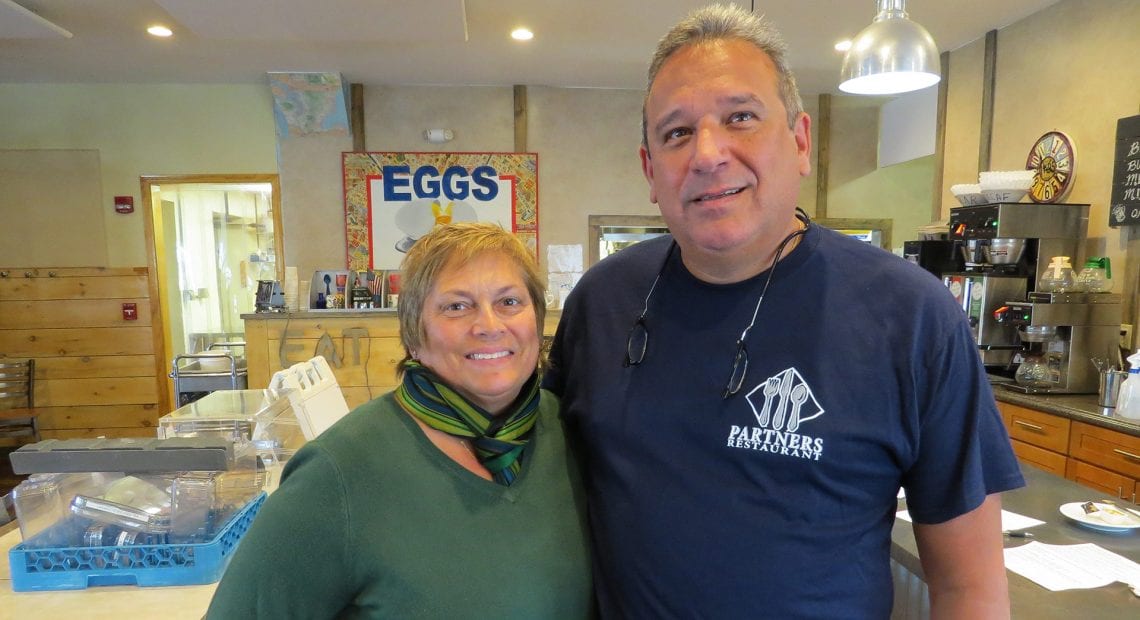
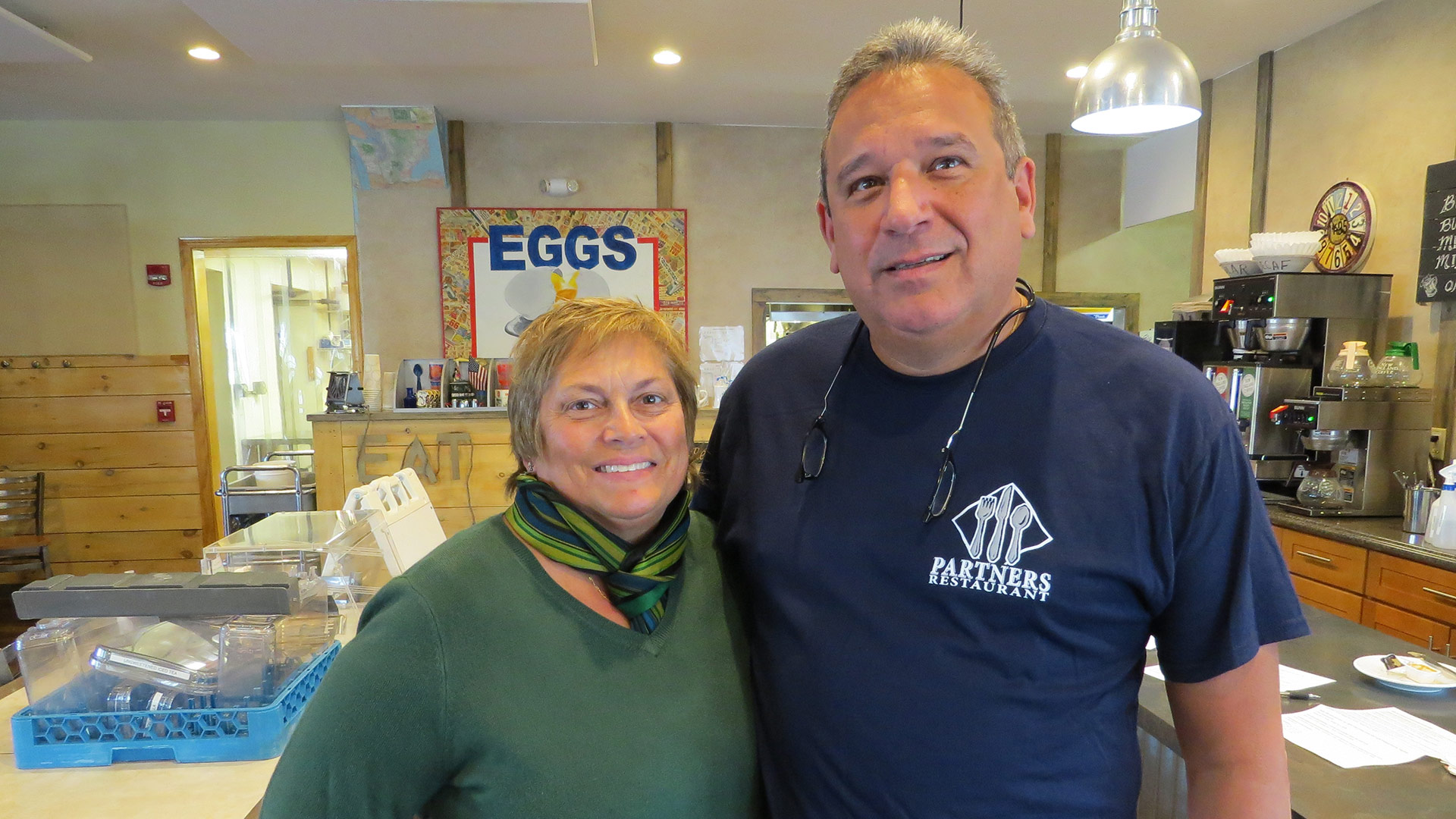
Sue Tansey, co-owner, with her husband, Mark, of Partners in Agawam and the Cup in West Springfield

Bill Collins says he was bought to tears by the edict from the governor that banned people from dining inside restaurants across the state — and he certainly wasn’t the only one within this sector to have such a moment.

“There is nothing about this that’s not going hurt — I mean really hurt,” said Collins, owner of Center Square Grill in East Longmeadow and HighBrow in Northampton, referring to everything from the ban on indoor seating to the inability of serve alcohol, a huge profit center for most all restaurants. “This is heartbreaking, but I usually don’t cry in my restaurant.”

But not long after reacting emotionally, Collins summoned some internal strength and determination to try to do what every business in this region — and, indeed, across the country — is trying to do: get to the proverbial ‘other side’ of the COVID-19 pandemic.

It won’t be easy, but Collins and other restaurateurs are responding with equal doses of grit and imagination, with initiatives ranging from a gift-card sales effort called Strength in Numbers (more on that in a minute) to Collins’ plans to essentially bring the restaurant experience into one’s home at a time when they can’t actually go to a restaurant.

“We’re putting together packages now for parties of two to 10 — $75 per person that would include a chef, a server, the food, and have us come over,” he explained. “We’ll try to create some of that restaurant feel.”

In many ways, the restaurant business, and the larger hospitality sector, is the tip of the spear with regard to the COVID-19 pandemic. The results are immediate, and so are the emotions, the responses — from layoffs and closures of some establishments to creation of new revenue generators — and optimism, which is hard to come by in these unprecedented times, but it’s still there.

The immediate response taken by most restaurants was to adjust staffing as necessary, lock up the alcohol, clean and sanitize their businesses, and then figure out what to do next, which in most cases means finding ways to offer takeout and curbside service. For many, the painful layoffs have begun, and the cuts are deep.

“We’re putting together packages now for parties of two to 10 — $75 per person that would include a chef, a server, the food, and have us come over. We’ll try to create some of that restaurant feel.”

“The word ‘layoffs’ was very moving for me — in the 55 years we’re been in business, we’ve never had to deploy that terminology or even exercise the notion of laying off our most valuable asset — our employees,” said Andy Yee, a principal with the Bean Group, which operates a number of restaurants across the area, including the Student Prince in Springfield and Johnny’s Tavern in South Hadley, noting that the company had to let more than 350 employees go. “It was very painful for my family and I to go ahead and lay off the majority of our workforce because of this horrific turn of events. Nonetheless, when there’s no revenue coming in, there’s no other choice but to exercise that dreaded word.”

Sue Tansey, co-owner, with her husband, Mark, of Partners in Agawam and the Cup in West Springfield, said the company, which focuses on breakfast, lunch, and catering, is seeing all aspects of its business impacted, with the catering all but wiped out. The Cup has been closed, while Partners will carry on with carry-out, curbside delivery, and online ordering.

“We’re trying to utilize as few employees as possible,” she said, adding that, nonetheless, the company is trying to preserve as many jobs as it can while also provide services to a public that is often challenged to cook.

With this is mind, the company will expand its offerings to what Tansey calls “family meals” — takeout offerings that include soups, chicken parm, turkey, and, for St. Patrick’s Day, corned beef and cabbage — and also extend its hours from 7 a.m. to 5 p.m. (previously, it was open 7 to 2).

Collins, who has closed HighBrow, said he’s trying to find ways to keep as many of his employees at Center Square Grill (95 of them by his estimate) working, even  if it’s part-time.

“We’re going to take the opportunity over the next three weeks to do some deferred maintenance, cleaning, and painting, and we’re going to offer that out to people,” he explained. “If the response is more than the workload, we’ll at least give people part-time shifts. My goal is to support all 95 people, in one shape or form, through this.”

Local and state governments are supporting local restaurateurs in other ways. For example, Massachusetts will postpone the collection of taxes to provide relief to the state’s restaurant and hospitality sectors by delaying the collection of sales tax, meals tax, and room-occupancy taxes, while also waiving all penalties and interest. Meanwhile, the city of Springfield has introduced an initiative called Prime the Pump, offering $222,679 in grants, up to a maximum of $15,000 for qualified restaurants.

“While the small-business support being advanced by the federal and state government is beneficial, it is clear to me that more creative and flexible financial lifelines need to be established for the small businesses, especially restaurants which have disproportionately felt the economic impact resulting from the coronavirus mitigation measures designed to protect us all,” said Tim Sheehan, the city’s chief Development officer.

Still, restaurants are finding ways to stay nimble in response to the crisis. While most had some form of takeout and delivery services, they now find themselves ramping up those efforts, many with curbside service that will enable customers to pick up dinner without going into the restaurant or even getting out of the car.

Overall, things got off to a somewhat slow start with such initiatives, said Yee, who theorized that this results from people having crammed freezers and refrigerators as a result of panic buying, and a desire to eat what they have.

He predicts — and really hopes — that, over time, people will want to get back in the habit of eating out — even if it’s still in their own home.

“This is old terminology, but people are loaded for bear — their refrigerators are chock full,” said Yee. “That first night, it was pretty much crickets when it came to people thinking about getting takeout. I think that’s going to change in time; people will say, ‘I’m tired of sitting home eating spaghetti and meatballs — I want a pizza,’ or ‘I want sushi.’”

Peter Rosskothen, co-owner of the Delaney House in Holyoke and several Delaney’s Market facilities where consumers can buy prepared meals, said that, after careful consideration, he decided the Delaney House was not well-suited to takeout and delivery, so efforts are being focused on the markets.

And at those locations, business has been “steady,” he said, echoing those thoughts about people eating what’s in their own freezers at the moment.

“We’re not going crazy, but we’re not slow, either,” he explained, adding that those facilities also do delivery, and if anything, he’s worried about being able to keep up if demand for that service increases dramatically. If it does, that will be a good problem to have at a time when people in this sector could use one.

But despite their lives and businesses being turned upside down, restaurateurs, at least the ones we spoke with, are trying to remain positive and look for opportunities to succeed both now and when they get to that other side.

“I think we’re all in the same boat; we’re just getting hit first,” Rosskothen said, referring to the broad hospitality sector. “Only time will tell. The best we can do is utilize our smartness and fight through this as much as we can. We’re a very resilient country; we’ll come out of this, and something good will come out of this — I’m convinced of that. We might be struggling a little bit, but something good will come out of this.”

Collins also chose to find a bright side to all this.

“This is opportunity … everybody has to stay positive and say, ‘how am I going to come out of this?’” he told BusinessWest. “Maybe it’s with a new and exciting menu and a cleaner restaurant that’s in better shape than it’s ever been. People can give careful thought to promotion and how to operate on the other side, and also charge their batteries. A lot of people burn out in the restaurant business — so take a break, collect your thoughts, and kick some ass on the other side.”

Meanwhile, many are already seeing some good in the form of the support they’re receiving from loyal patrons who want to help see them through these incredibly difficult times.

“We have a loyal following, and there are people out there supporting our initiatives,” said Yee. “I received a couple of texts last night … people saying, ‘I’m here, I got some takeout, I’m here to support,’ and they send along a picture of them with their takeout bag.”

And though they’re competitors, many of these restaurant owners are also collaborating, especially with the Strength in Numbers initiative.

It will run for three days later this month — March 28-30 — and incentivizes consumers to help restaurant owners by including a $20 gift voucher with each $100 gift card purchased.

The list of participating restaurants continues to grow, and includes the Fort and Student Prince, Johnny’s Tavern, Johnny’s Tap Room, Johnny’s Roadside Diner, the Halfway House, Union Kitchen, McLadden’s, Johnny’s Bar and Grille, IYA Sushi, the Boathouse, Wurst Haus, Copper House Tavern, the Delaney House, Delaney’s Market, the Mick, Center Square Grill, HighBrow, Spoleto, Mama Iguana’s, bNapoli, Lattitude, the Meeting House, the Federal, and others.

Coronavirus Cover Story

Experts Stress Everything from Communication to Listening to Millennials

Ross Giombetti acknowledged that it’s never easy to be a leader.

But it’s certainly much easier when times are good and the decisions are not that difficult. It’s when times are stressful and uncertain — and those two adjectives clearly and effectively define what it has happening locally, regionally, nationally, and globally due to COVID-19 — that leaders have to earn their pay and be … leaders.

“What’s that phrase — a rising tide lifts all boats,” said Giombetti, president of Wilbraham-based Giombetti Associates, a consulting firm that specializes in helping individuals, teams, and businesses reach maximum potential. “When everything’s going right, it’s easy to act the right way and manage the right way. The real test for a leader is how they act, behave, handle themselves, and make decisions in times of pressure, stress, or crisis.”

So, how does one lead effectively in such times? We talked with Giombetti and two others who would be considered experts on leadership — Jim Young, a Northampton-based coach, consultant, and founder of the Centered Coach, and Anne Weiss, a Longmeadow-based coach and consultant who specializes in everything from executive and team coaching to transition and succession planning. Suffice to say they had a lot to share on this subject. Here are some of their collective thoughts and words of advice on providing effective leadership in these unprecedented times:

• Be compassionate. “First and foremost, people need to be compassionate and understanding,” said Giombetti. “They need to listen to people and understand how all this is impacting them. And then be responsive. But first, you have to be compassionate, you have to be understanding, and you have to listen.”

Weiss agreed. “Listen to what people are having to deal with,” she said. “You don’t know what people are having to cope with — it might be their finances, it might be their kids, especially if school is closed. Leaders should have listening lessons where they say, ‘tell me what you’re dealing with, so I know.’”

• Be flexible. “You have to be flexible in times of stress and pressure,” Weiss noted. “In situations like the one we’re facing now, if you’re not flexible with your approach and mentality, that would probably make the situation with those around you far worse.”

• Gain the input of others. “Leaders need to open things up,” Young said. “They should say, ‘we’re in this together; I’m going to take the lead because that’s my role. But I’m also open to hearing what ideas you have.’ The strength of the organization as a whole is greater than the leader.”

• Be emotionally honest. “Leaders are looked to for answers at times like this,” Young continued. “And especially in this situation, there are no easy answers. It can an alluring trap to fall into — ‘I need to be in command, and I need to come up with answers and be in control’ — but they need the vulnerability of saying, ‘this is unprecedented. I don’t know what the answers are here, but I’m going to be here to work with you and take care of you, and I want to know what’s going on with you.’”

• But make the tough decisions. “Once you’ve heard people out and been compassionate with your ears by listening and showing that you really care, then it’s the leader’s responsibility to take bold action,” Giombetti said. “He or she has to make the tough decision. It may be unpopular, it might be one that gets ridiculed, but a real leader doesn’t worry about getting flak or being ridiculed, because they’re going to get it regardless of what they do. So you must have broad shoulders.

“If you worry too much, if you panic, if you’re indecisive, if you’re not committed to taking bold action,” he went on, “I think that’s when things can get far worse.”

• Maintain morale. “You keep morale up by acknowledging the leadership and what they’re having to deal with,” said Weiss. “You recognize the hard work people are doing, and you thank them for what they’re doing in these difficult times. Talk to people and show that you appreciate them.”

• Slow it down. “This is counterintuitive, but in situations like this, the best leaders will slow things down a little bit,” noted Young. “They’ll take an extra moment to assess what their plan is going to be and how they’re going to communicate that. Rushing with answers in a complex situation like this can create more damage because you might have to walk things back.

• Create a balance between thought and action. “A majority of us tend to react to situations of stress and pressure emotionally — it’s how our brains work,” Giombetti said. “We’re wired to react emotionally to most difficult situations. What leaders have to fall back on in times like this is, before they react or make a decision or even say something, just think through it; spend some time and think through it. Most people jump too quick to action, and most of it is based on emotion.”

• Show your emotions, but try not to panic or overreact. “Leaders have to balance being responsive, being compassionate, and caring about doing the right thing, and remaining calm,” Giombetti went on. “If you’re a leader and you panic and you show it, as kids do with their parents, your people will feed off that.”

• Listen to young people. “Generally, they’re not as stuck in their ways as many older people are,” noted Weiss. “They see opportunities and ways of doing things that we might not see.”

• Look for new opportunities. “Instead of looking at this as doomsday, leaders should be thinking about where there might be opportunities,” said Young, who is doing this himself. Indeed, he traditionally presents programs in front of large audiences, something he won’t be able to do for the foreseeable future. In response, he’s looking to present more programming virtually.

“There’s always light waiting on the other side of the dark,” he went on. “Sometimes, what’s required in these moments when the lights have seemingly gone out is an attitude of ‘what can we discover? What can we do differently?’

Weiss agreed, noting that many restaurants in the Boston area — and they are among the hardest-hit by the crisis — are responding by creating new takeout and delivery services.

• Finally, take care of your health. “Leaders have to be available to address what’s happening,” said Weiss. “So, while watching out for everyone else, they need to take care of their own health.”


Education

Looking Back, Looking Ahead

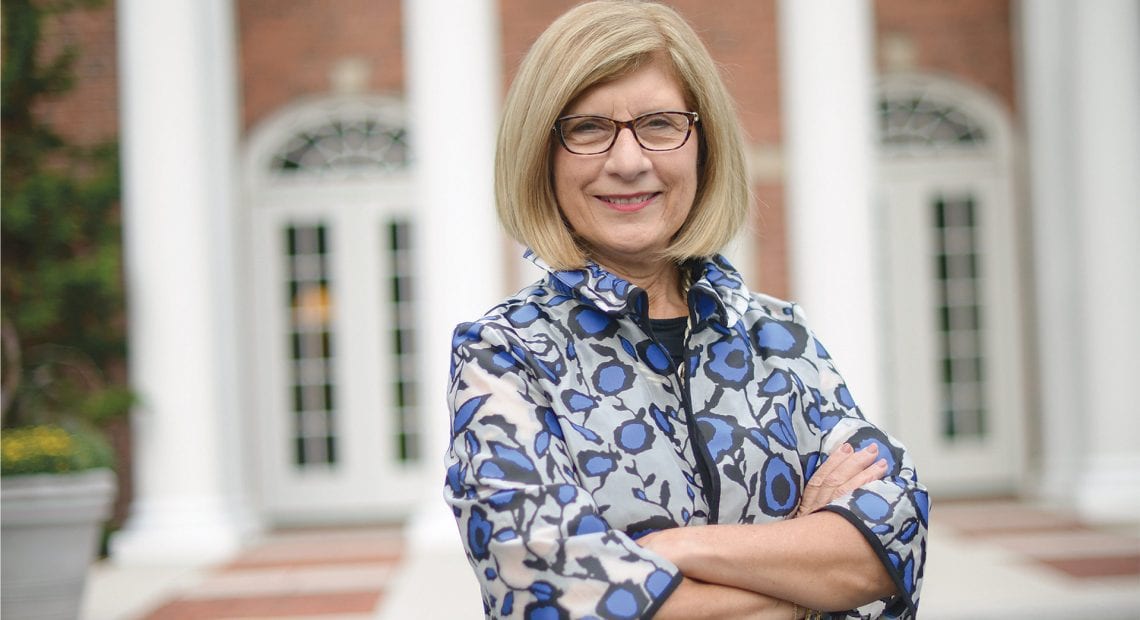
Carol Leary

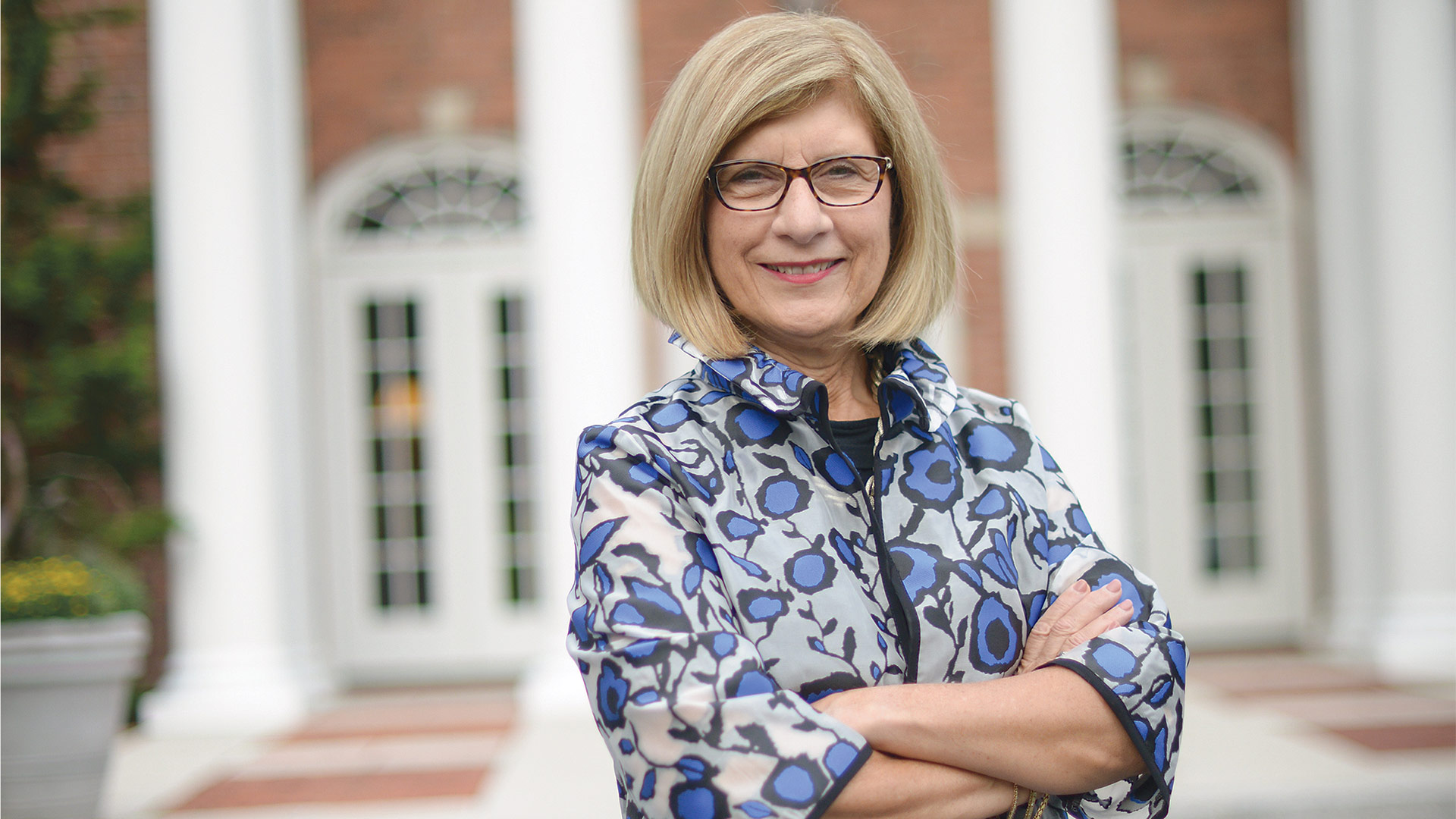
Carol Leary

Since arriving at the campus of Bay Path College in 1994, Carol Leary has always had her focus on what the future of higher education would — or should — look like, and positioning the institution for that day. As she prepares to retire in late June, she still has her eye on the future. She predicts that careers — and college programs to prepare people for them — will look much different years down the road, and institutions must be open to changing how they do business.

Carol Leary says she found the photo as she commenced the still-ongoing task of essentially packing up after a remarkable 26-year career as the president of Bay Path University — only it wasn’t a university when she arrived, as we all know.

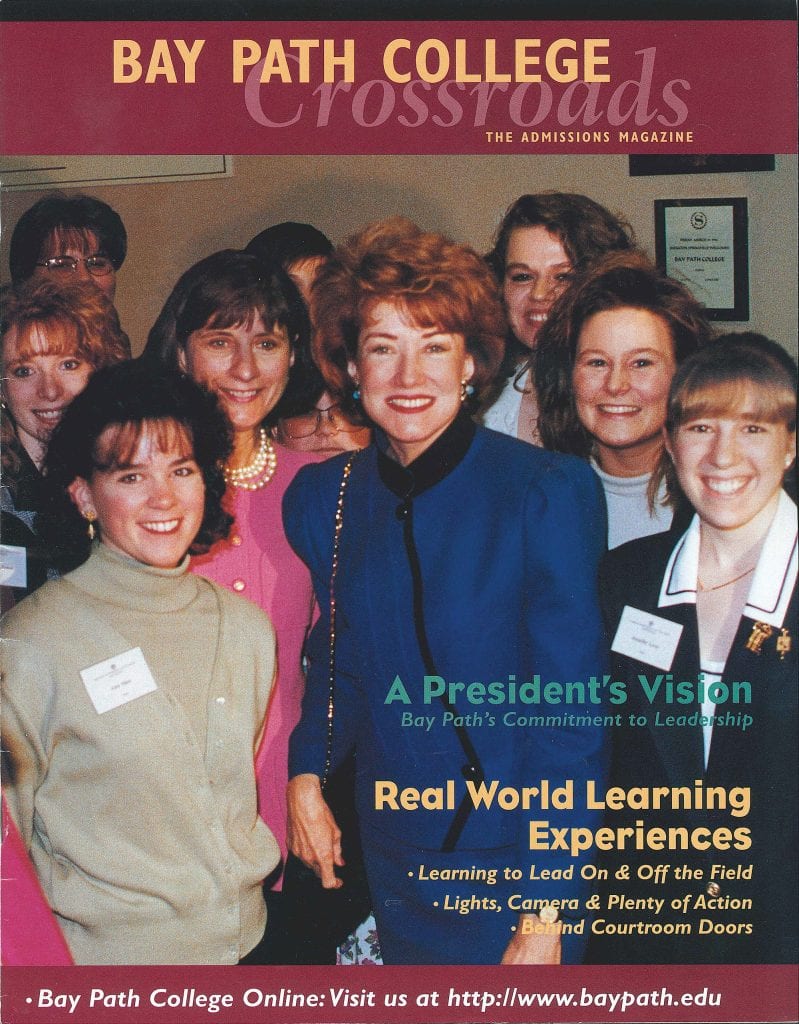
It’s a shot of herself with former Secretary of Labor and Secretary of Transportation Elizabeth Dole — one of the first keynoters at the school’s Women’s Leadership Conference — and Caron Hobin, an administrator at Bay Path who back then had the title of dean of Continuing Education, and is now vice president of Strategic Alliances, a role we’ll hear more about later.

Since finding it on a shelf not far from her first edition of Bay Path Crossroads, the school’s admissions magazine (which also features Dole on the cover), Leary has been showing this photo to pretty much everyone who ventures into her office.

“It brings back so many memories — and it was the beginning,” she said, adding that it has become her favorite photo, not just because she and others can marvel at how much younger she and Hobin were back when it was taken, but because of the way it makes her pause and think about everything that has happened since it was snapped.

It is quite a list — from that aforementioned progression to a university to its dramatic growth; from the addition of baccalaureate, then master’s, and finally doctoral degrees to the creation of the American Women’s College, the first all-women, all-online baccalaureate program in the nation; from the opening of a new science center to national recognition is such fields as cybersecurity. And it is certainly worth dwelling on all those accomplishments.

Leary has certainly been doing some of that over the past several weeks as she winds down her tenure and anticipates the beginning of retirement in late June, especially as she finds more artifacts as she starts to pack up her belongings. But not too much, as her time has been consumed with everything from welcoming her successor — Sandra Doran was introduced to the campus community in late February — to dealing with the many effects of coronavirus, which has hit the higher-education sector extremely hard.

And while the latter is now dominating the final weeks of her tenure, with decisions to be made about events, classes, and more, Leary spent much of her time this winter not looking back, but looking ahead to the future of higher education and how schools like Bay Path can prepare for, and be on the cutting edge of, what should be profound change.

In most respects, this is merely a continuation of what she’s been doing since arrived at the Longmeadow campus in the fall of 1994.

“Colleges are facing some incredible headwinds,” she said. “And beginning a year ago, at each executive committee meeting of the board, I started sharing some of those challenges and opportunities facing not only Bay Path but all colleges and universities.”

When asked to elaborate on these headwinds, she started with demographics, especially those concerning the size of high-school graduating classes. “The number of 18-year-olds is dropping dramatically in this country, and that won’t turn around unless immigration is opened up and you get a flood of immigrants,” she explained. “All colleges are facing it, so what do you do?”

Many schools are shifting their focus to graduate degrees and adult students, and Bay Path was somewhat ahead of this curve when it started added such programs 20 years ago, Leary said, adding quickly that, while such steps have worked, schools can’t depend on them moving forward.

Carol Leary, seen here introducing poet Maya Angelou

Carol Leary, seen here introducing poet Maya Angelou at one of Bay Path’s Women’s Leadership Conferences, has led the school through a period of unprecedented growth and expansion.

“There are now many more competitors — everyone is adding new programs,” she went on, noting that this is true of both adult (non-traditional) programs and online education, another arena where Bay Path was a pioneer. “As more schools enter the marketplace, that increases your competition, and then pricing gets driven down.”

There are many other headwinds, especially the soaring cost of higher education and the ways in which students will learn, she said, adding that it is incumbent upon all schools to try to get ahead of these issues and respond proactively, rather than react when it is perhaps too late.

This is the mindset she took to Bay Path back in 1994, and it’s the one she’s leaving with the board and her staff as she packs up those photos and other memory-triggering artifacts from a career with a number of milestones.

For this issue and its focus on education, training, and employment, BusinessWest talked at length with Leary. It was supposed to be to flip through a figurative photo album assembled over a quarter-century, but, in keeping with her character, she was much more focused on the future than the past.

Developing Story

As noted, that photo of Leary with Dole and Hobin triggers a number of memories — and stories, which lead to even more stories.

One that Leary likes to tell involves how Dole’s presence at the conference helped lead to another keynoter of note — Margaret Thatcher.

“People ask how we accomplished what we did, and I always said the number-one reason was that I hired very committed, very passionate, and very smart people. And that is the secret sauce — who you hire. I give them all the credit.”

“She [Dole] had an advance person, a young man maybe 25 years old, and I’m in the wings with him listening to her speak, and he said, ‘who else would you like to have?’” she recalled. “I said, ‘we don’t have the first woman president of the United States yet, so I’d love the first woman prime minister of Great Britain.’ And he said, ‘my mother is her advance person.’”

Fast-forwarding a little, she said arrangements were made for Leary and Hobin to fly to Washington and deliver the invitation to Thatcher personally. She eventually came to downtown Springfield in the spring of 1998, thus adding her name to a lengthy list of keynoters that also includes Maya Angelou, Jane Fonda, Madeleine Albright, Rita Moreno, Queen Latifah, and many others.

There are stories — and photos — involving all those individuals, said Leary, who got to spend some time with each one of them.

But while she loves to tell those stories, an even more pleasant assignment is talking about the women, many of them first-generation college students, who have come to the Bay Path campus over the past quarter-century. Creating opportunities for them has been the most significant accomplishment of her career, she said, adding that her tenure has in many ways been defined by the small framed copy of that quote attributed to Steve Jobs — “The ones who are crazy enough to think they can change the world usually do” — she keeps near her desk.

“I don’t even know if he actually said that, but they say he said it,” she noted with a laugh. “Anyway, I always tell people that’s how we have to look at every issue.”

And that mindset has led to a stunning transformation of the 123-year-old school, which was a secretarial school decades ago and a sleepy two-year school when she and her husband, Noel, first visited it after she was recruited to apply to be its fifth president.

By now, most know the story. While many of their friends and family were dubious about this small school as her next career stop after working for several years at Simmons College (another women’s school), the Learys didn’t have any doubts.

But nothing about the turnaround effort — and it has to be called that — was quick or easy. And all the efforts were the result of teamwork, said Leary, who, over the years, has said repeatedly that the success of the institution is not due to one person, but rather a large and talented team.

“People ask how we accomplished what we did, and I always said the number-one reason was that I hired very committed, very passionate, and very smart people,” she said. “And that is the secret sauce — who you hire. I give them all the credit.”

While finding old photographs and items like that issue of Crossroads, Leary has also come across some of the letters (yes, she kept them) from institutions trying to recruit her and headhunters asking to apply for positions. More than the letters themselves, she remembers how she replied to them.

This copy of Bay Path College Crossroads

This copy of Bay Path College Crossroads, with Elizabeth Dole on the cover, is one of many poignant pieces of memorabilia Carol Leary has come across while packing up after her remarkable career at the school.

“I always said, ‘my work here isn’t done — I’m in the middle of this vision or that vision,’” she recalled. “I never had the yearning to go anywhere.”

The work was never done because the school was seemingly always in a state of transition — first from a two-year school to the baccalaureate level, then to the master’s level, and then online and the introduction of new healthcare programs, and then doctorate programs.

And because it needs to, the school is still transitioning.

School of Thought

As she talked with BusinessWest a few weeks ago, Leary was splitting her time a number of different ways — although coronavirus had certainly seized most of it as this article was being written, including the postponement of the annual Women’s Leadership Conference, which had been set for March 27 at the MassMutual Center. Meanwhile, there are several retirement parties scheduled, as well as the annual President’s Gala, a huge fundraiser for the university and, specifically, the President’s Scholarships established by Leary to assist first-generation students. Those are still proceeding as scheduled, although the virus and the response to it is a story that changes quickly.

What won’t be changing quickly — in speed or direction — are those headwinds facing seemingly all the most prestigious colleges and universities.

And the most pressing issue, she told BusinessWest, is doing something about the high cost of a college education.

“As higher-education professionals, we have to figure out how to deliver our model in an affordable way so that families can send their children and adults can attend as well and not have high debt,” she explained. “That’s why the American Women’s College was created in 2013, but it is not going to be unique anymore because, as the number of 18-year-olds goes down, colleges have to think about other sources of revenue.”

With this in mind, Leary said Bay Path long ago started looking at new strategies for growth and creating learning opportunities. And it has created a new division, the Office of Strategic Alliances — Hobin now leads it — which is focused on non-credit work and professional development.

“We’re thinking not necessarily about a student coming to us, graduating in four years, and maybe getting a graduate degree, but more in terms of ‘what do we need to do to educate that student through her life cycle,” Leary explained, pointing, with emphasis, to a report she’s seen indicating that a child born today has the potential to live to 150 years.

“If you think about that, they may have an 80-year work life,” she went on. “And so, the college degree they earn at age 22 may not be relevant at age 60, 70, or even 80; a child today will have a longer work life, and it will be a much different work life than what people are experiencing today.

“I can’t even predict what it will be like, but colleges have to stay relevant,” she said, adding that Bay Path’s new division will handle professional development for businesses that want to retool and retrain their workforces. “That’s probably the future; that’s where we need to be — not just offering degrees but also offering lifelong learning opportunities.”

In that future, which is probably not far down the road, Leary projects that higher education will be “unbundled,” as she put it, into degrees but also short- and long-term programs, and with students not necessarily spending four years at one institution, but rather moving in and out of a school.

“This is going to shake up my colleagues in the field, but if I had a crystal ball … I don’t think students are going to come to one college and stay there for 120 credits,” she explained, summoning the acronym CLEP, or college-level examination program, which enables individuals with prior knowledge in a college course subject to earn college credits by passing an exam, thus possibly earning a degree more efficiently and inexpensively.

“I always said, ‘my work here isn’t done — I’m in the middle of this vision or that vision.’ I never had the yearning to go anywhere.”

“We already see students coming and going, bringing in community college and other college credits, CLEP, advanced placement, and more,” she went on. Meanwhile, adults don’t some in expecting to take 120 credits because somewhere in their life they may have taken a year somewhere and then life happened and they dropped out.

“Overall, colleges are going to have to reflect on what is learning, how does learning place, where does it take place, and how does it fit it into a credential like a degree; I don’t believe that degrees are going to be place-bound,” she said in conclusion, adding that such reflection must lead to often-profound change in how things are done.

And higher education is not exactly noted for its willingness to change, she said, adding that this sentiment must shift if the smaller institutions want to not only survive but thrive.

Future Course

As noted, Leary will be staying on until late June, and between now and then she has to move out of her home on campus and pack up everything in her office, including a number of awards she’s received from organizations ranging from the Girl Scouts to BusinessWest; she’s actually won two honors from this magazine — its Difference Makers award and its Women of Impact award.

She’s also planned out the first several months of retirement, with several trips scheduled — to England in July and Italy in August, if coronavirus doesn’t get in the way — and work on two boards in Ogunquit, Maine, where she will spend roughly half the year, with the other half in Fort Lauderdale. She even has a T-shirt that reads, “Yes, I have a plan for retirement.”

As for the school she’s leaving … it’s a much different, much better, and much more resilient institution than the one she found a quarter-century ago. She insists that people shouldn’t credit her for that. Instead, they should maybe credit Steve Jobs and that quote attributed to him.

Leary didn’t set out to change the world, necessarily, just that small bit of it off Longmeadow Street. To say she did so would be a huge understatement, and in the course of doing so, she changed countless lives in the process.

George O’Brien can be reached at [email protected]

Law

Time to Make a Strong Case

Ken Albano, managing partner at Bacon Wilson.

For years now, it’s been the common refrain among those charged with hiring at companies across a number of industry sectors: good help is hard — or at least harder — to find and retain.

Increasingly, words to that effect are being heard in a sector where they’ve traditionally not been heard as much — the legal community.

Indeed, representatives of several area firms told BusinessWest that, while they can still recruit and hire talent — for the most part — it’s a more challenging assignment in many cases and often takes longer.

“It’s certainly more challenging now than it has been in the past,” said John Gannon, a partner and employment-law specialist at Springfield-based Skoler, Abbott & Presser, who penned an article for this issue on the many questions employers have about dealing with coronavirus. “But this is not unique to law firms — this is economy-wide, nationwide; it’s just hard to find people because everyone’s working.”

Indeed, this is, by and large, a buyer’s, or job seeker’s, market. Given these conditions, where law firms — like other employers in virtually every sector — are upping the ante with wages and benefits, it becomes more difficult for Springfield-area firms to compete. It’s a completely different playing field than the one that existed during and just after the Great Recession, he went on, when jobs were scarce and law firms saturated with lawyers were very much in the driver’s seat.

Ken Albano, managing partner at Bacon Wilson, which is based in Springfield and also has offices in Northampton and Westfield, agreed.

“It’s certainly more challenging now than it has been in the past. But this is not unique to law firms — this is economy-wide, nationwide; it’s just hard to find people because everyone’s working.”

“It’s challenging, but then it’s always been somewhat challenging in this market,” he told BusinessWest, adding that many factors are contributing to the current environment, including everything from the smaller classes at many law schools, which resulted from that depressed job market after the Great Recession, among other factors, to the lower pay scales in the 413 compared to markets like Boston, New York, and even Hartford (more on that later), to what appears to be fewer people moving into certain areas of the law.

To emphasize that last point, he reached for the Feb. 24 issue of Massachusetts Lawyers Weekly, specifically the ‘Employment’ page. Using a blue sharpie, he had circled the ads seeking litigators with varying levels of experience — and there were quite a few of them.

John Gannon says recruiting lawyers to this market has always been somewhat challenging, and with the current job climate, it is even more so.

‘Associate — Civil Litigation’ read one ad, while another was headlined ‘Senior Litigation Associate,’ and several read simply ‘Litigation Associate.’ One, for a firm in Charlestown, was more specific: ‘Trusts & Estates & Probate Litigation Associate — Must Love Dogs.’

Albano’s interest in those ads was understandable.

“Our firm’s biggest frustration has been in that one particular practice area, litigation,” he said, noting that the firm lost two of its best litigators, Bob Murphy and Kevin Maltby, to the bench in recent years, and has struggled to fill the void. “And I’m not sure why that is; maybe it’s the anxiety, maybe people don’t like to speak in public. It’s not just us — people are struggling to find people who want to go to court.”

Putting aside the need for litigators, and even litigators who love dogs, hiring has, overall, become more challenging for law firms in Greater Springfield, and this is prompting a response similar to that given by those in other sectors. Specifically, it’s one focused on being imaginative and resourceful, and employing tactics designed to familiarize law-school students with opportunities in this area and also sell this region both to those just starting their careers and those looking at a lateral move.

“We made a decision at a partners’ retreat to put a very targeted and strategic approach to hiring in place,” said Betsey Quick, executive director at Bulkley Richardson, which has offices in Springfield and Hadley, adding that part of this strategy is to focus primarily on area law schools, bring in summer associates and interns, and make them familiar with the firm and the region. And it’s a strategy that’s working.

“These are people who have a connection to the area, and our client community is out our windows,” she explained. “It’s a challenge to find someone who wants to be in the area, but there are so many law schools within 50 miles, and these students have a connection to the community, and if you have a connection to the community, you’re going to know people who need legal services.”

For this issue and its focus on law, BusinessWest takes a look at the job market and the challenges facing firms seeking to hire. As in the courtroom itself, this assignment requires making a very strong case in order to prevail in the end.

Hire Power

As this issue went to press, those managing area law firms certainly had a lot more on their minds than finding new associates.

Indeed, as the number of coronavirus cases climbed steadily upward through last week, every firm in the region was developing contingency plans, making preparations for employees to work at home if necessary, checking corporate insurance policies to see if they’re covered (probably not) in the event that the virus seriously disrupts business, and monitoring the situation at the various law schools — some, including Western New England University, were weighing whether to shut things down for the rest of the spring, and some had already decided to do so.

“Our firm’s biggest frustration has been in that one particular practice area, litigation. And I’m not sure why that is; maybe it’s the anxiety, maybe people don’t like to speak in public. It’s not just us — people are struggling to find people who want to go to court.”

But the matter of hiring is an all-important one in this sector, and it is an issue for the long term as firms look to do everything from filling specific vacancies in departments to ensuring a healthy mix of young and mid-career lawyers to ensure sustainability and inevitable transition to a younger generation, said Quick, adding that Bulkey Richardson recognized a need for such a mix and is aggressively pursuing one.

“We have a commitment to hire, or attempt to hire, at least three young people per year,” she said, adding that this number could go higher if the firm sees good talent and doesn’t want to pass it up. “And that’s part of our strategy; if we don’t keep a targeted and strategic approach to hiring young lawyers, we’re going to be top-heavy.

“Every firm faces succession issues,” she went on. “It’s a difficult, challenging problem to face, and part of it is just bringing up young lawyers behind them, especially while they’re here to talk to them and train them and take them to meet clients; it’s important to tap that wealth of knowledge.”

But when it comes to hiring lawyers, the Springfield market has always been somewhat unique — and challenging, said those we spoke with.

Betsey Quick

Betsey Quick says Bulkley Richardson’s hiring strategy has focused on seeking out law-school students who can make local connections and, overall, a commitment to this market.

In some ways, it competes with firms in New York, Boston, Hartford, Providence, and Worcester for talent, but its wage scale has always been significantly below New York and Boston and also well below those in those other cities. So, in some respects, this region doesn’t compete against those markets.

“What comes with practicing in this market is a lower salary — it’s a fact of life,” said Albano. “And a lot of times, when we do make offers to potential new associates, we can’t compete with the Boston and Hartford markets because, on average, a new associate can make a lot more money working in those arenas than they can in Springfield or Amherst or wherever.

“We’ve lost associates in the commercial practice group to Hartford,” he went on, estimating that salaries there are perhaps 20% higher than in Springfield. “And we don’t chase people — we say, ‘this is the offer, and it’s the same offer we’ve made to people that have been in your shoes, and they’re working here now.’ That’s one of the reasons why it’s hard to compete with those markets.”

Overall, the strategy has been to sell this market as a great place to live — and practice law — and to target (and in some respects recruit) candidates who want to be in this market and can commit to being here.

“We’re always looking for people who want to put down roots in Springfield,” said Gannon. “That’s a very important characteristic in all of the applicants we look at.”

Albano agreed.

“It’s tough to have someone from the Boston area come here knowing that the salary is going to be less,” he said, referring in this case to lateral hires. “But you try to impress upon these people that the cost of living is much less here. And we’ve seen both sides of the fence; we’ve had people that have worked in Boston come here and say, ‘I’d love to have a place where my dog can walk on real grass, have a fence around my yard, and not have to go to a skyscraper to go to work.’”

Quick, who handled aspects of recruiting for firms in Boston and Washington, D.C. before coming to Bulkley Richardson, acknowledged that the Springfield market is somewhat unique because of the lower salary ranges, underscoring the need, when it comes to entry-level hiring, to focus on law students who have or can create local connections.

“Anyone can look at the GPA [grade point average] and see how these students are doing on paper,” she told BusinessWest. “But are they going to fit culturally? Are they going to stay in the area? Do they have a tie to the area? Do they have a reason to want to be here? These are the things we look for.”

As for those already in the profession, in this tight job market, the task of recruiting and hiring becomes more difficult because most people are working, said Gannon, and also because the companies they’re working for want to keep them. And it’s the same in the legal profession.

“Most of the people who want to be working are working, and because unemployment rates are so low, what employers have been doing for the past couple of years is doing whatever they can to retain good people,” he said, adding that this means law-firm managers as well. “This means higher compensation, trying to pay more of the lion’s share of employee benefits, offering more generous PTO [paid time off] policies, and letting people work at home, which is a big one for many people. People are happy where they’re working — most of them, anyway.”

As for those coming right out of law school, they certainly want to be happy where they work, and, given the current climate, they have a good chance of succeeding with that mission. One strategy for Western Mass. firms — again, one that businesses in other sectors employ as well — is to familiarize young people with the region and create a familiarity and comfort level that may help sway decisions when it comes time to find a job.

“We’ve been fortunate in that we’ve been able to hire bright, qualified individuals in law school, both at Western New England and UConn, to become law clerks at Bacon Wilson,” he said. “They work for us for a couple of years, and we can see the progress and the value, and quite often they’ll say, ‘I like this place, it’s like family; is there a job opening for us?’ And more often than not, we make one for them because we want to keep that type of talent on our page.”

Final Arguments

Looking down the road is always difficult — especially when there is an unprecedented wildcard like the coronavirus. Indeed, law firms might soon be in less of a growth mode than they currently are.

But for now, and for the foreseeable future, the outlook is promising for business — if not for recruiting lawyers to the 413, necessarily. Whether the task is filling a vacancy in the estate planning or real estate department or finding a litigator — one who loves dogs or not — the assignment is becoming increasingly challenging.

And, like employers across the broad spectrum of business, law firms must respond proactively to this changing environment.

George O’Brien can be reached at [email protected]

Community Spotlight

Community Spotlight

Tessa Murphy-Romboletti

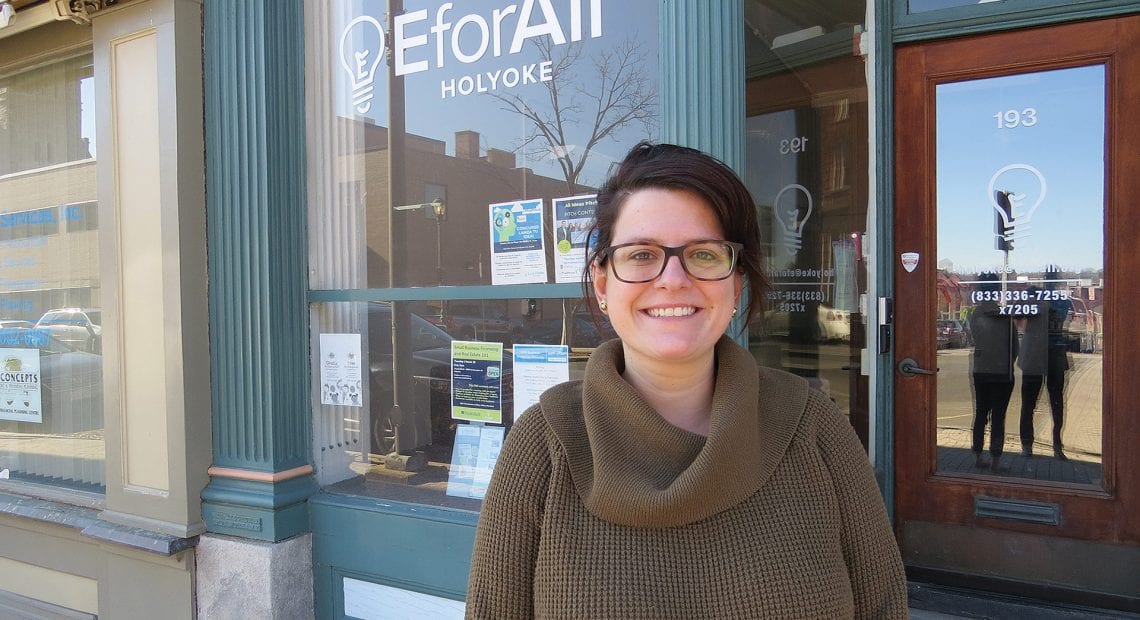
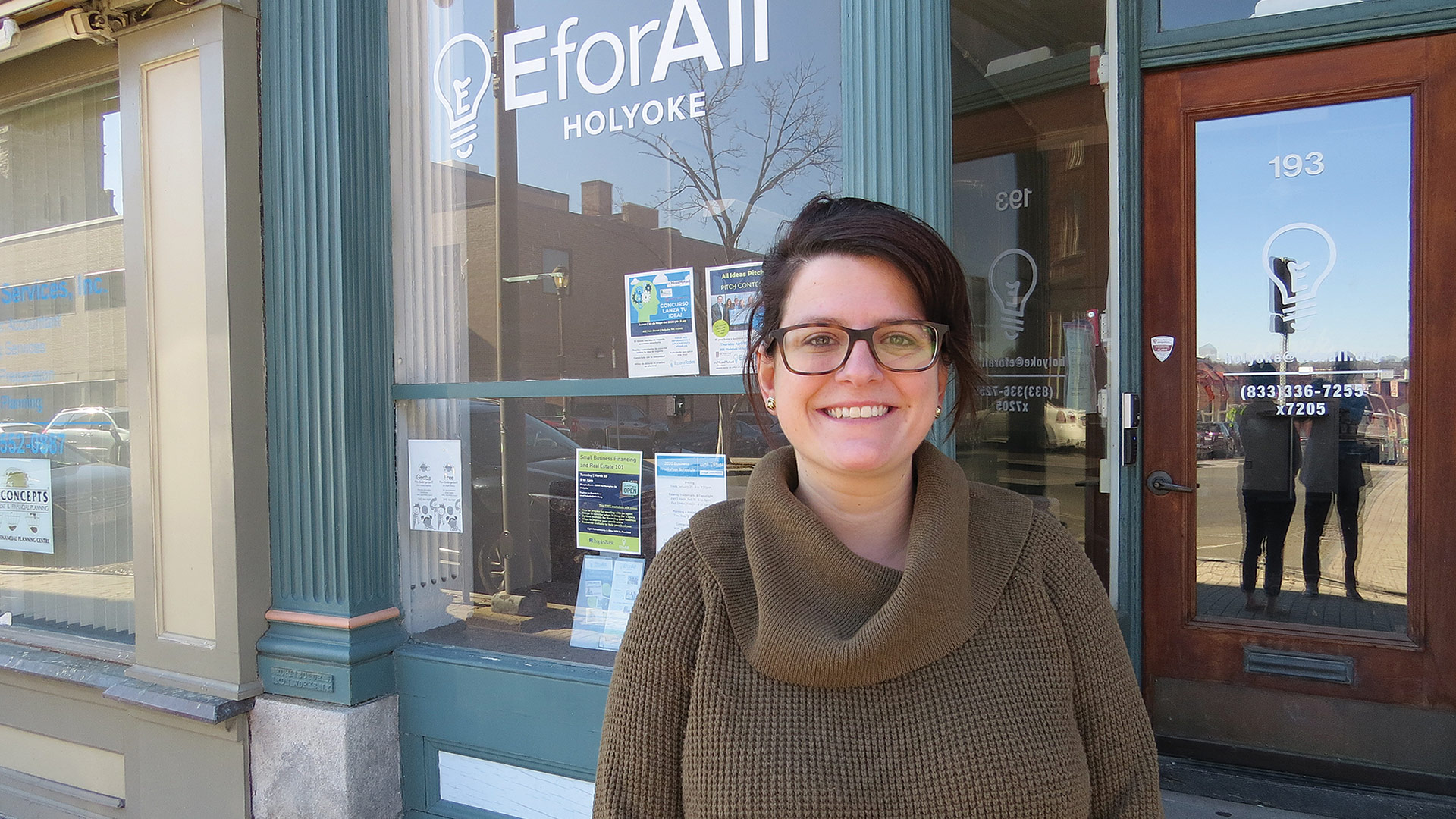
Tessa Murphy-Romboletti says the addition of a Spanish-speaking accelerator program will enable EforAll Holyoke to become an even more impactful component of the region’s entrepreneurship ecosystem.

It’s been more than three years now since Holyoke Mayor Alex Morse told a TV reporter, tongue in cheek (or not), that he wanted to rename Holyoke ‘Rolling Paper City,’ in a nod to its past — and its potential future as home to businesses in the cannabis industry spawned by a ballot initiative in the fall of 2016.

Things have moved slowly as the city has looked to take full advantage of both its red-carpet treatment for the cannabis industry and vast supply of old mill space — ideal for cultivation as well as other types of businesses in this sector — more slowly than most would have anticipated.

But by most accounts, 2020 should be the year this sector begins to, well, light things up in Holyoke.

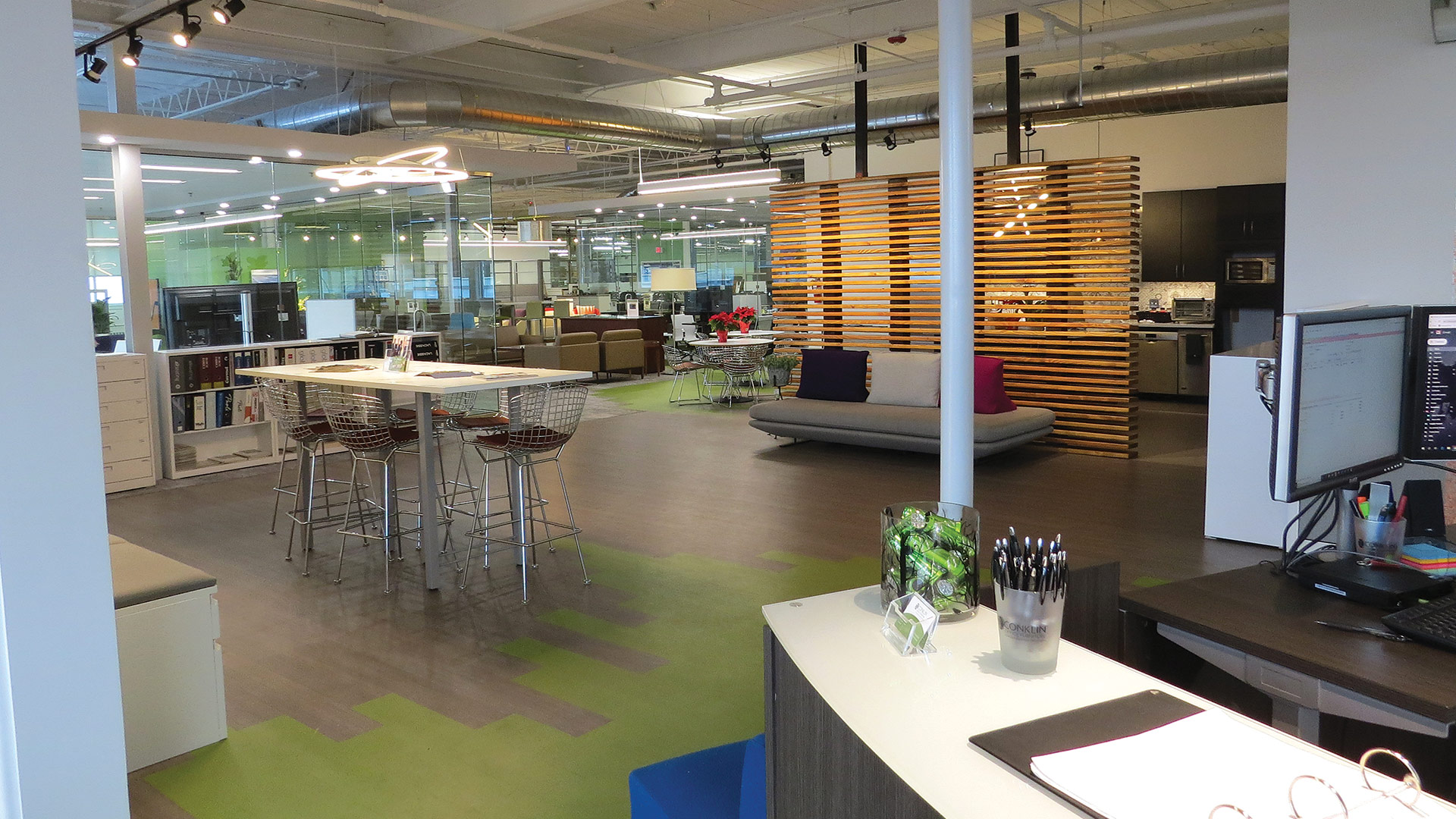
Indeed, while Green Thumb Industries, better known to most as GTI, is the only cannabis-related business operating in Holyoke at the moment, that is certain to change soon. True Leaf is ready to commence cultivation operations in the large building on Canal Street that was formerly home to Conklin Office, said Morse, and there are other businesses moving ever closer to the starting line.

“Unfortunately, the length of the process at the state level has slowed things a bit, but 2020 seems poised to be the year we see some concrete results from our embrace of and leadership in the cannabis industry,” said Morse, who, while filling his role as CEO of the city, is also running for Congress this fall. “We’re looking at hundreds of jobs between cultivation and dispensing, and we’re seeing the growth in commercial property values as a result of these investments.”

Meanwhile, there are large tracts of real estate either sold to or under option to a number of other cannabis-related businesses, said Marcos Marrero, the city’s director of Planning and Economic Development.

“We have about 20 companies that have approached us for a host-community agreement; a few of those are no longer proceeding, but we have probably close to a dozen that are still in some part of the process, and we expect a couple to open at some point this year,” said Marrero, who noted that, for decades, Holyoke’s problem was that it had far too much unused or underutilized old mill space. It’s certainly not there yet, but some are starting to think about the possibility of actually running out of that commodity.

But cannabis is certainly not the only promising story in Holyoke at the moment. Indeed, progress is evident on a number of fronts, from the development of several co-working spaces in the city to a thriving cultural economy; from the prospects for a new retail plaza in the vicinity of the Holyoke Mall to Holyoke Community College’s culinary-arts center in the heart of downtown; from Amazon’s new distribution center just off I-91, which has brought more than 100 jobs to the city, to Holyoke Medical Center’s recently announced proposal to build a new, standalone inpatient behavioral-health facility on its campus.

“Unfortunately, the length of the process at the state level has slowed things a bit, but 2020 seems poised to be the year we see some concrete results from our embrace of and leadership in the cannabis industry.”

Then there are the city’s efforts to foster entrepreneurship, especially through the agency known as EforAll Holyoke, which last year cut the ceremonial ribbon at its facilities on High Street.

The agency, originally known as SPARK, will graduate its third accelerator class on March 26, said Executive Director Tessa Murphy-Romboletti, adding that EforAll will soon be expanding with a Spanish-language accelerator, something that’s definitely needed in this diverse community.

“Many people can understand English, but to learn in the language you’re comfortable with … that makes such a difference,” she noted, adding that other EforAll locations have offered programs in Spanish. “There is a need for this here.”

For this, the latest installment of its Community Spotlight series, BusinessWest puts the focus on what is still known as the Paper City, a community that has greatly diversified its economy is looking to continue that pattern in the coming years.

In Good Company

Murphy-Romboletti says she won’t be leading the Spanish-speaking accelerator — she’ll be hiring someone to assume that responsibility — but she is taking steps to be better able communicate in that language.

“I’m using Rosetta Stone, and I’m basically telling the people in my life who speak Spanish that they should only speak Spanish to me so I can learn,” she said. “Just growing up in Holyoke, I feel like I understand it fairly well, but I’m still struggling to communicate.”

These language lessons are just one of many items on her plate, including final preparations for the March 26 graduation ceremony, at which accelerator participants will showcase their businesses and many will receive what Murphy-Romboletti refers to affectionately as “those big giant checks” — facsimiles in amounts that will range from a few hundred to a few thousand dollars, as well as some seed money.

Those awards may not sound significant, but to small-business owner, they can provide a huge boost, she went on, adding that they can cover the cost of forming a limited liability corporation (LLC), buy a new copier, or perhaps purchase some insurance.

“Those are the little things that a startup often has a hard time attaining,” she said. “That money is very important to them.”

As for the seed money, provided by an array of sources, it is awarded based on how well businesses meet stated goals for growth and development.

“We have them set goals for each quarter, and the entrepreneurs keep meeting monthly with their mentors,” she explained. “We survey them before we meet, and there’s a peer-ranking process based on the progress they’ve made toward the goals they set at the beginning of the quarter. It’s a combination of mentor feedback and peer feedback, and it’s a good way to keep the momentum going.”

Summarizing the breakdown of the first several cohorts, Murphy-Romboletti said there has been a good mix of businesses, including several food-related ventures, some professional services, a few nonprofits, and some construction-related endeavors. None are large in size or scope, but most all of them have promise, and many are already contributing to vibrancy in Holyoke by leasing real estate, buying goods and services, and providing them as well.

“When an entrepreneur is getting started, it can be a very lonely process, and we want people to know they don’t have to go through this whole thing alone,” she said. “And I think we’re starting to see the impact this has on the local economy, when there’s new businesses registering and they’re getting bank accounts for their business, and they’re doing things the right way so they can be legitimate businesses that will contribute to the economy.”

Marrero agreed, noting that the companies fostered by these efforts to promote entrepreneurship have created more than 100 jobs, most of them in Holyoke.

“Not everything is a home run — there are a lot of singles, but that’s another way of getting into the Hall of Fame,” he said. “We’re continuing our efforts to create a culture of entrepreneurship, and we’re starting to see some results.”

Thus, promoting entrepreneurship is an economic-development strategy in Holyoke, said Morse, adding that, while it’s good to attract large corporations like Amazon, growing organically by fostering small businesses is usually a more reliable path to growth.

But there are several other growth strategies being executed, and the cannabis industry, and the city’s pursuit of it, could certainly be considered one of them.

Indeed, while some communities were somewhat cautious in their approach to this sector and others (West Springfield, for example) decided they didn’t want such businesses within their boundaries at all, Holyoke has, seemingly since the day the ballot initiative was passed, been quite aggressive in pursuit of cannabis businesses — and jobs.

Ned Barowsky

Ned Barowsky

“I’m working with a development group that wants to put in more retail — perhaps a few drive-thrus, a coffee shop, and maybe some fast food, with some traditional retail in back. The plans are still coming together.”

And, as the mayor noted earlier, 2020 is shaping up as a year when many of the businesses that have been putting down roots, to use an industry phrase, will start to see their efforts bear fruit.

True Leaf has been aggressively building out its massive space, said Marrero, and it is expected to employ more than 100 people when it that cultivation and processing operation opens later this year. Other similar businesses are also in the process of readying spaces, including Boston Bud Co., Solierge, and Canna Provisions, which will soon be opening a dispensary in downtown Holyoke.

“Once they open, that will create a lot more economic activity, including hiring, and as soon as they have sales, that will also generate income for the city,” he went on, adding that there will be a ramp-up period for the cultivators as the first crops grow. But when these companies are fully operational, he expects that more than 200 jobs will be added.

Meanwhile, mill space continues to be absorbed by this sector, he said, adding that 5 Appleton St. was recently acquired for cannabis-related uses, bringing the total amount of real estate sold or under option to roughly 500,000 square feet, by his estimates, thus creating speculation, and even concern, that no one could have imagined even a decade ago.

“Eight years ago, the concern was that there was too much empty space,” said Marrero. “The long-term proposition and concern for someone in my position is that we might be running out of inventory, which is funny to think, but it could happen.”

What’s in Store

Meanwhile, retail is also an economic-development strategy, or at least a key contributor to the city’s tax base and overall vibrancy. It remains so, but that sector is changing, primarily because of the city’s new corporate citizen, Amazon, and others like it. The landscape is changing — figuratively, but also quite literally.

Evidence of this change is evident at Holyoke Mall Crossing, a retail center just off I-91 at the intersection of Holyoke Street and Lower Westfield Road. Actually, it’s more a former retail center, said owner Ned Barowsky, who acquired the property in 1996. Indeed, a number of former retail spaces now have different uses, as homes to professionals, healthcare facilities, and service providers, as evidenced by the current tenant list.

It includes Baystate Dental, Rehab Solutions, Ross Webber & Grinnell Insurance, ServiceNet, Vonnahme Eye, Great Clips, and H&R Block. It doesn’t include Kaoud Oriental Rugs and Pier 1, two long-time tenants that became the latest retail outlets to leave that location, leaving 13,000 square feet of contiguous space on the ground floor that Barowsky is now working aggressively to lease with ads touting this as “the best location in Western Mass.” And he expects that there will be more healthcare and professionals in this space instead of traditional retailers.

“Slowly but surely, I’ve been converting my building, which was once 100% retail, into office and medical uses,” he said, adding that he expects this trend, which started roughly a decade ago, to continue. “The only true retail left is Hunt’s Photo and Video, which is doing very well.”

Because of the location at the junction of the turnpike and I-91, he said, the site would be ideal for medical practices and other healthcare-related businesses, and he’s already talked with several interested parties.

While spending most of his time and energy working to fill Holyoke Mall Crossing, Barowsky is in early-stage work on a new retail development on a five-acre parcel adjacent to that property that he acquired from the mall. His primary motivation was to create more parking for the healthcare and service-oriented businesses now populating the Crossing, and he will keep one acre for that purpose. As for the rest, a vision is coming into focus.

“I’m working with a development group that wants to put in more retail — perhaps a few drive-thrus, a coffee shop, and maybe some fast food, with some traditional retail in back,” he told BusinessWest. “The plans are still coming together.”

Meanwhile, at the Holyoke Mall, which recently marked 40 years of dominating the local retail landscape, the landscape is shifting there as well, from traditional retail — although there is still plenty of that — to family entertainment and recreation.

“They’re been very savvy about remaining relevant, not like other malls,” said Marrero, citing recent additions such as a Planet Fitness and bowling alleys, as well as new theaters now under construction in the site once occupied by Sears. “They’re integrating a lot more lifestyle entertainment.”

Barowsky, who, as noted, has been a neighbor of the mall for a quarter-century, said that facility is still thriving because of its ability to adjust and put emphasis on entertainment at a time when traditional retail is struggling.

“They’re doing a lot of entertainment-related things to get people in, and hopefully people will shop while they’re there,” he said. “They’re doing a great job of adjusting — the parking lot is still full all the time.”

While the mall is evolving, so too is the downtown area, said Marrero, adding that several new businesses have opened in recent months and more are in the planning stages, including a restaurant, Jud’s, along the Canal Walk; a high-end salon called the Plan, which describes itself as a “sustainable, mission-driven beauty company” and “a force for positive change”; and the Avalon Café, a lounge and game café expected to open soon on Dwight Street.

Most of the growth involves small businesses, said those we spoke with, noting that this organic growth will likely inspire additional vibrancy across many sectors.

“When a forest burns, the forest doesn’t grow back by planting a giant oak tree in the middle of it,” said Marrero. “You have to organically grow an economic ecosystem that feeds off of itself and allows bigger businesses to come in; it’s the small businesses that start putting together the foundation for a place where people want to work and live and enjoy the surroundings.”

Building Blocks

This is what Holyoke has been building toward, said all those we spoke with — building that economic ecosystem that feeds off itself.

There are, as noted, a number of moving parts, from cannabis-related ventures to the small businesses in the accelerator cohorts at EforAll, to the new entertainment options at the Holyoke Mall.

As with the cannabis sector itself, the pieces are coming together slowly but surely. And 2020 is shaping up as a year when it all comes together.

George O’Brien can be reached at [email protected]

Cover Story Meetings & Conventions

Nothing but Net

John Doleva, left, and Eugene Cassidy say Hooplandia could have a huge economic impact on the Greater Springfield region.

One observer referred to Hoopfest, the giant 3-on-3 basketball tournament in Spokane, Wash., as a ‘phenomenon,’ and the adjective fits. The event consumes 40 blocks in the downtown and literally takes over the city each June. Inspired, a group of organizers are looking to do something similar — although Springfield won’t be taken over — in just four months. The event is called Hooplandia, and it’s already being hailed as a slam dunk for the region.

Mark Rivers called it “an a-ha moment.’ Then he quickly amended the phrase in a poignant manner.

“It was an ‘aha/duh!’ moment.”

He was referring to his visit last summer to the giant 3-on-3 basketball tournament in downtown Spokane, Wash., called Hoopfest. And by giant, we mean giant. Indeed, it is billed as the largest event of its kind in the world, and no one doubts that claim. It annually draws more than 7,000 teams, or 28,000 participants (four people to a team on average), and total visitation for the tournament, staged the final weekend in June, approaches 200,000‚ which is roughly the city’s population.

While taking in Hoopfest and marveling at its size and the manner in which it has become synonymous with Spokane, Rivers, an event promoter by trade who has developed strong ties to both the Basketball Hall of Fame and the Big E, had that aforementioned ‘moment,’ during which he concluded that this event, or something like it, would be an even more natural fit in the birthplace of basketball.

“I was thinking, ‘why isn’t there an event like this in Springfield?’”

“I was thinking, ‘why isn’t there an event like this in Springfield?’” he recalled, adding that not only is the city home to the Hall of Fame, it’s located in the heavily populated Northeast, whereas Spokane is in decidedly rural Central Washington.

“It just seemed to make a whole lot of sense,” he went on, adding that what also made sense was to stage the event in the wide-open spaces of the Big E, which has all the needed infrastructure, and also at the Hall of Fame and its Center Court, which would be a special place to play games and act as a magnet for teams around the world.

Fast-forward eight months or so, and Hooplandia, the name chosen for this event, is moving on a fast train toward its June 26-28 debut. Such speed is attainable because of the partners involved — especially the Big E, where most of the games will be staged, and the Hall of Game, which is, indeed, proving to be a strong selling point.

Mark Rivers, seen here at a recent press event announcing Hooplandia, says the gathering has the potential to be a legacy event for the region.

“I’ve already had inquiries from teams in Russia, Belgium, Slovakia, Latvia, Poland, and Brazil,” Rivers explained. “I don’t know if we’ll get teams from all those countries, but we’ve had inquiries — a lot of these teams have expressed an interest in playing in the hometown of basketball and increasing their profile with games in the U.S.”

The goals for this first edition of Hooplandia — and specifically the one for participation (2,500 teams) — are ambitious, said Eugene Cassidy, president and CEO of the Big E, but they are also attainable — and sustainable.

“I firmly believe that, first year out of the box, we can be the second-largest 3-on-3 in the country,” said Cassidy, who experienced Hoopfest while visiting Spokane for a fair-association meeting a few years ago and had the same reaction as Rivers. “And my goal is to supersede Spokane within three to five years.”

Even if the first-year goals are met, or even approached, then Hooplandia could well wind up being one of the biggest single events (the 16-day Big E aside, obviously) the region has seen.

That becomes apparent in the projections for overall economic impact, a formula with a number of factors, including hotel stays, restaurant meals, rental cars, and many others, that Mary Kay Wydra, executive director of the Greater Springfield Convention and Visitors Bureau, describes this way:

“It’s an industry standard, and we use it for all our conventions. We populate different data fields, like the average daily rate they’ll pay, how many people are coming, how many rooms they’ll be utilizing … we put that into the calculator, and it spits out a number for us.”

However the number is derived, for this first edition of Hooplandia, the projected total is roughly $7.3 million. For some perspective, the recently staged Red Sox Winter Weekend, which brought a host of star players, past and present, fans from across the broad Red Sox nation, and a horde of media, was projected to bring in $2 million (the final numbers are still being tabulated). Meanwhile, the AHL All-Star Classic weekend, staged just over a year ago, brought in $2.8 million, according to Wydra, and the much-publicized square-dancing convention in 2015 that brought 4,000 people to Springfield for eight days brought in $2.3 million.

“I firmly believe that, first year out of the box, we can be the second-largest 3-on-3 in the country. And my goal is to supersede Spokane within three to five years.”

“This is certainly about basketball, but it’s also about economic development and tourism,” said John Doleva, president and CEO of the Hall of Fame. “It’s about filling hotel rooms and having people come to the Hall and the Seuss museum and the Armory and local restaurants … this is a multi-day event, and people will stay for the duration and perhaps longer.”

For this issue and its focus on meetings and conventions, BusinessWest takes an in-depth look at Hooplandia, what it can become, and what it might mean to the region.

Court of Opinion

Rivers calls it “getting the plane off the ground.”

That’s an industry phrase of sorts for launching an event of this magnitude. It’s never easy, he said, but with Hooplandia, there are a number of factors contributing to make it somewhat easier.

Especially the ability to stage this huge event at the Big E, a place — and a business — that’s well-versed in hosting large events, everything from the fair itself to a wide range of shows and competitions that fill the calendar.

To help explain, Rivers first referenced Hoopfest, which, essentially takes over downtown Spokane for three days, shutting down roughly 40 blocks in the heart of the city, a logistically difficult and expensive undertaking.

“Typically, when an event like this comes together, you do have a hard time getting the plane off the ground because your first expenses are renting port-a-potties, tents and road barricades, permits, shutting down streets, and doing all those things,” he went on. “You won’t have to do any of those at the fairgrounds, so it just seemed like a natural fit.”

Indeed, the majority of Hooplandia’s thousands of individual games will take place on the roads within the Big E’s 39 acres, although some will be played in its historic Coliseum, said Cassidy, adding that there is infrastructure in place to effectively handle the teams, spectators, media, and anyone else who descends on the area.

“We can handle large numbers of people; we have the capacity to host huge events — it’s what we do,” he said, adding that he has always viewed the Big E as an economic driver for the region — again, not just with the annual fair but all the events staged there — and Hooplandia provides another opportunity to build upon that role.

At the same time, the event provides an opportunity to further leverage basketball for the benefit of the region’s economy.

“It occurred to me that basketball should be an economic growth industry for Springfield,” he noted. “Hooplandia can help drive attendance to the Hall, drive awareness, and build the brand of basketball in the city where it was invented.”

Planning continues for the event, which, as noted earlier, has the ambitious goal of attracting 2,500 teams. And these teams will cover a broad spectrum, said all those we spoke with, adding that this will differentiate this tourney and festival from some others like it and add to its already strong drawing power.

Mark Rivers says the Big E’s vast spaces and deep infrastructure will help ‘get the plane off the ground’ when it comes to Hooplandia.

Indeed, there will be divisions for youths, high-school and college players, professionals, first responders, veterans, military, wheelchair, Special Olympics, and more, said Rivers.

There will also be an under-8, or U8, division, for which entrance fees will be waived in honor of the late Kobe Bryant, the former NBA superstar who died in a recent helicopter crash (and wore number 8 in his playing days).

In addition to the hoop tournaments, a number of other activities are on the agenda, many to take place the Friday night before the playing starts in the Coliseum, said Doleva. These include slam dunk, 3-point shot, free throw, full-court shot, dribble course, and vertical jump competitions.

To date, several partners have signed on, including Chevrolet, the first national-level sponsor, as well as USA Basketball, Springfield College, and Boys & Girls Clubs, which Hooplandia has designated as its charitable partner, offering financial support and playing opportunities for boys and girls in the region. For more information, visit www.hooplandia.com.

Overall, in the opinion of those now planning it, this is the right event at the right time, and the right city (or region), and we’ll address each of those in turn.

Actually, the first two go together. The event is 3-on-3 basketball, and the timing could not be better, because the sport — already described as the largest urban team sport in the world in one study — is enjoying a surge in popularity, said Doleva, with new leagues such as Big3, a league founded by Ice Cube featuring mostly former NBA stars.

And it will almost certainly enjoy another growth spurt after the Summer Olympics in Tokyo, where 3-on-3 basketball will make its debut as an Olympic sport.

“3-on-3 has become sort of the hot segment of the sport, and for a bunch of reasons,” said Rivers. “The Olympics is part of it, but beyond that, 3-on-3 makes the sport more accessible because you only need six players, and you only need half a court; it’s particularly hot in Europe, and many of the best teams come from former Soviet Bloc countries — that’s where a lot of the great ball is being played.”

As for the place, as Rivers and others noted, Springfield, and in this case Greater Springfield (the Big E is across the river), is a natural location.

Not only it is the home of the game and its Hall of Fame, but it’s located in the Northeast, two hours from New York, 90 minutes from Boston, and well within reach of a number of large metropolitan areas.

And, as noted, some of those great teams from Europe — and individuals from across the country — are already expressing interest in playing on what could truly be called the sport’s home court.

A Slam Dunk

This brings us back to those projections about overall economic impact. The numbers are still being crunched and there are a number of factors that go into the final projection, said Wydra, but at the moment, the number is $7 million.

That’s based on the assumption that, while many participating teams will be local, meaning they will drive to and from the Big E each day to compete, a good number — again, just how many is not yet known — will have to travel into the region and stay a few nights.

At the moment, the projected number of hotel-room nights is 1,500, said Wydra. Again, to put things in perspective, there were 840 room nights for Red Sox Winter Weekend and 4,666 for the square-dance convention, and for Hall of Fame induction ceremonies, the number varies depending on who is being inducted, but the 2019 edition had 850.

And for Hooplandia, these room nights will be coming at an important time for the region’s hospitality-related businesses, she went on, adding that the college-graduation season will have ended, but summer won’t be in highest gear.

“I love the timing — school is just out, and people have the ability to travel,” she said. “The other good thing about the June weekend is that Six Flags is up and running, and we have a lot of things for people to do when they’re not at the event. You bring people in for specific purpose, but if we can expose them to other things, we have the ability to bring them back again as a leisure visitor, and that’s very important.”

Wydra said that a now-former member of her team had a chance to observe and absorb Hoopfest first-hand — and somewhat by accident.

Coincidentally, Spokane was hosting the square-dance convention mentioned earlier the year before Springfield was scheduled to do so — and on the same weekend as Hoopfest. The GSCVB had someone on hand to observe the dance gathering and promote the following year’s edition.

But while doing so, she got a good taste of the reach — and the deep impact — of the 3-on-3 festival.

“I remember her calling in and us asking about the square-dance event, and she said, ‘the city’s been taken over by this massive basketball event, and everywhere you look there’s basketball courts, traffic’s been rerouted … it’s huge.”

It won’t be quite like that in Greater Springfield because the event will mostly take place at the Big E. But the impact will be significant, and the region — and especially its hospitality sector — will know that there are thousands of people in the area to play 3-on-3 basketball.

And organizers say it has the potential to not only reach the size of Hoopfest in terms of teams and visitation, but perhaps match it in terms of impact and providing an identity for the region — which would be saying something given what the Spokane event has become.

“Hoopfest is truly part of the culture of that community,” said Rivers. “Hoopfest is to Spokane what the Tournament of Roses is to Pasadena — it’s the fair-haired community phenomenon of that region, and it’s wonderfully done.

“With Hooplandia, I believe we have the makings of a true legacy event, something that could last for decades, much like Hoopfest,” he went on. “I think it will have meaningful, long-lasting economic impact, and I also think that, over the years, it will become a week in June that will be about more than basketball — it will be a week-long celebration of the sport.”

Cassidy agreed. While in Spokane, he saw and heard that the city referred to itself as ‘Hoop Town USA,’ and has trademarked that brand. “Quite honestly, I was offended by that,” he told BusinessWest, noting that Springfield should have that designation. With Hooplandia, hopefully it will — trademark aside.

Getting a Bounce

Returning to Spokane one last time, figuratively, anyway, Rivers described it as a “phenomenon.”

“It’s unbelievable … you can’t get a hotel room, you can’t get a rental car, you can’t get a dinner reservation,” he said. “It’s exciting, and it’s fun.”

Whether Hooplandia can approach that same kind of impact remains to be seen, but all those involved believe it has the potential to be, as they say in this sport, a slam dunk.

Or, as Rivers and others said, a legacy event for this region.

George O’Brien can be reached at [email protected]

Features

Blast from the Past

Todd Crossett and Sonya Yetter

It’s a small business, but it might just be a big part of a significant movement. Granny’s Baking Table, which opened just a few months ago, speaks to a different age in Springfield’s history, when small, locally owned businesses dominated Main Street and the roads around it. And in many ways, it operates in a way consistent with that age — there’s no wi-fi and, instead, a focus on conversation. It’s a blast from the past, but those behind it hope they represent the future.

Todd Crossett remembers how it all started — and especially how his chapter in this story began.

Then a faculty member at the Isenberg School of Management at UMass Amherst, he was making beignets, a French pastry featuring dough and powdered sugar, as a hobby more than anything else. His son told him they were so good that he could sell them from a bicycle.

So he did. In downtown Springfield.

“There were a lot of motivations for that, starting with the fact that downtown Springfield was kind of boring at that time, and I complained about it a lot,” he told BusinessWest, noting that he’s lived in the Mason Square area for more than 25 years. “But then I thought, ‘what am I going to do about it?’ So I thought, ‘this is my contribution, a funky bicycle and beignets that people swoon over; that will be my part.’

“But it didn’t end that way, did it?” he went on, with a hearty laugh, gesturing to his current business partner.

That would be Sonya Yetter, who, While Crossett was selling his beignets on his bike, was in business for herself with a soup and sandwich shop in the Forest Park section of the city.

After years spent cocktail waitressing, bartending, and other assorted jobs, she decided to attend culinary school in Europe. Upon returning to the States, she lived and worked in Maryland and Florida before returning to her hometown of Springfield.

“There were a lot of motivations for that, starting with the fact that downtown Springfield was kind of boring at that time, and I complained about it a lot. But then I thought, ‘what am I going to do about it?’ So I thought, ‘this is my contribution, a funky bicycle and beignets that people swoon over; that will be my part.’”

Through a series of circumstances that will be detailed later, the two have come together in a new venture called Granny’s Baking Table, a name that reflects what goes on there, but doesn’t come close to telling the whole story.

Granny’s is a blast from the past, and in all kinds of ways, as we’ll see. It’s a nod to a day when the streets of downtown Springfield were teeming with small, locally owned businesses like this one. And it’s a nod to the small bakery, with this one combining the baking traditions of the American South and Northern Europe.

It’s all summed up — sort of — in this line from the eatery’s website: “It is our mission to create a space and products that harken to simpler times, when baking was from scratch and the table was for gathering and conversation.”

The menu, like many other aspects of Granny’s Baking Table, is simple, direct, and a nod to the past.

That table — and there is, for the most part, just one large one that sits in the middle of the room — is indeed just for those purposes. There is no wi-fi, so one could do some work, theoretically, but if they wanted to read the morning paper, they would likely have to do it the old-fashioned way and crack open the print edition.

Speaking of old-fashioned, there’s more of that on display at this venue, from the simple menu displayed on a chalkboard — items include the ‘Oh Lawdy’ to the ‘Goodness Gracious’ to the ‘Not Too Fancy,’ a phrase that describes pretty much everything in the place — to the pictures on the wall; some are of family members, others of random individuals that reflect the diversity of the city and its downtown being celebrated at this establishment, to the holiday cookie exchange staged in mid-December (more on that later)

Overall, Granny’s is a nod to the past, and so far, to one degree or another, it seems to be working. The partners acknowledge that, three months after opening, they’re seeing both newcomers and repeat customers, and a good supply of both. But they acknowledged that it’s difficult going up against national chain coffee shops and other forms of competition. And they also acknowledged that times have indeed changed, and operating a business based on small-batch baking is far from easy.

The scope of the challenge they’re facing is reflected in the skepticism they encountered as they went about securing a site, putting a business plan in place, and getting the doors open. It came from family, friends, and even the broker that showed them the property.

“People didn’t like our concepts; they didn’t like the one table, they didn’t like the no wi-fi — there was so much that people were averse to,” Crossett explained. “But we believed in what we were doing, and we still believe in it.”

For this issue, BusinessWest takes an in-depth look at this unique new venture and how its principals are undertaking a noble but nonetheless daunting assignment — bringing the past into the present and making it work.

To-Dough List

Returning to the story of how these two came together — a story they share often because they’re asked often — that chapter really began when Crossett was serving as food-vending recruiter for the Springfield Jazz Festival, and knocked on the door to Yetter’s business in Forest Park.

He successfully recruited her for the event, and they kept in touch. “And here we are,” she said while bypassing several subsequent chapters as the two talked with BusinessWest at that large table in the middle of the room — actually, it’s several smaller tables pushed together.

Filling in the gaps, Crossett said he was looking for a space in downtown Springfield — specifically some square footage in the Innovation Center taking shape on Bridge Street — a from which to sell beignets and other items. Unbeknownst to him, Yetter, a UMass graduate who grew up Springfield, had signed a lease for the property almost across the street — one that had most recently been home to the Honey Bunny’s clothing store but had seen a number of uses over the decades — as a second location for her business.

The Innovation Center plans essentially fizzled as the development of that property changed course, Crosset recalled, adding that he left the last discussions on those plans quite dejected. He was on a cross-country tour with his son when he started thinking about how he and Yetter would not be in competition with one another, so maybe they should become partners.

Some of the pastries available at Granny’s Baking Table.

“He texted me and said, ‘we should talk,’” Yetter recalled, again zooming through subsequent steps for another ‘and here we are.’

That text was sent roughly a year ago; the months that followed were spent converting the space into a bakery — ceilings had to be raised, and a kitchen had to be built — as well as overcoming the skepticism of others around them and getting the venture off the ground.

They were fueled by the desire to make downtown less boring and to be a part of ongoing efforts to restore the vitality that Yetter remembers from her childhood.

“I grew up here, so I remember what downtown once was,” she told BusinessWest, adding that she was in one of the last classes to graduate from Classical High School, which closed in 1986. “I spent a lot of time in Johnson’s Bookstore and Steiger’s — it was a booming, booming town.”

By the time she returned to the city, it was no longer booming, she said, adding that she believes the large shopping malls, now struggling mightily themselves, sucked much of the life out of the central business district. The best hope for the future is small businesses moving into the downtown, she said, adding that Granny’s is part of that movement.

“My hope, and my belief, is that there are more people who are interested in becoming small-business owners now and perfect a craft they might have,” she said. “It’s my hope that this will revitalize the downtown area.”

The communal table, designed to stimulate conversation among patrons.

Today, Yetter splits her time between the Super Sweet Sandwich Shop in Forest Park and Granny’s, with more time at the latter because it’s just getting off the ground. Both she and Crossett said they are off to a solid start and they expect to gain momentum as more people find out about them and perhaps change some eating habits — specifically getting away from fast food, not only at lunch but breakfast as well.

Granny’s features an array of pastries — each day the lineup is different — that include danish, scones, sticky buns, muffins, beignets, and more. The lunch menu, as noted, is rather simple and focused on the basics; for example, the Not Too Fancy is pulled pork with homemade barbecue sauce, the Oh Lawdy is sweet-tea-brined fried chicken with pimento cheese and spicy peach jam served on a biscuit, and the Goodness Gracious is a mustard-infused, buttery croissant with black forest ham and smoked cheese.

Thus far, there’s been a lot of grab and go, especially with the businesspeople working downtown, said Crossett, but there have been many who have sat down to eat as well.

“It is our mission to create a space and products that harken to simpler times, when baking was from scratch and the table was for gathering and conversation.”

Which means that most have had to adjust some other habits as well, the partners acknowledged, noting again that there is no wi-fi here, and there is that ‘communal table.’

“We have a space where we want people to come in and talk and have a conversation,” Yetter explained, “and hopefully get to know anyone else who’s at the table with them — that’s our goal.”

It’s a goal that’s being met in many respects.

“Sometimes you’ll see a full table, and other times you’ll see a few people there,” said Yetter. “What we’ve noticed is that they talk to each other now, which is what we wanted — getting people to talk that normally wouldn’t.”

What’s Cooking

When asked about the success formula to date, Crosset said there are some interesting ingredients.

“We got into the space together, we both have a good sense of humor, we’re both patient, and we’re both really, really finicky about our product,” he explained. “And those things hold us together.”

Yetter agreed, and said another big factor was successfully creating “the feel and the vibe” they were looking for — which together speak to another age, another time, as reflected in that mission statement on the website and the reference to simpler times and baking from scratch.

Time will tell if the skeptics were right or if these somewhat unlikely partners can actually turn back the hands of time. But for now, they seem to be taking some of the boring out of downtown and giving people something new to talk about — whether it’s at that communal table or back in their office.

George O’Brien can be reached at [email protected]

Community Spotlight

Community Spotlight

Mark Avery, co-founder of Two Weeks Notice Brewing, says the company is working hard to build its brand.

Mark Avery says he doesn’t tell the story as much as he used to — maybe because so many people have heard it by now — but he still gets asked on a fairly regular basis.

And he never tires of telling it, because it’s a good story — and, perhaps more importantly, it’s good marketing.

As he recalls, he was out driving one day and thinking about how great it would be to finally give his two weeks notice at work and start making a living doing what had become his passion — brewing beer.

“And that’s when a lightbulb went off in my head,” he said, “and Two Weeks Notice Brewing was essentially born. I Googled it to see if anyone else had it, and luckily no one else did.”

“The vast majority of what we see is redevelopment projects, and we see a steady amount of development happening every year.”

Today, Avery and business partner Derrick Upson — the individual to whom he left those two weeks notice — are brewing a number of labels at their location on Bosworth Street in West Springfield, across Memorial Avenue from the Big E. They include everything from ‘Resignation IPA’ to ‘Casual Friday,’ a pale ale; from ‘West Side Big Slide,’ another IPA that features the Big E’s famous yellow slide on the label, to ‘Bumby Love,’ an imperial stout. Meanwhile, the tap room the partners opened soon after labeling their first can has become an increasingly popular venue, as evidenced by the large crowd on a recent Saturday.

Thus, Two Weeks Notice has become one of many intriguing development stories in West Springfield in recent months. Or redevelopment stories, as the case may be. Indeed, while this community of 29,000 lies on the crossroads of New England, literally — both I-91 and the Mass Turnpike have exits in it — there isn’t much undeveloped land left. Thus, most of the new-business stories involve redevelopment of existing property.

City Planner Allyson Manuel says many of the business projects in West Springfield involve redevelopment of existing properties.

In the case of Two Weeks Notice, it was a comprehensive renovation of the former Angie’s Tortellinis property, a complicated undertaking, as we’ll see. And there have been several others in recent years, said City Planner Allyson Manuel, listing everything from a new seafood restaurant taking the site of the old Bertucci’s on Riverdale Street to remaking an old junkyard operation into the Hot Brass shooting and archery range just off Memorial Avenue.

And now, the city is looking to write more of these stories, especially at two landmark restaurants on or just off Memorial Avenue that are now sporting ‘closed’ signs in their windows.

One is the site that most still refer to as the Hofbrahaus, even though that restaurant closed several years ago, with 1105 Main (also the address) opening in that same space. The other is the small but nonetheless significant White Hut, an eatery with a very loyal following that closed abruptly a few weeks ago.

The site has been in the news almost constantly since, with TV film crews seen getting close-up shots of that aforementioned sign, with most of the news centered on exploratory efforts by Peter Picknelly and Andy Yee, principals of the Bean Restaurant Group, to launch another rescue operation.

The first, of course, was a reopening of another culinary landmark, the Student Prince in downtown Springfield, after it closed briefly in 2014. At press time, the partners were still essentially crunching numbers, said a spokesperson for the Bean Group, adding that a decision on the fate of the beloved burger restaurant would be coming “soon.”

Two landmark restaurants in West Side — the White Hut, above, and 1105 Main (formerly the Hofbrauhaus), now have ‘closed’ signs in their windows.

Meanwhile, there are other properties awaiting redevelopment, said Manuel, listing the former home to United Bank on Elm Street and a mill property off Front Street that was gifted to the city by Neenah Paper Co. in 2018, among others.

But the more pressing news involves infrastructure, she told BusinessWest, adding that the city, and especially businesses along Memorial Avenue, eagerly await the completion of what amounts to the replacement and widening of the Morgan-Sullivan Bridge, which connects the city to Agawam; the latest target date is late summer 2021, an improvement over the original timetable due to incentives being offered by the state for early completion. The other major project is an upgrade to Memorial Avenue itself, a comprehensive project that calls for reconfigured lanes and a bike lane and promises improved traffic flow.

For this, the latest installment in its Community Spotlight series, BusinessWest tells West Side’s story, which is increasingly one of redevelopment.

Feeling a Draught

Avery told BusinessWest that the Angie’s Tortellinis property — it actually had other uses after Angie’s moved to Westfield several years ago — had been vacant for some time when he and Upson first looked at it.

By then, at least a few other brewers had been through and decided that the property would be too difficult to convert for that use. They thought otherwise, although they conceded it would be a stern challenge.

“There were drop ceilings everywhere, the heat hadn’t been on in more than a year, probably … it was a dump when we got it,” he recalled, adding that a number of refrigeration units had to be ripped out and the area that is now that tap room required almost complete demolition and rebuilding.

Backing up a bit, and returning to that story about the name now over the door, he said Upson was his boss at a company called Pioneer Tool Supply, which was located in West Springfield when he started and eventually relocated to the industrial park in Agawam. When not working, Avery was spending most of his time home brewing — and thinking about taking that from a pastime to a career.

After that lightbulb moment noted earlier, he had a name, and he also had several recipes. He was set to partner with another individual and open a brewery in Westfield, but the two eventually concluded that the partnership wasn’t going to work. That’s when Upson, who by then was big into craft beers, entered the equation, and Avery eventually did give his two weeks notice.

They started selling cans in the fall of 2018 and haven’t looked back. The company’s various brands are now on tap in a number of area bars and restaurants, including several in West Springfield and Agawam, and loyal followers can buy cans at the brewery. On the Saturday we visited, Avery had just finished brewing a batch of what he called Performance Review 13 — and, yes, there were a dozen versions before it.

“These are the beers where I kind of play around with different hops, different yeasts, and different styles if I want to,” he explained. “It gives me a little creativity to break up the monotony of production.”

The tap room is now open Thursday through Sunday, and while business — and growth — have been steady, Avery says more aggressive marketing, and just getting the word out, is perhaps the company’s top priority at the moment.

“We’re working to get our name out — we’re still fairly unknown at this point,” he explained. “People will come in and say, ‘this is the first time we’re been here,’ or ‘we’ve never heard of you guys’ — even people in West Side. So we need to change that and grow the brand. For the most part, it’s just doing interesting and fun events.”

While Two Weeks Notice Brewing goes about building its brand, there are other things brewing in West Springfield, pun intended. Especially those infrastructure projects.

Like its neighbor to the west, Agawam, West Side has struggled during the lengthy but very necessary project to replace the 70-year-old Morgan-Sullivan Bridge. Gene Cassidy, president and CEO of the Big E, which worked with officials in both cities to minimize the impact of the bridge work during the fair’s 17-day run, said businesses along Memorial Avenue have definitely been affected by the project, which began roughly 18 months ago.

“In the late afternoons, traffic gets backed up all the way to our to our main entrance,” he said, noting that it is several hundred yards from the bridge. “Many businesses are struggling, and people are going elsewhere to do business.”

He praised the state for incentivizing the contractor handling the work, Palmer-based Northern Construction Service, thus pushing up the closing date and making this fall’s Big E hopefully the last that will have to cope with the bridge work.

But not long after that project is over, another much-anticipated project, the redesign and reconstruction of Memorial Avenue, will commence, said Manuel, noting there is no timetable at present, but the target date is the spring or summer of 2022 — after the bridge project is done.

When asked to summarize the scope of the project, she summoned the phrase ‘road diet’ to describe what will take place before elaborating.

West Springfield at a glance

Year Incorporated: 1774
Population: 28,529
Area: 17.5 square miles
County: Hampden
Residential Tax Rate: $16.99
Commercial Tax Rate: $32.65
Median Household Income: $40,266
Median Family Income: $50,282
Type of Government: Mayor, City Council
Largest Employers: Eversource Energy, Harris Corp., Home Depot, Interim Health Care, Mercy Home Care
* Latest information available

“This is the new best practice, and it involves reducing the amount of pavement while at the same time incorporating amenities or facilities for transportation other than personal vehicles, such as bikes, pedestrians, and buses,” she explained. “By designing it more efficiently, especially when it comes to the intersections and turning areas, you ideally need fewer lanes — that’s what is meant by road diet.

“The plans are not finalized,” she went on. “But it will have a bike lane and new sidewalks and trees; in addition to trying to improve traffic flow, it’s also a beautification project.”

Thus, there will be significant change to a thoroughfare that is already in a seemingly constant state of motion, not only with vehicular traffic, but also with businesses coming and going.

That’s certainly the case today, with a new, larger Planet Fitness opening in the Century Plaza, and the fate of both the White Hut and the Hofbrauhaus property still unknown.

Both landmarks date back to the 1930s, and they have become part of the landscape on Memorial Avenue, said Manuel, adding that the hope is that both will soon have new names over the door, or, in the case of the White Hut, perhaps the same name but with new ownership.

As for the Hofbrauhaus property, it presents both challenges and opportunities.

“The size of the facility is a bit daunting for another restaurant,” she noted. “But the location is so good that I’m sure that something will happen there.”

Meanwhile, movement is also a constant on the other major thoroughfare in the city, Riverdale Street, where the new seafood restaurant is set to open soon, said Manuel. It’s not far from a recently opened Marriott Courtyard, which was built on the site of the former Boston Billiards, yet another example of redevelopment in this city.

“The vast majority of what we see is redevelopment projects, and we see a steady amount of development happening every year,” she said, adding there are many other examples of this, including the ongoing expansion of Titan Industries on Baldwin Street, Hot Brass, and the Holyoke Creative Arts Center moving into one of the mills vacated by Neenah Paper.

Lager Than Life

The hope, and the expectation, is that this pattern will continue, Manuel said, adding that, while the city is indeed land-poor, it is opportunity-rich given its location, easy accessibility, and inventory of properties that can be redeveloped.

Sometimes it takes some imagination and determination — as was certainly the case with Two Weeks Notice and the former tortellini factory — but West Springfield has generally proven to be a mailing address worthy of such diligence.

Avery noted the same while finishing that batch of Performance Review 13, which will hopefully become yet another positive chapter in a business story written in a city where more such sagas are penned each year.

George O’Brien can be reached at [email protected]

Cover Story

Turning the Corner

Joao Alves, Chapter 74 Vocational Director at Roger L. Putnam Vocational Technical Academy

It wasn’t so long ago that young people — and their parents — perceived technical schools as a last resort of sorts. But a profoundly changed labor market, a workforce crisis, and a series of investments on the part of the Commonwealth have changed all that. Today, these are increasingly seen as schools of choice because of their blend of academic and vocational programs, and their students are certainly in demand.

Joao Alves has been in and around what is now known as Roger L. Putnam Vocational Technical Academy for the better part of 40 years.

He attended the school, known then as Putnam Vocational High School, in the late ’70s. He started teaching there in the early ’90s, and has been there ever since, now taking the title of Chapter 74 vocational director, which means he’s in charge of making sure the school’s many programs meet established state standards. Over all those years, he has seen what amounts to serious pendulum swings when it comes to vocational education, from his days as a student, when the school’s enrollment was at its zenith and jobs in manufacturing and the trades were plentiful, to those days when he started teaching there, when such jobs were in sharp decline and interest in vocational programs was plummeting.

To … today, when, by all accounts, vocational schools are enjoying a resurgence of sorts — as evidenced by a lengthy waiting list for valuable slots at Putnam and similar situations at other area schools.

Indeed, fueled by a number of factors, from the retirement of Baby Boomers and the resulting infusion of jobs to a huge commitment from the state to meet workforce needs and address a widely recognized skills gap, vocational/technical schools — many of them now called ‘academies’ thanks to rebranding efforts undertaken years ago — are seeing heightened and what appears to be sustainable interest in programs ranging from machine tooling to allied health; from criminal justice to culinary arts.

“What we provide today is opportunity,” Alves said. “Whether the student is going to go out and work tomorrow, as soon as they graduate, or whether they go into the military, or whether they go on to college — they’re better prepared for those options.”

Joe Langone, principal of Westfield Technical Academy, formerly Westfield Vocational High School, agreed.

“There’s been a change in perception about technical schools and the students who attend them,” he told BusinessWest, adding that his school, with nearly 600 students, is at what he called max capacity. “I’m pleased that this has come about, but, sadly, it took a skills gap for people to become aware of what we’re doing, why we’re doing it, and how we’re doing it. All of a sudden, we find ourselves in a situation where people with trade skills are a commodity.

“We’re experiencing great shortages in a number of areas in our region, including healthcare, manufacturing, information technology, and education,” he went on, adding that these shortages result in part from the retirement or Baby Boomers, a trend that will only accelerate as more members of that generation reach their mid-to late ’60s.

David Cruise, president and CEO of MassHire Hampden County, concurred, and said a variety of forces — from those job opportunities to a stronger alignment of the academic and vocational programs at the area’s technical schools — have increasingly made them what he called the “schools of choice.”

Joe Langone says that, in today’s challenged workforce climate, technical-school graduates have become what he called a commodity.

“Over the past several years, both employers and parents have come to understand the importance of both college and career,” he explained. “And they find that the vocational/technical high schools offer a pretty robust academic program, but also prepare students with skills they either take to the labor market after graduation or pursue two- or four-year degrees. And with today’s labor market, where supply is in relative short supply across most industries, the value of a vocational/technical high-school education, which was always valuable, is now even more so.”

Langone said his school, like others, is responding to needs and concerns within the workforce with curriculum changes, new and updated equipment — often funded with help from community partners, including businesses that hire graduates — and new programs designed to help create a pipeline of workers for specific industry sectors.

“There’s been a change in perception about technical schools and the students who attend them. I’m pleased that this has come about, but, sadly, it took a skills gap for people to become aware of what we’re doing, why we’re doing it, and how we’re doing it. All of the sudden, we find ourselves in a situation where people with trade skills are a commodity.”

As an example, he cited his school’s Aviation Maintenance Technician program, created specifically to address the needs of companies like Gulfstream and Rectrix Aerodrome Center, located near Westfield’s Barnes Municipal Airport (more on that later).

And there may be more new programs and expansion of existing ones through a new line item in the state budget called the Career Technical Initiative. Proposed by the Baker administration, it calls for leveraging current vocational assets across the state to expand to three shifts of training per day — many currently have two, with night programs for adults looking to be trained or retrained in a vocational skill.

Cruise said the initiative would allow traditional high-school students, including many now on those aforementioned waiting lists, the opportunity to access vocational programs after school, between 2 and 5 p.m.

The goal is to add an additional 20,000 skilled technical workers to the workforce over the next four years, said Cruise, adding that such initiatives are certainly needed as companies search, often in vain, for workers, and the so-called ‘gray wave’ of retiring Baby Boomers gains intensity.

For this issue and its focus on Manufacturing and the Trades, BusinessWest takes an in-depth and how and why these institutions became the schools of choice and also at how they are helping to address the state’s workforce needs at this critical juncture.

Current Events

It’s called “Tiger Talk: In the Flow with Rob and Joe,” with Joe being Joe Langone and Rob being Rob Ollari, Student Services director at Westfield Technical Academy.

Students are seen in the Allied Health program at Roger L. Putnam Vocational Technical Academy, one of 22 programs at the school.

This is a weekly, hour-long show on Westfield Community Radio (WSBK) that features the two in studio talking about all things at the school — from the sports teams, nicknamed the Flying Tigers, to recent and upcoming events. But a good deal of that hour is spent taking to students about the programs they’ve chosen and why. On the Jan. 23 show, for example, they had several guests, including 10th-grader Caitlyn Carter, enrolled in the Electrical Wiring program. That’s not where she thought she’d be, as she told them candidly.

“I did not want to go into electrical wiring at all — I came here for either for culinary or automotive,” she explained, adding that she eventually chose the technical school over Westfield High, even though all her friends went to the latter, because she considered it the better option considering her ultimate goal — to become a Marine. “I was going to join automotive, because my grandfather knows everything in automotive. Then I thought, ‘electrical sounds pretty cool; let’s try that.’”

She also talked about the technical school being the better ticket to a good-paying job and how she was attracted to several of the non-traditional, or ‘non-trad,’ programs, as Langone called them, meaning those that have been traditionally (hence the term) dominated by men, or, in the case of Allied Health, women.

The program is one of several initiatives undertaken to build interest in technical programs and Westfield Technical Academy in particular, said Langone, and collectively they seem to be working.

“I remember my parents speaking about it, saying, ‘you have to go to college, you have to go to college, you have to go to college.’ I don’t recall anyone saying why were supposed to go to college, but that was sort of the golden rule.”

Indeed, the traditional period for applying for Westfield Vocational Academy — early spring — hasn’t really begun, but already the school has received more than 120 applications; it will only admit roughly 150.

That is one sign, amid many others, of the growing popularity of vocational programs, said those we spoke with, all noting that this represents a sea change from the way things were years ago.

For some perspective, Alves turned the clock back to 1993, when he came back to Putnam to teach, specifically in Metal Fabrication, Sheet Metal, and Welding. Actually, he went back further to when he was a student.

“When you came to this school, you knew there was work out there,” he recalled. “The connection was great; from school to industry was a good pathway, a clear pathway.”

Joe Langone, seen here with students and instructors in Westfield Technical Academy’s Aviation Maintenance Technician program, says it is now one of the most popular programs at the school.

Things were much different when he returned. “A lot of the bigger manufacturers had left, and the construction economy was very slow,” he told BusinessWest. “What I found was that the students were still focused on coming here for a trade — that was still the buzzword; you came to Putnam to work with your hands — but what I found was that, on the flip side, the jobs just weren’t there, so the numbers started to go down. We weren’t getting the same numbers of students, and some of the ones who were coming were not as focused because they didn’t think they were going to be able to get a job.”

Langone has similar recollections from when he attended Cathedral High School back in the mid-’80s.

“Back in those days, the perception, and I’m not sure how true it was, was that the highest-performing kids in Springfield went to Cathedral or Classical,” he said. “Things started to scale down from there, and Putnam was always viewed by my peers and from my parents’ generation as the point of no return; that’s where you went as a last resort. The perception was that if someone wasn’t going to be successful anywhere else, they at least might have a shot if they had a trade.”

Those sentiments were fueled by the common presumption by his parents — and by most in that generation — that, to get ahead, one had to go to college.

“I remember my parents speaking about it, saying, ‘you have to go to college, you have to go to college, you have to go to college,’” Langone recalled. “I don’t recall anyone saying why were supposed to go to college, but that was sort of the golden rule.”

Building Momentum

Back in the ’90s, Putnam struggled, Alves recalled, noting that it was the first of the state’s vocational schools to be labeled as ‘non-performing,’ thus requiring a turnaround plan, which was drafted — and executed.

“With a lot of hard work, a lot of good planning, and a lot of good people, we were able to change the image of the school,” he said, adding that these efforts were aided greatly by both a changing job market and the construction of a new Putnam.

“Parents and students started believing in the school again, and students started to come back,” he recalled. “And now, they’re performing at a higher level; they’re going on to be engineers, and if they’re in the health track, where traditionally they would go on to be RNs and LPNs, now they’re saying, ‘I can go on to be a doctor.’ And this helped attract more students.”

Today, Putnam, with 22 technical programs, ranging from Auto Tech to HVAC; Robotics to Graphics; Carpentry to Machining, is well-positioned to train people for a technology-driven economy, said Alves, and students (and their parents) are responding.

Indeed, enrollment is now roughly 1,200, not what it was when Alves was a student himself, but much higher than it was only a decade ago. And there are probably 300 to 400 people on the waiting list, a number that grows larger each year.

A somewhat similar pattern was followed at other vocational schools, and today, converging trends have the schools at or approaching capacity and looking for ways they can accommodate more students.

For starters, with the ever-rising cost of a college education and the often-crippling burden of college loans — Langone said he’s 53 and still paying off loans from his advanced-degree work — some are rethinking that golden rule. Meanwhile, as Cruise said, and others hinted strongly, the technical schools are now often considered a first, best option for many as they look to enter or re-enter the workforce.

This change, as noted, didn’t come overnight, but rather over the past 20 years or so, said Alves, adding that Putnam and other technical schools took a number of proactive steps to change perceptions and boost enrollment, including new programs and, in some cases, some rebranding and use of that word ‘Academy.’

But, as Langone noted with some regret, it took the skills gap and its very visible impact on the state’s economy, and especially its manufacturing and healthcare sectors, for these schools to gain the full appreciation they now enjoy.

Meanwhile, investments made by the Commonwealth have certainly helped these schools enhance existing programs and add new ones.

Langone said Westfield Voke has received more than $500,000 in grants over the past few years for its Aviation Maintenance Technician and Manufacturing programs, and more than $100,000 for that aforementioned Electrical Wiring program, in part to offer training to adults in the evening. It has applied for additional grants for its Culinary and Allied Health programs and is currently awaiting word.

The State of Things

As noted earlier, the state, recognizing the demographic patterns and hearing employers’ desperate pleas for qualified help, has made significant investments to counter those trends. The so-called Workforce Skills Cabinet (WSC) and its seven regional teams have worked together to design and implement a number of strategic initiatives that include:

• $67 million in capital skills grants awarded to the state’s technical schools covering some 230 training programs, supporting an additional 12,500 students;

• The Career Pathways Initiative, which aligns high-school curriculum to priority industries; the program has created 170 new pathways and attracted $4 million in philanthropic funding to complement state funding;

• The Workforce Competitiveness Trust Fund, which has awarded $12 million in fiscal years 2019 and 2020 to retrain more than 1,560 individuals for employment in careers prioritized by WSC blueprints; and

• The Workforce Training Fund (WTF), which has awarded $10.7 million to upskill nearly 7,000 workers at 119 companies in priority sectors.

These investments have helped create a number of new programs, such as the Aviation Maintenance Technician program in Westfield, now among the most popular programs at that school, said Langone, adding that the first cohort of seniors from that program graduated last spring.

It was created specifically to address the workforce needs of the aerospace-related companies at Barnes, specifically for airframe and power-plant mechanics — “the outide and the inside of the airplane,” as Langone called it — and, thus, it is a good example of how the area technical schools are responding to emerging needs.

Interestingly, many of the recent graduates didn’t go to work at Gulfstream or Rectrix. Indeed, most went on to attend college.

“Only half of those 11 kids are interested on going to work as air-frame or power-plant mechanics,” he explained. “The other half are using it as a springboard to other aviation-related career clusters; I have a graduate who’s attending the University of Kansas at Wichita for Aviation Engineering. I have some others going to Bridgewater State for Airport Management.

These are examples, and there are myriad others, of how going to technical high school no longer means not going to college, said Langone.

Alves agreed, noting that many of Putnam’s graduates, perhaps half by his estimate, go on to attend two- or four-year colleges that will enable them to broaden their career opportunities in their chosen field.

“A lot of our students come here with a bigger picture in mind,” he said. “They come here for health, but not just to be a nurse — maybe, as I said, to be a doctor. Some come here for the HVAC program, but not necessarily to be a HVAC technician; they may aspire to be a mechanical engineer. A good portion of our students have that in mind from the get-go.”

If there is one challenge for area tech schools, and it’s one they couldn’t have foreseen 20 or even five years ago, involves infrastructure and capacity. Indeed, many industry sectors — again, manufacturing and healthcare are at the top of the list, but there are others as well — are calling for more skilled graduates, but the schools are at capacity.

“I wish I could take more, but our facility is maxed out for space and also maxed out when it comes to my ability to add more programs,” said Langone. “There are some technical programs I’d love to add, but I have no place to put them.”

Cruise said the Career Technical Initiative, as proposed by the Baker administration, will help address this problem by giving more individuals, including adults looking to be trained and students on those waiting lists, an opportunity to receive some training in a specific field.

Work in Progress

Returning to that Jan. 23 episode of “Tiger Talk: In the Flow with Rob and Joe,” Carter talked about she has some job interviews coming up — several of them, in fact — with companies she hopes to work for over the summer and perhaps land a co-op opportunity with later.

Those co-ops, traditionally for students in their junior years, often lead to permanent, well-paying jobs after graduation.

This is what Alves and Langone meant by ‘opportunity.’ And it’s what they meant when they talked about preparing students for whatever they wanted to do after graduation.

And it goes a long way toward explaining why there has been an attitude adjustment when it comes to the region’s technical high schools. u

George O’Brien can be reached at [email protected]

Features

Plane Speaking

Bill Hogan

Florence Casket Co. has been making its mainstay products, wooden caskets, for nearly 150 years now. And it’s making them pretty much the same way, as well — by hand. But while this business seems frozen in time in some ways, this unique industry has seen change and evolution — and the company has more than kept pace.

There’s a good amount of history on display at the Florence Casket Co. plant in Florence, as one might expect at a company that’s been making the same product in the same building since 1873, as the plaque mounted near the front entrance proclaims.

Much of it is captured in the photographs hanging in the lobby, the conference room, and Bill Hogan’s spacious and somewhat cluttered office — testimony to the fact that the third-generation president wears quite a number of hats at this venture.

Many of those photos, including those in Hogan’s office, are portraits of first- and second-generation leaders of this unique business, including his maternal grandfather, Russell Christenson, who bought the company with a few of his siblings in the mid-’50s. In the conference room, meanwhile, there are several photos of the vintage horse-drawn hearses the company loans out to area funeral homes for special services — as well as framed newspaper accounts of those funerals, with the hearses featured prominently.

And in the lobby, hanging not far from a framed receipt — dated 1898 and given from the Florence Furniture Co., Manufacturers of Burial Caskets and Undertakers Supplies, to a Joseph Belanger for “boxes” and other materials — are two aerial photos of the factory.

One is relatively recent, maybe a decade or so ago. The other one, a black and white shot … Hogan isn’t quite sure, although he thought he could determine the date if he did a little research. There are a few clues, including an old rail line that’s been gone for decades, and a few cars — compared with the full parking lot of today — that look like they might be from the late ’20s or early ’30s.

Whatever the date is, the building certainly looks different on the outside than it does today — there have been several expansions. On the inside, though, most areas — from the lobby to most of the manufacturing spaces — probably look very much the same as they did back then.

Indeed, to walk into this factory, wedged between houses in a decidedly residential neighborhood, is to almost step back in time. While some of the equipment, including a CNC machine, are new, most everything else in this building is old — as in old world. Which is one way of saying they’re pretty much making caskets here the same way they did when the building was opened, when Ulysses S. Grant was in the White House, and when that picture was taken — whenever that was.

“We could buy machines that would do most of this mechanically, but we do it all by hand.” said Hogan, adding that, on a typical day, roughly two dozen caskets will be shipped out to funeral homes across a territory that covers most of the Northeast.

While in many ways time seems to have stood still at this company, the reality is that it hasn’t. Times have changed in some ways, from the amount of competition — there are far fewer companies doing this now, although some are national and even international giants — to the increasing popularity of cremation, which has certainly impacted demand for the wooden caskets this company specializes in — although demand is still steady.

“As much has cremation has crept in and become more and more popular, there are still a fair number of families that want to have a traditional funeral,” he explained, adding that this is especially true in the Northeast.

Craftsmen at Florence Casket assemble models the same way they were built in 1873 — by hand.

Overall, Florence Casket, while in some respects still doing business the way it did nearly 150 years ago, is also adapting to changing times by diversifying into everything from supplying cremation urns and metal caskets to making specialty caskets, such as oversized models, and even those for pets.

But its bread and butter remains fine wooden caskets, which are in many ways custom-made for each customer. The company’s strategy has been to generate more of the remaining business for such caskets in its territory by “going into untouched corners to find new customers,” as Hogan put it.

For this issue, BusinessWest visited this unique business to learn about a business where demand may be constant, but so too is change and the need to adapt to it.

Going with the Grain

Hogan began his extensive tour of Florence Casket — something he enjoys and does fairly often — in the shipping area, where several caskets, covered by protective wrapping, sat waiting to be delivered to one of dozens of funeral homes in the company’s client portfolio. He spent the next 40 minutes or so explaining the many processes involved with getting them ready for delivery.

He began by rolling open a large wooden door and pointing to a separate building in which vast stores of kiln-dried lumber — everything from pine to poplar; maple to mahogany — are kept. He then took BusinessWest on a journey that covered three floors — the top floor is essentially for storage of finished product — and more steps than one could likely imagine when looking at the final product. Steps that include planing, cutting, gluing, shaping, assembling, painting (staining), lacquering, sanding at many stages along the way, and installation of the interior fabric.

He also introduced some industry terms of a sort, such as ‘ears,’ the wooden pieces affixed to the side of the casket, to which the handles are mounted, and the ‘piece of pie,’ the wedge-shaped (hence the name) piece glued and then stapled into the front of the top of the casket.

Finished caskets are stored on the third floor of the company’s headquarters in Florence and then customized to meet the specific needs of clients.

The craftsmen making and assembling pieces are doing things pretty much the way they’ve been done for decades, said Hogan, as he pointed to some equipment that’s been in use from the very beginning, or so he’s been told.

Again, he knows much more about the chapter in the company’s story that began when his family bought it nearly 70 years ago — but through research and stories passed down, he’s been able to gain an appreciation of its full and long history.

And before giving his tour, Hogan provided an in-depth and quite intriguing inside look at his company and the casket business — which he stressed repeatedly is not the funeral business, although the two have always been intertwined, and were even more so decades ago, as we’ll see.

As for Hogan, he started working in the plant when he was very young; he said his grandfather would put him to work mowing lawns and handling other duties. Later, he worked on the floor during summers and school vacations. After graduating from Castleton College in Vermont, he returned to the family business in 1993, and “I haven’t looked back.”

“When I was kid, I didn’t necessarily picture myself doing this,” he explained. “But it was an opportunity that was presented to me, and it’s the path I chose; it was a good decision.”

Thus, he’s one of several third-generation members of the family involved with the business, and while some from the second generation are still active as well, including a semi-retired uncle who serves as a sales representative in Vermont, most have retired. But they still consult when called upon.

“The whole family has been a great sounding board for me when there’s been problems, questions, cares, or concerns,” he told BusinessWest. “They bring years of experience to the table.”

And there have been a number of matters on which to consult, he said, adding that, while the casket business is steeped in tradition and history, there has been change and evolution and the need to adapt to it.

As evidence, Hogan referenced the ‘showroom’ sign on another door to the building, even though it hasn’t actually served that role in quite some time.

A craftsman finishes ‘painting’ a casket, one of many steps in a very involved process.

“Many years ago — this is before my time, but it’s what I’ve been told — funeral directors would bring families here to look at caskets and choose a model,” he explained. “The funeral director would call down and say, ‘we’d like you to put a polar casket, a maple casket, and a cherry casket into the showroom for the family to see.’”

Later, funeral homes established their own small showrooms, he went on, adding that, when a particular model was chosen, the funeral director would call Florence and order a replacement. More recently, many of those showrooms have been given over to other uses, Hogan noted, and a number of funeral homes are displaying casket options through miniatures or simply photos on the internet, neither of which is ideal, but that’s nonetheless reality.

So after a model is picked, a call will be placed to Florence Casket for that item, he said. While the company has several of each type of casket (meaning the wood it’s made from) in those third-floor storage areas, it essentially makes each item to order, especially with the handles and interior fabric, which separates it from those competitors who stockpile inventory in huge warehouses.

“Our specialty is we manufacture everything as needed,” he explained. “Everything going tomorrow, we’re working on today; you can change colors, interiors, handles — you can customize them more than you can elsewhere.”

Board Meetings

Making things to order brings its own challenges, he went on, adding that, while some times of the year are busier than others — and winter in the Northeast, for whatever reason, probably the weather, is one of those times — work, like death itself, is constant and unpredictable.

“People don’t stop dying because it’s a holiday or because it’s the weekend or because the weather is bad,” he explained, adding that this makes the December holidays, and the time off that comes with them, sometimes difficult to navigate.

It also makes Fridays and Mondays, positioned on opposite sides of the weekend (when the business is closed), more hectic than the other days of the week. “So Mondays are essentially three days all wrapped into one.”

Indeed, BusinessWest visited on a Friday, and Hogan was interrupted several times to advise those making deliveries in time for the weekend.

Those deliveries are made almost exclusively within a Northeast territory that stretches from roughly Atlantic City, N.J. to the Canadian border, a coverage area chosen because it can be served from the Florence location with a fleet of trucks and vans.

As noted earlier, that territory was once home to a number of companies that made wooden caskets, but now there are just two — Florence and a company in Athol called Cambium Corp. There was a third, New England Casket in East Boston, but its factory burned to the ground almost a year ago, and the company is still in a state of limbo, said Hogan.

Meanwhile, there are a few large national players, including Batesville Casket Co. and Matthews Aurora Funeral Solutions, both based in Indiana with additional locations in other states.

New England Casket sold primarily to distributors, while Florence does not, which explains why the company hasn’t picked up much business as a result of that devastating fire, said Hogan. Instead, as noted, it has responded to the impact of cremations and other forces within the industry by working to add new customers within its territory. It has done this by going into those untouched corners that Hogan mentioned, and also stressing what differentiates it from other makers, specifically the quality and customization of the work.

This was on full display during Hogan’s tour, which essentially took the process from start to finish. On a tour that might take 40 minutes, he stops and explains each step. In real time, it probably takes about 40 hours, he noted, with some woods, such as oak and cherry, being more porous, thus needing more time to dry between coats of lacquer.

One of the last stops on the tour, the third-floor storage area, shows the depth of the customization process. Indeed, for each type of wood there are several different colors, or stains, and a variety of models. In cherry, for example, there’s everything from the Tanglewood to the Monticello to the Washington, each with customizable handles and panels. In mahogany, another of the higher-end options along with cherry, there are four options — Baldwin, Nantucket, Newport, and Simsbury — again, each one customizable.

Hogan said one of the keys to the company’s success is to have options for all tastes and price ranges, with mahogany and cherry at the high end, pine at the lower end, and woods like poplar, perhaps the most popular, in the middle.

Indeed, there are more than two dozen options in poplar, Hogan said. “We sell a lot of them because they’re reasonably priced and the finishes are brilliant.”

Bottom Line

Those models are part of the ongoing story at Florence Casket, which is closing in on 150 years of making both wooden caskets and history.

Those framed photographs in the lobby, conference room, and Hogan’s office reflect this history, but the real story is written on the shop floor, where they’re still doing many things the same way they were done in 1873.

The same way they did in that black-and-white photo — whenever it was taken.

It was Ben Franklin who said that, in this world, “nothing is certain except death and taxes.” For 147 years, this company been a constant as well.

George O’Brien can be reached at [email protected]

Commercial Real Estate

Sign of the Times

Republican Publisher George Arwady says the newspaper’s staff can fit into perhaps one-third of the space in the building on Main Street, prompting an effort to sell or lease that real estate.

The sign just went up on the top of the structure a few months back. But the Republican building on Main Street in Springfield has been for sale or lease, on one level or another, for the better part of a more than a decade now.

Thus, it has become part of a regional and national story involving newspapers and commercial real estate. Technology has changed, papers have consolidated operations, and staffs have become smaller — those last two trends accelerated by a sharp decline in the fortunes of most all newspapers as interest in print advertising has waned. Thus, those papers’ real-estate needs have changed accordingly. And sometimes dramatically.

So it is in Springfield and at the Republican, part of Advance Publications, where publisher George Arwady estimates that the business — meaning the non-commercial-printing side of the venture (he stressed that repeatedly) — now requires not even half, and perhaps not even a third, of the roughly 64,000 square feet in the office building opened more than a half-century ago.

“We had maybe 500 people working in this building in the heyday — that’s when we were producing three newspapers, the Daily News, Union, and Republican, that were all competing against each other. There were competing newsrooms, competing circulation departments … they threw things over the fence at one another,” said Arwady, who came aboard as publisher nine years ago but certainly knows the history. “We might have 100 non-production people here now; we certainly don’t need all this space.”

Which brings us back to that sign. It announces loudly what has been widely known for years now — that there are large quantities of what Jack Dill, a principal with Colebrook Reality Services, which is now marketing the property, described as flexible, conveniently located space available for lease or sale as business condominiums.

And if someone wanted the whole building (again, not the huge commercial-printing operation), they can have that, too, if the price is right, said Arwady.

Indeed, he said the staff at the paper could easily be relocated into 20,000 square feet of space, and perhaps even less, in any of a number of downtown office buildings.

The fact that there are a number of properties that could accommodate them, including all the major office towers and several other buildings, including Union Station, helps explain why there has been little movement on the Republican space over the years, and why the sign has gone up on the property.

“It’s a buyer’s market, and certainly not a seller’s market,” said Arwady, noting, as area commercial real-estate brokers and managers have for some time now, that there is what amounts to a relative glut of office space in downtown Springfield, at least when compared with much hotter markets such as Boston, Cambridge, and even Cleveland.

In that last city, another Advance newspaper, the Plain Dealer, has relocated to smaller quarters, and its now-former headquarters has been sold and redeveloped. Something similar has happened at a number of other Advance publications, said Arwady, including the one in Grand Rapids, Mich. (the Press), and the Gazette in nearby Kalamazoo, where he once worked, where the newspaper property was acquired by a hospital group.

“They kept a portion of the old building, designed by a famous architect, and they built a large addition with offices,” he explained. “And the paper moved into nice space three blocks away in downtown Kalamazoo.”

And in Grand Rapids, he went on, the Press building was sold and redeveloped; it is now part of what’s known as the Medical Mile, a renowned healthcare destination.

“We’ve done this stuff all over the country, so we’re experts,” Arwady said of the Advance group, noting that the story has been replicated, to one degree or another, with newspapers — and communities — of all sizes.

The pattern has continued regionally as well, with a number of newspaper properties, perhaps most prominently the Boston Globe’s former headquarters building on Morrissey Boulevard in Dorchester being sold and redeveloped.

The Globe left its 700,000-square-foot complex in 2018 after nearly 60 years at that location, and took up residence on Washington Street — not far from where it had operated starting in 1870. It sold the Dorchester property to developer Nordblom, which is reshaping it into something called BEAT (Boston Exchange for Accelerated Technology). Plans call for 360,000 square feet of office and 300,000 square feet of flex, light industrial, and lab space that will likely include a craft brewery.

“It’s a massive project; the site is being totally redeveloped,” said Dill, who attended Boston College High School across the street. “That’s an example of what’s happening in cities across the country.”

And the Republican almost had a success story to top all these others. That’s almost.

“The solution for each market has been different. And at the end of the day, all real estate is local, as Tip O’Neill said about politics, and you have to find solutions that are available and practical and economical in the place that you happen to be located.”

Flash back to 2013 when there were briefly three Springfield casino proposals vying for the coveted Western Mass. license. In addition to the South End blocks now occupied by MGM Springfield and a short-lived proposal to build where CRRC is now assembling subway cars, Penn National, which now operates the slots casino in Plainville, wanted to build a casino on a large parcel that included both the Peter Pan bus terminal (now home to the Way Finders headquarters under construction) and the entire Republican parcel, including the massive printing operation.

“Somewhere, I have an option to buy that’s this thick from Penn National,” said Arwady, placing his thumb and index finger roughly two inches apart. “They were going to take the whole shooting match and build me a new production facility — the city was trying to get me to go into the industrial park; we were going to move all the office people downtown. And they were going to pay for the whole thing.”

Since the MGM plan got the nod in Springfield and then with the Gaming Commission, Arwady has essentially been trying to forge a successful plan B, and he acknowledged that doing so will be somewhat challenging because the market remains soft in Springfield. But he nonetheless remains optimistic that the property can regain the vibrancy it had 30 and even 20 years ago.

This optimism is based on a number of factors, starting with that prime ingredient in commercial real estate — location. Indeed, the property is visible from — and lies almost underneath — I-91, and also just off 291. Meanwhile, the bus and train stations are right across the street.

Beyond location, the building, described by Arwady as a “concrete fortress,” has abundant free parking (a rarity in the downtown area) and flexibility in that he believes it can accommodate everything from retail to professional offices to a variety of different cannabis-related businesses.

“We even have a large vault,” said Arwady. “And a vault is the most attractive thing you can have, from a commercial real-estate perspective, for a cannabis company, because it’s still an all-cash business and they can’t use the banks.”

Dill told BusinessWest that he can envision a number of different potential redevelopment opportunities at the site, including office space, education-related uses, and perhaps co-working space. And flexibility — meaning the ability to respond to a market’s needs — is an important quality when redeveloping such structures, because each real-estate market is unique.

“The solution for each market has been different,” he explained. “And at the end of the day, all real estate is local, as Tip O’Neill said about politics, and you have to find solutions that are available and practical and economical in the place that you happen to be located.”

Over the past several years, a number of entities, from law firms to education-related facilities, have toured the property, said Arwardy, adding that he believes this interest will eventually translate into a transformation of the property into other uses — perhaps several of them.

This has been the trend — or the story — when it comes to newspapers and commercial real estate, and the story is ongoing. u

George O’Brien can be reached at [email protected]

Autos Road Game

Road Game

Editor’s Note: This is the third installment of a new series for BusinessWest — car reviews of a sort. These are first-person looks, and some commentary, about some of the vehicles — and issues — that are, let’s say, in the news.

The GMC Sierra 2500 is one of many models that have become popular with people who not only use such a vehicle to work, but those who just want to drive a truck.

Remember that scene from American Graffiti?

OK, that doesn’t narrow it down, does it? There are lots of good scenes to remember, and lots of good lines, too. (I recall my first semester at UMass in 1975 when I was only 17 (drinking age was 18 back then); I must have told the bouncers at the Blue Wall a dozen times that I lost my ID in a flood. And none of them were creative enough to reply, like the old wino in that famous package-store scene, “I lost my wife, too; her name wasn’t ID, though.”)

I’m talking about the scene where the nerdy character (I forget his name) played by Charles Martin Smith, the one who lost his ID, is driving down the main drag in the handsome ride borrowed from Ron Howard’s character (I forget that name, too.) Anyway, two guys out cruising the strip come upon this vehicle and say, “that can’t possibly be you in that gorgeous car, can it?” — or words to that effect.

I thought of that line as I was out reviewing/test driving the 2020 GMC Sierra 2500 HD. People all along Route 57 were probably thinking, “that can’t possibly be you in that huge, gorgeous pickup, can it?” The suit and tie certainly didn’t help, but beyond that, this was a classic mismatch.

Perhaps never in the history of motorized vehicles has a driver seemed less suited to what he or she was driving. (Wait, there was Mike Dukakis in that tank back in 1988. If you missed it, Google it; the ad pretty much destroyed his presidential campaign.)

OK, I’m exaggerating about this mismatch thing, but not really. I can spell drywall, but that’s about it. Electric work? I’m like Michael Keaton’s character in Mr. Mom; when asked if he plans to use 220 volts in an addition onto his house, he replies, “220, 221, whatever it takes.”

“… it brings the best of two worlds — the truck world and luxury-car world — together, which is why it is appealing to people who need their truck to work, and people who don’t.”

I look more like Charles Martin Smith than Charles Martin Smith does. So what am I doing in a Sierra 2500? Reviewing it, that’s what, and maybe also dashing some cold water on the notion that pickup trucks are for … well, the kinds of people who have historically driven pickup trucks, especially as they become more well-appointed and look and feel more like cars — in this case, luxury cars.

Indeed, this 2500 has leather, heated seats, a heated steering wheel, ventilated front seats, Apple Carplay and Android Auto, a power sunroof, wireless charging, a Bose premium sound system, and a lot of other things you would expect to find in a luxury car. But it also has a Duramax 6.6-liter turbo-diesel engine, a six-foot bed, a GMC ‘Multipro Tailgate’ (more on that later), and the ability to tow between 14,500 and 18,500 tons of whatever you want to tow, depending on configuration.

In other words, it brings the best of two worlds — the truck world and luxury-car world — together, which is why it is appealing to people who need their truck to work, and people who don’t, said Shaun Cummings, commercial manager at Balise Chevrolet Buick GMC.

“We’re seeing everyone from the family man or woman to the contractor to the lawyer getting into trucks today,” he said, noting that this is especially true with the 1500 model. “And that’s because they’re not just trucks anymore; they have air conditioning, wireless charging, sunroofs, heated seats, and they continue to add things.”

Even business editors are giving them a look — in this case a detailed look that helps bring the broadening market for this model, and seemingly all pickup trucks, into perspective.

Hailing a Cab

While out driving this pacific blue metallic Sierra (cool color), I was thinking not only of Charles Martin Smith and his character, but Sister Mary Caritas, SP (Sisters of Providence), one of my favorite people in the world.

At 96, she’s not only still driving, but getting from here to there in a mid-sized SUV, as I learned in a recent conversation. Paraphrasing her comments, she said she’s been looking up at people her whole life — the only way anyone would dream of using the word ‘small’ in connection with the sister is in regard to how vertically challenged she is — and it was great to be looking down on someone, literally, for a change.

You can do that in this Sierra, believe me. You’re riding above pretty much everything on the road that has just four wheels — well above. (To those not well-versed in trucks, just getting in one can be a challenge for many, especially those of Sister Caritas’ height; I managed without a step, but most would need one.)

The author rides high for his test drive in the Sierra 2500.

Getting used to the height is just one of the assignments; there’s also the language of trucks, which is somewhat different from that of cars, especially if all you’ve known is cars.

For example, HD doesn’t mean high-definition; it means heavy-duty. And then, there’s phrases like crew cab, as opposed to regular cab or double cab, standard bed vs. long bed, and even Duramax, the engine produced by DMAX, a joint venture between General Motors and Isuzu in Moraine, Ohio.

There are a lot more people who know this language now, said Cummings, adding that many factors contribute to the increasing popularity of pickups in Western Mass. — and across the country, for that matter.

These include improved gas mileage (the 2500 gets 13 mpg, but the smaller 1500, the bread and butter for GMC, does even better), all those luxury-car-like amenities mentioned earlier, and decent lease rates, which are making trucks with higher sticker prices (the 2500 I test-drove listed for $73,250) more affordable.

“We’ve been doing a lot of leasing on these trucks lately,” he explained. “It’s made it more affordable for a lot of people.”

As for the Sierra 2500, this is a full-size, HD pickup, said Cummings, adding that it has undergone a complete a redesign for 2020, with a number of what he called “first-in-the-industry features.”

This list includes that aforementioned Multipro Tailgate, which has six different positions.

“It comes down so it makes a work station for you if you’re on the job site,” he explained, “or if you need a step to get in the bed. It also acts as load support, so if you’re putting a long piece of plywood in there, this will help. It’s a pretty cool innovation, and it’s exclusive to GMC.”

The model test-driven has the 6.6-liter Duramax diesel, but there is also a 6.6-liter V8 gas engine. There are also a number of trims, from the SLE (base price $54,395) up to the top-of-the line Denali (MSRP from $75,045). Regardless of the engine or trim, the 2500 has a basic mission life.

“It’s built to haul,” said Cummings. “It’s built to tow, it’s built to plow — it’s work truck; that’s what it’s made for.”

That said, while the 2500 is popular with those who need a ‘work truck,’ it’s also gaining the attention of those who have something large to tow, like a boat or a trailer or a few snowmobiles. Or who have a lot stuff to take to the dump (a large constituency). Or who need a truck for runs to Home Depot (although you can have almost anything delivered these days). Or people who just want to drive a pickup.

And there are lot of reasons why one would, as that trip down and back on Route 57 revealed.

In a commercial for the Chevy Silverado, the Sierra’s close cousin, now making the rounds during sports broadcasts, those doing the test drive are picked up in a helicopter and taken to what looks like a lumber camp, where they then tow several tons of logs up a hill on a dirt road. We were going to do that, but we didn’t have a helicopter, or any logs to tow, or a dirt road with a hill.

So we settled for the South End Bridge and Route 57 instead. The ride was smooth and even — although you are in a pickup, after all, and you do feel those bumps in the road — and there’s certainly plenty of power and acceleration. (I looked down at one point and realized I was doing almost 80, as in miles per hour, not kilometers, and it certainly didn’t feel like it.)

The cabin is huge and well-appointed; again, all the creature comforts are here. If you weren’t three or four feet off the ground and in a cab about four feet wide, you wouldn’t know you were in a truck. Which was the point of this exercise, or one of them.

Fueling Interest

Mike Dukakis sure looked out of place in that tank — he was the butt of jokes for months, and he’s probably still hearing about it. And maybe I did, too, in the Sierra 2500. But probably not. Times, and pickups, are changing.

Massachusetts isn’t destined to become Texas, Wyoming, or even Arkansas soon when it comes to the number of pickup trucks on the roads, but the numbers are climbing.

And the 2500 is one of the reasons why.

George O’Brien can be reached at [email protected]

Commercial Real Estate

Changing the Landscape

An aerial drone shot of the Northampton/I-91 Professional Center on Atwood Drive.

Ken Vincunas says he started getting into drone photography years ago — well before most practitioners.

There was a lengthy learning curve, and in some ways it’s still ongoing, he acknowledged, but overall it’s been a fun, intriguing experience as the technology has improved and its capabilities have grown. Meanwhile, it’s become a very practical — and much-needed — work tool for Vincunas, president of Development Associates, the Agawam-based commercial real-estate management firm and developer.

Indeed, he uses drone shots to help market the myriad properties in the company’s portfolio from Greenfield to East Granby, Conn.; shots from above often provide a unique perspective.

Shots like the one on this page, which Vincunas took last fall — probably in the early morning, by the looks of the parking lot and the lack of traffic on nearby I-91. Perhaps better than any thousand words could — even these — the picture tells how the development on Atwood Drive in Northampton, known officially as the Northampton/I-91 Professional Center, has changed the landscape in that area, once home to the Clarion Inn and Conference Center (Vincunas told BusinessWest he has some powerful drone shots capturing the demolition of that facility).

Today, the site has become home to a wide range of businesses and institutions, including the Massachusetts Trial Court, now a major tenant in the third building to be developed on the property, known as 15 Atwood, the large one in the center of the picture.

But Cooley Dickinson Hospital (CDH) is the dominant tenant on the property, with facilities in all three buildings and a presence summed up with the collective ‘Atwood Health Center.’

The hospital, a Massachusetts General Hospital affiliate, has its name on 22 Atwood (Cooley Dickinson Health Care), which houses a number of facilities, from Atwood Internal Medicine to Hampshire Cardiovascular Associates; from integrated behavioral-health services to women’s health. Meanwhile, at 8 Atwood, the first building developed, CDH has located its occupational-therapy, physical-therapy, and speech-language facilities, and in 15 Atwood, opened last spring, CDH has placed general surgical care and infectious-diseases facilities and Oxbow Primary Care.

Thus, the facility has become a true healthcare destination, similar to the Brightwood section of Springfield’s North End, although, as Vincunas noted, it is home to a wide variety of tenants, including an engineering firm and an accounting firm slated to move into 15 Atwood later this year (buildout on the latter is much further along than the former).

Which means the parking lot generally doesn’t look anything like it does here. And it’s likely to become even more full in the coming months as Vincunas looks to fill the remaining spaces in 15 Atwood, roughly 8,000 square feet in total.

“We’re seeing a good amount of interest in this space,” he said while sitting at a table in one section if it. “We had one caller interested in the whole thing and several others interested in pieces of it.”

But he’s already looking beyond those spaces — both literally and figuratively — to the undeveloped property at the back of this parcel, adjacent to the highway. There is room for additional development there, he said, and already a search is underway for the anchor tenant or tenants needed to greenlight new construction.

“We have site-plan approval for another building, which is a significant milestone,” he said, adding that the permit will allow something between 40,000 and 50,000 square feet, somewhat smaller than the 66,000-square-foot 15 Atwood. “We’ll need someone there to be the anchor, as it was with these other buildings.”

For this issue, BusinessWest takes an in-depth look at the Atwood Drive complex and how it remains an important work in progress.

A Vision Comes into Focus

Despite how it might look to some, Vincunas stressed repeatedly that this venture was certainly not an overnight success.

Indeed, it’s been more than a decade in the making, he said, and the story really begins when the Clarion property, located on the north side of Atwood Drive, was acquired at auction by the O’Leary and Shumway families in the early ’90s. Other sites on both sides of the street were acquired over the ensuing years, and eventually a vision developed for a professional office complex, said Vincunas, one that would be built in stages as need — and anchor tenants — emerged.

“We’re seeing a good amount of interest in this space. We had one caller interested in the whole thing and several others interested in pieces of it.”

Redevelopment of the south side of the property, undertaken by a partnership of the O’Leary and Shumway families, with Development Associates as leasing agent and construction property manager, began with 8 Atwood, with construction commencing in 2011. It is now home to Clinical & Support Options, several CDH facilities, as noted, and New England Dermatology. The building known as 22 Atwood was built in 2012. It is now home to 17 different CDH services, including the diabetes center, fertility services, geriatrics, podiatry, radiology and imaging, rheumatology, and spine medicine.

Construction on 15 Atwood — led by the O’Leary family as managing partner, again in partnership with Development Associates — began in 2017, with the trial court as the anchor tenant; the facility had been located in cramped quarters in downtown Northampton and needed an upgrade.

Ken Vincunas stands in the space being built out for the construction firm BluRoc in 15 Atwood, the latest addition to the complex just off I-91 in Northampton.

The court, now occupying roughly 22,000 square feet, moved in last February, and since then, a number of additional tenants have signed on, including Cooley Dickinson, which moved in last fall; the state Department of Developmental Services; Assurance Behavioral Health; Staffier Associates, a mental-health clinic; OnaWay, LLC, an accounting firm relocating from Holyoke; and BluRoc, a construction firm now located in Hadley.

This diverse mix of tenants was drawn to the Atwood Drive complex by a number of factors, but especially accessibility (the site is just off exit 19 of the highway), parking, the large footprints available, and the ability to shape these spaces to fit specific needs.

“One of the big draws is the parking — it’s very hard to find a very large space with this kind of parking in Northampton,” Vincunas explained. “And it’s very accessible, which makes it attractive to a wide range of businesses and facilities like the courthouse.”

And also BluRoc, which will soon be occupying more than 6,000 square feet of space on the third floor of 15 Atwood.

“They have three offices in three different buildings in one little area, and they needed a consolidated office; they’re going to have 30 people here,” he said, adding that buildout of the space should be completed by late spring.

With the third and first floors fully leased, there are now just those two spaces remaining on the second floor, he said, adding, again, that there has been a good amount of interest expressed in those footprints.

Looking ahead to the last remaining parcel and development of that space, Vincunas said there is no definitive timeline on construction, but he believes there is solid demand.

Shutter to Think

The accounting firm OnaWay has its own aerial shot of 15 Atwood on its website, accompanied by the words “our new home in 2020 is underway, and we’re stoked to live and work where we call home.”

There’s a growing list of companies saying similar things about this location, which has been completely transformed over the past decade — from unused property and a tired hotel and conference center into a state-of-the-art professional complex and healthcare destination.

As Vincinas said, it wasn’t an overnight success, certainly, but it has developed — yes, that’s a photography term — into one of the better development stories in the region.

As that drone shot clearly demonstrates.

George O’Brien can be reached at [email protected]

Class of 2020

His March is Changing The Conversation on Food Insecurity

Sean Barry recalls listening to the first few editions of Monte’s March on the radio. (Photo by Leah Martin Photography)

What he remembers most is how Monte Belmonte, the radio personality who created this unique publicity stunt to raise money for the Food Bank of Western Massachusetts, seemed to keep getting lost on his trek from Northampton to Greenfield.

“That first year, I was listening to him taking wrong turns … I thought to myself, ‘maybe he needs help,’” said Barry, owner of Four Seasons Wines & Liquors in Hadley. “The second year, the march snuck up on me, so I wasn’t able to sign up. So again I listened, and I believe I heard him getting lost again — he didn’t seem to have a clear idea of where he was.”

Anyway, the more Barry listened, the more he wanted to be part of what Belmonte was doing.

“I’m a true believer in what the Food Bank does and how unfortunately necessary it is,” he said, adding that he secured enough coverage at the store to be able to march in the third event, and he’s been back every year since. He now carries out an important role in this curious and all-important spectacle — keeping the souped-up shopping cart pushed by Belmote out of harm’s way.

“I’m the one you see in the pictures with my hand on the cart, steering it so Monte doesn’t have to worry about it hitting a tree or getting it stuck in a pothole,” he explained. “That leaves Monte to do what Monte does best.”

In a way, Barry’s growing involvement with the march is a microcosm of its growth and evolution over the past decade. It started small, but almost immediately it caught people’s attention — and kept it. And then, they wanted to be part of it in some way. And all kinds of groups and individuals have found a way, helping to raise more than $1.2 million to date.

“Through his various efforts and interviews, people come to understand the complexity of the problem and the diversity of the problem. It’s not a once-a-year thing — he’s creating a movement, and he’s creating awareness.”

The ranks include lawmakers, especially U.S. Rep. Jim McGovern, the Democrat from Worcester, who marches alongside Belmonte every year, as well as state representatives and senators. And school children, who have been inspired to raise money for the cause in many different ways and even hand over their allowance to Belmonte as he marches by. And the famous UMass marching band, which has joined the trek in downtown Amherst.

While on his march, Belmonte is, as they might say in the military, on point. That means he’s at the front of the line — actually, Barry is at the very front — usually interviewing one of those elected officials or kids as he’s conducting a radio show. In other words, he’s multi-tasking and looking forward, to the real estate in front of him.

That means that he’s generally unaware of just how many people have joined him for the march in a manner that has prompted some to compare him to the pied piper and others to Forrest Gump in that famous scene where he’s repeatedly running across the country.

Later, after the march is over and he sees photos, he’s often taken aback by just how much company he has.

“When I see that breadth of humanity behind us, it’s really overwhelming to me,” he said, adding that he’s also quite struck by how many people have “taken ownership” of the need to raise money for the Food Bank through their own initiatives — ranging from one brewery owner’s 50-mile run to a solidarity march conducted by students and teachers at Conway Elementary School, to one woman’s march in Antarctica (because she was visiting there the week of the march).

Monte Belmonte, seen here with U.S. Reps. Richard Neal, left, and Jim McGovern, gets set to start another of his marches. (Photo from Matthew Cavanaugh)

But while this event has grown to attract hundreds, and perhaps thousands of participants and supporters, Belmonte has been the individual most responsible for its success and its ability to keep food insecurity front of mind — not for two days in November, but all year.

McGovern perhaps said it best when he told BusinessWest that Belmonte hasn’t created a march — he’s created a movement.

“It’s a movement to not just be there in this fight against hunger during Monte’s March, but all year round,” the congressman explained. “Through his various efforts and interviews, people come to understand the complexity of the problem and the diversity of the problem. It’s not a once-a-year thing — he’s creating a movement, and he’s creating awareness.”

And those sentiments clearly explain why Belmonte is a member of the Difference Makers class of 2020.

Walking the Walk

Belmonte calls it ‘Amity Hill Horror.’

That’s meant to be a blend of The Amityville Horror, the movie, and Heartbreak Hill, the notorious stretch of the Boston Marathon in Newton that taxes the runners because of its sharp incline, and describes one of the only real physical tests along Monte’s March — the climb up Amity Street to the center of Amherst.

“Pushing up that hill and trying to broadcast is a bit of challenge,” said Belmonte, noting that Barry, whom he refers to as his ‘Sancho Panza,’ helps him navigate that climb and, overall, keep him on track.

Belmonte now has plenty of company as he attacks that hill with his shopping cart — outfitted for long-distance travel by students at Smith Vocational High School in Northampton — and that’s just one way to measure how far this march has come, and how impactful it now is. But there are many others.

Starting with the number $333,333.33.

That was the fund-raising goal for the march in 2019. It’s an odd number, one packed with significance, because those at the Food Bank estimate they can provide three meals for each dollar raised for their organization. Thus, this became the ‘march for a million meals’ — and the money it takes to provide them.

Over the years, Monte’s march has drawn ever-growing numbers of marchers, one of many indicators of how it has become a force in the fight against food insecurity.
(Photo from Matthew Cavanaugh)

“We had a lot of fun with it. We used that number — $333,333.33 — a ton, and people really gravitated toward it; we got a lot of $33 donations and $333 donations,” he said, adding that bestselling author and illustrator Mo Willems and his wife, Cher, who live in Northampton, pledged $33,333.33 “because they’re generous, but also because they love the schtick.”

As he talked about the march, Belmonte said it was hard to imagine those kinds of numbers back in the beginning when this wasn’t actually a march. Indeed, efforts to help the Food Bank of Western Massachusetts with a fundraising ‘publicity stunt,’ as he called it, started with Belmonte standing with a shopping cart in front of Whole Foods Market soliciting donations of food items.

When those at the Food Bank noted that, with that organization’s buying power, it could do much more with cash than it could with donated food, the focus eventually shifted to Belmonte pushing a cart from Northampton to Greenfield, soliciting donations as he went over the air.

As Barry’s comments earlier indicate, it took a few years for this endeavor to find its way — figuratively, but also quite literally.

“The first two years, I basically did it all by myself,” Belmonte recalled. “It was me, a shopping cart, a station van to make sure I didn’t get hit from behind, and a guy with a flashlight when the sun went down to make sure people could see me well enough.”

But from the beginning, the march resonated with people — and raised healthy sums of money. Over the years, it continued to pick up speed — and supporters, and donations.

In recent years, it has become a truly regional phenomenon as the march was extended from one day to two, from 26 miles to 43, starting in Springfield’s Mason Square, specifically Martin Luther King Jr. Family Services, led by another of this year’s honorees, Ronn Johnson (see story, page 35).

Positive Steps

But while the march has succeeded in garnering donations of all sizes and from a wide range of individuals and groups, its impact has gone well beyond money and the meals it buys.

Indeed, those we spoke with said Belmonte, his march, and his efforts before and after the annual trek have shed much-needed light on the subject of food insecurity.

“One of the great things about the march and the lead-up to it is Monte spending a great deal time on the radio and in public forums talking about the problem of hunger and food insecurity, and talking about the faces of the hungry in our community,” said McGovern. “And by doing that, he helps dispel those stereotypes that have become common in right-wing media; the reality is, hunger defies stereotypes. We live in the richest country in the world, and yet there are 40 million of our fellow citizens who don’t know where the next meal is coming from.

“People you’re working with may fall into that category of being food-insecure or hungry,” he went on. “And if you talk with teachers, you’ll come to understand the realities they see in their classrooms — kids who come to school on Mondays and can’t concentrate because they haven’t eaten all weekend or who ask for food on Fridays so they’ll have something to eat. And there are people who work full-time but make so little money they still qualify for SNAP benefits.”

Through his platform as a radio personality, Belmonte has broadened the discussion on hunger and taken it to a higher level, said McGovern. “The fact that he has some celebrity enables him to bring in people who might not otherwise gravitate to this issue.”

Andrew Morehouse, executive director of the Food Bank of Western Massachusetts, agreed, and said Belmonte, now a member of the Food Bank’s Coalition to End Hunger, has taken his efforts well beyond the fundraising level.

“He’s been involved in an ongoing effort over many years to conceptualize and put into action long-term solutions,” he noted. “He’s learned a lot from it, and he’s been involved in a very different way, not just raising money and awareness.”

When asked about what the march that bears his name has accomplished, Belmonte said that, beyond inspiring people to write checks, it has prompted them to rethink this problem and join the effort to confront it.

“My hope is that more people will think differently about what it means to be hungry, and what it means to be poor,” he told BusinessWest. “No one wants to be hungry forever; no one wants to be on SNAP or food stamps forever. Most of the people who are on it are working and need help for a short amount of time. To demonize those people, who are in many cases children, the elderly, disabled people, veterans, and others who just need help for a little while, is wrong.

“Overall, I want to people to know that the Food Bank, and hopefully our government, has their back and will give them help when they need it,” he went on. “But I’m hoping more people will hear these stories from these people during the march and surrounding the march and change the way they think about poverty, being poor, and needing help — and pitching in when they can.

“As Jim McGovern loves to say, we could end hunger in this country, but we lack the political will,” he said in conclusion. “So I guess the goal of the march is to change hearts and minds about what it means to be hungry.”

Food for Thought

Monte Belmonte doesn’t have to worry about getting lost anymore.
He knows the route by heart now, and besides, he has lots of company, including Barry, with his hand on the shopping cart, guiding it away from potholes.

All this company, and the many forms it takes, is symbolic of how the march has grown and evolved, and how it has come to do much more than raise money for the Food Bank.

As McGovern said, it’s more than a march, it’s a movement — one that’s bringing a problem to light and maybe, just maybe, someday to an end.

George O’Brien can be reached at [email protected]

Class of 2020

He’s Helped Create Fun, Imaginative Learning Experiences

(Photo by Leah Martin Photography)

Ira Bryck started working in his family’s business — Barasch’s, a store on Long Island selling children’s clothes — when he was 5, and continued putting in hours there on weekends, after school, and during the summer through his college years.

He has a lot of memories from those days, including the fact that he generally had more money in his pocket than his friends because he was gainfully employed — even in middle school.

But he also remembers something his father — and boss; a tough boss at that — told him. Something that gnawed away at him in some respects and stayed with him as he embarked on a career path he probably couldn’t have imagined while he was folding jeans and T-shirts, one that has made him a Difference Maker.

“He told me when I was a little kid, ‘if all else fails, there’s always the family business,’” Bryck recalled. “And I took that to mean, ‘if you’re a failure, you can come work with me.’ It took a long time — several years, in fact — for me to realize that this did not mean I was a failure.”

Years later, his father’s line worked its way into a play Bryck wrote called A Tough Nut to Crack, a title chosen to reflect his father’s toughness and the difficulty of meeting monthly sales targets at the clothing store. Thus, it became one of the intriguing and imaginative methods Bryck has used for convincing those who became members of the UMass Family Business Center (now the Family Business Center of Pioneer Valley) that, like him, they weren’t failures if they joined the family enterprise.

Of course, there were other times when he helped individuals come to the realization that being part of the family business wasn’t the best idea, and that they should be doing something else. Anything else.

“We’ve helped family businesses that shouldn’t be family businesses anymore get out of jail,” he explained. “Because there are a lot of people who are trapped in family businesses.”

It’s all part of what Bryck calls ‘frank talk,’ which he still provides today, roughly six months after retiring from his role as the center’s director. He provides it as a consultant, mostly to those in family businesses, but in some other realms as well — as a speaker as various events here and in other markets, and even as the host of a weekly radio program called the Western Mass. Business Show.

Ira Bryck is seen with his parents, Bill and Barbara, outside Barasch’s for a piece in Kids Fashions magazine published in 1977.

He is a Difference Maker not simply because of the frank talk and his ability to help those in family businesses see the light — whatever that might mean to them — but because he’s helped people become better business owners and managers and become more comfortable handling all the frank talk that accompanies those roles.

Indeed, to say that Bryck’s unique style has resonated with those he’s worked with in family businesses would be an understatement, as is made clear by comments from some members we spoke with. They refer to him as a ‘communicator,’ ‘connector,’ ‘facilitator,’ and even ‘entertainer.’ And they use adjectives such as ‘determined,’ ‘assertive,’ and ‘direct’ to indicate how he approaches his work.

“He has an approachable and entertaining and positive way to talk about many issues, even when they can be tense or controversial,” said Kari Diamond, third-generation partner of Astro Chemical, the East Longmeadow-based company led by not one but two families. “He has a way of lightening things up so you’re comfortable talking about them. He makes it fun; he makes it interesting.”

Brenda Olesuk, who operates Graduate Pest Solutions with her husband, Glenn, agreed.

“He has an approachable and entertaining and positive way to talk about many issues, even when they can be tense or controversial. He has a way of lightening things up so you’re comfortable talking about them. He makes it fun; he makes it interesting.”

“This is a man who has a passion for what he does and is eager to both accomplish his mission and help people along the way,” she said. “He has done that with great intellect, the ‘connector spirit,’ and love.”

Those sentiments make it clear why he’s been chosen as one of BusinessWest’s Difference Makers for 2020.

Common Threads

In 1977, Kids Fashions traveled to Long Island to do what turned into a cover story on Barasch’s. While noting that the landmark was the oldest children’s clothing store in the country, the magazine described it as “well-organized clutter.”

“Which we all felt great about,” said Bryck, who can be seen with his parents — Bill and Barbara — standing in front of the store in one of the photos from the article. The piece came not long after he ran a “hippie K-6 free school” after graduating from SUNY Buffalo and eventually decided to return to the family business for what he thought would be the summer — or until he figured out what he was going to do next.

“That summer lasted 17 years,” he said with a laugh, noting that, at one point, he was the president, the tailor, and the window dresser for this venture all at the same time.

And while he managed in all those roles, Barasch’s ultimately couldn’t survive all the many forms of competition it faced, and Bryck oversaw its closing in 1993.

Soon after, he moved to Amherst and started looking for gainful employment.

“I didn’t know what I was going to do,” he said, adding that a high-school friend from Northampton saw an ad in the Daily Hampshire Gazette seeking someone to lead the recently created UMass Family Business Center. While the job had essentially been given to someone else, he was granted an interview anyway, and that interview changed the course of the center — and a number of businesses in the area as well.

“They hired me and unhired him,” Bryck said of what became a somewhat controversial hiring. “And he called me the next day and said, ‘I want to buy lunch for the bastard that stole my job.’ And that’s how we became friends.”

The UMass program, the 12th in the country at a time when such centers were gaining in popularity, had a number of large companies as members in the beginning, such as Peter Pan, Big Y, and American Saw.

“But they never came to the meetings anyway,” said Bryck, adding that, over the years, the center’s membership came to be dominated by small to mid-sized companies across all sectors, but especially manufacturing and construction. Collectively, they were grappling with the many issues common to all businesses, and some that are unique to family businesses.

“It’s one thing to read a paper from a professor who deals in theory, but is that reality? Can that be applied to the everyday businessperson? Ira was able to translate those kinds of things.”

To showcase them — and create an effective dialogue about them — Bryck created a host of imaginative programs and learning opportunities. These included plays — in addition to A Tough Nut to Crack, there was also Wait Till Your Father Gets Home and The Perils of Pauline’s Family Business — as well as dinner meetings with insightful speakers and roundtables that had a specific set of rules, right down to attendees being forbidden from telling their spouses what was said.

“You couldn’t even go up to the person after it was over and say, ‘I had another thought about that,’” he explained. “You’re able to have this conversation in that time and space, and they were very helpful.

“I’m a big fan of roundtables, where you get a bunch of people who are listening well to someone’s challenge and asking good questions and helping them think it through,” he went on. “I think that’s probably been the highest and best teaching that we’ve done.”

Off the Cuff

As for the plays, they’ve been performed at family business centers and other venues across the country and around the world, he said, noting that A Tough Nut to Crack was recently presented by a group in Catalonia, Spain. And they’ve become a different, very effective way of presenting — and, again, creating a dialogue about — issues facing family business.

With each learning opportunity he created, the goal was always to give attendees something they could bring to the office or the plant the next day. Bryck calls them “gems.”

As he talked about family businesses and helping to resolve issues and conflicts within them, Bryck first compared such companies to snowflakes — “no two are alike” — and then summoned that famous opening line from Tolstoy’s Anna Karenina: “All happy families are alike; each unhappy family is unhappy in its own way.”

“No two tragedies are the same, but you start to see patterns,” said Bryck, who, as director of the family business center and a consultant, has always addressed these patterns with creativity, that entertaining style that Diamond mentioned, and a tenacity that became the subject of a number of jokes at the Family Business Center’s 25th anniversary last fall, which doubled as a passing of the torch from Bryck to current Executive Director Jessi Kirley.

Steve Neveu, second-generation principal of Notch Mechanical Constructors in Chicopee, describes Bryck as a resource and a “connector.”

“Whenever I had an issue or something to talk out, he was a great listener,” he said. “And he’d point me toward other people that might be helpful. He knew a lot of people, not just other businesses owners, but consultants and experts in related fields; he’s a great resource.”

Diamond agreed, and said Bryck, while providing learning opportunities for others, has a thirst for learning himself, and this is reflected in what he brings to the table — whatever table that might be.

“While many people think of him as an expert in this field, that doesn’t stop him from exploring new things,” she noted. “When you’re around him, he’s always saying, ‘I was listening to this podcast,’ or ‘I was reading this book, and this is a really good concept,’ or ‘this might be theoretical, but I can see how it can be applied by doing XYZ.’

“He can take things that are very theoretical and make them realistic,” she went on. “It’s one thing to read a paper from a professor who deals in theory, but is that reality? Can that be applied to the everyday businessperson? Ira was able to translate those kinds of things.”

Olesuk concurred, and said that, through Graduate’s membership in the FBC and her interaction with Bryck, she been able to develop new business relationships and, more importantly, continue to learn and develop as a business owner.

“He’s created a unique, creative, and holistic approach to supporting family and independent business owners,” she said, adding that this model has continued with the transition to Kirley.

Dress for Success

Bryck was quick to note that, while his father voiced that opinion — the one about working in the family business “if all else fails” — more than a half-century ago, those thought patterns — and, indeed, a stigma about working for one’s parents — still exist today.

“In China, it exists at billion-dollar companies,” he noted. “Children don’t want to work with their parents, even it’s a billion-dollar business.”

But for some, this is the path they want to take. It’s not an easy road to get on and stay on, but Bryck, through his unique learning tools, has helped keep them on track.

And pretty much all those who have learned from him — and with him — have said the same as Diamond. “He makes it fun. He makes it interesting.”

George O’Brien can be reached at [email protected]

Class of 2020

She’s Retired … but Not from Her Role as a Difference Maker

Photo by Leah Martin Photography

Dianne Fuller Doherty has her own working definition of ‘entrepreneur.’

“Someone who’s resourceful,” said the now … well, let’s call it semi-retired director of the Massachusetts Small Business Development Center Network’s Western Mass. office, before elaborating in some detail.

“Successful entrepreneurs are willing to ask for help; many people, particularly young people, think they have to have all the answers themselves,” she explained. “They don’t, and they need to develop the willingness to seek help and not be ashamed to ask. It is amazing how many people have struggled with that.”

For more than 20 years, it was the MSBDC — and quite often Fuller Doherty herself — that entrepreneurs, including BusinessWest founder John Gormally, would turn to for such help and guidance with everything from financing a venture to marketing a product, to simply deciding if a concept had legs. Often, it didn’t, and she would help them come to that important conclusion.

It was immensely rewarding work — and it still is.

Indeed, even though she officially retired from the MSBDC in 2016, Fuller Doherty remains quite active — with everything from mentoring young entrepreneurs, and especially women, to serving on the boards at Valley Venture Mentors, Tech Foundry, and Western New England University, where she sits on the committee now searching for a successor to long-time president Anthony Caprio.

Fuller Doherty — who bylined a piece for the New York Times in 2010, one in a series of pieces spotlighting people working past, or well past, what would be considered retirement age — has always believed in keeping the calendar full, and today, four years after retiring and also losing her husband, Paul Doherty, to cancer, she does so with everything from yoga and Pilates to consulting and mentoring.

“My feeling is that, as long as I’m doing something of value, why not continue doing it?’ she asked rhetorically in the piece she wrote for the Times. And those words ring true as she continues to do a number of things of value.

Especially in her role as a mentor and, yes, a role model to entrepreneurs, including a number of women who have been steered in her direction, continuing work to build the region’s economy through the development and maturation of small businesses.

“I love helping people, and I learn more from any job than I’ve ever given to people,” she told BusinessWest. “And that’s definitely true with mentoring; you learn about new industries, jobs, and approaches. I learn so much from my clients and mentees.”

Throughout her life and her career, Fuller Doherty has been a strong advocate for women — she was one of the founders of the Women’s Fund of Western Massachusetts — and “ensuring they have full and equal share in economic, social, cultural, and political decision making,” as she put it. There is still some work to do, but overall, she believes great strides have been made.

And she feels the same about the region itself.

“We have a lot going for us here — there is quality of life, great colleges and universities, and wonderful communities in which to raise families,” she said. “It’s a great story, and we need to be telling it.”

For all that she has done — and all she continues to do — she’s a true Difference Maker.

Role Modeling

By now, most people know at least some of the Dianne Fuller Doherty story.

Born in upstate New York, she went to Mount Holyoke College, where she earned a degree in philsophy. She lived for a year in Boston after graduating and, while there, met third-year Harvard Law School student Paul Doherty and fell in love.

Paul contemplated heading west to Chicago and work in investments, but ultimately chose the law firm in Springfield where his father and grandfather both worked. And that’s where our story unfolds.

Dianne Fuller Doherty (second from left) and the other founders of the Women’s Fund of Western Mass., as well as its founding executive director, Kristi Nelson, were honored at an event in March 2019 at the Tower Square Hotel. Seen here are, from left, Donna Haghighat, CEO of the Women’s Fund, Fuller Doherty, founder Martha Richards, Nelson, Mimi Goldberg (accepting for the third founder, the late Sally Livingston), and Haydee Lamberty-Rodrigues, board chair of the WFMA.

Doherty admits to not knowing much about Springfield beyond its train station and the Student Prince restaurant, where her parents would take her to dinner while she was in college, but she quickly went about learning more. And by the ’90s, she was becoming a force in everything from business to helping women break through the glass ceiling.

Over the years, she became involved with institutions ranging from the Springfield Regional Chamber to the YMCA; from the World Affairs Council to Glenmeadow; from Bay Path University to the National Conference for Community and Justice.

When her four daughters were in their teens, Doherty, seeking to be a role model for them, first earned an MBA at Western New England College (20 years after she graduated from Mount Holyoke) and then went about looking for work — and maybe a career.

She started in Springfield City Hall working as a volunteer with the grants manager. “I wanted some experience, and I’d taken a grants course; I liked writing, and I liked to raise money,” she said, adding that all these talents would come into play later.

From there, she took a job with a marketing agency in Hartford, working primarily in business development.

“I didn’t know much about business development, but I could pretend pretty well,” she joked, adding that she enjoyed the work and, inspired to go into business for herself, partnered with Marsha Tzoumas and created a marketing firm that took their last names. The venture did well, eventually growing to 16 employees and a deep portfolio of clients, but it couldn’t survive the recession of the early ’90s.

“It was fun on the way up and hard when the economy changed and no one was spending any money on marketing,” she recalled, adding that she went on to work for Springfield Mayor Bob Markel before winning the job leading the regional office of the Massachusetts Small Business Development Center.

Her intention was to stay for a few years “until I figured out what I really wanted to do.” She stayed nearly a quarter-century because she quickly discovered this was, indeed, what she really wanted to do.

“It was such a fun job, and I got to know so many people up and down the Valley, because I was in Northampton one day a week and Amherst one day a week,” she recalled. “I really got to know the region.”

She used all kinds of adjectives to describe her work with entrepreneurs, including ‘rewarding,’ ‘fulfilling,’ ‘exciting,’ and also ‘challenging’ — that last one because entrepreneurs don’t need someone telling them what they want to hear. They want, or should want, what amounts to tough love.

This 2010 New York Times article makes it clear Dianne Fuller Doherty plans to do things — including retirement — on her own schedule and in her own way.

“You have to be encouraging — you never want to say anything negative, but you also want to be honest and realistic,” he said. “The best advice I give to people is to ask enough questions so that they can come to the right conclusion on whether this is the right time, or the right place, or the right financial backing to go forward.

“You let them come to the decision about whether it’s a ‘no,’” she went on. “And if it’s a ‘yes,’ then you just try to be as encouraging as possible and let them know that there are going to be highs and lows in any business, and the challenges will come. But the rewards will come also.”

Thinking Big

Overall, Fuller Doherty said she believes the growth and evolution of the region’s entrepreneurship ecosystem — which she is now an integral part of — is one of the better economic-development stories unfolding in the region.

She told BusinessWest that, while MGM Springfield has been a solid addition to the landscape, and the eds and meds sectors remain pillars of the economy, the development of small businesses — with the hope that they that will bring jobs and perhaps grow into larger ventures — is the best economic-development strategy moving forward.

“When you think about MassMutual, it started with one man in a little building at 101 State St.,” she noted. “We don’t know what the next new thing or the next new business sector might be — it might be something not even known to us yet — but the key is to support and mentor people with ideas and help them turn those ideas into businesses and jobs.”

But there are many other good stories, she went on, listing everything from revitalization of Springfield’s downtown to new businesses emerging from the science labs at UMass Amherst and other area schools; from the growing strength of the area’s higher-education sector to this region emerging as a solid, affordable alternative to Greater Boston.

It’s a message that needs to be delivered — both to other markets in the Northeast and perhaps beyond, and in this market as well, she said, adding that a good deal of work remains to be done when it comes to building pride within the region.

“When I had my agency, my mantra was ‘marketing starts in the toes of the bus boy in the kitchen,’ and I truly believe that,” she said. “If you get him excited about what he’s doing serving people, he’s enthusiastic about not only his job but the region, and he shares that with other people, and they get excited; there’s a ripple effect. It’s the same with people living and working in this area.”

But perhaps the story she’s most intrigued by, and most proud of, is how the scene has changed for women over the decades.

For evidence, she points to the number of area colleges now led by women; in addition to the women’s schools, Springfield College, Holyoke Community College, Greenfield Community College, and Berkshire Community College all have a woman in the president’s office. And also to the number of businesses and nonprofits, as well as many new business ventures, being led by women.

‘When you look at the number of women leaders in this valley … it wasn’t this way 20 or 30 years ago; there’s been a real concentration of effort to promote women,” she explained. “Between women college presidents, not-for-profit CEOs, and for-profit CEOs, this is a very different place.”

Bottom Line

Fuller Doherty has had a lot to do with this region becoming that different place.

Over the years, she’s been a business owner, trusted consultant, mentor, role model, advocate for women, and cheerleader of sorts for the Pioneer Valley. And with most all of those titles, we can and do still use the present tense, which is a good thing for this region.

The headline placed over that aforementioned New York Times article from a decade ago read, “When She’s Ready to Retire, She’ll Know It.” Fuller Doherty may have retired from the MSBDC, but she hasn’t retired from being active in this region or from motivating and helping others to fulfill their specific dreams.

In short, she hasn’t retired from being a Difference Maker.

George O’Brien can be reached at [email protected]

Class of 2020

Giving Back Has Always Been a Big Part of His Life — and His Work

Photo by Leah Martin Photography

Steve Lowell vividly recalls the conversation he had with his wife, Anne, when he decided to apply for a position at a bank located on Cape Cod — roughly half the state away from their home in Upton.

“She said, ‘Steve, you can go ahead and take the job, but I’ll tell you right now that we are not moving Emily out of school to go to another place,’” he told BusinessWest, noting that his daughter was in the second grade at the time. “If I wanted the job, I was going to have to commute.”

Long story short, he took the job, and he did commute — 90 miles each way — for 16 years. And, as we’ll see, he didn’t just commute to the office. In fact, he was at so many community events, and became so involved with all that was happening in that area of the Cape, that people just assumed he lived there and were often shocked to find out he didn’t.

This ‘giving back’ has always been a big part of who Lowell is, as a person and as a financial-services professional. And he certainly brought this trait to another job he pursued and eventually won — president and CEO of Monson Savings Bank.

Pretty much since the day he took that job early in 2011, Lowell has been active not only in Monson and surrounding communities, but also across the region as a whole, through his work with agencies ranging from the United Way of Pioneer Valley to Link to Libraries.

And when we say ‘from the day he took the job,’ we mean it.

Indeed, just a matter of weeks after he arrived, a tornado ripped across the region — and downtown Monson. As the community began the arduous task of digging out, many looked to the bank, one of the pillars of the community, for guidance and support.

Lowell and the bank responded in all kinds of ways, from helping to clear debris — he remembers cutting up fallen trees himself — to providing some leniency on mortgage and loan payments for those who needed it to emergency loans to help businesses reopen their doors.

For Lowell, who recently announced that he’ll be retiring early next year, ‘giving back’ isn’t just something he does. It’s something he preaches, if that’s the right word. Over the course of his more than 40 years in banking, he told BusinessWest, he’s had mentors who taught him the importance of community banks — and the people who work for them — to be involved in the communities in which they do business. And for decades now, he’s been teaching others.

Steve Lowell, center, is among the many dignitaries cutting the ribbon at the YMCA of Greater Springfield’s new Learning Center in Tower Square, sponsored by Monson Savings Bank.

“I learned early on, if I was going to be successful in this work, that it was important to be involved and give back — not only your monetary contributions, but your time and talent,” he said. “I’ve tried to live by that, and it’s worked out well.”

Thus, he has been a very effective role model for countless young professionals, and also something else — a true Difference Maker in Western Mass.

Saving Grace

Lowell said he could hear the tornado roaring down Main Street in Monson that fateful afternoon, noting that it really did sound like a freight train — a phrase so many have used to describe it. And that sound told him he needed to move. Fast.

“I hid in that bathroom right over there,” he said, pointing to a door in his office within the 150-year-old Lyons House, a large, handsome former residence now home to a few businesses, including some of the bank’s offices. “I looked around at the glass chandelier and all these windows and decided this was not a good place to be. And when I came out…”

He started shaking his head for emphasis as be recalled what he saw as he ventured out of that bathroom and then onto the street.

“It was over quickly, and there was dead quiet; I went outside, and it looked like a war zone,” he recalled, noting that trees were down, roofs had been torn off buildings, and a peaceful, rural town had been turned on its side, figuratively, but almost literally.

Lowell, who, as noted, had only been on the job a few months, hadn’t had a chance to meet too many people or find out just what kind of community Monson was. Suffice to say, the tornado greatly accelerated that process, thus providing the only real bright spot he could see from that catastrophe.

Steve Lowell, seen here with Link to Libraries executive director Laurie Flynn and students at Elias Brookings School, has made Monson Savings one of the leading corporate supporters of LTL.

“As traumatic and as bad as that was for the community, it provided me with the opportunity to meet a lot of people right away,” he said. “People from the town were reaching out to us, saying, ‘how is the bank going to be able to help?’ I got to meet a lot of people that it would have taken me years to meet.”

Only a few months before the tornado, Lowell was taking Anne on a drive to see Monson. He was applying to be president of the community bank based there and admits now to not actually knowing where said community was.

A headhunter had alerted him to the opportunity, and he was eager to consider it because the president of that bank on the Cape was just a little older than him and not ready to retire any time soon.

The subject of community involvement came up repeatedly during the many interviews for the position, and Lowell recalls being eager to answer those questions.

“I told them what I did on the Cape — I had been chairman of the United Way, chairman of the local YMCA, involved with the EDC, and involved with a host of other things, even though I didn’t live on the Cape,” he recalled. “So it was easy for me to let the board know what kind of commitment I was willing to make.”

And, as noted, it didn’t take long for this commitment to manifest itself, in all kinds of ways.

Starting with the United Way of Pioneer Valley, a story that is also related to the tornado in some ways.

Active Interest

Indeed, Dora Robinson, then executive director of the United Way chapter, knowing of Lowell’s involvement with that organization earlier in his career, asked him about being on her board.

Before getting to that, he informed her that many people in the Monson area were critical of the United Way’s response — or a perceived lack of a response — after the tornado struck. Upon being informed the agency was highly involved in relief efforts, Lowell recalls telling Robinson, “no one knows that — and you have to tell them; you have to take credit.”

And so he became not only a board member, but a very active one, taking on a role as “advocate” (his word) for those living in the many smaller towns in the eastern part of Hampden County.

“I have a hard time saying ‘no’ when people ask me like that,” he told BusinessWest, adding that his stint with the board, including his recent work as president, has been one of extreme challenge as the United Way chapter has battled through fiscal woes (as many have) and leadership changes, eventually coming into a partnership agreement to essentially share an executive director with the United Way of MetroWest, a move that has brought about many economies of scale.

Like most others, Lowell found it impossible to say ‘no’ to Link to Libraries (LTL) founder Susan Jaye Kaplan when she came to talk with him about that still-fledgling nonprofit soon after he arrived in the area. The occasion was a check presentation; soon after Lowell arrived, the bank created a program whereby the public could help decide how the bank gave back to the community through cash donations by voting for nonprofits via Facebook. Link to Libraries was one of the highest vote gatherers.

But upon learning more about the agency, Lowell took the bank’s involvement to a much higher plane.

“I was fascinated by the mission,” he said, adding that, through introductions made by Kaplan, the bank soon sponsored two schools — one in Monson and the other in Hampden — as part of LTL’s Community Book Link program. Today, the bank sponsors five schools — Elias Brookings School in Springfield, Springfield Public Day Elementary School, Springfield Public Day Middle School, Quarry Hill Community School in Monson, and Stanley M. Koziol Elementary School in Ware — the most of any company in the region.

“Steve Lowell’s generosity and passion for this community, particularly with regard to children and education, has had an enormous impact on our work at Link to Libraries,” said Laurie Flynn, president and CEO of LTL. “Through their sponsorships, community-giving initiatives, and emphasis on volunteering, Steve has created a culture of giving at Monson Savings Bank. Through their sponsorship of five local elementary schools in need and the numerous Monson Savings Bank employees who volunteer to read in classrooms each month, Steve Lowell and the bank have impacted the lives of more than 1,000 underserved children.”

Lowell has also become involved with Baystate Health, serving as chairman of its Eastern Region, as well as with the Monson Free Library, the Economic Development Council of Western Massachusetts, and a number of other groups and institutions.

But what really makes him a Difference Maker is that culture of giving that he has helped create and the way he mentors others to give back.

“One of the things I really enjoy is helping my staff move up within the organization,” he said. “And I tell them all, ‘if you want to get ahead here, you’re going to have to be involved in the community.’ I tell them it’s not really important to me what they do, but I encourage them to find something they’re interested in and that they enjoy. I tell them they need to buy into that, and they need to be part of it.”

Common Cents

Returning to that commute from Upton to the Cape, Lowell said that, over the course of those 16 years, he became quite fond of books on tape — “I was very well read” — and adept at knowing when the traffic would be worst and how to avoid it.

“I made it work,” he said simply, adding that those years helped cement a legacy of giving back and getting involved.

But in Monson, he has taken that philosophy to an even higher level, putting the bank at the forefront of a number of efforts to improve quality of life and secure a strong future.

Today, he enjoys a much shorter commute, affording him time to be even more of a Difference Maker.

George O’Brien can be reached at [email protected]

Features

To Preserve and Protect

Pete Westover

For more than 30 years, Pete Westover served as Amherst’s conservation director and watershed forester, and over that time he worked with a host of others to preserve large tracts of farmland, create a system of conservation lands, and build roughly 80 miles of trails. In 2006, he left that post to, in essence, partner with others and take his conservation work to a higher, broader plane. The company is called Conservation Works, and it is changing the landscape — or not changing it, as the case may be — in a number of meaningful ways.

The red Prius (what else would he drive?) in Pete Westover’s driveway is not yet five years old.

But he has more than 165,000 miles on it already, by his estimates — he hasn’t looked at the odometer lately — and the number climbs steadily each week.

That’s because he’s on the road — a lot — in his work, and sometimes off the road as well. Indeed, from his home in South Deerfield, he’s packed up and trekked off to dozens of communities in the Commonwealth and beyond, doing work that, well, doesn’t seem much like work.

It’s more of a passion.

And it’s the same for all the partners at a unique company called Conservation Works, a name that doesn’t say it all, necessarily, but goes a long way to explaining what this is.

As it notes on its website, this company works with public, private, and nonprofit landowners to enhance land conservation and ecological resiliency. And it does so through work on everything from conservation of open space and farmland to the development and maintenance of trails; from invasive-plant-management plans to an upcoming workshop on climate-change resilience at Frontier Regional High School in South Deerfield.

“We focus on land — trails, ecology, and land-protection work,” said Westover, the company’s managing partner, who was appointed Amherst’s conservation director and watershed forester in 1974 — the first such position in the state as far as he knows — and held that position for 30 years.

In 2006, he collaborated with Terry Blunt, former executive director of the Connecticut River Watershed Council (now the Connecticut River Conservancy) to create Conservation Works.

Blunt passed away in 2010, but a team of professionals (more on this group later) carries on his work and his legacy.

A look at the portfolio of recent and current projects provides an effective snapshot of both what this company does and the challenges facing municipalities and individual landowners today:

• Providing assistance to the town of Dover for an open space and recreation plan;

• Working with the Massachusetts Department of Fish and Game’s Natural Heritage & Endangered Species office on inventories of rare plants and invasive species on Mount Tom;

• Working with the town of Deerfield on phases I-IV of a municipal vulnerability (climate change) preparedness plan;

• Working with Amherst College on a host of initiatives, from replacement of nine red pine stands to invasive plant monitoring and control;

• Working with Fish & Game on breeding bird surveys in Southwick, Montague Plains, and other communities;

• Providing assistance to the Hilltown CDC on a farmers’ market and local food-promotion program;

• Conducting a wetlands assessment and planning project for the Orchards Golf Club in South Hadley; and

• Working with Lathrop Retirement Community in Northampton to improve trail accessibility at its facility.

And then, there are the projects involving trails and trail systems. The company has worked on dozens of them, from the Three Bridges Trail in Hatfield to the Willard Wood Trail in Lexington to the Robert Frost Trail, which winds its way through several communities in Western Mass.

Conservation Works will be working with the Kestrel Land Trust to overhaul the entire 47-mile Robert Frost Trail, which stretches from the Holyoke Range to Wendell State Forest. (Photo courtesy of Conservation Works)

But, as Westover noted, much of the company’s time and energy is spent on helping communities and individuals preserve land, especially the dwindling amounts of farmland in the Commonwealth.

“We just can’t afford to lose any more farmland,” he said, noting that the state’s Agricultural Preservation Restriction (APR) program has protected more than 80,000 acres to date — roughly a quarter to a third of “what needs to be protected.” Conservation Works has played a role in several efforts to preserve farmland, and has become a valuable partner in navigating what can be a daunting process.

When asked about what’s in the business plan for Conservation Works, which he described a low-overhead company — everyone works out of their homes (when they’re not working in the field) — Westover implied that the goal is to be able to do more of the above, as in all of the above.

For this issue, BusinessWest talked at length with Westover about Conservation Works, the many types of work it undertakes, the importance of conversation, and even the already-visible signs of climate change. While doing so, that passion mentioned earlier is clearly evident.

No Walk in the Park

When Westover talks about an MVP, he isn’t referring to most valuable player in the NFL or NBA.

In his world, that acronym stands for municipal vulnerability plan, like the one Conservation Works is finalizing for Deerfield. Such a plan involves climate change and what such developments as rising temperatures and rising rivers — which are both already happening — mean for communities.

No community had an MVP until a few years ago, and most still don’t have one now, but the number of cities and towns looking into getting something down on paper is growing, said Westover, because more municipal leaders are coming to understand that climate change is real.

Conservation Works has partnered with the New England Small Farm Institute on a long-term land-preservation plan for the 420-acre Lampson Brook Farm in Belchertown, one of many initiatives to preserve dwindling farmland in the region. (Photo courtesy of Conservation Works)

And Deerfield’s plan, now in the latter stages of development, could become a regional and even a national model.

“It’s state-funded,” he told BusinessWest, “and the state’s been putting a lot of money into not only phase one — which is an analysis of what the vulnerabilities are in each town with such things as flooding and agriculture damage from temperature changes, and damage to town facilities — but also with follow-up programs that give money for actual improvements.

“Every town is now expected to come up some kind of municipal vulnerability plan in response to climate change,” he went on, noting that he’s now talking with officials in Bernardston about such a plan, and he expects others to follow suit.

Thus, MVP becomes part of the alphabet soup of acronyms one finds in this realm — from DFG (Department of Fish & Game) to MDAR (Mass. Department of Agricultural Resources) to FCROG (Franklin Regional Council of Governments) — that the partners at Conservation Works will use as they go about their work.

And, as Westover noted, it’s a talented team with members who bring specific areas of expertise to the various projects on the to-do pile. That team also includes:

• Fred Morrison, who brings expertise in everything from geology to freshwater mussels to dragonflies;

• Laurie Sanders, a naturalist, writer, and former host and producer of Field Notes, a weekly natural history series that aired on NEPR;

• Christopher Curtis, retired chief planner and section manager for the Land Use and Environmental Section of the Pioneer Valley Planning Commission, a consulting environmental planner for the company;

• Dick O’Brien, former regional director for the Trustees of the Reservations and director of the Buck Hill Conservation Education Center, who brings to the table extensive experience as a conservation land manager and specialist in the design and construction of sustainable and ADA-accessible trails; and

• Molly Hale, who worked for 10 years as an independent contractor and owner of Molly Hale Wildlife Biologist before joining the company in 2010. She has completed detailed habitat assessments and surveys for rare plants and animals on more than 3,000 acres.

Together, the partners are working on more than a dozen projects at any given time, said Westover, adding that there is a consistent pipeline of work.

And, as noted, much of that work involves land preservation, an often time-consuming and difficult process with a number of steps, beginning with a landowner willing to seek restrictions on his or her property. The company has created a strong niche helping landowners work with the Massachusetts Department of Agricultural Resources to complete Agricultural Preservation Restriction (APR) applications, assemble supporting materials, obtain funding assistance, and make the case for approval to local town boards and committees and the state Agricultural Lands Preservation Committee.

Such work, and the company has undertaken a lot of it, takes on a heightened sense of urgency as the challenges for farmers mount and the value of real estate — especially in the eastern part of the state — continues to rise.

“We’re losing a lot of dairy farms; 20 years ago, we had something like 650 dairy farms, and now we’re down to under 200,” Westover said. “And our orchards are under pressure. Land is in extreme demand here in the Valley, so if land is available, people are going to bid on it.”

Since the APR program began roughly 40 years ago, more than 30,000 acres have been preserved in Hampshire County alone, said Westover, adding that there have been some recent success stories, including a project he worked on — the Szala Farm in Hadley.

“We had been concerned about that property because the owners had been approached by developers regularly,” he said. “Fortunately, that won’t become a subdivision.”

Growing Pains

But more subdivisions are needed, he said, adding that there must be a balance between preservation efforts and needed new commercial and residential development.

“Land preservation has to go in parallel with land development,” he explained. “We’re not trying to protect everything; we’re trying to create a balance. In Amherst, for example, the balance is pretty good; there’s a lot of protected farmland, a lot of open space, but there has been a lot of development as well.”

Conservation Works built a 450-foot boardwalk in Norcross Wildlife Sanctuary in Wales, one of hundreds of projects in its portfolio. (Photo courtesy of Conservation Works)

Helping communities create such a balance through open-space plans, trail creation, and other initiatives is a big part of the portfolio of services offered by Conservation Works, which has many types of clients. These include municipaliti; private companies and institutions, like the Orchards Golf Club, Lathrop Communities, and Amherst College; and a host of land-conservation trusts.

These include the Amherst-based Kestrel Land Trust, perhaps the company’s biggest client. Indeed, Conservation Works is now assisting Kestrel with a number of initiatives, including wood turtle habitat monitoring in Agawam, work on the Robert Frost Trail, construction of the Holland Glen Trail in Belchertown, and land negotiations in collaboration with the Silvio O. Conte National Wildlife Refuge.

Trail work has become a big part of the portfolio, with work in communities across the state, from Newton to Westfield (Stanley Park) to Fitchburg.

“One of our hopes with trail development is that everyone will have, within walking distance, a trail they can use, whether it’s a 10-minute walk or a 20-minute walk,” Westover noted, adding that the company is working on a trails project in Southampton and continues to assist Lathrop Communities with trail development on its properties.

One of the better success stories in this broad realm is the Robert Frost Trail, which now stretches 47 miles and runs from the Holyoke Range to the Wendell State Forest.

“It goes through a lot of public lands, town-conservation lands, state forests, and state Fish & Game land, but it also goes through a lot of private land, by permission,” noted Westover, who helped conceive the initiative decades ago. “It’s a wonderful asset, a real recreational resource, and we worked with the Kestrel Land Trust to completely overhaul the trail because maintenance tends to fall behind; we’re going to go in and replace bridging, get rid of downed trees, replace signage, and more.”

Meanwhile, a growing amount of work falls into the category of invasive-species inventory and subsequent action to control those species, he said, adding that some of these problems are directly linked to climate change.

As an example, he cited frangula alnus, commonly known as glossy buckthorn, a tall, deciduous shrub native to Europe and parts of Africa and Asia.

“It expands exponentially once it comes into an area, and it’s one of about a good half-dozen invasive plants that have absolutely taken over the landscape,” he explained, noting that many of these plants were brought in as landscaping elements and then quickly spread well beyond their intended perimeter.

Forest Park in Springfield is one area that is being threatened by these plants, he said, adding that it is urging the Parks Department to consider some type of action, but there are many others as well.

“I was in Westport, Mass on a project recently,” he recalled. “The multiflora rose down there is so bad you literally cannot walk through the woods. It’s super aggressive — it will take over the landscape, and it’s very hard to get rid of, and that’s true of bittersweet, swallowwort, and many others.

As for climate change, there is plenty of evidence that it is already impacting communities in Western Mass., he said, citing, as just one example, the severity of floods on the Deerfield River.

“The Deerfield has gotten hammered; the farms along the river have been really hit hard by silt that washes up over the farms and smothers the plant growth,” he explained. “Historically, it has always flooded, but the flooding is getting worse, and they’re expected to be even more so.”

Meanwhile, temperature records continue to be set, there are other extreme weather events, and invasive plants, which benefit from hotter, wetter weather, have gained a foothold, which is why communities need an MVP.

Looking ahead, the company, as noted, is looking to expand. Westover and other team members meet periodically with officials at the Massachusetts Small Business Development Center Network for advice on to take the venture to the next level.

“What we’re hoping to do is broaden the number of projects that involve our whole team,” he said, adding that, in addition to larger-scale initiatives, he would, of course, like to expand the portfolio of clients, especially with the region’s colleges and universities, and also entities specializing in land development.

“We’re pretty busy dealing with what’s right in front of us,” he said, noting that he’s working on perhaps 15 projects at the moment. “But we have one eye on the future, and we see opportunities to grow.”

On the Right Trail

That other eye is on everything from migrating birds in the Southwick Wildlife Management Area to needed work on the Robert Frost Trail, to that dreaded glossy buckthorn taking over the region.

It’s a job that takes him all over New England and even beyond and puts hundreds of miles on that red Prius each and every week.

But for Westover and his partners at Conservation Works, it’s only work in the sense that they get paid to do it.

It’s really a passion, and one that is helping to change the landscape in this area — or not change it, as is very often the case — in very positive ways.

George O’Brien can be reached at [email protected]

Features

All the Right Moves

Fran Arnold and his wife, Rosemary, have guided the family business through consistent growth and evolution over the past four decades.

Conklin Office recently completed the consolidation of its various operations into the former Ampad factory on Appleton Street in Holyoke. The new space tells a story about how this company has evolved over the years — and also about the modern office and what it should look like.

The back wall of the massive showroom at Conklin Office Furniture’s complex on Appleton Street in Holyoke is decorated in a somewhat unorthodox but quite meaningful way.

There, Fran Arnold, owner and president of this multi-faceted, family-run operation, has arranged some of the signs that have hung on the company’s facilities over the years, including one from when he bought the venture in 1981; it says ‘Conklin Office & School Supply Company.’

“I kept them — and I thought this would be good place for them,” said Arnold as he offered a tour of the sprawling facility. “They tell a story, really — they tell how far we’ve come over all these years.”

Indeed, they do.

The ‘Office & School Supplies’ part of the operation was scrapped a long time ago as Staples and businesses like it took over that part of the world. And the ‘office’ part of the equation has evolved tremendously into a company with a host of moving parts — from sales of new and mostly used furniture (including lines the company has developed itself) to recycling and reconditioning of furniture of all kinds, to an office-design component.

It’s all under one roof now — one very large roof — after the company moved its showroom and offices from a facility on Canal Street (sold to one of the many entities now looking to cultivate cannabis in Holyoke’s vast portfolio of old paper and textile mills) last fall. It was quite a move, as one can imagine, and the company is in many ways still catching its breath after that lengthy and logistically complex undertaking.

“We decided to do it like a Band-Aid; we just pulled it off quickly,” he said, noting that the move came in one large stage that ended in October rather than several, and the moving-in process is still ongoing in some respects.

But the new space seems to be well worth all the cost and trouble. And it gives the company an opportunity to not only display all that it sells, but also put the modern office — or the emerging interpretation of the modern office — on full display.

“I don’t think the ink on the contract was dry when Staples opened up. That put such pressure on all the old, local office-supply dealers that many of them went of business. I took a turn toward used office furniture.”

Indeed, the office/welcome area at Conklin employs many of the current trends, said Arnold, from the glass walls that surround his own office to the wide-open spaces, distinct lack of cubicle walls, modern lighting, and sit-stand desks being used by employees.

Meanwhile, the items on the floor, especially new benching models and smaller workstations, speak to how businesses are maximizing the square footage they’re willing to pay for.

The signs on the back wall of the new showroom help tell how far this business has come over the years.

“Everything is moving toward efficiency and budget,” he explained. “The individual workspace is getting smaller, but that’s necessary — office space in New York and these other major cities costs a fortune today, so companies are reducing the size of the footprint the person sits in, but the spaces are open and more conducive to collaboration.”

Conklin’s product lines, and its own offices, speak to these trends, said Arnold, adding that, while the company responds to these movements, it is also living up to the motto seen on many of those aforementioned signs: “What Goes Around Comes Around.”

That’s a nod (and a play on words) to the recycling and re-manufacturing aspects of the business — huge components of the operation — but also to its very ‘green’ mindset (right down to the 2,600 solar panels on the roof) and the way the company does business with a wide range of businesses in sectors ranging from education to financial services to manufacturing.

For this issue, BusinessWest visited the Conklin complex in Holyoke and talked with Arnold about office furniture, the modern office and how it continues to evolve, that motto and all that it reflects, and those signs along the wall in the showroom and how they really do tell a compelling story.

News Desks

While office design and office furniture are obviously serious businesses, Arnold said it’s quite OK — and actually quite necessary, in his mind — to have a little fun with it all.

Hence the names on many of the chairs he showed BusinessWest in one of the showrooms.

There’s the ‘Nellie,’ named after one of his granddaughters; the ‘Roxie,’ named after Conklin’s office manager; the ‘Brode,’ named after one of his grandsons; and the ‘Vito,’ named after … him; that’s what his grandkids call him. There’s also the ‘Junior Vito,’ a slightly smaller version of the original.

Conklin’s new facilities were designed to reflect the changes that have come to the modern office.

These chairs, all on the cutting edge of ergonomic trends, are part of the Gateway line of furniture the Conklin company has developed itself. The products — everything from chairs to benching to laminate furniture — are made in China, said Arnold, and they’re selling well as companies large and small look for value, quality, and chairs that are ergonomically friendly.

‘Fun’ isn’t a word that word that would be used to describe Conklin’s recent move — Arnold shook his head as he thought back on all that was involved — but it was necessary in some ways, and now that it’s over, the company is in a better place than it was — figuratively but also quite literally.

Arnold was able to take advantage of the soaring interest in Holyoke real estate, and the company, as noted, is now able to put everything together under one roof.

And as the tour clearly showed, it is a huge roof, and there is a lot under it.

The many components have come together over the past 39 and a half years, and there has been constant evolution, said Arnold, noting that, as that sign said, the Conklin company he bought in 1980 sold office supplies.

“I don’t think the ink on the contract was dry when Staples opened up,” he recalled. “That put such pressure on all the old, local office-supply dealers that many of them went of business. I took a turn toward used office furniture.”

And that has been the company’s main focus for most of its existence — buying and reselling used furniture, often refinishing, refurbishing, or ‘remanufacturing’ it (the term the company prefers to use) before it lands in the showroom or the warehouse. This mindset is captured succinctly in another one of those old signs hanging on the back wall: Beside the company name and logo, it reads ‘Don’t Monkey Around with the High Cost of New Office Furniture.’

Companies of all shapes and sizes have heeded that advice, and Conklin has taken full advantage, growing into one of the largest operations of its kind, with other offices in Red Bank, N.J., Philadelphia, and Chicago.

The company’s showrooms are filled with furniture bought across the country from a variety of sources. Very often, it arrives via liquidations — large companies either closing or moving from one space to another and selling the furniture it leaves behind.

“You can’t move more than 100 people over a weekend and move the furniture at the same time,” Arnold explained. “They need to move into furniture that was already set up.”

The Conklin company spent the ’80s and a good part of the ’90s building up the vast amounts of capital needed to properly run a business like this one and expanding operations. The company was located on Lyman Street in Springfield for a number of years, and also operated out of property on Warwick Street.

“You used to be able to put 100 8-by-8 cubicles on a floor; today, you can put 250 people on that floor. And what the employees are getting back by having so little space are big open areas.”

In 2005, Conklin moved its headquarters to the massive facility on Canal Street that was formerly home to American Thread and one of the first factory buildings built in Holyoke, and later moved the showroom (still on Lyman Street) there as well.

“We never thought we’d fill up Canal Street, but we did,” he Arnold went on, adding that the company eventually needed additional space and found it, ironically enough at the former Ampad facility on Appleton Street (Ampad made the legal pads and other office products the Conklin company once sold), which it purchased in 2008.

And in that 233,000-square-foot facility, the company greatly expanded its reconditioning and remanufacturing operations, adding a powder-coating operation, reupholstering, and more. Eventually, it was decided that operations needed to be moved there as well.

“I thought that the building on Canal Street was not really conducive to what we do,” he said. “We need higher ceilings and big areas to move in, and I started thinking about selling Canal Steet.”

Those thoughts coincided with the start of the cannabis era in Massachusetts and broad interest in Holyoke’s old mills for a number of possible reuses — cannabis in particular, but also condominiums and apartments.

“There were two or three serious possibilities in play working with condominiums or apartments,” he recalled. “But, lo and behold, cannabis was legalized, and they came after the building.”

‘They’ is True Leaf, a Florida-based medical-marijuana dispensary, he went on, adding that things moved quickly after that, with Conklin having to move out 150,000 square feet of space cram-packed with furniture.

Space Exploration

And eventually move it into space Arnold described as “totally raw” and, like much of the used furniture that comes his way, in need of some refurbishing. His staff now occupies the former administration area of the Ampad operation, space that looked like offices used to look, with enclosed private offices against the windows and tall cubicle walls outside — “people really couldn’t see much further than eight or 10 feet away from where they were.”

That has all been replaced with what most are saying the modern office should look like, said Arnold, who, as he talked about trends in modern office furniture and design, abruptly stopped talking and started walking toward a showroom area at the front of the store where the ‘Roxie’ and ‘Nellie’ are on display.

Talking again as he walked, he said offices everywhere, but especially those in large cities where real-estate prices are soaring, are getting smaller, and every square foot is being put to efficient, meaningful use.

Many people are doing some work at home, he went on, and companies are encouraging more people to join those ranks. For those who do come to the office, their employers are seemingly in a mood to trade more of those aforementioned wide-open spaces for smaller actual workspaces.

“You used to be able to put 100 8-by-8 cubicles on a floor; today, you can put 250 people on that floor,” he said. “And what the employees are getting back by having so little space are big open areas to continue their productivity — areas for collaboration, coffee bars, and just communal areas where they can be themselves. And windows are being left open, so they can see what’s going on outside.”

To get this point across, he referenced a product the company is selling a lot of these days — benching. These are small workstations — a desk with a drawer or two underneath — arranged in rows, or benches, with fabric screens separating the workers on either side of these benches.

While some of these workspaces measure 30” by 72”, said Arnold, many companies have moved to 60” and others to 54” or even 48”. The goal, as he said, is to put more people into a smaller amount of space, knowing they only spend some of their time at these spaces, with the rest in those collaborative areas mentioned earlier.

The Conklin website now lists a number of benching options, many part of what it calls its Stretch line, as well as what would be considered today’s ‘private’ office — a desk (often one that can be raised or lowered), credenza, and pedestal, all of them small in comparison to what was popular years ago.

And while staying at the forefront of these trends, with its Gateway line and items on the showroom floor, Conklin is working hard to respect that motto and be ‘green’ in every way it can — from the solar panels, which produce enough power for roughly 125 homes, to every aspect of the recycling operations.

“When we take a [cubicle] panel apart, all the fabric gets sent down south; it gets ground up and recycled,” Arnold said. “The shrink wrap gets baled and sent to a local company that makes oil from it. All the cardboard is baled … very, very little goes to the landfill.

“We’ve been ‘green’ from the very beginning,” he went on. “It’s a big part of who we are.”

Chair Man

As he walked around the office area at the new headquarters building, Arnold noted that all it might be missing, that’s might, is a large aquarium — a touch he might look to add in the near future.

Other than that, it represents all that the modern office is — or should be — in terms of space, light, glass, work areas, amenities for employees, and space-saving strategies for employers.

It also represents change and evolution for this company, which has come a long way since it sold office and school supplies on Lyman Street.

Like Arnold said, those signs on the showroom wall tell a story — one of ongoing growth, evolution, being ‘green,’ being proactive, and introducing products like the ‘Vito’ and the ‘Junior Vito.’

A story with a number of intriguing chapters still to be written.

George O’Brien can be reached at [email protected]

Banking and Financial Services

Forward Progress

President and CEO Mike Ostrowski

Arrha President and CEO Mike Ostrowski says credit unions have in many ways filled the void left by many of the smaller community banks that have disappeared from the landscape. To take full advantage of opportunities that are presenting themselves, an institution must have a blend of size and nimbleness — and a name that resonates. He believes Arrha has all three.

Mike Ostrowski calls it his ‘jungle home.’

Because … that’s what it is. The Osa Peninsula in southwestern Costa Rica is quite remote, and that’s what Ostrowski, president and CEO of Arrha Credit Union, likes about it.

“I have a little hut there — there’s no electricity, there’s no anything,” he explained while grabbing his phone to show photos of the area. “I typically go down there for two weeks; I alternate between living in the jungle and this tiny fishing village where I’ll stay for a few days. That’s my release.”

The upcoming trip, one coinciding with his 60th birthday later this month, will be a shorter stint, only six days, he said, adding that this is a good time of year to go because the fishing is good — he’ll be looking to land blue marlin and black tuna — and it is not rainy season.

“That comes in June,” he said. “And when it rains, it rains. It’s unbelievable how much water comes down. It’s like standing in a shower.”

He’ll return from this trip to a jungle of a different sort — a rapidly changing landscape in banking and financial services. It’s not exactly a hostile environment, but there are plenty of challenges — from razor-thin margins resulting from historically low interest rates to ever-escalating regulation — and competition that comes in all shapes and sizes and from all directions.

To survive and thrive in this environment, he told BusinessWest, an institution needs a solid blend of size and nimbleness and he believes Arrha — that’s the new brand that the former Springfield Teachers Credit Union assumed roughly five years ago — is strategically aligning itself to achieve both.

“We’ve been building that [commercial real-estate] business slowly and methodically for several years now. But it’s accelerating because of that vacuum created when banks like United leave; there’s no question that we’re taking advantage of opportunities like that.”

While size has become increasingly important in this age, that nimble quality is critical as well, he said, especially with all that competition, including the ever-growing roster of fintech companies offering everything from platforms with which the pay bills to risk-management services to payment-protection solutions.

“They’re all nipping at our heels for the dollars that a typical credit union or bank might get,” Ostrowski explained. “We’re fighting the battle on that front, and, fortunately, we have some of the best technology available; we can do anything they can do, and we can probably do it better because we’re local.”

But amid these many challenges there are also opportunities, he said, especially as a pattern of mergers and consolidations within the banking industry continues, such as with the recent acquisition of United Bank by Peoples United Bank.

As banks get larger and more of them become publicly held, he noted, credit unions have in many ways taken the spot once occupied by many of the smaller community banks that have disappeared from the landscape.

“And that’s a healthy thing,” said Ostrowski, who has spent the past 37 years in the financial-services sector and worked for a number of those community banks, including United, where he got his start, and Ludlow Savings. “That’s a normal progression of the industries; we’re looking to fill a void, a vacuum; people want to deal locally. The solid credit unions are taking the place of those local banking institutions that were around.”

To take full advantage of these opportunities and effectively and efficiently fill this void — something many other players are trying to do as well — Ostrowski said Arrha needs to be nimble, take full advantage of technology, stress its personable brand of service, and do what’s needed to attract the younger generations.

All of this, in a nutshell, is the strategic plan moving forward, he said, adding that the bank is looking to introduce ITMs (interactive teller machines) in its two locations, possibly by the middle of the year, and create what he calls the ‘branch of the future,’ something that will become a model for possible future expansion into smaller physical spaces.

This model involves the interactive technology, the ITMs, but also the human touch in the form of banking professionals making sure customers are comfortable using that technology and that all their needs are met.

“We’re not reinventing the wheel,” he said, noting that the technology is already in place in several area institutions. “We just want to be on the cutting edge; this concept will be taking off soon, and I want to be on the forefront of it.”

For this issue and its focus on banking and financial services, BusinessWest talked with Ostrowski about Arrha’s strategic plan moving forward, one that calls for smart growth, taking advantage of the opportunities presenting themselves, and positioning itself for life in this jungle.

Points of Interest

Ostrowski has a small collection of bobbleheads residing atop a bookshelf in his office at Arrha’s Springfield’s facility on Industrial Drive.

When asked about it, he quickly deferred to a different collection, one that has more meaning.

This is an assemblage of coffee cups bearing names of financial institutions he once worked for. A few have been turned upside down, Ostrowski’s way of indicating that the bank in question made some key strategic mistakes, which in some cases led to that brand disappearing from the landscape.

Mike Ostrowski says Arrha will soon be introducing ITMs and creating what he called the ‘branch of the future.’

Opting not to go into specific details about any of these institutions, he hinted strongly that many of these mistakes involved trying to grow too quickly, taking unwarranted risks, and becoming something the bank wasn’t.

And he’s committed to not making these mistakes with Arrha, a credit union that first operated out of a classroom at Commerce High School in Springfield at the dawn of the Great Depression. His plan is for slow, steady growth — in memberships, assets, deposits, commercial loans, and perhaps locations, although he has no immediate plans to broaden the portfolio beyond the current two.

In short, he intends to continue living up to the credit union’s still somewhat new and unusual name — Arrha, an old English word that translates into ‘money in exchange for a contract, a pledge in earnest.’

Ostrowski said the name change was needed because the former name, Springfield Teachers Credit Union, and even the shortened version, STCU, didn’t adequately convey that membership was open to anyone who lives or works in the three counties of the Pioneer Valley.

The new name does — sort of — but often needs to be explained. Ostrowski doesn’t mind; in fact, he looks forward to doing it.

“That’s exactly why we picked the name — it gives us a chance to tell the story,” he told BusinessWest. “So, from a marketing perspective, I think it’s brilliant.”

The story, at present, is of a still relatively small credit union — it’s in the middle of the pack among area institutions of this type with roughly $140 million in assets — working to grow and position itself for success in the long term.

As for growth, Arrha has seen a steady rise in membership, said Ostrowski, noting that, over the past 18 months or so, it has gained more than 1,500 and now boasts more than 11,500.

“If we were Boston, where there’s a lot of inflow of people, I would not be too happy with those numbers, but given where we are and what the statistics show, I’m quite pleased,” he said, noting, as all other bank and credit-union leaders do, that this is, by and large, a no-growth area. Meanwhile, even though Arrha’s expanded criteria for membership — Hampden, Hampden, and Franklin counties in addition to some of Northern Conn. — appears broad, it is still somewhat restrictive, at least when compared to most banks in the region.

In this no-growth environment, the institution must look to do more with existing customers and offer more services, such as commercial lending and commercial checking accounts. Arrha expanded into this realm several years ago, and has built a solid portfolio, most of it involving commercial real estate.

“We’ve been building that business slowly and methodically for several years now,” he explained. “But it’s accelerating because of that vacuum created when banks like United leave; there’s no question that we’re taking advantage of opportunities like that.”

As with all other aspects of the credit union’s operation, the commercial side of the ledger is driven by relationship-building efforts, he said, adding that these relationships are developed far more through trust than interest rates.

By All Accounts

While working to build the membership base and commercial portfolio, Arrha is also taking a number of steps to attract younger audiences, said Ostrowski, noting that these initiatives involve everything from financial-literacy programs involving area high-school students to digital marketing programs, to making sure the credit union remains on the cutting edge of technology — something that’s quite necessary to get and keep the attention of Millennials and those behind them.

“It’s a tough generation to reach,” he acknowledged, adding that digital marketing is fast becoming the most reliable method. “And some of them have never been inside a bank or credit union.”

Still, all members of this generation will eventually need what he called a “warm hug” — the personalized service they’ll need when filling out their first mortgage application or looking to buy a business.

“And we’re here for them when they need that warm hug,” he went on, adding that Arrha is enjoying some success with attracting the younger generations, as evidenced by the fact that the average age of its members has gone down — by two years — while that number has been going up industry-wide.

“That tells me that we’re achieving what we’re intending to do when it comes to reaching out to that generation,” he said, adding that, specifically, this is the 25-to-35 age group.

And if all goes according to plan, when these individuals — and all other customers — enter one of the Arrha locations later this year, they’ll be stepping into that ‘bank of the future’ Ostrowski mentioned.

The credit union is currently in the exploratory stage on the new technology, with plans to implement the changes perhaps six months from now, he noted, adding that the institution will do its homework and due diligence and make sure this important work is undertaken properly.

He expects that the blend of technology and human touch will resonate with not only Millennials, but all generations. And he believes it could also serve as an effective model for smaller, highly efficient branches in the future, facilities that could enable Arrha to expand its physical presence to other communities.

“This will give us the ability to do additional branching at a lower cost structure,” he explained, adding that a facility with a few ITMs and perhaps two or three staff members would need only 1,000 square feet, and perhaps half that, as opposed to a traditional branch several times that size.

Ostrowski said he was inspired by what he saw at an institution in the Washington, D.C. area, which had ITMs and three roving employees qualified to handle everything from car and mortgage loans to wire transfers, and is looking to do something similar here.

“They had the ability to handle every banking need — but they weren’t wasting their time doing transitional deposits or withdrawals,” he said. “It’s a far more efficient way to do things, and it’s still very member-friendly.”

Bottom Line

That branch of the future seems a long way from that hut on the Osa Penninsula — in every way imaginable.

But they’re both in a jungle in some respects.

This jungle in the 413 is a highly competitive environment where, as noted earlier when mentioning banks not around anymore, survival is not assured. It can be secured by being forward-thinking, on the leading edge of technology, and customer-friendly.

In short, it happens by avoiding the kinds of mistakes that would prompt Ostrowski to turn a coffee cup upside down.

And that, in plain, basic terms, is the business plan for Arrha.

George O’Brien can be reached at [email protected]

Community Spotlight

Community Spotlight

The Morgan-Sullivan Bridge project is ahead of schedule, and with a new acceleration agreement in place, it is due to be completed by late summer next year.

Mayor William Sapelli said he received the text late on a Friday afternoon earlier this month, and it was somewhat unexpected; he was anticipating word coming later.

But it was very, very welcome.

It came from state Lt. Gov. Karen Polito, and it said, in essence, that the state had approved what’s known as an acceleration agreement for the Morgan-Sullivan Bridge project. What that means is that money has been apportioned that will allow the general contractor, Palmer-based Northern Construction, to pay crews overtime to work on nights and weekends to accelerate (hence the name) the timeline for completing what amounts to a full replacement and widening of the 74-year-old bridge over the Westfield River.

As a result, the anticipated completion date, originally May 21, 2022, is now August 9, 2021.

And what this means is that the 2020 edition of the Big E will be the last that will have to contend with this all-important span, which links Agawam with West Springfield, being under construction.

That’s why that text was so welcome. Even though the two communities, the Big E, tens of thousands of people who visited it, and those who live, work, and do business near the bridge somehow made it through the 2019 exposition without major incident, doing so presented a serious challenge.

It’s not something they’d want to do again, but they’re quite grateful to only do it once more, to be sure.

“This is great news regarding the bridge,” said the mayor. “With this acceleration plan, we’re going to cut almost a year off the completion time.”

The bridge project has been the dominant topic of conversation in this city (remember, it has a mayor) that is still officially called the Town of Agawam since well before construction began. And Sapelli has been part of many of those conversations as he continues a daily ritual of eating breakfast — and often holding court — at different eateries in the community.

“We’ve expedited our permitting process to try to make it easier; we certainly don’t look the other way or cut corners, but there are things we can do to expedite the permitting process and make it less complicated for people to come to town.”

As was noted in this space last year, this rotation includes Partners, Giovanni’s, and a somewhat new addition, the Pride station on North Westfield Street in the center of Feeding Hills.

“There, it’s a bunch of old-timers — a great bunch of guys; I’m the youngest one there,” Sapelli, the retired school superintendent who just started his second two-year term as mayor, noted. “We used to meet at the McDonald’s, but with the renovation at Pride, they moved over there. That’s on Mondays; I’m there at 7 and then in City Hall by 7:30. We sometimes take up as many five tables, and there’s always a lot to talk about … beyond the bridge.”

Indeed, while that project has complicated things at and for the Big E and also caused some initiatives to hit the ‘pause’ button, including redevelopment of the Games & Lanes building on Walnut Street Extension and the site of a former motel on Suffield Street, there are still things happening.

Indeed, the shopping plaza on Springfield Street once dominated by a FoodMart that saw its roof collapse and has struggled with vacancies in recent years is now essentially full. The latest additions include Still Bar & Grill — now occupying space that was briefly home to a satellite location of the YMCA of Greater Springfield — and a small but intriguing market called Kielbasa and Dairy. It sells more than those items, but they are the headliners. Which explains why they’re on the sign.

Agawam at a glance

Year Incorporated: 1636
Population: 28,718
Area: 24.2 square miles
County: Hampden
Residential Tax Rate: $16.83
Commercial Tax Rate: $31.61
Median Household Income: $49,390
Family Household Income: $59,088
Type of government: Mayor; City Council
Largest Employers: OMG Inc., Agawam Public Schools, Six Flags New England, Whalley Computer Associates
* Latest information available

Meanwhile, a new tenant — TW Metals, a subsidiary of O’Neal Industries — has taken over roughly half the sprawling space once occupied by Simmons Mattress in the Agawam Regional Industrial Park, a Westmass property located on the site of the former Bowles Airport.

Also, another new business, Vanguard Renewables, an organic recycler, has broken ground on Main Street, said Sapelli, adding that a new over-55 housing development is being planned for a large parcel on South Westfield Street, and a number of vacancies in the myriad strip malls and small shopping centers that populate the city are being filled.

And perhaps the best news for the business community is that the business tax rate has come down slightly, a step that Sapelli believes speaks loudly about this community’s commitment to being business-friendly.

For this, the latest edition of its Community Spotlight series, BusinessWest talked with Sapelli about all these matters and what they mean moving forward for a community that is very much looking forward to life after this bridge project has been completed.

Food for Thought

Getting back to those gatherings over breakfast, Sapelli said the tone has been generally positive lately — and it hasn’t always been so, especially in the ramp-up, if you’ll pardon the expression, to the start of the bridge project.

The improved mood can be attributed in part to the bridge work already being ahead of schedule — thanks to a considerable amount of work on nights and weekends — and the fact that, while there have been inconveniences, they haven’t been as bad as many anticipated.

“What I’m hearing — and believe me, they wouldn’t be afraid to tell me otherwise — is how smoothly they think things are going,” said the mayor. “It’s not as congested as they thought it would be, and things are moving pretty well and they’re on schedule, which never happens with projects like this.”

That held true, generally speaking, for the 17 days of the Big E last September, he went on, adding that a great deal of collaboration and early planning efforts paid off handsomely.

“It wasn’t as bad as many people thought it would be, and I heard that not only from residents but police officers working details,” said Sapelli. “And we attribute this to the fact that we met — with ‘we’ meaning the police, the administration, West Springfield police, and the Big E — and came up with a plan of action.”

Elaborating, he said the Big E printed materials instructing motorists how to get to the fairgrounds without using Routes 75 (Suffield Street) and 159. And visitors — most of them, anyway — heeded that advice. The Big E also used park-ride facilities in Agawam that helped ease traffic on and around the bridge, despite record attendance at the fair.

And for the 2020 edition … well, things will go a little more smoothly because the three lanes to the south of the bridge (now under construction) will be open, as opposed to the two lanes on the north side currently being used.

But enough about the bridge. There are other things happening in the community, starting with that important vote on the commercial tax rate, said Sapelli.

Mayor William Sapelli

Mayor William Sapelli says Agawam is making progress on many economic-development fronts, from filling vacant storefronts to zoning reform to workforce-development initiatives in its schools.

The town’s split rate now looks like this: $16.83 residential and $31.61 commercial. Last year, the numbers were $16.65 and $31.92. Commercial rates don’t generally go down at the expense of the residential side, Sapelli acknowledged, and the decrease was only 31 cents.

But that’s an important 31 cents, perhaps on the tax bill and certainly from the standpoint of sending a message, said the mayor, adding that some historical perspective is in order.

“Years ago, when the split in the tax rates originally started, the rates were fairly close; now, the commercial rate is almost double,” he explained, adding that he and other city officials decided it was time to move them closer together.

“At my presentation to the City Council, I talked about how we, as public officials, talk about being business-friendly,” he recalled. “It’s one thing to say it; it’s another thing to do it.”

He believes the unanimous vote in the council is a solid example of ‘doing it,’ and he believes it might help bring more new businesses to consider Agawam moving forward.

In addition to that lower rate, the community boasts good schools, available land, plenty of parks and recreation (three golf courses, for example), and, as noted, ample opportunities for retail operations.

There have already been some intriguing additions, he said, noting that the Still and Kielbasa and Dairy are solid additions to the plaza on Springfield Street, and they’re helping bring more people to that section of Agawam.

Meanwhile, TW Metals helps fill a troubling vacancy in the industrial park, he noted. The company signed a 10-year lease for 65,000 square feet, half the nearly 130,000-square-foot building, now owned by Agawam 320 TGCI LLC, an affiliate of the Grossman Companies.

“I think we’re doing well because of our location and because we’re business-friendly,” said Sapelli. “We’ve expedited our permitting process to try to make it easier; we certainly don’t look the other way or cut corners, but there are things we can do to expedite the permitting process and make it less complicated for people to come to town.”

Bridging the Gap

As noted earlier, the bridge project has put some initiatives on hold in this community, including efforts to revitalize and modernize the Walnut Street Extension area, which includes the Games & Lanes parcel, and also redevelopment of the parcel off Suffield Street.

But in most other respects, things are moving forward, and the talk over breakfast at the Pride store, Partners, and Giovanni’s has been generally positive. And with that text from the lieutenant governor, there was certainly more good news to discuss around those tables.

In short, this community isn’t waiting until the ribbon is cut on the new bridge to create momentum, more jobs, and new opportunities.

George O’Brien can be reached at [email protected]

Banking and Financial Services

A ‘Natural Partnership’

Chris Milne, left, and Mike Matty both say the union of St. Germain and Gage-Wiley is a natural partnership.

Mike Matty says the talks with Chris Milne began roughly two years ago.

And as they often do in such cases, these discussions were somewhat intermittent in nature and came in varying degrees of intensity.

“With those first preliminary talks, you talk, then you stop talking about it for a little while, you revisit it … it’s been percolating for a while,” said Matty. “Half the time, it’s just … you grab dinner or you grab a beer and chat about business more than anything else, primarily because the companies are so similar and dealing with the same issues and you want to see how they’re dealing with these issues. And then, the talk would turn to ‘are we still thinking about this, or are we not thinking about this?’”

‘This’ was a proposed acquisition of Northampton-based Gage-Wiley & Co., which Milne served as president and CEO, by Springfield-based St. Germain Investment Management, which Matty has led for a number of years now. And eventually, the talk led to a deep dive and a decision to go forward.

The combined company has close to $2.4 billion in assets (Gage-Wiley had nearly $800 million), and four offices overall — St. Germain has a second office in Lee, and Gage-Wiley has a second office in Plymouth. This means it has much-needed size at a time of increased — and more complex — regulation, but also a small-enough size to remain nimble. Just as important, it now has nearly two centuries of time in the investment-management business.

Indeed, Matty joked that Gage-Wiley was a little on the young side in comparison to St. Germain, with the former being only 87 years old and the latter 96.

“I realize they’re a fairly new upstart, since they only started in 1933,” said Matty, who then turned serious and called this a “natural partnership.”

Natural because the companies are so similar — they both were started in Springfield, they’ve both remained locally owned and privately held, and they have similar operating philosophies.

Milne agreed. He actually initiated those talks two years ago, not thinking they might eventually lead to this union. Like Matty, he said the early discussion was focused on simply how to do business in a changing environment.

Eventually, though, it became clear that coming together made far more sense than staying apart and competing with each other.

“It’s a case where one plus one equals three,” said Milne. “It seemed like the right thing to do at the right time and for the right reasons; the similarities and compatibility were just too good not to get married.”

The name ‘Gage-Wiley’ will remain over the door of the facility in Northampton, and Milne will serve as managing director, because that brand is well-established, and it made no sense to change it, said Matty.

“I realize they’re a fairly new upstart, since they only started in 1933.”

“There’s a lot of good will built into that name and client relationships built up over time,” he told BusinessWest. “It’s very strong name, and we have no intention of disrupting things and taking all that away from them.”

Thus, in many ways, that office will operate much like October Mountain, St. German’s subsidiary in the Berkshires — a firm with its own name and its own staff, but with a bigger organization behind it.

“Very little, if anything, will change,” said Matty. “From the Gage-Wiley client standpoint, their statements look almost identical to the way they looked before — there just happens to be a new line that says ‘securities offered through St. Germain Securities’ on it. The phone number is the same, they’re talking to the same people … from the client standpoint, it will be almost invisible.”

Beyond the size and wealth of experience the combined firm now boasts, however, it also has what Matty described as a deeper pool of talent and expertise that it can bring to the table to better serve investment clients.

Elaborating, he said the teams at the respective companies bring experience in different areas that will complement each other effectively.

“We bring to the table for them a fixed-income expertise that they didn’t have, and we also bring more resources on compliance, legal matters, and human resources,” he explained. “And that comes with being a bigger company and having to tread these waters for a longer time with more people — we’ve had more experience at it.”

Meanwhile, Gage-Wiley brings different elements to the table, starting with some operational processes and ways of doing things that are in some ways better than those at St. Germain, Matty noted.

Gage-Wiley also brings an expertise in what is known as ESG (environmental, social, and governance) investing, a mindset that is growing in popularity, especially among the younger generations.

“Many people are looking to invest according to their ethics,” said Matty, noting that years ago the acronym for this philosophy was SRI — socially responsible investing.

But there is a difference, he went on, adding that SRI was mostly an exclusionary approach — ‘here’s what we’re not going to buy’ — while ESG is more of an inclusionary approach.

“People will say, ‘here’s a company I want to see a change at — I’m going to buy some of its stock, see if I can be a shareholder activist, and see if we can make some changes from within,’” he explained. “It’s a more comprehensive approach than the old SRI.”

And the team at Gage-Wiley, based in Northampton, has developed an expertise in this realm that St. Germain did not possess.

It does now, though, because of this ‘natural partnership’ that Matty described, one that brings nearly two centuries of local ownership together under the same umbrella — if not the same name and same roof.

As noted, this union gives the combined company more size and the important element of flexibility. But it also provides something else — stability and staying power during an ongoing time of consolidation within this industry.

“We’re going to stay independent,” Milne said. “And we’re now the perfect size — we’re not too big, and we’re not too small, and we’re not going anywhere.”

—George O’Brien

Cover Story

History indicates a recession, but most just aren’t seeing evidence of one

‘Optimistic skepticism.’ That’s the phrase one area bank president summoned as he talked about the year ahead and, more specifically, talk of a recession. While history — especially as it relates to the inverted yield curve — tells us one is very likely, most all other indicators, from unemployment and inflation rates to the stock market to the steady pipeline of work on the books at area construction-related firms we spoke with, say something else.

It was the Monday before Christmas. John Raymaakers II wasn’t planning on being in that day, but an important bid was due, and he had to wrap up the paperwork.

There were a lot of bids to vie for in 2019, Raymaakers, a principal with Westfield-based general contractor J.L. Raymaakers & Sons Inc., told BusinessWest, noting that the company prevailed in several of these competitions, success that translated into one of the company’s better years recently.

And it’s a trend he expects will continue into 2020.

“We’re still busy at this time of year, and that’s a good thing for us,” he said, noting that the firm specializes in heavy civil construction work such as water, sewer, and drainage systems. “And we’ve got jobs we’re bidding on — one today and another next week. We have a good amount of work in front of us, so we’re feeling pretty good.”

Raymaakers is not alone when it comes to a generally positive outlook for the year ahead. Indeed, BusinessWest talked with several business owners, including many in the construction sector — usually a highly accurate barometer of the overall economy — to get a feel for what might be in store as a new decade dawns.

Slicing through the various comments, it appears there is some uncertainty about the year ahead, which is natural given the considerable talk about a recession, the fact that is a presidential election year, and the ongoing workforce issues facing virtually every sector of the economy.

But there was also something approaching consensus that the generally good times that prevailed in 2019 — and for the past several years, for that matter — will continue in the year ahead.

Tom Senecal, president and CEO of Holyoke-based PeoplesBank, told BusinessWest that, while some indicators may give pause for concern, such as an inverted yield curve (more on that later), most would indicate there is little trouble on the immediate horizon.

“The economy is doing really well,” he said. “We see that in our numbers — from our loan perspective, with delinquency rates … everything is humming along.”

Curtis Edgin, a principal with the Chicopee-based architecture firm Caolo & Bieniek, sounded a similar tone when asked what he’s seeing and hearing.

Tom Senecal says he believes in history and the power of the inverted yield curve to forecast recessions. But his eyes prompt him to be ‘optimistically skeptical’ about a downturn.

“No one’s seen any signs of it letting up,” he said of an expansion that has lasted a full decade now, adding quickly that he’s seen enough economic cycles to know that things can change quickly. He just hasn’t seen any evidence that they will.

Meanwhile, Scott Keiter, a principal with Northampton-based Keiter Builders, said his firm had a record year in 2019. He quickly qualified that by saying the business, only 11 years old, has grown every year since its inception and 2019 was merely the latest in a succession of ‘record years.’

That said, the company, like others we spoke with, has a solid flow of work that will keep it busy well into the new year, with more projects on the horizon.

“Most of our work is institutional and commercial, but we also saw a significant increase in larger residential projects, and I think that’s a good sign — people are willing to invest significant amounts of money in their properties” he said. “And we have a good, secured pipeline for the spring and early summer, and that’s not always the case.”

But, while general optimism prevails, there are challenges facing business owners and managers, especially when it comes to workforce issues, specifically finding and retaining talent.

Indeed, what was once considered a good problem to have — and some still use that phrase because it generally means business is good — is now considered to be just a problem. A nagging problem.

“My membership would say, to a company, that the biggest barrier they have to increased growth is finding more people and finding the right people to expand the workforce and take on additional work that’s out there,” said Rick Sullivan, president of the Economic Development Council (EDC) of Western Mass. “The biggest problem we’re facing is workforce — finding talent, developing talent, and retaining talent — and that’s across all levels, from entry level to middle and upper management.”

For this issue and its focus on the 2020 Economic Outlook, BusinessWest talked with several business and economic-development leaders about what to expect in the year ahead. While no one has a crystal ball, most say their eyes tell them the decade-long expansion could certainly continue into the next decade.

Work in the Pipeline

Senecal told BusinessWest he was giving a speech a few months back, and while talking about the economy in general, he referenced the inverted yield curve and its historical significance.

“Every time a yield curve has gone inverted or flat in the past 50 years, and there have been seven times, in every single case it has indicated a recession, usually about nine months after the yield curve gets inverted,” he said, summarizing his remarks. “Which would indicate a recession around May or June of 2020; that’s what history tells us.

“But when you look at our economic numbers — extremely low unemployment, inflation in check, economic growth being wonderful, the stock market doing wonderful … I’m not a predictor, but indications don’t feel the same as they have over the past 50 years,” he went on. “If you’re a believer in historical data as a predictor of future performance, then the numbers say a recession should come in May or June. But I just don’t see it. I am a believer in history, and I am a believer in data, but let’s just say that I’m optimistically skeptical when it comes to a recession.”

There are a many reasons to be optimistically skeptical when it comes to a recession, especially when talking with those in construction-related businesses, which, as noted, provide an historically accurate barometer of what’s happening with the economy.

That’s especially true of architects, who usually feel the effects of a downturn before almost anyone else. Edgin, who, as noted, has been through a number of ups and downs in the economic cycle in his 35-year career, said he hasn’t seen anything to indicate the economy is slowing to any great degree.

His firm handles both public- and private-sector work, and especially the former. Edgin said this diversity has helped it ride out the slow times. The firm has completed much of its work involving an $85 million elementary-school project in Easthampton and doesn’t have anything approaching that scale in the pipeline. But there is work in the pipeline.

Scott Keiter says his construction business has a solid pipeline of work heading into 2020, a sign of a generally sound economy.

“We’re busy,” said Edgin, using a word that most in the construction field would certainly like to hear him use. “We’re seeing a significant number of studies for projects like senior centers, town halls, libraries, or police stations — people recognize the need; they just need to get their ducks aligned to keep things moving.”

Meanwhile, his firm is handling a handful of smaller projects, including work at the Boys & Girls Club in West Springfield, Westfield State University, and other institutions, as well as some private-sector projects.

Summing things up, he said the company is “catching our breath” after a solid 2019 punctuated by the Easthampton project and waiting for some of those projects in the study phase — and there are quite a few of them — to come to fruition.

“Maybe that’s the adjustment,” he told BusinessWest. “And if that’s all the adjustment we need, I’m happy with that; we were oversubscribed, let me put it that way, in 2018 and 2019.”

This past year was also a busy one for Keiter Builders, which, as noted, had a number of projects on both the residential and commercial sides of the ledger. The latter category included a good deal of work at both Smith College and Amherst College, while the former featured several new homes and a number of large-scale renovation projects.

Summing up what he’s heard from clients in both realms concerning the economy and the year ahead, he said it’s mostly upbeat.

“The people sending the money our way … it’s generally positive,” he noted. “We’re not hearing anything from them that’s concerning — it’s just your normal chatter. People are steaming forward; they’re investing in infrastructure and capital projects. And that’s good news for us.”

Raymaakers concurred. He said 2019 was a busy year — he said it was a ‘9,’ maybe a ‘9½’ on a scale of 1 to 10 — that featured several large-scale projects, including runway-grading work at Barnes Municipal Airport in Westfield and dam repair at Forest Park. Work was so steady, the company added employees, bringing the total to 39.

John Raymaakers, seen here with his wife and business partner, Laurie, says the company is feeling “pretty good” about 2020 and the economy in general.

Looking ahead, he told BusinessWest the firm remains optimistic.

“We’ll see how the election goes, and after that … who knows?” he said. “Right now, we feel pretty good about things.”

Work in Progress

Those comments sum up how most people feel about almost everything except the workforce challenges facing them.

Raymaakers said his company did bring on more people, but finding them wasn’t easy. Keiter said his firm also struggled to find people to handle its growing workload.

And Senecal confirmed that the problem extends to positions at all rungs of the hiring ladder. To put the matter in perspective, he talked about a position the bank has been trying to fill — unsuccessfully — for half a year now.

“We’ve been looking for someone for more than six months in our Accounting department, someone with five to 10 years of experience in the banking industry,” he noted. “And what’s more surprising is that, with all the consolidation going on in this industry, we’re still not able to find someone for that position.

“Overall, it is very difficult to find people right now for many of the jobs where we’re looking for specific skills — it’s virtually impossible in some areas,” he went on. “It’s been such a challenge, and that’s a clear indication of what’s happening in many sectors.”

Indeed, the problem is prevalent in pretty much every sector of the economy, said Sullivan, noting that it is manifesting itself in a number of ways.

One is some upward movement on wages and benefits, which is yet another sign of a healthy economy, he said, adding that, while this isn’t happening across the board, there is movement in many sectors where there is steep competition for talent, especially precision manufacturing and financial services.

“People have choices when it comes to where they can work,” he told BusinessWest. “People are looking around, so in order to keep a workforce, people are having to pay a little more and provide some other benefits or incentives.”

In addition to movement on wages, there is a greater focus on trying to bring more people into the workforce, said Sullivan, noting that, through a grant from the Boston Federal Reserve and the Working Cities Initiative, the region has launched efforts to bring some of those who have been on the outside looking in when it comes to the workforce into the fold.

These endeavors involve mostly entry-level positions, and they’re a relatively new point of emphasis for the EDC, he said, adding that they are generating some results, putting those who have been unemployed or underemployed not just into jobs but onto career paths.

Meanwhile, the EDC is looking at taking steps to bolster the workforce, including what could be called recruiting efforts — steps to market Western Mass. and its many benefits in the hope that some may seek to relocate.

“This might involve some regional advertising initiative — an effort to raise awareness about Western Mass. and how it’s a great place to live, there are opportunities here, the cost of living is lower than many other areas of the state and the country,” he explained. “And while it’s a great place to live, it’s also a great place to work.”

Such efforts would be focused on other areas in the Northeast, especially older manufacturing cities that may not be doing as well as the Greater Springfield area, Sullivan noted, adding that he’s not expecting to lure people from Arizona or Florida.

“Sometimes, it’s a little tough to sell those winter months,” he said with a laugh, adding that the region does have many saleable assets, and its businesses need workers to grow.

Such a campaign would not have a large budget, and it would be waged mostly with social media, he said, adding that there is an opportunity to attract people for certain sectors, especially precision manufacturing.

“It will not a be a large media campaign — you won’t be seeing us on the Patriots game,” he said, adding that targeted messages promoting opportunities in specific sectors may help grow the workforce.

Forward Progress

Traditionally, the phrase one hears when it comes to the economy and the year ahead is ‘cautious optimism.’

There’s some of that this year — quite a bit, in fact. But overall, there’s more of that optimistic skepticism that Senecal spoke of and that others referenced, even if they didn’t use those exact words.

History, and some of the economic indicators, tell us that a downturn is likely, if not imminent.

But most business owners and managers just aren’t seeing it — and that’s certainly a good sign as a new year and a new decade begin.

George O’Brien can be reached at [email protected]

Community Spotlight

Community Spotlight

MJ Adams, Greenfield’s director of Communty and Economic Development

Let’s get the bad news out of the way. And it certainly is bad news.

Wilson’s department store, an anchor and destination in downtown Greenfield for a century or so, will be closing its doors as its owner moves into retirement, leaving a very large hole to fill in the middle of Main Street.

The store was practically synonymous with the city and its downtown, drawing visitors of all ages who wanted to shop in one of the last old-time department stores in this region and maybe in the state.

“It’s devastating and it’s heartbreaking because it’s part of the fabric of the community,” said Diana Szynal, executive director of the Franklin County Chamber of Commerce, headquartered on Main Street in Greenfield. “This will be a serious loss for Greenfield, but…”

That ‘but’ constitutes what amounts to the good news.

Indeed, while unquestionably a loss, the closing of Wilson’s — which was certainly not unexpected by most — isn’t producing anything approaching the hand-wringing such news would have generated a decade or even five years ago.

Redevelopment of this large and highly visible site will certainly pose challenges. But instead of focusing on that aspect of the equation, most are consumed by the other side — the opportunity side, which Szynal referenced as she finished her sentence.

“We are looking at this as an opportunity,” she said. “We know something good will go there, something that reflects a changing landscape in retail.”

Meanwhile, there are enough good things happening and enough positive energy in this city that most are thinking this is something Greenfield can deal with and perhaps even benefit from in the long run as the retail world changes.

Jeremy Goldsher, left, and Jeff Sauser, co-founders of Greenspace co-working space.

As for those good things and positive energy … it’s a fairly long and impressive list that includes:

• New businesses such as the Rise Above coffee shop, and established businesses under new ownership, such as the Greenfield Garden Cinema, another downtown anchor;

• A refocused Greenfield Business Assoc. (GBA), now under the leadership of coordinator Rachel Roberts;

• A burgeoning cultural economy headlined by the Hawks & Reed Performing Arts Center in the heart of downtown, but also a growing number of arts-related ventures;

• Co-working spaces — such as Greenspace, located above Hawks and Reed, as well as Another Castle, a facility that has attracted a number of video-game-related businesses — that are attracting young professionals and bringing more vibrancy to the downtown;

GCET, the municipal provider of reliable high-speed internet, a service that that has made those co-work spaces possible;

The Hive, a makers space now under development on Main Street, just a block or so down from Wilson’s;

• Rail service, specifically in the form of the Yankee Flyer, which brings two trains a day to the city, and enables one to travel to New York and back the same day;

• A new town library, which is expected to bring more vibrancy — and another co-working space — to downtown; and

• A noticeable tightening of the housing market, a tell-tale sign of progress.

“I have some employees who are trying to buy homes in Greenfield, and the inventory is moving so fast, they’re having a hard time getting something,” said Paul Hake, president of HitPoint, a video-game maker and anchor tenant in the Another Castle co-working space. “We have someone who’s trying to buy here from Los Angeles; he’s very excited, but he says, ‘every house I look at is gone by the time I can make an offer.’ The market’s hot, and that’s always good.”

The landscape in downtown Greenfield is changing. Long-time anchor Wilson’s is closing, while new businesses, such as the coffee shop Rise Above, have opened their doors.

These pieces to a large puzzle are coming together and complementing one another, thus creating an attractive picture and intriguing landing spot for entrepreneurs looking for quality of life and an affordable alternative to Boston or Northampton. And they’re also creating momentum that, as noted, will hopefully make the closing of Wilson’s a manageable loss.

“We’re sad to see Wilson’s go,” said William Baker, president of Baker Office Supply, another Main Street staple (pun intended) since the 1930s, and also president of the Greenfield Business Assoc. “But we’re all excited to see what comes next.”

Roberts agreed.

“Downtown is at a crossroads, and we’re working together to see what fits and put the pieces together,” she noted, adding that there is a great deal of collaboration going on as the community hits this fork in the road, an important ingredient in its resurgence. “We support each other, and that’s huge. I’ve lived in plenty of other places where you see isolation and people hitting walls. We don’t hit walls here — we just make a new window and figure out how you’re going to reach across that window to your neighbor and say, ‘how are we going to make this work?’”

For this, the latest installment of its Community Spotlight series, BusinessWest opens a window onto Greenfield, or what could be called a new Greenfield.

Banding Together

Jeremy Goldsher was born in Greenfield and grew up in nearby Conway. Like many other young people, he moved on from Franklin County to find opportunity, but unlike most, he returned to his roots — and found it there, in a number of different ways.

Indeed, he’s now at the forefront of a number of the initiatives creating momentum in Greenfield. He and Jeff Sauser co-founded Greenspace, which bills itself as “flexible, on-demand co-working space in the heart of downtown,” and is part of the ownership team at Hawks and Reed, which is drawing people from across the region, and well beyond, with a diverse lineup of shows, ranging from open-mic night on Jan. 7 to Bombtrack, a Rage Against the Machine tribute, on Jan. 10.

He’s also on a host of committees, including the Downtown Greenfield Neighborhood Assoc. and the GBA, and was active in the push for a new library.

He told BusinessWest there is considerable positive energy in the city, generated by a host of factors, but especially a burgeoning cultural economy, a growing number of young entrepreneurs finding their way to the city (thanks to fast, reliable internet service), and a downtown that is becoming ever more attractive to the younger generations.

What’s made it all possible, he noted, is a spirit of collaboration and a number of groups working together.

“It really does a take a village,” he said. “It’s such a blessed time to be a part of this community; there’s a wave of construction and development happening, and it’s just exciting to be part of it.”

MJ Adams, director of Community and Economic Development for Greenfield, agreed. She told BusinessWest that, as a new year and a new mayoral administration — Roxann Wedegartner was elected last November — begins, a number of initiatives launched over the past several years are starting to generate progress and vibrancy.

These include everything from the new courthouse, transportation center, and parking garage in the downtown to GCET’s expanding footprint; from Greenfield Community College’s growing presence downtown — and across the city, for that matter — to redevelopment of the former Lunt Silversmith property into a healthcare campus.

“The city conducted a master-planning process about five years ago that really engaged the community in a robust conversation of what we saw as our future,” Adams explained. “As we come up on the five-year anniversary of that initiative, the community is talking about focusing more specifically on the downtown and downtown revitalization.

“We’ve seen a major shift in how our downtown plays itself out,” she went on. “And I think we’re trying to figure out what role the city should be playing and what’s the role of the various partners in the community as we try to continue moving forward and seeing Greenfield become the robust, vibrant arts and cultural hub of Franklin County.”

There are a number of these partners, starting with GCC, the only college in Franklin County. The school has long had a presence in the downtown, and is working to become more impactful in areas ranging from workforce development to entrepreneurship, said Mary Ellen Fydenkevez, chief Academic and Student Affairs officer.

As examples, she said the college, which is in the midst of its own strategic-planning process, has launched a creative-economy initiative in collaboration with retired Congressman John Olver; put together a ‘Take the Floor’ event, a pitch contest with a $10,000 first prize; and blueprinted a new ideation center to be created in the East Building within the school’s main campus.

“There, we hope to bring together all different kinds of entrepreneurs to work together in a working space,” she explained, adding that the college plans to stage workshops on various aspects of entrepreneurship to help fledgling businesses develop.

Meanwhile, it plans to start a new business of its own, a coffee shop to be managed by student interns.

“One of our focal points is experiential learning,” she told BusinessWest. “And this business will provide that — it will give students opportunities to learn while doing; they’ll be running their own business.”

Meanwhile, on the academic side, the college is looking at new programs to support workforce-building initiatives in healthcare precision manufacturing and other sectors, and it is also blazing a trail, if you will, with a new program in adventure education.

Indeed, the school recently received approval from the state Department of Higher Education for an associate-degree program to focus on preparing individuals to lead businesses in the outdoor-adventure sector, which includes ziplining, rafting, and more.

“We feel that Western Mass. is a great place for such a program,” Fydenkevez said. “And we’re optimistic that we’ll get some good response; this is an important part of the economy here.”

Art of the Matter

The same can be said of the broad arts and entertainment sector that has emerged over the past several years, said Rachel Katz, owner of the Greenfield Gallery, billed as the city’s premier (and also its only) art gallery, and president of the Crossroads Cultural District.

“I’m a big believer in the creative economy driving growth, especially after an industrial exodus, as we’ve seen in so many small New England towns — it’s a model we’ve seen repeated all through the country,” said Katz, who converted the former Rooney’s department store in 2015 with the intention of creating a gallery and leading the way in a creative-economy revival.

“I saw when I came here that there were already a lot of creative people here doing some amazing things,” Katz went on. “There just wasn’t a home for them; I created a home.”

Since then, the arts and music sector, if you will, has continued to grow, said Katz, who believes it is leading the revival now taking place. And another major piece to the puzzle with be added with the Hive makers space.

Like other facilities of this type taking shape in other communities, The Hive will be a membership-based community workshop with tools and equipment — from computer-controlled precision machining equipment to 3D printers to traditional sewing machines — made available to these members.

“This space is critical,” Katz said, “because it provides a bridge between the creative economy and the more traditional technological economy. And the one resource we still have — it’s never gone away despite the closing of all the tap-and-die shops — is the people that are here.

Jeremy Goldsher at Hawks & Reed Performing Arts Center, the anchor of a growing cultural economy in Greenfield.

“Those people still have skills and ideas; they just don’t have a place to actualize them,” she went on. “The Hive will give these people an outlet, and when you put tools in the hands of people with ideas, only good things can happen.”

Good things also happen when you can give people with ideas reliable, high-speed internet and attractive spaces in which to work, said Sauser, Goldsher’s partner at Greenspace and an urban-planning consultant by trade.

He told BusinessWest that the Greenspace model is to take obsolete or underutilized space and “make it cool again.” He and Goldsher have done this above Hawks and Reed and across the street at 278 Main Street, and they’re currently scouting other locations in which to expand.

Rachel Roberts, coordinator of a revitalized Greenfield Business Assoc.

Their spaces have become home to a diverse membership base, he said, one that includes an anchor tenant, smaller businesses, and individuals. Above Hawks and Reed, the anchor tenant is Australis Aquaculture, a producer and marketer of farm-raised barramundi — with the farm in Vietnam.

“They wanted to move their executive and sales teams from Montague to downtown Greenfield, in part to retain staff, keep people happy, and have people enjoy coming to work — many of their employees now walk to work,” Sauser explained, adding that the other anchor, Common Media, a digital-marketing company, was based on Route 9 in a building people didn’t enjoy coming to.

Both moves speak volumes about Greenfield’s revitalization, he went on, adding that both companies have lower overhead then they had before, and their employees are happier, both strong selling points.

“My observation, and my personal experience, is that Greenfield is great at attracting people who are looking for a certain quality of life and sense of community — and can work wherever they want,” he noted. “And there’s more and more people like that in this world.”

Creating a Buzz

All those we spoke with said that easily the best thing Greenfield has going for it at present is a spirit of collaboration, a number of parties, public and private, working together to forge a new, stronger, and more diverse economy.

This collaborative spirit is being celebrated — sort of — in another intriguing initiative certain to bring more color to the downtown. It’s the latest in a region-wide series of public art-installation projects, initiatives that brought dozens of painted sneakers to Springfield, bears to Easthampton, terriers to West Springfield, and C5As to Chicopee.

Greenfield will soon be populated with giant bees, said Sarah Kanaby, board president of Progress Partnership Inc.

“These bees are a symbol of the collective energy and the buzz — there have been 5 million bee puns to come out of this project — that we’re seeing in Greenfield,” she explained, noting that artists are painting and decorating the bees now, and they are scheduled to be installed in May or June. “We strongly believe, because of Greenfield’s connection to the modern beehive and all that the beehive represents in terms of collectivism and cooperation, that this is the right image.”

Roberts agreed, noting that a revitalized GBA is one of those groups working with other public and private entities to bring more vibrancy to the downtown and the city as a whole.

“We’re trying to work more collaboratively with the town government to create more things to benefit businesses here in Greenfield as well as the greater community,” she said, adding that one example of this is the addition of new holiday lights on the town common and other holiday-season touches throughout the downtown.

“We’re focusing on taking what we’ve already done and making those programs better, and also finding new ways to support the businesses as well as the community,” she said, adding that, while much attention is directed toward new businesses and attracting still more ventures, her agency doesn’t want to look past long-standing anchors, both small and large, that are still a big part of the picture.

Efforts toward securing not only a new library but also a new fire station are part of this work, she said, adding both facilities are desperately needed, and both with contribute toward quality of life and a greater sense of pride in the community.

Baker, the third-generation owner of the family business, one that has been on Main Street since 1936, agreed, and noted that the GBA has given a voice to a business community that historically hasn’t had one, and at a time when its voice is needed.

“The downtown is re-inventing itself right now; we’re in the midst of trying to figure out what a downtown should be in this new day and age,” he told BusinessWest. “And in talking to people, I think we’re on the right track; there are a lot of great new ideas. We just have to continue with the creative economy, the co-work space, the fantastic internet service that we have, and draw people downtown as we try to figure out the next chapter and what a downtown should look like.”

What’s in Store?

This brings us back to the elephant in the room — the closing of Wilson’s and the huge void it will leave downtown — and where we started this discussion.

Yes, this development is a blow to the city and the end of the area in a number of ways. But this is a new era Greenfield and a different time.

Specifically, it’s a time of collaboration and working together to create new and different kinds of opportunities and new uses for existing spaces.

“Wilson’s was an anchor for this downtown for the longest time, for 137 years,” Adams said. “But it’s exciting to think about what’s next; we’re about to turn the page and see what’s next.”

As Roberts said, those working within this collaborative don’t hit walls, they create new windows. And the view from those windows is very promising.

George O’Brien can be reached at [email protected]

Economic Outlook

Little Change in the Forecast

‘More of the same.’

For the past several years now, that’s essentially what most economists have been saying when asked about what to expect next year.

Bob Nakosteen

And by ‘more of the same,’ they generally meant steady but decidedly unremarkable growth, which is what the nation, this state, and this region have been enjoying — and that’s the right word for it, because it certainly beats the alternative — for the past half-decade or so.

But over the past 18 to 24 months, ‘more of the same’ has come to mean some other things. These include speculation about a recession and even hard predictions that one is right around the proverbial corner; turmoil, especially in the form of a trade war with varying degrees of escalation; and a historically low unemployment rate that is a positive economic sign, obviously, but also a serious challenge to employers in every sector.

And as a new year and a new decade begins, we’re probably looking at … more of the same, as in all of the above, from the slow growth to the recession speculation to the employment challenges.

“Nationally, gross domestic product grows through a combination of an increase in the labor force and increased productivity, and both of those are really in a slump right now,” said Bob Nakosteen, a professor of Economics at Isenberg School of Management at UMass Amherst, while summing things up. “Productivity is in a long-running slump, and our labor force is growing much less quickly. So although there isn’t any obvious risk of a recession, there is an obvious risk of a real stagnation.”

Of course, 2020 is also a presidential election year, which adds yet another intriguing element to the equation, said Nakosteen, adding that, traditionally, election years, especially those featuring presidents seeking re-election, feature policies designed to provide an additional economic jolt or stimulus.

But this year, there’s really not much that can be done, he went on, adding that another tax cut is unlikely, and interest rates are already at near-historic lows, so they really can’t be lowered any further.

“Generally, those in power during election years try to pass legislation or encourage monetary policy that will trigger more growth,” he explained. “I don’t know how much room there is for that currently, especially with these big tax cuts that have ballooned the deficit, and especially with a split Legislature. They’ve completely hamstrung themselves in terms of fiscal policy — spending and taxes, and what can they do with monetary policy; interest rates are edging slowly back down, but there’s not much room to back down. And it’s completely obvious that interest rates just don’t have the effect that they used to on the economy.”

“There was a real consensus that there was real risk of a recession coming. But that discussion has abated, you’re not hearing those comments anymore. Now, there’s consensus that there’s nothing on the horizon that’s especially risky.”
As for the proverbial big picture, 2019 was supposed to the year the expansion, one of the longest in the country’s history, ended, at least in the minds of many economists, who have since amended their speculation and instead projected a recession for some time this year. And a good deal of this conjecture is focused on the dreaded yield curve, which has been a deadly accurate predictor of recession for decades now.

An inverted yield curve is the interest-rate environment in which long-term debt instruments have a lower yield than short-term debt instruments, and when such inversion happens, recession almost always follows; in fact, the yield curve has inverted before every U.S. recession since 1955.

This strikingly accurate track record has prompted many economists to say it’s not a question of if there will be slowdown and then recession, but when.

But Nakosteen said that, despite an inverted yield curve, talk of an imminent recession has diminished, largely because most of the other indicators are generally less forbidding.

“There was a real consensus that there was real risk of a recession coming,” he told BusinessWest, emphasizing ‘was.’ “But that discussion has abated; you’re not hearing those comments anymore. Now, there’s consensus that there’s nothing on the horizon that’s especially risky. There are negative things going on, especially the trade war, and there are parts of our economy that are not doing well, such as manufacturing and agriculture. But overall, there’s not much to indicate that we’re destined for a recession.”
That said, the risk of stagnation — defined as a prolonged period of slow economic growth, usually accompanied by high unemployment, as was seen in the early ’90s during the so-called ‘jobless recovery’ — is very real. And the ongoing struggle to find and retain talent will be the main reason why.

“Finally, the labor-force constraint, the fact that the labor force is growing very, very slowly, has become binding,” he explained. “We’ve been talking about this for years now — we knew it was coming, we just didn’t know when it would hit. And there’s a good chance that it finally has hit.

“Employers just can’t find workforce to fill jobs, and you can’t make more if you don’t have people to make more,” he went on, adding that this workforce crunch is impacting the Bay State perhaps even more than the country in general.

Indeed, Nakosteen believes that low unemployment — actually, what amounts to full employment — is likely the primary reason why the Commonwealth has been consistently lagging behind a national economy that is growing at a rate of maybe 2%.

“We have an industry mix of healthcare, high-tech, and education that should make us a fast-growing state, but we’re not; we’re growing more slowly,” he noted. “And I really think that’s because employers just can’t find workers.”

He said evidence of this can be found within statistics on commuting trends, with the Bay State drawing steadily larger numbers of workers from neighboring states, especially Rhode Island and New Hampshire.

“The downside of growth is always on the supply side, and I consider supply to be supply of labor, which is now confronting the state and especially Boston,” he said, adding that there are a number of factors, from the high cost of living to horrendous commutes, that are now limiting the workforce that can help companies in and around Boston grow.

High-speed rail linking east and west might provide some relief, he admitted, but that solution is likely years away if it happens at all.

As for the stock market, when asked to explain why the markets soared nearly 30% this year despite turmoil and talk of inverted yield curves and recession, he said simply, “I can’t.”

He did offer this, though. “I think you have to look at behavioral economics and behavioral finance rather than analytical economics and analytical finance to explain this. It’s a behavioral thing. [Yale economist] Robert Shiller noted that a narrative starts to dominate, and people start to believe it — everyone says the stock market’s great, and that’s kind of self-fulfilling.”

As for 2020, again, Nakosteen is predicting something he’s been forecasting for the better part of a decade now, even though the term hasn’t always meant exactly the same thing: more of the same.

George O’Brien can be reached at [email protected]

Features

Casting Call

Laura Teicher and Adam Rodrigues, seen here at FORGE’s satellite office in the Springfield Technology Park, say the agency is more than living up to its new name.

The agency formerly known as Greentown Learn has been rebranded as FORGE, a name that more effectively speaks to its mission of making connections between entrepreneurs and manufacturers that can create prototypes of their products or actually produce them. Since its inception, FORGE has facilitated such connections for nearly 200 companies, helping improve the survival rate of such ventures while also bringing more work to a number of area manufacturers.

Neil Scanlon equated it to a sales force — a different kind of sales force, to be sure.

He was referring to the agency now known as FORGE and formerly known as Greentown Learn — a rebranding was deemed necessary, and we’ll get into that in some detail later — the nonprofit arm of Greentown Labs in Somerville, which loudly proclaims itself the “largest clean-technology incubator in the United States” and “the best place in the world to build a clean-tech hardware company.”

FORGE was created to help those entrepreneurs developing this hardware to create prototypes and find manufacturers that could build the products they’ve developed and specific components for them — more specifically, manufacturers in Massachusetts and especially Western Mass.

Indeed, one of the primary goals behind FORGE was to build what’s being called an east-west connection — products developed in the eastern part of the state and prototyped and produced in the western region. It’s still a work in progress, but there have been a number of matches made, including several with Scanlon’s company, Worthington Assembly in South Deerfield.

“It’s like a sales force in a way — not a traditional sales force in most respects. It’s giving recognition to a manufacturer that might be able to help a startup — a connection that might not have happened otherwise.”

He’s not sure exactly how many of these matches have been made because many of the orders are placed through a sophisticated online system. But he’s quite sure that a good number of boxes heading out the door are bound for Somerville.

“Worthington ships to Greentown quite often, and I don’t always know how that connection was made,” he said, adding that he does know that his firm, which specializes in circuit-board assembly and has customers in many different sectors, has gained some new customers through FORGE.

“It’s like a sales force in a way — not a traditional sales force in most respects,” he went on. “It’s giving recognition to a manufacturer that might be able to help a startup — a connection that might not have happened otherwise.”

This is exactly what those at Greentown Labs had in mind when they created its sister organization, now known as FORGE, said Laura Teicher, the agency’s executive director.

As she talked with BusinessWest in FORGE’s satellite office in the Springfield Technology Park in Armory Square, she said the nonprofit is succeeding with its basic mission of helping to see that products blueprinted in Massachusetts are prototyped and manufactured here, when possible.

“Through its Western Mass. office, FORGE is able to engage a critical cluster of precision manufacturers in producing prototypes, early runs, and production at scale, deepening the east-west link between Eastern Mass. startups and Pioneer Valley manufacturers that was started with the support of leadership in the House of Representatives,” she said.

Startups like RISE Robotics, which is working to replace energy-intensive hydraulic systems with clean and efficient electronic models, and has engaged area manufacturers such as Peerless Precision and MTG Inc., both in Westfield, to create prototypes.

And like Clean Crop Technologies (CCT), a Haydenville-based startup working to solve the crisis of aflatoxin infection in grain and nut crops, which reportedly causes more than 100,000 deaths and $1.7 billion in lost revenues each year, especially in developing countries.

Led by co-founder and President Dan White, the company has, through FORGE, connected with Newbury, Mass.-based Product Resources to create a prototype of a post-harvest assembly-line-like fumigation process that removes up to 90% of aflatoxin from crops in less than 20 minutes.

But White noted that some components for this system, which he equated to the sandwich-making line at Quiznos, may be produced by manufacturers in the 413.

For area manufacturers, meanwhile, FORGE acts as that sales force that Scanlon mentioned by introducing entrepreneurs to area shops and acquainting them with their capabilities. And most need some help in this critical step in bringing a product to the marketplace, because they don’t know what skills are needed or how to find a firm that possesses those capabilities.

“Greentown Labs is inventing products in Massachusetts, and FORGE’s mission is to make sure they’re made in Massachusetts,” said Kristin Carlson, president of Peerless Precision, adding that she conducts ‘lunch and learns’ in Somerville and takes other steps to educate entrepreneurs not only about the firms in the area and what they can do, but also how to approach manufacturers, what those shops need to submit a quote, and about the higher quality they’ll get if they choose a Baystate firm instead of one overseas.

Scanlon agreed. “It’s not easy to figure out who might be a good match just by doing Google searches,” he said. “Especially when it comes to small, Western Mass. shops that are not strong in marketing themselves — that’s where FORGE comes in.”

For this issue, BusinessWest talked with manufacturers and entrepreneurs alike to find out how FORGE is living up to its mission — and its name.

Testing Their Metal

Teicher told BusinessWest that, even as she was being interviewed for the job of executive director of Greentown Learn more than a year ago, she was thinking the agency’s name didn’t effectively convey what it was all about, and that it needed to be changed.

And when she won the job, she made it one of her first priorities to orchestrate a rebranding.

This was a months-long process, she noted, adding that the agency wanted a name that reflected its mission, a task made more difficult by the fact that most words associated with manufacturing, making, metalworking, and so on were not usable because they’d been copyrighted or trademarked, or incorporated into a URL.

“It might be six months or 12 months later that you hear from the entrepreneur who has a set of fabrication files, and they need something quoted.”

“Any cool name that you can come up with that signals hardware has been taken,” she said, adding that some that weren’t already taken came with other problems, or baggage.

Like ‘KINECT,’ a brand option that was one of several finalists, if you will. It’s a play on words, and an effective one, blending ‘connect’ with ‘kinetic energy.’ Problem was, said Teicher, that research revealed this same name was attached to a failed Super Nintendo app.

“We were very close; we were attached to it for a while,” she said. “It was great because we’re forging connections, we’re working with physical products, and it’s pretty simple. But we didn’t want to be mixed up with a failed product at all. And there’s something a little childish about it because of the K’Nex toys — so we didn’t want that association, either.”

Kristin Carlson says FORGE helps educate entrepreneurs on the capabilities of Bay State shops and also the advantages to getting work done in the Bay State instead of overseas.

Eventually, those involved with the process settled on FORGE, which is not an acronym for anything (the capital letters are used for emphasis), but a name that drives home that ‘forging relationships’ is a critical part of the equation.

Which is important because, while the companies at Greentown Labs are pushing the envelope when it comes to clean-tech hardware, they often struggle to find partners to take their concepts off the drawing board — or the computer image, as the case may be.

And they are likely unaware of the large and in many ways historic precision-manufacturing sector in the Pioneer Valley, a sector born, in many respects, essentially where that satellite office is located, within what was the Springfield Armory complex.

FORGE makes introductions to companies in a number of ways. It organizes tours — manufacturers we spoke with said they have hosted a number of visits as a result of the initiative — and also helps companies draft requests for proposals for specific projects. And it organizes events such as the first annual Supplier and Innovation Showcase at Greentown Labs.

The gathering was designed to support connection-building efforts between inventors and makers, and it drew more than 200 attendees from the innovation and manufacturing ecosystems, said Teicher, who noted that, since its inception in 2015, FORGE has helped more than 190 startups source their supply chain with what she called “right-fit and ready local connections to manufacturers,” thus helping them over some critical humps that often derail such ventures.

“These startups have an 85% survival rate to date, far exceeding national standards, proving that FORGE has identified and provides a critical intervention for these startups,” she told BusinessWest, adding that programming has led to more than 130 contracts to manufacture innovative physical products and components in the region, infusing a known economic value of roughly $11 million — and counting.

The Western Mass. satellite office plays a key role in these efforts, said Adam Rodrigues, director of Regional Initiatives, adding that it serves as a clearinghouse for connecting startups with area manufacturers, often through those aforementioned tours, which are often eye-opening.

Companies may or may not be ready to seek manufacturing help when they take the tour, he added, but they’ve made a connection and generally go home with a business card. And when they are ready, they use it.

Scanlon agreed.

“Oftentimes, the connection may happen much later — it’s not right after the tour,” he explained. “It might be six months or 12 months later that you hear from the entrepreneur who has a set of fabrication files, and they need something quoted.”

Getting a Lift

The case of RISE Robotics, which has recently ‘graduated’ from Greentown Labs and is now operating in Somerville, exemplifies just how FORGE makes those connections.

Arron Acosta, co-founder and CEO, told BusinessWest that the company is making strides in its efforts to create a ‘green’ alternative to energy-intensive hydraulic systems used in everything from fork trucks to bulldozers to tractor trailers. Through FORGE, the company was connected with three manufacturers with the requisite capabilities, including Peerless and MTG, to produce prototypes of the RISE cylinder, which, according to the company’s website, “delivers hydraulic-like performance in a simple, maintenance-free and fluid-free package.”

The prototypes developed by the firms in this region have not moved to the production stage for various reasons, he said, but the experience of working with those firms has been very beneficial on the company’s long climb to find the optimal market fit.

CCT is another solid example of how FORGE works, said Teicher, noting that the nonprofit not only connected the company with relevant manufacturers, but also helped it find R&D lab space in Haydenville and at the Institute of Applied Life Sciences at UMass Amherst that allowed it to remain in Western Mass.

White said the ag-tech startup combines air with electricity to degrade contaminants in food and is focusing much of its energies on combating alfatoxins on peanuts.

“But as a technology and as a venture, we’re looking much bigger and broader than that over the long term,” he told BusinessWest. “By sterilizing the surface of foods with these ionized gases, we can get up to two to three times shelf-life extension for perishable foods; for example, we’ve been treating blackberries, and we’ve been able to get an additional five days of shelf life in the refrigerator because we’re knocking off that surface mold while otherwise not affecting the quality of the food.”

White said the company, looking to scale up, was drawn to the Bay State and, more specifically, Western Mass. — instead of Virginia, where his partner in the venture was living — because of the extensive innovation ecosystem in the Commonwealth.

And FORGE is a big part of this ecosystem.

“Fairly early on, in April or May, I can’t remember how, but I found out about Greenfield Learn,” he explained. “And they were extremely helpful in connecting me very quickly to a range of product-prototyping and manufacturing partners that I had no idea existed here in Massachusetts.”

Those thoughts sum up why FORGE was created — to give entrepreneurs an idea of the shops that exist and their capabilities, but also some education in why firms in the Bay State are often their best option, said Carlson, who, like Scanlon, sits on the board of advisors for the nonprofit agency.

She told BusinessWest that, oftentimes, entrepreneurs are looking for “cheap and fast” to get a prototype out the door.

“One of the goals at FORGE, and also within the firms in Western Mass., is to educate these entrepreneurs that, in Massachusetts, you get what you pay for,” Carlson went on. “You’re not going to get something you didn’t order.”

Jack Adam, vice president and co-owner of MTG, agreed. He said his firm, which provides a wide range of services, including high-volume laser cutting, welding, machining, precision forming, and more, works with clients — and RISE Robotics is one of them — to look at products and “make them more manufacturable,” as he put it.

“We support the OEMs and new-company startups to some degree, to come up with a product that’s manufacturable — we try to tell them that, ‘if you do it this way, instead of that way, you can eliminate a lot of welding, save some money, be more cost-effective, and be more competitive out there,’” he said, adding that this is the kind of support it provided to RISE Robotics as it helped the company produce close to 20 prototypes of its products.

And while helping startups by providing such services, these manufacturers are also helping themselves become more nimble and more competitive, said Scanlon, adding that it also helps them think more globally.

“It gets them thinking that there’s more out there than defense work, there’s more out there than United Technologies work,” he noted. “Meanwhile, these projects will be a little more challenging, they’ll be a little more cost-sensitive. It’s kind of like working out; it gets you more fit — it gets your business more fit.”

Parts of the Whole

As he talked with BusinessWest about RISE Robotics and the team behind it, Adam said, “they’re trying; they’re young folks, and they’re pretty talented. They’re going to hit some home runs someday, and they’re getting pretty close.”

With that, he described most of the startups at Greentown Labs and those who have graduated as well. Many are getting close, and a good number are potential home-run hitters.

To clear the bases, though, most need help taking a product from the concept stage to the prototype stage to the production line. And the aptly named FORGE is helping companies find that help.

As Scanlon noted, it’s become a different kind of sales force, and a very effective one.

George O’Brien can be reached at [email protected]

Environment and Engineering

Scaling Up

John Carpenter, left, and Neville Orsmond proudly display some of the commemorative 50th-anniversary rods being manufactured at Thomas & Thomas.

Five years ago, South African Neville Orsmond, an avid fly fisherman, purchased the Thomas & Thomas company and went about resuscitating perhaps the iconic brand within that industry, one that is celebrating its 50th anniversary this year. While putting the company on a solid foundation, he has also made it part of conservation efforts locally and globally that will help ensure this sport’s sustainability and preserve some of the most beautiful places in the world.

As the celebrated fly-rod brand Thomas & Thomas marks a milestone — a half-century of helping anglers land the big ones — there is much to celebrate.

Starting with the fact that the brand is still here to commemorate this occasion. That wasn’t a given when Neville Orsmond purchased the Greenfield-based company in late 2015, at a time when the brand wasn’t living up to its high standards for quality, sales were reflecting this reality, and the future was certainly in doubt.

But Orsmond, the South African and avid fly fisherman who visited the plant in the fall of 2015 and became inspired to purchase the company and mount a salvage operation, now has Thomas & Thomas hitting on all cylinders.

Indeed, the workforce has doubled since he took over, sales have increased by 40% on average since Orsmond bought the company, new equipment has been installed and more efficient processes put in place, and the brand fully lives up to the slogan has been attached to it for decades — “the rod you’ll eventually own.”

“We can’t make enough rods to sell — we’re struggling to keep up with demand,” said Orsmond, stating the problem — if it’s really a problem — in concise, impactful fashion, adding that the brand, which had suffered reputation-wise earlier in the decade, is back on its lofty perch looking down on the rest of the industry.

Which is why there is plenty to celebrate as the company marks 50 years since two brothers-in-law named Thomas — Dorsey and Maxwell — decided they could make a fly rod batter than anyone and went ahead and started making them.

Among the things being celebrated:

• The fact that the company still does almost everything by hand and has strongly resisted any and all thoughts of moving to something approaching mass production, despite those struggles to meet demand;

• The waiting times that this operating philosophy creates — maybe nine months for a coveted bamboo rod and four days to two weeks for a composite-material rod. Customers generally understand the wait and the reason for it, said John Carpenter, the company’s sales and marketing manager, adding that they appreciate their rod even more when it does arrive;

• The 50th-anniversary editions of both the company’s bamboo and composite rods, items that are in high demand for their quality, beauty, and what that number ‘50’ signifies — a half-century of excellence;

• The tours Carpenter gives to those who find their way to this decidedly rural location near the border with Bernardston and the T&T facility on Barton Road. Many do, said Carpenter, adding that, during the fall, the busiest time for such visits, he might average one a day and at least a few a week. They’re given to long-time customers, the curious, and even some celebrities who fall into both categories, such as Aaron Lewis, lead vocalist, rhythm guitarist, and co-founder of Staind, who recently dropped by to pick up a new rod and take a look around;

• The ways in which the company is working to bring young people into the sport, something necessary to ensure its survival, said Orsmond, adding that the results of efforts that involve a number of organizations are quite encouraging, and he’s proud to note that Millennials, by and large, have embraced fly fishing, and for a number of reasons, as we’ll see;

• And also the ways the company is taking steps to help preserve the environment and improve conditions for fly-fishing enthusiasts, both locally and globally. Such efforts include ongoing work to secure more fish-friendly water release at the Fife Brook Dam on Deerfield River and support of initiatives undertaken by the Yellow Dog Community and Conservation Foundation (YDCCF), which has the stated mission to “protect, preserve, and enhance the places that matter to anglers.”

One of the commemorative rods being made to celebrate a half-century of excellence at Thomas & Thomas.

“For our industry and for our business, all fly fishermen are conservationists — otherwise, we wouldn’t be fly fishermen,” Osmond explained. “It’s our job to teach people, and it’s our job to make a difference at the end of the day.”

As noted at the top, there are plenty to things to celebrate as T&T turns 50. The stability and growth of the brand is a big part of it, but so are the company’s efforts to preserve and enhance fishing spots and spawn a passion for an activity that people can enjoy for a lifetime.

For this issue and its focus on environment and engineering, BusinessWest looks at how the T&T brand is not only enjoying a renaissance, but how the company is giving back — in all kinds of ways.

Cast of Characters

“It’s like the Porsche 911 … when it’s really good, you don’t change it.”

That’s how Orsmond chose to describe the Thomas & Thomas Paradigm series of rods, a name that has been in use at the company for decades now. Only there’s a new Paradigm series, one that has firmly captured the attention of the industry, having won ‘best new dry-fly rod’ honors for 2020 in Fly Fisherman magazine’s annual Gear Guide.

And it’s not the only product in the catalog to earn hardware recently. Indeed, T&T’s new Zone line of rods, a mid-priced model designed specifically to help introduce new people to the sport, garnered ‘best new rod series honors’ in the 2019 Gear Guide, as well as best-of-show honors for saltwater fly rods at the International Fly Tackle Dealers event in Orlando in 2018.

These honors speak to how the company has regained considerable ground since Orsmond started righting the ship in 2015, and also how it’s pushing ahead with new concepts and strategies to properly position itself for the next 50 years.

“It’s a very exciting time,” said Orsmond, with a noticeable trace of understatement in his voice. “It’s been an amazing few years — we’ve been up every year almost 40%, and we’ve greatly increased our staff; we’re employing a lot more people. We have a ways to go, but we’re making steady progress.”

And that comment covers essentially every aspect of the company, from sales and marketing to workforce development and new-product development. And all of it was necessary to not only bring this brand back to where it was decades ago, but also secure a solid future.

More aggressive marketing has been one of the keys, said Carpenter, noting that such efforts were shoved to the back burner earlier in the decade as the company slashed the budget for such initiatives — and paid a price for it. Orsmond has significantly increased the marketing budget, giving the company a much greater presence.

“The company had really pulled back on marketing by the time Neville arrived, but he has greatly expanded the show schedule,” he explained, referring specifically to the Fly Fishing Show, a seven-event circuit in locales ranging from Marlboro, Mass. to Atlanta. The series starts up again on Jan. 3 in Denver, and wraps up at the Lancaster County Convention Center in Pennsylvania in early March.

“We don’t sell product at the shows, we do this to build the brand and help familiarize customers with the product,” he explained, adding that he’ll be getting on a plane to Denver just after the new year. “It gives them a chance to see, feel, touch, and cast.”

Beyond these shows, the company is investing in print advertising and social media — the latter being a concerted effort to capture and maintain the attention of younger generations, Carpenter went on, adding that such efforts are necessary because, while the T&T brand didn’t disappear from the landscape earlier in the decade, it did suffer from what amounted to lack of attention.

Finished rods on the shop floor at Thomas & Thomas. Company President Neville Orsmond says it is struggling to meet soaring demand.

Now refocused, the company has put together a strategic plan of sorts that calls for everything from continuing its long tradition of making its rods in this country and by hand — things few competitors can claim — to bringing more products to the market, such as clothing and accessories, with the Thomas & Thomas name on them, to training a new generation of employees.

“We’re not changing our ways to make more rods,” said Orsmond. “We took the hard way — we manufacture everything in the U.S., and to make everything here, by hand … I believe the consumer sees more value in our product.”

But finding and training new workers to make T&T’s famous rods — and the company has been hiring steadily since Orsmond arrived — has been a considerable challenge.

Indeed, while all manufacturers are struggling to find workers these days, this one has a deeper challenge because of the intricacy of the work and the passion needed to do it right day after day.

Passion can’t be taught, but it can be developed, said Orsmond, adding that many employees who have been with the company for two decades or more have played key roles in training the growing workforce.

“Between everyone here, we have more than 100 years of experience in how to make rods,” he said. “That makes it easier to bring in people and show them the right way to do things, the right way to make a rod that performs.

“Anyone who wants to come work here loves fly fishing and understands how it works,” he went on, hinting strongly at where the passion comes from. “When you’re standing in the river with a rod and you’re casting to a rising fish, your heart stops pumping, and it’s all excitement. And you look around, and you’re in a beautiful area. They get all that.”

It Comes Naturally

But to secure the next 50 years for this company, those at T&T know their work has go beyond marketing, new products, and training a workforce.

Indeed, the industry has to attract more people to the sport, said both Orsmond and Carpenter, and especially young people. And it also has to make sure this pastime is sustainable, a challenge that grows in size and scope as more land comes under development and climate change continues to alter the landscape.

“If there are no fish … there’s no fishing,” said Carpenter, summing things up succinctly, adding that this mindset explains the company’s efforts both globally and locally to protect the environment for the generations to come. “Anyone who becomes passionate about fly fishing almost automatically has an appreciation of the environment they’re doing it in — that’s part of the sport, really.”

As for the current generations, it wasn’t very long ago when people within the sport-fishing industry were worried about the future of the pastime and the business, said Carpenter, adding that, in recent years, such fears, while not entirely put to rest, have eased considerably.

And the reason is the manner in which Millennials have been drawn to the sport, he said, adding that they have played a big part in the 16% growth rate the industry has seen over the past few years.

“I think we’re seeing a resurgence in young people getting involved in fly fishing and being interested in the sport,” he told BusinessWest. “And part of the reason is the role that social media plays in enabling people to share their adventure. When people share their adventures online, it gets people excited; they see what someone is doing in India, Thailand, the Seychelles, South America, or the South Pacific — all the places people are going to fly fish.

“It’s part of a surge in adventure travel and sports like skiing and snowboarding, and the GoPro craze,” he went on. “That’s part of what’s driving the industry forward and getting young people involved, as opposed to the traditional view of two older men standing on a riverbank smoking cigars and waiting for the trout to rise.”

While working to attract more people into the sport, the company is also trying to engage them in efforts to respect the environment, protect it, and preserve it for future generations. And the two missions certainly go hand in hand, said Orsmond, adding that the company’s efforts are both local and global in scope.

Locally, on the Deerfield River, which runs for 76 miles through Southern Vermont and Western Mass., the company is actively engaged with Trout Unlimited and other groups and individuals to help create what Orsmond called a “healthier river.”

Elaborating, he said the releases of water at the Fife Brook Dam are creating an unhealthy situation for fish and other wildlife that results when there is too much or too little water in the river on a regular basis, meaning something that doesn’t happen naturally.

“There’s not enough water being released during some months to cover the whole bottom of the river,” he explained. “They’ll release a lot of water, and these fish, brown trout, will spawn. But when they drop the water level, these eggs will be uncovered, and those fish won’t make it.”

Working with the Mass. Executive Office of Environmental Affairs and energy companies that own the dam and use it to generate hydro power, T&T, Trout Unlimited, and other parties are trying to get more water released, thus utilizing more of the riverbank.

“The whole aquatic ecosystem, the bugs and everything else, will be more abundant; there will be more food for the fish and, ultimately, a much healthier river,” he went on, adding that these efforts are a work in progress with no timeline on when or if steps might be taken.

“Our end goal isn’t to point fingers,” he said in conclusion. “Our end goal is to create better natural resources and preserve the environment.”

On a more global basis, the company is supporting efforts undertaken by the YDCCF to support the fishing industry and protect areas where people fish. Examples include work in the Bahamas to support the devasted fly-fishing industry on Abaco and Grand Bahama in the wake of Hurricane Dorian.

Another example has been the company’s work to support YDCCF’s efforts in Belize to curb the use of gillnets, which are a suspected culprit in declining fish stocks there.

“Gillnets are horrible … a lot of species that are not even used for eating or selling are being killed,” Orsmond explained. “There are ways to eradicate gillnets and also help these fishermen to become fly-fishing guides rather than fish with gillnets.”

Ties That Bind

These are all examples of how Thomas & Thomas, as it continues to rebuild brand and grow sales, is working actively to preserve the environment and an industry that can’t be separated from it.

“We’re making fly rods, and we’re helping on conservation issues, both inside this country and around the world,” Orsmond said. “That should be the mindset of any responsible manufacturer, and it’s a very big part of who we are as a company and what we’ve stood for 50 years.”

And it’s one of the many things being celebrated as T&T marks this important milestone.”

George O’Brien can be reached at [email protected]

Business of Aging

And the Road to Recovery Program Needs More of Them

Ray Bishop, left, with cancer patient Norman Clarke, says volunteers helped him overcome illiteracy, and this inspired him to be part of the Road to Recovery program.

When asked how he came to participate in the American Cancer Society’s Road to Recovery program, which recruits volunteers to drive cancer patients to medical appointments, Ray Bishop was more than ready to answer that question.

He grabbed a book he had with him and quickly pointed to a passage within it while explaining that, 20 years ago, he couldn’t have read it — because he was essentially illiterate.

With help from literacy volunteers, he was able to put that embarrassing problem — one that he somehow managed to hide from others — behind him. Those volunteers gave him a precious gift, he said, but also something more, the firm desire to pay that kindness forward.

“If volunteers can help me, then I can volunteer to help others — that was my thinking,” said Bishop, as he talked with BusinessWest in the waiting room at the Sister Caritas Cancer Center at Mercy Medical Center. He was there with Norman Clarke, a West Springfield resident he has driven to that facility several times over the past year or so.

Now battling stage-4 cancer that has spread from his gallbladder to his liver, Clarke says he will go on fighting the disease, through aggressive chemotherapy treatments “that won’t stop until I tell them I can’t take it anymore.”

To fight this fight, he relies heavily on the Road to Recovery program and people like Bishop, many of whom have what amount to backstories when it come to their volunteerism and, specifically, this particular program. Indeed, many have loved ones who have battled the disease, and some have fought it themselves.

But others, like Becky Mason, simply have some flexibility in their schedules and found an intriguing and quite rewarding way to take full advantage of it.

“I was looking for a volunteer opportunity,” said Mason, who has been driving for just a few months now. “They had a table for the Road to Recovery program at a breast-cancer event I attended recently with a friend. I knew there was a large need because I’ve had a few friends who have had different types of cancer, and in talking to them, one of their biggest concerns, beyond getting well, was all their appointments and how they had to go here and there. And they can’t drive, obviously.

“I never really thought about it, because I never had to go through it myself,” she went on. “But it is definitely a stressor in their lives to make sure they have the rides to and from.”

Kelly Woods says there is a strong need for new drivers for the Road to Recovery program to meet demand for the service.

There are more than 75 volunteers (50 who would be considered active) working to help relieve this stress by donating time and energy to the Road to Recovery program for the American Cancer Society’s Northwest Region, headquartered in Holyoke, said Kelly Woods, senior manager for Mission Delivery at that office, adding that each one has a different story, a different motivation for getting involved.

“Sometimes they’re cancer survivors or they have someone in their life who’s a survivor and they want to give back, or there’s someone they lost and that they want to honor,” she said, adding that, through November, volunteers provided roughly 1,000 rides in the four western counties. “But there are also individuals who are just looking for something meaningful to do; each story is different.”

Behind all their stories, though, is an even bigger one, said Woods, who told BusinessWest there is now a critical need for more drivers to meet the number of requests for assistance pouring into the agency. Among all the statistics she has regarding this program — and there are many — perhaps the most eye-opening, and easily the most concerning, involves how many requests the agency is not able to honor.

“Last year, in Hampden County alone, there were a little more than 300 rides that we could not meet,” she said, adding that, over the past few years, the program has lost some drivers due to what she called “natural attrition,” a situation that has actually led to fewer requests for rides.

This has left the local chapter in what she termed a rebuilding mode, meaning it is actively recruiting new drivers, with the goal of being able to meet more requests, thus generating more referrals down the road, as they say.

For this issue, BusinessWest takes an in-depth look at the Road to Recovery program, the drivers who are its life blood, and the critical need for more volunteers to step forward.

Driving Force

Mason works as a project manager for a company called Test America, which tests water and soil. Her duties fall largely within the realm of customer service, she explained, adding that she’s often on the phone with clients discussing scheduling or test results.

While there’s always plenty to do, there is room for flexibility with her schedule, she went on, adding that she had this flexibility firmly in mind when she learned about the Road to Recovery program and started considering whether she could become a part of it.

The more she learned, the more intrigued she became. She learned, for instance, that drivers can essentially choose their assignments and how many they take on — at least a few times a month is requested. She was intrigued by the mission, impressed by the level of training that drivers must undertake (more on that later), and motivated by the obvious need for more volunteers.

Becky Mason has been driving just a few months, but she already finds her participation in the Road to Recovery program very rewarding.

And just a few months in, she can say it’s been an extremely rewarding experience.

“It gives me warm fuzzies when I do it,” she explained. “I like to help people, and I feel that when I do this I’m making a good impact on the world, I’m doing a good deed that is making a bright spot in someone’s life. I can’t change the world, but I can at least help one person with one small thing that they couldn’t get done.”

With that, she pretty much spoke for everyone who has been part of this program, said Woods, adding that Road to Recovery has been a big part of the landscape at the cancer society for decades now.

At the heart of the program lies a very basic need. Indeed, cancer care has improved exponentially over the past several decades, but it is a simple fact that, in most cases, people need to travel to receive treatments — often several times a week and even daily, as with radiation treatments.

And a good many of them, even those with family and a strong core of friends, need help getting ‘to and from,’ as Mason put it.

“These treatments can last several months, and then there’s follow-up appointments,” she explained. “Even for people with a good family network and friends, that gets tapped after a while. It may be that at the beginning they don’t need any help, but as time goes on, they do.

“And sometimes, we just serve as that ‘in-between,’” she went on. “Radiation treatment is six weeks — that’s 30 rides. They may be able to parcel 20 together, but they may need us for 10. And sometimes, we do all 30 because people don’t have a support network.”

To become a volunteer, one must obviously have a vehicle, a valid driver’s license, and a good driving record, said Woods. But they must also undergo a screening process and some training, the former involving a criminal background check and the latter including everything from using something called a service match portal computer to pick and schedule assignments to understanding the many rigid privacy laws now on the books.

“It’s great for the drivers, because there’s flexibility,” Woods said of the match portal. “They can log in as often as they want, and the system communicates with them and sends them e-mails if there are requested rides in their area.”

But there are some things that cannot really be taught, she told BusinessWest, noting that drivers essentially have to learn how to share time — and a front seat — with someone going through perhaps the most difficult time of their life.

Elaborating, she said they have to get a feel for what to talk about and when, knowing that cancer patients have both good and bad days.

Bishop, who drives two or three times a week, a schedule he’s maintained since he retired five years ago, said he learned this early on. He also learned that many patients do like to open up about their condition, their treatments, and life in general.
“They talk to me more about their stuff than I think they do with their own families,” he said. “I’m kind of like a second doctor sometimes; they’re not afraid to talk about it.”

Clarke said that individuals like Bishop are more than drivers; they’re companions and good listeners who help take some of the stress out of an already very stressful and difficult time.

“A lot of the people who drive me have been through cancer or have seen a family member affected by it, and that’s why they’re doing it,” he said. “I can’t thank them enough — they take a lot of stress off my wife; I do this to break it up so that she can have a life without running me back and forth all the time.”

The Ride Stuff

Moving forward, the biggest challenge is to recruit more drivers and thus reduce the number of requests that could not be met, said Woods, adding that, while there are many retirees within the current roster of drivers, one doesn’t have to wait until they’re done working to be a part of this program.

Indeed, she said a number of college students drive, as well as those who work second or third shift, like police officers and firefighters, and those like Mason — and Woods herself — who have some flexibility in their schedules.

The only real requirement is to be able to drive between 8 a.m. and 5 p.m., when most all appointments are scheduled, she said, adding that those interested in volunteering can call (800) 227-2345 or log onto cancer.org for more information.

If they do call that number and become part of this special volunteer force, they will find a way to give back that is rewarding on a number of levels, said all those we spoke with.

They’ll discover, as Mason did, that while they can’t change the world, they can help one person in a very meaningful way.

George O’Brien can be reached at [email protected]

Commercial Real Estate

A Tale of Two Cities

Evan Plotkin says congestion and sky-high rents in Boston demand creative solutions. One of them could be incentivizing companies to move west, into Springfield’s downtown.

Evan Plotkin was talking about how “something has to give.”

With that one phrase, he was talking about the commercial real-estate markets in the central business districts of Boston and Springfield.

In the Hub, said Plotkin, president of NAI Plotkin, rents are sky-high and continue to climb — to more than $100 per square foot in some locations and to roughly $63 per square foot on average, with more space being built to accommodate soaring demand. Meanwhile, traffic, congestion, and problems with mass transit are strangling businesses, he said, to the point where meetings can’t start until 10 a.m. and overall productivity is impacted.

Meanwhile, in Springfield, rents are low — less than one-third the average in Boston — and they are flat, as in consistently flat. “They really haven’t gone up at all in maybe 25 years,” said Plotkin, who noted that there are several reasons for this, but especially the fact that there is, by his estimate, roughly 600,000 square feet of vacant class A space in Springfield’s downtown.

Exacerbating this relative stagnancy in the City of Homes has been new and seemingly unneeded inventory coming on the market — especially the 60,000 square feet at Union Station and the redeveloped property known as 1550 Main — and movement among a growing number of businesses to reduce their physical footprint by enabling (or in some cases requiring) employees to work from home.

This is where the ‘something has to give’ part comes in, said Plotkin, in a very candid interview with BusinessWest, noting that things need to change in both cities. And both would seemingly benefit if just some of the state offices now based in the Hub, as well as many different types of private businesses, would change their mailing address from Boston to Springfield when their leases expire.

“There’s 70% rent inflation in Boston, so when these businesses’ leases expire, they’re looking at incredibly high turnover rent,” said Plotkin, who co-owns a portion of the office tower known as 1350 Main St. He noted that class A rents in Boston have climbed $12 to $15 per square foot over the past few years. Meanwhile, in Springfield, property owners are charging $15 to $20 per square foot of class A space.

“It’s outrageous what’s going on in Boston — and everyone can do the math,” he said. “If state agencies don’t have to be in Boston, they can be decentralized and relocated to office space in Springfield or perhaps Worcester. They’re looking for creative solutions for Boston, and this could be one of them.”

Besides these opinions, all Plotkin really has at this point are those numbers he mentioned earlier (as well as some other statistics) and what appears to be that sound theory — that businesses and state agencies that don’t really need to be in Boston could and should be incentivized to seek other locations, including the 413 and especially downtown Springfield.

He has meetings planned with other downtown property owners as well as Rick Sullivan, present of the Economic Development Council of Western Mass., to discuss what can and perhaps should be done to at least raise awareness of what Springfield has to offer and perhaps create some migration west.

Plotkin said he understands there are reasons why state agencies and businesses want to be in Boston — especially because they know there’s a skilled workforce there — and he understands that moving about 90 miles west on the Turnpike is expensive and presents some risks, especially when it comes to workforce issues.

But he says the numbers speak for themselves, and if those paying sky-high rents in Boston could come to understand the numbers in this market, they could become inspired to relocate.

And if high-speed rail between Boston and Springfield becomes a reality, then people could, in theory, live in the Boston area and work in businesses and agencies relocated to the 413 — a decidedly differently spin on how that service might change the business landscape in the Bay State.

That’s a very large number of ‘ifs,’ and Plotkin acknowledges this as well. But as he said at the top, and repeatedly, something has to give in both cities.

Space Exploration

As he talked with BusinessWest, Plotkin continually leafed through the pages on a white legal pad he brought with him.

They contain various notes he’s collected over the past weeks and months on the Boston real-estate market and the overall business climate in New England’s largest city.

There are some statistics he’s collected — such as those regarding average rents in the Hub, the amount of new space under construction (2.5 million square feet was the number he had), and the current vacancy rate in the city — an historically low 6%, according to the New York-based real-estate giant Cushman & Wakefield.

But there were also some general thoughts, observations, and notations from various publications and other sources.

Among them was a quote from the Massachusetts Biotechnology Council citing a survey which revealed that 60% of the life-science employees working in Boston would “change their job tomorrow” if they could get a better commute. There was also something he read in another publication (he couldn’t remember which one), noting that many Boston-area residents had simply given up on mass transit because it was so unreliable and were instead driving to work and getting there mid-morning.

“In one report I read, business owners in Boston said they had to add staff to make up for transit delays,” he said, putting a verbal exclamation point behind that comment. “Think about how disruptive that is to your business. We don’t understand that here — there’s no such thing as traffic in Springfield.”

Summing up all he’s read and heard about Boston and possible solutions to its congestion problems — everything from incentivizing employers to let workers telecommute to taxing motorists for using certain roads at certain hours — he said the situation is fast becoming untenable for many living and trying to do business there.

“You have inefficiency, spiraling upward costs, shortages of affordable housing, transportation problems, congestion, and sky-high cost of living there,” he said. “Businesses locate in Boston because they can attract that workforce, which makes sense, but if that workforce can’t afford to live there and can’t deal with the congestion, then what’s the point of being in Boston?”

Which brings him back to Springfield and its downtown. And for this subject, Plotkin didn’t need a legal pad.

He’s been working in, and selling and leasing commercial real estate in, downtown Springfield for more than 40 years. He knows what’s changed and, perhaps more importantly, what hasn’t, especially when it comes to demand for space in the central business district, and what would be called net gains.

Indeed, Plotkin said that what the region has mostly experienced — there have been some notable exceptions, to be sure — is companies moving from one downtown office building to another.

In this zero-sum real-estate game, one building owner loses a tenant, and another gains one — but the city and its downtown don’t gain much at all, he said.

“There’s been negative absorption in the downtown for many years now, and I don’t see anything really changing,” he told BusinessWest. “I’m seeing people moving from one block to another, one office building to another, but not many new businesses moving in. Meanwhile, everyone’s vying for the same tenants, which drives the rental rates down even lower than they have been historically; it’s a tenant’s market here.”

It’s anything but that in Boston, which has seen a surge of new businesses moving in — everything from tech startups to giant corporations, like GE. The real-estate market is exploding, and traffic woes and mass-transit headaches have been consistent front-page news. All this calls for creative thinking — as in very creative — and perhaps looking west, said Plotkin, who did some simple math to get his point across.

“Using the example of a 20,000-square-foot tenant paying $63 per square foot in Boston … if the same tenant came to Springfield and paid $18 per square foot, we’re talking about millions of dollars,” he explained, adding that these numbers should strike a chord, especially when it comes to businesses and agencies that don’t have to be in Boston.

Many of those who think they do need to be in Boston are focused on workforce issues, he went on, adding that he believes the Greater Springfield area can, in fact, meet the workforce requirements of many companies.

And over the past several years, the city has become more vibrant with the addition of MGM Springfield, said Plotkin, adding that there are certainly other selling points, like a high quality of life and a cost of living that those residing in and around Boston might find difficult to comprehend.

Bottom Line

As he talked with BusinessWest, Plotkin all but acknowledged that getting businesses and agencies to trade Boston for Springfield will be difficult, for all the reasons stated above.

But the situation in the Hub could be reaching a tipping point when it comes to affordability, traffic, congestion, and quality of life.

And these converging factors might, that’s might, finally convince some decision makers to seek a very creative alternative.

George O’Brien can be reached at [email protected]

Features

Feeling ‘the Magic’

Cesar Ruiz Jr. knew he was stating the obvious, but he wanted to make a point.

“This business is certainly not for the faint of heart,” he told BusinessWest, referring to the home-care industry and the fact that, by his count, there are close to 300 licensed companies in that sector within a 15-mile radius of the center of East Longmeadow, where he now operates his own venture, Golden Years.

He decided to join that very crowded field, when others might be put off by those numbers, for a number of reasons, but two in particular — a unique and highly successful model of care that Ruiz refers to simply as ‘the magic,’ and some real inspiration from three people who were very important to him — his parents and his grandmother.

As for the model, or the magic, it is a deep mix of services and programs, and three that are somewhat unique — music therapy, a ‘laughter program,’ and aromatherapy (more on all those later). As for those inspirations from his family … they were the real catalysts for Ruiz, who spent most of his career in the banking industry, to switch career gears in a profound way.

“We don’t look at ourselves as competitors — that’s a word that we don’t use here. We’re creators — we create our niche. And we do that by telling our story and emphasizing our services.”

His grandmother needed home care in Florida more than 15 years ago, and Ruiz recalls not only how poor that care was (family members generally provided the care for her), but how he resolved to create something better.

“We were asking the question — why isn’t there quality care?” he recalled. “And through that process, we began thinking that there has to be a better way.”

But the timing and other circumstances just weren’t right to launch a business.

It was after he relocated to this area — and the death of his father in late 2016 — that Ruiz found the needed inspiration to push on with providing that ‘better way’ on a commercial level and thus break into the ultra-competitive home-care industry.

As for his mother, well, she is the barometer for the hiring of all caregivers.

“My mom is the gold standard,” he explained. “Every person on our team needs to have the heart for caring that my mom has always demonstrated.”

And to say he has already made a mark in this sector would be a huge understatement.

Indeed, after starting slow — he can remember the phone in his office simply not ringing for several months while he was slowly building up relationships — he has been adding clients, and employees, at a torrid pace.

Indeed, by mid-October, when he sat down with BusinessWest, Ruiz said the company had roughly 350 clients and 374 caregivers, with both numbers expected to climb steadily in the months and years to come. That’s because Ruiz and partners Lisa and Vincent Santaniello are moving forward with plans to expand Golden Years into the Worcester and Boston markets as well as Connecticut. And after that, the plan would be expand nationally.

“We’re happy with our growth in this market, but we’re expanding to the east and to the south,” Ruiz explained, adding quickly that these are crowded markets as well when it comes to entrepreneurs looking to capitalize on an aging population, but a population that also wants to retain its independence — and thus remain in the home — as long as possible.

Cesar Ruiz, seen here with Brian Santaniello, director of Development for Golden Years, says the company is expanding its footprint to the east and the south, and will soon be looking to move into other states as well.

“The Boston area is quite saturated,” he acknowledged. “But we don’t look at ourselves as competitors — that’s a word that we don’t use here. We’re creators — we create our niche. And we do that by telling our story and emphasizing our services.”

While expanding geographically, the company is also broadening its base of services and diversifying. It recently launched Golden Years Staffing, which, as that name suggests, specializes in providing health professionals, and especially nurses, to area healthcare providers, and will soon launch Golden Years Adult Daycare.

At the moment, the company is changing the face of the center of East Longmeadow — the company has moved into the oldest commercial space in the town (once a general store of sorts) and adjacent property and has given it a dramatic facelift — while certainly shaking up the home-care industry at the same time.

For this issue, BusinessWest talked at length with Ruiz about Golden Years and where he wants to take this intriguing venture in the years to come.

At Home with the Idea

Turning the clock back to late 2016, when his father died and when he subsequently resolved to push ahead with a home-care venture, Ruiz said his research ultimately determined, as noted earlier, that this region was crowded with competition.

But when he drilled deeper into the numbers, he discovered that a large number of the players were small in size, “mom-and-pop” operations, as he called them, that were caring for perhaps a handful of clients, and some franchises “happy to have their 50 or 60 clients.” There were several larger operations, but he saw an opportunity to provide something different.

“We wanted to develop something very unique, something very large, that would have our signature stamp on it,” he explained, referring again to ‘the magic’ and its unique offerings.

“That’s what sets us apart — that’s what my mother came up with when she was caring for my grandmother,” he explained, adding that a similar approach was taken in the care of his father.

“When we were taking care of my father, we wanted laughter in the house every day,” he went on. “We wanted music in the house very day, and we wanted incense in the house every day. That’s my mom’s recipe.”

Elaborating, he offered more details on what would be the most unique of the three programs — laughter.

“That’s the most challenging for us, because we have to take people out of their comfort zones,” he explained. “The mind doesn’t make a distinction between a real laugh and a fake laugh — it still goes through that chemical change in your mind.”

The program — he doesn’t use the word ‘therapy’ in this case — involves exercises that do get people out of their comfort zones and get them laughing for real, an important ingredient in overall quality of life, he went on.

But there are several ingredients in this success formula, said Ruiz, adding that others include strong relationship-building efforts with area healthcare providers and senior-services organizations — strong sources for referrals — and a high level of quality that inspires him to eschew that word ‘competitor’ and instead use ‘creator.’

Golden Years has transformed the historic and formerly underutilized property in the center of East Longmeadow.

“We have a lot of hands in terms of the overall operations,” he explained. “We don’t just place a client with a caregiver and visit them once every quarter or once every six months; we visit them every month.

“We have supervisors that oversee that care,” he went on. “They’re responsible for the caregivers, they’re responsible for the client, and every month we have one of our staff people visiting the client to make sure they’re getting the delivery of their healthcare plan. That takes personnel, it takes time, and it takes extra expense, but we’re happy to do that because it ensures quality of service and care.”

This mindset also extends to the training of the caregivers, said Ruiz, adding that they are eventually evaluated on their ability to incorporate those three basic tenets — laughter, music, and aromatherapy — into the client’s care.

“We really want them to be engaged with our clients,” he told BusinessWest. “We encourage it, we demand it … we just don’t want to be transactional; we really want these caregivers to make a difference in overall quality of care.”

As for that relationship-building ability, Ruiz said he and his team started honing it in early 2017, just as the doors to the business opened, when the company visited as many senior centers, rehabilitation facilities, and other related facilities as possible to get its message across.

The visit that really got the ball rolling was one to Greater Springfield Senior Services, he recalled, adding that Golden Years was one of two companies invited to make a presentation to GSSS staff, including nurses, case managers, directors, and supervisors.

“We had a captive audience of about 85 people,” he recalled, adding this session took place in September 2017. “Up to that point, we had zero clients; we had just been planting seeds, planting seeds, and planting more seeds.

“After that presentation … three days later, the phone began to ring,” he went on. “And it hasn’t stopped since.”

Evidence for this can be found in the center in East Longmeadow, where the company has transformed a once-tired retail center that has seen a number of uses over the years, most recently as home to the Ski Haus. That signage is coming down, to be replaced with ‘Golden Years,’ two words that may be seen in many more places in the months and years to come.

“We plan to be multiple states — Connecticut is just the beginning of that,” he said, adding that franchising the company’s model is a distinct possibility. “We have a lot of growing still to do; we’ve only scratched the surface.”

Bottom Line

For now, the focus is on continuing with those relationship-building efforts, getting the message out, and building upon the very solid foundation that has been created over the past three years.

As noted at the very top, Ruiz knew the homecare field was already crowded when he decided to enter it. He wasn’t fazed by that reality and certainly not faint of heart.

That’s because he knew he had a good model and an even better mindset — one where he looked at every client and potential client as his own parents when it came to the level of care he wanted to provide.

That’s why he doesn’t see his surging company as a competitor — but, rather, as a creator.

George O’Brien can be reached at [email protected]

Banking and Financial Services

Past Is Prologue

President and CEO John Howland stands by a display commemorating GSB’s first 150 years. I

Greenfield Savings Bank has marked its sesquicentennial in a number of ways this year — from a party with cupcakes in the spring to presenting elm trees to a number of area communities it serves in the summer, to displaying its proud history, something it’s done pretty much all year long. Overall, though, it has celebrated by doing what it has done since it was founded in 1869 — serving as a rock-solid corporate citizen. And a vital partner to its many types of customers.

John Howland jokingly refers to it as his “high-school history project.”

He was referring to the large display of photographs and other materials that trace the 150-year progression of Greenfield Savings Bank. And it’s quite an exhibition.

Indeed, across two walls just off the main lobby and outside the main conference room hang a number of photos, postcards, and framed advertisements and documents that collectively tell the story of an institution that has changed considerably since Ulysses S. Grant roamed the White House — but also hasn’t changed in many ways, as we’ll see.

There are photos of bank lobbies from several different decades, a host of board presidents, groups of employees, Howland himself, who became GSB president in 2015, and many images of the old Mansion House Hotel.

The bank was relocated within the hotel property roughly a decade after its launch — it was one of several ground-floor retail sites — and was still there when the Mansion House was destroyed in a massive fire in January 1959 (there are pictures of that historic moment as well). The bank built its new headquarters roughly where the front lobby of the hotel once stood.

The historic Mansion House Hotel and GSB’s location within that property.

“So we’ve basically operated in the same location since 1880, and that’s very significant to me,” said Howland, adding that this history project is important, for customers and employees alike, because there has been much to commemorate during what has been a year-long celebration, punctuated by a large party in the spring.

Starting with the name over the door. It was Greenfield Savings Bank all those years ago, said Howland, and it still is. This despite the fact that many banks, as they have expanded beyond their original home and added branches in other counties and sometimes another state, have dropped the city or town from their name, opting for something more global and seemingly less defining. Meanwhile, almost every other institution that had ‘Savings’ in its name has dropped that, too, on the theory that it’s anachronistic and doesn’t convey the full line of services.

GSB has done none of that.

“Why would you want to change a name you’ve had for 150 years?” he asked before answering the question himself. “The idea that we’re somehow different because we’ve changed our name and don’t have ‘Savings’ in it anymore is disingenuous to me.”

But the bank is celebrating more than continuity — although that’s certainly important. There has been growth and expansion into other areas, including Northampton, Amherst, and, most recently, the community in between them, Hadley. There has also been a commitment to remain at the forefront of technology, said Denise Coyne, executive vice president and COO (and 41-year employee of the bank), and as evidence, she pointed proudly to the new interactive teller machines, or ITMs, in the drive-through lane, an initiative GSB calls Teller Connect. Customers can speak with a teller based in Turners Falls who can handle a wide range of transactions from that location.

The bank is also celebrating its work within the community, a commitment that manifests itself in a number of ways and on many different levels, including multi-faceted support of Monte’s March, the trek undertaken by radio station WHMP DJ Monte Belmonte to raise money for the Food Bank of Western Massachusetts (Howland himself was to be part of the second leg of the march, from Northampton to Greenfield).

Denise Coyne shows off one of the Teller Connect machines at GSB’s main branch in Greenfield.

But it also includes donating 30 elm trees in communities where the bank has a presence to replace just a few those lost to Dutch elm disease decades ago (these gifts, part of the 150th celebration, are resistant to the disease), and creating a foundation to support an ongoing project whereby students learning each of the trades at Franklin County Technical School collaborate to build a house from scratch (more on those initiatives later).

Mostly, though, the bank is celebrating what Howland called its “infinite horizon.” By that, he meant that this institution isn’t going anywhere, and it can act, and operate, accordingly.

“My job is to hand the keys over to someone else and have the company be better than it was when I got here,” he explained. “At the prior two organizations I worked for, and at many other banks, basically the mission was to figure out how to maximize the value for the shareholders in the shortest period of time and sell the organization; to that extent, our business plan is different than that of most other banks.”

For this issue’s focus on banking and financial services, BusinessWest talked at length with Howland and Coyne about GSB’s first 150 years and what will come next for this venerable institution.

Staying on Track

Hanging on a wall inside the conference room is a framed poster hyping the 20th Century Limited — the historic express passenger train on the New York Central Railroad that traveled between New York and Chicago — and its faster time for completing that run: 16 hours.

This might seem like an odd item to find in a bank headquarters building, but Howland offered an explanation that speaks volumes about how this institution celebrates its past but is by no means stuck in it.

“I put that poster up to remind us that we constantly have to be reinventing ourselves, constantly have to be figuring out how to do it better and faster,” Howland explained. “The poster represents the race between the New York Central Railroad and the Pennsylvania Railroad to attract customers to this high-profile route. When one company dropped their time, the other matched or exceeded it. They conceived idea after idea to improve service, cut down travel time, and maintain schedules. Banking today is just like that — we are all providing the same products. That’s why we continue to provide our customers with exceptional service, the most up-to-date technology, and offer competitive rates.”

And throughout its long history, the bank certainly has operated with that mindset.

Students at Franklin County Technical School work on the framing for a house they constructed in Erving through a program financed by a foundation created by GSB.

Indeed, while the name over the door hasn’t changed and the street address of the main branch has changed by just a few digits, the bank has evolved with the times and advancing technology, all while remaining a hugely important corporate citizen in a region that never had many and has seen those ranks decline over the past several decades.

Coyne, the bank’s longest-serving employee, has certainly seen this blend of change and continuity in her time.

She recalls doing most tasks by hand when she started as a teller at the Turners Falls branch (the only branch at the time) in 1978, and, in fact, she helped lead the institution into the computer age and a succession of improvements, including Teller Connect.

“The technology is so great that we can extend our hours — from 7 a.m. to 7 p.m., Monday through Friday, you can talk with a teller,” she noted, adding that there are extended hours on Saturday as well. “It’s no different than if you go to a drive-up and talk with someone who’s in the building; we can do almost everything you could if you came into the lobby.”

Over the past four decades, Coyne, who has held a number of titles over the years and handled pretty much every assignment other than commercial lending, has seen the bank greatly expand its footprint, first into other communities within Franklin County, then into neighboring Hampshire County.

There are now five branches in Franklin County — in Greenfield, Conway, Shelburne Falls, South Deerfield, and Turners Falls — and the same number in Hampshire County — two in Amherst, two in Northampton, and the latest addition, the branch on Route 9 in Hadley.

That addition to the portfolio wasn’t exactly planned, said Howland, noting that it came about by circumstance — the closing of a credit union — and was viewed as an opportunity to more conveniently serve customers in that area.

Looking ahead, Howland doesn’t see much, if any, additional expansion. But he does see continuous work to improve customer service, take full advantage of ever-improving technology, and, overall, take full advantage of the infinite horizon he mentioned.

“That’s the biggest challenge we face — the non-bank competitors coming in picking off pieces of our business. It’s kind of like Walmart being able to do an MRI for you; it’s large companies picking and choosing where they can make something work.”

And all those qualities will be needed, he said, because, while the pace of consolidation within the banking industry has slowed somewhat, especially in this region, other threats have emerged, especially from what he called “non-bank competition.”

By that, he referred to Apple, Google, Alibaba, PayPal, and a host of other major companies that are chipping away at traditional bank business by creating services of their own in realms ranging from lending to payments to credit cards.

“That’s the biggest challenge we face — the non-bank competitors coming in picking off pieces of our business,” he explained. “It’s kind of like Walmart being able to do an MRI for you; it’s large companies picking and choosing where they can make something work.

“And then we, as an organization, have to provide everything for everyone,” he went on. “And sometimes it can become expensive to provide some products. It’s just capitalism — it’s not a bad thing, necessarily, but it’s a challenge for us as an organization to maintain as much as we maintain and be able to provide an array of services for our customers.”

Saving Graces

To counteract these powerful forces, GSB has to focus on what differentiates it from those non-bank competitors and the larger regional banks so prevalent in this market, said Howland.

These differentiators include both a personalized brand of service and a deep portfolio of services, including a trust department, something most area banks no longer have, he went on.

As just one example, he cited the example of a customer entangled in a fraud situation.

“Unfortunately, the bank on the other side is a huge organization that really doesn’t care — they will not help at all, they won’t talk with us, they won’t do anything,” he noted. “I think the way we differentiate ourselves is the personalized service and the fact that our customers know they can count on us — they know they can call someone who cares and is going to do something about their problem.”

Beyond the brand and scope of services, another differentiator is the bank’s long history of involvement in the community and a commitment to continue that tradition, said Howland.

“As an organization, we’re very proud of our position in the community,” he told BusinessWest. “We’re dedicated to being the best corporate citizen we can be, and we’re involved in our community in many, many different ways.

“Obviously, we’re important in terms of the local economy, but it’s not just the economy that we focus on, it’s just the financial aspect of what we do,” he went on. “It’s striving to improve the conditions in our communities as best we can. We’re one of the larger philanthropic organizations in terms of straight dollar donations, but on top of that, our employees are involved in all kinds of stuff at all kinds of levels.”

And by ‘stuff,’ Howland meant much more than time and energy donated to the boards of dozens of nonprofits — although that’s a big part of it. There’s also volunteerism and the many forms it takes, he said, adding that the bank prides itself on backing up such efforts with dollars and other types of support.

“If an employee comes to me and says, ‘I think this is really important, and I have dedicated myself to volunteering time for it,’ more likely than not, we’ll make a fairly significant financial contribution to that charity on behalf of that employee.”

Overall, the bank is keenly aware of its role and its responsibilities within the largely rural areas it serves, particularly in Franklin County, he went on, adding that it is often asked to step up and, when possible, pitch in. Such was the case with the initiative involving Franklin County Tech and a proposal to have its students build houses.

The bank’s response was to go beyond writing a check and instead do something for the long term.

“I got a phone call from the tech school asking if we would make a donation to this program to build a house,” Howland recalled, adding that the bank eventually created the Franklin Technical School Building Society Inc., a foundation with its own board of directors that essentially finances the home-building project and is replenished when the house is sold.

“They earned a lot of money on the first house, and the second house will hopefully be sold in the spring of 2020, and another house will be started after that,” he went on. “The point of it is to create something that becomes self-sustaining, and ultimately, we hope this grows to the point where it can be a benefactor for other programs at the tech school.”

Long-term thinking was also the motivation for the bank’s decision two years ago to create the Greenfield Savings Bank Foundation. Funded with profits from the bank, it’s an initiative in keeping with GSB’s long-term horizon, said Howland.

“We funded it with $200,000, and our expectation is to continue funding it at some amount per year,” he explained. “My vision, and it will not be in the time that I’m president of the organization, is that, at some point, this foundation will be as large as, if not larger than, the bank, and I think we have the opportunity to do that.

“I’m most proud of where we are as a corporate citizen in our community, and my feelings are a reflection of our board of directors,” he added. “Our board is incredibly committed to making us the best business we can be in Franklin County and Hampshire County.”

Time Passages

There’s some additional 150th memorabilia in the main lobby of GSB’s headquarters.

On one wall, the very first passbook sits in a frame. And a glass display case in the center of the room holds everything from a photocopy of the first mortgage document (a loan issued in 1869 to one Jeremiah Eagan for a building on School Street) to news photos of the Mansion House fire, to a box of fountain pen nibs, a symbol of how things were done more than a half-century ago.

This collection speaks to the two qualities that are really being celebrated with this sesquicentennial — needed change and continuity.

There are plenty of other pieces of evidence outside the bank, from the house built by the technical-school students in Erving to elm trees growing in Look Park in Northampton, Montague center, and a host of other locations, to those branches in Hampshire County.

Together, they speak of a 150-year-old success story — and of many chapters still to come.

George O’Brien can be reached at [email protected]

Travel and Tourism

Coming Attractions

Mid-January is typically the slowest time for the region’s tourism sector. The holidays are over, and college graduations, summer, and the Big E are months away. But this January, and especially Martin Luther King Jr. weekend, will be different. Much different. Two massive happenings — the Red Sox Winter Weekend and the HoopHall Classic — will occur simultaneously, presenting an intriguing and hopefully lucrative mix of challenge and opportunity.

Mary Kay Wydra calls it the “perfect storm.” And she really hopes there isn’t an actual storm over those few days.

With those sentiments, Wydra, president of the Greater Springfield Convention & Visitors Bureau, spoke for a good number of people when it comes to what is shaping up to be a memorable and perhaps historic weekend for this region next month.

So did John Doleva, executive director of the Naismith Memorial Basketball Hall of Fame, when he said, “this is what we’ve all dreamed about — weekends that were so busy that we’d be bursting at the seams.”

John Doleva says the upcoming weekend in January is the kind of multi-event development the city should welcome, despite the logistical challenges.

They were both talking about Jan. 16-20. Those are the dates for the 2020 Spalding HoopHall Classic, presented by EastBay. And in the middle of that, on Jan. 17-18, the Boston Red Sox will stage their Winter Weekend at MGM Springfield and the MassMutual Center. The annual fan fest, launched in 2015, had been staged at Foxwoods Resort and Casino in Connecticut, but moves to Springfield for 2020 thanks to a multi-faceted partnership agreement forged between the Red Sox and MGM back in the early spring.

While hard projections are difficult to come by, it’s estimated that, between the two events, more than 20,000 people could come to Springfield over those four days, with a good number of them — again, just how many isn’t known yet — staying a night or several nights.

“Every restaurant in downtown will be packed, and every hotel in the downtown will be packed. This will be one of the biggest parties the city has hosted in some time.”

This is that ‘bursting at the seams’ part.

Indeed, the two events occurring simultaneously will certainly test this region’s hospitality infrastructure and especially its inventory of hotel rooms — so much so that Doleva was candid and to the point when he told BusinessWest, “We’re thankful that we booked the hotel rooms first, because we wouldn’t want to be shut out.”

The Hall was able to do so because this is the 18th HoopHall Classic staged over Martin Luther King Jr. weekend, if you will, meaning that there is an organizational machine in place for this event. That’s not the case with the Red Sox Winter Weekend, which, as noted, is new to Springfield.

Mike Mathis, president and COO of MGM Springfield, says Red Sox Winter Weekend will provide a unique opportunity to showcase the city and the casino.

Logistics for the event are being handled by both the Red Sox and the event’s official host, MGM Springfield. Mike Mathis, president and COO of the resort casino, said planning efforts are proceeding and accelerating as the event date approaches.

And what is emerging sounds like a dream weekend for ardent Red Sox fans — is there any other kind? — and area restaurant and hotel owners alike, especially with both events happening simultaneously.

“Every restaurant in downtown will be packed, and every hotel in the downtown will be packed,” he told BusinessWest. “This will be one of the biggest parties the city has hosted in some time.”

Like Doleva and Wydra, Mathis projects that this will be a very important weekend for the city, the region, the casino, the Hall, and countless hotels, restaurants, and other hospitality-related businesses. It will be a weekend to showcase the city and also what it can do when it comes to large events like these.

In short, it will be a real test, but also a very welcome test, especially since it comes at the very slowest of times for the region’s hospitality sector, said Wydra, adding that there are benefits on many levels.

“We’re experiencing compression — the downtown fills up, and it spills over into other communities,” she explained, referring not only to hotel rooms but related hospitality-related businesses as well. “We want to make sure, when people come for both of these events, that they see other things and we at least whet their appetite and try to get them back as a leisure visitor for another time.”

For this issue and its focus on travel and tourism, BusinessWest takes an in-depth look at all that’s happening in mid-January and what it means for the region.

Staying Power

These certainly won’t be the first large-scale events to come to the Greater Springfield area.

Indeed, the region has played host to everything from enshrinement ceremonies at the Hall to the Women’s U.S. Open golf tournament back in 2004 (the Orchards in South Hadley was the venue); from the American Hockey League All-Star Classic roughly a year ago to a number of large conventions staged at the MassMutual Center, the Big E, or both.

And on an annual or semi-annual basis, it hosts EASTEC, the massive manufacturing trade show, as well as the Big E, which brings in more than 100,000 people on some of its weekend days, and college graduation ceremonies that are crammed into a few weekends in May, with the MassMutual Center often hosting a few such ceremonies a day.

All those gatherings have presented tests — and opportunities — for the region’s hospitality sector.

But the challenge coming in January may surpass all those in the past, in terms of everything from the sheer number of overnight guests to the logistics involved — for example, Main Street and a portion of State Street in Springfield will be shut down for roughly 48 hours to accommodate the Winter Weekend festivities.

But while that long weelend will test planners and hoteliers alike, all those involved with both events see as a tremendous opportunity to put Springfield and the region on the map and into the limelight.

That’s because there will be a good deal of media coverage — ESPN is coming to broadcast HoopHall Classic games, as it has for many years now, and NESN and radio giant WEEI are coming to provide blanket coverage of Red Sox Winter Weekend — as well as visitors who haven’t been to Springfield recently, if at all, especially Red Sox fans from the far corners of New England and beyond.

“We’ve seen the demographics from prior years, and we know that a large part of that population is coming from outside the region,” said Mathis, using ‘region’ to refer to Western Mass. “This is a great chance to expose new customers to the property and the downtown.”

Let’s break here to review just what’s on tap for those four days in January, starting with Winter Weekend.

This will be an intense two days of meet-and-greets, a town meeting with Red Sox brass holding court, autograph signings, a kids’ zone, and much more.
Fans of the team will get to see, meet, get an autograph from, and perhaps snap a picture with players from the present and past, well as executives (including recently hired Chaim Bloom, the team’s chief baseball officer), coaches, network broadcasters, and even the well-known mascots, Wally the Green Monster and Tessie. (Fans can even buy a package that includes breakfast or lunch with the mascots.)

At a recent press conference to announce Red Sox Winter Weekend festivities, Red Sox mascots Tessie (left) and Wally pose with, from left, Springfield Mayor Domenic Sarno; Cathy Judd-Stein, chairwoman of the Massachusetts Gaming Commission; Sam Kennedy, president of the Boston Red Sox; and Mike Mathis, president and COO of MGM Springfield.

Players set to appear will cover every decade since the ’60s, a list including Jim Lonborg, Luis Tiant, Fred Lynn, Dennis Eckersley, David Ortiz, Pedro Martinez, Mookie Betts, Xander Bogaerts, and dozens more.
There will be events in MGM’s ballrooms and at the MassMutual Center (word has it that every square foot of the facility has been booked), and tents will connect the two venues, enabling patrons to move freely from one to the other, said Mathis.

As for the HoopHall Classic, it will bring its own brand of star power to the region, Doleva said.

He noted that a number of top college coaches, including John Calipari (Kentucky), Mike Krzyzewski (Duke), and Patrick Ewing (Georgetown) will likely be on hand to scout many of the top young players from across the country. And that talent includes some famous last names — ‘Bronny’ James, son of NBA superstar Lebron James, and Zaire Wade, son of former NBA superstar Dwayne Wade, will play for the same team from California.

“Teams travel in from all around the country,” Doleva noted. “On Sunday and Monday, we have the top-ranked teams in the country; the top 10 or 15 prospects going D1 [Division 1] will be playing on the various teams. We have multiple TV events on Sunday and Monday, so if you can’t buy a ticket to Blake Arena at Springfield College, you can watch it on ESPN or ESPN2.”

Having a Ball

That’s what’s on tap. As for what it all means … those we spoke with said the simultaneous events could well set a new bar when it comes to bringing visitors, vibrancy, spending dollars, and, yes, challenges for the region’s hospitality sector.

Doleva noted that he expects the Hall’s event to consume 1,100 to 1,200 hotel-room nights when one factors in players, their parents, the college coaches coming to watch and recruit, and members of the media. And, as he noted, he’s happy he reserved hotel rooms early and managed to get large blocks of rooms in and around downtown Springfield and close to the Hall of Fame, where many of the HoopHall Classic events will take place.

Overall, though, hotels across the region will benefit, said Alicia Szenda, director of Sales for the GSCB.

“Patrons coming in for both events will be in Chicopee, Holyoke, and West Springfield properties, and into Connecticut as well,” she told BusinessWest. “I can’t remember a time when we’ve had two events of this magnitude happening at the same time; these are large fan bases that are coming to the area.”

Mathis told BusinessWest that the Red Sox players will be staying at MGM Springfield —most of the facility’s rooms have been reserved for weekend event — but he expects that attendees, media members, and others will be finding accommodations across the area, creating a sizable trickle-down effect.

Meanwhile, the twin events, and especially Winter Weekend, will present a huge opportunity to introduce the resort casino to new audiences, said Mathis, with the goal of making a very strong first impression and bringing them back for return visits.

“We always feel that, if we can get a new customer on the property to give us a trial, we have a very good chance of getting that customer back and start building loyalty,” he explained, adding, again, that the resort casino will be just one of many winners that long weekend.

“This goes well beyond the property and the city — the impact will be region-wide,” he went on, referring specifically to the Winter Weekend but the sum of the two events as well. “Springfield is hosting two major events on the same weekend; the compression and the energy that comes from that is testament to what we’re doing down here, that we’re starting to get double-booked on weekends.”

Doleva echoed those thoughts, and noted that there could be a good amount of crossover from the events.

“I think that many of the folks coming from out of town for our event might enjoy the Red Sox gathering,” he said. “And those here for the Red Sox will hopefully realize that they’re three minutes away from the Basketball Hall of Fame and come over and check it out. This is the perfect storm of good things.”

And, as noted earlier, this storm comes when it’s needed most for the tourism sector — the dead of winter.

Last year, the region and its hospitality sector got a boost from the AHL All-Star Classic, said Wydra, adding that, this January, there will be a much larger shot of adrenaline.

“We’re creating a reason to come here in the winter — and that’s always been a struggle not only for us, but for any New England city,” she noted, adding that perhaps the best news is that this will be the first of hopefully many Winter Weekends in Springfield, and the same goes for the HoopHall Classic.

Booked Solid

While almost all his time and energy are focused on the 2020 HoopHall Classic, Doleva has allowed himself to think a little about the 2021 edition as well.

It may well be staged at the same time as the Red Sox Winter Weekend again, which means there may be a more intense competition, if that’s what it is, for hotel rooms in the city.

“Next year, I’m hoping we all work together so everything happens in a cost-effective way,” he noted. “But, like I said, this is what we all hoped for and dreamed for — that the city would be on fire with tourism and events and people coming from out of town.

“We’ll find a way to coexist and celebrate the assets that we have in Springfield, and blow it out that weekend — and hopefully a number of other weekends as well,” he went on.

And with that, he once again spoke for a great number of people concerning a weekend destined to be a hot time — during the coldest month of the year.

George O’Brien can be reached at [email protected]

Travel and Tourism

Shining Example

The MGM lion is the latest addition to the portfolio of displays at Bright Nights.

Judy Matt had been tracking the results daily, almost hourly, and then … she couldn’t any longer.

So, she’ll have to wait, like everyone else, to see how Bright Nights at Forest Park fares in this year’s USA Today competition to determine the top 10 holiday lighting shows in the country.

When she was last able to check the tabulations before the magazine stopped running a count — presumably to build suspense for the Dec. 13 announcement regarding this and some other contests — Matt noted that Bright Nights was running fourth, behind such vaunted displays as the Legendary Lights of Clifton Mill in Ohio, the Bentleyville Tour of Lights in Duluth, Minn., and Christmas Town USA in McAdenville, N.C.

“We were doing very well in the polling, and I think that certainly says something about Bright Nights, how far we’ve come, and how it can help put Springfield on the map,” said Matt, president of Spirit of Springfield, which manages the display. “We’re now certainly among the top displays in the country.”

But regardless of how it fares in the final vote, Bright Nights, now marking its 25th year, will always having something more to celebrate — the manner in which it has become a holiday tradition in this region, now already touching a number of generations of area residents and visitors alike.

“When we started out, we certainly weren’t thinking about winning any awards or anything like that,” said Patrick Sullivan, executive director of Parks, Buildings, and Recreation Management in Springfield and one of the architects of Bright Nights, while acknowledging that he has voted online every day in the USA Today competition, as the rules allow. “We just wanted to create a lighting display, something for families to enjoy during the holidays.”

To say that those involved have succeeded in that mission would be a huge understatement. Bright Nights has become one of the leading tourist attractions in the region, visited by more than 300,000 people and some 30,000 cars and buses annually. Those visitors come from around the corner, across the region, and well outside it, as license-plate-tracking efforts show.

Judy Matt says Bright Nights has become a cherished holiday tradition in the region, one made possible by a collaborative effort involving a number of players.

But while Bright Nights is a success story as a lighting display — as its showing in the USA Today poll shows — it is also a shining example (figuratively and quite literally) of the power of collaboration, said Matt. She noted that launching Bright Lights, keeping the lights on for 25 years, and continually expanding and improving the portfolio of displays (a leaping MGM lion is the latest addition) have been possible because of a powerful partnership between the city, Spirit of Springfield, the business community, and the public, which continually supports it each year.

“It takes a lot of people working together to make this happen,” she explained. “All the contributions are important, and we need every one of them to make this work.”

While Bright Nights is certainly a success story, Matt said, keeping the lights on is certainly a challenge. Margins are slim, and a few days lost due to bad weather (many of the other displays on the USA Today list are in warm climes) can be a disaster in terms of the bottom line.

“In many ways, we make it look easy,” she said of the Bright Nights operation. “It’s certainly not easy; it’s a tremendous challenge, and it takes a great amount of support, on many levels, to make this possible.”

Watt’s Happening

By now, most people know the story of how Bright Nights came to be. And if not, it’s retold in a commemorative 25th anniversary book that is, for the most part, a collection of cherished memories offered by residents from across the region.

In most ways, the saga begins with a brochure from a North Carolina-based outfit called Carpenter Decorating, a company that designed and built holiday lighting displays, that found its way onto Sullivan’s desk.

But actually, we need to go back several more decades, to a time when Sullivan can recall visiting Forest Park during the holidays and seeing wooden displays on the baseball field, a nativity scene in the zoo, and bells hung on wires over the main road. Those simple displays created lifelong memories, and the brochure from Carpenter Decorating spurred thoughts of creating something similar for different generations of area residents.

“In many ways, we make it look easy. It’s certainly not easy; it’s a tremendous challenge, and it takes a great amount of support, on many levels, to make this possible.”

Fast-forwarding quite a bit, the brochure was shown to Matt and others. Someone from Carpenter Decorating came to Springfield, toured the park, and eventually created a plan, if you will, to fill a small portion of the park with relatively simple displays of Santas throwing snowballs and playing baseball.

Matt, Sullivan, and others were thinking bigger. Much bigger. They were thinking of creating displays that would be regional in nature and pay tribute to Dr. Seuss and the characters he made famous; incorporate some of the games created by Milton Bradley (now Hasbro), a company founded in the city and by then located in East Longmeadow; and honor other figures from the city’s history. Meanwhile, their plan would make far more extensive use of Forest Park, designed by Frederic Law Olmstead, who also designed Central Park in New York.

“I had just become parks superintendent maybe 18 months prior,” Sullivan recalled. “And I felt strongly that the parks could be an asset to the Springfield community; I wanted to ensure that our parks complemented not only the neighborhood community, but also the business community by bringing people to the area.”

But that much bigger dream came with a huge price tag and a long list of logistical concerns. And that’s a big part of this story — overcoming all of these hurdles, and in roughly six months’ time.

Such efforts created a number of Bright Nights heroes, if you will.

They include the late Peter Picknelly, then chairman of Peter Pan Bus Lines, who signed the note for the Bright Nights financing. In what has become a bit of Springfield lore and legend, he is said to have told a Spirit of Springfield board of directors wary about taking on such a gamble, “if you don’t want to take the risk, I will.”

But there were other hurdles as well — everything from bringing electricity to a park that had power in only a few areas to piecing the massive displays together (more legend has it that the boxes carrying the displays started arriving with no instructions inside). And, of course, the biggest challenge was raising the money needed to turn the lights on.

And this is where the business community has come to the forefront. Indeed, a number of area companies have stepped up as sponsors and consistent supporters of Bright Nights and Spirit of Springfield, including MassMutual, Baystate Health, MGM, Peter Pan, and many others.

The Springfield Thunderbirds display is one of the latest additions to Bright Nights, which is celebrating 25 years of creating memories.

And the business community continues to provide a strong foundation of support, said Matt, adding that this was clearly on display at the annual Bright Nights Ball, an event that celebrated the first 25 years and all those who made them possible.

“Without the business community, Bright Nights wouldn’t happen,” she noted, adding that support on many levels is needed to keep Bright Nights in the black.

“There are a lot of expenses that go with this — insurance, the crew from the city that sets up the displays and takes them down, police details, park rental, payroll for nearly 60, marketing, and more,” she explained, adding that it costs more than $1 million to stage the lighting display each year. “And all of our [Spirit of Springfield] operating income comes from Bright Nights. So if we don’t have a good Bright Nights, it follows us all year.

“That’s why every day is so crucial,” she went on. “And that’s why we’re so grateful when we get sponsors and when we get the state to give us some funding because we need all of that; if we lost a few weekends due to bad weather, we’d be in trouble.”

As the ambitious initiative marks 25 years, there is much to celebrate, said both Matt and Sullivan, who noted that, while it has become one of the nation’s top lighting displays, for Springfield and the region, it has become much more.

It is a popular tourist attraction, they said, and also a revenue generator for Spirit of Springfield. But it has also become a point of pride for the city and now one of many factors contributing to the city becoming a real destination.

“It’s a labor of love because of what the event does for our community,” said Sullivan. “When we started this, there wasn’t a lot of good happening for the city, and this became a bright spot. Now, it’s one of many bright spots — we have the Museums, MGM, and many other attractions.

“When we started, there wasn’t much going on in Springfield,” he went on. “I really believe Bright Nights was a catalyst for some of the other successes we’ve had.”

Shedding Light

Those involved with Bright Nights don’t have to wait for the results from the USA Today competition to come in to know this lighting display has already made a name for itself — and for Springfield.

Indeed, it has already been ranked — along with the Radio City Music Hall Rockettes show, the Rose Bowl, and others — among the top-10 ‘Holiday Happenings,’ according to People magazine.

And beyond cracking those top-10 and best-of lists, they know that Bright Nights has accomplished something far more important.

It has become a tradition, one that continues to grow in size, stature, and relevance.

And that’s certainly worth celebrating as a region marks this milestone year.

George O’Brien can be reached at [email protected]

Cover Story

Taking Hold

More than 30 years ago, Paul DiGrigoli made it a goal to put his name on a line of hair-care products. It took nearly three decades to realize that dream, but ultimately it took more than time. It required him to step back from his business — or ‘away from the chair,’ as he put it — and attain the time and flexibility to fully flex his entrepreneurial muscles. There’s a lesson here, and he imparts it upon the many audiences who hear his motivational and hair-industry-focused speeches.

Paul DiGrigoli couldn’t put his hands on it easily, but he knew he had the news clipping somewhere.

It’s a saved copy of a Daily Hampshire Gazette story on his salon in Easthampton, one of many news items he’s saved over the years. He doesn’t recall the exact date, but knows it’s from the late ’80s. The content he remembers most vividly — and references most often — are his remarks about someday having a product line with his name on it.

That someday turned out to be roughly three decades later, as DiGrigoli unveiled a full slate of products — everything from shampoo and conditioner to something that will reduce the time it takes to blow-dry hair (more on later) — about a year ago. The name on the bottle is Paul Jõseph, chosen because Joseph, his middle name, is much easier to pronounce than DiGrigoli.

And while that timeline certainly isn’t what he had in mind when he talked with the Gazette business writer back when Ronald Reagan was in the White House, there’s a reason why it took so long for the dream to become reality.

Actually, several of them.

They include everything from the immense amount of competition in this vast market segment and the difficulty of breaking in, to the vast amounts of research and trial and error that go into creating such products, to the challenge of simply getting products into salons. And perhaps the biggest reason is the time it takes to do all that and how DiGrigoli needed to get out from behind the chair, as he put it, and work on his business, not necessarily in it.

“Entrepreneurship is not an easy thing, and I think that, at the end of the day, you try to get to the point where the business can run without you,” he explained. “When you can do that, it’s a game changer because, for most people, they’re not running their business; their business is running them.

“Entrepreneurship is not an easy thing, and I think that, at the end of the day, you try to get to the point where the business can run without you.”

“I came to the realization that, in order to grow my business exponentially, I had to step away,” he went on, adding that he’s still very much involved in the many aspects of his company, but he doesn’t micromanage and does spend considerable time and energy grooming leaders to run these operations.

This has left him free of many of the day-to-day details and ‘distractions,’ as he called them, and with the time to travel the country speaking, write a book for those within the industry titled Booked Solid — the Ultimate Guide to Getting and Keeping Customers, grow and diversify his business with initiatives such as the new product line, and even take on some real-estate initatitives, such as a building he and some partners renovated on Capital Drive — it now boasts several tenants and will likely become the eventual home of his school and salon.

These are all lessons DiGrigoli tries to impart upon the audiences he speaks to on a frequent basis. These are most often cosmetology students and professionals already in the business. Many are where he was a few decades ago and generally have what it takes to get where he is now.

What they need to know is how to make that transition from being a stylist to being an entrepreneur, he went on, adding that he has plenty of guidance and advice for them on this subject.

“By stepping away, and by sitting still, I have been able to organize my thinking,” he explained. “When you organize your thinking, that’s pretty profound because you’re allowed to make the bigger decisions involving your company, not the smaller decisions; when you’re wrapped up in the day-to-day operations, you’re caught up.”

For this issue, BusinessWest talked with DiGrigoli about his new product line, but mostly about the ongoing journey that brought him to the day when he could put ‘Paul Jõseph’ on a bottle of conditioner, and the lessons this story offers — for people not only in cosmetology, but in every line of business.

Hair Apparent

DiGrigoli’s small office at his salon and school on Riverdale Street is crowded with photographs — there’s shots of him with Vidal Sassoon and John Paul Deloria, co-founder of Paul Mitchell, for example, as well awards from various local and national organizations, a few slogans in frames, and news clippings (but not the one mentioned earlier from the Gazette).

Paul DiGrigoli says it took many years of research, trial and error, and “tweaking” to bring his lineup of hair-care products to the marketplace.

There’s also a simple map of the 50 states, with the vast majority of them colored over with a blue highlighter. Those colored-in states are those that DiGrigoli has traveled to for his many speaking engagements, and when looking at it while talking with BusinessWest, he discovered he was a little behind in his work.

Indeed, Montana, still white on this map, needs to be crossed off the list, he said, adding that there are just a few states, mostly in the Midwest — Nebraska, South Dakota, and Wyoming — that he has still to visit.

That map, especially when absorbed in concert with all that other memorabilia, provides solid evidence of just how far DiGrigoli has come in his life and his career, which now spans nearly 45 years. It’s a story he shares with those in his audiences, and one that most in this market know by now.

It’s about an aspiring stylist and entrepreneur who was once living at the YMCA of Greater Springfield while enrolled in cosmetology classes at Springfield Technical Community College. Like most who break into this profession, he started out working for someone else before putting his own name over the door. And the name has been put on not just the salon, but also a cosmetology school that has grown steadily over the years.

And now, as noted, it adorns a wide array of products now available at his salon and many others in this region and outside of it.

The line, all with the Paul Jõseph name on the bottles, includes Stacked, a volumizing shampoo and also a volumizing conditioner; Lock It In, a color-protecting shampoo and color-protecting conditioner; Real Clear, a clarifying shampoo; Intensity, a ‘leave-in treatment’; Upgrade, a quick-blow-dry spray; and Elevate, a color-protecting hairspray.

Bringing each product to the shelves was a lengthy, challenging exercise, he told BusinessWest, noting that the marketplace is flooded with similar products, and for his to succeed, they had to be different and represent some form of improvement over what was already on the shelves.

As a result, he would often hear conflicting advice from customers and friends alike.

“What started it was my clients, who would say things like, ‘Paul, maybe you should think about your own product line,’” he recalled. “But there were other people who were telling me I was crazy to want to do that because of all the products that were already out there.”

Ultimately, there was more than enough motivation to persevere, he said, summoning numbers that he knows by heart and rattles off pretty much every time he speaks publicly to get his message across.

“Last year, consumers spent $46 billion — that’s with a ‘b’ — on hair care and cosmetics,” he said. “Women spent $12.5 billion on color alone.”

But bringing the Paul Jõseph line to the shelves was a lengthy and challenging process that began with customers voicing needs and requests for solutions, and continued with years of R&D, product refinement, and, finally, getting something ready for public consumption.

“Last year, consumers spent $46 billion — that’s with a ‘b’ — on hair care and cosmetics. Women spent $12.5 billion on color alone.”

He used the Upgrade product to get these points across.

As noted, it usually began with customer input. “People would say, ‘you should come up with a product that actually blow-dries my hair quicker, because I have two kids and I have to get them to school and have to get to work myself, and I don’t have time to do my hair, but my hair’s important to me,’” he recalled, adding that he took these marching orders and went to work creating something he believes is unique in the marketplace.

Upgrade has a vegetable protein in it, and it actually pushes the water out of the cuticle of the hair, he explained, adding that the product enables the user to reduce blow-drying time by a full 30%.

It came about through considerable work with a chemist he hired, and thorough testing of the product in two intriguing laboratories — his school and his salon.

“I would give it to all my students and my clients,” he explained. “And we would have feedback sheets and would get comments like ‘the fragrance is too strong,’ or ‘the fragrance isn’t strong enough,’ or ‘it’s making my hair too dry.’ We got all this information back, and I would go to my chemist and say, ‘these are my concerns; this is what we’re finding,’ and we’d tweak it.”

Head Counts

It was this way with all the products in the lineup, he went on, adding that it took more than three years to finally get Upgrade on the shelves. His portfolio of products — he’s always looking to add new ones — is now in 42 salons across the country (many owned by people who attend his speaking engagements).

The goal for the first full year was to be in closer to 100 salons, he said, adding that he is still quite pleased with the results and knows those numbers will grow steadily in the years to come.

Paul DiGrigoli’s branded hair-care line is a dream 30 years in the making.

“Slow and steady wins the race; this is a marathon, not a sprint,” he told BusinessWest, summoning one of the many time-worn axioms about business, entrepreneurship, and life that he imparts upon his audiences and business writers alike.

“If you love what you’re doing, you’ll never work a day in your life,” he said, borrowing another one he uses frequently. They may sound like clichés, he acknowledged, but they are words to live by and run a business by.

And this is the one of the many messages he leaves with his audiences during talks that are motivational in nature and generally positive in tone. Indeed, DiGrigoli will almost certainly remind his audiences of the hair industry’s long-term security and how, while they can buy shoes, books, and golf clubs on the Internet, they can’t purchase a haircut there.

“No matter how big the information age gets or the social-media platform gets, no one’s ever going to take our jobs,” he told BusinessWest, paraphrasing what he tells those at gatherings like the one he spoke at a few weeks ago in Baltimore. “No one’s going to walk down the street and say, ‘where’d you get your hair cut?’ and hear ‘I got it on Facebook.’ That’s never going to happen. We still have to touch people to cut their hair, and that’s never going to change.”

But his talks are also loaded with hard talk about how salon owners — and those in other lines of work as well — need to step out from behind the chair, figuratively if not literally, to get the business to the next level.

Elaborating, he said that, while most all of those he addresses are ready and willing to become more entrepreneurial, as he did, many are just not able because they’re still doing too much work in their business.

“It’s not that they don’t have the knowledge or have the experience — they’re just physically exhausted, period,” he explained. “They’re trying to be all things to all people, and that’s impossible.”

He knows this from experience, and to get his point across, he summoned an anecdote that many of his younger audiences might not relate to directly — but they get the point.

“It was like watching The Ed Sullivan Show,” he said, referencing the variety show from a half-century ago. “I was the guy with the plates — the guy spinning a whole bunch of plates at one time. He had five plates going at one time … he’d go over here trying to spin one plate, and then over there to keep another plate spinning, and when that one got wobbly, he’d go over there and get it spinning again.

“That was me,” he went on. “Until I learned to step back and take a snapshot of my business, knowing that I had the things, or skills, I really enjoyed doing, and other things I didn’t want to do because I wasn’t good at them. Once I found that out, it was a game changer.”

Other salon owners — and those in every other business sector — can change their game by taking a similar step back, he said, adding that the keys are having a team behind you and the passion to turn dreams into reality.

Making Do

When asked what’s next for him and what would have to be called his portfolio of businesses, DiGrigoli listed a number of goals and ambitions, from the very specific — writing a another book (this one for the public, not just salon owners) — to the very broad — making Paul Jõseph a “household name,” as he put it.

But his overriding ambition is to continue helping those in his industry — the 1.7 million stylists in this country, by his count — with everything from filling their scheduling books with appointments to diversifying their business operations.

Mostly, though, he’s focused on helping them becoming more entrepreneurial and able to work on their business, and not necessarily in it.

Yes, that’s another cliché, but it’s an important one, and he’s become a role model for how to take on that assignment — as that news clipping from 30 years ago, and all that have come since — will attest.

George O’Brien can be reached at [email protected]

Autos

’Tis the Season

Peter and Michelle Wirth, co-owners of Mercedes-Benz of Springfield, stand in a showroom that is expected to see a heavy volume of shoppers looking to take advantage of end-of-year sales.

The names of the programs have become ingrained in consumers’ consciousness — December to Remember, Winter Sales Event, Wish List Sales Event, and many others — and the TV commercials are seemingly endless. But the year-end auto-sales initiatives have several goals, and have become a present for dealers and consumers alike.

The commercials started appearing during the football games and the Jeopardy! Tournament of Champions, among other places, a few weeks ago.

You’ve seen them … the ones where mom or dad, or perhaps their college-age daughter, looks out the window on a snowy Christmas morning to find a new car in the driveway with a big red bow on the roof or the hood.

The commercials, and there are a lot of them now with a host of themes, are part of what has become a very important — and generally very joyous — time for car makers, car dealers, and, yes, consumers: the holiday, end-of-year sales.

These campaigns all have names now — there’s the Toyota-thon, the Lexus December to Remember, the Mercedes-Benz Winter Event, the Lincoln Wish List Sales Event, and many others. And while it was once mostly a luxury-brand initiative, it’s now generally across the board.

“You have all this inventory being built based on how many vehicles the industry analysts believe are going to be purchased that year. Well, if they forecasted ’19 to be up, and it’s flat, right away you have probably more inventory than you need; this is going to be a great holiday for consumers.”

As for those commercials, while farfetched to some, they are, well, spot on in some respects.

Indeed, a growing number of consumers will ask for that red bow, and, yes, they do like to have it on the car as it sits parked in the driveway or garage on the holiday morning, said Ben Sullivan, chief operating officer for Balise Motor Sales.

“It happens more than most people might think,” he told BusinessWest, adding that, while some dealers will make timely and perhaps dramatic deliveries — even on Christmas Eve — most buyers will get the car (and the bow) a few days before and stash them somewhere.

And there should be more cars with ribbons on them in driveways this year, figuratively if not literally, said Robinson and others we spoke with, because this year’s holiday season is shaping up to be a big one for consumers.

That’s because, overall, auto sales in 2019 have been flat, which is still good considering how strong they’ve been for the past few years. But they were projected to be a few percentage points higher than last year.

Roughly 3% to be more precise, Sullivan went on, adding that 3% of 17 million (the approximate number of cars sold in each of the past few years) is a big number.

“You have all this inventory being built based on how many vehicles the industry analysts believe are going to be purchased that year,” he explained. “Well, if they forecasted ’19 to be up, and it’s flat, right away you have probably more inventory than you need; this is going to be a great holiday for consumers.”

But that’s only one of the reasons why this could end up being an extraordinary holiday sales period, said those we talked with, adding that, in addition to the traditional tax breaks for commercial vehicles — especially the first-year bonus depreciation deduction — a number of other factors are quite favorable.

Ben Sullivan says the holidays sales event help clear lots of cars in advance of the new model-year arrivals, while also helping manufacturers meet their goals for a given year.

These include gas prices — a little higher than earlier in the year, but still relatively low — as well as interest rates (low but projected to climb in 2020) and consumer confidence, which is still rather high as recession fears have eased in recent weeks.

But even in what would be considered more typical years, the holiday-season sale has become an effective vehicle for clearing lots of cars before the new models roll in, and also for introducing a brand to people who might otherwise overlook it.

That’s the case with Mercedes, which has been working hard in recent years to convince car buyers that its models (or some of them, anyway) are within their reach.

Peter Wirth, co-owner of Mercedes-Benz of Springfield, said the dealership, which draws from a large geographic area that includes Southern Vermont, Southern New Hampshire, Eastern New York, and Northern Connecticut, has been active in trying to introduce itself to consumers seeking a lower price range. And the year-end event has been one of many drawing cards.

Joe Clark, general manager of Steve Lewis Subaru in Hadley, said that car maker’s holiday sales event has a different name and different twist. The former is Share the Love, which partially explains the latter, which involves contributions to charities, which adds another ‘win’ to what was already a win-win-win scenario.

Subaru donates $250 for each car sold to a charity of the buyer’s choice, said Clark, adding that there are national and local options, and Steve Lewis matches with $50.

“In 2019, it took until July before all the ’18s had been sold off. In the meantime, all the manufacturers are making ’19s, and here we are coming into the end of the year; you want to start as clean as you can with the next model year.”

“Over the past few years, we’ve been able to raise more than $50,000,” he said, adding that, while Subaru doesn’t offer the same kinds of incentives as other makers — he says it doesn’t need to because the cars are priced appropriately — the charitable donations act as an incentive to bring consumers to the showrooms at the end of the year.

For this issue and its focus on transportation, BusinessWest talked with area dealers about these year-end sales and how they’ve become a different type of holiday tradition.

Opportunities Present Themselves

Tracing the history of the holiday sales push, Sullivan, who works for a company with more than a dozen brands in its portfolio, said that, traditionally, November and December were not big months for dealers, emphasizing the past tense.

Weather played a part in this, he said, as well as the fact that people are, by and large, focusing their time, attention, and spending dollars on the holidays and not a new car.

To spark some life into end-of-year sales activity, manufacturers, as a group, began to offer some of their best incentives at that time of the year, with the goal of hitting sales targets set roughly 12 months earlier.

Now, the deals, the incentives, and, yes, those red ribbons have become a tradition, and savvy buyers set their watches by it.

So much so that October has become a somewhat lackluster month for many dealers.

It wasn’t for Mercedes, which stages an annual certified pre-owned sale that month, said Wirth, adding that the Springfield dealership had a great October and was challenged to keep a good inventory of used cars on the lot.

But that’s another story.

This one is about the holiday sales events, which have, overall, done what they were designed to do — clear inventory and help manufacturers and dealers hit their numbers.

Joe Clark says Subaru’s ‘Share the Love’ year-end event provides consumers with still another reason to shop that brand at the end of the year.

And this year, the sales will be needed to do both, said Sullivan, noting, again, that sales have been flat and there are a lot of 2019s still on the lots that manufacturers would prefer to see gone by year’s end or at least early next year.

“In 2019, it took until July before all the ’18s had been sold off,” he went on, adding that some 2019 models, like the Toyota Tacoma, are still being built. “In the meantime, all the manufacturers are making ’19s, and here we are coming into the end of the year; you want to start as clean as you can with the next model year.

“So this year, in particular, will be interesting because it took so long to get the ’18s sold off, and now we have ’19s that we have to sell off,” he continued. “I expect that the manufacturers are going to do even more in this holiday season than they would typically in order to alleviate that stock level.”

Wirth said Mercedes has two major seasonal pushes — its summer sales program, designed to help dealers clear out inventory before the new model year arrives, and the year-end initiative, which helps meet annual sales goals.

The latter, the Winter Sales Event, is among the oldest in the business, Wirth noted, adding that Mercedes throws not only large amounts of marketing dollars at the program, but some attractive incentives as well.

“And we latch onto these programs on a dealership level because it’s not just marketing,” he told BusinessWest. “The deals are actually really good; if you’re in the market for a new car, November and December is a really good time to buy.”

Elaborating, he said that, while the incentives might not change on some of the models — and Mercedes has quite a few of them — for those months, the deals will become better for models where there is significant inventory and an opportunity to make a dent in it.

And unlike the deals presented by many manufacturers, those at Mercedes involve the latest models, in this case 2020s, as opposed to the 2019s on most lots.

Wirth told BusinessWest there isn’t a deep body of work when it comes to this dealership and the year-end sales events; after all, it opened just a few weeks before the holidays in 2017. But already some trends have emerged.

One involves commercial vehicles, and, yes, Mercedes sells a good number of them. Its vans, the mid-sized Metris and full-size Sprinter, can compete with other makes on price, and they have the Mercedes star on the grill, said Wirth, adding that some of the SUVs also qualify for what’s known as the Chapter 179 tax deduction.

“The accountants talk to their clients and say, ‘hey, you need to do something,’” he noted, adding that, while he can’t remember whether November or December was the top month for van sales last year, the other came in just behind.

Another trend involves the last few months of the year becoming some of the busiest of the year, something that has pretty much always been the case for luxury imports. In fact, the week between Christmas and New Year’s might be the busiest of the entire year, although the week before the holiday is also quite busy, said Wirth, adding that the perception that the very best time of year to buy a car is toward the end of December may well have something to do with this.

But he said the dealership strives to make it a good experience regardless of the month or the date.

Overall, the year-end tax breaks on commercial vehicles have long made November and December strong months for those types of transactions, said Sullivan, adding that, over the past several years, the holiday sales events have broadened the scope of activity to pretty much all brands and all types of vehicles. They’ve made October a somewhat lonely month for dealers, but November and December a time of excitement and, well, anticipation as they wait to see what the incentives will be.

“It’s much like a Christmas present for dealers — we have to wait to open it up when they say ‘the event is now on, and here are the consumer incentives you’ll be able to offer,’” he explained, adding that the numbers are generally known by the middle of November.

And while dealers and consumers are on the receiving end of presents, Subaru’s annual holiday event puts another group in that category — regional and national nonprofits.

“It’s not about car sales or how much you can save on a car,” said Clark. “It’s about Subaru doing what’s right and raising a bunch of money for some great charities.”

Like all the other programs, though, it provides consumers with a reason — or some additional reasons — to shop at the end of the year, he went on, adding that, over the years, the Steve Lewis dealership has supported groups and agencies ranging from area schools to the Dakin animal shelter. This year, the beneficiary will be Cooley Dickinson Hospital’s Cooley Cares for Kids program.

While there are some inventory-clearing motivations for the holiday-sales event, generally Subaru doesn’t have excess-inventory issues, he noted, and, in fact, keeping a supply on the lot is the main challenge.

That’s a Wrap

As he talked while walking through the Lexus dealership on Riverdale Street, Sullivan gestured to the ornate red ribbons atop each of the models on the floor.

He said they’re supplied by a local maker, and generally start appearing on car roofs a few weeks before Thanksgiving. He didn’t say whether this year’s order was larger than normal, but he certainly implied that more ribbons — again, figuratively if not literally — will be needed this year.

That’s because, as he said, this is shaping up to be a joyous a holiday for consumers — one right out of one of those commercials.

George O’Brien can be reached at [email protected]

Road Game

Coming of Age

Editor’s Note: This is the second installment of a new series for BusinessWest — car reviews of a sort. These are first-person looks, and some commentary, about some of the vehicles — and issues — that are, let’s say, in the news.

The author found driving the Stinger to be, well, an adventure.

When last we left our heroes — yes, I’m a huge Rocky & Bullwinkle fan and still have a ‘WhatsamataU?’ T-shirt (oldest thing I own) — we were talking about how no one’s driving cars anymore and SUVs now rule the earth.

While that’s an exaggeration (and Bullwinkle loved to exaggerate), it’s not far from the truth. SUVs are the big sellers, and cars are taking, well, a back seat.

These days, people need a good reason to drive a sedan, or several of them. Which is a nice way to segue to the Kia Stinger, the coolest, baddest sedan you’ve probably never heard of. Truth is, you’ve probably seen one and gone ‘what the heck is that?’ You could answer your own question if you, or the car in question, happened to be moving slowly enough to see the word ‘Stinger’ or the Kia logo. Or you were at a red light. It’s probably the latter, because the Stinger doesn’t move slowly. But we’ll get to that later.

Let’s get back to that ‘never heard of’ part. There are reasons for that.

First off, they don’t make many Stingers — it’s a specialty car of sorts and certainly not a big seller. Secondly, it’s made by Kia, which, although it’s made some serious strides in recent years, is still … Kia, a relative newcomer known mostly for making solid, economical cars with lots of value.

And that’s being kind. The company had a reputation, just like Hyundai did 20 to 25 years ago and Honda and Nissan (yes, I know, it was Datsun back then) did 40 to 45 years ago for making practical but uninspiring — and, yes, cheap, cars. Those brands grew up, and Kia has as well.

“It’s a wonderful vehicle — we’ve received a lot of positive response for it; most of the time, when we get them in, they sell out within 48 hours.”

The Stinger provides all the evidence you need, but there’s plenty more, said Mike Spanilo, general manager of Balise Kia in West Springfield, adding that the new Telluride, an in-demand, mid-sized SUV, is certainly making people rethink what ‘Kia’ means.

“It’s a wonderful vehicle — we’ve received a lot of positive response for it; most of the time, when we get them in, they sell out within 48 hours,” he said, adding that Kia now has a deep lineup of cars and SUVs that attract area buyers in all age groups.

Spanilo, who has been with Balise for more than 20 years now and sold GM and Chrysler products most recently, said he came to Kia with some preconceived notions that he soon realized were quite dated.

“My perspective on this, coming from two American-made brands, is that I was pleasantly surprised at what I found when I got here — because I had never driven a Kia before I got here,” he said. “If you’ve gotta sell ’em, you’ve gotta like ’em, and that has not been a difficult thing for me to transition to; this brand has definitely come a long way.”

Looking Sharp

All this brings us to the Stinger, and also … Jose Perozo, a sales associate at Balise Kia, whose story sounds a little like that of Victor Kiam. Sort of.

You remember him — probably. Maybe not. He’s the guy who owned Remington shavers and, later, the New England Patriots — thankfully, not for very long; one of his teams went 1-15. Anyway, the line he used in his commercials for Remington was, “I liked the shaver so much, I bought the company.”

The Stinger blends concept-car looks with performance and value.

Perozo bought a Kia a few years back and liked them so much he went to work selling them. And while selling them, he absolutely fell in love with the Stinger. So much so, he bought one.

Coincidentally, he was bringing his home just a few hours before he took this writer along for a ride — not in his car, but the other Stinger on the lot.

To say that he could barely control his excitement would be an understatement. Every time he accelerated, and every time he thought he saw a Camaro, Mustang, or Charger driver looking over in what he perceived to be envy, you could see some discernable pride in ownership.

And that speaks quite loudly and effectively not only for this model, but the whole Kia lineup.

You don’t have to put the Kerwood Derby on your head (best Bullwinkle plotline ever; Google it) to know that Riverdale Street isn’t a good stretch for test-driving a car. There’s a ton of traffic, red lights that stay red for an hour or two, and long stretches where you have to go in the direction opposite from the one you want to in to get where you want to go.

Fortunately, a U-turn and a few of those lights later, you’re on that stretch of Route 5 that includes the North End, Memorial, and South End bridges, where the Stinger can begin to show what it can do. And after a quick trip over the last of those bridges and onto I-91, you can really get the idea.

The Stinger GT2 we drove ($51,000 fully loaded; top of the line) has a twin-turbo V-6 that delivers 360 horses and goes from zero to 60 in about 4.7 seconds. Drivers can choose a number of ‘modes’ for travel, or the car can pick one itself. These include ‘economy,’ ‘comfort,’ ‘smart,’ and ‘sport.’ The last of those options is obviously the most fun.

As Perozo punched the accelerator while in sport mode, the Stinger showed off its considerable straight-line speed, which is just one of its many positive traits. Others include the exterior design — it has concept-car looks — decent amounts of handling and comfort, optional all-wheel drive, and the requisite bells and whistles in the infotainment category — Apple CarPlay and Adroid Auto are standard.

While the Stinger has many of the safety features available on luxury brands — and even some non-luxury brands — today, it doesn’t go overboard, if you know what I mean.

And the trunk even passes the golf-club test, which, as we all know, is what the experts look for when scoring a vehicle. Forget those JD Power awards — can you get the golf clubs in the trunk?

And there’s something else. While the Stinger has many of the safety features available on luxury brands — and even some non-luxury brands — today, it doesn’t go overboard, if you know what I mean.

(Warning: old-man rant coming!) If you don’t know what I mean, cars that will alert you when to brake or if there’s a vehicle in your blind spot are fine, for the most part. Cars that flash the speed limit for the road you’re on and then make it blink on and off when going above it, and cars that not only alert you if you’re drafting from the center of your lane but yank you back to center, well … I have people yelling at me and telling I’m doing something wrong all day long; I don’t need the car to do that, too.

The Stinger doesn’t do any of that. What it does is almost defy categorization. It’s a luxury car, but not like most. It’s a performance vehicle, but not like most. It’s a muscle car (well, sort of, but not really) that’s not like most. And it can compete with cars in all those categories. It isn’t inexpensive — the entry-level, four-cylinder model is priced at $34,000 — but that’s far less than most of the luxury brands it competes against, and there is considerably more value.

Kia has indeed come of age, and the Stinger is just one of the models that makes this clear.

Speed Thrills

You’re wondering about that Kerwood Derby thing, aren’t you? See, there was this guy on Candid Camera (yes, from the early ’60s, I know), a co-host of sorts named Durwood Kirby who was bland and, quite frankly, dumber than a bag of hammers. The makers of Rocky & Bullwinkle spoofed the name in an episode all about a derby that had magical powers and could make its wearer the smartest person in the world. Guess you had to see it.

If you did, you’re getting old; you need to feel younger. Test driving a Stinger will certainly help.

As for this series of car reviews, in the true spirit of Rocky & Bullwinkle, tune in next time, when ‘O’Brien Vettes a Chevy,’ or ‘O’Brien takes on all Challengers.’

George O’Brien can be reached at [email protected]

Autos

Moving into the Fast Lane

Mike Howard, assistant manager of ATG Westfield, stands by one of the many trucks for sale at the facility on Southampton Road.

John Paulik summed things up by saying that “something had to give.”

That’s how he described some conflicting forces within the truck sales and service industry in the Northeast, specifically an ongoing pattern of consolidation among many of the players, as well as a desire for some of these players to stay independent.

Again, something had to give. And it did.

While in most respects it looks like a merger, he called it a “joint venture,” the coming together roughly a year ago of Tri State Truck Center of Shrewsbury and McDevitt Trucks, which owned the Patriot Freightliner dealership on Southampton Road in Westfield — along with three other dealerships in New Hampshire and one in Vermont — to create Advantage Truck Group, or ATG.

This larger entity, a comprehensive dealer network, is now the largest Daimler Trucks North America (DTNA) dealer network in New England, said Paulik, its senior vice president and general manager, and it uses this size and geographic reach to, well, its advantage as it specializes in sales, service, and support of DTNA’s Western Star and Freightliner branded trucks.

“Merging all these locations under one roof just made a good deal of sense on a number of levels — central management is a great advantage,” he said, noting that there are economies of scale to be gained and other benefits from the sheer size and scope of the operation. “Another advantage is that we’re not competing against one another anymore.”

Paulik said ATG’s customer base is broad and diverse, meaning it includes large fleets, small owner-operators in myriad businesses, and just about everything in between, including municipal vehicles, ambulances, and utility trucks. For entities of all sizes, keeping trucks on the road is the obvious goal, and ATG supports them in this quest in a number of ways.

For example, it has the largest parts network in New England, supported by a fleet of 25 parts-delivery vans that provide daily service to customers. There’s also an on-site maintenance program and on-call access 24/7/365 to emergency roadside assistance.

But while the business keeps rolling — that’s an industry term — and the merger, or joint venture, is working as those who orchestrated it had hoped it would, there are a number of challenges to continued growth, said Paulik, especially the recruitment of a skilled workforce.

“These small businesses can’t afford to have their vehicles down — that’s their livelihood. When their truck is down, we help get it back on the road again.”

And by workforce, he means much more than diesel technicians, although that’s a big part of it. Indeed, the challenge extends to every facet of the business.

“The biggest story for us is finding employees — not only technicians but parts people, warehouse workers, and those in truck sales,” he explained. “It’s all down the line.”

As a result, ATG works with local schools and the state’s workforce system to bring attention to the many attractive career opportunities within the trucking and transportation industry.

“We’re working to help young people interested in the trades and all aspects of this industry,” Paulik went on. “Yes, there is a huge problem with hiring technicians, but a dealership is more than just technicians; a dealership has many job titles.”

Backing up a bit — something else they do in this industry — Paulik said there were a number of forces that brought Tri State Truck Center and McDevitt Trucks together. Primarily, though, it was the size, strength, and flexibility that such a union can provide that made it attractive.

“DTNA has been promoting dealer consolidation for some time — it’s looking for regional rather than individual dealers,” he explained, adding that there were several reasons why such consolidation was somewhat slow to develop in New England — primarily because several of the locations were family owned, well-established in their respective markets, and wanted to stay independent.

But given the current climate, it simply made sense to bring the two companies and their various locations under one central ownership.

“This was the right time to do this — to create a regional truck dealership group,” he told BusinessWest. “This gives the customers a higher level of support, and it aligns the two dealers.”

Thus, the ATG name is now over the door of the sprawling Westfield facility, as well as those in Shrewsbury, Seabrook, N.H., and Westminster, Vt. Affiliated McDevitt dealers in both Lancaster and Manchester, N.H. are also part of the ATG dealer network.

The Westfield location, which, like the others, is well-situated off major arteries (in this case the Mass Pike, Route 20, and Routes 10/202), sells more than 100 trucks on average each year, and will service more than 700 vehicles of all sizes, from 18-wheelers to municipal vehicles, such as DPW and trash trucks.

ATG’s commitment to providing the highest standard of service for its customers is rooted in its dedication to Elite Support, said Paulik, referring to a collaborative initiative between Daimler Trucks North America and its dealers to improve the customer experience at Freightliner and Western Star dealerships. Elite Support certification involves a rigorous continuous-improvement process that covers all areas of customer service, overall quality of workmanship, rapid diagnosis, turnaround times, robust parts availability, and exceptional customer amenities. Both the ATG-Shrewsbury and ATG-Westfield locations are Elite Support-certified, he noted, and the company is taking the necessary steps to achieve certification at its other Freightliner and Western Star dealer locations.

ATG is adding resources and expanding other customer-support initiatives across its dealer network, he went on, including a “warranty on wheels” program for Freightliner and Western Star vehicles that enables warranty work to be performed by ATG technicians on site at customer locations, and service vans in each state that provide on-call access 24/7 to emergency roadside assistance for a wide range of vehicle brands. Meanwhile, dedicated service and support staff at each dealership have access to information systems that have been integrated across all ATG locations to give customers real-time visibility of parts inventory and service and repair status.

These are just some of the advantages that come with this joint venture, said Paulik, adding that the customers, which, again, come in all sizes, are the real beneficiaries.

Elaborating, he said that, while ATG handles a number of large fleets, including those for Stop & Shop, Burke Oil, and Regency Transport, among many others, the majority of its customers are smaller, locally based businesses that rely on their trucks to keep products moving and revenue coming in.

“We focus on local businesses, and we treat smaller businesses like large ones,” he told BusinessWest. “These small businesses can’t afford to have their vehicles down — that’s their livelihood. When their truck is down, we help get it back on the road again.”

Looking down that road, Paulik said the creation of ATG will continue to bring benefits for the dealers in the group as well as the customers they serve.

As he said at the top, something had to give, and what has emerged from this joint venture is a dealership group well-positioned to stay in the fast lane for years, and decades, to come.

— George O’Brien

Cover Story

Forward Thinking

Kim Robinson

Kim Robinson, who has worked with planning and development agencies in Detroit and Nevada, has been chosen to fill the large shoes left by Tim Brennan, who recently retired as director of the Pioneer Valley Planning Commission after more than four decades in that position. Robinson is focused on a number of short- and long-term priorities — everything from the upcoming census to east-west rail service.

Kim Robinson says she wasn’t exactly looking to move on from her job as executive director of the Truckee Meadows Regional Planning Agency in Reno, Nevada.

But then…

The advertisement posted on the jobs board on the American Planners Assoc. website caught her attention. And held it.

It was an ad seeking candidates to succeed Tim Brennan as executive director of the Pioneer Valley Regional Planning Commission, a post he held for more than four decades.

“ I saw this as a one-of-a kind opportunity. This seemed like a real opportunity to lead an organization that is so well thought of and has so many opportunities to help and support the 43 jurisdictions that are part of the area we serve. I could tell this was a special opportunity.”

Robinson, who moved into Brennan’s office just a few weeks ago, doesn’t recall the specific wording within that posting, but does recall what struck her eye and what prompted her to eventually move roughly 2,800 miles east.

“I saw this as a one-of-a kind opportunity, and I recognized that pretty early on in reading the job description itself,” she told BusinessWest. “This seemed like a real opportunity to lead an organization that is so well thought of and has so many opportunities to help and support the 43 jurisdictions that are part of the area we serve. I could tell this was a special opportunity.”

That area is Hampden and Hampshire counties, and those 43 jurisdictions are cities and towns as diverse as Springfield and Ware; Northampton and Longmeadow. For those communities, the PVPC, as it’s called, provides, as Robinson noted, a number of planning-related services.

Indeed, from its creation in 1962, the PVPC has been involved with everything from building bike trails to cleanup of the Connecticut River to creating the so-called Plan for Progress, a regularly updated document that has identified planning priorities for the region.

The specific list of services doesn’t go from A to Z, but rather from A to W, starting with air-quality analysis and ending with water-supply protection. In between lies everything from climate action and clean energy to housing planning and development to parking studies.

Meanwhile, the PVPC also provides what’s known as local technical assistance, or LTA, to member communities. It can take many forms, including information from the agency’s Data Center, traffic counts on local roads, and assistance with local grant applications.

the Connecticut River is no longer the “best-landscaped sewer in the country.”

Kim Robinson says one of many priorities for the PVPC, and the region, is expanding rail service to Springfield and other area communities.

It was the opportunity to be part of all that and write the next chapter in the agency’s history that prompted Robinson to go beyond reading the want ad and actively seek the position.

Since arriving, she has been busy on a number of fronts — from putting some of her own maps up on the walls of her office (like most planners, she has an affinity for maps) to meeting with many of the PVPC commissioners from those 43 cities and towns that are members; from getting a lay of the land, if you will, to setting some priorities for the short and long term.

In that first category is the upcoming national census and work to help ensure that as many area residents as possible are counted. An accurate count is important, she told BusinessWest, because the dollar figures attached to grants and assistance programs are driven by the numbers generated by the census.

“A lot of funding is derived from the census, so we obviously want as accurate a count as possible,” she said, adding that the PVPC has formed what’s known as a Complete Count Committee, or CCC, which utilizes local knowledge, influence, and resources to educate communities and promote the census through outreach efforts (more on that later).

Meanwhile, in that latter category are issues ranging from housing — specifically, the need to create more housing options, especially at the lower end of the price scale — to transportation and especially efforts to create more rail service and, in particular, an east-west line. And also something Robinson called ‘resiliency.’

This is an attribute the region and its individual cities and towns need to attain, she said, adding that there are many factors that can impact long-term resiliency, from jobs to climate change and efforts to control it.

“Resiliency is about an organization, or a community, being able to absorb changes that are kind of outside its control, whether it’s the economy or the climate or other factors — it’s the ability to be able to withstand and move forward,” she noted, adding that the goal moving forward is to make the 43 cities and towns in the region more resilient.

For this issue, BusinessWest talked at length with Robinson about her move across the country and what lies ahead for the region and the PVPC when it comes to planning and readying this area for what is to come in the decades ahead.

Background Discussion

Robinson brings a diverse background in planning and economic development to her new position with the PVPC, as well as experience working in different parts of the country.

Indeed, before relocating to Reno, she worked in Detroit, where she was born, starting in 1997 as a planner/administrator for the Jefferson-Chalmers District Council.

A year later, she became manager of the city’s Planning and Development Department, a post she stayed in for a full decade, an intriguing and challenging time for a city that fell into a serious spiral but in recent years has been on the rebound.

Early on in her Detroit tenure, the concept of empowerment zones was gaining traction, and Detroit was awarded $100 million for initiatives and departments.

“That provided an opportunity to do a lot of good, interesting work,” she recalled, “and there started to be a lot of growth and growth potential, and by the mid-2000s, we could really start to see the positive changes that were coming.”

Seeking a new and different challenge but in a somewhat familiar setting (she spent much of her childhood living in Southern Nevada), Robinson relocated to Reno and became Planning manager of the Washoe County Department of Community Development in 2007. Later, she would become executive director of the Truckee Meadows Regional Planning Agency, where she addressed a number of the same challenges she will encounter in Western Mass., including housing and the need to create more options at different price points.

Meanwhile, industrial land and, more specifically, challenges presented by its development, was another of the issues she and her agency addressed.

“The largest industrial park in the country is in the county next door,” she noted, referring to the Tahoe-Reno Industrial Center, a 107,000-acre facility that is home to more than 100 facilities, including the Tesla Gigafactory 1, a massive lithium-ion-battery and electric-vehicle assembly plant. “So the conversation around competition between the two counties was a large one. Meanwhile, one of the things we saw was a large number of jobs going to that county, but not a lot of homes being built. So the Washoe County area, all 6,000 square miles of it, which includes Reno and the city of Sparks, was responsible for providing housing, schools, education, all those pieces; it was a tremendous strain on the existing infrastructure, and they weren’t getting the tax dollars from that employment.”

Strategies for addressing these issues were part of the five-year regional plan for Washoe County that Robinson helped draft earlier this year. The ink was drying as she read about the job opportunity in the Pioneer Valley.

Robinson said she enjoyed her work in Western Nevada and, as she noted, wasn’t really looking for a new challenge, but that ad on the American Planners Assoc. job board changed that. Specifically, she recalled what the PVPC wrote with regard to what it was seeking in its first new executive director since Jimmy Carter was in the White House.

“They were looking for leadership, experience, and the opportunity to get some different perspective,” she recalled, adding that she was confident she could deliver all of the above, especially that ‘different perspective.’

Indeed, Robinson said she knew little, if anything about Hampden and Hampshire counties when she applied, but was intrigued by the agency, the depth of its portfolio of services, and the chance to lead such an organization.

While getting to know the region and some of the specific communities — she’s visited a few and plans to put a considerable number of miles on her car in the weeks and months to come — and also meeting with staff and having a few conversations with her predecessor, she is getting a handle on the issues confronting them. And in many respects, they’re the same as those she encountered in Nevada and Detroit.

Moving Targets

These include renewable energy (especially solar), housing, transportation, overall sustainability, and, yes, that all-important 2020 census.

Transportation, and especially efforts to expand and improve rail service, was Brennan’s pet project and one of his enduring legacies, said Robinson, adding that she understands the importance of passenger rail service to this area and its long-term prospects and intends to continue Brennan’s advocacy for additional service.

“We’ve just recently had a huge success with the start of the Flyer,” she said, referring to expanded north-south rail service on a line that extends from New Haven to Greenfield. “That’s a palpable piece of Tim’s legacy.”

As for the potential for east-west service that would link Boston and Springfield, Robinson said she’s among many eagerly awaiting the results of the state’s ongoing study of that concept.

But rail is just part of the larger transportation picture, she went on, adding that the PVPC is in the process of updating the Regional Transportation Plan, which will include discussion of streets, bike lanes, transit, “all the ways we move in our community,” she noted.

As for the census, it is an important priority for individual cities and towns and the PVPC, said Robinson, adding that the counts do far more than help determine how many congressional districts a state has and how they are drawn.

And the Complete Count Committee plays an important role in getting the numbers right.

“A lot of funding is derived from the census, so we obviously want as accurate a count as possible.”

“These committees present an opportunity to bring together all the various folks that are impacted by, or can help to impact, the census itself,” she explained. “We bring together a wide group of people — service providers, representatives of the cities and towns, the Census Bureau — and the conversation is about how we can get the most accurate and complete count possible.”

The upcoming census is an example of the many ways the PVPC assists local communities, and it also provides that local technical assistance, said Robinson, adding that this comes in a number of forms. As one example, she cited ongoing work with Longmeadow, which has requested assistance with its open-space and recreation plan, as well as frequent requests to help communities amend zoning bylaws.

The agency is also enjoying success with — and looking to perhaps expand — what it calls ‘shared services,’ such as accounting services provided by an individual hired by the PVPC that can be made available to smaller communities, thus saving them the expense of hiring someone themselves.

“It’s a great opportunity for them to save money because they’re buying along with others,” she explained, adding that other shared services include IT help and other areas; for example, at present, Longmeadow and East Longmeadow are having discussions about sharing a health director.

Moving forward, the PVPC will continually look for new and different ways to assist member communities, said Robinson, adding that the already-deep list and the potential to add to it was one of the many aspects of this job that caught her attention.

Toward Tomorrow

As she talked with BusinessWest in one of the conference rooms at PVPC’s headquarters on Congress Street in Springfield, Robinson said she doesn’t spend a lot of time looking at the APA jobs board and wasn’t necessarily looking to leave the Reno area.

“I applied for one job,” she explained.

It was a job she continually described as a one-of-a-kind opportunity, and for a number of reasons — but especially a desire to continue a nearly 60-year track record of service to the region, one that involves keeping one eye on today and the other squarely on tomorrow, meaning decades down the road.

That’s been the PVPC story, and Robinson is excited about the prospects of writing the next several chapters.

George O’Brien can be reached at [email protected]