Beyond the Courtroom

Tanzi Cannon
Tanzi Cannon knows litigation. And she enjoys litigation.
But there’s something she found she likes even more, which is why she built a law practice around it.
Backing up a bit, in her previous role, Cannon was the chief litigation officer at the Royal Law Firm. “We were obviously heavy on litigation, but we also did a lot of advice and counsel,” she recalled. “Litigation is strategic, and there’s competition, and every case is different, and I’m a certified investigator, so I got to use those investigation skills.
“But I found that the enjoyable part was actually when the litigation was over and I could go back to the business and say, OK, ‘here are the things that could have prevented litigation for you. Here are some things that we can do to improve this department.’ I’m a business person, so I also had some business advice,” she added.
Unfortunately, once litigation was over, clients were typically tired of talking about legal matters — and tired of spending money on them. “Consequently, those preventive conversations were the short conversations, and I really wanted those to be the long conversations.”
That’s why she decided to leave Royal and launch her own firm, General Counsel by Cannon, which specializes in business law for small businesses — focusing not on litigation, though she will handle that if need be, but on the nuts and bolts of helping businesses avoid the courtroom and create healthier, safer, more successful companies.
“ I found that the enjoyable part was actually when the litigation was over and I could go back to the business and say, OK, ‘here are the things that could have prevented litigation for you.’”
“When I left the firm, it was to start this model of business advice and counsel — that’s why it’s General Counsel by Cannon, a fractional general-counsel law firm,” Cannon told BusinessWest. “I felt like I wanted to not only do litigation, but to focus on prevention, and also be able to add some of that business advice in there as well.”
Many clients, she explained, have business contracts that need be renegotiated, reviewed, or drafted anew, or need assistance with human-resources law. She also assists with organizational development, succession planning, change management, and writing a company’s standard operating procedures.
“Having a fractional general counsel is kind of a one-stop shop for many legal issues that impact businesses,” she said. “I want to be the go-to person for my clients — if they even think they may have a concern, I want them to call me without having to watch the clock because they are concerned about the billables. I want to be the person they trust. I want to be a part of the team without adding a full-time employee.”

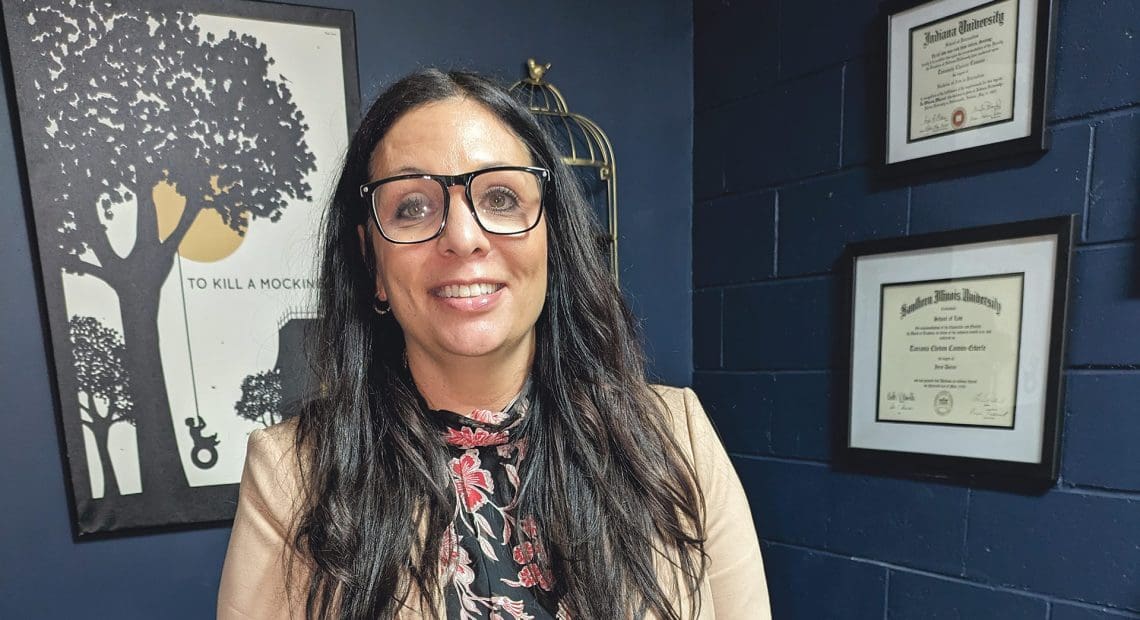
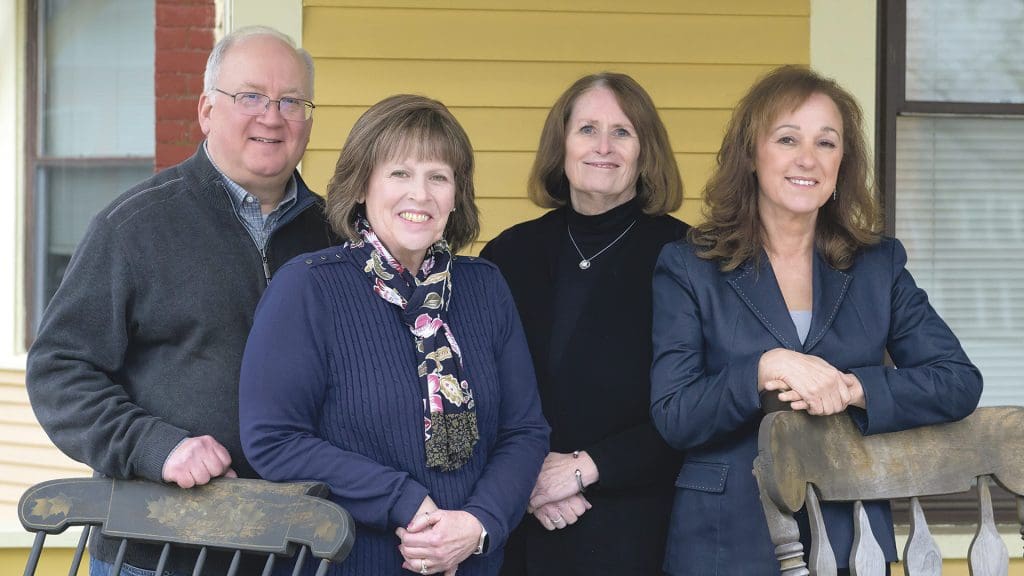
Tanzi Cannon stands in the brewery she co-owns with her husband, Joe Eckerle, which shares a building with General Counsel by Cannon.
The reason they don’t have to worry about cost is the model Cannon has put in place, charging a monthly fee — there are different subscription levels — that clients pay for whatever services they might need, including advice and counsel, regulatory audits, training … essentially, whatever issues are within the scope of their service contract.
“Essentially, they have a general counsel on call without having to hire an attorney every time they need something, and it also costs less than hiring an attorney to be on staff,” she explained. “What I have found is that it allows me to better defend people when they do get audited or they get a case because I have become familiar with the business. Because they just pay that monthly fee, they’re not really worried about how often I call them.”
They’re also not concerned with how often she stops by and spends time with the staff, as it’s all in the service of preventing problems down the road.
“I help people grow and become better businesses and prevent a lot of litigation. One of my clients actually told me that, since I did training for them, their litigation has gone down by 90%.”.”
“I become a part of their team, kind of. They see me, and I know a lot about the business. So when I do have to defend them, I already know that stuff. I already know who the managers are, what they do, I’ve probably seen the complainant, and I can see red flags when not all the managers are seeing those red flags — and I can train to those red flags.”
In short, Cannon said she and her clients are both gratified by this work.
“The pivot was just natural. And it makes me happy. I help people grow and become better businesses and prevent a lot of litigation. One of my clients actually told me that, since I did training for them, their litigation has gone down by 90%.”
Brewing Up Solutions
Cannon noted that Western Mass. is home to many labor and employment law firms, but she aims to stand out from them through her focused service model.
“They’re really good, but it’s mostly litigation. Then, if they’ve got a long-standing client, they’re going to call and get some advice and counsel. I’m hoping to flip that model; I’ll do litigation if my clients want me to, but I really want them to call me before that happens.”
For example, she noted, “I have the ability to understand when someone might need an ADA accommodation. I can walk into a place and see a management practice or a business practice that might not be good, like inconsistent application of the rules or blatant safety concerns.
“If it’s a sales floor and there’s a chair that’s in the way of the fire extinguisher or if there’s a mat in front of the door that’s getting stuck and nobody knows anything about it, that tells me they probably need some OSHA training because those are safety issues, and they don’t know that it’s not OK for that to happen, or they don’t realize it’s their responsibility,” she elaborated. “Lots of managers don’t realize that they could be on the hook and be sued personally for the conduct of the people they’re supervising. And when I tell them that, their ears perk up.”
“Sometimes, when you have small businesses, especially in family businesses, it’s so close and they’re so friendly that it’s difficult to draw boundaries and set the expectations and hold people accountable. And that is a recipe for disaster.”
Relationships in the workplace can be another red flag, and sometimes those become evident when Cannon visits a site.
“Sometimes there’s a lot of resistance about what it’s OK to say, or there being too close of a relationship between an owner and a manager. Not that it’s a sexual relationship or any sort of love relationship, but I think sometimes, when you have small businesses, especially in family businesses, it’s so close and they’re so friendly that it’s difficult to draw boundaries and set the expectations and hold people accountable. And that is a recipe for disaster.”
Cannon’s knowhow in maintaining a healthy workplace comes not just from her law experience, but from working in a broad variety of jobs in her life. She’s waited tables, cleaned hotel rooms, flipped burgers, owned an apartment building, and owned a cleaning service, as well as working at a golf course, in event planning, at a marketing firm, at a financial brokerage firm, as an HR director, and as an internal investigator.
“I’ve done so many jobs, I know what it takes to start a business. I know what it takes to keep a business going,” she said, and all that certainly applies to her current side business, Brew Practitioners, a brewery she and her husband, Joe Eckerle, have owned for the past decade.
After he took up craft brewing, the couple embarked on an educational brewery tour in Germany, and Cannon took a course at the Siebel Institute of Technology in Chicago, which is a brewing school.
“By the time we got back here, I was like, ‘you know what? We have so much beer, and we’re just giving it away; we might as well start a business.’ So we did — we started it in Florence, and then moved here after COVID,” she said of the East Longmeadow property that houses both Brew Practitioners and General Counsel by Cannon, as well as a small library she uses as a meeting and community space.
“We have remained small. We’re self-funded,” she said. “We haven’t grown bigger, but we’ve maintained a profitable business for going on 10 years now. And we love it. It’s our happy space.”
Putting her law hat back on, she added, “because I’m an entrepreneur, I understand where the needs are, and I understand the pain points. Especially in the brewery industry, I understand that there’s the feds, there’s the state, there’s the local licensing, and I know how much time these things take. So I can walk the walk with my brewery clients. I know exactly what they’re going through. I know that, if I’ve dealt with something in my business, the rest of these breweries are dealing with this too; let me see if I can help them. And wineries and distilleries are similar.”
Constant Learning
Cannon emphasized more than once that, while litigation is exciting, challenging and all-consuming, so, too is being a fractional general counsel.
“I have a growth mindset,” she said. “I spend a good deal of time on continuing education and keeping apprised of new trends and issues in the corporate world. I have to be on top of all the legislation, all the regulations, all the cases that come out, in addition to new business endeavors and new trends.”
As one example, she is now taking a 12-week leadership class at Western New England University where she’s learning about AI and how businesses should strategically manage that trend. “My clients need that information; my knowledge is for their use.”
Because she represents only corporations and businesses, not individuals, Cannon sometimes refers business to colleagues at other firms. That narrower focus keeps her busy as a solo practitioner, though she’s looking to hire an attorney or two in the coming year.
One example of what keeps her on her toes is the changing regulatory environment brought on by a new federal administration — especially one so aggressive about changing workplace rules and guidance.
“Regulations, by definition, are supposed to be purposeful and narrowly tailored to meet that purpose. I will say over the years that ‘narrowly tailored to meet that purpose’ has been broadened, very much so. So, I agree with regulations if they are purposeful, and if that purpose is a sound purpose. That has gone to the wayside for years, and I think we’ve all just gotten used to it.
“Now, I do believe that there will be some narrowing. I think they’re doing it with a sledgehammer, and it shouldn’t be done that way, but I do think some of the fallout will lessen. And what remains will get built back up when it needs to be.”
That said, some of the regulations that could be loosened are safety regulations, which were put in place to create better workplaces.
“If you’re a good business and you have best practices, you’re not doing it just because the regulators tell you to,” Cannon noted. “You’re doing it because it’s a good way to do business. If some of these regulations go by the wayside, but it’s going to hurt your business, or it’s just not a good ethical way to do business, then I’m going to counsel you to continue on with this.”
One major discussion in HR and employment-law circles is the topic of civility in a fiercely divided political climate.
“I do train for that as well. How do we maintain our authentic selves but still be civil to other people, to someone who may not have your same belief set?” she said. “I tell people all the time, ‘I can’t control how you feel inside.’ However, when you walk into the workplace, I can set the expectation of what is appropriate conduct and what’s acceptable and what we expect here at our company and the vision and the mission that we have.
“You bring your true self to work. And we want you to bring your true self, your authentic self, to work. That’s why they hired you,” she went on. “But you need to be civil with everyone else’s true self, too.”
Playing the Long Game
Speaking of unpleasant interactions, Cannon also counsels employers on how to discipline and, if necessary, terminate difficult employees.
“Many employers are walking on eggshells around their employees; they are afraid to say or do anything to upset them out of fear that they will get sued, even if the employee is a toxic employee. But it doesn’t have to be that way,” she explained. “You can’t control who goes down to the courthouse to sue, but if you do it right, set the stage for a proper defense, you don’t have to tiptoe.
“When you’re managing employees, you must play the long game,” she added. “You must be consistent with the application of company rules and policies and provide continuous training, especially manager trainings. I can assist with that. I can team up with an employer to implement a strategy over the long haul that will benefit the company and keep their staff happy, too. That is what I do. It’s what I love to do.”