
Home Archive by category Sections (Page 14)

Sections

Autos Special Coverage

Drive Time

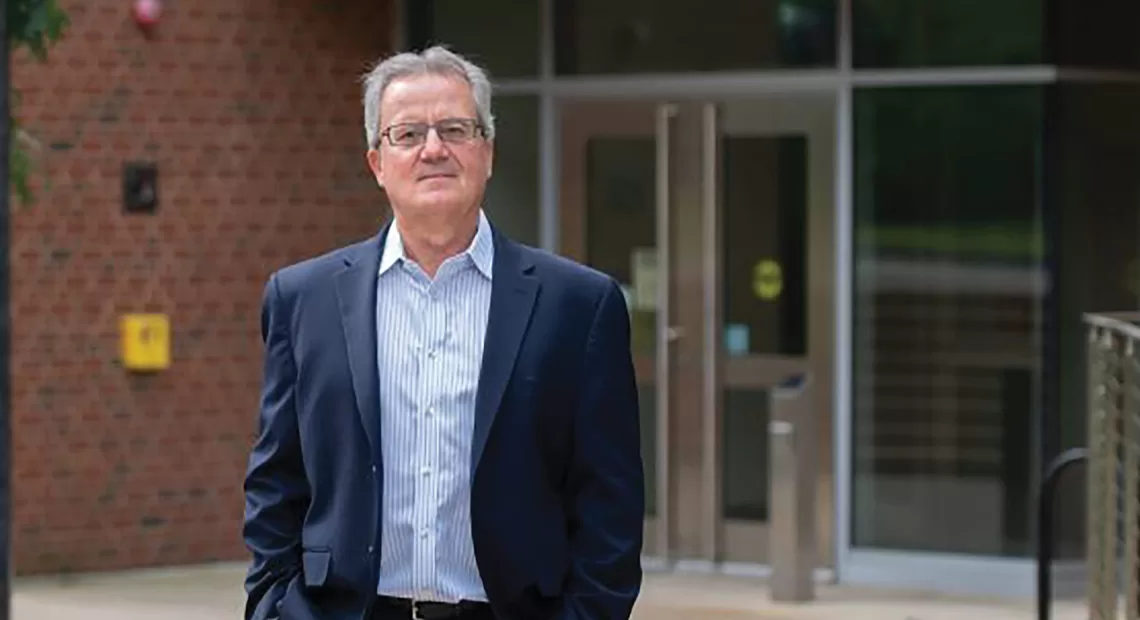
Rob Pion

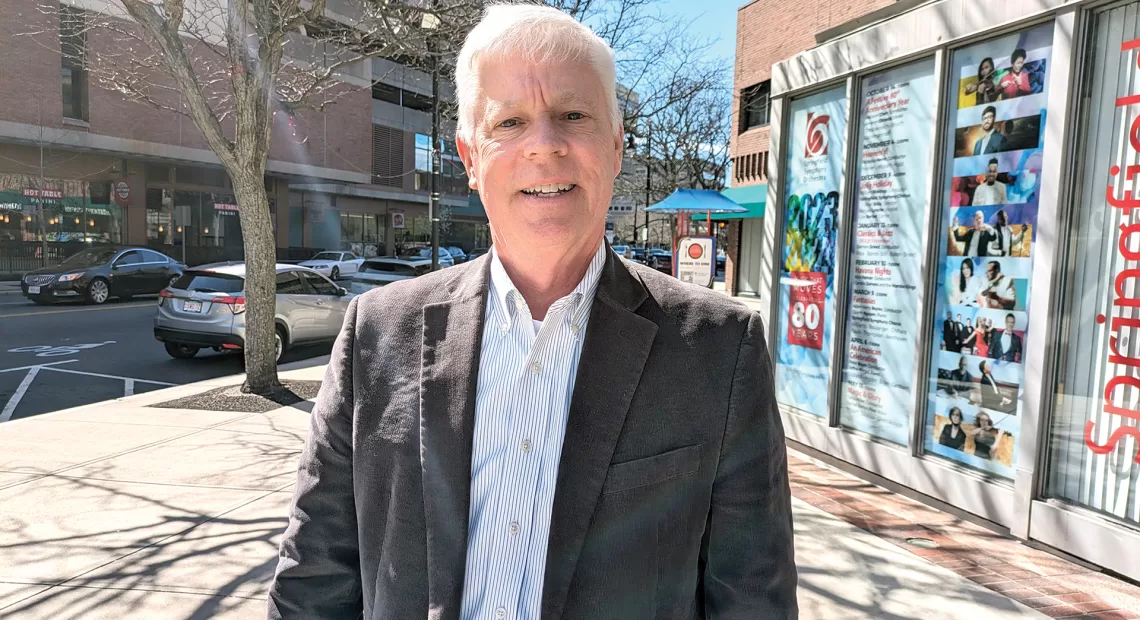
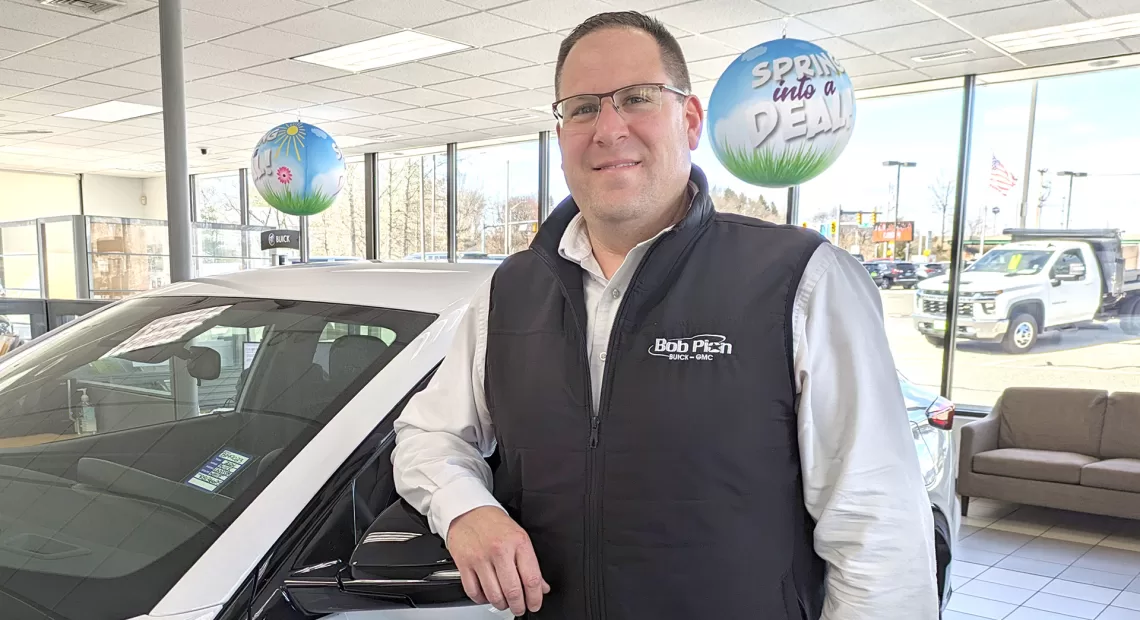
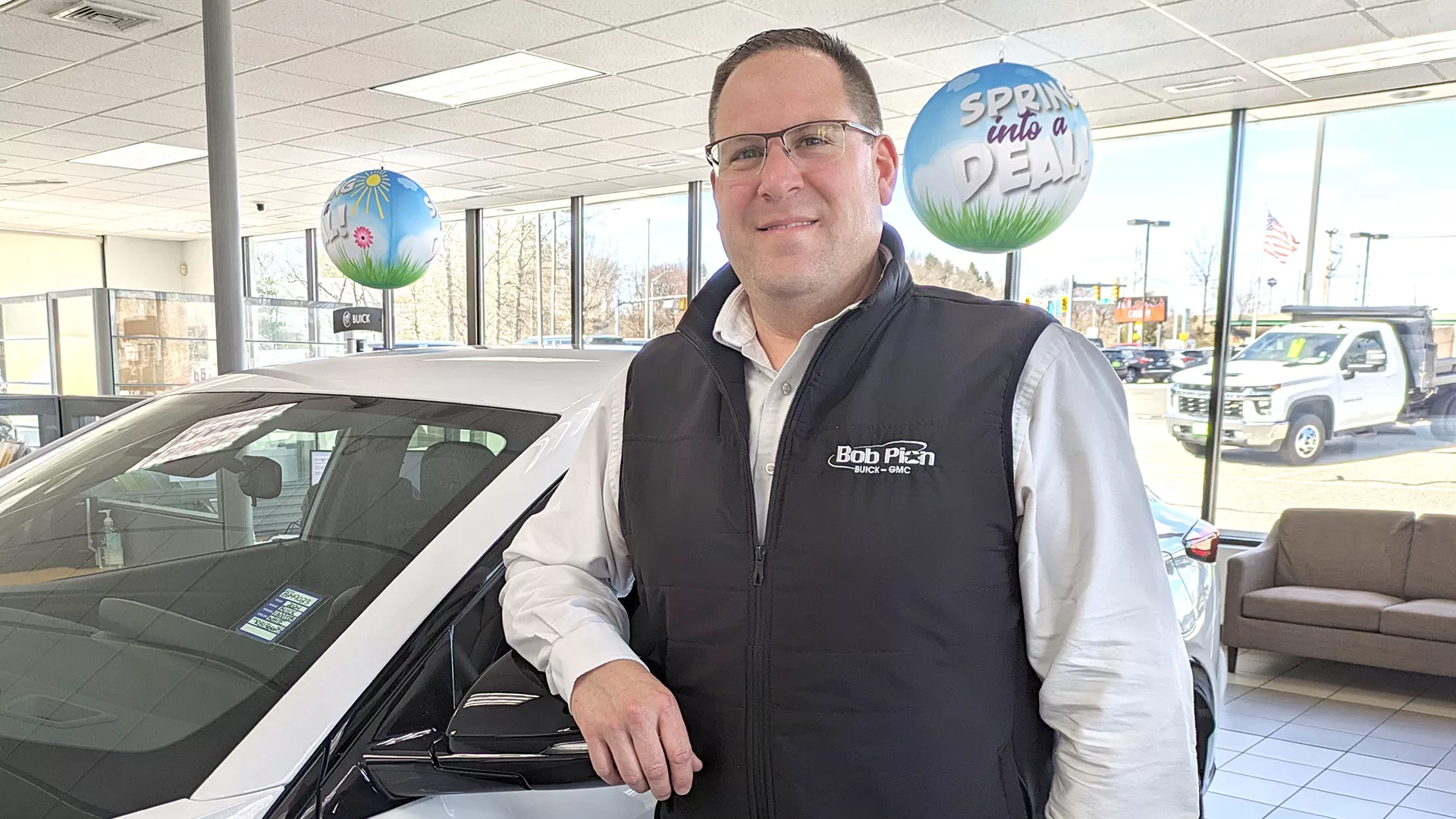
Rob Pion says the customer experience has become more important in a competitive marketplace for dealers.


Auto dealers have seen it all over the past few years, from soaring costs for vehicles, parts, and labor to inventory shortages to a rapid rise in interest rates.

But they’ve adjusted and adapted, they say — and so have consumers.

“We’re still doing all right. There still seems to be plenty of traffic and activity out there,” said Rob Pion, general manager of Bob Pion Buick GMC in Chicopee. “I would say there was a period last year where people really started to get rate-conscious, but that has passed to some extent. We’ve seen rates start to come down as well as people just kind of accepting it. I mean, it’s not our rate; the Fed sets the rate.”

Despite those concerns, Pion added, “2023 was a great year for us. GMC’s got a couple new products and redesigns coming out, and Buick’s got a number of redesigns coming out. We’re going to have almost a completely new set of models by this time next year. So there’s a lot happening. The used-car market has somewhat stabilized, too, and think that’s going to continue to stabilize throughout ’24. But right now, the public still seems to be out there buying and looking for vehicles.”

Especially on the new-car side, “everything’s kind of back to where things were,” said Mike Filomeno, general manager of Marcotte Ford. “The inventories are really good; products are coming in quickly. Prices are still up there, though, based on supply and demand.”

Manufacturers recognize the dual crunch of rising costs and rising interest rates, however, said Mike Marcotte, president of the dealership. “When interest rates rose last year, Ford started putting programs on the new vehicles again, like the 1.9% or lower interest rates that help with the financial changes going on. The market is definitely starting to react to that.”

Pion has seen similar moves. “Throughout the year — and it’s still continuing — GM has had some aggressive financing rates out there. We’re not seeing the big rebates of years past, but depending on credit approvals, we’ve seen 3.9%, 2.9%, they even went down to 0.9% for a little bit for 36 months. So there has been some help from the factory on that side of things. Not the big cash rebates that we saw in years past, but certainly interest-rate relief.”

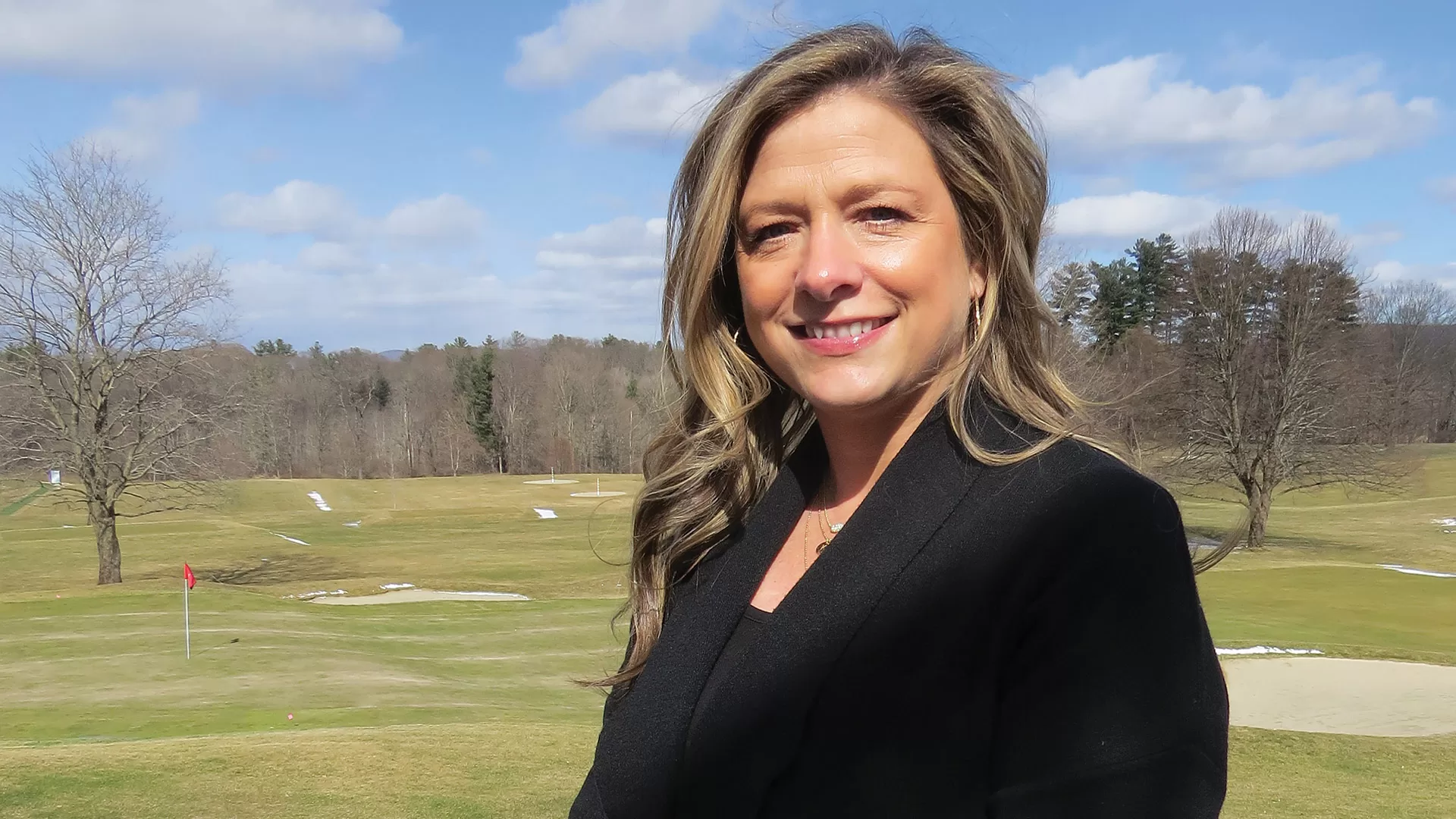
Carla Cosenzi, president of TommyCar Auto Group, said business has been strong, and she’s seeing positive trends across her family of six dealerships.

“We’re not seeing the big rebates of years past, but depending on credit approvals, we’ve seen 3.9%, 2.9%, they even went down to 0.9% for a little bit for 36 months.”

“Despite inflation affecting costs of parts and services, consumers understand the situation,” she told BusinessWest. “Manufacturers are offering more aggressive lease incentives, which our customers are taking advantage of, leading to increased business. Certain manufacturers like Volkswagen, Nissan, and Hyundai are also offering 0% financing to consumers.”

That’s in addition to TommyCar’s internal loyalty program, which allows customers to earn up to 15% back on every dollar spent in the service department, which can be used toward their next vehicle purchase.

Meanwhile, “our inventory levels for both new and used vehicles are returning to normal,” Cosenzi noted. “We’ve seen an increase in our used inventory levels, primarily due to steady trade-ins and our aggressive buy-back offers, which have helped us maintain a steady supply of used cars. We’re optimistic about the year ahead.”


Back in Stock

Marcotte said his dealership, like many others, dipped to around half of normal inventory in the wake of the pandemic. “But now we’re back to good levels. I’m so glad we can offer gas, diesel, hybrid, and now electric vehicles, which are 8% of the market right now. We’re in every segment.”

Used-car inventories were one of the biggest stories in auto sales across the U.S. over the past few years, as shortages led to soaring values. That situation has stabilized (not necessarily to car owners’ benefit; see story on page 22), but dealers are breathing easier when it comes to what they can put on their lots.

“We’re a big Ford certified pre-owned dealership,” Filomeno said, “and there’s still demand for a good used car out there. A lot of people have been holding on to their cars for the last five years and repairing them because there wasn’t a vehicle for them to buy, so now they’re trying to trade those vehicles in.”

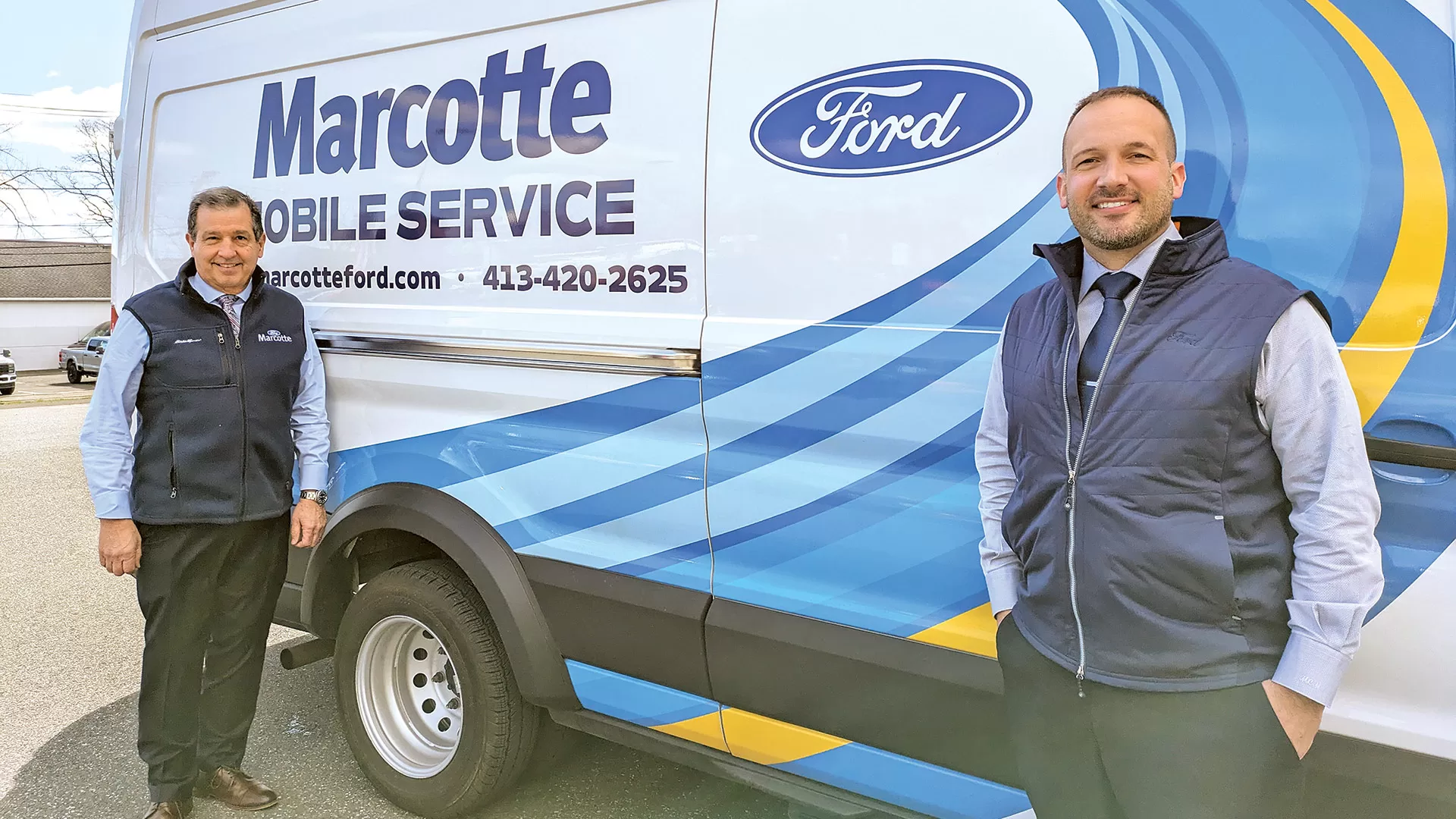
Marcotte Ford’s mobile service vans

Marcotte Ford’s mobile service vans have been a popular customer perk.

Pion agreed, noting that inventory has rebounded, for both new and used vehicles, and across the spectrum, from cars to SUVs to trucks.

“Some of the specialty trucks, especially the heavy-duty trucks, things of that nature, are still difficult to get. It could be anywhere from 12 weeks to 8 months to get it. But people have also become a little more accustomed to that today, too. They don’t expect things tomorrow. They kind of know what it’s like, so they’re willing to wait a little longer.

“Specific trucks are still hard to get,” he went on. “If you come in here and you want a black one with a black interior with the 22-inch wheels with this type of engine … that could still be a hard truck to get. If you came in here and said, ‘hey, Rob, I want a pickup truck. I don’t need to have a big engine, I’m going to use it mostly for my family, some landscaping on the weekends, just around the house’ … I have that. So that purchaser who isn’t incredibly specific about their needs can walk in and be serviced pretty quickly. But that business owner that only wants the white truck for their company? That can be tough.”

The used-car market has continued to favor sellers, Pion added, “and I think it’s created a desire in some people to keep their vehicles longer. In the service department, we definitely see larger repair bills than we have in the past because people are keeping their vehicles longer.”

Another big shift in auto sales continues to be the proliferation of electric vehicles (EVs), a trend that TommyCar has embraced.

“We’ve been a strong electric-vehicle dealer and continue to be one of the top electric-vehicle dealers,” Cosenzi said. “Electric vehicles are more affordable than ever, thanks to federal and state rebates, along with manufacturer incentives.”

While some new EVs, like the Volvo EX90 and EX30 models, require pre-orders due to their popularity and limited availability, others can easily be found on lots, including the Volkswagen ID.4, Hyundai Ioniq 5 and 6, and Nissan Ariya.

“Once people are in the EVs, they’re going to buy another EV. I love the EV. That’s my next purchase.”

Marcotte Ford boasts three EVs — the Mach-E, the F-150 Lightning, and the E-Transit — and “they’re bringing a different shopper than we normally see, with different trade-ins. So it’s bringing a new face, a new customer, into the dealership,” Marcotte said. This evolution is also why the dealership installed four high-speed EV chargers on its lot last year.

“We see people from all over New England coming through here on the weekends. They’ll charge up before going skiing,” he said. “Our employees, if they buy, can charge right here. Customers can come here to charge.”

Marcotte said EV adoption is still increasing, but not as quickly as before, and Ford has changed its production level based on that trend, but the company still envisions a strong future for electrics.

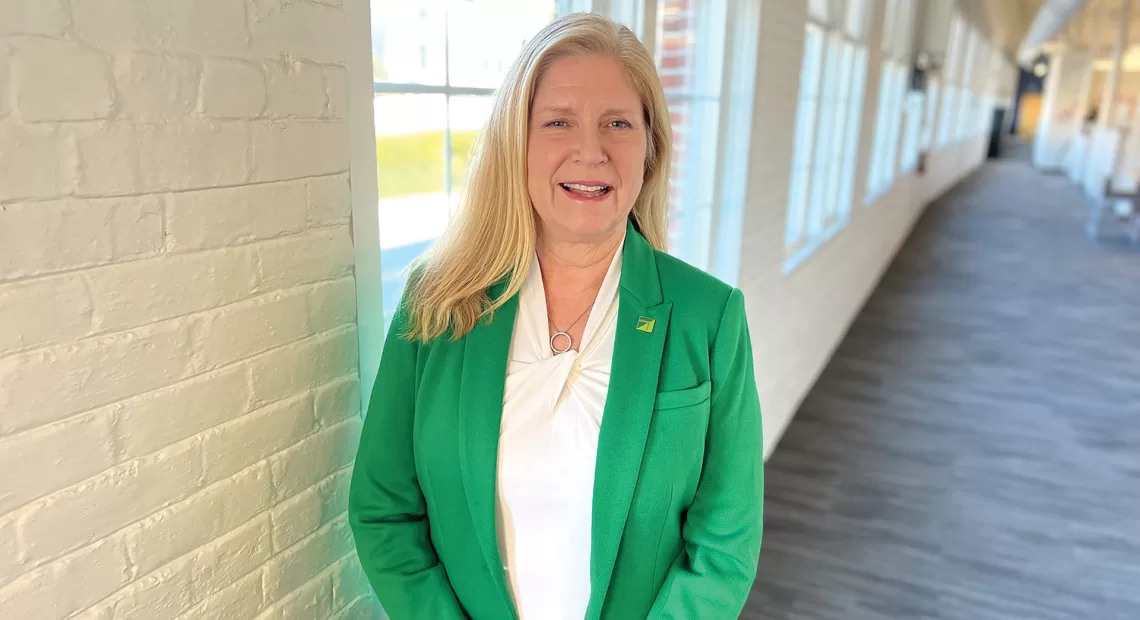
Carla Cosenzi

Carla Cosenzi says interest-rate incentives, the return of healthy inventory levels, and solid options in electric vehicles have all boosted sales.

“Once people are in the EVs, they’re going to buy another EV. I love the EV. That’s my next purchase,” he told BusinessWest, noting that some drivers are more comfortable driving hybrid vehicles first, and many of those will eventually move to all-electric as well. “So it’s good we can offer every option to customers.”

Many drivers, he added, are waiting to feel more confident about charging stations becoming more widespread. “So once there’s more infrastructure, I think that anxiety will go away a little bit.”

Whether they’re buying electric, hybrid, or traditional vehicles, today’s drivers tend to be interested in certain bells and whistles, Cosenzi said.

“Customers are seeking vehicles with advanced high-tech features such as adaptive cruise control, lane-keeping assist, automatic emergency braking, large touchscreens, smartphone integration, and voice recognition,” she noted. “These trends reflect a desire for practical, safe, convenient, and sustainable vehicles with the latest technology.”


Out and About

Still, at the end of the day, customers still appreciate a positive experience when purchasing a vehicle, Pion said.

“These brands mean everything to us,” he said, noting that he’s now the only Buick dealership within an hour’s drive. “I just hope that we can offer an experience where people want to be here and be a part of the family. That’s how we try to treat everybody and differentiate ourselves. I try to meet and talk to as many of my customers throughout the day as I can because it’s important to me.”

Marcotte agreed the customer experience is critical. One intriguing development at his dealership has been the introduction of five mobile service vehicles that will drive to a home or business and service a car on the spot.

“It’s bringing the convenience to the customer, and we know time is so valuable, and want to get them up and running,” Marcotte said, noting that the program has been a positive for Ford. “It’s a whole brand differentiator, and not all manufacturers are up on this. So we keep focusing on the guest experience, giving them every option, and now you can be at your home while we do the oil change, or keep your business up and running. We’ve had really great feedback from the customers.”

Healthcare News Special Coverage

A Blooming Challenge

By David Robertson, MD, MPH, MBA

Spring is a season of rebirth and rejuvenation, with flowers blooming and the world around us turning from brown to green. However, for many area residents, this beautiful transformation comes with a less-welcome companion, with Springfield consistently ranking as one of the worst cities in the country for allergies and asthma.

This year, the warm winter that just came to an end is set to extend the allergy season, bringing about an early and possibly more intense onset of symptoms for allergy sufferers.


The Warm Winter Effect

Typically, cold winters help delay the start of the allergy season by keeping plants dormant and the ground frozen longer. A warmer winter can lead to an earlier thawing and activation of outdoor molds in the soil. This early activity, combined with spring rains, means that outdoor mold spores are already circulating, ready to trigger allergy symptoms. With tree pollen following closely behind, residents may find themselves in the midst of a particularly challenging allergy season.


Understanding Allergies and Asthma

Allergies occur when the immune system overreacts to substances in the environment, known as allergens, which are harmless to most people. These can include tree, grass, and weed pollens; molds; animal danders; and dust mites. When these allergens are inhaled or come into contact with the skin, they can cause symptoms such as sneezing, itching, runny nose, and watery eyes.

“Managing allergies and asthma requires a multifaceted approach. The three basic strategies for dealing with environmental allergens are avoidance, medications, and allergy immunotherapy.”

For some, allergies can also exacerbate asthma, a condition characterized by inflammation and narrowing of the airways in the lungs, leading to wheezing, shortness of breath, and coughing. Asthma can be triggered by allergens as well as changes in the weather, making the spring season particularly challenging for individuals with both allergies and asthma.


Strategies for Relief

Managing allergies and asthma requires a multifaceted approach. The three basic strategies for dealing with environmental allergens are avoidance, medications, and allergy immunotherapy.

The first line of defense is to minimize exposure to allergens. This can include staying indoors on days when pollen counts are high, using air purifiers at home, and changing clothes and rinsing off after time spent outside. Some people also find wearing masks or even protective eyewear helpful, particularly with activities that may increase allergen exposure, like cutting the grass and gardening.

Many over-the-counter (OTC) and prescription medications can help manage symptoms of allergies and asthma. Antihistamines, decongestants, nasal sprays, and eye drops are widely used to alleviate allergy symptoms, while asthma sufferers often use prescription inhalers to control their symptoms. However, choosing the right medication can be daunting due to the vast array of options available.

For those with severe allergies, allergy immunotherapy, which includes allergy shots and sublingual tablets, may be an option. This long-term treatment gradually desensitizes the body to specific allergens, potentially providing lasting relief.


Navigating Treatment Options

While many effective treatments are available over the counter, selecting the right product can be challenging without professional guidance.

In studies, nasal steroid sprays like Flonase or Nasacort are the most effective family of medicines for helping with congestion, sneezing, and post-nasal drip, but many people do not like using them. They may not be right for everyone, particularly people prone to nosebleeds or with glaucoma or cataracts.

Oral antihistamines, like Allegra, Claritin, or Zyrtec, can help with sneezing and itching, and these new antihistamines are not supposed to cause drowsiness, though everyone’s body is different. Antihistamine eye drops can help with itchy, watery, or swollen eyes, but can also cause or worsen dry eyes.

Oral decongestants can provide temporary relief of sinus pressure, but can also cause increased blood pressure and insomnia, so we generally recommend minimizing these medications. Nasal decongestant sprays like Afrin can provide temporary relief of congestion, but should not be used for more than two or three days in a row because they can cause increased congestion.

All of these medicines are available in less expensive generic forms, which most people find equally effective.

Given the number of treatment options and potential side effects for some people, it may beneficial to consult with a healthcare provider or an allergist to develop a personalized treatment plan. If you already have a treatment strategy that works for you and your family, now may be a good time to get a few boxes of your preferred medicine — in the last few years, there have been occasional shortages at the peak of allergy season. But leave enough for your neighbors!


The Road Ahead

As Springfield and the surrounding region brace for a longer allergy season, staying informed and proactive in dealing with allergens will be crucial for those looking to enjoy the spring while keeping their symptoms in check.

By understanding the triggers, using effective management strategies, and seeking professional guidance when necessary, allergy sufferers should be able to navigate the challenges of spring allergies and asthma with increased confidence.


Dr. David Robertson is an allergist and clinical immunologist and owner of Western Massachusetts Allergy, LLC in Springfield.

Special Coverage Women in Businesss

Driving Ambition

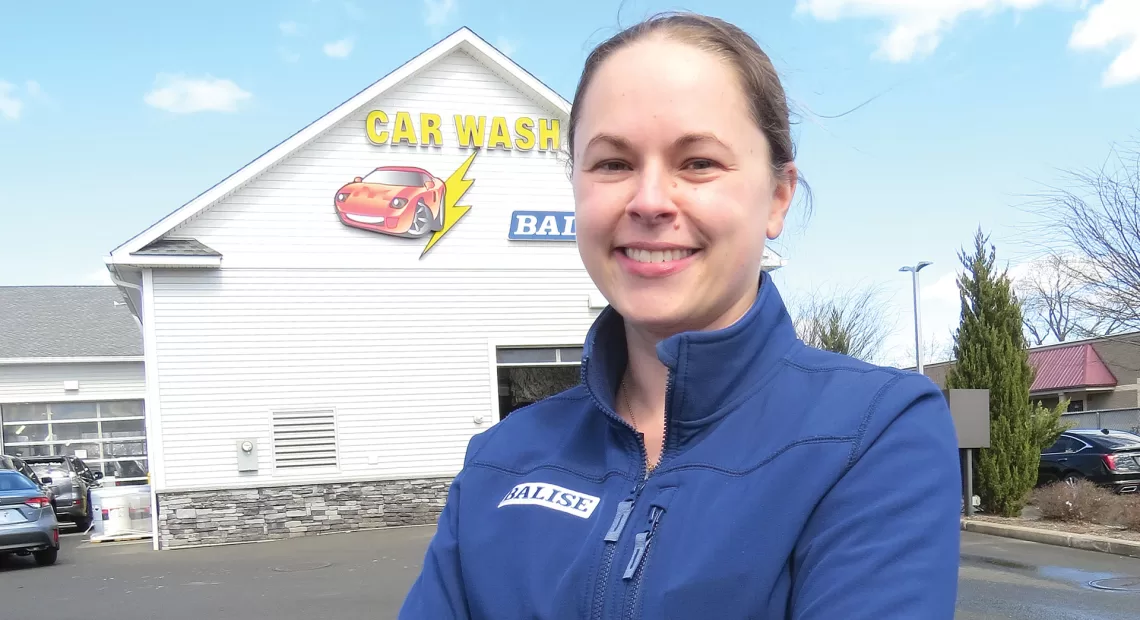
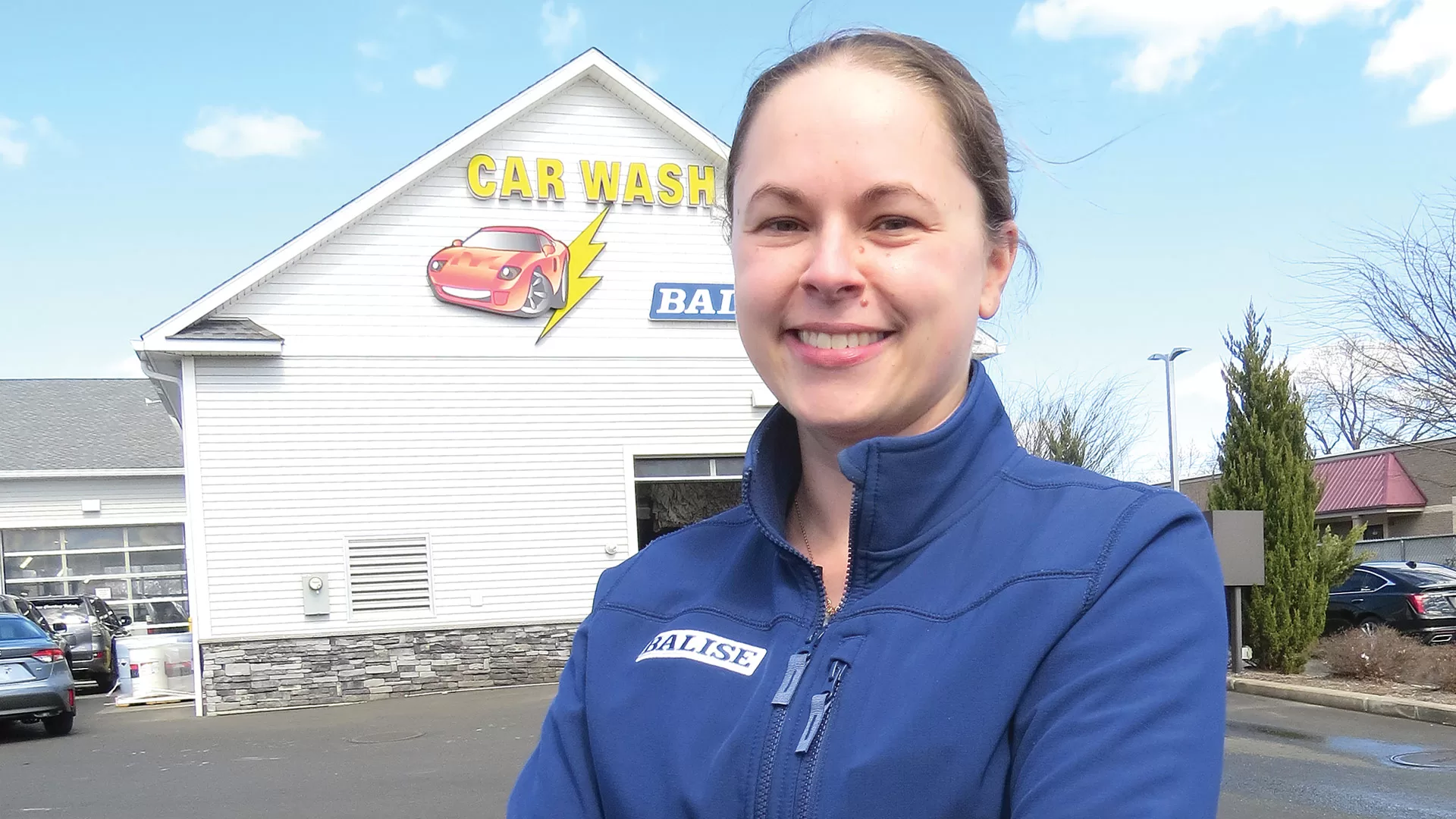
Alex Balise

Alex Balise


Alex Balise always thought she would get involved in the family business.

She just thought that would happen when she was maybe 40, not in her mid-20s, as things turned out.

But since they did turn out that way (and we’ll go back and explain way later), she is now eight years into what has become an intriguing and wide-ranging career, one that has her engaged in everything from cars — the family business is Balise Motor Sales — to car washes; from two laundromats (one in Springfield and the other on the Cape) to whatever might come next for this 105-year-old enterprise.

Indeed, Balise, 36, representing the fourth generation of the family to assume leadership roles with the company, recently saw her role change, or, to be more precise, expand. While she’s still director of Marketing, she is now also director of Corporate Strategy, which means she will play a large role in helping to shape what might come next.

“I’ve been doing more … projects,” she said, being intentionally vague. “I’ve been very involved in the car washes, and that’s been a rapid expansion, and we’re also looking at some other business opportunities that we haven’t done before.”

While doing that, she is still leading the marketing efforts for the Balise company, which has dealerships in the 413, on the Cape, and in Rhode Island; car washes in Western Mass. and Connecticut; five collision centers; and that aforementioned laundromat in Springfield’s South End.

“We’re doing a lot to highlight our people in the ads recently, and that makes sense. After all, they’re the people who make Balise … Balise. Our teams are who make the difference, so why not have them be the face?”

This a wide-ranging assignment, one that keeps a staff of six (with some help from a few agencies) busy, and includes ad creation, media buying, social media, website content, and determining if, how, and to what degree the company will honor the myriad requests it receives for support from area nonprofits, a difficult assignment because, as she put it, “I can’t think of a single thing that came in that wasn’t a good cause; they’re all good.”

For many years, marketing at Balise was the purview, if you will, of her late uncle Mike, who succumbed to stomach cancer in 2015 and was named a BusinessWest Difference Maker posthumously in 2016. He was the face of the company, she acknowledged, adding that she has resisted any and all efforts to become the new ‘face,’ noting that “I don’t have the personality for it.”

Instead, she has led efforts to make the company’s employees the collective new face, with ads featuring them in many different roles.

“We’re doing a lot to highlight our people in the ads recently, and that makes sense,” she said. “After all, they’re the people who make Balise … Balise. Our teams are who make the difference, so why not have them be the face?”

Meanwhile, she is carrying on her uncle’s tradition of getting involved in the community, especially in the broad realm of education.

Alex Balise is carrying on her uncle Mike Balise’s tradition

Alex Balise is carrying on her uncle Mike Balise’s tradition of buying coats for students at Springfield’s Homer Street School, now the Swan School.

Indeed, just as Mike did for several years, she reads in the classroom for Link to Libraries at the recently opened Swan School, a replacement for Homer Street School, which was sponsored by the Balise company for many years.

She also carries on another of Mike’s traditions — buying winter coats for students at the school — and takes it to another level with some serious shopping for deals, stretching the allotted dollars and using the savings to buy hats and other accessories.

“Costco will have these deals — ‘spend this much and get this much off,’” she explained. “So I’ll buy them in buckets so that we get the most of the discount, and then I’ll use what we saved with the discount to buy the extra things, like hats and gloves. There are definitely some things that Mike started that we’re happy to continue.”

And while doing all that, she’s also raising two young children, son Connor, 5, and daughter Emma, 3. It’s a complicated and delicate balancing act, one that she discussed, along with many other topics, in a wide-ranging interview with BusinessWest for this issue and its focus on women in business.


Drive Time

One of the better perks for those in the auto-sales business — even those in charge of marketing and, now, corporate strategy — is being able to drive a demo.

And for Balise, the car of choice — and there is a lot to choose from in an auto group that sells several different makes — is the Toyota Crown, a sporty hybrid sedan. Yes, a sedan. Even with two young children, she’ll leave the SUVs for others to drive.

“If we have the opportunity to have more focused donations that have a bigger impact on the organizations that we’re helping, that’s the direction we’ve decided to take.”

Although this sedan doesn’t look much like anything else on the road.

“I’ve never had more people ask me, ‘what is that you’re driving?’” she said. “Because it is a little different.”

Balise spends a considerable amount of time in whichever Crown she’s driving at the moment — she doesn’t keep them past 5,000 miles — splitting her days between the 413, Rhode Island, and the Cape. While driving, she’s usually listening to audiobooks (she likes both fiction and nonfiction and is currently ‘rereading’ the Harry Potter books) and thinking about all the many balls she’s keeping in the air at present.

All this wasn’t exactly where she pictured herself at this stage of her life and career, but there have been some, well, unexpected turns.

Like most who grew up around the car business, Balise spent summers and school breaks working in various jobs at dealerships. She recalls working in the parts department, calling customers to tell them their appointments were coming up, and even handling paperwork created by the federal government’s infamous Cash for Clunkers program designed to fuel auto sales in the wake of the Great Recession.

But she wasn’t thinking about making this a career.

Alex Balise meets some residents of the Zoo in Forest Park

Alex Balise meets some residents of the Zoo in Forest Park after the company wrapped a vehicle and donated it to the zoo for its educational programs.

Instead, while earning her undergraduate degree at Colgate University, she was thinking about teaching and then working in the broad realm of education policy.

But she graduated into a tough job market in 2009 and eventually moved to Boston with her husband, Trevor McEwen, who did manage to find work. She eventually secured some herself, working for a student health-insurance brokerage and consulting firm for three and a half years.

She learned a lot about business in that role, but decided she needed to further that education and earned an MBA, with a concentration in marketing, at Babson College. With that degree, she sought work in education consulting and hospital operations, but “couldn’t find anything I loved.”

Meanwhile, Balise Motor Sales was opening another car wash in West Springfield, and her father, Jeb, its CEO, asked her to run some pro formas and work on the project.

“That was really interesting — I didn’t know anything about car washes, so I learned a lot there,” she said, adding that she spent most of her time on the Cape, where the company opened its first such facility.

To make a long story shorter, that learning experience would be the start of her career with the company, she said, adding that she moved on to a different project, the opening of a Kia store in West Springfield in 2016 after the company was awarded that franchise.

And during that project, Balise’s vice president of Marketing retired, and Alex was asked by then-President Bill Peffer to take over that broad realm.

She did, but while doing so, she became a hybrid worker long before that phrase came to be, working at her home in Framingham two or three days a week and driving to West Springfield the others.

“My father didn’t love that idea — he felt that a manager should be in the office every day,” she recalled. “He said, ‘how can I manage these people if I wasn’t there every day?’ But I decided to do it and see if we could make it work. And we did.”


To a Higher Gear

Balise eventually moved back to this area in 2018, putting her further away from the company’s dealerships in Rhode Island and on the Cape, but in a better place overall to oversee marketing for a steadily growing portfolio of auto-related businesses.

And some not auto-related.

Balise said the laundries, operating under the name Love Your Laundry, were her father’s idea, and the Springfield facility, right behind the company’s Mazda dealership, was seen as a way to help the residents of Springfield’s South End.

“It’s not something that we’re planning to blow up and have 25 locations, like the car washes, but if there are opportunities … we’ll see where it goes,” she said, adding that she has plenty of other things on her plate, especially the duties that come with being director of Corporate Strategy.

Whatever the title on the business card might be, Balise said she will always be heavily involved in the community. In fact, opportunities to do so comprised one of the larger reasons why she joined and then stayed with the company.

“I felt I could make a bigger impact through the family business than I could on my own if I worked somewhere else,” she told BusinessWest, adding this impact comes in many different forms.

One of them is playing a lead role in reviewing requests for support from the area’s legion of nonprofits and deciding which directions the Balise company’s philanthropic efforts will take.

It’s a huge responsibility and one she takes quite seriously.

“Having to say no is the worst — it’s tough,” she said, adding quickly that it’s even harder to say no when Balise doesn’t have guidelines for its giving.

So the company — more specifically, her team — created some, addressing everything from areas of focus, such as youth, education, healthcare delivery, and civic and community development, to how to make the most impact.

“In talking about it and in looking at what we’ve supported historically and where we’ve been able to have the biggest impact, we thought we could say yes to $100 for several small donations and have small impacts for some, or … we could refine our guidelines and make sure that, where we’re donating, we have a bigger impact that’s going to have a lasting result in the community.

“So instead of sponsoring a golf tournament or a gala, we want to actually sponsor the new computers or building a new classroom or medical deliveries, as opposed to the 5Ks to raise money. They’re all important, and we need all of those to fundraise, but if we have the opportunity to have more focused donations that have a bigger impact on the organizations that we’re helping, that’s the direction we’ve decided to take.”

Meanwhile, as noted, she is out in the community herself. In addition to reading at Swan School, she’s a corporator at Square One (the company also sponsors a classroom there), and, in the Providence market, she helped wrap presents to be given to patients at Hasbro Children’s Hospital, an initiative that involved many from the company.

While doing all that, she also saves large amounts of time for family, part of the balancing act that is part and parcel of being a woman (and, especially, a manager) in business today.

“It’s a lot, and it’s hard,” Balise acknowledged. “I’m lucky that I have a great team at work, and I have family nearby that can help pick up some days.

“When you have two young kids and you work, there is no balance. Basically, when I’m not working, I’m focused on my kids and my family, and we try to fit in as much as we can and have dinner together.”

Cannabis Special Coverage

Expanding Their Vision

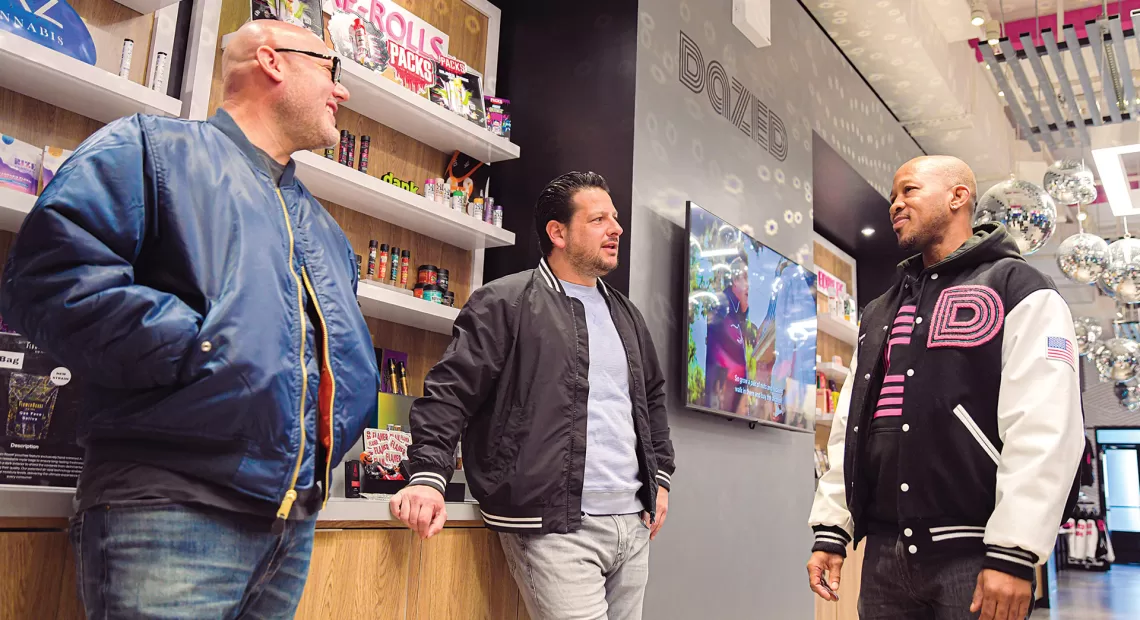
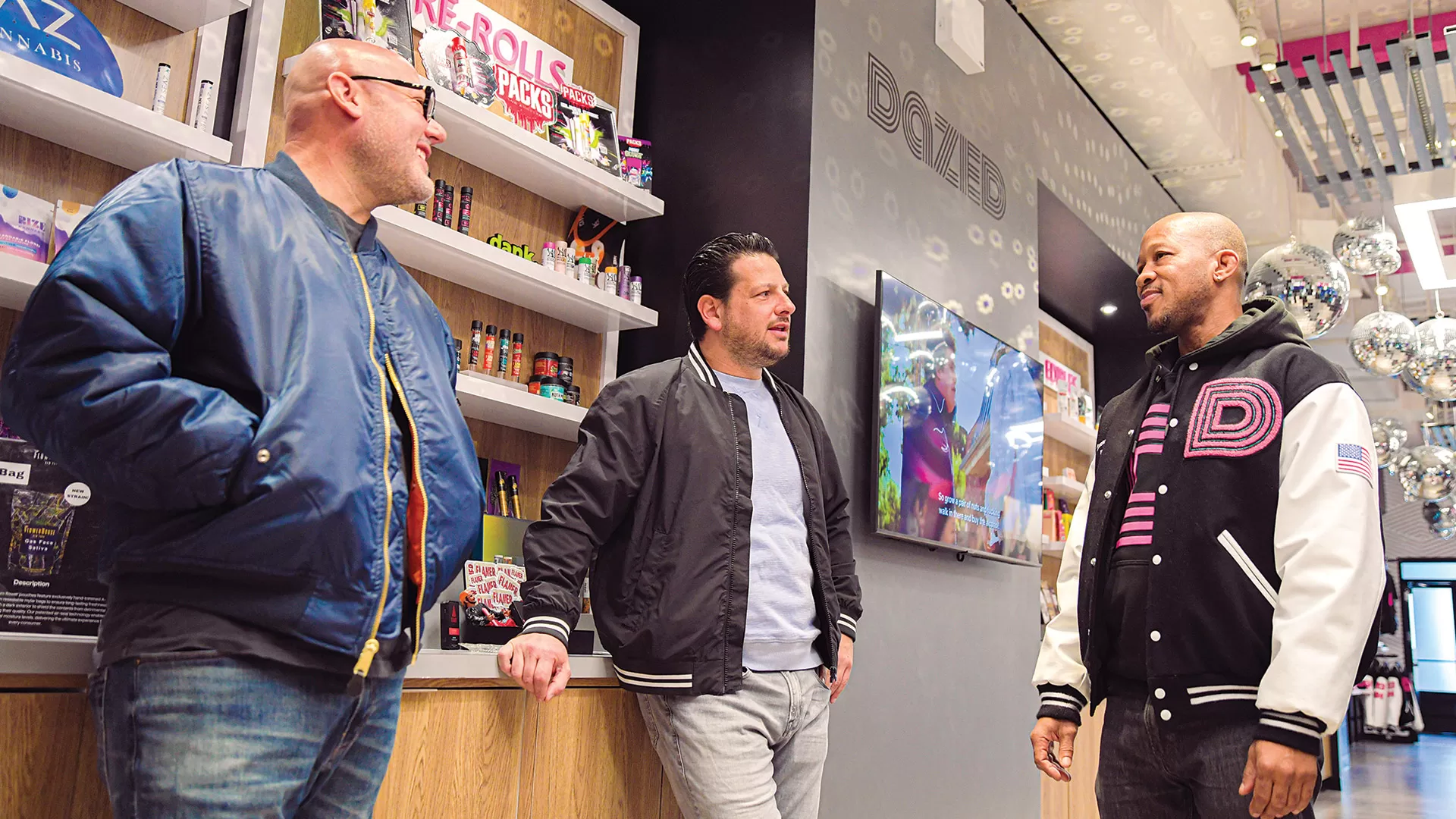
Co-owners Chris Vianello, Rich Rainone, and Keshawn Warner.

Co-owners Chris Vianello, Rich Rainone, and Keshawn Warner.
Photo by Savanna SLUSA Productions for Dazed Cannabis


Chris Vianello said he and his partners at Dazed Cannabis never intended to be the first player on the scene. In fact, their first dispensary in Holyoke, which opened in 2021, was that city’s fourth.

“We were never the only game in town. That’s not our model. If our only claim to fame is that we’re the only game in town, that’s not a sustainable business practice,” Vianello said, noting that Dazed instead stresses quality products and its friendly but funky vibe. “We anticipated competition going into this, especially because Holyoke is not a limited-license jurisdiction.”

The model has worked. Not only has the Holyoke shop has survived a raft of competition, but Dazed co-owners Vianello, Rich Rainone, and Keshawn Warner have opened two stores since then: in New York City in 2023 (first as a pop-up shop in April and then a permanent storefront in November) and, just last month, in Monson, where Dazed is currently the only cannabis game in town.

That store, where the Magic Lantern strip club operated for more than a half-century before closing in 2022, honors the location’s history by keeping a small stage and dancer’s pole as part of the décor.

Rainone told the Cannabis Business Times recently that the first 90 days after a dispensary’s opening are the most turbulent. The first month is all about establishing operating procedures and employee routines, the second about fixing the challenges of the first 30 days, and the third month about putting it all together and excelling.

He told the publication that Dazed is a “fun party brand,” with visitors encountering a “meet and greet” before they get to security, and the environment inside the shop characterized by music playing and a pink-dominated color scheme that extends to all three dispensaries.

When asked why the team chose each location, Vianello told BusinessWest they appeal in different ways.

“We were never the only game in town. That’s not our model. If our only claim to fame is that we’re the only game in town, that’s not a sustainable business practice.”

“You try to find the balance between what’s the ideal location and what’s a doable location,” he said. “We try to straddle that balance; we don’t want to open up a dispensary just anywhere because that’s not going to work, but also we don’t want to get stuck looking for the perfect location and end up not opening anything. They’re all different in where the traffic is coming from and how we attract different folks to different stores.”

At a time when competition is fierce and some stores have actually closed in Massachusetts, Dazed’s focus on customer experience and steady growth has been a winner, he added.

“In 2018, 2019, you had people who were the only game in town. And that worked for those who were able to get themselves positioned to be the first in the market. They had months, even years where they were cranking as literally the only game in town.”

“We never experienced that. We were never the first,” he continued, understanding that being the first shop in Monson is still being one of nearly 400 in Massachusetts. And amid increasing competition, Vianello doesn’t intend to engage in a race to the bottom when it comes to pricing.

“We’ve seen people trying to undercut the next guy by 10 cents and create an environment where you devalue the purpose of even being there,” he explained. “Understanding that price is always part of what people consider when shopping, you still have to differentiate yourself; you have to make yourself stand out. Ideally, you want people that are coming to you rather than other people because they like what you have going on.”

By doing so, he said, “we’re creating our own lane, our own pie, instead of slicing up what’s already out there.”


Rolling with the Punches

And there is, indeed, a lot out there, and still considerable debate over whether the burgeoning cannabis industry has a ceiling or whether there’s enough growth potential — from new users or consumers rejecting the illegal market to buy from regulated stores — to make up for more competition emerging from both within the Bay State and from outside its borders.

“A lot of it comes down to community outreach, giving people the information they need to buy legal rather than what they’ve been doing the last 20 years,” Vianello said.

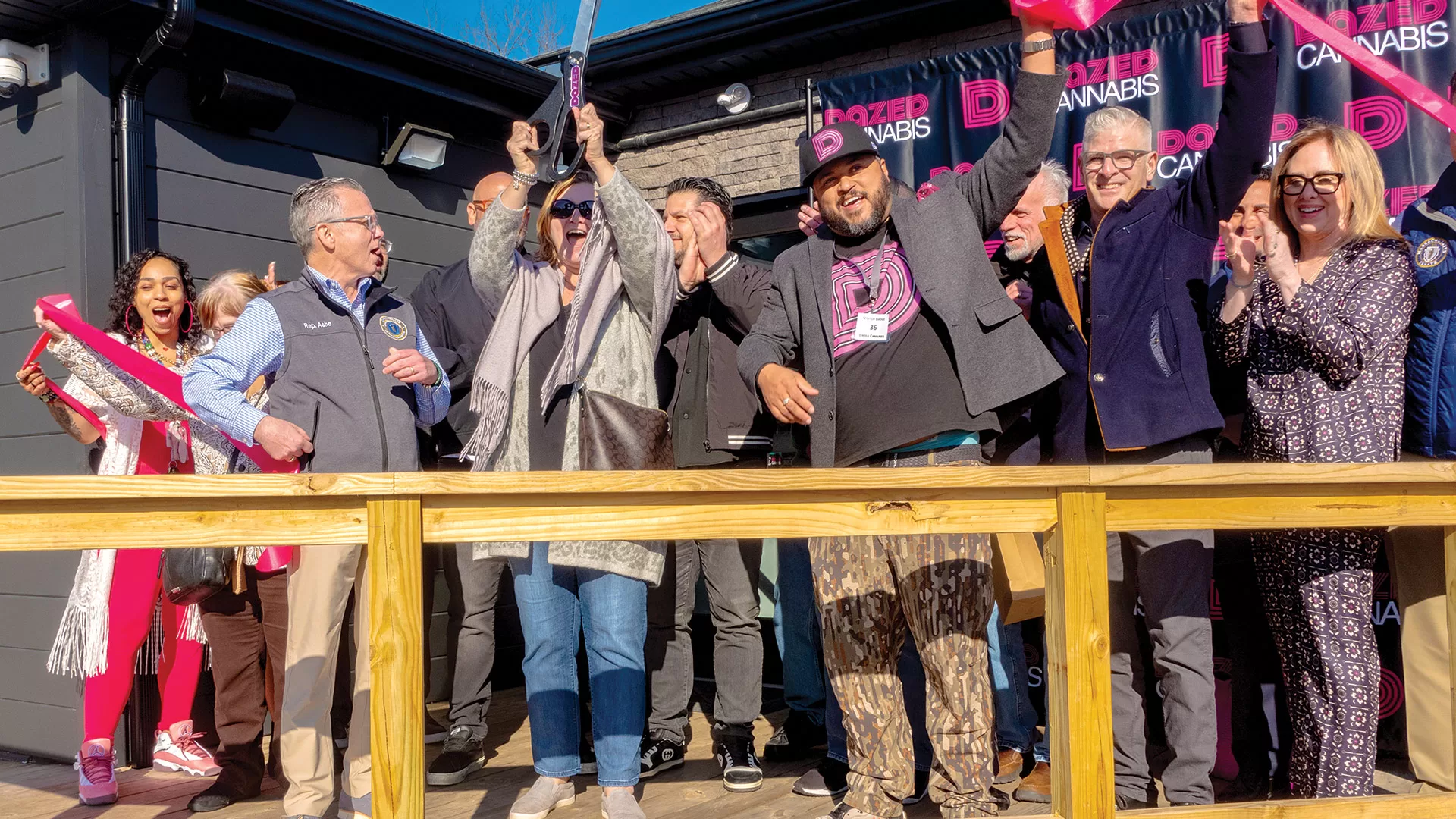
The leaders of Dazed Cannabis

The leaders of Dazed Cannabis hope the recent Monson grand opening isn’t their last, but one of many more.
Photo by Marsco Media for Dazed Cannabis

The discussion these days around a possible ceiling for the industry in Massachusetts doesn’t happen in other sectors, he added. “People don’t talk about us the same way they talk about other businesses, like restaurants, liquor stores. It’s really an open market, a lot of competition. And people are competing. I don’t know that we’re hitting the limit.

“There’s still a lot more legal cannabis dollars that haven’t been realized yet,” he added, citing, again, potential from a massive group of users who currently buy from unregulated sources. “But I don’t think businesses are doing poorly as a whole. I don’t think prices are crashing as much as people suggest. I don’t necessarily see that happening as blatantly as they’re describing it. Businesses still have a lot of growth potential.”

At the end of the day, he added, dispensaries have to offer what people want, and that requires staying ahead of the curve. “There are always new, innovative things coming out in the market. You have to stay up on what’s happening, and with market prices. You try not to be the cheapest on the block because that turns into a whole downward spiral. So you try to have competitive pricing and give people a good customer experience.”

Like all other cannabis entrepreneurs, Vianello hopes for the eventual end of the disconnect between state and federal drug laws that have posed onerous burdens on business owners, from IRS Section 280E, which forbids business owners from deducting otherwise normal business expenses, to hardships around banking, transportation, and other activities.

“That has to happen at some point. I think it’s going to happen. But I don’t think anyone knows when. It’s been right around the corner for years,” he told BusinessWest, acknowledging, like many have, that cannabis is legal for well over half the U.S. population, and bipartisan support exists for decriminalizing cannabis, but lawmakers always seem to have other concerns with which to contend.

“We just act accordingly within the rules in place,” he added. “But we know, if it happens, it will open up a lot of things for a lot of people. We need to have all the same rules and regulations as all businesses, the same opportunities, so we can run these businesses properly.”


Land of Opportunity

The New York location, in Manhattan’s Union Square neighborhood, has certainly been a success story, starting with its origin as a pop-up opened under the state’s CAURD (conditional adult-use retail dispensary) program, which invested in communities and entreprenuers that had been harmed by the war on drugs; Warner, a Harlem native, was arrested in 2008 for trying to buy marijuana during a sting operation, which hindered his ability to find employment afterward.

Now, he and his two partners are the employers at three Dazed stores — with more locations in the works, they hope.

“You try not to be the cheapest on the block because that turns into a whole downward spiral. So you try to have competitive pricing and give people a good customer experience.”

“Keshawn and his dedicated team at Dazed exemplify entrepreneurship in action, shining a spotlight on the importance of social equity in the cannabis industry,” Chris Webber of the New York Social Equity Cannabis Investment Fund said upon the Union Square location’s grand opening in November. “This isn’t just about a dispensary; it’s about leveling the playing field, creating opportunities, and building a more inclusive and dynamic entrepreneurial landscape.”

Vianello said it’s been gratifying to hire locally, providing job opportunities to others.

The interior of the Holyoke dispensary

The interior of the Holyoke dispensary is, like other Dazed shops, resplendent in pink.
Photo by Dazed Cannabis

“That’s the most exciting thing. When we started Dazed in Holyoke, we made a conscious effort to hire hyper-locally. Most of our folks are Holyoke residents or from the surrounding areas, Greater Springfield — but mostly from Holyoke. That’s the entire staff, from the general manager to the newest employee; they’re all local, and they’ve all been promoted and hired from within. And when we had the opportunity to expand into Monson, we were able to bring a lot of those folks over and give them a broader opportunity for employment.”

Indeed, many young people entering the cannabis field recognize it as a new industry with plenty of advancement opportunity.

“We want our team to grow with our expansion, and that’s been good for us to see,” Vianello said. “It’s a new industry, so there’s definitely a lot of opportunities for those folks to grow too. Not everyone has a lot of experience, and those that have experience are super valuable.”

As the cannabis workforce continues to mature and move up, Vianello and his partners are excited to see the industry do the same, despite all the challenges and all the hand wringing over how many dispensaries are too many.

“The thing I like best is that it’s changing and growing, with a lot of different opportunities coming up,” he said. “You just don’t know what’s down the road.”

Features

Getting Revved Up

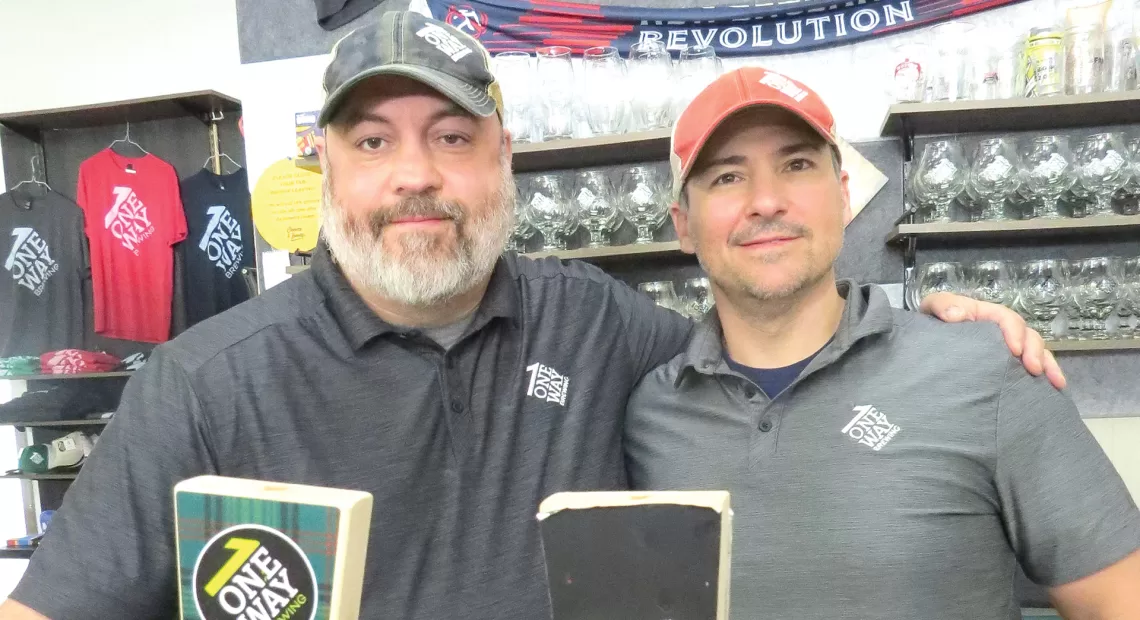
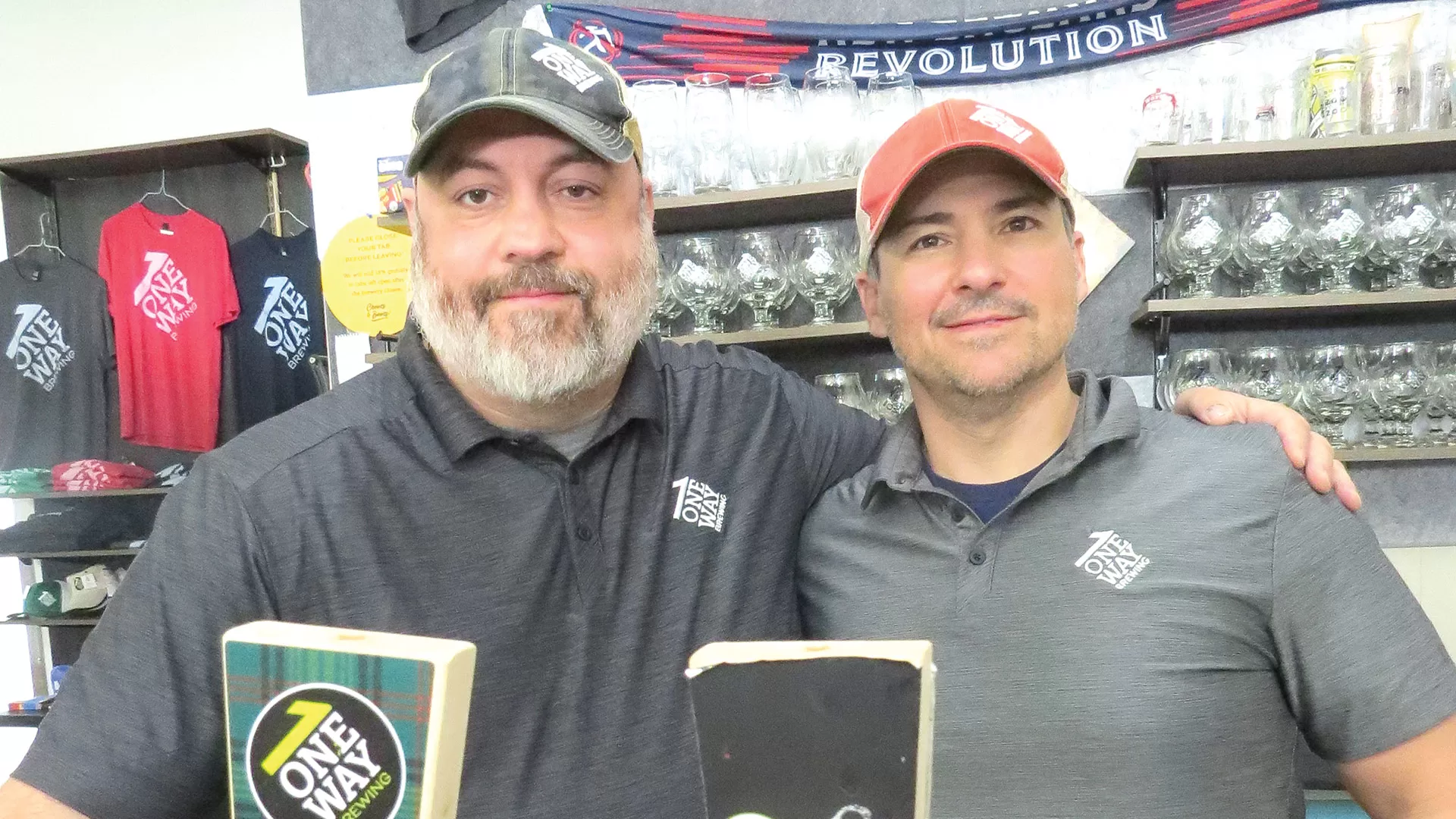
Zach Schwartz (left) and Jason Tsitso

Zach Schwartz (left) and Jason Tsitso have One Way Brewing on the fast track to continued growth.


As with every brewery operation in Western Mass., there’s a story behind the name of this venture, one Jason Tsitso has told many times.

It harkens back to the days when he was a motocross racer, he said, adding that one of his good friends at the time worked for Ryder truck rentals. Tsitso said he and another friend would often help out at the Ryder facility, and one day he discovered his bike covered with the ‘one-way’ stickers that were affixed to the company’s vehicles.

“The next day, I was racing in a moto, and I was doing well, and the announcer said, ‘296 from One Way Racing,’” he went on, adding that, soon thereafter, he actually created a racing team with that name, complete with jerseys and other apparel with a ‘one-way’ logo.

And when he started home brewing with one of those friends from his racing days, they started tossing around ideas for a name and settled on something from the past. And it has stuck.

But there are other meanings behind this brand that Tsitso has established and grown with partner Zach Schwartz.

“There’s only one way to brew beer, and that’s fresh and local,” he told BusinessWest, adding that this way has helped give their brand a following, one that has enabled it to become one of the many emerging craft-beer labels in the 413 and a developing success story.

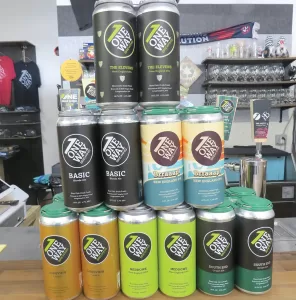
The two partners now have a taproom on Maple Street in Longmeadow, across from the plaza that was destroyed by fire just after they opened (more on that later), and a growing portfolio of craft beers, a few of them with racing-related names, such as Brraaap! (that’s the sound motorcycles make when their drivers hit the throttle), a New England IPA; and Kick Starter, another New England IPA, with which the partners got things started.

But there’s also the Betty, a Scottish export ale, One Rustic Cranberry Stout (no explanation needed for that one), One Hard Lime Seltzer (ditto), and others.

“Home brewers will come in and ask, ‘what’s your favorite? It’s very hard to be objective when all of these beers are your babies.”

The business plan is rather simple and direct, Schwartz said — to continue developing more of these beers and continue building on the solid foundation they’re created.

For Tsitso, vice president of Operations for a commercial construction company, and Schwartz, owner of Manchester, Conn.-based Fusion Cross Media, a printing company, this is still a part-time pursuit, or “passion,” as they call it, but one that is absorbing ever-larger amounts of the time not spent at their day jobs.

“This is more of our passion project,” said Tsitso, who also takes the title of head brewer. “Zack and I both like to build things, and this was our project when we started out. We wanted to see where we could take it and build it from grassroots; we expand as we have the bandwidth to do so.”

For this issue and its focus on breweries, BusinessWest takes an in-depth look at One Way Brewing and how its fast start has it on track for a high-octane brand of success in this sector where there’s friendly competition — or, as Tsitso described it, a “community” where customers are shared.


Lager Than Life

As he and Tsitso talked one recent Saturday morning about One Way Brewing, the route traveled to date, and where the road might take them from here, Schwartz first went about describing what they’ve created on Maple Street, and how it is different from a bar.

One Way’s portfolio of craft beers

One Way’s portfolio of craft beers continues to grow and now includes a wide spectrum of offerings.

“At a bar, you eat food, you have a drink, and maybe you watch TV,” he told BusinessWest. “Here at the brewery, Jason and I talk business with you. I don’t want to say that we’re entertaining, but we are engaged. And people are always asking questions — ‘how did you come up with that?’ and ‘what are your ingredients?’ or ‘what malts did you use?’

“Home brewers will come in and ask, ‘what’s your favorite?’” he went on. “It’s very hard to be objective when all of these beers are your babies.”

And that’s essentially how this venture started — two guys, Tsitso and Schwartz, talking about brewing, then doing it, and never stopping when it comes to asking questions, perfecting their craft, and creating more of these ‘babies.’

Elaborating, the two partners said they’ve known each other a long time and that their daughters hung out together. They both developed a thirst for craft beer — Tsitso has always had one, and Schwartz’s developed over time.

“I would say we got him into craft beer four ounces at a time,” Tsitso said of Schwartz, adding that they and other friends would do a lot of tasting over the years, activity that would eventually lead them down that stimulating but challenging path that would take them from tasters to brewers.

“We got tired of waiting in line,” Tsitso said with a laugh, adding that, rather than queuing up for other brewers’ offerings (although they still did some of that, too), they decided to brew their own.

They started attending brew fests, which back then drew both professional and home brewers, and found themselves often mistaken for the former.

“At our first brew fest, we had a logo, we had a brand, we looked like pro brewers,” Schwartz recalled. “We were at a beer fest in Vermont, and people kept asking, ‘where’s your brewery? We want to check out your brewery.’ And we said, ‘we brew out of our garage.’

“And at every brew fest after that, people would enjoy and ask the same thing — ‘where’s your brewery?’” he went on, noting that with those comments as inspiration — and as the pandemic forced brew fests to take a lengthy pause — they eventually went about creating one.

They began with cans and eventually opened their taproom after COVID restrictions were fully lifted in the spring of 2021.

As for beers, they started with … Kick Starter, a beer that would in many ways set the tone for this venture.

“It came about as West Coast IPAs were really popular and New Englands were just getting started,” Tsitso recalled. “Our whole concept with that beer was to create something that was really approachable for non-IPA drinkers, was well-balanced, and really got them into enjoying IPAs and broadening their beer drinking.”


Draught Choice

This same thought process has gone into subsequent additions to the portfolio, including Brraaap!, which was created to mark the two-year anniversary of the opening of the taproom; One Hard Lime Seltzer; One Rustic Cranberry Stout; and Spilled Milk Mango, a mango milkshake IPA and another popular seller.

While Tsitso is the head brewer and recipe developer, the two will work together on potential additions to the roster, looking at what might be missing from the lineup and what the next logical new label should be.

The same is essentially true of the broad business plan, said the partners, adding that the goal is sustainable growth and building on the solid base they’ve created.

“One thing we’ve always tried to do is not overextend ourselves and get to the point where we can’t manage it, either from the stress level or it just doesn’t become fun anymore,” Tsitso said. “As we get the bandwidth to expand, we expand.”

Possible avenues for expansion include a larger footprint in the plaza where they’re currently operating, and enhanced distribution, with most of it coming currently at the taproom, with beers on tap in only a few area restaurants.

Moving forward, the partners say they’re looking forward to operating with the nearby shopping plaza rebuilt. Former anchor Armata’s grocery store will not be part of the new mix, as it was destroyed by fire just a few months after they opened in the spring of 2021, but they could already see that it helped drive traffic to their business, and they long for the day when that busy intersection can turn back the clock and become a true destination.

“We’re excited that they’re rebuilding across the street, because that will really enhance traffic,” said Schwartz, adding that the taproom has a solid working relationship with a pizza shop next door and other businesses at that intersection.

Meanwhile, the partners are already drawing visitors from Longmeadow, East Longmeadow, Springfield, Enfield, and well beyond, he went on, noting that craft-beer enthusiasts travel well and are willing to put some miles on the odometer to experience something new and different.

Still, the taproom’s bread and butter is a cadre of regulars who come, as Schwartz noted earlier, not simply to drink beer, but to talk beer and experience beer.

“In the beginning, we bartended Thursday and Friday nights; we alternated every week,” he went on. “And those regulars … we developed relationships with them, talked beer with them, and shared our passion and dream with them. A lot of them come here to drink beer and visit — it’s that kind of atmosphere here.”

All this has made One Way not just a business, although it is certainly that, but also a passion, one that has taken the high road to success and is certainly revved up about what might come next.

Community Spotlight

Community Spotlight

Chris Dunne

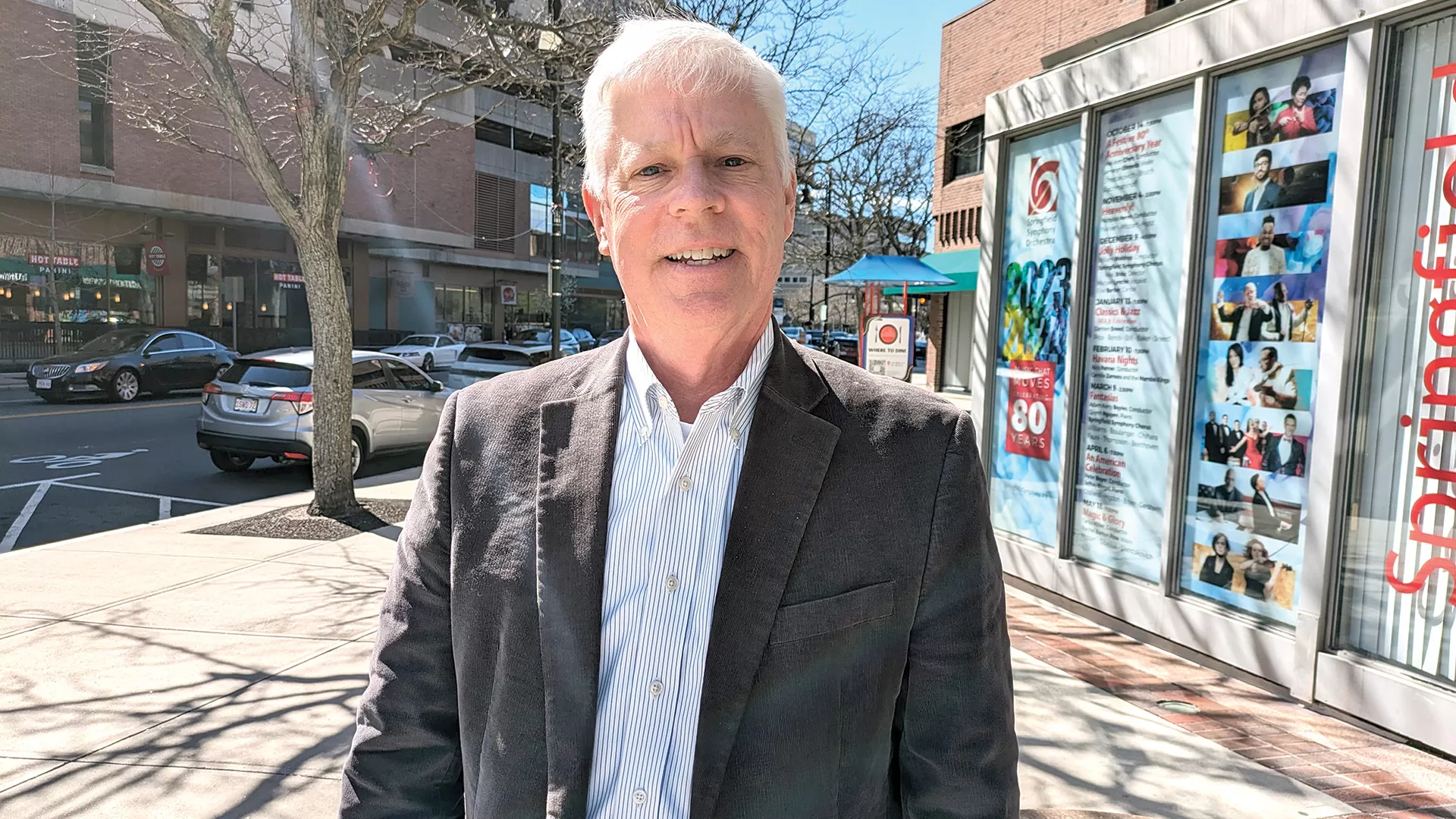
Chris Dunne says one of the town’s priorities is to create more housing.


‘Diverse.’

That’s the one word Jessye Deane kept coming back to as she talked about Deerfield and its business community.

And with good reason.

Indeed, while this community of just over 5,000 is home to Yankee Candle Village, Historic Deerfield, the Magic Wings Butterfly Conservatory, and other tourist attractions, its economy is quite broad, covering sectors ranging from agriculture to craft brewing (which doubles as a tourist attraction, as we’ll see); manufacturing to retail; restaurants to the arts.

They all come together in a picturesque community that is a true destination, said Deane, executive director of the Franklin County Chamber of Commerce, which also calls Deerfield home. And this diversity is certainly an asset, she added, especially as manufacturing declines in many other communities.

“This diversity is the real strength of the economy of Deerfield,” she told BusinessWest, noting that, while large employers like Yankee Candle are always important, the backbone of the community’s economy is small businesses.

And, as noted, they cover all sectors, from restaurants like Leo’s Table in the community’s small but vibrant downtown to Ames Electrical Consulting, a growing business, soon to move to Greenfield, that specializes in helping manufacturers and even municipalities with efforts to automate facilities and processes.

That list also includes manufacturers like Worthington Assembly, which has become noteworthy not only for the circuit boards it produces for a wide range of clients but for a decidedly different culture, one it describes as ‘humanizing manufacturing’.

The obvious goal moving forward is to continue adding more pieces to this diverse business puzzle, said Chris Dunne, Deerfield’s Planning & Economic Development coordinator, while also making the town even more livable and, well, simply providing more places to live.

Indeed, like most other communities in this region — although not all those in Franklin County, where population loss is a pressing issue  — Deerfield needs more housing, said Dunne, adding that creating more is part of a larger effort to repurpose land and property in what he called the town campus.

“Approximately 45% of Deerfield residents are over age 55, so there is a definite need for senior housing.”

This is a collection of buildings, many of them currently or soon to be town-owned, including the current Town Hall, two churches, and a former elementary school, some of which could likely be converted to senior housing, said Denise Mason, chair of the town’s Planning Board, adding that there is real need in this category, and if it is met, other homes could become available to younger families.

“Approximately 45% of Deerfield residents are over age 55, so there is a definite need for senior housing,” Mason said. “And there is a housing issue across our region, and especially in Deerfield. We’re hoping that by building senior housing — and we’re looking to add approximately 32 units — that would free up some of the other homes, because we do have some older seniors who would like to downsize, but they have no place to move to.”

For this, the latest installment of its Community Spotlight series, BusinessWest turns the lens on Deerfield, where an increasingly vibrant community and ever-changing destination comes into focus.


Developing Stories

They are referred to as the ‘1821 Building’ and the ‘1888 Building,’ respectively, because that’s when they opened their doors.

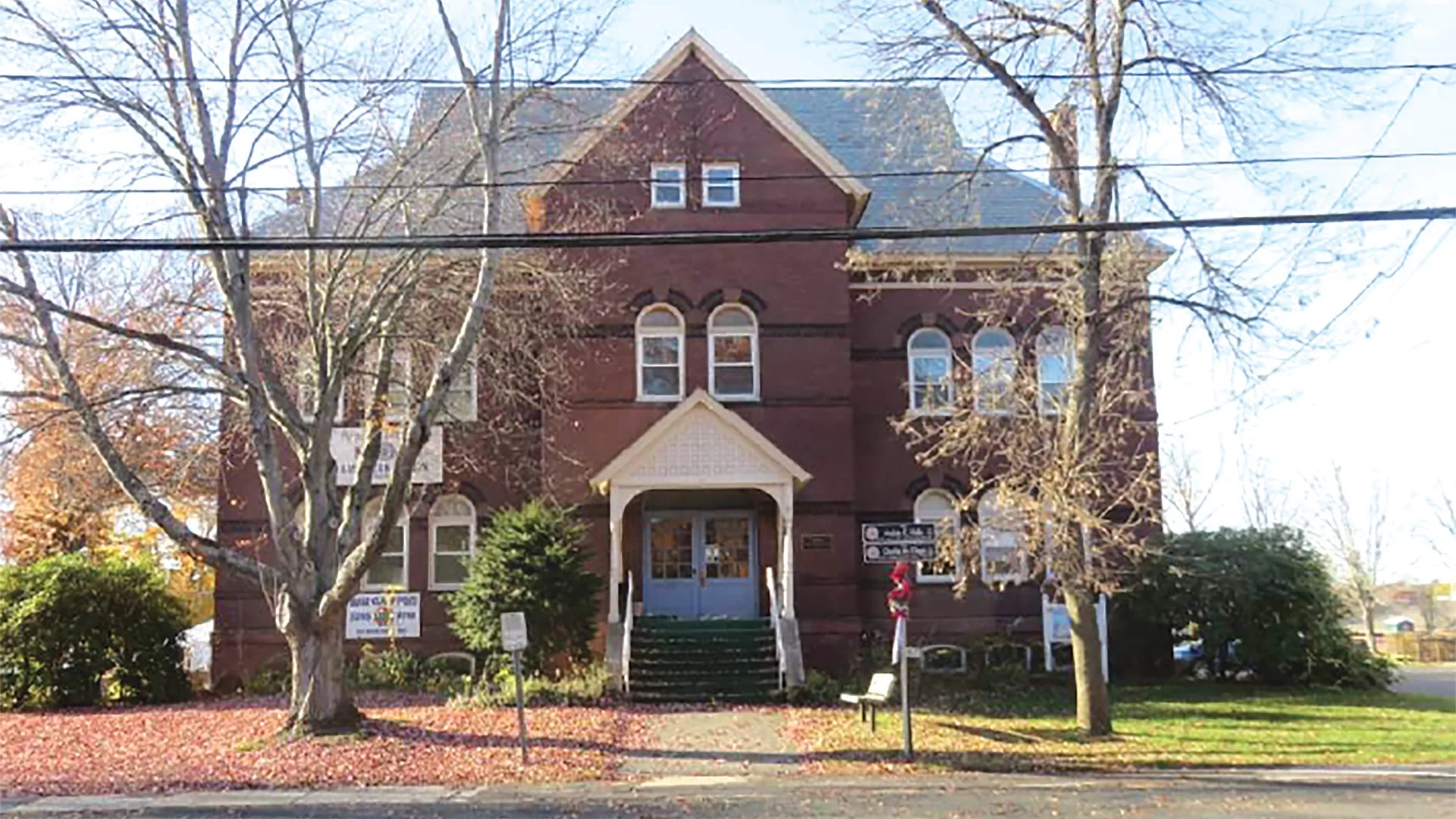
The former is a long-closed church, and the latter is the aforementioned former elementary school that, with the help of a $4 million federal earmark, is being eyed as a replacement for the current town offices, built in the ’50s and now outdated and energy-inefficient.

Wade Bassett

Wade Bassett says Yankee Candle is one of many intriguing draws that have helped transform Deerfield into a true destination.

Transformation of those two historic properties tops the list of municipal initiatives in Deerfield, Dunne and Mason said.

And if town offices can be moved to the renovated school, new uses, perhaps senior housing, could be found for the current Town Hall, which, as noted, is an aging, inefficient structure.

These properties and others sit on what is called the campus, a slice of land, most of it town-owned, between North Main Street and Conway Street that includes several structures, including Town Hall, the 1821 and 1888 buildings, the town’s senior center, a ballfield, and a second church, St. James Roman Catholic Church, and its rectory, which the town may acquire with an eye toward preservation and reuse, perhaps for more senior housing, said Mason, adding that a request for proposals will soon be issued for that property.

As noted, there is real need for this type of housing, said Mason, noting that, if it is created, homes will come on the market, opening the door for more families to move to the community.

Meanwhile, new senior housing on the campus and more young families would provide a boost for the nearby downtown, said Dunne, adding that, while that area is vibrant, there are some ‘infill projects,’ as he called them, to contend with, including a long-vacant Cumberland Farms (a new, much larger one was opened on Route 5).

Other initiatives include ongoing development of a municipal parking lot with EV chargers, one complete with a large amount of green space to counter all the paved surfaces downtown — and a Complete Streets project that include improvements to sidewalks and adding a tree belt to downtown streets.

While there’s a concerted effort to create more housing inventory for those who want to live in Deerfield, there’s already a deep portfolio of attractions for those who want to visit.

“Tree House is driving a lot of traffic to this area, with their beer and with their concerts.”

Yankee Candle has long been the mainstay, and it continues to evolve in this anchor role, said Wade Bassett, director of Sales and Operations at Yankee Candle Village.

But the tourist sector, like the overall economy, is diverse, boasting everything from butterflies to history lessons at Historic Deerfield to the latest draw — craft beer and accompanying events, especially at Tree House Brewery, now occupying the large campus that was once home to publisher Channing Bete.

That campus incudes a concert venue that brings thousands of people to Deerfield for shows, said Dunne, adding that the brewery is working with town officials to increase the limit for attendance so it can bring larger acts to that campus and thus increase the ripple effect.

19th-century building

This 19th-century building is among the properties in the town ‘campus’ being eyed for renovation.

And that effect is already considerable, said Jen Howard, owner of Leo’s Table, a breakfast and lunch restaurant on North Main Street, named after her grandfather, who owned and operated a similar establishment in Fitchburg after returning from military service.

Howard said she explains the name on a regular basis, adding that many guests will ask her male kitchen employee if he is Leo.

Those guests run the gamut, she said, noting that there is a solid core of locals, many of them senior citizens, but many diners are coming on their way to attractions like Yankee Candle, the butterfly conservatory, and, increasingly, Tree House.

“We even see some from the parking lot — people charging their vehicles will come in,” she told BusinessWest, adding that a much larger boost comes from the tourist attractions, which fuel many other hospitality-related businesses.


Staying Power

At Yankee Candle, they call it the “golden key.”

That’s the name of a long-standing program, a tradition, really, at the company, whereby one family, or an individual guest, is chosen to receive an actual, and quite large, golden key, which they are required to wear, and which entitles them to enjoy all the many experiences at the Village for free.

Deerfield at a Glance

Year Incorporated: 1677
Population: 5,090
Area: 33.4 square miles
County: Franklin
Residential Tax Rate: $13.85
Commercial Tax Rate: $13.85
Median Household Income: $74,853
Median Family Income: $83,859
Type of Government: Open Town Meeting
Largest Employers: Yankee Candle Co., Pelican Products Inc.
* Latest information available

“They can enjoy Wax Works, they can fill a candy jar, they can get some ice cream at Ben & Jerry’s — it gives a next-level experience to the guest,” said Bassett, adding quickly that the program was designed to engage not only guests, but employees at the Village as well. Indeed, each day a different team member is assigned the task of deciding who, if anyone, is worthy of the golden key, which is awarded for many good reasons, from a 100th birthday to a wedding anniversary to marking one’s final round of chemotherapy.

“Recently, we had two people get engaged in our Black Forest, and one of our employees came back and said, ‘we just had an engagement in our store — why don’t we give them the golden key?” Bassett went on, adding that the program is just one way the Village strives to heighten what is still in most respects a retail experience and take it to the next level.

That level has been raised continuously over the more than 30 years that the Village has been operating, he said, adding that the facility, which is in seemingly constant motion and changing with the holidays and seasons — Easter and April school vacation are next on the schedule, and programs are already being developed — is now part of a broad effort to make Deerfield and all of Franklin County a true destination.

Indeed, like others we spoke with, Bassett said Deerfield has become a regional tourism hub, with a variety of attractions that can broaden a visit from a few hours to an entire day — or even longer.

Tree House has been an important addition to the mix, he told BusinessWest, adding that it is part of a craft-beer trail, if you will, along with Berkshire Brewing nearby in the center of Deerfield. But Tree House has become a much bigger draw with its concerts and other types of events.

“Tree House is driving a lot of traffic to this area, with their beer and with their concerts,” Bassett said, adding that this traffic is finding its way to different stops in the area, including Yankee Candle.

Deane agreed, and said that the goal in Deerfield, and across Franklin County, is to simply “extend the stay.” Elaborating, she said the community has Yankee Candle to bring visitors in, but it also has Tree House, Berkshire Brewing, Historic Deerfield, and other attractions to keep them there for an extended stay — and bring them back again.


Banking and Financial Services

Branching Out — Again

Matt Sosik

Matt Sosik says Hometown’s latest acquisition is part of an ongoing initiative to gain needed size and extend the institution’s footprint.


Matt Sosik referred to it as a “mutual admiration society.”

That’s how he chose to describe the respect that he developed for the manner in which Kevin Tierney had grown North Shore Bank into a force in that region of the Commonwealth and, likewise, how Tierney respected what Sosik had done with Easthampton-based Hometown Financial Group, using acquisition and organic growth to transform it into a $4.7 billion multi-bank holding company with a reach that extends across Western and Central Mass., the South Shore, and into Northeastern Conn.

This mutual admiration eventually became the catalyst for talks to bring the institutions together, said Sosik, chairman and CEO of Hometown Financial, adding that North Shore will become part of the Hometown family of banks through a merger of Abington Bank, acquired by Hometown in 2019, into North Shore.

The combined bank will have more than $3 billion in assets and 25 full-service retail locations across the Bay State’s North and South Shore regions and Southern New Hampshire. Meanwhile, Hometown will become, with more than $6 billion in assets, one of the largest mutual banks in the country, said Sosik, adding that the merger gives the group more of what banks need in this challenging day and age — size.

“Margins have been falling steadily, and the only way to beat that back and try to win that battle is drive down costs, at least on the average.”

Indeed, when asked what greater size — $6.4 billion in assets compared to $4.7 billion — provides, Sosik started by saying simply, “survival.”

“Margins have been falling steadily, and the only way to beat that back and try to win that battle is drive down costs, at least on the average,” he explained. “So scale is the way to achieve that; when you put more assets under one roof and achieve more efficiencies, you’re driving down per-asset costs, and that’s what this business model tries to attain.

“We want to use that $6.5 billion chassis that’s headquartered in Easthampton to run the back offices of all of our three subsidiary banks,” he went on, listing bankESB, bankHometown in Central Mass., and the soon-to-be-much-larger North Shore Bank. “We can liberate those banks to do what they do best, which is use the power of their local brand in their communities they’re serving and let the shared service model of the holding company do the grungy stuff to produce efficiencies.”

That business model he mentioned has been an aggressive course of acquisitions that makes sense on every level, but especially those involving new opportunities for achieving growth and diversity when it comes to markets and regional vibrancy.

For this issue and its focus on banking & financial services, we take an in-depth look at the latest of these acquisitions for Hometown Financial and what it means for the institution moving forward.


Another Transaction of Note

As he talked about Hometown’s latest expansion effort, Sosik broke it down into two parts, essentially.

The first is the merger of North Shore into Hometown Financial Group, and then the merger of two of its subsidiary banks, North Shore and Abington, under the North Shore banner — although the Abington name will live on.

Putting those two institutions together under one roof, if you will, gives Hometown a dynamic presence in the eastern part of the state, which, like Western Mass. — and all corners of the state, for that matter — is a highly competitive region charactized by a strong mix of local, regional, and national banks, Sosik said.

Elaborating, he noted that the joining of Abington and North Shore brings a number of benefits, everything from resolution of succession issues at Abington — long-time President and CEO Andrew Raczka is entering retirement — to needed size and scale for North Shore.

“For North Shore, this makes a lot of sense strategically because they’re going to expand their footprint around Boston, gain market share … all the important things,” Sosik told BusinessWest. “But they’re also sliding underneath this $6.5 million company. They’re going to get to run their bank, and yet they can have their cake and eat it too in the sense that they’ll have access to our shared services and gain the efficiences of a much larger company. The benefits are the same for us — ensuring long-term viability and relevance in a very slim-margin industry.”

Rewinding the tape, Sosik said the talks between him and Tierney began just over a year ago and accelerated over the past few months. The merger was announced early last month, and the transaction is anticipated to close in the second half of this year.

It is the latest of seven strategic mergers for Hometown Financial Group over the past nine years, an aggressive pattern of acquisition that has taken the institition well beyond the 413. Indeed, its reach now extends across most of the state into neighboring Connecticut and New Hampshire.

Recounting those acquisitions, Sosik said they started in June 2015, when Citizens National Bancorp and its subsidiary, Citizens National Bank, merged into bankESB, which was operating at the time under the name Easthampton Savings Bank. In April 2016, Hometown Community Bancorp and its subsidiary, Hometown Community Bank, joined Hometown Financial Group to become the second subsidiary of the holding company; Hometown Community Bank has since changed its name to bankHometown. And in January 2019, Pilgrim Bancorp and its subsidiary, Pilgrim Bank, joined Hometown Financial Group.

Later that year, Abington Bank merged into Pilgrim Bank, with the name of the combined bank changed to Abington Bank, and Millbury Savings Bank merged into bankHometown. In October 2022, Randolph Bancorp and its subsidiary, Envision Bank, merged into Abington Bank, and last month, North Shore Bancorp and its subsidiary, North Shore Bank, announced plans to merge with Abington Bank; at transaction closing, Abington Bank will operate as a division of North Shore Bank.


Moves of Interest

This latest merger transforms North Shore into a $3.1 billion powerhouse, one of the largest mutuals in that part of the state, with reach across Eastern Mass., where, again, there are many competitors, size is an all-important asset, and meaningful, organic growth is far more attainable than it is Western Mass., which is typically described as a slow- or no-growth area.

“It’s a very competitive market, but also a very vibrant market,” said Sosik. “When you look at our demographics in the Pioneer Valley, they’re not very impressive; we love that market, and it’s very stable, but it’s not high-growth.

“It’s different in the eastern part of the state,” he went on. “In spite of the depth of the competition, it’s still a great market to be in; there are opportunites for growth.”

From a bigger-picture perspective, this latest merger provides an opportunity to take the stability of Western Mass. and juxtapose it against the “higher highs and lower lows” that define the far more dynamic eastern part of the state, he continued, adding that this diversity of regions and markets is another solid asset for Hometown Financial Group.

It’s an asset most other banks in the region are seeking as well, he said, noting that several banks in Western Mass. are pushing into Connecticut and other regions, and some Connecticut-based banks are moving north.

It’s all a function of gaining access to higher-growth areas and, overall, much-needed size, said Sosik, as he returned once again to the topics of margins — and how they became even smaller in the wake of repeated interest-rate hikes last year — and scale and the importance of attaining it.

“Banks are not built to withstand that kind of pressure,” he said in reference to climbing deposit rates and an inability to increase yields on existing loan portfolios beyond a certain point. “So you’re seeing banks in various degrees of duress becase of that predicament.”

The pace of interest-rate increases has certainly slowed, and rates may even decline somewhat this year, but this will remain a challenging climate for banks of all sizes, he went on, adding that the only course of action is to achieve greater size.

“In a low-margin business of any kind, and banking is certainly right at the top of that list, you have got to grow, or you’re going backward,” he went on. “That’s the nature of the beast. How do you acomplish that growth? We’ve chosen one model, and there are other successful pathways.”

Thus far, this model has chosen to be successful at achieving its various goals — from territorial expansion and regional diversity to much-needed scale.

And Sosik expects this pattern to continue with the acquisition of North Shore Bank.

Franklin County

Blueprinting a Unique Culture

Rafal Dybacki (left) and Neil Scanlon

Rafal Dybacki (left) and Neil Scanlon are focused on continued growth and something they call ‘humanizing manufacturing.’

It’s called “The Pick, Place, Podcast.”

It’s co-produced by Worthington Assembly Inc. (WAi) and a collaborator — and tenant within its space in Deerfield’s industrial park — called CircuitHub, and it’s billed as an electronics show where representatives from the companies, which specialize in circuit-board design and assembly (contract manufacturing), discuss the printed circuit board (PCB) assembly process, offer design tips, and talk to industry guests.

“It’s a unique show — no one else is doing anything quite like this,” WAi principal Neil Scanlon said. “And we have a lot of fun doing it.”

But while proud of their own podcast, Scanlon and Worthington co-owner Rafal Dybacki preferred to talk about a different podcast, called “Uncover the Human,” featuring consultants who talk with guests about … well, how to make the workplace more human.

This has been one of the overriding goals for the two partners since they acquired the company, originally based in Worthington (hence the name) and moved it to Deerfield, and, long story short, they were featured on an episode of “Uncover the Human” just over a year ago.

“It’s a couple of consultants out of Colorado, and they’re trying to find … one way to say it is to peel back the layers and find the good in work and try to make workplaces more human and be not what they are today,” Scanlon said.

“One of our employees is good friends with one of the employees at this consulting company, and they were on a trip together, and our employee was telling her about our culture and how we make decisions. And she kept asking her questions and saying, ‘this doesn’t make any sense,’ and ‘let me try to understand this more.’ She became so fascinated, she said she had to get us on their podcast.”

They told the host what they told BusinessWest — that they take a different approach to hiring and developing employees. It’s an approach hinted at broadly in the headline over the company’s posting on jobsinthevalley.com, which features the two words ‘humanizing manufacturing.’

The two explained what that means.

“We have a flat, decentralized organization,” Scanlon said. “We don’t have supervisors, and everyone works in teams, and the teams work together to deliver quality product to our customers.

“We’re focused on people who are interested in problem solving, learning, and growing,” he went on, adding that part of the team’s culture, as we’ll see, is involving all employees in the work to find people who will make good fits.

Elaborating, Dybacki explained that, after inititial interviews, job candidates will then take what he called a “self-guided tour” of the factory and its various departments, seeing what’s done and asking any questions they might have. By doing this — something that very few, if any, other manufacturers would allow — the applicant gets a sense of not only of the work, but the people he or she will be working alongside.

“We have a flat, decentralized organization. We don’t have supervisors, and everyone works in teams, and the teams work together to deliver quality product to our customers.”

If that candidate is still interested, they begin what Scanlon described as a “three-day working interview,” during which the individual is assigned to work with specific teams. And if they’re still interested, things get taken to the next level — a 30-day working interview.

Overall, this process was blueprinted — there’s that word again — to get the right people on the company’s teams, and a workforce where members are both focused and happy.

For this issue and its focus on Franklin County, BusinessWest talked at length with Scanlon and Dybacki about Worthington Assembly and what’s in their business plan moving forward, but also about humanizing manufacturing and the unique culture they’ve created.


Making It Here

The consultants behind the “Uncover the Human” podcast aren’t the only ones interested in talking with these two entrepreneurs lately.

Indeed, Yvonne Hao, secretary of the state’s Executive Office of Economic Development, got them on the phone late last month as part of a larger effort to assess the climate for small businesses in the Commonwealth, especially those in advanced manufacturing, and better understand their issues and concerns.

Scanlon and Dybacki said they talked about a number of things with her, from the millionaire’s tax and how they feel it penalizes S corporations, like Worthington Assembly, to the gross-receipts tax and how it also it also hamstrings small-business owners. They also talked about the company’s culture, said Dybacki, speculating that Hao may have heard the “Uncover the Human” episode.

Whether she did or not, the call is an indication of how the company and how it operates have gained traction and visibility as it continues to grow and evolve — and mark a half-century of working on the cutting edge of circuit-board contract manufacturing.

Indeed, it was back in 1974 when Tom Quinn, the company’s founder, set up shop in his bedroom and soon developed processes for assembling circuit boards, first for a Boston-based client called Cyborg Inc.

The company moved from Quinn’s bedroom to a small barn in Worthington, where it continued a pattern of steady growth. Quinn and his wife, Barbara, sold the operation to Scanlon and Dybacki in 2008 and, seeking larger quarters, more reliable power, and faster internet, moved it to the industrial park in Deerfield a year later.

There, they’ve continued and enhanced the company’s reputation as a contract manufacturer, amassing a deep portfolio of clients, most of them in New England, in sectors ranging from medical-device manufacturing to industrial controls; from HVAC to segments of the automobile industry.

“We essentially build to a blueprint, much like a machine shop builds to a blueprint,” Scanlon explained. “A customer will come to us with a blueprint, and we will build that product for them precisely as that blueprint states.”

WAi does a considerable amount of work with CircuitHub, a designer of circuit boards for customers around the globe, and ships directly to its clients, Dybacki said.

It is one of the few circuit board assemblers in Western Mass., and a relatively small player in a large and extremely competitive sector, where, in this case, the smaller size is a competitive advantage because it comes with flexibility and the ability to handle the smaller orders that the larger players would not even consider, Scanlon explained.

“We handle things at lower volumes, where it’s too much work to send it off the China because the volume isn’t there, and other competitors simply don’t want to get involved with a $4,000 or $5,000 order,” he said, adding that the company can handle orders of a few dozen of an item to several thousand.


True Grit

WAi has enjoyed steady growth over the past several years, growing its workforce to 35, said Dybacki, adding that the focus has always been on “finding the right person and getting them in the right seat, and making sure they stay here.”

And this is where we return to the company’s culture and that notion of humanizing manufacturing.

Finding the right people is crucial, Scanlon said, because of the custom nature of the work being done.

“We do so many unique assemblies,” he explained. “On a given day, with this team of 35 people, we might be shipping 10 different assemblies that have in some cases never been built by anyone else. In order to do that, you need really good people that have a thorough understanding of how this works.

“You can’t have memorizers, you can’t have button pushers … our people that work here do the same thing over and over again for an hour, and then they move on to something totally different,” he went on. “They need a unique skill set.”

To find the right people — and then keep them — the company has created a comprehensive hiring, training, and onboarding process, one that secures input not only from those doing the interviewing and hiring, but those who will be working alongside the candidate in question.

It begins with that headline over the job placement and accompanying job description — ‘humanizing manufacturing.’

“This catches their eye, and they read about it, and then a lot of times they’ll reach out to us,” Scanlon said. “The type of person you get doesn’t necessarily have the exact skills you’re looking for, but they have the right attitude and a willingness to learn.

Dybacki concurred, adding, “in a lot of cases, that’s more important than having the needed skills.”

That aforementioned process, including the three-day and 30-day working interviews, includes something called a ‘360 form,’ whereby team members are evaluated by colleagues using core values and successful habits. These are listed with accompanying phraseology, so employees know just what they’re looking for, and ‘scores,’ if you will, ranging from ‘excellent’ to ‘average’ to ‘poor.’

These core values and descriptions provide some real insight into the degree to which the company wants people who are good fits, and how everyone at WAi is involved in finding those fits.

Under the core value ‘humility,’ we find “puts the team first; works well with others; open to change; open to learning; check any arrogance at the door; listens to others. No, really listens.”

Under the core value ‘honesty’ (described as “to be candid, straightforward, and fair”) is written, “our ability to be candid with our teammates is essential for our success; we cannot continuously improve if we aren’t talking about opportunities for improvement.”

Other core values and successful habits include ‘have fun,’ ‘contribute,’ ‘work well with everyone,’ and even ‘grit’ — “we need to always stay focused and push through the hard tasks all day, every day without becoming bored or complacent, and take pride in the simple yet at times difficult tasks.”

“Our teammates here will let you know if you have grit, if you’re able to do this work or not,” Scanlon said. “They’ll know just by the sound of the screwdriver.”

Using tools like the 360 form and a rigorous interviewing and onboarding process — which includes listening to that episode of “Uncover the Human” — the company has managed to successfully hire and maintain a workforce when many in manufacturing, and other sectors as well, are struggling to do so.

And much of it comes down to getting everyone at the company involved in this process.

“People here can’t complain about who they’re working with because they helped choose them and they have the ability to put feedback into a person’s 360,” said Scanlon, adding that, overall, these processes have created an environment where everyone is happy with who they’re working with, and they work together to take the company to the next level.

This is a true blueprint for success and a reason why this company is getting some attention — not just for the circuit boards it produces, but for the culture it has created.

Technology

Keep Moving Forward

Peter Reinhart

Peter Reinhart calls the grant “an unprecedented opportunity to build a sustainable innovation engine.”


A team from UMass Amherst recently won a $5.5 million Accelerating Research Translation (ART) award from the National Science Foundation (NSF) to support and expand faculty and student researchers’ efforts to translate research conducted in campus laboratories into tangible solutions to real-world problems.

The UMass team, which includes the Institute for Applied Life Sciences (IALS), the Technology Transfer Office, the Office of Research & Engagement, and the Office of the Provost, is one of only 18 nationwide announced in the program’s inaugural year. It is the only award made in New England, and one of just three in the Northeast.

“NSF endeavors to empower academic institutions to build the pathways and structures needed to speed and scale their research into products and services that benefit the nation,” NSF Director Sethuraman Panchanathan said, adding that the ART program “identifies and champions institutions positioned to expand their research-translation capacity by investing in activities essential to move results to practice.”

UMass Amherst Chancellor Javier Reyes noted that “the resources and nationwide network that this award brings to the campus will open new opportunities for our researchers to make a positive impact on society and will strengthen their ability to contribute to economic development in the region and beyond.”

Provost Mike Malone added that “receiving ART funding from NSF is a vote of confidence in the excellence of campus researchers and the potential for their work to translate into products, spinout ventures, and social enterprises that solve important real-world problems.”

Each ART awardee will benefit from a partnership with a mentoring institution of higher education that already has a robust ecosystem for translational research. The Massachusetts Institute of Technology (MIT) will serve in that role for UMass. As such, the UMass Amherst team will be able to take advantage of MIT’s research-translation prowess to develop individual faculty, postdoctoral fellows, and graduate-student researchers, as well as its knowhow in the development of new startup companies.

“The project will equip diverse groups of scientists and engineers, from undergraduates to senior faculty, with skills to extend research excellence toward impactful translational outcomes.”

Roman Lubynsky, executive director of the New England Regional Innovation Node at MIT, has already begun to work with the UMass team as lead mentor, noting that “the IHE mentor role provides an ideal opportunity for us to build upon and expand our ongoing relationship with UMass Amherst, including facilitating access to and adaptation of best practices from across MIT’s translational enterprise.”


Seeking Impact

The four-year award will fund seed translational research projects, training to prepare postdoctoral fellows and graduate students for careers related to translational research, and a network of ART ambassadors, who will serve as role models, peer mentors, and advocates for societally impactful translational research.

In addition, UMass Amherst’s ART ambassadors will be part of a nationwide network of ART ambassadors from all funded institutions. Diverse, equitable, and inclusive efforts will prioritize and champion the involvement of members of traditionally underrepresented groups in every aspect of the project.

“This award provides the campus with an unprecedented opportunity to build a sustainable innovation engine that will prepare students and faculty to contribute to the innovation economy, shorten timelines between ideation and de-risked technologies, and result in enterprises that include diverse leaders in the development of technologies to address important societal needs,” said Peter Reinhart, founding director of IALS. “The project will equip diverse groups of scientists and engineers, from undergraduates to senior faculty, with skills to extend research excellence toward impactful translational outcomes.”

Reinhart will serve as the grant’s principal investigator. Co-principal investigators include Provost Mike Malone; Burnley Jaklevic, director of the UMass Amherst Technology Transfer Office; and Karen Utgoff, director of IALS Venture Development. Partner organizations include MassVentures, the Berkshire Innovation Center, Massachusetts Biomedical Initiatives, and Somerville-based innovation accelerator FORGE.

According to the National Science Foundation, more than $100 million was awarded to the 18 teams. Each awardee will receive up to $6 million over four years to identify and build upon academic research with the potential for technology transfer and societal and economic impacts, to ensure availability of staff with technology-transfer expertise, and to support the education and training of entrepreneurial faculty and students.

“Congratulations to the IALS team and the UMass Amherst campus on this significant award,” said Jeanne LeClair, vice president of Economic Development & Partnerships for the Massachusetts Life Sciences Center. “The center is incredibly proud of its significant investments in IALS as an anchor institution of our burgeoning Western Massachusetts life-sciences cluster. This award will only further spur innovation, translational research, and entrepreneurship for the region and our Commonwealth.”

Massachusetts Secretary for Economic Development Yvonne Hao added that “this ART award will help to grow the innovation economy in Western Massachusetts. The region has a lot to offer talented people who want to create new businesses, expand them, and to really succeed and thrive here.”


More Successes for IALS

The ART announcement came on the heels of two IALS core facilities receiving sophisticated microscopy instruments — the first such instruments to be located in Western Mass. — through grants totaling more than $3.2 million from the Massachusetts Life Sciences Center (MLSC).

The UMass Amherst grants are included in a funding package of more than $30.5 million to support life-sciences innovation, workforce, and STEM education across Massachusetts.

The first award of $1,655,774 will fund the IALS Electron Microscope facility’s purchase of a cryo-transmission electron microscope, technology that the microscopy facility did not possess, and which will be the first to be located in Western Mass., according to facility director Alexander Ribbe.

The second award, $1,555,276, will allow the Light Microscopy facility, under the direction of James Chambers, to purchase technology that was missing from its imaging portfolio, expanding light microscopy offerings for biomedical training and research at UMass Amherst and beyond.

Banking and Financial Services Special Coverage

Community Interest

Mary McGovern, incoming president of Country Bank.

Mary McGovern, incoming president of Country Bank.


When asked why Country Bank supports local nonprofits, incoming President Mary McGovern gave a simple answer. “It’s a way for us to make a difference in our community.”

Then she elaborated.

“We have a tagline we adopted two years ago, ‘made to make a difference.’ We feel that encapsulates what Country Bank is all about, trying to make a difference in our community. It’s something we’ve done over the history of Country Bank, and we continue to make a positive impact by supporting local nonprofits, specifically the kind that rely on donations from their local businesses to help support them.”

Those efforts have focused in recent years on a number of priorities, she added, including food insecurity, health, education, and financial literacy, as well as homeless shelters, senior-serving programs, youth organizations, and more.

To that end, Country reported more than $1.2 million in donations in 2023, with 463 organizations receiving grants. One highlight last year was a partnership with (and $30,000 donation to) the Wonderfund, which aims to improve the lives of individuals in the Department of Children and Families system.

That large number of supported nonprofits resonates with Matt Bannister, senior vice president of Marketing and Corporate Responsibility at PeoplesBank, who was named a 2024 Difference Maker by BusinessWest last month for his extensive role in the bank’s community-support efforts. PeoplesBank recorded $1.6 million in donations last year to more than 550 area nonprofits, making the average grant just under $3,000.

“We continue to make a positive impact by supporting local nonprofits, specifically the kind that rely on donations from their local businesses to help support them.”

“We give a little to a lot of groups. We don’t tend to do large capital campaigns,” he said. “One big ‘yes’ often means a lot of little ‘no’s.’ So many nonprofits out there are doing good work, so it feels wrong to say ‘no’ to people.”

So, outside of a few big splashes — like a major donation to help the Food Bank of Western Massachusetts build its new headquarters — spreading the wealth around is a guideline the bank tends to stick with.

“The overall philosophy for our funding is we want to level the playing field — give opportunities to those who are disadvantaged and need more help,” Bannister added. “We have funding areas — food insecurity, housing, economic development, etc. — and the overarching principle of all these funding areas is to level the playing field.”

Many area institutions share their donation figures each year; Pittsfield Cooperative Bank donates nearly $200,000 — a striking number, considering it boasts around $385 million in total assets — through its charitable contributions to regional scholarships, youth mentorship programs, and nonprofit, economic-development, and health and human-service organizations.

Meanwhile, the Liberty Bank Foundation granted $1,453,742 to local nonprofits in 2023, including $10,000 as an annual ‘holiday gift’ from the bank, with the recipient chosen by bank customers. And Greenfield Savings Bank (GSB) gave more than $1 million in 2023 to more than 300 organizations.

Peter Albero, GSB’s chief financial officer and treasurer, noted that, while profits have been challenged over the past couple years by rising interest rates, the bank has not cut back on its financial support in the community, or its level of employee volunteerism.

Freedom Credit Union President Glenn Welch (right) presents a check to John Beaulieu

Freedom Credit Union President Glenn Welch (right) presents a check to John Beaulieu, president of the Westover Galaxy Community Council, one of the recipients of Freedom’s Month of Giving campaign.

“Profitability may be reduced, but we have not reduced our commitment to our communities. I think we are a pillar of Greenfield and the broader community,” Albero said. “So we continue to reinvest in the community, and everyone benefits from that.”

A.J. Bresciano, first vice president and commercial loan officer at GSB, agreed.

“Even in a higher-interest-rate environment, we’re taking measures to ensure our impact in the community is not being impacted and not deteriorating. So many local organizations throughout the Pioneer Valley rely on contributions of time, talent, and treasure. We make supporting those organizations a priority at Greenfield Savings Bank, and we want our team members to invest going forward.”


Philanthropic Priorities

Bannister made it clear that banks are required, to some degree, to be involved in their communities in a charitable way, noting that bank examiners make sure a bank’s locations and loan activities are representative of where it does business — meaning not just serving and lending to those with high incomes or profits — and they also ask how the institution gives back to the community.

“The challenge with that is there’s no right answer. We just have to go to the examiners each year and say, ‘here’s what we did.’ And when we give, we make sure a substantial amount that we give away benefits LMI — lower- to middle-income communities.”

Area banks and credit unions have increasingly inspired employees and customers to involved in giving efforts as well. In 2023, Freedom Credit Union contributed $181,898 to more than 70 charitable organizations throughout the four counties of Western Mass.

Of that, corporate charitable giving accounted for $130,432, but throughout the year, Freedom also conducts Month of Giving campaigns, in which customers can support a specific organization each month; those programs raised $17,316 in 2023. And local branch and department giving contributed an additional $34,150 to local charities.

“Our members and staff are passionate about supporting the community where we live, work, and serve,” Freedom Credit Union President Glenn Welch said. “In 2023, we were proud to donate funds for a wide variety of deserving institutions.”

“We give a little to a lot of groups. We don’t tend to do large capital campaigns. One big ‘yes’ often means a lot of little ‘no’s.’ So many nonprofits out there are doing good work, so it feels wrong to say ‘no’ to people.”

Other institutions take customer involvement to the polls. Both Florence Bank and Monson Savings Bank boast popular programs — called the Customers’ Choice Community Grants Program and the Community Giving Initiative, respectively — that complement other bank philanthropy by letting customers vote for nonprofits to support.

Through that initiative, Florence Bank awarded $150,000 to 46 area nonprofits in 2023, the 21st year of the program; the higher-than-usual total commemorated the bank’s 150 years in business.

“It’s amazing to see so many community organizations being recognized, and the fact that the recognition comes from Florence Bank customers in the form of votes is really special,” President and CEO Matt Garrity said.

Meanwhile, in the 14th year of its community-giving program, Monson Savings Bank awarded a total of $15,000 to the 10 top vote-getting nonprofits.

PeoplesBank employees volunteers

A team of PeoplesBank employees volunteers at Kent Memorial Library in Kent, Conn.

“Everyone’s passion for our annual Community Giving Initiative is always so exciting,” said Michael Rouette, the bank’s executive vice president and chief operating officer. “As a locally operated bank, Monson Savings has a great desire to support the residents, businesses, and nonprofits of the communities that we work in and live in.”

President and CEO Dan Moriarty added that “these organizations are worthy nonprofits that supply important resources to our communities. It is clear why they were chosen by our community members to receive support from Monson Savings.”


More Than Money

But community banks and credit unions in Western Mass. aren’t just giving money; many also emphasize a culture of volunteerism, even providing time for their employees to get involved in the community.

For example, employees at UMassFive College Federal Credit Union raised more than $18,000 for two local nonprofits last fall — $13,677 for the UMass Cancer Center via participation in the UMass Cancer Walk and Run, and $4,800 for the Food Bank of Western Massachusetts via participation in Will Bike 4 Food.

A supporter of the UMass Cancer Walk and Run for more than 20 years — during which time it has raised more than $186,600 for the cause — UMassFive employees join together annually as Team UMassFive to raise funds, both personally and in branch locations. In 2023, fundraising efforts included raffle baskets, bake sales, candy sales, and art and jewelry sales, and the credit union’s corporate partners also pitched in.

Will Bike 4 Food is a more recent priority at UMassFive, as employees have taken part since 2020, raising a total of $17,500 in just four years, which equates to providing 70,332 meals to neighbors in need.

“We are so proud of our employees for supporting local causes that they care about,” said Cait Murray, Community Outreach manager at UMassFive. “Together, our team can make a more significant impact than if we all participate in events on our own. These organizations make such a big difference in our communities, and we are thrilled to support those efforts.”

Country Bank reported that its team members volunteered 1,255 hours of community service in 2023, while 37 team members served on 65 nonprofit boards and committees.

“Oftentimes, we can supplement or replace a monetary donation with volunteers, whether it’s picking vegetables at a local farm to be donated out, or helping nonprofits clean up the facility, or doing outdoor work like volunteering with Habitat for Humanity,” McGovern said. “We’re still putting the bank’s dollars to work, but the hands of our employees are helping to sustain some of these nonprofits as well.”

Liberty Bank reported 13,721 employee volunteer hours, including nearly 170 hours at Connecticut Foodshare, the aforementioned recipient of the bank’s holiday gift in 2023. The bank also actively solicits nonprofits to share information on what types of volunteer help is needed — whether working on a project or serving on a board or committee — and aims to meet those requests.

At PeoplesBank, employee volunteerism is considered part of the bank’s culture, Bannister said — part of its DNA, in fact, and something made clear to job applicants.

“We report volunteer hours to the bank examiners, and we were third in the state last year in hours volunteered per employee. It’s something that’s expected, and it’s something that builds camaraderie,” he said.

And it’s something that community banks simply should do.

“We’re more engaged in the community, where national banks are not known for that as much,” Bannister told BusinessWest. “And we consider it a competitive advantage. When you’re choosing a bank, hopefully the bank’s values are something you consider, and hopefully that volunteerism reflects well on the brand.”


Commercial Real Estate Special Coverage

A Visionary Approach

The Mill Town Capital team atop Bousquet Mountain Ski Area.

The Mill Town Capital team atop Bousquet Mountain Ski Area.


Real-estate development can be a profitable business. In fact, it’s safe to say that’s the key driver for most players in this sector.

For the team at Mill Town Capital, it’s about impact — on more than the bottom line.

Formed in 2016 and based in Pittsfield, Mill Town is an “impact investment platform,” said Tim Burke, the company’s CEO. “Our overall mission and mandate is to really make the area of Pittsfield and the Berkshires a better place to live through traditional investments, impact investments, and pure philanthropic community work.”

But what is impact investment?

“To us, impact investment means focusing on key assets or amenities or projects that have a high potential positive impact on the region,” he explained. “So it’s a little bit different than maybe a traditional impact investment that might look at energy or other areas of impact. Ours is really place-based in terms of our approach.

“When we think about impact, it’s taking on investments that most traditional investors wouldn’t take on either because the rate of return is lower, or it takes a much longer time to realize it, or they’re just really difficult projects,” he added. “We’re not necessarily restrictive to different sectors or industries. It’s really about, is this project good for the region? Is it good for the local economy? Does it have the chance to spur economic development or other potential investment, and, if so, how can we make it work?”

The company’s first ventures into real estate centered on housing-development projects in Pittsfield.

“Impact investment means focusing on key assets or amenities or projects that have a high potential positive impact on the region.”

“Pittsfield used to be a 60,000-person city, but now has 40,000 people. So you would think that there is enough housing for everyone, but the stock itself is significantly deteriorated,” Burke explained. “You have a lot of really old stock, things that are run down, properties where absentee landlords have a lot of deferred maintenance. And the living conditions in some of these are really tough.”

Since taking what he called a “clustered approach” to housing stock in the area, Mill Town has accumulated more than 200 units of housing in Pittsfield alone, as well as a few commercial buildings and mixed-use properties, with apartments on the upper floors and commercial space on the lower floors.

“So the real-estate approach there has been trying to improve neighborhoods with housing at the forefront, but also supporting small businesses and restaurants where we can.”

Bousquet complex

Tim Burke calls the Bousquet complex “a critical local asset that had fallen on some tough times.”

Public investment has sometimes followed that private investment, Burke said, with the city or state coming in with utility upgrades or streetscape improvements.

“So it’s really a multi-faceted approach, and it certainly has a patient-capital component to it as well, where we’re not looking to get in and monetize things really quickly. We have more of a patient, long-term approach to it.”

On the business-enterprise side of the ledger, Mill Town now owns about a dozen local businesses, either directly or in partnerships.

One example is Bousquet Mountain Ski Area, one of the oldest continuously operating ski areas in the country. “We felt that’s a great example of a critical local asset that had fallen on some tough times and needed a lot of investment,” Burke said. “I don’t think many rational investors would have gone in there with a pure investment business case, but we felt like it was worth saving.”

These enterprise investments tend to be clustered in regional assets in real estate, recreation, and hospitality, such as the Central Downtown Inn & Suites in Pittsfield; Gateways Inn in Lenox; Blueprint Property Group in Pittsfield; Framework, a Pittsfield co-working space; and others — about a dozen in all.

“We’ve been involved in those types of projects for a number of years, some of which are business-oriented projects, and some are philanthropic, that we do through our our 501(c)(3) foundation. That includes things like improvements in Springside Park, which is a large, local park in Pittsfield where we helped reshape and reinvest in trail networks there.”

Tim Burke

Tim Burke

“Is this project good for the region? Is it good for the local economy? Does it have the chance to spur economic development or other potential investment, and, if so, how can we make it work?”

Mill Town has also provided contributions to the Berkshire Natural Resources Council for a project that connects the various trail networks in the Berkshire mountains.

“And then we have two businesses that are in the recreation space,” Burke said. “We own an athletic center that’s called Bousquet Sport, which is across the street from the ski area, where we’re currently undergoing a 15,000-square-foot addition plus renovation to the facility, and that’s an investment in tennis, fitness, and pickleball.”

Then there’s Camp Arrow Wood, where the former Lakeside Christian Camp on Richmond Pond was converted into a new, sleep-away summer sports camp.

“We run three- and six-week summer camp sessions out of that property. That’s another project that we kind of uncovered during the COVID period … and we’ve been building that up over the past year and a half or so.”


Coming Home

Prior to Mill Town, Burke spent a number of years in corporate finance roles with United Technologies and then later with a couple different biotechnology companies, most recently Biogen in Boston’s Kendall Square biotech cluster.

Camp Arrow Wood

Mill Town transformed the former Lakeside Christian Camp on Richmond Pond into Camp Arrow Wood, a new, sleep-away summer sports camp.

But his connection to Pittsfield was strong, having grown up there, and around 2015, he met Dave Mixer, Mill Town’s founder “and really kind of the motor and the initiative and the capital behind everything that we do,” Burke said. “So I ended up meeting with Dave, and he had a general idea of what he wanted to do.”

Mixer, like Burke, is a Berkshire native and had just come back to the area after being away for a long period of time, and he wanted to make an impact, Burke explained.

“His view of making an impact is a little bit non-traditional from a philanthropic standpoint. He didn’t want to just write checks and then walk away. He really wanted to see if he could drive economic development and job growth and population stabilization and new housing and educational improvements — all across the spectrum of economic development and quality of life.

“It’s been a great, challenging, unique run for us over the past six or seven years, and we’re at a point now where, through Mill Town and our businesses, we employ over 300 people in the area. We’re constantly looking to grow and make this engine work and also kind of preach what we’ve learned over the years to other communities and people and investors and philanthropists and see if there are ways we can help other areas progress with what we’ve done in Pittsfield.”

“I think we’re pretty hard on ourselves in that we think we have a ways to go before we achieve the impact that we want to achieve. But it is validating to a certain degree that people see that we’re heading in the right direction.”

Indeed, Burke firmly believes Mill Town has a replicable model, but it’s one that’s still evolving. “We think we’re in the second or third inning of what we’re doing here in Pittsfield.”

And as someone with a lifelong heart for the city, he envisions what a vibrant, thriving Pittsfield can one day be.

“I think it’s a place where people from all aspects of the economic spectrum can find quality housing. They can send their kids to schools and get them a good education. They can find jobs that will allow them to live here productively and raise a family.

“And then we can provide those systems on the periphery that allow people to have a good quality of life here — places where kids have opportunities to have athletic endeavors in camps, places where adults can enjoy the natural assets that the area has,” he went on. “That comes back to trail networks and all the outdoor recreation assets that we have here.”

After all, he added, those are some of the things the Berkshires are most known for.

“Making sure that we can maximize those benefits for the people of Pittsfield is where we want to make a difference,” Burke told BusinessWest. “That involves a lot of different things and broader socioeconomic issues that are much harder to solve, like education and poverty and addiction. But we still should try to get involved in some of those things through partnerships with organizations who have that expertise.”


Moment of Recognition

Last fall, at 1Berkshire’s Celebrate the Berkshires event, Mill Town Capital was recognized as a special honoree for “putting the Berkshires on the map” — an honor that recognized the company’s investments in housing and downtown redevelopment, as well as its philanthropic support around the region.

“When our regional economic-development group recognized Mill Town for the work that we’re doing, it was tremendously gratifying for our team to see that people see the work that we’re doing and that it is having a positive impact,” Burke said. “I think we’re pretty hard on ourselves in that we think we have a ways to go before we achieve the impact that we want to achieve. But it is validating to a certain degree that people see that we’re heading in the right direction.

“That hasn’t always been the case,” he added. “I think when we first started out, there was a lot of skepticism and questioning: ‘what’s the angle?’ ‘What are you trying to accomplish?’ So it was great to see that, at a minimum, people view it as positive-intent work that has the potential to drive change.”

Franklin County Special Coverage

Big Ideas in Small Towns

Lucy Damkoehler has developed a strong following from both within and outside Franklin County for her bakery and cooking classes.

When Lucy Damkoehler returned to Western Mass. after 20 years away, she opened a bakery in a town she knew well — Bernardston, to be exact, with its population of 2,000.

That was in 2018. Today, Sweet Lucy’s Bakeshop is thriving, demonstrating, like many other businesses already have, that it’s possible to succeed in a county whose 26 communities total around 71,000 residents — less than half of Springfield alone.

“It took off right away,” she said. “My prices were competitively high. I knew the cost of food was going up and the cost of labor was going up, so I priced it so I didn’t have to change my prices too often. But people didn’t complain about it, and I felt like it was doing pretty well.”

When COVID shut down much of the world, Damkoehler pivoted to a concept called Take & Bake Meals, which, at its height, was sending 50 to 60 meals out the door each day, which wound up expanding her reach and widening her exposure.

“We were getting people from Connecticut, from New York, discovering us,” she recalled, and those days partly explain why her customer base went from 90% local before 2020 to a ratio today of about 60% repeat customers — who come anywhere from every day to once a month — and 40% travelers checking out the bakery for the first time.

And Damkoehler’s success continues; she used a crowdfunded grant and a bank loan to build an addition, doubling her kitchen space and allowing her to begin offering cooking classes last September. She now employs six full-time bakers and six front-of-house staff, and is looking to hire a chef instructor as well.

“It blows my mind that I’ve only had one class that’s had to cancel due to low enrollment. They usually sell out within a couple of weeks, if not days,” she told BusinessWest. “It shows there’s a major need for that part of the business; there’s nothing like that around here. We’re doing kids’ classes now, too.

“I’m amazed every day that we’re able to do this successfully,” she added, especially in a community of just over 2,100 residents. “The prices are not cheap. But people recognize the value, and they appreciate it, and they’re willing to spend more money on something that’s done right. It doesn’t scare people away.”

So that’s what Damkoehler brought to the table: talent, quality, drive, and the instincts to pivot to what the market needed, which, both during the pandemic and with her classes, generated further opportunities for growth. Meanwhile, other businesses throughout this mostly rural county bring their own differentiators, but they also testify to a supportive, if small, community.

“Business owners here who are thriving have really committed, loyal customers. They have customers who love to come out and spend time there, spend their dollars with them, and they’re focused on providing a really great experience every time someone comes in,” said Hannah Rechtschaffen, director of the Greenfield Business Assoc. (GBA).

“One thing that I hear from some business owners is a sense of community and mutual support,” she added, noting that one of the GBA’s goals is to keep building opportunities for business owners to know each other better, so they can recommend each other.

“I think it’s organizations like ours and like the chamber that are able to listen to business owners and respond and really be another set of hands in their business success. That’s not overrated when you’re wanting to have a brick-and-mortar presence. So I hope businesses will think about opening here; I hope businesses will think about opening a second location here.”

“We were getting people from Connecticut, from New York, discovering us.”

To that end, Rechtschaffen added, “when we’re in conversation with Greenfield Community College about getting an internship program going, or when we’re in conversation with the Franklin County CDC about small-business support and entrepreneurship, all of those relationships are so, so crucial. None of us want to feel like we’re toiling away alone. We want to feel like we’re part of a larger ecosystem.”

Jessye Deane, executive director of the Franklin County Chamber of Commerce and Regional Tourism Council, agreed.

“Partnership and collaboration are the special ingredients in Franklin County. The way our communities come together to support our small businesses, it’s not like anything I’ve seen elsewhere,” she said.

“What I love to see here are thoughtful partnerships and strategies around how to best support business owners in filling in some gaps and resources that some more populated areas have, and how to attract different industries to the area,” she continued, touting, as Rechtschaffen did, the partnership between the chamber and GBA, but also Greenfield Community College, the CDC, and various economic-development entities.

“We want everyone’s business to be as successful as possible and have as many resources as they can tap into to ensure that success,” Deane said. “We wake up every day asking how to best support them.”


Declining Numbers

Such partnerships and mutual support are especially meaningful in a county that, after years of plateauing population, has seen those numbers start to creep downward, especially in the small towns beyond Greenfield and Deerfield.

“Certainly, population decline — or the projection of population decline we see — is a pretty major threat to many rural parts of Massachusetts,” said Linda Dunlavy, executive director of the Franklin Regional Council of Governments. “As Baby Boomers age, we need help, and not attracting young people to our region will be a concern for us. So we’re working on that.

Double Edge Theatre in Ashfield

Double Edge Theatre in Ashfield is just one example of the many cultural offerings in Franklin County.

“But population decline also hurts Franklin County and its rural areas because so many state and federal funding formulas, the distribution of aid money to municipalities, is based on population,” she continued. “So as our population decreases, the amount of money we have for infrastructure improvements, for education, etc., also decreases, which compounds the problem: how do we get people to come to our region if we’re not caring for our infrastructure, our assets, adequately?”

Dunlavy, who was named one of the Difference Makers for 2024 by BusinessWest, has been working for the benefit of Franklin County for decades, so she understands its assets — from arts and culture to outdoor recreation to that supportive business community others mentioned — but she understands the challenges of an aging, shrinking population base, too.

“Because we’re so rural, we have to work together,” she told BusinessWest. “We are a very collaborative region, probably one of the most collaborative regions in Massachusetts, because all the regional organizations are working together. We combine services of municipalities, our businesses work together, and they are served by strong regional support systems. It’s a great region to live in — if you know about us.”

A.J. Bresciano, first vice president and commercial loan officer at Greenfield Savings Bank (GSB), has been lending in Franklin County for the past 16 years, and he feels good about the current strength of business activity in the region.

“In terms of business lending, I think there’s some growth and some optimism, post-pandemic, in starting businesses and seizing opportunities to capitalize on improving economic markets. I think there is some opportunity for people with great ideas and a passion for what they do to come in and start something new,” he told BusinessWest.

That said, “there are certainly some challenges in the interest-rate environment,” he added, especially on the residential side, where higher rates and a shortage of housing have taken away the ‘churn’ of a vibrant market. “But I think that will change. Hopefully we’ll see rates start to come down in the near future, which will give people an opportunity to go out and seek new opportunities. We’re pretty optimistic about what the future holds.”

On the plus side, “there’s a lot of interest in this market because it’s less expensive than other markets that are overdeveloped. So a lot of borrowers see opportunity here,” said Peter Albero, chief financial officer and treasurer, noting that GSB originated $100 million in commercial loans and $70 million in residential loans last year. “The residential side is still a little bit lower … but the commercial side is very strong. A lot of banks are competing for strong borrowers.”

The aging of the population has created a fair amount of business turnover, Bresciano added, as long-time business owners are looking to retire and move into the next chapter of their lives.

“So there’s definitely opportunity for someone else to come in with new ideas, new ambitions, and to cultivate a new environment,” he said, pointing to one project — the conversion of the former Wilson’s Department Store in downtown Greenfield to a mixed-use property — as an example of forward thinking.

“None of us want to feel like we’re toiling away alone. We want to feel like we’re part of a larger ecosystem.”

For her part, Deane has seen a pipeline emerge of younger leaders in many Franklin County communities as older leaders, like those older business owners, look to retirement. “I’m excited about the leadership we’re seeing step into those roles,” she said.


Plenty to Promote

Rechtschaffen is acutely aware of what a spread-out county like Franklin faces in terms of housing, transportation, and access to amenities, but she tends to light up when talking about what she loves about the region — and there’s a lot of that.

“We have so much amazing outdoor arts, outdoor activities, whitewater rafting, skiing, theater … there are so many things. So I always want to make sure that people know what there is to visit up here.”

The target audience isn’t just visitors from afar, though.

“We have an advantage in Franklin County, which is that people really do want to support local, so it’s important that we have the right retail mix and experience mix here for people to be able to do that,” Rechtschaffen said, which is the impetus behind efforts like the “find it in Greenfield” campaign running on Bear Country radio and through other outlets.

“A lot of people don’t realize what’s so close by. So getting the word out can be a challenge,” she added. “We’re really trying to keep beating that drum and making sure that things are affordable, things are accessible, and we’re bringing businesses into Greenfield and Franklin County that people really want. That’s also a crucial part of the puzzle.”

Dunlavy has helped put many pieces in place, from north-south rail to broadband access to a planned partnership with other regional councils of government on a Connecticut River climate-resiliency plan.

“You do nothing alone. Everything takes partnership and many people working together,” she said. “And I like that part of the job. I like that challenge, and I like that focus. I’m never bored, ever. There’s always something to work on and always something to think about.”

Rechtschaffen never stops thinking about Franklin County, either.

“This is really creative work,” she said, “to be problem solving, to be listening, to be connecting people with one another so that their business can thrive, maybe in ways they didn’t think about. I really love all of this work to grow Greenfield and Franklin County in a way that feels good, for as many people as possible.”


Special Coverage Technology

Current Events

Randy Ames

Randy Ames says robotics will be the main focus of the next chapter in the intriguing Ames story.


As he talked with BusinessWest, Randy Ames gestured out the window of his tiny office to the traffic on Greenfield Street just a few dozen feet away.

He guessed that several thousand cars pass that spot every day, and further speculated that few, if any, of those travelers would have any idea at all what goes on inside the small, nondescript building that has been home to his business for the past 15 years.

That’s a pretty safe bet, actually. In fact, it’s easy to drive right by Ames Electrical Consulting without knowing it’s there. And soon, it won’t be there.

Indeed, as he talked, Ames noted that he was in the very early stages of packing up for a move to much larger quarters in Greenfield Industrial Park, just a few miles away. That move is a big part of an exciting next chapter in one of the more intriguing, and still evolving, business stories in Franklin County.

The first chapter saw Ames abandon a career, if it could be called that, as a chef — because he needed something more financially rewarding as he started a family — and enroll in an electrical engineering technology program at Springfield Technical Community College.

“Manufacturers can’t find people to work — and it’s not just manufacturers, it’s everyone.”

The next chapters would see him put that degree to work in jobs for several different companies in the region — from Elm Electrical in Westfield to Kellogg Brush in Easthampton — while also earning a degree in electrical engineering at Wentworth Institute of Technology in Boston on weekends (“three years of Saturdays,” as he called it), and also doing a little of what he described as “moonlighting.”

Specifically, he was developing and installing systems to help businesses automate various operations and processes.

Eventually, and with some real incentive after he was pink-slipped by a downsizing Kellogg Brush, his work with automation evolved from moonlighting into a risk-laden entrepreneurial venture, one that somehow managed to survive the Great Recession of 2008 and 2009, when OEMs that made the equipment he installs all but shut down.

Today, Ames boasts clients in a wide range of sectors, from breweries to plastics; food and beverage to paper; recreation (think ski lifts) to municipal water and wastewater facilities. Indeed, the company designs electrical hardware and software control systems for companies that make everything from golf balls to Play-Doh to ketchup bottles.

“We’re the automation guys,” Ames said simply, adding that, over the years, the company has enjoyed steady growth while expanding and diversifying its portfolio of customers, which it provides with turnkey operations.

The next chapter for Ames, and a big reason behind its move to larger quarters, involves the growing, ever-changing world of robotics.

The company has become New England’s only authorized distributor and integrator of NACHI Robotics Systems, said Ames, adding that, as manufacturers and machine shops across the region and throughout the Northeast continue to struggle to attract and retain employees, more of these companies are increasingly looking to robots and cobots (‘collaborative robots’ that work together with people) as a solution.

NACHI Robot Roundup

Randy Ames, center, and a large delegation of local, state, and business leaders gathered at the company’s facility in Deerfield last summer for the NACHI Robot Roundup.

“Manufacturers can’t find people to work — and it’s not just manufacturers, it’s everyone,” said Ames, adding that his company is now primed and well-positioned to take full advantage of this technology and what it can do for companies.

It was this next chapter and what it might it might mean for the company and the region that drew business leaders and elected officials — more people than had come to his door in decades — to the office on Greenfield Street last summer for what was dubbed the NACHI Robot Roundup.

At that gathering, attendees got a good look into the future — of manufacturing, Ames Electrical, and, in many respects, the region.

For this issue and its focus on Franklin County, BusinessWest takes an in-depth look at Ames and what comes next for a company where success hasn’t come automatically, but through entrepreneurial energy and a willingness to keep current — figuratively, but also quite literally.


Watt’s Happening?

Ames joked early and often about the acronyms that dominate his business.

There are many of them — from PLCs (programmable logic controls), which are small devices, “the heart of automation,” as Ames called them, that can be programmed to turn things on and off; to HMIs (human-machine interfaces), the operators’ touchscreens; and even RAT (remote access technology), which provides a secure, cloud-based IT network that allows Ames to access remote locations and control machines with just a few clicks.

These acronyms come together in an industry, and a business, that has emerged, grown, and evolved over the past four decades, and continues to do so.

As noted earlier, Ames was a chef before enrolling at STCC and then working at Elm Electrical and then Kellogg Brush and eventually starting that moonlighting with automated systems.

He started in 1992 at Yankee Candle as it was opening its village in South Deerfield, specifically with developing, building, and programming ‘Santa’s toy machine,’ which made it appear that toys were going into a huge box in pieces and coming out as finished products.

“Part of it was to make it sort of this Willy Wonka/Rube Goldberg machine-looking mechanical contraption,” he recalled, adding that he worked with Yankee Candle founder Michael Kittredge on the project. “He said, ‘I want it to do this … I want this valve to make this thing spin, and all these lights to blink, the conveyer to run, to turn the snow on and off in the windows outside, etc.’ I’ll bet there were 25-foot-diameter gears on the wall with little motors that I had to make run.”

From there, Ames worked with several other moonlighting customers offering their own versions of ‘I want it to do this.’ Those experiences provided him with the confidence to go into business for himself in the spring of 1992 when he was laid off from Kellogg Brush as it was downsizing.

“I made four phone calls that day, and three people called me back,” he said, adding that one of them was Hillside Plastics in nearby Turners Falls, which would go on to be a steady customer.

He initially operated out of his house in Montague, working there during the day and then for OEM Kingsbury Corp. in New Hampshire at night, before focusing exclusively on his own work.

Over the past 30 years, the company has survived disruptive forces ranging from the Great Recession, when the phone stopped ringing and he started thinking about returning to work as a chef, to the pandemic, and thrived mostly by growing and diversifying its portfolio of customers while developing strong partnerships with both those clients and the makers of the equipment it installs.

Elaborating, Ames said the company takes a collaborative approach to what amounts to finding solutions for a client, whether it’s a manufacturer looking to automate a production process or a municipality operating its wastewater treatment plant.

He said the phone started ringing again in 2011, and with few exceptions, it hasn’t stopped ringing since, with customers finding Ames mostly through its vendors and all-important word-of-mouth from existing clients. Along the way, it has developed a niche — mostly smaller systems — and a reputation for being able to move quickly and nimbly, separating it from its much larger competitors.

Most of its customers are along the I-91 corridor in Western Mass., but it has also expanded into the North Shore, the Worcester area, and other parts of New England.

This expansion process may be accelerated by the partnership with NACHI Robotic Systems, Ames said, noting that a growing number of companies, including machine shops, are looking to robots as their workforce challenges mount.

“Manufacturers are tired of the revolving door,” he explained. “They bring someone in, they train them for a week, and then they’re gone. So, increasingly, they’re looking at robots.”

Indeed, he said he’s taking calls from potential customers ranging from bakeries to machine shops exploring the possibility of using robots to handle some of the work currently carried out by people.

Elaborating, Ames said he’s given two quotes to machine shops for robots that can handle what’s known as ‘machine tending,’ yielding yet another acronym (MT). And as he talked, he played a video of a NACHI robot picking and placing parts and putting them into a chuck on a computer numerical control system.

“This machine costs $92,000 — it comes with a cart and a robot,” he told BusinessWest. “If you can keep loading that, it will work all day and all night long; we just quoted one company where the ROI on one of these was three months.”

The company hasn’t installed any robotic systems yet, but Ames said the pace of phone calls inquiring about the equipment and what it can do has certainly picked up over the past several months. And he expects that call volume to only increase as workforce issues across all sectors continue.


Wired for Growth

Returning to the matter of that Willy Wonka/Rube Goldberg contraption he developed for Yankee Candle, Ames said that Michael Kittredge, who passed away in 2019, told him years ago that someone from the Smithsonian Institution called, saying they would be very interested in putting it on display once Yankee Candle was done with it.

Unfortunately, the toy machine had been taken down and dismantled by that time, Ames went on, adding that he never thought about his work winding up in the Smithsonian one day.

Instead, he’d gladly settle for satisfied customers and continued growth of the business he started from scratch and developed into something that has remained on the cutting edge of an emerging sector.

You certainly can’t see any of that driving past the company’s soon-to-be-former home on Greenfield Street, and that’s part of this engaging story — one with some intriguing chapters still to come.

Features

Concrete Example

It’s called the Justice40 Initiative, also known as Section 223 of Executive Order 14008, “Tackling the Climate Crisis at Home and Abroad.”

It was issued by President Biden his first week in office back in 2021, and it directs 40% (hence the name) of the overall benefits of certain federal investments — including those in clean energy and energy efficiency, clean transit, affordable and sustainable housing, training and workforce development, and more — to flow to disadvantaged communities.

Holyoke still fits that description, and the fact that it does is one of many factors that has brought Sublime Systems, the Somerville-based startup that manufactures what it calls “low-carbon cement,” to the Paper City in an ambitious, $150 million venture that brings the city’s past, present, and future together.

Specifically, Sublime, guided by the Justice40 Initiative tools, its pending application for funding to the Department of Energy’s Office of Clean Energy Demonstrations, and other factors, including accessibility to abundant renewable energy (hydropower), eventually settled on a 14-acre sliver of land, an island in some respects, that lies between the city’s lower canal and the Connecticut River to scale up its operation.

There, the company expects to break ground in early 2025 on a plant that will produce 30,000 tons of cement that is much kinder to the planet than the products that have been produced to date. The application to OCED is for funds for accelerated construction of this facility, and the program in question is one of many covered by Justice40.

“Sublime ultimately selected Holyoke because of the dual opportunity to help local people in the near term while working toward swift and massive impact on global CO2 emissions,” said Erin Glabets, Sublime’s head of Communications, as she summed up the company’s mission — and decision to take its next critical step in Holyoke — in succinct fashion.

Launched from research at the Massachusetts Institute of Technology, the company was founded by Leah Ellis and Yet-Ming Chiang to essentially revolutionize cement production.

“Sublime ultimately selected Holyoke because of the dual opportunity to help local people in the near term while working toward swift and massive impact on global CO2 emissions.”

While doing that, it has become part of an exciting new era in manufacturing in the nation’s first planned industrial city, one focused on green manufacturing and green energy.

Indeed, while Sublime is an environmental story and part of what Gov. Maura Healey calls the ‘climate curtain’ taking shape in the Commonwealth, it is also an economic-development story and an example of the kind of company Holyoke is trying to attract with its strong blend of clean, lower-cost hydroelectric energy; large inventory of old mill space; and accessible location off several major highways.

“Sublime Systems’ low-carbon cement manufacturing project is not just a business development — it is a major stride towards the Holyoke we envision — innovative, prosperous, enterprising, and future-oriented,” Holyoke Mayor Joshua Garcia said. “By supporting this initiative, we are fostering a new paradigm where economic growth and the health of our planet are seen as interconnected and interdependent, not separate or mutually exclusive.”


Cleaner and Greener

As noted, this is a story with many elements, both figuratively and literally, the most obvious being a fundamental change in not only how cement is produced, but how such production impacts the environment.

“The founders wanted to de-carbonize cement,” Glabets said. “Cement is a huge emitter, a high-polluting industry just as a function of how it’s made, and it’s been made the same way for about 200 years — by taking limestone, a mineral that is half carbon dioxide by weight, and breaking that down into reactive ingredients.

“When you break it down, all that CO2 gets released into the air,” she went on. “And the way you break it down is with a very high heat process — a fossil-fuel kiln that needs to reach about 1,400 degrees Celsius. All that contributes to very high carbon emissions for the industry.”

Sublime takes a much cleaner and greener approach, using an electrochemical process that can turn abundantly available non-carbonate rocks and centuries of industrial waste that don’t release CO2 when they are decomposed into cement at ambient temperature — eliminating the need for fossil fuels entirely.

“We can use minerals that don’t have CO2 in them, so there’s no emission on that side,” she explained. “And we can do it at low heat and with a fully electrified process, so there’s no emissions there, either. So the cement has the same chemical makeup as the old stuff, as the more polluting, Portland cement, as it’s called, and it can be used in concrete the same way.”

The company has taken production to a pilot level — about 250 tons per year — in Somerville, Glabets said, adding that the next step is essentially scaling up. And that’s where Holyoke becomes a huge part of the story.

Elaborating, she said most cement plants currently operating in this company produce 1 million tons per year. Sublime wants to someday get to that level of production, but in the meantime, it will take the incremental, or intermediate, step of creating what could be called a demonstration facility.

As it commenced a search for where to build that facility, the company considered a number of factors. For starters, she said the company wanted to be close to sources of raw materials, and also close to its headquarters in Somerville. Meanwhile, it would require a large footprint on which to build, and sites of the size eventually found in Holyoke, about 14 acres, are becoming increasingly difficult to locate.

Other ingredients include accessibility, an ample supply of customers within a short distance of the demonstration facility, as well as a community that would welcome such a large-scale industrial manufacturing facility and had the zoning and permitting for it, she went on, adding that not all cities and towns are welcoming.

And then, there’s the company’s desire for clean energy to power that plant.

“Because what we do is meant to be as green as possible, powering our electrical process with renewables is really important,” she told BusinessWest. “So finding a place with a really green grid was at the top of our list.”

As was a desire to address some of the goals of the Justice40 Initiative, said Pat Beaudry, a Holyoke native now serving as the company’s Project Development manager.

He described his recent work as a “reality check” to determine if Sublime’s facility was something Holyoke residents really wanted and needed in their community. After months of meeting with various constituencies, including residents, officials, nonprofits, labor, and economic-development agencies, he said the answer to that question was a resounding ‘yes’ — for many reasons, he said, but especially a desire to write a new and exciting chapter in the city’s long and distinguished industrial history.

“Even though a lot of people in the city don’t have a direct history of working in the paper mills, they grew up hearing stories from their parents about what it looked like then and the opportunities that abounded downtown,” Beaudry told BusinessWest. “And I think people are ready to go back to the future with a cutting-edge industry.”


Rising Interest

There were a few other options to consider for locating the plant, Glabets said, but Holyoke’s assets, overlaid with the guidelines of Justice40 Initiative, steered the company to the Water Street site, which was home to a series of paper mills that were consolidated over time but had been dormant for several years and were eventually demolished.

Construction, as noted, is expected to begin in early 2025, with the plant coming online in 2026. The cement it produces will be an in-demand item, she noted, adding that end users, be they municipalities or private businesses, are increasingly looking to incorporate green building materials in their projects, thus reducing their overall carbon footprint and what are known as scope 3 emissions, indirect greenhouse-gas emissions that occur in an organization’s value chain.

“Many large companies are working to reduce those scope 3 emissions. And when building a new facility, whether it’s a large data warehouse or something to house any sort of operation, if they can build that facility in very a low-carbon way, that’s one way to accomplish that goal,” Glabets said.

She added that Sublime is already seeing solid interest from large infrastructure owners and end companies that fall into that category.

“Because today’s cement is so high-emitting — for every ton of cement made, a ton of CO2 gets released — this is a very effective lever for reducing those emissions.”

Professional Development

Professional Development

Ian Noonan teaches a workforce-development class at STCC.

Ian Noonan teaches a workforce-development class at STCC.

It’s called the IT Academy.

Launching on March 12, it’s a new program within Springfield Technical Community College’s (STCC) Workforce Development Center that focuses on cybersecurity, a growing field with a constant need for new talent.

“We’re really excited about this one,” said Ian Noonan, STCC’s director of Instruction and Asssessment for Workforce Development, noting that the program will have full- and part-time options. “There is such a big need for that piece, and this is a pathway to build careers in IT and cybersecurity. We want to make it easier for folks trying to break in, maybe non-traditional students who are not going to college.”

Indeed, the Workforce Development Center (WDC) focuses its considerable energies on such students, who are not taking classes for college credit, but instead training for employment in fields that badly need a stronger pipeline of talent.

“We offer plenty of different workforce-development, certification-based programs,” Noonan said. “Some matriculate into credit-bearing courses, and some are ways to earn certifications.”

One of the more popular options is the certified nurse aide (CNA) program, which prepares students with entry-level job skills that allow them to enter the healthcare field and prepare for the state board examination to become a CNA.

Other healthcare options include phlebotomy technician, emergency medical technician, EKG technician, and a few options for people already working in healthcare, including phlebotomy certification, CPR basic life support, and dental radiology.

“We’re always looking at what the best needs are for the community and how best to support students in building skills, earning certifications, and getting hired.”

The WDC describes its offerings as “non-credit programs and classes meet the ever-changing technology and workforce demands of individuals, businesses, and industries in the region.”

Part of that role is coordinating with the STCC Career Services Center to provide internship opportunities as well as full- and part-time employment opportunities. Meanwhile, the programs and classes offered at the center include both instructor-led and web-based workforce training and certifications in a wide variety of areas, including advanced manufacturing, construction and project management, healthcare, skilled trades, IT/network certification, and certification and license preparation in areas like auto damage appraisal, drinking-water treatment and distribution, and ServSafe preparation for food handlers and managers.

“One of the bigger programs we do is a HiSET/GED adult-education program funded through the state on a five-year grant,” Noonan explained. “With that, we provide HiSET and GED prep courses, both day and evening, both in person and online, as well as for students who are just getting started. We run these sessions in eight-week programs.”


Help Where It’s Needed

Among other programs at the WDC, the Educators’ Academy provides a free, 10-week course to prepare participants for the job of paraeducator in the Springfield Public Schools. Para-educators work with teachers and other school staff to provide instructional assistance and classroom support.

Another free offering is the Hampden Prep program for basic computer use skills, which helps reduce the digital divide that keeps many individuals from accessing jobs. The course provides instruction in technology and digital literacy, and students work to improve their computer and job-ready skills as well as prepare to earn certificates.

Noonan said the WDC is also developing a green-jobs program to create a pathway to support another rising industry. “We’re always looking at what the best needs are for the community and how best to support students in building skills, earning certifications, and getting hired.”

It’s critical work, he added. “This is so important, not just for students, but for the community as a whole. We’re talking about students coming into these programs, especially for the HiSET or the GED, who weren’t successful in traditional schooling, and this is a great opportunity for them to build their academics and learn those skills they need to move into a career.”

One benefit of the Workforce Development Center is that students are assigned a college and career advisor as soon as they start classes.

“It’s incredibly rewarding work to meet our students where they are. That’s why we’re here.”

“Our students all have access to that,” Noonan said. “We’re able to support them with résumé development, interviewing skills, cover letters, anything that will help support our students with that next step.”

Students enrolled in programs at the center also get access to all the college’s resources, from disability services to the Center for Access Services, which assists with needs like food and housing assistance.

“The mission of the college is to transform students’ lives. And what we’re doing here at the Workforce Development Center sets the stage for students to transform their lives and create better lives for them and their families,” Noonan said. “We’re here to support them with whatever they need, with programs ranging from HiSET and GED prep to getting their master electrician certification. There’s a lot here to offer the community.”


Rewarding Work

Noonan said it has been personally gratifying to him to see the impact the WDC has on people who may have walked an erratic path to get an education, or may have previously struggled with high school or college, but are now able to take the first steps toward a fulfilling career.

“It’s been great work, getting to see student success from day to day, seeing students who may not have been successful with traditional schooling be successful,” he told BusinessWest. “It’s incredibly rewarding work to meet our students where they are. That’s why we’re here.”

Home Improvement

Up Close and Personal

Andrew Crane

Andrew Crane says the Home Show is both a helpful experience for homeowners and a fun day out with family or friends.


Andrew Crane said the annual Home & Garden Show staged by the Home Builders and Remodelers Assoc. of Western Massachusetts (HBRAWM) began as a way to get contractors out in front of people who needed projects done.

These days, with the prevalence of the internet, consumers can do a lot of their research and shopping online, and they do.

But here’s the thing — the annual show, now in its 69th year, still draws a crowd.

“There are a lot of people that still want to meet their contractor, look that person in the eye, maybe see what their trucks or equipment look like, talk about specific projects, and see pictures. That’s how I like to shop,” said Crane, HBRAWM’s executive director. “The Home Show is for people that want to see and talk to contractors, as well as other people. If I’m buying windows and I get a chance to touch that window and slide it up and down or left and right, I feel better about that product. And that’s what the Home Show offers.”

This year’s edition runs March 21-24, in and around multiple buildings at the Eastern States Exposition in West Springfield. Crane says he expects about 15,000 visitors over those four days.

“If I’m looking to build a home … I’d like to find a guy that’s built several homes, or dozens, or hundreds, educating me about the process,” he continued. “It’s probably the single biggest investment you’ll make in your entire life. If you buy a car, it lasts you five years, six years, maybe 10 years. If you buy a house, it’s supposed to last you 50 years, 60 years, 80 years. So it’s kind of a big decision.”

“You get a chance to touch them and feel them without traveling to 20 different spots and other lumberyards all over Western Massachusetts; you might be able to do it all in the same building.”

Meanwhile, homeowners looking to renovate — and that number spiked during the stay-at-home months of the pandemic, and remodelers still report a high volume of projects today — will find plenty of vendors of windows and doors; flooring, countertops, and tile; appliances and furnishings; and much more.

“You get a chance to touch them and feel them without traveling to 20 different spots and other lumberyards all over Western Massachusetts; you might be able to do it all in the same building,” Crane explained. “We might be able to show you several of the products — different roofing, different siding, that type of thing.”


Plenty of Reasons

The annual event sees all types of attendees who visit for a variety of reasons, Crane noted. Attendees typically fall into one of several categories:

• People planning to buy or build a new home, who may visit with builders, real-estate agents, financial institutions, and sellers of component products;

• People planning to remodel or renovate, who may want to check in with all of the above, plus vendors of the aforementioned windows and doors, appliances, home furnishings, and more;

• Yard and garden enthusiasts, who tend to be interested in lawn and landscaping services; wall, walk, and edging components and materials; and trees, shrubs, flowers, and seeds;

• Renters, who have no plans to own a house, but may be interested in space-conservation and space-utilization products, as well as home furnishings;

• Impulse buyers, who flock to vendors of home décor, arts and crafts, cooking and baking products, jewelry, and personal goods; and

• Lifestyle-conscious individuals, who like to check out trendy, high-tech, or time-saving products, as well as home furnishings and products focused on self-improvement, fitness, and health.

The latter categories inject some fun into the Home & Garden Show, Crane said. “We hear it every year: ‘where’s the beer-nut guy?’ or ‘where’s the pickle guy?’ Those type of things are what make a show entertaining. We call ourselves the Home Builders and Remodelers Association, but everybody likes to look at the radio remote-control helicopter that flies around.”

Even with the more serious home-related purchases, everyone wants some variety, he added.

“You don’t want to look at 500 sheds, but it’s really nice to have a dozen there to look at, with different types of shapes and colors. It’s really nice to see windows, but you don’t want to look at 300 windows. As you travel through the aisles, you’ll see different fences, you’ll see different roofing, different siding, and then you’ll bump into the pickle guy, or you’ll bump into the beer-nut guy, or the person selling knives and pans. These are all part of the entertainment.”

Speaking of entertainment, Crane said he’s often considered the show a social event, or at least part of one.

“Before I was involved with the Home Show, I used to go because I would see my neighbors and friends. We would plan to meet at the Home Show at 6:00, walk the Home Show for a couple hours and see dozens of our friends, and then we would plan a dinner date, go somewhere with our wives and have a nice meal somewhere.”

He also noted that the show is an inexpensive outing, and just about everyone who checks it out will find something useful, whether they’re looking for it or not. “In some cases, people will pick up a card and might not even call that vendor or contractor until a year later, when they remember that they ran into them.”

For vendors, the show can fill up an entire year’s worth of projects, Crane said, so people need to manage their expectations and plan ahead. “If you’re looking for a roof, you might have to wait until August to get it. And after the Home Show, you might not even get it this year if that’s the person you want to use.”

Meanwhile, “other people are just there to make sure that the general public knows they’re around if they ever can be of service. You know, pass out the business card, and it goes on the refrigerator, and if you ever need this or that, you take the card off the refrigerator and call that person.”


The Right Stuff

The Home Builders and Remodelers Assoc. is almost 100 years old and continues to represent contractors so they can understand state and national regulations, as well as keeping the general public informed of what services are available in the region.

“All the businesses that run a good business — meaning they plan, they advertise, they keep the right insurances, and they keep their licenses intact — are doing fine because they have a responsibility to their employees and to their livelihood,” Crane said of today’s business climate. “So when they attend education and learn how to write or rewrite contracts as laws change, that protects the public, and it protects them.”

At the same time, “when a person is shady in any business, they don’t put themselves out in front of the public. They kind of skirt the system, so to speak. So the people you’re going to meet at the Home Show are putting themselves out in front of everyone for the world to see, so people know they’re in business, they’re legit, and you can count on them being educated,” he went on. “So you’re not just hoping for the best. You’re ahead of the curve with your selection process.”

Law

Prepare for Compliance

By David A. Parke, Esq.


The new reporting rules that became effective Jan. 1, 2024, under the federal Corporate Transparency Act (CTA) now require many small businesses and other entities to file reports with the U.S. Financial Crimes Enforcement Network (FinCEN). FinCEN estimates there are more than 30 million entities that are subject to these reporting rules on their effective date.

The CTA is intended to provide law enforcement with a means to combat crimes, like money laundering, that are aided through the use of shell companies. The CTA applies to ‘domestic reporting companies’ and ‘foreign reporting companies,’ as defined in the rules. This article will focus on domestic reporting companies.

Under the CTA, a reporting company, subject to the CTA, must file information with FinCEN regarding itself and its beneficial owners. For a reporting company formed on or after Jan. 1, 2024, the company must also report information regarding the individuals who created the company. Any changes to previously reported information must also be reported in a timely manner to FinCEN. The rules specify the information that must be reported about a reporting company and its beneficial owners and company applicants.

David A. Parke

David Parke

“The CTA is intended to provide law enforcement with a means to combat crimes, like money laundering, that are aided through the use of shell companies.”

A domestic reporting company under the CTA is any corporation, limited-liability company, or other entity created by filing a document with the secretary of State or a similar office under the law of a state or Indian tribe, unless exempt. There are 23 categories of entities that are exempt from reporting. The exemptions include highly regulated entities like issuers of securities registered under Section 12 of the Securities Exchange Act of 1934, banks, insurance companies, regulated public utilities, and certain tax-exempt organizations. Many small entities are likely not covered by an exemption and will need to report. The rules define more specifically the conditions of each exemption.

One exemption is for a ‘large operating company,’ as defined in the rules. This is a company that employs more than 20 full-time employees in the U.S., has an operating presence at a physical office within the U.S., and has more than $5 million in annual gross receipts or sales, excluding gross receipts or sales from sources outside the U.S., according to the company’s federal income-tax return for the previous year.

A ‘beneficial owner,’ whose information must be reported to FinCEN, is any individual who exercises substantial control over the reporting company or who owns or controls, directly or indirectly, at least 25% of the ownership interests of the reporting company. The reporting rules address various types of direct or indirect control or ownership arrangements under which an individual would be a beneficial owner.

An individual would be included as a beneficial owner if that individual is a ‘senior officer,’ which includes the president, chief financial officer, general counsel, chief executive officer, chief operating officer, or any other officer who performs a similar function. The rules also include as a beneficial owner any individual who has authority over the appointment or removal of any senior officer or a majority of the board of directors or similar body, or has substantial influence over important decisions, including decisions of the type enumerated in the rules.

A ‘company applicant,’ whose information must be included for a domestic reporting company created on or after Jan. 1, 2024, is an individual who files the document that creates the company, and the individual who is primarily responsible for directing or controlling the filing where more than one individual is involved.

Any domestic reporting company created before Jan. 1, 2024, must file its initial report with FinCEN by Jan. 1, 2025. Any domestic reporting company created during 2024 must file within 90 days. Any domestic reporting company formed on or after Jan. 1, 2025 must file within 30 days. The deadlines are measured from the earlier of actual or public notice that creation is effective. If there is a change in any information previously reported to FinCEN regarding a reporting company or its beneficial owners, an updated report must be filed with FinCEN within 30 days.

FinCEN has an E-filing website for reporting information (boiefiling.fincen.gov), and charges no filing fee. FinCEN has also published a Small Entity Compliance Guide and Frequently Asked Questions to provide guidance regarding the CTA reporting rules. FinCEN allows for use of a FinCEN identifier, which is a unique number assigned by FinCEN to an individual who applies for such a number and submits the information required of a beneficial owner or company applicant. The reporting company’s report may include the FinCEN identifier in lieu of the information otherwise required for the individual.

The consequences of non-compliance can be significant. It is unlawful under the CTA for any person to willfully provide or attempt to provide false or fraudulent beneficial ownership information to FinCEN, or to willfully fail to report complete or updated beneficial ownership information to FinCEN. Under the CTA, violators are liable for a civil penalty of not more than $500 for each day the violation continues, and may be fined not more than $10,000, imprisoned for not more than two years, or both.

An entity that is or may become a reporting company should consider establishing an internal compliance program to identify reportable changes and assure that the necessary information is received in a timely manner. A company should also consider if any changes should be made to its governance documents to require beneficial owners to provide (again, in a timely way) the information needed for the reporting company to comply with its CTA reporting obligations.

These new reporting requirements will affect many entities. It is important for companies to inform themselves of the CTA’s requirements, determine if the CTA applies, and prepare for compliance.


David A. Parke is a partner in the Business/Finance department at Bulkley Richardson.

Law

Unmarried Parents Are Still Parents

By Julie A. Dialessi-Lafley, Esq.


More and more frequently, people are opting not to get married, but are still desirous of having children and becoming parents, whether or not they are in a committed relationship with their partner. The decision to have a child or children creates a permanent connection to the other parent, regardless of the marital status of the parents.

Unmarried parents have various types of relationships. We see unmarried parents that live together, some have separate households but spend time together, and many are not together any longer and may have new relationships. The unmarried parents need to navigate how to bring up their child together while being apart. This requires that both parents understand that the other parent has a right to be in the life of the child. The law supports the idea that fathers and mothers both have the right to parent their children, even if unmarried.

Emotions of the parties often cloud their judgment when considering the role of the other parent in the life of the child. Did the parties break up? Has one person (or both) moved on? Was the relationship short-term without commitment and lacking a foundation between the parents? The history of the relationship is certainly impactful on the parent; however, first and foremost, parents need to be reminded that fathers need to be responsible, present, and cooperative with the mothers of their children, and mothers need to encourage, support, and accept the relationship a child has with their father.


The Child’s Best Interest

The standard in the Commonwealth of Massachusetts to determine a parenting plan and custodial relationship with children and parents starts with a best-interest standard. The presumption is that both parents should play a role in the life of a child unless it is not in the child’s best interest. It is often difficult for a parent to separate their feelings about the other parent when trying to determine the parenting relationship. It is clear, however, that simply because someone is not a good partner does not mean they should not be in the life of their child.

Julie A. Dialessi-Lafley

Julie A. Dialessi-Lafley

“First and foremost, parents need to be reminded that fathers need to be responsible, present, and cooperative with the mothers of their children, and mothers need to encourage, support, and accept the relationship a child has with their father.”

When parents are not married, the law provides that, absent an agreement or court order otherwise, the mother has sole legal and physical custody of the child. This is rebuttable and is not intended to prevent fathers from having equal footing in the lives of their children.

More times than not, with good communication, the parents can develop a parenting plan that provides for both parents to be involved in the legal decision making for the major medical, educational, and religious decisions of the child. This is what is known as legal custody. Parents can agree to share legal custody and make these major decisions together.

If they are unable to agree, a court may order shared legal custody if a history of the parents being able to work together to make these decisions can be demonstrated. Even if the court does not order shared legal custody, both parents still have the right by statute to have access to the medical and educational information and records of the child. It does not mean that a parent is excluded from knowing these things about their child.

There are always exceptions that need to be considered, such as domestic violence or history of restraining orders, which impact the ability of the court to grant certain relief if the parents are unable to agree.

It is worth reiterating that, if the parents are able to put their feelings about the relationship with the other parent aside and focus on the child, they can in most circumstances — if certainly not every one — develop a parenting relationship where both parents can be involved in the child’s life.

Parenting plans that deal with the actual parenting time the parties spend with the child should include the normal parenting plan, a holiday schedule, and vacation schedule, so that there is a clear plan for each parent’s time with the child. The location of pick-up and drop-off of the child, the specific time for exchange of the child, and who may transport the child are critically important in developing the parenting plan. Being clear and specific with these terms may create a plan that will reduce conflict between the parties when they may not both have the same philosophy about co-parenting with the other parent.

Parenting plans should also deal with child support, health insurance, uninsured medical expenses, extracurricular activities and payment of those expenses, education of the child, and the primary residence of the child, at a minimum.

The parenting plan also can include terms around communication. Communication is key, and throughout the child’s life, there are going to be countless times when the parents will need to discuss or exchange information with the other parent, make a decision together, or attend parent-teacher conferences, activities, or countless different life events.

A method of communication can be defined, such as through text, a parenting application which tracks communication, or through parent meetings on a scheduled basis. Regardless of the method, it is often key to successful co-parenting for there to be set rules as to where, when, and what the parents talk about.

By agreement, parents can include terms around phone calls or video calls with the child, as well as any other contact they want to have in between their parenting time. Language that fosters a positive and supportive parenting relationship between the child and the other parent can be included by agreement of the parents to prevent disparaging, disrespectful discussions.


The Court as a Last Resort

If the parents are unable to agree on how to develop a parenting plan, the court ultimately has the jurisdiction to make the decision. The court will do its job, but most every judge will encourage the parents to come to an agreement if they are able to do so, as they know their child better than anyone.

If the court is ultimately the decision maker, the court will consider the age and developmental stage of the child, the individual needs of the child, the history of the relationship between the parents, how close the parents live to each other, the parents’ work schedule, and problems such as substance abuse, domestic violence, child abuse, or a criminal record.

Naturally, this is not the exhaustive list, and the topics of this article are general. When navigating these issues, you should seek advice of an attorney in order to understand all the issues that need to be addressed and understand your rights as a parent.


Julie A. Dialessi-Lafley is a shareholder with the law firm Bacon Wilson, P.C. and chairs the firm’s Family Law department. She is a certified family law mediator, a member of the Springfield Women’s Leadership Council, a member of the United Way of Pioneer Valley board of directors, and is licensed to practice law in both Massachusetts and Connecticut; (413) 781-0560; [email protected]


Law

Walking a Fine Line

By Trevor Brice, Esq.


As Massachusetts employers know, one of the best defenses to a discrimination or retaliation suit is to implement preventive measures. One of the most commonplace of these preventive measures is anti-harassment training courses for the workforce that can show the employer is in compliance with state and federal law.

However, a recent case shows that this preventive measure, while it is virtually always a helpful addition to an employer’s preventive measures against discrimination and retaliation, can go too far if not managed or implemented properly.


Anti-harassment Training Can Benefit the Workplace

Generally, anti-harassment training is a helpful addition the employer’s tool chest for preventive measures against discrimination and harassment. It gives employees the tools to be able to identify situations in which employees are harassed, discriminated against, and/or retaliated against; identify the classes upon which discrimination, harassment, and retaliation are illegal; and utilize the employer’s reporting procedures to prevent further discrimination, harassment, and retaliation when it is identified.

When deployed properly, anti-harassment training has the effect of creating, at the very least, a discussion in an educational environment about the influence of discrimination, harassment, and retaliation within the workplace.

“Generally, anti-harassment training is a helpful addition the employer’s tool chest for preventive measures against discrimination and harassment.”

Anti-harassment training also makes for an open forum in which employees can learn basic concepts that will make for a safer and inclusive environment that will help to prevent illegal discrimination, harassment, and retaliation. The court in the recent case of De Piero v. Pennsylvania State University acknowledged the positives in anti-harassment trainings, stating that “training on concepts such as ‘white privilege,’ ‘white fragility,’ implicit bias, or critical race theory can contribute positively to nuanced, important conversations about how to form a healthy and inclusive working environment.”


Anti-harassment Training Can Create a Hostile Work Environment

However, the court in De Piero also pointed to a more novel concept, that anti-harassment training can make for a hostile work environment. The plaintiff in De Piero sued on the hostile work environment theory, stating that he had to attend at least five conferences or trainings that discussed racial issues in “essentialist and deterministic terms, ascribing negative traits to white people or white teachers without exception and as flowing inevitably from their race.”

In order to prove hostile work environment, the plaintiff had to prove that he suffered intentional discrimination because of his protected status; the discrimination was severe or pervasive, it detrimentally affected him, and it would detrimentally affect a reasonable person in like circumstances (Castleberry v. STI Grp.).

In this case, the defendant employer moved to dismiss the plaintiff’s complaint, stating that the anti-harassment training did not create a severe or pervasive work environment and that it did not interfere with the plaintiff’s work performance.

However, the plaintiff succeeded, with the court ruling that the plaintiff had pled sufficient facts to go forward with his hostile work environment claim. Specifically, the court stated that the plaintiff “was obligated to attend conferences or trainings that discussed racial issues in essentialist or deterministic term, ascribing negative traits to white people or white teachers without exception.”

The court pointed out a training in which the trainer in the anti-harassment conference forced the plaintiff and other white and non-Black people to hold their breath longer to feel pain. It is this and other examples from the defendant’s anti-harassment training that led the court to conclude that the plaintiff’s hostile work environment claim could survive.


Conclusion

While the De Piero decision points to how employers can have possible liability when implementing preventive measures, employers should not abandon anti-harassment training and other preventive measures. The court specifically stated that anti-harassment training can aid employers and that “discussing in an educational environment the influence of racism on our society does not violate federal law.”

The takeaway from the De Piero decision is therefore not to eliminate anti-harassment training, but to instead emphasize that the communication and substance of these trainings matter and that anti-harassment trainings can violate federal law if not implemented properly. If employers have questions or concerns about their anti-harassment training following this decision, it is prudent to contact employment counsel.


Trevor Brice is an attorney who specializes in labor and employment-law matters at the Royal Law Firm LLP, a woman-owned, women-managed corporate law firm that is certified as a women’s business enterprise with the Massachusetts Supplier Diversity Office, the National Assoc. of Minority and Women Owned Law Firms, and the Women’s Business Enterprise National Council.

Healthcare News

Easing the Load


Currently, there are more than 11 million family members and friends across the country providing care to more than 6 million Americans living with Alzheimer’s disease.

Caring for those living with Alzheimer’s or other dementia poses special challenges for family caregivers. As dementia symptoms worsen, caregivers can experience increased emotional stress, depression, anxiety, and new or worsened health problems. Caregivers often experience depleted finances due to disruptions in employment and paying for healthcare or other services.
“Caring for a person with Alzheimer’s takes longer, lasts longer, is more personal and intrusive than most other diseases, and takes a heavy toll on the health of the caregivers themselves,” said Monica Moreno, senior director of Care and Support for the Alzheimer’s Assoc. “During the course of the disease, caregiving tasks escalate and become more intensive. Alzheimer’s and dementia caregivers are often managing multiple conditions, including memory loss, co-morbidities, loss of mobility, reduced communication skills, and behavioral and personality changes.”

Alzheimer’s Caregiving by the Numbers

• More than 11 million people in the U.S. are providing unpaid care to a person living with Alzheimer’s or dementia.
• Eighty-three percent of the help provided to older adults in the U.S. comes from family members, friends, or other unpaid caregivers.
• Nearly half of all caregivers (48%) who provide help to older adults do so for someone with Alzheimer’s or another dementia.
• Among primary caregivers of people with dementia, more than half take care of their parents.
• Approximately two-thirds of caregivers are women, and one-third of dementia caregivers are daughters.
• Approximately one-quarter of dementia caregivers are ‘sandwich generation’ caregivers, meaning they care not only for an aging parent, but also for children under age 18.
• In 2022, the lifetime cost of care for a person living with dementia was $377,621.
• Seventy percent of the lifetime cost of care is borne by family caregivers in the forms of unpaid caregiving and out-of-pocket expenses.
• Forty-one percent of caregivers have a household income of $50,000 or less.
Source: Alzheimer’s Assoc.

Across the country, 59% of dementia caregivers report high to very high emotional stress due to caregiving, and 38% report high to very high physical stress due to caregiving. Seventy-four percent of dementia caregivers report they are “somewhat concerned” to “very concerned” about maintaining their own health since becoming a caregiver.

To help caregivers balance competing priorities while maintaining their overall health and well-being, the Alzheimer’s Assoc. offers these tips:

• Find time for yourself. It’s normal to need a break from caregiving duties. No one can do it all by themselves. Consider taking advantage of respite care or help from family and friends to spend time doing something you enjoy.

• Become an educated caregiver. Understand the disease, its progression, and accompanying behavioral and physical changes. Know resources in your community that can help.

• Build a support network. Organize friends and family who want to help provide care and support. Access local caregiver support groups or online communities such as ALZConnected to connect with other caregivers. If stress becomes overwhelming, seek professional help.

• Take care of yourself. Try to eat well, exercise, and get plenty of rest. Making sure that you are healthy can help you be a better caregiver.

• Accept changes. Eventually, your loved one will need more intensive kinds of care. Research care options now so you are ready for the changes as they occur.

• Know you’re doing your best. It’s normal to lose patience or feel like your care may fall short sometimes. You’re doing the best you can. For support and encouragement, consider joining an online or in-person support group.

“As difficult as it may be, caregivers need to make their health and well-being an equal priority,” Moreno said. “Maintaining your health can help you be a better caregiver. No caregiver should face this disease alone. The Alzheimer’s Association is here to help.”

The Alzheimer’s Assoc. provides local support and programs to families facing this devastating disease, including a 24/7 helpline staffed by master’s-level clinicians and specialists who are available 365 days a year and can help families navigate a variety of disease-related issues. Call (800) 272-3900.

Home Improvement Special Coverage

A Lifetime of Lessons

Curio and Frank Nataloni

Curio and Frank Nataloni

One great thing about opening a business, Curio Nataloni said, is that no one can lay you off.

Oh, sometimes businesses fail, but entrepreneurship means everything is in the owner’s hands, which can be scary, but has mostly been rewarding — for more than 50 years.

After returning from service in Vietnam in the early 1970s, “I was working on construction, and I kept getting laid off,” Nataloni told BusinessWest just a few days after his company, Kitchens by Curio, celebrated a half-century in business. So he took a cabinetry job for a homeowner in Longmeadow, and after some solid word of mouth in the neighborhood — resulting in other kitchen projects — even after his former employer summoned him back, he decided he’d rather venture out on his own.

“I did most of the bathrooms and kitchens that have ever been remodeled on that street; it was all referrals,” he said. “Did I make a lot of money? No. But I never got laid off again. That’s the bottom line. And that’s what my goal was.”

From there, he opened a showroom in Ludlow, which was open from 1 to 9 p.m. each day. “The next morning, if I sold anything, I would go out and install it — vanities and stuff like that. And that’s how I got started. Then I got another helper, and I kept on being consistent.”

Consistent enough to weather an economic downturn in the mid-’70s that saw 14 businesses in the kitchen sector shut their doors in a single year.

“I did the best I could,” Nataloni said. “I didn’t waste any money. A lot of people that would get some money, they’d go buy a new car. I didn’t buy a new car; I just reinvested in the business. Because that’s what it’s all about. Having a business is just like having a fire. You always have to put another log on.”

After 10 years in business, in 1984, Nataloni moved to his current location on Boston Road in Springfield. Around the same time, his brother, Frank Nataloni, who had worked with Curio part-time during summers, came on board full-time, and the two of them have steered Kitchens by Curio to consistent sales and growth for the next four decades, joined in recent years by Curio’s son, Michael Nataloni, who intends to continue to lead and grow the company whenever his father and uncle decide to take a step back.

Early on, Frank said, “cabinets were our core product. Prior to the big boxes, we would do a fair amount of retail sales, but most of it was install sales and renovation; that was the core part of the business and still is. Then, as the big boxes became more prevalent, our contractor business sort of started to disappear, so we just focused on doing our renovation work.”

Frank became one of the few designers in the area who is not only a certified kitchen designer (CKD), but also a certified bath designer (CBD). He also taught interior design classes at Bay Path University (then Bay Path College). Among the duo’s accolades, they are five-time national award winners in the CKD competition, two-time CKD award winners (Maytag and Wilson Art), and recipients of House Beautiful’s Kitchen of the Year honor.

Kitchens by Curio

Kitchens by Curio moved from Ludlow to its home on Boston Road in Springfield about 40 years ago.

“My grandmother taught me a lot of good practices that I still use to this day,” Curio said. “Our concept is very simple: it’s better to make a little bit every day than make a killing once every three months. That means you’ve got to be fair to the customer on price, and you’ve always got to deliver quality.”

Fifty years of success suggests that philosophy has been a sound one.


All in the Family

Like his uncle, Michael Nataloni worked on and off at the family business during his youth, and decided to make a permanent switch after working in college athletics for a decade and deciding that wasn’t for him.

“It wasn’t as fun as it had been,” he told BusinessWest. “So I was looking around at different things. I’ve always been kind of hands-on, and I’ve been doing stuff like this my whole life, so it was a good fit. I came back and I said, ‘wow, this is a great time. I’m going to get out of college athletics at the end of the year, and I’m going to get into this at the beginning of the year.’”

That year was 2020, and as soon as he arrived at Kitchens by Curio full-time, the world shut down.

But it didn’t stay closed in the home-improvement business, which took off in a big way once people started spending more time at home for work, school, and, well, everything.

“The timing was good,” Frank said. “Our business grew quite a bit after the pandemic. And there was no new construction, but there was a lot of renovation. And that always has been our strong suit, so it really played into our strengths.”

As for Michael, “he really doing every facet of the business. Right now, when we get to the end of a project, he’s like our ace reliever; he comes in and finishes any fine details. And he’s great with clients. I mean, we’re trying to find someone who doesn’t like him,” Frank continued. “He has a good attitude, and he wants to do a good job. And he’s always coming up to me saying, ‘well, what about if we do this?’ He’s trying to figure out different ways to do the work.”

Michael agreed that he takes a forward-thinking approach to his burgeoning career.

“Our concept is very simple: it’s better to make a little bit every day than make a killing once every three months. That means you’ve got to be fair to the customer on price, and you’ve always got to deliver quality.”

“One phrase that I’ve never liked is when anybody tells me, ‘well, this is the way we do it; this is the way it’s always been done.’ Well, that’s fantastic. But the world has changed. We’re not still flipping through magazines; we’re on the internet. And you have to follow that progression.”

The business uses a website called Houzz to help identify what customers are looking for, and even customers who walk in for the first time tend to have done plenty of their own online research — or watched a lot of HGTV — so they arrive with more specific ideas than customers in decades past.

Michael Nataloni

Michael Nataloni brings new perspectives and an openness to change to his developing second-generation leadership role.

Meanwhile, the brothers secured a contract to be the only kitchen and bath designer in New England with access to ProKitchen Oculus VR software, with the ability to change cabinet door styles and finishes, flooring, countertops, wall colors, and more in virtual-reality glasses.

“We can put people in the Oculus glasses, and they can walk through their kitchen,” Frank said. “It’s amazing. So we’ve invested in technology.”

Michael appreciates such developments. “You’ve got to be ahead of things. You can’t always be focused on the rearview mirror. So I try to envision down the road and ask, ‘OK, how can we move stuff around, display new things, include certain things that can move us forward and help with sales?’”


Change and Consistency

But Michael emphasizes more than forward thinking; he was also quick to acknowledge that trust is a key element in a successful home-improvement business.

“That’s one thing that I always stress with customers, even at the first meeting. I say, ‘this is a relationship. If you don’t trust me, the job’s never going to work.’”

Once that relationship is built, he added, most customers have no problem going out and leaving the crew at the house.

“Once you reach that point, you know it’s going to be a good fit and everyone’s going to be happy, and that’s the name of the game,” Michael went on. “If you do a good job for a customer, that customer’s going to tell 10 people. If you do a bad job, that customer is going to tell everybody.”

Curio also stressed that trust element. “The only thing we can do is give people a plan, a contract, and a sample of what the kitchen’s going to look like. So in reality, it comes back to people trusting you, and when they place that trust in you, you can’t shortchange them. So regardless of what we do, whether we make money or we lose money, the job has to be done right, period. That’s it.”

Clearly, these are values that have remained consistent over 50 years, even as styles have shifted dramatically in flooring materials, cabinet and appliance colors, and dozens of other elements.

“A lot has changed over the years,” Frank said. “When my brother founded the company in ’74, he was building cabinets in our parents’ basement part-time. The technology has significantly evolved, particularly with appliances. Styles have changed dozens of times over the years, and some of them are starting to come back again. But the two things that never changed were our dedication to quality and customer service.”

Law Special Coverage

New Year, New Protections

By John S. Gannon, Esq.


Last month, the U.S. Department of Labor (DOL) issued a final rule that provides businesses with guidance to be used when evaluating whether a worker should be classified as an employee or an independent contractor under the Fair Labor Standards Act (FLSA). The DOL is also expected to issue a final rule that will extend overtime protections to an estimated 3.6 million salaried workers who are currently exempt under the law. Read on for more details about both of these developments.


Employee or Independent Contractor?

There are lots of reasons why a business would want to classify an individual as an independent contractor instead of an employee. For starters, employees are entitled to minimum wage and overtime pay protections, while independent contractors are not.

Moreover, Massachusetts employees are afforded rights and protections under the state Paid Family and Medical Leave program and the Earned Sick Time Law. Employees can also take advantage of workers’ compensation benefits when they are injured on the job, and typically can collect unemployment if they lose their job. Independent contractors do not get these benefits.

As a result, agencies like the DOL and the Massachusetts Attorney General’s Office consider misclassifying employees as independent contractors to be a serious problem. To combat this, DOL recently released guidance that explains how to analyze whether a worker is an employee or independent contractor under the FLSA.

The new rule is generally considered more employee-friendly than previous guidance, and it looks at the ‘economic realities’ of the working relationship. If the economic realities show that the worker is economically dependent on the employer for work, then the worker is an employee. If the economic realities show that the worker is in business for himself or herself, then the worker is an independent contractor.

The following factors are used to guide the assessment of whether a worker is an employee under the FLSA or an independent contractor in business for himself or herself:

• Opportunity for profit or loss depending on managerial skill. If the worker has no opportunity for profit or loss in connection with the project they are working on for the business, they are probably not in business for themselves, and therefore employee status is suggested.

• Investments by the worker and the employer. This factor looks at whether the individual uses their own tools/equipment and the labor of others to further a true business. If these investments are being made, it suggests the worker is an independent contractor.

• Permanence of the work relationship. Independent-contractor relationships are typically set for a defined period of time, or until a project is finished. If the relationship is continuous/indefinite in duration, it suggests an employee-employer relationship.

• Nature and degree of control. Independent contractors set their own schedules free from supervision by their clients or customers. Conversely, if the worker is being supervised and has a set schedule, employee status is suggested.

• Whether the work performed is integral to the employer’s business. This factor looks at whether the work is critical, necessary, or central to the potential employer’s principal business, which indicates employee status. Where the work performed by the worker is not critical, necessary, or central to the potential employer’s principal business, this indicates independent-contractor status.

• Skill and initiative. The focus here is on whether the worker uses their skills in connection with business initiative. If the worker does, that indicates independent contractor status; if the worker does not, that indicates employee status.

Proper classification of workers is of critical importance to employers. As explained above, when an employer misclassifies an employee as an independent contractor, the worker cannot take advantage of numerous workplace protections afforded to employees. This can lead to significant administrative penalties for businesses, not to mention costly misclassification lawsuits. When the classification analysis is a close call, employers should consult with their employment counsel prior to making the determination to avoid costly mistakes.


New Overtime Protections for Millions of Employees

Last fall, the DOL announced a proposed rule that would increase the salary threshold for exemptions from minimum wage and overtime pay requirements under the executive, administrative, or professional exemptions — otherwise known as the EAP exemptions.

As a reminder, in order to qualify for an EAP exemption, employees generally must be paid a salary of at least $684 per week ($35,568 annually). The DOL’s proposed rule would raise the current minimum weekly salary threshold for exempt employees to $1,059 per week, which amounts to $55,068 annually. In short, this means that most employees with a salary of less than $1,059 per week will soon be entitled to overtime when working more than 40 hours in a workweek.

The DOL’s proposed salary threshold rule would also automatically update these earnings thresholds every three years. We expect the rule will be finalized in April, and may go into effect as soon as June. With the 2024 presidential election approaching, the Biden administration will want to finalize this rule as soon as possible to avoid a new administration rescinding the rule.


Bottom Line

We encourage clients to take a proactive, preventive approach to wage and hour laws. Consider having your compensation practices audited by experienced counsel to be sure your business is not mistakenly classifying employees as independent contractors. Also, an audit will help spot overtime exemption problems before litigation ensues.


John S. Gannon is a partner with Skoler, Abbott & Presser, P.C., one of the largest law firms in New England exclusively practicing labor and employment law. Gannon specializes in employment litigation and personnel policies and practices, wage and hour compliance, and non-compete and trade-secrets litigation; (413) 737-4753; [email protected]

Healthcare News Special Coverage

Peace of Mind

Allison Baker

Allison Baker says the Atrium at Cardinal Drive aims to both give residents a high quality of life and take stress away from their loved ones.

It’s a moment so many families dread — until they come out on the other side.

“There’s a lot of anxiety. There’s a lot of guilt,” said Allison Baker, director of Community Relations at the Atrium at Cardinal Drive in Agawam, about the decision to move a loved one — usually a parent or spouse — into the assisted-living facility, which specializes in memory care.

“Families can feel like they might be giving up on their loved one by moving them to a setting like ours. And I think our challenge is to show that you’re not placing your loved one in a place just to live out the rest of their life. The point of our community is to give them the best quality of life.”

Cathy Ballini, executive director of Mason Wright Senior Living in Springfield, agreed.

“I always tell families, ‘nobody shops for this until they have to shop for this.’ And there’s a lot of guilt involved when you take parents out of their home. But you have to look at the bigger picture of what’s best for them.”

What often precedes that discussion, especially with individuals with Alzheimer’s disease or another dementia, is large quantities of “caregiver burnout,” Ballini added.

“When one or two people are caring for someone, there comes a time when something is sacrificed or suffers because you’re not providing this level of care. There’s only so much one person can do to keep someone entertained. There’s only so much the television can do.

Cathy Ballini

Cathy Ballini

“That time they have left should be quality time. You’re taking the business end of the relationship and putting that on us so that you can truly enjoy your time with your with your parent, with your brother, with your spouse.”

“Coming here, they’re building friendships and trust with us so their relationship with the parent becomes what it should be,” she went on. “That time they have left should be quality time. You’re taking the business end of the relationship and putting that on us so that you can truly enjoy your time with your with your parent, with your brother, with your spouse.”

But what makes it quality time, and how does memory care differ from traditional assisted living?

Since it opened 26 years ago, the Atrium has featured two buildings with 22 apartments each, both dedicated to a memory-care model.

“We don’t divide residents based on their care level or their cognitive functioning,” Baker said. “With residents with memory loss or cognitive impairment, huge crowds can be overwhelming or overstimulating, so limiting the number of people is better for a resident. That’s why we have two neighborhoods. They have the same amenities — they both have a courtyard, they both have dining rooms, they both have the atrium area, they both have living rooms and sitting-room areas; they’re identical to one another.”

The Atrium aims to provide a level of care often associated with skilled-nursing facilities — such as two-person transfer assistance, feeding assistance, medication administration, and total care with all aspects of daily living — but in a home-like, assisted-living environment, she added. “It’s a little bit different model than most other communities, but the hope is that our residents can remain here in their home through end of life and not have to move to another setting.”

Mason Wright, like many assisted-living residences, has a neighborhood, called Reflections, dedicated to memory care on its third floor. There, “the caregivers build consistency and trust with the same people,” Ballini said. “The caregivers who are helping them out of bed in the morning are doing activities throughout the day and are serving meals to them. The routine is very important.”

That daily routine includes an extensive roster of activities that actively engage the mind. Residents in Reflections are able to join the rest of the Mason Wright community for events like entertainers, baking sessions, and other activities that anyone can enjoy, but also engage in activities exclusive to their neighborhood that are aimed at preserving cognition.

Laura Lovoie

Laura Lavoie

“Some people contact me when they’re almost at the end of their rope and they just need somebody to say, ‘it’s OK. You’ve done a great job, but there needs to be more support around them 24/7, and you need to sleep.’”

At the Atrium, Baker said, “we’re often able to pique new interest with our residents or encourage them to try something that they haven’t done, like our art therapy program, for example. Residents who have never had an interest in art or painting may be willing to try, and we have seen them partake in that and do an amazing job.”

The Atrium infuses music into many activities, she added, from bringing in professional musicians to utilizing the baby grand pianos in both neighborhoods to playing instrumental music during mealtimes.

“In memory care, music is something that resonates with pretty much the entire population, all of our residents. Not necessarily the same song or same genre, but music is something they can relate to, regardless of what stage someone’s at with dementia, Alzheimer’s, or any cognitive impairment.”


Helping the Helpers

Laura Lavoie straddles both the world of family caregiving and residential senior-care facilities through her consulting business, Our Dementia Life, which offers assistance to families dealing with the challenges of memory care and workshops and training to assisted-living facilities and other settings.

With the latter, “it’s really focused on relationships between the staff member and the person living with dementia so that they can give them better care,” she explained, adding that facilities are mandated to offer just two hours per year of dementia training, which isn’t nearly enough. “So many people, not only in memory care but in assisted living and independent living, have dementia, and nobody’s taught how to actually work with these people in order to support them and let them be as autonomous as possible and let them feel as empowered as possible, while still asking for help.”

Meanwhile, Lavoie said, “I also deal with families, especially people who have their loved one in their home, who are really struggling with how they can understand what’s happening, what’s going on inside their brain, and how they can communicate better so that they can care for them better.”

Sometimes those conversations lead to a realization that the family simply can’t do it alone. “Some people contact me when they’re almost at the end of their rope and they just need somebody to say, ‘it’s OK. You’ve done a great job, but there needs to be more support around them 24/7, and you need to sleep.’”

Lavoie said she got into this work almost three decades ago. “My grandfather had dementia. He had a brain tumor, and then he developed dementia because of it and lived with us for a couple of years. And I watched my mom care for him 24/7 with zero training, and she did a beautiful job, but I remember the struggles that she had.”

With people living longer and the over-65 population growing, the need for her services is only growing.

“The mindset at many facilities needs to change and grow with it, and we need people to be well-trained to work with these people in order for them to have a really good quality of life,” she told BusinessWest. “Just because you get a dementia diagnosis does not mean you stop living. Some people have dementia for many years, and why do they have to be bad years?”

She emphasized that the crux of her beliefs lies in looking at the person living with dementia and discovering — and cultivating — what they still have, rather than focusing on what has been lost. “There is a mass culture change that has to happen as the Baby Boomers begin to explode into the various realms of dementias, and I hope to be a part of that even more than I am now.”

Baker also wants to cultivate what residents enjoy, which is why residents at the Atrium are encouraged not to spend the majority of their time in their apartments, but rather in the common areas, taking part in activities that range from trivia and conversations about history to physical activities like cornhole or bowling, as well as outings to local restaurants, parks, and community events.

“We’re trying to keep our residents as engaged as possible throughout the day,” she explained, “with the understanding that we know not every single resident enjoys every single activity that we offer, but the idea is to offer such a variety that there’s something that our residents will enjoy.”


Being the Problem Solver

Meanwhile, what families enjoy is spending time with their loved ones without the burden of constant caregiving, Baker said.

“I often talk with families and say, ‘our goal is to relieve you of all that caregiver stress.’ We want them to be able to come and visit their loved one and just be their daughter, son, niece, nephew, husband, wife, and not be worried about whether they got their medications on time, did they take a shower, did they get whatever level of personal care that they may need? We want our families to visit their loved ones and let us worry about all of those other pieces.

“Sometimes you can visibly see the stress relieved from somebody,” she went on. “They just look so much more relaxed once their loved one acclimates.”

Ballini said the need for quality memory care is only growing, and most facilities have waiting lists — and, as a result, many people end up in nursing homes before they need to because there’s not enough spots at facilities like Mason Wright that can meet their care needs in a home-like setting. “In this age of medicine, people are living longer, and there aren’t enough beds for people.”

For the families that can access the right care, however, the rewards can be great, especially if they’re burned out on caregiving at home.

“To see someone come in, not knowing what to do with all the stress, walking through, and they’re not sure it’s right for their loved one, but then seeing their loved one a month or two later, it’s so gratifying,” Ballini told BusinessWest. “It’s nice to be the problem solver. You’re taking care of the family as much as the actual resident.”

Lavoie finds her work satisfying as well, both working with families and helping to train facility staff on how to interact with people with dementia, showing them techniques and communication skills that enhance quality of life for everyone involved.

“It’s the best thing in the world. I get these ‘a-ha’ moments all the time, where even really good care workers in facilities that are really dedicated realize they can make this person feel like they can paint again, and they come to you crying, saying, ‘you should have seen her face.’ Or families say, ‘I can’t believe this this is all it took.’ It’s just the most gratifying thing ever, and I’m thrilled to be doing it, and I just want to give more people the opportunity to learn more.”

Community Spotlight Special Coverage

Community Spotlight

Mayor Joshua Garcia, left, and Aaron Vega

Mayor Joshua Garcia, left, and Aaron Vega can list intriguing signs of progress on many fronts in Holyoke, especially in efforts to attract ‘clean tech’ ventures.


As he talked about Holyoke and its many marketable assets, Mayor Joshua Garcia listed everything from its location — on I-91 and right off a turnpike exit — to its still-large inventory of old mill space and a few available building lots, to its “green, clean, and comparatively cheap” hydroelectric energy.

And all of these assets, and especially that clean, cheap energy, came into play as the city courted and successfully landed Sublime Systems, a startup currently based in Somerville that has developed a fossil-fuel-free, low-carbon cement, and will produce it at a long-dormant parcel off Water Street, perhaps by the end of 2026, employing more than 70 people.

Sublime is exemplary not only of how to maximize the city’s assets, but also of the type of business the city is trying to attract — those in ‘clean’ or ‘green’ technology and manufacturing.

“Sublime is an example of where we want to go,” said Aaron Vega, director of the city’s Office of Planning and Economic Development. “We want to stress our roots in manufacturing and innovation, and now that encompasses clean energy and green tech.”

The pending arrival of Sublime Systems is just one of the many intriguing story lines involving Holyoke. Others include the announcement last month that the city, working with local entrepreneur Cesar Ruiz, is trying to advance plans for an Olympic-style sports complex (one with a projected $40 million to $60 million price tag); new housing proposals in various stages of development; a steady stream of new entrepreneurial ventures fueled by EforAll/EparaTodos; ongoing efforts to revitalize the historic Victory Theatre; and many converging stories involving the city’s cannabis cluster.

One of them concerns contraction of that sector, planned businesses simply not getting off the ground, and the resulting impact on commercial real estate in the city and especially a number of those aforementioned former mill buildings.

“Housing is a focus for us, and it’s tied to economic development. We can bring a fair amount of support to developers who want to do housing projects in the city, but it is a long game, and it’s expensive.”

As many as a dozen of them were acquired with the intention of housing a dispensary or growing facility, but the slowing of the initial ‘green wave’ has left these new owners — all of whom bought high, when the market was red hot, and some of whom have already invested in their structures — looking for buyers and other uses.

And, in many cases, they’re dialing Vega’s number and looking for help, or at least some guidance.

“A lot of people think my office is like a broker … but we’re not moving private property in that way,” he said with a laugh, adding his team will certainly help make connections that might lead to a deal. “We’ll refer people and say, ‘this property is empty, but you have to deal with the owner.’

“They overpaid for these buildings, so it will be interesting to see how they’re going to unload them,” he went on. “Will they put them on the market at a reduced rate, or will they try to earn their money back with a profit?”

Housing is certainly an option, but an expensive and often-difficult one, he continued, adding that, while there is certainly a need for more housing in Holyoke, as there is in most communities in the 413 and across the state, conversion of old mills for that purpose requires capital, patience, and some luck, all in large quantities.

Joshua Garcia

Joshua Garcia

“We’ve been pulling back that curtain to the point where the buzz now is that there’s a lot going on in Holyoke; the reality is, there’s always been a lot going on in Holyoke.”

“Housing is a focus for us, and it’s tied to economic development,” Vega said. “We can bring a fair amount of support to developers who want to do housing projects in the city, but it is a long game, and it’s expensive.”

For this, the latest installment of its Community Spotlight series, BusinessWest looks at these various storylines and, overall, a city making great strides on several fronts.


Curtain Calls

Garcia calls it “pulling back the curtain.”

That’s how he described his office’s ongoing efforts to tell Holyoke’s story and let people know about the many positive developments happening there.

“We’ve been pulling back that curtain to the point where the buzz now is that there’s a lot going on in Holyoke; the reality is, there’s always been a lot going on in Holyoke. It’s just that people have been in their own bubble, believing whatever perception they want to believe about the city,” he said, adding that he’s trying to enlighten people through various vehicles, including a newsletter of sorts that he writes himself and emails to more than 150 people.

It’s called “From the Mayor’s Desk,” and the latest installment includes updates on a wide range of topics, from the proposed sports complex to planned informational meetings to be staged by MassDOT, in collaboration with city officials, on proposed corridor improvements on High and Maple streets; from the scheduling of shuttle service from MGM Springfield to Holyoke City Hall for the upcoming St. Patrick’s Parade and Road Race to some recent news items, including Garcia’s strong comments following state Commissioner of Elementary and Secondary Education Jeff Riley’s refusal to end the receivership of Holyoke’s public school system.

“The decision should have been a resounding ‘yes,’ with a commitment to confer in a reasonable timeframe to transition,” the mayor wrote in a response to the commissioner’s announcement early last month. “Instead, a different message was sent with no plan, no benchmarks, no firm commitment, but just, ‘we are not saying no, but let’s talk more.’”

The lack of progress on the receivership issue aside, the newsletter is generally replete with large doses of positive news, said Garcia, adding quickly that he is aggressively pushing for more in the months and years to come.

Jordan Hart

Jordan Hart

“Our future is tourism, and we need to create opportunities for that to take place.”

Indeed, Garcia, a lifelong resident, was frank when he said he’s tired of hearing about Holyoke’s potential, adding that this word is generally saved for young people, rebuilding sports teams, and startup companies. Holyoke recently celebrated its 150th birthday, and is “way beyond potential,” said the mayor, adding that the city’s “commercial renaissance,” as he called it, is in full swing.

As examples, he cited both Clean Crop Technologies and Sublime Systems, the latter of which was mentioned by Gov. Maura Healey at her State of the State address as an example of how the Commonwealth is building what she calls a “climate corridor.”

Holyoke would certainly like to play a large role in the growth and development of that corridor, said Vega and Garcia, adding that the city plans to take full advantage of those assets listed earlier and attract more companies that fit that profile and join what is the start of what could be called a cluster, with examples like Clean Crop, which uses electricity to revolutionize food production and safety, and also Revo Zero, a Virginia-based hydrogen-energy supplier, which has chosen Holyoke as the site of its Northeast hub. The company works with airports, municipalities, college campuses, and other entities to convert their fleets to hydrogen-powered vehicles.


Momentum Swings

John Dowd, president of Holyoke-based Dowd Insurance, which recently celebrated its 125th anniversary, said the emergence of these companies is part of the sweeping, ongoing change that has defined the city since he grew up there.

He remembers shopping for back-to-school clothes with his parents in the many department stores that dotted High Street back in the ’70s. They are now gone, and for several reasons, including the building of the Holyoke Mall, as are most of the paper and textile manufacturers that gave the city its identity.

The work to create a new identity has been ongoing for roughly a half-century, he told BusinessWest, and will continue for the foreseable future.

“Slowly but surely, positive things have been developing downtown,” he said, adding that Holyoke is a city where the past and present come together nicely. “And when you catch those canals on a beautiful, crisp winter morning with the steam rising off them, it’s a beautiful picture, and you can almost see what Holyoke was like in the very beginning, when my relatives arrived.”

Change has been a constant for that half-century or more, Dowd and others said, adding that more change is imminent — and necessary.

Indeed, with the cannabis industry stuck in neutral, if not moving backward, there are now several old mill buildings that could become home to such ventures, said Vega and Garcia, noting that the fate of properties purchased for cannabis-related uses is an intriguing, somewhat unique challenging now facing the community.

Vega estimates there are six to 12 properties in this category, including the former Hampden Papers building on Water Street, purchased by GTI but never outfitted by cannabis use, as well as other properties on Appleton Street, Canal Street, Commercial Street, and others. And that list will soon include the massive, block-long mill on Canal Street currently occupied by Trulieve, which is pulling out of Massachusetts.

Jordan Hart, executive director of the Greater Holyoke Chamber of Commerce, said the cannabis industry has obviously provided a boost for the city and its commercial real-estate sector, but it has certainly plateaued, leaving opportinties for businesses in other sectors, including clean tech, to create further momentum.

Like the mayor, Ruiz, and others, Hart sees the proposed sports complex as another potential economic engine for the city, bringing people, and dollars, from outside the region and, in the process, perhaps fueling the start, or continued growth, of other businesses in the tourism and hospitality sector.

“The broad goal is to get more people to come and support Holyoke businesses, and I think the sports complex will definitely do that,” she said. “People staying for a weekend are going to need things to do, so this is really big time for Holyoke to realize that this is our future. Our future is tourism, and we need to create opportunities for that to take place.”


Developing Stories

While the sports complex, attracting businesses to be part of the climate corridor, and coping with the dramatic changes coming to the cannabis industry are the lead stories in Holyoke today, there are certainly others, including the ongoing issue of housing and creating more inventory, which is more of a regional story than a Holyoke story.

There are some new units coming online, said Garcia, noting that Winn Development began construction of 88 units in a former alpaca wool mill on Appleton Street. Meanwhile, the new owners of the massive Open Square complex have initiated discussions on creating 80 units of new, market-rate housing in one of the mills in that complex.

The Winn Development project is an example of progress on this front, but also of the many challenges facing those who want to convert properties in the city for that use, Vega said.

“Winn Development is a company that’s obviously well-versed in how to manage these projects,” he said. “They had 11 different pots of money, including historic tax credits, put together in an 88-unit development, and it took almost 10 years.”

While such projects are difficult and certainly don’t happen overnight, the city will need more housing if it is to attract more companies like Clean Crop and Sublime Systems, said the mayor, noting that these and other businesses have expressed concern that, without more inventory, it might become difficult to attract young professionals to the city.

“When we first met with Clean Crop, their first question was, ‘what is your housing plan?’” Vega said. “It wasn’t about business incentives, it was ‘what’s your housing plan, because we’re bringing in people that want to live in this area.’”

Garcia concurred, noting that, like other communities in the region, Holyoke needs a mix of market-rate and affordable housing to meet both its current and future needs. And, overall, the city has the space and the motivation for more housing; what it needs are developers with the patience and skill sets needed to make such projects happen.

Hart agreed, noting that new housing is not only crucial to attracting and retaining businesses, it is a core element in the revitalization of any city, and especially its downtown area.

“We have an overabundance of downtown storefronts that have vacant residential units above them,” she said. “There’s no reason why we can’t be creating downtown living to support the new downtown economic development that’s happening. And that housing will create a safer downtown because you’re going to need more light, and you’re going to need more amenities to help accommodate the people moving into downtown.”

Another ongoing story in Holyoke is entrepreneurship and a steady stream of new businesses getting their start in the city or one of the surrounding communities, said Tessa Murphy Romboletti, executive director of EforAll/EparaTodos in the city. She said the agency is currently working with its 21st and 22nd cohorts of aspiring entrepreneurs, with graduation coming this spring.

The previous cohorts have graduated more than 200 businesses across many different sectors, from restaurants to retail, she said, noting that several of them have become part of the fabric of the city’s business community. She listed Paper City Fabrics, now located in a storefront on High Street, and Raw Beauty Brand as a couple of the many examples of how the agency has helped individuals move from concept to business reality.

There are now several dozen such businesses, she said, adding that EforAll provides many services and support, but mostly helps businesses make the many connections they need to get off the ground or to that proverbial next level.

Holyoke at a glance

Year Incorporated: 1786
Population: 38,328
Area: 22.8 square miles
County: Hampden
Residential Tax Rate: $18.95
Commercial Tax Rate: $40.26
Median Household Income: $37,954
Median Family Income: $46,940
Type of Government: Mayor, City Council
Largest Employers: Holyoke Medical Center, Holyoke Community College, ISO New England Inc., PeoplesBank, Universal Plastics, Marox Corp.
* Latest information available

“We do our part to help them figure out how to navigate the issues they face and know who to connect with in each municipality, whether it’s Holyoke, Chicopee, or wherever, and enable them to make those relationships,” she told BusinessWest.

Meanwhile, another growth area is tourism and hospitality, said Garcia, noting that the planned sports complex, announced at a well-attended press conference at the Volleyball Hall of Fame, is part of that mix.

Another part is the growing list of festivals and other annual events, including Fiestas Patronales de Holyoke, which, in its second year, drew thousands of visitors to the city and established itself as an emerging tradition.

Already well-established are the Holyoke St. Patrick’s Parade, which last year celebrated its 70th anniversary, and accompanying road race, both of which are family events and economic engines for the Holyoke economy.

Hayley Dunn, president of this year’s parade and road race, noted that this year’s parade is actually on March 17, which adds another element of intrigue and also means that it comes earlier than most years, which raises more concern about the weather, which is often a big part of the story.

The bigger parts are the ways families and communities come together to mark the occasions — the road race has its own huge following — and how they provide a huge boost for area businesses. Indeed, a Donahue Institute study conducted several years ago found that parade weekend injects $20 million into the local economy. And there are dozens of events across several communities in the weeks leading up to the parade that also fuel the hospitality sector.

“The parade may go down the streets of Holyoke, but it’s truly a regional event,” Dunn said. “Other cities that are part of our parade — Springfield, Chicopee, Westfield, and others — have their own events as well. Meanwhile, the road race is a huge block party. Both events really support our local businesses.”


Bottom Line

Getting back to his newsletter, “From the Mayor’s Desk,” Garcia said it’s just one of the many ways in which he’s trying to inform people about all the good things happening in his city.

Others include extensive use of social media, as in extensive. And, from all accounts, effective.

“Someone approached me one time and said, ‘whoever is handling your public relations and communications is doing a great job.’ I said, ‘you’re looking at him.’”

Beyond his work on Facebook and Instagram, Garcia, working with other city officials, is doing what he can to generate more of these positive developments — on fronts ranging from clean tech to tourism to housing.

And while it’s still early in the new year, it appears he’ll have quite a bit more to write about in 2024.


Community Spotlight

Community Spotlight

Vince Jackson

Vince Jackson says Northampton retailers have mixed reports on the state of business these days, but are mostly optimistic.

As executive director of the Northampton Chamber of Commerce, Vince Jackson spends a lot of time talking to business owners, and what he hears is generally optimistic — to a point.

“Businesses are careful about using the term ‘fully recovered.’ For some retailers, their situation is better than it was in 2019,” he said, referring to the last pre-pandemic year. “Others say, ‘I’m open only three days a week versus seven, but I’m making more money now.’ Then, for others, things are still tough because we don’t have as much daytime foot traffic with a lot of people working from home. So it’s a mix of anecdotes around town, but the overall sentiment is that things are good.”

At the chamber, one way to gauge activity downtown is through Northampton’s gift-card program, which supports local businesses and, for the third straight year, got significant financial support from Keiter. Over this past holiday season, gift-card sales were up 9% from the previous year, and spending by people redeeming those cards has been up 12%.

“People are spending, and that translates into how retailers are doing,” Jackson went on. “I will say, however, that some retailers say things are not as strong as last year, when people were anxious to get back out and do more traditional shopping.

“So you’re going to get varied comments, but the overall sentiment is that business is good. Businesses are still dealing with supply-chain issues and inflationary issues, driving up costs of goods, but overall, people appreciate having made it through the pandemic and are ready to move on with a whole new start.”

Dee Dice, owner of Constant Growth, a marketing and consulting firm that works with many small businesses in the city and region, said there are supports in place in Northampton to help companies succeed, and new ones developing all the time, like the Sphere, a project of the Downtown Northampton Assoc. (DNA) that supports women entrepreneurs.

“Business owners and entrepreneurs are scrappy and resilient; they adapt well, and I think we’re moving into an era where we’re collaborating and coming together in different ways, figuring out how to share resources and how to come together as a community to set the next trend.”

“I feel like the city has much to offer, and it’s a really good place to start a business, for sure,” added Dice, who has become involved with the Sphere. “Is it ever the perfect time to start a business? That’s debatable, but Northampton is a good place to do it.

“I think Northampton values small businesses in the way they value artists and musicians,” she added. “They value that kind of rebel spirit, people who look to be different and take a risk. In that way, Northampton is great.”

The DNA recently launched a new series of downtown business owner meetings “to create an environment for businesses to come together and talk about what they face on the ground — what’s working and not working, and how DNA can help,” Executive Director Jillian Duclos said.

“I think there’s a lot of hope and a lot of enthusiasm for the future. I think the pandemic was really hard because it was isolating in a lot of ways, but things are shifting and changing on a daily basis,” she added.

“Business owners and entrepreneurs are scrappy and resilient; they adapt well, and I think we’re moving into an era where we’re collaborating and coming together in different ways, figuring out how to share resources and how to come together as a community to set the next trend. We’ve always been trendsetters here; a lot of communities follow in our footsteps, and now we’re resetting again.”


On the Road Again

And they’re doing so as a major Main Street road redesign looms ever closer, one that many business owners feel is necessary even as they fear the disruption it might cause once the actual construction work begins in 2025.

“Northampton is a city known for its resilience and community spirit. As we embark on the next phase of the Picture Main Street project, our top priority is to ensure that our local businesses not only endure but thrive,” Mayor Gina-Louise Sciarra said in a recent statement. “Together, we will ensure that downtown remains a bustling hub of activity, culture, and business throughout the construction period.”

Northampton Main Street

Both the Northampton Chamber of Commerce and the Downtown Northampton Assoc. are committed to communicating between their members and the city as the Main Street redesign project unfolds.

To that end, city leaders have joined with the chamber and DNA in a campaign around the road project with three goals: continuous communication channels between businesses, residents, and project teams; marketing, arts and entertainment programming, and educational initiatives to draw visitors and locals to Main Street; and innovative strategies to manage access and minimize disruption.

“A lot of business owners on the ground are actually very excited. Thinking ahead to when it’s complete, there’s not a lot of opposition,” Duclos said. “A lot of the comments have really been about the process of getting there. Because not much has happened, it leaves a lot of room to make up what might happen.

“But City Hall is working really hard,” she added, calling the campaign involving the chamber and DNA a “mitigation committee” that will keep its finger on the pulse of what’s happening and how it will affect businesses downtown.

“We’re going to make sure businesses have a voice at the table and they’re letting us know what they need. And businesses say they need to know the schedule of construction so they can work around that schedule,” she explained, noting that some businesses may not schedule certain events, appointments, or classes when loud construction is happening outside their window — but they’d like to know the schedule well in advance.

“We’ll work hard to create these communication channels to so they can operate their businesses in ways that make sense,” Duclos said. “This is not COVID. We’re not closing. We’ll be moving and shaking during construction, and we’ll be doing a lot of unique events.”

Jackson noted that the project’s goals match the acronym SAVE: safety, accessibility, vitality, and environmental sustainability.

“There is a need. There is a propensity for accidents, which have involved a death or two. And the state has said there’s an issue with two lanes on each side of Main Street that are not really marked for two lanes, and wide crosswalks and a number of other issues. And with accessibility, that means for everyone — bikers, people who have disabilities, people with mobility issues.”

In terms of vitality, Jackson is excited about how the redesign can build on some of the energy already being created not just in downtown businesses, but outside them.

“We’ve seen what outdoor dining can do for a community like this and how that has evolved. Even though we’re out of the pandemic, outdoor dining spots in Northampton are still very popular. That’s one of the silver linings to come out of the pandemic — we continue to capitalize on the beauty of the outdoors. That gives vibrancy to the city and gives people a reason to come downtown and shop, eat, and explore.”

Finally, environmental sustainability means not disrupting the environment too much, replacing and planting new trees so Main Street isn’t all about concrete and asphalt.

“You can come any night of the week into Northampton or Florence and get live music or some kind of performance. That’s encouraging, and of course it means not only the music scene will thrive, but people will eat out at more, hang out at bars and restaurants, and go shopping.”

Despite these positive goals, “business owners are nervous, rightfully so, about the disruption,” Jackson said. “What we’ve been told is that construction is expected to begin sometime in the fall of 2025, and the project is expected to take 18 to 24 months. So businesses are concerned.”

That said, the expectation is that the actual construction — both on the surface and with the underground infrastructure — will be tackled in phases, a stretch of road at a time, with the exact schedule communicated in advance. “It won’t be Main Street disrupted for a full mile; it will be broken up.”

Jackson pointed to previous road projects on Pleasant Street, where the chamber is located, and on King Street, that were successful, with plenty of commerce and activity along those well-traveled thoroughfares today.

“So I think, at the end of the day, people are optimistic about the future and realize this is a once-in-a-lifetime opportunity to think holistically about all the things this project represents.”


Continued Momentum

Jackson reiterated that the city, chamber, and DNA are committed to unifying the community and thinking of creative ways to plan events, activities, programs, and general excitement about downtown momentum, giving people reasons to visit even after the road project commences.

“So there’s new opportunity and new performance venues,” he added, citing the return of the Iron Horse Music Hall this May. “You can come any night of the week into Northampton or Florence and get live music or some kind of performance. That’s encouraging, and of course it means not only the music scene will thrive, but people will eat out at more, hang out at bars and restaurants, and go shopping. It’s the kind of city that invites strolling.”

Duclos agreed. “A lot of businesses support artists and have artists up in their shops and doing events. We want to work more closely with everyone on the ground to connect them and use our resources to support what’s already happening.”

Accounting and Tax Planning

Make the Right Choice

The Internal Revenue Service today reminds taxpayers that carefully choosing a tax professional to prepare a tax return is vital to ensuring that their personal and financial information is safe, secure, and treated with care.

Most tax-return preparers provide honest, high-quality service. But some may cause harm through fraud, identity theft, and other scams. It is important for taxpayers to understand who they’re choosing and what important questions to ask when hiring an individual or firm to prepare their tax return.

Another reason to choose a tax preparer carefully is because taxpayers are ultimately legally responsible for all the information on their income tax return, regardless of who prepares it.

The IRS has put together a directory of federal tax-return preparers with credentials and select qualifications (irs.treasury.gov/rpo/rpo.jsf) to help individuals find a tax pro that meets high standards. There is also a page at irs.gov for choosing a tax professional that can help guide taxpayers in making a good choice, including selecting someone affiliated with a recognized national tax association. There are different kinds of tax professionals, and a taxpayer’s needs will help determine which kind of preparer is best for them.


Red Flags to Watch Out For

There are warning signs that can help steer taxpayers away from unscrupulous tax-return preparers. For instance, not signing a tax return is a red flag that a paid preparer is likely not to be trusted. They may be looking to make a quick profit by promising a big refund or charging fees based on the size of the refund.

These unscrupulous ‘ghost’ preparers often print the return and have the taxpayer sign and mail it to the IRS. For electronically filed returns, a ghost preparer will prepare the tax return but refuse to digitally sign it as the paid preparer. Taxpayers should avoid this type of unethical preparer.

In addition, taxpayers should always choose a tax professional with a valid preparer tax identification number (PTIN). By law, anyone who is paid to prepare or assists in preparing federal tax returns must have a valid PTIN. Paid preparers must sign and include their PTIN on any tax return they prepare.


Other Tips

Here are a few other tips to consider when choosing a tax return preparer:

• Look for a preparer who’s available year-round. If questions come up about a tax return, taxpayers may need to contact the preparer after the filing season is over.

• Review the preparer’s history. Check the Better Business Bureau website for information about the preparer. Look for disciplinary actions and the license status for credentialed preparers. For CPAs, check the State Board of Accountancy’s website, and for attorneys, check with the State Bar Assoc. For enrolled agents, go to irs.gov and search for ‘verify enrolled agent status’ or check the IRS Directory of Federal Tax Return Preparers.

• Ask about service fees. Taxpayers should avoid tax-return preparers who base their fees on a percentage of the refund or who offer to deposit all or part of the refund into their own financial accounts. Be wary of tax-return preparers who claim they can get larger refunds than their competitors.

• Find an authorized IRS e-file provider. They are qualified to prepare, transmit, and process electronically filed returns. The IRS issues most refunds in fewer than 21 days for taxpayers who file electronically and choose direct deposit.

• Provide records and receipts. Good preparers ask to see these documents. They’ll also ask questions to determine the client’s total income, deductions, tax credits, and other items. Do not hire a preparer who e-files a tax return using a pay stub instead of a Form W-2. This is against IRS e-file rules.

• Understand the preparer’s credentials and qualifications. Attorneys, CPAs, and enrolled agents can represent any client before the IRS in any situation. Annual Filing Season Program participants may represent taxpayers in limited situations if they prepared and signed the tax return.

• Never sign a blank or incomplete return. Taxpayers are responsible for filing a complete and correct tax return.

• Review the tax return before signing it. Be sure to ask questions if something is not clear or appears inaccurate. Any refund should go directly to the taxpayer — not into the preparer’s bank account. Review the routing and bank-account numbers on the completed return and make sure they are accurate.

• Taxpayers can report preparer misconduct to the IRS using Form 14157, Complaint: Tax Return Preparer (www.irs.gov/pub/irs-pdf/f14157.pdf). If a taxpayer suspects a tax-return preparer filed or changed their tax return without their consent, they should file Form 14157-A, Tax Return Preparer Fraud or Misconduct Affidavit (www.irs.gov/pub/irs-pdf/f14157a.pdf).


Extended Hours

In addition to this advice, the IRS also announced nearly 250 IRS Taxpayer Assistance Centers around the country will extend their weekly office hours to give taxpayers additional time to get the help they need during the filing season. The extended office hours will continue through Tuesday, April 16.

The Springfield office, located at 1550 Main St., offers extended hours on Tuesdays and Thursdays. For questions about available services or hours of operation, call (413) 788-0284.

The expanded hours at the assistance centers reflect funding and staffing made possible under the Inflation Reduction Act, which is being used across the IRS to improve taxpayer service, add new technology and tools, as well as help tax-compliance efforts.

“This is another example of how additional IRS resources are helping taxpayers across the country,” IRS Commissioner Danny Werfel said. “Adding extra hours provide more options for hardworking taxpayers to get help with their tax issues. The IRS is continuing to work hard both during the upcoming tax season and throughout the year to find ways to make it easier for people to interact with us.”

Features Special Coverage

Holyoke Conceptualizes Olympic-style Sports Complex

Cesar Ruiz says the planned facility could make Holyoke the “sports capital of New England.”

Cesar Ruiz says the planned facility could make Holyoke the “sports capital of New England.”


Cesar Ruiz admits that the first time he and Holyoke Mayor Joshua Garcia discussed the notion of bringing a sports complex to the Paper City, one that could potentially become the new home to the Volleyball Hall of Fame, the talk “pretty much went in one ear and out the other.”

That was roughly two years ago, and Ruiz said his lack of enthusiasm had less to do with the concept, which he has long championed, and far more to do with the many other things he had going on his life, especially the East Longmeadow-based home-care and healthcare staffing agency called Golden Years, the venture he started with a few partners and has led to rapid and dramatic growth, so much that he was named BusinessWest’s Top Entrepreneur for 2020.

“The feasibility study indicates that we can draw from multiple areas and bring people to Holyoke. We’re not approaching this as a regular sports facility, but a venue that can draw regionally and from several different states.”

With that company on firmer ground and, increasingly, being managed by his children, Ruiz was more responsive when the subject of a sports complex came up again at the beginning of 2023.

“Timing is important,” he told BusinessWest. “When I was asked to take a look at it again and see what it might look like … I had a completely different reaction to it.”

In fact, you could say that he took the ball and ran with it, undertaking feasibility studies; engaging Florida-based Sports Facilities Co. (SFC), which has built what Ruiz has in mind for Holyoke in several municipalities around the globe, for an initial concept; and then putting together a team, called the USA International Sports Complex Group, to advance this initiative.

Conceptual renderings of the sports complex planned for Holyoke, one that will include everything from athletic fields and indoor courts to a hotel and a new home for the Volleyball Hall of Fame.

The concept has progressed to the point where Ruiz, Garcia, other city officials, representatives of the Volleyball Hall of Fame, and other officers with USA International Sports Complex Group felt ready to announce the plans to the public.

Which they did, at a well-attended press conference at the Volleyball Hall of Fame on Feb. 6.

They announced plans for what they called “an Olympic-style sports complex,” one featuring a main indoor athletic facility that would boast everything from basketball and volleyball courts to an arcade area, laser tag, ‘boutique bowling,’ batting cages, pickleball, and more, as well as outdoor athletic facilities to include a synthetic turf field and baseball and softball fields.

These facilities come with a total price tag estimated at between $50 million and $90 million, said Ruiz, adding that, while this will be a privately funded facility, MassDevelopment and other state agencies have been approached about potential involvement.

Holyoke Mayor Joshua Garcia

Holyoke Mayor Joshua Garcia says talk of a sports complex has been ongoing in Holyoke for many years.

In an interview prior to that news conference, Ruiz told BusinessWest that he wants to make Holyoke the sports capital of New England, and this project will become the vehicle for doing so and, in the process, bring in an estimated $41 million in new economic activity to the city.

‘We want to put Holyoke on the map, starting with volleyball — this will be the new home of the Volleyball Hall of Fame,” he said. “But it will be much more than that; this facility will have several sites and include many different sports venues for people of all ages — young and old — and will also include a hotel.

“It’s a very ambitious initiative,” he went on, adding that it will be built in phases, with the first of them hopefully to be completed by the end of 2026. “The feasibility study indicates that we can draw from multiple areas and bring people to Holyoke. We’re not approaching this as a regular sports facility, but a venue that can draw regionally and from several different states.”

Garcia agreed, adding that that talk of a sports complex has been ongoing in Holyoke for many years, and it became a priority of his administration to turn the talk into action. Doing that will require leadership and partnerships on several levels, he told BusinessWest, noting that Ruiz and his administration are providing the former, while the latter will involve several stakeholders, many of them still to be determined.

“I’m excited about what this sports complex could mean for the trajectory of our city,” the mayor said. “This would be a huge part of the resurgence of Holyoke.”


Court of Opinion

In that interview with BusinessWest, Garcia said Holyoke likes to “punch above its weight class.”

That’s a boxing term, obviously, now used in many different contexts, to describe underdogs taking on heavy favorites, for example, or, in this case, a smaller community trying to take on initiatives perhaps more suited to larger municipalities.

Renovation of the historic Victory Theatre, an ongoing, 30-year initiative in this city, might fall into that category. And this sports complex certainly would as well, said Garcia, adding that it’s an ambitious undertaking, but a poignant next step for a community that has, indeed, been surging in recent years, and on many levels.

These include entrepreneurship — especially within the minority population, with dozens of new businesses opening in recent years, many of them in a rebounding downtown — but also housing; education; new clean-energy businesses, such as Clean Crop Technology, which uses electricity to “revolutionize food safety”; and especially a burgeoning cannabis cluster, which has made effective use of the city’s huge inventory of old mill space for dispensaries and growing facilities alike.

The next frontier, if one chooses to call it that, could — and should — be sports, said the mayor, adding that the city has a strong tradition in this realm, which crosses many sports and several decades and includes everything from volleyball to Golden Gloves boxing to the Holyoke Blue Sox baseball team.

“Holyoke is a sports city; it always has been — we have very robust youth programs, baseball, basketball, football, and more, and the pipeline goes into our high schools,” Garcia said. “And that extends to recreational softball — we have people from across this region and into Connecticut that come to Holyoke to play in two softball leagues.

“One of the things we struggle with in Holyoke is adequate space for people to play, recreationally, but also tournaments; we don’t have the kind of capacity to host large-scale tournaments,” he went on, adding that the sports complex now on the drawing board would address this need and, while doing so, bring people to the city, providing a boost to existing businesses and perhaps fueling new ones.

“Couple this need for such a facility with the fact that Holyoke is the birthplace of volleyball and home to the Volleyball Hall of Fame, and we thought that this has to happen here — it has to happen in Holyoke,” he said.

As noted, the project must clear several hurdles, starting with the securing of what is expected to be several different sites, finalization of a design, and, especially, putting the funding in place.

The outdoor component of the complex promises to feature several fields and courts.

The outdoor component of the complex promises to feature several fields and courts.

Garcia said one of the next steps in the process is to assemble a funding strategy, one that will involve bringing more investors, like Ruiz, to the table, and also likely involve public support, from MassDevelopment and other state agencies.

But several significant steps have already been taken, especially the hiring of SFC, which has a deep portfolio of sports-complex projects, including the Rhythm & Rally Sports & Events complex in Macon, Ga., touted as the world’s largest pickleball facility; Allison Sports Town, an indoor/outdoor venue in Springfield, Mo. that spans 82 acres; Emerald Acres Sports Connection in Mattoon, Ill., which features an indoor field house, outdoor fields, and a walkable retail development space; the Fort Bend Epicenter in Rosenberg, Texas, a 230,000-square-foot, multi-purpose area that houses six basketball courts and 12 volleyball courts, with a capacity of 10,000 seats; and many others.

Ruiz called SFC the “best in the industry,” and noted that one of the next steps in the process of adding a Holyoke facility to that portfolio is visiting several projects of similar size and scope and understanding all that it took to make them reality.

“They handle the feasibility part of this, from design and development to operations,” he said of SFC, adding that the company can obviously help guide the initiative from start to finish.


Fields of Dreams

The sports complex, its importance to Holyoke and the region, and its potential as an economic driver are neatly summed up in a letter to a committee reviewing submissions to a request for proposals for a parcel on Whiting Farms Road owned by Holyoke Gas & Electric.

“This is not a dream, but a vision already being put in place by our partnership with the SFC team,” it reads. “We will build a sports facility that the city of Holyoke will be proud of … together with SFC, we will develop one of the top sports and event destinations in Massachusetts.”

Those behind those words believe this team has the drive, the confidence, and, eventually, the means to get the project over the finish line, or the goal line — whichever sports term one chooses — and make this vision reality.


Education Special Coverage

Turning Ideas into Reality

workshop at UMass Amherst

Faculty members from all five campuses meet together in a workshop at UMass Amherst as part of a program called Building Academic Leaders in the Humanities Program.
(Photo by Dan Little)

Ina Clark recalls her experience working for the Smithsonian Design Museum in New York City, which was not a job performed in a vacuum.

“You’re not only working on your own museum, but also collaborating with the development offices of all the Smithsonian museums — and not only juggling all that, but finding positive ways for those relationships to work,” she told BusinessWest. “I love working with people to grow things, producing results they wouldn’t achieve otherwise.”

She brings the same mindset to her new role as director of Development and Sponsored Programs at the Five Colleges Consortium in Amherst, an organization that, for decades, has convened the resources of Amherst College, Hampshire College, Mount Holyoke College, Smith College, and UMass Amherst to increase the capacity of those institutions to create educational opportunities both on and off campus.

“Not everyone has the same strengths in everything, and there are certain things they wouldn’t have the budget or structure to take on,” Clark said of the five campuses, adding that this dynamic is exciting to her, in that it necessitates the collaborative work Five Colleges specializes in. “It allows some students to get experiences and opportunities they wouldn’t have on their own campus, but can have because this exists.”

Executive Director Sarah Pfatteicher agreed. “I feel like the work we do is particularly valuable and powerful at a moment that feels very divisive,” she said. “Particularly after the pandemic, we’ve all been so focused inwardly. This is all about getting people in a room to think in a bigger-picture way than they do alone, or accomplish collectively what they couldn’t do themselves — just get outside their individual interests and think of the collective good.”

And it’s a good that impacts the broader community outside the campuses, she added. “We have deep connections to our communities. The campuses can’t be healthy without healthy communities. It’s a symbiotic, mutually supportive relationship, and it’s a lovely thing.”

Clark’s nonprofit background is extensive; besides the Smithsonian Design Museum, she has worked in development at Jacob’s Pillow Dance Festival, Cooper Hewitt, the Ms. Foundation for Women, and Sesame Workshop. She also recently served as interim director of SPCA International, an animal-protection organization.

“This is all about getting people in a room to think in a bigger-picture way than they do alone, or accomplish collectively what they couldn’t do themselves — just get outside their individual interests and think of the collective good.”

At Five Colleges, “one of the many things I have found terrific in this opportunity is that you have these very brilliant people who are quite different from each other, and these campuses that are close by but have different perspectives on things, different points of view, and we have a way to pull it all together and brainstorm an idea into a stronger idea, to consider what’s possible,” Clark said.

“That’s a truly amazing idea, and hard to find in a world where people have been isolated. We have this opportunity to throw out an idea and see what happens with it because we have this network that exists around us.”


Gradual Growth

Historically, Pfatteicher said, the campuses have been collaborating since at least 1914, but Five Colleges officially became a 501(c)(3) in 1965. “For many years after that, it was a very small organization. So it’s been 110 years of growth to get to where we are now, with our staff, budget, and all the things we have in place.

“Our whole reason for existing is to help facilitate collaborative efforts between the campuses,” she went on. “Everything the campuses want to do together, however we can help them collaborate, our job is to figure out how to do that.”

External funding, mainly in the form of grants, makes up about 15% of the budget, paying for a series of sponsored programs, said Kevin Kennedy, director of Strategic Engagement at Five Colleges.

K-12 teachers from the Center for East Asian Studies

K-12 teachers from the Center for East Asian Studies visit the Mo’ili’ili Hongwanji Buddhist Temple in Honolulu.
(Photo by Anne Prescott)

“The vast majority of our work on the campuses is with things other than the sponsored programs — cross-registration, extensive academic program support, student research … a wide variety of areas.”

That includes a lot of academic programming, sharing curricula and faculty, some back-office and administrative operations, risk management, insurance, and shared fiber-optic network contracts, Pfatteicher noted.

“The majority of our annual budget comes directly from the campuses in the form of assessments which basically say, ‘here’s a list of the things you told me what you want to do next year, and this is what it will cost each of you.’ We have a very detailed formula about who pays for which amount, but the budget comes from the campuses.”

“People will be able to research thousands, even tens of thousands of museum objects that aren’t nearly as accessible to them with the current system.”

Clark, on the other hand, will focus mainly on the consortium’s broad portfolio of sponsored programs, which most recently includes grants from the Mellon Foundation for expanding the Native American and Indigenous Studies curricula of its member campuses and for creation of a faculty leadership-development program, as well as a host of other programs:

• Paradigm Shift is a scholarship partnership program supported by a coalition of more than 30 school districts, universities, and community organizations, aimed at helping Black and Latinx para-educators become licensed teachers.

“The focus is on creating a more diverse teaching workforce,” Pfatteicher said. “It takes people who are already in the classroom and progresses them in their career. It isn’t something that one campus can do by itself, and even Five Colleges couldn’t do it alone, but our job is to get the right people in the room — superintendents, identified para-educators, teacher training programs, someone to manage grant funding … it takes a village, if you will.”

“That’s a perfect example of the work being done here in a collaborative way,” Clark added. “It goes beyond the five campuses and has a tremendous regional benefit.”

• The Center for East Asian Studies in Northampton supports K-12 teachers in learning, and then teaching about, East Asia. It draws on the resources of the Five College member campuses to conduct seminars, institutes, conferences, and workshops.

• Learning in Retirement is a group of retirees, mainly from the field of education, who provide peer education to one another. “It started with faculty members moving into retirement who wanted to stay involved and wanted to help each other, but the membership has gone beyond that,” Clark said.

• Five Colleges also received funding from the National Endowment for the Humanities to support an upgrade of six museum collections and cataloging systems — five from the member colleges and also Historic Deerfield.

“This effort will help the museums to better their collections, and allow them to share their collections with the world,” Kennedy said. “People will be able to research thousands, even tens of thousands of museum objects that aren’t nearly as accessible to them with the current system.”

Those are just a few of the ongoing initiatives. While some of these programs exist for the long run, others — like the museum project — will eventually meet a goal and then end. Meanwhile, ideas for new collaborations continue to be generated by the colleges themselves.

Participants in the Paradigm Shift program

Participants in the Paradigm Shift program, which helps para-educators of color in local K-12 schools earn their teacher’s licenses.
(Photo by Ben Barnhart)

“For the most part, the campuses come here with a project they’d like to undertake: ‘can you help us find funding for this one?’” Pfatteicher explained. “Or one campus might come forward and say, ‘we’ve been talking to a funder about a program, and it occurred to us it might be more powerful to do it collectively.’ So they hand over that conversation with the funder to Five Colleges, and we seek funding.”

And new concepts — and discussions — are always emerging, Clark said. “Ideas can come from one campus, and we help bring it to the full group.”


Strength in Numbers

Pfatteicher emphasized that many valuable programs, especially of the collaborative nature, couldn’t be accomplished without a central convener like the Five College Consortium.

“Campuses in theory can run these things on their own, but the more complicated, detailed collaborations are harder,” she noted, adding that even helping students on one campus find what courses are offered on another, and helping them access those resources, is a much-improved process when Five Colleges is involved.

“Something as simple as cross-registration has a whole set of things you need to accomplish,” she added. “We happen to specialize in being the glue in the middle that helps pull it all together.”

Kennedy agreed. “The three campuses, individually, are overextended; they simply don’t have the funding to do all these programs. Five Colleges gives them an opportunity to access things they may not be able to access otherwise as a group.”

Accounting and Tax Planning Special Coverage

Potential Tax Relief

By Kristina Drzal Houghton, CPA

This article, written on Feb. 2, highlights the U.S. House of Representatives’ Jan. 31 passage of the Tax Relief for American Families and Workers Act of 2024 (H.R. 7024). However, it’s important to note that the details are subject to change pending the Senate’s vote and the ultimate signing into law by the president.

Despite concerted efforts to get the bill to the Senate in time for the current tax-filing season, this deadline has unfortunately lapsed, causing some concern over timing and efficacy. However, lawmakers remain optimistic about swift passage in the subsequent stages, aiming to minimize the impact on the IRS and enable prompt relief for taxpayers.


INDIVIDUAL TAX RELIEF

One of the core components of this legislation includes an increase in the child tax credit, a move set to benefit families with children across the nation. This concept is further strengthened by the introduction of a refundable portion determined per child, a clear advantage for growing families.

The proposed bill introduces a single change regarding the child tax credit. Currently, the credit is $2,000 per child for taxpayers who do not exceed certain income thresholds. A portion of this credit can be refunded up to $1,600 in 2023. The refundable portion is limited based on the number of qualifying children and the taxpayer’s earned income.

Under the proposed law, the refundable amount will be calculated per child, resulting in a total refundable amount. This change applies to the 2023-25 tax years. Additionally, the maximum amount of the refundable credit will be increased to $1,800 for 2023, $1,900 for 2024, and $2,000 for 2025. The overall child tax credit will also be adjusted for inflation from 2024 onward.

Kristina Drzal Houghton“One of the core components of this legislation includes an increase in the child tax credit, a move set to benefit families with children across the nation. This concept is further strengthened by the introduction of a refundable portion determined per child, a clear advantage for growing families.”

Notably missing from this legislation was a provision that addresses an aspect of the state and local tax deduction, which was capped at $10,000 by the Tax Cuts and Jobs Act in 2017. The $10,000 cap applies to taxpayers filing either single or married filing jointly. Advocates were hoping for a provision to increase the married filing joint cap to be twice the single cap and eliminate that marriage penaly.


BUSINESS TAX RELIEF

In a bid to support the innovative spirit of America, the Tax Relief for American Families and Workers Act also includes provisions to delay the requirement to capitalize and amortize research and experimentation expenditures. This is further bolstered by an extension of the 100% bonus depreciation for properties in service prior to Jan. 1, 2026.

For the hardworking business sector, the Act provides an increase in the Code Sec. 179 deduction limitation and expense limitation for property put into service post-2023.


Research and Experimental Expenses

Under current law, domestic research and experimental expenditures incurred in tax years starting after Dec. 31, 2021 must be amortized over five years. Previously, these expenses could be immediately deducted in the year they were paid or incurred. Research or experiment costs outside the U.S. are deductible over a 15-year period. The proposed law would postpone the application of this rule for research and experimental costs related to domestic activities until tax years starting after Dec. 31, 2025. There will be no change for activities outside the U.S. The bill includes transitional rules for research credits and accounting changes.

Observation: H.R. 7024 provides that a taxpayer can reflect the retroactive application of Section 174 expensing via a change in method of accounting with either a one-year Section 481(a) adjustment or an elective two-year Section 481(a) adjustment. Alternatively, eligible taxpayers generally would be permitted to amend their first tax year beginning on or after Jan. 1, 2022, to reflect current expensing of eligible Section 174 expenditures. Due to the late passage of this bill, businesses may want to consider applying for an extension of time to file their returns so they can analyze which of the three options is most beneficial for them.


Business Interest Limitation

Under current tax law, prior to 2022, the calculation of adjusted taxable income for the business interest expense limitation (Code Sec. 163(j)) excluded deductions for interest, taxes, depreciation, amortization, or depletion (IBITDA). However, starting from 2022, only deductions for interest and taxes were considered, excluding depreciation, amortization, and depletion. The new law would reintroduce depreciation, amortization, and depletion for tax years starting after Dec. 31, 2023, and before Jan. 1, 2026. Additionally, taxpayers can choose to include depreciation, amortization, and depletion for tax years beginning after 2021 and before 2024.

Observation: H.R. 7024 provides that a taxpayer can reflect the retroactive application of using IBITDA to calculate the interest limitation. The bill does not provide as much information on how to effect the retroactive elction as it does with Section 174. Taxpayers with large limitation in 2022 may find it advantageous to amend their returns for this retroactive adoption. It is also unclear if you can elect to provide the provision for 2023 without amending 2022.

For the hardworking business sector, the Act provides an increase in the Code Sec. 179 deduction limitation and expense limitation for property put into service post-2023.


Bonus Depreciation

The most recent change, under the Tax Cuts and Jobs Act of 2017, allowed for immediate expensing of qualified property placed in service between Sept. 17, 2017 and Jan. 1, 2023 (100% bonus depreciation). Starting in 2023, the first-year depreciation gradually reduces (80% in 2023, 60% in 2024, 40% in 2025, 20% in 2026) until it is eliminated for property placed in service in 2027. The proposed bill extends 100% bonus depreciation for property placed in service before Jan. 1, 2026 (Jan. 1, 2027 for longer production period property and certain aircraft). In 2026 and 2027, the 20% and 0% bonus depreciation rates would continue to apply.


Increased 179 Deduction

Under current law, businesses can choose to expense certain qualifying property instead of depreciating it. This includes tangible personal property, off-the-shelf computer software, and qualified real property used in the active conduct of a trade or business. The deduction is limited to an inflation-adjusted amount. In 2024, the deduction is capped at $1.22 million, reduced dollar-for-dollar by expenses exceeding $3.05 million.


Employee Retention Credit

The Employee Retention Tax Credit (ERTC) was established in March 2020 during the COVID-19 pandemic. The purpose of the credit was to provide businesses with a credit against certain payroll taxes if they retained employees during lockdowns that may have impacted their income. The American Rescue Plan Act of 2021 extended the credit and expanded its scope to include Medicare taxes and dropped the precentage threshold for revenue decrease establishing eligibility for the credit. Taxpayers were able to make ERTC claims until April 15, 2025, despite the expiration of the period for which the credit can be claimed.

The IRS has identified fraudulent claims made by taxpayers, often unknowingly, facilitated by third-party processors (COVID-ERTC promoters) who boldly advertised on television and plagued businesses with calls implying that almost any business qualified due to facts and circumstances. To address this issue, the IRS temporarily suspended the acceptance of new claims in late 2023 while investigating potential instances of fraud in its backlog. Additionally, an amnesty program was established for taxpayers to voluntarily withdraw unqualified claims or repay the credit without penalty.

The proposed bill aims to combat fraudulent claims by increasing penalties for COVID-ERTC promoters, extending the limitations period on assessments of ERTC claims to six years, and imposing reporting requirements on COVID-ERTC promoters similar to promoters of listed transactions. Notably, the bill sets Jan. 31, 2024 as the deadline for making ERTC claims.


In Addition

In an effort to reduce compliance burdens on businesses, the Act raises the filing threshold for Form 1099-NEC and 1099-MISC from $600 to $1,000 for payments post-Dec. 31, 2023. The $1,000 will be adjusted for inflation.


IN SUMMARY

In essence, the Tax Relief for American Families and Workers Act of 2024 is a comprehensive package addressing varied aspects of the American economic landscape with a keen eye on relief and progression. These changes aim to promote economic growth, support independent contractors and businesses, and address housing affordability concerns.

While the House’s passage of the Act marks a significant milestone, it’s important to keep a vigilant eye on the upcoming Senate proceedings, as the Act still requires approval there before becoming law.


Kristina Drzal Houghton, CPA is a partner at the Holyoke-based accounting firm Meyers Brothers Kalicka, P.C.


Commercial Real Estate Special Coverage

Weathering the Storms

Lynn Gray

Lynn Gray, general manager of the Holyoke Mall.

As she talked with BusinessWest, Lynn Gray and her staff were gearing up for February school vacation.

It’s always a busy time at the Holyoke Mall, which Gray serves as general manager, as young people and families look for things to do. But these days, it’s even more so as ever-larger amounts of the mall’s 1.6 million square feet of space become dedicated to entertainment-related ventures rather than pure retail — although there’s still plenty of that as well.

Indeed, over the past several years, former retail spaces have given way to tenants like All In Adventures (billed as the ‘ultimate escape destination’), Altitude Trampoline Park, Round1 Bowling & Arcade; Planet Fitness; and Billy Beez, a massive play area that is home to twisting slides, sports courts, tunnels, trampolines, and more.

This is a national trend, said Gray, noting that, as major retailers — ranging from Sears and JCPenney to Christmas Tree Shops and Best Buy — close stores, their former spaces have found new lives in non-retail-related uses. And malls have become even busier during Christmas break, February vacation, and other times when the weather is less conducive to outdoor fun.

“People are looking for something to do that week indoors,” she said. “During February break, it will be pretty busy, especially if the weather is inclement. Then in April, it will be a little softer just because things are warming up a little, but it’s still a busy week for us; we staff up for it, and retailers and other tenants have a lot of specials.”

This trend is just one of the storylines at the mall, perhaps the largest commercial real-estate property in the region, and one that has become a topic of conversation and speculation in the wake of a changing retail landscape, one that has seen many national chains downsize or even disappear from the landscape (Sears and Toys R Us, for example), ever-larger amounts of shopping conducted online, and some malls, including two locally (Eastfield and Enfield), being repurposed into mixed-use facilities or moving quickly in that direction.

“While we were shut down during the pandemic, we were still concurrently trying to roll with the changes that were about to come over the next couple of years. Some brands went away, and some remained relevant.”

Gray, who first worked at the mall when she was 15 selling gift certificates and has fashioned a career managing such facilities, said the facility has certainly been impacted by these trends, but, while some other malls are suffering, Holyoke continues to thrive, and for several reasons.

She lists everything from its incredible location — at the intersection (literally) of the Mass Pike and I-91 (off which it has its own exit) to its still-healthy mix of retailers, restaurants, and entertainment-based businesses, to some of that downsizing among many retail giants. Indeed, Holyoke now boasts the only locations for Best Buy, Apple Store, and Macy’s for at least 30 miles in any direction, and in some cases, it’s a much larger area.

The Holyoke Mall

The Holyoke Mall encompasses 1.6 million square feet of space and is in an almost constant state of change.
(Photo by Glenn Labay, Aerial Camera Services)

And with those stores and that location … people want to get to Holyoke, and they can get there, rather easily, she said, adding that these ‘differentiators,’ as she called them, not only attract visitors, but new tenants as well.

“We’ve certainly seen the benefits of that market consolidation,” she said, adding that this and other factors contributed to what was a very solid holiday season at the mall. While the final numbers are not in yet, most mall tenants came out of December happy with their results, she noted

And those same retailers are saying that, while overall visitation is down slightly — data shows the mall is drawing 99% of the total visitors it drew in 2021 and 98% of the number in 2022, 9 million overall — those who do find their way there are generally spending more, on average.

“We’re easily accessible off of 90 and 91, and we’re in a position to tap a much larger market than some of the regional properties that were or still are in the market.”

Meanwhile, the ongoing change and evolution experienced by every mall continues at Holyoke, said Gray, adding that there have been several intriguing additions in recent months and renovations planned at several outlets.

For this issue, we talked with Gray about all that and much more as the mall braces first for February school vacation, and then continued response to that changing scene in retail.


Setting Sale

As she walked and talked with BusinessWest, Gray stopped at Monsoon Bistro, one of the newer additions to the mall, taking the spot formerly occupied by Ruby Tuesday near the Macy’s entrance.

It’s one of many new restaurants that have opened in the mall over the past year, several of them growing local businesses, she said, adding that these are some examples of how malls, and especially the one in Holyoke, are in a state of nearly constant change. These changes reflect national trends, changes to the economy, and ebb and flow within the world of retail.

one of many recent additions at the Holyoke Mall

Garage, a casual clothing brand for young women, is one of many recent additions at the Holyoke Mall.

Overall, 25 new brands have called the mall home since the pandemic arrived in 2020, she said, adding that COVID certainly contributed to the changing of the landscape.

“While we were shut down during the pandemic, we were still concurrently trying to roll with the changes that were about to come over the next couple of years,” she explained. “Some brands went away, and some remained relevant.”

Elaborating, Gray noted that 24,000 square feet of mall space got converted into new openings over the past year alone, with 12 new businesses setting up shop.

“It was a good mix of retail, which is still our bread and butter,” she said, listing new arrivals such as Garage (which touts itself as a “casual clothing brand for young women who are fun and effortlessly sexy); Snipes, a global streetwear retailer now boasting more than 450 locations; a few new jewelers, including Mandati, King’s, and the Inspiration Co.; a Verizon store; and others.

“Those types of facilities are bringing a more eclectic mix of shoppers — all ages, all groups.”

Meanwhile, as noted, the new arrivals extend to the restaurant side of the ledger and even the food court, with the addition of El Burrito, a growing local venture that took over space formerly occupied by Wendy’s; and Terra Nossa Brazilian Grill, which replaced a former McDonald’s.

In most respects, 2023 was a better-than-average year for signing new leases with smaller, sometimes local retailers, an annual assignment for malls, while also backfilling some of the much larger spaces left by the departure of major retailers, in this case ranging from Sears to Toys R Us to A.C. Moore.

Often, such backfilling takes years, Gray said, noting, for example, that the Sears at the Holyoke Mall has been closed for nearly a decade, and its space has not yet been fully repurposed. Sports Zone, a specialty operator featuring sports memorabilia, is occupying the first level of that large footprint, and in years past, Spirit Halloween has taken some of that space on a seasonal basis, but the second level remains vacant.

But many spaces have been successfully filled, she went on, adding that this was the case with the departure of Christmas Tree Shops (which went to Holyoke Crossing and then eventually closed that location), with that space now occupied by Bob’s Stores, and the former Sports Authority space, now occupied by Dick’s Warehouse Sale.

Still, increasingly, these spaces are going to more entertainment-related uses, said Gray, noting the arrival over the past several years of several such ventures that have taken rather large footprints at the mall.

For example, Planet Fitness and Altitude have each claimed 20,000 square feet in space formerly occupied by Babies R Us, she said, noting that both arrived just prior to the pandemic. Round1, which arrived around that same time, is also a large tenant, with 20 bowling lanes and a number of arcade games, as is Billy Beez.


What’s in Store

And these new ventures are thriving in these spaces, she said, adding that the mall’s location makes them easy to get to, and together, they make the mall a more attractive destination for families, who can package a visit to one or a few of those facilities, and then a stop for lunch, into a day at the mall during February vacation or any other time when being indoors in preferable.

El Burrito, a growing local venture

El Burrito, a growing local venture that took over space formerly occupied by Wendy’s, is one of several new restaurant options at the mall.

The Planet Fitness facility is in a different category, she went on, but it is also doing very well in this mall’s location. “It’s easily accessible … people go there before work and after work. Their membership is very comparable to their off-mall locations, and you can walk by there on a Tuesday afternoon and see lots of people there.”

Overall, the mall is in a better place than it has been in terms of square footage currently occupied, she said, adding that policies set by mall owner Pyramid Corp. did not permit more detail on that subject. And, by and large, it is in a good place when it comes to taking on the many challenges facing malls today, for those reasons mentioned earlier.

“We’re easily accessible off of 90 and 91, and we’re in a position to tap a much larger market than some of the regional properties that were or still are in the market,” she said. “And then having differentiators, like the only Macy’s, the only Apple, the only Best Buy in the market, that really sets us apart for retailers, restaurants, and entertainment venues looking for a new home. Having those traffic draws is very attractive to potential new tenants.”

Looking ahead as far as she can, Gray said the mall is positioned as well as any mall can be to absorb the many changes to the retail landscape.

Indeed, data shows that those who come to the mall — and she said it is still a good mix of young and old — are actually coming more often, because of all that now exists under that collection of roofs.

“People are coming more frequently because of the entertainment offerings and lifestyle offerings,” she told BusinessWest. “Twenty years ago, there wasn’t a Planet Fitness at your local shopping mall. Now that there is that option, people are visiting the property more.

“Those types of facilities are bringing a more eclectic mix of shoppers — all ages, all groups,” she went on. “And then, you have places like Altitude and Round1 and Billy Beez, where your families, your teens, they’re coming out for birthday parties, tournaments, or the different types of events they have going on. They’re coming, and they’re staying for a while.”

When asked about what the landscape will look like in five or 10 years, Gray said change will remain a constant — in retail and in entertainment — with up-and-coming chains in the former, and new experiences, such as next-level escape rooms, in the latter.

The goal at the Holyoke Mall is to be at the forefront of all of that, she said, adding that the facility has been there for the first 45 years of its existence, and she intends to keep it there.


Features Special Coverage

Gone but Not Forgotten

Elena Palladino in the house that inspired her book, Lost Towns of the Swift River Valley.

Elena Palladino in the house that inspired her book, Lost Towns of the Swift River Valley.


Elena Palladino recalls that, when she and her husband first walked through their stately white home in Ware, they noted that some of the pieces didn’t really seem to fit.

Indeed, the home is Colonial Revival in style, but many of its fixtures, including the pocket doors with ornate brass pulls, were Victorian. Their presence — which made the home even more attractive, and intriguing, in their minds and helped compel them to buy it — presented somewhat of a mystery.

One that was solved when one of their new neighbors referred to the property as the ‘Quabbin house.’

Palladino would eventually learn that this home was built by Marion Andrews Smith, who had lived in Enfield, one of the four towns flooded and essentially wiped off the map to build the Quabbin Reservoir; Dana, Greenwich, and Prescott were the others.

“It’s a very beautiful place. But I do think it’s important to remember that’s it’s a beauty that comes from the loss of those towns and the loss of community.”

Smith, as Palladino would also learn, was the last surviving member of a prominent mill-owning family that actually had a section of Enfield, known as Smith’s Village, named after them. Smith certainly didn’t want to leave Enfield, a town that she and other family members were very involved with, and she was one of the last residents to depart. She wanted to move the large Victorian home in which she lived to another location, but it wasn’t logistically feasible to do so. So she took what she could with her and made those pieces — everything from doors to molding; floorboards to wainscotting — part of the home she built in Ware.

But Smith’s story did far more than solve a mystery surrounding Palladino’s new home.

It inspired her to want to dig deeper into the lives of those who, like Smith, were told to pack up and leave and then watch as their community was obliterated to bring much-needed water to the fast-growing city of Boston and its suburbs. It inspired her to want to know more about what those final years, months, weeks, days, and even hours were like.

So, Palladino, secretary to the board of trustees at Smith College, started the research that would eventually lead to her first book: Lost Towns of the Swift River Valley: Drowned by the Quabbin.

It tells the stories of three individuals who were forced to leave their lifelong homes to make way for Boston’s reservoir — Smith; Willard ‘Doc’ Segur, the valley’s beloved country doctor and town leader; and Henry Howe, Enfield’s postmaster and general-store proprietor.

The book came out in late 2022, and over the ensuing year, Palladino has crisscrossed the state on a book tour of sorts that took her to libraries and historical societies. She talked about her book and the research that went into it, but also about her home and the connection it provides to Smith, and an intriguing bill now in committee that seeks regional equity and recompense for the Swift River Valley and its people (more on that later).

Through the book and the talks, she said she believes she’s created a greater understanding of all that was lost to build the Quabbin. Most understand fully what was gained, she added, but her stories help convey the price that came with this 20th-century engineering marvel.

Elena Palladino says learning the story of her Ware home

Elena Palladino says learning the story of her Ware home inspired her to dig deeper into the lives of those displaced by the Quabbin.

It is this profound loss that she now feels each time she visits the Quabbin, which is only 10 minutes from her home.

“It’s a very beautiful place,” she said. “But I do think it’s important to remember that’s it’s a beauty that comes from the loss of those towns and the loss of community.”

For this issue, BusinessWest talked with Palladino about her home and her book, but mostly about the Quabbin towns and why, 86 years after Swift River Valley residents gathered for a farewell ball to mark the demise of their communities — “A Last Good Time for All” was how it was billed — it’s important that their stories never be forgotten.


Flood of Memories

Palladino has never met Marion Andrews Smith — she was born decades after Smith died.

But she feels a very powerful connection to the woman. Living in the home she built and spent her final years in is a big part of it, obviously, but there’s much more.

“It started as a personal project, and the initial research was mostly on our house. As I learned more about Marion … it seemed like every bit of research led to more.”

Indeed, as she came to know more about Smith through her research and then through meetings with Marian Tryon Waydaka, whose parents were Smith’s groundskeeper and chauffeur — and named their daughter after their employer — she came to fully understand both Smith’s taste in home furnishings and her incredibly strong will in the face of not only losing her home to a public-works project, but so much more.

She learned, for example, that Smith had family members who died in 1928, 1929, and 1932 and were buried in the valley, knowing full well they would have to be eventually moved elsewhere as the reservoir became reality.

“It could have been denial or defiance; it may also have been that she hadn’t decided where else she would like to move,” Palladino said. “But I thought that was a very interesting decision.”

She also learned that Smith was one of the very last residents to leave in the summer of 1938 and never did sell her property to the state; her land and home were taken by eminent domain, although she did eventually settle with the state.

Palladino grew up in Sturbridge, just east of the Quabbin, and her father and brother loved to fish the reservoir. So, like most who grew up in the 413, she knew the basics about how that resource was created and how four towns disappeared in the process.

It wasn’t until she and her husband bought the house on Highland Street after she took the job at Smith College — and they learned more about the home and the woman who built it — that her subtle interest in the Quabbin towns and the people who lived there became a fascination, and the subject of a book.

“The book started as research — I’ve always loved history and old homes — but then, because I was able to find out so much about Marion and her story was even more fascinating because it was integrated with the Quabbin towns, it became a much bigger project than I ever thought it would be.

“It started as a personal project, and the initial research was mostly on our house,” she went on. “As I learned more about Marion … it seemed like every bit of research led to more. Because she was from such an important family, there was lots to find about her; she was very involved, as were her family members, in various town organizations.”

Palladino took full advantage of the many resources available to those who wish to know more about the Quabbin towns and those who lived there, including a large collection at the UMass Amherst Library; the Swift River Valley Historical Society in New Salem; the Visitors Center at Quabbin Park in Belchertown; various scrapbooks; several books on the subject, including Donald Howe’s Quabbin, the Lost Valley; and meeting minutes from various organizations, including the Quabbin Club, a women’s club in the valley that existed from the late 1800s until the towns were disincorporated.


The Plot Thickens

Palladino’s book focuses on three of the last residents to leave the valley, and through those stories she conveys those final days through their eyes.

“There are many great books about the Quabbin, but this one is a little more personal in nature,” she said. “I was most intrigued by what it like for Marion, and any of the people who lived there, to have to leave; it’s a more personal side of the story.

“It was a long process,” she went on. “The Ware and Swift River Acts were passed in 1926 and 1927, and even before that, for about 30 years, the idea of an enormous reservoir was out there — it was discussed. From 1895 on, people knew this might come to pass and that a reservoir might be built here. When it finally became real, it was devastating for the people who lived there, but it also didn’t feel quite real because there was such a long period of time during which the towns were destroyed, and the dam and the dike were built — it was about 10 years.”

She said some left quickly after their homes were purchased by the state, while others who sold leased them back and stayed in the valley while deciding where to go next. And then, there were some who stayed until the very end.

“I think that must have been a difficult choice to make,” Palladino told BusinessWest. “By 1938, it was a scene of destruction; by then, many homes had been demolished and burned, all of the trees in the valley had been cut down, all of the brush below the water line had been cut and burned, and the buildings that were still standing in 1938 were quite dilapidated because they weren’t being cared for.

“Their town would have been unrecognizable,” she went on, adding that, despite all this, some did stay to the bitter end.

Palladino has tried to convey the hardships and emotions experienced by all those who lived through the demise of the Quabbin towns during talks about her book, more than 40 of them, over the past year or so.

“It was wonderful to speak locally, to people who know a lot about the Quabbin and live near the Quabbin, but it was also good to speak in Eastern Massachusetts towns where the story is less well-known,” she said. “There are plenty of people who know that their water comes from the Quabbin, but far fewer who really know how the Quabbin came to be.”

Elena Palladino wants everyone who visits the Quabbin — or ever drinks its water — to contemplate the loss and sacrifice involved in its creation.

Elena Palladino wants everyone who visits the Quabbin — or ever drinks its water — to contemplate the loss and sacrifice involved in its creation.

Through her talks, she has also made people aware of legislation, now in joint committee, that would, among other things, establish a Quabbin host-community fund through a 5-cent levy on every 1,000 gallons of water drawn from the reservoir.

“It’s pretty modest — it would only raise about $3.5 million a year,” she said. “But those funds could be used by the towns around the Quabbin for infrastructure and other capital improvements.”


The Loss Column

Palladino wasn’t at the farewell ball in 1938, obviously. But in some ways, she feels like she was.

Through her research, she has come to understand, as perhaps few can, what it was like to be at Enfield Town Hall when the clock struck midnight, and this wasn’t actually a town anymore.

It was part of a valley that would, over the next several years, be flooded with more than 400 billion gallons of water.

That ball, and the many extreme forms of loss experienced by those who were there — and all those who lived in the Quabbin towns — is what she thinks about when she visits the reservoir.

And she implores all those who visit or even drink the water to do the same.


Community Spotlight

Community Spotlight

Facemate property

An architect’s rendering of the mixed-use facility planned for the last remaining parcel on the Facemate property, one that will bring more than 100 units of affordable housing to the city.

Like most other cities and towns, Lee Pouliot says, Chicopee has a housing shortage.

It’s evidenced by everything from lengthy waiting lists at apartment complexes and skyrocketing rents to rising prices for single-family homes, said Pouliot, the city’s planner, adding that there are several projects in various stages of development that may bring some relief.

One is long-anticipated new construction at the last remaining parcel from the former Facemate complex, a project that will add an anticipated 106 units of affordable (workforce) housing to the city’s inventory.

“Housing is a huge issue here and around the Commonwealth, so to get construction of 106 new units is very significant for us,” he said, referring specifically to the Facemate project. “And this is new construction from the ground up, so it will be a fairly significant change to that area; we’re pretty excited.”

There’s also progress on the remaining buildings at the former Uniroyal complex, which has been closed and mostly vacant for more than 40 years. Pouliot said the city is close to naming a preferred developer for a project that will make housing the focal point of redevelopment of the former manufacturing buildings.

“Chicopee is really the crossroads of the region. It’s easy to get here from anywhere, which attracts many different kinds of businesses.”

Then there’s the massive — as in nearly 1 million square feet — Cabotville complex in the center of the city. Now vacant for more than four years, the property will likely be going to auction again shortly, said Pouliot, adding that the city is hoping that a buyer experienced with mill conversions will obtain the property and make housing its primary new use.

But momentum on the housing front is just one of the developing stories in this city of more than 55,000 people, the second-largest city in the region.

Indeed, Melissa Breor, director of the Chicopee Chamber of Commerce, cited everything from some new businesses, all minority-owned, in the city’s center — including Island Spice restaurant, specializing in Sri Lankan cuisine, and a new location for Hot Oven Cookies — to renovation of the former city library into space for community events, to progress with her own chamber, which, like most all others in the region, has had to downsize and battle back from the difficult COVID years.

“There’s many exciting things happening here,” said Breor, who grew up in the city, left, and returned to get more involved in the community. Overall, she noted, Chicopee continues to take full advantage of its many assets, and especially its location and accessibility; there’s not one, but two Mass Pike exits funneling traffic into the city, which also has I-91 and Routes 291, 391, and 33 running through it.

“Chicopee is really the crossroads of the region,” she said. “It’s easy to get here from anywhere, which attracts many different kinds of businesses.”

Other assets include Westover Metropolitan Airport and several industrial parks created on surplus land at the massive Air Reserve base, both now overseen by Andy Widor, president and CEO of Westover Metropolitan Development Corp. (WMDC), which operates the airport.

Melissa Breor

Melissa Breor says Chicopee has many tangible assets, especially its location along several major highways.

He said the airport is somewhat of a hidden gem, and one of its priorities is to make it less hidden. The facility is home to maybe 20 aircraft of various sizes. Meanwhile, many chartered flights, such as those for area sporting events, and private jet flights, including many for the Basketball Hall of Fame induction ceremonies each fall, will use Westover as an entryway to the region. It also hosts public charters to Atlantic City operated through Sun Country Airlines, service that started last August.

“We like to say that the airport connects Chicopee to the world,” said Widor, adding that a recent study undertaken by the UMass Donohue Institute shows that the airport and airparks operated by the WMDC are an “economic-development engine for the region,” contributing more than $2.2 billion in economic output and roughly 8,500 jobs around Massachusetts annually.

For this, the latest installment of its Community Spotlight series, BusinessWest takes an in-depth look at Chicopee and the many forms of momentum in evidence there.


Progress Report

Pouliot told BusinessWest that redevelopment of the Uniroyal complex, once one of the city’s largest employers, has been a story with many twists and turns, with its first chapters written when Ronald Reagan was patrolling the White House.

The latest chapter holds enormous promise for helping alleviate Chicopee’s housing crisis while bringing new vibrancy to the Chicopee Falls section of the city, he said, adding that the city issued a request for proposals for the four remaining buildings on the site last year, received proposals from two different groups, and has seen one of them recommended by an evaluation team.

Negotiations continue with that group on a land-disposition agreement, he went on, noting that, by spring, the city should be in a position to announce both a plan for the property and the group that will carry it out.

“The city’s hope is that a developer gets control of this property that has experience with mill conversion from the ground up. These are challenging projects, and experience is critical in navigating everything from building codes to financing strategies.”

“We’re anticipating mixed use, with a significant housing component,” he said, adding that negotiations continue on the number of units that will be created in what will be a massive undertaking that will likely take several years to complete.

The timeline is much shorter for redevelopment of what’s known as the Baskin parcel at the Facemate complex, a project being undertaken by Brooklyn-based Brisa Development.

Plans call for a mixed-use development which, in addition to the 102 units of workforce housing, will also include a restaurant and a sports complex that will include indoor and outdoor athletic fields, batting cages, elevated running tracks, climbing walls, and outdoor spaces “encouraging community engagement,” according to the Brisa website.

The residential portion of the project, new construction, will commence first, said Pouliot, adding that ground will likely be broken this spring or summer.

As for Cabotville, the property that casts a huge shadow over the city’s center, literally and figuratively, Pouliot said the property has had several owners over the past few decades, with none of them able to advance projects to create housing or other uses. The property is vacant — the last remaining commercial tenants were evicted as the building was closed due to code violations in 2022 — and secure, but the clock is certainly ticking.

“From an engineering perspective, it’s structurally sound, but the longer a building sits vacant, the greater the risk of its condition deteriorating,” he said, adding that, while there has been discussion of the city potentially acquiring the property, as it did with the Uniroyal complex in 2009, officials are leery about taking on another huge development project until the Uniroyal project advances.

Andy Widor

Andy Widor is working to build out all aspects of Westover Airport.

“The city’s hope is that a developer gets control of this property that has experience with mill conversion from the ground up,” Pouliot told BusinessWest. “These are challenging projects, and experience is critical in navigating everything from building codes to financing strategies.”

While those initiatives unfold, some municipal projects are moving forward as well, he said, referencing long-awaited work to renovate the former library, closed since 2004.

Bids have been received for the project, estimated at $18 million, with the goal of transforming it into programming space to host everything from Chamber of Commerce business training events to programs staged by nearby Elms College. It will also be the permanent home of the Center Fresh Market, a farmer’s market that traditionally sets up in the plaza outside the building.

The city is also close to bidding the next phrase of City Hall renovations, he said, adding that this phase involves renovation and modernization of office suites.


Changing Landscape

As she talked with BusinessWest in the chamber’s tiny office on Center Street, just a few hundred yards from City Hall, the library, and Cabotville, Breor said Chicopee is a community seemingly in a constant state of change.

Whether it’s new businesses, many of them national chains, on Memorial Drive, the city’s main commercial throughfare, or new or growing local entrepreneurial ventures, such as the new tenants just a block away on Center Street in property redeveloped by the Valley Opportunity Council — Hot Oven Cookies and Island Spice — the business landscape is always changing, she said.

Chicopee at a Glance

Year Incorporated: 1848
Population: 55,560
Area: 23.9 square miles
County: Hampden
Residential Tax Rate: $14.76
Commercial Tax Rate: $31.78
Median Household Income: $35,672
Median Family Income: $44,136
Type of Government: Mayor; City Council
Largest Employers: Westover Air Reserve Base; J. Polep Distribution Services; Callaway Golf Ball Operations; Dielectrics; MicroTek
* Latest information available

Breor came to the chamber in the summer of 2022 after working at UMass and, before that, with the Greater Northampton Chamber of Commerce as Hampshire County tourism coordinator. Desiring to return home — she grew up in Chicopee Falls — she originally applied for an open position at the chamber handling marketing. But while interviewing for that job, the director’s position became open, and she adjusted her sights.

She now presides over a chamber, that, like most all others in the region, has become smaller in just about every way, from the size of its office to the number of members (currently about 250) to the size of its staff — at present, it’s just Breor and a one-day-a-week staffer focused on marketing and social media.

But the chamber remains a powerful force for a business community that is diverse in every sense, she said, whether it’s providing technical assistance, staging networking events, or collaborating with other area chambers on larger projects.

One such event, slated for March, will benefit the Food Bank of Western Massachusetts (recently named BusinessWest’s Top Entrepreneur for 2023). The rice-and-beans drive and fundraiser will also involve the Springfield, Holyoke, Westfield, ERC5, and West of the River chambers, said Breor, adding that there are other collaborative efforts on the calendar or in the planning stages, including legislative events and a softball tournament to be undertaken with the Holyoke chamber to be called the Battle of the Bridge.

At Westover Airport, meanwhile, Widor is working to build out all aspects of that operation, from planes based there to flights in and out, and he believes there is great potential to do so.

Renovation of several hangars on the property, an ongoing initiative, presents the opportunity to house more planes of all sizes, including the largest private jets, at the airport, he noted.

Meanwhile, the airport’s location — close to Springfield and Hartford as well as the many colleges in the region — is an asset, as is the relatively new pilot-controlled lighting at the facility, which enables it to remain open for landings 24 hours a day.

Widor said the airport, which shares runways with the Air Reserve base, serves a number of businesses and institutions — bringing guests for Hall of Fame induction week and headliners for performances at MGM Springfield facilities to the region, for example, as well as organs for transplant at Baystate Medical Center — and there is considerable room for growth.

Chicopee’s leaders believe the same is true for the city — and its diverse business community — as a whole.


Professional Development

Professional Development

Jennifer Law

Jennifer Law says the class in effective business writing has been a benefit to employees across the O’Connell Companies.

Jennifer Law recalls that, when she scheduled a course in effective writing for employees at the O’Connell Companies, there was some skepticism and a few moans and groans.

“I think many of them went into this thinking, ‘this is going to suck,’ or ‘I have to sit through this for a day,’” she said, adding that, as the course unfolded, and certainly when it was over, the responses were much different.

“They were all very thankful, and we got some great emails on how much they learned and how much they enjoyed the class,” said Law, controller for the company, adding that many of these emails were certainly better-written than those in the weeks, months, and years before this class, which was titled “Business Writing Excellence.”

And that was the point of the exercise.

Indeed, Law, who remembers emails and other correspondences being red-inked (literally) by a supervisor at a previous employer who spent years as a teacher, said she certainly became a better, more effective communicator because of those experiences.

“I learned so much from his doing that; it got ingrained in my brain,” she explained. “And when I read something from someone else that’s not right, that’s bouncing back and forth from tense to tense, isn’t cohesive, that doesn’t answer all the questions — that frustrates me.”

Enough for her schedule “Business Writing Excellence,” offered by the Employers Assoc. of the NorthEast (EANE), last summer. The class drew 20 employees from all levels of the company, including Matt Flink, president of Appleton Corp., one of the O’Connell Companies, as well as accountants, site managers, and others.

“When I read something from someone else that’s not right, that’s bouncing back and forth from tense to tense, isn’t cohesive, that doesn’t answer all the questions — that frustrates me.”

The common denominator was that each wanted to understand how to communicate better and more effectively, said Law, adding that this need crosses generations, but is perhaps more apparent with younger generations that have grown up texting and, quite often, taking shortcuts when trying to get their message across.

And in the business world, shortcuts can lead to poor communication, misinterpreted messages, lost time, lost productivity, and more, she noted.

That’s why EANE offers this course, said John Henderson, director of Learning and Development for the agency, as well as another titled “Emails: That’s Not What I Meant,” an aptly named, increasingly popular course on a subject of growing importance to companies of all sizes — helping employees craft better, more effective emails.

“That class gets into not just content, but also the tone of the email and understanding who your audience is,” Henderson explained. “We all know that emails are often misread or misinterpreted by the reader, so we have a specific course on email writing.

John Henderson

John Henderson says the biggest mistake most make with email is hitting the ‘send’ button too soon.

“With any kind of communication, whether it’s email, writing, a phone call, face-to-face,” he went on, “to be an effective communicator, it helps to know who your audience is and be able to create the message in a way that will effectively work with as many people as possible.”

For this, the latest installment in its series on professional development, BusinessWest takes an in-depth look at this specific need, but also at the broader issue of communication in the workplace and why employees at all levels need to find the ‘write’ stuff.


The Latest Word

Law said the O’Connell Companies invest a considerable amount of time and energy hiring the right individuals for positions at all levels of the organization.

But the investments don’t stop there, she said, adding that the company is focused on ongoing training and education aimed at giving employees the tools and the means to do their work — and serve its many different kinds of clients — effectively.

This training covers many areas, including communication and the EANE course in business writing, she said, adding that the class dealt not in the abstract, but rather with actual emails and other correspondences sent by participants, which were reviewed and critiqued, with an eye on grammar, but also on tone and simply getting the intended message across.

As noted earlier, problems with all of the above are common with employees of all ages, said Law, but especially the younger generations that grew up texting.

“These are people who always lived in that world of technology and texting and short, cut-off responses,” she said. “When you come into the business world, that doesn’t work anymore, and you see that this is how they’re communicating — very short, unclear, not thorough … and then the receiving person gets that message, and they’re confused, and it spirals into miscommunication.”

Elaborating, she said tone can be lost not only in texts, but also in emails, and improper tone can lead to a number of problems.

“These are people who always lived in that world of technology and texting and short, cut-off responses. When you come into the business world, that doesn’t work anymore.”

Henderson agreed, which is why EANE offers both the “Business Writing Excellence” class, one that more than 20 area companies have presented to employees, and “Emails: That’s Not What I Meant.”

The latter was created prior to COVID, but it became more timely, and even more important, during the pandemic, when face-to-face meetings became all but impossible and email became the chosen way to communicate — and often do business.

Henderson told BusinessWest that people make many mistakes with email, but perhaps the biggest is hitting the ‘send’ button too soon. By that, he was referencing everything from checks on grammar to a review of content to making sure the email is going only to its intended recipients.

“People rely on email as a rapid response, and they don’t put as much thought into writing an email as they would a letter,” he explained. “People hit the send button too soon rather than go back and reread what they’ve written.”

And when they do go back and reread, email senders should certainly focus on grammar — typos are embarrassing and do not convey professionalism — but they should also look hard to make sure the proper tone is set and that words and phrases cannot be misinterpreted by the recipient.

“If I’m writing an email, before I send it, I should think, ‘the person I’m sending this to, or the people I’m sending this to … how they are going to read this, and are there nuances in there that someone might take to a different interpretation?’” Henderson said. “Or they might look at it as me being rude because I didn’t start the email with ‘good morning.’”

Indeed, one of the bigger mistakes people make is simply not knowing the intended recipient for an email, he noted, adding that understanding the audience is critical to getting the message across and conveying the proper tone.

Elaborating, he said some recipients will like a reference to the weather or a question about how one’s day is going — ‘fluff,’ as he called it — while others are all business and don’t want or need pleasantries.

“Do they want something direct, or do they want something that’s more personable?” he asked rhetorically, adding that the sender should try to know the answer to that question. “We need to think about the recipient and how they want to receive that message; it’s an interesting dynamic when you’re trying to communicate through email.”

When in doubt — and there is a good deal of doubt with many in business who sends dozens of emails a day, often to people they don’t know well — it’s best to be pleasant and throw in a little of that fluff, he told BusinessWest, because not doing so might set the wrong tone.


Getting It Write

Flashing back to the class last summer and a group review of writing samples sent by company employees, Law said it was a tremendous learning experience.

“Everyone was able to reflect back, get those ‘a-ha’ moments, and say, ‘oh, yes, if I only had I said it this way, maybe I would have gotten my point across better.’”

Getting the point across clearly and concisely is one of the more important, if still underappreciated, aspects of doing business, she added.

And it should be an critical component of any employee’s overall professional development.


Features

It’s Not Going Away

By Linn Foster Freedman

Consumers have embraced the use of artificial intelligence (AI) tools in their everyday lives since ChatGPT was introduced into the economy last year. Employees are using AI technology in their workplaces, which causes risks to companies. In addition, third-party vendors are embedding AI technology into their products and services, often without companies’ knowledge, and are using company data to teach AI tools.

This article provides practical tips to evaluate the use of AI tools within an organization and by third-party vendors, how to minimize that risk, and how to approach the use of AI tools as technology advances.

Although AI technology has been in existence for decades, it has become mainstream over the past year with the arrival and novelty of ChatGPT’s use by consumers. When consumers embrace technology before companies, it is only a matter of time before consumers start to migrate that use into the workplace, whether it is approved or not.

Companies are struggling with how to introduce AI tools into their environment, as the risks associated with AI tools have been well-documented. These include copyright infringement, use and disclosure of personal information and company confidential data, bias and discrimination, hallucinations and misinformation, security risks, and legal and regulatory compliance risks.

These risks are real and compelling, especially when employees are sharing company data with AI tools. Once employees upload company data to an AI tool, that data may be used by the AI tool developer to teach its AI model, and the company’s confidential data may now be publicly available. Further, many companies are embedding AI into their products or services, and if you are disclosing confidential company data to vendors, they may be using your data to teach their AI tools or feeding your confidential data to other third-party AI tools.

Linn Foster Freedman

Linn Foster Freedman

“Companies are struggling with how to introduce AI tools into their environment, as the risks associated with AI tools have been well-documented.”

The risk is daunting, but manageable with strategy and planning. Here are some tips on how to wrap your arms around your employees’ use of AI tools in your organization. Tips to manage the risk of vendors using AI tools will be addressed later on.


Tips for Evaluating Your Organization’s Use of AI Tools

1. Don’t put your head in the sand. AI is here to stay, and your employees are already using it. They don’t understand the risk, but it seems cool, so they are and will continue using it. They will use any tool that will make their jobs easier — that’s human nature. Embrace this fact and commit to addressing the risk sooner rather than later. Ignoring the issue will only make it worse.

2. Don’t prohibit the use of AI tools in your organization. AI tools can be used to increase efficiencies in the workplace and increase business output and profits. Prohibiting its use will put you behind your competition and be a failed strategy. Your employees will use AI tools to make their work lives more efficient, so getting ahead of the risk and communicating with your employees is essential to evaluate and develop the use of AI in your organization.

3. Find out who the entrepreneurs and AI users are in your organization. Encourage the entrepreneurs in your organization to bring use cases to your attention and evaluate whether they are safe and appropriate. There are many uses of AI tools that do not present risks. The use cases should be evaluated, and proper governance and guardrails should be implemented to minimize risks.

4. Develop and implement an AI governance program. While AI tools are developing rapidly, it is essential to have a central program that will govern its use, internally and externally. Gather an AI governance team from different areas in the organization that will be responsible for keeping a tab on where and when AI is used; a process for evaluating uses, tools, and risks; putting guardrails and contractual measures in place to reduce the risk; and processes to minimize the risk of bias, discrimination, regulatory compliance, and confidentiality. The team will start slow, but once processes are in place, they will mature and pivot as technology develops.

5. Communicate with your employees often about the risks of using AI tools, the company’s AI governance program, and the guardrails you have put in place. Companies are better now than ever at communicating with employees about security risks, particularly email phishing schemes. Use the same techniques to educate your employees about the risks of using AI tools. They are using ChatGPT because they saw it on the news or one of their friends told them about it. Use your corporate communications to continually educate your employees using AI tools in the company and why it is important that they follow the governance program you have put in place. Many employees have no idea how AI tools work or that they could inadvertently disclose confidential company information when they use them. Help them understand the risks, make them part of the team, and guide them on how to use AI tools to improve their efficiency.

6. Keep the governance program flexible and nimble. No one likes another committee meeting or extra work to implement another process. Nonetheless, this one is important, so don’t let it get too bogged down or mired in bureaucracy. Start by mapping the uses of AI in the organization, evaluating those uses, and learning from that evaluation to become more efficient in the evaluation process going forward. Put processes in place that can be replicated and eventually automated. The hardest and most important work will be setting up the program, but it will get more efficient as you learn from each evaluation. The governance program is like a mini-AI tool in and of itself.

7. Be forward-thinking. Technology develops rapidly, and business organizations can hardly keep up. This is an area on which to stay focused and forward-thinking. Start by having someone responsible for staying abreast of articles, research, laws, and regulations that will be important in developing the governance program. Right now, a great place to start is with the White House’s Executive Order on the Safe, Secure, and Trustworthy Development and Use of Artificial Intelligence. It gives a forward-thinking view of the development of regulations and compliance around AI that can be used as a prediction of what’s to come for your governance program.

8. Evaluate the risk of the use of AI tools by vendors. The AI governance team should be intimately involved with evaluating vendors’ use of AI tools, which is discussed in more detail below.


Tips for Evaluating the Risk of Use of AI Tools by Vendors

1. Carefully map which vendors are using AI tools. It might not be readily apparent which of your vendors use AI tools in their products or services. Team up with your business units to question which vendors are or may be using AI tools to process company data. Then, evaluate what data is disclosed and used by those vendors and determine whether any guardrails need to be put in place with the vendor.

2. Implement a process with business units to question vendors upfront about using AI tools. Business units are closest to the relationship with vendors, providing services to the business unit. Provide questions for the business units to ask when pursuing a business relationship with a vendor so you can evaluate the risk of using AI tools at the start. The AI governance team can then evaluate the use before contract negotiations begin.

3. Insert contractual language around the disclosure and use of company data and using AI tools. Companies may wish to consider developing an information security addendum (ISA) for any vendor with access to the company’s confidential data if they do not have one in place already. As the AI governance team evaluates the disclosure and use of company data to new vendors and the use of AI tools when processing company data, vendors should be questioned on the tools used, security measures used to protect company data (including from unauthorized use or disclosure of AI tools), and contractual provisions on the use of AI. Contractual language should be clear and concise about the vendor’s obligations and the remedies for a breach of the obligations, including indemnification. This language can be inserted in the ISA or the main contract.

4. Evaluate and map existing vendors’ use of AI tools. There may be some vendors you have already contracted with that are using AI tools to process confidential company information of which you are not aware. Prioritize which vendors have the highest risk of processing confidential company data with AI tools and review the existing contract. If applicable, request an amendment with the vendor to put appropriate contractual language in place addressing the processing of company confidential information with AI tools.

5. Add the evaluation of AI tools to your existing vendor-management program. If you have an existing vendor-management program in place, add the use of AI tools into the program going forward. If you don’t have an existing vendor-management program in place, it’s time to develop one.


Conclusion

Now is the time to implement a strategy and plan around the use of AI tools within your organization and externally by your vendors. It seems daunting, but the risk is clear and will be present until you address it. Hopefully, the tips in this article will help you start taking control of AI use in your organization and by your vendors and minimize the risk, so you can use AI to make your business more efficient and profitable.


Linn F. Freedman is a partner and chair of the Data Privacy + Cybersecurity Team at Robinson+Cole.

Health Care Healthcare News

Off on the Right Foot


Did you include better health in your New Year’s resolutions?

Health experts at Baystate Health suggest setting realistic goals and prioritizing what is most important to you, taking small steps, and remembering not to beat yourself up if you encounter a setback in your health goals for 2024. Here are three goals to consider as you continue on your journey:


Improve Your Blood Sugars

From Dr. Cecilia Lozier, chief of the Division of Endocrinology and Diabetes, Baystate Health:

There are three important approaches to improve your blood-sugar numbers as we start the new year. First, moderate your carbohydrate intake. No dramatic approach is needed. If before you would take two scoops of potatoes, now consistently take one and fill the empty space with non-starchy vegetables.

Dr. Cecilia Lozier

Dr. Cecilia Lozier

“Moderate your carbohydrate intake. No dramatic approach is needed. If before you would take two scoops of potatoes, now consistently take one and fill the empty space with non-starchy vegetables.”

Second, increase your physical activity. Using your muscles will push sugar into your cells and out of your bloodstream. The more you move and are physically active, the better your numbers will look. Third, modest weight loss. Losing between 5% and 10% of your body weight will have a dramatic impact on how you metabolize sugar. Speak with your healthcare provider to personalize this approach for you.


Address Sleep Problems

From Dr. Karin Johnson, medical director, Baystate Health Regional Sleep Program and Baystate Medical Center Sleep Laboratory, Baystate Health:

Stress levels are higher today in the world we live in. While stress can make sleeping well more challenging, it is important to prioritize sleep, which is necessary for health and well-being. Most adults function best with seven to eight hours of sleep, and teenagers need around nine hours.

Good-quality sleep is important for preventing infections and keeping your immune system working well. Studies have shown that sleep-deprived people don’t mount the same immune response after vaccinations as good sleepers, so it is important to make sure you get a good night’s sleep prior to getting a flu or COVID vaccine, for example.

Keeping a regular sleep schedule will allow your body’s internal clock to help you get the best night’s sleep. If you are having difficulty sleeping or show signs of poor-quality sleep with loud snoring, difficulty staying asleep, urinating frequently at night, or daytime sleepiness or tiredness, you may benefit from a sleep-medicine evaluation.


Control Your Weight

From Eliana Terry, registered dietitian, Baystate Noble Hospital:

Is your New Year’s resolution to eat healthier, exercise more, or achieve another health-related goal? The new year brings with it the opportunity to start on a path toward wellness or, if you’ve already done so, to maintain healthy habits. However, it can be difficult to make these goals stick with all the challenges the year throws our way. What is the best way to be successful in achieving your health resolutions? Consider the following.

• Be specific with your goals. Instead of ‘I will eat healthier,’ consider something like ‘I will replace four sodas per week with water.’ Setting a more specific goal can help you actually check whether you have completed the goal each day and, thus, be successful long-term.

• Make sure your goals are measurable. If your goal is weight loss, for example, set a measurable amount with a time frame to reach your goal by. For example, ‘I want to lose 10 pounds by April 2024’ and ‘exercise for 30 minutes, three times per week’ are more measurable goals than ‘lose weight this year.’

• Make your goals realistic for you. For example, if you travel daily for work, ‘no longer eat on the go’ as a resolution may be unrealistic for your lifestyle. You may find yourself giving up by February if you have purchased any meals out. This hinders any progress you could have made in a longer period. Instead, try a more realistic and flexible goal such as ‘pack a healthy lunch to keep in a cooler four times per week.’

Set yourself up for success this year with specific, measurable, realistic resolutions. Otherwise, you may find yourself quickly frustrated by your inability to stick to and achieve your goals.

Insurance

Change at the Top

Manny Lopes

Manny Lopes

Fallon Health, a not-for-profit healthcare services organization with a focus on improving access, quality, and affordability in government markets, announced that its board of directors has appointed Manny Lopes as its next president and CEO, effective July 1, 2024. The selection of Lopes follows a comprehensive national search that began after the organization announced the planned retirement of President and CEO Richard Burke.

The board also appointed Chief Financial Officer Todd Bailey to serve as interim CEO from Burke’s retirement on Jan. 31 through June 30.

“I am honored and grateful to the Fallon Health board of directors for the opportunity to be the next president and CEO of this exceptional organization,” Lopes said. “I look forward to leading the organization and its dedicated, passionate, and caring employees in pursuit of its vision to be the leader in providing exceptional, coordinated care and coverage that meets the unique, diverse, and changing needs of its members.”

A seasoned executive with experience across the healthcare industry, Lopes is currently the interim CEO of Fenway Health, one of the first healthcare organizations in the country to specifically address the healthcare needs of the LGBTQ+ community. Prior to that, he was executive vice president of Public Markets and Government Relations for Blue Cross Blue Shield of Massachusetts (BCBSMA), with responsibilities for the company’s Medicare division, achieving growth through innovation while also improving consumer experience and health outcomes.

“I look forward to leading the organization and its dedicated, passionate, and caring employees in pursuit of its vision to be the leader in providing exceptional, coordinated care and coverage that meets the unique, diverse, and changing needs of its members.”

Before joining BCBSMA, Lopes was president and CEO of East Boston Neighborhood Health Center, a large, nationally recognized primary-care provider and insurer that offers a Program of All-inclusive Care for the Elderly and a Senior Care Options plan, both core programs in Fallon Health’s portfolio.

“Manny’s extensive and highly relevant experience make him the ideal person to lead Fallon Health at this point in its history and in support of its strategy to predominantly focus on government markets,” said Frederick Misilo, Fallon Health board chair. “Throughout his career, he has developed a deep and empathetic understanding of the healthcare needs of the communities that Fallon Health serves today and in the future. Manny and Todd are committed to ensuring a seamless transition for Fallon Health’s employees, members, and provider, business, and community partners.”

Deborah Enos, Fallon Health board member and chair of the search committee, added that “the board’s search committee worked diligently to find the right person to lead Fallon Health and continue to move the organization forward in its strategy to be the leading healthcare-services organization committed to government-sponsored health-insurance programs. Manny has a deep understanding of and commitment to all that Fallon Health stands for: its mission, vision, values, and its strong support of the community. His proven track record and passion for innovation, equity, and improving health outcomes is unparalleled.”

Misilo added that Bailey’s leadership has put Fallon Health in a strong financial position and played a key role in the organization’s strategic decision to focus predominantly on government programs, and that his 30-plus years of experience in the health-insurance and healthcare fields, and his unique vantage point in the business, have helped drive strategic and critical decisions in support of members’ care, the workforce, and the community.

Following a 25-year career at Fallon Health, including the last eight as president and CEO, Burke will retire at the end of the month.

“Under Richard’s distinguished leadership, Fallon Health has successfully pivoted to a predominant focus on government programs, experiencing unprecedented growth in several products and historically strong financial results, and receiving continued exemplary national ratings for quality and service,” Misilo said. “The board congratulates him on his retirement, thanks him for all he has done to expand the impact of Fallon Health’s mission, and wishes Richard well as he embarks on this next journey.”


Cover Story Creative Economy

Music Will Live Again

By Emily Thurlow

Chris Freeman

Chris Freeman, executive director of the Parlor Room Collective
Photo by Emily Thurlow

There’s a lot to love about the Iron Horse Music Hall.

Though it’s not as apparent from the outside, with its large storefront windows covered in layers of tape holding up posters advertising myriad performers and upcoming shows, the downtown space holds countless special memories for lovers of live music in Western Mass., as reflected in its venerable slogan, “music alone shall live.”

Over the course of its more than four decades in existence, thousands of musical acts have graced the stage at the historic Northampton venue — one of a handful of hotspots, in fact, that helped define the city as an entertainment destination.

Whether leaning on the balcony railing or sitting at a table, or swaying from side to side at the edge of the stage, audiences of multiple generations have been entertained time and time again by artists like jazz musicians Freddie Hubbard and Bobby McFerrin, singer-songwriters from Brandi Carlile to Robyn Hitchcock, rockers like Graham Parker and the Smashing Pumpkins, and contemporary folk icons like Dar Williams and Dan Bern.

And while concertgoers and performers alike cherished the intimate atmosphere within the historic walls, it’s no secret that the Iron Horse also carries a less-pleasant legacy with regard to uncomfortable room temperatures, underwhelming bathrooms, and a poorly maintained green room — not to mention labor complaints and an extended closure that marred the last few years of the venue’s previous ownership by Eric Suher.

The the new owner, however — a nonprofit called the Parlor Room Collective that operates other small, local performance spaces — has plans to make those less-appealing accounts a thing of the past and reopen the Iron Horse this May.

“This is a living place. You can have people seated around the outside on the balcony or standing, and you could have college kids moshing and dancing in the pit while you have all of their parents eating a nice meal around the outside. Everyone feels safe.”

Nearly halfway to the $750,000 goal of a capital campaign launched in November, the Valley-based nonprofit continues to call on the public to invest in the Iron Horse Music Hall. The Parlor Room Collective will use that investment to expand and renovate the facility’s footprint to enhance the overall experience for patrons and improve the space for artists, which will, in turn, bring people together through music as it did not so long ago, said Chris Freeman, executive director of the Parlor Room Collective.

“Our mission at the Parlor Room Collective is to enhance the health and vitality of our community through the power of music. We have witnessed the magic of our local music scene and its ability to fuel the engine of our economy, enhance the overall well-being of our community, and contribute to our cultural vitality,” Freeman said. “And now we stand at a pivotal moment in our journey as a nonprofit arts organization. We have a unique opportunity to revive a local treasure that has resonated with music lovers for generations: the Iron Horse.”


The Good, the Bad, and the Disgusting

Many who have entered the music industry at a grassroots level have performed at one point or another at the Iron Horse, Freeman said.

Take singer-songwriter Tracy Chapman, for example. Prior to taking home numerous Grammy awards for her eponymous 1988 debut, Chapman played at the Northampton venue, long before it was the multi-level experience it is today, Freeman noted.

“From John Mayer and Wynton Marsalis to Allen Ginsberg and Beck … the amount of performers that have played here goes on forever, and in every genre,” he said.

Before earning that reputation, the 20 Center St. mainstay was known as the Iron Horse Coffeehouse. At the time of its opening in 1979, the club’s capacity was limited to 60 people. Co-founded by Jordi Herold and John Riley, the venue was named for a work of sculpture that Herold’s mother had created.

About a decade — and a few expansions — later, the club could accommodate 170 seats and had became known as the Iron Horse Music Hall. Suher, a notable Northampton developer, purchased the venue in 1995 and owned it until its sale to the Parlor Room Collective in 2023.

Though he’s spent considerable time in the space, Freeman still marvels at how the unique venue lends itself to an eclectic, multi-generational experience. “This is a living place. You can have people seated around the outside on the balcony or standing, and you could have college kids moshing and dancing in the pit while you have all of their parents eating a nice meal around the outside. Everyone feels safe.”

At the same time, the venue has presented some unpleasantness for its guests. In recent years, some artists have publicly addressed such issues. Freeman recalled attending a show for Vanessa Carlton, who talked about how cold she was during her 2017 performance at the venue.

Carlton, best known for her 2002 hit single, “A Thousand Miles,” publicly thanked an audience member who loaned her fingerless gloves via a post on Twitter, stating, “it was freezing on stage” and Suher’s Iron Horse Entertainment Group “wouldn’t turn the heat up.”

In response, Suher denied Carlton’s assertions and told the Daily Hampshire Gazette at the time that “the performer was cold on the stage. The venue temp was 70 degrees.”

Carlton further spoke of the disarray in the green room, which was also located in the basement. On Twitter, she posted a photo of furniture with ripped and torn fabric and cushions collapsing and urged owners to toss it, so that she would return to the venue again in the future.

Though the space allowed fans to get close to artists, the space wasn’t especially welcoming, Freeman noted, adding the green room was known in the area for its poor condition, and the basement was the only place on site equipped with bathrooms. “These two disgusting bathrooms are supposed to serve 250 people — including the artists. They’re so, so gross.”

“Understanding its history, I kept thinking about how it’s just such an important place for our whole community, and I thought that somebody has to reopen this place.”

As for the HVAC unit, Freeman said the Iron Horse is in need of a serious upgrade. He explained the challenges of trying to keep a packed house well-regulated, whether the meant warm enough or cool enough. “There are tons of famous artist complaints of playing in here with it being 90 degrees — and 20 degrees outside.”


Music and Memories

Freeman’s knowledge of the Iron Horse goes well beyond his time as a board member for the Parlor Room. Growing up in Farmington, Conn., he would often attend shows at the Iron Horse with his father. The Valley’s music scene was especially attractive to him and made him want to move to the area, he said.

“Northampton was kind of like a grungy, artsy, cool place where people knew about artists. People had an understanding of bands that ran a little bit deeper than whoever’s on the big country radio station or the big pop stuff,” he said. “I remember the first time I came here. I knew I wanted to be a musician, and I thought that if I could just open a show at the Iron Horse, I’ll have made it.”

By his 10th or 11th visit to the Iron Horse, Freeman did just that and performed with the Americana/folk-rock group he helped found, Parsonsfield.

His band, which was signed to the Signature Sounds record label, was among the first artists to perform at the Parlor Room, located at 32 Masonic St. — just a block away from the Iron Horse. The Parlor Room was founded by Signature Sounds Recordings in the fall of 2012 as an “artist-and-audience-friendly” listening room, performance space, and school of music, he explained.

Chris Freeman

Chris Freeman sits on the Iron Horse’s prominent stairs to the second level, where the new restrooms will be located.

Freeman spent roughly a decade touring with Parsonsfield at venues throughout the U.S. In February 2022, he transitioned into the role of executive director of the Parlor Room and played a critical role in helping the organization transition into a nonprofit music venue and school last January.

On a near-daily basis, Freeman, who is now a resident of Northampton, would find himself walking by the Iron Horse, seeing the legendary venue remain dark.

“Understanding its history, I kept thinking about how it’s just such an important place for our whole community, and I thought that somebody has to reopen this place,” he told BusinessWest. “This was a place that is the heart of the whole Western Mass. music scene. The culture and the city around it made me want to move here.”

Freeman’s understanding of the value of the property led him to reach out to Suher. This past September, the Parlor Room announced it had reached an agreement with Suher to purchase the business, which includes the venue’s liquor license.

The Parlor Room signed a 15-year lease to not only operate the business at its current space at 18 and 20 Center St., but also to expand into 22 Center St. Connecting the adjacent storefronts will allow the Iron Horse to have a dedicated bar and community space and will increase the venue’s overall square footage by 40%, he explained.

Once renovations are completed and the Iron Horse has reopened, the Parlor Room will be, as its name suggests, a collective that encompasses three projects: the Iron Horse, the Parlor Room, and the Parlor Room School of Music. The original Parlor Room venue on Masonic Street will live on as the headquarters for the School of Music and an intimate performance venue.

“My main goal is, I wanted this place to come back, and I wanted to live in a city that has music — that’s why I moved here in the first place. My secondary goal is to make the Parlor Room become just as big of a part of this community,” Freeman said. “The ability to merge these together and to make sure that this place comes back — in the right way and with the right mission and in line with the community’s goals — felt like a really important thing to do.”


What’s the Plan?

With the aim of reopening this spring, the Parlor Room has set an ambitious renovation timeline that’s already underway, while the capital campaign continues. To date, the campaign has surpassed $317,500.

Among the biggest costs will be an upgraded sprinkler system and HVAC unit, Freeman said. The first phase of renovations also encompass updates to flooring, a new sound and lighting system, and stage and bar enhancement funded in part by a $73,000 American Rescue Plan Act grant from the city of Northampton.

The nonprofit has also partnered with Dave Schrier, co-owner of Easthampton’s Daily Operation, to redesign the dining and bar experience at the Iron Horse.

Phase two of the renovations will focus on accessibility and other upgrades. Instead of the two basement bathrooms, the new space will include 10 bathrooms that will be relocated for increased accessibility. This also includes two bathrooms accessible for those who use wheelchairs, in compliance with the federal Americans with Disabilities Act. A wheelchair lift will also be installed to make the stage accessible for all.

The Parlor Room Collective will also establish a brand-new green room that includes private bathrooms with a shower. A new floor layout will allow for 300 people for standing-room-only events and variations of more than 200 people seated in new furniture.

“There is no better investment in our community — and what, historically, has seen Northampton as a community thrive, business-wise — than bringing back the Iron Horse and having this place open 250 nights a year with a bar, with the way that it impacts other restaurants and tourism in the area,” Freeman said.

To donate to the “Revive the Iron Horse” capital campaign, visit ironhorse.org.

Features Special Coverage

A New Era Dawns

Mick Corduff

Mick Corduff


Mick Corduff calls it his “research and development time.”

It comes early in the year, when things are slower in the hospitality sector. It’s a time to reflect, drill down on what happened the year before, and ramp up the planning for the year ahead.

“I look back and measure all that was good and all that wasn’t good,” he said. “Menus that worked and didn’t work, staffing and structures that worked, management positions that worked and didn’t work; we always try hard to raise the bar.”

This year, research and development time is more than a little bit different … because last year, there were a few distractions, as he put it.

Indeed, 2023 saw a long partnership — more than two decades — between Corduff and Peter Rosskothen come to an end when Rosskothen sold his shares in the company that owns the Log Cabin Banquet & Meeting House, the Delaney House restaurant and D. Hotel Suites & Spa to Corduff and his new business partner, Frank DeMarinis.

The end to the business relationship, which had been talked about for several years and then finalized over the course of 2023, came in late September, ushering a new era for a group of businesses that comprise one of the pillars of the region’s hospitality sector, and for which Rosskothen had long been the face.

“The past four months have definitely been very hectic, but I like to think that I’ve handled pressure well over the years. It’s something that a chef has to do.”

Corduff now becomes the new face, moving from what was mostly, but not entirely, back-of-the-house operations to back and front of the house, although he’s taking steps to delegate some of his many responsibilities to other managers.

For now, and for the foreseeable future, he has a lot on his plate — literally and figuratively. There are the day-to-day operations and coping with challenges ranging from the still-rising cost of food to an ongoing workforce crisis to meeting the many needs of today’s marrying couples. He’s also overseeing the return of Sunday brunch at the Delaney House, planning for the upcoming St. Patrick’s Day parade events and a ‘sister-city’ trip to Ireland later this year, and advancing some ambitious plans for the future. While doing all that, he’ll spend some time in the kitchen cooking as well.

In a candid conversation with BusinessWest about all of the above, and especially the many responsibilities he now handles, Corduff said he brings to his new and expanded role what he calls a chef’s mentality.

Sunday brunch at the Delaney House

The return of Sunday brunch at the Delaney House has been just one item on the plate for the new ownership team.

“The past four months have definitely been very hectic, but I like to think that I’ve handled pressure well over the years,” he noted. “It’s something that a chef has to do. What I’ve learned in my years of experience in the back of the house — and in the front of the house as well, especially over the past four or five years — is the importance of keeping a level head and just knowing that, at the end of the day, we’re dealing with people, whether it’s waitstaff or a contact for the bride and groom; they’re people, and you want to treat them with respect.

“I learned a lot from Peter over the years — we always worked in tandem,” he went on. “We always talked about the best way to handle things and put our best foot forward and maintain the integrity of the business. We always had the same message — excellence is what we’re all about, and we try to promote that across the board.”

As for those plans for the future, they are, indeed, ambitious, and include a possible new hotel and restaurant to be built on a portion of the upper parking lot at the Log Cabin.

“We’re dreamers — that’s what entrepreneurs are,” Corduff said. “And we have some dreams that we want to make reality.”


Food for Thought

As he talked with BusinessWest at 10 a.m. on a recent Tuesday morning, Corduff had his chef’s coat on, one announcing him as ‘chef owner.’

He wasn’t doing any cooking at that moment, nor was he planning to do any soon, but the chef’s coat was still the attire of choice. To paraphrase Bill Belichick, it is who he is.

“I don’t think I’ll ever the leave the kitchen — I love what I do,” he said, adding that he has a few business suits … somewhere. He had more years ago, when he served as front-of-house manager at the Log Cabin and wore one every day. But he ruined some of them of them when wandering back to the kitchen, where he feels most at home, and getting food stains on them.

“We’re known in the community as a quality product, and we aim hard to maintain that standard.”

Ever since, the chef’s coat has been the uniform, if you will, and Corduff wears it everywhere and for everything, from planning for the Big E (the group has a huge presence there) to meeting with the media, an assignment that mostly fell to Rosskothen years ago, although Corduff did it, too; from reviewing accounts payable to doing long-range planning.

These are now mostly, if not entrely, Corduff’s purview, and it’s a change, that, as noted, has been years in the making.

That’s how long the two partners talked about Rosskothen moving on and focusing his time and energies on one of their latest entrepreneurial ventures — Delaney’s Market, which now has four locations across the region — with Corduff taking the lead at three Holyoke establishments: the Log Cabin as well as the Delaney House restaurant and the adjoining D. Hotel Suites & Spa.

The main ballroom at the Log Cabin

The main ballroom at the Log Cabin, one of several properties in the group now owned and managed by Mick Corduff and Frank DeMarinis.

He’s doing so with new partner DeMarinis, president of Sage Engineering and Contracting Inc. in Westfield and a local developer, builder, owner, and manager of more than 25 commercial real-estate properties in Massachusetts and Connecticut. He is also the founder and owner of Roots Sports complexes in Westfield and East Longmeadow, as well as Roots Learning Center in East Longmeadow.

For Corduff, this is the intriguing next chapter in a story that began when he came to this country from Ireland in 1989, working first as a banquet chef at the Marriott in Springfield and later as a member of its quality-management team.

Eventually, he started doing some catering on his own and began looking at getting into business for himelf. While pursuing those dreams, he also interviewed to be head chef at Twin Hills Country Club. The interview was with Larry Perrault, who was at that time finalizing plans to join Rosskothen in a venture to reimagine the old Log Cabin restaurant property, in the shadow of Mount Tom, into a banquet facility.

They went to lunch at Friendly’s, where the discussion wasn’t about Twin Hills, but about the Log Cabin.

“I met Larry, I met Peter, we walked around the old Log Cabin, whipped out the drawings, and started our dream,” he said. “The rest is history.”

More than a quarter-century of colorful history, in fact, involving change, evolution, expansion (the Delaney House, then the the hotel, then Delaney’s Market), innovation, and overcoming challenges that ranged from the Great Recession to the pandemic. Over the course of that time, Corduff moved from chef to partner when the relationship with Perrault dissolved — a partnership that lasted 20 years.

The buyout came in late September, one of the busiest times for this group of businesses, leaving Corduff “without much time to stop and think,” he said — something he’s able to do now. Early on, he’s spent considerable time and energy reassuring the large staff that the business is stable and ready to maintain its standing as a market leader.

“A lot of what I do now, mapping out the year and planning out the seasons that are coming, is making sure that we have the right people in the right places, making sure everyone’s ready to do whatever it takes and trained in the art of war and the art of optimization.”

Moving forward, in the role of chief operator and executive chef, he will work in partnership with DeMarinis, who will focus on the construction and infrastructure sides of the equation, while Corduff will be handling day-to-day operations.

While doing so, his primary mission is to maintain the group’s reputation for quality — at all levels of its operation, from weddings, which are perhaps its hallmark, to a Friday-night dinner at the Delaney House, to a weekend stay at the hotel, now managed by Corduff’s wife, Dana.

“We’re known in the community as a quality product, and we aim hard to maintain that standard,” he said. “We have to adapt because the business is constantly changing and evolving.”


More Growth on the Menu

Looking back on the past 25 years or so, Corduff said that, for much of that time, he was back-of-the-house and more behind the scenes than the colorful, always-quotable Rosskothen. But later on, he started becoming more visible, and people could put a face with a name.

Or a voice with a name.

Indeed, Corduff was prominent in radio spots for the Log Cabin and Delaney House, specifically their steaks, made famous by the word ‘marbling,’ which Corduff would pronounce slowly for added effect. Later, he became more known through the opening of the Mick, a tavern of sorts within the Delaney House providing casual dining and live music.

With the change in ownership consumated last fall, he now assumes more responsibilities, especially in the big-picture planning for the future.

“My managers know that I will run into the hottest fire,” he told BusinessWest. “So whoever needs me, I’m there. And a lot of what I do now, mapping out the year and planning out the seasons that are coming, is making sure that we have the right people in the right places, making sure everyone’s ready to do whatever it takes and trained in the art of war and the art of optimization.

“In the catering world, you can be doing a wedding in a tent under a tree out in the woods, no power, no water, so we have to plan it all out,” he went on, using that example as metaphor for business in general and the need to be ready for anything.

And, as noted earlier, the two partners are entrepreneurial, intent on expanding this business group and making more changes.

One ongoing project is to essentially separate the front (lower) parking lot at the Log Cabin from the rest of the property, with the intention of it becoming home to a Dunkin’ Donuts and the fifth Delaney’s Market, an operation that will be Rosskothen’s domain as part of the buyout agreement.

The larger and more ambitious plan, however, calls for redevelopent of the upper parking lot.

“The vision is to build a hotel in the upper lot,” Corduff said, adding that DeMarinis, the engineer, is developing plans to move dirt and create more space to park cars in that area while also identifying a footprint for a hotel and acompanying restaurant. The hotel would be a smaller, boutique facility, similar to the D. Hotel at the Delaney House, with maybe 60 to 80 rooms.

“We really want to bring to it some of the Log Cabin character, some of the New England character, with some of our own touches,” he said, adding that a rooftop restaurant, one with dramatic views down the mountain, is also within the plan, one that will likely take shape over the next three to four years.

As he talked with BusinessWest, Corduff recalled what he called a “sendoff” for Rosskothen the night before at the the Mick. It was an occasion to mark the end of an era, the end of a business relationship, and the start of the next chapter.

“It was a kind of a thank you and sendoff, and it was cool to see,” he said. “We had some staff that don’t work here anymore that came to say ‘hi’ and ‘bye.’ There was a lot of gratitude in the room last night; there’s been a lot of years of hard work together.”

And many more to come, Corduff added, noting that, with the passage of one era, another has begun. And as it does, he will certainly fall back on that chef’s mentality (not to mention the chef’s coat) he mentioned earlier.

And that means keeping a level head and always treating people with respect.


Healthcare News Special Coverage

One Workout at a Time

By Emily Thurlow

Steve Conca

Steve Conca, owner of Conca Sport and Fitness

Between platefuls of coma-inducing turkey, complete with all the fixings, and palatable pies and pastries, it’s safe to say that many people are happy to see the hearty overindulgences of the 2023 holiday season firmly in the rear-view mirror.

For many, the start of the new year provides an opportunity to start out on the right foot, by developing better habits and establishing goals. Through myriad resolutions, one theme that tends to stand out year after year is health.

Notably, an October 2023 survey from Forbes Health/OnePoll revealed that 48% of U.S. adults say improving fitness is a top priority for them in 2024. Google Trends also released data showing that some of the top health-related searches in January include meal preparation, healthy meal ideas, and gym memberships.

And while some say they resolve to lose weight or improve their health in January, it often takes another month before they will deliver, said Danny Deane, who owns two local F45 Training franchises with his wife, Jessye.

“February is the number-one month in the fitness industry, with September being second,” he said. “In January, everybody starts to think about it, and then, by the time February rolls around, they’re really making good on their promise.”

Whether it’s during the winter doldrums or as the leaves begin to turn in the fall, local fitness studios and gyms continue to see positive gains in this post-pandemic climate — in both their business and their clients.

“I think people are realizing that putting an investment into themselves pays big dividends.”

“I think people are realizing that putting an investment into themselves pays big dividends,” said Steve Conca, owner of Conca Sport and Fitness in West Springfield.

During the pandemic, gyms and fitness centers were severely challenged by shutdowns and limitations on the amount of people in a space at any given time. For some, the impact was minimal. For others, it’s been rather extreme.

F45 Training

One key to success at gyms like F45 Training is accountability with a workout partner.

In fact, 25% of fitness studios and gyms have closed permanently since the onset of COVID-19, according the National Health & Fitness Alliance, an industry group.

However, Jon Davis, owner and performance director of Powerhouse Training in East Longmeadow, said business is “as good as it ever has been.”

Powerhouse Training, which Davis founded in 2010, offers sports-specific lessons for baseball and softball athletes as well as general performance training in speed, agility, strength, and mobility. The majority of his clientele includes athletes between age 8 and pro-rank levels.

Because Powerhouse Training provides more of a specialized kind of exercise regimen, Davis said he didn’t see the decline in attendance that many commercial gyms did. He said he’s also found that parents are valuing their children’s access to being physically active.

“I think a lot of parents realize the importance of having their kids get outside and socialize and stay active, for not only their physical health, but also their mental health,” he told BusinessWest. “Since we provide more of a specialized training, the kids really can’t train on their own, and they need assistance as well as special equipment, and they need a lot more space. So I think we were a necessity for them, which has certainly helped out.”

The group training, which involves youth athletes coming in two to three times a week, costs between $145 and $195 per month. Prices range between $50 and $90 for baseball lessons and $50 and $75 for fitness training.


Investing in Health

For the most part, Conca’s entire membership stuck with his gym. He expressed gratitude for the tight-knit community, or “family,” that is Conca Sport and Fitness, which first opened in 2009.

For months, all the personal training and small-group training was done outside. Unlike more recent weather patterns, the forecast remained relatively sunny, with little precipitation. And once the clouds of the pandemic restrictions cleared, he actually saw a slight resurgence.

“People are always going to want the newest, latest, and greatest thing — and, certainly, some of those innovations are really helpful — but honestly, I think learning good form and focusing on staying balanced, working mobility, and strength training will never get old.”

“I think it’s opened people’s eyes to realize, ‘I really wasn’t taking great care of myself,’ so it’s led them to want to invest in themselves,” he said. “Here, we call investing in yourself a health savings account. The more you can put in now, the more you can reap the benefits.”

In addition to personal training and group training, Conca Sport and Fitness also offers health nutrition and wellness coaching. Memberships range between $209 to $349 a month, with individual sessions ranging between $20 to $37.

“When people come here, they aren’t just going to bang out a few workouts, high-five, fist-bump, and ‘see ya later,’” he said. “It’s a whole process that includes teaching people how to take better care of themselves as they age.”

As for the Deanes, the couple, who opened their first gym, F45 Training Hampshire Meadows in Hadley in 2018, decided to open a second location in West Springfield in 2020.

“A lot of doors closed throughout the last couple years in the fitness world, but we are lucky enough to be on the other side of it and are actually above pre-COVID numbers at Hampshire Meadows,” Danny said. “We made it through.”

The 45 in F45 stands for 45 minutes of functional fitness, with sessions led by two personal trainers in a motivating team environment, said Jessye Deane, who is also executive director of the Franklin County Chamber of Commerce and Regional Tourism Council.

F45 Training does not employ heavy equipment or machinery

F45 Training does not employ heavy equipment or machinery, but it does include the use of kettlebells, free weights, and body-weight-based movements.

“The goal is really functional fitness. It’s scalable and adaptable, so it fits every fitness level,” she said. “A lot of times, what we hear is that folks go to the gym and want to get healthier, want to be able to move better, and want to be able to feel better, but they don’t quite know how to work the machines or they don’t know what they’re doing, and they get hurt, or they get frustrated. And this is kind of the answer to that. All you have to do is walk through the door, and we will take it from there.”

Every day, the gym features a different workout. F45 Training does not incorporate heavy equipment or machinery, but it does include the use of kettlebells, free weights, and body-weight-based movements.

The workouts for the Australian-based franchise combine elements of high-intensity interval training, circuit training, and functional training. The West Springfield location also currently offers a free seven-day trial, and the Hadley location is offering a seven days for $7 offer.

Trends come and go, but according to the area gym owners BusinessWest spoke with, having a healthier lifestyle comes down to the basics.

“People are always going to want the newest, latest, and greatest thing — and, certainly, some of those innovations are really helpful — but honestly, I think learning good form and focusing on staying balanced, working mobility, and strength training will never get old,” Davis said. “I think those tend to produce the best results.”

Conca agreed, noting that, as people age, he explained, they lose strength, muscle mass and function.

“Father time just begins chipping away,” Conca said. “That’s why maintaining muscle mass and strength levels — the fundamentals — is super important. I’d argue that it’s more important than so-called cardio, because you can get a good cardiovascular response with some very good strength training.”

According to the National Institutes of Health, muscle mass decreases approximately 3% to 8% per decade after age 30. After age 60, the rate of decline is even higher.

While F45 workouts have the adaptability to pull in emerging trends, Jessye Deane emphasized that trends are not the mainstay of the gym.

“We want you to feel great now, and we want you to feel great in 20 years — that’s our motivator,” she said. “The focus of our programming is to make sure that we’re providing people the safest, most effective functional fitness workout they can have.”

One way F45 workouts tap into recent trends is through supersets, she added. A superset includes performing a set of two different exercises back to back with little to no rest in between. One example of this would be doing a set of 10 push-ups, followed immediately by pull-ups.


Sticking with It

Finding motivation to stick with any new habit can be difficult, of course. It can potentially be even harder when the only opportunity to dedicate time to fitness is before the sun rises or well after it sinks below the horizon. That time crunch, combined with inclement winter weather, can make someone want to shed their new goal before they even begin.

One way Conca and the Deanes have seen clients stick with their fitness routines is by not doing it alone.

“Accountability is key. Having a group of people that you’re excited to see every day helps,” Jessye Deane said, adding that her husband is her workout partner. “Danny is my accountability partner. He wakes me up every morning whether I want to or not.”

At Powerhouse, Davis coaches each athlete differently based on their personality. Some kids may require more positive affirmation to help build their confidence, while others require him to be blunt and upfront and tell them directly what they’re doing incorrectly.

“It’s getting to know these athletes — getting to know what they like, what they don’t like, what motivates them, and then trying to find out what makes them tick and make sure that, when it’s time to push, we know what button to push,” he explained.

Throughout his tenure, Davis has produced more than 100 All-Western Mass. high-school all-stars, 13 All-Americans at the high-school and collegiate levels, and three Western Mass. Players of the Year in football, baseball, and girls lacrosse. He’s also helped produce 10 Major League Baseball draft picks out of the high-school ranks, including Isan Díaz and Seamus Curran.

At Conca’s gym, motivational phrases festoon the walls, including quotes from famous folks ranging from Wayne Gretzky to Amelia Earhart. The gym also features a so-called ‘strong wall’ that includes one-word motivational phrases that clients create to help drive their personal success. At the time of this interview, Conca was still tinkering with the specifics of the acronym LIFT, with the goal of lifting others up.

For those looking to dip their toe into the fitness and exercise pool, Jessye Deane said anytime is a good time to start.

“There is nothing more important than your health,” she told BusinessWest. “Whether you’re working out at an F45 or you’re doing yoga or you’re visiting any of the wonderful studios in the Valley, we really want people just to feel better and be healthier.”


Insurance Special Coverage

Driving Up the Cost


Wondering why auto insurance is much more expensive now than it was a couple of years ago? You’re not alone.

There are a number of reasons why, but Joe Phillips starts with an unprecedented series of changes in driver behavior brought on by COVID-19.

“Companies started adopting safe-driver points and rebate offers, and when 2020 hit, everyone stopped driving, they stayed home, nobody was going to school, the roads were empty, and people got a lot of money back because accidents were way down,” said Phillips, president of Phillips Insurance Agency in Chicopee.

“That situation, with less activity, went on for more than two years: a reduction in driving, reduction in accidents, lower repair costs,” he went on. “But in late ’22, 2023, more people were back to work, everyone was back to school, distracted driving is on the rise, and claims have gone through the roof.”

John Dowd, president and CEO of the Dowd Agencies in Holyoke, said an increase in accidents after the pandemic caught insurance companies “flat-footed.”

“Insurance companies set their rates in advance for the year; they have to file with the state. So by the time claims started coming in and hitting their books, they could see that they were underwater in terms of seeing a profit.”

“Insurance companies set their rates in advance for the year; they have to file with the state,” he explained. “So by the time claims started coming in and hitting their books, they could see that they were underwater in terms of seeing a profit. So they’ve reacted to that, and this past year, the rates went up significantly.”

“So they’ve reacted to that, and this past year, the rates went up significantly — and in this current year, it’s still going on,” he continued. “It’s a challenge for brokers like ourselves; we’re getting quotes from different companies to try to mitigate some of these increases, but we’re finding they’re all pretty much raising the rates. It’s not isolated.”

Dowd explained a concept well-known in the insurance world, but perhaps not to many customers: the loss ratio. The break-even figure is 100%, meaning that, for every dollar a carrier collects in premiums, it’s paying that much back in claims and administrative costs.

“So, obviously they want to be at least a few points under that to be able to make a profit,” he said. “On the automotive line alone, we’re seeing loss ratios of 110%, 115%. When that happens, they have no choice but to raise their rates because these losses eat into their profits and cause all kinds of problems for companies.”

Why they got caught flat-footed is a story with several different factors, which Dowd and Phillips shared with BusinessWest for this issue’s focus on insurance.


Parts of the Problem

Among the ways the pandemic has continued to affect the insurance world are two terms everyone is weary of by now: inflation and supply chain.

“When you’ve got a damaged car and you have supply-chain problems because of COVID, you can’t get parts, and then you had a stimulus from the federal government that just caused inflation. So now you can’t get a part, and they’re more expensive, so these claims have gone through the roof,” Phillips said, citing electric vehicles in particular. He noted that the average cost to repair the bumper of a Rivian electric truck after a collision is $4,200, and the Tesla is the most expensive car to insure in the U.S.

Joe Phillips

“When you’ve got a damaged car and you have supply-chain problems because of COVID, you can’t get parts, and then you had a stimulus from the federal government that just caused inflation.”

Dowd agreed. “All the technology is more expensive. What used to be a $1,500 bumper repair is now $2,500, and that’s because of the sensors. It looks like there’s not much damage, but when you have to replace all the sensors, all of a sudden, you’re asking, ‘how did this bill escalate to this level? It didn’t look like that much damage to me.’ But it was in a bad spot where you had to replace the sensors.”

Beyond the availability and complexity of parts is the sophistication of technicians themselves, who understand the electronics in today’s high-tech cars, Dowd added. “With a lot of technologies built in, the technicians that do these repairs have to be trained properly, and there’s a shortage of them. So it’s the cost of products and labor, it’s the availability, the supply chain, qualified technicians … they’re sort of coming together at once.”

And it’s no myth that accidents are up, Phillips added. “The distracted driving is huge. Not to sound like the old guy, but these kids can’t put their phones down. When you get to a stop sign, you see these young people getting on their phone for 15 seconds, and you have to beep at them. And then the reaction … oh boy.”

Severe weather events in recent years have also played a part in rising insurance rates for every type of coverage, from home and auto to commercial, he noted.

“It’s a real confluence of things coming together to create almost a perfect storm,” Dowd added. On one hand, everyone knows about inflation and what that’s done to prices, whether at the grocery store, the gas pump, anywhere. The cost of parts to repair cars, the cost of materials to repair homes, everything has gone up, and it’s gone up in rather a dramatic fashion over the last 12 to 18 months.”

He noted that inflation has begun to wane, “but there still supply-chain challenges, and that creates delays getting parts, which creates delays in getting the car back, which means you’ve got to rent a car … these are all ripple effects of what’s going on.”

And it’s caused concern in the insurance industry, Phillips said, as evidenced by recent waves of layoffs at national carriers like GEICO and Liberty Mutual. “They’re not making the money they once did because of increased claims.”

Meanwhile, Dowd said, the retail market — which is the realm in which he and other local agencies deal with clients — is being pressured by the reinsurance market, which, as the name suggests, is populated by companies that reinsure much of the risk from retail carriers, which pay a premium to the reinsurer to limit their exposure to catastrophic loss.

“The reinsurance market has been tested financially in the last couple of years, like they haven’t been in a long time,” he explained. “Judgments are higher, the juries are awarding higher payouts to injured people, and it’s starting to get into the reinsurance layer, so the reinsurers have raised their rates; they charge their retail carriers higher premiums, and the retail carriers pass along some of these increases to their customers. For us, that’s another factor.”

With weather events alone contributing to $95 billion in insurance claims last year, much paid out by reinsurers, Dowd said, “they’re scrambling to make their profit.”


Risk and Reward

In short, there’s a lot going on, and it’s not a Massachusetts problem, Dowd said. “It’s a nationwide issue, and as brokers, we’re the ones that have to deliver the bad news. We certainly understand the level of concern the customers have, and we don’t want to deliver that news any more than they want to hear it.

John Dowd

John Dowd

“The reinsurers have raised their rates; they charge their retail carriers higher premiums, and the retail carriers pass along some of these increases to their customers.”

“We’re doing the best to find alternatives for them to keep increases to a minimum; sometimes we can, but sometimes we can’t,” he went on. “Every change you make to a policy to try to reduce cost, whether a huge deductible or less coverage, it’s all a gamble. It’s like going to the casino. When you take on a higher deductible or reduced coverage, you’re betting on not having a claim. And that can work for you, but it can work against you.”
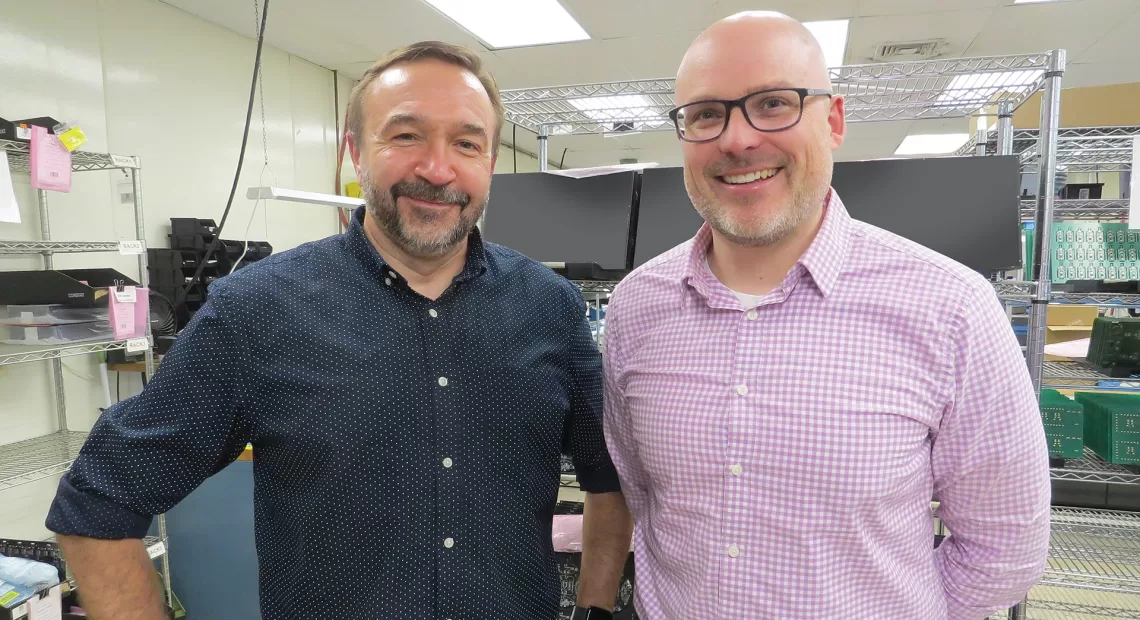
Phillips agreed. “Everyone wants the lowest cost until they have a claim. When people come in for a quote, they say, ‘I don’t need that, I don’t need this.’ And when they have a claim, they say, ‘oh, I definitely would have taken that.’ Well, it would have only cost $32 a year.

“We never sell the lowest limits,” he went on, but sometimes clients will insist on saving a couple hundred dollars to raise a $500 deductible into the four-figure range. “People think they can tolerate a $2,000 collision deductible until they have the accident.”

Those who want to keep their costs down should not only shop prices, Phillips added, but be aware of their credit score and their driving record — “even a failure to stop or a speeding ticket can add hundreds of dollars of premium” — but also be aware of the type and make of the vehicle they buy, which greatly impacts coverage, based on average theft rate and repair costs.

Dowd said certain people, who have a long track record of safe driving, may be fine taking a higher deductible.

“There’s obviously no guarantee. And if you take the savings and take a little more risk, you still need the catastrophic protection in case something serious happens,” he stressed. “You don’t want to cut into the muscle of the coverage where the catastrophic protection isn’t there, which can really hurt people financially.”

After all, insurance is all about protecting against the most severe losses — even if purchasing it makes a bigger dent than it used to.