Home Archive by category Sections (Page 16)

Sections

Workforce Development

Expanding the Talent Pipeline

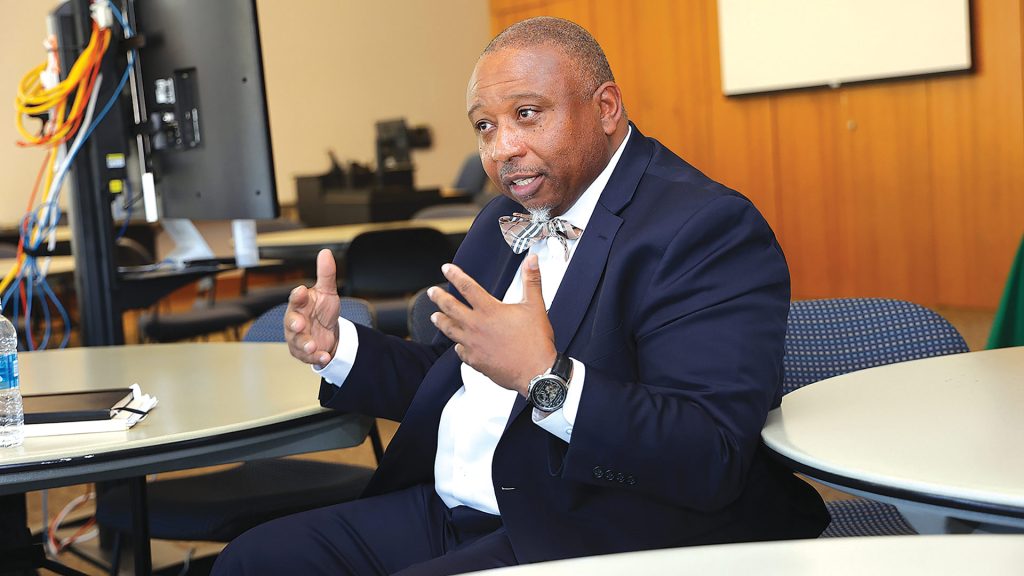
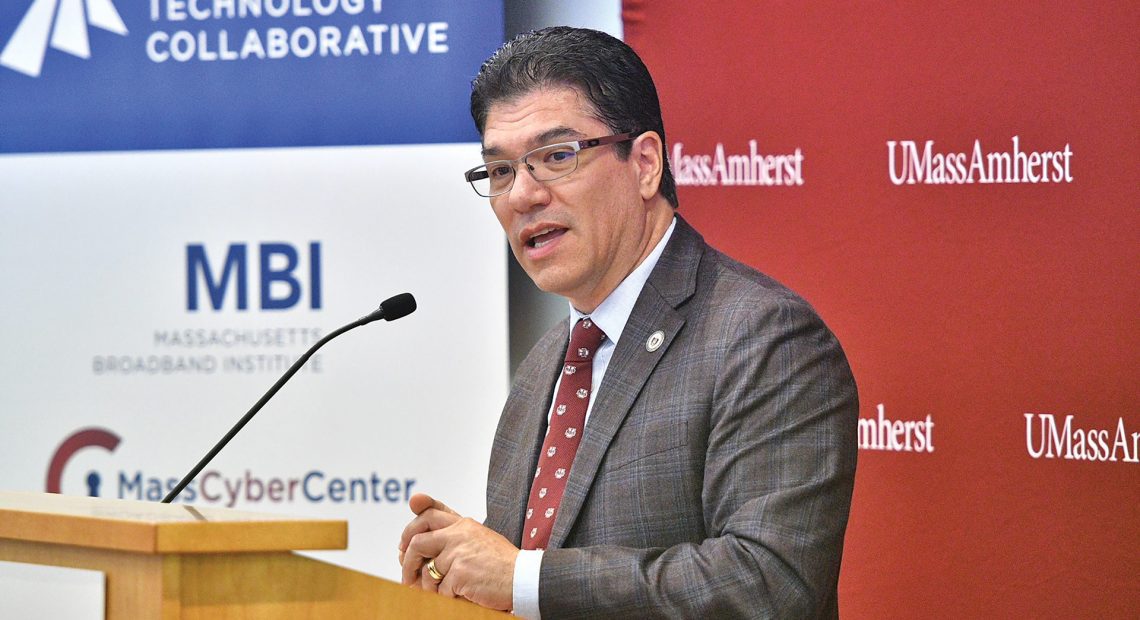
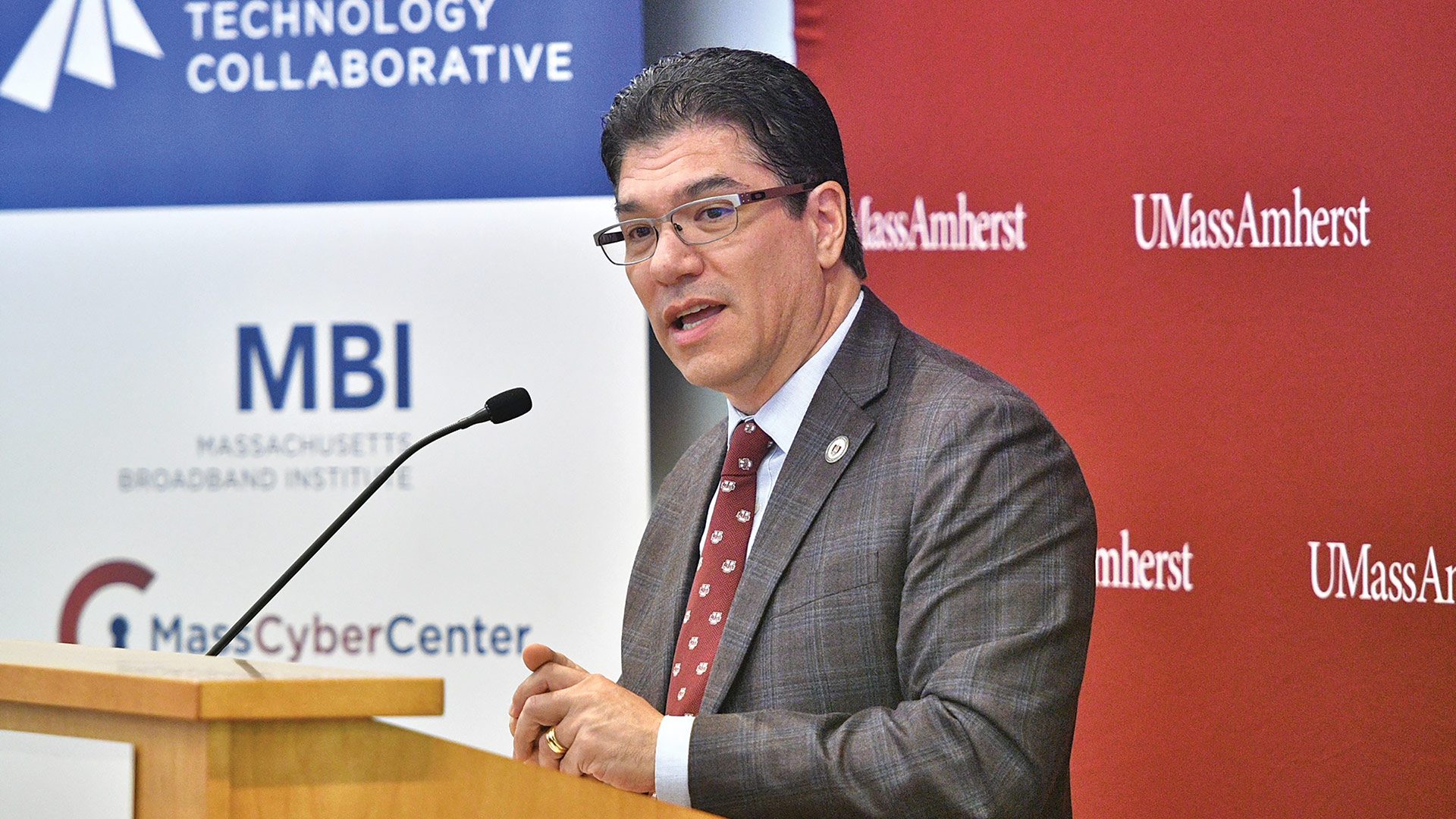
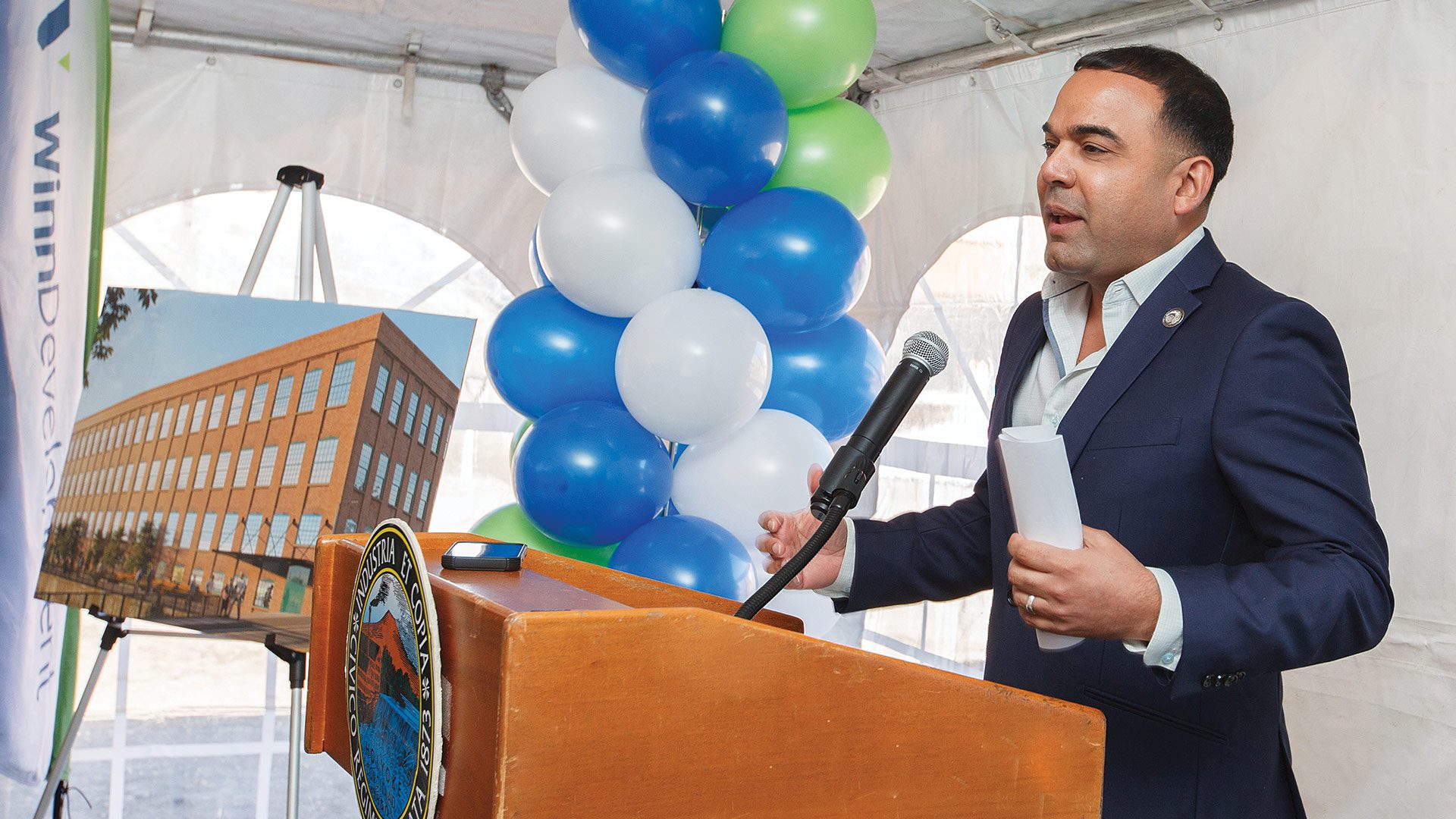
UMass Amherst Chancellor Javier Reyes

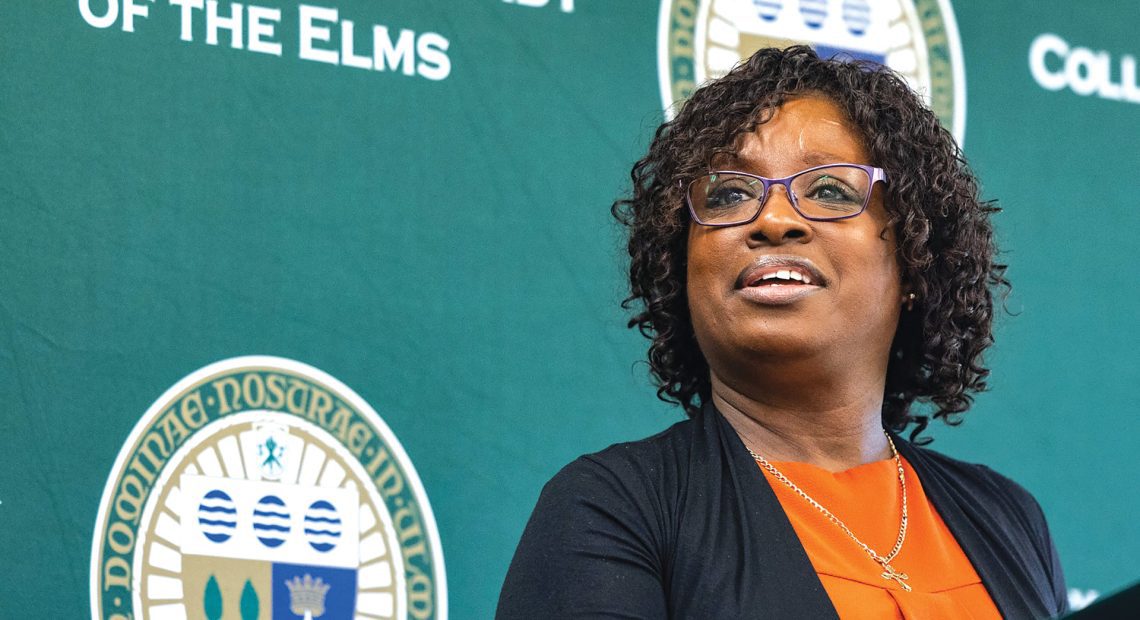
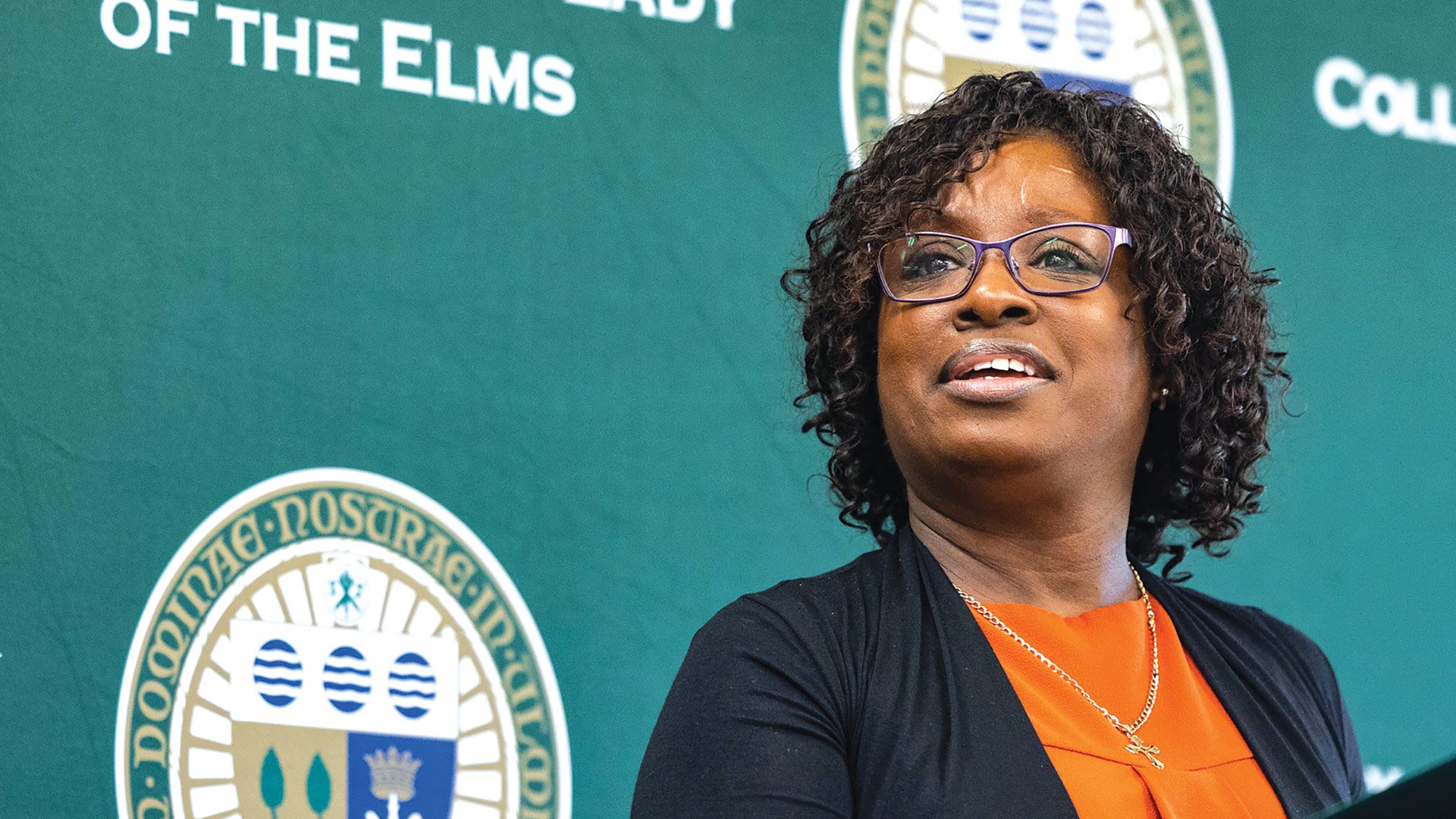
UMass Amherst Chancellor Javier Reyes speaks during the announcement of the $5 million grant from the MassTech Collaborative.

Leaders from the Massachusetts Technology Collaborative, also known as MassTech, recently announced a $5 million award from the Healey-Driscoll administration to UMass Amherst to help create an open-access additive manufacturing and design/testing facility on campus.

The grant, from the Collaborative Research and Development (R&D) Matching Grant Program, will augment UMass Amherst’s capabilities in the advanced-manufacturing space and increase its collaboration with universities across Massachusetts around research and development for advanced optical technologies, which have applications in biotechnology, defense, aerospace, environmental monitoring, and general electronics.

“The Healey-Driscoll administration is committed to building a more dynamic manufacturing ecosystem by supporting research and development opportunities across the state,” said Secretary Yvonne Hao of the Executive Office of Economic Development. “This investment will help connect leading innovators, foster workforce opportunities, promote creative problem solving, and accelerate the potential for breakthroughs in a field that underpins so many other essential industries.”

Carolyn Kirk, executive director of MassTech, added that “this investment is another example of Massachusetts’ commitment to strengthening innovative technologies and making R&D tools more accessible to growing businesses, academic researchers, and entrepreneurs across the state, providing opportunities that would normally be cost-prohibitive. Placing it at our flagship university, which has a track record of proven success and partnerships in the advanced-manufacturing space, made perfect sense. When we invest in technical training at a leading institution like this, we can expand training opportunities and the talent pipeline to manufacturing careers, helping diversify our workforce and the ability of the state to compete on a global scale.”

The announcement comes on the heels of the state’s recent award of $19.7 million in funding through the federal CHIPS and Science Act to expand production of microelectronics in the Northeast, work that will benefit from increased R&D in related sectors, including advanced optical technologies.

“We’re proud to make this investment in UMass Amherst to help establish a first-of-its-kind open-access facility that will expand our capability for innovation and strengthen training opportunities in a sector that will be so critical to the future of our economy.”

“Optical technologies are essential in the 21st century, acting as the backbone for transformational industries ranging from semiconductors to mobile technologies, medicine to national defense,” said Pat Larkin, director of the Innovation Institute at MassTech, which manages the collaborative R&D grant program. “That’s why it is critically important to expand collaboration and partnerships in this space, to encourage increased engagement between research institutions and private industry. We’re proud to make this investment in UMass Amherst to help establish a first-of-its-kind open-access facility that will expand our capability for innovation and strengthen training opportunities in a sector that will be so critical to the future of our economy.”

The facility will be the first publicly accessible facility of its kind in the country and will support testing, research, and production of advanced optical technologies. Through the project, UMass Amherst will collaborate with Electro Magnetic Applications Inc. (EMA), which specializes in the testing and design of materials used in space and operates at the Berkshire Innovation Center (BIC) in Pittsfield, and other industry partners, as well as Northeastern University, Springfield Technical Community College, and Berkshire Community College. The BIC will act as a bridge between industry, academia, and government to help develop an additive-manufacturing talent pipeline by providing workforce-development opportunities for students and young professionals.

“For 160 years, UMass Amherst has been an incubator for revolutionary thinking and big ideas,” UMass Amherst Chancellor Javier Reyes said. “Today we further this legacy as we celebrate advancements in precision optics, coatings, and metalens technologies in Western Mass. and prepare to establish an advanced optics manufacturing and characterization facility right here at UMass. By bringing together leading scientists, engineers, researchers, and industry partners, this new facility will accelerate the development and adoption of these transformative technologies.”

UMass Amherst will also use the grant to fund a full wafer imprint tool, which is a low-cost, high-resolution, nano-imprinting lithography device that generates patterns for various applications, a technology that is not currently available in any public facility in the U.S. This investment will provide a singular opportunity for research and collaboration for companies and institutions in Massachusetts.

“The state of Massachusetts and MassTech continue to prioritize investing in critical technologies and capabilities within the Commonwealth,” said Justin McKennon, principal scientist ii and the co-principal investigator for this project on behalf of EMA. “It sets the state apart as a place that not only welcomes, but believes in the companies that reside here. At EMA, we understand that any new technology requires the ability demonstrate it can work in harsh environments, and with our test and simulation capabilities, we are beyond excited to play a key role in helping companies in and around the Commonwealth to prove out their technologies in space and other harsh environments.”

The Collaborative R&D Matching Grant Program has awarded nearly $60 million to projects across the state that have leveraged more than $180 million in matching contributions from project partners. This includes 20 projects that have supported innovative industry and academic collaborations and investments in novel R&D infrastructure to bolster the Massachusetts tech and innovation economy.

The grant program has supported projects in emerging industries such as cloud computing, quantum computing, marine robotics, printed electronics, cybersecurity and data science, and nanomaterials and smart sensors. These investments have led to more than 80 industry partnerships and 60 intellectual-property and licensing agreements in the past two years.


Health Care Healthcare News

An Unsustainable Path


The Massachusetts Health Policy Commission (HPC) recently voted to issue the 2023 Health Care Cost Trends Report and comprehensive policy recommendations.

Notably, the HPC reports that the average expense of employer-based private health insurance in 2021 climbed to $22,163, outpacing growth in wages and salaries. Including co-payments, deductibles, and out-of-pocket spending, healthcare costs for Massachusetts families neared $25,000 annually. The HPC found that 72% of small-business health-insurance plans featured deductibles exceeding $2,800 for families (or $1,400 for individuals) in 2021, with annual family premiums simultaneously surging from $16,000 to $23,000 since 2012.

The report highlights the unequal burden of these trends, finding persistent disparities across income and racial/ethnic groups, with nearly one in five lower-income residents having high out-of-pocket spending, for example, and significantly higher infant-mortality rates and rates of premature deaths from treatable causes among Black and Hispanic residents compared to other residents. To address these complex and interrelated challenges, the HPC calls for urgent action to update the state’s policy framework to more effectively contain cost growth, alleviate the financial burden of healthcare costs on Massachusetts families, and promote equity in access to care and outcomes for all residents.

“Policymakers do not have to choose between high-quality care and affordability. We have tremendous opportunities for transformative action to support patients and employers.”

“The 2023 Health Care Cost Trends report makes clear how we must do more in Massachusetts to provide more affordable and equitable access,” said Deb Devaux, HPC board chair. “Policymakers do not have to choose between high-quality care and affordability. We have tremendous opportunities for transformative action to support patients and employers.”

Among the report’s findings were that, on average from 2019 to 2021, total healthcare spending increased 3.2% per year, higher than the 3.1% healthcare cost growth benchmark. Commercial spending grew by 5.8% per year, far outpacing the national average in a reversal of prior years of relatively slower growth.

Commercial expenditures for prescription drugs and hospital outpatient care grew the fastest; the average price per prescription for branded drugs exceeded $1,000 in 2021, up from $684 in 2017, while the average commercial price for hospital outpatient services grew by 8.4% from 2019 to 2021.

The average price for many common hospital stays also increased, with most growing by 10% or more over the same period. The HPC estimates that, by eliminating excessive spending due to unreasonably high prices, overuse of high-cost sites of care, and overprovision of care, the Commonwealth could see systemwide savings of nearly $3.5 billion annually.


Policy Recommendations

With the report, the HPC announced nine policy recommendations.

“The residents of the Commonwealth deserve a policy framework equal to the novel challenges facing our healthcare system today,” said David Seltz, HPC executive director. “The recommendations in this report provide a roadmap for policymakers to equip the state with the tools it needs to constrain healthcare cost growth equitably and sustainably in a manner that meaningfully addresses existing disparities in access and outcomes.”

The HPC recommends the following reforms to reduce healthcare cost growth, promote affordability, and advance equity, with an emphasis on modernizing the state’s nation-leading benchmark framework.

• Modernize the Commonwealth’s benchmark framework to prioritize healthcare affordability and equity for all. As recommended in past years, the Commonwealth should strengthen the accountability mechanisms of the benchmark, such as by updating the metrics and referral standards used in the performance improvement plan (PIP) process and enhancing transparency and PIP enforcement tools. The state should also modernize its healthcare policy framework to promote affordability and equity, including through the establishment of affordability and equity benchmarks.

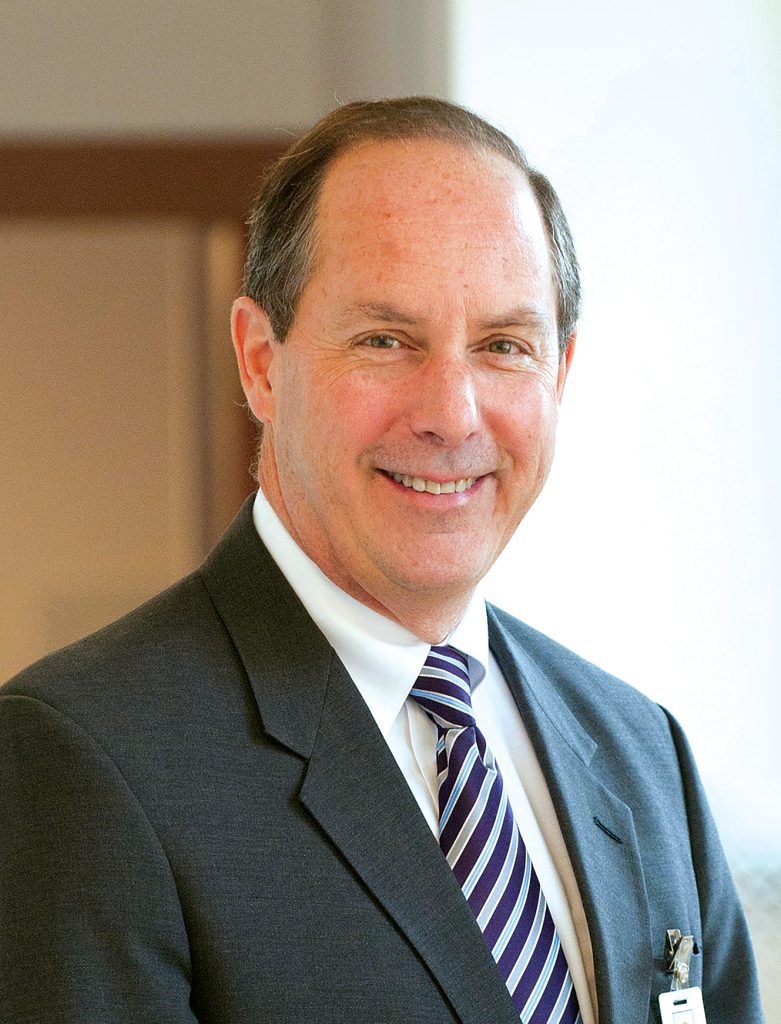
David Setz

David Setz

“The residents of the Commonwealth deserve a policy framework equal to the novel challenges facing our healthcare system today.”

• Constrain excessive provider prices. As found in previous cost-trends reports, prices continue to be the primary driver of healthcare spending growth in Massachusetts. To address the substantial impact of high and variable provider prices, the HPC recommends the Legislature enact limitations on excessively high commercial provider prices, require site-neutral payments for routine ambulatory services, and adopt a default, out-of-network payment rate for ‘surprise billing’ situations.

• Enhance oversight of pharmaceutical spending. The HPC continues to recommend that policymakers take steps to address the rapid increase in retail drug spending in Massachusetts with policy action to enhance oversight and transparency. Specific policy actions include adding pharmaceutical manufacturers and pharmacy benefit managers (PBMs) under the HPC’s oversight, enabling the Center for Health Information and Analysis to collect comprehensive drug-pricing data, requiring licensure of PBMs, expanding the HPC’s drug-pricing review authority, and establishing caps on monthly out-of-pocket costs for high-value prescription drugs.

• Make health plans accountable for affordability. The Division of Insurance (DOI) should closely monitor premium growth factors and utilize affordability targets for evaluating health-plan rate filings. Policymakers should promote enrollment through the Massachusetts Connector and the expansion of alternative payment methods (APMs). Lower-income employees should be supported by reducing premium contributions through tax credits or wage-adjusted contributions.

• Advance health equity for all. To address enduring health inequities in Massachusetts, the state must invest in affordable housing, improved food and transportation systems, and solutions to mitigate the impact of climate change. Payer-provider contracts should promote health equity via performance-data stratification and link payments to meeting equity targets. Payers should commit to the adoption of the data standards recommended by the Health Equity Data Standards Technical Advisory Group, and efforts should be made to ensure that the healthcare workforce reflects the diversity of the state’s population.

• Reduce administrative complexity. The Legislature should require standardization in payer claims administration and processing, build upon the momentum from recent federal initiatives to require automation of prior authorization processes, and mandate the adoption of a standardized measure set to reduce reporting burdens and ensure consistency.

• Strengthen tools to monitor the provider market and align the supply and distribution of services with community need. The HPC recommends enhanced regulatory measures including focused, data-driven assessments of service supply and distribution based on identified needs and updates to the state’s existing regulatory tools, such as the Essential Services Closures process, the Determination of Need (DoN) program, and the HPC’s material change notice oversight authority.

• Support and invest in the Commonwealth’s healthcare workforce. The state and healthcare organizations should build on recent state investments to stabilize and strengthen the healthcare workforce. The Commonwealth should offer initial financial assistance to ease the costs of education and training, minimize entry barriers, explore policy adjustments for improved wages in underserved areas, and adopt the Nurse Licensure Compact to simplify hiring from other states. Healthcare delivery organizations should invest in their workforces, improve working conditions, provide opportunities for advancement, improve compensation for non-clinical staff (e.g., community health workers, community navigators, and peer recovery coaches), and take collaborative steps to enhance workforce diversity.

• Strengthen primary and behavioral healthcare. Payers and providers should increase investment in primary care and behavioral health while adhering to cost growth benchmarks. Addressing the need for behavioral-health services involves measures such as enhancing access to appropriate care, expanding inpatient beds, investing in community-based alternatives, aligning the behavioral-health workforce to current needs, employing telehealth, and improving access to treatment for opioid-use disorder, particularly in places where existing inequities present barriers.


Key Findings

Prices continue to be the primary driver of healthcare spending growth in Massachusetts. In the report, the HPC identifies price, rather than utilization, as the primary driver of the increase in spending. Commercial prices grew substantially from 2018 to 2021, with an 8.8% increase for office-based services, a 12.1% rise for hospital outpatient services, and a 10.2% uptick for inpatient care. Total payment per hospital discharge for commercially insured patients grew by 23% between 2017 and 2021, primarily driven by a 34% price increase for non-labor-and-delivery discharges.

HPC’s analyses of excess spending found that private insurers paid providers more than twice what Medicare would have paid for nearly 40% of all lab tests and imaging procedures in 2021. Taken together, commercial spending on lab tests, imaging procedures, inpatient hospital stays, clinician-administered drugs, endoscopies, prescription drugs, and certain specialty services accounted for 45% of commercial spending. Among this spending, 27% was in excess of double what Medicare would have paid (or 120% of international drug prices), equivalent to approximately $3,000 annually for a family with private insurance.

Other findings include:

• Unnecessary utilization of care, such as procedures that could be performed in more cost-effective ambulatory surgery centers, care that provides no clinical benefit to patients, and low-risk births in academic medical centers that are reimbursed at higher rates than those in community hospitals, contribute to excessive spending.

• Administrative spending of both hospitals and insurers has increased substantially, with hospital administrative costs nearly doubling from 2011 to 2021 and insurers experiencing growth in administrative spending for both small- and large-group coverage.

• Escalating price trends are evident from 2018 to 2021, with commercial prices increasing for various services, including office services, hospital outpatient care, and inpatient services. Payments for inpatient hospital care grew by 23%, driven primarily by non-labor-and-delivery discharges.

• Variation in provider organization performance continues, with medical spending differing widely between major provider groups and the rate of avoidable visits and imaging utilization varying significantly.

• Massachusetts maintains the highest hospital-utilization rate for Medicare beneficiaries among all states, as well as higher statewide rates of inpatient stays, outpatient visits, and emergency-department visits. The Commonwealth also ranks among the highest in the nation in preventable hospitalizations and readmission rates.

• Between 2017 and 2021, primary-care spending grew more slowly than other medical spending, leading to a decrease in primary care’s share of total commercial spending. Meanwhile, significant disparities in access to primary care between low- and high-income communities persist.

• Behavioral-health trends show a substantial increase in psychotherapy visits and mental-health prescriptions among young adults, alongside a rise in the proportion of patients admitted to acute-care hospitals for mental-health conditions. While opioid-related hospitalizations declined overall, Black non-Hispanic residents experienced persistent increases until 2020.

Construction

A Long-awaited Transformation

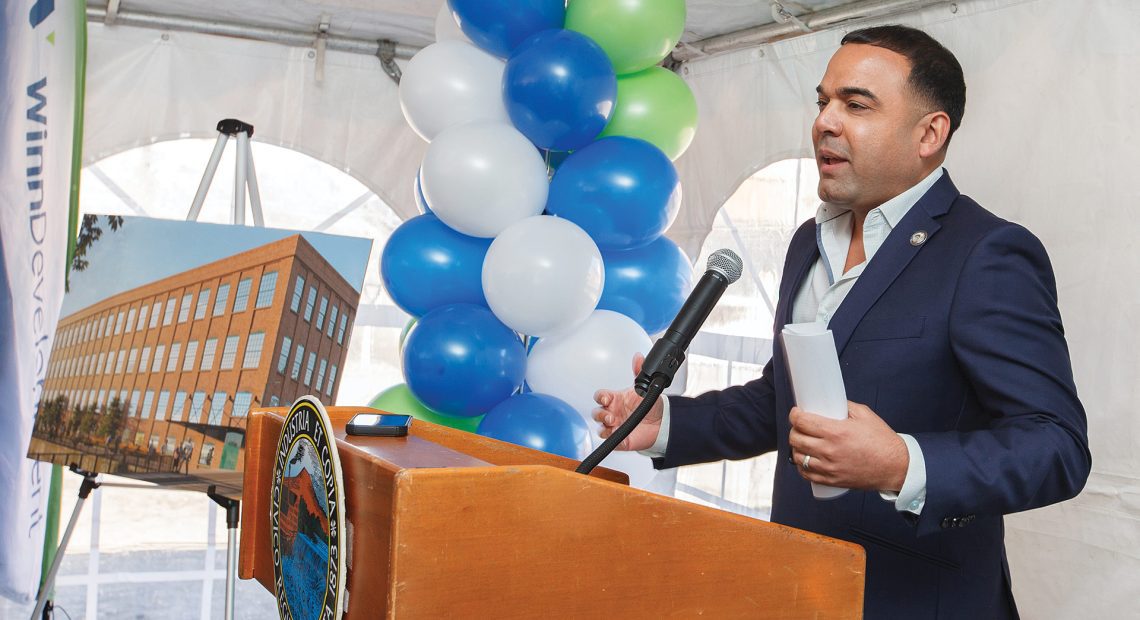
Holyoke Mayor Joshua Garcia

Holyoke Mayor Joshua Garcia says the mill-conversion project will impact the city for many years to come.


On Nov. 20, Holyoke city officials and legislative leaders joined WinnDevelopment executives and Massachusetts housing lenders to break ground on a $55.3 million adaptive-reuse project at a long-vacant, historic mill complex that will be transformed into 88 affordable apartment homes for seniors ages 55 and older.

The redevelopment at the Appleton Mill property in downtown Holyoke will create new, loft-style apartments in three interconnected, 111-year-old industrial buildings that were once home to Farr Alpaca Co. and have been vacant for decades. In addition, WinnDevelopment will construct a new community building and connect it to the residential space via a closed skybridge spanning nearby railroad tracks.

“We’re excited to get to work on preserving this important feature of Holyoke’s proud industrial legacy and transform it into much-need housing for seniors who want to stay in the community they love,” WinnDevelopment President and Managing Partner Larry Curtis said. “This project is the first part of a two-phase redevelopment effort that will revitalize this historic mill complex and provide an economic boost to Holyoke’s downtown.”

All 88 apartments will be reserved for low- and moderate-income seniors, with 12 units reserved for households below 30% of area median income (AMI), 63 for those below 60% of AMI, and 13 for households below 80% of AMI. Eight of the units will be available to eligible households through the U.S. Department of Housing and Urban Development’s project-based voucher program, and five units will be set aside for Massachusetts Department of Mental Health clients through the Facilities Consolidation Fund.

“This project represents our commitment to history, preservation, and housing. It also represents our commitment to senior living, affordability, compassion, and care,” Holyoke Mayor Joshua Garcia said. “The renovation of the former 111-year-old Alpaca Mill building to achieve these commitments is another Holyoke thing we do. I am excited to witness this unfold at this time in our city’s history and even more excited to see the impact it will have for many years to come.”

The project was made possible with significant federal, state, local, and private financing. Bank of America is serving as the project construction lender and as the investor in the project’s state and federal Low Income Housing Tax Credits, authorized by the Massachusetts Executive Office of Housing and Livable Communities (EOHLC), and state and federal Historic Tax Credits, awarded by the Massachusetts Historic Commission and the U.S. National Park Service.

“We’re pleased to help finance much-needed affordable housing for seniors in Holyoke,” said Mary Thompson, senior vice president of Community Development Banking at Bank of America. “We applaud Winn for their sustainable design that incorporates modern, energy-efficient heating, cooling, and appliances, while preserving the historic character of the Farr Alpaca Company complex.”

MassHousing provided tax-exempt bonds for the project financing, while the EOHLC provided soft financing, along with its partners, the Community Economic Development Assistance Corp. and the MassHousing Affordable Housing Trust.

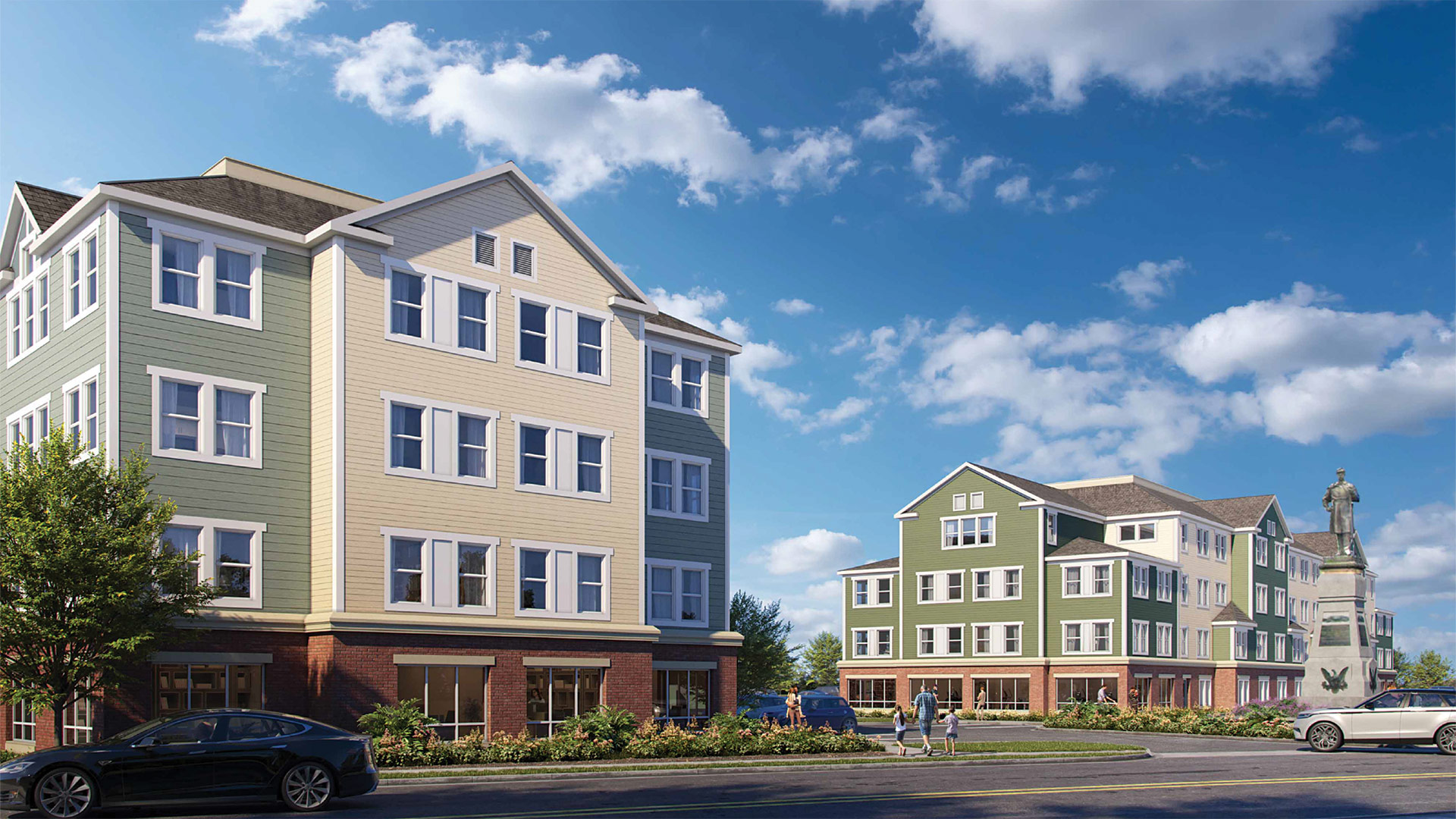
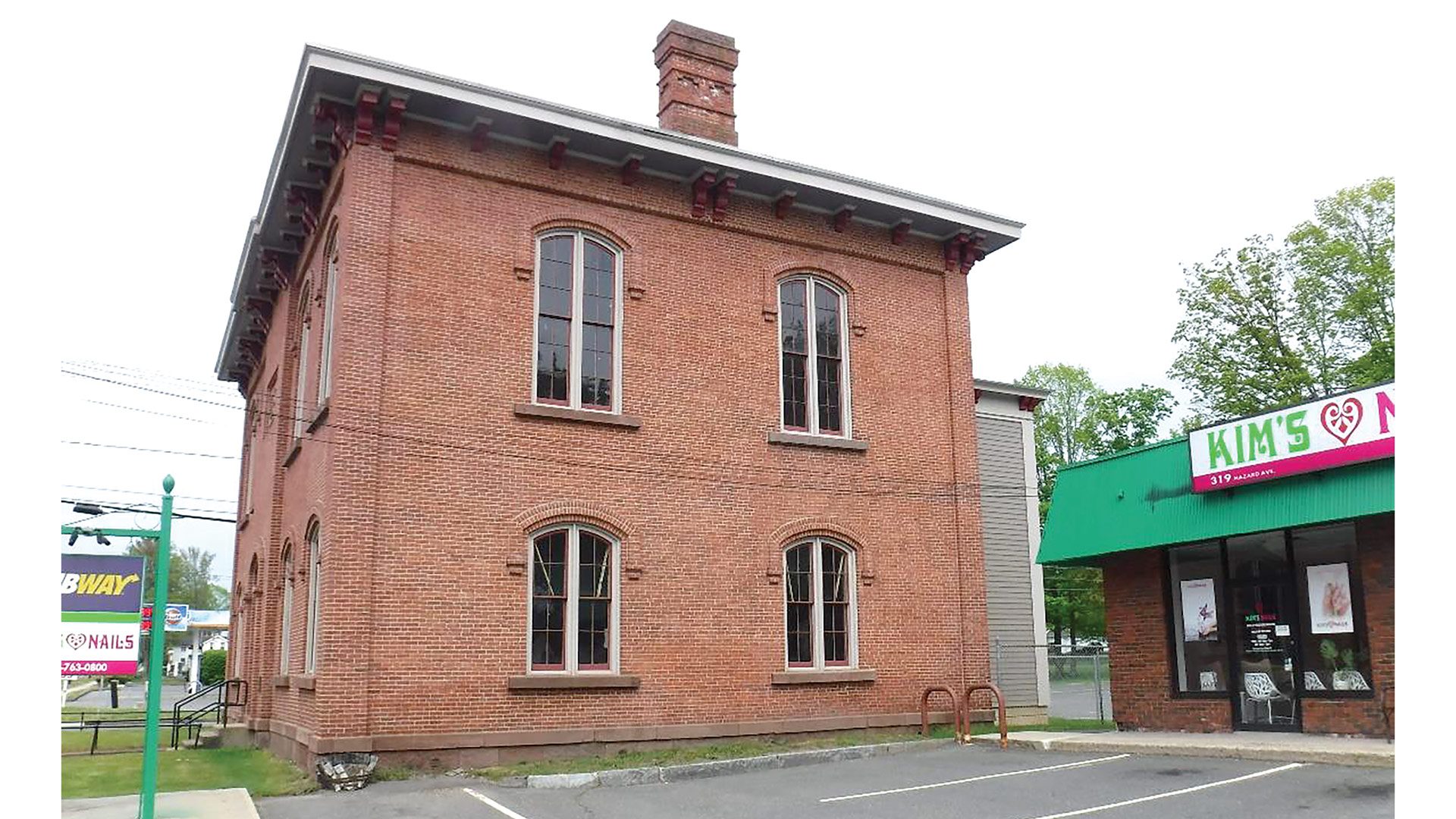
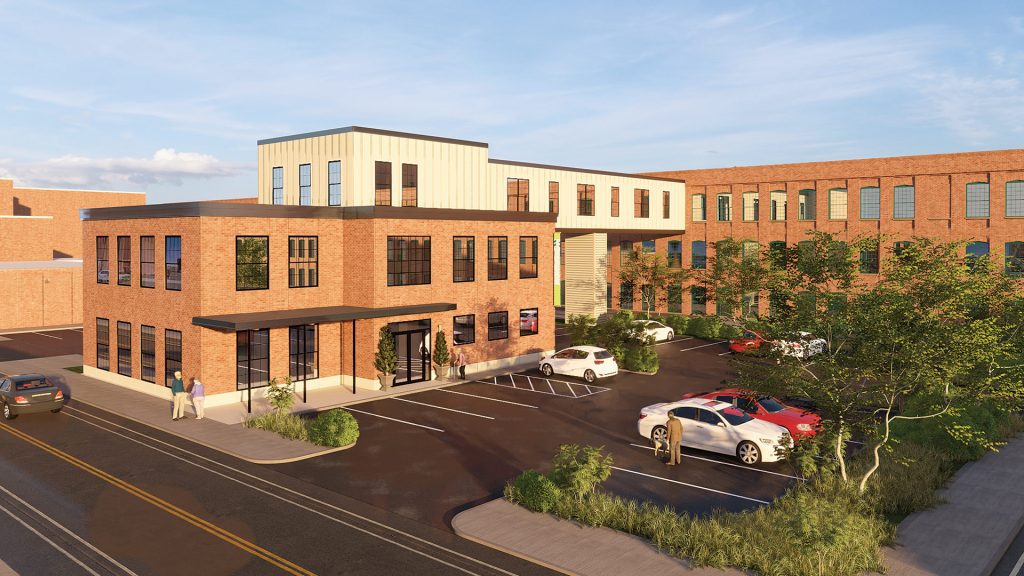
The property’s current condition is a stark contrast to what it will look like in the future, according to this rendering.

The property’s current condition is a stark contrast to what it will look like in the future, according to this rendering.

“This decades-long-vacant and blighted mill property in the heart of Holyoke will be transformed into new, vibrant housing for older residents who will be able to live affordably and comfortably in downtown Holyoke,” MassHousing CEO Chrystal Kornegay said. “WinnCompanies has the experience and expertise to make this abandoned eyesore into a new affordable-housing community that will serve city residents for many years to come. The city of Holyoke has provided strong support, and MassHousing is pleased to be among the many public and private partners working closely together to complete this important project.”

Enterprise Bank, a locally owned and managed full-service commercial bank based in Lowell, played a key role in the redevelopment through the direct purchase of the bonds and the provision of bridge financing.

“We are pleased to have been able to partner with WinnDevelopment, a respected, award-winning property manager and creator of high-quality and exceptionally managed affordable housing, on this transformative project,” Enterprise Bank CEO Jack Clancy said. “We continue to remain committed to supporting affordable-housing initiatives throughout our footprint.”

The Holyoke Redevelopment Authority (HRA) provided a ground lease for the mill structure for a discounted value and provided additional funds for structural stabilization of the mill complex. Additional local partners include the city of Holyoke and local nonprofit OneHolyoke, which provided critical gap financing through local ARPA and CDBG funds. BlueHub Capital served as lender on the state credit loans.

“The HRA is proud of the partnership with WinnDevelopment and excited to see this project come to fruition,” said Aaron Vega, Holyoke’s director of Planning and Economic Development. “The whole team in our office worked on this project, and we believe in its transformative impact for our downtown and in addressing the housing needs of our community.”

Once the largest alpaca wool mill in the world, the 168,000-square-foot, brick mill complex features nine buildings on six acres and is one of Holyoke’s most prominent historic properties. After the Farr Alpaca Co. ceased production in the early 1940s, the complex declined and has been largely vacant since the 1970s, with deteriorating conditions hindering efforts to revitalize the area.

Located across the street from a state park dedicated to showcasing Holyoke’s industrial and cultural heritage, the site has been a priority for redevelopment since the city took title to the property a decade ago.

WinnDevelopment’s work is focused on an 86,000-square-foot section of the complex that includes three structures: Building 4, erected in 1880 and the oldest on the site; Building 5, a storage, washing, and sorting facility erected in 1905; and Building 6, also built in 1905 and the largest structure on the property.

Designed to meet the sustainability criteria of Enterprise Green Communities, the new apartment community will be completely fossil-fuel-free and will feature LED lighting; Energy Star appliances; low-flow, water-conserving plumbing fixtures; and premium roof insulation.

Resident amenity spaces will include on-site management offices, a fitness center, a resident lounge, an outdoor recreation area along the adjacent canal, laundry facilities, and 109 parking spaces.

Scheduled for completion in the spring of 2025, the project is being led by WinnDevelopment Senior Project Director Matt Robayna, with support from Senior Project Director Lauren Canepari and Assistant Project Director Hagop Toghramadjian.

Keith Construction of Canton is serving as general contractor for the construction effort, with the Architectural Team of Chelsea serving as architect. VHB is providing civil engineering and permitting services through its office in Springfield. Robinson+Cole of Boston served as transaction counsel.

Women in Businesss

Growth Spurt

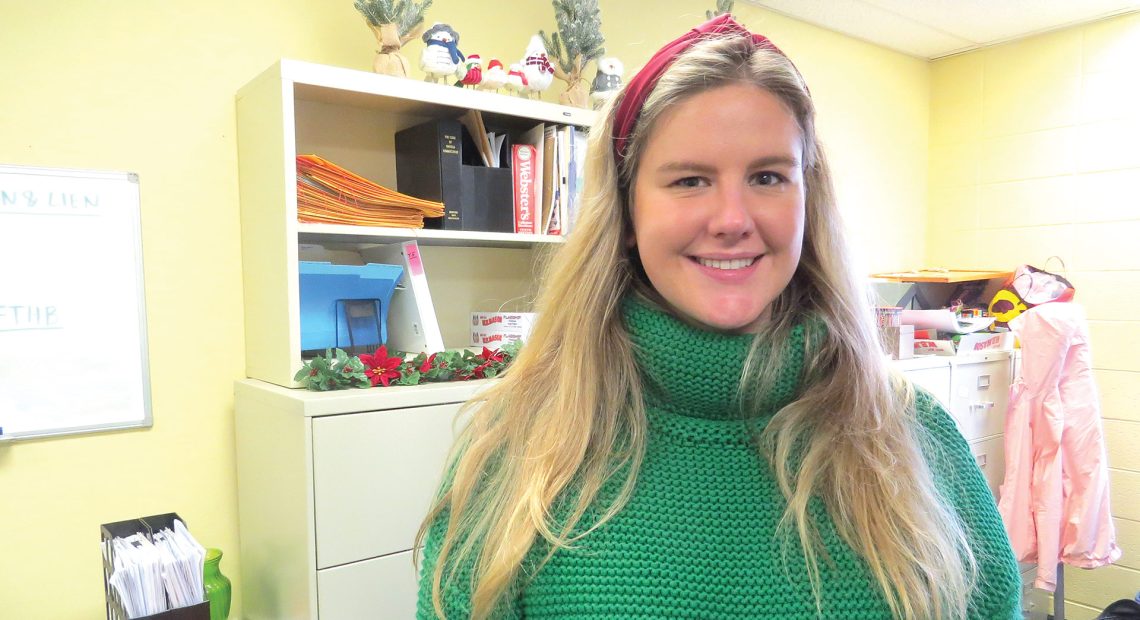
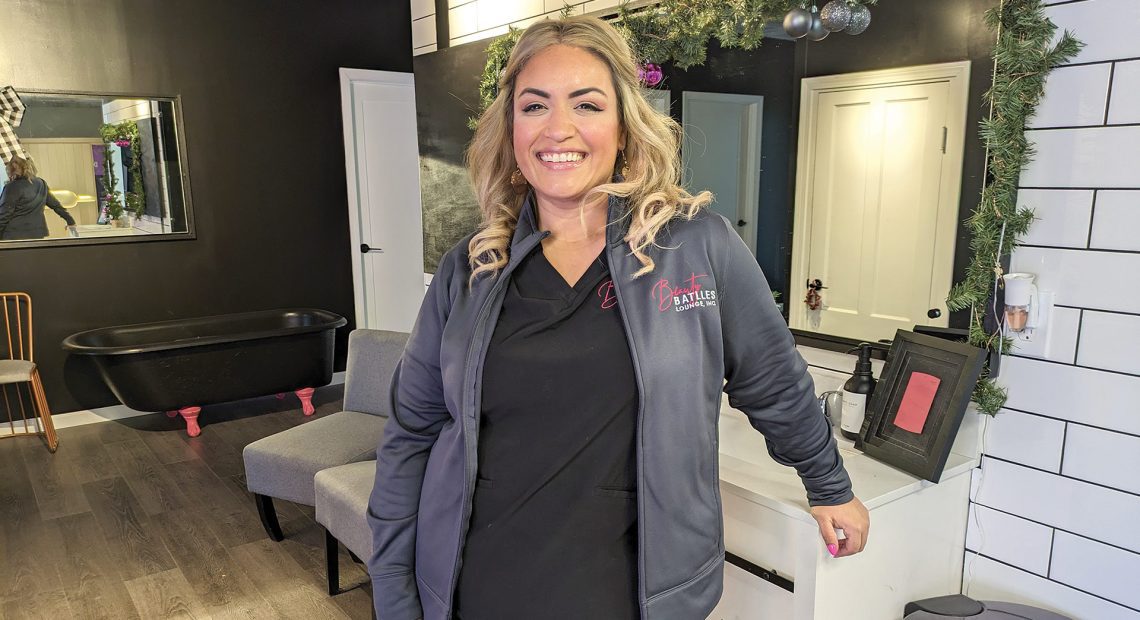
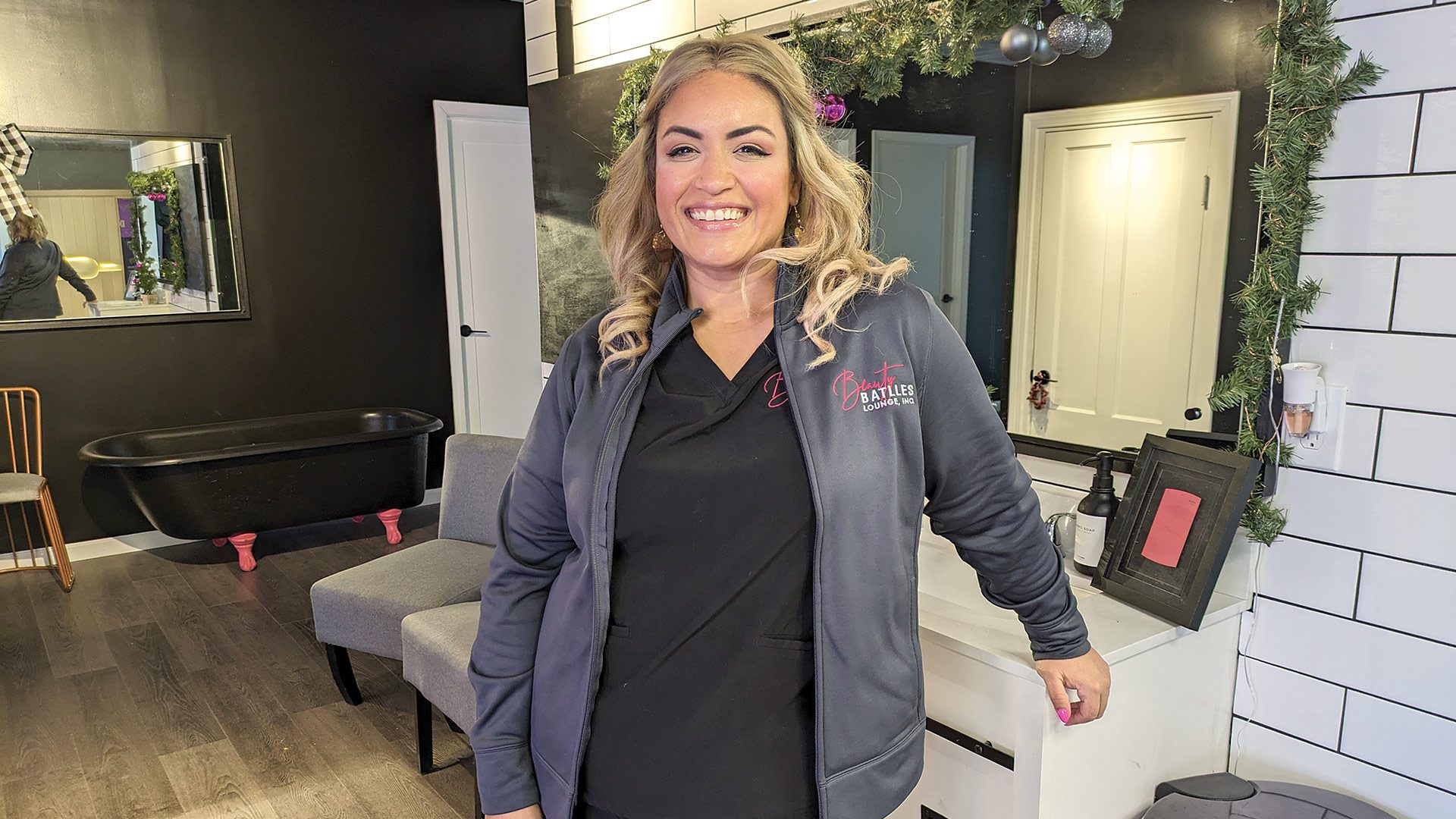
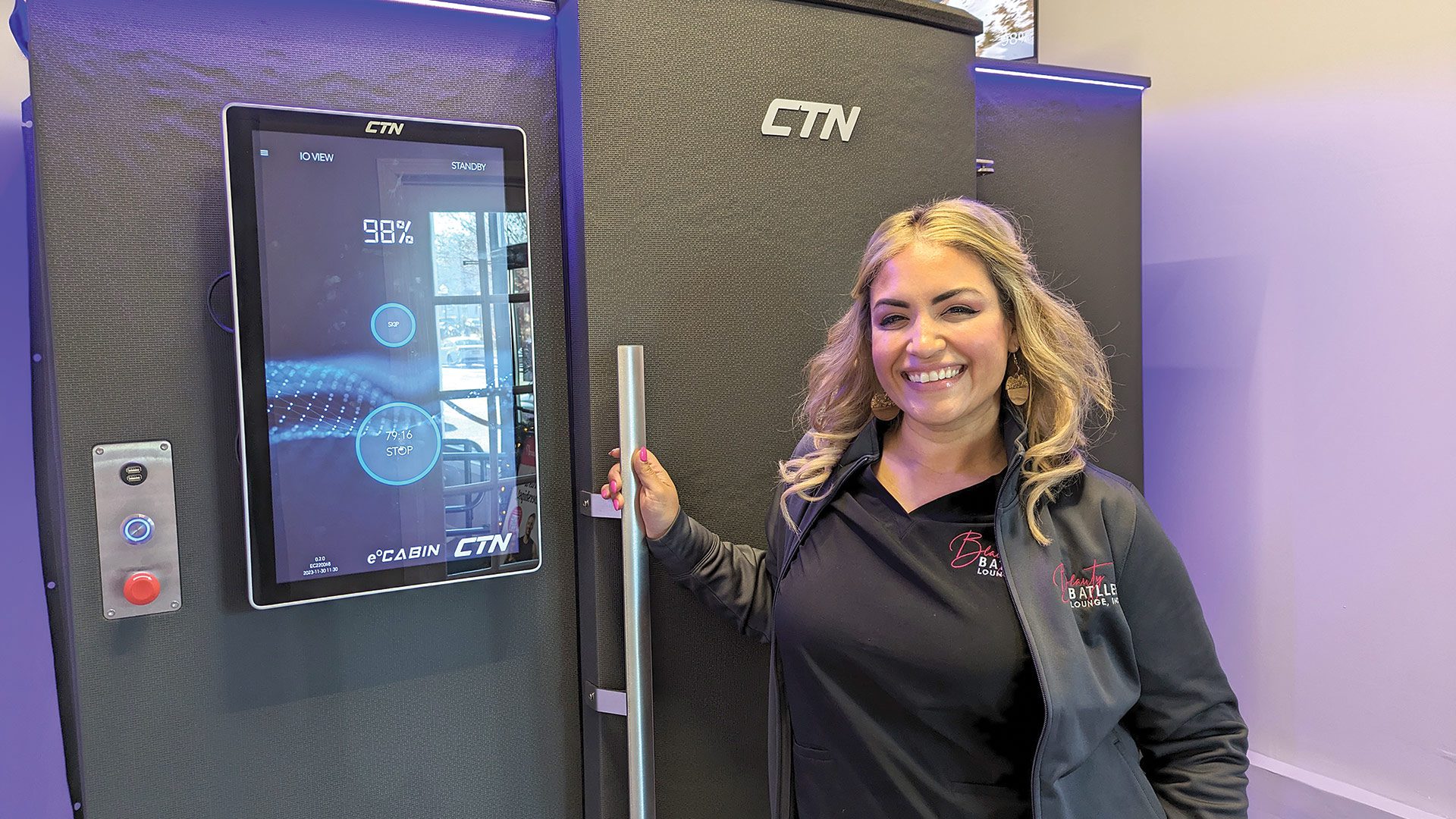
Ashley Batlle calls confidence a “superpower,”

Ashley Batlle calls confidence a “superpower,” and aims to instill more confidence in her clients by making them look and feel better.


Ashley Batlle says she just took a “teenage step.”

That’s different from the baby steps businesses take after they open, in everything from products and services offered to marketing and workforce. She’s been taking those baby steps since opening her beauty and wellness spa, Beauty Batlles, five years ago.

The teenage step was more dramatic (as teenagers often are). It took the form of a physical move from a somewhat hidden space on Front Street in Chicopee to a prominent storefront on nearby Cabot Street — and a much larger floor area to provide new and expanded services.

“We’ve grown with baby steps, and now we just took a huge teenage step to where we’re at right now,” Batlle told BusinessWest. “We’re more of an advanced beauty spa now, and we’ve added a whole wellness section to it.

“That being said, a lot of people don’t understand what advanced beauty is,” she admitted. “It’s a term that I just started using to make my elevator pitch a little easier.”

Perhaps the most notable advanced service is a cryotherapy chamber. Cryotherapy, also known as cold therapy, exposes the body to cold temperatures to heal and treat various medical ailments, she explained.

“Cold helps with inflammation. It helps with circulation. It helps with mood regulating if you have anxiety or if you’re really stressed.”

“Cold helps with inflammation. It helps with circulation. It helps with mood regulating if you have anxiety or if you’re really stressed,” she said. “And there aren’t too many cryo chambers in the area.”

Batlle gave a few examples of people who might benefit from that technology.

“Obviously, athletes are number one when it comes to that. But if you suffer from fibromyalgia, if you have arthritis, any kind of condition that is caused by inflammation, when the pain comes from the inflammation, the cryo chamber would be amazing for you,” she explained. “If you have migraines, we do have localized cryo as well; we have clients that come here just to get a quick treatment to help them when they feel a migraine coming on or if they’re actually suffering through a migraine. We have some clients that are seeing some results with their vertigo. If you have back issues, we have something for you. So everybody can come in for help just getting through the day.”


Taking the Leap

Batlle was licensed as a cosmetologist in 2002, a path she pursued mainly because she didn’t know exactly what career she wanted to pursue after high school, and wanted something she could always fall back on no matter what career choices she made.

“After I went to cosmetology school, I worked at a couple of salons, doing hair, and realized that was not my jam,” she recalled. “So I left the industry for about 14 years. I focused a little bit more in sales — I sold everything from cell phones to cable and solar panels, which was a really great journey because it taught me a lot and led me to where I am now.”

She also worked as a makeup artist in films and television before deciding to open her own business in 2018, first in a tiny space in Holyoke, then, about a year later, in downtown Chicopee.

Beauty Batlles’ new cryotherapy chamber

Beauty Batlles’ new cryotherapy chamber is useful for a range of conditions, from fibromyalgia to arthritis to migraines.

“I started with microblading, which is a semi-permanent tattoo for your eyebrows, which is still a service that I offer. Then, little by little, we became more of a spa, adding more aesthetic-type services. I added lash services and waxing services, and then we added body-sculpting treatments, which help with reducing fat and tightening skin.”

On Front Street, she began adding body-waxing services, facials, and skin-care services, creating more of a spa atmosphere, she explained.

“We offer a lot of advanced-type facials that help with either severe acne or with anti-aging, where you can literally walk out of here looking a few years younger without any kind of surgeries, without any kind of injectables, without any invasive treatments.”

And at the new location on Cabot Street, “we added the wellness aspect to it. We have a lot of big machines that do a lot of really awesome things. They help with pain management, they help with anxiety, they help with stress, they help if you have any issues with sleeping, and they’re great for recovery. They’re not just for athletes; these are also treatments that any person can do to help them with whatever it is that they’re struggling with on a day-to-day basis.”

Finding a larger, more prominent space was necessary for a number of reasons. The business was growing to the point where she needed more staff to serve clients, but didn’t have enough space to house more staff and more clients. “Plus, I was in a space where I wasn’t really in a storefront. I was kind of hiding behind another business.”

“I’m glad I went down the path of wellness. It’s brought me into a whole different world, with all this technology and all of these amazing biohacking tools that I’m able to bring into our community.”

The new location on Cabot Street had been a dance studio with two storefronts, allowing her to reconfigure the interior space to both meet current needs and introduce the new wellness elements, including the cryotherapy chamber.

“I’m glad I went down the path of wellness. It’s brought me into a whole different world, with all this technology and all of these amazing biohacking tools that I’m able to bring into our community,” she said. “And I’m not done with the growth. Like I said, this is my teenage stage. I’m waiting to get to adulthood.”


Community Minded

The growing-up years have been marked by a commitment to community involvement as well, including the fourth annual toy and coat drive, going on through Dec. 21, which Batlle called a “pride and joy” of hers.

New, unused toys collected at Beauty Batlles are donated to children in the foster-care system through the Department of Children and Families (DCF). New, unused coats are donated to Alianza, a domestic-violence shelter in Chicopee, while used coats are donated to Tapestry to support the homeless community.

A newer wrinkle is an “adopt-a-teen” effort for teenagers in the DCF system.

“Because of all the toy drives that are happening everywhere, a lot of the younger children in DCF get toys, and they get to open presents on Christmas morning, and the teenagers just get, like, a $25 gift card because there are no presents that are age-appropriate for them,” Batlle explained. “So I’ve teamed up with DCF, and they give me a list of teenagers that are in the system; we get their name, gender, age, and their wish list, so that they can have some personalized gifts given to them on Christmas morning, just like the little ones.”

Beauty Batlles also just wrapped up a canned-food drive to benefit Lorraine’s Soup Kitchen & Pantry in Chicopee. And in 2020, when the world — and many businesses — were shut down, Batlle launched the Hero Project, collecting funds to provide complementary self-care services for healthcare workers and first responders, which they were able to use when the spa reopened.

“I was sitting at home doing absolutely nothing,” Batlle recalled. “So, I thought, let me put some time and effort into giving back to people who are doing this work.”

Collectively, such efforts simply make her happy.

“There’s something so rewarding about being able to give back … when you have a platform where you’re able to bring awareness to your clientele, and in return be able to give back to people who are less fortunate,” she told BusinessWest. “It’s joyful, and it makes me feel good. I just want to do what I can and use my platform to do it.”

Meanwhile, Batlle continues to promote her new services and treatments, with an eye toward future growth. But at the end of the day, she said, the most gratifying element about her job is making people feel better, in every way.

“My big thing is, if you look good, you feel good. Confidence is a superpower. I feel like you can take on the world if you’re feeling better about yourself,” she said. “Sometimes it’s just an eyebrow wax or being able to make somebody’s aches and pains go away, or just a facial. Sometimes we need a little TLC, and we don’t realize that. But if we make ourselves feel better, then we feel like we can take on the world and do whatever it is that we need to do.”

Giving Guide Special Coverage Special Publications

Regional Philanthropic Opportunities

When importance of giving to those in need — and to the organizations who help others secure their basic needs — doesn’t take a holiday, and there’s no season of the year when their work is not critical, especially at a time when the pandemic is barely in the rear-view mirror and an uncertain economy continues to pose challenges to so many individuals and nonprofits.

Still, there’s no doubt that people think about giving more around the year-end holidays, and that’s why BusinessWest and the Healthcare News publishes its annual Giving Guide around this time: to shine a spotlight on specific community needs and show you not only how to support them, but exactly what your money and time can accomplish.

The 18 profiles below of area nonprofit organizations, are just a sampling of the region’s thousands of nonprofits. These profiles are intended to educate readers about what these groups are doing to improve quality of life for the people living and working in the 413, but also to inspire them to provide the critical support (which comes in many different forms) that these organizations and so many others so desperately need.

These profiles within the Giving Guide list not only giving opportunities — everything from online donations to corporate sponsorships — but also volunteer opportunities. And it is through volunteering, as much as with a cash donation, that individuals can help a nonprofit carry out its important mission within our community.

BusinessWest and HCN launched the Giving Guide to 2011 to harness this region’s incredibly strong track record of philanthropy and support of the organizations dedicated to helping those in need. The publication is designed to inform, but also to encourage individuals and organizations to find new and imaginative ways to give back. We are confident it will succeed with both of those assignments.

Joseph Bednar, Editor
John Gormally, Publisher
Kate Campiti, Sales Manager and Associate Publisher

Education Special Coverage Workforce Development

Striking Results

Jasmine Kerrissey acknowledged that, when it comes to labor and business management, it’s difficult, but not impossible, to chart who’s winning and losing the various types of skirmishes between the two sides and post standings, as they do in sports.

But if they did … labor would be enjoying a sizable lead in the standings as this year comes to a close.

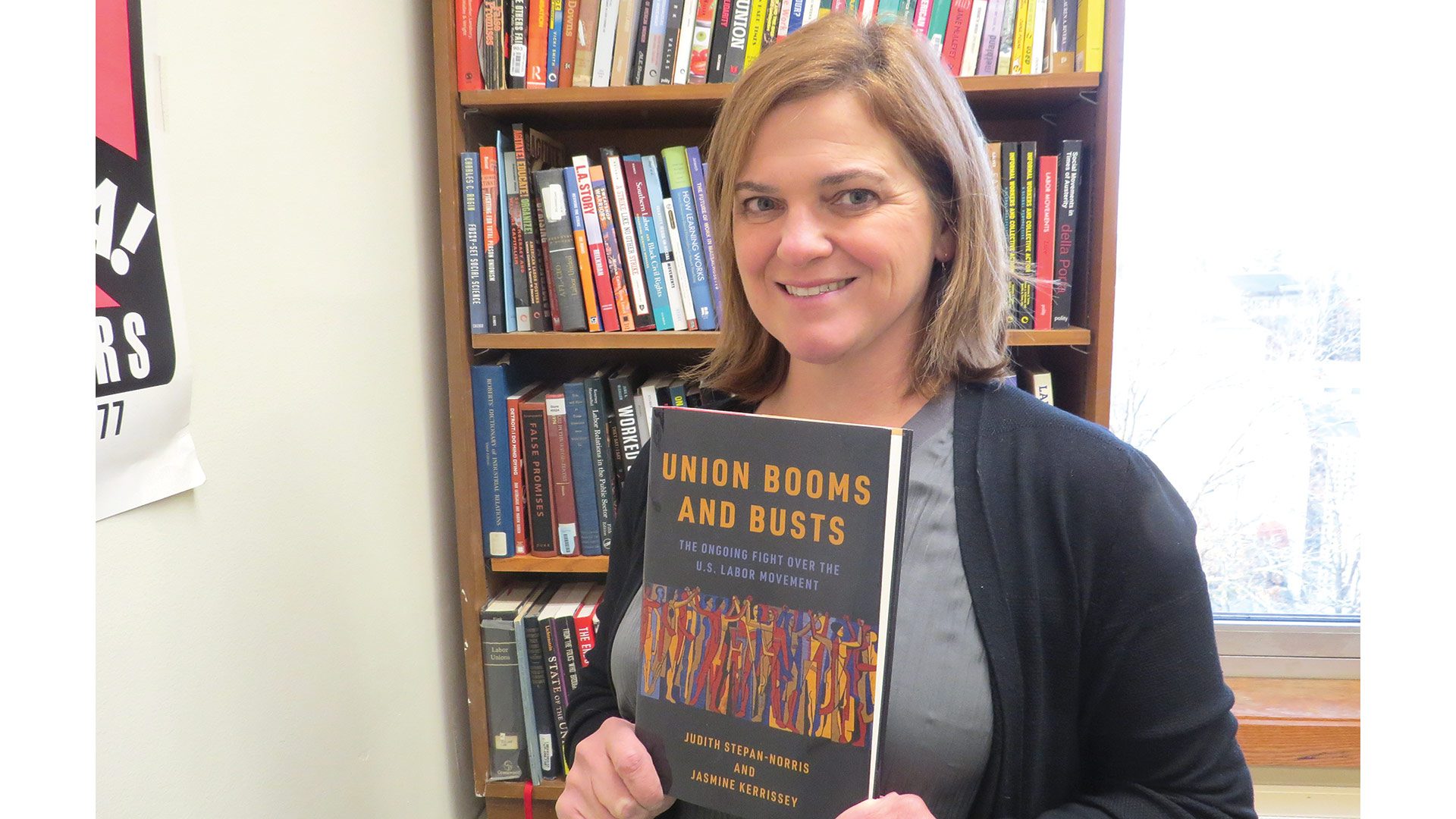
Indeed, there have been some recent — and significant — wins for the labor movement in this country, said Kerrissey, associate professor of Sociology and director of the UMass Labor Center, and co-author of the recently released book Union Booms and Busts: The Ongoing Fight Over the U.S. Labor Movement. She cited recent strikes involving United Auto Workers (UAW), who won 25% wage gains from Ford, General Motors, and Stellantis; employees at UPS; and TV and film actors and writers, among others, as well as union campaigns at large employers such as Amazon, Starbucks, REI, and Trader Joe’s.

In a word, labor is enjoying a large dose of momentum and one of the most pronounced ‘booms’ in recent times, she said.

“The number of strikes, and the number of new types of elections and new union organizing, is much higher than it’s been in the last several decades,” Kerrissey noted. “And many of those elections and strikes are being won by workers.

“Momentum is really important,” she went on. “And we should never underestimate momentum; when other workers see other workers winning, it’s really powerful, and it inspires others to think that they might be able to do the same.”

“Momentum is really important. And we should never underestimate momentum; when other workers see other workers winning, it’s really powerful, and it inspires others to think that they might be able to do the same.”

This momentum was perhaps best exemplified in early September when President Biden joined the UAW picket line at a General Motors plant in Michigan — the first time in U.S. history that a sitting president had done so. (Presidents have traditionally worked to broker deals, not take sides in labor disputes.)

Wearing a UAW cap and toting a bullhorn, Biden said of automakers’ profits after receiving federal assistance, “now they’re doing incredibly well. And guess what — you should be doing incredibly well, too.”

Such sentiments, the notion that workers should be doing as well as the CEOs running these large corporations, are at the heart of labor’s recent surge, said Tanzania Cannon-Eckerle, a labor attorney at the Springfield-based Royal Law Firm, who represents businesses in such matters.

Jasmine Kerrissey says labor is enjoying some real momentum in 2023

Jasmine Kerrissey says labor is enjoying some real momentum in 2023, especially though victories in several recent, high-profile strikes.

Elaborating, she said that, while the 25% wage hikes won by the auto workers during their month-long strike are certainly an aberration, such a figure emboldens workers in other industries and instills what she called “overexaggerated fear” among employers, including those in the 413.

“Those numbers are extraordinary,” she said. “Usually, when you see these union pay increases, we’re talking 3% to 8%, with 8% being the max. These 25% increases … I honestly don’t think we have that to fear locally, but … there is that public sentiment.”

Indeed, workers are further emboldened by seemingly endless headlines concerning the salaries of CEOs — and by the ongoing workforce crunch that is impacting virtually every sector of the economy, putting a premium on retention of talent.

“With the tight labor market, people can’t find workers — people don’t want to do the traditional jobs anymore,” Cannon-Eckerle said. “Employers need employees, so they do have that leverage, that bargaining power. And with this crunch being in the public, workers know it, and they feel it.”

Meanwhile, the National Labor Relations Board (NLRB) recently announced new union election rules and issued six significant union- and employee-favorable decisions that, among other things, make it easier for unions to gain the right to represent employees, redefine the standard for what constitutes concerted activity subject to protection under the NLRB, and substantially heighten employers’ collective-bargaining obligations.

“The NLRB has also shortened the period from election time to when to when it actually happens, so it can come hard, and it can come fast. You have one upset employee that you’re tiptoeing around, and before you know it, you have someone who’s asked for there to be a union election, and within 14 days, it’s happening. That’s scary for employers, and it should be.”

“The NLRB has also shortened the period from election time to when to when it actually happens, so it can come hard, and it can come fast,” Cannon-Eckerle added. “You have one upset employee that you’re tiptoeing around, and before you know it, you have someone who’s asked for there to be a union election, and within 14 days, it’s happening. That’s scary for employers, and it should be.”

For this issue and its focus on workforce and education, BusinessWest looks at the momentum that labor is enjoying at present, what it means, and what might come next.


Labor Gains

What labor is enjoying now would certainly qualify as a boom, said Kerrissey, who told BusinessWest there have been a number of upsurges and periods of retraction since 1900, the period studied for her book, co-written with Judith Stephan-Norris, professor emerita in the Department of Sociology at the University of California Irvine.

That book was essentially finished before the pandemic, she said, adding that the scene has changed dramatically since it was sent it to the printer.

“When we were writing this book, it was hard to imagine that we would be in a boom period like this, but here we are,” she said. “It has been great timing for this book, and it’s been really exciting to apply some of the historical lessons to the present day.”

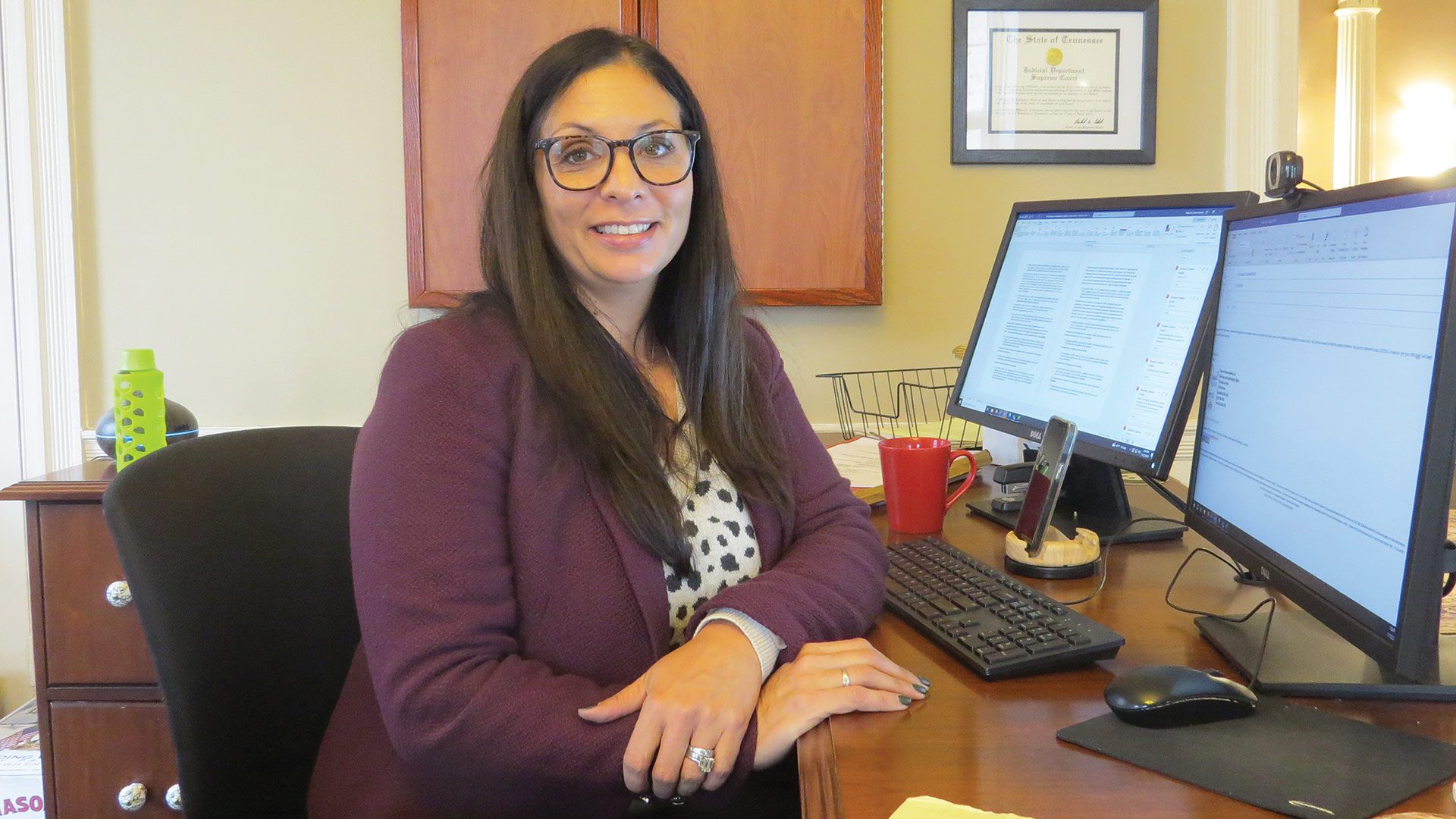
Tanzania Cannon-Eckerle

Tanzania Cannon-Eckerle says that, in the current labor climate, the best quality employers can display is transparency.

Kerrissey said booms are defined by momentum on several different fronts. Successful strikes — with success meaning that workers were able to win all or most of what they were asking for when they went to the picket lines — are easily the most visible.

And there have been many of those over this past year and in many different industries, said Kerrissey, citing the UAW strike, the averted UPS strike — a settlement that was reached gave more than 300,000 workers represented by the Teamsters significant wage hikes and new minimums — and the new contracts won by actors and screenwriters. But there have also been “successful” strikes in healthcare — In October, Kaiser Permanente struck a deal with a coalition of unions granting them 21% wage increases over the next four years — and many teacher strikes, including several in Massachusetts, that have garnered higher wages, especially for paraprofessionals.

But momentum is visible in other fronts as well, Kerrissey said, including what she called a “wave” of new union organizing over the past few years, elections that go through the National Labor Relations Board.

“These have stood out, both because it’s more workers doing these elections, but it’s also in industries that have typically not had a lot of union presence,” she said, listing the action at Starbucks as both the most visible and impactful example of such movement, with more than 300 locations across the country now unionized and the total of represented workers approaching 10,000.

But there have been others as well, including Trader Joe’s, Amazon, Chipotle, and REI, the camping and outdoor sports equipment retailer.

“That’s a real shift to have those types of elections in industries that have long been non-union,” Kerrissey told BusinessWest, adding quickly that workers in those industries, while now unionized, have mostly had a difficult time bringing companies to the table to negotiate.

“The bottom line is … if workers are happy, they’re not going to strike. If your employees are happy, they don’t feel like they need to organize. Usually, it’s one or two people that are upset about something and start to gather their forces, and they start nodding their heads and say, ‘yeah, you’re right, we do deserve more.’”

And while some numbers are trending upward, she went on, overall union representation is relatively flat, if not actually declining.

Indeed, according to the NLRB, union petitions increased 3% in fiscal 2023 compared to 2022, with 2022 seeing a 53% increase in union election petitions from the previous year. However, U.S. union membership declined to 10.1% in 2022 from 10.3% in 2021, the lowest on record, according to the Bureau of Labor Statistics. Although the number of workers belonging to unions increased by 273,000 workers to 14.3 million in 2022, the total number of workers in the U.S. workforce grew by 5.3 million, resulting in the drop in union density.

Those numbers show that, while labor is enjoying momentum, there is still room for more improvement, Kerrissey said.

“The next big hurdle is making the playing field more even for working people, and that comes down to labor policy,” she said. “The labor policy we have in this country is antiquated, and it’s been hard to change; the basic structure is still from the 1930s. But work has changed a lot since then.”

“It’s been quite difficult to make an updated, 21st-century labor policy,” she went on. “And I think some of the strikes are in reaction to that — there are few alternatives.”

Meanwhile, it’s difficult to project what will happen short- and long-term.

“It’s hard to make predictions,” she said. “Historically, when workers are striking and winning, union membership also surges — those two things are correlated. But it’s really hard to look too far into the future.”


Labor Pains

While long-term projections may be cloudy, Cannon-Eckerle said it’s rather easy to look short-term and see a time (it’s already here, actually) when it is much easier for unions to gain the right to represent employees, and for an election to come much more quickly.

Indeed, as she recapped the changes made by the NLRB in September, she said they have the potential to be as impactful as any of the recent strikes and could cause some real anxiety among employers.

The NLRB decisions, which came down in one hectic week in late August, bring significant changes to the landscape and essentially enable unions to get faster elections, make it easier to show that individual employee comments or actions constitute concerted activity, and limit past practice as a justification for unilateral changes, she explained, adding that these are all clear wins for employees and unions.

Summing them all up, Cannon-Eckerle said, “my clients are afraid — and they should be. They don’t know what they’re allowed to say or not allowed to say; there’s a gray line about whether you can actually say something to somebody, even if they’re being disruptive to the workplace.

“The fear is, ‘am I not going to be able to police the conduct of my employees, because they’re essentially allowed to say and do whatever they want?’” she went on. “And it just takes that one really upset or really vocal employee to create that pre-storm, if you will.”

That pre-storm is the series of events that can lead to a union election, she said, adding that the NLRB decisions can bring one about faster and more easily than perhaps ever before. In essence, the new rule resurrects what was known as the ‘ambush election’ process, which inhibits employers’ ability to educate their workforces about union representation and adequately prepare for union elections — hence the term.

In such a climate, businesses large and small should be focused on transparency, she said, adding quickly that this doesn’t necessarily mean wide-open books but does mean being open and honest about the financial big picture and a detailed explanation of revenues and expenses.

“If you explain to your workforce, ‘here’s what our budget is, and here’s the cost of each employee,’” she began, noting that this means the full cost of each employee, meaning salary, benefits, training, and more. “Most employees don’t know that; they understand budgets, and they understand what it costs to run their households, most likely, but they don’t fully understand everything that goes into charging $7 for a cup of coffee.”

Overall, Cannon-Eckerle said, business owners and managers should do what they can to impress upon workers that they are valued and heard when it comes to the issues that impact them, meaning everything from wages to working conditions to flexibility around where people work.

“The bottom line is … if workers are happy, they’re not going to strike,” she noted. “If your employees are happy, they don’t feel like they need to organize. Usually, it’s one or two people that are upset about something and start to gather their forces, and they start nodding their heads and say, ‘yeah, you’re right, we do deserve more.’

“The way to control that, first of all, is to right your ship; you have to make sure that your house is in order at your company,” she went on. “If it’s not, maybe there’s justification for the union cozying up to the workforce.”

Healthcare News Special Coverage

Building Blocks for the Future

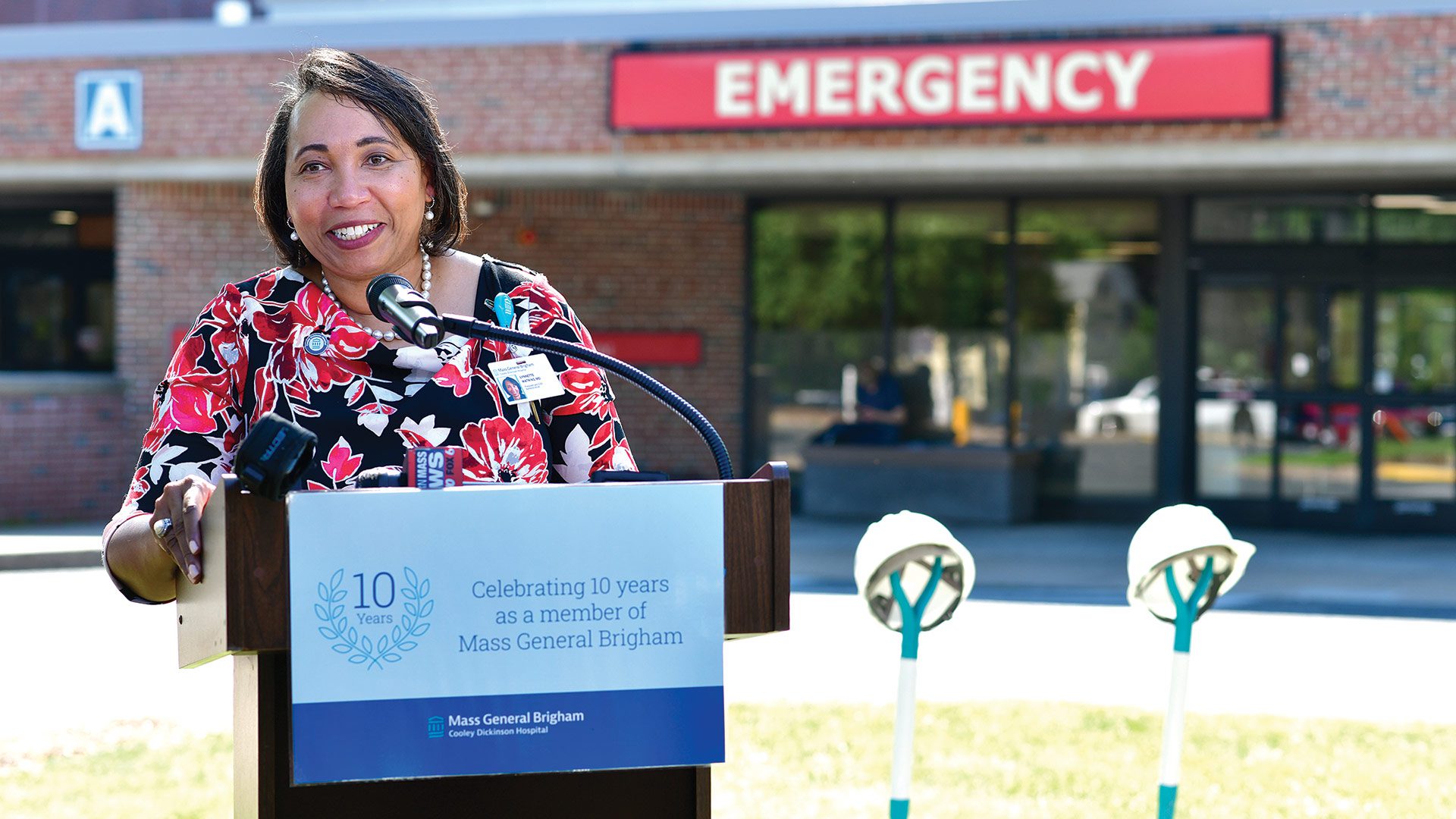
Dr. Lynnette Watkins

Dr. Lynnette Watkins called 2023 a rebuilding year and a time for “getting back to basics.”


As she talked about the relative fiscal health of hospitals, and especially Cooley Dickinson Hospital (CDH) in Northampton, which she serves as president and CEO, and the outlook for the coming year, Dr. Lynnette Watkins looked back on 2023 and described it with phrases often reserved for struggling sports teams — yes, like the one in Foxboro.

“It’s been a very challenging year,” she told BusinessWest. “It was definitely a rebuilding year, with a lot of focus on getting back to basics, and getting to what I would call a new normal.”

While we’re used to hearing those terms in sports, they work in healthcare, and especially when it comes to hospitals, said Watkins and others we spoke with.

Indeed, hospitals are rebuilding from several years of turmoil, falling revenues, rising costs, and struggles with recruiting and retaining a workforce. Many of these issues predate the pandemic, to one extent or another, but COVID certainly exacerbated the problems.

Dr. Mark Keroack, president and CEO of the Baystate Health system, which includes four hospitals — Baystate Medical Center in Springfield, Baystate Noble Hospital in Westfield, Baystate Franklin Medical Center in Greenfield, and Baystate Wing Hospital in Palmer — put things in perspective with some eye-opening numbers.

“It’s been a very challenging year. It was definitely a rebuilding year, with a lot of focus on getting back to basics, and getting to what I would call a new normal.”

He said the Baystate system, which also includes the health insurer Health New England, a range of physician practices, and a home-health agency (a $3 billion organization), essentially lost $61 million in the fiscal year that ended on Sept. 30 — $44 million from health delivery and $17 million from the health plan, which “had a bad year.”

And that’s a significant improvement over the previous fiscal year, when it lost $177 million.

And when it comes to workforce, the Baystate system has roughly 1,400 openings across several different departments, he said, noting that, again, this is an improvement from the peak of more than 2,000 in 2022.

Spiros Hatiras

Spiros Hatiras says HMC has taken aggressive steps on the workforce front, such as large sign-on bonuses and staffing ratios for nurses.

“It’s still more than double what it used to be before the pandemic,” said Keroack, who will be retiring next summer, adding that the system has nonetheless seen progress when it comes vacancy rates, turnover rates, and overall retention through strategies including flex scheduling, workforce-safety initiatives, upward movement on salaries and benefits, wellness programs, career counseling, and more — progress he expects will continue on these and other fronts in 2024.

Dr. Robert Roose, president of Mercy Medical Center in Springfield, agreed there was some improvement in 2023 on several of the fronts on which hospitals are battling, from overall volumes in the ER and with hospital stays (sometimes for the wrong reasons) to decreased use of travel nurses and their sky-high costs.

But there are still formidable challenges in the form of higher costs for everything from labor to equipment to medication; inadequate reimbursements for care (a problem hospitals have been dealing with for decades now); and, most recently, backlogs on the patient floors and the ER resulting from a shortage of nursing-home beds.

Overall, there are still many “mismatches,” as he called them, when it comes to demand in various settings and with specific needs, such as behavioral health.

“Hospitals are at a crossroads,” Roose said, noting that the pressures currently facing them will not likely abate in the years to come. “We have to think about how we focus on three main areas — health equity, system redesign and how we can do things differently, and workforce development.”

When it comes to getting back to basics, that phrase applies to everything to improving access, through initiatives such as an expansion of the ER at CDH (more on that later), to different strategies for recruiting and retaining employees — everything from greater flexibility with hours to a concert to celebrate nurses.

In that latter realm, there is certainly room for innovation and even what amounts to risk taking, said Spiros Hatiras, president and CEO of Holyoke Medical Center and Valley Health Systems, who said he and his team have certainly done so with some aggressive initiatives with bonuses for nurses, staffing ratios, and taking on nursing students right out of college.

“Hospitals are at a crossroads. We have to think about how we focus on three main areas — health equity, system redesign and how we can do things differently, and workforce development.”

Elaborating, he said HMC took some of the federal and state money funneled to hospitals in the wake of the pandemic and “invested” in programs to bolster the workforce through initiatives such as rising pay scales and benefits, ratios, and especially bonuses for nurses, both recent graduates and those with years of experience — initiatives that have generated strong results and eliminated the need for travel nurses, as we’ll see later.

For this issue, BusinessWest talked with these hospital administrators about the various forms of progress made in 2023 — and there were several — as well as the stern challenges that remain and the expectations for the year ahead.


Working in Concert

They called it Nurses Rock.

That was the name attached to a concert last spring featuring the local cover band Trailer Trash, staged in the former Colony Club space in Tower Square and orchestrated by Holyoke Medical Center. And that name speaks volumes about what this different kind of event was all about.

Indeed, this was a celebration of nurses, said Hatiras, noting that nurses from across the region, not just HMC, were invited. And more than 400 turned out.

Nurses Rock II is well into the planning stage, he went on, adding that the band Aquanett has been secured, and the event has been scheduled to coincide with National Nurses Week in early May.

Dr. Mark Keroack says 2023 was another difficult year

Dr. Mark Keroack says 2023 was another difficult year for hospitals, on several fronts, but it was a vast improvement over 2022.

Nurses Rock is just one example of rebuilding, going back to basics, being innovative, and, yes, thinking outside the box when it comes to the many challenges that are still confronting hospitals, which are, in many ways, still digging out from the fiscal turmoil created by, or exacerbated by, the pandemic.

With that, Keroack returned to those numbers he referenced earlier, such as the posted losses of $61 million system-wide in FY 2023, and put them into historical perspective.

“To really understand this, you need to turn the clock back to before the pandemic,” he said. “Before the pandemic, we would routinely generate margins of 2% to 3%, and we were generally stable; we were rated A+ by Standard & Poor’s, which put us roughly in the top quartile of health systems in New England.

“In 2020 and 2021, we were propped up by some generous federal subsidies from the CARES Act,” he went on, adding that these amounted to roughly $180 million. “They papered over some serious financial problems and enabled us to post 1% to 2% margins those two years.”

But that relief went away in 2022, and the system was still left with a huge bill for contract labor and overtime pay, he continued, adding that, when it comes to that $177 million loss in FY 2022, more than 70% of that came from higher labor costs.

In 2023, Baystate was able to make about $170 million worth of margin improvement, Keroack said, adding that much of this resulted from one-time grants from FEMA and ARPA monies, as well as some revenue-enhancement initiatives, efforts to improve supply-chain expenses, and a reduction of roughly 60 positions from the executive leadership ranks.

“We’re running an extraordinarily lean organization right now,” he told BusinessWest. For example, I used to have six direct reports, and now I have 12.”

What’s more, the system “turned the tide,” as he put it, when it comes to the use of contract labor, while also embarking on a number of joint ventures, such as the new behavioral-health hospital that opened recently in Holyoke, that help avoid capital expenditures, and exiting some small lines of business such as in-vitro fertilization and urgent care, areas where Baystate either couldn’t recruit talent or determined that these areas were not the core mission and were better left to others to handle.

Overall, volumes returned in 2023 across the board, Keroack said, meaning in the ER, surgeries, and discharges. But hospital stays or ‘days’ were considerably over budget because length of stay has increased, often because it’s more difficult to discharge a patient to a nursing home or home care.

“Hospitals are at a crossroads. We have to think about how we focus on three main areas — health equity, system redesign and how we can do things differently, and workforce development.”

“It’s causing a traffic jam,” he explained. “And it results in dozens and dozens of patients being stuck, waiting for a discharge to happen; that jams up the in-patient unit, causes backup in the emergency room, long waits, etc. It’s been stressful, but we’re beginning to get some progress on that.”

Watkins agreed, noting that more progress is needed in 2024 and beyond because there are many consequences as hospital stays lengthen, everything from greater potential for hospital-acquired infections and patient falls to further financial hardship for hospitals because insurers will not reimburse for those longer stays.

Much of the problem results from workforce issues, she went on, noting that “workforce drives access — access to our acute-care facilities, access to our ambulatory clinics, access to our VNA and hospice — and it really drives the value and quality of service that we offer.”


Work in Progress

Overall, there has been even more progress on the workforce front, although considerable challenges remain, said all those we spoke with.

Due to a heightened focus on various strategies regarding recruitment and retention, hospitals have greatly reduced their dependence on travel, or contract, nurses, who are paid at rates at least double what staff nurses receive, Watkins said.

At HMC, use of travel nurses has been eliminated altogether, said Hatiras, with a discernable dose of pride in his voice, noting that this was achieved through some rather aggressive risk-taking.

And, overall, the hospital has made itself a good place to work, he said, making it easier to recruit not only nurses but also doctors and other providers as well.

“The main theme in 2023 for us was to really leverage many, many years of work to create a great culture here,” he said. “That work, that culture, enabled us to attract physicians here where otherwise, we would have no shot. And it has essentially enabled us to solve our staffing problem. We have solved it for now — knock on wood.”

The most significant progress has come with attracting and retaining nurses and thus eliminating dependence on travel nurses, he went on, adding this has been accomplished through creation of that culture, but also through large bonuses and staffing ratios, initiatives launched in the early stages of the pandemic that are paying real dividends now.

“We gave the nurses something that no one else wanted to give them — something they really wanted, and something we fought for years not to give them: ratios,” he said. “None of my colleagues like my answer, but it has worked for us.”

Elaborating, Hatiras said that, pre-pandemic, his hospital, and all hospitals, fought hard against ratios demanded by nurses unions, primarily because there was no flexibility built into the equation, and penalties were imposed upon those who did not comply. HMC has injected some flexibility, keeping a 5-to-1 ratio whenever possible.

Meanwhile, rather than spend pandemic-related state and federal assistance on the “middleman,” meaning agency nurses for which the hospital paid $200 per hour, the hospital opted to put it toward retention bonuses and other initiatives for nurses and other providers of care.

“We basically said, ‘you’re here, and you work for us; we don’t want you to leave — so we’re going to pay you $20,000 over the next four years as a bonus, just to stay,’” he said, adding that very few nurses who accepted those terms have left.

Meanwhile, more recently, the hospital decided to make some additional investments, this time in recent college graduates, at a time when fewer hospitals were taking on such inexperienced individuals because of the high cost of training them. HMC offered them the chance to join the staff in May, after graduating, but not take on a full patient load until October.

On top of that, it offered something most “couldn’t say no to” — a $50,000 sign-on bonus for a commitment to stay five years.

“We said, ‘listen, we’ll cut you a check so long as you sign a note that says you’ll come and work for us,’” he said, adding that these bonuses were larger than most being offered and upfront in nature.

And they have worked, with many recent graduates signing on. And while many of his colleagues have questioned his math, Hatiras has told them, as he told BusinessWest, that, in the long run, it’s more cost-effective to incentivize nurses to stay in this aggressive fashion than it is to replace them when they leave. And that same guiding philosophy prompted him to put in place a similar program for experienced nurses, one that offers them $40,000 bonuses if they stay three years.


Reality Check

While there has been progress on workforce issues and other fronts, there are still a large number of pain points for hospitals, said Roose, adding that these will certainly continue in 2024.

“The pressures on hospitals have been increasing; they’ve been changing, and the needs of our community have been changing over the past several years, but the pressures have not relented,” he said, noting that the pandemic exacerbated the workforce crisis and compounded a financial crisis for hospitals across the country.

“Those various elements lead to pressures on everything from access to care for patients through traditional models that we’ve had for the past several decades, to having enough colleagues to provide care to meet the demands in different kinds of settings, to how to continue to invest in resources to innovate and grow to where healthcare is going.”

Moving forward, he said the healthcare system must continue to evolve to meet the changing needs of the public and continue to provide access to care, especially amid an ongoing shift toward more care being provided in outpatient settings.

“Hospitals and healthcare systems are evolving, but perhaps not quick enough to best meet those needs,” he went on. “We need to provide access points of care that are the most convenient, that are readily available, at the right level of care when needed, and with a high level of excellence.”

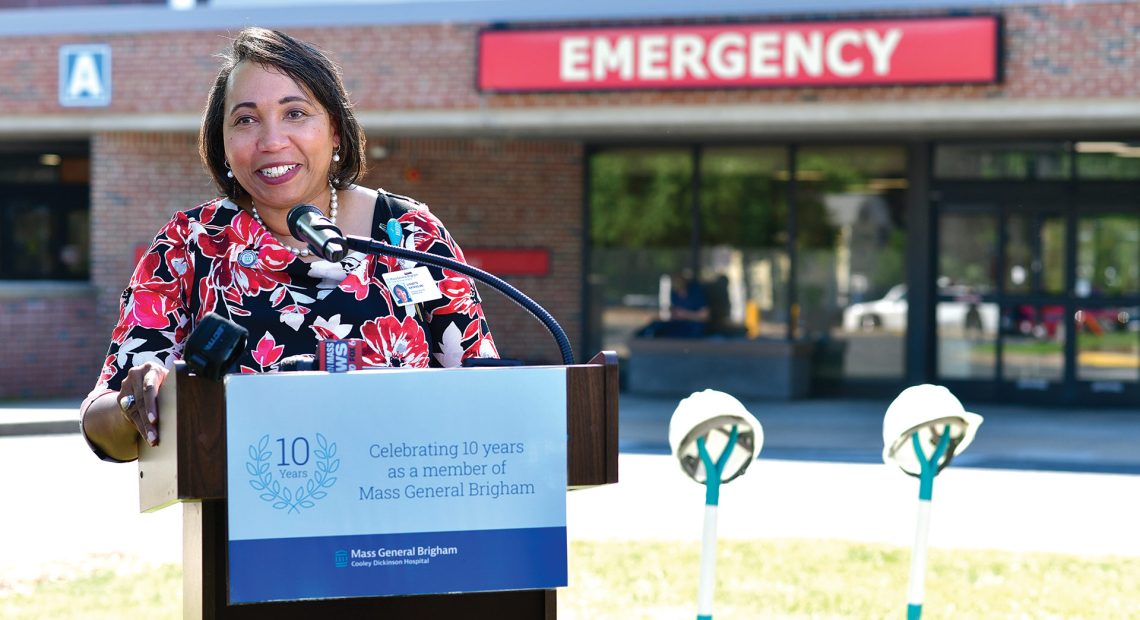
Watkins agreed, but noted that, while 2023 was certainly a time of ongoing challenge and duress for hospitals, it was also a period for rebuilding and, at CDH, celebrating such things as the 10th anniversary of the hospital’s partnership with Mass General Brigham, an expansion and renovation of the hospital’s labor and delivery suites, and the advancement of plans for expanding the ER, a project that will greatly enhance the delivery of care in that unit.

Ground will be broken on the new facility shortly, she said, adding that work to enlarge and redesign the ER brings into focus many of the pressing issues in healthcare today — everything from access to care to workplace conditions to retention of talent.

All are addressed in a design that adds 7,000 square feet of space but also improves safety through an overall configuration that enhances lines of sight while also improving staff satisfaction.

“They want to be in an environment that is pleasing to them, that they can move around in, because we spend a lot of the day at work,” Watkins said. “All of these things come back to workforce, which is going to be the key driver as we move into 2024.”


Bottom Line

As he talked briefly about his pending retirement and tenure at Baystate, Keroack joked that it has “never been dull.”

That’s an understatement and a rather polite way of summing up the past few years in particular.

It’s been a time of extreme challenge, but also intriguing and sometimes even exhilarating work to confront those challenges and find solutions.

As for what is to come and the outlook for 2024, hospitals will continue to rebuild and stress the basics. And, like any struggling sports team, they’ll look forward to the new year with optimism.

That’s the best you can do when you’re at a crossroads.

Special Coverage Women in Businesss

Promising Pipeline

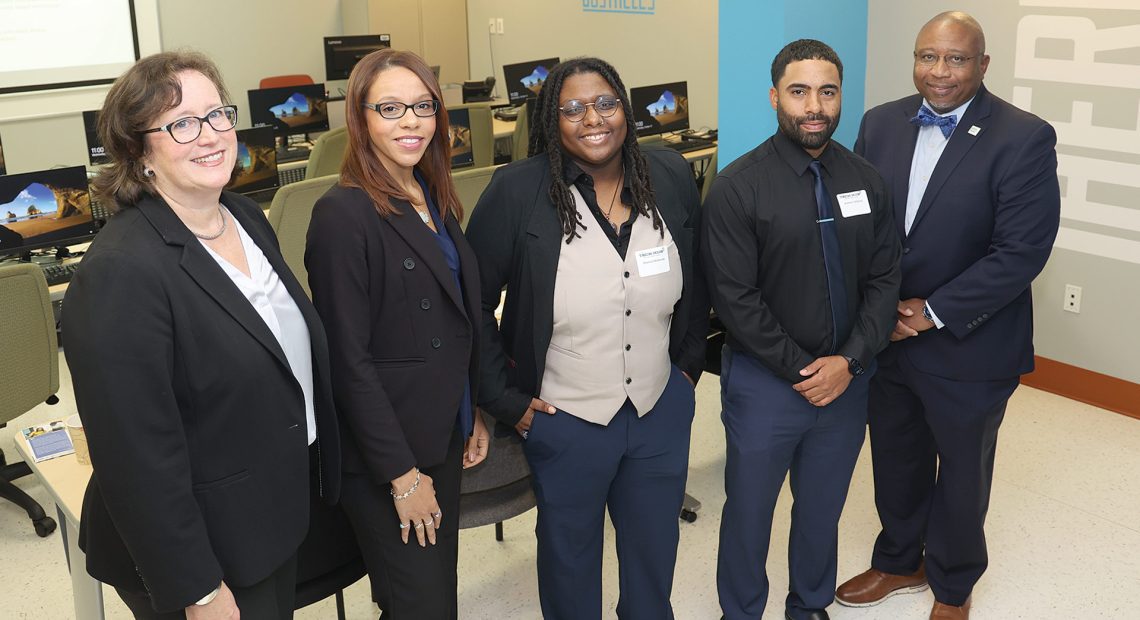
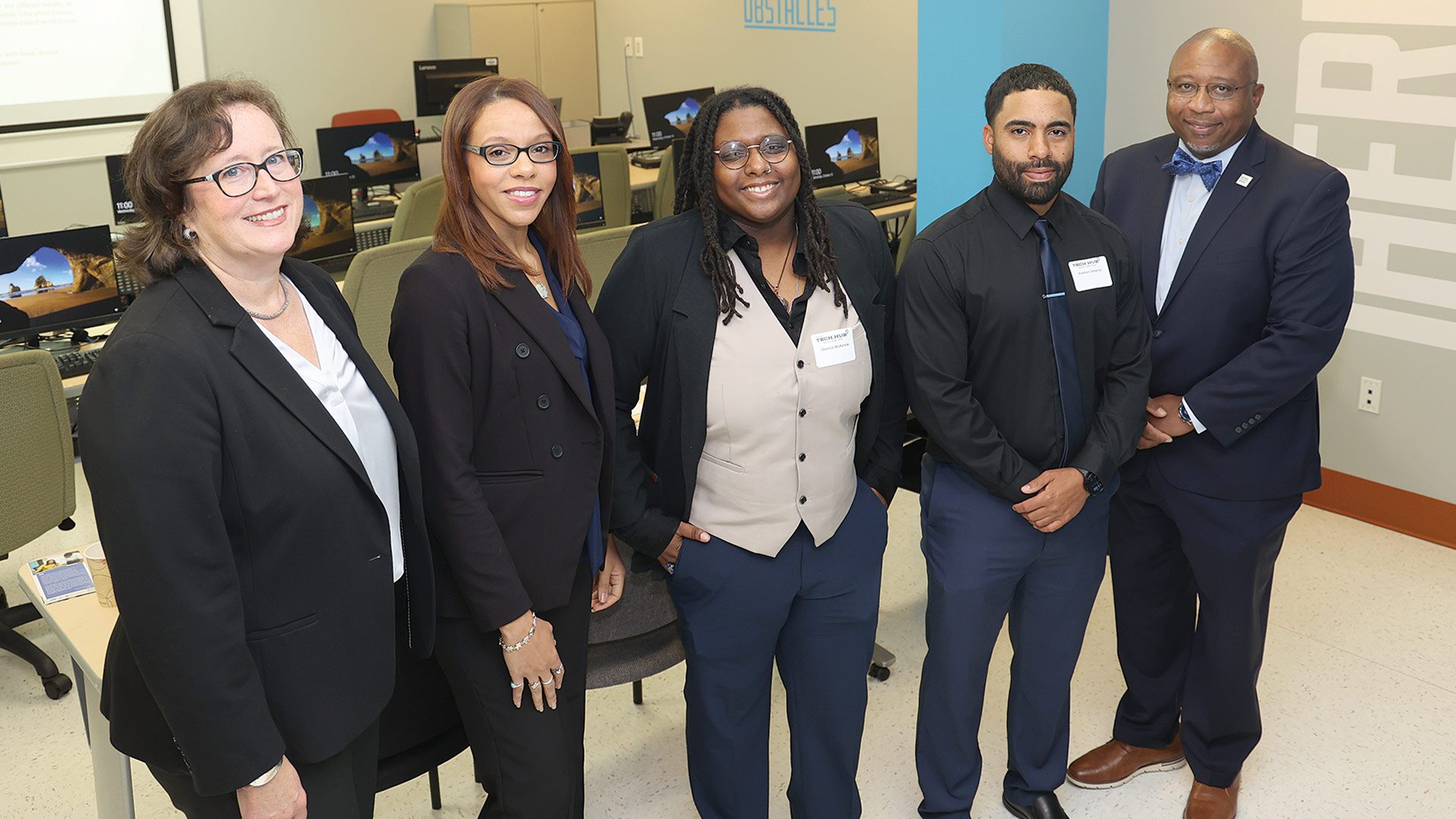
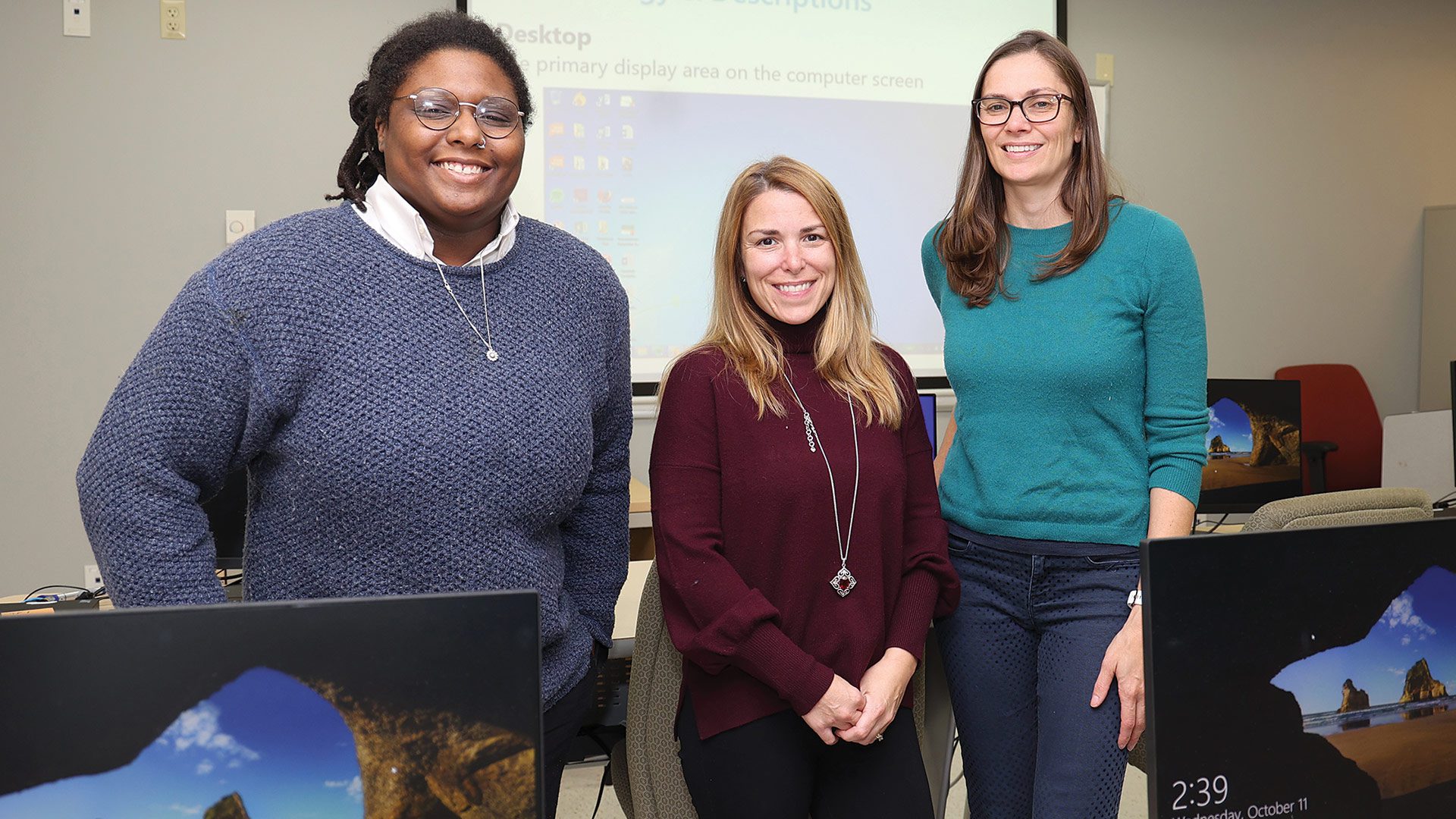
Tricia Canavan (far left) and HCC President George Timmons (far right) in the Tech Hub digital classroom with Tech Foundry graduates (and current Tech Hub fellows) Lasharie Weems, Shanice McKenzie, and Anelson Delacruz.

Tricia Canavan (far left) and HCC President George Timmons (far right) in the Tech Hub digital classroom with Tech Foundry graduates (and current Tech Hub fellows) Lasharie Weems, Shanice McKenzie, and Anelson Delacruz.


Tech Foundry was launched in 2014 with a specific goal: to increase the technology workforce in Western Mass. at a time when employers were struggling to attract and retain talent.

“Since then, we’ve grown and really have focused on working with low- to moderate-income people and also people from non-traditional backgrounds who may be underrepresented in the tech sector,” said Tricia Canavan, who came on board as Tech Foundry’s CEO last year.

The nonprofit does so by offering professional development, technical career training, career coaching and internships, and job placement in order to connect people to existing IT opportunities, she added. “We’re very proud of the fact that our alums access living-wage jobs and are on these great career pathways.”

If anything, she noted, the need for Tech Foundry is stronger than ever. Recent studies of the workforce environment in Massachusetts suggest up to 400,000 people need to be attracted, recruited, or reskilled in order to keep business in the Bay State humming at optimal levels — many of those in the broad realm of IT.

“There has been a talent shortage in the tech sector and in other sectors, even pre-pandemic, but since the pandemic, we’ve seen those trends accelerate.”

“We all know that the tech sector is on fire, and there are lots and lots of opportunities for growth, and you don’t always need a college degree to access those things,” Canavan said of Tech Foundry’s innovative model that lets students stack certifications to help them get their foot in the door in IT and then progress up the career ladder.

“There has been a talent shortage in the tech sector and in other sectors, even pre-pandemic, but since the pandemic, we’ve seen those trends accelerate,” she added.

The reasons are varied, from mass retirements of Baby Boomers — which means the departure of much senior and middle management, as well as rank-and-file IT workers, from the workforce — to fewer children in the K-12 pipeline.

“Just by sheer numbers, we have fewer kids that are going to be graduating from high school and entering the workforce and/or going to college — that’s fewer kids to engage as young professionals once they complete their education. Also, some of the forecasts that I’ve seen have upwards of 60,000 young professionals projected to move from Massachusetts,” she added, for reasons ranging from cost of living to a housing shortage.

“It’s sort of this perfect storm of economic conditions that are creating persistent needs in the workforce for workers of all types, but there is absolutely a need for more workers in the tech sector.”

Tricia Canavan says Tech Hub is a way to address the region’s digital divide.

Tricia Canavan says Tech Hub is a way to address the region’s digital divide.

The core, 18-week Tech Foundry program has helped produce more of those workers locally, but the nonprofit is equally excited about its newest initiative, called Tech Hub, a broad collaboration that also includes Holyoke Community College (HCC), the Western Massachusetts Alliance for Digital Equity, the Massachusetts Broadband Institute, the Accelerate the Future Foundation, Comcast, Google, Bulkley Richardson, and other partners.

“This has been created as part of the Western Mass. Alliance for Digital Equity’s efforts to address digital equity, and the digital divide here in Western Mass.,” Canavan explained. “We, as part of the consortium working on the digital divide in Western Mass., identified an opportunity to be able to support digital-equity efforts while also continuing professional-development training for our staff, students, and alums.”

Located at 206 Maple St. in downtown Holyoke, Tech Hub, which opened to the public on Oct. 26, offers basic and intermediate digital-literacy training, with an eye on enabling people to access jobs of all kinds, not just specifically in IT.

“It starts off as basic as, ‘do you know how to use a mouse? Do you know how to use a trackpad? This is how you get on the internet,’ all the way up to exposure to things like Google Sheets, Google Docs, Microsoft Word, Excel, that sort of thing. We want to help people access the basic digital literacy that they need to thrive at work, at school, in healthcare, and connecting to others in the community.”

That’s the first leg of the Tech Hub stool, she explained; the others are providing computers free of charge to eligible people, and providing technical support and one-on-one troubleshooting services to people in the community.

“Everybody probably has someone in their family that uses technology but maybe is not an expert. When they have a problem, where do they go? So we envision providing that support for the community through Tech Hub.”


Confidence Restored

As a single, stay-at-home mother with young boys, Lasharie Weems often felt overwhelmed — particularly when it came to technology.  “My 5-year old was probably more digitally literate than I was,” she said.

The remote instruction her children required during the pandemic proved even more baffling, she added. “My older two sons go to a science and technology school. I struggled to even help them with their homework.”

“We want to help people access the basic digital literacy that they need to thrive at work, at school, in healthcare, and connecting to others in the community.”

After enrolling in Tech Foundry’s free, 18-week program, she said her confidence was restored, and it actually brought her family closer together.

Weems now works for Tech Foundry. She told her story at the grand opening of Tech Hub, where she will be serving as an American Connection Corps fellow.

“Today is an exciting occasion for all of us,” Weems she told the crowd assembled outside Tech Hub’s digital classroom. “But for me, it’s a personal achievement as I celebrate the journey it took to get me here. Tech Hub is my opportunity to pay it forward, to help countless others identify and bridge the gap in digital equity.”

Canavan said connections like that are important.

“What was exciting to us about this project was the ability to expand the impact of Tech Foundry, but we’re also staffing Tech Hub in part with alums of Tech Foundry through a one-year professional digital fellowship program,” she explained. “They work under the guidance of Tech Foundry staff to provide the training and technical support services. In addition, we will have students who will be doing co-op and internship work while they’re in the program.”

From left: Tech Hub fellow Shanice McKenzie, Tech Hub manager Shannon Mumblo

From left: Tech Hub fellow Shanice McKenzie, Tech Hub manager Shannon Mumblo, and Tech Foundry deputy director Michelle Wilson in the Tech Hub digital classroom.

HCC President George Timmons said it was fitting for Tech Hub to be based at the Picknelly Adult & Family Education Center (PAFEC), one of the college’s satellite campuses in the heart of the city, which also houses HCC’s Adult Learning Center as well as other community programs, including the Holyoke High Opportunity Academy, an alternative public high-school program. 

“The mission of Holyoke Community College is to educate, inspire, and connect,” he said. “Through this initiative, we hope to promote access to technology and connectivity, digital literacy, and education, while giving individuals the tools they need to be successful.”

Holyoke Mayor Joshua Garcia agreed, noting that four students who attend the Holyoke High Opportunity Academy at PAFEC have already signed up to be part of the Tech Hub program. 

“I think we can all agree that digital literacy in 2023 is as vital as reading literacy was 50 years ago,” the mayor said. “Whether it’s filling out a job application, communicating with a customer, maintaining accessible records, or even booking a flight, digital fluency is a necessary life skill.

“But the Tech Hub mission recognizes something else: that there exists a digital divide that is the result of inequities in access, opportunity, housing, income, and schooling,” he went on. “The free training and support that will take place at this site and at community partner locations is going to be a liberating game changer.”


Opportunity Knocks

Meanwhile, important work continues at Tech Foundry, Canavan said, and applications for the next cohort of students are open at thetechfoundry.org through December.

“We work very intentionally to engage with the community to get the word out about TechFoundry, and there are a lot of different strategies that we use to do that,” she noted, including social media, referrals from community organizations, and partnering with schools to make students aware that Tech Foundry can be a career-development option for them.

“I think it’s a really good option for people because the training is excellent,” she added. “It’s really an intensive training with a great track record of people accessing employment in the tech sector after they graduate, and it’s at no cost.”

Canavan, who has a deep background in nonprofit management and was also president of a staffing agency, United Personnel, said it’s gratifying to see people come through the Tech Foundry program and improve their lives, and she’s hoping for similar impact from Tech Hub.

“I was eager to return to the nonprofit world after selling my business a couple of years ago and felt very fortunate when this job was open at Tech Foundry. I think it’s a great opportunity for me to use my background in recruiting and staffing and also leverage the workforce and economic-development work that I was doing in that role in the nonprofit world, in partnership with residents and community partners and employers,” she told BusinessWest.

“I love this job because it’s pragmatic and solutions-focused,” she added. “There’s tons of opportunity right now, so how do we work together to help residents of Western Mass. access those opportunities? It’s exciting.”

Construction Special Coverage

Building Momentum

By Emily Thurlow

With the federal COVID-19 public-health declaration coming to an end this past May, the once-global pandemic may seem all but a distant memory. For many businesses, however, its impact certainly hasn’t vanished from sight.

Challenges in obtaining materials and equipment continue to vex general contractors in the construction industry in Western Mass. and across the nation. This extended period of uncertainty — in both duration and scope — has left many feeling uncertain about the future beyond 2023, but there are positive signs, too.

Rising building costs and higher interest rates have been of particular concern to Kevin Perrier, president and CEO of Five Star Building Corp. After work in the Easthampton company’s largest sector — aviation — was essentially grounded for the past two years, Perrier says he was expecting business to be on the slower side.

But to his pleasant surprise, he was wrong. Quite wrong.

“We really saw the aviation sector rebound this year. It makes up for essentially two years of no growth and no construction,” he said. “Honestly, this was one of our busiest years I can remember.”

And Five Star isn’t alone. In fact, despite ongoing resource constraints, construction firms like Laplante Construction Inc. in East Longmeadow and Sweitzer Construction LLC in Monson are reporting an increase in the volume of their work, while Fontaine Bros. Inc. in Springfield calls 2023 the firm’s best-ever year for revenue.

“We really saw the aviation sector rebound this year. It makes up for essentially two years of no growth and no construction. Honestly, this was one of our busiest years I can remember.”

“This year has been good. It’s been steady,” said David Fontaine Jr., CEO of Fontaine Bros. “I think our efforts to work really hard to deliver our projects on time and on budget have really strengthened our relationships with our clients because they’ve seen that we’re still getting things done, successfully, no matter how difficult the climate is.”

Reflecting back on those unprecedented times, BusinessWest spoke with several companies in the region who shared how they have been constantly rolling with the punches by being as strategic as possible when planning out projects and seeking alternatives in design, materials, or vendors when applicable, and, above all, maintaining the safety of everyone involved.


Gaining Altitude

Within two weeks of the national shutdowns to stop the spread of COVID-19 in March 2020, Perrier estimates that Five Star lost “millions upon millions of dollars worth of work.” Initially, projects were put on a temporary hold, but shortly thereafter, the majority of those projects were canceled, he said.

Laplante Construction recently completed this new home build in East Longmeadow.

Laplante Construction recently completed this new home build in East Longmeadow.

This year, the company, which has been working up and down the East Coast in the aviation sector for the past 13 years, has more than made up for that lost time working with clients like Delta Air Lines and HMSHost International, a U.S. highway and airport food and beverage service company that is a subsidiary of the Italian company Autogrill SpA.

Some of the projects Five Star has completed include the new Gachi Sushi House in Terminal C at Boston Logan International Airport, as well as a Hudson store, offering food, beverages, and travel amenities, in the Terminal B/C connector, and a Hudson Nonstop at Charleston International Airport in South Carolina.

More recent projects underway at Logan include a new hangar roof for Delta Air Lines, some infrastructure work in the lower levels of the airport, and building the new Fox & Flight Restaurant in Terminal A for travel retailer and restaurateur Paradies Lagardère. Perrier said the new restaurant is slated to be the largest restaurant at the airport.

“I think our efforts to work really hard to deliver our projects on time and on budget have really strengthened our relationships with our clients because they’ve seen that we’re still getting things done, successfully, no matter how difficult the climate is.”

“At any given time, we usually have six to 12 projects going in the aviation sector, primarily at Logan,” he said. “The new Terminal E expansion at Logan kept us very busy; it generated quite a bit of work for us to the point that we were actually turning down bids out there. We just kind of reached our capacity for the summer because it was such a push all at once.”

Combined with several mixed-use projects, Five Star had its hands full, he added.

Meanwhile, Laplante Construction and Fontaine Bros. also share glowing reports for their work in the residential and commercial sectors, respectively.

Since expanding his business three years ago to Cape Cod, specializing in mid- to high-end home building and remodeling, Bill Laplante, president of Laplante Construction, says he hasn’t seen any kind of slowdown as a result of increased interest rates. Approximately 80% of the company’s business involves residential projects.

“So the Cape market has been very, very good. There’s an awful lot of work out there,” he said. “I just think there are fewer people out there that are relying on mortgages and are self-financing, or they’re paying cash for work to be done out there.”

For Fontaine Bros., projects that have been publicly funded have remained more consistent than privately funded or developer-driven projects.

Recently, the company completed the three-story DeBerry-Swan Elementary School project on Union Street in Springfield, which opened in the fall. Fontaine is also currently working on school-building projects in Westfield, Worcester, Tyngsboro, Walpole, Fitchburg, and East Brookfield, as well as the UMass Amherst campus.

Pat Sweitzer, operations manager of Sweitzer Construction, also described 2023 as an especially good year. She said that she and her husband, Craig Sweitzer, who co-own and operate the company, attribute this year’s successes to their employees and partners.

Sweitzer Construction has developed an expertise in dental-office construction

Sweitzer Construction has developed an expertise in dental-office construction, including this project for Alliance Dental Care in East Longmeadow.

Pat also offered praise to her sons, Brian and Michael Sweitzer, as both have taken on leadership roles as the firm is in the process of transitioning into a second-generation company.

On the smaller end of projects, the company repaired some buildings at Smith College’s campus and built a new dental office at 265 Benton Dr. in East Longmeadow. One of the larger projects on the company’s docket this year was the conversion of a 19th-century mill building in Northampton into Cambium Analytica’s safety-compliance lab for cannabis products. The new sterile testing lab, which hasn’t opened yet, is located at 320 Riverside Dr., at the site of the former Northampton Cutlery Co.

“Taking a former very old factory building and turning it into a sterile testing lab … the outcome is just remarkable,” Sweitzer said.

Mark Sullivan, president and executive project manager for D.A. Sullivan & Sons Inc., called 2023 the Northampton company’s “first normal year” in several years, adding that things started to stabilize, in a post-COVID sense, during the second half of 2022, and that momentum has carried through 2023.


Strength Amid Challenges

While supply-chain issues have dramatically improved across the board since the middle of the pandemic, almost every contractor BusinessWest spoke to has highlighted challenges with electrical components and equipment like meter sockets, switch gears, generators, and transformers. The demand for transformers has been exacerbated by the lack of available domestic manufacturers to meet the increased need.

“Some of those electrical items still have ridiculously long lead times,” Laplante said. “We built a house — literally finished the house a year and a half ago — and there was supposed to be a ground-mounted transformer for the electric service to the house, and they didn’t have them.”

While waiting for the transformer to come in, he said the electric company has supplied the customer with temporary power. “That transformer has been on back order for a year and a half, and we probably won’t see it for another year. When it comes in, we’ll swap it out.”

For the most part, customers have remained understanding, he added. Other materials that continue to be difficult to source in a timely manner include mechanical equipment, like rooftop units for healing and cooling equipment.

“It seems like anything that has a manufacturing process that has a lot of little pieces and parts that are coming from all over continues to be difficult,” Fontaine said. “And for things like, say, a chiller or a piece of switchgear, they won’t start the manufacturing process until they have every little piece or part of what they need at the facility where they put it together.”

Highlighting a similar concern, Sweitzer said her company has made efforts to order products ahead of time. On Nov. 28, a groundbreaking ceremony was held for one of its projects, Embr Springfield, a $2 million dispensary on Boston Road. At nearly the same time, Sweitzer Construction was ordering the rooftop heating and cooling unit.

“We’re just digging the foundation now, and we already ordered the rooftop unit because it will take that long for it to come in,” she said. “The long lead times are a challenge.”

Sullivan noted that, because lead times for electrical components and mechanical equipment are still driving the overall work schedule for D.A. Sullivan & Sons, the firm’s focus has been on pre-construction services and identifying items they feel may trip up their plans.

Another niche facing long lead times is luxury appliance brands like Wolf and Sub-Zero, according to Laplante. Under current lead times, both brands are averaging roughly 12 months to arrive once ordered. Similar to the transformer problem, Laplante said both manufacturers are providing small, temporary refrigerators until the one that was ordered arrives.

“A lot of the appliance companies and the manufacturers are doing the best they can to provide a temporary fix until the final product is delivered,” he said.


View to the Future

As the end of the year beckons, many of the companies BusinessWest spoke to are feeling cautiously optimistic about 2024.

Sweitzer has a number of projects on the books, including a few with new partnerships with other contractors like Kleeberg Sheet Metal Inc. in Ludlow.

Sullivan said his firm is wrapping up some municipal work and starting some new projects at libraries, fire stations, and safety complexes, and even has a few projects at local universities and colleges in the queue for next year.

“Next year and beyond, we have the biggest backlog we’ve had in over 10 years,” he said.

Meanwhile, Fontaine Bros. has secured a healthy amount of public-education work for next year and is positioning itself to be ready for other projects on the horizon.

“I think, generally speaking, the industry is always changing. It’s always exciting,” Fontaine said. “It’s been a challenging couple of years, for sure, but it’s something new and exciting to wake up to every day, and we’re thankful that we’ve continued to be able to be successful through it. So hopefully, 2024 and on will get easier, but whatever happens, we’ll be ready to tackle it.”

Though the residential trend of smaller luxury homes looks to continue, Laplante said there are also a number of very large-scale luxury home builds on the books.

“We’ve seen people downsize and go from a large, two-story home to a high-end, smaller ranch with very, very nice amenities on one-floor living, but interestingly enough, we also have some very large homes in the pipeline for next year,” he said. “This is particularly interesting because, generally speaking, over the last five years, there’s been a trend to reduce the overall size of the homes that are being built to single-story living.”

As for Five Star, Perrier says the new year still holds a lot of question marks for him as the aviation sector tends to be a little more unpredictable. Though there are infrastructure and retail build-out projects on the books, higher fuel costs and tightening budgets can often bump jobs at the last second, he explained.

“What tomorrow brings, I don’t know. I guess I’m still going in with the same hesitation I had for 2023,” he said. “Hopefully, I’ll be pleasantly surprised again.”

Community Spotlight Special Coverage

Community Spotlight

Craig and Pat Sweitzer

Craig and Pat Sweitzer at the recently unveiled mural in the center of Monson.
Staff Photo

“Sophisticated rural.”

That’s how Craig Sweitzer, who has lived and worked in Monson for more than 40 years now — and served on the town’s Planning Board for most of that stretch — chose to describe this community of almost 9,000 people on the eastern edge of Hampden County.

By that, he meant that this town is certainly small and rural, but, as he put it, “you don’t have to leave town to eat.”

Indeed, the community’s downtown boasts several restaurants and, at last count, three coffee shops, said Sweitzer, who, with his wife, Pat, owns and operates Sweitzer Construction, a design-build firm that specializes in medical facilities (especially dental offices) and, more recently, cannabis operations of all kinds.

Indeed, the arrival of the cannabis industry has brought work across all aspects of that sector, Sweitzer said, from dispensaries to production facilities; from testing labs to an armored-car operation in Belchertown created to handle the large amounts of cash generated by these businesses.

“After you get your feet wet in something, you master it, and it leads to more work in that area,” he said, adding that the same is true of dental offices (his firm has now built more than 200 of them), and it is now true with cannabis facilities. “And when you do design/build, you offer the whole package — the architecture, the financing, the site selection … and we’ve done the same thing with cannabis.”

The Sweitzers made Monson their home and the base for their business back in the ’80s, and they’ve watched it grow and evolve. A little.

“Monson still has its rural quality — we still don’t have a traffic light,” Craig said, adding that the town has not changed much over the past four decades, and for those who live there, this is mostly a good thing; sophisticated rural is an attractive quality, one that many are seeking, especially post-pandemic.

Indeed, the town has seen a slight rise in population in the wake of COVID and the manner in which it prompted some living in large population centers to seek more rural areas in which to both live and work.

“Post-COVID, flexible work and hybrid models became very attractive, and so did communities like Monson, because obviously it costs much less to buy a house out here then it does in the Boston area,” said Dan Moriarty, president and CEO of Monson Savings Bank, who grew up in town and thus admitted to some bias, adding that, if the proposed east-west rail project becomes reality, Mosnon and communities like it will become even more attractive to those looking to work in Boston but not necessarily live there.

“There’s still that sense of small-town feel and community here in Monson, and that’s very attractive to many people,” he went on. “It’s a nice place to live, and I get the best of both worlds because I work there as well.”

He said Monson is close enough from Springfield and Worcester to be an attractive landing spot for those working in those metropolitan areas. Meanwhile, it has its own economy in a way, with those aforementioned restaurants and coffee shops, a supermarket, several service businesses, and some ventures that accentuate its rural personality while also making it a destination.

That list includes Silver Bell Farms, a multifaceted enterprise that features everything from Christmas-tree sales (although not this year as the farm builds up inventory for the future) to many different kinds of events, to a new lighting display called Silver Bell Nights.

“There’s still that sense of small-town feel and community here in Monson, and that’s very attractive to many people.”

Michael Moore, who runs the operation with his wife, Laura, said Silver Bell Nights is an intriguing addition to a portfolio of events and attractions that brings more than 50,000 people to the farm each year, with activities running year-round and especially in the fall and then around the holidays.

“This is something we’re really excited about — it’s a dazzling outdoor lighting display,” he told BusinessWest, adding that the lights were turned on amid considerable fanfare on Nov. 18, and the show will go on until the new year. “We’re looking forward to many new visitors discovering the farm and all that we have here.”

For this the latest installment of its Community Spotlight series, BusinessWest visited Monson to get a feel for what sophisticated rural is all about.


The Nature of Things

Craig Sweitzer said that, during his long period of service on the Planning Board, the largest housing project to come before that body has been a subdivision of no more than 12 homes.

“Monson is quite hilly, and we have a lot of land that’s tricky to build on,” he said, adding that this topography helps explain why, unlike some of its neighbors, and especially Belchertown, it has not seen large-scale residential development.

What it has seen is slow but continuous growth, one or two homes at a time, on existing roads.

Michael Moore says Silver Bell Nights is an exciting new addition

Michael Moore says Silver Bell Nights is an exciting new addition to what has become a year-round destination.
Staff Photo

“Although there are no massive subdivisions, there’s always a steady flow of new lots being created from existing road frontage,” Sweitzer explained, adding that any growth has been incremental and not (like Belchertown) explosive.

What the new residents encounter, and what those already living there thoroughly enjoy, is a town that’s both isolated and accessible at the same time, one with a small yet thriving downtown, a lively arts community, some intriguing new businesses, and nature.

“There’s a lot here … it’s a quiet, vibrant town with its own personality,” said Pat Sweitzer as she walked with BusinessWest on Main Street. “There’s a lot to like here.”

All of this is captured in, and manifested in, a mural adorning the wall of Adams Hometown Market on Main Street. The byproduct of a project led by local artists Melissa Stratton-Pandina and Shara Osgood and unveiled in September, the mural is titled “Past, Present and Future.” It depicts town landmarks; some of its history, including its granite quarries and involvement in the Civil War; and rural nature — there’s an image of a mountain lion that has become part of town lore, said the Sweitzers, who believe they’ve seen the cat.

The mural, created with large amounts of feedback from the community, effectively tells the story of a town that celebrates its past — including the recent past and a still-ongoing recovery from the June 2011 tornado that roared through Main Street — as well as its present.

And there is much to celebrate, including a high quality of life; a stable, still-evolving downtown; a vibrant arts community thanks to the ongoing efforts of the Monson Arts Council; annual gatherings such as Summerfest and a popular food-truck festival; and what both Moriarty and the Sweitzers called an entrepreneurial spirit that has yielded a number of intriguing new business ventures in recent years.

Dan Moriarty says the broad goal in Monson is to attract new business

Dan Moriarty says the broad goal in Monson is to attract new business while maintaining the community’s rural look, feel, and personality.
Staff Photo

Overall, the business community is quite diverse, said Moriarty, and includes many ventures in the broad realm of tourism and hospitality. These include the restaurants and coffee shops downtown; small bakeries and specialty food producers, such as Cookies by Ray and Happy Hen Farmstand, which sells everything from eggs (hence the name) to a variety of baked goods; and agriculture-related businesses such as Echo Hill Orchards and Winery, Bryson’s Maple Syrup, and Silver Bell Farms, a relatively recent addition that continues to evolve.

Indeed, what started as a Christmas-tree farm roughly a decade ago has become a site for events and activities year-round, said Moore, listing everything from private events such as birthday parties to an Easter egg hunt, Christmas in July, a fall corn maze, barrel-train rides, tractor-pulled wagon rides, and even interactive theater productions.

There are plenty of holiday-season happenings and programs as well, including Santa story time, wreath decorating, and a farm store that sells everything from Christmas ornaments to cider donuts.

The big addition this year is Silver Bell Nights, the holiday light experience that features a number of different displays throughout the property.

Monson at a glance

Year Incorporated: 1775
Population: 8,865
Area: 44.8 square miles
County: Hampden
Residential Tax Rate: $15.86
Commercial Tax Rate: $15.86
Median Household Income: $52,030
Median Family Income: $58,607
Type of Government: Select Board, Open Town Meeting
Latest information available

Moore said the initiative represents a sizable investment, but one that will make Silver Bell more of a holiday destination — and tradition — for area residents, and a vehicle for continued growth at the farm.

Moriarity said Monson’s challenge moving forward — and it’s the same challenge facing many smaller towns — is to promote growth of the business community while maintaining the rural quality that makes it so attractive.

“Like most small towns, we try to be open-minded,” he told BusinessWest. “I’m very passionate and hopeful for continual pro-business decisions in town, where we can bring in some small-business opportunities for people, because I think that, for the town to be viable, we must be open to new business opportunities, while at the same protecting the open space and beautiful landscape the town has.”


Getting a Feel for It

Getting back to that mural, it tells a story — and it is quite a story.

A story of a community that is continually looking for ways to build on an already-attractive landscape and create more reasons for people to want to live and work there.

That’s the big picture in Monson — figuratively, but also quite literally.

Professional Development

Professional Development

Kimberly Quinonez

After getting some help rising out of poverty, Kimberly Quinonez is now in the business of helping others.

Kimberly Quinonez says she’s always had a passion for helping people, and a desire to make doing so a career.

But for most of her life, she was the one needing help.

A native of South Carolina, she grew up in a life of poverty, addiction, homelessness, and a sixth-grade education, and was desperate for a way out — and up — from all that.

After getting clean and moving to Western Mass., she completed her high-school equivalency at Springfield Technical Community College (STCC) at age 43 and enrolled in the school’s two-year associate-degree program in social work. And while still earning that high-school equivalency, she told BusinessWest, she met Wally Soufane, social work specialist at Elms College, who became a mentor and essentially put her on a path to the bachelor’s degree-completion program offered at the school.

Completing that program, and the associate degree before that, were stern challenges, she said, noting that there were several times when she wanted to quit because the combination of life and school seemed like too much. But she persevered, with help (there’s that word again) from Soufane and others who helped provide her with the will to carry on.

“I kept on and kept on; I had some discouraging moments, but I just couldn’t give up because this was something that I really wanted for myself,” she said. “And I really like helping people.”

This past May, she completed that program and was among the speakers at Elms’ commencement ceremonies, her story riveting those in attendance. Today, she’s employed at the Hampden County Sheriff’s Department as a care coordinator and counselor, while also working toward a master’s degree in social work at Springfield College.

“If we accept a student, our job is to support them. If they’re going to do the work, we need to support them as best we can and help them be successful, and we do that; our retention rates, over 80%, are very good, and our graduation rates, in the mid-60s, are very good.”

Her story touches on many elements of the bachelor’s degree-completion programs at Elms, said Walter Breau, executive dean of the college’s Kirley School of Continuing Education — everything from its ability to help non-traditional students set and achieve goals to the way its administrators and instructors work with students to help them overcome challenges and complete their degrees.

“If we accept a student, our job is to support them,” he went on. “If they’re going to do the work, we need to support them as best we can and help them be successful, and we do that; our retention rates, over 80%, are very good, and our graduation rates, in the mid-60s, are very good.”

Social work is one of the more popular programs at the Kirley School, said Breau, adding that others, many of them offered online, include computer information technology and security (CITS), computer science, healthcare management, speech-language pathology assistant, management and marketing, psychology, and RN-BSN.

Overall, there are now roughly 200 individuals enrolled in continuing-education (CE) programs at Elms, roughly 20% of the undergraduate population, said Breau, a veteran administrator at the college who recently took the helm at the Kirley School, noting that the goal is to grow enrollment to 300 and beyond.

Walter Breau says the Kirley School is focused

Walter Breau says the Kirley School is focused on not only enrolling people in degree programs, but seeing them through to the finish line.
Staff Photo

And there is certainly some momentum with regard to enrollment, as the region’s community colleges, bolstered by the MassReconnect Program, which provides free tuition to those over age 25, are seeing their first real rise in enrollment since well before the pandemic.

For this issue, BusinessWest continues its series spotlighting professional-development programs across the region with a visit to the Kirley School and an examination of how it can change lives, like Quinonez’s, in a profound way.


Grade Expectations

This past May, Elms’ School of Continuing Education was officially renamed the Sister Kathleen Kirley ’66 School of Continuing Education, following a donation to the school in her honor.

And the new name is quite fitting, said Breau, noting that Sr. Kathleen, a member of the Sisters of St. Joseph, now retired from the school, was director of Continuing Education at Elms from 1977 to 1990 and served as the dean of Continuing Education and Graduate Studies from 1990 to 1998.

“If you look at the mission of the Sisters of St. Joseph, their goal is to serve the community,” he noted. “And at some point, instead of just having the traditional programs where you come to campus Monday through Friday, they understood that there was a population of individuals we could serve in a different way.”

That was the genesis of continuing education at Elms, he said, adding that, for more than a half-century now, the school has continued to serve non-traditional students with a variety of programs aimed at helping individuals not only earn degrees, but forge careers in growing fields.

These include collaborations with the region’s community colleges, whereby students can earn bachelor’s degrees on the community-college campuses. Indeed, there are social work programs at Asnuntuck Community College, Berkshire Community College, Greenfield Community College, and Springfield Technical Community College, said Breau, noting that many who earn their bachelor’s degrees at those locations, and on the Elms campus as well, go on to earn a master’s degree and become a licensed clinical social worker in the Bay State.

“If you’re a computer science major at STCC and you’re looking to earn your bachelor’s, we make sure there’s no loss of credits. You finish at STCC in May, and you start with us in August in the computer science bachelor’s program. It’s just another sign to students that we’ve deliberately thought about how to make you successful.”

“We have many of our students at STCC, Asnuntuck, and here on campus go forward and get their MSW,” he said, adding that there is “more than enough demand” for individuals who have those credentials.

Other popular programs include RN-BSN and speech-language pathology assistant, he said, adding that there is growing demand in both fields, and especially nursing.

Elms has articulation agreements, more than 50 in all, with the area community colleges, Breau explained, noting that these partnerships help create what he called “seamless pathways” as individuals take the credits they earned while completing an associate degree and apply them toward a bachelor’s degree at Elms.

“If you’re a computer science major at STCC and you’re looking to earn your bachelor’s, we make sure there’s no loss of credits,” he noted. “You finish at STCC in May, and you start with us in August in the computer science bachelor’s program. It’s just another sign to students that we’ve deliberately thought about how to make you successful.”

There are many such signs, he went on, adding that one point of emphasis at the Kirley School is to not simply merely get people enrolled in the various degree programs, but to see them through to completion.

And completion can be challenging, Breau said, noting that more than 75% of those enrolled in CE programs at Elms are 25 and older, which means they’re likely dealing with a number of life matters, such as work and family.

“They’re an older population who have decided, for one reason or another, that they want to fit in coursework with work, family, and other obligations,” he explained. “Our goal is first to show that it’s possible, it’s accessible, it’s affordable. People can see the end point even before they start.”

After showing it’s possible, the school then helps make it possible, with everything from flexible start dates to initiatives to help them step back in if they happen to hit pause for whatever reason, to many forms of student support, such as a 24-hour tutoring program.

Quinonez has seen these efforts to provide support up close and personal.

She said those at Elms were constantly supporting and “checking up on me” while she was in school. And they still do, months after she graduated.

“They still reach out to me today and say, ‘Kimberly, how’s it going?’” she told BusinessWest. “Elms changed me; I grew up and matured a lot — Elms College became my parents.”


Bottom Line

Today, Quinonez is working toward another degree at Springfield College and expects to complete that work in May. She said her time at Elms didn’t just help her find a career — instead of a job — but it instilled in her the desire to continue to reach higher and position herself to help people in more ways.

That’s what Sr. Kathleen Kirley had in mind when she laid the groundwork for today’s highly successful CE department at Elms.

The program has provided pathways to success and opened doors for people like Quinonez, who just needed a little help. And now they can help others.

Features

At a Loss

By Dr. Jennifer Sowards


The year-end holidays are fast-approaching, and it can be a festive time, with many people busy meal planning and shopping for the perfect gift.

However, for people with hearing loss, it may also be a stressful time, filled with gatherings where it will be difficult to understand conversations with family and friends. Hearing loss is tricky because it’s not an all-or-nothing thing: most people report they can hear, but it’s the clarity that becomes a problem. This is why many people still have untreated hearing loss. Most people don’t notice their own hearing loss because, to them, it sounds like other people are mumbling.

One of the first signs of hearing loss is difficulty understanding speech when there is background noise present — and this is what happens at holiday gatherings.

Even with hearing aids, navigating group settings can be a challenge. Here are some tips for the upcoming gatherings:

• Try to pick a spot that will be less noisy (away from fans or music).

• Try to position yourself as close as possible to the people you are trying to hear.

• Try not to be embarrassed to tell people you are having difficulty, and ask them to speak less rapidly or to move to a quieter spot with you.

• Pay attention to context clues to help you predict what comes next. For example, if you hear the word ‘weather,’ the next topic will likely pertain to cold, snow, rain, warm, etc.

• Don’t nod your head and smile if you didn’t understand what was said; ask the speaker to repeat to avoid embarrassing exchanges.

• If someone tells you a phone number or spells a name for you, repeat back what they said to make sure you heard it correctly.

• If you misunderstood part of a sentence, ask a specific question about the part you missed, rather than saying “what?” (For example, “where did you hide the gifts?” or “who is Ted bringing to dinner?”)

• Try to keep a positive attitude. There are some situations where it is hard to hear even for people with normal hearing.

Communication partners can also support their friends and family with hearing loss during the holidays:

• Enunciate words and face the person you are speaking with.

• Make sure you have the person’s attention if you want to tell them something important.

• Help manage background noise. Lower the volume or turn off background music or television, put down rugs in areas with hard floors (echoes in a room can exacerbate the noise), and make sure the room is well-lit to allow for clear visual cues.

• It’s OK to be frustrated, but try not to take it out on the person with hearing loss. Gentle reminders about their dependence on you might actually be helpful motivation to address any untreated hearing issues.

• Hearing aids aren’t hearing cures; even those with treated loss or normal hearing can still struggle at noisy events.

At Florence Hearing Health Care, our recommendation is for anyone noticing any hearing difficulties to have a comprehensive hearing evaluation with an audiologist to establish a baseline. The first thing we do is check to make sure there is no wax blocking the ears. We also make sure there are no infections or eardrum problems that could be treated by a physician. From this evaluation, the audiologist will be able to tell you exactly what your hearing ability is and if treatment is recommended.

Sometimes, holiday gatherings provide the inspiration for this first step in diagnosing and treating hearing loss.


Jennifer Sowards, Au.D. is an audiologist and founder of Florence Hearing Health Care.

Building Trades

Beyond Four Walls

By Emily Thurlow

The Newman Catholic Center

The Newman Catholic Center at UMass Amherst is among PDC’s notable recent projects.

One of Nick Shaink’s earliest memories with Professional Drywall Construction Inc. was working as a laborer for the buildout of the Target store at the Holyoke Mall. As a teenager, he worked with the Springfield-based commercial drywall contractor on weekends and on summer breaks.

Now, more than two decades later, the firm is undertaking larger-scale projects, like a 900-room dormitory at the University of Connecticut, and Shaink is co-owner and vice president of PDC Inc.

While the company’s name reflects its origins in drywall, PDC offers services in structural metal framing, finish carpentry, acoustical ceilings, wood framing, plastering, toilet partitions, and more. Most recently, the company landed a job that solely involves installing metal panels on the exterior of a building.

“We’re starting to get work that’s not our traditional scope of work — it’s our expanded scope of work,” co-owner and President Ron Perry said.

Founded in 1994 by John Kendzierski, PDC has been affiliated with the local carpenters’ and laborers’ unions since 1997.

Over the course of Shaink’s career with PDC, he’s held nearly every job — from carpenter and general superintendent to vice president of Operations. A native of Connecticut, he had aspirations of running his own business and eventually relocated to Hampshire County.

Perry, who has been with the company for eight years, was previously a construction manager for two decades. In that prior capacity, he often hired PDC for construction projects, which is how he met Shaink. Over time, Perry learned that they shared similar ambitions. After Shaink approached Perry about going into business together, the pair purchased the company in 2018.

“I’ve always wanted to own a business; that’s always been a dream of mine,” Perry said. “So when this opportunity came up, it was something that I couldn’t pass up.”

Since then, the business has expanded its footprint into Connecticut, opening an office in Norwalk in 2018, and into New York, with an office in Malta in 2021. The multiple locations support each other, Perry said.

While PDC’s Springfield headquarters is handling some of the larger projects, such as the interior framing, insulation, and drywall for UConn’s hockey arena, its Malta location is currently working on a Starbucks at Rivers Casino & Resort Schenectady. For now, the decision remains to take the growth pattern a little slower at the company’s newest office.

“I’ve always wanted to own a business; that’s always been a dream of mine. So when this opportunity came up, it was something that I couldn’t pass up.”

“We want to make sure that we build the right team. We want to make sure that we have the right manpower, instead of taking the giant job out in New York where we could potentially fail,” Perry said. “We’re starting a little slower and trying to grow responsibly there.”


Piecing It Together

Over the years, PDC has built a name for itself in renovation and new, large-scale construction projects for retail, medical, and educational organizations in Massachusetts, Vermont, New Hampshire, and Connecticut. The company also has a bonding capacity of up to $100 million.

Notable structures that PDC has had a hand in include the Bone & Joint Institute at Hartford Hospital, Baystate Medical Center’s Hospital of the Future expansion, Taconic High School in Pittsfield, and Wahconah Regional High School in Dalton.

PDC owners Nick Shaink (left) and Ron Perry

PDC owners Nick Shaink (left) and Ron Perry say they want to keep growing the company gradually and smartly.

The company has also worked on more than 30 projects at UMass Amherst in the last 15 years, Shaink said, from its striking design of Isenberg School of Management to the UMass Design Building and the Newman Catholic Center.

At the campus’s Old Chapel, the company installed pre-fabricated, structural cold-formed metal framing, sheathing, and roof blocking on the building’s exterior, and installed framing walls and drywall on the interior. Workers also installed soffits, which is the underside of part of an architectural structure like an arch.

Work also included the installation of wood stairs, acoustical ceiling tiles, and acoustical plaster systems.

“Our goal is to try to do as many of the things we’re good at under one contract. It gives us more control over costs. It gives us more flexibility … it gives us more work on that job, as contracts are a little bigger,” Perry said. “We’re able to do more work with less — that’s why we want our jobs to be bigger. We want to do a bigger scope of work.”

Drywall — a staple in modern homes and buildings in the U.S., also referred to as wallboard or plasterboard — is made of two paper boards with gypsum, a gray or white soft sulfate mineral, in the middle.

The prototype for the invention was patented by Augustine Sackett in 1894, according to the National Inventors Hall of Fame. However, it wasn’t widely accepted as a building material until the 1940s.

Taking the art of drywall a step further in customization, PDC uses a unique method to mill a perfect corner, called ‘origami.’ Much like the Japanese art of folding objects out of paper, PDC’s approach enables its employees to shape a piece of drywall to fit a space more efficiently at the Springfield shop beforehand. Instead of using three separate pieces of drywall to make a column, they can use one piece of drywall, fold it, and glue it together in the desired angle, then install it in one piece.

By using this method, Perry explained, the drywall is not only a durable solution, but it is also a more efficient one, as the profiles are pre-fabricated in the shop. “It makes our lives in the field less complicated. It’s efficiency in the field.”

And, as with most contractors, time and scheduling are of the utmost importance.


Leveraging Growth

About a decade ago, the annual drop in temperature also meant a drop in projects. But for the past five years, PDC hasn’t really slowed with the changing of the seasons, Perry said. “It doesn’t ever stop.”

In the months leading up to COVID-19, the company secured a number of jobs, which helped carry it through what were some trying times for other organizations. Despite the uncertainty, Shaink said the company’s workload never really slowed down.

Fortunately, even as businesses across all sectors, especially in the construction realm, have battled persistent workforce shortages, labor has not been much of an issue at PDC, as the company continues to fluctuate between 280 and 300 employees.

The main obstacle during the pandemic — and it’s still an issue — is supply-chain issues for materials. The variety of metal studs the company uses for projects has traditionally been available within a week or two. But in the post-pandemic world, those same metal studs are taking up to eight weeks to arrive. That delay impacts the schedule, which in turn impacts the company’s ability to forecast as accurately as it would like.

“When that lead time is eight weeks and you’re buying material that’s eight weeks away, and it comes, and it turns out you don’t have enough — that’s eight more weeks,” Perry said. “And guys standing around is what costs us the most amount of money.”

One of the hardest-to-get products has been insulation. At one point, insulation, which was typically available within a few weeks, took up to nine months to arrive. In an effort to overcome such delays, Perry said PDC purchased multiple truckloads of insulation in advance and then had to find a place to store it all, hoping the job would still come to fruition.

“It’s complicated to forecast,” he said. “It’s a risk of where to put so much money.”

As for future projects, PDC has been awarded the construction of the new Holyoke Veterans Home. The 350,000-square-foot facility will include a chapel, outdoor gardens, and a pavilion for physical and occupational therapy, as well as outdoor events.

PDC will be tackling the interior and exterior framing, installation of medical headwall systems, drywall installation, and finishing. Once completed, the $483 million project will house 234 long-term-care beds for the medically vulnerable veteran population. Work is slated to begin in the fall of 2024.

In the meantime, both Shaink and Perry still have their sights set on growth, and they’re not getting hung up on a particular volume of work, but rather focusing on sustainability.

“We want to grow the business to be as big as we can and as profitable as we can,” Perry said. “I’d rather do a little bit less work, and make the margins that we need to be sustainable, than to try to take on additional risk and maybe not make as much money. We’re finding that balance between growth and profit.”

Architecture

‘A Labor of Love’

River Valley Co-op in Easthampton

River Valley Co-op in Easthampton demonstrates that on-site solar power can reach net-zero for a grocery store.


River Valley Co-op and Co-op Power recently announced a significant achievement: 65 families with low incomes or who are situated within Eversource’s environmental-justice neighborhoods have signed up for low-cost solar power, marking a local step toward mitigating the environmental impact of global warming while promoting community well-being.

In 2014, River Valley Co-op set a sustainability goal to generate 50% of the electricity used annually for its then-future second store through on-site green energy. Upon engaging in real-estate negotiations in 2017 for the second store, on the site of a former Oldsmobile dealership in Easthampton, the co-op simultaneously engaged Co-op Power for support with feasibility of solar power at the store.

Working with the engineering team of Solar Design Associates, a solar canopy over the rooftop and parking lot was proposed. The result was a preliminary, groundbreaking grocery-store design that could achieve River Valley Co-op’s net-zero goal, offsetting 100% of the new store’s electricity.

“The journey has been filled with challenges, but after six years of relentless effort in partnership with our solar developer, Co-op Power — a labor of love for and with our community — we successfully energized the rooftop system,” said Rochelle Prunty, general manager of River Valley Co-op, adding that “we finalized the subscription of 65 community solar shares that were essential to the project, and within a month, we anticipate energizing the solar canopy.”

The success of this project demonstrates that on-site solar electricity can reach net-zero for a grocery store. Moreover, it brings significant relief to 65 community households with low incomes or those situated within Eversource’s environmental-justice neighborhoods, collectively saving them $20,000 on their annual electric bills through the community solar aspect of this project. The economic relief to these community families, including some co-op employees, is timely as many people are struggling with especially high inflation in electric costs over the past year.

“River Valley Co-op remains committed to our mission of creating a just marketplace that nurtures the community through our community-owned retail grocery business operations,” Prunty said. “We leverage our business for addressing the pressing issues of fostering sustainable local food-system development, fighting global warming, and working for overall environmental and social justice.”

The hope, she added, is that this grocery-store solar project inspires others and drives systemic changes that support more widespread community ownership of solar- and green-energy innovations to democratize sustainable energy production. Partners on the project include Co-op Power, PV Squared, EOS Energy Systems, Sunwealth, Solar Design Associates, Wright Builders, Thomas Douglas Architects, and Berkshire Design Group.

Prunty also credited support from U.S. Rep. Richard Neal, Easthampton Mayor Nicole LaChapelle, and Eversource in making the project a reality.

“It feels great to have been able to exceed our 2014 stretch goal of 50% for site-generated solar power to net-zero,” she added. “It took years of work to get here, navigating a system that was not designed for short-term profits for corporations, but instead for net-zero, local, community-owned solar production for either individuals or businesses. But with steadfast support from Co-op Power and so many others in our community, we are about the reach the finish line.”


Architecture

The Road Ahead


Last year, trucks moved 73% — 11.5 billion tons — of the freight in the U.S., making trucks, and truckers, crucial to the U.S. economy. With automation in trucking projected to grow 22% over the next 10 years, a team of UMass Amherst researchers has received a grant to explore how automation will affect the role of American long-haul truckers.

An interdisciplinary group of researchers led by Shannon Roberts, associate professor of Mechanical and Industrial Engineering, has been awarded nearly $2 million over four years by the National Science Foundation’s (NSF) Future of Work Program.

“We know that, when automation is introduced into trucks, it changes the role of a trucker,” Roberts said. “The question we are asking is, how do we examine and improve upon the future of work in long-haul trucking not by focusing on technology development, but rather by focusing on the trucker?”

Laurel Smith-Doerr, professor of Sociology and co-principal investigator on the study, noted that, “unlike other research projects on the future of work in long-haul trucking that assume driverless automation, our interdisciplinary, NSF-funded project centers the driver in the process of imagining the future of work in trucking.”

Roberts added that the role technology plays and the needs of truckers have to be carefully balanced. “Let’s focus on taking the best of both worlds to make sure they work together seamlessly. In the end, that will reap the greatest benefit.”

“Technology is good at handling consistent situations with predictable, rational people, but humans are not predictable, rational beings. Because of this, technology will not be able to react to everything that might happen on the road. It’s impossible. We will need a person in the truck.”

Automation has many benefits, like fewer crashes and better efficiency, but that doesn’t mean the human should be removed from the equation entirely, she added. “Technology is good at handling consistent situations with predictable, rational people, but humans are not predictable, rational beings. Because of this, technology will not be able to react to everything that might happen on the road. It’s impossible. We will need a person in the truck.”

At the same time, automation can’t make workers feel expendable, she said. “People take pride in what they do. We don’t want to take everything out of that job such that people are unsatisfied and unhappy. Many people get into trucking as a means to move into the middle-class lifestyle with a high-school diploma or a GED. It’s a means of betterment for a large chunk of the population.”

Roberts added that there’s a significant equity factor to consider as well. She sees how automation can also help relieve the ongoing trucker shortage by making the field more accessible to people who are underrepresented in the field — veterans, women, and minorities.

Ultimately, these questions converge on a topic she calls the human-truck symbiosis. “How do we take advantage of all the things that people are good at doing, and all the things that technology is good at doing, to make sure we have a system that works really well?”

Such a complex landscape requires an interdisciplinary team to evaluate it from all angles. Other principal investigators include Henry Renski, professor of Regional Planning; Shlomo Zilberstein, professor of Computer Science; Michael Knodler, professor of Civil Engineering; and Robin Riessman of the UMass Transportation Center as senior personnel.

Some of the methods the team plans to use to collect the information include ride-alongs with truckers, participatory design with truckers, and workforce-development analysis.

“We’re working with this workforce — that is, truckers,” Roberts said. “One of the things that will make this project successful is our stakeholders.”


Building Trades Special Coverage

It Runs Hot and Cold

Fifth-generation president Ted Noonan

Fifth-generation president Ted Noonan says the company continues to grow and diversify its products and services.


Going back nearly 135 years, Ted Noonan says, the company now known as Noonan Energy has been defined by ambition, innovation, entrepreneurship, diversification, and, perhaps most importantly, the willingness — and ability — to adapt to changing times.

And these qualities continue to describe Noonan today, he said, noting that the company started by his great-great-grandfather in 1890 as an ice-delivery venture continues to evolve and create new business opportunities.

Indeed, Noonan, which moved on from ice after the advent of refrigeration and morphed over more than a half-century into a leading provider of oil and HVAC services, has added two new divisions in recent years, electrical and plumbing services, that give it the ability to provide more services to existing and potential customers — and intriguing growth opportunities.

“We added these new divisions because there was so much synergy with our other services,” he explained. “We were constantly needing an outside plumber or an outside electrician to pull permits and do work, so we said, ‘since we’re hiring one all the time, why don’t we just bring one on and create a new division?’”

The plumbing division was added in 2011 with the hiring of master plumber Mark Gadourey, and the electrical unit was introduced in 2018 with the addition of master electrician Daniel Rollend, said Noonan, adding that both continue to grow, as do other aspects of the broad operation.

“We were constantly needing an outside plumber or an outside electrician to pull permits and do work, so we said, ‘since we’re hiring one all the time, why don’t we just bring one on and create a new division?’”

“We’ve had some nice growth in both of those divisions over the past five to 10 years, and on the service and installation side as well,” he told BusinessWest, noting that the company installs everything from oil tanks and oil burners to air-conditioning systems, heat pumps, and mini-splits, while also undertaking home-energy audits and creating comfort plans. “We have a whole host of … everything.”

As fifth-generation owner, Ted Noonan continues many traditions, if they can be called that, of the owners who came before him. Being entrepreneurial is one of them. Growing up in the business and learning all aspects of it first-hand is another — Noonan recalled riding with the delivery men in his youth and unwinding hose. And filling in, especially in a pinch, is yet another.

“I still drive today when we get really busy in the winter,” he said. “I enjoy it … I always say that it’s therapy for me; I get out of the office, I shut my phone off — or try to — and make deliveries. I’ve pretty much done every territory we handle, so if we get a couple of call-outs in the winter, I’ll step in.”

Mostly, though, he is involved in short-term and long-term planning, creating additional opportunities, and exploring new avenues for growth and expansion. He noted that a trend toward consolidation within the industry, one that has fueled the dramatic growth of this company over the past 50 years, continues, especially as the Baby Boomer owners of smaller oil-delivery and HVAC service companies move into retirement.

Ted Noonan (right) and his father, Ed

Ted Noonan (right) and his father, Ed, have continued traditions of innovation laid down by T.F. Noonan back in 1890.

“We’re still looking at acquisition opportunities and expansion opportunities, while also keeping an eye on what might create great synergy from a diversification standpoint,” he noted, adding that, at present, the company is focused on “shoring up” those new divisions and growing those aspects of the business.

For this issue and its focus on the building trades, BusinessWest takes an in-depth look at Noonan Energy, exploring its rich history, the continuing of a tradition of entrepreneurship, and the question of what might come next.


Freeze Frame

Flashing back more than a century to company lore that he is well-versed in and relates often, Noonan marveled at how the venture known as T.F. Ice Dealer (named for his great-great-grandfather, Timothy F. Noonan) cut huge blocks of ice from Lake Massasoit (Watershops Pond) in Springfield and, using sawdust as an insulator, kept it relatively cold all through the year for delivery to customers in the Greater Springfield area.

And he continues to be awed by the insulating properties of sawdust.

“We’re still looking at acquisition opportunities and expansion opportunities, while also keeping an eye on what might create great synergy from a diversification standpoint.”

“We have a small barn at our house, and we have sawdust for the horses,” he noted. “You’ll go two months after cold weather, and if we’re digging in the sawdust, we find snowballs. And that always brings me back to how this company started.”

While some things haven’t changed — like sawdust’s ability to keep ice cold — the Noonan company certainly has. Its history is told through a huge photo display in the lobby of the company’s offices on Robbins Road, in the shadow of a 2-million-gallon oil tank. That lobby is also home to an oil-delivery truck circa the 1930s — it was rescued several years ago, refurbished, and painted with the Noonan colors (green and white) to resemble trucks the company had on the road 80 or so years ago.

Providing a quick history lesson, Noonan said the company, while it has remained in the same family, has changed names a few times and added new products and services on a consistent basis.

The first name change came in 1911, when T.F. decided to put ‘Massosoit Lake Ice Company’ over the door and on the side of the horse-drawn wagons. He would sell the company to his son, Edward J. Noonan, in 1923. The entrepreneurial second-generation owner would add kerosene and home heating oil to the products delivered by the company, additions that would prompt a name change to Massasoit Lake Ice and Fuel Co.

Second-generation owner Edward J. Noonan inaugurated the company name Massasoit Lake Ice and Fuel Co.

Second-generation owner Edward J. Noonan inaugurated the company name Massasoit Lake Ice and Fuel Co.

By 1939, with refrigeration chipping away at the ice business, Ed Noonan diversified by opening a gasoline station at the corner of King Street and Eastern Avenue in Springfield, one that also sold paint and wallpaper, which many of those facilities did at that time.

In 1958, Ed Noonan sold the business to two of his sons, Timothy and William, who ran a company that would take the name Noonan Oil Co. Inc., a venture that would slug its way through the oil embargo in 1973 and manage to expand sales and develop new markets. Timothy would become sole owner in 1981.

“We see a bright future … it’s going to be different, certainly, than it was five, 10, or 50 years ago, but everyone is always going to need warming and cooling, and we’ll be there to provide it.”

His son, Ed, would launch his own career in the business by acquiring Palmer Coal and Oil in 1973, while his father continued to grow Noonan Oil. (The two companies were in friendly competition for several years.) Ed Noonan doubled the size of his company with the acquisition of Leonard Oil Co. of Monson in 1978 and continued to grow with other acquisitions, including Dulude Oil Inc., Palmer Oil Co., City Oil in Springfield, Marquis-Rivers in Holyoke, and Tinco Fuel in Ludlow.

He would eventually put all those brands under one name, Noonan Energy, in 1985, and in 1985, Noonan Oil Co., still owned by Ed’s father, Tim, would become part of Noonan Energy as well. In the ensuing years, many other smaller oil-delivery and service ventures would be acquired, including Better Heat Inc., Bolduc Fuel, Royal Heating, National Heating, Canary Oil, Hampshire Oil, Hillside Oil, Davis Fuel Co., Hadley Fuel Co. … the list goes on.

Ted Noonan, Ed’s son, joined the company in 1998, became its president in 2009, and was named a member of BusinessWest’s Forty Under 40 class of 2017.


Hot Takes

During his tenure, one during which Tim has remained active with the business, Ted Noonan has continued his father’s tradition of aggressive acquisition of smaller fuel-oil and service businesses.

In 2011, the company acquired the assets of Whiteley Fuel Oil Co. in Chatham; in 2011, it purchased Ray Kelley & Son of Palmer; in 2013, it acquired East Springfield Oil Co; and, most recently, it added Borsari Oil of West Springfield, Chudy Oil in Three Rivers, and Westfield Fuel to the fold.

All these acquisitions give the company something very much needed in this day and age — size, said Noonan, adding that they also give it a presence in several different markets across the region.

Indeed, the Noonan footprint, or service and delivery area, now stretches to the edge of the Berkshires to the west, several of the border communities of Connecticut to the south (penetrating further into the state is difficult, Ted said), into Franklin County to the north, and into Worcester County to the east. With that acquisition of Whiteley Fuel Oil, it also serves a dozen communities on Cape Cod. Locations in the 413 are in Springfield, Westfield, Amherst, and Palmer.

Noonan Energy is known for heating and HVAC services

Noonan Energy is known for heating and HVAC services, but has become a player in electrical and plumbing work as well.

Beyond these acquisitions and the accompanying territorial expansion, the company has achieved additional growth though expansion of its product and service portfolio, said Noonan, adding that, in addition to the new plumbing and electrical divisions, the company also added a home-energy audit division under the leadership of his sister, Kara Noonan, in 2012.

He said these new divisions, and especially the plumbing and electrical units, were natural additions that came about as need became evident, especially as plumbers and electricians retire in large numbers, and as customers looking for those services continued to ask people from Noonan — who were delivering oil, servicing a boiler, or installing central air conditioning — if they knew a good plumber or electrician.

After years of offering referrals if it could, the company made the entrepreneurial decision to change its answer to those questions to ‘yes … that’s us; we can handle that.’

“It’s similar work to what we do, and it’s a niche we can fill,” Ted Noonan said, adding that the ability to give that answer puts the company in a position to offer a portfolio of services that few, if any, of its many competitors can match. Noonan said many still just deliver oil, while others will also handle installation and service of HVAC systems. Meanwhile, some handle plumbing and HVAC, but not electrical or oil delivery. But very few cover all those bases.

The new divisions enable the company to further diversify and better position it for a future where there will certainly be less dependency on fossil fuels, said Noonan, adding that the company is already making strides in that direction through steps such as the blending of biodiesel and traditional heating oil to create bioheat, continually increasing the blend so it is less carbon-intense.

“We see a bright future … it’s going to be different, certainly, than it was five, 10, or 50 years ago, but everyone is always going to need warming and cooling, and we’ll be there to provide it,” he said, adding that the ability to change with the times — and sometimes see around the corner and anticipate what’s coming next — has kept Noonan viable since Benjamin Harrison was patrolling the White House.

And these qualities will continue to serve it well into the future.


Architecture Special Coverage

Something to Build On

Vice President Vinny Magnano (left) and President Jeff Noble.

Vice President Vinny Magnano (left) and President Jeff Noble.

Western Mass. is home to dozens of architecture firms. And engineering firms. And land-surveying companies.

Not too many can say they’re all three.

But over its 75 years in business — it celebrates that milestone early in 2024 — Hill-Engineers, Architects, Planners Inc. has evolved into a entity that can manage all those aspects of a project. And President Jeff Noble says that broad expertise sets Hill apart in its field — or, more accurately, fields. It’s also a strong buffer against shifting economic tides.

“We’re organized in three departments — architecture, engineering, and civil surveying — and it’s seldom that you get all three of those going gangbusters all at once,” Noble explained. “Sometimes we’re very fortunate, but other times, one might wane a little bit, while the other two are going well. That diversity of services has carried us along, so we’re able to sustain the level of employment and the types of services we offer. That’s been a big benefit.”

The company’s roughly 40 employees reflect that range: architects; structural, mechanical, and electrical engineers; civil engineers, land surveyors, and survey technicians; and project managers, designers, and drafters in all three niches.

For instance, “we did a brand-new facility for Standard Uniform Services. We started with the permitting, the site development, the architecture, the engineering, and designed that whole facility for them,” Noble explained, adding that it contracted with Forish Construction on the build. “That range of services has allowed us to provide all that, though it’s not always necessary that you need all those services together.”

“A lot of architectural firms are just architectural firms, and they have to go to get an engineer for structural, mechanical, electrical, civil … that’s not part of their company. In Western Mass., very few of those have combined engineering and architecture — and certainly not land surveying besides.”

Hill-Engineers, Architects, Planners was established by William T. Hill in 1949 to provide mechanical-engineering design services to the robust paper industry of the Berkshires. It has called Dalton, a small town just east of Pittsfield, its home since its opening.

“Mr. Hill was a paper-mill engineer for Crane & Co. here in town, and he evolved from there,” Noble said of the company’s founding. “He grew little by little and did structural engineering, electrical, and mechanical engineering, strictly for the pulp and paper business.”

Vice President Vin Magnano came on board in 1975, and the company’s work and client base started to expand beyond paper into a wide range of commercial and industrial clients — still primarily engineering, but moving gradually into some design work.

“Then it just started to evolve organically to include more architectural work,” Noble added. “And we had engineering here to offer as backup for an architectural project, so it made a lot of sense.”

This Berkshire Family YMCA project

This Berkshire Family YMCA project includes a pool, court, elevated track, and fitness room.

Magnano recalled that “when I came here — I was just a kid, in my 20s — the only architecture we did was to put up a building that covered the machinery; that’s all they cared about. But we started changing after I was here a few years.”

In 1980, a group of five employees purchased the fixed assets of the founder and changed the company’s name to Hill Engineering Inc., and the company began to expand its footprint further in the fields of architecture, engineering, and surveying. In 1986, the company’s leadership contacted Noble, who had worked there before, to head up the growing architectural group. He was intrigued by Hill’s new model.

“I said, ‘yeah, that sounds like a good opportunity,’ and it turned out it was,” he told BusinessWest, adding that, as an architect, “I always appreciated having engineering in-house. A lot of architectural firms are just architectural firms, and they have to go to get an engineer for structural, mechanical, electrical, civil … that’s not part of their company. In Western Mass., very few of those have combined engineering and architecture — and certainly not land surveying besides.”

The company name was changed again in 1987 to Hill-Engineers, Architects, Planners, Inc. to better reflect these expanded areas of service.

“We still do an awful lot just like we always have: we listen to our clients and respond to their needs. They come to us with a problem to solve, and we solve the problem, and move on to the next one.”

“We just started growing the architectural side of the business, doing more commercial work and some residential, institutional, recreational … lots of different types of projects that weren’t industrial. We added staff, and the company has grown over the years.”


Industrial Evolution

Over the decades, Hill-Engineers, Architects, Planners has performed work for dozens of the most recognizable names in Western Mass., including General Dynamics, General Electric, Berkshire Health Systems, Union Carbide, Solutia, Kanzaki, and Smith & Wesson, as well as numerous colleges and universities; several Berkshire County municipalities; recreational, religious, and commercial entities; cultural institutions like Berkshire Museum, MASS MoCA, the Clark, and Mahaiwe Performing Arts Center; and land subdivisions throughout the region.

“When the architecture started to evolve from the paper mills, it was still industrial-based, no commercial; we hardly ever did banks or colleges or any of that,” Magnano said. “It was really driven in the industrial.”

Today, the firm boasts many long-time clients in all those sectors above, some for 40 years or more, he added.

Its acquisition of West Stockbridge Enterprises became an opportunity to get into the land-surveying and civil-engineering aspect, Noble added. “It, again, broadened our range of services that we can provide to our clients, whether it was strictly a subdivision survey or supported an architectural project. Clients say, ‘hey, I want to build something,’ and they’ve got to go through all the permitting aspects, site design, maybe find a site, do site analysis. All that started to become services we could provide for our clients.”

Meanwhile, in the engineering group, Magnano said, “we still do pretty much every discipline except fire protection; we partner with a company in Albany for all our fire-protection work.”

The Weidmann Electrical Technology facility in St. Johnsbury, Vt.

The Weidmann Electrical Technology facility in St. Johnsbury, Vt. is among the firm’s largest projects.

The firm’s radius of work is typically about 50 miles, though it has done major projects outside that, including a major expansion of Weidmann Electrical Technology’s paper mill in St. Johnsbury, Vt., one of that region’s largest employers, a little over a decade ago — about 35 years after Hill first worked on a project for Weidmann.

“They were losing their edge in the market, in the industry; Germany and other places were building new, high-tech stuff. So they spent $40 million doing a new addition on the old addition. We did everything, right from the site work,” Magnano said. “That was probably one of the most unique jobs we’ve done, and we were literally in there from day one — about four years. That was a big one.”

Over the decades, Hill has seen a number of changes, from technology to the way projects are bid. For one thing, there are fewer long-term, local relationships with clients because of consolidation, with clients being purchased by larger entities all the time. “So your companies that used to be local are now owned by a company that’s out of Springfield, Illinois or something,” Noble said. “You don’t have the same relationship, unfortunately.”

Meanwhile, codes and regulations have become more challenging, and an emphasis on energy efficiency and sustainability has impacted how projects are designed, he added. “But we still do an awful lot just like we always have: we listen to our clients and respond to their needs. They come to us with a problem to solve, and we solve the problem, and move on to the next one.”


Welcome Mat

One negative trend that has impacted businesses of all kinds has been recruiting and retaining talent, and Noble said Hill has been able to maintain a steady staff, but it’s not always easy, especially with engineers.

“You don’t see people applying. It used to be people would come in, knock on the door, send a résumé pretty routinely. Now we can’t even solicit them. We go out and try to get them, and no responses,” he told BusinessWest, adding that Hill’s headquarters in the Berkshires can be a problem for some. “Our location just doesn’t seem to have the attraction for younger people. They’d rather go to the cities where there’s potential for maybe more glamorous or high-profile types of work.

“Students are still enlisting in engineering and architecture schools, but they don’t tend to come back here,” he added. “They go to UMass or Boston for college, but then they won’t come back to the Berkshires to work. That’s what we see as the issue.”

Still, the firm has managed to attract employees from the Pioneer Valley and the Albany, N.Y. areas, and it has also maintained relationships with trade schools to bring young people in for co-op experiences, some of which have resulted in hires over the years.

“You don’t have to necessarily get a master’s in such-and-such; you know you can come out of trade school and go to work as a computer operator here, and we’ll put you to work,” Noble explained. “You can learn on the fly, but under the tutelage of professional engineers.”

Magnano added that “we’ve been fortunate enough to get some individuals whose roots are in Dalton, or close by, and wanted to come back to Dalton. Over the last five to 10 years, we’ve really brought in another whole generation that hopefully will keep it going.”

NUPRO plastic-fabrication factory in South Deerfield

Here, the envelope and siding go up on the NUPRO plastic-fabrication factory in South Deerfield.

Hill-Engineers, Architects, Planners has been community-minded in other ways as well, Noble said, by supporting local nonprofits, social organizations, churches, and other causes in a number of ways.

“The [Dalton] Community Recreation Association is one, whether we do our work at a reduced fee or we support them through ads in their programs, or we sponsor a basketball team or baseball team.”

The firm also supports the Pittsfield YMCA, for which it just completed a major $12 million renovation, including a pool, court, elevated track, fitness facilities, and more. Often, Hill is able to provide services to nonprofit clients at a lower cost, or in an in-kind way, he said. “It works both ways. We get good experience out of it, and the client gets the service at a more affordable level.”

The firm’s leadership and employees also sit on boards and are encouraged to volunteer in the community, Noble added.


Shovels Out

As part of its 75th-anniversary year, the team at Hill is planning to bury a time capsule that includes, among other artifacts, some tools of the trade in 2023, and then unearth it 25 years from now, at the company’s centennial, to see how much their industry — sorry, industries — have changed.

Things have certainly changed plenty since 1949.

“I think we’re just very proud of having carried on Mr. Hill’s legacy here for 75 years,” Noble said. “I think he’d be really happy to see where we’re at. And who knows? Maybe we’ll keep it going for another 75.”

Community Spotlight

Community Spotlight

The Let It Shine! Public Art Partnership

The Let It Shine! Public Art Partnership, a collaborative effort involving several partners, has helped bring new murals, color, and more vibrancy to downtown Pittsfield.

Rebecca Brien grew up in Berkshire County and has lived in Pittsfield for more than 30 years now. She’s old enough to remember what it was like downtown on Thursday nights after employees at the sprawling General Electric transformer-manufacturing complex picked up their paychecks.

“All of the shops would stay open late,” she recalled. “And all of the employees would get their paychecks and come down to the banks directly to cash them and have dinner and do some shopping. It was definitely a bustling town.”

Brien, who now serves as managing director of Downtown Pittsfield Inc., or DPI — a membership organization consisting of property owners, businesses, residents, and nonprofit agencies — understands that it probably won’t ever be that like again on North Street, the city’s main thoroughfare, and adjacent streets.

But there is a renewed sense of vibrancy — coupled with some stern challenges — in the central business district, she said, noting there are several new and thriving businesses, many of them in the broad realms of arts, tourism, and hospitality, and new initiatives to improve the area and specific storefronts and encourage people of all ages to visit the district and stay for a while.

These include the Let it Shine! Public Art Partnership, a group of Pittsfield-based community members who have come together to organize public art and revitalization on North Street, including several new murals that have brought color to the area and changed the landscape, literally and figuratively, and the Pittsfield Glow Up! Business-improvement grant program, made possible by ARPA funding. The initiative provides grants of up to $10,000 to eligible businesses impacted by COVID to be used for physical improvements that will enhance foot traffic and create visual vibrancy in the district (more on both programs later).

“There’s definitely a concern when it comes to foot traffic, so DPI has been working very hard to make sure that there are activities going on.”

“I do see that our downtown is poised to reach a new potential,” Brien said. “We’re working with MassDevelopment and its Transformative Development Initiative, a program to accelerate economic growth in focused areas, which means we have access to funding and programs that are really making a difference in our downtown.”

Jonathan Butler, president and CEO of the Pittsfield-based economic-development agency 1Berkshire, agreed.

He said Pittsfield and especially its downtown, which has been reshaping and reimagining itself since GE departed nearly 40 years ago, remains a work in progress.

Today, its economy is far more diverse than it was decades ago, when manufacturing was the anchor, he said, adding quickly that manufacturing remains a force, with General Dynamics employing nearly 2,000 people in facilities that were once part of the GE complex.

But the creative economy has also become a huge force in the community, with attractions and institutions such as Berkshire Theatre Group, Barrington Stage Company, and the Colonial Theatre, and this diversity stretches to technology, healthcare, service businesses, and other types of entrepreneurial ventures.

Al Enchill, seen here with his son, Auric

Al Enchill, seen here with his son, Auric, says he’s seen a considerable amount of change and progress in downtown Pittsfield since he first opened his busness.

That list includes Elegant Stitches, an embroidery and screen-printing shop run by Al Enchill and his son, Auric. It specializes in branded custom apparel — from T-shirts to tote bags to umbrellas — and counts a number of area banks and other businesses, colleges, government agencies (including the FBI), and even the U.S. Army in its client portfolio.

Al Enchill first opened his business on First Street in 1997, and has seen a good deal of change and progress downtown since then.

“Pittsfield is changing for the better, and it’s attracting more people,” he said. “I think this will help the businesses here.”

But as much as Pittsfield and its downtown are experiencing growth and progress, there are still considerable challenges, some of them COVID-related.

Indeed, the shift to remote work and hybrid arrangements has left fewer people working downtown, said Butler and Brien, noting that this has certainly impacted many of the hospitality-related businesses in that area. Meanwhile, that same trend has also impacted commercial real estate downtown, Butler added, noting that some businesses are now leasing less space, and others will certainly be tempted to do so.

At the same time, there is a housing crisis — the same one impacting communities across Western Mass., Butler noted, adding that there is potential to convert some of the vacant or underutilized space in the downtown area to housing, something that would address two problems at once and bring people, and vibrancy, to the city center.

For this, the latest installment of its Community Spotlight series, BusinessWest takes an in-depth look at Pittsfield and its downtown, and efforts not to recreate the past, but to create a vibrant, sustainable future.


Progress Report

Brien said DPI, established in 1983, acts much like a chamber of commerce would. The agency serves as a connector and liaison for businesses and property owners, residents, and city officials.

It is currently working on a number of initiatives to bring new businesses and vibrancy to the downtown area, she said. These include a collaborative effort between DPI and the Berkshire Black Economic Council on a VIBE grant that will provide funding for four new businesses to launch in the downtown, a program designed to help fill some of the empty storefronts in the district.

Meanwhile, DPI continues its work with the city and the Pittsfield Economic Revitalization Corp. to administer the Glow Up! grants. A first round of grants totaling $100,000 and involving 12 businesses was awarded in the spring, and applications for a second round of $100,000 opened earlier this month.

“Pittsfield is a commercial center, lots of people physically work in Pittsfield; they all left downtown Pittsfield during the pandemic to work at home, and now, three years later, some of them have returned, but many haven’t. So, like many other downtowns, there’s a large gap in commercial real-estate space, a lot of unfilled space.”

“The money can go toward anything from painting to new windows to new signage and additional lighting,” Brien said, adding that the program’s name explains what business owners are trying to do — glow up their operations.

Overall, there is progress downtown, but several challenges as well, especially when it comes to foot traffic — a concern for most all cities in the post-COVID area. Thus, DPI has intensified its efforts to create programming and undertake initiatives to not only bring people to the area, but extend their stay.

“There definitely have been more challenges, especially for our lunch business in the downtown, especially with the banks, insurance agencies, and organizations like that still working hybrid models,” Brien said. “There’s definitely a concern when it comes to foot traffic, so DPI has been working very hard to make sure that there are activities going on.”

These include an Artswalk on the first Friday of each month between May and December to bring visitors downtown, she noted, adding that the program has been expanded recently to include placing works by local artists in shops and restaurants, as well as music, dance, a marketplace, and activities for children in an effort to extend visitors’ stay in the central business district to include dinner and perhaps a show at one of the venues.

Along these same lines, the Let it Shine! community art project was launched. It includes eight new murals in the downtown and West Side districts.

“These are world-renowned artists — individuals from across the U.S., and local artists as well, who have installed pieces,” Brien said, adding that a digital tour guides individuals to these works and other murals installed in recent years.

“Any night of the week in our downtown, you can find activities, you can find music, shows at the local theaters — we have a great movie theater in our downtown, we have a new brewery that has programming every night of the week,” she went on. “We have great restaurants … there’s a lot to do, and we’re doing what we can to bring people out and take it all in.”

Enchill has witnessed all this out the front window of his business, and he is encouraged by what he now sees. He said that, while COVID took its toll, there are many people on the streets, some of whom will stop into his store to buy a sweatshirt because it’s colder outside than they thought it might be.

“Things are changing here — things are happening,” he said. “Downtown is making its way back.”


‘Fighting Its Way Back’

Butler concurred, and noted that there is a sense of momentum in Pittsfield, visible on many fronts.

These include population growth, something all Berkshires communities have been seeking, especially in the form of professionals fleeing larger municipal centers in the wake of COVID for more rural zip codes that offer quality of life and opportunities to work remotely.

Pittsfield fits that description, Butler said, adding quickly, though, that whatever surge there may have been has crested. Meanwhile, he wondered out loud how many of these new arrivals were simply living in the Berkshires and not working there — and, thus, not providing any relief for a workforce crunch that is still impacting businesses across most all sectors, but especially the tourism and hospitality industry.

“It’s absolutely a tough time workforce-wise; I don’t know if we’re off trend with the rest of Massachusetts or New England, but we’ve definitely felt pressure in the hiring market going all the way back to 2017 and 2018, pre-pandemic, and then it accelerated with the pandemic, and we’re still feeling that,” he said, using ‘we’ to mean the Berkshires in general but especially the region’s largest community, where roughly 40% of those employed in the county work.

“And it’s really every sector, from hospitality to healthcare, manufacturing, and tech; we just have a variety of sectors where they’re hiring everywhere, and it doesn’t appear that the workforce needed for our current employers is seeking employment at the volume needed in the Berkshires.”

The problem is especially acute in the tourism and hospitality sector, Butler said, where some businesses, including hotels and restaurants, have been forced to alter operations, and often hours or days of operation, because of an inability to find enough help.

As for the downtown, he said it is “fighting its way back,” a phrase he used not necessarily in reference to the loss of GE, although that’s part of it, but rather to COVID and its after-effects, with regard to both visitation and a changing workplace that has left at least Mondays, Tuesdays, and Wednesdays quieter than they were before the pandemic.

“Downtown Pittsfield was probably the heaviest pressure point in terms of pandemic-induced economic impact, and that was probably the case with most gateway cities and larger cities,” he said. “And in the case of downtown Pittsfield, I think it was a combination of things — Pittsfield is a commercial center, lots of people physically work in Pittsfield; they all left downtown Pittsfield during the pandemic to work at home, and now, three years later, some of them have returned, but many haven’t. So, like many other downtowns, there’s a large gap in commercial real-estate space, a lot of unfilled space.”

Elaborating, he said some businesses are carrying on in the same space as before the pandemic, but others have changed their footprint to accommodate a smaller on-site workforce, leaving space to be leased.

Space that might be used to help combat the ongoing housing crisis, he said.

“There’s an opportunity to convert a lot of this underutilized space that we found post-pandemic into housing,” Butler explained, adding there are a probably a dozen buildings in and around downtown Pittsfield that could be retrofitted for such use, and a $4.8 billion housing bond bill proposed late last month might help fund such transformations.


Seeing the Light

Brien has obviously seen a great deal of change in downtown Pittsfield from those days when GE dominated the economy and even the culture of the community.

And the pace of change continues, most recently in a positive way, with new businesses and new initiatives that make the city and its downtown a destination.

“I really feel that there’s a glimmer,” she told BusinessWest. “It’s not going to happen overnight, but every day, we do a little bit more to bring Pittsfield and our downtown back to life.”

A life that respects the past, but is more a reflection of the future.

Law

Families Can Save Close to $100,000 Under New Rules

By Hyman G. Darling, Esq.


At long last, Massachusetts has passed a law increasing the estate-tax exemption. Under the prior law, if a person died with less than $1 million, there was no estate tax due. However, if they died with more than $1 million, the $1 million exemption basically disappeared, and taxes were due on all assets back to the first dollar. This includes assets such as real estate, stocks, bonds, retirement plans, life insurance, annuities, etc.

Under the new law, the exemption has increased to $2 million, but this is a true exemption. Therefore, if a person dies with less than $2 million, there is no estate tax due. If their estate is greater than $2 million, the tax will be calculated on all assets, but basically, the first $2 million is exempt from tax.

Hyman G. Darling

This does have the effect of taxing all assets at a bit higher rate, but the exemption of $2 million basically applies to a credit. The credit is $99,600, which would have been the tax on the first $2 million. In other words, if a person dies under the new law, and if the estate was greater than $2 million, the family basically saves $99,600, which would have been the tax on the first $2 million. The law is retroactive to any individual who dies on or after Jan. 1, 2023. Therefore, if you are reading this article, you have the benefit of the increased exemption amount.

Under the new law, there is also a provision that attempts to impose an estate tax on out-of-state property, which was not the case under the old law. The new law will allocate the tax and charge only a proportionate share of the estate tax as it applies to the Massachusetts property, but the out-of-state property is included, thus increasing the total of the taxable estate. This probably will be challenged by an individual who has a significant amount of out-of-state property, which would therefore increase their estate tax in Massachusetts. However, it may be some time before the litigation on this matter makes its way through the court system.

For a married couple, they each now have an exemption of $4 million. However, they must use the exemption, or it is otherwise lost. For instance, if one spouse dies, leaving all assets to the surviving spouse, there is no tax because the unlimited marital deduction allows a spouse to receive an unlimited amount of money from the deceased spouse. If this is the case, then the person who died did not use their $2 million exemption, and the assets are then in the surviving spouse’s estate. If that surviving spouse has greater than $2 million, there will be a tax, and only the exemption will be allowable on the second to die.

Therefore, the first spouse should consider establishing a trust with up to $2 million in assets. The trust fund will be available for the surviving spouse, and that spouse may receive income and principal at the discretion of the trustee. At the death of the second spouse, the funds remaining in this trust will pass to the children or other contingent beneficiaries without any estate tax, and the surviving spouse will still have their $2 million exemption available. Thus, they have sheltered $4 million of assets to pass to beneficiaries, which is a significant change over the prior law.

An alternative would be to have $2 million of assets left outright to the children on the death of the first spouse, but then the surviving spouse will not have availability of those assets to use during their lifetime. The use of the trust is more advisable since it is flexible in allowing the surviving spouse to have access to income and principal, but not have those assets taxed in their estate.

An additional benefit of utilization of a trust is that the funds may be held in the trust for the benefit of children until they attain desired ages when they may be more mature to receive their funds for distribution. The funds may also be distributed in intervals such as one-third at age 25, one-third at age 30, and one-third at age 35, with also giving the trustee discretion to utilize funds for the children for their health, maintenance, education, support, etc.

While the increase in the exemption has finally increased, it is still not as desirable as many other states that have either no estate tax or a significantly higher exemption. The federal exemption is currently $12.92 million for each person who dies as a U.S. citizen, but this amount is proposed to be reduced in 2026 to approximately half of this amount unless Congress extends the higher exemption amount.

In any event, this is a good time to review all estate -planning documents to be sure they are up to date, including a will, a healthcare proxy, a power of attorney, and any other estate-planning documents a person may have. Of course, use of the new tax credit should be considered to reduce or eliminate the tax.


Hyman Darling, a shareholder at Bacon Wilson and chair of the firm’s Estate Planning and Elder Law department, is recognized as the area’s preeminent estate planner, with extensive experience with all aspects of estate planning, trusts, tax law, probate and estates, guardianships, special-needs trusts and planning, elder law, and long-term care planning, and additional specialties including adoption and real estate; (413) 781-0560.

Law

Employers, Take Note

By Amelia J. Holstrom, Esq.


The Massachusetts Paid Family and Medical Leave (PFML) law is a relatively new statute that employers have to comply with in the Commonwealth. Under that law, eligible employees can take up to 26 workweeks of job-protected leave each benefit year for various reasons, including leave for their own serious health conditions or the serious health condition of their family members; leave to bond with children after birth, adoption, or placement; and leave for certain military-based reasons.

During any PFML leave, an employee is paid a portion of their regular pay as a PFML benefit. While some Massachusetts employers have a private PFML plan, the majority provide PFML to their employees through the Commonwealth’s Department of Family and Medical Leave.

Recently, two very important changes were announced regarding the PFML law. As a result of those changes, employers need to take action in the coming weeks. Here is what you need to know.


The Contribution Rate Is Increasing

Employees (and employers at companies with 25 or more employees) fund the PFML program through contributions deducted from their wages. For employers who provide PFML through the Commonwealth, rather than a private program, the Department of Family and Medical Leave sets the contribution rates annually, and it recently announced that contribution rates will increase in 2024.

“Recently, two very important changes were announced regarding the PFML law. As a result of those changes, employers need to take action in the coming weeks.”

Beginning on Jan. 1, 2024, the PFML contribution rate for businesses with 25 or more employees is increasing from 0.63% of wages to 0.88%. Of the 0.88%, 0.18% applies to the family-leave portion of the law and may be paid for solely by the employee. The remaining 0.7% is applicable to the medical-leave portion of the law, of which 0.28% may be paid for by the employee, with the remaining 0.42% to be paid for by the employer.

Similarly, the PFML contribution rate for businesses with fewer than 25 employees is increasing from 0.318% to 0.46%. Employers with fewer than 25 employees may require the employee to pay the full 0.46% contribution, or they can pay a portion of the contribution at their option.

Individual contributions are still capped by the federal Social Security taxable maximum. In other words, PFML contributions are not paid by the employee or employer on any income over that maximum. For 2024, that maximum is $168,600.

The increase is not surprising given statistics recently released by the Department of Family and Medical Leave in its FY 2023 Report. The report, which covered July 1, 2022 through June 30, 2023, indicates that the department approved more than 143,000 applications for PFML in FY 2023, which was a 27.39% increase in approved applications over FY 2022. With more PFML claims receiving approval, the department is paying out more in benefits, which are funded by employer and employee contributions.


A New Notice Is Now Required

The change in the contribution rate means that employers need to issue a new PFML notice to employees. Under the law, employers are required to give employees a written notice, which includes information on the contribution rates, among other things, at the time of hire and 30 days in advance of any contribution-rate change.

The new contribution rates will be effective Jan. 1, 2024. As a result, employers must provide notice to their employees no later than Dec. 2, 2023. The Department of Family and Medical Leave issues a model notice for employers to use each year, which will be found on the department’s website once it is released.


‘Topping Off’ PFML Payments

Since its inception, the PFML statute prohibited an employee from using company-provided paid time, including but not limited to vacation, personal, and sick time (collectively, PTO) and receiving PFML benefits from the Department of Family and Medical Leave at the same time.

In other words, an employee who chose to use PTO during their PFML leave was not permitted to receive any payment from the state. Employees could not even supplement — frequently referred to as ‘topping off’ — their reduced-PFML benefit using PTO to receive 100% of their pay during their leave. This, however, has recently changed.
Employees who apply to the department for PFML benefits on or after Nov. 1, 2023 will be allowed to supplement their PFML benefits with accrued PTO provided by their employer at their option. This will enable an employee to receive their full pay while on PFML leave, if they choose to do to. It is important to note that employers cannot require an employee to use their company-provided paid time to top off.

Employers with private plans may need to make some changes, too. Prior to Nov. 1, 2023, employers with private plans could choose whether or not to permit employees to top off their reduced PFML benefit by utilizing company-provided PTO. There is no longer a choice. Beginning on Nov. 1, employees working for employers with private plans will also be permitted to utilized company-provided paid time off, at their option, to supplement their PFML benefit to receive their full pay while on leave.


What Should Employers Do Next?

Employers should review the Department of Family and Medical Leave website regularly for the new contribution-rate notices and send those out to employees no later than Dec. 2, 2023. Additionally, now that employees have the option to top off their PFML benefits with PTO offered by the employer, employers should review their PFML policies and other related documents to make any necessary changes in light of the new topping-off option.

Employers who have questions about the changes to the law or edits to their policies and related documents should work with their labor and employment counsel to address those questions.


Amelia Holstrom is a partner with the Springfield-based law firm Skoler, Abbott & Presser, P.C., with a practice that focuses on litigation avoidance, employment litigation, and labor law and relations; (413) 737-4753.

Healthcare News

A Survivor’s Story

By James Basler


There have been 1 million drug-overdose deaths in this country since 1999. On March 21, 2018, my brother was one of them.

I am very lucky, at age 46, to not be one of them, as I, too, have overdosed, but survived. My paper route, as I tell people about my life’s journey, has not been an easy one, with jail time for aggressive behavior while under the influence, time wasted in denial about my substance use and mental health, and letting judgment of others keep me from seeking treatment.

However, I did seek treatment, finding success with daily medication to maintain recovery, along with the behavioral-health counseling that goes with it, in my mind, like peanut butter and jelly. I now share my story with others, as many of us have lost family members and friends to drug overdose.

I tell anyone with addiction that if I can maintain recovery — despite a long history of misuse, startovers, and decisions that did not focus on what I needed to do — you can do it, too. You can find the right combination of support to start and sustain recovery.

My substance use dates to weekend drinking as a young adult, and my addiction and recovery are, you might say, a timeline for the public-health emergency that substance use and mental health have become during the last two decades.

My journey has included alcohol, the once widely prescribed pain med Oxycontin that flamed the country’s overdose crisis, heroin, Section 35 court-order treatment, stays in residential recovery programs, and hospital admissions on a voluntary basis for psychiatric treatment.

I got married; fathered three children, whom I see regularly; and learned and accepted that my addiction, the most severe form of substance use, may have started as a form of self-medication in response to mental-health issues and exposure to trauma.

“I tell anyone with addiction that if I can maintain recovery — despite a long history of misuse, startovers, and decisions that did not focus on what I needed to do — you can do it, too. You can find the right combination of support to start and sustain recovery.”

I have been clean for the last five years except for one relapse three years into my sobriety. Anyone in recovery will tell you relapse is part of recovery. Your brain misses the pleasurable feelings drug dependency produces, especially when life’s realities sideline how such dependency can ruin your life altogether.

I live in sober housing and work daily to maintain recovery, as no one ever said recovery is easy, despite its rewards. You need to stay connected to your treatment and supports, and not go it alone.

I take methadone at the MiraVista Behavioral Health Center in Holyoke, and I also do one-one-counseling for my mental health, as well as group sessions. Substance use can contribute to poor mental health, and poor mental health can contribute to substance use. Finding the right medications and getting the right providers in place for both can take time, but are what enable individuals like myself with a substance-use and mental-health diagnosis to lead fulfilling lives in our community and have healthy relationships.

I was oblivious, growing up in Middlesex County during the 1990s, to the dangers and consequences of substance use. I now understand addiction for what it is: a medical condition that needs individualized treatment, and that there is no shame in getting treatment to manage it.

I have survived to 46 thanks to a little luck, as illicit drugs laced with fentanyl, a laboratory-made opioid that is cheap and 100 times more potent than heroin, have become mainly responsible for the majority of overdose deaths at record numbers in this country; much ongoing support from family and friends; and access as well as commitment to medication-assisted recovery like that at MiraVista.

I hope that my story offers hope for recovery to anyone with substance-use and mental-health disorders. Medications can get you into recovery, and the work you do in counseling motivates and helps sustain it.


James Basler was born in Melrose and raised in Burlington. He is a resident of Holyoke, the father of three, and a patient of MiraVista Behavioral Health Center’s Opioid Treatment program. He is in his fifth year of successful, sustained recovery. For more information on MiraVista’s treatment and recovery programs, call (413) 701-2600, option 3, or visit www.miravistabhc.care.

Holiday Party Planner

What’s on the Menu?

By Manon L. Mirabelli

Ralph Santaniello

Ralph Santaniello says the Federal fits the bill as an upscale, special-occasion restaurant and also as an affordable, sociable spot.

Monica Guarneri has seen a noticeable trend in party planning — specifically, parties outside the home.

And that’s good for business at Shortstop Bar & Grill in Westfield, where Guarneri is executive chef and co-owner alongside her parents, Nabil and Julie Hannoush.

In the 10 years that facility has been open, she explained, more people are choosing to host parties in public rather than private spaces such as homes and offices, a trend driven by the COVID-19 pandemic. To accommodate that demand, Shortstop offers a newly redecorated, 3,000-square-foot banquet room that can hold 25 to 100 people.

“A lot of people don’t want to worry about having people in their homes,” Guarneri said. “What attracts clients is the ease and comfort of having someone else do the work for them so they can enjoy the party.”

While the space is tastefully appointed, she added, those hosting parties may opt to decorate the room to their liking to create a custom experience. “We are the go-to spot for several business clients. We offer convenience, consistency, and a private atmosphere.”

The holiday season is traditionally a time when employers celebrate their employees’ contributions to a successful business year with festive gatherings, and Western Mass. has no shortage of distinctive venues of all sizes, from the Berkshires to the Pioneer Valley.

One of the most notable local venues is Springfield’s world-renowned Naismith Memorial Basketball Hall of Fame, which has the capability to host events of all sizes, intimate to large-scale.

Chelsea Johnson, manager of internal events for the Hall of Fame, said most businesses begin booking their holiday parties in the summer, and those that return regularly begin planning for the following year immediately after their parties.

“We are the go-to spot for several business clients. We offer convenience, consistency, and a private atmosphere.”

“It’s definitely a unique venue,” she said. “It’s not your standard banquet hall.”

Indeed, it is not. Party planners have a wide range of options, including Center Court, which typically accommodates 500 to 800 guests; the Theater, which holds 100 to 200 people; and the Boardroom and Hall of Honor, both more intimate spaces that can accommodate 50 to 100 guests.

Johnson said the Hall of Fame is an ideal venue for holiday parties because of its proximity to major highways, plenty of free parking, and free on-site valet service, to name just a few reasons.

“We are the premier location for events of any size or type in Western Massachusetts and New England,” she added. “We have more than 80,000 square feet of flexible function space, and each year we host hundreds of local and global corporate meetings, award dinners, private socials, and internationally televised events.”


Go West

Party planners seeking a more intimate venue a bit farther west might find the traditional elegance of the Red Lion Inn in Stockbridge an ideal location for a quintessential New England holiday experience.

Tim Eustis, director of Sales and Catering, said the storied eatery can accommodate 65 to 120 people and can customize space to suit every party, and companies who hold holiday events at the Red Lion can expect “a warm space, good food and drinks, and excellent service.”

The Red Lion’s Hitchcock Room

The Red Lion’s Hitchcock Room is the historic inn’s most spacious banquet option.

“We’re very good at throwing parties,” he noted. “We have the Hitchcock Room, the main dining room, front and back dining rooms, and part of the lobby.”

One local business-client stalwart for the Red Lion Inn, Eustis said, is the Jane Iredale international cosmetics company, as well as U.S. Rep. Richard Neal’s annual gathering for staff and friends.

“Congressman Neal’s parties are one of our favorites to plan and be a part of,” Eustis said. “They have a great team.”

Back in the Springfield area, the Federal is a historic site in Agawam that has become synonymous with excellence in fine dining.

Owners Ralph Santanielo and Michael Presnal strive to integrate the white-linen elegance of a bygone era with a fresh and innovative, ‘new American’ cuisine. “We rely on strong Italian and French influences to inspire the contemporary culinary style of Chef Presnal in dishes such as his red beet risotto, burnt tangerine glazed cod, and white-chocolate panna cotta” Santaniello said.

One big advantage of hosting a holiday event at the Federal, he added, is that the space is “dressed up as a special-occasion restaurant, but is sociable and affordable enough for every occasion.”

For those who choose to have the Federal cater their events off-site, parties from 15 to 300 can be served from a menu of specialty items.


Beyond the Table

Some venues offer more than a meal experience. Not unlike the Basketball Hall of Fame, but on a smaller scale, Shortstop also offers an interactive party experience with indoor batting cages to encourage mingling and hands-on fun.

“The batting cages are a great icebreaker,” Guarnieri said. “They make it easy to make conversation and make the party more interactive.”

Shortstop provides all food and beverages in party packages and may include chef-made desserts, though guests are also welcome to bring in their own desserts.

Speaking of the Hall of Fame, that venue provides local businesses with a one-of-a-kind party facility where guests can enjoy an interactive experience shooting hoops and touring the museum.

Johnson noted that Max’s Downtown is the exclusive caterer for Hall events, ensuring that visitors will enjoy a gourmet dinner experience in addition to a fun venue.

She noted that two of the biggest local companies that utilize the spot for their holiday parties are Advanced Manufacturing in Westfield and the Sarat Ford group, which includes Enfield Ford, Ford of Northampton, and the flagship Sarat Ford Lincoln in Agawam, for a total of more than 250 guests.

Jack Sarat, president of the auto group, said 2022 was the company’s first year at the Hall of Fame, and it was a great choice enjoyed by employees and their families. “Everybody had a great time. The food was excellent, and the venue is excellent. They really did a great job. A lot of people had never been there. It was a lot of fun.”

The Sarat patriarch said the company has used quite a few banquet facilities throughout the years it has been in business, but the Hall of Fame provided one of the most memorable parties.

“Overall, we had such a great time last year. They really sold us, and there was no reason not to go back this year.”

Law Special Coverage

Getting Their Message Across

Seth Stratton wasn’t belittling what he does. He was just stating what most would consider the obvious — “business law isn’t what you would call sexy.”

Usually.

Indeed, when the state Supreme Judicial Court overturns a $3.5 million settlement awarded to a couple living next to a golf course after 651 stray golf balls hit their property, frightening their young child and forcing them to confine themselves indoors for fear of injury — which it did almost a year ago — that’s business law that tumbles into the ‘sexy’ category. (The case became front-page news in the Boston Globe and other large daily publications.)

Understanding this, and also understanding that his firm, East Longmeadow-based Fitzgerald Law, P.C., has a few golf courses in its portfolio of business clients and would like to add more, Stratton posted this item on LinkedIn:

“Interesting SJC decision worth noting in the context of golf course neighboring residential developments. In essence, the SJC overturned a $3.5 million verdict in favor of the neighboring homeowners on the basis that the jury needed to consider the reasonableness standard in connection with an easement for the ‘reasonable and efficient’ operation of a golf course. Always a good sign when courts emphasize reasonableness in trial decisions.”

He then attached a link to a Mass Lawyers Weekly article on the case.

While the post falls into the category of education, it can also be considered marketing and building brand awareness, said Stratton, adding that the item speaks to how the marketing and advertising of legal services, something first permitted 46 years ago, has certainly changed over that time, even over the past 10 years or so, and certainly since the days when the yellow pages, and especially the back page of the phone book, were at the top of the list of options for many firms and sole practitioners.

“We’re not trained for this; they didn’t teach it when I was in law school. In fact, it was the opposite — they were teaching you how to be thoughtful about what you do, while marketing is sort of shouting from the rooftops, ‘we’re greater than sliced bread.’ And they still don’t teach it now.”

“That post took me five minutes to prepare and share,” he told BusinessWest. “Twenty years ago, firms would spend hours on a client alert, color, printing, and mass mailing.”

With that, he explained how a LinkedIn post can reach a large audience quickly, efficiently, and at minimum expense, and how social media has become a larger force in an equation that has many components — and questions to be answered.

Indeed, there are many aspects to be considered with marketing, said Tim Mulhern, a partner with the Springfield-based firm Shatz, Schwartz & Fentin, noting, as others we spoke with did, that marketing isn’t something law students typically study.

Amy Royal

Amy Royal says the importance of law marketing continues to grow, as does the number of options for law firms to consider.

“We’re not trained for this; they didn’t teach it when I was in law school. In fact, it was the opposite — they were teaching you how to be thoughtful about what you do, while marketing is sort of shouting from the rooftops, ‘we’re greater than sliced bread,’” he said. “And they still don’t teach it now.”

So lawyers and firms have had to learn as they go, he said, adding that there is much to learn as the methods for getting a message across have evolved. Meanwhile, firms have to decide if they want to do it themselves — many have marketing committees comprised of lawyers — or hire a marketing director or an outside PR firm, an expensive step (one that didn’t have to be taken years ago), which many of them have taken.

And the job descriptions for these marketing directors have certainly changed as the times have.

“When I began my career in legal marketing in 1995, law firms were just starting to introduce websites as a tool to differentiate themselves from the competition,” said Jennifer Jacque, head of Marketing and Business Development for Springfield-based Bulkley Richardson. “Responsibilities of marketing professionals in law firms were limited to tasks such as writing bios and planning events. Since then, law firms have expanded their core portfolio of marketing services to include branding, public relations, advertising, social media, digital marketing, market research, communications, accolades and awards submissions, and more.”

Meanwhile, the importance of marketing and building brand awareness has grown steadily, said Raipher Pellegrino, managing partner of Springfield-based Raipher, P.C., which specializes in personal injury, medical malpractice, and related fields. He cited several reasons why.

Competition is one of them, he said, noting that firms in this market now compete against regional and national giants that open small offices in markets like this one — and they have for some time now. More recently, there is increased competition from firms from Boston and other large markets who can take advantage of shifts brought on from COVID — especially Zoom calls with clients and Zoom court hearings instead of the in-person variety of both — to take cases in this market that previously would have been prohibitive.

These same shifts bring down the cost of client representation, Pellegrino went on, making it possible for a potential client to hire a firm in a larger market that might previously have been out of their price range (more on this later).

All of this points to the importance of marketing and business development and the need for firms to stay on the cutting edge, said those we spoke with — whatever that might be.


Case in Point

As he talked about marketing and the many changes that have come to the profession and the legal landscape, if you will, in Western Mass., Mulhern noted that, among other things, the names of many of the firms are shorter — in some cases, much shorter.

“Years ago, if you added a new partner, you added their name to the firm,” he said, noting that some firms had six, eight, or even more names on the letterhead and sign over the door.

Shorter names are, for the most part, a function of marketing and branding, he said, adding that there are myriad other parts of this equation, from a strong web presence to involvement in the community, such as with his firm’s charitable foundation.

Indeed, as Jacque noted, marketing and business development covers areas ranging from PR to submitting nominations for the many ‘best of’ awards that lawyers can put on their résumés, the press releases for which start flooding the inboxes of media outlets each fall, when the announcements are made.

The world of law marketing changed dramatically in June 1977, when the U.S. Supreme Court handed down its decision in Bates v. State Bar of Arizona, essentially striking down prohibitions against advertising by attorneys.

Tim Mulhern

Tim Mulhern says that, while law marketing has certainly evolved, word-of-mouth referrals are still effective.

Until then, marketing was a function of signage on a building or office door, networking — everything from joining the Rotary Club to being active with the local chamber of commerce — and word-of-mouth referrals, all of which, and especially the last two, are still very important pieces of the puzzle and perhaps the most important, said those we spoke with.

Indeed, Stratton said he and other lawyers at Fitzgerald are very visible, attending a number of business functions (the recent Developers Conference in Springfield is a good example) and fundraisers for area nonprofits. Meanwhile, word of mouth has long been perhaps the most effective way to build a book of business.

“Word of mouth has always been important,” said Mulhern, who specializes in business organizations, estate planning, and real estate. “My favorite way to get a new client is to have another lawyer say, ‘Tim knows how to do this stuff.’”

But while advertising was frowned upon by many in the business for years after the 1977 ruling, the many aspects of marketing and brand building have become more accepted and increasingly important over the years, for those reasons mentioned earlier. The questions have always concerned how to market.

And the answer usually depends on what type of law one specializes in and what audiences they are trying to reach.

“Marketing of law firms comes down to messaging — and then targeting who you want to be receiving this message,” said Jacque, noting that the work of targeting takes many forms and involves different mediums.

Amy Royal, founding partner of the Springfield-based Royal Law Firm, agreed, noting that her firm, which represents and counsels businesses on all aspects of labor and employment law, focuses on that specific audience.

That’s why she never took out ads in the yellow pages — she was solicited annually but always said no — and instead focused on business publications like this one.

“We’ve also expanded over the years into the digital space — and while we don’t do advertising, we do brand awareness on social media,” she said, adding that some firms have gone to platforms ranging from Facebook to Instagram and even TikTok to get their message out with videos, articles, links to reports on recent rulings, and more. Doing so enables them to reach large audiences inexpensively.

“Now, in order to be competitive, you have to advertise in some form. But you have to figure out what works for you.”

Meanwhile, the firm’s web page has become a valuable asset, especially since the start of the pandemic, for introducing people to the firm and its lawyers, and also disseminating information through a blog, articles, and links to articles, such as the ones Royal’s attorneys write regularly for BusinessWest.


Weighing the Facts

Overall, Royal said law firms often need to use several vehicles, including traditional forms of media, depending, again, on the audience they want to reach and the messages they want to send.

Pellegrino, who uses billboards, television, print, and other mediums, agreed, but added that, for many lawyers, especially those who specialize in different areas, targeting specific audiences can be more challenging.

“Now, in order to be competitive, you have to advertise in some form,” he told BusinessWest. “But you have to figure out what works for you; it’s a very difficult business to advertise in. If you were selling engagement rings, you’d target the 19- to 30-year-old audience. But who gets in accidents? What type of clientele are you targeting? Personal injury is a very difficult business to advertise.”

Meanwhile, measuring return on investment from whatever forms of marketing are used is more difficult with legal services than other products or services, Pellegrino went on.

“There’s no guarantee of what you’re going to get in return,” he said, adding that, while it’s like this for all industries, it’s especially true with the law and especially personal-injury law, where the goal is to get the higher-end cases with bigger returns.

Despite these challenges, he said marketing is ever-more important because the level of competition continues to increase, with regional and national firms specializing in personal injury moving into this market — and making their presence known.

And the advent of virtual hearings and client meetings enables firms in other markets to woo clients in the 413.

“Before, the Boston lawyers didn’t want to take cases in Western Mass.,” he said. “But now they do because they can do a lot of the hearings by Zoom, so they don’t have to drive out here; it’s more cost-effective, and it’s really good for the consumer. And it means that it’s more important to advertise.”

Stratton agreed, noting that, overall, success in this industry is about forging relationships and continually strengthening those relationships. This is accomplished by staying visible and front of mind — in every way imaginable, be it by attending functions, being active in the community, writing articles to be published in BusinessWest, or, yes, sending links to articles on developments and cases like the one involving that couple living just off the golf course.

Doing so helps show that, while business law isn’t sexy — usually — it’s important, especially to those in business.

Legal advertising usually isn’t sexy, either, but it’s equally important, and while the landscape has changed dramatically since June 1977, and even over the past five years, the basic mission remains the same — to build a brand and put one’s best foot forward.

Banking and Financial Services Special Coverage

Signs of Progress

Country Bank’s display at Polar Park in Worcester has given many businesses what Paul Scully calls “sign envy.”

Paul Scully didn’t want to say how much Country Bank has invested in that 60-foot-long sign that sits atop what is known as the Worcester Wall at Polar Park (that facility’s version of Fenway’s Green Monster), easily the most visible manifestation of the bank’s partnership with the WooSox.

Instead, he offered a gracious “you can ask…”

But he certainly did want to say that he considers the overall investment in this sponsorship, and especially that sign, well worth it.

Indeed, it is certainly an attention getter, at all times but especially at night — it’s one of the few illuminated signs at the home of the WooSox and the second-largest after the one for the beverage company that bought naming rights.

Scully told BusinessWest that he has talked with a number of business owners in Worcester, Springfield, and in between who are suffering from what he called “sign envy.” Meanwhile, upon introducing himself at various occasions, he said he’s been greeted with the response “that’s the bank with the big sign at Polar Park.”

So the display is doing what is was designed to do, although fully leveraging it and other aspects of the partnership with the WooSox is an ongoing learning experience in a different kind of branding exercise (more on that later). And it’s merely one of many signs of progress, growth, and expansion — figuratively but also quite literally — at the Ware-based institution.

Another would be the bank’s business center on the 17th floor of Tower Square in downtown Springfield, opened in 2022. There’s only a small sign at the office, but the facility gives the bank a much larger presence at this end of Hampden County. Meanwhile, Country is adding some new products, including a WooSox debit card, and it recently completed a comprehensive digital upgrade on both its consumer and business banking platforms.

Still another sign, this one not of the visible variety, is the bank’s resiliency during what has been a challenging year for all financial institutions amid skyrocketing interest rates and a sagging housing market, due in large part to those soaring interest rates, but other factors as well.

Overall, Scully said Country Bank remains in a growth mode and, like other institutions, understands the value of size to continued success. The bank is looking at where to bring its brand next, he said, adding that there are many opportunities within its current footprint between Springfield and Worcester and perhaps beyond.

And there are, obviously, many factors to consider when it comes to where to go, when, and in what fashion.

Indeed, the 3,000-square-foot branch with a few drive-up lanes is largely a thing of the past, he said, adding quickly that while customers, and especially the younger generations, have fewer reasons than ever to visit a branch, they still serve a purpose. Actually, several of them.

“What we continue to look at are smaller footprints that will provide several things; getting your name on a building or a storefront is a form of marketing and the ability to get our name and our brand out there,” he said, adding that the bank’s broad strategy will be to maximize both brick-and-mortar facilities and digital banking platforms — often at the same address.

The team at Country Bank’s business office

The team at Country Bank’s business office at Tower Square in Springfield, another sign of the bank’s continued growth and expansion.

As to what additional addresses might become reality in the future, he said that’s one of many questions to be answered in the years to come.

For this issue and its focus on banking and financial services, BusinessWest engaged in a wide-ranging discussion with Scully, who addressed everything from broad strokes in the bank’s business plan to the outlook for the year ahead when it comes to the economy, interest rates, and other factors; from the bank’s adjustments to a changing workforce to that big green sign in downtown Worcester.


Home Field Advantage

Like the famous Citgo sign outside Fenway, the Country Bank sign at Polar Park is always on, Scully said, adding that he can see it outside the apartment he has in the city.

“They do great things at the park and with the city to keep it going year-round,” he explained, noting that the bank’s visibility certainly doesn’t end when the games stop in September. “Whether it’s a Holy Cross football game or the charity walks that are constantly going on … every time the park is being used, or whether you’re in the DCU Club, a beautiful function venue at the park, that Country Bank sign is right in your face.”

And having his bank’s name in lights — big lights — is just one component of the bank’s partnership with the Red Sox’ Triple-A affiliate, Scully said, noting that it will soon be introducing a WooSox debit card — ‘the official debit card of the Worcester Red Sox.’ Meanwhile, the organizations collaborate on a ‘teacher of the month’ program, a ‘community heroes’ initiative, and other endeavors, he noted, adding that the investment in the team and its ballpark continues to pay dividends.

And the key to a successful partnership in such cases is effective leveraging of the signage and other elements of the collaboration, he said, adding that, in many respects, this remains a learning experience for the bank. And he used the DCU Center, the indoor arena in Worcester, to get his point across.

“I was with someone a few years ago, and I said something about DCU, noting that this was Digital Credit Union,” he recalled. “And she looked at me and said, ‘that’s what that stands for?’ So you need to make sure that, if you’re going to do something like this, you have to figure out what it’s going to get you.

“And you have to really work at leveraging it,” he went on. “Whenever you take a new approach to how you market your brand, you have to do the research, and you have to know when to shift gears. Clearly, it’s not just about turning on a sign; it’s about how you leverage that to be an expansion and an awareness of your brand.”

He said the bank’s marketing team spends a lot of time with the marketing personnel at the WooSox to develop strategies for how to fully leverage the partnership between the organizations.

Elaborating, he said the bank does this in various ways — through visibility from the sign, obviously, but also with the debit card, ticket giveaways, work with the WooSox Foundation, and being on the field for promotional events, such as the police-fire charity baseball game staged at the park in September.

“We were there, and we were a big sponsor of that event,” he went on, “and that allows you to reach out into various mediums of people and get your brand out there, so they get to understand what the brand is and what it stands for.”


Covering His Bases

Overall, the brand stands for many things, Scully said, noting that Country is a community bank that is large enough to provide the services required by its commercial clients and consumers, but small enough to deliver a personalized brand of service, qualities that have served the bank well during what has been a year of challenge for most all financial-services institutions.

Indeed, Country has enjoyed what Scully called a “decent year,” not on par with those that immediately preceded the pandemic, but solid from an earnings perspective and in most areas, including the mortgage side of the ledger and home-equity loans.

“We’re one of the most highly capitalized banks in the Commonwealth — our capital ratio is over 15%, and we’re quite profitable,” he said, adding that such stability bodes well at a time when not all banks can make such claims.

As for the mortgage business, Scully said it was definitely more vibrant than he would have expected over the past year, adding quickly that there are challenges within certain sectors of the market, especially the first-time homebuyers.

“They got the double whammy — the pricing of housing went up, and now interest rates have gone up,” he said. “There’s that segment of the population that’s looking to buy a home, but they can’t find it within their price range because their price range has been altered by the increase in interest rates.

“But we’re seeing people who have sold a home and are buying another one and trading up who don’t seem fazed by interest rates,” he went on. “Part of it is because a large percentage of the mortgages we are doing are adjustable-rate; they’re at a lower rate than a fixed rate, and I think the thought process is, ‘I’ll get an adjustable, and then, when rates come down, whether that’s in 12, 24, or 36 months, I’ll just refinance.’”

Overall, consumers continue to spend, despite the higher interest rates and historically high inflation.

“We see a younger segment seemingly unfazed by interest rates,” he told BusinessWest. “If the debit card works … they have a good time for themselves; that’s what’s happening.”

Things are slower, overall, on the commercial side of the ledger, Scully noted, adding that many business owners are fazed by higher interest rates. Meanwhile, with commercial real estate, many potential investors are waiting and seeing what’s happening with the office market, he said, adding that that the shift to remote work and hybrid schedules, seemingly permanent in the eyes of many, have brought a hesitancy to many investors.

Country Bank is one of those companies that has embraced a hybrid approach — and Scully is one of those who works remotely at least a few days a week on average.

He said these strategies have better enabled the bank to recruit and retain talent and, overall, become what he called “an employer of choice.”

“It’s really understanding evolution — an evolution of the workplace and an evolution of the economy,” he said, “and being able to adapt to it.”


Knowing the Score

Scully was quick to note that his office is not equipped with a crystal ball, but he said there are many signs, especially on the employment side, that the economy is still chugging along. Companies are hiring, he noted, and this trend generally yields sufficient levels of optimism among consumers.

And with interest rates, he projects they will stay pretty much where they are — a level that is considerably higher than what has been seen over the past decade, but, from a historical perspective, acceptable in most respects.

“We need some stabilization to get a sense of what real is these days,” he said. “The rates were so low for so long, but were those rates real? That’s the big question. If we step back 10 or 15 years ago, if you were getting a mortgage at 6%, that was pretty darn good.”

The other lingering question about 2024 concerns what will happen on the business and commercial real-estate sides of the ledger, he said, noting that there is a great deal of uncertainly when it comes to the future of retail — and the office.

“We’re hybrid, and we have a lot of office space,” he said. “We don’t have plans to condense it, but I’m sure there are companies that are looking at that. What will that do to the prices of things? That’s what we’ll start to see in 2024.”

As he talked about possible opportunities for expansion and bringing the Country Bank name (and green sign) to different communities, Scully acknowledged that the bank already has a rather large footprint, one that includes the state’s second- and third-largest cities and the territory between them.

There is the banking center in downtown Springfield and full-service branches in Belchertown, Brimfield, Charlton, Leicester, Ludlow, Palmer, Paxton, Ware, West Brookfield, Wilbraham, and two in Worcester, including a recently opened facility in Tatnuck Square. That footprint covers three counties — Hampden, Hampshire, and Worcester — and communities large and small.

The bank has been steadily growing its presence in Worcester, he went on, adding that it has always had a strong commercial-lending book of business, and has gradually increased its visibility and its overall presence with branch locations.

“We’re looking for opportunities throughout the Central Mass. and Western Mass. area,” he said, acknowledging that this certainly covers a considerable amount of real estate.

With the exception of that business office in Tower Square, the bank does not have a physical location west of Ludlow, he noted, adding that Country is certainly looking at opportunities to change that equation.

But the opportunity has to be right, he added quickly, noting that the bank isn’t interested in expansion for expansion’s sake.

“We continue to look at both markets, Worcester and Springfield, and say, ‘what opportunities are there in towns that are not already overbanked?’” he said. “We don’t want to be the 10th bank in the town.”

Getting back to those businesses he mentioned with ‘sign envy,’ Scully said they’re going to have to live with that condition for the foreseeable future.

“That’s their problem because we’re going to be there for a long time,” he said, using that phrase to refer to the sign, but also the bank’s presence across an ever-wider stretch of the state. This is an institution that is hitting it out of the park — in all kinds of ways.
Holiday Party Planner Special Coverage

It’s Become a Venue of Choice

Suzy Fortgang

Suzy Fortgang in the Yellow Barn at Valley View Farm.


Suzy Fortgang says it took four full years to acquire the horse barn on the grounds of the Berkshire Hills Music Academy in South Hadley, disassemble it, and put it back together at what is now known as Valley View Farm in Haydenville.

“We were looking for a barn, we found it, and we took it down piece by piece,” she recalled. “It was a laborious process; every piece, some of them 40 feet long, was tagged, taken apart like a LEGO, and moved … luckily, we had drawn a good diagram so we could put it back together.”

And when asked about the price tag for doing all that, she said simply, “I don’t want to think about it; I never wanted to add it up.”

But she thinks often about how that cost, and all that hard work, were certainly well worth it.

Indeed, what’s known as the ‘Yellow Barn,’ built by the son of silk magnate William Skinner for his daughter, has become the centerpiece, — figuratively, but also quite literally — of a multi-faceted operation at the farm, shaped over the past several years by Fortgang and her husband, David Nehring, and especially its thriving weddings and events business.

“It was a laborious process; every piece, some of them 40 feet long, was tagged, taken apart like a LEGO, and moved … luckily, we had drawn a good diagram so we could put it back together.”

Fortgang, a psychotherapist by trade, said the venue hosts roughly 80 weddings a year, in addition to a variety of other events, from fundraisers for nonprofits to retirement and birthday parties to a few holiday gatherings, with the obvious goal of doing more of all of the above.

The site has become an increasingly popular venue for weddings, drawing couples from an ever-wider geographic circle, but especially from across New England, New York State, and, increasingly, New York City.

Indeed, as she talked with BusinessWest, Fortgang recapped a wedding the previous weekend involving a couple from Brooklyn, with most family and friends coming from in or around Gotham.

“They don’t get to experience this much — being outdoors and being in nature and eating local food,” she said, referring to the broad experience that Valley View provides. “It’s a gift that you can give to your guests.”

Valley View

Valley View is a working farm, but also a true destination and venue for many different kinds of events.
Photo by Aleksandr Verbetsky

Indeed, those hosting these events — and those who attend them — are treated to a site that blends scenic beauty with some history, especially in the form of that barn (more on that later), hard cider (another important piece of the business plan), and some spectacular views.

“We now make a living hosting weddings and other events,” said Fortgang, adding that this component of the business started coming together just seven years ago. “And I think we’ve risen to become one of the most popular venues in New England.”

As noted earlier, this is, indeed, a multi-faceted operation. Fortgang and Nehring grow a number of crops, from apples and peaches to blueberries and a variety of vegetables. They also produce maple syrup, raise chickens and sell eggs. And several years ago, they started making hard cider and eventually opened the Muse Cider Bar, a destination unto itself that is open to the public on nights when there are no events.

“We now make a living hosting weddings and other events. And I think we’ve risen to become one of the most popular venues in New England.”

For this issue and its focus on holiday party planning, BusinessWest visited Valley View Farm and gained a full appreciation for how it has become a true destination, and in many different respects.


Story Material

Getting back to that barn…

It’s not just the painstakingly laborious process of taking it down and reassembling it that makes its new home and purpose so significant, although that’s a remarkable story in its own right. It’s also where it’s located.

Indeed, the farm now sits just a few hundred yards from where the original Skinner silk mill was located in Haydenville, then known as as the Unquomonk Silk Company. That mill, which was uninsured, was destroyed by the Mill River Flood of 1874, with Skinner eventually rebuilding in Holyoke in what became one of the best business comeback stories ever recorded.

“It just felt right to bring it back to Haydenville,” said Fortgang, adding that the barn had been condemned and was due to be demolished by Berkshire Hills when she and Nehring, who previously owned a small engine-repair shop in Northampton, stepped in to rescue it.

That was a few years after they had acquired the property in 2013, outbidding, by a dollar, a developer who planned to build condominiums on the site.

“We bought it with the intention of farming,” she recalled. “We wanted land … we both loved the outdoors. He wanted to farm — he grew up on a farm.”

Originally a dairy farm but also an orchard, the property had not been farmed for many years, she went on, adding that they gradually added facilities, crops, and revenue streams. The farm is now home to more than 250 fruit trees, including vintage apple trees with heirloom varieties. Maple sugaring and cider production were soon added, and while doing all that, Fortgang and Nehring conceptualized and advanced a secondary plan to convert the property into an events venue and destination.

The Yellow Barn at Valley View Farm

The Yellow Barn at Valley View Farm, carefully deconstructed and put together at the scenic property in Haydenville, has become a popular wedding venue.

“When we bought the land, it was in my mind to do all of this,” she said, gesturing with her hand to indicate everything from the main event space to a smaller barn converted into a pavilion, to the cider bar. “Because I interviewed all the farmers, I knew about how to make a living farming, and I couldn’t quite figure out how to do that without the history and the infrastructure.”

And the Yellow Barn become the focal point of that plan.

Featuring high ceilings, huge windows to let in sunlight and moonlight, and tables and chairs fashioned from boards from a secondary floor, it is open for events year-round — it’s heated and air-conditioned — and blends history and culture with today’s conveniences.

“It has all the amenities of a modern venue, but it also has the history and charm of being an old horse barn,” said Fortgang, adding that it also features some unique spaces, such as the ‘Love Nest.’ Located on the second floor of the barn, it’s a private suite, decorated with antique furniture collected by Fortgang’s parents, that is used for photos, hair and makeup, and as a “romantic getaway.”

This blend of old, new, and historical, coupled with everything else on the property, from the views to the horses grazing in the nearby pasture to the hard cider, has quickly made Valley View a destination of choice for couples looking a different kind of wedding venue.

Fortgang said that perhaps 30% of the weddings involve people from this area. The rest are from across New England and New York and well beyond, making tiny Haydenville what could be considered a destination-wedding spot.

“We’re happy to get to know more people and share this beautiful place with them. This has become a place to come and celebrate … and we know how to throw a good party.”

Indeed, wedding parties and guests will often stay a night or two in hotels in neighboring Northampton and other communities, making Valley View an economic engine of sorts.

“They all stay in Northampton, they take a bus up here, and they spend the day here,” she explained. “Sometimes it’s kids who grew up here, but now they live in other parts of the country. We have New Yorkers, we have a lot of Brooklyn couples.

“Couples these days … when they’re looking for this aesthetic, they get on the internet, and they’re considering Vermont and Maine and Rhode Island, and all of New England, really,” she went on, adding that their search now often ends in Haydenville because of word-of-mouth referrals and the venue’s strong track record for excellence.

Indeed, 2024 is essentially sold out as far as weddings are concerned, she said, while bookings for 2025 and beyond are quite solid. The venue generally does three each weekend, with the pace of business slowing in the winter months, obviously.

Beyond weddings, Valley View also hosts different kinds of private functions in its various spaces — the Yellow Barn for larger gatherings, as it can accommodate up to 200 people, and a pavilion and patio (moved from the historic Hemenway Hill Farm a few miles away) and Muse Cider Bar for smaller functions.

It has hosted wedding anniversaries, bridal and baby showers, nonprofit fundraising events, retirement parties, family reunions, and some holiday parties as well, said Fortgang, adding that the business plan calls for building this side of the operation by creating more of those word-of-mouth referrals.

“We’re happy to get to know more people and share this beautiful place with them,” she went on. “This has become a place to come and celebrate … and we know how to throw a good party.”


Bottom Line

During COVID, when the wedding business screeched to a halt, Fortgang and Nehring still managed to put their facilities to use, creating a cocktail bar, called the Farm Bar, in the Yellow Barn, and actually handing out drinks through the windows to visitors from across the region — many of them desperate for something to do — before eventually moving the operation outdoors.

“It became a thing,” she said, adding that the farm became such a popular gathering spot for the public, it was decided to open the Muse Cider Bar on nights when there are no events.

“We’ll have a food truck down there and serve cocktails and cider,” she told BusinessWest, adding that this is just one of the ways in which Valley View has gone from being a celebrated part of Haydenville’s past to being a huge part of the community’s present and future.

And a destination — in every sense of that term.

Healthcare News Special Coverage

Stemming the Tide

Christine Palmieri

Christine Palmieri says economic tides, particularly around housing availability, have exacerbated the opioid epidemic.

When BusinessWest visited the Mental Health Assoc. (MHA) in Springfield last fall, Christine Palmieri reported what she called a “troubling” trend locally: more deaths by overdose, over the previous year or two, than she’d seen in her entire career.

She wishes she had different news to report now.

“Anecdotally, it hasn’t improved. We’ve lost a number of individuals over the course of this year to opioid overdose,” Palmieri, vice president of Recovery and Housing at MHA, said this month.

Earlier this year, the state reported a similar lack of positive news. Specifically, opioid-related overdose deaths in Massachusetts increased by 2.5% in 2022 compared to 2021, with 2,357 such confirmed and estimated deaths in 2022.

Breaking it down further, the data showed that non-Hispanic Black men saw their opioid-related overdose death rate increase 41%, from 56.4 to 79.6 per 100,000, while the rate for non-Hispanic Black women increased by 47%, from 17.4 to 25.5 per 100,000.

Some of the broader trends may track back to the isolation and loss of connection people were feeling during the pandemic, Palmieri said, but economic tides are more significant factors right now, from access to work to higher costs of food, transportation, and especially housing — key social determinants of health that hinder recovery.

“It’s a difficult environment to try to get better in now,” she told BusinessWest, noting that the state Department of Public Health (DPH) has begun investing significantly in housing programs for people experiencing substance abuse. Using funds from the state’s Opioid Recovery and Remediation Fund, DPH expects to increase low-threshold housing units — housing provided in conjunction with supportive recovery services — statewide from 394 to 761 this year.

“MHA and a lot of our colleagues have been benefactors of that funding, which helps get people off the street into a warm and safe place and on the path to recovery,” Palmieri said. “It’s hard to do the work of recovery if you don’t have a safe place to lay your head. Getting people off the streets into safe housing is critical. It’s the first step on the path to recovery.”

“It hasn’t improved. We’ve lost a number of individuals over the course of this year to opioid overdose.”

Among MHA’s transitional and permanent housing programs are three residences in its GRIT program, for individuals with co-occurring substance-abuse and mental-health diagnoses, which require no time limit on a stay as long as a resident is benefiting and engaging in the program.

“Housing is the biggest barrier for us in the mental-health world,” she added. “The thing that keeps people in programs longer than anything else is the lack of affordable housing. We don’t discharge people into homelessness; we help them land somewhere — sober houses, transitional houses, re-housing programs.

“That’s why funding from the state is so crucial. It allows us to subsidize housing costs for people with very low incomes who experience substance-use issues,” Palmieri added, noting that MHA also has relationships, often spanning decades, with local landlords. “When a unit becomes available, they’ll call us because they know the rent will get paid and that we’ll be there to support them with whatever they experience.”

Dr. Katie Krauskopf

Dr. Katie Krauskopf says everyone should have access to naloxone, the only intervention that can reverse an overdose.

Dr. Katie Krauskopf, medical director of Substance Use Disorder Services at MiraVista Behavioral Health Center in Holyoke, said her organization has expanded outpatient substance-abuse treatment services — both programs and operating hours — as well as broadening an effort to treat patients with co-occurring mental-health and substance-abuse issues through its inpatient psychiatric services.

“The work definitely continues,” she told BusinessWest. “We’re still seeing overdoses at high rates — and any overdose is too many. We’re also seeing an adulterated drug supply.”

And it’s not just fentanyl, she noted; the new additive on the street is a tranquilizer called xylazine, which is being detected in an increasing number of drug-overdose deaths.

“To address the opioid crisis, we need to prioritize overdose death prevention while simultaneously investing in comprehensive supports for those dealing with substance-use disorder, to ensure they have every opportunity for recovery,”  Secretary of Health and Human Services Kate Walsh said when the DPH report was released. “We have to lean into the disparities we see in impacts on Black residents and target our interventions accordingly. Challenges like housing, hunger, and accessing education, behavioral-health treatment, and transportation need to be addressed in concert with substance-use treatment in order to turn the tide of this epidemic.”


Instant Intervention

To save lives while an overdose is in progress, the state, its municipalities, and organizations like MiraVista and Tapestry Health have worked in concert to make naloxone, also known as Narcan, more widely accessible, in order to reverse the deadly effects of an overdose as it’s happening.

For instance, the city of Greenfield recently announced that four naloxone boxes have been installed at Energy Park, Hillside Park, and the two Greenfield City Hall public restrooms, and the boxes will be refilled weekly by Tapestry.

This effort, spearheaded by the Opioid Task Force of Franklin County and the North Quabbin, Tapestry, the North Quabbin Community Coalition, and Boston Medical Center, is part of the National Institutes of Health’s HEALing Communities Study, which began in 2019 with 16 Massachusetts communities that qualified based on opioid overdose fatality rates.

The new naloxone boxes are part of the $800,000 the local task force received to finance opioid-related fatality-reduction strategies in Greenfield, Athol, Montague, and Orange. In addition, the task force and Tapestry continue to host virtual overdose-prevention and Narcan trainings.

“The city welcomes the opportunity to be a partner with Tapestry and the Opioid Task Force in this effective, life-saving, harm-reduction effort by allowing naloxone boxes to be available in our City Hall and public parks,” Greenfield Mayor Roxann Wedegartner said.

According to the DPH, Massachusetts has already exceeded, and plans to expand upon, federal naloxone ‘saturation’ goals, providing communities with enough naloxone to prevent overdose deaths that may occur from a lack of medication access. Since 2020, DPH has distributed close to 300,000 naloxone kits to harm-reduction programs, opioid treatment providers, community health centers, hospital emergency departments, and county houses of correction, with distribution increasing about 40% each year.

In 2022, the DPH launched the Community Naloxone Purchasing Program with the aim of increasing distribution of free naloxone through organizations to the community. Meanwhile, this past spring, in response to the rise in opioid-related overdose deaths, DPH issued an advisory urging healthcare providers to increase availability of naloxone kits and train staff to administer naloxone to anyone who may need it, and retail pharmacies to continue to dispense it without a prescription as part of a statewide standing order.

“Narcan is the only intervention we have to reverse an overdose. And if you have a medication that does that, everyone should have access to it. It does save lives,” Krauskopf said.

Roxann Wedegartner

“The city welcomes the opportunity to be a partner with Tapestry and the Opioid Task Force in this effective, life-saving, harm-reduction effort by allowing naloxone boxes to be available in our City Hall and public parks.”

Meanwhile, since August 2022, DPH has increased its distribution of rapid fentanyl test strip kits at no cost to providers and community organizations. Single-use fentanyl test strips help reduce the chances of overdose by allowing people who use drugs to test their supply prior to consumption to determine if it is tainted with fentanyl.

Other recent innovations in battling substance abuse range from medical — such as Sublocade, a long-acting injectable that has helped many patients keep off opioids — to regulatory, such as a move during the pandemic to allow patients to take home medications they could not previously, Krauskopf added.

Palmieri noted that the Western Mass. region — and the organizations within it that deal with addiction — do a good job of providing a wide spectrum of residential and outpatient services, from acute detox centers to medication-assisted treatment to recovery coaching.

“It’s vitally important that the community has options to meet everyone’s needs,” she added. “No one size fits all, and there are many different pathways to recovery.”


A Slowing Trend?

There is also, perhaps, some good news from the DPH’s recent study, which reported that, according to preliminary data, there were 522 confirmed and estimated opioid-related overdose deaths in the first three months of 2023, a 7.7% decrease (and an estimated 44 fewer deaths) from the same time period in 2022.

“Too many Massachusetts families, particularly families of color, have been impacted by this crisis,” Gov. Healey said at the time, “and in order to effectively respond, we need to address the gaps in the system by advancing long-term solutions that include housing, jobs, mental healthcare, and more resources for our cities and towns.”

And addiction doesn’t discriminate by the size of those cities and towns. According to the DPH report, the most rural communities in Massachusetts had the highest opioid-related overdose death rate in 2022 at 36.1 deaths per 100,000 residents.

However, Springfield was among the cities and towns that experienced notable increases in opioid-related overdose deaths in 2022 compared with 2021; others high on that list included Lawrence, Leominster, Lynn, Waltham, Weymouth, and Worcester.

“We know overdose deaths are preventable,” DPH Commissioner Dr. Robert Goldstein said. “The pandemic has had a devastating impact on mental health and substance use, especially among marginalized communities. We are working to reverse these troubling trends by continuing to build on our data-driven and equity-based approaches toward responsive support and treatment.”

Shop Local Special Coverage

Gifts for Every Season

By Manon L. Mirabelli

Michelle Wirth says the Feel Good Shop Local

Michelle Wirth says the Feel Good Shop Local website gives area merchants access to many more shoppers.

The gift-giving season is quickly approaching, and the business of everyday life can make it difficult to find the perfectly thoughtful gift. Fortunately, the 413 is full of good ideas.

Michelle Wirth, founder and CEO of Feel Good Shop Local — and a believer in the importance of supporting local retailers — has been working with area merchants since 2020, when the COVID-19 pandemic halted business as we knew it.

A successful marketing executive and entrepreneur, Wirth — who, with her husband, Peter, brought Mercedes-Benz of Springfield to the region — said she has always been passionate about supporting local, independent businesses.

“People today are busy and don’t have time to do research to find small businesses,” she said. “But we can’t have a vibrant downtown if we don’t support small businesses throughout the year so they can survive.”

Wirth established Feel Good Shop Local (FGSL) and its website, www.feelgoodshoplocal.com, to support independent merchants and empower conscientious consumers by offering a simple online solution for those who want to shop locally and/or to support small businesses, she explained.

“Small business is the backbone of any thriving community, and FGSL wants to create an elevated online experience so shopping locally becomes the go-to solution when trying to find great products easily.”

Not only does FGSL support local commerce, the nonprofit organization also increases sales for small-business merchants by making its online store available to them to sell their goods. The concept behind the website is to offer consumers an alternate shopping stream while boosting sales for the businesses.

The website, Wirth noted, gives merchants access to a significantly greater number of shoppers. It started with 20 businesses and has increased to 50 this year, offering consumers a wide array of shopping options.

“Our online e-commerce website shop is a one-stop shop that gives small, local business access and exposure to new consumers who would not otherwise know about the business,” she said. “We’re giving these businesses access to sales, vitality, and exposure. We’re doing the heavy lifting for business and the consumer.”

As a busy mom of four and business owner, Wirth understands the challenges consumers face when balancing the need for convenience and the desire to make value-driven purchasing choices. She personally curates a selection of the best products from independent merchants and local makers.

The shopping convenience and variety of choice, as well as the benefits to business owners, make up just some of the bigger economic picture. The importance of shopping locally benefits the long-term success of any community’s downtown offerings and can make the difference between a stagnant town center and one that thrives with activity.

“It’s important to shop local,” Wirth said. “We all want a vibrant downtown community. When people shop local, they are voting with their wallets and making dreams come true for the business owner.”

Just as important, the consumer benefits by having the opportunity to purchase unique items, she added. “There is a higher propensity of finding something unique while providing economic growth in the community. We pride ourselves on providing a personalized experience. We know the owner, remember what you like, and the money is going to a person, not a faceless corporation. We offer a higher level of customer experience.”

Claudia Pazmany, executive director of the Amherst Area Chamber of Commerce, echoed Wirth’s sentiments on how critical supporting local business owners can be to a community’s success.

“They create the fabric of our community. Entrepreneurship is soaring since the pandemic, and as a result, Amherst alone has an array of new retail offerings and many new restaurants and food establishments,” Pazmany said. “When you support local, you are directly investing in positive social and economic impact. We developed our Amherst Area Gift Card program to showcase local and remind our community that these small businesses should be your first place to turn for gift giving.”

For our annual Shop Local Gift Guide, BusinessWest offers up 18 such options, whether you’re looking for a physical gift to wrap up, a service, or an always-welcome gift card.

Arts Unlimited Gift Gallery
25 College St., South Hadley
(413) 532-7047
www.arts-unlimited.com
Arts Unlimited was founded with one goal in mind: to provide customers with a high-quality, smart, and reliable gift shop. Offerings include a wide variety of art, accessories, and decorations, and gifts for birthdays, retirements, weddings, holidays, and more.

The Baker’s Pin
34 Bridge St., Northampton
(413) 586-7978
www.thebakerspin.com
This extensive kitchen store carries a wide range of cookware, cutlery, electric devices, bakeware, kitchen tools, home goods, cookbooks, and food products as well. But it also offers an array of cooking classes, both online and in person, exploring different foods and techniques appropriate for the season.
 
Berkshirecat Records
63 Flansburg Ave., Dalton
(413) 212-3874
www.berkshirecatrecords.com
Berkshirecat Records is an independent record store located inside the Stationery Factory building, selling quality vintage and new vinyl records of classic rock, blues, jazz, psychedelic, garage rock, folk, indie, pop, and metal recordings.

The Bookstore and Get Lit Wine Bar
11 Housatonic St., Lenox
(413) 637-3390
www.bookstoreinlenox.com
The Bookstore, a fixture in Lenox for more than 40 years, was actually born in the neighboring town of Stockbridge, in the living room of a small rented house behind an alley that housed a then little-known café that later came to be known as Alice’s Restaurant. The bar is open whenever the bookstore is, and the bookstore stays open later some nights when the bar is open as well.

The Closet
79 Cowls Road, Amherst
(413) 345-5999
www.thecloset.clothing
The Closet’s mission goes beyond connecting shoppers to the perfect black dress or favorite pair of shoes. Environmentally conscious, the shop wants to do its part to prevent clothing from being thrown away. Buying previously loved apparel stops the further use of natural resources and prevents clothing from wasting away in landfills.

Fresh Fitness Training Center/Fresh Cycle
320 College Highway, Southwick
(413) 998-3253
Fresh Fitness is a new, full-service, state-of-the-art gym with brand-new equipment and training for all fitness levels, from beginner to advanced, and is located in the same building that houses Fresh Cycle, one of the region’s premier indoor cycle studios, with more than 25 classes per week led by certified instructors.

Glow Studio Suites
2260 Westfield St., West Springfield
(413) 579-8455
Glow Studio Suites features individual beauty experts in one location. Walk in the door and find a lash artist, nail technician, esthetician, and injector. In addition, spray tan and waxing services are available.

Highlands Cards and Gifts
303A Springfield St., Agawam
(413) 315-3442
www.highlandscardandgift.com
Highlands Card and Gifts features a large selection of Irish and Celtic products, Irish knit sweaters, and Irish saps year round, as well as Celtic jewelry, Emmett glassware, Irish and Celtic themed sweatshirts and tees, wool capes, handbags, mugs, teapots, wall hangings, lamps, Irish foods, and much more.

Julie Nolan Jewelry
40 Main St., Amherst
(413) 270-6221
www.julienolanjewelry.com
Julie Nolan’s work blends traditional techniques of wax carving, diamond setting, and goldsmithing with a modern sensibility for design and composition. She sells her own handcrafted, one-of-a-kind heirloom pieces by hand in her studio and boutique, alongside a curated selection of home and gift items by Western Mass. makers.

Pilgrim Candle
36 Union Ave., Westfield
(413) 562-2635
www.pilgrimcandle.com
Pilgrim Candle Co. opened its doors in 1992 and expanded its already-busy operation in 2000 by acquiring Main Street Candlery. In 2007, Pilgrim expanded into private-label manufacturing. Since its first sale more than 30 years ago, Pilgrim Candle has developed a high-quality line of scented candles for candle lovers all around the world.

Pioneer Valley Food Tours
(413) 320-7700
www.pioneervalleyfoodtours.com
This enterprise creates walking food tours that explore local flavors from Northampton and around the region. It also creates gift boxes sourced from the region’s fields and farms, as well as Pioneer Valley picnic baskets of selections ready to bring on an outdoor adventure. Choose a pre-set tour itinerary, or create a custom tour to suit your tastes.
 
Pottery Cellar
77 Mill St., Westfield
(413) 642-5524
www.potterycellar.com
Located in the Mill at Crane Pond, the Pottery Cellar offers the largest selection of authentic Boleslawiec pottery in New England. From holiday-themed seasonal pieces to full dining sets, Pottery Cellar is a regional destination for authentic Polish pottery.

Renew.Calm
80 Capital Dr., West Springfield
(413) 737-6223
www.renewcalm.com
Renew.Calm offers an array of both medically based and luxurious spa treatments, with services including skin care, therapeutic massage, nail care, body treatments, yoga, hair removal, makeup, and lashes. Multi-treatment packages make great gifts.
 
The Shot Shop
722 Bliss Road, Longmeadow
(413) 561-7468
www.ssmedspa.com
The Shot Shop medical rejuvenation spa offers medical rejuvenation treatments for a wide variety of needs. Anyone feeling run down and tired, noticing visible signs of aging, or with other concerns that need to be addressed may find a medical rejuvenation treatment here that will help.

Springfield Thunderbirds
45 Bruce Landon Way, Springfield
(413) 739-4625
www.springfieldthunderbirds.com
A great deal for big-time hockey fans and folks who simply enjoy a fun night out with the family, Thunderbirds games are reasonably priced entertainment in Springfield’s vibrant downtown. The AHL franchise plays home games through April at the MassMutual Center, with a constant stream of promotions.

Springfield Wine Exchange
1500 Main St., Springfield
(413) 733-2171
Located on the ground floor of downtown Tower Square, the Springfield Wine Exchange offers customers local select craft beers and wines imported from around the world, providing a wide array of options for any occasion.

Visual Changes Salon
100 Shaker Road, East Longmeadow
(413) 525-1825
www.visualchangesinc.com
With more than 30 years dedicated to all dimensions of the hair industry, salon owner Mark Maruca is widely respected for his innovative approach hair styling. Services and products are individualized to suit client needs.

Zen’s Toyland
803 Williams St., Longmeadow
(413) 754-3654
www.zenstoyland.com
Zen’s Toyland sells a variety of items ranging from baby teethers to adult puzzles, including high-quality, unique items that aren’t available elsewhere. All the toys are handpicked, and the shop also has a playroom for children to ‘test drive’ items.

Features

Degrees of Progress


John Wells, left, and Joe Bartolomeo

John Wells, left, and Joe Bartolomeo say UWW continues to expand and evolve while remaining true to a mission forged more than a half-century ago.

The University Without Walls program at UMass Amherst, or simply UWW, as it’s known to so many, last year marked its 50th anniversary of changing lives at a ceremony at the Old Chapel on the UMass campus.

And there was certainly much to celebrate.

Indeed, while the world of higher education, the world of work, and UWW, for that matter, have changed in profound ways since the early ’70s, the program’s basic mission, and reason for being, have not. It exists to help non-traditional students (and they come in many categories and with diverse needs) earn degrees, certificates, or even a few credits that can help them advance professionally and perhaps take their careers in a different direction.

As it has carried out that broad mission, UWW has been defined by two words that speak volumes about what it’s all about: accessibility and flexibility. And both are keys to those non-traditional students getting to where they want to go, said John Wells, senior vice provost for Lifeline Learning at UMass Amherst.

The accessibility comes in many forms, from the ease of entry into programs to the availability of courses online — in this case, decades before COVID made it standard operating procedure. The flexibility, meanwhile, also comes in different forms, but especially the ability to shape degrees to fit specific needs.

While the mission and some of the basic programs haven’t changed much since Richard Nixon was patrolling the White House, UWW has certainly evolved and expanded to meet the needs of non-traditional students, fill gaps, and go well beyond the degree-completion programs for which it is most known.

“Not only is it a non-traditional home, it’s also an innovative home for looking for new ways to educate. And that’s one thing that UWW is — it’s an incubator for change and innovation.”

“Instead of just adult degree-completion programs, UWW offers pre-college and professional programs,” said Wells. “We felt like we could provide a legitimate academic home for students who weren’t coming down that traditional pathway.

“And not only is it a non-traditional home, it’s also an innovative home for looking for new ways to educate,” he went on. “And that’s one thing that UWW is — it’s an incubator for change and innovation.”

Joe Bartolomeo, associate provost for Interdisciplinary Studies at UMass Amherst and also a professor of English, agreed.

He said UWW’s degree-completion offering, the Department of Interdisciplinary Studies, remains its flagship program. But it now also offers what’s known as a BDIC, or bachelor’s degree with individual concentration, which is for residential undergrads, he noted, “but residential undergrads who don’t want to follow a traditional major path — they want to create their own degree to best reflect their own interests and goals.”

There is also an IT program, a minor program that now boasts more than 500 students, as well as other IT-related initiatives, such as a computer-competency course and a public-interest technology certificate; an ‘interdisciplinary exploratory track’ for incoming UMass students who haven’t decided on a major or think they might want to pursue an interdisciplinary track; pre-college; professional development; summer programs; and more.

For this entry in BusinessWest’s ongoing series exploring professional-development programs at area colleges and universities, we take an in-depth look at UWW, its long history of excellence, and its ongoing tradition of expansion and evolution to meet the changing needs of students — and the region.


Grade Expectations

A snapshot of those in attendance at the 50th-anniversary celebration, delayed a year because of the pandemic, helps convey how this aptly named program has provided students at all stages of life with flexible learning opportunities and a chance to turn their work experience into credits toward a degree. Current and former mayors of area communities who attended UWW were on hand, as was Kate Hogan, speaker pro tempore of the Massachusetts House of Representatives, another alum, and business owners and managers from across the broad spectrum of the regional economy.

Tracing the history of UWW, Bartolomeo said it was created to help adults who had started college but not finished their degrees. At the heart of the program is the ability of students to take their work experience and convert it into college credits to be put toward a degree — in some cases, dozens of credits, thus expediting their degree-completion work.

At present, there are roughly 200 students in the BDIC program and another 500 in Interdisciplinary Studies, said Bartolomeo, adding that they are pursuing degrees, and minors, in many different areas.

“A lot of them work in education, many of them work in social work, a lot are in business and economics,” he noted. “But they can also create their own, and many of them come to us with considerable experience — they just didn’t finish their degrees.”

Wells agreed, noting that, while some have a specific major, or set of skills, in mind, others don’t, which is fine, because work is changing rapidly, and so are the job market and the skill sets needed to succeed in specific jobs and fields.

In UWW, he said, students are more free from the pressures of declaring a major and, in most respects, have more ability to fine-tune a degree to match their needs.

“In traditional education, there’s always that pressure, or emphasis, on declaring a major and figuring out what you’re studying,” he told BusinessWest. “We like to think of UWW as being a place where it’s OK to say, ‘I’m exploring a little bit more,’ or ‘I have a variety of interests.’

“Today, the world is moving fast enough where it’s hard to define education down to the letter,” he went on. “A lot of times, people are getting a degree, and by the time they’re done, the skills they’re acquired are out of date. We like to think of UWW as an incubator because we need to change our thinking about education, and this has always been a safe space to try things.”

While degree-completion offerings remain the heart of UWW, there are many different programs being offered, everything from summer offerings to graduate-degree programs to professional development.

In that last category, there are a number of non-credit and for-credit professional and continuing-education programs for those looking to gain new skills and knowledge in areas ranging from leadership to music; from writing to turf management.

“A lot of times, people are getting a degree, and by the time they’re done, the skills they’re acquired are out of date. We like to think of UWW as an incubator because we need to change our thinking about education, and this has always been a safe space to try things.”

Indeed, the UMass Winter School for Turf Managers, which was established in 1927 and was the first program of its kind, continues today, and is a top source for turf-industry professionals.

Meanwhile, as noted earlier, UWW has expanded into other realms beyond degree completion, including pre-college and summer programs, said Bartolomeo, adding that these are designed to help improve students’ chances of succeeding when they get to college.

There are several pre-college initiatives, including summer programs; ‘research intensives’ — six-week, immersive lab experiences alongside UMass Amherst research faculty; college-prep workshops, and even a week-long College Application Bootcamp.

Another related initiative is called Jump In, a summer program for newly admitted UMass students who want to get a jump on their college education, Wells noted, adding that they take a course online — a general-education course, an introductory major course, and/or a ‘student success’ course.

“It’s an opportunity for them to get a head start and see what a college course is like,” he explained, adding that more than 100 signed up for classes this past summer.

At the same time, and in keeping with that notion of UWW being an incubator, the university is using it to test-drive concepts and even proposed degree programs.

As an example, he cited a certificate program called Innovate, which, as that name suggests, is focused on innovation and entrepreneurship.

“Most of the professional schools are contributing courses to that, and it was originated by faculty in Engineering,” he explained. “But they didn’t want it to reside in one of the traditional STEM colleges because they wanted it to be open to students around campus. The provost’s office referred them our way, and we’re going to provide it with an academic home.”

Another example is called Commonwealth Collegiate Academy, a systemwide initiative for dual enrollment for high-school students, he said, explaining that this is different from pre-college and focuses specifically on public high schools that tend to be underresourced and have larger underrepresented, minority populations.

“It’s an opportunity for them to take courses live, online, during their school day,” Wells explained. “And we’re working now with various high schools on plans to start it next year; this is a priority of the president’s office, and even the governor’s office.”


Bottom Line

And it’s yet another example of how UWW continues to evolve and broaden the mission that it took on more than 50 years ago.

Those letters have become part of the academic landscape in Western Mass. — and well beyond. And, more importantly, they connote pathways (in the plural, because one size definitely does not fit all) to success in the workplace and in life.

Creative Economy

This Is a Laughing Matter

Bill Posley makes storytelling a big part of his repertoire.

Bill Posley makes storytelling a big part of his repertoire.


Bill Posley acknowledged that one doesn’t exactly set out to make stand-up comedy a career.

Instead, it just … happens, he said, adding quickly that, for many, it doesn’t happen, because this is a tough business, one that’s difficult to break into, then stay in.

Usually, one starts down this road because someone tells them they’re funny, or at least funnier than most, and they should do something with that talent, said Posley, a Springfield native now living in Los Angeles who is still shaping his career as a stand-up comic, writer, and director. He added (with some regret) that, in his case, that someone wasn’t his father.

“My dad did not think I was funny at all; I’m still not sure if I’ve ever been able to make him laugh,” he told BusinessWest on a Zoom call from LA, while laughing at himself and adding that the one who provided him with the needed inspiration, and confidence, was a sergeant with whom he served in the Army in Iraq.

With that, Posley, who makes storytelling a big part of his repertoire, told one of his favorites.

“While I was over there, I would make people laugh — I would make my sergeants laugh, the troops laugh … I’d impersonate people,” he recalled. “We had a comic come and entertain the troops, and it didn’t go great; afterward, Sgt. Romero came up to me and said, ‘I think you’re funnier than that guy; I don’t know what you’re going to do when you get out of the Army, but I think you should do that.’”

And he has. In fact, Posley has been doing standup for 15 years now, while also adding the requisite hyphens that one needs to be a real success in the entertainment business these days: he’s a comedian-writer-director.

He has gone on to write for Emmy-nominated shows like Cobra Kai, Shrinking, and Kenan, and is currently writing a spinoff of Ferris Bueller’s Day Off (more on that assignment later). He competed on season 24 of Survivor, and viewers have also been able to catch him on Fox’s 9-1-1, Netflix’s GLOW, and MacGyver on CBS.

Meanwhile, his last standup show won the Off-Broadway Alliance Award for best solo show, and he’s played in clubs and theaters across the country.

“We had a comic come and entertain the troops, and it didn’t go great; afterward, Sgt. Romero came up to me and said, ‘I think you’re funnier than that guy; I don’t know what you’re going to do when you get out of the Army, but I think you should do that.’”

One place he hasn’t played is Springfield, and that’s another story — the first chapters of which Posley related to BusinessWest; the chapters to come will be the subject of a documentary.

The story starts at Minnechaug High School in the late ’90s, when, four years in a row, Posley failed to muster the confidence and whatever else one needs to tell jokes at the school’s annual talent show.

“I wanted to do stand-up at the talent show so bad,” he said. “But I was just so scared.”

He still regrets that he never took the stage at Minnechaug, and he will make up for lost time, sort of, at what he’s calling a ‘second chance talent show,’ to take place in the Armory at MGM Springfield on Friday and Saturday, Dec. 1-2. Officially titled “Bill Does the Talent Show,” the performance will feature some stand-up comedy from Posley, but also the talents of several local residents who will sing, perform magic, provide comedy sketches, and more.

“These are people who don’t necessarily do this full-time, but love to do it, have a passion for it, and are really, really good at it,” he went on. “And I want to make sure they have an opportunity to be seen.

“With me coming home and inviting all these people — people from my high school, my past, my family who have never seen me perform — and then inviting these people from Western Mass. to do it too … it just felt like too good and too big of a story not to be documented,” he went on. “So we’re going to capture something that I think is going to be fantastic and phenomenal.”

For this issue and its focus on the creative economy, BusinessWest talked with Posley about his upcoming project, his career, stand-up comedy, and how one finds the confidence needed to stand up in front of a room full of people and tell jokes.


Nothing Routine About This

As we do all that, we start with another story.

This one involves a show at the old Paramount Theatre on Main Street in Springfield. Posley, who grew up in Indian Orchard, said his grandmother was one of many involved with efforts to restore the landmark and bring it back to its former glory.

“They’d have Jesus Christ Superstar, and they’d have comics show up … all that stuff,” he recalled, adding that he was recruited by his grandmother to work with her in the concession stand for a show, circa 1994, featuring Cedric the Entertainer.

Bill Posley regrets not taking the stage for his high-school talent show

Bill Posley regrets not taking the stage for his high-school talent show; he’ll get a second chance in December.

“He starts doing this stand-up, and there’s cursing, there’s scandalous material — my grandmother is a church woman, so this is getting awkward — but my brother and I could not get enough of it,” he went on. “We kept sneaking into the theater to hear him perform, and I would keep trying to watch and hear him tell jokes.”

He tells that story for two reasons — first, to explain his lifelong love of comedy, and second, to show how small the entertainment world can often be. Indeed, in 2017, he was recruited to write for the CBS Show The Neighborhood, starring … Cedric the Entertainer.

“I went up to him once and said, ‘do you know that, when I was 10 years old, I saw you perform in Springfield, Massachusetts, and you’re one of the reasons why I wanted to be a stand-up comedian?’” he said. “I thought that was really, really cool.”

While he enjoyed watching stand-up while growing up — he liked, and was influenced by, comedians ranging from Sinbad to Chris Rock to George Carlin — he also liked making people laugh himself. Well, everyone but his father, apparently.

“In middle school, I was the class clown,” he said, adding that, unlike now, he was quite heavy as a teenager and found material in his weight.

“At one point, I was maybe 230, 250 pounds, so I learned how to make fun of myself before I’d let someone else made fun of me,” he recalled. “And I think that’s where my fondness for making people laugh started.”

And while he was getting very good at doing just that, when it came to the high-school talent show, he got cold, as in cold, feet.

He managed to shed that fear with encouragement from others, and especially that Army sergeant. He started off writing jokes and was then persuaded to try telling them in comedy clubs. He vividly remember his first real foray into stand-up, at the Ha Ha Comedy Club in Burbank, Calif., in 2007.

“I invite a whole lot of my friends out … and I am so nervous, I drink like three martinis because I’m so scared,” he recalled. “I go dressed in a full Spider-Man costume except for the head, because I figure if everyone is laughing at what I’m wearing, they might also laugh at what I’m saying.”

And with roughly half the jokes — a good percentage, especially for a first-timer — they did.

“I wanted to do stand-up at the talent show so bad. But I was just so scared.”

“And I was hooked,” he said, adding that, while he had packed the hall with friends, he left the club with the requisite confidence to take the next steps. Now, he actually prefers performing in front of strangers. “I hate it when I know people in the audience — it’s harder.”

He will undoubtedly know some of those who will gather at the Armory in MGM in early December, because this will be a homecoming, and a second chance for Posley to be in a local talent show.

Indeed, he will also be bringing to the stage several young performers, including another stand-up comedian who will essentially be getting a first shot.

“The reason I wanted to do this is because I felt like I never took my shot while I was in high school,” he explained. “This is my chance to come back and have redemption. But I just didn’t want to come back for me; I wanted to provide other people with their shot to perform in a space that they normally wouldn’t get a chance to perform at.”


Waiting for the Punchline

As for that Ferris Bueller spinoff mentioned earlier, Posley invoked the cone of silence when it came to real details about the project and whether any of the original cast members of the popular 1986 movie would be making appearances. He just shook his head and said “can’t.”

He did tease (and this is rather old news) that the story, to be called Sam and Victor’s Day Off, centers around those two parking-garage valets who take the 1961 Ferrari GT (actually, a replica) that Cameron handed them for a little spin — and what happens during the six hours they have the car.

“Relax … you fellas have nothing to worry about; I’m a professional,” said one of the valets as he took the car in the movie.

Posley can essentially say the same to those who will join him for the talent show and documentary in Springfield later this fall. He’s a professional entertainer, writer, and director who has come a long way from the streets of Indian Orchard and the balcony at the Paramount, where he strained to hear the jokes of Cedric the Entertainer.

As he brings his act to Springfield — literally and figuratively — he will also bring the confidence he didn’t have 25 years ago to those who will join him for those shows.

And he’ll create more stories to tell — for everyone.


Cannabis

A Banking Breakthrough?


Late last month, the U.S. Senate Banking Committee approved the Safe and Secure Enforcement and Regulation (SAFER) Banking Act, clearing the way for a floor vote. The bipartisan legislation, introduced by U.S. Sens. Jeff Merkley and Steve Daines, would allow financial institutions to do business with the legal cannabis industry without fear of running afoul of federal banking regulations. The legislation cleared the committee on a 14-9 vote.

The SAFER Banking Act would afford the cannabis industry better access to financial services that are currently unavailable or not reliably accessible, including depository services, electronic payments, and lending. Similar bipartisan legislation has passed in the U.S. House of Representatives seven times in previous congressional sessions, but has yet to receive a vote in the Senate. Last month’s committee vote clears a path for the bill to finally make its way to the Senate floor for a vote.

Aaron Smith

Aaron Smith

“The committee’s approval of the SAFER Banking Act gives hope to thousands of compliant, taxpaying businesses desperately trying to access the basic financial services other businesses take for granted.”

During the markup session, multiple amendments were offered. One would create a five-year sunset for the legislation unless a report from the Treasury Department certified that it had decreased the racial wealth gap and ameliorated other negative economic impacts of the war on drugs. This amendment ultimately failed.

Advocates are hopeful the Senate will approve the SAFER Banking Act given the strong bipartisan support. Seventy-six senators currently represent states that regulate the sale of cannabis for medical or adult use, including 28 Republicans.

“The committee’s approval of the SAFER Banking Act gives hope to thousands of compliant, taxpaying businesses desperately trying to access the basic financial services other businesses take for granted,” said Aaron Smith, CEO of the National Cannabis Industry Assoc. “This uniquely bipartisan legislation has the potential to save lives and help small businesses; it’s time for Congress to get it to the president’s desk without further delay.”

The Department of Health and Human Services and the Food and Drug Administration also recently made an official recommendation to move cannabis from Schedule I to Schedule III status in the federal Controlled Substances Act (see story on page 37), but that change would not affect the current banking situation for the industry.

The SAFER Banking Act is endorsed by the National Assoc. of Attorneys General, the National Assoc. of State Treasurers, the American Bankers Assoc., the Credit Union National Assoc., Independent Community Bankers of America, the NAACP, Americans for Prosperity, the United Food and Commercial Workers Union, and a bipartisan group of 20 state governors.

Smith noted that current banking regulations force cannabis businesses to operate in a very cash-heavy environment as they are unable to process credit cards and sometimes even unable to access depository services. The situation has led to numerous robberies and violent crimes targeting cannabis retail facilities and industry employees.

The bill would also open the door to greater business lending in the industry, providing access to capital that advocates say is sorely needed by small and independently owned cannabis businesses.

Laws to make cannabis legal for adults have passed in 23 states as well as the District of Columbia, while 38 states have comprehensive medical cannabis laws. Three in four Americans live in a state where cannabis is legal in some form.

“The vast majority of Americans now live in a state that is effectively regulating legal medical or adult-use cannabis sales,” Smith added, “but federal banking regulations are exposing millions to an unnecessary and completely avoidable risk of violent crime.”

Insurance

Addressing Unique Needs


Health New England is the sixth health plan in the country to earn the National Committee for Quality Assurance (NCQA) Health Equity Certification for Medicare, and the first in Massachusetts to earn the recognition for both its Medicare and commercial health plans.

Health New England received this certification for its Medicaid, Medicare, and commercial plans by demonstrating exceptional efforts in reducing health disparities and addressing the unique needs of diverse populations.

To earn NCQA Health Equity Certification, health plans must build an internal culture that supports health-equity work; collect and assess data to help create and offer culturally humble care, including language services; ensure that its provider networks are delivering culturally and linguistically appropriate care to meet individuals’ diverse needs; and identify and act on opportunities to reduce health inequities and improve care.

Richard Swift

Richard Swift

“We are committed to continually improving our efforts to reduce health disparities, eliminate barriers to care, and ensure equitable access to healthcare services for all.”

“At Health New England, we believe that everyone should have the opportunity to achieve their best possible health. Receiving Health Equity Certification from NCQA underscores our commitment to advancing health equity for our members and the communities we serve,” said Richard Swift, president and CEO of Health New England. “This achievement reflects the hard work and dedication of our entire team, as well as our ongoing collaboration with healthcare providers, community organizations, and members. We are committed to continually improving our efforts to reduce health disparities, eliminate barriers to care, and ensure equitable access to healthcare services for all.”

NCQA President Margaret O’Kane noted that “the prevalence of racial and ethnic disparities has been a barrier to improving the quality of healthcare of many Americans for too long. Organizations achieving Health Equity accreditation are leaders in closing this gap, and NCQA commends them for their dedication.”

NCQA Health Equity Certification debuted in late 2021. Massachusetts will require health plans to obtain the certification for their Medicaid (MassHealth) plans by 2025. To ensure equity for all members, Health New England led an organization-wide strategy to achieve the certification for all plans.

“We believe that all customers deserve fair and equitable access to care and services no matter what type of health plan they have,” said Shelly McCombs, Quality and Accreditation manager for Health New England. “We are not just looking at whether people have physical health problems like diabetes. We are looking at the social determinants of health — the societal factors that affect people’s ability to be well, such as housing, healthy-food access, the availability of good jobs and childcare, and more. These are all factors that impact people’s ability to focus on their well-being.”

Such health-equity practices have had real-world outcomes. For example, Health New England worked to develop a program through its BeHealthy Partnership Plan with Revitalize Community Development Corp. and Baystate Health. Health New England identified the need to address social determinants of health to help diabetic members access healthy food. Members enrolled in the program receive a cooking appliance of their choice (microwave, slow cooker, or induction cooktop); a kitchen-supply bag; diet education; and 10 weeks of home-delivered, nutritious groceries specially curated for people with diabetes by registered dietitians. The groceries are culturally tailored and feature foods that promote a carbohydrate-controlled, therapeutic diet.

Health New England has made an organization-wide commitment to health equity, McCombs said, and continues to work with the healthcare practitioners in its network, community organizations, and other stakeholders to provide culturally humble care, identify health inequities, and bridge gaps. NCQA Health Equity Certification has helped Health New England earn a four-star overall health-plan rating from NCQA for commercial and Medicaid plans.

Commercial Real Estate Special Coverage

It’s Business, Not Nostalgia


Jeb Balise, left, and Jack Dill

Jeb Balise, left, and Jack Dill


Jack Dill likes to say he’s been involved with the building at 1441 Main St. in Springfield since “before it was a hole in the ground.”

Indeed, Dill, now a principal with Colebrook Realty Services, was an employee at Colebrook back in the late 70s, when it was the real-estate arm of Springfield Institution for Savings (SIS), and was assigned to take the plans for building the bank a new headquarters at that address — plans that had been on the drawing board for some time but unable to move forward — and make something happen.

Dill looks back at that assignment, given to him by the bank’s then-President and CEO John Collins, with fondness, pride, and a large amount of self-deprecating humor.

“I don’t know how they ever let me do this,” he recalled. “John said, ‘look, we’ve spent a lot of money on this; we don’t think it’s going to work. We’re not paying you very much; take six months … before we throw the plans away, see what you can do.”

Long story short, he made it all work.

Dill recalls that the city of Springfield wanted some retail at that location (that sector was still a huge force in the downtown at the time, although not for much longer, as we’ll see), and the bank, as noted, wanted a headquarters building. He conceived something that served both masters.

And with the help of a $4 million Urban Development Action Grant from the Carter administration, the $20 million project did move off the drawing board. When finished, the complex boasted several stores and a few restaurants. Meanwhile, SIS had a large presence, and there were dozens of other business tenants in the office ‘tower.’

“I don’t know how they ever let me do this. John said, ‘look, we’ve spent a lot of money on this; we don’t think it’s going to work. We’re not paying you very much; take six months … before we throw the plans away, see what you can do.’”

Dill, as a principal at Colebrook, which became a private company in 1999, would go on to manage and lease the property for decades, steering it through changes in the business and commercial real-estate landscapes. And today, he does largely the same, but through a different lens and with a much-different title: co-owner.

Dill, his partners at Colebrook (Mitch Bolotin and Kevin Morin), and Jeb Balise, president of Balise Motor Sales (soon to be based in Springfield, on the third floor at 1441 Main St.) partnered to acquire the 12-story office building in early 2022.

The ‘birdcage,’ erected in 1986 to camouflage closed retail at 1441 Main St.

The ‘birdcage,’ erected in 1986 to camouflage closed retail at 1441 Main St., will soon be coming down, one of many changes coming to the downtown office complex.

They came together, they said, to bring the property under local ownership and make some changes to bring more vibrancy. The fact that Balise’s company has a new home for much of its operation (and roughly 55 employees) was always on the table, he said, but not a deciding factor in his participation in this venture.

“I went in with an open mind, and it was enticing, but I really had to do my homework, and one of the things I did was move my own office here and do a test drive,” he said, borrowing a term from his industry. “And what we found is that the location is incredibly convenient to all the places we go, between banks, attorneys, accountants, architects, and engineers that we deal with locally.”

That convenience extends all the way to Riverdale Street in West Springfield, where Balise has a handful of dealerships, he went on, noting that, because Riverdale is a divided street, employees can get to many of those dealerships from 1441 Main St. as quickly as they could from the current headquarters at Doty Circle, just off Riverdale.

Since taking ownership, the partners have undertaken several initiatives, including improvements to the elevators and recruitment of a new restaurant — Mykonos, one of the displaced tenants in the Eastfield Mall — with more in the planning stages, including replacement of an escalator (a remnant of sorts from the building’s retail roots) and extensive renovations to the mezzanine level, specifically the removal of its wooden façade and what Dill not-so-affectionately refers to as the ‘birdcage’ (more on that later).

For this issue and its focus on commercial real estate, BusinessWest talked with Dill and Balise about their acquisition of this downtown stalwart and what will likely come next for the property.


Building Momentum

Dill recalls with some fondness, and more of that humor, the first time he met Jeb Balise.

It was in 1976. Dill was 24 and looking for a new car, specifically a Camaro, a four-speed with a V8 engine. Balise was 17 and in his second year working as a salesman at the family’s Chevy dealership on East Columbus Avenue.

Dill liked the car, and the car liked him, but the sticker price was beyond his means at the time. So he stayed in his Volkswagen, the one with 112,000 miles on it and no heater.

Four and a half decades later, he did buy a car from Balise — a Volkswagen GTI, one of the few cars still on the market with a manual transmission, he noted. (Jeb stayed on the sidelines for that transaction.)

Over the years, Balise Motor Sales has been a client of the Colebrook company, and the parties have worked together on several projects. Meanwhile, at 1441 Main St., a succession of banks that had come into ownership had looked into selling the building, but ultimately decided not to, said Dill, because of the relatively low cost of owner occupancy; in short, being in that building was cheaper per employee than leasing space elsewhere.

But ultimately, TD Bank decided to sell what was the last building it owned, said Dill, adding that it went on the market in the spring of 2021. Soon thereafter, a unique and decidedly local buying group came together.

“Jack and his team approached me and said, ‘TD is probably going to put the building on the market, and we think it’s a great opportunity,’” Balise recalled. “I remember them being specific: Jack’s vision was, ‘we’d like to see it be Springfield-owned, and we’d like you to be a part of it.’”

It was at that point, he went on, that he first learned the story of how Dill had been involved in the building of SIS’s new home as a young employee of the bank.

“It was a great history lesson for me, and a fun history lesson, because I was reliving where I was at that time, and where Springfield was,” he went on. “So the way I would sum it up is … Jack, as the consummate sales pro, romantically lured me into wanting to be Colebrook’s partner.

“Jack and his team approached me and said, ‘TD is probably going to put the building on the market, and we think it’s a great opportunity. I remember them being specific: Jack’s vision was, ‘we’d like to see it be Springfield-owned, and we’d like you to be a part of it.’”

“I think it’s a timeless, beautiful building,” Balise added, “and I loved the notion of keeping it locally owned and jointly doing our part to help Springfield grow and prosper.”

Dill agreed, and stressed repeatedly that, despite his long history with the building, nostalgia was not a factor in this decision. Ultimately, this was a business deal.

“Obviously I’ve been involved with the building for a very long time, but we tried not to have an emotional decision,” he recalled. “We thought that having a good and reliable partner was a real plus; we’ve been in business a long time, and we’re friends; he’s a great partner.”

Elaborating, he said those at Colebrook and Balise were of one mind with regard to the property — that this would not be a buy-to-flip scenario, and that they were in it for the long haul, with Jeb Balise providing an invaluable “new set of eyes,” as Dill put it.


Signs of the Times

As he looked back on those 45 years of involvement with the property at 1441 Main, Dill jokes that there have been many times when he wished that he was in the sign business.

Indeed, the name over the front entrance and high on the façade has changed many times, usually taking on the name of the bank that owned the property. And that’s a long list, courtesy of a continuing wave of mergers and acquisitions in the financial-services industry that started in the early ’90s.

“I’m pretty sure we’ve had at least five or six signs on this building,” he said, listing Family Bank, First Massachusetts Bank, Banknorth, TD Banknorth, and then TD Bank. He admitted that it was hard to keep track, even for someone who managed the property.

But the letters on the building are not the only thing to have changed over the years.

Indeed, the retail component of the building collapsed, as it did across the street at Tower Square, a byproduct of the malls, especially the one at Ingleside in Holyoke, said Dill. The property’s owners adjusted, converting a mezzanine that was retail into back-office space for the bank and erecting, in 1986, the ‘birdcage’ — a wooden façade that looks like … well, a birdcage — as “camouflage, so it wouldn’t look like closed retail,” he explained.

A framed portrait of John Collins

A framed portrait of John Collins, the man who gave Jack Dill the assignment of making 1441 Main St. a reality, is now displayed in the lobby of the building.

The Colebrook team answered an RFP, and the property eventually became the home of the Western Massachusetts Economic Development Council (EDC) soon after it was created in 1996. Meanwhile, space formerly devoted to retail — a Falcetti Music store and a CVS, among others — was soon occupied by several agencies, ranging from the Springfield Regional Chamber to the Greater Springfield Convention & Visitors Bureau to the entity now known as MassHire Hampden County Workforce Board.

Over the years, it also became home to several prominent nonprofits, including the United Way of Pioneer Valley and the Springfield Symphony Orchestra.

The office tower, meanwhile, has become home to several federal and state agencies, including the Federal Bureau of Investigation, the Drug Enforcement Agency, the Occupational Safety and Health Administration, the Office of the Attorney General, and others.

When the Colebrook/Balise partnership acquired the property, the occupancy rate was roughly 85%, said Dill, adding that it is now closer to 90%, with additions including a temporary office for Daniel O’Connell’s Sons, the general contractor for construction of the parking garage taking shape across Harrison Avenue.

That number won’t change when Balise moves its headquarters to the property early next year, but the number of people working in the building will, Dill said, noting that the 55 or so employees from Balise will bring more vibrancy to the property and more foot traffic to downtown service businesses, bars, and restaurants.

That includes Mykonos, which will occupy space on the first floor, Dill noted, adding that additional restaurants are certainly possible.

Meanwhile, on the second floor, to attract more office tenants, the new owners are opening up the back of the space, which faces the park where the Steiger’s department store once stood, by putting in a bank of large windows. There are also plans to remove the ‘birdcage’ and take out the escalator and replace it with a new staircase.

“With these new windows and the removal of the birdcage, we’ll have a lot more natural light on the second floor and first floor,” he said. “And we have some other ideas on new design and a new visual identity for those two floors.”
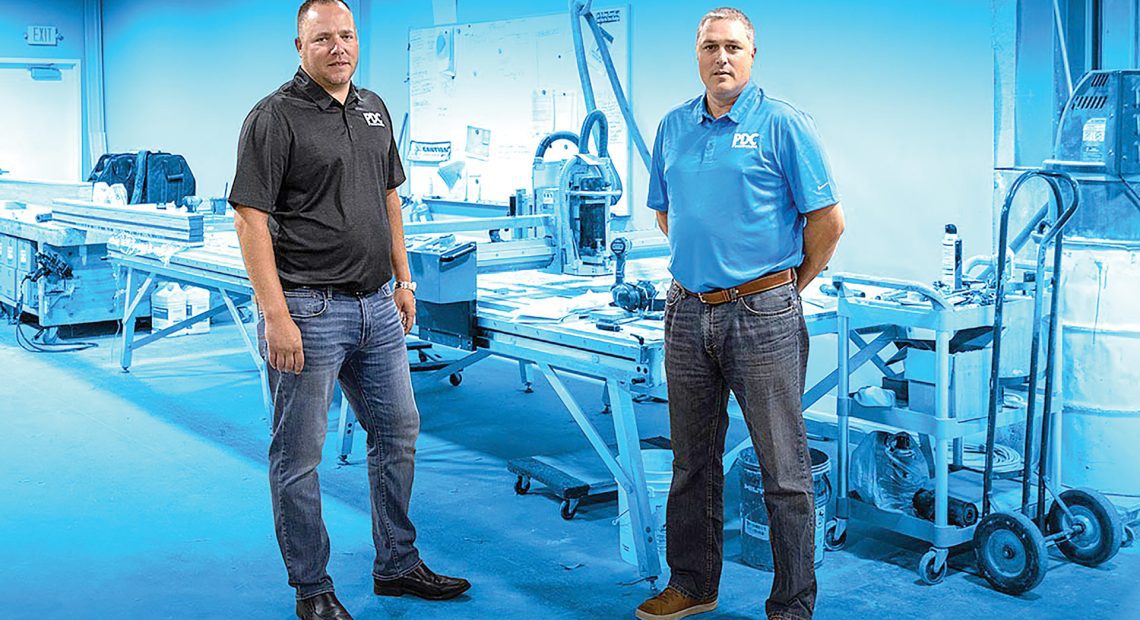
Looking long-term, both Balise and Dill believe they can retain current office tenants and add new ones, even at a time when work is in flux and the future of office buildings is more clouded than at any time in recent memory.

“Work is a social activity, and we’re seeing a lot of companies bringing people back,” said Dill. “Maybe not five days a week, 40 hours, but they’re coming back to the office, because work is a social activity.”


Bottom Line

Not long after the acquisition of 1441 Main St., Dill placed two portraits on easels in the building’s lobby, one of Richard Booth, another former president and CEO of SIS, and the other of John Collins; he considers both mentors and major influences in his life and career.

It was Collins who handed Dill the assignment to build a new headquarters building all those years ago. It led to what amounts to a lifetime of work stewarding the building through decades of change and positioning it for the decades to come.

Now, this work takes on new meaning and new urgency, because he has ownership of the matter — both literally and figuratively.


Features Special Coverage

In Good Company

Jeff St. Jean, left, and John DeVoie, co-founders of Easy Company Brewing

Jeff St. Jean, left, and John DeVoie, co-founders of Easy Company Brewing

It will be called ‘Brécourt.’

And like the beers that came before it — and the ones that will likely come after it — this one celebrates a chapter in the powerful story of Company E, 2nd Battalion, 506th Parachute Infantry Regiment of the 101st Airborne Division, known simply as Easy Company. This was the ‘band of brothers’ whose exploits during World War II are famously chronicled in the Stephen Ambrose book and HBO miniseries that both took that name.

Brécourt Manor is a town about three miles southwest of Utah Beach in Normandy, France. It was the location of a German artillery battery that was disrupting landing forces of the U.S. 4th Infantry Division on D-Day. Easy Company’s assault on the Brécourt Manor, led by First Lt. Richard Winters, is one of the unit’s more noted accomplishments, and there were many.

“They charged that gun nest and took all four guns out, saving countless lives,” said John DeVoie, co-founder of the growing Hot Table chain of panini restaurants, who has long been entranced by the story of Easy Company. So much that, when he and his longtime best friend and fellow veteran Jeff St. Jean — they both served with the 104th Tactical Fighter Group at Barnes Airport, and St. Jean still does — decided to create a beer label and donate all the profits from the sale of those products to agencies that assist fellow veterans, the name came easily — although not much else has, as we’ll see.

Easy Company Brewing, branded simply as ‘E,’ plans to introduce Brécourt, what’s known as a keeping ale, in the coming months. It will join two labels already available in many liquor stores, bars, and restaurants: Currahee American Lager, named in honor of the hill the men of Easy Company had to run up daily while in training in Toccoa, Ga., and Ald-Borne, a new English IPA, named after Aldbourne, the tiny village in the south of England where the unit would begin the preparations for D-Day.

“We thought, ‘why don’t we just give it all back?’ We’d model it after Newman’s Own and give 100% of the profits to charities that support veterans.”
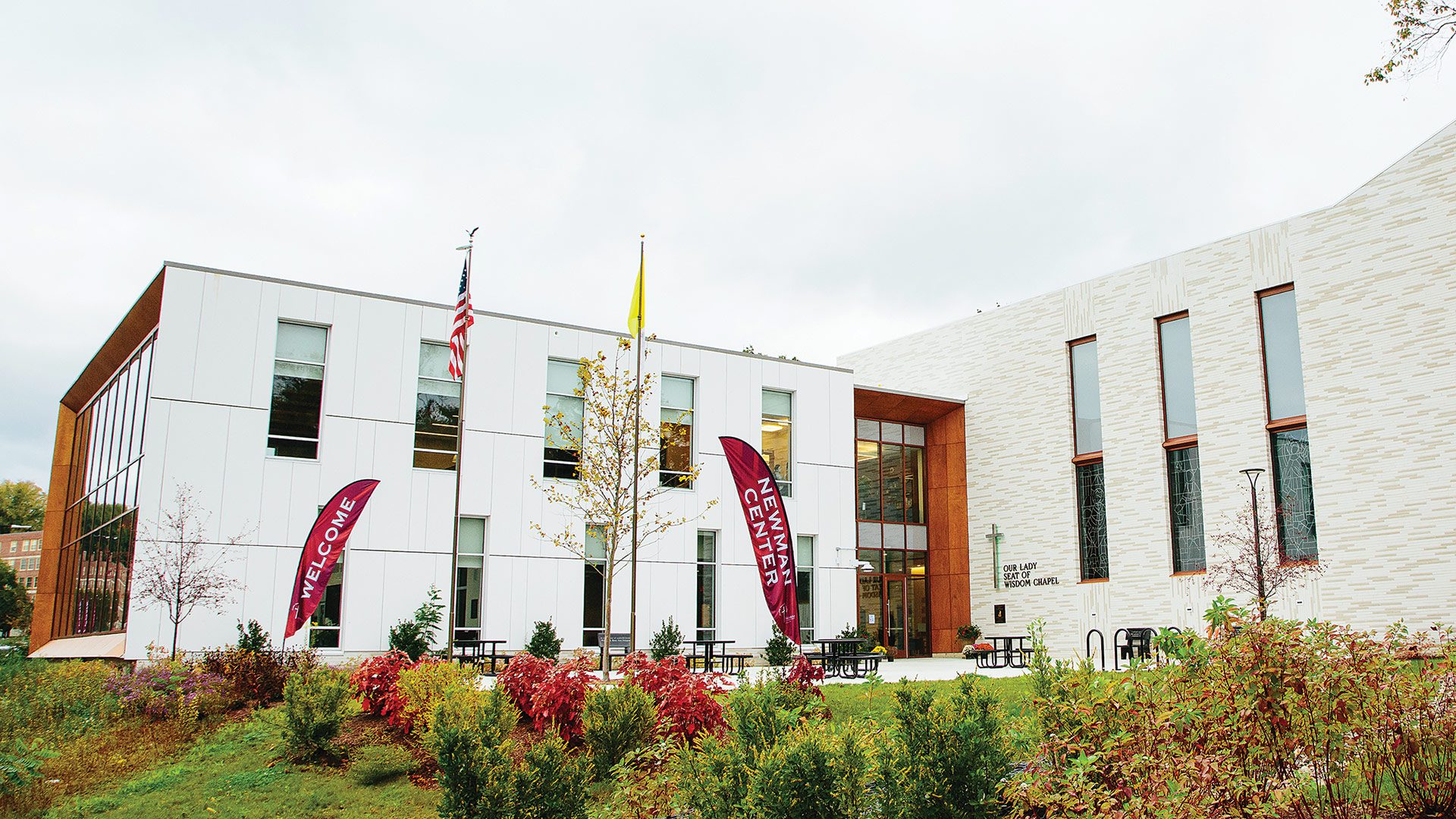
DeVoie and St. Jean, both beer lovers themselves, could hardly contain their excitement as they pondered what might come next for beers as their venture continues to follow the story of Easy Company as the war progressed. Indeed, the unit took part in the ill-fated Operation Market Garden in the Netherlands, famous for its beer, and also in the Battle of the Bulge in Belgium, equally famous for its beer, then were in several operations in Germany, including occupation duty at Berchtesgaden, home to Hitler’s famous Eagle’s Nest, at the German-Austrian border.

the brewery’s offerings follow the story of Easy Company

Starting with American and English ales, the brewery’s offerings follow the story of Easy Company through World War II, with beers from France, Holland, Belgium, and Germany to come next.

“The next stop is Holland … and these guys captured Eagle’s Nest, so we may use that name when we get to making a German beer — or not; there are plenty of options from Germany,” DeVoie said, noting that, in honor of Dick Winters, famously a teetotaler, they may make a non-alcoholic beer.

But the two are even more excited about where this venture could go in terms of what it can do for veterans.

Launched just before Memorial Day in 2022, Easy Company Brewing did not turn a profit its first year due to the high operational costs involved with getting the venture off the ground, but the two partners wrote checks anyway to several well-vetted nonprofits that assist veterans, including Operation Second Chance, the Special Operations Warriors Foundation, and the Tunnel to Towers Foundation.

The brewery is expected to turn a small profit this year, and there is considerable optimism about where all this might be down the road.

In a word, the story of Easy Company Brewing and its mission “resonates,” said St. Jean, adding that most all those who hear the story, or just see the name, want to know more and support the effort in some way.

That goes for everyone from the thousands who sampled the Easy Company’s offerings at the Big E to Donnie Wahlberg, who played First Lt. Clifford Carwood Lipton in the HBO miniseries Band of Brothers — and who, upon becoming acquainted with the venture and its mission when St. Jean and DeVoie met him briefly at Foxwoods at the opening of a new Wahlburgers restaurant, posted on Instagram a picture of himself with a large class of their brew and the words “my new favorite beer!”

Donnie Wahlberg, who played one of the men of Easy Company

Donnie Wahlberg, who played one of the men of Easy Company in the Band of Brothers miniseries, shows his support for the venture in an Instagram post.

For this issue, and with Veterans Day approaching, BusinessWest talked with DeVoie and St. Jean about their venture, the veterans (and especially the members of Easy Company) who inspired it, and how they intend to make what is now a local story into a national phenomenon.


Lager Than Life

As they talked with BusinessWest earlier this month, St. Jean and DeVoie were making plans to head to Newport, R.I. the following weekend for a reunion involving descendents of the men of Easy Company.

There are no living members of that unit, but the reunions, which started in 1946, the year after the war ended, have continued, said DeVoie, adding that he met the granddaughter of William ‘Wild Bill’ Guarnere, a staff sergeant in Easy Company, recently, and she invited the partners to this year’s gathering.

“We’re going there almost with reverence — we’re going to share our beer with them and tell our story,” he went on, adding that, given their mission and the way it honors those in Easy Company, they were to be “guests of honor” at the event in some ways.

In most all other ways, the two consider themselves merely stewards of the Easy Company name, and they have made it their mission to use it to both honor those men and to help those who have served their country — as they have themselves.

Indeed, they served together as mechanics in the 104th’s engine shop, servicing the A-10 Thunderbolts that flew over Barnes — and served in tip-of-the-spear operations in many parts of the world, including both Gulf wars. Nicknamed the Warthog, the plane was not pretty to look at, but, then again, beauty is in the eye of the beholder.

St. Jean, still serving in an administrative role with the 104th, likes the A-10 much more than the F-15s currently flown by that unit, and DeVoie said simply, “everybody thought it was ugly; I thought it was beautiful.”
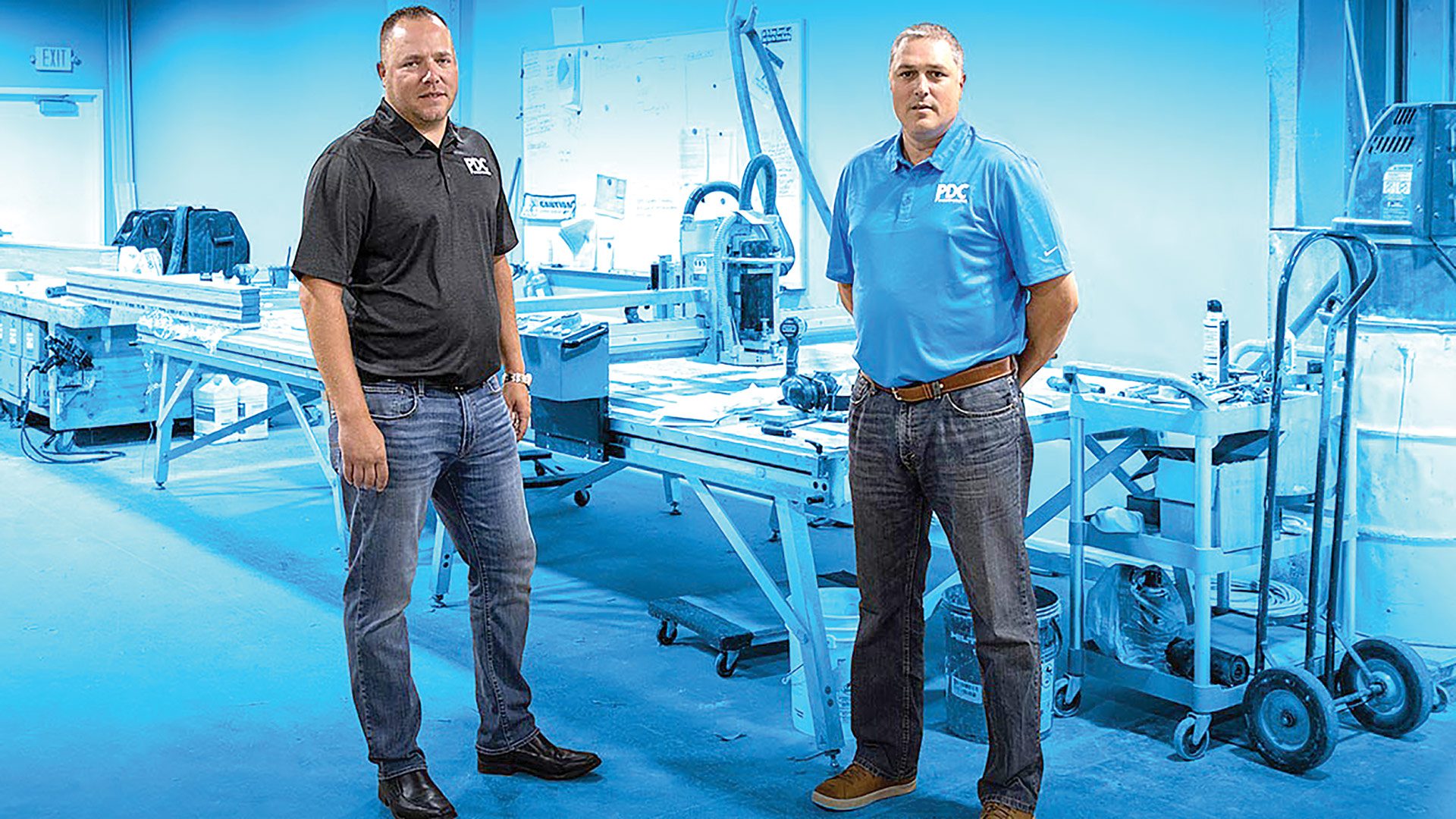
DeVoie left the 104th after 11 years, but he and St. Jean have remained good friends, getting together often. One of their favorite spots is the Student Prince in downtown Springfield, and it was there that the story of Easy Company Brewing began.

Indeed, while enjoying a few Spatens at the bar there in 2018, and thinking about all the beer-making countries where the men of Easy Company had been, that they started discussing the notion of creating a beer label that would pay homage to that unit.

They quickly decided that, while this was a good concept, they could not, in good conscience, profit off the names of the men of Easy Company, many of whom died in combat.

So they shelved the concept, only to revisit it later and ultimately decided to honor those from Easy Company and … not profit. To be more specific, they would profit, but then turn those profits over to select organizations assisting veterans.

“We decided that we were going to try to do it on our own; I just read anything and everything I could about brewing, I bought books, read articles, watched a ton of videos, and just started experimenting.”
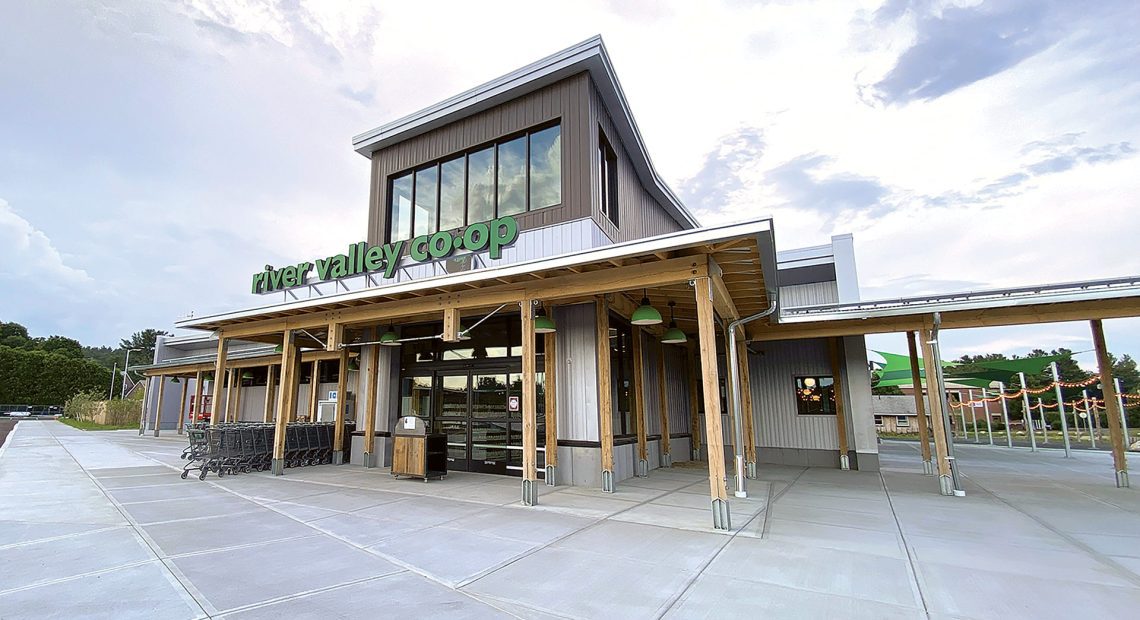
“We thought, ‘why don’t we just give it all back?’” said DeVoie. “We’d model it after Newman’s Own and give 100% of the profits to charities that support veterans.”

Elaborating, St. Jean said that, as good stewards of the Easy Company name, the brewery and the foundation created to distribute its profits are very selective when it comes to the nonprofits they support.

“We reached out to several charities, but we decided we would only reach out to those charities that gave more than 85 cents on the dollar back to veterans,” he said, adding that they have found several that met this standard.

a location at the recent Big E.

Easy Company Brewing has maintained a consistent presence in the region, including a location at the recent Big E.

While the partners knew they had a good idea, and also knew a lot about business — Hot Table will soon be opening its 12th, 13th, and 14th locations — as well as the story of Easy Company, they didn’t know a lot about brewing or the growing, immensely competitive brewing industry.

So they, and especially St. Jean, set about learning.

“We tried to think of ways we could work with an established brewer to develop recipes, but there are a lot of barriers to entry there,” he said. “So we decided that we were going to try to do it on our own; I just read anything and everything I could about brewing, I bought books, read articles, watched a ton of videos, and just started experimenting.

“I brewed a ton of recipes in my basement, and we enlisted the help of some friends in the area and in the industry to help us taste the beer, develop the flavor profiles, and give us feedback, essentially, until we settled on what we thought we wanted to brew,” he went on, adding that the partners brought the recipes to a contract brewer, Brewmasters Brewing Services of Williamsburg, which scaled them up commercially.

The partners started where Easy Company started, with an American Lager named Currahee, and officially launched, with ceremonies at the Fort, in May 2022. Since then, the learning curve — involving everything from brewing to distribution to marketing — has continued, and they’ve been climbing their own steep hill to profitability.


Mission Focused

The Tunnel to Towers Foundation was launched to honor the life and work of New York firefighter Stephen Siller. He had just finished his shift on the morning of Sept. 11, 2001, and was on his way to play golf with his brothers when he got word over his scanner of a plane hitting the North Tower of the World Trade Center. He abandoned his golf plans and returned to Brooklyn’s Squad 1 to get his gear.

He drove his truck to the entrance of the Brooklyn Battery Tunnel and, upon finding it closed to vehicular traffic for security reasons, ran the full length of the tunnel with 60 pounds of equipment on his back. He reached the Twin Towers, where he died while trying to save others.

Today, the foundation carries on a number of programs, including the Smart Home initiative, which builds mortgage-free smart homes for catastrophically injured veterans and first responders, and the Gold Star Family Home Program, which honors the legacy of fallen veterans by providing mortgage-free homes to surviving spouses with young children.

That mission certainly resounded with St. Jean and DeVoie, who have made the foundation one of five charities to which the Easy Company foundation will distribute profits from the brewing operation.

The profits are expected to grow as the venture continues to scale up and expand, geographically and otherwise. There are still some considerable hurdles to clear — it’s costly and difficult to expand into new markets in this state, let alone into other states and other regions — and there is immense competition.

“We can throw a rock and hit Connecticut from here, but we haven’t been picked up by a distributor yet,” said DeVoie. “Each state is different, all the laws are different … it’s very complicated.”

But the partners have two big things working for them — the name Easy Company and the mission they have taken on. As noted earlier, both resonate with constituencies ranging from beer drinkers to veterans groups to the business community.

This was made clear to the partners — not that they really needed more affirmation — at the Big E, where they had a presence at the Local Brewers Showcase and other locations where their beer was sold. And it’s been made clear in the feedback and offers of support they’ve received, not just locally, but nationally and even internationally.

“Quite often, people from across the country and even around the world, particularly Europe, will inquire about us and our beer. People will say, ‘hey, can we get your beer in the UK?’ And we hear that in Ohio and California and all over.”

“We don’t see this is as just another local brewery — there are so many great breweries in every city and town now,” said DeVoie. “We see this as really a national brand.

“When we tell people this story, they get excited about it,” he went on, adding quickly that the story has spread rapidly with the help of social media. “Quite often, people from across the country and even around the world, particularly Europe, will inquire about us and our beer. People will say, ‘hey, can we get your beer in the UK?’ And we hear that in Ohio and California and all over.”

Right now, they can’t get the beer, but they can buy swag, in the form of Easy Company Brewing T-shirts, hoodies, hats, koozies, and other items, which are selling well and raising some revenue, said St. Jean, adding quickly that the beer is the heart of this operation, and the obvious long-term goal is to sell it in more places and to more people.

Already, Easy Company’s beers are in many liquor stores and several taverns and restaurants, including the Student Prince and those at MGM Springfield, and its reach has extended across this region and into Central Mass. thanks to a partnership with distributor Quality Beverage. The goal is to continually add more distribution points and eventually expand well beyond the current markets.

DeVoie summed it up poignantly by saying their mission now is to “sell a lot of beer and give away a lot of money.”


Easy Going

Getting back to Brécourt, the new label that will be coming out soon, St. Jean and DeVoie acknowledged that, while the French are known mostly for the production of fine wine, champagne, and cognac, they said they also make some very good beers.

And so do the Dutch, the Belgians, the Germans, and the Austrians.

Which is why the partners are looking ahead with such enthusiasm to how they will continue to tell the story of Easy Company through beers that reflect the countries where the band of brothers made history together.

But more than that, they’re looking forward to making that mission much broader and more impactful.

Creative Economy Special Coverage

Merry, Scary, and Coming Soon

Producer and director Joany Kane.

Producer and director Joany Kane.

Will Barratt, cinematographer

Will Barratt, cinematographer for A Merry Scary Christmas Tale.

If you enjoy all those Christmas movies the Hallmark Channel cranks out every holiday season, you can thank Joany Kane for her part in that.

That’s because she wrote the first one, The Christmas Card, which broke cable-TV ratings records when it aired in 2006 and garnered an Emmy nomination for its star, Ed Asner — to date, Hallmark’s only Emmy nod.

It also helped kick-start a holiday-movie craze on Hallmark that Kane, a Western Mass. native, appreciates — not only because she’s written and produced about a dozen of them, but because she loves them.

“There was no Hallmark Channel, no Christmas movies on TV” before she started writing The Christmas Card, Kane noted. “You had to go to a theater to see a Christmas movie, and even those were scarce. I wanted to see more Christmas content.”

So she did something about that, and she still is — in fact, her next effort, A Merry Scary Christmas Tale, will shoot in Western Mass. next spring, with plans for a fall 2024 release. Not only is it Kane’s directorial debut, it’s her first foray into a hybrid holiday flick, with one foot planted in the Christmas tradition, and the other in Halloween.

“On Christmas Eve at a remote Massachusetts B&B, a disenchanted candlemaker must survive an evening of sinister merriment in order to find her missing artist aunt,” the film’s pitch reads. Kane said it will be “atmospheric, mischievous, and eerie,” a gothic fable that melds the spirits of Tim Burton and Guillermo del Toro.

“In the fall of 2024, we’d like to do a limited-release run, especially in Massachusetts; we can target local theaters and use the screenings for fundraisers for local nonprofits, so we can help the community as well.”

“It’s got Hallmark moments and Conjuring moments,” she said, the latter a reference to the popular horror-film franchise. She stressed, though, that her movie won’t be too scary. “We’ll have jump scares, but also Christmas carols. It’s great fun.”

But amid the fun comes a lot of work, planning, and raising funds.

“Our goal is to raise some local financing and have some investors come in,” Kane said, explaining that the firm has a high-end budget of $811,000 (which does not reflect 25% tax incentives from the Commonwealth), but could be made for half that if necessary. “If we raise at least $300,000 to $400,000 locally, we can bring in a distribution company from Hollywood who will finance the rest for us. They’ll only do movies over $700,000 on the lower end.”

Joany Kane says her directorial debut

Joany Kane says her directorial debut will have “jump scares, but also Christmas carols.”

Anyone who invests gets an executive-producer credit, and is also promised their money back plus a 20% return on investment, and also potential profit sharing, not only from the initial run, but in future years.

“It’s a quick turnaround to return their initial investment; then, after that, it’s like getting residuals every time the movie plays somewhere or plays on a streamer or DVD or downloads, depending on how much they’ve invested,” she explained.

Once the movie is filmed in the spring, it will be edited through the summer, with plans to hit the fall convention circuit — Comic Cons and other conventions that cater to genre content, she added.

“We’ll start building a buzz, and then, in the fall of 2024, we’d like to do a limited-release run, especially in Massachusetts; we can target local theaters and use the screenings for fundraisers for local nonprofits, so we can help the community as well.”

That would be followed by a short video-on-demand period in early November and then a premiere on a channel or streamer Thanksgiving weekend, then screening events during December.

All the while, she said, the team would maintain an active social-media presence, airing shorts on TikTok about some of the legends touched on in the script, from Krampus to Pukwudgie, a Native American legend Kane believes will become a popular character due to her movie.

In addition, she’s planning for ‘online happy hours’ building up to the premiere, where she’ll host interviews with cast and crew as well as featuring guests speaking from the holiday or paranormal perspective — or both. She’s also looking to film a ghost-hunting documentary at one or more of the film’s allegedly haunted locations, as well as selling merchandise.

The ongoing actors’ strike could alter some actors’ schedules, but as an independent production, Kane has applied for a waiver that would at least allow the production to proceed — once she gets 50% of the financing in place.

Right now, the confirmed cast included Amanda Wyss and Julie McNiven, along with tentatively planned appearances from Boston-based actor Paul Solet, as well as David Dean Bottrell, Michael Hargrove, Lance Henriksen, Cooper Andrews, and Dee Wallace.

In addition, Jeff Belanger is on board to play himself in the movie, sharing creepy and legends with guests at the film’s Harkness Manor. Belanger is the lead writer on the Travel Channel’s Ghost Adventures and a celebrity in the paranormal world, Kane noted, and his song “My Christmas Tree Is Haunted” will be included on the soundtrack.


Local Promise

That’s a lot — cast, crew, financing, filming, and marketing — to juggle, especially for someone sitting in the director’s chair for the first time.

Which is an important milestone for Kane, a 1983 graduate of Northampton High School who got her start in filmmaking during the 1990s, working for the documentary production company Florentine Films (co-founded by Ken Burns) and serving as associate producer on several Emmy-winning PBS documentaries.

“I want to make sure we use as many Massachusetts locations, and place as many Massachusetts products, as we can. It’s sort of a love letter to my history and my home neighborhoods.”

Her first completed screenplay was an office comedy, not unlike Horrible Bosses more than two decades later, that drew interest from some Hollywood players, including Bette Midler, who offered Kane “sage advice,” she recalled. To pay her bills around this time, during the late ’90s, she was also working for Lashway Law in Williamsburg.

Kane’s breakthrough success in Hollywood soon followed, as she finished the script for The Christmas Card in 1999 and optioned it to a producer in 2003, who brought it to Hallmark, where it “launched the current Christmas-movie craze we now have,” she told BusinessWest.

Since her success with The Christmas Card, she has optioned or sold more than two dozen screenplays and has had more than a dozen movies made. In 2013, she came up with a streaming service dedicated to turning romance novels into movies and series; she coined the name Passionflix, purchased the domain, and in 2016 formed a partnership to launch the streamer. Passionflix debuted in September 2017.

She’s excited to shoot A Merry Scary Christmas Tale in Western Mass., hoping to get started in early spring, when the exteriors can still be made to look Christmas-y, but the night shoots won’t make the cast and crew freeze.

Movie and TV veteran Amanda Wyss

Movie and TV veteran Amanda Wyss will play one of the leads in A Merry Scary Christmas Tale.

“We’re doing it independently so we have complete control over quality and creation, and I want to make sure we use as many Massachusetts locations, and place as many Massachusetts products, as we can. It’s sort of a love letter to my history and my home neighborhoods.”

Will Barratt, the film’s cinematographer, is best-known for shooting and producing the Hatchet films, including Frozen, Spiral, Chillerama, and Digging Up The Marrow. He won two Emmy awards in 2002 and was nominated for the 2014 BloodGuts UK Horror Award for Digging Up the Marrow.

Co-producer and co-director Mary Fry specializes in producing feature films and series for an international market, Kane said. Fry has worked on more than 60 feature films and 12 series with award-winning actors such as Kate Hudson, Michael Shannon, Joaquin Phoenix, John Travolta, Snoop Dogg, and Danny Glover; collaborated with Russell Carpenter, who won a Best Cinematography Oscar for Titanic; and produced romantic comedies for Passionflix, Nasser Entertainment, and Caliwood Pictures.

She shares Kane’s vision for a scary Christmas movie — an idea that used to be more common than it is now.

“Telling scary stories by the fireside was at one time a cherished Christmas tradition. That’s how the world got A Christmas Carol. Scary stories at Christmas were as treasured as Hallmark Christmas movies are today,” Kane said, noting that Charles Dickens wrote his classic tale for a Victorian audience that liked to be scared at Christmas. “The cinematic holiday content we enjoy today started with a ghost story.”

With A Merry Scary Christmas Tale, Kane is hoping to revive the once-beloved tradition of telling scary stories at Christmastime — and hopes that, like A Christmas Carol, her film becomes a classic that’s rewatched each holiday season, generating profits to pour into more movies.

“Hopefully this will become like Paranormal Activity or the Conjuring series — a little movie that does insanely well. Then we can have a base in Western Mass., a production company to crank out a lot of fun content that honors the area and its communities.”


Looking Ahead

Kane’s affection for Halloween fare is reflected in other ways; she recently launched Coven Cons with the goal of hosting conventions that celebrate the witch in pop culture.

And her love for her home state is even more deeply ingrained.

“Massachusetts is such a magical state — so much beauty, history, and a lot of cool legends. The people are fun to hang out with, and there’s a lot of great ingenuity in Massachusetts.

“So it’s great to bring all that together and make really cool movies,” she went on, adding that she’s interested in drawing on Massachusetts-based writers who have penned scary stories, including greats like Edith Wharton. “We’d love to turn those into movies. My goal is to focus on stories that would be great to premiere any time from September to December.”

Viewers will have that experience as soon as next fall — that is, if the coming year’s efforts prove more merry than scary to Kane and her team. Anyone interested in investing in the project should email [email protected].

Special Coverage Super 60

Reconfigured Program Recognizes Businesses, Nonprofits in Five Categories

After almost 40 years, Super 60 was in need of a change. This year, it got one.

The Springfield Regional Chamber revamped its popular business-recognition program in 2023 to honor companies and organizations across five categories, not merely the traditional ‘Revenue’ and ‘Growth.’

The new categories are ‘Start-Up,’ ‘Give Back,’ and ‘Non-Profit.’ The Start-Up category recognizes businesses that have achieved remarkable success during their early years of operation, the Give Back category recognizes businesses that made significant contributions to local communities and organizations, and the Non-Profit category recognizes organizations that have displayed selfless dedication to serving the community through exceptional programming and support.

These additions have successfully invited many new businesses to the podium for the awards ceremony, to be held on Nov. 9 at the MassMutual Center, said chamber President Diana Szynal.

“What we want to accomplish with these new categories is recognition that there are different measures of success,” she told BusinessWest. “And it’s a way to award more members across various sectors for their success.”

This year’s winners represent numerous communities across many industries, including dining, automotive, manufacturing, finance, sports, and many more.

“We are thrilled to celebrate the incredible diversity and innovation within our business community through this year’s Super 60 program,” Szynal said. “Small businesses are the heart and soul of our region, and we’re excited to celebrate so many nonprofits that make a difference in our community. As we continue to overcome the challenges posed by the pandemic, it’s more important than ever to shine a light on the accomplishments and unwavering resilience of our local businesses and nonprofits.”

Save the Date

The awards program — sponsored by Health New England, WWLP-22 News, bankESB, Stand Out Truck, Marketing and Cupcakes, the Republican, and Meyers Brothers Kalicka, P.C. — will feature keynote speaker Ashley Kohl, president and founder of Ohana School of Performing Arts, and emcee Rich Tettemer, WWLP anchor.

Tickets for the event — $60 for chamber members and $75 for non-members — can be purchased at springfieldregionalchamber.com. Tables of eight and 10 can also be reserved.

The event attracts more than 500 business leaders each year. The honorees, 12 per category, are:

Revenue:


Whalley Computer Associates Inc.
Mercedes Benz of Springfield
Tighe & Bond Inc.
Adam Quenneville Roofing & Siding Inc.
American Environmental Inc.
Baltazar Contractors Inc.
Baystate Blasting Inc.
Braman Chemical Enterprises Inc.
Freedom Credit Union
Golden Years Homecare Services
Keiter Corp.
L&C Prescriptions Inc.

Growth:


Springfield Hockey LLC
The Coating House Inc.
Link to VR
Ace Asphalt Maintenance Inc. 
Court Square Group Inc.
Jack Goncalves & Sons Inc. 
Monty’s Motorsports LLC 
Tobiko Sushi 
Tavares and Branco Enterprises Inc./Villa Rose
Vanguard Dental LLC 
Vanished Valley Inc. 
Yellow Ribbon Trucking Inc.  

Start-Up:


Monsoon Roastery LLC
Something Royal Party Co.
Mango Fish Art / Proud of U Jewelry
Ludlow Animal Clinic Inc.
Western Mass Heating, Cooling & Plumbing Inc.
Link to VR
Upscale Socks
Rozki Rides
1636 North
Colorful Resilience
Bridge2Homecare LLC
Feel Good, Shop Local 

Give Back:


Anderson Cleaning
Appleton Corp.
Focus Springfield Community TV
Gary Rome Hyundai Inc.
Keiter Corp.
Mercedes Benz of Springfield
MGM Springfield
Pioneer Valley Financial Group
Polish National Credit Union
Springfield Hockey LLC
Stand Out Truck
Tavares and Branco Enterprises Inc./Villa Rose  

Non-Profit:


Springfield Partners for Community Action Inc.
Valley Opportunity Council Inc.
413 Elite Foundation
Second Chance Animal Services Community Veterinary Hospital
The Horace Smith Fund
Hampden County Career
Center Inc.
Caring Health Center
WestMass ElderCare Inc.
Springfield Rescue Mission
Jewish Federation of Western Massachusetts
Revitalize Community Development Corp.
Clinical & Support Options Inc.

REVENUE Category

Whalley Computer Associates Inc.

One Whalley Way, Southwick, MA 01077

(413) 596-4200

www.wca.com

Michael Sheil, President

Whalley Computer Associates offers data-center services, cloud backup, managed services, training, desktop services, network services, and staff-augmentation services. The company focuses its work in the corporate, finance, healthcare, K-12, higher education, retail, and SMB industries.

Mercedes-Benz of Springfield

295 Burnett Road, Chicopee, MA 01020

(413) 624-4100

www.mbspringfield.com

Peter and Michelle Wirth, Owners

Mercedes-Benz of Springfield serves the Springfield area from its Chicopee facility filled with the latest Mercedes-Benz vehicles. The dealership also includes an expert service center, parts center, and tires center. Factory-certified experts offer professional service, maintenance, and repairs, including one-hour express service.

Tighe & Bond Inc.

53 Southampton Road, Westfield, MA 01085

(413) 562-1600

www.tighebond.com

Robert Belitz, President and CEO

Tighe & Bond offers engineering, design, planning, and environmental-consulting services, with focuses in building, transportation, water and wastewater engineering, coastal and waterfront solutions, environmental consulting, GIS and asset management, landscape architecture and urban design, civil engineering, and site planning.

Adam Quenneville Roofing & Siding Inc.

160 Old Lyman Road, South Hadley, MA 01075

(413) 536-5955

www.1800newroof.net

Adam Quenneville, CEO

Adam Quenneville Roofing & Siding offers a wide range of residential and commercial services, including new roofs, retrofitting, roof repair, roof cleaning, vinyl siding, replacement windows, and the no-clog Gutter Shutter system. The company has earned the BBB Torch Award for trust, performance, and integrity.

American Environmental Inc.

18 Canal St., Holyoke, MA 01040

(413) 322-7190

www.amerenviro.com

Charles Hughes, President

American Environmental is a family-owned business providing services like asbestos abatement, structural demolition, boiler removal, commercial lead abatement, concrete cutting, floor preparation, interior demolition, water-jet blasting, roll-off service, and shot blasting. It has worked with property managers, schools, universities, hospitals, churches, stores, industrial sites, and public facilities.

Baltazar Contractors Inc.

83 Carmelinas Circle, Ludlow, MA 01056

(413) 583-6160

www.baltazarcontractors.com

Paulo Baltazar, President

Baltazar Contractors is a heavy civil construction company with services in utility construction, roadway construction, site work and development, culvert and bridge construction, earth support and shoring, and trenchless technology. The company has remained family-owned over three decades in business.

Baystate Blasting Inc.

36 Carmelinas Circle, Ludlow, MA 01056

(413) 583-4440

www.baystateblasting.com

Dinis Baltazar, President and CEO

Baystate Blasting offers services in ledge and rock removal, rock blasting, and rock crushing. It performs large and small construction-site preparation, road and highway work, line drilling and trench work, quarry shots, and residential work such as foundations and in-ground pools. It is federally licensed as both a dealer and user of explosive materials.

Braman Chemical Enterprises Inc.

147 Almgren Dr., Agawam 01001

(413) 732-9009

www.braman.biz

Gerald Lazarus, President

Braman has been serving New England since 1890, using state-of-the-art pest-elimination procedures for commercial and residential customers, and offering humane removal of birds, bats, and other nuisances through its wildlife division. The company has offices in Agawam, Worcester, and Lee, as well as Hartford and New Haven, Conn.

Freedom Credit Union

1976 Main St., Springfield, MA 01103

(413) 739-6961

www.freedom.coop

Glenn Welch, President and CEO

Freedom Credit Union is a credit union that offers banking and loan services to businesses, the cannabis industry, and individuals. It also offers insurance plans for individuals and an investment-services division. The institution celebrated its centennial in 2022 and regularly involves customers and the community in philanthropic outreach.

Golden Years Homecare Services

16 Shaker Road, East Longmeadow, MA 01028

(413) 209-8208

www.goldenyearsusa.com

Cesar Ruiz Jr., President and CEO

Golden Years Homecare is dedicated to providing exceptional, in-home care to clients, offering peace of mind, dignity, and comfort. Comprehensive and personalized care meets the needs of clients and their families through the careful matching of client and caregiver. Golden Years offers programs including aroma, music, and laughter therapies, as well as specialized veteran and dementia care.

Keiter Corp.

35 Main St., Florence, MA 01062

(413) 586-8600

www.keiter.com

Scott Keiter, President

Keiter Corp. is a construction-services company working with clients on residential, commercial, industrial, and institutional projects of all sizes. The firm is divided into four divisions: Keiter Builders (commercial and institutional construction), Keiter Homes (residential construction), Hatfield Construction (excavation, site work, and structural concrete), and Keiter Properties (real estate and rental).

L&C Prescriptions Inc.

155 Brookdale Dr., Springfield, MA 01104

(413) 781-2996

www.medibubble.com

Dr. Kara James, President

L&C Prescriptions, the parent company for Louis & Clark Pharmacy, provides medication solutions to individuals, healthcare providers, and assisted-living, independent-living, and memory-care communities, and offers online prescription refills, MediBubble pre-packaged pills, blister packs to manage daily medications, vial synchronization, consultations with registered pharmacists, and a delivery service.

 Growth Category

Springfield Hockey LLC

1 Monarch Place, Springfield, MA 02110

(413) 746-4100

www.springfieldthunderbirds.com

Nathan Costa, President

Springfield Hockey LLC, better known as the Springfield Thunderbirds, is the local affiliate of the St. Louis Blues and and the American Hockey League’s 2021-22 Eastern Conference champion. Playing its home games at the MassMutual Center since its inception in 2016, the team gives back to the community in multiple ways, like the Thunderbirds Foundation, Stick to Reading school programs, Hometown Salute, Frontline Fridays, and more.

The Coating House Inc.

15 Benton Dr., Suite 14, East Longmeadow, MA 01028

(877) 987-3100

www.thecoatinghouse.com

Kim Casineau, President

The Coating House is a fastener and hardware supplier and authorized Loctite service center, allowing it the ability to serve customers in a wide range of industries. The company has been sealing and locking fasteners, fittings, and bolts since 1980 and is a woman-owned company and a pioneer in the pre-applied process.

Link to VR

501 Boylston St., 10th Floor, Boston, MA 02116

(617) 588-2109

www.linktovr.com

Edward Zemba, CEO

Link to VR is an XR media agency that helps organizations implement growth-based solutions using the VR/AR platform. It offers in-house development and partnership opportunities to enterprise customers ready to leverage the transformative technology of spatial computing. Whether it’s on-boarding leadership teams or designing custom XR solutions, it strategically positions clients to realize the full potential of this computing platform.

Ace Asphalt Maintenance Inc.

63 Doyle Ave., Springfield, MA 01104

(413) 537-6156

www.aceasphaltco.com

James Gordon, Owner

For more than 20 years, Ace Asphalt Maintenance has been a premier paving company serving Western Mass. and Northern Conn., offering a one-year warranty on all driveway installations. Services include asphalt driveways, commercial sealcoating, commercial paving, crack filling, patching, and asphalt milling.

Court Square Group Inc.

1350 Main St., Springfield, MA 01103

(413) 746-0054

www.courtsquaregroup.com

Keith Parent, CEO

Court Square Group is a leading managed-service technology company with a focus exclusively on life science. Its business-focused approach has supported many life-science startups as well as some of the largest life-science companies. The team’s expertise provides technical, compliance, and audit-readiness support.

Jack Goncalves & Sons Inc.

172 Munsing St., Ludlow, MA 01056

(413) 583-8782

Joquin Goncalves, President and Treasurer

Jack Goncalves & Sons primarily operates in the excavation and grading and building construction industry, and has been in business for more than a half-century.


Monty’s Motorsport LLC

1 Arch Road, Westfield, MA 01085

(413) 642-8199

www.montysmotorsports.com

Monty Geer, Owner

Monty’s Motorsport is a parts, sales, service, and gear store for motorsport vehicles, such as four-wheelers, dirt bikes, motorcycles, electric bikes, street bikes, and more. It offers new and used vehicles, with financing options available, as well as services such as winterization, battery inspections, accessory installations, chain adjustments, oil and filter changes, and full engine rebuilds.

Tobiko Sushi

110 Airport Road, Westfield, MA 01085

(413) 642-8155

www.tobiko-sushi-sushi-restaurant.business.site

Sokharun Yim, Owner

Located in the terminal building at Westfield-Barnes Airport, this eatery opened as Papps Bar & Grill in 2014. A change in ownership brought a new focus, and Tobiko Sushi now specializes in sushi, ramen, and hibachi. Taking advantage of its close-up airport location, large windows offer views of the Barnes complex and the landscape beyond.

Tavares and Branco Enterprises Inc./Villa Rose

1428 Center St., Ludlow, MA 01056

(413) 547-6667

www.villaroserestaurant.com

Tony Tavares, Owner

Tavares and Branco Enterprises owns and operates the Villa Rose Restaurant, lounge, and banquet hall, specializing in Portuguese and American cuisine. With a capacity of 150, the facility caters for parties, funerals, and weddings of 30 people or more. Villa Rose also offers breakfast and brunch for those who are looking to book a shower, seminar, business meeting, corporate functions, and more.

Vanguard Dental LLC

1876 Boston Road, Wilbraham, MA 01095

(413) 543-2555

www.vanguarddentistry.com

Dr. Yogita Kanorwalla, Owner

Yogita Kanorwalla, DMD, has more than 15 years of experience in dentistry. She utilizes the latest technology and techniques, with services including dentures, cosmetic dentistry, root-canal therapy and endodontics, extractions, same-day crowns, restorative dentistry, sedation dentistry, periodontics, dental implants and restorations, teeth whitening, Invisalign, sports guards, dry-mouth therapy, patient forms, and laser snoring treatment.

Vanished Valley Inc.

782 Center St., Ludlow, MA 01056

(413) 610-1572

www.vanishedvalley.com

Mike Rodrigues, Restaurant Owner;

Josh Britton, Brewery Owner

Vanished Valley Inc. is a small-batch brewery that is family- and pet-friendly and holds events in its taproom and beer garden. The restaurant menu includes appetizers, pizzas, burgers, sandwiches, and barbeque. On tap, the brewery offers IPAs, seltzers, lagers, ales, and stouts, as well as wine and spirits.

Yellow Ribbon Trucking Inc.

265 Bay Road, Hadley, MA 01035

(413) 320-2644

www.yellowribbontrucking.com

Chris Omasta, Owner

Yellow Ribbon Trucking was established to fill the need of large trucks and heavy hauling services for local construction. It specializes in assisting general contractors and paving companies in facilitating the transportation of materials to and from job sites. It offers trucking, light excavations, landscaping, and snow-removal services, and works with homeowners, businesses, and contractors on the state and federal levels.

 START-UP CATEGORY

Monsoon Roastery LLC

250 Albany St., Springfield, MA 01105

(413) 366-1123

www.monsoonroastery.com

Tim Monson, Owner

Monsoon is an environmentally conscious community coffee roaster with the goal of helping people drink better coffee both at home and on the go. It offers a walk-up, espresso bar where customers can order coffee drinks to enjoy on an outdoor patio, or coffee cans to take home. It also offers an array of local treats from neighboring businesses.

Something Royal Party Co.

Agawam, MA

(413) 334-2548

www.somethingroyalpartyco.com

Alexandria Holbrook, Owner

Something Royal Party Company was established in 2021, aiming to bring joy and magic to even the smallest of events. This party company specializes in live character interactions, including additional add-on services to customize an event to bring a child’s dream to life. Something Royal provides high-quality costumes, wigs, and other materials, and its characters look and act as if they walked directly out of their movies and storybooks.

Mango Fish Art / Proud of U Jewelry

Easthampton, MA

(833) 446-2646

www.mangofishinc.com

Lori Novis, Founder

By weaving creativity with social responsibility, Mango Fish aims to empower and address women living in poverty through employment opportunities and mentoring. Founder Lori Novis later realized that the jewelry business she started while living in the Caribbean could be scaled up to showcase and highlight the official colors of educational institutions and sororities, and created the Proud of U. gift collection.

Ludlow Animal Clinic Inc.

200 Center St., #13, Ludlow, MA 01056

(413) 583-4222

Dr. Eva Rodriguez, Owner

Ludlow Animal Clinic offers a variety of services to dogs and cats. It provides on-site dental treatment, vaccinations, parasite prevention, surgery, radiology, geriatric medicine, hematology laboratory services, and end-of-life counseling. Dr. Eva Rodriguez has an interest in general wellness, preventive medicine, internal medicine, and dermatology.

Western Mass Heating, Cooling & Plumbing Inc.

4 South Main St., Suite K, Haydenville, MA 01039

(413) 268-7777

www.westernmassheatingcooling.com

Scott Cernak, CEO

For more than two decades, the team behind Western Mass Heating & Cooling serviced the residential market in Western Mass. under M.J. Moran. Spun off as a separate company in early 2020, the company has a wealth of experience in the residential HVAC and plumbing sectors. Services include indoor air quality, heating systems, cooling systems, and plumbing services.

Link to VR

501 Boylston St., 10th Floor, Boston, MA 02116

(617) 588-2109

www.linktovr.com

Edward Zemba, CEO

Link to VR is an XR media agency that helps organizations implement growth-based solutions using the VR/AR platform. It offers in-house development and partnership opportunities to enterprise customers ready to leverage the transformative technology of spatial computing. Whether it’s on-boarding leadership teams or designing custom XR solutions, it strategically positions clients to realize the full potential of this computing platform.


Upscale Socks

Springfield, MA

(413) 219-3088

www.upscalesocks.com

Lenny Underwood, Owner

Upscale’s collection of socks includes colorful, vibrant, fun, and meaningful styles for the entire family. The socks are made from 80% combed cotton, 17% spandex, and 3% nylon. Since its inception, it has supported local nonprofit organizations and schools with its Suit Your Soles campaign, matching a sock donation for every purchase. Upscale has also given away college scholarships to a deserving scholars.

Rozki Rides

Springfield, MA

(413) 314-3154

www.rozkirides.com

Jessica Rozki, Owner

Rozki Rides provides professional, reliable transportation services for children and teens. With door-to-door service along a diverse range of locations ranging from school to virtual learning facilitation programs to grandma’s house, Rozki gets children safely to their destination. The company also offers charter services for trips and transportation to wedding parties, showers, and other special events.

1636 North

220 Worthington St., Springfield, MA 01103

(413) 785-4025

www.1636north.com

Julie Molinary, Owner

Touting ‘elevated dining,’ 1636 North offers on-site dining (including outdoor seating) as well as catering services. Reflecting a variety of culinary influences, entrees range from herb-crusted New Zealand lamb chops to blackened lemon pepper salmon to Caribbean jerk chicken.

Colorful Resilience

201 Park Ave., Suite 9, West Springfield, MA 01089

(413) 213-2979

www.colorfulresilience.com

Mayrena Guerrero, CEO

Colorful Resilience is an outpatient mental-health services office that provides therapy (primarily, but not exclusively) to BIPOC, LGBTQ+, first-generation, and immigrant individuals. Due to a lack of clinical representation and cultural competency in the mental-health field, these communities have historically been underserved, and Colorful Resilience hopes to remedy such disparity.

Bridge2Homecare LLC

120 Maple St., Springfield, MA 01103

(413) 285-7755

www.bridge2homecare.net

Jessica Dennis, Owner

Bridge2Homecare is a healthcare agency specializing in a wide range of skilled-nursing services. Its goal is to help patients overcome an illness or injury and regain independence and self-sufficiency. It offers services for individuals who need assistance with skilled-nursing services, memory care (for those with dementia and Alzheimer’s disease), orthopedic recovery care, post-surgery recovery care, and more.

Feel Good, Shop Local

www.feelgoodshoplocal.com

Michelle Wirth, Founder

Fueled by the COVID-19 crisis, Michelle Wirth founded Feel Good Shop Local in 2020 to ensure that local small businesses would not be left out of the online shopping and discovery experience. Focused on selling consumer lifestyle goods and services, it has brought local small businesses and artisans of Western Mass. and Northern Conn. to one online marketplace for customers to discover, shop, and have items shipped to their door.

GIVE BACK CATEGORY

Anderson Cleaning

103 Wayside Ave., West Springfield, MA 01089

(413) 306-5053

www.andersoncleaning.com

Anderson Gomes, President and CEO

Anderson Cleaning’s commercial services include office cleaning, healthcare cleaning, janitorial cleaning, supply management, day porter services, post-mortem cleaning, consulting services, biohazard remediation, and green cleaning. Its portfolio includes healthcare facilities, offices, retail stores, and industrial businesses. It earned Green Seal Certification, emphasizing its dedication to eco-friendly cleaning.

Appleton Corp.

800 Kelly Way, Holyoke, MA 01040

(413) 536-8048

www.appletoncorporation.com

Matt Flink, President

Appleton Corp., a division of the O’Connell Companies, provides property, facilities, and asset-management services, along with accounting and financial services, to managers and owners of commercial and residential properties across New England. Its services include transportation management, real-estate services for nonprofits, troubled-asset and repositioning services, and development analysis.

Focus Springfield Community TV

1200 Main St., Springfield, MA 01103

(413) 241-7500

www.focusspringfield.com

Stephen Cary, Interim Executive Director

The mission of Focus Springfield is to improve quality of life for Springfield residents by stimulating economic development, community building, education, training, and promoting the benefits of living, learning, and working in the city. The station showcases the cultural and educational achievements of local citizens and provides training to encourage individual and community-based programming.

Gary Rome Hyundai Inc.

150 Whiting Farms Road, Holyoke, MA 01040

(413) 536-4328

www.garyromehyundai.com

Gary Rome, President

In its 26 years of operation, Gary Rome Hyundai, offering new and used vehicle sales, service, and parts, has become one of the most successful Hyundai dealerships in the U.S., and was named TIME magazine’s Dealer of the Year for 2023. Recognized in many ways for his dealership’s community involvement and support of local organizations, Gary Rome was also named a Difference Maker by BusinessWest earlier this year.

Keiter Corp.

35 Main St., Florence, MA 01062

(413) 586-8600

www.keiter.com

Scott Keiter, President

Keiter Corp. is a construction-services company working with clients on residential, commercial, industrial, and institutional projects of all sizes. The firm is divided into four divisions: Keiter Builders (commercial and institutional construction), Keiter Homes (residential construction), Hatfield Construction (excavation, site work, and structural concrete), and Keiter Properties (real estate and rental).

Mercedes-Benz of Springfield

295 Burnett Road, Chicopee, MA 01020

(413) 624-4100

www.mbspringfield.com

Peter and Michelle Wirth, Owners

Mercedes-Benz of Springfield serves the Springfield area from its Chicopee facility filled with the latest Mercedes-Benz vehicles. The dealership also includes an expert service center, parts center, and tires center. Factory-certified experts offer professional service, maintenance, and repairs, including one-hour express service.


MGM Springfield

One MGM Way, Springfield, MA 01103

(413) 273-5000

www.mgmspringfield.mgmresorts.com

Chris Kelley, President and COO

MGM Springfield recently celebrated five years of operation in downtown Springfield, offering a host of slot machines and table games, numerous restaurants, a hotel, and entertainment at Symphony Hall, Roar! Comedy Club, ARIA Ballroom, the MassMutual Center, and an outdoor plaza.

Pioneer Valley Financial Group

535 East St., Ludlow, MA 01056

(413) 589-1500

www.pvfinancial.com

Charles Meyers, Edward Sokolowski, and Joseph Leonczyk, Founding Partners

Pioneer Valley Financial Group is a financial-planning service, offering services in retirement planning, business planning, asset growth, college funding, estate planning, tax planning, and risk management. It serves retirees, professionals, service members, young adults, and small and medium-sized businesses.

Polish National Credit Union

46 Main St., Chicopee, MA 01020

(413) 592-9495

www.pncu.com

James Kelly, President and CEO

Since its inception in 1921, Polish National Credit Union has grown to meet the needs of its communities, offering personal, business, insurance, and investment services. As a full-service community credit union, it now boasts eight branches located in Chicopee, Granby, Westfield, Southampton, Hampden, and Wilbraham.

Springfield Hockey LLC

1 Monarch Place

Springfield, MA 02110

(413) 746-4100

www.springfieldthunderbirds.com

Nathan Costa, President

Springfield Hockey LLC, better known as the Springfield Thunderbirds, is the local affiliate of the St. Louis Blues and and the American Hockey League’s 2021-22 Eastern Conference champion. Playing its home games at the MassMutual Center since its inception in 2016, the team gives back to the community in multiple ways, like the Thunderbirds Foundation, Stick to Reading school programs, Hometown Salute, Frontline Fridays, and more.

Stand Out Truck

98 Lower Westfield Road, Suite 120, Holyoke, MA 01040

(413) 356-0820

www.standouttruck.com

Mychal Connolly, President and CEO

Stand Out Truck is an advertising company with a marketing mindset and a love for traffic. Its digital mobile billboard trucks spread clients’ messages to commuters and at events. Mobile ads on the truck launch businesses, share creative projects, and tell businesses’ professional stories, and the impact is significant; vehicle advertising can generate up to 70,000 daily impressions.

Tavares and Branco Enterprises Inc./Villa Rose

1428 Center St., Ludlow, MA 01056

(413) 547-6667

www.villaroserestaurant.com

Tony Tavares, Owner

Tavares and Branco Enterprises owns and operates the Villa Rose Restaurant, lounge, and banquet hall, specializing in Portuguese and American cuisine. With a capacity of 150, the facility caters for parties, funerals, and weddings of 30 people or more. Villa Rose also offers breakfast and brunch for those who are looking to book a shower, seminar, business meeting, corporate functions, and more.

 NON-PROFIT CATEGORY

Springfield Partners for Community Action Inc.

721 State St, Springfield, MA 01109

(413) 263-6500

www.springfieldpartnersinc.com

Paul Bailey, Executive Director

Springfield Partners for Community Action’s mission is to utilize and provide resources that assist people in need to obtain economic stability, ultimately creating a better way of life. It does so through home and energy services, income-tax assistance services, money-management services, transportation services, veterans’ services, and youth and family services.

Valley Opportunity Council Inc.

35 Mount Carmel Ave., Chicopee, MA 01013

(413) 552-1554

www.valleyopp.com

Stephen Huntley, Executive Director

The Valley Opportunity Council (VOC) is the largest and most diverse community-action agency in the region. It offers a network of support and collaborative services that include energy assistance, nutrition, early education and childcare, adult education, senior services, housing, money management, and transporation.

413 Elite Foundation

393 Belmont Ave., Springfield, MA 01108

(413) 354-8326

www.413elite.com

SirCharles Evans, Owner

The 413 Elite Foundation’s mission is to create a winning community through the game of basketball. Its purpose is to provide mentorship, education, and coaching for a broad community where children and young adults can develop life and leadership skills, and it does so by nurturing endowment, encouraging philanthropy, and promoting efficiency in the management of funds.

Second Chance Animal Services Community Veterinary Hospital

67 Mulberry St., Springfield, MA 01105

(413) 739-2343

www.secondchanceanimalservices.org

Sheryl Blancato, CEO

Second Chance Animal Services is a nonprofit animal welfare organization that operates community veterinary hospitals in Springfield, North Brookfield, Southbridge, and Worcester; subsidized rates are provided to underserved communities. Last year, Second Chance helped more than 44,000 pets through full-service veterinary care, spay/neuter services, adoption services, community and educational outreach programs, training, and a pet-food pantry.

The Horace Smith Fund

16 Union Ave., Suite 2K, Westfield, MA 01085

(413) 739-4222

www.horacesmithfund.org

Josephine Sarnilli, Executive Director

For more than a century, the Horace Smith Fund has helped Hampden County students finance their dreams of higher education. Award opportunities are available to residents of Hampden County who have graduated from eligible local secondary or private schools. This year, the fund awarded a total of $316,000 to local students in scholarships and fellowships.

Hampden County Career Center Inc.

850 High St., Holyoke, MA 01040

(413) 532-4900

www.careerpointma.com

David Gadaire, President and CEO

Since 1996, Hampden County Career Center Inc., now doing business as MassHire Holyoke Career Center, has been serving the workforce and economic-development needs of individual job seekers, social-service agencies, and the business community throughout Hampden County and beyond, offering a seamless service-delivery system for job seeking, career training, and employer services.


Caring Health Center

1049 Main St., Springfield, MA 01103

(413) 739-1100

www.caringhealth.org

Tania Barber, President and CEO

The mission of Caring Health Center is to eliminate health disparities and achieve health equity by providing accessible, value-driven healthcare for diverse, multi-ethnic communities in Western Mass. The organization provides a wide range of health services at eight locations in and around Springfield.

WestMass ElderCare Inc.

4 Valley Mill Road, Holyoke, MA 01040

(413) 538-9020

www.wmeldercare.org

Roseann Martoccia, Executive Director

This agency’s mission is to preserve the dignity, independence, and quality of life of elders and disabled persons desiring to remain within their own community. It offers services for elders, their families and caregivers, and people with disabilities. Programs and services include supportive housing, home care, options counseling, adult family care, nutrition programs, elder mental health, family caregiver support, and health-insurance counseling.

Springfield Rescue Mission

10 Mill St., Springfield, MA 01108

(413) 732-0808

www.springfieldrescuemission.org

Kevin Ramsdell, Executive Director and CEO

The Springfield Rescue Mission is a leader in meeting the needs of the poor and homeless in Greater Springfield. As an emergency shelter, mobile feeding program, rehabilitation and transformation center, and transitional living facility, it provides food, shelter, clothing, medical attention, Christian counseling, literacy training, and advocacy, free of charge.

Jewish Federation of Western Massachusetts

1160 Dickinson St., Springfield, MA 01108

(413) 737-4313

www.jewishwesternmass.org

Nora Gorenstein, CEO

The Jewish Federation of Western Massachusetts cares for Jews in need and creates vibrant Jewish life in Western Mass., Israel, and around the globe. Through its community-building and fundraising efforts, the federation supports vital educational and social-service programs locally and globally.

Revitalize Community Development Corp.

240 Cadwell Dr., Springfield, MA 01104

(413) 788-0014

www.revitalizecdc.com

Colleen Loveless, President and CEO

Revitalize CDC performs critical repairs on homes of low-income families with children, the elderly, military veterans, and people with special needs. It improves community health by addressing poor housing conditions, performing assessments and interventions for adults and children with asthma, making home improvements that allow seniors to safely remain in their homes, and working with healthcare partners to address food insecurity and chronic health conditions.

Clinical & Support Options Inc.

8 Atwood Dr., Suite 301, Northampton, MA 01060

(413) 773-1314

www.csoinc.org

Karin Jeffers, President and CEO

CSO’s mission is to provide responsive and effective interventions and services to support individual adults, children, and families in their quest for stability, growth, and a positive quality of life. Services include crisis and emergency services; outpatient mental health; family-support programs; community-based programs; and shelter, housing, and homelessness efforts.

Cannabis Special Coverage

The Constant Disconnect


Scott Blumsack is a general manager of Society Cannabis Co., a licensed retailer, wholesaler, and producer of cannabis products in Massachusetts. He oversees 16 full-time employees and directly serves cannabis products to customers.

He filed for Chapter 13 bankruptcy, which enables individuals with regular income to develop a plan to repay all or part of their debts over time. But the U.S. Bankruptcy Court for the District of Massachusetts denied his repayment plan and dismissed his bankruptcy case.

Why? Because, while Massachusetts law permits the retail distribution of marijuana, it’s still a Schedule I controlled substance, illegal to manufacture, dispense, or possess under federal law. And when Blumsack petitioned for bankruptcy under Chapter 13, he sought to fund his plan with income from his $75,000-a-year job with Society.

Judge Elizabeth Katz agreed with the Bankruptcy Court that, because he is employed in a federally illegal activity, Blumsack could not access Chapter 13 to restructure his finances.

“This banking act has been proposed by bipartisan senators for the last six, seven, eight years, and this is the first year it made it through committee; it’s supposed to get a vote on the Senate floor.”

“There’s just an enormous disconnect between what’s allowed under Massachusetts law and what’s allowed under federal law, and the Blumsack case is a perfect example of this,” said attorney Steven Weiss, a shareholder with Shatz, Schwartz and Fentin in Springfield.

“He was dealing with a controlled substance; that’s where his income was coming from,” he went on. “This guy is doing something that’s perfectly legal in Massachusetts, and yet he’s barred from being entitled to federal bankruptcy relief.”

Steven Weiss

Steven Weiss says he’s surprised lawmakers haven’t moved more quickly toward decriminalizing cannabis on the federal level.

Weiss said Katz, who had taken an oath to uphold federal law, essentially found no way around this nagging disconnect between state and federal law. The case, which has made waves nationally, is being appealed.

This disconnect has thrown a number of wrenches into cannabis businesses, which, among other hurdles, grapple with an onerous tax burden since they can’t write off many of the costs other businesses can. Or, a driver with federal Department of Transportation certification could conceivably lose that license if he transports products across state lines. And attorneys have worried about taking on clients in the cannabis sector, as they are technically advising clients to break federal law.

“Even for me, as a bankruptcy trustee, what would happen if someone suggested I should be appointed trustee or receiver of a marijuana-based business? I don’t know if I could do that, even though it’s legal under Massachusetts law,” Weiss said. “If there’s a change in the presidential administration and someone decides they’re going to enforce the marijuana laws, and there’s a five-year statute of limitations on selling marijuana, am I now a dealer?”

Then there’s banking; most cannabis companies have been all-cash businesses because banks operate under federal statutes.

“The vast majority of Americans live in states with laws that depart from federal law on this issue and where thousands of regulated Main Street businesses are serving the legal cannabis market safely and responsibly.”

But that’s one area that could be changing.

Last month, the U.S. Senate Banking Committee approved the Safe and Secure Enforcement and Regulation (SAFER) Banking Act. The legislation (see story on page 40) would allow financial institutions to do business with the legal cannabis industry without fear of crossing federal banking regulations.

“This banking act has been proposed by bipartisan senators for the last six, seven, eight years, and this is the first year it made it through committee; it’s supposed to get a vote on the Senate floor,” said attorney Scott Foster, a partner with Bulkley Richardson in Springfield. “It’s not law yet, and it may not even get through the House, but you’re definitely seeing little steps moving this forward.”

Meanwhile, the U.S. Department of Health and Human Services (HHS) recently issued an official recommendation to the Drug Enforcement Administration calling for marijuana to be moved from Schedule I to Schedule III status in the federal Controlled Substances Act.

A Schedule I classification is reserved for substances with no accepted medical use and a high potential for abuse, while a Schedule III classification is reserved for substances having a legitimate medical use and a moderate to low potential for physical and psychological dependence.

Despite this difference, cannabis would still be considered a controlled substance, illegal without a valid prescription, so a reclassification wouldn’t change the law around adult-use cannabis — but it would be a small move in that direction.

Scott Foster

Scott Foster says the disconnect between federal and state laws have contributed to making cannabis “a challenging place to be. It’s not for the faint of heart.”

“Moving cannabis to Schedule III could have some limited benefit, but does nothing to align federal law with the 38 U.S. states which have already effectively regulated cannabis for medical or adult use,” said Aaron Smith, CEO of the National Cannabis Industry Assoc. “The only way to fully resolve the myriad issues stemming from the federal conflict with state law is to remove cannabis from the Controlled Substances Act and regulate the product in a manner similar to alcohol.”

Will the federal government ever do that? Stay tuned.


Green Wave

Laws to make cannabis legal for adults have passed in 23 states as well as the District of Columbia, and 38 states have laws regulating medical cannabis. Almost 80% of Americans live in a state where the substance is legal in some form.

“The vast majority of Americans live in states with laws that depart from federal law on this issue and where thousands of regulated Main Street businesses are serving the legal cannabis market safely and responsibly,” Smith said. “It’s long past time for Congress to truly harmonize federal policy with those states.”

And there has been some thawing around the edges of the state-federal disconnect. For one thing, more banks, and larger ones, are edging into the cannabis sector.

For example, calling it an underserved industry, Berkshire Bank recently launched a cannabis banking unit that provides tailored banking solutions for businesses. In a partnership with Green Check Verified, a cannabis compliance software company, Berkshire is promising clients a seamless integrated platform that includes an application process, transaction monitoring, compliance, and funds movement.

Foster said he spoke with an executive at Berkshire Bank only 18 months ago who doubted such a move could happen. “They went from ‘absolutely not’ to ‘our doors are open to cannabis.’ That’s a huge shift for a major bank in the region.”

And as more states come around to legalizing cannabis within their borders, there might eventually come a tipping point that lawmakers in Washington, D.C. can’t ignore.

Foster happened to be on a plane recently with a state senator from South Carolina, and they struck up a conversation about their respective jobs.

“He said, ‘we’re considering legalizing medical cannabis in January. Don’t you see a lot of crime?’ I said, ‘No.’ ‘Homelessness around dispensaries?’ ‘No. Quite the contrary.’

“I told him, ‘you’ve got people in your state right now who are growing cannabis. They’re very good at it. They know their stuff. They know the different strains. In my state, those people are employed at cannabis dispensaries. They have respectable jobs, they’re not underground, there’s no risk of them going to jail. In your state, they still can.’”

Weiss told BusinessWest he’s surprised at the lack of movement on decriminalizing cannabis at the federal level, if only because there’s so much money to be made by banks and other businesses that typically have the ear of lawmakers.

“It’s legal in 38 states. Even small banks are looking at opportunities to make loans or investments in the marijuana business,” he said. “And when Wall Street can make money on something, the law will change. That may be a cynical view of the world, but I’m sort of surprised that marijuana hasn’t become at least quasi-legal federally right now. Right now, the way the industry is operating, the government just turns a blind eye to it.”

Until someone like Blumsack gets caught in the crossfire, or until cannabis business struggle under the weight of much higher business costs and much greater challenges than other sectors when it comes to real estate, transportation, security, or any number of other factors.

“I don’t know all the ways that’s going to shake out,” Weiss said. “That inconsistency is a problem for everybody. If somebody wants to change the law, that’s up to Congress.”

A Congress that, if anyone hasn’t noticed, doesn’t like working in a bipartisan way on very much these days.


The Next Generation

The landscape on some of these matters may still shift. Foster cited a recent decision from the U.S. Bankruptcy Court for the Central District of California in which a cannabis business, the Hacienda Co. LLC, was able to obtain bankruptcy protection, but only after transferring its cannabis assets to a third party. “The decision by the court could be seen as a roadmap for other companies seeking bankruptcy protection,” he noted, “but only for a complete liquidation, not a restructuring.”

Meanwhile, Foster believes federal decriminalization is coming … eventually.

“We still have octogenarians running parts of the government, and they grew up with ‘drugs are bad,’ and that’s something that’s difficult to overcome,” he told BusinessWest. “Twenty, 25 years from now, it will probably be legal, and everyone will look back and say, ‘that was kind of silly.’ But right now, people have ideas deeply ingrained in them by their church, society, family, personal experience, and they’re not going to get over that. They’re just not.”

Until they are — or a new generation of leaders emerges — the juxtaposition between state and federal law will continue to cause problems in this still-nascent industry.

“It’s still a challenging place to be,” Foster said. “It’s not for the faint of heart.”

Insurance Special Coverage

Selling Peace of Mind


Rewarding Insurance Agency owners

Rewarding Insurance Agency owners Lidia Rodríguez and Miguel Rivera.


While their insurance agency has been serving clients in Greater Holyoke for the past several years, Miguel Rivera and Lidia Rodríguez’s story in this sector goes back further than that.

“We started in the insurance business in 2009 in Puerto Rico,” Rivera said. “My wife and I were both insurance agents on the island. I used to sell cars, but I was tired of working six to seven days a week. So I found the insurance industry, and we fell in love with it.”

Their main focus — life and health insurance, mainly for an older clientele — was born from tragedy.

Back in 2009, “we were having a difficult time because my uncle died with cancer. And my aunt died with kidney failure two years later,” Rivera explained. “And I realized that I wasn’t doing my job, because my cousins ended up living in three different places because they didn’t have life insurance.”

So the couple became students of life insurance, and when they moved to Massachusetts, they started selling it in 2016, and it became a key niche when they launched Rewarding Insurance Agency in 2018.

They had no business office at first, and in late 2019, they began renting space at the Greater Holyoke Chamber of Commerce. But that was never going to be a long-term solution, especially as the agency grew to more than 1,000 clients.

“We want to be the most complete Latino-owned life, health, auto, home, and business insurance agency in the region; that’s what will make us a unique agency.”

So, earlier this month, Rivera and Rodríguez celebrated another milestone, opening their own office and storefront on Maple Street in downtown Holyoke, which the chamber marked with a ribbon-cutting event.

“It is so incredible to have seen the growth from Miguel and Lidia since they began working in our office,” said Jordan Hart, the chamber’s executive director. “Being the only bilingual insurance agency in downtown, where many residents are native Spanish speakers and live nearby, they recognized the need to accommodate their growing elder Latino customers with life insurance, notarizations, and health insurance, and completely pivoted their business, and now we can welcome them at their own space.”

Rewarding Insurance has its own downtown office

After more than three years sharing office space with the Greater Holyoke Chamber of Commerce, Rewarding Insurance has its own downtown office and storefront.

Indeed, Rivera said, “first, we started selling life insurance, and then we added Medicare Advantage, which is health insurance for seniors. And we are planning to add auto, home, and business insurance in January.”

Rivera said Rewarding is a relatively unique agency in that it serves mostly Hispanic seniors, which he feels has been an underserved population.

“We love our community. Our goal is to educate them in a way that they can understand what it means to have life insurance, because there is a lot of misunderstanding out there; they feel comfortable coming here and asking questions. And we also go to their house or their apartment to orient them about the insurance,” Rodríguez added. “And if something happens to them, the beneficiary can come here and ask questions. We don’t leave them alone in the process. We are with the family during the whole process.”


Planning for a Crisis

Rodríguez noted that ‘final expenses’ insurance, as it’s known, is an affordable type of life insurance that many people aren’t aware of.

“A funeral is really expensive; we’re talking $12,000 to $15,000. So how do they find that kind of money?”

Rivera agreed. “We encourage people to have life insurance so the family doesn’t have to collect donations and or do GoFundMe or things like that,” he said, adding that anyone can qualify for final-expense insurance. “People think that if they are too old, they don’t qualify for life insurance, but they do qualify for final expenses.”

That’s important during times of crisis, Rodríguez said. “It gives them peace of mind so that, ‘OK, I can focus now on healing because I have the financial cover. Let the insurance company cover all this for me.’”

On both the life- and health-insurance side, Rewarding Insurance has established contracts with leading insurance carriers to provide a diverse range of options, Rivera said. “When we meet with a client, we find the best plan for them.”

The agency’s focus on older clients came about organically, he added, based on the needs of the community.

“It was word of mouth; people want to do their life insurance and health insurance in the same place, so we’re trying to make it simple for our clients. And with the health-insurance plans, we give them access to services that help them have a better quality of life — access to durable equipment, food, over-the-counter medications. We help them save money on co-payments and deductibles. We find transportation for them.

“People love to come here and find the best health insurance plan that they can qualify for,” he went on. “We have access to CCA, Fallon Health, UnitedHealth, Health New England, Aetna, all those plans that are the top carriers here in Massachusetts. And depending on the doctor’s network and depending on their Medicare status, we find the best plan for them. We make sure their doctors take the plan they’re enrolled in. That’s the main focus.”

The agency also offers critical-illness insurance, a supplemental product that puts money in one’s pocket in case of an illness or an accident.

“So we are protecting families in case of illness or death or an accident,” Rivera said, adding that Rewarding also does 401(k)-to-IRA rollovers and helps clients make retirement-planning decisions around that savings vehicle. “So we help them protect their families financially with health, life, critical illness, and also their assets with IRAs.”

Jordan Hart

Jordan Hart

“It is so incredible to have seen the growth from Miguel and Lidia since they began working in our office.”

Those services, as noted earlier, will expand further with the addition of home, auto, and business insurance to the practice at the start of 2024.

“We want to be the most complete Latino-owned life, health, auto, home, and business insurance agency in the region; that’s what will make us a unique agency,” Rivera noted. “We will be a one-stop shop for all your insurance needs.”


Community Focused

Having grown into a new space and with new services on the horizon, Rodríguez said she expects more growth and a bigger agency in the future. And the couple both said their niche serving the area’s Hispanic community has been personally fulfilling.

“Holyoke is about 50% Hispanic, and about 90% of our clients are Hispanic — not because that’s what we wanted it to be, but that’s how it ended up being,” Rivera said, noting that Rewarding Insurance serves English- and Spanish-speaking clients with equal effectiveness.

“The Latino community feels very comfortable coming here,” he added. “English-speaking people have many insurance agencies to go to, but Latinos don’t have too many places here in this region where they can go and feel comfortable. We take time with them, explaining to them how everything works.

“We love it here. This is is the space we were looking for,” he added. “We can have meetings and workshops here. We have all the resources we need here. And the people feel comfortable coming here. They don’t want to leave.”

That was one of the goals, Rodríguez added: to create a comfortable, home-like environment for talking about critical issues of insurance and life planning.

“This is for them. This is their place where they can come and ask questions. We answer the phone, and now they know where to find us, too,” she told BusinessWest. “And we love our senior community, but we want to serve their families, too. We know that, once the family knows what we do, they’re going to do other kinds of life insurance with us. That’s what we want to do — not only serve them, but serve their sons, their granddaughters, everyone in the house.”

Rivera said it’s gratifying to get positive feedback in the community.

“My wife was at the supermarket the other day, and a client said, ‘hey, tell your husband I’m thankful because we’re saving money in co-payments and deductibles.’ So people are thankful, and we are glad.

“We just want to thank the community for their support,” he added. “Holyoke has been very welcoming. People say stuff about Holyoke, and Holyoke is not perfect, but we feel welcome here. We love the diversity here in Holyoke, and we are glad that we are in a good position and expanding here.”

Rodríguez agreed. “It’s satisfying when families come here and say, ‘thank you for everything you do.’ That is our goal: to continue to provide services that our community needs.”

Community Spotlight Special Coverage

Community Spotlight

Robin Grimm says Sturbridge appealed to her for many reasons

Robin Grimm says Sturbridge appealed to her for many reasons, from its beauty to its sense of history to its enthusiastic celebration of that history.

Officials in many different communities like to say they’re ‘at the crossroads’ — of their region or even New England.

In Sturbridge … they mean it.

Indeed, this community of just under 10,000 people sits at the intersection of the Mass. Pike and I-84, which begins in the town and winds its way southwest through Hartford and into New York and Pennsylvania. Meanwhile, Route 20, a state highway, and the main east-west corridor before the Pike was built, runs through the town and forms its main commercial artery.

Most area cities and towns also like to say that they have ‘something for everyone.’

In Sturbridge … they mean it.

There are hotels, restaurants, and taverns, as well as campgrounds, hiking trails, and kayaking on the Quaboag River. There’s shopping and antiques (Brimfield is right next door, and there are many shops in Sturbridge itself). There are a few brewpubs, a distillery, and even axe throwing. There’s foliage (many tours of New England’s fall colors end here) and the famous shrine at St. Anne and St. Patrick Parish.

“If you were the Mass. association of anything, Sturbridge is ideal, because we’re dead center — it’s equidistant from the Berkshires to Hyannis. And it’s less expensive than Marlboro or going even closer to Boston.”

Between the accessibility and the all the things to do — and the two qualities are obviously very much related — there are always considerably more than 10,000 people in Sturbridge at any given time.

Some visitors get off those aforementioned roads on their way to somewhere else and often shop, eat, or both. But, more importantly for the town, the region, and the businesses within, many stay for a night or two … or three.

They come for business meetings and conventions; to look at foliage; to camp or park RVs at the two RV parks; to take in the three Brimfield Flea Markets in May, June, and September; for the annual Harvest Festival, staged earlier this month; and to converge for the Pan-Mass Challenge, the bike ride to raise money for the Dana-Farber Cancer Institute, which features a route that starts in Sturbridge and winds 109 miles southeast to Bourne.

Terry Masterson says Sturbridge’s trails, campgrounds

Terry Masterson says Sturbridge’s trails, campgrounds, and RV parks are an often-overlooked but important element in the town’s status as a true destination.

And they come for weddings.

Neither Town Administrator Robin Grimm nor Terry Masterson, the town’s Economic Development and Tourism coordinator, know exactly how many, but they know it’s a big number.

“Weddings are a cottage industry here,” said Grimm, noting that a combination of venues (such as the Publick House Historic Inn and Country Lodge and the Sturbridge Host Hotel & Conference Center), beauty, and position in the middle of the state (and the middle of New England, for that matter) make Sturbridge a popular wedding location.

Alexandra McNitt, director of the Chamber of Central Mass South for the past 17 years, agreed. She told BusinessWest that the community’s location, in the very middle of the state and on major highways, makes it a logical choice for meetings and conventions involving state associations, business groups, and families planning reunions and other types of get-togethers.

“If you were the Mass. association of anything, Sturbridge is ideal, because we’re dead center — it’s equidistant from the Berkshires to Hyannis,” she said. “And it’s less expensive than Marlboro or going even closer to Boston.

“And with families and friends getting together … I can’t tell you how many times we get people who call us and say, ‘I live in Maine, I have some friends coming up from New York or Pennsylvania, and they’re coming to Sturbridge because it’s halfway for both of them,’” she went on. “It happens all the time. So we benefit from this location on the personal level, with small-meeting groups and any kind of state clubs or associations.”

Overall, between the hotels, RV parks, Old Sturbridge Village, the Brimfield antique shows, and the weddings, events, and meetings, Sturbridge draws more than a half-million visitors a year.

And those who find the town will now be able to more easily find out about all there is to do there, and in the surrounding region, with the opening of a new home for the chamber, one that includes a visitors center on River Road, just off exit 5 of I-84 (more on that later).

Meanwhile, there is another potential new draw for this already-popular destination with the planned opening of a combination truck stop and what’s being called an ‘electric-vehicle discovery center,’ said Masterson, where motorists can learn about EV ownership and potentially test-drive vehicles from various manufacturers.

For this installment of its ongoing Community Spotlight series, BusinessWest takes an in-depth look at Sturbridge and how it takes full advantage of its accessibility, beauty, and increasingly diverse business community.


Staying Power

Grimm, formerly a town administrator in Stoughton, just south of Boston, and administrator or assistant administrator in several communities in Rhode Island, where she grew up, told BusinessWest that she wasn’t exactly looking for a job when Sturbridge posted for a town administrator early in 2022. But there were many things about the position that appealed to her, from its beauty to its sense of history to its enthusiastic celebration of that history.

“Sturbridge has always been a favorite community for me — there isn’t a kid in Rhode Island who doesn’t take a visit to Old Sturbridge Village,” she said. “I love rural communities, and when an opportunity to work in this part of Massachusetts came up, my ears perked up.

“Sturbridge is particularly unique,” she went on, “because it’s an unusual combination of the beautiful, rural, foothill feel that you get as you start moving west in Massachusetts, and what happens when you have the reality of the intersection of two major highways.”

Masterson, who came to Sturbridge in 2020, has a somewhat similar story. Formerly an Economic Development administrator in Northampton, he said he came to Sturbridge and a similar post there because of that same blend of history and business development. “I enjoy history, so the job posting piqued my interest, and I came and interviewed.”

Masterson said the importance of tourism, hospitality, meetings, and conventions to Sturbridge, and the manner in which all this dominates the local economy, becomes clear as he breaks down the tourism business base, which includes nearly 100 businesses of all sizes.

Visitors to Sturbridge

Visitors to Sturbridge will find information on the community’s many attractions and tourism-related businesses at the new visitors center.

Indeed, there are 11 hotels located in the community, which together boast roughly 1,000 rooms, he said. There are 24 ‘eating establishments,’ three coffee and tea houses, six dessert or ice-cream shops, six brew pubs, five wineries, three orchards, three wedding venues, 17 specialty shops, four RV parks and campsites, five nature trails covering 35 miles, and two golf courses.

All this explains why Sturbridge, which boasts a rich history — Grimm says the Revolutionary War is still a big part of the town’s “culture” — has become such a destination.

Masterson noted that its popularity as a stop, for a few hours or a few days, is made clear in statistics regarding spending on meals; the town has been averaging $63 million annually since 2017, with a high of $72 million in 2022. By comparison, Northampton, a community well known for its stable of fine restaurants, averages $93 million annually.

The hotels have high occupancy rates in spring, summer, and fall, said McNitt, adding that they, and the restaurants, get a huge boost from the Brimfield antiques shows, the first of which, in May, is the unofficial start to the busy season. “That first May show is a huge shot in the arm for the hotels and restaurants; that kicks off the season, and then we’ll be flying until Thanksgiving.”

These numbers, and those regarding overall visitorship, obviously make Sturbridge a popular landing spot for tourism- and hospitality-related businesses, said Masterson, adding that there has been a steady stream of new arrivals in recent years, including several this year.

“Sturbridge is particularly unique, because it’s an unusual combination of the beautiful, rural, foothill feel that you get as you start moving west in Massachusetts, and what happens when you have the reality of the intersection of two major highways.”

They include everything from Wicked Licks, an ice-cream shop that opened on Route 20 near the entrance to Old Sturbridge Village; Tutt Quanti, an Italian restaurant; Heal and Local Roots, two cannabis dispensaries along Route 20; D’Errico’s, an upper-end meat purveyor taking space in the Local Roots facility; and Teddy G’s Pub & Grille, which is occupying the former Friendly’s location on Route 20.


Meeting Expectations

In addition to its meeting, convention, and wedding business, Sturbridge and the surrounding area boasts a number of historical and cultural attractions, parks, orchards, trails, golf courses, and other forms of recreation.

Topping that impressive list, of course, is Old Sturbridge Village, one of the nation’s oldest and largest living-history museums, with 40 restored antique buildings, a working farm, two covered bridges, and much more. OSV draws 250,000 visitors a year and hosts hundreds of school field trips, as it has for decades.

There’s also Sturbridge Common, the picturesque town founded in the 1730s, which was, during the Revolutionary War, the site of militia drills and the collection of military supplies, as well as St. Anne Shrine, which has been welcoming pilgrims praying for physical and spiritual healing since 1888.

Sturbridge at a glance

Year Incorporated: 1738
Population: 9,867
Area: 39.0 square miles
County: Worcester
Residential Tax Rate: $18.07
Commercial Tax Rate: $18.07
Median Household Income: $56,519
Family Household Income: $64,455
Type of government: Town Administrator, Open Town Meeting
Largest Employers: OFS Optics, Old Sturbridge Village, Arland Tool & Manufacturing Inc., Sturbridge Host Hotel & Conference Center
* Latest information available

Perhaps less well-known, but increasingly popular — and important to the business community — are the trails, campgrounds, RV parks, and open spaces in Sturbridge.

“We have more than 450 RV pads, which I conservatively estimate will draw more than 100,000 people a year between April and October,” said Masterson, adding that the RV parks, as well as the trails and campgrounds, enabled Sturbridge to continue to draw large numbers of visitors during COVID.

The new chamber office and visitors’ center will help provide more information to those who come to Sturbridge for all those reasons listed above, said McNitt, adding that the town had such a facility years ago, saw it close, but recognized the need to resurrect it.

And many of the businesses and venues that it spotlights helped make this move possible, including the donation of a building for the facility.

“The community has really come together to support this initiative,” McNitt noted, adding that a painting-business owner has volunteered time and talent to paint the facility, while the Publick House donated landscaping, and other businesses have chipped in as well. “It’s definitely been a community effort; they wanted this to come back.”

As for the planned service center and EV discovery center now nearing the finish line, it is one of several such facilities being developed by partners Michael Frisbie and Abdul Tammo, co-owners of Hartford-based Noble Gas Inc. The two partners are building what they tout as a new generation of larger service centers, complete with high-speed electric-vehicle charging stations and a host of other amenities, including an ice-cream shop and outdoor picnic areas.

“If you have an electric vehicle, it’s not like filling your gas tank,” said McNitt, explaining the concept as she understands it. “It doesn’t happen in three minutes; even with a high-speed charger, it takes 20 to 30 minutes, so they’re trying to create an environment that’s friendly toward that.”

It’s just one more way Sturbridge is creating an environment friendly to all kinds of recreation seekers who arrive here at the crossroads.

Construction

Greener Pastures


Greenfield Community College (GCC) will develop a new HVAC training program that’s focused on improving equity in the green workforce thanks to a grant from the Healey-Driscoll administration.

GCC’s Workforce Development division is developing the HVAC training program with funding from an $18 million grant designed to drive equitable clean-energy workforce development. The awards are being provided by the Massachusetts Clean Energy Center (MassCEC), a state agency dedicated to accelerating the growth of the clean-energy sector to meet the Commonwealth’s clean-energy, climate, and economic-development goals.

“We’re thrilled to partner with MassCEC to bring this high-demand workforce-training program to Greenfield,” said Kristin Cole, vice president of Workforce Development at GCC. “This grant award, rooted in equity, will allow GCC to train unemployed and underemployed individuals for a family-sustaining career in a growing industry. HVAC technicians will become increasingly more in-demand over the next few years to help meet the state’s climate targets for 2030 and 2050.”

michelle Schutt

Michelle Schutt

“Clean-energy jobs are good for the environment and good for family incomes. This is a win-win situation for GCC and our region.”

GCC is receiving $1.1 million to develop and deliver a HVAC training program that includes paid on-the-job training with employers. Trainees will be provided technical skills and career-readiness training, as well as professional certifications, comprehensive student support, and a two-month paid internship.

These efforts aim to provide career-ready individuals for an industry that will need to increase the number of professionals by 17% between now and 2030, according to a recently released needs assessment for the Massachusetts clean-energy workforce.

“Clean-energy jobs are good for the environment and good for family incomes. This is a win-win situation for GCC and our region,” GCC President Michelle Schutt said.

The college and its partners at MassHire Franklin Hampshire Career Center will specifically focus recruitment efforts on historically underrepresented individuals.

“Building and expanding our workforce is a foundational element of the clean-energy transition,” MassCEC CEO Jennifer Daloisio said. “The evolution of MassCEC’s programming in workforce development shows our commitment to inclusive and intentional growth that delivers good-paying jobs to families and clean energy to residents across the Commonwealth. We are grateful for the Healey-Driscoll administration’s continued support, and we look forward to seeing these organizations carry out their promising work.”

Sue Surner, CEO of Surner Heating Co. and a GCC employer partner, added that “this program will be a critical resource to prepare students for an excellent career path in the HVAC industry. We are excited to not only support GCC’s efforts to design a valuable training program with industry-recognized credentials as outcomes, but also to partner with GCC to provide paid internships to the participants coming out of this extensive training program.

“This grant will allow GCC to add 45 newly qualified individuals to our regional HVAC workforce pipeline,” she added, “and with the work ahead of us to move residents across the state off of fossil fuels and into cleaner energy, this couldn’t come at a better time.”

Work/Life Balance

‘A Significant Step Forward’


Brianna Wales-Thaxton doesn’t see diversity, equity, and inclusion (DEI) efforts in a vacuum. In fact, she likes to take a long view.

“We’re able to be a part of this work because of centuries of advocacy and justice seeking,” specifically from the BIPOC (Black, Indigenous, and people of color) community, she told BusinessWest. “All of us who are trying to work toward racial equity are building off of that work.

“We’re also at different places in that work, every single one of us, and until we’ve dismantled racism, everyone has a need to advance racial equity in their workplaces. It’s not just the right thing to do, but it’s what people are asking for in their workplaces in this generation.”

That’s why Wales-Thaxton, vice president for people and culture at the Community Foundation of Western Massachusetts, is excited about Equity in the 413, an inaugural summit that aims to advance equity in workplaces across Western Mass.

The day-long event, to take place on Tuesday, Oct. 24 at the Sheraton Springfield, is being presented by an impressive alliance of regional organizations. In addition to the Community Foundation, they include Behavioral Health Network, Health New England, Hilltown Community Health Center, the Human Service Forum, the Public Health Institute of Western Massachusetts, the Springfield DHHS Office of Health and Racial Equity, the Western Massachusetts Economic Development Council, and the Women of Color Health Equity Collective.

“This event marks a significant step forward in the ongoing journey toward an equitable future,” said Megan Burke, president and CEO of the Community Foundation. “We are thrilled to be part of this transformative summit. It not only underscores our commitment to fostering actionable change, but also represents a pivotal moment in Western Mass.’s collective journey toward a more equitable region in which we can all thrive.”

Organizers will bring together dozens of industry leaders and hundreds of professionals across multiple sectors. Attendees can expect to gain insight as presenters from an array of businesses and organizations delve into lessons learned from their own implementations of racial-equity policies and practices. Sessions will offer opportunities for dialogue, relationship building, self-care exercises, and providing tools and resources to assist business leaders in implementing racial-equity practices in their workplaces.

Gaining specific tools and strategies is key to “demystifying” equity work, Wales-Thaxton said, adding that, while many argue that there’s a bottom-line benefit for companies that prioritize DEI, that shouldn’t be the main rationale. “There’s also a societal need for every single one of us, as individuals and as part of institutions and organizations, to advance racial equity because there’s a real crisis in our social conscience.”

The event’s organizers agree.

“Diversity, equity, and inclusion are an integral part of BHN’s mission and philosophy, and we have learned so much in our efforts to operationalize social-justice values in our workplace,” said Steve Winn, president and CEO of Behavioral Health Network. “We look forward to coming together with other organizations to share learnings and take meaningful, collective action advancing racial equity across Western Massachusetts.”

Jessica Collins, executive director of the Public Health Institute of Western Massachusetts, added that the nonprofit looks forward to the opportunity for mutual learning and is “eager to share insights from our own journey to advance racial equity within our organization and the region, including learnings from our collaboration with the Women of Color Health Equity Collective and other regional organizations to center racial equity to reduce tobacco use.”

An expanding list of session presenters includes Willful Change LLC, the National Conference for Community and Justice, Caring Health Center, the Pioneer Valley Planning Commission, Massachusetts College of Liberal Arts, Arise for Social Justice, CORE XP Business Solutions, HUB International, Franklin County Community Development Corp., and Estoy Aqui LLC, to name a few.

Wales-Thaxton told BusinessWest the event connects back to the Community Foundation’s own strategic priorities.

“One is to advance diversity, equity, and inclusion at institutions and organizations, starting with our own. We’ve been doing a lot of that work in a really important way internally. This is an opportunity for us to share what we’ve learned with other employees and create a space for employers to begin to explore — or explore further — how to advance equity in their organizations.”

At the same time, “what else can we learn to advance this work internally through grants and making philanthropic efforts?” she added. “It ties up a lot of our strategic priorities and creates a space for us to have an intentional effort around racial equity.”

Tickets to Equity in the 413 — as well as the day’s agenda and a full rundown of presenters — are available at bit.ly/equity413.


—Joseph Bednar