Home Posts tagged Law (Page 11)
Law Sections

Firm in Its Resolve

five of Robinson Donovan’s partners

From left, five of Robinson Donovan’s partners: Jeffrey Trapani, Michael Simolo, Nancy Frankel Pelletier, Carla Newton, and Managing Partner Jeffrey Roberts.

Robinson Donovan has experienced plenty of changes in its 150-year history, from shifting economic cycles to constantly evolving laws, to the evolution of its home city of Springfield. But one thing has remained a priority since its founder, George Robinson — who was also a high-school principal, state legislator, and governor — hung out a shingle in 1866. That is a focus on community — not just in a business sense, but through charity and volunteerism. And that’s how the firm is choosing to mark this significant anniversary.

Attorneys who have been with Robinson Donovan for any amount of time are fluent in its history, which stretches back 150 years — an anniversary the firm chose to celebrate by giving back.

Specifically, the firm traces its roots back to former Gov. George Robinson, who began practicing law in the Springfield area prior to serving as a member of the state House of Representatives and then Senate.

His contributions to the Springfield region extended beyond his appointments to public office. He was also the principal of Chicopee High School and a founding member of Chicopee Savings Bank, in addition to his law practice, now known as Robinson Donovan.

As the anniversary approached, said Carla Newton, a partner with the firm, one topic of discussion was the importance of place — how Greater Springfield itself, and its network of residents, businesses, and nonprofits are critical to the Robinson Donovan story.

“George Robinson was a public servant himself, and certainly served the public in a very direct way, so we began thinking about how to give back, rather than just celebrate internally,” she told BusinessWest. “And we began looking around at all the different nonprofits, many of which have board members and volunteers within our office. We thought it was appropriate to go beyond our own personal commitments to the community, and be a little more demonstrative and provide actual contributions.”

We all live here. We all benefit from the nonprofits that operate here, whether it be Providence Ministries or an educational institution like Bay Path University. We’ve raised families in this community and benefit from the fact that these organizations exist and make our community a better place to live.”

In lieu of some grand party or other event, that’s precisely how the firm chose to celebrate its anniversary year — with a sizable donation each month to a local nonprofit.

“We solicited input from everyone at the firm,” said Partner Michael Simolo. “As Carla said, a lot of us are involved in these organizations, and we know very well the people involved in them. It was kind of a collective effort from everyone to choose the organizations we donated to.”

“We all live here,” Newton added. “We all benefit from the nonprofits that operate here, whether it be Providence Ministries or an educational institution like Bay Path University. We’ve raised families in this community and benefit from the fact that these organizations exist and make our community a better place to live.”

Besides those two organizations, the firm has also donated to Friends of the Homeless, the Food Bank of Western Massachusetts, Cutchins Center for Children, Big Brothers Big Sisters, Community Legal Aid, Dakin Humane Society, and the Gray House — with three more to be chosen before the calendar turns.

Looking Back

That calendar has turned 150 times since Robinson first set up shop, and Newton acknowledged that it’s difficult to determine all the reasons it has survived so long. But she had a few theories.

One is simply pride among the attorneys in how the firm does business. She recalled arriving at the firm — at the time much smaller than its roster of 17 lawyers — and getting the sense they cared about leaving the firm in good hands when they were gone — which involved not only treating clients with professionalism, but mentoring the younger lawyers. “There was a culture of continuation, and people like me ended up getting adopted into that culture.”

Nowadays, she added, growth comes from meeting specific needs. “We bring in someone to support a particular area, and we inculcate them into the culture, and it continues on. There’s no reason to believe this isn’t going to keep going, as the younger lawyers coming in here realize, ‘hey, someday this will be our firm.’”

Managing Partner Jeffrey Roberts added that longevity requires a strong reputation in the community as well. “Ultimately, there has to be some recognition of quality. People want service, they want value, and they want to feel they’re getting the best product available.”

That reputation translates into referrals, he added. “They say your clients come from your clients. Other lawyers say, ‘I don’t do that kind of work, but you should go to that lawyer.’ In the end, it’s a small community, and if you don’t carry your practice properly and honestly, word gets around. If people understand who we are, we’ll have no shortage of business.”

That culture, again, extends to its community outreach, Newton said. “We’re not a firm that says to people who come in, ‘you must find a place to volunteer.’ Everyone here, whether it’s administrative assistants, lawyers, paralegals, they all do volunteer work because it’s important to them. That just seems to be the type of individual who comes to work at Robinson Donovan. Our people are really committed to doing volunteer work.”

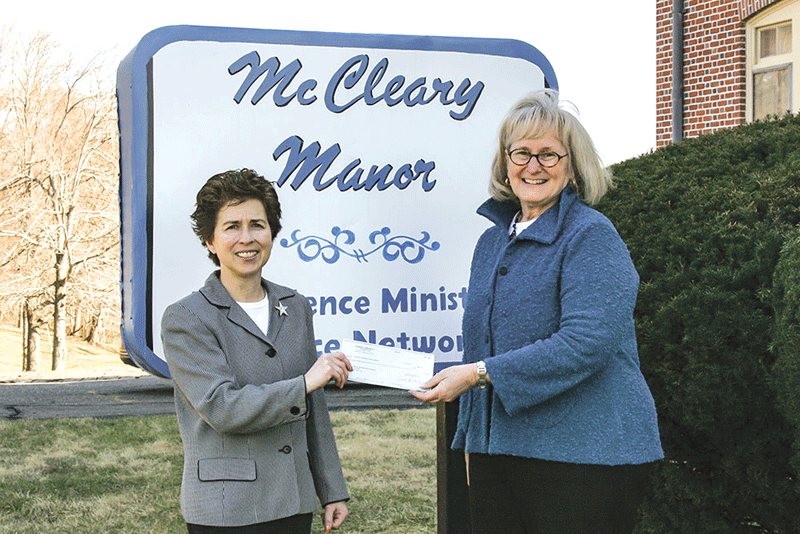
Service Network, receives a check from Carla Newton

Karen Blanchard, left, executive director at Providence Ministries Service Network, receives a check from Carla Newton, partner at Robinson Donovan, earlier this year as part of the law firm’s year-long series of donations to mark its 150th anniversary.

Partner Nancy Frankel Pelletier agreed. “It’s definitely part of the culture of the firm,” she said. “We encourage people to be active in things they have an interest in or a passion for. It’s never imposed on anyone or done out of obligation, but it’s what everyone does.”

Roberts noted that community involvement isn’t a one-way street, and firm members reap benefits beyond feeling good about themselves. “If you contribute to an organization, they benefit; on the other hand, you benefit because you learn about what the organization does, and you meet a lot of different people, and you get invested more in the community, rather than just getting in your car, going to work, taking care of your client matters, and going home. There’s a networking component that can lead you to other organizations.”

New hires, especially those coming from outside the area, are encouraged to find organizations that speak to them, as a way to get a real sense of what’s happening outside the walls and glass windows high above Main Street in Tower Square.

“Then it tends to build,” Roberts said, “because you’re recognized, and then someone else might ask you to help out at a function or support a cause or go to a dinner, and it builds on itself. It’s part of your education in the community.”

Looking Ahead

A general-practice firm, Robinson Donovan specializes in a number of legal niches, including corporate and business law, commercial real estate, estate planning and administration, divorce and family law, employment law, and litigation. After a period of rapid contraction — more than 30 lawyers worked there as recently as 15 years ago, when it was known as Robinson Donovan Madden & Barry — business has been steadily growing in virtually all those specialties, and the practice is on the rise again, hiring eight attorneys over the past several years, bringing the current roster to 16, with plans to possibly expand further.

“The firm is very dynamic and forward-thinking,” Simolo said. “We are celebrating our 150th, but at the same time, the firm is making some big investments in the future.”

Partner Jeffrey Trapani said the fact that economic development has been on the rise in Springfield, and the surrounding region is a quality-of-life draw, are added enticements when hiring.

“People get down on Springfield, but this region, I think, attracts people,” he told BusinessWest. “People enjoy coming to this area. We have city centers, things to do, you can see art, hear music, get outside, and still be close to Boston and New York.”

Trapani and Simolo count themselves among the former newcomers mentored by Roberts and his peers, but are now part of a middle generation rising to leadership and taking on much of that mentoring responsibility for new attorneys. That perpetuates the firm’s constant evolution, with some of the more recent hires chosen to match growth fields, including trusts and estates, corporate transaction law, labor and employment, domestic relations, and subspecialties like green energy.

“There’s such a broad scope of experience in this office,” Newton said. “So I can go to one of the associates and talk to them about something. They’ll learn from me, but I’ll also learn from them. When I sit in Jeff’s office or Nancy’s office, cross-learning takes place. Every single day, there are opportunities to sit down and talk about an issue with someone else. Not a day goes by that I don’t learn some new nuance that’s helpful to something I’m working on.”

It’s an environment some find unusual at first, Frankel Pelletier said, “but it’s the only environment I’ve ever known my entire career. We are just an open-door, collaborative community of lawyers.”

In short, Robinson Donovan has come a long way since its early days, when it was best known for George Robinson’s successful defense of Lizzie Borden on double murder charges in 1892. These days, the firm is recognized in a host of ways, such as the citations many of its attorneys have received from organizations like Best Lawyers, Super Lawyers, and Martindale-Hubbell.

“Unlike some other firms from the area, we really maintain a statewide presence,” said Frankel Pelletier, who was the firm’s first-ever female attorney. “We have always maintained that statewide presence and attained regional and, in some senses, national recognition. Our attorneys are constantly being recognized by organizations they belong to. That is who we are.”

Well, that and a law firm with a strong commitment to the community that has helped it thrive for 150 years.

Joseph Bednar can be reached at [email protected]

Law Sections

2016 or 1984?

By Stefanie M. Renaud


Stefanie Renaud

Stefanie Renaud

Imagine a piece of technology, so small it could be mistaken for a credit card, that tracks every movement an employee makes, analyzes every conversation that employee has, and could tell an employer when that employee was in need of a day off. What if that technology could identify patterns and traits that you could use to increase productivity by 23%? Would employers want to use this technology? Of course!

But what about the employees? Isn’t using technology like this an invasion of their privacy? We were shocked to learn, and we bet you are too, that, because of the way this technology is currently being used, employers actually can monitor every word and movement an employee makes without running afoul of the law.

Boston-based company Humanyze recently made headlines when it announced the success it has had analyzing data collected by employee ID badges, developed at the Massachusetts Institute of Technology, that track employees’ movements and analyze their voices during conversations. Contained within each badge are Bluetooth, radio frequency identification (RFID), and infrared technologies, as well as two microphones.

Each of these particular technologies has a different function and gives Humanyze different information that it can use to identify trends or patterns. Bluetooth and RFID technology are used to monitor the employee’s physical movements and location within the office. The microphones allow Humanyze to conduct real-time analysis of the speaker’s voice, including the frequency of speaking and interrupting, and how the tone and pitch of the voice change, which can be indicator of stress, although the badge does not record the content of the employee’s conversations. Finally, infrared technology monitors the wearer’s physiology for signs of stress.

Humanyze analyzes all of the collected data and identifies patterns or trends common to a specified group, such as top performers. Humanyze then works with companies to explore these trends and use them to the business’ advantage. For example, Humanyze helped Bank of America save millions of dollars by suggesting that they restructure employee breaks, which increased social interaction between employees and led to a 23% increase in employee productivity.

So, given how invasive this level of employee monitoring is, how could it not be an invasion of privacy? First of all, this isn’t an invasion of privacy because Humanyze only gathers data from employees who voluntarily offer to be tracked. Second, the individual’s data is their own; employers cannot see individual data and only receive information about aggregate data trends. According to Massachusetts General Laws, employees are protected by statute from “unreasonable, substantial, or serious interference” with their privacy.

However, in order to prove an invasion-of-privacy claim, the employee must show that the employer gathered and then disclosed information “of a highly personal or intimate nature.” While it is arguable that the data collected by these badges could be deemed highly personal in nature, in this case it’s Humanyze, and not the employee’s employer, who collects and analyzes the information.

For this same reason, Massachusetts employers do not need to worry about personnel-records law violations, because the employer is neither creating the records, nor is it the owner of the data. And, because the badges do not record audio, there is no concern about violating the Massachusetts wiretapping statute.

So are there any legal hurdles stopping an employer from implementing this type of employee monitoring? Only one: a workforce governed by a collective bargaining agreement. Employers with unionized workplaces will almost certainly need to bargain with the union before implementing a new employee tracking system.

Indeed, in another, related circumstance, the Boston Police Department engaged in negotiations with the union representing its police officers over whether or not the officers would be required to wear body cameras, ultimately agreeing with the union that, at least initially, the department would ask for volunteers. When no one volunteered, the BPD was allowed to assign the cameras to police officers, but that was after months of negotiations and subsequent litigation. So, if you have a unionized workforce, you can expect both union negotiations and substantial pushback on any requirement that members of the collective-bargaining unit wear these badges.

Employers in or with locations outside of Massachusetts that are inclined to experiment with this new employee-tracking system should check with labor and employment counsel in those jurisdictions, because state privacy laws can vary widely. Meanwhile, we’ll keep an eye on this new technology and let you know if there are any new developments.

Stefanie M. Renaud is an associate with Skoler, Abbott & Presser; (413) 737-4753; [email protected]

DBA Certificates Departments

The following Business Certificates and Trade Names were issued or renewed during the month of September 2016.

Amherst

7 Eagle Group
39 Linden Ridge Road
Jordan Kern

Amherst Mindfulness
17 Kellogg St.
Michele Zakashansky, d/b/a Michele Miller

Asphalt House
28 Pine Grove
Silver Thimble Corp.

CTI Energy Services, LLC
34 South Pleasant St.
Craig Meadows and Thomas Timmins

F.L. Roberts
399 Northampton St.
Tony El-Nemr

Jim’s Livery Co.
11 Amity St.
James Witherell

PennyFarthing Investment Management, LLC
6 South East St.
Eric Bright

RD Mobile Tech Repair Specialists
34 Main St., #1
Rizwaan Mayet

Chicopee

Aerial 51 Studios
196 Fletcher Circle
Robert Perry

Air Temp Solutions, LLC
259 Arcade St.
William Renaud

Cellite Engineers Inc. d/b/a Johnstone Supply
590 Center St.
Jess Hill

The Frame Co.
162 Nelson St.
Leslie Lavaruway

GetReal Media
23 Blanchard St.
Lisa Marie DesRochers

Laravee Homes
39 Swol St.
Jared Laravee

Livio Gravini Music
23 Blanchard St.
Livio Gravini

M and M Cleaning and Painting Services
302 Springfield St.
Mariana Acosta

Mark Renovation
102 Lemuel Ave.
Mariusz Wozny

MPinto Transport
44 Alvord St.
Maria Pinto-Davila

Not Your Granny’s Crochet Co.
24 Ashmont St.
Olga Kravchenko

Pets Hear All Clear
55 Empire St., Unit 43
Jean Mattson

Holyoke

Frosted
50 Holyoke St.
Amanda Streeter and Shelly Phillips

Fun Toys d/b/a Sharp Trans Inc.
50 Holyoke St.
Huseyin Sari

JC Parker
8 Highland Ave.
John Parker

Mask Makers Face Painting
22 Bassett Road
Emma Huse

Tony’s Grocery Store
801 High St.
Felix Almonte

Northampton

All About You with Lisa
2 Conz St.
Lisa Lussier

Barton’s Angels Inc.
144 Riverbank Road
Nancy Whitley

Brits R Us
16 Armory St.
Alan Greaves

Ostrander Law Office
36 Service Center Road
David Ostrander

Simply Hair
110C Main St.
Melissa Duffy

Taylor Painting
29 Butler Place
Stephan Taylor

Springfield

413 Multi Service
542 Page Blvd.
Jose Luis Rodriguez

Aha! Intimates
42 Wellfleet Dr.
Gifty Esi Acquah

Casey Arthur Prosperity
617 Bay St.
Casey Arthur

Double Dees Delivery
178 Starling Road
Elizabeth Dasso

DT’s Catering
226 Old Farm Road
Traci Gaynor

The Eyeglass Co.
1268 Sumner Ave.
Jeffrey Robins

Friends Auto Sales LLC
145 Michon St.
Alaa Almaliki

Guillermo’s Barber Shop
472 Bridge St.
Jonathan Rodriguez

Handyworks
17 Crown St.
Mohammad Alkhabi

Himalaya Restaurant & Bar
475 Sumner Ave.
Bhuwan Gautam

Kranis Global Holding LLC
2625 Main St.
Sayed Irfan

More2Hair
218 Pearl St.
Aisha Sherrie

Quality Contractors
1655 Main St.
Juan Diaz

Shine Bright Cleaning, LLC
407 Bay St.
Maria Vega

TheDon413 Productions
108 Whittier St.
Edward Donell Hogan
Y Solutions
431 Main St., #306
Yevgeniy Loboda

Briefcase Departments

LIPPI Featured in National Storytelling Platform

EASTHAMPTON — The Women’s Fund of Western Massachusetts’ Leadership Institute for Political and Public Impact (LIPPI) was one of several featured programs that launched Tuesday during the rollout of a new national storytelling initiative unveiled by the Women’s Funding Network (WFN) at the Clinton Global Initiative annual meeting. The uniquely interactive digital tool seeks to bring attention to a leading challenge facing women in the U.S. and around the world — economic security — and lift up the vital work of women’s foundations that are addressing this issue. “Telling the story of local women on a national scale is crucial to the work we do. If we want our communities to thrive, we must ensure the economic security of women,” said Elizabeth Barajas-Román, CEO, of the Women’s Fund. This year, Barajas-Román was invited to represent Western Mass. on the national board of the Women’s Funding Network. The launch highlights the story of the Women’s Fund LIPPI program, a unique leadership institute developed in response to a shortage of women in civic leadership positions, in public office, and serving on boards. The coursework equips women with the tools and confidence to become civic and political leaders. More than 250 participants are now leaders in their local communities; 22 have run for elected office, one received a gubernatorial appointment, one graduate is the first female police chief of Northampton, one ran a successful race for mayor of Pittsfield, and two graduates are serving in executive cabinet positions. Many more continue to serve on various boards and commissions, organizing grassroots campaigns, and raising their collective voices on issues that impact women and families. The Economic Security Digital Storytelling Platform is a data-driven, yet narrative, evidence of women’s foundations’ ongoing commitment to ensuring women’s economic prosperity. The platform gives users the opportunity to explore the data alongside the powerful stories of the women, programs, and organizations making an impact on this issue, breathing life into facts and figures. The responsive and flexible format encourages user engagement and learning by featuring links and downloadable files throughout, as well as links to social media to make these important stories easy to share. WFN’s Economic Security Digital Storytelling Platform can be previewed at economicsecurity.womensfundingnetwork.org.

State Nets $2.5M Grant to Help People with Disabilities Find Jobs

BOSTON — Massachusetts was one of only six states awarded $2.5 million this week by the federal government to help people with disabilities find employment. The grant will target youth and young adults, ages 14 to 24, in Hampden County and the Greater Lowell area by expanding access to credential-based education and training. The U.S. Department of Labor yesterday announced $14.9 million in grants to six states as part of the Disability Employment Initiative. “We know that, unfortunately, people with disabilities face much higher rates of unemployment, and we have been developing plans to tackle that problem for over a year now. One of the first executive orders I signed was to create a task force to look at ways to help people with barriers to employment find and keep jobs,” Gov. Charlie Baker said. “This award from the federal government will help us continue that important work, and create more opportunities for young people with disabilities to find fulfilling careers.” According to the U.S. Department of Labor, people with disabilities make up only 19.8% of the nation’s workforce. In Massachusetts, it is estimated that 15% of people with disabilities are unemployed. The grant is expected to serve more than 350 youth and young adults with disabilities. In Massachusetts the funds will also be used to create partnerships with local employers to increase hiring opportunities for young people with disabilities, and expand short-term subsidized work programs. The grant will provide job-retention and placement services to young people who have difficulty finding work due to their disability. “This is the first initiative where we will completely focus on youth and young adults with disabilities in order to help them find and keep employment,” Labor and Workforce Development Secretary Ronald Walker II said. “We are thrilled to be one of only a few states to receive this grant, and it will enable us to continue the work started by the task force for people facing higher employment.” The other states to receive grants were Connecticut, California, Idaho, Minnesota, and Maryland. While Massachusetts’ unemployment rate is lower than the national average, at 3.9% in August, certain populations face chronically higher rates of unemployment, including African-Americans, Hispanics/Latinos, people with disabilities, Native Americans, and recently returned veterans.

Unemployment Rate Drops to 3.9% in August

BOSTON — The state’s total unemployment rate dropped to 3.9% in August from 4.1% in July, and preliminary estimates show the state gained 5,900 jobs over the month, the Executive Office of Labor and Workforce Development reported. The last time the state’s unemployment rate hit 3.9% was in August 2001. At 3.9%, the seasonally adjusted unemployment rate is down 0.9% over the year from 4.8% in August 2015. There were 30,300 fewer unemployed residents and 73,000 more employed residents over the year compared to August 2015. Massachusetts’ unemployment rate remains lower than the national rate of 4.9% reported by the Bureau of Labor Statistics. The state added fewer jobs over the month in July than the Bureau of Labor Statistics originally estimated, gaining 5,800 jobs compared to the previously published 7,300-job-gain estimate. Year to date, December 2015 to August 2016, Massachusetts has added 61,000 jobs. In August, the largest over-the-month job gains occurred in the leisure and hospitality, education and health services, and other services sectors. The state’s labor force participation rate — the total number of residents 16 or older who worked or were unemployed and actively sought work in the last four weeks — is 65.0%. Over the year, the labor-force participation rate has increased 0.2% compared to August 2015.

State Releases Detailed Report on Opioid Epidemic

BOSTON — The Baker-Polito administration released an in-depth analysis of the state’s opioid-related deaths from 2013 to 2014. The findings reveal that opioid-related deaths have increased by 350% in Massachusetts in 15 years and marks the first time data from multiple state agencies has been linked to give a comprehensive overview of deaths associated with the opioid epidemic. “We are pleased to unveil this report to combine state resources and aggregate data in an innovative way to better understand the drivers behind opioid and heroin-related overdoses,” Gov. Charlie Baker said. “We are hopeful that new information will help us better understand the contours of this public-health crisis as we continue to work on prevention, education, and treatment in our communities to combat the opioid crisis in the Commonwealth.” Added Marylou Sudders, secretary of the Executive Office of Health and Human Services, “in 2013 and 2014 alone, opioid-related deaths were recorded for two-thirds of the cities and towns in Massachusetts. In the face of this crisis, we must continue our efforts to battle this epidemic that continues to take a record number of lives.” The analysis, performed by the state Department of Public Health, reviewed opioid-related deaths in 2013 and 2014 by analyzing data from multiple government entities including the Department of Public Health, the Office of the Chief Medical Examiner, the Department of Correction, MassHealth, and the Center for Health Information and Analysis. The Commonwealth’s technology agency, MassIT, facilitated integration work to bring the various streams of data together. The report, which was released at a reconvening of the Governor’s Opioid Working Group, chaired by Sudders, is part of continued efforts to improve the collection and release of data examining the impact that opioids have on Bay State communities. Earlier this year, Baker signed landmark opioid legislation into law to address the deadly opioid and heroin epidemic plaguing the Commonwealth. “Opioid-use disorder is a chronic disease, and this epidemic is a complex and persistent problem that will not be solved through a single solution,” said Department of Public Health Commissioner Dr. Monica Bharel. “This data will be leveraged to allocate resources more efficiently and effectively to help us save lives.” In 2015, the Governor’s Opioid Working Group released recommendations and a comprehensive action plan aimed at curbing the opioid epidemic. These short- and long-term recommendations focus on prevention, intervention, treatment, and recovery support. Approximately 93% of the initiatives in the governor’s action plan are complete or underway.

Five Colleges Inc. Breaks Ground for Library Annex

HATFIELD — At a brief ceremony on Sept. 15 attended by campus officials and developers, Five Colleges Inc. broke ground on for its Library Annex on a site it purchased in Hatfield. When complete, the 35,000-square-foot building will provide shelving for up to 2.5 million items from the libraries of the campuses of the consortium — Amherst, Hampshire, Mount Holyoke, and Smith colleges and UMass Amherst — freeing up space for new materials and other academic needs. In addition, it will serve as a temporary home for much of the collection of Smith College’s Neilson Library while it undergoes a major renovation. “This facility will help Smith greatly in coming years. It’s a great example of how the institutions help each other,” said Susan Fliss, Smith College dean of Libraries. Added Chris Loring, the recently retired director of libraries at Smith College and a driving force behind the development of the annex, “this will become another library for us.” The 12-acre parcel is at the junctions of the Interstate 91 exit 22 ramp, West Street, and Plain Road in Hatfield. Five Colleges paid $925,000 for the property, which had been owned by Lynda, Martin, and Sharyn Holich. Site preparation work began on May 17, and work is expected to be complete in May 2017. With climate-controlled conditions for long-term preservation of print materials, the annex will house a part of the Five College library repository collection, which already preserves nearly 600,000 items for its member campuses.

Departments People on the Move
Matthew Gilmore

Matthew Gilmore

Epstein Financial Services recently welcomed Matthew Gilmore to the firm as a Retirement Plan Consultant. The firm has grown substantially over the past several years with a recent upsurge in new clients due to the Department of Labor’s new fiduciary ruling. Over the coming months, Gilmore will work closely with founder Charlie Epstein to ensure the firm’s extensive services and mission statement are reflected in Gilmore’s continued growth within the firm. Gilmore gained extensive experience as a MassMutual business development consultant, meeting with business owners, plan administrators, advisors, and third-party administrators to review, evaluate, and discuss a business’ 401(k) retirement plan and/or defined-benefit pension-plan options. He is an accomplished retirement-services consultant with eight years of experience with MassMutual and the Hartford, with regard to 401(k) and 403(b) retirement plans, investment and cost analysis, and participant education. He recently obtained his Accredited Investment Fiduciary certification and is a graduate of Western New England University with a bachelors degree in business administration.

•••••

The Gaudreau Group Insurance and Financial Services Agency announced the promotion of Melissa Cuzzone to Director of Employer Benefit Services. In her new role, Cuzzone will help keep clients compliant in today’s increasingly complex regulatory environment, in line with the firm’s focused approach on compliance with the Affordable Care Act’s regulations. The Gaudreau Group’s Employee Benefits division, which has the largest staff in the region, delivers results to clients with robust compliance programs and high-tech employer and employee software solutions to facilitate cost reduction, claims management, and employee wellness and communication. “The unique skillset Melissa brings to the table, in combination with the tools and services that she provides, such as ACA reporting guidance, benefit administration, and proprietary claims analytics, are extremely valuable to our clients,” said Jules Gaudreau, president of the Gaudreau Group. “Melissa helps our clients enhance their overall benefits programs, which results in an increased ability to attract and retain great employees. Results like these are the reason more and more businesses are trusting us with their accounts.” Cuzzone has been a member of the Gaudreau Group team since 2012, and has worked in the insurance and financial-services industry since 2004, gaining a broad range of experience, including employee benefit plans, life insurance, and personal insurance. She is a recent graduate of the Western New England University Mini-Law School and has co-chaired the Wilbraham Relay For Life.

•••••

The Dowd Insurance Agencies announced that Jack Dowd will be joining the agency as an Account Executive. His addition represents the fifth generation of family to be employed at the Dowd Insurance Agencies. “It’s a real sense of pride that I feel welcoming my son, Jack, to the family business representing the fifth generation here at the Dowd Insurance Agencies,” said John Dowd Jr., president and CEO of the Dowd Insurance Agencies. “Not only is Jack continuing a legacy, but he has also spent several years working in the industry outside of the family business, gaining valuable skills and experience. I think he is a great fit for our company and will be happy in his new position. We’re all very excited to have him join our team.” Jack Dowd graduated from Saint Michael’s College with a bachelor’s degree in business administration in 2011. He has held several positions with Goji Insurance in Boston, where he sold personal auto insurance and homeowner’s insurance. He was consistently ranked number one in sales throughout the entire company of over 120 salespeople, and was responsible for managing and training several sales teams. He is a licensed property and casualty insurance producer, has participated in the Quincy Mutual Group Commercial and Personal Underwriting Program, and is working to complete the Certified Insurance Counselors Program.

•••••

Jean Deliso, CFP has been named a member of the 2016 Chairman’s Council of New York Life. Members of the elite Chairman’s Council rank in the top 3% of New York Life’s sales force of more than 12,000 licensed agents in sales achievement. Deliso has accomplished this level of achievement for five consecutive years. Deliso’s passion for finance and strategic planning led to the creation of Deliso Financial and Insurance Services in 2000. She began her career in corporate accounting in Tampa, Fla., where she consulted with small-business owners on financial operations and maximizing performance. She has been a New York Life agent since 1995 and is associated with New York Life’s Connecticut Valley General Office in Windsor, Conn. Deliso serves on many boards in her community, including the Baystate Health Foundation and Pioneer Valley Refrigerated Warehouse, and is chairman of the board of the Community Music School of Springfield. She is past chairman of the board of the YMCA of Greater Springfield, past board member of AAA Pioneer Valley, and past trustee of the Community Foundation of Western Massachusetts and the Advisory Council at Bay Path University. Deliso Financial and Insurance Services is not owned or operated by New York Life Insurance Co. or any of its affiliates.

•••••

Sports Traveland Tours recently hired two new team members. Len Lucien serves as Chief Operating Officer and a minority partner at the 20-year-old travel organization, and Anthony Incampo serves as Project Sales Coordinator. Lucien previously worked at Square One in Springfield, where he served as vice president of operations for the nonprofit and, previously, as its vice president of finance. He holds a bachelor’s degree in business from Salem State University and an associate’s degree from Newbury College in accounting and business. Throughout his career, he has worked in various aspects of finance and operations, managing businesses of different sizes, with an expertise in startups and efficiencies. For 12 years, he worked in the transit industry. After graduating with a bachelor’s degree in journalism from Long Island University, Incampo worked with the 1996 Summer Olympics in Atlanta, coordinating events, offering customer service, working with athletes, and planning the opening ceremonies. He also worked in the front office of the New York Yankees from 1998 to 2002, doing everything from driving players to physician appointments to handling budgets and expenses for the team. He previously worked with Sports Travel and Tours from 2005 to 2010. He left to teach school-age children and to coach, but missed the traveling.

Court Dockets Departments

The following is a compilation of recent lawsuits involving area businesses and organizations. These are strictly allegations that have yet to be proven in a court of law. Readers are advised to contact the parties listed, or the court, for more information concerning the individual claims.

Hampden Superior Court

Charrice Goodrich v. Storrowton Tavern Corp.
Allegation: Personal injury, two fractured ankles: $42,000
Filed: 9/16/16

Sally Starks v. Big Y Foods Inc.
Allegation: Slip and fall causing injury: $97,267
Filed: 9/13/16

Vibra Hospital of Western Mass., LLC v. Lillian Sydlo
Allegation: Failure to pay for medical and/or healthcare services: $256,163.76
Filed: 8/29/16

Hampshire District Court

Cichy’s Garage Inc. v. Star Construction
Allegation: Failure to return unearned deposit on construction contract: $22,000
Filed: 9/1/16

Hampshire Superior Court

Jean M. Boutin as personal representative of the estate of Ruth Morgan v. Service Matters, LLC and Hartford Accident & Indemnity Co.
Allegation: Negligence causing personal injury: $160,820.16
Filed: 9/8/16

Jillian M. Niedzwiecki and Patrick Niedzwiecki v. Maple and Main Realty, LLC et al
Allegation: Breach of contract and breach of deed covenants resulting in necessary septic-system repair and diminution of property value: $25,000
Filed: 9/2/16

Karisa M. Gifford et al v. Burning Heart, LLC d/b/a Burning Heart Hot Yoga Pilates & Indoor Cycling
Allegation: Negligence causing personal injury: $69,574
Filed: 9/19/16

Holyoke District Court

Roxanne Roman v. Derek Borkowski d/b/a ZB Dream Homes
Allegation: Faulty shingle installation: $5,600
Filed: 8/15/16

USA Hauling & Recycling Inc. v. Paper City Brewing Co.
Allegation: Balance due for sanitation services: $4,532.24
Filed: 9/12/16

Daily News

NORTHAMPTON — Bacon Wilson announced that attorney Lee Dawn Daniel has been selected to join the executive committee of the Massachusetts Academy of Trial Attorneys (MATA).

She is currently serving her second term on MATA’s board of governors, having been appointed by MATA’s president for 2015-16, and then nominated and elected by former MATA officers to continue on the board of governors for another two-year term.

“It is my privilege to continue my service to MATA by joining the executive committee,” Daniel said. “I am thrilled to be able to help promote the mission of this tremendous organization, which allows trial attorneys to gather together to share cutting-edge techniques, discuss the latest trends in the law, and improve skills so that we can continue to serve our clients and the justice system of the Commonwealth to the best of our abilities. It’s my honor to serve.”

Attorney Daniel recently joined Bacon Wilson as of counsel. She is a litigator with more than 30 years of experience representing clients in matters of personal injury. She is a graduate of the Boston University School of Law and the State University of New York at Binghamton with honors, and has secured multiple million-dollar-plus settlements and verdicts throughout her career. She is based in Bacon Wilson’s Northampton location.

MATA has operated since 1975, with its membership working to uphold and defend the Constitutions of the U.S. and the Commonwealth of Massachusetts, to assure that the right to trial by jury will be secure to all, to help people whose rights may be in jeopardy, to protect the independence of the judiciary, to promote public safety and welfare while protecting individual liberties, and to uphold the honor of the profession of law.

Features

Plane Speaking

Jorge Morgado

Jorge Morgado says the saga of Flight 1549 has lived on well past the proverbial moment, through books, reunions, and, most recently, the movie Sully.


Jorge Morgado acknowledged that the words ‘based on a true story’ give film writers, directors, and producers a large degree of latitude when they’re telling a story.

Still, he went to one of the area’s first showings of Sully with the almost singular goal of seeing if Hollywood, and specifically Clint Eastwood, would get it right, meaning an accurate portrayal of the events of Jan. 15, 2009 and thereafter.

And he was pleased to report that — even though, for starters, his golf group of six that was such a significant part of the so-called ‘Miracle on the Hudson’ was reduced in size by half for this movie (and he wasn’t part of it) — they did.

At least when it comes to the part about the ditching of the plane and the subsequent rescue of all aboard.

“I thought they did a great job of telling the story without exaggerating,” said Morgado, vice president of Baystate Rug & Flooring in East Longmeadow and Chicopee. “I went to see if they would add ‘Hollywood’ to it, and for the most part, they didn’t.”

Jim Stefanik, who is one of the three written into the script, agreed, while noting, as one might expect, that it is quite the experience to see an actor, in this case, Max Adler (Glee, Love and Honor), play you in a movie and see his name next to yours as the credits roll.

“It’s definitely weird, and that’s been one of the more interesting things about this whole experience,” he said, adding quickly that Adler looks nothing like him and is almost a foot taller, but he doesn’t mind Hollywood taking those liberties.

“I’m five foot, five, and he’s about 6’4,” Stefanik, the former golf pro turned Chicopee firefighter, explained with a laugh, adding that it’s certainly difficult to describe the sensation of watching a movie depicting a scene from your life, and he has struggled with that assignment.

The simple exercise of trying to articulate these experiences explains how Sully has in some ways put the six golfers, all from Western Mass., back in the spotlight, even though some have kept a very low profile for years now and have every intention of keeping it that way.

And it also helps explain how a story like this lives on long after the proverbial ‘moment’ — in this case, it was literally only 10 or 12 minutes — is over. Indeed, there have been books, reunions, consistent contact on social media among the passengers, a gathering when the now-famous Airbus A320 was moved into a museum in North Carolina a few years ago, and other happenings to keep the story in plain view.

But in most respects, keeping this saga front and center hasn’t been a burden, emotionally or otherwise, because it is in many ways different from other newscast-leading events in recent years, many of them also turned into movies (Deepwater Horizon is now in theaters, for example, and there are two films on the Boston Marathon bombing now in production).

Indeed, this is a feel-good saga in about every way imaginable, one where no one can be described with the word ‘victim’ — except maybe in reference to an unyielding media blitzkrieg, as we’ll see later. There were no fatalities, only one serious injury (to a flight attendant), no real blame to be laid, and hardly a hint of controversy, although, according to many accounts, Eastwood felt the necessity to create some.

And when we all survived … from then to now, I think I realize just how good I have it. I think I appreciate it more than I would if I wasn’t on that plane that day.”

Specifically, in the film, National Transportation Safety Board officials make the case that the pilots could have flown the plane back to LaGuardia Airport instead of ditching in the Hudson River, but Morgado says he’s heard rumors that the NTSB is not at all happy with this depiction of events.

No, the story of Flight 1549 has a happy ending in seemingly all ways, and that’s why Morgado, Stefanik, and Dave Carlos didn’t mind going over all this ground one more time nearly eight years after they were unwittingly thrust into the spotlight.

“When people ask me, I say this whole experience was a blessing in disguise,” said Carlos, chair of the Math Department at Springfield’s Central High, soon to open his own business on the side, a pizza shop. “I have an 8-year-old and a 6-year-old, and the 6-year-old wasn’t born when this happened. When Sully said ‘brace for impact,’ what I thought about was not being able to see my daughter and what she looked like, and not being able to see my son again or my family again.

“And when we all survived … from then to now, I think I realize just how good I have it,” he went on. “I think I appreciate it more than I would if I wasn’t on that plane that day.”

For this issue, the three talked about that fateful day in January — again — but mostly about what’s happened since, and how events of this nature can change someone’s life in ways that couldn’t be imagined.

Last-ditch Efforts

“It was like sneakers in a clothes dryer.”

That’s how Morgado chose to describe the sound of a flock of geese getting in the way of the engines on both sides of the Airbus he and his golfing buddies were scattered throughout. Only no one actually knew that this is what it was.

All that would soon become apparent is that something was clearly wrong, he recalled, adding that the cabin, which he was near the front of (window seat, row 5 in coach) was soon filling with smoke.

“The cabin started shaking and it smelled like burnt bird —   you could tell something was wrong,” he said, adding that, like all those around him, he spent the next few minutes trying to simply absorb what was happening around him.

Backing up a little — kind of like a movie flashing back several hours — Morgado said he and the rest of his golf party were not supposed to be on this flight. Instead, they had chosen to fly on Spirit Airlines for their regular winter-season trip to Myrtle Beach in South Carolina. But that Thursday morning came up white, and the light show was enough to ground smaller planes, but not larger airliners.

So Morgado and his companions — Stefanik,  Carlos, Rick Delisle, Rob Kolodjay, and Jeff Kolodjay— would secure the last six tickets for US Airways Flight 1549, a number that, like most everything else about this story, no one will ever forget.

Returning to that moment when Morgado heard the sneakers in the dryer, he said that noise, which occurred only a few minutes after the plane lifted off LaGuardia’s runway, was followed by general silence. There was nothing, he said, until the man the world would soon come to call by his nickname said those words have become so famous — “This is the captain; brace for impact.”

By the time those words came, though, passengers could see that the plane was out over the Hudson and ever closer to the water, said Carlos, adding that stewardesses began saying the phrase that would come to dominate the movie trailer: “heads down … brace yourselves.” And as much as the words themselves, it was what he thought they meant that has stayed with him all these years.

“They kept chanting it over and over again,” he recalled, that it was an agonizing, terror-filled three minutes before the plane actually hit the water. “I kept thinking, ‘is this the last thing I’m going to hear? This is awful.’”

Eventually, although very quickly, it seems — “you were just in survival mode,” said Morgado — passengers made their way out of the aircraft, with most of them winding up on the wings, as captured in those iconic photographs, one of which now graces the wall of his office at the Chicopee location. What those pictures don’t effectively convey is how quickly the plane began to settle into the icy Hudson.

“When I stepped onto the wing, the water was only ankle-deep, but by the time the boats came, I was waist-deep in water — the plane was sinking pretty quickly,” said Morgado, adding that, while he was having a hard time comprehending and coping with all that was going on around him, he still had the presence of mind to keep his cell phone dry.

Because he did, he got his first real taste of how immediate, intense, and sometimes infuriating the media assault on Flight 1549 and everyone involved with it that day would be.

“I called my wife to tell her I was in a plane crash; she didn’t even know I was on that plane,” he explained. “I said, ‘I’m OK; I’ll call you when I get on dry land.’ I then hung up, and she turned on the TV to see what was going on.

“She later called and said that, just after I hung up, the home phone started ringing off the hook — it was all these New York and Boston media people calling,” he went on. “She remembers talking to Diane Sawyer’s producer, who said, ‘let me know where your husband is; we know he’s asthmatic, and we’ll get him treatment.’ They knew my medical history, and I was still standing on the wing of that plane. That was how quick they were able to get my information and get to my house. They were all out to get a story.”

Overall, Carlos, who joked that he wasn’t written out of the script, he just wasn’t written into it, said the movie made the rescue appear easier and less traumatic than it actually was.

“In the movie, the rescue seemed very nonchalant; they made it look easy to just climb on those boats and get out of there, that everything was just standing still,” he noted. “In real life, we were floating down the Hudson; the plane was moving, the boats were moving, the hulls of the boats were 15 to 20 feet above the water, not the five feet like they depict in the movie.”

Wing and a Prayer

Fast-forwarding a little, Morgado and the others said what happened on the Hudson was certainly just the first chapter in this story. Others involve what happened after they returned to dry land and, later, their families, their businesses, and other facets of their lives.

Highlights, and there are many, include:

• Morgado being told that media members had snuck into his office in pursuit of … whatever, and wound up taking photos of pictures of his children and printing them (that’s a lowlight, actually);

• Getting to go on that Myrtle Beach trip eventually, with the Golf Channel in tow to record the occasion, and with new equipment and bags courtesy of Titleist, which wanted its name omnipresent during this outing, and succeeding with that goal (Morgado remembers the dozens of courses at Myrtle vying hard for the privilege of hosting them);

• Taking part in the book Miracle on the Hudson, featuring passengers telling their stories (Morgado leads off a chapter titled “Night in New York” talking about his phone call to his wife while out on the wing); and

• Relaying the story untold times to family members, friends, business customers, fellow Rotarians, and, yes, the media, a broad constituency (we’ll include TV talk-show hosts) that induced a wide range of emotions from those we spoke with — everything from fascination to incredulity.

Indeed, beyond his aforementioned experience on the wing, Morgado related another episode involving the fifth estate in the book Miracle on the Hudson.

As he relates the story, the six golfers were due to appear on the Today show the morning after the crash and rescue. They were to meet the show’s producer in the lobby of the Crowne Plaza hotel, and were told specifically by him not to leave the lobby, because competing networks, positioned outside with their own vans, would essentially hijack the story.

“It was insane,” said Stefanik of the media coverage, in terms of its depth and voracity. “They kept trying to find out everything they could about you; they were calling my mother-in-law, my mother, all in pursuit of a story. They can find out anything about you that they want.”

The movie Sully has brought the media back, but not with anything approaching the ferocity witnessed in the weeks and months after the crash. Overall, the film has simply brought some new questions to be answered — everything from ‘how accurate was it?’ (perhaps the most common query) to ‘how did Tom Hanks do in the title role?’

“He was incredible as Sully,” said Morgado while answering the latter. “He captured him perfectly.”

And while that same adjective probably can’t be used for the sum of the film and its attention to accuracy, said those we spoke with, it does an adequate job of capturing the heart of the story — the courage and skill of the pilots.

Roll the Credits

Spoiler alert: Morgado said Sully starts off in an intriguing way — by showing what might have happened if Sullenberger and co-pilot Jeffrey Skiles hadn’t pulled off the miracle on the Hudson (let’s leave it at that).

The powerful footage has to leave audience members, not to mention survivors like Morgado, Stefanik, and Carlos, more cognizant of how lucky everyone was that day.

Carlos enjoyed and appreciated the movie, but didn’t really need it to appreciate his good fortune and remember never to take anything for granted.

“The incident helped open my eyes to things, and it’s enabled me to enjoy what I have more than I used to,” he told BusinessWest.

This is a sentiment that — like the story of Flight 1549 itself — lives on well past the moments that made history.

George O’Brien can be reached at [email protected]

Features

Building on a Legacy

BizDiffMakrsLOGO2011

It was a moment — actually, several moments — that no one in attendance would soon, if ever, forget.

David and Marisa Balise had moved to the microphone at the Log Cabin Banquet & Meeting House to offer reflections on how their father, Mike, who had succumbed to stomach cancer just a few months earlier, had lived a life dedicated to family, the New England Patriots, and philanthropy.

“It was a special moment for everyone,” said BusinessWest Associate Publisher Kate Campiti. “Several people had already talked about Mike’s contributions to the community and the myriad ways he gave back, but no one did it in a more powerful, more thought-provoking way than his own children.”

There were a number of powerful moments at the Difference Makers celebration staged last March, such as the introduction of retiring Hampden County Sheriff Michael Ashe, which was punctuated by a rousing standing ovation from those in attendance, including many members of the area’s law-enforcement community. And then, there was the tribute to Bay Path University President Carol Leary, marked by the passage “no one has been a more effective, more impactful, and more important leader for their organization.”

There have been countless other memories like these since BusinessWest inaugurated its Difference Makers recognition program eight years ago. And now, it’s time to begin the process of making some more.

Indeed, nominations (HERE) are now being sought for the class of 2017, members of which will be feted at the Log Cabin late next March.

Nominations, which must be submitted to BusinessWest by Nov. 16, should, in very simple terms, explain why the individual or group in question is a Difference Maker within the community called Western Mass.

And as the list that follows reveals, there are many ways to fit that description. Last year’s class of honorees, which also includes Big Brothers Big Sisters and John Robison, president of Robison Service and advocate for individuals on the autism spectrum, provides ample evidence of this. But over the years, those honored include other college presidents, leaders of a host of nonprofits, and business leaders known as much for what they do within the community as for their respective companies.

“We chose that name ‘Difference Makers’ for a reason,” said Campiti.  “It speaks to what these groups and individuals do, of course, but it doesn’t put any limitations on how those words can be interpreted.

“As we’ve seen over the years, there are countless ways to make a difference,” she went on. “The common denominator is that these individuals and and groups make this region a better place to live, work, and conduct business.”

Submissions will be reviewed by the team at BusinessWest, with the class of 2017 to be introduced in late January.

Details on the March Difference Makers celebration will be presented in upcoming issues of the magazine.

For the record, go HERE for a list of previous honorees.


Daily News

HOLYOKE — The Hampden County Bar Assoc. will present its third annual 5K Run/Walk, “Race Judicata: a Run for the Bar,” on Sunday, Oct. 16 at Ashley Reservoir in Holyoke, rain or shine. Proceeds will benefit the Children’s Law Project.

Registration runs from 9 to 10:45 a.m., with the race start at 1 a.m. The cost is $30 in advance and $40 on race day. Register online by clicking here.

Daily News

SPRINGFIELD — Springfield College unveiled its new environmental science major this fall, led by Assistant Professor of Environmental Biology Justin Compton and Assistant Professor of Environmental Science Eileen McGowan.

The environmental science major at Springfield College provides more than a traditional classroom education. With innovative course offerings, frequent in-field experiences, and an interdisciplinary format spanning a variety of programs and areas of interests, this major will help prepare students for careers in nonprofit, government, compliance, environmental law, or other related industries.

Students will learn how human activity impacts the environment, and they will obtain the critical thinking and problem-solving skills needed to contribute to solutions to global environmental issues. Designed to help students become leaders in both natural and manufactured environments, the environmental science major will assist in developing the skills needed to confront challenges faced by citizens, businesses, governments, and non-governmental organizations.

Daily News

NORTHAMPTON — Bacon Wilson announced that attorney Lee Dawn Daniel has joined the firm as of counsel. Daniel is a litigator with more than 30 years of experience representing the citizens of the Pioneer Valley on matters of personal injury and medical negligence.

Managing Partner Stephen Krevalin welcomed Daniel to Bacon Wilson, noting that “Lee’s approach to her legal practice is perfectly in line with Bacon Wilson’s — clients come first. Lee has spent three decades working to help clients understand their rights and guide them through intricate legal processes while also serving as their voice and protector, both in and out of the courtroom. Bacon Wilson is thrilled to add attorney Daniel to our roster of exemplary lawyers.”

Daniel joins Bacon Wilson from the firm of Daniel and Fontaine and is licensed to practice law in Massachusetts, Pennsylvania, and New York; the U.S. District Courts of Connecticut, Massachusetts, and New York; and the U.S. First Circuit Court of Appeals. She is a graduate of the Boston University School of Law and the State University of New York at Binghamton with honors.

Daniel has been a repeat presenter at professional-development events for the Mass. Academy of Trial Attorneys and Mass. Continuing Legal Education Inc., instructing her peers on topics such as evidence, case evaluation, discovery procedures, and trial tactics and techniques. Over the course of her career, she has secured multiple million-dollar-plus settlements and verdicts on behalf of her clients, including a top-10 verdict in the Commonwealth for 2003. She sits on the board of governors for the Mass. Academy of Trial Attorneys. Daniel will work primarily from Bacon Wilson’s Northampton location, serving clients throughout Western and Central Mass.

Cover Story

Confidence Builders

LPV Executive Director Lora Wondolowski

LPV Executive Director Lora Wondolowski

Created in response to the impending retirement of the Baby Boomer generation and the leadership void this will create, Leadership Pioneer Valley continues to refine and build upon its multi-faceted mission to groom the next generation of leaders.

Lora Wondolowski says she and her staff at Leadership Pioneer Valley do a lot of measuring.

That’s a broad term she used to describe a number of steps aimed at quantifying the overall impact of this program, now in its fifth year, a key milestone in many respects.

For example, LPV, as it’s known, likes to chart the progress of its graduates, she said, adding that some of the statistics are eye-opening. For example, a good percentage of program participants had received promotions, raises, or both within a few years of graduating. Meanwhile, roughly a third had moved on to new and better jobs with greater responsibility by the time they were polled. Also, 60% had joined a new board as a director, and 80% described themselves as more inclusive when it comes to their leadership style.

But there are other intriguing numbers to chew on, said Wondolowski, the organization’s director since it was conceived, and they speak loudly about what LPV is all about.

“When we ask people about their impression of Springfield at the beginning of our ‘Springfield Day,’ there’s usually about 20% to 30% who have a negative view of the city,” she explained while referring to one specific day of programming in LPV’s 10-month regimen. “And when we ask them at the end of the day … every year, it’s been positive, with no negatives.

I had personal confidence, but I didn’t have confidence that the peers around me had confidence in me. I loved what I was doing and had conviction — maybe that’s a better word to use — but I didn’t have confidence that the people who were senior to me believed in me.”

“And it’s the same with Holyoke and Franklin County,” she went on, adding that LPV also has programs focusing on those areas. “And that’s because there are a lot of perceptions out there, and we want people to look at these places with clear eyes. We don’t want to paper over the challenges, and we don’t, but we want participants to get past the stereotypes and what they think they know.”

Those specific words are not in the LPV mission statement, but they certainly go a long way toward explaining why the program was created and why those who conceived it are even more convinced of the need for it five years later.

The aforementioned numbers clearly show the program’s effectiveness in providing a clearer focus for its participants, and thus greater awareness of the region, its assets, problems, and potential.

Katie Stebbins

Katie Stebbins says she took part in LPV because, while she had confidence in herself, she wasn’t sure other people did.

But the numbers don’t really tell the whole story, or tell it as effectively as words can, and for evidence of that, one need only listen to Katie Stebbins.

A member of LPV’s first class, she is the assistant secretary of innovation, technology, and entrepreneurship for the state Executive Office of Housing and Economic Development. That means she’s definitely among those who moved on to a new job, a new title, and a larger number on the paycheck since graduating from the program.

But she was already, in many respects, already a leader when, after working for several years in Springfield’s Economic Development Department, she hung out her own shingle as a consultant. At the time, she told BusinessWest, she didn’t exactly lack confidence, but instead lacked a certain type of it.

“I had personal confidence, but I didn’t have confidence that the peers around me had confidence in me,” she explained. “I loved what I was doing and had conviction — maybe that’s a better word to use — but I didn’t have confidence that the people who were senior to me believed in me; I didn’t necessarily have confidence that I could take that conviction and bring lots of other people along with me.”

To make a long story short, LPV became a way to first test her theory — that she was actually better at getting people to follow than she thought — and then eventually rid herself of such doubts. Both were essentially accomplished through that rugged, 10-month program (one meeting per month) designed to inform, educate, inspire, create connections, and, yes, build confidence.

For this issue, BusinessWest takes an in-depth look at LPV as it reaches the five-year milestone, and at what lies ahead for this important addition to the region’s business landscape.

Lead-certified

Looking back, Stebbins recalls that 2012 was a watershed year for her in many respects.

In addition to taking on LPV’s program, she was accepted into Valley Venture Mentors, started homeschooling her children, launched a civic technology startup called BYO Family, and even started playing on a local roller-derby team.

You can’t really do any of that, let alone all of it, without a good amount of confidence, she acknowledged, adding quickly, and again, that in many respects she needed more of that invaluable commodity, and more affirmation that she had the ability to lead and get others to follow. And she credits the experience for helping her get where she is, with the seal of the state on her business card.

“It was really gratifying to hear people I didn’t know before say things like, ‘you’ve got leadership skills,’ ‘we believe in you,’ and ‘you’re going to go a long way,’” she explained. “It put extra wind in my sails, and it really energized me.”

In a nutshell, this is essentially what LPV was created to do.

Officially, the program was action item 7 in an update of the region’s Plan for Progress, first drafted by the Pioneer Valley Planning Commission (PVPC)  more than two decades ago and revised several times since to reflect changes and new priorities.

Specifically, LPV, which at first was part of the PVPC and is now a standalone nonprofit, was conceived as a response to the overwhelming numbers of Baby Boomers who would be retiring over the next several years and the need to fill the resulting leadership void.

The term ‘silver tsunami’ has come into vogue to describe this phenomenon and the overall aging of the population, and Wondoloski drove home the point that the issue is real and must be addressed.

“The rate of retirement is increasing each year, and that’s going to mean huge turnover at our companies, both at the leadership level and also on our boards of directors,” she explained, adding that, in some rural areas, the average age of the citizenship is at or near retirement age, presenting huge leadership voids.

Looking back on LPV’s first year and what’s transpired since, Wondolowski said that first class was somewhat older than those that have followed, probably because the concept was new and many established business owners and managers wanted to take advantage of an opportunity.

Today, the program is attracting a younger audience — most are now closer to 30 — and a growing number of entrepreneurs, a reflection of this region’s ongoing efforts to promote entrepreneurship and mentor startups.

The classes are also becoming more diverse geographically, and this is another positive development, said Wondolowski, noting that, in the beginning, individuals from Hampden County dominated the ranks, but in recent years, more rural areas, and especially Franklin County, have sent more representatives. This is critical, she noted, because the populations of such areas is aging at an even more pronounced pace as Millennials choose to locate in cities, leaving communities like Greenfield with a strong need for young leaders.

While the makeup of the classes has changed somewhat over the years, the curriculum, if you will, has been more of a constant. It was constructed with three main goals in mind, said Wondolowski, citing LPV’s mission — “to identify, develop, and connect diverse leaders to strengthen the Valley.” These deliverables, if you will, are:

• Increasing participants’ leadership skills through exercises involving everything from cultural competency to communication and critical thinking;

• Increasing participants’ networks, both within their own class and also through programs in and on various cities and regions; and

• Increasing their understanding of the Valley through these programs, which educate participants about the challenges and opportunities facing these geographic areas.

LPV, which has a current tuition of $3,500 with assistance available to those who need it,  accomplishes these goals through a series of monthly programs, including several ‘challenge days’ and ‘field experiences’ staged across the region. The 2016-17 slate is reflective of what’s been done since the beginning.

There will be an opening overnight retreat this coming weekend at the Berkshire Outdoor Center in Becket, followed by the first challenge day, with a focus on collaborative leadership, on Oct. 21. A second challenge day, this one centered on ‘inclusive leadership,’ is set for Nov. 18 at a still-to-be-determined site in Franklin County.

The first field experience, a concentrated program aimed to educate participants about a given region or city, is set for Dec. 16, and will focus on Hampshire County and the Five College area. Others will center on Springfield (Jan. 20), Holyoke and Chicopee (March 17), and Franklin County (April 28).

Other challenge days are slated for Feb. 10, with ‘creativity’ as the theme, and May 19 (‘skilled negotiations’).

Progress Report

As she talked about this milestone year for LPV, Wondolowski said that, in many ways, the organization was at a type of crossroads.

By this, she meant this was a time to revisit the mission, undertake some strategic planning, and devise a blueprint for the organization moving forward. And, in many respects, this work is already underway.

The focus will be on broadening its overall impact and tailoring programs to meet the many challenges facing young professionals, the region, individual communities, and the workplace of today and tomorrow.

As one example, Wondolowski noted, with MGM and rail car builder CRRC MA, and potentially other large employers, coming to the region over the next few years, there will be dozens, and perhaps hundreds, of younger professionals and managers who will need to familiarized with this region and, more importantly, encouraged to be active within it. LPV can, and hopefully will, take a lead role in such efforts.

“There are lots of new executives coming into the area; how do we orient them to what this region has to offer and make sure that they’re connected in with other leaders?” she asked, adding that LPV will work to answer that question. “We have so many who come here for a few years and then leave because they never got connected to the community.”

Meanwhile, there are four generations still active in the workplace (although the so-called Silent Generation is certainly aging out) and a fifth, known as Gen Z or the ‘Boomlets’ (those born after 2000), will be making their presence known within the workforce.

Each of these generations has its own needs, its own character, and even its own nickname, said Wandolowski, noting that hers, Gen X (born 1965-1980), is unaffectionately known as the ‘slacker generation’. And coexistence in the workplace is an issue for virtually every business in the region and a challenge LPV can help address.

“One of the things we’re really interested in at LPV is the new workplace and what it looks like — and it’s not just about Millennials,” she said, acknowledging that many business owners and managers are hard-focused on that group. “It’s about technology, increasing diversity in the workplace, the multiple generations; there are many forces shaping our future workforce and workplaces.”

As part of this focus on generations, LPV will be sharpening its focus on providing assistance to leaders at all stages of their career, she explained, meaning the programming will be appropriate for people of all ages, and, in many respects, always has been.

Meanwhile, it will work to continually increase diversity within its own classes, geographically and otherwise, in an effort to bring more perspectives to the issues confronting the business community and the region.

“If we’re going to solve complex problems, we’re need people with different mindsets coming at things from different directions,” she explained. “We tend to stay in our silos — if you’re a nonprofit person, you tend to reach out to nonprofit folks, and the same in the public sector. We’re really seeing cross-pollination, or interconnectedness, among our graduates, and we’ll need more of that moving forward.”

Leading by Example

Among those who have been accepted into LPV’s class of 2017 is West Springfield Mayor William Reichelt, who was actually turned down when he first applied four years ago.

West Springfield Mayor William Reichelt

West Springfield Mayor William Reichelt, seen here with the city’s terrier mascot for his BusinessWest 40 Under Forty picture, will be among LPV’s class of 2017.

That’s when he was in law school and working part-time, he told BusinessWest, adding that he applied to be part of that first class because he wanted to make connections, learn something, and share what he knew.

He believes this time in his life and career actually works better, because he knows more, can share more, needs to make more connections, and still has a lot to learn about this region and the many aspects of leadership.

“Now that I’ve had more leadership experience, I can speak more from what I’ve done,” he explained. “I thought working with other people from the Valley now would be even more beneficial; I can share a lot, but I can also learn a lot, and I’m looking forward to doing both.”

Such words, as much as those numbers mentioned earlier, explain why LPV has already become a force in the region, and why it will be even more so moving forward.

George O’Brien can be reached at [email protected]

Opinion

By Jim Goodwin

Used properly, the prescription pain pills known as opioids can be highly effective. They are also highly addictive. Recently, U.S. Surgeon General Vivek Murthy, M.D., sent a letter to more than 2 million U.S. physicians asking for their help in solving our nation’s opioid-addiction epidemic.

Murthy pointed out that, nearly two decades ago, physicians were encouraged to be more aggressive about treating pain. Many were even taught — incorrectly — that opioids are not addictive when prescribed for legitimate pain. The consequences have been devastating: an epidemic of opioid use that continues to impact communities large and small, rich and poor, around our region and across our nation. No social, racial, gender, age, or demographic group is immune.

According to the surgeon general, opioid prescriptions have increased markedly in the past two decades, and now nearly two million people in America have a prescription opioid-use disorder. This is also contributing to increased use of heroin, which is essentially the same chemically as opioid pain pills, and to the spread of HIV and hepatitis C. Nationally, opioid overdose deaths have quadrupled since 1999. Here in Massachusetts, four people die every day from overdose.

The Center for Human Development (CHD) is pleased that the surgeon general recognizes the opioid epidemic as a national health crisis. We hope that leaders everywhere in the health profession, law enforcement, education, and government will join us in fighting the opioid crisis from its foundation:

• We must learn more about pain management and effective treatment options that minimize or remove the risk of addiction;
• We must all acknowledge, as the surgeon general does, that addiction is a chronic illness, not a moral failing; and
• We must work to remove the stigma that too many people attach to addiction so no one feels too ashamed to seek treatment for themselves or loved ones.

Treating addiction as a disease is critical, but the long-term solution is prevention. Considering the costs of addiction — in lives shattered and resources consumed, and to individuals, families, communities, and our economy — serious prevention efforts will pay for themselves, over and over.

For help with opioid treatment or prevention, call CDH at (844) 243-4357.

Jim Goodwin is president and CEO of the Center for Human Development.

Departments People on the Move

Inspired Marketing recently announced several promotions and additions to the company:

Heather Ruggeri

Heather Ruggeri

Kristen Carlson

Kristen Carlson

Lauren Mendoza

Lauren Mendoza

Cara Cole

Cara Cole

Jenifer Esile

Jenifer Esile

Heather Ruggeri, the company’s Chief Events Officer, was recently promoted and adds Vice President to her business card. She joined Inspired Marketing in 2015 and previously worked as the conference service manager and sales manager at the Springfield Sheraton for nine years. In addition, she was recently named to the board of the Connecticut River Valley Chapter of Meeting Professionals International and is one of only a few certified meeting professionals in the area and one of only about 13,000 worldwide;
• Another team member, Kristin Carlson, was recently named Senior Marketing Visionary Partner. She started with Inspired Marketing as an apprentice right out of college in 2014. She has continued to evolve into a valued team member, creating innovative, successful media campaigns for several clients with outstanding results;
Lauren Mendoza, who was with Inspired Marketing in its infancy before leaving for tech startup Waterdog, has rejoined the team and is now the Office Manager. Her organization keeps the team on track and helps communication, meetings, and schedules to run smoothly;
Cara Cole recently joined Inspired Marketing as a Marketing Visionary Partner, serving on the front line with client creative implementation. She came to Inspired Marketing from the Center for Human Development and previously from Square One; and
Jenifer Esile joined Inspired Marketing as On-staff Graphic Designer after having been a freelance partner since the company’s inception. In addition to 20 years of diverse design experience, she brings copywriting and social-media skills to the team to provide greater value to clients.

•••••

Karen Bechtel

Karen Bechtel

MassMutual announced the election of Karen Bechtel to its board of directors. Bechtel is managing director of global alternative asset manager the Carlyle Group. “I’m extremely pleased to welcome Karen Bechtel to MassMutual’s board of directors. She brings both a sterling reputation and keen business acumen built on more than 30 years of investment management and corporate development expertise, and we look forward to her contributions,” said Roger Crandall, chairman, president, and CEO. “Importantly, as part of MassMutual’s unwavering commitment to best-in-class corporate governance, we are focused on ensuring that our board reflects diverse backgrounds, experiences, and perspectives.” Bechtel joined Carlyle in 2005 as the head of the Global Healthcare team and currently is focused on corporate buyout opportunities within the private equity market. Prior to her role at Carlyle, for 28 years, she held a variety of leadership roles within Morgan Stanley & Co., including as managing director of its Private Equity Group. During her career with Morgan Stanley, she was also co-head of the Financial Sponsors Group and head of the Corporate Restructuring Group, with a strong focus on healthcare investments as well as mergers and acquisitions. She was also a member of the firm’s Investment Banking Operating Committee. In addition to her role as a new MassMutual director, Bechtel serves on the boards of Ortho Clinical Diagnostics, HCR-ManorCare, and Pharmaceutical Product Development, LLC. She is also a former board member of Healthscope Ltd., Grupo Qualicorp, Multiplan Inc., and LifeCare. Mergers & Acquisitions magazine in 2015 named her one of the Most Influential Women in mid-market M&A. She received her bachelor’s degree in mathematics from the University of Texas at Austin and earned her MBA from the Harvard Graduate School of Business.

•••••

Philip Johnson

Philip Johnson

OMG Roofing Products promoted Philip Johnson to the position of Key Account Manager, the company announced. In his new role, he will be responsible for managing several strategic accounts with a high level of responsiveness and customer service. Johnson started with OMG in 2012 as a field sales representative in Texas, and was promoted in 2014 to the position of regional sales manager for the United Kingdom and Ireland. He will report to Josh Kelly, vice president and general manager. “Phil is a dedicated and talented manager, who has shown a commitment to helping the company grow,” said Kelly. “He excelled as a field sales representative in Texas and as a regional sales manager in the UK and Ireland. I’m confident that Phil will continue to thrive in this new account management role for the roofing products team.” Johnson holds a bachelor’s degree in business administration from the University of the Ozarks in Clarksville, Ark. Headquartered in Agawam, Mass., OMG Roofing Products is North America’s largest manufacturer of commercial roofing products, featuring specialty fasteners, insulation adhesives, drains, pipe supports, emergency repair tape, edge metal systems, and productivity tools.

•••••

Richard “Kick” Sullivan III

Richard “Kick” Sullivan III

Crevier & Ryan, LLP announced the addition of a new associate to the firm, attorney Richard “Kick” Sullivan III. Sullivan works primarily for attorney Michael Ryan. Collectively, Ryan, Sullivan, and fellow associate Rebecca Moran have a practice devoted to residential real-estate transactions, commercial lending, commercial real-estate acquisitions and sale (including 1031 tax-free exchanges), corporate governance, buy and sell agreements for closely held businesses, contract analysis and negotiation, civil litigation, and pre-litigation disputes (including conflicts involving trusts and estates). Sullivan graduated from Bates College in 2012, then enrolled in Western New England University School of Law, graduating earlier this year. During his legal education, he completed concentrations in estate planning, real estate, and business law. Eager to expand his education beyond the classroom, he completed the WNEU Law Small Business Clinic, Real Estate Practicum, and an estate-planning drafting course. These experiences have provided him with an advanced handle on transactional skills as well as a specialized knowledge in these practice areas. While most experienced in these legal fields, he aims to expand the practice and his expertise. Sullivan was previously employed during law school for Westfield Bank, as a law clerk for Fitzgerald, Attorneys at Law in East Longmeadow, and as a legal intern for the city of Springfield Law Department, Code Enforcement. Active in the community, he serves on the Westfield Zoning Board of Appeals.

•••••


Cynthia Shaw

Cynthia Shaw

The Gove Law Office announced that Cynthia Shaw has joined the firm as a Paralegal focused on civil and criminal litigation and real-estate transactions. “Cindi Shaw will provide experienced and active support to our attorneys working in the diverse practice areas which Gove Law offers our clients,” said Michael Gove, founding partner of Gove Law Office. Shaw has more than 20 years of experience as a paralegal, holds a bachelor’s degree in paralegal studies from Elms College, and is a member of the Western Mass Paralegal Assoc. and the National Federation of Paralegals. The Gove Law Office, with offices in Ludlow and Northampton, is a bilingual firm with attorneys who provide guidance to clients in the areas of business representation, criminal and civil litigation, personal-injury law, commercial lending, residential and commercial real estate, estate planning, immigration, and bankruptcy.

•••••

Katisha Woods-Johnson

Katisha Woods-Johnson

Katisha Woods-Johnson, director for the Center for Human Development’s (CHD) Terri Thomas Girls Program, has received a Department of Youth Services (DYS) Commissioner’s Award for 2016. The Terri Thomas Girls Program is a secure, residential treatment program operated by CHD at the DYS facility on Tinkham Road in Springfield. Woods-Johnson was recognized for her work leveraging community connections to touch the lives of many youth in CHD custody and care, as well as their families. For example, she built a partnership with Home Depot that began with the company’s commitment to visit the Tinkham Road campus to do some projects with the youth. That blossomed into an ongoing monthly program in which the youth have hung doors and installed windows, learned basic wiring and put in outlets, built Adirondack chairs and picnic tables, and installed tile. Home Depot has donated all the materials and their employees’ time for the projects. Woods-Johnson also connected with Suit Up Springfield, a nonprofit organization that donates suits and dresses to people in need so they have proper attire for job interviews. Every young person in the programs at Tinkham Road received such an outfit and wore it to a semi-formal Thanksgiving banquet also attended by their families. Woods-Johnson paid for the banquet — the first most of the youth had ever attended — with donations and a fund-raising event. The youth served their families dinner, and a professional photographer volunteered to take pictures of each family as a keepsake. Woods-Johnson has brought local poets, painters, Zumba instructors, hip-hop artists, and more to the DYS campus to volunteer their time running groups with the youth.

•••••

Aesthetic Plastic and Reconstructive Surgery, P.C., a community-centered cosmetic surgery and non-invasive practice serving Western Mass. and Northern Conn., announced that Dr. Glen Brooks participated in a prestigious preceptorship program hosted by Dr. Charles Randquist, a board-certified plastic surgeon with 20 years of experience. For the last decade, Randquist has been a speaker around the world on various cosmetic procedures, while his main focus has been on primary, secondary, and reconstructive breast surgery. The preceptorship was held in Sweden, and gathered a small group of U.S. physicians. “I felt like this was a great opportunity to continue my education and ensure a world-class experience and results for my patients,” Brooks said. “Dr. Randquist is renowned for his knowledge, emphasizing a natural appearance with less short- and long-term complications, which is always a focus at my practice.” Learning alongside Randquist was a once-in-a-lifetime opportunity, Brooks said, featuring live surgery and follow-ups as well as techniques and practice management. “The best practices and higher-level understanding I have about new products and devices are credible, authentic, and valuable.”

Court Dockets Departments

The following is a compilation of recent lawsuits involving area businesses and organizations. These are strictly allegations that have yet to be proven in a court of law. Readers are advised to contact the parties listed, or the court, for more information concerning the individual claims.

Hampden Superior Court

Tyease S. Randolph v. the City of Springfield and Booker T. Lemons
Allegation: Negligent operation of a motor vehicle resulting in injury: $6,729.45
Filed: 02/23/16

Christopher Lopez v. Sonic Velocity Inc. and Ali Ozan Koseoglu
Allegation: Violation of state wage-and-hour laws: $25,000
Filed: 06/20/16

Hampshire Superior Court

Sarah Goodsell v. Andrew Chavez, D.L. Peterson Trust, and Cellco Partnership Inc. d/b/a Verizon Wireless Inc.
Allegation: Negligent operation of a motor vehicle resulting in personal injury: $50,149.52+
Filed: 08/08/16

Ann Morin v. Kohl’s Department Stores Inc.
Allegation: Negligence resulting in personal injury: $36,660.02+
Filed: 08/15/16

Springfield District Court

Schindler Elevator Corp. v. Sage Engineering and Contracting Inc.
Allegation: Breach of contract, failure to pay for services: $16,962.50
Filed: 07/13/16

Westfield District Court

New England Remodeling and Restoration, LLC v. Nathan R. Damon and Samantha Damon
Allegation: Breach of contract, failure to pay for services: $8,631.86
Filed: 08/10/16

Daily News

SPRINGFIELD — Skoler, Abbott & Presser, P.C. announced that Partner Susan Fentin will present a webinar discussing employment documentation, in conjunction with Business and Legal Resources (BLR). The presentation is slated for Thursday, Sept. 22 from 1:30 to 3 p.m.

The program will help employers and human-resource managers understand how to document issues related to their employees, including disciplinary notices and performance-improvement plans. Proper documentation can help protect employers from legal liability in the event an employee claims the employer’s decisions were discriminatory. The webinar will also discuss how to address performance and conduct-based issues with language that focuses on the behavior and not on the person.

“It is important to properly document both conversations with employees and disciplinary situations,” Fentin said. “Including the right amount of detail in describing an employee’s actions and evaluating progress is key to avoiding costly litigation. If an employer has an employee who isn’t improving, it is imperative to document your decisions accurately and effectively. All of this documentation will protect the business from litigation.”

Fentin graduated magna cum laude from Western New England University School of Law in 1996, where she was editor in chief of the Western New England College Law Review. She has been selected to the Super Lawyers list since 2008, and since 2010, she has been named one of the top labor and employment attorneys in Massachusetts by the prestigious Chambers and Partners rating organization. In 2015, she was named one of the Top Women of Law by Massachusetts Lawyers Weekly.

Fentin joined Skoler, Abbott and Presser, P.C. in 1999 after practicing for several years with the labor and employment department of a large Hartford law firm, and was made a partner in 2004.

This presentation has been approved for up to 1.5 recertification credit hours through the HR Certification Institute. For more information about the employee-documentation program, call (800) 274-6774 or click here.

Daily News

SPRINGFIELD — Berkshire Bank announced the upcoming Business Succession Planning Breakfast being held by its Wealth Management team on Wednesday, Sept. 28 from 7:30 to 9:30 a.m. at the Colony Club in Springfield.

The event will feature guest speakers Steven Dane and Michele Feinstein. Dane is a partner in the CohnReznick tax practice. He brings 35 years of professional experience to this event, offering knowledge in estate and succession planning, trust-administration services, and the mechanics involved in transitioning and operating business entities. He has also authored articles on business-valuation matters for publications such as Massachusetts Lawyers Weekly and Connecticut Law Tribune.

Feinstein, an attorney and shareholder with Shatz, Schwartz and Fentin, P.C, offers a wide range of experience in this field. In her current position, she practices in areas of estate planning, litigation, and business planning, including all aspects of planning for the succession of business interests. She is also senior adjunct professor of Law at Western New England College in the post-doctoral LLM Program for Estate Planning and Elder Law.

This event is open to the public. If you would like to attend, RSVP to Stacey Jarmuzewski at [email protected] or (413) 564-6212 by Wednesday, Sept. 21.

Daily News

SPRINGFIELD — Skoler, Abbott & Presser, P.C. announced the firm will host a Labor and Employment Law Symposium on Tuesday, Sept. 20 from 7:30 a.m. to noon at the Sheraton Springfield. The event will provide attendees with a general overview of developments in both state and federal labor and employment law.

Breakout sessions will cover a variety of topics, including strategies for handling the new Department of Labor overtime regulations, Massachusetts’ new pay-equity law; tips for conducting workplace investigations; managing Family and Medical Leave Act and Americans with Disabilities Act issues for employees with anxiety disorder or other mental disorders; updates on recent National Labor Relation Board rulings; emerging legal issues, including transgender rights and social media; and substance abuse in the workplace, including marijuana and drug-testing concerns.

“Employers need to be updated regularly on changes in the world of labor and employment law,” said attorney Marylou Fabbo. “This past year has seen a number of significant changes in this area. This symposium will help employers and human-resource managers handle tough situations with employees and will also offer other tips to help successfully manage employees in a changing landscape.”

To register, contact Jamie Martin at [email protected] or (413) 737-4753.

Daily News

WILBRAHAM — The Gaudreau Group Insurance and Financial Services Agency announced the promotion of Melissa Cuzzone to director of Employer Benefit Services. In her new role, Cuzzone will help keep clients compliant in today’s increasingly complex regulatory environment, in line with the firm’s focused approach on compliance with the Affordable Care Act’s regulations.

The Gaudreau Group’s Employee Benefits division, which has the largest staff in the region, delivers results to clients with robust compliance programs and high-tech employer and employee software solutions to facilitate cost reduction, claims management, and employee wellness and communication.

“The unique skillset Melissa brings to the table, in combination with the tools and services that she provides, such as ACA reporting guidance, benefit administration, and proprietary claims analytics, are extremely valuable to our clients,” said Jules Gaudreau, president of the Gaudreau Group. “Melissa helps our clients enhance their overall benefits programs, which results in an increased ability to attract and retain great employees. Results like these are the reason more and more businesses are trusting us with their accounts.”

Cuzzone has been a member of the Gaudreau Group team since 2012, and has worked in the insurance and financial-services industry since 2004, gaining a broad range of experience, including employee benefit plans, life insurance, and personal insurance. She is a recent graduate of the Western New England University Mini-Law School and has co-chaired the Wilbraham Relay For Life.

Daily News

CHICOPEE — The Greater Holyoke Chamber of Commerce will hold its annual outing on Wednesday, Sept. 14 from 5 to 7:30 p.m. at Munich Haus on 13 Center St. in Chicopee.

Dig out your lederhosen and join your friends and colleagues at the Bier Garten at the Munich Haus for a night of German beer, a buffet of authentic German food, and plenty of networking.

Raffle prizes and a 50/50 raffle will add to the fun. Door prizes have been donated by chamber members, including Applebee’s, Marcotte Ford, Ferriter & Ferriter Law, United Personnel, Taylor Rental of Holyoke, Big Brothers Big Sisters, Homewood Suites, JP’s Restaurant, and Easthampton Savings Bank. The event is sponsored by Suez Environment/United Water, Resnic Beauregard Waite & Driscoll, and Marcotte Ford.

Tickets are $30 for members in advance and $35 for non-member guests and at the door. To make a reservation, call the chamber at (413) 534-3376 or register online at holyokechamber.com/events.

Daily News

HOLYOKE — Attorney Karen Jackson, owner and senior attorney of Jackson Law, an elder-law and estate-planning firm, will teach a series of three classes highlighting the latest developments in elder law and estate planning at Holyoke Community College on Mondays, Sept. 19, Sept. 26, and Oct. 3, from 6 to 8 p.m.

Jackson said each class is a standalone presentation; those who are unable to attend on Sept. 19 are welcome to attend one or both of the subsequent sessions.

Through stories and real examples, Jackson will present comprehensive subject matter on these topics: “The Core Estate Plan,” “The Probate Process, Start to Finish,” and “Medicare, Community Care Programs, and MassHealth Planning.”

In the first session, Jackson will explain each document in the core estate plan. She will discuss the problems that can occur when proper documents are not prepared before a loss of mental capacity or physical health or before sudden loss of life. She will also provide an overview of the different types of trusts that can be considered in estate planning, including supplemental needs trusts, revocable trusts, and irrevocable trusts.

The second session will address the probate-court process. Jackson will discuss the different types of probate, explain how to determine which assets must go through probate after a death, and what estate planning can be done now.

In her final session, Jackson will introduce the various Medicaid programs that provide community and long-term skilled nursing care in Massachusetts and the financial assistance associated with each. She will also address hot topics in Medicare law, supplemental-needs trusts, and new developments in significant elder-law issues.

The cost is $85 per person and covers all three classes; participants cannot pay for individual sessions. To register, call Holyoke Community College at (413) 552-2500 or visit www.hcc.edu/bce.

Daily News

SPRINGFIELD — State Rep. Joseph Wagner, chair of the Joint Committee on Economic Development and Emerging Technologies, will keynote the Springfield Regional Chamber’s Pastries, Politics and Policy event on Tuesday, Sept. 27. He will discuss the nearly $1 billion in economic-development investments recently signed into law.

In his role as chair, Wagner was instrumental in authoring the final bill that was signed by Gov. Charlie Baker. Among the investments included in the legislation are $500 million over five years in public infrastructure grants to support economic development and job creation, $45 million to support the revitalization of Springfield and other gateway cities, $45 million to support workforce development, training, and the creation of employment pipelines, and $15 million to support regionally significant commercial or industrial development.

The event begins with registration and continental breakfast at 7:30 a.m., with the program following from 8 to 9 a.m. at the TD Bank Conference Center, 1441 Main St., Springfield. The cost is $15 for chamber members, $25 for general admission, which includes continental breakfast. Reservations may be made online at www.springfieldregionalchamber.com or by e-mailing Kara Cavanaugh at [email protected].

Daily News

SPRINGFIELD — The Western New England University School of Law will hold a presentation titled “The Case of Sgt. Bowe Bergdahl: A Study in the Military Justice System,” presented by Capt. Brianna Tellado, U.S. Army judge advocate and former Army prosecutor. The event will be held on Wednesday, Sept. 14 from noon to 1 p.m. in the Blake Law Center, Room 3.

Robert Bowdrie “Bowe” Bergdahl is a U.S. Army soldier who was held captive by the Taliban in Afghanistan and Pakistan from June 2009 until his release in May 2014, as part of a prisoner exchange for five Taliban members who were being held at the detention center at Guantanamo Bay. The circumstances under which Bergdahl went missing and how the Taliban captured him have since become subjects of intense media scrutiny.

The talk is an exploration of official Army legal documents from the Bergdahl case and recorded interviews with Bergdahl. Tellado will answer many questions, such as, is a court-martial a real trial? Why are there 10 (or more) attorneys involved in this case? What does Donald Trump have to do with this trial? Why is this case taking so long? What happens to Bergdahl if he is found guilty?

This event is free and open to the public. Refreshments will be served.

Daily News

LUDLOW — The Gove Law Office announced that Cynthia (Cindi) Shaw has joined the firm as a paralegal focused on civil and criminal litigation and real-estate transactions.

“Cindi Shaw will provide experienced and active support to our attorneys working in the diverse practice areas which Gove Law offers our clients,” said Michael Gove, founding partner of Gove Law Office.

Shaw has more than 20 years of experience as a paralegal, holds a bachelor’s degree in paralegal studies from Elms College, and is a member of the Western Mass Paralegal Assoc. and the National Federation of Paralegals.

The Gove Law Office, with offices in Ludlow and Northampton, is a bilingual firm with attorneys who provide guidance to clients in the areas of business representation, criminal and civil litigation, personal-injury law, commercial lending, residential and commercial real estate, estate planning, immigration, and bankruptcy.

Daily News

LUDLOW — The East of the River Five Town Chamber of Commerce will hold its fifth annual Millfest on Thursday, Sept. 8 at Europa Black Rock Bar and Grill, 782 Center St., Ludlow. The festivities run from 5 to 7 p.m.

Millfest is a celebration of Ludlow, bringing together local citizens and the business community in a festival setting. This year’s Millfest offers a clambake dinner and a live music performance by Eric Gulbrandsen. Millfest will be held at Europa this year because of construction currently taking place at Ludlow Mills, the event’s usual location.

Millfest 2016 will honor members of the East of the River Chamber’s law-enforcement community. Officers from Ludlow, East Longmeadow, Longmeadow, Wilbraham, and Hampden will be on hand for the event, and Ludlow Police Chief Pablo Madera will speak.

This year’s presenting sponsor is Chicopee Savings Bank. Other businesses helping to sponsor this event include Go Graphix, the Republican/MassLive, Robert Charles Photography, the Gaudreau Group, BusinessWest, Winn Companies, Charter Spectrum, and HealthSouth.

Tickets for Millfest are $25 per person and can be purchased at Eventbrite. For more information on sponsoring Millfest or attending the event, call Carmina Fernandes at (413) 583-2060.

Opinion

Opinion

By Nick Bayer

A study recently published in JAMA Pediatrics Journal shows that reports of accidental marijuana poisoning by young children and toddlers has risen by 150% since commercial marijuana was legalized in Colorado in 2014. Half of the child-poisoning cases involved the accidental ingestion of marijuana edible products (including brownies, cookies, and candies) that are being marketed and sold in Colorado.

The Campaign for a Safe and Healthy Massachusetts urges the marijuana industry to explain why they would specifically authorize these products in Massachusetts under their 2016 ballot proposal (see story, page 36).

The report studied the number of marijuana poison-control cases for children aged 0-9, and showed a 150% increase since 2014. The average stay in the hospital for the children was about 11 hours. Marijuana edibles now account for approximately 50% of marijuana product sales in Colorado since legalization, and that number is growing.

Under the Massachusetts ballot question, written by the marijuana industry, edible pot products would be specifically authorized under the law. Edible products are such an essential part of the Massachusetts ballot question that the state’s Supreme Judicial Court, in a rare ruling, ordered that the ballot question summary be rewritten to include reference to edibles. In Colorado, the marijuana industry has vigorously fought against marketing restrictions once recreational marijuana was legalized.

It is becoming increasingly clear that the pot-edibles market is dangerous for our kids, and a huge part of the profit model for the marijuana industry. The marijuana industry chose to specifically authorize these dangerous edible products under their proposed law. The marijuana industry put their profits over the interests of Massachusetts families, and we believe the edibles issue alone is a reason to reject this ballot question in Massachusetts.

Among the facts about marijuana edibles:

• There is no limit on the potency of edible products in Colorado, nor are limits written into the proposed law in Massachusetts.

• Edible products have been known to have THC levels (the active ingredient in marijuana) reaching as high as 95%. That compares to the THC in current marijuana plants that average 17-18% THC, and marijuana THC levels of 3-4% that existed back in the 1980s.

• Marijuana-infused products such as gummy bears, candy bars, cookies, and ‘cannabis cola’ are often indistinguishable from traditional products and attractive to children.

• Doctors at Children’s Hospital Denver reported that, after legalization, the ER began treating one to two kids a month for accidental marijuana ingestion, mostly in the form of edibles. Prior to legalization, they reported none. For example, in 2014, a two-year old girl from Longmont, Colo. was sent to the hospital after accidentally eating a marijuana cookie she found in front of her apartment building.

The Campaign for a Safe and Healthy Massachusetts represents a growing coalition of healthcare and community leaders, anti-addiction advocates, educators, business groups, first responders, and families who are opposing this proposed legalization of the commercial marijuana industry in Massachusetts.

Among the groups that have already come out in opposition to this initiative include the Mass. Hospital Assoc., the Mass. Medical Society, the Mass. Municipal Assoc., Associated Industries of Mass., the Conference of Boston Teaching Hospitals, the Retailers Assoc. of Mass., the Assoc. of School Superintendents, the Assoc. for Behavioral Healthcare, the National Assoc. of Mental Illness (Massachusetts chapter), Mass. Chiefs of Police, the Mass. Sheriffs Assoc., and all Massachusetts district attorneys. v

Nick Bayer is campaign manager of the Campaign for a Safe and Healthy Massachusetts, which opposes a 2016 ballot question to legalize recreational marijuana for adults.

Construction Sections

Raising the Bar

Roy family: Keith, his son Josh, his wife Jamie

From left to right, three generations of the Roy family: Keith, his son Josh, his wife Jamie, and their son Bentley.

The motto for the Keith G. Roy Construction Company is “When You Want It Done RIGHT.”

And those words are far more than a catchy phrase to Roy; they form the basis of a value system that pervades his company and leads to attention to detail that customers never know about because many of the things they do cannot be seen.

But the pride and satisfaction that Roy takes in “doing things the right way” has helped the company thrive during its 60-year history.

The business focuses on residential work that includes a handyman repair service; installing windows; installing and repairing roofing and siding; basement conversions; attic remodeling; home additions, remodels, and renovations; and other major projects.

“We work closely with each homeowner, and are willing to make changes at the drop of a hat,” Roy said, explaining that, after a project has started, people sometimes decide they want something different than they initially agreed upon or planned.

Such changes are not problematic, because one thing that sets the company apart from many of its competitors is that Roy does not use subcontractors, with the exception of licensed plumbers, electricians, and excavators.

His employees are paid by the hour, and since they remain at the job site until the project is done and meets his exacting standards, they don’t rush and never have to wait for a subcontractor to show up. Again, because Roy is focused on “doing it right,” his employees go above and beyond what is required or mandated by the building code.

For example, when they build a deck, which comprises a healthy share of their business, Roy insists on using ceramic-coated nails because he says new decking materials are corrosive to metal and the more-expensive nails prevent them from popping up later on. In addition, he uses copper flashing instead of using aluminum flashing where the deck meets the house because it doesn’t corrode.

“The building code doesn’t require it, but it’s the right thing to do,” Roy said, as he used the phrase that would occur repeatedly throughout the interview.

In addition, stainless-steel nails are used on cedar products instead of galvanized ones, as the latter can lead to black streaks as the wood weathers.

“The stainless-steel nails are four times more expensive, but we do things correctly with quality products while keeping the cost as reasonable as possible. It’s what people expect, but not what they always get, and it not only prevents future complaints, it satisfies the customer’s vision,” Roy told BusinessWest, adding that the company does a lot of repeat business and recently got a call from a customer he worked for 15 years ago who kept his contact information for more than a decade.

“You can’t please everyone, but I can’t sleep at night if I don’t do my best to make people happy,” he said. “I’ve stayed up many nights thinking about problem situations and the right thing to do to resolve them.”

Every employee must meet expectations, and although they must be qualified and experienced to be hired, Roy puts them through more training before they are sent to a job site.

His son, Josh Roy, is vice president of the company, and had to work his way up the ladder before he was put in charge of overseeing jobs. But he shares the same belief system.

“I like the satisfaction I get from making people happy,” Josh said. “We take pride in what we do, and many newly hired people have told me they are impressed by the quality of work we expect from them.

For this issue, BusinessWest takes a look at the history of this Westfield construction company, why it continues to grow, and how it has weathered several recessions and come out on top.

Changing Times

John L. Roy Construction was born in 1946 when Keith’s father returned home from the Navy after the end of World War II. He set up shop on Main Street in Springfield with his brother and began doing residential and commercial projects.

Keith’s mother, Elaine Roy, served as office manager, and although his uncle left the business after the first few years, his parents did well, and the construction firm thrived.

Keith began working at age 12, and already knew so much he was able to install a composite ceiling in his uncle’s home by himself.

The following summer, he built a treehouse that featured a Dutch door, paneling on the walls, and a linoleum floor, and continued helping his father with the business.

After graduating from high school, he earned a bachelor’s degree in accounting, became interested in marketing, and in 1980 was given the title of vice president of the company.

Three years later, John retired, and Keith changed the name of the business from John L. Roy Construction to Keith G. Roy Construction and took over for his father.

three-season room with a 12-foot knotty-pine ceiling

Keith G. Roy Construction created this three-season room with a 12-foot knotty-pine ceiling for a homeowner in Suffield, Conn.

When the recession of the late ’80s hit, Keith downsized in many respects, moved the office into his Southwick home, and began working as a sole proprietor.

Things improved considerably during the ’90s, and in 2008 Keith moved his business to its current location on Mainline Drive in Westfield. The Great Recession hit at about the same time, but he took the opposite strategy from most of his competitors and increased his advertising when others were cutting back, which not only worked but solidified his brand.

“We’ve been growing steadily since that time,” Roy said.

Josh Roy also began working in the family business at age 12 and joined the business in 2010.

“I take pride in the work that we do and the fact that we get it right the first time,” he said, echoing his father’s long-standing work ethic and adding that job sites are kept clean, and when a project is finished, the employees get on their hands and knees to make sure everything is immaculate so the homeowner has nothing to do but move their furniture into the space and enjoy it.

Part of the praise they frequently receive may be due to the fact that people understand what is taking place in their home, because sales manager Ken Faulker devotes time to educating each customer when he visits them to estimate a job or create a design plan.

“Our employees are motivated by quality, rather than speed, because they are paid by the hour,” Faulker noted, adding that, although this is a small company, it operates like a large one. All employees are certified in their trade and adhere to best practices, the company provides in-house training to supplement skill sets, it has its own warehouse, and is a distributor of the American-made Starmark cabinets, which it uses almost exclusively in its custom-designed kitchens and bathrooms.

Keith G. Roy Construction is also a dealer for Onyx countertops, which are made to order and look like marble or granite.

Additions are a big part of the firm’s business, and Keith takes pride in making them look like the rest of the house. The crew just finished a 22-by-22 addition with a breezeway-style area that will be used as an in-law suite. It includes a kitchenette, living room, full bathroom, bedroom, and deck.

However, the majority of the company’s recent work has been focused on remodeling kitchens and bathrooms and building decks.

Many of the decks are on local lakes with sweeping views and are multi-story structures with hidden or grand staircases that contain landings and seating.

For example, the company just finished a 700-square-foot deck over a walk-out basement that overlooks a lake and has a rain-removal system beneath it.

Josh Roy says that using their own crew rather than subcontractors allows them to address problems or concerns a homeowner may have immediately.

“They can talk directly to us instead of having to talk to a subcontractor who is only responsible for a specific part of the job,” he explained.

Continuing History

Keith G. Roy Construction was named “Best Contractor” and “Best Bathroom Remodeler” in the Republican’s 2015 Reader Raves, and has an A+ rating from the Better Business Bureau.

The Roys are proud of these ratings, like the challenge of knowing every job will be different, and enjoy giving customers more than they expect.

“There are many little things they never know about because a lot of what we do can’t be seen, such as gluing down subflooring,” Keith said. “But it’s important to us; we do things the right way and try to exceed our customers’ expectations.”

To that end, the company offers the Keith Roy Guarantee, which ensures on-schedule completion, a cost-effective process from beginning to end, a final product that exceeds expectations, and honesty, integrity, and great value.

“We want to form good relationships and are proud that our business is in its third generation, which helps us guarantee our work long into the future,” Keith said.

Josh agrees and says the company plans to keep growing. “We’ve met or exceeded our goals for the last four years and will continue to increase them.”

Sections Women in Businesss

Another Step in the Right Direction

On Aug. 1, Massachusetts Gov. Charlie Baker signed into law something called “An Act to Establish Pay Equity.” And from the minute the ink dried, people have been asking, or trying to answer, the question, ‘just what does this mean?’

It’s an important exercise, because there is not exactly clarity on that matter, regardless of which angle the questioner is coming from.

From a pragmatic point of view, said Chris Geehern, executive vice president for marketing for Associated Industries of Mass., the pay-equity measure means that employers can no longer ask those sitting across the table from them in a job interview about their pay history — and this is not an insignificant development, as we’ll see later.

But beyond that, things are far less cut and dried when it comes to the bill’s impact. At its core, the new law will prevent pay discrimination for comparable work based on gender — and, yes, employment-law specialists are already going into overdrive when it comes to the phrase ‘comparable work,’ what that means, and how a judge might interpret it. In addition to that prohibition on asking job candidates about their salary history, the bill allows employees to freely discuss their salaries with co-workers.

Also, under new law, employers are permitted to take certain attributes of an employee or applicant into account when determining variation in pay, such as their work experience, education, job training, or measurements of production, sales, or revenue.

Again, what does it all mean?

Well, it doesn’t mean that, starting July 1, 2018, when the bill goes effect, the discrepancy between what men and women get paid for doing the same work — the number varies by city, region, and who does the research, but the most commonly cited figure in the Commonwealth is that women get 82 cents on the dollar that men earn — will be magically erased.

What is does mean, said Betsy Larson, vice president for Compensation at MassMutual, is that the state will have taken another step toward closing that gap.

How? By bringing more attention to the matter of equal pay and making employers think more carefully about such matters to avoid intentional and unintentional discrepancies.

Betsy Larson

Betsy Larson

“In the macro sense, the bill is not going to impact MassMutual,” said Larson, noting that the company has long been on the leading edge when it comes to the broad subject of equal pay, because it’s the right thing to do and the necessary thing if a company wants to attract and retain top talent. “This legislation forces the issue for companies that are not as focused on ensuring equal pay.”

Elizabeth Barajas-Román, president of the Women’s Fund of Western Mass., agreed. She noted that the 18-cent gap between what men and women get paid for doing the same work adds up to a whopping $14 billion in annual income.

“That’s pretty dramatic, and it means a lot for women to close that gap — this is a pretty expensive state to live in,” she told BusinessWest.

Elizabeth Barajas-Román

Elizabeth Barajas-Román

Both Larson and Barajas-Román emphasized repeatedly that while the Act to Establish Pay Equity is a big step in the right direction, it is merely one step in broader efforts to close the gap.

Others include ongoing efforts to educate women on how to negotiate effectively, and initiatives to prompt businesses of all sizes to adopt best practices employed by companies like MassMutual and commit to true pay equity.

One such initiative is the so-called Boston’s Women’s Compact, a first-in-the nation, public-private partnership in which businesses pledge to take concrete, measurable steps to eliminate the wage gaps in their company, and to report their progress and employee demographic and salary data anonymously every two years. More than 150 companies have signed on, and MassMutual is one of the lead sponsors.

For this issue and its focus on women in business, we take an in-depth look at the pay-equity bill and attempt to provide some different answers to that question, ‘what does this mean?’

To Wage a Campaign

When asked about the need for the bill signed last month — and then given the specific question ‘just how unequally are women compensated when compared to men?’ — Larson paused for a moment.

She understood that the query required some type of quantitative response, and she did acknowledge that the numbers vary: 83 cents on the dollar is the number used for the Boston market, she explained, but she’s seen it as low in 78 cents in other regions of the country.

But she quickly noted that the size of the discrepancy, whatever it is, isn’t the real issue; it’s the fact that one exists at all.

“Whether it’s 82 cents or 78 cents, or whatever, it’s unequal, and why is it unequal?” she asked. “As a woman myself, I don’t want to be thinking that I’m not going to get paid the same as a man for doing the same job and performing at the same level.”

And the measure signed into law last month is another step toward eliminating the wage gap, said Larson, who told BusinessWest that work in this regard has become a passion for her.

Indeed, she has been part of a number of panels addressing the issue of pay equity, while also preaching best practices and policies.

Larson was thus a strong proponent of the pay-equity act, which went through a few rounds of revisions before eventually gaining the support of business groups like AIM.

Geehern told BusinessWest that earlier iterations were vague and created more questions than they answered.

Overall, members are not certainly not opposed to equal pay, especially at a time when all employers struggle to attract and retain top talent, he stressed repeatedly. But they were concerned about legislation that was in many ways unworkable.

“It contained enough uncertainty that we thought it might potentially cause some real problems for employers,” he said. “The language of the original bill, for example, created the possibility that an employee of a company could go into the human resources office and ask for the compensation of everyone else who worked there.”

There were also issues with the bill’s definition of ‘comparable work,’ as well as real concerns that employers would no longer be able to reward star performers, he went on, adding that legislative leaders reached out to the businesses community, and parties then rolled up their sleeves and fashioned a bill that did work.

Overall, said Larson, the measure as passed will likely help close the pay gap by simply prompting business owners and managers to pay more attention to the matter and thus avoid what she believes are mostly unintentional discrepancies in compensation along gender lines.

“I’m not saying that companies would intentionally pay women or minorities differently,” she explained. “But this measure really focuses on the analysis and the processes that are in place.”

She points to the provision forbidding employers from asking about previous salary history as one example of how the measure will likely prove effective.

For various reasons, such as starting at a lower salary or taking time off to start a family, a woman may arrive at a job interview with a lesser salary history than the next person to sit in that chair, or lower than the employer might be expecting.

“Women are often not very good negotiators, and they come from a different place,” she explained. “Sometimes, if someone’s got a lower salary, the thought process is, ‘I can get them for really cheap,’ when you should be paying them for the job that they’re doing and what you would pay others, even if they’re starting at a different point when they come in the door.

“It’s an unconscious bias,” she went on. “I don’t think you would do that intentionally, but the thought process becomes, ‘if I don’t have to pay ‘x,’ I’ll pay ‘y,’ because I can.”

Elaborating, she said MassMutual goes well beyond the provisions in the new law — and did so long before it was conceptualized — and undertakes extensive reporting and analysis aiming to ensure there are no discrepancies in terms of salary and all other forms of compensation, including bonuses and benefits. She expects the measure to at least move the needle in that direction at many companies, which is the intent of its passage.

Barajas-Roman agreed, and said the legislation is expected to bring a needed measure of transparency to compensation policies and practices and, as a result, a more level playing field.

But as she and Larson noted, the legislation is not, by itself, going to erase pay gaps. Other steps are needed, said Barajas-Roman, including programs to help women develop and sharpen negotiating skills, and also initiatives to provide data to help them understand what they should be paid for the work they’re doing.

“A lot of women might think they’re OK, and they’re getting paid what they should be getting paid — but they’re not sure,” she explained, adding, for example, that the state treasurer’s office has a website — www.equalpayma.com — with a calculator that enables them to become sure. “A lot of women are surprised to find that they’re not getting paid equally.”

As for building negotiation skills, there is currently a pilot program underway in Boston — a five-year partnership between the city and the American Assoc. of University Women — with the goal of training roughly half Boston’s working women (roughly 85,000 people) over the next five years, said Barajas-Román, adding that, if it is successful, there will be efforts to develop similar initiatives statewide.

MassMutual already has such training programs in place, said Larson, adding that the company has a number of resources for women (and all employees), including career-development initiatives, mentorships, and tools that enable them to compare their compensation to what’s happening across the market.

And when it comes to documenting and analyzing compensation practices, the company hires an outside firm to ensure objectivity.

All these steps constitute going well above and beyond what is required, she said, adding, again, that the legislation may prompt more companies to at least move in these directions.

“For those that aren’t as focused … now they have to pay more attention to it,” she said in conclusion. “In and of itself, that’s a good thing.”

The Bottom Line

Speaking from the standpoint of employers and AIM members, Geehern had still another answer to the question, ‘what does all this mean?’

“Keep calm and carry on … that’s what it means,” he said, referring to the attitude that business owners should take, specifically when it comes to whether they need to make changes in policies to become compliant. “There’s a lot of time between now and when this bill takes effect.”

Keeping calm and carrying on may be the short-term response. But the longer-term result should be a sharper focus on the pay gap, with the ultimate aim of making it history, said Larson.

That won’t happen overnight, she stated repeatedly, but it can happen if more people become aware of the issue and become committed to doing something about it.

And that’s the real answer to the question, ‘what does all this mean?’

George O’Brien can be reached at [email protected]

Health Care Sections

Joint Concerns

PotEdible

By all accounts, the medical-marijuana industry in Massachusetts is booming, and now voters must decide whether to take the next step, and legalize the drug for recreational use. While the measure — appearing as a ballot question on Election Day — applies to users age 21 and up, doctors worry that easy access for adults will trickle down to teenagers, while candy-like marijuana ‘edibles’ could find their way into the hands of kids. Meanwhile, they wonder whether the state, already in the grips of an opioid-addiction crisis, is walking into an entirely new set of public-health problems.

Vermont Gov. Peter Shumlin makes no secret of his stance on marijuana. He’s long promoted legalization of the drug for recreational purposes, as Colorado, Washington, Oregon, and Alaska have done and other states, including Massachusetts, are considering, and he’s spoken and written at length about why pot possession shouldn’t be a crime, but an open, regulated activity.

In short, he’s as pro-marijuana as a governor can be.

Yet, he thinks Massachusetts has a terrible ballot question on its hands.

The marijuana-legalization bill up for referendum on Question 4 of Massachusetts’ Election Day ballot, Shumlin argues on his blog, “would allow edibles that have caused huge problems in other states, smoking lounges, home-delivery service, and possession of up to 10 ounces of marijuana. Vermont’s bill allows none of that. If Massachusetts moves forward with their legalization bill while Vermont delays, the entire southern part of our state could end up with all the negatives of a bad pot bill and none of the positives of doing the right thing.”

If a pro-pot governor has such harsh words for the Massachusetts bill, it’s not hard to imagine what medical professionals think.

“We’re concerned for a number of reasons — about recreational marijuana in general and this particular ballot question,” Dr. James Gessner, president of the Mass. Medical Society (MMS), told BusinessWest. He noted that the human brain is still developing throughout one’s 20s, and among the late-developing areas of the brain are those governing judgment issues.

Dr. JameS Gessner

Dr. JameS Gessner

“Marijuana is the single most commonly used drug among adolescents and has significant effects on the developing brain, impairs memory and judgment, and, with early, prolonged use, can have a distinct, negative effect on intellectual development,” he went on. “My concern is really with the unexpected consequences on youth and adolescents. At a time of risk taking in their lives, this drug really blunts judgment.”

If that’s true, then what the Massachusetts bill does, opponents argue, is make it far easier for adults — and children — to get their hands on a harmful substance they might have avoided before simply due to fear of legal consequences. The bill would also lend a veneer of respectability to marijuana, said Dr. Robert Roose, chief medical officer, Addiction Services, for the Sisters of Providence Health System.

“The main concern is providing access to psychoactive substances that have negative consequences for some individuals, and sending a message that marijuana products are safe and beneficial, when there’s really not strong evidence to suggest either of those things may be true,” Roose told BusinessWest.

Some of the state’s top leaders echo this view. In an opinion piece in the Boston Globe earlier this year, Gov. Charlie Baker, Attorney General Maura Healey, and Boston Mayor Martin Walsh argued that marijuana is not safe — citing risks like impaired brain development, disinterest in school, and motor-vehicle accidents — and increasing access to it makes little sense at a time when the state is already grappling with a well-documented opioid-addiction epidemic.

“There are serious and immediate implications for public safety,” they wrote. “In the year after the drug was legalized in Colorado, marijuana-related emergency-room visits increased nearly 30%, as did traffic deaths involving marijuana. Edible marijuana products — often in the form of brownies, candy, or soda — pose a particular threat for children, who may mistake them for regular treats.”

They cited a report from the Rocky Mountain High Intensity Drug Trafficking Area, which found that marijuana use has decreased among minors nationwide in recent years, but Colorado youths are 20% more likely to have used the drug regularly since it became legal for adults two years ago. “Many believe that, since the drug is legal for adults, it must be safe to use.”

That trickle-down impact on young people is one key driver — though far from the only one — in a growing movement in the medical community to convince voters to defeat the marijuana-legalization measure in November. Time will tell whether those efforts will bear fruit.

Opposition Mounts

Earlier this year, the MMS joined the Campaign for a Safe & Healthy Massachusetts, a coalition of health and community leaders established to oppose the ballot question allowing commercial sale of marijuana for recreational use. Other members include the Mass. Hospital Assoc., the Assoc. for Behavioral Healthcare, the Massachusetts Assoc. of Superintendents, the Massachusetts Chiefs of Police, all Massachusetts district attorneys, and an array of state leaders including Baker, Walsh, and House Speaker Robert DeLeo.

While a vote four years ago to legalize medical marijuana hasn’t been without controversy — doctors still worry about prescribing a product that’s still illegal under federal law — recreational pot presents a completely different set of issues.

“There’s a lot of data about kids that use marijuana heavily and face school failure, failure to graduate, difficulty keeping a job,” Gessner said. “Plus, it’s smoked. We’ve spent 50 years talking about the dangers of smoking. This is simply another form of lung attack.”

Gessner also raises the potency issue, arguing that the active ingredient in marijuana — known as tetrahydrocannabinol, or THC — typically comprised about 5% of marijuana in the 1970s, while the current potency can approach 30%, though it varies from batch to batch. In Colorado, the average THC percentage has been around 17%.

Dr. Robert Roose

Dr. Robert Roose says it makes little sense to legalize marijuana while the state combats an ongoing opioid crisis.

But even recreational-marijuana supporters, like Vermont’s governor, find the bill currently up for referendum in the Bay State to be a deeply flawed one, favoring potential pot producers and sellers but including no provision for education, counseling, or treatment for users. It also allows a wide range of marijuana products — not just the smoked variety, but waxes, resins, and ‘edibles,’ often indistinguishable from common candy. The latter concerns 120 state legislators who recently voiced their opposition to the ballot question.

They note that edibles account for 50% of marijuana sales in Colorado, and the number of children under age 10 who suffered from marijuana exposure has increased by 150% in Colorado since the state legalized commercial marijuana, including edibles.

“This a bill for producers that allows for one of the most dangerous exposures in edibles,” Gessner said. “These are manufactured products branded to look exactly like legitimate food products. If edibles are available, they will wind up in the hands of the least suspecting groups: babies, infants, children. I can see a fourth-grader eating a brownie laced with marijuana, then riding a bicycle, or an eighth-grade girl eating a candy bar, and who knows what happens?”

The Campaign for a Safe & Healthy Massachusetts recently won a victory in the state Supreme Judicial Court, which ordered the ballot question amended to make clear that edibles, not just smoked marijuana, would be legalized.

“We are pleased the SJC has recognized that this ballot question would usher in an entirely new marijuana-edibles market and that voters must be informed of that fact,” coalition spokesman Corey Welford said in a press statement. “Under this proposal, the marijuana industry would be allowed to promote and sell these highly potent products, in the form of gummy bears and other candies, that are a particular risk for accidental use by kids.”

Since becoming the first state to legalize marijuana for adults, the coalition notes, Colorado has also become the number-one state in the nation for teen marijuana use. Use by teens aged 12-17 jumped by more than 12% in the two years since legalization, even as that rate declined nationally. In Washington, the group notes, the number of fatal car crashes involving marijuana doubled in the one year since legalization.

“When we think about addiction — whether to alcohol, cannabis, or opiates like heroin — it’s appropriately described as a chronic disease of the brain,” Roose noted, “and we know very well, with many years of evidence, that the more accessible a substance with a psychoactive component is, the more likely it is to be used.”

Shumlin — again, an enthusiastic supporter of recreational marijuana — laments the fact that the Massachusetts bill will allow edibles that have caused problems in other states, smoking lounges, home delivery service, and possession of up to 10 ounces of pot, while a bill he is promoting in Vermont allows none of that.

“If Massachusetts moves forward with their legalization bill while Vermont delays,” he wrote, “the entire southern part of our state could end up with all the negatives of a bad pot bill and none of the positives of doing the right thing.”

Reversal of Fortune

For doctors like Roose who have been on the front lines of the state’s battle against rampant opioid addiction, opening the doors wide to recreational marijuana would be a blow against the progress being made against drug abuse and its often-tragic effects.

“The earlier you have someone hooked or identified as a user of your product, the greater market share you can expect down the line,” he told BusinessWest. “That’s the converse of what we’re trying to do in public health; we want to delay the start of something that can affect their brain.”

In their opinion piece, Baker, Healey, and Walsh noted that emergency departments and drug-treatment centers are beyond capacity, and first responders are stretched to their limits.

“We should not be expanding access to a drug that will further drain our health and safety resources,” they wrote, arguing that any tax revenues from marijuana sales would be vastly insufficient to cover the added public-health costs legalized pot would bring, and that almost all the financial benefits would go directly to pot producers and their investors.

Roose isn’t as concerned with the financial costs as the human ones, so he comes back repeatedly to the question, what does substance abuse of any kind do to a society in terms of illness and premature death?

“When we look at alcohol, nicotine, all drugs, we should take an approach that effectively mitigates those risks. That’s what treatment providers in the medical community should be looking at,” he said. “The brain can develop into the 30s, and when we delay the onset of someone experimenting with these substances, we’re looking at benefits to society from less recurrence of mental illness, improved educational attainment, and lowered rates of addiction — very approachable goals for the medical community.”

Conversely, he went on, the more accessible a state makes those substances, and the less the risks to young people are recognized, the more problems arise. It’s similar, he said, to the past cultural belief, long disproved, that prescription medications are somehow safer than street drugs, leading to lax oversight and the addiction problems ravaging the Commonwealth today.

Of course, the effects of legalized marijuana won’t be an issue if voters defeat Question 4. A Boston Globe survey in July found 51% of respondents opposed to the measure, 41% in favor, and the remainder unsure.

Gessner worries that a burgeoning market for marijuana in all its forms would find the most purchase in socioeconomically disadvantaged neighborhoods, and wonders why provisions for addiction counseling and treatment weren’t included in the bill’s language, as they were when casino gambling was legalized in Massachusetts. “Those things are completely missing. The bill doesn’t recognize the unintended consequences, especially for youth.”

Roose stressed that he doesn’t support further criminalizing pot possession and creating new punishments for users. “That’s not shown to have a positive outcome. We would rather intervene with education and provide comprehensive treatment for those substance-use disorders.”

That job will certainly become more difficult if marijuana sales are allowed to emerge from the shadows, easily accessible to adults — and, most likely, young people, too.

Joseph Bednar can be reached at [email protected]

Building Permits Departments

The following building permits were issued during the month of August 2016.

AGAWAM

EP Energy Massachusetts LLC
Main St.
$1,849,895 — Installation of a large-scale ground mounted solar facility consisting of 1,891 modules.

FRP Holdings Agawam LLC
Springfield St.
$64,575 — Strip roof and re-roof Rocky’s

H + A Realty LCC
North Westfield St.
$0.00 — Frame new walls for new businesses at units #345 and unit #347 which will eventually be connected to create one space — Day Spa

WEJJAL LLC
Silver St.
$58,450 — Modify existing partitions, repair/replace wallboard, doors, floor and ceiling, add new exterior stairs

AMHERST

Amherst Shopping Center Associates LLC
175 University Dr., Big Y
$589,600 — Interior renovations

Stavros Center For Independent Living
210 Old Farm Road
$31,750 — Replace roof

Trustees of Hampshire College
1095 West St.
$266,240 — Ground-mounted, grid-connected solar PV array on Hampshire College field

HADLEY

Hampshire College
893 West St.
$125,500 — Adding on a 1,200 sq. ft. wood shop with material loading overhead door, wiring to be done by college. No plumbing and one wall-mount heater

NORTHAMPTON

Chicopee Kendall, LLC
129 Pleasant St.
$300 — Demolish building, including foundation and abatement

City of Northampton Parking Garage
85 Hampton Ave.
$162,000 — Replace sealant and tee-to-tee joints

Cooley Dickinson Hospital Inc.
30 Locust St.
$108,826 — Create men’s and women’s locker rooms

Main St. LLP C/O Colebrook Realty Services
175 Main St.
123,993 — Renovate customer/employee areas and restrooms, repair storefront, new front door

Smith St. Associates LLC
32 Smith St.
$480,000 — Construct 70 X 80 Addition

Trustees of Smith College
12 Arnold Ave.
$117,876 — New roof, sky light replacement, and rot repair

SPRINGFIELD

Big Y
1090 St. James Ave.
$25,000 — Add new cases and coolers. Frame-in new prep area.

Blue Tarp Redevelopment Inc.
34 MGM Way
$45,860,807 — Type 1B Construction (S-2 Parking Garage)

Crown Atlantic Company
22 Birnie Ave.
$20,000 — T-Mobile/Metro PCS proposes to replace (3) air b4a antennas with (3) air 32db antennas and install 1new HCS 6×12 hybrid fiber cable. All work will be completed within the existing area

Dickinson Street Funeral Home
305 State St.
$55,000 — Alteration of funeral home into dental clinic and replacement of eight existing windows

Mass Mutual
1500 Main St.
$90,000.00 — Office renovations for Morgan Stanley on the 19th floor; 1,920 square feet. No exterior alterations

One Financial Plaza
1350 Main St.
$89,453 — Building out a room on the 11th floor for Verizon Wireless equipment

Smith & Wesson
2100 Roosevelt Ave.
$160,000 — Drill foundation and erect structural steel for carport structures, install modules, perform wiring and terminations, trench collection systems, all construction debris to be disposed of in dumpsters

Western New England University
1215 Wilbraham Road
$88,250 — Remove old roofing, install new roof, insulation, drains, drip edge, metal to spec

WEST SPRINGFIELD

Big E
1305 Memorial Ave.
$8,000 — Installation of temporary cellular antenna

Chipotle Restaurant
241 Memorial Ave.
$479,500 – Site work, utilities, paving walkways, patio, dumpster enclosure, and new building shell

Dante Club
1197 Memorial Ave.
$24,000 — Remodel rest rooms

Myron Street Apts.
20-24 Myron Street
$7,560 — Replace 3-story stairs on one side of building

Powers & Liquori Law Offices
64 Park St.
$4,500 — Remove existing metal roof on dormer only and replace with asphalt shingles

West Springfield Middle School
31 Middle School Dr.
$600 — Erect a 30 x 40 frame tent for benefit

WESTFIELD

City of Westfield
366 Little River Road
$2,190,342 — Construct 3,500-square-foot addition to Little River station

Jarvis Surgical Inc.
53 Airport Road
$20,000 — Install sprinkles in the new addition

Rosow Westfield LLC
66 South Broad St.
$12,225 — Interior alterations, install overhead & exit doors

Streamfield, LLC
303 E Main St.
$180,000 – Alterate existing vacant space to permit use

Chamber Corners Departments

AMHERST AREA
CHAMBER OF COMMERCE

www.amherstarea.com
(413) 253-0700

• Sept. 14: Chamber After 5, 5-7 p.m. at Applewood Retirement Community, 1 Spencer Dr., Amherst. Sponsored by Hospice of the Fisher Home. Join us for an evening of fun, music, and food surrounded by long stretches of beautiful New England countryside.
Cost: $10 for members, $15 for non-members. Register online at www.amherstarea.com.

• Oct. 6: 2016 Annual A+ Awards Dinner, 5-9 p.m., at the UMass Student Union Ballroom, 280 Hicks Way, Amherst. Sponsored by PeoplesBank. The Amherst Area Chamber of Commerce Annual A+ Awards Dinner is the social event of the year.  This year we will be honoring five awardees for their contributions to life and commerce in the Amherst Area. The MVP Award, Legacy Awards, Lifetime Achievement in Business, Community Service, and Young Professionals will all be given. In addition, we seek to honor our two Cooley Dickinson Scholarship winners. Music sponsored by the Springfield Symphony Orchestra. Register online at www.amherstarea.com. Cost: $80 per ticket, $750 per table of 10.

EAST OF THE RIVER CHAMBER OF COMMERCE

www.erc5.com
(413) 575-7230

• Sept. 8: 2016 Mill Fest, 4-7:30 p.m., at Europa Black Rock Bar & Grill, 782 Center St., Ludlow. With heartfelt respect and honor to the events happening in our country, the ERC5 would like to use this event as a small way to thank law enforcement for its service to our businesses and protecting our communities. Come and thank one of your local men and women in blue, and take advantage of the opportunity to network and experience the economic business development happening in Ludlow. This fun-filled event will feature delicious food, live music, beers to taste from the Mill’s favorite brewery, Iron Dukes, a signature blue drink recognizing law enforcement, and a fun-filled Ludlow Fun Fact Contest. Register online at www.erc5.com. Cost: $25.

• Sept. 30: Annual Golf Tournament, 10 a.m. to 6 p.m., at the Country Club of Wilbraham, 859 Stony Hill Road, Wilbraham. Proceeds will go to the ERC5 Scholarship Fund. The fund to date has raised more than $100,000 for local student scholarships. Registration will begin at 11 a.m., lunch is at 11:30 a.m., and 12:30 p.m. is the shotgun start. Don’t golf? Join us after the tournament for the cocktail party and buffet. The reception will be a great opportunity to network and congratulate the winners. Cost: $125 for an individual golfer, $500 for a foursome. For registration information, contact Nancy Connor at [email protected] or (413) 575-7230.

FRANKLIN COUNTY CHAMBER OF COMMERCE

www.franklincc.org
(413) 773-5463

• Sept. 15: Google Marketing Workshop Series: “Set Goals with Google Analytics,” 11 a.m to 1 p.m., hosted by Franklin County Chamber of Commerce, 395 Main St., Greenfield. Google Analytics is a free, powerful analytics tool that provides reports showing how visitors found your website and what they did when they got there. This workshop will explain how you can use Analytics to improve your marketing. Cost: $5, including lunch. To sign up, call the chamber at (413) 773-5463 or visit franklincc.org/whats-new-at-the-chamber.

• Sept. 29: Google Marketing Workshop Series: “Create Your Free Website with Google,” 11 a.m. to 1 p.m., hosted by Franklin County Chamber of Commerce, 395 Main St., Greenfield. Learn how to create, customize and publish your site. Free hosting and domain name for a year. Cost: $5, including lunch. To sign up, call the chamber at (413) 773-5463 or visit franklincc.org/whats-new-at-the-chamber.

GREATER CHICOPEE CHAMBER OF COMMERCE

www.chicopeechamber.org
(413) 594-2101

• Sept. 9-10: 2016 Chicopee Downtown Getdown. Food, vendors, live entertainment, and more. Free event. For details, visit chicopee.wix.com/downtowngetdown.

• Sept. 14: Business After Hours with the West of the River Chamber, 5-7 p.m., hosted by Cal’s, 1068 Riverdale St. West Springfield. Cost: $10 for members, $15 for non-members.

• Sept. 21: Salute Breakfast, 7:15-9 a.m., hosted by MassMutual Learning & Conference Center, 350 Memorial Dr., Chicopee. Cost: $23 for members, $28 for non-members.

GREATER HOLYOKE CHAMBER OF COMMERCE

www.holyokechamber.com
(413) 534-3376

• Sept. 8: Chamber Coffee Buzz, 7:30-8:30 a.m., hosted by Girl Scouts of Central and Western Massachusetts, 301 Kelly Way, Holyoke. Sponsor is Whittlesey & Hadley, P.C. Coffee sponsored by Spradley Deluxe Coffee. A morning networking program that provides chamber members and guests the opportunity to make new contacts and exchange business information over a lig ht breakfast. Cost: free.

• Sept. 14: Chamber Oktoberfest 2016, 5-7:30 p.m., at Munich Haus Restaurant, 13 Center St., Chicopee. Sponsored by Suez Environment/United Water, Resnic Bearuregard Waite & Driscoll, and Marcotte Ford. Dig out your lederhosen and join your friends and colleagues at the Bier Garten at the Munich Haus for a night of German beer, a buffet of authentic German food, and networking. Each ticket also includes a stein of bier. Door prizes and 50/50 raffle. Cost: $30 for members, $35 for non-member guests and walk-ins. Register online at www.holyokechamber.com.


GREATER NORTHAMPTON CHAMBER OF COMMERCE

www.explorenorthampton.com
(413) 584-1900

• Sept. 7: September Arrive @ 5, 5-7 p.m., hosted by Spoleto Restaurant. Sponsored by Webber & Grinnell Insurance, Applied Mortgage, BusinessWest, and Lia Honda. Cost: $10 for members.


GREATER WESTFIELD CHAMBER OF COMMERCE

www.westfieldbiz.org
(413) 568-1618

• Sept. 12: Mayor’s Coffee Hour with Westfield Mayor Brian Sullivan, 8-9 a.m., at McDonald’s, 182 North Elm St., Westfield. Call Pam at the Chamber office at (413) 568-1618 to register for this event so we may give our host a head count. Cost: free.

• Sept. 14: After 5 Connection, 5-7 p.m., hosted by Westfield YouthWorks East Mountain Transition Program, 128 East Mountain Road, Westfield. Refreshments will be served. Bring your business cards and make connections. Cost: $10 for members, $15 cash for non-members. Register at www.westfieldbiz.org.

• Sept. 23: September Breakfast, 7-9 a.m., hosted by the 104th Fighter Wing ANG, 175 Falcon Dr., Westfield. Sponsored by Baystate Noble Hospital, United Bank, Tighe & Bond, and United Way of Pioneer Valley. 50/50 raffle to support two Citizen’s Scholarships. The 104th Fighter Wing ANG requires registration for this event and also requires a driver’s license number in advance and upon entering the base. You will be required to provide your driver’s license number when registering. For more information or to donate a door prize for the event, call Pam at the chamber at (413) 568-1618. Cost: $25 for members, $30 for non-members. Register online at www.westfieldbiz.org.


SPRINGFIELD REGIONAL CHAMBER

www.myonlinechamber.com
(413) 787-1555

• Sept. 7: Business@Breakfast, 7:15-9 a.m., at the Sheraton Springfield, One Monarch Place, Springfield. Sponsored by Columbia Gas of Massachusetts and United Personnel. Business@Breakfast pays tribute to individuals, business firms, and organizations for major contributions to civic and economic growth and for actions which reflect honor on the region. In September, we will be saluting Nate Costa and the Springfield Thunderbirds and Zach Baru and the Springfield Sting. Cost: $22.50 for members in advance, $25 for members at the door, $30 general admission. Register online at www.springfieldregionalchamber.com.

• Sept. 21-23: 2016 Washington Symposium, hosted by U.S. Rep. Richard Neal. An opportunity to meet with leaders in the Senate, Congress, and the Obama administration in its final months in office, as well as other top policy makers on the federal issues that matter to you. Plane departs Bradley International Airport at 12:35 p.m. on Sept. 21 and returns at 4:35 p.m. on Sept. 23. Contact Nancy Creed for cost and registration information at [email protected] or (413) 755-1309.

• Sept. 27: Pastries, Politics, and Policy, 8-9 a.m., at the TD Bank Conference Center, 1441 Main St., Springfield. Cost: $15 for members; $25 general admission. Register online at www.springfieldregionalchamber.com.


WEST OF THE RIVER CHAMBER OF COMMERCE

www.ourwrc.com
(413) 426-3880

• Sept. 22: Business Breakfast with Howie Carr, 7-9 a.m., hosted by Chez Josef, Agawam. Cost: $35 for chamber members, $40 for non-members. Register online at www.westoftheriverchamber.com.


Court Dockets Departments

The following is a compilation of recent lawsuits involving area businesses and organizations. These are strictly allegations that have yet to be proven in a court of law. Readers are advised to contact the parties listed, or the court, for more information concerning the individual claims.

Hampden Superior Court
Mildred Gomez v. Pioneer Valley Transit Authority and Eugene J. Bernier Sr.
Allegation: Negligent operation of a motor vehicle resulting in injury: $4,718
Filed: 06/28/16

Red Technologies, LLC v. Safe Environment of America Inc.
Allegation: Breach of contract, failure to pay for services: $48,567.54
Filed: 02/24/16

Lane M. Berton v. Constantinos Levanos, DDS, Inc. et al
Allegation: Wrongful discharge: $300,000 to $500,000
Filed: 08/12/16

Hampshire Superior Court
Patricia A. Murphy, VMC. and Kevin F. Murphy, as the guardians of Kathleen M. Murphy v. Janet Cremins, RN and Claire Kuhn, PhD
Allegation: Medical malpractice: $1,000,000+
Filed: 07/29/16

Nyrva Germain v. Winn Managed Properties LLC.
Allegation: Failure to maintain premises resulting in sip and fall injury: $54,401+
Filed: 08/08/16

Regina Shea-Sullivan v. Town of Southampton Select Board and Edward Cauley
Allegation: Discrimination: $801,000+
Filed: 08/18/16

Northampton District Court
Merrimack Mutual Fire Insurance Co., as subrogee of Albert and Janet Decker v. Boulanger’s Plumbing & Heating Inc.
Allegation: Water damage resulting from improper repair: $13,329.58
Filed: 08/04/16
Springfield District Court
Samuel D. Plotkin & Associates Inc., d.b.a NAI Plotkin, v. 80 Congress Street, LLC
Allegation: Breach of contract: $20,414.65
Filed: 08/01/16

Daily News

CHICOPEE — The Melha Shriners will continue a longstanding tradition, bringing the 36th annual Melha Shriners Vintage Auto Car Show to the Moose Family Center, 244 Fuller Road, Chicopee, on Sunday, Sept. 11 from 9 a.m. to 3 p.m., rain or shine.

All years, makes, and models of automobiles are welcome, as well as motorcycles and more. General admission is $3 and includes access to view a large display of motor vehicles, live entertainment, arts and craft vendors, raffles, food, and beverages.

Prizes and trophies will be awarded to winners; the first 200 car owners will also receive official dash plaques. Volunteers will also conduct MYCHIP – the Masonic Youth Child Identification Program, which provides fingerprints, a photo, video, and dental impressions to parents and/or guardians. This information is not stored in a database; it is provided to guardians so that they may pass it along to law enforcement if needed to help locate missing children.

Daily News

SPRINGFIELD — Crevier & Ryan, LLP announced the addition of a new associate to the firm, attorney Richard “Kick” Sullivan III.

Sullivan works primarily for attorney Michael Ryan. Collectively, Ryan, Sullivan, and fellow associate Rebecca Moran have a practice devoted to residential real-estate transactions, commercial lending, commercial real-estate acquisitions and sale (including 1031 tax-free exchanges), corporate governance, buy and sell agreements for closely held businesses, contract analysis and negotiation, civil litigation, and pre-litigation disputes (including conflicts involving trusts and estates).

Sullivan graduated from Bates College in 2012, then enrolled in Western New England University School of Law, graduating earlier this year. During his legal education, he completed concentrations in estate planning, real estate, and business law. Eager to expand his education beyond the classroom, he completed the WNEU Law Small Business Clinic, Real Estate Practicum, and an estate-planning drafting course. These experiences have provided him with an advanced handle on transactional skills as well as a specialized knowledge in these practice areas. While most experienced in these legal fields, he aims to expand the practice and his expertise.

Sullivan was previously employed during law school for Westfield Bank, as a law clerk for Fitzgerald, Attorneys at Law in East Longmeadow, and as a legal intern for the city of Springfield Law Department, Code Enforcement. Active in the community, he serves on the Westfield Zoning Board of Appeals.

Departments People on the Move
Timothy Netkovick

Timothy Netkovick

Attorney Timothy Netkovick has joined Royal, P.C. He has more than 14 years of litigation experience and has tried nearly two dozen cases to verdict. Netkovick’s practice is focused in labor law and complex employment litigation. He also counsels companies on the multitude of state and federal employment laws impacting them, including wage-and-hour issues, disability and leave laws, workplace safety and OSHA compliance, affirmative action, and contract negotiations. His other preventive work includes drafting employee manuals; preparing non-disclosure, non-solicitation, and non-compete agreements; and conducting management training. He is a graduate of American International College and Western New England University School of Law.

•••••

Kimberly Klimczuk

Kimberly Klimczuk

Skoler, Abbott & Presser, P.C. announced that Attorney Kimberly Klimczuk is among only 50 women throughout the Commonwealth named among the 2016 Top Women of Law by Massachusetts Lawyers Weekly. The Top Women of Law program showcases women who are shining stars across numerous legal fields. This list of elite legal female professionals will be honored at a dinner program sponsored by Massachusetts Lawyers Weekly, planned for Oct. 27 at the Marriott Copley Hotel in Boston. “I know that Massachusetts Lawyers Weekly has a long-standing tradition of recognizing pioneers in the legal field,” Klimczuk said. “I am honored to be included in this group of talented women lawyers throughout Massachusetts.” Klimczuk joined Skoler, Abbott & Presser, P.C. in 2004 and concentrates her practice in labor law and employment litigation. She became a partner with the firm in 2011. She graduated from the University of Pennsylvania and received her juris doctor from Duke University School of Law. Her experience includes negotiating collective bargaining agreements and advising on contract interpretation and successfully defending clients in state and federal court and before administrative agencies in a variety of areas of employment law, including wage-and-hour law, discrimination, harassment, wrongful discharge, and breach of contract. In addition, she has assisted employers in compliance matters involving the Office of Federal Contract Compliance Programs, and drafted numerous affirmative-action plans for them. She is a frequent speaker for a wide variety of associations and organizations and, as a resident of Springfield, is an active member of the Western Mass. community.

•••••

Greenfield Community College announced that Catherine Seaver has been named Chief Academic and Student Affairs Officer. “Catherine Seaver is a great fit for GCC,” said college President Bob Pura. “Catherine understands the joy, privilege, and the challenges of teaching and learning at a community college because she attended a community college, she has taught in the classrooms of one, and has worked in leadership positions in a community college. She understands the challenges of working in and running a tech-based business because she has worked in that environment. Catherine fits here because she gets how important relationships and community are to student success, how important the ongoing commitment to betterment and improvement is, and why it is essential that our student outcomes are comprehensive and sustainable. Catherine totally gets the importance of access, excellence, and our mission.” Seaver holds a bachelor’s degree in applied science: manufacturing engineering technology from Miami University, a master’s degree in computer information systems from the University of Phoenix, and a master’s degree in educational technology from Eastern Connecticut State University. She will complete a PhD in leadership from the University of the Cumberlands in December. Seaver worked at Manchester Community College from 2002 until this past spring. Her positions included division director for Business, Engineering & Technology; interim associate dean of Student Affairs; and department chair/professor in Engineering & Technology. While in administrative roles, Seaver taught one online or on-campus course each semester as an adjunct professor, including “Introduction to C++ Programming,” “Introduction to 3D AutoCAD,” “Object-Oriented C++ Programming,” and “Introduction to Engineering Analysis.” Prior to working at Manchester Community College, Seaver held systems-engineering, project-management, and technical-instructor positions with Hallmark IT, General Cigar Co., IKON (formerly HBM Technology Group), KTC Software Services, and Carrier Corp. “GCC’s President Bob Pura and GCC as a whole have a superb reputation throughout Massachusetts, Connecticut, and beyond,” Seaver said. “I’m honored to be able to work here. When I was teaching at Manchester Community College, students would take a few classes at MCC with the intention of transferring to GCC to finish. I am very committed to community colleges. Their smaller classes and teachers focused on teaching instead of research make all the difference in student success. I was a finalist for a position at a selective four-year college that admits only 50% of their applicants. Thinking about what happens to the other 50%, I realized how much open access means to me and that I want to focus my career on community colleges. GCC is a great school doing powerful work in the community, and I look forward to being part of what GCC does so well.”

•••••

Nancy Frankel Pelletier

Nancy Frankel Pelletier

Robinson Donovan, P.C. announced that partner Nancy Frankel Pelletier will be honored among the 2016 Top Women of Law by Massachusetts Lawyers Weekly. This honor is awarded to only 50 women attorneys annually throughout the Commonwealth. It recognizes and celebrates outstanding achievements made by exceptional female lawyers. The 2016 honorees will be recognized at a dinner program on Oct. 27 at the Marriott Copley Place Hotel in Boston. “When I look at the list of honorees this year, I see a group of women who are without-a-doubt trailblazers in the legal field,” Pelletier said. “I am thankful to be included among so many influential legal experts, and I want to extend my congratulations to each of them.” Pelletier exclusively practices litigation. She has no fear of taking a case to trial; however, she recognizes when it is not in the best interest of her clients, and she is equally talented at resolving conflicts outside of the courtroom expeditiously and economically. Her reputation as a litigator reaches well beyond Springfield, with a practice area extending from the Berkshires to Boston in both state and federal courts. She has also been admitted to the Hampden County Bar Assoc., the Women’s Bar Assoc. of Massachusetts, and the Federal Bar Assoc. Pelletier is a fellow at the International Association of Defense Council and a life fellow of the Massachusetts Bar Foundation. Other professional affiliations include membership to the Massachusetts Defense Lawyers Assoc., the Defense Research Institute, and civic involvement at George Washington University and East Longmeadow High School, where she provides mentoring and career job-shadowing opportunities for students. A complete list of 2016 Top Women of Law nominees can be found online at masslawyersweekly.com.

•••••

J. Polep Distribution Services announced the promotion of Brian Neeld to Vice President, in addition to his role as chief financial officer. Neeld has been with J. Polep since 1998. Over the past 18 years, he has played a key role in the Accounting department. When he first started with the company, he held the title of accounting assistant, and worked his way up to corporate controller, a title he held for nine years, supporting the CFO. He was responsible for the production of financial reports, maintenance of accounting records, and a comprehensive set of controls and budgets. In 2014, Neeld was appointed CFO, then was promoted to vice president. Company leaders say his commitment and focus on customers, vendors, and the J. Polep team — as well as his dedication and ability to tackle complex accounting — have positively impacted J. Polep’s growth.

•••••

Jeffrey Trapani

Jeffrey Trapani

Robinson Donovan, P.C. announced that attorney Jeffrey Trapani has been appointed chair of the legislative steering committee for the Springfield Regional Chamber of Commerce. The legislative steering committee identifies issues of major concern to the business community, researches the issues, and recommends positions on them. The committee is also charged with educating members on these issues, soliciting member support, and encouraging elected officials to adopt the chamber’s position. This committee also serves as the legislative arm of the East of the River Five Town Chamber of Commerce. “Jeff is not only an outstanding litigator, but a genuine leader in the community,” said Nancy Frankel Pelletier, head of Robinson Donovan’s litigation department. “We are very proud that he has taken on a leadership role at the Springfield Regional Chamber. He has an unwavering commitment to our business community, and he will be carrying on a decades-old tradition at Robinson Donovan of community service.” Trapani, a partner at Robinson Donovan, concentrates his practice in civil litigation, including insurance defense, employment law, municipal liability, business litigation, and professional malpractice. Additionally, he represents landlords in summary-process actions and housing-discrimination claims and insurance companies in unfair-settlement claims and coverage issues. He graduated, cum laude, from New England Law in Boston, where he was editor in chief of the New England Law Review. He has been recognized by Super Lawyers since 2008.

•••••

Marylou Fabbo

Marylou Fabbo

Skoler, Abbott & Presser, P.C. announced that Attorney Marylou Fabbo has been named one of the 2016 Top Women of Law by Massachusetts Lawyers Weekly. This distinction is presented to only 50 female legal professionals in the Commonwealth each year. The Top Women of Law program highlights women who are trailblazers in their respective fields and role models for future generations of attorneys. This prestigious list of elite female legal professionals will be honored at a dinner program sponsored by Massachusetts Lawyers Weekly, planned for Oct. 27 at the Marriott Copley Hotel in Boston. “I am truly humbled to be recognized among so many talented women,” Fabbo said. “It speaks volumes about our firm to have two attorneys recognized this year. I look forward to celebrating the achievements of all the honorees in October.” Fabbo represents employers in employment litigation before state and federal courts as well as state and federal agencies in Massachusetts and Connecticut. She is a partner at Skoler Abbott and heads the firm’s litigation team. She has extensive experience working with employers to reduce the risk of legal liability they may face as the result of illegal employment practices. She is a frequent speaker on employment-related topics and also conducts extensive management-training and employment-practices audits. She is a published author and volunteers in the local community. Massachusetts Lawyers Weekly was founded in 1972 and reports decisions issued by all state and federal courts in Massachusetts as well as changes to court rules, verdict and settlement reports, bar-discipline notices, and other news vital to attorneys in the Commonwealth. A complete list of the publication’s 2016 Top Women of Law can be found at masslawyersweekly.com.

Chamber Corners Departments

The following is a compilation of recent lawsuits involving area businesses and organizations. These are strictly allegations that have yet to be proven in a court of law. Readers are advised to contact the parties listed, or the court, for more information concerning the individual claims.

Hampden Superior Court

Kathleen Godbout v. South Hadley Housing Authority
Allegations: Negligence resulting in severe personal injury: $8,838.90
Filed: 01/26/16

Certain Underwriters at Lloyd’s of London as subrogee of Anthony R. Witman v. Giguere’s Used Appliances Inc.
Allegations: Negligent repair caused fire, damaging property: $108,925.39
Filed: 02/4/16

Anna Manzi v. Huu and Minh, LLC, The LE Sisters, LLC, d/b/a Subway, and James Bennet, d/b/a, Max One Enterprises
Allegations: Negligence resulting in slip and fall: $43,774.52
Filed: 05/31/16

Yolanda Rivera v. Kmart & Sedgwick Claims Management Services Inc.
Allegations: Negligence leading to slip and fall: $42,969.18
Filed: 03/18/16

Perparime Abdullahu v. Chateau Harmonic Apartments, LLC
Allegations: Negligent removal of snow and ice resulting in slip and fall: $104,378.17
Filed: 04/28/16

Hampshire Superior Court

Piotr Madro v. Cutler Associates Inc.
Allegation: Negligent placement of a can of volatile material in front of a heater resulted in injury: $41,297
Filed: 07/05/16

John Parker d/b/a suspended Ceiling Service v. O’Leary Group Inc., American River Nutrition Inc., Twothree27, LLC
Allegation: Breach of contract, Failure to pay for services: $10,904
Filed: 07/19/16

Jerome Pauze and Charlotte Pauze v. Cumberland Farms Inc.
Allegation: Unsafe conditions resulting in personal injury: $32,500+
Filed: 07/29/16

Northampton District Court

Maria Depriest v. Jacob Morelli and Quality Beverage Limited Partnership
Allegation: Negligent operation of a motor vehicle resulting in injury: $20,550.03
Filed: 07/05/16

Barry Goldberg and Annette Goldberg v. Capital Video Corporation
Allegation: Breach of contract: $25,301.10
Filed: 07/15/16

Springfield District Court

Lakarsha Morris v. Kelsie Grimaldi & Liberty Mutual Insurance Company
Allegations: Negligence leading to property damage: $11,337.40
Filed: 06/16/16

Westfield District Court

Cigar Room II, LLC v. F. Fiore, LLC.
Allegation: Breach of lease agreement: $ (unknown)
Filed: 07/01/2016

Back to School Sections

Life Lessons

Jean Pao Wilson

Jean Pao Wilson homeschooled her son Dillan for six years until he chose to enter public school, and still homeschools her 13-year-old daughter Amelia.

Jean Pao Wilson will never forget the moment she decided to homeschool her children.

“I can still see the picture in my head; my children were sitting on my husband’s knees on the riding mower as the sun set behind them,” the Easthampton mother said, adding that she had returned home from running errands, and although it was past their bedtime, her son and daughter ran and jumped into their father’s lap as soon as they saw him.

“It was a deciding moment; my son was in kindergarten and I had been thinking about the idea, but that did it,” Pao Wilson said, explaining that her husband worked six days a week, her children were in bed every night when he got home, and she knew homeschooling would allow them to spend more time together.

Other local parents who homeschool may not have experienced a similar epiphany, but those who have chosen this route say the benefits outweigh the challenges, and they and their children have no regrets.

Indeed, 16-year-old Dillan Wilson, who made the decision to switch to a brick-and-mortar school in seventh grade after years of homeschooling, found his experiences with learning very different than many of his peers.

“I saw so many kids who were just trying to get a (grade of) 60 to pass a test, rather than really wanting to understand the material,” he explained. “If I hadn’t been homeschooled for so many years, I might have been one of them.

“Homeschooling was a good experience,” he continued. “It wasn’t over-structured and I always wanted to learn more because there was never any pressure or testing.”

Statistician Sarah Grady from the U.S. Department of Education’s National Center for Education Statistics said the organization’s most recent study on homeschooling has yet to be released. But there was a 74% increase in homeschooling from 1999 to 2003, a 36% increase over the next nine years, and by 2012, 3.4% of students in the U.S. were homeschooled, including 31,000 to 41,000 children in Massachusetts.

Grady said the majority of parents cited concern about the environment in schools as the primary reason they decided to homeschool. However, the numbers reflect a limited population; 83% are white, and the income for most households is $50,000 to $100,000.

But local parents say the benefits are numerous: Homeschooling can be tailored to meet each child’s need; each child has a one-on-one-tutor; they can learn at their own pace without being labeled, which is especially important if they are ahead or behind in a subject area; they learn to think more independently than their peers; they are not bored by subjects they lack interest in or have already mastered; the environment is safe and devoid of bullying; and unusually close family relationships are forged due to a lifestyle that incorporates learning at every level.

Which is not to say that parents never have doubts.

David Iacobucci of East Longmeadow is a middle-school vice principal, and when his wife Adriana told him she wanted to homeschool their children he was apprehensive because he lacked a true understanding of the possibilities.

But over the years, a series of small and consistent successes that began when he watched Adriana teach his children to read built a belief in homeschooling that exceeded anything he could have imagined.

It has involved a lot of lot of hard work; the couple has studied Massachusetts and Connecticut state standards, and David has provided Adriana with many resources gleaned from his own career. But ultimately, he discovered that what was taking place in his home was the ideal set for public schools: Student-centered learning with an unlimited opportunity for socialization through a full schedule of diverse activities.

But he admits he continued to have some reservations, although they diminished over time, until his oldest daughter, Lena, got her first report card in a brick-and-mortar high school.

Today, Lena is a senior and president of the National Honor Society in East Longmeadow High School; her younger sister Sofia, who entered public school in 7th grade, has also earned honors, including the Presidential Award for Academic Excellence in eighth grade; and 11-year-old Eliza and 8-year-old Luca are being homeschooled by Adriana.

For this edition and its focus on education, BusinessWest takes a look at homeschooling through the eyes of several local families who shared their fears, hopes, and dreams, and the challenges and rewards of this form of alternative education.

Unlimited Resources

Miranda Shannon of Amherst started homeschooling 16 years ago. Today, one of her children is in graduate school, two are in college, her 18-year-old just finished his high school homeschooling program, and her 14-year-old son is still being homeschooled.

“Homeschooling is a viable way to educate children that can be done successfully because it allows parents to take their children’s personalities and learning styles into account; the ultimate goal is to produce an educated, self-confident young person,” Shannon told BusinessWest, noting that it’s more accepted today than when she started more than a decade ago.

Shannon is the moderator for the Pioneer Valley Homeschoolers Group, an inclusive, eclectic, online support group started in 2000 by a handful of families in a playgroup who shared the same goals.

It’s a place where people can find resources, ask questions, get advice and support, and post events, classes, and other activities. The group also offers help on tasks that include how to turn in paperwork required by local school departments as well as other practical information.

“There are things that every family must do, but when it comes to actual teaching we all do things very differently,” Shannon said, noting that PVHG provides support at all stages of schooling, from preschool/kindergarten through high school, which is important; veteran homeschoolers, who schooled their teens through high school give advice to families who wish to do the same.

The help ranges from information about existing options to advice on how to create high school transcripts, and personal experiences with the college application process.

Adrianna Iacobucci

Adrianna Iacobucci helps 11-year-old Eliza and 8-year-old Luca with their studies.

Indeed, so many groups exist in which homeschoolers and parents collaborate that it’s not difficult for parents to find one with like-minded people; they include cooperatives where group learning and projects are the primary focus; clubs formed by parents; support groups; and a growing number of field trips, classes, and educational sessions.

Sophia Sayigh is on the board of directors for Advocates for Home Education in Massachusetts; the statewide nonprofit is based in the Boston area and designed to educate and support parents in the Commonwealth who want to homeschool their children.

She says each town or city is responsible for overseeing residents who are homeschooled, and parents must submit an annual plan for each child. However, there is considerable room for flexibility because homeschoolers are not required to take standardized tests, although they can take an exam similar to the GED if they want a traditional diploma.

But experts say that is not necessary for entrance to college, especially at private schools, and an article in the Journal of College Admission notes that homeschoolers’ ACT and SAT scores are higher than those of public school students, and home-educated college students perform as well as or better than traditionally educated students.

Although some parents use curriculums they purchase to help guide their daily lessons, many create their own based on state standards. The Internet also provides an unlimited trove of resources: Lena Iacobucci took a free college course in psychology when she was in 8th grade, and her sister Sofia took a college course in International Law while she in 6th grade, thanks to offerings on the website www.coursera.org.

Sayigh tells parents to consider their child’s interests and how they learn best and include that in their education plan, and notes that being able to cater to their individual needs is one of the benefits of homeschooling.

“Everything is interdisciplinary,” she said, explaining that although schools divide their day into periods with designated times for different subjects, taking a child who is fascinated by marine biology to an aquarium can lead to extensive reading, research, writing, and math exercises that the child finds interesting. And since children learn best when they are enthusiastic about a subject, it can result in advanced learning.

In fact, homeschooling is an experience far removed from what most people imagine.

“You do not have to recreate school at home; there is no school bus to catch, and if something isn’t working, you change it,” Sayigh said. “Plus, your child doesn’t ever have to struggle because their learning is not dictated by an outside institution.

“Although you need to be able show progress, they don’t have to be at grade level in every subject,” she continued, citing the example of learning to read; there is a continuum of normal, and if parents read to their children every day and take other measures that hold their interest, they attain competence in their own timeframe.

Shattering Misconceptions

Homeschooling parents agree that although it can be a lifesaver for some children, it is definitely not for everyone, and is unlikely to be successful if the parent’s and children’s personalities do not mesh well, or for those unwilling to make the effort required to ensure their children have a multitude of opportunities to interact socially with their peers.

“If the parent is on the quiet or shy side, it may be hard to provide enough socialization for their children,” said Pao-Wilson, a licensed clinical psychologist. “It takes energy and time to network and establish and build the relationships and support that you and your children need.”

Local homeschooling parents say they don’t sit at the kitchen table for six hours a day, and their schedules are much different than one would find in a traditional school setting. Most tackle academic subjects such as math and language arts in the morning, because children learn best when they are not tired.

But their afternoons vary; children meet and do projects or learn lessons with co-op groups, take field trips, do volunteer work, research, read, take part in organized sports, and participate in the many programs that have sprung up in recent years at local museums, nature centers, and other facilities offering programs expressly for home-schooled students.

Gary Pao Wilson and his son Dillan

Gary Pao Wilson and his son Dillan share a close relationship and many interests, which was the intent behind Jean Pao Wilson’s decision to homeschool their children.

For example, Springfield College started a free physical education program last year for homeschoolers that divides them by age and meets on Friday mornings.

“All aspects of the program are directly supervised by Springfield College faculty members,” said Springfield College PEHE Chairman Stephen C. Coulon. “The physical education instruction is offered in a supportive environment with the emphasis on achievement and enjoyment.”

Parents also start their own groups. Pao Wilson and another homeschooling mother received a STEM grant from 4-H to start a Science Club, and was helped by two friends; a molecular cellular biologist and a friend with a degree in astrophysics.

“I know it’s incumbent on me to find programs that will interest my children, and if something doesn’t exist, I need to create it or find resources that will help me,” she said.

Most children’s schedules are filled with activities and trips to places that interest them, and they also belong to Girl Scouts, Cub Scouts, local sports teams, and more.

Social skills are formed as they work on projects in homeschool cooperatives and through the many group activities they take part in. In fact, parents and children say that being in a classroom doesn’t mean you will make friends with the people around you, and that it’s easy for them to form friendships in a homeschooling environment.

“You don’t need to be with 30 kids a day to develop as a normal, happy person, and homeschooled children are often more comfortable with adults because they don’t view them as someone who is trying to keep them in order,” Sayigh noted, adding that she successfully homeschooled her two children.

Different Styles

Pao Wilson does not think of homeschooling as simply another way to master academics; instead she views it as a place to learn lessons about life; develop critical thinking skills; and share her personal values.

And since most homeschoolers engage in a wide variety of activities related to their schooling, that’s exactly what has occurred with her children.

Her daughter Amelia, has earned ribbons for science-related projects in 4-H; taken photography classes, and pursued other things that interest her.

And although Dillan chose to leave homeschooling for a traditional education, 13-year-old Amelia tried an English class, then decided she wants to continue learning at home.

“I can do things at my own pace at home. It’s easier than having a schedule,” she said, adding that she likes the flexibility of being able to take a break when she gets tired.

Her outside activities include horseback riding, but she says she is very self-motivated when it comes to schoolwork.

“My mom is always there if I have questions, and I don’t have to wait for an e-mail or a phone call to get the answer,” she continued, citing the benefits. “Some of my friends wish they were homeschooled.”

Pao Wilson and other parents say they were initially apprehensive about their ability to teach their children, but when doubt arises, she recognizes it’s something she has to make peace with.

But it quickly became clear that she had to spend time on her relationship with her children and their relationships with each other; they had to learn to negotiate and resolve conflicts with each other, express their emotions, and get along.

“I had to change my style of parenting, and by the time they were 10 and 8, I was talking to them like they were teenagers,” she said. “But they were able to develop their own thoughts about things without worrying about conforming to the norm or being subjected to the pressure of how others perceive them.”

Adriana Iacobucci, who has homeschooled for 13 years, said she and her husband David gave their children choices from the time they were toddlers, and the decision to homeschool evolved after their oldest daughter Lena returned from preschool and announced she could learn the same things at home.

“We wanted them to be self-directed learners,” she said, adding that homeschooling families learn quickly to respect and support one another even if their teaching styles are very different.

Like other parents, she has moments of doubt, but she also views it as a challenge that must be overcome. But she has been part of many co-op groups, and continues to make a concerted effort to involve her children in as many activities as possible.

“They have been in many situations with diverse families, so they’re open minded about other people and really accept them,” she noted. “Our children are also extremely independent; making decisions about their own academic studies has spilled over into how they spend their time and who they spend it with.”

She has enjoyed watching them learn, and says it’s a luxury to allow them the time and space they need to master subjects they find challenging.

Eliza is still at home, and the 11-year-old enjoys her lifestyle. “I like being homeschooled, although I definitely do want to go to high school,” she said.

Her 8-year-old brother Luca also likes being homeschooled. “You don’t have to be in class as long,” he said, reciting subjects he enjoys, including science and math.

Difficult Lessons

Pao Wilson says homeschooling requires parents to learn how to learn themselves, have a desire to examine their beliefs, and be willing to change.

It also requires personal and financial sacrifices, because one parent is home instead of working. “But whether you’re home or making money in the workforce depends on your values and whether your definition of success is measured in dollars,” she noted.

Her initial goal of giving her children more time to spend with their father has been met, and today they all enjoy close relationships.

“Any endeavor worth pursuing will have its share of challenges, and there will be good days and bad days,” she explained. “But in the end, even with the kids squabbling, the uncertainty and worry about whether I’m doing the right thing or if I’m doing enough; and the sacrifices in health, time, energy, money, and sometimes my sanity … I still believe that homeschooling is worth the sacrifice.”

Teen Sofia Iacobucci agrees. “I left homeschooling because I wanted to try something new, and a lot of homeschool friends were going to public school,” she said. “But it was a big change. I liked the freedom we had at home. We had a say in what we wanted to learn instead of being told what we had to do and it allowed me to take my education into my own hands and become independent.”

Which is indeed the goal of every parent; to raise a well-rounded, happy and independent child.

Employment Sections

Hire Expectations

Employment agencies, by nature of the work they carry out, can take an accurate read of the economy, the confidence exhibited by area employers, and the trends developing within various sectors. Their pulse-taking exercises reveal, among other things, that the economy has been growing steadily since the end of the recession, and that this remains, by and large,  a a job hunter’s market because businesses and start-ups are growing, and the demand for people with specialized skills is currently greater than the supply.

Tricia Canavan

Tricia Canavan says working with an employment agency can be beneficial to job seekers because such firms know what employers want and can help them hone their skills.

A client recently told Tricia Canavan that he didn’t know how she found the right person to fill an executive position in his firm.

“I told him it’s our sole focus, so it’s easier for us than it is for many small and mid-sized companies,” said the president of United Personnel in Springfield.

But it’s still no small feat: The state’s seasonally adjusted unemployment rate was 4.2% in June, for the third month in a row, and fewer people are searching for jobs.

“It is becoming increasingly difficult to find qualified candidates,” Canavan said.  “The economy in Western Mass. is really strong, the job market is very tight, and we’re seeing increased demand for direct hires as well as temp-to-hire positions.”



Chart of Area Employment Agencies


Indeed, although the market was flooded with job hunters during the recession, the pendulum has certainly swung in the opposite direction, creating new challenges for employers — and the staffing agencies trying to serve them.

“The field is rife with opportunity for people with the right skills,” said Jackie Fallon, president of FIT Staffing Solutions LLC in Springfield and Enfield, which specializes in the field of information technology. Historically, about 25% of their job openings have been for temporary positions, and although there was a rise in temp jobs from 2008 to 2010, today only two of 25 openings she is trying to fill fall into that category.

“It’s a job-candidates’ market; there is a gap between supply and demand,” Fallon continued, adding that people with IT skills are not afraid to quit jobs without notice due to the high demand for their skills, and this factor, combined with the fact that many baby boomers are retiring, has increased the number of openings in the industry.

“It is becoming increasingly difficult to find qualified candidates,” Canavan said.  “The economy in Western Mass. is really strong, the job market is very tight, and we’re seeing increased demand for direct hires as well as temp-to-hire positions.”

Ed Piekos notes the same trend in another industry. “Job openings continue to exceed hires for companies looking for financial professionals with well-rounded skill sets and strong soft skills,” said the vice president of Accountemps/Office Team in Springfield. The former specializes in accounting and finance professionals and their temporary jobs can last up to two years, while its sister division specializes in administrative support, where a business might need a receptionist for as little as a day.

Jackie Fallon

Jackie Fallon says there is strong need for employees who are proficient in information technology, and this pattern will continue.

Andrea Hill-Cataldo, president of Johnson & Hill Staffing Services in West Springfield, said the need for people in accounting and finance has grown so much that earlier this year she hired Tiffany Appleton to serve as director of the new Finance and Accounting division her firm created.

“We’re very busy, and there is a growing need for this type of expertise in both temp and temp-to-hire positions, although most of the jobs we’re trying to fill are temp-to-hire,” she told BusinessWest.

Appleton moved from the Boston area to Western Mass. to take the job, and was surprised to find the majority of vacancies in this region are newly created jobs.

“We’re not seeing a need for backfills; all of the positions we have exist because small and mid-size companies are growing and want to add to their teams,” she noted. “They’re creating permanent jobs and are fully committed; they are not testing the waters with a temp.”

Although she noted that larger firms still do employ temps, which some people prefer to call “contractors” due to the negative connotations associated with the term “temporary,” the majority of them keep these hires for a year or longer, which allows them to continuously adjust to economic demands without affecting their permanent staff.

“Temporary hires are a workforce-management tool because they can be used for projects, special needs, or uncertain demands,” Appleton explained.

Overall, who, when, and why companies are hiring are subjects still dominated by a host of questions marks. But many employment issues are coming into focus, and for this issue, BusinessWest talked with many staffing professions about what they’re experiencing, and what that means in terms of the proverbial big picture.

Meeting Diverse Needs

Although the demand for full-time employees is growing, Canavan said many companies have significant seasonal fluctuations and do need temporary workers. Decades ago they hired people to fill these jobs, then laid them off, but today they depend on employment agencies to fill their need for workers whose job duties can range from customer service to processing orders to even project management.

It’s a system that works well because local employment agencies retain pools of qualified candidates they deploy on a frequent basis.

Andrea Hill-Cataldo, left, and Tiffany Appleton

Andrea Hill-Cataldo, left, and Tiffany Appleton say that although large companies can offer rich benefit packages, small to mid-sized companies often can be more flexible or creative with benefits, which appeals to many job seekers.

The length of time they work depends on what they are hired for, but Fallon said her firm provides them with health insurance if they need it and keeps them on staff as W2 employees, because independent-contractor law in Massachusetts is the strictest in the country.

“And in our industry, many software developers want to go from job to job, which they can do in other states, but not in this one,” she explained.

Other agencies also see people who only want to work on a temporary basis. Some are retired, others are simply interested in challenging projects, a number want to gain skills and experience in a new field they are considering, and still others supplement their income by working part-time.

“They may have plans to move in a year, are re-entering the workforce, or are a recent college graduate who just wants to build a resume,” Canavan said.

She told BusinessWest there are also many part-time positions available, which is ideal for job applicants with another job or responsibilities that prevent them from working full time.

The options are unlimited, and the temp-to-hire route often works well for both employers and prospective employees, although people leaving a full-time job to take another usually want the security of knowing they have a job.

“Many companies want to try a candidate out to see if they fit well in their culture, but it’s also an excellent way for a person to see if they want to work for the employers,” Piekos explained, noting that a job placement needs to be a good fit; someone who has worked in corporate America may not be comfortable working in the construction industry.

Ed Piekos

Ed Piekos says companies seeking a highly skilled financial professional with strong soft skills must act quickly when they find one and be willing to negotiate.

That can be difficult to determine if the employer and their workplace constitute an unknown entity, which happens frequently when people search for a job on their own.

“It can be very frustrating for people to apply for jobs via the Internet. It’s like sending your resume into a black hole,” Canavan said, explaining that there is often no response and no feedback, which can be mitigated with an employment agency because they know their clients well.

In fact, Hill-Cataldo believes every job seeker should contact an employment agency.

“We can’t help everyone but we’re really honest about feedback and we offer specialized services. One interview with us can yield a lot of potential options, so it is a good investment of people’s time,” she explained.

Her agency also offers candidates they accept free assistance in polishing their resumes as well as their interviewing skills, and offers honed advice on how to turn a temp position into a permanent one.

Timing Issues

Star performers may be in demand, but Hill-Cataldo said their clients are not compromising their standards.

“They want the right person and are highly selective,” she noted, “But if they do find a top candidate, they act quickly because they know that quality people are being snatched up.”

Piekos has spent 18 years in the industry and been through three economic downturns and recoveries, and says the market right now for skilled employees is especially tight, so it is critical for employers to make offers quickly if they like a candidate.

“Companies need to be willing to negotiate quickly because a person may have a lot of offers on the table. They have to be ready to sell themselves and be willing to entertain things such as higher salaries and flexible scheduling or they could lose top performers,” he said. “We’re in a specialized economy, and skilled talent is becoming harder and harder to find, so candidates with the skill sets companies want often have multiple offers.

“Counter offers are common and hiring has become intensively competitive,” he went on, adding that the national unemployment rate is 1.8% for financial analysts, and 2.6% for bookkeepers, so there may be dozens of local companies trying to hire a senior accountant.

“It’s really a candidate’s market, and people with the right skill sets are so confident they are forcing employers to look at retention strategies and compensation plans,” Piekos continued, explaining that people are more willing to change jobs today than they were during the recession.

He believes the top items companies need to offer in order to acquire and retain top employees include a willingness to invest in their professional development; the ability to provide opportunities for career advancement; good salaries or hourly wages; and programs that reward or recognize employees for excellent work.

Many job seekers in this market, particularly millennials, are also concerned with the flexibility a job offers and want to be able to make their own work schedules.

“Candidates are definitely demanding and want to work for a company that offers them a good work/life balance. Many tell us the company’s mission is important and should allow them to take time off to volunteer, as well as allowing them to work from home as much as possible,” Fallon said, adding that employers who want to hire people competent in information technology need to keep pace with it themselves because college graduates won’t work for a company with old technology.

And since a good fit means understanding the needs of both the employer and the employee, Canavan says her firm interviews employers about what a typical work week is like, and talks to prospective employees about what they find acceptable.

There are other important factors, and one of them is that finding the right candidate for a job doesn’t necessarily mean they need all of the technical skills a company would like.

Job-placement specialists agree that skill sets are transferable, so soft skills are often more important than proficiency in a certain area and finding someone who fits well within an employer’s culture and has good soft skills can be the deciding factors in who they hire.

“Employers are more open to understanding this today than they were in the past,” Appleton said. “Many skill sets are transferable.”

Hill-Cataldo added four new employees to her own staff over the past 18 months, and followed that principle; her new placement coordinator was a legal assistant, and other hires came from the banking and retail industries.

“You can train someone on the technical aspects of the job, but you can’t train them to be passionate about their work,” she said.

Future Outlook

The need for qualified employees continues to grow, and more companies are taking measures to ensure that the people who already work for them are happy, which is critical to retention. They are also focusing on why their firm stands out so they can sell themselves to candidates they like.

Hill-Cataldo and other experts say this is especially important in the current competitive environment.

“It’s not your typical market, and we are so busy we can’t identify enough qualified candidates for the business we have,” she noted, adding that they are placing people in many high- level positions.

“It’s a good time to be looking for a job,” she said in conclusion. “There are lots and lots of opportunities.”

Employment Sections

Defining Issues

By Peter Vickery

Peter Vickery

Peter Vickery

At the end of June, the Mass. Commission Against Discrimination (MCAD) was the subject of a report by the state auditor that criticized the agency’s delays, accounting practices, and security controls. Nevertheless, in July the Legislature decided to entrust the MCAD with the task of drafting rules and regulations around the Act Relative to Transgender Discrimination (commonly, and somewhat disparagingly, known as the Bathroom Bill).

But it chose not to make the MCAD the starting point for complaints under the new Pay Equity Act. Both pieces of legislation will affect employers in Western Mass., as would any changes the MCAD makes to its operating procedures in response to the audit report. But first, an overview of a recent decision from the agency’s Boston office that may influence the way employers across the commonwealth handle temporary disabilities.

MCAD & Carta v. Wingate Healthcare Inc.

The MCAD recently awarded a formerly full-time employee $25,000 for emotional distress in part because her employer had done such a good job of accommodating her need to work part-time. When the employer argued that keeping a part-time employee in a job that needed a full timer was an undue hardship, the hearing officer pointed to the fact that the company had coped well enough for five months and could show no loss of revenue or operational burden. The employer may regret having accommodated the disability so effectively.

One might think that the MCAD would want employers to create financially viable workarounds and reward them — or at least not punish them — for providing reasonable accommodations that do not hurt the bottom line. Instead, if this case is anything to go by, an employer’s success in accommodating a temporary disability can count as a strike against it.

The case, MCAD and Carta v. Wingate Health Care Inc., is the decision of a single hearing officer, not the full commission, but it provides insight into the agency’s thinking.

Cecelia Carta was the admissions coordinator for Wingate Healthcare. During 2010, she was off work for health reasons for one week in August and then from September to December. She returned to work part-time Dec. 6, working four hours a day, initially three days a week and later four days a week. On May 12, 2011, Wingate terminated Carta’s employment, telling her that the company needed a full-time admissions coordinator.

They asked her stay in touch and suggested she apply for her old job if and when she could return to full-time work. But they had not warned her (or, rather, presented no evidence that they had warned her) that unless she returned to full time she would be let go. This was an important omission.

Perhaps the HR people were worried that if they told Carta that the company really needed a full-time admissions coordinator as opposed to a part-time one, their words could be construed as in some way discriminatory. Whatever their reason, the lack of notice carried a price tag of $25,000.

The hearing officer did not order Wingate to pay lost wages because Carta had received $116,000 in workers compensation and $181,000 from two injury-related lawsuits. But Carta was entitled to $25,000 for the emotional distress of being terminated without having been warned that her employer would like her to resume work on a full-time basis some time in the not too distant future.

Why did Wingate terminate Carta? The company’s decision-makers seem to have thought that the medical documentation put them on solid ground. After all, at the end of April, Carta’s primary care physician had cleared her to return to full-time work “from a medical perspective.” The doctor deferred to her orthopedic surgeon for orthopedic clearance, and the May 10 orthopedic opinion stated no date for a return to full-time work.

After accommodating the disability for five months, and with no medical opinion showing that Carta could ever return to full-time work, plus the knowledge that Massachusetts anti-discrimination law does not require an employer to keep a disabled employee’s job open indefinitely, Wingate’s decision seems reasonable. But the hearing officer deemed the termination precipitate.

How long should Wingate have continued to employ Carta part-time? According to the MCAD:

“At the very least, [Carta] should have been permitted to complete her physical therapy over the course of the next month, and if then there was no definitive prognosis for improvement, and no anticipated return to full duty, [Wingate’s] obligation to continue providing an accommodation in the form of a part-time schedule would likely have ceased.”

Terminating Carta in the month of May rather than waiting until June cost Wingate $25,000.

State Auditor’s Report

Just before the Fourth of July holiday, the state auditor published an official report on the MCAD. In addition to noting the commission’s four-year backlog and revealing the usual, garden-variety problems that bedevil state agencies (e.g. mismanagement, inefficiency, and poor book-keeping) it confirms a long-harbored suspicion: The MCAD asserts jurisdiction where it has none.

The statute that governs the MCAD clearly states: “Any complaint filed pursuant to this section must be so filed within 300 days after the alleged act of discrimination.” Nevertheless, the state auditor’s report reveals that in the three-year period of the audit (2012-2015) the MCAD processed more than 100 cases where it lacked subject matter jurisdiction because the applicable statute of limitations had run its course:

“[D]uring our audit period, MCAD accepted 123 complaints beyond the 300-day timeframe for complainants to file their complaints. MCAD regulations allow for this 300-day timeframe to be extended under certain conditions, but there was no documentation in the case files to substantiate that any of these complaints met those conditions.”

Out of curiosity I asked the state auditor’s office how they determined this fact. It turns out they simply had to review the data in the MCAD’s case-management system. Perhaps if the MCAD confined itself to cases over which it does have jurisdiction, it would not have a four-year backlog. In any event, employers charged with discrimination should check the calendar and take steps to preserve their objections on the grounds of late filing. Having the case dismissed on jurisdictional grounds may offer little consolation if the dismissal only occurs after four years of investigation.

Act Relative to Transgender Discrimination

This is the statute that opponents dubbed the Bathroom Bill. After much brouhaha, the Legislature passed it and Gov. Baker signed it into law. It provides:

“An owner, lessee, proprietor, manager, superintendent, agent, or employee of any place of public accommodation, resort, or amusement that lawfully segregates or separates access to such place of public accommodation, or a portion of such place of public accommodation, based on a person’s sex shall grant all persons admission to, and the full enjoyment of, such place of public accommodation or portion thereof consistent with the person’s gender identity” (emphasis added).

So what exactly is gender identity? The statute defines it as follows: “‘Gender identity’ shall mean a person’s gender-related identity, appearance or behavior, whether or not that gender-related identity, appearance or behavior is different from that traditionally associated with the person’s physiology or assigned sex at birth.”

Perhaps aware that the foregoing does little more than restate the term “gender identity” rather than actually defining it, and mindful of the potentially ticklish nature of proving any given individual’s gender identity, the Legislature chose to delegate the task of crafting evidentiary standards to a state agency. It selected one with an imaginative and expansive approach to statutory definitions, namely the MCAD. The report is due Sept. 1.

Pay Equity Act

Together with the Act Relative to Transgender Discrimination, the Legislature enacted the Pay Equity Act, which prohibits employers from discriminating upon the basis of gender. The previous statute declared that “no employer shall discriminate in any way in the payment of wages as between the sexes.” The new version provides: “No employer shall discriminate in any way on the basis of gender in the payment of wages.” So out with ‘sex’ and in with ‘gender.’

But isn’t gender the same as sex? No, not any more (see below).

As well as differing from the old equal-pay statute, the new law also differs from the Fair Employment Practices Act (Chapter 151B). Unlike employees bringing complaints under Chapter 151B, employees who wish to charge their employers with violations of the pay-equity statute will not have to start at the MCAD. They can go straight to court. Another novelty is that the new law encourages employers to conduct regular reviews of their pay practices.

If an employee sues, and the employer can show that it undertook a good faith self-evaluation of pay practices within the preceding three years (and made progress in remedying any discrepancies) it will have an affirmative defense. With an affirmative defense, the burden is on the party raising it, i.e. the employer. So with an eye to future lawsuits, employers may wish to keep in mind the need for persuasive evidence sufficient to prove that the good-faith evaluation took place.

But what exactly does the law prohibit? It forbids pay discrimination on the basis of gender, a word the Legislature chose not to define and whose legal meaning has changed over the past 20 years.

In 1996 the United States Court of Appeals for the Fourth Circuit was saying nothing controversial, let alone heretical, when it held that in Title VII cases the words ‘sex’ and ‘gender’ were interchangeable. Although the court observed that “some academic writers” were asserting “that ‘gender’ connotes cultural or attitudinal characteristics distinctive to the sexes, as opposed to their physical characteristics” and that the distinction might be useful “for some purposes,” it decided to stick with the practice of treating ‘gender’ as a synonym for ‘biological sex.’

A dozen years later, the Court of Appeals for the Third Circuit took a more flexible approach, noting that “gender, to some people, is a fluid concept.” After acknowledging that gender is “rooted in science and means sex — male or female — based on biology (chromosomes, genitalia)” the court noted that “the usage of the word is changing in some circles as a result of social and ideological movements that find the scientific meaning to be unsatisfactory or not sufficiently inclusive.” That usage is catching on.

Last year, Judge Mastroianni of the United States District Court for the District of Massachusetts stated that the statutory prohibition against discrimination “on the basis of sex” prohibits discrimination not only on the basis of “biological sex” but also on the basis of a “gender identity.”

As authority for this proposition he cited a First Circuit Court of Appeals decision from 2002 and a Supreme Court decision from 1989 that used the words ‘sex’ and ‘gender’ as synonyms, concluding that by using the words interchangeably those courts had interpreted ‘sex’ to encompass ‘gender identity.’ Of course, using the words interchangeably had led the Fourth Circuit to precisely the opposite conclusion, i.e. that the word ‘gender’ had its scientific meaning, namely biological sex. But that was way, way back in 1996.

Nowadays law must pay less heed to science, with its pettifogging attention to such trifles as chromosomes and genitalia, and more to the “social and ideological movements” that deem the scientific terminology “not sufficiently inclusive.” Therefore, so far as the judges are concerned, if a statute says that it prohibits discrimination on the basis of sex (a matter of biology) what the statute really prohibits is discrimination on the basis of gender (a matter of identity).

And what of a pay-equity statute prohibiting discrimination on the basis of gender (not sex); what does it forbid? We shall have to wait and see.

Peter Vickery practices employment law in Amherst; (413) 549-9933.