
Turning Back the Clock

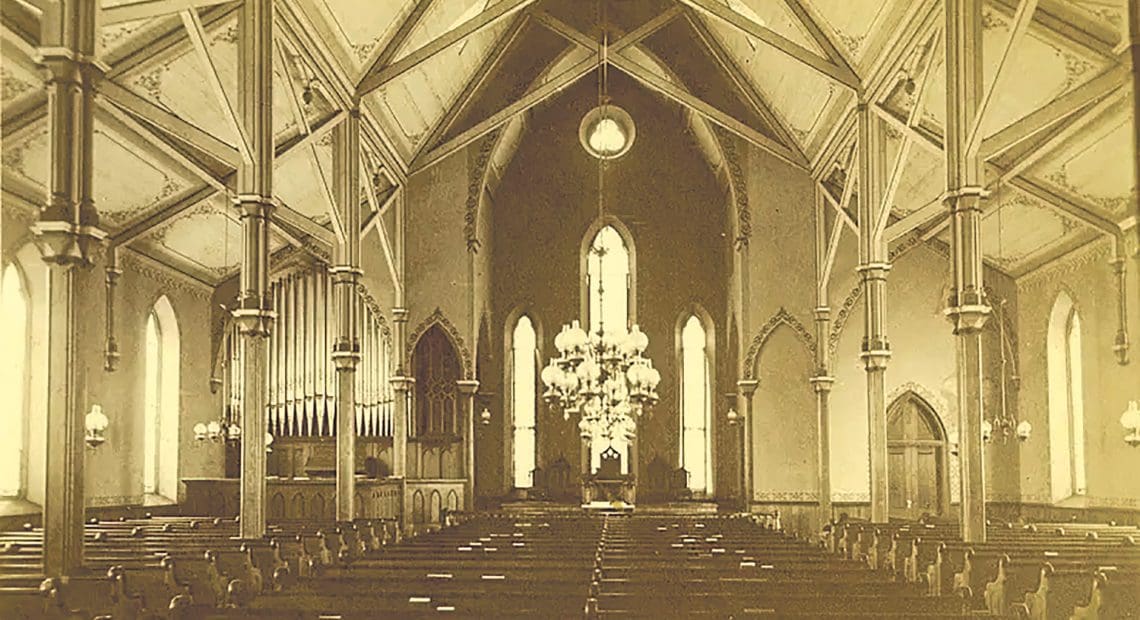
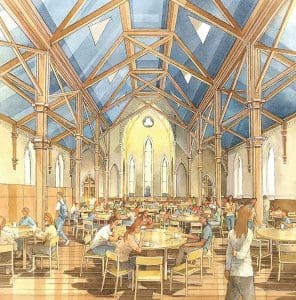
The historic chapel, seen above in an archival photo, will be restored to its former glory and given a new role as a dining facility, as seen in the architect’s rendering below.
Brian Easler calls it “an inflection point … a seismic shift in the academy’s upward trajectory.”
He was referring to a $20 million project to create a new kitchen and servery at Wilbraham & Monson Academy (WMA) and convert its historic chapel into a dining commons.
Those phrases ‘inflection point’ and ‘seismic shift’ refer to several aspects of this project and cover a lot of ground. Indeed, they reference everything from the magnitude of the upgrade in dining facilities — from fairly nondescript quarters to the fully restored chapel, with its vaulted ceilings and stained-glass windows, what students are calling the ‘Harry Potter dining hall’ — to the way this project will shift still more of the activity at WMA to the east side of Main Street, thus reducing traffic crossing the busy street.
“This will move the center of the campus from the west side of Main Street to the east side,” said Easler. “And that will generate a 70% reduction in student Main Street crossings, which is just one big impact.”
Meanwhile ‘inflection point’ also refers to the way this project galvanized the WMA community and especially its alumni base, from which the vast majority of the funds for the project were raised.
“This was not one of those fund-raising efforts where you put the ask out to everyone in the community … 7,000 alumni and everyone chips in,” Easler explained. “This was a handful of donors already close to the school, already close to me.
“We went out to them with personal appeals from the school to see if they were interested in the project,” he went on. “We were fortunate in that they were all interested in the project, and they were almost all able to help us with it; that’s how we were able to make it happen relatively quicky.”
“This space will serve as a unifying gathering place for our community. The dining commons will become the heart and soul of our campus, and a central part of the student experience.”
Elaborating, he said there were two lead gifts — from donors he was not ready to name — that generated much-needed momentum for the initiative, one for $7 million, the other for $5 million. “Several other people picked up on that momentum, and that enabled us to get to $20 million.”
Groundbreaking ceremonies were staged on April 25. Work is slated to commence soon, and the plan is to have the facility ready for the start of the 2026-27 school year.
Easler said the initiative represents the next phase in the school’s master plan for its campus, one with several components, including the construction of a new athenaeum, completed in 2020, which is connected to the chapel and will be connected to the new kitchen and server area, with the current dining hall to be converted to a state-of-the-art large-capacity theater and performance and meeting space.
The past and present will come together — literally, and in powerful ways, said Easler, noting that the rough-hewn brownstone exterior chapel will become the servery’s interior wall.
“During the day, the skylights will illuminate the servery with natural light,” said Easler, “highlighting the beauty of the original brownstone exterior and creating a stunning backdrop for a modern country-kitchen style.”
But while the project has many aspects to it, in many respects, the chapel is the primary focus. Completed in 1870, it has been used sparingly in recent years — for school meetings once a week, said Easler. It’s transformation into a dining hall will make it a much larger part of the school’s identity and its daily activity.
“This space will serve as a unifying gathering place for our community,” said Easler. “The dining commons will become the heart and soul of our campus, and a central part of the student experience.”
And the project will turn back the clock and restore the chapel to its original elegance and architectural allure.
“We have photos of the chapel when it was first constructed; it was magnificent on the inside, with exposed beams and stained-glass dormers,” said Easler. All of that is still up there, but it was covered with sheet rock somewhere along the line, probably to minimize the cubic yards that had to be cooled or heated. We have other ways to mitigate that now, so we’ll be opening it back up to its original beauty, and it will be a stunning dining room.”
Dave Fontaine Jr., CEO with Fontaine Bros., the general contractor for the project, as well as the athenaeum, agreed, noting that this project falls into several categories, everything from new construction to what would be considered historic renovation.
“It’s a very cool project,” he told BusinessWest. “There’s a lot of history in the chapel, it’s a really cool building, and I think this will be a gem of a project when it’s completed.”
— George O’Brien