Cover Story
MGM’s Unique Concept May Be a Trump Card

BW-0613aCoverEditor’s Note: This is the latest in a series of stories concerning the ongoing competition for the Western Mass. casino license.

Mike Mathis says the phrase ‘inside-out casino’ wouldn’t technically be considered an industry term within the gaming sector, although he believes it’s close to becoming an important part of the lexicon, especially in the context of the competition for the Western Mass. casino license.
‘Inside-out’ is an adjective being used liberally by officials at MGM Resorts International, including Mathis, who serves as vice president of Global Gaming Development, to describe the company’s $800 million proposal for Springfield’s South End.
It is being used interchangeably with ‘outward-facing’ to describe what this proposed resort complex is — as well as how it differentiates itself from most urban gaming facilities, as well as the other players in the contest for the 413 area code’s casino license.
“This is really about changing and evolving the model of the casino box,” Mathis explained, adding that this concept is quite unique for an urban gaming complex. “In the traditional model, there are a couple of points of entry, with the operation heavily driven by gaming, with the few amenities being offered sort of buried within the facility, forcing the traffic through the casinos to get to those amenities.
“What we’ve done with our design is put all the great amenities around the gaming floor, with multiple points of entry,” he went on. “So the customer could spend their entire day at our resort — whether it’s in our entertainment plaza, where we’re going to have free public entertainment, or at any of the restaurants we’re going to have along Main Street — without necessarily having to go through the casino.”
In this respect, the Springfield proposal is much like some of the so-called ‘neighborhood casinos’ in Las Vegas that are especially popular with families, he noted, and also like MGM’s ambitious City Center, its flagship property in Vegas.
Opened in late 2009, at the height of the recession, the center boasts a combination of retail, entertainment, convention facilities, and residential units, and is thus a truly mixed-use facility, he explained, adding that, while the scale will be exponentially smaller with MGM Springfield, the concept is essentially the same.
And it will represent a meaningful change from the approach taken with most all urban casinos.
Elaborating, Mathis said most inner-city gaming complexes end up becoming islands unto themselves, with little connectivity to the neighborhoods around them. The inside-out model is different, he went on, adding that, with this design, restaurants and other amenities such as a bowling alley, theaters, a skating rink, and others, face out to the community surrounding the gaming complex. This makes such facilities more attractive to families and adults who don’t gamble.
Mathis

MGM-Springfield-Plaza

Top, Mike Mathis, seen near the tornado-damaged South End Community Center, says MGM’s conception of an inside-out casino is unique for an urban gaming facility. Above, an architect’s rendering of that same area as transformed by MGM Springfield.

“A lot of companies can build casinos — we build resorts,” he told BusinessWest. “And that’s what this will be — a true resort.”
Mathis and others at MGM believe this inside-out design will give the company an edge in the ongoing competition for the Western Mass. license, because of its uniqueness, potential to generating revenue beyond the casino floor, and ability to address many of the concerns raised by the Legislature when it passed a sweeping gaming measure in the fall of 2011 — especially those concerning impact on existing businesses and entertainment venues.
“We thought if we did it [the design concept] well, and we think we have, that our proposal would be unique in creating not only a gaming experience, but a tourism and economic-regeneration story in the downtown corridor,” he explained. “It would be something that would be well-received by the public, who may have their own thoughts about a casino coming to town, and we thought it would be well-received by the Gaming Commission as well; this is something unique that also supports the existing community. With this plan, we can check a lot of boxes.”
For this issue, BusinessWest continues its series of stories on the casino competition with a detailed look at this inside-out model, and why MGM believes this concept will give the company the equivalent of a trump card.

Coloring Outside the Lines
Mathis told BusinessWest that he’s been involved in many aspects of the project known now as MGM Springfield, including the drafting of the host-community agreement that was inked just over a month ago.
Early on, though, one of his primary responsibilities was to identify a site for the company’s foray into the Massachusetts market. Like other developers, MGM targeted the Western Mass. sector — it was considered a more open competition than those in the Boston and Southeast regions — and initially set its sights on rural Brimfield.
But that plan was scuttled due to a number of logistical hurdles, not the least of which was the complex matter of building a new interchange on the Mass. Turnpike, without which the project didn’t make sound business sense.
So the company recalibrated and eventually focused on Springfield, as other developers did, because of its proximity to Northern Conn., accessibility (especially from I-91), and the likelihood that a ballot initiative would pass in the city.
And the search within the city eventually took the company to the four-block area in the South End, much of which was heavily damaged by the June 1, 2011 tornado.

MGM officials say the inside-out concept will give the company an edge

MGM officials say the inside-out concept will give the company an edge in the competition for the Western Mass. casino license.

“There were a few key attributes to that site that really drove the decision,” he explained. “Its proximity to the MassMutual Center was important to us; the gaming legislation talks about having an operator supporting existing facilities and not cannibalizing or competing with existing entertainment facilities. Right across from the site is a state-owned, really wonderful entertainment venue that is, by all accounts, underperforming and undersupported. We thought this was a natural tie.
“Also, the proximity to I-91 is important,” he went on. “Oftentimes, traffic can drive the success or failure of a project early on. The ability to take millions of visitors off the highway into the project and then put them back onto the highway without interfering with the surface streets in the local neighborhood was critical for us.”
Elaborating, he said the site provided MGM with an opportunity to do something unique, while also addressing many of the concerns of the Legislature when it drafted its gaming measure.
And while much of the debate going forward will center on the ‘urban versus rural’ argument, with the Palmer and West Springfield proposals fitting the latter description, to one or extent or another, the inside-out casino concept forwarded by MGM takes those discussions to a different, higher level.
That’s because most urban casinos become those islands that Mathis described, adding that the plan for MGM Springfield seeks to address shortcomings with the traditional urban model, as outlined by Las Vegas casino consultant Andrew Klebanow in recent comments to the Boston Globe.
“We just haven’t seen it done right yet,” he told the Globe, in reference to the urban model, noting that, with few exceptions, these casinos are not connected to the neighborhoods around them, and casino patrons generally don’t get beyond the gaming complex.
He cited Horseshoe Casino Cincinnati, which opened just three months ago, as a facility that could be considered different. Designed by Rock Gaming in partnership with Caesars Entertainment, it was built downtown and designed with restaurants on the outside, facing the streets, to encourage foot traffic.
“I think it’s the next great effort to do this thing right,” Klebanow told the Globe. “It’s a porous building — there are multiple entrance and egress points — so it allows pedestrians to walk in and out.”
Mathis told BusinessWest that he has heard the phrase ‘inside-out’ used in reference to the Cincinnati casino, but he believes MGM Springfield will soon set a new standard when it comes to that term.

Outside the Box

Another view of the planned MGM Springfield, looking down Main Street.

Another view of the planned MGM Springfield, looking down Main Street.

Indeed, as he walked the site with BusinessWest, Mathis noted that MGM Springfield will not only change the tornado-ravaged landscape, but create a facility that will be truly worthy of the word ‘resort,’ rather than casino.
As he stopped in front of the battered former South End Community Center, for example, he said it will be one of several buildings that will be incorporated into the casino design, thus making the resort part of what he called the “downtown urban fabric.”
“This will be one of the most modest resorts you’ll ever see,” he noted. “The casino is hidden, in a lot of respects, inside the facility, and on the outside, it will be difficult to know there is even a casino within this complex, because we’ve matched the architecture with the surrounding Main Street facades.”
While walking back downtown from the South End, Mathis pointed to the marquee on the MassMutual Center, announcing the May 24 performance of hip-hop artist Pitbull as another example of how this outward-facing model will manifest itself.
“Providing quality entertainment is a big part of our proposal,” he said, adding that all ticketed events will be staged at outside venues such as the MassMutual Center and Sympony Hall. “Springfield was once known as a must-stop for the great entertainment acts in the country, and because of our relationships born out of the all the great entertainment we push through Las Vegas, we intend to put the city back on the entertainment map.”
Connecting the casino with the community in such ways is a big part of the inside-out model, said Mathis, adding that, overall, this concept is designed to make the casino part of the neighborhood, not an island within it.
And while the inside-out casino addresses concerns outlined in the gaming legislation, it also represents a sound business strategy for MGM, said Mathis, adding that this model creates more opportunities to attract families and individuals who have no interest in visiting the casino floor.
“We’re going to bring in the outdoors,” he said. “Our restaurant spaces are designed to have outdoor plazas so people can enjoy the outdoor experience, we have a skating rink and free outdoor entertainment — and these amenities speak to how we’re trying to get visitation from families who aren’t interested in the casino.
“And that’s part of our business plan,” he went on. “As a company, across all our businesses domestically, we’re unique in the business in that we generate close to 65% of our revenues outside the gaming floor.”
It will be difficult to generate that ratio in Springfield, he continued, because the scale of the project is much smaller than the company’s properties in Las Vegas, for example, which have 3,000 rooms and millions of square feet of convention space.
But MGM Springfield can — and likely will — generate more revenue outside of the casino floor than a traditional urban gaming complex, he noted, because of this inside-out operational philosophy.

Over and Out
MGM’s Springfield proposal has many more hurdles to clear before it becomes reality. The next challenge is a July referendum vote that will include the entire city. If that goes successfully — and most predict that it will — then the company must prevail over whichever Western Mass. proposals also make it before the state Gaming Commission.
But there is a quiet confidence among company officials, including Mathis, that the company is in a strong position to prevail, and the so-called ‘inside-out’ casino plan is one of the many reasons why.
The concept represents a fundamental change from how urban casinos have been built, he explained, and it brings potential benefits for the state, the city, the South End neighborhood, and the company.
“When they chose MGM a few weeks ago, Springfield officials said this proposal could set the standard for inside-out, or outward-facing, casinos, and we’re very proud of that,” said Mathis. “We intend to do just that.”

George O’Brien can be reached at [email protected]

Mind Body Spirit Sections
Westfield’s Genesis Center Helps Guests Create New Beginnings

Liz Walz

Liz Walz says Genesis has been a place of hope and healing for those who have found it, and one of the goals moving forward is to increase the size of that constituency.

Liz Walz had already talked about the Genesis Spiritual Life and Conference Center for some time, putting a wide array of words and phrases to use to explain its mission and methods for carrying it out, when she came upon some terminology that she thought summed it all up best.
“What we’re offering are excuses to get still,” said Walz, who five months ago became the first lay director of this facility, a sponsored ministry of the Sisters of Providence, created on the bucolic Crane estate on Mill Street in Westfield. “And that’s difficult for many people; it’s a challenge to shift out of our ‘what can I accomplish? What’s my to-do list? What’s my schedule?’ mode and to just really allow ourselves to have space.”
Elaborating, Walz said Genesis (that name translates to ‘new beginning’) has, as its primary mission, the goal of helping people reduce or eliminate, at least temporarily, the stress that is impacting so many lives today. And it does that by providing a place where people can focus (that’s another word she used often) and reflect, through everything from meditation to walks along the so-called ‘Compassionate Curve Pathway’; from creative expression (there are art studios in the facility’s Carriage House) to interaction with the facility’s resident cats, Gracie and Tasha, or the small family of chickens now residing there.
“Some people just need some space,” said Walz, adding that many of the center’s guests — roughly 2,000 a year attend programs and retreats of varying lengths or visit for an afternoon or a week or more — come at times of change or turmoil in their lives, such as illness, a death in the family, divorce, or a career crossroads, while others visit when they simply need a break from the pressures of their lives. “We help people get to a place where that inner urgency, the ‘I-have-to-do-something’ mentality … that goes on mute, and people can just abide, watch the flowers bloom, and feel good.”
But, as the name suggests, Genesis is much more than a retreat, where one can sabbatical for several days or several months. It is also a conference center that has hosted groups of various sizes and purposes, including a number of area nonprofits for meetings that last a few hours or a few days.
It also puts on a number of programs, many of them spiritual in nature, but others focused on the many aspects of emotional health and well-being. These have titles that include: “Rejuvenate Your Life Through Laughter,” “Spring Renewal Yoga,” “Journey Back to Self,” “The Butterfly Effect: Living a Life of Purpose,” and “Awakening the Dreamer, Changing the Dream.”
Overall, Genesis has been a place of hope and healing for those who have found it, said Walz, adding that one of its goals moving forward is to increase the size of that constituency.
Indeed, the facility has recently started marketing itself more aggressively, said Walz, noting that it is also working to establish more and stronger relationships with area healthcare providers, with the goal of increasing visitation and revenues.
For this issue, BusinessWest paid a visit to Genesis to learn more about this mission of helping people ‘get still,’ and how the facility’s staff carries that out.

Quiet, Please
Genesis BuildingTracing the history of Genesis, Walz said the property was originally home to one of the owners of the Crane Brothers Paper facility, which operated just a few blocks away on the Little River. The site eventually became home to the Holy Child Guild, administered by the Sisters of Providence from 1933 to 1975, when work was initiated to convert the property into a spiritual life and conference center, which formally opened a year later.
In 1990, the 7,000-square-foot carriage house, circa 1899, underwent extensive renovations, and today includes meeting and convention facilities on the first floor and an art space, a small ecology library, and a meditation room on the second floor.
Over the past 37 years, it has hosted countless programs, retreats, and individual guests on sabbatical, said Walz, adding that, while the subject matter may vary, the goal is universal. “We help people quiet down, reflect on their lives, become inspired, and learn new techniques for thriving in the world.”
And while there has always been a need for its services and environment, they are seemingly in greater demand given recent societal and economic trends and developments.
Indeed, workplace-induced stress has been mounting, she explained, noting that many individuals are being asked or told to work longer and harder as their employers, still coping with the aftereffects of the Great Recession, try to do more with fewer people. Meanwhile, the economy has also taken its toll on individuals, producing varying levels of stress.
To help people put this stress on the shelf for at least a while and give individuals methods to keep it at bay, Genesis provides a quiet, restful environment that certainly wouldn’t be confused with a five-star resort in the Berkshires or a cruise ship — as reflected in the rates: generally $68 per night, which includes three meals — but provides guests with what they need.
There are 30 guest rooms on site, most of them small and simple (the walls are cinderblock), individualized with art created by guests, and without a television set, said Walz, adding that people don’t come here to watch American Idol. (There are a few sets in the lounges if one really needs to tune in to something).
They do come to focus and reflect, and they can accomplish this in a number of ways, including meditation, reading, artistic expression, massage, Reiki, time with the cats or chickens, gardening, and more.
There is also the Compassionate Curve Pathway, a walkway that winds through the property’s 19 acres. Along the way are markers with reflective questions. “There are so many ways that people can tap into nature as inspiration,” said Walz.
And while there are what would be considered organized activities at Genesis, more of the stress-reduction work is self-directed.
“When we design programs, we really try to leave a leave a lot of space,” she explained, “so we can offer people a gem for reflection or a question or thought, but really leave it to the individual to dig down.
“Most people have all these life experiences from childhood, adolescence, college, or whatever happened after high school, to work and families,” she went on. “The opportunity to just reflect on the common themes of our lives … we don’t really do that; we stay in motion, we stay in action, and one of the gifts of Genesis is to say, ‘be a human being, not a human doing.’”
People come to Genesis for different reasons and at different (often difficult) times in their lives, such as after the death of a loved one or during or after a divorce, she continued, noting that most of the guests are women.
“We’ve had women who have been in leadership positions in their organizations, some of whom come at a turning point, when that role is completed, when they’re retiring, for example, and closing down that chapter,” Walz explained. “Others just come to have a break; they’re going to go back to that role and those same responsibilities and economic challenges.
“People can choose to come here whether they’re having a life transition or not,” she went on. “Many times, though, it’s a divorce or the death of a parent, other family member, or friend that will cause someone to stop and say, ‘wow, I need some space.’ And sometimes, people just need to be in a safe space to let the tears flow and let the grieving process unfold.”
As the Boston Marathon bombing story unfolded last month, she told BusinessWest, some people who had lost loved ones years before realized they had some unresolved grief, and the bombing triggered those thoughts, prompting visits to Genesis for reflection and spiritual guidance.
One of the priorities for the center moving forward is to build awareness of its facilities and the many ways it can help guests find that space they’re seeking, said Walz, adding that Genesis is too much of a best-kept secret at the moment.
“We’ve learned that there are people who know Genesis, that use us a lot and love us, but there are many people who don’t know about Genesis, even here in Westfield,” she explained. “We do get a tremendous response once people are aware, so we view our job now as spreading the news that we’re here and able to provide that break people need; they don’t have to travel long distances or spend thousands of dollars. We’re right in their backyard.”
To build awareness of all aspects of the center’s operations, including its ability to host meetings and conventions, the facility has revamped its website and, overall, become more aggressive in its marketing, said Walz, adding that the goal is to achieve continued, controlled growth.

Rest of the Story
Most of the facility’s marketing vehicles feature the Genesis logo, a tree, chosen to reflect the belief that “creation is ongoing and that each person always has the possibility of new beginnings,” said Walz.
Creating them generally starts with becoming still, even if it’s just for a few hours or a few days, she went on, adding that, by doing so, people find it much easier to then move forward.
Helping people with that assignment has always been the focus at Genesis, she said concluded, adding that this mission is more vital today than ever before.

George O’Brien can be reached at [email protected]

Mind Body Spirit Sections
Monastery Heights Caters to the Mind, Body, and Spirit

Monastery Heights resident Arlene Welsh

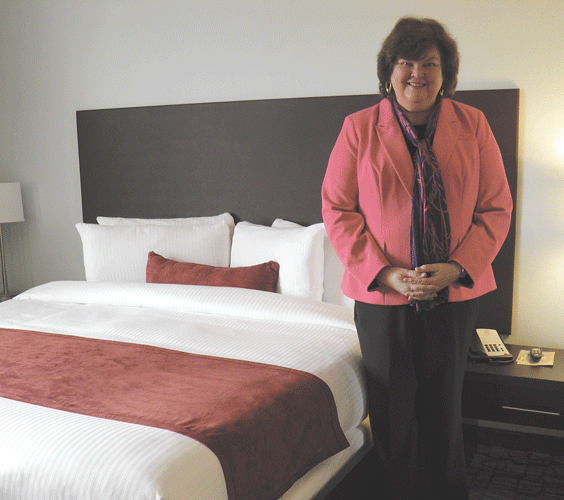
Monastery Heights resident Arlene Welsh relaxes during a Reiki session conducted by practitioner Michelle Noel Plante.

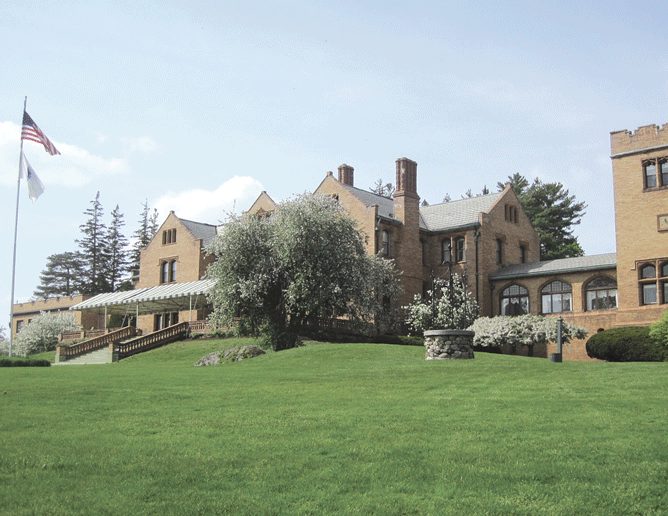
A peaceful oasis sits high on a hill in West Springfield, surrounded by 18 acres of grounds that are punctuated by walking paths and a beautiful grotto with a gazebo.
For more than 75 years, the historic stone building on the site was home to Passionate priests and brothers, and when a retreat center was added, people who visited Our Lady of Sorrows Monastery found hope and healing there.
Today, the well-known property is still a place that tends to the emotional, spiritual, social, and physical well-being of people. However, it has been transformed into a senior-living community known as Landmark at Monastery Heights, which caters to elders at all stages of life, from those in independent-living and assisted-living apartments to individuals in its Morningstar memory-care neighborhood, which offers 24-hour supervision and a full schedule of activities in a secure setting.
Residents who live on the independent- and assisted-living floors are housed side by side, which makes it easy for them and their families to add additional care when needed. It also makes moving unnecessary, and no one receiving extra assistance is ever identified as living within a particular unit.
But the hallmark of this senior community is the philosophy behind it —  a holistic approach to life and the concern paid to the total well-being of each resident, which has been enhanced by a plethora of new offerings this year that range from pet therapy to massage therapy to Reiki.
“We’ve added new programs that incorporate people’s mind, body, and spirit as we want to promote optimal well-being and health,” said Marketing Director Mary-Anne DiBlasio. “People want their parents cared for from a medical perspective, but also want them to live in a place where they are loved and respected, and that has a home-like setting.
“Everyone wants a beautiful location, but what really matters most is how the residents feel,” she continued. “This is a whole new way of community-based living that promotes the independence some people may have lost. Pride and dignity are very important to us.”
Residents have input into what happens, and as their interests are varied, they are encouraged to attend resident council meetings. Some have started their own programs, which include cribbage and Scrabble groups, while a close affiliation with the West Springfield Senior Center has allowed others to institute programs there such as a Seder service started by a Jewish resident.
“We try to give them as much say as possible,” said Regional Marketing Director Sharon Beaudry, adding that the facility recently met a request to add an extra day to the schedule of the hairdresser who works at Monastery Heights.
There is also a lot of interaction with the community, and the Monastery is home to family events as well as programs open to the public, such as a Fall Festival with a farmer’s market on the lawn, which features horse-drawn carriage rides and a vendor fair that includes a booth where Monastery residents sell crafts, photography, and artwork they take pride in. “It really brings out their creativity. The more engaged they become and motivated they are, the higher their level of self-satisfaction and self-worth, which is reflected in better health and wellness,” DiBlasio said.
The West Springfield Parks and Recreation Department holds its summer concert series at Monastery Heights, and residents join the public for relaxing evenings on the lawn. “It’s a way to continually keep ties between the community and what is happening here,” Beaudry said.
DiBlasio said choosing a new home for oneself or a parent can be difficult. “When people come to us, they are overwhelmed. But even if Landmark Heights is not appropriate, we take the time to listen and will make referrals,” she told BusinessWest. “Although we are always making improvements to the property, our focus is always on people.”

Renovating History

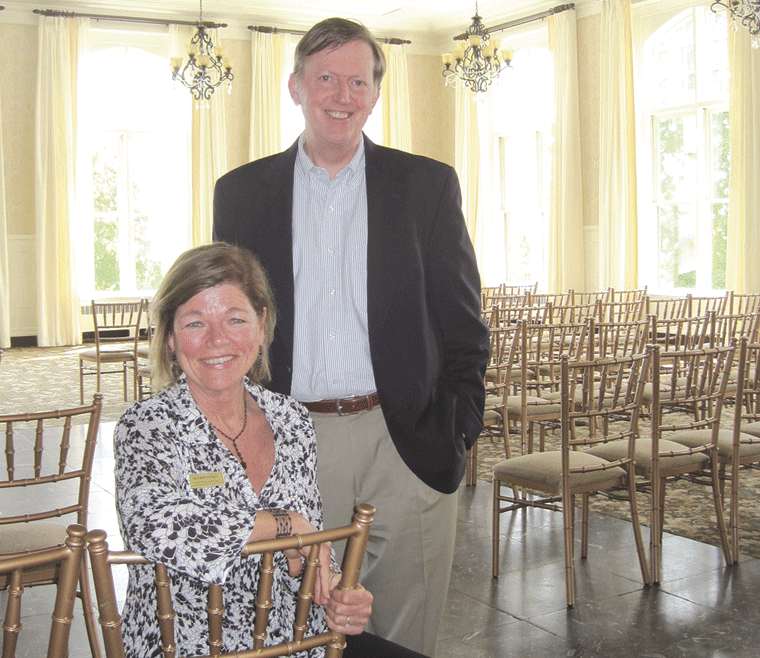
Mary-Anne DiBlasio, right, says developing a strong sense of community is a key to growing a successful facility.

Mary-Anne DiBlasio, right, says developing a strong sense of community is a key to growing a successful facility.

Beaudry said that, when the building’s interior was gutted by developer Simsbury Associates after it purchased the property in 1996, the company took care to maintain its historical charm.
“Whenever possible, they left exposed wood and marble as well as the brothers’ chanting chapel,” she said. Thought was also put into what is now the Morningstar neighborhood for people with dementia, which has its own courtyard and garden area.
And since the property opened as Landmark at Monastery Heights, elements such as bird feeders have been added outside and benches placed so people can enjoy nature whenever they venture outdoors.
But creating a strong sense of community is even more important than the surroundings, DiBlasio noted. “This is a new beginning for people, and we have modified our programs in the last year,” she said as she talked about meditation, reflexology, aromatherapy, and extras added to promote health and relaxation. For example, after each yoga class, a licensed reflexologist gives each (willing) participant a hand massage using essential oils.
Art therapy also proves soothing to the spirit, while a wide range of exercise classes that include tai chi, strength training and weekly yoga offer physical benefits.
Monastery Heights also boasts a walking club, and many residents, such as DiBlasio’s mother, Rosemarie Fernandes, enjoy walking the grounds.
Other physical needs are addressed by three full-time nurses, who are in charge of a range of programs and services that include balance assessments and laboratory and pharmacy services.
The former Passionate chapel, with its vaulted, carved ceiling, is a place where peace is almost tangible, and since Monastery Heights is interdenominational, both Catholic masses and Christian services are held there.
Residents also enjoy activities and performances at the West Springfield Senior Center, as well as on-site baking classes that people in independent living, assisted living, and the Morningstar neighborhood participate in. “There is no ‘us’ and ‘them’ here, and our residents with memory impairment are always co-mingling,” Beaudry said.
However, she noted that the number of people seeking independent-living apartments at Monastery is on the rise.
“People come here because they are isolated at home. Even if their children live locally, it is very difficult for them to manage their care, and it doesn’t solve the problem of their isolation,” Beaudry explained, adding that many can no longer drive.
“Living here gives them a level of independence again,” she continued, adding that residents are age 62 and older. “We take them to the grocery store, to do their banking, and to doctor’s appointments.”
A podiatrist visits the facility, and physical and occupational therapy are also administered on site, due to collaboration with a local agency. In addition, everyone who moves in is given a free physical evaluation to determine special needs, such as a raised toilet seat or having fluorescent tape put at the edge of a shower stall and grab bars to help those with poor vision.
“Someone with a walker may also be walking with it incorrectly,” Beaudry said. “We do things to help increase strength, agility, and core balance, and really keep a watchful eye on people. All of our staff is very mindful of that.”
Monastery Heights has its own store, which is stocked with items residents tend to run out of. “We want to be able to accommodate people and maximize their stay. This is their home, and we want to make sure they are completely happy. We always think about them as if they were our own mom or dad,” Beaudry said.
And there are two resident cats, as research shows that pets improve the overall quality of life. Residents can also bring their own small dogs to live there. “Studies have shown that having pets around brings health and happiness to people,” DiBlasio said, adding that the facility recently hosted a dog show.

Dementia Program
Three certified nursing assistants provide care to residents who live in 18 apartments in the Morningstar program, created for residents with dementia. “We invest equally in them as well as in our staff,” said Beaudry. “It all fits into the holistic aspect of our community.”
When residents in this area of the building — or any other — are experiencing anxiety, which can occur for people with dementia at sundown, specially trained staff members are able to give them hand massages or administer Reiki.
“They talk to them while quiet music plays,” Beaudry said. “We also have pet therapy. A woman comes in once a week with her dog, and you can see the residents’ demeanor change.”
In addition, Monastery staff members work with the Alzheimer’s Assoc. to determine the best way to engage residents in meaningful activities and help them express their feelings, since their verbal capacity is diminished.
Beaudry said the facility has adopted the association’s ‘Memories in the Making’ program, which uses artwork ranging from drawing to sculpture and cutting paper, then organizing it, as a creative outlet. “We frame their art and put it on display once a year. It makes the residents feel proud and very special,” she told BusinessWest.
There are also monthly outings to places such as vegetable stands or to take a cruise on the Connecticut River, as well as weekly trips to get ice cream.
“When people have memory loss, they still know who they are as a person and remember their history,” Beaudry said. “We find out what they used to enjoy doing and capitalize on that so our residents feel purposeful and proud.”
For example, a special area was set up for a man who enjoyed workworking, while those who loved to garden can do so in the Morningstar courtyard. Some residents help set the tables for meals, while others enjoy folding laundry.
“They love the tactile feeling, and it makes them feel useful,” Beaudry said. “We promote as much independence as possible, and knowing that they still have the ability to perform simple tasks gives them self-satisfaction, confidence, and a feeling of purpose. We focus on what they still can do.”
Thought is also given to the menu. “Research shows that diet is extremely important to the body and mind, so we work with nutritionists to create food that is reminiscent of what our residents grew up with, and we use organic, local vegetables whenever possible,” she noted.

Rounded Approach
DiBlasio said the facility’s low vacancy rate is the result of a community-based, comprehensive approach to senior living. “Our success comes from the respect and friendship we earn from our residents.
“We are committed to enhancing each resident’s sense of well-being and fulfillment,” she added, “by understanding and meeting their physical, social, and emotional needs on a daily basis.”
Which is, indeed, a truly holistic approach.

Departments Picture This

Send photos with a caption and contact information to:  ‘Picture This’ c/o BusinessWest Magazine, 1441 Main Street, Springfield, MA 01103 or to [email protected]

Drive Time

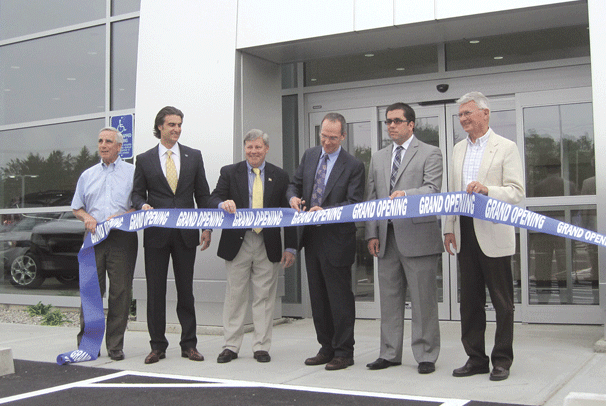
BaliseRibbonCutBaliseLadiesAn official ribbon cutting marked the opening of the new, 27,000-square-foot Balise Ford of Wilbraham on the corner of Boston Road and Stony Hill Road, pictured below. After an eight-month construction effort, the dealership moved from its temporary setting a quarter-mile east. The new facility will offer a state-of-the-art sales and service department. Top, Jeb Balise (fourth from the left), president and CEO of Balise Motor Sales, officially cuts the ribbon, flanked on the left by Eric Fuller, member of Wilbraham Planning Board; Phil Podgorny, regional manager of New England for Ford; and Bob Russell, Wilbraham selectman; and on the right by Jason Perez, general manager of Balise Ford of Wilbraham; and Dick Butler, member of the Wilbraham Planning Board. Bottom, the Balise marketing team poses on the back of a 2013 Ford F-150. From left are Kristin Garini, digital marketing manager; Megan Boshuyzen, graphic designer; Dale MacDonald, media manager; and Crystal Childs, social media specialist.

Who Done It?

GrayHouseCastNine area ‘celebrities’ recently volunteered their time and talent to portray various suspects in a second annual murder mystery dinner titled Quicker Than The Eye. The interactive evening benefited the Gray House Inc., a nonprofit that provides food, clothing, and educational services to nearly 8,000 Springfield-area residents each year. Featured players included (from left) Chris Buendo, co-publisher, Reminder Publications; Ellen Freyman, attorney, Shatz, Schwartz and Fentin, P.C.; Korri Piper, development and communications director, Greater Springfield Habitat for Humanity; Karen Boyd, the Zito & Karen Morning Show, Mix 93.1; Anthony Cignoli, president of A.L. Cignoli Co.; Jill Monson, owner, Inspired Marketing; Brady Chianciola, assistant vice president and regional manager, PeoplesBank; Elizabeth Taras, staff writer, BusinessWest and the Healthcare News; and Kimberly Robinson William, diversity consultant, the Office of Diversity & Inclusion at Baystate Health.

Airing His Opinions

YPSmeetingYPSexcelDryerDenis Gagnon, president of Excel Dryer in East Longmeadow, and inventor of the XLERATOR hand dryer, spoke to members of the Young Professional Society of Greater Springfield for the May CEO Luncheon. After a tour of the manufacturing facility, Gagnon and son Bill, vice president of Marketing and Key Accounts, explained how the family’s investments in new products, especially the XLERATOR, which is now the industry standard, has enabled the company to grow exponentially since it was purchased in 1997. Pictured in the Excel plant, bottom, with Denis Gagnon (third from left), are YPS board members (from left) Jeremy Casey, assistant vice president and commercial service officer, Westfield Bank; Jack Toner, sales, Sumner & Toner Insurance Agency; Nick Gelfand, owner, NRG Real Estate Inc.; Sharon Czarnecki, assistant vice president and commercial loan officer/Small Business Development, Westfield Bank; and Bill Gagnon.

Dave and Dinosaurs

Dave Ratner at schoolDavid Ratner, CEO of Dave’s Soda and Pet City of Agawam and Hadley, recently read to students at the James Clark School in Agawam as part of the Link to Libraries Business Book Link program. Ratner shared a story about dinosaurs with the first-grade class of teacher Kathy Planzo, at right.

Building Permits Departments

The following building permits were issued during the month of May 2013.

AGAWAM

Joseph Walz, DMD
302 Suffield St.
$3,000 — Siding repair on south side of building

RHM Realty
207 Bowles Road
$10,000 — Install dock leveler in existing loading dock bay

CHICOPEE

Carlo Sarno
621 Center St.
$6,000 — Renovations at Mulligan’s

Chicopee Solar, LLC
467 Pendleton Ave.
$8,000,000 — Solar field project

Eugeniusz Wargulewski
43 Springfield St.
$20,000 — Convert three storefronts to one bar

Rushing Waters Assembly
465 Granby Road
$22,000 — Interior renovations to First Spiritualistic Church

Sweeney Brothers Inc.
2073 Westover Road
$134,000 — Strip and re-roof

GREENFIELD

Baystate Franklin Medical Center
164 High St.
$34,000 — Install fire sprinklers

Comfort Mechanical, Inc.
340 Chapman St.
$53,700 — Renovate and repair existing system

Greenfield Co-Operative Bank
277 Federal St.
$6,000 — Replace front door

Greenfield Corporate Center
101 Munson St.
$18,000 ­— Remove non-structural walls to allow construction of new courthouse location

Roman Catholic Bishop of Springfield
133 Main St.
$2,400 — Install kitchen hood suppression system

LUDLOW

Steve McDaniel, DDS
343 Winsor St.
$31,000 — Renovations

Subway
34 East St.
$49,000 — Alterations

PALMER

Raymond Recore
1219 Thorndike St.
$25,000 — Expand and remodel Enterprise Rent-a-Car

Sue A. Draper
69 Boston Road
$3,018,150 — Solar field

SOUTH HADLEY

Fontaine Brothers
2 Canal St.
$7,618,500 — Construction of a new library

Departments Real Estate

The following real estate transactions (latest avail­able) were compiled by Banker & Tradesman and are published as they were received. Only transactions exceeding $115,000 are listed. Buyer and seller fields contain only the first name listed on the deed.

FRANKLIN COUNTY

BUCKLAND

87 State St.
Buckland, MA 01370
Amount: $265,206
Buyer: Wells Fargo Bank
Seller: Steve E. Patnode
Date: 04/22/13

41 Heath Road
Colrain, MA 01340
Amount: $177,000
Buyer: Phillip M. Baunsgard
Seller: Russell A. Barnes
Date: 05/03/13

DEERFIELD

731 Greenfield Road
Deerfield, MA 01342
Amount: $205,000
Buyer: Analise F. Nimeskern
Seller: Nika Oakes
Date: 04/26/13

31 Sawmill Plain Road
Deerfield, MA 01373
Amount: $227,000
Buyer: Charles W. Laliberty
Seller: Ann M. Dionne
Date: 04/24/13

4 Sugarloaf St.
Deerfield, MA 01373
Amount: $410,000
Buyer: DKRE Sugarloaf LLC
Seller: Rotkiewicz NT
Date: 04/30/13

ERVING

19 Central St.
Erving, MA 01344
Amount: $152,500
Buyer: Christopher B. Sadler
Seller: Francis A. Pollard
Date: 04/26/13

GREENFIELD

1001 Bernardston Road
Greenfield, MA 01301
Amount: $206,400
Buyer: Reed A. Baldwin
Seller: John W. Cavender
Date: 04/26/13

1200 Bernardston Road
Greenfield, MA 01301
Amount: $180,075
Buyer: Michael T. Mangnuson
Seller: Walter L. Williams
Date: 04/30/13

805 Bernardston Road
Greenfield, MA 01301
Amount: $200,000
Buyer: Greenfield Russian Evangelical
Seller: Jehovahs Witnesses Inc.
Date: 04/29/13

4 Cherry St.
Greenfield, MA 01301
Amount: $272,000
Buyer: Adam M. Bouchard
Seller: Joseph A. George
Date: 04/26/13

97 Columbus Ave.
Greenfield, MA 01301
Amount: $155,000
Buyer: Shawn S. Wrisley
Seller: Thomas P. Morse
Date: 04/24/13

246 Davis St.
Greenfield, MA 01301
Amount: $180,000
Buyer: Roger Matthews
Seller: James M. Bennett
Date: 05/03/13

49 Hastings St.
Greenfield, MA 01301
Amount: $156,500
Buyer: Jeffrey E. Lapointe
Seller: Amy A. Gray
Date: 04/26/13

16 Jefferson Ave.
Greenfield, MA 01301
Amount: $197,400
Buyer: Linda A. Morey
Seller: Gary T. Magnan
Date: 04/24/13

17 Revere Circle
Greenfield, MA 01301
Amount: $180,000
Buyer: Matthew P. Garris
Seller: Carole A. Jarivs
Date: 04/29/13

50 Smith St.
Greenfield, MA 01301
Amount: $118,000
Buyer: Ovidiu Nichita
Seller: Ralph F. Jelley
Date: 04/30/13

22 Warner St.
Greenfield, MA 01301
Amount: $180,000
Buyer: Warren W. Gray
Seller: Elena F. Sandri TR
Date: 04/22/13

133 Wisdom Way
Greenfield, MA 01301
Amount: $158,500
Buyer: Chang-Hoyk Yu
Seller: Matthew R. Lovett
Date: 04/23/13

LEVERETT

Richardson Road
Leverett, MA 01054
Amount: $200,000
Buyer: W. D. Cowls Inc.
Seller: Allyn W. Coombs
Date: 05/01/13

MONTAGUE

25 L St.
Montague, MA 01376
Amount: $169,900
Buyer: Kimberly Cusack
Seller: Constance A. Galvis
Date: 04/26/13

NEW SALEM

2 Old County Road
New Salem, MA 01355
Amount: $201,500
Buyer: Amanda K. Piper
Seller: Scott L. McCarthy
Date: 05/01/13

NORTHFIELD

19 Hamilton Dr.
Northfield, MA 01360
Amount: $159,900
Buyer: Shelby M. Holton
Seller: Mark K. Trumbull
Date: 05/01/13

175 Main St.
Northfield, MA 01360
Amount: $272,500
Buyer: Barbara L. Jacque
Seller: Sydney C. Navarro
Date: 04/30/13

ORANGE

185 Holtshire Road
Orange, MA 01364
Amount: $172,400
Buyer: Pauline C. Bixby
Seller: Aprilee K. Howe
Date: 05/03/13

ROWE

306 Zoar Road
Rowe, MA 01367
Amount: $216,129
Buyer: Citimortgage Inc.
Seller: Philip E. Black
Date: 05/01/13

SHELBURNE

5 Mechanic St.
Shelburne, MA 01370
Amount: $180,000
Buyer: Franklin Landtrust Inc.
Seller: Michael Cohen
Date: 05/02/13

SUNDERLAND

2 Ledgewood Dr.
Sunderland, MA 01375
Amount: $227,000
Buyer: Stacy B. Dennie
Seller: Tyler G. Boone
Date: 04/30/13

68 South Plain Road
Sunderland, MA 01375
Amount: $290,000
Buyer: Kathleen M. Keroack RET
Seller: Creek RT
Date: 04/25/13

WARWICK

95 Shepardson Road
Warwick, MA 01378
Amount: $127,521
Buyer: McLaine L. Schillemat
Seller: FNMA
Date: 04/26/13

HAMPDEN COUNTY

AGAWAM

11 Albert St.
Agawam, MA 01001
Amount: $185,000
Buyer: Callie A. Rapa
Seller: Anne M. Iellamo
Date: 05/03/13

45 Allison Lane
Agawam, MA 01030
Amount: $327,500
Buyer: Miriam L. Andrews
Seller: Daniel A. Tully
Date: 05/01/13

26 Anthony St.
Agawam, MA 01001
Amount: $210,000
Buyer: Ian C. Mulanouskus
Seller: Amy L. Bishop
Date: 04/30/13

102 Coronet Circle
Agawam, MA 01030
Amount: $138,200
Buyer: Michael Osowski
Seller: Gerard R. Boucher
Date: 04/22/13

79 Cosgrove Ave.
Agawam, MA 01001
Amount: $168,000
Buyer: Travis L. Trout
Seller: Miriam L. Andrews
Date: 05/01/13

204 Lancaster Dr.
Agawam, MA 01001
Amount: $340,000
Buyer: Daniel R. Torres
Seller: Christopher D. Rooney
Date: 04/29/13

475 Meadow St.
Agawam, MA 01001
Amount: $313,000
Buyer: Matthew S. Hubbard
Seller: Rudolph J. Gay
Date: 04/29/13

22 Ralph St.
Agawam, MA 01030
Amount: $140,000
Buyer: Frank J. Bond
Seller: Roy F. Cavallon
Date: 04/30/13

427 Southwick St.
Agawam, MA 01030
Amount: $200,000
Buyer: Thomas E. Cascio
Seller: David R. Tackley
Date: 05/02/13

91 Sylvan Lane
Agawam, MA 01030
Amount: $175,000
Buyer: Ronald P. Daignault
Seller: Mary L. Daignault
Date: 04/24/13

BRIMFIELD

37 6th St.
Brimfield, MA 01010
Amount: $300,000
Buyer: Earl K. Wonderlie
Seller: Stuart, Raymond E., (Estate)
Date: 05/03/13

CHESTER

36 Lyon Hill Road
Chester, MA 01011
Amount: $243,900
Buyer: Nicole A. Peters
Seller: Pamela M. Sanborn
Date: 04/30/13

CHICOPEE

87 Acrebrook Dr.
Chicopee, MA 01020
Amount: $168,000
Buyer: Lisa H. Robbins
Seller: Joseph M. McNerney
Date: 04/29/13

84 Austin St.
Chicopee, MA 01013
Amount: $189,000
Buyer: Doreen E. Nelson
Seller: Kevin T. Burke
Date: 04/29/13

122 Beauregard Terrace
Chicopee, MA 01020
Amount: $144,329
Buyer: Alejandro A. Olavarria
Seller: Joseph A. Braica
Date: 04/23/13

41 Belvidere St.
Chicopee, MA 01013
Amount: $265,000
Buyer: Peter Braun
Seller: Richard Kraus
Date: 05/03/13

9 Bill St.
Chicopee, MA 01013
Amount: $143,000
Buyer: William J. Bell
Seller: Stephen P. Pettengill
Date: 04/26/13

79 Casey Dr.
Chicopee, MA 01020
Amount: $218,000
Buyer: Brenda L. Kroeber
Seller: Janet L. Morgan
Date: 04/30/13

170 Clarendon Ave.
Chicopee, MA 01013
Amount: $115,450
Buyer: USA VA
Seller: David T. Marchacos
Date: 04/22/13

237 Dale St.
Chicopee, MA 01020
Amount: $118,000
Buyer: Brian M. Pouliot
Seller: Ivan N. Trombley
Date: 04/23/13

615 Front St.
Chicopee, MA 01013
Amount: $300,000
Buyer: 615 Front Street RT
Seller: 615 STP LLC
Date: 04/30/13

230 Grattan St.
Chicopee, MA 01020
Amount: $300,000
Buyer: FKC RT
Seller: Paul A. Smith
Date: 04/30/13

62 Jamrog Dr.
Chicopee, MA 01020
Amount: $121,500
Buyer: Daniel Stamborski
Seller: Lester J. Zawada
Date: 04/29/13

70 Labelle Dr.
Chicopee, MA 01020
Amount: $210,000
Buyer: Verber L. Ealum
Seller: Kusek, Joseph J., (Estate)
Date: 05/02/13

34 Langevin St.
Chicopee, MA 01020
Amount: $118,000
Buyer: Jared C. Robert
Seller: Robert S. Miller
Date: 05/03/13

13 Louise Ave.
Chicopee, MA 01013
Amount: $133,000
Buyer: Joseph B. Lavato
Seller: Barbara E. Gregory
Date: 04/22/13

128 Manning St.
Chicopee, MA 01020
Amount: $147,350
Buyer: Allen S. Lesik
Seller: Maurice J. Cotton
Date: 04/30/13

40 Maplewood Ave.
Chicopee, MA 01013
Amount: $119,900
Buyer: Christopher G. Morin
Seller: Jon Goudreault
Date: 04/26/13

620 McKinstry Ave.
Chicopee, MA 01020
Amount: $155,000
Buyer: Ngoeun Chhoun
Seller: D&D Chicopee Realty 3 LLC
Date: 05/02/13

117 Melvin St.
Chicopee, MA 01013
Amount: $117,000
Buyer: Luis E. Encarnacion-Lopez
Seller: Cindy A. Fiorillo
Date: 04/25/13

163 Monroe St.
Chicopee, MA 01020
Amount: $237,400
Buyer: Daniel R. Ernst
Seller: Joseph A. Perez
Date: 05/02/13

34 Nonotuck Ave.
Chicopee, MA 01013
Amount: $135,000
Buyer: Andrea Ronghi
Seller: Thomas F. Benson
Date: 04/26/13

34 Oxford St.
Chicopee, MA 01020
Amount: $152,000
Buyer: Dermerica LLC
Seller: Gale H. French
Date: 04/30/13

14 Parkwood Dr.
Chicopee, MA 01013
Amount: $149,900
Buyer: James L. Arnold
Seller: Walter J. Mika
Date: 04/26/13

45 Plainfield St.
Chicopee, MA 01013
Amount: $1,050,000
Buyer: SDI LLC
Seller: RHD Realty LLC
Date: 04/26/13

61 South Winthrop St.
Chicopee, MA 01020
Amount: $193,000
Buyer: Joshua T. McKenna
Seller: Joyce B. Hogan
Date: 04/24/13

435 Springfield St.
Chicopee, MA 01013
Amount: $205,000
Buyer: JGAR LLC
Seller: Harvey J. Lafleche
Date: 04/29/13

54 Victoria Park
Chicopee, MA 01020
Amount: $195,000
Buyer: Hector M. Morales
Seller: Adam M. Carmody
Date: 04/26/13

EAST LONGMEADOW

311 Kibbe Road
East Longmeadow, MA 01028
Amount: $150,000
Buyer: PHV RT
Seller: Charles D. Lipp
Date: 05/01/13

15 Murray Court
East Longmeadow, MA 01028
Amount: $142,000
Buyer: Michael Robert
Seller: Mary J. Couchon
Date: 05/02/13

60 Old Farm Road
East Longmeadow, MA 01028
Amount: $580,000
Buyer: Francis J. Pokigo
Seller: Kermit M. Stuart
Date: 04/26/13

178 Patterson Ave.
East Longmeadow, MA 01028
Amount: $157,500
Buyer: Laurie Kimball
Seller: John Arel
Date: 04/30/13

284 Pease Road
East Longmeadow, MA 01028
Amount: $280,000
Buyer: Michael E. Johnson
Seller: Sean P. Duffy
Date: 04/26/13

47 Windsor Lane
East Longmeadow, MA 01028
Amount: $454,558
Buyer: Ralph L. Santaniello
Seller: Dan Roulier & Assocs. Inc.
Date: 05/02/13

HAMPDEN

4 Andrew Circle
Hampden, MA 01036
Amount: $375,000
Buyer: Sean P. Duffy
Seller: Cheryl A. McCarthy
Date: 04/26/13

59 Baldwin Dr.
Hampden, MA 01036
Amount: $159,900
Buyer: Allen E. Warren
Seller: Mikaelian, Edward A., (Estate)
Date: 05/03/13

290 Bennett Road
Hampden, MA 01036
Amount: $152,000
Buyer: Christopher R. Przybyl
Seller: UB Propertiess LLC
Date: 04/29/13

18 Cedar Oak Lane
Hampden, MA 01036
Amount: $156,000
Buyer: Rebecca L. Hildreth
Seller: Diane L. Hildreth
Date: 04/26/13

HOLLAND

47 Kimball Hill Road
Holland, MA 01521
Amount: $218,500
Buyer: Sara V. Vankeuren
Seller: Paquette Builders LLC
Date: 04/26/13

39 Shore Dr.
Holland, MA 01521
Amount: $310,000
Buyer: P. S. Roman
Seller: Clarissa M. Allanach
Date: 04/29/13

HOLYOKE

367 Apremont Hwy.
Holyoke, MA 01040
Amount: $144,300
Buyer: Gary D. Loomis
Seller: Eileen M. Gilhooley
Date: 04/26/13

35 Franks Dr.
Holyoke, MA 01040
Amount: $159,900
Buyer: Reina I. Lorenzi
Seller: Angel M. Perez
Date: 04/30/13

5 Greenwood Ave.
Holyoke, MA 01040
Amount: $187,000
Buyer: Margaret E. Dugal
Seller: Lucy A. Dunham
Date: 04/30/13

341 Hillside Ave.
Holyoke, MA 01040
Amount: $115,000
Buyer: Cynthia C. Schroeder
Seller: Helen Weiner
Date: 04/26/13

152 Homestead Ave.
Holyoke, MA 01040
Amount: $157,000
Buyer: Robert A. Hoeppner
Seller: Goodchild, Margaret A., (Estate)
Date: 05/01/13

810 Homestead Ave.
Holyoke, MA 01040
Amount: $135,000
Buyer: FNMA
Seller: John T. O’Donnell
Date: 05/03/13

183 Madison Ave.
Holyoke, MA 01040
Amount: $330,000
Buyer: Amy C. McDonough
Seller: Dolores D. Dean
Date: 05/01/13

33 Old Jarvis Ave.
Holyoke, MA 01040
Amount: $223,900
Buyer: Cheryl A. McCarthy
Seller: Daniel E. Fried
Date: 04/26/13

17 Vadnais St.
Holyoke, MA 01040
Amount: $155,000
Buyer: UMass Five College FCU
Seller: Frederick P. Barrett
Date: 04/30/13

LONGMEADOW

108 Edgewood Ave.
Longmeadow, MA 01106
Amount: $259,900
Buyer: Michael T. Jordan
Seller: Eric E. Tracy
Date: 04/29/13

623 Frank Smith Road
Longmeadow, MA 01106
Amount: $380,000
Buyer: Dennis C. Rogan
Seller: Robert Stirton NT
Date: 04/26/13

100 Normandy Road
Longmeadow, MA 01106
Amount: $734,600
Buyer: Daniel P. Murphy
Seller: Katharine P. Costello
Date: 04/26/13

102 Pinewood Dr.
Longmeadow, MA 01106
Amount: $480,000
Buyer: Katharine A. Pacella
Seller: Victor J. Steele
Date: 04/26/13

LUDLOW

67 Americo St.
Ludlow, MA 01056
Amount: $255,000
Buyer: James D. Deshaies
Seller: Robert A. Tardiff
Date: 04/30/13

31 Cady St.
Ludlow, MA 01056
Amount: $143,750
Buyer: Timothy J. Fitzgerald
Seller: Carvalho, Henrique J., (Estate)
Date: 05/01/13

178 Howard St.
Ludlow, MA 01056
Amount: $124,000
Buyer: David W. Rogers
Seller: John P. Vautrain
Date: 05/03/13

24 Lazarz St.
Ludlow, MA 01056
Amount: $147,500
Buyer: Joseph W. Comi
Seller: Julie A. Felton
Date: 04/30/13

14 North Arthur St.
Ludlow, MA 01056
Amount: $120,000
Buyer: Joaquim L. Santos
Seller: TD Bank NA

55 Power Ave.
Ludlow, MA 01056
Amount: $170,000
Buyer: Mary E. McGuinness
Seller: Otis J. Roberts
Date: 04/25/13

MONSON

Boston Road West
Monson, MA 01057
Amount: $125,000
Buyer: Antonio Fernandes
Seller: Tyler F. Washburn
Date: 04/26/13

7 Fountain St.
Monson, MA 01057
Amount: $199,644
Buyer: Wells Fargo Bank NA
Seller: Jessy D. Shea
Date: 05/01/13

4 Hilltop Dr.
Monson, MA 01057
Amount: $200,000
Buyer: Stephen G. Farr
Seller: Hazel V. Kline
Date: 04/26/13

13 Pinnacle Road
Monson, MA 01057
Amount: $150,000
Buyer: Laura K. Clark
Seller: Greater Springfield Credit Union
Date: 05/03/13

PALMER

2027 Calkins Road
Palmer, MA 01069
Amount: $178,200
Buyer: Jarid R. Provost
Seller: Anthony J. Kempesty
Date: 04/23/13

9 Kelley St.
Palmer, MA 01080
Amount: $276,000
Buyer: James Baldyga
Seller: William D. Bacyk
Date: 04/25/13

72 Laurel Road
Palmer, MA 01069
Amount: $210,000
Buyer: William R. Mueller
Seller: James D. Malloy
Date: 05/01/13

17 Robinson Road
Palmer, MA 01069
Amount: $165,000
Buyer: Christopher A. Wystepek
Seller: Sandra L. Olson
Date: 04/26/13

Thorndike St.
Palmer, MA 01069
Amount: $199,000
Buyer: Richard E. Laviolette
Seller: M Jackson Construction
Date: 04/30/13

SPRINGFIELD

200 Abbott St.
Springfield, MA 01118
Amount: $150,000
Buyer: Kimberly Phillips
Seller: Jason M. Ferrero
Date: 05/03/13

235 Berkshire Ave.
Springfield, MA 01109
Amount: $225,000
Buyer: Cantalini Holdings Inc.
Seller: Thibodeau Realty LLC
Date: 05/03/13

28 Biltmore St.
Springfield, MA 01108
Amount: $163,000
Buyer: Leesann A. Weekes
Seller: Jessica M. Rivera
Date: 05/02/13

791 Carew St.
Springfield, MA 01104
Amount: $178,026
Buyer: US Bank NA
Seller: Joel Fernandez
Date: 05/01/13

104 Catalpa Terrace
Springfield, MA 01119
Amount: $128,000
Buyer: William Flores
Seller: Clancy, Karen A., (Estate)
Date: 04/30/13

18 Claremont St.
Springfield, MA 01108
Amount: $124,392
Buyer: GMAC Mortgage LLC
Seller: Rafael Rivera
Date: 05/03/13

273 Dorset St.
Springfield, MA 01108
Amount: $150,000
Buyer: Anthony M. Martone
Seller: Robert A. Soderstrom
Date: 05/01/13

111 Elijah St.
Springfield, MA 01109
Amount: $118,000
Buyer: Rose M. Soto
Seller: Anatoliy Stuzhuk
Date: 04/29/13

121 Elijah St.
Springfield, MA 01109
Amount: $174,000
Buyer: Victor A. Sanchez
Seller: K&N Properties LLC
Date: 04/30/13

351 Forest Hills Road
Springfield, MA 01128
Amount: $237,000
Buyer: Ashley L. Brogan
Seller: Michael E. Johnson
Date: 04/26/13

384 Forest Hills Road
Springfield, MA 01128
Amount: $195,000
Buyer: Molly L. Dill
Seller: Geri L. Cramer
Date: 04/30/13

36 Fountain St.
Springfield, MA 01108
Amount: $125,000
Buyer: Jose A. Andrade
Seller: NSP Residential LLC
Date: 04/30/13

172 Gardens Dr.
Springfield, MA 01119
Amount: $147,500
Buyer: Omari H. Murray
Seller: Julie Walko
Date: 04/30/13

230 Keddy St.
Springfield, MA 01109
Amount: $125,000
Buyer: LAG Capital LLC
Seller: William T. Raleigh
Date: 04/29/13

36 Kenway Dr.
Springfield, MA 01104
Amount: $135,000
Buyer: Rebecca D. Stout
Seller: Ralph F. Esempio
Date: 04/23/13

180 Lake Dr.
Springfield, MA 01151
Amount: $125,000
Buyer: Norma L. Ramos-Rivera
Seller: Jason L. Lovett
Date: 04/26/13

468 Liberty St.
Springfield, MA 01104
Amount: $250,000
Buyer: Dionne Real Estate LLC
Seller: 468 Liberty RT
Date: 05/03/13

36 Lloyd Ave.
Springfield, MA 01119
Amount: $140,000
Buyer: Hector O. Marrero
Seller: Samuel Diaz
Date: 04/30/13

12 Longview St.
Springfield, MA 01108
Amount: $144,900
Buyer: Vidal Cardona
Seller: James B. Morrissey
Date: 04/24/13

191 Mazarin St.
Springfield, MA 01151
Amount: $187,800
Buyer: Sandra Munier
Seller: Lisa G. Urban
Date: 05/01/13

45 Mountainview St.
Amount: $134,000
Buyer: Steven Jiminez
Seller: James W. Rocca
Date: 04/26/13

107 Naismith St. #83
Springfield, MA 01104
Amount: $205,000
Buyer: Neidy Cruz
Seller: Courtside Of Springfield
Date: 04/25/13

213 Morton St.
Springfield, MA 01119
Amount: $177,423
Buyer: Everbank
Seller: Rena Brown
Date: 05/03/13

1917 Parker St.
Springfield, MA 01128
Amount: $144,000
Buyer: Kirstyn N. Anair
Seller: Theresa A. Lindsey
Date: 04/25/13

28 Pasco Road
Springfield, MA 01151
Amount: $162,000
Buyer: Bernardo Merced
Seller: Laura J. Mallett
Date: 04/30/13

62 Pear St.
Springfield, MA 01109
Amount: $120,000
Buyer: James C. Lee
Seller: Daniel P. Stamborski
Date: 04/30/13

13 Quincy St.
Springfield, MA 01109
Amount: $115,000
Buyer: Monica L. Frater
Seller: Greater Springfield Habitat for Humanity
Date: 04/26/13

167 Redlands St.
Springfield, MA 01104
Amount: $139,900
Buyer: Yamaira Rivera
Seller: Donna Schoolcraft
Date: 04/26/13

115 Saint James Circle
Springfield, MA 01104
Amount: $1,770,000
Buyer: Jacob I. Martinez
Seller: Allison M. Torres
Date: 04/29/13

1566 State St.
Springfield, MA 01109
Amount: $300,000
Buyer: New HB Acquisition
Seller: IBC Sales Corp.
Date: 04/23/13

168 Sunrise Terrace
Springfield, MA 01119
Amount: $147,500
Buyer: Sarah L. Stein
Seller: Douglas Senecal
Date: 04/26/13

21 Texel Dr.
Springfield, MA 01108
Amount: $167,500
Buyer: Vonn Tanabe
Seller: Burnham Realty LLC
Date: 04/26/13

2020 Wilbraham Road
Springfield, MA 01129
Amount: $163,000
Buyer: Richard C. Lovely
Seller: Cardinal Home Investors
Date: 04/23/13

SOUTHWICK

29 Berkshire Ave.
Southwick, MA 01077
Amount: $189,900
Buyer: David W. Smith
Seller: Shannon L. Stone
Date: 04/23/13

48 Fernwood Road
Southwick, MA 01077
Amount: $173,500
Buyer: Joan M. McLaughlin
Seller: Maria P. Scott-Smith
Date: 05/01/13

29 Lauren Lane
Southwick, MA 01077
Amount: $120,000
Buyer: Aube Homes LLC
Seller: Pine Knoll Inc.
Date: 05/03/13

134 Mort Vining Road
Southwick, MA 01077
Amount: $377,000
Buyer: Mitchell G. Cain
Seller: B&B Construction
Date: 05/01/13

385 North Loomis St.
Southwick, MA 01077
Amount: $229,189
Buyer: FNMA
Seller: Donald R. Elton
Date: 04/24/13

107 Point Grove Road
Southwick, MA 01077
Amount: $450,000
Buyer: Paul E. Lewis
Seller: Michael Diotalevi
Date: 05/01/13

76 Sunnyside Road
Southwick, MA 01077
Amount: $410,000
Buyer: Kudlic Brothers Inc.
Seller: Lawrence Bannish
Date: 04/26/13

TOLLAND

64 Woodchuck Hollow
Tolland, MA 01034
Amount: $355,000
Buyer: Craig Serin
Seller: Margaret Dayharsh
Date: 05/03/13

WALES

199 Stafford Road
Wales, MA 01081
Amount: $1,312,500
Buyer: Wales Village LLC
Seller: Wales Brookside Village
Date: 04/22/13

41 Stafford Road
Wales, MA 01081
Amount: $200,000
Buyer: Serge P. Arel
Seller: Edmund H. Beaulieu
Date: 04/24/13

WEST SPRINGFIELD

48 Abigaile Lane
West Springfield, MA 01089
Amount: $394,900
Buyer: Richard S. Sullivan
Seller: Cardinal Homes Inc.
Date: 04/23/13

83 Armstrong St.
West Springfield, MA 01089
Amount: $137,206
Buyer: MetLife Home Loans
Seller: Earl F. Camp
Date: 05/02/13

158 Bosworth St.
West Springfield, MA 01089
Amount: $149,900
Buyer: Brianna L. McLaughlin
Seller: Jeffrey Sutter
Date: 05/01/13

119 Boulevard Place
West Springfield, MA 01089
Amount: $194,000
Buyer: Franky M. Sanchez
Seller: Michael J. Trudeau
Date: 04/25/13

15 Butternut Hollow Road
West Springfield, MA 01089
Amount: $190,000
Buyer: Robert J. Napoli
Seller: Shirley F. Soule
Date: 04/25/13

80 Forris St.
West Springfield, MA 01089
Amount: $195,000
Buyer: Dalia Rivera-Lafreniere
Seller: Western Mass. Electric Co.
Date: 05/01/13

410 Dewey St.
West Springfield, MA 01089
Amount: $144,300
Buyer: Matthew B. Gray
Seller: Anna Caron
Date: 04/26/13

113 Havenhurst Road
West Springfield, MA 01089
Amount: $242,000
Buyer: Jeffrey M. Bouyea
Seller: Olga F. McCarthy
Date: 04/26/13

36 Houston Road
West Springfield, MA 01089
Amount: $185,000
Buyer: Catherine A. Moretti
Seller: Katherine A. Caron
Date: 04/30/13

60 Labelle St.
West Springfield, MA 01089
Amount: $138,586
Buyer: FNMA
Seller: Rogelio Marquez
Date: 05/03/13

349 Massachusetts Ave.
West Springfield, MA 01089
Amount: $175,000
Buyer: Scott Ackley
Seller: Gerald J. Carney
Date: 04/30/13

489 Morgan Road
West Springfield, MA 01089
Amount: $190,000
Buyer: Anthony C. Rousseau
Seller: Stephen R. Friese
Date: 04/24/13

258 Ohio Ave.
West Springfield, MA 01089
Amount: $310,000
Buyer: Michael J. Trudeau
Seller: Paul R. Breveleri
Date: 04/25/13

54 Pebble Path Lane
West Springfield, MA 01089
Amount: $184,000
Buyer: James E. Reay
Seller: Dolores M. Hickson
Date: 04/26/13

WESTFIELD

12 Deepwoods Dr.
Westfield, MA 01085
Amount: $242,000
Buyer: Crystal J. Childs
Seller: Natalie C. Avery
Date: 04/23/13

360 Elm St.
Westfield, MA 01085
Amount: $205,000
Buyer: Westfield Museum Inc.
Seller: 360 Elm Street Realty LLC
Date: 05/01/13

53 Fairview St.
Westfield, MA 01085
Amount: $227,500
Buyer: Donald E. Griffin
Seller: George W. Cordes
Date: 04/25/13

110 Foch Ave.
Westfield, MA 01085
Amount: $205,000
Buyer: Christopher L. Belair
Seller: Steven J. Brozoska
Date: 04/30/13

129 Glenwood Dr.
Westfield, MA 01085
Amount: $285,000
Buyer: Thomas W. Scott-Smith
Seller: Seth J. Eaton
Date: 05/01/13

58 Knollwood Dr.
Westfield, MA 01085
Amount: $180,000
Buyer: Tracy M. Larose
Seller: Richard E. Osienski
Date: 04/29/13

153 Main St.
Westfield, MA 01085
Amount: $138,000
Buyer: Steven E. Rovithis
Seller: Cindy L. Campbell
Date: 04/30/13

257 Montgomery Road
Westfield, MA 01085
Amount: $321,400
Buyer: Joshua J. Bennett
Seller: Bent Tree Dev. LLC
Date: 04/25/13

82 Pontoosic Road
Westfield, MA 01085
Buyer: J&C Property Services Inc.
Seller: Antoni Lech
Date: 04/29/13

21 Princeton St.
Westfield, MA 01085
Amount: $189,957
Buyer: Provident Funding Assocs.
Seller: FHLM
Date: 04/29/13

276 Shaker Road
Westfield, MA 01085
Amount: $175,000
Seller: Pamela S. Pettengill
Date: 04/26/13

70 Vadnais St.
Westfield, MA 01085
Amount: $150,000
Buyer: Timothy P. Ayers
Seller: Paula York
Date: 05/03/13

50 Valley View Dr.
Westfield, MA 01085
Amount: $148,000
Buyer: Donald M. Wurster
Seller: H. D. Wurster
Date: 04/24/13

259 Valley View Dr.
Westfield, MA 01085
Amount: $132,000
Buyer: FNMA
Seller: Joanne Cerveny
Date: 04/24/13

33 Violet Circle
Westfield, MA 01085
Amount: $408,000
Buyer: Kenneth L. Ridley
Seller: Kopatz Construction Inc.
Date: 04/30/13

8 Walker Ave.
Westfield, MA 01085
Amount: $223,000
Buyer: John E. Bak
Seller: Donald E. Dumas
Date: 04/29/13

128 Westwood Dr.
Westfield, MA 01085
Amount: $254,000
Buyer: Richard L. Sanborn
Seller: Watson, Helen A., (Estate)
Date: 04/30/13

41 Wildflower Circle
Westfield, MA 01085
Amount: $300,000
Buyer: Joseph D. Albano
Seller: Robert J. Parenteau
Date: 04/24/13

WILBRAHAM

20 Decorie Dr.
Wilbraham, MA 01095
Amount: $270,000
Buyer: Alexander Hernan
Seller: Kristin M. Miller
Date: 04/26/13

44 Decorie Dr.
Wilbraham, MA 01095
Amount: $257,500
Buyer: Huanyu Wei
Seller: FNMA
Date: 04/25/13

84 Monson Road
Wilbraham, MA 01095
Amount: $300,000
Buyer: Garrett S. Lacasse
Seller: James Trimble
Date: 04/24/13

54 Mountain Road
Wilbraham, MA 01095
Amount: $120,750
Buyer: Kevin Czaplicki
Seller: US Bank NA
Date: 04/22/13

6 Pease St.
Wilbraham, MA 01095
Amount: $277,000
Buyer: Douglas M. Senecal
Seller: Scott A. Lynch
Date: 04/26/13

1 Weston St.
Wilbraham, MA 01095
Amount: $177,750
Buyer: James Charles
Seller: SDMCMD LLC
Date: 04/26/13

HAMPSHIRE COUNTY

AMHERST

140 Middle St.
Amherst, MA 01002
Amount: $325,000
Buyer: Eugene A. Goffredo
Seller: Charles E. Lehane
Date: 05/01/13

1641 S. East St.
Amherst, MA 01002
Amount: $790,000
Buyer: Rogert Booth
Seller: John F. Nigriny
Date: 04/30/13

379 Strong St.
Amherst, MA 01002
Amount: $260,000
Buyer: Frank A. Hein
Seller: Dragan Curcija
Date: 04/30/13

West St.
Amherst, MA 01002
Amount: $210,000
Buyer: Peter R. Heronemus
Seller: Dorothy Lashway
Date: 05/02/13

BELCHERTOWN

383 Bardwell St.
Belchertown, MA 01007
Amount: $240,000
Buyer: Jesse A. Ritter
Seller: William J. Lebrun RET
Date: 04/26/13

10 Fox Run Dr.
Belchertown, MA 01007
Amount: $292,000
Buyer: Peter Sfediuk
Seller: Darren M. Gainer
Date: 05/01/13

581 George Hannum Road
Belchertown, MA 01007
Amount: $271,900
Seller: Brian S. Bell
Date: 04/30/13

24 Holyoke St.
Easthampton, MA 01027
Amount: $205,000
Buyer: Lisa M. Gove
Seller: Arthur L. Dostal
Date: 04/26/13

19 Oakwood Dr.
Belchertown, MA 01007
Amount: $174,000
Buyer: Vincent Cardona
Seller: Steven R. Schneider
Date: 05/03/13

59 Springfield Road
Belchertown, MA 01007
Amount: $190,000
Buyer: Benjamin A. Graham
Seller: Timothy M. Nale
Date: 05/02/13

20 Underwood Ave.
Easthampton, MA 01027
Amount: $157,600
Buyer: US Bank NA
Seller: Hubert Hyman
Date: 04/22/13

EASTHAMPTON

526 East St.
Easthampton, MA 01027
Amount: $230,000
Buyer: James B. Finn
Seller: Cynthia J. Duby
Date: 05/03/13

15 Groveland St.
Easthampton, MA 01027
Amount: $245,000
Buyer: Ryan N. Huxley
Seller: Daniel B. Campbell
Date: 04/29/13

175 Main St.
Easthampton, MA 01027
Amount: $168,500
Buyer: Autumn Properties LLC
Seller: New Berlin Group Corp.
Date: 05/01/13

233 Park St.
Easthampton, MA 01027
Amount: $190,500
Buyer: Emily Gaylord
Seller: Andrew R. Marquis
Date: 04/30/13

GRANBY

55 Barton St.
Granby, MA 01033
Amount: $360,000
Buyer: Ralph H. Squires
Seller: Pamela A. Green
Date: 04/29/13

413 East State St.
Granby, MA 01033
Amount: $260,000
Buyer: John F. Guimond
Seller: David R. Benedetti
Date: 04/22/13

114 South St.
Granby, MA 01033
Amount: $224,000
Buyer: Todd M. Chamberlin
Seller: Paul, George, (Estate)
Date: 04/30/13

HADLEY

3 Algonquin Dr.
Hadley, MA 01035
Amount: $170,000
Buyer: Donna R. Falcetti
Seller: Philip M. Marrama
Date: 04/25/13

HATFIELD

115 Main St.
Hatfield, MA 01038
Amount: $265,000
Buyer: Andrew D. Endris
Seller: Eugene F. Proulx
Date: 05/01/13

HUNTINGTON

161 Worthington Road
Huntington, MA 01050
Amount: $142,000
Buyer: Rayman M. Koivisto
Seller: Lori A. Cesan
Date: 04/30/13

NORTHAMPTON

21 Bliss St.
Northampton, MA 01062
Amount: $240,000
Buyer: Ian D. Premo
Seller: Thomas F. Kelly
Date: 05/01/13

20 Bridge Road
Northampton, MA 01062
Amount: $511,493
Buyer: Marilyn Ludolph
Seller: Bridge Road LLC
Date: 04/30/13

414 Chesterfield Road
Northampton, MA 01053
Amount: $305,900
Buyer: Robert W. Carter
Seller: Nancy Y. McNulty
Date: 05/01/13

154 Cooke Ave.
Northampton, MA 01060
Amount: $325,000
Buyer: Sandra Ciach
Seller: Keith A. Smith
Date: 04/25/13

384 Florence Road
Northampton, MA 01062
Amount: $610,000
Buyer: Paramjit Kaur
Seller: Jim R. Boyle
Date: 04/30/13

17 Hawthorne Terrace
Northampton, MA 01062
Amount: $500,000
Buyer: Mark W. Jankowkse
Seller: Julie Rosten
Date: 04/26/13

311 Haydenville Road
Northampton, MA 01053
Amount: $650,000
Buyer: Zoe Senior Retirement Community
Date: 04/26/13

14 Hubbard Ave.
Northampton, MA 01060
Amount: $155,200
Buyer: Karen A. Normand
Seller: Mark D. Normand
Date: 04/24/13

623 Kennedy Road
Northampton, MA 01053
Amount: $368,000
Buyer: Elizabeth A. Fogle
Seller: Kathleen B. Bowers FT
Date: 04/26/13

101 Milton St.
Northampton, MA 01062
Amount: $237,500
Buyer: James W. Stokes-Buckles
Seller: Birch Hill LLC
Date: 04/29/13

679 Park Hill Road
Northampton, MA 01062
Amount: $430,000
Buyer: Alex Altamirano
Seller: Cynthia J. Haskell
Date: 04/30/13

49 Pine Brook Curve
Northampton, MA 01060
Amount: $230,000
Buyer: Christine Grimaldi
Seller: Denise J. Isernhagen
Date: 05/01/13

47 Round Hill Road
Northampton, MA 01060
Amount: $4,800,000
Buyer: Historic Round Hill Summit
Seller: Clarke School
Date: 04/26/13

SOUTH HADLEY

512 Amherst Road
South Hadley, MA 01075
Amount: $195,000
Buyer: Luke D. Showalter
Seller: Adam Quenneville
Date: 05/01/13

46 Carew St.
South Hadley, MA 01075
Amount: $134,000
Buyer: Sara Macon
Seller: Michael Murdza
Date: 05/03/13

10 North St.
South Hadley, MA 01075
Amount: $200,000
Buyer: Jennifer Saltis
Seller: Vitaly Dzhenzherukha
Date: 05/03/13

775 New Ludlow Road
South Hadley, MA 01075
Amount: $4,300,000
Buyer: Store Master Funding 3
Seller: Depetrillo Mass Realty LLC
Date: 04/23/13

244 Pearl St.
South Hadley, MA 01075
Amount: $190,000
Buyer: Robert G. Gray
Seller: Champagne, William M., (Estate)
Date: 04/24/13

5 Ralph Ave.
South Hadley, MA 01075
Amount: $118,900
Buyer: Adam M. Paradysz
Seller: Annette L. Menard
Date: 05/03/13

23 Ranger St.
South Hadley, MA 01075
Amount: $140,000
Buyer: Thomas Griffin
Seller: Kathleen M. Hamel
Date: 04/26/13

14 Saybrook Circle
South Hadley, MA 01075
Amount: $143,500
Buyer: Christopher Roy
Seller: Shirley H. Wilhelmi
Date: 04/26/13

28 Saybrook Circle
South Hadley, MA 01075
Amount: $160,000
Buyer: Stacy E. Desforges
Seller: Rene W. Langlosi IRT
Date: 04/26/13

SOUTHAMPTON

32 Bissonnette Circle
Amount: $120,000
Buyer: G&F Custom Built Homes
Seller: JS Sampson Dev. LLC
Date: 04/24/13

18 Camp Jahn Road
Southampton, MA 01073
Amount: $223,500
Buyer: Matthew P. Giguere
Seller: John F. Guimond
Date: 04/22/13

4 Hillside Meadows Dr.
Southampton, MA 01073
Amount: $290,000
Buyer: Thomas K. Hanrahan
Seller: Robert T. Clayton
Date: 04/30/13

WARE

126 Eagle St.
Ware, MA 01082
Amount: $157,000
Buyer: Sarah L. Bouthellier
Seller: Ruby Ann M. Nugent
Date: 04/30/13

184 Greenwich Plains Road
Ware, MA 01082
Amount: $222,000
Buyer: Michelle N. Normand
Seller: Pioneer Valley Redevelopment
Date: 04/26/13

62 Old Gilbertville Road
Ware, MA 01082
Amount: $179,000
Buyer: Marie A. Rathermacher-Reo
Seller: Sharon C. Matthews
Date: 04/30/13

159 Osborne Road
Ware, MA 01082
Amount: $192,889
Buyer: FNMA
Seller: Kenneth J. Walrath
Date: 04/22/13

WILLIAMSBURG

6 Chesterfield Road
Williamsburg, MA 01096
Amount: $214,300
Buyer: Dennis R. Bothamley
Seller: Richard L. Ames
Date: 04/30/13

Bankruptcies Departments

The following bankruptcy petitions were recently filed in U.S. Bankruptcy Court. Readers should confirm all information with the court.

Adams, Samuel K.
1019 Pleasant St.
Palmer, MA 01069
Chapter: 7
Filing Date: 04/25/13

Baez, Jorge Luis
Baez, Bernadette
89 Brightwood Ave.
Springfield, MA 01107
Chapter: 13
Filing Date: 04/22/13

Bednarz, Vicki M.
a/k/a Feary, Vicki M.
122 Adams St.
Westfield, MA 01085
Chapter: 7
Filing Date: 04/29/13

Benvenutti, Antonia
a/k/a Rivera, Antonia
27 Federal St. #E1
Springfield, MA 01105
Chapter: 7
Filing Date: 04/26/13

Bou, Angel R.
20 View St.
Holyoke, MA 01040
Chapter: 7
Filing Date: 04/26/13

Bradley, Donald E.
Bradley, Johanna L.
a/k/a Tatro, Johanna L.
149 Wilshire Dr.
Cheshire, MA 01225
Chapter: 7
Filing Date: 04/23/13

Brisson, James P.
31 Meadowview Terrace
Greenfield, MA 01301
Chapter: 7
Filing Date: 04/22/13

Brisson, Lorie Ann
7 G St., Apt 3
Turners Falls, MA 01376
Chapter: 7
Filing Date: 04/22/13

Carney, John B
95 Davis St., Apt. 5
Greenfield, MA 01301
Chapter: 7
Filing Date: 04/30/13

Chalupa, Richard P.
Chalupa, Sabine
191 Bartlett Ave.
Pittsfield, MA 01201
Chapter: 7
Filing Date: 04/29/13

Cheo, Emmanuel N.
46 Orange St.
Westfield, MA 01085
Chapter: 13
Filing Date: 04/26/13

Clini, Robert P.
Clini, Alyce E.
98 Barna St.
Ludlow, MA 01056
Chapter: 7
Filing Date: 04/26/13

Curran, Jereme Robert
33 Brice Road
West Springfield, MA 01089
Chapter: 7
Filing Date: 04/26/13

Czupta, Erik M.
Czupta, Renee D.
35 Ley St.
Agawam, MA 01001
Chapter: 13
Filing Date: 04/18/13

Decker, David H.
P.O. Box 526
Lee, MA 01238-0526
Chapter: 7
Filing Date: 04/24/13

Desmarais, George E.
Desmarais, Marlene M.
117 Louis Road
Springfield, MA 01118
Chapter: 7
Filing Date: 04/23/13

Dugas, Donald J.
77 Nash St.
Chicopee, MA 01013
Chapter: 7
Filing Date: 04/19/13

Dunford, Marie Elizabeth
a/k/a Gauthier, Marie
16 Main St., 2nd Fl.
Shelburne Falls, MA 01370
Chapter: 7
Filing Date: 04/22/13

Fijal, Frederick V.
175 High St.
Gilbertville, MA 01031
Chapter: 13
Filing Date: 04/22/13

Foley, Amy J.
105 Bradley St.
North Adams, MA 01247
Chapter: 7
Filing Date: 04/16/13

Freitas, Michelle
252 West St., Unit 10
Amherst, MA 01002
Chapter: 7
Filing Date: 04/30/13

Furey, Fonda M.
166 Madison Ave.
Pittsfield, MA 01201
Chapter: 13
Filing Date: 04/26/13

Gedney, Ralph C.
P.O. Box 853
Agawam, MA 01001
Chapter: 7
Filing Date: 04/23/13

Ghidinelli, Daniel J.
7 Old Belchertown Road
Ware, MA 01082
Chapter: 7
Filing Date: 04/19/13

Green River Builders, LLC
Calderara, John P.
41 Melrose St.
Adams, MA 01220
Chapter: 7
Filing Date: 04/26/13

Greenwald, Igor
64 Boylston St.
Pittsfield, MA 01201
Chapter: 7
Filing Date: 04/30/13

Hale, Brian A.
Hale, Suzanne M.
6 Warner St.
Greenfield, MA 01301
Chapter: 7
Filing Date: 04/24/13

Hayes, Mary Alma
20 Fallston St.
Springfield, MA 01119
Chapter: 7
Filing Date: 04/25/13

Huckle, Timothy J.
323 Beaver St.
North Adams, MA 01247
Chapter: 7
Filing Date: 04/23/13

Hutchinson, Marita M.
261 Briar Way
Greenfield, MA 01301-3861
Chapter: 7
Filing Date: 04/29/13

Jackson, Allen E.
61 North St.
Shelburne Falls, MA 01370
Chapter: 7
Filing Date: 04/22/13

Johnson, Brian A.
31 Ames Ave., 1st Left
Chicopee, MA 01013
Chapter: 7
Filing Date: 04/26/13

Jones, Edward W.
Jones, Lisa Marie
617 Allen St.
Springfield, MA 01118
Chapter: 7
Filing Date: 04/30/13

Kayzakian, Julia T.
3 Cranberry Dr.
Holyoke, MA 01040
Chapter: 13
Filing Date: 04/16/13

Kestyn, Lynda M.
17 I St.
Turners Falls, MA 01376
Chapter: 13
Filing Date: 04/24/13

Knightly, Ralph E.
21 Woodland Ave.
Chicopee, MA 01020
Chapter: 7
Filing Date: 04/30/13

Landrie, Crystal J.
19 Howard St.
Ludlow, MA 01056
Chapter: 7
Filing Date: 04/19/13

Lavertue, Justin T.
Lavertue, Nikki
34 Paul Ave.
Chicopee, MA 01020
Chapter: 7
Filing Date: 04/26/13

LeBlanc, Noella M.
355 Moxon St.
Indian Orchard, MA 01151
Chapter: 7
Filing Date: 04/18/13

Lemelin, Jaclyn R.
62 Marcia Haas Circle
Springfield, MA 01118
Chapter: 7
Filing Date: 04/29/13

Lorion, Kelly Marie
68 Barre Paxton Road
Rutland, MA 01543
Chapter: 7
Filing Date: 04/29/13

Makrianis, Barbara M.
179 Greenwood Terrace
Chicopee, MA 01022
Chapter: 7
Filing Date: 04/29/13

Martinez, Jacqueline
a/k/a Pantoja, Jacqueline
a/k/a Herrera, Jacqueline
29 Coleman St.
Springfield, MA 01109
Chapter: 7
Filing Date: 04/19/13

Martone, Daniel J.
Martone, Elaine M.
49 Dogwood Road N.
Hubbardston, MA 01452
Chapter: 13
Filing Date: 04/26/13

Mercier, Richard C.
89 Beacon Ave
Holyoke, MA 01040
Chapter: 7
Filing Date: 04/30/13

Meyrick, Melonie T.
34 Eden St.
Ludlow, MA 01056
Chapter: 7
Filing Date: 04/23/13

Mizula, Russell P.
172 S. Maple St.
Hadley, MA 01035
Chapter: 7
Filing Date: 04/19/13

Ortiz, Luz S.
34 Gerard Way, Apt. I
Holyoke, MA 01040
Chapter: 7
Filing Date: 04/19/13

Pandell, Larry T.
Pandell, Noelle M.
47 Orchard St.
Adams, MA 01220
Chapter: 7
Filing Date: 04/30/13

Paul, Richard A.
Paul, Patricia M.
34 Grouse Dr.
Chicopee, MA 01020
Chapter: 7
Filing Date: 04/19/13

Pearsons, Lyle W.
10 Riviera Dr.
Agawam, MA 01001
Chapter: 7
Filing Date: 04/23/13

Proulx, Julianne L.
48 Donbray Road
Springfield, MA 01119
Chapter: 13
Filing Date: 04/24/13

Rattelle, Diana L.
52 Hyde Ave.
Springfield, MA 01107
Chapter: 7
Filing Date: 04/29/13

Riley, John E.
200 Lambert Terrace, Unit 39
Chicopee, MA 01020
Chapter: 7
Filing Date: 04/24/13

Romero, Eve J.
65 Franklin St.
Holyoke, MA 01040
Chapter: 7
Filing Date: 04/23/13

Sanchez, Aris M.
160 Mildred Ave.
Springfield, MA 01104
Chapter: 7
Filing Date: 04/29/13

Santanella, Phyllis Mary
310 Pochassic Road
Westfield, MA 01085
Chapter: 7
Filing Date: 04/26/13

Santiago, Freddy L.
462 Liberty St.
Springfield, MA 01104
Chapter: 7
Filing Date: 04/29/13

Sears, Jammie M.
Sears, Melissa A.
1396 West Housatonic St.
Pittsfield, MA 01201
Chapter: 7
Filing Date: 04/25/13

Servantez, Stanley A.
24 Norman Terrace Ext.
Feeding Hills, MA 01030
Chapter: 7
Filing Date: 04/23/13

Silva, Andrea
300 Winsor St.
Ludlow, MA 01056
Chapter: 7
Filing Date: 04/18/13

Silvagni, Michael J.
Silvagni, Robin L.
a/k/a Pearce, Robin
14 Brierwood Lane
Pittsfield, MA 01201
Chapter: 7
Filing Date: 04/25/13

Spencer, Kingsley David
157 Seymour Ave.
Springfield, MA 01109
Chapter: 7
Filing Date: 04/30/13

Sticco, Andrea M.
177 Regency Park Dr.
Agawam, MA 01001
Chapter: 7
Filing Date: 04/26/13

Stracuzzi, Kathleen A.
73 Stratford Ave.
Pittsfield, MA 01201
Chapter: 7
Filing Date: 04/19/13

Sullivan, Peggy Louise
95 Balis St.
Springfield, MA 01109
Chapter: 7
Filing Date: 04/22/13

Thompson, Shawn N.
Thompson, Kristina M.
15 Victor St.
Ludlow, MA 01056
Chapter: 7
Filing Date: 04/26/13

Vona, Teresa M.
71 South Silver Lane
Sunderland, MA 01375
Chapter: 7
Filing Date: 04/19/13

Weber, Dawn M.
a/k/a Garabedian-Weber, Dawn M.
21 Valleyview Circle
Rutland, MA 01543
Chapter: 7
Filing Date: 04/18/13

Wilson, Walter L.
206 Homestead Ave.
Holyoke, MA 01040
Chapter: 13
Filing Date: 04/26/13

Wolf, Alysa Michelle
26 Cottage Ave.
South Hadley, MA 01075
Chapter: 7
Filing Date: 04/25/13

DBA Certificates Departments

The following Business Certificates and Trade Names were issued or renewed during the month of and May 2013.

CHICOPEE

1 Person Courier Service
12 Coolidge Road
JoAnne Gilbert

Beyond Builders
117 Sunny Meade Ave.
Gene Borowski Jr.

Quality Inn
463 Memorial Dr.
Jaimin Melaviyn

GREENFIELD

A Custom Touch
29 Mill St.
Anthony Tucker

Community Substance Abuse Center
177 Shelburne Road
Matthew Davis

Hess
245 Federal St.
Richard J. Lawlor

Martin Craft
91 Norwood St.
Joshua A. Martin

Taylor Skin Care
42 Revere Circle
Jenelle Taylor

The Home Depot
264 Mohawk Trail
The Home Depot USA Inc.

HOLYOKE

Borinquen Mini Market
31 Essex St.
Marisol Millayes

Nick’s Nest
1597 Northampton St.
Jennifer E. Chateauneuf

King Mart
494 Westfield Road
Sanjay Patel

Ron’s Auto Care
150 Suffolk St.
Ronald Poirier

Victoria’s Unisex Salon
330 High St.
Gaddiel M. Paneu

Where House
109 Lyman St.
Jame A. Curran

LUDLOW

Bill’s Yogurt
116 East St.
William Dias

Chameleon Painting
58 Chapin Circle
Brian Foster

Holiday Inn Express
321 Center St.
Kishore Parmar

Ludlow Excavating Service
368 Lyon St.
Donald Roberts

M.A. Café
343 Winsor St.
Steve McDaniel

Taco Bell
343 Center St.
George Fellows

PALMER

Burgundy Brook Café
3090 Palmer Road
Keith Gordon

Crane Exterior Design
70 Bourne St.
Dale Crane

House Mouse Cleaning
23 Temple St.
Whitney Valle

HXC Floor Covering
15 Charles St.
Shane Hestad

The Tangled Grapevine
119 Boston Road
Stacy Mimoso

SPRINGFIELD

A.R.M. Carpentry Company
137 Webber St.
Richard P. Ottani

Aileen’s Daycare
87 Wilbraham Ave.
Ana Rivas

AN2KH Trucking & Delivery
31 Clarendon St.
Andre O. Alleyne

Annie Mae and Cecilia
799 Sumner Ave.
Jacqieline Simmons

Bay St. Beauty Supply
19 St. James Ave.
Musa Dakuray

Before & After
686 Belmont Ave.
Rebeca Ruiz

Christina’s Paw Spaw
1211 Parker St.
Christina Janet

Coastline Automotive, LLC
501 St. James Ave.
Beris F. Gouldbourne

Crossfit Journey
576 St. James Ave.
Stefan C. Ralph

Cutting Edge Pizza, LLC
1962 Boston Road
James L. Banister

Dennie’s Daughters
134 Catherine St.
Jimmie R. James

Edwin Ortiz – Hammerhead
65 Gilbert Ave.
Edwin Ortiz

Elite Nails
886 Sumner Ave.
Nguyet T. Nguyen

Family Mini Store
11 Dorset St.
Nathilda Ramirez

Freedom of Life Society
114 Carver St.
Jaunita Maldalena

Friendly Ridge Transportation
44 Upton St.
Rene A. Romero

Gabriel’s Property Maintenance
139 Patricia Circle
Michael Rodriguez

Game Hunters
511 Belmont Ave.
Vien Nguyen

Goodchild Renovations
16 Churchill St.
Matthew Kent

Heavens Best Cleaning Services
155 Breckwood Blvd.
Amanda Marcella

HTMD Inc.
494 Central St.
Luat Pham

Imperio Musical
2460 Main St.
Maria Rijo

Innovative Web Design
27 Highland St.
Sa Nguyen

J & G Enterprises
48 Clarendon St.
Geraldine L. Gardiner

J.N.I. Signs
904 Carew St.
Daniel Lugo Jr.

Jim’s Auto Trim Specials
1576 State St.

JMS Candyman Wholesale
88 Cleveland St.
Julia I. Correa

The Green Team
198 East Allen Ridge Road
James A. Bazinet

The Law Offices of Michael T. Kogut
75 Market Place
Michael T. Kogut

The Northernaires
370 Abbott St.
Charles E. Fryar

Video Game Giants
85 Oakland St.
Luis A. Lopez

Vintage Fresh
27 Lyman St.
Clarence B. Finch III

Wayne Poyser
49 Albermarle St.
Wayne Poyser

WESTFIELD

EJ Ventures
52 Scenic Road
Esther Hermele

Linda Z. Gallo
45 Meadow St.
Linda Zomek-Gallo

Kings Cleaner
282 Southampton Road
Nham S. Yi

SI-MAP
71 Steiger Dr.
Sean M. Fitzgerald

Stanton Contracting
147 Tannery Road
Richard H. Stanton III

WEST SPRINGFIELD

Ben’s & Viktor’s Tile
44 Riverdale St.
Ben Shokov

Choice Consultants, LLC
4 Shady Brook
Karen Sikora-Bernard

Corner Pantry
723 Main St.
Iqbal Murtaza

Fishtik Plumbing
191 North Blvd.
Grigoriy Fishtik

Heinovbeatz.com
51 Van Deene Ave.
Charles Melvin

L.A. Nails
634 Kings Highway
Ninh Lu

Needham Electric Supply Company
91 B & C Union St.
John A. O’Connell

Rise Construction Company
99 Pine St.
Timothy Atamansky

Shows4You Productions, LLC
32 Gregory Lane
Steven Midura

Departments Incorporations

The following business incorporations were recorded in Hampden, Hampshire, and Franklin counties and are the latest available. They are listed by community.

BRIMFIELD

Friends of the Brimfield Windmill Inc., 59 East Hill Road, Brimfield, MA 01010. Lee Santella, 19 Devils Hill Lane, Brimfield, MA 01010. Non-profit organization developed to preserve the historic and architectural character of the community through the reconstruction, restoration and preservation of a 19th-century windmill structure.

CHICOPEE

Fine Designs Inc., 1044 Chicopee St., Chicopee, MA 01013. Irina Podolyanchuk, same. Imprinting sportswear.

EAST LONGMEADOW

Chicopee Convenience Inc., 46 Center Square, East Longmeadow, MA 01028. Meroof Ahmad, same. Convenience store.

GREAT BARRINGTON

Cawing Crow Inc., 9 St., Great Barrington MA. 01230. Anthony Chojnowski, 17 Colt Road, Pittsfield, MA 01201. Clothing, footwear and related accessories retail store

GREENFIELD

Chic Therapy & Skincare Mobile Spa Inc., 14 Carol Lane, Greenfield, MA 01301. Michelle Allenby, same. Mobile spa.

Friends of Greenfield Dance Inc., 401 Chapman St., Greenfield, MA 01301. Val Labelle, 106 Allison Lane, Vernon, CT 05354. Non-profit organization offers educational programs designed to promote and support the development of cultural programs of music and dance.

HOLYOKE

D Hotel & Suites Inc., 500 Easthampton Road, Holyoke, MA 01040. Peter Rosskothen, same. Hotel.

Fly Kicks Inc., 354 High St., Holyoke, MA 01040. Donghyun Yoo, same. Retail shoe store.

INDIAN ORCHARD

DLK Co., 565 Main St., Indian Orchard, MA 01151. Dilek Oncu, same. Pizza shop.

PITTSFIELD

Get Away Clean Inc., 154 Stoddard Ave., Pittsfield, MA 01201. Christopher Kittle, same. Residential and commercial cleaning and maintenance.

SOUTH HADLEY

DJ Mix Inc., 52 Boynton Ave., South Hadley, MA 01075. Jane Janovsky, same. General food and restaurant business.

SPRINGFIELD

Emmanuel Market Corp., 344 Orange St., Springfield, MA 01108. Eddy Filpo Batista, same. Grocery store.

Gax Insurance Education Foundation Inc., 1500 Main St., Suite 2316, Springfield, MA 01115-5727. Richard St. Jean, 62 Barton’s Way, Concord, MA 01742.

WARE

Gauthier Home Services Inc., 31 High Street, Ware, MA 01082. Lee Gauthier, same. Property preservation for banks and other entities.

Briefcase Departments

Tighe & Bond Publishes 2012 Water, Sewer Rates
WESTFIELD — Tighe & Bond recently published the results of its 2012 water and sewer rate surveys for communities in Massachusetts. The results from these latest surveys indicate that residential users in Massachusetts pay approximately $498 and $646 annually for water and sewer, respectively. This represents increases of 6% and 8.2% above the 2010 averages. For more than a decade, Tighe & Bond has gathered and reported data on water and sewer rates service in Massachusetts. Using rate information that survey participants provide, we have calculated the annual average homeowner’s cost for water and sewer service based on the consumption of 90,000 gallons or 120 hundred cubic feet of water. The survey, which includes typical annual homeowner water costs for each community in Massachusetts, also provides information regarding rate structures and billing cycles. Tighe & Bond’s water and sewer rate surveys offer municipalities and private suppliers a benchmarking tool for comparing their rates against other suppliers in the state. This can be particularly useful information when suppliers are considering adjustments to their current rates or rate structures.  The survey results are available to the public online at rates.tighebond.com. Founded in 1911, Tighe & Bond provides engineering and environmental services for clients in the government, industry, healthcare, education, real-estate, energy, and water/wastewater markets.

Massachusetts Economy Expected to Keep Growing
BOSTON — The Massachusetts economy is expected to grow slowly before accelerating in early 2014, benefiting from a boost in manufacturing, according to an economic forecast issued by a group of regional economists. According to the Boston Globe, although Massachusetts is in the midst of a slowdown in hiring, the five-year forecast by the New England Economic Partnership shows the state’s economy adding jobs at a significant pace beginning next year. Employers are expected to add about 30,000 jobs this year, and more than double that number in 2015. The state’s unemployment rate, 6.4% in April, is expected to decline to 5.2% by the end of 2017, the report said. Consumer confidence is getting a boost from improvements in the job market, stock market, and housing market. On the latter front, Massachusetts home prices were up by 5.3% in February from a year earlier, while residential building permits increased 24%. The forecast predicted continued improvement in housing and more jobs in construction. Manufacturing, which has experienced large job losses in recent decades, is expected to expand over the next few years because of global demand for advanced products made regionally, including medical devices, specialized materials, and semiconductors. Meanwhile, the report by the New England Economic Partnership raised questions about whether there will be enough skilled workers in the state to meet employers’ demands as Baby Boomers retire and leave the workforce. As many as 100,000 job vacancies in the manufacturing sector across New England will be created by retirements, the report said, but there may not be enough student interest in vocational education to fill those jobs or enough capacity in the educational system to train so many workers.

Unemployment Persists in Springfield, Regionwide
SPRINGFIELD — The city’s unemployment rate was 10.7% in April, the same as it was in March but higher than the 9.8% unemployment rate recorded a year ago. As a region, Greater Springfield had an unemployment rate of 7.5% in April, down from 8% in March, but again higher than the 7.2% rate recorded in April 2012, according to statistics from the state Executive Office of Labor and Workforce Development and the federal Bureau of Labor Statistics. According to state employment numbers figured by using a survey of businesses, Greater Springfield added 5,200 jobs in from March to April. But the region is still down 2,200 jobs, or about 0.8%, on the year. Statewide, jobs are up 48,100 on the year for a 1.5% increase. The state added 45,200 jobs in April, an increase of about 1.4%. Statewide unemployment was 6.3 percent, unadjusted for seasonal changes in the state economy. Adjusted for seasonal changes, Massachusetts’ total unemployment rate remained unchanged at 6.4%, lower than the national average of 7.5%. However, when people who have stopped looking for work and those working part-time who would rather be working full-time are added to the calculation, Massachusetts’ unemployment rate rises to an average of 12.8% over the last six months, according to the federal Bureau of Labor Statistics.

Company Notebook Departments

Country Bank Donation Upgrades Radiography at Baystate Mary Lane
WARE — Country Bank recently pledged $100,000 to Baystate Mary Lane Hospital (BMLH) to help upgrade the general radiography unit located in the radiology department. The current unit is being replaced with a Phillips Easy Diagnost Elva, which provides vastly superior images, stores them electronically, and allows for easy electronic file sharing. The new technology will also reduce the use of actual film and related disposal costs. “This technology is designed to increase staff interaction with the patient at the point of care and make it easier for the patient during their procedure,” said BMLH President Chuck Gijanto. “It will also ensure easy access of the critical diagnostic images for any consulting provider, at BMLH or elsewhere. In addition to the purchase of the Phillips Easy Diagnost Evela, the current Radiology Department is undergoing other renovations, said Gijanto, adding that they are expected to be completed next month.

Noble Earns ‘A’ Rating in Hospital Safety Score from Leapfrog Group
WESTFIELD — Noble Hospital was recognized with an ‘A’ Hospital Safety Score by the Leapfrog Group, an independent national nonprofit run by employers and other large purchasers of health benefits. The score was compiled under the guidance of the nation’s leading experts on patient safety. The first and only hospital safety rating to be peer-reviewed in the Journal of Patient Safety (April 2013), the Hospital Safety Score is designed to give the public information they can use to protect themselves and their families. “Noble Hospital is very proud of our patient-safety record. It reflects a commitment to care that is shared by everyone,” said Allison Gearing-Kalill, vice president of Marketing. “This represents our dedication to the community and to providing the best patient care possible.”

PET/CT Imaging Services to Begin at Berkshire Medical Center
PITTSFIELD — Berkshire Health Systems has announced that it is partnering with Baystate MRI and Imaging and Shields Health Care Group in launching PET/CT (positron-emission tomography/computed tomography) imaging services at Berkshire Medical Center. This sophisticated, state-of-the-art imaging service will be provided as part of the new BMC Cancer Program. PET/CT Imaging at BMC combines a PET scanner and a CT scanner into one system. The mobile unit will be at BMC once a week, on Fridays, and will initially be located at the main hospital. It will move to the Hillcrest Campus of BMC in 2014 after additional construction work is completed at that location. The PET/CT service at BMC began operations on May 3. PET/CT had been provided for the past several years at Berkshire Hematology/Oncology at its offices on Conte Drive with a mobile unit, which is being replaced by this service at BMC. PET/CT is one of the most advanced medical imaging techniques available today. It combines PET’s ability to detect increases in cell activity with the fine structural detail that CT scans provide. This revolutionary technology enables physicians to detect the presence of disease earlier and pinpoint its location with much greater accuracy than PET or CT scans alone. The PET/CT information will also feed into the treatment planning technology for radiation oncology to aid in the identification of appropriate field sizes. PET/CT scans are used primarily for the diagnosis and staging of cancer. The technology can also be used for differentiating Alzheimer’s disease from other forms of dementia.

Departments People on the Move

Berkshire Bank recently recognized Tara Kimberley, Assistant Branch Manager in Sheffield, and Teddi Averin, a Teller in Westfield, for outstanding community service and awarded them Berkshire Bank’s Volunteer of the Year Awards. The annual awards celebrate employees who have made outstanding contributions to their communities.
•••••
The members and board of the Massachusetts Municipal Wholesale Electric Co. (MMWEC), the nonprofit joint action agency for public power in Massachusetts, elected directors and officers of the organization on May 9:
Paul Robbins, a gubernatorial appointee to the MMWEC Board of Directors, was re-elected by the board to a one-year term as Chairman; and
Peter Dion, General Manager of the Wakefield Municipal Gas & Light Department, was re-elected to his fifth one-year term as President.
Representatives of MMWEC’s 21-member municipal utilities also re-elected three directors to three-year terms on the board, including Mansfield Municipal Electric Department Director Gary Babin; Chicopee Electric Light Manager Jeffrey Cady; and Sterling Municipal Light Department General Manager Sean Hamilton.
Additional elected MMWEC officers include:
Ronald DeCurzio, Chief Executive Officer and Secretary;
Stephen Smith, Assistant Treasurer;
Alan Menard, Assistant Treasurer;
Nancy Brown, Assistant Secretary; and
Nicholas Scobbo Jr., General Counsel.
Other MMWEC directors, elected previously by the membership, are:
James Lavelle, Holyoke Gas & Electric Department Manager;
Kevin Kelly, Groton Electric Light Department Manager;
Philip Sweeney, Marblehead Municipal Light Department Commissioner;
Jonathan Fitch, West Boylston Municipal Light Plant Manager;
Michael Flynn of Wilbraham, a gubernatorial appointee to the MMWEC
board who represents the town of Wilbraham;
Luis Vitorino, who represents the town of Ludlow; and
Cornelius Flynn, appointed to represent the town of Hampden on the board.
•••••
Amherst-based Oasis Law recently announced that Attorney Seunghee Cha has joined the Board of Directors of United Arc. United Arc works with individuals and families and provides advocacy and support services to individuals with intellectual and developmental disabilities in and around Hampshire and Franklin counties.
•••••
Park Square Realty recently announced the addition of Donna Duval-Bruskiewicz as a Sales Associate in the firm’s Feeding Hills office in Agawam. With more than 18 years of realty experience, Duval-Bruskiewicz specializes in resident listings, and previously owned and operated her own brokerage, the Duval Realty Group. As a licensed Mass. real-estate broker, she holds a certified buyer representative designation and closed more than $2 million in real estate sales in 2012.
•••••
TommyCar Auto Group announced the recent addition of Rob Madrid as its Director of Marketing and Internet. Madrid will oversee all aspects of marketing for TommyCar Auto Group’s four dealerships: Country Nissan in Hadley, Country Hyundai in Greenfield, Northampton Volkswagen in Northampton, and Patriot Buick GMC in Charlton. Madrid most recently served as the Director of Sales and Service for Weed Man Lawn Care in West Springfield and as District Sales Manager for General Motors OnStar. He holds an MBA from Western New England University and a BS from Springfield College.
•••••
UMass Five College Federal Credit Union recently announced the selection of Sean Capaloff-Jones by the Massachusetts Credit Union League as one of the industry’s Rising Stars of 2013, joining 12 other credit-union professionals from around the state. Capaloff-Jones has been with the credit union for three years, the past two as Manager of Member Outreach, and is responsible for all financial-literacy programs. He recently developed and presented three successful personal-finance workshops geared toward college students.
•••••
Noble Hospital announced that Janette Lough-Guilmette, has been selected as this year’s recipient of the Brian R. Johnson Outstanding Business Award by the Business Education Alliance. She earned this recognition for her many years mentoring Southwick High School seniors who are placed at Noble Hospital’s Sports and Rehabilitation Center by the Business Education Alliance. Lough-Guilmette also garnered special recognition from the state Senate and House of Representatives, both of whom voted to approve special citations acknowledging her award and her years fostering the future of healthcare.

Chamber Corners Departments

ACCGS
www.myonlinechamber.com
(413) 787-1555

• June 5: ACCGS June Business@Breakfast, 7:15-9 a.m., at the Richard B. Flynn Campus Union at Springfield College, 263 Alden St., Springfield. Guest speaker will be Kirk Smith, president and CEO of the YMCA of Greater Springfield, speaking on “A New Way of Doing the Business of a Nonprofit: The Importance of Being VIVID!” Salute to Richard Flynn for his service as president of Springfield College as he leaves the college after 14 years to enjoy retirement. Also to be saluted will be O&G Industries, celebrating 90 years in business. Chief Greeter: John Doleva, president and CEO of Naismith Memorial Basketball Hall of Fame. Season Pass Sponsor: Freedom Credit Union; Season Sign Sponsor: FastSigns; Speaker Sponsor: Jewish Geriatric Services; Coffee Bar Sponsor: Skoler, Abbott & Presser, P.C.; Table Sponsor: La Quinta Inn and Suites. Cost is $20 for members, $30 general admission. Tickets are available at www.myonlinechamber.com or by e-mailing Cecile Larose at [email protected].
• June 7: “Small Business and the Affordable Care Act — What’s Coming?” noon-1:30 p.m., at Ludlow Country Club, 1 Tony Lema Dr., Ludlow. A panel of experts will discuss the impact of the Affordable Care Act on the regional business community and economy at the East of the River Five Town Chamber of Commerce (ERC5) Annual Meeting. Panelists will include Rick Lord, president of Associated Industries of Massachusetts; Peter Straley, president of Health New England; Steven Bradley, vice president of Government, Community Relations, and Public Affairs for Baystate Health; and David Leslie, controller for Glenmeadow Retirement Community. Cost is $20 for members, $30 general admission. Tickets are available at www.myonlinechamber.com or by e-mailing Cecile Larose at [email protected].
• June 12: Viva Las Chamber!, the June After-5, 5-7 p.m., at Chez Josef, 176 Shoemaker Lane, Agawam. Cost is $5 for members, $10 general admission. Tickets are available at www.myonlinechamber.com or by e-mailing Cecile Larose at [email protected].
• June 26: ACCGS Annual Meeting, 11:30 a.m.-1 p.m., at the Sheraton Springfield, 1 Monarch Place, Springfield. Featured speaker will be James T. Brett, president and CEO of the New England Council, New England’s voice of business on Capitol Hill. The chamber will also announce this year’s Richard J. Moriarty Citizen of the Year. Cost is $40 for members, $60 general admission. Tickets are available at www.myonlinechamber.com or by e-mailing Cecile Larose at [email protected].

CHICOPEE CHAMBER OF COMMERCE
www.chicopeechamber.org
(413) 594-2101

• June 5: Annual Golf Tournament, 10 a.m. start, at Chicopee Country Club. Cost is $125 per golfer; $100 for tee sponsorship. Hole-in-one sponsors: Curry Honda-Curry Nissan and Teddy Bear Pools & Spas. Cart sponsor: Pilgrim Interiors Inc.

FRANKLIN COUNTY CHAMBER OF COMMERCE
www.franklincc.org
(413) 773-5463

• June 21: 94th Annual Meeting and Legislative Breakfast, 7:30-9 a.m. at Eaglebrook School in Deerfield. State representatives and senators have been invited to speak. Cost is $12 for FCCC members, $15 for non-members.

GREATER EASTHAMPTON CHAMBER OF COMMERCE
www.easthamptonchamber.org
(413) 527-9414

• June 13: Networking By Night Business Card Exchange, 5-7 p.m. Hosted by Freedom Credit Union and Wireless Zone, 422 Main St., Easthampton. Enjoy hors d’ouevres, host beer and wine, and door prizes. Tickets are $5 for members, $15 for future members.
• July 26: 29th Annual Golf Tournament, starting at 9 a.m., at Southampton Country Club. Reserve now before the event sells out. Cost is $400 per team. Tee sponsorships available for $75 and $125. Contact the chamber to sign up a team or arrange a tee sponsor, a raffle prize, or gift donation.

GREATER HOLYOKE CHAMBER OF COMMERCE
www.holycham.com
(413) 534-3376
.
• June 19: Chamber Business Connections, 5-7 p.m., Massachusetts Green High Performance Computing Center, 100 Bigelow St., Holyoke. Sponsored by Northeast IT Systems and Westfield Bank. If you are in the IT/computer equipment, software, or sales industry, please attend as the chamber’s guest. Cost is $10 for chamber members, $15 for non-members. Join your friends and colleagues for this informal evening of networking.
• June 20: Ask a Chamber Expert Series: Blueprint Reading, 8:30-10 a.m., Greater Holyoke Chamber of Commerce Conference Room, 177 High St., Holyoke. Cost: $10 for members, $25 for the public, includes a continental breakfast. Call the chamber at (413) 534-3376 to sign up, or register at holyokechamber.com.
• June 26: Summer Recognition Breakfast, 7:30-9 a.m., Yankee Pedlar, 1866 Northampton St., Holyoke. Cost: $20 for members, $25 for the public. Call the chamber at (413) 534-3376 to sign up, or register at holyokechamber.com.

MASSACHUSETTS CHAMBER OF COMMERCE
massachusettschamberofcommerce.com
(413) 525-2506

• June 26: Manufacturing Matters Lunch Meeting, at Storrowton Tavern, West Springfield. Tickets are $30 for members, $40 for non-members. For more information on ticket sales, call (413) 525-2506 or e-mail [email protected].
• July 22: Massachusetts Chamber of Commerce Golf Tournament, at Tekoa Country Club, Westfield. Shotgun start at 11 a.m. Cost is $100 per golfer. For more information on registration and sponsorship opportunities, call (413) 525-2506 or e-mail [email protected].
• Nov. 12: Massachusetts Chamber of Commerce Annual Meeting & Awards Luncheon, 9 a.m., at the Double Tree, Westborough. For more information on ticket sales and sponsorship opportunities, contact the chamber office at (413) 525-2506 or e-mail [email protected]

GREATER NORTHAMPTON CHAMBER OF COMMERCE
www.explorenorthampton.com
(413) 584-1900
• June 6: June Arrive @ 5, 5-7 p.m. Hosted and Sponsored by Florence Savings Bank, 85 Main St., Florence. Help us celebrate Florence Savings Bank’s 140th anniversary. Cost is $10 for members. RSVP at [email protected].

NORTHAMPTON AREA YOUNG PROFESSIONAL SOCIETY
www.thenayp.com
(413) 584-1900
• June 12: Nonprofit Board Fair, 5 p.m., at the  Smith College Conference Center. Part of NAYP’s mission is to promote leadership and volunteerism in the next generation of community leaders. The Nonprofit Board Fair will feature more than 20 organizations that are actively seeking the next generation of leaders, and provide opportunities to showcase board, committee, and volunteering opportunities that exist at their nonprofits. The fair offers attendees a chance to hold discussions with more than 20 local nonprofits in one location. Sponsored by Gage-Wiley & Co. Inc. This free event will take the place of NAYP’s June Networking Social, and is open to all community members.

PROFESSIONAL WOMEN’S CHAMBER
www.professionalwomenschamber.com
(413) 755-1310
• June 6: Women of the Year Celebration Banquet, 5:30-8 p.m., at the Cedars Banquet Hall, 375 Island Pond Road, Springfield. Celebrate the accomplishments of Jean Deliso, president and owner of Deliso Financial and Insurance Services. Cost is $55 per person. For tickets, visit www.myonlinechamber.com or e-mail Cecile Larose at [email protected].

WEST OF THE RIVER CHAMBER OF COMMERCE
www.ourwrc.com
413-426-3880
• June 5: Wicked Wednesday, 5-7 p.m., at Lattitude. Wicked Wednesdays are monthly social events hosted by various businesses and restaurants. These events bring members and non-members together to socially network in a laid-back atmosphere. Free for vhamber members, $10 for non-members. This event is open to the public. Guests must pay at the door if they are non-members. For more information, contact the chamber office at (413) 426-3880 or e-mail [email protected].
• June 20: West of the River Chamber of Commerce Annual Breakfast Meeting, 7-9 a.m. at Chez Josef in Agawam. Tickets are $25 for members, $30 for non-members. Featured speaker: Mark Darren Gregor, business and career coach. Presenting sponsor: Hard Rock Hotel and Casino of New England. For more information on registration and sponsorship opportunities contact the chamber office at (413) 426-3880 or [email protected].
• August 19: West of the River Chamber of Commerce 10th Annual Golf Tournament, at Springfield Country Club, West Springfield. Cost is $125 per golfer. Presenting sponsor: Hard Rock Hotel and Casino of New England. For more information on registration and sponsorship opportunities, contact the chamber office at (413) 426-3880 or email [email protected].

GREATER WESTFIELD CHAMBER OF COMMERCE
www.westfieldbiz.org
(413) 568-1618
• June 10: Mayor’s Coffee Hour, 8-9 p.m., at the Arbors, 40 Court St., Westfield. Mayor Knapik will speak about all that is happening around Westfield and field questions. The event is free and open to the pubic. To register, call Pam Bussell at the chamber office at (413) 568-1618 or e-mail [email protected]
• June 12: June WestNet Connection, 5-7 p.m. Hosted by Westfield Bank of Southwick, 462 College Highway, Southwick. An evening of networking; don’t forget your business cards. Complimentary hors d’oeuvres and cocktails. Walk-ins are welcome. Tickets: $10 for members, $15 cash for non-members.  To register, call Pam Bussell at the chamber office at (413) 568-1618 or e-mail [email protected].
• June 14: June 2013 Chamber Breakfast, 7:15-9 a.m., at Shaker Farms Country Club, 866 Shaker Road, Westfield. Platinum Sponsor: First Niagara. Guest speaker: Steven Grossman, treasurer and receiver general. Anniversary salutes: the Carson Center, 50th; East Mountain Country Club, 50th. Tickets: $25 for members, $30 for non-members. To register, call Pam Bussell at the chamber office at (413) 568-1618 or email [email protected].

Agenda Departments

Wistariahurst Exhibition
June-August: Wistariahurst Museum in Holyoke has unveiled its Summer Gallery Exhibition, “Behind the Scenery: Sketches to Cityscapes.” Local artist Caleb Colon gives an intimate look at the artist’s process of selection, direction, and creation, featuring displays of the works as paintings begin, progress, and finally reach completion. Works shown in the exhibition are inspired by local scenes and sites along the Connecticut River. Studies, sketches, and photos are also on view, showing another layer of the process. Works are on view through August. Gallery admission is $3.

Golf Tournament

June 18: The Agawam Small Business Assistance Center will hold its annual 9-Hole Golf Tournament at the Agawam Country Club, 128 Southwick Street, Feeding Hills, with a noon shotgun start. The cost is $200 for a foursome or $50 per player, including dinner and prizes. The cost for dinner only is $25. Download the flyer and registration form at www.asbac.net.
40 Under Forty
June 20: BusinessWest will present its seventh class of regional rising stars at the annual 40 Under Forty gala at the Log Cabin Banquet & Meeting House in Holyoke. The event will feature music, lavish food stations, and introductions of the winners, who were profiled at length in the April 22 issue. Look for event details in upcoming issues of BusinessWest, or call (413) 781-8600, ext. 100 for more information.

Yidstock 2013
July 18-21: Yidstock 2013: The Festival of New Yiddish Music will bring the top names in klezmer to the stage at the Yiddish Book Center in Amherst. The Klezmer Conservatory Band will kick off Yidstock on July 18, and the festival will continue with Klezperanto and Margot Leverett & the Klezmer Mountain Boys; Brass Khazones: Steven Bernstein and Frank London; the Wholesale Klezmer Band; Golem; and the Yidstock All-Stars. The weekend will conclude with a massive jam, featuring a Yidstock All-Stars band with players from the weekend’s bands, under the musical directorship of Frank London. Among those all-stars are two of the greatest clarinetists in klezmer, Ilene Stahl of Klezperanto and Margot Leverett of the Klezmer Mountain Boys. A series of workshops and talks is also on the schedule, including a Yiddish folk-dance workshop led by internationally renowned Steve Weintraub; a lecture by Hankus Netsky, a founder of the Klezmer Conservatory Band; an instrumental klezmer workshop; and a talk by author and music critic Seth Rogovoy. Back by popular demand, Yosi’s Kosher Falafel Tent will once again be serving an assortment of great food. For more information and to purchase tickets and festival passes (a limited number of passes are available and sell out quickly), visit yiddishbookcenter.org/yidstock or call (413) 256-4900.

Western Mass. Business Expo 2013
Nov. 6: Planning is underway for the Western Mass. Business Expo 2013, a day-long business-to-business event to take place at the MassMutual Center in downtown Springfield. This fall’s show, the third edition of the Expo, which is again being produced by BusinessWest, will feature more than 100 exhibitors, seminars on timely issues of the day, special Show Floor Theater presentations, breakfast and lunch programs, and the wrap-up Expo social, which has become a not-to-be-missed networking event. Details of the specific programming will be printed in upcoming editions of BusinessWest and can also be seen online at www.wmbexpo.com or www.businesswest.com. For more information on the event or to reserve booth space, call (413) 781-8600, ext. 100.

Sections Technology
The Effect of ‘Bring Your Own Device’ on Today’s Businesses

By CHARLIE TZOUMAS

Charlie Tzoumas

Charlie Tzoumas

Gartner Inc. recently reported that ‘bring your own device’ (BYOD) programs, which allow users to conduct their daily business activities with their smartphones and tablets, are the “most radical shift in enterprise client computing.”
But despite the potential cost savings in not having to purchase and maintain expensive computer equipment, this new shift to BYOD does bring serious concerns about both network performance and security.

In the Beginning
When portable technology first made its foray into the business world, it was typically through the use of company-provided laptops and cell phones, which were intended solely for professional purposes. While these were difficult to maintain and expensive to purchase, they provided each IT department with almost full control over which devices could access a given company’s network.
With the dawning of these devices for personal use, however, employees were reluctant to sacrifice their iPhones, iPads, and Android devices while at the office, which led to the push for BYOD.
As time has gone on, more and more businesses have accepted that their employees will use at least one — and sometimes two, three, or more — personal devices while in the office. It’s easy to imagine that at least one of your colleagues uses a laptop for day-to-day business activities, an iPad to take notes during a meeting, and/or a smartphone while sitting in traffic en route to the office.
On the bright side, this means that IT departments do not need to conduct as much training as they may have once needed to, but this also means that there are increasing security risks and more bandwidth congestion on these networks, which can be far worse of an inconvenience if not handled correctly.

Keeping Tabs on Network Performance
Gartner also stated that 80% of recently installed corporate wireless networks will become obsolete by 2015 due to poor infrastructure planning, and this is largely because of the growth of BYOD and the impact that this influx of devices can have on a network’s performance.
As more and more devices are added to a network, that network logically slows down. If there are enough devices, it can get overwhelmed. An overwhelmed network dramatically affects productivity, causes unnecessary anxiety for everyone involved, and, at the most severe level, can completely shut down an entire company until the situation is resolved.
How can this be fixed? Businesses must ensure that their internal wireless networks can handle these influxes of devices while still delivering the same speed and performance that their employees need to get their jobs done. Cable operators and other service providers carry a majority of the bandwidth responsibility, so choose a communications partner that has a high-capacity backbone that can be easily scaled up or down to mirror whatever needs your business may have. And make sure your provider can do this quickly, as waiting around for weeks to upgrade your bandwidth can have dramatic effects on your bottom line.

Identifying and Eliminating
Security Risks
Since the devices now being brought into today’s office environments are not company-owned, the IT department does not have full control over them, which means that accidental malware downloads or computer viruses are not only commonplace, but can easily spread to an entire company’s network in a matter of seconds.
If these devices do not have the proper security safeguards in place to protect them, they can potentially allow unknown users to access sensitive company data, which puts the entire organization at risk.
How have IT departments been addressing these concerns? They’ve focused on finding ways to limit access to critical data or to verify employee identities when accessing certain devices and applications, data, or other company resources. Software is consistently being introduced to the market — some of it coming from places as unexpected as the cable company, like Comcast’s recently introduced Upware platform — to allow software administrators to set controls so that users cannot access certain programs without prior authorization.
It may seem minor, but these small changes can help to protect your network from a number of security risks, many of which you may not even know you have.

BYOD Is Here to Stay
At the end of the day, the ability for employees to access corporate networks from their personal devices 24/7 does improve productivity and can drive business growth — and when that also translates to less cost, training, and support required on the IT department’s part, it’s unlikely that it will be going away anytime soon.
And that’s good, because Jupiter Research recently predicted that the number of BYOD devices would double by 2014, which means that enterprises really don’t have a choice, since the number of devices already in the hands of their employees makes it relatively impossible for businesses to ignore them. In fact, a large percentage of supporters for BYOD are C-level company executives themselves, who ultimately oversee IT management and push for BYOD programs to be implemented because they, too, want to use their own devices.
This means that IT departments need to invest in a reliable network infrastructure that has the capacity and bandwidth to support this growing trend, and that offers the scalability and security features to accommodate the ever-changing needs of their employees. Doing this will not only make their lives much easier and less anxiety-ridden, but will also help to improve the ultimate longevity of their company.

Charlie Tzoumas is regional vice president of Comcast Business; [email protected]

Sections Technology
How to Manage the Minefield of Electronically Stored Information

Amy Royal

Amy Royal

“They say I’m old-fashioned, and live in the past, but sometimes I think progress progresses too fast!” — The Lorax, Dr. Seuss

We live and work in a digital age. More than 89 billion corporate e-mails are sent and received each year, and more than 300,000 pages of text can be stored on one computer alone.
Electronically stored information (ESI) comes in a multitude of different file types and formats, including, but not limited to, e-files or electronic documents that exist on a user’s hard drive, a network drive, or a document management system; word-processing documents, such as Word or RTF; PowerPoint presentations and Excel spreadsheets; graphic files, such as PDFs, TIFs, or JPEGs; web pages or web-based data; video or sound files; server or web based e-mail; and Outlook/Exchange. ESI may be stored duplicatively as well; for example, an e-mail may be stored in Outlook and on that same user’s BlackBerry or iPhone.
The volume of ESI continues to grow and multiply rapidly just in the course of ordinary business operations. Because of the sheer and ever-expanding volume of ESI, storing and managing it can be extremely overwhelming, costly, and burdensome for businesses. Yet, not properly storing and maintaining certain ESI may present legal liabilities.
To ensure that necessary ESI is being maintained and that unnecessary ESI is being purged, companies should implement a comprehensive document retention-and-destruction policy that specifically addresses ESI. Presently, many companies may not even have a formalized written plan that describes how and where their paper documents will be stored and when they will be destroyed, let alone addresses the storage and destruction of ESI. In fact, since having such a policy is not mandatory, for many companies, less-formalized standards, which have not been memorialized in writing, have evolved over time as a matter of practice.
Establishing a written comprehensive document retention-and-destruction policy is a best practice for two primary reasons: legal compliance and legal defense. In our digital age, because many documents are electronically stored, establishing such a policy that also specifically addresses the storage, retention, and destruction of ESI is crucial. Indeed, ESI presents unique challenges because of its volume and the difficulty in accessing and retrieving it.

From a legal-compliance standpoint, there are myriad laws that mandate the types of documents that must be retained, the ways in which they must be stored, and the length of time they must be kept. For example, wage-and-hour laws require businesses to maintain certain payroll records containing information such as the employee’s name, address, Social Security number, and job title and the hours worked and amount paid to that employee for each pay period. In an increasingly digital workplace, this type of payroll information may only be stored electronically.
Accessing and retrieving that information, and otherwise ensuring its preservation, is critical to demonstrate compliance should a company face a federal or state governmental audit. Furthermore, privacy laws require that businesses reasonably and adequately safeguard confidential or private information whether it is stored in paper or electronic form. Thus, a formalized written policy should account for these as well as a variety of other issues and detail the ways in which the company intends to comply.
From a litigation-defense standpoint, companies have a legal obligation to preserve all relevant documents if litigation arises or if litigation is threatened. In other words, once a lawsuit is filed or anticipated, companies cannot lose or inadvertently destroy documents that are germane to litigation. Therefore, not having a document retention and destruction policy that specifically addresses ESI when faced with litigation or the possibility of litigation can have devastating consequences.
For example, if a former employee’s attorney requests relevant ESI that cannot be accessed or retrieved, or was otherwise deleted, a court may determine that there was a failure to preserve such relevant information and impose severe penalties and sanctions against the company.
To minimize the risk of inadvertent deletion of ESI, a company’s document retention-and-destruction policy should contain two essential provisions: a litigation-hold provision and a departing-employee provision. A litigation-hold procedure ensures that the requisite steps are taken to preserve relevant documents.  A carefully crafted litigation-hold section will identify the triggers for a hold on documents, the steps to be taken once a hold has been initiated, the types of records and data that must be preserved, and the forms in which such records and data must be preserved, the consequences for failure to preserve such data, and the name of the person at the company who can be contacted with questions or for technical assistance.
Procedures regarding the length of the retention of a departing employee’s ESI should also be included in a document retention-and-destruction policy, even when litigation is not anticipated. Too often, an unexpected lawsuit ensues, and it is discovered too late that a former employee had created ESI pertinent to the company’s defense. Indeed, oftentimes, within days after the employee’s departure, IT has reset the former employee’s computer so that another employee can use it. Thus, creating a policy that includes a set time period for the deletion of a departing employee’s ESI when litigation is not anticipated is very important.

Having a set time period can otherwise be beneficial, especially for those companies that tend to retain anything and everything. Consider, for example, a snarky e-mail that has been kept too long and now surfaces in litigation that otherwise was not expected or anticipated. If the company had a document retention-and-destruction policy that included a specific time period for deletion, such an e-mail would have been long since gone.
A carefully crafted document retention-and-destruction policy can otherwise be advantageous to companies insofar as it helps to reduce costs, eliminates the retention of redundant or unnecessary documents, maximizes computer-server storage space; and provides organized and streamlined systems for maintaining and managing documents.
Keeping paper documents organized and maintained is relatively easy; however, as noted throughout, the same is not true for ESI. Preserving ESI is very complicated and requires extraordinary coordination between upper management, human resources, legal counsel, and IT.
To minimize your company’s legal risks, you should act now by creating a formalized document retention-and-destruction policy that incorporates standards for safeguarding and disposing of ESI.
At implementation, you should train your staff to ensure they understand the policy and their relation to it. After implementation, you should periodically audit your company’s overall compliance with the policy.

Amy B. Royal, Esq. specializes exclusively in management-side labor and employment law at Royal LLP, a woman-owned, SOMWBA-certified, boutique, management-side labor and employment law firm; (413) 586-2288; [email protected]

Community Profile Features
Ludlow Looks to the Future by Restoring the Past

LudlowCommunityProfilesMAPCarmina Fernandes is certainly involved in her hometown, and she wants to get others involved as well.
“One thing I want to do is create partnerships with residents, with business people, with the chamber,” said Fernandes, who serves on the town’s Board of Selectmen and the East of the River 5 Town Chamber of Commerce board, in addition to owning a law office downtown. “If we do that, the possibilities are endless. I’m really excited about creating partnerships here.”
Ludlow is a gem that’s getting some polish these days, particularly at the Ludlow Mills site, a former jute-making factory that once anchored the southern end of town along the Chicopee River. The redevelopment of that property — which includes a mix of new development and reuse of close to 1 million square feet of existing manufacturing and warehouse space — will be a 20-year process overseen by Westmass Area Development Corp.
“It really was the Ludlow Mills that created this town,” Fernandes said. “Fortunately for us, the Westmass Area Development Corp. decided this location was a little gem and came forth with a project worth between $200 and $300 million.”
The site has long been one of Ludlow’s identifying marks; its famous clock tower even graces the town seal. “There’s so much history around that location,” Fernandes said of the old jute factory. “Being of Portuguese descent, it’s also the reason my family and many of our Portuguese descendants came to this town.”
The first tenant on the redeveloped site will be HealthSouth, which is building a $27 million, 53-bed hospital there, to be staffed by 240 employees. The rehabilitation hospital, which is currently located nearby on Chestnut Place, will feature private rooms, a gym, and an open floor plan. Construction of the 74,000-square-foot facility should be completed by the end of 2013.

Carmina Fernandes

Carmina Fernandes says Ludlow is growing commercially and residentially.

“We’re very excited not only to retain HealthSouth in Ludlow, but at a much bigger level, with amazing services,” Fernandes said.
Also moving to Ludlow Mills is Winn Development, which is planning a $20 million, 83-unit senior-housing complex on four floors of a renovated mill building, originally constructed in 1907. With an aging population in town, Fernandes said, the development complements HealthSouth well and meets an overall need for senior-targeted services.
More commercial and industrial tenants are expected to follow as the site is gradually developed over the next two decades. As part of the project, the town received a state transportation bond of more than $1 million to repair neighboring streets and a $1.5 million environmental bond from the Commonwealth to clean contamination on the lot. Westmass is even having the historic clock repaired.
“The town is very excited about this project,” Fernandes said. “Westmass is taking an old, run-down, dilapidated property, a site that was eventually going to turn into a liability to the town, and is slowly bringing the site back to its former glory and launching it into the 21st century.”

Moving Along

Ludlow is certainly not resting on its laurels, however. “We are definitely forward-thinking, and we want to be business-friendly,” Fernandes told BusinessWest. “We understand that we want to keep that balance, so our residents have a high quality of life, yet we still make it easy to do business in this town.”
She touted continued growth on the residential front. “Ludlow is a desirable town with great quality of life and a great education system, so our home values have stayed strong throughout this bad economy.”
Newer developments include a 100-lot subdivision on Parker Lane Extension between Parker Lane and Denis Avenue, a 15-lot subdivision being developed off Center Street across from Higher Brook Drive, and several condominium developments, to name a few.
Small businesses have found a home in town as well, Fernandes said. “Ludlow is one of the remaining land-rich communities outside of Springfield, and the town is reaping benefits from the development.”
She cited a new medical office building for Hampden County Physicians at Holyoke and Moody streets; Alegria Dance & Fitness, which took over a formerly dilapidated building near Randall’s Farm; AJE Financial Services on Center Street; and Dave’s Soda and Pet City and Gomes Construction, both of which located operations in pre-existing commercial sites.
“We’ve been able to bring a lot of our business development using existing commercial sites that were not generating much of anything, taking those sites and redeveloping them. It’s a win-win all around,” Fernandes said. “We tend not to have vacant buildings for too long. There’s a constant flow of activity, which is fantastic.”
She credits a streamlined permitting process with some of that progress, and hopes to use the town’s website to deliver an online application process. The town’s low single tax rate for commercial and residential property is another draw, she added. “That benefits our residents and entices businesses, and when businesses come into town, that creates jobs for our residents.”
Meanwhile, “we want to do an inventory of all sites available for business. What are the priority sites? We hope to market and promote these projects, including the mill project,” she said, adding that she hopes to put market and economic analytics on the town’s website.
And she didn’t shy away from the elephant in the room — or at least a nearby room — when she brought up the casino battle among Springfield, Palmer, and West Springfield, the first two of which border Ludlow.
“There will be an impact on businesses in Ludlow, with a lot more people coming through town. Whomever gets chosen, that would be exciting for any business, because it means more people spending money.”

Age-old Concerns
Another project in town involves the conversion of the Stevens Memorial Building on Chestnut Street — a former factory that more recently was used as a Boys and Girls Club — into 28 units of rental housing for seniors and the disabled. HAPHousing was chosen as the developer, and state funding and subsidies will make the units affordable to low-income seniors. Construction will begin this year.
The Ludlow Mills project also includes a planned riverwalk, Fernandes noted. “That will be wonderful for our residents, who will have another area to enjoy the scenery and the weather and the river. Residents haven’t had much access to that area, so we’re very excited about that as well.”
Speaking of redeveloping open space, last year, the Board of Selectmen forged a contract with Borrego Solar Systems of Lowell to install solar panels on the town’s landfill for 2.7 megawatts of photovoltaic generation. “Again,” she said, “it’s taking a site that was not being used for anything, but when you look at sites creatively, amazing things can come out of them.
“We’re thinking outside the box and generating income by making the best use of the location,” Fernandes continued, noting that Borrego will sell electricity produced at the landfill to Ludlow at about 4 to 5 cents per kilowatt hour, around half the 9 cents it currently pays. In addition, those rates are locked in for the 20-year life of the contract, allowing the town to estimate its future energy spending with more certainty.
The project also reduces the city’s carbon footprint, Fernandes noted, which goes hand in hand with other recent ‘green’ efforts, like a recycling program that was recently launched. “This town is forward-thinking. This is our town, our future, our planet, our kids.”
Fernandes makes no secret of her enthusiasm for Ludlow, particularly its multi-ethnic heritage. “One of the things I love about this town is the huge diversity of residents, from Portuguese to Polish to Turkish to Vietnamese and others. It creates little niches,” she said, noting that cultural events like the annual Portuguese Festa bring in tens of thousands of visitors annually. “That helps our restaurants and businesses.”
Another exciting development, she said, is the possible inclusion of Ludlow on the TV show Communities of Distinction, a Fox Business series hosted by Terry Bradshaw.
“We’ve been in conversation with Communities of Distinction to be selected as a town to be highlighted on that show,” Fernandes explained. “They base their selection on a variety of things, like economic development, quality of life, education — just an overall specialness to this town, so I’m not surprised Ludlow would be considered.”

Joseph Bednar can be reached at [email protected]

Opinion
A Winning Proposition

We’ve written on many occasions about how the region’s economy has moved on from its strong manufacturing heritage, but is still very much searching for something else with which to create jobs and revitalize cities and towns. And we’ve said that this something else is actually many things — but especially both the development of new, potential-laden sectors, such as green energy and the biosciences, and the expansion of other, existing sectors, such as education, healthcare, retail, and, yes, tourism.
And so we are encouraged by the announcement that area tourism and hospitality leaders have joined other regions of the country in creating a sports commission dedicated to the assignment of bringing more and different sporting events and championships to the four counties of Western Mass. (see story on page 14). The commission, launched last month, will bring organization and sophistication to the work of hosting events, and if it succeeds — and we believe it will — the region’s broad hospitality sector should benefit greatly.
This commission is not a game changer when it comes to the regional economy — it’s not going to dramatically alter the fortunes of specific venues, like the MassMutual Center, business groups (such as restaurants or hotels), or individual cities and towns that host events. But it could well be an important contributor at a time when area economic-development leaders understand that there isn’t one answer to the region’s ongoing sluggishness, but several answers.
As the commission begins its work, though, it’s important to keep expectations in check. Greater Springfield is not going to play host to the 2024 Olympics, the 2022 World Cup, the Super Bowl, or any of the seemingly endless number of college football bowl games. And it probably won’t host another of golf’s major championships, as it did in 2004, when the U.S. Golf Association brought the U.S. Women’s Open to the Orchards in South Hadley.
It is far more likely that the region will play host to gymnastics events, cycling competitions, weightlifting, rowing, or other, less-high-profile events. But there is opportunity with these smaller tournaments to fill hotel rooms, bring more business to area restaurants, and give the region the exposure it needs to become a destination for still more events.
Attracting such events will not be easy, primarily because the competition for them is mounting — there are now roughly 300 sports commissions around the country, a phenomenon fueled by the vast potential of sports as an economic driver. But this region has some advantages as it prepares to compete with other regions.
These include location — Greater Springfield is easily accessible to many population centers — as well as affordability (this is a third-tier destination with rates to fit almost any budget) and a host of amenities and attractions that will give competitors and their families something else to do while they’re here.
The region also boasts 17 colleges and universities that help provide it with a strong portfolio of sporting assets (arenas, fields, tennis courts, among others) as well as resources ranging from several rivers and mountains to bicycle and motocross tracks.
Add it all up, and the sports commission can make a pretty strong case as it markets the four western counties to the National Collegiate Athletic Assoc. and myriad other event-staging organizations.
As we said earlier, the addition of a half-dozen or 10 carefully chosen sporting events is not going to dramatically change the picture here in Western Mass. But for many business sectors and communities, they can improve the picture, and become one of the many answers this region will need as it goes about bolstering and diversifying its economy.

Opinion
Drivers Should Pay for the Roads They Use

Gov. Patrick is displeased with our legislators. Instead of his 10-year, $13 billion transportation plan, supported by an increase in income tax, the Legislature has put forward a more modest approach, making fewer promises for big projects and asking travelers to pay more of the costs of their transportation. However disappointing to Patrick, this more limited approach comes closer to how we ought to be raising money for transportation.
Legislators are dead right to expect commuters — not general taxpayers, who would pay the income tax hike Patrick proposed — to cover the costs of transportation infrastructure.
A key feature of the Legislature’s plan is a modest hike in the state gasoline tax. This approach, Patrick maintains, “taxes the middle class every time they pump a gallon of gas.” But drivers should pay for the cost of their roads. Taxpayers who rarely drive shouldn’t have to subsidize sprawl and long commutes. People will drive too much if they don’t pay for the social costs of driving, including the congestion, pollution, and highway deterioration.
Instead, American taxpayers have long subsidized the automobile. Gas taxes were supposed to fill a federal trust fund used for highway construction. When gas-tax collections fell short, President Obama signed a measure that added more than $16.6 billion in other revenue to the fund. Yet, the effect of building more highways isn’t to reduce congestion, but to encourage more driving. The only way we can make our roads less congested is to charge people to drive, ideally with electronic tolls, but also with gas taxes.
The House proposal to bring tolls back to the westernmost part of the Massachusetts Turnpike is a step forward, not backward. These roads may not be crowded, but they cost money to maintain. My rough estimate, based on state data, suggests that $1.50 per trip is needed to cover those expenses.
For years, transportation planners have taken a rise in the number of long-range commuters as an inevitable fact of life. Indeed, a 2009 study used such an anticipated increase as an argument for the long-proposed South Coast commuter rail line to Fall River and New Bedford. Yet, that assumption need not be true. Most people would live close to work if they paid the full costs of driving — especially if some far-sighted Legislature also limited the local regulations that make it hard to build nearer to Boston.
There are two obvious exceptions to the idea of making transportation users, rather than general taxpayers, pay for infrastructure. One is when a system has large fixed costs of construction and low costs of usage. The other is when a system serves a particularly disadvantaged population, such as the disabled, whom we want to make more mobile. The MBTA’s paratransit program exemplifies this second case for subsidy; the Legislature should ease the MBTA’s budget woes by separately funding that program. The MBTA as a whole meets both criteria for subsidy; it serves the poor and carless, and it has high fixed costs — which helps explain why only 32% of the MBTA’s budget comes from its users.
But the non-Bostonians who complain that outsiders pay too much of the system’s costs also have a point. The fairest way to embrace the ‘user-pay’ principle, while keeping fares low enough to reduce traffic, is to increase the portion of the MBTA’s budget that comes from local property assessments — and reduce the share that comes from statewide sales taxes. To the extent that statewide taxes are involved, they should be targeted toward the costs of poorer passengers, both in Boston and elsewhere. Addressing non-Bostonians’ concerns about subsidizing a system they don’t use will help get a fair transportation bill passed.
More local funding of the MBTA would also move us to a better dialogue about further rail extensions. If New Bedford and Fall River had to pay the full $1.8 billion cost of the proposed South Coast line, they would be far less enthusiastic about it.
In any case, the Legislature is right to reject a vast transportation program funded by income taxes. Patrick proposed a significant gas-tax hike in the past. And if the governor wants to spend billions on transportation infrastructure now, he should once again be open to a plan where drivers pay for the roads they use.

Edward L. Glaeser, a Harvard economist, is director of the Rappaport Institute for Greater Boston.

Meetings & Conventions Sections
Tourism Officials Ratchet Up Efforts to Draw Sporting Events

SportsInWMassDPartJohn Heaps says the Greater Springfield region has done quite well when it comes to hosting sporting events in recent years — everything from the MAAC (Metro Atlantic Athletic Conference) basketball tournament in recent years to the 2004 U.S. Women’s Open golf championship, staged at the Orchards in South Hadley.
And it’s done this without any real level of organization or a strategic plan for selling the area to those who stage such events, said Heaps, president and CEO of Florence Savings Bank, who told BusinessWest that he and others often wondered out loud what this region could accomplish in this realm if it put its collective mind to it.
And that’s probably the best way to sum up the creation of what’s called the Western MA Sports Commission, which Heaps now chairs.
It represents a concerted effort to research and then target sporting events that could take place across the four-county area, said Heaps, noting that this region is joining others across the country in recognizing the vast potential of sporting events to bolster an area’s tourism and hospitality sectors — and creating sports commissions to bring organization and sophistication to the assignment of attracting events.
John Heaps says the Western MA Sports Commission will work aggressively toward attracting events that are high-profile, high-impact, or, in the best-case scenario, both.
[/caption]“Communities large and small are coming to understand the scope of opportunities that sports represents,” he said, noting that even Chicago is making a more concerted effort to attract events through creation of a commission. “Sports can have a definite impact on our local economy, and we’re going to work aggressively to bring more events here.”
Mary Kay Wydra, exective director of the Greater Springfield Convention & Visitors Bureau, agreed. She told BusinessWest that the bureau, which was in what she called “survival mode” during and just after the Great Recession, when visitorship was down and the state was cutting back its contributions to such organizations, is now being much more aggressive in pursuit of conventions, meetings, and events — and sports can and should be a big part of that equation.
“When you look at how we can go about increasing tourism in our region and driving visitorship, sports is a niche we must explore,” she explained. “When we looked at what we can offer in terms of product, it seemed like a natural fit.”
Before elaborating on what the commission is all about, Heaps stated definitively what it isn’t about: simply bringing more basketball games and tournaments to the MassMutual Center in Springfield — although it may do that, too.
Instead, the commission will focus on the broad spectrum of youth, collegiate, amateur, and professional sports, and consider possibilities that range from rowing to ultimate Frisbee; from cycling and motocross to gymnastics; from badminton to Pop Warner football.
And as it does so, it will have several competitive advantages, said Steve McKelvey, associate professor and Graduate Program director of the Mark H. McCormack Department of Sport Management at UMass Amherst, and member of the commission. These include everything from affordability — Springfield and this region as a whole are considered a tertiary market, with hotel-room rates and other costs that are attractive to event planners on a budget — to the 17 colleges in the area and their collective sports facilities, to a line item that might simply be called ‘other things to do.’
“We have a lot of things that people can do while they’re here for a sporting event,” he noted, listing the basketball and volleyball halls of fame, area museums, Yankee Candle, and Six Flags New England, among many others. “We’re not in the middle of Oklahoma, where there’s nothing to do.”
Overall, those we spoke with said the Western Mass. region has vast potential as a host area for sporting events of varying sizes and shapes, but those tasked with putting more games and tournaments on the calendar will have to be selective with what they bring to the 413 area code, said Heaps, adding the phrases ‘high-profile’ and ‘high-impact’ to describe the types of events the commission will pursue.

For this issue and its focus on meetings and conventions, BusinessWest looks at the track soon to be laid by the sports commission, and how this group could significantly increase visitorship to the region through a host of games and tournaments.

Winning Attitude

John Heaps says the Western MA Sports Commission will work aggressively toward attracting events that

John Heaps says the Western MA Sports Commission will work aggressively toward attracting events that are high-profile, high-impact, or, in the best-case scenario, both.

When asked how he became involved with the sports commission, Heaps gestured toward the many sports-related items on the walls and shelves of his office at the bank.
They include a framed photo of the 17th hole at the famed Pinehurst No. 2, which he aced during one of many visits to the North Carolina golf complex, this one for a convention of investment bankers. There are also several soccer balls given to him by his son, Jay, coach of the New England Revolution, and other golf memorabilia including a board that helps him keep track of how many of Golf Digest’s top 100 courses in the world that he has played. In short, quite a few.
“I enjoy being around sports, and I look at this effort we’re making as being a real challenge, one I wanted to be part of,” he told BusinessWest. “There’s never been a commission in Western Mass. — there’s a state commission, but this is the first one here, and I think it makes sense that we have one.”
With the creation of this body, Western Mass. is becoming part of a growing trend, said McKelvey, noting that there are perhaps 300 such groups now operating across the country — they are members of the National Assoc. of Sports Commissions — and, from his reading of regional and national sports journals, he knows that more are being formed seemingly every month.
And the motivation is obvious. Sports are a huge part of society, and they also represent big business on a number of levels, including visitorship generated by the myriad forms of competition taking place today. The National Collegiate Athletic Assoc. (NCAA) alone will put more than 500 events out to bid between now and September, he told BusinessWest, noting that collegiate tournaments and championships represent only a small portion of the events this region could compete for.
“We’ve never made a concerted effort to bid for these events,” said McKelvey, echoing Heaps and Wydra when he said the commission takes the matter of competing for games and tournaments to an exponentially higher level. “This allows us to take a look at the whole spectrum; we’ve never thought about maybe bidding for a crew competition on the Connecticut River, but now we are, and that’s just one example of how we should be thinking.”
And he told BusinessWest that those who might be tempted to say ‘why should event organizers think about Western Mass.?’ need to adjust their thinking.
Indeed, while popular theory holds that event organizers want popular or exotic locales (e.g. the Maui Invitational, the basketball tournament staged in Hawaii each December), most are actually looking for affordability, accessibility (for both teams and potential spectators), and, most of all, value.
And he believes this region can deliver all of the above.
“We have a good story to tell,” McKelvey said, using that collective to describe the four-county area, not simply Springfield. “We have a location that’s fairly easy to get to, we have a location that has a lot of other ancillary attractions, and we’re affordable.”
Wydra said the selling platform, or “product,” for sporting events is the same one being used to attract meetings and conventions, and it has proven effective in bringing a wide array of groups — from religious organizations to youth dance and cheerleading competitions, to an association of beer-memorabilia collectors — to Greater Springfield.
“We’re convenient, we offer good value, and there’s a lot to do when you’re not competing,” she said. “We’re a good deal.”

Scoring Results
One of the first steps in the process of pursuing events was to effectively inventory the region’s assets, meaning the venues that could host sporting events, said Heaps, adding that this is a deeper portfolio than most might realize.
It includes arenas such as the MassMutual Center and the Mullins Center on the UMass campus, but also the Connecticut and Westfield rivers, among other waterways, that may be suitable for many boating or waterskiing competitions; bicycle and motocross venues (there’s one of the former in Westfield and one of the latter in Southwick); and facilities at those aforementioned 17 colleges, suitable for hosting events involving everything from tennis to lacrosse to field hockey.
“It’s important for us to understand that inventory, and no one’s really done that before,” said Heaps, adding that knowing all the region’s assets will bring into focus the broad spectrum of possibilities.
Moving forward, the commission’s immediate challenges are to begin marketing these assets and forming an infrastructure for exploring opportunities and deciding which ones to pursue, said Wydra. She noted that the organizational structure will include the GSCVB and its board of directors, the sports commission, a sports advisory council (to be made up of representatives of several sectors, including sports venues, restaurants, attractions, area colleges, and hotels), and, when needed, local organizing committees for specific events.
The Mass. Convention Center Authority, the state Office of Travel & Tourism, and MassMutual (through a grant) have made three-year financial commitments to the commission totaling $130,000, she said, adding that these funds will be used primarily to hire staff, create promotional materials touting the region’s assets, and handle the costs of meeting with event planners and introducing them to the region.
Goals are being established, said Heaps, adding that, for now, the commission would like to target 25 to 30 events of various sizes and exposure levels and bring perhaps five or six to Western Mass. each year.
“We’re trying to create a buzz for this region,” he explained, “and our goal is to identify the best 25 within the framework of high economic impact and profile. We want to pursue what fits best and what works geographically; we’re not going to be focused on just Hampden and Hampshire counties, but Franklin and Berkshire as well.
“Rather than have them come to us, we’re going to go at them,” he said of the chosen events. “And we’ll be aggressive.”
The twin goals when determining which events to pursue are media exposure, especially through television, and business opportunities, such as hotel-room stays, said Heaps, adding that some events may provide both, and while these are prized, they are also the ones that draw the most competition.
And gauging the overall worth of an event can be a tricky proposition, he said, citing that 2004 U.S. Open as an example.
While the region did get some exposure from the four days of coverage on NBC and the Golf Channel — the name South Hadley was repeated often, and there were blimp shots of the Western Mass. landscape beamed to millions of viewers — the direct benefits were far fewer than many were projecting.
Indeed, most spectators were bused to the event from large parking areas and then returned to their cars at day’s end, with little business spread to other hospitality-related businesses. Meanwhile, most all players rented homes for the week, limiting the number of hotel stays.
McKelvey said a less high-profile event, such as an NCAA Division I field hockey championship, for example, would give the region some exposure — it would likely be carried on ESPNU — and perhaps several hundred hotel-room stays. And this area could host such an event at Warren McGuirk Alumni Stadium at UMass, to name one potential site.
“For an event like that, you’ll bring in all the teams, as well as the people who travel with them, and their parents,” he noted. “And, if you market it well enough, you’ll attract people from this area who follow women’s field hockey. You just have to do the math when evaluating these opportunities and look at how many people we’re talking about; if it will be on ESPNU, and whether that’s important; does it fit into the timetable; and are we giving up something else to get this?
“The perfect mix would be an event that has some television exposure, like the MAAC tournament,” he went on, “but one that will also allow us to fill some room nights, bring a lot of energy downtown, and, overall, gain some positive exposure that might make it easier to attract other events.”
Obviously, the region’s colleges and universities will play a huge role in any effort to bring more sporting events to the region, said Heaps, adding that the sports commission will be reaching out to area athletic directors and school presidents to enlist support and gauge the level of interest when it comes to hosting events.

Game On
Looking back on the region’s track record with hosting sporting events in recent years, Heaps said there have been many successes, despite what he termed a “reactive” approach to the opportunities that presented themselves.
With the Western MA Sports Commission, there can be a much more proactive approach to hosting such competitions, one that has the potential to markedly increase visitorship to the four counties and generate more hospitality-related business in an area where that sector is, out of necessity, becoming more of an economic driver.
“At the end of the day, we want to be on everyone’s radar screen as the place to go,” said Heaps. “If we can do that, we can make sports a much bigger part of tourism in this region.”

George O’Brien can be reached at [email protected]

Meetings & Conventions Sections
UMass Hotel and Conference Center Offers Diverse Menu of Options

Van Sullivan, left, Retail Dining Services Campus Center manager, and Hotel Manager David O’Connor

Van Sullivan, left, Retail Dining Services Campus Center manager, and Hotel Manager David O’Connor show off two of the international dishes available in the Blue Wall Café.

An entire wall in the lobby of the UMass Hotel and Conference Center in Amherst is dedicated to plaques and framed certificates showcasing awards, which range from accolades for green initiatives and cleanliness, to Trip Advisor’s Certificates of Excellence and a designation as the best hotel in Amherst, to being named the best college hotel in Massachusetts by Yankee magazine, as well as numerous prestigious honors for its extraordinary, world-class cuisine.
In 2012 alone, the AAA three-star-rated hotel won eight national awards for its food. In addition, Ken Toong was feted with the distinguished Silver Plate award during the International Foodservice Manufacturers Assoc. conference held last month. “Groups have chosen to come here just because our food is so good,” said Toong, executive director of Auxiliary Enterprises for UMass Amherst. “Our food has been ranked third in the country by the Princeton Review, and visitors can choose to eat at our University Club and Restaurant, in our food court, or in one of four dining commons.”
The self-supporting boutique hotel/conference center accommodates groups of fewer than 10 people or as many as 10,000, thanks to its access to apartments and rooms on campus during the summer months, as well as the Student Union Campus Center, two auditoriums which each seat 600 people; the Fine Arts Center, which seats 2,000; and the William D. Mullins Memorial Center, which seats close to 10,000. In addition, more than 200 classrooms are available during the summer.
“We are an affordable alternative with a vast number of options that people may not have considered,” said Meredith Schmidt, director of the Campus Center Student Union Complex, adding that the hotel is used by many national and international organizations and is positioned in the heart of the campus within a 400,000-square-foot complex that includes the university store, a credit union, a hair salon, and a wide variety of dining options. Sports organizations can access playing fields, and the staff works closely with the area’s five-college community as well as the Amherst Business Improvement District (BID).
Guests can also enjoy events held on campus, stroll through its miles of walkways, mix and mingle with students, and visit the student-run Franklin Permaculture Garden, an ecological center which has been formally recognized by President Obama.
The $5 million in annual revenue generated from the hotel, and 350 annual conferences held there, also helps to support the university and the Amherst BID. Each hotel guest is charged a daily $1 fee, which goes to the BID, and, like other revenue-based operations on campus, the hotel and conference center pays administrative overhead to the central UMass budget office.
“It’s a domino effect,” Toong said, as he talked about how the revenue this operation raises contributes to the economy.

Unlimited Resources

Ken Toong, executive director of Auxiliary Enterprises

Ken Toong, executive director of Auxiliary Enterprises, says the award-winning Franklin Permaculture Garden is one of many attractions on the Amherst campus that people who stay at the hotel/conference center can enjoy.

The hotel’s guests represent a wide spectrum of business opportunities. Some attend conferences, while others are there for events sponsored by the university, which include graduations, open houses, and career fairs. There are also guest lecturers, performing artists, visiting sports teams, alumni, and the general public, who find the location and hotel convenient if they are visiting the area or attending events such as Amherst’s annual craft fair.
The hotel also hosts wedding receptions, often held on the 11th floor, which features sweeping views of the campus and the Pioneer Valley.
Rooms in the state-of-the-art hotel average $135 a day for visitors. Conference rates for rooms in residence halls are much lower, however, and typically cost $25 per person per day without air conditioning, or $50 for an air-conditioned space. Three meals a day featuring award-winning cuisine can be added for an additional $30 per person per day.
Although there is lots of space available, the campus is constantly expanding, and the hotel offerings continue to grow. Commonwealth College will open a residential complex there on Aug. 13 with 1,500 beds, which will add to the number of rooms that can be reserved during the summer months.
“People can stay at the hotel or in one of our 10,000 rooms,” Toong said. “One of the big advantages we offer is a multitude of choices.”
There are also continual upgrades, and a new front entrance to the hotel with valet parking is expected to be complete within two years. “We are also putting in a new restaurant inside the hotel that will have 200 seats,” Toong said.
He told BusinessWest that employees focus on providing exceptional service, for which they have been feted, and guests as well as the student population enjoy the international cuisine, with choices such as an all-you-can-eat sushi bar. “We serve only sustainable seafood and offer students 15 food choices from around the world at every meal. We promote healthy eating, so we check the sodium content of everything we serve and use a lot of fresh herbs and fruits and vegetables,” Toong explained.
The food-service operation spends $2.3 million each year for fresh produce, and 27%, or about $600,000, is purchased from local farmers. “It’s also very important to us to buy meat from animals that have been treated humanely. Plus, we compost everything, including our plasticware and the paper coffee cups used at conferences,” he noted. “Our goal is to give our customers the best, and we want to be a leader in supporting the environment.”
During the past year, the operation has generated an additional 48 tons of compost due to an increase in recycling efforts.
Toong also cited a number of organizations the facility belongs to, such as the Community Involved in Sustaining Agriculture program. “Students and guests want us to do this, and we find that, if we give people great value, they come back,” he said. And since the school has 16,000 students signed up for its full meal plan, it’s easy to accommodate groups of any size. “The hotel gets 24,000 guests each year, and large numbers don’t scare us.”

Group Offerings

About 40% of conferences held on the campus are related to academics, and professors from the university’s 200 departments often bring in key people from leading organizations they belong to.
Toong organizes the annual Taste of the World Chef Culinary Conference, which is held at UMass Amherst and attracts 300 accomplished chefs from across the nation, who engage in research and development during the week-long event. This year, they will include Robert Irvine from the television show Restaurant Impossible and Jet Tila, celebrity guest judge from the TV series Chopped.
Although he is integral to the hotel/conference center’s operation, Toong said the staff makes it easy to host events there, as they employ a one-stop-shopping approach. “We are able to be flexible, and because we are part of the UMass family, we seldom say ‘no’ to requests,” he explained.
Special needs are recognized even when there are no requests, and to exemplify this, Toong pointed to a recent conference attended by senior citizens, where food-service staff brought meals to their tables to make things easier for them, even though that had not been part of the arrangement.
“We want to create jobs for staff members and bring more business to campus; there are so many great buildings here, and we make sure people get great value in terms of food and service,” he said, adding that price is always negotiable.
Schmidt agreed. “We give people lots of options because we can,” she said.
Meredith Schmidt, director of the Campus Center Student Union complex

Meredith Schmidt, director of the Campus Center Student Union complex, says the hotel’s 116 rooms were gutted and completely renovated several years ago.

That includes technological advances. The hotel renovations have allowed the Hotel and Conference Center to keep abreast of trends, and iPod docking stations and charging areas are built into desks in each room. In addition, wireless Internet is available everywhere on campus. “And we have the best views in the Valley, especially during fall foliage season,” she said.
Toong said the center takes pride in bringing visitors to the university. “Our job is to enhance revenue, as we are self-supporting. But we also want to share this world-class university.” And there are many events that guests can enjoy on campus, such as a guest chef who is brought in to make a weekly presentation.
The award-winning Franklin Perma-culture Garden is one of the attractions. It provides a popular walking destination that hotel and conference attendees enjoy. It is shaped like a leaf and was created by student volunteers who used more than 500,000 pounds of composted food and mulch to turn a section of lawn into a sustainable ecological plot.
“Last year, we grew 1,500 pounds of vegetables there, and this year we expect to grow 2,000 pounds,” Toong said. “The garden contains more than 1,200 species of plants and herbs.”

Ongoing Mission
Toong said the future of the hotel and conference center is bright, but its administrators are aware of the need to be continuously proactive in their marketing efforts. But it’s a worthwhile task.
“This hotel and conference center is good for Western Mass.,” said Toong. “There are so many great buildings on campus, and it’s efficient and effective for us to use these resources.
“We offer a lot of options because we care — it’s the little things that make a difference,” he continued, adding that, together, they add up to a big opportunity for the university to generate revenue and gain exposure.

Meetings & Conventions Sections
Cranwell Resort Blends History, Stunning Views, and Accessibility

Cranwell Resort, Spa & Golf Club

Cranwell Resort, Spa & Golf Club offers stunning views of the Berkshires and an off-site alternative for corporate meetings.

Norma Probst, director of marketing for the Gilded Age Tudor-style mansion and grounds known as Cranwell Resort, Spa & Golf Club in Lenox, has a favorite phrase for summing up this destination.
“We’re high-end, not haughty,” she said, adding that this is a sentiment that covers the leisure market as well as the corporate market for meetings and retreats.
“‘Open to the public and year-round access’ is the overall message we put out there,” noted Probst, adding that the sign over the main entrance pretty much says it all: ‘public welcome.’
And the public heeds the sign.
Indeed, 70% of the spa services at the Spa at Cranwell, the largest such facility in the Northeast, are used by the local residents, meaning those who live in and around Lenox year-round or have second homes there. Meanwhile, Sloane’s Tavern, with its panoramic mountain views overlooking the golf course, seats 80 inside and 80 outside on the deck, and sees plenty of locals for weekly meals, including brunches and holidays.
This is not what some might expect when they visit a destination spa and resort traditionally defined by such adjectives as ‘elite’ and ‘high-end,’ but it is an operating philosophy that has served this institution well over the past 20 years, enabling it to bolster its reputation and ride out the economic downturns that can cripple such facilities.
Couple this accessibility with a down-to-earth operating style (something else one might not expect at such a prestigious address), and it’s easy to understand why Cranwell is ranked among the top 150 U.S. Resorts by Condé Nast Traveler, is a member of the Historic Hotels of America (HHA), and is a recipient of a host of other travel-industry accolades. And they also help explain, along with superb resort amenities and some different life-enriching options — Probst calls it “content of value” — why this destination overlooking the Berkshires is so unique.
Of course, the resort is perhaps best-known as a site for corporate meetings and retreats, and this side of the business has grown steadily over the years, thanks to word-of-mouth referrals, but also that brand of service that has earned high praise from guests, said Tim Paulus, director of sales, who shared some commentary.
After a managers meeting, Liberty Mutual Group responded with the following: “this year, our annual meeting was quite a success; just about every attendee had some comment about the excellent food, the uniqueness of their room, or the hospitality of your staff.”
Associated General Contractors of Massachusetts had similar comments: “facilities were excellent; staff at all levels was outstanding and extremely accommodating.”
For this issue’s focus on meetings and conventions, BusinessWest offers an up-close look at Cranwell, one that will explain how, in 20 short years, it has established itself as one of the premier destinations in the region.

History Lessons

Norma Probst and Tim Paulus

Norma Probst and Tim Paulus, in the newly renovated ballroom, credit Cranwell’s open-door policy for its continued success.

Upon entering the stunning, gateless grounds of Cranwell, one’s attention is immediately drawn to the mansion that dominates the grounds. But it quickly moves to the many other structures on the campus, built during various points of Cranwell’s 116-year history, and representing myriad architectural styles.
To understand the current campus, one needs to know its history, which is replete with multiple ownership changes and several uses, from residence to boarding school to resort, with three attempts at the latter category, the last being successful.
Both the www.cranwell.com and www.historicinns.org websites explain that, in 1853, Rev. Henry Ward Beecher — a man who had presidential aspirations and was active in the women’s suffrage and anti-slavery movements — purchased Blossom Hill, where the current Cranwell mansion now stands, for $4,500.
A scandalous affair ended Beecher’s political hopes, and his sister, Harriet Beecher Stowe, author of the famous anti-slavery novel Uncle Tom’s Cabin, inherited the home.
Gen. John Rathbone purchased the property from Beecher in 1869 and built Wyndhurst, which was enormous by any standard of the day. But in 1894, the next owner, John Sloane, a relative of the Vanderbilts and co-owner of a furniture firm, demolished that mansion and constructed another Wyndhurst, which rivaled the enormity and elegance of the first.
It was during this grand era, the Gilded Age (1880-1920), that Sloan also commissioned Frederick Law Olmsted, famous landscape designer of New York City’s Central Park (and also Forest Park in Springfield), to design Cranwell’s grounds and original gardens. The Wyndhurst, the namesake of one of the three restaurants at Cranwell, is the mansion one sees today.
In 1925, Sloane’s daughter, Evelyn, sold the estate to a group of Florida developers who tried to run the property as the Berkshire Hunt and Country Club, but the Depression ended this first real attempt at a resort destination.
Then, in 1930, Edward Cranwell purchased the property and later deeded the estate to the Society of Jesus of New England, to be turned into a private school for boys.
A young Ted Kennedy attended for a few semesters, said Probst, noting that, after prospering for many years, the school slipped into decline, closing its doors in 1975.
The property’s current owner, Burak Investments, purchased the then-bank-owned Cranwell in 1993 after it had been a condominium development and, according to Probst, was starting to be reborn as a resort, with renovations to the mansion. But this venture languished during the tepid economic times, and the company eventually went bankrupt.
Today, Cranwell Resort, Spa & Golf Club, with much of its original grandeur restored, thrives as a premier four-season resort, offering the world-class, 35,000-square-foot Spa at Cranwell, three restaurants (the award-winning Wyndhurst, the Music Room, and Sloane’s Tavern), an 18-hole championship golf course designed by Stiles and Van Cleek, and 114 deluxe rooms and suites situated in various buildings on the campus.
These structures offer stark contrasts, from the opulence of the Gilded Age evidenced in the mansion to the utilitarian, red-brick dorms built by the boarding school, now home to 38 completely refurbished guest rooms and the administrative offices. There are also 60 privately owned condominiums, two cottages, and the elegant Carriage House.
However, the Carriage House that now stands is the second on that footprint. In December 2010, an electrical fire took the original facility, built in the late 1890s, and a new structure opened roughly a year ago, just a few yards uphill from the original to take advantage of the view from the third floor. The original architectural drawings for the Carriage House were retrieved from the Boston Public Library.
“They recreated much of the same architectural features of the original, including the turrets,” said Probst proudly. That consideration to honor architectural detail is what makes Cranwell an exemplar of the HHA.
A member since 2000, Cranwell is in the elite company of 240 other historic hotels. A member has to be at least 50 years old and listed in, or eligible for, the National Register of Historic Places. Member hotels are promoted nationally and internationally to those who prefer historic settings for their leisure and business travel.
“This, too, is what Cranwell is all about,” said Probst.

Trend Setters
After guests take in the stunning, 360-degree show of green in summer, harvest colors in the fall, or the winter’s snow-covered mountains, Cranwell offers many outdoor activities, including hiking, tennis, mountain biking, cross-country skiing, bonfires, and, of course, golf. And with Cranwell’s open-door policy, the resort caters to several markets.
“We have different sectors within each department,” Probst explained, referring specifically to golf. “For instance, we have golfers with full-season memberships, guests with golf packages, local residents who book a random tee time — so we are catering to quite a diverse group of guests.”
While the spa is also a strong local draw, and Cranwell’s overall market is global, 80% of leisure, banquets, weddings, and corporate meetings are booked from clients from Massachusetts, Connecticut, New York, and New Jersey.
“We do about 50 weddings a year,” said Probst. “which is a lot considering we have exclusivity; we don’t have two Saturday-night weddings going on at one time.”
About four years ago, Probst started promoting winter weddings, which has added to the hundreds of single- and multi-day meetings and conferences that Cranwell hosts.
But since the Great Repression, some trends have emerged, said Probst and Paulus, noting that, while companies are still willing to spend (perhaps not quite as much as before), there is a greater emphasis on value. Meanwhile, there is an accompanying demand for facilities and operations that are ‘green,’ and Cranwell is responding accordingly in both cases.
“From a meeting standpoint, I’ve seen more meeting planners wanting more content in their events that are away from the business part of the agenda, and then they can rationalize why they need to have an off-site meeting,” explained Probst, adding that she’s noticed that meeting planners’ jobs have become more difficult.
“They’re under a lot of pressure to deliver a full and robust meeting,” she said, “and they’re under budget constraints much more now than ever before.”
Some of the content that brings value includes Scotch and wine tastings, chef-assisted culinary demonstrations, Afro-Caribbean drumming (a personal addition by Probst), and other unique, interactive group activities.
“We’re trying to engage our guests more and help them come up with something that is more life-enriching that they can take with them,” she noted.
Meanwhile, in the ‘green’ realm, Paulus told BusinessWest that more attention is being paid to sustainability, on the part of both individual guests and corporate meeting planners.
“It’s a huge decision factor when it comes to choosing certain hotels and resorts,” he noted. “In fact, in my office, the last five or six trade journals [of the meeting and convention industry] have ‘green’ on the cover.
“So we’re undertaking more strides to be green here,” he continued. “We’re putting ourselves through some certification processes, which have to do with how we recycle things, how we buy locally, and how we maintain the golf course, reuse rainwater, and deal with electric usage.”
Paulus pointed to the Cranwell meeting rooms and their conference worktables as one example; there are no more tablecloths or skirting because it’s an excessive use of a product that will have to be washed and dried using electricity.
A very welcome trend both Probst and Paulus are starting to see is corporations opening their purse strings a bit more over the past few years.
Like all hospitality-related businesses, resorts suffered through the Great Recession as businesses cut back on discretionary spending, said Probst, adding that the resort sector was also set back by the negative publicity that accompanied lavish corporate outings staged by companies, such as American International Group (AIG), that eventually had to be bailed out by the federal government.
“We actually changed our promotional focus to ‘resort meetings at inn prices,’” she went on. “We wanted people to know that our meeting prices really weren’t any different than a cookie-cutter hotel down the street.”

Welcome Mat
Guests don’t find anything typical about Cranwell — no slightly stuffy attitude, no restrictive warnings or ordinary accommodations in the 114 rooms and suites spread between the mansion and the other buildings.
The mansion, for example, built in the late 1800s, has “a different configuration than a typical hotel downtown that is all stacked and every room is the same; it doesn’t quite lay out that way.”
And that unusual layout is what makes an historic Gilded Age Mansion so unique; the room shapes and the architectural detail, along with the 17 different fireplaces and elegant furniture, all add up to a memorable experience.
And that goes for all guests at the Cranwell, from corporate CEOs to those for whom the ‘public welcome’ sign was erected.

Elizabeth Taras can be reached at [email protected]

Banking and Financial Services Sections
Mark Teed Seeks Answers from Trends and Patterns

Mark TeedMark Teed has file folders — lots of them — each dedicated to a trend he’s spotted in the news or through his own observations.
As senior vice president of Investments at Raymond James & Associates in Springfield, he uses those folders in his everyday work, trying to spot market trends in an effort to help clients build wealth.
That’s not unusual. But the sheer breadth of the file topics might be, ranging from straightforward stock news to societal shifts that might not immediately seem to impact financial markets. They serve as individual brushstrokes on the canvas of his financial outlook; each may not seem to portend much, but together they lend clarity to what can be a very confusing landscape.
He focuses on ‘anomalies,’ such as the question of why many retailers are still struggling in the wake of the Great Recession, yet restaurants are packed. His answer is that consumers are still holding back somewhat on purchases, but they’re prioritizing the social element of eating out.
“We think maybe restaurants represent the anti-technology world, where we can spend time with people in real life. It feels like the antidote to the smartphone world, a way to get away from technology.”
And that opens many, many other folders on the societal impact — and, by extension, the market impact — of the social-media age and the burgeoning attitudes and habits (some promising, some disturbing) of its denizens.
“I don’t like numbers. I like symbols, colors, patterns,” Teed said, admitting that he’s a right-brain thinker in the left-brain world of financial analysis. What his folders full of trends, anomalies, and inferences represents is no less than an attempt to understand and connect all the disparate rumblings of a world of rapid change, and what that means for the future.
“In my work, I’m just trying to find some clarity in the numbers, trying to help people get into a good retirement,” he said. “I’m concerned about the average person’s savings rate. I want to help people get to the point where they save and invest and accumulate and believe in America’s future, because, warts and all, it’s still the greatest place in the world.”
And it’s a nation in transition. The folders tell the story.

Calm Down
If you ask Teed for a quick market analysis — and, as a regular commentator on financial matters for CNBC and other media outlets, he’s asked often — he has an easily understood answer that sticks to the financial basics.
“At this point, the markets are calm. Four year ago, they were volatile and chaotic,” he said, crediting the change to Federal Reserve Chairman Ben Bernanke’s commitment to bringing interest rates close to zero in an effort to protect and ease the markets. But Teed says that’s only a short-term, artificial solution.
“There’s a certain amount of calmness, but behind the scenes, a lot of these models are based on constants, and they are becoming more fragile,” he explained. “Today is a sunny day, but we’re concerned about the clouds in the distance. We’re not sure how it will all play out because it’s such a new, uncharted territory. Hopefully [Bernanke] could start to raise rates a little bit, and the markets will respond positively, but we’re not sure.”
The result, he said, is that “we’re on guard like we’ve never been on guard before. Intuitively, the average person here in Springfield feels it in their gut; their head tells them it’s OK, but in their gut, things aren’t right, and we’re seeing signs of fear out there — not as much as four years ago, but just that gnawing fear.”
It’s not eased, he said, by a flood of new regulations pouring into the financial world. In a trend he calls “10,000 commandments,” he noted that the Dodd-Frank legislation designed to prevent the next financial crisis is only 30% complete and already encompasses some 9,000 pages.
“It’s gotten to the point where people don’t know how to behave,” Teed said. “Those in power are pushing through what I call extreme regulations, which are not meant to create a fair playing field; they’re meant to punish. Our response to the crash was that someone did something wrong, and we’ve spent three or four years figuring out who did something wrong and punishing them. And now there’s a hesitancy to do business because no one knows what the rules are.”
Meanwhile, millions of individuals, many approaching retirement, are still reeling from the crash. “Someone who was 55 years old in 2007 is now 61, and six years have gone by, and even though the market has reached new highs, they don’t feel like they’ve made any progress,” he said. “Baby Boomers always thought the future would be wonderful for them, and now reality is setting in; they’re worried they won’t have enough money. They know people are living longer, and they can’t retire yet. The future doesn’t look as bright as it did for their parents.”
Teed repeatedly came back to a problem he calls “psychological deleveraging.”
“We’re such an optimistic country. When I was growing up, the future looked so bright and wonderful,” he noted. “But in the last 10 years of market selloffs and layoffs and outsourcing, people, psychologically, have deleveraged what life is going to get them, and they’re starting to settle for less. There’s a feeling, as a nation or as an individual, that they’re not going to get there.
“It almost leads to anti-consumption,” he went on. “You see it first in the rich; instead of getting a trophy house, they’re getting a trophy rental. They’re not putting capital out there. They’re starting to hoard cash. It’s the first time I’ve ever seen that.”
These discussions — of markets and regulations and retirement fears — are far from uncommon in Teed’s field. But for him, they’re a jumping-off point to explore the broader social anxieties that underpin those financial uncertainties.

Something Real
Take the hyperconnectivity of Americans today. Teed, at 55, says his generation tends to value privacy and are careful about with whom they share information. But the younger generations, who grew up in the computer age — and particularly Millennials, who are very comfortable abandoning their privacy on the web and social media — are a much different breed.
“They have an amazing cooperative instinct; they aren’t afraid to reveal themselves, and in many ways, they create peace through cooperation.”
Coincidentally — or perhaps not — violence levels are down nationwide, Teed noted. The national murder rate is the lowest since 1961, and New York City recorded 414 murders last year after averaging around 2,000 per year as recently as the 1990s. “The Internet and social media are the great equalizer; these kids are different than you and I — they’re cooperating; they just get along very well, and that’s good for the future of the stock market.”
At the same time, though, perhaps paradoxically, Americans are more politically polarized than ever, and the Internet tends to fuel that as well. “It’s modern tribalism. We’re forced to be a member of a tribe and have to define ourselves by that label,” he said. “I think it’s hurting us because everyone is so polarized, and polarization leads to paralysis; nothing gets done. It seems like the airwaves are full of people venting.”
What they’re looking for, Teed said, is authenticity, noting that audiences have responded enthusiastically to a string of films set in the 1920s, including Midnight in Paris, The Great Gatsby, and The Artist, the latter a silent film that won the Academy Award for Best Picture.
“That’s an extreme anomaly,” Teed said. “We’re seeing a tieback not to nostalgia, but to authenticity. People are searching for something authentic and real, and therefore the politicians, business leaders, and religious leaders who BS people are in trouble. People are looking for truth, and that ties into that cooperative instinct. People want people to tell them the truth.”
He said Apple’s stock soared for years under Steve Jobs’ leadership not only because people used and liked its products — which they certainly did — but because users saw Apple as an authentic company; there was a level of connection and trust. When Apple released a map application with serious flaws, that was big news, because it cut against that hard-earned reservoir of trust.
Cutting-edge technology collides with trust in other ways, too, such as the cyberwar that percolates beneath the surface of the business world every day.
“It’s a barbarians-at-the-gate mentality, but it’s a digital gate,” Teed said. “If you’re a Fortune 500 company in America, you’ve been hacked. You might not know you’ve been hacked, but everyone has been hacked by the Chinese.”
He said the U.S. government has been developing a 1 million-square-foot facility in Utah tasked with countering the threat, hoping to employ some 4,000 people with high-level hacking skills to fight back. “It’s total information awareness. We’ll have eyes and ears on every single thing happening in America. I think we’re at war, but it’s a cyberwar, and our cyberwarriors are hackers.”
That sort of unsettling prospect contributes to the perception of an authority void in America — or, at least, the collapse of the illusion that our leaders are in control.
“Hacker groups like Anonymous and LulzSec — they hack into companies, not to hurt them, but just to show them they aren’t the authority, but the power is in the hands of the hackers,” Teed said. “They’ll tap into the Department of Defense website and won’t do anything, just to show them they can do it. That’s an amazing anomaly.”
And it translates, in the consumer arena, with heightened fears of identity theft — just one more anxiety to deal with.

Easing Their Pain
And they’re dealing with their anxieties in new ways, such as the dramatic increase in the use of drugs like Adderall, and other forms of self-medication.
“People are on this cycle where they take sleeping pills to go to sleep at night, then take Red Bull to wake up in the morning, then take Xanax to calm down later on, and start the cycle all over again,” Teed noted. “That’s their response to how difficult daily life has been. That hasn’t gone away, and that worries me about the future, and the future of markets.”
He concedes that those difficulties are authentic, such as a real-estate market that has remained soft for longer than people expected, and graduates leaving college so laden with debt that they can’t afford a new house anyway.
“For the first time in my lifetime, education is being attacked at its core, which is the value proposition,” Teed said of the millions of college graduates emerging into a difficult job market and onerous student-loan burdens. “People are now questioning, ‘is a college degree worth it?’ With almost a trillion dollars in education loans out there, that could be the next subprime problem — defaults on student loans. And if people are not able to find jobs, it’s a problem for universities to try to find their value in this world.”
He cited a college in Florida advertising a $10,000 BA, placing the entire focus of its pitch on the low price. “That really attacks the core value proposition for education.”
Bernanke’s actions, Teed said, have pumped oxygen into the markets, and consumer confidence has been on the upswing. “I think that’s a real positive; that would give people hope. But in their gut, they’re just not feeling that great, so he needs to keep this going.”
Yet, Teed remains undiscouraged.
“Amazingly, most of these pressures are negative, but I’m incredibly optimistic about the future. It’s so bright,” he said. “We have many, many problems, but when 6 billion people are cooperating, great things can happen, and I’m very optimistic for this country in particular to solve our problems. This is still the greatest place to invest, to raise kids, to say, ‘I came from here.’”
That’s why he doesn’t hold with the crowd clinging to investments like gold as they await another crash. “People view gold as a hedge against disaster, and that’s almost unnatural because gold doesn’t pay dividends,” he said. “I understand it, but I don’t think gold is the best investment. People are going to be surprised how quickly we get back to normal in the next 10 years and people feel better.”
That trend, which he hopes is no anomaly, will be led, he believes, by an increasingly connected world that, at its heart, identifies problems and wants to solve them cooperatively, no matter our tribal differences.
“That’s very good for the future and very good for the stock market. The stock market is nothing more than a mirror image of how we feel. It’s a confidence game. When we’re feeling good, things go up, and when we’re feeling lousy and scared, they go down. It’s amazing how quickly they react,” Teed said.
The bottom line? “I think the markets will go on and set new highs,” he said. “We always underestimate how great we are at innovating.”

Joseph Bednar can be reached at [email protected]

Banking and Financial Services Sections
Freedom Credit Union Continues Its Growth Trend

Barry Crosby

Barry Crosby says it’s important for Freedom Credit Union to have a strong presence both on the street corner and online.

In the past decade, Freedom Credit Union has expanded its footprint from just one branch to 10, with another on the way. But Barry Crosby is especially excited about the branch with no street address.
“Online banking is our busiest branch; it gets the most volume,” said Crosby, the institution’s president and CEO. “We firmly believe we need bricks and mortar in strategic locations to have visibility in the community and be involved in the community, but clearly, the online branch network is huge for us as well. We have to recognize — and we do recognize — that technology is so important to the younger generations, and we’ve reached out to meet their needs.”
Indeed, while many financial institutions continue to expand their bricks-and-mortar footprint across the region — and Freedom is no exception — industry leaders increasingly say that computers and smartphones are now the primary banking tools for a generation of younger customers, and many older ones as well.
“They’re buying everything online,” Crosby said. “Many of the younger generation are not inclined to go to bricks and mortar, be it for financial services or purchasing other kinds of products. They’re buying online and having it delivered to them directly. So we’ve had to change as well.”
As a result, more than 7,000 members now utilize the online banking platform Freedom@Home to manage their accounts and pay bills. Meanwhile, Freedom recently launched two new services — mobile banking and online account opening — to assist customers who prefer to bank on the go. The credit union has also developed mobile apps for both iPhone and Android devices so members can view their account activity, transfer funds, and find branch and ATM locations on their phones.
“My kids have smartphones; they’ve grown up with technology,” noted William Russo-Appel, Freedom’s marketing officer. “For me, computers just came on board when I was in high school. But today, more and more smartphones are being utilized. Our members are on their smartphones a lot. We need to be there too, and now we are.”
It’s another sign — and there are many — that Freedom is in a serious growth pattern, as reflected in its branch expansion, its recognition by the U.S. Small Business Administration (SBA) as a top regional lender, and its educational and cultural outreaches into the communities it calls home.
Through it all, Crosby said, “our culture — the credit-union culture — has always been to serve all our members for all of their financial needs, be they small, medium, or large. We’ve never lost sight of those roots.”

Approaching a Century

Those roots originate in 1922, when Freedom Credit Union was chartered as the Western Mass. Telephone Workers Credit Union. From a small office in the telephone company building on Worthington Street in Springfield, the institution grew until it had to find a new, larger home on Main Street.
As a result of telephone-company downsizing and reorganization, the credit union eventually expanded to include select employee groups. But growth was incremental until January 2001, when the institution applied for a community charter, and membership eligibility was expanded to include anyone who lives or works in Hampden, Hampshire, Franklin, or Berkshire county. In January 2004, around the time Crosby took over as president, the membership voted to change the name to Freedom Credit Union.
“At that time, we began a roughly 10-year strategic plan for growth,” he told BusinessWest. “At that time, there was just one office and 38 employees, but the board had a plan to better serve existing members and develop new membership through a branch network, and over the course of the last nine years, we established eight additional branches,” with a ninth coming on this fall at Putnam Academy in Springfield.
The credit union’s Northampton branch came about through a merger with Franklin Hampshire Building Trades Credit Union in May 2004, followed by the opening of a Chicopee branch that November. The following year, a merger with Four Rivers Federal Credit Union brought Freedom offices to South Deerfield and Turners Falls.
Two more branches — in Greenfield and Feeding Hills — opened in 2009, and expansion to Easthampton followed in 2010. A year later, a second Springfield branch opened in Sixteen Acres, and 2012 saw the tenth site open in Ludlow.
These days, Crosby noted, Freedom boasts about 155 employees in Hampden, Hampshire, and Franklin counties, and membership has grown in the past 10 years from roughly 16,000 to around 26,000.
“As we’ve expanded the membership base during that period, we started adding new products and services, including member business loans four years ago,” he explained. “We began the process with the focus on serving existing members who might have small businesses, as well as other small businesses in the Pioneer Valley, and we’ve been very successful.”
Two and a half years ago, the bank brought on Gary Grodzicki as vice president and chief lending officer. “He has overseen the growth of the commercial department from a couple million to approximately $20 million,” Crosby said. “We’ve served a lot of small businesses that have really had a difficult time obtaining financing at some of the larger national banking organizations.”
That success has not gone unnoticed. Last year, Freedom was recognized as the top SBA lender in Western Mass. after approving seven loans worth $2.8 million. “The award was a wonderful accomplishment for us because the award category included all financial institutions in Western Mass.,” he said, noting that more than 40 banks and credit unions were eligible for the award. “The fact that Freedom topped the list is a tremendous achievement for us.
“So we’re definitely seeing growth there,” Crosby added. “In addition, on the lending side, we’ve really expanded our automobile loan portfolio. We’re finding today that a lot of financial institutions don’t offer as competitive a rate or products as we do.”

CUPs Runneth Over

Grodzinski said customer service has always been at the heart of how Freedom operates, and that includes striving to identify additional products or services customers could use. “Members are appreciative of that.”
For instance, Freedom offers a program called CUPs, or Credit Union Partners, through which it provides local businesses and organizations a no-cost benefit package for their employees and retirees, which includes special promotions for checking and savings accounts and several types of loans. To date, more than 175 entities throughout the Pioneer Valley have signed up for the program.
As a growing credit union, Freedom places high value on community involvement, from its donation last year of $45,000 to local nonprofits to its promotion of volunteerism among employees.
But civic responsibility goes beyond donations of money and time, Crosby said, noting that Freedom has increased its focus on educating area youth on the importance of saving money, budgeting, and credit. Fifteen schools from Greenfield to Springfield participate in the institution’s youth-banking and financial-literacy programs.
“We’re looking for the next generation of credit-union members,” he noted, “and it’s important that we assist the schools in any way we can in educating students about real-life finances.”
For each elementary school in the youth-banking program, employees visit schools to accept deposits, review monthly statements, and explain the fundamentals of saving. Meanwhile, high-school students learn about financial-literacy topics such as the importance of maintaining good credit and the process of getting a car loan. Freedom also participates in area Credit for Life financial-literacy fairs — a collaborative effort with other institutions — that teach teens about budgeting and making life decisions with their finances.
“We firmly believe in this,” he said of Freedom’s community involvement and educational programs. “The bottom line is, we enjoy meeting with residents and workers in the Pioneer Valley and hearing what their financial needs are, and we try to accommodate them. We can’t do everything for everyone — nor can anyone else — but we certainly listen.”
Meanwhile, the credit union continues to work on a 10-year strategy that takes into account the shifting demographics of the region. For example, Crosby noted, Springfield is 38% Hispanic, and Holyoke 48% — and the numbers are larger in the school systems. So he’s looking to target the needs of those communities, including preparing Spanish-language financial-literacy articles in regional Latino publications as well as targeted messaging on TV and radio. “As a credit union, we need to serve all of our community.”
To that end, Freedom has employees who speak Spanish, Russian, Lithuanian, Portuguese, Greek, and Polish. “We have members who come to us because of our diversity, and our employees are as diverse as the credit union’s membership.”

Lessons from the Past

And Crosby knows, from first-hand experience, that everyone can reach their financial goals.
“One hundred years ago, my maternal grandparents came to the U.S. and didn’t speak English,” he said. “My mother was born here, and when she went to first grade, she couldn’t speak English, because the Slavic language was spoken at home. Yet, in their lifetime, she ended up being a homeowner and a professional. And the next generation — I’m president of a financial institution, and my sister has a Ph.D.”
The lesson? It’s that Freedom, he said, has to look to the future while taking lessons from centuries past, when people from different cultures and backgrounds came to Massachusetts from Europe to man the mills and managed to build lives and legacies.
“We need to look at the next generation coming to America — how do we serve them, but also their children and their grandchildren, the generations to follow? Let’s not only look forward, but backward as well. That’s how we got where we are today.”

Joseph Bednar can be reached at [email protected]

Banking and Financial Services Sections
Business Owners Must Understand Fraud Risk and Internal Control

Melyssa Brown

Melyssa Brown

Fraud is not an accounting problem or an internal-control problem; it is a human problem.
Most people who commit fraud at work are not career criminals, and often are trusted staff with no criminal history. Those employees have motivation, rationalization, and opportunity, which can be noticed by others within the organization.
Fraud affects all sizes of businesses, from small, family-owned companies to nationally recognized organizations. Effective anti-fraud programs and controls encompass a wide range of activities and policies, including governance, employee training and education, fraud-risk assessment, and internal controls.
What follows is an examination of how and why fraud occurs, and the steps companies can take to control it.

Motivation, Rationalization, and Opportunity
Motivation or pressure may include financial problems; addictions like gambling, shopping, or drugs; as well as pressure to show good or improved performance or results. Rationalization occurs when employees think they are justified because they are underpaid, or it’s for their family, or they need it now but they’ll pay it back before anyone notices. Opportunity is created when there are weaknesses in controls.
Employees think they won’t get caught because of a lack of oversight. Behavioral red flags that can indicate fraud include living beyond one’s means, unusually close association with a vendor, customer, or auditor, control issues, and unwillingness to share duties. Executing or implementing the methods and procedures suggested below can mitigate the opportunity for fraud.

Governance
Preventing fraud starts with setting the tone at the top for the rest of the organization. Management needs to create a culture through words and actions where it is clear that fraud is not tolerated, that any such behavior is dealt with swiftly and decisively, and that whistleblowers will not suffer retribution. The board of directors (or owner, if, due to the organization’s size, no board is established) should maintain oversight of the fraud-risk assessment, obtain assurance that controls are effective, and oversee that internal controls are established. The board of directors could also hire a certified public accounting firm to perform an external audit of the organization’s financial statements.
Having an internal audit department or fraud-examination department provides objective assurance to the board and management that controls are sufficient for identified fraud risks and ensures that the controls are functioning effectively. Also, that department can perform surprise audits on various areas of the organization on a haphazard, rotating basis to deter and detect fraud.
In addition, the board or management could create a code-of-conduct policy that includes appropriate ethical practices, anti-fraud verbiage, and whistleblower information, which should be circulated to all employees, with rewards outlined for whistleblowers. In order to be effective, communication regarding the organization’s anti-fraud policies and procedures must flow throughout the organization.

Employee Training and Education
All employees must receive a clear message that the organization is serious about its commitment to preventing fraud, and each employee must fully understand all relevant aspects of the organization’s anti-fraud policies, and should understand how their individual daily responsibilities are designed to manage fraud risks.
Every level of staff, including managers and executives, could be given fraud and ethics training when hired and updated yearly. Employment background checks should be performed during the hiring process. Also, employees could be cross-trained, which coincides with job rotation and mandatory vacations where someone else performs the work for a specified amount of time, which lessens the opportunity for one employee to commit fraud.

Fraud-risk Assessment
Management can perform a fraud-risk assessment on a systematic and recurring basis. This process should identify the organization’s vulnerability to fraud and where it may occur, consider relevant fraud schemes and scenarios, and determine the potential impact of fraud on the financial statements.
Management’s assessment of fraud risk should also include the potential for fraudulent financial reporting, misappropriation of assets, and unauthorized or improper revenue and expenditures. While analyzing the organization’s vulnerability, consider the following: how an employee might exploit weaknesses in internal controls, how they could override or circumvent controls, and what an employee could do to conceal the fraud. The process should also include ongoing testing of the internal controls to ensure that they are functioning as designed and changes are made in a timely manner to strengthen the controls.

Internal Controls
Effective internal controls start with the proper segregation of duties.  Management should ensure that transactions are initiated, authorized, recorded, and reported according to management’s policies and procedures, which are driven by the organization’s governance.
Management’s review of reconciled general ledger accounts, including but not limited to bank statements, accounts receivable, accounts payable, and financial statements, should occur monthly.
Examples of additional internal controls include: blank checks kept secured in a locked cabinet, safe, etc.; two signatures required on checks over a certain limit; secured inventory that is monitored and counted periodically; management approval of new vendors; and employee-expense reimbursement requiring a formal report completed and approved, with actual itemized receipts attached.
Even the best systems of internal control cannot provide absolute assurance against fraud. To help reduce the risk of fraud, organizations need to diligently perform a fraud-risk assessment and internal-control review. Those are the keys to prevention and timely detection of fraud.
The methods noted above may seem daunting; however, a reputable certified public accounting firm can provide examples of policies and tools for the fraud-risk assessment process.

Melyssa Brown, CPA, MBA is an audit and accounting manager for the Holyoke-based public accounting firm Meyers Brothers Kalicka, P.C.; (413) 322-3484; [email protected]

Sections Technology
Concrete Goals Are Critical to Designing a Successful Website

Jason Mark of Gravity Switch

Jason Mark of Gravity Switch says search engine optimization is important, but there are markets where it is impossible to rank high on a search list.

In 1998, when Jason Mark was teaching a class on Internet strategy, he told students that, before they used any type of technology to create a website, they needed to identify their goals and what they were trying to accomplish.
“Even though there is so much different technology that developers can use today, the exact same process still needs to take place,” said the co-founder of Gravity Switch in Northampton. “People need to know what their goals are, and businesses should not assume that technology will fix all their problems. If it were that easy, their competitors would have already done it.”
Experts agree that, in order to create a successful website, the developer needs to know exactly what a business wants to accomplish because, without that information, it becomes impossible to calculate whether the return on investment will justify the cost.
Dan Green, president of the Green Internet Group in Springfield, says the first step involves a diagnosis of the problem a company is trying to solve. “Otherwise, it’s like a doctor giving the same medicine to every patient.”
Many businesses have not kept up with cutting-edge technology, but there is often no real need to do so. “One of my colleagues did a recent study that showed 48% of restaurants don’t have a website,” Green said, adding that it’s possible to have strong Internet presence without one due to social media and other networking tools.
“But the way people search for a business is a critical aspect of all web marketing; you need to know your customer’s intent and what problem they are trying to solve when they type something in to the search bar,” he said, noting, for example, that if someone wants a plumber, what they require differs greatly from someone looking to purchase an automated time clock for their business, which typically involves research.
Dan Green

Dan Green says well written material is critical to the success of any website.

Peter Ellis, creative director for DIF Design in Springfield, says social media and mobile devices have led to changes in consumer expectations. In the past, many businesses had separate websites for desktop and mobile users, and the mobile versions were often limited to basic contact information. But responsive design has changed the way the industry operates.
“We prepare websites to be intuitive, so they automatically adjust to the size of the device the person is using,” Ellis explained. “The quality and success of a website is based on how it appears to their target audience.”
Lawrence Shea agrees. “There is more and more mobile web traffic every year, and if someone goes on your website and it is not optimized, people may not think you are competitive,” said the owner of Web Wizard in Springfield.
Mark said 10% to 75% of the visitors at many websites are using mobile devices. “If you don’t know how people are accessing your site, you need to find out,” he told BusinessWest, adding that content needs to flow in a way that doesn’t require people to pinch the screen or zoom in frequently.
Ellis concurs, and says social media has shortened people’s attention spans and changed expectations. “People want instant gratification, and if it takes them 10 to 15 seconds to find a phone number or restaurant menu, they may leave the site,” he said.
Google predicts that, by the end of this year, 51% of all Internet traffic will come from mobile devices. However, experts say this does not mean that every business should have a responsive website.
But their site should correspond to their specific goals, and designers say outdated websites often fail to attract new customers because they were not built with a specific purpose in mind.
“In this day and age, just having a website is not enough. The business owner needs to know what they want to communicate, who their customer is, and how they want to present that information,” Ellis said.
In the past, people were willing to hit tabs on a menu to get information. But today, the home page needs to be a mini-version of the entire website. “You need to give the visitor enough information to make a decision without having to navigate to a secondary page,” he continued.
And although social media can play a real role in success and is changing the way businesses interact with their customers, it also doesn’t mean every company needs to be on Twitter or have a Facebook page. “There are hundreds of platforms that should be considered,” Ellis said, adding that experts are knowledgeable about what will work best.

Climate Change
When someone types in words on a search bar, they are apt to call up the first websites listed by the search engine. But getting a top spot is not easy, and Ellis says many variables are involved in search-engine optimization, or SEO. They begin with how a website has been built, since search engines dramatically change the way they operate every three to six months. For example, Google started requiring a certain number of words on a page, and if a site contains only contact information, it may be deemed less important than others.
Still, having pertinent information on a home page is not enough. “It has to be placed strategically, which depends on what customers are seeking from a business,” Ellis said.
In addition, frequent updates are necessary. “We suggest doing an update monthly,” Ellis said, adding that “the shelf life of the average website is two to three years. A website may look good and work and function well, but not comply with current search-engine criteria.”
Shea agrees and advises companies to choose nine keywords their competitors are not using. And although a small business may not be able to compete on the wb with large companies, it can beat competitors by focusing on the local market, he said.
Green calls matching content to customer intent “context mapping,” and says the return on investment for businesses seeking leads that result in a purchase can take more than a year if their product costs thousands of dollars, which makes it critical to recognize the phases involved in decision making, which are very different for a coffeemaker and an automobile. “People really need to think about how complex the sale is, how competitive the marketing is in their industry, who they are selling to, and what they are selling,” he said. “These things must all be considered before you can design a website that is effective. It’s easy to create one that is pretty, but what people are seeking is a desirable outcome.”
So, although design, function, and content are important, small businesses may need to employ a different marketing strategy when competing for customers via the Web.
Ellis has a client who specializes in foreign car repair, and his strategy is to identify specific work he does, such as repairing BMW exhaust systems. “It’s absolutely critical to have a strategically designed website to be competitive. But there is no road map to success. There is just knowledge, best practices, and things to avoid. It is a journey that needs to be developed between a customer and a web designer based on overall goals and strategies,” he said.
Once a website is operational, it’s important to access the data connected to it. But although Green and other experts say statistics are important and many businesses have that information, they often don’t know how to analyze it or what to do with it. “Businesses need someone who can take the data and make recommendations in line with their goals,” he said, adding that companies are often using several marketing tools, so it becomes tricky to determine which one is getting the best results.
But once that has been identified, it can be translated into their website. “Once you have defined your goal or how you want your brand to appear online, you need to execute a plan,” Ellis said.
Mark agrees, and says analytic software is useful in determining how often people visit a page, then leave it. If it’s a high percentage, it means action is warranted. “But it really comes down to math and where to invest for profit. There are definitely cases in which to invest in the Internet, but you need a smart plan, and there are markets you can’t make inroads into by using the Internet,” he said.
In many cases, it is better to refine an existing website and drive more traffic there rather than investing in a new one, Mark added. For example, if a business generating less than $2 million annually is competing against an industry giant, there is an instant return on investment if they update a website that made them look like a mom-and-pop operation. The Internet can also be effective in generating leads, if used properly.
“We can consistently get people leads at almost half the cost of other methods, and those leads are better-qualified,” Mark said. “But it’s all about math, and people should not have their website redesigned until they understand how it will add value. It should never be done just because it is out of date.”

Effective Measures
Many business owners are concerned about the program a developer is going to use for their website. Mark said more than 75% of the top 1 million websites in the world run on WordPress, Drupal, or Joomla. “All three are very powerful, stable, and well-supported. In my mind, there is no reason to use anything but those three.”
Shea added that fads, such as using ribbons on a site, tend to have short lifespans, so it’s important to stick to things proven to improve the user experience. His specialty is e-commerce, and he says people using mobile devices often access a website because they want to make a purchase, so listing prices is useful.
“People will pay for branding and convenience, especially if they can do one-click buying,” he said.
However, security is critical for businesses engaging in e-commerce. “The last thing a company needs is to have their site hacked,” Shea said.
Social media can also play a key role in marketing. But some strategies are more effective than others, so knowledge is key. For example, the number-one reason people don’t open an e-mail is because they don’t recognize the sender, Ellis said.
Shea says a plug-in tool, such as the free Mail Chimp (for people who send fewer than 2,000 e-mails per month) may be needed to maintain a professional appearance and keep responses organized. However, rules must be adhered to even in this realm, because more than six e-mails sent to the same user each month can be dubbed as spam.
Green said blogging is another effective tool that is often left out of the mix. However, posts must be made frequently and must contain fresh content.
“It takes time, but if you put in the effort, it will pay off,” Shea added.
But, again, strategy depends on goals. “What’s right for your flower shop might not be right for the shop across the street from a college,” Green said.
Business owners may also not be aware of praise or criticism regarding their company on Facebook or other sites. “Most people have comments about their business on the Internet they don’t know about,” Green noted.
Ellis agreed. “It’s important to know both the positive and negative and filter them through your goal,” he said.
Green told BusinessWest that knowing whether or not to react to a post is important. “If someone says something bad about a business and has a small Internet presence, it may go away. But if you jump on it, it may escalate,” he said, adding that, if a business is not well-run, social media will amplify the negatives.
He advises business owners to study negative comments because the feedback can be valuable. They also need to know the statistics before launching a social-media marketing plan. “It’s very complicated to figure out the return on investment with social media. You can do well if your audience uses it, but you have to be honest, interesting, and run a reasonably good business.”
Still, only 5% of online business leads result from this medium, so focusing on other issues, such as the strength of one’s sales force and the search engine a website uses, may prove more fruitful.
However, good writing is something that makes a real difference, especially since a business has only three to five seconds to capture someone’s interest. “The most highly viewed content is the headline,” Green said. “But if you don’t have a starting point and a key-performance indicator that you plan to measure, it’s difficult to define success or know what to do in terms of improvement.”
Shea concurs. “Content is key, but presentation is also important,” he said. “It’s the first impression people have of your business.”

Bottom Line
Although some business owners feel pressured to update their website and use social media, Green said, it may not be relevant to their goals. “You need to measure what you are doing to determine if you are making progress.”
Mark agrees. “Think forward three years,” he advised. “Don’t get caught up in what’s new. You may need to talk to experts to determine the best path, but everything you do should be driven by your goals.”

Sections Technology
Holyoke Medical Center Innovates with Shared Patient Information

Carl Cameron

Carl Cameron says the future of healthcare IT is the instant sharing of information among different providers, and HMC is busy developing that connectivity.

It’s an increasingly connected world out there, Carl Cameron says, and healthcare providers can no longer deny it.
As director of Information Technology at Holyoke Medical Center, he understands better than most the trends and government mandates that have begun to collide like tectonic plates in his industry — forever altering the medical landscape.
Fortunately, he said, HMC has been well ahead of the game.
Take, for example, the Healthcare Information and Management Systems Society (HIMSS) and its data-analysis arm, HIMSS Analytics, which tracks the progress of healthcare organizations toward meeting federal mandates for electronic health records (EMR).
“They are the organizational IT group for healthcare,” Cameron explained, “and six or seven years ago, they determined how hospitals are rated with implementation of EMR and how that ties into patient safety and improved outcomes. They start with stage 0 — basically very little automation at all — and go up to stage 7, a complete electronic record throughout the hospital.
“We were recently validated as a stage-6 hospital,” he continued, adding that there are only 15 such institutions in Massachusetts, and only 11% of all U.S. hospitals rate at stage 6 or higher, “so just being in that category kind of puts us ahead of where most hospital systems are.”
That effort has encompassed several fronts, from HMC’s adoption of computerized physician order entry in 2009 — three years before the state required it — to a switch from paper chart entry to doctors using computer tablets when interacting with patients.
Perhaps most ambitious, though, has been the hospital’s partnership with EMR vendor eClinicalWorks and its progress in connecting patient records with community physicians outside the hospital.
“One of the projects that we’re in the process of implementing — one that puts us a little bit ahead of others — is our health-information exchange,” Cameron said, explaining that 40 community doctors were initially recruited into the system.
“We’re also working with Holyoke Health Center [HHC] to bring an additional 30 providers on board connecting to the health-information exchange,” he added, noting that additional plans are in the works to connect 30 providers from River Valley Counseling, where behavioral-health patients are referred from HHC.
“This kind of closes the gap in terms of episodic care,” Cameron said, noting that, traditionally, “if a patient visits a physician or the ED, they document it, and the information stops there; it’s not shared across the continuum to other caregivers involved in that patient’s care.”
By creating a health-information exchange, he explained, the hospital reduces the chance of diagnosis or treatment error by making information about a patient’s last primary-care visit, current medications, recent procedures and test results, and the like immediately available to whomever happens to be treating them.
“So, if I walk into the emergency room today and I was at my primary-care office three weeks ago,” he said, “the ED physicians can see what I was there for, what medications my primary-care doctor prescribed, any new medications, if I have any allergies, those types of things.”

Drawing Interest
Cameron was quick to note that patients are not required to participate in the exchange, but the vast majority do. “We have a whole patient-consent process where patients must opt in, but the opt-in rate is around 93%.”
And the exchange could grow to include more than just written records, he added.
“One thing that’s going to set us apart over the next six to 12 months is the ability to add imaging results through the exchange — not just being able to see the patient information, but diagnostic images that have been taken.”
The exchange will also eventually help the hospital with public-health tracking and reporting, Cameron said. “Because the health exchange is going to become the repository of information, it will enable us to do population health reporting. For example, how many diabetics are there in the community, and are they following up with their patient care? It really allows us to manage chronic diseases better.”
A robust health-information exchange makes sense especially against the backdrop of the nascent accountable-care model of healthcare delivery, by which several providers in the community take joint responsibility for a patient’s long-term care.
“We see the health exchange as a foundation — that’s what we’re doing, setting the foundation for these other initiatives,” he told BusinessWest. “Very quickly we anticipate being up over 100 physicians in the health exchange, and we only went up with this in November, so we’ve made some good traction.”
The end goal, Cameron said, is to share information among various healthcare institutions. “I see that happening in multiple ways. I see us forming partnerships with other hospitals to create connectivity or expand the highway, so to speak, and I see the state as an important partner as well, to create that connectivity beyond the local borders in Western Mass.,” he explained, citing the example of a patient in Springfield with a cancer diagnosis who seeks a second opinion or specialized treatment in Boston.
“I think we’re a ways off from that, but we’ve taken the first steps with the state,” he said, noting that he is also working with a colleague in Illinois on testing the functionality of health-information exchanges across state lines, and researching how state and federal laws would govern such an effort.

Easy Access

Patients will soon benefit from EMR in other ways, too. For example, Holyoke Medical Center will roll out its ‘patient portal’ by the end of August, allowing patients to access their hospital records online.
“That’s new, and that’s coming,” Cameron said. “We’ve actually rolled that out internally to employees as a way to get feedback. We’re helping our vendor to develop it and make changes to the product.”
He recognizes that this brave new world of shared and accessible information is a shock to the system for many — not just patients, but providers, too.
“Physicians are all overwhelmed with this push to electronic health records, so we’re working very hard to create partnerships with physicians, to create ease of use and efficiency. We’re trying to help them transition from the old way of practicing to what the new way is going to be.”
He conceded that many physicians are anxious and feel like EMR is being forced on them. “But it is going to help improve healthcare. It is going to make the system more efficient — but it’s going to take some time.
“The way I try to articulate it is, banking and manufacturing have all had IT systems for 30, 40 years,” Cameron told BusinessWest. “On the clinical side, we’re in healthcare IT 1.0. We’re very early in the process. There are going to be bumps in the road, but we have to work together to fix them as we move forward.”
At the end of the day, he said, “I don’t lose sight of the fact that, yes, we’re doing a lot with technology, but it’s all about patient care, patient safety, and improving outcomes.”

Joseph Bednar can be reached at [email protected]

Court Dockets Departments

The following is a compilation of recent lawsuits involving area businesses and organizations. These are strictly allegations that have yet to be proven in a court of law. Readers are advised to contact the parties listed, or the court, for more information concerning the individual claims.

GREENFIELD DISTRICT COURT
Teresa L. Williams-Fortson v. Circle K Massachusetts, LLC and Irving Oil Corp.
Allegation: Negligence in property maintenance causing slip and fall: $5,583.34
Filed: 3/5/13

HAMPDEN SUPERIOR COURT
Agustin Felix v. J. New and Used Tire, Nissan Motor Co., LTD, and Bridgestone American Inc.
Allegation: Product liability and defective design and manufacture of tire causing a blowout and resulting in severe and permanent injuries: $506,148.43
Filed: 4/17/13

David M. Baker v. Built Inc., Harry F. Angevine, and Manchem Limited Partnership
Allegation: Breach of contract: $47,321.98
Filed: 4/8/13
Nuvo Bank & Trust Co. v. McLaughlin Gourmet Inc. and Gail McLaughlin-Toti
Allegation: Failure to pay secured loans: $29,407.51
Filed: 4/17/13

SPRINGFIELD DISTRICT COURT
Typrowicz Home Improvement Inc. v. Tomorrow Meadows
Allegation: Non-payment of services rendered: $11,875.64
Filed: 4/5/13

WESTFIELD DISTRICT COURT
Capital One Bank, N.A. v. Laurie A. Fay d/b/a Angelic Grave Groomers
Allegation: Monies owed for credit advanced: $6,215.49
Filed: 4/16/13

Mill Rock Realty Corp. v. Kevin Williams d/b/a Broken Edge Deburring
Allegation: Breach of lease agreement, unpaid rent, damage to premises, and cleaning: $8,632.91
Filed: 4/24/13