Healthcare Administrator
Director, Holyoke Medical Center Weight Management Program
He Helps Patients Regain Their Health — and Their Lives

“This doctor really puts his time into it. He takes his time to help you, he gives you his phone number, you can text him anytime with questions. He is with you there through the whole process. When I felt something was not right, I could just text him.”
“It’s because of him that I’m doing so well. He is caring, knowledgeable — the most supportive doctor I have ever had. He was in contact with me by phone daily for the first week or two after my surgery and is always available by email. Even at almost three years post-op, he still responds immediately to any emails concerning my health.”
“It stuck with me when he said, ‘you will be a patient of mine forever, as long as you want to be.’ I feel he has stuck to that 100%.”
These are just three of the many testimonials from patients regarding Dr. Yannis Raftopoulos, director of the Holyoke Medical Center (HMC) Weight Management Program, and they help explain why he is a part of the Healthcare Heroes class of 2025. But even more importantly, they explain his personal approach to patient care and an unrelenting focus on communicating with them as they start and then continue on a difficult but often very rewarding journey.
Indeed, weight management is a journey, one that starts with a desire to do something about one’s weight, and it never really ends, not with surgery, medication, or a combination of the two, said Raftopoulos, who told BusinessWest that this specialty, which chose him as much as he chose it, is extremely rewarding.
And not just because of the pounds shed and then, in many cases, kept off, but because of what patients gain in the process — improved health, for example, with everything from diabetes to hypertension, sleep apnea, and more, but also the ability to do things they were not able to do previously.
“It makes my day, even today, after doing this for almost 25 years, when I see a patient succeed,” said Raftopoulos, who launched HMC’s Weight Management Program in 2016 and since then has helped more than 4,000 patients. “And success means to get a normal weight, which might help them find a job they couldn’t do before, or get into a relationship, or stop taking medication for diabetes or high blood pressure … all of this makes my day.”
As he talked about his work, he came back repeatedly to the importance of communication between himself and his patients, noting that this is perhaps the most important factor in achieving a successful outcome.
And successful, to him, means not merely losing some weight, but, as he said, achieving a normal weight and maintaining it, something he stresses to patients as he implores them to set the bar high and keep it there by changing their lifestyle.
“Sometimes, they’ll say ‘any weight loss is great. And I’ll say, ‘wait a minute, it’s not great.’ I tell them that, if they’re going to go under the knife and under anesthesia for the sole reason to lose weight, they need to do awesome, and awesome, to me, means getting back to a normal weight.”
His approach to his work, and his impact on his patients, was perhaps best summed up by HMC President Spiros Hatiras.
“He makes himself very accessible to his patients, and that truly sets him apart from other physicians,” Hatiras said. “Once a person becomes a patient of Dr. Raftopoulos, they remain his patient for as long as needed and are not discharged from the program.”
It Weighs on Him
“I am no longer a diabetic, and I don’t have high blood pressure. I thank God first and then Dr. Raftopoulos for the new me.”
That’s another of those testimonials, which collectively describe a physician who could be a Healthcare Hero in many categories: Healthcare Administrator, because he oversees and built this program, which now includes several doctors; Healthcare Provider, for all the reasons listed above; and even Collaboration in Healthcare because that one word effectively describes how he works with patients, out of necessity, for them to achieve the results they desire.
But we’ll focus on administration because of the way he has grown this program and made it a model of sorts that continues to attract physicians.
Our story begins in Greece, where, early on, Raftopoulos developed an affinity for challenge and eventually went to medical school while setting his sights on coming to the U.S. to be a surgeon. Upon graduating, he sent 450 hand-typed letters, by his count, to hospitals in this country seeking interviews.
He got three responses, one from a hospital in Chicago, where he ultimately landed, eventually working with one of the pioneers in bariatric surgery.
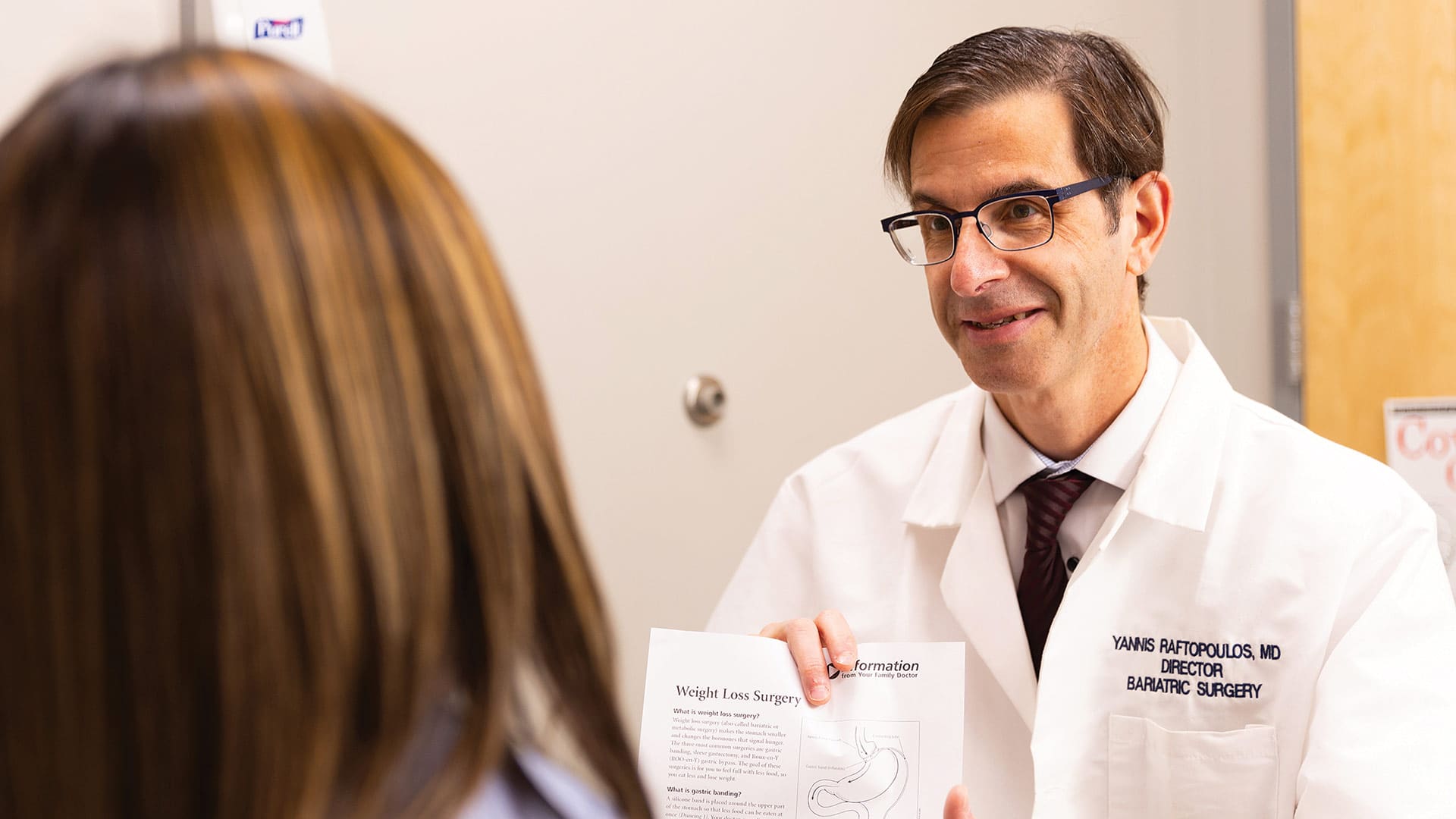
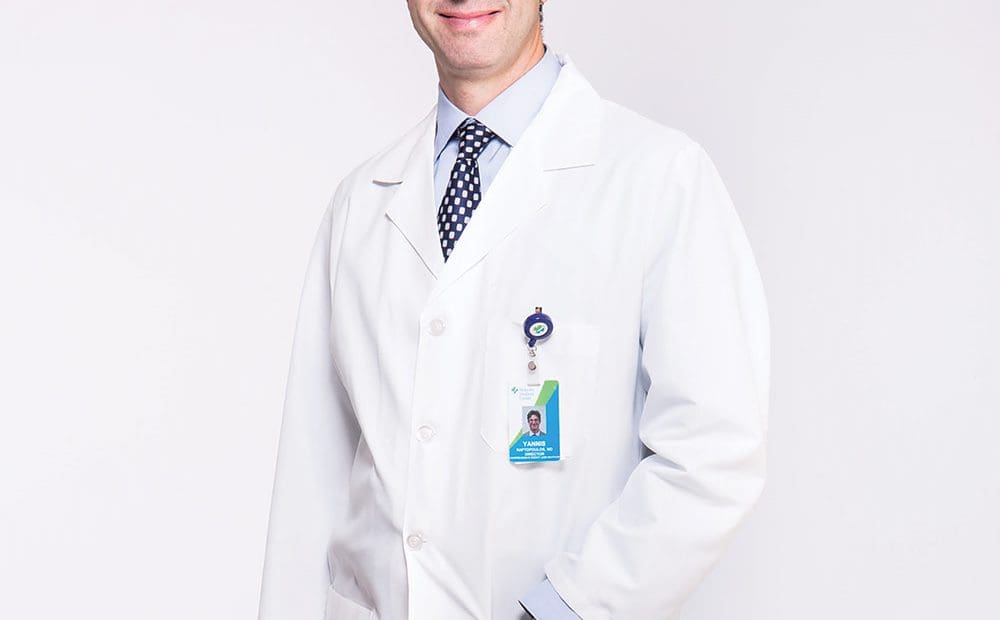
Dr. Yannis Raftopoulos is relentless when it comes to establishing solid lines of communication with his patients.
The surgery fascinated him. But he was more drawn to the physician’s personal approach to his work, a philosophy that he emulated and has taken with him to a fellowship at the University of Pittsburgh and eventually to his role as director of the Bariatric Surgery Program at Sant Francis Hospital and Medical Center in Hartford, Conn., then back to Greece for a short time, and then to Holyoke for the start of its Weight Management Program in September 2015.
Upon coming to this country in 2002, Raftopoulos quickly noted that it had a weight problem.
“It was striking, for someone who hadn’t been here before,” he said, adding that, unfortunately, over the years, this weight problem has become more of a global phenomenon.
And he has essentially dedicated his life to addressing it — or at least helping those who come to him because they want to do something to get their life back.
He spends two days a week in surgery, with the most common procedure being a gastrectomy, whereby part of the stomach — 60% to 70% on average — is removed to reduce stomach capacity and promote weight loss.
“It reduces the appetite and the hunger and makes the patient feel full faster with less food,” he explained. “Obviously, that by itself is not enough to be successful, but it gives them the tools, the assistance to be motivated to change their habits and work with me.”
After surgery, he said, the simple goal is to keep patients motivated, focused on short- and long-term goals, communicating, and on the path they started down because they couldn’t manage their weight themselves.
And to the extent possible, he motivates his patients to set the bar high when it comes to what is considered ‘success.’
“They’re learning a new skill set, and it takes time to acquire it and make it a habit; you need a lot of coaching over a long period of time.”
“Sometimes, they’ll say ‘any weight loss is great,’” he told BusinessWest. “And I’ll say, ‘wait a minute, it’s not great.’ I tell them that, if they’re going to go under the knife and under anesthesia for the sole reason to lose weight, they need to do awesome, and awesome, to me, means getting back to a normal weight.”
Achievements on a Grand Scale
During his career, Raftopoulos has helped more than 10,000 patients on their weight-loss journey, bringing his personal brand of care to each case with that aforementioned focus on communication, something that, in many cases, needs to be taught.
“Learning how to communicate — that’s one of the biggest issues they face,” he said of his patients. “They need to be confident in conveying the difficulties and learning to work together with me to solve them, rather than try to figure it out themselves, as they have been used to in the system, and then they end up not doing the right thing.
“The first thing they need to learn is how to communicate, and how to communicate effectively,” he went on. “And when I say ‘effectively,’ I mean not being afraid to communicate if they’ve had a bad week or they’ve gained weight, because I tell them the opportunity is still there from the good weeks and the bad weeks. I’m not the police; I’m not going to give them a ticket, and sometimes I have to tell them that, because they think, if they tell me something bad, that I’m going to get upset or they’re going to feel ashamed.
“Everyone makes mistakes,” he continued. “As long as you communicate and we discuss the mistakes, you learn from them. The bigger mistake is not to communicate, because it’s very difficult, without guidance, to understand why you’re making mistakes and, more importantly, how to correct them and not repeat them.”
This communication begins before surgery, and it continues every day after surgery for some time, and then it becomes weekly, he went on, adding that his research has informed him that more intensive follow-up for a longer period of time is a key ingredient in a patient achieving long-term success.
“They’re learning a new skill set, and it takes time to acquire it and make it a habit; you need a lot of coaching over a long period of time,” he said. When asked how long this coaching goes on, he added simply, “forever.”
Elaborating, he said that, over time, the patient will achieve a measure of independence, with the communication coming weekly, monthly, or over a few months, but it continues because weight management is a lifelong assignment.
And while carrying out that assignment, he said, it’s important for patients to have goals, short and long term, as well as milestones to reach and encouragement to reach them.
“You have to set goals for them, like losing three pounds every week,” he said, adding that he will remind them of this. “And then, I give them longer-term goals; I’ll remind them, ‘you’re 30 pounds from not being obese, that’s a milestone.’ Or ‘you’re 60 pounds from not being overweight.’ I find that giving them milestones motivates them to stay in the program, to push harder, and to accomplish the task.
“People will say, ‘oh, my pants feel loose, I feel great, I made another hole on my belt,’” he went on. “I’ll say, ‘that’s great, but that’s not the goal; the goal is to get to a normal weight.’”
Raftopoulos said many factors go into whether a patient will be successful on his or her weight loss journey, but perhaps the most important are a willingness to listen, communicate, learn from mistakes, fully understand that they need help to do this, and ask for help when it’s needed.
“Some people don’t know what to do, and they have difficulty doing it,” he explained. “They have an opinion about things, and sometimes we’ll have an argument. I’ll say, ‘you have an opinion, you’re entitled to have an opinion, everyone has an opinion … but you came to us because you couldn’t lose weight or you gained weight, so that means that whatever opinion you had, it wasn’t very successful; maybe you should listen to me and do things differently.’”
These comments help convey that, while research, innovation, and evidence-based practice is at the foundation of his work, compassion and dedication to patients truly set him apart and enable his patients to achieve positive results at rates considerably higher than the national averages.
And they also help convey why Raftopoulos is now, and has always been, a Healthcare Hero.











 “In many sectors, premiums are finally easing, creating opportunities for insureds to save money. Yet challenges persist, especially for homeowners in high-risk regions and for those facing the ripple effects of social inflation.”