Home 2026 March (Page 3)
Daily News

WEST SPRINGFIELD — For years, Storrowton Village Museum’s Maple Harvest Day and Pancake Breakfast has been a hallmark of the start of spring for many Western Mass. residents. On March 14, an influx in ticket sales confirmed that more townies are adding the event to their list of traditions than ever before.

More than 600 guests attended the event, which was a 50% increase over the previous year’s attendance. Overall, 20 volunteers from the West Springfield Lions Club stacked guests’ plates with pancakes in the name of supporting the year-round educational programming at Eastern States Exposition’s (ESE) historic village. They poured 10 gallons of orange juice, 10 gallons of milk, and hundreds of cups of coffee; and served 120 donuts, more than 1,600 pancakes, and 1,120 sausages.

“We are happy to help!” said Aldo Paier, treasurer of the West Springfield Lions Club. “We are already thinking of ways we can be more efficient next year and putting plans in place. Most of our own fundraising happens right here at Eastern States during the Big E, so we are glad to give back. We are grateful to the Operations team for all their assistance, too.”

Jerry and Carrie Ferrindino, owners of local sugarhouse Ferrindino Maple, provided their line of products and answered questions about the maple sugaring process. Storrowton staff were moved by the support they received from guests and their partners at the Lions Club and Ferrindino Maple.

“We at Storrowton Village are touched,” said Samantha DePergola, assistant director of Storrowton Village Museum. “We appreciate the West Springfield Lions Club, Ferrindino Maple, and our loyal volunteers for docent-led tours and demonstrations. Maple Harvest Day inevitably warms the hearts of all in attendance, our team included. We hope those dining and learning with us felt welcome, both those new and those returning.”

As an educational extension of ESE, Storrowton Village Museum is committed to preserving New England’s history through its nine 18th- and 19th-century buildings in West Springfield and presenting an engaging calendar of educational events. The proceeds from Maple Harvest Day and Pancake Breakfast benefit the village’s year-round, hands-on programming.

Daily News

SPRINGFIELD — Tickets are still available for the 18th annual Difference Makers awards gala, hosted by BusinessWest. The event will take place on Tuesday, April 7 from 5:30 to 9 p.m. at the Log Cabin in Holyoke. Tickets cost $95 per person, and tables of 10-12 are available. They can be purchased by clicking here.

The Difference Makers class of 2026 are profiled in the Feb. 16 issue of BusinessWest and at businesswest.com. This year’s honorees are:

• Ryan Alekman and Robert DiTusa, partners, Alekman DiTusa, LLC;

• Rachelle Hannoush, director of Youth, Violence Prevention, and Court Support Programs, YWCA of Western Massachusetts;

• Jess Miller, comedian and founder, The Kind Squad;

• Darby O’Brien, owner, Darby O’Brien Advertising;

• Julie Quink, managing principal, Burkhart Pizzanelli, P.C.;

• Edward Sokolowski, managing partner and wealth advisor, Pioneer Valley Financial Group;

• Margaret Tantillo, executive director, O’Dell Women’s Center; and

• Zeno Temple, founder, Just Us Movement.

BusinessWest launched the Difference Makers program in 2009 to recognize and celebrate the work of individuals, groups, businesses, and institutions that are positively impacting the communities of Western Mass. The 18th annual Difference Makers program is sponsored by Burkhart Pizzanelli, P.C., TommyCar Auto Group, and Westfield Bank.

For more information, call Natasha Mercado-Santana, Marketing and Events Manager, at (413) 781-8600, ext. 100, or email [email protected].

Daily News

SPRINGFIELD — Bulkley Richardson recently welcomed Joshua Weatherwax to the firm as an associate in the Business Department.

“We welcome Joshua to our busy practice, where he will focus on all areas of transactional work, including mergers and acquisitions,” said Scott Foster, chair of Bulkley Richardson’s Business Department. “In addition to his law degree, Joshua’s past business experience allows him a better understating of our clients and how their businesses operate.”

Weatherwax earned his juris doctorate in 2025 from Western New England School of Law, where he was an Oliver Wendell Holmes Jr. scholar and CALI award recipient. He also earned a bachelor’s degree from Westfield State University in 2019 and an MBA from Western New England University in 2024.

Daily News

HOLYOKE — Holyoke Community College (HCC) will be running a new edition of its free line cook training program at the HCC MGM Culinary Arts Institute beginning March 30.

The six-week daytime program runs until May 8. Classes meet Mondays and Wednesdays from 9 a.m. to 1 p.m., and Tuesdays, Thursdays, and Fridays from 9 a.m. to 3 p.m. There are no classes on April 6, April 27, and May 4.

Additional spring semester line cook training programs will start on April 27 (evening) and May 11 (daytime).

“HCC tries to meet the needs of its students by offering multiple options for start days and times,” said Paul Sheehan, assistant project coordinator for Culinary Arts Programs. “Over the last few years, we have offered our free line cook training as separate day and evening programs to help students find the schedule that works best for them.”

The program is designed for those already in the restaurant industry who want to upgrade their skills, as well as unemployed or underemployed individuals interested in starting new careers.

“We usually have a mix of young people entering the job market for the first time and people who are re-entering the job market, looking for a second career,” Sheehan said. “The course is perfect for anybody who’s looking for a job and has a passion for food and the dining industry.”

All classes meet in person at the HCC MGM Culinary Arts Institute at 164 Race St., Holyoke. Participants will learn all the essential competencies they need to become successful line cooks: knife skills; how to prepare stocks, soups, sauces, desserts, poultry, fish, and meat; culinary math and measurements; moist and dry heat cooking methods; as well as workplace soft skills, such as building a résumé and searching for jobs.

Offered as part of HCC’s Business & Workforce Development division, the line cook course is free to qualifying applicants. For more information or to fill out an inquiry form, visit hcc.edu/line-cook.

Daily News

WEST SPRINGFIELD — The Realtor Assoc. of Pioneer Valley invites the community to a free Community Shred & Share Day on Friday, May 8 from 10 a.m. to 1 p.m. at its new office located at 225 Park Ave., West Springfield.

To celebrate its recent relocation to West Springfield, the association’s community service committee is hosting this rain-or-shine event to provide residents with a convenient and secure way to dispose of sensitive documents while supporting a meaningful local cause.

Attendees are encouraged to bring old personal documents for secure, on-site shredding, helping protect against identity theft. In the spirit of giving back, attendees are also invited to donate non-perishable food items or other essentials to benefit Parish Cupboard, which supports local families in need.

“This event is a great way for us to connect with our new neighbors while providing a valuable service and supporting the community,” said Mandy Sherman, Membership and Events coordinator. “We’re excited to welcome residents, help them declutter safely, and make a positive impact together.”

The event is free and open to the public, and no registration is required.

Daily News

ORANGE — Dean’s Beans Organic Coffee Co. announced that its most recent B Corp recertification has earned the company a B Impact Score of 168.5, an increase of 57.9 points since its last certification in 2022. The new score places the Massachusetts-based, worker-owned coffee company as the highest scoring B Corp-certified coffee roaster in the world.

B Corp certification is widely recognized as the gold standard for companies committed to balancing purpose and profit. Administered by the nonprofit B Lab, the certification evaluates companies against rigorous standards of social and environmental performance, accountability, and transparency. Businesses are assessed across key areas, including governance, treatment of workers, environmental practices, and community impact.

Dean’s Beans is part of a global community of nearly 10,000 B Corps operating across more than 100 countries and 150 industries. Companies must earn a minimum score of 80 points to become certified. With a score of 168.5, Dean’s Beans lands in the top 25 B Corp companies certified since 2023.

For Dean’s Beans, the new score reflects a period of meaningful change. Since its last certification, the company transitioned to a worker-owned cooperative, giving employees shared ownership and a direct voice in how the company operates and grows.

“Our mission has always been to use specialty coffee as a vehicle for positive change,” CEO Beth Spong said. “Ensuring that we’re documenting all the ways we protect the environment improved our score, as did becoming a worker-owned cooperative – putting ownership in the hands of the people who roast, pack, and ship our coffee every day.”

Founded in 1993 by environmental and Indigenous rights lawyer Dean Cycon, Dean’s Beans was built on the idea that a coffee company could prioritize people and the planet and still be profitable. The company sources organic, fair-trade, shade-grown coffee through long-term partnerships with farmer cooperatives. It also helps fund social, economic, and environmental projects identified and led by those communities.

Dean’s Beans roasts all of its coffee at its ‘beanery’ in Orange, supplying cafés, grocery stores, and coffee drinkers across the U.S.

“Coffee brings people together,” the team stated. “Our goal is to make sure Dean’s Beans supports the people and communities who make it possible.”

Daily News

HOLYOKE — Meyers Brothers Kalicka, P.C. (MBK) announce the following new hires: Anthony Casabianca, associate; Laurel Williams, associate; Ashlie Baker, senior associate; and Robert Knight, CPA, manager.

Anthony Casabianca

Casabianca started his career in public accounting as an administrative intern during the 2025 tax season and recently transitioned into his new role as an associate in MBK’s audit and accounting department. He brings fresh perspective to his engagements as a recent college graduate and believes customer service starts with listening to clients’ unique needs so that he can better understand their business and help them achieve their goals. Casabianca received his bachelor’s degree in accounting from Springfield College and is currently pursuing a master’s degree in accounting with a concentration in forensic accounting at UMass Amherst.

Laurel Williams

Williams recently joined MBK as an associate focusing on bookkeeping and taxation. In addition to her experience in bookkeeping and taxation, she also brings expertise in operations, financial planning, and customer service. Her approach to customer service combines open communication with a focus on long‑term relationship‑building. By clarifying expectations early and staying accessible and supportive, she creates a dependable and welcoming experience for every client she engages with. Williams holds a bachelor’s degree from Boston University.

Ashlie Baker

Baker recently joined the team as an a senior associate in the audit and accounting department. She brings her Big 4 experience in the insurance field to her work in public accounting with MBK. From her experience, she has developed strong communication and time management skills, and brings a high level of attention to detail and experience working with complex data. She approaches customer service by listening carefully to understand the individuals needs, then following through with clear communication and a reliable completion. She views customer service as creating a positive and trustworthy experience that reflects well on long-term relationships and on the organization. Baker holds both bachelor’s and master’s degrees in accounting from Scared Heart University.

Robert Knight

Meyers Brothers Kalicka, P.C. recently welcomed Knight to the firm as a manager. He practiced public accounting from 2017 to 2021, and in recent years, his professional focus has been in financial planning and tax advising for high-net-worth individuals. His experience has made him a strategic partner to individuals, helping them grow while developing thoughtful solutions to the challenges they face. Knight holds a bachelor’s degree in corporate finance and accounting from Bentley University and a master’s degree in accounting from the University of Michigan’s Stephan M. Ross School of Business. He is also a member of the Massachusetts Society of Certified Public Accountants.

Daily News

AMHERST — Researchers, clinicians, and industry leaders will gather at UMass Amherst on Wednesday, April 8 for the 2026 Nursing and Engineering Innovation Symposium, an event highlighting collaboration between nursing and engineering to advance patient care.

Hosted by the Elaine Marieb Center for Nursing and Engineering Innovation, the symposium will run from 8 a.m. to 3 p.m. in the Student Union Ballroom. The event is free and open to the public, though online registration is required by clicking here. Parking is available at the Campus Center Garage, 91 Campus Center Way.

Sponsored by a gift from UMass alumni Mike and Terry Hluchyj, the symposium will explore the theme, “Building the Next Generation of Healthcare Innovators.” The program will feature keynote addresses, panel discussions, and interactive sessions designed to highlight interdisciplinary research and strategies that empower future innovators in healthcare.

At 9:30 a.m., keynote speaker Kirk Taylor, president and CEO of the Massachusetts Life Sciences Center, will discuss why Massachusetts remains a global leader in life sciences. He will address the evolving biomanufacturing workforce, the integration of artificial intelligence with human-centered health systems, and ways to close the gap between innovation and implementation.

At 1 p.m., keynote speaker Kavita Radhakrishnan, associate dean for Research at the University of Texas’s Austin School of Nursing and a UMass Amherst alumna, will share her professional journey bridging engineering and nursing and discuss how collaboration between the disciplines is shaping the future of healthcare innovation.

The symposium will also include a panel from 10:45 to 11:30 a.m. featuring nurses from across the country who will discuss how frontline clinical experience drives innovation in the medical industry. During the lunch period, interdisciplinary teams of nurses and engineers from various institutions will present research posters highlighting emerging projects and technologies.

Additional speakers will include Allison Vorderstrasse, dean of the Elaine Marieb College of Nursing (9 a.m.); Sanjay Raman, the Daniel J. Riccio Jr. dean of Engineering (9 a.m.); Karen Giuliano and Frank Sup, co-directors of the Elaine Marieb Center for Nursing and Engineering Innovation (11:30 a.m.); Javier Reyes, UMass Amherst chancellor (1 p.m.); and Sundar Krishnamurty, vice provost for Innovation, Entrepreneurship and Creativity (2 p.m.) A complete symposium schedule is available online by clicking here.

Daily News

WESTFIELD — On Tuesday, April 7, Westfield State University will hold two events to offer students an inside look at the realities of modern healthcare while highlighting the broad range of academic pathways available at WSU.

The first, a healthcare simulation program from 9 to 10:15 a.m., will welcome more than 140 high school students from across the region for a hands‑on healthcare exploration event featuring the university’s signature Interprofessional Longitudinal Healthcare Simulation. The second, from 4 to 6 p.m., will feature a Community Action Poverty Simulation, an interactive exercise for Westfield State students designed to emulate some of the challenges faced by those living in poverty.

In the Interprofessional Longitudinal Healthcare Simulation, high school students will follow the medical journey of a fictional 65‑year‑old patient whose unexpected health emergency sets off a multi‑stage trajectory through emergency care, hospitalization, rehabilitation, and life back in the community. This immersive experience showcases how healthcare professionals from different disciplines work together to support a patient over time. This unfolding case study takes place on stage with current students depicting the various healthcare roles.

Following the simulation, students will engage directly with faculty and students from multiple healthcare‑related majors, including nursing, emergency medical services, social work, psychology, health sciences, movement science, athletic training, occupational therapy assistant, physician assistant studies, music therapy, biology (pre‑medical), theatre arts (simulation support), and many others. Each discipline will host hands‑on activities and demonstrations to help students explore the wide variety of careers available in today’s healthcare system.

Participants will conclude the day with a guided campus tour, offering them the chance to explore WSU’s academic spaces, simulation laboratories, and student support resources.

As the Commonwealth and the nation continue to face growing shortages in essential healthcare professions, Westfield State University recognizes its critical role in strengthening the workforce pipeline. The university has expanded its academic offerings, partnerships, and experiential learning programs to address both regional and national healthcare workforce gaps, ensuring students are career‑ready and prepared to serve communities in need.

“This event gives high school students the opportunity to truly see themselves in healthcare,” said Jessica Holden, associate dean of Healthcare Workforce Initiatives. “By showing how many pathways exist and how interconnected the professions are, we hope to inspire the next generation of practitioners who will help meet the workforce needs of Western Massachusetts and beyond.”

The Interprofessional Longitudinal Healthcare Simulation is part of WSU’s broader strategy to create accessible pathways into in‑demand fields, support early career exploration, and increase the number of qualified professionals entering the healthcare workforce.

Also on April 7, from 4 to 6 p.m. in Scanlon Hall, Westfield State University students from various departments will participate in a Community Action Poverty Simulation. This immersive exercise transforms the room into a mock community, challenging participants to navigate a simulated month of poverty, condensed into four 15-minute weeks.

To emulate the constant barriers faced by low-income individuals, each student is assigned a specific persona, such as a single parent or a senior citizen. Working within a family unit, they must manage limited funds to secure food and shelter while navigating real-world hurdles like job loss, transportation failures, and healthcare crises. By interacting with onsite resources representing banks, employers, and social services, students move beyond statistics to gain a profound sense of empathy.

Ultimately, this simulation bridges the gap between classroom theory and community reality. By confronting these systemic obstacles firsthand, the next generation of leaders is better prepared to advocate for compassionate, effective social solutions for their future clients and neighbors.

Daily News

Debbie DePaola

SPRINGFIELD — Freedom Credit Union announced that Debbie DePaola has been appointed branch officer for its West Springfield location.

DePaola joined Freedom in 2023 as an assistant branch manager, bringing more than a decade of experience in the banking industry. In her new role, she leads the daily operations of the branch with a focus on service, efficiency, and member satisfaction. She oversees branch performance, coaches and develops staff, ensures regulatory and compliance standards are consistently met, and supports business development and community relations efforts throughout the region.

A graduate of the College of Central Florida with an associate degree in business administration, DePaola has been recognized for her dedication, leadership, and commitment to Freedom’s mission. In 2025, she received the Freedom Credit Union President’s Award.

“I am excited to take on this new role at the West Springfield branch,” she said. “My focus will be on delivering exceptional service to our members, supporting our team, and strengthening our connections within the community.”

Glenn Welch, president of Freedom Credit Union, added that “Debbie’s leadership, experience, and dedication to our members make her the perfect fit for this role. We are confident she will continue to elevate the branch and provide outstanding service to the West Springfield community.”

Daily News

SPRINGFIELD — The Springfield Rotary Club is currently accepting applications for grants designed to support nonprofit organizations making a meaningful impact in Springfield.

The 2026 grants will award recipients up to $2,000 each. Grant funds must be used for capital improvement projects related to one of Rotary International’s causes, such as the purchase of equipment, supplies, construction, or other tangible improvements. Grant funds may not be used for salaries, stipends, or general program operating costs. Applicants should clearly describe the purpose of the funding and the expected outcomes in the grant application.

Applicants must be a registered, 501(c)(3) nonprofit (or have a fiscal sponsor) and serve the Springfield community. Organizations awarded a community grant in the previous year must wait one full grant cycle before applying again.

Grant applications are due by 5 p.m. on April 10. Applications received after the deadline will not be considered. Click here to access the application link.

Daily News

WESTFIELD — Tighe & Bond, a Northeast leader in engineering, environmental, planning, and design consulting services, announced the opening of the firm’s new office in Manchester, N.H.

Located at 1750 Elm St., Suite 902 within the Brady Sullivan Tower, this new location will allow Tighe & Bond to better service its growing client base in the Merrimack Valley and beyond. This strategic move expands the firm’s New Hampshire presence, joining its existing Portsmouth location, to serve communities on a local level.

“The opening of our Manchester office marks an exciting new chapter in our company’s growth in New Hampshire,” President and CEO Bob Belitz said. “This new location builds upon the strong foundation we’ve established in Portsmouth and positions our team to partner with communities and clients in New Hampshire to support forward-thinking solutions across the region.”

Tom Mahanna, who will serve as location manager, has been instrumental in leading the opening of this new space. A vice president within the firm’s Water Business Line, he brings more than three decades of experience in municipal consulting and construction in water resources and wastewater engineering, as well as managing resources and staff for multiple teams in the firm’s offices across the Northeast.

“Operating in Manchester allows us to be closer to our clients and more engaged in the communities we serve,” Mahanna said. “We’re looking forward to expanding upon our existing partnerships and growing our expertise throughout New Hampshire and Maine.”

This new office opening represents the latest growth opportunity for the firm, following the acquisition of New Hampshire-based hydrogeology and environmental firm Geosphere Environmental Management Inc. last year.

Daily News

UNCASVILLE, Conn. — Human resource professionals from across New England will gather on April 20-22 for the 2026 Tri-State SHRM Conference, a professional development event hosted at Mohegan Sun Resort & Casino in Uncasville, Conn. The conference theme — “Balancing Acts & Bold Moves: The Future of HR Starts Here!” — invites HR leaders to explore innovative ideas and strategies shaping the future of the workplace.

Known as one of the region’s most dynamic HR events, the Tri-State SHRM Conference brings together hundreds of HR professionals for two and a half days of learning, networking, and inspiration. Attendees will engage in expert-led sessions, connect with industry partners, and explore emerging tools and solutions designed to help organizations succeed in today’s evolving workplace.

The 2026 conference will feature educational sessions led by experienced HR practitioners and thought leaders covering key topics such as leadership, talent management, workplace culture, compliance, and the future of work. Participants will also have opportunities to build meaningful connections through networking events and visit the exhibition hall to discover innovative HR products and services.

The conference welcomes HR professionals at all career stages, from emerging practitioners to seasoned executives, along with business leaders and service providers who support the HR community. SHRM members and members of affiliated chapters may receive special registration discounts.

The Tri-State SHRM Conference is a collaborative effort of regional SHRM organizations dedicated to advancing the HR profession through education, professional development, and community engagement.

Registration is now open. For full conference details, speaker information, and registration, visit www.tristateshrm.com.

Daily News

SPRINGFIELD — The Zoo in Forest Park will host its annual Eggstravaganza, presented by M&T Bank, on Saturday, April 4 from 10 a.m. to 2:30 p.m.

The family-friendly event invites children to hop along the Bunny Trail, collecting prize-filled Easter eggs and other goodies. There will also be crafts and coloring pages, face painting, a scavenger hunt, animal encounters, and a chance to meet the Easter Bunny.

Link to Libraries, a nonprofit organization whose mission is to distribute new books to the school and home libraries of children in need, will be handing out free books to every child at the event.

“We are so excited to kick off our 2026 season with our most popular event,” said Gabry Tyson, assistant executive director of the Zoo in Forest Park. “Eggstravaganza is the perfect way to shake off the winter blues and welcome back spring.”

Pre-registration is required to attend the event. Registration closes April 3 at noon or when all tickets are sold. Tickets cost $13 for adults, $8 for children, and $9 for seniors, and are available at www.forestparkzoo.org/eggstravaganza. Discounts are available for Zoo members.

Kids are encouraged to bring a bag to collect prizes. In the event of severe weather, Eggstravaganza will be moved to Sunday, April 5. If the rain date is not utilized, the Zoo will be open to the public on April 5 from 10 a.m. to 4 p.m.

The Zoo in Forest Park officially opens to the public on Saturday, March 28, and will initially be open weekends only from 10 a.m. to 4 p.m., with last admission at 3:30 p.m. The Zoo will be open daily for both Connecticut and Massachusetts spring vacation weeks, April 11 to April 26. After Mother’s Day, the Zoo will move to its full, daily operating schedule.

Daily News

Ashik Mubarak

CHICOPEE — Caolo & Bieniek Associates Inc. announced that Ashik Mubarak has officially passed all of his architectural exams and is now a registered architect, awaiting the arrival of his license.

“We are proud to announce that Ashik has successfully passed his final architectural registration exam,” the firm stated. “This significant achievement marks the culmination of years of dedicated study, professional experience, and commitment to excellence in design. Ashik represents the next generation of architectural talent, bringing creativity, technical expertise, and fresh perspective to our team. We congratulate him on this outstanding accomplishment and look forward to his continued contributions to our projects and the communities we serve.”

Daily News

SPRINGFIELDBusinessWest is accepting nominations for its 12th annual 40 Under Forty Alumni Achievement Award. Nominations are due by Thursday, April 9. They can be submitted by clicking here.

The Alumni Achievement Award finalists will be profiled in BusinessWest, and the winner will be announced at the 40 Under Forty awards gala, presented by PeoplesBank, on Thursday, June 11 at the MassMutual Center in Springfield.

BusinessWest launched its 40 Under Forty program in 2007 to identify and celebrate rising stars across our region who are excelling in business and involved in the community. Launched in 2015, the Alumni Achievement Award was created to honor the 40 Under Forty honorees who have most impressively continued and built upon their track records of accomplishment. Nominators help BusinessWest find the best of the best.

For more information, visit businesswest.com/40-under-forty/alumniachievementaward or contact Natasha Mercado-Santana, Marketing and Events Manager, at (413) 781-8600, ext. 100, or [email protected].

Daily News

SPRINGFIELD — Springfield Technical Community College (STCC) will host its fourth annual International Women’s Day celebration on Wednesday, March 25 from 11 a.m. to 2 p.m., bringing together students, faculty, staff, and community members for an afternoon of inspiration, connection, and empowerment.

This year’s celebration features a panel discussion titled “The Power of Giving: Women, Growth, and Collective Gain” and aligns with the broader International Women’s Day message of “Give to Gain.”

Panelists include Sharay Salters, lead program alumna, former peer mentor, and STCC student body president for the class of 2025; Samantha Hamilton, director of Coalition Building and Community Engagement at the Public Health Institute of Western Massachusetts and co-founder of A Queen’s Narrative; and Nikai Fondon Bannister, CEO and founder of Evolve Her Enterprises. These leaders from diverse backgrounds will share their experiences and perspectives on mentorship, leadership, and giving back, and how these practices contribute to individual growth and collective success.

The event — which will highlight the achievements and contributions of local women leaders while fostering a strong sense of unity, encouragement, and support throughout the community — is presented by the Lead Female Leadership & Mentoring Program, which offers female-identifying students inclusive and holistic academic support, mentoring, leadership development, and community engagement opportunities.

“International Women’s Day at STCC is about celebrating the incredible strength, leadership, and generosity of women in our community,” said Darcey Kemp, vice president of Student Affairs at STCC. “Through programs like Lead and events such as this, we are creating spaces where students feel supported, empowered, and connected.”

The celebration will feature local women-owned business vendors, networking opportunities, community leadership awards, and a catered lunch.

The event will take place in the STCC Gymnasium, Building 2, first floor. For more information or to register, visit stcc.io/thepowerofgiving.

Daily News

NORTHAMPTON — The Applied Mortgage Team of HMA Mortgage announced that Lindsay Barron LaBonte, branch manager and senior loan officer of the Applied Mortgage team, will be honored with the Peter V. Kocot Community Service Award from the Northampton St. Patrick’s Assoc. at its award ceremony this month.

This recognition celebrates a chosen person who has distinguished himself or herself through substantial community service contributions in Western Mass. The ceremony will take place on Friday, March 13 at 7 a.m. at Hotel Northampton, 36 King St., Northampton.

The Peter V. Kocot Community Service Award honors the legacy of the late, former state representative’s unwavering commitment to community, education, and local agriculture. During his service, Kocot secured critical funding to help develop Grow Food Northampton’s youth education program, creating opportunities for young people to connect with the land and learn the value of sustainable food systems. His dedication to strengthening both education and agriculture continues to inspire community-centered leadership across Western Mass.

LaBonte is being recognized for her outstanding commitment to community service and local impact. Through her leadership and volunteer efforts across Western Mass., she has consistently invested her time, resources, and voice in initiatives that strengthen families and expand opportunity. Her dedication reflects the spirit of the award: uplifting others, building meaningful partnerships, and creating lasting change in the communities she proudly serves.

“Receiving the Peter V. Kocot Community Service Award from the Northampton St. Patrick’s Association is an honor. Peter’s leadership and loss left a lasting mark on our community, and I remember clearly how profound that impact was on me as a young adult,” LaBonte said. “I’m incredibly proud to carry on his legacy and a reminder of the responsibility we all share to show up, lead with heart, and give back to Western Mass. in meaningful ways.”

Daily News

HOLYOKE — The Dowd Agencies, the oldest insurance agency in Massachusetts under continuous family ownership, today announced it is acquiring Royer Camp & Associated Insurance in Newport, Vt.

Founded more than 50 years ago, Royer Camp & Associated Insurance has earned the trust of generations of Vermont and New Hampshire families and businesses by providing highly personalized service and tailored personal and commercial coverage. In keeping with that legacy, the agency will continue to operate under the name Royer Camp & Associated Insurance, a Member of the Dowd Agencies. Local customers will work with the same staff in the same location, with no changes to day-to-day service, policies, points of contact, or coverage.

“Royer Camp is exactly the kind of agency we believe in partnering with. It has deep roots, a reputation for trusted advice, and service delivered by people who live in and care about the community,” said John Dowd Jr., president and CEO of the Dowd Agencies. “We’re here to support what they’ve built and to help ensure that local customers can rely on this team for decades to come.”

By joining the Dowd Agencies, Royer Camp customers will gain access to broader carrier options and expanded resources, while continuing to receive the same relationship-driven service they have always known.

This marks the Dowd Agencies’ second location in Vermont, joining Lonergan & Thomas Insurance in Bennington, and complements its six offices serving communities across Western Mass.

Daily News

SPRINGFIELDBusinessWest, in partnership with Innovate413, presents the StratAI Series, designed to help businesses develop practical AI strategies, smarter operations, and stronger growth. The first event in the series will focus on the manufacturing industry and will take place on Thursday, March 26 from 4:30 to 7 p.m. at the Brian Corridan Center at STCC Technology Park. Click here to register free of charge.

The event will be hosted by BusinessWest, Innovate413, and FORGE, and moderated by Paul Silva, CEO of Innovate413. It will feature a panel of manufacturing experts and breakout workshops.

Food will be provided by the Olde Armory Grille, and beverages will be provided by White Lion Brewing Company. Special guests include state Rep. Orlando Ramos and Aaron Vega, president and CEO of the Western Massachusetts Economic Development Council.

The scheduled panelists are David Arturi, CEO of Tetra, and Vinny LaRocca, CTO of Tetra; John Fazzio, president and COO of Pilot Precision Products LLC; Ben Grande, president of the Western Mass. chapter of the National Tooling and Machining Assoc. and general manager of Meridian Industrial Group; and Ali Usman, founder and CEO of PixelEdge.

Sponsorship opportunities are available. Contact Melissa Hallock at (413) 781-8600, ext. 109, or [email protected] for sponsorship information.

Daily News

GREAT BARRINGTON — MountainOne Insurance Agency Inc. announced the opening of an office at 4 Castle St., Suite 201, in Great Barrington, marking a meaningful expansion of its presence in Southern Berkshire County.

The appointment-only office will be staffed by account executive Dan Blaisdell, providing a local point of connection for clients throughout the Southern Berkshires. Blaisdell specializes in business insurance and brings deep knowledge of the region, along with long-standing relationships built through years of working closely with local organizations and entrepreneurs.

The new Great Barrington office brings MountainOne Insurance closer to the clients it serves across Southern Berkshire County, offering personalized insurance guidance from a trusted local advisor who understands the community and its needs.

“Southern Berkshire County is an important part of the communities we serve, and opening a Great Barrington office allows us to be more present and more accessible,” said Jonathan Denmark, executive vice president of MountainOne Bank and president and chief operating officer of MountainOne Insurance. “Dan’s longstanding relationships and understanding of the region make this a natural step forward.”

Daily News

MONSON — Monson Savings Bank (MSB) announced the recipients of its 2026 President’s Award, the highest honor presented by the bank. This award recognizes employees who exemplify Monson Savings Bank’s mission and values through outstanding customer and community service, exceptional teamwork, professionalism, and unwavering integrity.

This year, two employees have been selected from peer nominations for their extraordinary contributions, leadership, and dedication to the bank and its customers: Melanie Garcia, senior commercial loan administrator; and Terry Poloski, vice president, residential lending officer.

Employed with Monson Savings Bank since November 2013, Garcia has long been a pillar of excellence within the Commercial Lending department. Chosen from 22 nominees in the non-officer/manager category, she received five heartfelt nominations highlighting her expertise, organization, communication skills, and the positive influence she brings to the team.

Colleagues describe Garcia as knowledgeable, humble, and exceptionally dedicated, consistently strengthening customer relationships and enhancing the bank’s reputation. Her commitment to her role, her team, and the bank’s partners is both remarkable and inspiring.

Since joining Monson Savings Bank in December 2011, Poloski has been a trusted leader within the Residential Lending department. Selected from 16 nominees in the officer/manager category, she also received five nominations, each recognizing her professionalism, compassion, and significant impact on both customers and colleagues.

Poloski is described as humble, hardworking, an outstanding mentor, and a leader who consistently prioritizes the bank’s success over personal recognition. Her dedication has helped shape the strength and reputation of the bank’s mortgage department and continues to set the standard for exceptional customer care at MSB.

“Melanie and Terry represent the very best of Monson Savings Bank,” said Dan Moriarty, president and CEO. “Their dedication, professionalism, and genuine care for our customers and communities embody the spirit of this award. They lead by example every day, and our organization is stronger because of their contributions. It is an honor to recognize them as our 2026 President’s Award recipients.”

With this recognition, Garcia and Poloski join an esteemed group of President’s Award alumni, including Kevin Hicks, Kate Blackwell, Sara Rodrigues, Paul Shepardson, and Mike Sexton, whose accomplishments continue to shape the legacy and future of Monson Savings Bank.

Daily News

PITTSFIELD — Hand Crafted Catering & Events announced it will hold a ribbon cutting for its café at 26 Dunham Mall, Pittsfield on Wednesday, March 18 at noon, followed by a complimentary light lunch.

Known throughout the region for its ingredient-driven catering and events, Hand Crafted brings the same commitment to locally sourced ingredients and thoughtful preparation to its new weekday lunch concept. The café will feature a fresh, focused menu of sandwiches, salads, toasts, and grain bowls designed for both convenience and quality.

A signature element of the menu is its customizable sandwich experience. Guests select from carefully prepared proteins and finishes, then personalize their sandwich with a variety of house-made spreads, including Calabrian mayo, rocket pesto, garlic aioli, honey mustard, hot honey, and sundried tomato whipped feta. The concept allows guests to build something familiar or create a flavor profile entirely their own.

“Our goal was to create something elevated yet approachable,” owner Justin Carafotes said. “We wanted to offer Pittsfield a lunch option that feels intentional, fresh, and a little bit different.”

The establishment will also offer a rotating breakfast selection of morning offerings, allowing the culinary team flexibility to highlight seasonal ingredients and daily inspiration. The café will operate Monday through Friday from 9 a.m. to 3 p.m.

Community Spotlight

Community Spotlight

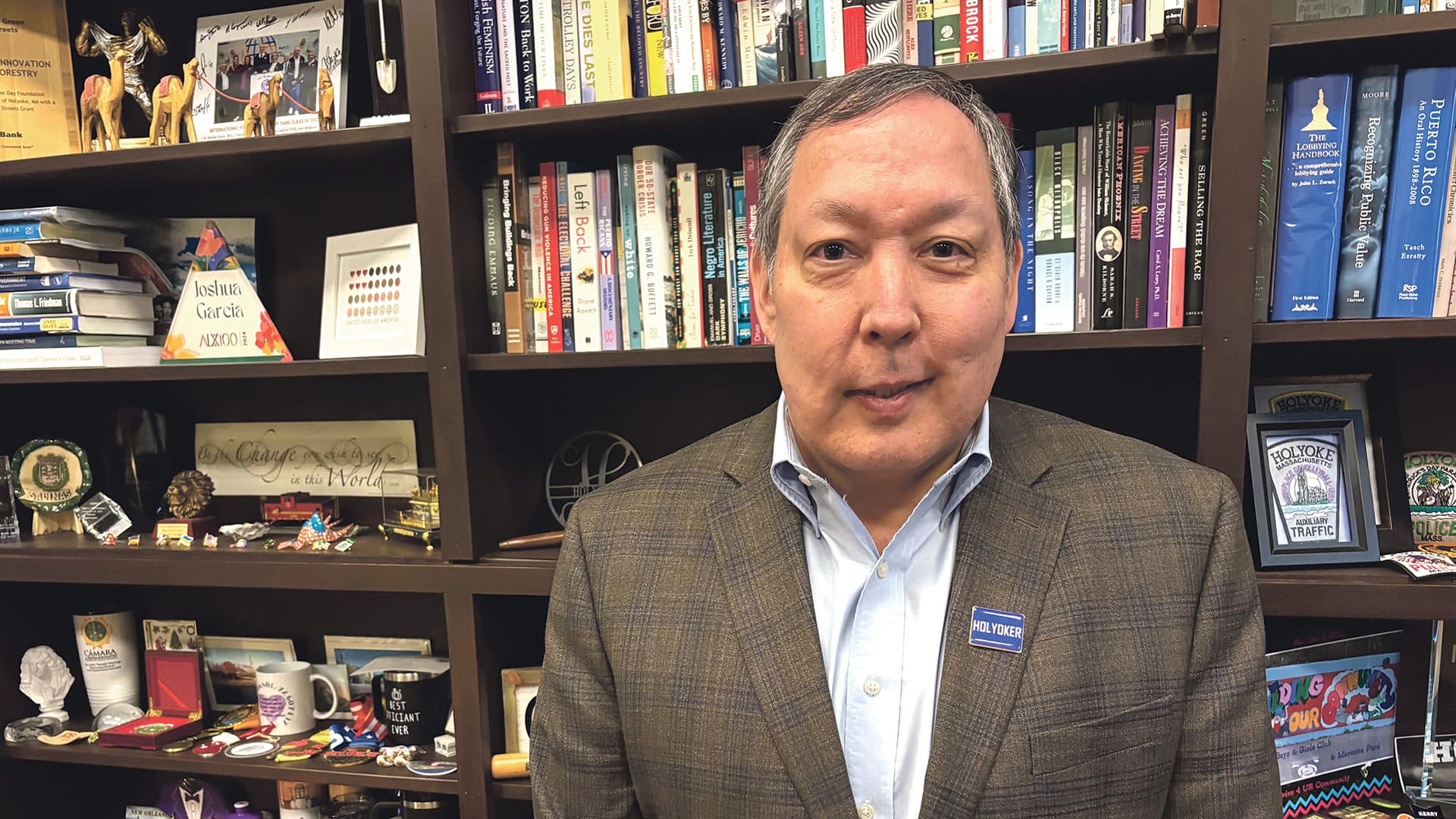
Eric Nakajima says he wants to take full advantage of Holyoke’s many assets, including mill space, a business-friendly government, and green energy.

Eric Nakajima says he wants to take full advantage of Holyoke’s many assets, including mill space, a business-friendly government, and green energy.


Eric Nakajima recalls that, while earning his master’s degree in city planning from the University of California, Berkeley 25 years ago, one of first assignments in one class was to essentially explain why he was there.

“I said that I wanted to learn how to help communities like Holyoke,” he said, adding that he got to know the city soon after his family moved to Amherst from New Jersey when he was 7 and was later struck by how much the community was impacted by the loss of its manufacturing base. “I named Holyoke all the way out in California; I wanted to understand better how you work with the city, work with the community, work with the markets, work with the business environment you’re in to create jobs and good placemaking.”

And 25 years later, that’s essentially his job description as the new director of Holyoke’s Office of Planning & Economic Development, succeeding Aaron Vega, who is now serving as president and CEO of the Western Massachusetts Economic Development Council.

He arrives in City Hall with a diverse résumé, including roles with the Deval Patrick administration on Beacon Hill, and at an intriguing time for the community, one of progress on several fronts, including housing, downtown revitalization, entrepreneurship, and job creation, but also some setbacks, especially when it comes to what was shaping up to be one of the city’s better economic development stories. That would be Sublime Systems, which had plans to build a plant on Water Street and produce low-carbon cement — plans now on hold after the loss of a large federal grant.

“I named Holyoke all the way out in California; I wanted to understand better how you work with the city, work with the community, work with the markets, work with the business environment you’re in to create jobs and good placemaking.”

When asked about whether those plans might eventually materialize, Holyoke Mayor Joshua Garcia shook his head slowly for emphasis and said, “it certainly doesn’t look like this is going to happen.”

But while Sublime likely won’t be part of the picture in Holyoke, there are plenty of bright spots in the Paper City, including:

• New housing projects in various stages of development, from 700 recently completed units at the former Farr Alpaca mill (and more in phase 2 of that development) to 84 units planned for Open Square, to several smaller projects in and around the downtown area. Add them all up and they make a real dent in the city’s huge need for housing and bring promise to spur new businesses to support those residents;

• A chamber of commerce that is moving on from controversy involving its former president, Jordan Hart, who was terminated just over a year ago and is the subject of a criminal complaint alleging financial misappropriation. Interim Director Lisa Totz said the agency is adding members as well as events to the schedule and, in general, looking for new ways to bring value to its members;

• A utility, Holyoke Gas & Electric, that continues to be a force in economic development by offering clean, comparatively lower cost energy that is bringing attention to the city from different types of businesses, including data centers, which are looking at several possible sites, including the property on Water Street that was due to become Sublime’s new home (more on that later);

• A cannabis sector, spawned by that lower-cost energy and hundreds of thousands of square feet of vacant mill space, that is “holding its own,” said the mayor, despite turbulence in that sector;

• Plans to redo and simplify the city’s zoning and permitting processes to facilitate new business development;

• A massive retail center, the Holyoke Mall at Ingleside, that continues to adjust to changes in the marketplace with a mix of tenants that is shifting increasingly toward the entertainment side of the spectrum, with a massive pickleball facility being the latest addition and a huge Dick’s House of Sport, an immersive facility complete with batting cages, golf simulators, and rock climbing walls, set to open in the spring of 2028;

• A new initiative called Greater Ingleside 2050 that will bring together stakeholders in that area of the city and create a roadmap for what it could look like in the milestone year; and

• Long-term projects such as revitalization of the Victory Theater and a planned sports complex, which, if they become reality, could greatly contribute to the vitality and quality of life in this community of nearly 40,000.

For this latest installment of its Community Spotlight series, BusinessWest takes an in-depth look at the many converging storylines in Holyoke, starting with its new economic development director.


Background — Check

Nakajima said that, while he knew a lot about Holyoke before taking the economic development job, there has still been a learning curve, and on many levels.

“I’ve worked with a lot of city halls, but I’ve never worked in a city hall,” he told BusinessWest. “So understanding and navigating city hall has been a challenge itself. I haven’t found it hard, but if you haven’t done it before, there are a set of processes to learn; it’s similar, but distinct from what you have at the state level.”

As noted earlier, he has plenty of experience at the state level, especially during the tenure of former Gov. Deval Patrick.
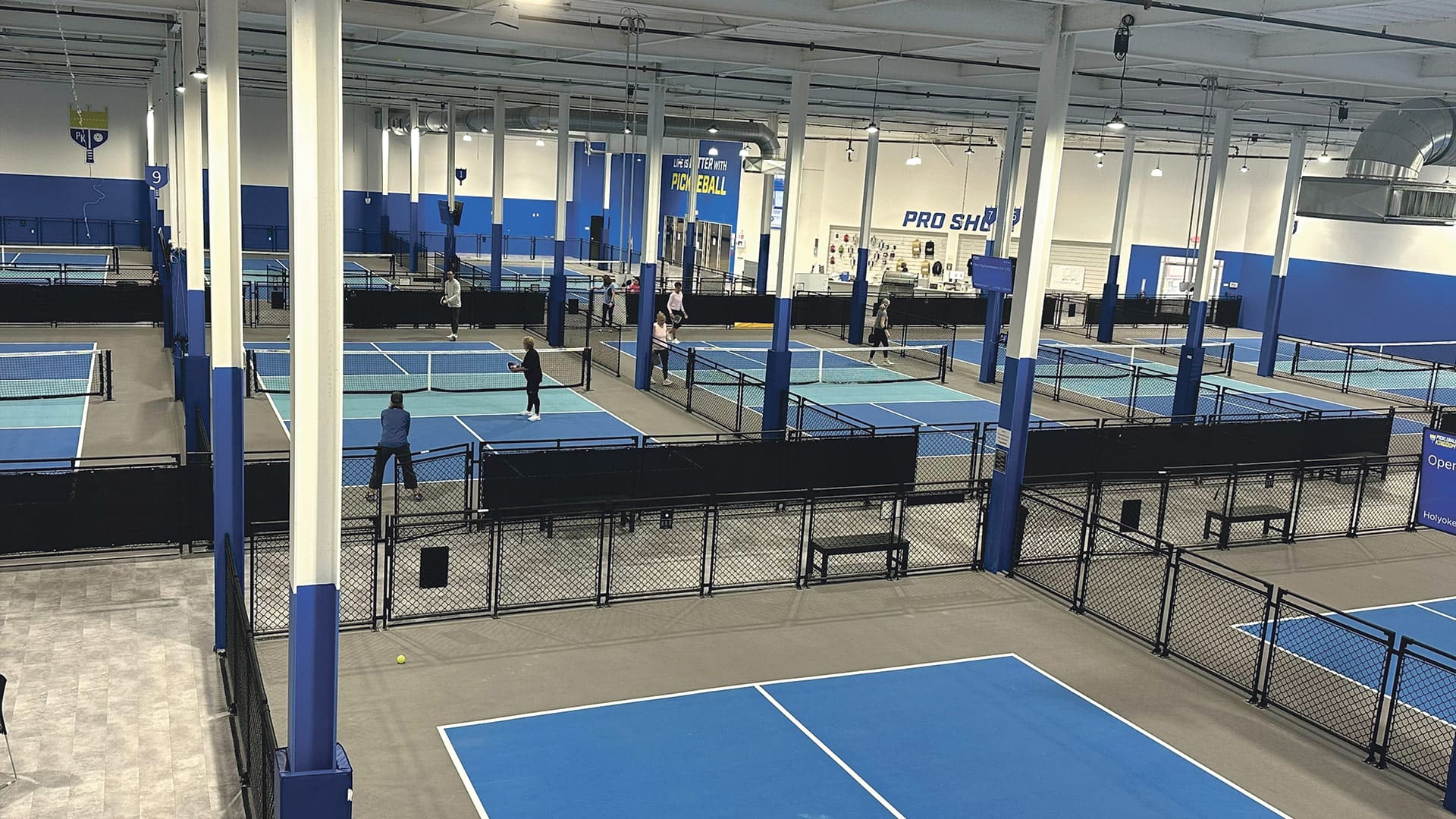
Pickleball Kingdom opened its doors and its courts just a few months ago at Holyoke Mall.

Pickleball Kingdom opened its doors and its courts just a few months ago at Holyoke Mall.

Indeed, he served the Patrick administration first as senior innovation advisor within the Executive Office of Housing and Economic Development, starting in 2010, and then as assistant secretary for Innovation Policy in that office from 2012 to 2015. During that time, he became involved in several initiatives involving Holyoke, including as project lead for all aspects of developing the Massachusetts Green High Performance Computing Center (MGHPCC).

Before and after his work in the State House, Nakajima has been involved with economic development, especially with Gateway cities, such as Holyoke, on many levels and with many different agencies.

His résumé includes a stint as senior research manager for the Economic Policy Research Unit at the UMass Donahue Institute; a short stint as director of the Massachusetts Broadband Institute, a division of the Massachusetts Technology Collaborative; work as a consultant in economic development policy and planning; and, most recently, as a director of Government Relations for the Massachusetts Teachers Assoc.

“My work with the city then, on behalf of the state, made me fall in love with Holyoke and really believe in the potential of this city.”

This body of work has made him more familiar with Holyoke and the challenges and opportunities it faces, he said, adding that, in addition to his work on the high-performance computing center, he’s been involved with several area Paper City initiatives, from the Lyman Terrace housing project to the introduction of rail service to the redevelopment of the Cubit Building, now home to several market-rate housing units as well as the HCC MGM Culinary Arts Institute.

He said he was drawn to the job in Holyoke’s Office of Planning & Economic Development for the same reasons he listed back at Berkeley, as well as his previous experiences with the city and a desire to build on the momentum that’s been created there in recent years.

“My work with the city then, on behalf of the state, made me fall in love with Holyoke and really believe in the potential of this city,” he said. “I really admire the people that I’ve worked with, many of whom are still around today. It’s what attracted me to come here.”

He said there are several priorities moving forward, including efforts to encourage more housing development, work to redevelop the many vacant or underutilized properties on and around High Street in the downtown area (housing is certainly one of the possible uses), and continued encouragement of entrepreneurship.

As for ongoing work to revamp and simplify zoning and special permit processes, Nakajima said this work isn’t sexy, but it can and will certainly help with economic development efforts.

“This is going to make City Hall easier to deal with, and it will advertise the fact that we are open for business in ways that we’ve always said we were, but now it’s going to feel like it when people come here and knock on the door and work through the process,” he said. “It’s a very big deal.”

As for housing, Garcia said the city will work to encourage not only more development, but housing across a broad spectrum, including market-rate units, such as those planned for Open Square, which could serve to keep people in Holyoke.

Holyoke Mall is evolving, with entertainment-related facilities now accounting for roughly 30% of its space, compared with 10% just a decade ago.

Holyoke Mall is evolving, with entertainment-related facilities now accounting for roughly 30% of its space, compared with 10% just a decade ago.

“Holyoke has traditionally done very well with making sure we looked out for our most vulnerable populations, but we never really thought about what happens when people’s circumstances improve,” he explained. “Currently, we have a system where you start here, you get on your feet, and once you do well, you leave. We’re still going to support affordable, workhouse housing, because that’s important, but we want to introduce market-rate housing much more aggressively into that portfolio.”


Getting Down to Business

Nakajima said he also plans to take full advantage of the city’s many assets moving forward. These include that aforementioned mill space, which can be converted for many different uses; a city government bent on being business-friendly; and green — and comparatively cheap — energy.

That last item on the list has certainly helped with economic development efforts, especially in recent years, as companies continue to seek green energy alternatives, said Jim Lavelle, general manager of HG&E, adding that this asset certainly caught the attention of cannabis growers.

And, more recently, it has drawn attention from developers looking to build data centers, he said, adding that the city has the land — including the site Sublime had targeted — and the capacity to attract such facilities.

Still, there is concern about the high energy and water usage of AI data centers and also about large amounts of real estate being absorbed for comparatively few jobs, said Lavelle, noting that a proposal was introduced recently to amend the city’s zoning ordinance to effectively ban data centers in the city.

The proposal was under discussion of the ordinance committee and continued until later this spring, he noted, adding that, while there are concerns about such facilities, privately operated data centers do bring some jobs and needed tax revenue.

“Some of the inquiries we’re fielding are for facilities in the 50- to 60-megawatt realm,” he said, adding that, for perspective, the MGHPCC is a 5-megawatt facility.

The HG&E could handle one or even a few of these larger facilities through expansion of its substations, said Lavelle, adding quickly that one 60-megawatt data center would nearly double its current peak summertime load of 75 megawatts.

Holyoke at a Glance

Year Incorporated: 1786
Population: 38,238
Area: 22.8 square miles
County: Hampden
Residential Tax Rate: $17.43
Commercial Tax Rate: $38.15
Median Household Income: $37,954
Median Family Income: $46,940
Type of Government: Mayor, City Council
Largest Employers: Holyoke Medical Center, Holyoke Community College, ISO New England Inc., PeoplesBank, Universal Plastics, Marox Corp.
* Latest information available

And while the city looks to build on its business base, its chamber of commerce continues work to rebuild its image and its core of services and move on from the recent controversy, while remaining in its long-time home on High Street.

“We’re being resilient and adaptive,” said Totz, a business consultant by trade who was working in the Holyoke chamber office providing support to small businesses and, because of her familiarity with the office and its members, stepped into the interim director role.

She used the massive conference room table that used to dominate the chamber’s offices — recently gifted to City Hall — as a symbolic example of all this.

“Now, I have eight tables that I can configure into a classroom, a giant table, a seminar space; I can tuck them away in the corner and actually have an open room … we can now do things that were impossible to do with that giant table in there.”

Resilient and adaptive will be the watchwords moving forward, Totz went on, as the chamber continues to rebuild, add members, and bring value to those members through traditional programming, such as its recent St. Patrick’s Day breakfast at the Log Cabin, and new initiatives, such as those now possible in its remodeled office.

“I want people to see that we’re forward-thinking, we’re supportive, we’re looking back at the history with respect and lessons learned, but we’re trying to bridge from where we’ve been to where we can be,” she told BusinessWest, adding that this work is ongoing.


What’s in Store?

When asked to speculate on the course of retail in the years to come, Lynn Gray, general manager of the Holyoke Mall, said she couldn’t project too far into the future, and for good reason. Indeed, the scene is changing rapidly — and constantly — as recent additions to the mix attest.

“I certainly didn’t have pickleball on my bingo card two years ago,” she said with a laugh, adding that Pickleball Kingdom, which opened its doors and its courts just a few months ago, now occupies roughly 50,000 square feet at the mall that was most recently home to Bob’s Discount Furniture and is already drawing members at a steady clip.

Its emergence is a sign of the times and the movement toward entertainment-related facilities — which now account for roughly 30% of the space in the mall, compared with 10% just a decade ago — as well as the pace of the change and difficulty with pinpointing just what will come next, said Gray, adding that the present tense is keeping her busy enough.

That includes buildout for the new Dick’s House of Sport, a facility that blends retail and entertainment, putting it in a category all its own, one Gray called “experiential retail.” This is a massive undertaking — as that two-and-a-half-year timeline indicates — that will include essentially lopping roughly 50,000 feet off the old Sears building at the mall to fit the retailer’s needs and creating an elaborate new entrance.

“We’re really excited about this development,” she said, adding that, when it opens its doors, the new Dick’s should become a huge draw, one that, like Pickleball Kingdom, will bring in people to help support retail businesses and a changing mix of restaurants, and attract more of both — especially the latter.

“We’re working with a few local and regional restaurateurs to bring their flavors to our shopping center, and with the news of Pickleball Kingdom being open and how it’s bringing in additional foot traffic, and with the news of Dick’s House of Sport, I believe we’ll be able to attract some new dining options for our shoppers,” Gray said.

Meanwhile, she is encouraged by statistics showing that the younger generations prefer in-store retail as opposed to online shopping, which bodes well for the retail side of the spectrum, which “remains our life’s blood,” she said.

While the mall continues to evolve, so does the larger Ingleside area, which extends in both directions from the mall, south to the West Springfield line and north along Whiting Farms Road. The area has seen change and new additions in recent years especially, and Greater Ingleside 2050 will focus on creating a long-term vision for the area and a blueprint for making that vision reality.

Garcia noted that, while the mall dominates the area, there are many smaller players that add to the overall vibrancy, and there is opportunity for additional, complementary development.

“We’ve been so focused on downtown, and for good reasons,” he added, “but we want to put our heads together and make sure we don’t neglect another important part of town that has had, and continues to have, potential for growth in the commercial, economic development space.”


Breweries & Wineries

Brews, Tunes, and Dogs

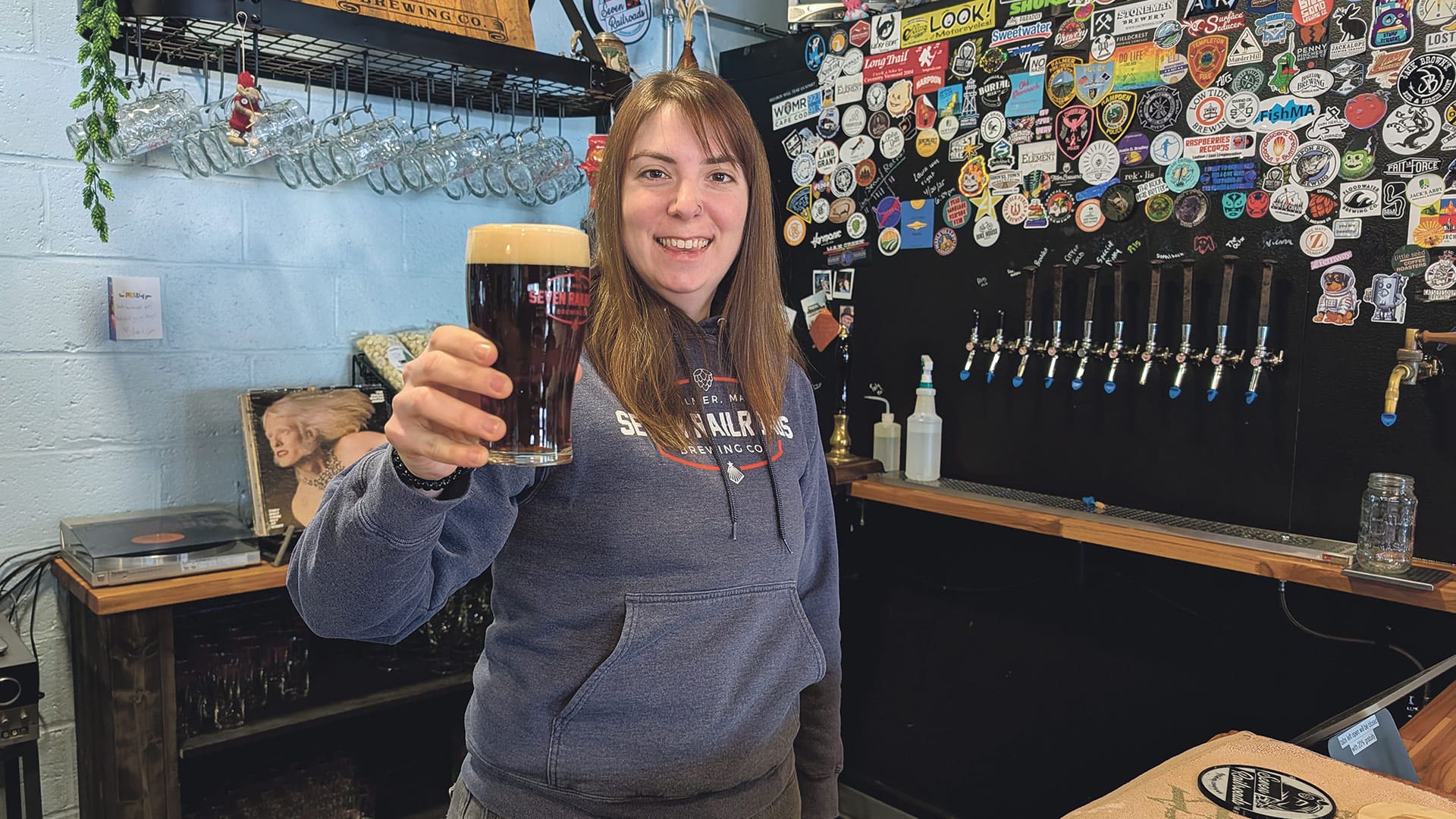
Rachel Rosenbloom says plenty of regulars come to Seven Railroads Brewing Co. for the beer, the fun, and the community connections.

Rachel Rosenbloom says plenty of regulars come to Seven Railroads Brewing Co. for the beer, the fun, and the community connections.

When Rachel Rosenbloom and Michael Bedrosian thought about what customers might enjoy in a brewery, they considered the sorts of things they liked — from music to dogs to good old-fashioned conversation.

“We wanted there to be something else to do besides just going somewhere and drinking or having a meal — something fun to do,” Rosenbloom said of the environment at Seven Railroads Brewing Co., which the married couple opened two years ago in Palmer. “My biggest goal here was to make it comfortable, like a community, like you were coming and hanging out at my house — just something to help connect a lot of the people that live in the area that wouldn’t necessarily meet each other.

“I have a lot of regulars, and they’ve all become friends, and they do things together now. It’s been really cool to see that from the other side, seeing all the connections that have been made,” she went on. “It happens all the time. It’ll be someone’s first time here; they’ll sit at the bar, and they’ll strike up a conversation with one of my regulars that sits next to them. And they’ll end up being here for a couple hours, and they’ll be talking to everybody in a big group: ‘oh, a new guy — let’s make him feel welcome.’”

Then there’s the music scene at Seven Railroads, which includes live music every weekend and an open mic night every Thursday that has become very popular, thanks partly to a small cadre of musicians who show up to give brave singers something more than a pre-recorded backing track.

“There’s a drummer that comes every week, and he’ll drum for anybody. There’s a bassist that comes in every week, and he’ll play bass for anybody. And there’s a guitarist that comes most weeks, and he’ll join in and back people up,” Rosenbloom said. “When somebody wants to come sing, they’ll tell them what song they want to sing, and most of the time, they’ll either know it, or they can figure it out.

“We wanted there to be something else to do besides just going somewhere and drinking or having a meal — something fun to do.”

“Everybody’s really happy and welcoming,” she went on. “It was every other week last year, and after the last one at the end of the year, I announced that I was making it every week this year, and the whole room started applauding, so they were all very happy about that.”

For vinyl enthusiasts, Rosenbloom also hosts a record sale event every other month, with four or five vendors setting up shop while she plays (and sells) music from her own collection. “I have the whole list printed out so people can look through and choose something, or just listen to what I have. My collection is over 900, so they’ll never hear the same album twice.”
In other events, the brewery also hosts yoga — led by Ashley Bousquet of Beyond Yoga & Wellness, who specializes in Yin yoga and Vinyasa flow — the first Sunday of every month, as well as other fun wellness events, like Pilates and yoga with goats or puppies or pigs and bunnies. “They’re just wandering around being cute while people are doing yoga,” Rosenbloom said.

Which brings us to the dogs.

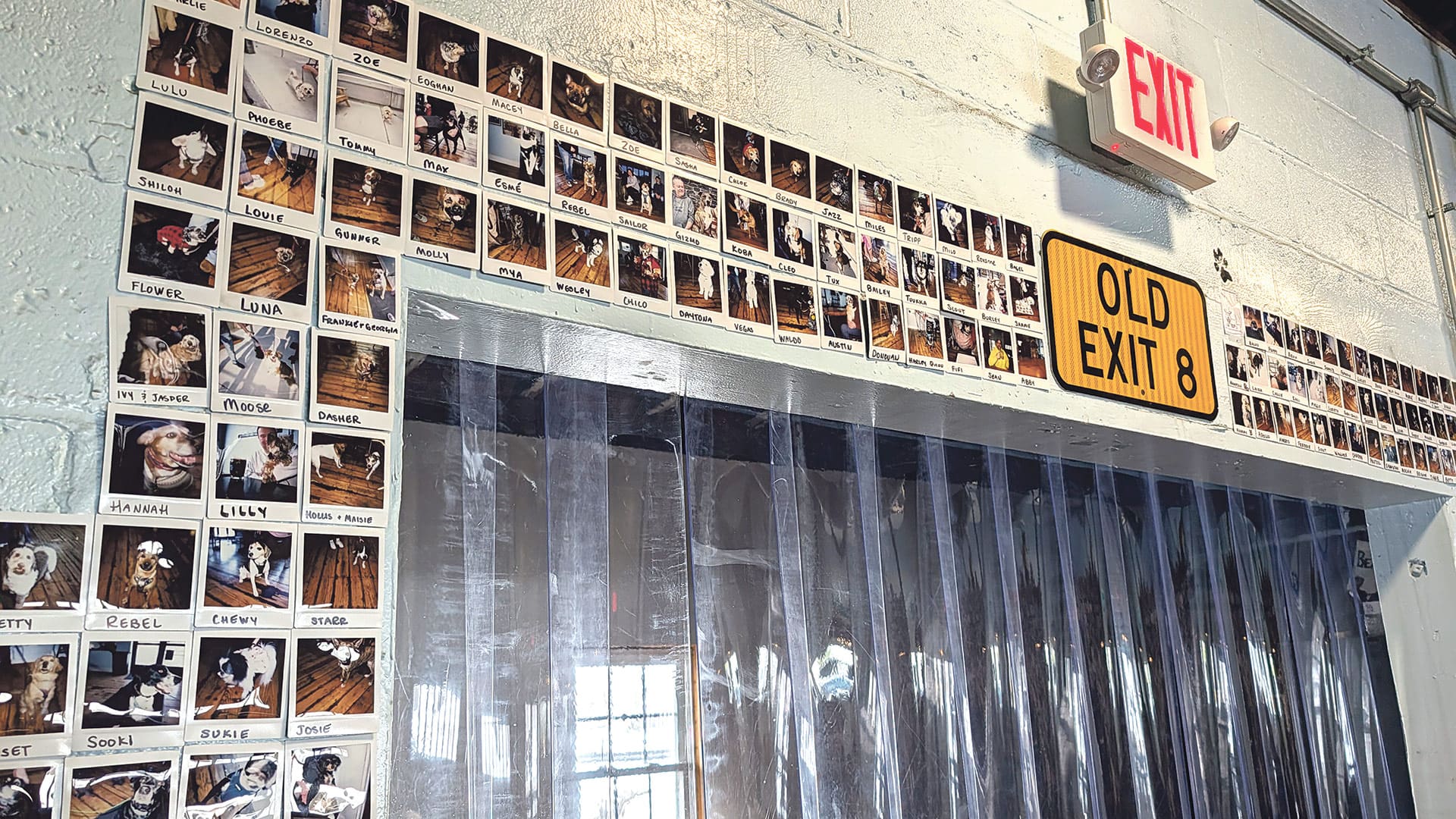
“We’re actually known as one of the most dog-friendly breweries in the area,” she noted. “I have a lot of regular dogs. A lot of people come in, and I know their dog’s name, but not their name.”
The owner of two beagles — one of them a rescue — she hosts fundraisers for Happy Life Beagle Rescue on their birthdays, and this past December, patrons could get their dog’s picture taken with the Grinch in exchange for a donation to the rescue. “For two hours solid, dogs were rolling in from all over.”
A truly dog-friendly establishment, Seven Railroads has a wall full of photos of patrons’ best friends.

A truly dog-friendly establishment, Seven Railroads has a wall full of photos of patrons’ best friends.

In addition, she sells dog biscuits made by Tori’s Pet Services in Southwick. “She takes my spent grain from when I’m done brewing, and she makes dog treats out of it. I sell those here in the tavern, and I go through about a hundred a month.”

It’s just another way Seven Railroads emphasizes community and connection.

“You can see I don’t have a big-screen TV or anything else like that,” she said. “It’s all about sitting down and having a conversation with the person sitting next to you. And it’s just comfortable. You come in here, and it’s just like you’re hanging out at my house.”


A Taste for Brewing

Rosenbloom and Bedrosian’s journey into the brewing business began when he was in the Air National Guard.

“At one point, he was sent to Alaska, and there was a beer that he was drinking over there that he really liked. And when he came back here, they didn’t distribute in the continental U.S., and he was like, ‘why don’t we just try making it? Like, this seems like something fun that we could do,’” she recalled. “So we ordered a kit online and made a five-gallon batch in our one-bedroom apartment on the kitchen stovetop. That was the first beer we ever brewed.”

That was about 15 years ago, Rosenbloom said, “and it kind of sparked something. We really enjoyed the process and just decided to keep doing it and upgrading our equipment along the way and getting more into it.”

When they moved to a house with more space, they were able to make more beer, and started entering home brew competitions (one of which they won, while earning honorable mentions in others).

“We started saying, half-jokingly, ‘maybe one day we’ll open our own brewery,’” she went on, and a few things happened to push them in that direction. She was working for a print marketing group, but took a job with Atlantic Beverage Distributors, a beer, wine, and liquor distributor.

“That got me into the industry, and it was a lot of fun. I enjoyed that job a lot. I got to learn about that part of the industry — the sales part. From there, we just kept entering competitions and meeting more people in the industry. I got to know a lot of the local restaurants and bars and package stores because of that.”

From there, she got a job offer around 2018 to become an assistant brewer with Fort Hill Brewery in Easthampton. That’s where she learned about all the work that goes into brewing, production, selling, and packaging — to the point where she and Bedrosian were ready to set out on their own, opening Seven Railroads in early 2024.

“We’re actually known as one of the most dog-friendly breweries in the area. I have a lot of regular dogs. A lot of people come in, and I know their dog’s name, but not their name.”

They specialize in German lagers and English beers, but also offer IPAs — including their flagship IPA, called Old Exit 8, after the former name of nearby Mass Pike exit 63 — stouts, ales, and more.

“We also have British cask ale. Those are naturally carbonated in a cask or firkin, and you have to pump it out with a beer engine. A lot of people get really excited when they see that we have that.”

She also noted that she and Bedrosian doesn’t get too exotic with flavorings. “It’s kind of a pullback from the way that the industry was going,” she explained. “I get a lot of people that are glad my beer isn’t really gimmicky. I like to say I make beer-flavored beer.”

Seven Railroads distributes to three local package stores and a number of area restaurants, but focuses most of its business on the taproom on Park Street in Palmer. And while the brewery doesn’t prepare food, it sells locally made snacks, brings in food trucks when the weather warms up, and has a partnership with a charcuterie business that shows up for open mic nights and weekend music events.

“Most of my focus is on the beer and the atmosphere,” Rosenbloom said. “It’s been great providing a place for people to come hang out and meet other people in the community. Like I said, the biggest positive for me has been all the friendships that I’ve seen formed from that. There are certain people that will walk in, and the bar will be full of regulars, and they go, ‘Norm!’ That happens a lot here, and it’s awesome.”


Home Sweet Home

Breweries everywhere are dealing with a time of contraction in the industry (see the stories on pages 14 and 20 for more on that), but Rosenbloom is happy with the growth and success of Seven Railroads, which she partly attributes to the lack of other breweries in town.

“It helps that there wasn’t anything here. There are a lot of local restaurants and bars, but a brewery is a different sort of atmosphere than a bar. I feel like people go to a brewery with a group of friends to hang out and do stuff, versus going to a bar. It’s a good spot to go on a date or for a night out with your friends.

And for underage patrons, “I sell non-alcoholic beers and sodas here, and they’ll come here when there’s music playing, and it’s a fun night out. Lots of kids come to the yoga, for the animals, or the record sales. Those bring a lot of people in as well.”

In short, Rosenbloom’s dream of a gathering space that feels like home has been well-received in Palmer.

“We’re pretty thrilled — the community has accepted us wholeheartedly. Everyone’s so happy we’re here. The regulars are happy we’re here. It’s still kind of surreal sometimes to look at that. Like, I’ll be in here when the taproom’s full, and I look around and see everybody having a good time, and it’s still like, ‘is this actually happening?’ Because we talked about it for so long, and then we actually managed to pull it off, and it worked.”

Breweries & Wineries

Beer, Family … and Staying Open

By Tanzi Cannon-Eckerle

Tanzi Cannon-Eckerle at the brewery she owns with her husband, Joe Eckerle.

Tanzi Cannon-Eckerle at the brewery she owns with her husband, Joe Eckerle.

I’m Tanzi. Joe is my husband and head brewer. I’m a labor and employment business attorney; he’s a COO and manufacturing engineer. I’m the creative one. He is the executor, the efficiency expert.

About 10 years ago, we added a brewery to our marriage — because we are busy bees and serial entrepreneurs, always full of ideas and wanting something new to do. The marriage is still on tap (more than 21 years now), and so is the beer — and it is good.

We built the brewery with friends, sweat equity, and the simple desire to achieve. You have heard that before, of course. I worked in restaurants and bars from age 15 through college and until our daughter was born, so I know the industry — then went to law school (nothing says ‘new baby energy’ like casebooks and cold coffee).

A year later, I bought Joe a home-brew kit for Father’s Day. As an engineer by training and farmer by birth, I thought he needed something to tinker with. He fell in love, got kicked out of the kitchen and relegated to the backyard, and after a beer trip to Munich, years of tasting, and a Siebel class, friends started taking a second sip and saying, “wait… you made this?” At the same time, I was thinking we have too many beers on tap at the house. That’s when the universe cleared its throat: so, are we doing this, or what?

So, with rave reviews, ‘why not’ thoughts, and a garage full of equipment, we talked a few friends into opening a brewery. We called it Brew Practitioners, because brewing — like law or medicine — isn’t something you master so much as something you practice. The goal was never to be the loudest — just to make beer we’d proudly pour for anyone who walked in.

Our menu philosophy is classic, clean, and simple — right down to naming beers like a box of crayons: White (blonde), Yellow (IPA), Mellow Yellow (NEIPA), Orange (pale), Brown, Black (stout), and Red (West Coast amber). If you want a hazy triple pastry marshmallow whatever, you might be in the wrong building.

Then there’s Pink — that’s mine. It took a year of tweaking and occasional dramatic quitting. People teased, “you can’t make a beer that tastes like a wine cooler!” First, never tell me I can’t. Second: hold my beer. When Pink launched, people traveled from all over New England to get it; the first time I ran out, I was worried about a riot. It’s still surreal — like accidentally starting a small, polite cult.

We also have Green, our practice beer — experiments the patrons decide what works or not. Some notable misses include my jalapeño beer (tasted like pickles) and the lavender beer (“shampoo,” apparently). For the record, Joe has not made any ‘nots.’ Anyway, when it works — when someone takes a sip and does that involuntary “oh wow” — it’s a reminder that brewing is a business and a way of making something that ends up in someone else’s memory.

“What’s the best part? I can give you the practical answers: the process, the recipes, the thrill of fermentation doing exactly what it’s supposed to do. Joe will tell you about systems and consistency, that sweet smell of wort, and the quiet morning alone time in the brewery. But the truth is: it’s the people.”

The brewery became our family’s rhythm. Our daughter was basically raised there. She played her first live music set at the brewery. I don’t care how tough you think you are — watching your kid play in a room full of people rooting for her will wreck you in the best way. Our son moved to Massachusetts, worked at the brewery early on, and — 10 years later — is still here with a wife and daughter.


Up for the Challenge

What’s the best part? I can give you the practical answers: the process, the recipes, the thrill of fermentation doing exactly what it’s supposed to do. Joe will tell you about systems and consistency, that sweet smell of wort, and the quiet morning alone time in the brewery.

But the truth is: it’s the people. Regulars who feel like friends and who will absolutely show up to meet your new baby pig (Olive — yes, she’s cute), visitors who act like they’ve been coming for years, and employees who become family in a very Hotel California way — you can check out any time you like, but you can never leave. (We say this affectionately, while still texting former staff about life updates and occasionally roping them into “one more shift.”)

Our team members have embraced our customer service, beer quality first mission and our side quests (brew buses and brewery libraries), and bought into our “it’s just beer” motto — our version of “don’t worry; be happy!” We always wanted more than a beer business — we built a community living room. And when times were tough, like through the pandemic, our community was there to help us with the next chapter.

When Northampton shut us down during COVID, we packed up, made fast decisions, and moved to East Longmeadow — exhausting and surreal. We brought the birdcage chandeliers, hand-painted the harlequin floor (Joe says he’s happy our marriage survived that), and poured the concrete that supports the patio we call the Beertanical Gardens — yes, the one from Joe’s “Beer of the Week” skits. It turned out lovely — the community welcomed us with open arms and full pints and thoughts of sugarplums, which has been great for a while.

But then things changed, as they do. What worked in year two or five doesn’t automatically work in year 10 (going on 11). We must always watch the dials, and the new math is real — more competition and fewer people drinking beer at all.

People are watching calories, budgets, phone screens, and kids’ schedules — just not the bottom of a pint glass the way they used to (good for their sleep numbers, not good for my budget numbers). Some weekends still roar; other nights are quiet enough to make you want to ask the chairs if they’re OK. Common sense tells us this is not sustainable. A decade ago, opening a brewery was the event; now you have to create events (more costs) and be interesting on a Wednesday.

Meanwhile, costs keep rising: malt and hops, CO2, cans, chemicals, utilities, insurance, repairs, labor — surprise expenses that arrive like uninvited relatives. Breweries are equipment-heavy manufacturing businesses with hospitality hours — so we get hit from both sides. Fermenters still need cleaning and maintenance when traffic is down, and a bad weather month can ruin the budget. Add licensing, record keeping, safety, compliance (said with love, from your resident business attorney), and the margins get fragile fast. Plus, we want to pay people fairly (they deserve it), but a taproom can’t run on love and good vibes.

If you’re thinking, “just raise prices,” I hear you — and I wish it were that simple. But pint prices have a ceiling, and we’ve always tried to keep Brew Practitioners accessible.

On the upside, we’re not out of ideas. We can tighten operations (less SKU creep, smarter brewing so cash isn’t stuck in tanks), match hours and staffing to real traffic, protect margins while keeping the beer classic and clean, and maintain old standbys (trivia, open mic, themed releases). Partnerships help, too — food trucks, local restaurants, and local vendor pop-ups. But if we build it, will they come?

We also have to get serious about tracking numbers (traffic, labor efficiency, margins), get ruthless about waste, review costs, and push vendor terms where we can. We’re exploring private events, pickleball courts, classic car nights, using the patio like the asset it is, with more planned Beertanical Garden days and community and movie nights. But, again, if we build it, will they come?

“Underneath this is the big question: are we optimizing for survival, growth, or a graceful landing? Those are three different plans. And part of being practitioners is knowing when a case is worth taking — and when it’s wiser to settle.”

The thing is: between Joe’s COO/manufacturing engineer brain and my business attorney brain, we’re not allergic to reality. We understand process, cash flow, risk, compliance, and what happens when you ignore small problems until they get expensive. You can run tight operations and still get clipped by uncontrollables: a slow season, a cost spike, bad weather, or a cultural shift that makes the whole beer category feel like it has to reintroduce itself.


Looking Down the Road

Underneath this is the big question: are we optimizing for survival, growth, or a graceful landing? Those are three different plans. And part of being practitioners is knowing when a case is worth taking — and when it’s wiser to settle.

We have grandkids in three different states, and time is suddenly our most expensive input. I also have my beloved law firm — General Counsel by Cannon, PLLC — that’s grown quickly and requires my full attention. There’s only so much bandwidth for day jobs, night jobs, weekend jobs, and the kind of ownership that lives in your head even when you’re not there.

Which brings me to this: maybe this expedition is ending. That sentence actually hurt my heart to write. Brew Practitioners shaped our last decade, introduced us to most of our friends, and held more ordinary and extraordinary moments than I can list. But love, nostalgia, and great beer don’t automatically fix industry headwinds.

What if we hop aboard the love boat and leave this brew joint behind? We will be sad — but, like Brad Pitt in Legends of the Fall, “it will be a good death.” Our brewery practice has been the rare kind of success you can’t spreadsheet: building something from scratch, raising kids in the rhythm of real work, hiring people we still call family, and becoming a place where birthdays, breakups, engagements, open mic nights, and random cornhole tournaments happened under one roof. Lately, ‘practice’ has also meant practicing realism—looking at the numbers, the market, our energy, and what we want next.

Anyway, it’s just beer.

For the record: if we ever step back, I’m walking away with my Pink Beer trade secret tucked safely in my pocket — because a girl deserves options, and I’ve learned never to underestimate the power of a well-timed, wildly pink comeback. Barbie did it.

For now, though, the taps are still working. So come by — belly up, grab a pint, say hello. We are still here, and so is Olive. What’s next is somewhat up to you. If we build it, will you come?


Tanzi Cannon-Eckerle and Joe Eckerle are the owner-operators of Brew Practitioners, located at 45 Baldwin St., East Longmeadow.

Women in Businesss

Women in the Workplace


McKinsey & Company and leanin.org recently released the 11th annual Women in the Workplace report, the largest and most comprehensive study on the state of women in corporate America and Canada.

This year, only half of companies are prioritizing women’s career advancement, part of a several-year trend in declining commitment to gender diversity. And for the first time, women are less interested than men in being promoted.

These are addressable issues, the report notes. When women receive the same career support that men do — sponsorship, manager support, and access to stretch opportunities — this gap in ambition to advance falls away. Yet, women at both ends of the pipeline are still held back by less sponsorship and manager advocacy.

Among the findings:

• Only half of companies are prioritizing women’s career advancement, with two-thirds saying diversity is a high priority.

• 54% of companies this year say women’s career advancement is a high priority — and 46% of companies say the same about advancing women of color.

• 21% of companies are giving little or no priority to advancing women — and this number rises to 29% for women of color. This marks a sharp decline in commitment compared to previous years. In 2019, 87% of companies reported gender diversity was a high priority.

• 67% of companies say they place a high priority on diversity — and 84% say the same about inclusion. For reference, in 2021, 90% of companies said that they placed a high priority on diversity and inclusion.

While most companies are maintaining or increasing career development efforts for all employees, some are scaling back staffing and resources dedicated to diversity and inclusion and programs that support women’s career advancement: 25% of companies have reduced remote/hybrid work options, 13% scaled back offering flexible work hours, 13% cut back on career development programs with content for women, and 13% scaled back formal sponsorship programs.

“This year, only half of companies are prioritizing women’s career advancement, part of a several-year trend in declining commitment to gender diversity. And for the first time, women are less interested than men in being promoted.”

For the first time, an ambition gap has emerged — women overall are less interested in being promoted than men. Women and men show equal commitment to their careers and similar motivation to do their best work, yet 80% of women say they want to be promoted to the next level, compared to 86% of men.

This year, the ambition gap is most pronounced at the entry and senior leader levels: 69% of entry-level women want a promotion versus 80% of entry-level men, and 84% of senior-level women want to be promoted versus 92% of senior-level men.

Compared to senior-level men, senior-level women see a steeper path to the top. Senior-level women who don’t want to advance are more likely than men at the same level to say they’ve been passed over for a promotion (women, 18%; men, 12%) and don’t see a realistic path to the top (women, 11%; men, 3%) — factors that may make their next career step seem even further out of reach.


An Opportunity Gap

Women early in their careers are far less likely than men to be people managers: only one-third of all entry-level people managers are women. As a result, far more entry-level men are on a path that can lead to promotion.

When entry-level women have the same opportunity to serve as people managers as men at their level, they are equally as likely to want to be promoted.

Career support is alson strongly linked to a desire to advance. When entry- and senior-level women and men have sponsors and receive similar levels of support from managers and more senior colleagues, they are equally enthusiastic about getting promoted to the next level.

For some, personal obligations can make it harder to aspire to the next level. Almost 25% of entry- and senior-level women who don’t want a promotion say that personal obligations make it hard to take on additional work, compared to just 15% of men at these levels.

Comparisons to findings from previous years that show women do significantly more housework. In 2024, women with partners were more than three times as likely as men with partners to be responsible for all or most housework.

“Four in 10 entry-level women have not received a promotion, stretch assignment, or opportunity to participate in leadership or career training in the past two years, compared to three in 10 entry-level men.”

Entry-level women are also starting their careers with less support and fewer opportunities. Compared to entry-level men, they are less likely to have a sponsor or to get promoted. In fact, four in 10 entry-level women have not received a promotion, stretch assignment, or opportunity to participate in leadership or career training in the past two years, compared to three in 10 entry-level men. Entry-level women are also less likely to feel they can push back or take risks, and less likely to feel comfortable disagreeing with others.

Entry-level women also receive less encouragement to use AI, and feel less positive about it. Only 21% receive manager support to use AI tools, compared to 33% of men at the same level. And this support matters: employees who are not encouraged to use AI are less optimistic about its impact. As a result, only 37% of entry-level women believe AI will improve their career prospects, compared to 60% of employees overall.


Workplace Fairness and Inclusion

Across the board, employees value bias-free processes, respectful workplaces, and varied perspectives. Around nine in 10 men and women at all career levels agree with the following statements: hiring and promotion processes should be free from bias and favoritism; when employees feel respected and valued, they are motivated to do their best work; and a variety of perspectives leads to better decision making and outcomes.

Yet, early and mid-career women are less likely to believe opportunities are fair: fewer women than men agree that the best opportunities go to the most deserving employees and that all employees receive the support they need to succeed and similar opportunities to advance.

More women in senior leadership are concerned that their gender will hold them back: 29% see their gender as a barrier to getting ahead versus 19% of senior-level men.

Finally, in the past year, employees faced especially high job insecurity and burnout. Many employees report feeling frequently burned out: 42% of women overall versus 41% of men.

Burnout is worse for senior-level women, and Black women are feeling it most. Roughly half of employees — across all levels — have seriously considered leaving their organizations in the past year.

The complete report, including solutions that organizations can implement to make meaningful progress toward gender equality, is available at womenintheworkplace.com.

Wealth Management

A Change Underway

By Jeffrey Liguori


Human behavior is to become less cautious as markets trend higher. That tendency is fraught with risk, especially as the complexion of the market changes, as it has in the past six months. There is a reason why “past performance is not an indicator of future results” is the most commonly used disclosure in the investment industry.

A shift in market leadership seems to be underway as investor focus branches out from the ‘Magnificent Seven.’ Within this group of primarily technology stocks that helped drive gains in the S&P 500, only Google and Nvidia outperformed the broader market last year, rising 66% and 39%, respectively. Shares of Amazon, Apple, Meta, and Microsoft all lagged, with Amazon the weakest performer, gaining about 5% in 2025.

Sectors that have trailed the market for several years, including healthcare, energy, and financials, may now be emerging as new leaders, potentially overtaking large-cap technology. It is a good time to dig for quality bargains with well-managed cash flow and strong balance sheets.


In Small Cap Doses

In the final quarter of 2025, small cap stocks staged a notable advance. From January through the third week of November, the Russell 2000, an index tracking smaller companies, gained just 4.5%, significantly lagging the S&P 500’s 12.3% return. At that point forward, however, small caps began to outperform the broader market by a wide margin.

That strength continued into the first month of 2026, with the Russell 2000 once again significantly outperforming the S&P 500. While this is still a relatively short time frame, the pattern shares similarities with the late 1990s and the subsequent tech boom and bust. Following the bursting of the internet bubble, small cap stocks experienced a substantial run, rising 66% from January 2000 through December 2007, while the market, represented by the S&P 500, returned just 4.4% over the same period.

Jeffrey Liguori

Jeffrey Liguori

“Sectors that have trailed the market for several years, including healthcare, energy, and financials, may now be emerging as new leaders, potentially overtaking large-cap technology.”

Opportunistic Large Cap Plays

As the market enters a phase in which leadership may broaden, there may be opportunities in high-quality companies that have struggled recently, not because their businesses are broken, but because expectations got ahead of reality. When sentiment resets faster than fundamentals, that can be a signal to lean in.

Fiserv Inc. is a classic example of a strong franchise that the market temporarily lost patience with. The company provides mission-critical technology to financial institutions, everything from loan processing and digital banking to payments and commerce. These systems are deeply embedded, which creates high switching costs and very sticky customer relationships.

Last year, the stock was hit hard after an earnings miss and a meaningful reduction in forward guidance in the third quarter. That single event triggered a roughly 45% drop in the share price on top of an already weak year for the stock.

The valuation changed dramatically, while the long-term business outlook didn’t. At around $60 per share, investors are paying a very modest multiple for a company that continues to grow revenue in the mid-single digits and generates substantial free cash flow. As execution improves and confidence returns, the stock could trade back toward $90-$100, which would simply bring it in line with its historical valuation, not an aggressive assumption.

Another company in the opportunistic category is Netflix Inc., which remains the global leader in streaming. Subscriber growth has been steady and substantial from about 220 million five years ago to roughly 325 million today.

The stock has been under pressure amid concerns about strategic expansion in buying Warner Bros. and the potential cost of acquiring premium film and television assets. Large media deals have a mixed history, so it’s understandable that investors are cautious.

“As the market enters a phase in which leadership may broaden, there may be opportunities in high-quality companies that have struggled recently, not because their businesses are broken, but because expectations got ahead of reality. When sentiment resets faster than fundamentals, that can be a signal to lean in.”

Netflix has consistently shown an ability to adapt. The company has reinvented itself multiple times. Management has navigated industry disruption since the company’s founding in 1997.

The current uncertainty creates an opportunity to own a category-defining platform with global scale, strong execution, and strategic optionality at a more reasonable valuation than we’ve seen in recent years.


Identifying Upside Amid All-time Highs

A company like Oshkosh Corp., which has performed well recently, may still be undervalued by the market. The company designs and manufactures specialty vehicles for defense, emergency response, and commercial uses, markets with high barriers to entry and long product cycles.

There are two major growth drivers here — first, sustained U.S. defense spending; and second, increased infrastructure and data center buildout, which drives demand for specialized vehicles and equipment.

Valuation is a big part of the appeal here. Oshkosh trades at a significant discount to large industrial peers like Caterpillar and Deere. While they’re not direct competitors, the comparison highlights how inexpensively OSK is valued relative to its fundamentals.

The company has a long operating history, disciplined capital allocation, and a strong commitment to shareholders, including a dividend that has grown 50% over the past five years. Even after recently reaching an all-time high, the stock likely still has meaningful upside.

I am not suggesting that today’s environment represents a technology bubble. However, evidence suggests that a meaningful rotation into areas of the market that investors have overlooked in recent years is unfolding. It is time for small pivots to avoid chasing momentum when the increased volatility can cause crowded trades to unwind fast. A sustained reversal of the technology trend could have important implications for multi-year portfolio returns.


Jeffrey Liguori is executive vice president and senior portfolio manager at Bradley Foster & Sargent Inc.


Wealth Management

Why Wait?

By Patricia M. Matty, AIF


For decades, inheritance was a term associated with the end of a life — a final transfer of assets triggered by a legal will. However, as we move through 2026, a profound shift is occurring. The Great Wealth Transfer, globally, is no longer just a future projection; it is a living phenomenon.

Today’s benefactors are increasingly choosing to give while living, driven by a mix of record-high tax exemptions, economic volatility, and a desire to see their legacy in action.


The 2026 Tax Landscape: A ‘Use It or Lose It’ Mentality

The primary driver behind the current heightened awareness is the federal tax environment. Under recent legislative updates, 2026 has introduced historically high exemption limits that have caught the attention of every major wealth manager.

• Lifetime exemptions: As of Jan. 1, 2026, the federal estate and gift tax lifetime exemption has climbed to $15 million per individual (and $30 million for married couples).

• Annual exclusions: The annual gift tax exclusion stays at $19,000 per recipient, allowing individuals to chip away at their taxable estate without even touching their lifetime limit.

• Future uncertainty: While these levels are currently permanent under the One Big Beautiful Bill Act of 2025, there is a lingering ‘use it or lose it’ sentiment. Families are rushing to lock in these high exemptions before potential future shifts in the political or economic climate.

Patricia M. Matty

Patricia M. Matty

“Today’s benefactors are increasingly choosing to give while living, driven by a mix of record-high tax exemptions, economic volatility, and a desire to see their legacy in action.”

The Shift to Living Legacies

Beyond the math of tax brackets, there is a growing psychological trend toward early inheritance. Rather than waiting for a death to trigger a windfall, parents and grandparents are gifting assets now to help the next generation navigate a challenging economic landscape.

• The ‘cushion’ effect: With housing prices and education costs at all-time highs, early gifts are being used to fund first-home down payments, superfund 529 education plans, seed-fund new business ventures, or fund Roth IRAs for children who have earned income and qualify for contributions.

• Test run: Many families are using early gifting as a test run. By transferring smaller portions of wealth now, they can see how the next generation manages assets and provide mentorship before the full transfer occurs.

• Emotional satisfaction: There is an undeniable joy in seeing a grandchild graduate debt-free or a child start a successful company because of a timely gift or helping your children with home cost, so they don’t struggle with so much debt.


Strategic Gifting Beyond Cash

The modern awareness of gifting has evolved beyond simple bank transfers. Sophisticated strategies are now common practice. Some ways families are taking advantage of wealth transfers include:

• Making direct medical or tuition payments, which don’t count against the $19,000 annual limits;

• Charitable gifting of appreciated stock now, shifting the appreciated stock from the donor’s estate;

• Utilizing irrevocable trusts to transfer wealth out of one’s estate while being able to control the distributions to heirs; and

• Creating donor-advised funds, also known as DAFs, which provide a way to involve the next generation in philanthropic gifting, making gifts that transfer wealth out of one’s estate.


Navigating the Conversation

Despite the financial benefits, not all families address this form of wealth transfer. Some people are aware of the benefits, but a significant portion still avoids the wealth talk. Key considerations for a successful transfer include:

• Transparency: Openly discussing the intent of a gift can prevent sibling rivalry and mismanagement.

• Financial modeling: Before gifting, donors are encouraged to perform rigorous financial modeling to ensure they don’t compromise their own retirement or medical needs.


Bottom Line

Estate planning is moving from a legal chore to a family mission to transfer wealth. It’s about what you can build together while you are alive.

The heightened awareness of gifting in 2026 is creating a massive generational transfer of wealth, favorable tax laws, and a cultural shift towards active living philanthropy and building family wealth.

The information included here is intended for educational purposes only. This information should not be considered tax or legal advice. You should discuss your goals and circumstances with a qualified tax planner before making any decisions.


Patricia Matty leverages her 25 years of financial industry experience as director of Business Development to foster firm growth and advisor success at St. Germain Investment Management. Her career combines expertise in financial planning, business management, and relationship development. She holds a bachelor’s degree in business management from Westfield State College, an associate degree from Holyoke Community College, and the Accredited Investment Fiduciary designation.

Business Talk Podcast Special Coverage

With new episodes airing every other Monday, BusinessTalk features in-depth interviews and discussions with local industry leaders who offer thoughtful perspectives on the Western Massachusetts economy and the many business ventures that keep it running. BusinessTalk is sponsored and presented by Greenfield Cooperative Bank.

Go HERE to view all episodes

Episode 254: March 16, 2026

Joe Bednar talks with Nicolle Cestero, President of American International College

It’s called the Pathway to Progress. That’s the name of a strategic plan that Nicolle Cestero has helped shape and shepherd at American International College, first as interim president, then since shedding that interim tag last summer — a plan that responds to a shifting higher-ed landscape by reimagining significant aspects of AIC’s academic programs, faculty roles, degree options, and more. For the next episode of BusinessTalk, Nicolle sits down with BusinessWest Editor Joe Bednar to talk about all that and many other aspects of a job she never imagined she’d have when she joined the AIC team 15 years ago — from the importance of the on-campus student experience to how she sees higher education continuing to evolve. It’s must listening, so tune into BusinessTalk, a podcast presented by BusinessWest over both audio and video platforms, and sponsored by Greenfield Cooperative Bank.

Sponsored by:

Also Available On

Daily News

Ashley Menard

WEST SPRINGFIELD — The Irish Cultural Center (ICC) of Western New England announced the hiring of Ashley Menard as general manager of the Irish House Restaurant and Trinity Pub.

Menard has been working in restaurants since 2002, most recently in the beverage distribution industry. She is excited to share her passion and knowledge within this new role.

“I am thrilled to join the Irish House Restaurant and Trinity Pub as it has built a strong reputation for quality and hospitality,” she said. “I appreciate the opportunity to work alongside this team as we continue to grow and successfully meet the needs of our guests.”

Executive Director Caroline Morrissey added that “Ashley joins the ICC at an exciting time, and we are delighted to welcome her as general manager. Her experience, leadership, and genuine commitment to hospitality will be a wonderful addition as we continue to grow our programs and enhance the experience for our community.”

Daily News

PALMER — River East School to Career is hosting a Skilled Trades Career Exploration day for local high school students on Wednesday, April 8 from 9 a.m. to 1 p.m. at the Basketball Hall of Fame in Springfield.

River East is currently seeking skilled trades exhibitors, including companies with machinery and interactive equipment, to participate in the event. Exhibitors will have an opportunity to engage directly with students, share career insights, and highlight workforce needs within their industries.

This program aims to showcase strategic, exploratory resources and hands-on opportunities for student attendees to enrich their knowledge about prospects for future employment and how to achieve a skilled trades career.

The skilled trades event is designed to provide students with hands-on experiences and direct access to industry professionals while increasing awareness of high-demand skilled trades careers. Through interactive exhibits and demonstrations, students will explore career pathways and learn about the education and training needed to enter the workforce.

The skilled trades sector includes a wide range of career opportunities across construction, mechanical, industrial, healthcare, technical, and advanced manufacturing fields. However, many students remain unaware of these viable and rewarding career paths, as well as the various entry points available, including apprenticeships, community colleges, technical institutes, vocational programs, and industry certifications.

For more information on the event, visit rivereaststc.org/wtrades or contact Amy Scribner, partnership director, at (413) 283-5051 or [email protected].

Daily News

GREENFIELD — Greenfield Community College (GCC) will once again open its campus to the next generation of local leaders for the 2026 Reality Fair. Building on the success of last year’s event, this year’s expanded program will welcome approximately 400 students from 12 area high schools on Wednesday and Thursday, March 18 and 19.

The Reality Fair is a high-energy, interactive financial simulation produced in partnership with UMassFive College Federal Credit Union and MassHire Franklin Hampshire. The event transforms the GCC campus into a real-world marketplace, challenging students to navigate the financial complexities of adulthood.

During the simulation, students imagine themselves at age 25. Each participant selects a career and receives a corresponding starting salary, complete with realistic deductions like taxes. Students then move through various stations staffed by more than 30 volunteers from local businesses and community organizations who act as salespeople and counselors.

To balance their budgets, students must make critical decisions in four areas: housing and insurance, transportation and food, savings and retirement, and clothing and everyday expenses

“The Reality Fair is a vehicle to get students thinking about the weight of their choices in life, providing an opportunity to start applying financial wellness concepts at an early age,” said Shanni Smith-Arsenault, vice president for Enrollment Management and Student Success. “Beyond the financial literacy activities, this event gives students a first-hand glimpse into college life, fostering awareness of the educational and career pathways available right here at GCC.”

Beyond budgeting, the event serves as a bridge to higher education. Participants will tour the GCC campus to explore educational opportunities and participate in workforce development games with MassHire. By bringing hundreds of students to the college, GCC aims to empower them with the knowledge and confidence to make informed financial decisions.

Cover Story

Joining the Revolution


When asked to generalize about how much manufacturers know about artificial intelligence (AI), Scott Longley said, “well, they know the letters. Beyond that…”

Elaborating, he said most manufacturers understand that AI is coming at them fast, that it will be revolutionary in its impact (if it isn’t already), and that they need to get on this train — and soon — to remain competitive. But they don’t yet understand how it works and, more importantly, how it can work for them.

“The total impact of AI … I don’t think anyone knows what it is,” said Longley, a manufacturing expert in residence for FORGE, a nonprofit with a mission to help innovators navigate the journey from prototype to commercialization and impact at scale. “It’s going to impact all industries with regard to manufacturing; they’re talking about the concept of ‘lights out factories,’ and it’s very realistic.”

Manufacturers will learn just how realistic that concept is and, more importantly, how they can learn how to put this technology to use at the first in a series of workshops on the broad subject of AI to be presented by BusinessWest, with a number of partnering organizations, including FORGE.

The series, called StratAI — its tagline is “Practical AI Strategies. Smarter Operations. Stronger Growth.” — begins on Thursday, March 26 from 4:30 to 7 p.m. at the Brian Corridan Center in the Technology Park at Springfield Technical Community College, and will feature pitches from those in the industry as well as breakout sessions, where participants can “get their hands dirty,” said Paul Silva of of Innovate413, another of the partners in this endeavor.

Paul Silva

Paul Silva

“Manufacturers, especially Western Mass. manufacturers, have had their hands so full dealing with the regular chaos of the economy that taking time for new technology has never been at the top of the priority stack, and understandably so.”

Future workshops — dates and locations to be determined — will address the impact and potential of AI in other sectors of the economy, including professional services such as law, accounting, and financial services; and the service sector, said Kate Campiti, associate publisher of BusinessWest, adding that the program was created to address what she called a “seismic force” in business.

“AI will impact every business, large and small, and in every sector,” she said. “It’s more than the proverbial ‘next big thing’ — it’s game-changing technology on many levels, and business owners need to understand the many ways it can impact them; help build efficiencies in repetitive, time-consuming tasks; and create time for planning and growth.

“StratAI was created to be educational, but also to give participants tools they can put to work the next day,” she noted, adding that, when it comes to AI, knowledge is power.

The manufacturing workshop will feature breakout sessions led by experts on manufacturing and AI technology, including:

• Ali Usman, founder and CEO of PixelEdge, which creates software to give businesses a competitive edge;

• David Arturi, president of TetraLabs, the company behind Tetra, an AI platform that helps manufacturers modernize company-wide operations and reduce downtime; and

• Ben Grande, president of the Western Mass. chapter of the National Tooling and Machining Assoc. and president of Meridian Industrial Group in Holyoke.

Usman told BusinessWest that his breakout session will focus on how companies can achieve return on investment in AI, and the many forms that ROI can take beyond cost savings on labor.

“It goes beyond simple head count,” he said, while acknowledging the importance of cutting labor costs, especially in manufacturing, and noting that ROI can and often does come from improved efficiency, streamlining processes, and letting AI handle simple tasks, thus allowing people to focus on more important matters.

For this issue, BusinessWest talked with some of its partners in this ambitious AI series about this revolutionary technology and what it means for businesses.

Making More History

Both Silva and Longley said there is some symmetry, if not poetry, to staging the manufacturing-focused AI workshop at the Technology Park, which sits on the grounds of the Springfield Armory.

Indeed, the Armory, built on a site chosen by George Washington, played a huge role in the emergence of the precision manufacturing sector in Western Mass. — and well beyond — and in manufacturing innovation itself.

Scott Longley

Scott Longley

“In order to survive, you’ve got to look at the situation and understand the potential and realize that you either get on board or get left behind.”

The assembly-line style of mass production was pioneered at the Armory by Thomas Blanchard, who invented a lathe that turned and finished gun barrels in a single operation. The Armory was also the site of Shays’ Rebellion, an unsuccessful attempt, led by Revolutionary War veteran Daniel Shays, to seize the arsenal’s weaponry and overthrow the government.

AI is revolutionary in many respects, Silva and Longley said, adding that, while it has been talked about seemingly without end for several years now, many manufacturers have yet to move on this front in a meaningful way — and for reasons that are in many ways easy to understand.

“Manufacturers, especially Western Mass. manufacturers, have had their hands so full dealing with the regular chaos of the economy that taking time for new technology has never been at the top of the priority stack, and understandably so,” Silva told BusinessWest. “It needs to be a conservative industry. You spend a lot of money for capital assets, so you can’t afford to really screw up; they have to be very careful.”

Meanwhile, technology is moving at an ever-faster pace, he went on, and it is increasingly difficult to stay on top of these advances, a situation that creates both risks and opportunities on a very large scale.

Indeed, with AI, companies will find they can no longer afford to be conservative and that ‘screwing up’ can take on new meanings and new dimensions with this technology and how quickly and effectively it is put to use.

“It’s tremendous chaos, and there’s going to be survivors, and then there’s going to be people who are left behind,” said Longley, adding that a thin line will likely separate the two groups. “And in order to survive, you’ve got to look at the situation and understand the potential and realize that you either get on board or get left behind.

About the Series:

What: StratAI: Practical AI Strategies. Smarter Operations. Stronger Growth.
Where: Brian Corridan Center, Technology Park at STCC
When: Thursday, March 26, 4:30 to 7 p.m.
Presented by: BusinessWest
Admission: Free
To Register: Go HERE

“It’s like getting on a plane; the plane is flying, but it’s a prop-driven plane,” he went on. “And you look out and see a Concorde or a space shuttle … you realize, ‘I better get on that one, or I’m gone.’ That’s what’s going to happen with AI, and it’s going to happen very fast.”

Attendees at the upcoming workshop will gain an appreciation for just how fast, while also getting an opportunity to hit the ground running, if you will, through a sampling of the technology and how it can be put to use.

“In some cases, attendees can walk in with a laptop and walk out with a piece of AI that can help them with their business the next day,” Silva said. “It’s not going to transform their business, it’s not going to double their profit margin, but people will be able to say, ‘in just one workshop, I came back with a taste of what this technology can do. Imagine if I spend more time; imagine if I get a couple of people at the company to really think about how this can be a lever we can push to get some modifications.’”


Learning Curves

When asked about the broad impact of AI in manufacturing, Longley said it comes on many levels, but especially the ability to lower the cost of production, which is a game changer for many players in this region and this country, where the costs of labor are higher.

As an example, he relayed the story of a Connecticut-based plastics manufacturer.

“They were competing against a plastics manufacturer in Asia, and what they did was buy a robotic arm, and using AI, they were able to automate their quality control,” he said. “They were able to use their robotic arm to accept certain pieces and segment certain pieces out. And then they were able to take those pieces and transfer them from one workstation to another, run them through the process, and then pull out the finished goods and get them ready for packaging.

Ben Grande

Ben Grande

“What they need to know is that, if they’re not looking into AI, they’re falling behind already.”

“That entire process was done [before] by people on their shop floor,” he went on. “They essentially created a work zone that was seamless, from the process of loading to finished goods to packaging, quality control … everything. And by doing that, they were almost able to reach cost parity with that Asian competitor. That’s a complete game changer when you’re able to do things like that.”

That’s just one example of how AI can help level the playing field and perhaps provide a competitive edge, he continued, adding that the upcoming StratAI workshop will provide insight into the many types of return on investment possible from AI, and how to maximize it.

Grande, like Silva and Longley, said most manufacturers have only recently started dabbling in AI — perhaps using ChatGPT to help write an email, for example. But they know they need to probe deeper.

“What they need to know is that, if they’re not looking into AI, they’re falling behind already,” he told BusinessWest, adding that the National Tooling and Machining Assoc. is working on a regional and national level to educate manufacturers on this subject, and BusinessWest’s series on the subject represents another important step in that process.

Usman agreed, adding that the focus moving forward should be on educating manufacturers on the many ways AI can benefit their operations.

“The indirect savings are sometimes overlooked by the industry,” he said, adding that AI can be used to improve safety and reduce the number of accidents, for example, and it can also be used to help capture the knowledge of retiring machinists — a huge issue for this industry.

“You can use AI to grab the knowledge that these people have and make the training much more effective,” Usman noted. “There are so many different ways to gather and use the information from these talented people, and once it’s been captured, that information can be converted more effectively into training programs.”

These are just some of the ways manufacturers can utilize AI and join the revolution, if you will, and the upcoming workshop, the first of several on this subject, will help bring these concepts to light.

Breweries & Wineries Special Coverage

Good Times in Season

Four Phantoms Brewing Co. owner Drew Phillips.

Four Phantoms Brewing Co. owner Drew Phillips.


When it comes to brewing, Drew Phillips enjoys something a little off the beaten path.

“I love offbeat styles, things that don’t get a lot of love, especially with IPAs being so popular in taprooms,” he said before talking about the ciders and meads he produces at Four Phantoms Brewing Co. in Greenfield. “Cider is one of the only sectors in bev-alc that is actually growing right now, whereas craft beer is shrinking in a period of closures and consolidations. And the sector hasn’t even started to figure out what it means to be an American meadery, really.”

But there’s some cider history in the region; in fact, West County Cidery in Shelburne is the founding post-Prohibition American cidery, he noted.

“We are what’s called a single-source cidery. All of our cider is made with fruit from Pine Hill Orchard in Colrain. So we get to highlight the great character of their fruit and really just celebrate Western Mass. apples.”

“Being in Franklin County and farm country, we’ve got access to a ton of local apple orchards, peach orchards, and all kinds of stuff around here. So we wanted to take the mindset that, when we can use local, we will.”

Meanwhile, Phillips plans his beer offerings seasonally. “We don’t really have what you would call a flagship beer, so our taps are constantly rotating. There are certain styles that people like, and that I like brewing, that we’ll bring back every now and then, but it’s not like we’re always going to have something on tap. We’ll always have something new depending on what season you visit in.”

Some have developed enough of a following to be mainstays, like an Irish stout called Cork by Candlelight and an English nut brown ale. “We try to keep those on just because we can consistently sell them over the entire year; they don’t really need to rotate out,” he explained.

“But in terms of spring and summer coming up, we’re going to dip into lagers and Belgian styles and get into those easy-drinking styles for when it’s hot outside, those really approachable classic pub styles.”

All artwork on the brewery’s cans is created by local artists.

All artwork on the brewery’s cans is created by local artists.

But he’s also got a doppelbock on tap now, which is made from black birch in Cummington — specifically, a property owner with a lot of black birch stands on his land.

“Every winter, there’s usually a storm that comes in that knocks down a bunch of the trees. So we can go in there with a chainsaw, and the wood gets used in the mash. And then, depending on how I’m feeling about it, sometimes I’ll hang a sack of it in the fermenter as well.

“That’s our overall approach to beer,” he added. “We try not to lean completely into what everybody else is doing.”


Fruits of His Labor

Phillips has been brewing for a long time, starting out with volunteer work for breweries before brewing professionally starting in 2012. Four Phantoms began its life as a contract brewery in 2019.

“At the time, I was making cider for Artifact Cider Project in Florence as their lead cider maker and running Four Phantoms as a contract brand on the side. But we always knew we wanted to do bricks and mortar,” he recalled.

“It was that personal engagement, I think, that was very attractive about craft beer and made it grow so quickly, which we are losing quite a bit of.”

The pandemic interfered with the timeline but was also good for cider sales at a time when bars were locked down and the beer business was shaky. “We took that windfall and bootstrapped up the brand to be able to open this place. We got a loan from Greenfield Savings Bank and then opened on Halloween in 2021.”

The name Four Phantoms is a way to metaphotically evoke the passing of the four seasons, he explained.

Four Phantoms opened its physical location in Greenfield in 2021.

Four Phantoms opened its physical location in Greenfield in 2021.

“Brewing has always been, at least in American craft beer, very seasonal. So we wanted to highlight that. Being in Franklin County and farm country, we’ve got access to a ton of local apple orchards, peach orchards, and all kinds of stuff around here. So we wanted to take the mindset that, when we can use local, we will — and then, just celebrate what we love about the passing seasons.”

In addition, “we wanted it to be an old-school pub style — we really wanted people to feel like this was an extension of their living room,” Phillips told BusinessWest. “Coming out of the pandemic, I felt there was going to be a slow transition to going back to bars after lockdown, especially in Massachusetts, which had one of the more aggressive policies in terms of COVID and bars shutting down.

“So we wanted it to feel like a family environment — we really wanted to drill down and make sure our neighbors felt comfortable here. And so far, that strategy has been great,” he went on, adding that about 100 patrons have a taproom membership, getting discounted access to events and other perks, and most live within a few blocks of Four Phantoms’ Wells Street address.

As for those events, game nights have become hugely popular, with 50 to 60 people reliably showing up for Dungeons & Dragons on Monday nights, and Magic: the Gathering and other games bringing in crowds as well.

“Even if you’re not interested in craft beer or you’re not a drinker, we’re trying to make this space comfortable for everyone.”

“We also have fundraisers for community organizations, and a lot of people who attend those have never been here before, but end up becoming regulars, which is awesome,” Phillips said, noting that Four Phantoms has used trivia and bingo nights to fundraise for nonprofits ranging from local survival centers to the Immigrant Justice Coalition.

Meawhile, Four Phantoms hosts some music shows, and meetup groups are welcome to use the space as well. The brewery also supports local artists by soliciting them to illustrate its cans and featuring their work on its website.

“I’m just trying to support fundamental organizations in our community and functioning the way that I observed while traveling through Ireland — the pub is like a cornerstone of the community,” Phillips went on. “So that’s what we set out to do, and so far, I feel like it’s been successful.”

That’s despite the industry encountering some rough sailing in recent years, with people drinking less in general — and the pandemic itself may be one reason, as many people may have turned to alcohol during the dark days of isolation and are re-evaluating their relationship with it now, Phillips noted. But that doesn’t mean they can’t come out for a good time.

“We have a pretty extensive menu of non-alcoholic beverages. Our mocktails are really nice beverages. And we have locally made root beers and ginger sodas and stuff like that. We try to make it feel special instead of ‘well, you’re getting whatever we had lying around.’ I’ve noticed, in some bars I’ve gone into, that non-alcoholic beverages can be an afterthought. We try to be a little more thoughtful about it.”

Another downward trend is simply that the youngest generation of drinking age just isn’t patronizing bars and taprooms as previous generations did.

“Craft beer exploded when I started in 2012; we had just come off the financial recession that started in 2008, but we still enjoyed periods of exponential growth during that time. People took it very seriously and were very enthusiastic, but that has definitely cooled off quite a bit.”

One effect of all that is consolidation in the brewing industry, with large companies buying up craft brewers that once thrived in a smaller space, but have since struggled.

“When I was coming up, I saw people putting things they cared so deeply about into their brand identity. And when you get acquired by Anheuser-Busch, it’s sort of hard to believe in that ethos anymore,” Phillips said. “It was that personal engagement, I think, that was very attractive about craft beer and made it grow so quickly, which we are losing quite a bit of.”

In addition, “it makes the sector as a whole a lot less interesting when there’s less variety in terms of styles.”


Supporting an Ecosystem

Four Phantoms is doing its part to bring variety through its products — and community-minded values and personal connection through its events. Phillips distributes his beers, ciders, and meads in some local package stores and restaurants, but he’s most proud of the culture he’s built at the brewery and taproom.

“I feel really grateful, especially at this turbulent time in the craft, to have a reliable community of people who support us and are enthusiastic about the product, but also enthusiastic about coming to the space to see people they know. A lot of our regulars became friends by hanging out here.”

That includes furry friends in this decidedly dog-friendly destination. “It’s cool to me to see a dog that was brought in as a 14-week-old puppy now grown up and still sitting in the same barstool that its owner put it in when it was a little pup.

“Even if you’re not interested in craft beer or you’re not a drinker, we’re trying to make this space comfortable for everyone,” Phillips went on. “And sometimes, I think folks on the outside don’t understand that this doesn’t exist in a vacuum. We’re supporting other local businesses. That’s where we get our local root beer from. We’re supporting local orchards by making cider with their apples exclusively. We’re not just existing in a sort of island. Other shops depend on us patronizing them as much as we depend on our customers patronizing us.”

That’s why he’s committed to being mindful of those community connections and encouraging others to do the same.

“You never know, when one of those businesses closes, how many others are going to follow it. So if you really appreciate your local businesses, and there’s stuff in your community that you’re into and you appreciate the work that they do, try to get in there and show them love,” he went on. “Try to get in there regularly — because we need it right now.”

Special Coverage Women in Businesss

Orchestrating Change

Heather Caisse-Roberts

Heather Caisse-Roberts

Heather Caisse-Roberts never gets tired of seeing people enjoy the symphony.

“I think one of the most gratifying things for me has been watching individuals’ perception of the symphony change,” she told BusinessWest. “I’ve been able to see young children go into Symphony Hall for the first time and think they’re in a castle; they’re truly taken out of the world that they’re living in. And I have seen 80-year-olds walk into Symphony Hall for the hundredth time and still get their breath taken away.

“I don’t think you get that anywhere else,” said Caisse-Roberts, who was named president and CEO of Springfield Symphony Orchestra (SSO) last summer. “Like I’ve said a million times over, music is so powerful. It is so innately important to me. So, to be able to put it back into the world is something that I feel honored to do. This is a dream job for me. Every day, I wake up and am excited to come here. It’s a beautiful thing. I’m really lucky.”

Caisse-Roberts came on board in 2022 as previous President and CEO Paul Lambert’s first hire; he retired from that role this past October. Over those post-pandemic years, she has held a series of senior leadership roles, from development and grants associate to chief development and operations officer to, most recently, chief operations officer.

“I’ve been able to see young children go into Symphony Hall for the first time and think they’re in a castle; they’re truly taken out of the world that they’re living in. And I have seen 80-year-olds walk into Symphony Hall for the hundredth time and still get their breath taken away.”

Across Lambert’s tenure, during which time two labor agreements with musicians were completed, Caisse-Roberts played a key role in driving the strategic growth and sustainability of the organization, overseeing the areas of development and grants, sponsorships, box office, office administration, and marketing.

“Paul was brought on board right after COVID — actually, it was still here, and had started to come back to life a little bit again. We were in the middle of the negotiations with musicians,” said Caisse-Roberts, whose jobs before the SSO included a decade at American International College and a short stint at New England Public Media (more on those later).

“Paul came here because he had such a love and passion for this. We had worked together briefly at NEPM, and when I was at AIC, I had worked with him at the Basketball Hall of Fame for events. He was like, ‘any chance you’d want to come and maybe help write a grant or two or do a little fundraising?’”

She was certainly interested. “I love music. I mean, I love it. I am not blessed with the talent to play an instrument. But if I can’t do that, at least I’m able to put it back into the world on some level. But so I said yes.”

Symphony Hall in downtown Springfield hosts about nine SSO concerts each season.

Symphony Hall in downtown Springfield hosts about nine SSO concerts each season.

A part-time role became a full-time one, and Lambert — a long-time veteran of the Hall of Fame who had come on board to provide the SSO with some stability and leadership at a critical time — eventually started talking with her about a succession plan. And Caisse-Roberts was enthusiastic about the opportunity, bringing to her new role an expansive vision.

“The symphony is important for a million reasons: economically, artistically, culturally. It’s an outlet for people. Music has so many proven benefits on top of what it can bring into the city. So we’re just trying to educate people about that,” she told BusinessWest, adding that one goal is to help people understand that a symphony concert is for everyone.

“One of the goals I have is to make our symphony in Springfield the most accessible symphony in New England over the next five years. Because music changes people, and it changes communities.”

“I think there’s been a long-standing assumption about what the symphony is and what you have to be to go to the symphony. You look back, and it was always black tie and top hat and very fancy. One of the goals I have is to make our symphony in Springfield the most accessible symphony in New England over the next five years. Because music changes people, and it changes communities.”


Changing with the Times

One major undertaking in Caisse-Roberts’s early tenure is an ongoing search for a music director, a position the SSO hasn’t filled since Kevin Rhodes served in that role from 2001 to 2021.

The next music director — finalists will conduct one concert each during the 2026-27 season, and a director will be chosen in 2027 — will serve as the SSO’s principal conductor while driving the artistic vision of the SSO, and also participating in the organization’s long-standing education programs and building bridges with schools, universities, and cultural organizations with the aim of growing audiences and inspiring the next generation, among other roles.

That vision, Caisse-Roberts said, will continue to honor traditional symphonic music while embracing innovation in the concert programming as well.

“There is a lot of new music out there. There are a lot of new composers. There are also really beautiful, updated ways to play traditional pieces,” she explained, citing, as one example, a concert in January that incorporated Motown and the Philly Sound.

“So, not a typical classical concert, right? But we had a full house, and no one was on their phone. People were up and dancing. We had an actual love train going through the aisles at Symphony Hall. There were little kids singing, people ballroom dancing together. It was one of those moments where I took a step back and was like, ‘wow. This is what the world needs.’ So we have to keep figuring out how to do that.”

A typical show — the SSO schedules about nine of them at Symphony Hall each season — will offer both traditional compositions and pieces by modern composers, and Caisse-Roberts admits that not all long-time concertgoers appreciate that expansive vision equally.

“Change is scary. I get feedback constantly in both directions. I get feedback from our very traditional patrons that they are just appalled that a screen came down and we had a video experience along with the music, for example. And then I hear from a family who had their two kids in the house, and were like, ‘this was the most incredible way to introduce our children to symphonic music.’

“It’s not about ‘classical’ or ‘pops’ — it’s just a way to introduce them to this type of music. It’s about access,” she reiterated. “We don’t live in 1955 anymore. If we think we do, we’re not going to survive.”

Also key to the survival of symphonies in general is cultivating the next generation — of both patrons and musicians. That’s why the SSO maintains a youth orchestra program, in which 115 young people currently participate in three groups of varying skill levels.

“I would love to keep seeing that grow — this commitment to putting art back into the world is something that we need to cherish and expand upon hugely,” she said. “They should be the musicians that are playing on our stage in the next 10, 15, 20 years.”

In addition to each group rehearsing throughout the year and performing their own concerts, young musicians were also able to perform side by side with the SSO at Symphony Hall during its season opener last fall.

“That was the coolest thing ever. I cry a lot because I’m an emotional human, but seeing the two generations next to each other was incredible.”

Caisse-Roberts noted that kids don’t get the music education they used to in school, and they’re growing up in a much more fragmented media landscape, with fewer shared experiences.

Heather Caisse-Roberts says the symphony’s importance to Greater Springfield is both cultural and economic.

Heather Caisse-Roberts says the symphony’s importance to Greater Springfield is both cultural and economic.

“They’re not being introduced to music the way we all once were, the way our traditional concertgoers once were. Sitting and listening to a symphony was something you did with your family. Now, you can listen to whatever you want, whenever you want, by yourself on your phone. So we have to teach people that this is an experience and teach them about these different types of music.”

She also touted community partnerships, such as with the MGM HCC Culinary Arts Institute, whose culinary students cater SSO events, as well as the nonprofits whose work is boosted at the start of shows. But another type of partnership is essential to the symphony’s very survival — the businesses, organizations, and individuals who financially support the SSO’s work.

“Ticket sales don’t even touch the costs of a concert. That’s such a common misconception in the arts world in general,” Caisse-Roberts said. “So the community support is so important, whether that’s corporate, individual, foundation, all of the above. Every little bit of support helps us — sharing a post on Facebook so more people might buy tickets, or coming to a concert and bringing someone who’s never been to one, or buying an ad for our program, or maybe backing one of our concerts.

“So many cities have lost their symphonies. The fact that Springfield has one is something that people cannot take for granted — because when it’s gone, it’s gone. It won’t be back.”

“I mean, we have so much that we’re doing,” she went on. “We have a large group of youth students that are on scholarship because they are unable to pay, and they would never be able to experience this if we couldn’t provide support. So we’re very grateful.”


Impactful Work

That said, Caisse-Roberts noted, “we’re going to be heavily focused on sustainability over the next three years, which means we will probably be out asking for support. So many cities have lost their symphonies. The fact that Springfield has one is something that people cannot take for granted — because when it’s gone, it’s gone. It won’t be back.”

And that would be a blow not just culturally, but economically.

“We’re trying to get people to understand that it’s more than just the Brahms or the Mendelssohn. It’s the experience, it’s community, and it’s helping support our city,” she said. “Every time somebody comes downtown, they’re eating at a restaurant, staying at a hotel, parking in a parking garage, stopping at the casino. We’re not blind to any of that. We are trying to build up this really strong partnership base in Springfield because, if we don’t do this together, none of us succeed. I feel very strongly about that.”

Caisse-Roberts is no stranger to fundraising and development. As noted earlier, prior to the SSO, she worked at American International College for about a decade, first in alumni relations and events, and later as executive director of Institutional Advancement. Her stewardship work with alumni yielded significant growth in alumni engagement and landed one of the largest-ever single donations to the college. She also worked closely in supporting the grant director to secure Title III funding and develop scholarship funds to help AIC students continue their education.

More recently, she was senior director of Development at New England Public Media, where she focused on overseeing the nonprofit organization’s fundraising efforts, including grants, on-air fundraising campaigns, and planned and major giving programs. She also served as development director for the Young@Heart Chorus, reflecting her passion for music and its power to connect communities.

All this work represented a shift in what she wanted from her career. After teaching elementary school in Vermont early on, then working overseas for a while, she moved back to Western Mass. hungry to work for hyper-local, community-based organizations that make an impact in Western Mass. She certainly realized that ambition at AIC and NEPM, and is still passionate about it — and about the power of music in general — today at the SSO.

“I hope people will continue to get to know us more because we can’t exist without the world around us supporting us,” she said. “It’s only way we can succeed.”

Special Coverage Women in Businesss

A Defining Shift Is Happening Right Here in Western Mass.

By Patricia Grenier, CFP


Something significant is happening in the world of wealth — and it’s not just on Wall Street, but across Western Mass.

Women are increasingly becoming the primary decision makers when it comes to managing, inheriting, and building wealth. This isn’t a trend that’s coming someday. It’s already here.

Research from McKinsey & Co. shows that women currently control roughly one-third of U.S. household financial assets, and that percentage is expected to grow significantly over the next decade. Boston Consulting Group projects that, by 2030, women could control nearly $30 trillion in investable assets in the U.S.

Those are national numbers. But I see the local impact every day in my practice.

Patricia Grenier“When women understand their cash flow, tax exposure, estate structure, and retirement projections, something shifts. Anxiety decreases. Engagement increases. Leadership emerges.”
Women at the Center of the Great Wealth Transfer

Over the next two decades, trillions of dollars will move from one generation to the next. Women will be central to that transition.

According to the Centers for Disease Control and Prevention, women live nearly six years longer than men on average. In practical terms, that means many women will eventually manage household wealth independently — often after decades of sharing financial decisions with a spouse.

I frequently meet women who were very involved in family life and major decisions, yet were not always leading the investment conversations. Then life changes — a retirement, a health event, or the loss of a spouse — and suddenly they are responsible for everything.

The issue is not capability. The issue is preparation.


Longevity, Caregiving, and Real-life Planning

Women’s financial lives are often more complex than traditional models assume. Research from the Pew Research Center confirms that women are still more likely to take time away from the workforce for caregiving — whether for children, aging parents, or both. That affects lifetime earnings, retirement contributions, and Social Security benefits.

Layer on longer life expectancy, rising healthcare costs, and market volatility, and the need for proactive planning becomes clear.

In my office, conversations with women rarely start with, “what’s the rate of return?” They start with:

“Will I be OK if something happens?”

“How do I protect my children?”

“How do we prepare our kids to handle money responsibly?”

“What happens if one of us needs long-term care?”

Those are deeply personal questions. They reflect values — especially around family.


Wealth as a Tool for Family Stability

In Western Mass., family businesses, multi-generational homes, and strong community ties are common. Wealth here is rarely just about accumulation. It’s about stability.

I see women thinking not only about retirement, but about funding grandchildren’s education; supporting adult children responsibly; caring for aging parents; or leaving a legacy to a church, charity, or local nonprofit. This perspective changes the planning process. It shifts the focus from short-term performance to long-term sustainability.

According to the U.S. Small Business Administration, women own approximately 42% of businesses in Massachusetts. Many of those owners are also mothers, daughters, and caregivers. Their financial lives are interconnected — business planning, personal planning, estate planning, and tax strategy all overlap. A siloed approach simply doesn’t work.


Confidence Comes from Education

One of the most consistent themes I encounter is this: highly accomplished women who are incredibly capable in their careers still question their investment knowledge.

Studies have shown that women often report lower confidence in investing, even when their long-term results are equal to or better than men’s. That gap is not about intelligence or ability. It’s about access, education, and being invited fully into the conversation.

My role as a financial advisor is not just to manage portfolios. It is to educate, to simplify, and to ensure my clients understand why we are making certain decisions.

When women understand their cash flow, tax exposure, estate structure, and retirement projections, something shifts. Anxiety decreases. Engagement increases. Leadership emerges.


An Opportunity for Our Business Community

For the broader Springfield-area business community — attorneys, CPAs, bankers, and advisors — this is a moment of opportunity.

Women are not just inheriting wealth. They are building it. They are selling businesses. They are serving on boards. They are leading nonprofits. And, increasingly, they are directing where capital flows.

Firms that recognize the importance of collaborative planning, financial literacy, and long-term family governance will thrive in this environment. Firms that continue to treat women as secondary participants in financial conversations will fall behind.


From Participation to Leadership

Over the years, I have had the privilege of sitting across the table from widows finding their footing, business owners preparing to exit, mothers determined to raise financially responsible children, and daughters stepping into leadership of family assets for the first time. In every one of those conversations, what stands out is not just the numbers — it is the strength, the thoughtfulness, and the deep commitment to family.

As a financial advisor serving families here in Western Mass., I believe our responsibility goes beyond managing money. It is about helping women feel informed, confident, and prepared for whatever life brings. When women are fully engaged in their financial lives, the impact extends far beyond a portfolio — it strengthens families, businesses, and our broader community.

The shift in women and wealth is already underway. And from where I sit, it is one of the most important and promising developments in our local economic landscape.


Patricia Grenier is a financial advisor and founder of Grenier Financial Advisors, serving individuals, families, and business owners throughout Western Mass. She specializes in comprehensive financial planning, retirement strategy, and multi-generational wealth planning, with a focus on helping clients make informed and confident financial decisions. Securities and advisory services offered through LPL Financial, a registered investment advisor and member FINRA/SIPC. Content in this material is for general information only and not intended to provide specific advice or recommendations for any individual.

Commercial Real Estate Special Coverage

Driving Forces

Peter Kearing, left, and Harley Andrew in the new home of Springfield Tyre Track and Auto Service.

Peter Kearing, left, and Harley Andrew in the new home of Springfield Tyre Track and Auto Service.


Harley Andrew remembers feeling down, emotionally, and then up, as in way up.

He remembers packing up some things one day and then, seemingly just a few days later, unpacking them and returning them to their place in a Springfield auto shop where he had worked for decades.

“We went from being dead to being in business again,” he said. “There was a huge swing of emotions.”

This swing is perhaps the best way to sum up a unique … let’s call it real estate transaction, one that has allowed a thriving business to remain in an area of the city that has long been neglected.

That business, Springfield Tire and Auto Service Inc., was located on a parcel that was acquired by a team looking to build a new Springfield courthouse in the area just south of the North End, a parcel dominated by the former, long-vacant W.F. Young factory. And with that acquisition, Peter Kearing, owner of the auto service center — and several others across the region — was told to vacate.

“We went from being dead to being in business again. There was a huge swing of emotions.”

He was doing just that when Jeb Balise, leader of the development team that acquired the property, presented Kearing with an opportunity to move one block north, into the Tyre Track Automotive Center, a staple in the region that was started by Andrew’s father, Tim, and that was closing amid the land grab accompanying the state’s pursuit of a new site for a courthouse.

Kearing seized on that opportunity, and Andrew seized on an opportunity to join Kearing in a business that brings the names of both ventures together — Springfield Tyre Track and Auto Service.

In that way, two businesses have been melded into one, where there might not have been any, and Balise has demonstrated his commitment to that area, north and east of downtown, whether his group’s plan is ultimately chosen for the courthouse or not.

“Pete was prepared to close down his business, but then, it was like, ‘why?’ And we said, ‘OK, let’s do it,’” said Balise, comparing, on some levels, his work in this section of downtown with initiatives in the South End, where Balise has a huge presence that includes several dealerships, a collision center, a laundromat, and, most recently, the purchase and gifting of a building near Square One’s new facility on William Street for agency operations.

“We don’t know what the plans are long-term for that property,” he said of 175 State St., noting that the courthouse project may change the trajectory of that site. “But the bottom line is, whatever it is, my outlook is no different from what we did in the South End. Pete will not be deserted by me; we’ll figure this out, and that’s what’s so fulfilling to me — figuring out the win-wins.”

The two ventures have essentially merged and are now doing business at 175 Dwight St.

The two ventures have essentially merged and are now doing business at 175 Dwight St.

As for Kearing, he’s thinking short-term and also potentially long-term, noting that, in the larger scheme of things, the 175 Chestnut St. location isn’t an ideal site for an auto services business given recent changes in the business community — there are fewer people working downtown — and the higher cost of doing business in an urban setting, “but being in the footprint of where Jeb Balise wants to build a courthouse is ideal.”

For this issue and its focus on commercial real estate, BusinessWest looks at how this deal came together, and what it means for that section of downtown moving forward.


Court of Opinion

Our story begins with Kearing, a serial entrepreneur who, as noted earlier, would eventually own several auto service centers across the region.

He started as an employee of the business at 435 Dwight St. in 1980, and would eventually run it as a company-owned Gooodyear store, thus beginning a 45-year relationship with that neighborhood and the eclectic clientele of the store, which included area residents, but also large numbers of downtown employees taking advantage of its location for tuneups, tire rotations, inspections, and more.

“The neighborhood was pretty rough back then, and there were a lot more people working downtown,” he recalled. “And in 1980, on a hot day, all you could smell was W.F. Young; Absorbine Jr. permeated the senses of the city in 90 degrees.”

Eventually, he would go on to acquire the property from his landlord and continue that relationship with the neighborhood.

And it was a desire to continue serving that area that led him to discussions with Balise about strategies for keeping that business in operation — not at 435 Dwight St., but at 175 Chestnut St., home to Tyre Track, which, like the Goodyear facility, had become an institution of sorts in that region, serving generations of area residents and downtown workers.

Balise acquired that property last fall for $1 million amid widespread speculation — and property acquisition — regarding sites for a new courthouse.

“Having the number of people who would work in a courthouse right next door to you would be awesome. Jeb’s vision is to build a whole neighborhood there, but he doesn’t want to get too far ahead of himself.”

His original intention was to convert 175 Chestnut St. into a central service center for advanced driver assistance systems, said Kearing, adding that such a facility was planned to centralize the service on such equipment for the Balise company’s many dealerships across the 413.

But his discussions with Kearing concerning that section of downtown, and his desire to continue serving a customer base he had built up over nearly a half-century, prompted Balise to change those plans.

“I went to him and said, ‘you’re taking 10 bays away here [Goodyear] and six bays away there [Tyre Track] … that’s a big hit on the neighborhood,” Kearing recalled. “He thought about it and said, ‘you’re right,’ and he gave me a very sweet deal to operate out of this place.

“People still shop for automotive service in a tighter radius than they do for tires or shop for cars; they want to operate within a few miles of where they live or work,” he went on, adding that, while there are fewer people working five days a week, or at all, downtown, there is still a solid customer base for the ‘new’ business.

Meanwhile, auto service centers are, by and large, being priced out of urban centers like downtown Springfield, he continued, adding that the taxes and rents are both high, and, often, the numbers don’t pencil out.

They do in this case, Kearing said, adding that the picture will be exponentially brighter if the Balise site is chosen for the new courthouse.

“Having the number of people who would work in a courthouse right next door to you would be awesome. Jeb’s vision is to build a whole neighborhood there, but he doesn’t want to get too far ahead of himself.”


Bottom Line

Balise concurred with that assessment, noting that, while Kearing may not be looking past his 18-month lease on the property, he is.

“I think there is a great opportunity long-term — we just have to figure it out,” Balise said, adding that that this section of the city wants and needs this business to continue operating in that neighborhood.

The parties involved have figured out how to transform two ventures into one and keep it in business, so they’re confident they can figure on the next chapter in this intriguing story as well.

Daily News

WESTFIELD — The Springfield Chamber Players String Trio (Romina Kostare, violin; Ronald Gorevic, viola; and Peter Zay, cello) will perform works by Schubert, Beethoven, and more at the newly renovated auditorium at the Westfield Athenaeum on Thursday, March 19 at 7 p.m., with a pre-concert lecture by Guy McLain at 6 p.m.

This is the third year the Springfield Chamber Players have been presented by the Westfield Athenaeum as part of its classical music series.

Daily News

GREENFIELD — Greenfield/Northampton Cooperative Bank invites community members to stop by its 487 Newton St., South Hadley branch for Coffee & Conversation on Thursday, March 26 from 8:30 to 9:30 a.m. The event offers residents a chance to connect with branch staff, enjoy a cup of coffee, and meet the team serving the South Hadley community.

Attendees will have the opportunity to meet Branch Manager Joanna Czarniecka and Assistant Branch Manager Jimmy Rosario, and to connect with Vice President & Community Engagement Mortgage Officer Victor Rodriguez Sr. and Senior Vice President, Business Banking Officer Deb Esposito. The event is open to the public and designed as a casual way for customers and neighbors to get to know the staff and learn more about the services available at the branch.

Czarniecka joined Greenfield/Northampton Cooperative Bank with more than nine years of local banking experience and holds a bachelor’s degree in architecture from UMass Amherst. Rosario brings nine years of banking experience and holds a degree in criminal justice from Springfield Technical Community College. With strong connections to the Springfield metropolitan area, he looks forward to building relationships with customers and helping their financial needs in South Hadley.

The South Hadley team is committed to serving the community both inside and outside the branch. Like many folks in our community, Czarniecka, Rosario, and Rodriguez are bilingual, reflecting the diversity of the customers the bank serves. Rodriguez also regularly hosts first-time homebuyer information sessions to help local residents navigate the homebuying process with confidence. In addition, the branch team is actively involved in community outreach and volunteer efforts throughout the region.

During the event, attendees may enter a drawing for a gift basket. The drawing is open to customers and non-customers age 18 and up. Visit the South Hadley branch for full details.