Home Sections Archive by category Features (Page 15)

Features

Community Spotlight Features

Community Spotlight

Mayor Richard Alcombright

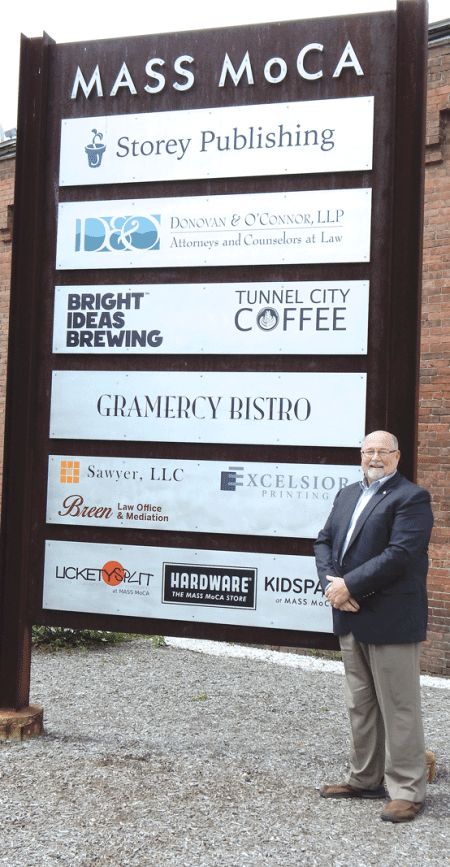
Mayor Richard Alcombright says recent developments like the expansion of Mass MoCA are raising North Adams’ profile as a destination.

Mayor Richard Alcombright says North Adams used to be a little mill town that people had to drive through to get to Stockbridge, Williamstown, or popular spots in Southern Vermont.

“But over the last decade, we’ve become a place to stop and are really finding our way to becoming a destination,” he told BusinessWest, adding that there are many projects in various stages of completion that will only enhance the city’s growing popularity.

The $65 million, third-phase expansion of the Massachusetts Museum of Contemporary Art (Mass MoCA), which will double its footprint, adding 130,000 square feet of gallery space and enhancing the outdoor courtyard space, is expected to be finished next year. The work is taking place on the south end of the campus of the former Sprague Electric factory, whose 16 acres of grounds and 26 buildings with an elaborate system of interlocking courtyards and passages was transformed into the museum in 1999. When the renovations are complete, the North Adams museum will be the largest of its kind in the country.

Mass MoCA has had a regional economic impact of $24 million annually, and drew more than 160,000 visitors last year alone. The numbers are expected to increase, especially since the $100 million renovation and expansion of the Francine and Sterling Clark Art Institute two years ago in nearby Williamstown continue to grow and have helped strengthen North Adams’s position as a destination for arts and culture.

Alcombright calls the two institutions “cultural bookends,” and said the expansions have boosted confidence in the city and inspired private investments on a scale not seen in decades.

Indeed, Salvatore Perry and Karla Rothstein of Latent Productions in New York City had no plans to invest in North Adams until they drove through the town two years ago to pick up their daughter from a New Hampshire camp.

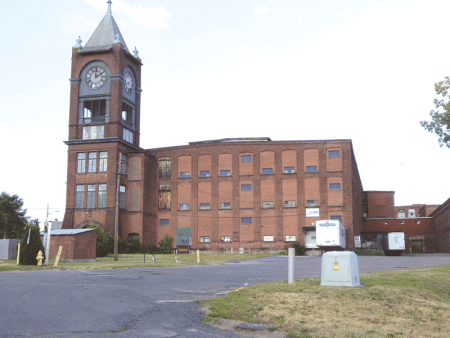
They had never been to the Berkshires and planned to visit the Clark, as it’s called, but when they spotted the Cariddi Mill (originally known as the Greylock Mill) that stretches 700 feet along Route 2 in North Adams on 7.8 acres, their plans underwent an abrupt change.

The couple has focused on developing properties with unrealized potential in Manhattan and Brooklyn, but seeing the former cotton mill that was for sale led them to scrap plans to see a concert at Mass MoCA that night.

Instead, they did some research, met with the owner and broker the next day, and purchased the 240,000-square-foot property for $750,000. “The building is a magnificent structure, and as architects, the potential was immediately apparent to us,” Perry said.

The next year was spent conducting research to determine the best potential use for the property and list any challenges that would be involved in rehabbing the site.

The couple formed a new limited-liability company called Greylock Works, which reclaimed the property, and work began last October in an area known as the Weave Shed. The goal was to transform it into a 32,000-square-foot event space, and although it was not finished, it was introduced to the public via a New Year’s Eve Party that attracted 600 guests.

Site foreman Joe Boucher said the space will be complete in July, and pointed out the newly installed wall-to-wall windows facing the street and the unusual sawtooth construction which floods the space with light.

“It will hold 1,000 people and is a resource that doesn’t exist in the region,” Perry noted.

The next phase of the project will involve the renovation of an adjacent, 32,000-square-foot area that will be turned into a retail food hub or artisanal food incubator, with a butcher shop, bakery, cheesemakers, and a restaurant situated off of a main interior corridor. Each business will have a small area for retail operations and also have room to conduct wholesale operations to help sustain a flow of year-round revenue.

“The focus is to bring activity, great jobs, events, and fantastic food production to this portion of the site,” Perry said, adding that renovating the event space and food incubator will cost between $5 million and $6 million.

When that portion of the mill is finished, plans will be implemented to build a hotel, amenities for it, residential condos, and a park on the rest of the property.

Renewed Interest

In addition to cultural offerings, North Adams has an endless panorama of hiking trails, and the Hoosic River, which runs directly through the city’s downtown, is one of few area waterways that supports wild brown trout.

Alcombright said other draws include the Massachusetts College of Liberal Arts, and the fact that North Adams and Williamstown, which is home to the Clark and Williams College, are linked by Route 2 has led the communities to piggyback on projects whenever they can.

Another project based on private investment between the two has begun at the site of the former Redwood Motel on 915 State Road in North Adams. It was built in the ’60s and was in a state of disrepair until it was purchased last April for $350,000 by a group that includes Boston developers, a Brooklyn publisher, and a musician from the band Wilco.

Project Manager Eric Kerns said the group formed an LLC called Beyond Place for the project, and initially planned a creative renovation of the 18-room motel. But the vision has grown, and the parties have assembled nearly 50 acres of property, including the 65,000-square-foot Blackinton Mill site north of the motel and 45 acres of former industrial land contiguous to it. The plan is to connect the properties and build a resort that will appeal to Millennials and young families in Brooklyn, Boston, and other communities.

“They’re primed to discover the Berkshires as a tourist destination,” Kerns said of the younger demographic. “Although the area has a lot for them, including music, art, and outdoor recreation, most hospitality properties are still targeting a much older demographic.

“We want to create a home for the next generation of Berkshire visitors,” she went on, “and plan to take a familiar site and reorient it back from the road toward the river and prioritize what new generations are looking for.”

A house that sits on the motel property will be renovated and turned into a central lodge, and an old farmhouse to the east on the newly purchased grounds will also be reimagined.

“This project is moving forward at an accelerated rate, and the goal is to have all 47 rooms completed a year from now when Mass MoCA completes its third phase of renovation; we feel that an economic renaissance is happening between North Adams and Williamstown, and we are at the center of it,” he continued, adding that a profound confluence of the Appalachian Trail, the Mohawk Trail, and the Hoosic River can be found on the property.

Thomas Krens, who once directed the Guggenheim Museum in New York and its overseas satellites, and was one of the driving forces behind the establishment of Mass MoCA, has proposed another project for North Adams: a $20 million model-railroading and architecture museum in Western Gateway Heritage State Park that has a footpath directly across from Mass MoCA’s south gate.

“The idea has been very, very well received by the state, the community, and the private sector,” Alcombright said, adding that the museum — which would be twice as large as the Miniatur Wunderland, a model-railway attraction in Hamburg, Germany that is presently the largest of its kind in the world — is expected to bring another 200,000 to 300,000 visitors to North Adams each year.

The Hoosic River Revival is another endeavor that promises to enhance North Adams and bring new life downtown by a radical revision of the existing flood-control system. A plan has been designed that will protect the city while making the waterway a focal point and promoting recreation along it that will enhance the city’s cultural and economic vitality.

The existing flood-protection system was built in the ’50s. It is bordered by a chain-link fence, runs through two and a half miles of the downtown area, and contains 45-foot-wide, three-sided concrete panels that are 10 to 15 feet high, which make it impossible for fish to live in that section of the river.

The project was spearheaded by resident Judy Grinnell in 2008, and since that time a dedicated coalition, which formed a nonprofit three years ago, has raised a total of $800,000 (including $575,000 from the state) for the revival.

“The river is an integral part of our downtown,” Grinnell noted, explaining that two branches bisect and merge at the end of the last building on the Mass MoCA complex.

The importance of the project was driven home when Hurricane Irene hit in 2011 and the river rose within two feet of the floodwalls.

“It was opportunistic that we started this project when we did because the system is aging. It is not going to flood any time soon, but three of the 20-foot panels have fallen in over the past 15 years, and six are leaning,” Grinnell noted, adding that officials are working with the Army Corps of Engineers, and a plan has been created that will include community gardens, a bike path, and other amenities designed to bring people downtown.

Last year the state Legislature appropriated $8.75 million for the project as part of an environmental and energy bond bill, and the nonprofit received $500,000 to design a half-mile section as a pilot project, which is in the approval process.

“The Hoosic River revival is an ecological project, but it’s also an economic-development project,” Grinnell said, citing other cities such as Providence, R.I., and San Antonio, Texas, where access to the riverfront has helped spur revitalization and create vibrant downtowns.

Changing Landscape

When Alcombright took office in 2010, North Adams had a $2.3 million budget deficit with $100,000 in reserve. Today, the city is in a much different position, and for the last two years has had a balanced budget with $1.6 million in reserve.

The mayor said taxpayers bore the brunt of the problem, but thanks to new projects underway, the city’s future is on a fast track to success.

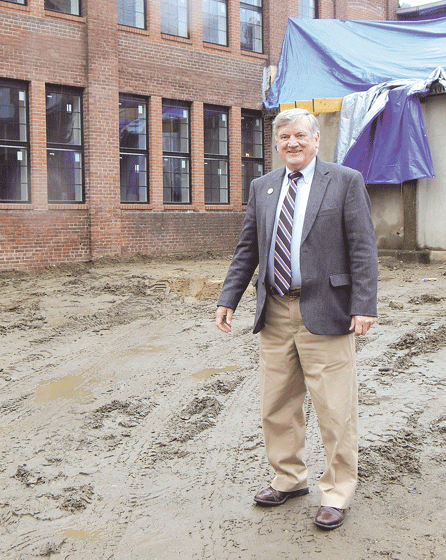
A $30 million renovation of the former Silvio O. Conte Middle School that transformed it into Colgrove Park Elementary School was completed last winter, and the building opened in January. Nearly 80% of the cost is being reimbursed by the state, and the new school will add to the city’s appeal.

“We managed to sustain ourselves through the bad times, have built our way back up, and are starting to see growth; we’re on the upside of the hill and are starting to feel some excitement,” the mayor noted as he spoke about Mass MoCA and the private investments taking place.

Perry agreed. “North Adams is at a turning point,” he said. “When we decided to invest here, the regional hospital was shutting its doors, and now, almost two years later, it’s phenomenal to see the optimism and investments private developers are planning alongside major institutional achievements by places such as Mass MoCA and Williams College.”


North Adams at a Glance

Year Incorporated: 1878
Population: 13,354 (2014)
Area: 20.6 square miles
County: Berkshire
Residential Tax Rate: $17.39
Commercial Tax Rate: $37.93
Median Household Income: $41,531 (2013)
Family Household Income: $52,202 (2013)
Type of government: Mayor; City Council
Largest Employers: Crane & Co.; Northern Adams Regional Hospital; BFAIR Inc.
* Latest information available

Features

Meetings of  the Minds

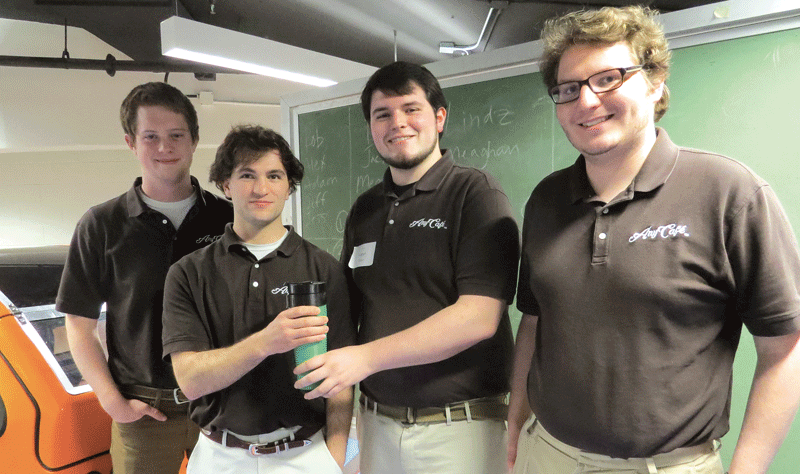
The team at AnyCafé

The team at AnyCafé: from left, Evan Choquette, chief information officer; Logan Carlson, CEO; Chris Urciuoli, president; and Ryan Noon, chief technical officer.

‘Community’ and ‘network.’ Those were the two terms used time and again by members of the second cohort of Valley Venture Mentors’ accelerator program to describe the program — and they speak volumes. While those involved with the 36 ventures are competing against each other for prize money, they are also staring down the same challenges of entrepreneurship, thus making that journey a little less daunting for their colleagues.

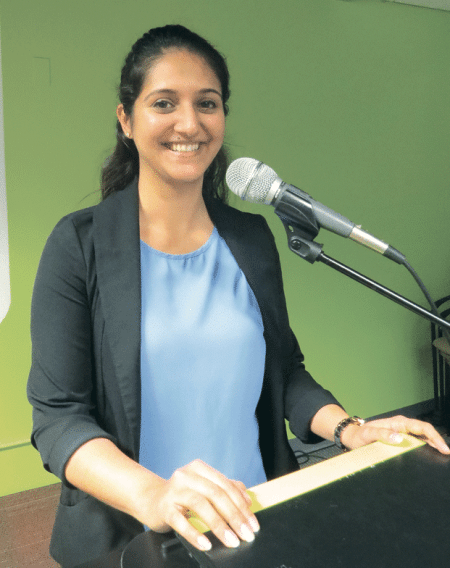
Jas Maggu was relating some personal sentiments. But she was also speaking for every member of Valley Venture Mentors’ second accelerator cohort — and also anyone who’s tried to turn an idea into a business.

Jas Maggu

Jas Maggu, founder of AuthenFOOD

“As an entrepreneur, it can get really lonely, and you have huge ups and downs,” said Maggu, who has launched a venture called AuthenFOOD, which will bring gourmet, healthy foods right to one’s doorstep. Through her participation in the four-month accelerator program, which wrapped up a week or so ago, she finds she is far less lonely.

And also more enlightened, more confident, better connected, and, in her mind, better able to stare down the many challenges standing between her and success.

She is not alone in these sentiments. Indeed, as BusinessWest talked with several members of the 36-member cohort — some of whom had already given final presentations before their peers, while others were going to have to sleep on it another night and stand at the podium the next day — many common sentiments were expressed.

Individually and collectively, they spoke of camaraderie and shared learning experiences; gaining a firmer grasp of their specific concept, the market for it, and what it will take to advance it; making important connections; and simply being able to share common challenges and emotions that explain what Maggu meant when she spoke of loneliness.

These sentiments came from a diverse audience trying to advance a seriously eclectic mix of business concepts. For example:

• Joe Salvador is on the verge of bringing to the market a new silencer, or noise suppressor, for firearms, a product he believes will resonate with shooters trying to not only improve their accuracy but save their hearing;

• Chris Urciuoli heads a team of fellow Western New England University engineering students trying to seize what they consider a huge opportunity with a product that will enable the user to brew a cup of coffee anytime and anywhere — hence the corporate name AnyCafé. They’ve already heard from the CEO of Keurig, who told them he believes they have the next logical entrepreneurial step in the ongoing saga of the K-Cup;

• Dr. Alex Louizos is a vascular surgeon and co-founder and CEO of Nanotech Galaxy, which is working to produce software that will enable surgeons to operate more efficiently and healthcare providers to reduce their expenses;

• Lora Fischer-DeWitt has developed a line of jewelry called Scout Curated Wears that is already in a number of gift stores in the region, including Cedar Chest in Northampton;

• Angela Lussier has launched a venture called Speaking School for Women, which, as that name suggests, was conceptualized to help women become better public speakers and, overall, more effective communicators;

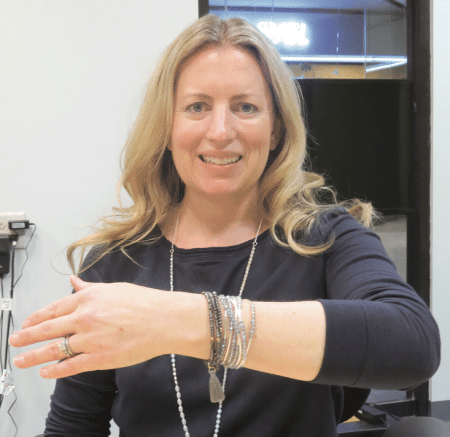
Lora Fischer-DeWitt

Lora Fischer-DeWitt, founder of Scout Curated Wears

• Tom Skypek is co-founder of an online networking tool he bills as a “Match.com for government contracting professionals”; and

• Terra Missildine, already a serial entrepreneur — she has a ‘green’ cleaning company — has launched a family-friendly co-working space called Cultivate. She jokingly notes that she wishes she was in the accelerator before she opened the doors (more on that in a bit), but she nonetheless credits the experience with helping her attain early success.

Vastly different people with a wide range of ideas and a common dream (actually, several of them) — that’s what the cohort is. As for what it’s about … we’ll let the entrepreneurs do the talking.

In the course of doing so, they go a long way toward validating the optimism expressed by those who believe the intense accelerator regimen will help steel its participants for the rigors they will face and create a host of new employers for the region.


2016 VVM Accelerator Finalists (in alphabetical order)

AnyCafé: Developer of hot beverage solutions for the future, including the Travel Brewer
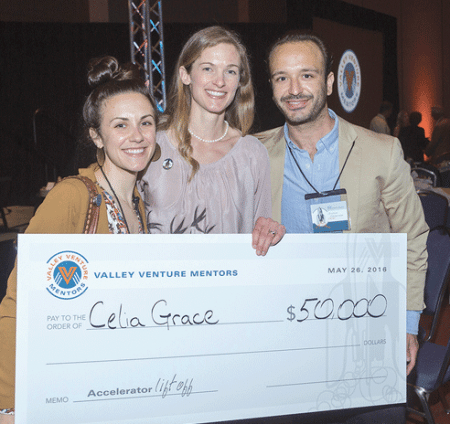
Celia Grace: Fair-trade, ethical wedding dresses that give back and empower women around the world
DaVinci Arms: Designer and manufacturer of firearms suppressors and accessories for mission-critical applications
Homebody Holistics: Maker of all-natural, hand-crafted, herbal cleaning solutions using no harsh chemicals or additives
iRollie: Niche-market phone-case manufacturer and online retailer featuring the rolling tray phone case
Livingua: An app that connects travelers to locals who know the language and culture wherever and whenever they want
Name Net Worth: Connective platform that leverages trusted relationships to measure and strengthen a user’s personal and professional networks
Need/Done Inc.: Instant help for kids at home from people your parent network trusts
Prophit Insight: Software company that helps healthcare providers identify and acquire unique sources of physician referrals
Scout Curated Wears: Designer, curator, and producer of thoughtful women’s accessories
Sumu: Works with property managers and landlords to post fee-free apartments to help users find their next home
Treaty: Nanotechnology company whose flagship product is FogKicker, a biodegradable anti-fog solution made from nanocellulose


Getting Down to Business

“Joe’s the man.”

That opinion was expressed loudly by someone in the conference room at VVM headquarters in Tower Square — exactly whom wasn’t entirely clear to BusinessWest — but there were several heads nodding at the suggestion.

‘Joe’ is the aforementioned Joe Salvador, and the commentary about him was not simply in reference to his suppressor concept — although that’s part of it. It’s clear that, over the past four months, he’s been able to help several of his cohorts, through everything from valuable connections to words of wisdom.

“Joe has put me in touch with someone I’m courting to be an advisor,” said Skypek. “And I know a lot of that has happened across the board; there’s a nice community of people here who are all in this together.”

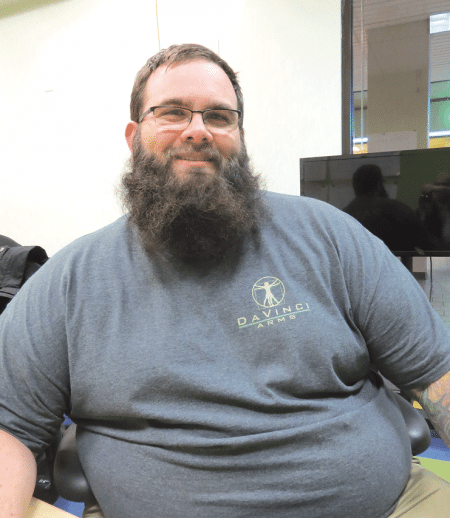
Joe Salvador

Joe Salvador says the accelerator process has helped him better articulate his suppressor concept and identify target audiences.

Such reflections cut right to the chase when it comes to explaining the accelerator and its inherent value — to those taking part and the region as a whole. Indeed, while the 36 participants are competing against each other for bigger shares of the $250,000 in prize money that will be awarded at the Accelerator Awards on May 26 — everyone will get at least $1,000, and the top prize last year was $35,000 — they are, as Skypek said, in this together.

‘This,’ specifically, being the struggle — because that’s exactly what it is — to turn an idea into a viable business. So, in many ways, the accelerator is a type of support network.

The cohort members are in various stages of development — Missildine and Fisher-DeWitt, as mentioned, were already in business, while those at AnyCafé entered the program with simply a concept — but they all have the common goal of accelerating their progression.

The program they were chosen to be part of helps in that regard in several ways, from rugged weekend boot camps focusing on specific aspects of business management to back-and-forth between participants, to interaction with mentors who can help the entrepreneurs with the issues right in front of them while also assisting them with seeing around the corner and anticipating what will come next.

Much of this support could be described as a form of tough love, or challenging the participants, said Missildine, among others, noting that friends and family members, while they mean well, will often tell entrepreneurs what they think they want to hear.

“Here, you’re confronted on your assumptions, and you have to essentially prove things,” she explained. “And that’s important, because as an entrepreneur, you don’t always have someone pushing back on you regarding the assumptions you make about your business.”

Salvador said the various efforts to challenge his team to identify a market for its product and outline a course for moving forward have certainly helped in the progression of DaVinci Arms, which he described as a spinoff from Wilbraham-based FloDesign, which has developed noise-suppression equipment for several applications, including the military.

“When we started this, we had a really strong product that we had developed, but we really didn’t have the business side locked down — you had two engineers running the company,” he explained. “Through VVM, we’ve been able to gain a laser focus on every aspect of what was needed to grow our startup.

“We needed to have our financials really well-addressed, what our customers and market segment were, how we were going to engage that customer segment, what we were looking at for funding, how we were going to raise that funding, and much more,” he went on. “Basically, all the minutiae that builds up the business, that’s what we needed help with: the details of financing, marketing, and sales, all coming together.”

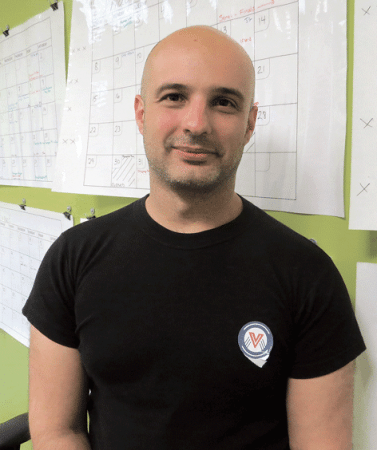
Dr. Alex Louizos

Dr. Alex Louizos credits the accelerator with helping him create more effective presentations for his software concept.

Through all of that, VVM and its accelerator program helped DaVinci hone its presentation and target it to a specific audience, he explained, adding that, before, the team was giving highly technical presentations that effectively went over the collective heads in the audience.

“At the start, I knew that suppressors were selling like crazy, but I didn’t know who they were selling to,” he explained, adding that, through the accelerator experience, the venture has gained key contacts, identified its primary audiences, and drawn a road map for moving forward, starting with product demonstrations and putting the suppressors in the hands of distributors in gun-friendly states like Florida, Texas, and Utah.

Missildine said the accelerator process has also helped her with the audience-identification process and other aspects of her business. She’s grateful for the help, but wishes it had come earlier; if it did, she might have done some things differently.

“I’m a lifelong entrepreneur, and I’m extremely impulsive,” she explained. “I opened the doors to my business in the second month of the accelerator, and already see what I would have done differently if I had gone through the whole experience prior to launch.”

Elaborating, she said she would have shopped, and negotiated, more effectively for a space for the co-working venture — she joked that she has the highest overhead of any venture in the Valley — and she would have expanded her team and not tried to do everything herself.

Through the experience, though, she’s proven what she’s believed all along — that her concept is scalable. And along the way, she’s found “camaraderie and community” on a scale she couldn’t have imagined.

“The accelerator plugs you into so many more resources than the homework that you do,” she explained. “By going through this, I feel that my company’s in a much better place.”

In Good Company

Louizos feels much the same way about his venture, which centers around using artificial intelligence — what he calls “smart software” — that empowers doctors to diagnose patients more quickly and also enables hospitals to analyze data in a way that saves both time and money. He credits the accelerator experience with helping him sharpen his business focus and better articulate complex subject matter.

“When I started the accelerator, I couldn’t describe what I was doing in a way that a 5-year-old would understand,” he noted. “I received lots of critical feedback in a way that helped me explain my idea in a way that makes sense to everyone and also creates some enthusiasm about it.”

Summing up the experience, he said it helped him identify and understand the weakest aspect of his business — because, as the saying goes, it’s only as strong as that point — and improve upon it.

Meanwhile, the team at AnyCafé didn’t exactly have a business when this accelerator session started. Instead, they had a concept, and a bold one at that — to bring to the market a device that would brew a single cup of coffee anywhere the consumer chooses.

The key to this concept — and what has apparently kept others from bringing something like it to store shelves — is battery technology that fuels the heater in the thermos-like device, team members noted, adding that they have perfected this technology and are ready to scale up this operation.

But the science was and is only a part of the equation, as the accelerator experience has shown them.

“We didn’t have much entrepreneurial experience, but we knew we wanted to do this,” said Urciuoli. “Over the past four months, VVM has taught us the way you have to think to succeed as a startup company; they’ve given us the spirit and the knowledge to go out and create our product and a plan to get it to the market and millions of individuals.”

Logan Carlson, another of the AnyCafé partners, agreed, and, echoing Salvador, said the accelerator experience has provided insight not available in the college classroom — especially the engineering classroom.

Tom Skypeck

Tom Skypeck was one of many who used the term ‘community’ to describe the 36 accelerator participants.

“It’s been a tremendous teaching experience,” he said. “Our knowledge has increased exponentially, just because of all the amazing people who are here.”

Maggu has been part of this teaching experience from many sides — she was a venture capitalist “in another life,” as she put it, and has been involved with VVM as a mentor. Now in the role of entrepreneur, she understands, even more than she did before, the importance of connections and learning from others going through similar experiences.

The accelerator process has given her both. Indeed, through her involvement with the program and connections made, she’s been able to forge a partnership with Fitness Together, one of several health clubs she works with to help individuals lose weight by eating better.

And she’s also learned by listening to and interacting with the other 35 participants.

“It’s been great to be part of this tremendous community,” she said, “where everyone you know is going through the same phases that you are.”

Like Maggu, Fischer-DeWitt said the prospect of starting a business can be very isolating. She then added another adjective: scary.

Things are somewhat less so than four months ago, she said, making frequent use of the words ‘network’ and ‘community,’ as so many others did, to describe what VVM, and especially the accelerator, creates.

“The connections have been amazing,” she said, adding that her business is growing rapidly — she’s now in 130 stores and has sales representatives in more than 20 states — and her experience in the accelerator will help her manage that growth and continue the expansion process in a smart fashion, literally and also figuratively.

Only the Lonely

The four AnyCafé partners now have matching dark brown golf shirts with their company’s logo. They had them on as they made their final presentation that Friday evening.

But they have much more than this wardrobe option, thanks to the accelerator. They have, as Urciuoli, said, much more of an ability to think as businesspeople, and not simply engineers with an idea.

Their learning curve, similar to that of other participants, but also unique in some ways, is what the creators of the accelerator program had in mind when they conceptualized it.

That, and making entrepreneurship just a little less lonely.

And in that mission, they have succeeded beyond all expectations.

George O’Brien can be reached at [email protected]

Community Spotlight Features

Community Spotlight

Mayor William Martin

Mayor William Martin says renovations are being made to transform the century-old former Lunt Silversmiths building into medical offices.

Mayor William Martin says projects that were started years ago are coming to fruition in Greenfield, and new ones are underway that will help the town continue down its path to independence, as well as addressing areas that need revitalization.

The Town Council just approved a $5 million bond to create a municipal Internet, phone, and data-services company called Greenfield Community Energy and Technology (GCET) that will be paid for by the company after it is established. Free Internet service is being provided on Main and High streets until the project is completed, thanks to a $500,000 pilot program, and 82% of voters voiced approval for GCET, which will provide the bandwidth and speed needed to stay competitive and attract new businesses, as the town has lost some in the past due to a lack of technology.

“We’ve been given the green light to move forward with this project,” Martin said, noting that, in addition, Greenfield Light and Power began operating as a municipal aggregation plan more than a year ago and brought not only lower-cost electricity to the community, but measures to procure the energy from renewable sources.

“The company went online Jan. 1 last year, and now all of our electricity is 100% green,” the mayor told BusinessWest, adding that the public utilities will increase the likelihood of retaining businesses, encouraging them to expand, and enticing new businesses to move to the community.

GCET will also allow the Greenfield School Department to administer the Partnership for Assessment of Readiness for College and Careers (PARCC) exam to public-school students; the test is aligned with Common Core standards and replaces the Massachusetts Comprehensive Assessment System (MCAS) test.

Other compelling reasons for installing an up-to-date fiber-optic system include the fact that Greenfield Community College has a downtown campus, and the town established the Mass. Virtual Academy at Greenfield five years ago on Main Street, the Commonwealth’s first virtual K-12 public school.

Public utility companies will play a vital role in maintaining the town’s independence, but they are only a part of other major initiatives taking place. The new, $66 million Greenfield High School opened its doors last September, and the new, $73 million Greenfield Trial Court is expected to open in October, benefiting downtown businesses and restaurants that suffered when construction began on the courthouse about three years ago and operations were temporarily moved several miles away.

Keeping Pace

Martin told BusinessWest that, although some people over the age of 50 still think of downtown Greenfield primarily as a place to do retail shopping, that business has moved to malls, which makes developing a new identity critical to the neighborhood’s future.

“Greenfield is fortunate to have maintained some of its luster and attractions that are extremely unique, such as the century-old Wilson’s department store and Gardens seven-screen cinema,” he said, noting that the downtown area also contains new ethnic restaurants as well as federal, state, and county agencies, including the courthouse, Baystate Franklin Medical Center, the county jail about a mile away, and the new, $14 million intermodal John W. Olver Transit Center that serves Franklin County Transit Authority bus routes and provides intercity bus service as well as a train station that houses Amtrak’s Vermonter line.

Greenfield Trial Court

The new, $60 million Greenfield Trial Court is expected to open in October and restore lost foot traffic to downtown businesses and restaurants.

In spite of these major institutions, the temporary courthouse move did affect a number of downtown businesses. However, some made accommodations to make up for revenue that was lost, including restaurants that started delivery services.

But when the Greenfield Trial Court opens next fall, the attorneys, courthouse employees, and people scheduled to appear in court are expected to help to restore the regional downtown center to its former vitality.

However, city officials are well aware that academics, government, education, and manufacturing are the fast-growing industries in the Pioneer Valley.

“So we’ve applied a special focus to advancing our downtown in these specific areas,” Martin said. “Downtowns of the future will be more service-oriented, with attention paid to the needs of individuals and families, rather than the wants. And an increase in pedestrian traffic will stimulate the development of other small businesses offering entertainment, food, boutique shopping, and social, cultural, and religious gatherings.”

He added that the town’s focus on healthcare is exemplified by the planned development of the former Sears Department store into medical, dental, and professional offices. The Lunt Silversmiths property about 1.5 miles from Main Street is also undergoing substantial reconstruction for conversion to a residential medical treatment center of 65 beds operated by Behavioral Health Network and other clinics, which complements Greenfield’s regional position as host to Baystate Franklin Medical Center.

“We’re actively soliciting medical groups,” Martin noted, adding that Patriot Care, which provides medical marijuana, has purchased the former American Legion building at 7 Legion St. just off Main Street, and is renovating it to suit its needs, and a former convenience store a half-mile from downtown was purchased by a cardiology practice with several hundred clients and is expected to open in June.

Other efforts are being made to enhance the downtown, and last month the Town Council approved spending $4.2 million to build a new community center on a one-acre site a block from Main Street, which will serve as a senior center during the day and offer space for classes in the evenings and on weekends.

Martin said a 100-year-old building on the site which currently houses the central office for the school department will be either demolished or converted to housing, and the office will be moved to the middle school.

In addition, a central communications center for the county is in the planning stages, and will be located in a strategic area on West Main Street, which Martin describes as “an area that requires stimulation and planning with both private and public development.

“It is blighted, so we want to fill it in and make it more attractive to stimulate further development,” he told BusinessWest, adding that a number of buildings there have already been demolished, redeveloped, or scheduled for major renovations or redevelopment.

Town officials are also working to create a village of tiny houses, which are growing in popularity, on a ¾-acre lot at 102-106 Deerfield St. A bike path is situated to the rear of the lot, and a formal bike lane was established on Route 2 after the town adopted the Complete Streets program, a transportation and design initiative that promotes safe travel for walkers and cyclers.

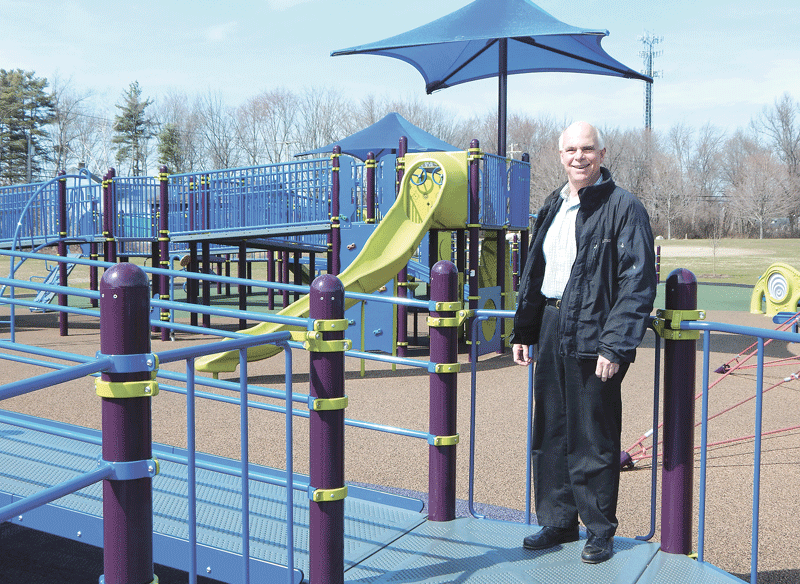
Greenfield also received a $177,000 grant to create a new dog park a short distance away at Green River Park off of Petty Plain Road, as well as a $400,000 PARC grant to install a new playground, signage, basketball court, and pickleball court and revamp the parking lot.

“It will be a big expansion,” Martin said. “Right now, the park only contains two softball fields, a basketball court, and a parking lot. But in addition to the improvements and expansion, next year we expect to create a mile-long walking and biking path around the park that will provide a quiet, meditative place where individuals and families people can take their kids to enjoy a walk by the river.”

Measures have also been taken to address flooding from the Green and Deerfield rivers on Deerfield Street, which have caused real problems in the past for Mohawk Meadow Golf Course and the Department of Public Works treatment plant. Streetscape and engineering work has been done to prevent future floods, including the installation of a unique set of storm doors on the DPW building.

Martin added, however, that condemned properties with flooded basements are still monitored, while fire ravaged-buildings have been removed.

Continued Growth

Greenfield hopes to build a new library to replace the current structure on Main Street, built in 1880, which lacks the space and modern amenities needed to keep pace with today’s needs. A state grant was procured to pay for a design, and a forum was held last month to inform residents about evolving plans.

Martin said the town’s finances are in good shape, and it was fortunate to be able to negotiate contracts with the unions that will allow it to maintain a steady cost of living, while reducing the increase over time.

Although the residential tax rate is high, he noted — Greenfield ranks fourth in the state in that category — valuations are low, so the average homeowner pays $3,934 in real-estate taxes, ranking 211th in the Commonwealth.

So, the combination of new projects and long-awaited ones coming to fruition has officials excited about the future.

“We’re looking to continuously strengthen our unique approach to reframing Main Street, and our next step will be to make it an attractive destination for young people with curious minds,” Martin said, adding that the town hopes to open an innovation center and a program that would allow businesses to share services.

He told BusinessWest that two manufacturing companies have plans to move Greenfield, and officials hope to build on the success of businesses that have been in town for years and work with the school department to shorten the path from graduation to job security.

“We believe that municipal investment will act as a catalyst for private investment and set the town up to repair and replace institutional buildings and needed infrastructure,” the mayor added, noting that new sewer and water lines and pump stations are being installed throughout the town.

Upcoming challenges will include a lack of parking when the new courthouse opens because it was built on a former parking lot.

“But we’re looking forward to the revival of foot traffic, which will help downtown businesses, although things won’t really settle down until construction on a new multi-storied garage is complete,” Martin continued, explaining that strategies to deal with the issue may include measures such as a shuttle service to distant parking lots.

But the town is keeping pace by installing utilities and technology that will keep it independent, attract young people, and offer businesses all they need to be successful in the years to come.

Features

A Y’s Guy

Scott Berg

Scott Berg

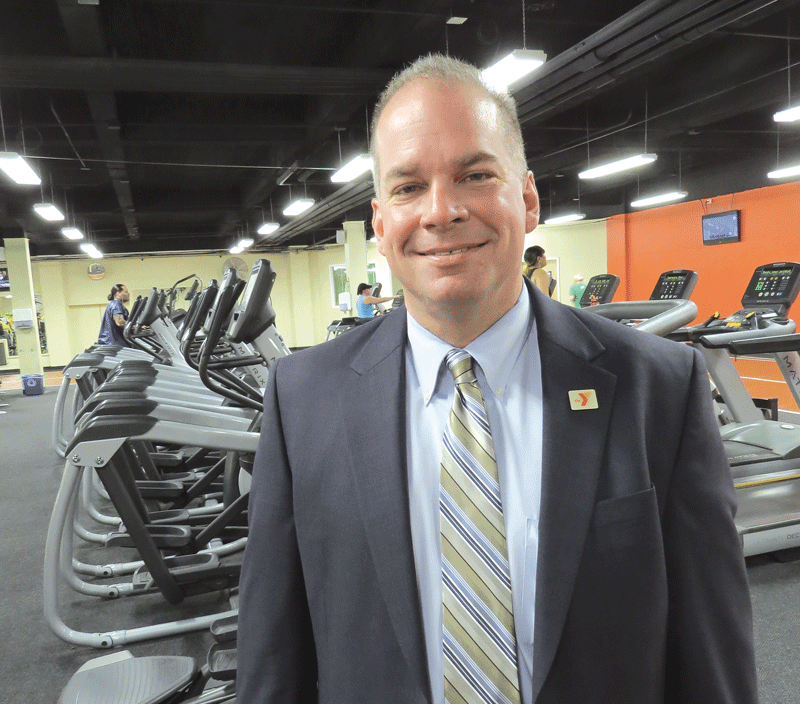
Scott Berg has a long history with both the institution of the YMCA and the Greater Springfield Y, the second-oldest in the country. Thus, he has a firm understanding of the many challenges now facing the local agency and the need for strong partnerships, or connections, as he called them, to bring about a more solid financial footing.

Scott Berg was certainly no stranger to the Greater Springfield YMCA when he walked through the doors of its Chestnut Street facility that day in January, his first as president and CEO.

In fact, one could make a strong argument that no one knew this organization, launched nearly a full decade before the first shots were fired during the Civil War — not to mention the myriad challenges it was now facing — better than he did.

Indeed, he first started working at the facility more than 20 years ago, when then-director Steve Clay tapped him to be senior program director of the organization’s youth and camping services. He would go on to play the lead role in the development and chartering of the Scantic Valley branch of the Springfield Y in Wilbraham, and then direct all aspects of a $6.5 million capital campaign to build a home for that branch and renovate other YMCA facilities.

And after he left the Y’s employ to pursue other career opportunities, including key development roles at both Springfield College and Western New England University, he remained involved with the organization, especially as a long-time board member.

So he certainly knew his way around the Chestnut Street offices when he arrived in January as successor to Kirk Smith — especially the route to a small conference room of sorts that he fashioned out of an old administrative office that, decades earlier, had served as what amounted to the front desk when the Y operated a hotel-like operation on its upper floors.

“I knew we needed a better place to have meetings — a quiet place where we could brainstorm,” said Berg of his small-scale renovation project.

And there has been quite a bit of that brainstorming over his proverbial first 100 or so days in office. Meetings in that new conference room have involved everything from the difficult but necessary decision to shut down the branch the Y opened in Agawam only 18 months ago due to membership levels far below those projected, to a desperately needed refinancing of the Y’s debt — a deal negotiated with a half-dozen area financial institutions led by Monson Savings Bank, to the ongoing saga involving the Dunbar Community Center.

“I came into this with my eyes wide open,” Berg said of his career decision, noting that these are some of the more challenging times this organization has seen in its long history.

They are in many ways similar to the perilous financial straits the Y maneuvered through during his time in the mid-’90s. What enabled the organization to navigate that whitewater, he explained, was a combination of imagination, determination, and the ability to both forge new partnerships with the broad community the Y serves and connect people with the institution. And he expects that same formula will propel the Springfield institution to better, far more solid footing.

Chestnut Street

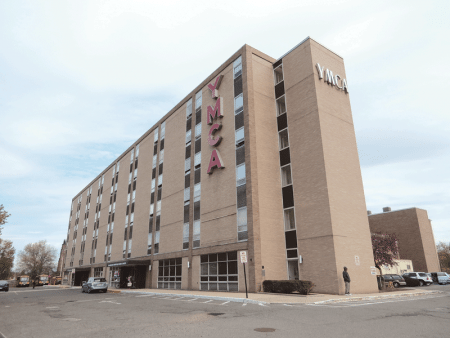
When Scott Berg talks about a “new YMCA,” he’s not necessarily talking about replacing the building on Chestnut Street, opened in 1968.

“What I want to do with the team is address the most pressing challenges — financially and programmatically — that face us now,” he explained. “We have to look at the problems that will be confronting us over the next two or three years, but at the same time determine where we want to see ourselves past that three-year mark moving forward.”

Looking ahead, he noted that, as the Y prepares to mark its 165th birthday, the facility on Chestnut Street — part of a huge urban-renewal effort in Springfield’s North End — will approach the half-century mark itself, a milestone that has already prompted considerable talk of a ‘new Y.’

Berg uses that term himself, but not necessarily in the context of a replacement for the aging Chestnut Street facilities — a step he acknowledges is still many years away. Instead, he uses it to refer to the organization as a whole and if and how it should be reshaped to better serve constituencies ranging from its members to the larger community.

“The YMCA is not a building,” he insisted. “The Y is a mission, and we need to go where the people are. The Y can go anywhere and be anywhere.”

For this issue, BusinessWest sat down with Berg in that new meeting room he created to talk about the organization, its challenges, its future, and how he considers himself fully equipped to lead the organization to better times.

A Good Fit

As he walked through the Y after his interview with BusinessWest on his way to the fitness center for some pictures, Berg stopped to talk with several individuals.

They ranged from an obviously pleased teen sitting in the front lobby who had just that morning secured his driver’s license, to an elderly gentleman in the locker room who has been coming to the Chestnut Street facility since the day it opened in 1968, to a Springfield-based lawyer walking some laps on the fitness center’s track, something he’s been doing for decades.

If he seemed totally at ease in those surroundings and with such people, it was with good reason. Indeed, Berg said he’s been around and, in many ways, part of YMCAs his whole life, dating back to when his mother was a volunteer at the original Agawam branch back in the ’70s.

He took part in a number of its programs, including what was known then as Y Indian Guides with his father.

For Berg, the Y shifted in nature — from being something he participated in to something he aspired to do for his career — when he worked as a staffer at Camp Sloper in Southington, Conn. while in high school and college.

As things turned out, he was far from the only future YMCA director working or staying at the camp during his tenure; there were several, in fact, and they remain in touch today, said Berg, talking about everything from their respective families to common challenges facing their Ys.

Berg started his career with the Y organization in 1991, a year after earning a degree in English at Boston College, as youth and family director of the Waltham Family Branch of the YMCA of Greater Boston.

In 1994, Clay, whom Berg had met while both were working for Ys in the eastern part of the state, offered him a somewhat similar opportunity in Springfield, as youth and camping services program director, and he accepted it.

“It was really good timing,” he recalled. “He was looking for a youth and camping director, and I was a youth and family director. At the time, we were just starting a family … it was a great opportunity.”

Over the next decade, he would hold several titles with the YMCA of Greater Springfield, but was most noted for his work with the creation of the Scantic Valley branch — a name that stems from the river that runs through several communities in that area.

It all started with Clay deciding to act upon multiple requests he’d received for a teen center in Wilbraham, an assignment he gave to Berg. Over time, Y leaders saw a need for additional YMCA programming, he noted, adding that this led to the eventual creation of a new Y branch that provided services through partnerships with, and facilities at, Wilbraham Monson Academy, Healthtrax, area schools, and other sites.

Growing participation in such programs led to a feasibility study that concluded there was ample demand for a full Y branch in the Wilbraham area, said Berg, who led the efforts to raise money to build the current facility in Post Office Park on Route 20.

Berg ran that Y for a few years before leaving for different opportunities. After a brief stint with Action Fire Restoration in Chicopee, which he served as general manager, Berg would shift his career path and segue into higher education and, more specifically, development efforts.

At Western New England University, he served as director of Major Gifts & Planned Giving and, among others, took a lead role in the capital campaign to expand the institution’s law school. And at Springfield College, he was assistant vice president for Development, managing a team that raised an a average of $4.5 million each of the five years he was in that role.

When Clay retired from the Y, Berg said he thought briefly about seeking the president’s role, but quickly determined that the job, which can be something approaching a seven-day-a-week proposition — “it’s a lifestyle more than it is a job,” he noted —  was not the right opportunity at that time, given the young age of his four children.

But Berg, who had been serving on the Y’s board since 2007, stepped down from that panel in 2011 to seek the director’s position when James Morton left to lead the YMCA of Greater Hartford. He did not prevail in that search, but again put out his name in for consideration last fall, because of what he called “devotion to the YMCA” — a phrase he used to reference not only the Greater Springfield operation — the second-oldest in the country — but the institution as a whole.

“I’m a Y person by nature and by birth — this has always been near and dear to my heart,” he said, while noting that the phrase ‘dream job’ doesn’t exactly fit the description for his new position. Instead, he chose to say it’s the right job at this time in his life — and a stern challenge he’s willing to accept.

The Shape of Things to Come

Leaning up against one wall in the new meeting room Berg created is a board honoring the groups and individuals that donated to the so-called Growing Together campaign he led to not only build the Scantic Valley YMCA, but also purchase and renovate Blessed Sacrament Church into the North End Youth Center.

He recalls this as a time when the community rallied behind the Y — one of countless times it has done so during its history — and help propel it to new heights. And also as a tremendous learning experience for him on a number of levels.

“The Y gave me the gift of being able to be a capital-campaign director, and I learned it all, soup to nuts,” he explained, adding that his experiences conceptualizing and then building the new Y branch helped him in those roles at Springfield College and WNEU. “That’s where I cut my teeth on serious fund-raising; we had hundreds of volunteers, there were timelines, expectations … it was really interesting because you have some great conversations, and you never really know where people’s interests are. That was an unbelievable experience.”

He had some others with the two colleges, he said, adding that what he learned from all that work is what he considers the most important lesson concerning development.

“It’s not about asking for money,” he told BusinessWest. “It’s about developing relationships and seeing if people have an interest in supporting the cause; it becomes super effective if you can connect people to your mission. And if you believe in what you’re doing, it’s much easier to get that support.”

Believing in what he’s doing certainly won’t be an issue for Berg in his new role, given his passion for the Y organization and the Greater Springfield institution. And he hopes to use that passion — which permeates the agency, he said — to connect more people to its broad-based and ever-evolving mission.

“We have a great story to tell in terms of the number of young people we serve, the number of teens we serve, and the people we assist who have low and moderate incomes; last year, we gave out more than $750,000 in financial aid,” he explained. “We need to tell that story better and make sure we’re in the businesses that we should be in.”

Moving forward, one of those businesses should include a strong focus on wellness and prevention, he went on, adding that this is one of the recognized needs within the community as the population ages, and the direction in which healthcare, in general, is moving.

“Moving forward, there’s more and more need at YMCAs across the country, including ours, to look at the health-and-wellness component as people age,” Berg explained. “How can we be part of their family and part of their lifestyle and partner with their medical providers and their families to make sure they get the care they need?”

Seeking Fiscal Fitness

More and stronger connections and partnerships will be needed in the months and years to come, he said, because this Y is facing some stern fiscal challenges and difficult decisions.

branch in Agawam

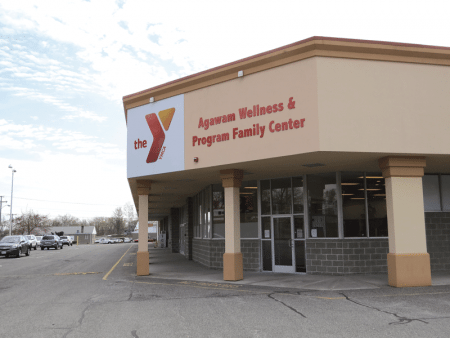
The fiscal problems facing the YMCA of Greater Springfield have prompted many difficult decisions, including the one to close the branch in Agawam, opened in 2014.

One of those decisions has already been made with the announced closing of the 10,000-square-foot Agawam branch at the end of May, closing the book on an operation that looked good on paper, but never lived up to expectations.

“The members there really love it, and they’re wonderful people,” he told BusinessWest. “We just didn’t have enough of them.”

But the Agawam branch’s failure to reach the break-even point is just one factor contributing to the difficult budget situation, he went on, adding that, as expenses have grown over the years, revenues have struggled to keep pace and, in general, have failed to do so.

Dunbar is an example. The Mason Square institution, which has been operating under the dark cloud of foreclosure for more than two years, turned over operations to the Y in 2011.

Those operations have been expensive, said Berg, who summoned the phrase “turning the corner” to describe them from the standpoint of breaking even. The city of Springfield recently threw a lifeline to Dunbar when it announced it would pursue purchasing of the facility, and Berg said the Y might emerge as the winner of a search for an entity to run the operation — hopefully in a more cost-effective fashion.

The mounting financial challenges have forced the organization to do what all businesses and nonprofits do when they reach such a point — take steps to bring the two sides of the ledger, revenues and expenses, into better balance.

Closing the Agawam branch was one step, Berg noted, while another was the refinancing of the Y’s accumulated debt. Several institutions have come together to assist the Y in this endeavor, he said, adding that it should help the $12 million operation with cash flow.

As for the future, and that ‘new Y’ he referenced, Berg said a replacement structure for the Chestnut Street is always something in the back of his mind, but something simply not realistic now or in the foreseeable future.

But, as he said, the Y is not a building, so a ‘new Y’ doesn’t mean a new structure.

“Once we get through our immediate challenges, we need to examine what the Y facility of the future looks like, or should look like,” he said, adding that this means everything from the facilities to the programming. “We need to anticipate what the needs and demands will be over the next 25 to 50 years and then look at how to meet them.”

View to the Future

Aside from providing convenient space for meetings, that renovated office at the Y also offers a great view of the side entrance to the facility, said Berg.

And that allows those conducting business to maintain a focus, figuratively but also quite literally, on what — and whom — they’re in business to serve.

“We can just look out there and see what we’re here for,” he said, adding that this vantage point should help the team at the Y not only weather the current storm but hone its mission to effectively meet changing societal needs in the years and decades to come.

“I look at the Y as a lifestyle — it’s not something you join, it’s something you live,” he said in conclusion, adding this is especially true for him, and this attitude fully explains why he’s now looking out the window every day.

George O’Brien can be reached at [email protected]

Community Spotlight Features

Community Spotlight

Kevin Kennedy

Kevin Kennedy says MGM’s casino is just one of the many positive stories unfolding in Springfield.

Springfield is undergoing a $2.7 billion transformation, and although that number — and the current spate of progress — is dominated by MGM’s $900 million casino, a plethora of other exciting projects are underway.

Chief Development Officer Kevin Kennedy said the city initiated a team effort four years ago with city officials and groups that include DevelopSpringfield, the Springfield Regional Chamber, the Business Improvement District (BID), and the Parking Authority, who convene on a regular basis to collaborate on projects and areas of focus that are proposed or underway.

Each group does its part, and an annual city report is designed to show the public the substantial investments being made.

They include the $88.5 million renovation of Union Station, which is 55% complete and slated to open at the end of the year.

“We all share the same vision,” said Jeffrery Ciuffreda, president of the Springfield Regional Chamber, adding that the chamber wrote numerous letters of support to help secure the funding to revitalize Union Station.

DevelopSpringfield has a number of projects taking place (more about that later), and a groundbreaking ceremony will be staged in the upcoming weeks for the new Innovation Center, which will serve as the cornerstone for the city’s newly designated Innovation District.

DevelopSpringfield President and CEO Jay Minkarah told BusinessWest the center will comprise about 18,000 square feet of space in two formerly vacant adjacent buildings at 270 and 276 Bridge St. and will become the new home of Valley Venture Mentors (VVM), which provides collaborative work space and services to help fledging businesses.

The center, which will be bordered downtown on the south by the MGM casino and on the north by Union Station, will include a café and rental space for young companies as they outgrow shared space at VVM.

The city partnered with DevelopSpringfield on the project, and the Commonwealth awarded a $2 million MassWorks grant to MassDevelopment to support development of the Innovation Center. The agency then sub-granted the funds to DevelopSpringfield. MassMutual also contributed $500,000 to the project, and generous contributions were received from the Beveridge Family Foundation and the Berkshire Bank Foundation.

In addition, the city will soon announce plans to redevelop and refurbish Stearns Square and Duryea Way, which connects to Union Station.

“We’ve developed a collective strategy and vision, and have had a great deal of good fortune,” Kennedy told BusinessWest, referring to winning the bid for the casino and securing funding for Union Station, which was accomplished with help from legislators. However, he and other key figures credit the city’s successful tornado recovery and rebuild efforts that began in the wake of the 2011 catastrophe with their recent success in obtaining funding for downtown projects.

And the plans continue to expand. “We would also like to create a dining district, and are actively working with the BID to create a loan program to encourage new restaurants,” Kennedy noted. “Our future revolves around culture, entertainment, innovation, and dining. MGM is an entertainment giant, and their offerings will be very attractive, but we need to couple them with innovation because that is where the economy is moving.”

Sizeable Investments

Successfully revitalized downtowns feature housing options as well as retail establishments, said Ciuffreda, and the chamber is excited about SilverBrick Lofts, a 200-unit complex with one- and two-bedroom apartments that are slowly being converted from subsidized housing into market-rate rentals. Renovations have been going on for about 18 months as leases expire, and many of the revamped units are already rented and feature exposed brick, reclaimed wood beams, arched windows, and high ceilings.

Union Station

The redevelopment of Union Station is being hailed as one of the keys to revitalization in Springfield’s downtown.

“They’re in an old mill that is actually three buildings in one, and runs from Worthington Street to Taylor Street; SilverBrick sits behind the new Innovation Center and is right across from the open tunnel that leads into Union Station,” Ciuffreda noted, adding that, in addition to housing, there are also a dozen retail spaces in the complex, mostly along Worthington and Main streets. One of them has been rented, and a new chocolate and coffee shop is expected to open there soon.

In addition, MGM’s contract includes establishing 54 new units of market-rate housing within a mile of the casino, and the (now-vacant) former Springfield School Department building on 195 State St. has been identified as a potential site.

“We’re starting to see the rebirth of the downtown with the Innovation District, the new market-rate housing, and Union Station opening in the fall,” Ciuffreda said. “The combination is resulting in a big change while MGM is being built.”

In addition, the Mass. Convention Center Authority has been working closely with the Springfield Parking Authority, and the Convention Center Authority will soon be issuing requests for proposals for a feasibility study to determine the future of the Civic Center Garage.

The Parking Authority has undertaken about $900,000 in structural repair work to the facility, but that patch is expected to be effective for only five years, so the study will show whether the garage should undergo more repairs or be replaced, given that MGM will build a garage to house 3,300 vehicles a few blocks away.

The city, Parking Authority, and Springfield Technical Community College also plan to conduct a study of the upper State Street area to determine the need and feasibility for developing a parking structure there to serve the growing needs of the neighborhood.

In addition, the city recently finished a $6 million reconstruction of Boston Road and has undertaken major work along the State Street corridor that serves as a major east-west connector with the downtown area.

Ciuffreda said real opportunity exists at Eastfield Mall on Boston Road, which has lost its anchor tenants in recent years, but continues to be a popular destination for area residents.

To serve their needs, the Pioneer Valley Transit Authority has a bus service that runs along the corridor. A recent study identified it as a prime route to introduce Bus Rapid Transit to the region, which would originate at Union Station and run to Eastfield Mall — a 7.1-mile corridor that’s one of the most heavily traveled bus routes in the PVTA system, with more than 5,000 riders a day.

Over the coming months, PVTA will host neighborhood and public forums to share information on the system and get input about the service, which would include faster service and fare collection, exclusive bus lanes, and stations as opposed to bus stops.

Work is also going on in other parts of the city. The intersection at Sumner and Harkness avenues was completely reconfigured within the last year, and reconstruction of North Main Street to the Chicopee line has taken place.

A ribbon cutting will be staged next month in Forest Park for the new Eco Center, which is part of the tornado rebuild; construction on the senior center at Blunt Park is about to begin; and work to rebuild the South End Community Center will commence this summer.

Kennedy added that financing is being lined up to redevelop the Indian Motorcycle building in Mason Square, which is partially occupied, and construction should start by the end of the year. In addition, the North End Citizens Council also received a $50,000 state grant to create a master plan for the area.

Preserving History

Minkarah said one of DevelopSpringfield’s exciting projects is the creation of the $1.8 million Lower Maple Business Park, which includes the renovation of the historic Ansel Phelps-Solymon Merrick House and the former Female Seminary on adjoining parcels along Maple Street.

Jay Minkarah

Jay Minkarah says DevelopSpringfield is creating a new business park on lower Maple Street.

The site also includes six commercial garages and a two-story carriage house with a double-bay garage that is ideal for a contractor or other business that needs attached indoor parking. In addition, there is plenty of space for parking on the grounds.

The $1.8 million renovation of the property is almost complete, and is within walking distance of downtown Main Street. A number of offices and suites have been thoughtfully designed, while other space will be outfitted to suit tenants’ needs, and space in the Merrick House at 83 Maple St. will become DevelopSpringfield’s permanent home.

The majority of funding for the project has been provided by the organization, which was founded in 2008 and initially composed of volunteers in the wake of the State Street redevelopment program. Its focus is extremely challenging projects — restoring blighted but highly visible buildings with cultural and historic value that have deteriorated to the point where it is cost-prohibitive for the city or developers to rehabilitate them.

“We’re seeking to meet multiple goals, which include stimulating revitalization and economic development by saving buildings that show decay, decline, and disinvestment,” Minkarah said. “They give the wrong message when people drive by, but if they are restored, it has the opposite effect and helps to bring up property values, which contributes to the economy. We see ourselves as the city’s private, nonprofit development partner.”

He added that the Innovation Center was conceptualized at the end of 2014 when it became apparent that a new vision was needed for the city’s entertainment district.

“We’re hoping not only to create an exciting center for entrepreneurship and innovation, but a place where jobs are created,” Minkarah said, referring to VVM’s programs for startup businesses. “It’s always exciting when new businesses come to a city, but our core strategy needs to be growing new companies here to fulfill dreams and create jobs. We want to stimulate innovation, which needs to be one of the pillars of our economy.

“This project is also about revitalizing buildings that really need renovation and making a very visible investment in an area suffering from a high vacancy rate,” he continued, noting that the total cost, including acquisition and rehabilitation of the buildings, will total $3.5 million.

Other DevelopSpringfield projects include a historic renovation of the Gunn Block on the corner of State and Walnut streets. The organization is also working to bring a full-line grocery store to Mason Square, where it owns about 4.5 acres and is willing to develop the site.

Last August, it purchased a vacant church on the corner of Carew and Dwight streets in the North End and is in the process of acquiring six vacant lots from the city for parking.

Along the Central Street corridor, which was heavily impacted by the 2011 tornado, DevelopSpringfield acquired several vacant lots for redevelopment. New homes have been built on three of them by Viva Development for qualifying, working low-income families, and additional homes are planned.

“Sometimes we are the developer, sometimes we take a lead role in planning issues, and other times we provide support to the city and other nonprofits by serving as part of a project team or by writing grants to secure funding that can lead to revitalization,” Minkarah said.

Bright Future

A city’s reputation centers around its central business district, said Kennedy, noting that, while Springfield has had some problems in recent years, work by multiple stakeholders who share a vision is aimed at changing that perception.

“Our future is much brighter than it was five years ago, and there is a lot of activity going on downtown, coupled with increased lighting and a new police program,” he said. “All of the projects fit together, and we have the highest bond rating in our history, which really adds confidence to everything as we move forward.”

In short, the city is seeing considerable movement, he said in conclusion, noting that, through a concerted team effort, Springfield is enjoying real progress in its efforts to grow, thrive, and attract entrepreneurs, new residents, and visitors in the years to come.

Springfield at a Glance

Year Incorporated: 1852
Population: 153,278
Area: 33.2 square miles
County: Hampden
Tax Rate: Residential: $19.66; Commercial: $38.60
Median Household Income: $50,916 (2014)
Family Household Income: $64,576 (2014)
Type of government: Mayor, City Council
Largest Employers: Baystate Health; MassMutual Financial Group; Big Y; Sisters of Providence Health System; Smith & Wesson; Center for Human Development
* Latest information available

Class of 2016 Difference Makers Features

Scenes From the Eighth Annual Event

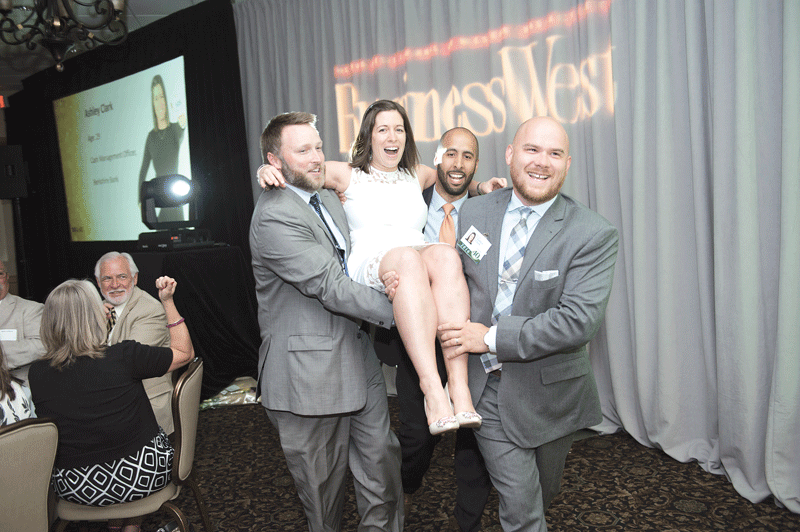
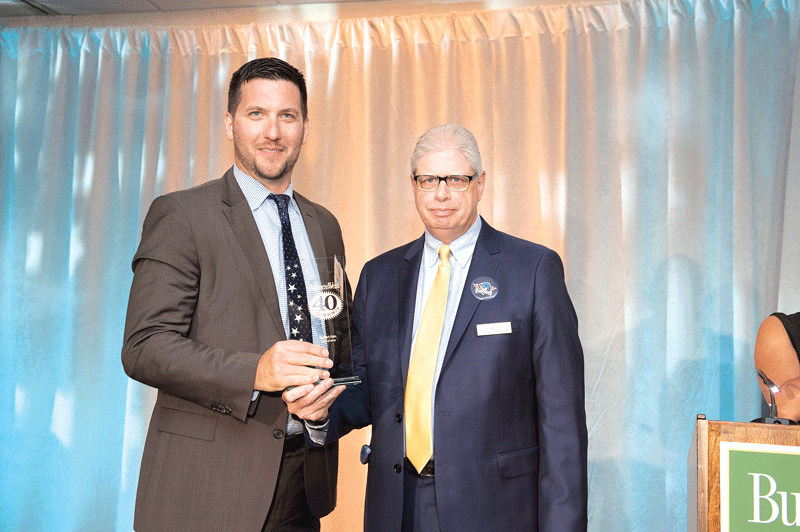
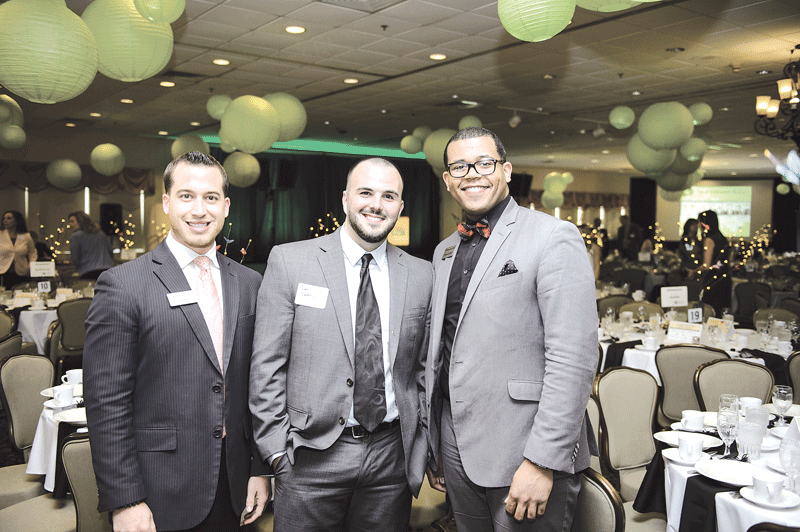
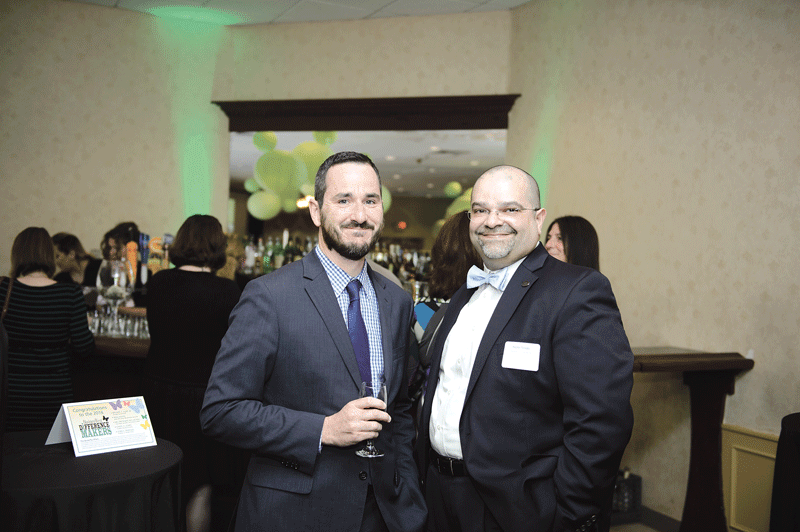
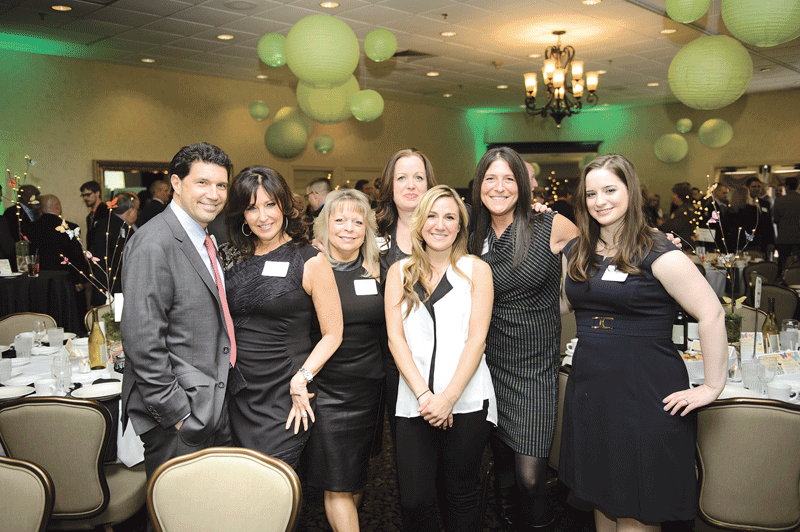
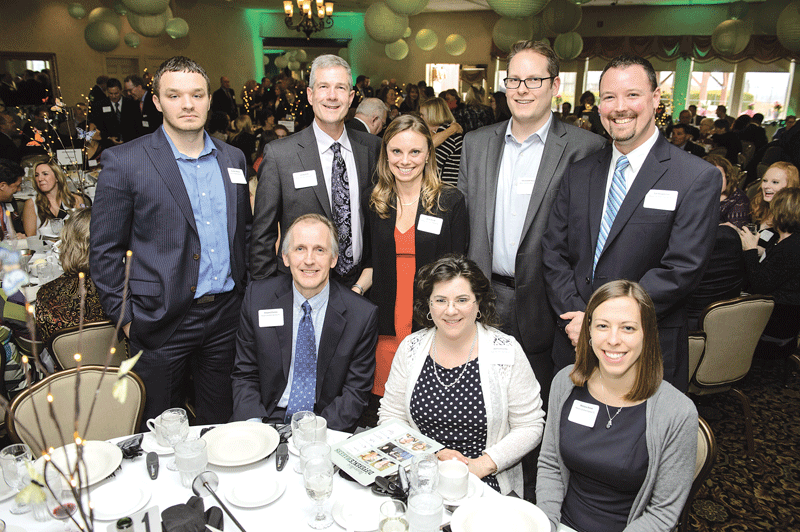
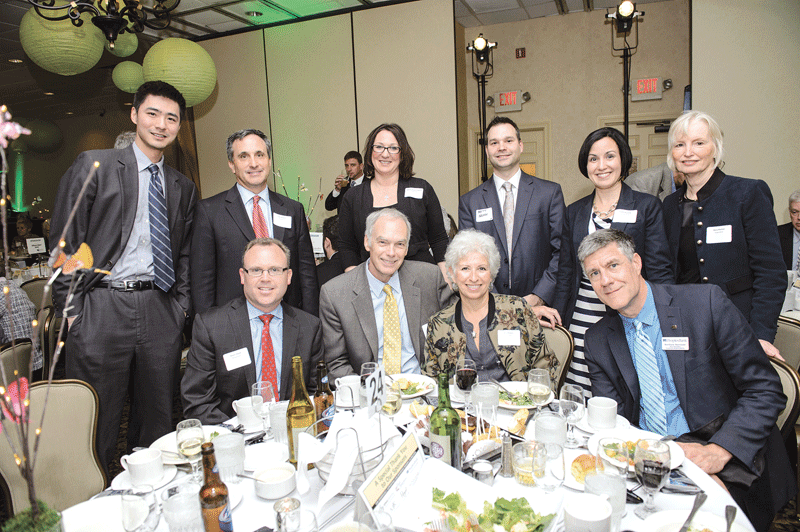
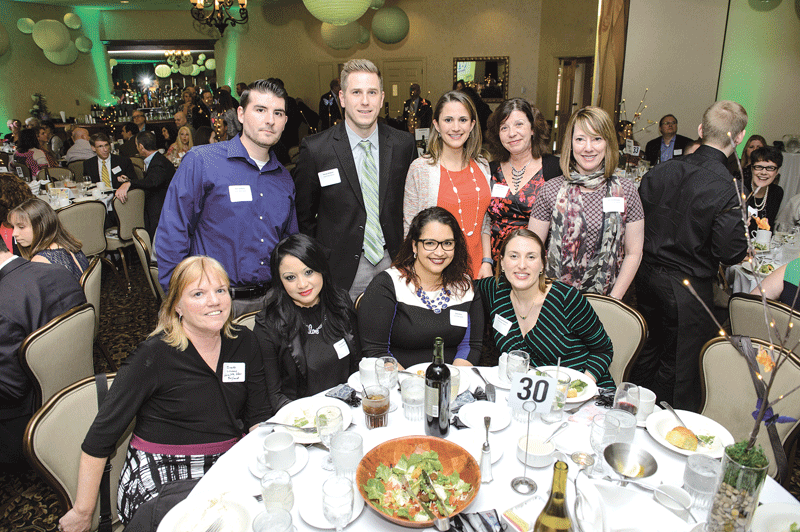
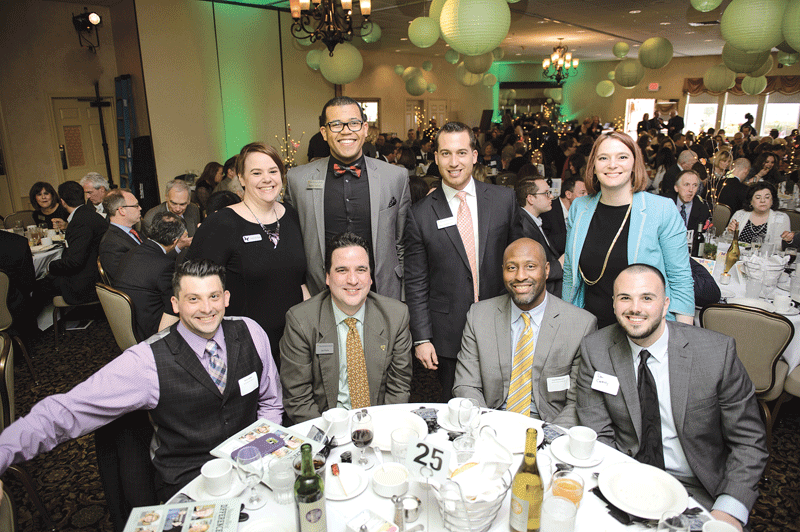
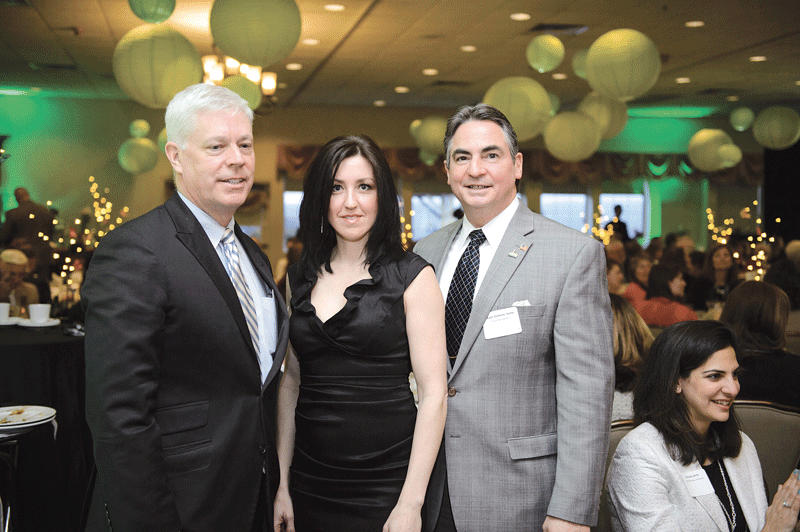
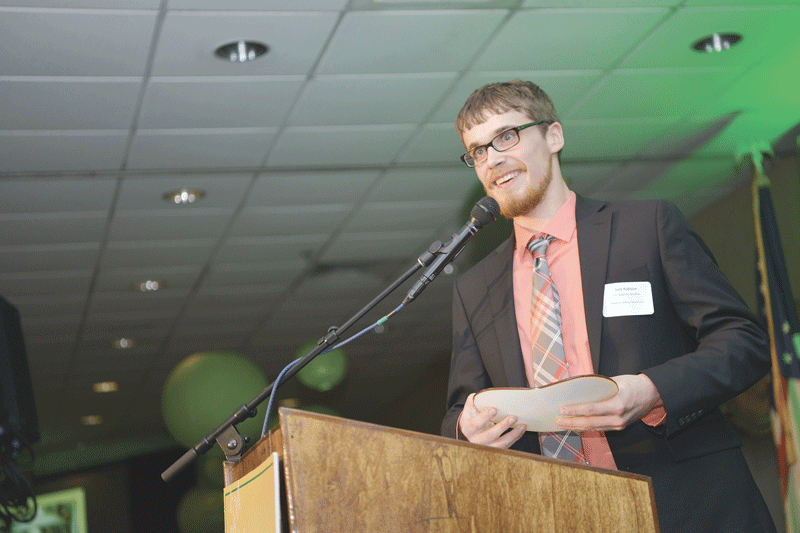
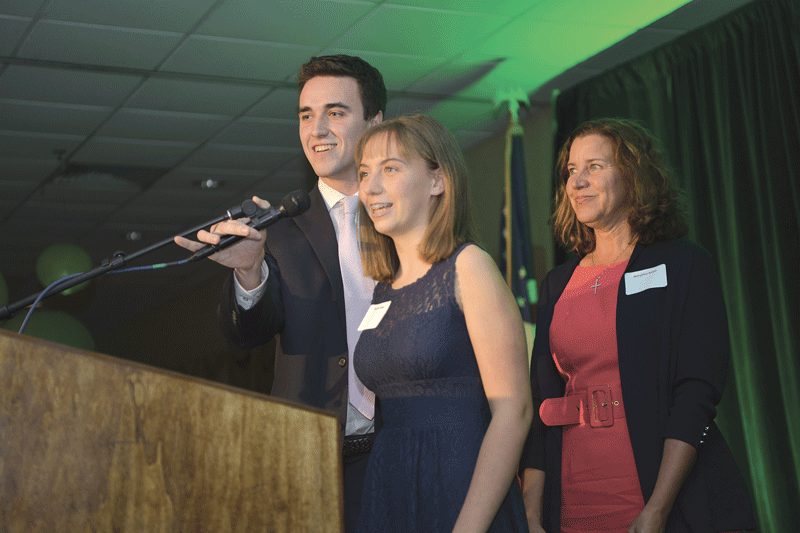
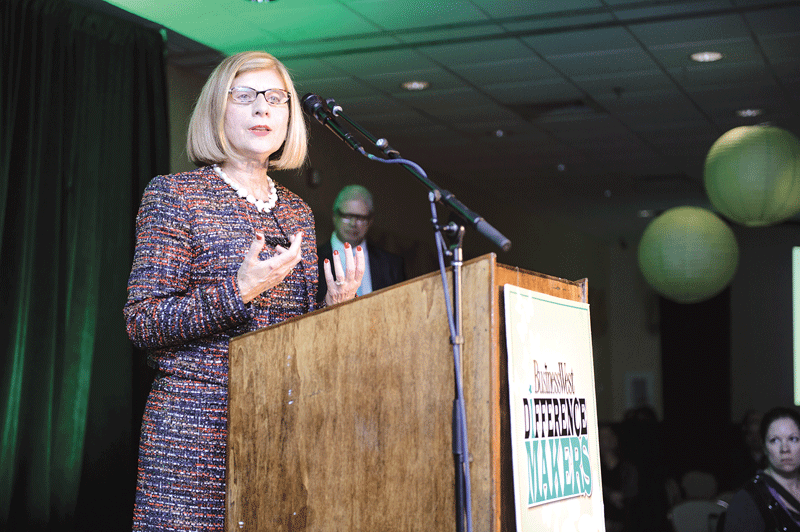
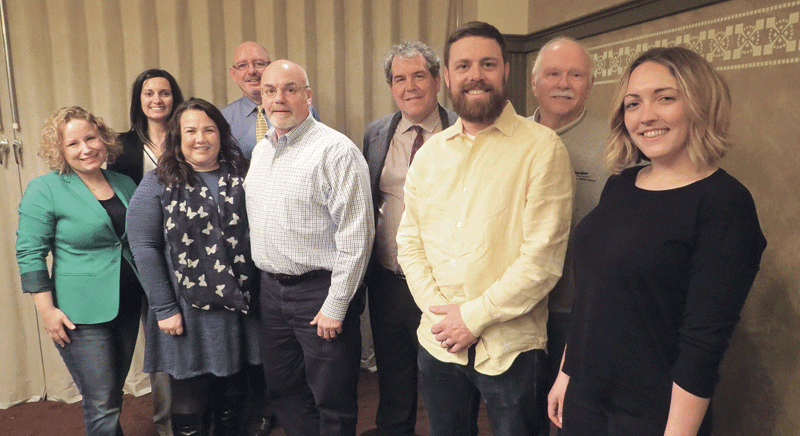
2016 AwardMore than 450 people turned out at the Log Cabin Banquet & Meeting House in Holyoke on March 31 for a celebration of the 2016 Difference Makers, the eighth annual class of individuals and organizations honored by BusinessWest for making an impact in their Western Mass. communities. The photos below capture the essence of the event, which featured entertainment from Veritas Preparatory Charter School and the Taylor Street Jazz Band, as well as fine food and thoughtful comments from the honorees. This year’s class, chosen by the editor and publishers of BusinessWest from dozens of nominations, include Hampden County Sheriff Michael J. Ashe Jr.; the late Mike Balise, Balise Motor Sales and philanthropist; Big Brothers Big Sisters of Franklin, Hampden, and Hampshire counties; Bay Path President Carol Leary; and John Robison, president of Robison Service and advocate for individuals on the autism spectrum. Once again, the honorees received glass plates handcrafted by Lynn Latimer, representing butterflies, the symbol of BusinessWest’s Difference Makers since the program was launched in 2009. Photos by Leah Martin Photography

Sponsored by:

EMAdental
FirstAmerican
HNEnew
MBK
NorthwesternMutual
PeoplesBanks
RoyalPC
SunshineVillage

A chorus of young singers

A chorus of young singers from Veritas Preparatory Charter School in Springfield kicks off the evening’s festivities.

2016 Difference Maker Big Brothers Big Sisters

From 2016 Difference Maker Big Brothers Big Sisters (BBBS): from left, Angela Smith-LeClaire; her ‘little,’ Abby; Executive Director Danielle Letourneau-Therrien; and Kate Lockhart, all of BBBS of Hampshire County; and Ericka Almeida from BBBS of Franklin County.

Marisa Balise (left) and Maryellen Balise

Marisa Balise (left) and Maryellen Balise, daughter and wife, respectively, of Difference Maker Mike Balise.

Representing event sponsor Northwestern Mutual, from left: Nico Santaniello, Dan Carmody, and Darren James.

Representing event sponsor Northwestern Mutual, from left: Nico Santaniello, Dan Carmody, and Darren James.

Bill Hynes, Baystate Health Foundation

Bill Hynes, Baystate Health Foundation (left), and Hector Toledo, People’s United Bank.

Deborah Leone

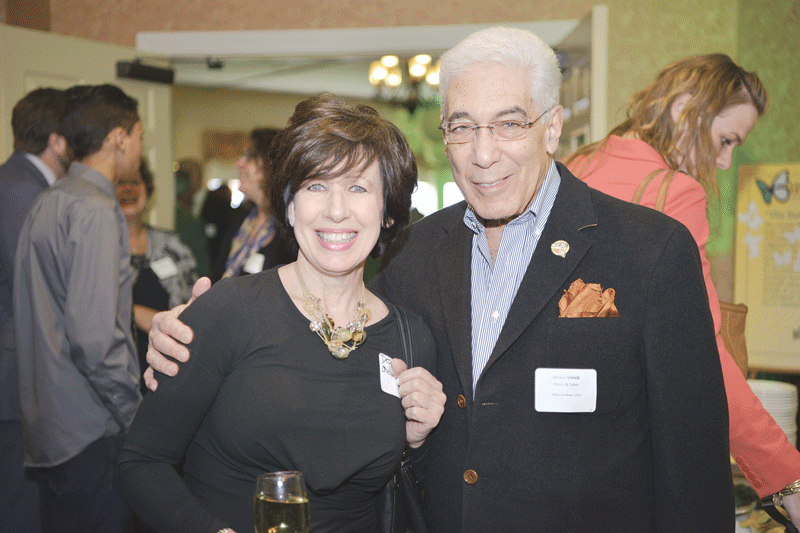
Deborah Leone with 2013 Difference Maker James Vinick, Moors & Cabot Inc.

event sponsor Royal, P.C.,

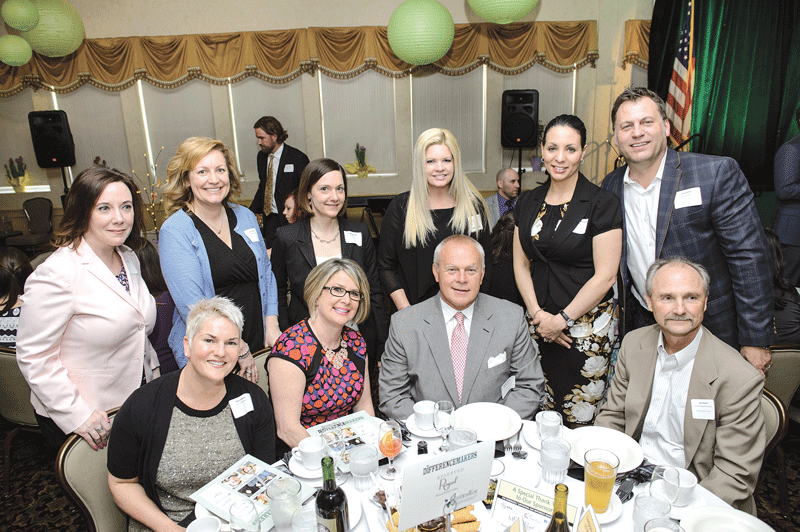
Back row: from event sponsor Royal, P.C., from left: Julie Cowan, Sarah Reece, Shawna Biscone, Founding Partner Amy Royal, Tanzi Cannon-Eckerle, Joe Eckerle. Front row: from left, Amy Jamrog, the Jamrog Group; Dawn Creighton, Associated Industries of Massachusetts; Mike Williams, Royal, P.C.; and 2010 Difference Maker Don Kozera, Human Resources Unlimited.

From event sponsor EMA Dental

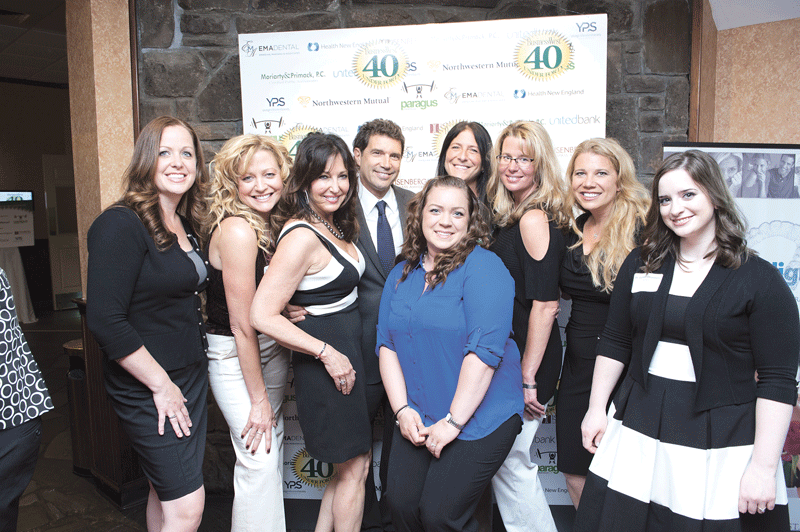
From event sponsor EMA Dental, from left: owners Dr. Vincent Mariano and Dr. Lisa Emirzian, Christine Gagner, Colleen Nadeau, Amy Postlethwait, Dr. Rebecca Cohen, and Dr. Colleen Chambers.

from event sponsor First American Insurance

Back row, from left: from event sponsor First American Insurance, Edward Murphy, President Corey Murphy, Chris Murphy, and Molly Murphy; and Jim Fiola, Westwood Advertising. Front row, from left: from First American Insurance, Amber Letendre, Jenna Dziok, Alicja Modzelewski, Dina Potter, and Noni Moran.

t sponsor Meyers Brothers Kalicka, P.C.,

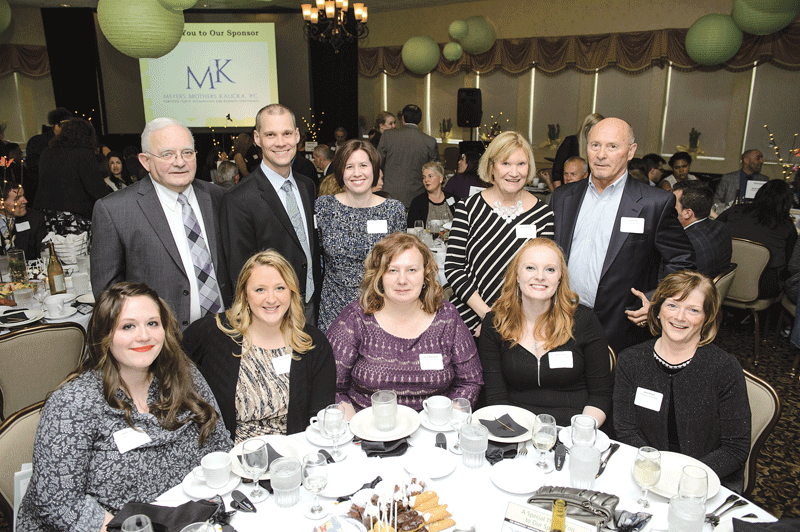
From event sponsor Meyers Brothers Kalicka, P.C., back row, from left: Brandon Mitchell, Managing Partner Jim Barrett, Kristi Reale, Joe Vreedenburgh, and Jim Krupienski. Front row, from left: Howard Cheney, Donna Roundy, and Melyssa Brown.

Representing event sponsor PeoplesBank

Representing event sponsor PeoplesBank, back row, from left: Xiaolei Hua, President Tom Senecal, Meghan Parnell-Gregoire, Matt Krokov, Cindy Wszolek, and Mary Meehan. Front row, from left: Shaun Dwyer, 2009 Difference Maker Doug Bowen, Anna Bowen, and Matthew Bannister.

sponsor Health New England

From event sponsor Health New England, back row, from left: Dan Carabine, Steven Webster, Elaine Mann, Rosa Chelo, and Sandra Bascove. Front row, from left: Brooke Lacey, Aracelis Rivera, Sandra Ruiz, and Nicole Santaniello.

: Jill Monson-Bishop

Back row, from left: Jill Monson-Bishop, Inspired Marketing; Darren James and Nico Santaniello, event sponsor Northwestern Mutual; and Heather Ruggeri, Inspired Marketing. Front row, from left: Daryl Gallant, Joe Kane, Donald Mitchell, and Dan Carmody, Northwestern Mutual.

From event sponsor Sunshine Village

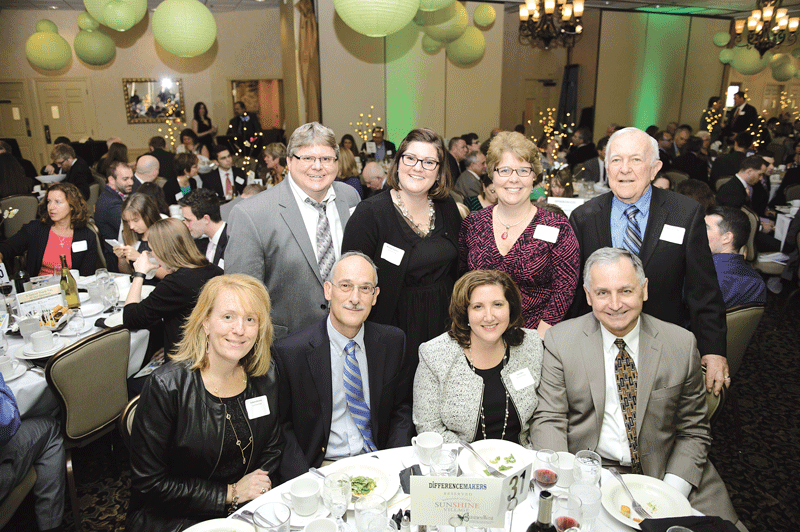
From event sponsor Sunshine Village, back row, from left: Jeff Pollier, Michelle Depelteau, Marie Laflamme, and Ernest Laflamme. Front row, from left: Colleen Brosnan, Richard Klisiewicz, and Executive Director Gina Kos from Sunshine Village, and Chicopee Mayor Richard Kos.

From event sponsor Meyers Brothers Kalicka, P.C.

From event sponsor Meyers Brothers Kalicka, P.C., from left: Joe Vreedenburgh, Jim Krupienski, and Managing Partner Jim Barrett.

Brenda Olesuk

Brenda Olesuk from Meyers Brothers Kalicka, P.C., an event sponsor.

David Beturne

David Beturne, executive director, Big Brothers Big Sisters of Hampden County, and his wife, Julie.

From left: Western Mass. Economic Development Council President

From left: Western Mass. Economic Development Council President and CEO Rick Sullivan, BusinessWest Associate Publisher Kate Campiti, and Springfield Mayor Domenic Sarno.

2016 Difference Maker John Robison

2016 Difference Maker John Robison, who could not attend the event, addresses the audience remotely.

Jack Robison

Jack Robison, son of 2016 Difference Maker John Robison, speaks about his father’s life and work on behalf of individuals on the autism spectrum.

Mike Balise

Mike Balise, honored posthumously as a 2016 Difference Maker, is memorialized by, from left, his children David and Marisa, and his wife, Maryellen.

Carol Leary

Carol Leary, honored as a 2016 Difference Maker, addresses the packed room at the Log Cabin.

 Michael J. Ashe Jr.

2016 Difference Maker Sheriff Michael J. Ashe Jr. takes in the evening’s presentations.

Features

Step by Step

ParadePipes

It was only a few days after the last marchers had passed the reviewing stand at the 65th annual Holyoke St. Patrick’s Day Parade, but committee members were already hard at work breaking down that event and beginning work on the next one. It’s been this way since the beginning, in 1952, for what committee members prefer to call a ‘homecoming’ rather than a parade. The event is in many respects like a half-million-dollar business, but it’s different in one important respect: its lifeblood is committee members who not only volunteer, but pay for the privilege of being part of this labor of love.

There’s a clock in the upper right-hand corner of the home page on the website for the Holyoke St. Patrick’s Day Parade that counts down the days, hours, and minutes to the start of the next one, the 66th, set for March 19, 2017.

It’s there for the potential attendees and the general public, said Michael Moriarty, president of Olde Holyoke Development Corp. and the incoming chairman of the Parade Committee, adding quickly that those who make this event happen don’t need a countdown.

“They have one in their head,” he joked, adding that the roughly 120 active members of the committee (there are nearly 300 total) know just how many days — and at least one actually does know how many hours — there are to the next parade. And they also know what they have to do each month — and even each week — between now and then to assure that this ‘homecoming,’ as they prefer to call it, comes off with as few hitches as possible.

But while parade committee members don’t need a clock, they certainly need a good calendar, excellent time-management skills, and an understanding spouse or significant other, said Moriarty, adding that, if they are truly active — and most are just that — they will attend dozens of meetings over the next 335 days or so. In fact, most have already been to several since the 65th parade concluded just a few weeks ago.

There are no fewer than 22 subcommittees working on the event, said Moriarty, with assignments ranging from the pre-parade road race to marketing; from determining which bands will march to deciding who will receive each of the many coveted honors bestowed each year.

“We have lots of subcommittees because we have lots of moving parts,” he said, adding that what looks like extreme bureaucracy and overkill to some is actually a conscientious attempt to make sure each of those moving parts moves properly by awarding ownership of it to a laser-focused group with the requisite talents (more on that in a bit).

As BusinessWest talked with members of the parade’s Marketing Committee at Johnny’s Tavern in South Hadley just a few weeks after the parade, there were comparisons made between organizing the parade and a running a half-million-dollar business, which is what this is.

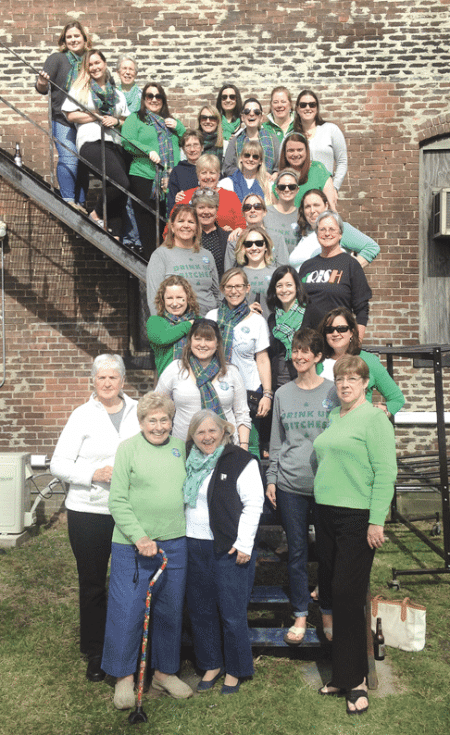
The parade’s Marketing Committee

The parade’s Marketing Committee is one of 22 subcommittees working year-round to make the event a success.

And, in many cases, the comparisons work. The parade, like a business, has to be mindful of revenues and expenses, always with the goal of making sure the latter do not exceed the former. It must also put a premium on customer service and providing value for patrons. And, like ventures across all sectors of the economy, it puts an emphasis on continuous improvement.

But in many other ways, the analogy doesn’t work as well. The biggest difference is that the employees, the committee members, are not only volunteers, but they pay for the right to attend all those meetings and do all that work. Indeed, there is an annual fee or dues payment — a check that committee members look forward to writing.

“We don’t have any paid staff, and we’re one of the very few parades of this size that does not have a paid executive director,” said Moriarty, adding that the event has relied on generations of volunteers.

In a word, the parade is not a business, but a tradition, and so is the committee itself, with many members noting with pride in their voices that they are second- or third-generation participants. But while most traditions are resistant to change — and this one was for many years as well — it has come to the parade and the committee that organizes it, and in a meaningful way, said Alan Cathro, an officer with Meriden, Conn.-based Tucker Mechanical, who pointed at the people sitting at the table to get his point across.

“Until 1988 or so, it was all white men who were asked to be on the committee,” he said, noting that the parade committee was, in many respects, defined by what would be called ‘old Holyoke.’ Today, women comprise roughly half the parade committee, and it is diverse in many other ways as well, said Cathro, referring to race, age, and geography, among other traits.

It is this diversity that has enabled the parade to grow in size and stature and extend its influence well beyond the borders of Holyoke to become part of the fabric of the entire region.

For this issue, BusinessWest takes an in-depth look at the Holyoke parade, the committee that runs it, how this is a tradition that has changed with the times, and why those committee members don’t need a clock ticking down the days.

Marching Orders

When asked about those two dozen subcommittees and their various assignments, Moriarty offered a heavy sigh, but also a determined look that seemed to indicate that he could list them all if pressed and given enough time.

But when afforded the opportunity to provide a sampling, he seized upon it.

There is a committee devoted to the selection of a grand marshal, perhaps the most coveted honor, he noted, adding quickly that there is essentially a committee for each of the many awards that have been added over the years and the announcement events that are part of that process.

These range from the John F. Kennedy Award, presented annually to an American of Irish descent who has distinguished themselves in their chosen field, to the O’Connell Award, presented to a long-standing member of the Parade Committee who has made significant contributions to the fund-raising efforts of the parade and/or the association.

The pre-parade road race

The pre-parade road race has become one of the weekend’s most anticipated events.

There’s also a committee (a large one) that handles both the March road race and the so-called ‘Halfway to St. Patrick’s Day Road Race,’ which, as that name suggests, is staged each fall. There’s a panel to run the annual fund-raising golf tournament in October, another to pick the Grand Colleen and her court, still another that’s charged with producing the annual parade program book (this year’s ran 124 pages), and on it goes.

Meanwhile, there are committees for the many area cities and towns that now have a significant presence at the parade, a lengthy list that includes Chicopee, West Springfield, Westfield, and many other communities.

As he noted earlier, Moriarty said the committees assume ownership of a specific assignment, thus providing a measure of quality assurance regarding all those parts to the whole.

“We break up into different areas of interest, with some of them related specifically to the parade, and some to the many events that precede it,” he explained. “We have a lot of skilled builders on our floats committee, for example; we have folks who assess and select all the bands; we have a coordination committee that works early on to make sure that things are lined up and come out onto the street properly — and that’s a very intensive bit of work that goes on well before anyone shows up in Holyoke.”

In fact, said Cathro, probably half of the subcommittees will have the bulk of their work, if not all of it, done two months before the parade.

But the work for the next year begins as soon as the parade or another specific event assigned to a subcommittee is in the books, said Brian Donoghue, a sales representative with ASICS Corp., who used the Road Race Committee, which he chairs, and its recent meeting to review this year’s race, as an example.

“We went over what worked and what didn’t, and we had a list of really every little thing that happened over those two days, the Friday and Saturday,” he noted. “It was three pages of notes — this went well, this didn’t go well, this needs to change — while it’s fresh in everyone’s mind.”

When asked how it went, he offered a firm “we did OK this year.”

More specifically, “we kept waiting for something to go wrong,” he joked, “and nothing really did.”

This same kind of commitment to detail, critical review, and continuous-improvement philosophy permeates each committee, said Moriarty, and this quality has facilitated continued growth and excellence.

Band of Brothers — and Sisters

Overall, the Holyoke parade, as an institution, likes to look back and reflect on the past, said Cathro, adding that this exercise involves everything from the weather that has greeted the event — everything from snow to mid-70s temperatures — to famous personalities, a list that includes the actor Robert Stack, the historian Doris Kearns Goodwin, the author Tom Clancy, JFK, and his brother, Sen. Ted Kennedy.

But in general, and especially after that year’s parade is in the books, the focus is squarely on the future and writing new chapters to that storied legacy.

Together, the committee, the subcommittees, and their makeup convey how the parade has grown and changed — and, in many important ways, not changed — over the years, he went on, noting, as others did, that the parade has evolved from a Holyoke event into a regional phenomenon now ranked at or near the very top of the nation’s largest and most prestigious St. Patrick’s Day parades — and parades of any kind.

And while it’s not written down anywhere, it is the committee’s basic — and very broad — assignment to make sure that the parade maintains this distinction and is in all ways worthy of it.

Again, as all those smaller committees would suggest, there is much that goes into this, said Moriarty, who listed everything from securing the many local, regional, and even national sponsors for the event to taking the multi-faceted marketing efforts to a national level, to forging a relationship with WGBY, Channel 57, to televise the parade and thus give it status afforded to only a few parades across the country.

demographics

An event run solely by men as recently as 30 years ago has broadened its leadership demographics considerably since then.

What makes the Holyoke parade special and one of the most prestigious events of its kind in the country is the sum of procession that moves through the streets of Holyoke, said Sheila Moreau, vice president of Sales & Marketing and professional development coordinator for Springfield-based Mindwing Concepts Inc., listing everything from those aforementioned celebrities to bands like the internationally known Mummers.

There are expenses attached to most all of those elements, she went on, adding that some bands cost as much as $5,000, and even high-school bands must be compensated for their appearances.

This puts a premium on finding sponsors, she told BusinessWest, noting that this is work the public doesn’t see, but it’s critically important to maintaining the parade’s high standards for quality. And to sell the parade to sponsors, committee members don’t sell it as a parade.

“It’s not just a road race, it’s not just a parade, it’s this whole weekend — it’s kind of a festival of sorts, a true homecoming,” said Moreau, adding that this message resonates not only with local companies like Holyoke-based PeoplesBank and a host of smaller businesses that call the Paper City home, but also with regional stalwarts such as Big Y and international corporations such as Stop & Shop and Aer Lingus. “We have an incredible product for people to be involved with.”

But it certainly helps to be able to show these sponsors just what kind of value they’re getting for their contribution, she went on, adding that the parade’s Marketing Committee can now provide detailed information about just how many individual impressions they will generate by putting their name in front of the 400,000 attendees.

And while it’s essential to note what those selling sponsorships or carrying out the subcommittee work do to make the annual homecoming memorable and run smoothly, said Moriarty, it’s more important to examine how that work is carried out, and by whom.

Regarding the former, he noted that, while there is more diversity than ever when it comes to who works on the parade, the common denominator remains passion for the event and a firm understanding of all that it means, not just to Holyoke, but the region.

As for the latter, as he looked around the table at Johnny’s, he noted the many young faces, the fact that half those present were women, and some of those present were definitely not of Irish descent.

“Those are all very healthy signs,” he said, adding that, where once individuals had to be asked to serve, now people can request to be part of this tradition. And many do, said Moriarty, adding that recruitment has never really been a problem, especially of late.

“I’ve been on the committee for 29 years, and I’ve witnessed this dichotomy — on the one hand, we’ve been successful for a very long time, and you never want to break the stuff that you did right last year,” he said. “So there’s a lot of resistance to change for that very legitimate reason. But at the same time, we’re in a dynamic economy where the source of our sponsors change, and in a world where service oganizations are not growing or getting younger.

“We’re an exception to that — we’re growing, and we’re getting younger, and a big reason for that is the change that allowed women to be members,” he went on. “We wouldn’t have a committee if we weren’t open to bringing women on.”

But beyond the breaking of the gender wall, the parade continues to attract young people from across the region who are drawn by everything from the majesty of the event to the friendships that come from being part of it all.

Moving Experience

Hayley Dunn, a community relations and economic development specialist with Eversource Energy, summed things up nicely.

“I’m a second-generation member, and my sister is a member as well; we have a lot of pride in the history of the parade and the organization and the work that our fathers and grandfathers have done,” she told BusinessWest, using that collective ‘we’ to refer to everyone in the room and those who will be attending all those other meetings over the next 340 days. “So we don’t want to see these events fail. I felt a duty … I came to Holyoke, and I joined the Parade Committee to make sure this amazing homecoming event keeps going. ”

Such sentiments go a long way toward explaining why this event continues to grow in size and stature — and also why none of the committee members need to look at that countdown clock on the home page.


George O’Brien can be reached at [email protected]

Community Spotlight Features

Community Spotlight

Douglas Albertson

Douglas Albertson says Jessica’s Boundless Playground is just one important addition to Belchertown’s recreational culture.

Douglas Albertson says Belchertown officials are in the midst of several major planning initiatives that have converged with the goal of addressing the community’s needs, setting the stage for future growth, and connecting the former Belchertown State School with the town center and Lampson Brook Farm property that borders the edge of the state school and was once part of it.

“Belchertown is poised for the next round of development, and the Planning Department is getting ready for what will come. But we’re making sure that what we do is what the community desires,” the town planner told BusinessWest, adding that making areas contiguous in the town is the main focal point within that vision.

An assisted-living facility called Christopher Heights of Belchertown, to be built by the Grantham Group LLC and contain 83 units, 40 of them affordable, has been approved on the old state school property, but the group is waiting to receive low-income housing credits before breaking ground for the project.

Four buildings have been demolished to make room for the facility, and this year the second phase of demolition on the property has begun with the abatement of the multi-story former auditorium, which will be torn down when it is complete.

The master plan for the former state school created by MassDevelopment contains space for retail shops, offices, and live/work/play units for artisans, but there is a need for connectivity between that acreage and other parts of the town within walking distance, including the town common, the public-schools complex, the police station, the senior center, and businesses and apartments to the north.

To that end, Albertson applied for and received a grant from the American Institute of Architects and the New England Municipal Sustainability Network, which sent a ‘sustainable-design and resiliency team’ comprised of five experts in engineering, architecture, community design, sustainability, and planning to the town. After spending three days in the community gathering input, which included a public forum that attracted close to 70 residents, they conducted research and follow-up interviews, and looked at available development sites. The team’s final set of recommendations is not complete, but the initial report notes that piecemeal planning done in the past needs to be pulled together in a cohesive manner that will fill in gaps that exist.

“The plan is all about the larger community and providing cohesion,” Albertson said.

Selectman Nicholas O’Connor is also helping to plan for the future, and has enlisted aid from more than a dozen people on town departments and boards. He told BusinessWest that, although he hopes the former state school property will someday attract new businesses, retail operations, and restaurants, business owners and entrepreneurs need a reason to want to come to Belchertown.

O’Connor was elected last May, is the liaison for the town’s human-services group that includes about 15 organizations, and believes that adding agritourism and recreational opportunities will help attract businesses and result in visitors who could help them to thrive.

“We get a lot of vehicular traffic, but it is not stopping here,” he noted. “We are land-rich and have so many beautiful places to hike and fish that we should be able to capitalize on that, which would help to create a more fertile business environment.”

O’Connor and other officials believe building a new sports complex large enough to host tournaments would bring more visitors to town, and the Cultural Council wants to create a performance and community space for concerts, drama productions, and other gatherings which could also make a difference. They would, in theory, both benefit residents and draw people into vibrant spaces that could give new businesses and restaurants an opportunity to germinate and do well.

Old-school Thinking

O’Connor cites the former Lampson Brook Farm property as a prime spot to add a sports complex as well as the playing fields that the Recreation Department says the town needs, especially since they will lose some of the ones they have when the old state school is developed.

Obtaining ownership of the property would be timely, because the farm used to be part of the old state school, and Gov. Charlie Baker recently said he wants it removed from the state surplus rolls.

“It contains hiking trails that we can’t use right now due to no-trespassing signs,” O’Connor said.

The town is also hoping to purchase the defunct Patrick Center on 47 State St. near the public-school complex, which has been vacant for more than a decade, for recreational use. It is going through a value assessment and consists of a 4,400-square-foot building on 5.4 acres.

The Norwottuck Rail Trail ends a few miles from Lampson Brook, and O’Connor says if it could be extended through the farm property into the MassDevelopment site, it would provide a connection that would allow people to get from one area to the other more easily.

“The goal is to create a pedestrian zone,” he explained, adding that the town is also petitioning the Pioneer Valley Transit Authority to extend the existing bus route to the courthouse.

Residents are doing their own work to fill in gaps and make Belchertown more accessible and attractive, and the completion of Jessica’s Boundless Playground about 16 months ago on school property off Route 202 across from the police station serves as a prime example. It is fully accessible, contains exercise stations for adults and state-of-the-art play equipment for the small set, and was named in honor of 19-year-old Jessica Martins, who had Rett syndrome and died in 2009 from the H1N1 or ‘swine flu’ virus.

Her mother, Vicki Martins-Auffrey, formed Team Jessica with a group of friends. It raised $600,000 for the park over a five-year period (which included $200,000 in Community Preservation Act funds). In addition, close to $400,000 in volunteer labor was donated, with help coming from local businesses and 200 volunteers from the community who built the playground in two days.

“We had to turn people away,” said Martins-Auffrey, adding that the idea for the boundless playground came from Drew Gatesman and Mike Seward, who contacted her and suggested the park be named after her daughter. “The response to this was incredible. It seemed like we made the impossible happen, as a lot of people didn’t think we could ever do it.”

In addition, several hundred residents have completed four ‘walk audits’ to identify areas around State Street, Route 9, and Route 202 that need improvement and are home to many apartments and shops.

Albertson said town officials recommended installing sidewalk curbs, wheelchair ramps, and other enhancements that could help pedestrians navigate the area more easily. As a result, signs have already been put up to identify crosswalks, and as the state school property is developed, pedestrian accessibility will remain an area of focus.

The town is also planning on making improvements to the section of Route 202 between the state school property and the public school complex, and Albertson said officials hope to implement the state’s Complete Streets policy in the area, which would make it eligible for additional state funding that could pay for new sidewalks, bicycle lanes, and other amenities.

“It’s a great time to do some planning for this in addition to developments at the state school,” Albertson said, adding that, as that property gets developed, it may fuel investments by businesses situated along the nearby commercial zone on Stadler Street.

He noted that a large commercial lot owned primarily by Pride that sits to the west has real potential for development. Pride purchased the 46-acre parcel in 2005, and a few businesses have been established there, including a physician office building, Tractor Supply, and Planet Fitness. The Eastern Hampshire District Courthouse also sits on six acres, leaving 28.5 acres open for development.

The Town Common is about a mile from the courthouse and is included in the larger planning area, and Albertson said the idea is to create a sense of cohesion between it and the area along Route 202 that runs from the old state school to the public school complex.

Infrastructure work is also nearing completion on Route 181 and is expected to be finished in the near future. “It has been rebuilt and was in the works for well over 10 years,” the town planner continued, noting that the roadway has been widened, new sewer lines have been installed, and drainage repairs have been made.

Development is also occurring in the form of a large commercial solar-energy project that was recently approved and will be built toward the end of the year by Nexamp on land that includes a sand pit and a Christmas tree farm situated between Franklin and North Liberty streets.

“We were one of the first green communities, and clean energy is part of our value system,” Albertson said, noting that a previously approved solar farm off Springfield Road has been completed and is expected to go online in the near future.

Businesses are also growing, and Albertson said Universal Forest Products LLC has purchased abutting property with plans to expand.

Forward Movement

Creating cohesion between the town common and the area along Route 202 that is bordered by the public schools complex and the state school on each end is a project that will take time.

But O’Connor and Albertson, along with a supporting cast of officials and active residents, are committed to fulfilling that goal.

“There is connective tissue that overlays everything,” O’Connor said, “and what we have planned is something we need to do not only for ourselves, but to position the town as an attractive place where businesses can grow and thrive.”


Belchertown at a glance

Year Incorporated: 1761
Population: 14,735
Area: 52.64 square miles
County: Hampshire
Residential Tax Rate: $17.97
Commercial Tax Rate: $17.97
Median Household Income: $76,968
Family Household Income: $80,038
Type of government: Open Town Meeting; Board of Selectmen
Largest Employers: Hulmes Transportation Services; Belchertown High School; Super Stop & Shop
* Latest information available

Features

Bad Writing Inc.

By JOEL SAMBERG

Good writing in corporate America is dead.

Well, not really, at least not entirely. But with a considerable number of e-mails, press releases, newsletters, advertorials, and other forms of internal and external communications showing signs of carelessness, it’s not exactly the picture of health, either.

While there is plenty of accomplished writing coming out of Springfield-area businesses and organizations (some generated in-house and some provided by skilled marketing communications agencies), too often it is the sloppy, nominal work that stands out. Through indifference, good writing has been devaluated in corporate America. That needs to be reversed.

It’s bad enough when you receive a poorly written e-mail from the human resources department (after all, they’re the ones who should know all about the skill sets needed to grow business); it’s even worse when a white paper prepared by the corporate communications department has misspellings and misplaced modifiers.

The promotional merits of good, effective writing must never be underestimated. Too many executives and managers fail to recognize that whatever is written on behalf of their products, services, and projects — including hiring efforts and networking ventures — can end up as archival material that represents their companies for years to come, even if that’s not the intention.

This includes websites, brochures, e-newsletters, advertorials, company-wide e-blasts, and much more. In today’s cyber world, anything can show up anywhere and last forever. That’s just the way it is. Rambling, boring, ostentatious, cliché-ridden, or grammatically challenged writing can easily come back to haunt. Good writing from the start pays off.

Unfortunately, fewer people seem willing to take the time. Most employees claim they are overworked to begin with; who has time to reread something twice before sending it out?

E-mail is one of the biggest victims, from subject lines to body copy. How often have you received an e-mail that has absolutely nothing to do with what the subject line indicates? The subject line might say “Kittens & Puppies,” for example, and because of that you may decide to wait until the next afternoon to open it. But it could, in fact, be from your biggest client asking you to meet him early in the morning for an important discussion that concerns an income-earning opportunity.

Your client simply hit ‘respond’ on your last e-mail — the one in which you presented a promotional idea tying in to a local pet shelter — and wrote a new e-mail without bothering to change the subject line. That income-earning opportunity would have been missed simply because the subject line on an e-mail wasn’t changed.

I received a corporate e-mail the other day for which the subject line read “Re,” followed by body copy that said, “Tomorrow is fine my bad for not getting back to you sooner.” The fact is that e-mail is fast and easy — too fast and easy. It empowers us, making us feel as if we are dynamic skippers on the information superhighway with no need for self-evaluation, and certainly none for criticism or even assistance.

Many companies rely on their own employees to provide content for business communications, including websites. Often it’s a budgetary decision: why hire a communications firm or reputable freelancer when writing is a fundamental skill we have all learned in school? I believe that’s one of the reasons why professional writing is not always seen as a valuable corporate commodity.

But here’s the problem: yes, we can all write, but we can all add, subtract, multiply, and divide, too, yet would you want to use just any employee to run your accounting department? Good writing is actually a specialized skill. Fewer people are willing to acknowledge that fact.

Here’s an actual line from a website I recently reviewed: “The owners of the company have made a commitment to continue to provide the excellent service and expertise which has lead to the success of these firms through the years.”

The owners may have a commitment to service, but evidently not to syntax or spelling.

Thousands of press releases are generated every day. When deciding which ones to save and which to discard, editors won’t be charitable to the ones that are weak and unconvincing. Here’s an actual selection from a release issued by a nonprofit organization: “On March 4, three planes loaded with thousands of pounds of emergency resources and supplies delivered much-needed goods to the local orphanage. ‘When we approached the orphanage to see what we could do to help them, we were simply doing what all of us do every day,’ the organization’s president said.”

Does the president’s comment do anything to truly set him and his organization apart?

I took the liberty of pulling together a few simple suggestions to help put an emphasis back on good, effective writing, particularly for the in-house crowd for whom corporate communications may not be a primary job description.

• Reread everything several times before deeming it final — at least once for the sole purpose of eliminating as many words and phrases as possible;

• Avoid clichés like a pandemic;

• Simple words and phrases are always better than those that try to impress;

• Know your audience;

• Recognize that your audience is as stressed and as cautious as you are, and will find it easy to dismiss what they read if it doesn’t grab them right away; and

• Get a second pair of eyes to read all material — preferably someone who isn’t already familiar with the topic. Beg for their honest opinion. Listen to them.

Help might actually be just a water cooler away, because most companies have people on staff with a proven facility for writing and editing who can provide a little bit of editorial support. They may appreciate being asked to help because they, too, may very well wish to keep good writing alive.

So go ahead and send out an internal e-mail to find the right person to provide a fresh pair of eyes. But be careful: in the subject line, please do not write “Fresh Pair.” You’d probably get a nasty e-mail back from HR. You don’t want that — even if it’s well-written. n

Joel Samberg is a freelancer who offers time-efficient, cost-effective corporate writing and editing for businesses, organizations, and individuals. In addition to press releases and newsletters, he also helps out with white papers, advertorials, speeches, brochures, websites, presentations, slogans, special projects, and more; joelthewriter.com; [email protected]

Features

Coming of Age

Peter Ellis, president of YPS, with Ashley Clark, vice president.

Peter Ellis, president of YPS, with Ashley Clark, vice president.

The region’s growing number of young professional groups were all created to fill a void in the region, a recognized need for an organization devoted to people of generally the same age and facing mostly similar challenges, professionally and personally. This void-filling role has included a good deal of evolution and expansion that goes well beyond networking, and into the realms of education, professional development, philanthropy, and stemming that problem known as the brain drain.


If all goes well — and admittedly, a lot will have to go well for this to happen — by roughly this time next year, the Young Professional Society of Greater Springfield (YPS) may be in the Guinness Book of World Records for hosting the largest single-day dodgeball competition on the planet.

The organization had approximately 350 participants for this year’s event, staged a few weeks ago at Springfield College, and is looking to do least as well next spring. If it can get that performance authenticated (and there’s a lot that goes into that, including a $10,000 cost, which the agency is trying to get underwritten), then it will become the record holder.

While that wouldn’t exactly put YPS on the map, it would be a marketing tool of sorts, said the group’s president, Peter Ellis, the so-called “czar of first impressions” (that’s really what it says on his business card) at Springfield-based DIF Design, and a source of bragging rights.

Or another source, to be more precise, he told BusinessWest, adding that, in nine years that went by in a real hurry, the group has succeeded in morphing from a networking group (or partying group, depending on who’s choosing the adjective) into a regional resource on many levels.

A resource, specifically, that has developed programming on everything from helping members become better public speakers to assisting them with that ultra-broad challenge of balancing life and career; from providing information on how to reduce stress (much of it from trying to achieve that balance) to familiarizing members with the people and issues on an upcoming election ballot.

This evolutionary process in many ways mirrors the one that has taken place at Northampton Area Young Professionals, or NAYP. Now boasting 200 active members across the region, the organization has moved well beyond networking, said its president, Christopher Whalen, collections officer at Florence Bank.

Actually, NAYP has always had a strong focus on philanthropy that in some ways differentiates it from many similar organizations, he went on, adding that, from the start, with an event called ‘Party with a Purpose,’ the group has always done more than simply get together.

Its monthly gatherings have always had a designated nonprofit beneficiary, he explained, and NAYP has worked diligently to connect members with opportunities to serve nonprofits, through board fairs and other steps.

Meanwhile, Young Professionals of Amherst (YPA) hasn’t really had any time to evolve. Launched in 2014 and now boasting more than 80 members, it essentially represents what the other young professional groups have developed into, said co-president and co-founder Kate Lockhart, development director of Big Brothers Big Sisters of Hampshire County.

She told BusinessWest that, while the group creates a host of networking opportunities, its mission comes down to creating connections — a term used by all those we spoke with.

For the Amherst group, and the others as well, this means connecting members to each other, connecting them to opportunities, and, most importantly, connecting them to the community with the goal of getting them actively involved.

But there’s another piece to this picture, and Lockhart, echoing sentiments expressed by others, summed it up nicely by saying that these groups give young professionals something they’ve never really had — a voice.

“We want to enable young people to be part of the conversation,” she explained, adding that many people within this constituency don’t believe they have the knowledge or experience to make their feelings known. YPA is not only helping to cure them of such sentiments, it is providing the platform for speaking out.

Kate Lockhart

Kate Lockhart, co-president of Young Professionals of Amherst, says the YP groups give their members something they’ve lacked — a voice.

“Our group is working hard to get people involved,” she went on, “and feeling that what they have to say is really important, and that they’re a crucial part of economic development here in Amherst and across this region.”

For this issue, BusinessWest talked with leaders of several area young professional groups about the ongoing evolution of their missions, rosters of programming, and business plans, and how such work benefits members, but especially the region.

Young Ideas

Those who spoke with BusinessWest said the YP group they now lead was created essentially out of an unmet need, or, even more specifically, a desire to fill a void in a particular region for a group devoted to people of generally the same age and facing mostly similar challenges, professionally and personally.

As Whelan explained, the local chamber of commerce, Rotary Club, Kiwanis Club, and other groups in a similar vein are all fine organizations, and many YP members are also involved with those groups as well, especially the chambers. But they can’t provide all of what a young professional group can — meaning those commonalities and connecting points.

“There was a need for something that went beyond the chamber,” he explained, “a need for a group of professionals at a similar stage in their careers, with common interests and challenges.”

And that’s why, collectively, the officers we spoke with say they stopped counting how many times Baby Boomers have told they them they wished they had something like this to join 20 or 30 years ago, because the number was getting so high.

In Amherst, said Lockhart, there are many groups and initiatives focused on the thousands of college students in that community, and a good number dedicated to older individuals, especially the rising number of retirees who have made the town their home. But the young professionals have been a traditionally overlooked constituency, she went on, and that’s why she and a few others decided to step up and do something about that.

“There’s a gap — there’s the college students, and then the older professionals with their networks, but there was really nothing for us,” she explained. “So a few of us tried to figure out how to make a network for this age group and their specific needs, and, by doing that, build a sense of community in the town we’re living in and working in.”

So, with the goal of filling those voids, YPS and NAYP were launched in 2007, and YPA in the fall of 2014. In each case, the words ‘young,’ ‘area,’ and ‘Greater’ are certainly relative terms. Indeed, while most members are in their 20s, 30s, or early 40s, there are some exceptions. And, in NAYP’s case, for example, the ‘area’ extends well beyond Paradise City and the communities that surround it.

In the beginning, at least with YPS and NAYP, the focus was — and still is, to a large degree — on networking, or bringing people together.

For YPS, the chosen vehicle was named Third Thursday, and it has become a day of the month event planners from other organizations have looked to avoid, at least if they want a large number of young people in attendance. NAYP also chose Thursday, and calls its gathering simply the ‘networking social.’ In Amherst, a town known for doing things differently, Wednesday was the chosen night for what are called ‘after hours events.’

There were, and are, many goals for networking, and most of them involve the professional, career side of the spectrum, said Ashley Clark, YPS vice president and, by day, cash management officer at Berkshire Bank. She noted that she owes her current job to the one she had before it at TD Bank, which she attained (or at the least scored the interview at which she made a suitable impression) through an encounter at a Third Thursday.

“I met the individual who runs all the retail branches in this area, and let him know I was looking for a different position. I met with him, and got the job,” she said, adding that this same scenario has played itself out many times.

But she was quick to note that most of the individuals she now counts as good friends were met through those same YPS events, and this is evidence of the large social aspect of this organization as well.

Ellis agreed, and went on to say that YPS, which counts as members law-firm partners, bank tellers, and everyone in between, can provide different things to people in different professions and stages of their career — be it opportunities for jobs, the ability to solicit new clients, or to build their own “professional network,” as he called it.

And networking remains a huge part of the equation, said Chicopee City Planner Lee Pouliot, the self-described “NAYP elder” (he’s been a member for five years), adding that many members have broadened their business portfolios or gained career opportunities as a result of those monthly get-togethers.

Northampton Area Young Professionals

Chris Whelan, right, president of Northampton Area Young Professionals, with Lee Pouliot, vice president.

But the networking always had a purpose beyond the mere exchanging of business cards, he said, adding that, over the years, he’s seen members also exchanging and advancing ideas for getting more involved in the community and also for coping with the many challenges facing this generation of young professionals.

Ellis agreed, and said he’s noted how his networking, and that of others in the group, has changed as their career progressed and their needs evolved.

“Early on, I would go to gatherings, people would say, ‘you need a web site or some design services, let me connect you to a guy,’” he said, noting that he was the guy in question. “Later, I was introducing people to others and creating connections. You become the locomotive, and it’s as if you’re returning the favor.”

Youth Is Served

Over time, the YP groups’ missions and programming have continued to expand and evolve, bringing into sharper focus those terms ‘resource’ and ‘connections.’

All those we spoke with noted that their organizations are looking to broaden their impact in the region, as well as their membership ranks, by partnering with various entities — other YP groups, a host of business and economic-development agencies including the chambers of commerce, area colleges, and even BusinessWest.

“One of the things we’ve identified from a strategic perspective is the need to identify and develop stronger partnerships,” said NAYP’s Whelan. “That includes our chamber, but also other chambers, Leadership Pioneer Valley, MassMutual’s Employee Resource Group, and others. We want to find ways we can collaborate with one another in ways that are mutually beneficial.”

Meanwhile, the groups are also launching new initiatives that fall into the broad categories of education, awareness, and professional development.

At YPS, the group has added something called the work/life balance committee, which, as that name suggests, concentrates on an area almost every young professional struggles with to one degree or another.

Another committee, focused on professional development, hosts, among other things, CEO luncheons (where participants dine with a CEO, hear him or her talk about their work, and then ask questions) and quarterly breakfast meetings featuring seminars on subjects ranging from stress reduction to public speaking, or, to be more specific, the need for developing strong verbal skills.

“These are little things that strike a chord with members,” Ellis said. “These are issues they’ve identified as important to them.”

NAYP also offers some professional-development programming for its members, said Whelan, adding that this is one area the group is looking to expand in the years to come with initiatives such as a webinar series and other vehicles.

Beyond professional development and work/life balance, though, the YP groups are also finding new ways to provide that voice for young people mentioned earlier.

“We want our members to feel that they should be at the table with everyone else,” said Lockhart, “and not think that, because they’re young, they shouldn’t have a voice.”

While most of the YP groups’ efforts are focused on their members, some are aimed at a different constituency that will hopefully become members in a few years — the area’s college students.

Indeed, the groups are now starting to develop and hone programming designed to curb the so-called brain drain in this region by introducing students to area employers and, in general, trying to convince them that they don’t have to leave this region after getting their diploma to find what it is they’re looking for.

Clark said YPS is looking to develop a pilot program that would help area college students develop the so-called soft skills needed to join the workforce, while also introducing them to potential career opportunities within the 413 area code.

“We want them to attend some of our networking sessions,” she said, “so they can meet the people who can say, ‘listen, you’re going to graduate in three months; I have a job for you.’ That’s an example of how we like to say that it’s not networking, but the business of connecting people.”

Lockhart said YPA is doing something similar in the Amherst area, and while the motivation for such programming was already obvious, her own experiences while attending UMass Amherst crystalized this recognized need.

“We’re trying to get the students who are graduating involved with us,” she explained. “We want them to understand that this doesn’t just have to be a stop on their journey; this can be where they live and work — there are opportunities here.

“I graduated from UMass Amherst in 2013, and I never thought about staying here until someone asked me,” she went on, noting that she came to Amherst from the eastern part of the state for her education. “I said, ‘oh, wow, there are opportunities here? I never knew that.’ There’s a huge misperception among students about this region, and we need to address that.”

A New Age

Looking forward, Ellis and Clark said YPS has reached the point in its existence where a full- or even part-time paid executive director is needed to ease the workload of the board members and, more importantly, to put an even sharper focus on all those elements in the mission statement.

But as with that line in the Guinness Book of World Records, a lot of things will have to go right for that to happen, they said, adding that the group will need to ratchet up its cash flow for an executive director to become reality.

In the meantime, however, the area’s YP groups are making many things go right, for their members, for area college students, and for the region as a whole.

In short, they are coming of age, in every sense of that phrase.

George O’Brien can be reached at [email protected]

Community Spotlight Features

Community Spotlight

By JACLYN C. STEVENSON

John McNinch (left), owner of the Olde Heritage Tavern, and Kameron Spaulding

John McNinch (left), owner of the Olde Heritage Tavern, and Kameron Spaulding, director of the Lenox Chamber of Commerce, take a moment on Housatonic Street, one of the busiest centers for retail and restaurants in Lenox.

John McNinch jokes that his Lenox establishment, the Olde Heritage Tavern, is the “nerve center of the town.”

“That’s why I get all the tough questions,” he joked. “Because the tavern is the heart of any community, including ours.”

Still, it’s true that all walks of Lenox life pass through its doors regularly — members of town government, residents, tourists, and the in-town workforce among them. McNinch himself is a former selectman, current town moderator, and property owner in Lenox — and with his restaurant situated smack in the middle of Lenox Village, the Berkshire County town’s walkable center, he has both a birds-eye view and an ear toward the undercurrent of what’s happening.

Common topics of conversation, according to McNinch, include the overhaul of zoning laws to better accommodate new and diverse businesses. The lack of a vibrant evening and late-night scene in the village is another, and most recently, Lenox has been abuzz about an influx of new hotel developments and renovations, and concurrent discussions about tax incentives for new arrivals in the hospitality sector.

“I think the Planning Board needs to work on revamping our zoning bylaws — and they are — to make it easier to entice businesses to come and do what they need to do, and keep some of our young professionals in the area,” he said. “When we lose them, it’s a big loss to Lenox.”

Indeed, Lenox is a town that is trending older, with a median age of 51, not unlike most of Berkshire County. It’s also not a community that has the infrastructure for big-box stores or office construction for large outfits, said McNinch. But it is primed for small businesses, regional offices, and niche services.

“We need to entice companies here to build small offices, and also continue to offer more to those people and to our visitors and residents,” he said. “I would like to see more shops open later — that’s what we should be offering as a beautiful New England town. Lenox Village is essentially two blocks, but if nothing is open, there is no reason to walk the town past five o’clock. If we could successfully implement things like that, we could change the entire footprint of the town.”

That’s not to say all of the action happens in Lenox Village. Lenox, which abuts Lee, Stockbridge, and Pittsfield, is surrounded by walking and riding trails, most notably those in Kennedy Park — a town-owned network of former carriage roads — and also has a bustling commercial sector along Pittsfield Road (Routes 7 and 20), featuring the Lenox Commons shops and restaurants, outdoor outfitter the Arcadian Shop, and Guido’s Marketplace, a specialty grocer of some acclaim in the region.

Lenox includes two properties often described as ‘spa getaways’ — Cranwell Spa & Golf Resort, which also has an historic, 18-hole golf course built in 1926 and several banquet rooms — and Canyon Ranch, one of five international locations of this high-end resort that often caters to clandestine celebrities. Lenox Dale, a southerly section, represents the town’s small industrial center, and is situated on the banks of the Housatonic River.

Hotels, motels, inns, and bed & breakfasts appear in nearly every section of town, including the Yankee Inn and the adjacent Hampton Inn & Suites owned by Joseph Toole, a Lenox-based developer who is currently heading up construction of a new Courtyard Marriott on the same stretch. The project will add 92 more rooms to the town and represents an $8.3 million private investment. Another Berkshire-based developer, Vijaysinh Mahida, owns the newly opened Hilton Garden Inn on South Street in Pittsfield, just over the border from Lenox, and is planning another Lenox construction project on the site of a recently razed hotel — this time an extended-stay property with an event center. Plans are also afoot near Shakespeare & Co., a popular theater venue, to construct a luxury resort named Spring Lawn on the grounds of an historic mansion.

David Roche, chairman of the Lenox Board of Selectmen, agreed that building on existing strengths — in the tourism sector in particular — is the best course of action for the town in terms of maintaining its residents and business base while at the same time attracting new, younger audiences. He said town government and the Lenox Chamber of Commerce have been working more closely together than ever before to identify areas of opportunity.

“I think we’re in a spot where we recognize what needs to be addressed, so now we can plan,” he said. “We’ve identified several projects, and now we need to fund them — and our primary source of funding are the meals and rooms taxes.”

Tourist Trappings

Roche jokingly refers to these funding sources as the “tourist tax,” underscoring how important that income is to Lenox, and also where the town and its chamber most often converge.

“We recognize that tourism is our business,” he said. “It’s what will ultimately fund the necessary improvements in the community, fill a void in the county, and create new jobs.”

Kameron Spaulding, newly appointed director of the Lenox Chamber of Commerce (as well as a member of the Planning Board), has a similar outlook on the future of Lenox — one that sees many opportunities for growth, starting with the already-strong tourism sector.

It was ‘Reuben Day’ at the Heritage Tavern when he spoke to BusinessWest, and the dining room was packed.

“It’s an exciting time — we’re expanding what we’re doing as a chamber,” he said, noting that, in the past, the Lenox chamber has functioned more as a visitor’s bureau. Now, with Spaulding at the helm along with an influx of new blood on its board of directors, attention is turning to more fiscally minded matters.

“We get calls almost every day from people looking to open a business in downtown Lenox, and there actually isn’t a space for them right now,” he said. “So we’re doing pretty well. We don’t always do the best at communicating that — it’s a classic New England thing in that we tend to talk about what’s wrong, but the sky isn’t falling, and we’re having a massive year.”

Spaulding broke the tourism argument down further, calling attention to the role the restaurant and hotel sectors play.

“The strength of Lenox is always going to be the tourism industry,” he said. “We bring in $2.5 million in taxes alone annually. If you do the simple math off the tax rate, we’re talking about a $100 million industry, which is big for a town of 5,000.”

The warmer months are key for Lenox, which houses one-quarter of all of the hotel rooms in Berkshire County and also plays host to the Boston Symphony Orchestra at its ‘summer home’ at Tanglewood every year. It’s this busy season that Spaulding said the town must capitalize on, and this year marks a jumping-off point into several new endeavors bolstered by some strong numbers.

“Lenox is on track to record the best year in our history for restaurants for fiscal year 2016 that will end in June,” he noted. “That’s a jump of nearly 8%, and we know that from the meals-tax numbers. Protecting these strengths is what we focus on every day, making sure they don’t go anywhere.”

Spaulding said hotel tax numbers are also up, with about 2% growth, and adding to that base to meet the county-wide demand for rooms — which typically reach 90% occupancy or higher in the summer — is one way Lenox can position itself for further development across many different sectors. To this end, the chamber is aiming to become more involved at Town Hall — almost as a lobbying entity — speaking in favor of hotel development as one way Lenox can grow and prosper incrementally.

Still, not everyone is in favor of the move.

“People worry we will have a glut of ‘white elephant’ hotel rooms sitting empty in the off-season,” he said. “But I can say that lending right now for hotels is extremely tight, so if these hotel developers are getting financing — $25 to $30 million per hotel — then the need is out there. Where the chamber has been most involved is helping the town create a general policy for tax-increment financing.”

Having a TIF

Known as TIF, this public financing method is used as a subsidy for redevelopment, infrastructure, or other community-improvement projects around the world, and is not a new concept to many towns and cities. Tax incentives for new construction projects are considered by the Board of Selectmen on a case-by-case basis, and ultimately presented to voters with a recommendation from the board.

McNinch echoed his support of the hotel-based tax incentives, adding that they create a direct stream — in terms of both funding and needs for services — into Lenox as new projects are wooed to the region with attractive offers.

“The reason behind TIF is to entice businesses that are going to be good for Lenox to come here — not to offer tax breaks to businesses already building here,” he said. “Berkshire County has a need for more rooms, and with those rooms in Lenox, we will have a greater need for more things to do — especially more restaurants and more shops.”

McNinch has a keen sense of the balance between the summer months and year-round business, and how a greater balance can be achieved by playing to strengths. He said he notices growing confidence among his own patrons — seeing them more often, and more comfortable with spending some of their disposable income — as well as new activity in Lenox Village, the town’s busiest retail and dining center.

“I’ve seen more people coming into town more often, and while we still see some naked shops, we’re also seeing new businesses coming in and trying things out,” he said. “A good tourist year is a great year, but building local business year-round will only make it better.”

The Spaces Between

Spaulding added that there’s long been a misconception of many empty spaces in Lenox Village, which is largely made up of small retail businesses and restaurants situated on a small network of visible streets.

“There’s this magic number we hear all the time of ‘eight empty spaces,’ while in reality there is one empty retail space and one empty restaurant space now available, with several new operations moving in.”

The chamber itself will be moving into a new space on Main Street, which will provide better visibility, and a Great Barrington staple, Asia Barong, with its massive oriental sculptures, will soon open a new location in Lenox Village.

Speaking to the level of activity during shoulder seasons, Spaulding added that the fall of 2015 was almost as good numbers-wise as the summer season, due in part to the habit among Lenox residents to ‘reverse hibernate’ during those busy warmer months.

In fact, the chamber’s largest fund-raiser of the year and the town’s largest community event, the Apple Squeeze in September, marks the close of the summer season and will be expanding further this year to include an outdoor farm-to-table dinner, 25 more vendor booths (and a waiting list of more than 40), and musicians who will play the streets as well as a capstone Sunday concert.

A traditional fall event in Lenox, the ‘tub parade’ hearkens back to the Gilded Age of the 1800s and the autumn carriage tours made by the wealthy to bid farewell to the region. It, too will be expanded through collaborations with other nonprofits to create a Gilded Age weekend. Meanwhile, the town’s holiday event, Making Spirits Bright, just launched last year and will repeat this year with plans to add more involvement from the town’s restaurants and retail shops.

So, when people ask Spaulding — or McNinch, Roche, and their fellow Lenox leaders — what’s new, they’ll often settle into a seat at the Olde Heritage Tavern to tell tales of upcoming excitement.

“People need options,” said McNinch. “We have a lot, and whatever we can do to build on those colder months in the year, that’s what I’m hoping we continue to do. It’s our job to attract people to Lenox, but it’s also our job to make them want to stay here.”


Lenox at a glance*

Year Incorporated: 1767
Population: 5,025 (2010)
Area: 21.7 square miles
County: Berkshire
Residential Tax Rate: $12.16
Commercial Tax Rate: $14.95
Median Household Income: $51,089 (2013)
Family Household Income: $74,531 (2013)
Type of government: Open Town Meeting
Largest employers: Canyon Ranch, Boston Symphony Orchestra, Cranwell Resort and Spa

* Latest information available

Features

Forward Thinking

Mayor Domenic Sarno

Mayor Domenic Sarno with a just a tiny piece of the vast collection of items now on display in his office.

Now in his ninth year as Springfield’s CEO, Domenic Sarno says much has been accomplished since he took office. He’s proud of these feats and will list them if prodded, but he’s more focused on the hard work still to come in the ongoing efforts to return the city to prominence. He’s buoyed by mounting evidence that cities, in general, are making a comeback, and that his, battle-tested by various forms of adversity, is more than ready to break out.

Domenic Sarno has now been mayor of Springfield for eight years and three months, give or take a few days. That means he’s been in that office longer than anyone in nearly six decades.

And if one wants to get an appreciation for everything’s that’s gone down in that time, all he or she has to do is visit Sarno’s office on the second floor of City Hall and take a good look around. But it would be wise to schedule a good bit of time for that assignment, if one wants to do it right.

Indeed, while most all mayors amass and display items that have come their way over their tenures, it’s unlikely that any corner-office holder can top this collection.

Almost every inch of Sarno’s large desk has been obliterated by a host of items, and all but the highest reaches of the tall, paneled walls are covered, mostly by photographs. Meanwhile, a decent chunk of floor space has been lost to items that can stand, like the nearly two dozen ceremonial shovels given to the mayor at groundbreakings for everything from MGM’s casino to CRRC’s subway-car manufacturing plant; from AIC’s new dining commons to Central High’s new science labs.

As for the photographs, they come in all shapes and sizes and portray a wide range of subjects. Framed shots of his family — father, mother, wife Carla, and daughters Cassandra and Chiara — sit on a shelf directly across the room from the center of his desk, for easy viewing, something he says he does often, and particularly when the going gets tough.

As for the rest of the photos, most of them unframed and printed from his computer or the sender’s, they run the gamut, and feature the mayor with individuals and groups of all sizes. There are some celebrities in the mix — Rob Gronkowski, John Kerry, Hillary Clinton, Charles Barkley, and the late Tom Menino, long-time mayor of Boston, would all qualify for that category. But most portray city residents with no claims to fame, and especially children in settings ranging from the classroom to the Big Balloon Parade.

Together, the items tell a story — actually, two of them.

First, they do a decent job of chronicling major developments and milestones during Sarno’s tenure — a list that includes everything from MGM’s historic decision to choose Springfield for a Western Mass. casino to the 25th anniversary of the Spirit of Springfield, conveyed in a large book that takes up a good amount of that desktop.

But the compendium also tells you a good deal about the person — an admittedly poor delegator who likes to be hands-on — who amassed it, hung all those pictures himself, and defies attempts by his staff to thin the herd of collectibles.

Together, he says, they speak to matters that are important to him — it would appear, then, there is very little that is unimportant — and that he doesn’t display them for his own viewing pleasure.

“People send me stuff all the time, and they love it when they come in, whether it’s for a meeting or a cup of coffee, and they see that photo that they sent or the gift they presented,” said Sarno, adding that he can help people in that quest because he knows where everything is. “It makes them feel part of the city, part of the administration.”

What this vast collection doesn’t convey, and obviously can’t, is what happens next.

Sarno admitted that many of the goals he set when he became mayor — everything from improved finances (the city now boasts the highest bond rating in its history) to more vitality downtown to sharp reductions in crime rates — have been achieved, to one degree or another.

Springfield is primed

Mayor Sarno says Springfield is primed to take full advantage of a movement back to cities by young professionals and retiring Baby Boomers.

But perhaps the biggest goal — restoring a sense of pride that has been missing since long before he took office — is still very much a work in progress.

When he became mayor, Sarno’s stated objective was to prompt people to stop saying ‘why Springfield?’ and start saying ‘why not Springfield?’ And while most have made an adjustment of sorts, many are still using some variation of the old language, and he wants that to change.

“We’ve shown what we can do, but we have to continue to confront, in concrete ways, the naysayers and the haters,” he explained. “I think this happens in every urban center — people get the sense that you can’t succeed. I know we can succeed, but we have to change the morale, the psyche of the city.”

For this issue, BusinessWest talked at length with Sarno about what’s been accomplished, what remains to be done, and how he intends to build on the collection in his office, even though there’s no room left for anything bigger than a commemorative thumbtack.

Picture Perfect

Sarno’s résumé is replete with career stops that have provided him with experience and mentorship that have helped him navigate eight years as the city’s CEO.

That list includes his four terms on the City Council and time as its president; his presence on the Financial Control Board that essentially ran the city for several years, including his early time in office; a lengthy stint as executive director of the South End Community Center; work in Hampden County District Attorney William Bennett’s office, where, among other things, he directed a program for juvenile probationers; and two years spent in the small office just a few feet away from the one he currently occupies, as aide to Mayor Mary Hurley.

But the top line on that résumé — or the bottom one, depending on how things are arranged chronologically — fits that category as well.

It reads simply ‘flooring installer, Corby Co.,’ four words that don’t begin to convey all that Sarno, then in his early 20s, gleaned from that job.

“Let me start by saying that I hated grouting — I mean, I really hated it,” he said, referring to the work of placing grout between tiles to keep them in place. “But I learned a lot on that job about working hard, getting your hands dirty, and taking pride in your work — and that’s why I always leave that line on my résumé.”

There is little, if anything, about his current job that he hates, although he admits there are frustrating days — many of them, in fact.

“There are times when I want to bang my head against the wall, and there are times when I want to bang someone else’s head against a wall,” he said, sounding a tiny bit like the Republican frontrunner for president. “And then you’ll get a thank-you card or letter or run into someone on the street, and they say, ‘thanks, mayor — you helped that individual or that cause or that family.’ And that keeps you going.”

He said he’s also had to endure a steep learning curve, despite all that he observed as Hurley’s aide, a city councilor, and Control Board member, and says the learning never stops.

Echoing sentiments he expressed to BusinessWest just a few months after taking office in 2008, when the top of his desk was uncluttered and the walls clear, he said that one can’t fully appreciate what it’s like to be mayor until one actually has that title on his or her business card — only Sarno doesn’t carry business cards.

Instead, he carries ‘Text-a-Tip’ cards, which, as that name suggests, implores the holder to text in tips that might help prevent or solve a crime, and he hands them out to everyone. But that’s another story.

Getting back to this one, Sarno said that when he talks about how his a 24/7 job, he means it.

“You can never turn off being mayor,” he explained. “When someone reaches out to you, no matter what day or time, night or day, you can’t say, ‘time out, I’m not the mayor right now.’ It’s part of your DNA.”

And this is especially true when his office, and the city itself, are in crisis mode. And there’s been a lot of that over the past eight years, including disasters of the Mother Nature-induced variety, such as the June tornado and October Nor’easter in 2011; the man-made type, such as the 2012 natural-gas explosion; and the Great Recession, which is in a category all its own.

Sarno told BusinessWest that weathering these storms has left the city — and him — battle-tested, for lack of a better term, and in some ways better able to tackle the hard work that remains.

Talking the Talk

Referring back to that learning curve he mentioned, Sarno said it takes many forms and includes virtually all aspects of the job, including that part about not being able to please everyone — something he knew already, but needed to experience as mayor, not as someone merely advising that office holder.

Also in that category is the art of public speaking, something he has to do almost every day. He believes he’s getting better at it, and constantly perfecting a style that blends unprepared remarks, humor, and his signature ending: ‘God bless you all, and God bless Springfield.’

“I don’t like to be on script — I like going off the top of my head,” he explained. “You need to do your homework and know your subject, but you also need to come from your head, your heart, and your gut. And you need to personalize and know your audience; you need to know when a dissertation is not warranted.”

Most all of his speeches also make reference to what he calls ‘priorities 1A and 1B.’ These would be education and jobs, respectively, and they represent the keys, he said, to alleviating the vexing problems of crime and poverty, not only in Springfield, but in every major urban center.

Big Balloon Parade

Seen here at the Big Balloon Parade, Mayor Sarno says Springfield has made progress, but work remains to improve the city’s psyche.

So while maintaining his focus on constituent service and what he calls the “meat and potatoes” of this job — making sure the trash gets picked up and the roads are plowed, for example — he places special emphasis on 1A and 1B, and believes progress has been achieved in both realms.

“People are less likely to get into that vicious cycle of poverty or involved in public-safety issues if they have a career trajectory,” he said, adding that his administration’s focus on jobs includes everything from attracting large new employers like MGM to encouraging entrepreneurship and innovation, through a variety of programs.

Overall, Sarno wants Springfield to be a place where people will want to raise a family, start a business, or both, and that stated goal is a tacit admission that people have been wary of doing so in recent years, and such attitudes still persist.

And this brings him back to that challenge of improving the city’s collective psyche. It won’t happen through a marketing initiative, although that might help, and the city has created one, he said. No, it will come about only if and when Springfield creates sufficient vibrancy and quality of life to become a destination.

Other urban centers have scripted impressive turnaround stories, he said, listing Lowell, Mass. and Brooklyn, N.Y. as examples, while noting that he’s buoyed by mounting evidence that cities are making a comeback decades after many residents and businesses abandoned them for the suburbs.

“We want to build on this phenomenon that’s happening across the country — empty nesters and Baby Boomers, besides young professionals, want to come back to their core city,” he said, “if you keep it clean and safe and give them the amenities they’re looking for — market-rate housing, job opportunities, and excitement.”

As for that marketing video, he said his administration thought about creating one several years ago, but didn’t believe there were enough success stories to tell. Now, there are more than enough, he noted, citing $2.5 billion in public and private investments taking place or recently completed.

Such numbers, and images, should help change some attitudes outside the city, he went on, adding that he’s probably more concerned about the outlook of those already living and or working in Springfield.

“This will get people to take a new look at themselves and the city,” Sarno explained. “Sometimes, we’re our own worst enemy, and we need to address that. I’m not going to paint a panacea of urban America — there are issues that you have to deal with day to day, and we’re doing that, but there are good things happening in Springfield.”

Collective Thoughts

As he looked around his office, Sarno all but acknowledged what his staff has been telling him for a long time now — that his office collection is due for some downsizing.

He’s not sure when or even if he’s going to get started on that project, or where he will put the items that come down off the walls or his desktop.

He does know that he probably has at least three years and nine months still to serve in this capacity, and that means more photos, T-shirts, ball caps, ceremonial shovels, and other items. His office isn’t going to get any bigger, so something will have to give.

What won’t give is his resolve to keep moving forward in his bid to achieve a real turnaround in Springfield. Progress has been made, but the job is far from finished.


George O’Brien can be reached at [email protected]

Community Spotlight Features

Community Spotlight

Marcos Marrero

Marcos Marrero stands across the lower canal from a planned condo project that he says will offer “beachfront property.”

As he talked about Holyoke and the broad economic-development plan he put in place for it when he became mayor just over four years ago, Alex Morse listed a number of key strategic planks in that platform.

They include everything from improving and broadening the housing stock, especially with market-rate options that would attract young professionals, to programs that would encourage entrepreneurship; from public investments aimed at spurring private development to a focus on expanding the creative economy; from public-private partnerships to bolstering the hospitality industry.

And for evidence of progress in all those realms, he pointed (figuratively, although he could also have done so literally from a window in his office in City Hall) to the many developments taking place on — or that can been seen from — Race Street.

Indeed, that north-south artery that runs along what’s known as the lower canal in this gateway city, famous for its legacy of paper making, represents a microcosm of the progress Holyoke has seen in recent years, said Morse, and the promise it holds for the future.

Along a three-block stretch, one can see perhaps the best example of the creative economy in motion in the Gateway City Arts venture, a mixed-use property that will soon feature a new restaurant. Moving south, one encounters the aptly named Cubit building (that’s the shape it takes), which will soon house Holyoke Community College’s Culinary Arts program on the first and second floors and residential space on the third and fourth floors, in an ambitious public-private partnership.

In between those properties is a vacant lot that will become home to the latest expansion effort involving Bueno Y Sano, the Mexican-food chain launched in Amherst two decades ago that now has six locations in Massachusetts and Vermont. The Holyoke facility will be a site for manufacturing some of the food items, but it will also have an eatery.

Across the street, and then across the canal, one can see the sprawling Canal Gallery complex. Once a home to artists and vacant for several years, it is the site of a planned 50-unit condominium complex, one with dozens of windows facing the canal, thus becoming what Marcos Marrero, Holyoke’s economic-development director, affectionately calls “beachfront property.”

From Race Street, one can see the city’s new railway platform, built on the site of Holyoke’s original train station, which is being hailed as one instrument in the city’s efforts to attract new businesses and residents. And one can also see the Massachusetts Green High Performance Computing Center, touted as a spark for more technology-related ventures.

Mayor Alex Morse

Mayor Alex Morse says the developments on — and that can be seen from — Race Street are a microcosm of the progress Holyoke is experiencing.

Also visible, but much further south, is the property at 216 Appleton St., a former mill being repurposed into housing, and still farther south is the former Parsons Paper building, which will soon be razed for a much-needed expansion of Aegis Energy Services, a provider of modular combined heat and power (CHP) systems for a variety of applications.

There are dozens of other developments in various stages of progress across the city, but the view of and from Race Street explains why there is a good deal of optimism and momentum in Holyoke, said Marrero, as well as some challenges that probably couldn’t have been envisioned a half-decade ago, but definitely fall in the ‘good-problem-to-have’ category.

“The progress over the past several years is quite dramatic, and we’re running into problems of success,” he explained. “Four years ago, very few people were saying, ‘our problem is we have too many people who want to be downtown, and we don’t have enough parking for everyone.’

“Four years ago, most people, not just in Holyoke, but across the region, would not have given this city a second glance or perceived it as a place they wanted to be,” he went on. “Now, that’s not the case; there’s a lot of momentum happening.”

For this, the latest installment of its Community Spotlight series, BusinessWest takes an in-depth look at the many forms of progress in the Paper City, and at what the future holds for this historic city on the comeback trail.

It Looks Good on Paper

As he gave BusinessWest a walking tour of the area east of City Hall down to Race Street, Marrero stopped at one point to admire the view as the limited amount of sun light on that warm March afternoon danced on the water in the upper canal near the city’s acclaimed children’s museum in Heritage Park.

Soon — and ‘soon’ is admittedly a relative term — there will be many more people enjoying similar views as residents of the city.

By Marrero’s count, there are approximately 450 units of housing — condos and apartments across a wide mix of price ranges — that are already planned or in the proverbial pipeline.

“There’s more housing in the downtown to be constructed or rehabbed than at any time since the city was first built,” he explained, while listing several projects within a few blocks of one another.

And housing represents a key component of the city’s broad development strategy, said the mayor, adding that Holyoke’s population, which was once at or near 60,000, sank below 40,000 in the ’90s, but is now back above 40,000, with hopes that it will continue to rise.

There are many reasons why the population decreased, said Morse, and, coincidentally, they mirror those economic-development platforms listed earlier, and range from a shortage or jobs to a dearth of attractive housing, to a distinct lack of incentive on the part of the development community to build such housing.

Indeed, until recently, the prevailing sentiment in Holyoke was, ‘you can built it, but will anyone come?’ with enough accent on the question mark to dissuade developers.

Recent interest in those properties on or near Race Street would seem to indicate a more positive attitude, which was effectively expressed by Denis Luzuriaga, who, with his brother, Marco, acquired the Cubit building and blueprinted its mixed-use plans (more on those in a bit).

“I see Holyoke as being not only a great place to live,” said Luzuriaga, who has called the city home for nearly 11 years, “but a place for potentially good returns on real estate as well.”

The basic development strategy for Holyoke is similar to the ones being blueprinted for other Gateway cities, said Morse, noting that, in simple terms, it involves making the community a more attractive place to live, work, and start a business — which Holyoke was until fairly recently.

There are many moving parts within this strategy, he went on, listing everything from job creation to new housing options; from incubator space in which new businesses can take root to rail service that can connect residents to jobs and clients, and connect others with Holyoke.

It will take years, perhaps even decades, for the canvas to fill in completely, but pieces to the puzzle are falling into place. And to see this — although in many cases the assignment requires imagination because projects haven’t started yet — we return to Race Street.

This artery certainly speaks to Holyoke’s past — it is dotted with old mills that manufactured everything from paper to wire, with emphasis on the past tense — but also its present and future.

Regarding the former, many of those properties have been vacant or underutilized for years, if not decades. As for the latter, the projects on the drawing board reflect broad optimism for a more vibrant city.

The Shape of Things to Come

The Luzuriaga brothers are in many ways typical of what could be considered a new generation of investors in Holyoke, lured by attractively priced but structurally sound real estate, but moreso by the city’s potential to reverse its fortunes.

Denis Luzuriaga told BusinessWest that he was a dabbler in commercial real estate, focusing on multi-family homes, when he decided to takes things up a notch — or two. And when deciding where to scale up his activities, he focused on the Paper City because of its attractive opportunities and recognizable momentum.

The Luzuriagas hadn’t officially closed on the 50,000-square-foot Cubit building (purchase price $350,000) when Holyoke Community College put out a request for proposals for a location in the city’s downtown in which to relocate its Culinary Arts program, but they submitted a proposal anyway.

It wasn’t chosen by the school (none of the bids in that round were), but it did garner some attention. And when the winner of the next round of submissions couldn’t make that plan materialize, the school went back to the Cubit building.

Denis Luzuriaga

Denis Luzuriaga, who, with his brother, Marco, is rehabbing the Cubit building, is among a new generation of investors in Holyoke.

Work on that project is slated to begin in a few months, said Luzuriaga, adding that roughly the same timetable applies to the residential component of the property — 18 units of market-rate apartments. At present, work is ongoing to replace the large windows that pour natural light into the property, which has housed operations manufacturing everything from shoelaces to corsets to wire.

Looking back to when he arrived in Holyoke, Luzuriaga said he liked what he saw — an old mill city with history, character, and potential. And now, he likes the picture that much more.

“There was something about this city, beyond the people and the way it looked, especially in the downtown area, that was very attractive to me,” he said. “I could see the potential for all kinds of positive change.”

So could Lori Divine, when she and fellow artist Vitek Kruta created Gateway City Arts in 2012. The venture has grown over the years, and now puts under one roof everything from learning areas to co-working space; from an event facility to incubator facilities for food-service businesses.

Actually, it’s two roofs (there are adjoining buildings along Race Street), and the expansion process is ongoing.

Indeed, the venture now includes Gateway City Live, which, as that name suggests, hosts a wide variety of live entertainment and events ranging from ‘tango nights’ to weddings. Coming next is the Gateway City Bistro, set to open in June, which will bring another much-needed eatery to the downtown area.

Divine and Kruta were so intrigued by the possibilities downtown that they acquired the Steam Building further down Race Street, so called because it once housed a steam-equipment manufacturer, and renamed it the STEAM (Sustainability Technology Entrepreneurship Art Media) building, with intentions for more mixed-use activity. It currently hosts a few businesses, including a web-design company and an alternative education program called Lighthouse, and will soon be home to a karate studio.

Assessing the scene along Race Street, and Holyoke in general, Divine sees momentum accumulating at a solid pace.

“It’s really exciting,” she said. “The Canal Walk is beautiful, the area is safe — and I know safety is a big issue for people — and it’s fun. It’s just a great place to be.”

Looking forward, the obvious goal is to prompt more residents and business owners to say just that, said Morse, adding that there is progress on both fronts.

The Parsons Paper demolition and cleanup, a long-awaited development after fire extensively damaged the site two years ago, will enable Aegis Energy Services, one of Holyoke’s fastest-growing companies, to expand in the city, he said.

Meanwhile, programs such as the SPARK (Stimulating Potential, Assessing Resource Knowledge) initiative, launched by the Greater Holyoke Chamber of Commerce, helps residents develop ideas into businesses.

“We want to encourage entrepreneurship, and we’re been recognized as one of the leading cities in that regard,” he explained, citing the city’s presence on a listing in Popular Mechanics. “This is a city with a history of entrepreneurship and innovation, and it continues today.”

Building Momentum

Luzuriaga believes Holyoke can and will attract more investors, turn its fortunes around, and become a true destination. And that optimism stems from the fact that he’s seen such a reversal of fortune up close and personal.

That was in Jersey City, N.J., a community across the Hudson River from Manhattan that had fallen on hard times and was making progress with the hard work of getting back on its feet while Luzuriaga lived and worked there.

“When I moved there 20 years ago, you could see that it had seen better days,” he explained. “It took a lot of effort by developers and city officials to get a steady pace of growth going, and I see the same type of thing happening in Holyoke; all the indicators are there.”

Luzuriaga says Jersey City was just starting to hit its stride by the time he relocated to Holyoke nearly 11 years ago. But he visits friends there often and marvels at the turnaround.

In Holyoke, he expects to not only witness the turnaround, but be a real part it. And he’ll have a front-row seat — right there on Race Street, at his beachfront property.

George O’Brien can be reached at [email protected]


Holyoke at a glance

Year Incorporated: 1850
Population: 40.135 (2012)
Area: 22.8 square miles
County: Hampden
Residential Tax Rate: 19.12
Commercial Tax Rate: 39.86
Median Household Income: $33,242
Family Household Income: $39,130
Type of government: Mayor, City Council
Largest employers: Holyoke Medical Center, Holyoke Community College, ISO New England, Universal Plastics, Marox Corp.
* Latest information available

Community Spotlight Features

Community Spotlight

By JACLYN C. STEVENSON

Mike Sullivan

With many key projects completed last year, Mike Sullivan says, the town is now assessing its next moves.

Town Administrator Mike Sullivan said 2016 is shaping up to be a transitional year for South Hadley, but not necessarily a quiet one.

“A lot of projects finished last year,” he said, listing completion of a new library, high school, elementary school, and two new parks among them. “Things are steady. Now we’re assessing where we’re at and where we need to go.”

Several avenues have already been pointed out for the Hampshire County town of 17,000, guided by an expansive, town-wide renewal plan with a focus on creating healthy environments, giving the overall commercial landscape a boost, and collaborating whenever possible with neighboring communities.

The latter has been a necessity for South Hadley since its incorporation in 1775, largely due to geography. It’s in a unique spot; bordered by Hadley, Amherst, Granby, and Chicopee, and separated from Holyoke and Easthampton by the Connecticut River, South Hadley is insulated by a series of canals, rivers, and reservoirs, and isn’t fed by any interstate highways. It’s long depended on cooperation with its neighbors, particularly Holyoke, but with the town on solid footing with some new, positive developments on the horizon, Sullivan said South Hadley is positioned to offer its neighbors plenty in return.

South Hadley formed an official redevelopment authority last year, which is now working out a plan for revitalization that will begin in the area of South Hadley Center — commonly known as ‘the Falls,’ a former mill village with historic industrial roots — and branching out across town from there.

“It’s been a detailed and aggressive endeavor,” he said, noting that the plan will be presented to town meeting this year and, if approved, must then also be accepted by the state in order to access grant funding and other opportunities.

“Like most mill villages, we’re looking to regenerate the community and adapt it to be a cool place. The attempt is not to gentrify the mill village by any means — the attempt is to make it more habitable, safer, and particularly more pedestrian-friendly.”

As arguably South Hadley’s largest presence, Mount Holyoke College — and the college-owned Village Commons and Orchards Golf Club — is an active presence in the town’s revitalization efforts. Kevin McCaffrey, director of Government and Community Relations in the office of the president at the school, said Mount Holyoke has ramped up its community-support efforts of late, ranging from collaborations with the town’s schools to planning assistance for a new network of recreational trails that extends the walkable-town concept across the community.

“Mount Holyoke has very close ties to South Hadley in terms of economic development and revitalization, and we work every day to strengthen our relationship to the community,” he said, noting that, most recently, the college contributed $300,000 toward the Bachelor Brook Stony Brook Conservation Area and constructed a new boathouse with a community-rowing component, among other projects.

“Mount Holyoke is closely involved with South Hadley in planning efforts around issues such as development of new bike- and hiking-trail opportunities to enhance the quality of life for residents and our students alike,” added McCaffrey. “Our local connections, already strong, have strengthened further under President Lynn Pasquerella, who is very committed to community outreach, and should continue to grow under acting President-elect Sonya Stephens.”

Jeffrey Labrecque, chief operating officer of the Village Commons, has a similarly positive view of South Hadley’s overall business picture and how it’s positioned for the coming years. Today, the town has an opportunity to tackle some key issues surrounding growth in the business sector, he said, including increasing the commercial tax base in hopes of reducing the residential tax burden.

“I see business in South Hadley as being very steady, with a sudden increased interest in commercial and retail opportunities and with restaurant growth exceeding expectations,” he said, noting that conditions at the Village Commons reflect this stability; the mixed-use complex with a focus on retail, restaurants, office, and residential space is currently at 98% occupancy.

“On the office side, interest has calmed down, but business is stable. South Hadley’s ‘big little village’ continues to thrive and brings in business from all over the Valley,” he went on. “Most importantly, we are here to stay, we are invested, and we voluntarily support the community, its events, and its goals on a variety of levels.”

The Commons is eyeing possible expansion opportunities of its own, perhaps in the areas of additional leasable space or parking. Any move on the part of the Commons or South Hadley at large, said Labrecque, should be made to ensure a strong position in the local market, and always with an eye toward what’s happening in adjacent towns.

“There is a lot of growing competition in neighboring communities, and the future may very well lead to shared departments and services with neighboring towns,” he said. “We would be remiss in our position to sit back and watch; we need to always be looking for new ways to improve growth.”

Making Paper Tigers

In that regard, Sullivan said South Hadley has recorded a few wins lately. One of the most heralded developments in the Falls recently was the arrival of Mohawk Paper, the largest family-owned producer of envelopes in the country. Mohawk’s plant moved into a group of buildings formerly known as the U.S. Gaylord properties last year, and makes more than a million envelopes a day.

“It was quite a coup,” said Sullivan. “They were looking at plants not only in this region — in Chicopee, Westfield, Holyoke — but also locations in other states, including New Hampshire and Connecticut. We see having them choose South Hadley as a big success.”

What’s more, the properties still have more than 200,000 additional square feet of space available that the town is now actively looking to fill. Labrecque said Mohawk’s arrival was exactly the kind of boon South Hadley was hoping for, and added that he sees several other hot spots for development, including the now-vacant Newton Shopping Plaza.

The Village Commons

The Village Commons, a mixed-use complex of retail, eateries, offices, and apartments, is 98% occupied.

“We’re seeing some great growth on the commercial-industrial side, and I remain hopeful that will support additional commercial interest,” he said. “While there are many areas of concern, I hope that much of the focus goes to Bridge and Main streets and the corner of Newton and Lyman streets. Route 33 from Newton Street to Chicopee also has prime areas of opportunity.”

Labrecque noted that growth in the commercial sector is the ultimate goal, but he does see development in the housing market as one of the town’s most immediate opportunities.

“I foresee huge opportunities, especially in the area of rental housing,” he said. “For some 26 years, the Village Commons has maintained a residential waiting list that at times could exceed 30 anxious prospective tenants. Whether you add housing on Main Street or College Street, there will continue to be a need.”

Sullivan agreed that South Hadley’s residential base is solid, and improvements to its infrastructure are very much on the town’s to-do list, in order to continue to attract residents, visitors, and businesses alike.

“We need to improve the housing stock,” he said. “We’re hoping this spurs investment in other properties from people around them who haven’t invested in years but might start feeling a new level of confidence. We’ve been very aggressive enforcing codes and health and safety regulations, particularly among absentee landlords.”

Age-old Practices

Two separate condominium projects are now underway in town — six units in the former public library through a $1.8 million investment, and plans for a second condo development near the new library building have just been approved, raising that investment in housing to nearly $3 million.

It’s a move that goes back to the overall redevelopment plan for the town — “those are the kinds of gateways you want to make really inviting to have people see the value of the community right away,” noted Sullivan — but development in the housing sector is also one aspect of a larger effort to continue to cultivate South Hadley’s strong niche in the business of aging.

“South Hadley is not an aging community so much as it is a community that is investing in aging,” he said. “Whether the community recognized it or just through happenstance, they have positioned the town very well to be ready for that industry.”

Sullivan listed elder-care businesses including Loomis Communities, Wingate at South Hadley, and Hubert Place, a federally funded supportive housing development for residents 55 and older, as examples.

“There are also early talks happening now regarding the construction of a new senior center for the town,” he went on, “and of becoming a ‘dementia-friendly community,’ a commitment to working with issues around people with changing abilities due to diseases of the brain.”

To that end, April will be Dementia Awareness Month in South Hadley, and the town is now exploring AARP’s Age-friendly Communities program to develop practices for walking, biking, and other outdoor recreation opportunities that are suitable for users of all ages. If approved, South Hadley would be the first community in Western Mass. to hold the title, and Sullivan hopes the focus on creating walkable areas will resonate with residents of all ages.

One project underway is a shift in operations at the town-owned Ledges Golf Club. The course’s general manager will now serve as the town’s recreation director, with the goal of attracting more South Hadley residents to the property for myriad activities year-round, from walking to snowshoeing. Sullivan said he’s also keenly interested in creating a walking path to Holyoke’s train station, less than a mile away from the center of South Hadley.

“People could walk across a bridge and access transportation to New York or Montreal,” he said. “We think that’s one of those cool features that could be an economic catalyst for South Hadley.”

Stakes and Bonds

All of these endeavors demand collaboration within South Hadley and beyond, but Sullivan, McCaffrey, and Labrecque each told BusinessWest that the climate in town is one more accepting than ever of cooperative ideas aimed at cost savings, efficiency, and economic growth.

“We work with the college quite a bit,” Sullivan said, “and we get a lot of cooperation from many surrounding towns, including Granby, Ludlow, Hadley, Chicopee, and particularly Holyoke. Holyoke Mayor Alex Morse understands the connection that exists between the city and South Hadley.”

McCaffrey said Mount Holyoke also sees that link and many others, and is actively creating programming aimed at the revitalization of South Hadley and economic growth region-wide.

“We’re very interested in discussing further opportunities,” he noted. “South Hadley’s economic health and our health as a college are intertwined, and we are always looking for opportunities to strengthen the bonds of South Hadley.”


South Hadley at a glance

Year Incorporated: 1775
Population: 17,514 (2010)
Area: 18.4 square miles
County: Hampshire
Residential and commercial Tax Rate:    $19.85 (Fire District 1); $20.49 (Fire District 2)
Median Household Income: $46,678
median family Income: $58,693
Type of government: Town Administrator,      Town Meeting
Largest employers: Mount Holyoke College, Loomis Communities, Mohawk Paper
* Latest information available

Features

An Opportunity That Suits Him

Kevin Kousch

Kevin Kousch says there’s still demand for formal business attire, and he believes he can meet that need.

Kevin Kousch believes the reports concerning the death of the suit have been, as Mark Twain famously said, greatly exaggerated.

And he’s willing to bet what he described as “a decent chunk of my retirement savings” that he’s right with that assessment relating to what men are wearing to work — and will wear in the years to come.

Kousch, the former manager of the formal-attire department at Yale Genton, went into business for himself with a tuxudo-rental business after that Springfield-area landmark closed at the beginning of 2008. Over the past eight years since opening Formal Affair Tuxedos in West Springfield, he’s done fairly well, with lots of ups and downs, in his estimation. But he concluded late last year, after considerable reflection, that it was time to make a change and expand both his horizons and product offerings.

Thus, beginning sometime next month, he’ll be selling suits, sport jackets, and pants from his location on Route 20 in West Springfield — and, in so doing, fill a void he believes has gone largely unfilled since Yale Genton closed its doors.

“There are some stores that provide higher-end products, and there are others that cover the lower end,” he explained without naming names. “But there’s really nothing in the middle, and that’s where I’m going to be.”

By ‘middle,’ he meant suits and jackets in the $299 to $499 range, price tags he feels are appropriate for this market and that reflect what most men want to spend to dress professionally.

Kousch acknowledged that this business-expansion effort is somewhat of a risk — there is still competition in the market, and he’s observed that casual Friday has given way to ‘casual Monday through Friday’ in many settings, even banks and law offices. But he believes it’s a calculated risk worth taking.

“The young people today are dressing up — they want to wear those slim-fit suits,” he explained, adding that there were other factors involved with his decision, including a decline in the tuxedo-rental business — weddings are smaller, among other things — and a trend toward suits rather than tuxes for weddings and even proms.

Meanwhile, and perhaps more importantly, this gambit is a test drive of sorts for what could be a much larger undertaking at the planned MGM Springfield casino in the city’s South End. Indeed, Kousch said he has a memorandum of understanding with the casino giant that he will be an on-site vendor of tuxedos for the gaming complex.

If his current foray into retail, selling suits and jackets, establishes that there is a viable market for such products and he can command a good share of that market, then his facility in the casino, if it in fact becomes reality, may offer similar product lines.

“What we’ve decided to do is start here small and see if there’s a need,” he explained. “This is the preliminary for the bigger store and MGM.”

As he talked about his latest entrepreneurial foray, Kousch said it’s one he’s thought long about, and regrets not undertaking when he initially went into business for himself.

“I should have done it at the start,” he explained. “There was a need for it, and over the years, people have constantly asked me if I sold suits.”

Upon hearing that he didn’t — actually, the answer was usually that he could order something out of a catalog if a customer wanted to go that route — many encouraged him to do so.

It was those forms of affirmation, along with his own reading of the local market and what it needed, that prompted Kousch to branch out into a market segment he knows well.

Extensive renovations are currently underway at the West Springfield location, which, while not large, provides ample room to display several different brands and styles. Those brands will include Bertolini Mantoni, Enzo, and London Fog, which recently ventured into suits, among others.

The operation will also employ an in-house tailor, Zeza Santos, who has built a steady portfolio of clients since she started leasing space in Kousch’s shop several years ago.

If all goes well, and Kousch expects that it will, his expanded operation will prove to be a good fit for the region — in more ways than one.

— George O’Brien

Community Spotlight Features

Community Spotlight

From left, Linda Leduc, John Rahkonen, and Charlie Blanchard

From left, Linda Leduc, John Rahkonen, and Charlie Blanchard say Northern Construction’s new, $1 million office building contains cutting-edge technology that will help the company stay competitive.

The scope of economic development in Palmer is so diverse that Charlie Blanchard had to make a list to ensure he didn’t forget any major projects when he spoke about them with BusinessWest.

“We have a lot of commercial activity taking place. There has also been an increase in high-tech manufacturing; new medical office space is being developed, and we have a new recreational motorsports raceway,” said the town manager. “Progress continues in Three Rivers, and we are working to revitalize the Thorndike Mills.”

Linda Leduc, the town’s planner and economic development director, added that projects that were permitted years ago are coming to fruition, and commercial properties that sat on the market for years are finally being purchased.

“I’ve seen a 180-degree turnaround this year, and it has brought a multitude of new jobs to Palmer,” said Leduc, who attributes recent growth to a resurgence in the economy.

And, as she noted, change and progress is taking place in all parts of the community, including the Palmer Industrial Park in Bondsville.

Blanchard said Detector Technology Inc. needed room to expand and purchased a building from Wayne Buxton, who was using it to house his ShedWorks Inc. business.

“Wayne needed to downsize but wanted to stay in Palmer, so he kept half the lot and built a new, smaller structure on it,” Blanchard noted.

The decision reflects a trend he and Leduc are seeing: businesses are choosing to stay in Palmer, whether they are downsizing or expanding, if they can find appropriate space — a pattern town officials believe is based on the town’s location, competitive tax rate, good school system, and excellent municipal services.

“We’re right on the Mass Pike, which is ideal for businesses and for their customers coming from the east and west,” Blanchard said, adding that interviews with owners and executives of 16 companies showcased in a 2014 promotional video titled “Industry Alive in Palmer: An Inside Look at Local Businesses” showed they are happy with the educated workforce in the area and have dedicated, exemplary employees.

Growth is also occurring in the downtown area known as Depot Village, which is the first commercial district travelers encounter after they exit the Turnpike. It’s a prime commercial area and the place where O’Reilly Auto Parts chose to expand their New England presence.

“They purchased a vacant building on 1569 North Main St. that had been an eyesore for years,” Blanchard said. The old structure was demolished, and a new, state-of-the art distribution center has been built on the lot.

In addition, the American Legion building on 1010 Thorndike St. was purchased by Fire Service Group two days after it went on the market last May; the company was located in a smaller building in town but wanted to expand.

Meanwhile, Michael’s Party Rentals is moving from Ludlow into the former home of Baldyga’s Auto and RV Sales Inc. on 1221 South Main St. Company President Michael Linton said he purchased the 20,000-square-foot building in early January, and it is undergoing a substantial renovation.

“We’re building a showroom and design center so that we have a dedicated space where wedding planners, brides and grooms, and corporate clients can see our inventory and design capabilities,” he noted. “We’re also adding office space, as there wasn’t any in the building, and plan to install a $60,000, state-of-the-art tent-washing machine which will allow us to clean the tents we rent with less labor.”

The cost of the building, renovation, and new machine are expected to total about $712,000, and Linton anticipates moving in May or June when it is complete.

“My entire staff is excited. We are extremely cramped in our current location and looked for a building for two years,” he continued. “A combination of factors led to the decision to relocate in Palmer: the price of the building, its access to the Mass Pike, Palmer’s commercial tax rate, and the proximity to my home in Sturbridge.”

For this, the latest installment of its Community Spotlight series, BusinessWest looks at the many reasons why development is occurring in Palmer, and the various forms it is taking.

Progress Report

While Baldyga’s sold its property for the Michael’s relocation, the business didn’t leave Palmer; Blanchard said the owner purchased an empty lot on Park Street and has plans to construct a new, smaller building on the site, which is in the permitting stage.

In addition, a former Knights of Columbus hall was purchased last fall by Joe Kelley of Angelica Properties. It sits on the corner of Route 32 and River Road and had been for sale for more than a year; it is currently in the permitting stage, and the plan is to renovate it and turn it into state-of-the art medical office space.

Meanwhile, Northern Construction Service Inc. is another company that has chosen to expand in Palmer. About three years ago, owner John Rahkonen purchased a lot adjacent to the business that contained a mini-golf course and batting cages. They were demolished, and a new, state-of-the-art, 7,400-square-foot building, which cost about $1 million, opened in early February.

The company has grown from a $2.5 million operation in 1994 to a $45 million to $50 million business today, and although Rahkonen has two other locations, the new office space, which features skylights and advanced technology, was critical to continued success.

Today, the business occupies about 12 acres, but Rahkonen wishes there were more space available in Palmer so he could continue to expand there.

“I could use another 10 acres,” he told BusinessWest, adding that he agrees with town officials that Palmer’s location is ideal due to its access to key roadways. “We’re in the middle of the state, an hour from Boston and the New York border, and 40 minutes from Hartford. Interstate 91 is around the corner, the Mass Pike is here, and I-84 is 20 minutes down the road.” The company’s work requires moving heavy machinery all over New England, up to the Canadian border, and as far away as White Plains, N.Y., as well as to Block Island and Martha’s Vineyard, so access to a multitude of roadways is helpful.

The town also boasts a new recreational facility called Palmer Motorsports Park. It opened last May on a 500-acre tract of land, and since that time, Road & Track magazine has named it as one of the top 10 racetracks to drive on in North America.

However, it was one of the aforementioned projects that didn’t get off the ground for years due to the flagging economy.

“The Sports Car Club of America permitted the site for a sports motorpark in 2007 because they wanted a track in the Northeast,” Blanchard explained. But the land was not developed until 2012 when club member and private investor Fred Ferguson built the multi-million-dollar recreational facility with its 2.3-mile track, which has since brought new people to Palmer and had a beneficial impact on businesses in the north end of town.

As noted earlier, it is just another of a slew of projects that is expanding and diversifying the economy of a community that just three years ago was pinning its hopes on a resort casino.

New Initiatives

Efforts to revitalize the Thorndike Mills, situated north of Depot Village, are another example of continued progress.

The property consists of seven linked mill buildings that contain 90,000 square feet and sit on 15 acres. They were once home to the thriving Diamond Cascade Manufacturing Co. but have been vacant since 2000, although a hydropower turbine operation has been installed at the site.

“The hydro units are under the floors because the canal runs beneath the buildings,” Leduc said, noting that some units are also located near the dams. But, despite the fact that she has worked with the mill owners for more than a decade to find new uses for the property, they couldn’t seem to make any progress.

However, new hope was generated last fall, thanks to state Sen. Anne Gobi, who was instrumental in introducing them to the Central Mass. Regional Planning Commission (CMRPC), whose work includes revitalizing the Warren Mill in West Warren, the Hardwick Knitters Mill in Hardwick, the Holland Road Mill in Sturbridge, and now, Palmer’s Thorndike Mill.

Leduc said a tour of the properties was conducted last fall as part of a larger project that includes the Jefferson Mill in Holden.

“We’re working with the CMRPC, MassDevelopment, and the Mass. Department of Housing and Community Development,” she noted. “It’s an interesting and important collaboration because these mills are significant historic structures. Our mill was once the center of Thorndike Village.”

The Center for Economic Development at UMass Amherst is also involved, and will hold a conference titled “The Future of the Massachusetts Mill Community” on April 12 in the campus center. In addition, UMass Professor of Planning John Mullin and a group of his students are working to identify common themes shared by these mills.

“We were on our own for years, so it’s wonderful to have this support,” Leduc said.

Growth is also occurring in Three Rivers, and collaborative efforts to revitalize Main Street are coming to fruition, thanks to work by the consortium On the Right TRACK (the acronym stands for Three Rivers Arts Community Knowledge).

Partners include North Brookfield Savings Bank, Palmer officials, the Palmer Historical and Cultural Center, the Three Rivers Chamber of Commerce, the Palmer Redevelopment Authority, and the Quaboag Valley Community Development Corp., all of which have been working to build a cultural and creative economy that will attract visitors.

Alice Davey, the town’s community development director, noted that the Quaboag Valley Community Development Corp. was successful in its bid to win a $13,500 Adams Art Grant for fiscal years 2016 and 2017, and the town completed a market-assessment and business-recruitment tool as well as a feasibility study showing that a building on 2032 Main St. obtained through the tax-title process has potential for redevelopment.

In addition, Davey said, “Palmer also signed a Community Compact agreement with the Commonwealth which will provide us with assistance. We’re taking positive steps forward, and many things are in the planning stages.”

The town also boasts five solar farms, and permits for four new ones have been issued. The newest operations include a five-megawatt farm on the grounds of the former Palmer Metropolitan Airfield that went online last February. It was built by Borrego Solar and is financed, owned, and operated by Syncarpha Capital.

In addition, a 4.8-megawatt operation on Baptist Hill Road, which was developed by Blue Wave Capital and is owned by Sun Edison, went online earlier this month. Blanchard said the town will purchase 2.8 megawatts of the generated electricity, which will meet 100% of its municipal needs and should result in a 20% to 30% savings on its electric bill.

Positive Outlook

Overall, officials expect growth in Palmer to continue. “There is so much going on here, and we are touching so many areas of the economy that are growing,” Blanchard said.

As a result, optimism is running high as new ideas to revitalize the Thorndike Mills are brought forward, and the creative economy in Three Rivers, the new racetrack, and a host of other growing enterprises attract people to “the town of seven railroads” from many different roadways.


Palmer at a glance

Year Incorporated: 1775
Population: 11,049 (2015)
Area: 32.14 square miles
County: Hampden
Tax Rate (Residential and Commercial): Palmer, $21.27; Three Rivers, $22.19; Bondsville, $22.13; Thorndike, $22.30
Median Household Income: $50,050
Family Household Income: $58,110
Type of government: Town Manager; Town Council
Largest Employers: Baystate Wing Hospital; Camp Ramah of New England; Big Y World Class Markets

* Latest information available


Community Spotlight Features
Mayor Linda Tyer

Mayor Linda Tyer says her administration is focused more on helping and growing existing busineses, not luring someone “out there.”

BusinessWest spoke with Pittsfield’s Mayor Linda Tyer on day 11 of her administration.

Only 1,450 days to go.

That’s notable because Tyer is serving Pittsfield’s first-ever four-year term, and, as such, she’s in the beginning stages of laying out a map for the long haul that pinpoints high roads, trouble spots, destinations for the future, and plenty of pit stops in between.

The journey began for Tyer last year, while she was still serving as city clerk. She’d served as a member of the City Council for five years prior to taking the clerk’s position, and watching the inner workings of Pittsfield’s government had her mulling a run for its top office.

“I saw the city’s potential being lost to old ways of thinking, governing, and leading,” she said. “It was time for a new generation of leadership, and I wanted the residents of Pittsfield to really think about what they imagined for themselves. I offered an alternative in every way: from gender to voice to style.”

Tyer announced her candidacy for mayor on the City Hall steps in March, and defeated two-term incumbent Mayor Daniel Bianchi in November. Since then, she’s pledged more communication and relationship building between the mayor’s office and all its stakeholders, from elected officials to Pittsfield’s residents and business owners.

“The plan is to have constant, regular communication, both incoming and outgoing,” she said, noting that this will include regularly scheduled public updates on some key issues — among them public safety, workforce development and retention, and ongoing work to create a hip, walkable urban center in the heart of Berkshire County. “We need to invest in public safety and, as part of that, address the underlying issues that are the source of crime, including poverty and feeling disenfranchised.”

Tyer added that there are strategies at play in these arenas, starting with youth initiatives such as a city-wide mentoring program for high-risk young adults. That program has recently been expanded through grant funding to include job training and workforce-development opportunities for men ages 17 to 24, which is one way Pittsfield is also addressing the dual issue of workforce training to fill the area’s job vacancies.

“The business community cares that its investments are being protected, but it also cares about filling the gap that exists between marketing their jobs and finding candidates with the right skills,” she said.

Abandoned sites scattered across the city and outdated technologies are other barriers to recruiting and retaining great talent in Pittsfield, Tyer noted.

“Neighborhood blight and business blight make it very difficult to market our city; it affects community pride, and potential investors aren’t going to announce their arrival so we can show them our best sites … they’re going to be stealth,” she said. “And we need access to broadband in our commercial centers. We have the infrastructure, but we’re not yet plugged in. A modern-day creative economy has to be global.”

Ultimately, that creative economy is what Tyer hopes to nurture through all of these initiatives: a diverse business landscape powered by human capital.

“Our transportation system is not conducive to big manufacturing — that’s not our strength,” she said. “What we can do is ensure that we’re providing young professionals with the tools they need to succeed so we can continue to cultivate the vibrant community we have here.”

To that end, Tyer’s plans for the first leg of her four-year tour of duty include targeting resources to Berkshire-based small businesses; ‘Blight to Bright’ initiatives, such as requiring that vacant buildings are maintained for aesthetics and safety; street-improvement plans; and strategies for expansion of early-childhood education.

It’s a packed itinerary, but Tyer said she has the drive.

“I am motivated by a belief that the city has great potential,” she said.

— Jaclyn C. Stevenson

Features

Flour Power

Dino Fecente

Dino Facente and Gov. Charlie Baker

Dino Facente with his Boston cremes (above), and with one of his biggest fans, Gov. Charlie Baker.

It all started innocently enough, during Massachusetts Day at the Big E in 2014. Charlie Baker, then candidate for governor, took a bite of one of Dino Facente’s Boston creme cupcakes, and a spark was lit. Over the ensuing 17 months, candidate and then Gov. Baker would become a highly visible and unpaid spokesperson for Facente’s Koffee Kup Bakery, and the business would become a good-luck charm for the New England Patriots — yes, even after that loss to the Broncos.

Dino Facente knows full well that politics and commerce generally don’t mix, and that it’s never a good idea for a business owner to wear his or her preference for a party, candidate, or elected official on their sleeve.

But in this case, he knew he had to make an exception — and he did.

It comes in many forms, but perhaps most notably the ‘Baker/Polito’ campaign sign that is impossible to miss as one enters his establishment in the Springfield Plaza, Koffee Kup Bakery.

It’s there for a reason — actually, several of them.

In fact, it wouldn’t be an exaggeration, in any way, shape, or form, to say that no governor of the Commonwealth has done more for any small business — at least one in the 413 area code, or from a marketing perspective — than Charlie Baker has for Koffee Kup.

It all started in the Massachusetts Building at the Big E in late September 2014, when then-candidate Baker first took a bite of one of Facente’s Boston creme cupcakes — and new chapters to the story have been added almost monthly, it seems.

Indeed, until Baker came along, the Boston creme cupcake was just another item on a vast menu of options offered at Koffee Kup, which is perhaps best-known for its birthday cakes — it makes roughly 300 of them a week. Now? Well, it’s a bestseller that has gained celebrity status thanks to Baker — underneath ‘Koffee Kup Bakery’ on Facente’s business card, it reads ‘Home to the Governor’s Cupcake.’

And it will soon be named the state’s ‘official cupcake’ — that is, if state Rep. Angelo Puppolo, D-Springfield, can succeed in getting legislation he has filed to that effect through both houses.

It’s already been quite a year and a half for the Boston creme cupcake. And Facente. And Baker. And the New England Patriots, for that matter. The governor held up one of the items at the Springfield Regional Chamber’s Outlook luncheon roughly a year ago. There was also the governor’s inaugural, for which Facente baked 500 Boston cremes. And when the governor was out in Springfield with his cabinet several weeks ago, Boston creme cupcakes were on the menu.

Politics and commerce usually don’t mix, but in the case of candidate Baker and then Gov. Baker, Dino Facente knew he had to make an exception.

Politics and commerce usually don’t mix, but in the case of candidate Baker and then Gov. Baker, Dino Facente knew he had to make an exception.

Then, of course, there are Baker’s sports bets, which have put Koffee Kup on the map — and the 5 o’clock news — perhaps more than anything else.

Before the recent AFC championship game between the Patriots and Broncos, Baker was five for five when he wagered Facente’s Boston cremes in bets with various governors — four involving the Pats and one on Boston University in the 2015 Frozen Four hockey finals.

And although the Pats lost the game against Denver, the mystique of Facente’s cupcakes only grew, because, to make a long story short, Baker never got a bet down on that game because he couldn’t connect with Colorado Gov. John Hickenlooper.

“We’re still undefeated,” said Facente, referring to his cupcakes, not the football team, obviously. “We’ve become a good-luck charm for the team and the governor.”

And Baker has brought some good luck to Koffee Kup. While not hidden in the Springfield Plaza, the business has generally had limited visibility from a marketing perspective, relying through the decades almost entirely, and effectively, on word of mouth.

The governor has changed all that, becoming an unofficial, highly visible — and unpaid — spokesperson.

Facente (whose e-mail address is [email protected]) thought about trying to quantify the impact of Baker’s involvement with his venture, but then decided that really wasn’t doable, so he qualified instead.

“It’s definitely had an impact — when he mentions us, people come in; they want to see what all the buzz is about,” said Facente, who will soon undertake a major renovation of the business. “What can I say — he’s put us on the map.”

For this issue, BusinessWest talked at length with Facente about his corner-office pitch person, how this relationship came about, and how these two have become great fans of each other.

When You Yeast Expect It

As he talked with BusinessWest on the Thursday before the AFC title clash — because he was expecting a crush of media on Friday, when a bet with Colorado’s governor was due to be announced — Facente paused often to find and then show off photos on his phone.

Collectively — and the portfolio keeps growing, to say the least — they speak to how this relationship with the governor has evolved over the past year and a half.

There are several shots of Facente with Baker, including a frequently used photo of the two with a tray of Boston cremes. But there are many others of Facente with various members of the Baker administration, other State House officials, and former Gov. Bill Weld.

There’s even a shot of the cake Facente baked for the governor on the occasion of his 59th birthday last November, one that features a reproduction of a photo of Baker’s family.

This is not the kind of electronic photo album most small-business owners can summon, and it’s not a collection Facente could have imagined when the hard-to-miss, six-foot, six-inch Baker walked into the Massachusetts Building during the 2014 Big E.

Indeed, meeting governors and candidates for that office and many others was nothing new for this business owner. He said he’s lost track of how many he’s met since he first set up shop on the Avenue of States nearly a dozen years ago.

“On Massachusetts Day, a lot of politicians pass though there,” he noted. “I’ve met people running for all kinds of different offices.”

Most of them took a passing interest in his business — and especially his wares, as Baker did, taking some of the Boston creme cupcakes home with him — but most all of those encounters turned out to be one-and-dones.

Not so with Baker.

To explain, Facente recalled a phone call he received on a Saturday morning a few weeks after that initial encounter. It was from Springfield City Councilor Tim Rooke, a Democrat who nonetheless became a strong supporter of Baker and his unofficial go-to person in this region.

“He said, ‘Dino, do you know Charlie Baker?’” Facente recalled, adding that he correctly identified him as ‘that guy running for governor.’ “He told me, ‘you’re not going to believe this, but he’s been craving that Boston creme cupcake and he wants to come to your bakery.’”

Indeed, Baker was planning to attend his son’s college football game in New York, and wanted to swing through Springfield on his way and pick up some cupcakes.

The sticker placed on each box of Koffee Kup

The sticker placed on each box of Koffee Kup products tells the story: this is, indeed, home to the governor’s cupcake.

Word of his intentions leaked out, as they often do during election season, and this pass-through became a media event and gathering of Republican leaders.

“The next thing you know, the bakery is packed with people,” Facente recalled, adding that, while he was grateful for the exposure, he was also impressed with the candidate for following up on an informal pledge to return to Western Mass.

“I told him, ‘a lot of politicians pass through the Big E, but you said you were going to come by, and you kept your word,’” Facente said. “Most of those candidates make similar promises, but they never honor them; he’s probably the only one, and I’ve been here 22 years.

“So we took a liking to each other, and he took some cupcakes to go,” he went on, adding that the candidate actually gave him some money to help pay for the wedding cake of a young couple he met at the shop that day.

Just before leaving, Baker vowed to feature the Boston cremes at his inauguration if he was elected. It was another pledge he would make good on.

All that was enough to prompt Facente to ask for a campaign sign for his window, something he’d never done before.

“Being in business, you just don’t do stuff like that,” he explained. “But I really took a liking to the guy and wanted to support him.”

Just Desserts

The feeling, of course, was mutual, and, as things turned out, the inauguration — for which Facente, the only Western Mass.-based baker to be invited to take part, provided 500 Boston cremes — was only part of what would turn out to be a memorable start to 2015 for Facente and his bakery.

Indeed, as the Patriots rolled to the Super Bowl, Koffee Kup cupcakes were the then-governor’s wager of choice. It started with the divisional-round win against Baltimore, and Baker stayed with the company through the Championship Game beatdown of Indianapolis and the Super Bowl win over Seattle.

Soon, that fledgling tradition, which continued last month with the Pats’ divisional-round win over Kansas City, gave the business a new identity, especially in the central and eastern parts of the state: specifically, ‘that bakery out in Springfield that makes the cupcakes the governor bets in the Patriots games.’

Meanwhile, the chamber’s annual Outlook 2015 luncheon was another coup. The governor was the keynote speaker, and he got things rolling by referencing the cupcake, his fondness for it, its role in bringing a fourth Lombardi trophy to Foxboro, and how the business exemplifies the depth and resilience of the state’s core of small businesses.

More than 800 attendees took in this testimonial, and some took the opportunity to congratulate Facente on his marketing good fortune.

“People were texting me saying, ‘how much are you paying this guy?’” he recalled. “I said, ‘I’m not giving him a penny; he just took a liking to me.’”

Over the course of the year, there were more opportunities for both parties to build on the relationship, from holiday-lighting ceremonies at the State House (Baker invited Facente to attend) to the governor’s birthday cake, to the Kansas City game a few weeks ago.

So what does it mean to have the governor as a spokesperson?

It has certainly meant additional and much-appreciated exposure — even if it’s in the form of ‘that bakery in Springfield’ — for the Koffee Kup, which was one of the original anchor tenants when the Springfield Plaza, built on the site of an old airport, opened in 1954.

Retail outlets and other ventures, including a few different movie-theater operators, have come and gone, but Koffee Kup remains. Facente and two of his uncles (since bought out) acquired the business in the early ’90s. The venture eventually expanded into Holyoke and West Springfield, but those locations have since been sold.

Overall, the business has been solid on both the retail and wholesale sides — the company provides products to a number of smaller outlets, he said, again referencing those birthday cakes, as well as a number of dates on the calendar that provide surges in business. Those include Valentine’s Day, St Patrick’s Day (he’s known in some circles as ‘the Italian doing all the Irish bread’), graduations, the Big E, Halloween, and other holidays.

“Being an American baker, I don’t have to specialize in one thing,” he explained, adding that this diversity has certainly been an asset.

As has the governor’s support, especially the bets on Patriots games, which twice now have helped the company through January, one of the few slower periods of the year.

“Last year, when the governor mentioned it, Saturday and Sunday sales were booming,” he recalled, noting that the bets were generally placed toward end of the week. “Everyone wanted to see what all the fuss was about. It happens every time he does it.”

Some Local Flavor

Baker could not be reached for this story, but Facente said the governor has told him that, if the bill designating the Koffee Kup Boston creme as the state’s official cupcake reaches his desk, he’ll sign it.

That will be the latest, and perhaps the most significant, form of support the Bay State’s corner office holder has provided for this business owner.

Facente, as he did with other such inquiries, preferred not to speculate specifically on what that means for this six-decade landmark. Instead, he chose to focus on the significance of such an action to small businesses — and also Western Mass.

“I think it’s important to recognize the small guy, and this would do that,” he explained. “It would also show that the governor’s committed to the whole state, not just Eastern Mass.; putting me on the map like that would be huge.”

Suffice it to say, if it does become reality, it will certainly be something Facente has been specializing in throughout his career — icing on the cake.

George O’Brien can be reached at [email protected]

Features

40under40threeinches-LOGO2013Editor’s Note: Again this year, five individuals have been chosen to score the nominations submitted for the 40 Under Forty Class of 2016. In keeping with past practice, BusinessWest has chosen two former winners to be part of this panel — in this case, members of the classes of 2012 and 2015. In addition, BusinessWest has sought out individuals with experience in business and entrepreneurship. This year’s judges are:

Elizabeth Barajas-Román

Elizabeth Barajas-Román

Elizabeth Barajas-Román

Elizabeth Barajas-Román is currently CEO of the Women’s Fund of Western Massachusetts, a public foundation that funds gender-based programs and operates a leadership program that trains women to run for public office. She has been a leader in progressive movements including advocating at the national level for the health and rights of immigrant women and their families.

Most recently, she was a manager at the Pew Charitable Trusts, where she directed a portfolio of partners that campaigned for state and federal policy change to improve government performance. Previously, as the Director of Policy at National Latina Institute, she directed the organization’s Washington, D.C.-based office, where she was instrumental in expanding the visibility of the organization on the national stage. She was frequently invited to be a voice in national policy discussions in the media, at the White House, on Capitol Hill, and in target states.

In addition, her leadership has been recognized nationally with a Center for Progressive Leadership Executive Fellowship, an appointment to the American Public Health Assoc. Committee on Women’s Rights, and as a current member of the Assoc. of Public Television Stations Leadership Council. Locally, she is on the WGBY Public Television Board of Tribunes, a member of the steering committee for New England Women’s Policy Initiative, and a member of the External Advisory Board for the University of Massachusetts-Boston Center for Women in Politics and Public Policy. She also serves on the Massachusetts Economic Empowerment Trust Fund Board and the statewide Committee on Wage Equality.

Barajas Román was honored as a member of BusinessWest’s 40 under 40 class of 2015. She is a certified project manager professional, a graduate of Oberlin College, and received her master’s degree in international policy from Harvard University.

Ben Craft

Ben Craft

Ben Craft

Ben Craft is the director of Public Affairs for Baystate Health. He grew up in East Longmeadow and graduated from UMass Amherst in 1996. He spent his early career in New York, where he worked as an editor at the Wall Street Journal and two years at the United Nations, specializing in environmental issues in human development. He joined Baystate Health in 2008.

At Baystate, Craft leads a team of seven in maintaining informative and constructive dialogue with the media and the community, sharing the stories of Baystate’s caregivers and the fulfillment of its mission, and building community relationships to improve health.

He is a graduate of the Springfield Leadership Institute, a member of BusinessWest’s 40 Under 40 Class of 2012, and vice president of the board of the Longmeadow Historical Society. He also coaches youth soccer and basketball and is the father of Emma, 8, and Teddy, 3.

Daniel Flynn

Daniel Flynn

Daniel Flynn

Daniel Flynn is executive vice president and COO of the Wholesale Banking Division at United Bank. In that capacity, he has oversight of the bank’s Greater Springfield commercial-banking operations, development of the bank’s business-loan center, cash-management enhancements, implementation of a new commercial-loan operating system, and incentive planning and administration.

Overall, Flynn has more than 33 years of commercial-banking experience. Prior to his arrival at United Bank, he held a number of positions at People’s United Bank (formerly Bank of Western Mass.) and, prior to that, worked at the First National Bank of Boston and Nations Bank.

He earned a bachelor’s degree in business at Rollins College and his MBA at the E. Crummer Graduate School of Business. He is heavily involved in the community, serving on the board of the YMCA of Greater Springfield and as a member of the Economic Development Council of Western Massachusetts. Previously, he served on the board of the Ronald McDonald House of Springfield, the Springfield Chamber of Commerce, and the South End Community Center.

An avid runner — Flynn has completed four marathons — he is married to Patricia Flynn, and has three children, Kathryn, Robert, and Elisabeth.

Michael Matty, CFA, CFP

Michael Matty

Michael Matty

A leading investment manager with decades of responsibilities for billions of dollars in equity investments, Michael Matty, president of St. Germain Investment Management, has more than 20 years of investment and wealth-management experience.

Before coming to St. Germain, he was vice president of Investments at Phoenix Investment Counsel, a subsidiary of Phoenix Home Life, as well as a principal at Capital Reflections Inc., an independent firm supplying investment research and stock recommendations to institutional investors and mutual-fund managers.

In his current tenure at St. Germain, Matty has served as executive vice president and chief investment officer, and still oversees investment policy and stock selection for well over $950 million in assets under management. In addition to his responsibilities at the trading desk, he plays a lead role in regulatory and compliance initiatives as directed by the SEC and FINRA.

Matty is a graduate of Penn State with his bachelor’s and master’s degrees in economics, and holds the NASD Series 7 designation. He is also a dedicated mountaineer and enjoys the challenge of high-altitude climbing. In fact, he has succeeded in climbing the tallest mountain on each of the seven continents, the so called Seven Summits: Mt. Kilimanjaro, March 2007; Mt. Elbrus, August 2007; Mt. Vinson, December 2007; Denali, June 2008; Mt. Aconcagua, February 2010; Mt. Kosciuszko, October 2010; and Mt. Everest, May 2011. Only 275 individuals have successfully completed the Seven Summits.

Lora Wondolowski

Lora Wondolowski

Lora Wondolowski

Lora Wondolowski is executive director of Leadership Pioneer Valley. She joined that organization as its founding director in 2011 after serving as the founding executive director of the Mass. League of Environmental Voters (MLEV). Prior to her work with MLEV, she worked for the League of Conservation Voters Education Fund and the National Audubon Society in Washington, D.C.

While at LCVEF and Audubon, she launched and organized several successful programs and training programs. She has nearly 20 years of experience with grassroots organizing and community outreach.

Wondolowski holds a bachelor’s degree from the University of Illinois at Champaign-Urbana and a master’s degree from Bard College. She was one of the founders of the Friends of the Great Falls Discovery Center in Turner’s Falls, was a volunteer and board member of Pride Zone Youth Center in Northampton, and was the founder of the Progressive Christian Voice at First Churches of Northampton.

She serves on the boards of the Connecticut River Watershed Council, Partners for a Healthier Community, and United Way of Pioneer Valley. She is the recipient of the Community Connector Award from the United Way of Pioneer Valley. She lives in Greenfield with her spouse and two young daughters. n

Community Spotlight Features

Community Spotlight

By JACLYN C. STEVENSON

Corydon Thurston

Corydon Thurston says GE served Pittsfield well, but long gone are the days when the city should strive to be a one-industry town.

The pervasive feeling in the city of Pittsfield — the Berkshires’ largest city and county seat — is that it’s done trying to return to its heyday.

Rather, elected officials, business-development professionals, and entrepreneurs alike are calling for a new day in Pittsfield, one that celebrates the creative economy, makes great use of existing resources, and stands ready for entrepreneurial endeavors of all types and sizes.

Mayor Linda Tyer, who took office in January and will serve Pittsfield’s first-ever four-year mayoral term, made these tenets some of her key platform points during her campaign, and the message appears to have resonated. The former Pittsfield City Clerk defeated two-term incumbent Mayor Daniel Bianchi with 59% of the vote, winning all 14 precincts.

Tyer said the city has long suffered from what she calls “group depression” following the departure of General Electric, which became part of the Pittsfield landscape in 1903 and at its peak provided 13,000 jobs in a city of 50,000 residents. Its influence on the city’s economy dwindled steadily through the ’70s, ’80s, and ’90s, but many people long held hope that another outfit similar in size and scope may someday return.


Mayor Linda Tyer Embarks on First Term in Pittsfield

BusinessWest spoke with Pittsfield’s Mayor Linda Tyer on day 11 of her administration.

Read more …


“Pittsfield has a tendency to say, ‘someone is out there,’” Tyer noted. “But we’ve already seen that one business will only be able to sustain us for so long. I’m interested in who is already here, on the cusp of expansion or ready for something new. In the end, the best investment is local, big or small.”

Corydon Thurston, executive director of the Pittsfield Economic Development Authority (PEDA), has a similar, if not more concentrated, view of the city and its opportunities for business development.

“The chances of landing a major corporation are akin to winning Powerball,” he explained. “Today, competition isn’t just statewide, it’s worldwide, and finally the realization here is that we need to support who we already have, help them grow, and find ancillary opportunities for additional growth and added diversity — not create another a one-industry town.”

If You Build It…

The largest development currently underway is the creation of the Berkshire Innovation Center (BIC), which will be located at the William Stanley Business Park (created at the massive former GE complex) and cater to small and medium-sized businesses positioned to add to the supply chain of various life-science and biotechnology projects.

“The BIC is designed to provide access to high-tech equipment that will allow businesses to innovate, grow, and respond to customer demands in an efficient and timely fashion — rapidly prototyping products and bringing them to market,” Thurston said. “Temporary space will be available for lease within the center to allow companies to mature, and hopefully they will stick around. Pittsfield has plenty of existing manufacturing space at low cost, and once we get them here, we can grow them here.”

He added that support of the BIC, which was made possible by a $9.75 million state grant, has been citywide and dovetails with a number of other initiatives in the areas of workforce training, real-estate development, and education. In the coming year, PEDA is expected to blend its efforts with 1Berkshire, a regional economic-development organization, and Pittsfield’s Office of Community Development.

“One of the reasons why we’re so bullish on the innovation center is it has a broad base of community support at every level,” Thurston went on. We also believe that a young startup company, whether it’s in Worcester, Boston, Albany, or Rensselaer, that is looking for a place to commercialize or test their ideas and inventions, will be attracted here because of our existing manufacturing structure and lower costs of doing business.”

A built-in mentor network will be part of the BIC’s offerings, with 19 mentoring partners from across Pittsfield already signed on, along with several academic partners from across the Northeast, including UMass and Rensselaer Polytechnic Institute.

“The support from the education side is rewarding to me because it’s a foundational element that will create a number of new opportunities for our industrial base,” Thurston said, noting that Berkshire Community College has been a particularly active participant.

In the absence of a physical building, for instance, BCC has taken the lead on the programmatic components of the center, identified a variety of courses to complement the BIC’s eventual hands-on work, and set up a temporary center at Pittsfield’s Taconic High School that includes a pipeline for students to pursue advanced-manufacturing careers.

Hire Education

Ellen Kennedy, president of Berkshire Community College, echoed Thurston’s excitement for the BIC.

“This could be the most promising economic-development engine to enter Pittsfield in a long time,” she said. “As the facility itself comes into play, training opportunities are already in place that allow existing businesses to share research and identify workforce-development needs.”

Kennedy said BCC has been instrumental in identifying academic opportunities for Pittsfield students from grade school to college, as well as career-development and refresher courses for the workforce. It received $500,000 in funding from the Massachusetts Life Sciences Center last year in order to create educational components to support the BIC, such as the purchase of state-of-the-art equipment and new courses in advanced manufacturing and engineering technology, and another $10,000 just last month to fund career-path programming for middle- and high-school students.

The BIC has also become the new lead organization of the Berkshire Robotics Initiative, with an eye toward underscoring the use of robotics in today’s manufacturing world and the career opportunities that may arise.

“We’re looking to build on students’ interests, allow them to see the different employment opportunities open to them, and start them on a career path,” Kennedy noted, adding that this and other projects have the dual benefit of increasing the college’s profile among prospective students, and therefore that of the city, which has an aging population.

“Berkshire County’s demographics are challenging, and it has become the job of both Pittsfield and BCC to keep the younger population engaged,” she told BusinessWest. “In a sense, we’re making a commitment to the Millennial.”

For Kennedy, that means offering more opportunities for the community to visit the campus, be it to play sports, attend a career fair, or utilize campus amenities. By extension, she hopes the city’s cultural destinations, retail shops, eateries, and nightlife will also get a boost.

“In order to attract people here to experience what we have to offer, we all need to market the quality of life and the world-class culture. In that respect, we are tied at the hip with the city of Pittsfield.”

North Star of Our Nights

That’s a construct the team involved with Hotel on North, a boutique hotel on Pittsfield’s main thoroughfare that just opened its doors in June, subscribes to as well.

Owned by Berkshire residents David and Laurie Tierney and managed by Main Street Hospitality Group, a hotel-management company based in Stockbridge that manages three other properties in the county, Hotel on North includes a restaurant, bar, event space, and gift shop housed in a pair of adjoining 19th-century buildings that are on the National Register of Historic Places.

Sarah Eustis

Sarah Eustis says Hotel on North was designed to reflect the character of its region, with plenty of local contributions.

Sarah Eustis, CEO and part-owner of Main Street Hospitality Group, said work between the partners began in earnest in 2012, and moved swiftly into “two solid years of highly collaborative project work.”

“We represent two deeply rooted Berkshire businesses with different skills that we wanted to apply to Pittsfield, to contribute to the renaissance that is happening here,” she said, noting that a hospitality venue in Pittsfield has been a goal of Main Street Hospitality Group for several years. “We looked originally to Pittsfield to build on a base, and now we have an undying passion that this is right for the city. That belief comes from both gut and numbers.”

The hotel features brick walls, tin ceilings, and hardwood floors that hearken back to the buildings’ original décor, as well as Victorian themes paired with nods to the Berkshires in the form of vintage maps and organic elements. The scheme is bound together with the ‘on North’ tagline, i.e. ‘Eat, Drink, Stay on North.’

In more ways than one, the entire business was “made on North,” said Eustis, by partnering with local vendors and craftsmen whenever possible, from architects to designers to furniture and décor makers.

“We like to create hotels that give you a sense of where you are, and we realized early on that it had to be ‘by Pittsfield for Pittsfield,’ with influences from around the world. That’s one reason we didn’t partner with a large brand or make a slick New York hotel and plop it in the Berkshires,” she went on. “The ‘on North’ concept arose from that idea of using local businesses.”

One of the hotel’s owners, Laurie Tierney, added that she hopes its luxurious feel paired with local accents will instill a feeling of pride in Pittsfield’s residents, and attract them downtown along with other visitors to the region.

“My goal is to change perceptions so people realize what’s downtown and feel safe,” she said. “The locals need to be brought into the change, and I do believe that there is a movement afoot.”

Sometimes, Tierney added, getting big things to happen in a city is like starting a lawnmower.

“You pull the cord, but it often takes a few times to start. That’s how it’s been in Pittsfield … almost, not quite, almost, not quite. I’m hoping this is what turns the engine.”

Indeed, it’s been nearly 90 years since GE made Pittsfield a boom town, and many people are now seeing the city’s heyday as something ahead of them, not behind. The key, says Tierney, is to maintain momentum.

“We can’t stop; we have to keep going,” she said. “I hope to be in a place someday where I can sit back and watch the ball roll a little, and maybe be a background person who whispers in someone’s ear, ‘hey. You know what we should do?’”

One person Tierney may be able to whisper to is Mayor Tyer.

“I’m interested in anyone who wants to make an investment in the city,” Tyer said in conclusion. “The idea of a hip, walkable urban center is coming back, and we have the infrastructure for it. Now, we just need to be plugged into the modern economy.”


Pittsfield at a glance

Year Incorporated: 1761
Population: 43,697
Area: 42.5 square miles
County: Berkshire
Residential Tax Rate: $18.76
Commercial Tax Rate: $38.06
Median Household Income: $35,655
Family Household Income: $46,228
Type of Government: Mayor, City Council
Largest Employers: Berkshire Health Systems, General Dynamics, Berkshire Community College, SABIC Innovative Plastics

 Latest information available


Features

No Jackpot

Plainridge Casino Facade

As the first facility opened in the Bay State’s new gaming era, Plainridge Park Casino launched to wild success — for the first month, anyway. Since then, revenues at the slots-only parlor have fallen well below first-year projections. While its general manager insists its long-term outlook is healthy — and others worry about a saturated casino market in the region — 90 miles to the west, development continues on MGM Springfield, whose leaders insist is a much different story than Plainridge Park, and will reap much different results.

On a recent Friday afternoon, a walk across the floor at Plainridge Park Casino — lined with 1,250 slot machines and electronic blackjack and roulette tables, as well as two restaurants and a food court — found hundreds of visitors dutifully anteing up and pressing brightly lit buttons, hoping for a big score.

Officials with the casino, just off I-495 in Plainville, a 90-mile trek from Springfield — and with Penn National Gaming, which owns the facility — were also counting on a big score when the long-time horse-racing venue relaunched as a slots parlor last June. And they did score, early on, with first-week revenues exceeding expectations.

But those revenues have fallen dramatically since, a cause for concern not only for Plainridge Park and Penn National, but for other casino developers in Massachusetts hoping to create the next big thing in regional gaming and tourism.

Plainridge Park’s general manager, Lance George, told BusinessWest it’s way too early to abandon optimism.

“It was a pretty standard opening — volumes incredibly high, then declining revenues, and a gradual ramp back up,” he explained. “It’s nothing this company hasn’t seen over its past four or five openings. In our industry and most industries, we look at year-over-year results, not short-term results related to seasonability.”

The big question is how significant that expected ramp-up will prove to be, and whether initial projections by the casino and the Mass. Gaming Commission were wildly off the mark.

Plainridge Park had projected revenues of at least $250 million during its first year of operations, an average of $456 per machine, per day. These were revised downward to $220 million just before the June 24 opening. But the average machine’s haul per day has plummeted from $585 in June to $256 in November, notes Paul DeBole, an assistant professor of political science at Lasell College in Newton, and an expert on the gaming industry.

“Plainridge isn’t as bad as everyone is making it out to be,” he said, arguing that its performance hasn’t been terrible, but the projections were.

He said a more plausible scenario for Plainridge’s revenues would consider the gross gaming revenue of the other four New England slot parlors (Twin River and Newport Grand in Rhode Island, and Hollywood Slots and Oxford Casino in Maine), which, on average, bring in $179.73 per machine, per day, or a tick over $82 million per year. Taking the average of just the two Rhode Island parlors raises those figures to $200 per machine, per day, and $91.3 million per year.

Paul DeBole

Paul DeBole

Under DeBole’s financial model, Plainridge’s first full year would bring in between $255 and $275 per machine, per day, and between $140 million to $150 million for the year. Revenues would gradually fall in subsequent years and plateau between $179 and $200 per machine, per day, with annual revenues in the $100 million to $110 million range, once Massachusetts’ full-service casinos, including MGM Springfield, begin to open their doors in 2018.

The bottom line, he said, is that early projections that Plainridge would bring in between $250 million and $300 million annually were way off base. “There was no way they were going to hit that, so the Gaming Commission revised it down to $220 million. And there was no way they were going to hit that, so they revised it again to $200 million. And there’s no way they’re going to hit that.”

Which is why the commission’s current projections are in the $160 million range — just north of what DeBole predicted. “Those numbers make a lot more sense. My feeling from the very beginning was that their numbers were overly optimistic.”

All of this certainly interests MGM, which is spending $950 million to create a gaming resort in Springfield’s South End.

“We’ve certainly been tracking the results to get a sense of what the larger market is doing,” MGM Springfield President Mike Mathis told BusinessWest. “I think Lance George and his management team are very strong, and I’m confident they will continue to tweak their model and figure out how to get closer to their projections and how it initially opened that first month.

“But that particular part of the state — the Southeast market — never factored into our competitive model, partly because it’s a slot facility, and because of the distance from our market,” he went on. “We don’t think their results, good or bad, necessarily dictate how well we’ll do here, with a fully designed resort with table games and all the amenities that come with a four-star hotel and high-end restaurants.”

Mike Mathis

Mike Mathis says Plainridge is so different from MGM Springfield — in size, amenities, and location — that its early worries shouldn’t be seen as a predictor of MGM’s level of success.

He added that MGM will be leveraging existing attractions in downtown Springfield, from conventions at the MassMutual Center to entertainment venues like Symphony Hall, CityStage, and the Basketball Hall of Fame. “Plainridge seems like a very different model for us, and we’re still really confident about how well we’ll do.”

Raised Stakes

Penn National spent $125 million to convert Plainridge, a long-time harness-racing track, to a slot parlor.

But Twin River Casino, just 11 miles away over the Rhode Island line, countered those plans by upgrading its facility, which now includes 4,000 slot machines, table games (Plainridge has no live dealers), and a large arena. As a result, as the Mass. Gaming Commission kept adjusting Plainridge’s first-year projections downward, Twin River recently increased its concurrent projection by $35 million.

That wasn’t supposed to happen.

Yet, it’s not like the Rhode Island and Connecticut casinos were going to take the new Bay State competition lying down, DeBole said. “That’s the nature of the market right now. We have Foxwoods and Mohegan Sun trying to open facilities along the I-91 corridor to take money out of MGM, and Newport Grand will be relocated 350 yards from the Massachusetts border,” near Fall River.

Still, George said Plainridge has its own advantages for Massachusetts gamblers. “The least sexy is location, but it’s certainly fortuitous; it’s the closest casino relative to Boston, so we’ve tried to capitalize on that. The second thing that differentiates us from our competitors is the horse-racing industry, which is something we’ve tried to ensure people are aware of. Unlike many states, that industry is growing in our state,” he explained, noting that race days will soon increase from 105 annually to 115, then 125 two years from now.

“The third advantage is, we are part of Penn National, which has 27 properties; they recently acquired the Tropicana in Las Vegas, and they’ve done a great deal of planning here,” he went on. “It’s a very well-respected company.”

George said Plainville officials have long been supportive of the racetrack and happy to forge a $4.2 million host-community agreement with Penn National — not to mention the additional tax revenues. “From an employment standpoint, we saved the existing 100 or so jobs already here from the racing side and added 500,” he added. “Those are the two most tangible benefits — financial and jobs. In addition, through six months of operations, we’ve purchased $6 million in goods and services — $4 million in the state of Massachusetts.”

All of that is positive, DeBole said, but he questions how many facilities the state can support. “Legislators mean well, and they’re trying hard, but they don’t get that there’s a finite amount of disposable gambling dollars out there,” he argued, adding that it’s unrealistic to expect much cannibalizing of well-established behemoths like Foxwoods and Mohegan Sun.

He paused for a second before pondering what that means for MGM, then noted that the company has a solid track record, and the complex will likely draw visitors from a wide radius. “But I think they may not be as profitable as they’d like.”

More Than Slots

MGM Springfield certainly has one big advantage over Plainridge, DeBole said. Casino developers have long noted the growing importance of non-gaming revenue. Atlantic City, a gambling mecca that has fallen on hard times, currently brings in $5.2 billion in gaming revenues — about the same as Las Vegas, a destination on much stronger footing these days. However, Vegas casinos bring in $10.4 billion in non-gaming revenue — retail, dining, and entertainment — compared to $400 million in Atlantic City.

“That’s a really stark comparison,” he went on, noting that Foxwoods and Mohegan Sun have removed more than 25% of their slot machines after seeing slot revenue plummet by about $500 million since 2009.

Mathis knows these numbers as well, and says MGM Springfield — designed to be integrated with Springfield’s downtown, as opposed to how the nondescript Plainridge property seems positioned mainly to provide easy access to and from I-495 — will bring in a wide variety of visitors, not just slots enthusiasts.

“Generally, a diverse offering is always going to be a better attraction for the customer; that’s where the trends are,” Mathis said. “The non-gaming parts of our revenue in Springfield reflect what we do in other markets and other resorts. MGM has always been a leader, and continues to be a leader, in that area.”

Plainridge Park’s electronic table games

While its slot machines get moderate action, Plainridge Park’s electronic table games often struggle for attention.

And, unless one of the Connecticut giants builds a competing casino north of Hartford, MGM Springfield — as well as the planned Wynn Massachusetts casino in Everett — may be in a better geographic position than Plainridge, which is competing more directly with the Rhode Island and Connecticut facilities.

But DeBole worries that a fourth casino license, this one earmarked for Southwestern Mass., may be one too many in a heavily saturated region — particularly with the Mashpee Wampanoag tribe looking to open a casino in Taunton through the federal Bureau of Indian Affairs, independent of Mass. Gaming Commission approval, and the Aquinnah Wampanoag tribe fighting the state over gaming on its reservation lands on Martha’s Vineyard.

“In a market already showing the effects of saturation, that would have a huge adverse impact on the region as well,” he told BusinessWest. “If the Gaming Commission asks my advice — not that they would — I would tell them to defer awarding a license to see how this shakes out.”

Ante Up

DeBole has other issues with casinos in Massachusetts, one of which is the state taking up to 61% off the top of gaming revenues in regulatory fees and taxes, before the casino even pays its employees. “That’s a cause for concern. Lawmakers say it’s all about job creation, but we all know that’s not true.

“It’s a very uneasy situation for the state to be a majority partner in a gaming enterprise; you would think the average voter would have some doubt about how stringent the regulatory forces would be,” he went on, adding that he personally feels the gaming commissioners are people of integrity, but he’s talking about perception, not reality — and a reality Las Vegas, where government skims just 6.8% from casino revenues, doesn’t have to deal with. “When the state is taking more money than the people taking the entrepreneurial risk, I have a philosophical problem with that.”

But Plainridge Park in particular “was dealt a crappy hand by the statute, despite the best intentions,” he said, hampered by a narrow focus on slot machines and barring table games. Other barriers for some visitors include an age floor of 21 and a no-smoking policy (Twin River admits 18-year-olds and allows smoking).

George, obviously, with his experience in the industry, is an enthusiastic promonent of gaming in Massachusetts, pointing out the creation of some 10,000 jobs and the related tax revenues, adding that people worried about the unintended consequences — the social costs of gambling — forget that plenty of Massachusetts residents are already flocking to casinos, with the tax revenues benefiting other states.

He added that the Mass. Gaming Commission is ramping up efforts to promote responsible gambling, an effort that’s visible to all Plainridge visitors, who are greeted at the door from the parking garage with prominently posted information about GameSense, a program to prevent problem gambling.

As for his slot parlor’s economic health, George is convinced it will find its footing in the long term.

“The media here are covering it on a month-to-month basis, but that’s not the way we gauge the health of this business,” he said. “Once we get to the warmer months — March, April, May — as opposed to the dark, cold winter, we fully expect revenue to increase. There’s nothing unusual about that.”

DeBole agreed with George that month-to-month tracking doesn’t tell the whole story, and that warmer spring weather will increase turnout. Beyond that, he’s lukewarm.

“Over time, Plainville’s numbers will bump up a little bit, but I don’t see them making anywhere near the money they claimed they would last year,” he said. “They’ll be lucky if they hit $150 million this year, and eventually, they’ll probably be in that $92 million to $115 million range of annual revenues.”

Mathis, like George, would rather wait and see what the multi-year results are at Plainridge Park.

“I agree with him that it’s really too short a period right now to make any long-term observations about what the market is going to do,” he said. “In other businesses, it takes years to get to your normalized year. I really think those guys deserve — we all deserve — some time after opening to massage the models and see how the market is reacting and sort of fine-tune the business.”

Meanwhile, the clock continues to tick for MGM Springfield. And 2018 isn’t that far away.

Joseph Bednar can be reached at [email protected]

Community Spotlight Features

Community Spotlight

Mayor Richard Kos (right) and Mike Vedovelli

Mayor Richard Kos (right) and Mike Vedovelli say Chicopee has issued an RFP for the old library building adjacent to City Hall.

Mayor Richard Kos says Chicopee is well-poised for growth, thanks to what he called a multi-faceted approach to economic development.

“We’re trying to address the city as a whole to make sure we strengthen any areas where there are weaknesses,” he told BusinessWest a few days after being sworn into office for the second consecutive term and sixth term overall. “Although any urban environment has challenges, Chicopee has a great track record of addressing infrastructure needs in conjunction with development opportunities, and we continue to build on this in one of the strongest financial communities in the state.”

To that end, biweekly meetings are held to assess projects that are underway or on the drawing board. And there are several in those categories, as developers convert space in old mills and buildings downtown and a variety of neighborhoods for housing, business, or industrial use.

In turn, the city has done its part; in addition to initiating infrastructure improvements that encourage growth, it has a new middle school, is focused on improving its network of parks, and stays closely aligned with Westover Air Reserve Base, which has a significant economic impact on the city and region.

Revitalization is taking place in Chicopee Center, and Kos said two high-profile projects show that significant investments are being made downtown. The first is a $6 million conversion of the former John R. Lyman Mill building at the lower end of Front Street, situated next to the Chicopee River Canal, that has been vacant for several years.

A developer has purchased it and plans to convert the space into 80 market-rate live/work/loft apartments, Kos noted, adding that a groundbreaking ceremony is expected for March.

The second project is a $7 million renovation of the Kendall Building at 4 Springfield St., which has been purchased by Valley Opportunity Council. That agency plans to convert it into 39 apartments with $3.1 million in help from the state, Kos explained.

A request for proposals was also issued last month for Chicopee’s old library, which sits adjacent to City Hall.

“We’re looking to see what the private sector wants to do with the property,” Kos said, adding that the city secured a number of grants that allowed it to undertake selective remediation and resolve contamination issues in the building.

“Marketing this building is part of the emphasis we’re placing on our downtown,” he went on, noting that security cameras were installed downtown last year to help make it “a safe, secure, and convenient place to live.”

Michael Vedovelli said the city is fortunate to be working with developers in the old mills, and received a $2.6 million MassWorks grant to make utility, water, and sewer infrastructure improvements in the canal area.

“It’s a very competitive process, and they are difficult to obtain; there were 110 grant applicants, and only 37 were awarded,” said the director of Community and Economic Development. “But we constantly do all we can to create a vibrant downtown, and the projects in Chicopee Center are moving forward and will generate more activity.”

Tom Haberlin, the city’s Economic Development manager, agreed, saying these are the first investments that have been made in the area since 40 new apartments opened last year at Ames Privilege, a former mill and downtown complex that is home to several businesses and 120 apartments.

“When these projects are finished, the bookends [of the mills] will be complete, which leaves the middle of the sandwich to be developed, and we are hopeful that the owners of the mills will ramp up their plans,” he told BusinessWest, explaining that Ames Privilege and the Lyman building sit on opposite ends of the mill area that flanks the canal.

Private investment is being matched by public investments, and the city has demolished a six-family property on 296 Front St. that it plans to turn into a parking lot.

Kos said adding parking space is part of an effort to make City Hall more accessible, and earlier this month the City Council voted to fund an analysis of the building in hopes of turning the antiquated third-floor auditorium into a community meeting center. The council also allocated $500,000 to preserve stained-glass windows in the building that had deteriorated.

The well-known Munich Haus restaurant downtown is also making improvements, which include enlarging its parking area. Its owners purchased the former Ferris parking lot downtown and are awaiting final approval to reconstruct it, Kos said. The new lot will contain more than 50 spaces to complement the businesses’ beer garden and restaurant, and 15 will be designated as free public parking sites.

“Chicopee is one of the largest cities in the area that provides substantial free parking, which is part of the comfort and ease of getting into our downtown,” Kos noted, adding that Munich Haus also purchased the former Bank of Boston building and continues to invest in Chicopee.

Multitude of Projects

As Kos mentioned earlier, there are a host of economic-development initiatives taking place across Chicopee.

Cleanup efforts continue on the 27-acre Uniroyal property, for example, and last year the city not only secured a $200,000 grant to make improvements to the six-story historic administration building on the site, the City Council approved adding $186,000 to weatherproof and preserve it for the future.

The former Facemate site is also being addressed, and several acres are out for bid.

“We anticipate interest in building senior living there,” Kos said, explaining that the acreage abuts the new $10 million RiverMills Senior Center that opened in September 2014.

Progress is also taking place at the former Schine Inn. It was built in 1960 and decades later became the Plantation Inn, known for its 30-foot waving mascot that greeted travelers coming off Exit 6 on the Mass Pike. Kos said 194 motel units on the site have been demolished so a luxury auto dealer can fulfill plans to build a dealership there.

Developments are also taking place in Aldenville, and the former Racing Oil Service Center at 181 Front St., which has remained vacant since 2004 due to contamination issues, will be cleaned up, thanks to a $200,000 grant from the Environmental Protection Agency.

The city also welcomed coffee-maker manufacturer Chemex to a location off James Street after the business moved from its Pittsfield location to Chicopee, said Kos, noting that many businesses move to or expand in Chicopee due to its accessible location. In fact, it has been marketed as the ‘Crossroads of New England’ because of its easy access to I-91, I-391, and the Pike.

Education ranks high on the list of Chicopee’s assets, and last year the 90-year-old former Chicopee High School building on Front Street reopened as the 1st Sgt. Kevin Dupont Middle School after undergoing a $38 million renovation. The building boasts a television production room and a number of new science laboratories, and Kos says half of the city’s middle-school students attend the new school.

Work on the city’s network of parks is ongoing, and last year, a $20,000 KaBOOM! grant paid for new playground equipment at Nash Park with the help of volunteer labor. And although the public outdoor pools were found in need of extensive repairs, the city was able to reopen the Rivers Park pool last summer after it received a $400,000 state grant to do needed work. And earlier this month, the City Council accepted another state grant that will pay for 70% of the cost of replacing Ray Ash Park pool located in the city’s center, Kos said.

Westover Air Reserve Base is a major entity that adds to the city’s economy, and the 2015 Air Show proved to be of its most successful public events. Nearly 375,000 people attended, and an economic-impact study estimated the air show had an $11.5 million economic impact in the area, Kos said, explaining that more than $9 million was spent on hotel stays, meals, gas, and other items. Meanwhile, he added, the fact that base commander Col. Albert Lupenski was recently promoted to general shows his leadership has captured attention in Washington, D.C.

In addition, eight of Westover’s C5-As are being retrofitted with the “quietest engines in the industry and will become C-5M Super Galaxy aircraft,” Kos noted.

Many military installations across the country have closed due to budget cuts, but the city has an innovative plan to help Westover remain open. Kos said 69 multi-family units of military housing on 26 acres that were purchased from the U.S. Navy in 2011 are being demolished to make way for a three-megawatt solar farm on the property with the aim of reducing Westover’s utility bills.

MassDevelopment agreed to provide $1 million to fund the project, and that grant was matched by $1 million from the state.

The base uses approximately $2 million of electricity each year, so this step will save the facility $100,000 annually, which equates to a 5% reduction, Kos said.

“The solar farm will also be a plus for the city because we are clearing up a long-abandoned property and developing it into a taxpaying entity; it will benefit Chicopee, Westover, and the neighborhood,” he noted, noting that roughly 70% of the acreage will contain the solar farm, while the remainder will be preserved for future development because it is contiguous with Westover AirPark North.

The park contains the former Avery Dennison Corp. building, which was purchased by investors after the plant closed two years ago. Yankee Candle now occupies 289,000 square feet of the building, Kos noted, adding that the company opened a distribution operation there.

Haberlin said the number of available commercial and industrial buildings in the city is one of its strengths because many communities lack the space that businesses need to expand. “Chicopee continues to have a supply of large industrial buildings that are being reabsorbed and reused. The cost is typically about $30 per square foot, which is 30 to 40% less than the cost of new construction.”

Celebrating Continued Success

The city is divided into distinct neighborhoods that include Chicopee Center, Chicopee Falls, Willimansett, Fairview, the Burnett Road area, and Aldenville, and last September the city held its first block party downtown.

“We received a $7,500 grant from MassDevelopment and had help from local businesses,” Kos said. “The streets were closed from noon to 10 p.m., and more than 7,000 people attended the family-friendly event that showcased food, entertainment, and the convenient assets of our city in a way that multiple generations could enjoy. We also have a Halloween event downtown which 3,000 families attended last October, and our annual Christmas-tree lighting that more than 1,000 people turned out to see. We are a substantial city that still has a small-town atmosphere and sense of community.”

Haberlin agreed. “Our neighborhoods complement each other and give the city its unique flavor,” he said, “making it a great place to live, work, play, and call home.”


Chicopee at a glance

Year Incorporated: 1848
Population: 55,795
Area: 23.9 square miles
County: Hampshire
Residential Tax Rate: $16.91
Commercial Tax Rate: $31.17
Median Household Income: $45,763
Family Household Income: $58,118
Type of government: Mayor, City Council
Largest employers: Westover Air Reserve Base; Chicopee City Hall; Ethos Energy; J. Polep Distribution Services

* Latest information available


Features

Dogged Determination

Dave Waymouth and Pip

Dave Waymouth and Pip

Dave Waymouth had an itch to earn his MBA. His dog simply had an itch to escape. Those two worlds collided when Waymouth entered the UMass Innovation Challenge with an idea: to develop and market a more effective pet tracker than the ones he had researched, with some disappointment, on the Internet. Fast-forward two years, and his startup company, PetSimpl, is preparing to unveil a device called Pip, which uses GPS and Bluetooth technology to keep dogs safe, track their exercise levels, and potentially much more.

Dave Waymouth calls his 15-pound dog, Pip, an escape artist.

“We had him for only a short while, and he ran off,” Waymouth told BusinessWest. “I’d never had a dog before; I’d always had outdoor cats, and they go and come back. But a dog follows its nose. So this was a panic moment. I thought, ‘there’s nothing I can do; I hope someone calls the number on the collar.’”

Dog and owner were reunited, but it wasn’t the last time Pip tried to get free. So Waymouth started scouring the Internet for a product that would alert him to potential escapes and help him recover the dog.

“I assumed there were products on the market and searched around. I found stuff for hunting dogs, but they were really expensive and really bulky. One product on the market looked like it would work, but it was expensive, and when I did buy it, it was too big, so I returned it.”

While that struggle was going on at home, Waymouth was running a video-marketing company in Northampton. Its product was a channel on area hotel-room televisions — in fact, the channel that automatically appeared when the TV was switched on — that highlighted local dining and attractions; area businesses paid Waymouth to advertise on the channel.

It was a good idea, one he’d picked up working for larger marketing firms in bigger cities, but he questioned its scalability. Besides, as someone who had studied English and film studies as an undergraduate, he felt he needed more business expertise, so in 2013, he returned to UMass to enroll in the MBA program at the Isenberg School of Management.

There, he was exposed to the Innovation Challenge, a competition during which potential entrepreneurs develop product ideas and pitch them to judges. That’s when he thought of his dog.

“Honestly, the night before the application for the competition was due, I was sitting there saying, ‘I’ve got to think of an idea. I should just pick something that excites me and go with it.’”

His idea was a canine GPS tracker small enough to fit even compact dogs, yet with much better reliability and battery life than the products he had researched online. “That was the innovation — we’d keep it small and have 10 times the battery life of similar devices.”

petsimplLOGOFast-forward two years, and that idea has become a company called PetSimpl, and a tracking device called — of course — Pip, which alerts owners with Bluetooth if a dog leaves a pre-set area and activates a GPS tracker on a smartphone app to locate the furry runaway. When the dog is in the ‘safe zone,’ the device operates at minimal power, extending typical battery life to about three months between recharging sessions.

Currently in the final stages of production, after which it will be shipped to customers who preordered it, Pip is also a kind of “Fitbit for dogs,” Waymouth said, serving not only as a tracker, but also as a way to monitor a dog’s activity levels using that same app.

“We can tell you how much exercise he’s getting during the day and how far he’s walked. It’s useful for people with dog walkers, especially, to make sure the dog is getting a long-enough walk. Parents can use the app to keep track of their kids walking the dog. I found a lot of parents are excited about being able to check all this stuff. We’re using technology that’s already out there, but in a way that’s useful for day-to-day pet care.”

In this, the latest in a series of articles highlighting entrepreneurial endeavors across the region, BusinessWest sheds some light on a device that promises to improve the lives of dogs — and the people who worry about them.

Idea to Reality

The Pip product didn’t appear overnight. Rather, it emerged from the supportive world of startup incubators and crowd-funding campaigns.

“I’m a big tech guy. While I was in video marketing, and I studied English and film in college, I had been taking things apart from a very young age.”

Still, he went on, Pip was only an idea at first, not anything resembling a company. But what the UMass Innovation Challenge, and later the MassChallenge accelerator program in Boston, gave him was a chance to have that idea validated by others, and to develop a real business plan.

“That gave us a ton of exposure, and we were able to partner with Verizon,” he explained. “When they saw it, they offered us a good deal to put it in their network.”

Verizon’s saturation coverage of the country gives PetSimpl needed cachet in the tech world, he explained. “The U.S. is the world’s largest pet market, and we’re a tiny company, so we don’t have to take over the world just yet. It’s good to be attached to a large name brand; other networks are not as reliable.”

Dave Waymouth (left, with Seth Berggren)

Dave Waymouth (left, with Seth Berggren) says he hasn’t been too aggressive in marketing Pip, preferring to launch at a manageable pace.

During his four months with MassChallenge, during the second year of his MBA program at Isenberg, Waymouth was staying with a family friend near Boston from Monday through Wednesday, taking classes online, then returning to his home in Northampton and attending a couple of classes on campus on Thursday and Friday. Fortunately, he said, the culture at Isenberg is to be flexible with students balancing MBA studies with, well, trying to make it in business. “They helped me finish my degree while starting this company.”

Around the same time, Scott Foster, president of Valley Venture Mentors and someone Waymouth considers a mentor, tipped him off about VVM’s accelerator program in Springfield — a much closer commute than Boston. So he enrolled in that four-month program, where he eventually won $32,500 in VVM’s Accelerator Awards — the second-highest award among 29 participants — to further fund the development of Pip.

Meanwhile, he launched a Kickstarter campaign, with an initial goal of $50,000, to verify that sufficient demand existed in the market. “We felt, if we got to that point, there were enough people interested out there to make it a viable product,” he told BusinessWest. “We didn’t want the Kickstarter to go too viral, since a lot of companies take on way too many orders and get overwhelmed.”

The campaign wound up raising $75,000 on the strength of more than 400 preorders, and Waymouth has since continued taking preorders — at a slightly higher price — from people who came across PetSimpl too late to take part in the Kickstarter campaign.

“We haven’t really been marketing it,” he said, “but just letting people find us as we get ready to ship out the first batch.”

Collaring a Problem

One of Waymouth’s main concerns has been the reliability of the Bluetooth signal, but he reports that it outperforms 90% of cellphones. “We’re now just finishing the casing, which is what holds the circuit board together. We had to make it waterproof and minimize how far it hangs off the collar.”

Noting that Pip has gone through six or seven designs, he noted that product development early on, without funding, was extremely difficult.

However, before the final round of the UMass Innovation Challenge, he won a grant for a couple thousand dollars, which he used to hire an electrical engineer to look at his basic designs and see if he could turn it into a circuit board.

Waymouth had to be resourceful early on, such as when he bartered office space at MassChallenge for his first website design. But once the Kickstarter campaign was over, he was able to hire his first employee, Seth Berggren, as hardware lead. Patrick Kearney came on soon after as software lead.

“I became a master of getting people interested and excited with the promise of future success,” he said of not only his team, but those who preordered. “I’m happy to say, everything I promised to them, we’ve followed through on. Patrick was just going to develop the app for us, but fell in love with the product and came on full-time. Everyone is juggling multiple roles. And we have six or seven people involved as contract workers.”

The team has faced down a number of thorny — often literally — problems.

“We were unwilling to satisfy ourselves with the status quo,” Waymouth said, explaining that pet trackers he had researched have a tendency to catch on branches while the dog runs in the woods.

Some companies have designed devices with a stronger snap that holds it together, only to find that the whole collar gets pulled off. PetSimpl’s solution is to attach the device around the collar, with the circuit board on one side and the battery on the other, the whole piece sliding around the collar so that the smallest piece possible hangs over.

The company promises to develop additional products in the future, among them a pet door that opens only for a Pip-equipped animal, and a programmable food dispenser that knows when and how much food to release.

But for now, Waymouth said, he’s excited to get the first iteration of Pip manufactured and shipped.

“Thankfully, our competition has stumbled a little bit, shipping products too early. The customers who have ordered Pip understand that, and will wait for a product that works,” he explained. “Our main competition [among startups] is a Silicon Valley company with millions in funding, so, in many ways, we’re definitely the little guys, trying to do this in Western Massachusetts. But we feel confident, and hopefully we’ll have some good reviews at launch, and we’ll move forward from there.”

Paws and Effect

Waymouth has looked into non-battery-powered options for Pip. Solar power intrigues him, but with such a small device, solar power could prove erratic, especially for dogs with long fur. “There’s no point if you can’t get the signal. That’s a huge problem.”

But he and his team will continue to hone their product in any way that makes sense, he said, again repeating the mantra that the pet-owner market is an enthusiastic and loyal one, as long as a product does what it promises. And when the promise is to keep a family member from running away, that’s a serious pact indeed.

“This particular product has had a huge uphill battle,” he said. “Since people learned about GPS, they’ve been trying to create a viable GPS tracker, and the challenge has always been size, battery life, and performance. We’ve had a lot to overcome, because it’s difficult to convince investors who have tried these crappy products over the past 10 years and say, ‘yes, I’ve seen this, and it failed.’ We’ve studied the same history they have, and we have answers, but some investors didn’t want to touch it.”

However, many were willing to back PetSimpl and the Pip tracker, and Waymouth will soon learn whether he made the right move putting video marketing on the back burner and watching his career go to the dogs.

“It takes longer to launch a physical thing than a service,” he told BusinessWest, “but the sky’s the limit if we get a good product out there. So we’re excited.”

Joseph Bednar can be reached at [email protected]

Community Spotlight Features

Community Spotlight

David Ziomek

David Ziomek at the recently opened Kendrick Place, which houses the MassMutual Data Science Center and 34 luxury apartments.

As the new year begins, Amherst officials point to a number of current and planned projects that will improve quality of life and make 2016 a memorable year in terms of economic development.

Construction is underway on multi-use buildings, infrastructure work is planned, the town has hired its first economic development director, and officials are involved in collaborations and partnerships aimed at fueling economic development.

“We’re well-poised to move forward, thanks to the vision and work done by Town Manager John Musante,” said David Ziomek, the interim holder of that title, as he spoke about the well-loved and respected official who died last September. “He really focused on building strong relationships between the town, UMass, Amherst College, and Hampshire College, which is important because our futures and success are intertwined; the colleges are critical economic drivers, not only for our downtown, but for our real-estate and housing market.”

These strong bonds led to the creation of a University-Town of Amherst Collaborative (UTAC) last fall, co-chaired by Ziomek and Nancy Buffone, associate vice chancellor for Community Affairs at UMass Amherst. The group’s first meeting was conducted in October with the goal of examining town/gown relations to discover opportunities for growth and what can be done to capitalize on them.

Ziomek said the panel is focusing on three areas: economic development; housing; and culture, arts, and living.

Economic-development efforts will begin by looking at the availability of space to house spinoff companies from UMass. “Some of them are going to Boston,” Ziomek noted, adding that, although Amherst offers high quality of life, as well as access to a skilled pool of potential employees, research facilities, a large student population, and a full roster of college and university faculty and staff, it can be a challenge for young companies to find suitable space for their needs.

The town has also made a commitment to expand housing, and a market study has been undertaken to determine whether what is needed has been completed. As a result, the town has a strategic plan in place, said Ziomek, explaining that it includes providing more housing for the growing number of retirees who are attracted to Amherst’s walkable downtown and other amenities, as well as more choices for students and people in the workforce.

“We need housing in almost every category, and want to make it as affordable as possible for everyone,” he continued, touting additional reasons why people want to live in Amherst, such as its 3,000 acres of conservation land intersected by hiking trails. Amherst has won awards for agricultural and land preservation, and has four Community Supported Agriculture farms that people buy shares in, Ziomek told BusinessWest.

The third focus on ‘culture, arts, and living’ is an area in which Amherst already excels but still seeks improvement. “We have award-winning plays and performances at the UMass Fine Arts Center and at Amherst College; games played by collegiate sports teams; the Mead Art Museum and Beneski Museum of Natural History at Amherst College; the Amherst Cinema Center, which shows first-run films in a number of genres; and the historic Emily Dickinson Museum,” Ziomek said.

In addition, the Hitchcock Center for the Environment is erecting a ‘living building’ in South Amherst, slated to open next September on the Hampshire College campus. “It will produce all of its own water and energy and will be a wonderful educational and tourist destination,” he explained.

“UTAC has committees and subcommittees made up of citizen volunteers and UMass faculty and staff who are going to look at what we can and do offer,” he went on, “and at what can be done to make our downtown more vibrant, and how we can enrich and promote all of these attractions.”

In this, the first Community Spotlight of 2016, BusinessWest looks at how one of the region’s most vibrant and most livable communities is working hard to become even more of both.

More Than a College Town

There’s a building boom taking place in Amherst. Indeed, ground has been broken for seven major construction projects. However, Ziomek said the most exciting new build is Kendrick Place, a 54,000-square-foot, four-story building on 57 East Pleasant St. that contains 26 luxury apartments and 10,204 square feet of commercial space.

“The apartments are within walking distance of downtown,” he noted. “And they not only have incredible views … there are Zipcars in the garage for residents who don’t own a vehicle and want to use one.”

He added that MassMutual occupies the entire first floor, which it has turned into a data science center staffed by a dozen new employees.

Kendrick Place was built by Archipelago Investments LLC, which has plans for a second development called One East Pleasant Street a short distance away. An old motel will be razed to make way for the multi-use building that will contain 84 units of housing and 6,000 square feet of commercial space.

Archipelago is also building Olympia Place, a privately owned student-housing project with 75 units that is under construction in the fraternity-sorority park on Olympia Drive. Work on the 98,400-square-foot building began in the fall of 2014 and is expected to be completed this summer.

Progress is also occurring in North Amherst, thanks to two major projects, and officials are happy to see revitalization taking place in what is now called the Mill District.

The first new build was the Trolley Barn, which was completed early last year. “It contains four residential units, and the commercial space has become home to a spa and wonderful restaurant called Bread and Butter,” Ziomek said.

In addition, Atkins Farms built a new, 6,600-square-foot satellite retail store called Atkins Farms North across the street from the Trolley Barn that opened last September.

“These projects have been embraced by residents and are bringing new life to North Amherst,” Ziomek said, noting that there is still plenty of space available for redevelopment in the district.

North Amherst also gained 54 new units of housing when the Presidential Apartments opened in September. Some units aren’t finished yet, but they have all been spoken for, and five are earmarked as affordable housing, he told BusinessWest.

Other activity on the housing front includes a three-story, mixed-use building called 417 West Street that opened last October in Pomeroy Village Center in South Amherst. “It has solar panels on the roof and contains 11,628 square feet of commercial space as well as the residential units, which are all occupied,” Ziomek said.

The town works closely with developers, and infrastructure improvements are often planned to enhance their success.

The town recently paved Pine Street and Cowls Road, two of the arteries for accessing North Amherst Village Center, Ziomek said, adding that it also completed $3.2 million worth of water and sewer improvements in advance of the two major projects there.

In addition, town officials took a proactive stance when Archipelago was in the permitting process for Kendrick Place and One East Pleasant Street by applying for and receiving a $1.5 million MassWorks grant to bury utility lines and install new sidewalks and streetscape amenities adjacent to Kendrick Place.

Enhanced parking is also on the drawing board, and the town just held its final forum to get input from business owners and residents, said Ziomek, adding that officials came away with a plan that will include installing new banners pointing out private and public parking spaces.

Officials know they need additional parking, and plan to address that by hiring a consultant to gather data about parking needs on peak weekends. In the meantime, the town plans to spend $1 million redoing the two parking lots outside Town Hall and in front of Jones Library, Ziomek noted.

Amherst is also addressing its energy use, and recently announced plans to build two large solar facilities on the old landfill, which will provide enough electricity for all the municipal buildings.

Access to health and dental care for people in low and moderate income brackets is another area of concern that led officials to form a new partnership.

“We have known for a number of years that there are residents on MassHealth in Amherst whose healthcare needs are falling through the cracks,” said Ziomek. “The nearest place for them to get dental care is in Holyoke, and although some people ride the bus, it takes an hour and 45 minutes to get there. So by the time they get a checkup and return, it uses up almost a whole day.”

This reality led town officials to form a partnership with Hilltown Health Center, giving that facility 4,000 square feet to build a medical and dental clinic in Bangs Community Center. Construction is slated to begin this summer, and the new facility will be named the John P. Musante Health Center in honor of the late town manager.

An active partnership also exists between the Amherst Business Improvement District (BID) and the Amherst Area Chamber of Commerce.

“They held a block party last fall that was attended by more than 7,000 people, and do all they can to attract new businesses and restaurants, as well as promoting the ones that are already here,” Ziomek noted, adding that the BID is also funding a $35,000 fiber-optic feasibility study for the downtown area, as only a few buildings have this service.

Looking Ahead

Ziomek says Amherst’s focus on collaborative efforts will help the town become a better place to live, work, and play.

“We have the ability to concentrate growth where we would like it to be,” he noted, adding that the state Legislature passed a bill last month to incentivize more units of affordable housing.

Amherst’s first economic development director, Geoff Kravitz, was hired recently and began work Jan. 4. His job will include creating an economic development plan, helping to staff UTAC, and continuing to build on the strong relationships forged between the town, UMass, and the colleges.

“We’re very grateful to the private developers who have chosen to invest here and will continue working to secure millions of dollars in local and state funding to help them leverage private reinvestments in our community,” Ziomek said. “Collaboration is key in Amherst.”


Amherst at a glance

Year Incorporated: 1759
Population: 37,819 (2010)
Area: 27.8 square miles
County: Hampshire
Residential Tax Rate: $21.22
Commercial Tax Rate: $21.22
Median Household Income: $48,038 (2015)
Family Household Income: $75,469 (2015)
Type of government: Select Board; Town Manager; Town Meeting
Largest employers: UMass Amherst; Amherst College; Delivery Express; Hampshire College
* Latest information available


Features

Entry Point

Dawn Creighton

Dawn Creighton says ‘Foot in the Door’ was inspired by recognized needs within the business community and among women looking to become part of it.

They informally named the program ‘Getting a Foot in the Door,’ because that’s exactly what it can provide to area women who find themselves defined by those terms ‘unemployed’ and ‘underemployed.’

And while this initiative was conceptualized by officers with the Dress for Success (DFS) Western Massachusetts, it represents a broad and intriguing partnership between area institutions that provide an array of services to such women, train them — or someday might employ them.

Some of these institutions include DFS, early-education provider Square One, the YMCA, and employers such as Baystate Health, MassMutual, Columbia Gas, and others, who have agreed to collaborate in an effort to put more qualified individuals, specifically women facing a host of different challenges, in the local workforce pipeline.

Many of these women already have a job, or two, or even three, said Dawn Creighton, Western Mass. regional director for Associated Industries of Massachusetts and president of the DFS Western Mass. chapter, noting that several part-time positions are often needed to make ends meet. But what they don’t have is a career, a plan for how to forge one, or the skills necessary to even, well, get that foot in the door.

“The majority of women who will take part in this program hold low-paying and unstable employment, with a definite lack of upward mobility,” she explained. “What we want to do is help women look at long-term goals, not short-term goals, and realize that there are career paths, not just jobs.

“We want to empower women to look at a career trajectory,” she went on. “We want them to understand that, just because they start as a receptionist, they don’t have to always be a receptionsist.”

The unique program that begins later this month will address all that, said Jennifer Endicott, senior vice president for Strategy and External Relations at Baystate Health, adding that it won’t qualify individuals for technical positions that require a particular skill set. But it will help provide them with the soft skills and confidence that many area employers say are lacking in individuals they’re otherwise willing to train for those positions.

“It’s not really the technical skills that these individuals need — once they’re brought into our organization, or Smith & Wesson, MGM, or anywhere else, we’ll teach them the technical skills,” she explained. “They tend to fail on the soft skills, and a lot of programs out there will provide those soft skills, but no one’s really bringing it together in some kind of a comprehensive program.”

Bringing things together is the broad goal of this initiative, which is designed to improve the employability of participants, introduce them to resources across the region, and provide the tools for greater self-sufficiency.

Dawn DeStefano

Dawn DeStefano says the Foot in the Door program will provide women with something that has eluded many of them — a chance.

Here’s how it works: individuals chosen for one of 25 seats in the program will take part in a 12-week course of study that will yield a National Career Readiness Certificate through the Training & Workforce Options (TWO) program developed by Holyoke Community College and Springfield Technical Community College. Participants who earn that certificate are guaranteed an interview with a preferred employer, including Baystate, MGM, Smith & Wesson, and Columbia Gas, which made the pilot program possible with a $14,000 grant.

The interview is the only thing that’s guaranteed, said Dawn DeStefano, who spent 25 years with the YWCA and recently joined Square One as director of Resource Development, adding quickly that it’s often the break that can start someone down the road to a fulfilling career.

“What we’ve heard loud and clear from marginalized women, people who are just trying to make it in this world, is that they can’t get a call back — they don’t even know how to get an interview,” she said. “This program will provide an opportunity, a connection to employers in this area.”

Getting a Leg Up

Creighton told BusinessWest that DFS, while noted more for supplying clothes and shoes for women in need than for providing a foot in the door, has always had a workforce-development component within its mission statement.

But this pilot program represents a significant escalation of those efforts, she went on, adding that it was fueled by need — and on several levels.

For starters, there are the basic needs of the many who find themselves defined by those workforce terms ‘unemployed’ and ‘underemployed,’ she said, adding that there are many individuals who fall into these categories, despite vacancies at many companies, because they lack both hard and soft skills.

Elaborating, Creighton said the program will target two groups of women — those trying to re-enter the workforce and achieve a measure of work-life balance, and those who are juggling two or three jobs to make ends meet.

Meanwhile, there is a need for qualified help at businesses large and small, in seemingly in every sector of the economy, and at many levels, including ‘entry.’

The Foot in the Door program will address these issues through its 12-week program, the first of which — organizers are already undertaking the search for funding to ensure that there will be more — will begin Jan. 23, with classes at Square One’s facilities in Springfield.

Summing up what participants will learn, Creighton said “essential life skills.” By that, she meant everything from the basics on the responsibilities of being an employee to some technical skills and primers on the many resources available to them.

As for what the program will ultimately provide for its participants, organizers listed everything from a needed dose of confidence to an even-more-needed job interview.

“For a lot of these women, what they really need is a chance,” said DeStefano. “And we’re hoping to give that to them.”

As for area employers, the program should help fill a wide variety of entry-level positions, an overlooked but still-important piece of the current workforce puzzle, said Endicott, who gave Baystate’s perspective.

“Baystate has a number of pipelines for what I would call the professional trades — nurses, doctors, lab techs, medical assistants,” she explained. “But for that entry-level workforce, there’s no real, established pipeline, and we’re getting ready, in the not-too-distant future, to compete for that same workforce with MGM.”

Endicott said there are a number of positions program participants can interview for across several fields, including clerical, food and nutrition, environmental services, and transportation, among others.

And from there, well, there are certainly opportunities to advance within a system that employs more than 10,000 people across the region.

“Baystate is very committed to developing talent and promoting from within,” she explained. “We have a goal as an organization for 60% to 65% of promotions to be from within. So once they’re in Baystate and they develop the technical know-how, they can access all sorts of different programs to help them advance their career.”

And while it will obviously take some time to determine how successful this program is accomplishing its many goals, it is already drawing praise for the manner in which a number of diverse entities have come together in a way that expands each of their roles and also addresses a recognized need.

“This initiative is trying to take the good work that a lot of organizations are doing, like Square One, the YWCA, and Dress for Success, and bring them together to build a program that would create a workforce pipeline,” said Endicott, “and connect the programs in a more collaborative way than has been done in the past.”

Getting Pumped

A few weeks ago, Dress for Success Western Massachusetts received national recognition for the donations it logged during #GivingShoesDay on Dec. 1. Indeed, the group placed eighth in the country for total donations, and one of its contributors, the Westfield News Group, was the second-highest individual donor worldwide, with 200 pairs.

While obviously proud of that accomplishment, the DFS chapter has much bigger goals in mind. By partnering with a number of area groups, it wants to do much more than put a shoe on a foot.

It wants to get that foot in the door. And if this collaborative effort is successful, the area’s business community will take some real steps forward.

George O’Brien can be reached at [email protected]

Community Spotlight Features

Community Spotlight: Ware

Stuart Beckley

Stuart Beckley says Ware is on the cusp of a rebirth.

“Ware is somewhere worth investing in.”

That’s the new tagline for this Hampshire County community of nearly 10,000 people. That statement is already true, said town officials who spoke with BusinessWest, but a host of initiatives are underway to make it even more so, and to make the slogan resonate with those who hear or read it.

Indeed, major efforts are underway in Ware to stimulate growth and economic development, projects focused on everything from increasing access to higher education to expanding public transportation.

“There’s a lot going on, and it’s an interesting story, but no one entity is responsible; it’s a core effort aimed at revitalization,” said William Braman, president of the Ware Business & Civic Assoc., or WB&CA.

Tracy Opalinski agreed, and said several initiatives were initiated or advanced last year, when the Edward and Barbara Urban Charitable Foundation decided it wanted to do something to make a significant impact in the town.

Opalinski, a trustee of the foundation, told BusinessWest it gave the town $45,000 to hire community marketers to provide a visioning statement, community branding, wayfinding, and economic-development services, and since that time, the foundation has donated another $50,000 for execution of the wayfinding system, which includes logos and new signage.

Progress began after the initial donation was made, and Arnett Muldrow & Associates Ltd. was chosen via a request-for-proposals process.

“They’ve done this for more than 180 mill towns in the country,” Opalinksi noted, adding that the firm mailed a survey to business owners and got a 65% response, held 15 focus groups, and conducted 50 interviews with a cross-section of people from the community that included representatives from businesses and industries, youth, retired residents, outdoorsmen, and artists, to discover what they wanted and needed in terms of services.

Arnett discovered an untapped potential for new and expanded restaurants to make $24 million and small to medium-sized businesses to make $139 million in sales each year.

“They found a need for a small, independent furniture store, a family and women’s clothing store, and an outdoor store,” Opalinski said, adding that Ware is a hub for the surrounding 15 towns in the Quaboag region.

The project was completed in April, and one of the most significant suggestions involved establishing a community-college satellite program, since education and workforce development are critical to economic stability and growth. Coincidentally, the WB&CA had begun working on the same goal four months earlier.

“Their initiative included the Ware Literacy Group, the Ware Business & Civic Association, Country Bank, the Behavioral Health Network, Quabbin Wire, Baystate Mary Lane Hospital, the town, the Franklin and Hampshire Regional Employment Board, Pathfinder Vocational Technical High School, and, most importantly, the Quaboag Valley Community Development Corporation in Ware, which helps businesses start, stabilize, and grow,” Opalinski said.

She added that the WB&CA has a number of teams, including one that does advocacy work for businesses, and another group focused on helping property owners on Main Street fill empty space. That subcommittee contacted Greenfield Community College, Quinsigamond Community College in Worcester, and Holyoke Community College, and asked if they were interested in establishing a satellite site in Ware.

The reaction was positive, and since Ware falls under HCC’s geographic territory, it has taken a lead role in the project, although the other two schools and Springfield Technical Community College are involved and contribute to what will be known as the Community College Educational Incubator.

“This is the first time in history that four Massachusetts community colleges have worked together on a project like this,” Opalinski said, noting that many businesses have contributed to the effort, and the facility will open in February in a space donated by a business in a prime location on Main Street.

“Businesses in this area are starved for qualified employees, so we’re trying to create our own feeder program and build a base so people can live and work locally instead of having to move far away or commute to find employment,” she noted.

For this, the latest installment of its Community Spotlight series, BusinessWest looks at the many initiatives taking place in Ware and how, collectively, they make that new marketing slogan ring true.

Solid Growth

As officials in Ware noted, progress is being made on a number of fronts.

Town Manager Stuart Beckley noted that an international manufacturing firm known as G&G Medical Products recently purchased an underutilized mill that was owned by American Disposables and is investing about $1 million in the building.

He said the structure was run down, and the town just approved a 10-year tax break for the company to rehabilitate it and move in. That equates to about $6,500 each year, in addition to assistance the company will receive from the state.

“The purchase took about a year,” Beckley noted. “We worked closely with the company, and they told us they plan to add 70 employees over the next five to 10 years, which is huge for Ware.”

He added that workforce development is a primary focus for officials.

“This is a working-class town with lower incomes than most of Hampshire County, so jobs are important,” Beckley said, adding that some businesses are in the process of downsizing. For example, Kanzaki Specialty Papers recently put in a new treatment plant that allows for more efficient operations.

“Over time it will set them up for new products, but it has cost us 25 jobs in the last year,” he noted.

In addition, Baystate Mary Lane Hospital may move its inpatient services to Baystate Wing Hospital in Palmer, which would eliminate 35 more jobs.

However, hospital officials have approached the town and are working with them and local service agencies to identify other potential uses for that space.

“We hope that, since Baystate owns other hospitals, it will bring its services here or enhance the emergency room in Ware; it’s very important to the town as well as to the other 15 communities in the Quaboag region,” Beckley continued, explaining that Ware is one of the major commercial and service hubs for these small, outlying towns.

While efforts are being made to retain and create jobs, other initiatives, and especially the program involving area community colleges, are designed to help ensure that a qualified workplace is in place.

Initial offerings will include free basic education classes and workshop-training certificate programs in culinary and hospitality, which will run for eight to 12 weeks. Organizers hope to add a certified nursing assistant program in the spring, along with a bank of computers next fall that people can use to register for college or to take classes, since not everyone in the region has access to a computer.

“The goal is to offer coaching, enrollment, and certificate programs to students in the Quaboag region because towns such as Hardwick and West Brookfield have the same transportation issues as Ware. It’s located at the outermost corner of Hampshire County, so there is no viable transportation between Springfield or other cities aside from a car,” Braman said.

Opalinski added that many working people already travel a half-hour or more to get to work and are unlikely to drive an additional hour back and forth to college classes in the evening, even though it could improve their lives. Meanwhile, although people can take online courses, only 30% of students complete programs on their own. However, studies show that adding an instructor and fellow students, which will happen in Ware, pushes the graduation rate to 90%.

Meanwhile, other forms of economic development are taking place. As one example, efforts are being made to market Ware as a place with great recreational opportunities, since the access points to the southern portion of Quabbin Reservoir are in town.

“We plan to stage a fishing tournament in 2017 in partnership with the Quabbin Reservoir; it’s a hidden jewel and has been named the 37th-best spot in the country for bass fishing,” Beckley noted, explaining that the tournament is one of a number of activities on the drawing board that will focus on the outdoors and scenic beauty of the town.

“Ware is a great place to live; housing is very affordable, and our public schools are about to get a very positive accreditation. The report will show how much has been done in the past five years in terms of creating quality education,” he continued, explaining that, in the past, Ware lost many students to regional school systems due to a lack of programs, but that is expected to change due to the addition of new technology, advanced-placement courses, and strengthening of basic coursework.

In addition, new streetscape and infrastructure improvements are planned for 2019. “We’ll repave roads and install new lighting and sidewalks on Main Street,” Beckley said.

Future Outlook

The town manager describes Ware as a “community that cares,” which is highlighted by the amount of effort residents and businesses are putting into current revitalization efforts. “There is a lot of local pride and belief that the community can and will grow,” he said.

Along with measures taken to create a new master plan for the town, which is expected to be complete next year, marketing the Quabbin Reservoir as an ideal place for recreation that includes fishing, hiking, hunting, and boating will continue.

“Ware regularly celebrates the Quabbin’s history, and two years ago we held a 75th Anniversary Ball commemorating its creation,” Beckley said.

Improving public transportation is also a recognized priority. “There’s also an effort underway to collaborate with a group called Growing Transit & Growing Communities that is made up of businesses and municipal leaders from the 15 towns in the Quaboag region,” Opalinski said, adding that the Quaboag Valley Community Development Corp., Ware Business & Civic Assoc., Behavioral Health Network, Citizens for Palmer Rail Stop, and two regional planning commissions have banded together to improve and add to public transportation offerings and meet on a regular basis with the state Department of Transportation Rail & Transit Division to explore existing models and develop unique solutions for transportation.

“Ware is a special place that’s about to undergo a rebirth and blossom,” Beckley said as he summarized all that is taking place and might transpire in the years to come.

Opalinski concurred. “People and groups were doing good things on their own, but now we are supporting each other and working together,” she said. “As a result, Ware is poised for tremendous growth and development.”

Ware at a glance

Year Incorporated: 1775
Population: 9,872 (2010)
Area: 40.0 square miles
County: Hampshire
Residential Tax Rate: $19.65
Commercial Tax Rate: $19.65
Median Household Income: $36,875
Family Household Income: $45,505
Type of Government: Open town meeting
Largest Employers: Baystate Mary Lane Hospital; Kanzaki Specialty Papers; Walmart; Quabbin Wire & Cable Co Inc.
* Latest information available

Features

Questions and Answers

RENDERING_-View-of-Main-and-Howard-Street-Rendering

design for MGM Springfield

These two renderings, one from 2013 (top) and the other from this fall (bottom), show the dramatic change in design for MGM Springfield, which has been a source of recent controversy.

It’s been an interesting, and in many ways frustrating, year for MGM and its project in Springfield’s South End. Ground was broken in March, but soon after, a decision was made to move the scheduled opening back, from 2017 to 2018, to coincide with conclusion of the I-91 viaduct project. Later, amid announced changes to the design, including the scrapping of the planned hotel tower and a reduction in the overall size of the footprint, there were questions about the company’s commitment to the Springfield project — and hastily called press conferences to confirm that commitment. Mike Mathis, president of MGM Springfield, admits that the company made some mistakes over the past several months, but he also admits that he was surprised by, and in some ways unnerved by, a perceived lack of trust in the company to keep its word and build a first-class facility in Springfield. He believes those doubts are now in the past, and in this wide-ranging Q&A, he explains why, and also why he believes 2016 will be a year of movement and much-needed momentum.

BusinessWest: Back in March, MGM staged an elaborate groundbreaking ceremony in the South End. There were several hundred people there, lots of excitement, and great anticipation that this project was going to start changing the landscape. That hasn’t happened, obviously. Can you talk about what appears to be a false start, why the South End looks the same as it did nine months ago, and why the timetable has been pushed back to late 2018?

Mathis: “We certainly expected that the groundbreaking in the spring would roll into demolition of the Zenetti School, which was the backdrop for the groundbreaking, and then new construction. But shortly thereafter, we started to hear rumblings about the viaduct project and the new timelines related to that. We heard the rumblings that it would be delayed past our late September [2017] opening, to the tune of 12 months or so.

“As a result of that, we started thinking about our own schedule over the spring and summer of 2015. There’s an inner relationship between the viaduct project and our project; I have to be careful with percentages, but about 90% of our arrivals will come off 91, so the viaduct is a crucial part of our business plan. When we realized that project would be delayed past our opening, we spent a good deal of the spring and summer trying to understand the new schedule, the performance history of the contractor, and the nature of MassDOT’s history on delivering on projects.

“And, no matter how good you felt about their ability to do it, we wanted to build in a little bit of conservatism. For a very long time, the project showed a late-2017 completion, and in many ways that made us nervous because there wasn’t much opportunity for slippage … we heard that there might be a new timeline associated with letting that contract out by the state, and we just reacted to it.”

BusinessWest: As it turned out, that change in your schedule was just the beginning when it came to emerging doubt about MGM’s commitment to Springfield and this project, which culminated in several press conferences and project updates this fall, where you and others with the company reaffirmed that commitment. Can you talk about what transpired and why?

Mike Mathis

Mike Mathis says he believes MGM has put concerns about the company’s commitment to Springfield and the South End project in the past.

Mathis: “I’m not sure how it happened, frankly. It was a combination of factors, and I think it was a perfect storm of events in terms of what was perceived as bad news upon bad news. And there may have been a little too much radio silence from us.

“I personally made the decision, and it was supported by the local team, that it’s a mistake to continually deny something that has no rationale in it. So we went quiet when people were saying ‘this is a signal’ and started talking about MGM’s lack of commitment. That void allowed some of the naysayers to get out there and talk about how this was the first shoe to drop, whether it be the schedule extension or the proposed design changes.

“When you really talk to a lot of people who were concerned, it was less about those specific items or the substance of those specific items; it was concern that it was the beginning of something else.”

BusinessWest: What has been the basic strategy when it comes to quelling these concerns, with both the public and elected officials?

Mathis: “Just getting information out to people, information that we believe shows that we are committed to Springfield.

“It didn’t help that some of this news dropped during the last six weeks of a municipal election cycle, because I think everyone’s looking for their issue to rally around, and for whatever reason, painting MGM as the bad guys that were going to be held to their promises was something that certain elected officials thought was a rallying call for their constituents. I didn’t understand it, I still don’t understand it, but I like to think we’re past it.”

BusinessWest: Certainly part of that perfect storm you described was the decision to scrap the hotel tower in favor of a six-story facility. Can you talk about that decision and why you think it became such a lightning rod for criticism and doubt?

Mathis: “Personally, I knew the tower was significant visually, because we touted it in a lot of our materials. So I expected to have a dialogue about it, I expected people to ask questions, and we were prepared to answer those questions. Early on, we had the support of the mayor, and his architectural consultant called the change brilliant, said it energized Main Street, and was more consistent with what we were doing with the rest of the project.

“We knew people would feel strongly about the tower, and some people would feel strongly in favor of what we were doing. But I think we were expecting a little more deference as the world-class developer to the changes we proposed. What surprised me and what surprised the team was the lack of trust that some of the public had in our expertise in this area.”

BusinessWest: Does the lack of a tower put MGM Springfield at any kind of competitive disadvantage, in your opinion?

Mathis: “We really don’t believe the tower is a competitive factor. Part of this road show I’ve been on explaining all these changes is explaining to people that the tower is the least compelling part of our project. And some of the comments we got during the evaluation process, by both the city and the state, back that up; the tower was actually called out, and analysts said it was the least attractive part of the project in terms of what we’re trying to do downtown.

“One of the things I’ve been saying to people is that ‘you can’t see the tower from Hartford.’ The power of our project is the MGM brand, the marketing, the outreach, the programming you put at the MassMutual Center in terms of entertainment. In multiple-jurisdiction markets, you have the competition of the neon across the street; it’s the ‘hey, look at me’ factor. So you need something very visual.

“Foxwoods has a tower, Mohegan has a tower, but a tower doesn’t distinguish the project. If anything, the low-rise we’re proposing is a cooler feature; being on Main Street is a more unique experience.”

six-story facility

Mike Mathis says MGM does not believe that scrapping the hotel tower for a six-story facility will present a competitive disadvantage.

BusinessWest: Let’s talk for a moment about this project and doing business in Massachusetts and Springfield, a state and a city that are new to the casino industry and therefore new to the process of building a casino. What has that been like, and how it is different from — and more challenging than — building in Las Vegas, for example, and how has this played a role in the public-relations troubles and trust issues that emerged over the summer and fall?

Mathis: “What’s unique about Massachusetts and the Springfield project is that we’re doing it under so much public scrutiny. So much of it is in different venues, be it the city or the Gaming Commission. And we knew coming into this opportunity that this was a privileged license, and as a result, the public feels, and rightfully so, that they have an ownership stake in the project.

“I can’t think of anything in the MGM portfolio where we’ve come into a process like this; in Las Vegas or Macau, and in multiple-license jurisdictions in general, they tend to be more pro-development, and it’s development as a right, as I describe it. And because of that, we joke around in the office these days to never take for granted the days when we could go down to Clark County, which is the jurisdictional body in Las Vegas, and pull a permit; you pull a permit, and three years later we see you at the grand opening. That’s oversimplifying it, because they do have some control over some of the program and design, but generally it’s development as a right.”

BusinessWest: So has this been a learning process in some respects?

Mathis: “It has been. For MGM, this has been a pretty unique, sort of sole-license jurisdiction bid, and I don’t think we were quite ready for the kind of scrutiny that came with this.

“But in fairness to the public and some of the folks we’ve been dealing with through this process, much of this has been self-inflicted by MGM because we made some significant changes in the design, and but for those changes, I think we’d be well on our way — not from a scheduling standpoint, because that was outside of our control, from our view, but from a design and momentum standpoint, we feel we’d be in a different position if we didn’t need to make some of the changes we proposed.

“But this isn’t unique. We make some of those kinds of changes with our other projects all the time, and you wouldn’t notice, much less feel it from the public like we have. Things are exponentially simpler in Las Vegas and some of the other jurisdictions we’ve worked in because there’s already an established procedure for these kinds of projects. They care about parking, and they care about certain architectural elements — how far is the building set back, what are the heights, some really objective criteria. And once you check those boxes, you’re generally good to go.”

BusinessWest: How close is MGM to being good to go with its Springfield project? Do you believe you’ve put doubts about the company’s commitment to Springfield and this project behind you?

Mathis: “The quick answer is ‘yes.’ If we hadn’t earned trust back in 2012, 2013, or 2014, I think we earned it with this last round of discussions. What I’m hoping is that, if or when there’s an issue, next time we get a little more of a benefit of the doubt from the public.

“I hope there’s a sentiment that we’re not leaving town, we’ve made a substantial commitment, and every day that goes by, our commitment grows. And I hope that elected officials give us the time to work through an issue, knowing that we have the best interests of the city in mind.”

BusinessWest: Certainly the doubts about MGM’s commitment to Springfield have been fueled by the rumors that Foxwoods and Mohegan Sun, with the support of the state, will be building another Connecticut casino close to the border with Massachusetts. If that third casino becomes reality, how does that impact your plans for MGM Springfield?

Mathis: “If that competition comes, and it comes across the state line — which is not the best thing for Connecticut or Massachusetts, because there are other opportunities in Connecticut that aren’t in our backyard that would be better for MGM but also better for Connecticut — it won’t impact our project other than to potentially increase the investment we’re going to make.

“That’s because we’re going to have to be that much more attractive a destination. From what I’ve understand, what they’re talking about in Connecticut is a slots facility, $300 million or so, which represents about a third of what we’re investing here. It’s tailored to the convenience gambler, and on the edges that will hurt our business, but what I think will be really important in my mind, as leader of this venture, is that it will simply raise the bar for what we have to do in Springfield and make it that much more worth it to go the extra 20 minutes to get to our facility.”

BusinessWest: Looking back over the past nine months or so, what could, and what should, MGM have done differently?

Mathis: “That whole process of going from where we had a large amount of support from the public to having things devolve into putting out fire after fire is one of those situations where the more you refute something, the more you legitimize it, and that’s something we tried to avoid early on when some of the naysayers came out and questioned our commitment. I don’t know if there’s ever a right way to handle something like that because it’s not completely rational.

“We’ve done what feels like a postmortem on the past six months, trying to think about how, if we had to deal with some of these same issues again, we might do things differently, we might handle them differently. I think part of the challenge we’re always going to have is being transparent with the public in sort of real time. And that doesn’t lend itself to perfect or full information.

“We’re always going to err on communicating a problem and then finding the solution. Maybe we could have done a better job of letting people know that ‘this is the problem, and we’re working on a solution.’”

George O’Brien can be reached at [email protected]

Community Spotlight Features

Community Spotlight

David Nixon says Texas Roadhouse expects to open soon on Route 9

David Nixon says Texas Roadhouse expects to open soon on Route 9, one of several new businesses that went through with their plans even after a moratorium on new natural-gas hookups.

Officials in Hadley recently met with a developer to go over some technical zoning issues for a new retail establishment he hopes to build in town.

Town Administrator David Nixon said it’s one of many projects that are underway or on the drawing board, and a combination of factors make Hadley a great place for a business to grow and flourish.

“We have low property taxes, a stable single tax rate, affordable water and sewer utilities, appropriate zoning, and good access to transportation,” he told BusinessWest. “The town is in a strong financial position and has a AA+ rating from Standard & Poor’s, so as a package Hadley is an attractive place for businesses.”

However, last spring Berkshire Gas issued a moratorium on new or expanded service in Hampshire and Franklin counties due to a lack of pipeline capacity, which led town officials to become concerned that the decision would impact economic-development potential, not to mention a number of projects that had been started but were not complete.

Nixon said he took a proactive stance and voiced his concerns when he met with Berkshire Gas representatives as well as state Rep. John Scibak, chair of the Joint Committee on Labor and Workforce Development, and state Sen. Stanley Rosenberg to talk about possible consequences of the moratorium.

“You don’t know what will happen when a major energy provider tells you, ‘sorry, there is no more,’” Nixon said, adding that the decision affects all towns in both counties. “But we have been very pleased that it hasn’t caused a slowdown in economic development in Hadley. Companies are continuing to build here; they are using propane instead of natural gas.”

Indeed, Bob Bolduc said the lack of the energy source did not hinder progress on a new, $6 million Super Pride station and 6,000-square-foot convenience store being built on Route 9 that can be seen immediately upon crossing the Calvin Coolidge Bridge into Hadley.

“Route 9 has a high traffic count, and the visibility of the site is excellent,” Bolduc said, explaining that Pride accumulated 4.5 acres of the choice property over a period of several years and nine structures, including the former Aqua Vitae restaurant and several houses being demolished to make way for the new facility that will occupy two acres.

“Although we were disappointed that we couldn’t have natural gas, a large propane tank will be satisfactory because it’s what we have in Southwick, Belchertown, and Palmer,” he noted.

Other commercial construction projects that have moved forward since the moratorium include a new, 7,163-square-foot Texas Roadhouse which is nearly finished; a 6,192-square-foot Advanced Auto Parts store; a new, 10,000-square-foot mall containing five storefronts that will be known as Mill Valley Commons, which is expected to open in February or March; and American River Nutrition, a manufacturing firm that makes vitamin E and is building a 24,192-square-foot plant on Venture Way, expected to open sometime in the near future.

“They had all planned to heat with natural gas, but switched to propane,” said Building Commissioner Tim Neyhart, explaining that piping designed for natural gas has been modified accordingly.

Development of East Street Commons, which consists of 32 new, affordable, and energy-efficient single-story homes for people 55 and older, was also affected by the moratorium. “They had to decide whether to continue building, and it drastically slowed down the project because the developer has to change every unit,” Neyhart said, adding that natural gas pipes do exist on East Street, and if the moratorium is lifted, people could tie into them in the future.

For this, the latest installment in its Community Spotlight series, BusinessWest looks at how neither the natural-gas moratorium nor anything else has failed to slow the pace of progress in this farming community turned retail mecca situated strategically between Northampton and Amherst.

What’s in Store?

Bolduc told BusinessWest that navigating the state permitting process for his project has taken took two years and cost $200,000, which is typical for a new gas station on a state highway because a bevy of environmental and traffic studies must be undertaken to ensure the facility won’t affect endangered plants, endangered species, or their natural habitats.

But it is finally complete, and although construction will not begin until spring, when it is complete, the new Pride complex will be among the largest in the region, with a drive-up window for coffee and a Subway restaurant with a seating area inside.

“We’ve applied for a license to sell beer and wine, which Pride does in five other stores,” Bolduc continued, adding that the company is working closely with the UMass Campus and Community Coalition to Reduce High Risk Drinking. The organization’s efforts are highlighted on a billboard that went up in late October near the Calvin Coolidge Bridge that bears the group’s website and the message “Working Together to Prevent Underage and Dangerous Drinking.”

“It’s an impressive group, and they have a lot of good ideas about where to place alcohol in the store, as well as the signage for it, and the optimal hours of operation,” said Bolduc. “We will be their poster child; it’s a first for a business to roll up their sleeves and do proactive work based on their recommendations.”

The Pride complex is one of many initiatives underway or in the planning stages, said Nixon, adding that the town is taking a proactive stance to reduce energy costs and officials are supporting projects related to alternative energy.

They include a new solar farm on Mill River Road built by Nexamp that is expected to be operational by the end of the month. He said the town offered Nexamp the option of making payments in lieu of taxes over a period of 20 years, which will increase by about 2% annually.

“It helps everyone avoid a roller-coaster ride. If we collected taxes right away, we would get a lot of money up front before they started making much, but as their property and equipment depreciated, we would get a lot less,” Nixon explained, adding that another solar farm that was completed by Nexamp about two years ago subsidizes 70% of the town’s municipal power at a 21% discount and Nexamp has agreed to subsidize the remaining 30% at a 16% discount.

“The town spends $225,000 annually on electricity, so it will be a significant savings,” he noted.

In addition, Hampshire College plans to build a solar farm in Hadley to power its buildings, and town officials are working out a pilot agreement with the institution.

“We also partnered with the Hampshire Council of Governments and were able to get a three-year extension on a fixed rate for municipal electricity. So we are looking at a stable cost that will be discounted by the two solar farms, above and beyond any conservation measures we take,” Nixon continued.

In other news, the Municipal Building Committee is working to renovate old structures, and progress has been made on that front. Asbestos flooring in Town Hall was removed and replaced during the summer, and lighting in the building was improved.

Nixon said Town Hall operations were moved to the public-safety complex during the six weeks it took to complete the project.

“We used the temporary move as an exercise related to our emergency-management plan,” he noted. “Outside of a few technical issues, it went very smoothly, and the issues were documented so know what works, what doesn’t, and what changes we need to made for a real emergency.”

There are also plans to install new front doors on the facility and new roofs on the three buildings — the senior center, public-safety complex, and garage used by the Department of Public Works — which is all being paid for with local funding.

And although cutting costs, making improvements to municipal buildings, and fostering economic growth is important, Hadley has no plans to ignore its agricultural history. In fact, the town recently implemented a Farmland Preservation Agreement, and is working to transfer property-development rights to preserve farmland that is put up for sale.

“We’re in the process of buying 100 acres through a partnership with the state,” Nixon said, adding that this land will be protected from development. “Hadley leads the Commonwealth in open-space preservation; we have 3,000 acres of preserved land, not counting state forests, which speaks to food security and natural-habitat preservation. It’s important because farming is a lifeway and part of our heritage.”

Hadley has also done millions of dollars of infrastructure work over the past year. “We’ve been working on culverts, bridges, roads, and sewer and water lines. Two existing pumping stations were refurbished at a cost of $1.86 million, in addition to $182,000 spent on the design and engineering,” Nixon said. “And we’re working on a state-funded culvert project that will cost $900,000, and replacing water and sewer lines at a cost of $377,000 and $240,000.”

Moving Forward

Hadley is doing well in terms of economic growth, and the prospects for more in the year ahead look good.

“I’m seeing solid growth,” Nixon said. “There is still commercial land left to build on and places that can be rebuilt, which is what Pride is doing on the land near the bridge. About 21,000 vehicles travel along Route 9 every day, and businesses there provide employment as well as goods and services that people want and need: food, entertainment, gardening centers, movie theaters, dining facilities, a pet motel, and commodities that range from sporting goods to electronics. Overall, Hadley is an attractive place to do business.”

The town’s master plan is being updated, and surveys, focus groups, and public hearings have been held to get public input. “It should be completed in another year and will have a lot to say about housing, zoning, roads, population, and land preservation,” Nixon noted.

Which will all add up to change that officials believe will make Hadley an even more vibrant town in the years to come.


Hadley at a glance

Year Incorporated: 1661
Population: 5,013  (2011)
Area: 24.7 square miles
County: Hampden
Residential Tax Rate: $11.15
Commercial Tax Rate: $11.15
Median Household Income: $51,851 (2010)
Family Household Income: $61,897 (2010)
Type of government: Open Town Meeting, Board of Selectmen
Largest Employers: Super Stop & Shop; Evaluation Systems Group Pearson; Elaine Center at Hadley; Home Depot; Lowe’s Home Improvement
* Latest information available

Features

Circle the Date

BizDiffMakrsLOGO2011Kate Campiti says there are many enjoyable assignments that are part of BusinessWest’s Difference Makers program, which was launched in 2009.

However, she would not put the process of selecting a given year’s honorees in that category.

“That’s always the most difficult part of this,” she said. “There are always dozens of interesting, very compelling nominations,” said Campiti, the magazine’s associate publisher. “The groups and individuals are all making a difference in the community. We could practically choose any of those who were nominated.

“Our assignment, if you will, is to select nominees who can help us show the many, many ways in which a group or individual can make a difference within this community,” she went on, “while also allowing us to tell some very interesting, very inspiring stories.”

The members of the class of 2016, as chosen recently by the editors and publishers of the magazine, do just that, she added.

Without offering any specifics — the honorees will be profiled in the Jan. 25 edition of the magazine — Campiti said the stories, mostly well-known, but some less than others — are compelling and certainly add to the impressive list of groups of individuals honored since the first gala was staged at the Log Cabin in the spring of 2009.

“Previous honorees range from college presidents and chancellors to the directors of nonprofit agencies; from the founder of Rays of Hope to the brain trusts behind Link to Libraries; from those who help provide housing for those less fortunate to those who ride bicycles to raise funds for cancer research,” she said. “The stories are different, but there is a common thread — people devoting time, energy, and imagination to the challenge of bettering quality of life for people in this region.

“And this year’s class of honorees certainly honors that tradition,” she went on, adding that March 31 at the Log Cabin will be a night to remember.

Tickets for the event are $65 per person, with tables of 10 available, and can be purchased by calling (413) 781-8600, ext. 100. Sponsorship opportunities are also available.

Fast Facts

What: BusinessWest’s annual Difference Makers program
When: Profiles of the honorees will be published in the Jan. 25 edition; the annual gala is set for March 31
Where: The gala will be at the Log Cabin Banquet & Meeting House in Holyoke
For More Information: Call (413) 781-8600


Community Spotlight Features

Community Spotlight: Stockbridge

Leslie and Stephen Shatz

Leslie and Stephen Shatz stand outside the historic Stockbridge Library, which is undergoing a major renovation.

Stockbridge became known for its quintessential New England charm after it was depicted by artist Norman Rockwell in a masterpiece titled “Main Street.”

The town is also known for its cultural offerings, which include Tanglewood, and Stockbridge has become a destination for people who appreciate its unique character. But, despite the fact that hotel-room occupancy was up 5.3% this summer, cell-phone service is extremely limited and available in just a few locations.

In fact, Selectman Stephen Shatz said it’s not unusual for him to be asked by tourists who are shopping downtown where they can go to use their phones. “They come here with the expectation that they will have cell-phone service, and you can see them on the streets hunting for a place where they can find it,” he told BusinessWest.

That problem will soon be solved, as Verizon is in the process of installing a cell-phone tower on the town’s capped landfill.

“We’ve completed the local part of the permitting process,” Shatz said, explaining that, two years ago, the Board of Selectmen proposed a zoning bylaw to permit the tower to be erected, which received a favorable vote at a town meeting last year. He added that town officials were quite pleased to have the well-known, licensed FCC carrier win the bid because the law requires the company to provide up to four co-locations for other cell-phone companies. “We also negotiated the right to put up municipal public-safety antennas on the tower, although there are no plans to do that at the moment,” he noted.

Preliminary work is expected to begin in March, which will involve installing electricity and a landline at the site. Construction of the actual tower will start next summer, and “by this time next year we should have cell service in town,” Shatz said.

It’s one of a number of measures officials are taking to keep pace with changes in society and allow the town that always appears frozen in time to be anything but.

“Many people have an image of Stockbridge that is immutable. They think of it like the Norman Rockwell portrait, but change does occur, even when you do nothing,” Shatz said.

He explained that, in addition to advances in technology, which require infrastructure to support them, the town’s population has grown smaller and considerably older, which presents a number of intriguing challenges.

“The town has changed. Between 1996 and 2010, our population decreased by almost 20%, and the median age went from 31 to 55,” he told BusinessWest. “Unfortunately, it’s a fact of life in Berkshire County, and even though we don’t have all of the tools we need to respond, we are trying.”

Three years ago, Shatz also came up with the idea to take a new look at other measures that will help the town move into the future and meet the needs of residents and tourists, who are vital to its economy. To that end, a committee has been formed for a Visionary Project that could lead to a master-planning process.

“The last master plan was completed in 1996, and although it was supposed to be looked at every five years, that never happened,” Shatz explained.

One of the first steps will be to initiate a discussion with residents about services they need and want and how the town can provide them. “About 60% of our residences belong to second-home owners. It’s pretty significant because we get income from the taxes they pay, but these people aren’t actively involved in the community. They participate in our cultural and community activities, but they can’t vote, and we are trying to find ways to involve them in our ad hoc committees,” Shatz said.

Since their input is critical to the Visionary Project, the 10-person committee, chaired by Shatz, includes two second-home owners as well as people born in Stockbridge and those who moved there recently.

“We need a different model and want to increase public awareness about our challenges,” he said, adding that the town appropriated $25,000 to fund the initial phase of the project.

Capital Ideas

Leslie Shatz (Stephen’s wife) is a trustee of the Stockbridge Library Assoc., head of its development committee, and a member of its capital campaign steering committee, which was formed four years ago to raise funds to renovate and revitalize the town’s private, nonprofit library and museum. “It contains more than 500 artifacts along with artwork and detailed records of the town’s history,” she said, adding that the renovations were prompted by the need to install an elevator to make the library’s three floors handicapped-accessible because the historic building had been untouched since its last renovation in 1937.

Library Director Katherine O’Neil said that, right after she was hired in June 2011, the library received a $6,000 grant for a code review of the building. The following month, Center Line Architects from Vermont was selected to do the work, which included preliminary design schematics. In addition, a consultant was hired to determine whether it was realistic to raise the funds needed for a major renovation. The result was positive, and a capital campaign kicked off in 2013, right after Thanksgiving.

“By the end of January 2014, we had raised $1 million in pledges and contributions,” Leslie Shatz said, adding that they included some “magnificent leadership gifts.”

The John and Jane Fitzpatrick Fund, headed by Nancy and Ann Fitzpatrick-Brown, contributed $500,000, and an equal amount was donated by sisters Mary Stokes Waller and Carol Fremont-Smith in memory of their mother and grandmother.

Revenue raised to date includes a grant of $600,000, $500,000 in historic tax credits, and $200,000 from the town. As a result, the renovation is well underway and the committee is close to wrapping up its $4 million fund-raising goal.

“The library is essential to the community life of Stockbridge. It opened in 1862 during the darkest days of the Civil War and was launched by a group of public-spirited men who believed a library was central to the life of the town,” Leslie Shatz said.

“They put up the money needed to build the structure on donated land and challenged the townspeople to raise enough to buy books. It was a community endeavor,” she continued, adding that the first librarian was the sister of a Supreme Court Justice, and the library was only one of five built in the U.S. during the war.

The new building will retain the majority of its historical elements, but square footage has been added for the elevator. Space has also been repurposed in the attic, the roofline has been raised, and skylights are being installed.

In addition to updating the electrical, plumbing, and heating and air-conditioning systems, a new multi-purpose room will accommodate up to 35 people in the main area of the building.

“It will give us the option of holding more library programs as well as allowing groups in the community to use the space,” Leslie Shatz said.

O’Neil said a strategic plan for new programming was created for 2012-17 after input was received from focus groups and community surveys, which resulted in an expansion of existing programs and a plethora of new ones, including a financial-literary program for teens and their parents that will be conducted by second-home owner Jon Budish.

“The renovation has been a wonderful project to be part of, and we are looking forward to letting patrons see the renovated space and using it to better serve their needs and interests,” O’Neil said.

The work is slated to be completed in January, and the building will open after the books are shelved and the museum artifacts are put into place.

“We have been exceptionally gratified by the support we have received for the project,” Leslie Shatz said. “We are all very excited about opening the doors and welcoming the community into the building.”

While the library project draws to a close, there are other initiatives taking shape in this picturesque community.

One of the primary challenges the town faces is providing ambulance, police, and fire protection, since the population increases by 7,000 on summer weekends.

To lower operating costs and take advantage of underutilized sites, the Board of Selectmen has taken a proactive stance, and in addition to the cell phone tower, it plans to establish a solar farm on the landfill. The board is in the process of selecting a provider, but the project cannot begin until it receives permission from the state.

“If we’re successful, it will cover the cost of almost 100% of the electricity used to power the town’s buildings,” Shatz said. “The landfill has the potential to be a real income generator because we will receive rent from Verizon which could amount to $30,000 annually. It’s real money to a small town.”

Moving Forward

Stephen Shatz said Stockbridge is a great place to live, but lacks the type of jobs needed to retain and attract young people. So he hopes the Visionary Project, coupled with a new cell-phone tower, solar farm, major renovations to the library, and efforts to get second-home owners more involved will help Stockbridge solve the challenges it faces.

“The Visionary Project is related to finances and services,” he said. “One of the only things we can do is provide a regulatory framework conducive to smart growth.”

Indeed, that is in line with the change occurring on many levels in a town so picturesque that it attracts tourists from all over the world.

Stockbridge at a glance

Year Incorporated: 1739
Population: 2,065
Area: 23.7 square miles
County: Berkshire
Residential Tax Rate: $8.67
Commercial Tax Rate: $8.67
Median Household Income: $65,323 (2013)
Family Household Income: $79,144 (2013)
Type of government: Town Administrator/Board of Selectmen/Open Town Meeting
Largest Employers: Austen Riggs Center; Berkshire Theater Festival; Red Lion Inn
* Latest information available

Features

When 30 economic-development, nonprofit, and community leaders from Greater Springfield visited Chattanooga last month as part of the City2City Pioneer Valley program, they heard, over and over, about the time Walter Cronkite called it “the dirtiest city in America.” That story is clearly part of the community’s DNA — but so is 45 years of recovery and rebirth, both ecologically and economically. How Tennessee’s fourth-largest city accomplished those goals, and its challenges moving forward, provide plenty of inspiration and food for thought back home in the Bay State.

riverfront

Chattanooga’s recovery has included a cleanup of its riverfront.

In the 1960s, Ron Littlefield says, no one needed GPS to find Tennessee’s fourth-largest city.

“You could tell when you were getting close to Chattanooga because you could smell Chattanooga; it stunk,” said the former mayor, who served from 2005 to 2013. “It was an old foundry city. And when you had stormy weather, you had inversions, because we have mountains and valleys, and it would trap the smoke, and you would literally be eating smoke when you walked outside.”

City leaders were mortified when, in October 1969, Walter Cronkite came across a recent EPA study, sat down behind the news desk, looked into the camera, and declared Chattanooga “the dirtiest city in America.”

“It was so bad that people had to change their shirts in the middle of the day,” said John Bridger, executive director of the Chattanooga-Hamilton County Regional Planning Agency. “They were tough times — but tough times create opportunities.”

In truth, Bridger continued, many residents put up with the pollution because the manufacturing sector was chugging along, but Cronkite’s report jarred them out of complacency. “If not for those challenges, I don’t think we would have changed, because we were comfortable. We were the dynamo of Dixie — why change what we were doing if we were making money? But that report created an impetus for change; it brought a new perspective.”

Still, Chattanooga was no overnight turnaround. Even after efforts to clean up the waterway and better connect the riverfront with the downtown area, a downturn in the region’s manufacturing base led to mass flight from the city, which lost more than 10% of its population during the 1980s. But, as current Mayor Andy Berke points out, it was the only American city with that level of population loss during the ’80s to actually gain residents in the 1990s.

“It took a long time — a lot of people over a great period of time — to make it happen,” he said. “And it started with real investment in the core of our city.”
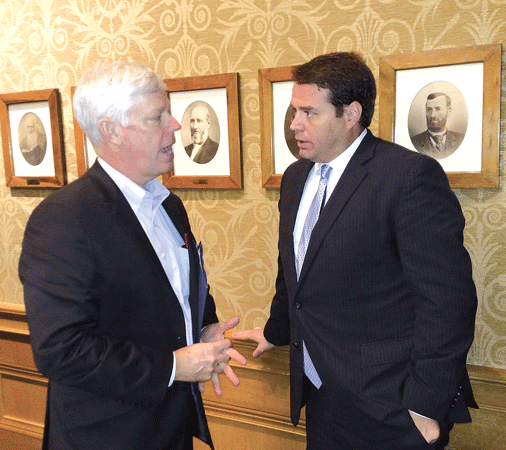
Rick Sullivan

Rick Sullivan, left, president of the Western Mass. Economic Development Council, chats with Nick Wilkinson, Chattanooga’s deputy administrator of Economic and Community Development.

Today, Chattanooga is a growing city (population just over 173,000, about 20,000 more than Springfield) riding a wave of entrepreneurship and high-tech innovation, and touting itself as the Gig City after building a broadband network (known as ‘the Gig’) able to connect every home and business to the Internet at 1 gigabit per second, or 50 to 100 times faster than the average U.S. Internet connection.

As part of the City2City Pioneer Valley program, 30 economic-development, nonprofit, and community leaders from Greater Springfield visited Chattanooga late last month to hear the story of how a stinking foundry city transformed itself into a beacon of innovation.

In doing so, they learned that this community on Georgia’s northwestern border is no utopia; it still faces serious education, workforce-development, and racial-gentrification issues, to name a few. But it’s also proving to be an example of how public, business, and nonprofit interests can work in concert to produce and then fund real solutions.

“There seems to be one goal with all these organizations we’ve met. They’re all doing their own things, but they’re all on the same page and have the same goal, and that’s to help all these spinning wheels move the city forward,” said Alfonso Santaniello, president of the Creative Strategy Agency in Springfield, who values his company’s downtown presence and wanted to visit a growing city with a similar emphasis on building up its central business district.

“Springfield needs to find a way to get everyone on the same page and push forward from there,” he went on. “That’s one of our biggest issues; everyone is doing great things, but why are we not doing them together?”

Chattanooga’s striking collaboration culture (more on that later) is one reason why the Gig City label is, in fact, not the top storyline there, but a way to draw national notice to everything else that’s going on.

“The technology is great,” said Enoch Elwell, founder of Co.Starters, a Chattanooga-based entrepreneuship program that has expanded nationally, including into Holyoke earlier this year. “But its biggest impact is as a rallying cry for our community, something that brings us together and draws the world’s attention.”

The City2City contingent from Massachusetts was certainly listening.

Cleaning Up Their Act

Littlefield recalls a time when Chattanooga manufacturers treated the Tennessee River like a sewer, dumping garbage directly into the waterway. “But in the ’70s, we cleaned up our water, and we began to clean up our act.”

From an ecological perspective, it actually helped when the foundries started to close, but it posed economic issues, he went on, which were partially remedied by attracting industries from the north, like textiles and automaking, with the promise of cheaper labor. But that wasn’t a sustainable strategy, and a steady population drain ensued.

John Bridger

“Ultimately, it’s not just about transportation, it’s not just about economic development, it’s not just about the natural environment — it’s about how all those things work together to create place,’ said John Bridger.

“When you lose jobs, you also lose hope, and when you lose hope, you lose your children,” he said. “They grow up and get an education and go somewhere else. We began to say, ‘we have to change this community in ways we’ve never changed it before. We’ve got to change our attitude, our way of thinking.’”

The first step was the creation of the Tennessee Riverpark Master Plan to transform the riverfront and downtown area, but only after many hours meeting with residents — many of whom had felt disenfranchised — and incorporating their concerns into the process. As Littlefield recalled, one woman told him, “this is the first time, when I said something, that someone wrote it down in my own words.”

Municipal leaders also visited other cities (notably a 1981 trek to Indianapolis) to find ideas and inspiration.

These information-gathering efforts led to the creation in 1986 of River City Co., a nonprofit tasked with implementing the master plan, a 20-year blueprint for the riverfront and downtown, initially capitalized with $12 million from local foundations and financial institutions.

“We did visioning before visioning was cool, and we found that it actually works,” Littlefield said. “So we set about to create quality of life, and that started with the river.”

Bridgett Massengill, executive director of Thrive 2055 — a more recent coalition of economic leaders tasked with creating economic opportunity in a tri-state, 16-county region surrounding Chattanooga’s Hamilton County — detailed how four area foundations took the first step to fund River City Co., and called it typical of the way the city has operated in the past 30 years.
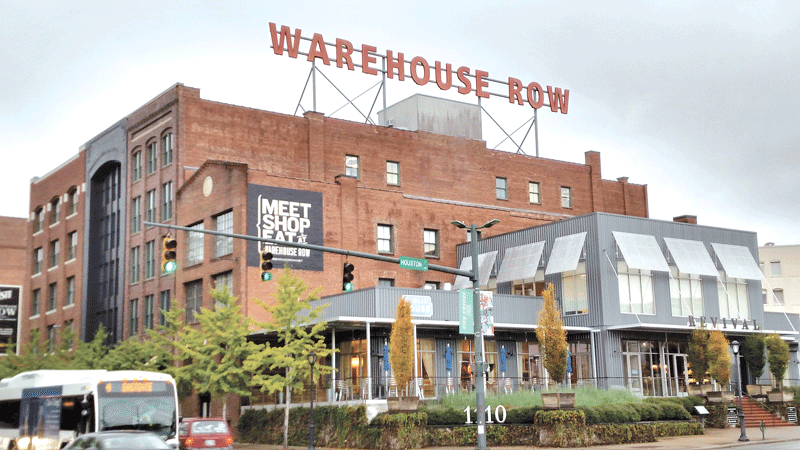
The conversion of former industrial buildings

The conversion of former industrial buildings to retail and business space echoes myriad Pioneer Valley developments like Eastworks and Open Square.

“I have been blown away by the collaboration in this region, the way we come together, roll up our sleeves, and make it happen,” she said. “There was a will that we were going to proceed with or without federal dollars.”

That caught the attention of Katie Allan Zobel, president and CEO of the Community Foundation of Western Massachusetts.

“The success in Chattanooga has grown from public-private partnerships,” she told BusinessWest. “They keep saying how foundations have played a role in these partnerships, and it seems to me that’s something Springfield and surrounding regions should be exploring with more focus.”

She first thought, upon hearing of the role of the region’s foundations, that they must be larger and better-capitalized than those in Western Mass., but was surprised to find that wasn’t the case. “We can always do more together, and Chattanooga has been proving that for the last 25 years.”

The tax structure in Tennessee — property and sales taxes but no income tax — is a challenge for economic development, officials note. That’s why the public-private partnerships that have sprung up to support development are so noteworthy, said Beth Jones, executive director of the Southeast Tennessee Development District. “Typically, we don’t start with how much money an initiative will cost. We ask, ‘is this a good idea?’ and then we bring people together to raise the money.”

That’s part of the so-called “Chattanooga way” cited by many of the people who met with the City2City contingent. Kim White, president and CEO of River City Co., said the term essentially refers to the way leaders “get a diverse group of people together and really plan.”

Landing a Gig

The city’s successes included a complete overhaul of the riverfront, including the privately funded Tennessee Aquarium, the nation’s largest freshwater aquarium, and the pedestrian-only Walnut Street Bridge; as well as an innovation district downtown aimed at attracting both high-tech giants like Amazon (which has a presence in the city) as well as a raft of intriguing startups.

the Gig

Chattanooga’s recovery has included the establishment of a high-speed broadband network known as ‘the Gig.’

Despite the successes of the Tennessee Riverpark Master Plan, the planning process had never focused specifically on entrepreneurship or technology until the city’s power company, EPB, tapped into federal stimulus money in 2009 to launch the Gig, said Ken Hays, president and CEO of the city’s Enterprise Center and Innovation District, which followed in the wake of the massive fiber project.

Since then, an accelerator program for startups has graduated 67 companies that have raised $3.1 in combined capital. In 2012, a nonprofit called CoLab launched GigTank, an annual, 14-week summer entrepreneurship program; 40 participating companies have raised $4.37 million in capital to date. CoLab’s “Will This Float?” startup pitch competition, launched five years ago, has attracted 47 participants, and the five winners all continue to grow, with $5.5 million in capital raised to date. Then there’s Tech Goes Home, a computer-education program aimed at everyone from preschoolers to the elderly.

Chattanooga has plenty of traditional industry, of course, none more prominent than Volkswagen, which employs about 2,400 people at its only North American plant and is planning an expansion — even amidst controversy over its diesel engine — that will bring production of a new SUV to Chattanooga and boost its workforce by another 2,000, including 200 in research and development, a first for the area. Other giants, like Coca-Cola and Little Debbie, dot the landscape as well.

But economic-development leaders are focused on the Innovation District and the cultivation of small businesses that may one day grow to be the next Coca-Cola or Amazon. Efforts to do so range from Startup in a Day, a commitment to streamlining business permitting on a 24/7 basis, to the Growing Small Business program, a financial incentive offered to companies with fewer than 100 employees that hire at least five workers in a 12-month period.

“If we can subsidize their next hire and keep them afloat for another couple of months, that’s what we want to do, and it’s been pretty successful,” said Nick Wilkinson, the city’s deputy administrator of Economic & Community Development.

With the type of 21st-century businesses attracted by the Gig, however, comes the need for a culture change, or at least a greater focus on the quality-of-life issues that matter to a young, hip, tech-savvy worker base, Bridger said. In addition, the population has shifted from one dominated by two-parent families with children in 1970 to one with mostly single-income households, and that affects the type of housing — smaller and closer to workplaces — that needs to be built in the city.

“Place matters,” he said, noting that IT workers aren’t tied to their workplaces like people in more traditional industries. “So, if you want to compete economically, they’re thinking place first, jobs second. Ultimately, it’s not just about transportation, it’s not just about economic development, it’s not just about the natural environment — it’s about how all those things work together to create place.”

That’s where quality-of-life improvements like the revamped riverfront and growing arts and recreation initiatives come in. The city is obviously doing something right, with $4 billion in business investment since 2008. Now leaders are trying to keep the momentum going by developing more housing in the city — an expected 160,000 new units by 2055, in fact — and touting the success of amenities like the free downtown shuttle (cheekily known as the Choo Choo) and an extensive network of bike lanes, all to support a Millennial population that doesn’t necessarily want to rely on automobiles.

The task isn’t easy when 97% of the downtown workforce drives in from the outside, and only 1.2% of downtown zoning is mixed-use. Regional passenger rail service may be 20 years away or more simply because the surrounding counties don’t have the population density of, say, Western Mass. to support it.

“Our focus is on how to create that housing density that makes us a more 24/7 city,” White explained, noting that the next two years will see the addition of 1,500 apartments downtown, more than doubling the current number, in addition to 500 more hotel rooms and 1,300 more student units to support the 12,000-student University of Tennessee Chattanooga, which skirts the downtown area. “If you come back in three years, this will be a completely different city.”

Barriers to Progress

Some of those changes are more pressing than others. The City2City tour came in the shadow of a recent, searing report by Ken Chilton, a Public Administration professor at Tennessee State University, on the city’s ongoing racial gentrification and the challenges minorities face overcoming poverty, violence, and poor health.

The 23-page report, “The Unfinished Agenda,” examines how investment and development in certain downtown neighborhoods has come at the expense of low-income African-American families that used to live there but have been forced out by rising costs.

For example, in 1990, the downtown white population was 2,402, while the black population was 3,720. In 2013, those numbers were reversed, with 4,880 whites and 2,358 blacks living downtown. In effect, African-Americans are increasingly being pushed into poorer neighborhoods and schools mired in violence and chaos and not seeing the type of investment that characterizes the downtown and riverfront, Chilton writes.

Because some of these neighborhoods have more adult high-school dropouts than college graduates, many are forced to rely on low-paying jobs instead of the white-collar jobs that have defined the downtown renewal. As a result, 36% of blacks in Chattanooga live in poverty, compared with 14.5% of whites. In the 11 lowest-income neighborhoods in Chattanooga, where the population is 73% African-American, the average poverty rate is 63.5%. Bridger told the City2City contingent that, while the city’s unemployment rate is 5.5%, it’s about double that in the black population.

James McKissic, director of Chattanooga’s Office of Multicultural Affairs, agreed that gentrification is a problem, noting that certain neighborhoods have indeed become unaffordable for lower-income residents. But he added that several housing developments are in the works over the next few years, targeted at different income levels, in desireable neighborhoods. “We don’t want to be the next San Francisco or Austin; we want people from various income levels to live together.”

Still, he added, the heart of the issue is poverty — and the need for initiatives that will improve education and provide economic opportunity for people of all races and income levels.
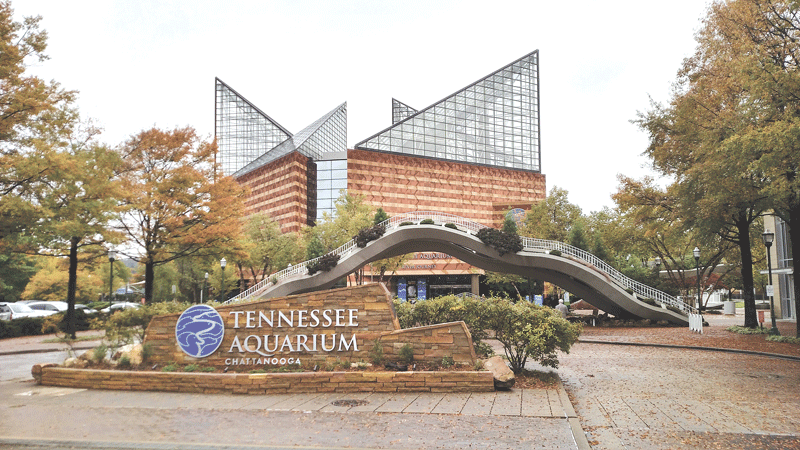
The country’s largest freshwater aquarium

The country’s largest freshwater aquarium, a privately funded project that was mocked by some residents as a “fishtank” when it was proposed, is now one of the highlights of Chattanooga’s revamped riverfront.

However, public education — which is operated on the county level — hasn’t made enough strides to satisfy Chattanooga officials, a situation detailed in a 2013 Ochs Center for Metropolitan Studies report, again written by Chilton, affirming that the system’s poor, majority-black schools lag far behind schools in more prosperous — usually whiter — neighborhoods.

To compound matters, Tennessee finishes 49th in the nation in per-pupil education spending, according to the U.S. Census Bureau, but Hamilton County spending fell between 2007 and 2012, even compared to the state as a whole. Adjusted for inflation, the county spent about $321 less per pupil in 2012 than in 2007. In those years, the Hamilton County Board of Education cut about $44 million to balance budgets in the face of rising costs in health care, utilities, and salaries. “There’s a disconnect between the school system, the state Board of Education, and the real world,” Berke said.

Added Bridger, “public education is not where it needs to be, and it’s becoming a job-recruitment problem.” He noted that the rural counties surrounding Chattanooga fare even worse when it comes to graduation rates. “We’re not getting enough qualified employees to work in the jobs.”

After all, the city’s manufacturing base hasn’t disappeared; it’s just that many of today’s manufacturing jobs are high-skill, high-paying positions. Much like the situation in the Pioneer Valley, plenty of openings exist, but the Hamilton County region grapples with a skills gap between what employers require and the level of education that job seekers bring to the table. Unfortunately, Jones noted, applied-technology classes at local community colleges struggle with empty seats and a lack of interest in manufacturing as a career.

“We’ve basically taught people throughout the South and throughout the country that manufacturing is dirty, it’s not cool, it’s a sweatshop, it doesn’t pay well, the whole nine yards. I still hear that from our young people,” Jones said. “We’ve got to do a better job educating our young people that there are good jobs out there, and you can get them with certain certifications and certain degrees, and you can make more a whole lot more money than I’ve been making all my life with a four-year degree.”

Ruth Thompson, communications and outreach manager for Thrive 2055, agreed, stressing the importance of education. One notable initiative, called Tennessee Promise, pays for two years of community college, in an effort to narrow the skills gap.

“The majority of the country has about 8% of their economy driven by manufacturing. If you hear us talking a lot about advanced manufacturing, it’s because, in our region, it’s 22%. We still have a very, very heavy manufacturing base,” she said. “But previously, a 16-year-old from Trenton, Georgia could drop out of school, go work in a hosiery mill, and have a good job the rest of his life. We know that’s no longer the case. So as we work on changing the culture, we’re working in partnership with the community colleges and four-year universities to change that mindset that you don’t have to go to school.”

However, “we have other problems on top of the skills gap,” Jones added, noting that substance abuse — in another parallel to Massachusetts — keeps many people out of the workforce, while Tennessee (unlike the Bay State) ranks near the bottom of the 50 states in health metrics such as obesity and type 2 diabetes.

“We’re starting to have that culture change; people are starting to realize that education and health are both economic issues,” she said. “Before, people kept them in their separate silos. And as a state, we didn’t value education, but we’ve started moving in that regard.”

On the Plus Side

The city’s current mayor, however, chose to highlight some positive statistics, noting that property crime is down 22%, and violent crime down 5%, since last year, though well-known pockets of crime tend to skew perception. “It’s frustrating for us that people don’t feel safe.”

Berke also noted that, despite Chattanooga’s position along two major interstates, which makes it an attractive corridor for drug trafficking, the city is no worse off than others of its size. “We have drug crimes, and we have drug-related violence, of course, but nothing you’d say is unsual for similar cities.”

Meanwhile, “Thrive 2055 is trying to change the culture, helping us manage the changes that are happening to our region,” Thompson said, noting that the project is built on the pillars of economic development, natural treasures, transportation, and education and workforce.

All are important in their own way, she added; the region is, after all, a biodiversity hotspot, with the highest concentration of different freshwater fish species in the world — but also one of the top 10 shipping corridors in the U.S., leading to ‘pinch points’ of daily congestion along Interstates 24 and 75. Juggling such disparate resources and challenges is a major part of the Thrive effort.

As for the Gig, it hit a goal of 40,000 subscribers — the mark needed to achieve profitability — two years after its launch, and now boasts 75,000. It’s now the centerpiece of the city’s marketing efforts — signs at the Chattanooga’s airport greet visitors with the message ‘Welcome to Gig City’ — but, as Elwell noted, is only one part of the story.

“Some people have taken it for granted; they’ve forgotten how hard it was,” said Charles Wood, vice president for Economic Development for the Chattanooga Area Chamber of Commerce, referring to the entire 45 years of changes since Walter Cronkite’s paradigm-shifting report. “As a chamber, how do we make sure we don’t get complacent?”

Scott Foster thinks the city’s culture of collaboration will guard against exactly that.

“The emphasis from the private sector, the nonprofit sector, and the the public sector is on collaboration,” said Foster, an attorney at Springfield-based Bulkley Richardson and chairman of Valley Venture Mentors. “Sometimes the city takes an interest in something and the foundations come and support it, while other times, the private-sector guys say, ‘this is important, so we’re starting it, and we’ll see if anyone wants to join in with us.’

“That’s great,” he went on, “because you’ve got these three legs of the stool, and all three keep saying, ‘I’m going to experiment with this, and if it works, I know you guys will come along.’ There’s a trust there, and an openness to trying new things. It doesn’t matter whose idea it was; it matters that it’s a good idea, and if it’s a good idea, in Chattanooga, they’re all behind it.”

That’s an example, Foster went on, that public officials, businesses, nonprofits, and foundations can learn from in Greater Springfield and the Pioneer Valley, where much good work is happening, but not always in concert.

“If somebody’s got a good idea, let’s celebrate it and support it, not tear it down, not say, ‘well, it doesn’t quite work,’ or ‘it conflicts with what another group is doing.’ OK, fine — they can do it too. There’s no such thing as too much entrepreneurship or too much economic development. When we get to that point, then we’ll figure out that problem. But we’re not at that point.”

Looking Forward

Littlefield recalled how, when Volkswagen had to choose between Chattanooga and another city to locate its U.S. plant, the competing financial incentives were largely a wash. “But they told us, ‘We came here for the intangibles, because, at a certain point, the intangibles become tangible. And you can’t put a price on that.’”

The greatest benefit Chattanooga has seen during its impressive recovery, the former mayor continued, has been a new, prouder, more confident attitude.

“After we visited Indianapolis, someone said, ‘wouldn’t it be great if, someday, people came to Chattanooga to see how we did it? And now, here you are — and you’re one of many. We don’t claim any special knowledge, any magic — just people coming together saying, ‘we all live here, and we’re going to make sure this is a city where our children will want to raise their children.”

Joseph Bednar can be reached at [email protected]

Community Spotlight Features

Community Spotlight

Carmina Fernandes and Douglas Stefancik

Carmina Fernandes and Douglas Stefancik say the redevelopment of Ludlow Mills will preserve the town’s history while providing opportunities for economic growth.

Town Planner Douglas Stefancik calls it “the crown jewel of the mills.”

He was referring to the recently completed HealthSouth Rehabilitation Hospital of Western Massachusetts, the first new structure to be built on the Ludlow Mills property, owned and being redeveloped by Westmass Area Development Corp.

The $28.5 million, 74,000-square-foot hospital has 53 private rooms and a state-of-the-art physical therapy center, said Stefancik, adding that the project received the prestigious national Sustainability Impact Award at the Redevelopment and Renewal Awards Ceremony in Chicago.

“It is serving as a model for other HealthSouth facilities, and our intent was for it to become a catalyst to other growth and development on the Ludlow Mills site,” he went on. “Fortunately, we’re seeing that come to fruition.”

Indeed, officials are happy to have HealthSouth in the mill district and are looking forward to another exciting project.

“The HealthSouth building is historically accurate, and the second jewel will soon be built,” said Stefancik, referring to the town’s decision on Oct. 8 to grant Winn Development and Westmass the approvals needed to transform what’s known as Mill #10 into a senior-housing development.

The four-story structure will be converted into 75 one- and two-bedroom apartments; 66 will be affordable, and the rest will be rented at market rate.

“It’s fantastic because it will preserve the whole building and help continue revitalization of the downtown area,” said Stefancik. “There will be new landscaping surrounding the parking lot, traffic islands with seating areas, and a patio, which will help it to become a nice residential community.”

Westmass President and CEO Kenn Delude said the plans were approved in 17 days, which is highly unusual, because it typically takes months for a project of this magnitude. “We’re proud because the town found these plans consistent with their master plan,” he told BusinessWest. “It shows how strong the partnership is between WestMass, Winn Development, and the town.”

Westmass will sell Winn three acres of the mill property, with closing anticipated to take place at the end of December. The work should start in February, and the units should be complete and occupied by June 2017, Delude said, adding that the town has a backlog of 150 seniors seeking affordable housing, and this will help fill the gap.

“Winn will spend $19 million in 14 months, and we anticipate 300 new construction jobs; we’re pretty proud of this,” he continued.

In addition, the first phase of a 1.5 mile Riverwalk is complete and just opened to the public. It runs behind the mill property along the Chicopee River, features beautiful overlooks, and was a private project; HealthSouth contributed $600,000, and WestMass did the engineering, permitting, and other necessary work.

“We’re excited about the redevelopment of the mills and the partnership with the town, as well as the shared vision for the preservation of some of the buildings,” Delude said. “We’re on our way, and although the project is not near completion, $74 million has been invested in Ludlow Mills over the last four years. It’s a great start, and we hope to work with other developers to preserve things like the historic clock tower.”

But while Ludlow Mills continues to be the story in this community of 21,000, it is far from the only news.

There is a solid mix of residential and commercial development taking place, said Stefancik, adding that the town has a number of attractive selling points, including its reputation as a safe community, a relatively low tax rate, and many amenities, such as free limited trash pickup, a free van service for seniors, and its own ambulance service, which people can subscribe to for $40 annually and use as often as they need.

Together, these attributes make this an attractive community in which to live, work, and do business, its leaders say. For this latest installment of its Community Spotlight series, BusinessWest looks at how Ludlow intends to build on a current wave of momentum.

A Developing Story

Carmina Fernandes, chair of the Board of Selectmen, said the mills were the heartbeat of the town in their heyday, and the redevelopment is encouraging reinvestment within the community.

“The Iron Duke Brewing microbrewery moved into a mill building two years ago and is already expanding; they want to put in an outdoor patio near the Riverwalk,” she said, adding that the former Montelegre Restaurant on State Street, located across the street from HealthSouth, is under new ownership and has been renamed the Com e Cala-Te Restaurant. It’s owned by Pedro and Joe Fernandes (Carmina’s brothers), and since it reopened two months ago, it has been booked solid on weekend nights.

Those are are just a few of the many signs of progress in the community. Indeed, Stefancik said, additional residential development is taking place, and the town is continuing to grow in every respect.

Last year, HAPHousing completed a $7.4 million conversion of the Stevens Memorial Building into 28 affordable rental apartments for seniors. The three-story 23,760-square-foot building at 12 Chestnut St. was built in 1906 by the Ludlow Manufacturing Co. as a recreation facility for its employees. The town acquired it in 1949, and it was home to the Ludlow Boys & Girls Club until 2005.

“It’s a great project because it’s across from the senior center and near restaurants, the library, shops, the post office, and a number of mom-and-pop stores,” Stefancik said.

He added that, in addition to affordable housing, there has also been an uptick in the number of proposed subdivisions. Roughly 40 single-family lots were approved earlier this year as the second phase of a Parker Lane Extension project, with an estimated infrastructure cost of $1.5 million; a 19-lot subdivision extension on Cislak Drive with an infrastructure cost of $780,000 was just approved; and a definitive plan is expected late this month for 14 lots across the street from Cislak Drive on Maria’s Way.

“These homes will bring in additional tax dollars to the community,” Stefancik said. “It’s a positive sign when this much building is going on.”

However, commercial growth is also taking place.

The Cumberland Farms store on West Street is undergoing a $500,000 renovation, and the Planning Board approved a site plan and special permit for the East Street store, which will result in a new building that will help to further revitalize the street, Fernandes said.

Stefancik explained that the company purchased a former bar with two parking lots on East Street next to the existing store, which will be knocked down to make way for a new building.

It’s a project that was planned with community feedback, and is in line with the Board of Selectmen’s request that businesses seek input from neighbors when making changes. In this instance, the feedback led to an agreement to install a fence to block views of the store, additional landscaping, noise deflectors on the air-conditioning units, and glare-free lighting.

In addition, the Colvest Group has begun work on the former Mobil station property at 450-456 Center St. across from CVS. The firm received approval for two commercial buildings in April; one will have a drive-thru, and both can house up to three suites.

Growth is also taking place on Holyoke Street, where Black Diamond Development LLC just completed work on a new medical building.

Commercial investments are definitely on the rise, but Fernandes says town officials strive to balance residential and commercial growth. Still, the town is doing everything it can to make it easy to open a new business. Its permitting process went online in the last year, which helps the growing number of home-based firms.

“In the past, people had to go before the Planning Board, but we have eliminated that step,” Fernandes told BusinessWest. There is also a new computer screen outside the entrance to the Building Department which allows people to access information if they are closed, and Ludlow Community Television installed new technology on their website that allows viewers to look at presentations put before the Board of Selectmen.

Continued Progress

Everything being done falls in line with Ludlow’s master plan, which was approved last year.

“Ludlow is a great place to own a business, live, and play. It’s a vibrant town, and we were recently selected to be on Terry Bradshaw’s Communities of Distinction TV show because of our economic development and quality of life,” Fernandes said.

The hope is that Ludlow Mills will become the heart of the community once again as redevelopment efforts transform the property. “It’s in an ideal location and will become vibrant because it’s within walking distance of restaurants, storefronts, hairdressers, and many other businesses on the intersecting streets,” Fernandes said. “But the most wonderful thing is the symbiotic relationships that are being created with the town. There are a lot of things in the pipeline that are very exciting.”

Delude agreed. “We are proud of this project,” he said, “and it’s important to the community.”


Ludlow at a glance

Year Incorporated: 1774
Population: 21,103
Area: 28.2 square miles
County: Hampden
Residential Tax Rate: $17.29
Commercial Tax Rate: $17.29
Median Household Income: $57,803
Family Household Income: $71,601
Type of government: Town Administrator; Board of Selectmen; Open Town Meeting
Largest Employers: Hampden County House of Correction; Ludlow Public Schools; R & C Floral Inc.; Town of Ludlow; HealthSouth Rehabilitation Hospital
* Latest information available

Features

In the 1960s, Ron Littlefield says, no one needed GPS to find Tennessee’s fourth-largest city.

“You could tell when you were getting close to Chattanooga because you could smell Chattanooga; it stunk,” said the former mayor, who served from 2005 to 2013. “It was an old foundry city. And when you had stormy weather, you had inversions, because we have mountains and valleys, and it would trap the smoke, and you would literally be eating smoke when you walked outside.”

City leaders were mortified when, in October 1969, Walter Cronkite came across a recent EPA study, sat down behind the news desk, looked into the camera, and declared Chattanooga “the dirtiest city in America.”

“It was so bad that people had to change their shirts in the middle of the day,” said John Bridger, executive director of the Chattanooga-Hamilton County Regional Planning Agency. “They were tough times — but tough times create opportunities.”

In truth, Bridger continued, many residents put up with the pollution because the manufacturing sector was chugging along, but Cronkite’s report jarred them out of complacency. “If not for those challenges, I don’t think we would have changed, because we were comfortable. We were the dynamo of Dixie — why change what we were doing if we were making money? But that report created an impetus for change; it brought a new perspective.”

Still, Chattanooga was no overnight turnaround. Even after efforts to clean up the waterway and better connect the riverfront with the downtown area, a downturn in the region’s manufacturing base led to mass flight from the city, which lost more than 10% of its population during the 1980s. But, as current Mayor Andy Berke points out, it was the only American city with that level of population loss during the ’80s to actually gain residents in the 1990s.

“It took a long time — a lot of people over a great period of time — to make it happen,” he said. “And it started with real investment in the core of our city.”

Today, Chattanooga is a growing city (population just over 173,000, about 20,000 more than Springfield) riding a wave of entrepreneurship and high-tech innovation, and touting itself as the Gig City after building a broadband network (known as ‘the Gig’) able to connect every home and business to the Internet at 1 gigabit per second, or 50 to 100 times faster than the average U.S. Internet connection.

As part of the City2City Pioneer Valley program, 30 economic-development, nonprofit, and community leaders from Greater Springfield visited Chattanooga late last month to hear the story of how a stinking foundry city transformed itself into a beacon of innovation.

Walnut Street Bridge

Many of the attendees at the foot of the Walnut Street Bridge, a pedestrian span over the Tennessee River that’s a hallmark of an extensive riverfront makeover.

In doing so, they learned that this community on Georgia’s northwestern border is no utopia; it still faces serious education, workforce-development, and racial-gentrification issues, to name a few. But it’s also proving to be an example of how public, business, and nonprofit interests can work in concert to produce and then fund real solutions.

“There seems to be one goal with all these organizations we’ve met. They’re all doing their own things, but they’re all on the same page and have the same goal, and that’s to help all these spinning wheels move the city forward,” said Alfonso Santaniello, president of the Creative Strategy Agency in Springfield, who values his company’s downtown presence and wanted to visit a growing city with a similar emphasis on building up its central business district.

“Springfield needs to find a way to get everyone on the same page and push forward from there,” he went on. “That’s one of our biggest issues; everyone is doing great things, but why are we not doing them together?”

Chattanooga’s striking collaboration culture (more on that later) is one reason why the Gig City label is, in fact, not the top storyline there, but a way to draw national notice to everything else that’s going on.

“The technology is great,” said Enoch Elwell, founder of Co.Starters, a Chattanooga-based entrepreneuship program that has expanded nationally, including into Holyoke earlier this year. “But its biggest impact is as a rallying cry for our community, something that brings us together and draws the world’s attention.”

The City2City contingent from Massachusetts was certainly listening.

Cleaning Up Their Act

Littlefield recalls a time when Chattanooga manufacturers treated the Tennessee River like a sewer, dumping garbage directly into the waterway. “But in the ’70s, we cleaned up our water, and we began to clean up our act.”

From an ecological perspective, it actually helped when the foundries started to close, but it posed economic issues, he went on, which were partially remedied by attracting industries from the north, like textiles and automaking, with the promise of cheaper labor. But that wasn’t a sustainable strategy, and a steady population drain ensued.

“When you lose jobs, you also lose hope, and when you lose hope, you lose your children,” he said. “They grow up and get an education and go somewhere else. We began to say, ‘we have to change this community in ways we’ve never changed it before. We’ve got to change our attitude, our way of thinking.’”

The first step was the creation of the Tennessee Riverpark Master Plan to transform the riverfront and downtown area, but only after many hours meeting with residents — many of whom had felt disenfranchised — and incorporating their concerns into the process. As Littlefield recalled, one woman told him, “this is the first time, when I said something, that someone wrote it down in my own words.”

Municipal leaders also visited other cities (notably a 1981 trek to Indianapolis) to find ideas and inspiration. These information-gathering efforts led to the creation in 1986 of River City Co., a nonprofit tasked with implementing the master plan, a 20-year blueprint for the riverfront and downtown, initially capitalized with $12 million from local foundations and financial institutions.

“We did visioning before visioning was cool, and we found that it actually works,” Littlefield said. “So we set about to create quality of life, and that started with the river.”

Bridgett Massengill, executive director of Thrive 2055 — a more recent coalition of economic leaders tasked with creating economic opportunity in a tri-state, 16-county region surrounding Chattanooga’s Hamilton County — detailed how four area foundations took the first step to fund River City Co., and called it typical of the way the city has operated in the past 30 years.

“I have been blown away by the collaboration in this region, the way we come together, roll up our sleeves, and make it happen,” she said. “There was a will that we were going to proceed with or without federal dollars.”

That caught the attention of Katie Allan Zobel, president and CEO of the Community Foundation of Western Massachusetts.

“The success in Chattanooga has grown from public-private partnerships,” she told BusinessWest. “They keep saying how foundations have played a role in these partnerships, and it seems to me that’s something Springfield and surrounding regions should be exploring with more focus.”

She first thought, upon hearing of the role of the region’s foundations, that they must be larger and better-capitalized than those in Western Mass., but was surprised to find that wasn’t the case. “We can always do more together, and Chattanooga has been proving that for the last 25 years.”

The tax structure in Tennessee — property and sales taxes but no income tax — is a challenge for economic development, officials note. That’s why the public-private partnerships that have sprung up to support development are so noteworthy, said Beth Jones, executive director of the Southeast Tennessee Development District. “Typically, we don’t start with how much money an initiative will cost. We ask, ‘is this a good idea?’ and then we bring people together to raise the money.”

That’s part of the so-called “Chattanooga way” cited by many of the people who met with the City2City contingent. Kim White, president and CEO of River City Co., said the term essentially refers to the way leaders “get a diverse group of people together and really plan.”

Landing a Gig

The city’s successes included a complete overhaul of the riverfront, including the privately funded Tennessee Aquarium, the nation’s largest freshwater aquarium, and the pedestrian-only Walnut Street Bridge; as well as an innovation district downtown aimed at attracting both high-tech giants like Amazon (which has a presence in the city) as well as a raft of intriguing startups.

Despite the successes of the Tennessee Riverpark Master Plan, the planning process had never focused specifically on entrepreneurship or technology until the city’s power company, EPB, tapped into federal stimulus money in 2009 to launch the Gig, said Ken Hays, president and CEO of the city’s Enterprise Center and Innovation District, which followed in the wake of the massive fiber project.

Since then, an accelerator program for startups has graduated 67 companies that have raised $3.1 in combined capital. In 2012, a nonprofit called CoLab launched GigTank, an annual, 14-week summer entrepreneurship program; 40 participating companies have raised $4.37 million in capital to date. CoLab’s “Will This Float?” startup pitch competition, launched five years ago, has attracted 47 participants, and the five winners all continue to grow, with $5.5 million in capital raised to date. Then there’s Tech Goes Home, a computer-education program aimed at everyone from preschoolers to the elderly.

Chattanooga has plenty of traditional industry, of course, none more prominent than Volkswagen, which employs about 2,400 people at its only North American plant and is planning an expansion — even amidst controversy over its diesel engine — that will bring production of a new SUV to Chattanooga and boost its workforce by another 2,000, including 200 in research and development, a first for the area. Other giants, like Coca-Cola and Little Debbie, dot the landscape as well.

Laura Masulis, left, transformative development fellow at MassDevelopment

Laura Masulis, left, transformative development fellow at MassDevelopment, and Scott Foster, right, chairman of Valley Venture Mentors, speak with Will Joseph and Enoch Elwell of Co.Starters, a national, Chattanooga-based entrepreneurship initiative that launched in Holyoke this year.

But economic-development leaders are focused on the Innovation District and the cultivation of small businesses that may one day grow to be the next Coca-Cola or Amazon. Efforts to do so range from Startup in a Day, a commitment to streamlining business permitting on a 24/7 basis, to the Growing Small Business program, a financial incentive offered to companies with fewer than 100 employees that hire at least five workers in a 12-month period.

“If we can subsidize their next hire and keep them afloat for another couple of months, that’s what we want to do, and it’s been pretty successful,” said Nick Wilkinson, the city’s deputy administrator of Economic & Community Development.

With the type of 21st-century businesses attracted by the Gig, however, comes the need for a culture change, or at least a greater focus on the quality-of-life issues that matter to a young, hip, tech-savvy worker base, Bridger said. In addition, the population has shifted from one dominated by two-parent families with children in 1970 to one with mostly single-income households, and that affects the type of housing — smaller and closer to workplaces — that needs to be built in the city.

“Place matters,” he said, noting that IT workers aren’t tied to their workplaces like people in more traditional industries. “So, if you want to compete economically, they’re thinking place first, jobs second. Ultimately, it’s not just about transportation, it’s not just about economic development, it’s not just about the natural environment — it’s about how all those things work together to create place.”

That’s where quality-of-life improvements like the revamped riverfront and growing arts and recreation initiatives come in. The city is obviously doing something right, with $4 billion in business investment since 2008. Now leaders are trying to keep the momentum going by developing more housing in the city — an expected 160,000 new units by 2055, in fact — and touting the success of amenities like the free downtown shuttle (cheekily known as the Choo Choo) and an extensive network of bike lanes, all to support a Millennial population that doesn’t necessarily want to rely on automobiles.

The task isn’t easy when 97% of the downtown workforce drives in from the outside, and only 1.2% of downtown zoning is mixed-use. Regional passenger rail service may be 20 years away or more simply because the surrounding counties don’t have the population density of, say, Western Mass. to support it.

“Our focus is on how to create that housing density that makes us a more 24/7 city,” White explained, noting that the next two years will see the addition of 1,500 apartments downtown, more than doubling the current number, in addition to 500 more hotel rooms and 1,300 more student units to support the 12,000-student University of Tennessee Chattanooga, which skirts the downtown area. “If you come back in three years, this will be a completely different city.”

Barriers to Progress

Some of those changes are more pressing than others. The City2City tour came in the shadow of a recent, searing report by Ken Chilton, a Public Administration professor at Tennessee State University, on the city’s ongoing racial gentrification and the challenges minorities face overcoming poverty, violence, and poor health.

The 23-page report, The Unfinished Agenda, examines how investment and development in certain downtown neighborhoods has come at the expense of low-income African-American families that used to live there but have been forced out by rising costs.

For example, in 1990, the downtown white population was 2,402, while the black population was 3,720. In 2013, those numbers were reversed, with 4,880 whites and 2,358 blacks living downtown. In effect, African-Americans are increasingly being pushed into poorer neighborhoods and schools mired in violence and chaos and not seeing the type of investment that characterizes the downtown and riverfront, Chilton writes.

Because some of these neighborhoods have more adult high-school dropouts than college graduates, many are forced to rely on low-paying jobs instead of the white-collar jobs that have defined the downtown renewal. As a result, 36% of blacks in Chattanooga live in poverty, compared with 14.5% of whites. In the 11 lowest-income neighborhoods in Chattanooga, where the population is 73% African-American, the average poverty rate is 63.5%. Bridger told the City2City contingent that, while the city’s unemployment rate is 5.5%, it’s about double that in the black population.

James McKissic, director of Chattanooga’s Office of Multicultural Affairs, agreed that gentrification is a problem, noting that certain neighborhoods have indeed become unaffordable for lower-income residents. But he added that several housing developments are in the works over the next few years, targeted at different income levels, in desireable neighborhoods. “We don’t want to be the next San Francisco or Austin; we want people from various income levels to live together.”

Still, he added, the heart of the issue is poverty — and the need for initiatives that will improve education and provide economic opportunity for people of all races and income levels.

However, public education — which is operated on the county level — hasn’t made enough strides to satisfy Chattanooga officials, a situation detailed in a 2013 Ochs Center for Metropolitan Studies report, again written by Chilton, affirming that the system’s poor, majority-black schools lag far behind schools in more prosperous — usually whiter — neighborhoods.

To compound matters, Tennessee finishes 49th in the nation in per-pupil education spending, according to the U.S. Census Bureau, but Hamilton County spending fell between 2007 and 2012, even compared to the state as a whole. Adjusted for inflation, the county spent about $321 less per pupil in 2012 than in 2007. In those years, the Hamilton County Board of Education cut about $44 million to balance budgets in the face of rising costs in health care, utilities, and salaries. “There’s a disconnect between the school system, the state Board of Education, and the real world,” Berke said.

Added Bridger, “public education is not where it needs to be, and it’s becoming a job-recruitment problem.” He noted that the rural counties surrounding Chattanooga fare even worse when it comes to graduation rates. “We’re not getting enough qualified employees to work in the jobs.”

After all, the city’s manufacturing base hasn’t disappeared; it’s just that many of today’s manufacturing jobs are high-skill, high-paying positions. Much like the situation in the Pioneer Valley, plenty of openings exist, but the Hamilton County region grapples with a skills gap between what employers require and the level of education that job seekers bring to the table. Unfortunately, Jones noted, applied-technology classes at local community colleges struggle with empty seats and a lack of interest in manufacturing as a career.

“We’ve basically taught people throughout the South and throughout the country that manufacturing is dirty, it’s not cool, it’s a sweatshop, it doesn’t pay well, the whole nine yards. I still hear that from our young people,” Jones said. “We’ve got to do a better job educating our young people that there are good jobs out there, and you can get them with certain certifications and certain degrees, and you can make more a whole lot more money than I’ve been making all my life with a four-year degree.”

Ruth Thompson, communications and outreach manager for Thrive 2055, agreed, stressing the importance of education. One notable initiative, called Tennessee Promise, pays for two years of community college, in an effort to narrow the skills gap.

“The majority of the country has about 8% of their economy driven by manufacturing. If you hear us talking a lot about advanced manufacturing, it’s because, in our region, it’s 22%. We still have a very, very heavy manufacturing base,” she said. “But previously, a 16-year-old from Trenton, Georgia could drop out of school, go work in a hosiery mill, and have a good job the rest of his life. We know that’s no longer the case. So as we work on changing the culture, we’re working in partnership with the community colleges and four-year universities to change that mindset that you don’t have to go to school.”

However, “we have other problems on top of the skills gap,” Jones added, noting that substance abuse — in another parallel to Massachusetts — keeps many people out of the workforce, while Tennessee (unlike the Bay State) ranks near the bottom of the 50 states in health metrics such as obesity and type 2 diabetes.

“We’re starting to have that culture change; people are starting to realize that education and health are both economic issues,” she said. “Before, people kept them in their separate silos. And as a state, we didn’t value education, but we’ve started moving in that regard.”

On the Plus Side

The city’s current mayor, however, chose to highlight some positive statistics, noting that property crime is down 22%, and violent crime down 5%, since last year, though well-known pockets of crime tend to skew perception. “It’s frustrating for us that people don’t feel safe.”

Berke also noted that, despite Chattanooga’s position along two major interstates, which makes it an attractive corridor for drug trafficking, the city is no worse off than others of its size. “We have drug crimes, and we have drug-related violence, of course, but nothing you’d say is unsual for similar cities.”

Meanwhile, “Thrive 2055 is trying to change the culture, helping us manage the changes that are happening to our region,” Thompson said, noting that the project is built on the pillars of economic development, natural treasures, transportation, and education and workforce.

All are important in their own way, she added; the region is, after all, a biodiversity hotspot, with the highest concentration of different freshwater fish species in the world — but also one of the top 10 shipping corridors in the U.S., leading to ‘pinch points’ of daily congestion along Interstates 24 and 75. Juggling such disparate resources and challenges is a major part of the Thrive effort.

As for the Gig, it hit a goal of 40,000 subscribers — the mark needed to achieve profitability — two years after its launch, and now boasts 75,000. It’s now the centerpiece of the city’s marketing efforts — signs at the Chattanooga’s airport greet visitors with the message ‘Welcome to Gig City’ — but, as Elwell noted, is only one part of the story.

“Some people have taken it for granted; they’ve forgotten how hard it was,” said Charles Wood, vice president for Economic Development for the Chattanooga Area Chamber of Commerce, referring to the entire 45 years of changes since Walter Cronkite’s paradigm-shifting report. “As a chamber, how do we make sure we don’t get complacent?”

Scott Foster thinks the city’s culture of collaboration will guard against exactly that.

“The emphasis from the private sector, the nonprofit sector, and the the public sector is on collaboration,” said Foster, an attorney at Springfield-based Bulkley Richardson and chairman of Valley Venture Mentors. “Sometimes the city takes an interest in something and the foundations come and support it, while other times, the private-sector guys say, ‘this is important, so we’re starting it, and we’ll see if anyone wants to join in with us.’

“That’s great,” he went on, “because you’ve got these three legs of the stool, and all three keep saying, ‘I’m going to experiment with this, and if it works, I know you guys will come along.’ There’s a trust there, and an openness to trying new things. It doesn’t matter whose idea it was; it matters that it’s a good idea, and if it’s a good idea, in Chattanooga, they’re all behind it.”

That’s an example, Foster went on, that public officials, businesses, nonprofits, and foundations can learn from in Greater Springfield and the Pioneer Valley, where much good work is happening, but not always in concert.

“If somebody’s got a good idea, let’s celebrate it and support it, not tear it down, not say, ‘well, it doesn’t quite work,’ or ‘it conflicts with what another group is doing.’ OK, fine — they can do it too. There’s no such thing as too much entrepreneurship or too much economic development. When we get to that point, then we’ll figure out that problem. But we’re not at that point.”

Looking Forward

Littlefield recalled how, when Volkswagen had to choose between Chattanooga and another city to locate its U.S. plant, the competing financial incentives were largely a wash. “But they told us, ‘We came here for the intangibles, because, at a certain point, the intangibles become tangible. And you can’t put a price on that.’”

The greatest benefit Chattanooga has seen during its impressive recovery, the former mayor continued, has been a new, prouder, more confident attitude.

“After we visited Indianapolis, someone said, ‘wouldn’t it be great if, someday, people came to Chattanooga to see how we did it? And now, here you are — and you’re one of many. We don’t claim any special knowledge, any magic — just people coming together saying, ‘we all live here, and we’re going to make sure this is a city where our children will want to raise their children.”

Joseph Bednar can be reached at [email protected]

Events Features WMBExpo

This year’s show to feature programs and exhibits focused on manufacturing

“Oscar’ the robot

“Oscar’ the robot will be putting talents on display at the Western Mass. Business Expo on Nov. 4.

The large team of organizers for the Western Mass. Business Expo is busy with hundreds of details, large and small, as the Nov. 4 show approaches, including creation of nametags for those in the many categories of ‘participant.’

One of those tags will require just a single word: ‘Oscar.’ That’s the name given to the robot created by a team of Agawam High School students for a FIRST (For Inspiration and Recognition of Science and Technology) Robotics Competition staged earlier this year.

FIRST, an international, K-12, not-for-profit organization founded to inspire young people’s interest and participation in science and technology, said there were more than 3,000 entries, including Oscar, for a competition, or game, called Recycle Rush. As the name suggests, these robots were programmed to stack storage totes and recycling bins; Oscar ranked 65th in New England, just missing qualifying for the NE FIRST District Championships by five points.

Oscar, created by a team called ROSIE (Recognizing Outstanding Science-inspired Education) Robotics, will be putting his various talents on display at the Expo — show attendees may actually get an opportunity to take the controls — thus playing a significant role in a multi-faceted effort to spotlight one of the most important sectors of the region’s economy, precision manufacturing, and the many challenges facing it.

Indeed, while the Expo will showcase virtually every sector of the local economy — from banking to retail; healthcare to technology; education to tourism — this, the fifth edition of the show, will feature a number of programs and exhibits focused on manufacturing and efforts to return this once-proud industry to prominence in the region.

Individual elements of this focus on manufacturing and the workforce issues it now faces include a luncheon program hosted by the Professional Women’s Chamber of Western Mass. The keynote speaker will be Alison Lands, senior manager in Deloitte’s Strategy & Operations practice. She served as a co-author and editor of the New England Council and Deloitte’s recently published report, Advanced to Advantageous: The Case for New England’s Manufacturing Revolution, which will form the basis of her talk.

It will also include participation by several area high schools, which will be spotlighting not only robotics, but also their machining programs, which play a vital role in maintaining a steady flow of workers to area manufacturers.

In addition to Agawam High School, Putnam Vocational Technical Academy and Westfield Vocational Technical High School will be taking part in the show. They will be showing off display computers, 3-D printers, and other equipment, and providing simulations of precision-manufacturing processes.

The focus on this sector is critical, said Kristin Maier Carlson, president of Westfield-based Peerless Precision Inc., who noted that many young people — and their parents, unfortunately — have a perception of manufacturing that is outdated and inaccurate.

“The view that people have is from way back when — that this is not a job to be in,” she told BusinessWest. “Actually, you need a lot of skill to be machinist, and this is a very viable alternative for those who are not looking to go to college.”

She said that, while running operations at Peerless, she’s also on a mission to help people get an accurate look at her industry and perhaps become motivated to join it. Actually, her work is a continuation of her father’s mission to achieve that same end.

Larry Maier acquired Peerless in 1997, and years later took a leadership role with the National Tooling & Machining Assoc. (NTMA) and its efforts to educate several constituencies about precision manufacturing with the goal of securing an adequate future workforce for shops here and across the country.

When her father was diagnosed with colon cancer, Maier Carlson, who said she grew up working at the shop sweeping floors and later cutting material on a band saw, returned to this region from San Diego to help determine its future course. By the time Larry succumbed to the disease, she had made up her mind not to sell the operation, but lead it to new heights.

While doing so, she is continuing her father’s work in education and building a workforce, and currently playing a leadership role at the NTMA. As part of that, she and other family members created the Larry A. Maier Memorial Educational Fund to help carry out the task of enlightening young people — especially those at the middle-school and even elementary-school levels — about the opportunities in manufacturing.

Money from that fund will be used to offset the costs associated with bringing the various high schools to the Expo and enabling them to show how their programs are both creating job opportunities and helping area manufacturers tackle the challenging workforce issues confronting them.

“Far more of our workers are closer to retirement than not,” said Maier Carlson. “We’re going to need to replace those workers, and this is an ongoing challenge. Area manufacturers need to partner with our area schools to not only educate people about opportunities in this field, but also provide the training necessary to help people become qualified to take these jobs. The Expo will showcase how these partnerships are working.”

As for Oscar, he will be one of at least two ‘competition robots’ that the ROSIE team will bring to the Expo, said Dana Henry, chief mentor for the team, adding that he expects these machines to turn some heads, impress attendees, and bring attention to careers that fall in the broad category called STEM — science, technology, education, and mathematics.

“We’ll have a half-dozen students there talking about the science, engineering, and manufacturing that goes into this,” said Henry. “We have to do all our own programming, wiring, machining, and CAD work for this — the whole ball of wax to build this 120-pound machine in six weeks. It should be very eye-opening.”

As will many other aspects of an Expo that has added a number of compelling elements to this year’s itinerary. Visit www.wmbexpo.com for more information and to register.


George O’Brien

Features

Covering His Bases

Springfield’s Vision 2017

Springfield’s Vision 2017 presentation offered the Republican property as one possible site for a ballpark. City leaders say there are several options.

As he discussed the current talks concerning the possibility of minor league baseball coming to the City of Homes, Mayor Domenic Sarno spent a good deal of time referencing the last time this matter came to the table.

That was a rather extended period, actually, from the mid ’90s into the start of this century, when several proposals were floated for a ballpark that would be built on sites ranging from the city’s North End, to the riverfront, to the Chicopee River Business Park. And that go-around, if one chooses to call it that, is much different from this one, said the mayor.

For starters, he said, back in the ’90s, baseball and the stadium in which it would be played were talked about in terms of being a major economic development initiative, a ‘build-it-and-they-will-come’ proposition, where the city would build a park and then essentially lure a team to play in it.

This time around, things are much different, said both Sarno and Kevin Kennedy, the city’s chief development officer. In the current environment, baseball would be a piece of the puzzle — not the piece, they said.

“This is part of the economic development equation, the vision that we have,” said the mayor. “It fits right in with the momentum we’re enjoying right now.”

Meanwhile, instead of having a hypothetical team as the focus of the discussions, the current talks involve the Triple A affiliate of the Boston Red Sox.

That team, which has played in Pawtucket for decades, and is known affectionately as the PawSox, is looking for a new home, a search that began in earnest in Providence, but will not end there, apparently, after negotiations concerning a site adjacent to the Providence River were terminated amid a host of obstacles.

Now, several other cities are supposedly in the mix, with Springfield being one of them.

The changed climate involving the current discussions is apparent in the way both Sarno and Kennedy address the matter. Early and often they said the city would pursue the team “only if makes sense for the city,” and vowed that they wouldn’t get into anything approaching a bidding war with Worcester, Fall River, or any of the other cities rumored to also be in some form of contention for the team.

“To have the home town, home state Triple A Boston Red Sox affiliate in Springfield would be a home run,” Sarno noted. “But it’s got to be done smart, it has to be done with community input, it has to be done in partnership with the business community … done the right way, it could be a huge benefit.”

Indeed, Sarno and Kennedy both said this matter is certainly worth an investment in time and energy on the part of the city, primarily because some of the officials with the Red Sox organization have expressed interest in the city, and also because bringing the PawSox to the city makes sense for both parties involved.

As noted, Springfield officials would get another building block to go along with MGM’s casino, a new factory to build subway cars, Union Station’s revitalization, and new entrepreneurial energy downtown, in its efforts to stage a complete revitalization, Sarno said. Meanwhile, the Red Sox would be locating their Triple A affiliate in a city with a number of other entertainment options (either already existing or planned) and in a market with easily accessible to people across the state, but also Connecticut, Vermont, and eastern New York State.

“We’re going to be very methodical about this,” the mayor stressed. “We’re going to look at the numbers, we’re going to look at the private investment; if it makes sense, we’ll pursue it. If it doesn’t, again, it’s just one piece of the puzzle.”

For this issue, BusinessWest talked at length with Sarno and Kennedy about the prospects for baseball, and how this bid is much different than the failed adventure of 15 years ago.

Stepping up to the Plate

Sarno said the current baseball talks started — or at least gained some traction — at a recent awards ceremony in Boston known as the Globies, named after the newspaper the stages them, the Boston Globe.

The mayor was in attendance to accept an honor on behalf of Springfield — ‘best comeback city’ — and during the early stages of the ceremony he was approached by Sam Kennedy, the recently named president of the Red Sox, who has some ties to the City of Homes.

“He said, ‘Larry would like to speak with you guys,’” said Sarno, adding that this was a reference to Larry Luccino, Kennedy’s predecessor as president of the Red Sox and managing partner of the PawSox.

Sarno noted that he did eventually get to speak with Luccino. It wasn’t a long conversation, but the latter got across the message that he wanted Springfield to become part of the mix when it came to finding a new home for his team.

How Luccino, who has scripted some intriguing stories of ballpark construction in urban settings — Camden Yards in Baltimore and Petco park in San Diego, most notably — became interested in Springfield is not known, but Sarno believes it has a lot to do with why he was at the Globies to begin with.

He said the city is staging a noteworthy comeback, and MGM’s plans to build an $800 million casino in its South End have put the community on many radar screens that would not have picked it up years ago.

“MGM has put us on the map,” said Sarno adding that the casino initiative has already created new opportunities — he credits the project as being a big motivating factor in the decision of Falvey Linen Supply to relocate to Brookdale Drive — and could help inspire many others.

What becomes of this baseball opportunity is a function of economics and practicality, said the mayor, again noting that any deal “must make sense for the city.”

The starting point will be what is usually is in such matters, said Kennedy, referring to a planned feasibility study that will examine where a stadium could go, how it would be financed, and whether the numbers do indeed make sense.

“We need to look at the economics of this in terms of potential sites, and we need to know all there is know about the whole baseball business in terms of the size of the stadium and everything else” he said, adding that the city is asking the business community to step to the plate, figuratively, and underwrite some or all of the cost of the study.

As for possible locations for an 11,000-seat stadium required to host the team, Kennedy said that several could eventually emerge.

At his department’s now annual presentation last spring on development initiatives, this year called Vision 2017, Kennedy presented a number of images representing possible future developments. One of them was a baseball stadium on the site of the Republican newspaper’s complex on Main Street just past the Arch.

While that would be a very expensive option for the PawSox, there are many other potential sites, he said, especially in the area near Union Station and what has come to be the “blast zone,” site of the 2012 natural gas explosion.

A baseball stadium in the North End and a casino in the South End could create opportunities for not only those areas, but the real estate in between, said the mayor, adding that the two entertainment entities, as well as others already in place, such as the AHL’s Falcons, will likely create a steady flow of pedestrians in downtown.

“Getting that pedestrian traffic, thousands of people going back and forth — having an anchor like the stadium in the North End and the casino in the South End opens up myriad possibilities,” Sarno noted.

A Potential Hit

As he talked with BusinessWest about the PawSox and the possibility of them coming to Springfield, Sarno introduced some history lessons.

He related how his father, who was one of nine barbers doing business in downtown Springfield when the city last had a minor league team — an affiliate of the San Francisco Giants — in the ’60s, still tells stories about the players he saw.

“He would talk about Billy Ray Hart, the Alou brothers, Juan Marichal — they would all come in, and it was a glorious time,” he said, adding quickly that this latest pursuit of baseball has nothing to do with nostalgia or creating memories for future generations.

Well, it’s not all about those things. In reality, it’s about building on current momentum by adding another important piece to the revitalization puzzle — if it works.

“We’re going to be very methodical,” Sarno said again. “I think people know we’re open for business and they like that, but we’re also very succinct in making sure that we cross the ‘t’s and dot the ‘i’s.

George O’Brien can be reached at [email protected]

Community Spotlight Features

Community Spotlight

Richard Walker and Antigoni Proctor

Richard Walker and Antigoni Proctor say the addition to the Longmeadow Shops will enable retailers and eateries to stay competitive in a rapidly changing marketplace.

The economic landscape in Longmeadow will soon be changing — quite literally — and the new development is just what this residential community needs — in many ways.

Indeed, for the first time in more than two decades, the Longmeadow Shops will undergo a major expansion, which will include a 13,100-square-foot space with a drive-through to accommodate the growing needs of CVS.

“Voters approved a zone change in February for an adjacent 1.2-acre parcel that we have owned since we purchased the Longmeadow Shops 22 years ago,” said Steve Walker, regional property manager for Grove Property Fund LLC.

“More than 80% percent of residents approved the change after we showed them what we want to do; we felt it was important for them to know as much as they could about our plan,” he continued, explaining that they will add a new, 21,000-square-foot building, which will be separated from the current strip that houses shops, banks, and eateries, by Bank of America’s drive-through, located on the far end of the existing structure.

The site plan has received approval from the Planning Board, and although some might wonder why Grove would want to expand now after leaving the grassy parcel empty for so many years, Walker said several factors provided the impetus.

“We felt the time was right. Longmeadow has a new high school that was completed last fall and the town has a lot of new residents,” he said. “CVS has had several conversations with us about expanding, but we never had room to accommodate them. The space they are in is too small for their needs, and elderly patrons as well as parents with sick children often need to park quite a distance away to get inside the store.

“In addition, we’re trying to strengthen our position in the marketplace,” he went on. “Change is good, and we want to provide shoppers with more variety, and make this into a larger lifestyle center, which will help our retailers stay competitive, especially since Internet shopping has taken a toll on all local retail businesses.”

The expansion of the Longmeadow Shops is expected to generate an additional $80,000 to $90,000 in taxes each year, which makes this development significant for another reason.

Indeed, although officials say the new revenue will help, they have serious concerns about their ability to sustain services over the next decade due to a lack of developable land, and therefore, a distinct lack of opportunities to generate new tax revenue.

“The state limit on how much you can charge residents on their home is $25 per $1,000, and we are projecting we could hit that limit in five years,” said Selectman Chairman Richard Foster. “There are some variables, and a debt exclusion is possible, but it would mean no increases to the town budget and no new hires, and if we reached that figure, we would be faced with a possible reduction in services.”

He knows other communities have had to deal with the same situation, but said they usually have land that can be developed.

“Our town is 96% residential and 4% commercial, so what makes it so great also cripples it, and everything we do affects homeowners’ tax bills,” he noted. “Our infrastructure is aging and we need to start replacing it, which will cost millions. We need to keep moving forward, but I have become very concerned as I watch tax bills increase each year. There is a finite limit to how much people can pay and we need to find new ways to generate income.”

For this, the latest installment of its Community Spotlight series, BusinesWest explores just how Longmeadow intends to go about that all-important mission.

Growing Pains

Town Manager Stephen Crane said rezoning the land next to the Longmeadow Shops from residential to commercial certainly shines a spotlight on challenges the town could face in the future.

“We have the highest combined tax rate in the state; we instituted a split tax rate for the first time this year, but there is such a small amount of developable land left,” he told BusinessWest.

To help solve that problem, the town has engaged the Pioneer Valley Planning Commission to help officials update the community’s long-range strategic plan, with the goal of assessing development opportunities in the community.

“We have a AA bond rating, and the town is very well- managed, but the lack of growth isn’t keeping pace with the increased cost of operating the town,” Crane said. “So, we’re taking a proactive stance to find areas that are underdeveloped or undeveloped and plan to look at any restrictiveness in our zoning that impedes new development.”

The PVPC will re-evaluate the land-use portion of a document titled, Face the Future: The Long Range Plan of 2004, and present town officials with options for redevelopment. Foster said officials will study three sites that could potentially be used as recreational, commercial, or residential development at some point in the future, if residents voted in favor of such proposals. They are:

• The 20.1-acre Water Tower Property on Academy Drive near the East Longmeadow line;

• 65 acres of developable land in Turner Park, the town’s largest tract of unused property (the park contains more acreage but it is composed of wetlands and ponds). “From a developmental standpoint, this area could be a phenomenal site due to its natural features,” Foster said, adding that building a senior community on the property might be a viable option;

• Either of the middle school properties, since one of them may become available if the facilities are consolidated, a move which some have suggested. Williams Middle School sits on 16.1 acres, while Glenbrook Middle School is on 20.5 acres.

Last March, the School Committee voted unanimously to recommend the submission of two statements of interest for a new middle school to the Mass. School Building Authority, based on their age and limited amount of space. The district would like to move students from both schools into a new facility.

Although the selectmen denied the request, they had an engineering firm update a report they had done several years ago by re-inspecting the schools and bringing cost estimates up to date.

“But the school department may come back with the proposal again this spring,” Foster said, adding that the middle schools could be consolidated. “We’re looking at a lot of things right now.”

Due to that and the fact that the town needs to establish new sources of revenue, officials are being diligent about fleshing out all possibilities, he went on.

“I’m striving to establish a plan that is so dynamic that future boards will institutionalize it and accept it and continue to reinforce its development,” Foster continued. “It could become our 15-to-20-year master plan and the number one objective of our community.”

What’s in Store

Meanwhile, the plans for expanding the Longmeadow Shops are becoming reality.

And as she went into detail on them, Grove Property Fund Manager Antigoni Proctor first explained the meaning and value of a lifestyle shopping center.

“It’s a place where people can have a cup coffee, shop for clothing and gifts, get their hair and nails done, pick up medicine, have dinner and visit with their friends,” she said, adding that this is what the shops have become. “We want it to be enjoyable to come here.

“It’s a place where people can socialize and buy things they want and need. They can also do their grocery shopping across the street at Big Y, or buy children’s toys at Kiddly Winks in Williams Place,” she continued as she pointed to the shopping complex, which is fronted by Williams Street and separated from Longmeadow Shops by an island containing a gas station, Big Y and Bliss Road, which runs in front of the shops.

Walker said Grove is excited about the expansion and grateful to the town and its residents for approving the plan.

“This is a really unique property. It sits in the most affluent community in Western Mass and it’s not right off a highway,” he said. “It has become Longmeadow’s downtown and it’s a great place to do business.”

Construction is expected to begin early next spring and be completed by November 2016. The cost is estimated at $3.1 million, which includes adding a fourth entrance with a new curb cut, as well as a complete reconfiguration of the parking lot. In addition to 139 new parking spaces, the current lines will be blacked out, the lot will be resealed, then it will be restriped to provide room for more vehicles.

“The new parking design will make it easier for people to get in and out of the shopping center,” Walker continued.

CVS will move from its current 7,900-square-foot space and become the anchor tenant in the new structure. “Their new store will contain 13,100 square feet, and the drive-through will help elders, parents with young children, and other people who don’t want to go into the store to pick up prescriptions,” Walker said.

That will leave about 8,000 square feet in the new building, he went on, adding that Grove is having discussions with a national retailer interested in leasing about 6,000 square feet and they hope to sign a contract within the month.

“We’re really excited about the tenant,” he said, noting that the company is taking a proactive stance in filling the remaining space and hopes to get a new restaurant in the building. “We also have to backfill CVS’s current space as well as the space that was vacated when Semolina Bread moved out this month.”

To that end, Proctor recently visited The Promenade Shops at Evergreen Walk in South Windsor, Conn., hoping to find a shop or eatery that would be a good fit for the Longmeadow Shops.

“We try to find the best national, regional and local tenants that will complement what we already have here,” Walker said.

Crane believes the expansion will be beneficial on a number of levels.

“It will provide additional tax revenue as well as giving the community more retail options. Something like this doesn’t happen often in Longmeadow,” he noted.

Forward Progress

Foster said Longmeadow is doing everything possible to generate new revenue, and the addition of a meals tax two years has generated $125,000. But it’s not nearly enough, so the quest to find ways to generate new income will continue. “We’re stretching our thought process as far as we can and hope PVPC will bring new ideas to the table,” he noted.

Meanwhile, the Longmeadow Shops will be expanded, and the town will remain a quiet, bucolic place with a small number of businesses that do very well.

“Longmeadow is a well-managed community that offers residents and businesses a wide range of high-quality services,” Crane said. “We don’t have many opportunities for commercial expansion, so we are being proactive and in spite of our limited economic development tools, we are trying to apply them in the most effective way possible.”

Longmeadow at a glance

Year Incorporated: 1783
Population: 15,803
Area: 9.5 square miles
County: Hampden
Residential Tax Rate: $23.63
Commercial Tax Rate: $26.13
Median Household Income: $99,089
Family Household Income: $114,515
Type of government: Open Town Meeting; Town Manager; Board of Selectmen
Largest Employers: Bay Path University; Glenmeadow; Longmeadow School Department
* Latest information available

Events Features WMBExpo

Wednesday, November 4, 2015
MassMutual Center, Springfield

WMBExpo 2015 LOGOWMBExpoSponsors2015

Since it was launched in 1984, BusinessWest, known back then as the Western Mass. Business Journal, has been on a mission — not only to hold up a mirror to the region’s business community, but to serve it through editorial content and programming that’s informative, thought-provoking, and often entertaining.

The process of fulfilling that mission has changed with the times, and involved new avenues for communicating with, and engaging, the business community of Western Massachusetts. Examples of this evolution include everything from doubling the magazine’s frequency from monthly to bimonthly to launching a separate publication, the Healthcare News, devoted entirely to that sector; from putting content online to launching recognition programs, including 40 Under Forty and Difference Makers.

The latest step in this evolutionary process came in 2011, when BusinessWest determined that, despite ample evidence to the contrary, the era of the large-scale, business-to-business trade show wasn’t over.

Rather, we decided it was time to enter a new era — one where the show would become bigger, broader, and even more focused on providing value for exhibitors and attendees alike. Thus, BusinessWest created the Western Mass. Business Expo, and has spent the past four years refining and enhancing a quality product.

The fifth edition of the show reflects these efforts. The day-long event is crammed with programming designed to promote awareness of the depth and breadth of the region’s economy and help business owners and managers better navigate the myriad challenges they face.

The day will get off to an entertaining start with the Springfield Regional Chamber’s October breakfast and keynote speaker Dan Kenary, CEO and co-founder of Harpoon Brewery, who will engage in a “casual conversation” with BusinessWest Editor George O’Brien.

Later, at the luncheon hosted by the Professional Women’s Chamber, Alison Lands, senior manager in Deloitte’s Strategy & Operations practice, will present a program based on a report she co-authored and edited titled “Advanced to Advantageous: The Case for New England’s Manufacturing Revolution.” She will discuss the challenges facing this resilient, innovative sector, particularly a persistent skills gap and a lack of brand awareness, and how they present real opportunities for workforce development in New England. If you’re invested in manufacturing, you’ll want a seat at this event.

Throughout the day, there will be informative seminars across four tracks: Sales & Marketing, Workforce Development, Hottest Trends, and Entrepreneurship. Also slated are robotics and machine-tooling demonstrations, a Technology Corridor, a Business Support Center, the ever-popular Pitch Contest staged by Valley Venture Mentors, the day-capping Expo Social (always a great networking opportunity), and much more.

This show was created for you, the hardworking people who shape the region’s business community. We hope you will join us for what will be a memorable day.

George O’Brien, Editor
John Gormally, Publisher
Kate Campiti, Associate Publisher

WMBExpo Schedule

WMBExpoSchedule2015

Community Spotlight Features

Community Spotlight

Courtney Hendricson spends a moment with Sean Vaccarella

Courtney Hendricson spends a moment with Sean Vaccarella in the newly opened Vitamin Shoppe on Elm Street.

Courtney Hendricson thinks of herself as a matchmaker.

Although it’s an unusual way to describe the job of a town official, she is doing all she can to strengthen and facilitate the growth of Enfield’s key industries by introducing people to each other and keeping them informed about opportunities via networking events and social-media platforms.

“Some of our key industries are really strong, and others are burgeoning, but we’re taking a very proactive approach to growth, and I have relationships with builders, developers, site selectors, property owners, and brokers,” said the assistant town manager of development services. “It’s my job to connect them and let them know what is happening in town.”

Retail business is among the community’s key industries, and it is home to 3,000 stores. “Enfield is a regional retail destination, and many people spend their Saturdays here,” Hendricson said, pointing to the presence of industry giants such as Sears, Home Depot, and Costco, as well as a plethora of other stores and eateries found in the mall, shopping centers, and business corridors easily accessible off Interstate 91.

She added that the retail corridor — which starts immediately after vehicles exit from 91, runs along Elm Street, and connects to Freshwater Boulevard — continues to grow.

“Starbucks and the Vitamin Shoppe opened in late August in a renovated building on Elm Street that used to be an Arby’s restaurant, Asian Grille and OMI Grocery are opening this month on Enfield Street, and a new, 14,500-square-foot Goodwill store is under construction on Palomba Drive,” Hendricson said. “Hannoush Jewelers put up a new building on Elm Street, expanding from a much smaller space in the Stop & Shop Plaza, and Chick-fil-A built a pad site and opened in the parking lot of an existing shopping center on Hazard Avenue.

“We rarely have vacancies in our retail corridors, and when they occur, the space is filled very quickly,” she continued, adding that the town is working with a food franchiser who hopes to move into the former Rockville Bank building, which sits on 1.1 acres and has been empty for several years.

One of the town’s many retailers, Vitamin Shoppe Manager Sean Vaccarella, views Enfield as an ideal location.

“We’re really excited to be here; the economy is thriving in terms of retail, and there are acres of stores in Enfield,” he said. “We’re looking to penetrate the market and develop a footprint here.”

Advanced manufacturing is another thriving industry, and a pipeline of employees is continually being created, thanks to the strong program at Asnuntuck College.

“They’re known as the leader in Connecticut for this type of education. In fact, the governor took their model and replicated it in other community colleges across the state. Enfield students are exposed to the program in middle school, and every grade from that point on has a program for interested young people,” Hendricson said. “The advanced-manufacturing industry here is robust. ”

The third key industry in town is logistics and distribution. “We’re very strong in this area,” she told BusinessWest. “Advanced Auto Distribution Center moved to Enfield after completing a major renovation of a former 400,000-square-foot Lego warehouse and brought more than 200 jobs here in the last year, and Brooks Brothers Distribution Center is in Enfield and is thriving in our industrial park.”

Hallmark Cards Distribution Center plans to close next June, but town officials are working to connect Hallmark’s commercial real-estate team with interested brokers. “It’s critical to fill all of our buildings to their best use, and we are very proactive in this area,” Hendricson said.

The town is also looking for an interested manufacturer or tenant to occupy a 235,000-square-foot building on 19 acres at 35 Manning Road. “It’s zoned industrial and is part of the commercial real estate that is available,” she told BusinessWest.

Meanwhile, growth is occurring in residential real estate, and revitalization efforts continue in the Thompsonville section of town.

For this, the next installment in BusinessWest’s Community Spotlight series, we look at the many forms of progress being recorded in this community just south of the Massachusetts state line.

Raising Awareness

While existing, traditional sectors of the economy are thriving in Enfield, town officials want to build even more diversity into the equation.

For example, while there are some biomedical-related companies in Enfield, officials want to increase their number.

“The industry is growing, and we’re trying to cultivate it here. Johnson Memorial Hospital has a campus in Enfield, and we have companies that are thriving,” Hendricson said, mentioning Davita Enfield Dialysis on Palomba Drive as an example. New zoning was created about 18 months ago within a few industrial sites to spur growth and facilitate the use of properties for biomedical manufacturing, which include Metro Park North on Route 5, a 135-acre site that could be subdivided.

Town officials are encouraged by the decision by Cirtec Medical Systems, LLC to move from East Longmeadow into a new, 35,000-square-foot plant in Enfield. It will have a 5,000-square-foot clean room and a 6,000-square-foot, controlled-environment assembly space, in addition to a machine shop and laboratory. The company provides outsourced services for the medical-device industry that are used in stroke recovery and heart-disease treatment.

“The move will bring 100 jobs to Enfield, and they have told us they plan to add another 50,” Hendricson said. “We’ve made a concerted effort in the past year to do more outreach to spur additional economic growth. We have also strengthened our revitalization efforts in Thompsonville, and continue to foster an environment that provides new ways to unite our business community.”

To that end, the city’s Economic Development Commission held its first Business Development Summit on Sept. 23, and the 150 available slots were filled quickly.

“It highlighted all of our key industries, and people came from both the Greater Hartford and Springfield areas,” Hendricson said, adding that there were breakout sessions with panels composed of experts who discussed the town’s main industries: advanced manufacturing, logistics and distribution, healthcare and the environment, and the future of retail.

“These are areas where we are really strong, and our goal was to showcase them,” she told BusinessWest, adding that each participant received a booklet with photos and detailed information about every available commercial property in town. “The properties range from 600 to 235,000 square feet; from small, rentable spaces downtown and in Thompsonville  to an available building in our retail corridor that was a car dealership. We worked hard on the summit in hopes that, by bringing players to the table together, they could make deals.”

She added that copies of the booklet, which contain photos and detailed information about available property, were given out last year during a breakfast for commercial real-estate developers.

Hendricson also records quarterly video news clips called “V-News,” which can be seen on YouTube and keep viewers up to date on economic development.

She just finished her third video, and a link to each broadcast is e-mailed to more than 3,000 of what she refers to as “key players,” who range from commercial and residential real-estate developers to businesses and CEOs of leading companies.

Efforts have also been made to streamline the town’s permitting process and make sure it is consistent and predictable. To that end, Enfield recently purchased new, customer-friendly software that is being customized and will allow people to apply for a permit online, 24 hours a day, then check its status.

“It’s exciting. We’re really trying to serve developers and businesses and figure out what we need to do to get people to invest and grow their companies,” she explained.

Growth is also being recorded in residential real estate. A 340-unit, luxury apartment community called Mayfield Place is under construction, and will contain 10 two-story buildings.

“There is a real demand for this type of housing. Bigelow Commons is completely filled, and these units are likely to appeal to professionals,” Henricson said, referring to the former carpet mill that was renovated and converted to apartments.

In addition, revitalization efforts continue in Thompsonville, which include infrastructure improvements. “We’ve been very proactive; we have formed partnerships with building owners and continue to work with state officials to make sure a new transit center there becomes a reality,” she went on, explaining that the vision for Thompsonville is to turn it into a vibrant, walkable village centered around the transit center, as a commuter rail line between New Haven, Hartford, and Springfield is slated to begin operating next year.

Moving Forward

Town officials urge business owners and investors to visit www.thinkenfield.com, a site established a year ago devoted entirely to news and opportunities related to economic development.

“It contains demographics on all of our commercial properties,” said Hendricson. “There is also a calendar of current events and information about revitalization work being done.”

In addition, Enfield offers space for business classes and meetings free of charge, and employees in its information-technology department help new businesses with tasks ranging from creating Excel spreadsheets to establishing websites.

“We continue to show investors and developers the potential of Enfield,” she went on. “The town is on the move, and we are making things happen. There is room to grow and open a business here.”

Enfield at a glance

Year Incorporated: 1683 in Massachusetts; annexed to Connecticut in 1749
Population: 44,654 (2010)
Area: 34.2 square miles
County: Hartford
Residential Tax Rate: $29.89 (plus fire district tax)
Commercial Tax Rate: $29.89 (plus fire district tax)
Median Household Income: $68,356
Type of government: Town Council; Town Manager
Largest Employers: MassMutual; Hallmark Cards Distribution Center; the Lego Group
* Latest information available

Features

Celia Grace

Marcelia Muehlke

Marcelia Muehlke displays one of the many fair-trade weddings dresses her company now offers.

Editor’s Note: This is the second in a series of articles that will appear over the next several months to shine a spotlight on the growing amount of entrepreneurial energy being tapped in the region.

Emily Cohen admits she didn’t know a whole lot about wedding dresses and the process of finding one when she informally launched her search at the start of this year, roughly four months after she and Ted Eiseman announced their engagement.

In fact, she told BusinessWest she was surprised to learn it would likely take several months to choose a dress and fulfill an order, a reality that provided a new sense of urgency to the matter as January turned to February.

And it was to be compounded by feelings of frustration as she visited various shops and mulled the myriad, almost universally unappealing, options presented to her.

“I went to three or four local wedding stores, and it was just not a good fit for me,” said Cohen, an acupuncturist by trade. “Everything was factory-made, polyester, made in China, with a lot of it catering to a real Disney-princess-slash-Barbie-doll look. I’m more oriented to natural fibers, and because of what I do, I’m into holistic things. I was having trouble finding something that was flattering and well-made and suited my tastes.”

These were just some of the sentiments she was expressing to a friend when that individual put her on the path to an eventual solution.

“She said, ‘I babysit for someone who has a fair-trade wedding-dress company — her dresses are beautiful; go take a look online,’” said Cohen, adding that she followed up on that tip, met Marcelia Muehlke, founder of Celia Grace Wedding Dresses, and was eventually fitted for a silk dress known as the ‘Jane.’

That’s short for Jane Goodall, the British primatologist, anthropologist, leading expert on chimpanzees, and one of several pioneering women for whom Muehlke has named her various creations.

There’s also the ‘Teresa’ (Mother Teresa); ‘Eileen’ (Eileen Collins, one of the first female astronauts); ‘Eleanor’ (crusading first lady Eleanor Roosevelt); ‘Maya’ (poet and author Maya Angelou); ‘Amelia’ (aviator Amelia Earhart), and many others.

Putting women like Cohen on a first-name basis with all those first names is one of the many challenges Muehlke has confronted while launching and developing one of the more unique of the many new entrepreneurial ventures unfolding across the region.

Indeed, she said most women have never considered the concept of a free-trade dress (one produced in a country and manner that respects human rights and environmental sustainability), know that such a dress exists, or know that Muehlke’s the reason one exists.

The process of changing all that and moving the business well beyond the ‘friend-of-a friend’ stage in terms of how awareness is generated — although that still happens, obviously — has been a learning experience, and one that is ongoing for Muehlke and partner and dress designer Alix Kivlin.

Summing up her first three years in business, Muehlke says the venture has gone from concept to what she called a “nationally acclaimed brand,” with the ‘Jane,’ ‘Teresa,’ and others now sold in shops in or just outside several major cities, with Brooklyn and Washington, D.C. being the latest additions.

“We’ve built a stable, ethical, international supply chain, which is ready to grow with us,” she explained. “We’ve earned coverage in eight of the top 10 online wedding magazines, we’ve developed 20 bestselling styles, and we have two thriving sales channels, in stores and direct, that gives us full coverage of North American and Europe. That’s pretty good, especially in such a slow-moving industry.”

Looking forward, she plans to continue what has been a very controlled pattern of growth (more on the importance of such a pace later) and thoughtfully move the company in several potential-laden directions.

The evolving strategy includes adding shops in more markets — both in this country and eventually abroad — as well as expansion into other product lines (everything from mother-of-the-bride dresses to First Communion outfits, all worthy of the label ‘free trade’), and exploration of new revenue streams, such as the emerging trend of wedding-dress rentals, rather than purchases.

Emily Cohen — seen here with her husband, Ted Eiseman

Emily Cohen — seen here with her husband, Ted Eiseman, after their wedding this summer — was sold on every aspect of the ‘Jane’ dress.
Photo by Darlene DeVita Photography

For this, the second installment in its series on emerging entrepreneurial ventures across the region, BusinessWest looks at an enterprise blending concepts that are old, new, borrowed, and, well, you get the idea.

Sew Far, Sew Good

As she talked with BusinessWest about her venture and what comes next, Muehlke was involved with the many aspects of preparation for New York International Bridal Week. In fact, she had just finished up some calls with bridal-shop owners to set up appointments.

The three-day, biannual spectacle, to be staged Oct. 10-12 at Pier 94, is, in many respects, this industry’s Super Bowl, with hundreds of exhibitors, many of them wedding-dress makers, looking to catch the attention of thousands of retailers and wholesalers from across this country and around the world.

Muehlke, who will patrol booth #262 (there are nearly 1,000 of them), said that, during the last show, she and Kivlin were able to essentially cinch a deal with another prominent bridal shop (this one just outside Boston) and make countless new introductions — connections that will hopefully pay dividends down the road.

The goal for this year’s show is simple — more of the same, she said, adding that, while relationship building is a key to success in any business sector, that’s especially true in the wedding industry, a roughly $50 billion business.

That’s because, while styles can change profoundly with one royal wedding (Kate Middleton’s dress brought back sleeves and lace, for example), overall, this industry moves slowly compared to most components of the fashion business, and those who sell the dresses devote money and valuable showroom space to new makers only after careful consideration and confidence that the product will sell.

“Bridal shops buy the dresses — usually one of the most popular styles in a size 12 — and then they place orders off those dresses year-round,” she said while explaining how most of her dresses are sold. “So it’s a fairly deep initial cost for them, especially when it’s a fairly new line like ours. And it’s a risk, because they need to know that we’re going to deliver every single dress on time and in perfect condition.

“It takes a while to build that trust,” she went on. “They want to get to know us personally and as a business, and that can take a while. Some shops will say, ‘I love this idea’ and pick you up, but, generally speaking, it takes some time to earn that trust; it took one of our shops more than two years to go from first contact to buying the collection.”

New York International Bridal Week is a time for advancing that process, she said, adding that she enjoys the show for many reasons, including the fast pace, tremendous energy, high stakes, and those opportunities to make an impression.

But there’s something else.

“I think my favorite part is being surrounded by so many smart, savvy, interesting businesswomen,” she explained. “The bridal industry, as you’d expect, is dominated by women and women business owners, so it’s just really neat to get together with all these women of different ages and from different states and countries, all coming together to make their businesses successful.”

While she’s still rather new to the industry, Muehlke certainly seems worthy of those adjectives she used to describe her peers, although she readily admits she’s still learning by doing.

Muehlke said that, like many business ventures, this one was born of necessity — she desired a free-trade dress for her own wedding, and when she couldn’t find one, she decided to not only make one, but also fill the void for others. Indeed, after completing her MBA at UMass Amherst, she traveled to Asia and set up a supply chain that would create high-quality garments that she and others could wear with pride.

She began working with women in a sewing group in Cambodia, contracted with a designer in New York, and got her venture off the ground and on the runway.

She’s won a number of awards and accolades for her early success — everything from a Grinspoon Entrepreneurial Success Spirit Award in 2011 to membership in BusinessWest’s 40 Under Forty Class of 2015 (she’s only 31).

More importantly, she’s made considerable progress with not only selling dresses, but selling a concept.

She defines ‘free trade’ as a global, social movement that leverages trade, instead of monetary aid, to help people in the world’s poorest countries. In her case, she partners with shops in Cambodia and India that pay a living wage, do not use child labor, and ensure safe, healthy, and empowering work conditions.

“We trust those people to use that money to better themselves, better their families, and better their communities in ways they see fit,” she explained, adding that the shops employ mostly women. “And research has shown that, when you put money in the hands of women, they are more likely than men to invest in the health and education of their children. So it has a much more positive ripple effect when you’re investing in — and empowering — women.”

Growth Patterns

Cohen said she didn’t really know she wanted a fair-trade dress until she was introduced to the idea. And her only regret is that she didn’t know about such a dress sooner.

“I didn’t know such a thing existed,” she told BusinessWest, adding that she was attracted not only by the quality, but also the fact that the dress was made from silk, which made her dress both comfortable and meaningful.

“Once I picked out the dress, tried it on, and ordered it, Marcie sent me pictures of the women making the dress in Cambodia,” she explained. “They’re in this beautiful, light-filled space … it looked like they were having a good working experience. It makes me feel good to spend my money that way.”

The ‘Jane,’ a.k.a model 1504, features a “wonderful fit-and-flair shape that helps the body in all the right places, so it and provides a comfortable and flattering fit,” said Muehlke, adding that it is made from something called ‘heirloom eco-silk,’ which is hand-woven on wooden looms that use no electricity, thus carrying on a centuries-old tradition.

“Jane has clean and elegant lines, thanks to a timeless sweetheart bodice accented with vintage-inspired floral lace and a gently flared slim A-line skirt that can’t wait to be danced in,” reads the description on the company’s website. “The finishing touch? Delicate straps and a low, dipping back with covered buttons beautifully showcase a feminine back.”

The model, which sells for about $2,600, which is toward the higher end for a wedding dress, has caught and passed the ‘Teresa’ as the most popular of the dresses now offered, although others are enjoying success as well.

Overall, Muehlke’s business plan, one that continues to undergo alterations (yes, that’s an industry term), calls for continued but very controlled growth.

Indeed, moving too quickly and expanding too broadly is an unwise course not only in the wedding industry, but the free-trade genre, if you will, as well, she said.

“In the bridal world, if you miss a deadline and you miss a wedding, that’s terrible both for the shop and for your brand, and something we can’t let happen,” she explained. “And in the fair-trade world, if we do a 10-fold increase in our orders, we need to make sure that our supply chain can handle that without doing crazy things and making their workers work terrible overtime hours and cancel their vacations or pay them improperly for that.

A view of the back of the ‘Teresa,’ named after Mother Teresa

A view of the back of the ‘Teresa,’ named after Mother Teresa, one of the most popular options in the Celia Grace collection.

“So we are slowly and gradually building our supply chain in two ways,” she went on, adding that the company is building capacity with its existing partners — two in India and one in Cambodia — by working with them to add seamstresses and capacity and create more time on their schedule for Celia Grace production. At the same time, it is adding producers, including one in Nepal, another candidate in Cambodia, and other groups under consideration.

“We’re onboarding them slowly, getting to know them, and putting them through their paces,” she noted, “so, as we grow, we’re able to bring them online.”

Growth could come in several ways, she said, adding that, while there is still plenty of room for new designs (and first names) in wedding dresses, there are other avenues as well. These include other types of fair-trade clothing, such as mother-of-the-bride dresses and options for other occasions.

Meanwhile, the company looks to broaden its reach internationally and add shops in other countries.

“Europe, Australia, New Zealand, and Canada are quite a bit ahead of us in terms of eco- and ethical weddings,” she explained. “So that’s the next big frontier for us — getting shops to carry us in those countries.”

Meanwhile, another important challenge is simply to raise awareness of the concept of the free-trade wedding dress, something that would greatly facilitate efforts to reach and surpass some of those expansion goals.

“There are so many brides out there who would love the concept if they even knew it was an option,” Muehlke explained. “We have to figure out how to find those brides who have a big heart, but don’t know that their wedding dress can be so much more meaningful.”

Fabric of the Community

Emily Cohen was found in time, and she sees some poetic justice in that eventuality.

Indeed, she told BusinessWest that she was hoping to have her grandmother, a dressmaker, fashion something for her wedding, but she passed away just a few months shy of her 100th birthday, well before the big event.

A Celia Grace wedding dress was easily the next best thing, Cohen went on, adding that the values it represents echo those that dominated her grandmother’s life.

“She was in my heart and in my mind as I was searching for a dress, because she really cared about those things, and I felt that she would have been proud to have me wear that dress,” Cohen said.

Her story helps explain how this entrepreneurial venture has managed to weave its way to its success, and why women are finding its products are such good fits — in so many ways.

George O’Brien can be reached at [email protected]
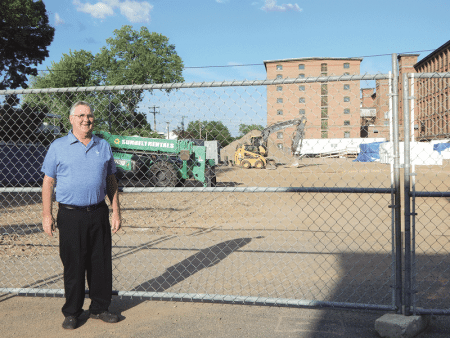
Community Spotlight Features

Community Spotlight: Easthampton

Mayor Karen Cadieux

Mayor Karen Cadieux says Easthampton has witnessed an exciting year marked by constant buildouts and growth.

The view from Mayor Karen Cadieux’s Easthampton office is stunning.

Sunshine glints off of the serene waters of the newly opened Nashawannuk Pond Promenade Park, and the boardwalk that spans it is busy.

“The park was planned to become a destination; it’s located right in the heart of our cultural district, and it’s booming,” Cadieux told BusinessWest. “Every day, people stroll along the boardwalk, sit and relax on the benches, do yoga, fish from one of the three handicapped-accesible boat ramps, or launch their boats. Families have been bringing their children to the park … it has something for everyone and offers enjoyment for all walks of life.”

The $945,000 park project is just one of many developments completed over the past year. They range from new housing for people at all income levels to infrastructure and interior improvements in the city’s old mill buildings — which have made those spaces more attractive to businesses — to the continued growth of the creative economy, which is thriving.

In fact, the ribbon-cutting ceremony for Nashawannuck Pond Promenade Park was staged June 13 in conjunction with the start of the second annual Cottage Street Cultural Chaos festival. “Thousands of people attended, and it was wonderful; there were vendor booths as well as music and performers,” said Moe Belliveau, executive director of the Greater Easthampton Chamber of Commerce.

She added that the new boardwalk is beneficial to nearby shops and businesses, which include the downtown area and the thriving Cottage Street Cultural District, which is populated by artists, galleries, gift shops, and restaurants.

“The Promenade project has increased foot traffic downtown, which is wildly important. The businesses there have done well, but now people are on the boardwalk all the time. They walk along eating ice cream from Mount Tom’s on Cottage Street and holding bags with items purchased from nearby stores,” Bellieveau noted, adding that a new restaurant known as Bliss Café, whose menu includes vegetarian and vegan options, opened at 42 Cottage St. last month.

An $18 million development has also been completed across the street from the park. The historic, 125,000-square-foot Dye Works factory, which closed in 2005, has been turned into Cottage Street Apartments. Cadieux said the project involved a complete renovation of the brick structure into 50 affordable-housing units, which were immediately occupied after it opened in May.

“More than 250 people applied, so there is a long waiting list,” she said. In addition, construction on a brand-new, six-building, affordable apartment complex called Parsons Village, which came about thanks to Valley Community Development Corp., had just been finished, and people began moving into the units at the beginning of the month.

“Another very exciting development has taken place across the street from Parsons Village,” Cadieux continued. “The former Parsons Street School that was surplused by the school department in 2013, has been turned into a luxury apartment complex called Parsons Place.”

The building was purchased by developer Kevin Perrier, president of Five Star Building Corp., which served as general contractor for the project, and the city was paid all the back taxes owed on it. “It contains 16 high-end units, and the entire top floor is a penthouse that rents for $3,500 a month,” Cadieux said, adding that every apartment contains stainless-steel appliances, mahogany flooring, tiled bathrooms, 12-foot ceilings, and central air conditioning.

New developments are also brewing in Easthampton’s old mills. This year the city was feted with an award for the Best Tasting Drinking Water in the U.S. by the National Rural Water Assoc. in Washington, D.C., and beer makers are taking advantage of it.

“We have two breweries in the Pleasant Street mills,” said Cadieux. “Abandoned Building Brewery opened last year, and New City Brewery is in the process of opening. In addition, Fort Hill Brewery opened in a new, state-of-the-art building last year.”

For this, the latest installment in its Community Spotlight series, BusinessWest looks at the many types of development taking place in Easthampton, and how this former mill town has evolved into a cultural destination.

New Developments

The mayor noted repeatedly that Easthampton has been extremely fortunate in many respects. “It’s been an exciting year because there have been constant buildouts and growth. Businesses want to come here because we’re a thriving community,” she told BusinessWest.

But the economic growth is far more than a simple matter of luck; Cadieux and other town officials have worked hard to promote partnerships that encourage and promote growth.

An example of the communiuty’s success is a collaboration between the city and the owners of all five mills on Pleasant Street. It resulted in the Pleasant Street Mills project, which was funded by three major MassWorks grants.

“It started with work by the city that was done for safety reasons, so our fire department could access the back of the building,” Cadieux said, adding that it quickly morphed into a larger project that is now in its final phase.

The goal is to connect three of the revitalized, 19th-century brick mill buildings and create a main public entryway behind them. “The design includes a landscaped parking lot with new lighting and ties the back of the mills to the Manhan Rail Trail and Lower Mill Pond,” the mayor explained.

She added that the city purposely zoned its old mills for mixed use and worked closely with the Pleasant Street owners, who spent a significant amount of money upgrading their interior space. As a result of the magnitude of the project, Eversource (formerly WMECO) upgraded the electric lines going into the buildings.

“It’s something they had not planned to do for 10 years, but they were inspired by the project and the fact that the mill owners invested money to do renovation at the same time,” Cadieux explained.

Belliveau said the three-stage MassWorks project will bring even more vitality to the town. “It’s a storybook partnership and has spurred a lot of private reinvestment by the mill owners, which is key to renting available space,” she noted. “There’s a tremendous amount of energy and synergy in Easthampton, and a lot of growth and renaissance going on.”

Cadieux said the Pleasant Street mills are doing well, housing art galleries, hair salons, restaurants, and beautiful apartments. “And the Conway School of Landscaping opened a new facility in Mill 180 this month,” she added.

The creative-arts community is also growing, and the lobby of the historic Old Town Hall on 43 Main St., which has become a center for Easthampton’s arts organizations, underwent a major renovation that was completed last month.

CitySpace Inc., a nonprofit that maintains the building as a center for the arts, received a $133,000 tourism grant to do the work, and the City Council approved an additional $256,000 of Community Preservation Act funds for the project. “There are new doors, refurbished floors, new lighting that goes up the stairs, and more,” Cadieux said.

An August ribbon cutting for the entranceway was staged during Easthampton’s monthly Artwalk, which has been highly successful and draws people from many communities, said the mayor, adding that the city is also actively seeking grants to renovate the second floor of the building, which would be used to host theater groups and other functions. At present, it is not handicapped-accessible.

She added that the soaring popularity of the town extends to the housing market. “Easthampton has become the place to live, and in some neighborhoods, where the houses are priced in the $200,000 range, they have been selling in two days,” the mayor said, noting that three homes in her neighborhood took deposits for full-price offers recently on the same day. She attributes it to the city’s low tax rate, vibrant downtown, and Easthampton’s new, $40 million high school, which just received a Level I rating.


“The students moved in two years ago, but we just closed out the project this year,” she explained.


Belliveau said the Chamber of Commerce also established new programs and partnerships during the past year, along with new events, such as the day-long 2015 Checkpoint Legislative Summit, which will be held for the first time in Easthampton on Nov. 4 in collaboration with other chambers.

In addition, a partnership was formed with Williston Northampton School, and a chamber breakfast was held there in June featuring a speaker. “It was such a success that it will become an annual event with different speakers,” she told BusinessWest.

The chamber’s first Beach Ball was also held recently at the Oxbow Marina. The summer event was created to mirror the successful winter Snowball, with its silent and live auction, dinner, and dancing, said Belliveau, adding that the city also partnered with the Greater Holyoke Chamber and staged a legislative luncheon with that body in April.

Moving Forward

Belliveau told BusinessWest that Easthampton is thriving. “This is a community that really loves who and what it’s become, and it’s an exciting time.”

Cadieux agreed. “We’ve had a lot going on in the past year. We’re vibrant, but we are still growing and want to remain attractive to new businesses.

“There is still space available in the mills, available land zoned for highway business along Route 10, or Northampton Street, and a blighted building on 1 Ferry St. for sale,” the mayor continued. “We’re striving to keep our diversity so there is something for everyone here. It’s the key to our success.”

Easthampton at a glance

Year Incorporated: 1809
Population: 16,036
Area: 13.6 square miles
County: Hampshire
Residential Tax Rate: $15.15
Commercial Tax Rate: $15.15
Median Household Income: $57,134
Family Household Income: $78,281
Type of government: Mayor, City Council
Largest employers: Berry Plastics; Williston Northampton School; Argotec
* Latest information available