Home Sections Archive by category Features (Page 19)

Features

Features
Friendly’s Comeback Efforts Will Be Among a Host of Expo Programs

WMBExpo600x250When John Maquire spoke with BusinessWest late last year, a few months after taking the helm at a very troubled Friendly’s Ice Cream Corp., he was quite blunt when assessing what had happened to one of the region’s most well-known brands — and about what needed to happen next.
“In a nutshell, I would say that Friendly’s has lost its focus on what really makes it special,” he told the magazine. “It’s lost its perspective on who the customer is and what is the best way to deliver for that customer, and, most importantly, what gives us credibility with our customers.
“There is no quick fix to any of this business,” he went on, referring to the complex assignment of turning around the company’s fortunes. “It took a long time for Friendly’s to lose its way; it’s going to take some time for us to find our way back.”
At the Nov. 6 Western Mass. Business Expo at the MassMutual Center in downtown Springfield, Maguire will give a candid and in-depth look at how far he believes the company has come in those efforts to find its way back, initiatives that have included everything from new menu items to redesigned restaurants. He will be one of many area business leaders — and possible future leaders — to take center stage (officially known as the Show Floor Theater) at the Expo for special presentations designed to inform, entertain, and, most importantly, inspire.
Also on the schedule (see details on page 15) is a comprehensive look at the complex and potentially far-reaching legislation that has come to be known as Obamacare; a presentation from one of the region’s most colorful — and successful — business owners, Paul DiGrigoli, that he calls “Beyond an Entrepreneur”; and a pitch contest and demo day that will feature 10 aspiring entrepreneurs trying to sell a panel of judges on their ideas.
“It’s going to be a day of learning,” said BusinessWest’s associate publisher, Kate Campiti, referring to the Show Floor Theater presentations, but also a wide range of other programming slated for this, the third Expo. “There will be so much for business owners and managers to think about when it comes to running their ventures and taking them to the next level — whatever that may be.”
Indeed, the Expo will also feature 12 educational seminars, with titles ranging from “The Future of Sales” to “The Emerging Workforce”; from “Am I Wasting Money and Time Doing Social Media?” to “Effectively Reaching the Hispanic Community.” There will also be a breakfast program, hosted by the Affiliated Chambers of Commerce of Greater Springfield, featuring Jim Koch, founder of Boston Beer Company and the Samuel Adams Brewing the American Dream Program, and the November luncheon of the Professional Women’s Chamber, featuring Kathrine Switzer, the first woman to run in the Boston Marathon and now an author and motivational speaker.
“People will want to block off that entire day if they can,” said Campiti. “There will be exciting, informative programming going on all morning and all afternoon.”
The pitch contest is a new concept for the Expo, and it will present an opportunity for the attendees to understand the important work being undertaken by a group called Valley Venture Mentors, she added. Formed nearly three years ago, the VVM, as it’s called, was created to provide startups with much-needed mentoring and multi-faceted support aimed at helping them navigate the whitewater that often claims many business ventures trying to get off the ground.
The contest, which will feature current VVM participants and alumni, will showcase some of the many interesting new business concepts that may eventually be cultivated into successful, job-creating ventures, said Scott Foster, an attorney with Springfield-based Bulkey Richardson and co-founder of VVM. Judges will score the pitches, and the contest’s audience will have a chance to vote for their favorite online.
Meanwhile, DiGrigoli, a national motivational speaker, will target his remarks to those who are already in business and facing the challenge of getting to that proverbial next level. His talk will address everything from the “five major mistakes entrepreneurs make” to how to “murder your business.”
McGuire, who will take to the podium at the Show Floor Theater at 10:30 a.m., will discuss how Friendly’s lost its way — and eventually was forced to file Chapter 11 bankruptcy — but will mostly focus on the future and what he calls the “five key drivers of brand renewal.”
For more information about the Expo or to register for the event, visit www.wmbexpo.com or call (413) 781-8600.

Features
Nominations Sought for BusinessWest’s Recognition Program

BizDiffMakrsLOGO2011Looking back at the five Difference Makers recognized by BusinessWest earlier this year, Kate Campiti, the magazine’s associate publisher, said the class of 2013 epitomizes what the five-year-old program is all about.
“We had five individuals or groups who showed that there really are many ways in which people can make a difference,” she noted, referencing a class that included the Sisters of Providence; Bruce Landon, general manager of the Springfield Falcons and the individual credited with keeping hockey in Springfield; John Downing, the driving force behind Soldier On; Jim Vinick, a supporter of a number of area nonprofits, especially the Basketball Hall of Fame; and state and local police involved in a unique effort to curb crime in Springfield’s North End. “This was a group that clearly demonstrated that are countless factors that go into the phrase ‘quality of life,’ and so many ways that it can be improved.”
But there are many more stories of difference making still to be told, she went on, and as 2013 moves toward an end, it is time for BusinessWest to again seek nominations for what has become a coveted honor.
The nomination form here explains how this process works, said BusinessWest Editor George O’Brien, who noted that the phrase ‘Difference Maker,’ as the class of 2013 proved, is a truly subjective phrase with a number of meanings.
“Since Difference Makers was launched in 2009, we’ve recognized college presidents, nonprofit managers, a crusading police chief, a woman who founded a program to fill the shelves of school libraries, and another who started a walk to raise money to fight breast cancer,” he explained. “All these stories are different, but there is a common denominator — people stepping forward, and stepping up, to change lives in a very positive way.
“There are many more individuals and groups who are changing lives in similar ways,” he went on. “This program was created to provide a forum for telling these stories, and we want our readers to help us with this assignment.”
As with another BusinessWest recognition, 40 Under Forty, Difference Makers is a nomination-driven process, Campiti said, urging those who propose an individual or group for consideration to be thorough with their nomination and, in simple terms, effectively answer the question, ‘why is this nominee a Difference Maker?’
Nominations, which can also be completed online, are due at the end of the business day (5 p.m.) on Dec. 20. The winners, as chosen by a review panel comprised of BusinessWest writers and editors, will be profiled in the magazine’s Feb. 10 edition and saluted at the annual Difference Makers gala, to take place in late March.
Questions about the program and the nomination process can be forwarded to [email protected], or call (413) 781-8600, ext. 102.

Previous Difference Makers:

2009
• Doug Bowen, president and CEO of PeoplesBank;
• Kate Kane, managing director of the Springfield office of Northwestern Mutual Financial/the Zuzolo Group;
• Susan Jaye-Kaplan, founder of GoFIT and co-founder of Link to Libraries;
• William Ward, executive director of the Regional Employment Board of Hampden County; and
• The Young Professional Society of Greater Springfield

2010
• The Irene E. and George A. Davis Foundation;
• Ellen Freyman, attorney and shareholder at Shatz Schwartz and Fentin, P.C.;
• James Goodwin, president and CEO of the Center for Human Development;
• Carol Katz, CEO of the Loomis Communities; and
• UMass Amherst and its chancellor, Robert Holub

2011
• Tim Brennan, executive director of the Pioneer Valley Planning Commission;
• Lucia Giuggio Carlvalho, founder of Rays of Hope;
• Don Kozera, president of Human Resources Unlimited;
• Robert Perry, retired partner/consultant with Meyers Brothers Kalicka; and
• Anthony Scott, Holyoke police chief

2012
• Charlie and Donald D’Amour, president/COO and chairman/CEO, Big Y Foods;
• William Messner, president of Holyoke Community College;
• Majors Tom and Linda-Jo Perks, officers of the Springfield Corps of the Salvation Army;
• Bob Schwarz, executive vice president of Peter Pan Bus Lines; and
• The Women’s Fund of Western Massachusetts

2013
• Michael Cutone, John Barbieri, and Thomas Sarrouf, organizers of Springfield’s C3 Policing program;
• John Downing, president of Soldier On;
• Bruce Landon, president and general manager of the Springfield Falcons;
• The Sisters of Providence; and
• Jim Vinick, senior vice president of Investments at Moors & Cabot Inc.

Features
Panoramic Reeds Landing Is Making a New Name for Itself

Dave Scruggs

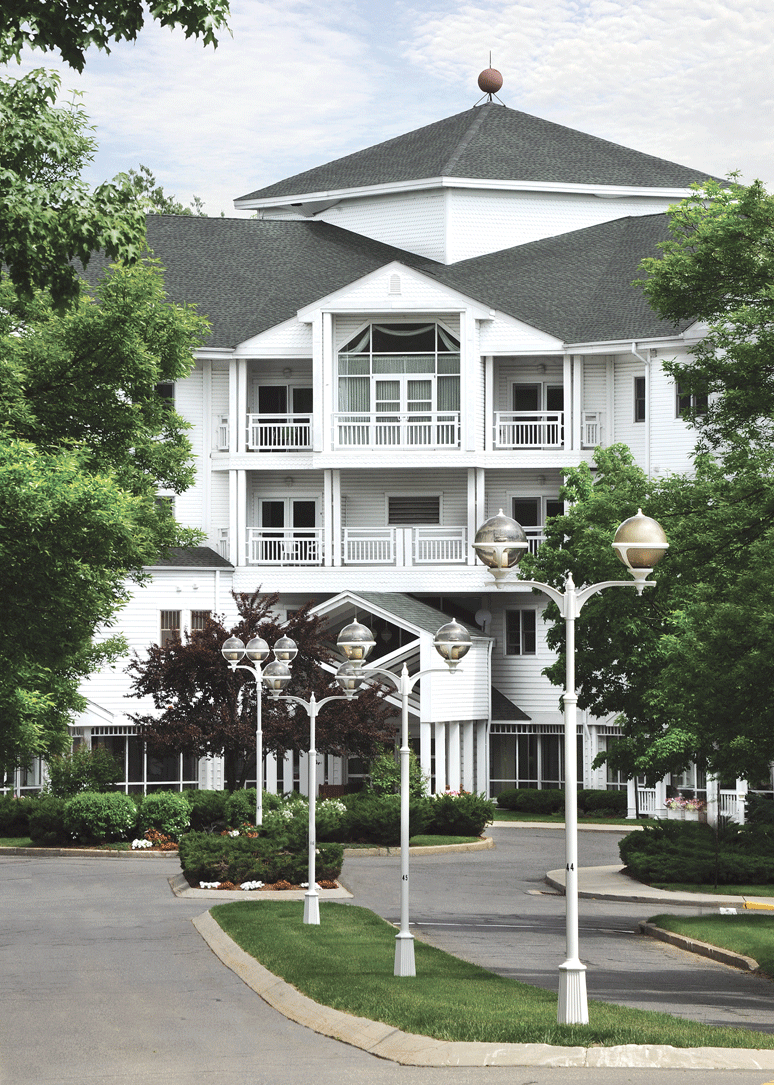
Dave Scruggs says Loomis has invested heavily in not only improving life at Reeds Landing, but attracting more residents to the community.

Dave Scruggs says that, since Loomis Communities acquired Reeds Landing after the life-care retirement community filed for Chapter 11 bankruptcy in 2009, a number of changes and improvements have taken place.
For starters, the units are now more affordable, said Scruggs, who became CEO of Loomis Communities early this year. Also, there have been extensive renovations and catch-up on a large amount of deferred maintenance, he said, noting that more than $3.3 million has been spent to “bring the property up to Loomis community standards.”
And then, there’s Lake Massasoit, just a few yards from the property. It’s now much more visible — and accessible — thanks to some extensive tree and brush clearing and the creation of a few walking trails.
“It’s a much different facility than it was years ago,” said Scruggs, adding that one of his primary goals since arriving has been making sure that area senior citizens and their families are aware of all this.
He calls it a “reintroduction” process, and early on, administrators and board members at Loomis Communities thought a name change should probably be part of the equation.
That’s because many were still associating ‘Reeds Landing’ with the bankruptcy, high-priced units, or both, said Scruggs, who noted that coming up with a new name was an intriguing exercise that involved a number of constituencies, including residents, many of whom wanted to somehow keep ‘Reed’ — as in Rev. David Allen Reed, the founder and first president of nearby Springfield College — in the mix.
“Our original thought was just to name it Loomis Lakeside,” he recalled. “But after talking with the residents, we learned that there’s a lot of memories for people who live here — spouses who have died here, for example — and there’s a connection to Springfield College. There was very strong sentiment that we keep Reeds Landing in the name.”
Eventually, those tasked with this assignment arrived at Loomis Lakeside at Reeds Landing, a name that accomplishes many things, said Scruggs. It references the lake, a feature that he believes truly sets this facility apart from other senior-living facilities in the region. It also respects the history of the site by keeping Reed’s name, he said, and it brings the Loomis brand front and center, which is perhaps the most important consideration.
Lakeside at Reeds Landing

Dave Scruggs says Loomis Lakeside at Reeds Landing is making real progress in overcoming perception issues at the facility.

“In addition to changes in the pricing and the contract, we’ve bought what I’ll call the ‘Loomis Communities way’ here,” he explained, referencing the operating philosophy that prevails at the company’s other properties — Loomis Village in South Hadley, Loomis House in Holyoke, and Applewood in Amherst. “We have more than 100 years of experience in operating retirement communities, and our predecessors didn’t have that breadth of knowledge.
“We changed a lot of policies and procedures,” he went on. “And we retrained the staff to do things the way we wanted them to be done or thought they should be done.”
The new name — not to mention the host of improvements — was rolled out at a lunch and open house on Sept. 15. That event was just one component of a broad effort to reintroduce the facility to the region, said Scruggs, who said this property has always enjoyed a high success rate when it came to converting visits into sales. The goal moving forward is simply to generate more visits and let the facility and its community do the rest.
“The percentage of people who come, look, and buy here is much higher than the norm for the industry,” he explained. “And this was just further confirmation that there was an image problem out there had to be addressed.”
For this issue, BusinessWest talked at length with Scruggs about how he believes Loomis Communities is making that image problem a thing of the past, while also setting some very ambitious goals for the future.

A Shore Thing
Soon after prevailing in a nation-wide search for a successor to long-time Loomis Communities CEO Carol Katz, Scruggs started looking for a home in Greater Springfield.
He eventually settled on a new subdivision taking shape in South Hadley, but the home would not be ready for a few months after he started, so he commenced a search for temporary quarters.
He found them at Cottage 1022 at Reeds Landing, a unit chosen because of the size of his dog, Magnolia, an Australian shepherd mix, more than anything else.
“I spent a lot of time here talking with the residents; the conversations over the dinner were great, and the life stories that people at Reeds Landing have to tell are incredible,” said Scruggs, adding that he learned a good deal during his time at Reeds Landing about the “rhythm of the place.”
“I learned about the things that were important to residents; these were things I knew intellectually, but living it with them made a big difference to me,” he went on, adding that he also gained some additional perspective on the facility’s history and the challenges ahead for it. “The board wanted me to be here and really know the life of the place.”
Recapping the past several years, Scruggs said a number of factors came together to precipitate the facility’s decline into bankruptcy.
The onset of the Great Recession and its immediate impact on the local housing market certainly played a role, he said, noting that many potential tenants could not sell their homes, something most needed to do to pay the entrance fee at the facility. And as the occupancy rate soared, the facility fell further into debt, which exceeded $28 million at one point.
“Sales went downhill quickly, and the organization wasn’t able to keep up with the basic costs of running the facility,” he said, adding that Loomis, unburdened by the enormous debt carried by the previous owners, has been able to substantially reduce prices, from around $500,000, on average, years ago to the $200,000-$250,000 range.
But perception has also been a problem for Reeds Landing, said Scruggs, adding that, for some time, there was what he called a “hangover effect” from the bankruptcy, or the perception that the property was still in fiscal disarray. And while entrance fees are now much lower and contracts more favorable to tenants, many people continue to believe the facility is beyond their reach.
An old marketing campaign, one that featured television spots showing tenants and prospective tenants driving around in a vintage Cadillac, fueled the perception that Reeds was a very high-end facility, said Scruggs.
Also, the property was suffering from that aforementioned deferred maintenance and general neglect.
“It wasn’t falling down, by any stretch of the imagination, but there was a lot of catch-up work to do,” he explained. “We’ve spent the past three years bringing the property up to the standards that we would expect for a Loomis community.”
The company invested heavily in infrastructure, such as roofing and other areas that are not visible, he went on, and this year took on more cosmetic items, including everything from new carpeting and wallpaper to landscaping and those aforementioned walking trails. There were also extensive renovations to the 44-bed nursing home.
With these improvements and a targeted marketing campaign, Scruggs believes he and his staff can raise the current occupancy rate of roughly 75% closer to the industry average of 85% and then to the ultimate goal of 95%.

Lake Massasoit

Loomis leaders say Reeds Landing’s proximity to Lake Massasoit is a selling point.

Actually, the facility would be much closer to those latter numbers were it not for a much higher-than-average number of what are called ‘move-outs,’ or residents who have died or moved on to another type of housing or healthcare facility.
“Occupancy today is about what it was a year ago, but interestingly, we’ve doubled sales since last year,” he explained. “One of the vagaries of this business is that, if you have a lot of people move to healthcare or pass away in a given year, it doesn’t matter what your sales are; you’re going to have a decline. If we’d had a normal transition rate, we’d be at about 80% now.”
Moving forward, Loomis and a marketing firm specializing in this industry, Retirement Dynamics, will work to use the facility’s strongest assets — the location and the Loomis brand — to drive sales.
“Retirement Dynamics brought to us a cohesive marketing plan for the organization,” Scruggs explained. “Rather than looking at each of the four retirement communities as its own island to sell to a particular group of people within five or 10 miles around it, they helped us recognize the value of the Loomis brand.
“When they started selling here [Reeds Landing], they realized that, when someone came across the threshold to talk with a salesperson, the two things that sold this place were the Loomis experience and this location,” he continued. “Within that brand, we looked at what was unique about each of the four communities, and what clearly was unique about this property is that you’re sitting in an oasis; the lake gives it a very different feel.”

Optimistic Viewpoint
With the renovation work and efforts to create stunning vistas of the lake now finished, the primary task at hand for this property is simply getting the message out, said Scruggs, adding that he believes it will certainly resonate.
“The brand is Loomis, the property is stunning and gorgeous, and it’s a beautiful place to be within the city of Springfield — that’s the message,” he told BusinessWest.
And if it can be effectively conveyed, the property formerly known simply as Reeds Landing can make a new name for itself — in more ways than one.

George O’Brien can be reached at [email protected]

Community Profile Features
Enfield Enjoys Vibrant Business Development

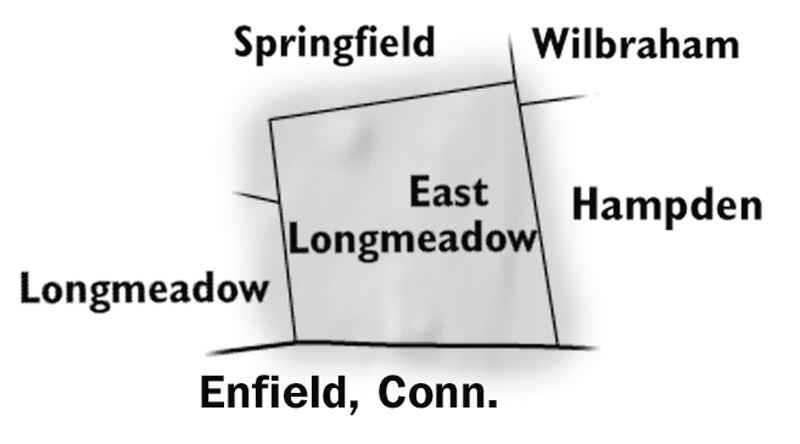
EnfieldCommunityMapLast year, Jeannette Norman and her husband, Lou Masachi, purchased the former Friendly’s restaurant at 86 Enfield St. in Enfield, Conn. “The building had sat empty for several years and was an eyesore,” Norman said.
But they were intrigued by the location — right off of I-91 and almost in front of MassMutual — and after gutting and renovating the building and cleaning up the property, they opened the doors to the Backyard Bar and Grill on July 2, 2012.
Although the couple hoped the eatery would do well with a broad clientele — it boasts a full bar as well as a children’s menu and a good environment for families — its popularity has been greater than they imagined. “Business has been excellent, even better than we expected,” Norman said.
She cites Enfield as an ideal spot to own and operate a business. “It has a lot of diversity in terms of demographics, a lot of commercial opportunity, and a good mix of residents and businesses,” Norman told BusinessWest, adding they opened an outdoor patio in May, which has also proved to be a draw.
Town officials say the success the couple has experienced mirrors the experience of many business owners as Enfield has undergone an unprecedented amount of growth in the last few years. “In the past year alone, we have issued more than $100 million in building permits, which is more than the town has ever done in its history,” said Town Manager Matthew Coppler.
The upswing is remarkable, considering a number of serious setbacks that occurred in 2007 and 2008. “Westvaco closed, and Lego downsized from 800 to 300 employees,” Coppler said, adding that the cutback resulted in 1 million square feet of empty distribution and manufacturing space.
Circuit City and Bernie’s also went out of business, along with a number of other retail stores. “Things were very bleak at one point, and we had one of the highest vacancy rates of retail space in the state. It was very bad for about two and a half years,” Coppler said.
But in 2009, Enfield’s economy began to rebound, and in the ensuing years the town saw rapid growth. “What has come out of the setbacks we suffered is far greater than what we had here before,” he said.
Lego’s Enfield warehouse and offices have undergone a $10 million renovation, which transformed it from a manufacturing facility into offices for white-collar workers. Phase 1 is finished, another expansion is planned, and when it is complete, the number of jobs regained will be close to those that were eliminated. The toymaker’s distribution and manufacturing space has also been filled, including square footage leased by Coca-Cola and Advanced Auto.
In addition, Westvaco’s property was purchased by Data Warehouse Co., while the former Bernie’s store became home to Underwriter’s Laboratories when the company relocated to Enfield.
The German biomedical equipment maker Eppendorf Manufacturing Co. has also expanded twice in less than 10 years, and last spring, the firm began a $25 million expansion to its production plant, in addition to buying land from the town.
Growth also occurred at MassMutual. The company tackled a $15 million renovation of its Enfield campus after purchasing the Hartford’s Retirement Services division. “They are finishing the exterior of the building right now,” Coppler said, adding that the acquisition brought about 300 new jobs to Enfield.
Yankee Castings is also expanding, with a 5,000-square-foot addition. “And the second phase of their addition will add another 40,000 square feet,” he noted.
The retail arena has also improved considerably, and the former home of Circuit City is now occupied by P.T. Richards. Meanwhile, storefronts in Enfield Mall that sat empty are now occupied. “We have gained back more than we lost,” Coppler said. “Things have happened very quickly, especially on the commercial side.”

Winning Combination

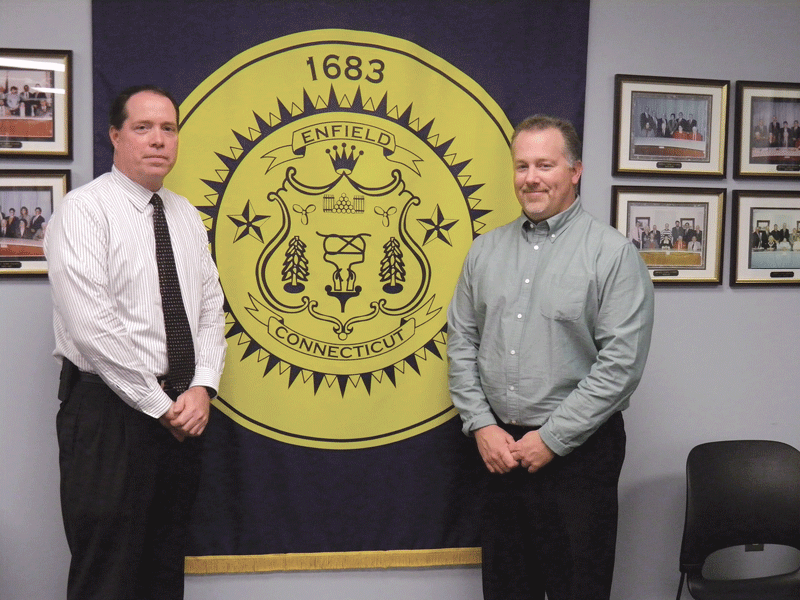
Matthew Coppler, left, and Peter Bryanton

Matthew Coppler, left, and Peter Bryanton say Enfield businesses are thriving, and more space is available.

Coppler said four factors have played a major role in Enfield’s economic boom, the first being its location. “It’s very conveniently situated off of I-91 with proximity to Bradley International Airport and two large metropolitan areas with different and diverse characteristics, and businesses can also tap into two different pools of employees in Hartford and Springfield.”
The large anchor industries in town, which include Lego, Hallmark, MassMutual, and Eppendorf, have also helped to keep the economy strong. “And Brooks Brothers is consolidating all of its operations to Enfield,” Coppler said, adding that, during the past two years, partnerships have formed between these cornerstone businesses and the town’s schools, leading to internships and externships for students. “One of our goals is to keep our youth here.”
The third draw is the affordability of housing and rental space. “It provides a lot of opportunity for people who want to live and work in our town,” he said.
Peter Bryanton agreed. “Enfield has every available service people need. It’s all right here,” said the town’s director of Community Development. “We have seven plazas and an enclosed mall, and in the last 18 months, Aspen Dental and Moe’s restaurant have opened up in Enfield Commons, and on Hazard Avenue, the site of the former Bickford’s has become home to Chipotle, Supercuts, and a wireless store.
“Plus,” he continued, “Hartford Hospital has several satellite medical facilities in Enfield, and St. Francis Hospital recently established health facilities here. These are all building blocks to the future we are trying to create.”
A fourth attraction is the active role citizens play in the town’s government. “The people who live here want the best for their community and believe in living up to their responsibility. They want to be part of town committees,” Coppler said. Recently, 50 residents applied for 13 spots on the high-school building committee. It’s a quality that stretches back to World War II, when Enfield had the highest per-capita enlistment rate in the U.S., he noted.
But although the town has experienced tremendous growth in the past few years, officials say they continue to work to keep Enfield vital. “We are trying to live up to our reputation of creating an environment that makes people want to live here,” Coppler said, citing infrastructure improvements that include $60 million spent on sidewalks and roads over the last 15 years.
Town leaders have also adopted measures to streamline the permitting process. “In the past, Enfield was seen as creating barriers to growth. But that has changed,” he said, explaining that officials made a concerted effort to meet with business owners to get feedback about how they could improve the system, then implemented their suggestions.
He cited the exterior renovation of MassMutual, which is nearing completion, as an example of that success. “They came to us with their plan on June 26, and within a month, they had all of the approvals they needed, including those for wetlands,” he said, adding that the wetlands presented a challenge for the town, “but our land-use board holds special meetings when things need to get done.”
The town also took a proactive stance in 2008 and 2009 by building a Hampton Inn on the edge of the industrial park. It contained a pad for a restaurant, and a Longhorn’s Steakhouse is set to open there soon.

Dedicated Initiative

Enfield is made up of a number of neighborhoods or small villages, which include Hazardville, Scitico, Shaker Pines, Southwood Acres, and Thompsonville.
Once home to manufacturing mills, Thompsonville is today the focus of a revitalization plan aimed at bringing new life to the area that was once considered downtown when the Bigelow-Sanford Carpet Co. was thriving and an untold number of homes were built to accommodate workers.
But the town’s center of activity moved when Enfield Mall was constructed. The neighborhood took another hit when Bigelow closed its doors, and “Thompsonville was left in the dust,” Coppler said.
Bryanton agreed, saying the village is now “an urban center with a lot of absentee landlords.” But plans have been put in place to rejuvenate the area. A $3.5 million intermodal transportation center is being built to accommodate travelers on the planned Thompsonville stop of the New Haven-Hartford-Springfield commuter rail line.
“It will be multimodal and will include rail and bus service and a pedestrian/bike path that will link Enfield Street to the Connecticut River as part of the Connecticut River Access Project,” he told BusinessWest.
The downtown is dense, and although there are numerous vacancies, “we know that transit helps bring about economic development,” Bryanton said. “We have also put in new streets and sidewalks and done a large pond-restoration project.”
In addition, the nonprofit Enfield Community Development Corp. has been tasked with granting $180,000 in microloans for startup businesses and expansions in Thompsonville. A tax-abatement process for improvements and new construction in the area is also in place, and town officials are in the process of completing a zoning study to ensure that space is available for new businesses that fit in with the natural surroundings, he added.
As for Coppler, he believes the town is filled with vitality and has experienced tremendous growth, but has not yet realized its full potential.
“Today, our vacancy rate is the second-lowest in the state,” he said. “There is money to be made here, and we can show that we have worked to help businesses come to Enfield or expand here.”

Features
Western Mass. Business Expo Highlights Innovative Ideas

1_WMBEstevensSilverSponsor24x18.inddJon Lester and Koji Uehara aren’t the only ones getting their best pitches ready this fall.
Plenty of burgeoning entrepreneurs will wind up at the Western Mass. Business Expo on Nov. 6, which will feature the First Annual Pitch Contest and Demo Day, hosted by Valley Venture Mentors (VVM) and BusinessWest.
VVM alumni and members of the current class have applied for a spot in the competition. Participating startups will make two-minute pitches to a panel of judges, who will give them immediate feedback. At the end of the contest, the judges will award cash prizes of $1,500, $750, and $500 to the top three teams. An additional special prize of $500 will be awarded to an audience favorite.
Each participant is also invited to showcase their venture at a Demo Day reception immediately following the pitch contest.
“It is the startup’s secret sauce that gets all the attention. People focus on what they make and how they make it,” said John Garvey, a board member with VVM and a MassChallenge judge and mentor. “It is the pitch, however, that makes it all real. The sauce won’t sell to anybody without a great pitch. That’s why this pitch contest is so important. For participating startups, it may make the difference between success, and connecting with investors and consumers, or failure, meaning it’s just another idea that no one could understand.”
The pitch contest is just one of a growing roster of impressive programs scheduled for the Expo, which is once again being produced by BusinessWest, managed by Rider Productions, and presented by Comcast Business at the MassMutual Center in Springfield.
For example, Jim Koch, founder of the Boston Beer Co., brewer of Samuel Adams, will be the keynote speaker at the Expo breakfast, hosted by the Affiliated Chambers of Commerce of Greater Springfield. And Kathrine Switzer, who stood up to Boston Marathon race officials in 1967 to become the first woman to run in that event, will highlight a luncheon hosted by the Professional Women’s Chamber.
The day will also feature dozens of educational seminars and Show Floor Theater presentations. For example, the Expo recently added Hector Bauzá to its schedule of speakers. President and CEO of Bauzá & Associates Hispanic Marketing in Hartford, he will talk about the challenges and opportunities involved in marketing a business to the Hispanic population.
Later in the day, entrepreneurs that participated in the pitch contest will have their ideas on display at the event-capping Expo Social, which is one the region’s premier networking events.
The Expo will also reveal the winner of the Greater Springfield Extreme Website Makeover, a program sponsored by BusinessWest and DIF Design, which invited small businesses and nonprofits to apply for $25,000 worth of services from DIF and four co-sponsors: the Creative Strategy Agency, Christine Parizo Communications, Hadley Printing, and viz-bang!
The goal is to help a deserving enterprise raise its online presence and help usher it to the next level, and the companies involved in the project will provide services ranging from copywriting and printing to videography and social-media strategy — not just web design. This month, a panel of judges will consider about 25 nominations; several finalists will be announced at the Expo, and the winner will be unveiled late in the day.
“A lot of people are just stuck in place,” said Peter Ellis, president of DIF Design, when asked about the benefit of winning the contest. “They know they should have better marketing, better websites, but for whatever reason they’re spending their money hiring an extra person or on operations, and they don’t have the ability to make that jump. Hopefully, the winner selected by the judges will be able to jump-start or continue to promote their business.”
For more information about the Expo, including a full schedule of events, log onto www.wmbexpo.com or call (413) 781-8600.

Features
Western Mass. Business Expo Features a Full Slate of Programs

1_WMBEstevensSilverSponsor24x18.inddWhen she registered to run in the 1967 Boston marathon, she signed her name ‘K.V. Switzer,’ as she always did. Thus, it wasn’t until the race began that fellow runners, spectators, the press, and race officials realized that the individual wearing bib number 261 was, in fact, a woman.
And when they did so, some of those race officials tried to stop her and rip that number off of her, because no woman had ever run in the Boston Marathon, and none were invited to run in this one.
Kathrine Switzer refused to step off the course, and by persevering and finishing the race, she ran her way into history.
Switzer, known as the ‘Marathon Woman,’ will tell her story — and also convey her inspiring message about creating success in a difficult environment, turning negatives into opportunities, and implementing social and cultural change — during a luncheon hosted by the Professional Women’s Chamber at the Western Mass. Business Expo, slated for Nov. 6 at the MassMutual Center.
And this won’t be the only long-running success story to be highlighted that day. Indeed, Jim Koch, founder of Boston Beer Co. — maker of Samuel Adams — will be the keynote speaker at the Expo breakfast, hosted by the Affiliated Chambers of Commerce of Greater Springfield.
When Koch (pronounced ‘cook’) started his venture, he had a dream, a generations-old family recipe, and a large supply of determination — which he would need, because he didn’t have any bank financing or distributors to carry his product.
He overcame those obstacles to create one of most intriguing success stories in American business history. Today, while continuing to add to the portfolio of flavors his brewery produces, Koch is a motivational speaker and ardent supporter of small-business owners.
The breakfast and lunch programs are just part of an impressive slate of programs now coming togther for the Expo, which will again be produced by BusinessWest, managed by Rider Productions, and presented by Comcast Business.
Also on the schedule is a pitch contest and ‘demo day,’ being presented by Valley Venture Mentors (VVM) and BusinessWest.
Formed more than two years ago, VVM, as the name suggests, matches entrepreneurs with mentors to help businesses get off the ground or to that proverbial next level. VVM leaders will field applications for the pitch contest, selecting as many as 10 to make their cases in front of a panel of experts.
There will be cash prizes for the top three finishers, and also the ‘audience’s choice’ among the contestants.
“One of the keys to the future vitality of this region is its ability to cultivate new businesses, and Valley Venture Mentors is doing inspiring work in this regard,” said Kate Campiti, associate publisher of BusinessWest. “The pitch contest to take place at the Expo will feature some of the promising new ventures taking shape in our region in what will be spirited competition for both the approval of the judges — and prize money.”
After the competition, those businesses that made pitches will have their ideas on display at the event-capping Expo Social, which is one the region’s premier networking events, said Campiti.
In addition to these programs, the Expo will also feature a number of educational seminars, she noted, adding that subjects will range from the future of sales and marketing to the best and worst uses of social media.
The full slate of seminars has been assembled, and detailed information is available for viewing at www.wmbexpo.com. Here’s what’s on tap:

Sales and Marketing
• “The Art and Science of Cold Calling,” presented by Jim Mumm, CEO of Sandler Training;
• “The Future of Sales: How to Achieve Extraordinary Sales Results in Today’s Crowded Markets,” presented by Duane Cashin, president of Cashin & Co.;
• “Make an Impact with Multi-channel Marketing,” presented by Tina Stevens, principal and creative director of Stevens 470; and
• “Building Smart Websites,” presented by Peter Ellis, president of DIF Design.

Social Media

• “How TV and Social Media Have Affected Media Consumption,” presented by Jay Frogameni, senior director of sales for New England Local, Comcast Spotlight;
• “YouTube SEO,” presented by Alphonso Santaniello, president and CEO of the Creative Strategy Agency;
• “Am I Wasting Money and Time Doing Social Media?” presented by Paul Stallman, the ‘web guru’ at Alias Solutions; and
• “The Emdees: The Best and Worst in Social Media,” presented by Carie Schelfhaudt, director of digital marketing at McDougall & Duval Advertising.

Business Management
• “Leading Change,” presented by Ravi Kulkarni and Lynn Whitney Turner, business growth strategists and executive leadership coaches with Clear Vision Alliance, LLC;
• “The Emerging Workforce,” presented by Sandy Mazur, division president for Spherion Staffing Services;
• “Understanding Immigration Law: Immigration and International Employment Issues,” presented by Joseph Curran, Esq., Curran & Berger LLP; and
• “The New Business of a Nonprofit,” presented by Kirk Smith, president and CEO of the YMCA of Greater Springfield.

And That’s Not All

Other programming for the Expo is being finalized, said Campiti, who urged those interested to visit the website regularly and check for updates.
To register for the seminars, visit www.wmbexpo.com. To register for the breakfast, call the ACCGS at (413) 787-1310 or visit www.myonlinechamber.com. To register for the luncheon, call (413) 787-1310 or visit www.professionalwomenschamber.com.
In addition to Comcast Business, the Expo is also being sponsored by ABC 40/Fox 6 (gold sponsor), and silver sponsors DIF Design, Health New England, Johnson & Hill Staffing Services, and MGM Springfield.

Expo Fast Facts

What: The Western Mass. Business Expo
When: Nov. 6
Breakfast: 7:30 a.m.
Show Floor: 9 a.m. to 4 p.m.
Luncheon: 11:30 a.m.
Expo Social: 4 to 6:30 p.m.
Where: The MassMutual Center, Springfield
Highlights: Breakfast and luncheon programs; pitch contest; educational seminars; Show Floor Theater presentations; free educational seminars; Expo Social; more than 150 exhibitors
For More Information: Visit www.wmbexpo.com or call (413) 781-8600

Community Profile Features
Deerfield Touts Tourism, Agriculture, Business

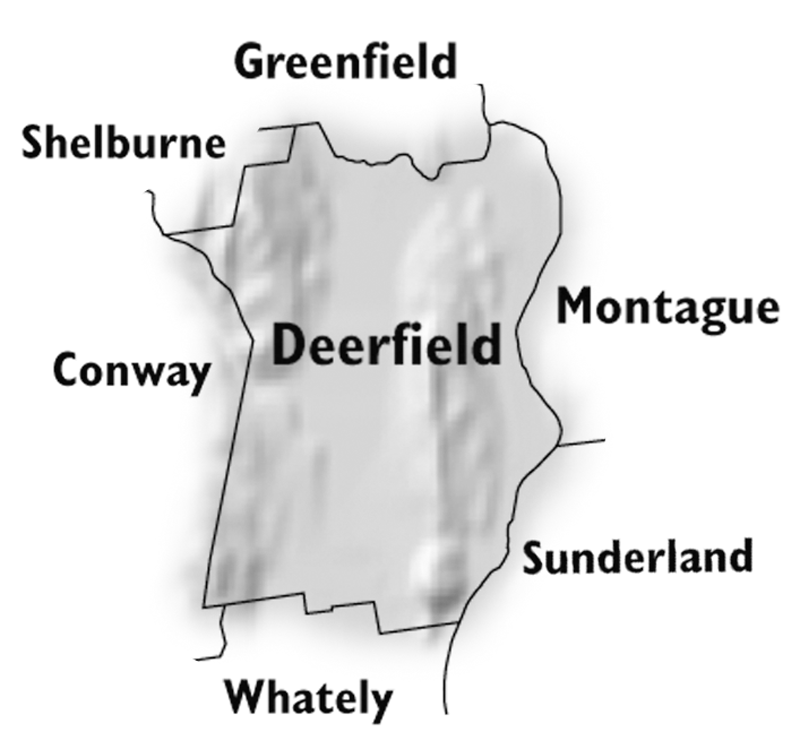
Deerfield, MassBela Breslau opened Bela’s Bed and Breakfast in June, and the Deerfield entrepreneur has already had guests from as far away as Korea.
“I’ve met the nicest people. They have come here from New York City for a wedding and for events such as school graduations,” she said, adding that her business has done well and she has received support from area residents. “The town officials here are positive to work with, and everyone has been very thoughtful because they want you to succeed.
“Deerfield is a really good place to do business,” she added, explaining that she and her husband, Stephen Bliss, also own and operate a martial-arts school on their property, where they teach the Japanese body movement known as shin tai do.
The couple moved to Deerfield from San Rafael, Calif. in 2004, and they love the town. “It’s a beautiful place with a lot to do and see,” Breslau said.
Carolynn Shores Ness, who was on the town’s Planning Board for 21 years, has had a seat on the Board of Selectman for 11 years, and is chair of the Board of Health, says the Breslaus’ story has been repeated many times in this community, and location is one of many reasons why.
“A lot of traffic comes through town, and we have a lot of tourist attractions,” she said, noting that Deerfield is a crossroads for Interstate 91, Routes 5 and 10, and Route 116.
Max Hartshorne agrees. “We really do promote Deerfield as a tourist destination,” said the former owner of GoNomad Café, who now owns a travel publishing business he operates from his Deerfield home. “Tourism here is strong. Yankee Candle is the number-two destination in the state, Historic Deerfield is legendary, and Deerfield Academy is really pretty.”

Gideon Porth

Gideon Porth says Deerfield’s access to highways and land availability are two factors that make it an attractive location for agricultural businesses.

Shores Ness said that, while the town has but 5,100 residents, 2 million people visit Yankee Candle each year. She also cites Historic Deerfield, which includes the Memorial Hall Museum and Flynt Center of Early New England Life, which feature constantly changing exhibits and workshops; Magic Wings Butterfly Conservatory and Gallery; and Mount Sugarloaf Park in South Deerfield, “which has absolutely wonderful views and allows people to walk the length of Pocumtuck Ridge,” as other popular tourist attractions.
In addition, there are the annual Old Deerfield Craft Fairs, which take place every spring and fall and draw between 30,000 and 50,000 visitors, along with the town’s Music in Deerfield chamber series and its gun clubs.
“The Franklin County League of Sportsman’s Club is here, and the South Deerfield Rod and Gun Club are also important to the community,” said Shores Ness, adding that the latter holds fishing events and turkey shoots. “There are also a lot of cultural activities that happen here year-round. And we have three boarding schools with a lot of activity, as well as many nonprofits.”

Room for Growth
Many of the town’s businesses have expanded over the past few years, and an expedited permitting process for a town-owned, 16-acre tract of land with sewer and water hookups has been approved for commercial or industrial use.
Opportunity also exists in a variety of other areas. “There are empty buildings downtown, and plenty of space is available,” Hartshorne said. “Although it’s a very sleepy downtown, a lot of traffic passes through it.”
He added that Mosaic Café is set to open this month at the site of the former, well-known Elm Farm Bakery, while Hillside Creamery, which sells ice cream and food, also opened on Elm Street. In addition, there is a new empty building across the street, which would make a great store, he said. “It has post-and-beam construction and a large parking lot.
“Plus, the Bank of America branch on Sugarloaf Street also closed recently, which has a vault and drive-through and would make a great location for another bank,” Hartshorne continued. “Permitting here is really easy, and people are friendly and helpful. It’s a crossroads town, taxes are really low, and the town officials are interested in helping new businesses grow.”
Shores Ness said space and buildings are also available in the town’s industrial park.
And although the tourist business makes up a large part of the town’s economy, the East Railroad Yard has undergone tremendous growth.
The town’s agricultural base has always has been strong, and Hartshorne said town officials are looking to the future. “Some farmers have approached them about growing marijuana, and their response has been positive.”
Shores Ness added that UMass has active agricultural and turf programs in town. “They have really ramped up, and there are a lot of experimental fields and classroom research being done in Deerfield,” she told BusinessWest.
Gideon Porth agrees. In 2004, he purchased three acres of farmland in Deerfield and began an enterprise known as Atlas Farm. It has doubled in size every year, and Porth recently purchased an additional 45 acres and opened a year-round farm stand that sells the organic produce grown on his 95-acre property, along with other local products.
“Business has been good, and we have definitely exceeded our sales estimate,” he said, adding that the town’s access to highways and resulting proximity to metropolitan markets such as Boston, where he does a lot of wholesale business, makes it an even more attractive place to establish a farm.
“The town is very supportive of agriculture, and this is one of the few spots in New England with prime land and soil for growing vegetables,” said Porth, who came to the area from Boston when he was a graduate student at UMass Amherst.
In addition, the town takes a proactive stance on capital improvements. Current projects include the replacement and relining of sewer lines as well as streetscape planning being done for the village of South Deerfield.

Keeping Pace
Shores Ness noted that Deerfield is a green community and has signed up with the Hampshire Power Municipal Aggregation group, which will eventually allow the town to buy power at a discounted rate. In addition, a stretch energy code was approved during a recent town meeting; it requires the use of energy-efficient measures in renovations and new construction. “We also encourage conservation throughout the town,” she said.
Measures have also been taken to mitigate the effects of weather emergencies, such as Tropical Storm Irene in 2011 and the freak Halloween snowstorm the same year, which had an adverse effect on land and property in Deerfield.
Town officials have applied for grants to do restoration work along the Deerfield River. “And we’re working with FEMA and MEMA to become a more resilient community so we won’t be as affected by weather events. We also offer a free, drive-through flu clinic on Oct. 6 at Yankee Candle,” Shores Ness said, adding that several hundred volunteers work with the town’s medical disaster-response team.
Laurie Nivison, director of marketing for Historic Deerfield, said Champney’s Restaurant inside the Deerfield Inn reopened in April after being closed for 18 months as a result of flooding from Tropical Storm Irene.
“The restaurant and inn underwent extensive renovations and restorations. We expanded the tavern area from 10 to 20 seats, have a new menu, and are farm to table. We have partnerships with local farms and get our pork and beef from Yazwinski Farm in Deerfield,” she said, adding that they also serve beverages made at Berkshire Brewing in Deerfield as well as other local breweries.
“Even though Deerfield may seem like it’s off the beaten path, people come here year-round,” she continued. “Historic Deerfield gets about 15,000 tourists each year, and it’s a really vibrant community; people don’t realize how much there is to see and do in town. It’s a great place to come and spend the day.”
Hartshorne said the fall is a busy season in town, but winter is also fruitful because people drive through Deerfield or pass by on their way to ski areas in Vermont.
“There are also events such as a bike ride known as D2R2, which attracts about 1,000 cyclists every year,” he said, adding that cyclists have their choice of an 80- or 100-mile route.
In fact, there is so much to see and do that, in 2008, Hartshorne worked with the tourist attractions in town and created the website deerfieldattractions.com to allow people to find out about the fairs, shopping, dining, recreation, museums, and other activities that take place in Deerfield throughout the year. He also coordinated an annual Tag Sale Day that takes place the first Saturday in October.
“We try to get everyone in town who is holding a tag sale to do it on that day,” he explained. “We create a Google map on the website every year so people can find where the sales are.”

Vibrant Economy
Shores Ness says many businesses in Deerfield have formed strong partnerships with the town, and it’s a reciprocal arrangement, as officials do all they can to help them.
“People here communicate well with each other, which is something we have encouraged,” she said. “There is a constant stream of really interesting and exciting things that are always happening in Deerfield. It’s just a wonderful place to live and work, and we welcome new neighbors and want to keep and encourage the businesses that have made a long-term commitment here.”

Features
Bradley Sets Lofty Goals for Growing Passenger Volume

JetBlue

JetBlue, which will be introducing nonstop service from Bradley to Fort Myers and Tampa this fall, is one many airlines adding routes at the airport.

There was a good deal of pageantry at Bradley International Airport on Aug. 27 as an American Airlines jet rumbled down the runway on its way to Los Angeles.
Water cannons were spraying over the plane as it taxied for takeoff — a traditional sendoff in the aviation business — and before that there were speeches from Connecticut’s governor and officials from the airline. Balloons adorned the gate, and passengers walked over a red carpet to get on the aircraft.
The pomp and circumstance clearly indicated that this was not an ordinary flight, and, in most respects, it wasn’t. It marked the triumphant return of nonstop service from Bradley to the West Coast since airlines ceased such operations more than a decade ago, and Kevin Dillon is confident that this route has staying power.
He also believes that there will be many more ceremonies of a similar nature in the near future. In fact, some of them are no doubt already in the planning stages.
Indeed, in October, JetBlue will begin offering daily nonstop trips to Fort Myers and Tampa, Fla., joining Southwest Airlines in providing service to those cities out of Bradley. And Southwest is planning to add daily nonstop flights to Atlanta three days a week beginning in November, becoming a competitor to Delta in that service.
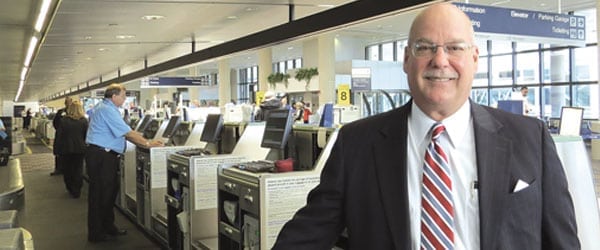
These new offerings are part of a multi-faceted strategic initiative being implemented by Dillon, executive director of the recently formed Connecticut Airport Authority (CAA), to boost passenger volume at Bradley and make it more of an economic force in the Hartford-Springfield region.
Like many medium-hub airports, Bradley suffered the loss of a number of routes in the wake of the recession, said Dillon, as airlines sought to pare expenses and become leaner operations. By adding more routes and creating competition with certain cities, such as Atlanta and Tampa, Bradley can bring down the cost of many tickets and provide more convenience to those it serves.
And these are just some of the many goals Dillon has set for Bradley. Others include everything from making the word ‘International’ in the facility’s name more meaningful — and accurate — by restoring service to Europe, which was discontinued after a very brief run a decade ago, to bringing more employers to the region by fully exploiting Connecticut’s new Bradley Airport Development Zone.
“This is an airport that has a whole lot of potential that has not been realized,” said Dillon, who took the reins at the CAA just over a year ago. “I think there’s a real opportunity to enhance the overall business. This is a great market area, not only geographically — halfway between Boston and New York — but also the relatively affluent population base, which lends itself to good air service. There is a lot of opportunity here.”
In a wide-ranging interview, BusinessWest talked with Dillon about his plans for Bradley, and how he plans to borrow lessons learned from a number of stops in a 38-year career in aviation and airport management as he goes about taking this regional asset to the proverbial next level.

Tracing His Routes
Dillon started his career with the Port Authority of New York and New Jersey, in its tunnels and bridges division.
“I quickly saw that the exciting line of business for the Port Authority was the aviation side, so I got myself transferred to aviation and started as a skycap supervisor,” he said, adding that he would go on to hold a number of positions at John F. Kennedy International and LaGuardia airports, including acting general manager at LaGuardia.
“Those years with the Port Authority gave me a good aviation background and education,” he said, “and really allowed me to achieve the things I’ve done within the industry.”
From there, he went on to serve as director of Aviation Operations at Logan International Airport in Boston for the Mass. Port Authority, and then became director of Manchester (N.H.) Airport, while also serving as chief executive of the city’s Aviation Department.
Subsequently, he served as the deputy executive director of Orlando International and Orlando Executive airports, and then served as president and CEO of the Rhode Island Airport Corp., beginning in early 2008.
At many of his stops, he’s been involved in large development initiatives. At Manchester, for example, he completed a $500 million capital-development program that included two terminal expansions, a parking garage, a new airport-entrance roadway, and extension of both runways. And in Boston, he was involved in the massive, $2 billion ‘Logan 2000’ initiative that included runway, terminal, and parking improvements.
He said the opportunity to lead the new Connecticut Airport Authority — and manage Bradley and the state’s five general aviation airports — represented an intriguing challenge.

The water-cannon salute was just part of the pageantry as American Airlines launched nonstop service from Bradley to Los Angeles last month.

The water-cannon salute was just part of the pageantry as American Airlines launched nonstop service from Bradley to Los Angeles last month.

“This is a real opportunity that most aviation professionals don’t have,” he explained, “meaning a chance to build a brand-new organization from the ground up. This is an exciting time for the airport system and a real challenge for me.”
While there are many aspects to his to-do list at Bradley, the primary assignment is to take the current annual passenger count, roughly 5 million, and move it incrementally closer to, and then hopefully beyond, the airport’s peak years just before the recession, when volume exceeded 7.5 million.
And the key to moving those numbers skyward, obviously, is routes, he told BusinessWest, adding that one of his primary goals is to officiate more ceremonies like the one on Aug. 27.
“When you think it through, every level of success at an airport depends on having healthy route structure,” he explained. “It generates passenger flow, and good passenger flow generates good revenues through the concessions, and good revenues at the airport generate the ability to build additional facilities.
“It really starts with good route structure,” he continued, “and this first year I’ve spent a lot of time analyzing the route structure and trying to enhance the opportunities, and I think we’ve had a good deal of success.”
Upon arriving at Bradley, Dillon told BusinessWest, he realized that, for the last several years, the state was not aggressively marketing the airport to airlines, and this resulted in stagnancy in the number of routes and passengers. One of the reasons for this may have been since-lifted restrictions on travel when it came to state employees.
“I don’t know how you could market the airport if you couldn’t travel and visit the airlines,” he said, adding that airport administrators have recently made up for lost time. “When I first arrived here, it became very clear to me that a lot of time needed to be spent talking to the airlines and convincing the airlines that there are good future plans for this facility.”
And this time and energy has generated results, he went on, citing American’s addition of the non-stop flight to Los Angeles, Southwest’s pending service to Atlanta, and JetBlue’s additional offerings to Florida. These new routes will heighten competition, which will ultimately benefit passengers.
“The more I can bring in competition, the better the price levels will be,” he explained. “There’s a strategy that goes into the route structure you have, because there are two things we’re trying to accomplish — add additional nonstop destinations that we don’t have today, but also bring in fair levels that will make this the airport of choice.”
Looking ahead, he said there are several areas of the country, as well as specific cities, for which Bradley would like to add nonstop service, or more such routes, as the case may be. These include the Texas market, other destinations in Florida, San Francisco, Phoenix, and others.

No Flights of Fancy
But another key to enabling Bradley to attain that ‘airport of choice’ status, of course, is the return of international service to Europe, said Dillon, noting that convenient trans-Atlantic service is vitally important to the local business community.
This was made clear in some recent research undertaken by their airport involving 23 area companies of various sizes. Among the questions put to these businesses were ones involving the size of their travel budgets and the frequency with which they used trans-Atlantic services. The results, said Dillon, were eye-opening.
“Just these 23 companies alone are spending about $40 million annually on trans-Atlantic service,” he noted. “That’s a significant number to take to an airline, combine with an airline-incentive program I’ve put in place here, and put together a great marketing package.”
The primary targets of such service would be London, Amsterdam, Frankfurt, and Paris, he went on, noting that connections can be made at those cities to virtually any city in Europe — and well outside it.
And officials at Bradley are currently putting their pitch together, he said, adding that, in addition to those impressive numbers from the business community, he can offer an incentive program that would waive airline-usage fees for a period of up to two years.
“That becomes a powerful selling point,” he said, adding that he is fairly confident that trans-Atlantic service can be returned to the airport. “Airlines know quite a bit about how much it would cost to operate out of Bradley Airport, but what they don’t have is that very detailed information about the demographics within the market. That’s where we can be extremely helpful to an airline in terms of convincing them to start service here.”
Beyond expansion of the route structure and building passenger volume, there are other immediate goals at Bradley, said Dillon, citing customer service as one.
Within that broad realm, there are plans to enhance not only physical facilities, but also what he called “empirical services,” with that latter category including everything from frequent-flyer programs to frequent-parker programs that will reward people for parking at the airport.
Plans are emerging for a frequent-flyer lounge, he told BusinessWest, adding that such an amenity would be another selling point in the effort to bring back trans-Atlantic service. Meanwhile, the airport is advancing plans for a consolidated transportation center that will house all of the rental cars that are currently scattered in and around the airport, and also handle bus service to the airport and, potentially, rail service that could become a component of enhanced commuter-rail operations between New Haven and Southern Vermont.
“There will be stops in Hartford and Windsor Locks,” he said of that rail-enhancement initiative currently underway. “At a minimum, I need to develop a high-frequency bus service back and forth between that Windsor Locks station and the airport, and who knows? If the volume is there at some point in the future, maybe that [transportation center] becomes a light-rail connection.”
As for the new rental-car facility, it brings a number of benefits for the airport.
“This is a great customer service in that the cars are now located in one convenient location that will be connected to the terminal facilities by a climate-controlled walkway,” he said, “but it will also free up all of this property that the rental-car companies are sitting on today for a higher and better use for economic-development purposes.”
Another goal for Dillon and the CAA is taking down the old, unused Terminal B, he said, adding that it has become a symbol of sorts of some of the downsizing and deterioration within the aviation industry.
“That terminal building is on the main entry to the airport,” he noted. “We want to demonstrate to people that this is a new day at Bradley, and we’re very anxious to take down that old terminal facility and start some new development.”
A third, very broad goal for the CAA is to enhance economic-development efforts at Bradley and the five smaller general-aviation airports in Connecticut, said Dillon, adding that the vehicles for growth will be economic-development zones created at each airport that feature tax incentives for those who locate or expand within them.
“What we would like to do is get out there and promote the availability of these zones, which provide tax incentives for relocation into those zones of businesses that are dedicated to either manufacturing or airport services,” he told BusinessWest. We want to make sure we’re making the best use of those as possible.”
With that, he summoned the term ‘aerotropolis,’ which is used within the industry to describe an airport-centered area devoted to economic development.
Such a facility already exists at Bradley, he said, noting that many manufacturing and airport-services business are located within a few miles of the airport. The goal is to expand that zone and bring more jobs that would benefit both Northern Conn. and Western Mass.

Soar Subject
As he mentioned earlier, Dillon expects that Bradley will be making extensive use of that red carpet rolled out on Aug. 27 at similar events in the weeks and months ahead.
The airport is being aggressive in its pursuit of new routes — and also new opportunities to better serve customers from across the Hartford-Springfield area.
And as it continues to add nonstop flights and amenities designed to make it easier for customers to reach their destinations, Bradley is ultimately clearing a way to get where it wants to go.
That would be status as the airport of choice.

George O’Brien can be reached at [email protected]

Features
The Armor Are Winning in the Ways That Matter Most

Alex Schwerin

Alex Schwerin says the Armor have made incremental progress in virtually every business aspect of the operation since the team started play in 2009.

Alex Schwerin says there a number of ways to measure the success of a minor-league sports franchise like the Springfield Armor, which he serves as president.
And the won-loss record, while certainly one of them, wouldn’t be near the top of his list.
“The record on the court goes up and down, but that’s the nature of minor-league sports,” he explained. “Some years you’re good; some years you’re bad. In our league [the NBA’s Developmental League, or D League], the rosters turn over every year. Some years, you’re going to have good players; some years, you’re going to have bad players. One year, you make the playoffs; the next year, you’re not as good.”
He said the more effective barometers are found off the court, in overall ticket sales, sponsorships, merchandise sales, and the broad category of community involvement. And with these metrics and others, the Armor’s team — meaning those in the franchise’s office in Monarch Place — have been able to consistently move the needle in the desired direction.
“Every year has been a little better than the year before, and in pretty much all aspects of the business,” said Schwerin as he talked with BusinessWest a few months before the start of the Armor’s fifth season. “We’re gaining ground — not by leaps and bounds; it’s not like we’re selling out every game now — but each year has been a little better.”
And while it doesn’t say as much on his job description, continuing this pattern is essentially Schwerin’s primary assignment as president. And he believes he and the rest of the staff are in a good position to do just that.
One big reason why is the nature of the club’s affiliation with the NBA’s Brooklyn Nets, the parent club. Since the start of the 2011-12 season, the Armor have been in what’s known as a ‘hybrid’ affiliation, he noted, adding that this is the D League’s version of the relationships that exist between major-league baseball teams and their minor-league clubs.
The team is still privately owned, he explained, but it is affiliated with the Nets, who essentially handle all aspects of the basketball operation, from setting the roster to hiring the team’s new coach — Doug Overton, who was an assistant in Brooklyn for many years — to establishing a system of play.
“The Nets basically oversee the basketball side of the organization for us, and this leaves us to do the things we do best — ticket sales, entertainment, community involvement, sponsorship sales, and marketing the team,” he went on, adding that, prior to the establishment of the hybrid arrangement, management was involved in drafting players and hiring a coaching staff.
With those responsibilities now being handled by the brass in Brooklyn, Schwerin and his staff of 10 can focus on those off-the-court metrics he mentioned earlier, including something called the Read to Achieve Program, which may be the most intriguing measure of the team’s place in the region.
Launched in 2011, this initiative invites area elementary schools to essentially partner with the club to provide incentives for students to read, he said. When specific goals set by a participating school are met, students can win prizes provided by the team through sponsors. The big prize, earned when goals are hit for all four weeks of the program, are tickets to an Armor game.
Last year, 15,000 students enrolled in 45 schools across 12 communities took part, said Schwerin, and very early into the signup phase for the upcoming season, 14,000 students in 38 schools across 16 communities are set to participate.
“This program works on so many levels,” he said. “It’s a good community initiative — it promotes reading, and it’s helping schools incentivise kids to do what they should be doing. But it also drives additional attendance to the game and helps us introduce the Armor to more families.”
For this issue, BusinessWest talked at length with Schwerin about the Armor, the progress the team has made in its first four seasons in Springfield, and how the pieces are in place for continuing and hopefully accelerating the pace of progress the franchise has enjoyed.

Court of Opinion
As he talked about his club, Schwerin also made a number of references to the parent team in Brooklyn, which is generating a good deal of talk in the NBA, and for a number of reasons.
These range from the club’s move last year from New Jersey to the now-thriving borough of New York, to the blockbuster trade made with the Boston Celtics earlier this summer. That deal sent a number of draft picks and a few players (including one who spent most of last year with the Armor) to the Celtics, in exchange for three players, including future hall of famers Paul Pierce and Kevin Garnett.
The deal is expected to help the Nets become contenders and perhaps push league champion Miami as it goes for a three-peat in 2013-14, but it is not expected to do much in terms of the Armor’s fortunes, said Schwerin, who noted that one scenario could change that equation dramatically.
Indeed, the current NBA collective bargaining agreement stipulates that, if veteran NBA players recovering from injury agree to do so, they can be assigned to the team’s D-League affiliate for a rehab stint. When asked about the prospect of having Pierce or Garnett (both of them older players who have been nagged by injuries in recent years) in Springfield for a game or two, Schwerin smiled broadly but quickly acknowledged that such a development is unlikely.
What is likely, though, is a continuation of the club’s pattern of continuous improvement in most matters off the court, said Schwerin, adding, again, that the club’s place in the standings is something mostly beyond the Springfield-based management’s control.
What that staff can do, thanks to the hybrid affiliation agreement, is focus all its energies on things it can control — and its basic overall mission, said Schwerin, which is not necessarily to win basketball games, but instead to provide “affordable family entertainment.”
This has been Schwerin’s assignment since he became the Armor’s first employee in the summer of 2009, after he left a job with the Modesto Nuts, the single-A affiliate of Major League Baseball’s Colorado Rockies, to be closer to his then-girlfriend (now wife), whom he met while they were both attending UMass Amherst; he was in the school’s Sports Management program.
He told BusinessWest that, while he certainly knows basketball, he’s more than willing to hand over all personnel and other game-related matters to the Nets, an operational development that brings a number of benefits for the organization, and is certainly a stronger affiliation than when the team had ties to three teams — the Nets, New York Knicks, and Philadelphia 76ers — for its first two seasons.
“The Nets, because they’re hiring the coaches and hiring the athletic trainer, will have a much higher comfort level with sending their players down on assignment to Springfield during the season,” he said. “Also, the players who are playing in Springfield are playing in their [the Nets’] system, with the same terminology on the court, the plays, and defensive schemes.
“So if they do call a player up,” he continued, “the learning curve is much shorter in terms of getting them in the flow; the player already knows what it’s like to play in the Nets’ system.”
But the biggest benefit is that the Armor’s Springfield-based staff can devote its energies to the business side of the ledger, meaning everything from booking flights and hotels for the team’s many road trips, to making the very most of the team’s 24 home dates, especially those that fall on weekends.

Favorable Bounces
There are 16 tilts in that category, including some Sunday contests, said Schwerin, adding that, while his staff doesn’t ignore those contests that fall on the other days of the week, there is simply little that can be done to make those games lucrative.
“We’d love to have 24 Friday and Saturday nights because those nights are clearly better from a business perspective, and it’s much easier for fans to attend, but the reality is that there are only so many Fridays and Saturdays to go around in the wintertime,” he said, adding that the MassMutual Center’s primary tenant, the Springfield Falcons, also covets those evenings. “Our philosophy is basically to focus on the big nights, focus all our resources on those, and make our big nights bigger.
“We have 24 home games, and the approach we take is that we have 24 opportunities to entertain the fans and hopefully make sure they have a good time,” he continued. “If we’re successful, they’ll want to come back and see more games, and they’ll also tell their friends.”
Overall, attendance has been rising steadily, if not dramatically, since the first tipoff in the late fall of 2009, and is now averaging roughly 2,700 per game, he said, adding that, with the Armor (and the D-League in general), attendance isn’t determined by the roster, its record, or a given night’s opposition. Instead, it’s driven by just how well the organization delivers that aforementioned product — affordable family entertainment.
“Most of the people who are coming to our games are not necessarily coming because the team wins or loses or because they like the point guard,” he explained. “They’re coming because their daughter is in a dance studio that’s performing at halftime, or their son is on a youth basketball team that’s going to get to high-five the players before the game on the court.
“It’s the experiences that we’re providing that drive attendance,” he went on. “So we have to make the product appeal to more than just basketball fans — it has to appeal to families.”
There are a number of specific initiatives geared toward making the team and its games family-friendly, he said, citing appearances by the team mascot at events across the region and throughout the year; entertainment before games, at halftime, and during timeouts; and T-shirt giveaways during contests.
All of this and more is designed to bring people to the MassMutual Center, and then, hopefully, back again.
One key to making the Armor a known commodity and an attraction is community involvement, said Schwerin, adding that it has come in many forms since the team debuted — from tornado-relief efforts two years ago to recognition efforts for fallen police officers; from toy drives during the holidays to promotions designed to support the fight against breast cancer.
The team has been recognized by the league for making more than 100 community appearances in each of the past two years, he went on, adding that the mascot and/or players have appeared at some event — from fall festivals to the July 4th parade in East Longmeadow — almost every weekend.
But the most visible, and effective, initiative within the community is Read to Achieve, he went on, adding that the cause is an important one, and the team’s efforts in this regard build visibility and credibility with its most important constituency — families.
“When the kids come, we parade them around the court and recognize them,” said Schwerin, noting that the winners from a specific school all come on the same night, and their parents and friends can purchase discounted tickets for the same contest. “This recognition increases the interest level of the kids and prompts them to use their free ticket — they want to get recognized — and it also increases the involvement from parents, family, and friends, who want to see their son, brother, niece, or nephew honored on the court.
“This program ties in very well with our grassroots marketing efforts,” he went on. “We don’t have a lot of resources to buy a bunch of TV advertising, billboards, and print ads to help become ingrained in the community and have everyone know what we’re doing. Read to Achieve allows us to get in front of all these kids and, in turn, their parents. We get more exposure from this program than from anything else we do.”
Based on the strong interest expressed to date, Schwerin expects that the team will likely sign up at least 70 schools for the next year of the program, and in communities stretching from Hartford (the team draws well from Northern Connecticut) to the Berkshires.

Winning Formula
While he likes to think about the possibility, Schwerin acknowledged that it is highly unlikely that Kevin Garnett or Paul Pierce will be coming through the door at the MassMutual Center this winter.
But there will certainly be many less-sensational ways for this now-established franchise to continue moving the needle in the right direction when it comes to attendance, sponsorship, and awareness within the community.
Success on the court is important to any basketball team, but for this operation, there are, as Schwerin noted, many other, more effective ways to measure success in this league.
And by most accounts, the Armor are winning in the ways that matter most.

George O’Brien can be reached at [email protected]

Community Profile Features
Businesses Reflect Southampton’s Rural Character

Eric Snyder

Eric Snyder says a small but healthy collection of businesses operate in Southampton, a town that values its rural character.

Bruce Coombs has observed the slow pace of progress in Southampton over the years, a quality long ingrained in the fabric of this rural community.
He owns two businesses on College Highway, the section of Route 10 that runs north and south through town: land-surveying firm Heritage Surveys, and a second enterprise, Heritage Books, located in the historic 1904 building that once housed Southampton Library.
“I started Heritage Surveys in 1976 in the basement of the building which is currently a Subway,” he told BusinessWest. In the decades since, “we’ve had to deal with various town boards and officials — not only in Southampton, but in other towns — and that’s a constantly changing scenario because board members change continuously. There have been some great people on the boards who are very cooperative and easy to deal with, and there have been others on the boards with personal axes to grind, who haven’t been as cooperative.”
Still, he was quick to add, “we deal with that in all communities, and Southampton currenty has a pretty good Planning Board and Conservation Commission, and I’m able to work with them. We currently have two subdivision projects before the Planning Board.”
To be sure, Southampton’s residential growth has outpaced its commercial growth, with the housing stock rising more than 50% from 1990 to 2010, and population rising from 4,500 to more than 5,800 over that period. Meanwhile, the number of companies doing business in town has hovered around 125 for the better part of the last decade.
“We have approximately 33 members from Southampton,” said Eric Snyder, president of the Greater Easthampton Chamber of Commerce, which includes Southampton in its purview.
“They are primarily the smaller businesses,” he added. “There’s limited manufacturing here, and they also seem to be on the smaller side. We have a couple of machine-shop members, contractors, things like that.”
Still, despite the lingering effects of the Great Recession, “our understanding is that business is holding on well here. There are a lot of successful family businesses — historically, a lot of businesses here have been family businesses. And our local businesses are holding their own in this economy.”

Resistant to Change
Southampton’s rural character is almost two centuries in the making, dating back to the mid-19th century, when manufacturing mills began to spring up across Massachusetts. In particular, communities along the Connecticut River and its tributaries developed thriving mill industries.
In the 1840s, a businessman named Samuel Williston proposed to build a mill in Southampton, but the town was reluctant to support such industry and the influx of immigrant workers that came with it. So, in 1847, Williston established his National Felt Mill in neighboring Easthampton, and Southampton focused mainly on agriculture as its primary economic base, in so doing maintaining a more rural character than nearby communities like Westfield and Holyoke.
Today, Southampton is still largely rural — only 1% of the town’s land is zoned commercial, virtually all of it along the Route 10 corridor — and serves primarily as a bedroom community for Greater Springfield and Northern Conn. In fact, of the town’s roughly 5,800 residents, close to 40% commute to jobs in Springfield, Holyoke, Westfield, Northampton, Easthampton, Chicopee, West Springfield, Amherst, or South Hadley, while only about 350 work in Southampton itself.
The town’s economy consists mainly of small stores, restaurants, and service businesses, many of them family-owned or home-based, with a smattering of chains, including Big Y, Rite Aid, and Tractor Supply.
When town officials were preparing a master plan for Southampton earlier this year, they solicited opinions from residents, who, for the most part, are interested in expanding the town’s municipal tax base, but at the same time eager to protect the community’s rural character.
“The greatest challenge in achieving this vision,” the planners wrote, “will be determining what type of economic growth should be promoted in the future and what type of public infrastructure, such as water and sewer service, will be feasible to support economic growth in areas where it is desired.”
In addition, the report noted, “residents expressed a preference for encouraging types of economic growth that maintain and expand the town’s existing and proposed recreational opportunities and amenities, especially those that are connected to Southampton’s natural, cultural, and recreational resources. This approach would benefit residents directly and also serve as an economic marketing attraction. Further, residents said they would also like to support small businesses and provide services that support home-based businesses, such as coffee shops, computer support, and meeting locations.”
Home-based enterprises — about 85 residents work from home — indeed make up a significant portion of the town’s business culture, while working farms, while not as numerous as they once were, are still prevalent, with 43 still in operation.
Among the businesses operating in the town’s tiny commercial zones, Big Y is by far the largest employer, with 170 jobs in Southampton, while other moderate-sized companies include Heritage Surveys, Marmon Keystone, Connecticut Valley Biological, and Lyman Sheet Metal, all of which employ between 10 and 25 people.

Nature’s Way
What Southampton lacks in commercial zoning, it makes up for in spades when it comes to open space. In fact, 87% of the land in town remains in a natural, undeveloped state, with about 22% of that, or some 4,100 acres, designated as open space or recreational lands, most of which is permanently protected from future development.
That natural character of the town’s geography is a treasured facet of Southampton life to many residents, and helps explain the slow pace of economic growth. In fact, a 2005 open-space survey revealed that residents enthusiastically support the development of bike paths, sidewalks, conservation trails, and playing fields, even as they’re less concerned with attracting an influx of businesses.
“While the market ultimately drives the types of businesses that will choose to locate in Southampton, the town can take active steps to encourage the preferred types of business through its zoning bylaws and infrastructure improvements,” the recent master plan states. “It is possible for this bedroom community to increase its commercial base and maintain its rural character, but town officials will need to be wise on where they place their investments.”
Away from his land-surveying business, Coombs is able to interact with a wide variety of residents on the weekends, when his bookstore is open for business (he also maintains a website offering access to 30,000 books). No matter which hat he happens to be wearing, “this is really a great town to live and work in.”
But it’s not always a town that embraces change, he added.
“I had been on the planning board for about 10 years, and also served on the Rural Lands Committee,” he said. “At one point, we did kind of a zoning review that was partially funded by the Forestry Service. It was a project that included some master planning, and we came up with proposed revisions to the bylaws. It was defeated.”
Added Snyder, “there is a certain amount of retail businesses in a couple of centralized areas — basically on the Route 10 corridor, College Highway — but, personally, I get the impression that residents would prefer to keep the character of the town as it is — primarily a rural-based community.”
Coombs called the growth he has seen — primarily on the residential side — normal, “non-offensive” growth.
“I think people like living here,” he told BusinessWest, “and they like to move to Southampton from other communities — more so than moving the other way.”

Joseph Bednar can be reached at [email protected]

Features
Despite Rough Start in Division I, Optimism Abounds for UMass Football

John McCutcheon

John McCutcheon says the move to Division I doesn’t come without risk, but the potential rewards are great.

One win, 11 losses.

That’s not a record many football teams would celebrate, but the UMass Minutemen see the 2012 campaign differently: as a floor from which there’s nowhere to go but up.

After all, this was a squad coming off a down year in 2011, then moving to the Mid-American Conference (MAC) and competing for the first time in the Football Bowl Subdivision (FBS), also known as Division I.

It was a move, John McCutcheon said, that was a long time coming.

“The level at which we participate in football has been talked about on this campus for probably 25 years,” said McCutcheon, athletic director at UMass Amherst. “Several studies were done, all of them, for the most part, saying the same thing: as the state’s flagship campus, UMass football should be positioned at the highest level, just like we’ve done with basketball, hockey, and other sports.”

To accomplish that goal, he went on, the school had to find the right conference, tackle some significant facility improvements which sent the team to Gillette Stadium in Foxboro for home games (more on that later), and put together a long-term financial model that made sense.

“As with any decision of this magnitude, many agreed with this — obviously, we presented it to the trustees, who supported it unanimously — and some didn’t,” McCutcheon said. “We understand that, and that’s a healthy process. There are folks following this who want to see how we are doing with this transition. We take that seriously. It’s a big move for us and does not come without risk. Our job is to make sure we manage this as efficiently as possible, and that’s what we’re trying to do.”

John Sinnett, assistant athletic director, added that UMass is widely known for its educational offerings and research prowess, and the rest of its athletic department is regarded at a similar caliber. “To have football stuck in the I-AA level wasn’t accomplishing much for the mission of the university.”

The move to Division I, he noted, offers income streams that don’t exist at the I-AA level, specifically bowl and television revenue. Meanwhile, “with all the conference realignment that has gone on, this move is also geared toward the next 20 years, not just right now. It could lead to an opportunity to be in a larger conference that has more financial benefits for the university. So this is a multi-layered, multi-decade project.”

McGuirk Stadium on the UMass campus

McGuirk Stadium on the UMass campus will be ready for Division I play in the fall of 2014, when home games will be split between Amherst and Foxboro.

Right now, however, Head Coach Charley Molnar’s team has more immediate goals, such as improving on that one-win season and drawing larger crowds to Gillette while the on-campus McGuirk Stadium continues to undergo extensive renovations. As BusinessWest discovered, hopes are high on both fronts.


Playing Catchup

Moving the Minutemen to the FBS made so much sense, McCutcheon said, that many casual sports fans thought they already played at that level.

“The irony is, outside of Massachusetts, most people in the country thought we were Division I already, and they were surprised when they learned we were I-AA, because of the perception of our men’s basketball presence. And being the state university for Massachusetts, it’s probably where we should have been.”

The team slated its non-conference schedule ambitiously, but regional rival UConn shut the Minutemen out 37-0 in week one, followed by 45-6 and 63-13 losses, respectively, to the Big Ten’s Indiana and Michigan, the latter a top-20 power. The games got more competitive during the MAC portion of the schedule, including a 22-14 triumph over winless Akron, but the final tally was still 1-11.

Sinnett noted that, while FBS universities can offer 85 football scholarships, compared to 64 in I-AA, the only players specifically recruited as Division I prospects were freshmen in 2012. Over the next few years, that number will rise, while each class of FBS recruits gains in experience, so, theoretically, the team should show marked improvement each year.

“You’re going to have a culture of athletes who understand what it takes, understand what the competition is like, who are better-suited mentally and physically to play at that level of competition,” he said. “But there’s still a learning curve.”

“Remember,” added McCutcheon, “those scholarships go to incoming freshmen. In football, it takes awhile for a freshman to mature physically and contribute on the field.”

He added that Molnar has made an effort to recruit from both inside and outside the Commonwealth.

“Charley has put great emphasis on recruiting the state of Massachusetts; he’s doing a great job keeping players close to home. But we know that, for any program to compete at the national level, you have to reach beyond the immediate boundaries. That’s true for all schools. Kids from New Jersey don’t necessarily want to stay in New Jersey, and Massachusetts kids don’t always want to stay in Massachusetts. Some recruits are looking for a more urban situation, and some, a more rural situation. We all have strengths and weaknesses, and for each recruit, we’re trying to match up with their needs.”

Sinnett said the program will do a better job meeting its financial projections this year as well, because for the first time, it will share in bowl and television revenue from the MAC, and road games against Wisconsin and Kansas State will reap the program $900,000 and $750,000, respectively. Other high-profile, big-payout road games have been scheduled for the next several seasons as well, including Penn State in 2014 ($850,000), Notre Dame in 2015 ($1 million), and Florida in 2016 ($1.25 million).

“Any time you do long-range forecasting, you have to make adjustments as you go along which reflect real life,” McCutcheon said, noting that TV and bowl revenues and the aforementioned road payouts will be higher than originally anticipated, while corporate support of the program has some room for improvement. “Our projections of increased revenues are significant, and I think that, overall, we have a very solid financial plan for the future.”


Travel Plans

Plans to improve home-game attendance, meanwhile, are equally crucial, if not moreso.

UMass struck a five-year deal with Gillette to host games there to accommodate the McGuirk renovations, which include a new press box, visitor boxes, training facilities, and handicapped-access upgrades, all required by the NCAA for Division I programs. McGuirk will be ready for action in 2014, and for that season through 2016, home games will be divided between Amherst and Foxboro.

“The concept was originally misunderstood by many,” McCutcheon said. “Some people thought we were leaving [McGuirk] and never coming back. That was never the intent.”

But playing home games 100 miles from campus posed real issues last season, when attendance at Gillette averaged under 11,000 per game. That’s a concern, because the NCAA requires FBS schools to average 15,000 spectators per home game at least once every two years; if it doesn’t meet that goal, the school is ineligible for a bowl game the following year and is placed on probation for a decade.

But there is reason to believe average attendance will reach 15,000 this season, Sinnett said. For one thing, UMass was stuck last year playing the day after Thanksgiving — a MAC tradition, but a tough draw. The Minutemen played in front of just 6,000 fans that afternoon, but they will not host a Black Friday game this year, which should boost their per-game average.

Also, he noted, “we have more name-brand teams — we’re bringing in Vanderbilt, an SEC team which went to a bowl game last year. People will be excited to see that. Maine will bring in a lot of people. And I think the team will be better this year, which helps.” Group sales, corporate partnerships, and season-ticket sales are all on the upswing, he added.

Looking down the road, “we feel pretty confident in future home games against UConn and BC. Those regional rivalries will help attendance,” Sinnett added. In fact, UMass would like to develop a tradition of playing non-conference games against those regional players, as well as New Hampshire and Rhode Island, to cultivate a culture of New England football that will benefit all the schools.

Meanwhile, McCutcheon praised the atmosphere and amenities at Gillette. “The facility itself is state-of-the-art; you’re not going to find a better venue. Also, it’s very close to a large percentage of our alumni base. More than 100,000 alumni live within a half-hour of Gillette, while 20,000 live within a half-hour of Amherst. We’re basically getting closer to our alumni.

“The challenge is, a lot of these folks haven’t been engaged with our program, being in the eastern part of the state, so we’re trying to make them more aware of what we’re doing, more invested in the program,” he continued. “It takes some time to get into people’s heads. We realize the Boston market is a tough market — it’s traditionally pro-oriented — and we’re going to have to pick away at it and carve out a niche.”

Sinnett agreed, noting that “people who went to games at Gillette really enjoyed the experience. People who sat in the club seats really loved that atmosphere.”

When the games start rotating in 2014, he noted, UMass football will be serving two distinct fan bases — Boston-area alums and fans who enjoy visiting Gillette, and students and fans in and around Amherst who love the pageantry of on-campus games and the tradition of McGuirk.

“Having that flexibility will really help us,” he told BusinessWest. “Say we have a big game against UConn or BC; we can do that at Gillette, and we can shoot for 30,000 to 40,000 fans. If it’s a midweek game on ESPN against a team from the MAC, we can play that at McGuirk. I think families in Eastern Mass. will love the games at Gillette, love the amenities, love the experience, while Western Mass. fans might not want to travel to Gillette, because that’s a long day. It adds a lot of flexibility for fans.”


Winning Spirit

McCutcheon repeatedly emphasized that, from a timing perspective, the move to the FBS was a good decision.

“An opportunity with the MAC came forward, Gillette solves our immediate facility needs, and we felt, looking at all those things, the financials made sense for us,” he said. “The road we are on now is more challenging. We never said football would be 100% self-supporting; no sports are. But we felt that it would be more self-supporting [in Division I] than it would be otherwise.

“We think it was the right move to make,” he concluded. “I still believe that 100% today. But it’s going to take some time and effort. Coach Molnar is making progress, but it takes a little time; it doesn’t happen overnight. There are no shortcuts. You have to stay committed, stay focused, but I do think, in the long run, it will be a great opportunity for our university.”

Joseph Bednar can be reached at [email protected]


Community Profile Features
Great Barrington Has Become a True Destination

GreatBarringtonIt’s been difficult for Doria Polinger to keep enough handmade chocolates on the shelves of the store she opened about a month ago on Railroad Street in Great Barrington.

“Almost everything I make has sold every day — business has been amazing, even though we are tucked away and many people find us by surprise,” she said about H.R. Zeppelin Fine Handmade Chocolates.

Polinger began looking for the right location for her specialty shop several years ago. The Stockbridge resident and New York City transplant chose Great Barrington because of its “urban feel” and the mix of people who pass through the town. “There are tourists, people who live here year-round, and people who have second homes,” she explained. “Everyone comingles well, which is nice.”

Doria Polinger

Doria Polinger says her business thrives in Great Barrington, even though many visitors find her by accident.

The town is the center of what’s known as the Southern Berkshire District, and is the cultural and commercial hub of the area. Sean Stanton, chairman of the select board, said 90% of the surrounding communities don’t have grocery stores, gas stations, and other basic services.

“Our infrastructure serves residents and people who come here in the summer as well as the surrounding communities,” he told BusinessWest, adding that Great Barrington gets a steady stream of traffic due to its central location.

Route 7 is the town’s Main Street, and Route 23 passes west to east. It combines with Routes 7 and 41 in the western part of town and Route 183 in the eastern part, which also follows a section of Route 7 northward from Route 23, before splitting toward the village of Housatonic. As a result, people from Boston, Upstate New York, and the New York metropolitan area are among the many tourists who visit Great Barringtons’s bustling downtown, where streets are home to small storefronts that sell products ranging from clothing made from hand-woven fabric to homemade food products that include cheese, bread, barbecue sauce, and meat and produce from local farms.

Richard Stanley, who built the four-screen Triplex Cinema downtown and owns other real estate, said the extent of Great Barrington’s vitality can be understood by the fact that, although the town only has 7,700 full-time residents, it is home to 65 restaurants, a number of art galleries, and the well-known Mahaiwe Performing Arts Center, as well as many specialty stores and small businesses.

Richard Stanley

Richard Stanley says the Triplex Cinema he developed has helped to revitalize the town and turn it into a thriving resort destination.

“We’re ground zero for the Berkshires, and the diversity of the population is incredible,” he noted. “There are artisans, business people, and people in financial services here.”

Town Manager Jennifer Tabakin agrees.  “We’re not only a residential community, we are an employment hub — 10,000 people come here to work,” she said, adding that many second homeowners enjoy Great Barrington year-round.

Stanley concurs. “We’re a second-home community for the New York metropolitan area.”

The agricultural community is also thriving. “Many young people are coming back to the area purchasing land to develop as farms, and people are also coming here to learn how to do organic farming,” Stanton said. “We have an internship program for sustainable agriculture, two garden centers, and a lot of landscapers.”

Stanton operates Blue Hill Farms, which is a mixed livestock operation, and says much of the town’s land is under conservation easement and/or agricultural-preservation restrictions.

“Although most of it is being used, there is other land which could be designated as agricultural,” he said, “which would reduce the property taxes on it by 75%.”


Logging Growth

Great Barrington has been honored with many accolades that attest to its character, which include being named the “number-one small town in the U.S.” last year by Smithsonian magazine.

Since its early beginnings, the town has been divided into two sections: the downtown area and Housatonic Village, located on its north side. In its heyday, Housatonic was a booming mill village that provided employment for generations of townsfolk, getting its name from the Housatonic Manufacturing Co. located there.

The village is important in Great Barrington’s history due to its mills, and today, the space within some of them has been transformed into offices, businesses, and apartments with ample room for growth. “There is a fair amount of vacant space available in two of the mill buildings,” Stanley said.

He purchased his first building in town in 1989. “It was just another sleepy place on the map then, and people thought I was nuts,” he told BusinessWest. “It was so quiet, you could shoot a cannon down most of the streets at 5 o’clock.”

But over time, New York residents discovered its beauty and began buying second homes there. In addition, a parking lot was constructed, Stanley built his Triplex Cinema, and the town that had served as a retreat for the wealthy during the Gilded Age was rediscovered. “Today, people come here for the town’s unique combination of beauty, for movies and entertainment, for its restaurants and stores, and for the local art galleries,” Stanley said.

Sean Stanton

Sean Stanton, a farmer and chair of the town’s select board, shows off one of the Great White Tomatoes he grows at Blue Hill Farms.

But although town officials have created partnerships to bring in more tourists, they have also taken steps to ensure that Great Barrington retains its pastoral setting and recreational opportunities. The town contains 3,000 acres of state-owned forest property and has an unlimited number of hiking trails. It is also home to Ski Butternut, and its close proximity to Catamount Ski Area in Egremont helps make it a busy place even during the winter.

And while the community has staged a stunning turnaround, there are projects in various stages of development that could make it even more of a destination.

Topping that list is the $30 million redevelopment of the former New England Log Homes factory site at 100 Bridge St.

“The Community Development Corp. of Southern Berkshire County owned the property for about 20 years,” said Stanley. “It was a brownfields site, but nothing was migrating, so they felt no sense of immediacy to do anything with it.”

But in past few years that changed, and several weeks ago preliminary plans were approved for the eight-acre property that will offer public access to the Housatonic River and provide mixed-use opportunities for businesses, nonprofits, and new restaurants. The plan calls for 50 to 70 new housing units and 40,000 to 50,000 square feet of commercial space.

Stanley sits on the board of directors of the development corporation, and said the state Department of Environmental Protection worked with the panel to determine the best use for the property. “The plan is threefold: to foster commerce on the retail level and create higher-paying jobs and a residential environment,” he said.

The anchor tenant will be Berkshire Co-op Market, which generated $8.3 million in sales last year and has outgrown its current location on Bridge Street. The market is owned by 3,500 members and offers locally grown meat, produce, and other products. It is expected to open next fall in a 10,000-square-foot space, which will include a café.

“The co-op supports local farms and is very active in the community,” said Betsy Andrus, executive director of the Southern Berkshire Chamber of Commerce. “It helps entrepreneurs develop local products and was instrumental in creating a program in the schools after students reached out to them requesting better food. Plus, almost every restaurant in town is farm-to-table. They vary their menus according to the season.”

The redevelopment theme for the site, which is in line with the foodstuffs that will be sold there, includes a wellness center, and Stanley said doctors who practice alternative medicine have already expressed interest in office space.

He added that the site is within walking distance of the downtown, and the board of directors has agreed to think of it as an extension of Main Street because there are buildings available for business use in between.

One of them is the former Searles Middle School, which offers views of the Housatonic River and mountains and sits adjacent to the old Bryant School, which is being redeveloped. It will be the first project of its size to receive the LEED Gold designation in Southern Berkshire County and provides for a ‘destination’ mixed use of the property that respects the character of the historic buildings while enhancing public access of the Housatonic River and creating jobs.

Other development opportunities exist on the former Great Barrington Fairgrounds property. The 50-acre site was recently purchased by the Fair Ground Community Redevelopment Project Inc., a nonprofit group that plans to use it as a sustainable community resource for education, recreation, and agriculture, which would include community gardens and a greenhouse.

More opportunity lies at the Searles Castle, built in 1888, which has been on the market since 2007. The castle contains 40 rooms with more than 60,000 square feet of floor space and 36 fireplaces. After being converted from a private home, it was used as a private girl’s school, conference center, a golf course, and most recently was owned by the John Dewey Academy, which served troubled teens.

“The property has 80 acres of grounds with fountains and ponds,” Andrus explained. “The carriage house alone is beautiful and could be used for businesses.”


Destination Location

Overall, Great Barrington is flourishing. “The future continues to look bright as we get more diversity in terms of people and types of businesses and continue to support our farming community,” Stanley said.

Added Tabakin, “the quality of life here is wonderful. It’s a wonderful place to work, raise a family, and enjoy recreational activities.”

Stanton concurred, noting, “there is a lot going on here.”

Features
Expo Seminars to Identify Paths and Obstacles to Growth

Duane Cashin says the Internet has — or should have — changed the way people approach selling.

“These days, when people want to buy something, they enter that process with a ton of information,” said Cashin, owner of Hartford-based Cashin & Co. and a noted expert in the areas of prospecting, sales process, and sales management. “With the Internet, people can thoroughly research things — consumers are more informed than ever, and that impacts the way people should sell.”

This development is one of many that Cashin will discuss in a program he calls “The Future of Sales and the Adjustments You Need to Make” — although he acknowledged that, in many ways, the future is now.

His talk is one of a dozen seminars now on the slate for the Western Mass. Business Expo, set for Nov. 6 at the MassMutual Center in downtown Springfield, an event expected to draw more than 150 exhibitors and 3,000 visitors.

Other topics to be explored include everything from immigration law to cold calling; from the emerging workforce in this country to raising a company’s profile through YouTube.

And then, there are the “Emdees.” That’s the name that Amesbury-based McDougall & Duval Advertising Agency has given to a program — in the form of an awards ceremony — involving examples of the best and worst uses of social media.

“There are many issues and challenges involved with operating a business, large or small, today,” said Kate Campiti, associate publisher of BusinessWest, which is once again presenting the Expo. “And as we approached this year’s event and its educational component, which is an important part of the show, we wanted to address some of these challenges and give business owners and managers information they could take to the office or the plant the next day.”

The seminars, which will run from 9:15 a.m. to 4 p.m., are grouped into three tracks — Sales & Marketing, Social Media, and Business Management — and are designed to be as interactive as possible, said Campiti, adding that the roster of programs was compiled after careful consideration of several dozen submitted proposals.

The full schedule of seminars is currently posted on the show’s website, www.wmbexpo.com. The programs to be presented include:

• “How TV and Social Media Have Affected Media Consumption,” presented by representatives of Comcast Spotlight;

• “Beyond an Entrepreneur,” presented by Paul DiGrigoli, president of DiGrigoli Salons and a noted motivational speaker;

• “Make an Impact with Multichannel Marketing,” presented by Tina Stevens, president of Stevens 470;

• “Leading Change,” presented by Lynn Whitney Turner and Ravi Kulkarni, principals with Clear Vision Alliance;

• “Am I Wasting Money and Time Doing Social Media?” presented by Paul Stallman, owner of Alias Solutions; and

• “Branding Bootcamp,” to be led by Meghan Lynch, president of Six-Point Creative Works.

Campiti said additional components of the Expo program, including breakfast and lunch speakers and other presentations, are being finalized, and will be announced in future issues of BusinessWest and posted on the website.

The day-long event will conclude with the Expo Social, which has become a not-to-be-missed networking opportunity since it was first staged at the 2011 Expo.

Comcast Business is once again the presenting sponsor for the Expo. Other sponsors include ABC 40/Fox 6, Health New England, and Johnson & Hill Staffing Services. Additional sponsorship opportunities are still available.

Fast Facts:
What: The Western Mass. Business Expo
When: Nov. 6
Where: The MassMutual Center, Springfield
Highlights: Breakfast and lunch programs; keynote speakers; educational seminars; Expo Social; more than 150 exhibitors
For More Information: Visit
www.wmbexpo.com or call (413) 781-8600.
 

Community Profile Features
Business, Family Roots Run Deep in South Hadley

CommunityProfilesMAPSoHadleyWhen asked for his thoughts on the fire that recently gutted the Dockside restaurant at Brunelle’s Marina, Michael Sullivan paused for a moment to collect his thoughts.

“The Brunelle family has been a cornerstone of the South Hadley business community for a long time,” the town’s administrator said. “It’s important to the community; people come to South Hadley to cruise on the Lady Bea or access the Connecticut River, and the Brunelles have built quite a reputation — and quite a business — there.”

It was a fitting thought, as several of those words — business, community, reputation, long time — were summoned again and again in discussing the economic character of South Hadley, a town where small, multi-generational family companies dominate a commercial sector that’s relatively tiny compared to neighboring communities like Chicopee, Amherst, and Hadley.

And it’s that deep-seated community identity that has the Brunelles firing up lunch and dinner under an outdoor pavilion while their eatery overlooking the marina is rebuilt.

“They’re resilient,” Sullivan said. “They’ve got all their permits reprinted up, everything is in place, and they’re looking to get back at it in quite an aggressive fashion — and we’re looking to do everything we can to support them.”

Dr. Steven Markow, owner of Village Eye Care and president of the South Hadley & Granby Chamber of Commerce, also expressed sympathy after the fire, noting that the Brunelles have been part of South Hadley’s business picture for a long time, but they’re far from alone.

“Carey’s Flowers has been around here for decades. All Star Dairy is a long-time, long-standing family business. There’s Chapdelaine’s Furniture, Jubinville Insurance, Ryder Funeral Home, and many others … there has been a lot of stability in that way. It’s a generational town in a sense, and the same is true of many businesses.”

That stability extends to residential life in what Markow calls a bedroom community. He said he recently consulted a world atlas from 1960 that listed South Hadley’s population at around 15,000; today, it’s just over 17,500.

Dr. Steven Markow

Dr. Steven Markow says South Hadley is a generational town in many ways, for both families and businesses.

“I’ve been here for 17 years, and I’m just starting my 13th year in business — so, by South Hadley standards, I would be considered a newbie,” he said. “But as president of the chamber, I’d say we have a very diverse membership, and it’s that diversity that helps keep the economy somewhat stable and strong here. Of course, that’s true of the whole region. I think, relative to how things are in other parts of the country, we’re doing fairly well here, although we could do a lot better.”


Reversing the Fall

With a thriving town center driven by the bustling Village Commons — with its 100% occupancy rate and mix of retail, restaurant, service, and office tenants — and the more than 2,300 students at Mount Holyoke College, the challenge for South Hadley is to focus on more-challenged areas of town, such as the Falls, just across the Connecticut River from downtown Holyoke.

“We’re moving on with some new tools we think will be advantages for economic development,” Sullivan said, noting that the town recently invited John Fitzgerald, urban development coordinator from the state Department of Housing and Community Development, to talk about the usefulness of a redevelopment authority, which would have the power of eminent domain to seize private property. “We think, particularly in an older community, you need to amalgamate properties to make it viable or attractive to developers to come in and make investments. The redevelopment authority can be a wonderful tool.”

Sullivan said such a move is long overdue. “The Falls is an area that has been unintentionally neglected for a long period of time, and we need to be a little more dutiful and pay attention to it.”

the fire-gutted Dockside

The Brunelle family has kept food service going under an outdoor pavilion while they make plans to rebuild the fire-gutted Dockside.

The Falls will benefit next year from a new, $10 million public library overlooking the Holyoke Dam, and the neighborhood also received a profile boost this summer with the first Falls Fest, a free, all-day music event at the Beachgrounds, the recently renovated park beside the river.

“We got the buzz out, and everyone who was there had a great time,” said Markow, adding that the neighborhood has the potential for more such events. “The idea was, what can be done to revitalize the economy of the Falls? This was a wonderful step in the right direction. The bands who performed there thought it was the best place they had ever performed, because it provided everything one would need for a venue — food vendors, craft vendors, shade for a summer day, kids got to play in the splash park … it’s a great place to come listen to music.”

Sullivan also welcomes a multi-faceted approach to boosting the Falls. “That’s really our focus; we’re trying to revitalize and find adaptive reuses for the area, and we’re looking at having more events there. Some people say that the way cities get rediscovered is through those types of events. People come in and say, ‘wow, I never knew this was here; I want to invest.’”


Success Stories

Decades of investment are clearly visible at the Village Commons, across Route 116 from the college, home to six restaurants, Tower Theater, and a host of retail shops and other businesses.

“When I moved here 17 years ago, there were more retail shops in the Village Commons, but retail has gone through some tough times,” said Markow, whose eye-care practice neighbors the complex. “What’s evolved is more food and service, which probably is a microcosm of the whole economy in general. It’s the center of town, and it’s thriving; they’re doing very well there, and a couple of new food places went in recently. People like coming there; it’s a good, central location.”

Mount Holyoke itself provides much of the energy in that neighborhood, he added. “In my opinion, South Hadley is extremely lucky to have Mount Holyoke College in its midst because it’s a world-class higher-education institution, the first all-women college in the country that’s still in operation. It has a world-class art museum, outstanding faculty, and a first-class equestrian center that brings equestrian shows here and helps the economy. The college just brings the town to a higher level.”

Although South Hadley receives just 8% of its tax revenues from businesses, Sullivan noted, “what’s not listed in that statistic is Mount Holyoke College, a nonprofit business. If you put that into the valuation formula, as an economic-development engine, that is quite significant — the jobs it creates, the investments made by the college.”

A prestigious college is just one piece of the community’s education strengths, Markow added, which includes the new public library and plans for a new Plains Elementary School. “It’s this kind of development which helps to attract families to the community. When they see investment in the school system, that’s very important to new families coming into town.

“I try to work with the schools because I think having a high-quality school system is part of the formula that makes a community strong and stable,” he continued. “The new superintendent of schools here, Dr. Nick Young, has been a very willing partner. He wants to cultivate a mutually beneficial relationship with the business community, and he’s really reached out to us.”

Despite the town’s strong points, however, commercial vacancies remain, Markow told BusinessWest, and there’s plenty of room for improvement in the town’s overall economic outlook.

“I don’t know what the answer is. How do you bring in new business when everyone is still holding back?” he pondered. “From the chamber’s perspective, we’re limited by our resources, and we could do more with more resources. My pitch is trying to get more businesses on the chamber; a large group has more clout than a small group. That’s one of our missions, to increase membership, increase resources, and be more effective in improving the quality of life in town and supporting the business environment.

“Personally,” he went on, “my mission as president is to see what we can do to improve quality of life in town because that’s going to attract new people to come live here, help stabilize the property values, and just make it a nicer place to live. What can we do to make it a nicer place to live? That, in turn, will trickle down and make the economy better.”


Coming Back

Markow noted that the town’s economic strengths are tempered by losses like the Big Y on Newton Street, which the property owner has no plans to retenant in the near future.

“That was a very disappointing occurrence because it had been a grocery store for quite a long time, and as New Englanders, we’re used to not changing. But what’s really disappointing is keeping the place vacant for a number of years, which I find unhelpful to the economic health of the town.”

On the other hand, Sullivan noted, “Village Commons is in discussion about expansion of their retail and mixed-use development. That’s exciting. So there are a lot of good things happening in a lot of different ways from an economic-development standpoint, but we still have a long ways to go.”

As for the Dockside, he applauds the Brunelles’ efforts to bring the restaurant back to life.

“That’s one of the places people go to recreate and spend money,” he said, including the Ledges and Orchards golf courses, McCray’s Farm, and the college area in that category. “It’s all about destinations in the community.” n


Joseph Bednar can be reached at [email protected]

Features

wings-&-wheels-logoBud Shuback calls it a “bridge event.”

By using that term, he’s expressing the hope — and the confidence — that the first edition of the Great New England Wings & Wheels event, slated for August 24 and 25 at Westover Metropolitan Airport, will be a bridge between the massive air shows staged over the past several decades at Westover Air Reserve Base and Barnes Municipal Airport in Westfield, and the ones to come in the future.

There won’t be any of those shows for the immediate future, said Shuback, president of the Galaxy Community Council, the charitable organization that has assisted the 439th Airlift Wing based at Westover and other military-related groups for more than 20 years, noting that federal budget sequestration has eliminated the use of military aircraft — and facilities — for such events.

So, in an effort to carry out its work within the community, which includes support to groups ranging from the Pioneer Valley USO to the Shriners Hospital for Children in Springfield, the Galaxy Council has retooled with Wings & Wheels, an event that will likely enable it to raise more money to support those aforementioned groups.

Thunderbolt

As the name suggests, Wings & Wheels will feature planes, like the P-47 Thunderbolt, above, and more than 1,000 vintage cars.

AutoIndeed, as Shuback explained, the council was not able to charge admission to the air shows, because they were staged on military installations, and thus relied much more on corporate sponsorships. It can, however, charge at the gate at Westover Metropolitan, and will do so ($10 for adults; children will be admitted free). With 20,000 or more people expected, this could be a highly successful fund-raiser.

While Wings & Wheels will not feature acts like the Blue Angels or Thunderbirds, or the array of active military aircraft typical at previous air shows, it will have plenty to see, hear, and experience, said Shuback.

As the name suggests, there will be wings — static vintage and modern aircraft that will include several World War II-era models such as a B-25 Mitchell bomber, P-51 Mustang, F4U Corsair, TBM Avenger, and P-47 Thunderbolt, and several more modern planes.

And there will be wheels; indeed, more than 1,000 show cars are expected, representing every decade from the 1920s to the ’80s.

“This is a unique event that approximates an air show,” said Shuback, adding that Wings & Wheels represents the only chance area residents will have to see vintage aircraft because sequestration has resulted in the cancellation of all air shows in New England.

For more information on the event, visit www.greatnewenglandwingsandwheels.com.

Community Profile Features
Hadley Honors Rural Past as Businesses Take Root

CommunityHadleyProfilesMAPWhen Jonathan Carr and his wife Nicole Blum moved to the U.S., they spent time looking for a good place to farm. The couple had been growing gourmet vegetables in Ireland and selling them to restaurants, but wanted to establish themselves in a better climate, because it rained frequently there.

In 2002, they bought 38 acres of land with a large apple orchard in Hadley after relatives and friends in the Boston area steered them to Western Mass.

Last year, they opened Carr’s Ciderhouse and produced about 3,000 bottles of sparkling cider and dessert-style wine on their property. The business is growing, and Carr said they are happy to be situated on River Road.

“There is a network of farms that runs up and down the river for miles, and Hadley is a great place to raise a family and own a business because of the accommodating spirit within the town government,” said Carr, adding that the couple appreciates their central location, the vibrant local economy, and the beauty of the area, along with the fact that they can go hiking or canoeing on the Connecticut River without leaving town.

Town Administrator David Nixon

Town Administrator David Nixon says Hadley has the largest amount of preserved land in the Commonwealth.

David Nixon said the ciderhouse is one of dozens of home-based businesses in Hadley, which include self-employed consultants, architects, web-based firms, and about two dozen landscapers with employees. The town administrator said Hadley is also home to historic family farms that have been operating for generations, as well as a healthy mix of retail establishments, located mostly on the seven-mile section of Route 9 that runs through the town.

The balanced mix of open land, agricultural enterprise, and retail business has been carefully orchestrated by town officials.

“It’s the reason for our success,” Nixon said. “We provide a high quality of life with lots and lots of open space that contains forests, grasslands, and farmlands. But we also have a strong commercial district that allows us to keep taxes low and provide the products and employment people need, coupled with small, family-owned businesses, particularly in agriculture.”

In addition, Nixon said, the town offers a central location, an affordable single tax rate, and space for new and existing businesses to grow. “We’re ideally situated between Northampton and Amherst, so we have the synergy of what these communities offer. We also live in a 30-campus community,” he told BusinessWest, explaining that one-quarter of the UMass Amherst campus is in Hadley and the other campuses are within an hour’s drive of the town, which sits off the Interstate 91 corridor, with the Massachusetts Turnpike a short distance away.

“Northampton Airport is just across the river, and we’re a 45 minute drive from Bradley International Airport,” Nixon continued, adding that, when the rerouting of the Amtrak Vermonter commuter train is complete, it will include a stop in nearby Northampton.


Fertile Imagination

Hadley is one of the oldest towns in Hampshire County, and thus it has lots of history, said Nixon, noting that it was incorporated in 1661 and was an agricultural center for hundreds of years.

Today, the town is still home to three operating dairy farms, a number of tobacco farms, and an untold number of farms that grow produce, ranging from corn to asparagus, strawberries to squash. “We have lots of little farm stands, and there are a number of small agricultural businesses developing here,” Nixon said. They include Sister’s Bistro, a restaurant and specialty food store that opened about a year ago, a vineyard under development, and Valley Malt, which opened about three years ago and has been very successful.

Although the farms have stood the test of time, town officials have been proactive in taking steps to insure the bucolic atmosphere is preserved and will remain that way. “We don’t want our population to grow too quickly,” Nixon said. “We lead the Commonwealth in preserved open space. We have about 3,000 acres of it, which doesn’t include the state parks or the land along the Connecticut River.”

He noted that these measures ensure that the high quality of life in Hadley will continue. “It gives us the ability to provide residents with the services they want at an affordable price and helps keep the town recession-proof. We may not see the highs that other places have experienced, but we also don’t see the lows.”

The town’s finances are also sound. “We have a strong financial base with an AA bond rating from Standard and Poor and are always looking to improve things,” Nixon said.

To that end, town officials recently asked the state Department of Revenue to conduct a commissioned study of its financial-management practices.

“We’re not content to sit on our laurels, and are always looking for ways to improve public services and reduce our costs,” he explained.


Commercial Growth

Although Hadley has plenty of open space, the town also contains a healthy mix of businesses. They include the Hampton Inn, which is adding a conference center with seating for 300 people that is expected to open this summer.

Building Commissioner Tim Neyhart said the inn was recently granted a liquor license, and the new center will have a kitchen for catering and provide the town with much-needed facilities for meetings, conventions, and events. “We didn’t have a place where people could hold large weddings,” he said, explaining that, although many couples use the Marriott Hotel, its capacity is limited to 125 people.

“There are already weddings booked in the new conference center, and the large space will also allow the U.S. Fish and Wildlife office to hold conventions there,” he told BusinessWest, adding that its District 5 office is in Hadley. “They use the Marriott for meetings all the time, but the space there is limited.”

There are also three solar projects in the works in Hadley. Neyhart said two are being reviewed by the planning board, while the third involves a pilot program with NexAmp Hadley Solar LLC, which has obtained permits to built a 2.9-megawatt facility on Mill Valley Road.

The solar company and the Hampshire Council of Governments have partnered to form an agreement that is still being reviewed. It would provide Hadley with a discount rate on electricity in lieu of taxes from NexAmp over a 20-year period. If it is passed, Nixon said, it could result in a 21% reduction in the cost of municipal electricity in Hadley, or about $600,000 over two decades.

He explained that the energy NexAmp will generate will be fed into a network that will earn the company credits from Western Massachusetts Electric Co. The credits would then be sold to the Hampshire Council of Governments, which would apply them to the town’s electric bill.

The town is also looking to widen Route 9, although that project is still in the feasibility stage. “We’re also taking concrete steps to improve our water and sewer systems. They will be upgraded over the next 10 years,” Nixon said.

And although there is available space for new business to be established along Route 9, many existing businesses have reinvented themselves to keep up with the times. Nixon cites the former Mountain Farms Mall as an example. “It was in pretty bad shape about 20 years ago, with vacant storefronts and a blacktop that was in terrible condition.”

But the former traditional mall has been transformed into a large strip mall, which is home to Whole Foods, Barnes & Noble, and other thriving businesses. “It has become a very, very vibrant shopping area,” he said.

Hadley also caters to many startup companies, which get help from the UMass Amherst Family Business Center on Venture Way. “They are able to thrive because we have an educated workforce, the infrastructure capacity for new businesses, and the zoning to develop it,” Nixon said.


Balanced Equation

Although the town welcomes business growth, the provisions its leaders have taken to ensure that the landscape remains unsullied is part of its character.

“The goal has always been about maintaining balance,” Nixon reiterated. “Hadley is blessed with a strong and vibrant commercial center, but also has wonderful residential villages and the bike path, which is 300 yards off of Route 9, that illustrates the balance of life here. One side has a view of open land, while the other is home to restaurants, auto-service stations, and stores.”

That combination is a proven recipe for success, making the town a place that honors its agrarian past while keeping pace with the future.

Features Law Sections
But That’s Certainly Not the End of the Story

L. Alexandra Hogan

L. Alexandra Hogan

When your business finally receives payment of that long-overdue receivable, is that the end of the story? Not always, as recently learned by nearly 40 entities previously doing business with Northern Berkshire Healthcare Inc. or its affiliates.

Two years ago, Northern Berkshire Healthcare, a nonprofit healthcare corporation in Berkshire County, and its four affiliated entities (collectively Northern Berkshire) filed for Chapter 11 bankruptcy protection. On June 10, the trustee in Northern Berkshire’s bankruptcy instituted almost 40 lawsuits in the bankruptcy court against entities that did business with the company because, simply put, those entities got paid prior to the bankruptcy filing.

Section 547(b) of the Bankruptcy Code authorizes a Chapter 11 debtor or trustee to recover ‘preferential transfers.’ These are certain payments made to creditors of the bankrupt company 90 days prior to the bankruptcy filing or made one year prior thereto if to an insider (e.g. an officer, director or affiliated entity.) In order to make a successful claim, the debtor or trustee must prove that the payment was made to the creditor on old debt while the debtor was insolvent, during the specified time period, and that the creditor received more than it would have if the case been filed under Chapter 7 of the Bankruptcy Code, as opposed to Chapter 11.

The prospect of a creditor losing its long-awaited payment appears fundamentally unfair. The social policy behind this law is actually to treat the bankrupt company’s creditors equally. In other words, the law should not permit the company to preferentially choose to pay one creditor over another. Money recovered under this law will be fairly distributed to all creditors under the scheme provided by the Bankruptcy Code. And, as with any cause of action, there are defenses — the contemporaneous-exchange defense, the ordinary-course-of-business defense, and new-value defense, to name a few.

A transfer is not preferential if the creditor and soon-to-be bankrupt company intended and, in fact, made a substantially contemporaneous exchange of new goods or services for the payment in question. Cash on delivery and prepayment does not constitute a preferential transfer. In addition, if payment was made on a debt incurred in the ordinary course of business or the financial affairs of the parties, or according to ordinary business terms, the transaction is not preferential.

Some factors the court may consider in its analysis of this defense include the prior course of dealings between the parties and the amount, timing, and circumstances surrounding the payment. Under the new-value defense, the practical result is that the preference amount is reduced by the amount of new value provided by the creditor following the payment in question. For example, the soon-to-be bankrupt company makes a payment to the creditor of $5,000 on June 1 for goods delivered 30 days prior. Subsequently, on June 15, the creditor delivers another $2,000 worth of goods before the company files Chapter 11 on June 30. The preference amount would rightfully be reduced to $3,000.

This summary of the law is intended to provide a rudimentary understanding of the concepts at play. It goes without saying that any creditor faced with a preference lawsuit should immediately seek the advice of experienced counsel who understands the ins and outs of complex bankruptcy law.


L. Alexandra (Alex) Hogan is an associate with the Springfield-based form Shatz, Schwartz and Fentin, P.C., and concentrates her practice primarily in business, litigation, and bankruptcy law; (413) 737-1131.

Features

SpringfieldExtremeWebMakeover-logoThere was a time when companies could reach their full potential without an effective website, but those days are long gone.

Unfortunately, website design — done correctly, anyway — costs money, and it takes time and talent to build a marketing or sales strategy around a web presence. For many small but growing businesses in Greater Springfield, extra money and time aren’t easy to come by.

However, one fortunate business or nonprofit will get a major helping hand from the Greater Springfield Extreme Website Makeover, a promotion sponsored by BusinessWest and DIF Design.

“The idea came to me last year,” said Peter Ellis, president of DIF Design, a web-development company based in the City of Homes. “We do a good amount of pro-bono work and in-kind work, especially for nonprofits. I know, through networking connections in the area, that many companies do a good share of that. So I’m always thinking of new ideas — how can we pull together our creativity and make a bigger splash?”

The result is a contest that will grant one winner — both for-profit businesses and nonprofits are eligible — $25,000 worth of web-design and marketing services from DIF Design and four co-sponsors: the Creative Strategy Agency, Christine Parizo Communications, Hadley Printing, and viz-bang! The goal is to help a deserving enterprise raise its online presence and help usher it to the next level.

“The idea is similar to Extreme Makeover: Home Edition, in that we’re pulling together resources,” Ellis said, noting that the companies involved in the project will provide services ranging from copywriting and printing to videography and social-media strategy.

“It’s a collaboration of creative minds in the area,” he added. “So if you can’t afford a website or the services involved, all these people will get a whole project finalized for you; it’s not just designing a website.”

Any business or nonprofit may be nominated, as long as it’s located in the Greater Springfield region and has fewer than 15 employees. In addition, nominees must either have no website, or a site that has not been updated for at least two years.

The nomination form may be found at the contest website, springfieldmakeover.com. The deadine for submissions is Sept. 23.

All nominations will be judged by a panel of independent judges working in different creative and business fields, Ellis explained. “One might have a marketing background, or a website background, or a technological background, and so forth, and some will have business backgrounds. The goal is to announce the winner at the Western Mass. Business Expo in November.”

That event, scheduled for Nov. 6 at the MassMutual Center in downtown Springfield, is BusinessWest’s premier business-to-business event. The third annual event will feature more than 100 exhibitors, seminars on timely issues, breakfast and lunch programs, and a event-capping networking social.

Ellis noted that he’s pleased to help organize a contest that brings together talent from different fields to benefit a deserving business or nonprofit.

“Collectively, I know we can make a bigger impact,” he said. “The hope is to do this annually — not only to promote collaboration between local creative businesses, but to give back to the community by giving someone an opportunity they might not otherwise have.”


— Joseph Bednar

Community Profile Features
Westfield Takes Flight with New Jobs, Development

CommunityProfilesWestfieldWhen BusinessWest sat down this month with Westfield Mayor Daniel Knapik and Kate Phelon, executive director of the Greater Westfield Chamber of Commerce, it was just one more connection in what has become a strong bond between the city and its chamber.
Take the monthly Mayor’s Coffee Hour the chamber launched to forge a stronger relationship between the city’s leaders and its business community.
“That gives businesses and residents first-hand access to city officials,” Phelon said. “We’re very proud that we have that kind of access to the mayor; not many cities can say they do that on a regular basis.”
The mayor agrees. “We really have opened the door to businesses,” said Knapik, noting that some companies had never before approached the city about their issues.
“Manufacturing companies have different needs than small operators,” Phelon said. “It’s good that we can have this open-door policy and bring these issues in and have dialogue.”

Mayor Daniel Knapik, left, and Jeff Daley

Mayor Daniel Knapik, left, and Jeff Daley say Westfield’s investments in its infrastructure have already begun to spur more development.

Both of them agreed, however, that much of the dialogue in Westfield has been positive lately, from job-creation success stories — from Armbrook Village bringing in 100 jobs with a new assisted-living community to the expansion of Gulfstream, which will add 100 jobs while retaining 130 more — to the dramatic reconstruction of the Whip City’s downtown that has improved traffic flow and generated buzz and business there.
“The best testimony is from folks who haven’t been in Westfield in a while,” Knapik said, “when they come into the downtown and say, ‘wow, what happened?’ And there’s more coming.”

Ready for Takeoff
They might say the same about Barnes Airport on the city’s north side, which has leveraged millions of dollars in public and private investment in the service of infrastructure upgrades and development projects.
“We’ve had multiple funding sources, at the federal, state, and city levels, to get $14 million for a new runway,” said Jeff Daley, the city’s advancement officer. “The current runway is 28 years old, which is eight years past its life expectancy. They’ll be ripping out the entire 9,500 feet of runway and rebuilding it. A large portion of the north and south end of the runway will be concrete, and the middle section will be a specialized tar pavement that will allow the F16s and other planes not to rip it up.”
The 104th Fighter Wing of the Air National Guard has been relocated to Westover Air Reserve Base and Otis Air Force Base during the project, which is expected to be completed by Thanksgiving. Daley said the new runway will attract more commercial use of the airport. Meanwhile, Rectrix Aviation, which bought out Airflyte, is working to increase its investment at Barnes to bring a wider range of services to its clients.
Meanwhile, Daley said, “we obtained a grant from the state to redesign and rebuild Airport Industrial Park Road. It was a $2 million grant, and we’re returning $800,000 back to the state; we managed to do it with $1.2 million. We made it safer with a full redesign; the hairpin turn there was dangerous. We paved it, and we’ll have some new signage to alert people to come to the industrial park.”
That’s where the city is developing 80 acres — perhaps 12 to 15 subdivided lots — for light-manufacturing and aviation-supported businesses. “We’ve had serious conversations with four or five companies looking there, waiting for the road to be finished,” Daley said.
“Add to that Gulfstream’s expansion, and we think Barnes is in a position of growth, with the most action we’ve seen there in years,” Knapik said, noting that the airport is on the cusp of generating more revenue than the city is investing in it. “We’re close to breaking even now, and some of the other situations coming to light will add more revenue to the city. It took a long time to bring it to break-even status.”
Speaking of breaking even, the mayor said, one of the best stories in the city recently is the turnaround of Noble Hospital. After seven years running a deficit, it was able to turn a profit last year.
“It’s great what they’ve been able to do, to modernize the hospital and open up space that had been shuttered and really find niche services for our community, from gastroenterology to expanding the breast-cancer unit,” he continued. “When I came into office, it was pretty dire over there, but it’s been astounding. They’ve been able to invest in their physical plant and turn a profit, which is great news. They seem to be in position for a pretty strong future now.”

Bridges to Progress
So does the downtown area, following a $14.5 million reconstruction of Main and Broad streets and the Park Square Green, and the four-year Great River Bridge project that paired the renovation of that span, over the Westfield River, with the construction of a second bridge next to it.
Those successes will be followed by a significant commercial development at Elm and Arnold streets, featuring a 130,000-square-foot mixed-use facility, a 2,000-square-foot transportation center, and a five-story parking garage. Daley pegged completion of the project — which has been discussed in some form or other for decades — for 2015 or 2016.
“There have been lots of iterations to it,” he said, noting that the city would like the mixed-use facility to include retail, restaurants, and office space. As for the parking garage, “we’re fortunate to have parking problems, and we’re developing up to 500 new spaces to make it a more attractive prospect to come downtown and shop and have dinner.”
The mayor is excited by the prospects. “We’ve said for years that, if the city took care of its property and infrastructure, which we’ve been doing, the rest will follow,” Knapik said of the proposal, and the hope that it will continue a downtown revitalization that has already seen a number of new businesses open on that stretch of Routes 10 and 202.
Those include eateries and a copy center, businesses that will cater to a growing number of college students living downtown following the conversion of the Lansdowne building on Thomas Street into a 216-bed dormitory for Westfield State University. In addition, the former WSU training school building on Washington Street is being redeveloped into privately owned market-rate housing, which would add more student life to Westfield’s downtown.
“We’ve already seen the opening of many new downtown businesses that cater to the young folks living downtown,” Knapik said, including three restaurants with outdoor seating.
“With the City Council allowing outside seating, that’s a first for Westfield,” Phelon said. “I don’t think we’ve ever had that before. Now people will see people sitting and eating outside,” creating more energy downtown.
The city is also moving forward with plans for the riverfront area on the south side of town, which may include a mix of uses. “We’re reviewing four concepts now, and we’ll unveil those to the public over the next two months or so,” said Knapik, who would like to see that project connect with the Columbia Greenway Rail Trail. “These are all things that have been kicked around the city for 20 years or so, and they’re all starting to click now, so we’re happy about that.”

Challenges Remain
Knapik said the city’s unemployment rate, hovering between 6.5% and 6.8%, “isn’t bad, but we need it to be better to really knock us out of the economic slowdown we’re in. But we feel like, with the diverse base we have — including military, healthcare, precision machining, and warehousing — we’re seeing excellent growth in some areas.”
Daley noted that, since 2010, the city has attracted more than $120 million in private investment and has another $72 million in the pipeline. “Currently, 7,000 jobs have been retained by those efforts, and 800 new jobs over three years. There’s a pretty good story to tell there. We’re working very hard to keep retention up … and to make Westfield a place where people want to grow and stay.”
Phelon said the city is working to cultivate its creative economy in an organized way, as nearby communities such as Northampton, Easthampton, and Holyoke have done. “We’re in the infant stages of this. We applied for a grant to take inventory of the creative economy in the city. That can drive economic development, and the chamber is happy to be a part of that.”
The idea, Knapik said, is to bring different “puzzle pieces” that make up the city’s economy out of their individual silos and into an organized effort to promote Westfield’s vitality.
The mayor also touted the city’s efforts to keep property taxes lower than in some surrounding cities and towns. “We want to be that business-friendly community.”
It has tried to do so at a time when state aid to cities is low — in Westfield’s case, down about 30% since before the recession. Yet, plenty of investment continues, giving the mayor plenty to talk about at those coffee hours.
“It’s good,” he said of that communication. “A lot of times, policy is made in an echo chamber. This way, we ensure that both sides are heard. We hear them, and they hear us.”

Joseph Bednar can be reached at [email protected]

Features
Impacts of the Supreme Court’s Decision are Wide-ranging

By KATHRYN von SCHOELER, Esq., CARLA NEWTON, Esq., and MICHAEL SIMOLO, Esq.
On June 16, the U.S. Supreme Court issued a 5-4 decision in the case of Windsor v. United States holding that Section 3 of the Defense of Marriage Act (DOMA), enacted by Congress and signed by President Clinton in September 1996, was unconstitutional. In essence, the court held that Section 3, which provided the federal definition of marriage as a union between a man and a woman, deprived same-sex couples of equal liberty.
As a result, for all federal purposes, same-sex marriages are to be treated in the same manner as heterosexual marriages.
Massachusetts, of course, was the vanguard in the same-sex-marriage arena in 2004, when its own Supreme Judicial Court held in Goodridge v. Department of Public Health that it was unconstitutional (referring to the Massachusetts constitution) to allow only heterosexual couples to marry. Notwithstanding that decision, however, no same-sex couple married in Massachusetts (or in any other state that allows same-sex marriage) enjoyed the federally created benefits (and burdens) of marriage. In essence, such couples were married for state purposes, but not for federal purposes.
With the Supreme Court’s historic Windsor decision, however, all same-sex couples legally married under state law will be treated as legally married under federal law. The consequences of this ruling range from the truly historic to the mundane, but they are all important, and they will all have an impact well beyond the same-sex couples directly affected. This article will explore, on a basic level, some of those consequences for both individuals and businesses.

Business Considerations
The Windsor case raises several issues for employers and employees:
• Couples in federally recognized same-sex marriages may now file joint tax returns. As a result, affected employees may want to consider amending their IRS Form W-4 so that their employers can withhold the correct federal income tax from their pay;
• Employees who were previously precluded from including their same-sex spouse from their health plan may now add their federally recognized spouses and their stepchildren;
• Employers who already offered health benefits to same-sex spouses, but were required to treat the value of that benefit as taxable income to their employee, are no longer required to do so, which will reduce both the record-keeping and overall tax burdens of both employer and employee;
• Employers who previously ‘grossed up’ the affected employees’ pay to compensate for the taxed health benefit will no longer need to do so to achieve net pay equity for employees in same-sex marriages;
• Employees who have access to flexible spending accounts may now use the accounts to cover the expenses of their same-sex spouse and step-children;
• Individuals in same-sex marriages will now be entitled to survivor benefits from a federally recognized spouse’s pension or other tax qualified plan;
• Employees in federally recognized same-sex marriages who work for employers subject to the Family and Medical Leave Act (FMLA) will be entitled to the benefits of the act to care for a federally recognized same-sex spouse, and employers who had created FMLA-like policies for their employees in same-sex marriages may now abandon those policies; and
• The immigration status of individuals in federally recognized same-sex marriages will change, and in many cases, this will eliminate administrative burdens on the immigrant employee and his or her employer.

Changes for Individuals
The Windsor case involved an estate-tax dispute, and the court’s decision brings about numerous changes in the estate-planning and individual income-tax realms. Initially, it is important to note that, because Section 3 of DOMA has been ruled unconstitutional, it is deemed void from its inception. As a result, same-sex married couples may want to amend earlier tax returns as discussed below.
Those amendments may be curtailed, however, by applicable statutes of limitation. These limitations issues do add some urgency to considerations of amending previously filed returns. The changes now in effect include the following:
• Married same-sex couples now enjoy the unlimited marital deduction for both gift- and estate-tax planning. As such, all sums gifted during life, or bequeathed at death, by one spouse to the other will pass gift- and estate-tax free. It should be possible to amend previous estate- and gift-tax returns to obtain these benefits, subject to the applicable statute of limitations.
• Married same-sex couples may now ‘gift split’ during life to third parties for gift-tax purposes.
• Married same-sex couples may now enjoy the so-called ‘spousal rollover’ for certain retirement and IRA plans. This provides more tax advantages than previously available to same-sex couples. Also, married same-sex couples will now be automatically entitled to the survivor benefits of certain of their spouse’s retirement accounts absent a signed waiver.
• Married same-sex spouses may now enjoy ‘portability’ for estate-tax purposes — that is, the use of their deceased spouse’s unused estate-tax exemption, even absent the use of a so-called ‘shelter trust.’
• Most obviously, married same-sex couples now have the ability to file joint federal income-tax returns, as well as to amend previously filed separate income-tax returns, subject to limitations issues. Note that, for certain high- and low-income couples, the elimination of the ability to file as a single individual may actually result in a tax increase.
• Married same-sex couples will now be entitled to spousal and survivor Social Security benefits.
Inevitably, any law that impacts marriage will also have some impact on both marriage planning and divorce. While divorce is a matter of state law, DOMA had the effect of both limiting the options available when couples divorced and imposing tax burdens not suffered by heterosexual couples.
Options now available for prenuptial planning or for divorcing couples include:
• Spousal support (alimony) and unallocated family support will be recognized and treated as taxable to the recipient and deductible by the payor.
• Retirement benefits can be assigned and transferred by a qualified domestic-relations order without creating a taxable event.
• Marital assets can be assigned to either spouse at the time of divorce without creating a taxable event.
• Spouses will enjoy greater options for coverage of health benefits at time of divorce.
• Parties to marriages which exceed 10 years will qualify for spousal Social Security benefits after divorce under the same criteria as have been in place for heterosexual married couples.
Numerous questions remain on several issues relating to DOMA, including tax issues for previously divorced same-sex couples (impacting alimony and ‘basis’ for capital-gains purposes in certain transferred property). The exact resolution of some of these questions will play out over time as the IRS and related entities issue guidance on them.
It is clear, however, that the impact of this ruling will be wide-ranging, both on employers and individuals, and that care must be taken in exploring, understanding, and implementing the changes that the Windsor case has brought about.

Kathryn von Schoeler is an attorney with Robinson Donovan, P.C., specializing in employment law; (413) 732-2301. Carla Newton is an attorney with Robinson Donovan, P.C., specializing in employment law; (413) 732-2301. Michael Simolo is an attorney with Robinson Donovan, P.C., specializing in estate planning, estate and trust administration, business law, and fiduciary litigation; (413) 732-2301.

Features
American Pest Solutions Has a History of Being Dead Right

Third- and fourth-generation presidents Jim and Robert Russell

Third- and fourth-generation presidents Jim and Robert Russell pose beside ‘The Good Guy,’ the company’s second-generation mascot.

His name was ‘Terry the Terrible Termite.’
That’s the highly alliterative name given to a not-so-anatomically-correct cartoon character that became the star pitchman — or pitch bug as the case may be — for a venture known as the American Exterminating Company.
“We used him in a number of our advertisements and promotions — Terry was on the radio 17 times a day that first year we used him,” said Jim Russell, the third-generation owner of this enterprise, who helped retire Terry several years ago and replace him with a smiling, white-shirted, flashlight-toting character known simply as ‘The Good Guy,’ who now adorns the company’s vans, signs, and advertisements.
This adjustment in ad artwork is just one of many changes that have taken place at this now fourth-generation company over a century of taking care of unwanted guests in area homes and businesses.
Indeed, there was a name change several years ago, with ‘exterminating’ replaced by the more modern — and accurate — ‘pest solutions,’ said current (and fourth-generation) president Robert Russell, noting that the company doesn’t just kill existing pests. Also, there have been several locations for this venture as it continued to grow, and acquisitions of several area competitors.
‘Terry’ the Terrible Termite

‘Terry’ the Terrible Termite was eventually retired, but not before becoming a fixture in the region.

Meanwhile, the methods for eradicating unwanted pests have evolved as technology has advanced and become more environmentally friendly, and some of the priorities — or chief public enemies — have varied, ranging from the legendary gypsy moth in the late ’80s to deer and dog ticks today. In fact, one variation of the company’s business cards is called a ‘tick identification card,’ with actual-size images of the insects on the front and a series of ‘tick tips’ on the back.
But in many other respects, little has changed since Abraham Russell, the company’s founder and inventor of the first roach powder, decided to go into business for himself — killing bugs — and set up shop in Holyoke.
“In most respects, we’re still doing business the same way we did 100 years ago,” said Robert Russell. “We’ve always put the focus on taking care of the customer, while also taking care of employees. It’s all about hard work, dedication, and a focus on the big picture. None of that has really changed since the beginning.”
This business philosophy has enabled APS to not only survive for a century, but also withstand the onslaught of a number of regional and national pest-control companies, when many smaller, local operations did not and vanished from the landscape.
“There are a few companies that came into this market, and their goal was to put everyone out of business,” he said, listing Orkin, Terminix, and others. “And some companies did fail, they did fall to the competition. But here we are on our 100th anniversary, bigger and more profitable than ever. That’s something that everyone here is very proud of.”
For this issue, BusinessWest takes an in-depth look at what Robert Russell calls a “statistical improbability” — a company that makes it past the third generation of one family’s ownership — and how it has succeeded in getting the bugs out (literally and figuratively) since Woodrow Wilson patrolled the White House.

Crawl Space
As Jim Russell started telling the story of how his grandfather invented roach powder, mixed it on his kitchen table, and later sold it in one-pound cardboard containers, it became evident that he had relayed this company’s history on countless occasions — and was quite proud to do so.
And it’s an attitude that permeates the company. Indeed, APS puts considerable focus on its intriguing heritage. The walls of the office on William Street in Springfield are adorned with large framed testimonials to the company’s four presidents, and the website includes a detailed time line of the venture’s progression.
The story begins, of course, with Abraham Russell, who moved from Brooklyn to Holyoke and eventually decided to hang out his shingle in the relatively new field of professional exterminating, with his roach powder giving him an in-demand product in a still-growing industrial city.
“He sold it from a horse-drawn wagon on the streets of Holyoke,” said Jim, who frequently dove into a thick folder of press clippings, photographs, newspaper advertisements featuring ‘Terry,’ and a host of other materials to help him relay a century of company history and evolution. He noted that his grandfather eventually moved the operation to Springfield, where it would have a number of homes as it continued to expand through the 1920s.
And as he talked about the transition from one generation to the next, he said it was often circumstance that kept this a Russell family business.
“My father (Matthew) was an electrical contractor — he was a master electrician,” Jim recalled. “But when the stock market crashed in 1929, so did his electrical contracting business, so he joined his father in pest control, and in 1931, Abraham passed away and Matthew ran the business.”
And Jim would work alongside him, virtually growing up in the world of pest control and extermination, learning, as each generation has, from the bottom up. In his case, there were some memorable — and also painful — lessons learned.
“I would go out on calls with my father, especially termite calls,” he noted. “I remember vividly going to a house in Longmeadow with him. He handed me his special pick hammer that he used to tap the beams to see if there was termite damage, gave me his flashlight, and said ‘you look around the basement, and if you find any evidence of termites, I’ll give you a dollar.’
“Off I went, and I discovered a two-by-four partition embedded in the basement floor,” he continued. “I picked at it and as I did so it fell apart and I realized there was termite damage. Needless to say, at that young age, a dollar was a lot of money; I looked over to my father, who was talking to the homeowner and yelled ‘dad, come quick, termites, termites.’
“Back in those days, termites were considered like cancer was,” he went on. “You didn’t talk loudly about it. The homeowner was very upset, and he came over and gave me a boot in the fanny; I learned my very first business lesson at a very young age. The next time I saw termites, I quietly said ‘dad, can you come over her for a minute, please.’”
Jim Russell would eventually attend Bryant College and study business, but after his first six months there, his father needed major surgery and Jim returned home to help run the business. He would return to Bryant, but just a few months after resuming his studies he determined his heart wasn’t in it.
“My parents were wasting their money, and I knew it,” he said, adding that he joined the family business in 1956, at age 19, and worked full time for the next 55 years, before eventually reaching what could be considered almost full retirement.
Matthew Russell died in 1977, and Jim worked with and for his mother until she passed away after suffering a stroke nine years later. Soon thereafter, Jim decided to make some major investments in new technology — including the company’s first computer system and a two-way radio system — and also acquire a competitor, and went six figures into debt to finance it all.
He remembers a number of sleepless nights, but more than that, he recalls feeling that those lessons he learned through the decades would help the company survive that challenging time.
“I had the utmost confidence that we could dig ourselves out, and we did,” he said, adding that it was about this time that he called his son Robert, then working for a pest-control company in Florida, and asked him to join the family business.
“The rest, as they say, is history,” he said with a laugh, noting that he turned the reins of the company over to the fourth generation in 2007.

Squashing the Competition

Before talking about his time at the helm, Robert first praised his father, noting that most family businesses don’t survive the third generation.
“In the history of family businesses, most commonly it’s the third generation that either builds it up and sells it,” he noted, “or grows up with the silver spoon and squanders it and loses it all. That didn’t happen here.”
And because it didn’t, the fourth generation is able to continue building on everything that came before, said Robert, noting the company has survived for a century by taking calculated risks, staying on the cutting edge of new technology and processes, and remaining customer- and employee-focused, while taking on new business challenges as well as new four, six, and eight-legged public enemies. The business plan moving forward is to simply continue doing all that.
And the younger Russell brings an intriguing mix of talents to that assignment.
He is a board-certified entomologist, one who is frequently called upon by the media to talk about pests and methods for controlling them, with the subject matter varying with the seasons and the pest in the news. But he’s also an entrepreneur and inventor of sorts. He started a company called EVIL Sports, with that acronym standing for Extreme Vision In Life, best known for its softballs, such as the EVIL 44 HOT Max, which the company says has the ‘hottest core in the country.”
“I’m a marketing guy, I think that’s what I was born to do,” said Russell with a laugh. “I always dreamed of having my own brand, and that’s why I started EVIL, and now, we’re one of the top-selling softballs in the country.’
Russell put his marketing and branding skills to work transitioning from ‘Terry the Terrible Termite’ to the ‘The Good Guy,’ which is both an image and an attitude.
“We are the good guys,” he noted. “We do good things for people every day; we protect their homes, we protect their families and pets, we protect them from contamination from rodents, damage from insects, and structural damage from disease and germs being spread by these things.
“We’re not the skull-and-crossbones contaminating company,” he said, taking the ‘good guy’ argument one step further. “We’re a very prudent user of insecticides, and we use a lot less product today than in the early times; what we do today is very environmentally responsible — we don’t take a unilateral ‘spray everything with pesticides’ approach, but more of an environmentally responsible approach.”
Moving forward, Russell said the company, which has marked its centennial in a number of ways, but especially with a party for employees at the Delaney House, is focused on continuing and expanding its brand-building efforts, and in the many ways that task can be carried out.
These include more and different uses of ‘The Good Guy’ imagery, educational initiatives, such as those ‘tick identification cards,’ segments on the local news, and direct communication with those seeking assistance — through the telephone, e-mail, live chats, texting, and more.
“There is a lot more to this than simply applying pesticides,” he explained, adding that the ability to effectively convey this is one of the reasons why the company is now in its second century of business. “Pests are problems, and we’re essentially problem solvers, and there’s a lot that goes into that.”

A Bite Future
Robert Russell told BusinessWest that his son, Jonathon, now 14, has officially ushered in the fifth generation of service to the company, with work in the broad realm of social media.
He said it’s far too early to say if Jonathon will make this his career and perhaps have his own testimonial on the wall at the company’s headquarters — just as it was unclear if the second, third, and fourth- generation presidents would eventually follow in the footsteps of Abraham Russell.
What is known is that the company will continue to operate in the manner that has enabled it to thrive for a century — an entrepreneurial, problem-solving approach that gave birth to Terry the Terrible Termite, but also led to the demise of so many of his real-life relatives.

George O’Brien can be reached at [email protected]

Community Profile Features
Antique Shows Have Made ‘Brimfield’ a Household Name

BrimfieldProfileMapDavid Lamberto has witnessed the growth of the Brimfield Antique Show since he started participating some 30 years ago.
“It’s become known worldwide,” said Lamberto, who owns the Hertan’s ‘store’ (actually a field) where he started out parking cars for Jean Hertan decades ago; he later purchased the parcel before she died. “You don’t even have to call it the Brimfield Antique Show; just say ‘Brimfield,’ and people know what you’re talking about. It’s known worldwide just by that one name.”
In fact, few towns of Brimfield’s size (population 3,600) are known so widely for their main attraction. But this is no mere flea market. For six days three times a year — in May, July, and September — a mile-long stretch of Route 20 is ground zero for the largest outdoor market in the country.
“Prior to Six Flags — when Riverside Park was Riverside — Brimfield was the largest attraction in the region,” said Lenny Weake, president of the Quaboag Hills Chamber of Commerce, which includes Brimfield in its purview. “Six Flags has been quite competitive with that, but for years, the antique show was the only thing that filled all the hotel rooms in the area.”
It certainly helps fill the Yankee Cricket Bed & Breakfast, which former Ohio resident Bill Simonec built with his wife, Sherry, in 2001.
“I was downsized in 2000, so we moved here,” he said. “My sister-in-law lived in Sturbridge, and we loved the area.
“Bed and breakfasts are known either as destinations — 40 acres, a pond, and horseback riding, for instance — or for their location,” Simonec continued. “We picked location, three miles from the shows and three miles from Sturbridge Village. And we’ve been pretty fortunate.”

Bill Simonec

Bill Simonec, who operates the Yankee Cricket Bed & Breakfast with his wife, Sherry, said their choice of Brimfield was a wise business decision.

The Great Recession led to a couple of challenging years recently, he said, but things might be improving. “We’re starting to get more reservations in between the show weeks, year-round, in leaf-peeper season, things like that. And this is the first year in three years that all six days of each show, May, July, and September, we’re booked solid. For us, that’s unusual. That’s a glimmer. Obviously things are starting to pick up. People are starting to travel and get out and about again.”

Show Time
If they travel to Brimfield, they’ll encounter a mostly rural town peppered with a variety of small businesses, from the B&B and several restaurants to a print shop, a brewery, and an apple orchard.
Still, “the culture revolves around the antique shows,” Weake said. “People from all over the world come to Brimfield to attend the shows.”
Added Lamberto, “it has a significant economic impact on the region. I feel like it’s an exciting event that brings variety and diversity and culture to the area. It gives character to the town.”
What is a major event today began humbly, when a local auctioneer named Gordon Reed decided to hold open-air auctions on his property, and it grew into a successful flea market. “That was the only show until the late ’70s, when neighboring properties began accommodating dealers that couldn’t fit on the property of the show’s original creator,” Lamberto said. “It expanded quite a bit in the ’80s and ’90s to a one-mile stretch of Route 20 on both sides, and each property became its own show.”
He explained that field owners — who draw some 6,000 dealers a year and close to 1 million total visitors over the three annual events — went through a period in the early ’90s when the shows were expanding up to 14 days long. “Each event caused considerable traffic and disruption in the residents’ eyes. Because Brimfield is such a small community with a town-meeting type of government, the residents were able to come up with a compromise — the selectmen set a six-day period three times a year during which we can operate our shows.”
Lamberto and other site owners also formed an organization, the Brimfield Show Promoters Assoc. “We work together to improve the shows, and we have staggered the opening schedule.”

Lenny Weake

Lenny Weake says the Brimfield Antique Shows fill hotel rooms across the region.

Specifically, each show opens over a series of days, rather than all fields participating from day one, so that people arriving throughout the week can hypothetically attend an opening. “That’s important,” he told BusinessWest. “Many avid collectors want to see things first because they might find the last piece they need for their collection, or something undervalued that the dealer specializes in.” Meanwhile, those who come later in the week can still find bargains from sellers who would rather settle on a discounted price than pack an item up.
The shows have long been wildly popular, but Weake agreed with Simonec that recent numbers suggest a shaking off of the lingering recession, which put a damper on travel for many. And that helps hospitality businesses across the region.
“All the hotels fill up. There’s not a hotel in Brimfield, and only one motel in Palmer. All those people coming into our area are staying in all the surrounding communities; it’s huge for the whole area. The last show in May, you had a hard time finding a hotel room, and that includes everything from Sturbridge to Springfield And those people need to go eat somewhere.”
In addition, Weake said, “the town charges a permit fee for each of the vendors, so it’s a big economic engine for the town of Brimfield, for sure. They have done very well with the shows.”

Slow Growth

The town — which, by most accounts, doesn’t have much in the way of new business development — could use that success, particularly following the recession and the 2011 tornado.
“The storm went right over our house and destroyed a lot of trees and did a lot of property damage,” Simonec said. “We were on the southern edge of the tornado when it came through. We didn’t have any house damage, but the landscape has been changed; it’ll be 10 or 20 years before it starts to come back.”
The economic recovery has been well under way, however. For example, Hollow Book Farms, which hosts a variety of social and recreational events, is back in business following damage from the storm, Weake said.
“It seems like, over the years we’ve been here,” Simonec added, “a lot of people like myself have moved into the area who come from a pretty good background — middle-class, professional — and it’s shown in the way the town conducts things. People are getting a little more interested in keeping the town rural and making sure things run properly.”
After the slow years he mentioned, when even the antique shows couldn’t totally fill the Yankee Cricket and other business felt the impact as well, “there seems to be a stirring in the economy. After the economy tanked, we had a lot of people struggling. A lot of businesseses are trying to make a comeback. I hear people saying it’s turning around and everything will get better, but I don’t think that’s going to happen for another 18 months or so.”
For now, he and others with a stake in Brimfield will take the gradual brightening of the economic skies they see, and enjoy the thrice-yearly event that has long been the largest event in town, Weake said. “As a general manager of a hotel in my former life, I know that people come from all over the world to the shows.”
“It’s a lot of things to a lot of people,” Lamberto added. “It’s a convention for antiques dealers to get together from all over the country, compare notes, catch up on stories, what’s happening, who’s had grandchildren, who’s had an event in their life. So it’s social in that way. It’s also business; they do a lot of buying and selling. And some come to make connections; they’re looking for things for their collections.”
He said the town has become more strict with permit requirements for sellers, but that comes with the territory of an evolving event. “It’s a balancing act between letting the businesses operate and doing so with the kind of control that keeps public safety as a priority.”
Still, he said, “it’s always an exciting time. It’s hard work, but it’s fun. You meet very interesting people from all walks of life.”
Despite the ups and downs of the economy, Simonec is pleased with his decision to relocate to Brimfield 12 years ago – whether it’s show time or not. “I love New England and love this area, and I’m glad we made the move. I’m happy we settled here.”

Joseph Bednar can be reached at [email protected]

Features
McGovern Adjusts to a Greatly Changed District

Rep. Jim McGovern, left,

Rep. Jim McGovern, left, speaks with some of his new constituents in Amherst.

Congressman Jim McGovern was talking about how to spur economic development and job creation in some of the Hampshire, Franklin, and Worcester County communities that are now part of his territory — a significantly reworked Second District — and he started by going back to a speech he gave before the Worcester Chamber of Commerce roughly a year after he was first elected to the House in 1996.
This was to be a candid talk — one he feared might be a little too candid.
“I thought I’d get booed out of the hall,” he recalled with a laugh, adding that he was essentially telling those assembled that they were wandering aimlessly in their pursuit of progress, and thus underperforming. “I said, ‘economic development here reminds me of my then-3-year-old son’s soccer team; if someone kicks the ball to the left, they all run to the left, and if someone kicks it to the right, they all head to the right — no one knows what their position or assignment is.’
“I said there was no logic behind what we were doing here — we’re simply not connecting the dots,” he went on. “And a number of people came up to me later and said, ‘we agree — there’s no plan here; there’s no thought being given to economic development.’”
Over the next several years, Worcester and its officials put some thought into it, he told BusinessWest, adding that, as a result, progress has been made in several areas, from significant growth of sectors like the biosciences and medical-device manufacturing to reinvigoration of Worcester Airport, which will be a stop for JetBlue starting in the fall (more on all of this later).
It all happened through creation of plans and establishment of partnerships with a host of constituencies, from local colleges and universities to private developers, to make them reality, he said, adding that he will work to take some of the lessons learned in Worcester and other communities he’s served, and apply them in cities and towns he might have needed Mapquest to find before late last year.
Indeed, McGovern was probably the congressman most impacted by last year’s massive statewide redistricting effort, facilitated, in some respects, by the retirement of John Olver, whose old First District was essentially parceled out to McGovern and Richard Neal, who formerly represented a much different Second District and also added a host of new communities to his territory.
2nd Congressional District Map

2nd Congressional District Map

McGovern’s former district (the Third) included Worcester, his birthplace and political base, near its west boundary, and swept like a giant apostrophe to the south and east, all the way to Fall River. Now, Worcester is near the eastern end of a district that winds through five counties, the Quabbin Reservoir, and 63 cities and towns (he formerly had only 28), including ones that border Rhode Island, Connecticut, New Hampshire, and Vermont.
“It’s quite a change — I have a lot of learning to do,” he said, adding quickly that this is an ongoing process that has really just begun.
His said his assignment going forward is to continue visiting those 63 communities, learning about both common and specific challenges, and then create some plans — as he helped draft in Worcester — to address matters such as bolstering the agriculture and tourism sectors and finding new uses for the millions of square feet of idle old mill space in Athol, Orange, Palmer, Ware, and many other communities.
But perhaps his overriding mission, he went on, is to disprove some comments from an anonymous reader posted at the end of a story in one of the local papers announcing the results of redistricting. McGovern didn’t have the exact wording on that missive, but he could effectively paraphrase.
“‘We got screwed,’ this person wrote,” he told BusinessWest, adding that he or she went to to say, “‘what the hell is a big-city Worcester politician going to care about what goes on here in the Pioneer Valley?’”
To prove this individual wrong, McGovern, consistently ranked among the most liberal congressmen in the country, said he knows he has to be visible and accessible — and he’s already doing that, through numerous visits to the area and the opening of a district office on Pleasant Street in Northampton — but he also has to be active and accountable, and create progress on the most overriding issue facing every city and town in the Commonwealth: jobs.
For this issue, BusinessWest talked at length with McGovern about what he’s learned through several months of discussions with his new Western Mass. constituents, and how he plans to incorporate lessons learned in Worcester, Fall River, and elsewhere to his work in the 413 area code.

Progress Report
It’s called Gateway Park at WPI.
That’s the name put on ambitious project in downtown Worcester that speaks, in general terms, to the progress made after McGovern’s aforementioned speech to the city’s Chamber of Commerce.
Originally developed as a joint venture with the Worcester Business Development Corp., the park is now solely owned by Worcester Polytechnic Institute. Now in stage 2 of development, its flagship complex is the 125,000-square-foot Life Sciences and Bioengineering Center, which opened in 2007 and is fully occupied with graduate research laboratories, life-sciences companies, state-of-the-art core facilities, and WPI’s Corporate and Professional Education division. The strategic plan eventually calls for five buildings on this site.
The park is perhaps the most significant of the many positive steps Worcester has taken over the past 15 years, said McGovern, adding that it exemplifies the basic approach he embraces when it comes to economic development and job creation. Summing it up, he said it comes down to putting a firm strategic plan in place — in this case, Worcester’s commitment to building its life-sciences sector — and creating partnerships to make it reality.
The same pattern was followed in Fall River and a property now known as the Narrows Center for the Arts, he said, referencing the 280-seat facility, built on the top floor of an old mill building, that hosts national and local performing and visual artists, musicians, writers, and performers.
“They took an abandoned factory and turned it into a spot where some of the top musicians in the country come to play,” he said. “People from all around the region come to attend these concerts, and when they do, they eat at the local restaurants, sometimes they spend the night, they might go shopping beforehand, they attend the local festivals; it all helps out.”
Successes of this magnitude will be difficult to replicate in rural Hampshire and Franklin counties, but McGovern believes he can take the same basic approach and spur economic development in some of the communities he’s now representing.
Getting to know and understand these communities — while also disproving that anonymous commentary mentioned earlier — is the latest career challenge for McGovern, who described his 1996 victory over Republican incumbent Peter Blute as “surprising.”
It came two years after his first bid for Congress while working as a senior aide to long-time Rep. Joe Moakley, in which he lost a crowded Democratic primary. He’s faced only sporadic opposition since, while cementing himself as one of Washington’s most liberal lawmakers and making a mark in areas ranging from transportation to education to nutrition. He currently serves on the powerful Rules Committee, and also on the House Committee on Agriculture.
Since last fall, McGovern has been spending significant amounts of time getting to know his new district and the people who call it home. “Trying to learn all that I need to learn and know all that I need to know is like drinking water from a fire hose — it’s a lot of stuff, and every community is unique.”
He said it’s been a learning experience on many levels.
“People out here take their politics seriously,” he said, referring specifically to the Hampshire and Franklin County portions of his district, which also includes one precinct in Palmer, which is in Hampden County. “They care passionately about the issues, and I’ve had some of the most candid and interesting conversations ever in this part of the district.”
He said his previous district was created to benefit a Republican (Blute), and was therefore more conservative than this new Second District, which includes, in Amherst and Northampton, some of the most liberal communities in the entire state, but also has many conservative pockets as well.
“There’s a little bit of everything — moderate, liberal, Tea Party,” he said with a laugh. “Between Worcester and Franklin County, there are pockets of everything, which keeps life interesting; every day is a learning experience.”
One thing McGovern said he’s already learned is that this region is, by his estimation, “a hell of a lot more coordinated than Worcester was 10 years ago.” Elaborating, the said the Economic Development Council of Western Mass. the Pioneer Valley Planning Commission, and other agencies have identified challenges and opportunities, and have undertaken a number of coordinated initiatives to spark economic development.
“There are good things happening here,” he said. “The challenge for me is to plug into what’s going on and figure out how I can help.”

The Job at Hand
With such a large, spread-out district (compared to everyone but Neal, who represents all of Berkshire County and all but the Palmer precinct in Hampden County), McGovern said he has to maximize his time and carefully plan out his schedule.
He explained that, if he has three days to spend in the district, for example, he’ll spend one in each area: west (Northampton), east (Worcester), and northeast (Leominster).
And while visiting Western Mass. cities and towns, McGovern said he’s learned that the challenges and concerns are pretty much the same as they are across the state. Specifically, the main priority is jobs, and in many communities that were former manufacturing centers, this means reinventing themselves into something else, while also looking at new kinds of manufacturing, different from the paper and textile making that once dominated the scene.
“The one common thread I see and hear in all parts of my district is people worried about their economic security,” he told BusinessWest. “They’re worried about jobs. There’s a good deal of support for reinvigorating our manufacturing base and also support for training programs for displaced workers in the region, because a number of people have lost their jobs in this difficult economy. There’s also a lot of talk about energy-efficiency and renewable-energy projects.”
In Worcester, the process of creating that proverbial something else would never be described as easy, and it is very much still ongoing, said McGovern, but it was greatly facilitated by planning and the many colleges and universities that call that city home, including Assumption, Clark, Holy Cross, Worcester State University, WPI, and UMass Medical School, among others. These collaborations have involved from biosciences to renewable energy.
“I’m proud of what we’ve accomplished in Worcester — we’ve established some collaborations that have made a difference,” referencing projects ranging from Gateway Park to a revitalized Union Station and the Canal District surrounding it; from the airport to reinvigoration of depressed neighborhoods. “A friend of mine who hadn’t been to Worcester in seven years visited recently and couldn’t believe how much had changed and how much new construction was going on; we’re building every day.”
The many colleges in the Amherst/Northampton area, and especially UMass Amherst, can play a similar role, said the congressman, adding that one of his goals is to continue to expand the relationship-building efforts between the university and the communities that surround it to stimulate new business opportunities — and jobs.
“In some states, the natural resources are the minerals in the ground,” he said. “Here, the natural resources are the educational institutions, the colleges. We have all these knowledge-based institutions in the Pioneer Valley that complement and coordinate very well with the schools we have in Worcester. There are opportunities for collaboration that would benefit both areas.”
Meanwhile, in the more rural areas of Hampshire and Franklin counties, agriculture remains a key component of the economy, and McGovern said this makes his seat on the Agriculture Committee more relevant and important. And while working to sustain and perhaps grow agriculture-related businesses, he wants to examine new business opportunities in some of these rural communities, including different options in manufacturing, reuse of the old mills still dominating the landscape, and bolstering tourism, much as Fall River has done through efforts to revitalize its waterfront district.
“It all begins with vision and thinking outside the box,” he said, referring specifically to finding new uses for old mills, but also to economic development in general. “There is a need for housing across the state, and maybe some of these old mills can be redeveloped for that purpose, but also for business development, a supermarket, light manufacturing, and more.”
When it comes to tourism, awareness of what this region and others have to offer, or lack thereof, is part of the problem — and the challenge moving forward, he said, adding that most other sections of the country do a much better job of promoting their tourism assets.
In each community, and with each initiative, the key is to have a plan, or specific strategic direction, said McGovern, returning once again to Worcester and Gateway Park.
“With that initiative, we all sat in a room together, had a conversation about what we were going to do, and then took assignments,” he recalled. “It takes a plan, and what Worcester was lacking was a vision; the ingredients were there to make incredible things happen — what was needed was vision and a plan.”

Summing Up
Those same ingredients are needed in many of the Western Mass. communities that McGovern now counts within his district. Helping put them together is one of the primary items on his to-do list, along with taking initiatives already in progress and moving them forward through partnerships.
“Most all of the challenges we’re facing are not going to be solved by the federal government alone, or the state government alone, or the local government alone, or the private sector alone,” he concluded. “It’s going to involve partnerships and collaborations, and I think I’ve been pretty good at those things.”
But perhaps the most pressing matter is to disprove the comments from that anonymous reader concerned about what a Worcester-based Congressman can do in the Pioneer Valley.
If he can succeed with the former, McGovern said, he knows that the latter will essentially take care of itself.

George O’Brien can be reached at [email protected]

Features
$100 Million Expected to Spur Innovation, Economic Development

Ed Leyden

Ed Leyden says the $100 million in grants for life sciences represent an opportunity for his company to diversify, expand, and eventually add jobs.

Ed Leyden called it “science — not science fiction.”
That was his way of describing a product not yet on the market, but one he believes might be there soon. This would be a wristwatch-like device that would collect vital signs such as blood pressure, heart rate, blood sugar, and more, that could be sent to a doctor if needed.
“There’s a push on now for diagnostics, and what’s called ‘self-diagnostics’ — things you can wear, like a watch,” said Leyden, president of Ben Franklin Design and Manufacturing Company in Agawam and co-chair of the state’s Advanced Manufacturing Collaborative. “They can monitor a number of bodily functions and download them right to your phone — it would be an extremely early-warning system.”
Developing such a monitor, prototyping the device, and then eventually manufacturing it — preferably in the Pioneer Valley — are some of the many goals, if not expectations, that accompany $100 million in grants from the state via the Massachusetts Life Sciences Center (MLSC), that were announced at an elaborate ceremony earlier this month in the shadow of UMass Amherst’s gleaming new $157 million Life Sciences Laboratory.
The awards — $95 million to UMass Amherst and $5.5 million to the Pioneer Valley Life Sciences Institute in Springfield — are part of a $1 billion, 10-year investment on the part of the state designed to stimulate growth of its life-sciences supercluster, considered the largest in the country.
When asked what this latest investment would mean for the Western Mass. region and the state as a whole, Susan Windham-Bannister, president and CEO of the MLSC, said simply, “drive economic development and job creation.”
She then elaborated, telling BusinessWest that this investment — which will fit out and equip a substantial portion of the Life Sciences Laboratory, which will house three new research centers (more on them later) — could help this region replicate the development of life-sciences-related businesses and jobs seen in Cambridge and Worcester, the two strongest pockets for that sector in the state.
To describe what’s happened in those cities, she summoned the phrase “innovation-driven economic development,” which she would use early and often.
“In this model, you begin to create some smaller companies, some spin-outs, and some specialized, innovative technologies,” she explained. “And the large companies want to be around that; they want to be near to what’s happening, so they begin to locate in that area.
“You have small companies growing up, and you have large companies putting up a footprint near these centers of activity,” she continued. “This is the new model of innovation-driven economic development, and it’s really upside-down from the traditional model. You’re not looking to use lots of incentives to get a large company to move; instead, you invest in young companies, and you invest in these centers of specialized expertise that large companies want to be around and take advantage of.”
For this issue, BusinessWest takes an in-depth look at the $100 million investment made by the state and what it means for this region and the life-sciences sector now stretching across the Commonwealth.

Down to a Science
Summing up the state’s $100 million investment in the two Western Mass. facilities, Windham-Bannister said these grants are intended to build on the specific strengths of this region. Specifically, these include the university and the research currently taking place there and that will take place at at the Life Sciences Laboratory, as well as a precision manufacturing sector that is expected to work with those researchers to eventually bring new products to the market — and, if all goes according to plan, manufacture them in the Bay State, and, more specifically, the 413 area code.
This strategic direction, if one wants to call it that, stemmed from work funded by a $300,000 training grant designed to identify the highest and best use for grants from the life-sciences center in this market, she explained. “We set out to determine what were the basic strengths within Western Mass. in the life sciences, what were the strengths at the university and PVLSI, how could we accelerate and build on those strengths, and, more importantly, how could they interact with the companies in the community to help them grow and also encourage startups?”
The answer, arrived at eventually, was to essentially fund three new research centers at the Life Sciences Laboratory, with the goal of creating collaborations with biotechnology firms, medical-device manufacturers, pharmaceutical companies, and other players to bring new products to the market and, in the process, create new jobs.
The three centers will each have a specific focus:
• Personalized Health Monitoring will focus on developing nanotechnology and large dataset management to improve healthcare through low-cost, wearable wireless sensors that analyze patient data continuously in real time, said Windham-Bannister. Biomanufacturing firms, medical-device manufacturers, ‘big-data’ analysts, and other healthcare industry partners will produce prototypes, test them, and assess their manufacturing feasibility.
• Bioactive Delivery will focus on discovery and application of new drugs, agricultural, and ‘nutriceutical’ compounds, she told BusinessWest. “These are things that are very product-oriented, they are input to the development of drugs and devices, and they play to the strengths of the expertise not just at the university, but also in the region, where there is a lot of innovation going on with regard to materials.”
• Models to Medicine will be focused on translating basic protein research by UMass Amherst experts into new therapeutic targets. This center will capitalize on an explosion of discoveries over the past 10 years suggesting that a variety of protein dysfunctions play a role in Alzheimer’s, Parkinson’s, cancer, and infectious diseases.
Meanwhile, the $5.5 million targeted for the PVLSI will support the development of a new Center of Innovation in Health Informatics and Technology, which will be focused on advancing public/private-sector partnerships and incubating innovative technology solutions developed by startups and larger, more established vendor firms in areas such as population health management, healthcare quality, big-data analytics, and mobile health.
Assessing these plans for PVLSI and the Life Sciences Laboratory, Leyden said the investments being made by the state could generate opportunities for precision-manufacturing shops like Ben Franklin and eventually bring new jobs to that sector.
He said his firm, which specializes in making parts for the nuclear, aerospace, defense, power-generation, and other sectors, doesn’t do much work in medical-device manufacturing, but could, because it has the personnel, equipment, and ability to meet the high quality standards necessary to succeed in that specific niche. And there are many area firms in that category.
“The infrastructure is here,” he explained. “We have a strong advanced-manufacturing base here, and even the companies that don’t have experience with medical devices could move into that area — the work is very similar to what they’ve doing already.
“And to me, being a strong manufacturer is being diversified,” Leyden continued. “If you have the ability, and you’re doing another sector’s worth of work, you’re further insulated from the ups and downs from the economy and the manufacturing world.”
There are many existing firms in the area that could eventually benefit through the research that will take place at the university at PVLSI and through collaborative efforts with those teams, said Windham-Bannister, adding that the state’s investment could also spur new startups and possibly prompt life-sciences companies in Worcester, Cambridge, and elsewhere to establish a presence in Western Mass. to take full advantage of the research going on here.
All this is part of innovation-driven economic development, she told BusinessWest, noting that there has already been considerable interest in the three planned centers expressed by life-sciences-related firms not only in Western Mass., but across the state.
“I would think that these companies would want to have a presence close to these centers,” she continued, “because that’s what we’ve seen in Worcester and also what we’ve seen in Cambridge.”

Making Things Happen

Windham-Bannister said it’s impossible to place a timeline on this process of innovation-driven economic development. But, drawing on what’s happened in Worcester, Cambridge, and elsewhere, she said she wouldn’t be surprised if progress comes quickly, and that, as a result of these investments, Massachusetts was able to build on what is already considered a substantial lead in a national competition to create jobs within the broad life-sciences sector.
“The goal at the Life Sciences Center is to translate good science into good business across the Commonwealth, and to enhance this state’s position as a global leader in this realm,” she said, adding that these latest developments in Western Mass. will certainly help move the needle further in the right direction.

George O’Brien can be reached at [email protected]

Community Profile Features
Northampton Forges Ahead on Innovative Projects

NorthamptonMayor David Narkewicz says Northampton is a city on the move, leading the way in arenas that range from its energy-efficiency programs to its effort to increase the number of daily Amtrak shuttles when high-speed passenger rail service begins next year, to $67 million of new projects expected to add $3.1 million to the tax base.
“We’re moving in a positive direction, and my administration is committed to continuing to build on success,” he said. “We have a strong local economy with lots of businesses, and we want to support them, reach out to new companies, and maximize the use of our developable land.”
Terrence Masterson, the city’s economic development director, agrees. He said the city’s appeal results from its mix of industry, retail shops, and cultural, educational, and recreational opportunities.
“Northampton has a lot of assets which include the benefits of a living in a rural town as well as a large, livable city,” he told BusinessWest. “It has a culturally rich downtown, is well-positioned off Interstate 91, and hopefully will soon have passenger rail service. We also have a solid educational system, and our parks and open-network system is without peer. You can live in Florence and ride your bike downtown.”

Mayor David Narkewicz

Mayor David Narkewicz shows off a rendering of the new, upgraded passenger platform planned for the former Union Station on Pleasant Street.

The city has been feted with a wide array of awards, which range from being named among the “Top 25 Art Destinations” by American Style magazine to one of the “Top 100 Best Places to Live” by CNN Money magazine and the “Top 10 Family Friendly Towns” by Parenting magazine. Other honors include the Retailers Assoc. of Mass. Award of Excellence for the best downtown shopping district.
“We have a vibrant and diverse economy with lots of locally owned retail shops and restaurants; it’s one of the things that sets us apart, because it has been hard for cities to hang onto that in other parts of the country,” said the mayor. “People often say that Northampton has big-city charm, but maintains its small-town character.”
The city is also a center for healthcare, as Cooley Dickinson Hospital and the Veterans Affairs Medical Center in Leeds, which is planning to expand its specialty care, serve people across the region.
For this issue, BusinessWest continues its Community Profile series with an in-depth look at Paradise City, which certainly isn’t content to rest on its laurels.

Diverse Initiatives
Narkewicz said Northampton’s leadership is evident in its approach to eco-tourism. “We have one of the most well-developed rail trails in Massachusetts and are on the cutting edge of developing new segments,” he said, referring to the 12.5-mile route that runs through the city. “We have also done a lot of work to promote local agriculture.”
In addition to three farmer’s markets, the city has one of the largest community farms in the state. The endeavor known as Grow Food Northampton came to fruition in February 2011 when the organization purchased 121 acres of permanently protected farmland in Florence. The nonprofit is a collaborative effort, and its community garden was so successful in its first year of operation that it is doubling in size this year. The city provides funding to the Farm Education Collaborative, which presents workshops and programs at Crimson and Clover Farm in Florence to benefit schoolchildren and adults.
The mayor also notes the Connecticut River Greenway in Northampton, one of the Commonwealth’s newest state parks, which connects open spaces, scenic vistas, and archaeological and historic sites along the length of the Connecticut River.
“We’re a green community, and were among the first cities awarded green-community status by the state,” Narkewicz said. “We’re way ahead of everyone else, and our green initiatives add to what makes Northampton unique.”
He and other city officials recognize the importance of energy conservation, and to that end, the energy and sustainability initiative called Northampton Leading the Way was launched about two years ago.
“We worked with Columbia Gas and National Grid to create a business concierge program that allowed commercial property owners to make significant energy improvements to their facilities,” said Narkewicz. “It resulted in savings for them and helped add to the city’s overall sustainability.”
The city reduced its own energy costs by 27%, and the nonprofit Center for Eco-Technology conducted the outreach to businesses. The utility companies have continued to fund the program because it has proven to be a real success. “Utility costs are a major part of the bottom line for businesses, and this is also good for the environment,” Narkewicz said.
The city kicked off a second energy-efficiency initiative last month to help residents reduce utility bills and conserve energy through measures such as high-efficiency hot water and heating systems, added insulation, new thermostats, and other weatherization efforts. They can schedule free home energy assessments, and Narkewicz said the program “is another example of how the city of Northampton is helping people and the environment.”

New Projects

Terrence Masterson

Terrence Masterson says the city’s appeal stems from its mix of industry, retail, and cultural, educational, and recreational opportunities.

Economic development is also on the upswing, and the King Street commercial area is undergoing an unprecedented level of new building and renovation.
Northampton Crossing (the former Hill and Dale Mall), which sat vacant for about 20 years, was purchased two years ago and is being redeveloped into medical offices and retail shops. The mayor said the space will become home to offices connected to Baystate Medical Center, and added that several new banks and other projects, which include a new hotel being constructed on Conz Street, are in progress.
In addition, two new buildings will offer much-needed office space in Northampton. They are located at the gateway to the city, which officials designate as the area off exit 18 from I-91 near the Clarion Hotel. An office building with 30,000 square feet of space completed about a year ago was fully leased within three months, and a second building is under construction. Masterson says the additional 80,000 square feet of office space will be a significant development for the city. “It is hugely exciting,” he told BusinessWest.
Other growth is expected as the Clarion Hotel hopes to replace its existing structure with a new building and restaurant. “Eventually the whole site will undergo a major facelift and expansion,” Narkewicz noted.
Tourism will also get a boost, thanks to a new Fairfield Inn under construction. It will add 108 hotel rooms, bringing the city’s total to 457. “It will provide more revenue and also allow more people to stay in Northampton,” Masterson said.
And work continues on Village Hill, built on the grounds of the former Northampton State Hospital, where space has been in high demand. Kollmorgen Electro-Optical (now L-3 KEO) relocated there from King Street, a boutique hotel is being created in a building that once housed male attendants at the state hospital, and 9,000 square feet in a new, 12,000-square-foot office building under construction have already been rented.
The projects promise to enhance the city as well improve its economy. “We are pleased not only because of the growth in economic activity, but because it will allow us to expand our tax base,” Narkewicz said, explaining that taxpayers will vote on June 25 on whether to allow a $2.5 million Proposition 2 1/2 override because Northampton is facing significant cuts in service due to a $1.4 million budget gap.
Still, progress continues. “All of the projects we have going on fuel each other,” Masterson said. “But it’s critically important for us to keep adding to them, and we think Amtrak will be another way to bring large numbers of people here.”
Narkewicz agrees, and believes the anticipated commuter rail service will have a positive impact on the city. The return of Amtrak service, which will transport passengers along the west side of the Connecticut River, is part of a larger, $73 million federal project, and calls for a shift next year in the Amtrak-Vermonter’s route, which will include new stations in Greenfield, Northampton, and Holyoke.
The mayor is part of a passenger-rail advisory committee made up of stakeholders in the community who want to maximize the railway’s potential. The Knowledge Corridor Feasibility Study, which the current construction project is based on, indicates that expanded rail can generate economic benefits to a number of communities, and Narkewicz believes it could increase the number of trips between the state of Vermont and Springfield. He would also like to see service extend into New York City.
“The rail service will benefit people in terms of transportation, but will also increase the potential for business, whether the passengers are students, tourists, or people who come here for our art and culture,” Narkewicz said.
He has been proactive in promoting an increase in the number of shuttles, and sent a letter to the secretary of the state Department of Transportation last month, citing numbers from Amtrak showing that regional rail ridership has boomed nationally and locally over the past 15 years.
“We believe this new rail service will deliver many positive economic benefits for downtown/urban revitalization, tourism, residential quality of life, and business/job development,” Narkewicz wrote, adding that the letter was also signed by Greenfield Mayor William Martin and Holyoke Mayor Alex Morse. “It’s an issue everyone agrees with, and it will be a real thrill for a lot of people to have Amtrak trains here.”
There are also plans to rebuild the old passenger platform at the former Union Station on Pleasant Street. The new, 40-foot platform will include an awning and cover designed to complement the building’s architecture.

Continuing Progress
Narkewicz said collaborations with residents, government agencies, other cities and towns, and a number of organizations, coupled with efforts to attract new business and spur economic growth, have had a positive result.
“We are moving forward,” he concluded. “There is a lot of activity here, and together, we are making a difference.”

Community Profile Features
Ludlow Looks to the Future by Restoring the Past

LudlowCommunityProfilesMAPCarmina Fernandes is certainly involved in her hometown, and she wants to get others involved as well.
“One thing I want to do is create partnerships with residents, with business people, with the chamber,” said Fernandes, who serves on the town’s Board of Selectmen and the East of the River 5 Town Chamber of Commerce board, in addition to owning a law office downtown. “If we do that, the possibilities are endless. I’m really excited about creating partnerships here.”
Ludlow is a gem that’s getting some polish these days, particularly at the Ludlow Mills site, a former jute-making factory that once anchored the southern end of town along the Chicopee River. The redevelopment of that property — which includes a mix of new development and reuse of close to 1 million square feet of existing manufacturing and warehouse space — will be a 20-year process overseen by Westmass Area Development Corp.
“It really was the Ludlow Mills that created this town,” Fernandes said. “Fortunately for us, the Westmass Area Development Corp. decided this location was a little gem and came forth with a project worth between $200 and $300 million.”
The site has long been one of Ludlow’s identifying marks; its famous clock tower even graces the town seal. “There’s so much history around that location,” Fernandes said of the old jute factory. “Being of Portuguese descent, it’s also the reason my family and many of our Portuguese descendants came to this town.”
The first tenant on the redeveloped site will be HealthSouth, which is building a $27 million, 53-bed hospital there, to be staffed by 240 employees. The rehabilitation hospital, which is currently located nearby on Chestnut Place, will feature private rooms, a gym, and an open floor plan. Construction of the 74,000-square-foot facility should be completed by the end of 2013.

Carmina Fernandes

Carmina Fernandes says Ludlow is growing commercially and residentially.

“We’re very excited not only to retain HealthSouth in Ludlow, but at a much bigger level, with amazing services,” Fernandes said.
Also moving to Ludlow Mills is Winn Development, which is planning a $20 million, 83-unit senior-housing complex on four floors of a renovated mill building, originally constructed in 1907. With an aging population in town, Fernandes said, the development complements HealthSouth well and meets an overall need for senior-targeted services.
More commercial and industrial tenants are expected to follow as the site is gradually developed over the next two decades. As part of the project, the town received a state transportation bond of more than $1 million to repair neighboring streets and a $1.5 million environmental bond from the Commonwealth to clean contamination on the lot. Westmass is even having the historic clock repaired.
“The town is very excited about this project,” Fernandes said. “Westmass is taking an old, run-down, dilapidated property, a site that was eventually going to turn into a liability to the town, and is slowly bringing the site back to its former glory and launching it into the 21st century.”

Moving Along

Ludlow is certainly not resting on its laurels, however. “We are definitely forward-thinking, and we want to be business-friendly,” Fernandes told BusinessWest. “We understand that we want to keep that balance, so our residents have a high quality of life, yet we still make it easy to do business in this town.”
She touted continued growth on the residential front. “Ludlow is a desirable town with great quality of life and a great education system, so our home values have stayed strong throughout this bad economy.”
Newer developments include a 100-lot subdivision on Parker Lane Extension between Parker Lane and Denis Avenue, a 15-lot subdivision being developed off Center Street across from Higher Brook Drive, and several condominium developments, to name a few.
Small businesses have found a home in town as well, Fernandes said. “Ludlow is one of the remaining land-rich communities outside of Springfield, and the town is reaping benefits from the development.”
She cited a new medical office building for Hampden County Physicians at Holyoke and Moody streets; Alegria Dance & Fitness, which took over a formerly dilapidated building near Randall’s Farm; AJE Financial Services on Center Street; and Dave’s Soda and Pet City and Gomes Construction, both of which located operations in pre-existing commercial sites.
“We’ve been able to bring a lot of our business development using existing commercial sites that were not generating much of anything, taking those sites and redeveloping them. It’s a win-win all around,” Fernandes said. “We tend not to have vacant buildings for too long. There’s a constant flow of activity, which is fantastic.”
She credits a streamlined permitting process with some of that progress, and hopes to use the town’s website to deliver an online application process. The town’s low single tax rate for commercial and residential property is another draw, she added. “That benefits our residents and entices businesses, and when businesses come into town, that creates jobs for our residents.”
Meanwhile, “we want to do an inventory of all sites available for business. What are the priority sites? We hope to market and promote these projects, including the mill project,” she said, adding that she hopes to put market and economic analytics on the town’s website.
And she didn’t shy away from the elephant in the room — or at least a nearby room — when she brought up the casino battle among Springfield, Palmer, and West Springfield, the first two of which border Ludlow.
“There will be an impact on businesses in Ludlow, with a lot more people coming through town. Whomever gets chosen, that would be exciting for any business, because it means more people spending money.”

Age-old Concerns
Another project in town involves the conversion of the Stevens Memorial Building on Chestnut Street — a former factory that more recently was used as a Boys and Girls Club — into 28 units of rental housing for seniors and the disabled. HAPHousing was chosen as the developer, and state funding and subsidies will make the units affordable to low-income seniors. Construction will begin this year.
The Ludlow Mills project also includes a planned riverwalk, Fernandes noted. “That will be wonderful for our residents, who will have another area to enjoy the scenery and the weather and the river. Residents haven’t had much access to that area, so we’re very excited about that as well.”
Speaking of redeveloping open space, last year, the Board of Selectmen forged a contract with Borrego Solar Systems of Lowell to install solar panels on the town’s landfill for 2.7 megawatts of photovoltaic generation. “Again,” she said, “it’s taking a site that was not being used for anything, but when you look at sites creatively, amazing things can come out of them.
“We’re thinking outside the box and generating income by making the best use of the location,” Fernandes continued, noting that Borrego will sell electricity produced at the landfill to Ludlow at about 4 to 5 cents per kilowatt hour, around half the 9 cents it currently pays. In addition, those rates are locked in for the 20-year life of the contract, allowing the town to estimate its future energy spending with more certainty.
The project also reduces the city’s carbon footprint, Fernandes noted, which goes hand in hand with other recent ‘green’ efforts, like a recycling program that was recently launched. “This town is forward-thinking. This is our town, our future, our planet, our kids.”
Fernandes makes no secret of her enthusiasm for Ludlow, particularly its multi-ethnic heritage. “One of the things I love about this town is the huge diversity of residents, from Portuguese to Polish to Turkish to Vietnamese and others. It creates little niches,” she said, noting that cultural events like the annual Portuguese Festa bring in tens of thousands of visitors annually. “That helps our restaurants and businesses.”
Another exciting development, she said, is the possible inclusion of Ludlow on the TV show Communities of Distinction, a Fox Business series hosted by Terry Bradshaw.
“We’ve been in conversation with Communities of Distinction to be selected as a town to be highlighted on that show,” Fernandes explained. “They base their selection on a variety of things, like economic development, quality of life, education — just an overall specialness to this town, so I’m not surprised Ludlow would be considered.”

Joseph Bednar can be reached at [email protected]

Features
For a Half-century, Gary McCarthy Has Been True to the Boys & Girls Club Mission

McCarthyBoysClubGary McCarthy was asked how the City of Homes and the institution known now as the Boys & Girls Club of Greater Springfield have changed since he first started hanging out there almost 60 years ago.
He leaned back in his chair, looked skyward, and gave a slight sigh as if to indicate that this exercise was going to test his memory. As things turned out, it didn’t. The memories, and the perspective, seemed to flow.
And he started with some history/geography lessons, specifically in the form of a fond look back at what was known as the Chestnut Street Club — the precursor to the facility on Carew Street where he’s served as executive director for the past 26 years and in some capacity for more than four decades — and the neighborhood around it.
“The front door would be in the middle of what is now Liberty Street Extension,” he said of the old club, which was one of dozens of buildings leveled in the mid- to late ’60s as part of a sweeping urban-renewal effort that forever changed the city’s North End. “There are a lot of people with some very special memories of that place; I’m one of them.
“That whole area was residential — there were a lot of apartment buildings,” he said of the blocks to the west of Chestnut Street, while flashing back five decades or more. “There were a lot of kids from that area that came to the club.”
As for the city itself, McCarthy, who grew up in Hungry Hill, said Springfield’s neighborhoods were much more “ethnically defined,” as he put it. “When I lived on the Hill, it was still the white, Irish, Catholic neighborhood; the North End had a large African-American population. A lot of the kids came to the club together because they lived on the same street.”

Gary McCarthy

Gary McCarthy has been associated with the Springfield Boys & Girls Club in some capacity for close to 60 years.

And the Boys & Girls Club? Some things have changed there, too, he said, noting, for example, that what is now the computer lab was, for decades, a wood shop. And at one time the organization netted $200,000 annually from bingo, between the game it ran in the gym on Monday nights and the one operated in the club on Sunday nights by a local synagogue, which paid a generous rental fee. Bans on smoking in public places, coupled with the expansive Massachusetts lottery and casinos in Connecticut, closed the bingo gold mine, leaving the club to find new and different ways to fund its budget, from a golf tournament to the hugely successful Festival of Trees, to more aggressive grant-writing efforts.
But after all that talk about what has changed, McCarthy wanted to focus most of his time and energy on what hasn’t — the simple fact that young people in Springfield still need a place to go after school, on Saturdays, and in the summer — a place that’s safe, accessible, affordable, and can help shape their lives in the right ways.
Despite some considerable fiscal challenges, the Springfield club has always been all those things, he said, adding that, as he looks back on his career, this is the achievement to which he attaches the most satisfaction.
“We’re obviously very proud of how we protected that mission of being a drop-in center, an open door,” he explained. “If a kid needed his or her Boys & Girls Club, they came in, they gave us a little information, if they had a dollar, we’d take it, and if they didn’t, we didn’t care. They came in, and they really earned their membership by being a good citizen — a good Boys & Girls Club citizen, and trying to understand what this organization stood for.
“Kids need a safe place to have fun — it’s that simple,” he continued, knocking the organization’s reason for being down to just a handful of words. “Some nonprofits, and even ones like ours, are starting to think this is something you don’t want to say and shouldn’t be saying. But I happen to think that’s still a big part of why we’re here; young people still need a place where they can work with good, responsible, caring adults, and have a place where they can enjoy their lives.”
For this issue, BusinessWest took the opportunity to talk with McCarthy just weeks from his scheduled retirement. It was a learning experience served up by someone for whom the club has generated a lifetime of memories — quite literally.

Mission: Statement
There was a small fire at the Chestnut Street Club in the 1960s, started, according to local legend, when a popcorn maker was left on inadvertently.
McCarthy laughed off some jokes — at least he thinks they’re jokes — from current club staffers (probably preparing material for an elaborate retirement party on June 8) who believe he might have been the one responsible for the calamity. But he admits he was there, on concessions duty, that night.
Of course, he’s been there, handling some manner of duties, almost every day since he was 15 years old — with the notable exception of a six-year run as director of the Westfield club in the early and mid-’80s. He started as a CIT (counselor in training) at the club’s summer camp, but took on a number of jobs through high school and beyond, from handling concessions to working in the game room; from running the projector on ‘movie night’ to running the second-floor gym at the old club.
And as he moved from the old Technical High School, where he was in what amounted to a college-prep program, to American International College, where he majored in sociology, he essentially made the decision that the Boys Club (‘& Girls’ was added officially in the mid-’80s) was going to be more than a place where he earned a paycheck; it was going to be a career.
When asked how and why he came to that conclusion and became what’s known within the organization as a ‘Boys Club guy,’ he said that, through all those years of being a member and then serving members in all those capacities, he had simply become enamored not only with the mission, but the prospect of leading a team that carried it out.
“The club was a very important part of my life; while I had some nice teachers in the public school system and had some fine role models, the club was the place that really shaped my life,” he said, noting that the phrase has many meanings; he met his wife, Eileen, there while she was teaching economics. “And we think we still do that today; people just reached out, they accepted you, they nurtured you, they were friendly to you, although they made you toe the mark — if you screwed up, you paid.
“The club was instrumental in helping me gain discipline and character,” he continued. “I have a family, and I’d like to think that I’m a good husband and a real good dad, and the club had a lot to do with that. You lived it every day; they made you live it every day. And when the job experiences came along, and that demand was there to set the standard for the younger people, that was very rewarding.”
Fast-forwarding through all the lines on McCarthy’s résumé — it’s fairly easy, because he’s never drawn a paycheck from an organization other than the Boys & Girls Club — one sees that he moved up the ranks fairly quickly, eventually serving as program director at the club and its summer camp and then as assistant director under longtime director Mike Pagos.
Having gone as far as he could, other than the corner office, in Springfield, and with Pagos still years from retirement, McCarthy made what he considered a necessary career move by taking the helm of the much smaller Westfield club. There, he gained important administrative experience (while also calling more bingo), and made himself the logical successor to Pagos when he stepped down in 1988.
“In those days, it was very hard for a person to move on to the next step at a club this size without having received some administrative experience elsewhere,” he noted. “I was fortunate to have that great learning experience in Westfield.”
And once he returned to Springfield, he knew he’d be in that position for as long as the board wanted him there. “I never seriously thought about leaving; this was the club that developed me, and it’s always had a great reputation for serving people. I never wanted to be anywhere else.”

Time Passages
The door to the closet in McCarthy’s office was ajar — just enough to bring the Santa suit hanging there into view.
He’s played that part for many years during the Festival of Trees, and it has become just one of many lines, official and unofficial, on his job description. Others have included everything from bingo caller — he did a lot of that when the game was the club’s principal fund-raiser — to acting as a spotter for one of the closest-to-the-pin competitions at the annual golf tournament, which he was preparing for as he talked with BusinessWest, with tee-sponsorship signs scattered about his office.
But mostly, his job has been to set a tone for this organization, and in many respects it hasn’t been difficult, because it was the same one he encountered when he first walked into the Chestnut Street Club in the early ’50s.
It’s all about meeting that mission of what amounts to being a safe haven for young people, he said, a place where they can learn, forge friendships, and build character.

 The old Chestnut Street Club, where Gary McCarthy was first introduced to the Boys Club mission as a member.

The old Chestnut Street Club, where Gary McCarthy was first introduced to the Boys Club mission as a member.

But carrying out that mission is in many ways more challenging than it was two or four decades ago, said McCarthy, who will invariably use the word ‘we’ in such discussions, referring to the team handling this assignment, which includes both staff and board members. He noted that, while need has been constant — and in many ways has escalated — meeting the club’s $1.5 million annual budget has become more daunting.
The Springfield club still charges only $10 a year for membership ($25 for year-round activities) in an effort to remain accessible for families, many of whom live at or below the poverty line, he said, adding that the process of closing the gap between the cost of programs and operations and what memberships generate in revenue has become more difficult.
“You could run a club for a lot less years ago — just look at health insurance,” he said with laugh, citing just one example. “In those days, a lot of your people were young and single, and medical insurance would cost you $300 per person; now, it’s $16,000 for someone with a family.
“Those types of expenses — utilities, insurance, all those things — escalated dramatically,” he went on. “And that’s why we’re proud that we’ve been able to maintain the foundations of our club and be that safe place to go.”
As he mentioned, fund-raising has changed dramatically from the days when a large disbursement from the United Way, supplemented by bingo revenues, pretty much covered expenses. Today, the club relies much more on fund-raisers such as the golf tournament and the Festival of Trees, as well as its endowment and direct solicitations.
But while many fiscal issues have changed over the years, young people, by and large, have not, said McCarthy, noting that, while technology provides more distractions, and there are more things to do than when he was an adolescent, the same basic needs exist, and it is more important than ever to meet them.
“When you’re talking about gangs and other issues like that, any time you can give kids an alternative that’s easy to get to and that can get them engaged quickly, that’s critical,” he said. “And it’s as important, if not more important, than when I was a kid.”
When asked what he’ll miss most when he turns off his office light for the last time, he said it will be the kids — generations of them who were instructed to use ‘Gary’ and never ‘Mr. McCarthy’ when addressing him.
“One of the most fun parts of my job, even though I’m tucked back here most of the day, is when I get antsy and take a walk along the halls while the kids are here,” he explained. “Hearing them say ‘hey, Gary’ or ‘hi, Gary’ and moving on their way … I’m going to miss that a lot.”

Life’s Work
When asked if, and in what ways, he would be involved with the Boys & Girls Club after August, McCarthy, who probably can’t remember a day when he wasn’t associated with this organization in some way, paused for a moment before using humor to say that he really will be moving on.
“When you’ve hung around this long, you start wondering, with all these new fads and ways of doing things, if you’re getting to be a dinosaur,” he said. “And besides, I didn’t have some senior old timer looking over my shoulder, and whoever comes next doesn’t need me doing that, either.”
Maybe not, but whoever the next leader of this organization is, he or she could do a lot worse than getting counsel from someone who has made the club his life’s work — in every way that phrase can be used.

George O’Brien can be reached at [email protected]

Features
West Springfield Aims to Grow, Casino or Not

WestSpringfldCommunityProfilesMAPWest Springfield Mayor Greg Neffinger says his city doesn’t need a casino.
But that doesn’t mean he and other municipal and economic-development leaders aren’t excited about the bid put forth by Hard Rock International to site a destination casino on the Eastern States Exposition grounds.
When asked what that would mean, however, Neffinger paused for a moment before bringing up a favorite topic.
“I’ve just lowered taxes for the second time in my budget,” he said, noting that the town, recently saddled with the fifth-highest commercial tax rate in the state, now ranks around 16th, and the mayor would like to drop it further in an effort to attract more companies. “So I feel that West Springfield doesn’t need a casino for its economic vitality.”
Instead, he makes a regional argument for a casino, one that would benefit surrounding communities, including Holyoke, Chicopee, Westfield, and Agawam. “I think the casino in West Springfield should be a regional benefit, and the money that’s generated by the casino should be seen as a benefit to all the communities around us. We’re hoping to partner with all our adjacent communities to see how everyone can see the various benefits from the casino.”
But, just as Springfield officials across the Connecticut River have vowed not to stop growing organically even while they promote a casino bid by MGM Resorts International, Neffinger said his town’s economic growth will not be dependent on a gaming resort.
“We are now developing plans that we feel will be beneficial to West Springfield whether a casino is sited here or not,” he said, noting that a small army of consultants, planners, engineers, and attorneys are discussing the potential of the Big E site.
For instance, “there’s a large, undeveloped industrial area adjacent to the casino site, going from the Big E all the way to the power plant along the Westfield River. We hired a planner, Sasaki Associates out of Watertown, to look at those adjacent properties and see what type of commercial, entertainment, or recreation potential they have — either to enhance the entertainment-destination theme, or things that could be done without a casino.”
Memorial Avenue is only one course on Neffinger’s plate these days. To boost growth across the city, particularly in key areas like Memorial, Riverdale Road, and Westfield Street, he has created new positions for a planning and development director (Doug Mattoon) and an economic development director (currently vacant since Michele Cabral resigned earlier this year), and made efforts to streamline the permitting process and make the town more business-friendly.
The growing West of the River Chamber of Commerce, which encompasses West Springfield and Agawam, has taken notice, said Debra Boronski, president of the Massachusetts Chamber of Commerce, which manages the West of the River chamber.
“The mayor has been very active, making sure he is present at every event we have, and I think that speaks volumes in regard to him wanting to be connected to the business community,” she said. “He has embraced our quarterly coffee hour with the mayor, and he is always available for those forums as well. He is quite candid about how he feels about West Springfield being a great place to live, work, and do business.”

Architect of Change

Mayor Greg Neffinger

Mayor Greg Neffinger says the properties bordering the proposed casino have great potential whether or not West Springfield wins the bid.

Neffinger, a former architect, noted that each of West Side’s major commercial centers has its own character and set of needs. “Westfield Street is more neighborhood businesses, while Riverdale Road has a life of its own; it’s a very popular location, and restaurants, retail, and car dealerships seem to do well there because of all the traffic going through. Places like CVS, Home Depot, and Costco also do well there.”
He conceded, though, that most of the buzz on Riverdale occurs south of Interstate 91, while the northern stretch of the thoroughfare, between the highway and the Holyoke Mall area, could use more development. A number of chain restaurants — Outback, On the Border, Hooters, and Five Guys, to name a few — have succeeded there, and a tenant is looking to move into the former Piccadilly Pub location. “We think that part of Riverdale Road has lots of potential.”
Armed with a larger planning and development team than past administrations have enjoyed, Neffinger expects progress on other fronts as well. Further development of Agawam Avenue Extension is a key goal in a 2005 report on the Merrick-Memorial section of the city — one of many recommendations he wants to set into action.
“We’re doing a whole rezoning of the Merrick section. That was part of the Merrick-Memorial study,” he told BusinessWest. “When we brought in planners to begin looking at it, they found that virtually 100% of the Merrick section was non-conforming, and [developers] would have to go for a special permit, and it’s questionable whether they’d do that. As an architect, I felt that builders, developers, and entrepreneurs would be more attracted to areas of town that were conforming.”
As a result, a new zoning structure for the area should be completed by June, and virtually all the parcels will be conforming, said Neffinger, who said full development of the area could add $1 million to the tax base.
The mayor repeatedly stressed the importance of a robust planning and economic-development staff, and said the town wants to fill Cabral’s position with someone savvy in 21st-century communication.
“We spoke with a number of retired economic-development directors, and I think the way of reaching out to business is changing, with social media and websites,” he explained, “and so we’re hoping that we can get someone with more of a marketing background who can reach out to businesses and let existing businesses know we’re here and we care about them doing business in West Springfield.”
In addition, he and various planning officials are talking about ways they can improve the process by which businesses locate in town. “One of those is electronic permitting, and hopefully, that’ll be in place next month.”
Neffinger said the Town Council is also discussing exempting businesses from taxes on equipment up to $10,000 in value. “We don’t make much on it, and our administrative costs are almost equal to the money that comes in. There’s a lot of paperwork involved for small businesses, so they’ll save some money and time.”

Rolling the Dice
Of course, it’s hard to ignore the prospect of one decidedly large business — that’s Hard Rock — that wants to call West Springfield home.
Boronski noted that the West of the River Chamber surveyed members and non-members alike about their desire for a casino, and based on the results, just last week, the chamber officially endorsed the $800 million Hard Rock proposal.
“Around the state and locally, no chambers of commerce have come out publicly to support a specific casino,” she said. “For the West of the River Chamber board of directors to do this shows that they are willing to put themselves out there and take a position that’s right for economic development.”
Michael Beaudry, who chairs the chamber, said members “are excited about the potential of the Hard Rock project for its impact to our regional economy and to small business in particular. The job creation and payroll will reverberate throughout the area, alongside new tax revenues for property owners and local government.”
He noted that Hard Rock is committed to a buy-local approach to the project. To strengthen ties between a casino and the business community, the chamber is pursuing:
• Development of a small-business network to identify area businesses that may provide goods and services to the casino resort;
• Coordination on a series of vendor fairs to facilitate additional information and communication on goods and services for the gaming facility;
• Affinity programs for casino employees, by which Hard Rock will offer chamber members the opportunity to directly market their services to the anticipated 2,000-plus casino workers; and
• Promotion by Hard Rock of regional destinations, attractions, shopping districts, and hospitality venues. Those efforts might include cooperative group sales, local training for resort personnel, and marketing and advertising.
That emphasis on making sure small businesses benefit from a casino is a theme that hits home with Neffinger.
“I think small businesses are the backbone of all communities,” he said. “We’re fortunate to have some pretty large companies in West Springfield, but for our economy, employment, and the general well-being of the town, I think small businesses are the lifeblood of the community.”

Natural Appeal
Still, the mayor added, “the casino coming in to the Memorial Avenue area would bring in a whole new dynamic.” One of his missions is to make sure the town’s traditional appeals are not lost in the gaming hype.
“I think, when businesses think of relocating in Western Mass., they’re interested in what the quality of life is, what’s the education system like, what the recreation possibilities are,” he said. “We in West Springfield are surrounded by natural beauty — the Connecticut River, the Westfield River, the Holyoke mountain range, Bear Hole Reservoir … we’re pretty much surrounded by natural resources, and I’m really hoping to capitalize on those.”
To that end, “we’ve already begun to do work on Mittineague Park to fix it up, and we took tons of trash out of Bear Hole Reservoir and put a ranger up there. We want that to be a natural resource for the residents of West Springfield.”
Neffinger also considers education a key part of making West Springfield an attractive destination for businesses and families. The construction of a new, $107 million high school, set to open in 2014, is a big part of that. “We’re also working on improving our MCAS scores and our graduation rate,” he told BusinessWest. “These things are very important for people, especially young families, who are thinking of relocating.”
In addition, he said, “we’re not far from skiing, hiking, beaches, Boston, New York … we’re in a very good location.”
In other words, West Springfield has plenty to offer — whether or not Hard Rock gets the chance to light up Memorial Avenue.

Joseph Bednar can be reached at [email protected]

Features
East Longmeadow Is on a Growth Trajectory

ELongmeadow Community ProfilesMAPRobyn Macdonald says East Longmeadow’s popularity is growing, offering untold opportunities for businesses. “It’s a sleepy little town that’s starting to wake up,” said the town’s Planning, Zoning Board, and Conservation director.
George Kingston agrees, and says business plays an integral role in the economy. “When people think of East Longmeadow, they think of big houses with big lawns. We have those, but there are also important parts of the town that most people never see,” said the chair of the Planning Board. “And the voters recognize the importance of business and industry in supporting the tax base.”
The town has proved attractive to residential and industrial developers in recent years and has experienced a fair amount of growth. But its bucolic atmosphere, which dates back to its agrarian days, still remains, and even its Industrial Garden District and Deer Park Industrial Center are places where manicured lawns and flower gardens belie the scope of the commercial and manufacturing ventures there.
However, most businesses are small and located in and around the town center on Shaker Road and North Main Street. “The majority are owned by people who either live in East Longmeadow or live very close to town,” Kingston noted, adding that the wide variety of shops and services allow residents to get most of their needs met without leaving the town’s 13 square miles.
“We have grocery stores, 10 dental practices, Hampden County Physicians, a lot of salons, and many after-school programs, so people who move here can have a house on a half-acre and only travel a half-mile to take their kids to dancing or gymnastics. If they want to go out at night, they have their choice of 25 restaurants.

Robyn Macdonald

Robyn Macdonald calls East Longmeadow a sleepy little town that’s starting to wake up.

“And people can also work here,” he said, naming firms with sizeable workforces, such as Lenox, which is undergoing an expansion.
Maintaining the town’s pastoral atmosphere is something officials have put time and thought into, so a bylaw prohibits big-box stores. “Retail establishments are limited to 65,000 square feet, and drive-thrus with products for human consumption are not allowed,” Macdonald said.
But homes and building lots are in high demand, and a number of residential developments are under construction or have been built over the past two years. So, although the town felt the effects of the downturn in the economy that began in 2008, “businesses and residents dug in their heels and rode out the storm. And now, you can absolutely see that things are improving,” Macdonald said. “East Longmeadow is an up-and-coming community with a lot of new families. And the school system is tops, which is why a lot of people move here.”

Business Opportunities
Center Square was built in recent years on property that had sat vacant for decades. Today, it is filled with a variety of shops and eateries which include upscale clothing stores, Spoleto’s restaurant, Starbucks, Sleepy’s, a dry cleaner, a card shop, and a law office on the second floor of one of the retail strips. There is also a Walgreens and a Webster Bank branch on the property, which boasts Rocky’s Ace Hardware as an anchor.
Macdonald said the first permits for the complex were taken out in 2004, but it took several years before construction began. “But it has really enhanced the center,” she told BusinessWest, adding that Bentley’s Bistro had just opened within walking distance on North Main Street.
Kingston concurs. “There is lots of parking, and businesses in Center Square are doing really well,” he said. In addition, La Fiorentina bakery and Zonin’s deli opened in late December after renovations on a building a short distance down the street were complete. Their main locations are in Springfield, but Kingston said the town’s uniform tax rate makes moving or expanding to East Longmeadow an attractive prospect.
Large commercial ventures are concentrated in the Industrial Garden District, made up of 530 acres that were former cornfields. When it was originally designed, town officials wanted to preserve its natural beauty, so parcels must be at least 75,000 square feet and must have 250 feet of frontage for every 75,000 square feet they occupy.
The area has been marketed in conjunction with Westmass Area Development Corp., and about 30 companies and commercial manufacturers have settled there, including Milton Bradley (Hasbro), Rubbermaid, and Suddekor.
But although a decided effort has been made to separate commercial and residential areas, there are a number of older industries located along what used to be the railroad, including a wood-processing plant and a large metal-fabrication facility. “But newer industry goes into the industrial park,” Kingston said, adding that there are a few vacant buildings ready for tenants, along with vacant land, particularly in the Deer Park area, which was added to the complex in the late ’80s and early ’90s.
The Arbors Kids recently received Planning Board approval to locate in the district, and will offer day and after-school care as well as a summer camp. “They will take over a vacant industrial building and have plans to renovate the interior; it’s a large facility and will have athletic fields and a swimming pool,” Macdonald said.
In addition to the space in the industrial park, Kingston noted, there are a few other parcels that town officials would like see developed. However, they have some challenges, including the former Package Machinery plant on Chestnut Street, made up of 41 acres and a large building, as well as the former Community Feed property, which contains about three acres and is within walking distance of Center Square. “It has great potential and is a great place for retail development. But there could be traffic problems in the morning and evening.”
He told BusinessWest that the town has also seen an “explosion” of home-based businesses over the past five years, which many people are operating via the Internet. “They don’t have any impact on our residential areas, but are everywhere in town,” he said. “And there are a number of businesses who do things like pet grooming at other people’s homes.”

Steady Evolution
After World War II, the Speight Brothers built hundreds of Cape Cod-style homes in an area that ran from Blackman’s Pond on North Main Street to the town center. The development brought young families to the community, which is a trend that continues today.
However, Macdonald would like to see more affordable-housing complexes built for seniors who have lived in town all their lives, but no longer need large homes.
Some developers have moved to fill the niche. Bluebird Estates, an independent-living facility, was built in 2006 on 11 acres of former Bluebird Acres farmland on the west side of Parker Street. And a new assisted-living facility is being built on acreage across the street. “East Longmeadow Senior Living is under construction,” Macdonald said, adding that its 89,287 square feet will contain 71 assisted-living suites and 32 for people with memory loss.
In addition, the Fields at Chestnut, built by Roulier Associates as an over-55 community with plans for 120 high-end, single family dwellings, is in its final building phase.
“But we still need more projects to satisfy the empty-nester needs of people 55 and over,” Macdonald said, adding that three farm properties for sale in residential districts could be developed.
Younger homeowners have more choices, and the demand for expansive homes has spurred recent growth. “We have seen a pickup in housing builds — there are several new subdivisions started and others being talked about,” Kingston said. “There are also plans for new houses on fill-in lots where homeowners divided their land and are putting up a second house.”

George Kingston

George Kingston says the Industrial Garden District boasts about 30 companies, including Suddekor.

In addition, builders are purchasing older homes and renovating them. “A lot of people want to live in East Longmeadow, and land values are very high here,” Kingston said. “So, despite the housing slump, we have seen continued growth.”
The new Bella Vista Estates development contains 30 35,000-square-foot single-family lots with plans to build five-bedroom homes on each of them.
There is also a three-year-old development on Black Dog Lane, where six of the seven lots have been sold. “And Wisteria Lane, with six lots off of Somers Road, was just approved,” Macdonald said.
In addition, six lots on Winterberry Lane in the northeast corner of town have also been  approved. “They are large and range from 25,000 to 40,000 square feet,” she noted. “The town continues to grow, as people love to live in East Longmeadow.”
While the homes being built are expensive, the town has become more upscale, added Kingston, and the new developments reflect an ongoing movement.

Bright Outlook
Macdonald said companies looking to move or expand should consider East Longmeadow. “We still have plenty of room, and the opportunities here are great. The town welcomes large and small businesses, and our Industrial Garden District is a beautiful area which is easy to get to from I-91.”
But despite continuing growth, officials say, East Longmeadow will not lose its beauty. “We work hard in planning to try to maintain a good quality of life, but also make sure we have tax generation so we can fund our schools, infrastructure, and services,” Kingston said. “And East Longmeadow has achieved a pretty good balance.”

Features
Accountable Care Associates Continues to Expand Its Reach

Dr. Philip Gaziano

Dr. Philip Gaziano

As Dr. Philip Gaziano and his partners were incorporating the company they would call Accountable Care Associates in 2010, the consultants hired to advise them on the venture told them they should be ready for what would likely be rapid and profound growth.
As things turned out, they might actually have been understating the growth potential of this management-services organization, a spin-off of Hampden County Physicians Associates (HCPA) that markets itself as “national pioneers and leaders in managed-care tools and services.”
“We and they [the consultants] were looking at the changes taking place in healthcare delivery and saying, ‘this might be just the right recipe,’” said Gaziano, referring to the company’s suite of products and services, and adding that those words have certainly proven to be prophetic.
Indeed, in late 2010, ACA, as it’s called, counted 120 primary-care physicians (PCPs) as clients, and 17,000 members (patients) being managed by its systems. By January of this year, ACA networks, which are set up for global capitation programs, have grown to include roughly 2,000 PCPs and 20,000 physicians, and about 100,000 members. The company also boasts 20 partner hospitals and medical systems, including Mercy Medical Center, and is now doing business in 10 states, with more territorial expansion planned for this year.
ACA, which moved its main operations center from Birnie Avenue in Springfield to the 10th floor of downtown Monarch Place roughly a month ago, is effectively doubling its size every four to six months, said Gaziano, who told BusinessWest that such growth is certainly no accident.
Instead, it’s a function of having the right mix of products and services — specifically an IT infrastructure and a comprehensive support system behind it — at the right time, when the healthcare system is moving from the traditional fee-for-service delivery and payment model to what’s known as an accountable-care organization model, which Gaziano describes with the broad phrase ‘population management.’
This is not necessarily a new term in healthcare, but until very recently, it was used by, and in reference to, those on the insurance side of this sector. Now, it is increasingly being used by providers, he explained.
“Under these new systems of care delivery and payment delivery, the management functions are shifting to the providers,” he told BusinessWest, adding that these providers generally can’t manage this shift by themselves. “They need a support system, and we became one of the best in the country at providing that support.”
Gaziano described ACA as a “Swiss Army knife” type of service provider, offering everything from management support to technology and data; care management to provider education and training.
On the data side, the company’s products facilitate collection, sharing, and analysis of relevant information, he explained, which enables providers to tailor high-quality care programs more effectively. ACA’s data warehouse, for example, offers a comprehensive view of each patient’s medical history, offering providers real-time access to the details of when, where, and why patients receive care. This information is used to generate regular reports on patient care, allowing those providers to identify areas of improvement.
ACA, which now employs more than 140 people in three offices (the others are in Auburn, Mass. and Connecticut) and is in what Gaziano describes as a “nearly constant” hiring mode, is one of several business success stories unfolding in downtown Springfield. It is also a venture on the cutting edge of change in healthcare, enabling providers to reduce costs, improve quality of care, and help improve the overall health and well-being of communities.
In this issue, BusinessWest takes an indepth look at why those consultants were predicting such profound growth for ACA, how it came about, and also how the company was not only ready for that growth, but is primed for much more.

Off-the-charts Success
The home page on ACA’s website includes imagery showing light coming from the end of a tunnel.
It’s a simple yet powerful way of communicating what the company provides for its many different kinds of clients — help with finding that light, said Gaziano, adding quickly that the changes now taking place within the healthcare sector, while obvious and irreversible, are nonetheless confusing to some and daunting to many.
In the simplest of terms, ACA is a support system created to help providers navigate these changes and, while doing so, implement methods to improve outcomes in the most efficient ways possible, said Gaziano, adding that ACA is essentially taking the success first enjoyed by HCPA to a much larger stage.
Tracing that history, Gaziano started with his own career shift, from work as an internist, geriatrician, and teacher into population management in the mid-’90s.
“At that time, the first Medicare Advantage [managed Medicare] contracts were coming out here from the Boston area,” he explained. “They had started in L.A. in the late ’80s, moved up and down the East Coast and then to Boston by the early ’90s, and then worked their way out to Springfield.
“I applied my geriatric and internal-medicine training to managing 1,000 seniors in the valley,” he went on, adding that HCPA started to record solid outcomes, meaning improved quality and reduced cost to Medicare, and eventually achieved national best-practice ratings. And when the other six physician groups in the county decided to try and follow suit, but couldn’t because they didn’t have the IT infrastructure, they came under HCPA management, growing the network from 1,000 members to 5,000.
For a decade, that network served seniors, but in 2005, the membership base broadened significantly when Blue Cross Blue Shield approached HCPA about entering into a global payment contract.
“Blue Cross came to us and said, ‘we’d like to start this alternative quality contract,’ which is a globally managed commercial plan for young people,” Gaziano explained. “They said, ‘we know you’re among the best in the country with outcomes regarding quality and cost-saving outcomes for Medicare, but can you do it commercially as well?’ And I said, ‘I think we can.’”
Success with that contract eventually led to requests for support systems for groups outside the Pioneer Valley, first in Central Mass. and more of New England, and eventually to other parts of the country. With territorial expansion came a broadening of services, beyond Medicare Advantage and alternative quality contracts, to also include a growing number of accountable-care organizations (ACOs) as done for Medicare.
ACOs are essentially groups of caregivers — doctors, nurses, specialists, therapists, case managers, nutritionists, and assorted others — who collectively take on patients for a set fee. The model aims to curb unnecessary tests and procedures, saving money, but with patient safeguards built in — if they don’t achieve healthy outcomes, no one gets paid.
It’s a challenging new paradigm, and ACA is setting up these organizations in 10 states, with more to follow, and, in the process, is expected to add 1,000 to 3,000 new PCPs by the end of July. It is now managing more than 100,000 members, half of whom are Medicare, and the other half families.
The company’s success can be traced back to that notion of being in the right place at the right time, and with the right mix of products and services, said Gaziano, adding that this means both clinical-support systems and tools — such as case management, disease management, training of the medical director and the hospitalist, among others — as well as data tools, which can assist PCPs even if they’re still using paper charts or simple forms of electronic medical records (EMR) and are not integrated with anyone else.
“Our data tools give them web access to manage an entire population that they couldn’t otherwise,” he explained. “Because we have a combination of clinical and data support, we’ve never had a group, no matter how big or small, not be successful in population management.”
Physician groups don’t have to be large to become part of an ACA network, or have an extensive EMR system in place, or even have any managed-care experience, said Gaziano, adding that the only real prerequisites are an open mind and a willingness to trust a company with a proven track record.
“What we need are physicians — and it could be a sole practitioner or a 1,000-member group — to be willing to take a chance and turn our tools on,” he noted. “If they’re willing to try and let us work together, then we can bring these new groups of providers into this new age of population management, with better outcomes, better satisfaction of the members we serve, and better satisfaction among physicians and their office staff, because the system rewards them and pays them for some of that management function.”

The Bottom Line
Looking ahead, Gaziano said that ACA, because it was prepared for the strong growth curve that has ensued, is well-positioned to continue its current rate of expansion.
The company is currently operating in Massachusetts, Connecticut, New York, New Jersey, Pennsylvania, Illinois, West Virginia, Ohio, Iowa, and California, he said, and is eyeing opportunities in other states. Meanwhile, ACA will physically expand, he said, adding that plans are being developed to open an office on the West Coast.
The only real barrier to growth is a lack of knowledge about what the company does and how it can help a provider, regardless of size, he noted, and building such awareness is one of the priorities moving forward.
“What holds providers back is a lack of knowledge of how it works, and fear that the system may change again,” he explained, adding that ACA has a firm grip on what may change down the road.
And it can also provide a path to that light at the end of the tunnel, which is perhaps the best, and simplest, way to sum up this burgeoning success story.

George O’Brien can be reached at [email protected]

Features
Older Unemployed Individuals Find Themselves in the Fight of Their Lives

Cheryl Adamson

Cheryl Adamson says she’s encountered a good deal of bias when it comes to her age, one of the reasons she’s been unable to find a full-time job for nearly two years.

When Cheryl Adamson found herself unemployed after the Hampden House retirement community closed its doors in September, 2011, she never believed that 20 months later she would be crossing her fingers and literally praying for a second part-time job she’s interviewed for, which coupled with an enjoyable gig she has peddling dog food, still won’t pay her anything close to what she was making as a chef manager.
But that is reality for this 55-year old Chicopee resident, and for countless others like her who find themselves trapped in a situation described as unprecedented by those who study labor markets and the trends now shaping them.
In a nutshell, jobs that were lost during the Great Recession and the years that followed are simply not being replaced at anything approaching the same pace. And while all age groups are affected by this development known as long-term unemployment, it is older workers, especially those 55 and over, who often find themselves on the outside looking in and, in some extreme cases, wondering if they will ever work again.
Older workers downsized or impacted by business closures face a number of challenges as they try to re-enter the job market, said Andrew Sum, director of Northeastern University’s Center for Labor Market Studies, who listed everything from a lack of needed skills, especially with information technology, to the simple fact that people have been out of work for months or even years, leaving a resume gap that intimidates employers, who see such individuals as damaged goods.
“The longer one is unemployed, the harder it is to get a job,” he said, “and the more likely it is that individuals will simply give up and leave the labor force.”
Adamson has seen all of this, up close, personal, and repeatedly. She first used the word ‘prejudicial’ to describe what was going on, but then settled on ‘biased.’
“Some people would blatantly ask me how old I was, either in interviews or over the phone,” she told BusinessWest “And I’ve heard a lot of people say I’m ‘overqualified,’ which I interpret to mean ‘you’re too old.’”
Tom Thebodo can certainly relate.
Steve Trueman

Steve Trueman says many older unemployed individuals are, or soon will be, in what he called “survival mode.”

Steve Trueman says many older unemployed individuals are, or soon will be, in what he called “survival mode.”
[/caption]He took what he considered to be a reasonable gamble in January 2011, when Home Depot decided it would take over management of its warehouse operation in Westfield from the company it had hired to handle that assignment, Exel Logistics. Home Depot offered the workers an opportunity to keep their jobs, but at roughly two-thirds the salaries they were earning; Thebodo said ‘thanks, but no thanks.’
Nearly 26 months later, and close to a year after his unemployment benefits ran out, he is still looking for work and having serious doubts about whether he will soon get anything paying close to what he was making before.
“I haven’t had many bites at all — I’ve probably applied for 300 jobs and I think I’ve had two interviews,” he said, adding that one was for a seasonal, part-time position at Six Flags. “I want to work, and I think can outwork these younger guys that are getting the jobs, even though they aren’t very experienced, because they’re cheaper to hire. I’m just not getting any chances.”
Steve Trueman, director of Adult Workforce Programs for the Regional Employment Board of Hampden County, said many older workers like Adamson and Thebodo are, or soon will be, in what he called “survival mode,” which is certainly not how they intended to live in the years leading up to their retirement.
“People have lost their homes, they’ve lost their nest eggs, and they’re adjusting their lifestyles,” he said, adding that some are taking positions they are seriously overqualified for, and at a fraction of their former salary — if they can find anything at all — just to get by. “They’ve gone off the path of where they were headed; their plans have been derailed.”
And perhaps the most unsettling news for this constituency is that there is little, if anything, to indicate that conditions are going to improve any time soon. In fact, things could actually get worse before they get better.
Companies that downsized, or rightsized, during the Great Recession have found new ways to do the same, or more, with fewer people, said Trueman, adding that many employers are showing little desire to ramp back up to pre-downturn staffing levels. Meanwhile, looming sequestration could impact the situation in many ways — from eliminating many jobs, and thus creating even more competition for openings, to cutting off funding for programs to retrain people for new opportunities.
For this issue, BusinessWest turns the spotlight on long-term unemployment, especially as it impacts older workers. Not long ago, they were moving toward retirement with a plan; now those plans have changed, and they have to navigate what most would describe as uncharted waters to get back into the workforce.

Age-old Problem
Elizabeth Veillette’s business card declares that she is a “mature worker specialist” with CareerPoint, the one-stop career center based in Holyoke.
And she says that makes her quite unique in the field of employment services. “I’m not aware of anyone else who does what I do, not only in this state but nationally,” she said, adding that the grant-funded position involves work assisting and counseling older workers as they seek employment.
Many of these individuals are facing long-term unemployment (a technical term that means someone’s been looking for work for more than a year), she went on, adding that she works one-on-one with such clients, and also in workshops, such as one titled ‘Job Search Strategies for Mature Workers,’ and job-club activities.
Veillette was leading a job-club session just prior to talking with BusinessWest. This is a group of roughly 20 people, many of them facing similar challenges — and emotions — as they try to rejoin the workforce.
“A lot of them are only a few years from retirement, so they’re going through a lot of shock and a lot of grief,” she explained. “There’s a fair amount of working through the emotional piece to be able to pull yourself together enough to go and look for another job.”
She said many of those she works with have been with the same company for decades, have specialized skills that might make it difficult to get into another field, especially in the ultra-competitive environment that exists today, and little, if any job-search experience.
And these are just some of the challenges they face, she noted, adding that she’s noticed what she would have to call some bias against older workers.

Andrew Sum

Andrew Sum says that the longer one has been unemployed, the harder it is to find work.

“There is some actual age discrimination that is taking place,” she said. “In a lot of cases, what people (employers) are saying, but without actually saying it, is ‘you’ve been doing this a long time, you’re too expensive, I can’t afford you, so I’m going to call you overqualified.’”
And there are many more people hearing such words than at any time in the past three decades, or since the Bureau of Labor Statistics started keeping such stats, said Sum, co-author of a report issued two years ago titled The Dislocation Experiences and Labor Market Adjustment Problems of America’s Older Workers During the Great Recession of 2007-2009.
While preparing it, he discovered that the numbers of people in this state who had been unemployed for more than a year, and especially older workers, were much higher than he thought. A decade or so ago, the mean duration of unemployment among older workers in the state was 16 weeks, he said, noting that over the past 18 months, that number has risen to 50 weeks for those ages 55 to 64 and 44 for those over 65.
“We’ve never seen unemployment duration this high for older workers,” he told BusinessWest, “or for anyone else, for that matter.”
Those sentiments are backed up by Labor Department statistics showing that the number of people age 45 and older who have been jobless for more than a year has quadrupled since 2007, accounting for more than half of the 3.5 million Americans who have been unemployed long term.
Slicing through such numbers, Sum qualified the situation by saying that while there are more older individuals (over 55) working today, by percentage, than any other age group, it is more difficult for those in that demographic who are unemployed to rejoin the workforce.
“For older workers, when they’re unemployed for long periods of time, their recall rate gets to be pretty low,” he explained, adding that the longer one is out, the more this situation becomes exacerbated.

Idle Thoughts
People like Thebodo and Adamson don’t need statistics from the Labor Department, or Sum’s report, to tell them they’re facing something unusual — and extremely frustrating as they try to re-enter the workforce.
“I’m hanging in there, but it’s getting very depressing,” said Thebodo, adding that he is not yet ready to join the ranks of those who have simply given up in their search and thus technically, and ironically, are no longer classified as unemployed. “I’d just like someone to give me a chance to show what I can do, but no one will do that.”
These sentiments echo those of a woman (who asked to be identified only as ‘Debbie’) who has been out of work for the better part of three years now.
A former clerical worker for a municipality she also chose not to name, Debbie said she’s been hindered in her efforts to find a job by everything from what she considers to be average (at best) computer skills to the fact that she doesn’t speak Spanish.
“Everyone wants you to be bilingual today,” she said, using ‘everyone’ to describe those who have sat across the interview table from her.
Debbie said she’s had several temp jobs, none of which turned into anything permanent, and worked for a few weeks to get the Hobby Lobby store up and running at the Holyoke Mall, but was not among the 40 people ultimately hired by the company.
A member of a job club at FutureWorks, the one-stop career center based in Springfield, she said she tries to remain upbeat — “I always look at the glass at being half full” — and benefits from being around others who are facing the same challenges she is.
“I kind of feel like I’m lost and alone in this — you keep saying to yourself, ‘why can’t I find anything,’” she said. “When there’s other people in the same situation, it makes you feel better  … you have to keep your chin up.”
Conrad Rogowski, manager of Career Services at FutureWorks, said such a positive attitude is critical for all those seeking to re-enter the workforce, but especially mature workers who have some inherent advantages over many younger applicants, he believes, listing everything from experience in a given field to a strong work ethic — and must exploit them.
“Age can certainly be a disadvantage, but it can also be an advantage — it depends on the individual,” said Rogowski, who works with a number of mature workers. “For the 55-plus workers, there are factors that can work for them or work against them. One of the big questions they face concerns whether they’ve kept up with technology, which is critical to their ability to be able to market themselves when they’re out of work.”
“Sometimes, people fall behind on technology, other times, the company they were working for falls behind,” he continued, adding that FutureWorks encourages such people to get caught up, not only with equipment and software, but also with the social media vehicles available to market themselves, such as LinkedIn and Twitter.
Meanwhile, he said, many older workers have to change their mindset somewhat and focus on what employers need, and not what they need as they pursue employment.
“At one time, a number of years ago, the focus was on ‘what’s in this for me?’” he noted. “But in this job market, what people have to focus on is the needs of the employer. And this is where some of the advantages of the mature worker come in.
“In a tough job market, employers are looking for a variety of things,” he went on. “They’re looking for longevity in jobs and depth in a work history; they’re looking for people skills, communication skills, maturity, productivity, and a work ethic, and these are all things that a mature worker can demonstrate on their resume, and can certainly demonstrate once they have an opportunity to get in front of an employer at an interview.”

The Bottom Line
Adamson told BusinessWest that she’s been trying to stress her experience, what she can do for an employer, and how she can be as asset — even if she is overqualified for the job in question — but just hasn’t been given any chances to prove herself.
When asked to describe what that’s been like, she summoned the word ‘humbling,’ while noting that her joblessness has come at a time of other losses in her life, including her fiancée, who died a few years ago, so she keeps things in perspective.
“You have to really stay positive about things,” she said, noting that the aforementioned part-time job she’s seeking isn’t anything approaching management. But it is something she needs on so many levels — from the financial to the standpoint of self-esteem.
Such is life when one is in survival mode — and that is the unfortunate reality for many older individuals who thought the home stretch to retirement would be much different.

George O’Brien can be reached at [email protected]

Features
Springfield Eyes Bright Future, Casino or Not

SpringfieldProfilesMAPDomenic Sarno has been talking about a potential Springfield casino for a long time. But that’s not all he wants to talk about.
“We’ve handled the casino as a potentially $1 billion economic-development project with a gaming component,” the Springfield mayor said of the dual proposals put forth by MGM Resorts International and Penn National Gaming, “but we’re moving on three or four different other fronts besides the casino.”
Three or four would be a gross understatement. Those fronts range from ongoing tornado recovery to Union Station, which will begin its $78 million transformation to a multi-use transportation hub later this year; from the new data center at the former Technical High School — one of the final pieces of an ongoing revitalization of the State Street corridor — to continued efforts to draw more businesses and foot traffic downtown, among many other efforts.

Mayor Domenic Sarno

Mayor Domenic Sarno says efforts to locate a casino in the city constitute one of many economic-development related initiatives taking place in Springfield.

“So it’s more than just the casino,” Sarno said, before admitting he certainly welcomes such a huge development and the $15 million to $20 million in property-tax revenue that might accompany it  — not to mention thousands of jobs and, hopefully, opportunities for local businesses to partner with the casino developer, if Springfield does indeed land the project. “Both entities understand that they have to connect to the fabric of the city.”
Jeff Ciuffreda has become a bit weary of the casino issue as well. As executive director of the Affiliated Chambers of Commerce of Greater Springfield, he knew any stand taken by the ACCGS would be controversial with some, “so we supported it with one caveat — that it not distract from ongoing economic development.”
After all, an $800 million casino does change the equation downtown, and is not exactly the sort of project the City of Homes is accustomed to. Ciuffreda wants assurances that MGM or Penn National won’t ignore the small businesses that are in many ways the city’s backbone.
“We’ve had discussions with both developers, and there seems to be genuine interest in looking at ways for spinoffs of the casino to really benefit small and medium-sized businesses,” he said, noting that a casino is expected to purchase some $50 million to $55 million in goods and services annually.
“We’ve been trying to encourage them to be cognizant of the fact that they’re moving to an area with a lot of small to medium-sized businesses that may not be able to produce the quantity of goods and services they’re looking for, but maybe they can carve out a portion of those goods and services.”
So, the casino is certainly the elephant in the room when planning for the future. But while it’s not possible to move every project forward until the gaming question is settled, city leaders say, there is plenty more going on in Springfield, a community they insist is on the rise — no matter what the Mass. Gaming Commission decides later this year.

City on the Move
When they sat down with BusinessWest, Sarno and Kevin Kennedy, the city’s chief development officer, enthusiastically ran through a deep list of recent and ongoing economic-development initiatives.
Take Union Station, for example. Sarno cited the impact of other Union Station projects undertaken in various cities, from New Haven, Conn. to Washington, D.C. “In D.C., it was a decrepit, crime-riddled, drug-infested area, but when Union Station was done, it changed the whole thing. It’s not only about transportation; it’s an economic catalyst.”

ACCGS Executive Director Jeff Ciuffreda

ACCGS Executive Director Jeff Ciuffreda says many downtown businesses no longer have the “bunker mentality” that prevailed after the recession.

Kennedy also mentioned the interest UMass Amherst has shown in a downtown location. “That is real. We’re having discussions with them, and we’re expecting they will come to fruition, and a year from this fall, it’ll be the UMass Springfield campus.” That’s an important development, he said, “because bringing students downtown brings vibrancy; it creates excitement. It helps with the restaurants and all the retail along Main Street.”
And with the completion of the data center and a recently announced, $25 million redevelopment of the Indian Motorcycle property in Mason Square — a project being undertaken by American International College and First Resource Development Co. — the State Street corridor continues its impressive momentum. “AIC is really happy,” Kennedy said. “MassMutual is happy. The residents of Mason Square are happy.”
Ciuffreda noted several other recent successes, from new life in the former federal building on Main Street to the downtown relocations by the likes of Thing5, Accountable Care Associates, Cambridge College, and other businesses, to small but noticeable aesthetic improvements, such as James Kitchen’s art installations.
Then there’s the just-announced lighting project being undertaken along some of the city’s main thoroughfares: on Main Street in the downtown club district, on North Main Street in the North End, and along Sumner Avenue near the entrance to Forest Park.
The city has teamed up with Western Mass. Electric Co. to replace outdated light fixtures in those areas with lights that are both brighter and more energy-efficient, with an eye on expanding the effort to other neighborhoods.
Particularly in the historic neighborhoods, Kennedy said, the old, decorative light fixtures have a place, but the switch “saves us money and saves WMECo money, and citizens benefit because we’re changing the whole image of downtown safety and security; by improving the lighting, people will have more confidence to come downtown, and they’ll feel more safe and secure.”
Ciuffreda understands the reason for the change, noting that chamber members are being asked for their feedback on the new lights being tested. “I’ve heard people say, ‘I went to a Falcons game, and for the first time in a long time, I felt safe after I left, but then I walked down the street, and it was kind of dark.’”
“We want people to tell us what they think,” Kennedy said. “What we’re trying to do downtown is change the whole lighting arrangement, from decorative lighting to better illumination. In addition, we’ll soon be announcing a new security arrangement downtown so, generally, when someone gets out of work downtown, they’ll see a cop. When they go to an event at the MassMutual Center or CityStage, they’ll see a cop.”
“When people feel safe, they’re more likely to visit, and more bodies on the street means more vibrancy,” added Sarno, noting that further economic development will be limited unless the city addresses the safety issue — both perception and reality. “We’ve thought this out very well, and we’re trying to connect all the pieces of the puzzle. There’s a lot of work that might not seem very sexy up front, but behind the scenes, it’s helping us do the more sexy things.”

Still Standing
Impressively, Sarno noted, all this is taking place in the wake of a devastating tornado that ripped through several city neighborhoods in June 2011. A strategic disaster-recovery plan has been in the works for almost two years, but now federal money is beginning to arrive — including $21.9 million from the Department of Housing and Urban Development and $1.3 million from the Federal Emergency Management Agency — to put the plan into action.
“We were dealing with the disaster 24/7 for three months. And in the first two weeks, we started to think about how this could be an opportunity to redefine the city,” Sarno said. “That’s when we started piecing together DevelopSpringfield; we wanted a vision not only for the affected area, but a chance to redefine the whole city — to highlight strong areas and make areas in need better. Now that the money is starting to come in, we’re seeing fruit from these projects.
“It’s tough enough for an urban center as it is, and we were hit with one disaster after another,” he said of the freak weather events of 2011 and the natural-gas explosion downtown last fall. “A lot of people thought the tornado was a haymaker, the knockout. But the exact opposite happened. After seeing our resiliency, people are taking a second look at Springfield. We’re not saying we don’t have urban challenges; we do, and we’ll conquer them. But people have their eyes on the city.”
Kennedy agreed. “Confidence is back in Springfield,” he said, adding that progress has been aided by the “reliable and predictable way of going about our business. We developed a strategy and stuck to that strategy, as opposed to being all over the lot.”
Yet, Ciuffreda was quick to add that some projects — from the next phase in a downtown parking study to a UMass Springfield campus — simply can’t move forward until the site of the casino is known.
“My feeling is, [UMass] wants to do something that won’t compete with the other colleges and universities, but until the casino is sited, it makes it difficult for them to figure out where they want to be,” he said. “The parking, the lighting, the UMass presence — they’re all being overshadowed. Now, you can’t rush an $800 million development, but these other things can’t wait in the wings forever.”
That said, “the mayor and Kevin (Kennedy) have an eye on all of this and haven’t been distracted by casinos,” Ciuffreda was quick to add. “All these other projects seem to be getting their due attention.”
Even the 2009 decision to increase the mayoral term from two years to four has had an impact on development, Kennedy said, because it means the mayor no longer has to spend more than half his term in campaign mode. “It gives you the time to sketch out the vision and, more important, implement and execute that vision. That’s what we’re in the midst of doing now.”
Added Sarno, “you’ll always get naysayers asking ‘why are you making that move?’ But it’s like a chess game. Each move sets up another move, although it might not always be obvious.”

Better Days
From the chamber’s perspective, Ciuffreda said, Springfield is on the rebound from the Great Recession.
“Starting three years ago, we could see some small and mid-sized companies leaving the chamber, for mostly economic reasons,” he said. “We haven’t seen that in the last year or so; our numbers show a firming up of the economy. We’re seeing more participation in our programs. Folks aren’t in as much of a bunker mentality downtown — they’re coming out, they’re moving forward. I think there’s some momentum there.”
How a potential casino impacts that progress, both positively and negatively, remains to be seen.
“I can’t lie to you; there will be small businesses that will be hurt if Springfield wins the gaming license,” he noted. “But our hope is that, through employment and other opportunities, we can minimize those losses. Our real concentration is on maximizing the upside, the spinoff that will occur in these other areas. On balance, the chamber decided there was more good than bad, more upside than downside. That’s why we’re supportive of it.”
Meanwhile, Kennedy said, it’s business as usual on the economic-development front, and city leaders aren’t about to sit around waiting for the Gaming Commission’s verdict.
“Everyone knew the downtown was a problem, and we had to do our homework and spadework before we could fix it,” he told BusinessWest. “Even without the casino, if you add up Union Station, Indian Motorcycle, different road projects, the new schools — those are real, and we’ll see more things happening over the next two years. So we are working really hard to make sure we are not casino-centric, because we may not get the casino.”

Joseph Bednar can be reached at [email protected]

Features
Mohegan Sun Believes It’s Still Holding a Winning Hand

An architect’s rendering of Mohegan Sun Massachusetts.

An architect’s rendering of Mohegan Sun Massachusetts.

Mitchell Etess says that, even when its plan for a casino in Palmer was essentially the only one on the table, Mohegan Sun knew there would be competition for a license in this part of the state, and probably lots of it.

But now that this competition has materialized — three other proposals: two for downtown Springfield and the other at the Big E in West Springfield — the company is approaching its work in much the same way that it did in 2009, 2010, and 2011, when it had the only colorful architects’ renderings in the local newspapers, and the subjects of conversation were if and when casino legislation would ever be passed.

That approach is to focus primarily on the one word — or three words, depending on how one looks at it — that shape most discussions involving commercial real estate: location, location, location.


“We’ve been in this marketplace [New England] for some time, and we looked all over the Western Mass. region — we always wanted to be in the west,” said Etess, CEO of the Mohegan Tribal Gaming Authority, referring to the company’s prolonged search for a casino location. “We looked at every single site, including some in Springfield. But we ultimately chose our site because it is, without question, the best location in the west, in our opinion.”

Elaborating, he said the parcel directly off exit 8 of the Turnpike represents a true, and desirable, destination, something he believes cannot be said for the other Western Mass. proposals, and especially those in Springfield.

Mitchell Etess

Mitchell Etess says the Palmer location brings a number of benefits for the Commonwealth as a true destination.

“Our location is someplace where people would want to go spend a few days,” he said. “I don’t say that to disparage Springfield, but the fact is, this is what people think about when they consider getting away for a few days — a place on a mountain, in the country — and not in the middle of a city.”

Meanwhile, this particular location may well have a huge advantage over the other three with regard to an emerging issue in this contest — the looming overhaul of an elevated section of I-91 that runs through downtown Springfield. If and when it happens, that project, estimated to cost $300 million to $400 million, would likely impact access to all three rival casino sites, said Etess.

“There’s a tremendous amount of congestion involved with an urban casino,” he said, “and we just don’t have that; we have people getting right off the turnpike and right onto our property.”

But while he did discuss the plight of his competitors to some degree, Etess chose to focus mostly on Mohegan’s project — now known as Mohegan Sun Massachusetts (more on that later) — and its strategic plan moving forward.

In essence, he said, this comes down to getting across the company’s main message: that a true destination resort casino is what the public wants, it’s what will best serve the state in terms of revenue, and it’s what Mohegan does.

“The reason there’s going to be gaming in Massachusetts is because of the success of Mohegan Sun and Foxwoods,” he explained. “What people in New England are used to is this rural gaming experience; we don’t believe people want to go downtown to go to the casino in New England, and we think people are very comfortable with what is known and successful.

“And, quite frankly, we know how to it,” he continued. “At the end of the day, we have the model that people are used to, we have the rural setting, we have access off the Turnpike, and we have 152 acres — we’re not pigeonholed into a few city blocks.”

For this issue, BusinessWest continues its series of stories on the players in the ongoing casino competition with another look at the Palmer project, which is now part of a crowded field, but a venture that those at Mohegan believe still stands alone.


Placing Its Chips

Much has happened since BusinessWest last talked at length with Etess and others involved with the Palmer casino proposal in the fall of 2011, just after gaming legislation was passed by the Legislature.

In short, Western Mass., and especially Springfield, became by far the most intense casino battleground in the Commonwealth. Over the span of a few months in the second half of 2012, three proposals were announced for Springfield, with one — Ameristar’s plan for a parcel off Route 291 — eventually shelved. In December, plans were announced for a project that would be built in a corner of the sprawling Big E complex on Memorial Drive in West Springfield. And in Holyoke, Mayor Alex Morse first announced he would consider a casino proposal for his community (after he campaigned against the concept when seeking the office in 2011), and then reversed course again and said such a facility wasn’t the answer for his city.

Through all that, the Palmer casino plan lost large amounts of attention in the press it once dominated, and, in the minds of some, lost some momentum as well.

But Etess doesn’t see it that way.

He acknowledged that his plan did lose some visibility as the press trained its cameras and microphones on the CEOs of rival casino developers as they stood in front of elaborate visual displays of their concepts. However, he said the Mohegan Sun plan never lost what he believes it has always had — a few important legs up on the competition, even before it materialized.

And this brings him back to that notion of location, but also Mohegan’s longstanding presence in the New England market, its track record with the resort-destination model, and the database of area customers it has at its disposal.

“If you ask people in this business to identify the biggest asset a casino has today, and they say anything other than their database, then they’re not being completely honest,” he explained. “Our casino will begin with a database of customers, and the ability to market directly to customers who are familiar with our brand, and that we know everything about, is something that no other competitor in the west can offer, and that’s a huge advantage.”

While watching MGM, Penn National, and Hard Rock International roll out their plans in 2012, Mohegan Sun officials were tweaking and, in their opinion, improving their proposal and making it more battle-ready.

New renderings of the project, including those on pages 6, 8, and 9, were released, and the name change — from Mohegan Sun Palmer to Mohegan Sun Massachusetts — was made official.

Mitchell Etess says the Palmer site offers many advantages

Mitchell Etess says the Palmer site offers many advantages, starting with its location off Turnpike exit 8.

Meanwhile, the company struck a partnership with the New York investment group Brigade Capital Management to bankroll the development, an accord that Etess believes will give the project another edge.

“We believe our project is on the soundest financial platform of anyone in the west,” he said, adding that this footing, coupled with a solid brand that is well-known in the region and the Palmer location, puts the project in a position to effectively compete for the license.

Overall, the Mohegan proposal is currently projected to cost $735 million and include a casino, hotel, and retail, said Etess, adding that the company is looking for a third-party developer to create other amenities to ensure the property has what he called “complete synergy.”

“We’re very comfortable that our casino and the additional third-party retail development is a very sound business model,” he continued, adding that be believes the proposal is right-sized for this location and that the market it is intended to serve is certainly strong enough to support it.

Groups supporting the casino, especially Citizens for Jobs & Growth in Palmer, have been anxious for details on the project and its latest developments, said Jennifer Baruffaldi, spokesperson for the organization, noting that a referendum on the plan could come as early as June, but is more likely to happen in September.

Etess said the existence of competition will impact the amount and nature of the information released on the project, but specifics will certainly be known before the referendum vote.


Odds Are

Etess told BusinessWest that he takes comfort in the fact that the competition that will unfold over the next 10 to 12 months and end with the Gaming Commission’s decisions on which operators will be awarded licenses for the three regions will not be a popularity contest decided by the public or the press.

It will come down to a simple, mostly objective contest to see which party can best convince the Gaming Commission that its project is the best bet for the Commonwealth, he said, adding that there are obviously many factors that will go into that decision beyond the urban-versus-rural casino debate — although that will be part of the discussion.

“This is about five people deciding what they believe is best for the state,” he explained, adding that he has been through similar competitions in other states and understands their vagaries and complexities. “They have to decide what will provide the most revenue for the Commonwealth and what brings the most to the table for the Commonwealth, because that’s what this is.

“It’s jobs, it’s community, it’s revenues you can drive, it’s creating out-of-state revenue … and we have a compelling case,” he went on, adding that it is summed up in the new name and logo for the Palmer project.

Etess told BusinessWest that the name was chosen carefully, to convey that this is a project that will have benefits for the entire state, not a city, such as Springfield, or the area surrounding it.

“This project benefits the Commonwealth,” he said. “This isn’t something that’s just going to benefit an urban area in downtown Springfield; it will bring jobs to Springfield, it will bring jobs to Worcester, it will bring jobs to the four-county area, and we believe that makes for a compelling case.

“Our goals and those of the [casino players] in Springfield are very different,” he went on. “They’re going to beat themselves up trying to argue what’s best for Springfield; our goal now is only to make a case about what’s best for the Commonwealth.”

Etess brushed aside comments from some observers of the casino contest that Mohegan Sun chose Palmer, and not a location further west, to minimize the impact on its operation in Connecticut. That theory holds that residents of some regions of Connecticut would be more likely to drive to Mohegan’s operation in that state (or to Springfield) than to Palmer.

Etess said that any operation in Western Mass. would draw patrons away from the Connecticut casinos, including one in Palmer, but the more relevant point is that a Palmer casino would more easily draw residents from across the Bay State and also Vermont, New Hampshire, and beyond than an operation in Springfield would.

“We don’t believe that people in New York, Vermont, or Albany who think about a vacation that includes gaming would go to downtown Springfield for that vacation,” he explained. “We believe that our location is much more realistic for that kind of vacation and presents a much bigger opportunity to benefit the Commonwealth.”

When asked about the company’s plans moving forward into the next stage of the competition, Etess said Mohegan will be doing mostly what it’s been doing since it set up a storefront on Main Street in Palmer in 2009.

“We’ve been planning, we’ve been part of the community, and we’ve continued to build relationships and have conversations within the community while watching the landscape unfold in front of us as we anticipated it would,” he said. “And we’re going to continue doing those things.”


Bottom Line

Etess told BusinessWest that he’s not sure if the Palmer proposal will benefit in any way from being the first proposal introduced to the Western Mass. region. And he acknowledges that many believe there are no advantages from such standing.

Such talk is mostly irrelevant now, he said, because the goal never really was to be the first one in, but to be the last project standing when it comes to the Western Mass. region.

He believes Mohegan Sun Massachusetts has some trump cards at its disposal — from location to brand to experience serving this region — that can enable it to win the jackpot.


George O’Brien can be reached at [email protected]

Features
At the Donahue Institute, They Also Help Formulate the Questions

Executive Director J. Lynn Griesemer

Executive Director J. Lynn Griesemer

While J. Lynn Griesemer still hears the phrase ‘think tank’ used in reference to the University of Massachusetts Donahue Institute (UMDI), she acknowledges that she’s heard that largely inaccurate description less often in recent years.

And she believes that’s because more groups and individuals are coming to understand that this agency, attached to the UMass President’s Office, is so much more than that.

Indeed, while the institute certainly has its share of experts among its 100 employees — on subjects ranging from the U.S. Census and the numbers it generates to passenger rail service in the Northeast Corridor — and has been called upon to conduct research on matters as disparate as college-graduate retention rates and the workforce needs of the state’s life-sciences industry, it also boasts a number of programs that one might not expect from a pure think tank.

For starters, said Griesemer, the agency’s executive director, there’s a so-called special initiative called the Academy for Newly Elected Legislators. This is a biannual program (senators and representatives are elected to two-year terms) that the institute funds from its own budget. It’s designed to help newcomers to Beacon Hill with everything from understanding the nuances of the state’s budget to dealing with the media.

There’s also another recent endeavor called the Massachusetts STEM (Science, Technology, Engineering, and Mathematics) Summit. The ninth edition of the program, staged last October inside Gillette Stadium in Foxboro, was hosted by the Donahue Institute and the Massachusetts Business Roundtable and sponsored by more than two dozen colleges, universities, businesses, and education-related agencies. It brought more than 1,200 people together for sessions with titles like “Preschool Science Standards: Connecting Theory to Early Childhood Education” and “Aligning STEM and the Commonwealth’s Economic Development Strategy.”

Couple these initiatives with long-standing Donahue Institute programs involving everything from the training of state employees to workforce-development initiatives to early-childhood-education services, and it’s easy to see why the term ‘think tank,’ while in some ways appropriate, doesn’t quite cover things.

And this lack of a simple descriptive phrase makes the institute quite unique, said Eric Heller, its deputy director, who spends a good amount of his time educating people about what the UMDI does and how it does it.

“When you think of a traditional think tank and the white papers it would produce … that’s not the typical bread-and-butter work that goes on here,” he told BusinessWest. “The work here is client-oriented; we support ourselves by doing work for clients to help them solve problems.”

But there remains a large and vibrant research component at the institute, as evidenced by the white board that dominates one wall in the office occupued by Dan Hodge, the recently named director of the agency’s Economic and Public Policy Research department.

It lists more than a dozen potential projects, or “opportunities,” as he called them, and several initiatives already underway, including a study on the growth potential of the manufacturing sector in the Berkshires, commissioned by the Pittsfield Economic Revitalization Corp., and another research project, undertaken for the Boston Redevelopment Authority, on retention of college graduates.

Dan Hodge

Dan Hodge is currently overseeing projects on matters ranging from the industrial sector in the Berkshires to growth issues involving businesses across the region.

“Even Boston thinks about the notion of brain drain,” Hodge said with a laugh, noting that the issue is now national in scope, although many of those who study it are uncertain just how much of a concern it should be. “Part of the argument that we’re trying to make, or one conclusion we’re reaching, is that it matters less if someone went to Boston University or Dartmouth; what matters more is that the individual is a skilled, educated worker in the area.”

For this issue, BusinessWest takes an in-depth look at the Donahue Institute and the many kinds of work it undertakes within the Commonwealth and beyond.


Getting the Idea

Griesemer was somewhat apologetic when she brought up another of those special initiatives involving the UMDI — research into the feasibility and practicality of a UMass satellite facility in downtown Springfield, a development that many believe would bring foot traffic and therefore more vitality to the city’s central business district.

That report is nearly ready, she said, but isn’t something she can talk about in any detail until the ink is officially dry and the product has been delivered to the client — in this case, the President’s Office itself.

“There’s need, but the real issue is going to be money — funding such a facility,” said Griesemer, while politely declining further comment and acknowledging that there are many officials at the university and Springfield City Hall who are eagerly awaiting the report and its findings. “I spent a lot of time on that project personally, and understand how important this is to the city.”

There have been countless similar initiatives since the UMDI was created by an act of the state Legislature in 1970 and eventually led by former state Senate President Maurice Donahue, a Holyoke Democrat who was looking for a new challenge after leaving his Senate seat for what turned out to be an unsuccessful run for governor.

The institute was originally charged with “bringing the intellectual resources of the university to bear on the needs of the Commonwealth and its citizens,” said Heller, adding that this unofficial mission, while intact, has evolved and manifested in a number of ways over the past 43 years.

In the beginning, for example, much of the emphasis was placed on training and educating individuals involved in state and local government, said Griesemer, adding that the federal government was pumping large sums of money into such initiatives in the early and mid-’70s.

One of the institute’s early programs, for example, was an annual ‘cherry sheet conference,’ created to help officials in cities and towns understand the state appropriations that were detailed on documents that came in that unusual color.

“We still do a lot of work with those in state and local government, but from that beginning, the institute has grown and evolved significantly,” Griesemer explained, adding that it now has a staff of 100 and six business units handling roughly $15 million in contracts and grants each year. The UMDI will handle roughly 140 contracts each fiscal year, with dollar amounts ranging from a few thousand to several million.

Those six business units are Applied Research & Program Evaluation, Economic & Public Policy Research, Organizational Development & Learning Solutions, Early Childhood Services, Workforce Development Services, and Civic Initiative/International Programs. A seventh unit — Financial Management Education & Training — is being phased out.

The institute is described in its own promotional literature as a “client-focused provider of a broad array of consulting services, including applied research, training, organizational development, management support, technical assistance, educational programming, international-exchange programming, and workforce-development services.”

As it goes about that broad assignment, the UMDI serves clients in the public, nonprofit, and private sectors through grants and contracts, Heller went on, noting that the institute works throughout Massachusetts, across New England, nationally, and also through international programs. In doing so, it routinely collaborates with a broad range of individuals and organizations to meet client needs, including UMass faculty, independent consultants, and other consulting organizations. And, in some cases, the university itself is the client.

The institute is headquartered in Hadley, at a facility within the WestMass development known as University Park, and also has a facility in Brockton that houses a career center for employers and displaced workers, another in Shrewsbury that houses the Applied Research & Program Evaluation unit, and other operations scattered across New England and also in Washington, D.C.

And while its role extends well beyond pure research and advocacy, some of its most important work falls within those realms. As an example, Griesemer cited important work it does for the state with regard to the Census.

“We support the Common-wealth by being the home for the U.S. Census in Massachusetts,” she explained. “We help ensure the best count for Massachusetts, which in turns leads to the state getting the most federal money, because the Census count and the subsequent estimates affect 140 federal formulas involving 140 federal programs. And if you don’t have as good a count as you can get, you’re losing money.”

And there are some of those aforementioned white papers, or detailed reports for clients, said Heller, listing, as just one example, a document called “Growing Talent: Meeting the Evolving Needs of the Massachusetts Life Science Industry,” which was prepared by the institute and commissioned by the Massachusetts Life Sciences Center and the Massachusetts Biotechnology Council.


Study in Perseverance

Some of the UMDI’s most visible work falls to the Economic & Public Policy Research unit, which Hodge took over just a few months ago.

He had been working as an independent consultant after stints with Regional Economic Models Inc. (REMI) in Amherst, a venture started by a long-time UMass Amherst economics professor; Cambridge Systematics, known for transportation-related policy and planning work; and the Boston-area office of engineering and architecture company HDR, when the position became open.

Hodge said he was intrigued because the job presented him with an opportunity to blend his experience in research with many recent projects that have made him familiar with this region, its economic-development leaders, the issues it faces, and its prospects for growth.

These include a study undertaken while he was at HDR that focused on passenger rail service in the so-called Knowledge Corridor, which stretches from Northampton to New Haven, Conn., which was undertaken for the Pioneer Valley Planning Commission, and another initiative involving the High Performance Computing Center in Holyoke and the development of an innovation-based economic-development strategy for Holyoke and the Pioneer Valley.

“The big thing for me was a chance to continue to focus on the Massachusetts economy,” he told BusinessWest, adding that he and his team do this through analysis of current economic trends and statistics (Hodge presented a broad overview of the state’s economy at the Affiliated Chambers Outlook Luncheon, for example), and also through various projects, such as those currently listed on that white board in his office.

“To a large extent, we function almost as a quasi-consulting group within the university,” he explained, adding that the institute is being called upon to conduct research and then analyze the resulting data on a host of timely matters.

The study on manufacturing in the Berkshires, for example, was commissioned to identify potential growth areas for a region known more for its tourism-related businesses and institutions, at a time when it is trying to diversify its overall economy.

“Growing Talent,” a report undertaken for the Life Sciences Institute and the Mass. Biotechnology Council

“Growing Talent,” a report undertaken for the Life Sciences Institute and the Mass. Biotechnology Council, is one of hundreds prepared by the Donahue Institute since 1970.

“The Berkshires aren’t necessarily known for manufacturing, but there is some tradition of manufacturing there and a number of small to mid-sized companies that are doing quite well,” Hodge explained. “We’re looking at how that sector can potentially be expanded and how could it possibly be a supplier to the many semiconductor firms in New York, for example.”

Another current initiative undertaken by Hodge’s division is a business-growth study for the Pioneer Valley, a project undertaken for several clients working collaboratively, including Common Capital, the PVPC, the Economic Development Council of Western Mass., and the Franklin Regional Council of Governments. The specific assignment is to create a detailed profile of existing businesses in the region and identify growth trends among individual sectors and companies.

A key component of the work is a detailed business survey designed to identify both the factors likely to stimulate or restrict growth and the types of support needed, said Dodge, adding that the initiative has thus far generated nearly 200 responses from Hampden, Hampshire, and Franklin counties.

“There are financial needs that could be met by organizations like Common Capital,” he explained. “But there are other concerns, such as access to skilled workers, that affect a number of businesses across the region.”


Thought Process

While handling those 140 contracts, or assignments, each year, Griesemer said, the Donohue Institute must also do some strategic planning of its own, to remain effectively positioned to meet the needs of its many kinds of clients.

“In this business, you have to be constantly scanning the environment to see what’s emerging,” she explained. “The development of each of our units has a history behind it; they all came about because of opportunities — what was out there as far as recognized needs, and could we meet those needs? That continues today.

“And there are some characteristics of the institute from a business standpoint that have opened up some of those doors,” she continued. “We are like a mid-sized consulting company that has the good fortune of being located inside a public university.”

These thoughts bring her back to the uniqueness of the institute — “there are organizations within universities that will do one of the pieces of the institute’s work, but not all the pieces,” she said — and some of the work it does that falls well outside basic research or consulting.

And the STEM Summit, co-sponsored by businesses and institutions ranging from Raytheon to Westfield State University, is a perfect example.

“This is an event that’s grown steadily over the past 10 years, and taking it to Gillette Stadium has taken it to a new level,” said Heller, adding that the program has drawn attendees from across the country who want to learn about the state’s aggressive approach to tackling the STEM challenge, and how the summit is a key component in those efforts.

The Academy for Newly Elected Legislators is another example. The three-day, non-partisan program, jointly conducted with the president of the Senate and speaker of the House, falls under the category of community service and speaks to the original motivations for creating the institute, said Griesemer.

“We focus on everything from communication, working with the press, to ethics, how the budget works, and the overall process — what happens when you’re on the floor of the House or Senate,” she explained, adding that there was a special program this year on the economy and the budget featuring Michael Widmer, president of the Mass. Taxpayers Assoc., and Michael Goldman, co-editor of MassBenchmarks.

Looking ahead, Griesemer and Heller said that, because much of the institute’s work is generated by federal grants and contracts, the agency is watching the phenomenon known as sequestration very closely.

As an example, Heller cited work handled by the Applied Research & Program Evaluation group, which will often collaborate with the state Department of Elementary and Secondary Education on projects funded by federal grants.

Beyond that, well, it’s often up to clients to decide what’s next for the UMDI, said Heller and Griesemer, before quickly adding that the institute can in many ways help clients and potential clients figure out what’s coming down the road.

“All of our clients will tell us what’s next,” said Griesemer, “but we also engage heavily with clients about shaping their own thoughts about what’s next. And that’s tricky business, because sometimes clients will be absolutely convinced that it’s this, or the facts are that. But one of our first engagements with a client is always around helping them shape what the questions are and what they’re really trying to accomplish with an engagement with us.

“We’ll do a needs assessment, because the perception about what is needed may not be, in reality, what is needed,” she continued. “Helping a client shape their thinking, and their request, is always critical.”

Heller concurred. “Helping them ask the right questions of themselves is an important part of what we do,” he told BusinessWest. “And I think that’s very common in consulting; it’s not uncommon that the presenting question or need, or perceived need, does not end up being what the real need is. And when you’re good at working with this client to think through and explore all the aspects of what they’re dealing with, then you end up providing them with a service that is much more responsive and that really helps them.”


Schools of Thought

Such involvement is just another example of how the institute is not like most other consulting organizations, and why ‘think tank,’ doesn’t always, or even usually, work when describing the institute and what it does within and for the Commonwealth.

Heller doesn’t have a simple one- or two-word phrase to sum it all up, and that’s one of the challenges he faces when he goes about explaining the UMDI’s mission and how it’s carried out.

It takes probably a full sentence or two to do that, he said, and it comes down to not only coming up with the answers, but helping clients understand — and formulate — the questions.

George O’Brien can be reached at [email protected]

 

Features
BusinessWest’s Difference Makers to Be Honored March 21


Difference Makers 2013 logoDetails are falling into place for the March 21 Difference Makers Gala at the Log Cabin Banquet and Meeting House in Holyoke, one of BusinessWest’s premiere events and now an early-spring tradition in Greater Springfield.

The menu for the lavish buffet is set, the traditional musical performance featuring area young people will spotlight the Children’s Chorus of Springfield, and the Taylor Street Jazz Band will again be on hand to provide entertainment throughout the evening.

The biggest news, of course, has been known for about a month now — the composition of the Difference Makers Class of 2013, one of the most intriguing and diverse groups since the start of the program in 2009. This year’s honorees are:

Michael Cutone, John Barbieri, and Thomas Sarrouf, organizers of Springfield’s C3, or Counter Criminal Continuum, Policing Program. The initiative, which makes use of counter-insurgency tactics used by U.S. Special Forces troops in Iraq and Afghanistan to combat gang violence and crime, has been successful in making residents of the Brightwood section of the city far more actively involved in the safety of their neighborhood. It has also succeeded in bringing about reductions in many categories of crime, including larceny, weapons violations, burglary, and motor-vehicle thefts.

John Downing, president of Soldier On. Over the past several years, Downing has created a number of programs to improve quality of life for veterans returning from service, all designed with the Soldier On slogan — “changing the end of the story” — firmly in mind. Perhaps his most celebrated accomplishment is an initiative that provides veterans with the opportunity to transition from homelessness to home ownership through a program that enables them to purchase an equity stake in their homes.

Bruce Landon, president and general manager of the Springfield Falcons. Over the past 45 years, Landon has gone from being a goaltender with the local American Hockey League franchise to holding nearly every title in the club’s front office, including his current role as general manager and co-owner. More significantly, though, he has put together ownership groups on three separate occasions, enabling Greater Springfield to retain its hockey team and thus reap the many benefits, including the economic boost to area businesses.

The Sisters of Providence, represented by Sr. Mary Caritas, SP, and Sr. Kathleen Popko, SP. Now celebrating the 140th anniversary of their arrival in Holyoke at the start of the Industrial Revolution, the Sisters of Providence are being honored for their long tradition of service to the community, especially in the broad realms of healthcare, education, and social service. The sisters’ mission — to serve segments of the population most in need and generally overlooked by traditional programs — is manifested today in programs such as Healthcare for the Homeless, methadone clinics, and cutting-edge elderly-housing initiatives.

Jim Vinick, senior vice president of investments at Moors & Cabot Inc. Vinick has a long and distinguished track record of service to the community, which is punctuated by his work with the Naismith Memorial Basketball Hall of Fame, which he has served in a number of capacities, and the Jimmy Fund, the fund-raising arm of the Dana Farber Cancer Institute, a cause that became a passion for Vinick after his son, Jeffrey, lost his battle against a rare form of testicular cancer in 1982.

“This year’s honorees provide more direct evidence that there are many ways for an individual or group to make a difference in this region,” said BusinessWest Editor George O’Brien, “and all of them are important to overall quality of life.”

O’Brien will emcee the Difference Makers Gala, which will begin at 5 p.m. with networking and opportunities to meet this year’s honorees, followed by the performance by the Children’s Chorus of Springfield and introductions of this year’s honorees.

Tickets to the gala cost $55 each, with tables of 10 available. For more information or to order tickets, call Melissa Hallock at (413) 781-8600, ext. 100, or e-mail [email protected].

Features
Holyoke’s Planning Leader Welcomes Sky-high Expectations for the City

PlannerMarreroHolyoke


Marcos Marrero remembers that there was about a month between when he received the phone call from Mayor Alex Morse telling him he was being offered the job of planning and economic development director for Holyoke (which he quickly accepted) and when he actually moved into his office at One Court Plaza.

And he recalls spending it doing some very hard cramming on the nation’s first planned industrial city.

“That was Holyoke-intensive studying — I was consuming, eating, and breathing Holyoke every day for a month,” he told BusinessWest, adding that he learned as much as he could about its history, demographics, politics, neighborhoods, ongoing projects, and future prospects. “I said, ‘give me all the plans … I want the master plan, any redevelopment plans — just lay it on me.’”

Along the way, he remembers having an odd sensation of feeling sorry in some way for the people who held that post before him. They had essentially laid the track, he said, referring to predecessors Kathleen Anderson, now president of the city’s Chamber of Commerce, and Jeff Hayden, now an administrator at Holyoke Community College, and he was going to be in a position to see that hard work yield some tremendous benefits for the city.

Such initiatives include the Massachusetts Green High Performance Computing Center, which opened its doors last year; the pending reintroduction of rail service to the city, a development that should open some new doors of opportunity to the community; completion of the challenging renovation of the downtown fire station into a intramodal transportation center and education facility; movement toward creation of a thriving creative economy in the city; and continued evolution of this former manufacturing hub into a more diverse economy that also features the arts, technology, and retail.

“My impression was that this was really unfair to all my predecessors,” Marrero recalled. “Because I could see the arc of the past 20 years, and how everyone in Holyoke had worked together to put Holyoke in the position it’s in today.

“Not that this a slam dunk, by any means, what’s happening now,” he continued. “But I felt the conditions were such that, with good leadership, good vision, and help from community stakeholders, this city could just take off. I’m standing on the shoulders of the work that other people have done.”

And while appreciative of that hard work that’s been undertaken by those who occupied the office before him, Marrero, who just turned 30 and is part of a youth movement in Holyoke city government (Morse is only 24), said there is obviously considerable work still to be done, specifically in the realm of meeting and perhaps even exceeding the sky-high expectations many have for Holyoke to become a place where people want to live, work, and start a business.

“Right after the press announcement of my appointment, I remember being taken aback by the expectations that were thrown out there, and I said to the mayor, ‘this is not my modus operandi — I’d rather promise little and overdeliver,’” Marrero recalled. “And he said something to the effect of, ‘nope, you can’t do that here — the expectations are really high.’ And I said, ‘OK, challenge accepted.’”

For this issue, BusinessWest talked at length with Marrero about this very intriguing time in Holyoke’s history, those high expectations he mentioned, and how he, Morse, and other city officials plan to work together to turn potential into reality.


Background — Check

When asked how he came to occupy the front office in the municipal facility just a block or so from City Hall, Marrero paused for a second, glanced toward the ceiling, and offered a heavy sigh.

He did all that to indicate that there were a number of circumstances that brought him to this place and time — from developments in his wife’s medical career that eventually took her to Baystate Medical Center and the couple to Western Mass., to the departure of Anderson, to the ascension of Morse, who, as he interviewed a number of candidates for the planning and economic development post, became impressed with Marrero’s opinions on everything from modern urban renewal to reinventing Gateway cities.

Our story starts in New York City, where Marrero was born, but the scene quickly shifts to Puerto Rico, where he spent much of his youth, was educated, and started his career in planning and economic development. While attending the University of Puerto Rico, he initially majored in computer science (the technology field was still booming at the time), but soon shifted gears and ventured into political science and economics.

Upon graduating in 2004, he took a job as an economic analyst for the Puerto Rico Industrial Development Co., and soon thereafter started applying to graduate schools. He was accepted into the Woodrow Wilson School of Public and International Affairs and earned dual master’s degrees in Public Affairs and Urban and Regional Planning. While there, he studied under Lisa Jackson, who would go on to lead the Department of Environmental Protection and do considerable work in the broad field of climate change.

He took those diplomas and went to work in the governor’s office in San Juan, Puerto Rico, acting as a deputy advisor on federal affairs, energy, and climate change. When the governor lost in the next election, though, he was out of a job.

It was about this time that Marrero’s wife, Wanda, was applying for residency positions and found one within the Tufts University system “at somewhere called Springfield,” he remembers her saying. From there, she took a job at St. Vincent’s Hospital in New York, and Marrero found employment at the New York City Economic Development Corp.’s Energy Policy Office.

But they both had to start sending out résumés when St. Vincent’s abruptly closed after a prolonged period of economic woes. Wanda found a position at Baystate, while Marcos eventually found work as an adjunct professor at UMass Amherst, teaching Environmental Policy. He would later apply for, and win, a job as a land-use environmental planner for the Pioneer Valley Planning Commission in 2011.

This takes us up to the spring of 2012, when Anderson became the successor to Doris Ransford, the longtime director of the Greater Holyoke Chamber of Commerce, and Morse commenced a search for someone to fill her shoes. He eventually contacted Marrero at the recommendation of a mutual friend, and an interview was scheduled, although Marrero had his apprehensions about the position.

“Having worked with economic-development corporations before, I had the sense that a lot of politicians had a very narrow view of economic development,” he explained. “Like corporate welfare, or just getting projects done at any cost or without any regard for a more comprehensive view of what makes an economy work and what makes a city work.

“Sometimes you can’t really explain it all in dollars and cents,” he went on, adding that, the more the two talked, the more he came to believe that Morse had a better, much broader view on the subject. “The meeting was a feeler as much for me as it was for him.”

Those vibes, coupled with his strong first impressions of the city, erased any doubts he had about the position.

“I said, ‘these people get what economic development is all about,’” he recalled. “And I saw the layout of Holyoke, the canals, the grid, and the old buildings … there’s something about this place. It’s abuzz with energy, and when I got that same feeling from the mayor, I said, ‘I really want this job.’”

State of the City

Marrero remembers one of his first encounters with the City Council; actually, it was one of its subcommittees.

There was some tension and disagreement over items up for discussion, to the point where one of the councilors offered a form of mild apology. Marrero recalls being taken aback by such talk — as well as his desire to put things in their proper perspective.

“I said, ‘have you seen Puerto Rican politics?’” he recalled with a hearty laugh. “I said, ‘I thought it was a great meeting.’ The governor in Puerto Rico that I was working for had a legislature dominated by members of the other party; it was sort of like what President Obama is going through with the Republican House — but on speed. There was no legislation he could get passed, and in fact the government shut down in 2006 because they couldn’t agree on anything.”

That experience in council chambers has been part of an intriguing learning curve for Marrero, one he said is certainly ongoing, and also one of many examples of how he intends to put some of those stops on his résumé — and even his time studying computer science — to work in his current position.

To date, he said there has been progress on many key issues, and what he considers a solid working relationship between the administration and the City Council. As just one example, he cited the hiring of the city’s first ‘creative economy coordinator.’

“The mayor had presented the idea for an arts and culture director,” he explained. “There were some reservations, and I think the mayor was very receptive to some of the comments and concerns the councilors had, and, to his credit, he modified the proposal to include some of those comments, on such matters as the administrative costs related to that position and how it will support economic development.”

Looking ahead, he said he’s anticipating a similar cooperative spirit on such matters as leveraging the High Performance Computing Center, redeveloping the former Holyoke Catholic High School campus in the heart of downtown (work is slated to begin later this year), progress on the next stages of the Canal Walk, bringing passenger rail service back to the city (construction on the new platform is slated for the fall), building on what is already a solid foundation in the creative economy, and attracting more businesses and residents to the city.

“There are a lot of things going on in the city, and when individuals’ hopes and work are rewarded by seeing these physical manifestations of their efforts, it feeds in a positive way into their expectations, but also the belief that their hard work will pay off. So 2013 is going to be a very exciting year.”

Looking further down the road, Marrero said that, while his predecessors have done considerable work to fill in some of the canvas that is Holyoke’s present and future, there is still the need for more broad strokes and imagination.

As an example, he cited the large number of vacant, unused properties that still remain in Holyoke and have been identified for acquisition by the city in its urban-renewal plan — a total of about 32 acres of land, by his estimation.

“Holyoke has plenty of space to grow, and we need to do it in a way that’s different than urban renewal in other cities, which unfortunately has meant urban removal of certain communities, usually the poor, ethnic minorities, people who speak differently,” he explained. “That’s the tarnished past of urban renewal; it’s just a reality. We have the opportunity here to do it differently and do it in a way that builds on the strengths of our community and creates opportunities for everyone in the community.”

And this brings him back to that subject of expectations, something he’s not intimidated by because there are others working with and beside him to meet them.

“The reality is that with expectations comes a lot of support, and people here are willing to go the extra mile,” he said, referring to a number of constituencies — “be it a board member or volunteer, people who just want to share their ideas, state partners that are willing to look at your proposals more than once, partners who provide vital funding to make projects happen, people who connect with other partners to make projects happen, like the Innovation District Task Force, and city employees who are willing to stay until 10 at night with you to get something done.

“You don’t see that everywhere and at anytime,” he went on. “And that’s why I feel comfortable with the expectations; it’s not just on me. I think this city expects a lot of itself, and people come through.”


Bottom Line

Returning to his thoughts on what he learned and what he experienced during his month of Holyoke-intensive studying, Marrero said there was a good deal of humility when it came to all the track-laying work undertaken by his predecessors in planning and economic development.

That emotion has essentially given way to resolve, he went on, and a commitment to take full advantage of the hand that he’s been dealt and fulfill those sky-high expectations for the city.

As Morse told him when Marrero was first introduced to the media, there is no promising little and then overdelivering in Holyoke — there’s too much progress in many key areas and too many critical building blocks already in place for that.

But, as he said in response to the mayor, ‘challenge accepted.’


George O’Brien can be reached at [email protected]

Features
Pittsfield Remakes Itself as Center for Arts, Sciences
Daniel Bianchi

Daniel Bianchi says young people are moving to Pittsfield from metropolitan areas and opening businesses that utilize cutting-edge technology.

Mayor Daniel Bianchi has a vision for the future.

It’s decidedly ambitious, but coupled with a strategic plan designed to make Pittsfield the center for life sciences in Western Mass.

“Gov. Deval Patrick is adamant about making Massachusetts the life-science capital of the world, and I want Pittsfield and Berkshire County to be the western end of that,” Bianchi told BusinessWest.

The cornerstone of his plan is the proposed Berkshire Life Sciences Center, which has a $6.5 million earmark from the state and will be situated in the new William Stanley Business Park, on 50 acres of ground once occupied by General Electric’s large transformer-manufacturing complex.

“We like to think that ideas can be brainstormed in Boston but can be built here in the Berkshires, and we plan to leverage the $6.5 million with private investments. We know we won’t attract research companies, but once they are ready to commercialize a product, they can come to the beautiful Berkshires and rent space at $50 a square foot,” Bianchi said, adding that agriculture plays a significant role in the area and is related to the life sciences and green energy.

Another part of the park will be utilized for traditional manufacturing, but Bianchi noted that Pittsfield is a great place for any business to position itself, due to its geographic location and comparatively low cost of living. “Synergy is a key word here, and we are examining that as part of our business plan, because clustering is so important, especially in the life sciences.”

The plastics industry is already flourishing in Pittsfield, as are small companies that make innovative medical devices. And some of the most sophisticated work being done for the armed forces is taking place at General Dynamics Advanced Information Systems.

In addition, the city’s Economic Revitalization Corp. was selected as one of four communities in the state to receive a $150,000 grant to help small businesses increase their Internet use.

Bianchi has also started a fund for small companies that are successful, but need help to expand their operations. “We are hoping to grow from within, and the money we set aside for these businesses is pegged for job creation,” he said. “But our strength isn’t only in our community, but the entire region. Pittsfield is the largest city in Berkshire County, but we are fostering collaborative economic development.”

Meanwhile, the city has undergone a real renaissance, especially in the cultural arena. Year-round events staged by the Office of Cultural Development have spawned a number of new restaurants and retail shops, as well as new apartment complexes created within the shells of historic buildings that are rented as quickly as they are built.

In fact, young people are flocking to the city from New York and other metropolitan areas and opening businesses that utilize cutting-edge technology. As Bianchi sees it, they are moving to Pittsfield for a reason.

“There is a lot to be said about the great lifestyle here. People who live here can leave work at 5 p.m. and be on a ski lift at 5:30,” he said. “We have state forests, beautiful lakes, and very competitively priced land and real estate, along with a solid educational system that includes both a four-year and two-year college. And one of my goals is to build a technical vocational high school, which will be a great boon to economic development.”

Bonnie Galant, acting director of the department of Community Development, is working collaboratively with Bianchi and others to fuel the city’s progress. “There is so much going on here that it is hard to keep track of, and it’s incredible to see how much Pittsfield has changed,” she said. “People who haven’t been here for years wouldn’t even recognize the city. There is an amazing difference in the skyline, and we are trying to encourage the life sciences because it is an up-and-coming industry for the future, especially here in the Berkshires where the cost of living and doing business is significantly less than in Boston.”


Cultural Leader

Bonnie Galant

Bonnie Galant says people are amazed at the amount of money being invested in Pittsfield.

Pittsfield’s new Upstreet Cultural District was the first area west of Boston to be designated as a cultural district by the state, and director of Cultural Development Megan Whilden has been named a Gateway Cities Innovation Institute senior fellow.

“We are one of only five communities in Massachusetts with this designation; the rest are in the eastern part of the state, and we are seen as a leader in cultural revitalization, especially among Gateway Cities,” she told BusinessWest.

The Upstreet District encompasses most of the downtown area, and the name is a throwback to yesteryear. “Upstreet was what the old-timers called downtown. We have tried to integrate the old with the new so everyone feels included when it comes to the arts,” Whilden added.

Their efforts have been successful, and thousands of people visit Pittsfield each year to take part in cultural offerings, which range from First Friday Art Walks to Third Thursday events, an annual Jazz Festival, the Latino-American Family Fiesta de Pittsfield, and a popular Ethnic Fair.

In addition, the Office of Cultural Development manages the Lichtenstein Center for the Arts, a year-round community-arts center owned by the city, which features monthly exhibitions, performances and classes, as well as working artist studios.

Its most recent event was the 10×10 Upstreet Arts Festival, held Feb. 14-24, which was an enormous success. “It’s a contemporary arts festival held downtown that we started last year,” Whilden said, noting that there were more than 75 offerings this year, ranging from comedies and theater performances to dance, music, film, art shows, and other offerings.

“We had more than 20 programming partners, which is an example of how we work collaboratively to create new events and initiatives that will benefit residents and attract visitors,” Whilden said. “The festival was a hallmark of what we do and will continue to do.”

Another celebration held last summer was named “Call Me Melville” to pay tribute to author Herman Melville, who wrote Moby-Dick when he lived in the city. “We had new plays written for the celebration and brought in a rock band from Brooklyn that wrote a song for each of the 135 chapters in the book,” Whilden said. “We also had an online book club which posted a chapter from the book each day.”

The event included youth initiatives, and high-school students formed a giant white whale on their football field in a flash mob. “We like to be creative, collaborative, and inclusive so everyone is part of the cultural life in Pittsfield,” Whilden explained.

Other cultural attractions include the Berkshire Museum, which has undergone a $9 million addition; Berkshire Community College; Berkshire Athenaeum; Wahconah Park; Canoe Meadows Wildlife Sanctuary; and Bousquet Ski Area and Summer Resort.

There is also the historic Colonial Theater and the Tony Award-winning Barrington Stage Company. The two joined forces over the past two years and formed the Berkshire Theater Group, which stages a full roster of performances.

Galant says the Common, a park within walking distance of downtown, is being restored, and new housing continues to be built. “The Amsterdam Apartments are a block west of downtown, and last year a $15 million historic renovation was completed on the former Rice Silk Mill, which turned it into 45 apartments. It’s a really interesting building, and they kept the beams, bricks, and large windows as well as a lot of other architectural features.”

In addition, the Onota Building has been purchased and will be renovated into 25 apartments with commercial space on the ground floor, while the Howard Building, which sits a block from downtown near City Hall, has also been purchased with plans to create 39 high-end apartments, along with a roof terrace, workout room, and other amenities.

“People are astounded at the change and the amount of money that has been invested in the city,” Galant said. “Berkshire Regional Transit runs an $11 million intermodal station that opened in 2004, and $100 million has been invested downtown in the past 10 years. The McKay Street parking garage is undergoing a $7.6 million renovation, $14 million has been put into streetscapes so far in an improvement project that is expected to exceed $20 million, the Colonial Theater underwent at $19.3 million renovation, the Barrington Stage project cost $6 million, and the multiplex Beacon Cinema Center cost $23 million.”

In addition, a $40 million expansion of the municipal airport was completed last fall, which will make it accessible for larger jets.

Plus, the healthcare sector continues to expand, led by Berkshire Health Systems. Berkshire Medical Center boasts a new surgical wing and emergency room, which cost approximately $43 million, and a new, state-of-the-art, $32 million cancer-treatment center is in the works. “They will break ground for it this summer,” Bianchi said, adding that these projects, combined with the city’s proximity to UMass Amherst and the fact that the Massachusetts College of Liberal Arts is building its own life-science center, makes it an ideal place to establish the Berkshire Life Science Center.

“We will have a strong case to make in Boston because we can build on our existing strengths,” he said.


Winning Combination

Overll, Pittsfield’s future holds great promise on many levels, from the arts to the life sciences to its attractiveness as a home to young professionals.

“Our collaborations with successful businesses and government, combined with civic support, will accelerate innovation and success,” Bianchi said. “We are engaging young people on our boards, have an old-fashioned marketing and recruitment effort planned, and are very confident we will be successful.”

Features
And Five Judges Will Now Score the 40 Under Forty Hopefuls

40under40-LOGO2012A flurry of last-minute nominations has produced a near-record number of entries for BusinessWest’s 40 Under Forty program.

A total of 99 individuals have been nominated for the honor of joining the class of 2013, the seventh since the program was initiated in 2007.

The daunting, yet rewarding, task of scoring these individuals now falls to five judges (including two previous winners), who represent fields ranging from law to accounting; from education to financial services. They will be returning their scores later this week, and the winners will be notified in the days that follow.

The class of 2013 will be profiled in the April 22 issue of BusinessWest, one of the most popular issues of the year, and the annual 40 Under Forty gala is scheduled for June 20 at the Log Cabin Banquet & Meeting House. Here are those who will be scoring this year’s nominees:

Jeffrey Fialky

Jeffrey Fialky

• Jeffrey Fialky, a member of the 40 Under Forty class of 2008 and a shareholder of the regional law firm Bacon Wilson, P.C., and member of the firm’s corporate, commercial, and municipal departments, where he specializes in all aspects of corporate and business law, banking, commercial real estate, and sophisticated commercial transactions. He joined the firm in 2006 after nearly a decade of living in Eastern Mass., where he held senior commercial attorney positions within some of the country’s most prominent publicly traded telecommunications and cable television companies. He previously served as an assistant district attorney in Hampden County.

Fialky is also active in the community, having served on a number of nonprofit and economic-development-related organizations. They include the Springfield Chamber of Commerce, Springfield Museums, the United Way of Pioneer Valley, the Jewish Federation of Pioneer Valley, the Springfield Technical Community College Scibelli Enterprise Center Advisory Board, the Alden Credit Union board of directors, the Community Foundation, the American Cancer Society, the Young Professional Society of Greater Springfield, Leadership Pioneer Valley, OnBoard, the YMCA of Greater Springfield, the Mason Wright Foundation, the EDC Tourism Development Committee; and the American Red Cross Pioneer Valley Chapter.

Brendon Hutchins

Brendon Hutchins

• Brendon Hutchins, CFP, a member of the 40 Under Forty class of 2012, and senior vice president of Account Management for St. Germain Investment Management. Prior to joing the firm in 2003, he was vice president and financial advisor for the FleetBoston Financial Corp. Private Clients Group in Springfield. His prior experience includes eight years with Fidelity Investments as a vice president in the retirement division, with responsibilities across multiple locations during his tenure there.

In addition to being a certified financial planner, Hutchins holds NASD series 7 and 65 licenses for securities representation and investment-advisor services. He currently serves on the board of directors for the New England office of the March of Dimes, the Greater Springfield YMCA, and the Basketball Hall of Fame, and has also served on the board for the Springfield School Volunteers.

Mark O’Connell

Mark O’Connell

• Mark O’Connell, president and chief executive officer of Wolf & Co., providing audit and financial reporting services to both privately held and publicly traded financial institutions and holding companies across New England, including community banks and mortgage banking institutions. In his current capacity, he is responsible for the strategic direction of the firm, while also providing audit and advisory services to financial institutions. His experience also includes consultation on audit and accounting issues related to mergers and acquisitions and with respect to debt and security offerings filed with the Federal Home Loan Bank Board, the Federal Deposit Insurance Corp., and the Securities and Exchange Commission.

O’Connell has been involved with a number of industry and nonprofit organizations, including the American Institute of Certified Public Accountants (AICPA), the Massachusetts and Connecticut Societies of Certified Public Accountants, and the Children’s Study Home in Springfield. In 2010, he won the Human Services Forum Board Member Award.

Myra Smith

Myra Smith

• Myra Smith, vice president of Human Resources and Multicultural Affairs at Springfield Technical Community College (STCC). Joining the college in 1978, Smith has helped transform the STCC community into one of inclusiveness that celebrates cultural diversity. Among her many accomplishments is the creation of the STCC Diversity Council and its event series, which brings national and international speakers and artists to the campus. Smith also was responsible for the creation of the STCC “Think Tank” series, which brings community leaders together to assist with the retention and graduation rate of young men of color.

Smith is also active in the community, serving on many local boards, including People’sBank, the National Conference for Community Justice of Western Mass., and the STCC Foundation. Smith is a founding trustee of the Martin Luther King Charter School of Excellence and a trustee for the Non-Unit Health and Welfare Trust Fund for the Commonwealth of Massachusetts. Smith was recognized in 2007 by Unity First with a Women of Leadership Award, and received a Women of Vision Award from the Elms College Step Forward Program in 2005.

Jeff Sullivan

Jeff Sullivan

• Jeff Sullivan, executive vice president and chief operating officer of United Bank. In that capacity, which he assumed Jan. 1, Sullivan is responsible for the bank’s retail deposit and operations division, advancements in technology and electronic banking, and franchise expansion efforts. In addition, he also oversees the Information Systems and Facilities Departments and the United Wealth Management Group, and is also responsible for the company’s enterprise risk management program. He previously served the bank as executive vice president and chief lending officer and, prior to arriving at United, served in commercial-lending capacities for the Bank of Western Mass. and BayBank.

Sullivan has been involved with a number of area nonprofit and economic-development-related organizations, including DevelopSpringfield, Better Homes Inc., Martin Luther King Jr. Family Services, Briana Fund for Children with Physical Disabilities, OnBoard, the Pioneer Valley Plan for Progress, the Holyoke Chamber of Commerce, and the Economic Development Council of Western Mass.

Features
Employers Brace for a Possible Casino-fueled Talent Flight
Keith Makarowsky

Keith Makarowsky says that staffing is already tight, and he is concerned that it will only get tougher with a casino in the area.

When New York Times bestselling author Erma Bombeck wrote her book The Grass Is Always Greener over the Septic Tank in 1976, Vogue called it “the exposé to end all exposés — the truth about the suburbs.”

It offered humorous stories, based on real research, enlightening readers as to why so many long for what the Joneses have.

Today, the ‘grass is always greener’ attitude is one that’s being used by many employers with regard to the eventual arrival of a casino in Western Mass. and the likely response from many currently in the workforce. It’s a mindset they’ll be looking to prevent, or least keep under reasonable control.

That’s because the inevitability of a casino somewhere in the 413 area code — be it in Springfield, West Springfield, or Palmer — and the 2,000 to 3,000 jobs that will come with it, have many, both employed and unemployed, thinking and dreaming about a situation better than the one they’re in.

Keith Makarowsky, partner and owner of JT’s Sports Bar, Theodore’s, and Smith’s Billiards in downtown Springfield, which together employ close to 90 people, is one of the many concerned employers.

“I’m already having a hard time staffing,” he said. “And it’s only going to get worse — much worse.”

If U.S. Department of Labor statistics are any indicator, Makarowsky, whose businesses are located just a few blocks from the dueling Springfield casino proposals, may see talent flight from all three venues. In 2010, the commercial casino and gaming-equipment-manufacturing industry employed nearly 370,000 — more direct employees than the U.S. automobile industry. The thriving gaming-entertainment industry expects that number to rise to more than 470,000 over the next 10 years.

And those jobs come across a number of fields and professions. Most think about blackjack dealers, pit bosses, waitstaff in restaurants, and other hospitality-related positions, but there are also myriad money-handling and backroom operations that should have employers in the broad financial-services realm concerned.

“There will be many levels of educated professionals that will be needed, as well as a big customer-service element behind the scenes, and these people will come from the banks, the professional-service firms, and local hotels,” said Kristina Drzal Houghton, partner and director of Taxation Services at Meyers Brothers Kalicka, P.C.

Peter Rosskothen, owner and president of Log Cabin Banquet and Meeting House, the Delaney House, and catering through Log Rolling and at Wyckoff Country Club, takes a generally positive approach to the situation while focusing on what he believes is the primary challenge for the region — supplying a trained, talented workforce for the casino without necessarily impacting existing employers.

“Of course I have fears, but I’m focusing on the positive side,” said Rosskothen, who manages a staff of 200. He believes there’s enough unemployment in this market to supply current and future workforce needs. “But we need to get them to a level that they’re hireable, and my biggest concern now is, how do we plan … how do I keep my good employees while the casino gets its good employees?”

This is, in many ways, the unofficial assignment for a recently established consortium called the Community College Casino Careers Training Institute. The unique initiative, developed by leaders at Holyoke Community College (HCC) and Springfield Technical Community College (STCC), is a collaboration among the Commonwealth’s community colleges, one that gives casino developers a single point of contact in the three different regions across the state where casinos will be constructed to help develop their workforce.

Peter Rosskothen

Peter Rosskothen knows that educational programs that target skills for casino jobs will benefit many who are unemployed in the region.

While HCC and STCC currently offer programs in many of the professional skill sets casinos will require, neither offer dealer- and entertainment-related courses, which prompted the consortium to consult and contract with Atlantic Cape Community College in Atlantic City (more on this later).

For this issue and its focus on the casino era, BusinessWest takes an in-depth look at how an $800 million gaming facility, such as those being proposed for Western Mass., could and likely will impact the region’s employment situation, and also what employers can do to improve their odds of minimizing the impact on their businesses.


Sure Bet

The question of ‘if’ a casino is coming to Western Mass. has long since given way to other queries about ‘when’ and ‘where.’ And this inevitability has business owners thinking about many things, from opportunities to partner with the casino operator of choice (see related story, page 17) to what will happen with their current staff when the 800-pound gorilla sets up shop.

John Thomas, general manager of Max’s Tavern at the Basketball Hall of Fame, believes a casino — wherever it lands — will be a positive development for Springfield simply in terms of bringing more people into the area. “It’s more competition for us because we’re going to have a casino with restaurants, and it’s going to make me step up my game a little bit more.”

From a staffing standpoint, though, Thomas, who not only oversees Max’s Tavern, but catering for events in the MassMutual Room, at center court, and in the Hall concourse, believes retention will be an even greater challenge in his sector.

“A casino is definitely one of those things that could steal away a couple of my servers and chefs,” he said, “and I don’t want to have to hire new employees because it takes six months to train them, and turnover is not the best thing for guest services.”

If surveys by the American Gaming Assoc. (AGA) are to be believed, turnover may prove inevitable for local employers.

A 2007 AGA Survey of Attitudes of Casino Industry Employees by Peter D. Hart Research Associates Inc. found that more than 85% of the nation’s gaming employees find their job satisfying. Another 2007 AGA study with PricewaterhouseCoopers LLP, the Gaming Industry Diversity Snapshot, found that participating casinos hired a greater percentage of black, Hispanic, and Asian workers than the U.S. workforce — overall, employing more minorities than the national workforce by 20.6%.

“I think small businesses might be the loser on that,” said Thomas, referring to local businesses that rely on a non-professional, minority workforce. “The grass looks greener at the casino.”

To retain his employees, Thomas told BusinessWest that his strategy is to treat them like guests. The Max Restaurant Group, he said, pays its employees well, covers half their health insurance, and holds frequent reviews. These steps have facilitated retention to the point where some of Thomas’s employees have been with Max’s for 10 years, and the majority for at least five years.

Rosskothen said he feels that he offers a fair wage and a pleasant, comfortable work environment to keep his staff satisfied with their jobs. “It’s the best shot I have at keeping them here,” he said, adding that all employers will have to sharpen their focus on retention strategies if they are to minimize the impact from a casino.

Houghton agreed.

“A casino is more than two years away,” she continued. “There is plenty of time for companies to access what their policies are and where their biggest areas of exposure are with their employees … because two years from now it’ll be too late, and the employees then are going to say, ‘too little, too late.’”

She said Meyers Brothers strives to be the proverbial ‘employer of choice’ with competitive pay, attractive perks, and flex hours, even during tax season. Despite all that, the company remains at risk of losing auditors and accountants to a casino, and its challenge moving forward is to minimize that risk while also perhaps trying to educate employees that the grass isn’t necessarily greener at a very large employer like a casino operator.

“I often hear that the honeymoon period does not last long,” she said. “And it’s probably a lot better to work for the local management companies than the bigger companies.”


Schools of Thought

While employers brace for the potential fallout from the onset of the casino era, area community colleges and workforce-related agencies are taking up the challenge of making sure this region has a large, talented workforce in place for not only the casino, but existing employers as well.

Holyoke Community College Presi-dent William Messner told BusinessWest that the consortium is an opportunity for the community colleges to demonstrate the ability to respond effectively, efficiently, and collaboratively to a significant statewide workforce need. To do so, they’ll need to cooperate with one another and with other workforce-related entities, such as the regional employment boards, FutureWorks, CareerPoint, and other agencies, all of which can play a role in meeting the opportunity and challenge of casino job placement.

Messner, who also leads the statewide Presidents Council of Massachusetts Community Colleges, and Ira Rubenzahl, president of STCC, convened the state’s community colleges, created three regions that will each host casinos (each with a lead college), and joined forces with the aforementioned workforce entities. The concept was met with enthusiasm from all those involved, said Messner, including the casino developers, who face the daunting task of filling 2,000 to 3,000 positions.

Rosskothen’s take on the consortium idea: “a brilliant concept.”

“We want people to look at this opportunity and say, ‘OK, I can work as a dealer, a receptionist, a housekeeping person, make good money, and make it a career,’” he said. “We need more of this in Western Mass.”

And it would appear the consortium is something gaming developers would like to see more of, too.

“My sense was that there is a varied pattern of experience from state to state, but as best as I could assess, no one had put together quite the same sort of organized effort that we are intending,” said Messner. “More often, it was a fairly disorganized effort with a variety of institutions and organizations sort of knocking on the door of the casino developer, leaving the developer trying to sort out who they were going to work with.”

Messner added that the final step included discussions with the Gaming Commission, which cautioned that the colleges could not be the exclusive parties working with developers, while expressing overall support for the concept.

Messner further explained that HCC programs in information technology, business, security, and hospitality could all be useful at a local casino, but gaming-related jobs that involve the gaming function and handling of money will require a great deal of scrutiny and a license from the state, so specific help was needed.

The consortium contracted with an institution that certainly knows the business of gambling: Atlantic Cape Community College in Atlantic City. In cooperation for more than 30 years with the gaming industry, its consulting services and tested curriculum have been used throughout the world, said Messner.

He added that some classes that provide employees with needed skills might be only a few weeks or a few months in length and at staggered hours, a schedule that should prove attractive to existing employers, many of whom will want to take advantage of additional training for employees as a retention tool when the casinos come knocking.

“I cannot send them to a one- or two-year kind of curriculum,” said Rosskothen, “but if they need to improve a specific skill, they’ll make money for my business and for themselves … it’s a win-win, and I keep them.”


Double or Nothing

Many area employers would be reluctant to use that phrase ‘win-win’ when it comes to a Western Mass. casino, especially when it comes to workforce issues and the prospects for a talent flight.

But with at least a few years to go before a casino opens its doors, there is the potential for a scenario in which, as Rosskothen suggests, casinos can have good help and area employers can retain theirs.

That is the job at hand — both literally and figuratively.


Elizabeth Taras can be reached at [email protected]

Features
Ice-cream Flavor Creator Steve Herrell Is an American Innovator

Steve Herrell

Steve Herrell stands below his original hand-cranked ice-cream freezer, which he used in 1973 to create his sweet innovations.

Steve Herrell has been called many names: Flavor Master, Mr. Mix In, Cone Head, Godfather of American Ice Cream, and Santa Claus, to name a few.

The first four monikers refer to his rise to sweet fame as ‘Steve’ of the original Steve’s Ice Cream in Somerville, Mass. in the mid-1970s (which he sold in 1977), and now as president of Northampton-based Herrell’s Ice Cream, founded in 1980, featuring his ‘Mix-ins,’ which were later trademarked as ‘Smoosh-ins.’

That last name refers to Herrell’s current shock of white hair and beard, which has prompted more than one child in his Thornes Marketplace store to gasp, “look, it’s Santa Claus!”

Judy Herrell, Steve’s former wife, who serves as vice president of Herrell’s Ice Cream and president of Herrell’s Development Corp. for Herrell’s Hot Fudge and franchise opportunities, said there may come a day when she’ll get Steve in a red suit to portray Santa.

For now, they’re just trying to keep up with the constant, year-round walk-in business to the Old South Street flagship store that attract what, for more than 30 years, have been called ‘line standers.’

“There are hundreds of them around Boston and this area, and there are now the children of the line standers,” Judy said with pride. “They will say, ‘my parents used to stand in line waiting an hour or more for ice cream.’”

These devotees cite, first and foremost, the quality of more than 220 unique flavors of Herrell’s all-natural, preservative-free, premium ice cream, and other cold treats and toppings. That, combined with Americans’ deep love of ice cream — we eat it pretty much year-round — has helped make Herrell’s increasingly popular and spawned a second location in Huntington, N.Y., in addition to various spots around the region that sell the company’s sweet products.

According to a Mintel Consumer Research report, in 2011, the ice-cream market posted a 4.1% increase from 2010’s retail sales of $10.7 billion, and once all data is considered, was on track for continued growth of another 4% in 2012.

But Herrell’s fame, not as ostentatious as household names like Ben & Jerry and Cold Stone Creamery, has a more modest flavor. Regardless, any ice-cream business today owes it a huge debt of gratitude.

If not for Steve Herrell, there might be no ‘premium’ ice cream (more on this in a bit), and there would be no Cookies and Cream or Heath Bar Crunch ice cream — which he originally called Mix-ins — or other now-common and trademarked concoctions, an effort that the International Dairy Foods Assoc. deems ‘co-branding.’

Sure, maybe someone else would have eventually come up with those industry-impacting innovations, but it was Herrell who did them both first.
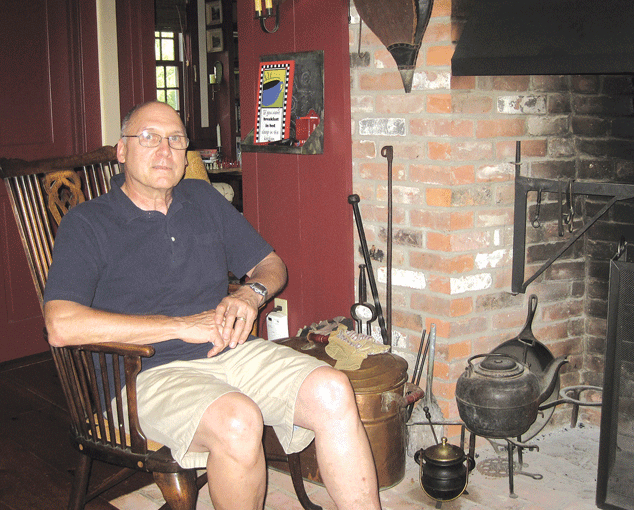
For instance, by creating a method to slow down the dasher scoop in the ice-cream freezer, he was able to produce a premium product with a lower amount of aeration than regular ice cream. But it was also his idea to add candy bars, cookies, nuts, and brownie bits to ice cream, which he custom-mixed for each customer on a cold marble slab.

Indeed over the years, this innovator and his ice-cream shops have been featured in Bon Appetit, Newsweek, Time, the Food Network, and TV Diner, to name a few media, and last August, Herrell’s Ice Cream was named one of the ‘10 places you must visit’ by  GQ magazine.

For this issue, BusinessWest got the scoop on Steve Herrell and his intriguing history in the premium ice-cream business and the process that makes it one of America’s favorite treats.


Second Scoop

Judy Herrell

Judy Herrell says Herrell’s Hot Fudge winning the top spot over Williams-Sonoma Hot Fudge in a taste contest is a very big deal.

Judy and Steve met in 1980, at the beginning of his second ice-cream career start. They married in 1985, had a daughter, Jessye, and divorced amicably in 2000, all while maintaining their company positions. Steve eventually introduced Judy to Stephan Wurmbrand, who became Judy’s second husband — and the company CFO.
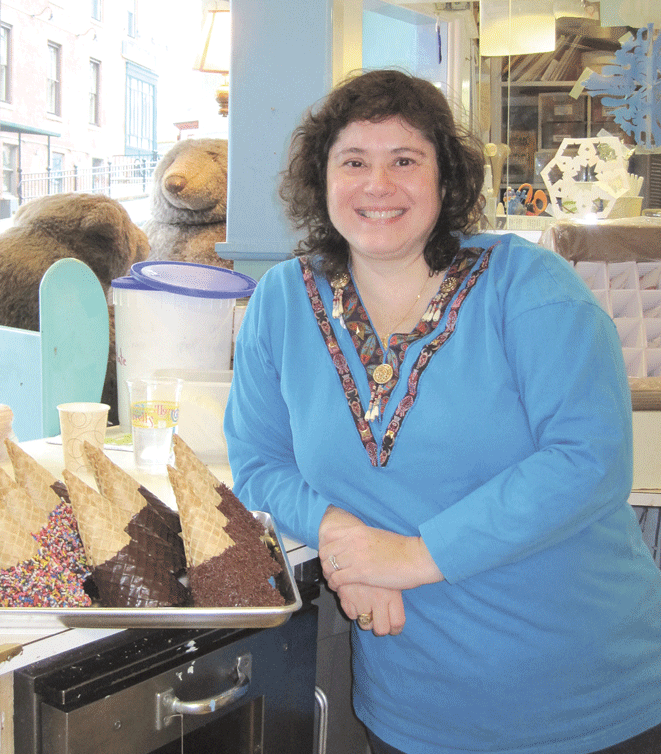

With Wurmbrand’s daughter, Allison, now added to the family, “Thanksgiving is a bit unusual in our house, but it works,” said Judy.

Even with Herrell’s innovations and dedication to the ice-cream craft, he admits he’s not on the cultural level of Ben & Jerry’s. But Ben Cohen and Jerry Greenfield actually visited Herrell in the late 1970s to research their own ideas, which they developed into a nationwide sensation.

“They looked in the ice-cream-making machine and wondered why it was going more slowly than others they’d seen,” Steve recalled. “I don’t think they ever figured it out.”

The Herrells, Cohen, and Greenfield remain friends to this day, while their companies have adopted far different strategies.

“We are not Ben & Jerry’s … our sales are much lower, and they took a different tack,” Judy said. While Herrell’s does not sell to supermarkets, preferring to hand-pack the ice cream at the time of order, she explained, Cohen and Greenfield opened more stores, sold product in commercial grocery chains, and developed quite a few marketing stunts, which helped brand their name. Cohen and Greenfield have also been quite political, at times controversial, while the modest-yet-charismatic Herrell, “has always been more of a ‘home’ kind of guy.”

While driving a cab for a living in Boston, way before the first ice-cream shop, Herrell would have a hot-fudge sundae every day for lunch, “from either Brigham’s or Friendly’s,” said Judy.  “That’s what gave him the impetus to know he could make better ice cream.”

Indeed, every Fourth of July, Herrell’s family would make ice cream in a hand-cranked barrel freezer. Eventually, due to his dairy obsession, he tinkered with the motor of an ice-cream maker freezer and found the right gear-reduction device to incorporate into the mechanics. During the slowed churning process, less air got into the freezing cream, and a higher fat content resulted in a much richer and creamier end result.

The process, now known as ‘low overrun,’ was essentially what food-trade magazines have called the beginning of premium, or gourmet, ice cream.

“Everybody uses it now,” said Judy, adding that, nonetheless, no one has been able to copy exactly what Steve makes. “We know why, but we’re not telling.”

Steve also had an affinity for a certain candy back then. “I thought Heath Bars would go well with ice cream,” Steve smiled. “But in what flavor … coffee, malt, maybe chocolate?”

The answer would turn out to be whatever flavor somebody wanted it to be. It was with this original concept — mixing goodies into his low-overrun processed premium ice cream — that Herrell opened Steve’s Ice Cream in an old dry-cleaner store near Harvard in 1973. After the first day, during which he sold out of all 32 gallons of ice cream, word spread, and the line-stander tradition began.

Burned out with 90-hour weeks at the Somerville location, and envisioning life as a ‘homesteader’ — a person who literally lives off the land — Herrell sold the Steve’s Ice Cream and Mix-ins trademarks in 1977, but not the formulas for the ice cream or hot fudge. He figured he’d need a bit of cash for things here or there, so he learned how to tune pianos.  But homesteading and piano tuning didn’t last long.

“I didn’t think I would miss it,” he recalls.  “But I did. And by that time, I really knew a lot about ice cream.” With the 1977 sale had came a three-year non-compete clause, and, now living in the Western Mass. area, he found an ideal spot in Thornes Marketplace and opened Herrell’s Ice Cream in 1980 — and the rest is sweet history.


Churning Process

How much ice cream has Steve eaten in his lifetime? His response, as he looks up at the hand-cranked ice-cream barrel on display, is a chuckle and the realization that he has no idea. But he bets it’s quite a lot, and while he has to watch his weight these days, most of the tasting is just that — tasting.

Creating five to six flavors a year, Herrell gets an idea and devises a few recipes in small batches. From those he produces between four and 10 different batches before settling on a composition, and he is the final taster. Sometimes, he said, only one or two tries are necessary because he’s gotten so good at knowing what the impact of a certain ingredient is going to have and how it will interplay with other flavors in that batch.

Then the administrative end of the business kicks into gear; that includes familiarizing the staff with the new flavor and making a flavor sign with any explanation necessitated by a play on words.

He typically ends up with four or five ‘experiment sheets,’ and each new flavor gets its own folder, under lock and key.

The number of folders is well over 240, said Judy, including 220 ice cream flavors; a selection of sorbet, sherbet, and ‘no moo,’ or dairy-free, flavors make up the other 20.

Rarely is a flavor removed, except the unusual occasion of a product ingredient coming off the market, like the Twinkie. Not all flavors are available all the time; that wouldn’t be possible since the store product is made on site. Seasonal flavors like Egg Nog during the holidays and Guinness around St. Patrick’s Day always bring more line standers.

Flavor suggestions come via Facebook, e-mails, and line standers, and all are taken into account, but the final say is up to the Herrells themselves: Steve as the final flavor taster, and Judy to gauge overall profitability, which, in the case of cocoa, can be completely unpredictable.

She explained that the base of all Herrell’s chocolate flavors is cocoa. “When I first started making our hot fudge, a bag of cocoa was $75; now that same 50-pound bag is over $200.”

There are only two companies in the world that process the cocoa powder, she told BusinessWest; add in global politics, taxes, and weather, and the result is a cocoa price that is constantly fluctuating.

Judy’s temper also fluctuates at times, most recently due to royalty demands. Facing possible extinction in the 1970s, she explained, Steve’s use of Heath Bars in Mix-ins, increased the candy’s production 27% between 1985 and 1986 alone. But Heath was sold to Hershey’s, and Herrell’s was informed recently that, after 30 years of offering Heath Bar Crunch and other ice-cream flavors using Heath Bars, the use of the name would require a $25,000 royalty fee, per flavor, per year.

“We kind of saved the Heath company,” Judy said with a wry smile. “But, with nine or 10 flavors, it was cost-prohibitive, so we just changed the name to English Toffee Crunch.

“If they push me any harder,” she added jokingly (sort of), “I’m going to use another brand.”


Just Desserts

Ice Cream isn’t the only thing on the menu at Herrell’s. All-natural Herrell’s Hot Chocolate is made in small batches and comes in Original, Peppermint, Irish Cream, Mexican, Malted, and Coconut. And the gooey, rich, corn-syrup-free Herrell’s Hot Fudge, which comes in Original, Almond, Coconut, Peppermint, Orange, and Chipotle, is also an award winner, like its premium ice-cream partner.

In August 2011, Judy saw the Herrell’s Hot Fudge jar pictured in a SeriousEats.com taste-test announcement. The publication had purchased various products in Whole Foods and tested them with readers, and Herrell’s won the top spot, said Judy. “What’s interesting about this is who we beat; these are gourmet companies, and that makes it a really big deal.”

Indeed, little Herrell’s Hot Fudge, produced and packaged at the Franklin County Community Development Corp. food-processing kitchen, beat out Williams-Sonoma Hot Fudge and King’s Cupboard Bittersweet Chocolate Sauce.

A recent coup for the company is the move from the specialty area of the North Atlantic region of Whole Foods, which Herrell’s Hot Fudge has called home for five years, to the general grocery department of all the chain’s stores. This will pit the brand against all the current products in Whole Foods. “It’s another big deal,” she said.

Through Herrell’s Development Corp., Judy oversees the hot-fudge business and franchising, which is by inquiry only until the economy gets better. Meanwhile, the trademarked Steve’s name that was sold more than 35 years ago pops up with different owners who have tried and failed nationally to resurrect Herrell’s initial quality and success; the most recent is a revival in New York City that is “not doing too well.”

Certainly, in Northampton, Huntington, and beyond, Steve Herrell’s got it licked — proving that it’s not what’s in the name, but what’s in the product, that determines the hot hand in the cold arts.


Elizabeth Taras can be reached at [email protected]