Home Sections Archive by category Features (Page 20)

Features

Features
Amherst’s College Collaborations Fuel Innovation

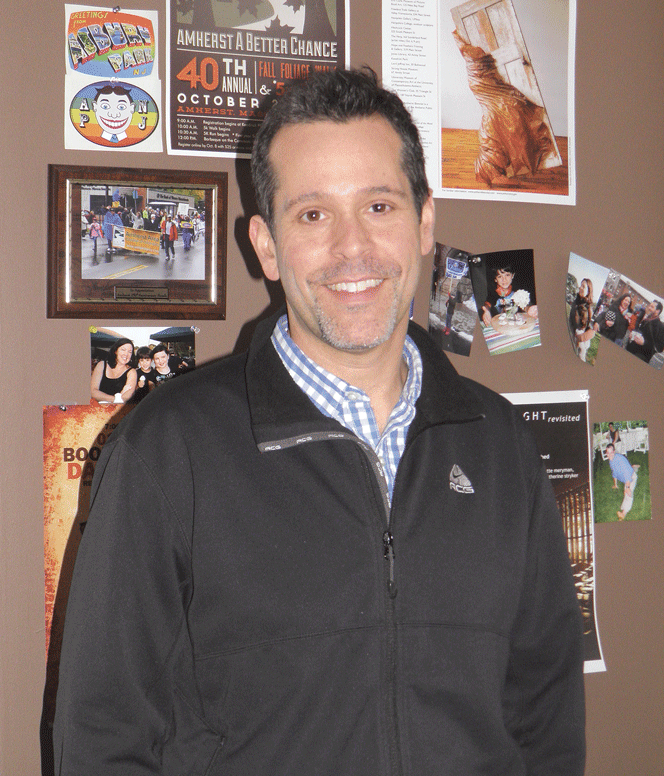
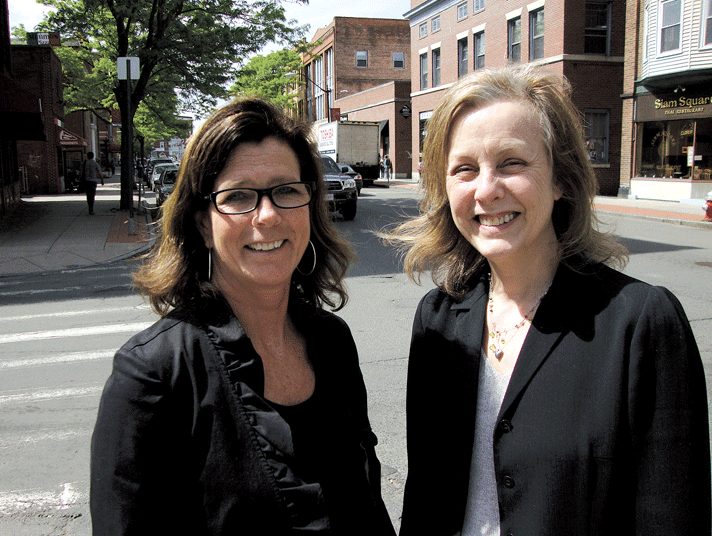
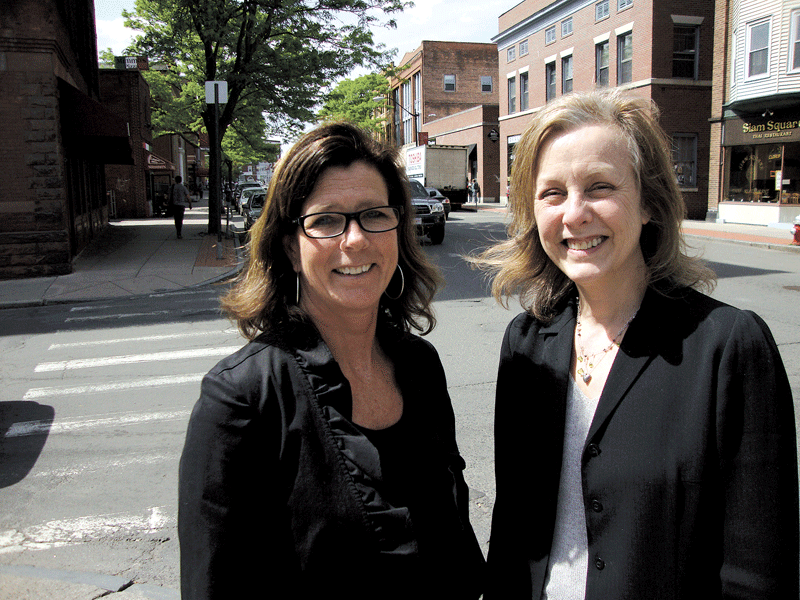
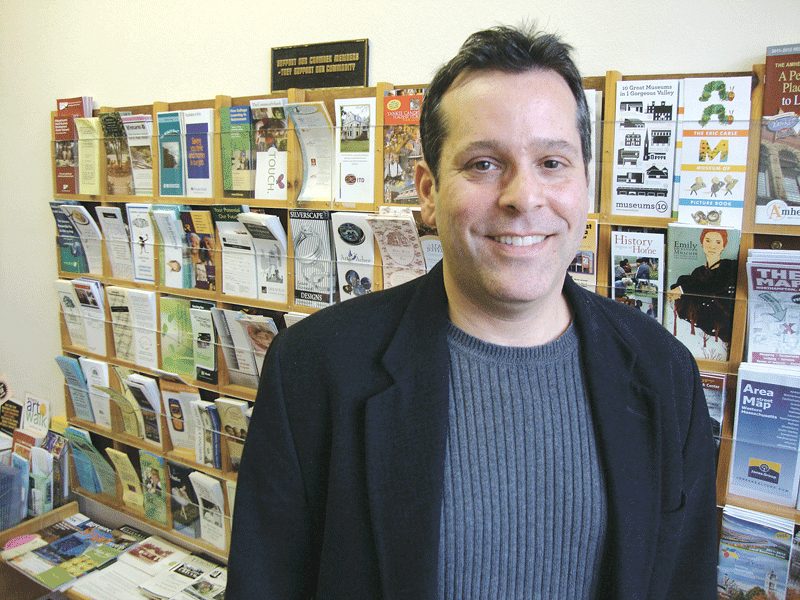
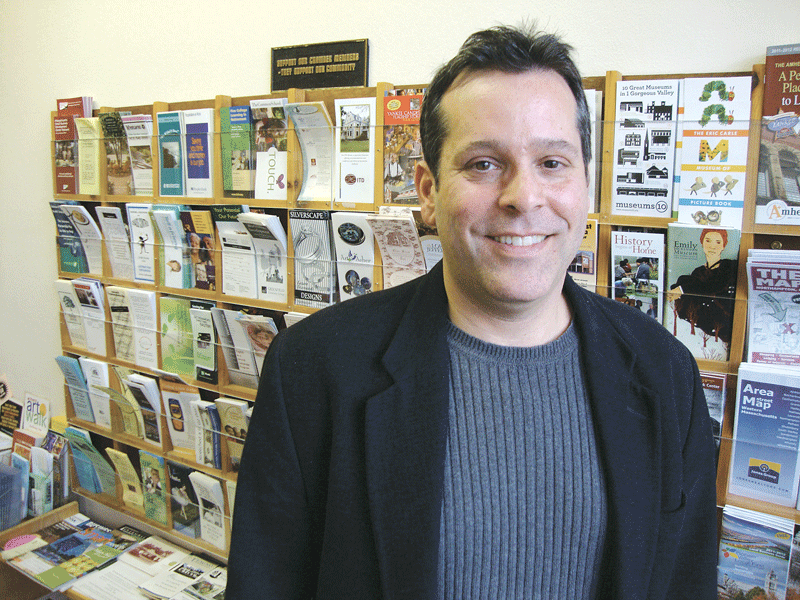
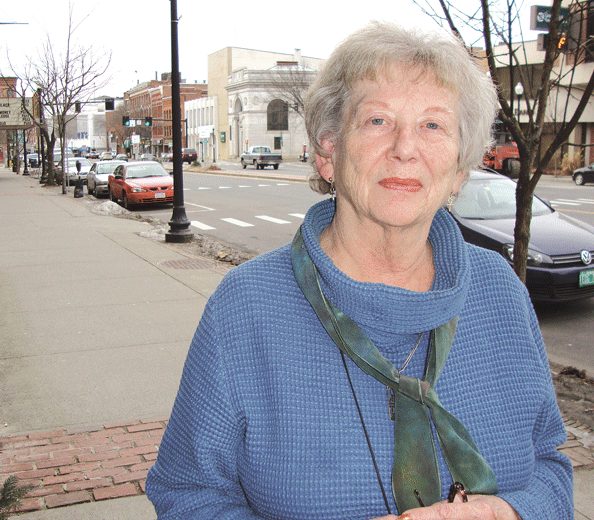
Amherst mapTony Maroulis says Amherst offers the cultural sophistication of a big city with the charm of a small town.

“It’s a pretty unique place where you can walk past a rock star and a Nobel laureate in one day — and that really does happen here,” said the executive director of the Amherst Chamber of Commerce.

The town is home to UMass Amherst, Amherst College, Hampshire College, and eight museums, which attract hundreds of thousands of visitors each year, in addition to its 38,000 residents. There are also three parks and a plethora of community and cultural events.

“Higher education is our smokestack industry, and there is innovation, research, and an economic spinoff from it as we are bringing world-class researchers and students together,” said Town Manager John Musante. “Plus, UMass is in the midst of a building boom and growth strategy.”

This results in jobs — UMass Amherst is the second-largest employer in Western Mass. — and benefits to the town. “There are three individuals on our water-supply protection committee who are leading researchers,” said Musante. “The ability to engage a talent pool and their willingness to help the town is a real strength that makes Amherst a great place to live and work. People get involved here, and the economic and cultural vitality is largely driven by an active engagement of citizens and people who work at the colleges.”

Maroulis concurs, and says the town has something for people of every age. “Amherst offers cultural opportunities, a wonderful intellectual community, and a good school system. It’s a great place to raise a family and a pretty place to look at,” he said. “You can see the Pelham hills in the distance, and there is lots of open space downtown.”

But the bucolic setting belies the 21st-century progress that makes Amherst a leader in technology and green energy. Many changes have occurred over the past few years, and town officials make it easy for solopreneurs, partnerships, and developers to succeed.

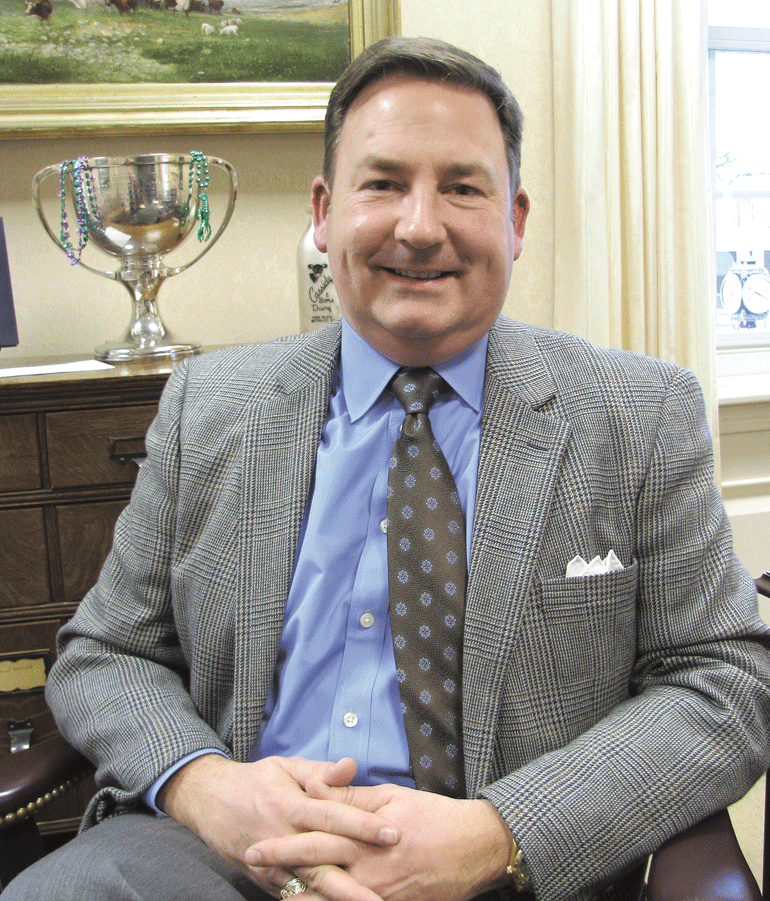
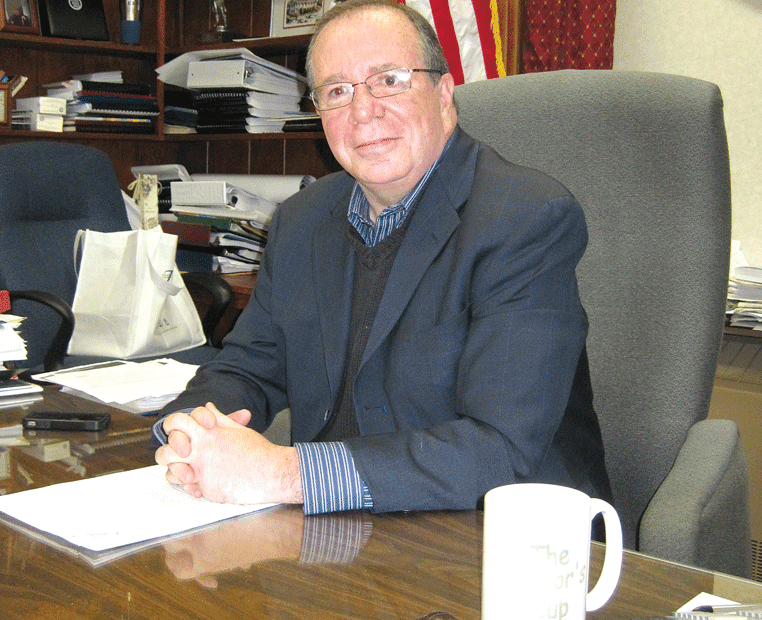
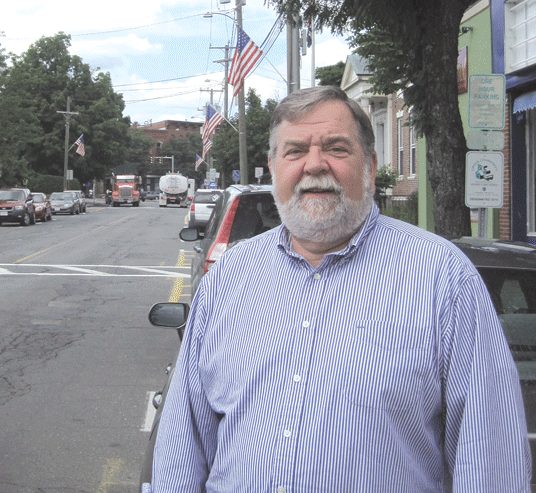
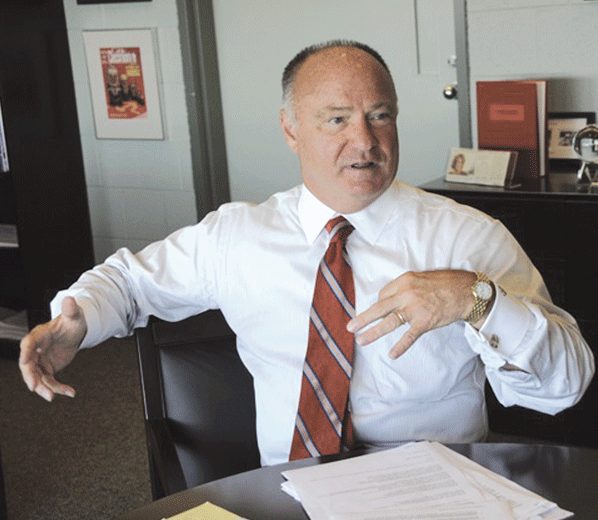
John Musante

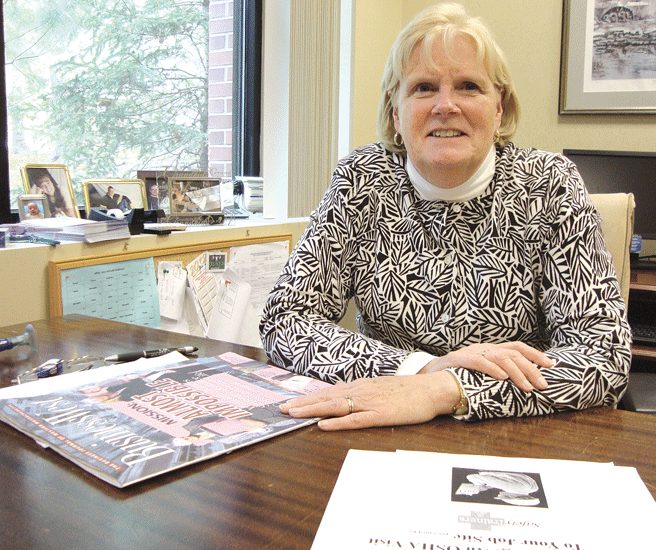
John Musante says Amherst’s strong network of colleges and universities has driven the town’s economic and cultural vitality.

Last month, the town completed work on the largest and fastest open municipal wi-fi network in Massachusetts. “Amherst is well-positioned in the ongoing technological revolution as the state and college fiber network also runs through town, which makes downtown an even more attractive place to live, work, and grow a business,” Musante said. “We have the cultural amenities of a college town with the infrastructure of research and a skilled workforce. And the cost of living is very competitive.”

The wi-fi network also gives Amherst a competitive advantage and has spurred growth of the café culture downtown. “You can find people writing code for a website or writing a freelance article for a New York magazine in our coffee shops,” Maroulis said.


New Life

The town has continued to grow over the past few years in spite of a still-sluggish economy. A number of new restaurants have opened, with several geared toward students and others designed to attract adults and families.

“But they have really created a restaurant buzz,” Maroulis said. “Amherst is becoming a foodie paradise.”

In addition, renovations to the historic Lord Jeffery Inn were completed in November 2011. “It reopened after being closed for several years. It has filled a void, and there has been a lot of energy and excitement at that end of the common. The inn brings in hundreds of people each week who stay there and attend local functions,” Maroulis told BusinessWest.

The renovation included the addition of nine new rooms, a new ballroom that holds 200 people, and a new restaurant. “They are ramping up their wedding business as well as small conventions from the college and university community,” he added, noting that collaboration is evident on all fronts, including in the town’s new Business Improvement District (BID). It was launched early last year and is funded in part by Amherst College and UMass, whose property borders the edges of the downtown perimeter.

Its president is Larry Archey, who is director of facilities and grounds at Hampshire College. In addition, several representatives from UMass Amherst and Amherst College are on the board of directors at the Chamber of Commerce.

“Our BID is unique because there is both money and in-kind contributions,” Musante said, adding that he is a board member. “We all have a vested interest in the success of our downtown and want to strengthen it so it enhances the quality of life and increases partnerships and relationships with the two campuses.”

Beautification, marketing, and special events are on the agenda, and the first event the BID staged was an Amherst Block Party. It attracted about 6,000 people who mingled as they enjoyed food, live music, shopping, and street performers. “It was festive, a lot of fun, and a terrific win for the colleges, university, and businesses,” Maroulis said.

Other popular events include the annual Taste of Amherst, which draws more than 20,000 people during its four-day run in June, and a Winterfest, staged Feb. 9, which brought people out during the cold weather to enjoy cardboard-box sledding, fireworks, live music, and a chili cookoff between local restaurants. The chamber purchased a small snow-making machine several years ago, so lack of the white stuff is never a problem.

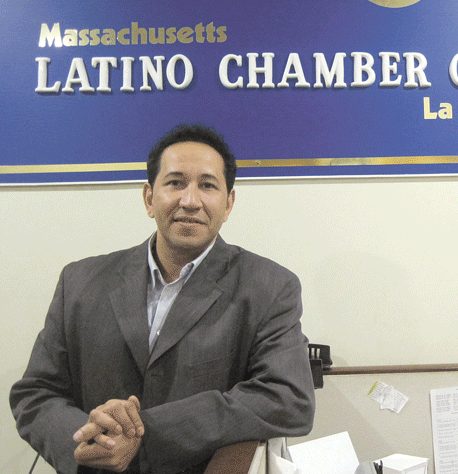
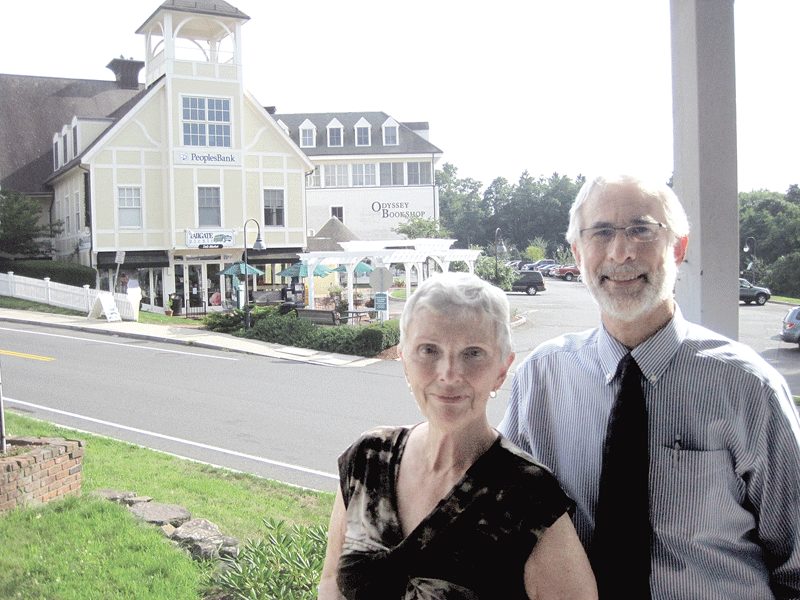
Tony Maroulis

Tony Maroulis says Amherst offers both the cultural sophistication of a big city and the charm of a small town.

5Developers are also investing in the downtown area, and last spring, construction was completed on a new, luxury, $3.5 million apartment building known as Boltwood Place. “It’s full. People want to live downtown and be able to walk to work,” Musante said, adding that a growing number of seniors are retiring in Amherst due to its cultural offerings.

There has also been a significant investment in road reconstruction on Route 116 in the Atkins Corner, which runs from the village center to South Amherst. “We think it will foster additional private investments in the area,” he said. Road improvements are also being undertaken in the Notch.


Economic Development

UMass trustees have approved nearly $900 million in new projects for Amherst, which include a new campus master plan, a $144 million science building slated to open April 13, a new classroom building now under construction, and new dormitories which will hold 1,500 students from Commonwealth College. It is expected to open Sept. 13.

“They want to grow by 3,000 students over the next 10 years,” Musante said, adding that the university opened another new, state-of-the art science building about three years ago.

He explained that Commonwealth College is for honors students from across the state, so the new dorms will help to attract a top-tier-caliber student body. “It makes the university even more attractive, which is important because our economy is linked with their success,” Musante continued. “They are a center economically and culturally, and as research grows, the demand for off-campus space is a direct spinoff. We are working with the university to explore possibilities for private investment for research and development and wet-lab space.”

Amherst College, which owns the Lord Jeffery Inn, launched its $425 million “Lives of Consequence” Capital Campaign in October 2009, and installed a new president in 2011. In addition, the college is adding its own new, $200 million science building, which is in the design phase.

Hampshire College, situated a few miles away, is a leader in environmental education. Amherst is also a leader in its own right and was designated a green community by the state this year. In addition to the town’s new sustainability coordinator, it has embarked upon a five-year plan to reduce energy consumption by 20%, and is using a $300,000 state grant to install energy-efficient LED streetlights. “There will be a big payback in the tens of thousands of dollars each year,” Musante said.

Town officials are also in the midst of a permitting process to install a solar farm at its old landfill, via a collaboration with Blue Wave Capital, which would supply the majority of the municipal buildings and schools with renewable energy. And a third project, which is in the feasibility stage and will involve private investments, is the installation of an anaerobic digester which would convert organic material (including food; fats, oils, and grease; wastewater biosolids; and manure) into a methane-rich biogas that can be used for heat and electricity.

“UMass has an active interest in it from an operational and research standpoint,” Musante said, adding that it is a major Department of Environmental Protection initiative, and there are plans to install three facilities in the state.

Hampshire College is also erecting a new building with a master plan of relocating Amherst’s nonprofit Hitchcock Center for the Environment to their campus. “It’s a new partnership which will strengthen them both,” he added.


Continuing Prosperity

Amherst has been largely insulated from the economic downturn that began in 2008 because it is a college town. “Although we did have a modest decline, our housing prices have remained more stable than the rest of the nation, which is another real strength. And our population is growing,” Musante added.

So are the number of partnerships and projects in the planning stage. Which means the economic spinoff will continue to make Amherst a place where innovation, research, and cutting-edge technology are a mainstay, with the added attraction of culture that attracts people of all ages and all stages of life.

Features
Hard Rock Submits a Casino Proposal of Note

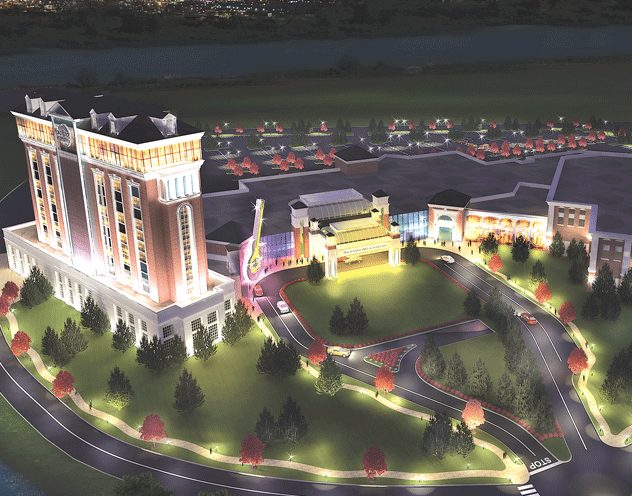
Hard Rock International’s plans for a resort casino on the grounds of the Eastern States Exposition

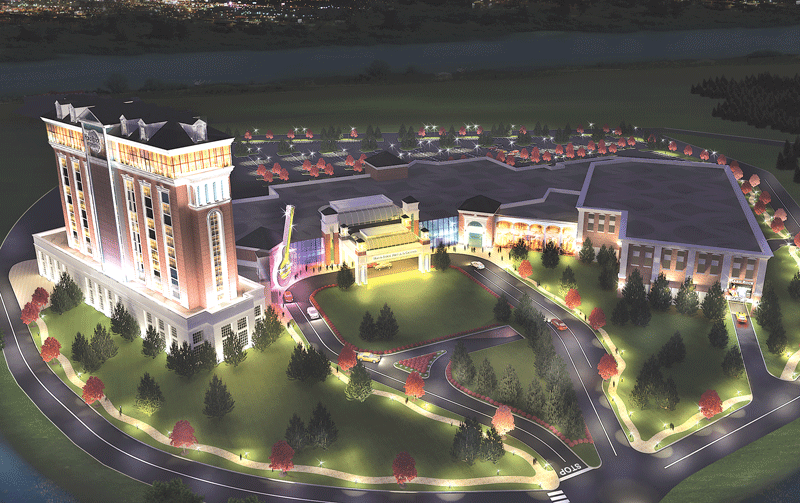
Hard Rock International’s plans for a resort casino on the grounds of the Eastern States Exposition

Eugene Cassidy had been on the job as president and CEO of the Eastern States Exposition (ESE) for less than a week when officials at the Bronson Companies initiated discussions that eventually led to serious talk about the possibility of locating a casino on the Big E grounds.

And it was very soon thereafter that he started canvassing members of his board for their thoughts on that subject. What he found was that, as with the general public in most respects, there was little, if any, middle ground on the matter; some were quite supportive, while others, he said, used direct and sometimes profane language to make it clear that they were not.

“One of them said to me, ‘are you out of your … mind — you’ve only been CEO for a matter of days; do you want to get yourself … fired?” he recalled, deleting the expletives, but adding pauses for effect.

But he said he was able to change such attitudes with what he considers some powerful arguments, presented at subsequent, and very intense, board meetings. The first is that a casino paying a sizable lease to the Big E for the property that would be needed for parking and the assorted facilities would ensure the survival of the century-old institution for the foreseeable future.

The second is that he considers the Big E to be the best steward to operate a casino in the western region of the state.

“The Legislature has said that gaming is now legal in Massachusetts, so now it’s a question of who’s going to be the most responsible party to be involved with this,” he told BusinessWest. “And I could make an argument all day long that this organization is precisely the most responsible host; there’s no one more well-equipped than the Eastern States Exposition, and the town of West Springfield, to handle this.”

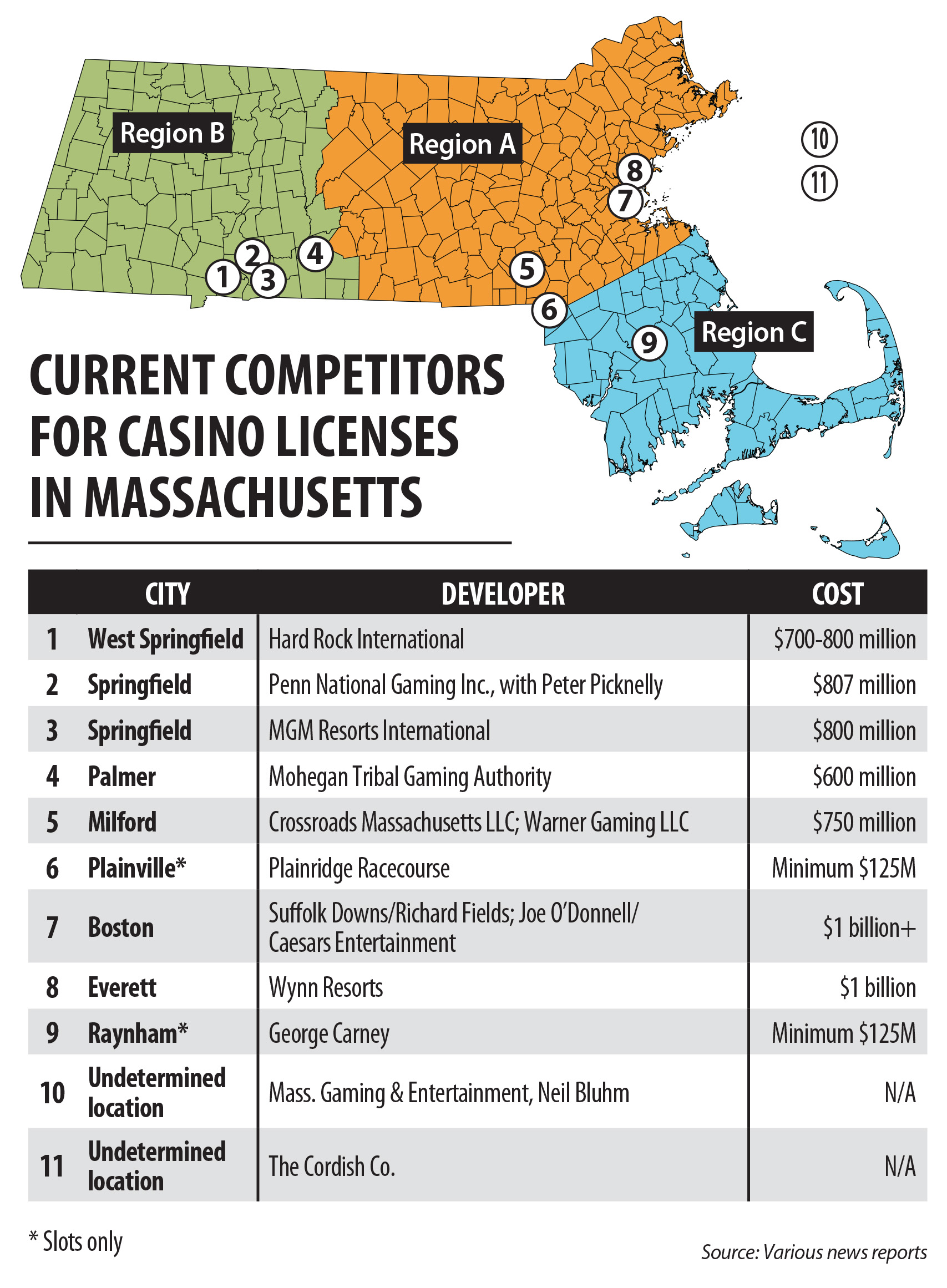
It is these arguments, and especially the latter, that Cassidy, who took the reins at the Big E in June, hopes will bring town and area residents, not to mention the Mass. Gaming Commission, around to the idea of embracing Hard Rock Entertainment’s plans to build a $700 million to $800 million resort casino on land at the Big E currently used for parking.

He knows there are questions, and many of them, about parking, traffic, how to juxtapose an immensely for-profit venture with the exposition’s nonprofit status, and many other concerns, and he expects that they will all be effectively answered in the weeks and months to come. For now, though, he’s ecstatic to simply be in a position to have to answer such questions and, as he put it, “have a seat at the table” in the great casino contest.

So is Jim Allen, Hard Rock’s chairman.

For more than a year now, the company has been actively engaged in nailing down a site for a Western Mass. casino, after concluding, as others have, that this area presents the best odds for gaining a foothold in the Bay State. Hard Rock looked at perhaps seven or eight sites in Western Mass., including one in Holyoke and several in downtown Springfield, he said.

It was only after the Bronson Companies, serving as a consultant to several casino entities, engaged Cassidy in those aforementioned discussions that Hard Rock eventually narrowed its search to a 38-acre tract in the southeast corner of the Big E property.

Allen acknowledged that the site has its obvious challenges, especially traffic, but he said all the Western Mass. proposals have challenges, and, in some respects, the Big E site presents fewer than the downtown Springfield locations, while also offering more flexibility with its size.

Ultimately, he believes the plan that emerges, coupled with Hard Rock’s brand and strong track record in both gaming and entertainment — the company has facilities in 58 countries — will enable the project to win over both voters in West Springfield and members of the Gaming Commission.

For this, the latest in a series of stories about the contest for the Western Mass. casino license, BusinessWest talked with Cassidy and Allen about what has become the fourth entry in the pitched battle for the Western Mass. casino license, and why they believe they can, and will, triumph in that contest.


Working in Concert

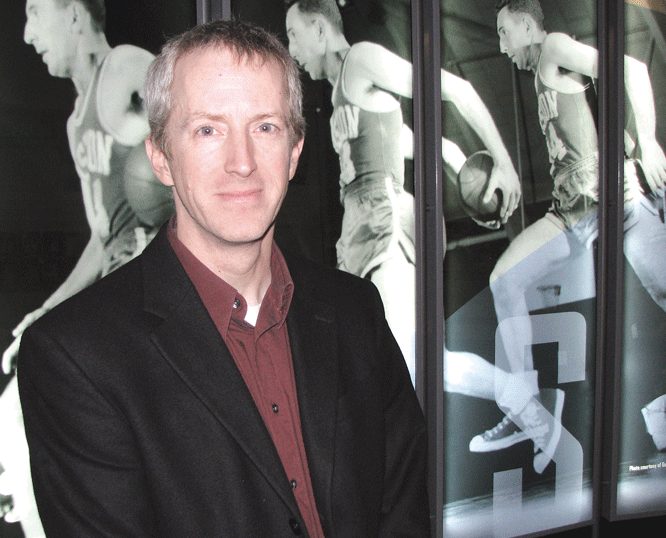
Eugene Cassidy

Eugene Cassidy says a casino on the Big E grounds would ensure the long-term survival of the nearly century-old fair.

Cassidy said he knows the ‘casino-at-the-state-fair’ model works — because he’s seen it up close.

He told BusinessWest that he pays an annual visit to the Delaware State Fair, which became the site for a casino in the late ’90s, and has made fairly regular trips to the Erie County (New York) State Fair, which added one several years ago. He’s also been to the famous Calgary Stampede, which has long had a gaming facility on its grounds.

In each instance, he said, the revenue gained from leasing land to the casino has become a game changer for the facility in question.

“What the casino does in all those cases is provide the kind of economic support that only an operation of that size and scope can provide,” he explained. “The economic wherewithal of a casino is such that they can afford to really play an active role in the infrastructure of the facility.

“I’ve seen Delaware improve dramatically in just the few short years they’ve had it,” he continued. “And in New York, they’ve done dramatic things to the fairgrounds.”

The Hard Rock proposal has the same potential for the Big E, said Cassidy, noting that the revenue gained from leasing land to the casino operator could be put toward renovating many of the older facilities at the ESE, including the 97-year-old Coliseum.

“We’re trying to struggle along and preserve a 100-year-old facility that has 44 buildings, 31 of which were built before World War II,” he explained. “It’s an incredibly capital-intensive plant; I have an engineering study in my drawer completed in 2008 that shows that to rehabilitate the Coliseum — the gem of the fairgrounds, the jewel in the crown of West Springfield, the place where the American Hockey League was founded — would cost more than $52 million.

“We just had the biggest fair in our history, and we’re going to probably earn, after depreciation, $1.3 million, $2.8 million before depreciation,” he continued. “There’s no possible way that you can capitalize a $52 million rehabilitation, which today is probably $62 million, on $2.8 million before depreciation.”

But generating revenue for capital improvements is merely one of the benefits to be derived from having a casino on the grounds, he went on, putting simple survival at the top of that list.

Indeed, he listed a number of state fairs, including those in Virginia and Michigan, that have gone out of business in recent years due to a combination of declining state support and increased competition for the entertainment dollar from, among other things, casinos.

He said that such a fate is not inconceivable for the Big E, despite its continued success at the gate, and that, at the very least, a casino located across the river in Springfield — and two are proposed for the City of Homes — would negatively impact the ESE in matters ranging from its book of business on conventions, meetings, and traveling shows to its ability to book musical talent, something that’s already impacted by the two casinos in Connecticut.

These were some of the many points he made at an elaborate red-carpet rollout of Hard Rock’s plans at Storrowton Tavern earlier this month. Bret Michaels, from the rock band Poison, was in the house, doing two sets, which included an acoustic version of “Every Rose Has Its Thorn.” Hard Rock also brought along a few of the tens of thousands of pieces of music memorabilia in its vast collection, including a bass guitar used in concert by Gene Simmons of KISS and Michael Jackson’s red leather “Beat It” jacket.

Amid all the hype, music, and visuals was some plain talk, especially from Cassidy, who called the Hard Rock proposal “a once-in-a-lifetime economic-development opportunity.”

How it came into focus is an intriguing example of what some might call trial and error or a process of elimination, but which Allen described as a scientific search for a location that offered accessibility, flexibility, and, in broad terms, the best chance for success in the competition for the casino license.

Like MGM, Penn National, and Ameristar (before it dropped out of the race), Hard Rock was attracted to Springfield because of its location, accessibility, and demographics, said Allen, adding that the company simply wasn’t able to piece together a site that worked in the city.

“We felt that, in downtown Springfield, there were some great opportunities, but we just couldn’t come to grips with land assembly that would give us the appropriate acreage to design something that becomes more than a casino or a slots-in-a-box facility,” he said. “When you’re dealing with a downtown city grid and the restrictions that go with that, we just didn’t feel we could design something that would be beneficial to our brand and beneficial to the citizens who live in that area.

“And, frankly, when the opportunity came about to be involved with the Big E, this was truly a marriage made in heaven,” he continued. “With 175 acres, all that history, and the Big E’s focus on entertainment, we thought this was something that would be very positive.”


Ready to Rock

Allen said his company’s proposal, named Hard Rock New England, would feature a 200,000-square-foot casino with 100 to 125 table games and 2,500 to 3,000 slot machines, a 400-room hotel, a spa, a restaurant, shops, a pool area, a concert and show venue, and a permanent music-memorabilia collection.

He told BusinessWest that the proposal reinforces Hard Rock’s reputation for building not just gaming facilities — or “machines in a box,” as he called them — but entertainment complexes.

And this specific model, he believes, will dovetail nicely with the Big E and its brand of family entertainment — complementing it, but not competing with it.

There are obviously concerns about traffic, he noted, adding that he believes a downtown Springfield casino, such as those they considered, would present even more challenges in that realm. “How do you find 3,000, 4,000, or 5,000 parking spaces in downtown Springfield and get the people in and out of there, along with the people going to the central business district?”

In West Springfield, he said the company is looking to work with the community, consulting engineers, and the state to create a comprehensive access plan that addresses both historical traffic problems that have characterized the fair throughout its existence and additional volume from a casino complex.

“We want to be part of the solution, not part of the problem,” he said, acknowledging that his ability to back up those words will go a long way toward determining how the residents of West Springfield may vote on gaming referendum — one of the many hurdles this project will have to clear to become reality.

“This will be a ground-zero, door-to-door approach,” he said. “It starts with the community’s concerns and addressing them in our design thought processes. If one looks at gaming on a national basis, the majority of people now look at it as a form of entertainment that creates a tremendous amount of jobs.

“If we use that as the foundation block,” he continued, “the key for us is to design something that will be an additional attraction to the community and not something that is going to create additional stress on the infrastructure, the police, or the fire department.”

Hard Rock’s plans put the Big E in a much different situation than it was in just a few months ago, said Cassidy, acknowledging that this position — one where the institution is a competitor to other casino operators, rather than an observer or potential collaborator — comes complete with great opportunity, but also sizable risk.

But it’s a position he felt he needed to be in, primarily because he believes he wasn’t getting anywhere in his efforts to gain the attention of casino developers, and was putting his operation in jeopardy by merely taking the role of bystander.

“I was, and I still am, extraordinarily concerned about the ability of this organization to function in the future, because no one is looking out for the Eastern States Exposition,” he explained. “In fact, to the contrary, there are those who feel we don’t do enough or we don’t provide enough, when, in fact, we are the biggest economic cultural event that takes place east of the Mississippi, generating a quarter of a billion in revenues brought into Hampden County in just 17 days.

“Now, the town of West Springfield, rather than bordering a community that’s been incredibly parochial in its discussions about a casino, has a seat at the table,” he continued, adding that it wasn’t until very recently that he believes he heard a Springfield official use the word ‘regional’ when discussing a casino.

“Up until then, it had been all about Springfield,” he went on. “I don’t want to make this a war between Springfield and West Side, but now, the town of West Springfield and the Big E have that seat at the table, and I’m going to be able to provide a means by which this organization can carry on.”

Cassidy told BusinessWest that, in many ways, he regrets the way casinos have almost completely dominated his first six months at the helm. He said that it was his intention upon taking over — something that was planned and scheduled nearly a year earlier — to reaffirm the need for philanthropy to the organization, and to be what he called the “reincarnation” of Joshua Brooks, who founded the fair in 1917.

But in many respects, pursuing a casino is the kind of ambitious, entrepreneurial venture that Brooks would have embraced, he went on.

“Mr. Brooks was an incredibly dynamic thinker and a very progressive man,” said Cassidy. “It’s my goal to see to it that he’s not lost to the history books; as a young man, he was incredibly successful because he was a forward thinker who embraced change. And I have every confidence that Mr. Brooks himself would embrace this change.”


The Big Finale

Cassidy told BusinessWest that, if he had his druthers, he would have had the state Legislature pass a gaming measure similar to the one approved in Indiana.

There, he explained, there is a provision that roughly 6% of the receipts from casino operations sent to the state are routed to the state fair — a windfall he puts at $6 million to $8 million per year.

“If we had that here, we wouldn’t be going through this,” he said with a laugh, referring to the multi-stage “beauty pageant” involving the Western Mass. casino license and the Big E’s presence as one of the contenders.

But the reality is that there is no such provision, so Cassidy is left to work in concert with a casino operator, which eventually became Hard Rock, to secure such revenue in a far different way.

Whether things go as Cassidy and Allen hope remains to be seen, obviously, but it is clear that they intend to make the most of their seats at the casino table.


George O’Brien can be reached at [email protected]

Features
Difference Makers to Be Revealed in February, Saluted in March

BizDiffMakrsLOGO2011The Difference Makers Class of 2013 has been chosen, and BusinessWest Associate Publisher Kate Campiti believes it provides five good reasons why this recognition program was created in 2009.

“There are many different ways that a group or individual can make a difference and positively impact quality of life in this region,” said Campiti, who was among those who selected this year’s honorees. “This year’s stories really capture this sentiment and relate some of the wonderful things that are happening in this region.”

These stories will be told in the Feb. 11 edition of BusinessWest, which will truly be must reading. And on March 21, the Class of 2013 will be feted at the annual Difference Makers gala, to be staged at the Log Cabin Banquet & Meeting House in Holyoke.

Campiti and BusinessWest Editor George O’Brien both said the selection process this year was equal parts inspiring and challenging, primarily because of the quality and quantity of the nominations received.

Indeed, there were more than three dozen individuals and organizations nominated, which is a record, said O’Brien, noting that, in some way, each nominee is making a difference in this region.

“This was a very difficult selection process; there were so many outstanding candidates this year,” said O’Brien. “We could easily have chosen any of them. In the end, we selected a mix of individuals and groups that clearly show how, with some perseverance, imagination, and determination, it is possible to change lives for the better.

“These are very compelling stories,” he continued, “and, more importantly, they are very inspiring as well, and that’s one of the reasons we created this award — to help inspire individuals and groups to find their own ways to make a difference.”

Tickets for the March 21 gala are now on sale. Seats cost $55 each, with tables of 10 available. To reserve tickets or for more information, call (413) 781-8600, ext. 100, or e-mail [email protected].

This year’s Difference Makers gala is being sponsored by Baystate Medical Practices, Health New England, Meyers Brothers Kalicka, Royal LLP, Sarat Ford Lincoln, and Six Point Creative Works.

Features
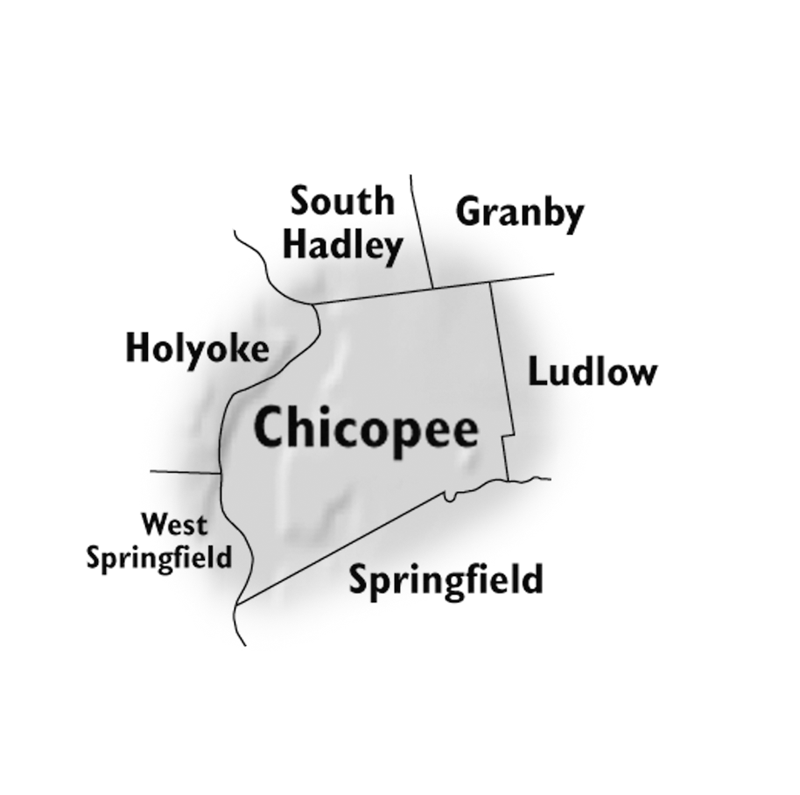
In Chicopee, a Can-do Attitude Generates Progress

Editor’s Note: In an effort to keep its readership abreast of what’s happening in cities and towns across Western Mass., BusinessWest is commencing a year-long series of community profiles. We begin with the second-largest city in the region — Chicopee.

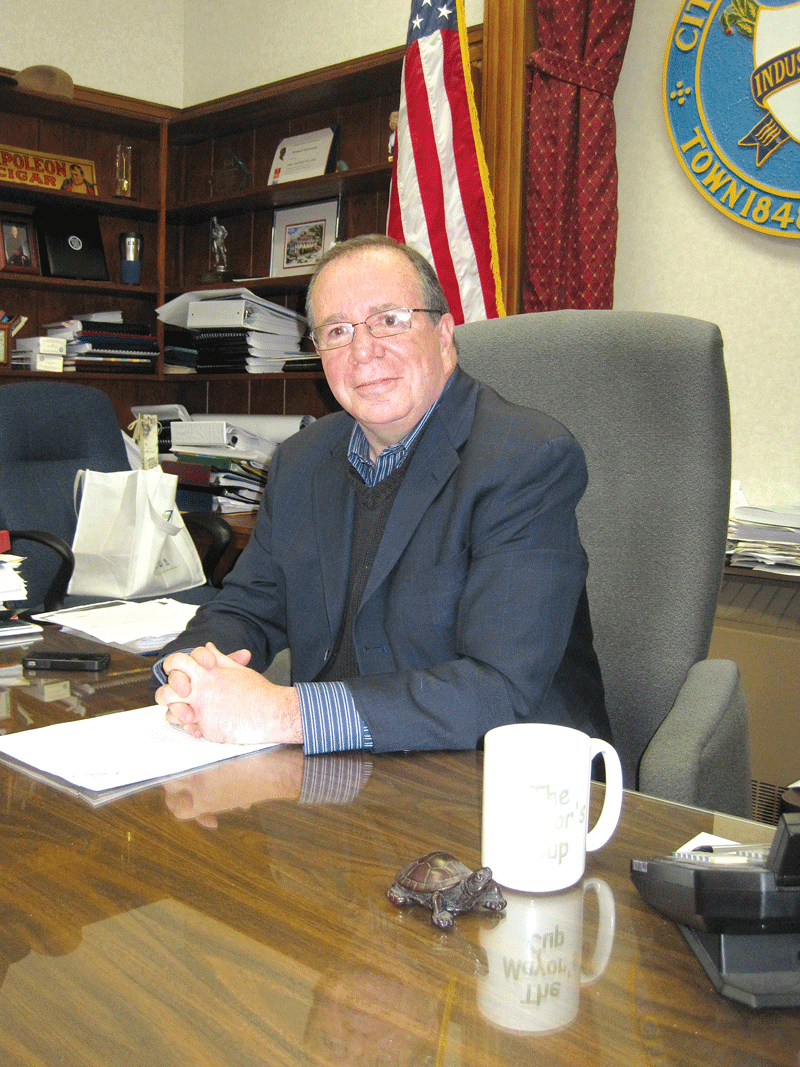
There is a small, carved wooden turtle that sits on Michael Bissonnette’s desk in Chicopee City Hall. It’s been there since early 2007, near the end of his first full year as mayor of this city of just over 55,000 residents.

As of yet, the turtle has no name, said Bissonnette, adding that it won’t until the so-called River Mills Project, a 65-acre brownfield site along the Chicopee River involving the former Uniroyal and Facemate manufacturing complexes, is fully ready for redevelopment. The initiative, marked by lengthy court fights and the complicated process of acquiring property and securing the funds to remediate it, has been nearly 30 years in the making. But there has been some dramatic progress in recent years, which brings the mayor back to his turtle.

“It’s my reminder to be patient — all good things come in time,” said Bissonnette,  noting that the story of the tortoise and the hare resonates in Chicopee, where city leaders believe they are winning an important race for greater vibrancy, job opportunities, and tax revenue by being diligent and doing things right, and not necessarily quickly — although the pace of progress has picked up considerably (more on that later).

But patience is not the city’s only virtue, said the mayor, also citing perseverance, imagination, and even an ability to embrace modern telecommunications technology in an effort to better serve residents.

Indeed, just before speaking with BusinessWest, Bissonnette, a prolific user of Facebook and other forms of social media to communicate with various constituencies, texted a directive to the Department of Public Works to meet a resident’s request to have a street sanded.

“We’re in a digital age, and its all part of our ability to reach out and be customer-friendly,” said the mayor. “And I can be responsive to that.”

Beyond the visible progress at what is usually called simply the ‘Uniroyal site,’ greatly facilitated by the city’s ability to win funding for participation with the state’s Brownfields Support Team (BST), there are many other signs of growth and vibrancy in the city.

They include the Marriott Residence hotel now taking shape as part of the Chicopee Crossing project on Memorial Drive, progress with ongoing work to replace the Davitt Bridge in the heart of downtown, and two new, state-of-the art high schools built over the past decade.

Meanwhile, the city has been able to maintain and even grow its strong manufacturing base — which accounts for 22% to 25% of the jobs in the community —  and is looking to add more in both existing manufacturing facilities and a 110-acre parcel near the Massachusetts Turnpike recently acquired by the Westover Metropolitan Development Corp.

From a fiscal standpoint, the city has rarely been in a stronger situation, with an A+ credit rating and $15 million in the so-called ‘rainy-day fund,’ the high-water mark for that account.

Summing up what has happened and what could happen in the years to come, Tom Haberlin, the city’s economic development director and long-time planning and development official, said the community has honed its can-do attitude with an even more business-friendly approach in City Hall.

“Chicopee remains a very easy place to get things done,” he said. “It doesn’t have the levels of bureaucracy you see in other cities, and this has helped us in many ways over the years.”

As BusinessWest begins its year-long series of community profiles, it starts with Chicopee, an old industrial city that that has stayed true to those roots while also managing to diversify its economy.


Progress Report

Bissonnette acknowledged that the phrase ‘running the city like a business’ has been used and overused in recent years and has lost some of its meaning. But this is exactly the approach he has taken since he was first elected in 2005, and he believes it has paid dividends.

Elaborating, he said the broad goal of his administration is to eliminate or minimize bureaucracy and politics (to the extent that it can), and create operating systems that remove barriers to progress, not add more.

“I can’t tell you how many developers have complimented the process, saying that we cut red tape and bend over backwards to accommodate the needs of the private sector, and that has paid off,” Bissonnette said. “The idea that a government is going to function more like a business is very appealing to the private sector, and it’s an extension of our business-friendly approach.

Mayor Michael Bissonnette

Mayor Michael Bissonnette says Chicopee takes a business-friendly attitude.

“When the state talks about taking six months to get something permitted, we laugh and say, ‘let’s try to do it in six weeks,’” he continued, adding that this operating philosophy has certainly helped the city withstand the prolonged economic downturn, and will be a real asset when conditions improve and companies gain the confidence to proceed with new building and expansion projects.

Meanwhile, he went on, the city has been aggressive in its pursuit of state and federal funding for various initiatives, such as the Uniroyal site, a character trait that has enabled it to advance a number of infrastructure and development projects.

That aggressiveness has paid off, said Haberlin, with grant awards on a scale not often often seen in a city this size.

“It’s very rare for a city to get these types of awards, and it’s a tribute to those that put the proposal together,” Haberlin said, referring specifically to funding secured for the Uniroyal project. “The BST knew that this project was moving at a very rapid rate and they would get the biggest bang for their dollar and it would be spent effectively.”

Kate Brown, the city’s long-time planning director, agreed.

“That turtle should have blisters on its feet,” she said with a laugh, “because, after the brownfields team was put together, this thing just took off. But nobody believed it could happen this fast.”

While work on the Uniroyal site proceeds ahead of schedule, city officials are enthusiastic about additional development opportunities in several parts of the city, including the Memorial Drive area, downtown, and the 110-acre site acquired by the Westover Metropolitan Development Corp.

“Potentially, that could be the springboard for some huge economic development,” said Haberlin, adding that the property is coming on line as city officials and regional economic-development leaders are hearing their phones ring again with regard to companies looking for places to locate or expand.

Haberlin referenced one manufacturer he chose not to name that was interested in existing real estate in the city, an attractive alternative to new building.

“It’s the first real inquiry we’ve seen in six or seven years,” he noted, adding that this company’s interest goes well beyond the routine tire-kicking witnessed in recent years.

Haberlin said Chicopee has a decent inventory of manufacturing and distribution facilities that were built at or near the $125-per-square-foot price point but are now selling for perhaps 20% to 25% of the cost, creating opportunities for both businesses and the city.

“The quality that this particular manufacturer is looking at couldn’t even be built today at that [$125-per-square-foot] cost, so they’re really trying to take advantage of the values out here,” he explained.

Momentum Is Building

Looking ahead, Bissonnette said city officials are working aggressively to properly position the city for everything from new manufacturing-sector jobs to a casino in Western Mass.

With regard to the latter, the mayor said he certainly hasn’t given up on the prospect of a gaming facility in his city — “we fully expect a casino to be built adjacent to Chicopee, if not in Chicopee” — but will be prepared to benefit no matter where it goes.

As for the former, the city has created a number of partnerships aimed at making sure it has a  large and qualified workforce in place for current employers and potential new ones.

If a company is interested in workers with a particular skill set, said the mayor, relationships with Springfield Technical Community College, Holyoke Community College, Chicopee Comprehensive High School, Branford Hall Career Institute, and Porter and Chester Institute can facilitate the process of creating customized training programs.

“We say to interested precision-manufacturing companies, ‘tell us what you want us to train these students in, and we’ll train to suit,’” he noted, adding that, at Chicopee Comp, an advisory group with experts across different areas of manufacturing is helping the city to figure out what manufacturing jobs may look like in the future, and what skill sets will be necessary to secure one.

And while consistently looking for better ways to assist employers and potential employers, the city is always searching for new and more effective ways to serve constituents as well, said the mayor.

This includes use of social media as a way to communicate with residents, hear and read their concerns, and, in essence, create a dialogue on the issues facing the community, he told BusinessWest.

In addition to the mayor’s use of Facebook and Twitter, the internal information technology department, which maintains the city’s website, has been decentralized, a process that Bissonnette calls rare in municipalities.

This makes each department head accountable for uploading and maintaining his or her department’s up-to-date information. Going a step further, Bissonnette told BusinessWest that Chicopee was recently selected to be the only city in Hampden County, in conjunction with Boston, to get a smart app for smartphones through a three-year ‘efficiency in government’ grant from the state.

The app will be implemented in the spring to allow for complaints to make it to the proper department in real time; the Chicopee Police Department and DPW, the two entities that receive the most requests, will be the first to go live, bringing more of the transparency in government that  Bissonnette said the city wants and needs.

After all, he said, it shouldn’t be a mystery about how to get a pothole filled or a sign replaced. “And you shouldn’t have to know somebody to get your street plowed or your trash picked up.”

The Finish Line

Bissonnette told BusinessWest that another of his goals moving forward is to revamp the city’s charter. Among those things on his wish list are a four-year term for the mayor (it’s currently two, which he believes adds up to too much time campaigning and not enough time managing the city) and revisions to create a strong-mayor form of government.

Whether he succeeds with those goals remains to be seen. As for most others, including the prospects for his turtle getting a name, he is eternally optimistic.

“We’re a can-do community,” he said. “We get things done.”


Elizabeth Taras can be reached at [email protected]

Features
Penn National Likes Its Odds of Winning the Casino Contest

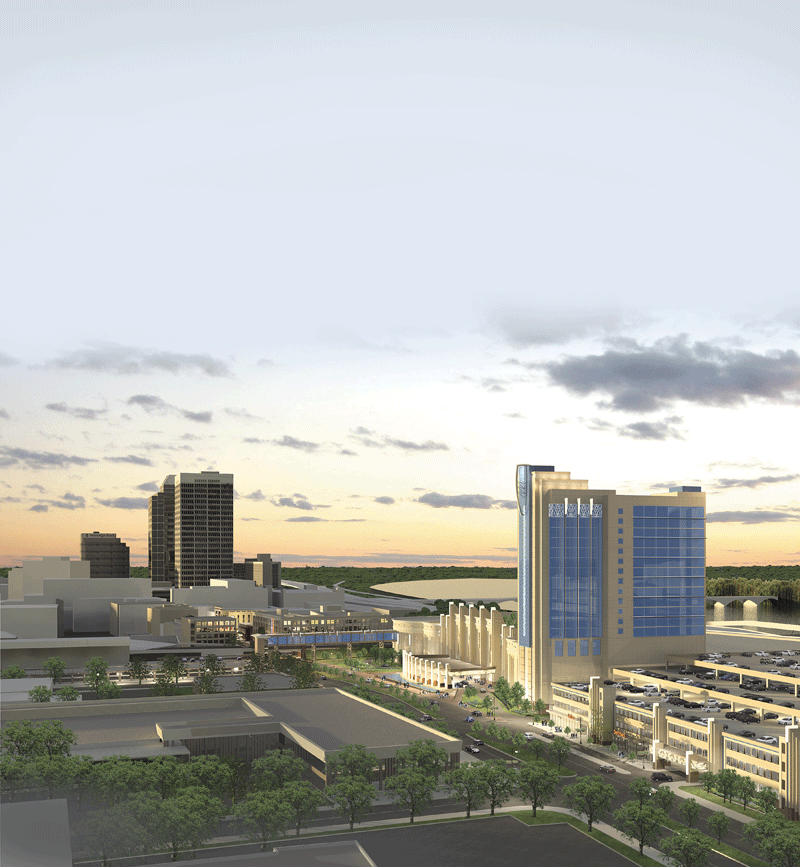
Penn National’s proposed Hollywood Casino Springfield

A view from the north of Penn National’s proposed Hollywood Casino Springfield.

Editor’s Note: This is the latest in a series of articles detailing the players and issues involved in the competition to place a resort casino in Western Mass. This segment focuses on Penn National Gaming Corp. and its plans for a casino in Springfield’s North End.


Tim Wilmott says that, if a company was going to build a casino in Springfield, it probably couldn’t pick a more challenging site for such a project than the one Penn National has chosen in Springfield’s North End.

After all, the $800 million proposal, to be called Hollywood Casino Springfield, involves relocating two of the city’s largest businesses — the Republican, its 330 employees, and its massive press operation, as well as Peter Pan Bus Lines and its more than 250 local employees — and then remediating those properties and making them ready for construction. Those moves come complete with myriad headaches and a very large price tag.

But this high degree of difficulty and the benefits to be derived from such an aggressive course are big parts of what makes this site so attractive to the Wyomissing, Pa.-based company, said Wilmott, its president.

Indeed, it is his belief that, by taking on a location that has, in addition to these stern logistical challenges, vast potential for further economic development, or what Penn National officials call a “ripple effect,” the casino operator has gained an edge in what all are expecting to be a spirited and expensive competition to win the license to operate in Western Mass.

“We took a look a lot of Western Mass. communities as we were deciding where to focus our efforts in this state,” he explained. “Clearly, we thought the Western Mass. region gave us the greatest chance of victory, and as we looked at the various locations in that zone, we felt that, to win the overall bid, we had to have the greatest community impact — and this site provides that.”

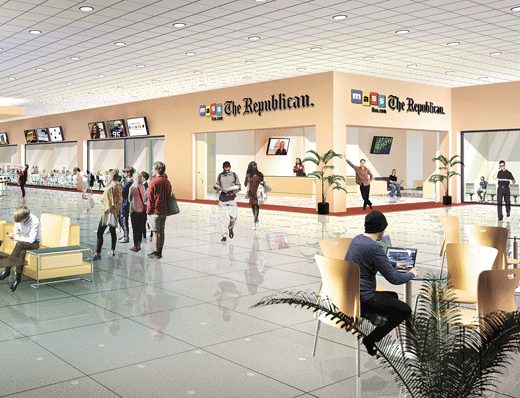
The relocation of the Republican and the creation of Republican Village Square

The relocation of the Republican and the creation of Republican Village Square in the heart of downtown are part of what Penn National officials call the “ripple effect.”

Detailing this potential impact during a wide-ranging interview with BusinessWest, Wilmott and others with the company said the printing operation at the Republican will obviously have to be relocated, probably to one of the business parks in the northeast corner of Springfield — Memorial II, near Smith & Wesson, or the Chicopee River Industrial Park that straddles the border with Chicopee. Also, the other units of the business — editorial, advertising, distribution, and more — would be relocated as well, probably to one of the downtown office buildings, providing a boost to the central business district.

Meanwhile, Peter Pan’s various business operations would also be relocated, Wilmott continued, with transportation-related units going across Main Street to a revitalized Union Station, and others (administrative personnel, for example) moving to Union Station or the center of the downtown.

“Given the energy that our development would have in that part of downtown Springfield, with the relocation of the Republican, the relocation of Peter Pan Bus Lines, and the revitalization of Union Station and the Paramount Theater,” said Wilmott, “we thought that all of these things give us a lot of credibility, both at the city level and at the state level. We think it gives us the best chance to win the bid.”

This potential ripple effect prompted Wilmott to draw comparisons between the Springfield initiative and a casino Penn National opened just over two months ago in Columbus, Ohio.

There, at the behest of city officials, the company essentially put aside a proposal to locate a casino in the arena district of the city, and instead blueprinted plans to place one on the site of a former Delphi Auto Parts manufacturing facility in a neighborhood plagued by poverty and crime.

“It was listed as one of the poorest communities, not only in Ohio but in all of the Midwest — their dubious distinction was to be listed as the ‘loneliest town in America’ at one point by one of the travel magazines,” said Eric Schippers, Penn National’s vice president of Public Affairs.

He told BusinessWest that the ripple effect in that community is still in its infancy stage, but there is evidence that the casino is becoming a catalyst for growth (much more on that later).

For this issue, BusinessWest continues its series of stories on the battle for the Western Mass. casino license with an in-depth look at Penn National’s plans for the North Side of Springfield, and how company officials believe it will more than stand up to the competition.


Roll of the Dice

Penn National staged an elaborate unveiling of its plans for the North End on Dec. 20 at the refurbished Paramount Theater.

The red carpet, with a decidedly Las Vegas-like look and feel, drew more than 200 people, and allowed Wilmott and other officials with the company to present long-awaited details on the Hollywood casino. Specific aspects of the plan had been kept under wraps, by and large, while the company hammered out an agreement to acquire an option on the Republican’s properties from the paper’s parent company, Advance Publications Inc., he said, according to an agreement was reached just days before the unveiling.

Penn National, an operator of casinos and racetracks that currently has 26 facilities in 18 states, is proposing a 300,000-square-foot casino-resort complex, including a 250-room hotel, 100,000 square feet of gaming space, 2,000 square feet of retail, and extensive renovations to the nearby Paramount. Company officials project roughly 2,500 construction jobs and 1,500 permanent jobs.

Plans call for what Jay Snowden, Penn National’s senior vice president, dubbed a “regionally focused” mix of restaurants and clubs, including a sports bar that would become former Boston College and New England Patriots star Doug Flutie’s first foray into the hospitality business.

Other planned restaurants include Davio’s, a chain of steakhouses owned by Springfield native Steve Difillippo; Ole Mexican, a Boston-based chain; b.good, a high-end burger chain; and a deli to be operated by the Scherff family, owners of the downtown Springfield landmark the Student Prince.

The broad plan has been formalized over the past several months, said Schippers, but in reality, it has been perhaps 20 years in the making.

Indeed, the proposal unveiled at the Paramount is similar in a great many ways to a concept first proposed by the late Peter L. Picknelly, then-president of Peter Pan Bus Lines, noted Schippers, adding that it made a good deal of sense in the early ’90s, and still does today.

That’s because it involves minimum disruption of residential neighborhoods; makes effective use of nearby highways, especially Routes 91 and 291, to create easy access; and creates economic-development opportunities in a low-income neighborhood — the North End.

“I don’t think he [the elder Picknelly] was envisioning some of the significant additional ripple effect that we’re going to bring about,” said Shippers. “But certainly his vision for revitalizing the North End and making it a gateway to the downtown is consistent with what we’re proposing.”

Wilmott agreed, and told BusinessWest that Picknelly’s two-decade-old vision eventually became the focus of the company’s efforts once it decided to enter the Massachusetts casino contest.

Elaborating, and echoing officials with other casino operators focusing on this market, Wilmott said Western Mass. (and, more specifically, Springfield) offers perhaps the clearest path to a casino license in the Bay State — most believe Suffolk Downs is a virtual lock for the Boston-area license, and the Southeastern Mass. license fight is complicated by possible participation by the Wampanoag tribe — and also the best geography.

And by that, he meant access to lucrative markets to the west, south, and east of the city, a location that makes entry into the Massachusetts market well worth the expense, and the risks, involved with such a gambit.

“As we look at every market, we look at the location and the proximity of customers to that specific location,” Wilmott explained. “As we look at the demographics of the Springfield MSA [metropolitan statistical area] with its location to Hartford, with its location to the west and Albany, and also to the east, we like what we see. When we look at all of these studies, proximity always wins the battle in terms of where customers want to visit a casino.

He said he sees little chance that three casinos in Massachusetts will saturate the regional market, because there remains limited competition from the two Connecticut casinos, which, while they are down somewhat from pre-recession days in terms of overall revenue, are still two of the largest casino operations in the country.

“There is always the risk that, over time, the state of Massachusetts, after its gets this initial lot of licenses, will fall in love with the revenue and say, ‘let’s open this to further expansion,’” he continued. “We run that risk in every jurisdiction we operate in, and it’s up to the lawmakers in that state to determine how far they want to go with this. It’s always a risk we run when we make investments in new jurisdictions.”

Penn National now finds itself in a two-way fight to get on a referendum ballot in Springfield — although there is a good chance that both its plan and another submitted by MGM Resorts International for the South End wind up before voters — and, for the moment, anyway, a three-way contest for the Western Mass. license, with Mohegan Sun’s proposal for Palmer still very much in the mix.


Headline News

As he gauged the fight ahead — without commenting on rival MGM’s plans (something both camps have been asked to refrain from by Springfield officials) — Wilmott said he liked his company’s chances moving forward.

The ripple effect is a big part of the reason why, he noted, but there are others as well, starting with access and traffic flow.

Snowden told BusinessWest that, beyond the additional development opportunities, the North End site offered perhaps the best scenario when it came to getting traffic in and out of a Springfield-based casino.

“The more time we spent in Springfield understanding the traffic-congestion problems that exist, we felt that the location in the North End offered the best solution,” he said. “That’s because, regardless of whether you’re coming from the north via 91 or 90, or from the south along 91, or from the east of 291, we have three separate ramping-system solutions. We really felt that this provided us the best point of access from any direction, and would help to mitigate the traffic concerns in Springfield.”

But what separates Penn National’s plans from others, Wilmott believes, is its ability to create new jobs and help spark economic-development activity in those areas of the city to which dislocated businesses and employees are moved.

In the case of the Republican and its non-printing operations, he noted that, while dozens of employees will be moved only a few blocks, the impact will be significant on retailers in the central business district and perhaps on the commercial real-estate market as a whole.

Meanwhile, he continued, relocation of the printing facilities and employees will help fill some industrial-park space in the northeast corner of the city.

George Arwady, publisher of the Republican, summed things up simply by saying, “we’re in the way here,” meaning the newspaper’s 180,000-square-foot facility, including the massive press, happens to be where the casino wants to go.

Getting out of the way will be a two-part process that will require some logistical maneuvering, he told BusinessWest, adding that a second, currently unused printing press owned by Advance Publications and currently warehoused in Michigan would be brought to Springfield to enable the company to continue printing its own newspaper, as well as several others it now prints in a growing business venture, while the current press is dismantled and moved.

“It’s a very unusual situation … we’re not a partner in this project, we’re not an investor, we’re not in the casino business — we’re just selling our property,” he explained, adding that, as the process advances, there could be triggers that would actually result in the start of construction of a new printing facility before a casino license is granted.

As for the non-printing operations and personnel, Arwady said the company is seeking to lease class A office space “in the heart of downtown.” He wasn’t more specific, and didn’t say how much space would be needed, but the Dec. 20 unveiling included some details of a facility to be known as “Republican Village Square.”

“The newspaper is actively seeking vacant Class A office space and public gathering space, and we already have had design firms looking at options,” said Arwady. “The Republican plans to use the power of its affiliated website, MassLive.com, to create an interactive, 21st-century village square to bring large numbers of people together for a wide range of fun and community-building activities; at lunchtime, after work, on the evenings and weekends, this aspect of the project will bring new energy and life to the very center of the city.

“Although the details are still under development, we plan to use our combined media strength in English and Spanish to make this new site the place to be in the entire region,” he continued. “Not just for browsing the web and enjoying a cup of coffee, but also for public meetings, blood drives, the creation of video on MassLive and YouTube, singing groups, art shows, and a thousand other purposes. … The goal would be to create a beehive of activity in the heart of downtown 24-7, instead of only during the workday. This would be good for our business, and also very, very good for the heart of our city.”

Meanwhile, Peter A. Picknelly, CEO of Peter Pan Bus Lines and a 50% partner with Penn National in the Hollwood Casino Springfield project, told BusinessWest that his company was always supportive of the city’s efforts to revitalize Union Station, and was asked on several occasions to be a tenant in that facility. The big problem with that equation, he went on, was redevelopment of the existing bus terminal and related facilities — or, to be more precise, lack of viable opportunities to do so.

“We’re in a building across the street [from Union Station], it works for us, we pay ourselves rent, we have vendors that pay us money,” he explained. “We’ve told the city that, while we support Union Station, we simply can’t leave this property abandoned and go next door and pay rent. That’s illogical, and no business person would do that.”

The proposed Hollywood casino effectively solves that problem, he went on, adding that the Penn National plan creates ripples by bolstering the Union Station initiative and requiring Peter Plan to relocate other departments in other parts of the city.

Elaborating, he said there are three business operations that would be moved: the bus-company operation would be moved into Union Station, while administration and support personnel would move to either Union Station or 31 Elm St., currently being developed by the Picknelly-owned company Opal Management, depending on space availability and lease structure in the station, among other conditions. The third facet of the business, maintenance, would be relocated to a new facility, he went on, adding that the company is currently looking at property on Tapley Street and other sites for new construction.

“This proposal is what I view as true urban renewal,” said Picknelly. “And that’s why we picked Penn National as a partner; they embraced this concept. We didn’t just want to build a casino in Springfield; we want to use a casino to help revitalize the city.”


Placing their Bets

This notion of urban renewal is the point that Penn National officials will be stressing as the process moves forward, said Wilmott, adding that the next stage involves finalizing proposals for review by both the city and the state.

Final bids are due by Jan. 3, he continued, adding that Springfield officials are looking for specific details on everything from revenue projections to traffic plans to human resources. The city will then decide if it wants to enter into negotiations with one or both operators on what’s known as local-impact fee. Ballot questions on one or both plans would come much later in the year.

Assessing the landscape, Penn National says the Springfield competition will be highly competitive, and one they believe could ultimately be decided — if other considerations, ranging from finances to impact on public safety to traffic, are relatively equal — by that community impact, or ripple effect, that Wilmott described.

And with that, he, Snowden, and Schippers returned to Columbus, Ohio and the company’s project there.

The casino opened just a few weeks ago, they stressed, but work that began well before the ceremonial ribbon was cut has created a growing sense of momentum in that neighborhood.

“We’ve worked with a coalition of business owners in West Columbus to talk about how we can be a catalyst for other positive development in that area,” said Schippers, “so there’s a new spring in the step of the business community there.

“Like in Springfield, we believe there is going to be a very positive ripple effect there after we’re underway and in a fully stable environment,” he continued, adding that among the developments are a new restaurant in the area near the casino, movement to redevelop an all-but-abandoned car lot, and action among elected officials to make investments in the infrastructure there.

“There have been road improvements, transportation studies have been conducted, and now it appears that the state will be investing more in getting better access and better roads to that area,” said Schippers. “Other businesses have announced plans to add shifts or make new investments, and people are exploring the addition of another hotel, which would create even more of a catalytic effect.”

The same types of things will likely take place in Springfield, said Snowden, starting with the activity to result from the need to relocate the two impacted businesses along Main Street.

“There won’t be just one construction project taking place in Springfield,” he noted. “You’re going to have the elements of the Republican relocation and the same with Peter Pan. It’s not just the breaking of ground in a single phase for the casino, hotel, parking, and restaurants, but also the ripple effect taking place at the same time.”

Wilmott agreed.

“That’s why we liked this site in the first place,” he said. “All things being equal — if we’re matching MGM in terms of impact fees to the community, for example — we think the site is more valuable to the long-term economic development of Springfield than other sites. And that’s why we believe that site should win out.”


Trump Card?

Time will tell if those at Penn National are right in their assessment of this contest and their proposal. For now, they are guardedly optimistic about their chances in this high-stakes competition, primarily because they like the hand they’re playing.

There are many aspects to their plan, but they’re betting that the ripple effect to be created by their $800 million facility will be the deciding factor — and ultimately enough to claim the prize in the middle of the table.


George O’Brien can be reached at [email protected]

Features Getting Down to Business
Casinos Add to Full Slate for Springfield Chamber

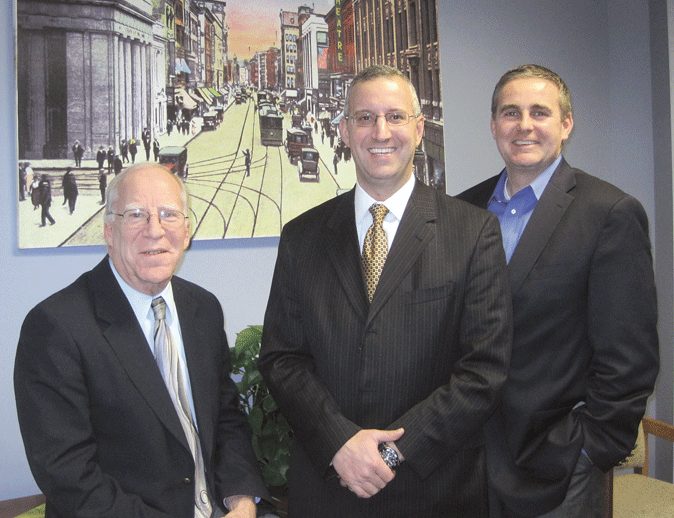
Springfield Chamber leaders (from left) Jeff Ciuffreda, Jeff Fialky, and Patrick Leary

Springfield Chamber leaders (from left) Jeff Ciuffreda, Jeff Fialky, and Patrick Leary all say that casinos are just one of many issues on the agency’s crowded plate.

Patrick Leary acknowledged that much of the current discussion involving casinos in Springfield is centered on where and who — meaning the location and the chosen operator.

But the Springfield Chamber of Commerce isn’t focusing on those specific matters, and it probably won’t, said Leary, a partner with the Springfield-based accounting firm Moriarty & Primack and current president of the chamber’s board. But that doesn’t mean the organization isn’t getting involved in what would be the largest development project in the city’s history if it comes to fruition.

Instead, the chamber is taking a more global view, one that can best be described as providing a voice for its membership on this all-important issue, said Leary.

“North End, South End … regardless of who it is and where it is, we’re more concerned that the chamber’s members aren’t forgotten in this whole process,” he told BusinessWest. “It would be very easy to have a casino move into the North End or South End and start siphoning business away from the central business district and pulling employees away from our membership; we need to look at all those issues that are going to affect our membership.”

Jeffrey Ciuffreda, executive director of the 550-member Springfield Chamber, as well as the larger Affiliated Chambers of Commerce of Greater Springfield, agreed.

He said the chamber has thus far decided, as an organization, to endorse the concept of a Springfield-based casino — with some stated suggestions, or requests, designed to protect the interests of existing businesses in the city.

These include:

• “A preferential procurement program for gods and services from Springfield businesses with measurable goals”;

• “Employing those unemployed and underemployed,” with an emphasis on those residing in Springfield now or in the future in market rate housing; and

• “Enhancement of downtown Springfield and the city as a whole,” among others.

The wording on the chamber’s measure sums up the charge for the group during the casino fight. The organization voted to “support a Springfield-based casino development that adequately addresses the issues and concerns of the membership of the Springfield Chamber of Commerce.”

So, in many respects, the chamber is taking the same approach with casinos that it does with other issues impacting the local business community, said Ciuffreda, listing everything from tax classification and efforts to lower the commercial rate to zoning policy and matters involving the compensation and term length of Springfield’s mayor.

The common denominator, he said, is creating an environment in which the city and its business community can succeed.

“We have a very large and diverse membership base in Springfield,” said Ciuffreda. “Our mission is to effectively represent these businesses, advocate for them, and, in general, create a business-friendly environment in the city.”

For this issue, BusinessWest concludes its Getting Down to Business series with an in-depth look at the Springfield Chamber, which finds itself in the middle of a hotly contested battle for the Western Mass. casino license, but also has a number of other matters on its plate.


Playing Their Cards

When asked about the chamber’s role with casinos moving forward, Ciuffreda said the time for debate about whether expanded gaming is something the state wants or needs is over — legislation passed just over a year ago allows up to three casinos and a slots parlor — and the chamber’s current assignment reflects this.

“Now, the issue of ‘do you want a casino?’ is off the table,” he said, while acknowledging that city residents must still approve a referendum on a casino plan or plans. “The issue now is ‘how does this benefit Springfield?’”

Elaborating, he said the chamber’s official role is to communicate the desires and concerns of its membership and the business community as a whole, and to secure itself a seat at the table in discussions with casino operators — both literally and figuratively.

Concerning the former, Kate Kane, managing director of the Springfield office of Northwestern Mutual Financial/the Zuzdo Group, and a former Springfield Chamber board member, has been appointed to an ad-hoc committee appointed by mayor Domenic Sarno to review competing casino proposals; she will, in essence, represent the chamber and its membership on the panel. As for the latter, the chamber intends to be quite visible and vocal as negotiations continue with casino operators, said both Leary and Ciuffreda.

And to carry out that assignment, the chamber has appointed its own casino subcommittee, one that has met several times and thoroughly researched other urban centers with casinos, including Detroit, Kansas City, Mo., and Biloxi, Miss.

“We discussed the good and the bad of having a casino, how they [operators] negotiated, and whether they even negotiated,” said Leary, “and the board voted to endorse the Springfield-based casino with the provision that we’re going to have certain items that we need to have addressed before we’ll fully endorse and advocate for casinos.”

Both Ciuffreda and Leary said they’re impressed with the plans of both casino operators (MGM and Penn National) proposing facilities in Springfield, just as they were with Ameristar’s concept for the former Westinghouse site before that company withdrew from the competition. But both also added that some of the promises to hire minorities and women are already part of the state’s gaming legislation.

While other chambers had to reach out and call for the casino developers to do something specific on that front, “it’s already built into ours,” Ciuffreda said.

“Not taking anything away from MGM or Penn National; there’s a minimum standard [through the legislation], and they’ve exceeded those standards,” he continued. “But it’s a compliment to Gov. Patrick and the Legislature for writing a very solid measure that protects what we have right now and adds to it.”


East Meets West

Yet, as the pitched casino battle plays itself out, the Springfield chamber will have other matters to address, which collectively fall under the category of giving its membership a strong, clear, united voice in both Springfield City Hall and Beacon Hill.

Indeed, advocacy is one of the most visible and impactful ways that the chamber brings value to its members through the long reach of the ACCGS, said Ciuffreda, adding that there are many ways in which this aspect of the group’s mission is carried out.

For starters, there’s the ACCGS’s annual bus trip to the State House every April, a program that brings 65 area business and nonprofit leaders to Boston to meet with delegation members, gain insight into pressing issues impacting the business community, and express their view on such issues.

“Boston just doesn’t see that many people in that building at one time from Western Mass.,” said Leary. “And that translates to 65 business leaders who represent literally thousands of people.”

And while the chamber brings its members to Boston, it has also succeeded in bringing Boston-based elected officials to Springfield. Indeed, Ciuffreda secured Jay Gonzalez, secretary of the Executive Office of Administration and Finance, as a speaker for a recent luncheon program, and has consistently brought top officials within the Patrick administration — and the governor himself — for area events.

“I see it as a win-win situation,” he said of such high-profile speaking engagements. “Area business owners and managers get to hear directly from these officials, and we can provide a large audience for them.”

Chamber visibility in Springfield City Hall is far more constant, obviously, said Ciuffreda, adding that the chamber has been, and continues to be, vocal on issues ranging from tax classification to city-wide zoning policy; from tornado recovery to the mayor’s salary.

That last item is still a matter to be settled, he continued, adding that it is one of many action items to result from the 2007 Urban Land Institute study on Springfield, which took place as the city was struggling to fight its way out of receivership and blueprint an economic-development strategy for the years ahead.

The report’s recommendations for City Hall included lengthening the mayor’s term in office from two to four years, adding a chief financial officer (those steps have already been taken), and raising the mayor’s salary above its current $95,000, in an effort to consistently attract top talent to that position.

“It’s a sensitive issue when you talk about a pay increase for a mayor,” said Jeffrey Fialky, a partner with the law firm Bacon Wilson and chamber board member, as he talked about why the chamber is involved in such matters. “But it’s such an important part of the ability to retain strong serving mayors as well as the ability to attract new mayoral candidates.”

Tim Murphy, a partner with the law firm Skoler, Abbott, & Presser, P.C., represented the chamber on the compensation committee, and explained its recommendations. “The pay has been $95,000 since 1997,” he explained. “What the committee was able to agree on was immediately increasing the mayor’s pay to $110,000 and having an annual cost-of-living increase of 2.5% going forward.”

Ciuffreda said the pay issue is slated to be resurrected in 2013, and is an important consideration for the city as it looks to ensure strong leadership in the corner office in the years and decades to come.

Education is another matter the chamber, and the ACCGS as a whole, is addressing in many ways and on many levels, said Ciuffreda, adding that it is involved in everything from early education to efforts to reduce the city’s disturbingly high dropout rates, to initiatives involving training and retaining key members of the workforce.

One stated goal is supporting efforts to close the so-called skills gap in the region, a factor contributing to difficulties for many companies with filling open positions, even at a time of high unemployment, and stifling growth efforts for some ventures.

One such initiative is the Precision Manufacturing Training Program (PMTP), a pilot program aimed at providing individuals with the skills needed to succeed in today’s technology-oriented precision-manufacturing sector.

“There’s a big emphasis on the veterans returning from Iraq and Afghanistan,” said Ciuffreda, adding that the state is looking to expand the program based on the success of an initial thrust involving more than 130 participants.

The PMTP is funded by a $750,000 grant from the Executive Office of Housing and Economic Development through the work of the chamber, the Regional Employment Board of Hampden County, and the Economic Development Council of Western Mass., and will take place at Springfield Technical Community College and Westfield Vocational Technical High School.


Odds Are

Ciuffreda said a series of circumstances — from geography to what is perceived to be a more open competitive landscape in the Western Mass. region — has made Springfield ground zero in the casino fight.

This development has added new challenges and more layers of involvement to the Springfield chamber’s itinerary. But casinos are just one of many issues that will compete for the group’s energy and attention.

The bigger assignment is to keep providing that aforementioned voice for its members, something it has done for more than a century now, and will keep doing long after the casino is built — wherever it winds up.


Elizabeth Taras can be reached at [email protected]

Features
Group Wants to Emphasize That It Goes Well Beyond Networking

Chris Thomson and Pam Thornton

Chris Thomson and Pam Thornton say the primary challenge for YPS is to effectively communicate that it is much more than a networking organization.

Chris Thompson isn’t a young accountant — his business card declares that he is vice president of Business Development for the Springfield Falcons hockey club — but he put himself in the shoes of such an individual to help explain what the Young Professional Society of Greater Springfield (YPS) has accomplished in its first five years, and where the group intends to go in the future.

“Can you imagine being a 22-year-old accounting graduate from UMass who has a chance to meet with Mark O’Connell?” asked Thompson rhetorically, referring to the recently named president and CEO of Wolf & Co., P.C., who was the featured business executive at a recent YPS CEO Luncheon. “You can’t put a price tag on having a face-to-face with a decision maker like that. ”

Indeed, in addition to valuable insight about the accounting industry and business in general, O’Connell provided his luncheon guests with indisputable evidence that one doesn’t haven’t to leave Western Mass. to script a success story. O’Connell, a long-time partner with the firm, has long worked out of the Springfield office rather than the firm’s headquarters facility in Boston, and he made a conscious decision to keep that business mailing address when he was chosen this past summer to lead the company.

Those career decisions enable YPS’s marketing slogan — ‘Live, Work, Play, and Stay’ — to resonate, said Thompson, a long-time YPS member, adding that exposing the group’s membership to more of these stories is one of many formal and informal goals moving forward for the organization, which recently turned five, and marked that milestone by completing a new, three-year strategic plan.

That document, which calls for hiring a full-time executive director, among other steps, addresses goals and aspirations, but also perceptions about the group and apparent misperceptions as well, said Pam Thornton, business-development director for United Personnel and current president of the organization.

Elaborating, she said YPS is perceived by many as simply a networking group, a view facilitated by the group’s popular and highly visible Third Thursday gatherings.

Those get-togethers will continue, she went on, adding that networking remains a high priority for the organization. But there are other missions, ranging from educating members about issues and the region in general to helping members get involved in the community, to, overall, providing motivation for young people to stay in this area.

“YPS is all about graduating youth into the business world, and I see it as a foundation, a funnel, a vehicle for all of the things this area is concerned about in retaining talent,” said Thornton, adding that the new strategic plan emphasizes this mindset.

Summing up the plan and what its architects hope it will accomplish, Thompson said it was crafted with the broad goal of greatly reducing the volume of questions relative to why the organization exists, what it does, and how it carries out its mission.

“There was no blueprint back then,” he explained, referring to the group’s early days, while noting that, with a firm plan in place, YPS can better articulate its charge — and carry it out.

For this issue, BusinessWest talked with several YPS members about the state of their organization at this important stage of its development, and where it can, and should, go from here.


Young Ideas

If success can be measured in numbers, such as those related to membership, then YPS can certainly claim a number of victories since its formation in the summer of 2007.

It now boasts more than 500 individual members and 50 corporate members. Meanwhile, its e-mail list has grown to more than 2,000. And there have been other forms of validation: BusinessWest chose the group as one of the first recipients of its Difference Makers award in 2009, and state Sen. James Welch (D-West Springfield) is sponsoring legislation to develop a ‘Young Professional Commission,’ which would give the 11 YP organizations across the Commonwealth a voice on Beacon Hill.

“What makes YPS important is that many of the decision makers, not only in our region, but everywhere, tend to be further along in their careers,” said Welch. “YPS represents those that are a little earlier in their careers and gives them a bit more of a voice when it comes to decision making and influencing policy and the direction the region wants to go in.”

The commission would also be a key element in ongoing efforts across the Commonwealth to keep young professionals — what Welch and others call “intellectual capital” — in the Bay State, thus making it a more attractive state in which to do business.

Yet, despite these triumphs, there is still an apparent lack of awareness, even among some YPS members, about the group’s official mission and the work it does within the community and for its members.

These were revealed at a series of focus groups staged last summer and facilitated by Ronn Johnson, president of R.D. Johnson Consulting.

Among the findings was that nagging perception of the group as simply a networking organization, a view that is somewhat troubling, but perhaps understandable. That’s because, from the start, YPS has stressed the importance of networking and building relationships, both from a business perspective and a community-involvement standpoint.

“That’s where the disconnect has been; we were a young, social business group that built strong foundations through networking,” said Thornton. “When you look at the chamber, that’s what they do, too … it’s called building relationships; you aren’t going to do business with someone you don’t like.”

The group’s networking activities, especially its Third Thursdays, will continue, said those we spoke with, because they remain one of the few — and most effective — vehicles for young people to build those relationships. But YPS will emphasize other aspects of its charge, and more forcefully articulate them.

The need to do so was made clear at the focus groups, said Kishore Parmar, vice president of the Pioneer Valley Hotel Group, who was asked to be an observer and administrator at two of the sessions, which solicited feedback from area business and nonprofit leaders.

He noted that many of these participants were aware of YPS, but opined that its mission was not clearly stated.

“That’s the biggest issue with them,” he told BusinessWest. “They wanted to know what our end goal was, to see it written down, and to see it formally introduced.”


Youth Is Served

To do all this, and create that more solid blueprint that Thompson described, the group’s strategic plan sets a number of goals and methods for realizing them.

One of the key provisions is hiring an executive director, a step necessitated by the group’s profound growth, and a measure that will give YPS a face and a voice in the community and an important layer of management.

“There are many nonprofits out there that function quite well without an executive director, but they really only get legs when they have someone who can manage the organization on a full-time basis,” Thornton told BusinessWest. “So we will be approaching key stakeholders in the community to invest in YPS.”

The strategic plan also calls for a sustainable organizational structure that will explore more funding opportunities through grant and fee-based programs; a task force to oversee a fund-development plan; the possibility of a conversion from a 501(c)(6) to a 501(c)(3), allowing a charitable arm of YPS; and strengthening community, key-stakeholder, and political partnerships.

Other facets of the plan include additional focus on fostering “an inclusive, culturally competent, and community-relevant organization in the eyes of its members and the broader community.” Thornton said YPS is already taking a number of steps in the realm of diversity, “but we can always do better.”

She noted that the 16 members of the board of directors will be attending a diversity-education seminar in January, bringing what they learn back to members.

Another component of the strategic initiative focuses on what the group calls work/life development opportunities.

“When we look to the future, we want people to view us as what they asked us to be,” Thornton explained. “The feedback that we got was about professional-development programming, education reform, real-estate concerns, casinos and a forum about that issue — and they really want to be connected in the community through volunteerism, but they want someone to show them how to do that.”

Part of this assignment will involve simply making young people aware of the many kinds of professional-development opportunities that exist in this region, said Thompson, noting that several colleges and workforce-development agencies provide workshops and other programs, many of them free of charge, but young professionals often don’t know about them.

Welch agrees. “Young professionals know from experience that, when they were first starting out in their careers, they didn’t necessarily know what resources were out there and available to them.”

And while many in the business community are focused on what YPS can do for them and their employees, Thornton believes these same people have to ask what they can do to help YPS.

“Maybe employers need to take a step back and see how they can become involved; young people need the elder community to be mentors, and those employers have a role in YPS,” she explained. “And the only way to do that is to engage young people, mentor them, give credence and value to the things that they’re interested in … and that’s how to keep young professionals in the area.”

Still another stated goal within the strategic plan is to create vehicles through which the board can more effectively communicate with current and potential members, partners, and the general public through the YPS website and other marketing strategies. Such efforts are expected to help increase membership, facilitate recruitment of sponsors, and solidify efforts to retain young talent across the region.

“When the question is asked, ‘what does YPS do?’ we’ll be able to answer that though our website, e-mails, and a consistent brand,” said Thornton. “These are big goals, and we’ll need time to realize them.”


Goal Keepers

Summing up what he saw and heard at the last summer’s focus groups, Parmar said there is a perception among many that YPS is “finding its way” and evolving into a viable organization that is promoting intelligent discussions and generating tangible results.

“There are more doers, and they’re rising up,” he said, adding that, moving forward, the group’s basic challenge is to encourage more area business leaders to voice such opinions, and eventually prompt use of the word ‘found’ rather than ‘finding.’

Generating such dialogue — and changes in perception — will take some time, but with a new strategic plan in place, those within the organization believe YPS has a blueprint in place for building on what has already become a success story.


Elizabeth Taras can be reached at [email protected]

Features
A Resilient Square One Goes Back to the Drawing Board

Joan Kagan

Joan Kagan says the gas blast that heavily damaged another Square One facility will further complicate efforts to rebuild following last year’s tornado.

If adversity really does build character, as many would suggest that it does, then Joan Kagan believes that she and the rest of the staff at Square One have all the character they will ever want or need.

“We’d been tried, and we really didn’t need to be tried again,” she said while talking with BusinessWest, for the second time in 18 months, in a setting that looked straight out of Beirut in the mid-’80s, standing in front of what used to be a Square One facility.

This time, it was at the agency’s damaged and now-condemned Chestnut Street Center, located next door to the gentlemen’s club that was erased by the Nov. 23 natural-gas explosion. A year and a half ago, it was beside a pile of rubble that was the company’s headquarters on Main Street, one of many buildings razed after a tornado tore a path through Springfield’s South End.

Now, as then, the talk centers on moving forward, not looking back, and about finding opportunity amid calamity — although there first had to be some reflection (although not much) on the winning-Powerball-like odds of disaster striking the same enterprise twice in such a short time.

“When they told me what happened, I didn’t know whether to laugh or cry,” said Kagan, the agency’s long-time director, who said she was getting ready to board a plane for home after visiting family in St. Louis for Thanksgiving when she received word of the blast. “I was thinking, ‘it’s November, so this is not an April Fool’s joke,’ but it was almost unbelievable that it could happen twice to Square One.”

This latest calamity, which, like the tornado, resulted in no injuries to students or staff, took out seven classrooms, the reading room, the kitchen, and play areas at the Chestnut Street Center, essentially displacing 98 children and several educators. They have since been relocated to other facilities, including some within the Square One portfolio, said Kagan, adding that, from a bigger-picture perspective, the damage from the blast sends the company back to the drawing board as it tries to blueprint a rebuilding plan for the future.

Indeed, the explosion came exactly one week (almost to the minute) after the agency reached a final settlement with its insurance carrier on the various kinds of damage done by the June 2011 tornado. The numbers in that settlement don’t come close to covering all the losses, Kagan told BusinessWest, estimating that they represent maybe 60% to 70% of the actual total. But simply knowing the number was necessary for Square One to perhaps move ahead with plans to rebuild somewhere in Springfield’s South End and once again be an anchor in that neighborhood.

Now, the agency has to recalibrate, she went on, and decide not only what to build — perhaps one facility to replace both that were leveled — but also where; the Chestnut Street facility served many families living and/or working within a few blocks of that building.

To adequately serve that clientele, the company may have to explore creation of another facility in that area, perhaps in Union Station, which is currently being renovated into an intermodal transportation center, Kagan noted, adding that Square One may not have the resources for such an undertaking.

“We had made some preliminary plans about rebuilding in the South End, but needed to know what our number was going to be,” she explained. “We had planned to reconvene after Thanksgiving, start to look at options, focus in, and drill down on a plan involving what we were going to build, where we going to build, and when. Now, we have more on our plate and many things to think about.

“We’re marching onward and upward, and this is just another challenge — that’s how we’re looking at it,” she continued, adding that there hasn’t been time or an inclination to say ‘why us again?’ “And we’re asking ourselves, ‘does this once more provide us with opportunity?’ It gives us some other things to look at and some other scenarios that could play out.”

For this issue, BusinessWest talks with Kagan — again — about staring down adversity and moving on with the agency’s 130-year-old mission.


Time and Space

Kagan’s temporary office in the Scibelli Enterprise Center, which she moved into more than a year ago, remains quite sparse; her printer still sits on a cardboard box, for example.

There are a few pieces of art on the walls — including a print involving some landmarks at her alma mater, Columbia University — but mostly large expanses of barren square footage. Time and energy have much to do with this, she said, adding that both have been devoted to matters far more important than decorating. Meanwhile, many of her personal and professional belongings, such as her diplomas, were lost in the tornado’s fury.

But there is also some psychology at play, she told BusinessWest. Indeed, by not covering the walls and filling the shelves, Kagan believes that somehow she might be shortening her stay in this building, which houses mostly startup ventures and was once part of the Springfield Armory complex, and accelerate a move into a new Square One facility.

The natural-gas blast has thrown some cold water on that thinking, she said, noting that it adds new layers to the already-complicated process of rebuilding for the future. And for the short term, it gives the company something it certainly didn’t need — more practice in the art and science of bouncing back from disaster.

This time it has been considerably easier than it was in the summer of 2011, she told BusinessWest, adding that the tornado took out the company’s headquarters and everything in it, leaving staff members without the barest essentials as they went about crafting a recovery plan.

After the gas blast, the scrambled staff members had offices, desks, computers, and files, she went on, and communication was much easier. Also, many staff members saw their homes damaged by the tornado, adding more and different layers of anguish that didn’t exist with this latest disaster.

The basic strategy moving forward after the gas blast was to keep students together as much as possible, said Kagan, noting that continuity is important to both children and staff. And for some in both constituencies, this was the second time they had been uprooted by calamity.

She said 60 of the uprooted children have been placed in other Square One facilities, in slots that had been taken offline, while another 40 have were moved to two borrowed classrooms in the New Beginnings Childcare Center on State Street. In general, there has been minimal disruption — students were in their new settings within days of the blast — and impacted families are pleased that new accommodations were made so quickly, Kagan noted.

But while some measure of continuity has been achieved, Square One has essentially lost 60 revenue-producing slots for students, said Kagan, adding that this lost business is one of many things she will have to hash out with insurance carriers and Columbia Gas, which accepted responsibility for the blast and is in the process of handling claims from impacted parties.

Another is replacement of the estimated $500,000 worth of equipment, learning materials, and supplies — from computers used by the children to toys and games — lost to the gas blast.

Overall, this latest disaster has left the agency with seriously depleted resources and reserves, said Kagan, adding that replacing everything lost to the tornado was an expensive proposition.

“In order to replace all that — our computers, servers, printers, and furniture — we had to invest a lot of money to get ourselves back in operation,” she explained. “And we didn’t get totally reimbursed for that from our insurance, depleting our resources and reserves.”

Elaborating, she said that, after the tornado, the company had equipment in storage to outfit two donated preschool classrooms. This year, it didn’t have such inventory available.

While exploring options for replacing supplies and negotiating with the insurance company and Columbia Gas, Square One is also looking at many possible scenarios for the long term, said Kagan, who told BusinessWest last June, at the one-year anniversary of the tornado, that Square One is essentially committed to being an anchor in Springfield’s South End — even as the prospects for a casino in that neighborhood add more question marks to the prospect of rebuilding there.

But with the loss of the Chestnut Street Center, there are now more questions about what to build and where to best serve clients across the city.

“The Chestnut Street facility has always been very popular, and it was always full,” Kagan explained, adding that there was a waiting list for slots.

“We’re going to reassess and talk to the families,” she said. “What we want to find out is whether, if we doubled our capacity in the South End, families would be able to use that facility. Some might say they work at [nearby] Baystate Health or Mercy Medical Center, or downtown, and that a South End center would take them out of their way.

“If we were going to build a facility for 100 children, do we now have to build one for 200 children?” she continued, adding that there are sites to be considered downtown and in the North End, including Union Station, although talks with city officials have not taken place on that location yet. And the reality, she said, is that the company doesn’t have the resources to rebuild in the North End at this time.


Not at a Loss

Looking around her office, Kagan noted some recent additions to the landscape, specifically several gift baskets from companies and individuals wishing to lift the spirits of those at the company, especially its director.

There have been many other expressions of support, she went on, citing monetary donations of many sizes, including a $25,000 contribution from the Penn National Gaming Foundation and the Peter and Melissa Picknelly Charitable Fund.

Such help from the community will be needed, she said, because the task of rebuilding from twin disasters and replenishing resources and reserves will be difficult and expensive. “We need all the help we can get.”

One thing she and the rest of the staff don’t need any more of is character spawned by adversity. They have plenty of that already.

George O’Brien can be reached at [email protected]

Features
An Already Intense Casino Battle Is Getting Even Hotter

Holyoke Mayor Alex Morse

Holyoke Mayor Alex Morse says he hasn’t changed his mind on casinos, but wants to protect Holyoke’s interests.

Holyoke Mayor Alex Morse spoke at the podium placed at the back of his office at City Hall for perhaps 15 minutes. But very few people heard anything that he had to say.

Whatever microphones there were at the podium for a raucous press conference on Nov. 26 did not carry his voice past the first few rows of people — most of them press representatives — gathered in front of him. And even those people couldn’t hear much due to the loud and incessant catcalls coming from the more than 100 city residents who couldn’t squeeze in to Morse’s office, but made sure the 24-year-old, first-term mayor knew they were there — and not happy with him.

Among the comments heard: “No casino” (that was a constant, heard throughout); “Morse lied to Holyoke”; “shame on you”; “this is wrong”; “sellout”; and even “get a real job.” There were also plenty of signs, including one that read, “Don’t Bet on Another Term.”

What Morse was attempting to explain — and there were plenty of copies of his remarks made available so people would know, even if they couldn’t hear — is that, at this moment, he is only considering a proposal forwarded by Holyoke resident and business owner Eric Suher to place a resort casino on land he now owns on Mount Tom and from which he operates a concert venue.

But even the fact that he is considering such a proposal sent shock waves through the region and took the hotly contested casino fight in this region to another dimension.

“Let me be absolutely clear,” said the mayor. “There is no agreement in place between a casino-development group and me. There have been no back-room deals. My intent today is to inform the people of Holyoke of my shift in strategy before any advanced discussions or negotiations take place, so that everyone in the city may voice their ideas, concerns, and suggestions.”

The press conference had long been scheduled for that date, the mayor told the press after his remarks, but it was made more necessary — and far more hostile — by the fact that information about Morse’s consideration of a Mount Tom casino were leaked to the Boston Globe days before. In fact, the newspaper already had a copy of Morse’s remarks long before anyone else.

The intriguing turn of events has sent Ward 7 residents of Holyoke scrambling for a new candidate to support, and added even more layers of speculation and intrigue to what was already an intense fight for the license to be granted for a Western Mass. casino, one that has become all-consuming and even entertaining.

Indeed, several days before Morse’s stunning “shift in strategy,” as he called it, representatives of the three companies trying to place a casino in Springfield — MGM, Ameristar, and Penn National — essentially took turns calling each other names in a rambling, gloves-are-off story in the Republican.

The casino officials basically tried to shoot holes in their opponents’ plans before the court of public opinion, casting aspersions on everything from traffic plans to the size of planned hotels. And this is months before anything is remotely close to being put on an election ballot.

But back to Holyoke. It’s certainly not unusual for a city official to say that he’s looking hard at a plan to bring a casino to his community. What is quite unusual is for such a pronouncement to come from someone so passionate in opposition to gaming that he wrote the following in a recent issue of Commonwealth magazine (in a point-counterpoint segment with Springfield Mayor Domenic Sarno):

“A casino does not create wealth; it transfers it. Regions benefit from casino gambling when people from outside the region come to spend money there. But there is no evidence that this would be the case at a Holyoke site. A casino in Holyoke would not be a destination gambling site, but a convenience gambling site. It would thus serve primarily to remove money from the local economy and put it in the hands of casino owners who do not live here. This is how casinos work — by design. Because of this, I do not believe a casino would be useful even as part of a holistic approach. We have the resources and the drive to create an economy that will benefit all, and for generations to come.”

On Nov. 26, and the day before in the Globe, Morse, who studied urban planning at Brown, essentially said he hasn’t exactly changed his mind on casinos, only his perception of the situation now facing not only his community, but the region as a whole.

“For me, in an ideal world, we would not have a casino in our boundaries. My views on casinos haven’t changed, and neither has my belief that a casino is unequivocally not  our saving grace,” he said in his prepared remarks. “The only thing that has changed is my weighing of that option with the alternative, which would be locating a box-style casino right at our doorstep. Map out driving directions on your favorite GPS: Springfield’s would be 15 minutes from [Holyoke] City Hall; one at Mountain Park would be 12. We share one metropolitan area, and I cannot assume that our city boundaries will provide us any protection from a casino down the road.

“I have thus come to the conclusion that in order to mitigate the effects of having a casino in Western Mass., it is not enough to oppose one in our boundaries. … The best way to control the outcome of this process, such that we reap the benefits and mitigate the downsides, is to ensure that we negotiate a host agreement that best addresses our concerns and our values, and then, once such an agreement is reached, put it before the voters. My overarching goals for Holyoke’s economic future remain the same; today’s announcement marks the deployment of a new strategy, given current realities, for achieving them.”

Read between the lines (or just the lines, really), and Morse seems to be saying that, if you can’t control what goes on with a Springfield or Palmer casino, you’d be better off having one built in your city, where you can exercise some control.

And with that, Morse possibly added not one, but two more casino proposals to the already-crowded mix in Western Mass. — the one he’s discussing with Suher, and another plan to place a facility at nearby Wyckoff Country Club, an initiative that was practically abandoned on Election Day 2011, when Morse triumphed over incumbent, and casino supporter, Elaine Pluta.

When pressed repeatedly by members of the media to explain to be what appears to be a huge flip-flop on the issue that most decided that mayoral race, Morse said, in essence, that it is anything but.

“I wasn’t elected to keep a casino out of the city of Holyoke,” he said. “I was elected to represent everyone in the city of Holyoke.”

Whether the voters ultimately agree with that sentiment remains to be seen, and what happens in Holyoke politically is only a part of the story.

The bigger picture is that the casino fight in this region may soon include three communities and six proposals — an intense competition that exists nowhere else in the state — and is certain to get even more intense in the weeks and months to come.


George O’Brien can be reached at [email protected]
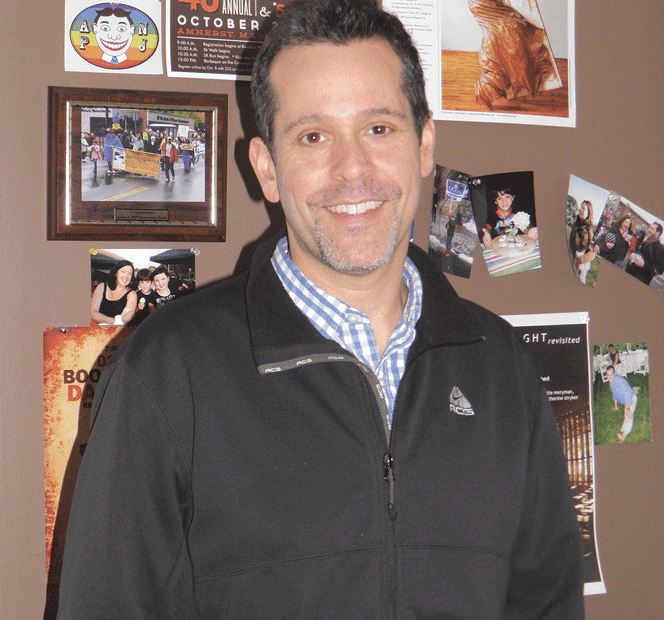
Features Getting Down to Business
An Energized State Massachusetts Chamber of Commerce Focuses on the Big Picture

Debra Boronski (center) with two Massachusetts Chamber employees, Heidi Brodeur (left), director of membership services, and Noelle Myers, events and communications manager.

Debra Boronski (center) with two Massachusetts Chamber employees, Heidi Brodeur (left), director of membership services, and Noelle Myers, events and communications manager.

Debra Boronski has achieved a number of goals since establishing the Massachusetts Chamber of Commerce five years ago. Starting with the right to call it that.

“We started as the Massachusetts Chamber of Business and Industry because the name ‘Massachusetts Chamber of Commerce’ was taken,” Boronski said, explaining that an individual registered the moniker in 1989 but never did anything with it. “It took me three years to find him, and once I did, I had to get a letter of consent, and we worked it out.”

Even under its original name, however, Boronski felt her nascent organization filled a badly needed niche in the Bay State.

“There are 43 state chambers in the United States; I founded the 43rd,” she told BusinessWest, explaining how she broke away in 2007 from two decades of work with the Affiliated Chambers of Commerce of Greater Springfield (ACCGS) and, before that, the Chicopee Chamber of Commerce, to lead this new endeavor.

“After having spent 20-something years in local and regional chambers, I really felt that what I could do as a business professional in these arenas was done. I was strongly encouraged by many associates, and I got a great deal of support from other professionals in the chambers and other organizations, to start a Massachusetts Chamber of Commerce.”

Five years later — the organization celebrated that anniversary on Oct. 9 — the Massachusetts Chamber counts about 700 members in its ranks, and Boronsky has a much different job than she used to.

“A state chamber of commerce really focuses its primary efforts on advocacy,” she said. “We aren’t like your local or regional chamber; we don’t do networking events or after-5s, and we don’t get involved in local government and local ordinances. We believe a local chamber is meant to do that, and they do it well.

“But local chambers,” she continued, “have a hard time paying attention to all the laws and regulations being discussed in Boston, and I can say that from experience running the Chicopee Chamber for 10 years and doing work for the Affiliated Chambers for 11 years. They have their hands full with their day-to-day business.”

The role of a state chamber, she explained, is threefold: information, education, and advocacy. “I am a registered lobbyist, and we also employ a lobbying firm in Boston. We are always in the know and informed as to what’s going on today and what’s being planned for tomorrow.”

For this installment of Getting Down to Business, Boronski talks about some of those issues, and the way her organization has expanded, not just in membership, but in scope.


Taking a Stand

Her role begins, however, with advocacy in Boston — a task she believes is critical for member businesses to succeed.

For example, in March, the state Division of Insurance staged a hearing to discuss increasing workers’ compensation rates by almost 20%. “We were the only chamber of commerce there; I was the only CEO at that hearing, testifying against that increase and providing testimony to Division of Insurance representatives about what harm it would do to businesses, small businesses in particular,” Boronski said. “And they did not raise it. I think we made a difference.”

She also pointed to an economic-development bill signed into law in August 2010 that includes two provisions for which the Massachusetts Chamber pushed hard. One raises the cap on small-claims court actions from $2,000 to $7,000, allowing businesses to pursue collection of bigger debts without incurring huge legal expenses, while the other changes the language in procurement rules to ensure that Massachusetts companies are given preference on state contracts. “That’s another great example of the value of a state chamber.”

In addition, Boronski noted, “two and a half years ago, when gaming was being discussed initially, we were the first business organization to submit testimony in support of gaming in Massachusetts. I think that speaks volumes about the value of a state organization being able to look at the big picture and take a broader view of the potential impact — both beneficial and negative — of various initiatives.”

With national and state elections in the rear-view mirror, she said, businesses have a handful of issues they’re particularly concerned with, including healthcare costs and the recently passed law aimed at containing them.

“That’s something we’re keeping a close eye on. That’s where the ‘information’ part of what we do comes in. We can translate what’s happening in Boston and communicate that in such a way that business owners don’t have to pore through pages and pages of publications. We can share with them, ‘this is what’s going on, and this is what you need to be aware of.’”

Another area of focus is proposed tax increases, she noted. “We need to make sure our members know what’s proposed and why we promote or oppose various initiatives. Our ears are always to the ground, making sure that we don’t miss anything.”

Local initiatives involving infrastructure, transportation, and water are also closely tracked. “All these things cost money, so how do we pay for it?” Boronski said. “We want to make sure that we inform those who are making these decisions what the ramifications of their decisions are.

“It’s important that we keep a two-way line of communication open,” she continued. “A lot of times, things simply present themselves — regulations don’t always go before legislative bodies, and those things can happen very quickly. That’s where having our lobbying firm really adds value for businesses that belong to the Massachusetts Chamber; we can provide them with information within hours of learning something.”


Branching Out

The chamber has expanded its role beyond its original mission, however. About two years ago, the West of River Chamber of Commerce, which was looking to break away from the ACCGS, approached the Massachusetts Chamber for management services.

“We became their management company,” Boronski explained, noting that this involves everything from billing and invoicing services to generating marketing materials and running events. And she was grateful for this new opportunity, even as she embraced her organization’s statewide role. “I had missed some of that, working with the local business community, and this allowed me to dip my toe back into the community. And the West of the River Chamber has grown and added programs since then.”

The effort didn’t go unnoticed by the nearby North Central Connecticut Chamber of Commerce, covering the Enfield-Suffield area, which contacted Boronski about taking on a similar management role there. So, sensing a growing opportunity, she launched a subsidiary company, called Chamber Management Services, with an eye on bringing in more clients down the road.

“We see this as a model for the future,” she explained. “There are many chambers of commerce that may not have the financial resources to employ a high-level CEO and Main Street office space, but they still want to provide important networking and advocacy on the local level, and this model allows them to do that.

“It’s extremely important for these chambers to maintain their independence and their individuality; they don’t want to be lumped together,” she added. “And we make sure they have their own phone numbers, their own business cards and marketing programs; they just happen to be managed by the same company.”

Boronski said the arrangement allows the local chambers to share best practices. “What one chamber is doing well can be shared with the other chamber, and vice versa, so they can maintain their independence, but have the ability through management to find out what’s happening elsewhere. And both are interested in doing some cross-border initiatives.”


State of Mind

Having been involved in chamber activity on both a micro and macro scale, Boronski said she’s convinced she made the right call five years ago.

“In 20-something years in local and regional chambers, putting on trade shows, breakfasts, and after-5s, being able to expand my career into this arena, representing businesses, has been a wonderful professional experience,” she said. “I truly enjoy the advocacy portion of my job. You get to have an impact on a much larger level.”

Boronski has also kept busy running for a seat on the East Longmeadow Board of Selectmen, with an election looming this month. “For 25 years, I’ve been working on one side of the table, talking to lawmakers and decision makers about the impact of their decisions. Now I’m looking to fill a seat on the other side of the table so I can help make good decisions. For me, it’s a way to give back. I feel like I can take my skill sets and put them to good use.”

In the meantime, she’s not letting up on efforts to expand the organization she has led for the past five years. About a year ago, she launched the Massachusetts Chamber of Commerce Foundation — “because I didn’t have enough to do,” she said with a laugh. More seriously, though, she explained that this arm was created to raise money for workforce-development efforts through business grants to members. And she’s also taking steps to create a political action committee. “We are constantly evolving and growing.”

The Massachusetts Chamber is also building on its member-benefit center, which businesses can access for things like home- and auto-insurance discounts, training resources, website and merchant card services, and UPS shipping discounts, among others.

“As a large state organization, we’re in a position to negotiate benefit programs with large providers, and we can offer our members significant savings,” Boronski said. “These companies know we have a far reach, and in return our members receive value they wouldn’t otherwise receive.

“It’s the icing on the cake,” she added. “Lobbying and advocacy may be our cake, but we have some good icing, too.”


Joseph Bednar can be reached at [email protected]

Features
42 design fab Puts on a Display of Entrepreneurship

Todd Harris, left, and Jack Kacian

Todd Harris, left, and Jack Kacian look over one of 42 design fab’s many creations, this one an ‘alien life form’ for the company’s booth at a trade show.

It’s called the “walk-in tree,” and that name pretty much explains what this exhibit would be.

“This is a tree that people could literally walk inside,” said Todd Harris, co-owner of 42 design fab in Indian Orchard, who came up with the concept while working as a consultant for a company called the Holbek Group on a master-plan project for the Harry C. Barnes Memorial Nature Center in Bristol, Conn. “People could learn about a tree from the inside out — how the tree works, the insect life, and much more.”

The Barnes Center hasn’t created the walk-in tree yet — it is still exploring funding options for this and many other items in the plan — but it has contracted with 42 design fab, the company Harris started with model builder Jack Kacian (formerly with the Holbek Group), on several other projects, from outdoor signage shaped like a broken tree to the gift shop.

And these items have become part of a growing portfolio that includes everything from displays for the Basketball Hall of Fame (such as the ‘vertical leap’ exhibit and a tribute to Bob Cousy) to trade show booths for Fortune 500 companies. Expanding and diversifying that portfolio are the top priorities for Harris and Kacian as they look to take this unique design-and-fabrication company — hence the name — they started together in 2010 to the next level.

And to do so, they’ll attempt to maximize their own talents and those of the six other team members now working in a large space on the fourth floor of the Indian Orchard Mills.

Harris, who was a CAD program instructor at Holyoke Community College years ago, has extensive background in strategic planning and project management, working as an independent consultant for nearly two decades on everything from SAP implementation to a large Y2K initiative, to the building of a few chemical plants in Saudi Arabia. Kacian, meanwhile, is an artist and designer who has been involved in several signature projects in the area, including the so-called Money Tree in Greenfield — an ATM built into a 25-foot-high artificial tree that was designed and fabricated by the Holbek Group for Greenfield Savings Bank — and the model of a GeeBee airplane, built in Springfield in the late ’40s, that now sits in the Springfield History Museum after residing for years in the Visitors Center near the Hall of Fame.

Todd Harris

Todd Harris stands beside one of the many exhibits 42 design fab has created for the Basketball Hall of Fame.

Together, the two partners look to shape a winning business strategy grounded in finding solutions for clients and creating new and different ways to convert their imagination and skills into reliable revenue streams.

“We want to be the most creative, most versatile design-fab shop around,” Harris said, “whether it’s custom furniture or trade-show items, restaurant interiors, or corporate offices.”

For this issue, BusinessWest goes behind the scenes — both literally and figuratively — at a company that certainly has designs on continued growth and an international reputation for imaginative solutions.


In the Right Mold

As he talked about some of the work 42 design fab has done for natural-history museums and facilities like the Barnes Center, Harris went over to a bookcase filled with some of the sculpted flora and fauna that have become part of various dioramas and exhibits.

There’s a giant slug that’s much larger than what actually appears in nature, a centipede (again, much larger than real life), the top half of a chipmunk (this one was coming up out of the ground), and a large eel built for the Shelter Island Nature Conservancy on Long Island, which went to great lengths to make sure the item was anatomically correct.

“They actually brought up a dead eel and said, ‘we want it to look just like this,’” said Harris, adding that the company was able to comply with that request, which is one of the keys to earning the repeat business and referrals that are the lifeblood of the business.

How Harris and Kacian joined together to design and fabricate eels, insects, trees, and Hall of Fame exhibits in this business venture is an intriguing story that blends elements of entrepreneurship, timing, and market opportunities.

Harris told BusinessWest that he enjoyed his consulting work, but certainly not the long hours and time away from home that his assignments demanded. “It was tough being a road warrior … you lose a bit of yourself with every job,” he explained, adding that, on the positive side, his consulting work introduced him to what he called “the museum world,” largely through work with Tor Holbek, an exhibit designer and former student of his at HCC who eventually started the Holbek Group and hired Kacian as his art director.

“Over the years, as a consultant, designer, and engineer, when I was between other gigs, I would stop and stay in touch with Tor,” said Harris. “I’d help him out with design projects here and there. It was interesting work — you never think about where things come from in a museum, but someone has to design and build them.

“Museum work fascinated me, and I got to know Jack over the years … and one thing just led to another,” he continued, fast-forwarding through some intervening years during which he worked on some project-management initiatives at museums and art galleries, and became increasingly drawn to that little-understood business.

When asked if his consulting work was lucrative, Harris joked, “more lucrative than starting a design and fabrication company in the middle of a recession.”

What propelled him forward, despite those challenges, was that aforementioned fascination he had with the museum realm, as well as confidence that he and Kacian, with whom he had worked on several projects, and who had by then won acclaim nationally for his model-building exploits, could mold an effective business model.

The Money Tree project in Greenfield helped shape Kacian’s reputation — it earned headlines in many different kinds of publications — as did the GeeBee initiative, undertaken by the city of Springfield. Kacian remembers working on a shoestring budget and stretching his imagination to make the model as authentic as possible while also controlling cost.

“That was a great job for me because it involved something I was really interested in,” he explained, adding that he did extensive research on the plane, which included a few trips to the attic of the widow of the man who built the original plans and blueprints. “The challenge was to build it as realistic as possible, and I used every trick in the book I could think of to fabricate it.

“I used a lot of foam, including with the wings,” he explained. “We sanded them and covered them with craft paper soaked with white glue, which gave it stiffness and a nice, smooth finish. The fuselage itself was built like a big model airplane.”

Kacian remembers installing the 400-pound model in the Visitors Center, taking instruction from a city official driving back and forth on I-91 via cell phone. “She kept saying, ‘pull it up a little in front,’ or ‘take it down a little in the back,’ trying to get the angle just right so people could see it from the road.”

Eventually, Harris, who desired a second career, and Kacian, who was looking for a setting in which he could better flex his design muscles, came together in a venture they called 42 design fab, with 42 being “the answer to the ultimate question of life, the universe, and everything” in Douglas Adams’ The Hitchhiker’s Guide to the Galaxy.

Since the start, their hope has been to make their company the ultimate answer for a wide array of museums and companies who need something visual — and educational — to inform people and promote themselves.

The Shape of Things to Come

More than two years later, a team is in place, and a game plan is coming together.

It calls for the company to exploit its uniqueness as a firm that handles both design and fabrication (most do one or the other), and create the portfolio diversity that is necessary to maintain steady cash flow and survive fluctuations in the economy.

A look at one wall in the office area of the company’s facilities at the mill reveals that it is making solid progress with those goals.

On it are images from various projects, both completed and in progress.

That latter list includes some recent initiatives undertaken for the Basketball Hall of Fame, including new exhibits to tests visitors’ rebounding skills and gauge their wingspan — the distance between the fingertips when one’s arms are spread apart.

Over the past few years, the company has undertaken a number of projects for the Hall of Fame, including the Cousy exhibit, the display dedicated to Dennis Rodman after his enshrinement in 2011 — one that showcases one of the many dresses he’s worn over the years — and a large display called the “MAAC Experience,” which tells the story of the Metro Atlantic Athletic Conference.

There’s also work for former Boston Celtic Ray Allen’s Rays of Hope Foundation — specifically, his ‘Wall of Hope,’ a display of his sneakers meant to inspire young people to realize their full potential — as well as contributions to a Department of Homeland Security campaign.

A few photographs capture projects undertaken for various natural-history museums, such as a diorama chronicling the life of an acorn. Meanwhile, there are drawings for a new trade-show booth for the Harold Grinspoon Foundation.

Overall, projects have been undertaken for a host of museums and institutions, ranging from the Puget Sound Naval Museum — one of the company’s first clients — to to the Quadrangle in Springfield.

The Basketball Hall of Fame and the Environmental Learning Centers of Connecticut (ELCCT) are both good examples of the type of client the company wants to attract and add to its portfolio, said Harris, noting that, in each case, there is an ongoing relationship and opportunities to handle a wide range of work.

The ELCTT operates two facilities — the Barnes Nature Center and the Indian Rock Nature Preserve, both located in Bristol. For the former, 42 design fab has created designs for many potential new exhibits — with names like “Interactive Wetland Diorama,” “Everything About Beaks and Feet,” “Nest and Egg Educational Module,” and the aforementioned walk-in tree — and has already completed several interior and exterior projects, including the signage and new gift shop.

And for the Indian Rock facility, it has a created, among other items, a waterfall that essentially camouflages an elevator shaft. Built in three sections, the waterfall reaches the top of the 18-foot ceiling in the center’s Great Hall and comes complete with fish, turtles, and seats for visitors.


Imagination — on a Large Scale

The projects undertaken for both the hall of fame and the ELCTT are also good examples of how 42 design fab works with the client to help it achieve specific and long-term goals, said Harris, returning to the Barnes Center once again, and the desire among administrators there to create learning opportunities on a number of levels.

“They balance funding availability with educational objectives,” he said, adding that the company works in partnership with the center to maximize its resources and create a number of different learning experiences.

As an example, he cited a planned magnetic wall within the center that would have several teaching curricula on it.

“An educator would stand there and work with a class of students on subjects like water cycles,” he explained. “They might put clouds up here to show how rain comes down and flows here. They can show what happens next, or what results if the rain doesn’t happen. There are many things you can do with a wall like this.”

Looking forward, the two partners say their primary objectives are to build their portfolio through strong word-of-mouth referrals while also diversifying, in terms of both the type of project and the size.

And they see some potential opportunities on the horizon for accomplishing both.

One is the casino industry, which will, in all likelihood, be coming to the Bay State and, more specifically, Western Mass., within the next few years. Harris said casino builders are known for incorporating elaborate designs into everything from their main entrances to their themed restaurants, which could add up to opportunities for the company.

“If there’s any casino action, we’d like to get a piece of that,” he said, “whether it’s the tree or rock work, or, if not, the retail and dining areas. Maybe they’ll want a western-themed saloon or restaurant; that’s something we could get into.”

Another potential source of new business is a different kind of gaming industry — the video-game sector, which is also known for creating imaginative workspaces.

“We’d like to see some of those kinds of projects through,” he said, “where you have a successful, fast-paced, super-creative startup that wants a custom space.

“If someone comes in and says, ‘I want my office to look like a submarine interior,’ we can do that,” he continued, citing an actual case he heard about in California, adding, “we’re just dying to find the clients out here who will do it.”

One of the company’s broad goals is to optimize its design-fabrication workflow through digital fabrication, said Harris, thus quickening the pace of taking something from the drawing board to the museum floor or trade show floor, bringing benefits for both the company and its clients.

“The faster we can go from a digital model in the computer to the CNC routers and efficiently fabricate the core of the components, the better it will be for us,” he explained. “We need to get better at that game because that lets us free up the high-value artistic labor to do the final touches.

Another broad goal is to create steady revenue streams — perhaps year-round or at least steady production of various lines of furniture — to smooth out some of the ebbs and flows that are part and parcel to the kind of project work the company handles.

“We’re looking down the road at ways to manufacture inventory,” he explained. “There has to a be a mix, because when you’re a project-oriented company, it’s either feast or famine. As one of our colleagues in the industry says, ‘you’re exactly one of two sizes in this business — you’re either too big or two little; one project coming in is not enough to keep the lights on, and three will kill you.”


Numbers Game

When asked to describe their transition to business owners, both Harris and Kacian used the phrase ‘learning experience’ to describe their first few years.

There’s irony there, because that’s exactly what the company also creates, whether it be for Hall of Fame visitors looking to measure how high they can jump, or grade school students paying a visit to something approximating the forest floor at the Barnes Center.

It all comes back to that number that’s now on the company’s letterhead, said Harris, referring again to a host of literary and cultural references.

“While we don’t know what your challenge is,” he told BusinessWest, “we know the answer is 42.”


George O’Brien can be reached at [email protected]

Features
Latino Chamber Continues to Expand Its Programs

Deborah Roque

The Massachusetts Latino Chamber of Commerce helped Deborah Roque channel her entrepreneurial spirit; she now owns two small ventures.

In the years after she emigrated from Puerto Rico to Western Mass., Deborah Roque took work where she could find it, and eventually found a groove in the warehouse sector, rising to manager of a facility in South Windsor, Conn.

But she always had a desire to be in business for herself, and today, she has not one, but two entrepreneurial ventures that vie for her time. Most of the hours are devoted to Roque Neighborhood Tax Services, which provides bookkeeping, payroll, notary, and other services to individuals, small businesses, and a few larger corporations. On weekends, though, she commits significant amounts of time and energy to Aponte-Roque’s Shoes & Accessories, an online store that promotes itself with the slogan “Where the fashion is always notable.”

Roque’s tax service is located at 1655 Main St., Suite 505 in Springfield. That’s one of the offices within an incubator facility operated by the Massachusetts Latino Chamber of Commerce (MLCC), which opened its doors in 2004. Since it was launched three years ago, the incubator has helped dozens of small, minority-owned businesses get off the ground, said Carlos Gonzalez, president of the MLCC.

And that’s just one of a host of services the organization now offers, he said, listing everything from advocacy to technical assistance for small businesses; from networking events to programs designed to help area companies connect with — and do business with — the large and growing minority population in Western Mass.

Such efforts are part of what Gonzalez called “bridge-building work” between the Anglo (majority) population and the region’s minority groups.

“As the Latino community continues to grow, it needs to recognize that the Anglo community is an economic opportunity,” he explained. “And the Anglo community obviously needs to recognize that the growth of the Latino community is definitely an economic opportunity. So we need to bridge those gaps.”

Carlos Gonzalez

Carlos Gonzalez says that fostering entrepreneurship has become one of the highest priorities for the Latino Chamber.

The MLCC now boasts more than 700 members statewide (more than half are in Western Mass.), with offices in Springfield, Holyoke, Boston, and Lawrence, and another planned for Worcester, said Gonzalez, who splits his time among all of those locations but keeps his main office in downtown Springfield, just around the corner from Roque.

He told BusinessWest that, while the name is the Latino chamber of commerce, the organization serves a number of “minority” groups, including women, African-Americans, and a growing number of Asians and Russians in the Greater Springfield area. And he expects the MLCC’s role within the state’s business community to continually expand, as those minority populations increasingly become the majority, which they already have, by most all accounts, in Springfield, and were long ago in Holyoke, Lawrence, and other communities.

“Our membership has started to change … we’re becoming more of what I would call an ethnic chamber, or minority chamber,” he explained. “We have many women-owned businesses, many non-Latino, and even non-minority owned business owners coming to our seminars and networking events.”

He attributes this growth and diversification to the strong lineup of educational programs offered by the MLCC, as well as the myriad success stories it has helped script.

For this, the latest segment of the Getting Down to Business series, BusinessWest turns the spotlight on the MLCC and the many programs it offers to a diverse population that is becoming an ever-more-powerful force in the regional and state economy.


Work in Progress

Gonzalez told BusinessWest that there are many within the Latino community — and other minority groups — that share Roque’s entrepreneurial drive.

For some, business ownership is a dream, a passion they’ve pursued for years, he explained, noting that, for many others, it is simply their best option for making a living.

“Considering the unemployment crisis and the lack of job opportunities in this region, the only way to find economic solutions for many people in the inner city, particularly within the minority population, is for people to start their own businesses,” he explained. “And every small business is potentially creating revenue for 1.5 people.”

Helping individuals take business ventures from their kitchen table to the incubator in downtown Springfield, and often well beyond, has become one of the signature services provided by the MLCC, which has certainly grown and evolved since it was launched nearly a decade ago.

It was a vision cultivated by Gonzalez, who had spent years in government (specifically, the Springfield mayor’s office as an aide) and also in business — he operated a Spanish-speaking radio station. The simple goal at first was to create an organization that would help combat poverty by assisting members of the Latino community and other minority populations succeed in the modern workplace, as employers and especially as business owners.

“I saw a lot of people, particularly in the Latino community, with a strong interest in entrepreneurship, but there were few resources to meet their cultural and language necessities,” he said by way of explaining the genesis of the MLCC. “The minority population was growing in Springfield, and entrepreneurship was a key area that no one was targeting.”

The plan — one that has largely been adhered to — was to start in Springfield and expand into areas, especially urban centers, where the Latino community was growing or already sizeable. Holyoke and Lawrence were natural landing spots, said Gonzalez, adding that Worcester is the next logical point of expansion, with a facility due to be operating by the end of this year.

In each community where the MLCC has established a presence — and in all the communities it serves through those offices — the emphasis has been providing members and those served with the tools to succeed, whether that be in the workplace or a business owner, and education has been at the heart of those efforts.

“Education and training was, is, and will always be the heart and soul of our chamber,” he told BusinessWest, “We’re not only a chamber that does networking — we actually do education and training on site.”

Over the years, the MLCC has greatly expanded its roster of services, always with the goal of providing the necessary tools for success, whether it be in the workplace or, increasingly, with small entrepreneurial ventures. Offerings now include:

• Small-business technical assistance, which comes in many forms, with programs tailored to the needs of specific constituencies and provided in conjunction with a host of partners, including other chambers and economic-development-related agencies;

• Lending to Success, a business-lending technical-assistance program that offers loan assistance, business plans, financial plans, and marketing strategies to successfully access capital for startups and growing businesses. The MLCC provides mentoring in legal, accounting, and marketing activities to support businesses through the growing process;

• The Alliance/Alianza Contractor Development Program, which helps foster procurement, contracting, and employment opportunities in the construction trade industry between women and minority small businesses and government and corporate entities;

• The Estes Conectado Technology Program, a full-service computer laboratory that provides technology education to help participants become more proficient in the use of technology, especially as it relates to business operations, reducing costs, and improving time management;

• The La Academia Program, a workforce and skill-development program that provides an introduction to making musical instruments, cabinetmaking and refinishing, sewing, basic computer skills, conversational Spanish classes, management training, and more;

• Advocacy on policy issues that effect the business community, such as local, state, and federal procurement regulations, taxes, small-business programs, and other areas; and

• Youth and leadership programs, including a Leaders of Tomorrow program that provides leadership training for youths through mentoring, public speaking, and community involvement, as well as a business seminar for young people ages 7-16, at which they can learn about everything from basic banking skills to starting a small business to keeping financial records.


Taking Flight

But arguably the most successful initiative has been the small-business incubator center, which offers office space, conference rooms, an Internet computer lab and training room, and, most importantly, mentoring and other forms of assistance to help businesses get off the ground and to the proverbial next stage.

Gonzalez told BusinessWest that the current list of 20 registered businesses that share space in the incubator includes everything from Roque’s tax-service operation to a few accountants and lawyers; from photographers to a pizza restaurant located on the ground floor of the building. And while most are Latino-owned, there are some started by African-Americans, Russians, and other ethnic groups.

The common denominators are an entrepreneurial spirit and a need for physical space and technical assistance that will enable that spirit to flourish.

Roque took a path that would be considered typical among those who have participated in the program, said Gonzalez, adding that she started her venture in her home, moved into shared space in the incubator, and now occupies her own office at 1655 Main St.

“I always wanted to own my own business,” she told BusinessWest, adding that the MLCC helped her make the transition from her home, where she worked for several years to establish a client base, to her downtown Springfield facility.

Today, many of her clients are small-business owners themselves, people who know the specific field they’ve chosen, but usually not the payroll, bookkeeping, and other duties that are part and parcel to owning a business, so they’ve turned to her for assistance. “It’s very rewarding work, and each day is different,” she said, dispelling some perceptions about the work she does. “I enjoy working with small businesses.”

While the incubator in Springfield has been the scene of many success stories, the MLCC has helped inspire and then write entrepreneurial success stories in many other communities with large minority populations, including Holyoke and Lawrence, where MLCC efforts have helped that city, in which 80% of the population is Latino, gain statewide recognition as a minority business hub.

In the Paper City, the chamber has been working closely with Mayor Alex Morse and his administration to help get many new businesses off the ground and, in so doing, create momentum and fill vacant storefronts and office space at the same time.

Among the initiatives is what Gonzalez called a “healthy-food restaurant” to be opened downtown that will also serve as a training ground for entrepreneurs across the area looking to get into the food industry.

“Mayor Morse has been very supportive of new approaches to entrepreneurship and training,” said Gonzalez. “We’re looking to fill empty storefronts with a new entrepreneurship spirit that’s being cultivated by the mayor, the data center, and a new arts center going in the downtown, and an urban-renewal plan that’s been designed to connect the Latino-populated neighborhoods with the core of the city.

“We’re excited about what’s going on in Holyoke right now,” he continued. “They’re really thinking outside the box, and they’re allowing entrepreneurship to be part of the overall solution to bringing back Holyoke.”

Minority Report

As he talked about the MLCC’s work in the many urban areas it serves, Gonzalez mentioned some new initiatives. They include work in Holyoke to help entrepreneurs leverage the Massachusetts Green High Performance Computing Center, which will open its doors soon; efforts in Springfield to prepare minority populations for the coming of the casino era; and programs in several communities involving business opportunities in the emerging ‘green’ energy and biosciences sector.

They provide clear evidence that, while the Latino Chamber’s basic role hasn’t changed, the specific ways in which that mission is carried out will continue to expand and evolve.

And they will always be centered on people like Deborah Roque, who have dreams and aspirations — and the need for some assistance when it comes to making them reality.


George O’Brien can be reached at [email protected]

Features
Greater Westfield Chamber Is in the Business of Making Connections

Kate Phelon (left, with Pam Bussell, administrative assistant)

Kate Phelon (left, with Pam Bussell, administrative assistant) says these welcome bags for new members are only the first of many connections the chamber aims to forge with local businesses.

Kate Phelon is passionate about what she calls the ‘power of connection.’

“Technology has a role in business, but face-to-face meetings not only allow people to promote themselves, but also find out what the other person needs and how they can help each other,” said the executive director of the Greater Westfield Chamber of Commerce.

Her belief, reinforced by events that facilitate interactions, are at the heart of the Westfield chamber’s success. The organization hosts 10 ‘mayor’s coffee hours’ each year at different venues; the gatherings give business owners the opportunity to voice opinions and ask questions of the city’s chief executive on issues that are important to them. The chamber also works closely with city officials to ensure that specific needs of business owners are heard and recognized.

“The chamber, the city, the Westfield Business Improvement District (WBID) and Westfield on Weekends are a cohesive group,” Phelon said. “We are all supportive of each other because we are working collectively to promote and develop our community.”

Complementing this is her personal mission to link new members with established business owners and help companies grow their customer bases.

The chamber serves Blandford, Chester, Granville, Huntington, Montgomery, Russell, Southwick, Tolland, Westfield, and Woronoco, and the majority of its members are small businesses with four employees or fewer.

Stevens 470 Marketing and Creative is included in that demographic. “The chamber has helped us get to know other businesses,” said Principal and Creative Director Tina Stevens, who serves on the chamber’s board of directors. “The businesses here are related, and there is a real sense of community. It’s important for us to know and become connected with each other because it makes it easier to decide who you want to work with, as well as the nonprofit organization that is the best fit for your volunteer efforts. Westfield may be a city, but it has a small-town feel.”

Phelon said there is a growing entrepreneurial spirit within the community that has led to a plethora of new business openings in Westfield over the past year.

“Things are happening here, and it’s an exciting time for the city. Entrepreneurship is a risk, but these businesses are the backbone of our community.”

The chamber takes a multi-pronged approach to supporting this backbone, and a number of new initiatives for the upcoming year are in the planning stages.

“We’re implementing quarterly workshops aimed at helping small businesses,” Phelon told BusinessWest, noting that, thus far, seminars on social media, online advertising, succession planning, and retirement benefits are in the works and will be offered free of charge to members. “These are all tools that businesses need to stay vibrant and young and thrive.”

She said the workshops were sparked by members who approached her, wanting to share their knowledge and expertise with others. She hopes to increase the number of programs as time goes on and include topics members will find beneficial.

“Our buzzwords this year are information, education, and advocacy,” she said. “We will promote this heavily in 2013 to provide additional value to members. What makes us different is that it doesn’t matter if you are a one-person show or the largest company in Westfield; we recognize the value of every business.”

One way this is accomplished is via a legislative committee that works to resolve local issues. “And we are the voice of our members when it comes to influencing the City Council and setting commercial and industrial tax rates,” Phelon noted.

She plans to invite all members to a public hearing in November on that issue, and believes a strong presence will make a difference. “Westfield is in transition, and we are hoping to get the tax rate lowered this year.”


Strategic Growth

Phelon was hired as executive director 20 months ago, and said she is thrilled to work in the city she has lived in for 35 years.

“I was a member of the chamber when I had my own business, and now I’m trying to convince businesses to join,” she said, adding that she has long been active in the city, and was the first female president of the Rotary Club of Westfield.

Her diverse background gives her insight into the benefits of membership as well as the need to promote the city and surrounding area.

“Economic development is part of our mission,” she explained. “We help to develop and foster a prosperous business environment and take it to another level by participating in all ribbon cuttings that we know of, as well as talking to our business owners.”

New members are given a package of benefits that include free admission to a chamber breakfast and WestNet gathering (an after-5 event), as well as a table top at a signature event to help them gain visibility. This is important since Phelon’s goal is get as many business owners as possible to meet each other in person.

“You never know who can help your company,” she explained. To that end, she is implementing an ambassador program that will match a new member with an existing one who will act as mentor for a year.

Business advice and encouragement coupled with networking are critical to the success of small ventures, she continued, adding that the chamber wants the city to become a destination, and improvements to the downtown infrastructure will help that happen.

She points to ongoing work on Elm Street in the heart of downtown and planned improvements in the so-called Gaslight District, with work slated to begin next spring.

“The city development officer reached out us to us, and several chamber representatives sat down with people from HDR Engineering Inc., who are in charge of the market and transportation analysis,” she said of the Elm Street initiative, explaining that city officials have been seeking input on what members felt would make the area successful. Ideas included new eateries, specialty retail shops, and professional offices, along with market-rate housing.

“We are excited about improving the downtown area,” Phelon noted, “because, when you make improvements to it, you bring foot traffic to existing and new businesses.”

Recently there have been some important additions to the business landscape, including Armbrook Village (a senior-living complex) and a major addition at the Gulfstream facility at Barnes Municipal Airport. In addition, Walmart is expanding and will soon become a superstore.

The first phase of the city’s rail trail has been completed, and Phelon says the economic impact it will hold in the future is considerable, because it will be of one of four elevated rail trails in the country with a large number of access points to businesses.

She said she receives many calls from people inquiring about retail space downtown, and directs them to the WBID.

She said the chamber acts as a facilitator, making connections between entrepreneurs and officials in City Hall, Westfield Gas & Electric, and other entities to help pave the way for new business ventures and expansions. Such was the case with the Westfield School of Music, which recently opened its doors.

The chamber recently finished its strategic plan for the coming year, which includes a plan to host more events in the small towns it serves.

“In the past, most events were held in Westfield or Southwick,” Phelon said. “There hasn’t been enough outreach for members in outlying towns, and it will be interesting for people to learn about the businesses there. It’s exciting to reach out to them, and we want to have a greater presence in the hilltowns so they can make connections.”

The WestNet events have also been transformed, and participation has increased dramatically due to venues that are fun and interesting. New members are introduced and get to pitch their products or services, and those who work on the event are recognized.

A recent gathering was staged at Maple Brook Alpaca Farm, where participants watched a shearing demonstration, while another took place in Pioneer Valley Railroad’s dining car, and a third was held at YMCA’s Camp Shepard beneath a pavilion near its new swimming pool.

“Some business owners would never get the opportunity to see these places; our WestNets are fun, and you can feel the synergy,” Phelon said, adding that one business owner introduced people to her company by singing a song. “We are very creative and want to provide events that are different.”


Supportive Environment

In August, Phelon attended the annual meeting of American Chamber of Commerce Executives in Louisville, Ky., where the theme was “Limitless Possibilities” and how they can be fostered.

For her, the answer was clear and came down to the recognition that each business has a personality and mission important to the Westfield region.

“Whether you are a sole proprietor or a large employer such as Westfield State University or Noble Hospital, our chamber treats you the same way,” she told BusinessWest. “We make a real effort to make people feel comfortable. My philosophy is that the chamber should help members thrive, so I get excited when people meet and connect. Not only is it part of our mission, the bigger picture is that it can help businesses grow.”

Which happens when they are educated, informed, and supported by their peers, Phelon said. “It’s a domino effect, and we will continue to foster economic development through personal connections.”

Features
Your Company’s Future Depends on an Effective Succession Plan

Kristina Drzal-Houghton

Kristina Drzal-Houghton

Dan Taylor was the managing partner at Milford Taylor & Shapiro (MTS), a professional-services firm with 28 professionals, for more than a decade. He was well-liked and ran the firm profitably, maintaining high client-retention rates, operational efficiency, and steady growth. Because Taylor was healthy and still in his 50s, it never occurred to anyone at MTS that the firm should plan for how they’d replace him.

Then a heart attack forced Taylor into early retirement. MTS’s biggest rainmaker and its niche practice group leader — neither of whom had been groomed for firm-wide leadership — began a bitter battle for the managing-partner role. After MTS’s executive committee chose the niche group leader, the rainmaker left, taking key clients and prospects with him. Plunging revenues, poor morale, and inexperienced leadership sent the firm into a downward spiral.

Three years later, MTS went belly up.

This scenario may sound extreme. But it could happen to almost any firm that hasn’t planned for leadership succession. Here are some things to think about, as well as an informal list of things to do — and not do.


Excuses, Excuses

To create an effective succession plan, you might first consider the reasons your firm has put it off thus far. Has your current managing partner vowed that she’ll never retire? Are other partners reluctant to broach the subject for fear they’ll offend her? Does the pool of potential successors lack the required experience and skills? Are you worried that clients will take their business elsewhere if they learn your current leader may soon step down?

Some issues are easier to address than others. Many organizations, for example, simply haven’t found the time to make a succession plan — they’re too focused on meeting short-term goals to think about the future. If time is your firm’s problem, consider devoting your next partner retreat to succession planning.


Policies Prevent Conflict

Whether it’s during a weekend retreat or over an extended series of meetings, the first step in succession planning is to develop policies that will enable a gradual transfer of power. This includes establishing an age, such as 62 or 65, when the managing partner is required to begin the multi-year process of transferring power and client work to his or her successor.

Such a policy will help your firm deal with managing partners who are unwilling to retire from the position or reluctant to share ‘their’ clients. To head off potential conflicts, specify that the partner can begin drawing retirement benefits only when your firm’s executive committee or new managing partner determines that the transition has been completed successfully. Keep in mind that such policies aren’t intended to force partners into retirement, but to get them to start the often-long transition process.

Indeed, it’s important to encourage retiring partners to remain involved — as advisors, mentors, or even part-time practicing professionals with reduced client workloads. Be sure your succession plan includes details about compensation, benefits, and perks, such as club memberships, for retired partners who remain active in your firm.


Grooming the Next Generation

Once formal transition details are worked out, create a training program for managing-partner successors. Some professionals are natural leaders — capable of inspiring confidence and effecting compromise — yet on-the-job training remains essential. Professional-services firms are complex organisms, and keeping them running and growing takes experience and a variety of personal and intellectual skills.

Training programs typically involve a mix of structured and unstructured steps. Mentoring associates and younger partners is a good way to spot leadership talent early. You can then assign the most likely candidates to be committee heads and project managers or to oversee support staff. Also, consider candidates’ professional specialties, client relationships, rainmaking abilities, financial acumen, and time-management skills.

Once a probable successor is identified, he or she should be included in significant management decisions and financial issues such as those related to budgeting and compensation. And as the managing partner nears retirement, the successor should get to know all major clients and take the lead in meetings with them.

Much of the successor’s education, however, is likely to be informal. Some of the most valuable advice is communicated during casual lunches or golf outings.


Keeping Clients on Board

When professional-services firms fail to plan for succession and power struggles ensue, everyone’s focus is likely to be on internal politics. Unfortunately, neglecting clients during periods of transition makes them more likely to take their business elsewhere. Clients may already be upset about the end of a trusted relationship with your retiring managing partner. Uncertainty about your firm’s very existence will only fuel their anxiety.

So be sure to tell major clients about your firm’s succession plan, and introduce younger partners and even promising associates to them long before the managing partner’s retirement date. Showing clients that you have a deep talent bench and procedures for putting the best leaders in place will reassure them that your firm is stable and will always be able to focus its energy on their matters.


Make a Choice

If your firm has yet to create a formal succession plan, don’t put it off any longer. Leadership succession isn’t a matter of if, but when. The only question is whether the transition will be seamless and successful or fraught with conflict, risking your firm’s future.


Kristina Drzal-Houghton, CPA MST is the partner in charge of Taxation at Holyoke-based Meyers Brothers Kalicka, P.C.; (413) 536-8510.

Features
West of the River Chamber Taps into Youth

Michael Beaudry and Debra Boronski

Michael Beaudry and Debra Boronski are completing the first year of a new management arrangement that saves the WRC a significant amount of administrative expenses.

Remo Pizzichemi has passed the torch.

Specifically, Pizzichemi, vice president of the Welcome Group Inc., which manages the West Springfield Hampton Inn and the Springfield/Enfield Holiday Inn, has passed the chairmanship of the West of the River Chamber of Commerce (WRC), to 32-year-old Michael Beaudry, owner of Azon Liquors and TEG Business Consulting, a small marketing and branding company that focuses on social networking, both in Agawam.

Pizzichemi is proud of his past year helming the WRC, the business organization that serves West Springfield and Agawam — the towns directly west of the Connecticut River — characterizing his tenure as the start as a new way of operating (more on that later). But he’s cognizant of the need to keep a membership-based business organization interesting, active, and, most importantly, growing. With technology radically altering the various ways of communicating and doing business, the board felt strongly that a shot of youthful energy was necessary.

“We went in [to a new era of the chamber] with eyes wide open, knowing that we needed to address younger business officers on the board, and we did that primarily by asking Mike to be the chairman this year,” said Pizzichemi. “The fact that he owns two small businesses, it’s really helped us expand our horizons to not be the typical stale chamber, but to be a vibrant new chamber that focuses on young, new people and young, new businesses.”

Beaudry represents the demographic that the chamber needs to pay attention to, added Debra Boronski, the new executive director of the WRC, who also runs the Massachusetts Chamber of Commerce (again, more on that later). “And that is why, at our recent annual meeting, we had a speaker who talked about how each generation works with, and needs to work with, each other in the workplace.”

One of Beaudry’s first goals will be an overhaul of the chamber’s website, which he says will be user-friendly — offering the ability to purchase event or program tickets online, and providing a broad interactive forum for members, as opposed to a static, administratively managed blog — in addition to more Facebook and Twitter outreach.

While other chambers — not just in the Western Mass. region, but across the nation — are wringing their hands, wondering what they are going to do about their aging membership, and how they should appeal to that younger population that’s necessary for their survival, the WRC is actively creating events and programming that appear to be attracting that target audience, while retaining current businesses.

With catchy new names for networking programs — ‘Wicked Wednesdays’ instead of the typical ‘After 5’ event, for instance — and more attention to business advocacy, the WRC is healthy and growing, and not a moment too soon.

For this edition of Getting Down to Business, BusinessWest sat down with the past and present chairmen of the West of the River Chamber, as well as the relatively new executive director, who have all ridden out a recent storm of uncertainty that could have spelled the end of the WRC.


At a Crossroads

“This chamber finished last year with more members than it started with,” Boronski proudly stated.

In any chamber’s book, that would be a success, but it’s especially gratifying for this group, considering its recent turmoil. About two years ago, faced with a monthly management-fee increase request by the Affiliated Chambers of Commerce of Greater Springfield (ACCGS), which oversaw the administrative and event duties of the WRC, the board felt there was a need for an economical solution that wouldn’t continue to eat away at the bottom line.

“We were at a crossroads, where they asked us to contribute more money, and we just couldn’t see it; our board of directors formed a subcommittee to determine if there were any alternatives, because we literally had no idea if there was any alternative,” explained Pizzichemi.

The answer was to offer a unique deal to Boronski, who had been vice president of the ACCGS for 11 years and in 2008 founded, and remains president of, the Massachusetts Chamber of Commerce, a statewide chamber which provides discount business benefits, but more importantly provides businesses a presence on every legislative level across the Commonwealth.  The deal enabled Boronski to handle day-to-day WRC affairs as executive director, at a significantly reduced cost.

“Local chambers of commerce are looking at more effective ways to use their resources to better serve their members,” she said. “That’s how progressive this chamber is; they partnered with me and are using their member resources to provide services and products as opposed to paying rent, insurance premiums, and high salaries.”

Now, for the same $300 member fee plus $4 per employee (the creation of a ‘micro-business’ dues level for sole proprietorships is being discussed), which Pizzichemi said hasn’t been raised in four years, members not only receive the benefits of the WRC — including discounted or free consultation services, networking events, and business representation with both towns’ municipalities — but also reap all of the Massachusetts Chamber benefits.

Initially, the migration away from the ACCGS and the new managerial change were confusing to some members who left the chamber, thinking they had been members of the ACCGS, not the WRC.

“Some left because they thought that the ACCGS was a chamber, but it’s really a management organization, and they were members of the WRC all along, so the numbers dipped from 217 to 177 at one point. But we’re back up there,” Boronski explained, noting that the WRC surpassed its former peak last year, with 234 members.


Share the Wealth

As the WRC sorted out its new position as a standalone chamber with no bricks-and-mortar central office, it relied on old-fashioned teamwork and launched a mission to appeal to a younger audience while offering business advocacy and a set schedule of more events.

Boronski pointed to ‘Business with Bacon,’ which offers “breakfast with sizzling-hot topics,” which caused all to laugh — but the underlying feeling is that, be it funny, cute, or catchy … it’s working.

“We are getting members to come out for those and network, and our Wicked Wednesdays are attracting 50 to 70 people and that’s a strong showing,” said Beaudry.

But two years ago, there weren’t many events at all, Boronski said. “We’ve really made it a mission to have set schedules for purely networking events. In fact, the tag line for Wicked Wednesdays is ‘no cost, no agenda, no program, no kidding.’ That’s what small businesses need, to network and meet with people with no agenda other than that.”

“And,” Pizzichemi added, “the ability to offer real substance in the form of education and business support.”

He and Beaudry counted on their fingers the amount of money given out by the WRC in the form of grants. Six grants for $500 apiece were awarded a few years ago to member businesses for advertising assistance, and recently, four $1,000 business grants were awarded to help businesses with educational costs.

“For example, one of our auto-dealership repair services was awarded a grant to further the education of one of his technicians,” Pizzichemi said.

Another recent win for both the WRC and Agawam was the chamber’s advocacy for modifications to the business personal tax valuation that were ultimately passed, resulting in lowered taxes for hundreds of businesses. Other big hits include the recent approval of two solar-power developments (by Rivermoor Energy/Citizen’s Energy) for H.P. Hood and the town of Agawam, support for Costco’s liquor-store license and expansion, and the encouragement of a new economic-development administrator in West Springfield, which resulted in the recent hiring of Michele Cabral.

The three also point to the creation of the Agawam Small Business Assistance Center (ASBAC), which was initially funded by the town of Agawam but is now funded by the WRC. From the basics of Excel and QuickBooks to the ins and outs of social-media marketing, the ASBAC provides monthly educational seminars that help startup business members.

Next up for the WRC is the high-profile 6th Annual Food Fest West on Nov. 1 at Crestview Country Club. Pizzichemi anticipates almost 20 restaurants and more than 300 attendees.

“In a climate where almost every restaurant is overshadowed by franchises — certainly Riverdale Street in West Springfield is home to many — this elegant event celebrates our dining quality, but we do let the franchises in,” Pizzichemi said.

Along with the annual summer golf tournament and the hosting of candidate forums for local political races, ‘Coffee with the Mayor’ programs — open forum where members may converse with new West Springfield Mayor Gregory Neffinger and Agawam Mayor Richard Cohen — began this spring and have been well-received by members, said Beaudry.

As he takes charge, Beaudry’s goal is to achieve a constant flow of new, young businesses and retention of longtime members. Tapping his social-media knowledge, Boronski’s experience, and what he knows his generation needs to succeed in business, he and the companies that make up the WRC may just make this body’s transitional years a model for other chambers.


Elizabeth Taras can be reached at [email protected]

Features
Business Expo Offers Inspiration and Education to Attendees

A man who climbed Mt. Everest. A woman who built her business from nothing and sold it for over $200 million. The head of the company that makes FiveFinger running shoes. These dynamic speakers and more are all at the Western Mass. Business Expo on Oct. 11. Why would you be anywhere else?

“This Expo is exceptionally well-developed this year,” said Kate Campiti, associate publisher of BusinessWest, which is producing this second annual event. “The variety of our inspiring, high-level speakers, informative programs, and the depth of our educational seminars are unmatched.”

From the Expo Kickoff Breakfast, with Mass. Commissioner of Higher Education Richard Freeland, presented by the Affiliated Chambers of Commerce of Greater Springfield (ACCGS), to the Expo Luncheon with Michael Clayton, Ambassador for Trust, who led the most successful BBB in the nation, and 12 educational seminars throughout the day, the schedule is fully packed. After only one year, the success of the Expo’s outreach and the audience that it attracts demonstrate how it has evolved into yet another educational experience.

“We’ve created what we’re calling ‘co-located’ events,” said Campiti. “These are events that would have occurred elsewhere, but the ease of opening up to our public has brought them to the Expo.”

Of those events, the first, from 8 to 9:30 a.m., includes the Purchasing Management Association of Western New England, a membership organization that serves the manufacturing community and the purchasing arm of those companies. The group will host their monthly meeting with Herb Robins, who will speak on “Lean 8 Wastes and Inefficiencies.”

From 10 a.m. to noon, the Pioneer Valley Planning Commission, UMass, and the Scibelli Enterprise Center at STCC will sponsor a Business Service Provider MeetUp. This event offers the nonprofits and agencies that serve small startups and entrepreneurs a chance to meet each other and learn more about how each agency helps their clients.

From 1 to 4 p.m., the Assoc. of Operations Management, a group that supports the manufacturing sector, will welcome Birgit Matthiesen of the Canadian Manufacturers and Exporters Assoc., who covers Capitol Hill and the Executive Branch, and works closely with U.S. associations toward heightened North American competitiveness.

In addition to more than 180 exhibitors, other highlights include Michael Matty of St. Germain Investment Management, who just recently climbed Mount Everest; Nancy Butler, author of Above All Else: Success in Life and Business; Michael Martin, GM of Vibram FiveFingers running shoes; four sessions about e-mail marketing and social media by Constant Contact; a Health Care Corridor; and the aforementioned co-located events that will provide impetus for the region’s business community to learn, build lasting relationships, and grow.

And speaking of relationships, the day will close out with what has become known simply as the Expo Social, where exhibitors and visitors can converse with each other from 4 to 6:30 p.m. Again, why would you want be anywhere else?

Sponsoring this entire event is Comcast Business Class, in addition to silver sponsors Health New England, Johnson & Hill Staffing Services, and Stevens 470. Booths are going fast, but a few are still available and can be ordered by calling (413) 781-8600, logging onto www.wmbexpo.com or www.BusinessWest.com, or e-mailing [email protected].

Features
South Hadley & Granby Chamber Relies on Support

Susan Stockman and Steven Markow

Susan Stockman and Steven Markow say the chamber relies on a support network woven from about 100 mostly small businesses and organizations in the two towns.

Steven Markow was talking about life as a small-business owner in a small community. And to make his point about what he liked most about that life, he recalled a recent episode at the supermarket.

“A customer came up to me, called me by name, and said, ‘I need your help; I’ve broken my glasses,’” said Markow, an optometrist and owner of Village Eye Care in South Hadley. “I really like that. It’s just what I love about living and having a business in a small town; my customers can come up to me in the grocery store, and I know them by name, and I can know right away what they need.”

The business community in South Hadley and neighboring Granby is dominated by such small businesses, he went on, noting that, while this constituency certainly contributes to the social fabric of those towns, it creates challenges, as well as opportunities, for the South Hadley & Granby Chamber of Commerce, which he will serve as president beginning in January.

Elaborating, he said that, while the chamber has some larger members — Mount Holyoke College would definitely be in that category — most of the 100 businesses and organizations involved with the chamber would be considered small if not very small. This creates fiscal challenges (dues are set based on overall employment figures) and limitations on overall support for chamber initiatives, he noted, adding that what this chamber lacks in terms of a membership base and large companies, it makes up with imagination, energy, and resourcefulness.

Those were some of the words chosen by the chamber’s part-time executive director and only employee, Susan Stockman, former director of Corporate Communications for Yankee Candle. She said the chamber is able to carry out its broad mission of serving members and promoting the business community through the donations of time, talent, resources, and vision from supporters such as Mount Holyoke and its president, Lynn Pasquerella, who Stockman refers to as “a dynamo.”

“A while back, she opened her home to our members, and it was a highly attended networking event,” Stockman explained. “We have to rely on others in the community to support us in various ways so we can support our members. The police and fire department, South Hadley School Band, and even our small group of volunteers that produce the annual Holiday Stroll [an outdoor winter festival filled with music, shopping discounts, and food in the Village Commons], they all help.”

Markow agreed. “We take advantage of working as a group, and we’ve even gained members who want to help with the Holiday Stroll, which helps to develop our betterment goals for the community.”

For this issue’s Getting Down to Business focus, BusinessWest talked with Stockman and Markow about this support network that has evolved over the years, and how it is integral to the chamber’s efforts to help improve quality of life in South Hadley and Granby.


It Takes A Village

When Stockman retired from Yankee Candle in the fall of 2005, it took less than four months, even through the typically busy holiday season, for her to realize that full days of downtime were not for her.

“I was so bored, I couldn’t stand it,” she told BusinessWest. “But this opportunity came about, and I had a good deal of experience working with the Franklin County Chamber of Commerce, since Yankee Candle was the largest employer in that area.”

Her background in corporate communications at the renowned tourist attraction was a good fit for the town of South Hadley, and since the position was only part-time, skills that included effectively communicating business objectives and working with volunteers through past chamber functions were welcomed, said Stockman.

But the road hasn’t been easy. “We’re very different from every other chamber in the region in that we are not in a tourism area, and that doesn’t offer us any funding sources, like the state funding that Springfield or even the Berkshires receive.”

But Markow adds that what South Hadley lacks in tourism destinations, it makes up for in the nationally recognized college — Mount Holyoke — and the aforementioned high quality of life and atmosphere that both towns offer. While Granby may be more of an agricultural community, it recently became the new home of the MacDuffie School, a highly respected, private, international boarding high school, which relocated from downtown Springfield.

Markow says there are still many businesses in Granby, but those come with what he calls “outreach issues.”

“Granby has plenty of business, but it tends to be home-based, like contractors, electricians, and plumbers — those businesses that are service-related,” he explained. “And with just a part-time executive director and those of us in the chamber who are already very busy running our own businesses, it’s difficult to go out and speak to them about the pluses of being with the chamber.”

Still, membership has held fairly steady in recent years, despite some losses prompted by the Great Recession.

“It’s been a hard time for many, but most of those that we lost are small, one-person businesses or those that had personal or family concerns,” said Stockman, who noted that membership, which was at 125 a few years ago, is now closer to 100. She noted a spate of recent closings or businesses restructurings, mostly in the restaurant industry along the Route 202 corridor. “But already, we see new businesses taking over those spaces — a gourmet deli, for one — and that is encouraging.”

Overall, membership is just one of the areas where the chamber relies on its members and volunteers to help grow membership and otherwise enable the chamber to carry out its mission, said Markow. “It’s as a group that we can make progress.”

Stockman noted that even the small town of Greenfield has a paid official charged with business development. “We are that person for South Hadley and Granby.”

Despite these challenges, the chamber has been able to bring value to members — and help many small businesses mature and grow — by enabling them to make contacts, largely through a host of formal and informal networking events, as well as informational sessions designed to keep them abreast of issues impacting all businesses in the Commonwealth.

“We’ve had a lot of success over the past few years with our Beyond Business monthly events (essentially an after-5 networking event), and we are very flexible with the days, but members do help out.”

She offered a recent example of group-effort support: Chris Brunelle, owner of Brunelle’s Marina, offered the Lady Bea vessel (on which the company provides cruises down the Connecticut River) as the venue for a networking cruise event on August 28, which will keep the cost of the event down for members.


School Is in Session

Stockman is also preparing for a special Beyond Business at the Old Firehouse Museum in September that will honor premier members. But aside from the networking and recognition, Stockman said there are two standout events in the chamber’s educational program: an annual legislative breakfast, which offers members an update on the political landscape from state Rep. John Sciback and state Sen. Stan Rosenberg (who missed this past spring’s event due to cancer treatments); and the annual Economic Forum, now in its sixth year, which features Mount Holyoke College Professor James Hartley.

“The Economic Forum is especially well-received due to Jim Hartley, who heads the department of Economics and, in fact, was recently named as one of the best 300 professors in the nation by the Princeton Review,” Stockman told BusinessWest.

Indeed, that book, The Best 300 Professors, compiled by the well-regarded Princeton Review, lists no less than 14 Mount Holyoke College professors, more than any college in the Commonwealth listed in that publication.

It is through this high caliber of talent within the South Hadley and Granby area, Markow noted — not just from the large businesses like Mount Holyoke College, but from enterprises of all sizes — that the chamber is able to pool support that helps to educate and better the business and personal lives of those in the area, even if they aren’t chamber members.

“I’m really proud of the quality of life in this community,” he said. “We’re working to make both towns a more attractive place to live and work.”

As a final example, Markow mentioned that, even though he doesn’t own a dog, he suggested that the chamber help make possible the creation of a dog park, a concept he says is becoming increasingly popular in towns across the nation, and certainly a act of ‘betterment’ in the community.

“Dogs these days, with all the town policies, rarely have a chance to be off-leash, and while we can’t take this all on ourselves, we’ll help to facilitate and get it going,” he said.

While every program, initiative, or event isn’t exactly a walk in the park, so to speak, Stockman says each effort — small or large and usually group-oriented — is just one more step in the right direction for the chamber and the communities it serves.


Elizabeth Taras can be reached at [email protected]

Features
Business Expo Will Feature a Wide Array of Educational Programs

Mobile marketing. E-mail marketing. Social-media marketing.

These are terms that most people in business has no doubt heard, and that most have uttered themselves. But not many can truly say they fully understand them, or know how to effectively utilize them to move their company or organization forward.

They’ll have a much better appreciation after attending the Western Mass. Business Expo 2012 on Oct. 11 at the MassMutual Center. Indeed, among the nearly two dozen informational programs to be presented that day will be “The Growing Role of Mobile Marketing: New Trends in Mobile and Why Consumers Love It,” “The Power of E-mail Marketing,” and “Social-media Marketing Made Simple.”

“E-mail marketing is the most cost-effective, targeted, trackable, and efficient way to build and maintain relationships for all types of businesses and organizations,” said Corissa St. Laurent, director of Regional Development for Constant Contact New England, which will present the latter two programs. “In this [e-mail] session, participants will discover how communicating with customers regularly can help a small business stay connected and generate increased referrals and repeat sales, as well as unwavering customer loyalty.”

As for mobile marketing, Tina Stevens, president of Stevens 470, who will present that program, said research shows that the number of mobile Internet users will exceed desktop users by 2014, and business owners must be prepared for that eventuality.

“Mobile devices have become so easy and convenient to use, they are now an integral part of our on-the-go lifestyle,” said Stevens. “Many of us are using a mobile device as much as, or more than, our desktop computer. We want businesses to realize that this is happening, and help them find ways to use this mobile technology to their advantage.”

These programs, part of the broader Sales & Marketing category of programs, are good examples of the way in which the Expo is much more than a networking event and opportunity for a company to gain exposure — although those opportunities exist as well, said Kate Campiti, associate publisher of BusinessWest, which will again produce the event.

“We want to provide attendees with tools, resources, and knowledge that business owners and managers can take back to their offices or plants and put to use the next day,” said Campiti. “That’s why we’ve made educational programs such a big part of the Expo. The expertise offered by our many speakers is one of many ways of providing value to attendees and exhibitors alike.”

The full roster of educational programs will be finalized over the next few weeks, said Campiti, adding that, in addition to Sales & Marketing, other categories will include Management & Leadership and General Business. In addition to the 21 seminars, there will be a number of Show Floor Theater presentations, including a talk by Michael Martin, vice president of Sales for Vibram FiveFingers, who will tell that company’s intriguing story, while also addressing the broader subject of innovation and how one development — such as the FiveFingers product — can lead to a number of growth opportunities for a company.

Details of the Expo are emerging, said Campiti, adding that organizers have been meeting through the spring and summer to finalize programs and fill in a schedule of events that will begin with breakfast at 7:30 a.m. and conclude with the popular Expo Social starting at 4:30 p.m., a get-together that has become one of the more highly anticipated networking events of the year.

Highlights will include more than 180 exhibitors, breakfast and luncheon speakers, presentation of the Better Business Bureau’s Torch Awards, educational seminars and special programs, a Technology Corridor, a Health Care Corridor, and a number of co-located events that will bring more people, energy, and opportunities for doing business to the MassMutual Center.

The event is being sponsored by Comcast Business Class (presenting sponsor), and silver sponsors Health New England, Johnson & Hill Staffing Services, and  Stevens 470. Additional sponsorships are available.

Booths are also still available, and can be ordered by calling (413) 781-8600, logging onto www.wmbexpo.com or www.businesswest.com, or e-mailing [email protected].


— George O’Brien

Features
New CEO John Maguire Is Shaping a Turnaround Strategy
John Maguire

John Maguire acknowledges that ‘going back to basics’ is hardly a new refrain at Friendly’s, but he believes the chain now has the requisite pieces, and attitude, to get it done.


When it comes to turning around troubled companies, John Maguire has been there and done that.
Well, sort of.
In many ways, he compares his current undertaking — which he said others have described succinctly with the two-word phrase “fixing Friendly’s” — to one of his first assignments with the Boston-based fast-casual bakery and café chain known as Au Bon Pain (later to be renamed Panera Bread Co.), close to 15 years ago.
“In 1993, I had the opportunity to run a commissary in Chelsea,” he recalled. “It was a 17,000-square-foot facility located under the Tobin Bridge, and this was a wonderful opportunity for me because I was going to get to run what was a broken business.”
Elaborating, he said this division of the company produced baked goods, sandwiches, salads, and fresh juice for all the Au Bon Pain restaurants in the Greater Boston area; products were shipped twice each day. By the time Maguire arrived, the business was failing, he said, noting that there were many ways to quantify and qualify the decline.
“Customer satisfaction, with regard to the quality of the product and service coming out of the building, was terrible,” he noted. “The employee satisfaction and how they felt about their jobs was terrible. And, oh, by the way, it was losing several million dollars a year.
“My approach to all this was that I wasn’t thrilled as much as I was scared to death,” he went on, adding that he soon found out that few if any of the 100 employees in the facility (except those that delivered products) had ever been to an Au Bon Pain and seen the fruits of their labor. So he took them.
“They had no connection to what we were trying to do and to what success would look like for us,” Maguire told BusinessWest. “One Saturday, I came in at 5 a.m. I had a Ford Explorer, and I picked a few people off the production floor and said ‘come with me.’ We drove to downtown Boston before the traffic hit and went into some of the restaurants. I was able to say to the people, ‘see how good your baked products look on the shelves? See why we want you to spin the lettuce for 30 seconds to remove all the moisture from the container?’ By doing that, we got people connected.
“That shaped my entire philosophy on leadership in business,” he continued. “You have to come up with a plan, and then you get people involved in what that plan is going to be. You focus them in the right direction, and then it’s your people who will make the determination if a business is successful.”
Maguire said he took this same philosophy to a number of career steps at Panera, from president of retail operations to executive vice president, and he intends to continue in that vein at Friendly’s, where he is now CEO — only without the Explorer, at least in a literal sense.
Indeed, he still intends to get people connected and make them part of the brand-resurgency process. And in a lengthy interview with BusinessWest, he explained how he will do that, while also delineating the scope of the challenge and the broad strokes of the strategic initiative to return the chain to prominence.
“In a nutshell, I would say that Friendly’s has lost its focus on what really makes it special,” Maguire explained. “It’s lost its perspective on who its customer is and what is the best way to deliver for that customer, and, most importantly, what gives us credibility with our customers.”
Successfully reversing those trends will not happen quickly or easily, he continued, adding, however, that it can be done, because he’s seen it happen at other chains, such as Boston Market, Steak & Shake, and even McDonald’s, and because he believes the right ingredients are, or soon will be, in place for it to happen here.
“The leadership teams that came in here tried really hard — it wasn’t that they didn’t have good ideas or do things,” he explained, noting the high rate of turnover in the corner office. “There’s some fundamental things that need to take place that didn’t happen. There’s no quick fix to any of this business. It took a long time for Friendly’s to lose its way; it’s going to take some time for us to find our way back.”

Any Given Sundae
Before discussing what he wants to do at Friendly’s — the chain that filed for Chapter 11 bankruptcy last fall, closing dozens of restaurants as it did so, before emerging from bankruptcy this past spring — Maguire, who took over on May 29, first explained why he tackled this assignment.
After nearly two decades at Panera Bread, he said he understood that he would only leave for another opportunity if it represented a chance to lead an organization (he was second in command at Panera) and was also something, or some company, that he was passionate about.
And Friendly’s certainly fit that description.
Maguire grew up in South Weymouth, only a few blocks from one of the chain’s locations, and said he spent considerable time there, creating memories at virtually every stage of his life.
“Some of my most memorable experiences have taken place in a Friendly’s restaurant,” he said, “from when I was a kid, when I would go to Friendly’s on weekends with my grandfather, to when I was a teenager — that was the spot where you hung out with your friends — to more recently with my daughter; Friendly’s was a place where we’d spend ‘Katie-dad time.’”
But there was far more to this than nostalgia.
“This was a brand that I not only grew up with, but also have rooted for,” Maguire told BusinessWest, adding that, in recent years, it was a chain that he watched decline, and from a very intriguing perspective.
“As someone who’s been in the industry, I was keenly aware of some of the challenges they’ve had over the past 10 or 15 years,” he noted. “There were times when I would speculate and say, ‘if I had the opportunity to run Friendly’s, what would I do? How would I approach it?’”
And now that he has that opportunity, he sums up the strategy moving forward quickly and succinctly with the phrase ‘getting back to basics,’ while acknowledging that the three or four men who occupied his office before he arrived said essentially, if not exactly, the same thing.
But there is a difference between saying something and doing it, he continued, adding that previous CEOs have understood Friendly’s main problem as well as he now does — getting away from what brought it success decades ago and instead trying to be all thing to all people. The problem has come in the execution of strategies to change that equation.
And with that, he referenced the several different Friendly’s menus on the conference-room table, while noting that there are still many items on it that are far removed from the company’s core and its success quotient.
“Things like steak tips,” he explained, adding that ‘under-555-calorie’ meals would also fall into this category — things the chain does, but doesn’t do especially well, and constitute items that do not bring many people to a restaurant known for decades as a source of what Maguire called “an indulgent experience.”
But they’re still on the menu, he went on, adding that it’s often hard for restaurant executives to pull them off.
“Everyone gets this — everyone understands there are too many items on the menu, but when push comes to shove, to actually do it, it’s difficult,” he said. “People are going to be nervous — we’re going to hear from a vocal minority of our customers who say, ‘I want this.’ It’s going to take some discipline and sticktoitiveness; we’re going to need the fortitude not to react and to give it a chance to succeed.”

Shaking Things Up
Summing up what has happened to the franchise he grew up with, Maguire said it’s a scenario he’s seen many times in the industry.
“What happened to Friendly’s, and what got Friendly’s off track, is basically the same story that happens to most concepts in the restaurant business,” he explained. “Most concepts in this industry diminish over time; three out of four restaurants are making less money today than they did five years ago.
“What happened to this chain is typical,” he continued. “You’re chugging along, and then, whether it’s the economy or overgrowth or lack of focus on the business, sales start to fall. And when that happens, people panic. They say, ‘uh-oh, sales are falling, we have to do something.’
“So they try things,” he went on. “They try new menu items, they try a different direction, and then sales either come up or they don’t, and usually, they don’t. So then they try some other things because now they’re a little more panicked because sales are really down. And then they try other things, and they don’t work.”
What follows are inevitable leadership changes, Maguire told BusinessWest, adding that this cycle continues to repeat itself as new people assume the CEO’s chair.
“And with all those leadership changes, over time, Friendly’s has become less and less of what Friendly’s was,” he noted. “The focus on operations has diminished, the menu proliferation has continued to the point where we don’t know if we’re family dining or casual dining … and we’ve lost focus on what was iconic to us, and we’re trying to please all people. And when you do that, you wind up not pleasing anyone.”
Thus, beyond sales and market share, what Friendly’s has ultimately lost over the past several years is something ultimately more important — credibility, said Maguire, adding that it’s his unofficial job responsibility to get it back.
To do this, he continued, the chain must remove what he called “complexity” from the equation, meaning everything from that aforementioned menu proliferation to ambiguity about just what Friendly’s is.
“What we do now is take great people who work in our restaurants and make their jobs very difficult based on the complexity of our menu and the complexity of our service system,” he explained, adding that the process of simplifying things is already underway.
To help with all this, the company has hired the research firm RTS (Results Through Strategy) to get a sense from customers about what the chain should be doing moving forward.
“We’re going to be heavily research-based,” he said, adding that this is a departure from the past and a big reason why the menu has proliferated. “Opinion has driven much of what we’ve put on the menu; the franchise community thinks we should have this product, the company thinks we should have that product. And the way I’ve described it to the team is that my opinion doesn’t get to determine what’s on the menu, and your opinion doesn’t get to determine. Our customers are going to be the ones to tell us what should and shouldn’t be on the menu, and they do that through what they believe we have credibility in and what they purchase from us.”
Such research will likely inform the company on how to maintain its current strong following among young families and seniors — two constituencies that have always supported the chain — and also provide insight into how to reach a client group that it has lost to a large degree — teenagers.
The company has developed prototypes for some new developments, such as an old-fashioned ice-cream parlor concept called the Scoop Shop (there’s one located inside a Burger King in New Jersey), as well as something called Friendly’s Express, said Maguire, but before it can think seriously about growing, it must focus on the fundamentals in its existing 400 locations.
And by this, he means speed and quality of service, cleanliness, mood, or atmosphere, and a menu that is tailored to the identified Friendly’s customer.
“We need to focus on how to create the best customer experience day in and day out,” he said, “because, until we do that, we won’t have the credibility, the cash, or the ability to grow.”

Topping It Off
As he talked about the large challenge ahead of him, Maguire said that as important as what he wants to do is how he intends to do it.
And for this, he returned to that Au Bon Pain facility in Chelsea, and that process of connecting people with the company’s products, goals, and aspirations.
Completing that story, he gave tours in his Explorer nearly every Saturday for more than two years; there was even a waiting list of sorts created to determine who would get to go next. But there was more to the turnaround process than getting employees into the field.
Indeed, Maguire said the plant had to be cleaned up and renovated, some workforce decisions had to be made — specifically, weeding out people who were not doing their jobs properly — and training had to be implemented for all those who remained.
“But in six to nine months, our customer perception had improved, our employee satisfaction had improved, the facility had improved, and after about a year, we started making a little money,” he noted. “And it started with getting people involved and getting them focused.”
He’ll be doing this on a much larger scale at Friendly’s, and while he won’t be using a Ford Explorer to get people connected and on the same page, he will be using other methods, all designed to improve the level and quality of communication within the company, which means several constituencies, including employees, franchisees, and vendors.
“One of the things we spend a lot of time on is town meetings,” he explained. “Next week, I’m meeting with all our franchise owners and speaking with them about where we’re heading with the business, what matters, and hearing from them on what we can do to better serve them as franchise partners.
“We’re opening up with every constituency in the business — generating that two-way conversation,” Maguire went on. “We’re even doing it with our vendors; we’re bringing all our vendor partners through so they can understand what we’re trying to accomplish, so they can help us in that mission.”
Overall, Maguire is optimistic about the prospects for a turnaround, despite the inherent high degree of difficulty, because other chains have successfully gone back to what made them successful.
“I’ve seen concepts be in worse position than Friendly’s is and reinvent themselves and come back,” he said, mentioning Steak & Shake, Boston Market, Captain D’s (a seafood restaurant), and McDonald’s, which he considers perhaps the best example.
“If you look back 10 years ago, McDonald’s was really in some trouble; their sales were falling, customer satisfaction was down, and they were losing market share to people like Panera Bread and Starbucks. What McDonald’s did was understand that their biggest point of difference is their 10,000 locations with drive-thru.
“They went after Starbucks and said, ‘we can’t compete with you on a $5 cup of coffee, but with 10,000 drive-thrus, we can improve our coffee to Newman’s Own, do it at a better price point, and you’ll pass six of our locations on your way to work. And they took a big chunk out of Starbucks by doing that.”
The place for all those at Friendly’s to start is with brand strategy, Maguire explained.
“One of the questions I asked myself before I came here, as I was going through the interview process, was ‘why should Friendly’s exist?’” he recalled. “And I think it should exist because of the differentiating things we have. We’re different than other concepts; there’s no brand in the U.S. that has the focus on ice cream, breakfast, burgers, melts, fries, and other pieces. But ice cream is the key differentiator.
“The best way to describe what our strategy is and what we’ve already begun to work on is bringing us back to our roots with relevance,” he explained. “We’re going to create a brand strategy: who is Friendly’s? What do we aspire to be? Who is our customer? What are the products that give us credibility in serving them? And what’s the best way to reach them?”

Chain of Events
Moving ahead, the company will attempt to reposition the brand, focusing more on the ‘story’ than on specific products, he concluded, adding that there will be many components to this turnaround effort.
“Businesses are not mathematical equations — they’re living, breathing organisms with many different parts and pieces and things that make them work,” he said. “For us, it will come down to … do we make a few fundamental bets, and do those bets work?”
Maguire noted that, since arriving nearly three months ago, he’s spent considerable time acquainting himself with the many nuances of Friendly’s history, and has met both Curtis and Prestley Blake, the brothers who started it all in 1935, as well as other top administrators from the company’s past.
But for the most part, this was a story he already knew and understood. The place where he logged significant Katie-dad time and listened to stories from his grandfather was now referenced with the past tense.
To fully fix Friendly’s, he has to make that place the center of the company’s future. It won’t happen overnight, he stressed repeatedly, but the process is already well underway.

George O’Brien can be reached at [email protected]

Features
GECC Looks to Channel Entrepreneurial Energy

Eric Snyder

Eric Snyder says a large supply of entrepreneurial spirit has helped revitalize Easthampton’s downtown and former mills, and given the chamber some new priorities.

Eric Snyder says that, while there are still a few large employers in Easthampton — Berry Tubed Products, National Nonwovens, and Stevens Urethane, for example — the business landscape in this community in the shadow of Mount Tom is now dominated by small (or, in many cases, very small) ventures.
“We have a lot of two- or three-person businesses, as well as a large number of sole proprietorships, and many of them are artists,” said Snyder, executive director of the Greater Easthampton Chamber of Commerce (GECC), noting that, as the face of business in this city has evolved over the past several decades, the chamber has responded accordingly.
Indeed, while the basic mission of the organization — representing the needs of the business community and giving it a voice on pertinent matters — hasn’t changed, many of the ways in which that mission manifests itself have.
In short, the chamber, which turned 50 last year, is doing more than it has historically in the broad categories of networking, education, and building exposure, said Synder, in an effort to help the myriad small businesses now filling storefronts and old mill space get off the ground or get to the next level.
“We’re concentrating more on the marketing of these small businesses and trying to keep them more in the forefront,” said Snyder, adding that the chamber now hosts a wide range of networking events, including its Networking at Night program on the second Thursday of each month, a casino night, and wine- and microbrew-tasting get-togethers. “We’re trying to get people to meet people; it’s as simple as that.”
And then, there’s a new monthly newsletter, sent electronically to the chamber’s approximately 300 members. It includes everything from legislative updates and reminders on upcoming events (Bear Fest 2012 was a lead item in the recent edition — more on that later) to news and notes on members; from a list of new arrivals at the chamber to something called ‘Member Spotlight.’
As the name suggests, this segment profiles a GECC member through words and a short video. One recent issue turned the spotlight on Web-tactics Inc., an eight-year-old company that handles Web-site design and other technology-solutions work. The video featured Janel Jordan, the company’s president.
“We like to educate people — ‘Web speak’ is very confusing and very scary, especially to someone just getting started,” said Jordan as the camera rolled. “We’re very patient … and we hold the client’s hand through the entire process.”
Such videos have now told a number of stories, noted Snyder, adding that the free service was designed to assist young and growing businesses by providing them with another marketing vehicle, one that has already brought results to some who have been profiled.
“It’s helping them get their name out and make those all-important connections,” said Snyder, who would put that last word to repeated use.
For this, the latest installment of its Getting Down to Business series, BusinessWest takes an indepth look at the changing business climate in Easthampton and how the half-century-old chamber is evolving to effectively serve its constituents.

Bear Necessities
A quick look at the rundown of new chamber members in the July newsletter speaks volumes about the still-emerging business landscape in this community.
That list includes Fitness Fusion, Furniture Recyclers, Glory of India restaurant, Mountain View Antiques & Collectibles, and Studio 72, among others.
Most of these ventures fall into that ‘very small business’ category, said Snyder, adding that many are now located in storefronts in a revitalized downtown or in the many renovated and rejuvenated former mill complexes that once gave this community its identity.
These include Eastworks (the former Stanhome headquarters building), the Paragon Arts & Industry Building, and Mill 180, all on Pleasant Street, and many others in and around the central business district.
These facilities are now home to a host of businesses across several sectors, including many that would fall into the category of ‘creative economy,’ said Snyder, adding that, on the whole, they speak to the vast supply of what he called “entrepreneurial energy” in this former manufacturing hub.
“Our downtown areas and shops are filling up again,” he said, noting significant progress on Cottage and Union streets in particular. “And we have a good amount of new businesses, which bodes well for the downtown.
“At the same time, things are picking up in the old mill buildings, especially along the Pleasant Street corridor,” he continued. “And we’re seeing a little bit of everything — light manufacturing, studios, and small businesses. Many of these are arts-related, but we’re also seeing the High & Mighty Brewery on Pleasant Street and another brewery operation progressing on East Street.”
What most of these small businesses need are visibility and those aforementioned connections, said Snyder, adding that many chamber initiatives added in recent years have been designed to provide those commodities, while also building what could be called the Easthampton brand.
The various networking events are a big part of the connection-building process, he noted, adding that attendance has been strong at such recent, and now stable, additions as Casino Night (there have been three) and the wine-tasting event, now in its fifth year.
As for branding and putting the city in the spotlight, the Bear Fest has been the biggest addition to the calendar, said Snyder, adding that the chamber partners with Easthampton City Arts on the initiative, now in its second incarnation (the first was in 2009).
This is a public art project in which life-size fiberglass bears are creatively transformed by locally and nationally known artists, putting Easthampton on the map as West Springfield has with its terriers, Springfield with its giant sneakers, and Chicopee with its replica C-5As.
This year, 92 bears now populate various locations in and around downtown. Sponsored by various businesses and organizations, the bears, to be auctioned off later this year at an event at the Log Cabin Banquet & Meeting House, bring thousands of visitors to the city’s streets and former mills, said Snyder, where they are introduced to many of the community’s new businesses.
Further introductions are being made on the new e-newsletter, he continued, adding that the publication has become another effective form of networking, as businesses can post news items and events, become a profile subject, and otherwise raise their profile among the diverse chamber membership.
The July edition, for example, has an item about Mary Ann’s Dance and More being featured in a recent issue of Retail Minded, a trade magazine devoted to news, education, and support of boutique businesses. There was also an extensive preview of Bear Fest 2012, with a call for sponsorships, an update on the Easthampton Farmers Market, and a look back at the Easthampton Spirit Committee’s family event and fireworks. There’s even a section called ‘Making Moves,’ highlighting such things as the opening of Mahan Bicycles and the expansion of Fur’s-a-Flyin with a new venture called Hairy’s Pet Supply.
“This is all free marketing, and we encourage people to take full advantage of it,” said Snyder. “It’s a way to bring additional value to members and help them make those connections.”

Work of Arts
Jordan mentions such connections during her member-spotlight interview.
“The networking events are priceless,” she said by way of explaining why Web-tactics is a member of the GECC. “You can go to one and meet hundreds of businesses and individuals and get referrals.”
Such get-togethers have always been part of the fabric of the chamber, but today, they’re even more important, as the city’s business community continues its evolution from a handful of mills that employed hundreds or thousands, to seemingly countless ventures that employ just a few.
“It’s a change for us, but then again, it isn’t,” said Snyder. “It’s always been about helping people meet people.”

George O’Brien can be reached at [email protected]

Features
Quaboag Chamber Spotlights an Intriguing Region

Lenny Weake

With the passing of gaming legislation, Lenny Weake says, the Quaboag chamber is now committed to fully harnessing whatever a Palmer casino would bring to the region.

When the state Legislature passed a comprehensive gaming bill last fall, it did more than usher in the casino era in the Commonwealth.
It also changed Lenny Weake’s job description. Well, sort of.
“Let’s just say they broadened it in a way,” said Weake, president of the Quaboag Hills Chamber of Commerce, which is headquartered less than a mile from where Mohegan Sun wants to build a resort casino on a hillside just off the Mass Pike exit in Palmer.
Elaborating, Weake said that, in the years leading up to that historic vote, the Quaboag chamber was in many respects a spectator on the gaming issue, taking a Switzerland-like stance of neutrality on a matter that sharply divided its membership. But with the passing of gaming legislation, the chamber understood that it could no longer stand on the sidelines, he told BusinessWest, adding that the issue now isn’t whether casinos are right for the state, it’s about jobs and economic development, the foundations of the chamber’s mission.
And, more to the point, it’s about effectively “harnessing” (a word Weake would use often) the vast potential for commerce and economic vitality that comes with a casino in one’s backyard.
“Everything has shifted … this isn’t about gaming anymore; it’s about what Palmer could be in the next five years,” he explained. “We’re not going to sit by and let this thing develop without making sure that we’re part of the process.
“Our role is changing; if Mohegan Sun is going to bring 4 million people into the region each year, we need to figure out how to work with those people and get those visitors off the mountain, in a sense, and get them into our communities,” he continued. We can’t let this economic development go by and not be a part of it, and not figure out a way to harness those 4 million visitors and have them explore the region.”
In recent months, this mindset has manifested itself in many ways, said Weake, but mostly through meetings with Mohegan Sun officials, town administrators, members of the Gaming Commission itself, and other players, including Northeast Realty, a development group that is advancing a number of additional development plans in and around Palmer, most of them contingent upon a casino being built in that community.
The broad assignment in each case, he said, is to make sure the Quaboag region’s business community has a voice in the proceedings, and that its interests are clearly understood. And in many ways, this simply represents a logical extension of the chamber’s ongoing work to promote and advance business in the region, Weake noted, adding that his work often comes down to putting the Quaboag area on the map — in a figurative sense.
Indeed, one of Weake’s priorities since he arrived at the chamber more than a decade ago has been to create and expand initiatives that will help people discover this region that lies roughly halfway between Springfield and Worcester and boasts attractions ranging from the Quabbin Reservoir to the giant antiques show in Brimfield — and, while doing so, support its businesses.
His latest effort in this regard is what he calls a “treasure hunt.” Still very much a work in progress, the initiative, based loosely on the hobby known as letterboxing (in which small, weatherproof boxes are hidden in publicly accessible areas, with clues distributed about how to find them), is designed to encourage people to get out and explore a region still in many ways saddled with the label ‘best-kept secret.’
“We want to expose people living right in our region to all there is to see and do here,” said Weake. “And while they’re out exploring, we want them to experience the restaurants we have here and other types of businesses and attractions.”

Exploring All Options
As he talked about the Quaboag chamber, Weake said it is similar to most such organizations in the Bay State, but has some unique challenges.
First, there is its sheer size; it stretches from Palmer east to Spencer, just outside Worcester, covering three counties (Hampden, Hampshire, and Worcester) and two area codes, a region covered by 10 different newspapers. Meanwhile, the communities represented by the chamber — Belchertown, Brimfield, Brookfield, East Brookfield, Hardwick, Holland, Monson, New Braintree, North Brookfield, Palmer, Spencer, Wales, Ware, Warren, and West Brookfield — are small (total population is about 36,000), and the business community is dominated by small (in most cases, very small) businesses.
Many of the communities, including Palmer and Ware, are former manufacturing centers trying to reinvent themselves and attract new sources of jobs, with many focusing on tourism.
As a result, much of the chamber’s work involves promoting and branding the region, and thus driving visitorship, said Weake, citing the Brimfield antiques shows, which the chamber promotes extensively through its Web site, as one primary example. The chamber also prints an annual recreation guide, which includes information on accommodations, attractions, events, farms, orchards, restaurants, shops, and more.
The ‘treasure-hunt’ concept is the latest manifestation of these efforts, he said, adding that much of the Quaboag region, despite the chamber’s best efforts, remains an unknown quantity to many Baystate residents. By compelling area residents and visitors to look for the various clues, the chamber is expecting them to learn about the area, individual communities, and, yes, specific businesses.
“We want to create something that will make people search through the region, learn about history, learn about the towns, but also have fun doing it,” he said, adding that the chamber is working to create what he called a prototype involving the town of Monson. “We want to come up with a treasure hunt, where, in the process of finding clues, people can learn all about this area.
“It’s in its beginning stages — we have to develop the concept, and then we have to sell it,” he continued, adding that the program will be akin to but not exactly like letterboxes. “We want people to see what we have; we want them to learn about people like [Hall of Fame baseball owner and manager] Connie Mack, who grew up in Brookfield.”
But there is much more to the chamber’s work than tourism, said Weake, adding that services to members have included everything from assistance in the wake of last summer’s tornadoes (Monson and Brimfield were especially hard-hit) to an annual resources directory, to a concept called Hot Deals, which enables businesses to post promotions on the chamber’s Web site.
The passing of gaming legislation last fall simply adds another comprehensive layer of advocacy to the chamber’s workload, he said, adding that the coming months will be both exciting and challenging.
Summing up the chamber’s involvement in the broad gaming issue, Weake repeatedly came back to that notion of harnessing everything that casinos bring to the table, from those projected 4 million visitors to actual commerce (hopefully to be conducted with local vendors), to hundreds of employees, many of whom might need a map to find Palmer.
“When Mohegan goes out to bid on products and services, we want to make sure that our businesses can competitively bid,” he explained, citing just one example of how the chamber will attempt to assist Quaboag-area companies and make sure their voices are heard. “We want to be able to educate businesses on how to work with Mohegan.”
Another example, he went on, is the point systems used by casino resorts to reward repeat customers. “We want to work with Mohegan and try to make sure businesses in this region can redeem those points,” he explained, “so people can go to the Salem Cross Inn [in Brookfield], for example, with points they’ve earned in Palmer.”
Weake said that individual casino developers looking to win the approval of the five-member Gaming Commission must make their applications as attractive as possible, and a big part of this involves commitments to partner with the community as a whole and the business community as well.
He said part of the changed, expanded role for the Quaboag chamber is to shape those partnerships in mutually benefiting ways.

Doubling Down
Weake stressed repeatedly that the chamber’s current work with regard to the matter of gaming should not be described as efforts to support a casino in Palmer. Rather, it is about job creation, economic development, and giving the business community stretched across those 15 Quaboag towns a strong voice in the matters of the day.
In that respect, the Legislature’s vote last fall did not technically change his job description — it merely added many new dimensions to what he was already doing every day.
And there’s a good bet — literally and figuratively — that these efforts will only become more elaborate, and intriguing, in the months and years to come.

George O’Brien can be reached at [email protected]

Features
BusinessWest Slates a 40 Under Forty Reunion for November

The 40 Under Forty class of 2012 has been saluted — see a photo montage of the June 21 gala at the Log Cabin starting on the facing page — bringing to 240 the number of people who are now in a rather exclusive club in Western Mass.
And with that critical mass, BusinessWest has decided that it’s time to bring the band back together, to steal a line from The Blues Brothers, with a reunion, slated for November 8, that will likely be the first of many, said Kate Campiti, the magazine’s associate publisher.
“Several people have suggested some type of reunion, and we were already thinking about how it would be great to bring the first classes of winners back together,” said Campiti, adding that the event will be a celebration of what is still very young talent in the four western counties of Western Mass., as well as a very unique networking experience, and perhaps a learning opportunity — organizers, including several past winners, are considering high-profile speakers from the world of business to address the group.
Details of the event will be forthcoming in the weeks and months ahead, said Campiti, adding that some things are known. The date is Nov. 8, the venue will be the Log Cabin Banquet and Meeting House, chosen for both its fine service and central location in Western Mass., and the guest list will be limited to the 240 winners, event sponsors, and program’s judges.
“‘Forty Under 40’ has become a symbol of excellence in this region, something people strive to achieve,” said Campiti. “And with six classes of winners, there is now a large, somewhat exclusive fraternity, if you will, that is quite diverse. But the members share one important quality — they’re all leaders — and it’s exciting to think about what can happen when you bring that many leaders together in one room.
“There is already a sense of camaraderie and mutual respect among the winners,” Campiti continued. “You can see this at the gala each year; people will note that someone is a previous winner and usually strike up a conversation.”
And more importantly, she went on, winners have done business with one another, sought out each other’s advice on matters, and, in general, shared opinions on the challenges and opportunities our region is facing.
“And bringing that much talent, that much insight, together can only be good for this area,” she continued, noting that the 40 Under Forty constituency now includes everything from partners in major law firms to a state senator; from thriving entrepreneurs to a high school senior — Stephen Freyman, class of 2011; from a host of non-profit managers to a police sergeant.
“The diversity and collective brain power present at a 40 Under Forty gala is amazing,” said Campiti. “Imagine what bringing six classes of winners together will be like.”
On Nov. 8, no one will have to imagine.

— George O’Brien

Features
Chicopee Chamber to Celebrate a Milestone

Gail Sherman

Gail Sherman says the Greater Chicopee Chamber will have a lot to celebrate at its 50th-anniversary party later this year.

Oct. 12 is shaping up as a big night for the Chicopee Chamber of Commerce. Make that the Greater Chicopee Chamber of Commerce (GCC).

That’s the original, corporate name of the organization that will celebrate its 50th anniversary on that evening with a dinner dance at the Castle of Knights on Memorial Drive. “Through the Years” will be the theme for the event, which will feature a special commemorative program, complete with a pictorial history of the chamber, a salute to board members, recognition of the 13 remaining charter members, (a list that includes Elms College, Chicopee Savings Bank, Spalding, and others), and the unveiling of a new logo that will return the word ‘Greater’ to the chamber’s brand.

And while much of the focus this fall will be on the past, there is much to celebrate concerning the present and future as well, said Gail Sherman, who this year will mark 15 years as director of the organization.

“We’ve developed a reputation as a chamber that’s very active, very inclusive, innovative, and that thinks outside the box,” she said, adding that there are many recent examples of how those qualities have manifested themselves to the benefit of members and the businmess community as a whole. They include:

• A new advocacy policy that represents a dramatic departure from the chamber’s longtime approach to issues impacting the business community. Where before, the GCC sought only to thoroughly educate its members on such matters, it will now do that while taking a position as well. Adopted in April, the new policy’s first position statement came in the form of opposition to a state budget proposal to centralize policy and budget control of community colleges under the state’s Board of Higher Education (more on that later);

• A new health care expo and career fair that will make its debut on June 19. Also located at the Castle of Knights, the fair, which is expected to draw at least 30 exhibiting companies from across the broad health care sector, has been designed to showcase those businesses, continue a chamber-wide focus on health and wellness, and help match companies in the field with qualified job candidates;

• Another new job fair — this one focused on veterans — that will take the name ‘Employ Wisdom — Hire a Veteran.” A collaborative effort between the chamber, the Chicopee Department of Veterans Service, and the Employer Support of the Guard & Reserve, the event, slated for July 3, is designed to bring veterans and employers together under one roof and create effective matches;

• Continuation of the chamber’s Business Executive Roundtable Series, a monthly program designed to help business owners and managers confront the many challenges involved with surviving and thriving in an increasingly global economy;

• A recent initiative called “Easy to Enter Chicopee Center,” a collaborative effort involving the chamber and downtown businesses that was launched to help those companies, especially retailers, cope with the closing of the Davitt Bridge; and

• Continuation of an accelerator program, or incubator initiative, that has helped a number of companies move from the garage or home office into the Western Mass. business community.

For this issue and its Getting Down to Business series, BusinessWest talked with Sherman about the coming milestone anniversary, but more about why she believes there will be much more to celebrate in the years and decades to come.


The Party Line

When Sherman arrived at the chamber in 1997 after career stops that included a lengthy stint as managing editor of the Chicopee Herald and later president of the Jay Peak Area Assoc. in Vermont, she didn’t expect that the stay would approach 15 years.

What has kept her in the chamber offices on Exchange Street in the heart of downtown has been the ongoing challenge to grow the chamber and make it a more effective force in what would be called the Greater Chicopee business community — and the way it has energized her and yielded a number of successful responses.

“It’s a busy, interesting, dynamic position,” she said of her role. “You get to know the business community and a lot of people, and you become so immersed in what’s going on in the community. I love the challenge of creating new programs and making this a better chamber.”

Indeed, over the years, and in collaboration with several other area chambers and other economic-development-related agencies, the Chicopee chamber has been part of a number of initiatives, ranging from innovative networking events, such as the recent Mine Your Business, to educational programs and the recently launched Business Roundtable series.

The key moving forward, said Sherman, is to continue to find new ways to serve the business community as a whole, while also bringing more value to a chamber membership.

And this brings her to the new advocacy program, which will involve issues — and there are many of them — that:

• Involve or pertain to the business community as a whole;

• Impact more than a substantial portion of the chamber membership;

• Influence the overall economic development of the area;

• Impact an entire business sector such as manufacturing, education, or tourism/retail; or

• Impact the enture business climate.

The state budget proposal to centralize policy and budget control of community colleges falls into each of those categories, said Sherman — so much so that a firm position statement on what the GCC calls a “red-flag issue” was deemed necessary.

“The chamber considers the local community colleges to be an important economic-development partner,” it reads. “We believe their ability to quickly identify and respond to particular local needs is a fundamental role that the colleges play in preparing residents for the available jobs and future employment opportunities. This ability would be drastically compromised if management were shifted to a centralized entity in Boston.

“We recognize that there are important gaps in the state’s overall arrangement for workforce preparation statewide that must be addressed,” the statement continues. “However, community colleges are only part of that system, and such issues have little to do with their governance. … Allowing for local control and self-determination to meet the ever-changing needs of the business community empowers the community colleges and their local boards.”

There will be more such position statements — reached when there is a consensus among chamber members on a specific issue — as the need arises, said Sherman, adding that possible subjects include everything from local property tax rates to unemployment insurance rates to a controversial proposal regarding mandated sick leave.

“Chambers are being pushed more and more toward becoming very involved in economic-development issues,” she told BusinessWest. “And that includes taking a position that would give our voice some power. We represent about 11,000 employees; to give them a voice is very important.”


Value Proposition

Due in part to the advocacy program and a desire to better reflect the regional impact of its programs and services, the chamber is re-emphasizing its original corporate name and the phrase ‘Greater Chicopee,’ which has not been used in many years, Sherman noted, adding that two area marketing firms, Jasin Advertising and Westwood Advertising, both based in Chicopee, are working on a new logo that will be launched at the October gala.

Meanwhile, there are a number of other new initiatives that are also part of that broad strategy to bring more value to members, she continued. These include the two job fairs slated for this summer. They were created to help job seekers find opportunities, she noted, but also to assist employers facing the ongoing challenge of finding qualified workers to fill job openings.

The health expo and career fair actually has many goals, she continued, and is in many ways an expansion of a collaborative effort with Health New England focused on health and wellness that included a unique event last fall called “Dancing Your Way to Wellness.” The June 19 event will feature exhibitors from across the medical field, a “Corridor to your Career” section, and a number of health screenings, including blood pressure, blood glucose, and body mass index.

“In order to lower their health-insurance premiums, people have to take an interest in becoming healthier,” she said. “One of the things we want to do with this expo is to keep the focus on wellness and remind people of the importance of taking care of themselves.”

The job fair focused on veterans, meanwhile, will have a singular purpose — bringing employers and potential employees together, said Sherman, who cited statistics showing that roughly one in three recently discharged young male veterans is unemployed, far more than double the current national jobless rate.

“Veterans can offer employers extensive skills sets — they have a lot of wisdom and skills that they can transfer to a job,” she explained. “But many veterans struggle to market themselves effectively. “Employ Wisdom — Hire a Veteran” was created to bring the employer and veteran employee together under one roof to meet face to face and interact in a less-stressful environment.”

And then, there’s the Easy to Enter Chicopee Center initiative, which has been active in raising money for an immediate need — promoting the downtown while the Davitt Bridge is closed, which it will be for the next two years — if all goes according to schedule.

The program includes a Web site (www.easytoenterchicopeecenter.com) that includes a button visitors can hit to find alternative routes into the central business district and a video featuring former Mayor Richard Kos explaining the many things people can do in Chicopee Center once they get there.

“We’re not doing this just because the bridge is closed,” Sherman told BusinessWest. “We want to start focusing on downtown and the gem that it could be. There are many mainstays that do bring people downtown, and we want to start shedding a positive light on downtown, but in the meantime, while people are readjusting their behavior because of the bridge closing, we want to make sure we stay positive.”

In addition to these new programs, the chamber is continuing and expanding many existing initiatives, said Sherman, citing, as just one example, the accelerator program that has been in place for more than a decade.

There are four incubator spaces of varying sizes at the chamber offices, she explained, noting that, at any given time, at least two are being rented by entrepreneurs trying to get ventures off the ground or to the next level. Current tenants include a massage therapist and Sandler Training, a business started by long-time consultant Jim Mumm that focuses on providing sales-staff training and other services to area businesses.

“We give people the opportunity to gain a downtown presence at a very affordable price,” said Sherman. “For businesses that are coming out of their home office or their cellar and want to have a professional environment, this is the perfect setting. We’ve had a lot of people come and go, and many have done very well in business.”

Another ongoing program is the series of business executive roundtables. Led by Lynn Turner and Ravi Kulkarni, principals with the Clear Vision Alliance, these sessions, staged on the second Thursday of each month from November through June, are a forum for leaders to stretch their thinking and challenge current assumptions in order to remain relevant and competive into the future.


The Bottom Line

The chamber’s 50th birthday actually arrives on Oct. 3, said Sherman, adding that she and her staff have been working for the past several months on the party that will come just over a week later and is expected to draw more than 200 people.

It will be a celebration of everything that’s happened since 1962, she told BusinessWest, adding quickly that, while this chamber is content to look back for this important milestone, its real mission is to look ahead and find new ways to build on that reputation for innovation and thinking outside the box.


George O’Brien can be reached at [email protected]

Features
Plan Addresses Downtown Springfield’s Parking, Pedestrian Issues

This architect’s rendering shows the proposal for building a new, smaller parking garage on the site of the TB Bank parking lot.

This architect’s rendering shows the proposal for building a new, smaller parking garage on the site of the TB Bank parking lot.

Tim Love called it “a large gap between perception and reality.”
That’s how he chose to describe what he and others say is Springfield’s actual downtown parking problem — not the lack of inventory that many believe exists.
“There is plenty of parking in downtown Springfield, and when I say plenty, I mean plenty,” Love told BusinessWest, while quickly acknowledging that many people are simply not aware of this volume, leading to that perception he mentioned — that there is no place, or no good place, to park.
The city’s real issue lies with properly managing all that parking, he said — and this means everything from more-effective marketing of that supply to better signage to bring people to it, to perhaps more-creative pricing on the various products to incentivize people to use some of that underutilized inventory.
This need for better management is spelled out in something called the Downtown Springfield Parking and Pedestrian Plan (a carefully chosen name), which was prepared by Utile Inc. Architecture + Planning, with which Love is a principal, and Nelson Nygaard, a Boston-based transportation-planning firm, and funded by Mass Development.
The plan was commissioned in response to ongoing questions from city officials about what to do with the crumbling, 41-year-old, 1,232-space Civic Center Parking Garage. And while the document addressed that matter, it went much further in its scope.
Indeed, while the plan’s headline-making proposal is a suggestion to raze the Civic Center garage, build a new facility slightly more than one-third that size on a portion of the parking lot of the TD Bank building (owned by the Springfield Redevelopment Authority), and create a 250-space surface lot on the site of the old garage, there are many other suggestions, all aimed at making the downtown easier to navigate for motorists and pedestrians alike.
These include making Dwight Street, currently one way going south, a two-way road; closing down Falcons Way (the street that runs between the Civic Center garage and MassMutual Center) for many events, thereby creating what Love and others called a “Yawkey Way Effect,” in reference to the street outside Fenway Park in Boston where crowds gather before and after games; and improving the Market Street pedestrian way.
As for the specific plans for the garage and its proposed replacement, it would actually reduce the inventory of parking downtown by roughly 600 spaces, said Jason Schrieber, a principal with Nelson Neygaard.
But given the supply that exists downtown and the large percentage (more than half) of that supply that’s not being used, the city can easily absorb that loss, he said. Meanwhile, moving large amounts of parking even another block from the convention center could spur additional development in that area, he noted.
Using Boston and Northampton as examples, Schreiber said there are benefits to putting a few blocks of retail and hospitality venues between parking facilities and the front doors of event venues.
“If you look at the Academy of Music [in Northampton], there’s no parking there,” he explained. “You have to park in the city’s garage and walk past a number of shops and restaurants to get to the Academy of Music. That’s just one small, local example of what you see in many older downtowns.”
Kevin Kennedy, Springfield’s chief development officer, said, with the plan in hand, city leaders will closely consider all its points, from its basic premise — that perception is the real issue — to its major recommendation, and decide when and how to proceed.
While he agrees with some suggestions, he said there are questions about whether taking 600 spaces out of the inventory may hinder additional development, whether a 250-space surface lot on the footprint of the old garage is the best option for that site, and other matters.
And if they’re answered effectively, the city must then pursue financing for a plan that currently carries a price tag approaching $17 million.
For this issue, BusinessWest takes an in-depth look at the parking plan, thus shedding some light on what has become an important, and also complex, issue for many urban centers.

Reading Between the Lines
Matt Hollander described May 19 as “a great day for Springfield.”
There were three college commencement ceremonies going on that afternoon — AIC and Westfield State University at the MassMutual Center, which he serves as general manager, and Western New England University School of Law in Symphony Hall — as well as other, much smaller events in the convention center, he said. The various ceremonies and gatherings brought thousands of people downtown — as well as some serious gridlock.
It was the kind of day that would prompt questions about the wisdom of removing 600 parking spaces from the area around the convention center, he noted, while adding quickly that these are not the kinds of days on which to base one’s parking inventory.
“We don’t have many days like that Saturday,” he explained. “To build for your worse-case scenario doesn’t make any sense.”
Schreiber agreed.
“No one plans their system to the 100-year flood — it’s just not worth it,” he said, adding that Springfield and communities like it should create inventory sufficient to meet typical needs during peak weekday use — 10 a.m. to 2 p.m.
Going by that standard, Springfield is using not quite half (46%) the spaces in garages, on the street, and in surface lots within a 5-minute walk from the convention center, according to the report, and 51% of those within a 2.5-minute walk.
The ideal utilization rate, the identified target for most communities, is 85%, said Schrieber. But few communities actually come close to that number, he noted, adding that Springfield is in many ways typical of Northeast urban centers, although its utilization rates are even lower than those found in most other cities.
“I’ve found literally one place that actually has a parking-supply problem,” he told BusinessWest. “Every other community has plenty of supply, far more than anyone would have ever thought. We’re talking about hundreds or thousands of empty spaces at the peak hour of the day, and it all has to do with the need for better management programs.
“And those programs are starting to happen in various places around the country,” he continued. “There’s a couple of places in New England where they’re moving in the right direction. Nashua, N.H. is one of the better examples; they’ve implemented some fairly progressive management fixes in recent years.”
Elaborating, he said Nashua has implemented creative pricing policies, whereby busy streets are priced somewhat higher than those a little further away from the center of downtown, while parking in locations that would be considered remote is free or close to it.
“They used to price everything the same,” he explained. “When they changed, parking suddenly opened up; employees were willing to park in the cheaper spaces, and the prime customers who wanted the front door were willing to pay more for it.”
Such dynamic pricing programs can be a tool for improving overall parking management, said Corey Zehngebot, an urban designer and planner at Utile, noting that they help communities increase their utilization rates while reducing the kind of congestion Springfield saw on May 19.

On the Spot
But parking management starts with having the proper amount of inventory, said Love, returning to the study and its main recommendation — building a new garage much smaller than the existing facility and taking several hundred spaces out of the inventory.
“When you have too much parking, there are other negative effects,” he explained. “There are too many vacant lots; if you have too many surface parking lots and garages in your downtown, it’s not an attractive place.
“To always be well ahead of demand for the busy times … that kind of parking landscape is going to dominate a downtown, and you don’t want that,” he continued. “Providence figured this out 15 years ago; to make a downtown an asset, it has to be a place that people want to visit, and not just because of specific targeted destinations.”
Still another aspect of effective parking management is putting the inventory in the right places, said Zehngebot, noting that having 1,200 spaces literally across the street from the convention center, while convenient for visitors, isn’t exactly conducive to generating commerce and additional vitality in the city’s downtown.
A garage on the TD Bank lot would help create development opportunities along the block between Harrison Avenue and Falcons Way — and even on the site of the old garage itself, she said, while also facilitating efforts to create that aforementioned Yawkey Way look and feel on Falcon Way and bringing new life to a somewhat tired Market Street.
“There are several somewhat hidden corridors, like Market Street, which are pedestrian only,” she noted. “By increasing foot traffic through some of these places, we can help unlock some of their potential.”
Love agreed, and summoned the phrase “double duty” to describe what the authors of the parking garage have in mind for the proposed new garage. Elaborating, he said that it will not only meet parking-supply needs, but also funnel pedestrian areas, especially the Market Street corridor, while also perhaps serving as a catalyst for new retail and hospitality-related venues in that area.
“If we put the smaller garage on the TD Bank lot, with its lobby more or less oriented toward Market Street, we’ll be taking people who before would just get out of their cars and go directly to the MassMutal Center and not really experience the city, and require them to walk down Market Street to get to the convention center, and actually have a better experience,” he explained. “That’s already a well-scaled, well-designed space [Market Street], and we get that for free. At at the same time, the new garage could incentivize retail activity because it will have a measurable audience, a measurable demographic.”
Kennedy said city officials will closely consider the parking plan’s many recommendations, and as they do so, they will attempt to answer several questions. One of the biggest, he noted, is why the parking-utilization rate in Springfield is so low.
To be determined is whether the problem lies with awareness — do people actually know these spaces exist? — or resistance to using some of the city’s supply because of locations that might be considered poorly lit or unsafe, or still-sluggish economic conditions and a resulting high commercial real-estate vacancy rate. Or is it a combination of all these and other factors?
Also to be determined is whether a new 400-space garage (where 200 spaces must be reserved for TD Bank employees) and a 250-space surface lot on the site of the old garage will be sufficient to attract new development and handle the needs of the new businesses and residential units the city hopes to add in the years to come.
“We have a lot to look at and consider, and we need to continue the discussion with the downtown business community,” said Kennedy. “And we need to know exactly what we want before we move on financing.”

Casting Their Lot
Summing up the situation for Springfield, Love told BusinessWest that something has to be done about the Civic Center Parking Garage — either shoring it up at a high cost, something he wouldn’t recommend, or replacing it.
The key is for officials to get ahead of the situation and basically control the outcome, he continued, adding that the city still has an opportunity to do that. And while addressing the fate of that aging structure, the goal should not be to merely replace parking spaces, but to take major strides in the direction of more-effective management of the city’s parking inventory.
“Parking can and should be an integral part of economic development downtown,” said Kennedy, hinting strongly that the city has many questions to answer and steps to take before its parking supply can effectively play such a role.

George O’Brien can be reached at [email protected]

Features
A Passing of the Torch at the Greater Holyoke Chamber of Commerce

Kathy Anderson, right, has taken the reins of the Greater Holyoke Chamber from the retiring Doris Ransford.

Kathy Anderson, right, has taken the reins of the Greater Holyoke Chamber from the retiring Doris Ransford.

Doris Ransford was looking back on her 26 years as director of the Greater Holyoke Chamber of Commerce when she paused for a short while at one of the seminal moments in her tenure — the chamber’s 100th anniversary in 1990.
This was a time of celebration, but also a chance to reflect on the many changes that had come to the community over that century, said Ransford during an interview in her last week on the job before stepping into retirement, adding that the pace of change has only accelerated since that milestone.
“I was looking over a special supplement we did as part of the 100th anniversary,” she recalled. “We honored all the companies that were over 100 years old, and there were a lot of them, mostly manufacturers. And, sadly, the majority of them aren’t here anymore.”
But while the complexion of the Holyoke business community has changed markedly over the past several years and the manufacturing base that put the city on the map has dwindled, there have been many positive developments as well, said Ransford, listing everything from new retail to a host of new small businesses to successful revitalization efforts downtown.
And the chamber has played a significant role in many of them.
Some of its most significant contributions, she said, have been in the broad realm of workforce development, a key issue in a community where business owners have long struggled to find employees with the requisite skill sets. The chamber has taken a leadership role in such initiatives as the creation of the one-stop career center CareerPoint, continuation of programs administered by the Mass. Career Development Institute after scandal there a decade ago, and a host of training and placement programs.
“Companies had job openings, but couldn’t find skilled workers,” she recalled, adding that the challenge persists today. “For many years, we were actually placing people into jobs from this office.”
Meanwhile, the chamber has been involved in other endeavors, ranging from the transformation of the old central fire station into a multi-modal transportation center and adult-education facility, to the advancement of plans for the return of rail service to the center’s downtown.
And while doing all this, the organization has been steadfast in its primary mission — providing effective service to its membership, said Ransford just a few days before she turned over the keys to her successor, Kathy Anderson, a veteran economic-development leader in the city, serving most recently as director of the Holyoke Office of Planning and Development.
Looking ahead, Anderson said she plans to continue building on the foundation created by Ransford and those who came before her, while also broadening the organization’s focus somewhat to include more work to assist and mentor fledgling entrepreneurs and small business owners.
“I’d really like to find ways to support small businesses that aren’t part of a chamber, and don’t have a lot of outside contact with others they can network with or learn from with regard to running their business effectively,” Anderson said. “We have to better understand the needs of the young entrepreneurs, and then help meet those needs.”
For this, the latest installment of its Getting Down to Business series, BusinessWest uses the leadership change at the chamber as an opportunity to look at where this venerable organization has been, and where it wants to go next.

History in the Making
The walls in many of the rooms of the Greater Holyoke Chamber office on High Street are covered with portraits of past board chairs. When asked if her likeness would eventually join them, Ransford laughed and said, “I seriously doubt it.”
But even if her picture doesn’t end up on the wall, there is no doubting Ransford’s impact on the chamber, Holyoke’s business community, and the city itself. Indeed, while many of the jokes at a testimonial staged at the Delaney House on May 29 concerned the length of Ransford’s tenure — Mayor Alex Morse noted that he wasn’t alive when she started, and state Sen. Mike Knapik recalled that he was still in college — there was also high praise for a long list of accomplishments.
And also recognition of a career in chamber work that spans more than 45 years and assignments in the region’s two largest cities.
Ransford started working for the Springfield Chamber of Commerce in the  late 1960s, and eventually held a number of positions with that organization, eventually rising to senior vice president. She handled a number of responsibilities as well, from public relations to program development to running two affiliates, in Agawam and West Springfield.
When the director’s position came open in Holyoke in 1986, Ransford saw it as an opportunity to lead her own chamber, while also taking a leadership role in a city undergoing significant change as it continued the process of reinventing itself from its legacy as the country’s first planned industrial city.
During her lengthy tenure, she has presided over a number of initiatives, from support of Greater Holyoke Inc.’s efforts to revitalize downtown to the creation of a fall trade show that involved a partnership with the Chicopee Chamber. But perhaps the most noteworthy accomplishments came in the broad realm of workforce development.
Indeed, in addition to being one of five agencies that collaborated to create CareerPoint in the mid-’90s, the Holyoke Chamber was one of six chambers to receive grants for workforce efforts through a partnership involving the U.S. Chamber of Commerce, the National Assoc. of Manufacturers, the Ford Foundation, and the Annie E. Casey Foundation.
“That enabled us to put someone on staff and work with companies that were needing employees,” she explained. “We were doing a lot of work with employers at that time, especially in manufacturing and health care.”
Ransford, who announced her retirement several months ago, has spent the past several weeks working on transition issues with Anderson, who told BusinessWest that she sought the chamber job because it would enable her to continue working on many of the issues that have occupied her time and energy for the past 13 years, but also narrow what had been a very broad focus to local businesses and how to assist them.
“I saw this as a great opportunity to continue to work with the business community and support it in a different way than I did before,” said Anderson, who worked in the mayor’s office in Holyoke for several years before moving on to the Office of Planning and Development, where she succeeded Jeffrey Hayden as director in 2006.
Looking ahead, Anderson said she wants the chamber to continue to take active roles in economic-development and workforce-development initiatives. These include everything from support programs for young entrepreneurs and small-business owners to efforts to introduce young people to possible career paths and jobs within the city through summer internships and other programs.
She noted that the city has indeed lost many older, larger employers over the past several decades, and that one of the many strategies for replacing those lost jobs is to encourage entrepreneurship while also providing support and educational opportunities for small businesses with the hope that some will remain in the city and achieve solid growth.
“It comes down to understanding the needs of this new generation of entrepreneurs,” she said, “and try to tailor workshops, breakfast meetings, or speakers to help them understand how to run their businesses more effectively so they can grow.
“Also, funding is always an issue for businesses, especially small, startup businesses,” she continued. “The first part to get started is easy, but the next round, the one they need to grow their business, is much harder to attain, so I would like to put together programs that would help them understand their options for getting funding.”
Another priority is to continue work Ransford started to get city businesses more involved in the school system in what can be a mutually beneficial partnership.
“I’d like to get kids into internships, summer-job-placement programs, shadowing, and more,” she said, “so they can see what types of jobs are available here in Holyoke, and to get them thinking, ‘I can do that,’ and have have a focus, or goal, of getting back to that company to work someday.”
Overall, Anderson sees a number of positive developments in Holyoke, from the High-performance Computing Center to infrastructure projects such as the Canal Walk, to the plans for restoring rail service. These, coupled with a changing population that includes more young professionals and members of the creative economy, have many thinking positively about the city’s future.

Epilogue
Returning to that 100th anniversary celebration and all that’s happened since, Ransford said that, while looking back can be a somewhat painful exercise, it doesn’t have to be.
“There’s always been a ray of hope in this city, and people have always worked hard to make a difference,” she told BusinessWest. “So while people look back and see all that’s been lost, a lot has been gained, too; I think this is quite a different city from when I first came here.”
Ransford is one of those who made a difference, and because of what she and others have been able to accomplish, Anderson and the chamber can indeed look forward with optimism.

George O’Brien can be reached at [email protected]

Features
Northampton Chamber Marks Century of Progress

Janet Warren, left, and Suzanne Beck

Janet Warren, left, and Suzanne Beck say the chamber benefits both businesses and the overall community.

In seven years, the Greater Northampton Chamber of Commerce will mark its centennial, and Suzanne Beck says many parallels exist between those earliest days and what the organization does today.
Beck, the chamber’s long-time president, told BusinessWest recently that the early GNCC set goals for civic responsibility in addition to the day-to-day concerns of the member businesses. In fact, the chamber was responsible for the establishment of the Northampton Community Chest in 1922 — what later became the United Way of Hampshire County. And in 1926, the Hotel Northampton was developed from an earlier and smaller structure into the elegant quarters guests enjoy know, all at the hand of the Chamber of Commerce.
“Of course we look at what our members need,” Beck said of the chamber’s role, “and we determine what we can do to meet those needs. But often, in helping the business sector move forward, there are roles for economic development and benefits to the community.”
For many, those centennial accomplishments might be hard to replicate. But within the past decade, the GNCC has excelled as a launching pad not only for business-minded subsidiaries, but also in active roles with events and organizations for the town and residents of Northampton. And, as BusinessWest reported in April, the GNCC was a catalyst for the creation of the Hampshire County Chamber of Commerce, ready to go online this year.
Joining Beck in her talk with BusinessWest was Janet Warren, current president of the chamber’s board of directors, and herself a long-time member. “We have done some research in the last handful of years which shows us that people join this chamber for a few reasons,” she said. “We know for a fact that our members would like to see a direct benefit to their business in terms of helping to grow.
“But there are also people who are joining because they know they can invest in the chamber,” she continued, “and help us work on projects that can have an overall impact within the community.”
Both Beck and Warren agree that an engaged membership, a committed board, and a dedicated staff are all dedicated to helping the GNCC get down to business. “There’s great vision, with great people, in a great community,” Warren said.

Membership Has Its Privileges
Both women said Warren’s own story of coming to the chamber was a good example of how the organization benefits its members. “She herself uses many of the programs that we offer, and has chosen to take on a critical leadership role,” Beck said. “So there must be something she likes.”
Warren smiled and introduced her own chamber piece. She’s the owner of MarCom Capital, a marketing and communications agency based in Hatfield. After working in a corporate environment in Connecticut, a lengthy commute from her family home in the Greater Northampton area, she decided 11 years ago to hang out her own shingle. “Even though I lived here, I didn’t know anyone in the business community,” she said.
“I joined the chamber almost immediately after starting up because it just seemed like the right thing to do,” she continued. “I came to a new-member orientation, and I literally got my first client there. And then, as I was leaving, another member approached me and said they needed marketing services, so I was like, ‘wow.’ I know it doesn’t always work out that way, but sometimes it does.”
For a few years, Warren said, she didn’t have much of an active role in the chamber. “I didn’t really intend to go to events, quite honestly — my kids were really little,” she explained. “For a couple of years, I just stayed connected via the communications sent to me through the chamber. Most of my business was out of the area because of the contacts from my old job.
“But getting the newsletters every month, getting the package of materials every month, it kept me connected to what was happening here,” she continued. “Then, of course, I did get more involved in committees, and it exploded.”
Member events run the gamut from the signature Arrive@5, a meet-and-greet held on the first Wednesday of every month, to new-member breakfasts. But the GNCC excels at member marketing, Beck said, and here she listed off a host of action plans. In addition to the monthly newsletter, available both in print and online, the chamber maintains an annual Explore Northampton guide, distributed to more than 22,000 local businesses and households. There is also a member-to-member value program, with special offers available between participating businesses.
That engaged membership base, however, also translates into referrals outside of the published guidebooks. “The tone of the events is very supportive, whether you’re in a new business or if you’ve been around for a while,” Beck said. “We have a very social membership. The value there is certainly that you may find someone with whom to do business, but definitely you’ll find somebody who you can rely on for support, or someone who will speak well of you when they’re out and about within the community.”

Special Effects
Like its predecessors of the early 20th century, the current iteration of the chamber has set goals for the city in which it operates. “At a certain point in the trajectory of a business, it becomes more important to be functioning in a strong environment,” Beck said. “You’ve taken care of all the primary needs of a new business, and now it’s incumbent to be operating that business in a thriving local economy. Where you are is as important as what you do.”
To that end, she outlined what the GNCC has accomplished in the 20 years she has been working with the organization. About a decade ago, the chamber’s tourism committee began talks with the administrators of the Three County Fairgrounds, all with an eye toward the city’s growing leisure-travel market.
“Destinations can often get a boost with more organized programming,” she said. “But you need certain facilities to pull that off. As it happens, the fairgrounds were going through some significant changes in the way they were operating, so we formed a partnership with the city, the chamber, and the fairgrounds. Since then, we’ve created a redevelopment strategy for the fairgrounds, raised $400,000 in public and private money to define the market opportunities for the venue, and this year, the first physical evidence was the construction of three new horse barns, which was undertaken with $4 million in state bond authorization.
This development could have far-reaching implications for the city, she explained, adding that the facilities will enable the community to host more events, and on a year-round basis. A market study has shown that this broader portfolio of events could generate an additional $35 million annually in consumer spending in the area.
Meanwhile, the GNCC has been instrumental as a launching pad for organizations to become independently operating entities. “We’ve been good at nurturing ideas, getting people together, collaborating, and then being transparent in terms of whatever is best for what needs to get done,” Warren said.
The Northampton Area Young Professionals is one good example of this. Still considered a partner organization with the GNCC, NAYP acts as a chamber of sorts to the younger members of the area’s business community.
Another example is the Northampton Business Improvement District (BID). At one time, the GNCC was responsible for the sidewalk sales, the Taste of Northampton events — “all things that members would support financially, when they were interested,” Beck recalled.
“Owners stepped up and said they couldn’t do this on a casual, ad-hoc basis,” she continued. “There’s an enormous investment in the properties downtown; in the creation of the BID, we supported it financially, and we supported with leadership. But the BID now takes on that role of downtown programming. They have a lot more money to spend than we ourselves alone would have, year after year.”
Beck and Warren were both enthusiastic about the unfolding regional organization. “Chambers across the country have been coming to the realization that you can’t get all that you want done when you’re focused only on a small area or a single municipality,” Beck said.
The Hampshire County Chamber of Commerce is close to fully funded for a target inauguration later this year. Again, Beck pointed to the GNCC’s role in this new agency as another key example of how her office has the community’s interests in mind, as well as those of the business sector.
“The EDC in Springfield is a great generator of economic-development interests for our region,” she said. “And it’s our job to set the table for Hampshire County. It doesn’t make any sense for this chamber to be pitching to site selectors. We don’t have the land, the commercial space. We have what we have. And we just need to look at a much bigger footprint.
“And, of course,” Beck added, “the chamber knows that what is good for business in the region is going to be a game changer for us all.”

Features
EANE Has Been a Resource for Nearly 100 Years

Meredith Wise

Meredith Wise says the Employers Association of the NorthEast acts as a partner with area business owners and managers.

It was well over a century ago when a group of business owners in manufacturing decided that, rather than hold on to the unique workforce solutions they had formed within their own firms, they would share this information and, in the process, benefit their entire industry.
This group of businessmen was originally based in Connecticut, but in 1913, a branch of similar visionary mill owners in Western Mass. saw the wisdom of this way of doing things and joined the movement. That, Meredith Wise told BusinessWest, is how the Employers Association of the NorthEast got its start.
“They felt that they could do better in their businesses if they shared all manner of interests, best practices, how they could be doing things,” said Wise, the group’s president. “Part of it at that point in time was to combat union organizations. But when you look back at the records, it wasn’t militant, or ‘keep the unions out at all costs.’ Instead, it was, ‘how do we make our workforce better so that they’re not interested in unions?’”
Today, the EANE has broadened both its member base and its geographic scope. Where once manufacturing was the only sector served, today the 830-plus members range across New England and into Eastern New York, with virtually every industry represented.
The smallest of companies on up to firms with a workforce numbering in the thousands benefit from the combined wisdom of the organization, which Wise said simply exists “to provide the best human resources, training and development information, and services to our members so that they can improve their business and meet their overall goals.”
That early mythology of ‘union busting’ is one that Wise again dismissed. “What we’re doing is trying to improve the relationship between an employer and their employees,” she explained, “so that there’s not a need for any third parties — whether that’s a union or an employee going to the Mass. Commission Against Discrimination, or to an attorney. What we want to do is work with our members to provide a better workplace for their employees.
“The idea,” she continued, “is to keep good communication, before something becomes a problem.”
In an increasingly volatile business climate featuring outsourcing, ‘rightsizing,’ fluctuations within the economy, and information technology entering the workplace at light speed, Wise said her organization is there to provide assistance and advice to its members, with the expectation of bolstering each company’s strengths and bettering its bottom line.
And that is where Wise and her staff at the EANE are getting down to business. Often a company lacks the ability to devote time or resources to changing compliance regulations and the complications of business in the fast-paced technology arena. While there are times she hears from new clients, more often, she works with businesses that understand the long history of EANE’s assistance, and seek to get their own share of its experience in the marketplace.

Motivational Speaker
While the agency’s name puts the spotlight on the employers themselves, Wise said that much of what her organization focuses on is the workforce.
“The thought is that, in order for companies to reach what they want to achieve, they have to make sure that they’ve got the right people in the right spots with the right talent and skills, all to do what needs to get done,” she explained. “Without those people, and without that motivation and competency, a business isn’t going to meet its bottom line.”
Here, she said the EANE is engaged to assist with the HR departments of its members to fine-tune industry, legal, and regulatory compliances, but without forgetting those individuals on the floor, and always with the goal of attracting, retaining, and motivating the employee base to keep the business moving in a progressive fashion.
“We do a lot of passing along of best practices in human-resource areas — what other companies are doing around retention, engagement, what they’re doing to keep people motivated in the economic climate that we’ve got, how they’re keeping people motivated when they’re asking them to do more with less,” Wise said.
To achieve such goals, she said the EANE spends a significant amount of time in training for leadership, management development, customer service, and teamwork — either in seminars or at roundtable discussions. “We provide all of the skills that people need in order to help their businesses grow,” she added.
But rather than an outsourced model of HR, she said the EANE acts as a partner, or addition, to the existing departments within member businesses.
“Everything has gotten so complicated, and changes so fast, that it’s hard for one person to have all the resources and all the skills that they need,” she continued, “even for a few people in the HR department. So we look at ourselves as augmenting that function within an organization.”
Such complications arise as the very nature of business hierarchy has been shifting away from a purely top-down model. In generations past, a president, CEO, CFO, or senior management team were the people who made all the decisions within a company.
“That fit the environment that was there,” Wise went on. “But nowadays, so much is changing in the business sphere that almost everyone within an organization has to have some decision-making capability. It is increasingly important to be sure that people have the training, the skills, that they’re onboard with the mission and vision of the organization, that they’re held accountable for their decisions, that they have the knowledge to make those decisions. That gets complicated for an organization to do.”
Sometimes, this can be a difficult decision for business leadership to make. But the EANE helps each client take a look at its practices, policies, benefits programs, and employee engagement, and shares the best practices from other employers as well as helping to design strategies unique to that organization.
It’s not always about putting out a fire, Wise said. “Lots of times where we get that call, it happens when a CFO, CEO, or an HR person is out in a group and they’re kibitzing with their peers. That person may ask their colleagues about pain points in their own business — starting to see some turnover, maybe losing some good people. Sometimes it’s just about a number of workers ready to retire. They’ll ask who you are using as a resource. Then our name comes up.”

Stock in Trade
There are still people who say the EANE aims to keep unions out of the workplace, Wise said. Further explaining her dismissal of this notion, an aim of her organization is instead to ensure that her clients’ workforce gets valued attention and recognition.
“We’re not stepping into the middle of that relationship — getting between the employer and the worker,” she continued. “We’re not the employer’s voice to the employee, or vice versa. What we’re trying to do is coach the employer so that their practices and procedures are positive.
“It’s not that we want to keep out unions,” she continued, “but to improve that relationship so that the employee doesn’t feel the need for a union, or that they don’t feel discriminated against, or that, if there’s a harassment issue, that the employee feels comfortable walking into that HR director’s office, the CEO’s office, and telling them about issues that are important to talk about.”
But that’s not as much of an issue, she said, as the nature of the modern workplace, which is evolving on a near-constant basis. And her advice to all business owners and managers is to work within the changes that have taken place rather than try make older ways of doing things work is this changed environment.
Speaking of the Baby Boomer generation as an example, she said that there are many who are nearing or at retirement age. “Some of them may not be able to retire now,” Wise said, “as their savings may have been decimated through the recession. But what is happening within the workplace is that those in their late 50s or 60s, maybe they’re not at a place where they can retire, but they can step back from the 50-hour workweeks. How can an employer meet the needs of that population?”
Here, the unfolding technology that increasingly drives the office could be utilized for Boomers to work from remote locations or work more flexibly outside of a traditional workweek. Such models are also advantageous to newly minted college graduates, for whom a 9-to-5, Monday-through-Friday schedule might not work effectively.
“This is an example of a good lesson from the last few years on how business needs to better leverage technology,” she said.
As she reflected on the long history of her organization and a century of providing assistance to area businesses, Wise said it’s important to note that the EANE is based in the region it serves.
“What we try to get across to our members is that we’re not just their partner, and not just their resource,” she said. “We’re local, and we’re tied into the communities that are here — which means we understand the environments in which they’re working.
“We’ve been here for over 100 years,” she added with a smile, “and I hope we can continue to be helping organizations for another 100.”

Features
Air Show Strives to Gain the Attention — and Support — of the Region

Scenes from the Great New England Air Show in 2008.

Scene from the Great New England Air Show in 2008.

The Great New England Air Show and Open House, scheduled for Aug. 4 and 5 at Westover Air Reserve Base in Chicopee, has a special theme: they’re calling it “a Salute to the Greatest Generation.”
And in a nod to the men and women who served during World War II and are known by that descriptive phrase coined by Tom Brokaw (it became the title of his book on the subject), the show will feature a number of vintage aircraft from that era — including the vaunted bomber called the B-17 and the fighter known as the P-51 Mustang — as well as several ground displays and re-enactments of events from that global conflict.
Meanwhile, calls have gone out to veterans’ agencies across the region in the hope that they can contact those who served during the war (now in their 90s, on average) and ask those who are able and willing to come to the show and earn a salute from those in attendance.
At the same time, though, a different kind of call is being made, this one to businesses and individuals whose help is needed to make this show — which is expected to draw more than 300,000 people from across New England — all that planners hope it can be and should be. Bud Shuback, president of the Galaxy Community Council, a volunteer civilian organization that supports activities at Westover, including the air show, calls this his “100 Heroes” campaign.
Elaborating, Shuback said he’s working diligently to identify 100 companies or individuals who can donate $1,000 toward the estimated $250,000 the Galaxy Community Council will need to cover its share of the cost of putting on the air show. That’s a bigger burden than in previous years, and there are reasons for that.
Bud Shuback, left, and Joe Marois

Bud Shuback, left, and Joe Marois say that cutbacks within the military and lingering effects from the recession have created challenges for those raising funds for this year’s air show.

Primarily, it comes down to cutbacks within the Department of Defense, including the number of appearances for flying teams like the Blue Angels and the Thunderbirds, shows that come free of charge for organizers of events like the Great New England Air Show.
Replacing those popular acts with private (non-military) jet-demonstration teams — like the Red Steel Jet Team scheduled for this year’s show that will fly Russian MIG 23s — is necessary, but also quite expensive, said Joe Marois, a long-time member of the Galaxy Community Council.
Marois and Shuback stressed repeatedly that there will be an air show in August — that’s a certainty. What isn’t known yet is the size and overall quality of the show, which will determined by the amount of funding support attainted. But it’s important for the show to reach traditional levels of excellence, they said, to draw a large audience and thus have a significant economic impact on the region.
Meanwhile, the show provides an excellent opportunity for Westover to open its doors to the public, and also assists in the ongoing efforts to recruit young men and women, said Col. Steven Vautrain, commander of the 439th Airlift Wing based at Westover.
“I always stress the ‘and open house’ part of the show’s name — it’s not just about the airplanes,” he said. “It’s an opportunity for us to open up the base, let people come in and see what we do, and show them a good time. It also helps bring money into the local economy, because you have 300,000 people coming, with many of them staying in local hotels and eating in local restaurants.
“It’s also good for us when it comes to recruiting — that’s one of the main reasons for doing the air show,” he continued, noting that he believes he got hooked on flying while attending a show at South Weymouth Naval Air Station when he was young. “That happens with a lot of kids; they come out, see the jets, the helicopters, the Marines, the Air Force — and they make a connection and say, ‘that’s something I’d like to do.’”

Base of Support
Shuback told BusinessWest that this region has a rich history of producing large and memorable air shows over the past several decades.
Indeed, with a few exceptions — forced by everything from scheduled inspections to the ramping up of military activity following the 9/11 terrorist attacks — Westover and Barnes Municipal Airport (home to the 104th Tactical Fighter Wing of the Air National Guard) have staged shows on alternating years since the ’80s.
And while the show will indeed go on this year, additional support is needed to maintain the high quality that visitors have enjoyed over the years — and also to ensure that the show will have the same economic impact it has had in the past, said Shuback.
And those numbers are impressive. The 2008 air show at Westover (the last one in Chicopee) contributed $13.8 million in direct economic impact to the region, according to a report authored by students at the Isenberg School of Management at UMass Amherst.
A large portion of that impact comes in the form of hotel stays and business with other types of hospitality-related ventures conducted by individuals and families traveling long distances to reach the show, the report concluded.
The Galaxy Council has always had to conduct extensive fund-raising efforts to produce the air show, said Shuback, adding that it has secured sponsorships from both local companies and national and international corporations (including several car makers) while also staging a huge kickoff fund-raising breakfast, this year slated for Aug. 3.
But this year, the challenge is greater, he told BusinessWest, because of those aforementioned defense cutbacks and resulting bigger tab for the Galaxy Community Council (which must pay for the fuel for the acts, provide lodging, and other expenses), but also due to the lingering effects of the recession.
“The last time Westover hosted a show was 2008,” Shuback noted, “and while the recession was certainly coming, most companies were not really feeling the impact by that summer.”
More than one-quarter into 2012, many companies small and large are still feeling the effects, he went on, adding that some traditional supporters of the air show are scaling back their contributions, while others are pulling back altogether. “People are being more cautious in this environment.”
These various challenges have forced the Galaxy Community Council to exercise its imagination and resiliency, said Shuback, and one of the answers it has devised is the 100 Heroes campaign.
It is expected to involve area chambers of commerce, the Greater Springfield Convention & Visitors Bureau, Spirit of Springfield, and other groups and elected leaders in an effort to identify parties that can step forward and support the show.
“We’re reaching out to the local people who are impacted by the economics of this show,” said Shuback. “And if you’re in this region, you’re impacted in some way; the money will rattle around, and everyone will benefit.”

Soaring Expectations
The full list of show attractions is still being finalized, but the lineup is already deep and diverse. It includes everything from a host of World War II-vintage aircraft to a demonstration of a Marine Corps CV-22 Osprey; from a jet-powered school bus to a U.S. Navy F-18 Hornet demonstration.
The full scope of the show will ultimately be determined by the support from the business community, including what Shuback, Marois, and others hope will be at least 100 heroes.
“The show has really become a tradition in this region and, beyond that, a boon for the local economy,” said Marois. “It’s a tradition we want to continue because there are a number of important benefits for the region.”

George O’Brien can be reached at [email protected]

Features
At Five Years, YPS Aims to Redefine Its Goals

From left, Edward Nuñez, Pamela Thornton, Somalid Hogan, and Jack Toner

From left, Edward Nuñez, Pamela Thornton, Somalid Hogan, and Jack Toner say the YPS is striving to redefine what it is and what it can do best.

On a night in early April, the Springfield Leadership Institute, a program created through a partnership between the city’s chamber of commerce and Western New England University, held its 2012 graduation ceremonies at the Sheraton in Monarch Place. Offering guidance, support, and the tools for members of the business community to become regional leaders, the institute’s proceedings had very special significance for several members in attendance.
Presenting their own organization’s annual award were several members of the leadership team and board of directors from the Young Professional Society of Greater Springfield (YPS). Four of those individuals talked with BusinessWest about how the origins of their organization could be traced back to a similar graduation ceremony five years earlier.
“In 2006 there were five or six people that decided that this invigorating business course couldn’t stop here, and they decided to push forward,” said Pamela Thornton, current president of the YPS.
Jack Toner, one of two vice presidents of the group, said that he came back to the Western Mass. area a few months after that fateful night, but he remembers those early days of the group. “These individuals got together and determined a need for a young chamber of sorts,” he recalled. “They felt that there was a need for collective networking and such, and so a meeting was held at the Keg Room, here in Springfield.”
Joining Thornton and Toner to discuss the past, present, and future of the YPS were Somalid Hogan and Edward Nuñez, both members of the board of directors. Nuñez (also profiled in this issue as a member of the 40 Under Forty), said that, while the group is perhaps best-known for one of its signature events, the so-called Third Thursday, an informal monthly gathering, YPS has long strived to go well beyond networking.
And all agreed that the time for YPS to reinvent itself has come.
The organization is currently involved in a strategic planning, Thornton said, to define its mission and goals “with the help, advice, and input of our members. This will help us going forward as it will articulate who we are.”
Hogan said that there will always be plenty of social-networking opportunities for the group because this is a key component to their event schedule. But these inclusive and engaging events will strive for increased opportunities for professional development — an important suggestion from the surveyed members.
“The YPS is a great opportunity for people to find a role in their community,” she continued, “both for professional development or just to find others who have common interests to get connected.”
Picking up on that comment and extrapolating, Toner joked, “there even have been couples who have met and gotten married from the YPS.”
But after five years, the YPSGS is getting down to business, and that means examining its strengths, points of focus, and long-term goals for the vitality of the organization.
“The YPS is like a Rubik’s Cube, with so many different faces,” Toner told BusinessWest, “each with a great, unique energy. And most importantly, each has passion and a commitment to the city.”

Unison Rules
“At the first meeting I went to, one of the founding members immediately came up and said ‘hello’ to me,” Toner recalled. “That defines our group — no one ever stands alone. This is the consistent theme through all the events that we hold.”
“Live, work, play, and stay” — that has been a familiar mantra since the early days of the YPS, Nuñez said. “We’ve been having a lot of discussion about the fact that we think of ourselves as young professionals,” he added, “but as a group, we also strive to get the word out that Springfield has a lot to offer — and we need to retain those young professionals. Get them to invest in the city and see what it has to offer.
“If we engage them,” he added, “we can have our voices be heard.”
The business community certainly has been hearing those voices: Since the beginnings of the YPS, the membership has swelled to 500 active members, and there’s another tier of corporate membership for area businesses. Clearly, the YPS knows how to get things accomplished.
“We are the future leaders of this area,” Thornton said. “We have definitely grown over these five years. What we do really well is put on events, get people and organizations together, and get them connected.”
Toner said the YPS is committed to challenging negative stereotypes that may pervade the business and social spheres of the Springfield area. To address the members’ political perspectives, the organization is hosting its third Vote the Valley event this fall to correspond with the national presidential election.
“Rock the Vote came here in 2008, and they looked to us to fill their room,” Toner noted. “Now we’ve built our own room, and we’ve asked them to come back.”
Getting young people involved politically is just one of many accomplishments the YPS can claim beyond its monthly networking events. Indeed, the amount of charitable offerings and number of members on nonprofit boards of directors are both far too numerous to mention individually, but the four did count off some of their most recent beneficiaries — the United Way, Habitat for Humanity, and Keep Springfield Beautiful, among many others.
“The Third Thursdays are a signature event,” Nuñez said, “but by no means does that alone define us.”
Taking that opportunity to segue into the unfolding future of the organization, Toner added, “when we ask what kind of organization we want to be, that will still be our leading edge, but it’s also our hook.
“The concept is that we take the easiest thing to grab onto,” he added. “When people question the networking and social opportunities, well, here’s a guarantee of 150 people in a room; that’s a nice hook. Then those meetings are a means to unfold into the other events. People say, ‘oh, by the way, there’s a cancer walk coming up, or a charity golf tournament.’”

Definite Article
And in recent years, YPS members have clearly indicated that, while networking is an important aspect of the group’s mission, they want to take away something more.
To that end, all agreed that an important component of their strategic planning involves increased opportunities for professional development. But the sky’s the limit, according to Toner, when it comes to other goals that the YPS wishes to pursue.
“It’s a deeper commitment that we seek from our members,” he explained. “The first is an engaged membership to fill a lot of the programming needs. We always want to include everyone, but it’s almost like a triangle was flipped around, where the widest part of the triangle was at the top. We want to flip it around where the membership base feeds into the board.
“Once we do that,” he continued, “we can grow to the point where there’s enough critical mass, to work with others who have 501(c) foundations to support initiatives in the region — to offer scholarships, as an example.”
Such vertical trajectories are entirely probable for those members who would seek them, Hogan said. “I started going to YPS events when I wasn’t even a member. Then I got more interested in what we were about, got involved in the diversity committee with Ed [Nuñez], and then I decided that I wanted to join the board. And now I’m the one reaching out to other members.”
The work on YPS’ strategic initiative is ongoing, said Hogan, noting that the group  “will be focused on those things that we already do very well, but to find those things that we can do very well.”

Greetings and Salutations
One of those things that the YPS will always do well is put like-minded people together, be it socially, professionally, or, as was mentioned, matrimonially. And an important part of that are the people themselves.
“When you’re talking to a peer, you’re more likely to hear what that person has to say,” Thornton said. “We can share the YPS mission with other young professionals, coming from young professionals. From that there is good communication, there is good understanding, and it’s relative. It doesn’t mean that other economic organizations aren’t doing a good job, because they certainly are — a lot of them are thriving. But this is a great introduction for young professionals into something bigger, a great place to cut their teeth on a board of directors.
“We’re the future leaders, but we have to start somewhere,” she continued.
In the age of seemingly incessant Facebook newsfeeds, LinkedIn updates, e-mails, texts, or any other number of online reminders, nothing can yet compete with face-to-face interaction, said those we spoke with.
“You can ignore all of that by just deleting,” Hogan said. “But you can’t ignore the person standing in front of you, extending their hand, saying, ‘hello, my name is…’”
That’s one signature experience that the YPS will always do very well.

Features
Pieces Coming Together for Second Annual Business Expo

As she talked about the rapidly approaching Western Mass. Business Expo 2012, Kate Campiti put to use a phrase that has become an operating mantra for many businesses across this region: continuous improvement.
Indeed, while the inaugural expo surpassed all of its stated goals — from selling out the floor at the MassMutual Center to capturing the attention of the area’s business community (more than 2,300 guests took in the event), to providing thought-provoking seminars and special programs — the mission for year two is clear and simple: to improve upon that performance and bring more value to exhibitors, attendees, and sponsors.
And this is why a large steering committee, which began meeting earlier this year, has a lengthy list of assignments and items on its to-do list, said Campiti, associate publisher of BusinessWest, which is again presenting the expo, slated for Oct. 11 at the MassMutual Center.
Among them is the task of creating an even more compelling roster of educational seminars, designed for all levels of a company’s workforce, she said, adding that another involves bolstering two intriguing elements from last year’s show — health care and technology ‘corridors.’
Both were effective in spotlighting area businesses in those sectors, said Campiti, adding that the goal for 2012 is to make these corridors longer and, at the same time, more interactive.
“Technology is a matter that affects everyone and every business,” said Campiti. “We want to create opportunities for Expo guests to learn about the latest telecommunications technology and understand how it can help their businesses grow and become more efficient.
“Health care, meanwhile, is a vibrant, still-growing sector of the region’s economy,” she continued. “And we want to make people aware of how strong and diverse that industry is here in Western Mass.”
Another assignment for the steering committee is exploration of another corridor, one that would turn the spotlight on the region’s still-vibrant manufacturing sector, said Campiti, adding that one of the goals for organizers is to create an even larger, more diverse roster of exhibitors, one that truly reflects the depth of the business community.
And there will be more room for such exhibitors on the show floor, she said, noting that the event organizers will make use of more of the many facilities at the MassMutual Center for educational seminars and other programs, thus expanding the footprint for exhibitors.
These changes are among many developments that all point toward considerable momentum for the 2012 Expo, said Campiti, adding that another is the early return of many of last year’s sponsors, including presenting sponsor Comcast Business Class. Others that are returning are silver sponsors Health New England, Johnson & Hill Staffing Services, and Stevens 470.
There are many additional opportunities for sponsorship, she continued, adding that, by attaching its name to the Expo, a company can gain invaluable exposure on a number of levels — in print, online, and in many ways at the event itself.
For more information on the Expo or to reserve a booth, call (413) 781-8600, or visit www.wmbexpo.com or www.businesswest.com.

Features
Berkshire Chamber Is Focused on Partnerships

The principals of 1Berkshire

The principals of 1Berkshire are promoting the initiative as “a one-stop shop” for economic development, according to Michael Supranowicz, second from right.


The present-day Berkshire Chamber of Commerce is the result of a merger, in 2000, of the then-so-called Chamber of Commerce of the Berkshires and the Northern Berkshire Chamber of Commerce. The result is what current president and CEO Michael Supranowicz called “the absolute force for business advocacy in this county.”
Elaborating, he told BusinessWest, “we realized that it was getting harder to keep these separated organizations doing the same thing in their own spheres of influence. But it was pretty easy for both boards to see the opportunities possible in creating one large chamber, one that could address all the business issues of the greater good in Berkshire County.”
According to the BCC mission, the chamber “will lead and advance economic development and support the civic and social welfare of Berkshire County through the advocacy and support of our members and the Berkshire community.” And through some upcoming partnerships that are just weeks away from becoming a reality, the road to meeting that mission will be easier to navigate.
One such initiative, called 1Berkshire, is just a few weeks away for its official launch. The newly branded “one-stop shop,” as Supranowicz called it, will be comprised of the BCC, the Berkshire Visitor’s Bureau, the Berkshire Economic Development Corp., and the Berkshire Creative Economy Council.
“Out here in Berkshire County, we look at ourselves as an island,” he explained. “We stand alone. There isn’t great highway access, there are still many communities absent a good access point for Internet, and we’re losing a congressman. It sometimes feels like we have to fight for everything we have here in this county, but we’ve been lucky enough to keep our interests well-contained with our organizations.
“However, because of the singularity of our physical location,” he added, “we’ve had to rely on our own ingenuity to get things done. We gave it the name 1Berkshire because we want to be unique.”
The program is just one of many strategic initiatives through which the chamber carries out its multifaceted mission. Ashley Sulock, director of Communications and Marketing for the BCC, pointed BusinessWest toward another — the chamber’s comprehensive Web site, one that functions on a variety of levels. The site contains tools for current and prospective businesses, as well as site selectors, all with the intent of growing existing businesses and recruiting new ones.
“With all of the online components,” she explained, “this chamber is really a foundation upon which you can build your business.”
For this issue and its Getting Down to Business series, BusinessWest looks at the many ways in which the BCC backs up those words.

Economic Agenda
While the current incarnation of the BCC is only approaching adolescence, the chambers that precede it date back to the 19th century. A primary reason for the merger was, in Supranowicz’s words, “The union of the two largest and most advocacy-driven chambers in Berkshire County.”
The business sector of the county is unique, both he and Sulock noted, with one big reason being its challenging location.
“Approximately 80% to 85% of our membership represent a small business profile,” Sulock said. “Berkshire County has in the neighborhood of 4,700 businesses in total, and about 4,200 of those employ 19 or fewer people.
“We have a constituency that requires very specific programming,” she added, “and we try to support that with everything from educational workshops to professional-development opportunities to advertising opportunities for the small-business community to showcase their products and services. That’s one of our primary functions, to connect these members to the community at large.”
Supranowicz said his chamber’s advocacy has multiple strategies. Legislation and a political presence comprise one technique.
“If there’s a cumbersome business regulation that we can do away with, to allow the business community to be more productive, or to have something cost less for the purposes of their bottom line, then we’ll address that,” he explained. “We speak on behalf of the business community about split tax rates,we work hard on energy costs, and we’ve been a qualified intervener at some Department of Energy hearings regarding the construction of solar arrays; we’re working with other chambers across the state with regard to alleviating the pressures of health insurance.”
But a key tool in the BCC’s toolbox is its Web site, which both administrators noted. In addition to the customary business directory found on most similar sites, the BCC’s comprehensive site contains much more. There’s a cost-of-living index calculator and several tools for site selectors — those contracted individuals who seek regional information for business clients looking for new markets.
“On the Web site, we compare ourselves to about 360 other communities throughout the nation,” Supranowicz said. “And where that leads to economic development is when our larger companies are looking to recruit. They have a base of comparable costs of living when they’re looking to bring those potential employees here. They know how much they would need to pay them in order for that person to afford the same type of living that they could have somewhere else, or wherever else they’re located.”
The Berkshire Business Real Estate Locator is another of those tools, and Supranowicz explained how it worked. “What we did is utilize the International Economic Development Council’s basic set of comparable statistics,” he explained, “to create a section on the Web site dedicated to promoting the commercial land and buildings in Berkshire County. And tied into that, we have the minimum set of demographic information that site selectors look to, when they’re comparing one region over another.”
These online tools are also helpful for the current business community, he said, and are an asset in the chamber’s legislative advocacy. “They provide economic modeling help,” he said. “We can plug an event in, and we can determine what the direct and indirect benefits are for that event. For instance, we had an auto dealer who was looking to build a second location in Pittsfield, and was applying for a TIF package. The chamber was able to tell the city council that, if he built that building, and if he put X amount of people to work, it would mean X amount more jobs in Pittsfield could be spun off of that.”

One for All
1Berkshire had its origins not long after the BCC’s own merger. In 2006, the chamber initiated the Berkshire Strategy Project, focused on the prioritized issues facing the region, and a concern with how to make the county’s economy stronger.
Concurrently, the other three partnerships all had similarly tracked projects and missions. In 2009, a “meeting of the minds” formed a steering committee, and the individual efforts were rebranded as 1Berkshire. “Ultimately, this will satisfy most of the economic-development needs in Berkshire County,” Supranowicz said.
The organization will be located in Pittsfield’s former Central Fire Station on Allen Street, which was donated by Berkshire Bank. The project will launch in a few weeks, he noted, adding that, with the new structure and new organization, opportunities for business service, and educational resources, 1Berkshire will be a model for economic collaboration across a spectrum of agencies.
“Whether a visitor comes in,” he explained, “or maybe they’re a business prospect, or a current business owner looking for some help, there’s one number to call or one building to come to, and everyone will receive the assistance of all these organizations that help to create prosperity in Berkshire County.
“We’re looked at by other parts of the state when they want an example of collaboration and how to do it right,” he added.
As a lifelong resident of Berkshire County, Sulock said she was thrilled to be part of both the BCC and its expanding partnership. “Even though our focus is on business and our membership,” she said, “there is a major benefit to the social welfare of the county, and the civic development of the community at large.
“By uniting under one roof with these other organizations,” she added, “that speaks to our contemporary perspective on how to do business, and how we want to shape the business community in the Berkshires.”

Features
UMass Amherst Chancellor-elect Meets the Press

Kumble Subbaswamy

Kumble Subbaswamy says he has a comfort level with the flagship campus of a large state university system.

Kumble Subbaswamy says he has a “comfort level” with that institution known as the state university flagship campus, and his résumé shows why: he’s spent most of his career in that environment.
Indeed, his last few stops have included the University of Indiana’s main site in Bloomington, where he served as dean of the School of Arts and Sciences and also as a physics professor, and at the University of Kentucky’s Lexington campus, where he currently serves as provost, and held a number of positions earlier in his career.
“The role of the flagship campus is something I passionately believe in,” said Subbaswamy, or “Swamy,” as he’s known to friends and colleagues, at a press conference concerning what will soon be his biggest career challenge to date, the role of chancellor at another flagship campus — the Amherst facility of the University of Massachusetts.
He would go on to tell a large assemblage of local media that he considers it his primary assignment in that post to help make sure the school honors all the many responsibilities that go with that designation ‘flagship.’ And these include strong relationships — and partnerships — with a host of constituencies, including other campuses within the UMass system, the state’s many private colleges and universities, the neighboring Amherst area, and the larger Greater Springfield region, especially in the broad realm of economic development.
“I want to make sure this becomes a highly influential institution,” he said, “as well as being one that contributes to the welfare of the citizens of Massachusetts.”
Subbaswamy, who was named chancellor in late March, will succeed Robert Holub, who, during his four-year stint, earned praise for his work to help revitalize downtown Springfield (he earned BusinessWest’s Difference Makers award largely for those efforts), and took the Amherst campus to new heights in terms of research awards ($170 million) and in fund-raising ($57 million). However, his tenure was rocked by turmoil — especially in the form of an aborted attempt to locate a medical school in Springfield — and he was essentially forced out.
At the elaborate press conference staged on the 11th floor of the Campus Center Hotel on April 2, Subbaswamy said he intends to build on the momentum generated by Holub — especially with an initiative the outgoing chancellor called the “Framework for Excellence.” That document, drafted in 2009, contains a number of stated goals — from increasing the size of the faculty to doubling the number of federal research awards; from boosting the number of graduate degrees awarded to increasing diversity on the campus.
“All of higher education is facing challenges today in terms of providing access and also maintaining excellence,” he told the press. “The challenges are something that we’ll have to collectively face; I know that the campus has made a great deal of progress in recent years, and I look forward to continuing that momentum.”
Appearing at his press conference with UMass President Robert Caret, Subbaswamy touched on subjects ranging from the many challenges facing public higher education, especially in the Bay State, to the recent decision to take the UMass football program to the bowl subdivision; from those partnerships he mentioned to strategies for making the school more affordable, and therefore accessible.
For this issue, BusinessWest recaps Subbaswamy’s thoughts as he reflected on the challenges and opportunities that lie ahead.

Degree of Difficulty
When asked by BusinessWest to describe the management style he will bring to the Amherst campus and the bureaucracy-laden world of public higher education, Subbaswamy summed it up with two words — transparency and communication.
“The more people know the facts, the more people who know how you arrived at decisions, the better,” he explained. “They may not like the answer, they may not like the final decision, but the process itself is very important, and transparency is very important.
“Those are they keys to working in a very complex organization, a people-dominated organization,” he continued. “Beyond that, I don’t believe in micromanagement; I certainly would want executives and managers to have a clear understanding of what the goals are and what needs to be achieved — and hold them accountable.”
Subbaswamy has honed this approach during a 30-year career in higher education, most of it spent at public universities.
He started in Lexington as an associate professor of Physics, and eventually held titles that included associate dean of the College of Arts & Sciences and chair of the Department of Physics & Astronomy. He moved on to the position of dean of the School of Arts & Sciences at the University of Miami in Coral Gables, Fla., a post he held for three years before taking the same position at the University’s of Indiana’s Bloomington campus in 2000. He became provost at the University of Kentucky six years later, and also served as director of the University of Kentucky Research Foundation starting in 2007.
He said he was drawn to the UMass Amherst position because of the school’s strong record for academic excellence, as well as an opportunity to put that aforementioned comfort level with flagship campuses to the test in a new career challenge. “It was a good match for my skills, my passion, and what the institution was looking for,” he said of the chancellor’s post.
At the same time, the position will thrust Subbaswamy into a leadership role in another ongoing mission — developing a new business model for public research universities. “This is something that no one has found the answer to,” he said. “It’s going to take a full decade to get to a stable situation, and I want to see that through.”
Due to take over at UMass on July 1, Subbaswamy said he will do so with a vow to “take the land-grant mission of the campus very seriously.”
Elaborating, he said that mission, although it has certainly evolved from the time, a century and a half ago, when agriculture played a much bigger role in society and the economy, is relevant and multi-faceted. It involves both the many educational components of a state university, he went on, and the inherent responsibilities in the area of economic development.
“The role of the land-grant universities as contributing to the economic and social well-being of the Commonwealth is an important element of what I take to be the mission of a land-grant university,” he explained. “So we must continue to serve the surrounding communities as well as the whole Commonwealth.”
Subbaswamy said he has been directly involved in economic-development efforts in the Lexington, Ky. area, and expects to continue that track record in Western Mass. “I’m aware that the university has worked recently with the Springfield area in particular,” he said. “I want to learn more about that and see how we can both benefit from that relationship.”

A Stern Test
The chancellor-elect acknowledged that he will soon be working in a state known worldwide for its many private colleges and universities, and where public higher education has historically been funded at lower levels than in most other states. He said these facts present both challenges and opportunities, and that one of his main goals is to help elected leaders, alumni, and other constituencies understand the importance and value (a word he used often) of the state university, while at the same time collaborating with those private schools.
“I will constantly be remembering and reminding the University of Massachusetts Amherst campus that it’s really the flagship of the entire Commonwealth,” he continued, “and therefore, we need to really have our influence felt across the Commonwealth.
“We need to make sure they understand the value of the campus to the state,” he said, referring to the Legislature and other elected leaders. “And therefore, there’s a partnership. It’s not simply a question of ‘give us money,’ but it’s for the benefit of the entire Commonwealth.”
Meanwhile, Subbaswamy noted that access remains an issue at UMass and many other public colleges, with rising costs being the primary issue of concern. With that in mind, he said one of his priorities will be to closely examine the expense side of the ledger at the Amherst campus, with the ultimate goal of improving efficiency and making the most of available resources.
“We all need to re-examine how we do business,” he explained, emphasizing that word all. “It will start at the top in terms of looking at the administrative structure and administrative expenses, in order to have the credibility to challenge the entire institution to look at all aspects, both academic and business; it has to start at the very top.
“And then it moves down to all levels,” he continued. “We have to look at what’s essential and non-essential, and contain the cost, because there’s no question that cost containment is a very important aspect of this.”
But it’s not the only answer to the problem, he went on, noting that the state’s investment in higher education must continue and improve, if possible. If not, fewer people will have access to higher education and the opportunities it provides to thrive in today’s innovation-driven economy.
As for the university’s decision to move its football program to a higher level, Subbaswamy, still provost at the school that just won the NCAA men’s basketball title, said he fully supports that move, and contends that big-time athletic programs can help raise a school’s profile and help boost enrollment and fund-raising efforts.
That is, if it’s all done right.
“When an athletic program is run with integrity and with the welfare of the student athletes as an important consideration, and they’re treated as student athletes … then the overall impact of the program on the university is positive,” he noted. “Therefore, I look forward to making this work for the university’s benefit. On balance, I find that, in the American university system, athletics are in fact a positive, not a negative, when done right and with integrity.”

Cramming for the Final
Subbaswamy said he knew a good deal about UMass before becoming a candidate for the chancellor’s position, and he’s learned a good deal more since.
Like some of his predecessors who have come from other parts of the country, he said the school appears to enjoy a better reputation — and earn more respect — outside the Commonwealth than within it.
He told the assembled press that one of the many items on his to-do list is continuation of the work to change that equation. He knows there are challenges, but, overall, he’s optimistic.
And with good reason — he has a comfort level with the stage he’ll be working from.

George O’Brien can be reached at [email protected]

Features
Valley Leaders Announce a Hampshire County Chamber of Commerce

Suzanne Beck says there are many things about the recently formed Hampshire County Chamber of Commerce that she doesn’t know yet — such as the official name (that’s the working title above), the specific operating structure, or which organizations will choose to affiliate with it.
But what she does know is that, if this entity comes together and evolves in the manner that supporting businesses and economic-development leaders expect, it will provide something that has been historically missing from this eclectic and vibrant part of the state — a truly regional voice.
“The vision for the organization is not what’s in place right now, but what we’re building toward,” said Beck, executive director of the Greater Northampton Chamber of Commerce and also the interim director for the Hampshire County Chamber, as she discussed the primary motivations for creating the new body. “The vision is to have an organization that can serve as an umbrella for local business agencies that may include more than chambers, and be more effective and create more capacity for doing direct service to business, but also convene and represent the economic initiatives we’d like to advance as a region.”
“It’s really about convening people across the county,” she continued. “Now, the representation is fragmented in terms of reporting views to elected officials and those in various sectors across the region and statewide. A regional chamber will help construct a consistent voice on priorities for Hampshire County.”
Beck said formation of the regional chamber will not threaten the existence of the three chambers of commerce currently serving communities in the county — the Northampton Chamber, the Amherst Area Chamber, and the Greater Easthampton Chamber — because they have specific roles and should continue in them.
“One of the important tenets of this regional chamber is that the local chamber remains intact,” she said, “and is better supported by the increased capacity of the organizations that are part of the regional chamber. That’s one of the things we learned from talking to other people.”
The regional chamber is expected to provide the county with a strong strategic presence at the State House and before regional organizations such as the Pioneer Valley Planning Commission and the Economic Development Council of Western Mass. (EDC), she went on, adding that it will act to coordinate resources to support small businesses and “amplify” (a word she used often) attention to local issues.
In that respect, it will be similar in some ways to the EDC, which was one of many potential models that were researched while exploring how and when to proceed with a new regional entity.
The new chamber’s first assignment, said Beck, will be to convene the appropriate parties and create what she called an “economic strategy” for Hampshire County, or a blueprint moving forward, something else that’s been missing from the equation when discussing the region that includes Northampton, Amherst, Hadley, South Hadley, Easthampton, and many smaller communities.
“That’s going to be the first deliverable,” she said of the strategic plan. “It’s going to be an effort to bring people together from the business sector, the nonprofit sector, and the municipal sector to create that economic strategy for Hampshire County that identifies what the priorities are and what will have the most impact, and that we can all share in working toward.”
Beck told BusinessWest that the new chamber, created with a formal vote at the annual meeting of the Greater Northampton Chamber of Commerce on March 10, continues a pattern of regional thinking and doing in Hampshire County. Examples include formation of Leadership Hampshire County, an initiative to cultivate young leaders across the country, and also the Regional Tourism Council in 2011 — an organization that is in some ways a model for the new chamber — as well as a decidedly regional approach to redevelopment of the Three County Fairgrounds in Northampton. Meanwhile, it also echoes steps taken in regions across the Northeast and beyond to incorporate a more-regional approach to economic development.
Citing one of many such efforts, Beck listed the Portland, Maine Business Alliance, a group comprised of several chambers in that area as well as other economic-development agencies.
Rus Peotter, general manager at WGBY public television in Springfield, who will serve as the chairman for the new regional chamber, agreed, noting that the regional model is not a new concept.
“It’s already here in our region in the Berkshires, Franklin County, and Springfield, but it’s even bigger around the country,” he said. “There are many models across the country. This is not a completely new concept or something we’re trying to invent.”
Peotter said a regional chamber will provide the county with better representation at regional economic-development meetings where decisions are made about funding and priorities for the Pioneer Valley. “With a regional chamber, the county will not only have someone in the room, they’ll have someone at the table.
“The county will have representation at these meetings and will have some clout,” he added. “You have to have enough gravitas to even be considered a player, and right now, Hampshire County does not. It’s not like it’s being excluded. There’s just no one person to call.”
Beck concurred, noting that, while Hampshire County business leaders serve on the boards for organizations such as the EDC, they represent their respective businesses, and not Hampshire County as a whole, while doing so.
Founding members of the chamber have already invested over one-third of the $400,000 needed over two years to get the concept in full gear, said Beck, adding that regional partners are being invited to become first-tier investors in the new entity, investing in the concept and helping to raise that $400,000 for startup work.
The initial to-do list includes the aforementioned brainstorming on a regional economic-development agenda, and also organizing events that focus on opportunities in Hampshire County. The Hampshire County Chamber will be a new legal entity with a structure for local organizations to affiliate with, starting with the Greater Northampton Chamber of Commerce and its members.
The startup funds will be used for the first two years of operations, after which the regional chamber will be supported by member dues.
Founding directors of the regional chamber include Peotter; David DelVecchio, owner of Innovative Business Systems, Easthampton; William Dimmitt, account manager for the AxiA Group, Easthampton and Springfield; John Heaps, president of Florence Savings Bank; William Hogan, president and CEO of Easthampton Savings Bank; Chuck McCullagh, chief financial officer of the Williston Northampton School, Easthampton; Curt Shumway, partner at Hampshire Hospitality Group; and Janet Warren, owner of MarCom Capital in Hatfield.
One-third of the startup funds have been raised by the founding members and the following businesses and organizations: Coldwell Banker Upton Massamont Realtors of Florence and South Deerfield, Easthampton Savings Bank, Florence Savings Bank, Innovative Business Systems, MarCom Capital, Pioneer Training of Northampton, Robert Reckman of Northampton, Smith College in Northampton, United Personnel of Easthampton and Springfield, WGBY-TV, and Williston Northampton School.

— George O’Brien

Features
Women Lag Behind Men in Attaining Leadership Roles and Financial Parity

Elaine Sarsynski

Elaine Sarsynski says women believe meritocracy exists, and they will be recognized for their efforts without having to call attention to themselves. But she thinks this is a false perception.

It’s been decades since female Baby Boomers took to the workplace demanding equal wages for equal work. And although women have indeed come a long way, gross inequities still exist in terms of the status they have achieved in economic and leadership realms.
“There is still a stark difference between the earning potential of women and men,” said Elaine Sarsynski, executive vice president for MassMutual’s Retirement Services Division and CEO of MassMutual International. “Even though women make up almost 50% of the workforce today and hold almost 52% of managerial positions in professional occupations, as you start to go up the pyramid, the real issues begin. Today, there are 17 female CEOs in Fortune 500 companies, which is only 3.6%. And when you include Fortune 1000 companies, you are still looking at only 35 female CEOs.”
Other statistics mirror this lack of parity. In 2010, females who worked full-time made 77 cents for every dollar earned by men, according to the Institute for Women’s Policy Research. The inequity often starts from the time they are hired, and a difference of $3,000 in starting salaries between a man and woman is significant.
“It translates into hundreds of thousands of dollars when you factor in retirement, promotions, and bonuses,” said Kristine Barnett, assistant dean of the College of Arts and Sciences and director of the WELL (Women as Empowered Learners and Leaders) campus theme program at Bay Path College in Longmeadow.
Women also haven’t fared well in the political arena. A recent United Nations report shows the U.S. ranks 75th among the world’s countries in terms of the percentage of women in political office. “We are behind Indonesia, Bosnia, and the Dominican Republic,” said Carla Oleska, CEO of the Women’s Fund in Easthampton, adding that Sweden, South Africa, Cuba, and Iceland are in the forefront.
Kate Kane

Kate Kane says that advancing to the top levels of many businesses requires a certain amount of personal sacrifice.

Meanwhile, Kate Kane, managing director of Northwestern Mutual Life Insurance in Springfield, says the world of finance is also male-dominated. “I don’t see many women running financial-service field operations,” she told BusinessWest. “I think roadblocks still exist due to the reality of what it takes to be at the top level in any corporation or sales organization; if you want to be in a C suite, there is a certain amount of personal sacrifice that goes with it. The expectation is that you will give your life to your career.”
Many women are not willing or able to do this, but those who do seek such positions face real roadblocks on the path to success. Experts say the reasons are complex and range from ongoing gender conditioning to embedded corporate patriarchal systems, along with myriad other issues, including women’s denial that inequality still exists.
But the combination of these factors means that a woman’s best efforts may not result in success. A recent survey conducted by Catalyst Inc. shows that, when women did all of the things they were told would help them get ahead and used the same tactics as men, they still advanced less rapidly and profoundly than their male counterparts and had slower increases in pay growth.
However, initiatives to help women succeed are beginning to gain force, such as Vision 2020, which has 102 delegates from the across the nation who have united with the goal of advancing women’s equality by the year 2020. Measures they have adopted include raising awareness, developing shared leadership, and creating opportunities for success for future generations.
“Women want to become executive leaders and have the talent, capability, and wisdom to do so, but ultimately the system forces them to make decisions that do not complement their lives; if you want to become a partner in a law firm, do you spend 70 hours a week at work and put off having children?” Oleska said, citing a host of situations women face that include dealing with aging parents, as this responsibility frequently falls on them.
“There is a lot at stake when women consider whether they will pursue a position in executive leadership. The expectations for a CEO do not allow for a healthy work/life balance, and some women don’t want to be out seven nights a week,” she continued. “But as we continue to build a critical mass of women executives, we will see some of these systems change.”

Work in Progress?
Gender differences are inherent in every workplace, and even though some things are real and others are a matter of perception, they create problems for women trying to climb the corporate ladder.
Sarsynski believes part of the reason so few women achieve the coveted C office is because decisions in succession management are often made by male-dominated boards of directors, which, she says, tend to be biased against women. “But women-owned businesses employ 35% more people than all Fortune 500 companies combined, and 40% of all U.S. businesses are owned by women,” she continued, “so the idea that women don’t make good managers just doesn’t hold up.”

Kristine Barnett

Kristine Barnett says women are more uncomfortable than men when it comes to promoting and negotiating for themselves in the workplace.

Still, Barnett says standards for men and women are very different.
“Men are promoted on potential, while women are promoted only after they have demonstrated competence and results,” she opined. “So men come to the workforce with a different attitude; they feel very capable and don’t have to prove themselves the way women do.”
Experts tell women who want to attain high-ranking positions to find mentors and executive sponsors who can help them advance their careers. “They also need to have clear conversations with their managers about how they can achieve additional competencies, and be very vocal about where they want to go in their careers,” Sarsynski said. “It’s important for a woman to find her voice. There is absolutely no doubt in my mind that women are every bit as competent as men and are often superior leaders, but they need to become more focused and communicate during critical conversations with decision makers.”
Effort and initiative are additional factors in success, and ambitious women need to become knowledgeable about every nuance of the business line they are interested in, she went on. And it’s also critical for them to take risks in groups, where their knowledge can stand out. In fact, learning effective communication skills and putting them to use during presentations and discussions is an essential component in moving up the corporate ladder.
Sarsynski says women think meritocracy exists, and they will be recognized for their efforts without having to call attention to themselves. But, she argued, this is a false perception, adding that women need to learn to promote themselves and their accomplishments in the way men have done for generations. But this isn’t easy, because touting their success runs counter to the socialization process.
“Women tend to embrace teamwork,” she noted. “They want to make sure the members of their team receive recognition, and tend to be quieter about self-promotion. They also tend to take the blame if there is a problem with a project, whereas men tend to self-promote and leverage the power of their relationships.”
Barnett agrees. “Women are socialized to be more compliant and sensitive to the feelings of others; they are taught not to boast, as it is seen as unattractive, whereas men are socialized to compete in healthy ways and be direct about what they need,” she said, adding that, since women don’t negotiate well for themselves, if a woman and man with the same credentials compete for the same job, the man is likely to negotiate a higher salary.
“Men are more comfortable negotiating; they are socialized to know their self-worth and believe in it, where women are socialized into minimizing their self-worth and not leading with it,” Barnett continued. “A woman will be happy just to be offered the job, while a man will say, ‘I am worth more.’ And companies know the game.”
Carla Oleska

Carla Oleska says workplace paradigms often make it difficult for women to achieve their career goals.

Expectations are also tempered because women with children are realistic about the number of hours they can devote solely to work, said Oleska, noting that Oprah Winfrey is one of many high-profile women who made the decision not to have children because it would interfere with her career.
Kane agrees, and says the added responsibility can compete with success at work. “The biggest problem is that, 90% of the time, women still are the primary caretakers of children, and if they are sick or if the women have older relatives or parents who need help, that also falls on them.”
In the past, women have made attempts to change the perception of the game, but found it didn’t work well. One attempt came during the 1980s, when many women broke through what was known as the glass ceiling by emulating a man’s style. In addition to adopting more assertive behavior, their dress code was dominated by business suits with large shoulder pads that Barnett said were meant to mirror a man’s physique.
“They thought it would make them more successful,” she said. “But there was a backlash, as men realized that emulating their style didn’t change anything; they had a figurehead, not someone who was going to change the culture.”

New Ideas
Kane says women in executive positions today face myriad issues in regard to change in their workplace.
“I’m always aware of the fact that I am one of the few who has gotten to the level I have attained. There is a sense of pride, but I also think about whether I should be crusading for wholesale change,” she said, adding it can be problematic because those who change a culture risk doing away with elements that work well. “But you do want to embrace new perspectives, thought processes, and talents that could make it even better. It is an incredibly nuanced and difficult issue.”
Oleska has a small staff, and says the Women’s Fund makes it a priority to model how work and motherhood can coexist by allowing employees to work from home if their children have snow days or are sick. “We try to take the system here and make it work for women’s lives, not against them. Some companies have made wonderful strides and are family-friendly. And when that happens, ultimately, everyone benefits,” she said.
Northwestern Mutual is putting together a corporate-led department that will deal with issues of inclusion as well as diversity. But change doesn’t happen overnight. “There is a lot of talk about flex time, but I have very few clients who have that in their workplace; the majority must report to their office, and their productivity is measured by how much time they spend there,” said Kane.
Sarsynksi is proud of MassMutual’s approach to diversity and gender issues, and says information gleaned from a number of diverse employee-resource groups has led to better business decisions. Flex time and the ability to work at home is determined by individual managers, and the company has a physician, day-care facility, and hairdresser on site to help make things easier for employees.
Still, early conditioning prompts women who are allowed flex time or given the opportunity to work at home to feel they must explain their actions, said Barnett. “It is a sensitive issue because women do believe they have to justify their decisions.”
Kane said business leaders need to consider whether their workplace and culture are inclusive enough to make women feel comfortable so they will remain in their positions. “It’s the crux of the problem. If you fill positions with high-quality people because you want to solve demographic issues but don’t change anything else, it won’t work due to cultural norms, especially in sales, where employees must be competitive and aggressive to succeed,” she explained.
MassMutual is taking the lead by launching a Women’s Leadership Forum next month that will focus on retention, development, and advancement of women in leadership.
Retention is especially important, since many women make the decision to leave their jobs and start their own businesses so they lead more balanced lives.
“More and more women are choosing the entrepreneurial route. If you own your own business, you can choose your hours and are not judged,” Kane said, adding that managers often assess work performance in terms of hours spent at the office even though people are still tethered to their jobs via technology 24 hours a day.

Hope Prevails
One of the reasons momentum has slowed in terms of economic parity is that most people are unaware or would rather not face the fact that inequity still exists. “People think there has been progress, so they believe the issue doesn’t need to be on the front burner,” Barnett said, adding that many young women also adhere to this belief.
Still, she believes America is headed in the right direction. “Women who reach CEO levels have power and are changing cultures, which filters down and benefits everyone,” she said. “The issues will never go away, but I would be happy to see them diminish. And I think the progress women have made is tremendous. But they will have to take responsibility to keep the momentum going, and awareness is key.”

Features
Amherst Area Chamber Focuses on Brand Building

Tony Maroulis

Tony Maroulis says protecting and enhancing the Amherst brand is now part of the mission for the Amherst Area Chamber.

Tony Maroulis was talking about the broad mission of the Amherst Area Chamber of Commerce, and how it’s changed considerably over the past 56 years.
And time and again, he came to the words ‘brand’ and ‘branding,’ which he used to describe not only his organization, but the town of Amherst itself and, especially, its historic, eclectic, and hugely popular downtown.
“The approach that we have taken, and the approach you have to take, is to establish what the core brand is,” said Maroulis, executive director of the chamber. “In Amherst, that is its downtown and the educational institutions. You have to keep that in mind when crafting any strategy.”
Building, protecting, and promoting the brand are critical to the success of everything from attracting and retaining businesses to luring tourists and retirees, to enabling the colleges and UMass Amherst — which give the area so much of its identity and vibrancy — to successfully recruit faculty and staff, said Maroulis, adding that such work also facilitates growth of other areas of Amherst and surrounding communities as well.
“If the strength of the downtown is at peak levels, and you have a visible vibrancy where people are coming, you know you’re driving on all cylinders,” he said. “That really starts to expand and extend to the health and vitality of South and North Amherst as well, and then the other communities.
“It’s about strengthening that brand, and that brand really is about Amherst. Not to detract from other towns, but you have to consider what people on a national level know about your brand identity. And they know Emily Dickinson, the colleges. You have to make sure that you keep that core brand strengthened.”
Historically, what was then called the Amherst Chamber of Commerce was founded in 1956 by a group of businessmen who banded together to forge partnership opportunities in their town.  “Many of those families that were instrumental in forming the chamber at that time are still active in the community — the Jones family, the Puffer family. It has been an enduring institution, and one that has had participation from these families and others from generation to generation,” Maroulis said.

But, he noted, as the community has grown from its bucolic background into one of New England’s best-known college towns, the business sector, and the chamber, have evolved with it.
The chamber’s role has expanded over the years, he said, from a small networking organization that would stage fund-raisers and promote member businesses, into an agency that is increasingly about advocacy, and more involved in the politics and planning of the town and region. “We’re much more heavily invested than our role traditionally has been,” he said.
Over the past 10 years, beginning with one of his predecessors, John Coull, the ACC expanded to include some outlying districts that have an intrinsic connection to the Amherst hub — Hadley’s route 9 corridor, the Franklin County town of Sunderland — and, thus, the organization grew into its present name, and is now the AACC.
“There are, in fact, businesses from 20 surrounding communities who are members,” Maroulis said, “because they realize the importance of a presence here in this town.”
For this issue, BusinessWest looks at how Maroulis and the AACC have been getting down to business in order for that brand to translate to higher goals, both within the business community, but also into a philosophical and social dimension that some might deem outside the purview of a chamber of commerce.

Neighborhood Watch
Maroulis pointed to one of the best-known local examples of a civic brand: downtown Northampton.
“They’ve been building upon that since Thornes Market took off decades ago,” he explained. “That affected the commerce on King and Pleasant streets. But that also affected the decision of a business like Kollmorgen wanting to stay. And so, if the strength of the downtown — maintaining a quaint New England character, yet also its emerging urban type of feel and sophistication — is fully intact, then that’s going to mean we can attract businesses in our own outlying areas.
“They’re going to want to be here because that core is strong,” he continued. “They’re going to want to have that access to the businesses downtown, and also see their community members in the village square.”
Building upon the civic strength of Amherst requires some evolution. Adjacent to the downtown parking garage, a new construction, a five-story building nears completion. With retail at the ground level and residences on the upper floors, it represents the first project of this scope and size in Amherst in decades.
“This new building is exciting in many dimensions,” Maroulis said. “It proves that you can do infill projects, with zero-lot-line construction, right in downtown Amherst. That’s important not only to the development community, that it can get done, but also to the community at large, to let them know what the possibilities can be.”
Also in the final stages of completion is Amherst’s Business Improvement District. “The fact that downtown landlords are putting money into the enterprise of downtown is truly exciting,” he said. “They are creating something that is sustainable. This isn’t membership-based; everyone is opting in, and they’re sticking it out as long as they have those buildings. It says a lot about the dedication of those participants.
“Those landlords’ faith that we can continue to move our downtown forward is important,” he added. “And it’s a hugely positive sign. As we promote this brand, having that sustainable resource to maintain it on a regular basis allows downtown to continue to be competitive in the marketplace.”

Community Action Plan
Maroulis noted that, at peak levels, pre-recession, the AACC numbered somewhere around 650 members. “We’re back down to around 520, 550,” he added. “So we’re still pretty strong. That’s reflective of the strength of this community, and for one great reason, we can thank our educational institutions.”
The public school system for the Amherst region is legendary for its academic excellence.  But he allowed that the town is sensitive to its social needs.
“Nearly 40% of our school-age population is on free or reduced-price school lunches,” he explained. “And there is a significant percentage of our population that is right around the poverty level. If we don’t address some of these issues, we simply can’t continue to be competitive. And that’s why it is so important to be forward-thinking now.”
When pressed to explain the role of a chamber of commerce in such a sociopolitical forum, Maroulis said the answer was far simpler than the problem itself.
“The chamber is an organization that is very close to the culture and norms of our backyard,” he said. “It’s not just business for business’ sake, or just for profit’s sake. As we are reflective of what our community looks like, we’ve been involved, and we continue to get involved, in all facets of this conversation. I don’t think it is a big jump to wonder, if you have a poor school system, how does that affect the real-estate market?”
That reasoning is also reflective of other aspects of the town’s vibrancy. “This is key to attracting faculty who want to come here — generally speaking, not making the same money that they may make in a larger research university,” he explained. “We have some very talented faculty who could just as easily be teaching at Ivy League schools, but they have chosen to be here for the quality of life.
“I’ve had many of my professor friends talk about the sacrifices in terms of salary, but the quality of life and the excellent school system were significant draws,” he added. “If that school system erodes, how much harder is it to continue to attract that caliber of faculty?”

Planning for the Future
Maroulis joked that, in another lifetime, he might want to be an urban or town planner. Zoning and master-plan agendas with regard to working, walkable village centers have been on the front burners of the AACC as Amherst negotiates its town, gown, and development issues.
He credits the generational breadth of his board for both its legacy and its visionary abilities in maintaining the concept of the town’s strong brand, which has and will continue to have currency in these ongoing conversations. While some business families have been active for decades, there is a younger group of professionals that will ensure that the AACC remains vital well into the future.
Maroulis added that partnerships with other regional organizations have a symbiotic relationship with the college town’s business community — not just the newly created BID, but the Greater Northampton Chamber of Commerce and their collaboration to start a Hampshire County Regional Tourism Council.
“What we are is about community,” he said. “And we stress, both from our mission and in our actions, that being a part of something larger, participating in that, is a long-term blueprint for success. You can’t be on an island by yourself.”

Features
Artist’s Work Brings Heavy Metal to Downtown Springfield

James Kitchen with ‘Linear and Out the Other.’

James Kitchen with ‘Linear and Out the Other.’

It’s called “Linear and Out the Other.”
That name says a little about the large piece of sculpture — a collection of interconnected discarded metal parts, tools, and kitchenware ranging from gears to springs to an old egg beater — but much more about the artist.
Indeed, James Kitchen is a devotee of puns — each one worse than the next — as well as a lover of history and a fervent collector of such old junk, or what he tells his supporting wife is “inventory.”
And he names his pieces after what he sees in them, and imagines what others might see as well. There’s a horse-like creation titled “Why the Long Face?” A large-beaked, bird-like image that looks somewhat like a pelican, but not entirely, is called “Pelican’t.” Then, there’s what looks like a bouquet of flowers fashioned from pitchfork tines with large metal nuts welded onto the sharp ends. The name? Get ready to groan … “Steel Life.”
“I’ve learned that humor is your most important weapon in life — it ultimately gets you through most things,” Kitchen explained while discussing the whimsical titles. “A lot of the time, I make something, and then the name usually just happens. What I’ve found is that, if I don’t put a name on something, people are more prone to say, ‘I don’t get it, what is it?’ If I do, then they understand.”
As he looks at “Linear and Out the Other,” which he described as “busy and intense,” and has pieces welded in a grid-like fashion, Kitchen says he can see everything from “Springfield politics,” to a road map; from something exemplifying molecular science to the connections he’s made in the city since arriving on the scene a few months ago.
“I’m a voracious reader, and I’ve read about quantum physics,” he explained. “When you think about [Danish physicist] Niels Bohr, and how he and others talked about how everything’s random, and multiverses, and string theory … I made this thinking about all the interconnectedness of things, the entanglements. Life is like that; downtown Springfield is like that, with all the connections I’ve made.”
The curious can judge for themselves by visiting the main lobby at 1550 Main St. in downtown Springfield, where about 50 of Kitchen’s pieces of various sizes are on display (and for sale in a partnership with WGBY to help raise money for the public television station) as part of a three-phase initiative that is about much more than art — although that’s a big part of it.
It’s also about Springfield, its history, especially a proud manufacturing heritage, and about celebrating the city’s downtown and ongoing efforts to revitalize it. And it’s about using art to bring people — and attention — to the central business district.
This unofficial mission brings Kitchen to the German word denkmal. He heard it while in Austria in reference to the sculptures he saw on nearly every street corner — “I thought to myself, ‘this is how society should be.’” The literal definition of the word is ‘monument,’ or ‘memorial,’ but Kitchen says he’s heard it broken down to create a different meaning.
He said he’s been told that ‘denk’ means to think, and ‘mal’ means ‘for a minute.’ Add it up, and you get ‘think for a moment,’ which is what he wants people to do with his art — but also with downtown Springfield.
Kitchen says he hopes his art helps people see Springfield in a new light.

Kitchen says he hopes his art helps people see Springfield in a new light.

And while thinking, he wants people to appreciate the architecture, the green spaces, and the growing sense of energy he’s sensing during what have become twice-weekly visits to the city from his studios in Chesterfield.
Kitchen’s art will soon be gracing a number of buildings and landmarks in the downtown area (phases two and three), from the fountain in front of 1350 Main St. to some of the open spaces on or near Main Street, to the headquarters of WGBY. In the meantime, he’ll become more of a fixture himself, becoming the most visible personification of an effort to use art as an economic-development strategy.
For this issue, BusinessWest talks with Kitchen about his works — and his work to put art and downtown Springfield in the spotlight.

Portrait of the Artist
As he talked with BusinessWest about his work, Kitchen summoned a phrase he’s used often with the media over the years.
“It’s like doing a jigsaw puzzle without a box … you have to listen to the parts and pieces, and they often come together in ways you wouldn’t necessarily think at the beginning,” he said of his sculptures. “You take this cold, lifeless metal, and you animate it and give it a personality.”
Kitchen’s work falls into the genre known as ‘found art,’ or works created from objects, sometimes modified in one way or another, that are not normally considered art. In his case, what’s found are discarded metal parts, tools, and utensils, usually rusted out, the condition he favors due to the reddish/brown color.
He’s discovered such items at auctions and in basements, attics, barns, junkyards, and other locales. “I’m on a first-name basis with the people who work in recycling facilities,” he explained, adding that he always has a large pile of this inventory at his studio.
The components in his works range from automotive brake cylinders (often used as bases for the sculptures because of their size, shape, and weight) to shovels and rakes of all shapes and dimensions, to something common in his home state of Wisconsin, but not so much here — stanchions used in the process of milking cows. Often, what results is what he called a “where’s Waldo effect,” as people young and old search for and find things they recognize.
When asked when and why he started creating items like “Steel Life,” Kitchen flashed back to a vacation on the Maine coast many years ago, a much-needed break from his pressure-packed job in book publishing.
“I was in the book-production part, and that’s a very stressful job,” he explained. “That’s because everybody would be late — the writer would be late, the artist would be late, but it was my job to get a book out on a certain date; that date would be looming, and you’re trying to get people to focus — that’s where all the stress comes from.”
While at the beach, Kitchen started to take some of the many rocks strewn about at low tide and fashion them into vertical sculptures. The assorted works caught the attention of one passerby, an art teacher from New York State, who, said Kitchen, changed his life by asking the simple question “who’s the artist?”
Fast-forwarding a little, Kitchen said the moment provided an epiphany that compelled him to eventually ditch book publishing for found art, starting out with “something created from an old frying pan that wasn’t very good.”
Over the past 15 years, though, he’s obviously improved, as evidenced by the fact that his works, including the massive, 3,000-pound “Saturn,” have been displayed at venues ranging from Smith College to the Springfield Museums to the lawn of the Hampshire County Courthouse, and also sold at a number of art shows.
It was while displaying at one of these shows, the Paradise City Arts Festival in Northampton, that Kitchen made the acquaintance of Evan Plotkin, president of NAI Plotkin and an ardent supporter of efforts to revitalize downtown Springfield through the power of art, and started discussing possibilities for making the City of Homes, or at least its downtown area, a gallery for his work.

Heavy Metal
There’s an office of the Internal Revenue Service on the ground floor of 1550 Main St., and visitors to that facility comprise a good share of the audience viewing Kitchen’s work to date.
“It’s a tough crowd,” he joked, noting that many visiting the IRS are not in a good mood before, during, or after conducting business.
Still, many are prompting him to make use of that term denkmal. “They’re stopping, looking, and thinking for a moment,” said Kitchen.
And they’re doing so while taking in such works as “The Universe,” the largest of the pieces on display in the building at more than 800 pounds. Explaining the work and its name, Kitchen said the collection of parts, including a 150-year-old, star-shaped seeder, invokes (to him, anyway) thoughts of time, energy, and even the Big Bang Theory — hence the title.
There’s also a vertical, cubist-like piece he calls “Picasso Walking to Work.” Why? “Because when I look at it, that’s what I see — Picasso walking to work in the morning.”
And then, there’s “Salvador Dali’s Toolbox,” an actual metal toolbox filled with real, but very oddly shaped and designed, tools, many a century or more old, by Kitchen’s estimation. Explaining the work and the name is made more difficult, he said, because not many inquirers seem to know much, if anything, about Dali.
As he discussed the toolbox and other works, Kitchen gestured to his pickup truck parked on Main Street. In the back was a six-foot-high prototype of another bird-like sculpture (there are many in the portfolio) that will reach a height of 30 feet and, according to current plans, be erected near the fountain at 1350 Main St.
This is a big part of phase 2 of this endeavor, which involves larger pieces and a broader presence across downtown. Kitchen is currently working with Plotkin, Springfield Business Improvement District Executive Director Don Courtemanche, and others to establish venues for his work. Phase 3, meanwhile, involves the incorporation of some of Springfield’s manufacturing history in his creations.
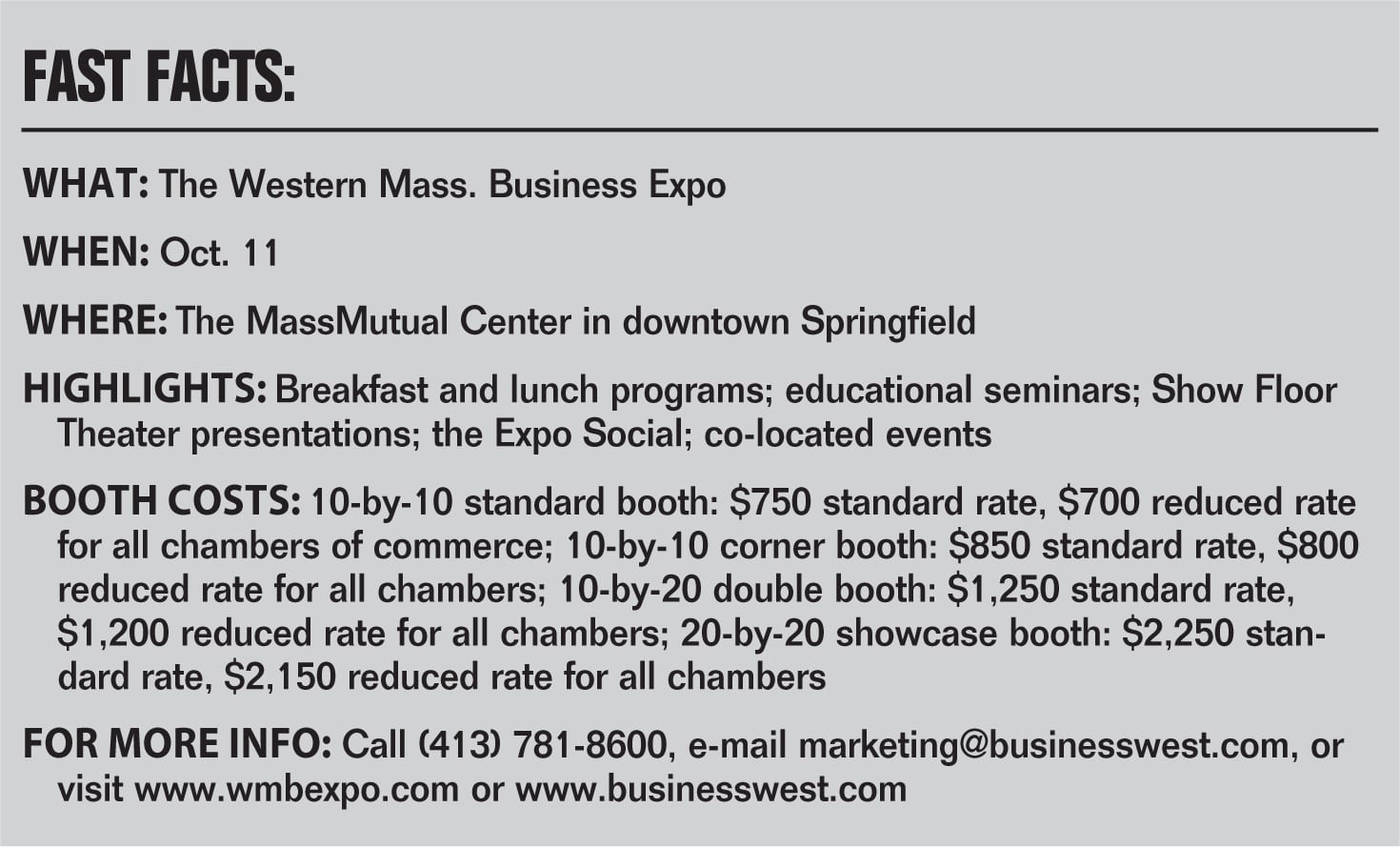
James Kitchen’s creation called ‘The Universe’ is the largest on display at 1550 Main St. in Springfield.

James Kitchen’s creation called ‘The Universe’ is the largest on display at 1550 Main St. in Springfield.

“I marvel at how many things were invented here,” he said, adding that he intends to use monkey wrenches, ice-skate blades, auto parts, gun components, and other Springfield ‘firsts’ in his sculptures.
And while taking in the art, Kitchen and others involved with this initiative hope that people will also take in downtown Springfield, and perhaps see it in a different light — beyond the new art — which Kitchen already does.
“Six months ago, if I had talked about Springfield, I would have given you a completely different story,” he told BusinessWest. “As you watch the news, you get this sense of Northampton as this art town, and Springfield, well, that’s the place somebody got killed — that’s the sense you get. But now that I’ve been down here … what a wonderful city. I don’t think the news really portrays the excitement and the many things that are going on here.”
Meanwhile, he says being in downtown Springfield (as opposed to ultra-rural Chesterfield) is influencing his work.
“I’m building things taller,” he said, noting that he’s being influenced by neighboring office towers. “The bird will be 30 feet tall, and other pieces I’m planning will be pretty big. I’ll be up on a ladder, which is pretty daunting.”

All’s Weld That Ends Weld
Kitchen, who said his favorite piece is “always the last one that I make,” told BusinessWest that the prices on his creations vary, from a few hundred to several thousand dollars. Size has something to do with the figure sought, but bigger factors are the amounts of time and energy spent on a piece.
“And half of my time is spent out finding this stuff,” he continued. “Most of the time you’re getting it from some farmer who lived through the Great Depression and never threw anything away.”
Thus far, the works are doing what Kitchen intended — they’re getting people to stop and think, “which is what an artist does, really.”
Whether his found art can get people to stop, think, and perhaps better-appreciate downtown Springfield remains to be seen, but he certainly has a steely resolve — and in more ways than one.

George O’Brien can be reached at [email protected]

Features
Franklin County Chamber of Commerce Oversees a Diverse Region

Ann Hamilton says area business people tend to be focused on community

Ann Hamilton says area business people tend to be focused on community, not just making money.

Not far from the front door of the Franklin County Chamber of Commerce is downtown Greenfield’s intersection of routes 2 and 5, two of the three major arteries through the area. This interchange, along with the interstate just down the hill, is doing a good job of keeping the county linked in.

“The entire county is 725 square miles and 26 towns,” Ann Hamilton, president of the FCCC, said recently, “and we are considered the most rural section of the Commonwealth. But those roads, and Route 91 in particular, make us better off than the Berkshires or even Central Mass.

“Because of I-91,” she added, “we have a direct pipeline to the New York metropolitan area.”
In recent years, that intersection of routes 2 and 5 has seen an increase in locally owned storefront businesses along the main drag in Greenfield. While this is a good reflection of the larger region around this county seat — Franklin County has strived to remain vital throughout the dark days of the recession — it also halts the notion that the city is yet another example of the all-too-familiar exodus of business from American urban cores.
Overseeing these streetscapes, and the larger events that attract visitors to these towns, is the FCCC, and in a conversation with BusinessWest, Hamilton modestly indicated all that her office does. Yet, that modesty is belied by the sheer number of roles she and her staff members play.
In addition to the traditional roles of the chamber — publishing a newsletter, organizing member breakfasts, and other events — the FCCC is also the area’s regional tourist council, and operates the busy visitor’s center just off the rotary exit from 91. It also hosts a small-business development center, dispensing free business advice several times per month.
The chamber addresses larger issues of economic development by assisting businesses with zoning and expansion issues, and by providing relocation packages for interested parties, as well as finding employees for members and linking job seekers to available opportunities within the region.
“Our board has 28 directors, which is large, but it reflects the diversity in geography and commerce here,” said Hamilton, adding that the chamber is actively involved with two smaller business organizations, one in Montague and another in Shelburne. We also have a good relationship with our elected officials, and we keep that strong, so that if business issues come up, we can be a voice in the Legislature.”
While the FCCC is an administrative powerhouse for the region, it’s also strongly event-oriented. Hamilton said that the popular series of festivals her office coordinates throughout the year continues to be a powerful draw from outside the county and, in many cases, outside the country.
Planning for one of these events, the Green River Festival, has been underway almost since the curtain closed on last year’s performance, a concert series that featured Emmylou Harris, Patty Larkin, and Toots and the Maytals, among many others.
Now, it’s time to get down to business for the year ahead. Pausing for a moment from the mountain of work requiring her attention, Hamilton told how that happens in Franklin County.

Persons of Interest
The overall business demographic in Franklin County is dominated by smaller enterprises, she noted. Upward of 85% of the sector is comprised of businesses with 10 or fewer employees. Baystate Franklin Medical Center, in Greenfield, is one of the largest employers, along with Greenfield Community College and the municipalities.
Hamilton joked that it has been a common refrain over the past year to say that Franklin County is “burning the candle at both ends,” referring to the bookend candle makers — Yankee Candle in the south, and the burgeoning enterprise that is Kringle Candle farther north.
But those two businesses, which both draw visitors from well outside the region, are emblematic of something more characteristic of many of the commercial ventures in the county. “Many of these businesses that started here, then grew here, want to continue here,” she explained. “Several of them, Channing Bete as another example, are in their third generation.”
This notion of a business community tied to the location was a common refrain, and, in many ways, was her explanation for why Greenfield, Shelburne Falls, Deerfield, and other towns have kept a steady course with little fluctuation over the years.
“Franklin County is a wonderful place to work and to live,” she stated. “Maybe in other areas, business issues are a bit more political, and you’ve got turf issues, but this is a community. The business community knows each other, likes each other, and wants to work together.”
Added to that are towns with distinct identities — from the artisans of Shelburne Falls to the professional outdoor-recreation opportunities in the more rural towns, to the increasingly noteworthy restaurateurs in Greenfield. Hamilton labeled it all as ‘diversity.’
“There’s not a lot of overlap,” she added. “But also, you should realize that there are a lot of business people in this area who are so community-minded. It’s not just about running a business and making money. There’s not a lot of corporate hullabaloo; everyone is very real. There’s a lot of character here, in our buildings and landscape, and we try to maintain that and celebrate it.”

Performing Artists
When asked about the challenges her office faces, Hamilton began by saying, “it is true — the business climate has changed, here and elsewhere.”
Franklin County lacks the industrial-park development that has become a godsend for other municipalities in the area, and she admits that this has been a problem. “We’ve had some challenges in siting a large business that might call,” she said. “There’s no place to put a 50,000-square-foot business that wants to open next month. And we don’t have a large inventory of open buildings.
“But there are always some vacancies and movement along main streets in downtowns,” she continued, “and it’s been pretty constant that there’s always going to be someone new with their own creative idea.”
That creativity is reflected in the FCCC’s event programming, spread throughout the year. To draw people to Franklin County, Hamilton said her office puts an enormous amount of time and resources into a series of events to capitalize on visitors’ exposure to those merchants and ventures found in the area. This means important tourist dollars not just from overnight guests, but also day trippers who may return several times in a year.
The 18th annual Cider Days will be held the first weekend in October, showcasing the boozier side of apples as they become hard cider. “People come from all over the country to sample all the different varieties,” Hamilton said. “Last year, a couple came from Sweden just for that event.”
This year will be the eighth year of Fiber Twist, which is a celebration of all things wild and wooly — literally. “It’s an event for people to show off their sheep, alpaca, all the animals that make wool,” she explained. “It’s a marketplace for yarns, fabrics, spinning materials, dyers, hooked rug makers, and artisans in all forms of spun fibers.”
Perhaps the most popular, or most widely attended, event is the Green River Festival. Hamilton said it started out 25 years ago, primarily as a hot-air-balloon spectacle, but it has become one of this area’s hot stops along the summer music circuit.
“It costs a lot to put these on,” she admitted, “and we’ve barely broken even a few times, but it brings people to the area. They visit and find why they would want to come back. So maybe half the audience is somewhat local, and the others, are from out of state. It’s a family friendly event; we would definitely do better financially if we sold beer, but we’ve kept it family friendly.”
Past performers have run the gamut, and include 10,000 Maniacs, Lucinda Williams, Neko Case, Alison Krauss and Union Station, Taj Mahal, Leo Kottke, to They Might Be Giants. This year’s lineup is a closely guarded secret until the official unveiling on April 1, no fooling.
The event might be a lot of work, but Hamilton again modestly offered that this is simply another example of what her office does best — which is, as it happens, rather many things.
“We do what we can,” she said. “We don’t have a lot of funds to give out, but I have the best job in the world. It’s a supportive atmosphere here in Franklin County, which makes it all work.”

Features
A Conversation with the ‘Casino Czar’

Stephen Crosby says the Gaming Commission will be a regulator

Stephen Crosby says the Gaming Commission will be a regulator, but it may also collaborate with the casino industry to maximize the public good.

Stephen Crosby, the recently named chair of the Massachusetts Gaming Commission, says the top priority for his panel is to conduct a process that will be above reproach. But in many ways, that test could become a mere baseline for the commission, he told BusinessWest in a wide-ranging interview, adding that the five-member body could go well beyond the role of regulator and become what he called a “proactive participant” in the process of optimizing the advent of casino gambling for the public good.
Transparency.
That’s a word Stephen Crosby used very early and quite often as he talked about the process for determining how casino licenses will be awarded in the Bay State. Named chairman of the state’s Gaming Commission roughly three months ago by Gov. Deval Patrick, Crosby doesn’t know everything about how that process will shake out — actually, he doesn’t know many things, right down to where his office will be — but what he does know is that it will be a very public, highly transparent procedure.
In short, there shouldn’t be any doubts about whether the selection process was conducted fairly, honestly, and free of politics, said Crosby, who sat down with BusinessWest recently at the Newton Marriott to discuss what he knows and what he believes about this critical juncture in the state’s history, during which all eyes will be on him and the four other commission members, due to be chosen by the end of next month.
“Nothing will be as public as this,” said Crosby, who will step down at least temporarily from his role as dean of the John W. McCormack Graduate School of Public Studies at UMass Boston to take on his new role. “The governor wants this to be a clean process, and we do have to figure out how to maximize transparency, which goes to the issue of having the public and participants think this was on the level.””
But while he wants the process to be above reproach — something a similar process in Pennsylvania certainly wasn’t (more on that later) — Crosby himself wants much more from it. Indeed, he told BusinessWest that he believes the Gaming Commission may be able to partner with developers to “optimize” (another word he used often) the coming of casinos to the Bay State.
“There’s another metric for success beyond that baseline,” he said, referring to a process that passes the fairness test. “And that is to figure out a way that, when this is over and people look back at the process, they say, ‘wow, these people really thought outside of the box; they thought of a way to take the leverage of expanded gaming in Massachusetts and turn it into a really creative public good.’”
And while the commission will ultimately be tasked with answering some huge questions about where casinos will go and how they will be regulated, it will get there by asking some, said Crosby, adding that the queries about what should drive the panel’s decisions will likely be put to many different constituencies.
“We’re going to want to know what smart, interesting people think,” he said, adding quickly that specifics of the process are far from being settled. “I think we’d want to ask everyone we could think of asking — all the affected constituences, people with experience in this, people from the affected communities, religious leaders, and the parties [developers] themselves; I think we’d want to ask them to help us think creatively and determine why it’s good to do this or bad to do that.”
Crosby acknowledged that there is no manual, or road map, for this assignment, and that this is both part of the challenge and opportunity awaiting the commission — a body that almost always appears in print with the adjective ‘powerful’ preceding it — and something that appealed to him when asked by the governor to take the job.
“Given that the issue of whether we’re going to have expanded gaming or not has been decided, the matter of who is going to be responsible for trying to see that it’s done in whatever is the appropriate way … that’s an interesting challenging that appealed to me,” he said. “This is so de-novo — there’s a piece of legislation, and that’s it, nothing else. There’s no office space, no rules or regs, and, other than what’s in the law, there’s no standards.
“What I found so interesting about this,” he continued, “was the chance to take something from absolute ground zero to, hopefully, the end of the process, where the public and participants thought the process was on the level.”

Background — Check
Crosby, 66, said that, for the record, he’s “never been much of an enthusiast of gaming as a way to raise revenues,” but has been pragmatic in his outlook.
In a 2003 Boston Globe op-ed piece, he wrote during the casino debate that the state could hardly do worse with gaming than it did with the lottery system, which he said shortchanged communities to the point of “promoting gambling for the sake of gambling.”
He went on to write that casinos would likely funnel more gambling proceeds to cities and towns than the lottery and might actually reduce the overall amount of gambling, and “that’s probably a public-policy good.”
At this moment, though, his views on casino gambling are entirely moot. Casinos are now the law, he said, and it’s essentially his commission’s assignment to carry out the law — or at least those portions that pertain to the licensing and operating of facilities.
And he will bring to his role as chairman of that body vast experience in business — he’s started or managed several different companies — as well as public service, education, and law (he earned a J.D. at Boston University after earning a bachelor’s degree at Harvard).
His business background includes a number of ventures, ranging from a contract-publishing outfit called the Crosby Vandenburgh Group, which counted ESPN and AMC among its clients, to something called Interactive Radio Corp., which devised a unique method of delivering low-cost, two-way, GPS-informed data to in-vehicle radios and telematics units.
His public-sector experience includes stints as chief of staff for Gov. Jane Swift in 2002, and secretary of the state Executive Office of Administration and Finance under Gov. Paul Cellucci. And in recent years, he’s been called upon to lead or serve on a number of review panels; in 2009, Patrick chose him to head a panel studying compensation of top managers at the state’s quasi-public agencies, and in 2010, Crosby was chosen by the Supreme Judicial Court to serve on a task force assigned to review hiring practices in the patronage-plagued probation department.
He’s also been a frequent guest commentator in the media, with appearances, or op-eds, in forums ranging from CNN to the Boston Business Journal to the New York Times.
Called even-handed and a good listener by many colleagues and observers in press accounts since his appointment by the governor, Crosby said he believes the sum of his various experiences will benefit him during this high-profile, high-stakes assignment.
“I’ve been deeply involved in every aspect of public-policy making and public-institution building and evaluating,” he said of his résumé. “I’ve been an entrepreneur, I’ve had experience with the press, I know a lot about public and private finance, and I’m a lawyer.”
He’s already had to exercise some of these skills, especially working with the press. Indeed, he’s done a number of interviews like this one, in which he’s discussed the commission’s task and how it will likely be carried out, but he’s also had to answer questions about whether some of the decisions regarding casinos have already been made — literally, if not figuratively.
He was asked recently by the Boston Globe, for example, to comment on some analysts’ conjecture that the reason so few casino proposals have been developed for the eastern region of the state (one of three created by the gaming legislation) was because potential bidders believed a license for those who want to build at Suffolk Downs in East Boston was a fait accompli, due to support from legislative leaders.
“Any suggestion that this process is somehow wired is absolutely and totally false,” Crosby told the Globe. “I would hope no prospective operator would elect not to participate in Eastern Mass. due to a [misrepresentation], because it is absolutely not predetermined.”
What Crosby says he doesn’t have is extensive knowledge about the casino industry; thus, he intends to go about learning, a process that is already well-underway. He said he’s absorbing background in the form of studies on the industry regarding everything from return on investment to compulsive gambling, to “the key pressure points for income and expense.”
Meanwhile, he’s looking at best practices in other states, and also into what went wrong in Pennsylvania, where the process became mired in controversy and, eventually, lawsuits. Crosby is still learning about that experience, but has read some of the grand-jury reports.
“The commissioners felt tremendously under the gun to get moving — the state was in need of the revenue,” he said. “And I think the governing environment put pressure on them to move quickly.
“They either didn’t want to do or didn’t have time to do proper vetting of the parties involved,” he continued. “It was, at best, a poor process, and something I think we can learn from.”

Dicey Situation
When asked about the factors that will eventually determine which parties are awarded licenses — the $64,000 question on everyone’s mind — Crosby said there will be many considerations, some perhaps still to be determined.
He summed it up this way when talking about the requests for proposals (RFPs) that will eventually be issued and then evaluated — and the wording that may be included:
“Eliciting from the prospective providers what we really care about — after we’ve figured out what we’ll really care about — will be its own art form.”
Elaborating, he said many of the factors to be weighed are known (they’re in the law), and it all starts with what he called the ‘cleanliness’ of the proposition, meaning that the party behind the proposal is above reproach. Other matters that will play into the decisions, he continued, include everything from economic development, with the matter of quality jobs being one of the priorities laid out in the legislation, to the impact on host communities, surrounding communities, and entertainment venues in a given region.
And one of the issues for the commission to decide, he went on, is just how subjective or objective the decision-making process will be.
“We’ll have to decide to what extent we want to try to objectify the ratings,” he explained, adding that doing so “is good from a standpoint of transparency and clarity of analysis, as opposed to subjectifying the analysis, which gives us more flexibility to think broadly and outside the box about how these values are manifest.
“There are benefits to both approaches,” he continued, “and that’s something the commission will have to figure out.”
And while doing so, the commission will also have to determine the level to which it wants to proactively engage the casino industry and impacted constituencies in that process of optimizing expanded gaming.
“We know we’re going to get some jobs, and we know we’re going to get some revenue to the state,” he explained, “but all of these people that have a financial interest in being part of this are A, smart and creative; B, they’re resourceful; and C, we would like to think about how we get their intelligence, creativity, and resources to not only advance their financial good, but also a broader public good.
“Is there a way to optimize the greater good beyond just not doing this badly?” he continued, noting that this is a compelling question that the commission will have to answer. “And whether we are able to articulate any such aspirations remains to be seen, but these are aspirations that I think will be interesting and provocative to talk about, and that we’ll be asking everyone around to help us with.”
Summing things up — and speaking for himself and not the committee, obviously — Crosby said he hopes the panel will ultimately think proactively and decide, with the help of the various constituencies and interest groups involved, whether it can go beyond being a mere regulator and also step into the role of partner with the casino industry.
“Do we want to collaborate with the industry in maximizing the public good?” he asked. “Should we be proactive in suggesting ideas, locations, and business strategies? Should we try to learn about and contribute to the discussion about potential competition with other states?
“I don’t know the answers to these questions,” he went on. “We are absolutely going to be a regulator, there’s no question about that, and an exceedingly rigorous regulator at that. But should we also be a proactive participant? That’s a question that needs to be talked about.”

The Bottom Line
When asked if the process that lies ahead is in some ways intimidating, Crosby said that’s too strong a word.
“We’re going to try to extrapolate from the multiple experiences that have been had across the country, and couple that with our own probably considerable experience, as well as a commitment to be as collaborative as humanly possible,” he explained, “to do well something that has been done many times before.
“Is this intimidating? No, but it will certainly be challenging,” he continued, adding that there are many things the public and casino developers can bet on from this commission — including that concept of transparency.

George O’Brien can be reached at [email protected]