Home Archive by category Sections (Page 18)

Sections

Women in Businesss

A Leap Well-taken

Meghan Rothschild

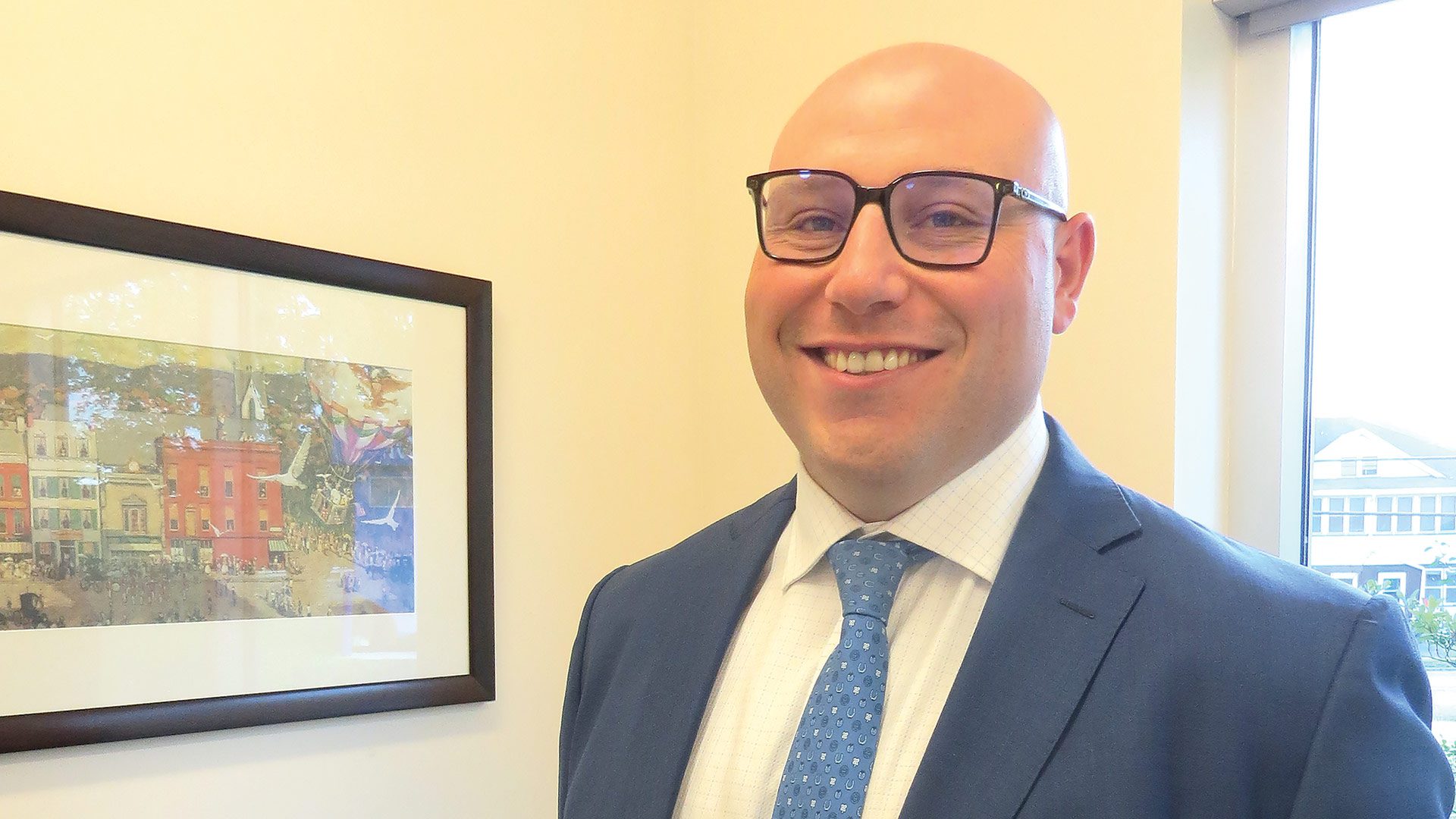
Meghan Rothschild says she wanted her firm to inspire and empower women business owners to find their voice.


As her boutique marketing firm celebrates 10 years in business this year, Meghan Rothschild can’t help but recall the doubts that crept in before she made the leap as an entrepreneur.

“I remember as if it were yesterday, the night I had decided to go full-time with the company, lying in bed next to my husband, just in sheer panic,” she recalled. “‘What if it fails? What if I fail?’ I just kept asking him over and over again. And he was like, ‘if you fail, we’ll figure it out, but you have to leap for the net to appear.’”

Even after creating Chikmedia, Rothschild wasn’t sure whether it would remain a side gig alongside her other pursuits. “I never wanted to be a business owner. I remember people asking me, ‘will you ever go full-time with that company you started?’ And I’d be like, ‘no way. I want nothing to do with being responsible for other people’s income, for being responsible for my own revenue. I don’t want the stress of that.’ So … I am amazed.”

To mark the occasion, on Aug. 9, Rothschild and her team celebrated the 10-year anniversary at a party at TAP Sports Bar at MGM Springfield alongside clients, friends, and supporters — a milestone for which she’s grateful.

“I’ve always been a very driven person. I started working when I was 14 years old. I got my own bank account. I paid for my own stuff throughout high school, not because my parents made me, but because I just wanted to be responsible for myself,” she explained. “I put myself through undergrad and graduate school and got my master’s so that I could become a professor because I’m passionate about teaching. So I know I have the drive — but the fact that I’ve been able to successfully run a business for 10 years is still something I’m a little bit in awe of.”

Rothschild had been in marketing for eight years — with stints as Marketing and Promotions manager at Six Flags, Development and Marketing manager at the Food Bank of Western Massachusetts, and director of Marketing and Communications at Wilbraham and Monson Academy — when she teamed up in 2013 with Emily Gaylord, who brought a strong design skillset to the partnership they called Chikmedia.

“ I know I have the drive — but the fact that I’ve been able to successfully run a business for 10 years is still something I’m a little bit in awe of.”

Gaylord eventually left the company to pour more of her time and passion into the Center for EcoTechnology, where she works as director of Communications and Relationship Development. Meanwhile, Rothschild was balancing ownership of Chikmedia with a full-time gig at IMPACT Melanoma. A skin-cancer survivor who had built a national platform for skin-safety advocacy (more on that later), she was working for IMPACT as Marketing and Public Relations manager when she realized she had to make a choice. Today, she knows she made the right one.

At its inception, Chikmedia focused mostly on social media, graphic design, and public relations, but has expanded since. “We’re a full-service, boutique firm. So we do everything,” she said. “We do graphic design, social-media management, PR, expert positioning, media pitching, grand openings, press events. We also do influencer marketing, which is what makes us really unique.”

The firm is sponsored by certain brands in the Western Mass. area and helps produce content to endorse their product lines, she added. “So we’re pretty comprehensive, but we are a small firm.”

In doing so, Chikmedia has won awards from the Telly Awards, the Advertising Club of Western Massachusetts, and Cosmopolitan. Its mission has always been to help small, women-led businesses thrive through “badass marketing” (Rothschild’s term), public relations, branding, and more.

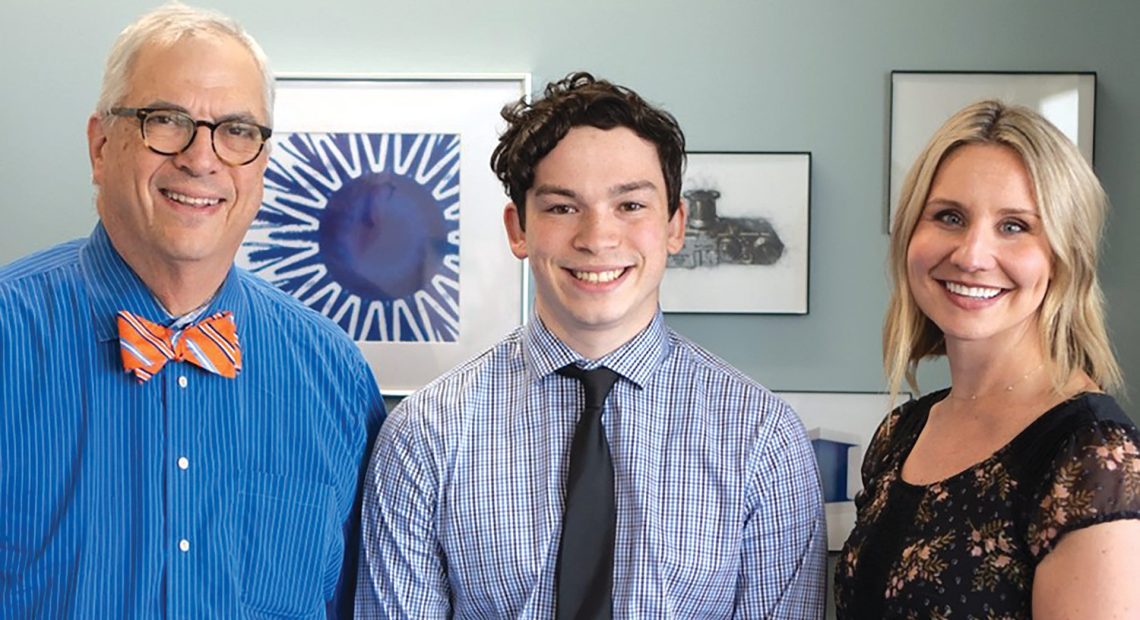
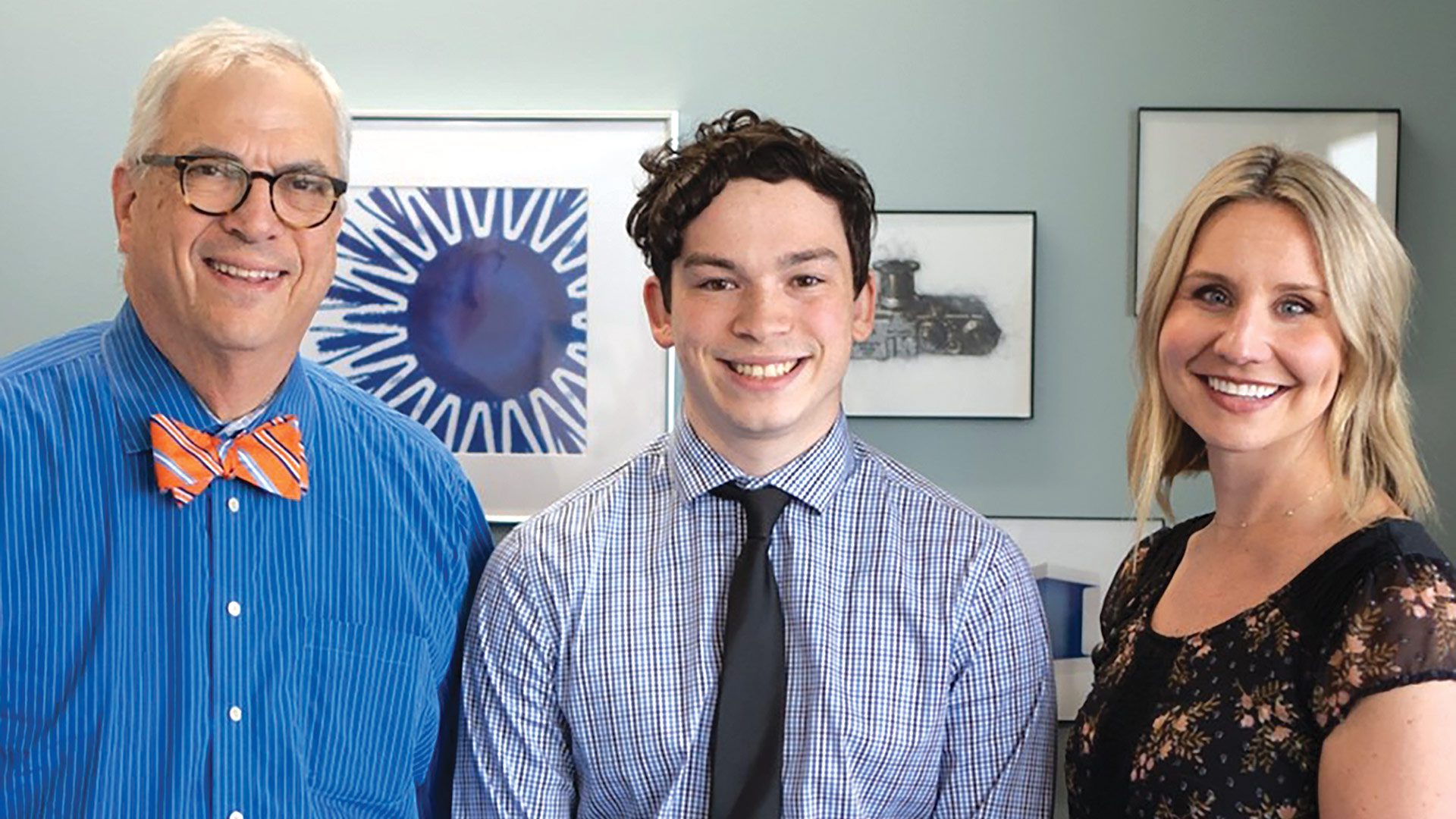
From left, Chikmedia’s Jax Nash, Liza Kelly, Meghan Rothschild, and Jill Monson

From left, Chikmedia’s Jax Nash, Liza Kelly, Meghan Rothschild, and Jill Monson at the firm’s anniversary party on Aug. 9 at MGM Springfield.

The firm has also helped hundreds of women-owned businesses across the country; provided an annual scholarship called Chiks of the Future for women of color pursuing marketing, PR, and communication degrees; and hosted dozens of networking events over the years to connect female entrepreneurs with one another.

And, clearly, Rothschild isn’t done.


Women Helping Women

While not all Chikmedia clients are female-run companies, the company’s focus on women was important to Rothschild from the outset.

“I wanted to help inspire and empower women business owners to find their voice, learn how to market themselves, learn how to be in front of the camera, and really advance their own business. So that has been a core mission of Chikmedia since its inception.”

As a boutique firm, she explained, clients don’t get one dedicated account manager. “You’re going to get the full team, and you’re going to get customized work. You’re not going to get cookie-cutter templates. Everything we do is very strategic and customized based on who the client is.”

“You might be really good at what you do, but if you’re not good at leading, managing, communicating, setting strategy, and finding vision for your company, the other stuff is going to fall apart.”

In an era when many young entrepreneurs feel they can do their own marketing, Rothschild says it’s more complicated than they may realize.

“Why do you think you can do your own marketing? Because you have an Instagram page? That doesn’t mean anything,” she said. “You need to understand marketing strategy, you need to understand how to craft messages that are going to resonate with your intended audience, you need to understand how to analyze your Google Analytics and your website hits.

“And all of this plays together,” she went on. “You have to really assess your audience, where they are, how to find them, how to communicate effectively to them. So I always say to people, ‘you can try, but I’ll see you in a year.’ And that’s inevitably what ends up happening.”

Part of the challenge is keeping up with the evolution of modern marketing, especially in the realm of social media. A professor of social-media marketing at Springfield College, she said she has to reinvent her syllabus on a regular basis.

“My course content changes every year because some of what I was teaching five years ago is not relevant,” she noted. “I would say social media and digital marketing are probably the biggest ways in which the field has changed.”

But Rothschild brings more than expertise; she brings an attitude that’s unapologetically edgy and even “sassy,” she said, but also one that’s protective of work-life balance.

“We’re really good about setting boundaries and making sure our clients know you can’t text me at 9 o’clock at night and start talking about business,” she explained. “And you can’t make me wait three weeks for content and then expect me to turn something around the next day if I’ve been asking you for stuff. I’ve had a lot of clients say to me, ‘I really appreciate the boundaries that you’ve set and the clear communication that you’ve set.’ And they really like our sassy, creative energy that we bring to the table.”

She said her fight with melanoma age 20 was a factor in her philosophy about balancing work and life, and it’s something she instills in her employees as well.

“When I graduated from college, I immediately didn’t want to work crazy, crazy hours and miss family activities and miss out on milestones of my nieces and nephews. So I really had to find that work-life balance kind of immediately,” she said.

“So that’s another thing that I brought to the table when I started Chikmedia: we’re going to try really hard to be done by noon on Fridays so that people can unplug for the weekend and get ample time to recover. Because, in my opinion, a two-day weekend just doesn’t cut it.”

That policy extends to week-long company shutdowns around July 4 and between Christmas and New Year’s Day.

“We’re not allowed to email one another. We’re not allowed to email clients. And clients have learned, we’re unavailable that week — because you have to unplug; you have to give yourself space to recover.”


More Than Skin Deep

Rothschild’s own recovery from skin cancer changed her life going forward in many ways. She spent more than a decade as a melanoma-awareness advocate and became a national spokesperson for the American Academy of Dermatology and the Skin Cancer Foundation before working for IMPACT Melanoma.

“That really shaped a lot of my work and my ability to do PR effectively and be on camera,” she told BusinessWest. “I used to do tons of media interviews with Cosmopolitan and Marie Claire and Inside Edition — these huge, national outlets. So I had to learn really quickly how to be concise, how to get to the point, how to give good sound clips, which are now skills that I get to help my clients hone.”

She still works in skin awareness, including a partnership with TIZO, a national skincare brand with an SPF line. “We do something every year around Melanoma Awareness Month, which is in May. They actually just brought me to a beauty show in Dallas, Texas to give a lecture on my story and how to protect your skin.”

Rothschild is also working with the Melanoma Research Foundation, and one of Chikmedia’s clients is BrightGuard, a sunscreen-dispenser company that provides access to free sunscreen across the country. “So it’s been wonderful to be able to take that work that was so important to me and transition it into the work I do at Chikmedia.”

For aspiring entrepreneurs she meets at colleges, looking for advice in making the jump, Rothschild has some blunt advice.

“It’s not that I discourage them, but I look at them and say, ‘you need to understand that a lot of what is involved in running a business is stuff that you’re not going learn here. You need a few years of real-world work experience in order to be able to do it.’

“That’s the biggest thing that I try to express to my students: ‘I fully support your goals of wanting to be an entrepreneur, but you’re going to do it faster and better if you spend your first two or three years out of college in a full-time job setting, learning what it’s like to work with people, to manage people, to be a leader, learning what’s a P&L, what’s a budget, what’s a fiscal year?’

“You might be really good at what you do, but if you’re not good at leading, managing, communicating, setting strategy, and finding vision for your company, the other stuff is going to fall apart,” she went on. “I can’t tell you how many entrepreneurs I see who are so skilled at the craft and the service they provide. And then they decided to start their own company, and their team’s a mess, they have high turnover, and everybody is disgruntled because they don’t know how to effectively lead.”

Rothschild values her own education in that realm, which includes a master’s degree in corporate communication with a focus on leadership. But even that didn’t prepare her for the emotional weight of running a company and not only generating revenue for herself, but keeping women she cares about employed as well.

“I say to people all the time that you need to be ready to be strapped into a roller coaster full-time. Entrepreneurship is no joke; it is not for the faint of heart. There are extreme highs, and there are some low lows.”

“I say to people all the time that you need to be ready to be strapped into a roller coaster full-time. Entrepreneurship is no joke; it is not for the faint of heart. There are extreme highs, and there are some low lows.”

But the highs keep her going.

“I genuinely love marketing and PR. I don’t know what it is. I mean, there are days where I don’t, and I think to myself, ‘man, I should have gone with marine biology,’” Rothschild said with a laugh. “But I love content creation. I love my team. I love being out in the field … I really do enjoy it, and my team has made it so much fun.”

Construction

Back on the Job

The construction industry added 19,000 jobs in July even as the sector’s unemployment rate increased, according to an analysis of new government data by Associated General Contractors of America. Officials with the association noted that tight labor conditions are bringing more previously employed construction workers back into the job market as firms continue to boost pay levels.

“The construction industry continues to add workers at a steady clip as demand for many types of construction remains strong,” said Stephen Sandherr, the association’s CEO. “Firms are boosting pay to cope with tight labor-market conditions, which is bringing more former workers back into the job market.”

Construction employment in July totaled 7,971,000, seasonally adjusted, an addition of 19,000 compared to June. The sector has added 198,000 jobs, or 2.5%, during the past 12 months. Non-residential construction firms — non-residential building and specialty trade contractors along with heavy and civil-engineering construction firms — added 10,600 employees (3.1%) in July. Meanwhile, employment at residential building and specialty trade contractors grew by 7,800 (1.8%).

The unemployment rate among job seekers with construction experience rose from 3.5% in July 2022 to a still-low 3.9%. A separate government release reported there were 378,000 openings at construction firms on the last day of June, close to the record high for June set in 2022, indicating that demand for workers remains strong.

Average hourly earnings for production and non-supervisory employees in construction — covering most on-site craft workers as well as many office workers — jumped by 5.8% over the year to $34.24 per hour. Construction firms in July provided a wage ‘premium’ of just over 18% compared to the average hourly earnings for all private-sector production employees.

“The good news is that there remain private construction segments associated with rosier prospects, including manufacturing, data centers, and healthcare.”

Officials at Associated General Contractors of America noted that labor shortages in construction threaten to undermine new federal investments in infrastructure, semiconductor chip plants, and green-energy construction. They urged federal officials to boost funding for construction education and training programs, noting that the federal government currently spends five times as much encouraging students to go to college as it does on career and technical education programs.

“Unless federal officials begin to narrow the funding gap between college prep and career training, the construction industry will continue to struggle to find workers,” Sandherr said. “It is great that federal officials want to invest in construction projects; they also need to invest in construction workforce development.”

The report followed an Associated Builders and Contractors (ABC) analysis of data published by the U.S. Census Bureau noting that national non-residential construction spending increased 0.1% in June. Spending is up 18% over the past 12 months. On a seasonally adjusted annualized basis, non-residential spending totaled $1.07 trillion in June.

Spending increased on a monthly basis in 12 of the 16 non-residential subcategories. Private non-residential spending was virtually unchanged, while public non-residential construction spending rose 0.3% in June.

“Non-residential construction spending growth downshifted over the past two months,” ABC Chief Economist Anirban Basu said. “While stakeholders can expect ongoing spending growth in public non-residential construction segments as more Infrastructure Investment and Jobs Act monies flow into the economy, private, developer-driven activity appears to be drying up in the context of higher costs of capital and tighter credit conditions.

“Among other things, these dynamics will translate into larger spreads in performance among contractors,” Basu added. “While those that focus on public work stand to remain busy for years to come, those who specialize in meeting the needs of developers of office buildings, hotels, and shopping centers are likely to struggle to support backlog going forward. The good news is that there remain private construction segments associated with rosier prospects, including manufacturing, data centers, and healthcare.”

Cannabis Special Coverage The Cannabis Industry

What’s Next for Cannabis?

Payton Shubrick

Payton Shubrick says she understood she was entering an increasingly challenging market for cannabis sales when she opened her doors last year.

By the time Payton Shubrick opened the doors to 6 Brick’s Cannabis Dispensary in Springfield last fall, she was well aware of how challenging the business was becoming.

“The market is getting tougher across the board in Massachusetts,” she told BusinessWest. “Gone are the days when you could open a dispensary and just have people lined up. Gone are the days when cultivators could guarantee sales. We’re seeing that you must earn customers’ loyalty and have a competitively priced product and have decent quality to do well in the Massachusetts market.

“I’ve been able to see growth with my company, despite coming online in September of 2022, when prices had just fallen by over 30%,” she added. “So we essentially started with less-than-ideal conditions, but it’s not all doom and gloom.”

Because Springfield set out a long, rigorous process to open a dispensary, Shubruck had time to witness a total evolution of the Massachusetts cannabis market; when she first applied for a permit, the few dispensaries that were open saw an early ‘green rush’ of customers; though the industry’s onerous tax and regulatory burdens and tight profit margins never made it easy money, exactly, the early shops took advantage of a clearly favorable supply-and-demand picture.

“We essentially started with less-than-ideal conditions, but it’s not all doom and gloom.”

By the time Six Brick’s opened, the landscape was considerably more cluttered; prices, as Shubrick noted, were falling; and some shops were struggling.

Those struggles have turned into actual contraction. The first Western Mass. dispensary to close, back in December, was the Source, on Strong Avenue in Northampton, a city with nearly a dozen retail cannabis shops. But it was Trulieve’s departure from the market that will resonate more broadly; the national company closed its three retail locations in the Bay State at the end of June, and is also closing its 126,000-square-foot growing, processing, and testing facility on Canal Street in Holyoke — another city that invested heavily in the new cannabis trade.

“These difficult but necessary measures are part of ongoing efforts to bolster business resilience and our commitment to cash preservation,” said Trulieve CEO Kim Rivers said. “We remain fully confident in our strategic position and the long-term prospects for the industry.”

At the same time, several proposed cannabis facilities in Western Mass., including one planned for the former Chez Josef banquet house in Agawam, have been scrapped due to an inability to secure financing amid dramatically changing market conditions.

“The market is correcting itself,” Shubrick said, reflecting a throughline seen in all states that legalize cannabis. “A lot of folks raked it in during the green rush. But only 24% of cannabis companies in the U.S. are profitable. So you actually have to view this as a business. You can try to increase volume and think that’s going to fix the problems, but the market has matured in a real way. And now, other states are coming online.”


High Stakes

Erik Williams, chief operating officer at Canna Provisions (see sidebar on page 20), explained that a typical dispensary needs to take in about $6 million in top-line revenue annually in order to break even. “A whole bunch of companies are not there. They’re sitting on big tax bills without the cash flow, and they’re going to close under the weight of taxes; we’re seeing that right now across the state.”

He also noted the 24% profitability figure, and said anyone coming into the market should be aware of it.

Steven Lynch

Steven Lynch says cannabis businesses doing things the right way and for the right reasons will survive any contraction in the sector.

“There’s a survivability factor we’ve written about from day one. We were the second adult-use-only store in Massachusetts to open [in Lee], and there’s definitely a sort of glory time which happens with every new market, where the demand outstrips the supply, and businesses are just opening their doors and slinging weed,” he said. “They saw pie in the sky, and they have not operated their business with real-time controls over every dollar they’re spending. It’s a tough thing.”

Simply put, too many cannabis businesses in Massachusetts based their business plans on supply-and-demand figures that no longer exist, he added. “There’s a lot more competition. The pie is always growing, but competition is far outstripping the growth of the pie, so you’re seeing price compression.”

Williams agreed with Shubrick that a dispensary must be run like a business from day one, with hard decisions around every dollar spent — or the enterprise will fail.

“If you’re at the point where you have to readjust everything, it’s almost too late,” he said. “Really tough business decisions need to be made across the board. We’re seeing how other companies are failing, and one of the first analyses is what it takes to be profitable as a standalone dispensary. A bunch of different people have run a bunch of different numbers, and when it comes down to it, the consensus is $6 million.”

So, how does one succeed in this environment? Shubrick has some ideas.

“At Six Bricks, we have a clear focus on who the customer is, and we’re focused on our competitive advantages, which are the cannabis experience over transaction, having knowledgeable staff, and being an option for conscious consumers who want their dollars spent close to home,” she explained, noting that the pandemic years taught people the value of spending their money with local businesses, and those lessons could carry over to cannabis. “There’s still a lot of work to be done with social equity for businesses, but consumers can support more a more equitable industry by what brands they support and where they spend their money.”

Erik Willaims

Erik Willaims

“There’s a lot more competition. The pie is always growing, but competition is far outstripping the growth of the pie, so you’re seeing price compression.”

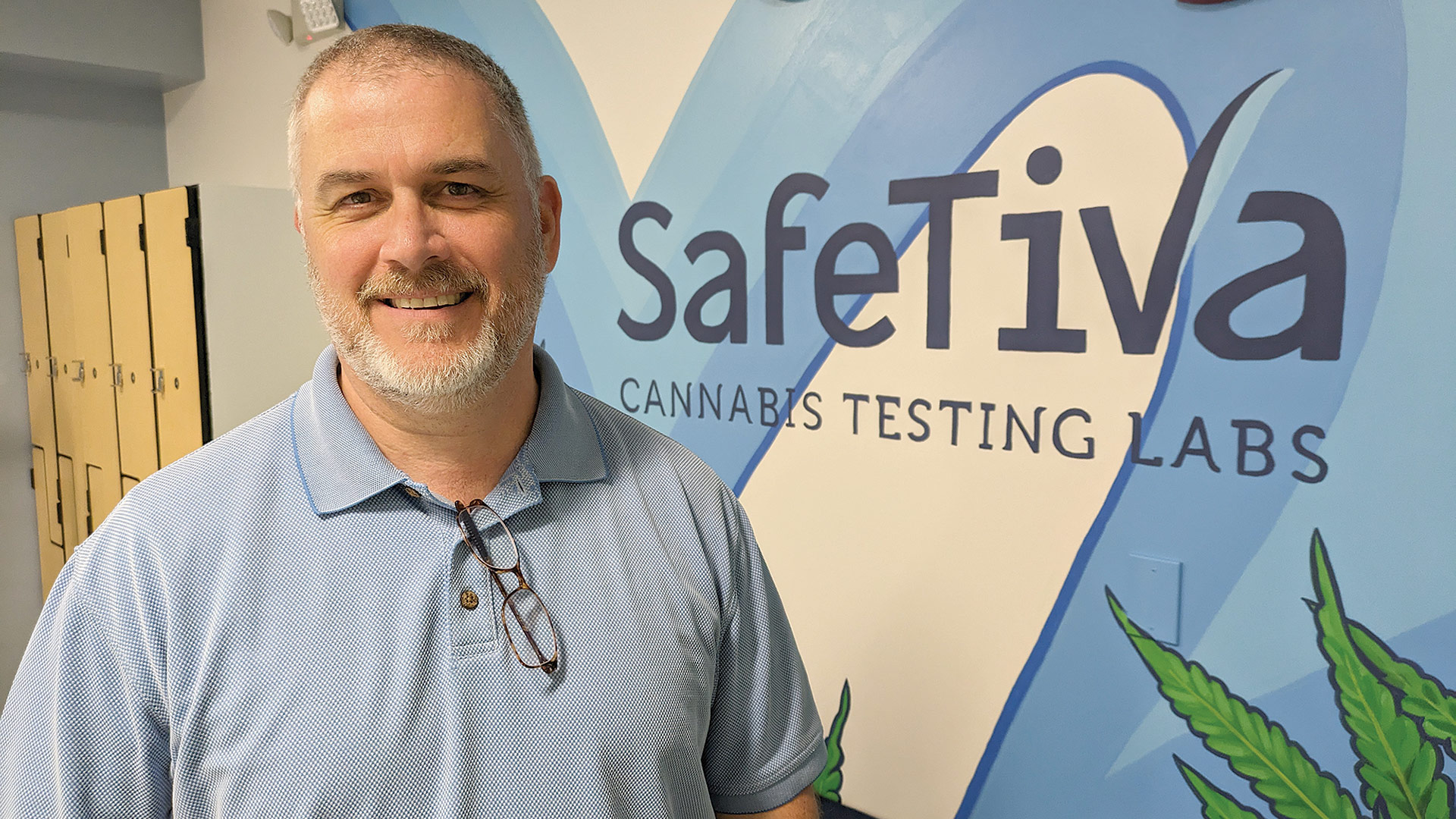
Steven Lynch, director of Sales and Marketing at SaveTiva Labs, agreed about the appeal of strong, local brands.

“I see a lot of parity with when the big-box stores, the Home Depots and Lowe’s, first came to the market. It was great because they had these big stores you could go in, but ultimately, you’re not going to get the service that you’re going to get from your local hardware store,” he told BusinessWest. “So you saw a lot of stores go away initially, but then you saw a whole wave of small mom-and-pops come back into the market because they did things completely from a quality, service, and educational standpoint.

“I think that’s what’s going to happen in cannabis,” he went on. “The people who had no business doing this, or got into it for the wrong reasons, will fall by the wayside, and the people that that are doing it for the right reasons, the right way, are going to continue to flourish.”


Blazing a Trail

For Shubrick, ‘the right way’ is reflected in the 6 Brick’s tagline, “people, plant, and purpose.”

“People — how can we help show that cannabis can be a part of an individual’s wellness routine? Plant — how can we make this more of a cannabis experience than a transaction?” she explained. “And lastly, purpose — we want to be a viable option for those in the community that want diversity of price point and diversity of products. I can’t overemphasize the community aspect of it. You can try marketing to pull customers out of Connecticut, but it’s the local community that’s going to show up every day, whether they’re buying a pre-roll or a present for a friend.”

Though Springfield’s licensing process was slow and rigorous, she noted, it’s a plus for operators that there’s not a shop on every corner, as opposed to cities like Holyoke and Northampton that allowed many more licensees.

“We’re the third-largest city and have only four dispensaries; that does prevent what we’ve seen in Worcester and Northampton, which is a race to the bottom in terms of providing a product. Many customers are saying they want it as cheap as possible. The reality is, that hurts the entire supply chain and drives prices so low, it compromises quality.”

That ‘race to the bottom’ has occurred in other states where cannabis was legalized, but the assumption is that the market will eventually level out — and not everyone will survive.

“A lot of folks made the assumption that cannabis companies just open the doors, and people show up,” Shubrick said — and at the earliest-opening shops, like NETA in Northampton, they certainly did. “I never anticipated 100 people show up on day one. I knew it would be a slow climb. The first 15 companies to open their doors, some of them now have to make a comeback because the product wasn’t great or they didn’t have the right people.”

It’s not an unusual track in other business sectors, she added. “Car dealerships and restaurants rise and fall, and the same is happening in cannabis. A lot of naive operators thought they were untouchable because there was this pent-up demand and a thriving black market. But that’s not the case. Couple that with the realities of 280E, and this is not for the faint of heart.”

She was referring to Section 280E of the Internal Revenue Code, which forbids businesses from deducting otherwise ordinary business expenses from gross income associated with the ‘trafficking’ of Schedule I or II substances, as defined by the Controlled Substances Act; cannabis is a Schedule I substance.

According to the National Cannabis Industry Assoc., “federal income taxes are based on a fairly simple formula: start with gross income, subtract business expenses to calculate taxable income, and then pay taxes on this amount. Owners of regular businesses often derive profits from these business deductions. Cannabis businesses, however, pay taxes on gross income. These businesses often pay tax rates that are 70% or higher.”

“Most companies spend a dollar to get $1.10, and you’re ten cents up,” Williams said. “Here in the cannabis business, because of the 280E tax situation, you need to make $3.50 for every dollar you’re spending just to break even. That changes the math in a really big way.”

It also changes the way cannabis companies do business, he added, returning to those earlier thoughts about closely tracking all spending. “Being tight with advertising dollars and watching ROI on every dollar you’re spending is super important.”

Canna’s model, as a vertically integrated company that cultivates product as well as selling it, helps stem those tides, he noted. “Doing cost analysis is a little different, but you also are putting things through your stores at much higher margins. If you’re controlling your supply, you have more control over your business. We’re seeing it happen right now.”


Rolling with the Changes

Shubrick said it was worth navigating a thorough licensing process to open a cannabis shop, alongside her family members, in her hometown. “If I wasn’t selected in Springfield, I wouldn’t have picked up and gone to another city or town.”

It’s an example of the thoughtfulness that must accompany entering a very challenging cannabis marketplace in Massachusetts, especially now.

“Companies come in, and they’re not profitable, and they can’t pay back the tax bills. So they have to close,” Williams said, echoing not only the stories of the Source and Trulieve, but other casualties to come. “But their consumers don’t go away; they go elsewhere. So the lesson from the contraction of the market has always been that the survivors are going to do better long-term.”


Weathering the Storm: a Resilient Path Forward

By Meg Sanders


We are at the precipice of a significant contraction in the cannabis market, not confined to Massachusetts alone, but reverberating across the U.S. and even globally. As business owners navigating this turbulent landscape, it is essential to recognize the imminent challenges — in particular the ones staring down cannabis across the Commonwealth — prepare to face them, and, more importantly, cultivate a hopeful vision for the future.

Let’s begin with third-party vendors, the cogs in the machine that keep your cannabis enterprise running smoothly. We must ask ourselves: how do these vendors weather the storm if they lose 30% of their business suddenly? If a small vendor employing just six people experiences a 20% revenue loss from a key account, what could that mean for the business?

These are not mere speculations. These scenarios are unfolding right now, causing ripples across the industry. It’s a risk-management issue that warrants our immediate attention.

Meg Sanders

Meg Sanders

“It’s critical to identify how exposed our vendors are to the same downturn we’re grappling with, especially if their clientele consists primarily of cannabis companies.”

As we sail through these choppy waters, we mustn’t lose sight of the bigger picture. We need to question the depth and financial security of our vendor base, especially since many struggling businesses might not be able to pay their bills. The aftershocks of such downturns typically hit marketing, advertising, and street teams the hardest. But what does that mean for us, the business owners who rely on these very vendors?

Imagine your vendor pool as a ship’s crew, each playing a vital role in keeping your business afloat. What happens if your vendor’s ship starts sinking? The ripple effect could capsize your own vessel, and that’s a scenario we must guard against.

Indeed, there’s a sense of camaraderie in this industry. We are all in the same boat. When one sinks, we all feel the tremor. It’s critical to identify how exposed our vendors are to the same downturn we’re grappling with, especially if their clientele consists primarily of cannabis companies. The domino effect could span from your point of sale to merchant services, banking, all the way down to your graphic designer.

We have to play the long game, keeping our eyes on the horizon and the changing tides. Let’s envision a situation where you’re sourcing packaging from a company whose revenue is all cannabis-related. What happens when it loses 20% of its business overnight? What does that mean for your buying abilities, purchasing decisions, their supply chain, and your overall purchasing power and profit and loss (P&L) statements?

To chart a path through this storm, we must adopt a three-dimensional approach to risk management, particularly for those selling cannabis products wholesale to local companies. The strain on accounts-receivable departments is a testament to the rising pressures within the industry. Payments aren’t arriving on time, and some aren’t arriving at all, affecting everyone from packaging and label companies to small cannabinoid providers and cultivators.

But amidst this storm, there’s hope. And here’s the silver lining: we can mitigate these risks with strategic planning and robust backup systems. By identifying alternative vendors, knowing their offerings and lead times, we can prepare for any disruptions in our sensitive systems. We need to ensure that we’re not left without a resource simply because we didn’t think far enough down the track.

This contraction isn’t just a challenge; it’s an invitation to innovate. To think differently. To challenge the status quo. Industries shift, technologies evolve, and we must keep pace. We need to think about all the ways a contraction impacts everyone: vendors, landlords, municipalities. The effects when a cannabis company exits a market or closes its doors are far-reaching.

Even as we’re witnessing companies in Massachusetts entering receivership, it’s not a time for despair. It’s a time for planning, for taking stock of where we stand and where we aim to go. Think about your ‘what-ifs,’ and devise your backup plans. Be ready to replace a critical item on your menu if it goes away. Be prepared to find an alternative source if your main provider hits financial turbulence.

This is not a doom-and-gloom narrative. It’s a story of resilience, of weathering the storm, and emerging stronger. It’s about recognizing opportunities amidst adversity, shoring up your P&L, and seizing the chance to negotiate better pricing with your vendors. Many might be willing to partner with you to push through these challenging times in that way, and the worst thing that happens is they say no. That’s just good business practice, no matter the state of the industry. Always make sure you’re checking where every dollar is going, from your expenses to getting quotes on best prices.

So, in these uncertain times, let’s remember one thing: hope is not lost. Even in the face of contraction and economic downturn, there’s an opportunity for those vigilant and ready to adapt. And as we navigate this storm together, we can create a more resilient, more robust industry ready for a brighter future.

We are, after all, in this together.


Meg Sanders is CEO of Canna Provisions in Holyoke and Lee.

Architecture Environment and Engineering Special Coverage

What Goes Around…


Frank Antonacci, left, and Jonathan Murray

Frank Antonacci, left, and Jonathan Murray have been leading many different constituencies on tours of the MRF in Berlin, Conn.

Frank Antonacci says he’s lost track of how many tours he’s led of the All American Material Recovery Facility (MRF) in Berlin, Conn., which handles material from across the Nutmeg State and Western Mass.

“Suffice it to say, it’s a big number,” said Antonacci, a principal with Murphy Road Recycling, an operator of several recycling facilities, which, in partnership with Van Dyk Recycling Solutions, suppliers of the system’s equipment, opened the state-of-the-art facility in early 2022.

Since then, in addition to overseeing this intriguing operation, which processes more than 50 tons of recyclable material an hour, Antonacci and Jonathan Murray, director of Operations for Murphy Road Recycling, have been leading individuals and groups through the massive facility to show them what goes on there and why this operation is among the most advanced of its kind in the country — and the world, for that matter.

And there have been many different constituencies donning the bright orange vests, hardhats, and audio systems needed to hear and be heard over the din of countless conveyer belts and sorting machinery. These include elected officials, business leaders, public-works crews, press members (including BusinessWest), and, perhaps most importantly, representatives of the companies that buy the recyclables — and many of them have made the trip to Berlin.

What they take in is a facility that was built with three primary goals in mind: to increase the quantity, quality, and purity of recyclables; to provide an innovative and safe working environment; and to have the flexibility to adapt to ever-evolving consumer habits (more on that later) and recycling market conditions.

And more than a year after it opened to considerable fanfare, this MRF is accomplishing all three, especially with regard to the purity of recyclables, said both Antonacci and Murray, noting that this is something that communities, states, and those buying the recovered products are demanding.

“Today’s curbside material isn’t what it was 10 or 15 years ago. Then, it was heavy on newspaper and relatively clean. Today, everyone reads news online and orders everything from the internet. Today’s stream is full of small cardboard boxes and shipping envelopes and requires that we, as recyclers, innovate and change our thinking around the sorting of recyclables.”

The fully integrated system, replete with artificial intelligence and high-tech scanners, is dedicated to the maximum recovery of all recyclable material, with several second-chance mechanisms in place to make sure valuable material doesn’t slip through the cracks, said Murray, adding that the design includes state-of-the-art equipment to target paper, cardboard, boxboard, glass, and five types of plastic.

Elaborating, he said the system first separates paper from aluminum and other metals and plastic and then digs deeper to identify and sort different types of plastic, such as the PET (polyethylene terephthalate) used to make water and soda bottles, and HDPE (high-density polyethylene) used to make food and beverage containers, shampoo bottles, cleaning-product bottles, and similar products.

“The optical scanners are trained; they’re learning all the time to know what the makeup of a PET bottle is,” Murray explained. “If a scanner’s job is to pick PET bottles, it knows it by reading the makeup of the bottle. Everything else travels on to the next optical scanner, which may be looking for HDPE or milk jugs or laundry detergent bottles; it scans for those and shoots those out.

Murray Road Recycling’s MRF

Frank Antonacci says Murray Road Recycling’s MRF has “moved the industry forward a generation” with its design.
Staff Photo

“The scanners are actually looking for the makeup of what’s in that material,” he went on. “It shoots a blast of air to kick it out or leave it in, and they’re trained at the factory and adjusted, so if we’re seeing a higher level of PET in the mix than HDPE, we can make adjustments so it will recognize that quicker and make sure we’re getting it all out.”

For this issue, BusinessWest toured the massive facility in Berlin and talked with Antonacci and Murphy about this operation, the evolving recycling market, and how the Berlin MRF redefines what would be considered state-of-the-art in this industry.


Leaving Little to Waste

Murray calls it the “Amazon effect.”

That’s a term he and others in this industry use to describe the influence of that giant corporation on life in general — and especially the world, and business, of recycling.

“Today’s curbside material isn’t what it was 10 or 15 years ago,” he noted. “Then, it was heavy on newspaper and relatively clean. Today, everyone reads news online and orders everything from the internet. Today’s stream is full of small cardboard boxes and shipping envelopes and requires that we, as recyclers, innovate and change our thinking around the sorting of recyclables.”

And these sentiments effectively and concisely explain what the All American Material Recovery Facility is all about — innovation and changing how people think about recycling and waste-disposal diversion.

“We took a significant amount of risk and leveraged our expertise, as well as a very strong team, to develop what we have here.”

The facility, and the roughly $40 million invested in it, represent another entrepreneurial venture, and gambit, undertaken by the Antonacci family, which was recognized by BusinessWest as its Top Entrepreneurs in 2018 for their creation of an eclectic and highly successful stable of businesses, with ‘stable’ being one of the operative words.

Indeed, this large and impressive portfolio includes a horse farm, Lindy Farm in Somers, which has bred and trained a string of champion trotters; Sonny’s Place in Somers (named after the patriarch of the family, Frank’s grandfather, Guy ‘Sonny’ Antonacci), a huge and continually growing family-entertainment venue; GreatHorse, the high-end, horseracing-themed private golf club created on the site of the former Hampden Country Club; and Murphy Road Recycling.

All of these ventures represented considerable investments and risks, Antonacci said, adding that the MRF in Berlin is no different.

“You’ll see many of the same themes throughout this facility as you would at our other operations,” he explained. “We took a significant amount of risk and leveraged our expertise, as well as a very strong team, to develop what we have here.”

The company looked at a number of recycling facilities starting in 2018 and made the decision to buy the Berlin facility in 2020, at the height of COVID.

“It was a considerable risk and investment at that point,” he went on. “But we knew that there would be life after COVID, and we believed that the region really needed a reliable, scalable solution to handling the growing amount of single-stream material.”

the primary goals for the new MRF

One of the primary goals for the new MRF is to increase the quantity, quality, and purity of recyclables for sale to companies that will use them to make new products.

By single-stream, he noted that recyclables from businesses and consumers come with various materials mixed together, often with materials that shouldn’t be placed in recycling bins but are anyway — from batteries to electronic devices.

This venture represents the expansion and modernization of an existing recycling facility, Antonacci said, adding that everything about the facility is state-of-the-art, a phrase he used early and often in this conversation, because it’s certainly warranted.

“We integrated tried-and-true mechanical separation though screens with optical technology,” he noted as he talked about what is really the heart of this operation. “We have machines that are optically looking at the material to polish any contamination or any mixture of different grades of recycling, and that’s done through highly advanced camera systems with artificial intelligence.”

 

Reading Material

The facility handles recyclables from roughly 100 communities in Connecticut and Western Mass., Antonacci explained, noting that materials from many communities in the 413 are aggregated and then brought to Berlin for processing. Overall, it handles upwards of 1,000 tons of material per day, a huge jump from the 350 tons a day handled by the largest facilities in the area prior to the opening of the MRF in Berlin.

Beyond size and scope, this facility stands out for many other reasons.

Indeed, the operation employs a dozen optical scanners that can identify and separate materials based on their chemical composition, and utilizes robotics and AI to perform additional quality control.

“The quality of the material that we’re able to glean from the blue-bin mix is really remarkable,” Antonacci said. “Leveraging our expertise and that of Van Dyk Recycling Solutions, we’ve moved the industry forward a generation with the design of this plant, based not only on the scale, but on the quality of the materials coming out of here.”

As they were developing the Berlin facility, those at Murphy Road toured a number of recycling operations in this region and other parts of the country, Murray said, with an eye toward adopting best practices and technologies. But there are some things being done here that would be considered unique and groundbreaking, he went on.

This includes a dual-feed system set in parallel lines, Antonacci said, adding that this is a different approach to preparing materials for final processing. Other innovations include the picking stations, where employees handle quality control, which are enclosed in dust-controlled, climate-controlled boxes which place a premium on worker comfort and safety.

“We went through a painstaking effort of keeping people away from places that could harm them,” he told BusinessWest. “We invested heavily in automation to further increase the safety and productivity of the facility.”

Beyond these safety features, the facility was designed to effectively handle ongoing evolution in consumer habits and thus the recycling stream. As he talked about this and pointed to the streams of paper moving along conveyer belts, Murray noted that, despite declines in readership, a large amount of newsprint still winds up in recycling bins.

“We took a significant amount of risk and leveraged our expertise, as well as a very strong team, to develop what we have here.”

But these same bins are being increasingly dominated by both cardboard packaging — that aforementioned ‘Amazon effect’ — as well as myriad kinds of plastic, aluminum, and tin cans.

Overall, the bins are cleaner than they were years ago, he went on, adding that the overall quality of the end product — what is ultimately sold to companies to make new products — is a function of how effectively the different materials, especially the many types of plastics, are separated.

And this is where the All American MRF stands out from other facilities.

Elaborating, Antonacci said this facility’s sorting capabilities extend to polypropylene, used to make everything from yogurt containers to margarine tubs; from Dunkin’ Donuts coffee cups to the packaging for to-go food products.

“This is something that has historically been hard to separate,” he explained. “But we have both the optical technology to look for polypropylene number 5, which those containers are made out of, and there’s also a laser on our optical machine that enables us to see those black plastics — the to-go containers — which most facilities can’t.”


Bottom Line

There are ever-larger amounts of polypropylene #5 winding up recycling bins, and the ability to separate it from everything else is becoming increasingly important, said Antonacci, adding that this is just one of the reasons why he and Murray are giving so many tours these days.

People want to see what separates this facility from most others — with the emphasis on separates. It not only represents state-of-the-art in this industry, it defines it.

Special Coverage Women in Businesss

Applying Lessons

Founder and CEO Nicole Polite

Founder and CEO Nicole Polite

As the staffing and recruiting company she launched in 2013, the MH Group, celebrates 10 years in business, Nicole Polite explained that her path wasn’t always in the employment world. But she quickly found a passion for it.

After serving as an MP in the Army National Guard, she thought her natural progression would be into law enforcement, as a police officer or a correctional officer.

“My dad was working at Ludlow at the time, so I went to my dad and said, ‘can you give me a job?’ — like all kids do with their parents. And he did just that,” she recalled. “But after I received the job offer, I was having second thoughts. It was third shift; I didn’t want to do that. I was a new mom as well. And it just wasn’t the career path I thought I wanted to take.”

So she shifted gears and landed a job at MassMutual, which was a valuable experience — starting right at the interview process, when the woman who perused her résumé said something that has stuck with Polite to this day.

“She said, ‘you know what? You’re not qualified for the position we have open in my department. But I’ll tell you what I’ll do — I’ll get you the job interview.’ At 23, that was the first time someone told me I wasn’t qualified, but that was good to hear because she was correct. And it really stayed with me.”

It also spurred her to study and prepare rigorously for that interview, and she got the job. “And that led to a 10- or 11-year career. It completely changed my entire life.

“My takeaway from that was that someone sat at a table I was not privy to and put my name forward and granted me the opportunity to have a career that lasted all those years. So that was fuel to my fire, my passion in life. I want to go back and be able to do the same thing for other people.”

“That was fuel to my fire, my passion in life. I want to go back and be able to do the same thing for other people.”

While volunteering at a MassMutual Community Responsibility event at Western New England University, helping high-school students through a Junior Achievement employment-awareness program, Polite (then known as Nicole Griffin) was assigned the task of mentoring a young man and teaching him how to interview for jobs. After two days of career and interview prep work, she invited him back for a mock interview. And he showed up wearing jeans and a baseball cap.

“After the interview, I said, ‘you did a very good job, but you’re not really dressed appropriately for an interview, especially with a baseball cap on.’ And I’ll never forget his response. He said, ‘look, my parents never worked. I don’t even know what that looks like.’ And that was like a dagger to my heart because that was his reality. And I said, right then, ‘I’m going to help people in those situations and see how I can make an impact.’ And it grew, like a burning desire.”

While working at MassMutual as a financial underwriter — providing analysis, sales, and marketing for the company’s products — she became a certified interviewer and started a small nonprofit on the side, called the ABCs of Interviewing. There, she consulted with other nonprofits, companies, and individuals, helping them with interviewing skills.

From there, she made the leap into entrepreneurship, leaving MassMutual in 2013 to open Griffin Staffing Network.

The company would change names twice: the first to ManeHire about five years later. As she told BusinessWest at the time, she wanted a new name that evoked lion imagery. “I like the lion — it represents strength and courage and resilience, and those are some of the key components you need when you’re looking for employment.”

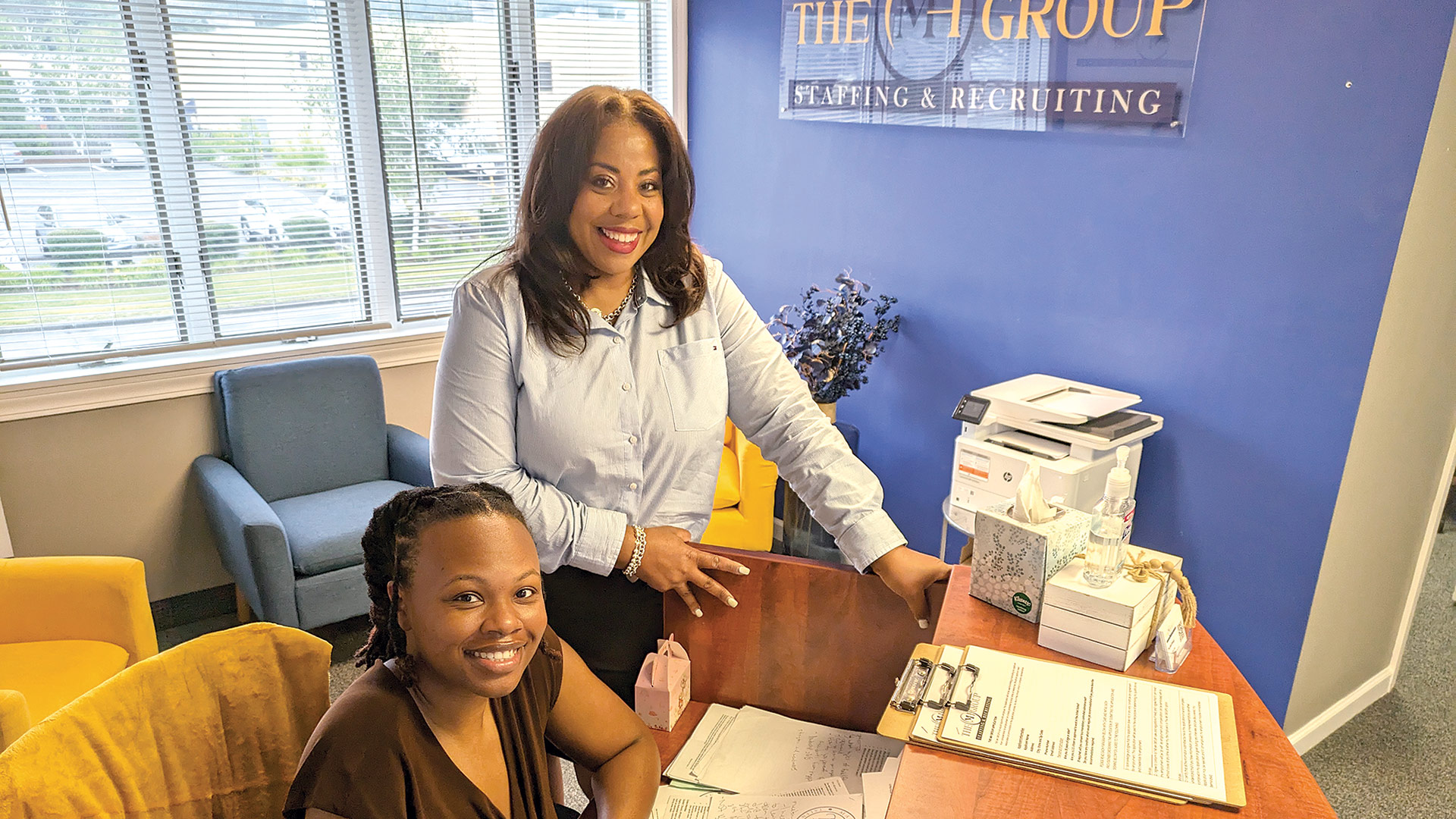
Nicole Polite (top) with Kassaundra Woodall, senior recruiting manager at the MH Group.

Nicole Polite (top) with Kassaundra Woodall, senior recruiting manager at the MH Group.

Today, she still likes the name, but explained why a change to the MH Group was in order. “It was fierce — empowering women. That was the goal of the name with me and my marketing partner when we came up with it. But it lost some of its brand and became a little confusing. People were confusing the name as ‘man hire,’ like a job-ready type of employment firm, and we are the complete opposite; about 70% of our jobs are direct-hire. So we dropped that and just go by the initials, which is the MH Group.”


Getting to the Next Level

The MH Group’s recruiting and staffing work focuses on the nonprofit sector, as well as healthcare, insurance, and manufacturing.

But it does so in a way that ensures that matches stick, and that goes back to Polite’s experience landing that job at MassMutual. For instance, the firm conducts workshops to teach people how to interview for a job.

In addition, “I teach my staff and train them that, when you have someone in front of you, you mentor on the spot. And that’s from entry-level to C-level positions. If you have the opportunity to tell someone about something that could be answered in a better way, or just give them some pointers on their résumé, things to highlight and things not to highlight, just mentor it on the spot.

“And then, in terms of employers, we do a lot of vetting up front. So you’re getting an applicant from the MH Group that has been highly vetted and has had some training as well.”

That’s especially important at a time when employers in most sectors are struggling to attract and retain sufficient talent — which gives job seekers more leverage than normal.

“I have clients that have really met the needs of the applicants and employees. They’ve changed their benefit structures, their PTO time, their flexibility, their hybrid schedules. I would say employers are really trying their best to meet the needs of the workforce.”

“It’s a very competitive market — and the workforce knows that it’s competitive. So they’re asking for things they’ve never asked for before. They’re pushing back in ways they’ve never pushed back before; they’re really going through benefits, medical benefits, with a fine comb to make sure it’s something that is valuable to them and their family structure.

“But I will say my clients are meeting their needs,” she added. “I have clients that have really met the needs of the applicants and employees. They’ve changed their benefit structures, their PTO time, their flexibility, their hybrid schedules. I would say employers are really trying their best to meet the needs of the workforce.”

As part of its 10-year anniversary, Polite is also launching the MH Cares Foundation, which uses the power of mentorship to help underserved populations achieve fulfilling careers.

“Most people in HR and CEOs can understand this: you post a job position, and you have hundreds of applications — and, out of those applications, maybe a few that qualify. And you wonder, ‘why is that? Why do so many people apply for positions that they may not be qualified for?’”

Playing off the saying ‘no child left behind,’ Polite sought to create a program where no job seeker is left behind. So the foundation matches job seekers with mentors, using a curriculum to help that job seeker get to the next level.

“It’s more than just applying for a job. We’re going to put you with a mentor who can actually mentor you through that process, whether it be helping you with your résumé or coaching you on interviewing,” she explained. “And then, the second component is giving you volunteer work within that industry or that field and having you work there so that you can gain some experience. The goal is to make sure that we are meeting job seekers where they’re at and bringing them to the next level.”

The foundation will host a kickoff event this fall, and in the meantime, volunteers who want to be mentors to job seekers can visit www.mhcaresfoundation.org and register to be a volunteer.


Deepening Roots

Polite notes that “a core philosophy for the MH Group is the need for both roots and wings.”

For her, those roots run deep in Springfield, as her great-great-granduncle was Primus Parsons Mason, a Black entrepreneur and real-estate investor who is most well-known as the namesake of the city’s Mason Square neighborhood.

Active in the community, she has served the Greater Springfield region on multiple nonprofit boards, such as the YWCA of Western Massachusetts, the MassHire Hampden County Workforce Board, the United Way of Pioneer Valley’s Dora D. Robinson Women’s Leadership Council, and the Pioneer Valley Planning Commission council. She has also served as a business advisor at the Entrepreneurial & Women’s Business Center at the University of Hartford.

MH Group

Nicole Polite says the MH Group name more clearly conveys the firm’s purpose than its former name, ManeHire.

Because of her success to that point, she was selected to BusinessWest’s 40 Under Forty class of 2014 and then won the magazine’s Continued Excellence Award (now known as the Alumni Achievement Award) in 2017. And she was only getting started.

“This has been extremely gratifying — for one, to take such a huge risk of leaving a very good company with great benefits, great structure, great financial standing, and to launch out into my own business … and then just to still be here for 10 years, is very gratifying,” she said.

The MH Group provides staffing for companies from Massachusetts to Washington, D.C., and Polite believes it has the potential for a national reach. But locally, she wants to continue outreach to the community, including partnering with local schools to teach job-readiness training.

“We can reach them at a younger age. Then, one day, I hope this will be a part of the curriculum … because job readiness and career readiness is something that’s taught, but not taught the level it should be.”

Polite told BusinessWest she attended its annual 40 Under Forty event this past June and felt emotional seeing many people her company had helped to find employment.

“That’s very gratifying to see them all really excel within their fields. We have people we placed in entry-level positions that are now in management, vice presidents, heads of corporate compliance. It’s amazing to look back and to see people’s growth.”

She’s also encouraged by the many employer clients who have remained partners since the day she opened her doors.

“That makes my heart extremely happy. They’ve grown into family,” she said. “It’s like a dream sometimes — like, pinch me, I’m dreaming. I didn’t think this dream of mine could grow to where it’s at today.”

Construction Special Coverage

Bringing It Home


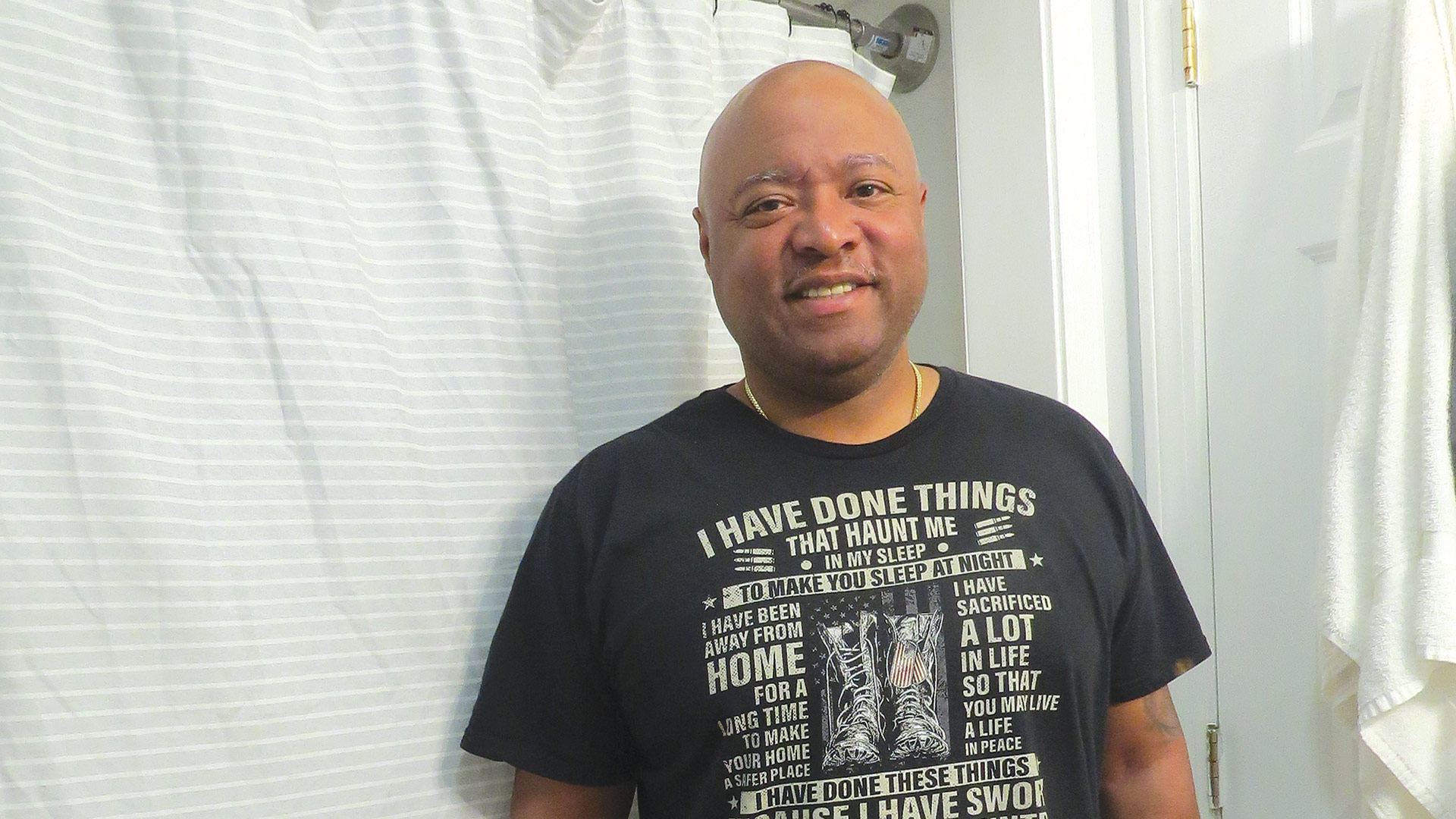
Oliver Layne

Oliver Layne stands in ‘his’ bathroom, with a walk-in shower, one of many projects undertaken by those involved in the JoinedForces program.

Oliver Layne has come to call it “my bathroom.” Others in his family simply call it “dad’s bathroom,” for reasons that will become clear.

This is the small half-bath in his home on Border Street in Springfield, the one that was renovated to include a walk-in shower, something that became a necessity for Layne, a U.S. Air Force veteran of both Gulf wars, after he was afflicted with a rare muscle disease whereby his immune system attacks his muscles. This disorder made lifting his leg to get into a bathtub difficult, if not impossible.

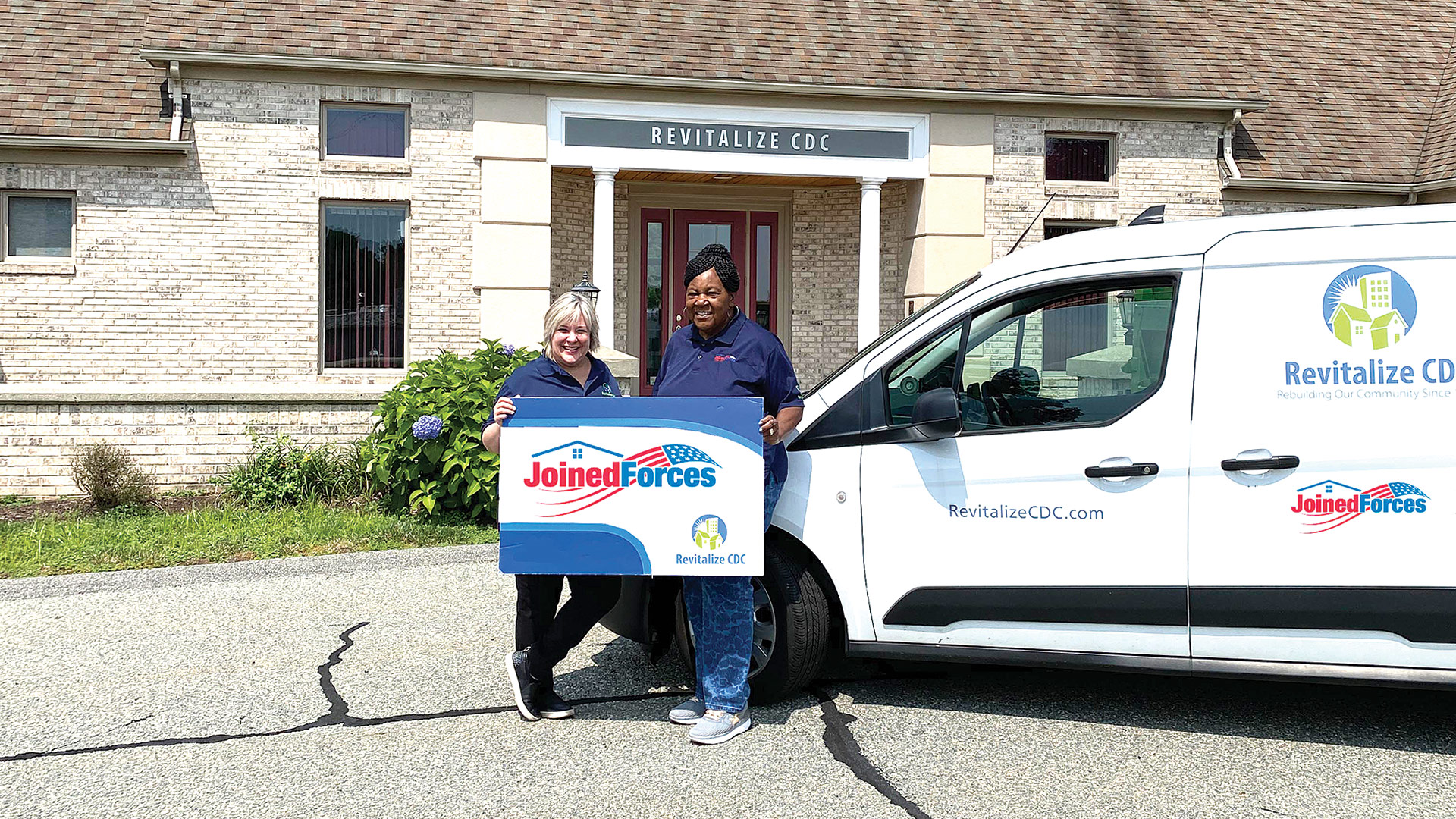
“My day starts off with my cane, by the middle of the day I’m in my walker, and by the evening I’m in my wheelchair — I just get more and more tired throughout the day; I’m very limited in what I can do,” said Layne, whose bathroom renovation was realized through the JoinedForces program administered by Revitalize Community Development Corp. (CDC) and funded by grants from the U.S. Department of Housing and Urban Development and its Veterans Home Modification Program.

That well-thought-out name speaks volumes about this unique program and the many people who are involved in it.

For starters, the name helps convey that this is a program designed to assist veterans, many of whom are disabled and need help to stay in their homes or, in the case of Layne, live more comfortably in their home.

“Veterans are a big part of our focus,” said Colleen Loveless, president and CEO of Revitalize CDC, noting that the nonprofit agency also serves low-income families with children, the elderly, and individuals with special needs through initiatives such as its #GreenNFit and Healthy Homes programs. “Many are looking to age in place in their homes, many have injuries from their service, and this has become a particular focus of ours.”

“Veterans are a big part of our focus. Many are looking to age in place in their homes, many have injuries from their service, and this has become a particular focus of ours.”

The JoinedForces name also hints at how these projects to assist veterans are acts of collaboration, often involving a number of parties, including those at Revitalize CDC, other agencies focused on veterans and their needs, contractors, and area businesses.

That was certainly the case with Layne’s project, and also a coordinated effort to assist Ron Schneider and his wife, Cara, during a recent Volunteer Day initiative.

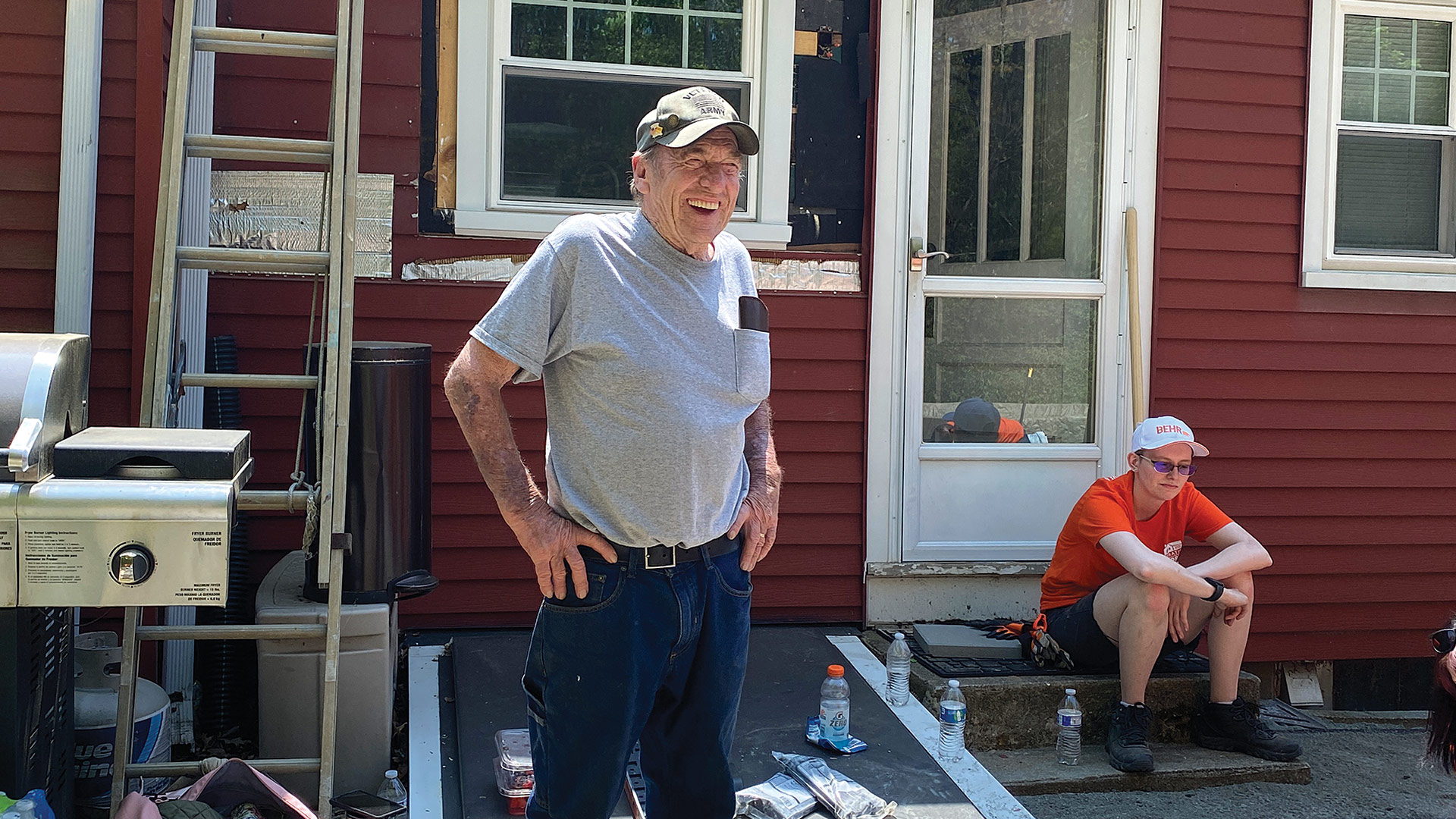
Schneider, a Vietnam War veteran now battling cancer he attributes to his exposure to Agent Orange, made his living as a general contractor. But his declining health left him unable to undertake many of the projects around the home that would have been so simple years earlier.

Fast-forward (we’ll fill in some details later) to this past spring, when there were two major projects at the Schneider home — one undertaken by a contractor to replace windows that had ceased to open easily, if at all, and the other involving an army (not a term we use loosely) of volunteers from Revitalize CDC and Home Depot to tackle a number of projects, from repairing the patio and driveway to building a shed and undertaking some landscaping work. New doors, also part of the mix, were put on earlier this month.

“All of this has taken a lot of pressure off me because I can’t do things around the house — I’m not physically able to do some of the projects that they handled,” Ron said. “And they did it in a day’s time because they had almost 100 volunteers.”

Suzanne Larocque (left, with Ethel Griffin)

Suzanne Larocque (left, with Ethel Griffin) says projects range from roof repairs and replacements to installation of handicap ramps and bathroom renovations.

These comments from Layne and Schneider effectively convey the sentiments of those veterans and their families who have had work done on their homes. As for those doing the work, they say there are many types of rewards, but especially the pride and satisfaction that come from helping those who served their country.

“I love it — it’s not about the money,” said Frank Campiti, a general contractor who handles many projects for Revitalize CDC and its #GreenNFit, JoinedForces, and Healthy Homes programs. “I get a lot of satisfaction from helping these veterans. We do everything we can to make their lives better with whatever their repair is.”

Myles Callender, who served as construction manager for Revitalize CDC before starting his own construction company with his brothers, and still handles projects for the agency, agreed.

“Some of these projects may not look big in terms of their size and scope,” he said. “But they make a huge difference in the lives of these veterans. It’s very rewarding to help improve the lives of those who have served.”

“All of this has taken a lot of pressure off me because I can’t do things around the house — I’m not physically able to do some of the projects that they handled. And they did it in a day’s time because they had almost 100 volunteers.”

For this issue and its focus on construction, BusinessWest takes an in-depth look at the JoinedForces program and its efforts to help veterans and their families feel more at home — in all kinds of ways.


Building Hope

Layne told BusinessWest that his physical issues started several years after he returned from his service in the Gulf and started his professional career, working first at a college and then for AT&T. He suspects the disorder results from exposure to contamination at two bases where he served — Wurtsmith Air Force Base in Michigan (now closed), and Sheppard Air Force Base in Texas.

He started noticing that he was having trouble walking straight and that his hands didn’t work right.

“My body just didn’t work the same as it did before; I couldn’t run anymore, I couldn’t walk long distances,” he recalled, adding that it took doctors more than two and a half years to figure out what was wrong with him.

In 2017, he was officially diagnosed with a muscle disorder, and it was determined that there was no known cure. All medication was stopped, he said, adding that he is doing what he can to try to slow down or mitigate the condition’s progress, though diet and physical therapy, for example.

He has soldiered on, but increasingly has struggled with everyday tasks. He walls with a significant limp and can no longer navigate stairs — the Veterans Administration put a stair lift in his home — and has trouble getting in and out of the shower.

Ron and Cara Schneider (center, with their daughter, Bridget, between them)

Ron and Cara Schneider (center, with their daughter, Bridget, between them) celebrate the work done on their home in Ludlow by dozens of volunteers.

He became aware of Revitalize CDC and filled out an application for assistance late last fall. “That was on a Monday, and on Wednesday, I got a call; they were asking me what I needed done in my home and how they could help.”

Layne’s bathroom renovation is, in many ways, typical of the projects undertaken through the JoinedForces program, said Ethel Griffin, vice president of Community Engagement for Revitalize CDC.

She told BusinessWest the agency works with other veteran-related organizations on outreach to help make sure people know about JoinedForces and the agency’s other programs and encourage them to apply for assistance.

“Our work with veterans is important because they’ve served our country, and they deserve to have comfort in life,” she told BusinessWest. “A lot of our veterans are very old, and it’s amazing to see the conditions they are living in. We do spend a little more time and bit more money with the veterans — because they deserve it. This program gives us the feeling that we’re helping our country as well, even though we’re helping individuals; it’s our time to serve.”

Larocque agreed. “I don’t come from a military background at all, so meeting these veterans has been such a great experience. They’re so appreciative, and it’s been really rewarding to work with them.”

Since Loveless came on board in 2009, the agency has assisted between 200 and 300 veterans across the state, with the vast majority of them living in the 413, and veterans’ homes are included in all Revitalize CDC programs, including #GreenNFit.

Ron Schneider

Ron Schneider is grateful that JoinedForces has taken pressure off him because the volunteers completed projects he no longer can.

The projects vary in size and scope, said Suzanne Larocque, HUD project manager for Revitalize CDC, adding that they range from roof repairs and replacements to installation of handicap ramps and bathroom renovations like Layne’s.

Other projects have involved removal of asbestos from one home, installation of a drainage system and dehumidification system to relieve water issues in a basement, and many window-replacement initiatives. Meanwhile, the agency is undertaking more projects to replace heating systems with more modern — and green — systems.

Revitalize CDC hires licensed contractors to handle such work, obviously, Loveless said, adding that there is an emphasis on hiring minority- and women-owned firms. In some cases, the agency can get materials and labor donated, as it did for a veteran in Springfield who needed a new roof.


The Battle Is Joined

Ron Schneider, who served in the Army as an engineer building roads, tells a story somewhat similar to Layne’s, one of returning from service, launching a successful career, and then being beset with health problems that left him unable to do things around the house.

“I’m disabled, and I just can’t do much physically,” he said, noting that, in addition to his cancer fight, he has fought other health battles over the years.

As Ron’s condition deteriorated, and as needed work at his home on Prospect Gardens in Ludlow piled up — as noted earlier, many of the windows, originally installed in the 1940s, would no longer open or close easily, if at all — the Schneiders filled out an application for assistance through the JoinedForces program.

“Ron was a contractor for more than 40 years; these were all projects that he’s been hired to do over the course of his career that he can no longer do. For him, it was challenging; it was hard for him to be able to say ‘yes, I need help.”

That was prior to COVID, Ron said, adding that they received a call from Larocque early this year, and work commenced in phases this spring.

The first phase was replacement of the windows in April, work handled by a local contractor. Then, in May, Revitalize CDC joined forces (there’s that phrase again) with Home Depot, for a massive Volunteer Day effort at the home.

Cara Schneider put the improvements and what they mean to her husband and the rest of the family in their proper perspective.

“Ron was a contractor for more than 40 years; these were all projects that he’s been hired to do over the course of his career that he can no longer do. For him, it was challenging; it was hard for him to be able to say ‘yes, I need help,’ she said. “And then, to have these people come in and do it in a way that was respectful and that made our lives so much more functional and for him not to have to worry about these things while he’s going through treatment … it took all the stress off. And he’s able to open windows now.”

These sentiments hit at the true mission of the JoinedForces program, said Campiti, who has worked on dozens of projects over the past several years.

He said most are not large in scope, but can be rather involved. And in many cases, these are projects most contractors would pass on because of their degree of difficulty, the conditions in the home, or their small margin for real profit.

“I get involved with projects that other contractors look at, but they don’t even call them back,” Campiti said, adding that, in other cases, contractors will take on the work, but at a cost beyond what the veteran is willing or able to pay.

Such was the case with Layne, who said he looked into renovating his bathroom and installing a walk-in shower, but the cost was prohibitive. A friend, also a veteran, told him about Revitalize CDC, and he applied for assistance to undertake the bathroom renovation.

He was hesitant to install a walk-in shower in his main bathroom due to concerns about impact on the resale value of the home, but, after consultation with Campiti, was convinced that his half-bath, also home to his washer and dryer, could be renovated and outfitted with such a shower.

This was a fairly complicated project that involved moving the laundry equipment to the basement, constructing the shower, and redoing the floor, he went on, adding that it took several days to complete.

Overall, he’s working on two or three projects a month, most of them addressing the accessibility issues that many veterans face, whether it involves a bathtub, stairs, or a backyard deck.

“We do a lot of railings and grab bars in places that would be considered non-traditional,” he explained. “We put them in places beyond the bathroom, like with a person walking out to their patio; they can’t step down anymore.”

He stopped short of calling this work fun, but reiterated that it is gratifying on many levels.


On with the Fight

Returning to this concept of ‘his’ bathroom, Layne injected some needed background.

Indeed, he said he has four daughters, including twin 14-year-olds who still live at home.

“Bathroom time is extremely difficult to get,” he said with a laugh, adding that he obviously has to share his facility, which has actually become quite popular.

“They’ll say, ‘can I take a shower in your shower?’” he said of his children, adding that he used to ask why. “They say, ‘because it’s big; you can move around in there.’”

That’s because Campiti made it big enough to put in a chair, which is necessary, as Layne is prone to falling because his legs don’t move as they should.

It’s quite unfortunate that Layne, a veteran of two wars, needs this walk-in shower with all that room in it. But he — and his daughters, for that matter — are fortunate to have it.

And it was made possible by an agency with a name that truly says it all.


Commercial Real Estate Special Coverage

Divesting the Portfolio

The Paramount Theater/Massasoit Hotel

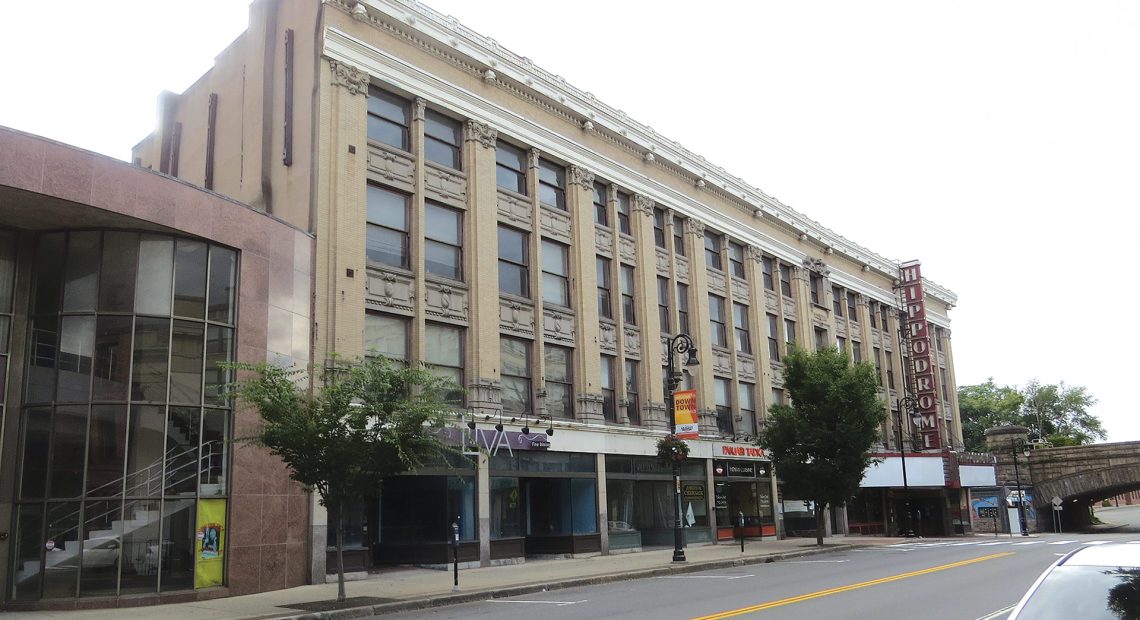
The Paramount Theater/Massasoit Hotel complex is one of several properties in the New England Farm Workers’ Council portfolio now under agreement.


Dan Knapik says that, when he became executive director of the New England Farm Workers’ Council in the summer of 2021, he found a multi-faceted nonprofit agency at what amounts to a crossroads and in need of what he called a “kick start.”

That was especially true when it came to the agency’s broad commercial real-estate portfolio, assembled over the preceding decades with the goals of housing programs, spurring economic development, and creating revenue streams — goals that, in most cases, have not been realized.

“We needed to go aggressively to rent out what we could or sell it,” said Knapik, adding that, in most all cases, the latter option is being pursued. “We put a multi-pronged strategy together; we started renting what we could rent and sell what we couldn’t rent.”

Indeed, a few of the agency’s holdings were sold prior to his arrival, in the winter and spring of 2021, including 1600 Main St. in Springfield (the International Bier Garten), sold for $700,000; and 297-299-301 Main St. in Holyoke, sold for $150,000.

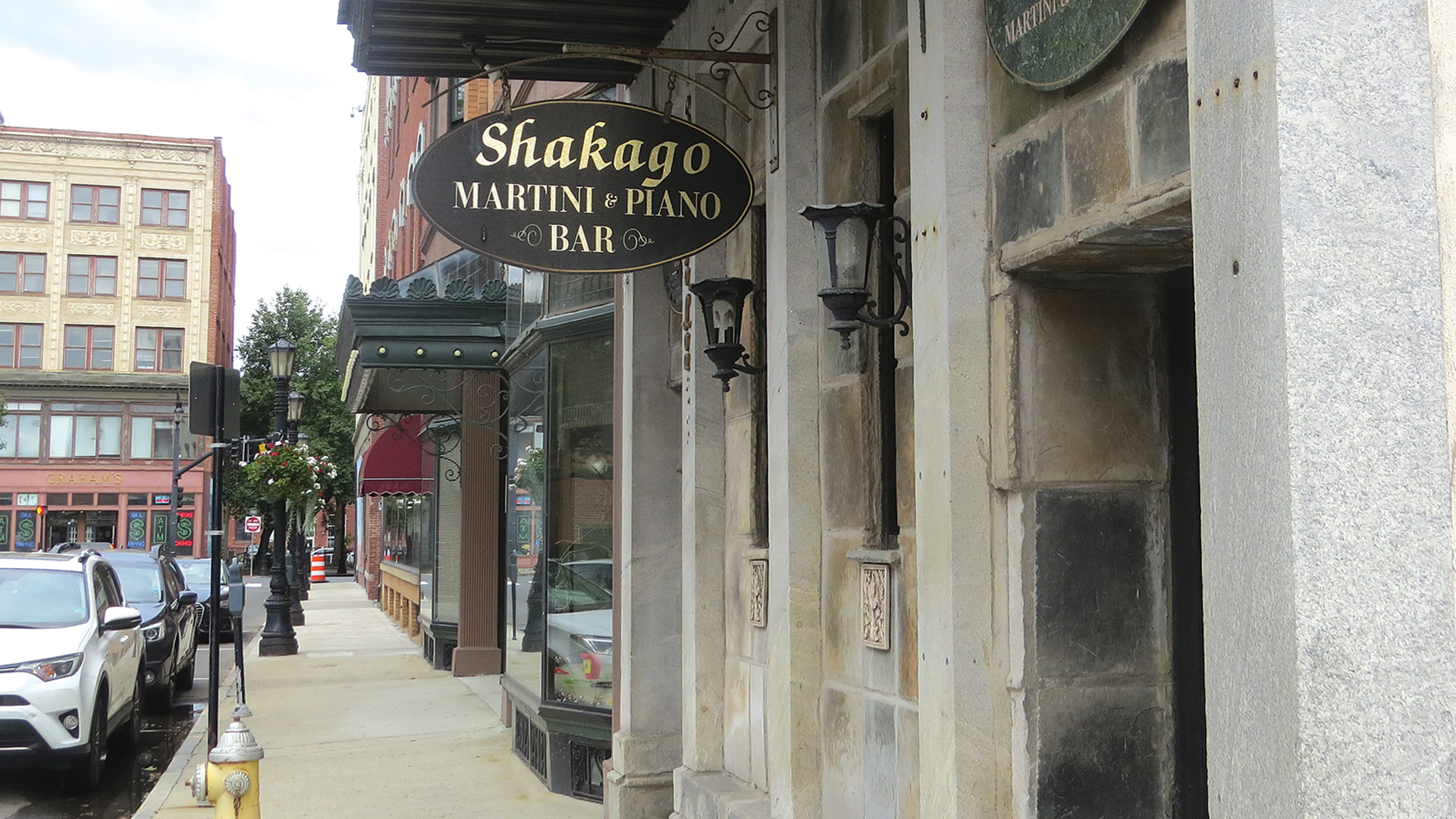
The selloff has continued into this year, with 276 Union Ave. in Bridgeport, Conn. (a rooming house) selling for $656,000 in January. Then, in May and June, the property at 21-23 Hampden St., home to the Shakago Martini and Piano Bar, sold to an Alabama-based real-estate company for $240,000; 2345 Main St. in Springfield sold for $85,000; 203-205 High St. in Holyoke sold for $134,900; 211-213 High St. went for $134,000; and 211-213 High St. sold for $49,900.

“We needed to go aggressively to rent out what we could or sell it. We put a multi-pronged strategy together; we started renting what we could rent and sell what we couldn’t rent.”

There are several other properties now under agreement, Knapik said, including the 1610 Main St./20 Fort St. complex, home to the Student Prince restaurant, and the Paramount Theater/Massasoit Hotel complex further north on Main Street, a historic property that has long been considered a key to revitalization of the downtown. And the agency is actively showing other properties, including 32-34 Hampden St. in Springfield and 217-225 High St. in Holyoke.

“I am determined to divest the portfolio,” Knapik said, adding that doing so gives the agency, an affiliate of Partners for Community, capital to pay down debt, while also freeing it from some heavy tax burdens — nearly $70,000 each quarter for the properties in Springfield alone — and debt service, an estimated $200,000 per quarter. And it will provide the agency the time and opportunity to focus on its mission.

Overall, this is not a particularly good time to be selling real estate, said Knapik, adding that higher interest rates — and they keep getting higher to due to actions by the Federal Reserve to cool the economy and tame inflation — have made this assignment more challenging.

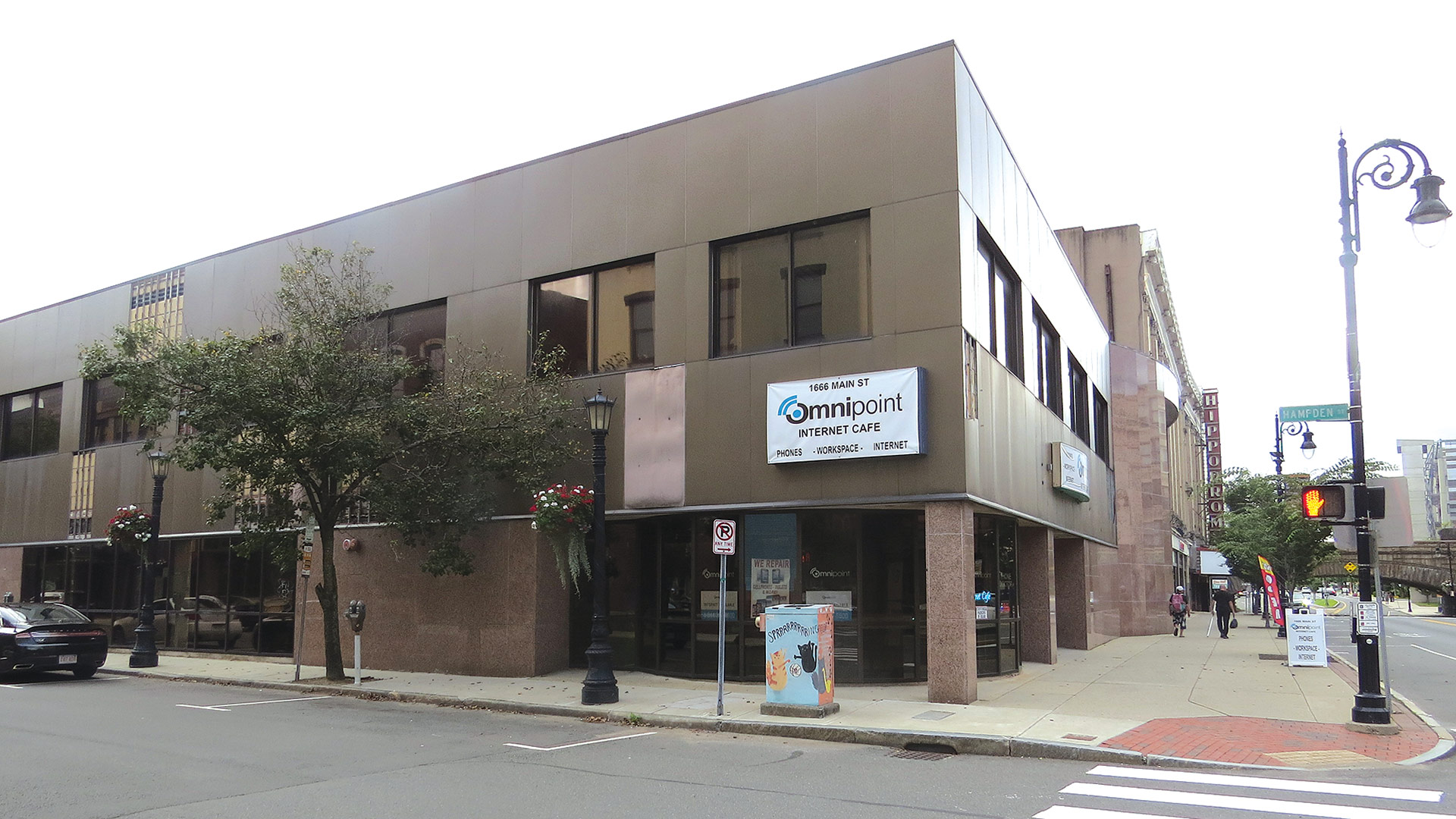
The nonprofit’s board voted last fall to sell the remaining 13 properties in the portfolio, including 1666-1670 Main St. in Springfield.

“It’s been difficult — the Fed’s interest-rate environment has been less than favorable for us, and some of the buildings were not in great shape,” he told BusinessWest, noting that interest rates are more than five points higher than they were just a year or so ago.

But given these market conditions — and the state of the some of the properties — he is not unhappy with the results to date.

“I haven’t been horribly displeased,” he went on. “We’re obviously not selling class-A real estate, but we haven’t lost money on the sales, either.”

For this issue and its focus on commercial real estate, BusinessWest takes an in-depth look at the council’s active efforts to shift away from the commercial real-estate business, what this means for the agency, and what it might mean for area communities, especially Springfield and its downtown.


Setting Sale

When BusinessWest toured what is known colloquially as the ‘Fort building’ or ‘Fort complex’ not long after it was purchased by the Farm Workers’ Council in 2010, then-President and CEO Heriberto Flores (he still holds those titles at the agency) talked enthusiastically about bringing new life to the vast spaces in the multi-story complex that had been vacant for years, and, in many cases, decades, with some of the abandoned offices still featuring brightly colored shag carpeting.

The Fort complex

The Fort complex is one of several properties in the New England Farm Workers’ Council portfolio now under agreement.

Today, they are still vacant — the Student Prince and the Latino Economic Development Corp. (an affiliate of the council) occupy the ground floor, and they are the only tenants in the complex — and those quiet spaces speak volumes about why the Farm Workers’ Council is divesting itself of its real-estate portfolio, Knapik said, adding that, in many respects, the properties have been underperforming and losing money for several years.

Recapping the history and state of this portfolio, Knapik said the properties were acquired with good intentions and solid goals in mind, but most of the promise has not been realized.

“They weren’t really aggressive about seeking out new tenants, and there was a lot of deferred maintenance on the buildings,” he explained. “A lot of the buildings were bought years ago to put programming in, and one of the mistakes I think the council made was, when programming lost funding, for whatever reason, buildings should have been sold off, and they weren’t. They were held onto for a variety of reasons, and they then became big liabilities, and this is where a lot of the accumulated debt came from.”

“A lot of the buildings were bought years ago to put programming in, and one of the mistakes I think the council made was, when programming lost funding, for whatever reason, buildings should have been sold off, and they weren’t.”

This fact was certainly not lost on the nonprofit’s board, which voted last fall to sell the remaining 13 properties in the portfolio, he said, adding that many have been, and most of the rest are under agreement.

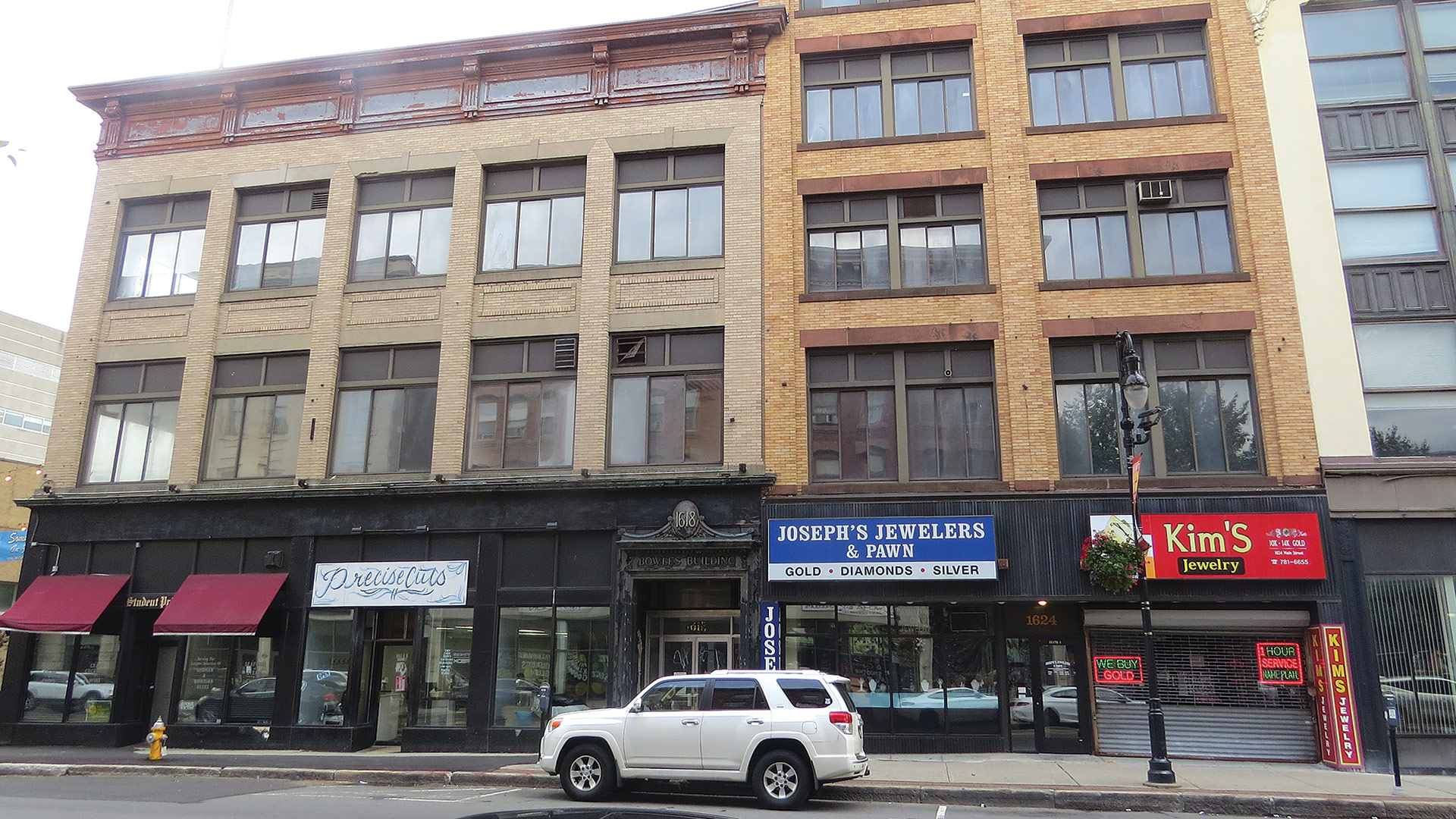
That list includes several properties in downtown Springfield, including 1666-1670 Main St., 1655 Main St. (the Board of Trade Block), 1628-1640 Main St., and 1618-1624 Main St.

As noted earlier, that includes the Fort complex, which is under agreement to a group led by Peter Pan Bus Chairman and CEO Peter Picknelly, one of group of local entrepreneurs who stepped in to rescue the Student Prince several years ago when closure seemed imminent.

It also includes the Paramount and adjoining Massasoit Hotel, a complex that has been envisioned as a multi-use property, with the theater being a host for events and the hotel being converted for housing.

“We have a purchase-and-sale with a development group that goes back pre-COVID,” Knapik explained. “We continue to work with that development group for a project; we continue to talk with them, and I’m hoping that, within the next 60 days, we can execute a final agreement.”

Shakago Martini & Piano Bar

The property at 21-23 Hampden St., home to the Shakago Martini & Piano Bar, is one of several already sold by the New England Farm Workers’ Council.
Staff Photo

He noted that the same rising interest rates that are making sales of these properties more challenging is driving up the cost of redevelopment of the Paramount/Massasoit Hotel complex.

Overall, the sale of the properties in the portfolio should provide the council with some needed capital, Knapik noted, adding quickly that there is substantial debt to pay down.

“There’s about $4 million in total equity after all the mortgages are paid, but there are some legacy debts, some operating debts that Farm Workers’ has accumulated over the years, and we’re hoping to clear that off,” he said, adding that many of the properties do not have mortgages.


Bottom Line

Meanwhile, by getting out of the commercial real-estate business, the council can concentrate its full energies on its programs, and there are many working in several different realms, from economic development to housing to youth and education.

And it can develop and execute the next strategic plan.

“This will allow the council to take a breath and figure out to position itself for what it wants to do in the future,” he said. “We’ve been in business for 52 years, responding to the needs of the community. When this gets done, we’ll propose some ideas to the board of directors and let them decide how they want to go forward.”

Education

Strong Foundation

Professors Warren Hall and Jennifer DeForge

Professors Warren Hall and Jennifer DeForge of the Architecture and Building Technology program at STCC.

Warren Hall calls April 23, 2013 — the day the Massachusetts Board of Higher Education approved architecture and building technology as a two-year associate-degree program at Springfield Technical Community College — “a great day.”

“We were approved after a seven-year process,” said Hall, a professor in the program at STCC. “Creating programs is something I love to do. I like to figure it out and find out how to get people through the door.”

As of commencement this past May, the degree program boasts more than 200 graduates who hail from the Greater Springfield region and beyond. Students enroll in the program — the only one of its kind in Western Mass. — to acquire skills that prepare them for careers in architectural design and construction-related fields. Some students can start their careers after graduating from STCC, while many transfer to four-year colleges and universities.

STCC has agreements with UMass Amherst and other state colleges and universities that provide for a smooth transition into a bachelor’s degree program.

The program drew interest from Nathalia Hermida, who was living in Colombia in 2013 and considering colleges in the U.S.

“I always wanted to go for architecture,” she said. “I started looking for universities with my mom. She found out about a program at UMass Amherst, but the cost was too high for us, especially coming from Colombia. So, lucky for us, we found out that STCC had a program that would transfer into UMass’s architecture program. We looked into that. As a community college, it seemed like a really good program and was more affordable for us, so we decided to go with it.”

She earned her degree from STCC in 2016 before transferring to UMass and earning a bachelor’s degree in sustainable community development. Today, Hermida works at Uncommon Architectural Places, founded by Alfonso Nardi, an adjunct professor in the STCC architecture program.

“I’m lucky enough to share my design and building experience with them and watch them move onto some incredible positions in the building industry and continuing their education in architecture and building technology.”

In addition to professors Nardi and Hall, the program’s faculty includes Jennifer DeForge, now the program coordinator, who graduated from STCC in 2009 with an associate degree in civil engineering technology and is working on her second master’s degree.

“Working in the architecture and building technology program has been one of the best career decisions I could have made,” DeForge said. “Every day, I work with our students and fellow colleagues, who are some of the most driven individuals I have met, and I’m lucky enough to share my design and building experience with them and watch them move onto some incredible positions in the building industry and continuing their education in architecture and building technology.”

Hermida plans to pursue her architecture license and a master’s degree. STCC provided a solid foundation for her continuing education, she said. “I was really impressed about how complete the program was. They packed a lot into two years.”

The program has drawn other international students. Obed Otabil and Asra Afzaal both graduated in 2018. Otabil hails from Ghana, while Afzaal grew up in Pakistan.

Otabil attended UMass to earn his bachelor’s and master’s degrees. He is taking time off to raise a child, but hopes to work at an architectural firm and own his own firm one day.

“All the training I received from Springfield Tech was very helpful,” Otabil said. “Having the basic knowledge about architecture actually helped me sail through the undergrad program pretty smoothly.”

Afzaal left Pakistan to pursue educational opportunities in the U.S. She entered the U.S. educational system as an 11th-grader in high school and then found the STCC architecture and building technology program. Like Otabil, Afzaal went to UMass and received her bachelor’s degree in building and construction technology. In March 2023, she moved to Texas to work for an architecture, planning, and design firm as the space planner and project planner.

“STCC was the base, the foundation. And then on top of it, I laid the layers,” she said. “My basics were so strong that I was able to build on it and learn more and more. And I am so grateful that I was in the architecture program at STCC.”

Michael Caine, a 2016 graduate of the architecture and building technology program, later earned his master of architecture professional degree from the University of Pennsylvania School of Design. He also earned a bachelor’s degree in architecture from UMass Amherst.

Today, he lives in Philadelphia and works as a lead conceptual designer for an architectural firm that focuses on multi-family residential projects. He describes his conceptual work as “the dream job of architecture.”

Caine enrolled at STCC in part because the college is the most affordable in Springfield. He didn’t know what he would major in when he started, but later discovered the architecture and building technology program was a good fit.

“It is really unique to have an architecture department at a community college,” he said. “Having the exposure to architecture at such an early stage in an academic career of higher ed is really beneficial. It allows that barrier of entry to really be demolished.

“It was really beneficial for me to get the exposure and the breadth of knowledge to be career-ready at such an early stage. For me, that was really beneficial. After my first semester at STCC, I was able to win an internship, and from there, just learning both the technical side at school, but also the practical side during work while going to school, was the one-two punch.”

Caine said he is proud to call himself a graduate of STCC’s 10-year-old architecture and building technology program, and he recommends it to anyone interested in a career in building construction or design.

“It’s a super-unique program,” he said. “The way that professors Warren Hall, Jennifer DeForge, and Al Nardi have shaped it over the years is really something special. When I transferred to UMass, I had all these skills they weren’t even teaching over there until later down the road.”


Technology

Early Connections

The Markens Group

The Markens Group’s iCons summer intern, Bobby Murray (center), with Ben Markens and Emily Leonczyk.

The Western Massachusetts Economic Development Council (EDC) and the UMass Amherst iCons program, under the umbrella of the iCons Industry Consortium, recently joined forces to provide UMass iCons students with internship and career opportunities in the Western Mass. region.

iCons is a certificate program focused on real-world problem solving in biomedicine/biosystems and renewable energy, catering to students in science, technology, health sciences, engineering, math (STEM), and business. The program engages students in addressing real-world challenges alongside industry partners and faculty members from a range of STEM and business disciplines.

“By bringing together exceptional students and local businesses, this collaboration creates a win-win situation, fostering mutual growth and development.”

Now, with the support of the EDC, UMass iCons students majoring in science, technology, engineering, math, health sciences, and business have access to internship opportunities with local businesses, with the goal of bolstering the regional economy as well as their own experience.

“We’re excited to partner with UMass Amherst to showcase the advantages of living and working in Western Mass.,” said Rick Sullivan, president and CEO of the Western Mass EDC. “ By bringing together exceptional students and local businesses, this collaboration creates a win-win situation, fostering mutual growth and development.”

The iCons program has already successfully placed students in internships at three member organizations of the Western Mass EDC: the Markens Group, US Tsubaki Chicopee, and the Community Foundation of Western Massachusetts. These experiences have provided iCons students with valuable exposure to real-world work environments and have allowed them to contribute to the success of local businesses.

The Markens Group recently welcomed Bobby Murray as an iCons summer intern.

“We are thrilled to have Bobby join us at the Markens Group this summer,” said Emily Leonczyk, the company’s executive vice president and chief operating officer. “Bobby is taking advantage of the opportunity to cultivate his skills, gain invaluable real-world experience, and lay the foundation for a successful future. Bobby has already added immense value, he is sharp and enthusiastic, and our team is stronger with his contributions. We are dedicated to supporting next-generation talent like Bobby and fostering professional development in our region.”

“This partnership exemplifies our commitment to building community and empowering local talent.”

According to its website, iCons “prepares our best undergraduates to be problem solvers, leaders, and innovators in science, technology, and business. iCons recruits quality students across a diverse range of science, engineering, and business disciplines to identify global problems and find cutting-edge solutions. The iCons program positions students for high achievement in graduate school and in their careers.”

Scott Auerbach, Mahoney Family Sponsored Executive Director of iCons, noted that the program’s mission can be boiled down to three words: “add real value.”

“Our excellent partnership with the Western Mass. Economic Development Council and terrific member organizations like the Markens Group provides powerful opportunities to accomplish this important mission,” he said.

Through this collaboration, the leaders of the Western Massachusetts EDC and the iCons program say they want to pave the way for talented students to excel in their academic and professional pursuits while driving economic growth in the region. By nurturing the next generation of leaders and problem solvers, they add, this partnership will leave a lasting impact on both the students and the community as a whole.

“The Markens Group firmly believes in the power of community,” President and CEO Ben Markens said. “Beyond our association-management services, we actively engage in initiatives that foster growth, build relationships, and strengthen the region. This partnership exemplifies our commitment to building community and empowering local talent.”

Nonprofit Management

Streams of Assistance


Call it a flood of support at a critical time.

On July 20, the Healey-Driscoll administration and the United Way of Central Massachusetts (UWCM) announced the Massachusetts Farm Resiliency Fund, a partnership between philanthropic organizations and private foundations intended to support Western and Central Mass. farms impacted by recent flooding and strengthen farm resiliency in the long term. Officials made the announcement at Mountain View Farm in Easthampton, which had much of its crop destroyed by flooding.

Megan Burke

Megan Burke

“We seek to ensure that this coordinated effort provides immediate relief that works for farmers and addresses longer-term food-security issues for vulnerable residents of our region.”

The Massachusetts Department of Agricultural Resources estimates at least 75 farms have been hurt by flooding, with about 2,000 acres in crop losses at a minimum value of $15 million. That number will likely climb as more damage is assessed and the longer-term impacts set in.

“As the lieutenant governor and I have visited farms across the state, we’ve been deeply moved by the devastating impacts we’ve seen and heartbreaking stories we’ve heard. We’re grateful to our philanthropic and private partners for quickly answering the call to action and creating this fund to deliver relief directly to farmers,” Gov. Maura Healey said. “This is about team Massachusetts — where we come together to support farmers and their livelihoods, build resilience for our farms and food supply, strengthen our economy, and create a stronger future for our children and families.”

Lt. Gov. Kim Driscoll added that “Governor Healey and I have heard firsthand from dozens of farmers who are grappling with the aftermath of extreme flooding and trying to figure out how they’re going to make ends meet and keep their farms. We’ve been inspired by their resilience and the pride they take in their businesses, which play an essential role in our state’s food supply and economy. The Massachusetts Farm Resiliency Fund will be a lifeline for so many dedicated farmers and their families.”

Several nonprofit leaders were quick to commit to supporting farmers through the fund.

“In light of the devastating impact of recent floods, the Community Foundation of Western Massachusetts is committed to supporting the Massachusetts Farm Resiliency Fund,” CFWM President and CEO Megan Burke said. “We seek to ensure that this coordinated effort provides immediate relief that works for farmers and addresses longer-term food-security issues for vulnerable residents of our region.”

Philip Korman, executive director of Community Involved in Sustaining Agriculture (CISA), added that “this month’s rains and floods, occurring in the middle of the summer harvest, will have a bigger impact on our farms than Hurricane Irene. It has been heartening to see the community rally around our local farmers, the very people who feed our families. The newly created Massachusetts Farm Resiliency Fund is a powerful example of what can be created when government, foundations, businesses, and nonprofits like CISA work together. The fund will be an essential piece of helping farms recover and will serve as part of the safety net to future climate change events.”

Sen. John Velis

Sen. John Velis

“The flooding has decimated folks’ businesses, jeopardized their livelihoods, and has had a tremendous impact on our Commonwealth’s agricultural sector and our food supply as a whole.”

Meanwhile, Mark Gold, director of the Harold Grinspoon Charitable Foundation, praised the administration for addressing flood relief in a timely manner. “Our foundation remains committed to providing support to those farms impacted by the recent floods along the Connecticut River Valley and others to which we and our partners have provided support over the past nine years.”

Local legislators were quick to praise the joint effort between government and philanthropic community.

“Farms throughout Western Massachusetts have been devastated by the recent flooding in our region, and the full scale of damage is unfortunately expected to grow even more,” state Sen. John Velis said. “The flooding has decimated folks’ businesses, jeopardized their livelihoods, and has had a tremendous impact on our Commonwealth’s agricultural sector and our food supply as a whole. I am grateful to the Healey-Driscoll Administration, UWCM, and all the philanthropic and private foundations for their fast work in creating the Farm Resiliency Fund and for their commitment to helping our farmers get back on their feet.”

State Rep. Natalie Blais agreed. “Following the devastation caused by recent rains and flooding, the Healey-Driscoll administration stood with us, in our fields, to hear directly from farmers,” she said. “I am profoundly grateful to our community for coming together to support farms across the state, and for Governor Healey’s commitment to the long-term sustainability of agriculture and our local food systems.”

Tim Garvin, president and CEO of United Way of Central Massachusetts, called the new fund “a most beautiful demonstration of real partnership, united in compassion and united in purpose to support and assist our farmers,” adding that he is hopeful that many will be inspired to contribute.

“As someone who sees the devastating impacts of the recent flooding every day, I am extremely grateful for the quick efforts of the Healey-Driscoll administration and the United Way of Central Massachusetts to put the Massachusetts Farm Resiliency Fund in place,” state Sen. Jo Comerford said. “We must continue to take concrete steps to help the farmers who so desperately need our quick action and sustained efforts to help in their recovery.”

Comerford also praised the state Senate the following week for passing a $513 million supplemental budget for FY 2023 that includes $20 million in assistance for farms throughout the Commonwealth impacted by recent severe weather events.

“These public funds will go out as direct grants,” she explained. “That’s money in the pockets of farmers who have experienced a massive hardship in the wake of the extreme flooding earlier this month and the frosts and freezes this past spring.”

Other organizations have stepped up to help as well, such as UMassFive College Federal Credit Union, which recently announced a donation to aid local farms impacted by the flooding, including Natural Roots Farm, Mountain View farm, Pepin Farm, Community Care Apothecary, Song Sparrow Farm, Stone Soup Farm, New Community Farming Cooperative, World Farmers’ Flats Mentor Farm, and the Grow Food Northampton Community Farm.

“We are deeply connected to our community and our members, and we understand the critical role that local farms and local food play in our lives,” said Craig Boivin, vice president of Marketing at UMassFive. “Our donation to the local farms impacted by the floods is an expression of our gratitude and commitment to helping our neighbors in their time of need.”

As for the Massachusetts Farm Resiliency Fund, all funds will be distributed rapidly by the United Way through a deliberate selection process. More information about the fund can be found at unitedwaycm.org/farmfund.

“For generations, our farms have been part of our cultural heritage and the fabric of our local communities,” Massachusetts Department of Agricultural Resources Commissioner Ashley Randle said. “As heartbreaking as it has been to see our farming community hit hard, I’m truly inspired to see the community step up and rally around our farmers with this partnership that will bring much-needed relief.”


Senior Planning

Distributing Tangible Personal Property Can Cause Conflict

By Hyman G. Darling, Esq.


Very often in preparing an estate plan, issues arise over the tangible personal property, also known as ‘the stuff.’ This may include cars, collectibles, the dining-room furniture, Waterford china, and basically any other item in a house that is not attached to the walls. These tangible personal property items are often dealt with separately from other assets, such as stocks, bonds, real estate, cash, etc.

Unfortunately, when the client has not provided enough detail in listing the distribution of assets, the tangible property becomes a major issue. Arguments may ensue, and often, the family brings the case to litigation to argue about all these items. In some cases, the family has significant assets to be distributed, but these tangible items become contentious and cause the estate to be litigated and prolonged.

Hyman G. Darling

Hyman G. Darling

“Arguments may ensue, and often, the family brings the case to litigation to argue about all these items.”

There are several ways in which this matter may be resolved, but the clients need to take the time to prepare properly for the distribution. The first way would be to have a complete listing of the items that may have either sentimental value or material value. The client can either list these items in the will, in which case they may have to be probated, or in other cases, the client can sign a memorandum.

The memorandum is fairly new in Massachusetts, as determined in the Uniform Probate Code, which was enacted in 2013. A client may now make a listing of assets and the individuals to receive the assets, which may be memorialized in writing and signed by the client, and then merely referred to in the will. In this manner, if the client desires to change the memorandum, they may merely write up a new memorandum and have it signed and dated and placed with the will, as opposed to having the entire will rewritten.

It is very important in this memorandum to be clear about what items are listed. For example, a mention of a ring or a watch may not be clear enough; perhaps the ring should be listed as the engagement ring with two small diamonds, and the watch could be listed as the Timex watch with rhinestones.

If there are items that are to be identified more clearly, they also should be listed, so that a painting or picture should state the setting or picture, as well as where it may have been hanging in the house, such as in the den above the piano.

Some clients have made lists and put stickers on the back of items or underneath them with identifying colors such as a yellow sticker for daughter Susie, a white sticker for son John, and green stickers for all the grandchildren. This is acceptable so long as the stickers are still on the items at the time of the client’s death and if someone doesn’t get to the items and move the stickers to different items.

In cases where the client was not clear, there are several alternatives to litigation. The first would be to have all parties make a list of the items that are important to them and then allocate an item to each person from their lists, taking turns between the beneficiaries. In some cases, clients have had to draw straws in determining who makes the first selection. Once they are finished choosing all of the items, they can then do their own ‘horse trading’ between themselves, but at least some of the beneficiaries will receive some of the items they want.

If this does not work, it may be necessary to gather the lists of the desired items by the family and engage the services of a mediator to attempt to resolve the differences. The problem then becomes whether the items are more valuable in terms of material value or sentimental value. If the sentimental value isn’t as great as the material value, then a client might decide to choose a larger, more valuable item and hope to trade it later for the more sentimental item.

If the resolution is not able to be made voluntarily, then an inventory of all items will have to be filed with the court, and perhaps an appraiser or two will have to be hired by the estate to value all the items. Some items without much value may be included in a ‘lot,’ which will be valued as a commingling of these items and valued as such.

Once these are all valued and listed on the inventory, one party might have to petition the probate court to determine the proposed distribution of these items, which is unfortunate, as they will be utilizing valuable court time merely to divide the tangible items. The court has the discretion to appoint a master, who will be an experienced lawyer, to hold the hearing at the expense of the estate, and then each party will also be paying their own lawyer to argue over who will receive what items.

In many cases, when this matter is over and resolved, none of the parties are pleased with the result, which means it was probably a fair and equitable decision.

Very often, clients are convinced that the children will have no problem distributing the assets and dividing the items; the client will merely state that nobody will want anything, as they have their own items. This is not always the situation; when a person passes away, not only do the children have a say in what will be distributed, but their spouses may wish to intervene and strongly suggest what their spouse should take. It is usually helpful to keep these in-laws (often called out-laws) out of the decision-making process, as this only causes more people to be involved and greater dissent between the parties.

When completing your own estate plan, consider the potential use of the memorandum with specific detail for the items you wish to distributed. Be careful in considering and discussing these issues with the children since, if you ask them all what they want and they all state that they want the same items, you will then be faced with the decision of having to tell some of them they will not be getting certain items. This can easily cause conflict, and family dinners and holiday occasions may prove to be less than pleasant.


Hyman G. Darling is a shareholder and the head of the probate/estates team at Bacon Wilson; (413) 781-0560; [email protected]

Senior Planning

Ten Tips on How to Approach a Difficult Topic


By the AARP Foundation


The reality is that some conversations are just plain difficult — even with the people to whom you feel the closest. When preparing to discuss a difficult topic like senior care needs, it helps to follow the ground rules below to ensure that everyone’s feelings are respected and viewpoints are heard. To help make the conversation as productive and positive as possible:


1. Try not to approach the conversation with preconceived ideas about what your loved ones might say or how they might react. “Dad, I just wanted to have a talk about what you want. Let’s just start with what is important to you.”


2. Approach the conversation with an attitude of listening, not telling. “Dad, have you thought about what you want to do if you needed more help?” — as opposed to “we really need to talk about a plan if you get sick.”


3. Make references to yourself and your own thoughts about what you want for the future. Let them know they are not alone, that everyone will have to make these decisions. “Look, I know this isn’t fun to think about or talk about, but I really want to know what’s important to you. I’m going to do the same thing for myself.”


4. Be very straightforward with the facts. Do not hide negative information, but also be sure to acknowledge and build on family strengths. “As time goes on, it might be difficult to stay in this house because of all the stairs, but you have other options. Let’s talk about what those might be.”


5. Phrase your concerns as questions, letting your loved ones draw conclusions and make the choices. “Mom, do you think you might want a hand with some of the housekeeping or shopping?”


6. Give your loved ones room to get angry or upset, but address these feelings calmly. “I understand all this is really hard to talk about. It is upsetting for me, too. But it’s important for all of us to discuss.”


7. Leave the conversation open. It’s OK to continue the conversation at another time. “Dad, it’s OK if we talk about this more later. I just wanted you to start thinking about how you would handle some of these things.”


8. Make sure everyone is heard — especially those family members who might be afraid to tell you what they think. “Susan, I know this is really hard for you. What do you think about what we are suggesting?”


9. End the conversation on a positive note. “This is a hard conversation for both of us, but I really appreciate you having it.”


10. Plan something relaxing or fun after the conversation to remind everyone why you enjoy being a family. Go out to dinner, attend services together, or watch a favorite TV program.

These are just a few suggestions of things you, your loved ones, and other family members can do to unwind after a difficult conversation.

Senior Planning Special Coverage Special Publications

Inside This Year’s Planner

When BusinessWest and the Healthcare News first started publishing an annual Senior Planning Guide, the idea wasn’t to create a roadmap to the end of life, though it could, in some sense, be described as such.

The goal is to make sure you get your plans in order — from where you or your loved ones will live to how finances will be distributed — so you don’t have to worry so much, and instead enjoy the senior years to the fullest, or to help your aging parents enjoy them.

After all, the retirement years should be an enjoyable time, highlighted by special moments with family and friends, the freedom to engage in a range of activities, maybe even a chance to develop new interests and hobbies.

But to make the most of that time, proper planning — estate planning, financial planning, plans for care — is critically important. According to the U.S. Census Bureau, the number of Americans age 65 and older — which was 35 million in 2000, just 12% of the population — will reach 73 million by 2030, or 21% of U.S. residents. That’s a lot of people. And a lot of planning. And a lot of living left to enjoy.

Achieving your goals — and your desires for your loved ones — requires careful thought, and that’s where our annual Senior Planning Guide, presented by UMassFive Financial & Investment Services, comes in. So let’s sort through some of the confusion and get those conversations — and the rest of your life — started.

View this  year’s digital Senior Planning Guide HERE

Wellness for Life

Sharing a Life

Journaling Is a Therapeutic Exercise — for All Those Involved

Savvy Seniors Freeze It

Nutrition-minded Older Adults Should Heed These Tips

The Emotional Bank Account

How Seniors Can Maintain Mental Wellness

A Whole Year of Fun

Older Adults Have Plenty of Ways to Stay Physically Active

Estate & Financial Planning

Estate Planning: An Introduction

Goals, Strategies Can Vary with Each Stage of Life

Creating an Estate Plan

The Process Begins by Understanding the Key Documents

Decisions, Decisions

How to Choose a Medicare Plan

Preparing a Will

It Can Be a Dreaded Task, but It’s an Important One

A Task Better Left to a Professional

Being in Charge of an Estate Can Be Unsettling for All Involved

Roadblocks to Equality

LGBTQ+ Elders Face Unique Planning Challenges

Let’s Not Fight over This Stuff

Distributing Tangible Personal Property Can Cause Conflict

Caregivers & Adult Children

A Gentle Reminder

Don’t Lose Yourself in Caring for Others

Reading the Signs

Six Indications It Might Be Time for Memory Care

Having the Talk

Ten Tips on How to Approach a Difficult Topic

Four Steps to Emotional Wellness

Caregivers Must Understand the Importance of Self-care

It’s Not About Dying

How Hospice Care Supports the End-of life Journey

Senior Resources

Education Special Coverage

Embracing Differences

Harry Dumay

Harry Dumay says some race-conscious policies have benefited both colleges and students over the years, even if Elms College doesn’t employ them.

Harry Dumay said he was disappointed, though perhaps not surprised, when the U.S. Supreme Court struck down the use of race-based criteria in college admissions on June 29.

At the same time, he said the ruling wouldn’t change anything at Elms College, where he serves as president.

“We do not use race-conscious policies in admissions,” he explained. “The way we go about having a diverse student body — and we are very satisfied that our student body has been increasingly diverse — is by projecting the idea that we are a campus where everyone is accepted, everyone is embraced, and everyone belongs.”

Elms recruits heavily from Greater Springfield and the broader Western Mass. region, as well as Connecticut, areas that are already demographically diverse, he noted. “We attract those students by creating an atmosphere on campus where every student feels this is the place where they’re valued and where they belong, so all students can benefit from the additional educational advantages of being in a diverse campus environment.”

“We sought legal counsel on whether we should be changing our practices, and also whether this would hamper us in achieving our mission of having a diverse student population, and it doesn’t.”

When the SCOTUS ruling came down, Dumay added, “we sought legal counsel on whether we should be changing our practices, and also whether this would hamper us in achieving our mission of having a diverse student population, and it doesn’t. We will continue to have a campus where all people, faculty, students, and staff feel that they belong, and feel the diversity that they bring is embraced.”

His sentiments were reflected across the region by college and university leaders who felt the court’s ruling was creating barriers to opportunity — affirmative action began in the 1960s as a tool to prevent discrimination at selective institutions, and has been used as an admissions tool ever since — but stressed that their own policies would continue to promote a diverse student body in lawful ways.

“While we have been anticipating and preparing for this outcome for some time, the court’s decision dismantling affirmative action in college admissions marks a historic and challenging moment for all of higher education, including institutions such as ours that are deeply invested in inclusive education,” said Kumble Subbaswamy, outgoing chancellor at UMass Amherst. However, “while the court may require us to change our methods, it cannot change our mission.”

Kumble Subbaswamy

Kumble Subbaswamy

“While the court may require us to change our methods, it cannot change our mission.”

Noting that university leaders will work closely with the UMass Office of General Counsel to ensure the admission process continues to reflect those values while operating within the boundaries of the law, he also cited the campus mission statement, which reads, “we draw from and support diverse experiences and perspectives as an essential strength of this learning community and accept for ourselves and instill in our students an ongoing commitment to create a better, more just world.”

To achieve this end, Subbaswamy explained, the admissions process has, for the past decade, employed a holistic approach that considers the entirety of an applicant’s life experiences. “Holistic admissions, which does not use race as a determinative factor, has served us well. Since 2011, the percentage of students of color in the incoming class has grown from 21% to 37%.”

Dumay, like most college presidents in Western Mass., was among more than 100 leaders from higher education, advocacy organizations, and the Massachusetts Legislature who signed a letter on June 29, the day of the SCOTUS decision, criticizing it.

“Massachusetts will always be welcoming and inclusive of students of color and students historically underrepresented in higher education. Today’s Supreme Court decision overturns decades of settled law. In the Commonwealth, our values and our commitment to progress and continued representation in education remain unshakable,” it reads. “We will continue to break down barriers to higher education so that all students see themselves represented in both our public and private campus communities. Massachusetts, the home of the first public school and first university, will lead the way in championing access, equity, and inclusion in education.”

Kerry Cole

Kerry Cole

“This doesn’t actually change our fundamental admission structure. But there are changes I think the industry can make to stop putting up additional barriers for certain populations of students.”

Even if the ruling doesn’t change practices at Elms, Dumay told BusinessWest, he is concerned about the broader higher-education sector.

“Studies have demonstrated the value of diversity,” he noted. “Studies have demonstrated that, without some race-conscious policies, elite institutions are not succeeding at recruiting a diverse student body. In the broader higher-education sector in general, one has to be concerned about the Supreme Court decision, but at Elms, we’ll continue to fulfill our mission to make sure that we have a very diverse and inclusive campus.”

American International College President Hubert Benitez released a statement following the ruling that struck a similar balance between concern over the ruling and a conviction that AIC doesn’t need affirmative action to be diverse.

“The Supreme Court’s decision will have minimal impact on AIC, as the college has always operated based on core values that prioritize access, opportunity, and diversity,” he noted. “Given our student demographic, diversity naturally thrives at AIC, and we must continue to serve this diverse population.”


Evolving Legacy

Kerry Cole, AIC’s director of Admissions, reiterated to BusinessWest that the college’s process will not change. “We have a holistic admissions process. We naturally have diversity within the student body, and we’re very fortunate, and we embrace that. So this doesn’t actually change our fundamental admission structure. But there are changes I think the industry can make to stop putting up additional barriers for certain populations of students.”

One of those, she said, is for colleges to start moving away from legacy admissions, which historically have not benefited minorities. Another is to recruit in all geographic areas, including low-income areas, because successful students can be found in all types of communities. “We heavily recruit in Hampden County, followed by Hartford County, and those are areas that are extremely diverse.”

Hubert Benitez

Hubert Benitez

“Given our student demographic, diversity naturally thrives at AIC, and we must continue to serve this diverse population.”

Over the past decade, Subbaswamy noted, UMass Amherst has significantly broadened its recruitment efforts across every demographic. “Since 2012, our Admissions team has recruited and received applications from underrepresented students from 66 additional high schools in Massachusetts alone. We have also partnered with more community-based organizations to help us recruit and enroll a more diverse class, including lower-income and first-generation students. We will also continue to work with our partners in the state and federal government to develop funding for pipeline programs and advocate for financial-aid investments.”

UMass and other institutions are doing this because of a shared belief that a diverse campus creates a sense of inclusion and belonging, which in turn promotes a healthy environment for everyone.

“We will continue to implement data-driven initiatives and procedures to ensure students of all backgrounds experience a strong sense of belonging and inclusion in our community,” Subbaswamy said. “We want every prospective student, no matter their background, to see their values reflected across the institution and recognize UMass as a place where they will thrive.”

Even absent the SCOTUS ruling, he added, “our commitment to upholding our values of diversity, equity, and inclusion would drive us to deepen our investments in recruiting and welcoming students from diverse backgrounds.”

Dumay agreed, arguing that a diverse student body reaches into the community, creating a more robust Western Mass., and the Supreme Court’s ruling only strengthens Elms’s resolve to enhance representation of all kinds.

He conceded that the ruling mainly impacts colleges that admit only a small percentage of their applicants. At Elms, which admits all students who have demonstrated they can do the work and succeed there, diversity efforts are a matter of attracting more applicants, as opposed to making tough decisions to admit or reject equally qualified students. “If you can do the coursework, regardless of race, you are admitted. We do not use any race-conscious policies in our admissions.”

However, he emphasized that the court’s ruling narrowly focused on the use of race in admissions at Harvard University and the University of North Carolina; it did not reject the importance of campus diversity itself, only certain means to achieve it.

“That is a great comfort to us because diversity is part of the Elms College mission statement,” Dumay went on. “The statement says that Elms serves a diverse student body in a nurturing educational environment. That is part and parcel of our mission: to foster an atmosphere that is diverse.”

Benitez added that AIC’s mission is to educate next generation of a diverse regional workforce, making a diverse campus an issue of economic development.

“What do we want in a student body? What do we want our classes to look like?” Cole added, noting that AIC recently launched a guaranteed-admissions initiative to qualified students, designed to ensure a fair and transparent admissions process for students who meet eligibility requirements.

As opposed to race-based admissions practices, AIC assures that all prospective freshmen applying to AIC will be admitted, provided they fulfill certain academic requirements. “We bring more transparency to the process,” she noted. “We at AIC don’t have the same challenges as some institutions, but it’s really important for us to show transparency.”


New Ways Forward

Late last month, the U.S. Department of Education drew more than 100 academics, government officials, and administrators to a National Summit on Equal Opportunity in Higher Education, where discussions touched not only on the post-affirmative-action landscape, but whether there should be change in the practices of legacy admissions and preferences for family members of donors.

According to the New York Times, attendees discussed the importance of developing and expanding tools to achieve diversity beyond race-based admissions, including recruiting through academic-enrichment programs for talented low-income students; improving financial aid; initiating direct admissions, or automatically admitting students who have met certain threshold requirements, as AIC has done; bringing disadvantaged students to campus to generate interest; and making it easier for community-college students to transfer to four-year colleges.

“We’re very committed to access, opportunity, and diversity as the foundation of the institution — it’s who we are,” Cole said. “We’re always making strategic decisions as an institution to make sure we’re able to maintain that, and to support all students moving forward.”

After all, people learn more amid different perspectives than in a homogenized environment, she said, and that goes for more than just students.

“I’ve been at AIC since January 2014. I learn things from the student body every year, even every day. It’s really important for folks to learn from each other and have a diverse campus like AIC,” she told BusinessWest. “We’re constantly learning, using different lenses when we looking at problems and issues. There’s a huge benefit to diversity on campus.”

Special Coverage Technology

Creating Collisions

While the pandemic was a time of upheaval in higher education, not all the changes that occurred were negative.

Indeed, Gina Puc said colleges and universities have seen higher education transformed in some ways, with a new sensitivity to innovative models of learning.

“We took a close look at how we were serving students in this new environment,” said Puc, chief of staff at Massachusetts College of Liberal Arts in North Adams. And one good example is MCLA’s new partnership with the Berkshire Innovation Center (BIC) in Pittsfield on an MBA program to enhance and expand experiences and career connections to prepare graduates for innovation-driven careers in the Berkshires and beyond. 

This fall and spring, BIC will host students from MCLA for 10 Saturdays as part of their MBA program, which will be taught online and on-site at BIC in a hybrid format. Applications for the fall 2023 program are due by Aug. 18.  

Puc said the partnership is reaching students who may not have thought about getting their MBAs pre-pandemic, but are drawn by this innovative, experiential model. “We’re meeting students at this moment in time through the collaborative nature of this MBA program.”

The BIC has been an intriguing story in its own right. With the approval of more than 80 regional stakeholders in the private sector, government, and academia, the Massachusetts Life Sciences Center awarded the city of Pittsfield a $9.7 million capital grant in May 2014, with the goal of developing a 20,000-square-foot innovation center in Pittsfield’s William Stanley Business Park, the former site of General Electric.

These days, the BIC, which officially opened in 2020, provides regional manufacturers and STEM businesses with advanced research and development equipment, state-of-the-art lab and training facilities, and collaboration opportunities with BIC’s research partners, as well as internship and apprenticeship programs for local students.

A relationship with Berkshire County’s only four-year public college just made sense, said Dennis Rebelo, BIC’s chief learning officer.

“BIC’s three pillars are community, technology, and learning, and innovation is most likely to be robust and have a likelihood of succeeding at the interaction of those [pillars],” he explained, noting that such interactions can range from hyper-localizing the supply chain of building a new product to technology workshops that teach companies — from hundred-year-old firms like Crane Currency to much newer entities like Boyd Biomedical — how technology can be a tranformative agent in ways they might not have considered.

Gina Puc

Coming out of the pandemic, Gina Puc says, higher education was being transformed, and colleges were taking a hard look at serving students in more innovative ways.

“There are different ways technology can be a catalyst in economic growth and development,” he said. “When we saw what was happening with MCLA, we started exploring how they could be more embedded in our world and how we could serve them. It made sense to host their MBA program as partners; we’re now referring to it as an innovation-based MBA.

“An MBA student does a capstone — maybe it’s building a new product, like an advanced car seat, maybe a therapeutic device, or maybe something like SolaBlock,” he went on, referring to the Easthampton-based developer of solar masonry units. “They can have coffee with an industry leader and talk about clean tech. They have access to all these organizations.”

MCLA President James Birge, a BIC board member, added that “it’s incredible to see two major Berkshire County institutions come together to leverage the growth of MCLA’s programming with the BIC advancement opportunities. I’m looking forward to the networking and educational opportunities this will provide for our MBA students and the collaborations with industry leaders at the BIC.”


Innovative Model

Through this partnership, MCLA aims to contribute to the BIC’s efforts to foster growth within the life sciences, advanced manufacturing, and all regional technology and innovation-based sectors. 

“To explain an MBA influenced by innovation … you could substitute the word innovation for creativity. What we’re able to do by having the classes at the BIC is that we’re allowing students to be adjacent to the creative process,” Rebelo said. “To be able to spark additional thinking that conjures up new ideas that can also be socially responsible is a big win. You may think about technology as anti-human, but we think about it as really serving humanity … we think about things more from a humanitarian standpoint.”

Dennis Rebelo

Dennis Rebelo

“When we saw what was happening with MCLA, we started exploring how they could be more embedded in our world and how we could serve them.”

Josh Mendel, associate dean of Graduate and Continuing Education at MCLA, agreed. “The possibilities are really limitless for our students to embrace and be a part of the future of advanced technologies,” he said, adding that this partnership allows the college to fulfill the critical needs of the advanced-manufacturing industry in Berkshire County to grow and enhance the future of the county’s workforce, and that partnering with BIC in this way was a logical next step in the MBA program.

“We needed to be at this hub of innovation, advancement, and opportunities for students to grow and support a critical sector in the Berkshires,” he explained.

Mendel said he expects applicants to the program to be a blend of recent MCLA graduates with a passion and desire to stay in the Berkshires and want to be part of the energy happening at BIC, and also working professionals who have an interest in getting their MBA to get to the next pay grade or promotional opportunity.

“Some are about to become entrepreneurs; we’ve had several students in the past couple of years start their own business organization,” he said. “So this made so much logical sense — our mission is to support critical growth sectors in the Berkshires, and what better partner than BIC?”

The Feigenbaum Center for Science and Innovation

The Feigenbaum Center for Science and Innovation at MCLA, which prepares students to enter the research pipeline and STEM careers.

The Berkshire Innovation Center’s programming includes the BIC Manufacturing Academy, an industry-led training collaborative designed to address persistent challenges facing the manufacturing economy in the Berkshire region by closing the gap between local supply-chain capabilities and the needs of larger manufacturers through ongoing education, training, and technology assistance. Another program is the BIC Stage 2 Accelerator, a 30-week, hands-on, results-oriented program designed to serve early-stage tech startups that are building a physical product and moving toward the manufacturing phase.

Josh Mendel

Josh Mendel

“We needed to be at this hub of innovation, advancement, and opportunities for students to grow and support a critical sector in the Berkshires.”

There’s also a robust slate of ‘learning series’ — for students, BIC members, community members, and executives — some of which MCLA’s students will be able to access. But beyond the specific programming, Rebelo said, the BIC is also a space that will excite students about learning, not only through classes and panel discussions, but through day-to-day conversations with people doing innovative work.

“They’ll have access to resources and ‘collisions’ — and the collisions they make in the café could lead to some of the most valuable outcomes of these innovative relationships,” he noted.


Staying Connected

Drawing on the ‘systems thinking’ philosophy of Peter Senge, a pioneer in organizational development, Rebelo noted that, “if we’re going to be a learning organization that thrives in the 21st century, MCLA and BIC have to be in constant conversations about the systems we’re creating together and strive for mastery of the educational experience of the adult learner.”

In addition, Mendel told BusinessWest that MCLA draws many students from outside the Berkshires, and connecting them to a hub like BIC could be a factor in keeping young talent within the region.

“It’s very important to us to connect these students back to these companies and organizations and job opportunities and internships, so they stay and grow and raise families and have full-time careers here in the Berkshires.”

Puc agreed. “We’re in a rural community, and I can’t think of another hub like BIC that serves a rural community they way they are. That speaks to the efficacy of our educational programs and the innovation of BIC, in the way we serve learners in a rural community.”

Nonprofit Management Special Coverage

Building on a Legacy

aerial photo shows the former Square One property

This aerial photo shows the former Square One property, at lower right, the day after the tornado ripped through Springfield’s South End in 2011.
Photo by John Suchocki The Republican

While early-education provider Square One has a presence in several Springfield neighborhoods and serves residents city-wide, it has always been associated with the South End.

That’s where it’s been headquartered since the beginning, in 1883, when it was founded as Springfield Day Nursery by Harriett Merriam, the daughter of Charles Merriam, of Merriam-Webster dictionary fame, to meet a critical need for childcare among the city’s working families, said Dawn DiStefano, the agency’s president and CEO.

“We’ve always been anchored in the South End,” she said. “And it doesn’t take too much effort to walk into the South End and see that it is in woeful need of some attention.”

The bond with the South End was — and is — so strong that, when the agency’s facilities at 947 Main St. were heavily damaged by the June 1, 2011 tornado that devastated a large swath of that neighborhood and eventually razed, then-President and CEO Joan Kagan quickly pledged that the agency, which soon started leasing space at 1095 Main St., would rebuild in that section of the city.

But fulfilling that pledge has proven to be an enormous challenge.

“We’ve always been anchored in the South End. And it doesn’t take too much effort to walk into the South End and see that it is in woeful need of some attention.”

Indeed, although other options were looked at early on, it quickly became clear that, if the agency was going to rebuild in the South End, it would have to be on the property it owned, DiStefano said. And this property is fraught with challenges because of its small size, odd dimensions, contamination in the wake of the tornado, and other factors.

But, in a measure of its commitment to the South End, the agency is taking on all those challenges and moving forward with plans for a 26,000-square-foot, $12 million, three-story facility that will be built on the east end of the property that fronts Main Street.

Dawn DiStefano

Dawn DiStefano stands at the site on Main Street where Square One had a facility — and will again.

Plans call for erecting a Butler-style building on the property, one that features a number of pre-fabricated elements, which serves to reduce the overall cost of designing and building a structure, DiStefano said.

“We’re savings millions of dollars because we’re not doing a traditional brick-and-mortar building,” she explained, adding that the agency is working with One Development & Construction LLC in Westfield, which specializes in Butler-style construction, on the project.

The current timetable calls for construction to begin late this year, probably November, with the new facility slated to open its doors in the fall of 2024.

The agency is in the early — also known as the ‘quiet’ — stage of a capital campaign for the new building, with nearly $3 million committed to date — $950,000 from the city in the form of ARPA money, and a $2 million commitment from the state.

DiStefano said early indications suggest a strong measure of support for Square One’s initiative, and she expects the nonprofit will be able to open its facility with little, if any, debt.

“It’s all achievable … but we’re not working with 10 acres here. We ultimately determined that we could do something with this site.”

“The most enjoyable, and most encouraging, part of this project has been how many people and institutions are compelled to give or have shown promise,” she explained, adding that the agency undertook a feasibility study on the campaign, one that surveyed 42 individuals and companies and revealed “100% intent to support the project.”

For this issue and its focus on the region’s nonprofit sector, BusinessWest takes an in-depth look at Square One’s building plans and how they reflect a nearly century-and-a-half-old commitment to a city and especially one of its proudest, and neediest, neighborhoods.


Building Momentum

As she talked about the many challenges with building a new home for Square One, DiStefano said it’s good to keep things in their proper perspective.

Indeed, while there has been nothing easy about this building project, and it has a long way to go, the overall degree of difficulty pales in comparison — in most respects, anyway — with coming back from the twin disasters of 2011 and 2012 — and coping with the pandemic of 2020, for that matter.

The agency was completely displaced by the 2011 tornado; staff, teachers, and students were forced from the building and never allowed to return before engineers determined that it had to be demolished. In 2012, a natural-gas explosion downtown extensively damaged another Square One learning facility, to the point where it had to be abandoned. And early in the pandemic, Square One was forced to close its childcare facilities, as well as its operations on Main Street, before having to completely revamp operations after it was allowed to reopen to meet a huge need for childcare services.

Square One’s facility

An architect’s rendering of Square One’s facility to be built in Springfield’s South End.

The agency managed to push on and meet its broad mission — it provides early-learning services to more than 500 infants, toddlers, and school-aged children, and also offers an array of support services to more than 1,500 families each year — through all of that, DiStefano said, adding that the ability to do so offers strong testimony to the imagination and resiliency of its staff.

Those same qualities have been necessary for this building project, she went on, adding that, while rebuilding in the South End has always been the goal and the promise, it has proven to be a daunting challenge.

Indeed, the property that was ultimately destroyed by the tornado in 2011 was wedged into a narrow but deep lot, said DiStefano noted there was an administration building fronting Main Street and a two-story, L-shaped school building that extended eastward a few hundred feet. In a perfect world, or at least in a neighborhood with several alternatives when it comes to buildable lots and available property, Square One almost certainly wouldn’t rebuild on its former site, she added.

But this isn’t a perfect world. And Square One is building here only because there are few if any other options, she said, adding that she tried to purchase the brick property adjacent to former home of the agency, a move that would have provided considerably more frontage on Main Street, but was unsuccessful in that effort, just as her predecessor was unsuccessful in her efforts to secure other lots on which to build.

So the agency then focused its attention on building on its former home — an undertaking made challenging by the size and shape of the property as well as contamination from the demolition of the structures that once occupied the site.

“The bricks and all the materials from the homes that were razed obviously have asbestos and lead and other chemicals that have now seeped into the ground,” the explained, adding that the agency is currently working with a remediation company to determine just what is in the ground and what needs to be done to make the property ready for its intended use — as a home for programs for children.

Before even getting to that point, though, the agency had to conduct some due diligence to make sure it was feasible to build what it wanted to build on that parcel.

“This land is so awkward and small and weird that we didn’t want to buy it if we couldn’t build a building on it,” she explained, adding that Square One engaged in discussions with One Development to determine if its plan, its dream, was, in fact, doable.

Brad Miller, senior project manager with One Development, said that he and others ultimately determined that the answer to that question is ‘yes.’

“It is a challenging site because of its narrowness — it’s wedged between Hubbard and Williams streets,” he explained. “We only have so many options as far as the building footprint goes. The agency also needs a certain number of parking spaces, which we have to find a location for on that site, as well as a playground. It’s all achievable … but we’re not working with 10 acres here. We ultimately determined that we could do something with this site.”

The plans, still to be finalized, call for those parking spaces to be located on the Main Street end of the property, with the playground and building located toward the rear of the site, on a combination of the original site and a few smaller parcels acquired by the agency, DiStefano explained.

The planned structure will give the agency far more space than it has presently in the South End, she said, adding that the facility destroyed by the tornado had more classrooms than the currently facility.

Miller described what is planned for the site as a ‘Butler-hybrid’ building, a combination of conventional steel structure, with Butler components on the interior.

“This will a be steel-framed building with insulated metal panels on the outside, as well as some masonry on the first floor of the building,” he explained, adding that it will have a glass entranceway.

This pre-engineered building will ultimately save on design costs, he went on, adding that this is a design-build project, with One Development managing a large portion of the design as well as the construction.

While work continues on design aspects of the building project, Square One is proceeding with its capital campaign to raise funds to build the new facility.

As noted earlier, the agency has entered the quiet phase of the campaign, focusing on major grants from foundations and other donors, DiStefano said, adding that, by the start of 2024, she anticipates the process will enter the public phase.


Bottom Line

Returning to that feasibility study on the capital campaign and the resounding support it revealed, DiStefano said those results validate the agency’s determination to clear a long row of hurdles and ultimately build in the neighborhood where it was founded back when Chester A. Arthur was patrolling the White House.

“Those results make it enjoyable — that pushes you when you’re ready to say that this piece of land is too difficult to build on and it’s going to cost too much to do this,” she said, adding that this vote of confidence provides another dose of determination.

And even more commitment for Square One to build on a legacy that’s been 140 years in the making.


Community Spotlight

Community Spotlight

Moe Belliveau

Moe Belliveau says the WorkHub initiative is an example of how the Easthampton Chamber is evolving into more economic development.

It’s called WorkHub on Union.

This is an ambitious project to create co-working space at the Easthampton Chamber of Commerce facility on Union Street.

WorkHub will create space for solopreneurs and emerging business ventures, and also provide access to mentorship programs, networking events, educational programming, and other support services designed to accelerate the growth of startups and small businesses.

In addition to all that, Moe Belliveau, executive director of the chamber, categorizes the project as a not-so-subtle shift in the direction and overall mission at the chamber — one that moves the agency away from the traditional networking events that have defined such agencies, and more into the realm of true economic development.

“This is part of the evolution of this chamber,” she explained, adding that other examples (as we’ll see later) include more emphasis on professional development and educational programs on topical issues such as artificial intelligence.

WorkHub, for which Belliveau is actively trying to raise $500,000 to make it reality, is one of several positive economic developments in a community that has been making headlines mostly for the wrong reasons in 2023.

“Housing, housing, housing … that’s our biggest need right now.”

Indeed, a school-superintendent search that has gone terribly awry — the leading candidate had his job offer rescinded, in part, over his use of the term ‘ladies’ in an email to the School Committee chair — has brought national and even international attention, and not the kind this community would want, as well as resignations among school-board members and even a bid within the community to recall Mayor Nicole LaChappelle.

An interim school superintendent has been hired, and a search for a permanent successor will resume later this year, said a defiant LaChappelle, who responded to the recall effort in June by saying, “I will continue to do what I have been doing for five and a half years — working to give all of Easthampton the best quality of life possible.”

As noted, aside from the controversy surrounding the superintendent search, there have been generally positive developments in this community. It continues to build on the considerable progress made over the past few decades in transforming itself from a mill town to a destination, one with a strong arts community, a growing number of restaurants and other hospitality-related businesses, such as Tandem Bagel, an emerging cannabis sector, and scores of old mills that have found new uses as everything from artists’ studios to event spaces; cannabis dispensaries to condos and apartments.

Specific initiatives range from CitySpace, the nonprofit group tasked with creating a flexible arts and community space in Old Town Hall (Burns Maxey, CitySpace’s board president, was honored by BusinessWest as one of its Difference Makers for 2023), to the ongoing and very ambitious One Ferry Project to renovate several mills on Ferry Street; from the chamber’s WorkHub on Union project to expansion of the renamed public library into the former Bank of America building on Park Street.

Moving forward, LaChappelle said that perhaps the city’s greatest need is for more housing because the community is in vogue, and in addition to being a great place to work or start a business, it is increasingly viewed as a desirable place to live.

One Ferry Project

The One Ferry Project remains a work in progress, with several renovated mills and some still waiting to be reimagined.

There are several housing projects in various stages of development, including redevelopment of three former city school buildings, she said, but the need for more is constant.

“Housing, housing, housing … that’s our biggest need right now,” she said, adding that, while it’s a good problem to have in some respects, it’s a stern challenge for which her administration continues to seek solutions.


Work in Progress

As she talked with BusinessWest about plans for WorkHub on Union, Belliveau said the initiative was conceptualized to address that growing part of the community’s business community that visitors and residents can’t see — and they can see plenty.

These are ventures that people are operating in their basements, home offices, and dining-room tables, she said, adding that such businesses existed before the pandemic, but mushroomed during that time.

“This year’s topic focus is going to be resilience and collaboration, but collaboration with technology, and specifically around AI. We want to help people move from fear and panic to ‘how is this tool going to benefit my business?’ There will be some hands-on experimenting and learning with AI.”

“These are businesses, but they’re informal as opposed to formal,” she explained, adding that her goal is to take these ventures out of the basements and onto Main Street — or Union Street, as the case may be.

“We want to help these businesses become more sustainable and more resilient,” she explained, adding that there are probably hundreds of these ventures in and around Easthampton.

Recognizing the existence of, and the need to support, these businesses and those behind them, the chamber applied for and received a seed grant from MassDevelopment to conduct a feasibility study for the WorkHub facility. The results of that study verified the need and essentially confirmed that this was the project for the chamber at this time in its history and the city’s history, said Belliveau, adding that the chamber’s board voted to raise funds for the initiative and get the ball rolling.

The total price tag is roughly $500,000, which includes construction, a website, branding, and marketing, she noted, and to date, the chamber has raised $180,000 for the venture, with a $50,000 contribution from Sourcepass, an Easthampton-based IT-solutions company being the latest gift. There has also been a $100,000 ARPA earmark, as well as a $25,000 donation from Easthampton Savings Bank and $5,000 from Greenfield Savings Bank.

Easthampton at a glance

Year Incorporated: 1785
Population: 16,211
Area: 13.6 square miles
County: Hampshire
Residential Tax Rate: $14.65
Commercial Tax Rate: $14.65
Median Household Income: $45,185
Median Family Income: $54,312
Type of Government: Mayor, City Council
Largest Employers: Berry Plastics Corp., INSA, Williston Northampton School, National Nonwovens Co.
* Latest information available

Belliveau said WorkHub will provide more than physical space for as many as 18 small businesses following a complete renovation of the chamber’s space. Indeed, she said the goal is to position it as an educational hub as well to help entrepreneurs succeed, thus creating a “vibrant, lively, healthy local economy and regional ecosystem.”

She said the facility would be ideal for artists, freelance writers, consultants, and ‘digital nomads’ — those who travel from job to job but still might need a home base of sorts. It will include workstations, a conference room, private spaces (she called them ‘phone booths’) for phone calls and teleconferencing, and light administrative support. There is really nothing like it in Easthampton, she emphasized, and it should receive a strong response.

As noted earlier, the hub represents the latest and most visible evidence of ongoing evolution at the chamber, Belliveau said, noting that it is moving more toward economic development and professional development than the pure networking that has characterized this and other chambers in the past.

Other examples include the women’s professional-development conference called sheLEADS, the latest installment of which was staged in June, and Ignite, a two-day professional-development conference scheduled this year for Nov. 15-16 at Abandoned Building Brewery. The working title for the event is “Humanification in the Age of AI.”

“This year’s topic focus is going to be resilience and collaboration, but collaboration with technology, and specifically around AI,” Belliveau explained, adding that she hopes to have 50 to 75 people in attendance. “We want to help people move from fear and panic to ‘how is this tool going to benefit my business?’ There will be some hands-on experimenting and learning with AI.”


Getting Down to Business

The chamber’s WorkHub project is one of many initiatives designed to help spur new business development and create more vibrancy and jobs, said LaChappelle, adding that, in the post-COVID area, businesses still need support, but often different kinds of support than they did at the height of that crisis.

“During COVID, I thought our city’s response when it came to economic development and what I call Main Street jobs and concerns … I was proud of the job we did; we all pulled together,” she explained. “Now, our task is … ‘we’ve made it through; how do we keep the new things going, and how do we help the people who were always there?’

“We’re not back to the walking traffic on Union Street and Cottage Street that we had pre-COVID,” she went on. “What are we going to do to support those businesses? You rise to the challenge in a crisis, but resiliency is the long game.”

Elaborating, she noted that, to create this resiliency, the chamber and city need to work together to build into the ecosystem long-term educational and capital support. Such work is ongoing, the mayor said, adding that WorkHub is just one example of providing needed support to businesses and entrepreneurs to not only help them maintain what they’ve built, but get to the proverbial next level.

Such initiatives to build resiliency are needed, she said, because over the past few decades, Easthampton has succeeded in inspiring and nurturing entrepreneurship and growing and diversifying its economy.

That includes a cannabis cluster, if you will, that is adjusting to a new reality in the form of more competition — in this state and from other states — as well as falling profits and even tighter margins, creating a survival-of-the-fittest environment.

“The ones who got in early, and the ones who had the strongest business plans, are fine,” she explained, putting INSA, the Verb is Herb, and others in that category. “And the ones who came in because they had the biggest dispensary somewhere else and thought they’d put a branch here … they’ve closed or have chosen not to expand.”

Beyond cannabis, the cultural economy continues to thrive in Easthampton, LaChappelle said, noting that many of its old mills have become home to artists and art-related ventures, and to residents as well. Meanwhile, the city has been working with property owners on initiatives to improve the mill district.

“We’ve been successful in getting grant money to re-envision and design that mill district and make it friendlier to the immediate neighborhood and see what we can do for walking traffic and safety,” she explained.

“All of the mill owners have been great partners,” she went on, citing the Ferry Street project, which has seen several of the long-abandoned Hampden Mill buildings re-envisioned and repurposed, as the latest example of the old mills that gave the city its character finding new life.

Easthampton was able to channel $3.9 million in MassWorks public-infrastructure grants for improvements at Ferry, Pleasant, and Loveland streets to support the One Ferry mixed-use development initiative, she said, citing this as one example of the city, state, and mill owners working collaboratively to achieve positive change in the mill district.

Today, the city is working with developer Mike Michon, who also developed Mill 180, and One Industrial Lofts LLC to determine the best course for what’s known as Mill 7, the largest of the eight mills still standing on the property (many have been razed) moving forward.

“It was to be a mixture of apartments and some affordable housing, and other uses, but the affordable-housing process is now years behind,” LaChappelle said. “So he’s looking at some other solutions and mixed use, and we’re helping him do that.”

Housing, as she noted earlier, is the most pressing need within the community. And while there are several projects planned or already underway — from a new apartment complex on Cottage Street to the 180 units planned for a mixed-used development at the former Tasty Top site on Route 10 (a project called Sierra Vista Commons), to redevelopment of three city school buildings into roughly 70 apartments — there is certainly a need for more, she said.

But clearly, despite its challenges, Easthampton has become a hub of positive activity and progress, in every sense of those words.

Senior Planning

Journaling Is a Therapeutic Exercise for All Involved

Liz Berezin, who recently completed a journal for John Scalia

Liz Berezin, who recently completed a journal for John Scalia, described the experience as one that was rewarding on many levels.

Lisa Berezin acknowledged she was moving out of her comfort zone.

“Completely out of my comfort zone,” actually.

Indeed, she had never done anything remotely like the assignment she agreed to take on. But when her good friend, Susan Jaye Kaplan, asks for help with something, it is her policy to say ‘yes.’

In this case, she was agreeing to a request to create a journal chronicling the life and times of one of the residents at Ruth’s House, an assisted-living facility in Longmeadow. For Berezin, who earned a degree in elementary education before segueing into business, and someone who had volunteered mostly with young people, this was a going to be an exercise in learning while doing, but she was willing and able.

So was John Scalia, a 64-year-old resident whose life has been dominated by four passions — his family, his friends, his love of music (especially doo-wop), and an obsession with the New York Yankees. Family comes first; after that, it’s a toss-up between the other three.

The journal makes that clear.

While Berezin fashioned a cloth cover for Scalia’s journal, one dominated by Yankees logos and pennants, his large family is arguably the focal point of this document. It is dedicated to his mother, Lucy; father, Joseph Sr.; brother, Joseph; and sister-in-law, Michelle with a note expressing that he wouldn’t be where he is today without them.

“The process itself works different parts of the brain — the memory part and the creative part can be very healing if you have any conflicts or things you need to resolve as you’re speaking them out, working them out … it can be very healing in that way.”

Capturing passions and letting others know all the many moments and memories that go into a life is just one of the broad goals behind journaling and this particular project, said Kaplan, known to many in this region as the founder of the nonprofits Go FIT and Link to Libraries.

Others include a desire to have the subjects of these documents open up to people, exercise their memory, and simply talk about what is important to them.

Berezin agreed.

“The process itself works different parts of the brain — the memory part and the creative part can be very healing if you have any conflicts or things you need to resolve as you’re speaking them out, working them out … it can be very healing in that way,” she said. “John was very excited to share his memories, and I think he was so happy to be part of this project and have someone who really and truly cared and listened, and asked questions back. And what made John happy was so contagious for me; John’s like a happy pill for me.”

As for John, he said this was a fun experience, one in which Berezin’s questions, and prompting, brought back many great memories and made him even more appreciative of all that he’s been able to experience. “She asked all the right questions, and I tried to answer as best I could,” he said, noting that he moved to Ruth’s House with his mother several years ago and helped take of her until she died shortly after they arrived there.

Kaplan’s husband, Steve, is a resident of Ruth’s House, now four years into a courageous battle against brain cancer. And it was while creating a journal for Steve — an eye-opening experience on many levels, she said — that she decided that more people should be sharing in the process of creating these living documents — and enjoying the final product.

Susan Jaye Kaplan, left, and Delia Jones

Susan Jaye Kaplan, left, and Delia Jones say the journaling project at Ruth’s House has been a learning experience for all those involved.

So she put out a call for volunteers on Facebook, and eventually saw more than a half-dozen area residents, including Berezin, sign up to be part of this initiative.

Most of the journals are still works in progress, she said, adding that the work to compile them is as important as the final document.

It is here where the resident and the volunteer meet several times over the course of a few months to talk, learn about each other, and, most importantly, forge a friendship, said Delila Jones, Life Enrichment director at Ruth’s House, adding that, in a word, journaling is therapeutic for all those involved.

“Journaling is about voicing yourself — your identity, your mind, your heart — and just giving it a voice,” she explained. “Journaling is bringing it out of your mind and putting it down on paper.”

Berezin agreed, noting that, because of the journaling project, she has made a friend in John, and has also become committed to Ruth’s House and its patients. Indeed, she now volunteers for Wednesday trivia and other programs, and volunteered her husband, Mark, a pianist, to play on Fridays at the facility. And he, in turn, volunteered Lisa to lead a sing-along.

That’s one example of how journaling has not only enabled someone to become involved in telling a life’s story, but become more involved in the lives of others in general.

And that’s a big part of what this project is all about.


Pride in the Yankees

As she put her journal of Scalia’s life together, Berezin used words, pictures, and even some numbers, such as $12.6 million.

That’s the amount a 1952 Mickey Mantle baseball card fetched at an auction several years ago, making the card the most valuable sports collectible in the world.

Mantle has always been one of Scalia’s favorite Yankee players, as is the case with many who grew up when he did. Others include Reggie Jackson, Thurman Munson, Don Mattingly, and, more recently, Aaron Judge.

These insights are a few of the many references to the Yankees in this journal. Others include everything from Scalia’s bobblehead collection to his recollections of five-time Yankee manager Billy Martin, to memories of visits to both the old and new Yankee Stadiums.

“He’s the biggest Yankees fan you’ll ever meet,” Berezin told BusinessWest. “He can tell you what positions people played, what years, who their managers were … and on and on.”

These many and different references to the Bronx Bombers help explain how the journaling exercise yields what could be called the ‘essence’ of a person, said Berezin, adding that what came through with Scalia were both general themes — family, the Yankees, and doo-wop — and small bits of information that, together, tell a story.

In Scalia’s case, these small but significant bits include the fact that he worked at Stop & Shop in Enfield for 40 years — and wasn’t particularly thrilled with the company when it didn’t recognize his four decades of service. And the fact that he met Whitey Ford at the store one day — the Yankee legend pulled up in a limo — and got his autograph.

They also include his fondness for Mel’s Diner in Naples, Fla. and its barbecue ribs, as well as the long list of TV shows he has enjoyed over the decades, from Leave It to Beaver to the original Charlie’s Angels (yes, he had that iconic Farrah Fawcett poster on the wall in his bedroom when he was young), to a slew of cop shows including Columbo, Kojak, and Police Woman.

They also include memories of his grandmother, who would pick grapes off the vine and grind them up to make wine, and his mother, who would discipline him by saying simply, “wait ’til your father gets home.”

Summoning such memories — and Scalia has many of them, not just of his mother and grandmother, but also his Uncle Tony, a restaurant owner, and his Aunt Louise and Aunt Ann — is why journaling is such good therapy for those taking part in this exercise, Jones said.

“It’s important for the senior to participate in this because it’s giving them a voice — the opportunity to share who they are, their situation, what they grew up with … sharing their life,” she said. “For the person who facilitates this … they’re giving us access to another world, another perspective, another vision. It’s like reading a book; it’s like listening to another life and gaining a perspective that’s not yours, and that’s a privilege, because humans need to see beyond themselves, and this provides that opportunity.”

Kaplan agreed. She said she created a journal for a Ruth’s House resident more than 20 years ago, an experience that opened her eyes to the importance, and value, of such an experience.

“I didn’t know the resident very well; I just knew the family,” she recalled. “The family was on vacation. I brought a notebook with me and started asking some simple questions, and it opened a flood of memories, everything from where she grew up as a child to who her siblings were and what she remembered about growing up with them.

“I was amazed; she had beautiful stories to share — some happy, some not so happy,” Kaplan went on. “And she was willing to open up to me, a virtual stranger. She was so delighted to share a little about herself, and I found it was a win-win for me as well because I gained a wealth of knowledge about so many things and learned about this remarkable woman.”

Rob Whitten, president of JGS Lifecare, said this journaling project has yielded learning experiences on many levels.

“This is a program that opens people up and allows them to make connections that they otherwise might not have made,” he told BusinessWest. “JGS Lifecare has always had a strong track record for volunteer engagement, and this is just another example of this; it’s a wonderful program that is really by volunteers and family members … and it connects people together.”


The Last Word

Berezin said she received a wonderful and very sincere thank-you note from Scalia’s family after she presented him — and them — with the journal.

She was touched by the gesture, quickly adding that, in many ways, she should be sending one to them as well. That’s because, while this experience, this document, is beneficial for him and his family, it has been beneficial to her as well. It has given her insight into not just one life, but many, and a new appreciation for all the things that make a life special.

As she said, the best part is that she made a good friend in the process.

That’s what journaling is all about.

Senior Planning

Nutrition-minded Older Adults Should Heed These Tips

By Kimberly DaSilva with Carrie Taylor and Andrea Luttrell


Your nutritional needs change throughout your lifetime. Some physical changes may impact appetite, senses, and fluctuations in your digestive system. These changes may be due to aging, decreased physical activity, or in conjunction with prescriptive medication suppressing your appetite.

Having a decreased appetite may impact your intake of calories, essential vitamins, minerals, and proteins needed to maintain muscle mass and prevent unintentional weight loss. When it comes to appetite, decreased senses of smell and taste can also affect the enjoyment of your food’s flavor and aroma. For digestion, your gastrointestinal tract could become less mobile and more rigid — leading to issues including constipation, stomach pain, and nausea.

“Produce that freezes well includes tomatoes, corn, carrots, peppers, zucchini, and berries. High-water-content foods such as melons, cucumbers, lettuce, and eggplant should stay clear of the freezer.”

To overcome any decrease in taste and smell, get creative. Cook with spices; herbs; aromatic vegetables like celery, onion, garlic, and shallots; and savory sauces to engage your taste buds. Select higher-quality food; cook seasonal fruits and vegetables so they have a softer mouth feel in recipes like soups, stews, and casseroles; drink plenty of water; and reduce stomach irritants, such as alcohol, to overcome physical changes as well.

As you age, your nutrition may be affected by your social and financial situation versus physical. For example, your social circle may become smaller due to the loss of a spouse, family members, and friends. Living alone and cooking for one while eating on a fixed income can present challenges for some as well.

Not all is lost! Below are some tips when cooking for one on a budget.

Six Nutritional Tips for Older Adults

Older adults have unique nutritional needs.

Simple adjustments can go a long way toward building a healthier eating pattern. Follow these tips from the National Institute on Aging to get the most out of foods and beverages while meeting your nutrient needs and reducing the risk of disease.

• Enjoy a variety of foods from each food group to help reduce the risk of developing diseases such as high blood pressure, diabetes, and heart disease. Choose foods with little to no added sugar, saturated fats, and sodium.

• To get enough protein throughout the day and maintain muscle, try adding seafood, dairy, or fortified soy products, along with beans, peas, and lentils, to your meals.

• Add sliced or chopped fruits and vegetables to meals and snacks. Look for pre-cut varieties if slicing and chopping are a challenge for you.

• Try foods fortified with vitamin B12, such as some cereals, or talk to your doctor about taking a B12 supplement.

• Reduce sodium intake by seasoning foods with herbs and citrus such as lemon juice.

• Drink plenty of water throughout the day to help stay hydrated and aid in the digestion of food and absorption of nutrients. Avoid sugary drinks.

Tip 1: Be a savvy shopper. Get the most out of your food budget and purchase meats and shelf-stable foods when they are on sale. And stock up on fruits and vegetables when they are in season.

Tip 2: Be an organized shopper. Plan meals in advance and create a shopping list from your menu. Buy store brands for the same quality items at a lower cost.

Tip 3: Freeze your meals. When cooking for one, a great option is to cook and freeze meals. To do this, make multiple servings versus just one. Divide quantities into individually sized portions and freeze for future ready-made meals. Planning portions also prevents waste and can save you money.


Freezing Inspiration

With cooler weather around the corner, plan for hearty soups, stocks, and quick casseroles. For example, take advantage of less-expensive seasonal fruits and vegetables and preserve their fresh-picked flavor by freezing them.

Why freeze? Freezing temperatures stop the growth of microorganisms while slowing the chemical reactions that break down food and reduce its quality. This makes freezing food perfect for enjoying the taste of summer for seasons to come!

Produce that freezes well includes tomatoes, corn, carrots, peppers, zucchini, and berries. High-water-content foods such as melons, cucumbers, lettuce, and eggplant should stay clear of the freezer. Avoid discoloration of fruits such as peaches, apples, pears, and apricots by tossing with lemon juice prior to freezing.

For the best flavor and texture, use ripe, non-bruised produce free of nicks. Most raw fruit freeze just fine without blanching.


Tips for Freezing

• Rinse and cut produce into the desired size.

• Blanch vegetables before freezing. Drop vegetables in boiling water for one to two minutes, then immediately transfer to an ice bath and chill completely to help stop the cooking process. Drain and pat dry.

• Place fruit or vegetables in a single layer on a sheet pan lined with wax or parchment paper. Place in the freezer until the produce is frozen solid.

• Once frozen, pack into whichever freezer-safe container you prefer — a freezer-safe food-storage bag, a plastic container with an airtight lid, plastic wrap, or aluminum foil. Avoid glass, as it can shatter and cause your food to become unsafe to eat.

• Leave only a half-inch to one-inch space at the top of containers. Reducing food’s contact with air will prevent ‘off’ flavors or freezer burn.

• Store sauces and soups in freezer-safe food-storage bags and lay flat on shelves to save space.


Tips for Storage

• Practice food safety when cooling leftovers. Cool to room temperature for no more than two hours, or one hour for hot summer conditions above 90 degrees Fahrenheit, to avoid the risk of a foodborne illness. Putting hot food directly into the freezer creates condensation on the food, which can lead to freezer burn while possibly raising the temperature of the refrigerator. Although freezer-burned food may have off flavors, it will not cause you harm.

• Label foods with prepared, frozen, and use-by dates. Soups and stews with meat can be frozen for up to two to three months. Leftover meals can be frozen for two to six months, and fruits and vegetables can be frozen for up to one year.


Tips for Thawing

• Determine the quality of food after thawing. First, check odor, as some foods will develop a rancid or off odor when frozen too long. Discard such items. (Note: although some items may not look picture-perfect when frozen, they work exceptionally well in soups, stews, casseroles, and sauces.)

• Never defrost foods at room temperature. Use these three safe ways to defrost food: in a refrigerator running at 40 degrees Fahrenheit or lower, in the microwave, or under cold running water. (Note: for foods thawed in the microwave or by running cold water, cook immediately after thawing.)


Tips for Use

• Enjoy frozen fruit as is, without cooking, for smoothies, flavoring plain yogurt, adding to sautés, and baking recipes.

• Vegetables can be cooked while still frozen and/or after thawing.

• Raw meat and casseroles can be cooked, or reheated, from the frozen state.

• Always reheat and/or cook foods to their recommended internal temperature, as verified with an instant-read food thermometer.

As you can see, any challenges that impact nutrition as you age can be minimized by incorporating a few new practices into your normal routine. Preserving nutrients and flavor of seasonal produce and your favorite recipes by freezing is a great way to control your food budget as well. Happy freezing!


Kimberly DaSilva is dietetic intern with Be Well Solutions. Carrie Taylor, RDN, LDN, RYT and Andrea Luttrell, RDN, LDN are registered dietitians with Big Y.

Senior Planning

How Seniors Can Maintain Mental Wellness

By Behavioral Health Network


How can people continue to support their mental health and find ways to engage in life as they age? Leona LaFleur, a behavioral-health clinician and mental-health consultant for elder services at Behavioral Health Network, has been finding those answers through the people she works with.

Their wealth of life experience is key, she says. “I am constantly learning from my clients. They have a good degree of resilience, and so I try to help them identify what their strengths are.”

Leona LaFleur

Leona LaFleur

“A lot of people have this idea that we have to make huge changes in order to feel some success, and that’s not really necessary. We can experience success from small changes.”

According to LaFleur, there are four pillars of mental wellness for seniors: sleep, nutrition, exercise, and social connection. The latter of these is of the utmost importance, as recently referenced in an advisory by the U.S. surgeon general.

As we get older and our bodies age, maintaining a sense of control can be difficult, and choosing the people you allow to be in your life and influence you helps maintain that sense of control. Not only that, but the COVID-19 pandemic and forced isolation was tough on many people’s connections, and many are still reeling from those impacts today.

LaFleur advises seniors and their loved ones to assess how well these pillars are being addressed and where they might need to make a change. It is important to normalize what they are going through, recognize where they may be stuck, and then identify what small things can be done to make progress.

“A lot of people have this idea that we have to make huge changes in order to feel some success, and that’s not really necessary,” she said. “We can experience success from small changes.”

For example, if there is a need for more physical activity, she might recommend connecting with a friend who does yoga. Sometimes the change is as simple as getting out of bed, which can be difficult for some seniors due to their physical limitations. It is important to note that, in many cases, the elderly are not disconnected in life because they are depressed, necessarily, but because it is physically difficult for them to actively engage in their life.

Breaking things down into small components helps with anxiety and decision fatigue as well. Because of the abundance of information in the world today, people can be easily overwhelmed. Simplifying things is important to identify where the challenges are and where improvement can happen. LaFleur notes that “I try to break things down and recognize the individual, and try to get them to identify what they need.”

She also recommends considering mental healthcare like an ‘emotional bank account.’ Determine what actions can you take — whether relaxing, socializing, or otherwise — to put ‘money’ in the bank and increase your reserves for managing stress. With more reserves in your emotional bank account, you are better able to manage difficult situations that you encounter.

Deposits are different for each person and situation. For example, social actions are not always a deposit; time spent with family can come with difficult history and thus can increase stress. It is important to give yourself credit for the things you do, especially the little things, because they all contribute to your self-worth and overall well-being.

Senior Planning

Older Adults Have Plenty of Ways to Stay Physically Active

By the National Institute on Aging

There are lots of fun and simple ways to build exercise into your daily routine. It’s easy to come up with ideas for activities to do with your family and ways to stay active in all four seasons.


Spending Time with the Family

Being physically active with your family is a great way to stay healthy and make exercise fun. Whether you play team sports with the entire family or take brisk walks with your spouse, child, or grandchild, you’ll be rewarded with improved health and time spent together. Here are a few activity ideas for you to do with your grandchildren:

Infants and toddlers:

• Take them for walks in the stroller and rides on your bike. Don’t forget your helmets.

• Play games that get your bodies moving, like wheels on the bus, pretend we’re animals, and hide and seek.

• Sign up for baby yoga or exercise classes.

• Try baby-friendly swimming classes.

School-aged children:

• Walk to the park and push their swing.

• Jump rope together.

• Build a fort — indoors or out.

• Play catch, kickball, basketball, or soccer.

• Go swimming or biking together.

• Play a video fitness game together and see who wins.

Teens and young adults:

• Participate in activities that interest them. Try hiking, skating, or tennis.

• Go golfing or swimming. Invite them to join you in physical activities that require two people, such as tennis or ping pong.

• Ask them to help you in the garden or with heavy-duty household chores.


Be Physically Active Without Spending a Dime

You don’t need to spend a fortune to be physically active. In fact, you can be active in many ways without spending any money. You don’t need special exercise equipment other than comfortable walking shoes. Here are a few ideas to help get you moving for free:

• Make your own weights from household items such as soup cans or bottles of water.

• Try out free demonstration exercises classes at your local senior center or fitness center.

• Go for a hike in a park.

• Participate in community-sponsored fun runs or walks.

• Yard work such as raking, digging, and planting can keep you active.

• Make sure to drink water or juice after exercise.


Find Ways to Stay Active in All Four Seasons

Being creative about your physical activity plans and trying new forms of exercise can keep you motivated by preventing boredom. A change in seasons is an excellent time to be creative about your exercise routine and try something new. There are many ways to be active throughout the year.


Winter:

• When your grandchildren visit, head outside to build a snowman together or go ice skating.

• Cold outdoor temperatures are an excellent reason to join a mall-walking group.

• Start the new year by trying out a fitness center — many offer New Year’s resolution specials.

• Give your heart a Valentine’s Day gift with dance lessons, such as salsa, tango, or belly dancing.


Spring:

• As the temperatures start to get warm, get your garden ready for spring and summer. The lifting and bending you do when gardening are great for strength and flexibility.

• A bike ride is a great way to enjoy the warmer temperatures.

• Anything can be fun with upbeat music, including spring cleaning.

• Build your endurance and strength with a bike ride during National Bike Month (May). Remember your helmet.


Summer:

• Swim laps or take a water-aerobics class. These are both refreshing once the weather gets steamy.

• Walking in the mall is a cool way to beat the heat.

• Now that the grandchildren are out of school for the summer, ask them to teach you their favorite sport or physical activity.

• Celebrate National Bowling Week the first week in August. Get friends and family together and challenge each other to a friendly tournament.


Fall:

• If you’ve heard about the benefits of yoga but haven’t tried it yet, National Yoga Awareness Month (September) is a great time to find special events and trial classes for beginners.

• As the weather begins to cool, join an indoor sports league, such as basketball, handball, or bowling.

• Fall provides great opportunities for physical activity. You can take long walks to see the beautiful fall colors. Once the leaves have fallen, raking is good exercise.

• If you have holiday shopping to do, walk the entire mall each time you’re there.

Senior Planning

Goals, Strategies Can Vary with Each Stage of Life

By UMassFive Financial & Investment Services


By definition, estate planning is a process designed to help you manage and preserve your assets while you are alive, and to conserve and control their distribution after your death, according to your goals and objectives. But what estate planning means to you specifically depends on who you are. Your age, health, wealth, lifestyle, life stage, goals, and many other factors determine your particular estate-planning needs.

“Your age, health, wealth, lifestyle, life stage, goals, and many other factors determine your particular estate-planning needs.”

For example, you may have a small estate and may be concerned only that certain people receive particular things. A simple will is probably all you’ll need. Or you may have a large estate, and minimizing any potential estate-tax impact is your foremost goal. Here, you’ll need to use more sophisticated techniques in your estate plan, such as a trust.

To help you understand what estate planning means to you, the following sections address some estate-planning needs that are common among some very broad groups of individuals. Think of these suggestions as simply a point in the right direction, and then seek professional advice to implement the right plan for you.


Over 18

Since incapacity can strike anyone at any time, all adults over 18 should consider having:

• A durable power of attorney: This document lets you name someone to manage your property for you in case you become incapacitated and cannot do so; and

• An advance medical directive: The three main types of advance medical directives are a living will, a durable power of attorney for healthcare (also known as a healthcare proxy), and a do-not-resuscitate order. Be aware that not all states allow each kind of medical directive, so make sure you execute one that will be effective for you.


Young and Single

If you’re young and single, you may not need much estate planning. But if you have some material possessions, you should at least write a will. If you don’t, the wealth you leave behind if you die will likely go to your parents, and that might not be what you want. A will lets you leave your possessions to anyone you choose (e.g., your significant other, siblings, other relatives, or favorite charity).


Unmarried Couples

You’ve committed to a life partner but aren’t legally married. For you, a will is essential if you want your property to pass to your partner at your death. Without a will, state law directs that only your closest relatives will inherit your property, and your partner may get nothing. If you share certain property, such as a house or car, you may consider owning the property as joint tenants with rights of survivorship. That way, when one of you dies, the jointly held property will pass to the surviving partner automatically.


Married Couples

For many years, married couples had to do careful estate planning, such as the creation of a credit shelter trust, in order to take advantage of their combined federal estate-tax exclusions. For decedents dying in 2011 and later years, the executor of a deceased spouse’s estate can transfer any unused estate-tax exclusion amount to the surviving spouse without such planning.

You may be inclined to rely on these portability rules for estate-tax avoidance, using outright bequests to your spouse instead of traditional trust planning. However, portability should not be relied upon solely for utilization of the first to die’s estate-tax exclusion, and a credit-shelter trust created at the first spouse’s death may still be advantageous for several reasons:

• Portability may be lost if the surviving spouse remarries and is later widowed again;

• The trust can protect any appreciation of assets from estate tax at the second spouse’s death;

• The trust can provide protection of assets from the reach of the surviving spouse’s creditors; and

• Portability does not apply to the generation-skipping transfer (GST) tax, so the trust may be needed to fully leverage the GST exemptions of both spouses.

Married couples where one spouse is not a U.S. citizen have special planning concerns. The marital deduction is not allowed if the recipient spouse is a non-citizen spouse (but a $164,000 annual exclusion for 2022 is allowed). If certain requirements are met, however, a transfer to a qualified domestic trust will qualify for the marital deduction.


Married with Children

If you’re married and have children, you and your spouse should each have your own will. For you, wills are vital because you can name a guardian for your minor children in case both of you die simultaneously. If you fail to name a guardian in your will, a court may appoint someone you might not have chosen. Furthermore, without a will, some states dictate that, at your death, some of your property goes to your children and not to your spouse. If minor children inherit directly, the surviving parent will need court permission to manage the money for them.

You may also want to consult an attorney about establishing a trust to manage your children’s assets in the event that both you and your spouse die at the same time.

You may also need life insurance. Your surviving spouse may not be able to support the family on his or her own and may need to replace your earnings to maintain the family.


Comfortable and Looking Forward to Retirement

If you’re in your 30s, you may be feeling comfortable. You’ve accumulated some wealth, and you’re thinking about retirement. Here’s where estate planning overlaps with retirement planning. It’s just as important to plan to care for yourself during your retirement as it is to plan to provide for your beneficiaries after your death.

You should keep in mind that, even though Social Security may be around when you retire, those benefits alone may not provide enough income for your retirement years. Consider saving some of your accumulated wealth using other retirement and deferred vehicles, such as an individual retirement account.


Wealthy and Worried

Depending on the size of your estate, you may need to be concerned about estate taxes. For 2022, $12,060,000 is effectively excluded from the federal gift and estate tax. Estates over that amount may be subject to the tax at a top rate of 40%.

Similarly, there is another tax, called the generation-skipping transfer (GST) tax, that is imposed on transfers of wealth made to grandchildren (and lower generations). For 2022, the GST tax exemption is also $12,060,000, and the top tax rate is 40%.

The Tax Cuts and Jobs Act, signed into law in December 2017, doubled the gift- and estate-tax basic exclusion amount and the GST tax exemption to $11,180,000 in 2018. After 2025, they are scheduled to revert to their pre-2018 levels and cut by about one-half.

Whether your estate will be subject to state death taxes depends on the size of your estate and the tax laws in effect in the state in which you are domiciled.


Elderly or Ill

If you’re elderly or ill, you’ll want to write a will or update your existing one, consider a revocable living trust, and make sure you have a durable power of attorney and a healthcare directive. Talk with your family about your wishes, and make sure they have copies of your important papers or know where to locate them.


Help with Estate Planning

Looking for guidance for getting started with estate planning, or maybe you just need a second opinion? The CFS fnancial advisors at UMassFive Federal Credit Union are well-versed in this type of planning and can work in conjunction with your estate-planning attorney. Visit [email protected] for more information.

Non-deposit investment products and services are offered through CUSO Financial Services, LP (CFS), a registered broker-dealer (member FINRA/SIPC) and SEC registered investment advisor. Products offered through CFS are not NCUA/NCUSIF or otherwise federally insured, are not guarantees or obligations of the credit union, and may involve investment risk, including possible loss of principal. Investment representatives are registered through CFS. UMassFive has contracted with CFS to make non-deposit investment products and services available to credit-union members. CFS does not provide tax or legal advice. For such guidance, consult your tax or legal professional.

Senior Planning

The Process Begins by Understanding the Key Documents

By Stephen Sobey, Esq.


In the back of your mind is a list that, particularly in quiet moments, likes to assert itself. It’s the list of the things you know you should do but haven’t. Items may include scheduling an oil change, finding a primary care physician, cleaning out your refrigerator…and creating an estate plan.

Stephen Sobey

Stephen Sobey

“You need to consider who you trust and, among those individuals, who has the right skill set and disposition to serve as personal representative of your estate or as the guardian of your children.”

One day, hopefully soon, you resolve to check off this last, very important item. What do you need to know? Although an estate-planning attorney can guide you through this process, it is to your benefit to have a basic understanding of the core documents that make up an estate plan and have already considered certain key questions.

The documents generally considered to form the core of any estate plan are the last will and testament, durable power of attorney, and healthcare proxy. Depending on your circumstances (e.g., minor children, taxable estate, etc.) or preferences, a fourth document, the revocable trust, may also be part of this core group. A discussion of trusts would require more space than is available in this article, but the questions posed here will still be useful if you and your attorney decide trust planning is appropriate.


Last Will and Testament

A will’s primary functions are to direct the distribution of probate property, nominate the personal representative (previously known as the ‘executor’) of your estate, and nominate the guardians and conservators of any minor children who survive you.

First, who do you want to get your probate property when you die? Although seemingly straightforward, this question contains within it a multitude of sub-questions. Do you want to make sure someone gets a particular item? Do you want to leave someone a specific dollar amount, and, if so, how much? Is there someone you want to make absolutely sure gets nothing from your estate? And what happens if everyone you have named in your will predeceases you?

As you consider these questions, keep in mind two critical points: the will ultimately controls only the distribution of probate property, which is not necessarily all the property you may own. Probate property consists only of the assets you owned in your name alone at your death. Assets with beneficiary designations, such as life-insurance policies and IRAs; jointly owned assets, such as some bank accounts; and assets in trust are all examples of non-probate property. In creating an estate plan, then, just as important as the question of what you own is the question of how you own it.

Finally, you need to consider who you trust and, among those individuals, who has the right skill set and disposition to serve as personal representative of your estate or as the guardian of your children. The best way to think about these roles, and about any of the other roles discussed here, is as jobs with their own particular job descriptions. In this way, deciding on the right person should be more than a matter of simply naming, for example, your eldest child; rather, give some thought to each person’s proverbial resumé.


Durable Power of Attorney

The purpose of the durable power of attorney is to designate someone to manage your financial affairs during your life. The person you appoint is variously referred to as your ‘agent’ or ‘attorney-in-fact.’

When your agent may act for you will depend on how the document is drafted. In some durable powers of attorney, the agent’s authority is immediate. In so-called ‘springing’ durable powers of attorney, the agent’s authority commences only upon the determination of a physician that you lack the capacity to manage your own affairs. Each of these approaches has its own pluses and minuses, which your attorney can explain.


Healthcare Proxy

In a healthcare proxy, you designate an individual to serve as your ‘healthcare agent.’ Their role is to make medical decisions on your behalf in the event you are unable to communicate your wishes. However, the healthcare agent’s authority is effective only upon a physician’s determination that you are incapacitated.

Healthcare proxies are often conflated with what are commonly known as living wills. A living will is a document in which you set your preferences regarding, among other things, end-of-life care. Living wills, unlike healthcare proxies, are not legally binding in Massachusetts; however, this document can provide a helpful framework for your healthcare agent in making medical decisions on your behalf.

This is a general overview of what is ultimately an intensely detail-oriented subject. But, armed with this little bit of knowledge, you have the beginnings of what you need to create your estate plan. The next step, naturally, is to contact an attorney.


Stephen Sobey is an associate with Shatz, Schwartz and Fentin.

Senior Planning

How to Choose a Medicare or Medicare Advantage Plan

By Sarah Fernandes


In Massachusetts, more than 1.4 million people who are 65 or older will be making decisions about their 2024 Medicare and Medicare Advantage coverage during the Medicare Annual Enrollment Period (open enrollment) from Oct. 15 to Dec. 7. Before choosing their plans, Medicare beneficiaries should consider a few things.

Sarah Fernandes

Sarah Fernandes

“By focusing on prevention, any potential health issues can be identified early, and you can work to maintain optimal health and prioritize your well-being.”

Is All Medicare Coverage the Same?

While Original Medicare (Parts A and B), the plan provided by the federal government, covers hospitalizations and most doctors’ services, coverage for other services like outpatient care, medical supplies, and preventive health care (Parts C and D) can vary widely. Part C, otherwise known as Medicare Advantage, and Part D (prescription drug coverage) are offered through private insurers, such as Health New England and others.


What is Medicare Advantage (Part C)?

Medicare Advantage (Part C) plans cover everything Original Medicare (Parts A and B) would cover, but offer additional benefits and services beyond Original Medicare. These added benefits can include prescription-drug coverage, vision care, dental services, hearing aids, wellness programs, and more. Medicare Advantage plans provide greater opportunities for beneficiaries to engage in preventive services, such as regular checkups, screenings, vaccinations, and health education.

By focusing on prevention, any potential health issues can be identified early, and you can work to maintain optimal health and prioritize your well-being. If you do have a chronic condition, a coordinated approach from your Medicare Advantage plan and your providers ensures that you receive the necessary support, education, and interventions to manage your condition effectively, leading to improved quality of life and health outcomes.


How Do I Decide?

To decide what plan is right for you, be sure to review the features of the plan. For instance:

• Make a list of your preferred healthcare providers and see if they are considered in-network or out-of-network for each plan you are considering. Some plans do not cover out-of-network services at all, while some cover them partially.

• Similarly, make a list of your medications and see if they will be covered and how much, if anything, you will need to pay out-of-pocket (your co-pay).

• If you travel or spend time in other areas of the country, check if the plan allows you to use any Medicare-accepting doctor anywhere in the U.S.

• See if the plan covers dental, vision care, hearing services, and prescription drugs.

• Ask if the plan offers additional healthy benefits such as gym memberships, coverage for acupuncture, activity trackers, and weight-management programs.

How Do I Learn More?

Health New England’s Medicare Advantage plans are a popular option for people aged 65 and older who are looking to tailor their healthcare coverage to their personal needs. As part of Baystate Health, Health New England has many high-quality providers in our network across Western Mass., and we have plans that cover you anywhere you travel in the U.S.

To learn more about choosing the right Medicare or Medicare Advantage plan, you can attend Health New England’s live information sessions, which you can find and register for at healthnewengland.org/medicare/sessions.

For more information about Health New England, visit healthnewengland.org/medicare or call (877) 443-3314 (TTY: 711). SHINE, Massachusetts’ free Medicare advice service, is available online at mass.gov/health-insurance-counseling or by calling (800) 243-4636. For more information about Medicare, visit medicare.gov.


Sarah Fernandes is the Medicare sales manager at Health New England and been with Health New England for more than 23 years. She and her team educate Medicare beneficiaries in Western Mass. on their Medicare options.


Senior Planning

It Can Be a Dreaded Task, but It’s an Important One

By Mary Paier Powers, Esq.


Completing a will is often a dreaded task to undertake — partly because we don’t want to face our own mortality, and partly because we don’t know where to begin.

A will is an important document that ensures property you own in your own name passes to the beneficiaries of your own choosing, and it can be changed as necessary. Your will gets filed at probate court when you pass away owning assets in your own name. Assets that have a beneficiary listed or assets that you own jointly are not controlled by your will.

Mary Paier Powers

Mary Paier Powers

“A will is an important document that ensures property you own in your own name passes to the beneficiaries of your own choosing, and it can be changed as necessary.”

As you are about to embark on this process, here are some thoughts to consider.

• Who are your beneficiaries? Family, children, friends, charities, or a combination of all? You can construct your will to leave your estate to the beneficiaries of your choosing.

• How old is a beneficiary, and does that beneficiary have the ability to manage the money or inheritance? Can they be in control if they receive a lump sum of money?

• Will you need a trust as part of your will? A trust provides for the management and distribution of assets for a beneficiary in a manner that is best for the beneficiary.

• What if a beneficiary passes away before you? Does that beneficiary’s share pass to their children? Or does it go only to your surviving beneficiaries?

• Some people plan for the future when they prepare their wills and try to accommodate various situations. It is OK and often recommended to update your will as your family and beneficiaries change. There is always uncertainty with what the future holds.

• If you do want to make minor changes later, you can do that with a codicil. This is an amendment to your will that changes the specific paragraphs that need to be adjusted, or, if there are a lot of changes, you would redo your entire will.

• If you opt to leave money to a charity, I encourage you to look at the organization’s website. You can opt to leave your money to a general fund and allow the charity to use the funds as the charity chooses, or you can specify your preferences for the use of your bequest.

• Another consideration is whom you should name as your personal representative, formerly known as an executor. This is an important responsibility since this person will gather your assets and distribute them as you direct. The personal representative will be responsible for making sure that the estate-tax return and income-tax return are completed if required, as well as making sure final personal income-tax returns are done.

• You should think of a second person to serve as a backup if the first named person/party cannot carry out these responsibilities.

• If you have minor children, you will want to think about who their guardian and/or conservator will be. Generally, the spouse or the child’s surviving parent will be listed, but you can also name alternate agents to serve in this capacity.

• You can also prepare a memorandum that will list various personal property items. Your personal representative will follow this list as a guideline. A memorandum can be completed by you individually, but you need to keep it with your will so the personal representative has access to it. This memorandum is a great mechanism to distribute personal items as well as sentimental items to beneficiaries of your choice — and if you change your mind, you can write a new memorandum.

This list is meant to be a starting point, and everyone’s situation is different. The most important step is to prepare a will; otherwise, the Commonwealth will dictate who will receive your assets at your death.


Mary Paier Powers is a partner at Powers Law Group in Springfield and West Springfield, where her practices focus primarily on estate settlement, estate planning, and elder law.

Senior Planning

Being in Charge of an Estate Can Be Unsettling

By Janice Ward, Esq., CFP


It is a fact: estate administration is complicated and time-consuming. Money can, and often does, complicate relationships. Money can make people do things they wouldn’t ordinarily do. Money can breed distrust — and worse.

These are just some of many reasons why those with estates, especially large estates or those with complex assets, should think carefully about who they choose to be their personal representative (formerly known as an executor or executrix) to administer their estate after they pass. Because settling an estate can be an unsettling experience and can potentially damage and destroy personal family relationships, you might consider an alternative to a family member.

Janice Ward

Janice Ward

“Overall, the person you choose as your personal representative will be responsible for a daunting list of tasks.”

Overall, the person you choose as your personal representative will be responsible for a daunting list of tasks. For a grieving family member, this could represent an unintended burden that requires a wide range of expertise and significant time commitment during this very difficult life transition. And if this isn’t enough, they may have to contend with pressure from — and disputes with — beneficiaries who are usually other family members. The resulting tug of war can lead to lengthy delays, sometimes lasting years, and often resulting in strained relationships and sometimes irreconcilable, heartbreaking splits among surviving family members.

An increasingly popular alternative is to choose a third-party professional, such as the Estate Settlement team within Greenfield Savings Bank Wealth Management and Trust Services. Such professionals can take away the burden and worries of estate settlement and ensure that one’s estate is managed efficiently and according to their wishes, without overburdening one specific family member. Alternatively, a professional personal representative can serve jointly alongside a family member. Such professionals can handle a wide array of responsibilities, including:

• Entering the will into probate and handling other legal requirements;

• Gathering all personal property and arranging for support of the family;

• Clearing out the decedent’s home and preparing for distribution or sale;

• Obtaining appraisals of required property for tax purposes;

• Reviewing real-estate records to assure timely payment of taxes and collection of rents;

• Evaluating contracts and leases, giving necessary notices, and complying with all requirements;

• Investigating all claims against the estate and handling them accordingly;

• Collecting all life insurance, rents, and other amounts due;

• Preparing and filing your final personal income-tax return, as well as any estate/inheritance tax returns that may be required either on a state or federal level;

• Paying related estate and inheritance taxes;

• Preparing a final accounting of the estate for the remainder beneficiaries; and

• Distributing the estate as directed by the will.

This partial list of responsibilities reveals just how complicated and time-consuming the settling of an estate can be. Individuals should keep this in mind when they are choosing a personal representative.

While choosing a family member may seem like a logical step, and some family members may actually volunteer for the assignment, most individuals are not fully qualified to handle such duties, and even if they are, they would often be placed in a difficult situation where relationships can become strained and matters can be delayed. There is often a perception of unfairness if one family member is making all the decisions that affect the personal finances and tax consequences of each beneficiary. For example, is this individual liquidating all the assets — which might cause significant capital gains to family members who pay high tax rates — and are those decisions equally fair and appropriate for all affected parties?

A professional personal representative will not only know the requirements of estate administration from a tax perspective, but will also understand the consequences of every decision they make as they assemble and then distribute each important piece of the puzzle. Choosing such a professional shouldn’t be considered disrespectful to family members. It should be looked upon as a common-sense alternative, one that can alleviate potential problems and eliminate the stress on familial relationships that often arises when money is at stake and an estate needs to be settled.


Janice Ward is an attorney, certified financial planner, and first vice president and trust officer at Greenfield Savings Bank.

Senior Planning

LGBTQ+ Elders Face Unique Planning Challenges


By Julie A. Dialessi-Lafley, Esq.


You have heard it and read it over and over again: everyone, regardless of their level of wealth, should have an estate plan. However, for LGBTQ+ elders, it may be even more critical to have an estate plan in place due to the challenges faced by many in the community.

Despite the fact that same-sex marriages are legally recognized in all 50 states, only 54% of same-sex couples are married. Not only are there still challenges for married same-sex couples, the high percentage of non-married couples also necessitates planning. While the government can create a law recognizing these marriages, there are organizations, businesses, and people who do not acknowledge these couples. The result is challenges for couples who simply want equality, as well as to provide and plan for their loved ones and chosen family.

Julie A. Dialessi-Lafley

Julie A. Dialessi-Lafley

“Making sure planning is in place to provide for the needs of the surviving spouse, partner, and other family and friends is crucial, as the laws in the absence of planning may not provide for those loved ones as you would want.”

Planning for retirement is both a financial goal as well as a lifestyle decision for LGBTQ+ elders. Making sure planning is in place to provide for the needs of the surviving spouse, partner, and other family and friends is crucial, as the laws in the absence of planning may not provide for those loved ones as you would want.

Additionally, social isolation can really creep up and become a serious problem to overcome. The question of where to retire has become overwhelming, as relocation brings with it a need to find an area that provides for the social inclusion for these elders as well as financial stability, reasonable cost of living, and lifestyle needs.

Within the U.S., about 80% of long-term care for older people is provided by family members, such as spouses, children, and other relatives. LGBTQ+ elders are only half as likely as their heterosexual counterparts to have close family to lean on or children to help. Simply put, folks who are part of the LGBTQ+ community are less likely to be married, they may have children where only one partner is the biological parent, and there is a high incidence of alienation from non-accepting family members.

Planning how long-term-care medical needs will be paid and who will act as the healthcare proxy/advocate for the LGBTQ+ elder is crucial, as many LGBTQ+ elders need to make sure they have an appropriate person to assist in making decisions about their care, as well as being concerned about harassment and hostility in facilities that serve the aging population. These folks often do not access aging services out of fear of hostile and harassing treatment. Few facilities are prepared to address insensitivity or discrimination aimed at LGBTQ+ elders by staff or other older people. Proper planning and memorializing those wishes in an estate plan can allow the elder person to age with the dignity and respect they deserve.

For non-married partners, planning is extremely important because, under the law, a partner is not going to have the standard rights to healthcare information and the ability to make healthcare decisions on behalf of their partner. A partner will not be able to access bank accounts if they are not in joint names and they are not able to make any and all decisions on behalf of their partner. Unmarried partners are not entitled to any inheritance in the absence of a will, trust, or proper planning.

Regardless of marital status, end-of-life decisions, the question of cremation versus burial, and any memorial arrangements should be documented to make sure your wishes are carried out as, again, both non-married and married partners may face significant challenges in carrying out your wishes in the absence of documentation.

In LGBTQ+ couples with children, only one parent might be the biological parent, or neither might be. They might have used an egg or sperm donor to conceive, or a surrogate to carry the child. There are varying rules across states about parental rights, but from a legal perspective, the biological parent is the one with the legal rights, barring any other court documentation. Even a birth certificate with both parents’ names on it may not be enough.

A last will and testament lays out who your assets should go to after you die. It also allows you to name a guardian for your minor children. It can help your family avoid disputes that might arise if there is not a plan in place or if it is not clearly stated. Additionally, trusts can be used to plan where assets go after you die and also avoid probate of your estate. This can be a cost-effective way to reduce conflict in the future and avoid claims against the elder’s estate from family who have been intentionally omitted from the planning.

As a result of what the community describes as continued discrimination and lack of inclusion, elders need to ensure that they have in place, at minimum, the appropriate documents, such as durable power of attorney, healthcare proxy; will, trusts (if warranted), and end-of-life directives in order to ensure their wishes can be carried out and their needs will be met in the event of an illness or death.

Estate planning can help to navigate through an increasingly complex legal system, and proper planning can protect your loved ones when they will need it most.


Julie Dialessi-Lafley is a shareholder with Bacon Wilson whose practice areas include estate planning and elder law, domestic relations and family law, and business and corporate law; (413) 781-0560; [email protected]

Senior Planning

Don’t Lose Yourself in Caring for Others

By Mary-Anne Schelb


Seasons.

And I don’t mean winter, spring, summer, or fall. I am referring to the seasons of life. Seasons of friendship, seasons of career, seasons of family. You get it.

We all know the saying: friends come into and out of our lives for a reason, a season, or a lifetime. Really, the same thing happens in all we do. Getting married, you become someone’s wife or husband or partner. You have children, and you are mom or dad. You get a career, and you are someone’s employee or boss. Even C-suite employees report to someone. If you are a business owner, you may have a board of directors you are in step with — or you are answering to your customers or clients. Some of these will be for a reason, for a season, or maybe a lifetime.

Mary-Anne Schelb

Mary-Anne Schelb

“If you give too much of yourself away, there will be nothing left for you, and that is why, when you step into your final season — retirement — it’s easy to feel sad or lost.”

When you are all of these things to everyone, all the time — wife, mom, employee, business owner — are you losing the core of who you are? Are you getting lost in the hustle and bustle? We all know that, as the years pass, the hustle and bustle gets more hustley and bustley.

Don’t get lost. Don’t lose your identity of who you are at your core. Remember what you need — to feel whole, to feel alive. If you give too much of yourself away, there will be nothing left for you, and that is why, when you step into your final season — retirement — it’s easy to feel sad or lost.

As the years go by, you see many college graduations with children becoming adults and going out on their own. Empty-nest syndrome is a real thing, and it is OK to feel sad, but (you knew there would be a but) do not lose yourself in this sadness. Try to replace the sadness with excitement that your kids are going forth into the world with all you have taught them, all you have shown them. Our job is to guide them and encourage them to become successful and contributing members of society. Let them live. Let them experience. And I dare you to do the same.

What were things in your world you used to love to do that got pushed to the side or put on a back burner while you cared for your children, or while you worked countless hours at a job you may or may not have even liked. Hobbies you used to love? Friends you used to see? Live your life. Become the person you have always wanted to become — or reignite the passion for yourself you used to have. I always share with clients: it is never too late.

Whether you are still mom and dad — or now maybe caring for your own mom and dad — or you are finding you are identifying too much with a job, take a deep breath, close your eyes, and picture the perfect you. Connect with your higher self (that perfect version of yourself) and move toward that. One small step at a time still moves you forward.

Don’t get lost in someone else’s dream; make sure you are living your own. And if you are? Kudos to you! We are very few and far between. So I ask this of you: reach out to a friend who may be in need. Give them a hug, spend some time, lend an ear. Talk to them about the wonderful person you know they are, and remind them not to get lost.

We are all in this together.


Mary-Anne Schelb is director of Business Development at JGS Lifecare.

Senior Planning

Six Indications It Might Be Time for Memory Care

By Arbors Assisted Living


Memory care is a special kind of long-term care designed to meet the specific needs of people with Alzheimer’s and other forms of dementia or types of memory problems. Often housed within an assisted-living community, a memory-care program offers a more structured environment that comes with set schedules and routines to create a stress-free lifestyle, safety features to ensure the health of the residents, and programs designed to cultivate cognitive skills.

Five Symptoms of Dementia to Look Out For

1. Memory loss that disrupts daily life.

One of the most common signs of dementia involves trouble with short-term memory. From forgetting recently learned information to asking for the same information over and over, your aging loved one may be able to remember events that took place years ago, but not what they had for breakfast.

2. Difficulty handling complex tasks.

You might notice a subtle shift in your loved one’s ability to complete normal tasks, such as driving to a familiar location, managing a budget at work, or remembering the rules of a favorite game — or when they start having difficulty handling more complex tasks, such as balancing a checkbook.

3. New problems with words in speaking or writing.

Maybe your mom has always been a stellar conversationalist, and you notice that now she may have trouble following or joining a conversation. Or perhaps your dad struggles to find the right word or calls things by the wrong name.

4. Apathy and withdrawal or depression.

Changes in mood can be an indication that your loved one has dementia. Perhaps they avoid being social because of the changes in their brain. They may also have trouble keeping up with a favorite sports team or remembering how to complete a favorite hobby, so they may start to withdraw from things they previously enjoyed.

5. Increasing confusion and disorientation.

Someone in the early stages of dementia may often lose track of dates, seasons, and the passage of time. Confusion may arise as they can no longer remember faces, find the right words, or interact with people normally.

When to see a doctor:

If your aging loved one exhibits several of these signs, consult a doctor. A general practitioner will typically refer you to a neurologist who can examine your loved one’s physical and mental health to determine whether the symptoms result from dementia or another cognitive problem.

One of the goals of a memory-care community is to keep seniors with dementia engaged and active in a safe, home-like environment and to promote the highest quality of life by adapting the staff, environment, and daily routine to the needs of each individual.

Because of this, there is no downside to placing a loved one in a memory-care community too soon. However, there are many drawbacks to waiting too long.

So, how do you know when it’s the right time to consider moving your loved one to a specialized memory care community? The following questions may be helpful when determining if a move to memory care is a good option.


1. Is My Loved One Becoming Unsafe in Their Current Home?

As dementia progresses, your loved one will have a harder time functioning independently. Maybe you used to be able to help your mom by writing out a daily to-do list and a schedule of when she should take her medications. But now, she needs reminders to shower and help choosing appropriate clothes for the season.

Bathing, toileting, dressing, and other activities of daily living all come with risks. Safety should always be considered, and if there are any tasks that your loved one cannot perform safely on their own, assistance should be provided.

How often each day you worry about her, check on her, or make a call regarding her safety or whereabouts? If your loved one has fallen, had a driving accident, or suffered an unexplained injury, these are safety signs it’s time to consider moving your loved one to a memory-care community.


2. Is the Health of My Loved One or My Health as a Caregiver at Risk?

Dementia will affect your loved one’s ability to remember to take prescribed medications at the right time or the right dosage, which can lead to serious health problems. For example, chronic health conditions such as COPD and heart disease may worsen rapidly if dementia interferes with your loved one’s ability to manage their treatment. You might also notice that your loved one starts to look different. Maybe your dad is losing weight because he forgets to eat or gaining weight because he forgets he’s eaten and eats again.

When you look in a mirror, you might notice that you are starting to look different, too. Caring for someone with dementia is mentally draining and physically exhausting. If the stress of caregiving is left unchecked, it can have an impact on your health, relationships, and state of mind, eventually leading to burnout.

Is dementia preventing your loved one from taking care of their health? Are you and your other family members exhausted? It’s important to be honest with yourself about your emotional and physical limits while caregiving. Sometimes placement in a memory-care community is best for both the caregiver and the loved one’s overall health and well-being.


3. Are My Loved One’s Care Needs Beyond My Physical Capabilities?

In the later stages of dementia, your loved one may require assistance getting in and out of bed and moving from the bed to a chair. Additionally, dementia physically damages the brain, which can affect your loved one’s personality and behavior.

Wandering, agitation, repetitive speech or actions, paranoia, and sleeplessness may pose many challenges for families and caregivers. However, it’s important to remember that these behaviors are often coping tactics for a person with deteriorating brain function.

Is your petite, 70-year-old mom trying to get your 180-pound dad to the bathroom two or three times each night? Is your dad’s aggression triggered by something — physical discomfort, being in an unfamiliar situation, poor communication — on a regular basis? If continuing to care for your loved one at home puts both of you in danger, that’s a telltale sign that it’s time for memory care.


4. Am I Becoming a Stressed, Irritable, and Impatient Caregiver?

Stress arousal is the first sign that you’re not getting the physical and emotional support you need as a caregiver. Maybe you’re frustrated or disappointed over your loved one’s deteriorating condition or lack of progress. It can be hard to accept that the quality of your care and effort have nothing to do with the actual health-related decline or mood of the care recipient. This frustration can lead to caregiver stress.

If you are so overwhelmed by taking care of someone else that you have neglected your own physical, mental, and emotional well-being, it will not be long before you are experiencing caregiver burnout. When you are burned out, it is tough to do anything, let alone look after someone else.


5. Am I Neglecting Work Responsibilities, My Family, and Myself?

You might be struggling to maintain a sense of purpose in working so hard to provide care, which leads to neglecting responsibilities, withdrawing socially from friends and family, and having much less energy than you once had.

Family caregivers often have to take time off, either paid or unpaid, while some have to reduce their work hours. Others leave the workforce entirely in order to provide full-time care for a loved one. Additionally, caregivers don’t have as much time to take care of themselves, and they can often feel cut off from the outside world. Social isolation leads to higher levels of both caregiver stress and depression.

“There is no downside to placing a loved one in a memory-care community too soon. However, there are many drawbacks to waiting too long.”

Are you feeling irritable or hopeless, struggling with emotional and physical exhaustion, or getting sick more often? Do you have heightened anxiety or trouble making care decisions? If your loved one’s need for care is wearing you out, it may be time to start considering your memory-care options.


6. Would the Structure and Social Interaction at a Memory-care Community Benefit My Loved One?

Somewhere in the middle and late stages of dementia, your loved one will no longer be able to drive, and communication with others will become increasingly difficult. Your loved one may lose track of their thoughts, be unable to follow conversations, and/or have trouble understanding what others are trying to communicate.

Maybe it’s become too challenging to take your mom out to eat, shop, or exercise because her behavior is unpredictable. Or perhaps your dad can no longer drive, so he rarely goes out and is restless and lonely.

Is dementia shrinking your loved one’s world? Memory-care programs are equipped to provide activities and stimulation — including trips and outings — that can keep your loved one engaged and active in a safe, homelike environment.

If you answered yes to any of these questions or if you have reached a point where you feel like you cannot fully meet the needs of a loved one struggling with memory impairment, it is time to start visiting memory-care communities, which offer specialized environments where your loved one can not only live, but even thrive. Plus, knowing that your loved one has trained, 24-hour care can help relieve the caregiving burden and give your family peace of mind.

Senior Planning

Caregivers Must Understand the Importance of Self-care

By A Place for Mom

Being a caregiver for a parent or senior loved one can be a full-time job, leaving little opportunity for anything else, including your own self-care. However, self-care is essential, benefitings not only you, but the loved one you are caring for as well.

Many people who find themselves in the role of caregiver experience feelings of guilt for wanting (and needing) time for themselves; however, the necessity for self-care is sometimes compared with that of applying your own oxygen mask on an airplane before assisting anyone else. Only when we first help ourselves can we effectively help others.

Self-care is an essential and necessary part of the process of providing care that benefits not only you but the person you are caring for as well. After all, you cannot pour from an empty cup.

While providing care can be very rewarding and satisfying, it can also be exhausting, with many caregivers reporting personal health issues including depression; excessive use of alcohol, tobacco, and other drugs; failure to exercise; failure to stay in bed when ill; poor eating habits; postponement of (or failure to make) medical appointments; and sleep deprivation.

“Self-care is an essential and necessary part of the process of providing care that benefits not only you but the person you are caring for as well. After all, you cannot pour from an empty cup.”

To combat these possible issues and live your best life possible while providing care for a loved one, consider adopting the following restorative practices for a healthy body, mind, and soul:


Eat a Healthy Diet

A healthy diet is important, not just for your physical health, but your emotional health as well. In the short term, enjoying a diet of nutritious and well-balanced meals can help to increase energy and reduce sluggishness, while in the long-term, eating well can reduce the risk of cancer and heart disease.


Get Enough Sleep

Sleep deprivation can wreak havoc on your mental health and cause a ripple effect of negative emotions and thoughts. Your body needs seven to eight hours of restorative sleep each night for optimal health. Try implementing a predictable and regular bedtime routine to coax your body into a relaxing slumber, including limiting mobile devices or tablets two hours before bed; sleeping in a cool, dark room; and wearing comfortable pajamas.


Get Regular Exercise

Exercise promotes better sleep, reduces depression and tension, and increases alertness and energy. Although finding the motivation and time to exercise, especially in the beginning, may be a struggle, small steps will add up. Try walking for 20 minutes a day, three days a week to experience the full benefits of exercise.


Make Time for Hobbies

Taking a break from caregiving to reinvest in activities and hobbies you enjoy will help to reinvigorate you and remind you of who you are, outside of being a caregiver. Accepting help from family, friends, and professionals to reinvest in yourself may be difficult, but the reward of getting reacquainted with yourself and rediscovering what brings you happiness and peace will allow you to be the best caregiver you can be.

Senior Planning

How Hospice Care Supports the End-of life Journey


By Maria Rivera


Hospice care focuses on the quality of one’s life as they embark on the end-of-life journey. It is not about dying. Instead, hospice affirms life, neither hastening nor postponing death.

The goal of hospice care is to provide patients with comfort and symptom management to help them find peace and meaning in the final months or weeks of their lives. At Hospice of the Fisher Home, we focus on quality of life, and this guides everything we do to support patients and their families.

Managing terminal illness can feel overwhelming. A hospice care team provides support to patients and their families through a delicate and challenging time using a comprehensive care model.

Maria Rivera

Maria Rivera

“Hospice helps people to live the best life they possibly can up until their very last day.”

The hospice team forms a safety net for the patient and the family. The medical director, nurses, and CNAs are experts in comfort care. They manage pain and symptoms so that patients can live as fully and comfortably as possible.

Spiritual and bereavement counselors meet with patients and their loved ones to guide them through the emotional and social challenges that often arise at the end of life. Social workers assist with social and emotional issues. Volunteers offer support in various ways, including massage, harp, and other live music, as well as therapy dogs, Reiki, acupuncture, meditation, reading books, and sitting vigil. Each member of the team has specialized hospice training and a deep dedication to helping patients and their families experience peace, comfort, and happiness.

Hospice helps people to live the best life they possibly can up until their very last day. For some people, that may mean feeling good enough to float in the pool at the local YMCA, spend a few hours fishing with a friend, or have their favorite dish for dinner and a big helping of dessert.

Educating people about the benefits of early hospice admission is important. Because hospice care focuses on the well-being of the whole patient — physical, mental, emotional, and spiritual — earlier admission to hospice means the patient can experience more quality time with loved ones. There is also a greater opportunity to contemplate what matters most in life when the patient is comfortable and experiences less stress and anxiety during their final months.

When caregivers and providers are aware of the benefits of hospice, they can facilitate early admission. It’s important to plan for these difficult decisions, put preferences in writing, and have conversations about the care you want for the end of life.


Maria Rivera, BSN, RN, is executive director of Hospice of the Fisher Home in Amherst, the only independent, nonprofit hospice in Western Mass., providing end-of-life care at a nine-bed residence in Amherst and visiting private residences, assisted-living facilities, and retirement communities throughout Hampshire, Franklin, and Hampden counties. It also provides hospice care to veterans at the Veterans’ Home in Holyoke.

Senior Planning

These regional and statewide nonprofits can help families make decisions and access resources related to elder-care planning.


AARP Massachusetts

1 Beacon St., #2301, Boston, MA 02108

(866) 448-3621; www.states.aarp.org/region/massachusetts

Administrator: Mike Festa

Services: AARP is a nonprofit, nonpartisan, social-welfare organization with a membership of nearly 38 million that advocates for the issues that matter to families, such as healthcare, employment and income security, and protection from financial abuse


The Conversation Project and the Institute for Healthcare Improvement

53 State St., 19th Floor, Boston, MA 02109

(617) 301-4800;
www.theconversationproject.org

Administrator: Kate DeBartolo

Services: The Conversation Project is dedicated to helping people talk about their wishes for end-of-life care; its team includes five seasoned law, journalism, and media professionals who are working pro bono alongside professional staff from the Instititute for Healthcare Improvement


Elder Services of Berkshire County Inc.

877 South St., Suite 4E, Pittsfield, MA 01201

(413) 499-0524; www.esbci.org

Administrator: Christopher McLaughlin

Services: Identifies and addresses priority needs of Berkshire County seniors; services include information and referral, care management, respite care, homemaker and home health assistance, healthy-aging programs, and MassHealth nursing home pre-screening; agency also offers housing options, adult family care, group adult foster care, long-term-care ombudsman, and money management, and oversees the Senior Community Service Aide Employment Program


Estate Planning Council of Hampden County

www.estateplan-hc.org

Administrator: Susan McCoy

Services: Provides a forum for current, accurate, and authoritative information with regard to estate and financial planning; council members are life-insurance professionals, bankers, fiduciaries, lawyers, accountants, planned-giving professionals, and other financial-service providers engaged in the planning, settlement, and management of estates


Greater Springfield Senior Services Inc.

66 Industry Ave., Suite 9, Springfield, MA 01104

(413) 781-8800; www.gsssi.org

Administrator: Jill Keough

Services: Private, nonprofit organization dedicated to maintaining quality of life for older adults, caregivers, and people with disabilities, through programs and services that foster independence, dignity, safety, and peace of mind; services include case management, home care, home-delivered meals, senior community dining, money management, congregate housing, and adult day care


Highland Valley Elder Services

320 Riverside Dr., Florence, MA 01062

(413) 586-2000; www.highlandvalley.org

Administrator: Allan Ouimet

Services: Services include care management, information/referral services, family caregiver program, personal emergency-response service, protective services, home-health services, chore services, nursing-home ombudsman services, adult day programs, elder-care advice, bill-payer services, options counseling, respite services, representative payee services, local dining centers, personal-care and homemaker services, and home-delivered meals


LifePath

101 Munson St., Suite 201,
Greenfield, MA 01301

(413) 773-5555; www.lifepathma.org

Administrator: Barbara Bodzin

Services: LifePath, formerly Franklin County Home Care Corp., an area agency on aging, is a private, nonprofit corporation that develops, provides, and coordinates a range of services to support the independent living of elders and people with disabilities with a goal of independence; it also supports caregivers, including grandparents raising grandchildren


Massachusetts Executive Office of Elder Affairs

1 Ashburton Place, Unit 517, Boston, MA 02108

(617) 727-7750; www.mass.gov/elders

Administrator: Elizabeth Chen

Services: Connects seniors and families with a range of services, including senior centers, councils on aging, nutrition programs such as Meals on Wheels, exercise, health coaching, and more; supports older adults who may be somewhat frail through programs in nursing homes, such as the ombudsman program, volunteers who visit residents, and quality-improvement initiatives in nursing homes and assisted-living facilities; caregiver programs offer support to people with mild Alzheimer’s disease or those caring for someone with more advanced Alzheimer’s


Massachusetts Senior Legal Helpline

99 Chauncy St., Unit 400, Boston, MA 02111

(800) 342-5297; www.vlpnet.org

Administrator: Joanna Allison

Services: The Helpline is a project of the Volunteer Lawyers Project of Boston that provides free legal information and referral services to Massachusetts residents age 60 and older; the Helpline is open Monday through Friday, 9 a.m. to noon


MassOptions

(844) 422-6277; www.massoptions.org

Administrator: Marylou Sudders

Services: A service of the Massachusetts Executive Office of Health and Human Services, MassOptions connects elders, individuals with disabilities, and their caregivers with agencies and organizations that can best meet their needs; staff can also assist with determining eligibility for and applying to MassHealth


VA Central and Western Massachusetts Healthcare System

421 North Main St., Leeds, MA 01053

(413) 584-4040;
www.centralwesternmass.va.gov

Administrator: Suzanne Krafft

Services: Provides primary, specialty, and mental-health care, including psychiatric, substance-abuse, and PTSD services, to a veteran population in Central and Western Massachusetts of more than 120,000 men and women


WestMass ElderCare Inc.

4 Valley Mill Road, Holyoke, MA 01040

(413) 538-9020; www.wmeldercare.org

Administrator: Roseann Martoccia

Services: Provides an array of in-home and community services to support independent living; interdisciplinary team approach to person-centered care; information, referrals, and options counseling as well as volunteer opportunities available; primary service area includes Holyoke, Chicopee, Granby, South Hadley, Belchertown, Ludlow, and Ware, as well as other surrounding communities


Features

Local Connections


Editor’s note: This article is the first installment of a new, monthly series on professional-development efforts at area colleges and universities. It’s as broad a topic as it sounds, and the higher-education community has certainly developed myriad strategies to help businesses find talent while helping area professionals access career ladders to advancement — and will share, during this series, the many ways they’re doing just that. Our first visit is to American International College in Springfield.

Hubert Benitez

Hubert Benitez says it’s critical that colleges understand what businesses need in terms of worker skills and competencies.

At a time when employers in most sectors are struggling to attract and retain a workforce, leveraging the impact of the region’s colleges and universities is more important than ever.

That’s part of what Hubert Benitez, president of American International College (AIC), conveyed during an address to a recent Rise and Shine Business Breakfast sponsored by the Springfield Regional Chamber.

He highlighted that AIC graduates, coming from diverse backgrounds and primarily from the local area, make significant contributions to the economic development of the region — and that retaining talent within the community is key to enriching the social fabric of Greater Springfield and the surrounding region.

“Let’s explore how we can come together and join forces to serve the best interests of Springfield and Western Mass.,” he said. “That is the focus of our work at AIC.”

The intriguing part is how the college intends to boost workforce development and the regional economy — and it involves robust connections and communication with area businesses, in a number of sectors, to determine what they need, and what higher-education leaders can do to meet those needs.

“It’s critically important,” Benitez told BusinessWest shortly after that event. “Workforce development is one of the major focus areas of our education.”

Take, for instance, healthcare, one of this region’s key economic drivers — and, in particular, the persistent need for talented nurses.

“What we need is the employers to truly look at the academic institutions as their partners in this, because we need to be sitting at the table to hear what their needs are specifically.”

“There is no state that is not hurting for a nursing workforce,” Benitez said. “So our approach has been, let’s work together with the major industries in the region; how can we help provide that workforce? And it has to be a joint effort.”

That’s because students who study at area colleges must have a reason to stay here after they graduate. When they leave, he noted, AIC has done its job providing them with an education, but it has not fulfilled its mission to meet the workforce needs of Western Mass. or the Commonwealth at large.

“So we have to create an environment where the student understands that, if they pursue their nursing degree at AIC, they have a clear transition plan to the workforce at one of the major hospitals or hospital systems in the region.”

To that end, AIC has worked closely with Baystate Medical Center and the Trinity Health system to create models to fulfill their specific workforce needs. Benitez and his chief of staff have participated in strategic-planning sessions for workforce development at Baystate, and have also spoken with the leadership of Mercy Medical Center about creating a model to draw more advanced-practice providers to the hospital and the Trinity system.

“We heard firsthand, ‘we need more of this, more of this, and more of this,’” he said. “We have to be working together. If I don’t know — if the academic institution does not know — what they need, and what are the skillsets they’re looking for, there is no way the academic institution is going to be able to fulfill those needs.”

Not only does a college need to understand the needs of industries into which its graduates will enter, he explained, but it must to be nimble and willing to move in the direction of creating or reformatting initiatives that will fulfill these specific needs.

AIC

AIC is taking steps to better integrate career preparation into its programs.

“How education has been delivered in the past may not be what employers are looking for,” Benitez told BusinessWest. “That may take form of certificates, certifications, short courses of instruction, staff development. Some may say, ‘well, we really don’t need more of these at the baccalaureate level, but what about a certification with this specific skillset?’ We are looking to fulfill that.

“What we need is the employers to truly look at the academic institutions as their partners in this, because we need to be sitting at the table to hear what their needs are specifically. It’s that close working relationship that I would say is critically important,” he went on, adding that keeping young professionals local is a two-way street, an effort in which businesses must be engaged as well.

“Why should a graduate stay here in Western Mass.? That’s more on the employer side of things. How do they engage the graduate, entice the graduate to stay local and not go elsewhere? That goes beyond pay; that goes beyond benefits. It’s more, how do we make them feel that they have a good career trajectory here at Western Mass.? That’s part of what the employer has to look at as well.”


Partnering for Progress

Benitez stressed that four-year colleges like AIC aren’t the only important players in cultivating a local economy with plenty of young talent.

“As you look around and you read in the press, ‘we need more nurses, we need more physical therapists, we need more of this, we need more of that,’ well, some of those professions and careers are created at the community-college level. I am a full supporter of the community-college enterprise.”

Indeed, he explained, AIC has partnered with Springfield Technical Community College and Holyoke Community College on housing agreements, whereby students who attend community college can live at AIC and use its services. “That’s how much we value the relationship between AIC and the community colleges.”

Workforce-development efforts begin even earlier than that, however — with efforts at the high-school and even middle-school level to instill in young people an interest in careers where opportunities abound.

One example is working with middle- and high-school students to entice them to explore careers in STEM (science, technology, engineering, and mathematics) fields, Benitez noted. “It’s a two-pronged, even three-pronged approach: we’re working with vocational schools, technical schools, community colleges, and the public school systems because we know that’s where the appreciation for the skillset begins. We’ve got to grab the kids really, really early. And we’re working toward that goal.”

One new partnership between AIC and two community groups — the Coalition of Experienced Black Educators and the Springfield Empowerment Zone Partnership — promotes access to higher education by empowering parents to support their children’s academic success, which, in turn, will benefit the region’s economy if those young people earn degrees and stay local.

“How do they engage the graduate, entice the graduate to stay local and not go elsewhere? That goes beyond pay; that goes beyond benefits. It’s more, how do we make them feel that they have a good career trajectory here at Western Mass.?”

Another new new initiative aims to strengthen AIC’s commitment to equipping students with the necessary skills and knowledge for successful careers. The college is among 10 member institutions to benefit from a three-year, $2.5 million grant awarded to the Yes We Must Coalition (YWMC) by Ascendium Education Group to integrate career preparation into four-year degree programs.

This grant — titled “Addressing Inequity in College Retention of Low-income Students: Collaboratively Creating Pathways to Careers in Four-year Degree Programs” — will provide AIC with resources to implement new strategies to promote career readiness. The award will support a partnership among AIC, Jobs for the Future, and Sova Solutions to ensure that students from all backgrounds have equal opportunities to succeed in their chosen fields.

More effectively integrating career preparation into AIC’s four-year degree programs is a step that recognizes the evolving demands of the employment market, Benitez noted. By aligning academic coursework with real-world skills, students will be better equipped to navigate their future careers upon graduation. The degree programs slated for redesign include psychology, biology, business, sociology, theater, and criminal justice.


A New Mindset

To Benitez’s original point however, for any college to adequately meet the needs of the regional economy — and adequately prepare its graduates to succeed within it — it must first know what those needs are.

“I’m telling my industry colleagues and the business colleagues, ‘what do you need as it relates to the workforce? Maybe we can deliver that for you.’ I’m not going to my colleagues and saying, ‘look, AIC is asking for this, this, and this.’ No, on the contrary, I’m saying, ‘what do you need? Let me know because I think I can deliver that for you.’”

In his remarks at the chamber breakfast, he emphasized the importance of collaboration and working toward a greater good in the realm of higher education. “This area is blessed with having so many institutions of higher learning. But it’s not about competition; it’s about working together for the common good.”

To that end, he noted that, in his first year since becoming president, AIC has actively engaged with scores of individuals and community leaders, seeking opportunities for collaboration. “We want to be invitational to the community, not asking for anything, but to ask them, ‘how can we work together?’”

This focus outside the campus, on how AIC can be a catalyst for a stronger regional economy, is part of what Benitez means when he says he wants to reimagine a college education.

“We continue doing that every single day — reimagining how we deliver education, the cost of education, reimagining the sense of belonging in an educational enterprise, but also how we teach students,” he told BusinessWest. “Students today come to academic institutions with a completely different mindset. They think differently about the world. They think differently about the profession. Some of them even question the value of an education.

“That is our reality,” he went on. “So how we deliver education, how we communicate with them, has drastically changed. We think about reimagination every single day.”


Features

Community Spotlight

Betsy Andrus says that, like most communities dominated by businesses in the retail, hospitality, and cultural realms, Great Barrington suffered mightily during COVID-19.

But through that suffering, there were lessons learned and resiliency gained, said Andrus, executive director of the Southern Berkshire Chamber of Commerce (SBCC), adding that these lessons, and this resiliency, are serving this eclectic community well as it puts COVID in the rear view and moves deeper into its busiest seasons — summer and fall.

Indeed, among those lessons learned is the popularity of — and, now, the necessity for — outdoor dining, she said, adding that it is now a huge part of the scene in the city’s vibrant downtown and its pulsating center of activity, Railroad Street.

Betsy Andrus

Betsy Andrus

“The area just keeps on growing — it grew a lot during COVID, as a lot of places where people had second homes did. People moved up here and got out of the city, and that’s a trend that has made our winters much better.”

“Before COVID, very few, if any, of the restaurants offered outdoor dining,” she told BusinessWest. “Now, most of them do, and it’s a huge part of the scene on Railroad Street.”

Paul Masiero owns one of those restaurants, Baba Louie’s, maker of sourdough pizza and other specialties and a Great Barrington staple for nearly 30 years. He said he started offering outdoor dining during the pandemic and is now part of the broader scene on Railroad Street, which the city actually closes off to traffic on Friday and Saturday nights for several months a year and turns it over to a festival, figuratively but also quite literally, of outdoor dining.

“It’s kind of like a street fair,” Masiero, which is organized by Berkshire Busk!, an initiative that strives to improve economic development and community engagement during the summer by harnessing artistic talent to create a new and vibrant downtown cultural experience. “From July 4 to Labor Day, we put out 10 tables, and there are five restaurants that take part. It’s been really, really good; the closing of the street has been a great decision for the community — a lot of people come out.”

Beyond outdoor dining and the added vibrancy, COVID has helped Great Barrington and other Berkshires communities in other ways, Masiero said.

He noted that, at the height of the pandemic, some of those living in New York and other large urban areas who had second homes in and around Great Barrington decided to sell the first home and move there.

This growth in population has brought new business for restaurants and other types of ventures, he said, and brought more business throughout the year (more on that later).

Restaurants are just part of the picture in Great Barrington, the largest and most vibrant community in what would be considered Southern Berkshire County, said Andrus, adding that this city of just over 7,000 people has “something for everyone.”

That list includes shops, mostly smaller, specialty shops in and around downtown, she said, as well as culture, most notably the Mahaiwe Performing Arts Center, where, this summer, visitors can do everything from see some vintage films, from The Empire Strikes Back (July 28) to The Lion King (Aug. 11), as part of its Friday Night Summer Movies series, to a live performance by Broadway star and Tony Award winner Sutton Foster on Aug. 19.

“COVID forced them to look at other avenues of doing business. Before, they were kind of content and didn’t bother to really look at what they doing, why, and how. COVID forced them to think outside the box, which, for some locations, really helped — a lot.”

It also includes outdoor recreation, she said, listing the Ski Butternut resort, hiking, camping, and watersports facilities, among many others.

“Whoever comes here … there’s going to be something for them,” Andrus said. “Whether you like opera or just want to sit and have dinner and listen to music, or shop, or antique, you can find it all here.”

For this, the latest in its ongoing Community Spotlight series, BusnessWest takes an in-depth look at Great Barrington, how it has staged an impressive recovery from COVID and its after-effects, and how it manages to live up to that promise of having something for everyone.


Taking Center Stage

Masiero told BusinessWest that, after working in the restaurant business for several years for various establishments, he was ready to get out and try something different.

“I was tired of working for other people and wanted out,” he said, adding that, around that time, Baba Louie’s came onto the market. He measured the risks and potential rewards of buying the establishment, and decided that the latter far outweighed the former.

“I realized I could be the owner, be the head guy,” he said. “I decided to take a chance on it and see what I could do.”

That was 23 years ago, he went on, adding that what he could do, and has done, is not only continue the business, but build on it, becoming a part of the fabric of the economy.

He’s opened a second location in nearby Hudson, N.Y., and moved the Great Barrington location from Main Street, where it held court until just before COVID, to a larger location on bustling Railroad Street.

There, it has thrived, he said, adding that the scene in Great Barrington today is characterized by vibrancy and energy, and not just during the summer, thanks in large part to that aforementioned growth in population witnessed by the town and surrounding communities such as Egremont, Mount Washington, Otis, and others.

“The area just keeps on growing — it grew a lot during COVID, as a lot of places where people had second homes did,” he noted. “People moved up here and got out of the city, and that’s a trend that has made our winters much better.

“Berkshire County is really a destination for summer unless you ski — it’s a summertime destination with Tanglewood and all the outdoor theaters and playhouses,” he went on. “But it’s grown quite a bit in the winter, too; all our business used to happen in the summer, but now it’s more of a year-round business.”

Andrus agreed, noting that, beyond this COVID-generated population growth and its accompanying benefits, the pandemic eventually helped businesses by forcing them to dig deep, pivot in some cases, and find new ways to carry on.

Great Barrington at a glance

Year Incorporated: 1761
Population: 7,172
Area: 45.8 square miles
County: Berkshire
Residential Tax Rate: $14.07
Commercial Tax Rate: $14.07
Median Household Income: $95,490
Median Family Income: $103,135
Type of Government: Open Town Meeting
Largest Employers: Fairview Hospital; Iredale Mineral Cosmetics; Kutscher’s Sports Academy; Prairie Whale
* Latest information available

“COVID forced them to look at other avenues of doing business,” she explained. “Before, they were kind of content and didn’t bother to really look at what they doing, why, and how. COVID forced them to think outside the box, which, for some locations, really helped — a lot.”

Overall, Great Barrington continues to thrive because of its full menu of offerings, enjoyed by residents and visitors alike, she went on.

“There’s really unique shops with things you can’t get in the box stores. And there’s food; I’ve traveled all over the country, and I always get to places and think, ‘I’ve got to get home because the food is not good — I’ve got to get back to the Berkshires.”

This is an ever-changing community, Andrus said, noting that, while many establishments have been doing business for years and even decades, there are always new businesses opening, making each visit to the city different and fresh.

She noted that, coincidentally, some of the longer-tenured stores in the community — such as Out of Hand; Evergreen, a crafts store; and Byzantium Clothing — have closed due to retirements or will close soon. But storefronts are rarely vacant for long, she added. “Sometimes is looks there’s an empty spot, but it’s not.”

While the town is more of a year-round destination now, summer is still the busiest and most vibrant time of year — and the outdoor dining and accompanying entertainment on Railroad Street have made it even more so, she said.

“There’s entertainment of all different sorts throughout the evening each night that the road is closed,” she explained, noting that Berkshire Busk! provides everything from musicians to acrobats to balloon-character makers. Visitors come for the entertainment and then often stay for dinner at one of the restaurants.

Amid these good times, there are challenges, especially with the regionwide problem of finding and retaining adequate levels of talent. Indeed, many restaurants have been forced to reduce the number of days and hours they are open, Andrus said, adding quickly that most are coping and making the most of a difficult situation.


Right Place, Tight Time

Masiero can’t remember where, but he read somewhere that Great Barrington was listed among the top 10 places to move to during COVID (Hudson, N.Y. was the number-one destination, he recalled).

That ranking speaks volumes not only about how the pandemic that initially bruised this small town has gone on to help it, but also about all that this colorful community has to offer.

As Andrus said, it does have something for everyone, and now there are seemingly more people to enjoy it all.

The scene on Railroad Street on weekend nights tells the story — in all kinds of ways.


Banking and Financial Services

Roadmap for Reporting

By Jennifer Sharrow, Esq.


Businesses, get ready. The federal government is implementing new reporting requirements that will bring even the smallest businesses under the purview of the U.S. Department of Treasury. All entities registered with a secretary of state are now required to make mandatory reports which require specific and detailed information, and a failure to file these reports can result in serious penalties.

Jennifer Sharrow

Jennifer Sharrow

This new reporting system is like nothing that has ever been required for the majority of businesses, either locally or elsewhere in the country, but the passing of the Corporate Transparency Act (CTA) represents a fundamental change to the information that must be provided to the federal government by small businesses and single-purpose limited liability companies and corporations.

The Corporate Transparency Act was passed in 2021 as part of a suite of efforts from the federal government to crack down on money laundering across various parts of the economy. The CTA specifically targets efforts to hide monies under the guise of complicated corporate entity structuring. Whereas these entities previously enjoyed a significant amount of privacy regarding matters of ownership, under the CTA, these entities will now be required to disclose detailed, personal information about their beneficial ownership.

Every small-business owner, and every business that assists in the formation and annual reporting requirements of the business, needs to know about this new reporting requirement, as non-compliance can result in substantial penalties of $500 a day up to $10,000, and up to two years in jail.


Who Needs to File?

While certain exemptions are available within the statute, in general, any corporation, limited-liability company, or any similar entity formed by a filing with the secretary of state needs to file reports with the U.S. Department of Treasury’s Financial Crimes Enforcement Network (FinCEN). This requirement applies to most small businesses, fund-manager entities, and real-estate holding companies.

Additionally, FinCEN is gathering information on what is described in the CTA as the ‘company applicant’ — the person or organization who actually files the paperwork on behalf of the entity. For law firms, where formation documents are generally filed by a paralegal, FinCEN will require information on both the paralegal and their supervising attorney. For other service companies, this will be information on the specific person filing the organizational paperwork.

“This new reporting system is like nothing that has ever been required for the majority of businesses, either locally or elsewhere in the country.”

There are 23 exemptions from the CTA reporting requirements. Most exemptions are for entities that are already subject to considerable federal or state regulation. Examples of exempt entities include publicly traded companies and other entities that file reports with the SEC, tax-exempt entities, banks, credit unions, money-services businesses, insurance companies, securities brokers and dealers, state-licensed insurance producers, public utilities, and accounting firms.

There is also an exemption for what’s called a ‘large operating company,’ which is an entity that employs more than 20 full-time employees in the U.S., has an operating presence at a physical office within the U.S., and has filed a federal income-tax or information return in the U.S. for the previous year with more than $5 million in gross receipts or sales.


What Is Being Reported?

• Entity information. This includes full legal name, ‘doing business as’ name, principal office address, jurisdiction of formation, and IRS employer identification number.

• Beneficial owner information. A ‘beneficial owner’ is anyone who owns more than 25% of the entity and anyone who exercises ‘substantial control’ over the entity’ such as directors, LLC managers, and certain trustees. The entity will need to provide, for each beneficial owner, their full legal name, date of birth, current residential address, governmental identification information from a passport or driver’s license, and a copy of that identification document.

• Company applicant information. For new entities formed after Jan. 1, 2024, the entity will need to provide essentially the same information on the appropriate company applicant individuals as they provide for the beneficial owners.


When Are the Reports Due?

There are two timelines, one for existing businesses formed prior to Jan. 1, 2024, and one for those new businesses formed after the start of the new year. The existing businesses have until Jan. 1, 2025 to submit their initial reports. New businesses will have to file their initial reports to FinCEN within 30 calendar days of their initial formation. Additionally, whenever there is a change in beneficial ownership or a change to the information of a beneficial owner, the entity will have 30 days from that change to file an updated report.


Where Is This Information Being Kept?

The disclosures will be made to a centralized federal database under FinCEN. These reports will not be accessible to the general public, but will solely be used by law-enforcement agencies, government regulators of financial institutions, the Treasury Department, and certain foreign authorities requesting information through federal agencies.


How Should You Prepare Now?

Entities should first consult with an attorney to understand whether they qualify for an exemption or whether the CTA will require them to submit reports to FinCEN. Then, the owners and managers should decide when they want to file their initial disclosure and begin the process of gathering the required reporting information.

Finally, it is highly recommended that they implement a system to keep the reporting information accurate and up to date, so they know when updated reports need to be filed. The reporting companies should communicate with their clients to assist in filing these new reports and to have their own information ready and available to disclose to FinCEN.


Jennifer Sharrow is an associate at Bacon Wilson and a member of the firm’s business and corporate department, specializing in business matters, financing, and commercial real-estate transactions.

Creative Economy

Getting a Taste of the Region

Deborah Christakos

When her research revealed that this region didn’t have any food tours, Deborah Christakos decided that was a void she needed to fill.

Deborah Christakos has spent most of her adult life in the food business — or several businesses, to be more precise.

Trained in France, she was a chef in restaurants in several major large cities, including New York, Boston, and San Francisco. Later, after moving to Northampton, starting a family, and deciding that a chef’s life didn’t mesh well with family life, she started offering cooking lessons.

And it was while teaching one class, where students shopped at a local farmers’ market and prepared what they bought, that she started to conceptualize a new and different kind of venture — at least for this region. She would call it Pioneer Valley Food Tours, and that name tells you all you need to know.

Well, not really, but it sets the tone.

These are, indeed, walking tours involving food — in the Pioneer Valley. There’s one focused on Northampton and another that takes people to various stops in Amherst. There’s a bicycle tour, a concept born at least in part from COVID-19 and the need to keep people socially distanced during the pandemic, and private tours that have taken people to Springfield, Greenfield, and other communities.

The tours take people to restaurants, bakeries, butcher shops, farmers’ markets, and other … points of interest, let’s call them, where participants can explore local food and beverages from source to table.

“If you just go buy a loaf of bread or pastry, you may never hear about it. But when you hear from them, in their own words, talk about what they do, how what they do is special, and what they love about it, it’s a really neat experience.”

Christakos started in 2017, and what she’s learned since then is that, while these tours are centered around food, they’re mostly about people, communities, and the mostly small businesses that participants get to visit.

The people come from all over, she said, adding that some are local, while others hail from across the state or neighboring states. Others are from further away, many in the area visiting friends and family and looking for something to do, specifically something that, well, whets their appetite when it comes to this region and its food.

“I thought it was a neat idea, and I thought we could really inform people that come to this area about what’s going on here,” she said. “I felt the food here was of incredible quality, and I felt like people were visiting the area, dropping their kids off at college, driving off, and not knowing what we had here. I felt that this area was very underappreciated, so one of my goals was to sort of lift up the profile and make it into a food destination.”

Easily the best thing about her business is the opportunities it provides to meet people and learn from them while providing some insight into this region and all that it offers.

“Something I didn’t expect was that it’s really fun to meet people from all over the country or different walks, and even locals,” Christakos said. “The conversation is different every time because people bring to this their own experiences. Some people are really into food; others are really into history. It’s always interesting and fun.”


food tours of Northampton

Guests enjoy one of the food tours of Northampton, which visit several sites in Paradise City.

As for the communities that participants tour, there are opportunities to learn about much more than food. Indeed, tour members get a ‘taste’ of these communities, be it the murals, architecture, and ‘vibe’ in Northampton or Amherst’s vibrant history, including, on most tours, a stop at West Cemetery, where Emily Dickinson and several members of the 54th Massachusetts Infantry Regiment, portrayed in the movie Glory, are buried.

As for the small businesses, they are the focal points of the tour, said Christakos, adding that the tours not only support such ventures — and, during COVID, that support was critical — it celebrates them and their specialties and the manner in which they help provide a community with an identity.

For this issue, we talked with Christakos about her venture and how it has gained traction and provided tour participants with some food for thought — in every way one can imagine.


Walking, Taking, and Eating

As she talked about how and why she launched this venture, Christakos said food tours are common in other countries — as well as in larger cities in the U.S. She had only been on one herself, in Ireland, but she knew about them and all they aim to celebrate in a particular community.

Returning to that cooking class she was teaching and the visit to the farmers’ market, she started thinking there must be food tours in a region so rich in agriculture and restaurants. When some research revealed there wasn’t, she decided this void needed to be filled.

She did a trial run, spoke to the businesses that would be involved in these tours, and concluded that there was a market for such a concept. She launched in the summer of 2017, and at first tried to do both the tours and the cooking classes. Eventually, she decided that she wanted, and needed, to devote all her time and energy to the former.

The venture has seen steady growth over the years, although COVID certainly created some challenges.

At the start, most of the participants were local, she told BusinessWest, but eventually word started to spread.

“People from Central Connecticut would come up for the day, or people from Boston would come up for the day,” she explained. “And then, gradually over the next few years, people started coming from further away — Utah, California, all over, people who were coming to this area and looking for something to do.”

Many had been on food tours in other cities, regions, and countries, she went on, adding that her venture provides an opportunity to explore a different area.

In larger cities, there are many different kinds of food tours, she explained, noting that some will focus specifically on pizza, or chocolate, or a specific neighborhood. Her tours are broad in nature and focused on specific communities noted for their food, restaurants, and culture, especially Northampton and Amherst.

In Northampton, the food tour, which runs three hours on average, usually starts in Pulaski Park, where participants will make introductions and sample local produce that’s in season, such as blueberries, which Christakos will either pick herself or buy from a local farm. From there, there are roughly 15 different places a group might stop; Christakos generally picks five for each tour.

A common first stop is Hungry Ghost Bread on State Street or the Woodstar Café on Masonic Street, where participants can sample something Christakos has pre-selected and often hear from the establishments’ owners about what they do and the passion they bring to their work.

“If you just go buy a loaf of bread or pastry, you may never hear about it,” she explained. “But when you hear from them, in their own words, talk about what they do, how what they do is special, and what they love about it, it’s a really neat experience.”

This is the essence of the food tours, she went on, adding that participants can hear Hungry Ghost owner Jonathan Stevens and his wife, Cheryl, talk about what makes their bread unique and how they use local ingredients.

From there, the tour might go to Sutter Meats on King Street and a few of the restaurants in the city, such as Paul & Elizabeth’s on Main Street, a vegetarian restaurant; or the Dirty Truth, also on Main Street, a gastropub featuring craft beers; or the Mosaic Café on Masonic Street, a Mediterranean restaurant.

Along the way, participants take in murals, architecture, a little history, and the feel of downtown Northampton, she said, adding that the flavor of the community, and all that goes into that phrase, comes through.

It’s the same in Amherst, she noted, where tours generally start at the farmers’ market and proceed to stops such as the Black Sheep Deli; Lili’s, a Chinese restaurant; and Mexcalito Taco Bar, as well as West Cemetery and other points of interest.

There are generally two Northampton tours a week, on Friday and Saturday, and a few Amherst tours each month, she said, adding that they are offered year-round. Spring and summer are obviously the most popular times, but there is appetite for the offerings throughout the year — she conducted a ‘chocolate tour’ on Valentine’s Day — and she will carry on unless the weather is “dangerous.”

A fairly recent addition to the portfolio has been bicycle tours, she noted, adding that these will stop in a few different communities, visiting farms, food producers, and eateries and generally covering 20 to 25 miles at a decent, but not overly fast, pace.

“The people who take those tours like to bicycle, but they’re more interested in their food,” she explained. “They’re not Tour de France candidates.”


Bottom Line

Moving forward, Christakos, who splits the tours with the company’s other guide, David Bannister, said she would like to continue growing the concept, perhaps expanding to other communities (Springfield is a possible candidate).

In the meantime, she will continue honing the concept, which is bringing the region’s restaurants, farms, and other food-related businesses to light.

As she said, these tours are really about people and communities — and an opportunity to celebrate both.


Creative Economy

Creating a ‘Time Machine’


The mural on Bridge Street

The mural on Bridge Street remains a work in progress.

You’ll need more than a glance to take in, and fully appreciate, the mural being created on the south-facing wall of the old Skyplex Building on Bridge Street in Springfield.

You’ll probably need at least 10 minutes to fully absorb all the images on the 100-foot-long wall. There are dozens of them, large and small.

But you’ll also need a cheat sheet of sorts (a few different ones will be created — more on that later) and probably easy access to Wikipedia.

That’s because, while some of the people can be easily identified (Muhammad Ali, Abraham Lincoln, and even Peter L. Picknelly, among them), most of them are far more obscure and need some explaining, at least when it comes to their connection to, and importance to, the City of Homes.

And that’s part of the charm, if that’s the right word, of this project, which is one of the more ambitious projects to date of City Mosaic, a nonprofit organization that has brought many colorful and, in some cases, informative murals to downtown Springfield — and, in the process, reactivated a number of properties and made them conversation pieces.

Such was the case with another huge work of art just around the corner on Worthington Street. That project involved the recreation of wall advertising that was on the building more than a half-century ago, as well as a few images of personalities from the past and present.

John Simpson, the lead artist on that project, said some have referred to it as a “time machine,” and asked that he create another one at the Skyplex building, another somewhat underutilized property that is slated to become home to another brewery.

Susan Riano, Madden Sterrett, and John Simpson.

And he a team of artists, including Madden Sterrett and Susan Riano, have done just that.

“We wanted to blend many of the city’s historic firsts with historical figures, and modern community members, such as Mayor [Domenic] Sarno,” Simpson said. “We want to have the past connect with the present — and have it connect with the future.”

While the wall, which is a work in progress that should be completed “soon,” according to Simpson, features some well-known personalities and landmarks (such as the Puritan statue in front of the library) that need no explanation as to why they are pictured, many of them do.

Let’s start with Abraham Lincoln. According to local legend, the name ‘Republican Party,’ the party of Lincoln, originated in Springfield. Meanwhile, his wife, Mary Todd Lincoln, is said to have taken in shows at the Paramount Theater. As for Ali, he had connections to a mosque in the city, and is said to have visited it while training in Chicopee for his first fight against Sonny Liston.

Frederick Douglass also has a presence on the wall. Simpson said he visited Springfield several times, at least once to meet with fellow abolitionist John Brown about his raid on Harper’s Ferry, which started the Civil War.

There’s also the artist James Whistler, famous for the composition known as Whistler’s Mother. While born in Lowell, he did live in Springfield for a time, Simpson said. There are a few images of Eleanor Powell, a dancer and actress (she was in a few movies with Fred Astaire) who was also born in Springfield.

As was the actor Kurt Russell. There’s a small image of him portraying the character he is perhaps best known for, Snake Plissken, from both Escape from New York and Escape from L.A.

Former NBA star Travis Best, another Springfield native, is on the wall, as is Gwen Ifill, the journalist, television newscaster, and author, who was born in New York but later relocated with her family to Springfield and graduated from Classical High School.

There’s also June Foray (born June Lucille Forer), who grew up in Springfield and later became the voice of Rocky the Flying Squirrel and a host of other characters.

There aren’t many — if any — people who would recognize Foray from the image on the wall. And that’s why there will be a plaque, or key, to the images, explaining what they are, Simpson explained, adding that there are plans to print flyers to hand out at the restaurants — Granny’s Baking Table and the Osteria — that have windows facing the mural.

“Already, people are asking the waiters and the owners of these establishments who the people are on this wall,” he said, adding that this is one of the main objectives of this project — to get people talking and asking questions — about the wall, and about the city depicted on it.

Evan Plotkin, president of NAI Plotkin, collaborator with Simpson on several art-related projects in and around downtown, and leader of efforts to reactivate properties in that area, agreed.

“They’ve captured a moment in time, and the history and character of the city,” he said of the artists. “And while doing so, they’ve brought this property back to prominence; people are talking about it, and in the present and future tenses. That’s what these murals do.”

There is still some work to do on the mural, especially in and around the letters that spell out SPRINGFIELD, Simpson said, noting that many more characters, firsts, and landmarks will be added before the wall is officially finished. He mentioned an image of the Basketball Hall of Fame and perhaps something depicting the M-1 rifle, produced at the Springfield Armory, and its inventor, John Garand, as likely additions.

But already, those behind the project are accomplishing their primary mission. They’re creating that time machine, and they’re prompting people to stop, look, point, maybe ask some questions, get some answers, learn about Springfield, and celebrate the city and its history.

That’s a lot to ask from a mural, but this one does all that and more.


—George O’Brien

Building Trades

Super Bowls

Michael Preli works on the lathe

Michael Preli works on the lathe in his basement in Suffield.


Michael Preli’s career has been one of constant advancement — not necessarily in title or income, but in job satisfaction. And he’s a long way from where he started, in the auto-body field.

“My father is a frame technician for auto body. And I always thought that’s what I wanted to do,” Preli told BusinessWest. “So I started working in a body shop when I left school. I did that for a couple of years.”

What he didn’t expect was that he’d come to like wood more than metal.

Auto-body work “didn’t bring me the satisfaction I thought it would,” he recalled. “Metal is cold and dirty and dusty — like, the dust sticks to you.”

Meanwhile, his rented house, on the same property he worked at, needed some improvements, including a new door. He did the job himself, even though he had never done any woodworking.

“I got a lot of satisfaction from it. My boss came over and looked at it and said, ‘wow, you did a really nice job on this.’ I said, ‘oh, thanks.’ And that stuck with me for a while. So, when an opportunity came up to do framing for houses, I took it, and I left the world of auto body. Thank God.”

These days, Preli owns his own home-based business in Suffield, Conn., Cellar Dweller WoodTurning, creating and selling a host of artful pieces, including plates, bowls, urns, and decorative pieces. But it took a couple more steps to get there, as we’ll see.

Starting with framing, which he characterized as work with “a lot of brute force, not a lot of finesse. I always gravitated toward the jobs that took more patience, and my overseers saw that and placed me there.”

“It got my wife motivated, too, because she could see that, with a young child, I had an opportunity to do something from home instead of going back to work.”

Indeed, Preli started focusing on finish work, such as crown molding, fireplace mantles, door frames, doors, and windows. “I did that for many years, along with remodeling and renovating. And then I got into doing furniture, which took more patience and required more solitary-type work.”

Even through the decade he spent making furniture out of a rented shop, he never saw himself in woodturning, a craft that uses a wood lathe and hand-held tools to create symmetrically shaped pieces. “I thought I loved making furniture. But now that I’ve stepped away from it, did I really like doing furniture? I mean, I felt like I did.”

He switched gears, however, after his landlord passed away, and he lost his shop and moved all his tools back home, returning to commercial finish work while he and his wife, Kathryn, decided to start a family; their son was born in 2019.

“I was still working very hard, but my wife’s a doctor. She makes way more than I’ll ever be able to make. So she was going to continue working, and I planned to stay home until the kid was old enough to talk, and then go back to work.”

Then a pandemic struck, and that changed everything.


Crafting a Career

Specifically, it forced Preli to be home even more than he had planned to, and introduced a hobby into his life.

In some ways, he said the isolation many people faced during COVID was a blessing to his own household. “We even got COVID — we got colds and got over it — but it gave me a chance to put my tools down for the first time ever. This was the first time ever I hadn’t been working. I mean, I dropped out of high school young to work. Now I was home with my boy the whole time. It was wonderful. That’s when I picked up woodturning, just as a hobby.”

Showing off the lathe in his basement, Preli noted that “it’s a specific type of woodworking. The only thing I can do on that machine is round work, and that’s what I got into.”

Soon, the hobby started filling the Prelis’ kitchen with bowls and other items.

“I always undervalue my work, but my wife was like, ‘man, this stuff is coming out great.’ I’d been giving out a lot of stuff, giving gifts to my family. And of course, they said, ‘yeah, thanks, Mike, it looks great.’ But they’re my family. I could have given them anything, and they would say that.”

items Michael Preli sold

These are some of the items Michael Preli sold at the recent Suffield Summer Fair.

What convinced Preli that they weren’t just being polite was a craft-selling event at a local Tractor Supply Co., where his wife decided to set up shop.

“I said, ‘don’t do it, Kathryn. You’re going to spend the whole day there. It’s hot out. Don’t bother,’” he recalled. “She said, ‘I’m going to do it.’ She set herself to it, and she made a killing. We sold so much stuff. I didn’t think anyone would buy anything, but we sold a lot. It gave me some inspiration, and it got my wife motivated, too, because she could see that, with a young child, I had an opportunity to do something from home instead of going back to work.”

After all, he said, commercial finish work can be a six-days-a-week gig, and they both preferred Michael to be mainly home during that time.

“It’s nice to know that something I made with my hands is going to be the object of beauty beauty in someone’s home for a long time.”

“So it just worked out great,” Preli said. “And slowly, we started doing these craft fairs, and the revenue was good. We made it happen. My wife takes care of all the logistics for these shows and fairs.”

Those events take place most weekends and are the main sales source; online sales haven’t been so robust, and Preli believes that might be partly because he sells tactile items that people want to touch — and are far more likely to buy once they do.

“Plus, online, there are so many options,” he said. “I’m not the only guy selling wood bowls there; there are thousands and thousands. And shopping online, you want to save money, so you gravitate toward something less expensive, maybe not the best quality … but to each his own. We do very well in person.”

Michael Preli

Michael Preli says he was surprised when his creations first met an eager reception with buyers.

He enjoys talking to customers, especially when he hears what they plan to do with the items they buy. “I don’t know what anyone would ever do with some of these things I make, but they buy them. And it gives me some ideas, too. It’s nice to know that something I made with my hands is going to be the object of beauty beauty in someone’s home for a long time.”

When he started out, Preli worked with a number of different finishes, but most people gravitated to his half-epoxy, half-wood hybrid pieces that boast a smooth, shiny finish, so that’s the work he focuses on. “People love this stuff. They sell almost instantly.”


Joy in the Journey

While Preli didn’t think of woodturning during his framing or furniture-making days, he said the trajectory seems natural now; essentially, as his work became finer in scope, he loved it more.

“I get a lot of joy from it. My wife is proud of me. My family is proud of me. I have time for my son. I’m very happy with it.”

He said many people come home from work and spend time with their hobby, but he feels like the Cellar Dweller business is a hobby-like experience: something he does for fun that also generates income.

“That thing you’re compelled to do, I get to do that every day,” he said. “And it requires such a high level of concentration and patience. Everything melts away; it’s very much tunnel vision. I get to do that, and I’m so lucky.

“I keep it small, and I would say it’s a good life,” he continued. “The stress from doing commercial work, competing, bidding, dealing with different people — you know, some people aren’t as pleasant as others — and just being stuck in traffic and shopping for stuff at Home Depot … that’s all gone. It’s a relief.”


Banking and Financial Services Community Spotlight Special Coverage

An Uphill Climb

Dan Moriarty was among the participants in the recent IRONMAN competition that wound its way through many Western Mass. communities.

The president and CEO of Monson Savings bank, Moriarty is also an avid biker, and decided to take things up a notch — or two, or three — with the IRONMAN, which featured a mile swim, downstream, in the Connecticut River; a 56-mile bike trek; and a half-marathon (13 miles and change).

Moriarty said his time — and he doesn’t like to talk about time — was roughly seven hours, and joked that that he believes he met what was his primary goal: “I wanted to come in first among all the local bank presidents.”

As things are turning out, the IRONMAN isn’t the only test of endurance he will face this year and next (yes, he’s already scheduled to take part again in 2024). He and all other banking leaders are facing another stern challenge, and where they finish on this one … well, there are several factors that will ultimately determine that, as we’ll see.

Indeed, the past year or so has been a long, mostly uphill, upstream stretch for banks, which are being severely tested by unprecedented interest rates hikes implemented by the Fed, which have a domino effect on banks — and their customers. For banks, these moves are squeezing margins that were already tight, with some margins off 50 basis points or more from last year. And for public banks, their stocks have, for the most part, been hammered.

This domino effect involves everything from the huge increase in interest paid to customers on their deposits to the manner in which those interest-rate hikes have brought the home-mortgage business to a virtual standstill.

To quantify that increase in interest paid to consumers, Tom Senecal, president and CEO of PeoplesBank, recalled a quote he read from the president of a large national bank that put things in their proper perspective.

“I won’t even call this a short-term problem anymore when it comes to profitability. It’s a medium-term problem that we’re all having to adjust to.”

“He said, ‘my raw-material costs have increased 600%,’” Senecal noted. “His raw materials are the funding for deposits for his wholesale assets, which have literally gone up 600%. If you look at any business and their profit margins — our raw materials have gone up 600%, so that squeezes our margins.”

Meanwhile, with interest rates more than double what they were a year or so ago, the refi market has obviously disappeared, said Kevin O’Connor, executive vice president of Westfield Bank, adding that, with home sales, those who might be thinking about trading up wouldn’t want to trade a 2% or 3% mortgage for one closer to 7% mortgage, so they’re taking what could be called a pause.

As is the Fed, which is taking a close look at the impact of its interest-rate hikes before deciding what to do next, although most experts expect at least one more rate hike this year.

And that will keep banks on this current treadmill, said Jeff Sullivan, president and CEO of Springfield-based New Valley Bank, adding that, while there has been talk that rates might start coming down this year, that likely won’t happen until at least early next year.

By then, the country may well be in recession, adding new levels of intrigue, said Moriarty, noting that the yield curve is currently inverted, a historically accurate predictor of recession.

“We’re going to eventually get into a recession in the third or fourth quarter of this year,” he said. “We were anticipating it might happen a little earlier with hopes that the Fed would have cut rates before of 2023, but now, we’re guessing that interest rates are going to be elevated another year out until they start cutting.”

Tom Senecal

Tom Senecal says unprecedented interest-rate hikes have put a great deal of pressure on banks large and small.

Overall, banks’ fortunes are tied, ironically enough, to how well the economy is doing, and they are in the unusual position of hoping that things cool off a little, said O’Connor, adding that, like the Fed itself, banks don’t want to see efforts to curb inflation throw the economy into reverse.

The biggest question, among many others, concerns when the pendulum might start swinging in the other direction and things will improve for banks. There is no consensus there — not with the economy still doing well, a presidential election looming in 2024, and other factors.

But the general feeling is that the uphill portion of this trek won’t be over soon.

“I won’t even call this a short-term problem anymore when it comes to profitability,” Sullivan said. “It’s a medium-term problem that we’re all having to adjust to.”

Moriarty agreed, noting that, while the first two quarters of 2023 has been a difficult year for most banks, the rest of this year and 2024 might be an even more of an uphill climb.


Points of Interest

Senecal told BusinessWest that, as he was heading home for the first weekend in March, he planned to take a break from his phone and spend a few days unplugged.

And he did … until news broke that Silicon Valley Bank (SVB) in California had failed after a bank run on its deposits.

So he started looking at his phone again. And he kept looking at it.

“The weekend that SVB failed, the four largest banks in the country took in roughly $140 billion in new deposits, and community banks, in general, lost $130 million in deposits. There was a huge move to larger institutions out of fear.”

Indeed, there were many discussions with other leaders of the bank about how to communicate with customers and convince them that their deposits were safe.

“That whole weekend, myself and our commercial team and our retail people were on the phone explaining what was going on, answering their questions, and putting their minds at ease,” he recalled. “And I talked to a number of my competitors, and they were doing the same thing.”

Such discussions were necessary, he said, because even though those deposits were becoming far more burdensome, cost-wise, as he noted earlier, all banks need them to have the money to grow their loans, and consumers were getting skittish.

Jeff Sullivan

Despite the interest-rate hikes, the economy is still humming in many respects, Jeff Sullivan says, meaning the Fed may still have some work to do to slow it down.

“The weekend that SVB failed, the four largest banks in the country took in roughly $140 billion in new deposits, and community banks, in general, lost $130 million in deposits,” he said, citing a combination of concern fueled by social media and the ease with which consumers can now move money electronically as the dominant causes. “There was a huge move to larger institutions out of fear.”

Overall, there was less fallout in this region, said O’Connor, another of those banking leaders who was the phone to customers assuring them that their assets were safe, adding that the failure of SVB and a few other banks this spring, and the resulting fallout from depositors, were just one of the many speedbumps encountered by banks in 2023.

Indeed, this was a year the industry knew would be challenging — or more challenging — going in, especially with regard to rising interest rates. Just not this challenging.

“Just a year ago, rates were quite low, and everyone thought rates were going up a point and a half, maybe 2%, something in that ballpark — that was the consensus prior to August of last year, when Chairman [Jerome] Powell said, ‘no, we’re really going to stomp on the brakes,’” Sullivan said. “Up to that point, we thought that rates would go up slightly, and we were modeling our projections on that; I don’t think there’s anyone who projected that rates would go up 5% in seven months — that’s unprecedented territory, and that’s what is causing the squeeze.”

O’Connor agreed. A year or so, banks were paying maybe a half-percent interest on deposits, he recalled, adding that most new CD products being advertised are featuring rates in the 4.5% to 4.9% range on the higher end, while rates on money-market accounts are coming up as well, numbers that reflect both the need to garner new deposits and growing competion for those assets.

“You have competition from other banks, internet-only banks, the security brokers — everyone is clamoring for those deposits,” O’Connor said. “And that certainly puts pressure on all banks, including community banks.”

Institutions are adjusting to this landscape, said those we spoke with, but it’s going to take some time to fully adjust because the rate hikes came so quickly and profoundly.

And such adjustments take several forms, they said, including efforts to trade fixed-rate assets for variable-rate assets, initiatives that take time and come with their own set of risks — indeed, rates could, that’s could, go down quickly.

Dan Moriarty

Dan Moriarty says many ominous signs point toward a recession, which could bring more challenges for banks and their customers.

On the mortgage side of the equation, there aren’t many options. Senecal said PeoplesBank has been working to acquire mortgages written in areas that are still relatively hot, such as Cape Cod. Meanwhile, O’Connor said Westfield Bank and institutions like it are pushing home-equity loans, and there is a good market for them as homeowners look to take that equity and put it back into their homes or make other large purchases.

“It certainly doesn’t make up for what we’re losing in mortgages and refis, but it does help,” O’Connor said. “We’re seeing a lot of interest in home-equity loans.”


No Margin for Error

While banks cope with the present, there is just as much discussion, if not more, concerning what will happen next and when conditions will improve for this sector.

And most of that discussion obviously involves the Fed and what will happen with interest rates, because it’s these rates that determine what happens with all those dominoes.

There is some general uncertainty about what the Fed will do, said those we spoke with, because the jury is still out, in some respects and at least in some quarters, on whether it has accomplished its mission when it comes to slowing down the economy and curbing inflation. This uncertainty led to intense discussion at the most recent Fed board meeting, Senecal said.

“There are two schools of thought on this. One is, ‘let’s wait and see what our rate increases are doing to the economy, because it’s like steering a battleship — it doesn’t happen right away,’” he told BusinessWest. “So the Fed took this pause trying to gauge what happened, and what happened? Inflation came down little bit; it was up to 6 or 7%, and now it’s 3.5% or 4%. But their goal is to get it to 2%. So do they continue to raise rates and wait to pause, or do they raise and do a long pause to see if inflation comes down to their target level of 2%?”

“I don’t think there’s anyone who projected that rates would go up 5% in seven months — that’s unprecedented territory, and that’s what is causing the squeeze.”

While inflation slowed in June — the consumer price index rose 0.2% last month and was up 3% from a year ago, the lowest level since March 2021 — core inflation is still running well above the Fed’s 2% target. And Moriarty is among those saying there is ample evidence that the Fed still has work to do to slow the economy and further decrease inflation.

“Employment numbers are surging, and that’s an indication the economy is still moving fast and hot,” he said. “My uneducated crystal ball is telling me we might see a few more interest-rate moves, which means it’s going to be more difficult for the economy to continue on this path.”

Many are saying that the probable course will be another rate increase and then that pause, he went on, adding that there is more conjecture about what will then happen. Will rates stay where they are, or will they start to come down and perhaps reverse the trends seen over the past year or so?

Kevin O’Connor

Kevin O’Connor says rising interest rates have slowed the mortgage business — and destroyed the refi business.

“The consensus is that the economy is starting to slow down — not quickly, but it’s starting to slow down — and that rate cuts will probably start to happen in 2024 because inflation and economic growth both show signs of slowing down,” Sullivan said. “When that happens, we can start to price the deposit costs down.

“We’re probably not going back to where we were before,” he went on, meaning rates near zero. “We’re going back to normal, or what could be a new normal — deposit rates in the 3% range. They’re not going to be zero, and they’re not going to be 5%; they’re probably going to be somewhere in the middle once all this settles out.”

When things will settle down is another question that is difficult to answer because the economy is still chugging along, and, with the notable exception of the mortgage market, consumers are still borrowing money.

“Borrowers have gotten used to paying loan rates in the 6s and 7s — they’re not happy about it, but it doesn’t seem to be stopping anyone’s appetite for acquiring assets and borrowing money,” Sullivan said. “There’s still plenty of business out there, and that would support what Powell has been saying — that they haven’t really slowed the economy yet; in fact, it’s pretty darned good. We’re taking applications every day, and we’re writing loans every day; we’re running our business as usual.”


Taking Account

Well … not quite usual at most institutions, especially with regard to mortgages and refis, a huge part of the success formula for the region’s community banks and credit unions.

In this environment, O’Connor said, Westfield Bank and institutions like it are putting even more emphasis on customer service, attracting new customers and retaining existing customers.

“We have to make sure that we’re the bank of choice and remain that,” he said. “We work hard at the commercial relationships, the consumer relationships … our branch teams, our cash-management teams, our lenders, everyone is out there being very available to our customers and working hard to attract new customers from other banks.”

Banks are always working hard on attracting and retaining customers, he said in conclusion, but this year, and in this climate, there is even more emphasis on such initiatives.

It’s all part of a broad response to something that is a little more than your typical economic cycle. It’s somewhat unprecedented, in fact … and certainly a long, uphill climb for most banks.


Creative Economy Special Coverage

Art and Soul

Double Edge Theatre isn’t the easiest organization to describe.

Or, perhaps more accurately, it’s not an entity that lends itself to one obvious description. And that’s a positive thing, said Adam Bright, the company’s producing executive director.

“If you ask a different Double Edge ensemble member or anyone who works here, they’ll have a slightly different answer, I would imagine,” Bright said. “But for me, it’s simply that we’re trying to live together with an understanding, with certain agreements, about how we want to leave the world after we’ve stepped through it.”

That said, “we’re definitely an arts organization first, and everybody here is extremely creatively minded,” he noted. “We all come from different educational backgrounds, different parts of the world, we all grew up in different places, but we’ve all been magnetized to this strange little place.

“Everything you’ll see here comes from that seed of creative thinking,” Bright went on. “The way we’ve renovated the buildings that could no longer be used for dairy farming and were repurposed. The way we create theater and art, and how we integrate that with our work with conservationists, the Native peoples of this area, and how they approach the land. It’s a holistic way of thinking and being.”

Double Edge was born in Boston in 1982 but moved to Ashfield, a bucolic Franklin County community, in 1997, repurposing, as Bright noted, a former dairy farm into a theater company that stages performances, including ‘spectacles’ the audience follows across the grounds (more on those later), but also hosts training programs, workshops, and much more.

It does so while centered on values that are painted in large letters on one of the property’s buildings.

“We’re trying to live together with an understanding, with certain agreements, about how we want to leave the world after we’ve stepped through it.”

“Our vision is to prioritize imagination in times of creative, emotional, spiritual, and political uncertainty,” the message reads. “Our mission is to pursue authenticity, interaction, and identity with whomever is seeking creative, emotional, spiritual, and political clarity. Our art is grounded in a rigorous ensemble aesthetic unfolded in dream, imagery, metaphor, mystery, and symbolism. Our work is created and sustained within an open, honest, meaningful, relevant shared experience. We call this ‘living culture.’”

And then: “Our dedication is to face isolation and erasure, to face despair and pain that can translate into personal incapacity and political paralysis. To uplift. We call this ‘art justice.’”

It’s a mouthful, and Bright knows it. But at its core is a reflection of life that many people in this modern world — especially post-pandemic — have gotten away from.

“I think we’ve isolated ourselves more and more. Even in neighborhoods that seem great, everyone goes to their little boxes, and then they’re isolated,” he explained. “I think what we’re creating here — or recreating, let’s say — is something closer to a village, and that feels healthy. On any given day, there will be 70 people working here, ages 18 to 70-something, from all over the world: different languages, different cultures, different music, all of these things in this little place.”

Adam Bright

Adam Bright says Double Edge is an arts organization first, but one that is always considering how it interacts with and impacts its community and its world.

As part of that philosophy, Double Edge has taken a keen interest over the years in the Indigenous history of Ashfield and its environs, specifically the Nipmuc Tribal Nation, which traces its lineage in the region back 12,000 years. The theater company has partnered with the Ohketeau Cultural Center in efforts to bring awareness to this heritage and support Native priorities today.

“Our interactions introduced us to the Indigenous peoples who still inhabit this land after millennia, even though their presence has been rendered invisible on the land we now occupy,” Double Edge notes in its literature. “Ashfield may never be ‘diverse’ within the currently circumscribed and restrictive use of the term. However, the mission, values, vision, and work of Double Edge will always reflect the larger population of our region, our state, and our country.”


Making a Spectacle of Themselves

Amid its cultural passions, this is, as Bright noted, primarily an arts organization, and its performances — both on site and touring — have become widely noted for their unique, eclectic, and interactive nature.

“The art is predominantly theater, although we touch all the mediums of art,” Bright said, noting that company members — some live on the grounds for extended stretches, while others commute — not only write and perform works, but build and paint sets; create costumes; handle lighting, sound, rigging, and other production aspects; and more,

The summer performances are called ‘spectacles,’ and it’s an apt term. “They move around this farm, so the whole farm turns into a theatrical stage, essentially,” Bright said. “We really interact with the outside world; there are giant puppets and fire.”

“Even in neighborhoods that seem great, everyone goes to their little boxes, and then they’re isolated. I think what we’re creating here — or recreating, let’s say — is something closer to a village, and that feels healthy.”

The audience — which is capped at 80 to 90 per night — follows the performance across the grounds, both inside and outside its buildings, and are often timed to begin in sunlight and end with dark skies, beside a small lagoon lit by fire and stage lights, lined with platforms in the trees, a trapeze, a trampoline, and more. It’s … well, a spectacle.

“We essentially guide everything, from parking the car through the final hurrah,” Bright explained. “There’s a whole journey that the audience follows, and whether you’re at the front or the back, you’ll experience the whole thing. You won’t miss out on anything, although each audience member experiences it differently.”

Double Edge creates ‘spectacles’

Double Edge creates ‘spectacles’ that move around the farm, so the whole property turns into a theatrical stage.
Photo by David Weiland

The spectacles have been a staple of Double Edge’s offerings for a couple decades. “Lots of people are involved; it could be painting giant murals or doing puppets, making costumes,” he said. “We also work with a bunch of contractors that come in to help us with some heavy lifting, certain set pieces. So, really, lots of people are involved before we even open the performance.”

The current spectacle, directed by Double Edge founder and Artistic Director Stacy Klein, is called The Hidden Territories of the Bacchae, and is “our response to Euripides’ Bacchae, in which women’s rites are no longer in hidden territories and women are freely able to express their deeply held desires,” according to the company’s description. It runs from July 19 through Aug. 6, and tickets are available at doubleedgetheatre.org.

“Then, other times of the year, we make other works that can go into regular-type theatres, and we tour,” Bright said. “We just got back from Europe for a couple of tours there. It’s still large-scale, but it becomes a little bit more intimate, and you can control more in the theatrical setting than outdoors. There are different limitations, I would say. But it’s still visually stunning, very physical, poetic … it’s definitely not your average Shakespeare recital.”

Meanwhile, Double Edge offers residencies and other cooperative oppportunities to like-minded companies across the U.S., he noted. “We come together once or twice a year, and we train together, and sometimes we present each other’s work. So it’s really a cool thing.”

Hannah Rechtschaffen, director of Greenfield Business Assoc., who recently came on board Double Edge as its team and relationships manager, called the organization one of the most well-organized and communicative companies she’s ever worked for.

The concepts of ‘living culture’ and ‘art justice’

The concepts of ‘living culture’ and ‘art justice’ are integral to the training and performance work going on at Double Edge.

“You don’t find that in a lot of arts organizations. Sometimes the art is taking over so much that the business side lacks a little, and I think one of the real strengths of Double Edge, and one of the reasons that we rise as a real leader and attract people from many sectors, not just the art sector, is because, though our message is really complex, it’s also very clear because it’s being rolled out in a way that a lot of different people can relate to.”


Living History

Klein founded Double Edge in 1982 as a feminist ensemble collective alongside co-founder and emerita ensemble member Carroll Durand and several other women, performing in six-week rentals of various Boston theaters.

In 1985, the ensemble located a parish hall in Allston, a long-unused building at the Episcopal Church of Saints Luke and Margaret. Following renovations, this was its home for the next 12 years. In 1994, the company located a new home in Ashfield, precipitated by the economic impossibility of paying exorbitant rent in the Boston area, and by the desire to house overseas guest artists for long periods.

After driving back and forth for a couple years, the Double Edge team opened their first performance space in Ashfield — in a converted barn — in 1997.

In addition to its spectacles, which launched in 2002, Klein and her team have created seven performance cycles, or series of plays, that have toured around the world, including:

• The Garden of Intimacy and Desire (2002-08), a cycle exploring distinctive visions of magic realism in Jewish and Hispanic culture;

• The Chagall Cycle (2010-15), which was imagined entirely from the visual art of Marc Chagall;

• The Latin American Cycle (2015-18), which began as an effort to come to artistic terms with Co-Artistic Director Carlos Uriona’s sociocultural and personal background; and

• The Surrealist Cycle (2017-present) three performances, loosely woven together, relating to the Latin American Cycle and research into surrealism.

In addition, the Ashfield Town Spectacle & Culture Fair (May 2017) and We the People (summer 2017 and 2018) were a duet and ode to the history of Ashfield and the surrounding hilltowns of Western Mass. Eighty local artists and groups participated in each two-day event, which took place throughout the entire town of Ashfield, ending in a 700-person parade and an aerial flight over the Ashfield Lake.

“There’s a whole journey that the audience follows, and whether you’re at the front or the back, you’ll experience the whole thing. You won’t miss out on anything, although each audience member experiences it differently.”

Clearly, a sense of place and culture is a constant theme here, and Double Edge itself is a model for a living community. About 10 years ago, the ensemble started thinking about ‘greening’ and the necessity of moving off the grid, “not only as giveback for what we receive from nature, but also as a model for theaters around the country and other organizations who are themselves modeling unsustainable building and operating practices,” the organization notes.

With that in mind, single-use plastic was banned from the farm for our students, audiences, and daily living, and the property has also started using solar energy and wants to replace all its heating systems, with the dream of building a solar farm and multi-acre apiary and wildflower sanctuary.

So, yes — this is a theater company with a lot on its mind, one that takes a holistic approach to art and life, striving to find the critical connections that often get lost in today’s world.

“I’m always in the intersection of economic development and the creative arts, and how those things come together,” Rechtschaffen said. “It’s a constant process of figuring out how to communicate that in a way that every sector can understand. I think that’s something that we do incredibly well and have an opportunity to do even more — to figure out how to grow that impact.”