
Home Archive by category Sections (Page 24)

Sections

Insurance

Price Pressure

The cost of healthcare, not the COVID-19 pandemic, is now the top healthcare concern facing residents of the Commonwealth. Massachusetts residents reported that only inflation and the cost of housing were greater challenges than the cost of healthcare, according to a new survey commissioned by Blue Cross Blue Shield of Massachusetts.

The survey, conducted by Beacon Research, also found that the cost of care resulted in skipped or delayed healthcare for nearly half of Massachusetts residents.

“As we emerge from the COVID pandemic, we conducted this poll to better understand what Massachusetts residents believe are the key priorities in healthcare.”

“After two years of intense focus on COVID, cost is again the primary healthcare issue facing Massachusetts residents,” said Chris Anderson, founder and president of Beacon Research. “Consumers strongly believe that this is an urgent issue that health plans, the government, and hospitals should be working to address.”

Key findings from the survey included:

• Massachusetts residents are three times more concerned about cost of care over quality, access, or the COVID-19 pandemic;

• Healthcare costs are challenging family finances for nearly two-thirds of Massachusetts residents, trailing only the daily pressure of gasoline and food price increases;

• Eighty percent of Massachusetts residents think it is highly or extremely important to take action on healthcare costs;

• When asked who they think should be doing more to control healthcare costs, residents cited health plans (87%), government (85%), and hospitals (81%);

• Massachusetts residents are putting off needed healthcare (42%) and prescriptions (26%) because of cost; and

• Younger and affluent residents are the most likely to think care is unaffordable.

“As we emerge from the COVID pandemic, we conducted this poll to better understand what Massachusetts residents believe are the key priorities in healthcare,” said Jay McQuaide, senior vice president and chief Communications officer at Blue Cross. “There is a clear call to action in these survey results for those of us in healthcare to do more and to act with greater urgency to address the unsustainable rise in healthcare costs.”

Blue Cross reported that it is working with others in healthcare to responsibly moderate the growth in healthcare spending. Among the steps the company is taking are collaborating with physicians and hospitals to achieve contracts that reflect the community’s serious concerns related to healthcare costs; advancing next-generation, value-based payments; better supporting members managing chronic conditions; and managing pharmacy spending — the company’s most-used benefit — to ensure members are getting high-quality, clinically appropriate prescription drugs.


Construction

Survey Says

Construction’s skilled-labor shortage is a well-known and serious concern for the U.S. construction sector, but the extent of the problem shows issues that need to be resolved right away if the country is to satisfy rising construction demand.

Associated General Contractors of America (AGC) and Autodesk conducted a workforce survey, and the results show that 93% of construction companies report having positions available they are trying to fill, and 91% of those firms are having trouble trying to fill at least some of those positions, especially among the craft workforce that accomplishes the majority of on-site construction activities.

According to Ken Simonson, chief economist at AGC, the most common rationale for problems filling positions, mentioned by 77% of employers, is that available individuals lack the skills required to work in construction or cannot take a drug test.

According to the national employment figures, the construction sector’s unemployment rate as of July was actually slightly lower than that of other sectors, he added. That’s remarkable in a sector where workers aren’t always kept on the payroll once a project is completed. With a 3.5% rate, virtually no one with prior construction expertise is actively seeking employment in the industry.

However, a panel of construction professionals in a webinar hosted by AGC said the industry needs to attack the issue from every perspective, which includes education and training, public relations, and things as simple as employers improving wages, perks, and labor standards. The survey results highlight the need for public officials to invest in new workforce-development programs focused on the construction industry.

According to Simonson, federal, state, and local officials must invest in the kinds of professional and technical education programs that will introduce more current and future employees to the myriad job possibilities that exist in construction. Additionally, these programs offer the kind of fundamental capabilities employers are looking for.

On a completely separate note, Simonson proposed that, in order to help cover demand gaps, federal officials could also take action to permit more workers to legally enter the nation. Later in the online conversation, the panelists discussed how to spread the word about the advantages of a career in construction to other undiscovered labor pools, including those in the retail and hospitality industries.

The panelists also talked about considering those who have served time in prison as job seekers because many of them are trying to better their lives but haven’t had much luck finding work.

Regardless of potential remedies, the existing shortages will undoubtedly hinder the completion of projects.

Construction enterprises of all shapes, sizes, and labor arrangements are suffering from a serious scarcity of laborers, according to Simonson. These labour shortages are making it harder for businesses to deal with supply-chain risks that are driving up building material costs and causing uncertainty in delivery times and product availability.

Indeed, 82% of businesses claim that projects they are working on have been delayed due to supply-chain issues, and six in ten state that projects have been delayed due to manpower shortages. The federal government’s new infrastructure spending and more recent expenditures on semiconductor manufacturers and energy-infrastructure projects won’t deliver as much as promised if there aren’t enough people to keep up with demand, Simonson cautioned.

The findings indicate that all kinds of businesses are facing the same difficulties. Contractors working on building projects, highway and transportation initiatives, federal and heavy work, or utility infrastructure reported results that have been remarkably similar, whether they used only union craft labor or open-shop employers, contractors with annual revenues of $50 million or less, or those with more than $500 million.

Construction is becoming more expensive as a result of labor shortages and supply-chain issues. In the past year, 86% of businesses increased the basic pay rates for their employees, while 70% passed on higher material costs to project owners.

Some project owners have canceled or delayed projects due to cost and supply-chain issues; according to 58% of respondents, owners have done so due to rising costs, while one-third of enterprises say projects have been affected by extended or unknown completion deadlines.

Many construction companies claim to be taking action to address the labor shortage. Along with the fact that most companies have increased pay rates, 45% of them are now offering incentives and bonuses, and 24% of them have also upgraded their benefit packages.

Technology is a key factor in how well businesses are able to deal with difficulties like labor shortages. In fact, 87% of businesses agree that, in order to enable new technologies to succeed, staff must be proficient in digital technology. Even if few candidates have the necessary construction abilities, at least half of the responding businesses claim that the individuals they are employing have the necessary technology skills.

While the majority of construction companies are now having trouble filling vacant positions with qualified candidates, Allison Scott, director of Customer Experience and Industry Advocacy at Autodesk, noted that, as more workers retire, the labor crisis will only worsen. What’s promising is that construction companies understand this and are proactively training young people for careers in the industry.

She added that the industry is committed to taking action to build the next generation of the workforce, as seen by the increased efforts in career development and training programs, as well as an emphasis on digital skills.

The AGC is urging officials at the federal, state, and local levels to support career and technical education initiatives that will introduce more current and future workers to the diverse career options in the construction industry. In order to help bridge demand gaps until the domestic channel for training personnel is established, the group is also pleading with federal officials to permit additional workers to legally enter the country.

There is a lot of work for the business to undertake, but there aren’t enough workers or resources to finish the projects, according to Simonson. The construction industry will be able to rebuild America’s infrastructure, modernize its manufacturing sector, and contribute to the delivery of a more dependable and cleaner energy grid by addressing labor shortages and supply-chain issues. u


This article first appeared in World Construction Today.

Construction

Center of Activity

MassDevelopment recently issued a $30 million tax-exempt bond on behalf of the Berkshire School, an independent, coeducational, college-preparatory boarding and day school in Sheffield for grades 9 through 12 and post-graduates.

The school will use bond proceeds to build a 17,000-square-foot addition to the existing 31,000-square-foot student center; replace the building’s roof, windows, and mechanical, electrical, and fire-protection systems; and fund furniture, fixtures, and equipment for the building. When complete, the student center will house a kitchen, dining commons, music center, gathering space, snack bar, club space, Student Life offices, post office, bookstore, radio station, and more.

Construction is expected to begin in the late spring of 2023 and be completed in the fall of 2024. TD Bank purchased the bond, which will also fund construction of new faculty housing.

“The Commonwealth is fortunate to have many independent preparatory schools in our education ecosystem that provide quality academic experiences for students and open the door to successful career paths in our communities,” said Housing and Economic Development Secretary Mike Kennealy, who serves as chair of MassDevelopment’s board of directors. “MassDevelopment’s financing solutions gives these schools the chance to make cost-effective upgrades to their facilities.”

MassDevelopment President and CEO Dan Rivera noted that “a key component to a well-balanced academic and social experience is providing students with a place to join together outside of the classroom. We’re pleased to be a part of the Berkshire School’s investment in student life and faculty housing that will improve the foundation of its campus and community.”

Andrew Webster, TD Bank’s vice president and senior relationship manager, added that “we are thrilled to work with MassDevelopment and be a part of the expansion and improvements being made to the Berkshire School campus. The local community is an integral part of what we do at TD, and we are honored to be able to support quality education for the students and faculty who live within it.”

Established in 1907, the Berkshire School is located on a 400-acre campus and serves approximately 400 students from 30 states and 31 countries. It offers signature programs in advanced math and science research and advanced humanities research with a range of artistic and athletic offerings, along with national recognition for its efforts in sustainability. In addition, students have their choice of more than 50 extracurricular clubs, interest groups, affinity spaces, and activities to foster individual talents, promote self-esteem, and encourage leadership.

MassDevelopment has previously supported Berkshire School with tax-exempt financing. In 2018, the  agency issued a $3 million tax-exempt bond to help the school build, furnish, and equip an approximately 2,280-square-foot addition to its Spurr dormitory, demolish and reconstruct portions of the building, and replace about 185,000 square feet of existing athletic turf fields.

“Once again, MassDevelopment has stepped up to support Berkshire School in a truly impactful way,” Berkshire School Chief Financial Officer Robert Boyd said. “This financing will help us to build and create an open and multi-functional space where everyone is welcomed and has a place to come together as a community.”


Commercial Real Estate

Art of the City

As part of transformative development initiatives and rapid-recovery tourism efforts to attract more visitors to downtown, the city of Holyoke, in collaboration with the Greater Holyoke Chamber of Commerce and Print Shop Inc., will open the Artery, an art store and gallery at 289 High St., this month. It will run throughout 2023 and feature original and remade works crafted by a diverse array of regional talent. A grand-opening event is planned for Friday, Oct. 14.

“We are excited to see this project coming together,” said Aaron Vega, director of the Office and Planning Economic Development. “Our focus on tourism is supporting the economic development and future of the city. We are excited to invite people to visit the Artery and see for themselves the exciting things happening downtown.”

The Artery will be an assorted marketplace curating an eclectic mix of original and remade works of art and artisan products from creative makers from Holyoke and Western Mass. Shoppers will find unique, handcrafted, upcycled, and refinished pieces across a wide variety of disciplines and range of prices, including one-of-a-kind paintings and sculpture. The space will regularly feature local and visiting artists, hold openings and community events, and offer programming, workshops, and activities. Also functioning as an ad hoc tourism office, the Artery will promote and direct patrons to the other stores, galleries, studios, restaurants, and interesting spaces that can be visited while in the area.

The Artery will be adjacent to Cravo, a bustling restaurant, food truck, and catering business known for its fresh approach to hybrid cuisine. Owner and Head Chef Nicole Ortiz is excited to have a new neighbor, saying, “we’re elated to have this new art and culture hub right next door to our brick and mortar. This is something that downtown Holyoke has desperately needed for so long. We look forward to partnering with the space in any way possible.”

This project has been initially funded by a Massachusetts Regional Economic Development Organization grant managed by the Western Massachusetts Economic Development Council. Organizers continue to seek additional grant funding and sponsorships for startup and operating expenses. Working with Arrow Properties Inc., organizers have secured the location for six months with plans to renew as earned revenue and additional funding allows.

The Artery will be managed by Print Shop Inc., a Holyoke nonprofit running the DIY makerspace and classroom at 62 Main St. As the city’s former Creative Economy Industries coordinator, Print Shop Executive Director Jeffrey Bianchine has layers of experience popping up vendor fairs and retail storefronts in downtown Holyoke since 2013. Many of the maker members producing some of their work at the Print Shop will be featured in the Artery. The nonprofit has also incorporated into its mission an involvement with civic event organizing, placemaking, and tactical urbanism activities to spur transformative development.

“We are thrilled to be helping with this. Arrow Properties has been great getting the space ready, and there is plenty of time to get the word out there for the holidays this year,” said Bianchine, citing the rushed and short nature of pop-ups in the past. “I am looking forward to making this one stick.”

Anyone interested in selling their work at the Artery may visit www.holyokeart.com and register their work, or email [email protected] with any questions.

Features Special Coverage

School of Thought

Rachel Romano

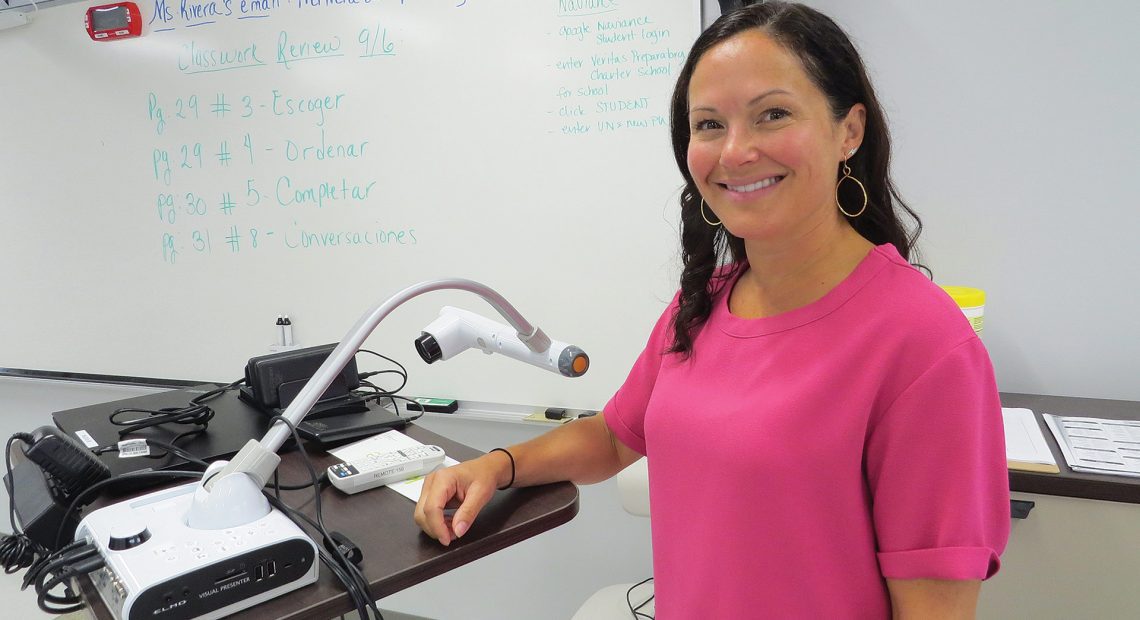
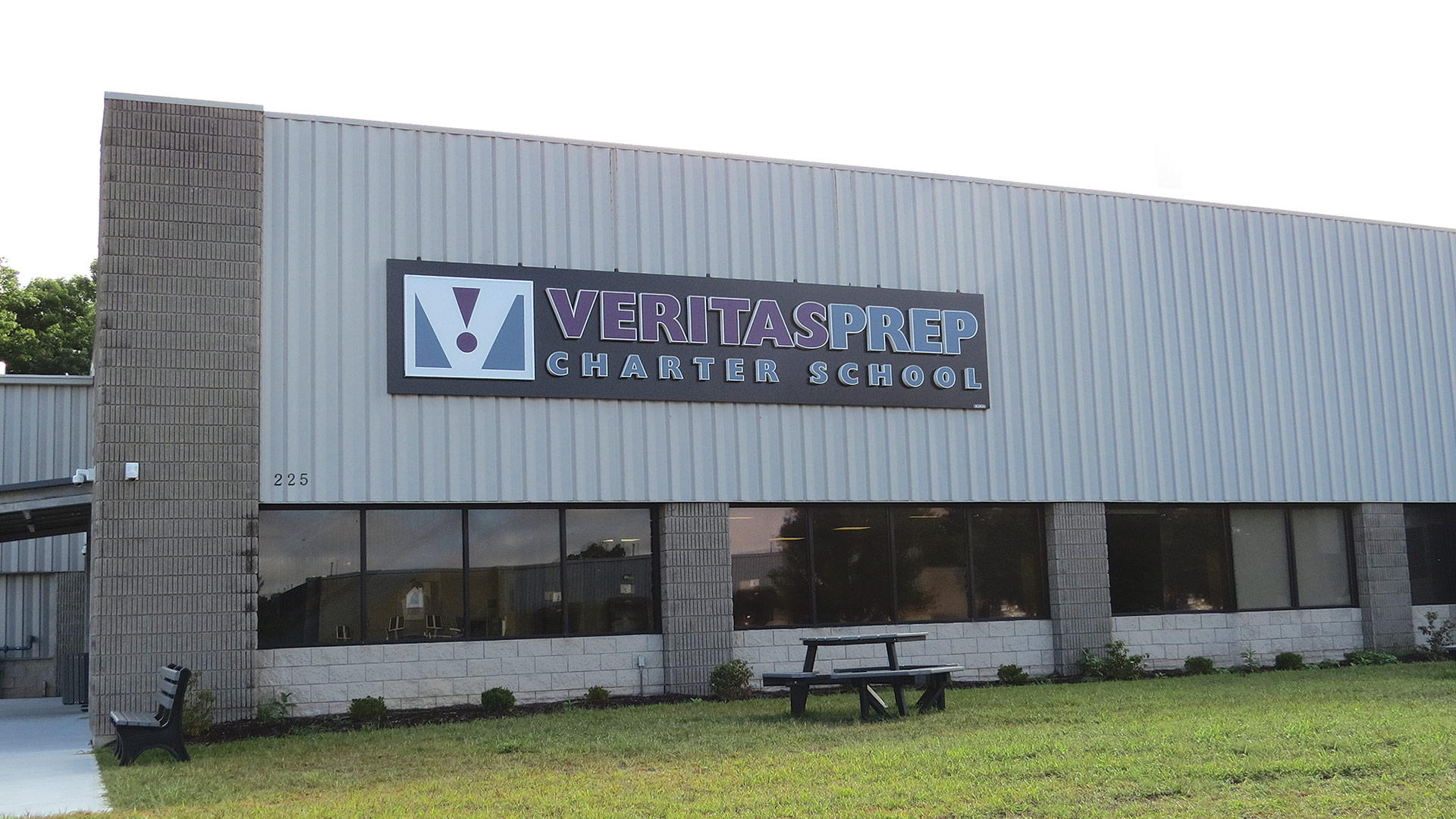
Rachel Romano, founder and executive director of Veritas Preparatory Charter School, shows off one of the classrooms in the recently opened high school.

Rachel Romano says she started Veritas Prep Charter School after becoming frustrated as a middle-school teacher in Springfield with just how ill-prepared students were to succeed — at the next level in their education, and in general.

She called it “unfinished learning,” and it was occurring at many levels, especially with reading.

“They really hadn’t made that shift from learning how to read to reading to learn, which should happen around third or fourth grade,” she explained. “But if it hasn’t happened and they come into the middle school, most middle schools are not designed to keep teaching that, so students really fall behind. When your foundation is weak, there is nothing to build on.”

It was with a desire to provide middle-school students with a better, stronger foundation so they would not fall behind that Romano started Veritas Prep Charter School, opening the doors in a former nursing home on Pine Street nearly a decade ago. And almost from the day it opened, parents and students alike were asking, ‘when are we going to start a high school?’

It took several years, considerable planning, the transformation of what was manufacturing space on Carando Drive, and many other pieces to fall into place, but that high school opened its doors late last month.

As Romano, an educator but also a true entrepreneur (and BusinessWest 40 Under Forty honoree in 2013), put it, in some ways, the new Veritas facility is high school reimagined. This is a career-focused, early-college model designed, like the middle school, to enable students to succeed at the next level — whatever that might be.

“To get two years of college under their belt while still in high school … it just compresses their timeframe to earn a degree.”

For many, it will be college, she said, but higher education is not the goal of every child.

“But every kid should have the choice,” she said. “And if they’re prepared for college … then they have options open to them; the doors are not closed to them.”

The early-college model is just what it sounds like, she noted, adding that students can take college courses while in high school and could even have an associate degree upon graduation.

Having a track record of success in college even before walking across the stage to pick up their high-school diploma instills confidence in students and a mindset that they can accomplish anything they might dream, she said, adding that this model also brings great advantages when it comes to the overall cost of a college education.

“To get two years of college under their belt while still in high school … it just compresses their timeframe to earn a degree,” she explained. “That can be a huge help when they decide to go and get their degree.”

For this issue, BusinessWest talked with Romano about the new high school, but also the broader mission to provide students with that stronger foundation and the tools to build upon it.


Grade Expectations

As she offered BusinessWest a tour of the new high school, Romano started in the gym.

The gym is an important part of this equation, she said, noting that the middle school doesn’t have one, and students, parents, and others involved in the design process of the high school identified it as priority.

The gym thus represents an example of how a vision became reality, one that officially started with 90 students (many of them being graduates of the Veritas middle school), teachers, and staff gathering on opening day in late August.

The student demographic at the high school essentially mirrors the grade 5-8 enrollment, said Romano, adding that 70% are Latinx and another 20% are Black. Meanwhile, 83% have what she called ‘high needs,’ and 77% are economically challenged.

The plan is to add a grade a year and build enrollment to roughly 400 students by 2025, she said, adding that for Veritas to realize that size and scope (800 students across nine grades) is something she could not have imagined when she first started conceptualizing this concept.

Indeed, to appreciate where Veritas Prep is now, we need to go back to the beginning, and that’s where we find Romano, a frustrated middle-school teacher, looking to find something better for the city and its young students.

Actually, the story starts in New York, where Romano was working in advertising sales in 2001, and the terrorist attacks on 9/11, which essentially left her homeless and heading back to Western Mass. and her parents’ home in South Hadley. She took a job substitute teaching to essentially get out of the house — “my mom kept nagging me about what I was going to do next” — and wound up loving the work.

She applied for a full-time teaching job in Springfield for the following year and wound up at Duggan Middle School, where she worked for six years and experienced what could be called a stern reality check.

“I didn’t have traditional training as an educator, so I came in with the expectations that had been set for me as public-school student myself,” she explained. “And I sort of believed that education was the great equalizer; everyone got a public education, and if you worked hard enough, you could go on to college and do whatever you wanted.

“And when I began teaching in Springfield, I realized that this just wasn’t true for everyone,” she went on. “My eyes were really opened to the inequity that exists in our public education system.”

What stood out to her — and eventually compelled her to start a new charter school — were the expectations for students and the system’s inability to prepare students for success.

“The expectations for students in Springfield were not that high,” she told BusinessWest, adding that this is how and when the seeds were planted for a new charter school.

“I didn’t have traditional training as an educator, so I came in with the expectations that had been set for me as public-school student myself. And I sort of believed that education was the great equalizer; everyone got a public education, and if you worked hard enough, you could go on to college and do whatever you wanted.”

She started by looking at urban settings with similar demographics but different results when it came to student performance and success.

“We went to New Haven and Boston, where we found schools serving similar populations of students and getting very different results,” she said. “These kids were outperforming their neighboring wealthy districts, like kids in East Boston outperforming kids in Wellesley, and we saw the same in New Haven, and we went and looked at those schools and said, ‘wow, what are they doing?’ They were charter schools.”

The schools were different in some ways, but a common denominator was a needed level of autonomy to “actually respond to the needs of the kids in front of them and create the kind of school and systems that could generate different results.”

Fast-forwarding significantly — getting a charter school off the ground is a lengthy, complicated ordeal — Romano set about creating Veritas, a middle school that would “reset the bar,” as she put it, one that borrowed (‘stole’ was the word she used) best practices from high-achieving schools, set high standards for its students, and prepared them for high school.

And, as noted earlier, it wasn’t long before parents and students alike were asking if the same model could be used to create a high school, questions that grew louder as the first classes of Veritas students were graduating and moving on to the city’s schools.

The cafeteria in the new high school

The cafeteria in the new high school is one of the many aspects of the facility that are state-of-the-art.

Eventually, the chorus became too loud to ignore, she went on, adding that she went to the Veritas board of trustees with the concept of a high school, and the ambitious concept was greeted with enthusiasm.

A request for expansion was submitted to the state Department of Education in 2019, and, upon approval, what became a two-year planning process commenced. With that time, a design team comprised of former students (those now in high school or their first year of college), current students, families, teachers, staff members, representatives of area colleges, and community partners put together for a blueprint for a high school.


Course of Action

And by blueprint, she meant not just the actual design of the school — and its gym. Rather, she meant a plan for helping to make sure that graduates of the school would not have doors closed to them.

“We looked at different models, and we looked into what was happening — where is the innovation in high schools now,” she said, putting the accent on ‘we.’ “We focused on what we could do better and what we could do that was different.”

And the chosen model was early college, or EC, as it’s called, she said, adding that it is a somewhat unique model for this region.

“There’s not a lot of it in happening in Massachusetts,” Romano went on. “There’s a lot of talk now in the Legislature and the Department of Education about early college, but there are some great examples in other states.”

Elaborating, she said this is certainly not a new concept — many area school districts have dual enrollment, with students talking college courses while in high school. But this model is different in that it’s “wall to wall” early college and not merely for exceptional students in accelerated programs, as it is in many schools.

“Every student will be able to earn 12 college credits — it’s not for a subset, but for everyone,” she said, adding that, while some might earn as few as 12 credits, some may actually garner two full years of college credits while at Veritas.

“They can literally walk across the stage with a high-school diploma, and an associate degree awarded by Springfield Technical Community College,” she said, adding that STCC and Worcester State University have both signed on partners in the initiative.

“The cool thing about this model is that it really just breaks down the barrier that it’s really tough for a first-generation college student to access college,” she told BusinessWest. “So our kids will actually have a college transcript; they’ll have a track record of success in college when they graduate.”

And, as she noted, having that head start brings advantages on many levels, from a student’s confidence level to the cost of a college education.

“For some of our kids, they may go straight to college, while others will have to go to work, and they’re going to have to finish college at night and on weekends,” she explained. “This just gives them such a leg up because they’re halfway done — they’ve already got it, they’re on a roll, they’ve built some momentum.”

Building needed momentum was just one of the goals for Romano, the Veritas board, and other supporters as they went about conceptualizing the new high school. The overall mission is to eliminate barriers to success, open doors, and provide that leg up that she talked about, and it shows enormous promise for doing all that.

Returning to that question of why and how a high school came to be reality, she said that she and others at the middle school simply didn’t want to let go of their students.

“Many of our students come in not loving school, for whatever reason,” she explained. “School and learning hasn’t been an experience they’ve really enjoyed and felt that they’re really good at; we’ve kind of turned that around for them in the middle grades. By eighth grade, they’re really invested in their education.”

And now, they can continue investing at another important level.


George O’Brien can be reached at [email protected]

Commercial Real Estate Special Coverage

A Landmark Decision

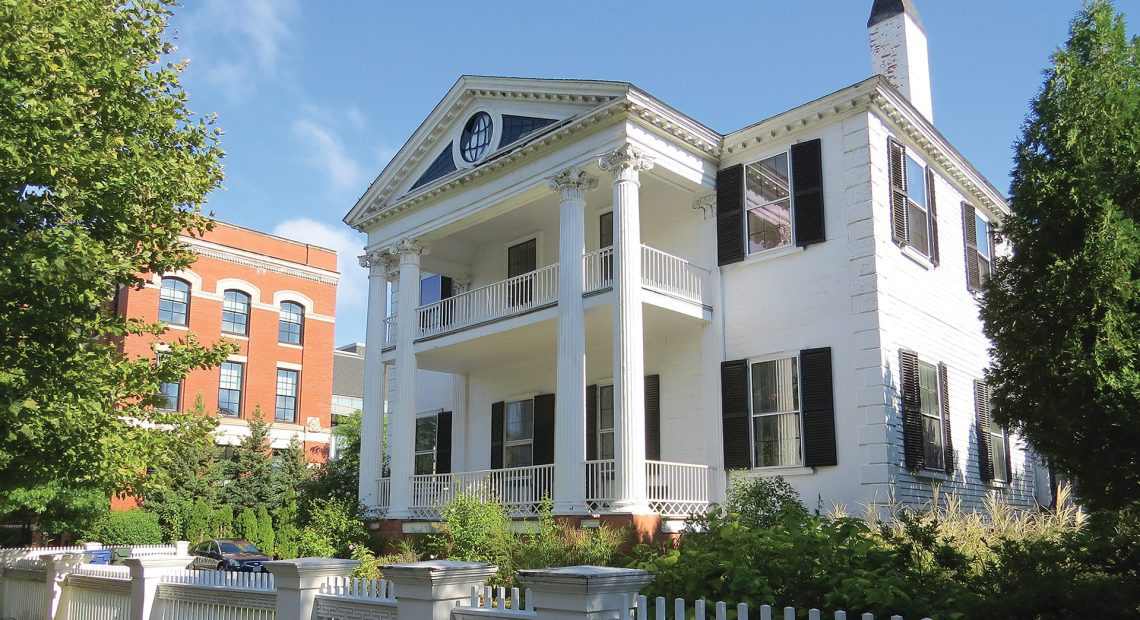
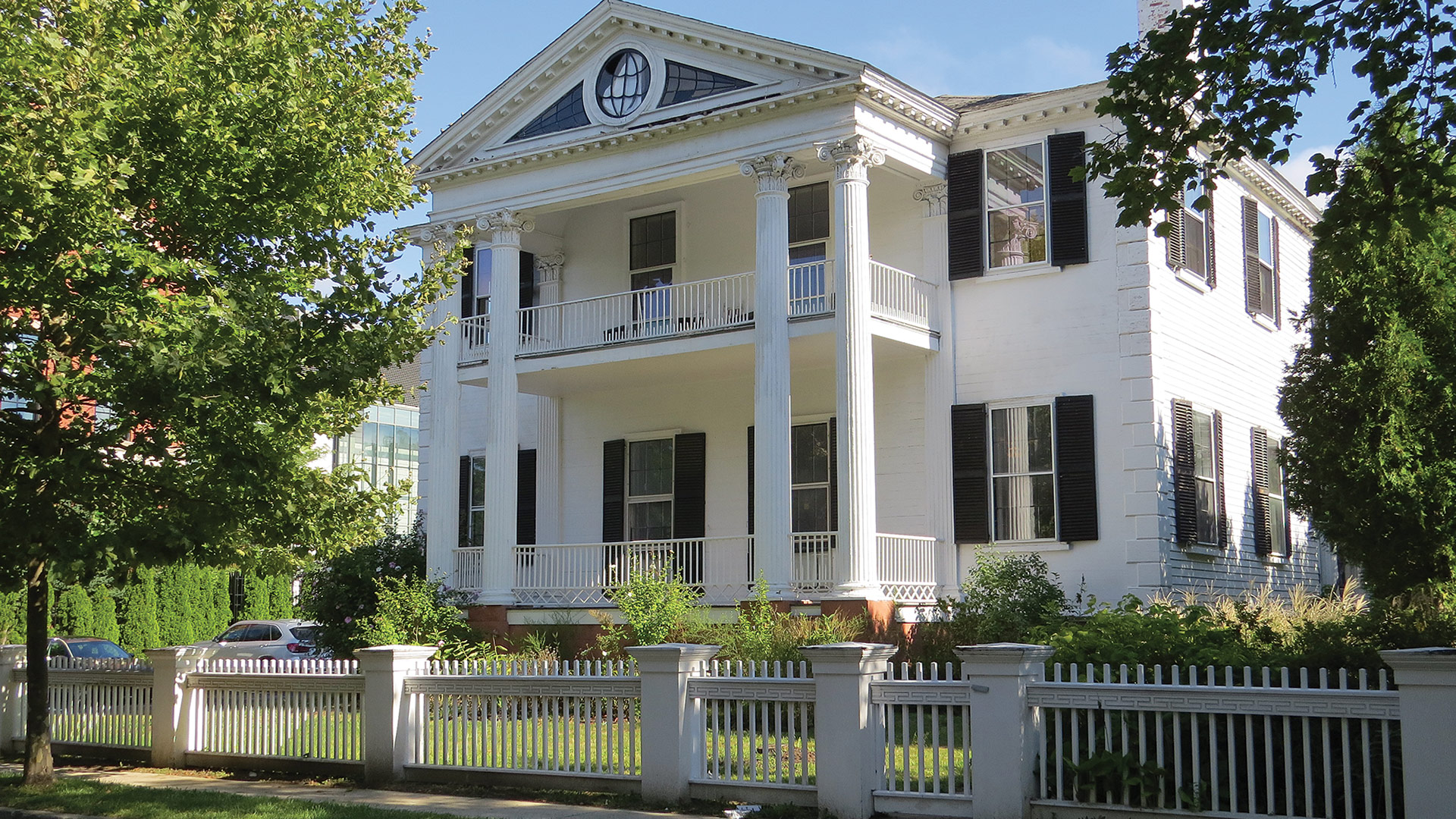
The historic Alexander House

The historic Alexander House

Amy Royal first started taking notice of the Alexander House in Springfield when she was a high-school student at nearby MacDuffie, and soon became taken in by its beauty, 200 years of history, and place in the city. Later, she started viewing the property in a different light — as a potential home for her growing law firm. Earlier this year, that dream came true.

Amy Royal says she’s long had an affection for the historic Alexander House in Springfield.

She first took hard notice of it when she was in high school at MacDuffie, located a mile or so away from the home’s former location on State Street. Back then, she recalled, it was a beautiful home with a lot of history, and she’s always had a fondness for structures that fit that description and now lives in a home that is nearly 250 years old.

Later, after beginning her career as an employment-law attorney and eventually starting her own firm, she started looking at the 6,000-square-foot home, built in 1811, in a much different light — as a place to locate her business.

Amy Royal, seen at the grand staircase of the historic Alexander House, has long had her eye on the landmark as a home for her business.

“I’ve always really, really loved the building,” she told BusinessWest. “Everything about it — the design, its place in the city’s history … it’s magnificent.”

These thoughts only intensified after the Alexander House was moved from its long-time location around the corner to Eliot Street to make way for the new federal courthouse in Springfield that eventually opened its doors in late 2008. Royal had business in the courthouse, and eventually found parking a few hundred yards down Eliot Street, necessitating a walk past the Alexander House.


“At that point in time, it was beautiful, but you could tell that it needed a lot of help — even though it had been moved by the federal government, it needed a lot of love,” she recalled. “I remember thinking ‘I wish I could buy that building; I wonder if that building is for sale?’”

Today, Royal is living the dream, literally — the one about moving her growing business, the Royal Law Firm, into the Alexander House’s 14 rooms, and the basement as well.

She’s needed a new home almost from the day she moved into her now-former home, leased space in the large office building at 819 Worcester St. in Indian Orchard. She looked at both options, leasing and owning, and decided that the latter made far more sense.

But owning the Alexander House? Like she said, this was a long-held dream come true.

“I’ve always really, really loved the building. Everything about it — the design, its place in the city’s history … it’s magnificent.”

For this issue and its focus on commercial real estate, BusinessWest talked with Royal about how her affection for this historic home became a quest — and eventually a dream realized. We also got a tour, one that quickly revealed why this landmark has been a career-long pursuit for Royal.


At Home with the Idea

Royal said she’s looking forward to being able to walk to the federal courthouse when she has business there, especially when she considers the large amounts of paperwork she traditionally brings with her when she’s in court.

Which … isn’t very often at all, she told BusinessWest.

One of the 14 rooms at the Alexander House

One of the 14 rooms at the Alexander House has become home to the Royal Law Firm’s main conference room.

“We’re civil litigators … if I don’t see the inside of a courthouse in a year, that’s not unusual,” she said, adding that location, location, location, the driving force in many decisions concerning real estate, was only a minor factor in this case. It was the property that drove this decision.

Since launching her own law firm, Royal has had lengthy drives to that federal courthouse. After starting in a small office on Center Street in Northampton, she relocated to larger quarters on Pleasant Street, and remained there until moving her headquarters office — she has satellite locations in several other cities — to a suite of offices in the building on Worcester Street in March 2020, just after the pandemic found its way to Western Mass.

She wasn’t expecting to be looking for a new home so quickly, but rapid growth — traditionally put in the ‘good problem to have’ category, although it does present challenges — made a change necessary.

“I knew we were outgrowing our space where we were — I just didn’t expect to outgrow it as quickly as we did,” she explained. “I just casually started looking for something.”

In a nice twist of fate, this casual search coincided with the Alexander House being put on the market in June 2021, signaling the start of a new chapter for a home that had seen plenty of history and had become historic in its own right.

Designed by the prominent architect Asher Benjamin and built by noted builder Simon Sanborn, the Greek revival home draws its name from its fourth owner, Henry Alexander Jr., a mayor of Springfield who acquired the property in 1958. But it has another, less-known known name, the Miss Amy House, derived from Alexander’s daughter, Amy, who lived in the house for many years and was quite active in the community on a number of philanthropic fronts.

Rooms at the Alexander House have been converted into a small conference room and lawyers’ offices.

The home has had a relatively small number of owners over the years, said Royal, who has come to know the history of the property — she learned in high school that one of the dorms there was designed to reflect the Alexander House — and is always seeking to learn more about it.

When a search was commenced for a home for a new federal courthouse at the start of this century, those involved, and especially U.S. Rep. Richard Neal, became determined to find a location on State Street, long the cultural and historic thoroughfare in the city and home to several schools, churches, and government buildings.

The property on which the Alexander House stood became the preferred location, and to make it happen, a short but complicated — because of the size, age, and condition of the home — move had to undertaken, one that was well-chronicled and captured the attention of the city.

After the move, the home became to several small businesses, including an architect and an attorney, but much of it was unoccupied. As noted, it came on the market in the summer of 2021, and soon after, Royal commenced her pursuit of the home.

Because of that aforementioned move, the home now has a new foundation, one of many features that caught her eye when she toured the property after it went on the market.

“The foundation they put in is incredible — there must be 10-foot ceilings there,” she told BusinessWest, adding that her firm will use that space as a filing center but may eventually build it out.

“I’ve always really, really loved the building. Everything about it — the design, its place in the city’s history … it’s magnificent.”

But there was so much more, obviously.

“I thought it was magnificent — the spiral staircase alone just stood out to me,” she recalled. “But every facet of the architecture — the crown molding, the ornate craftsmanship in all of the trim work, the grand ceilings, the chandeliers, the fireplaces … to me, it just spoke of having a law-firm practice inside; it’s a magnificent place to have a law firm.”

Royal said she heard anecdotally that there were a number of other suitors for the Alexander House when it came on the market. She believes she prevailed because her passion for the property quickly became evident, and she convinced then-owner Thomas Schoeper that she would be a good custodian of the landmark.

“He really wanted someone who would be a good steward of the property and really cared about its history and character and the integrity of the building itself,” she noted. “I spent a lot of time talking with him about all that.”

Royal closed in February of this year and has spent the past several months giving the property that ‘love’ she said it needed. Improvements have included a new HVAC system, an alarm system, remodeling the kitchen, installing IT wiring throughout, and painting many of the rooms, she said, noting that the property is subject to historic covenants and monitored by Historic New England, and also subject to an annual inspection and historic preservation.

The firm moved in a few weeks ago and is still settling in, Royal said, adding that, with a property of this vintage, there will always be work to do.

“That’s going to be a never-ending project,” she said. “That’s the way it is with historic buildings.”

Meanwhile, her new mailing address is everything she hoped it could be and would be when she first started thinking about it as a future home all those years ago.

“Everyone here just loves it — it’s a great place to work,” she said.


Right Place, Right Time

Noting the continued growth of her law firm, Royal was asked if the Alexander House provides the requisite space for additional team members.

She said it did, but in a more emphatic voice, she noted that she would not be moving again — soon or probably ever.

“We may grow in other regions — that’s the plan — but this will be our headquarters building,” she said. “This is home.”


George O’Brien can be reached at [email protected]

Cannabis Special Coverage

Cannabis in Flux

Aaron Vega

Aaron Vega says cannabis has been a definite economic driver in Holyoke’s downtown and canal district.


According to the Cannabis Control Commission (CCC), legal marijuana is now an annual $3 billion business in Massachusetts.

The communities that have embraced it from the beginning, like Holyoke, can attest to cannabis as an economic driver in terms of commercial real estate, jobs, and other opportunities. The city now has four dispensaries, three grow facilities, and a testing lab up and running, with dozens of other applications at various stages of the permitting process — a process, city Planning & Economic Development Director Aaron Vega said, that was always intended to be easy to navigate.

“This community voted in favor. The mayor was in favor. As a state representative, I was in favor. And we didn’t want to make it more difficult. It was challenging enough with the regulations coming down from the state. We saw this as an industry that could take over some vacant and underutilized buildings, and that’s what informed how we went forward.”

That has indeed occurred. “We’re very excited about the investment that has happened — tens of millions invested in these downtown buildings because of cannabis, and 500 jobs that didn’t exist three years ago,” Vega said, noting that the cannabis enterprises themselves aren’t an endgame, but a way to spur even more investment.

“What do you do with 500 people? You make sure they’re going to your concerts, going to your restaurants and events, utilizing your local food trucks. And then there’s the ancillary businesses to the cannabis industry; how do we lure them to the city and make it even more beneficial for companies to do business in Holyoke?”

Other cities and towns have, to varying degrees, told similar stories. But the host-community agreements they’ve put forward have not always been well-received, and that was one of several issues addressed last month by a multi-faceted cannabis bill passed overwhelmingly by the state Senate and House of Representatives and signed into law by Gov. Charlie Baker.

“We saw this as an industry that could take over some vacant and underutilized buildings, and that’s what informed how we went forward.”

Among its main elements, the law clarifies the host-community agreement (HCA) process by authorizing the CCC to prioritize social-equity program businesses and economic-empowerment priority applicants for expedited review.

It also clarifies the scope of HCAs and adds new criteria, mandating that no host-community agreement can include a community impact fee that is beyond the business’s eighth year of operation, the community-impact fee must be reasonably related to the actual costs required to operate a cannabis business in a community, the CCC must review and approve each HCA as part of the license application and renewal process, and all host communities must establish procedures and policies to encourage full participation in the regulated marijuana industry by people from communities that have been disproportionately harmed by marijuana prohibition and enforcement.

“Communities of color across our country have historically been criminalized, prosecuted, and left out of the conversation in regards to cannabis legalization,” state Sen. Adam Gomez said. “When cannabis was legalized in Massachusetts, those same communities continued to be barred from the conversation table and left behind, with historic barriers preventing them from growing small businesses in meaningful ways. The legislation passed by the legislature will remove those barriers.”

The law also expedites the expungement process, Gomez noted. For individuals seeking to expunge a record for previous offenses that are now decriminalized, the law requires the court to order the expungement of the record within 30 days of the request and expunge records for possession or distribution of marijuana based on the now-legal amount.

“It is incomprehensible that anyone who was charged with a marijuana-related offense still has that on their record in our state, especially when you can drive down the street to a dispensary to buy the same product that that person was arrested for,” Gomez said. “I was proud to support this legislation and can’t wait to see cannabis businesses run by BIPOC owners flourish as a result.”


Growing Pains

The law makes other major changes as well, including a clarification of the local social-consumption approval process.

The advent of what’s known as cannabis cafés will give renters, public housing tenants, and tourists a legal place to use a legal substance. Under this legislation, a city or town may allow for social consumption sites through the passage of a bylaw or ordinance.

The legislation also creates a trust fund to make grants and loans to social-equity program participants and economic-empowerment priority applicants, which will give entrepreneurs from communities that have been disproportionately harmed by marijuana prohibition and enforcement better access to grants and loans to get their businesses off the ground.

In addition, 15% of the revenue collected from the sale of marijuana and marijuana products must be transferred to the Cannabis Social Equity Trust Fund, which will be administered by the Executive Office of Housing and Economic Development in consultation with a newly created Cannabis Social Equity Advisory Board.

“It is incomprehensible that anyone who was charged with a marijuana-related offense still has that on their record in our state, especially when you can drive down the street to a dispensary to buy the same product that that person was arrested for.”

“This legislation will create a more equitable cannabis industry in the Commonwealth,” said state Sen. Jo Comerford, noting that lawmakers “approached this issue with expertise and compassion, and the resulting bill will bring more diversity and equity to this industry.”

House Speaker Ronald Mariano added that “the passage of this legislation will help to ensure that those who have been historically impacted by marijuana prohibition can find new opportunity in the emerging industry. This legislation will help to support folks who have faced generations of inequality secure the needed capital to launch a cannabis business.”

The loan fund highlights one of the challenges of starting a business that’s technically illegal under federal law. Although there have been rumblings that the U.S. Congress could move to decriminalize cannabis and open up traditional financing to such businesses, nothing has been done so far.

“It’s still a hard-money business,” said Tim Sheehan, chief Development officer for the city of Springfield, and that affects both entrepreneurs and property owners. “That’s challenging from a real-estate standpoint. If that were to change, it would provide a more stabilized financial underpinning for the industry itself, and obviously, that would translate into folks that have space feeling far more comfortable in terms of the security they have relative to leasing and everything else. It would be accepted in the mainstream financial market.”

While Springfield didn’t embrace cannabis in the unfettered way Holyoke did — the city has put forward two rounds of retail applications and one for a grow facility, but that project, by Page Cultivate LLC in East Springfield, was derailed by the City Council in May over a site-plan change and other concerns — many of its leaders recognize the economic value of the burgeoning industry.

“Once it was legalized, there was clearly a focus on it becoming an economic benefit for the city,” Sheehan said. “Much like when gaming was legalized, we looked to see what the economic potential of the cannabis industry would be relative to both city finances and economic impact in terms of the marketplace.

“Much like when gaming was legalized, we looked to see what the economic potential of the cannabis industry would be relative to both city finances and economic impact in terms of the marketplace.”

“Obviously, the industry has had an impact on storefront and warehouse space, and I would quantify that as a positive impact,” he went on, adding that it remains to be seen what kind of impact the cannabis trade will have on the surrounding residential real-estate market.

“Caution is the watchword. As an industry, it remains to be seen what the saturation point is, and I really think that needs to be factored in through the process with regard to how many of these establishments you’re going to allow, whether it be a grow facility or how many retail establishments you’re going to allow. There is a limited market.”


In the Weeds

The cannabis industry’s potential is still unknown, though the early results in terms of new businesses, tax revenues to communities, and jobs have been positive.

But Sheehan is right that no one really knows what the saturation point is, if there is one. And the Legislature’s sprawling cannabis bill last month was an admission that plenty about the permitting process — especially for traditionally disenfranchised communities — needs to be addressed.

As Senate President Karen Spilka put it, “I am thrilled we were able to reach a deal on this bill, which will take meaningful steps toward ensuring communities who have historically been harmed by marijuana criminalization can access resources to enter this industry.”


Joseph Bednar can be reached at [email protected]

Sports & Leisure

Stressing the Fundamentals

Gene Cassidy, president and CEO of the Big E,

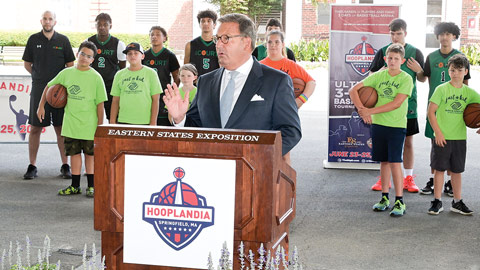
Gene Cassidy, president and CEO of the Big E, announces plans for Hooplandia at a press conference staged last month.

Mark Rivers acknowledged that a lot of things have changed since he and officials at the Big E and the Naismith Memorial Basketball of Fame first announced that the region would host a giant three-on-three basketball tournament to be called Hooplandia.

Indeed, that announcement came late in 2019, just a few months before the arrival of COVID-19, which would eventually cancel large-scale events of all kinds and put plans for Hooplandia on ice — for 2020, 2021, and then 2022.

But what hasn’t changed, said Rivers, a marketing and programming consultant to the Eastern States Exposition who has also worked with the Hall of Fame on tournaments, is that what he calls the ‘fundamentals’ are still in place.

“Fundamentally, and probably most importantly, the idea going in, even in 2019, was to create an event that would be around for 40 years or more, just like in Spokane. So if you’re looking at creating an event that’s a 40-year event, it doesn’t get stale after a few years — it’s still a grand idea and still a great proposition for the region.”

“Three-on-three basketball is still very, very popular, and Springfield is the birthplace of basketball,” he told BusinessWest, as he explained, succinctly and effectively, why those who conceived Hooplandia are still bullish on this concept and are proceeding with a tournament set for late June 2023.

If anything, conditions are even better, he said, noting that three-on-three basketball has only become more popular as a sport — and a competition (more on that later).

John Doleva, president and CEO of the Hall of Fame, agreed, noting that, while it might have been easy to walk away from the event given all the challenges and uncertainty moving forward, the vast potential of the concept led them to stay the course.

The cover of the March 2, 2020 edition of BusinessWest

The cover of the March 2, 2020 edition of BusinessWest announced Hooplandia. That was just a few weeks before the pandemic shut down the state and put Hooplandia on ice for what will be three years.

“Everyone stayed with it, and that’s very encouraging,” he said. “To have all those entities — the Big E, the city of West Springfield, Mark Rivers — step up and be as committed, if not more, after a couple of years is a very positive thing.

“Everything is lined up for a great event,” he went on. “It just took a little longer to get there.”

In fact, it will be roughly four years from the date it was first conceptualized until the whistle that starts the first game on June 23, 2023. But everyone involved is sure it will be worth the wait.

Turning back the clock, Rivers said planning for Hooplandia began in early 2019. Inspired by a huge tournament in Spokane, Wash. called Hooptown USA that brings tens of thousands of people to that city every June, Rivers conceived of a concept that would unite the Big E and the Hall of Fame in an endeavor that would capitalize on the soaring popularity of three-on-three basketball and bring the game to the area where the sport was invented.

The March 2, 2020 issue of BusinessWest featured Doleva and Eugene Cassidy, president and CEO of the Big E, standing on either side of a poster promoting Hooplandia. The headline read: “Nothing but Net: Hooplandia Has the Makings of a Legacy Event.”

Just a few weeks later, the state was in lockdown. A few months later, it was clear to everyone that there would be no Hooplandia in 2020. And as the pandemic persisted and subsequent surges continued to hit the nation and the region, the tournament was scrapped for 2021 as well.

And while the situation improved somewhat that year — enough for the Big E to make a much-anticipated comeback after being idled for 2020 — there were too many uncertainties and not enough time to put a tournament in place for 2022, Rivers said.

Young players get a taste for 3-on-3 basketball

Young players get a taste for 3-on-3 basketball at the press conference announcing the Hooplandia event set for June, 2023.

“We thought we could do it in 2021, but there was still a lot of overhang related to crowd gathering and big events,” he said. “And with Hooplandia, you need almost a year’s run-up, because you open up registration six months prior and mobilize your whole organization, and we couldn’t predict what June 2021 was going to look like. Then, we get into 2021, and we just didn’t have enough time to get it organized for ’22; and once you commit, you commit, and we were fearful about putting a lot of time and resources into this and having to pull the plug again.”

But through all of that, no one involved in Hooplandia had any thoughts of giving up on this concept.

That’s because of those fundamentals, he went on, adding that what was true in those early days of 2020 remains true today — Hooplandia does have the makings of a legacy event.

“Fundamentally, and probably most importantly, the idea going in, even in 2019, was to create an event that would be around for 40 years or more, just like in Spokane,” Rivers explained. “So if you’re looking at creating an event that’s a 40-year event, it doesn’t get stale after a few years — it’s still a grand idea and still a great proposition for the region. It’s not like three-on-three basketball went away or Springfield is no longer the birthplace of the game. Those things didn’t change.”

Essentially, organizers are picking up where they left off, said Cassidy, with expectations that the 2023 event will draw 1,000 or more teams (4,000 players) across a number of categories — from youths to veterans; from those in wheelchairs to what would be considered professionals in this sport — and that it will grow over time to draw several thousand teams and someday rival Spokane’s event in terms of size and prestige.

“Spokane is the benchmark because that is an economic driver — it’s an annual event that brings tens of millions of dollars to the local economy. To bring in 1,500 teams and grow that every year to 10,000, that’s a big initiative, but it’s not an unrealistic goal.”

The original plan was to mobilize the grounds of the Eastern States, play a handful of games at the Hall of Fame, have both organizations work together on marketing and promoting the event, and conduct some outreach to basketball organizations and teams throughout the Northeast, Rivers said. And, by and large, that is still the plan.

If anything, he went on, three-on-three basketball is probably even more popular than it was when Hooplandia was first conceived.

“It’s now an Olympic sport, it’s now an international sport with national teams representing their countries in international play, and there’s more and more tournaments around the country that are focusing on this caliber of basketball,” he explained. “So it’s become a little more common, and I think we have a great opportunity to be a leader in that segment.”

Doleva agreed.

“No one has stepped back from that, and I guess that’s the big thing,” he said. “No one has said, ‘let’s do this on a 25% scale.’ It’s all hands on deck.”

Elaborating, he said local organizers have Spokane as a target, with a goal of seeing Hooplandia approach and even exceed that scale when it comes to everything from the number of participating teams to the impact on the local economy.

“Spokane is the benchmark because that is an economic driver — it’s an annual event that brings tens of millions of dollars to the local economy,” Doleva told BusinessWest. “To bring in 1,500 teams and grow that every year to 10,000, that’s a big initiative, but it’s not an unrealistic goal.”

Hooplandia will actually be staged the same weekend as the festival in Spokane, but organizers don’t see it as competition for that event.

“We’re 3,000 miles away,” Doleva said. “We see this an opportunity for people from the Midwest east to come to Springfield and play in a tournament where they might not have gone all the way to the West Coast — and you have the allure of the Hall of Fame.”

These are more of the fundamentals that prompted organizers to take Hooplandia from the drawing board to reality more than three years ago. And they are the fundamentals that have prompted them to stay the course — and stay on course — through more whitewater than anyone could have imagined in early March 2020.

As Cassidy told BusinessWest and all those assembled at a recent press conference to announce the new date for the tournament, “it’s game on for 2023!”


George O’Brien can be reached at [email protected]

Sports & Leisure

The Sound of Music


Bryan Lynch performs at the 2021 Jazz Festival in Northampton.

Bryan Lynch performs at the 2021 Jazz Festival in Northampton.

Ruth Griggs is a firm believer in the power of jazz.

She says this brand of music has the ability to energize people and lift their spirits. It also has the ability to bring people, and a community together, said Griggs, who had seen this phenomenon at work in Northampton during the early years of its annual jazz festival.

And she also saw what was missing when the festival took a three-year pause toward the end of the last decade, and that’s why she became instrumental — that’s an industry term — in not only bringing the festival back to Northampton in 2018, but bringing it to more of Northampton, meaning more venues across this thriving arts community.

In fact, she was honored earlier this year by BusinessWest with its Difference Makers award for her efforts to bring the jazz festival back to the Northampton — and the region.

“Live music helps lift people’s spirits and it just gives them a positive feeling; these are professional musicians, they know what they’re doing, and it’s a real pleasure for the audience to be able to experience that,” said Griggs, adding that there will be plenty to experience at the 2022 Northampton Jazz Festival set for Sept. 1-Oct. 1.

A number of local and regional artists are scheduled to perform, she said.

“On Friday night, we have what we call the Jazz Strut, held at Pulaski Park and six different breweries and restaurants, throughout downtown; there is free jazz at these establishments all night long,” said Griggs, listing venues ranging from the the park to the Northampton Brewery; from Spoleto to the Wurst Haus.

“Jazz Fest Day will be on Saturday,” she went on. “World-class musicians are playing at no charge to the public. They’ll be playing in a variety of venues in and around Pulaski Park this year.”

The main stage act, the Ron Carter Quartet, will play at the Academy of Music on Saturday. It is the one paid performance; patrons are required to buy tickets online before the show, she said, adding that ticket sales are on a record pace.

The Northampton Jazz Festival was started in 2011 by a group of enthusiasts who were looking for something to replace the “Taste of Northampton” as a way to bring people — and energy — to the streets of Northampton. The festival was staged in the Armory Street Parking Lot and had a five-year run before losing steam.

After a three-year absence, momentum started to build to bring the festival back, with Amy Cahillane, executive director of the Downtown Northampton Association, taking the lead.

“Amy had come to me in 2017 and said ‘people are talking about this jazz festival. I’m not too familiar with it, but they are really looking for live jazz downtown. Is there any way it could be brought back?’ said Griggs. “And, long story short, with Amy’s impetus, we brought it back.”

Griggs told BusinessWest that the weather for the end of September can be hit or miss, but otherwise it is a perfect weekend for the festival, with little else on the calendar to compete with the event. She is predicting large crowds and large amounts of energy.

“The festival adds a sense of vitality and energy, like things are happening here, and that’s so important after what we’ve been through with COVID,” said Griggs. “It’s important for people to see there is creativity and artistry that’s happening in Northampton that is accessible, participial, and professional. It’s good music. We’re really happy to be a part of that for people that live here as well as for people that are coming in from out of the area.”

Indeed, not only is the festival creating a stronger sense of community, but it is drawing people into the city. Griggs told BusinessWest that with the increased number of ticket sales, she anticipates a higher volume of visitors this year.

“Maybe they (tourists) have known about Northampton or have stopped in once or twice; maybe they haven’t stopped into the city before, but I hope that when people stumble across this jazz festival, they are just absolutely delighted by it. I just hope to bring more people to Northampton than we ever have before.”

Insurance

Counting the Cost

By HUB International New England


When do you need to list your teen driver on your car-insurance policy, and how can you make this additional coverage fit in your budget?

It is certainly not inexpensive to get car-insurance coverage for a new teen driver. When a teen driver is added to their parent’s policy, the typical insurance premium for a one-car family is likely to increase by 40% to 50%. If you’re a multi-car family, then you will probably see your insurance rates rise even higher. And if you’re opting to reward your new driver with a car and expecting them to secure their own insurance policy, you should prepare yourself — or your teen — to pay at least a couple thousand dollars in car-insurance costs.

So we understand why parents might want to hold off on getting auto insurance for their teen driver until absolutely necessary. However, even if you think your teen will only occasionally be borrowing the family car, the fact is they are now a licensed household member. As such, if you do not add them to your current policy as a covered driver, you risk being denied by your insurance carrier for any future claims, having your coverage terminated, or both.

In addition, should you decide you want to shop around for a better car-insurance rate, you will also need to make sure your teen driver is listed on all of your insurance applications so that you get an accurate quote and adequate coverage.


Six Tips for Saving Money

At HUB International, we have several strategies for saving money that we discuss with our clients:

• You can take advantage of discounts such as Good Student, which rewards teens with a grade point average of ‘B’ or higher. If your student is eligible for this discount, it may save you hundreds of dollars on your car-insurance premium.

• Completing defensive-driving courses can also earn you and your teen significant monetary credits toward your policy premium. Even more, your teen will hopefully drive away from this course with a better understanding of how to keep safe behind the wheel. Since even minor fender benders can drive up your insurance costs, it’s critical that your teen — as well as all other family members listed on your policy — do their best to keep their driving record clean of any accidents and moving violations.

• Investing in accident forgiveness can limit the financial impact in the event your teen does get in a car accident. Since 16-year-olds have higher crash rates than drivers of any other age, we recommend that our clients with teens strongly consider this endorsement, which can cancel out the surcharge points that are typically assessed by your insurer after an accident.

• Sharing a vehicle with your teen rather than giving them their own vehicle may allow you to classify your youngster as an occasional driver rather than the primary driver, which is another excellent way to keep your insurance rate lower. If you decide, however, that your teen will need a car of their own, it may make financial sense and keep your insurance costs down to assign them as the primary driver of the family vehicle that is the least expensive.

• Are you adding a vehicle to your household for your teen to drive? Look for a car with safety elements, such as anti-lock brakes, airbags, and anti-theft devices, as insurers will often reward you for having these features with lower car-insurance rates.

• Monitoring your teen driver with today’s technology can not only help you keep an eye on your teen when they are on the road, but also earn you discounts on your car-insurance premium. Some insurers are now offering devices to parents that can be installed under a car’s dashboard and create a report card of your teen’s driving behavior. Information may include the number of miles the car covers, how fast your teen is driving, the hours the car is on the road, and how often your teen slams the brakes. Insurers with this program are providing discounts ranging from 15% to 30% to drivers who achieve predetermined safe-driving benchmarks.

• Raising your deductibles lowers your premiums. However, this is only a smart choice if you are comfortable knowing that you might end up having to pay a larger share of costs for an accident out of your own pocket.


What Are the Options?

The team at HUB International has helped thousands of families across New England adapt to having a teen driver in their home. We know that your child’s newfound independence is exciting but may also cause you some stress and anxiety. But we can help make sure you and your teenager are insured properly.

While there is a natural desire to look for ways to cut costs on your insurance as your teen becomes a full-time driver — and drives up the cost of your premium — it’s definitely not the time to decrease your coverage limits or eliminate optional coverages. In an effort to save money, you could leave your teen and all other drivers in your home dangerously underinsured and at financial risk should they be involved in an accident.

Instead, it’s an excellent time to review your current auto policy with your insurance agent. We strongly recommend that our clients with teens carry more coverage than the state’s minimum required auto-insurance levels and that they opt for additional coverages such as collision and comprehensive. We also want to make sure that they are taking advantage of commonly overlooked car-insurance policy options that can save them money, stress, and time, like Bundle & Save, Disappearing Deductible, and Loan/Lease Gap Endorsement.

Finally, because teen drivers are, unfortunately, an accident-prone age group, once your child gets behind the wheel, your liability risk inevitably increases. So it’s not a bad idea to consider adding an umbrella policy to your insurance solutions for those worst-case scenarios where your teen is in an accident and is found at fault for bodily injuries to others or damage to other people’s property. For a minimal investment, this type of coverage may give you the peace of mind that your savings, investments, retirement accounts, and your family’s financial future are protected from an accident-related liability claim.

HUB, along with our partners, is committed to improving driver safety. Nationwide, well over half of new drivers crash in their first two years behind the wheel. Safety Insurance has partnered with the In Control Family Foundation to improve driver safety in Massachusetts. The In Control program offers a half-day, hands-on driver skills-development program that teaches drivers to avoid the most common and serious collisions. In Control’s crash-prevention training course has been shown to reduce crashes by new drivers by 70%.

With Safety Insurance, you can save 5% on your auto insurance by completing In Control’s crash-prevention training course, as well as saving more than 70% on the course itself.

Contact HUB for all of your insurance needs, and for additional information on programs such as In Control, call (833) 462-2554.

Insurance

Water, Water Everywhere

By Peter Normand


According to a 2020 report from the First Year Foundation, there were 336,000 properties in Massachusetts alone that were at some level of risk for flooding. This number is 65% higher than the existing flood maps indicate.

The heavy rains of last summer and the claims that followed got me wondering what the future holds. We are beginning to feel the impacts of climate change in more severe and less predictable weather. How valid are our flood maps? What can property owners do to protect their property in an uncertain future? If you haven’t talked about flood insurance with your insurance agent yet, now is the time.

Banks require flood insurance on all properties that are located in a flood zone per existing flood maps. Why do they do this? Commercial and homeowners policies exclude flood as a cause of loss. Nearly all of my commercial insurance clients who have flood insurance have purchased it to satisfy a loan requirement. Nearly everyone else is rolling the dice — most stating that, since they aren’t in a flood zone, it’s not an issue. After a very wet summer of 2021, however, the conversation is changing, even if this summer has been drier.

Let’s start off by defining what a flood is. Floodsmart.gov notes that “flood insurance covers losses directly caused by flooding. In simple terms, a flood is an excess of water on land that is normally dry, affecting two or more acres of land or two or more properties.” Just because there is water in your basement doesn’t mean it’s a flood. In fact, water seeping into a foundation without the above definition being met would not be covered by flood insurance. When determining whether or not there is coverage, the cause of the flooding that damages your property does matter.

On the market side, there are more options than ever, with more carriers offering a flood product. This leads to more flexibility for our insureds. For example, some markets allow for multiple properties on a single policy, some carriers offer limits in excess of NFIP (National Flood Insurance Program) limits to adequately insure the value of the property, there are replacement cost (RC) and actual cash value (ACV) valuations, and more competition has created market pressure on premiums, especially for properties outside of flood zones.

With changing weather patterns and other unknowns, it’s reassuring to know that there are options. If you haven’t considered flood insurance in the past, or have been putting it off, now is the time to talk to you insurance agent. There is an expanding market with options to meet your specific exposures and needs.


Peter Normand is a Commercial Lines account executive and RiSC consultant with Webber & Grinnell Insurance.

Women in Businesss

‘A Pivotal Moment’


Rites of Passage & Empowerment (ROPE) recently announced its official transition to independent 501(c)(3) status. The Pittsfield-based program, founded in 2010 by Shirley Edgerton, a longtime educator, community activist, and mentor in Pittsfield, has been a fiscally sponsored project of the Women’s Fund of Western Massachusetts since its inception.

ROPE is a proven mentoring program for young women of color and young people identifying as female or non-binary. The mission of ROPE is to celebrate and honor the entry of adolescents into adulthood and provide them with skills and knowledge that they need to be successful, independent, and responsible people.

“This designation marks a pivotal moment for ROPE,” Edgerton said. “We are deeply grateful for the continuous and unwavering support of the Women’s Fund through the years. As we look ahead, we are excited to embark on this new chapter and continue our ongoing work with our scholars and ambassadors.”

Donna Haghighat, CEO of the Women’s Fund of Western Massachusetts, added that “it has been our honor to fiscally support ROPE and Shirley Edgerton’s vision. Too few philanthropic institutions believe in the power and possibility of the solutions that women of color create to address systemic barriers. The future is fierce thanks to ROPE’s nurturing of amazing young women and thanks to Shirley’s vision for ROPE itself.”

This new designation comes in the wake of other major news for the organization, which supports young people on their journey to a college education. This past April, ROPE was awarded a significant grant by the city of Pittsfield through its American Rescue Plan Act (ARPA) Community Awards.

“This grant comes at an essential time,” Edgerton said. “Now that we are an independent organization, this multi-year funding will allow us to build into the future with a solid and secure foundation.”

In addition to the weekly mentoring, monthly workshops, and local trips through the Berkshires, two key elements of the ROPE program are college tours and biannual service-learning trips to Africa.

“These opportunities provide our scholars with deep transformational experiences,” said Jean Clarke-Mitchell, a mentor with the program. “It is gratifying to see their growth and confidence bloom with each new opportunity.”

In July, ROPE scholars and ambassadors traveled to Accra, Ghana, where they engaged with young Ghanaians, learned about the customs and culture, and visited historic sites, including W.E.B. Du Bois’ former home, which is now a museum.

Edgerton explained that, while the grant allows for a variety of initiatives, funding guidelines do not include international travel, so the organization engaged in fundraising to ensure the mentees had access to this experience. She then noted the African proverb, “it takes a village to raise a child.”

“We depend on the ongoing partnership with community members who recognize and embrace their role as a part of ROPE scholars’ village. We are proud to know so many of our ROPE alumni return to the area to mentor the young people coming up behind them, to work in local organizations and government, and to otherwise give back to the community they come from,” she said. “Investing in these young people is truly an investment in the future of our community as a whole, and that is priceless.”

Cover Story Sports & Leisure

Looking Sharp

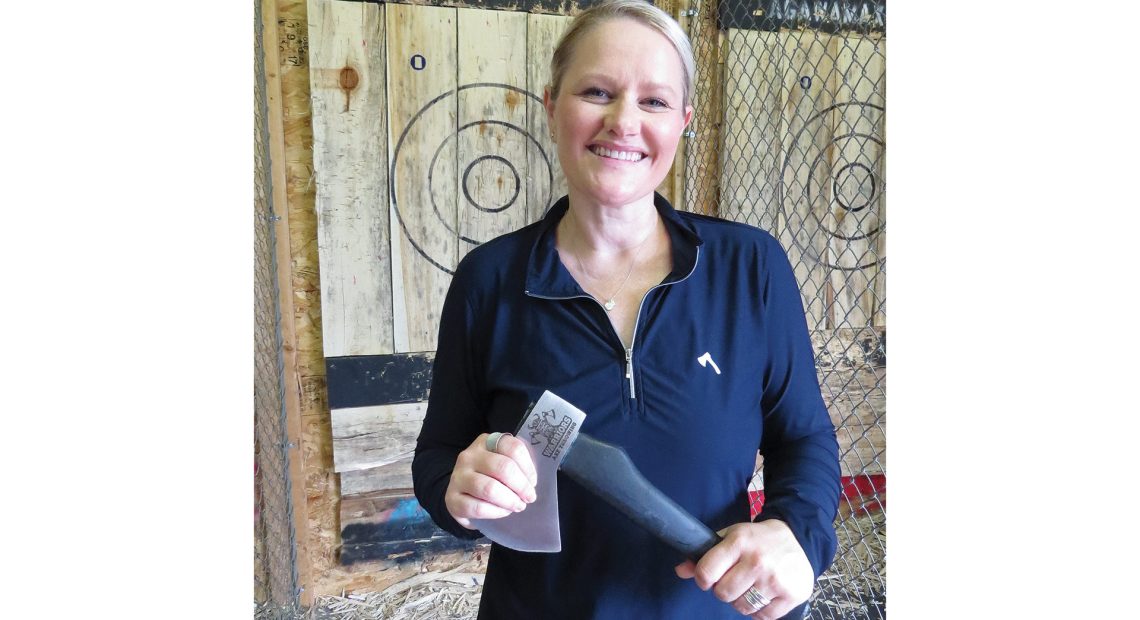
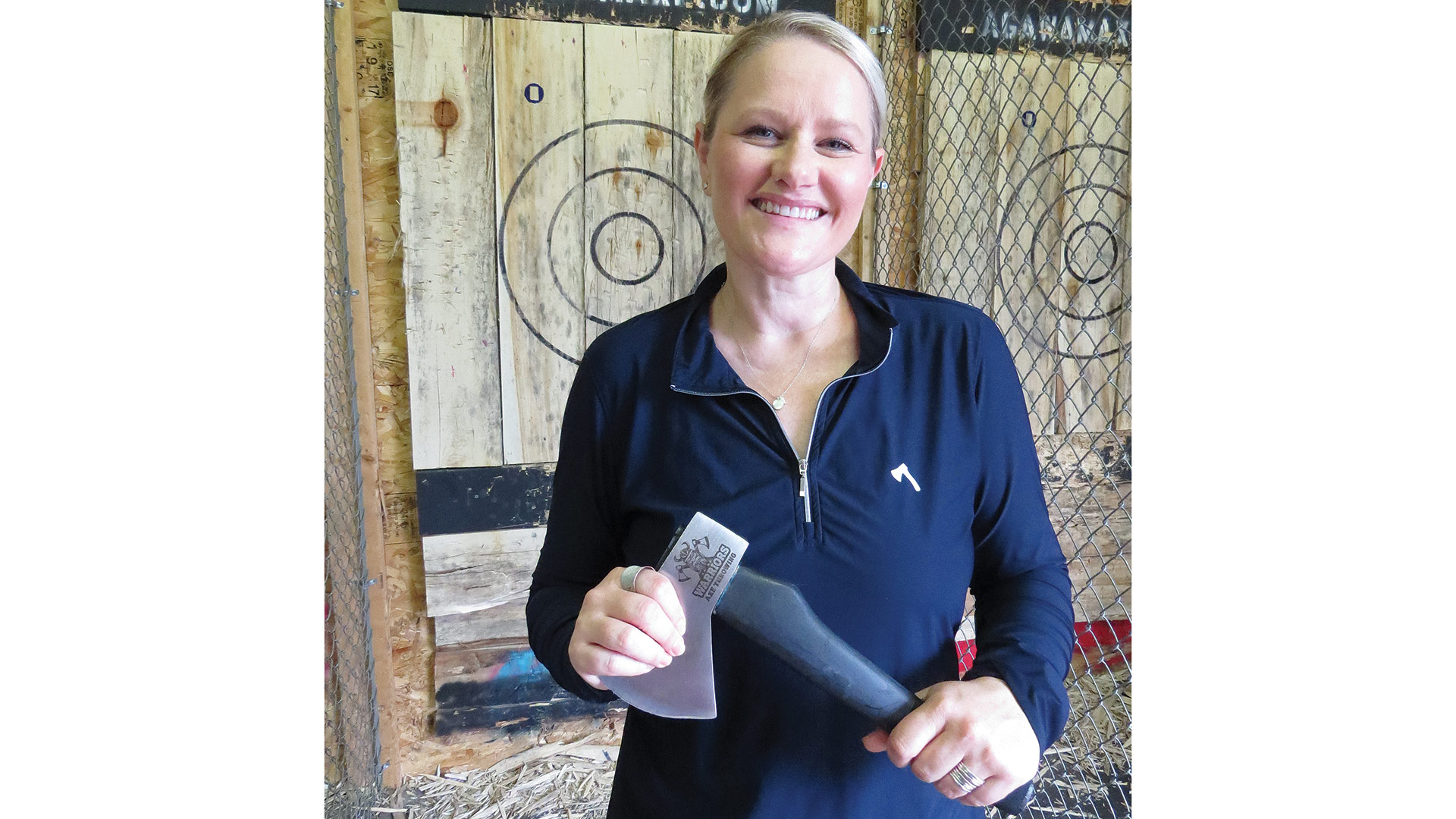
Anneliese Townsend

Anneliese Townsend


“Never attempt to catch an axe.”

That’s one of a handful of rules printed above the targets in each of the 12 lanes at the Agawam Axe House. And while that’s just good common sense, said Anneliese Townsend, founder and co-owner of this intriguing business, this reminder is there for a reason.

“You would think that would be pretty obvious, but, in fact, it’s a natural instinct to put your foot out and try to stop something coming at you, so we have to remind people that it’s an axe,” she told BusinessWest, adding that, since she opened the doors in January 2018, no one has tried to catch an axe.

But many have tried to throw one.

Indeed, this unique enterprise, said to be the first of its kind in New England, the only one in Western Mass., and one of just six currently operating in the state, has seen, well, a sharp rise in interest since it opened, and the numbers — of both participants and revenue — continue to grow.

The venue has welcomed a wide range of constituencies, from companies large and small that are looking for a new and different kind of team-building exercise (a large contingent from LEGO was in recently) to birthday, bachelor, bachelorette, and divorce parties (axe throwing has become popular among women, as we’ll see); from leagues that compete weekly to individuals, many of them professionals, who are looking to blow off a little steam and rid themselves of some stress.

There are many days when Townsend will see all of the above.

“It’s absolutely massive, and it’s getting bigger every day,” she said of the sport of axe throwing, which she was introduced to while on a trip to Montreal with her boyfriend (and now business partner), Bob Manning.

“We Googled ‘things to do in Montreal,’” she recalled, “and the second and fourth items that came up were both axe throwing, and I thought that it was the best thing I’d ever heard of.”

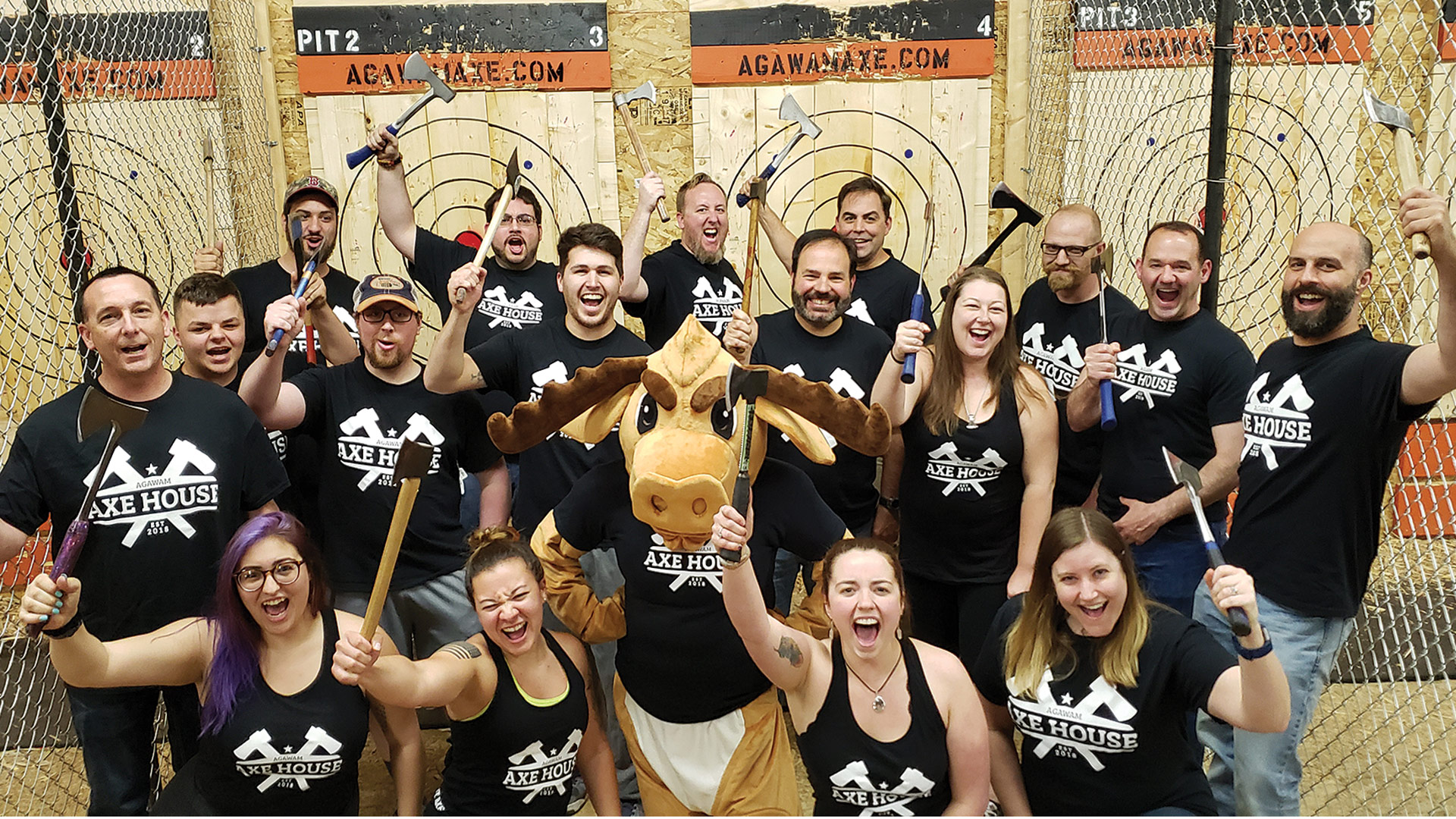
the Burn Battle

The Agawam Axe House hosts a number of leagues and fund-raising events, such as the Burn Battle, which raises money for the American Cancer Society. Participants in last year’s ‘battle’ are seen here. The 2022 edition is set for Oct. 2.

They went to such a facility, but because they were with Manning’s children, they could not partake — it was an over-18 activity, and for obvious reasons. But Townsend was certainly intrigued, and upon returning to Western Mass., she did another Google search, this one to find axe-throwing venues near Agawam.

The closest one she found was in New Jersey. Instead of driving there, this entrepreneur — she’s been involved with an ice-cream shop and some other ventures in this community — eventually decided to open her own facility.

“We Googled ‘things to do in Montreal,’ and the second and fourth items that came up were both axe throwing, and I thought that it was the best thing I’d ever heard of.”

And from the day it opened, it’s been a hit. Or, as participants in this activity might say in this sport, it has stuck.

Business is brisk, and as the sport gets more exposure — from ESPN 8 or from the many who have already tried it — Townsend expects it will only continue to grow in popularity.

When people try it, they find that it’s not nearly as hard as it might look, and it has become a proven stress reliever — at a time when many are having issues with stress, for one reason or another.

“We have a lot of doctors from Noble Hospital [in Westfield] who come in,” she said. “They’re the most stressed people out there.”

This writer tried it, and, after a few throws to get a feel for it and stop trying to ‘flick the axe,’ as Townsend put it, managed to stick a few. Hundreds of other people have done the same, and that’s why Agawam Axe House is more than on target with its business projections.

For this issues and its focus on sports and leisure, BusinessWest talked with Townsend about the sport — and business — of axe throwing, and why she believes this is anything but a fad.


Gaining an Edge

When asked about axe throwing, or hatchet throwing, which is a more accurate description of the implement being used, as a leisure activity, Townsend described it as “a Canadian thing,” meaning that is where it started and is perhaps most popular.

She said urban axe throwing became a sport — and a business — in 2007 with the opening of Backyard Axe Throwing, or BATL, founded by Matt Wilson. It has grown from there, and there are now hundreds of venues across Canada, the U.S., Australia, Europe, and elsewhere, with more opening their doors every year.

Indeed, Townsend, a native of Australia whose parents still live there, said she keeps urging them to open an axe-throwing business in Sidney. They haven’t, but others have, much to her consternation.

Members of one of the leagues throwing at the Agawam Axe House

Members of one of the leagues throwing at the Agawam Axe House show off their axes, and their enthusiasm for the increasingly popular sport.

There are now actually two bodies governing the sport and promoting it on a global scale — the International Axe Throwing Federation (IATF), which the Agawam Axe House operates under, and the World Axe Throwing League (WATL).

Overall, the sport is catching on at many levels, everything from tournaments, including the U.S. Open, staged by the WATL — which took place in July in Minneapolis, with the finals airing on ESPN — and the International Axe Throwing Championship, which took place in June, to amateurs picking up the sport in places like the Agawam Axe House.

As for the business of axe throwing … getting off the ground was relatively easy, said Townsend, explaining that she acquired the location, secured the necessary permits (a liquor license was sought initially but not granted), and found insurance — a necessary but expensive item in this business sector, to be sure — through a company in Chicago that specializes in writing policies for axe-throwing establishments.

And, as noted, things got off to a fast start, and the company quickly built up some momentum.

But COVID brought things to a screeching halt in the spring of 2020, as it prompted the closing of all indoor sports facilities, said Townsend, adding that she and Manning eventually gained permission from the town to operate a few lanes outdoors, enabling the business to survive until restrictions were fully lifted in the spring of 2021.

Since then, business has been steady, with healthy amounts of new and repeat business, with both being vital to the success of any sports-related business.

Visitors to the Axe House, which now also boasts ‘foot bowling’ — bowling with a football — can use ‘house’ axes or bring their own, although it must meet certain specifications, especially with the size of the head and the material for the handle; it must be wood to control the amount of bounceback.

Many who partake, especially those in leagues, do own their own axes, which typically run for $80 to $90 — much more than a hatchet off the shelf at a hardware store would cost — and some go for as much as $200 to $300, with customized handles.

“That’s part of the fun; you come in thinking, ‘I’m never going to be able to do this,’ and you stick it, and the elation is … well, that’s what it’s all about. That’s why it’s so addictive.”

But otherwise, the sport is very affordable, with lanes renting for $25 per hour, per person.

Townsend said axe throwing is growing in popularity for a number of reasons, starting with the fact that it really is much easier than people think and doesn’t take any real strength, agility, or athletic ability in order to excel. It’s been called the ‘great equalizer’ by one facility owner interviewed by USA Today. And Townsend agreed with that assessment.

“The reason many people don’t try it is because they assume you have to be strong, you have to be able to throw it fast, you have to have some throwing ability,” she said. “It’s a lot easier than one could imagine; people come in every day and say, ‘I’ll never be able to do it,’ and four or five throws later, they’re sticking it.

“It’s all about where you stand — I can make anyone stick it,” she went on, adding that instruction for first-timers is part of the package. “And that’s part of the fun; you come in thinking, ‘I’m never going to be able to do this,’ and you stick it, and the elation is … well, that’s what it’s all about. That’s why it’s so addictive.”

What’s more, you can do this yourself or in groups of all kinds — leagues, a gathering of co-workers, those bachelor, bachelorette, and divorce parties (Townsend had two of them scheduled for the approaching weekend when she talked with BusinessWest), and fundraising events.

These include the upcoming Burn Battle, the second annual women’s tournament, slated for Oct. 2, that will raise funds for the American Cancer Society.

“Girls from all over New England and far away as New Jersey and Philadelphia come and throw and compete,” she said, adding that one of the bigger surprises thus far is how popular the Axe House, and the sport, has become with women. She estimates that perhaps 65% of customers are women. She’s not exactly sure why, although she has some theories.

“I think many women know that this is women-owned; the assumption, when you hear ‘axe throwing,’ is that it’s going to be a gentleman teaching you how to throw axes. I think that women find out it’s me, because I’ve been on the radio a few times, they’re much more comfortable coming in and trying it out,” she said. “Also, it’s an outlet — for everybody, not just women.”

Looking ahead, Townsend said there are no immediate plans to add additional locations or expand beyond Agawam. The immediate focus is on growing the business there and continuing to build the customer base by promoting the sport in any way she can.


All You Could Axe For

As for some of those other posted rules, they include “never run with an axe,” “no trick shots,” and “do not hold the axe by the blade.”

There is another rule — participants must wear close-toed shoes (again, for obvious reasons). Some show up not aware of this stipulation, said Townsend, adding that the Axe House has shoes (Crocs, actually) for rent.

“We call them shoes of shame, for obvious reasons — you weren’t smart enough to wear close-toed shoes throwing sharp objects,” she joked, adding that fewer people have to rent them these days, yet another sign that people are becoming aware of this activity and what it’s all about.

Suffice it to say this business venture is paying off, and that participants are not only sticking it, but sticking with it.


George O’Brien can be reached at [email protected]

Features Special Coverage

Meetings of the Minds

Korey Bell says Vistage has acted like a board of directors

Korey Bell says Vistage has acted like a board of directors for small companies who don’t have such a body, and has helped with some important issues.


Korey Bell had an issue.

It hasn’t been entirely resolved, but he’s making some real progress, thanks to some other business owners he was able to bounce things off.

The issue concerns pricing of the services provided by his company, Westside Finishing, which, despite that name, is based in Holyoke (yes, it started in West Springfield). More specifically, Bell noted that he held the line on prices, despite inflation and soaring costs of labor, material, and just about everything else, while almost all his competitors had raised theirs. He had questions about what to do and when, but needed a sounding board, like a board of directors.

And he had one in the form of a group of area business owners and managers — many of them in various stages of leadership transitions — called Vistage. This is a global entity with chapters across the country that total more than 23,000 members. The group now serving Western and Central Mass., led by business consultant Ravi Kulkarni, is in its infancy stages, having been formed in the spring.

Bell, the second-generation CEO who took over Westside Finishing from his father a few years ago, was one of the group’s first members. He credits the others in the room with being good listeners, solid providers of advice, and, perhaps most importantly, peers who will hold him accountable when he decides to move forward with something.

“We all do things differently, and that’s a refreshing perspective,” he said. “I may be thinking of attacking a problem one way, but at the meeting, some of the other members are able to ask the questions to get you looking at the problem in a different light. You might come into a meeting with a plan, and by the time you leave, you might have turned that plan on its head, but you’re more comfortable with the plan you came up with with the group then you were with your own.”

“You might come into a meeting with a plan, and by the time you leave, you might have turned that plan on its head, but you’re more comfortable with the plan you came up with with the group then you were with your own.”

Will Maybury, chief financial officer at East Longmeadow-based Maybury Material Handling, agreed. Maybury, son of company president and CEO John Maybury, is poised to take the helm at the company in a few years (there is no firm timetable) and he joined Vistage to help prepare him for that moment and learn from those who already have the title he aspires to.

“Where I saw the biggest value for myself is the growth opportunity the group provided me as someone coming into the CEO position,” Maybury said. “I’m able to surround myself with people who have been in the role and get an outside perspective, while also giving myself some personal growth and networking to help me transition into the role.”

Steve Graham, owner of Toner Plastics in East Longmeadow has been a Vistage member for more than a decade now. He’s not a member of the local group — instead he travels to Boston for meetings there — but is a firm believer of the organization’s power to bring minds together to address common problems and issues, and often help create answers.

“You have an opportunity to speak with other people who are in similar positions of leadership at their companies — entrepreneurs, owners, executives,” he said. “And having an advisory board of sorts, or a board of directors, which is what Vistage boils down to for many of us, is extremely valuable.

William Maybury, now in the process of succession planning

William Maybury, now in the process of succession planning

“You sometimes get reinforcement of an idea that you’ve been thinking about, and it’s just enough to push you over the edge to pull the trigger,” Graham went on. “And sometimes … you get a different view of the problem or the issues that you’re seeking to solve, and it pushes you in another direction; it’s extremely motivating for me.”

For this issue, BusinessWest talked with members of the local Vistage group about what they gain from participation, and how the monthly meetings have helped them become better leaders at a time when managing a business, large or small, has become ever-more challenging.


That’s the Idea

As he talked about his group and how and why it was formed, Kulkarni told BusinessWest that there was a clear need for such an entity in Western Mass., where there are few groups of this type focused on bringing young CEOs from diverse industries together around a conference room table.

Those that do exist are mostly regional, with Boston being the closest meeting place, and have requirements for membership that ultimately exclude many of the small businesses in this region. Vistage requires companies to have at least 25 employees and annual revenues of at least $5 million, which brings more area businesses into the mix, he said.

As for how it works, Kulkarni said it’s rather simple — when you put a dozen or so high-performing business executives in a room, these meetings of the minds have enormous potential for creating not only meaningful dialogue about the issues of the day — and there are many of them — but give and take that leads to problem-solving.

“You sometimes get reinforcement of an idea that you’ve been thinking about, and it’s just enough to push you over the edge to pull the trigger. And sometimes … you get a different view of the problem or the issues that you’re seeking to solve, and it pushes you in another direction; it’s extremely motivating for me.”

Elaborating, he said the hallmark of Vistage groups is something called ‘issue processing,’ a structured, thorough approach to helping members think through the dynamics of a challenge.

“It forces you to push beyond your assumptions and get to the real issues,” Kulkarni explained. “That’s critical to understanding and evaluating your options before making a decision and taking action.”

Such was the case with Bell and his issue with pricing and whether to increase his, which we’ll return to later. As he talked about it, Bell said that while Westside Finishing, a powder-coating operation that handles products ranging from cabinets to hand-dryers, has grown exponentially since his father started it as a one-person show and now boasts 65 employees, it is still, in most all respects, a small company.
“We’re not to the size where I would have a formal board of directors that I, as the president or CEO could lean on, bounce ideas off of, or help me with strategizing and planning for the future growth and development of our business,” he explained. “The members of Vistage are all people who have similar, high-level experience in running and managing a business, but at the same time, they have different backgrounds, very similar to what you would find on a board of directors.”

While Vistage is open to business owners and managers at all stages of their careers, Kulkarni said it is especially beneficial to those going through transition, be it in leadership or ownership.

Such was the case with Dave Boisselle, senior vice president of Operations for J. Polep in Chicopee, which has gone from being family owned to being owned by a large conglomerate, National Convenience Distributors. It’s not a small change, he told BusinessWest.

“When you’re sitting in the room and you’re talking corporate, it’s much different from family,” he said. “Family is family; everyone knows what they have to do, and they can talk to each other a certain way. Corporate is all professional, so you choose your words wisely and explain things in much more detail. It’s a much different structure.”

As for his transition to leadership of his company and how Vistage will ease that process, Maybury said he intends to be a sponge and “soak up as much as he can” at the monthly meetings with the goal of being more ready to take the helm. He said he benefits from being in a room where people at different points in their careers and different business situations, can thus provide different perspectives.

“Some people in our group are getting to the end of their careers and want to pass on some knowledge,” he explained. “I’m at the beginning, and some are in the middle; everyone is different, and that brings a lot of perspective to the table.”

Overall, Vistage provides value to members by bringing leaders of diverse businesses who are facing common issues and challenges together in a room to share what are usually different thoughts and approaches to those matters.

Ravi Kulkarni

Ravi Kulkarni says the Vistage group he leads is diverse and looking to add new members from different sectors of the economy.

“People do things differently in their businesses — they have different ideas,” said Graham. “They may have different ways of financing their business that you haven’t considered, for example, and you make some friends.”

Ryan Clutterbuck, president of Pace Engineering Recruiters in Quincy, which specializes in finding artificial intelligence, robotics, autonomous vehicle and high-performance and quantum-computing engineers, and another member of the local Vistage group, agreed.

“It’s beneficial to have a group of people that you can share ideas within a safe environment, where they’re willing to give you direct feedback,” he told BusinessWest. “You can’t always run your ideas by people below you, so you need a group of peers who can give you honest and direct feedback, and that’s what I get out of Vistage.”

Such feedback is what Bell sought, and received, when he brought his ‘issue’ to the group a few months ago.

“This year has been the busiest year in company history — we’ve set four sales records from January up until now,” he said while setting the stage for the discussion that ensued. “The issue brought to the group was ‘I’m busier than I’ve ever been, my margins are pretty good, but I feel that I may be leaving something on the table … because a lot of competitors had gone up 10-fold from what I’d done as far as price increases since COVID started.’

“I wanted to make sure I was charging a fair-market price for the service that I’m offering and make sure I’m not leaving a lot of meat on the bone,” he went on, adding, without going into much detail about his actual plans, that members of the group were able to help him answer those critical questions and others that were brought to the table.

“You can’t always run your ideas by people below you, so you need a group of peers who can give you honest and direct feedback, and that’s what I get out of Vistage.”

This is the essence of issue-processing, said Kulkarni, adding that members ask clarifying questions and, by meeting’s end, have the member in question much closer to moving beyond asking questions and acting. And once this action is taken, these same group members will follow up and hold the members accountable for the actions taken, again, similar to the way a larger company’s board of directors would.

Boisselle agreed.

“When it comes to issue-processing, first members listen and then they ask questions and ultimately give suggestions,” he said. “And you start changing your perspective on how you’re going to do things; asking the questions gets you to start thinking, then the advice comes, and then you connect everything together and decide how to move forward.”

Clutterbuck brought his own issue — one of scalability and the personal mindset to accompany such possible growth — to the group and came away with the feedback he was seeking.

“I’d gone through the roller-coaster of ‘are you building to scale or are you building to get to a certain level and then sustain?’” he said. “So, I brought an issue to the table that was related to more my personal mindset of what should I be doing from a target standpoint and a growth standpoint that’s going to beneficial for both the company and the family and making sure I’m not burning out on either end.

“It certainly helped me reset and get back to the original plan that I had developed for the business and the direction I wanted to go in,” he went on as he recalled this issue-procession session. “It was a good conversation to have, because there’s no one else I can have it with.”


Meeting Expectations

Moving forward, Kulkarni said his immediate goal is to recruit more members — “we’re looking for those who are hungry, humble, and smart” — and bring the number of business leaders in the room closer to 12, the desired sweet spot.

Doing so will bring more voices to that table and more processing of critical issues facing area business owners and managers.

These company leaders do not have their own board of directors, but they can share one. And this is the essence of Vistage, summed up effectively and concisely by Clutterbuck.

“They say it’s lonely at the top; I don’t necessarily agree with that, but you don’t have a lot of sounding boards,” he said. “It’s not like you can bring these conversations to your employees or people within your organization because they’re deeply personal. This is a good group of people to have real conversations with.”


George O’Brien can be reached at [email protected]

Insurance Special Coverage

Into the Breach


When hackers gained access to a large retailer’s computer network through scam emails to employees, more than 900 store locations were affected, and 2 million customers were impacted before the company was alerted by a security blogger six months later. That led to several class-action lawsuits against the company, attorney generals in multiple states opened investigations, and the affected credit-card companies issued fines.

In another case, a ransomware attack blocked all access to a regional accounting firm’s computer system, and also deleted files. After ransom was paid, it took several days to restore the applications and recover deleted files from a backup. As a result, the firm was unable to meet tax-filing deadlines, causing brand and reputation damage.

Then there was a company that provides technicians to a laptop manufacturer’s repair center. While a young woman’s laptop was in the custody of technicians at the center, her Facebook account was hacked, and several sexually explicit photos were posted to it. She negotiated a quick multi-million-dollar settlement with the laptop manufacturer, which demanded, in turn, that the staffing company compensate it for the privacy breach.

These are only three of many real-life cases detailed by the Hartford Financial Services Group as warnings that companies of any kind and any size are vulnerable to cybercrime.

“That’s where insurance comes in, to mitigate the cost of a claim,” said Chris Rivers, senior vice president of Phillips Insurance Agency in Chicopee. “Small businesses sometimes feel they have less risk than larger ones, but that’s not the case. Anybody can be hacked and be held ransom or have data get out.”

Breaches can come at all severity levels, he noted, from a simple Facebook hack to an attack that steals credit-card information or Social Security numbers from tens of thousands of consumers.

Chris Rivers

Chris Rivers

“Small businesses sometimes feel they have less risk than larger ones, but that’s not the case. Anybody can be hacked and be held ransom or have data get out.”

The Hartford reports that the average cost of a data breach in 2020 was $3.86 million, and the U.S. will account for half of all breached data in the world by 2023, when an estimated 33 billion records will have been stolen by cybercriminals.

One of the more severe types of attacks, those involving ransomware, take place every 11 seconds, and the average ransom payment increased to more than $233,000 in 2020. Such attacks result in an average of 19 days of business interruption and downtime.

Again, it’s not just large companies at risk of cyberthreats of all kinds, said Jack Dowd, vice president of Personal Lines and a commercial risk consultant for the Dowd Insurance Agencies in Holyoke.

“The percentage of small businesses that are targeted is significant,” he noted. “A lot of the people doing this know that a lot of small businesses don’t have the infrastructure in place that a larger business does and are more susceptible to attack, and that’s why they’re attacking them.

“It’s important to know, if you’re taking credit cards or you have a system where you store any type of sensitive information with clients, you’re vulnerable,” he went on. “We’ve seen them target people who wouldn’t think they’d be typical targets, and your best course of action is to protect yourself as best you can, and that would include looking into cyber insurance.”


Costs Pile Up

According to the Philadelphia Insurance Companies, the average cost of a data breach is $204 per lost record, with more than half of such costs attributable to lost customers and the associated public-relations expenses to rebuild an organization’s reputation.

That’s one reason why cyber insurance policies cover two distinct classes of loss: first-party and third-party.

First-party coverages include loss resulting from damage to or corruption of electronic data and computer programs; income reimbursement during the period of restoration of the computer system; customer notification, regulatory fines and penalties, and public-relations expenses; and reimbursement for extortion expenses, among others. Third-party coverages, on the other hand, include legal liability for financial damage and privacy violations involving customers, employees, and other third parties.

“Network-security liability is a coverage that will provide defense and settlement costs in the event a third-party claimant sues the insured over a failure to secure their own computer system,” Dowd explained.

Jack Dowd

Jack Dowd

“If you’re taking credit cards or you have a system where you store any type of sensitive information with clients, you’re vulnerable.”

But he warned that these expenses can total much more than the client anticipates. In fact, insurers often include sublimits on certain specific types of losses, and it’s up to the insured party to purchase higher limits.

“A lot of insurance companies give a certain amount, say $50,000, toward notifying people they’ve been hacked. But the notification costs alone, depending on the size of the client book, could be more than that. Then there’s the cost to rebuild data, the cost to secure their network … a lot of things go into cyber insurance that people don’t always consider.”

Rivers agreed. “Within the insurance industry, a lot of carriers have thrown in some smaller sublimits that weren’t there in the past. But you can always buy more, up to what you want.”

It’s easy to see why they would. The Philadelphia Insurance Companies lists many breaches over the past several years that affected thousands of customers, like the international hacking group that gained access to the computerized cash registers of a restaurant chain and stole the credit-card information of 5,000 customers, starting a flood of fraudulent purchases around the world.

Or an employee of a Massachusetts rehabilitation center who improperly disposed of 4,000 client records that contained Social Security numbers, credit- and debit-card account numbers, names, addresses, telephone numbers, and sensitive medical information. The center settled the claim with the state and agreed to pay fines and penalties as well as extending $890,000 in customer redress funds for credit monitoring on behalf of the victims.

Selective Insurance Group relates the case of a payroll employee at a plastics manufacturing company who received a spoofed email from a scammer purporting to be the CEO, requesting that the employee send all employees’ W2s immediately. Which he did, and multiple employees reported that fraudulent tax returns were filed in their name.

This last example is a case of what’s known as ‘social engineering,’ and such phishing attempts have become more savvy and authentic-looking. “They’ve gotten a little more sophisticated in recent years,” Dowd said, which is why companies, often encouraged by their insurance companies, initiate training to reduce the chances of human error causing a breach.


Closing the Circle

Insurance companies provide another human element to the fight against cyberthreats, Dowd said.

“If you have a cyber policy, you have a place to go, a place of refuge, if you will. If you ever go to work Monday morning and your system is hacked and someone is demanding a ransom payment, you don’t know where to begin. But if you have cyber insurance, you can call the company; they’ve been through this many times, and they’ll tell you exactly what to do. It gives you a starting point you wouldn’t have otherwise.”

When quoting a policy, he added, an agency might run a test of the company’s system and let it know of any holes that need to be closed, Dowd added. “Even if you don’t proceed with coverage, at least you know you have those entry points, and you can pass it on to a person able to close those gaps for you.”

Insurers may also supply clients with training and quarterly check-ins, he added. “They’ll have your employees take these quizzes that will supply them with real-life incidents that happen in the cyber world, and have them identify the errors or signs that they were fake or malicious; they can actually give you some real-life practice on that.”

Rivers said many insurers provide an online help center, but many clients don’t use that resource, instead hiring a computer specialist to make sure the company has the correct virus and malware protection and that there are no gaps in security, in both the hardware and human realms.

However they delegate it, keeping up to date with the latest threats, strategies, and technology is critical, he added. Even though there’s a cost associated with that, it can pale compared to the cost of a breach.

“It’s something that is out there, and everyone can be impacted by it, no matter how small or how big they may be,” Rivers told BusinessWest. “The reputation of a company can certainly be impacted by it. It’s something people don’t always think about — or want to think about. They say, ‘I only have a couple computers; it can’t happen to me.’ But it can.”


Joseph Bednar can be reached at [email protected]

Special Coverage Women in Businesss

Getting Employees in the Game


Linda Dulye

Linda Dulye

Linda Dulye calls them ‘spectators.’

That’s the term she uses to describe employees who, well, are not in the game, as they say in the sports universe. Instead, they’re watching it from the sidelines. They’re not engaged, and they are not part of the solution, said Dulye, the former journalist turned corporate communications specialist and change-management agent turned entrepreneur who started Dulye & Co. in 1998 to help leaders and their organizations cultivate magnetic cultures where people want to stay and grow.

The Pittsfield-based company, which counts Lockheed Martin, General Dynamics, Cigna, and other global companies on its client list, helps guide these firms to achieve a ‘spectator-free’ workplace through meaningful connections, open communications, and mutual respect.

“If you’re paying people to show up, put a badge on, and complain all day, all they are … are spectators,” she explained. “And spectators don’t add depth. If you’re going to just leave them on the benches watching, that’s a bad business strategy. Your goal is to be spectator-free, have them down on the field helping you move forward and score.”

Such sentiments have always been important to the success of any organization, large or small, she told BusinessWest, but they are even more critical in this time of profound change in the work environment brought on by the pandemic and related forces.

“This has been the most dramatic change I’ve ever experienced in my consulting career,” Dulye said, adding that, at this critical time, communication and engagement have never been more important, but they have also never been as challenging.

Overall, she said companies large and small have historically waited until a time of profound change, or crisis, before addressing issues such as culture, communication, and engagement. Her simple message is not to wait.

“Let’s not wait for a crisis,” she said. “Let’s be pre-emptive; let’s realize that everything in building a spectator-free workplace is a great business strategy, not just when something catastrophic has happened.”

While helping companies become more connected and engaged — two words she used very early and quite often as she talked about her work — Dulye has also committed herself to helping the next generation of leaders thrive in an ever-changing work environment.

“If you’re paying people to show up, put a badge on, and complain all day, all they are … are spectators. And spectators don’t add depth. If you’re going to just leave them on the benches watching, that’s a bad business strategy. Your goal is to be spectator-free, have them down on the field helping you move forward and score.”

Indeed, she created the Dulye Leadership Experience (DLE), which offers year-round developmental and networking programs (such as an upcoming program on cryptocurrency) and, especially, an intense two-day retreat that, after two years of being a virtual event, will again be in-person in early November.

Applications are currently being accepted for the conference, and 45 individuals from different business sectors will eventually be chosen to attend the retreat, which “is a not a conference,” she said with considerable emphasis in her voice. Instead, it is more of an immersion, where young people hear from experts, who stay for the entire weekend, on various subjects with the goal of improving vital skills and stimulating networks for career and life success. The accent, as it with Dulye’s business-consulting work, is on collaboration and connections.

The DLE is a nonprofit endeavor funded by Dulye, who said she created it because there has always been a strong need for such programming, and that need has also been magnified given the changing landscape in business.

“I invest quite a bit in this because I believe in philanthropy,” she said. “And I believe in helping others see — and seize — their best.”

For this issue and its focus on women in business, we talked at length with Dulye about entrepreneurship, the leadership experience she created, changing dynamics in the workplace, and, especially, about how she helps companies convert employees from spectators into engaged team players.


Dulye Ink.

Looking back on her life and career, Dulye said she had several important role models and mentors, starting with her parents, who were both entrepreneurs.

Her father ran a chain of small newspapers in New York’s Lower Hudson Valley, while her mother started a commercial printing business, a field that was totally dominated by men at the time.

“When you grow up in family business, or businesses, you learn every facet of a business,” she said. “You also learn that you get paid last, and you learn that employees are what enable you to go to college — my parents’ employees enabled me to go to college — and you learn that every single person is vital; it doesn’t matter what their title is.

Linda Dulye says the Dulye Leadership Conference has evolved over the years

Linda Dulye says the Dulye Leadership Conference has evolved over the years, but its mission remains unchanged — to help young people gain the skills and confidence needed to thrive in an ever-changing workplace.

“I got my hands dirty, and I got humbled by both my parents,” she went on. “I never had cushy jobs, and I had to earn my promotions; I never wanted to be the kid that was the boss’s kid. I learned how to love work, and that’s important; I love what I do, and my parents loved what they did.”

Growing up, she worked in both businesses, starting with her mother’s shop when she was 8. By age 13, she was writing obituaries for her father’s papers “back when writers wrote the obituaries, not the funeral homes,” before moving on to the police beat and other assignments.

Meanwhile, her mother’s entrepreneurial spirit and willingness to go where women traditionally didn’t go, job-wise, certainly inspired her throughout her career.

“My mother was a novelty — there weren’t a lot of women business owners at that time, and I learned a lot from her,” she recalled. “Most of the industries I was in were male-dominated, and I learned how to express my views in a confident way and how to form relationships with people who were going to be very judgmental of me, because I’m the token female out there, so I have to prove myself a little bit more.”

But there was something else she took from her mother that stayed with her through all her various career stops and especially when she went into business for herself.

“She could look at a cloudy sky and always find that patch of blue,” Dulye said. “And it was finding that patch of blue every day — in your work, in your life — that stuck with me. Sitting in rooms where people would ask me when I was going to be serving the coffee, even though I was part of the leadership team at the table, was pretty typical — but I always looked for that patch of blue.”

Dulye didn’t want to go back to either of her parents’ businesses after graduating from Syracuse University, so she went to work for a daily newspaper in suburban Philadelphia called the Bulletin. Her real ambition, she told BusinessWest, was to be a sports journalist, but at the time, the field was mostly closed to women, so she stayed on the news side, while maintaining a love of sports that can be seen in the terminology she uses and references to getting employees into the game and off the bench.

Fast-forwarding a little, Dulye, seeking a better-paying profession, eventually segued into corporate communications, starting at Drew University while earning her master’s degree. With a desire to work for large corporations, she went to work for GE in Pittsfield and later New Jersey and Pennsylvania.

She joined the company in the late ’80s, at a time of dramatic downsizing, a period that provided several critical learning experiences she would apply later in her career.

“There’s was lots of learning about culture, about people, about effective leadership, about communication — you were communicating some of the toughest messages ever,” she recalled, adding that she worked for tough bosses, including Jack Welch, who were “ahead of their time in many respects.”

As GE was in the process of selling its aerospace division, she moved onto Duracell, then Allied Signal and Public Service Electric and Gas.

She made a number of job changes at a time unlike today, when such movement is expected and even appreciated by many of those doing the hiring, because she wanted to be in different environments, experience different organizations, and learn from different leaders.

“I wanted to experience different cultures and leadership styles and get smart in different industries,” she said. “Even though I knew family business, I wanted to learn global business.”

Eventually, after growing tired of lengthy daily commutes to work, she decided to go into business for herself, essentially to pass on to business leaders what she had learned while working for her parents, but also while working in corporate America.

“I knew what companies needed most,” she explained. “They needed people to help their leaders connect with the front-line folks, to help explain change, to help get people motivated, to move forward with goals. With all the work I had done, I wanted to focus on leadership communication and employee engagement.”


Connecting the Dots

As she talked about her business and the value it provides to clients, Dulye focused on that word ‘engagement,’ its importance in the workplace, getting people to be part of the team in question, and having them help leadership run the business.

Which brings her back to the importance of having a spectator-free work environment, which businesses appreciate, even if they know they need help to achieve such an environment.

The key, she said, is to give employees the opportunity to get on the playing field.

“My mother was a novelty — there weren’t a lot of women business owners at that time, and I learned a lot from her. Most of the industries I was in were male-dominated, and I learned how to express my views in a confident way and how to form relationships with people who were going to be very judgmental of me, because I’m the token female out there, so I have to prove myself a little bit more.”

“Which means you have to share information, you have to be open to their ideas, and you have to involve them in making decisions on how the business needs to move forward,” she explained. “Otherwise, you’re going to have spectators; that means really stopping, listening, and having conversations, not presentations.

“Presentations do not build relationships; conversations build relationships,” she went on. “That’s what leaders, more than ever, need to do. “Leaders say, ‘I don’t have time’ — and I understand, time management is a massive challenge. However, if you don’t have time to help your people understand what’s going on and why and you think it can be done better, then you’re losing out on the greatest resource you have to help you improve as a business — and as a leader.”

Finding time and becoming spectator-free is obviously challenging, said Dulye, adding that it almost always requires adjustments in culture and leadership dynamics, with a hard focus on upgrading people skills, processes, and practices that ultimately create what she calls a “connected organization.”

Providing critical help with this complex assignment through tools such as its Engagement through Action Planning Process has enabled Dulye & Co. to grow and consistently add new clients over the years, she went on, adding that there have been times — the Great Recession of 2008 was one of them, and the early months of the pandemic was another — when even the largest corporations cut back on consultants.

And it was during what became a very slow period for the company in the fall of 2008, when the company lost 80% of its work, when Dulye found a patch of blue and conceived of what would become the Dulye Leadership Experience.

“In my consulting work, I was noticing that the new grads coming into the businesses really weren’t prepared to integrate well,” she recalled. “They were very smart in their technical majors, but they’d gone from a bubble of being able to pick their friends, being able to hang around a lot of people their own age, and being able to know when there was a test because they would get a syllabus and knew what to read, to showing up and not knowing anyone, and being in a hodgepodge, diverse team that they didn’t pick, with people having all kinds of issues going on that are very different generationally. They need to form relationships and strong communication bonds, and they need to know how to sell themselves and their ideas.”

The DLE, originally established in partnership with Syracuse University, was created as a philanthropic, nonprofit organization to help undergraduates cope with all that and successfully transition to the workplace.

But like any successful business, it has responded to change and evolved over the years.

Indeed, when Dulye moved to Western Mass. in 2017 to re-establish her home and business, programming shifted to attract, develop, and retain young professionals in the Berkshires. And with the pandemic and the dramatic changes it has brought to the workplace, the DLE shifted again, to virtual programming that escalated in frequency and variety and succeeded in attracting a more diverse professional network that now stretches from coast to coast and beyond, she told BusinessWest.

“We started moving and creating new programming every single week to connect people, which means connecting people from all over,” she explained, adding that an alumni group was established, and programs like a ‘breakfast club’ and chat initiatives were created to involve more individuals at a time when technology allowed that to happen.

The DLE soon added workshops on a variety of topics, from public speaking to time management, to provide more and different learning experiences, most of them inspired by polling and questions like ‘what are you struggling with?’

This shift can be seen in the latest offering, an ownership workshop titled “Demystifying Cryptocurrency,” slated for Sept. 20. The one-hour, virtual conversation will feature nationally recognized experts Paul Farella and Alexandra Renders of Berkshire-based Willow Investments, who will discuss, among other things, what blockchains are and how they work, the impact this technology can have on business and society, and the risks and opportunity that exist in this realm.

This workshop is an example of how the DLE works to educate and inform, while helping emerging leaders succeed in a business world where change is the only constant, Dulye said.

As for the upcoming annual retreat, it is, as she noted earlier, an immersion in every sense of the word.

“It’s three days in the Berkshires — you stay at this compound; you don’t come and go like at a conference where you go to a 9 o’clock session and then hit Starbucks at 10 and go back at 11,” she explained. “Once you come in on Friday night, you can’t leave until Sunday, at all, and you need to stay fully engaged with everyone there.”

There’s that word, engaged, again.

Summing up the retreat, Dulye said the goal, the mission, is to get participants to “learn like mad and get out of their comfort zones,” and it has been this way since she first launched the initiative in 2008.


Bottom Line

Flashing back a half-century or so, Dulye remembers when her mother took what was a huge risk at that time and invested heavily in a Goss Community press to take her commercial printing enterprise to the next level.

“People would come into her business from all over the world to look at this press,” she recalled. “I have no idea how much she probably put on the line from our family finances and going into debt — although my father had to sign for everything, because women couldn’t do that then. That, I remember, was groundbreaking.

“And I wanted to experience a lot of groundbreaking events in business,” she went on, adding that she certainly has. But, more than experience them, she’s been part of them, through her work as a consultant, but also through creation of the Dulye Leadership Experience.

In both realms, she’s focused on facilitating success in a changing workplace and, as she said repeatedly, helping business leaders create a place where there are no spectators.


George O’Brien can be reached at [email protected]

Community Spotlight Special Coverage

Community Spotlight

Jeff Daley says the Ludlow Mills project is at an important turning point.

Jeff Daley says the Ludlow Mills project is at an important turning point.

When Westmass Area Development Corp. and its board of directors went all in and acquired the massive and environmentally challenged Ludlow Mills complex in 2011, Jeff Daley said, they did so with the understanding that they were embarking on a long and difficult journey.

But they probably didn’t know how long and just how difficult.

Indeed, the process of transforming the former jute-making complex into a mixed-used property and destination has come complete with a number of challenges, many of them related to simply making various parts of the complex ready for redevelopment, said Daley, the executive director of Westmass since 2019.

But, in many respects, the Ludlow Mills redevelopment initiative has turned a critical corner, he noted, adding that much of the work to ready specific buildings and the property as a whole for development has now been completed, and the focus, increasingly, is on development.

“We’re certainly at a turning point, where we’re focusing our efforts on redevelopment as opposed to staying afloat and cleaning the site — it was a very dirty site back when they first bought it,” he told BusinessWest, referring to asbestos and ground contamination. “And there’s still a lot of cleanup left to do, but the focus is shifting from preserving and investing in the cleaning of the site to continuing that cleaning, which we need to do, but also looking now toward projects that we can invest good dollars in and get good returns from.”

“There’s a sense of place there as you come over the bridge. And we feel that this is an area that’s untapped and could be refreshed a little bit in terms of the roadway infrastructure and facades.”

That is certainly the plan, and the hope, with Building 8, or what many refer to as the ‘clocktower building,’ because it is home to the town’s most recognizable landmark.

With some imaginative financing assistance — Westmass will actually be taking an equity stake in the project — Winn Development will soon proceed with an initiative to transform the property into a 96-unit housing complex with retail on the ground floor.

Meanwhile, a $1 million project to put a new roof on Building 11, the largest structure on the campus, is underway, with the goal of facilitating development of that 480,000-square-foot property into another mix of housing and commercial businesses, and perhaps a parking garage as well.

Also, work is nearly complete on Riverside Drive, a new road that winds along the Chicopee River, which will connect the front of the property to the undeveloped acreage at its eastern end. Another road, hopefully to be funded with a MassWorks grant (word on the application should be received in the fall), will be built into that property, greatly facilitating its development, said Daley, noting there has been a good deal of interest expressed in that property due to a shortage of developable land in the region.

While the Ludlow Mills complex is certainly the dominant business story in Ludlow, there are other developments of note, starting in Town Hall. There, discussions continue about whether and how to change the community’s form of government, said Marc Strange, the recently hired town administrator.

“Officials are considering a mayoral form of government or a town manager/town council format similar to what exists in East Longmeadow,” said Strange, who served previously as director of Planning and Economic Development in Agawam and also as a selectman in Longmeadow, noting that the town has certainly outgrown its current format with five selectmen, a town administrator, and town meeting.

Karen Randall

Karen Randall says the business started by her father 60 years ago, has grown and evolved, just as Ludlow has.

“That’s a pretty big lift, and the town needs to be on board with it,” he explained. “For now, we’re chipping away toward that goal and making small, incremental changes to get everyone working in the same direction.”

Meanwhile, the community is looking to fund improvements to the downtown area that greets those as they come over the bridge that links the city to Indian Orchard, said Strange, adding that, while Ludlow has a large and diverse business community, it is always looking to build on this base.

“There’s a sense of place there as you come over the bridge,” he said. “And we feel that this is an area that’s untapped and could be refreshed a little bit in terms of the roadway infrastructure and facades.”

For this, the latest installment of its Community Spotlight series, BusinessWest turns its lens on Ludlow, a community that is a developing story in every sense of that phrase.


Growth Patterns

As she talked with BusinessWest outside the main entrance to Randall’s Farm, the business that her father started with what amounted to a vegetable stand, Karen Randall reflected on how much this enterprise — and the town of Ludlow itself — have changed over the past 60 years.

“None of this was here,” she said as she swept her hand in front of her and pointed out the many businesses now located along Center Street. “Ludlow has grown, and we’ve grown with Ludlow.”

Elaborating, she said the town benefits from its location — off turnpike exit 7 and near a number of growing residential communities, including Wilbraham, Granby, Belchertown, and others — and from its own growth; it has seen a number of new residential developments in recent years that have brought many young people to what was an industrial town that grew from the Ludlow Mills complex.

“If we can create some kind of plan for that area, that will be helpful, in terms of letting the development community know that we’re open for business and we’re ready to go if they want to come to Ludlow and put some shovels in the ground.”

Randall’s Farm has certainly benefited from the growth in and around Ludlow, she said, adding that it draws regular, daily traffic from those living in the community, but also steady traffic from those an exit or two down the pike.

“We have customers from within a 20-mile radius,” Randall said, adding that business has been solid this year, and she is expecting the fall, the busiest time for this enterprise, to be very busy as the region continues the two-year-long process of returning to normal from the pandemic and its many side effects.

The pandemic and its aftermath have brought changes at Randall’s — it has discontinued many of its entertainment-related endeavors, including a corn maze and workshops on various subjects — and challenges, including the workforce issues that have impacted businesses in every sector.

Overall, the pandemic has been for Randall’s what it has been for many business ventures, she said — a valuable learning experience.

“COVID taught us a lot of lessons on what works and what doesn’t, and it’s taught us that we can adapt quickly to whatever was coming down the pike,” she explained. “We didn’t miss a beat; we had the same issues that everyone else did — some people may have retired sooner, while others stopped working sooner during the first months of the pandemic, but we persevered, and I think we become stronger because of what we learned.”

Heading into the busy fall season, Randall’s, like other businesses, continues to face workforce challenges — there are some days when it does not have a donut maker, for example — but Randall believes it will be ready. The biggest challenge may be climate, specifically a lack of rain and its still-unknown impact on pumpkins, apples, and other crops grown locally.

“We’re hiring front-line people — we think we have the donut-making issue squared away — and we’re getting ready,” she told BusinessWest. “And we’ll see how this drought effects the season.”

planned redevelopment of Building 8 at the Ludlow Mills

Crews work to create a parking lot for the planned redevelopment of Building 8 at the Ludlow Mills, one of many new developments at the complex.

Overall, Ludlow has a large and diverse business community, said Strange, adding that one of the town’s goals is to improve infrastructure and make the Center Street corridor more attractive and even more of an asset.

Which brings him back to that area, technically the community’s downtown, that greets people coming over the bridge from Indian Orchard. The town will apply for a Community Compact grant to develop a broad economic-development plan that will encompass that area and others in the community.

“There’s some successful businesses in there, but we also have some empty storefronts,” he explained. “Our Memorial Park is there, and that’s where we’ll have Celebrate Ludlow. I think there’s a foundation for something special by way of economic development in that corridor.

“If we can create some kind of plan for that area, that will be helpful,” he went on, “in terms of letting the development community know that we’re open for business and we’re ready to go if they want to come to Ludlow and put some shovels in the ground.”


Run of the Mills

There should be some shovels hitting the ground soon at at Ludlow Mills, which has certainly been the focal point of development in Ludlow over the past decade. Indeed, continued progress is being made in what will be at least a 20-year effort to put the various spaces — as well as 40 acres of developable green space — to new and productive use.

Running through recent and upcoming developments, Daley started with Building 8, a long-awaited project that will bring another residential complex to the site after the highly successful renovation of Building 10 into apartments; there is now a lengthy waiting list for units in that property.

Ludlow at a glance

Year Incorporated: 1774
Population: 21,002
Area: 28.2 square miles
County: Hampden
Residential Tax Rate: $19.99
Commercial Tax Rate: $19.99
Median Household Income: $53,244
Median Family Income: $67,797
Type of Government: Town Council, Representative Town Meeting
Largest Employers: Hampden County House of Correction; Encompass Rehabilitation Hospital; Massachusetts Air National Guard; Kleeberg Sheet Metal Inc.
*Latest information available

The plan calls for apartments on the upper floors and a mix of retail on the first floor, Daley explained, adding that a coffee shop or sandwich shop would be an ideal use given the growing numbers of people living and working in the complex or within a few blocks of it. That growing population could inspire other types of retain as well, he added.

“We can’t overlook the fact that, once those apartments are done, there will be 160 units right in that vicinity, with an average of two people per unit. That’s a captured audience of more than 300 people to support small businesses; there might be a doctor’s office or lawyer’s offices, for example.”

To make the project happen in these times of inflation and soaring construction costs — an overall 28% increase in the projected price tag for this initiative — Westmass needed to get creative and take a “sizable equity investment” in the project, Daley said. He didn’t say how sizeable, but he did note that this step was needed to keep this project on track.

“It made the project go, and we really want to see the project go — for the town of Ludlow, for the mills, and, selfishly, we want to see that first floor activated so we can generate some revenues from retail and commercial businesses,” he explained.

As for Building 11, the next major target for redevelopment, a mix of housing and commercial retail would be ideal, he said, adding there will be options when it comes to what type of housing might be seen.

“There’s certainly a need for independent living, there’s a need for care living, dementia living, those types of facilities,” he said. “But also for more market-rate housing.”

Overall, the Ludlow Mills property is well-positioned for development, Daley said, adding that everything in its inventory, from commercial and industrial space to raw land, are in demand.

“We have a lot of interest in not only the land, but everything,” he told BusinessWest. “There’s not a lot of inventory out there — for commercial properties or green space. Our property is flat and mostly dry, so it becomes pretty attractive for development.”

As Daley said, Ludlow Mills has been a longer and more difficult journey than anyone could have anticipated when the property was acquired in 2011, but an important turning point has been reached, and a new chapter in this story is set to unfold.


George O’Brien can be reached at [email protected]

Company Milestones Daily News Real Estate The Business of Aging

NORTHAMPTON Richard ‘Rich’ Cooper, whose family built and nurtured the Cooper’s Corner and State Street Fruit Store markets, announced today that he is selling the businesses to a dedicated, longtime employee who is committed to honoring the legacy.

A Florence resident, Cooper, 67, will retire this fall and sell the markets to Michael Natale, 31, a native of Florence who now lives in Easthampton. Natale has worked at State Street and Cooper’s since 2006 in various roles, steadily rising into management and most recently serving as general manager. His father, five siblings and a niece and a nephew have also worked at the popular, hometown convenience stores.

“Mike is a clone of me. He sees what I see. He knows what customer service really means, and he understands the importance of community,” said Cooper. “Mike has a great way with the employees and customers. He is enthusiastic, dedicated and has long-term commitment.”

Cooper will work part-time alongside Natale for a few months after the sale as Natale takes over full ownership.

“Mike is the ideal buyer. This choice feels right to me,” Cooper added. “It meets the obligation I feel toward employees and to the community to keep the stores locally owned and locally committed, the way we’ve been from day one. I didn’t want to sell to a chain or the highest bidder or someone from outside the community.”

Between the two stores, there are 104 employees, most of whom live locally and work part time; roughly 40 work full time.

Daily News Events Luxury Living Restaurants Sports & Leisure STUFF Made in Western Mass Tourism & Hospitality Travel and Tourism Work/Life Balance

WEST SPRINGFIELD — The Big E announced Thursday that its food lineup for 2022 includes a number of new offering, including flame-grilled vegan options, sweet apple fries, bubble tea, noodle bowls, brunch options and more.

The line-up of new options includes:


New Locations

SoulFully, on New England Avenue: 100% vegan, flame grilled burgers, grilled hot dogs, loaded fries, and milkshakes;

Cha Feo, Young Building: various milk teas, boba teas and Thai teas;

Riceballs Arancini, East Road: beef, veggie, big mac, Philly, Italiano riceballs, Arancini;

Ferrindino Maple Farm, Better Living Center: maple cotton candy and maple cream;

Bakery on Brewer, New England Ave.: apple, apple bacon, blueberry and pumpkin fritters;

Sassys Sweet Potatoes, East Road: roasted root veggies, sweet potato tacos, sweet potato bread, sweet potato pie and Southwest sweet potatoes;

The Happy Dough Co., West Road: apple fries and apple fry sundaes;

Villa of Lebanon, Young Building: baba ganoush, baklava, kofta kabobs, falafel, hummus, kataif, kunapa, meat pies, spinach pie and tabouli

BoardWok Noodles, The Front Porch (Inside Gate 5): yakisoba noodles and rice bowls

The Place 2 Be, The Front Porch: breakfast all day: mini fruity pebble/berries and cream pancakes, Mini Nutella and coconut pancakes and milkshakes topped with waffles and pancakes;

Las Kangris Food Truck, Young Building: yellow rice with pigeon peas, baked pork, baked chicken, green bananas “al mojo,” and seafood salad;

Kulfi Ice Cream Taste of Persia, Food Court: Kulfi, a traditional Indian ice cream;

Frankie’s Famous Italian Frozen Lemonade, Young Building: Springfield’s iconic lemon Italian ice;


Chick-Fil-A, Springfield Road: chicken sandwiches, wraps and more

The West Side Grille Cider Garden, sponsored by Downeast Cider – Outside the Young Building: a selection of Downeast craft ciders Original Blend and Cider Donut in cans and on draft brewed in Boston; and

Ann Maries Candies, West Road: old fashioned candies, fudge and nuts.

Oldies with New Offerings

The Big E Bakery: For 2022, it introduces an exciting new flavor cream puff, chocolate;

Harpoon Beer Hall, located on New England Avenue will be debuting a completely revamped menu of pretzels including the Oh that’s Sweet pretzel coated in cinnamon sugar crust served with warm caramel dipping sauce;

Chompers on New England Avenue will feature a new chicken pot pie chomper, crunchy balls with chicken, potatoes, veggies, mozzarella and cheddar cheese with a roasted chicken gravy dipping sauce.

Visit TheBigE.com to see a complete list of new food offerings.

Daily News Events Sports & Leisure Tourism & Hospitality Travel and Tourism

SPRINGFIELD — MOSSO Brass Quintet will perform a free concert on September 4, at 3 p.m. at the historic White Church in Blandford. The performance is sponsored by the Recording Industry’s Music Performance Trust Fund.

The MOSSO Brass Quintet features Gerald Serfass and John Charles Thomas on trumpet, Lauren Winter on horn, Scott Cranston on trombone, and Stephen Perry on tuba. According to Perry, the program, which will be announced from the stage, will include classics by Bach, Brahms and Copland; pops and jazz by Ellington, Strayhorn and Lennon/McCartney. Perry added that the program is family-friendly and will last approximately 75 minutes.

MOSSO, which recently named Maestro Kevin Rhodes as its artistic advisor, is a 501(c)(3) not-for-profit organization and is not a subsidiary of nor affiliated with the Springfield Symphony Orchestra Inc. MOSSO has presented four orchestral concerts at Springfield Symphony Hall, a series of chamber ensemble concerts in Springfield, Longmeadow and at the Westfield Athenaeum, and participated in the Springfield Jazz and Roots Festival.

Back to School Daily News Education Health Care

SPRINGFIELD — For the second consecutive year, The Enterprise Holdings Foundation has awarded funding to support Square One’s Campaign for Healthy Kids. This year’s gift totaled more than $14,000.

The contribution is made possible through Enterprise Holdings Foundation’s FY22 ROAD (Respect Opportunity Achievement Diversity) Forward program. This is an employee-driven initiative focusing on the improvement of social and racial equity in communities they serve.

In presenting the donation, Shawn Fleming, group Human Resources manager, said, “we are so proud to continue to support Square One in its commitment to providing opportunities for children and families in greater Springfield, for a second year. Advancing diversity, equity and inclusion is a company-wide priority for Enterprise Holdings, and we’re committed to strengthening our community with the help of outstanding organizations like Square One.”

“We were beyond excited to learn that Enterprise selected Square One to receive this very generous gift, again this year” said Kristine Allard, vice president of Development & Communication for Square One. “Our success in serving the children and families in our region is dependent upon the generosity of business and individuals who recognize the need to support our important work. We are so grateful to the Enterprise Holdings Foundation for this amazing gift.”

Last summer, Enterprise Holdings launched its inaugural local ROAD Forward grants to nearly 700 nonprofits addressing social and racial equity gaps facing youth and families in local communities.

The Campaign for Healthy Kids is a multi-year fund development initiative focused on Square One’s commitment to providing healthy meals, physical fitness, social-emotional wellbeing, and a healthy learning environment. All funds raised will directly support the children and families who rely on Square One to help meet their early learning and family support service needs. The campaign includes numerous opportunities for businesses and individuals to become involved as donors and partners.

Square One currently provides early learning services to more than 500 infants, toddlers and school-age children each day; and family support services to 1,500 families each year, as they work to overcome the significant challenges in their lives.

Commercial Real Estate Special Coverage

Urban Pioneers

Colin D’Amour says the planned downtown store is unlike anything Big Y has created before

Colin D’Amour says the planned downtown store is unlike anything Big Y has created before and is, in many respects, a pioneering endeavor.


Big Y Foods will soon begin the process of transforming the former CVS location in Tower Square into its latest market. The chain has been operating for nearly 80 years now and has expanded its footprint well beyond its roots at that now-famous intersection in Chicopee where the converging roads formed a ‘Y.’ But this venture is something completely different in terms of scale — and just about everything else.


In many respects, the new store that Big Y is planning for the space in Tower Square formerly occupied by CVS constitutes pioneering — for the company and the city.

Indeed, what is proposed, a scaled-down version of a Big Y supermarket in an urban setting — the heart of downtown Springfield — hasn’t been tried before, as far as anyone knows. And it certainly hasn’t been tried by Big Y, the chain of supermarkets started by brothers Paul and Gerry D’Amour in 1936.

“To the outside observer, they see us operating supermarkets and say, ‘this is just a smaller format,’” said Colin D’Amour, senior director of Big Y Express and point person on this project. “But it’s really a completely new venture for us, everything from distribution to operations to trucking … we’ve never operated a downtown, urban-format market before, so there are a whole lot of unknowns for us.”

So while there is a great deal of anticipation and excitement about the company’s plans — downtown Springfield has been a food desert for decades now, and the need for a supermarket in that area has long been a recognized need — there is also a great deal of uncertainty about just how this will all play out.

So much so that determining just what constitutes ‘success’ at this new and decidedly different location is a difficult assignment.

“We are flying the plane as we build it in many respects,” D’Amour explained. “We know how to operate a supermarket, and we’re constantly tweaking that model, but when we open a new store, we have a very good idea of what success in that store will look like and what we need to do to achieve it. With this model, we’re trying to be a lot more flexible, even from our design standpoint.

“To the outside observer, they see us operating supermarkets and say, ‘this is just a smaller format.’ But it’s really a completely new venture for us, everything from distribution to operations to trucking … we’ve never operated a downtown, urban-format market before, so there are a whole lot of unknowns for us.”

“We don’t fully know what our lunch business is going to be like in the area; we don’t fully know what our after-work, prime-time, rush-on-the-way-home-from-work business is going to be like,” he went on. “We’re trying to build in some flexibility that’s going to allow us to adapt, once we do open, to what the customers’ needs are.”

Overall, this story is an intriguing one on a number of levels. For starters, there is the obvious need for a grocery store being filled. Meanwhile, the recruitment of Big Y marks another imaginative reuse of space in Tower Square by owners Vid Mitta and Dinesh Patel, who previously landed the YMCA of Greater Springfield and White Lion Brewery, among others, as tenants. And this new development was made possible by federal COVID-relief funds, making this is an example of how those monies have been put to work by the city to improve specific neighborhoods, including downtown (more on that later).

For now, the plan is to have the store open by next spring, said D’Amour, adding that there are some challenges to meeting that timeline, including supply-chain issues that make getting needing materials and equipment, like shelving, somewhat of an adventure.

An architect’s rendering of the planned new  Big Y market in Tower Square.

An architect’s rendering of the planned new
Big Y market in Tower Square.

As for the store itself, it will feature most of the same departments as a typical Big Y World Class Market (there will not be a pharmacy), but, obviously, a smaller volume of items.

As for customers, Big Y believes it will draw from several different constituencies, including those living downtown, those working in both Tower Square and other surrounding office buildings, those coming to Tower Square on other business, such as daycare services at the Big Y, and others.

“We think there’s going to be a good mix,” he noted. “Tower Square is a pretty robust facility, and there are a lot of people who work there who may be living in Springfield or commuting from outside the city who may be looking to grab something after work for dinner or grab something to help fill the fridge, and it saves them a trip to a traditional supermarket. There’s also a good number of residents that live right downtown as well. We think there will be a healthy mix.”

For this issue and its focus on commercial real estate, BusinessWest talked at length with D’Amour about how this concept came together and why the initiative represents pioneering on a number of levels.


Location, Location, Location

D’Amour said Big Y has been looking at downtown Springfield with an eye toward possibly opening some type of store there for some time now.

“It’s fair to say that it’s been decades,” he noted, adding quickly that, while the company hasn’t been actively pursuing something all that time, it has long understood that there is both need and opportunity involved with such an undertaking.

“We’ve had a very long, positive relationship with the city of Springfield, being headquartered here, and we’ve got a great relationship with the mayor’s office,” he went on. “So there’s just been a constant dialogue about what opportunities are there.”

“We’ve tried to take little bits of what we like from some different markets out there. But we think downtown Springfield is a bit unique, and we think that we understand the Western Mass. customer and the Springfield customer, and we’re trying to blend our brand with what we’ve seen other folks do in other environments and come up with something we think will work in this setting.”

Matters moved beyond the dialogue stage thanks to a number of puzzle pieces coming together, he went on, noting that the first was the location that became available when CVS vacated its longtime home in Tower Square for a location about a half-mile south on Main Street.

“The new owners of Tower Square came to us with this opportunity — everything just came together at the right time,” said D’Amour, noting that the company not only recognized an opportunity, it was prepared to take full advantage of it. “We were able to pull it together and make it work.”

Prepared, yes, but still moving into what would be uncharted territory for this company — and many supermarket chains, for that matter. Indeed, the location would be in the middle of the city’s downtown, with no on-site parking and certainly no loading dock.

The new market will serve people who work in the office towers

The new market will serve people who work in the office towers, as well as residents who live downtown.

These unknowns, along with uncertainty about just how much traffic this site will generate, made it enough of a risk that the project required an investment from the city, said D’Amour, adding that this investment has come in the form of $1 million in federal COVID CARES Act funding.

“That funding allowed us to answer some of those unknowns,” he said. “It solved some unsolvable challenges around distribution and issues like that, and it allowed us to see a pathway to a financially viable market in this location. I don’t think we would have been able to get there — what with rising construction costs and trying to figure out an entirely new model — without that federal money.”

Elaborating, he said the traditional Big Y model, one seen across this region and now far beyond, into Connecticut, Central Mass., and now Eastern Mass., is the suburban World Class Market, usually in a larger shopping center, with acres of parking; the company just unveiled its latest plans to build a store in Middletown, Conn. The Tower Square store is a much different model, one that, as noted, comes with a large supply of unknowns.

“There’s nothing close to this in terms of the urban setting, and there’s nothing close to this in terms of size,” he said. “This is maybe one-fifth the size of one of our traditional supermarkets. Obviously, all of our stores are unique in size and layout, but this is certainly an outlier.”

Thus, the team at Big Y has looked at models that would be considered similar in other urban markets, including New York and Boston, as well as some smaller cities in upstate New York, he said, adding that the chain is essentially creating its own model with this initiative.

“We’re having supply-chain challenges everywhere, and we’re working through them as best we can, and we think we’re doing a pretty good job with it.”

“We’ve tried to take little bits of what we like from some different markets out there,” he explained. “But we think downtown Springfield is a bit unique, and we think that we understand the Western Mass. customer and the Springfield customer, and we’re trying to blend our brand with what we’ve seen other folks do in other environments and come up with something we think will work in this setting.”

The plan, as noted, is to offer most of what would be found in a traditional Big Y market, he said, adding that patrons can do what he called a “full shop” at the downtown location, with fresh meats, bread, produce, and other items, just not in the variety to be found in the larger-model store.

Work has yet to begin on site, he said, but the plan is to open the store late in the first quarter of next year, and he believes that timetable can be met, despite those aforementioned challenges, including construction lead times and simply getting needed materials and equipment.

“Supply chain continues to be a challenge, both from a construction standpoint as well as from a product standpoint,” D’Amour explained. “But it’s nothing we’re not tackling, like everyone else in this late-pandemic, post-pandemic world, whatever we’re calling it these days. We’re just continuing to try to find innovative ways around it and fill our stores.

“With respect to this Tower Square downtown location, it’s really no different than what we’re tacking in all of our stores,” he went on. “We’re having supply-chain challenges everywhere, and we’re working through them as best we can, and we think we’re doing a pretty good job with it.”


Food for Thought

As D’Amour noted, it is difficult to make projections for the planned new market, and equally difficult to get a firm grasp on just what will constitute success.

But in an area that has been devoid of anything like this for as long as anyone can remember, there are great expectations and high hopes that the new store will be an important addition to the mix in Tower Square and the central business district as a whole.

In short, there is a good deal of anticipation about what’s in store for this location — figuratively, but also quite literally.


George O’Brien can be reached at [email protected]

Architecture

People with Plans


The big story in the construction and renovation world is the high cost of … well, everything. But Kerry Bartini says that isn’t deterring people from pursuing her architectural services.

“Business has been super strong, especially in the Berkshires. During the pandemic, we had people calling from all over the U.S. wanting to relocate to the Berkshires. That was a big trend for us,” said Bartini, principal with Berkshire Design Inc. in Pittsfield.

She typically works on a range of single-family residences, commercial sites, and cultural institutions, but as people retreated indoors starting in 2020, specific residential trends were in play. “Second homeowners wanted new homes; we had families who had been here 30 years and wanted to renovate; a lot of locals were homebound, who were working from home and had kids attending school from home, so they did a lot of renovations — not necessarily making the space bigger, though we had that, too, but adapting the space to fit their new needs.”

Once the initial surge of that trend began to recede and inflation and supply-chain issues hit the construction world hard, one would expect architecture work to slow as well, but that hasn’t been the case, Bartini said.

“Business is still the same — we have tons and tons or work. We have a wait list: ‘yes, we can take on that job, but we can’t start for two or three months.’ But contractors are scheduling two years out, so people understand we’re really, really busy, and they’re trying to be patient.

“Even though building prices are volatile,” she added, “people are still moving toward spending more time at home. Even with the high prices, building is still moving forward, even if they have to cut a little bit of square footage in exchange for custom floors and windows, or make other changes to fit the budget.”

Curtis Edgin, a principal at Caolo & Bieniek in Chicopee, said the scale of the firm’s projects — which include a wide range of commercial projects in addition to public work like schools, colleges, libraries, senior centers, public safety, and municipal buildings — may be a bit more modest right now, but the pipeline is still strong, in some cases buoyed by federal and state stimulus money to communities.

“We’re working with several school districts, some in relation to COVID money they received, and are making improvements to facilities based on that,” he said. “We’re fairly diversified in our projects, which is good. We also have some private clients. Though, with interest rates going up now, we’ll see how that shakes out.”

Architecture, engineering, and construction (AEC) executives are generally optimistic about where the market is headed as 2022 progresses. The Engineering News-Record’s Construction Industry Confidence Index, which measures AEC executive sentiment about the market outlook, held steady in the first quarter after rising slightly from the fourth quarter of 2021. In contrast, the index declined in the middle two quarters of 2021, so optimism is definitely up this year.

Meanwhile, the latest Construction Financial Management Assoc. Confindex is up more than 19% over last year. The federal Infrastructure Investment and Jobs Act certainly gave it a boost, with states and communities receiving a new surge of funding to invest in infrastructure and building projects. That, combined with movement on a glut of backlogged projects from 2021, is raising optimism, as the first-quarter Confindex survey showed 64% of respondent firms reported a greater backlog of revenue relative to a year ago.


From the Ground Up

Jim Hanifan, another principal at Caolo & Bieniek, said the firm’s diversity of projects has been a hedge against economic cycles, but so has its expanding geographic diversity, with recent projects spanning the entire state, from Richmond to Marshfield. “It’s nice — we do quality work in our immediate area, and it starts to grow, and people further out appreciate it.”

The past couple years saw a slight slowdown in the pace of projects, he added, but things have picked up since.

“We definitely saw some supply-chain issues; lead times for a lot of equipment, especially electrical and metal, mechanical units, things like that, used to be one or two months, and now it’s six months and even a year on some components.

“That’s forced everyone to look at schedules,” he went on. “The public schools now have to think way ahead. They’re not planning for this summer; they’re planning for the following one. You can’t get the product this summer, so you have to push it off to the following year. With questions about budgeting and cost estimates, where will it be 12 months from now? That’s a challenge.”

There’s no good answer to when — or whether — the more complicated equipment needed to build projects once architectural designs are complete will start to become more accessible, Hanifan added, and keep projects from being pushed off too far. “No one knows whether this will be the new normal.”

While the pace of business can cycle, so do design trends, said Bartini, whose firm collaborates with Bradley Architects Inc., led by principal Robert Harrison, under the combined name of Berkshire Bradley.

For example, in the residential realm, “it used to be that, in the primary bathroom, everyone wanted a tub and shower separate. Now, nobody wants the bathtub — as long as there’s a bathtub somewhere in the house, nobody wants a bathtub in the primary bathroom, which gives us greater flexibility of space.”

In kitchens, walk-in pantries and oversized working islands are in, while waterfall countertops are on the wane. Task lighting is popular throughout the home as well. On the exterior of the home, black windows are in, black and white color schemes dominate, and modern farmhouse design continues to be hugely popular in the region.

“For siding, for a lot of people, board and batten is back, and people are mixing up horizontal and vertical siding on the same house,” Bartini said, “which is a really smart thing to do as it gives the house a little character without breaking the budget.”

And, of course, “more clients are coming to us looking for their homes to be green. Unfortunately, though, that’s usually the first thing that gets cut when you start talking numbers. When building prices are through the roof, they might not do the $40,000 solar panels. They’re getting savvy thinking about sustainability, but we’re not at a place in the market where those items always make it through to construction.”

Edgin agreed, reporting the same conflict between growing interest in sustainability in commercial and public properties and the realities of budgeting.

“The sustainable aspect is a given these days. The question is, how far do they want to go with that? How much are they willing to invest?”

Clients should consider the long-term cost savings of sustainable systems, he added, but they don’t always act on that.

“There are a number of things people can do that are more expensive initially, but over the life cycle, the cost savings are great,” Edgin said. “But if they’re only budgeting based on bid day and the construction period, they want to keep it as low as possible. That’s not a long-term view, and it’s not as good for the environment. So they have to decide: are they committed to spending a little more money now to go all in? Or do they just want to talk that way?”

Maintenance budget is another factor when considering sustainable building and systems, Hanifan added.

“These are very elaborate and energy-efficient systems, but if you’re a small town and don’t have a large maintance staff, you’re not going to be able to keep up with the systems, where a larger city has a facilities department that can expand and keep up with more numerous and complex systems,” he noted. “It may show great payback and be worth the capital investment, but if you have to bring in outside people every time for general maintenance and repair, the savings can get depleted really fast.”


Through the Roof

Despite the uncertainty about project scheduling these days, Edgin said, clients still want the design work done now. But fluctuating material costs over the life of a project remain a daunting factor.

“If you talked about something a year ago and you’re now bidding it, and you haven’t updated your budget, there is risk there unless there is sufficient contingency money,” he added. “Some materials went through the roof and then tapered back closer to their original norms, but are not quite there yet. Lumber went through the roof but came back down — but not all the way down. Better than it was six months ago, but certainly not what it was two years ago. Steel, same thing.”

Despite the economic challenges, Bartini said, it’s full speed ahead at Berkshire Design, particularly on the residential side.

“We’re always pretty busy, and we still have the same kind of mix — maybe three new houses go up a year, and the rest is additions, renovations, or a combination of both. We’ve had a lot of new construction despite the fact that building prices are through the roof.”


Joseph Bednar can be reached at [email protected]

Community Spotlight Cover Story

Community Spotlight

Architect’s rendering of the new parking garage

Architect’s rendering of the new parking garage soon to take shape in the city’s downtown.

‘Good traffic.’

That’s the phrase used by Springfield Mayor Domenic Sarno — who acknowledged that it is somewhat of an oxymoron — to describe traffic that is, well, positive in nature.

This would be traffic generated by vibrancy, by people coming into a city from somewhere else; traffic indicative of progress, as opposed to insufficient infrastructure, poor planning, or both.

Springfield saw quite a bit of this ‘good traffic’ prior to the pandemic, said Sarno, noting that it was generated by concerts at MGM Springfield’s venues, Thunderbirds games, conventions and college graduations at the MassMutual Center, special gatherings like the Winter Weekend staged by the Red Sox in early 2020, or any combination of the above. Sometimes, a random Friday night would be enough to generate such traffic.

And after two years of relative quiet in the wake of the pandemic, the ‘good traffic’ is starting to make a comeback, as is the city as a whole, said Sarno, Springfield’s longest-serving mayor, with 14 years in the corner office, adding that there is promise for a whole lot more in the months and years to come, as pieces to a puzzle come together — or back together, as the case may be.

“Before COVID hit, we had a tremendous amount of momentum going on in Springfield, not just in the downtown, but in all our neighborhoods,” he told BusinessWest. “I think we’re starting to get our mojo back.”

These pieces include everything from a resurgent Thunderbirds squad, which made it all the way the AHL finals after taking a full year off due to COVID, to new housing, including the long-delayed renovation of the former Court Square hotel; from a casino in comeback mode, buoyed by the promise of sports gambling, to the return of the Marriott brand downtown after more than $40 million in renovations to the property in Tower Square; from new restaurants and clubs on Worthington Street to a new parking garage soon to rise where an existing structure is being razed.

“Before COVID hit, we had a tremendous amount of momentum going on in Springfield, not just in the downtown, but in all our neighborhoods. I think we’re starting to get our mojo back.”

The “state-of-the-art and environmentally friendly parking garage,” as Sarno described it, will be part of a larger development in the area around the MassMutual Center, an initiative aimed at bringing people to that site before, during, and perhaps after events (more on that later).

The city still faces a number of stern challenges, many of them COVID-related, said Tim Sheehan, the city’s chief Development officer, citing such matters as the impact of remote work and hybrid schedules on downtown office buildings, an ongoing workforce crisis that has impacted in businesses in all sectors, and the pressing need to redevelop vacant or underutilized properties across Main Street from MGM Springfield.

An architect’s rendering of the planned new entrance at the southwest corner of the MassMutual Center.

An architect’s rendering of the planned new entrance at the southwest corner of the MassMutual Center.

But he, like the mayor, sees progress on many fronts and, overall, a pronounced recovery from a pandemic that hit the city very hard.

“We’re seeing many positive signs that Springfield is making its way back from the pandemic and the many challenges it created,” said Sheehan, who cited, among many yardsticks of momentum, a long line to get a table at Wahlburgers during a recent visit. “And we’re seeing these signs not only in the downtown, but the neighborhoods as well.”

Sarno agreed. He said that, over his lengthy tenure as mayor, the city has coped with a number of challenges and crises, from the June 2011 tornado to the November 2012 natural-gas explosion. But COVID has been different, and it has tested the city and its business community in many different ways.

“It’s been a difficult two years; the pandemic threw everyone a huge curveball,” he explained, adding that city leaders were trying to respond to an unprecedented health crisis while also making good use of state and especially federal money to help small businesses keep the lights on.

“My team has been tested, and, true, it’s been through a lot of disasters before,” he went on. “But this was like shadowboxing — it was surreal.”

COVID isn’t over, and challenges for small businesses remain, but in many respects, the city can get back to business, and it is doing just that.

For this, the latest installment of its Community Spotlight series, BusinessWest takes an in-depth look at Springfield, its ongoing bounce-back from COVID, and, yes, the return of that ‘good traffic.’

State of the City

It was affectionately known as the ‘dog and pony show.’

That’s what some called an annual gathering, orchestrated by the city in conjunction with the Springfield Regional Chamber, at which officials gave what amounted to a progress report on the city, with a large dollar amount attached to all the various economic-development and infrastructure projects — from MGM Springfield to the renovation of Union Station to the reconstruction of the I-91 viaduct — that were in progress or on the drawing board.

The city hasn’t staged one of these sessions in several years, mostly due to COVID, said Sarno, but one is being planned, probably for early next year. And there will be quite a bit to talk about, he went on, hinting at new developments at sites ranging from Union Station to the former Municipal Hospital on State Street, while offering what amounts to a preview of that gathering.

Mayor Domenic Sarno sees progress on many fronts in Springfield after a tumultuous past couple of years.

Mayor Domenic Sarno sees progress on many fronts in Springfield after a tumultuous past couple of years.

And he started with the new, 1,000-space parking garage, which he and Sheehan anticipate will be much more than that.

Indeed, plans for the site include ‘activation’ — that’s a word you hear often when it comes to properties in the downtown — of a surface parking lot next to the present (and future) garage, and, overall, creation of an atmosphere similar, said the mayor, to what is seen at Fenway Park in Boston on game nights.

“Bruce Landon Way will be activated, and many times, it will be shut down,” said Sheehan, adding that the current surface lot, and Bruce Landon Way itself, will become extensions of the MassMutual Center.

“They can have their events literally flowing out to Bruce Landon Way, creating much more activation within the downtown,” he explained. “And it will be utilized for pre- and post-event programming.”

Elaborating, he said the current surface lot will be public space that the Convention Center Authority will lease out for various kinds of functions, bringing more people downtown.

Meanwhile, a new entrance to the MassMutual Center will be added at the corner of State and Main streets, providing the facility with two points of entry and, with this new addition, what the mayor likened to a “Broadway marquee,” a much stronger bridge to MGM Springfield and other businesses south of the arena.

“One of the critical elements of our master plan involves finding ways to activate both of our anchors downtown — MGM Springfield and the convention center itself,” said Sheehan. “And one critical missing piece to that was always the southern entrance to the MassMutual Center, and now, that’s being addressed.”

That new entrance may help spur development of several vacant or underutilized properties across Main Street from the MGM casino, said Sarno, adding that requests for proposals to redevelop these properties, now under city control, will be issued soon.

Dinesh Patel, seen here in the lobby of the soon-to-open Marriott

Dinesh Patel, seen here in the lobby of the soon-to-open Marriott in downtown Springfield, says the facility was designed to reflect the history and culture of the city.

These developments, coupled with the ongoing renovation of 31 Elm St., the former Court Square Hotel, into market-rate apartments due to be ready for occupancy in roughly a year, are expected to create more interest in Springfield and its downtown within the development community, said the mayor, noting, again, that needed pieces are coming together.

These pieces include housing, which will create a larger population of people living in the downtown; restaurants and other hospitality-related businesses, a broad category that includes MGM Springfield, restaurants, and the Thunderbirds; and a vibrant business community.

“One of the critical elements of our master plan involves finding ways to activate both of our anchors downtown — MGM Springfield and the convention center itself. And one critical missing piece to that was always the southern entrance to the MassMutual Center, and now, that’s being addressed.”

Individual pieces coming into place include not only 31 Elm, but the recently opened housing in the former Willys-Overland building on Chestnut Street; some new restaurants and clubs on and around Worthington Street, including Dewey’s Lounge, the Del Raye, and Jackalope; and the planned new Big Y supermarket, which will address a recognized need in what has long been recognized as a food desert.

Staying Power

Then, there’s Tower Square and the Marriott flag that has been returned to the hotel several years after it was lost.

As he talked with BusinessWest about the two years worth of renovations to that hotel and planned reopening of the facility, Dinesh Patel showed off finishing-touch work in several areas, including the lobby, the fitness center, the pool room, and some of the meeting rooms.

He also opened the door the large ballroom, revealing a training session for dozens of the more than 180 people expected to be hired before the facility opens its doors. Like most of the renovation work itself, conducted at the height of the pandemic and its aftermath amid supply-chain issues and soaring prices for many products and materials, the hiring process has been a stern challenge as qualified help remains in short supply.

But for Patel and partner Mid Vitta, whose work to reclaim the Marriott flag — and reinvent Tower Square — earned them BusinessWest’s Top Entrepreneur award for 2022, it has been what amounts to a labor of love. The two saw an opportunity in the once-thriving but then-challenged retail and office complex in the heart of downtown, and have made the most of it, finding some imaginative reuse of many spaces. These include the recruitment of the YMCA, which has brought its childcare and fitness-center operations, as well as its administrative offices, to Tower Square. It also includes that new and decidedly different kind of Big Y store in space formerly occupied by CVS.

As for the hotel, which will open in time for the induction ceremonies for the Basketball Hall of Fame and the Big E, Patel said the timing is good for the property to come back online.

“Gas prices are coming down, and people are traveling again,” he said. “They want to get out and go places; we see a lot of pent-up demand.”

As he offered a tour of the nearly-ready facility, Patel noted the many nods to Springfield, its history, and its culture, from the basketball-themed art in the fitness center to the wall coverings depicting blueprints of noted inventions that happened in Springfield (from the monkey wrench to rail cars) to the many photographs of ‘old Springfield’ found on the walls of the stairs leading to the meeting facilities on the sixth floor.

“We wanted to tell the story of Springfield,” Patel said. “And we tell that story all through the hotel.”

Increasingly, that story is one of progress and recovery from COVID, not only in the downtown, where much of the interest is focused, but in many other neighborhoods as well, said both Sarno and Sheehan, noting that neighborhood plans have been developed for many different sections of the city that address everything from sidewalks to lighting to beautification, with gathered suggestions then forwarded to an ARPA advisory committee.

Overall, new schools and libraries are being built, infrastructure improvements are being undertaken, and businesses continue to be supported as they face the lingering effects of COVID through initiatives such as the Prime the Pump program, which provided grants of various sizes to businesses in need.

The city has received nearly $124 million in ARPA (American Rescue Plan Act) money to date, and it has distributed more than $50 million, including $4 million dispensed in the seventh round to date, earlier this month. Those funds went to small businesses, new businesses, nonprofits, neighborhoods, housing, capital projects, and direct financial assistance to households and seniors, said Sarno, adding that that the basic strategy has been put that money to use in ways where the impact can be dramatic and immediate.

The renovated outdoor space off the sixth-floor meeting area

The renovated outdoor space off the sixth-floor meeting area is one of the highlights of the soon-to-open Marriott in downtown Springfield.

“The majority of the monies that have been distributed have really helped a lot of minority-owned businesses and women-owned businesses,” he explained. “It’s a very eclectic mix, from mom-and-pop businesses to larger ventures to direct assistance.”

There have been efforts in the broad category of workforce development as well, he went on, adding that businesses of all kinds continue to be impacted by an ultra-tight labor market, just as many are starting to see business pick up again.

Overall, there have been more than 30 meetings conducted with residents and business owners in attendance, said the mayor, adding that these listening sessions were staged to gain direct feedback on how federal COVID relief money can best be spent in Springfield.

Identified needs and challenges range from workforce issues to childcare to transportation, said Sheehan, adding that what has come from these sessions is dialogue, which has often led to action, on how the city can collaborate with other groups and agencies to address these matters. And it has been a very fruitful learning experience.

“It created an opportunity to look at things differently,” he noted. “And I do think it has caused people to look at how we can work collaboratively to solve some pretty significant problems.”

Bottom Line

To motorists who are stuck in it, there is really no such thing as ‘good traffic.’

But while drivers don’t use that phrase, elected officials and economic-development leaders certainly do. As Sarno told BusinessWest, good traffic is a barometer of a city’s vibrancy, a measure of whether, and to what degree, a community has become a destination.

For a long while, Springfield didn’t have much, if any, of this ‘good traffic,’ and then, in the 18 months or so before COVID, it did. The pandemic and its many side effects took much of that traffic away, but there are many signs that it’s back and here to stay.

As the mayor said, the city is starting to get its mojo back. 

George O’Brien can be reached at [email protected]

Features Special Coverage

Pivot Move


Mike Yates, left, and Ray Berry

Mike Yates, left, and Ray Berry agree that expansion into Amherst is a common-sense move for the company.


When asked how he would eventually become business partners with Marcus Camby, the former UMass and NBA star, Ray Berry, founder of White Lion Brewery, leaned back in his chair as if to indicate it was a bit of a long story.

It starts with Travis Best, another former NBA player who made his first headlines while playing for Springfield’s Central High School. It was Best who put together several annual Basketball Hall of Fame enshrinement weekend events, including a post-induction gathering. Following the opening of White Lion’s downtown Springfield operation just over a year ago, Best was looking to include the company in the festivities — and did.

Indeed, Best and Berry would collaborate with the city on a block party on Bridge Street during enshrinement weekend — the same weekend, it turned out, that UMass Amherst would be honoring Camby, Julius Erving, and John Calipari with statues in their honor on campus. Best and Berry decided to reach out to Camby to see if he wanted to co-host the event in Springfield, which he did.

“Marcus was all in — he was already in town, and he was excited to be part of what we were doing,” Berry recalled. “We shut down Bridge Street, rolled up the garage doors, and had some entertainment; it was our first grand event at our brick-and-mortar spot. At one point, I think we had 700 people between the brewery and the block-party environment. It was a beautiful evening downtown.”

Fast-forwarding a little, Camby became more than a little impressed with the White Lion operation and Berry’s status as one of the very few minority brewery owners in Massachusetts — so much so that he attached his name to an IPA produced by White Lion. And later — we’re moving very quickly now, but will go back and fill in some detail in a bit — when Berry was presented with an opportunity to expand his footprint and bring the White Lion brand to Amherst with a location in the heart of downtown, Camby agreed to come in as a partner.

The venture will be called White Lion Brewing Amherst, and will be based in a location that has been making headlines in recent months — 104 North Pleasant St., home to the recently opened Drake, a live-event venue that is already fulfilling its vast promise as a destination for music lovers from across Western Mass. and far beyond.

The White Lion taproom will be located just below the Drake in space that was formerly the High Horse restaurant and, before that, Amherst Brewing, where Mike Yates served as head brewer — before working behind the bar at High Horse.

He now has that same title at White Lion, so this new venture amounts to going home for him.

And with that perspective, he believes the White Lion brand is in the right place at the right time, and with the right business partner.

“It will feel good to be back there. It’s a great little town — I love Amherst,” Yates told BusinessWest. “I think this is going to be a big hit here. Since Amherst Brewing left downtown, there’s no brewery in the downtown area. This is essentially a tourist town — every year you have a new crop of students coming in and parents looking for a place to go for lunch or dinner, and a brewery is always a good option.

“I think this is going to be a big hit here. Since Amherst Brewing left downtown, there’s no brewery in the downtown area.”

“Combine that with our partnership with Marcus and our establishment’s reputation here in Springfield as a prominent player in the brewing business, and I think it will be a big win,” he went on. “I think they hit a big home run with the Drake — that’s what Amherst sorely needed — and we will be another big piece of the puzzle.”

For this issue, BusinessWest looks at how this new venture came together, and what it means for Amherst — and White Lion.


What’s Brewing?

Berry told BusinessWest that he recently took part in a panel discussion before a convention of craft brewers at the Samuel Adams facility outside Boston.

The subject being addressed by the panel was satellite facilities, and, more specifically, when and under what circumstances they should be considered.

Summing up his remarks, Berry said he told them, “from a business lens, if the situation if right, and you’re not over-leveraging yourself, it could make sense for that brewery’s respective business model.”

That is certainly the case with this new location in Amherst, he said, adding that it makes sense on a number of levels. “Amherst is a great town. It’s a natural fit for White Lion and its progression.”

So much so that the Amherst Business Improvement District and other stakeholders, diligently trying to replace the lost Amherst Brewing operation, initiated talks with Berry back in 2019, by his recollection, about bringing his brand there.

He listened, but back then, he was devoting almost all of his time and energy to opening his brewery and taproom in the former Spaghetti Freddie’s location in Tower Square, a project that would eventually be slowed — as in slowed — by COVID-19 and its profound impact on construction and the larger renovation efforts at Tower Square.

When that location was well on its way, Berry and Amherst officials essentially picked up where they left off.

“They kept in communication — the conversations would come and go,” said Berry, adding that he eventually went to Amherst to look at some spaces there, including the former High Horse/Amherst Brewing location, which was attractive, but far more space than he needed. Consumed with opening his Springfield location, he put the Amherst project, if it could be called that, on pause.

Marcus Camby has already attached his name to an IPA

Marcus Camby has already attached his name to an IPA, and now he will take his involvement with White Lion Brewery to a higher level as a partner in the Amherst venture.

And it stayed there until, by coincidence (again), Camby was back in Amherst for event. While there, he and his business agent were inquiring about the “space across from Antonio’s Pizza” — the Amherst Brewing space.

That conversation started a dialogue between the two about what whether that location was available and what could be done with it, conversations that got more serious over time, prompted more visits to Amherst, and eventually spurred consideration of not the Amherst Brewing site (because it wasn’t exactly available at that time) but one just down the street, owned by the same party.

But then, the space under the Drake did become available, and the parties involved made an important pivot — yes, that’s a basketball term — back to 104 North Pleasant St.

With that backstory now complete, Berry and Yates have their focus on the future, one they believe holds a great deal of promise, because of the community, Amherst, the specific location, and what White Lion can bring to the table.

“From a White Lion lens, this makes total sense, and for a number of reasons,” Berry said. “For starters, the Drake is iconic. What they’re trying to do on that second floor is a game changer for the downtown Amherst community. To be below that music venue has a number of benefits, from a business perspective.”

“To be on the Main Street corridor in downtown Amherst has a number of benefits from a business lens,” he went on, adding that, while Springfield and Amherst are vastly different in terms of size, he sees many similarities in their downtowns and the work done by the two communities’ business improvement districts and efforts to bring more vibrancy to their respective downtowns.

“We see the many benefits that come with being in the heart of downtown Springfield, and we see the benefit of the partnership and the work that our own Business Improvement District does day in and day out, which includes special programming with White Lion,” he went on. “And the leadership at the Amherst BID has a similar fabric relative to their approach with downtown Amherst; they encourage and participate and facilitate and coordinate outdoor programming, special events, and business-improvement initiatives. Based off of what we’ve witnessed and knowing what they’re doing, it made total sense to be right in the heart of downtown Amherst.”

What also made sense, he said, was to meld the White Lion brand with the brand that Camby has developed, especially in the community where he originally made his mark a quarter-century ago.

“Amherst is a great town. It’s a natural fit for White Lion and its progression.”

Berry said preliminary design work is underway, and the Amherst facility should be open for business by the end of December, in time for the winter semester of classes at UMass and other area schools.

The facility will be a taproom, restaurant, outdoor social space, and a small pilot, nano-brew house — the main production will still be in the Springfield location — one that will allow for what Yates called “one-off” experimental ales.

“It will be a smaller scale — probably a three- or five-barrel brew system, which will allow us to spread our creativity wings a little and try some things that we couldn’t afford to do on a large scale like we have here in Springfield,” he explained. “It will be fun; I’m excited. Springfield’s great, and Springfield’s coming along, but it will be great to do a little bit of both.”


Draught Pick

Summing up his thoughts on the two communities where White Lion will have a presence, Berry said Springfield and Amherst have “similar bones.”

By that, he meant they’re trying to achieve the same things in their downtowns — specifically the establishment of an eclectic mix of businesses that complement one another and, together, create a destination.

White Lion has become a key piece of this puzzle in Springfield, and Berry is expecting the same in Amherst, especially with his new business partner attached to the project.

Together, they’ll be making a full-court press in a town where Camby is synonymous with success.


George O’Brien can be reached at [email protected]

Architecture Special Coverage

Growth by Design

Tighe & Bond President and CEO Robert Belitz

Tighe & Bond President and CEO Robert Belitz

To say Tighe & Bond is a growing company would be an understatement.

From 2006 to 2016, the Westfield-based engineering firm increased its workforce from 170 to 270, but since then, the tally has expanded to 450, due to a combination of geographic expansion across the Northeast, enhancements to specialized services, and organic growth.

“We like to say it’s still manageable growth — robust, but manageable for us,” said Robert Belitz, who was hired by Tighe & Bond as chief financial officer in 2014 and took the reins as president and CEO three years later. “Our strategic planning process, which we go through every year, says it would be nice to grow between 5% and 10%. So you can see we’re on the higher end of that range.”

Among the recent footprint-expanding additions include an office in Portland, Maine, and two strategic acquisitions. One is a landscape-architecture and urban-planning firm in Boston called Halvorson Design (now Halvorson | Tighe & Bond Studio), which is part of the firm’s continuing strategy in Eastern Mass. and its first office presence in the Hub.

“The work they do is a terrific complement to our existing sites and brings more capabilities to our clients; they also did a lot of coastal-resiliency work as well, and that will continue to be in high demand for us.”

“We like to say it’s still manageable growth — robust, but manageable for us.”

The other recent acquisition was joining forces with RT Group, which expanded the firm’s waterfront and coastal-engineering capabilities in Rhode Island.

“Given where our offices are, there is a tremendous amount of coastline where we have opportunities to support our clients,” Belitz said. “There’s an awful lot of funding that’s being directed toward seawall construction, which is part of our coastal practice. The RT Group does a lot of work around port areas.”

River Valley Co-op in Easthampton

River Valley Co-op in Easthampton is one of the first net-zero-energy grocery stores in Massachusetts.
(Photo by Tighe & Bond)

With offices in Massachusetts, New Hampshire, Maine, Rhode Island, and Connecticut, it’s a natural fit for Tighe & Bond to tackle more coastline work, he added. “There have been a number of natural-disaster events that have raised the awareness of the need for coastal resilience.”

Clippership Wharf in East Boston is a good example. The waterfront residential complex was developed by Lendlease with landscape design by Tighe & Bond and Halvorson, and building design by the Architectural Team. The tiered site includes a harbor walk at the lower level, public access and open spaces at mid-level, and residences and a courtyard above. A ‘living shoreline,’ the first in Boston’s urban harbor, recreates the coastal habitat through the introduction of native plantings and wave-dissipating features to accommodate future sea-level rise, creating a natural flood barrier protecting tenants and other inland properties.

“Our challenge is prioritizing how we can capitalize on all these opportunities in the market.”

Tighe & Bond has also significantly expanded its capabilities in the MEP — mechanical, electrical, and plumbing — area, Belitz said. “We’ve added a significant number of resources there. That’s to serve our existing client base, but it’s also in response to the pandemic, when we were asked to do a fair amount of air-quality work.”

Other growth areas have included traffic and roadway projects as well as asset management, he added. Meanwhile, the firm’s traditional niches in water, wastewater, and other types of projects remain strong.

“We’re still really well-diversified in terms of the services that we can provide to our clients,” he went on. “We’ve trademarked a terminology we call the whole-asset approach, which says we can support a client’s needs on whatever their assets are, from the outset of a project all the way to completion, and that’s because we provide such a broad array of services to our clients.”

At the same time, “I think the stimulus money that’s coming from the Infrastructure Investment and Jobs Act aligns really well with the services that we provide as an organization, including our core water and wastewater services and our environmental work related to brownfield remediation. Our challenge is prioritizing how we can capitalize on all these opportunities in the market.”


System Expansion

Founded in 1911 to consult on broad-based civil-engineering projects, Tighe & Bond eventually came to specialize in environmental engineering, focusing on water, wastewater, solid-waste, and hazardous-waste issues, and its growing diversity of expertise has been a buffer against economic downturns in any one area.

Currently, 60% to 65% of its projects are public contracts with municipalities and state government agencies throughout New England and New York, and 35% to 40% are private work for a diverse group of industries.

Clippership Wharf in East Boston

Clippership Wharf in East Boston is an example of a project that includes elements of coastal resiliency.
(Photo by Ed Wonsek)

“It’s a great thing to be diversified during an economic slowdown,” Belitz said. “The diversity of the services we provide has always been beneficial for us.”

That’s particularly important during times of unusual economic disruption, like the current environment.

“We’re always trying to keep an eye on the economic conditions,” he told BusinessWest. “We are partnering very closely with our clients on any supply-chain issues that might cause delays in their projects or extensions of their projects. We’ve been trying to keep a very close eye on that and work closely internally to make sure our people understand how best to communicate with a client. That’s what it comes down to; it’s primarily communication around schedule and timing and making sure that all of that is coordinated.”

The firm has expanded its presence in renewable-energy projects over the past 15 years or so. For example, River Valley Co-op in Easthampton is one of the first net-zero-energy grocery stores in Massachusetts. Tighe’s engineers provided energy-modeling services to evaluate various design alternatives, including HVAC systems, building envelope, and lighting systems. In addition, it designed an array of electric-vehicle charging stations in the co-op parking lot.

Tighe & Bond, like all such firms, has faced an increasingly complex regulatory and permitting landscape, one where environmental concerns once considered minor are now paramount. But Belitz considers these issues not hurdles, but opportunities.

For example, “nitrogen and phosphorous removal for wastewater treatment plants has been a pretty big driver of some of our growth over the last few years,” he explained.

In that vein, the firm recently worked with the town of Southington, Conn. to upgrade its water-pollution control facility. Tighe & Bond developed a phased plan for addressing the town’s wastewater infrastructure needs over the next 20 years. Recent improvements included phosphorus removal, odor control, and UV disinfection.

The upgrades helped the town meet new phosphorus discharge limits that protect the Quinnipiac River, and odor-control measures have helped residents in nearby neighborhoods and those using abutting sports fields. The American Council of Engineering Companies of Connecticut honored the project team’s designs with the 2022 Grand Award for Engineering Excellence.

“We are partnering very closely with our clients on any supply-chain issues that might cause delays in their projects or extensions of their projects.”

Meanwhile, Belitz said, “one of the emerging regulatory drivers is what’s called lead service line replacements, which are requirements for communities to do inventories and replacement plans for the lead service lines. We also do a lot of brownfields cleanup, and that’s been a very significant piece of our growth over the past two to three years, and another example of our well-rounded services.”


Working on the Pipeline

Asked how Tighe & Bond continues to grow its workforce at a time when companies of all kinds are struggling with finding and retaining talent, Belitz said it’s a multi-layered strategy.

“I’m not sure a day goes by when we don’t talk about our hiring and attraction of talent. We’ve beefed up our talent-acquisition function here at the firm to continue to identify and attract candidates to the firm. And once we get candidates to join us, we’ve always done a really good job of investing in their development, in order to retain our latest employees.”

He said the firm’s “very robust” onboarding and training program consists of not only leadership training, but anything people need to do their jobs: project management, quality management, safety and health principles, and more. “We’ve made a very big investment in that area just because we’ve had to, given our growth. We’ve kind of branded it internally as Tighe & Bond University, where new folks come in and meet with their supervisor and figure out what sorts of training they need to be effective in their jobs, and we think that’s key to a successful onboarding.”

Tighe & Bond has purposefully cultivated a culture of mentorship and teamwork as well, particularly between the older and younger generations of engineers.

“One of the nice things that we hear all the time from people in our organization is they get to work on all different kinds of projects,” Belitz said. “The other thing we’ve always done, but have made further investments in, is the ability to work seamlessly across all of our offices. All our offices are fitted with collaboration tools and the technology that people need to work together, and to complement that, we assign new hires to current employees when they join the firm so they can get that initial mentoring and that on-the-job training that is so important to their success.”

The firm adopted a hybrid work model during the pandemic that has continued to be effective, he added. “We think that allows our people not only to have some of the work-life balance and work-life integration objectives they’ve always had, but it still affords us ample opportunities to collaborate on projects and have that on-the-job mentoring and training. That’s how we’ve approached the pandemic, with a pretty big investment in technology to make sure that happens.

“From the outset of the pandemic, we were very intentional about saying our main goals are to look after the safety and health of our people, to protect the jobs of our people, and also to maintain our employee benefits,” he went on. “There was a lot of uncertainty at the time. We had some sectors that slowed down for a short period of time, but we had others that ramped up, and now I think some of those sectors that have slowed down have come out of the pandemic ready to work with Tighe & Bond on even more projects.”


Building a Culture

Belitz said Tighe & Bond’s leadership is proud of the firm’s culture, which includes elements like the Make a Difference program, which affords employees time to give back to their communities through service projects with local nonprofits.

“Even during the pandemic, though we couldn’t do some of those things because of the restrictions, we had a number of our people volunteer in places like food banks and hospitals and places that had the most need during that period of time,” he explained.

Meanwhile, the company’s employee-benefit program has seen additions like a paid-time-off donation program, by which employees can donate hours of unused vacation to co-workers for certain personal needs; and a student-loan repayment benefit through which the company makes a principal payment to an employee’s student loan. “It shows our commitment to importance of education and our commitment to employees,” Belitz said.

Meanwhile, he added, the firm has made further investments in technology, both internally and with tools like drone technology, 3D laser scanning, and enhanced use of GIS. “We think those are things that enhance the client and employee experience.”

The firm has also increased its commitment to diversity, equity, and inclusion through efforts like the Supporting Women at Tighe & Bond Employee Resource Group and a partnership with the National Society for Black Engineers, which includes two scholarships for students in the engineering field; both efforts aim to increase the diversity of the firm’s talent pipeline.

All these efforts create an environment where people want to work, Belitz said.

“One area that’s super important for us is our employee ownership and the fact that, even in a climate today where there’s a lot of consolidation and a lot of influence of equity investment in engineering and architecture firms, we’re remaining committed to our employee ownership model,” he added.

“That, combined with the fact that we have all our offices within the Northeast, is a very good model for us to keep growing, but to grow in a manageable way. Growth creates opportunity for our people, and I think we’ve got a nice growth model in place.”


Joseph Bednar can be reached at [email protected]


Banking and Financial Services

Matters of Interest


team of mortgage consultants

James Sherbo (third from left), senior vice president of Consumer Lending at PeoplesBank, with his team of mortgage consultants.


Mike Ostrowski remembers signing for his first mortgage.

The year was 1982. The 30-year adjustable rate was … wait for it … 16.37%.

“You could put a house on a credit card and beat that rate,” said Ostrowski, president and CEO of Arrha Credit Union. From that historical perspective, he noted, today’s rates, typically between 5% and 6%, don’t seem so onerous.

“We don’t make the market. We would like to see a nice, steady rate that does not fluctuate and move, but the fact of the matter is, even if the rates are hovering around 5% or 6% right now, that’s still a great rate,” he went on. “Did you catch the bottom of the market at 3%? Maybe some people did, and that’s great, but 6% isn’t ridiculous. It needs to be put in perspective. People forget.”

That they do, said Kevin O’Connor, executive vice president of Westfield Bank. “People were really used to rates of 3% for 30 years fixed,” he said, though he was quick to note that doubling that rate does alter the affordability of some houses when shopping in today’s market, and he’s sensitive to that reality. Still, “people are surprised right now, but 15 years ago, 8% to 9% was common, so a lot of us still view 5% as a good rate.”

Mike Ostrowski

Mike Ostrowski

“The whole goal in all of this is to cool down the overheated market, try to slow it down. If the Fed doesn’t take any action, you could be mired in inflation for a long time. And that’s certainly not to anyone’s benefit.”

James Sherbo, senior vice president of Consumer Lending at PeoplesBank, had similar thoughts, noting that, while 5% to 6% mortgage interest rates are historically low, they don’t seem low when people have been accustomed to a long stretch of much lower rates. And he understands why those interest rates, which are not directly tied to the Federal Reserve’s actions but tend to follow that pattern, are rising.

“Overall, it’s to slow inflation down, and part of that formula is the housing market,” Sherbo explained. “The thought is that, as rates increase, it will slow down the activity we’ve seen in the market the past couple of years.”

That activity has included an unprecedented swelling of home prices, driven by the laws of supply and demand — the former dragging way behind the latter in the wake of the pandemic and building-supply shortages.

“The whole goal in all of this is to cool down the overheated market, try to slow it down,” Ostrowski said. “If the Fed doesn’t take any action, you could be mired in inflation for a long time. And that’s certainly not to anyone’s benefit.”

O’Connor noted that the Fed’s recent moves to boost the prime lending rate, which has led to increases in other areas of the rate environment, including mortgages, have required banks to balance that reality with the needs of borrowers.

“In our case, how do we best position that rate for what the bank needs as well as what is good for customers and the community as a whole?” he said. “When rates were rising, we were probably looking at it daily. That’s not typical; we try to set rates as best we can for a week, so customers and Realtors are looking at something they can rely on, so they can plan.”

That daily whiplash has stabilized somewhat, to where the bank may alter the rate an eighth of a point during any given week, he added.

For this issue’s focus on banking and financial services, BusinessWest talked with several area industry leaders about why mortgage interest rates have been so volatile lately, and how they’re addressing the needs and concerns of borrowers.


Bottom-line Impact

Craig Boivin, vice president of Marketing at UMassFive College Federal Credit Union, understands the historical picture of mortgage rates, but also sees consumers’ side: that buying a house in 2022 will cost them significantly more on their monthly bill than a house bought for the same price in 2021.

“Compound that with the fact that rents are higher, and it puts people in a position of ‘should I bid on houses when the values haven’t come down yet, or pony up another year of rent, which has increased a couple hundred dollars as well?’

“We’ve had a lot of conversations internally about how to help people get into homes,” Boivin went on. “Home ownership is one way people move into a higher economic class. We also know how homeowners benefit from values going up, as they can tap into home equity. So, how do we help people navigate this crazy environment?”

Craig Boivan

Craig Boivan

“We often tell folks who are getting into the homebuying game, especially people entering this crazy world for the first time, ‘take the workshop. We’ll show you different rate options, who you’ll be working with, finding your agent, all those things. Just talk to us.”

One way is by offering a wide range of products and matching borrowers to the right ones. For instance, UMassFive’s adjustable-rate mortgage product, which offers lower fixed rates over the first several years, followed by variable rates later on, can be a solid option for certain people.

“Those loans got a bad rap in the 2000s leading up to the housing burst because there was a lot less strict criteria around granting mortgages; some financial institutions were giving loans to people who couldn’t afford them,” he explained, which led to financial pain when a loan’s rate shot up.

But some customers are ideal fits for these types of loans, he said, such as first-time homebuyers who are already planning to move to their next home early in the loan, or medical residents who move around often, or professors who don’t have tenure and expect their current job to be transitory.

“One of the main reasons we can offer such a wide range of products is the way we set up our mortgage department,” Boivin said, noting that UMassFive invested in a credit-union service organization, or CUSO, called Member Advantage Mortgage, back around 2008. CUSOs allow a number of credit unions to create scale by pooling their resources on a particular program — in this case mortgages — which allows them to craft unique products for their members while weathering the kind of economic volatility that can upend business.

Lauren Duffy, chief operating officer at UMassFive, is executive chair of the Member Advantage Mortgage board of directors, “so we have direct oversight and a lot of influence,” Boivin noted.

O’Connor said Westfield Bank helps potential borrowers through its pre-qualification program, called ‘lock and shop.’ “They leave here knowing what their level of affordability will be, and their payment, based on current market rates. Then they can go out there and do some shopping.”

The idea is to avoid situations where shoppers think they’ve found the perfect home, only to find it’s unaffordable later, based on current rates, he explained.

Kevin O’Connor

Kevin O’Connor

“We want to take the uncertainty off someone’s head and give them some stability. We try to work with people in that way in these unsettled times.”

“That’s certainly helpful. We want to take the uncertainty off someone’s head and give them some stability. We try to work with people in that way in these unsettled times. Certainly, as a community bank, we feel a strong obligation to the community to find security and peace of mind for customers through this process.”

Boivin said UMassFive likes to “lead with education,” which is the motivator behind its educational programs, like Home Buying 101.

“We often tell folks who are getting into the homebuying game, especially people entering this crazy world for the first time, ‘take the workshop. We’ll show you different rate options, who you’ll be working with, finding your agent, all those things. Just talk to us.’”


Dollars and Sense

While mortgage volume hasn’t gone down at most institutions, refinancing has understandably taken a hit.

“We saw lots of refinancing from 5% to 3%; these people are not going to give up their rate now for any reason,” O’Connor said. “But a home-equity line of credit is an alternative, so they can preserve their lower interest rate, and we’re seeing home-equity volumes back up. A line of credit is variable to prime, and people understand that, but for many people, it’s worth doing that rather than give up their fixed-rate mortgage.”

Ostrowski said there will always be some refinancing business “because there’s always a need for money. People always need to send their kids to college, and they always want to make improvements to their homes.”

On the mortgage-origination side, the first-time homebuyer segment is most affected by higher interest rates, Sherbo said, simply because they don’t have a home to sell in this inflated market.

“They have the double whammy of higher rates and higher prices at the same time, and they often don’t have the wherewithal to withstand a bidding war on a property. So we have to do our best and be as competitive as we can on our products and our rates. We historically have low loan fees compared to our competitors, and a strong relationship with the real-estate community here in our footprint. Over time, we’ve developed a very good reputation for getting things done.”

The good news is that higher rates, married with a slight easing of the supply-and-demand conundrum, may push prices down, “but I don’t think we’ve seen that happen quite yet,” Sherbo added. “I think things should at least start settling down a little bit. We’re not seeing the bidding wars as hot and heavy as we have in the past. In some areas, there are some signs things are cooling down a little bit, which will help prices stabilize.”

He emphasized the importance of a community bank’s role in guiding customers to good decisions. “We know the market, and we can make adjustments quickly. We’re very agile when we have to adjust and change our programs a bit. We have to be focused on being competitive on rates, and we want to give buyers options. As soon as you feel you’ll be in the market, come talk to us, get pre-qualified, and we can guide you through what your options are.”

Ostrowski hopes home prices ease as well, but new housing starts nationally remain slow, which is indicative of the still-high cost of building materials, among other factors. But considering the big picture, he doesn’t think current mortgage rates should stop potential buyers from jumping into the pool.

“Realtors care about making a sale as quickly as possible. I don’t blame them; that’s their job. So they’re going to take a more negative view on this,” he told BusinessWest. “I don’t look at it as negative. You have to deal with normal fluctuations in this business. It might be slightly more than normal right now, but I wouldn’t hesitate in buying in the current market.”


Joseph Bednar can be reached at [email protected]

Innovation and Startups

The Art of Connection

ArtsHub of Western Mass is a website, but for the region’s artist community, Lisa Davol and Dee Boyle-Clapp say, it’s so much more.


“Like the steampunk aesthetic, Bruce Rosenbaum thrives on paradox. His artwork is a blend of gilded era opulence, modern functionality, and futuristic aspiration,” author Daniel Hales recently wrote about the Palmer-based artist who specializes in creating steampunk-inspired objects. “Similarly, Bruce himself is simultaneously an unapologetic dreamer — an artist building fanciful castles in the clouds out of very heavy materials — and also a very pragmatic and successful businessman.”

That article, one of many on the ArtsHub of Western Mass website, perfectly encapsulates the dual worlds of art and commerce that so many creatives must inhabit. They may create in isolation, but rely on connection — of many different kinds — to bring their work into the light and make a living.

The ArtsHub, a free, centralized online portal that seeks to forge those connections, could be a game changer in that regard, said its founders, Dee Boyle-Clapp, director of the UMass Arts Extension Service, and Lisa Davol, Marketing manager for the Franklin County Chamber of Commerce.

Lisa Davol

Lisa Davol

“We’ve all been trying find a way to get artists together because artists are kind of working in their own silos, and they really needed a place to gather to see who’s doing what and to find access to resources, technical assistance, funding, and collaborators.”

Rosenbaum, Boyle-Clapp said, is “a person who’s an artist, but he’s always looking for other artists to hire because he needs people who have specific skills based on whatever art project he’s currently working on. And he needed a place to find other artists. So the ArtsHub is a spot for him to quickly find people who are in the region he can reach out to and hire. That’s one of the roles the ArtsHub is going to play.”

One of many, in fact.

“It’s a concept we’ve been talking about, and that the arts community has been talking about, for years,” Davol said. “We’ve all been trying find a way to get artists together because artists are kind of working in their own silos, and they really needed a place to gather to see who’s doing what and to find access to resources, technical assistance, funding, and collaborators. There’s such a huge arts economy in this area, but there’s a need for connection around that.”

The pair worked on creating an arts database in Franklin County, and similar efforts have been attempted in other areas of Western Mass. But the vision for ArtsHub, which caters to artists — visual, performing, written-word, you name it — across Hampden, Hampshire, Franklin, and Berkshire counties, started coalescing in earnest after the Western Massachusetts Economic Development Council convened a creative-economy network.

“It was really the first time everyone in the whole region was able to come around the table together and say, ‘hey, this is what’s going on in my region; what’s going on in your region?’” Davol recalled. “And all of the needs are the same, basically.”

Next came a planning grant from the Community Foundation of Western Massachusetts, followed by a much larger $186,000 grant from the Massachusetts Office of Business Development. After much planning and a virtual summit that drew artists around the theme of “How to Recover and Thrive” after the pandemic, the website was launched in January.

“Now we have a place to find resources,” Davol said. “This is sort of like a chamber of commerce for artists. It’s the same concept. They’re all small businesses, and they really need support and connection.”

As the website explains, “we want to collaborate across diverse sectors of the creative communities in Western Mass. and help one another locate opportunities for funding, studio and rehearsal space, collaborations, commissions, training, careers, storytelling, promotion, and more. A good hub makes space for all local creatives, from studio and performing artists to architects and spacemakers, graphic and web designers, photographers and videographers, singers and musicians, arts managers and administrators, employers and funders, tourists and visitors, audiences and customers.”

Boyle-Clapp noted that “we needed a website, a home base, a place to have an artists’ directory, a place where artists can find access to resources and studio spaces and answer the question, ‘how do I hire somebody?’ Those are all really important.”

Dee Boyle-Clapp

Dee Boyle-Clapp

“It’s a one-stop place for artists to find out what’s going on, what’s available, what can I learn, and what can I access that will help me with my career?”

Artists create a profile on the site and are able to interact with hundreds of other artists on matters like locating talent, professional development, public art opportunities, grants — the sky’s the limit, really. “It’s a one-stop place for artists to find out what’s going on, what’s available, what can I learn, and what can I access that will help me with my career?”


Making Contact

One reason ArtsHub has succeeded so far where other efforts have fizzled out is that its founders thought more strategically about how to partner with different entities to make it sustainable.

“A big part of it is the artists’ database. They’re so expensive to create and so hard to maintain,” Davol said. So ArtsHub has partnered with the New England Foundation for the Arts on that aspect, which broadens the range of exposure for participants.

Meanwhile, ArtsHub has enlisted a number of community liaisons to reach out to artists in specific communities — not just geographic, as in individual cities and towns, but into the Native American, Hispanic, African-American, and other demographic communities in the local creative ecosystem, to get them involved and develop a richer and more robust membership.

“The liaisons are working to help us understand what the needs are of those artists who represent those communities and help them tap the resources of the ArtsHub,” Boyle-Clapp said. “We think of the ArtsHub as a platform, and now we’re inviting other people to participate. Do you have a studio for rent? Are you looking for an actor or artist? Do you have a grant available? This is where to post it.

“It opens up opportunities for everyone, so it’s not an exclusive group, which is why the community liaisons are so important,” she went on. “They’re helping to open this up to the wider community of who’s working here.”

This effort comes at a time when the arts community is recovering from unprecedented challenge, particularly for those who depend on public gatherings, which were shut down for long stretches during the pandemic. The $186,000 grant, in fact, specifically targeted COVID-recovery efforts.

“The arts were hit so hard. Arts organizations were slammed. It’s one thing to be closed down, but another thing to have absolutely no access to venues and no place to be found.”

“How can we help this sector revive?” Boyle-Clapp said. “The arts were hit so hard. Arts organizations were slammed. It’s one thing to be closed down, but another thing to have absolutely no access to venues and no place to be found. One in six jobs in the Valley is tied to the creative economy, so it’s critical that this sector be supported and have access to resources. We are here to help facilitate that as much as possible.”

Most of the initial effort was building the site, Davol said, and now the engagement piece is in full swing, getting artists to sign up. And it’s been successful, with about 2,500 Western Mass. artists on ArtsHub now, many busy connecting over shared resources and opportunities, while posting events to a calendar page.

“I think at the one-year mark, we’ll be able to see what the impact has been,” she added. “There’s a lot of engagement on Facebook, a lot of people signing up. And the more people we can get, the better a resource this is for the creative community, and the more job postings there will be. It looks really great now, but it could be so much bigger.”

ArtsHub has also been engaging writers to share stories on the site, from the Rosenbaum profile to a recent discussion about non-fungible tokens, or NFTs. “We have writers doing stories about individual artists and concepts,” Boyle-Clapp said. “These are topics of interest to folks in the arts.”

A Lunch and Learn workshop series will likely follow, with artists given the chance to speak for 15 to 30 minutes about their work, she added. “I’m going to kick off the first one by talking about internships.”

Davol noted that the virtual creative-economy summit in January featured workshops on everything from how to get leads and market one’s work to how to get into galleries. “The Lunch and Learn may be a way to continue that. We’ll see what happens the first year and what needs are brought to the surface. What have we learned from this, what has been brought to our attention, and where can we go? We’re very open to possibilities.”


Developing Story

Not only is ArtsHub connecting artists with resources and encouraging the community to hire locally, Boyle-Clapp said the general public might find the site useful as well, whether they’re looking for a musician for a bar mitzvah or planning on visiting the region and seeking cultural activities to fill their itinerary.

“People have wanted this for a really long time. It’s a dream come true,” she told BusinessWest. “We’re really excited that it’s here, and now we’re just trying to get more people to know about us, to understand it, to access its potential. It’s a site that should be utilized as much as possible.”


Joseph Bednar can be reached a [email protected]


Banking and Financial Services Special Coverage

Pedal to the Mettle

Monson Savings Bank’s birthday celebration

Monson Savings Bank’s birthday celebration

Monson Savings Bank has been commemorating its 150th birthday in many different ways, from a time capsule to assembling and donating $15,000 worth of bicycles to several area charities. Through all these efforts, the bank is celebrating its continuity and its commitment to a community that is now much larger then when it took its first deposit back in 1872.

Dan Moriarty called it a ‘trial run.’

That’s how he referred to his 60-mile bike ride, which he also called the ‘Tour de Branches,’ on July 17, during which he visited all seven Monson Savings Bank (MSB) locations — five branches, the headquarters, and a loan center — on a trek that took him from Monson to East Longmeadow, with stops along the way in Ware, Wilbraham, and Hampden.

Moriarty, the bank’s president and CEO, said this was a tuneup for a ride two and a half times that length, a number that is significant because 150 is also the number of years the bank is celebrating this year, and the ride, still very much in the planning stages, has now become a poignant part of the celebration.

Dan Moriarty’s ‘Tour de Branches’

Dan Moriarty’s ‘Tour de Branches’ helped him prep for a 150-mile ride as part of Monson Savings Bank’s birthday celebration

“My goal is to raise money to give to a local charity … I’m thinking I could ask for per-mile pledges from friends, family, customers, and businesses,” Moriarty told BusinessWest, adding that the charity is still to be determined. “I’m guessing no other bank president belonging to a bank older than 100 years has done this.”

He’s probably on very safe ground with that statement. Not many bank presidents pedal such distances, although he’s certainly comfortable doing so having competed in several Ironman triathlons, where participants cycle 120 miles while also swimming 2.4 miles and running a full 26.2-mile marathon. And, more to his point, there simply aren’t many banks that can boast about being around for 100 years, let alone 150.

And that, more than anything else, is what MSB is celebrating this year, said Mike Rouette, executive vice president and chief operating officer, noting that this longevity, this stability — not only the same bank, but the same name since Ulysses S. Grant was patrolling the White House — is rare in this era of ongoing mergers and acquisitions.

bank employees buried a time capsule

As part of the 150th birthday celebration, bank employees buried a time capsule filled with a number of items reflective of 2022.

It is reflected, he said, in a borrowed slogan that the bank has adopted: ‘Never forget who you are and where you came from; it’s an important part of you that you will find strength and peace from.’

“It’s short, and it’s sweet, and it says a lot about us,” Rouette noted, adding that, while the bank has grown and expanded its presence within the region, it remains loyal to the principles on which it was founded in 1872.

Moriarty agreed.

“I think it takes a strong sense of loyalty to the legacy of the organization to hang on for that long,” he said. “As we know, in this area, some long-lasting institutions decided to go a different route and either merge or combine. It starts with the organization and how it feels the future can be laid out for a bank that’s been around a long time; if they feel they’re not going to make it, they look to a different situation or combination. So far, we’re not committed to looking in a different direction.”

Moving forward, he said the bank “has a lot to talk about” at its upcoming annual meeting and strategic planning sessions in September, from where, when, and how to expand geographically to anticipating where technology is going and how to maximize it to better serve customers.

“We had very big ideas, and I’m happy to say that we made most of them happen — and very successfully.”

“It’s all about delivery systems, customer service, where we’re physically going next, which means market analysis and possible branch expansion,” he explained. “We’re going to do it in a controlled and managed method.”


To a Higher Gear

While Moriarty is, indeed, a veteran of Ironman triathlons, it had been a while, seven years by his estimation, since he had taken part in one of those competitions. Thus, he admits to being a little sore after that 60-mile trial run.

“It was a reality check when I came off the bike that day,” he explained. “I said, ‘whoa … that was 60 miles; I have to do that twice plus another 30 miles.’ This will be a good challenge for me; there was about 3,500 feet of climbing for one loop — that’s like going up half of Mount Washington.”

Monson Savings Ba

Monson Savings Bank has retained its original name and home city for 150 years, a rarity in the banking world.

He’s presently training with long-time friend and Ironman coach Kevin Moloney, who took the 60-mile ride with him. He’s also mapping out a course, one that will essentially take him on the 60-mile loop twice, with an additional loop, totaling 30 miles, tacked on.

As he said, it’s a work in progress when it comes to planning the ride, choosing a beneficiary, and filling in other details. And this ride will, as noted, will be a capstone — along with a formal gala in September to be attended by employees, board members, and plus-ones (total guest list of … you guessed it, 150) — to what has been a full year of activities marking the bank’s milestone.

Recapping them, Caitlin O’Connor, vice president and Marketing officer, said there has been a wide variety of events and programs, from the burying of a time capsule to the commissioning of a painting of the bank’s first president, Charles Merrick; from a traveling historical display featuring antique currency to monthly $150 cash prizes; from the placing of a marker where the original bank building stood at the corner of Main and State streets in Monson to several build-a-bike initiatives, whereby bank employees have assembled and donated $15,000 worth of bicycles to several nonprofits in the area, including I Found Light Against All Odds, Educare Springfield, and the South End Community Center.

“We had a ‘Cheers to 150 Years’ event starting on March 19 to really kick things off; that’s was an employee event and the starting point,” O’Connor told BusinessWest. “And from then on, it just grew and took on a life of its own. We had very big ideas, and I’m happy to say that we made most of them happen — and very successfully.”

Collectively, these events and programs have punctuated the bank’s place in the community — literally, as with the marker placed at the original bank location, but also figuratively, as a community bank that is very much involved in the cities and towns where it has locations, and the region as a whole, Rouette noted, adding that the 150th anniversary has been a great vehicle for making introductions, forging new relationships, and reinforcing existing ones.

“What a great way to walk into a nonprofit that you’re hoping to bring into the bank or a commercial or residential customer,” he said of the celebration and everything that it conveys about the bank, its history, its stability, and a future that will look very much like the present and the past.

“It’s an opportunity to give them your story — who you are, what you’re about, and your overall legacy,” he went on. “People want to do business with people that have been around, that are part of the community — not just here today and gone tomorrow, but institutions that are truly the cornerstone, the bedrock of the area.”


The Ride Stuff

That word ‘area’ has taken on new meaning for MSB since its last major anniversary — its 100th, in 1972 — and especially since 1998.

It was during that year that the bank opened its first location outside of Monson, a branch in Hampden. Five years later, a third branch was opened in Wilbraham, and new locations were added in Ware in 2103 and East Longmeadow in 2020. During that same memorable year, MSB’s Loan and Operations Center moved to a state-of-the-art facility in Wilbraham.

‘Build a Bike,’ where employees assemble bikes and donate them to area charities

The 150th celebration has featured a number of programs and events, including ‘Build a Bike,’ where employees assemble bikes and donate them to area charities, in this case, I Found Light Against All Odds.

With these moves, the bank is now serving a much broader area and becoming more involved in the region’s unofficial capital, Springfield, and serving a broader demographic mix of commercial and residential customers, said Dina Merwin, senior vice president and chief risk and senior compliance officer for the bank.

“We’ve well beyond the towns in which we have branches, and so we recognize that we want to reach all potential customers in our market,” she explained. “We recognize also our desire to include financial inclusion in reaching all potential customers in our market, whether that cuts across lines of income levels, race, ethnicity, and any other basis.

“Many of our recent events were focused in the Springfield area,” she went on, “while we continue to support and celebrate all the communities in which we are committed. We also recognize that there have been some demographic shifts in our market area in age and different types of population, so it’s important for us to recognize that and make sure we’re inclusive in all our efforts.”

While the area being served by the bank has changed, the name over the growing number of doors hasn’t, said Moriarty, noting that his institution, unlike many others, has chosen to keep the name of the community where it began as part of the brand, as well as that word ‘Savings.’

“I think the recession will be short and challenging, but I think Monson Savings and other banks are positioned well to weather, manage, and help customers through this period.”

“We’re going against the grain on that in some respects,” he noted. “Mike and I met with the board of directors during a strategic planning session, and we feel that the reputation that the bank has built the past 150 years does mean something, and we believe it’s recognizable in the community. We want to leverage that from a standpoint of legacy — Monson itself, where it all began — and then ‘Savings’ connoting security and trust, even though we feel we are a commercial player in the market.”

Indeed, while celebrating its 150th anniversary in all those ways mentioned above, MSB has also been carrying on with business, said Moriarty, noting that it has been a solid year in many respects, despite a sagging economy, with continued growth in commercial lending and, overall, a $30 million increase in total assets, bringing the bank near the $650 million mark.

“We’re working to strengthen existing relationships while also fostering new ones across the board, from individuals to businesses,” he said. “We’re trying to help them navigate where this challenging environment is going.”

On the commercial-lending side of the ledger, an already competitive landscape has become even more so as rates start to edge up, said Rouette, adding that many businesses are being more cautious amid general uncertainty about where the economy is headed and, overall, a decline in confidence.

“You’re seeing a bit of a slowdown, especially as people hear of the inflationary environment we’re in,” he went on. “People are pushing back potential projects that they have; maybe they were going to start in the third quarter or fourth quarter of this year, and now they’re saying, ‘let’s pump the brakes a little bit and possibly look at next year and see where we land from a rate standpoint and with the economic environment.’

“We had a great first and second quarter,” he went on. “But when you’re out talking to customers, you can hear the apprehension and cautious tone of voice that business owners are using right now.”

Moriarty concurred, and noted that a recession is now more likely than not, in his opinion, and this will add to the many challenges business owners and managers are currently facing.

“I think the recession will be short and challenging,” he said, “but I think Monson Savings and other banks are positioned well to weather, manage, and help customers through this period. And once the Fed gets control of inflation and the employment market evolves a little bit, we’ll see some improvement.”

Looking ahead, and toward creation of a new strategic three-year plan for the bank, Moriarty said a number of topics will be considered, including the need to be more “customer-centric versus product-centric,” as he put it.

“That means that we have to make sure we’re creating frictionless opportunities and delivery systems that make it easy for customers to manage their banking,” he explained. “That includes digital banking; we know we have cutting-edge products now, but we know things are going to change drastically in the next three to five years, so we have to make sure we’re positioned to give those offerings to our customers.

“Artificial intelligence will come more into play in the next three to five years,” he went on. “The usefulness or the quickness with which we can do data analysis of what our customers have and what they need will be important. Customers want to have things at their fingertips; they want to maximize and analyze their financial situation and be able to look forward and make good decisions.”

As for possible geographic expansion, Moriarty said there are many possibilities, and he’s not ready to talk about any of them.

He did say that the consensus among experts in the industry is that the recent pattern of consolidation within the sector will continue, leaving opportunities for smaller, community banks like Monson Savings.

“We feel that we benefit from other mergers and acquisitions because we’ve been around for so long, and we know that where there’s shakeup, there’s also opportunity,” he said. “We’re going to keep an open mind to that.”


Going the Last Mile

Returning to the subject of his planned bike ride, Moriarty joked that now that he’s started to talk about it, he’s pretty much committed to doing it.

He’s training two or three times a week with Moloney and looking at a number of options for which charity or charities (probably the latter) he will be fundraising for.

It’s been a while since he’s taken part in an Ironman competition or even a marathon — he’s run in several of those as well, including Boston a number of times. But he said it’s like … well, riding a bike. Not really, but close.

In any case, like the institution he now leads, he’s proven that he’s in it for the long haul — as in the very long haul: 150 miles for him, 150 years for the bank.

They’ve both put the pedal to the mettle.


George O’Brien can be reached at [email protected]

Education Special Coverage

Grade Expectations

Michelle Schutt says that, while it may seem like Greenfield, Mass. is a long way from Twin Falls, Idaho (3,160 miles, to be exact), it’s really not.

At least when it comes to the issues and challenges facing the institutions that now comprise the top lines on her résumé — College of Southern Idaho (CSI), where she was vice president of Community and Learner Services, and Greenfield Community College (GCC), where she started just a few weeks ago as the school’s 11th president — and their overall missions.

“There are many similarities between these communities,” she explained. “There’s a high number of first-generation college students, people who are hungry for educational opportunities, definite need within the community … they are very much alike, which lends itself to the applicability of what I’ve done in the past and what I hope to do the future. I’m a big believer that education opens doors and changes family trees, and that we can all be educated.”

Schutt comes to GCC with a résumé that includes considerable work in the broad realms of student services and diversity, equity, and inclusion, and she said this will be one of the main focal points at GCC.

“If we’re going to recruit and retain students,” she told BusinessWest, “we’ve got to take into account their entire experience because often, it’s not the academic rigor or even the finances that keep them from succeeding; it’s the social-capital issues of how they’re maneuvering through life.

“COVID definitely exasperated the social needs of our students,” she went on. “But they were always there.”

Regarding diversity, she said this issue is often looked at through the lens of ethnic diversity — and that is certainly part of it. But there are many aspects to this matter, some more visible than others, and they must all be considered at institutions like GCC.

“If we’re going to recruit and retain students, we’ve got to take into account their entire experience because often, it’s not the academic rigor or even the finances that keep them from succeeding; it’s the social-capital issues of how they’re maneuvering through life.”

“It’s a little cliché, but this is a bit of an iceberg topic,” she explained. “There are the physical things that we notice about each other, and then there’s the 90% of the iceberg that’s below the water line; you really need to get to know someone before you can fully understand how they, too, are diverse.”

Schutt told BusinessWest that, after more than 20 years of work in higher-education administration — work that had taken her from St. Cloud, Minn. to Hanover, Ind., Laramie, Wyo., and then Idaho, she considered herself ready to be a college president, and began looking to apply for such positions.

This recognition didn’t come overnight, she said, and it was actually several years after the then-president of CSI asked her to consider that position before she considered herself truly qualified and ready to take the helm at a campus.

She said she looked at a few opportunities that presented themselves — there have been a number of retirements and shifts in leadership in higher education (as in other sectors) over the past few years — but soon focused her attention on GCC.

Schutt said the school — which this year celebrates its 60th anniversary — and its mission, the area it serves, the team in place, and the institution’s prospects for future growth and evolution all appealed to her.

Her immediate goals are to become acquainted with the school, its staff and faculty, as well as Greenfield and the broader area served by the college.

Looking longer-term, she said she wants to properly position GCC for a future where enrollment will be even more of a challenge than it is today, and where students’ ‘needs,’ a broad term to be sure, will only grow.

“Nationally, we’re heading for an enrollment cliff,” she said, adding that 2025 is the year when already-declining numbers are expected to reach a new and more ominous level. “We have to ensure that we’re offering what people need and what people are looking for; we have to take a look at what we’re doing in workforce and in community education and what we’re doing with credit-based courses, and align those with good outcomes.”


Course of Action

As noted, Schutt brings to GCC a résumé dominated by work in student services, with a focus on diversity and inclusion.

At the College of Southern Idaho, where she started in 2015, she held several positions, starting with associate vice president of Student Services, then vice president of that same department, and, starting just last year, vice president of Community and Learner Services.

“If they’re stressed about some sort of insecurity or some issue related to childcare or transportation, it’s really difficult to focus on calculus. That’s where student affairs and student services come in — to educate the entire student.”

She lists a number of accomplishments, including a sharp rise in enrollment for the 2020-21 school year; steady increases in Hispanic student enrollment, from 17.8% in 2015-16 to 26.3% in 2109-20; and improvement in the graduation rate from 20% in 2016 to 34% in 2020.

But she believes many of her most significant gains came in the realm of diversity, equity, and inclusion.

Indeed, Schutt noted that, in helping CSI become a Hispanic Serving Institution (HIS), she recruited and hired bilingual staff members for each area of Student Services, spearheaded CSI’s first HIS Week, lobbied the board of trustees for gender-neutral bathrooms on campus, developed and offered a program called Parent College in both English and Spanish, established the Gay-Straight Alliance student group, and advocated for and hired the school’s first full-time veterans’ coordinator.

Prior to CSI, she served as director of Student Affairs at Penn State University’s campus in Scranton. As a member of the school’s senior administrative leadership team, she was engaged in strategic planning, policy development, and problem solving.

She said that she gravitated toward work in student services (she also teaches) because of its importance to the success of not only students but the institution in question. Summing it up, she said such work falls into the realm of student success and making sure they can get on — and stay on — a path to achieving their goals, whatever they may be.

“It’s about ensuring that their housing and food and social integration and mental health and physical health are all taken into account as it relates to their journey,” she explained, “because all of those things play a factor in their academic success.

“If they’re stressed about some sort of insecurity or some issue related to childcare or transportation, it’s really difficult to focus on calculus,” she went on. “That’s where student affairs and student services come in — to educate the entire student.”

When asked what she liked about this aspect of higher education, she said there are many rewards that come with it, especially those derived from helping students clear some of the many hurdles to success.

“I love that we’re able to help each and every student achieve their goals, and that we are looking at them as individuals, as humans, and not another person in a seat, and that we’re educating the whole person.”

“I love that we’re able to help each and every student achieve their goals, and that we are looking at them as individuals, as humans, and not another person in a seat, and that we’re educating the whole person.”

Looking to take her career in higher education to a higher plane, Schutt looked at several job opportunities, but eventually focused on the presidency at GCC because of what she considered a very solid match.

Compatibility was revealed the initial interview, conducted via Zoom, and then reinforced at a day-long, in-person session, during which she met and took questions from several constituencies, including faculty, staff, students, and other stakeholders.

“There is a shared set of values that focuses on students and recognizes the importance of community integration for a community college,” she said when asked what she came away with from that day’s experiences.

“When I came to campus, it was validating to meet people who truly care about students,” she went on. “And that was conveyed in every group that I met with; that was conveyed by the students — that they felt they were cared for. And those things are really important to me; you can’t make that up. And the end of the day, if you don’t care about students, the students know that.”


School of Thought

As noted, Schutt will bring a deep focus on the importance of equity, diversity, and inclusion to her new role, noting that, while she has always had an appreciation for these matters, it reached a new and much higher level through her experiences teaching English and social justice.

“I was teaching in the evening, when we had the greatest diversity of students,” she explained. “And to understand the general college-student experience was really eye-opening to me and made me a better administrator.

“That’s because, as a vice president, you see the highly successful students, or the students who were in great despair, who may not persist no matter how we helped them,” she went on. “To see the 40-year-old mom coming back to school, the 16-year-old dual-credit student, the student with limited English acquisition, the working dad … all those people coming together in one class really opened my eyes to the immense diversity in who we educate in community college.”

At CSI, Schutt said, it became a priority for the school to become a Hispanic Serving Institution, and the many steps taken to achieve that status became learning experiences on many levels. And, ultimately, they helped enable the school to better serve all its students.

“We worked really hard to make sure we were understanding the Hispanic student experience and that we were ensuring equitable outcomes and inclusionary practices,” she explained. “There were always critics who would say, ‘you’re focused on Hispanic students only.’ Well … no, we were making all our practices and policies better for all of our students.

“We worked very hard to get designation, but along the way, we also worked on broadening our understanding and awareness of all students,” she went on. “I lobbied in front of the board of trustees for more gender-neutral bathrooms and started a food bank and made sure we had a full-time veterans’ coordinator. Those are things that improve opportunities for all our students.

“When we’re taking about equity, we’re making sure that everyone has the same opportunity,” she continued. “But how they get there may look very different, and the inclusion component of it is celebrating those differences, and there’s a lot of work to be done — in the field, in society — and Greenfield isn’t any different.”

Elaborating, she said it’s one of her goals to soon have an administrator focused specifically on diversity, equity, and inclusion, a broad realm that, as she said, goes beyond ethnic diversity and to those matters below the tip of the iceberg.

“DEI here might look at educational attainment, it might look at poverty and wealth inequities, it may include LGBTQ identities — there’s diversity everywhere,” she said. “We can’t say, ‘we all look the same here in Greenfield or in the Pioneer Valley, so there is no diversity.’ Diversity is everywhere; it just may not be as obvious.”


Class Act

Looking ahead, Schutt said she’s looking forward to filling her calendar with meetings with local officials and members of the business community as she works to gain a broader understanding of the community served by the college.

She’s also looking forward to the fall, and a projected increase in enrollment as the school looks to fully recover from the pandemic and its many side effects, as well as the coming year, an important milestone for GCC as it celebrates 60 years of growth and change.

Mostly, though, she’s looking forward to continuing what has become, in many respects, her life’s work in student services and diversity, equity, and inclusion.

As she said, if schools like GCC are to successfully recruit and retain students, they must take into account their entire experience. And this will be the focus of her efforts.


George O’Brien can be reached at [email protected]

Innovation and Startups Special Coverage

Going with the Flow

customer site in Detroit

From left, Aclarity’s Chief Science Officer Orren Schneider, CEO Julie Bliss Mullen, Application Engineer Liz Christ, and Senior Operations Engineer Chris Hull at a customer site in Detroit.

They’re called per- and polyfluoroalkyl substances. But they’re known by a much simpler, and more troubling, moniker.

“They’re nicknamed the ‘forever chemicals’ because they don’t break down in nature,” said Orren Schneider, chief science officer at the Hadley-based startup known as Aclarity. “The bonds in them are so strong that essentially nothing natural breaks them down. Maybe if you hit them with lightning, they’ll break down.”

Lightning isn’t exactly a feasible solution. But Aclarity — which has made waves (no pun intended) in the water industry with a its novel electrochemical approach to combating pollutants — offers a better one.

“We can actually destroy these compounds and break them into their component parts,” Schneider told BusinessWest. “There’s a big focus at the state level — and also starting at the federal level — on how to get these compounds out of the environment.

“The reason they’re there is they’re incredibly useful in a lot of different consumer and industrial products,” he explained. “Scotchgard, for instance. They’re also used in firefighting foam to help put out fires. They’re used on pizza boxes and Chinese food containers. So they’re very useful, and those same properties that make them useful make them difficult to break down. Right now, our main focus is, how do we break these down?”

Several years ago, BusinessWest told the early part of the Aclarity story, of how CEO Julie Bliss Mullen, as part of her PhD research, discovered an electrochemical technology that could treat water by passing a small electric current through it to destroy contaminants.

“They’re nicknamed the ‘forever chemicals’ because they don’t break down in nature. The bonds in them are so strong that essentially nothing natural breaks them down.”


It immediately stood out from other solutions on the market due to both the lack of resulting waste products and its versatility. So in 2017, she co-founded Aclarity, which won the top award at the UMass Innovation Challenge, claiming $26,000 in seed money to help jump-start the company.

Julie Bliss Mullen co-founded Aclarity to sustainably and cost-effectively clean the world’s most challenging waters.

Julie Bliss Mullen co-founded Aclarity to sustainably and cost-effectively clean the world’s most challenging waters.

Essentially, she explains, electricity is applied to an anode and cathode, water flows through the reactor, and contaminants are destroyed by strong oxidants such as free electrons (which break the PFAS bonds), hydroxyl radicals, ozone, and chlorine that are generated inside of the Aclarity reactor. The result is harmless byproducts — essentially water that is free of PFAS and other harmful contaminants.

“Think about a battery,” Schneider said. “You have electrodes in there, and it takes chemical energy and turns it into electrical energy. We do the opposite. We put electrical current into the electrodes, and chemistry occurs. What we’re trying to do is break down a lot of different chemicals that are found in water. And most of the ones we’re focused on right now are PFAS.”

Aclarity isn’t the only company trying to develop a workable and scalable solution for this type of water pollution, he added. “The first company that can commercialize a product that can destroy these compounds is going to be a big winner. And we think we are in the lead there. We know the technology works, and now we’re just figuring out how to make a product that we can sell to do it.”


Water, Water Everywhere

Schneider said the original product was just a small reactor that could handle a couple of gallons a minute, which proved out the technology.

“We used that with potential customers to run samples, run water through it, to show them what we can do,” he said, adding that Aclarity has recently built the next stage, scaling up from a single electrode to 10 electrodes in a reactor, and that is being used to further show potential customers that the system works.

“We’re working right now with landfills; we’re going to be starting a project in Warren at the end of August with one of these pilot units,” he noted. “Landfill leachate looks like Guinness beer when it comes out — dirty, dark brown. We turn it into something that looks a little more like Coors Light. And we destroy a lot of the stuff that’s in there, organic compounds, things like ammonia and PFAS. Landfill leachate is an ideal application for us because it’s really high concentration and relatively low volumes. That really favors our economics.”

Aclarity is also starting a pilot system in North Carolina at a water-treatment plant, working with an engineering firm there. “The levels of PFAS found in drinking water are generally pretty low, and the existing technologies work well to remove them,” Schneider explained, but not destroy them. So after small volumes of PFAS are separated from the water using membranes and a technology called foam fractionation, Aclarity will be on site trying to destroy those compounds.

“The first company that can commercialize a product that can destroy these compounds is going to be a big winner. And we think we are in the lead there.”

“You probably won’t see us bolted onto the end of a water treatment plant,” Schneider said. “In New York City, their small system treats 290 million gallons a day. Their large system, over a billion gallons. We just can’t treat that much. But this particular plant treats about 20 million gallons of water a day, and when you concentrate it all the way through foam fractionation, you might be down to 20,000 gallons, and at that level, that’s something we can treat. So it’s a combination of concentration technologies followed by destructive technologies.”

Meanwhile, in Northern Italy, Aclarity is working with a textile plant, treating PFAS at the factory rather than letting it get out to the enviroment and having to worry about treating it there, Schneider explained.

“One other area we’re looking at is Department of Defense bases and firefighting academies. A lot of these compounds are found in firefighting foam. They’ll spray it down, and it keeps oxygen away and stands up to high heat, but then you have this lagoon of water that’s highly contaminated. So we’re discussing building a mobile treatment system where we can come in, treat the lagoon for whatever amount of time is needed, then move on to the next site.”

Orren Schneider (left) brought decades of experience

Intrigued by the company’s promise, Orren Schneider (left) brought decades of experience in the water industry to Aclarity.

Schneider said Aclarity was looking for someone like him who knows the water industry — he’s been working in it for 35 years — and understands these technologies. And he was intrigued by the potential of Bliss Mullen’s startup.

“There are other emerging destructive technologies out there, but, putting on my scientific hat, my engineer’s hat, I have doubts about some of them, how well they’ll scale up or how much energy they’ll use or the materials that are required. I follow trends of new technologies that come out, and I think electrochemical is the next one that’s really going to make a change and emerge from the lab into something that becomes commercially viable.

“That’s one of the reasons why I joined Aclarity. None of our existing technologies really deal with PFAS well,” he went on. “We can get it out of the water, but we just transfer it to something else, whether it’s a more concentrated water stream or granular activated carbon or ion exchange, but then, what do we do with it? It’s still there. Electrochemistry has promise; we’re showing that we can actually destroy these compounds and render them harmless.”


Listen Up

That result, on a broad scale, would be life-changing for many, Schneider said. And it starts with an increasingly fine ability to detect pollution in water.

“I use this line a lot: one of the best things I learned in high school was that the number-one cause of pollution is analytical equipment. What that means is, if we can’t measure something, we don’t know it’s there. Our measurement technologies are equivalent to a blade of grass in Central Park. It’s that fine; we can find so many things, and we’re finding adverse health outcomes from these compounds.

“The goal is not just removing them, but being able to destroy them to very low levels,” he went on. “We can destroy things down to the limits of detection that we have now, and there’s no scientific reason to think that we can’t go even lower. It’s just a matter of how much money it’s going to cost and how much electricity it’s going to use. But the science is there.”

He’s excited about the flexibility and adaptability of Aclarity’s process.

“While we are focused on PFAS now, there’s a whole market out there that we can potentially deal with. Also, in things like landfills, because we can treat multiple contaminants at the same time, that just makes us more cost-effective. So rather than have technology A for this compound, technology B for that, we can treat both of those at the same time. So, hopefully, we can be not just a solution, but a cost-effective and the go-to solution.”

After all, Schneider said, until PFAS are out of the manufacturing stream and the environment — and that day seems a ways off, to say the least — there’s going to be a need for technologies like Aclarity. “But there’s always going to be something else. The beauty our technology is that it works for so many different things.”

The key to advancing ideas like this and making them marketable is cooperation between government and the private sector, he added.

“We’re a small company. We want to be the industry leader, but it’s going to take a lot of different people, different technologies, different ideas to figure our way out of this problem. We need government support to help drive this; if there aren’t regulations, people aren’t going to pay to treat things they don’t have to.”

His advice to leaders everywhere?

“Listen to the public. This is one of the few environmental issues where it’s not just caught up in the science; the public is aware and want things done. So it’s going to take cooperation between the public, private industry, and government, all coming together to help solve this big issue.

“We’re not a solution looking for a problem,” Schneider added. “We want to be part of solving that problem. I’m a big believer in the public-health part of this as well as the environmental part. I wouldn’t be doing it otherwise.” u


Joseph Bednar can be reached at

[email protected]


Community Spotlight Special Coverage

Community Spotlight

By Mark Morris

Mayor Nicole LaChapelle

Mayor Nicole LaChapelle’s priorities have included housing, business development, infrastructure, schools, and the emerging cannabis sector.


When people ask Easthampton Mayor Nicole LaChapelle to list her priorities for the city, her answer is always, “housing, housing, housing, and housing.”

And there’s a reason for that — actually, several of them, which LaChapelle summed up in this poignant way: “Easthampton is the cool-kid city.”

By that, she meant that this former mill town has become a destination for businesses, but also a very desirable place to live because of its arts, culture, attractive neighborhoods, and recreational spaces. That mix has created a need for housing — a major need.

“If we don’t put a huge focus on housing, and if we don’t get housing units done by 2025, our city will be in trouble,” said the mayor, adding that her administration has, indeed, focused significantly on this issue, and it has yielded results, such as the One Ferry project, an initiative that is creating not only new housing but retail and office space as well.

Several old mill buildings on Ferry Street are undergoing a massive effort converting the former factories there to condominiums and rental housing, as well as some retail and office space.

So far, the renovation work has focused on three buildings: 3 Ferry St. was finished in 2020, and it is now fully occupied with residents and several businesses. Meanwhile, 5 Ferry St. consists mainly of apartments with condominiums on the top floor; it is expected to open later this year.

“All but two condos are sold at 5 Ferry St., and the developer reported a 65% lease rate,” LaChapelle said, adding that “70% occupancy is usually the goal for a new development, so they are right there.”

Work has also begun on Building 7, scheduled to open in 2024. When complete, the three buildings will add nearly 150 units of housing to Easthampton.

“The Ferry Street project is what we hoped it would be, a spark for community development and neighborhood pride,” the mayor said. “Watching the progress at the site has been a real confidence booster for the city.”

While housing is indeed a priority, it is just one of many priorities in a community that has seen a great deal of change, evolution, and growth over the past quarter-century, and is poised for more of all the above.

“COVID was a huge challenge for businesses. This site allows them to respond to those challenges and to build more resiliency for changes in the future.”

Other focal points for LaChapelle and her administration include new business development, business-sector recovery from COVID, infrastructure, schools, growth of the city’s emerging cannabis sector, and more, and the mayor reports progress on all these fronts, especially those involving assistance and mentoring to small businesses.

Many are included in a broad initiative called Blueprint Easthampton. Designed to promote entrepreneurial innovation, the initiative also emphasizes partnerships with key constituents in the community such as nonprofit organizations and educational institutions.

Keith Woodruff

Keith Woodruff was one of the first local business owners to open an online store on the Shop Where I Live site.

LaChapelle said Blueprint Easthampton is like an octopus in the way it keeps reaching out to different areas. One notable partnership is with the Coalition for Community Empowerment, a collaboration with the Massachusetts LGBT Chamber of Commerce, the Black Economic Council of Massachusetts, and Lawyers for Civil Rights. They have embarked on a statewide program to provide small-business technical assistance and open paths to entrepreneurs from at-risk populations. LaChapelle said at least a dozen businesses in Easthampton have benefited in some way from this effort.

“At a deeper level, three businesses have received grants, and two others have signed up for extensive business coaching,” LaChapelle said, explaining that startup businesses often have to realign their ideas to serve the market that exists.

“In one case, a baker had a business plan based on a delivery and storefront model,” she noted. “After coaching from the coalition, she realized her idea would work better without the storefront.”

For this, the latest installment of its Community Spotlight series, BusinessWest takes an in-depth look at Easthampton, the many forms of progress being seen there, and what’s next for the ‘cool-kid city.’


‘Shop Where I Live’

In January, LaChapelle began her third term as mayor. Unlike her previous terms, which each lasted two years, the mayor’s term now runs four years. It’s a change that makes long-term planning easier on many fronts.

“With a four-year term, the mayor isn’t distracted with campaigning after only 18 months,” she said. “The longer term also makes it easier to manage the timing of grant cycles.”

The longer term is beneficial when coping with pressing issues, said LaChapelle, adding, again, that there are many of them, especially in a community that has become home to small businesses across many sectors, from technology to the arts to hospitality, that were negatively impacted by the pandemic.

In partnership with the Greater Easthampton Chamber of Commerce, the city secured a grant from the state’s Rapid Recovery Plan, which was set up to address the economic impact COVID-19 had on cities and towns. The grant resulted in an online retail effort run by the chamber known as easthampton.shopwhereilive.com.

Moe Belliveau, executive director of the chamber, explained that the Shop Where I Live program is an Amazon-type experience involving local businesses.

“Many businesses don’t have the resources or the time to set up online shopping, so this site makes that possible,” she said.

Consumers can choose offerings from several local businesses, put them all into an online shopping cart, and make one payment. Because the site is supported by a state grant, it’s open to all Easthampton businesses whether they belong to the chamber or not.

Moe Belliveau

Moe Belliveau said Shop Where I Live will help businesses respond to economic challenges both now and in the future.

“For members, this will be an ongoing benefit,” Belliveau said. “For non-members, the first year is free, then they can choose to join the chamber or pay a service fee to remain on the site.”

Each merchant can offer up to 100 products in their online store, said Belliveau, adding that Shop Where I Live is not restricted to retail operations. Services such as health clubs, web developers, and insurance agents can be found there, too.

“COVID was a huge challenge for businesses,” Belliveau said. “This site allows them to respond to those challenges and to build more resiliency for changes in the future.”

KW Home, an interior-design firm and retail showroom, was one of the first businesses to open an online store on Shop Where I Live. Owner Keith Woodruff expects the site to benefit his business going forward.

“For the last two years I’ve had to operate by appointment only with limited hours,” he explained. “Many consumers are still concerned about shopping in person, so having the online store will be a big help.”

KW Home is an example of a business that provides a service and sells products. Most of Woodruff’s work is driven by working with clients to present design plans specific to their homes and then providing the furniture, lighting fixtures, and other items to execute the plan.

He said 80% of what he sells are special orders for clients. Most items run the gamut from a specific type of fabric for a chair or couch to custom window treatments. He also carries items in limited fabric offerings that are more easily available and work well with the online store.

“In order to make the launch date of June 30, I put only a few items on the site,” Woodruff said. “As this rolls out, I plan to add smaller accessories on there to give people more choices.”


Work in Progress

One of the many disruptions COVID caused was the nature of where people work. Even now, some people have returned to their worksites, some continue to work from home, while others have left their jobs to pursue the business idea they’d always wanted to try.

Amid these changing dynamics, Belliveau conducted research on how best to use the space at the chamber office on Union Street. The result is a new co-work space called Work Hub on Union.

“We’re looking to address folks who still work from home but need a temporary space, as well as entrepreneurs who are just starting out but are not yet ready for a permanent space,” said Belliveau, adding that the chamber will remain on site, so those in Work Hub can benefit from its support.

“We are designing this so the furniture can be moved around to create educational space,” she explained. “We’ll be able to run things like development programs and entrepreneurial support programs. In short, it’s a much more productive use of the space.”

While inclusivity is a big part of Blueprint Easthampton, so is accessibility. Working with two land trusts, the city recently bought 22 acres of land near Mount Tom that connect to state-owned property. The purchase was intended to save the land from development. Instead, that area will soon have an ADA-accessible trailhead that goes up to the summit of the mountain.

“I ran on improving accessibility for everyone, so this project makes me very proud,” LaChapelle said.

Riverside Industries was a partner in the trail project. Located in the center of Easthampton, Riverside’s mission is “empowering people of all abilities to help them achieve their highest potential and live their best lives.” It is best-known for placing people with intellectual and developmental disabilities into employment throughout Hampshire, Hampden, and Franklin counties.

Lynn Ostrowski Ireland, president and CEO of Riverside, said anyone can use the new trail because it can accommodate manual or electric wheelchairs, and the ascent along the trail is no greater than the inclines in Riverside’s Cottage Street headquarters.

As someone who has previewed the trail, Ostrowski Ireland reported the summit view is “beyond spectacular.”

“There are plenty of places along the trail to pull off and take a break or just to stop and enjoy the view along the way,” she said. “We will definitely bring clients there and let their families know about it, too. It’s really something everyone can enjoy.”

Natural surroundings like Mount Tom are part of the attraction for new students at Williston Northampton School. The private college-prep school approaches the fall with a full enrollment. Ann Hallock, director of communications at Williston, said 495 students will be on campus, hailing from all over the U.S. as well as 30 different countries.

“We consider our location in Easthampton to be a unique selling point of the school,” Hallock said. “Students love the location, especially being able to walk into town for restaurants or visit shops or go for hikes on Mount Tom. Parents like all that too when they come to visit their kids.”

Williston students also get involved with several local organizations, such as the Easthampton Community Center and the Emily Williston Library.

When classes begin in the fall, the new Mountain View School, housing students in grades K-8, will be fully open to all its students. As the finishing touches were added this year, middle-school students moved in during the spring. Now that construction is complete, the elementary students will begin their classes at Mountain View in the fall.

With the new school project done, LaChapelle has shifted her attention to finding a reuse for the Maple Street, Center, and Pepin schools, the three buildings replaced by Mountain View. Later this summer, the mayor will issue a request for proposals that she hopes will attract the attention of developers who are planning their next construction season.

Naturally, the mayor would like to see the buildings turn into housing.

“Depending on how they are developed, the three buildings could add as many as 150 rental housing units,” she said. “Realistically, we’re hoping to see 70 to 80 units get added to the housing rolls, with 20% to 25% of those designated affordable.”

The search for a developer comes after 18 months of residents working with a consultant to determine the needs and wishes of each neighborhood where the schools are located.

“It’s exciting because every step of the way, we have been talking with residents about the buildings,” the mayor said. “The residents have done an amazing job, and after all their input, it’s safe to say the people have spoken.”

When the people spoke and voted to allow cannabis sales in Easthampton, no one knew what the impact might be on the city. In the beginning, there were fears of higher crime, underage use of cannabis, and fire-suppression issues in the shops. Now, with five dispensaries operating in the city, LaChapelle said none of those concerns came to pass.

Instead, the biggest effect was increased wear and tear on their roads.

“The revenue we’ve received from cannabis has largely been spent on our roads because they have been heavily impacted with the additional traffic,” she told BusinessWest.

The mayor added that it’s actually good news that the impact was on roads because many of them weren’t in good shape before cannabis came to town.

“We had to reprioritize which roads get paved because suddenly there are thousands more people driving on these roads,” she said.


Bottom Line

Now that the city is in a good place with its budget and has improved its bond rating since COVID, LaChapelle is reflective on how far Easthampton has come.

“I’m super proud of the people in our city departments and their leaders in how they’ve taken all our projects head on,” she said. “I feel we haven’t dropped any of the balls we were juggling before COVID.”

She quickly added that, because Easthampton is such a desirable place to live, there’s plenty of work to be done going forward.

That’s the reality when you’re the ‘cool-kid city.’

Banking and Financial Services

Making Contact

Jeff Sullivan

Jeff Sullivan says New Valley came into the market wanting to cater to small and medium-sized businesses, and that philosophy has served the bank well.

When BusinessWest spoke to Jeff Sullivan in late 2019, about six months after New Valley Bank & Trust opened in downtown Springfield — the first Springfield-based bank to open in more than a decade — he talked about focusing on smaller commercial loans than larger banks prefer to take on, and quick turnaround times as well.

The driving philosophy, amid a landscape of ever-larger mergers and acquisitions in banking, was to serve small to medium-sized businesses in a high-touch way they don’t necessarily experience at large institutions.

That philosophy is still true today — and it works, to judge by the growth of New Valley in its first three years, with 35 employees, just under $300 million in assets, and a third branch set to open in West Springfield in September (more on that later).

“Some of our bigger competitors, just as a function of their size, have to do larger deals. It’s just a math equation; they’ve got to feed a bigger engine,” Sullivan said during our recent visit, noting that many large banks don’t want to focus on deals under seven figures.

“But all those $100,000 and $500,000 relationships really mean a lot to us,” he went on. “We like hitting singles, and we think we do it well; we think that’s an overlooked part of the market.”

While many large banks have long assumed that non-bank lenders, like LendingClub and Kabbage, would grab significant market share in the small-business community, Sullivan said, people still value local banking relationships.

“They say, ‘I know these people, I trust them, and if I have a really bad year or something bad happens to my business, I know somebody at that bank I can call to help me.’ If you’re dealing with an 800 number of a Wall Street bank or a Silicon Valley fintech firm, you’re probably not going to get that level of service.”

And in granting that kind of quick, personal service, Sullivan said the bank is growing the economy by encouraging the region’s extensive small-business ecosystem.

“We just continue to execute on our plan. We have plenty of liquidity, plenty of capital. We can continue to grow for a couple more years with the framework that we have.”

“We serve the entrepreneurs, people with energy and a lot of enthusiasm and optimism by nature. A lot of really smart, enthusiastic people are living here who have good ideas, and turning those good ideas into real businesses is an incredible challenge,” he said. “So, I think our customer base is inherently a little more optimistic about the future and thinking about growth, and it’s great to work with people like that.”

Just past its three-year anniversary — the time when the startup phase is over and regulators “take some of the handcuffs off,” Sullivan said — New Valley is slightly ahead of the pace of its original business plan. Deposit growth is certainly ahead of schedule, but that’s true of all banks after the federal government poured trillions of stimulus dollars into the economy between mid-2000 and early 2021.

But loan growth is on target at New Valley as well, with about $175 million in outstanding loans, about $25 million of that residential and the rest commercial.

“The pipeline is good,” he said. “We’re in a time now when rates have gone up, there’s a lot of talk about a recession, and you hope it’s not a self-fulfilling prophecy, where if enough people talk about a recession, they’ll kind of speak it into existence. We’re cautious about the end of this year and going into 2023, but our pipeline is as big as it’s been. We’re having really solid production months, with lots of new customers signing up with us every month.”

New Valley’s third branch

New Valley’s third branch, at 333 Elm St. in West Springfield, is expected to open in September.

As a result, he expects that outstanding-loan figure to top $200 million by year’s end, and maybe by the third quarter. “We just continue to execute on our plan. We have plenty of liquidity, plenty of capital. We can continue to grow for a couple more years with the framework that we have.”


Over the River

While the last bank launched in Springfield before New Valley, NUVO Bank (since acquired by Community Bank), focused on a mostly digital banking model, New Valley wanted to stress more of a brick-and-mortar foundation. It currently has two branches in Springfield, both downtown and on Wilbraham Road in Sixteen Acres.

A third branch is expected to open in September on a former Holyoke Credit Union site at 333 Elm St. in downtown West Springfield.

“We evaluated it and thought it was a really good opportunity,” Sullivan said. “There’s some old-school thinking that people don’t like crossing the river; they don’t like to be forced to go to downtown Springfield. We had a steady chorus of people saying, ‘could you please open something on the west side of the river?’ So we were pretty sure our next branch would be on the west side of the river, but we weren’t sure exactly where. This opportunity just kind of dropped in our lap.”

One advantage of the new office will be drive-up convenience, which downtown Springfield customers don’t have. But there are other reasons customers value conveniently located branches, even at a time when adoption of mobile and online banking has soared.

“There have been barriers getting to parity. But as those barriers disappear, we’re seeing a swell of Latino and African-American businesses that are starting up — really smart, talented people who are choosing to move to this area because they feel like there are resources here.”

“People say bank branches are going to go away at some point and go fully electronic. But I think there is still a safety blanket when people know there’s a bank branch close to their location, and when they go in for some of the important transactions, like opening accounts or applying for a loan, or when they really need advice, they can show up in person.

“That builds confidence,” he added. “They probably go to our branches very infrequently, unless they’re in some kind of cash business where they have to go all the time. But I think people want to know there’s somebody that they trust within a relatively short drive of where they are, and they can lean on that person if they need to.”

The team at New Valley makes a point of engaging with customers, he added. “If they’ve got any questions, we try to give them advice as best we can. And people are just very appreciative of that. We’re so small that, if I get a call and it happens to be about a customer-service issue, I can run right upstairs and take care of it pretty much on the spot.”

That was especially true during the pandemic, when community-focused banks and credit unions helped customers navigate some truly trying times, with Paycheck Protection Program (PPP) loans and in other ways.

“There’s nothing better than somebody calls a year later and says, ‘I may not have told you at the time, but I was really struggling, and you guys really helped me out.’ That’s always great to hear.”

The pandemic also saw banks expand their digital capabilities as customers embraced those technologies like never before.

“Our industry was behind the curve in terms of adoption of technology in a lot of ways,” Sullivan said. “But since 2020, everybody knows how to use their phone to do their banking transactions. Most people know how to make a deposit with their mobile device. People are more savvy. Banks, as a result of that, are trying to automate more and more their processes.

“With the PPP loans, people could apply online and didn’t have to talk to a human being; they could sign up electronically, and we could get everything done remotely — because we had to do it remotely,” he went on. “Now, we’ve taken those best practices and rolled them into normal post-pandemic business. We want people to be able to go online with a few clicks and apply for a loan, and we can deliver the documents electronically.”

At New Valley — and at most other banks, it seems — there’s certainly a place for both high-tech and in-person services, and neither are fading away.

“It’s not that we don’t want to have those in-person interactions with people,” he added, “but sometimes it’s just a whole lot more convenient to be able to email the documents to somebody, they sign it — whether at 7 at night or 7 in the morning — and it’s back in our inbox the next day, and we take care of it.”


Long-term Partners

Sullivan was quick to tout other aspects of the New Valley task and spending our dollars wisely, and that opens up opportunities for us. While we’re small, we’re not inefficient in terms of our overhead compared to the overhead of a bigger bank. So we have the ability to offer more products to people.”

Meanwhile, the bank’s lenders have met what Sullivan called “a steady stream of people” bringing experience and good business plans to the table, in many cases, but needing help getting to the next level.

“A lot of them are walking in the door with so much growth in front of them, and their biggest question is how to manage it. They’re not asking, ‘how do I start from zero?’ They started from zero, but they’ve gotten to a certain point, and now the hockey stick is going straight up, and the question is how to manage it. ‘Do I have the right management team? Do I have enough employees? Do I have the ability to buy materials?’ Those are good problems to have, but they’re still problems; they’re still challenges.”

Sullivan is gratified that many small-business owners dealing with those challenges locally hail from the Latino and African-American communities, which have been historically underserved by entrepreneurship resources — but that’s changing in Greater Springfield.

“There have been barriers getting to parity. But as those barriers disappear, we’re seeing a swell of Latino and African-American businesses that are starting up — really smart, talented people who are choosing to move to this area because they feel like there are resources here.

“That’s a big part of our business for the future as well, just playing whatever small role we can play in wealth creation for those families, helping them to build wealth for future generations,” Sullivan added. “And hopefully we can hit those singles, and they turn into doubles and triples and the occasional home run, and hopefully we’re with those families, building multi-generational relationships, for a long, long time.”


Joseph Bednar can be reached at [email protected]


Education

A Class Act

By Keara Moulton


Educational assistance programs provide access to learning opportunities for staff members to gain new skills and maintain up-to-date knowledge in their field with financial assistance from their employer.

This is a commonly offered employer benefit, but not all business owners might be aware of the current opportunity to expand this offering.

Keara Moulton

Keara Moulton

“Whether your business already has an educational assistance program in place or you are considering providing one as a benefit soon, this can be a great recruitment and retention program.”

The CARES Act of 2020 included an expansion of Section 127, which allows employers to expense payments to employee student loans in addition to previously allowed payments on tuition, fees, books, and supplies. This expansion was extended through Dec. 31, 2025 by the Taxpayer Certainty and Disasters Tax Relief Act.

Whether your business already has an educational assistance program in place or you are considering providing one as a benefit soon, this can be a great recruitment and retention program. With the expansion to include public and private student-loan payments toward both principal and interest, employers have the potential to provide educational assistance not only to employees currently enrolled in courses, but also to recent graduates who are already making monthly payments using their post-tax income.

To qualify as an educational assistance program, the plan must be written, accessible to all employees, and spell out what the money can be used for. The business can either directly pay the educational institution or student-loan servicer on behalf of the employee, or they can pay the employee directly and then potentially request a receipt of employee payments if their specific written plan requires it.

If the total payments for educational assistance are under $5,250, the employee will not be taxed on this additional benefit. However, if the payments for tuition and loan assistance exceed $5,250, the employee would then pay taxes on the overage as it would now be included in box 1 of their W-2.

Recently, we had a local business reach out to inquire about the potential implementation of an educational assistance program that takes advantage of this expansion of Section 127. One of their key questions was ‘is this something you think we should offer to employees, knowing that we handle payroll in house using QuickBooks?’ Ease of implementation to process this pre-tax contribution will vary with the type of QuickBooks product the business uses (i.e. desktop or online).

QuickBooks payroll will need to be set up to accept and track the payments by going through the CARES Act section to check off the applicable pay items to include. With this expansion available through 2025, your employees can benefit from it for more than three years if your bookkeeper can adapt your program to your payroll system now.

This fringe benefit does mean that employees who receive this money will not be able to claim any of the tax-free education expenses (the amount received under $5,250) as the basis for another deduction or credit on their 1040 tax return. This includes the Lifetime Learning Credit and Student Loan Interest Deduction. However, the Lifetime Learning Credit is limited to a maximum of $2,000 per return and is non-refundable. In other words, the employee could use the credit to pay any tax owed, but they wouldn’t receive any of the tax credit back as a refund.

This credit is also phased out completely if the employee has an adjusted gross income over $69,000 as a single filer or $138,000 if married filing jointly. Moreover, the Student Loan Interest Deduction is limited to $2,500 and is eliminated by a phaseout if adjusted gross income is more than $85,000. With the income limits in place on the credits and deductions currently available to individual students and student-loan borrowers, this expansion to Section 127 has the potential to benefit a broader base of employees than the credits and deductions.

If you have any questions about how this might affect your educational assistance program or any other programs, deductions, or credits, please feel free to reach out for detailed tax advice. u


Keara Moulton is an associate at the Holyoke-based accounting firm Meyers Brothers Kalicka, P.C.

Community Spotlight

Community Spotlight


Mayor William Reichelt

Mayor William Reichelt says West Springfield is making significant progress on many of the goals he set when first elected in 2015.

While the country will be celebrating its 250th birthday in 2026, West Springfield will mark that same milestone two years earlier.

And the planning for what will be a huge party is very much underway, said Mayor William Reichelt, noting that a committee has been put together, chairs of that board have been selected, and a dialogue will soon be launched with town residents to determine how, where, and in what ways they want to observe that birthday.

And while two years will go by quickly, especially with all this planning and execution to handle, this community that operates as a city but still calls itself a town could look much different by the time the big party kicks off.

Several of its major roadways, including Memorial Avenue and sections of Route 5, will be redone or in the process of being redone (hopefully the former, said the mayor as he crossed his fingers — figuratively, anyway) by then. There will be some new businesses on those stretches — Amherst Brewing is moving into the former Hofbrauhaus property, for example — and some of them well before 2024. And there may actually be some cannabis-related ventures in this town that has thus far said ‘no’ to this now-booming industry; a critical City Council vote on the matter took place on July 18, just after this issue of BusinessWest went to press, and Reichelt, who backed a measure to permit the licensing of such establishments, was confident that he had the requisite six votes for passage.

“Once I got into this, there was so much I wanted to do, and I quickly realized that nothing happens fast.”

“We’re in a much different place than we were four years ago, when it was 8-1 [against],” he said, adding that the measure would enable businesses to be located on large stretches of Riverdale Street, the preferred location among those in that industry.

And there is a chance, albeit a slight chance at this point, that the massive power-generating plant near the rotary at the Memorial Bridge may disappear from the landscape it has dominated for decades. Indeed, it has been decommissioned, and its owners are deciding what to do with the property.

“We’re in discussions now about what remediation will look like; I would like to see a clean site so another developer can do something with it, but we’re still in the talking stage,” Reichelt said, adding that the community is looking closely at what happened with a similar but larger property in Salem that is being redeveloped.

The renovated 95 Elm St., now known as Town Commons

The renovated 95 Elm St., now known as Town Commons, features an eclectic mix of businesses and will soon add a restaurant.

But enough about what might and might not happen over the next two years. For now, West Springfield and its mayor are making progress on many of the goals he set down when he was first elected in 2015, including infrastructure, new schools and additions to existing schools, attracting new businesses, and creating what he called a “walkable downtown” with plenty of attractions.

Early on, he said he wanted to create ‘another Northampton.’ “But people have this weird dislike of Northampton, for some reason, so now, we say we want it to be like West Hartford,” Reichelt noted, adding that his community is certainly moving in that direction with initiatives ranging from a walking trail and improved infrastructure along the historic town green to the reinvention of 95 Elm St.

Formerly home to United Bank and still known to many as the ‘United Bank building,’ the three-story office complex is now home to a mix of businesses, and a new restaurant will soon be added to that mix.

For this, the latest installment of its Community Spotlight series, BusinessWest turns its focus on West Springfield and the many forms of progress being seen there.


Party Planning

Returning to the subject of the 250th birthday party, Reichelt said the wheels are in motion for that celebration, and some pieces are starting to fall into place.

That list includes a special commemorative 250th birthday beer to be created by Two Weeks Notice Brewing, which set up shop in West Springfield several years ago and has established a firm presence in the community; no word yet on just what this brew will be or what it will be called.

Meanwhile, old documents and photos are being collected, and a commemorative history — a significant update to one produced for the 200th birthday in 1974 — is being planned, said Reichelt, adding that there is preliminary talk of staging an event similar to the Taste of West Springfield that was put on for many years by the community’s Rotary Club.

“We’re talking about bringing something like that back, maybe with a food truck festival on the common,” he said, reiterating that planning for the 250th is still very much in the early stages.

And while this planning continues, officials are making progress on a number of different fronts in the community, everything from the planning of infrastructure work on Memorial Avenue and Riverdale Street to determining how to spend roughly $8 million in ARPA funds (other infrastructure projects are at the top of that list) to contemplating what might be done if that massive power plant actually comes down.

Reflecting on that list, and his first six and half years in office, Reichelt, now one of the longest-serving mayors in the region, said he’s learned during his tenure that it often (always?) takes a long time to get something done, and, as a result, communities and those who lead them must be patient and perseverant.

“Once I got into this, there was so much I wanted to do, and I quickly realized that nothing happens fast,” he told BusinessWest. “Projects that I started talking about back in 2016 … we’re just starting to get funding for and breaking ground now.”

As an example, he pointed to the last remaining piece, the restaurant at 95 Elm St., something he’s been pursuing for years and an element he believes will be a nice compliment to what already exists on that street — a few restaurants, the Majestic Theatre, and a bagel shop already at 95 Elm — and make the area more of a destination.

Hofbrauhaus

At top, the town common now boasts new walking paths. Above, the former Hofbrauhaus property will become a new site for Amherst Brewing.

It’s also taken some time to make the planned improvements to the green area, which now boasts new traffic lights, improved intersections, and a half-mile loop for walking and other uses, said the mayor, adding that a similar upgrade is planned for Elm Street.

“We want to bring people downtown and have it be a spot where you can walk around, go to the theater, have dinner in a couple of different places … make a night of it,” he said. “We have great commercial corridors on Memorial Avenue and Riverdale, but there’s no real place for people in town to go; to have a walkable downtown would be nice. It’s nice to see come that come to fruition after six years.”

Meanwhile, there are ambitious plans on the table for improving the full length of Memorial Avenue, from the Route 5 rotary to the recently widened Morgan Sullivan Bridge. The $25 million, state-funded project is slated to commence next April, and it will take two years to complete.

Significant work is also planned for Route 5 (Riverdale Street) and specifically the stretch north of I-91, said Reichelt, adding that the broad goal is to redevelop that section of the street, which has always been far less popular with retailers than the stretch south of the highway.

“There’s this perception … businesses have no desire to be north of the I-91 overpass,” he said. “They all want to be between the overpass and East Elm connection, where are no vacancies.”

As for the aforementioned power plant, it is very early in the process of deciding what its fate will be, said Reichelt, adding that, if all goes well, the community could have 10 acres of land right off Route 5 and Memorial Avenue that could be redeveloped for a number of uses. There is a landfill next door, so there are some limitations, he noted, but industrial, commercial, and infrastructure opportunities exist, including a connection to the rotary so that motorists can go both north and south from Agawam Avenue.


What’s Down the Road

But much of the attention is now focused on cannabis-related businesses, that July 18 vote, and what will likely happen if that measure passes.

At present, the only business allowed in West Springfield for cannabis-related ventures is to advertise their products and services on billboards along the highways that run through the community. That will change, of course, if the measure passes, as the mayor predicts it will, and he expects West Side to be an attractive mailing address for such companies.

“We want to bring people downtown and have it be a spot where you can walk around, go to the theater, have dinner in a couple of different places … make a night of it. We have great commercial corridors on Memorial Avenue and Riverdale, but there’s no real place for people in town to go; to have a walkable downtown would be nice. It’s nice to see come that come to fruition after six years.”

Indeed, Reichelt said he no longer uses the phrase ‘crossroads of the region’ to describe his community, preferring ‘retail capital of Western Mass.,’ a nod to the many regional and national retail heavyweights — from Costco to Dick’s Sporting Goods to Home Depot — that have located stores in the community.

The traffic that drew those major retailers should also attract cannabis businesses and especially dispensaries, he added.

Reichelt noted that he believes that there is sufficient momentum to get the measure passed, and there may be more with the recent 3% increase in property taxes, the town’s first in several years. Indeed, he said the tax revenue generated from cannabis-related businesses and its potential to help prevent another such increase in rates may help incentivize the council.

“It’s four years later, and the landscape has really changed,” he said. “You hear a lot of the same legalization arguments that you heard back in 2016, but that argument was settled in 2016 — it’s legal in Massachusetts now. To think that it’s not in town is … not based in reality. There are signs on Riverdale and Westfield Street and Memorial Avenue pointing to the different places you can buy marijuana outside of town; look at the tax money that’s leaving here.”

While the July 18 date was one to circle, there’s another key date fast approaching — Sept. 16. That’s the kickoff to the Big E, which will take another big step this year to returning to normal — as in 2019 conditions.

The fair was canceled in 2020, and while it was staged in 2021, it did not have a full lineup of entertainment, said Eugene Cassidy, president and CEO of the Big E, adding that, for 2022, it will be all systems go.

Much of the entertainment has already been announced, he said, noting that Lynyrd Skynrd will close the fair this year. Meanwhile, there will be a number of new attractions and events — including an opportunity for fair attendees to communicate with those at the International Space Station — and even food items, including noodles, vegan offerings, and full-sized donuts.

Cassidy said advanced ticket sales are running well ahead of the pace for last year, which was a near-record year for the fair, and other strong years. “People don’t even know what what the fair is going to offer, but they’re already supporting it by buying tickets, sometimes nine months in advance of the event,” he told BusinessWest. “And that provides a great deal of emotional support for those of us who run the place because we know that our patrons care about the organization.”

But while projections are certainly good for this year, he will watch closely what happens at several other state and regional fairs set to open in the coming weeks.

Indeed, one wildcard could be gas prices, which, while they’re coming down, remain historically high and could deter some families from driving long distances for entertainment.


Bottom Line

Reflecting on why this city still calls itself a town, Reichelt recalled that the vote to change the charter and convert from town government to city government was close — as in very close.

“They decided when they wrote the town charter to maintain the ‘town’ name to maintain that town feel,” he said, adding that many people have approached him and said ‘Will, it doesn’t feel like a town anymore.’

Such sentiments lead him to believe that maybe, just maybe, by the time West Springfield turns 250, it will not only operate a city government, but call itself a city.

If so, that will be only one of many potentially significant changes that will take place between now and then in a community where there is always movement and the landscape is, well, a work in progress.


George O’Brien can be reached at [email protected]

Employment

Employers Should Look at Each Candidate as an Individual

By Kelly Moulton and Mia McDonald


In the midst of the Great Resignation, employers are desperate to hire new staff. Insider Intelligence reports that in 2022, approximately 20.2% of the U.S. population will be made up of Generation Z, meaning employers will increasingly need to turn to this group to fill roles.

Born between the years of 1997 and 2012 and sometimes called ‘screenagers’ for their attachment to mobile devices and upbringing in a digital environment, the strengths and weaknesses of Gen Z, as well as what they have to offer to the workforce, differ significantly from previous generations in some ways, but mirror their predecessors in other ways.

Kelly Moulton

Kelly Moulton

Mia McDonald

Mia McDonald

Edward Segal, in his Forbes article, “How and Why Managing Gen Z Employees Can Be Challenging for Companies,” discussed the challenges Gen Z applicants present to employers. Among those, noted several executives, are a lack of discipline and patience as well as the need to develop a work ethic.

Gen Z is not unique in facing broad generational criticisms. Baby Boomers and Millennials can relate to the struggle of being defined by their generation. But just like prior generations, Generation Z is diverse in its composition, motivations, and beliefs. Working to understand each of these components can help generate success for both employers and Gen Z employees, while increasing Gen Z commitment to the employer.

Raised in different decades and growing up utilizing different technologies, it can be a challenge to integrate intergenerational individuals employed in the same workplace. But with the influx of young workers entering the market, employers need to continue to learn and adapt so they can obtain and retain the best applicants, just as they require their new hires to adapt, learn, and grow within their roles.

A great way to help acclimate new hires to the community and culture of the workplace is to integrate them into a working team of established professionals who can help ease their introduction. This is a strategy we both experienced when we started at Meyers Brothers Kalicka.

MBK created a space where both of us could work directly and collaboratively with a team of other young professionals, allowing us to quickly meet and bond with co-workers in various specialties. This made for a welcoming, and less intimidating, entrance into the firm and the demands of public accounting in particular. This strategy also provides a broad base of different people to go to with questions, improves motivation and accountability, and fosters a teamwork-driven environment.

“Gen Z is not unique in facing broad generational criticisms. Baby Boomers and Millennials can relate to the struggle of being defined by their generation. But just like prior generations, Generation Z is diverse in its composition, motivations, and beliefs.”

Another important consideration is that many Gen Z workers entering the employment market have just completed school during a global pandemic. This has fostered adaptability to different styles of working and learning, as many recent graduates were required to manage their own time and resources with remote education. Employers should try to mirror this and offer similarly flexible work hours and locations.

Companies need to ask themselves, are we truly devoted to our employees maintaining work-life balance? Taking this non-traditional approach can, in turn, allow employees to pursue other interests and certifications. Generation Z is very aware of the importance of mental healthcare, often seeking out employers that understand and support a balance between their work and personal pursuits, from time with friends and famil to higher education or community events. Allowing more flexibility for staff ultimately makes for a happier work environment and more productive, connected employees.

Employers can successfully integrate and take advantage of the strengths of Gen Z new hires if they take a multi-faceted and individualized approach. This can be encompassed with the collaborative work environment, as well as flexible work hours and locations arranged to accommodate the needs of each individual. Employers need to allow for independence — showing that they trust and value contributions — while also setting clear expectations and providing consistent feedback to foster growth. This will create a sense of empowerment, which will be a vital trait for these future leaders.

For this more hybrid, flexible strategy to work effectively, communication is essential. Whether it be a quick phone call, email updates, or regular in-person check-ins, setting standards for communication will help to keep everyone on the same page.

It is important to understand that there is no cookie-cutter approach that will work in all cases, and employers should not try to generalize a strategy for all young applicants. Perhaps the most important thing employers can do is set aside preconceived notions about the generation, and instead look at each candidate as an individual. They should consider the ways in which each individual learns best, as well as the specific projects assigned. What is the overarching goal of the project, and what is the key takeaway that can be taught? Where can we allow for flexibility to best accommodate their needs and set them up for success?

For Gen Z applicants, it is important to remember that what is valued most by employers is a positive attitude and a willingness to learn. Beyond this, new hires and even current employees should always look for ways they can pull down tasks from higher-ups; offering time to check in and help on any available tasks will show initiative and generate more respect. Employ your strengths in digital communication and technology, but be open-minded and use your first few years to further diversify and learn as much as you can from those around you. Immerse yourself in your environment and seek out opportunities to bond with your co-workers and make connections. Networking not just outside of your company but within it as well will help hires work well with a variety of people and grow invaluable interpersonal skills that cannot be taught in a textbook.

With compromises in attitude and an appreciation for change and development from everyone in a workplace, employers will be able to reap the benefits of the upcoming generation of workers and future leaders.


Kelly Moulton and Mia McDonald are associates at the Holyoke-based accounting firm Meyers Brothers Kalicka, P.C.

Law

Use with Caution

By Amelia J. Holstrom, Esq. and Trevor Brice, Esq.


Over the past several years, employers have turned to various software-based recruitment and employment screening tools to evaluate applicants and employees. The software, which uses artificial intelligence and various algorithms to make decisions, often helps employers evaluate more applicants in a shorter period of time, select individuals for interviews, or evaluate current employees for raises or advancement at the business.

But could the use of this software be creating legal liability for your business? Maybe.

In May, the Equal Employment Opportunity Commission (EEOC), the federal agency that enforces federal anti-discrimination in employment laws, issued guidance to employers, titled “The Americans with Disabilities Act and the Use of Software, Algorithms, and Artificial Intelligence to Assess Job Applicants and Employees.” The guidance addresses three main areas, or ways, in which software-based screening tools may violate the Americans with Disabilities Act (ADA), if employers are not careful.

First, the EEOC guidance reminds employers that if their software-based screening tool does not have a process for individuals to request accommodations that may be necessary for an individual with a medical condition to be fairly and accurately rated by the software or use the software, it may violate the ADA. Under the ADA, employers are required to provide reasonable accommodations to applicants and employees. For example, it may be a reasonable accommodation to allow a visually impaired applicant or employee to be evaluated through a non-computer-based screening tool.

Amelia J. Holstrom, Esq.

Amelia Holstrom

Trevor Brice

Trevor Brice

“The EEOC warns employers that without proper safeguards, a software-based screening tool may unintentionally (or intentionally) screen out individuals with disabilities.”

Second, the EEOC warns employers that without proper safeguards, a software-based screening tool may unintentionally (or intentionally) screen out individuals with disabilities. The EEOC specifically referenced ‘chatbot’ screening tools, which are designed to engage in communications online through texts and emails. A chatbot might be programmed with an algorithm that rejects all applicants who mention in conversation with the chatbot that they have a gap in their employment history. If this gap in employment is due to a medical condition, then the chatbot may function to screen out the applicant unlawfully due to their disability, even though the individual would be capable of performing the essential functions of the position for which they were applying with (or without) an accommodation.

Finally, the EEOC guidance reminds employers that if a software-based screening tool asks questions that require employees to disclose medical conditions or other disability-related information, it may be an unlawful, disability-related inquiry that violates the ADA.

The guidance also cautions employers that they can be liable for discrimination caused by software-based screening tools, even if the employer did not create the tool. In other words, utilizing software developed by an outside vendor does not insulate an employer from liability.

Although the EEOC highlighted several issues that might make the use of software-based screening tools problematic under the ADA, it also provided employers with guidance on steps they can take to help mitigate their risk, including, but not limited to: making it clear how an individual may request an accommodation related to the screening tool or the use of the software; promptly and appropriately responding to all requests for such accommodations; thoroughly questioning the methodology used by the software the businesses uses, including asking the software provider whether it was developed with individuals with disabilities in mind and what the software provider did to make the interface accessible to individuals with disabilities; and asking the software provider if it attempted to determine if any algorithm used by the software disadvantages individuals with disabilities.

Employers should not expect the concerns raised by the EEOC over the use of software-based screening tools to stop at the ADA. Just weeks before the EEOC issued this guidance, the EEOC filed a lawsuit against iTutorGroup Inc., Shanghai Ping’An Intelligent Education Technology Co. Ltd., and Tutor Group Ltd., alleging that the companies’ online recruitment software was programmed to automatically reject female applicants over age 55 and male applicants over age 60 in violation of the Age Discrimination in Employment Act.

Given the growing use of software-based screening tools, it is imperative that employers thoroughly evaluate their own software and their vendor-provided software for any possible discriminatory bias and seek legal advice with regard to their evaluation whenever appropriate. u


Amelia Holstrom is a partner with the Springfield-based law firm Skoler Abbott, and Trevor Brice is an associate with Skoler Abbott; (413) 737-4753.

Law

Rallying Cry

On July 13, the Massachusetts State Senate unanimously passed a bipartisan bill protecting providers, residents, and visitors to the Commonwealth who engage in legally protected reproductive and gender-affirming healthcare.

“An Act Expanding Protections for Reproductive and Gender-affirming Care” includes provisions preventing the Commonwealth’s cooperation with ‘bounty-style’ anti-abortion and anti-gender-affirming care laws in other states, mandates health-insurance coverage for abortion and abortion-related care with no cost sharing, ensures access to emergency contraception, and provides confidentiality to providers of reproductive and gender-affirming care.

“We cannot let other states threaten Massachusetts pregnant and transgender people or the providers who take care of them,” said Senate President Karen Spilka. “Massachusetts will not waver in protecting our residents’ rights. The Legislature prepared for the end of Roe v. Wade by passing the ROE Act in 2020, which ensured the continuation of reproductive healthcare services when we could no longer count on the federal government. Now, we must prepare our Commonwealth for the potential further erosion of our rights and protections at the federal level. I want to thank my colleagues in the Senate for their swift and decisive action.”

The bill, filed by state Sen. Cindy Friedman, expands on her amendment to the Senate FY 2023 budget, which was filed in response to the leaked U.S. Supreme Court opinion on Dobbs v. Jackson and adopted by the Senate in late May.

Friedman, Senate chair of the Joint Committee on Health Care Financing and the lead sponsor of the bill, called the legislation “a monumental step forward in Massachusetts, as we are seeing increasingly more anti-abortion and anti-gender-affirming care legislation rise across the country. We must do everything to protect the rights of our providers, patients, and visitors to the Commonwealth. As we further realize the impact of the U.S. Supreme Court’s decision in Dobbs v. Jackson in our Commonwealth, we will continue to fight these attacks on reproductive and gender-affirming care with meaningful action.”

State Sen. Adam Gomez added that the bill sends a clear message: “we will not let the rights of pregnant or transgender people be threatened in our state. The decision handed down a few weeks ago from the United States Supreme Court means the criminalization of a deeply personal healthcare decision made between a child-bearing person and their doctor. This criminalization will disproportionately impact low-income communities, communities of color, and single parents. This legislation will ensure that these vulnerable groups will not have to worry in our state when it comes to their reproductive health.”

Under the legislation, physicians, nurses, physician assistants, pharmacists, psychologists, genetic counselors, and social workers are insulated from legal action in Massachusetts courts as a result of providing healthcare services that are legal in Massachusetts. This language specifically protects reproductive and gender-affirming healthcare, which has been the target of laws passed in states like Texas and Oklahoma that seek to limit this critical care beyond their states’ borders. This bill also allows anyone who faces abusive litigation in another state for providing legally protected reproductive and gender-affirming care services to sue in Massachusetts court to obtain a judgment, including actual damages, expenses, costs, and reasonable attorney’s fees.

The governor would be prevented under the legislation from extraditing someone to another state to face charges for an abortion, gender-dysphoria treatment, or another protected service, except when required by federal law or unless the acts forming the basis of the investigation would also constitute an offense if occurring entirely in Massachusetts. Law-enforcement agencies in Massachusetts would also be prohibited from assisting any investigation by federal authorities, another state, or private citizens related to legally protected reproductive and gender-affirming healthcare provided in the Commonwealth.

Courts would similarly be barred from ordering anyone in Massachusetts to testify or produce documents for lawsuits involving those practices, and judges could not issue any summons in a case concerning those healthcare services unless the offense in question would also violate Massachusetts law.

An amendment was adopted during debate requiring public higher-education institutions to work with the Department of Public Health (DPH) to create a medication-abortion readiness plan which must provide medication abortion at a health center on campus or provide a referral to a nearby healthcare facility offering abortion care. It also creates a trust fund for public higher-education institutions to support the implementation of their medication-abortion readiness plans.

“The Senate has taken important steps to confront the threats posed reproductive and gender-affirming healthcare in our state posed by new, draconian laws being passed across the nation,” said state Sen. Michael Rodrigues, chair of the Senate Committee on Ways and Means. “Though these changes are unprecedented, we in Massachusetts are continuing to demonstrate that we are prepared to defend the rights of all of our residents.”

In response to stories about women not receiving access to abortion care in Massachusetts currently allowed under the existing state law, an amendment was adopted to clarify the circumstances that treating physicians must consider when determining whether to provide later-in-pregnancy abortion care. The amendment requires such determinations to be made by the treating physician and patient. To ensure hospitals are complying with the law, the amendment also requires healthcare facilities providing these services to file their procedures and processes for providing services consistent with the law with DPH.

Additional amendments would identify areas of the state with limited abortion access to increase care to those areas and allow pharmacists to prescribe and dispense hormonal contraceptive patches and self-administered oral hormonal contraceptives. The bill implements a statewide standing order to ensure that emergency contraception can be dispensed at any pharmacy in the Commonwealth.

In addition, the legislation requires the Group Insurance Commission and commercial health-insurance carriers to cover abortions and abortion-related care and ensure Massachusetts patients are not charged a cost-sharing amount, such as deductibles, co-payments, or similar charges, for such coverage. It also requires MassHealth to cover abortion and abortion-related care and ensures enrollees are not charged a cost-sharing amount for prenatal care, childbirth, postpartum care, abortion, or abortion-related care.

The bill also allows individuals engaged in the provision, facilitation, or promotion of reproductive and gender-affirming healthcare to enroll in the Secretary of the Commonwealth’s Address Confidentiality Program. This action will increase the safety of those who may face threats or violence outside of the workplace in their personal lives or at their residences.

With a version of a bill expanding protections for reproductive and gender-affirming care having passed both branches of the Legislature, a conference committee will be appointed to resolve differences between the bill’s two versions.

“I was proud to vote yes on comprehensive legislation to strengthen reproductive and gender-affirming protections in Massachusetts,” state Sen. Jo Comerford said. “Safe, legal, and affordable reproductive and gender-affirming healthcare are public-health necessities. I’m grateful to Senate President Spilka, Senator Cindy Friedman, and Senate colleagues for leading a robust response to the national assault on reproductive and trans rights, and I look forward to beginning work on the Senate Reproductive Health Working Group with a strong focus on equity.”

Manufacturing

Making Change


The manufacturing tech industry is building back fast, undeterred by significant labor and supply-chain challenges. To maintain this momentum, manufacturers should navigate elevated risks while advancing sustainability priorities. That’s the takeaway, at any rate, from a recent Deloitte report exploring five manufacturing industry trends that can help organizations turn risks into advantages and capture growth.

It’s unusual to see positive economic indicators paired with historic labor and supply-chain challenges. But this is the trajectory for the U.S. manufacturing industry in 2022 emerging from the pandemic. The recovery gained momentum in 2021 on the heels of vaccine rollout and rising demand. As industrial production and capacity utilization surpassed pre-pandemic levels this year, strong increases in new orders for all major subsectors signal growth continuing in 2022.

However, optimism around revenue growth is held in check by caution from ongoing risks. Workforce shortages and supply-chain instability are reducing operational efficiency and margins. Business agility can be critical for organizations seeking to operate through the turbulence from an unusually quick economic rebound — and to compete in the next growth period. As leaders look not only to defend against disruption but strengthen their offense, our 2022 manufacturing-industry outlook examines five important trends to consider for manufacturing playbooks in the year ahead.


1. Preparing for the future of work could be critical to resolving current talent scarcity. Record numbers of unfilled jobs are likely to limit higher productivity and growth in 2022, and last year we estimated a shortfall of 2.1 million skilled jobs by 2030. To attract and retain talent, manufacturers should pair strategies such as reskilling with a recasting of their employment brand.

Shrinking the industry’s public perception gap by making manufacturing jobs a more desirable entry point could be critical to meeting hiring needs in 2022. Engagement with a wider talent ecosystem of partners to reach diverse, skilled talent pools can help offset the recent wave of retirements and voluntary exits.

Manufacturing executives may also need to balance goals for retention, culture, and innovation. As flexible work is taking root in offices, manufacturers should explore ways to add flexibility across their organizations in order to attract and retain workers. Organizations that can manage through workforce shortages and a rapid pace of change today can come out ahead.


2. Manufacturers are remaking supply chains for advantage beyond the next disruption. Supply-chain challenges are acute and still unfolding. There’s no mistaking that manufacturers face near-continuous disruptions globally that add costs and test abilities to adapt. Purchasing manager reports continue to reveal systemwide complications from high demand, rising costs of raw materials and freight, and slow deliveries in the U.S.

Transportation challenges are likely to continue in 2022 as well, including driver shortages in trucking and congestion at U.S. container ports. As demand outpaces supply, higher costs are more likely to be passed on to customers.

Root causes for extended U.S. supply-chain instability may include overreliance on low inventories, rationalization of suppliers, and hollowing out of domestic capability. Supply-chain strategies in 2022 are expected to be multi-pronged. Digital supply networks and data analytics can be powerful enablers for more flexible, multi-tiered responses to disruptions.


3. Acceleration in digital technology adoption could bring operational efficiencies to scale. Manufacturers looking to capture growth and protect long-term profitability should embrace digital capabilities from corporate functions to the factory floor. Smart factories, including greenfield and brownfield investments for many manufacturers, are viewed as one of the keys to driving competitiveness.

More organizations are making progress and seeing results from more connected, reliable, efficient, and predictive processes at the plant. Emerging and evolving use cases can continue to scale up from isolated in-house technology projects to full production lines or factories, given the right mix of vision and execution.

U.S. manufacturers have room to run with advanced manufacturing compared to many competitors globally. Advanced global ‘lighthouse’ factories showcase the art of the possible in bringing smart manufacturing to scale. Investment in robots, cobots, and artificial intelligence can continue to transform operations. Foundational technologies such as cloud computing enable computational power, visibility, scale, and speed. Industrial 5G deployment may also expand in 2022 along with advances in technology and use cases.


4. Rising cybersecurity threats are leading the industry to new levels of preparedness. High-profile cyberattacks across industries and governments in the past year have elevated cybersecurity as a risk-management essential for most executives and boards. Surging threats during the pandemic added to business risk for manufacturers in the crosshairs for ransomware.

An expanding attack surface from the connection of operational technology (OT), information technology (IT), and external networks requires more controls. Legacy systems and technology weren’t purpose-fit for today’s sophisticated network challenges. Now, remote-work vulnerabilities leave manufacturers even more susceptible to breaches.

Manufacturers should look not only at their cyberdefenses, but also at the resiliency of their business in the event of a cyberattack. Cybercriminals can cause harm beyond intellectual-property theft and financial losses, using malware that now ties in AI and cryptocurrencies. They can also shut down operations and disrupt entire supplier networks, compromising safety as well as productivity. A patchwork of regulations for different industries could be consolidated under the current administration’s ‘whole-of-nation’ approach to protect critical infrastructure. The potential for additional oversight is likely to prompt more industrials to rethink preparedness for crisis response.


5. Manufacturers are likely to bring more resources and rigor to advancing sustainability. The fast rise of environmental, social, and governance (ESG) factors is redefining and elevating sustainability in manufacturing as never before. Cost of capital can be tied to ratings on ESG, making it a priority for organizational financial health and competitiveness. Expectations for reporting on diversity, equity, and inclusion metrics in manufacturing will likely continue to rise. Board diversity, while progressing slowly, is also showing some momentum. To attract talent and appeal to workforce expectations, most manufacturers are making ESG efforts more visible.

Depending on a manufacturer’s end markets, environmental accountability is increasingly a focus. To develop and deliver against net-zero or carbon-neutral goals, more organizations are dedicating or redesigning sustainability roles and initiatives and quantifying efforts and results around energy consumption. And the fast-evolving ESG landscape may require close monitoring in 2022 for manufacturers.

Many organizations are complying voluntarily within a complex network of reporting regulations, ratings, and disclosure frameworks. But regulators globally are also moving toward requiring disclosure for more non-financial metrics. Proactive approaches may help manufacturers stay ahead of the change and create competitive advantage.

Law Special Coverage

Implementing Such an Initiative Can Provide a Number of Benefits

By Kylie Brown and Tanzania Cannon-Eckerle

Diversity, equity, and inclusion (DE&I) initiatives are being discussed more than ever in conference rooms, boardrooms, human-resources departments, and administrative offices. This is exciting, and for companies implementing these initiatives, one of the benefits incurred will be the creation of internal processes and procedures that will mitigate perceptions of discrimination and harassment in the workplace.

Massachusetts law requires that businesses maintain a harassment- and discrimination-free workplace. The law states, in summary, that it is unlawful to discriminate or harass in the workplace because of race, color, religious creed, national origin, or sex.

According to the related laws, a Massachusetts company has a duty to maintain a workplace that is free of discrimination and harassment. It would be fiction to state that it is possible for a company to ensure that it maintains an idyllic workplace for everyone. There are too many unique and diverse humans, too many variables. The good thing is the law does not require a company create an idyllic retreat.

However, it does require companies to do their due diligence to create and maintain a discrimination- and harassment-free workplace, and if something does occur that might meet the definition of discrimination or harassment, a company must address the matter in a timely fashion and implement remedial measures when and where necessary. As such, companies must prepare to manage the possibility of these occurrences. It would be most beneficial if a company did not wait to implement remedial measures in response to wrongdoing or after an incident has occurred; the programs should already be in place.

DE&I initiatives provide a multitude of benefits to an organization with returns that are both ethically and financially calculable, including assisting in the creation of discrimination- and harassment-free workplaces.

It can be difficult to calculate a financial return on prevention; however, in the realm of discrimination and harassment, prevention can be calculated by the declining costs of litigation. Creating a workplace that assures that policies are created to prevent harassment and discrimination, and that procedures are implemented to enable the consistent and equitable application of policies to all employees, will cause a decline in the appearance of harassment and discrimination and will diminish legal costs to a company — and costs to the company’s reputation.

The reason why DE&I initiatives work so well in this manner is because DE&I initiatives foster equity in the application of all workplace mechanisms and thus, once firmly established, naturally create a workplace environment free of discrimination and harassment, to the extent practicable. This is because, once DE&I initiatives are firmly established, most employees will feel a sense of belonging as they will feel heard and have a sense of empathy for their colleagues which fosters a team-oriented culture and problem-solving mindset. That not only prevents lawsuits, but it will also save money in the form of retention. Furthermore, data has shown that productivity and creativity increase, as does employee wellness.

Kylie Brown

Kylie Brown

Tanzania Cannon-Eckerle

Tanzania Cannon-Eckerle

“It can be difficult to calculate a financial return on prevention; however, in the realm of discrimination and harassment, prevention can be calculated by the declining costs of litigation.”

Unfortunately, many companies have leaders who have not identified DE&I as a cost-savings measure, or many leaders don’t know where to start. This article cannot, in the limited space provided, cover the entirety of what can be discussed in the realm of DE&I. However, we seek to plant a ‘can-do’ seed of desire to create DE&I initiatives in one’s workplace as a means of creating safe and discrimination- and harassment-free workplaces, by showing that creating such a workplace just takes a plan and a commitment to execute.

This article is one of a series that seeks to assist businesses with an inside-out approach, using existing resources to set up a sound foundation to grow a robust DE&I initiative within their company, and to create a workplace that is discrimination- and harassment-free while also becoming more ethical and more financially successful. It doesn’t have to be perfect. It can be tweaked along the way.

First, we start at the beginning. Let’s demystify DE&I.


What Does DE&I Even Mean? And What About Belonging?

Let’s broaden the concept to DE&I and B, or belonging.

Diversity means to be composed of different elements or offer variety. In application to the workplace, this translates to different people, through race, gender, and/or sexual orientation, with different cultural, social, and economic backgrounds, bringing their thoughts and ideas to the table.

Equity is the act of giving everyone in your pool of diversity fair treatment in access, opportunity, and advancement in the workplace, through processes and procedures implemented in a consistent manner. It’s recognizing we don’t all start from the same playing field and carries an idea of fairness and neutrality. That’s the difference between equity and equality.

Inclusion means being included in or involved in material decision making in the workplace at the appropriate level, and having the freedom or enterprise-level permission to weigh in on items of import that are relevant to one’s job and actually being heard. Identification of stakeholders are important here.

Belonging is what happens when a company has a strong foundation of continued diversity, equity, and inclusion processes, protocols, habits, and other customs of practice, and having a sense of being accepted as one’s authentic self at work that is supported by equity and inclusion. The goal should be to have an engrained DE&I model that is engrained in every aspect of the company so that it becomes common practice.


Where to Start?

First and foremost, focusing on DE&I must be in line with the overall business mission, values, and objectives in order to be successful. Second, there must be buy-in from all levels of the organization. Identifying what it will take to get that buy-in is important and will vary depending upon the audience. Third, identify the DE&I goals and why these are the goals. This is most likely dependent on what industry your company belongs to and how your company is structured.

Fourth, create a DE&I committee and identify who should be on the committee, and provide them with defined authority to act. This will create company accountability for continuing on with the initiatives. Fifth, do gap assessment. Where is the company now? Where does the company hope to be? What needs to be accomplished get there? What are the potential obstacles? How will they be overcome?


Gather Data

Focus on the return on the investment (know your audience). The return on investment might look different for the frontline supervisors than it does for procurement or accounting. Analyze the upfront costs, such as change in recruitment tactics, utilizing more networking forums, and potentially creating new roles to support the new business outlook

Where can we implement DE&I initiatives? DE&I can be external, by using diverse vendors, or internal, by establishing an equitable approach to handing out assignments. Every time a new business development is discussed, whether internally or externally, it creates another opportunity to include DE&I.

Identify stakeholders and talk to them. Encourage discussion on the topic of DE&I. Discuss their opinions on issues that impact them in the workplace. Gathering employee opinions and concerns will enable the company to make positive changes that will prevent issues and increase employee engagement. Hold open-forum discussions such as town-hall listening sessions — not talking sessions, where company executives talk at employees. These are great opportunities to listen to others and allow all staff to be heard.

A review of company documentation should be conducted to find existing areas where improvements may be needed. Obtaining statistical knowledge and data of the current demographics throughout the general workplace, as well as upper-level management, will help assist you in realizing where there is a need to implement DE&I.


Sell It

Make DE&I identifiable in the company mission. Make it a part of the company brand if possible. Involve company leaders in the celebration of meeting goals around DE&I initiatives. It is vital to get leadership support for the success of any DE&I initiative. Sell it to all employees. Create a well-thought-out communication plan. It is important that companies are knowledgeable about the prospective initiatives so they can answer any and all questions that may arise.

The company should support its initiatives by marketing them internally and externally to the general population, which could lead to potential exposure to overall business growth and development.


Implement It

At the core of implementing a successful DE&I program is implementing it in a manner consistent with the company mission, vision, and strategy. Including DE&I initiatives in your business model provides business growth opportunities and positive employee relations.

Implementation can start with recruitment, attracting different people from different backgrounds in order to bring new ideas to the table. Infuse DE&I in the employee-relations program by creating policies that are developed with the input of a cross-section of stakeholders and are consistently applied in an equitable manner.

Infusing all company mechanisms with DE&I approaches will be justified by the quantifiable growth and development it produces, as well as the prevention of discrimination and harassment lawsuits — and by the sense of belonging the company’s workforce maintains.


Kylie Brown is an associate attorney at the Royal Law Firm who specializes in labor and employment-law, and Tanzania Cannon-Eckerle is the firm’s chief administrative and litigation officer, who specializes in business and labor and employment law with certifications in Diversity, Equity and Inclusion and Workplace Investigations. The Royal Law Firm is a woman-owned, women-managed corporate law firm that is certified as a women’s business enterprise with the Massachusetts Supplier Diversity Office, the National Assoc. of Minority and Women Owned Law Firms, and the Women’s Business Enterprise National Council.