Home Posts tagged Employment (Page 12)
Community Spotlight Features

Community Spotlight

By JACLYN C. STEVENSON

Corydon Thurston

Corydon Thurston says GE served Pittsfield well, but long gone are the days when the city should strive to be a one-industry town.

The pervasive feeling in the city of Pittsfield — the Berkshires’ largest city and county seat — is that it’s done trying to return to its heyday.

Rather, elected officials, business-development professionals, and entrepreneurs alike are calling for a new day in Pittsfield, one that celebrates the creative economy, makes great use of existing resources, and stands ready for entrepreneurial endeavors of all types and sizes.

Mayor Linda Tyer, who took office in January and will serve Pittsfield’s first-ever four-year mayoral term, made these tenets some of her key platform points during her campaign, and the message appears to have resonated. The former Pittsfield City Clerk defeated two-term incumbent Mayor Daniel Bianchi with 59% of the vote, winning all 14 precincts.

Tyer said the city has long suffered from what she calls “group depression” following the departure of General Electric, which became part of the Pittsfield landscape in 1903 and at its peak provided 13,000 jobs in a city of 50,000 residents. Its influence on the city’s economy dwindled steadily through the ’70s, ’80s, and ’90s, but many people long held hope that another outfit similar in size and scope may someday return.


Mayor Linda Tyer Embarks on First Term in Pittsfield

BusinessWest spoke with Pittsfield’s Mayor Linda Tyer on day 11 of her administration.

Read more …


“Pittsfield has a tendency to say, ‘someone is out there,’” Tyer noted. “But we’ve already seen that one business will only be able to sustain us for so long. I’m interested in who is already here, on the cusp of expansion or ready for something new. In the end, the best investment is local, big or small.”

Corydon Thurston, executive director of the Pittsfield Economic Development Authority (PEDA), has a similar, if not more concentrated, view of the city and its opportunities for business development.

“The chances of landing a major corporation are akin to winning Powerball,” he explained. “Today, competition isn’t just statewide, it’s worldwide, and finally the realization here is that we need to support who we already have, help them grow, and find ancillary opportunities for additional growth and added diversity — not create another a one-industry town.”

If You Build It…

The largest development currently underway is the creation of the Berkshire Innovation Center (BIC), which will be located at the William Stanley Business Park (created at the massive former GE complex) and cater to small and medium-sized businesses positioned to add to the supply chain of various life-science and biotechnology projects.

“The BIC is designed to provide access to high-tech equipment that will allow businesses to innovate, grow, and respond to customer demands in an efficient and timely fashion — rapidly prototyping products and bringing them to market,” Thurston said. “Temporary space will be available for lease within the center to allow companies to mature, and hopefully they will stick around. Pittsfield has plenty of existing manufacturing space at low cost, and once we get them here, we can grow them here.”

He added that support of the BIC, which was made possible by a $9.75 million state grant, has been citywide and dovetails with a number of other initiatives in the areas of workforce training, real-estate development, and education. In the coming year, PEDA is expected to blend its efforts with 1Berkshire, a regional economic-development organization, and Pittsfield’s Office of Community Development.

“One of the reasons why we’re so bullish on the innovation center is it has a broad base of community support at every level,” Thurston went on. We also believe that a young startup company, whether it’s in Worcester, Boston, Albany, or Rensselaer, that is looking for a place to commercialize or test their ideas and inventions, will be attracted here because of our existing manufacturing structure and lower costs of doing business.”

A built-in mentor network will be part of the BIC’s offerings, with 19 mentoring partners from across Pittsfield already signed on, along with several academic partners from across the Northeast, including UMass and Rensselaer Polytechnic Institute.

“The support from the education side is rewarding to me because it’s a foundational element that will create a number of new opportunities for our industrial base,” Thurston said, noting that Berkshire Community College has been a particularly active participant.

In the absence of a physical building, for instance, BCC has taken the lead on the programmatic components of the center, identified a variety of courses to complement the BIC’s eventual hands-on work, and set up a temporary center at Pittsfield’s Taconic High School that includes a pipeline for students to pursue advanced-manufacturing careers.

Hire Education

Ellen Kennedy, president of Berkshire Community College, echoed Thurston’s excitement for the BIC.

“This could be the most promising economic-development engine to enter Pittsfield in a long time,” she said. “As the facility itself comes into play, training opportunities are already in place that allow existing businesses to share research and identify workforce-development needs.”

Kennedy said BCC has been instrumental in identifying academic opportunities for Pittsfield students from grade school to college, as well as career-development and refresher courses for the workforce. It received $500,000 in funding from the Massachusetts Life Sciences Center last year in order to create educational components to support the BIC, such as the purchase of state-of-the-art equipment and new courses in advanced manufacturing and engineering technology, and another $10,000 just last month to fund career-path programming for middle- and high-school students.

The BIC has also become the new lead organization of the Berkshire Robotics Initiative, with an eye toward underscoring the use of robotics in today’s manufacturing world and the career opportunities that may arise.

“We’re looking to build on students’ interests, allow them to see the different employment opportunities open to them, and start them on a career path,” Kennedy noted, adding that this and other projects have the dual benefit of increasing the college’s profile among prospective students, and therefore that of the city, which has an aging population.

“Berkshire County’s demographics are challenging, and it has become the job of both Pittsfield and BCC to keep the younger population engaged,” she told BusinessWest. “In a sense, we’re making a commitment to the Millennial.”

For Kennedy, that means offering more opportunities for the community to visit the campus, be it to play sports, attend a career fair, or utilize campus amenities. By extension, she hopes the city’s cultural destinations, retail shops, eateries, and nightlife will also get a boost.

“In order to attract people here to experience what we have to offer, we all need to market the quality of life and the world-class culture. In that respect, we are tied at the hip with the city of Pittsfield.”

North Star of Our Nights

That’s a construct the team involved with Hotel on North, a boutique hotel on Pittsfield’s main thoroughfare that just opened its doors in June, subscribes to as well.

Owned by Berkshire residents David and Laurie Tierney and managed by Main Street Hospitality Group, a hotel-management company based in Stockbridge that manages three other properties in the county, Hotel on North includes a restaurant, bar, event space, and gift shop housed in a pair of adjoining 19th-century buildings that are on the National Register of Historic Places.

Sarah Eustis

Sarah Eustis says Hotel on North was designed to reflect the character of its region, with plenty of local contributions.

Sarah Eustis, CEO and part-owner of Main Street Hospitality Group, said work between the partners began in earnest in 2012, and moved swiftly into “two solid years of highly collaborative project work.”

“We represent two deeply rooted Berkshire businesses with different skills that we wanted to apply to Pittsfield, to contribute to the renaissance that is happening here,” she said, noting that a hospitality venue in Pittsfield has been a goal of Main Street Hospitality Group for several years. “We looked originally to Pittsfield to build on a base, and now we have an undying passion that this is right for the city. That belief comes from both gut and numbers.”

The hotel features brick walls, tin ceilings, and hardwood floors that hearken back to the buildings’ original décor, as well as Victorian themes paired with nods to the Berkshires in the form of vintage maps and organic elements. The scheme is bound together with the ‘on North’ tagline, i.e. ‘Eat, Drink, Stay on North.’

In more ways than one, the entire business was “made on North,” said Eustis, by partnering with local vendors and craftsmen whenever possible, from architects to designers to furniture and décor makers.

“We like to create hotels that give you a sense of where you are, and we realized early on that it had to be ‘by Pittsfield for Pittsfield,’ with influences from around the world. That’s one reason we didn’t partner with a large brand or make a slick New York hotel and plop it in the Berkshires,” she went on. “The ‘on North’ concept arose from that idea of using local businesses.”

One of the hotel’s owners, Laurie Tierney, added that she hopes its luxurious feel paired with local accents will instill a feeling of pride in Pittsfield’s residents, and attract them downtown along with other visitors to the region.

“My goal is to change perceptions so people realize what’s downtown and feel safe,” she said. “The locals need to be brought into the change, and I do believe that there is a movement afoot.”

Sometimes, Tierney added, getting big things to happen in a city is like starting a lawnmower.

“You pull the cord, but it often takes a few times to start. That’s how it’s been in Pittsfield … almost, not quite, almost, not quite. I’m hoping this is what turns the engine.”

Indeed, it’s been nearly 90 years since GE made Pittsfield a boom town, and many people are now seeing the city’s heyday as something ahead of them, not behind. The key, says Tierney, is to maintain momentum.

“We can’t stop; we have to keep going,” she said. “I hope to be in a place someday where I can sit back and watch the ball roll a little, and maybe be a background person who whispers in someone’s ear, ‘hey. You know what we should do?’”

One person Tierney may be able to whisper to is Mayor Tyer.

“I’m interested in anyone who wants to make an investment in the city,” Tyer said in conclusion. “The idea of a hip, walkable urban center is coming back, and we have the infrastructure for it. Now, we just need to be plugged into the modern economy.”


Pittsfield at a glance

Year Incorporated: 1761
Population: 43,697
Area: 42.5 square miles
County: Berkshire
Residential Tax Rate: $18.76
Commercial Tax Rate: $38.06
Median Household Income: $35,655
Family Household Income: $46,228
Type of Government: Mayor, City Council
Largest Employers: Berkshire Health Systems, General Dynamics, Berkshire Community College, SABIC Innovative Plastics

 Latest information available



Law Sections

Two Steps Behind

By KATHERINE E. McCARTHY

Katherine E. McCarthy

Katherine E. McCarthy

While not a new development, it is clear that the law can rarely keep up with rapidly changing technology.

Increased surveillance technology, a host of mobile applications (including a popular rideshare app, Uber), GPS technology, and spyware, just to name a few, all present significant legal issues that most of us have never considered.

In this article, we’ll discuss this new technology and what it could mean for employees, business owners, the general public, and municipalities.

Body Cameras

In the wake of civilian unrest in places like Ferguson and Baltimore, there has been an outpouring of support for police departments to adopt the use of body cameras. In theory, body cameras appear to be a great idea, and technology is available to implement the practice. Recording a police officer’s interaction with a civilian not only helps protect the civilian and hold police officers accountable for their actions, but also helps to protect the police officer against false claims of misconduct.

So what’s the problem? There are several, not the least of which is the financial strain on cities and towns. Next, audio-recording individuals without their consent can run afoul of the Commonwealth’s wiretap statute. Violation of the wiretap statute is a crime.

There are also privacy concerns. Members of the public may be inadvertently recorded, and those recordings could be disseminated under public-record-disclosure laws. Some additional issues to consider include whether a police officer is required to turn off the camera when interviewing a victim or witness of a crime, and, if not, what is the result if a police officer receives private medical information related to a suspect or victim? Is the video recording of such information a potential violation of medical privacy laws?

Still more issues are presented once video is recorded on a body camera. Like any other evidence used in a legal proceeding, the footage must be stored in such a manner that the chain of custody is not disturbed. If the chain of custody is in some way tainted, the admissibility of the evidence gathered on a body camera may be excluded from a legal proceeding, thus eliminating the purpose of the camera. Storing daily video footage is very costly and requires specific procedures and practices, many of which are cost-prohibitive.

It is clear that the law as it stands today does not adequately address the issues presented by the use of body cameras. Legislation is pending, but it will be some time before the stage is set for the proper, and legal, implementation of this practice.

Rideshare and Homeshare Services

Another hot topic in the realm of law and technology is the soaring popularity of the rideshare company Uber. Uber is a mobile application (commonly referred to as an ‘app’) that allows consumers to request a ride from drivers who use their own vehicles. The request is made via the Uber app and sent to Uber drivers located in the same geographical area as the consumer. Uber is growing in popularity at such a rate that taxi drivers and even some cities and towns are seeking to limit or even eliminate its presence.

To many of us, Uber seems to have come upon the scene without any forewarning. So it is perhaps not surprising that regulations have not yet been passed which address rideshare businesses. Again, the law has not caught up with technology. This leaves cities, towns, and the courts with little guidance as to how to treat these newly evolving businesses.

Airbnb is another popular service that allows customers to rent an entire house, apartment, or room from private individuals advertising on the website. While this is seemingly a win/win for both parties, liability is a serious concern. It is unlikely that a homeowner’s insurance policy would cover intermittent renters. Even most renter’s policies would not cover such a scenario. Like Uber, there is an absence of regulation that would exist for other similar services, such as hotels, inns, and bed and breakfasts.

By taking advantage of our ability to quickly and efficiently communicate with individuals all over the world, enterprising homeowners may be putting themselves at financial and legal risk they never considered.

Spyware

Yet more issues are presented by the use of technology to surreptitiously monitor someone’s online activity. Commonly referred to as spyware, it is not infrequent in the realm of domestic relations for a spouse to use this technology to monitor the other spouse’s online activity. Unfortunately, using spyware in this manner could run afoul of Massachusetts privacy and wiretap laws, despite the fact that this technology can be purchased from many large retailers.

Undiscerning customers rarely consider such ramifications when purchasing software that is available at their local retail store. Because ignorance of the law is not a defense, individuals who misuse this software expose themselves to potential liability.

Keeping up with technology is no easy task. It seems every day there is a new app or gadget that seemingly nullifies all technology that came before. Therefore, it should come as no surprise that the law has a difficult time keeping up with changes in technology. The consequence is that cities, towns, and private individuals do not always know what is permitted under the law and what is not when it comes to evolving technologies.

The issue transcends every area of the law, from domestic relations to employment to civil rights. While the Legislature and courts continue their efforts to keep up with technology, that large gaps will inevitably remain. Caution, however, dictates that consumers at least educate themselves on the potential impact of the use of often-unregulated technology.

Katherine E. McCarthy is an associate with Robinson Donovan, P.C., where she concentrates on domestic relations and probate litigation matters; (413) 732-2301; [email protected]

Briefcase Departments

Downtown Springfield
to Offer Free Wi-fi

SPRINGFIELD — Mayor Domenic Sarno and Chief Development Officer Kevin Kennedy announced upgrades to Springfield’s downtown technology infrastructure. The initiatives include providing free public wi-fi access beginning in the downtown area this spring, then expanding to other areas of the city, including public parks. Working with city partners, the initiative will also bring high-speed fiber into buildings, which will provide the growing entrepreneurship sector with quicker, cost-effective, easier-to-access technology. “Springfield has a history of innovation,” Sarno said. “These investments will keep us competitive in the market to attract entrepreneurs and to assist those here today in continuing to grow. This will also serve as a matter of convenience for residents and tourists who will be able to access Internet in our parks and public spaces.” The initial investment will range between $50,000 and $100,000 and will ensure free wi-fi access throughout downtown. The investment comes on the heels of the city’s announcement of a National Disaster Resilience Competition (NDRC) award, part of which will dedicate funding to a pair of key innovation projects in the district: DevelopSpringfield’s Springfield Innovation Center and an IT workforce-training program through Tech Foundry. Funding is expected to be $300,000 for each project. All of these activities fall in the city’s Transformative Development Initiative district, a designation the city applied for and was awarded through MassDevelopment, which has since provided staff, an equity investment, and technical and financial assistance as the Worthington Street master plan continues to advance. “This has all been part of a dedicated planning process to establish an innovation district in our downtown,” Kennedy said. “The private and nonprofit sectors have been doing their share in creating a great deal of excitement with programming; these key city infrastructure investments will only help further these efforts. It’s been a great partnership.”

Springfield Regional Chamber Adopts
Energy Position

SPRINGFIELD — The board of directors of the Springfield Regional Chamber voted this week, on behalf of its members, to take a position on energy in the state of Massachusetts and to support a balanced energy portfolio, including the expansion of the supply of natural gas. “Energy is a critical issue for our members. While they acknowledge that regional investment in the transmission infrastructure has increased the reliability of our grid, they see that demand for natural gas continues to rise and the infrastructure is not in place to support such demand,” said chamber President Jeffrey Ciuffreda. “This not only increases their already-high costs of electricity, but causes constraints on the infrastructure and supply. Combined, they tell us it significantly impeded their continued economic development and the economic development of our region.” As a result, Ciuffreda said the Chamber, on their behalf, has adopted the following position: “The Springfield Regional Chamber of Commerce (SRC), through its members, has long identified the high, and increasing, cost of energy as a major issue to address and more recently has identified the constraints on the supply of natural gas as a major deterrent to economic development in the region. Therefore, the chamber supports the expansion of the supply of natural gas, especially to the Western Massachusetts region, as a means to assist in economic-development efforts as well as to reduce the cost of electricity. The chamber acknowledges that two pipeline expansions are in various stages of development, the Spectra project as well as the Kinder Morgan project, and encourages the development of each. The chamber believes that there are sufficient permitting and regulatory rules in place to ensure the safety of these projects and the protection of lands in and around these projects. While endorsing the increased supply of natural gas, the chamber also reiterates its support for the goal set by the state for the development of solar energy and encourages swift action on a comprehensive energy bill that will further bring on line other alternative energies such as wind and hydro. Finally, the chamber is encouraging its members to take advantage of the programs available, many funded through electricity charges, for conservation and efficiencies. There is no better way to lower the cost of electricity than through those efforts. Moving toward this balanced portfolio of energy sources and recognizing the conditions and constraints about being in New England will ensure a better future for all — businesses and residents alike.” Ciuffreda said the chamber will work with local and state officials, utility companies, and developers to continue to advocate on behalf of its members for the programs and capital necessary to lower these escalating costs and improve the region’s infrastructure, and will be an active participant in reviewing any legislation on this issue.


State Proposes $83.5M
for Vocational Technical Education Programs

BOSTON — Gov. Charlie Baker, Secretary of Education James Peyser, Secretary of Labor and Workforce Development Ronald Walker II, and Secretary of Housing and Economic Development Jay Ash announced a series of new initiatives to support career vocational technical education, including $83.5 million to be proposed between the governor’s FY 2017 budget recommendation and new capital grant funding to be filed in an economic-development bill this week. “With too many good-paying jobs going unfilled, we are pleased to announce this critical investment in our career and technical schools,” Baker said. “Our proposal will make it possible for more students to explore a pathway to success through stronger partnerships with our schools and local businesses in the Commonwealth.” The funding in the FY 2017 budget will be coupled with a substantial capital-grant program for vocational equipment that further aligns the administration’s investments with local economic- and workforce-development needs and employment partnerships. “Massachusetts has some of the strongest career-technical programs in the country, at both the high-school and college levels, but access and quality are uneven across the Commonwealth, and there’s currently little alignment across education levels,” said Peyser. “Our efforts will significantly expand student access to high-quality career-education programs in STEM fields, manufacturing, and traditional trades, with a focus on underserved populations and communities.” Added Walker, “finding ways to make sure people get the skills and job training they need to get a good-paying job is one of the biggest challenges before us. With these initiatives, we will engage employers as full partners in program design and implementation to help them create a pipeline of workers.” Ash noted that “vocational institutions are an important part of training the workforce to address the skills gap. These additional resources will continue to equip vocational institutions as they train the next generation of skilled workers who will help grow the Commonwealth’s economy.”


Employer Confidence Steady to Start 2016

BOSTON — Confidence among Massachusetts employers remained steady during January as optimism about the state economy offset uncertainty about China and turbulent financial markets. The Associated Industries of Massachusetts (AIM) Business Confidence Index rose 0.5 points to 55.8 last month, starting 2016 well above the 50 mark that denotes a positive economic outlook. The increase was driven by a 1.8-point surge in the index measuring employer attitudes about Massachusetts. Confidence remained lower than it was in January 2015, however. “The fact that employer confidence remained solid during a month in which the Standard & Poor’s 500 Index was at one point off 9% and oil dropped below $27 a barrel points to the fundamental, underlying strength of the Massachusetts economy,” said Raymond Torto, chair of AIM’s Board of Economic Advisors (BEA) and lecturer at Harvard Graduate School of Design. The AIM Index, based on a survey of Massachusetts employers, has appeared monthly since July 1991. It is calculated on a 100-point scale, with 50 as neutral; a reading above 50 is positive, while below 50 is negative. The Index reached its historic high of 68.5 on two occasions in 1997-98, and its all-time low of 33.3 in February 2009. The index ended 2015 down for the year, but remained consistently in optimistic territory for the first 12-month period since the Great Recession. Most of the sub-indices based on selected questions or categories of employer rose a point or two in January, though all remained down year over year. The Massachusetts Index, assessing business conditions within the Commonwealth, jumped 1.8 points to 58.1, starting the year more than a point lower than last January. “The Massachusetts Index has been above its national counterpart for 80 consecutive months, and that perception was bolstered by the decision in January by General Electric to locate its corporate headquarters in Boston,” Torto said. “GE’s decision was important, not only for the 800 jobs it will bring, but because the company cited Massachusetts’ leadership in knowledge industries as its reason for coming.” The U.S. Index of national business conditions slipped to 49.9 on the month, leaving it more than four points lower than a year ago. The Current Index, which assesses overall business conditions at the time of the survey, increased slightly to 54.6, while the Future Index, measuring expectations for six months out, rose almost a full point to 57.0. “Employers clearly do not believe that the correction in financial markets signals an overall economic slowdown,” said Alan Clayton-Matthews, associated professor of Economics and Public Policy at Northeastern University and a BEA member. “Massachusetts employers foresee positive business conditions through at least the first half of 2016, and that comports with economic forecasts that Massachusetts will reach full employment during the year.” The three sub-indices bearing on survey respondents’ own operations were mixed in January. The Company Index, reflecting overall business conditions, was up 0.3 points at 57.0, the Sales Index shed 1.1 points to 57.1, and the Employment Index rose 1.3 points to 55.1. “The increase in the Employment Index is good news for Massachusetts. Our survey found that 39% of respondents reported adding staff during the past six months, while 19% reduced employment,” said Katherine Kiel, professor of Economics at College of the Holy Cross and another BEA member. “Expectations for the next six months are even stronger — 37% hiring and only 10% downsizing.”


State Announces $9.2M
in Skills Capital Grants

HOLYOKE — The Baker-Polito administration recently announced the availability of $9.2 million in Skills Capital Grants for vocational-technical equipment investments to improve the quality of education and vocational training, provide career technical training to increase program capacity, and enable students to improve their skills to meet the needs of employers in the Commonwealth. “The skills gap is real across the country, and many companies cannot find the talent they need to fill positions and further develop their local economic impact,” said Gov. Charlie Baker. “By investing in capital equipment at vocational and technical schools that are focused on training, we will ensure more residents get the skills they need to get good-paying jobs in growing industries across the Commonwealth.” State officials announced the availability of the Skills Capital Grants at the future site of Holyoke Community College’s (HCC) Center for Culinary and Hospitality Excellence, located in the heart of the Holyoke Innovation District, which is experiencing significant investment and growth. The center is being funded by a $1.75 million capital grant from the former Manufacturing Training Equipment Grant program, which is being combined with the Vocational Opportunity Challenge Grants to create the new Skills Capital Grant. The Holyoke grant was awarded from a prior funding round. High demand for career training programs like Holyoke’s led to the creation, and expansion in scope, of the Skills Capital Grant program. “We are proud and excited to see the expansion of Holyoke Community College’s Culinary Arts program into a larger center which will provide critical skills to our residents for jobs available that are available now,” said Holyoke Mayor Alex Morse. Added HCC President William Messner, “Holyoke Community College is committed to continuously improving our academic program offerings. We have invested $20 million in such efforts over the past few years in areas directly related to regional employment opportunities, including this culinary center, as well as healthcare, STEM fields, and adult literacy. We are pleased to be able to expand our culinary and hospitality program at a critical time for the region and look forward to increasing the educational opportunities for hundreds of local residents.” The Skills Capital grants will range from $50,000 to $500,000, and while the grants do not require a match, applicants are encouraged to demonstrate cash and/or in-kind matches. Eligible applicants include Massachusetts schools, institutions, and organizations that provide career/vocational technical education programs, including all Chapter 74-approved vocational tech schools, community colleges, and providers of training programs that meet the federal Perkins Act definition of career and technical education. Grant applications must be submitted by Jan. 29.


Results From Statewide
Healthcare Quality
Survey Released

WATERTOWN — Massachusetts Health Quality Partners (MHQP) announced the results of an independent statewide patient experience survey, now publicly available at healthcarecompassma.org. The survey encompassed nearly 65,000 patients from more than 500 primary-care practices representing approximately 4,000 physicians across the state, who responded to the question of whether they would recommend their primary-care physician to their family and friends. “The answer to this and other patient-experience questions makes Healthcare Compass MA a tremendous resource for Massachusetts residents who want to find the best care available,” said Barbra Rabson, president and CEO of MHQP. Questions about whether or not providers ask patients about feeling depressed, feeling stressed, or experiencing problems with alcohol, drugs, or a mental or emotional illness were reported for the first time in MHQP’s 2014 survey results. The 2014 statewide behavioral-health mean score of 53.1 indicated that there was substantial room for improvement. The results of the 2015 survey indicate improvement to 56.5 for these behavioral-health measures, with several practices having made truly noteworthy progress. The survey also found that primary-care physicians across the state excel in communicating with their patients. The communication mean score for all practices across the state is 93.5 out of a potential 100 points. “We are fortunate to live in Massachusetts where we have access to MHQP’s statewide public reporting about patient-experience results,” said patient advocate Rosalind Joffe, president of ciCoach and MHQP board member. “MHQP’s commitment to capturing and reporting the patient voice, and focusing on what is important to patients, will continue to make care better in Massachusetts.” Added Dr. Thomas Scornavacca, senior medical director, UMass Memorial Health Care Office of Clinical Integration, “MHQP’s survey provides actionable information that helps bring physicians closer to our goal of delivering patient-centered care. At UMass Memorial Health Care, we evaluate MHQP survey results very carefully as we set healthcare quality-improvement priorities.”

Applicants Sought for
Energy and Environmental
Education Awards

BOSTON — The Executive Office of Energy and Environmental Affairs (EEA) is now accepting nominations for its annual Secretary’s Awards for Excellence in Energy and Environmental Education until March 30. EEA Secretary Matthew Beaton will present awards this spring to Massachusetts teachers and students involved in school-based programs that promote environmental and energy education. “I am proud to recognize the teachers and students leading and inspiring their communities as they tackle critical energy and environmental issues,” Beaton said. “It is important to engage students early in issues like energy, recycling, conservation, and wildlife, and they have so many fresh ideas to offer.” All public and private Massachusetts schools (K-12) that offer energy and environmental education programs are eligible to apply for the awards. In 2015, schools and nonprofit organizations from 22 communities across the state were recognized for their work on issues including recycling, energy conservation, ocean science, wildlife conservation, and alternative fuels. The Secretary’s Advisory Group on Energy and Environmental Education will review applications through mid-April. Qualified entrants will be invited to attend a formal award ceremony with Beaton at the State House this spring.

Company Notebook Departments

U.S. News Ranks
Isenberg’s Online MBA Program 12th Nationally
AMHERST — The Isenberg School of Management’s online MBA program at UMass Amherst ranks among the best online MBA programs in the country, according to U.S. News & World Report’s “Best Online MBA Programs.” The Isenberg MBA is ranked 12th out of 221 institutions ranked by the publication. “We continue to lead the pack in an increasingly competitive online educational landscape,” said Mark Fuller, dean of the Isenberg School. “This confirms what thousands of Isenberg students and alumni have known for over a decade: Isenberg’s online program goes beyond case studies and textbooks to drive students to real success.” The U.S. News ranking is based on five factors: student engagement, admissions selectivity, peer reputation, faculty credentials, and training and student services and technology. Unlike many of the other programs that recently entered the online space, Isenberg has offered its MBA in a 100% online format for more than 13 years, making it one of the oldest accredited online MBA programs in the nation. Enrollment approaches 1,300 students, making it the largest out of the top 25 schools ranked by U.S. News. “We continue to attract a high number of highly educated, highly successful professionals because we have a team of experienced professors and advisors who really understand how these students learn best,” said John Wells, associate dean of professional programs. “Despite our long tradition of outstanding online education, we continue to innovate with a variety of new approaches and technologies to connect students in our online format, new opportunities for in-person connections, and more diversity in our class offerings, including business analytics and sport management.”

Florence Bank TV Ad
Earns Top-20 Ranking from Bank Innovation
FLORENCE — Florence Bank, a mutually owned savings bank serving the Pioneer Valley through nine branch locations, has earned a spot on the Bank Innovation website (www.bankinnovation.net) for creating one of the 20 best banking videos of the year.
The commercial was produced by Sean Tracey Associates, Florence Bank’s advertising agency of record for the past three years and a key contributor to the bnk’s rebranding campaign. As one of Bank Innovation’s top 20 video ads of the year, the Florence Bank commercial is in good company with banks from around the world, including such high-profile institutions as Capital One, PayPal, Wells Fargo, Citigroup, American Express, JP Morgan Chase, Lloyds Bank, Ally Financial, Bank of Scotland, Bank of Ireland, and Commonwealth Bank of Australia. The Bank Innovation website was launched in 2009 and is produced by Royal Media, a media company that has served the financial industry since 1995. Bank Innovation tracks and encourages innovative banking worldwide. According to Sean Tracey, principal of Sean Tracey Associates, the 30-second video was a follow-up to a commercial produced two years ago in which local talent danced to the beat of Florence Bank’s theme music, titled “Always.” That year, professional singers were used on the music tracks. “Since that was a hit market-wise, we thought it would be a great idea to follow up the dancing commercials with a series of singing commercials,” said Tracey. “Since the bank’s customer base is full of talented artists and musicians, we felt we could use all local singers, performing the bank’s theme music in their own style.” The singing styles featured in the video range from country and jazz to pop and rock, with the 10 performers showcased culled from close to 50 who auditioned. Casting and pre-production spanned three months, with post-production and editing taking another month. Photography was shot over a two-day period on the Academy of Music stage in Northampton. Music producer and writer Dan Serafini, a long-time friend of Tracey’s, produced the music for the ad. “It was a dream-team production experience and extremely rewarding. As far as we know, this concept has not been done before, much less by a local bank — it was bold and daring,” Tracey said, thanking Monica Curhan, the bank’s senior vice president and marketing director, and President and CEO John Heaps Jr. “for their immense bravery and trust in our team to do something truly innovative and allow us to push the creative envelope. I think it paid off in spades.” Heaps added, “we are thrilled at the attention our latest television spot is receiving and feel honored that it has earned a spot on the Bank Innovation website. We thank Sean Tracey Associates for their vision and remarkable work and also our talented customers for their contribution to this award-winning video.”

MacDuffie Announces Collaboration with MCPHS
GRANBY — The MacDuffie School, a co-ed, college-preparatory school for grades 6 to 12, announced a collaboration with the Massachusetts College of Pharmacy and Health Sciences (MCPHS) that will guarantee qualified students admission to the Boston-based university. “The MCPHS program aligns well with the MacDuffie School,” said MacDuffie Head of School Steve Griffin. “MCPHS works hard to ensure that their graduates are certified in their home country, which is great for our international population. In addition, many of our local students are looking at careers in health sciences; a path to guaranteed admission is a wonderful benefit to all of our students.” This opportunity is contingent on students’ success in prerequisite courses at MacDuffie and, if needed, an English-proficiency test. According to the agreement, students with a minimum B average in MCPHS-specified science and math courses will be eligible for a reserved spot in an undergraduate program. Students graduating from MacDuffie with a minimum B average in the prerequisite courses and who meet the English-language requirements are guaranteed both a reserved spot and a scholarship. “In the health sciences, it’s important to have good training and references,” said Ita Duron-Hermouet, director of Admission International Research and Strategy at MCPHS. “Our graduates have the most prestigious internships available.” Brigham and Women’s Hospital, Beth Israel Deaconess, Dana-Farber Cancer Institute, Harvard Medical School, and the Harvard School of Public Health are just a few of the institutions where MCPHS graduates obtain internships and employment.

State & Bond, LLC Joins International Trade Group
SPRINGFIELD — State & Bond, LLC, has become a member of ACA International, a association of credit and collection professionals. ACA membership demonstrates that State & Bond is dedicated to advancing quality and professionalism in the credit and collection industry. As an ACA member, State & Bond has agreed to comply with all applicable federal and state laws and regulations, as well as the ethical standards and guidelines established by the association. State & Bond is also a member of the New England Collectors Assoc. Founded in 1939, ACA brings together third-party collection agencies, law firms, asset-buying companies, creditors, and vendor affiliates, representing more than 230,000 industry employees. ACA establishes ethical standards; produces a wide variety of products, serices, and publications; and articulates the value of the credit and collection industry to businesses, policymakers, and consumers. For more information, visit www.acainternational.org.

Michael’s Party Rentals
to Move into New
Location in Palmer
LUDLOW — Michael’s Party Rentals Inc., located in Ludlow, recently purchased a building at 1221 South Main St. in Palmer. The new building gives the rental company more than double its current space, providing more than 20,000 square feet. “I have been looking for quite a long time to find the right building to solve our space issues,” said Michael Linton, president and owner. “Landing in Palmer was perfect because we service west to Albany and east to Boston, as well as north and south from Vermont to Southern Connecticut; this gives the team terrific access.” The additional space is needed to hold Michael’s ever-growing inventory of special-event equipment, including items obtained during its recent acquisition of Yankee Tents. The migration of the tents, chairs, and china from Ludlow to the new building will not happen until late spring, as Linton plans a major renovation of the building, including 1,000 square feet of office space, as well as a 2,000-square-foot Show Room and Design Center, where a client can plan an event. “This is the part I am most excited about,” said Melissa Sullivan, senior event coordinator and director of the Design Center. “It is going to be so amazing to actually be able to help a client visualize their event by creating a mini-version for them to touch and feel.” In addition, Michael’s will be adding a state-of-the-art tent-washing machine, the only one of its kind in the Pioneer Valley. The total project is expected to cost just shy of $750,000 and was financed by Chicopee Savings Bank and the Worcester Business Development Corp.

Euro-style Kart Track to Open in Hadley in March
HADLEY — Get ready to start your engines — Autobahn Indoor Speedway will open in March in the Hampshire Mall. “Indoor kart racing has been popular in Europe for many years and has recently found a strong following on the West Coast of the United States,” said Autobahn Managing Partner David Larson. “Autobahn Indoor Speedway is extremely excited to be bringing the first European-style indoor electric kart-racing facility to the Amherst area.” The Italian-made adult racing karts approach speeds of 50 mph.  The speedway utilizes zero-emission electric karts that accelerate faster than their noisier, gas-powered counterparts. “These are not the slow, rattling go-carts you may be used to as a kid,” Larson said. “Our karts are the highest-performance available, state of the art and built for safety.  One of the first things people notice is the torque of our electric motors — that acceleration is amazing. The handling is also top of the line, with hydraulic disc brakes, a rear differential, and competition-style racing tires.” The company, which will have a total of nine tracks on the East Coast by April, provides racing instruction to newbies and offers competitive leagues to more seasoned drivers. There are even Junior Karts (with slightly slower speeds) suitable for the younger crowd if they are at least 48 inches tall. Autobahn Indoor Speedway will be available for company outings, social groups, and birthday parties. Various group race packages are designed to meet the needs of most events, but a custom package can be arranged (including private, full-facility rentals). Groups have reserved race times and exclusive use of the track during their races, and they can compete individually or in teams. For more information, visit www.autobahnspeed.com or e-mail [email protected].

Chamber Corners Departments

GREATER CHICOPEE
CHAMBER OF COMMERCE

www.chicopeechamber.org
(413) 594-2101

• Feb. 11: CEO Luncheon with Maura McCaffrey of Health New England, 11:45 a.m. to 1 p.m. As president and CEO at HNE, McCaffrey leads the premier locally owned health plan serving this region. Health New England, headquartered in downtown Springfield, employs more than 340 people and provides health coverage for more than 225,000 members. Sponsored by Chicopee Savings Bank, First American Insurance Agency Inc., Holyoke Medical Center, and PeoplesBank Cost: $30 for members, $35 for non-members. To reserve tickets, call Lynn Morrissette at (413) 594-2101.

• Feb. 17: February Salute Breakfast & Annual Meeting, 7:15-9 a.m., Castle of Knights, 1599 Memorial Dr. Chicopee. Cost $23 for members, $28 for non-members.

GREATER EASTHAMPTON CHAMBER OF COMMERCE

www.easthamptonchamber.org
(413) 527-9414

• Feb. 11: Networking by Night, 5-7 p.m., sponsored by Canon Realty. Join area business professionals for networking. Cost: $10 for members, $15 for non-members.

GREATER HOLYOKE
CHAMBER OF COMMERCE

www.holyokechamber.com
(413) 534-3376

• Feb. 17: Economic Development Breakfast: Growing Businesses 1×1, 7:30-9 a.m., hosted by Delaney House, Country Club Road, Holyoke. Sponsored by Holyoke Community College. A breakfast focusing on entrepreneurism with keynote speaker and local entrepreneur Delcie Bean, president of Paragus Strategic IT, along with graduates of the SPARK Entrepreneurial Launch Program. Cost: $25 for members, $30 for non-members, which includes a hot breakfast buffet. Call the Holyoke Chamber at (413) 534-3376 or visit holyokechamber.com to sign up.

• Feb. 17: Chamber After Hours, 5-7 p.m., sponsored and hosted by Slainte, 80 Jarvis Ave., Holyoke. Cost: $10 for members, $15 for non-members. Call the Holyoke Chamber at (413) 534-3376 or visit holyokechamber.com to sign up.


GREATER WESTFIELD
CHAMBER OF COMMERCE

www.westfieldbiz.org
(413) 568-1618

• Feb. 10: Chamber After 5 Connection, 5-7 p.m., hosted by Armbrook Village, 551 North Road, Westfield. To register, call Pam at the chamber office at (413) 568-1618.


SPRINGFIELD REGIONAL CHAMBER

www.myonlinechamber.com
(413) 787-1555

• Feb. 10: Springfield Regional Chamber Lunch ‘n’ Learn, 11:30 a.m. to 1 p.m., location to be determined. Sponsored by the Regional Employment Board of Hampden County. Cost: $25 for members, $35 for non-members.

• Feb. 11-March 17: Springfield Regional Chamber Leadership Institute, TD Bank Conference Room, 1441 Main St., Springfield. Sponsored by MassMutual Financial Group and supported by the Irene E. & George A. Davis Foundation. Special guest speakers. The institute is directed by Julie Siciliano, dean of the Western New England University College of Business, and Jack Greeley, executive in residence. Participants will actively explore best practices of leaders; analyze their own leadership, learning, and and problem-solving styles; and experience the synergies that result from high-performing teams. Cost: $885 per participant, which includes a day trip to Beacon Hill and graduation dinner.


WEST OF THE RIVER
CHAMBER OF COMMERCE

www.ourwrc.com
(413) 426-3880

• Feb. 18: Networking Lunch, noon to 1:30 p.m., hosted by Lattitude in West Springfield. Enjoy a sit-down lunch while networking with fellow chamber members. Each attendee will get a chance to offer a brief sales pitch. Only members or guests of members may attend. The only cost to attend is the cost of lunch. Attendees will order off the menu and pay separately that day. We cannot invoice you for these events. For more information, call the chamber office at (413) 426-3880 or e-mail [email protected].

• Feb. 24: Legislative Breakfast, 7-9 a.m., hosted by Storrowton Tavern, 1305 Memorial Ave., West Springfield. The Breakfast will feature a panel of various legislatures, including state Sen. James Welch, state Sen. Donald Humason, State Rep. Nicholas Boldyga, state Rep. Michael Finn, Agawam Mayor Richard Cohen, and West Springfield Mayor Will Reichelt. Cost: $25 for members, $30 for non-members. For more information on ticket sales, call the chamber office at (413) 426-3880 or e-mail [email protected].

Daily News

BOSTON — Gov. Charlie Baker has nominated Michele Ouimet-Rooke, an attorney with more than 17 years of experience in Western Mass. courts, to serve as a judge in Springfield District Court.

“Michele Ouimet-Rooke offers the court a great combination of experience in both civil and criminal legal matters drawn from her career in public service and private practice in Western Massachusetts,” Baker said. “I am pleased to recommend an individual with such broad experience to the Governor’s Council for their consideration.”

Added Lt. Gov. Karyn Polito, “the first two District Court openings our administration has sought to fill are in Hampden County, and we are pleased to make this second nomination to the Springfield District Court. If confirmed, we know that Ms. Ouimet-Rooke will serve her hometown with distinction.”

Ouimet-Rooke, a native and resident of Springfield, joined the practice of Doherty, Wallace, Pillsbury and Murphy in 2002 as an associate representing plaintiffs and defendants in a variety of litigations, including employment and discrimination law, premise and product liability, insurance defense, landlord/tenant issues, criminal defense, and business litigation, becoming a partner in 2012.

She began her career in the Hampden County District Attorney’s Office as a victim/witness advocate for eight years before becoming an assistant district attorney and chief prosecutor. She obtained bachelor’s and master’s degrees from Springfield College and her juris doctor from Western New England College School of Law in 1999.

Applicants for judicial openings are reviewed by the statewide Judicial Nominating Commission and recommended to the governor. All judicial nominations are subject to the advice and consent of the Governor’s Council.

There are 62 district courts throughout the Commonwealth hearing a range of criminal, civil, housing, juvenile, mental-health, and other cases, including all felonies punishable by a sentence up to five years, misdemeanors, and violations of city and town ordinances and by-laws. Springfield is located in Region 6, which includes courts in Chicopee, Eastern Hampshire, Greenfield, Holyoke, Northern Berkshire, Northampton, Orange, Palmer, Southern Berkshire, and Westfield.

Daily News

BOSTON — Confidence among Massachusetts employers remained steady during January as optimism about the state economy offset uncertainty about China and turbulent financial markets.

The Associated Industries of Massachusetts (AIM) Business Confidence Index rose 0.5 points to 55.8 last month, starting 2016 well above the 50 mark that denotes a positive economic outlook. The increase was driven by a 1.8-point surge in the index measuring employer attitudes about Massachusetts. Confidence remained lower than it was in January 2015, however.

“The fact that employer confidence remained solid during a month in which the Standard & Poor’s 500 Index was at one point off 9% and oil dropped below $27 a barrel points to the fundamental, underlying strength of the Massachusetts economy,” said Raymond Torto, chair of AIM’s Board of Economic Advisors (BEA) and lecturer at Harvard Graduate School of Design.

The AIM Index, based on a survey of Massachusetts employers, has appeared monthly since July 1991. It is calculated on a 100-point scale, with 50 as neutral; a reading above 50 is positive, while below 50 is negative. The Index reached its historic high of 68.5 on two occasions in 1997-98, and its all-time low of 33.3 in February 2009.

The index ended 2015 down for the year, but remained consistently in optimistic territory for the first 12-month period since the Great Recession.

Most of the sub-indices based on selected questions or categories of employer rose a point or two in January, though all remained down year over year.

The Massachusetts Index, assessing business conditions within the Commonwealth, jumped 1.8 points to 58.1, starting the year more than a point lower than last January.

“The Massachusetts Index has been above its national counterpart for 80 consecutive months, and that perception was bolstered by the decision in January by General Electric to locate its corporate headquarters in Boston,” Torto said. “GE’s decision was important, not only for the 800 jobs it will bring, but because the company cited Massachusetts’ leadership in knowledge industries as its reason for coming.”

The U.S. Index of national business conditions slipped to 49.9 on the month, leaving it more than four points lower than a year ago. The Current Index, which assesses overall business conditions at the time of the survey, increased slightly to 54.6, while the Future Index, measuring expectations for six months out, rose almost a full point to 57.0.

“Employers clearly do not believe that the correction in financial markets signals an overall economic slowdown,” said Alan Clayton-Matthews, associated professor of Economics and Public Policy at Northeastern University and a BEA member. “Massachusetts employers foresee positive business conditions through at least the first half of 2016, and that comports with economic forecasts that Massachusetts will reach full employment during the year.”

The three sub-indices bearing on survey respondents’ own operations were mixed in January. The Company Index, reflecting overall business conditions, was up 0.3 points at 57.0, the Sales Index shed 1.1 points to 57.1, and the Employment Index rose 1.3 points to 55.1.

“The increase in the Employment Index is good news for Massachusetts. Our survey found that 39% of respondents reported adding staff during the past six months, while 19% reduced employment,” said Katherine Kiel, professor of Economics at College of the Holy Cross and another BEA member. “Expectations for the next six months are even stronger — 37% hiring and only 10% downsizing.”

Education Sections

In Perfect Alignment

Sr. Mary Reap

Elms College President Sr. Mary Reap

When Sr. Mary Reap took the helm at Elms College in 2009, she arrived with a reputation for identifying needs and building the partnerships necessary to meet them. She has done all that and more at Elms, launching a number of new degree programs, expanding enrollment and employment at the Chicopee institution, and maintaining the service- and community-oriented character that its students have long valued.

Some might regard Sr. Mary Reap’s inauguration as president of Elms College in Chicopee as, well, a godsend.

After all, the former president of Marywood University in Pennsylvania had retired after serving at the first Catholic women’s university from 1988 to 2007 and establishing a wide variety of new programs at every level, including majors in physician’s assistant, art therapy, aviation management, biotechnology, information sciences, sports nutrition, and exercise science.

She came out of retirement to take the helm at Elms amid expectations that she could, and would, do the same for that Chicopee institution.

Indeed, soon after her 2009 arrival, Reap began to initiate positive change. But at that point seven years ago — as well as today — she simply viewed the position as an opportunity to put her honed skills to work.

“I arrived just in time; when I took office, Elms needed some updates, including new programs and structural work to the facilities,” Reap told BusinessWest. “Nineteen years of experience allows you to see things that can be changed, and the college was not only ready, they trusted me.”

From the first day she set foot on the Chicopee campus, she was highly impressed by the integrity of the staff and faculty and their willingness to do whatever it takes to help students succeed. In fact, it was one area where no improvements were needed.

“I viewed the job as a wonderful opportunity to take a very dedicated, caring group of individuals and move forward,” Reap said. “Our faculty is really dedicated to student success; we have a high retention rate, and it really amazes me to hear stories of what people here have done,” she continued, citing examples that include faculty members who have purchased books for students who could not afford them, cafeteria and housekeeping staff who know every student by name and give them “a little hug when they need it or make special food for them,” and others who have shouldered the expense of clothing needed by graduates for job interviews when they couldn’t afford it themselves.

Reap said these acts of kindness are done quietly behind the scenes, and she hears about them from grateful students. She attributes the altruism to an attitude that pervades the campus and its many new satellite locations and is passed from staff to students, infusing them with the desire to make an impact.

“Our students often begin their Elms careers with a passion for positive change and leave with the tools necessary to make change happen,” she said.

Her initial goal was to help individuals and the community by making it possible for more people to earn a four-year-degree in subjects that met the requirements of employers who were recruiting outside the area due to a lack of qualified local candidates.

“I looked at the demographics and found that less than 20% of the population in Western Mass. has a four-year degree,” she recalled.

These goals were bolstered by Reap’s belief that it is critical for her to be a good steward of the college and its resources — a commitment she takes seriously.

Her efforts to increase the numbers of graduates with bachelor’s degrees has been successful, and today, enrollment has increased by 400 students. Every building on the Elms campus has undergone renovations to keep up with the changing face of education, and 40 new jobs have been created, thanks to new programs at every level that resulted from collaborations and meetings with business owners, healthcare providers, representatives from the state’s community colleges, and data culled from the government and surveys that have been conducted in the community.

“Every new program has filled a need,” Reap said, using a word that surfaced repeatedly throughout the interview. For this issue’s focus on education, BusinessWest takes a look at the expansion that has occurred at Elms since Reap’s inauguration and how new collaborations have led to success.

New Programs

Reap said that, after she arrived in Chicopee, she met with Holyoke Community College President Bill Messner and was pleased to discover he shared her vision of helping more HCC graduates earn a four-year degree.

“We formed a partnership in 2010-11 and launched our first completion program in the fall of 2010 in psychology, management, and accounting,” Reap recalled. “It’s a cohort model in which students start together and finish together on their own campuses. Classes are held on Saturdays, which makes things easier, and since that time, the program has expanded into other community colleges across the state.”

It is a popular program, and more than 90% of students who enroll graduate. “Right now, 230 students are enrolled, and we believe we have done a great service by making it possible for so many people to complete degrees, which enhances the workforce and puts graduates in line for job promotions,” Reap said.

Another new program instituted after Reap arrived at Elms allows registered nurses who are working in the field to earn a bachelor’s degree in nursing. The RN-BS degree-completion program came about as a result of a partnership with Berkshire Health Systems (BHS) in Pittsfield, and was launched in 2007. Classes are held on the hospital ’s Hillcrest Campus.

Reap said more than 100 people have received their four-year degrees, enhancing the level of care patients receive, and since 2007, RN-BS programs have expanded and are in place at four community colleges.

Reap noted that the baccalaureate program at BHS led to a master’s program, then a doctor of nursing practice program that was launched in the fall of 2014. Students can choose from two tracks and become a family nurse practitioner or adult gerontology acute-care practitioner.

Center for Natural and Health Sciences

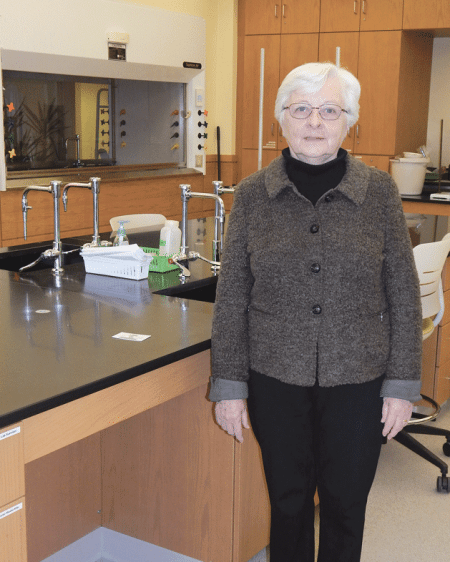
Sr. Mary Reap says the new Center for Natural and Health Sciences was built in response to needs for more graduates with science and nursing degrees.

The inaugural class included nine students from BHS and and nine from Baystate Medical Center, whose tuition was underwritten by the hospitals, and 22 additional students.

“We have helped fill the need for nurses with advanced degrees in a number of local hospitals,” Reap explained. “It was a natural area to grow, especially since the population here is aging. And these programs have an added value as many of the students are bilingual. It’s a great asset as there are so many Spanish-speaking people in the area.”

She noted that Elms received a $650,000 Health Resources and Services Administration grant to provide undergraduate scholarships for deserving, financially eligible Hispanic nursing students.

“We gave out eight awards last year, and 16 students will receive them this year in addition to other help they receive. It’s a wonderful way to meet the needs of the community,” she continued. “Last fall, we also began offering an undergraduate degree in Ethical Healthcare Management, which can be completed online or at some of our satellite sites.”

Elms College has also focused on expanding its science programs. “We know that more young people are needed today in these careers,” Reap said, adding that this knowledge spurred the construction of a new, $13 million Center for Natural and Health Sciences, which contains classrooms and laboratories.

And three years ago, the college responded to another need with a new post-baccalaureate science program for students who want to apply to medical or dental school. It can be completed in one or two years, depending on the student, and Reap said it attracts candidates from around the world in need of additional coursework.

“We’re drawing graduates from Ivy League schools, and they have been getting accepted at the best medical and dental schools in the country,” she noted. “It’s another area that was underserved where we think we are adding value.”

The needs of employers in the business community have also been addressed, and three years ago Elms launched an MBA program. Fifty students are enrolled this year, and they are taking classes on campus and online, which allows them the flexibility to work and earn a degree simultaneously. And, thanks to a generous gift from a benefactor, Elms is in the process of launching a new business center that will provide entrepreneurial and leadership programs at the certificate and degree level. Reap said the center will open officially next fall.


Download a PDF chart of the region’s colleges HERE


“There are many small businesses in the area, and more open every day, and we were getting requests from them for workshops,” she told BusinessWest, adding that slots in the MBA program filled quickly and the school felt it was important to provide other types of education to business owners and employees working in an entrepreneurial environment.

Elms has always had a strong social-work program, and in the spring of 2012, it launched a bachelor’s-degree program in criminal justice. It was created in response to requests from students and an increased need for people to fill crimina-justice positions in the area.

“We work closely with the Hampden County Sheriff’s Department, local law-enforcement agencies, and the governor’s office, and have a nice relationship with the Soldier On program in the Berkshires,” Reap said, noting that Elms also has a strong legal-studies program and takes an interdisciplinary approach to these fields of study.

“The need is increasing for homeland security, and there are new approaches to criminal justice,” she continued. “Our emphasis is on helping to lower the recidivism rate of people released from prison, and the programs were driven by our mission to have a system of education with our philosophy and values. Respect for the individual is paramount, and it’s important to teach these people how to gain dignity as well as the skill sets they need to enter society again.”

Mirroring the Community

Reap said the student body at Elms and its satellite locations is representative of the community. About 20% of their students are Hispanic, and close to the same number are African-American.

“We also have a lot of religious diversity on campus, and most women feel very comfortable here because it’s a place where they feel safe and respected; plus, they like the idea of coming to a school with a value system similar to their own,” Reap said. “And we have been very entrepreneurial and flexible in adapting, maintaining, and enhancing our reputation for quality and excellence.”

Core values at Elms include faith, community, justice, and excellence, and part of the college’s mission is to educate students and inspire them to help others. It’s a practice that starts at the top and filters down to students who absorb the value, then pay it forward.

“Staff members take turns providing meals for students who can’t go home for the holidays or come back to campus early; I’ve had them in my own home on Thanksgiving,” Reap said, citing just one example of the support the students receive.

“It’s part of our culture, our expectation, and our environment, and we have nursing students who volunteered to use their spring break to serve the poorest of the poor in Jamaica rather than going somewhere like Florida,” she said, noting that they will pay their own travel costs.

In fact, community outreach is such an integral part of the Elms nursing curriculum that, in January 2013, a new program to serve the homeless was launched by Br. Michael Duffy, an assistant clinical professor in the School of Nursing.

It’s called the Elms caRe vaN, and free healthcare services are administered by students in the bachelor’s-degree program out of a 32-foot van that contains two treatment stations, a full exam room, and a five seat-waiting area, which doubles as a warming area. The care is offered in conjunction with St. Stanislaus Basilica’s Sandwich Ministry in Chicopee, and free lunches are distributed every week during the van’s stop in Chicopee Center. In addition, traditional undergraduate nursing students work with Duffy at Lorraine’s Soup Kitchen and Pantry every Tuesday.

Reap said the majority of majors at Elms College are service-oriented in keeping with the school’s tradition. For example, its communication sciences disorders program is very strong and was designed to serve the increasing number of children who are diagnosed on the autism spectrum or have speech-language problems.

“Every program we offer was developed in response to need,” Reap repeated. “Before we started our nursing-degree programs, Berkshire Medical Center was going to other states to recruit qualified nurses. We wanted to prepare young people who grow up here to take higher-level positions and raise their own standard of living, while meeting job requirements in the area.

“And we plan to add more flexible programs and formats,” she went on. “We will also continue to gather information from the Department of Labor and conduct needs assessments, surveys, roundtables, and talk to people, not only at the community colleges, but in the business world and at the Economic Development Council, which has been very helpful.”

Moving Forward

In short, Elms has done a good job keeping up with the times.

“We know where we are going, and I am confident that whatever we do will be done well and successfully because of our staff and the strong ethical and value-based approach to education that the college provides,” Reap said. “We continually seek out scholarships and grants for disadvantaged students as they comprise the majority of the population in our community; 90% of our student body gets some type of financial aid, and we’re always looking for assistance to help students, many of whom have financial challenges.”

She told BusinessWest that, when she asks students what makes Elms special, the answer is always the same. “It’s the strong sense of community we have here. Commencement can be difficult because this is a place they call home, and it’s hard to walk away from such a supportive setting.”

So, as Reap enters the spring semester of her seventh year at Elms, she feels satisfied with the growth that has occurred. It has aligned perfectly with her own goals, and she is confident that need-based growth will continue.

Which is, indeed, a true godsend to students seeking the education they need to get a job that pays well — and has helped establish a pipeline of new, local, well-educated graduates for employers.

Education Sections

A Winning Hand

Jeffrey Hayden

Jeffrey Hayden says HCC has expanded its hospitality and culinary programs to provide a needed pipeline of skilled workers to fill emerging jobs in Western Mass.

Robert LePage has lost track of how many times someone has told him, ‘I want to become a dealer.’

The pronouncements began long before MGM and Springfield were selected as the casino developer and city of choice in Western Mass., and LePage, executive director of Training and Workforce Options (TWO) at Springfield Technical Community College (STCC), said they increase by the day.

His observation constitutes a reality check, because he knows that most people aren’t aware of what the job entails.

“I ask whether they like doing basic math, if they enjoy interacting with people all day, if it would bother them to stand on their feet for seven hours at a time, and if they realize they will have to work nights, weekends, and holidays because these are the busiest times in a casino,” said LePage.

STCC and Holyoke Community College (HCC) have formed a collaboration to provide knowledge about jobs, training, and qualifications that will be required by MGM Springfield when it begins hiring, and have joined forces with numerous local organizations that have a vested interest in filling the gap for the estimated 3,000 employees the casino will need.

Efforts began with TWO program, which was established by the presidents of the two community colleges with the goal of supporting regional workforce needs. Since its inception, a seemingly endless amount of work has been done to create custom-designed programs and provide employee assessments, skills training, and professional development, while strategically recruiting students for credit and non-credit programs.

“We have worked on joint projects in the industrial sector, manufacturing, IT, and hospitality, along with basic workforce literacy,” LePage explained.

Two years ago, TWO conducted a study with the largest hospitality/culinary employers in the area, including Sheraton as well Sodexho and Aramark, which provide food-service operations for local hospitals, schools, and colleges.

The study uncovered a significant finding: although the casino will need about 1,000 people to fill jobs in this sector, there is already a dearth of qualified individuals to meet the needs of local employers in the Pioneer Valley, where about 400 new positions open each year.

“We suspected this in the past and had talked about the need to expand our programs, but with the advent of the casino, the timing was finally right,” said Jeffrey Hayden, vice president of Business and Community Services for Holyoke Community College, adding that the hospitality/culinary field is one of the largest entry-level job markets in Western Mass. “MGM adds to the need, but it is the industry itself that is driving our new offerings.”

In the past two years, HCC has established a large number of new non-credit and credit courses in that field of study. In addition, as an offshoot of TWO, the colleges have taken the lead in establishing the Massachusetts Casino Training Institute, which will offer a gaming school in Springfield as well as hospitality and culinary training in Holyoke.

A tremendous amount of collaboration has taken place to get this off the ground between the colleges, the Greater Springfield Convention & Visitors Bureau, the Regional Employment Board of Hampden County, the area’s one-stop career centers, and local nonprofits and businesses whose clientele or employees could benefit from earning a certificate or advancing their hospitality/culinary and customer-service skill sets.

“We have also worked with our sister community colleges in the East and Southeast, and are trying to create a casino-training model that will be replicated across the state,” LePage said. “We have done a lot to figure out how to build this system. People have no idea how complex it is, but this gaming scale-up is the largest that has been done in decades. When MGM Springfield opens, it will be among the top five employers in Western Mass.”

Chipping In

STCC and HCC are working closely with MGM and the Mass. Gaming Commission to create the curriculum for a certificate program in gaming-related occupations, and a workforce plan that has taken several years to complete will be submitted to the commission within the next three to six months.

“Our goal is to assist in providing a labor pool and ensure the availability of training programs that will provide general instruction for careers, and specific training for licensed occupations such as table dealers, slot attendants, slot-repair technicians, and surveillance,” LePage explained.

Informational sessions are expected to begin as early as this summer, which will allow interested people to gain critically important information about gaming jobs and what is required to work at them. The sessions will include talks by employees from operating casinos, who will likely share the pros and cons of their positions to ensure prospective candidates know what to expect.

LePage said an announcement is expected next month that will let people know where the school will be located in Springfield.

“The courses held there will run about 20 hours a week and for six to 14 weeks, and will include basic competency skills, as well as technical training. There will also be simulated hands-on training stations where students will learn to deal cards as well as how to deal with customers,” he told BusinessWest, adding that the colleges are working with the state to provide free tuition to qualified applicants.

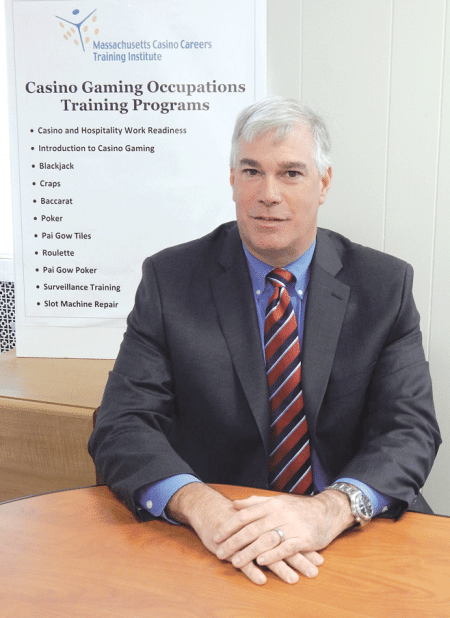
Robert LePage

Robert LePage says a center will open in Springfield to teach people the skills they need for gaming-related occupations.

However, these sessions will not begin until about 90 days before MGM begins hiring to prevent a gap between learning and putting newly acquired skills to work.

Although these courses of study are still in the definitive stages, HCC has already begun to fill the existing gap of qualified employees in the hospitality/culinary industry that will grow when MGM begins hiring.

Hayden said the need is so great that HCC has been able to place close to 80% of its hospitality/culinary graduates into jobs, while incumbent workers who enrich their education have attained an 85% increase in pay, position, or responsibility.

“This is one of the largest occupational sectors in the Pioneer Valley,” he noted. “It employs about 30,000 people, so our goal is to provide basic training so people can get a job, get a better job, or be able to do their job better.”

New non-credit courses for restaurant, food-service, and hotel workers include “ServSafe Food Safety,” “Customer Service and Workplace Communication,” “Management and Leadership,” “Goal Setting and Productivity,” and a number of other professional-development offerings. There are also one-year certificate programs and associate-degree programs in hospitality and food-service management.

“We have the only post-secondary program for this field of study in the region,” Hayden said.

HCC plans to open a new Center for Hospitality and Culinary Excellence in January 2017 that will offer workforce and credit programs.

“It’s a highly anticipated investment by the college, the state, and the federal government because we recognize the need extends across the marketplace in Hampden County and the Pioneer Valley,” Hayden explained. “The new, 20,000-square-foot facility will have state-of-the-art hot and cold labs, a bakery, a dining area, a demonstration area, and a mock hotel room where people can learn skills like how to make a bed.”

Training is also ongoing in Springfield and Northampton, and may begin in Ware to accommodate people with transportation issues. In addition, two 14-week training sessions have been offered at Dean Technical High School in Holyoke in collaboration with the Hampden County Sheriff’s Office.

“It’s part of the sheriff’s effort to have people leave with workplace skills,” Hayden said, adding that, although former inmates might not be able to work in the casino, they can enter many of the positions available in the area.

A significant amount of effort has also been expended to help people pay for their education. Over the last three years, HCC has received Rapid Response grants from the Department of Higher Education totaling $182,000 that have allowed more than 250 people to earn more than 300 certificates in these fields, and the college recently applied for a Workforce Competitiveness Trust Fund grant to provide more scholarships.

“There are more than 400 new job openings in the Pioneer Valley every year, and employers are looking for people who have some kind of training or experience,” Hayden said, noting that one local employer recently pledged to hire people who completed a ServSafe Food Safety course.

The Stakes Are High

STCC kicked off a new, 14-week advanced customer-service credit program last October to help build a stronger pipeline of employees.

“The casino will present a significant opportunity in terms of jobs, and a good body of work has already been done, which is important because, to capitalize on these opportunities, we have to get people prepared to move in and up in the workforce,” LePage explained. “It’s a pretty large project, and shovels are growing in the ground.”

Which means the time is right for people to begin researching gaming occupations or take part in hospitality/culinary training if they hope to embark on an entry-level casino career, change careers, or advance in their own workplace.

Departments People on the Move

Baystate Health recently announced changes and consolidations in leadership positions in its Eastern Region:
• Effective Jan. 29, Michael Moran will become the interim president and chief administrative officer for the Baystate Health Eastern Region. Moran has been at Baystate Health for 14 years and currently serves as the organization’s Vice President for Clinical, Facilities and Guest Services. Moran’s new role combines the responsibilities of two current positions in the region, the president and the chief operating officer;
• The region’s current president, Dr. Charles Cavagnaro III, will depart Baystate Health to pursue other opportunities. Before joining Baystate Health, Cavagnaro served as president and CEO of Wing Memorial Hospital and Medical Centers for 15 years;
• The region’s current chief operating officer, Dr. M. Shafeeq Ahmed, will return to practicing medicine full-time at Baystate Health. Ahmed has been a physician-leader at Baystate Health since 2003;
• Dr. David McGuire will become the region’s chief medical officer.
“Our goal, in considering these changes, is to ensure that our Eastern Region can successfully deliver care that matters to the community in a responsible and sustainable way,” said Nancy Shendell-Falik, Senior Vice President of Hospital Operations for Baystate Health. “To survive and thrive in the contemporary world of healthcare, we continue to make changes that ensure long-term stabilization, system integration, and a consistent model for delivering quality, safety, patient experience, and value.”
Added Dr. Mark Keroack, president and CEO of Baystate Health, “Drs. Cavagnaro and Ahmed have made major contributions to the integration of Wing into Baystate Health and to our organization as a whole. We thank them for their leadership, and we wish them the very best.” Three other management positions in the region are being eliminated and their work consolidated into other positions. At Baystate Health, Moran has been responsible for a broad spectrum of services including cancer, behavioral health, neurosciences and rehabilitation, food and nutrition, facilities, and more. Moran is known for building high-performing teams, fostering engagement, and serving as executive leader for Baystate Medical Center’s complex heart and vascular and emergency-room expansion projects. He led the building of the orthopedic surgery and cancer centers in Springfield and the surgical center under construction at Baystate Franklin Medical Center. He has co-led the health system’s largest and most complex Lean project, which saved more than $5 million and improved patient flow at Baystate Medical Center.

•••••

PeoplesBank has announced the promotions and appointments of four associates:

Brian Canina

Brian Canina

• Brian Canina has been promoted to senior vice president, chief financial officer, and treasurer. He possesses more than 16 years of financial experience and first joined PeoplesBank in 2009. He holds a bachelor’s degree in accounting from Bryant College and is a certified public accountant. He is also a graduate of the ABA Stonier Graduate School of Banking and is a recipient of the Wharton Leadership Certificate. Canina is president of the Finance and Accounting Society of New England and an officer of the Financial Managers Society, Boston Chapter. He serves on the boards of directors for the Greater Holyoke Chamber of Commerce and the Children’s Study Home;

Stacy Sutton

Stacy Sutton

• Stacy Sutton has been promoted to senior vice president, retail administration. Boasting more than two decades of banking experience, she joined the bank in 1992 and previously served as first vice president, retail administration. She holds an associate degree in accounting from Springfield Technical Community College and is a graduate of the Massachusetts Bankers Assoc. School for Financial Studies. She serves on the board of directors for Springfield Partners;

Joseph Zazzaro

Joseph Zazzaro

• Joseph Zazzaro has been promoted to senior vice president and chief information officer. He possesses more than three decades of information technology experience with a focus in financial services. He joined the bank in 2006 and previously served as first vice president, information technology. He holds a bachelor’s degree in information systems from the University of Phoenix and an associate degree in management information systems from Holyoke Community College. He also is a graduate of the New England School of Financial Studies. Zazzaro was a 14-year member of the Greater Westfield Boys and Girls Club board of directors and continues to volunteer to provide technical support for the club. He has also volunteered his technical and leadership skills at other local organizations, such as the Greater Springfield Habitat for Humanity, the United Way, the Red Cross, and the Chicopee Boys and Girls Club; and

Russell Fontaine

Russell Fontaine

• Russell Fontaine has been promoted to first vice president, retail sales. Boasting more than a decade of financial experience, he first joined the bank in 2009 and previously served as vice president, sales and service manager. He holds a bachelor’s degree in business management from Westfield State University and a certificate from the Wharton School of Business Leadership at the ABA Stonier Graduate School of Banking. He serves on the board of the Greater Springfield Habitat for Humanity.

•••••


John Dowd Jr

John Dowd Jr

The Dowd Insurance Agencies announced that John Dowd Jr., president and CEO of the Dowd Insurance Agencies, was selected to serve on the board of directors for the Massachusetts Assoc. of Insurance Agents (MAIA). Membership in the MAIA is open to independent, licensed insurance agencies doing business as individuals, partnerships, corporations, or other forms of business organizations in Massachusetts. With 1,300 agency members, MAIA is one of the largest state and regional associations of independent insurance agents in the country. The new board of directors began their term on Jan. 1. The board as a whole establishes positions on various industry issues and advocates for the agency community before government bodies. Individual members of the board of directors are the official representatives of the MAIA members in their geographical areas. “The Massachusetts Association of Insurance Agents has a long track record for consistent support for the insurance-agency community,” Dowd said. “I am very pleased to serve among this group of dedicated insurance professionals.” A 1980 graduate of St. Michael’s College, Dowd is an accredited advisor in insurance (AAI) and a licensed insurance advisor (LIA). He began his career as an underwriter for the Fireman’s Fund Insurance Co. and joined Dowd Insurance Agency in 1982.

•••••


L. Alexandra Hogan

L. Alexandra Hogan

Local law firm, Shatz, Schwartz and Fentin, P.C. announced that attorney L. Alexandra Hogan was selected to serve on the emerging insolvency professionals subcommittee of the American Bankruptcy Institute. “Alex has quickly become a rising star in our bankruptcy department. She is dedicated and is already helping other professionals establish themselves in the insolvency field,” said attorney Steve Weiss, supervisor of the firm’s bankruptcy division. As a new member of the emerging insolvency professionals subcommittee, Hogan will help bankruptcy professionals find different avenues to network and develop as experts. The mission of this new subcommittee is to create a forum for developing leaders to exchange ideas to better aid clients and further cultivate the insolvency field. Hogan graduated in 2008 with cum laude honors from Western New England University School of Law, where she was also appointed assistant editor and became a published author of the Western New England Law Review. She graduated from Bay Path University with summa cum laude honors in 1996. She has been selected by Super Lawyers to the Rising Stars list and as a Top Women Attorney (2011-15). Hogan concentrates her practice primarily in business, litigation, and bankruptcy law. She has an extensive bankruptcy practice that includes both debtor and creditor representation in individual and business cases, including Chapter 7 and Chapter 11. Additionally, she acts as counsel to Chapter 7 trustee Steven Weiss in bankruptcy litigation advanced in adversary proceedings. “I am honored to be a member of this new committee,” Hogan said. “It is very important for developing professionals to find ways to network with insolvency experts and to discuss emerging trends in the bankruptcy field.”

•••••

Richard Venne, president and CEO of Community Enterprises Inc., announced the election of new officers to one-year terms at the recent board of directors meeting. Elected to officer positions for one-year terms are William Donohue, Chair, Children and Family Law, Springfield; Donald Miner, Vice Chair, Loomis Communities, South Hadley; Joanne Carlisle, Clerk/Secretary, Stop & Shop Inc., Springfield; and Brittney Kelleher, Treasurer, Westfield Bank, Springfield. Deborah Omasta-Mokrzecki, Amherst College, was elected as a new member for a three-year term. Existing members elected to additional three-year terms include Donohue; Carlisle; Miner; Mary Beth Davidson, Travelers, Hartford, Conn.; Kate LaMay-Miller, Multi-Media Impact, Hadley; and Albert Lognin, HARC, Hartford, Conn. Community Enterprises is a human-service organization that provides employment, education, housing supports, and day supports for people with disabilities. It is headquartered in Northampton and maintains 27 service locations throughout the U.S.

•••••

Lou Mayo has been installed as president of the 1,700-member Realtor Assoc. of Pioneer Valley. Mayo, a Realtor since 1997, is the office manager with Real Living Realty Professionals, LLC in Wilbraham. As president, he will oversee the association’s activities and operations, including meetings of the board of directors, and act as a liaison to the association’s various committees. He is the official spokesperson of the association on issues related to the real-estate industry and the regional housing market. The other 2016 officers are Richard Sawicki Jr., president-elect; Edward Alford, treasurer; Susan Drumm, secretary; and Dawn Henry, immediate past president. Directors include Elias Acuna, Kelly Bowman, Shawn Bowman, Suzi Buzzee, Janise Fitzpatrick, Raymond Hoess-Brooks, Susan Rheaume, and Russell Sabadosa.

Chamber Corners Departments

AMHERST AREA CHAMBER OF COMMERCE

www.amherstarea.com
(413) 253-0700

• Feb. 2: After 5, 5-7 p.m. The UMass Athletics Department presents a night out for chamber members and non-members as the UMass Minutemen take on the Rhode Island Rams. First 80 registrants receive an inclusive basketball game ticket, compliments of the UMass Athletics Department. Sponsored by Brian Analysis Neuro Development Center, LLC and IGS Solar. Cost: $10 for members, $15 for non-members.
Feb. 10: After 5, 5-7 p.m., hosted by Central Rock Gym, 165 Russell St., Hadley. Come mix and mingle with the community and test your strength and agility while climbing up the rock walls. Light appetizers and adult beverages will be served. Cost: $10 for members, $15 for non-members.


GREATER CHICOPEE CHAMBER OF COMMERCE

www.chicopeechamber.org
(413) 594-2101

• Jan. 27: Business After Hours, 5-7 p.m., hosted by Masse’s American Bistro, 1329 Memorial Dr., Chicopee. Sponsored by the Greater Chicopee and South Hadley/Granby chambers of commerce. Network with members from both chambers. Enjoy some delicious appetizers from Masse’s American Bistro. Sponsored by Berkshire Bank. Cost: $10 for members, $15 for non-members pre-registered.

•  Feb. 2: Community meeting with mayor and police chief, noon to 1 p.m. All are invited to the community room at the Chicopee Public Library on Front Street to learn about what is going on in the downtown area and express any concerns to Mayor Richard Kos and Police Chief William Jebb.

•  Feb. 11: CEO Luncheon with Maura McCaffrey of Health New England, 11:45 a.m. to 1 p.m. As president and CEO at HNE, McCaffrey leads the premier locally owned health plan serving this region. Health New England, headquartered in downtown Springfield, employs more than 340 people and provides health coverage for more than 225,000 members. Sponsored by Chicopee Savings Bank, First American Insurance Agency Inc., Holyoke Medical Center, and PeoplesBank Cost: $30 for members, $35 for non-members. To reserve tickets, call Lynn Morrissette at (413) 594-2101.

•  Feb. 17: February Salute Breakfast & Annual Meeting, 7:15-9 a.m., Castle of Knights, 1599 Memorial Dr. Chicopee. Cost $23 for members, $28 for non-members.


GREATER EASTHAMPTON CHAMBER OF COMMERCE

www.easthamptonchamber.org
(413) 527-9414

• Feb. 11: Networking by Night, 5-7 p.m., sponsored by Canon Realty. Join area business professionals for networking. Cost: $10 for members, $15 for non-members.


GREATER HOLYOKE CHAMBER OF COMMERCE

www.holyokechamber.com
(413) 534-3376

•  Jan. 28: Winner Circle Government Reception, 5-7 p.m., Yankee Pedlar, 1866 Northampton St., Holyoke. Sponsored by the Greater Holyoke Chamber of Commerce board of directors and corporate leaders. An enjoyable evening where we honor our local and state elected officials. Cost: $23. Call the Holyoke Chamber at (413) 534-3376 or visit holyokechamber.com to sign up.

•  Feb. 3: Ask a Chamber Expert: the Art of Networking, 5:30-7:30 p.m., hosted by Mel’s Restaurant, 490 Pleasant St., Holyoke. Series Sponsors: PeoplesBank, the Republican/MassLive/El Pueblo, and Hadley Printing. Do your eyes glaze over when your boss asks you to attend a networking event? You’re not alone. There’s an art to networking. Jeremy Casey, founder and president of Name Net Worth, will share his expertise at this workshop. Cost: $10 for members, $15 for non-members. Visit www.holyokechamber.com to sign up.

•  Feb. 17: Economic Development Breakfast: Growing Businesses 1×1, 7:30-9 a.m., hosted by Delaney House, Country Club Road, Holyoke. Sponsored by Holyoke Community College. A breakfast focusing on entrepreneurism with keynote speaker and local entrepreneur Delcie Bean, president of Paragus Strategic IT, along with graduates of the SPARK Entrepreneurial Launch Program. Cost: $25 for members, $30 for non-members, which includes a hot breakfast buffet. Call the Holyoke Chamber at (413) 534-3376 or visit holyokechamber.com to sign up.

•  Feb. 17: Chamber After Hours, 5-7 p.m., sponsored and hosted by Slainte, 80 Jarvis Ave., Holyoke. Cost: $10 for members, $15 for non-members. Call the Holyoke Chamber at (413) 534-3376 or visit holyokechamber.com to sign up.


GREATER NORTHAMPTON CHAMBER OF COMMERCE

www.explorenorthampton.com
(413) 584-1900

• Feb. 3: February Arrive @ 5, 5-7 p.m., hosted by Union Station, 125A Pleasant St., Northampton, sponsored by: Keiter Builders Inc. and others to be announced. Arrive when you can, stay as long as you can. Cost: $10 for members.


GREATER WESTFIELD CHAMBER OF COMMERCE

www.westfieldbiz.org
(413) 568-1618

• Feb. 1: Mayor’s Coffee Hour, 8-9 p.m., hosted by Tighe & Bond Inc., 53 Southampton Road, Westfield. To register, call Pam at the chamber office at (413) 568-1618.
Feb. 10: Chamber After 5 Connection, 5-7 p.m., hosted by Armbrook Village, 551 North Road, Westfield. To register, call Pam at the chamber office at (413) 568-1618.


SPRINGFIELD REGIONAL CHAMBER

www.myonlinechamber.com
(413) 787-1555

• Feb. 3: Springfield Regional Chamber Speed Networking Business@Breakfast, 7:15-9 a.m., hosted by the Colony Club, 1500 Main St., Springfield. Sponsored by United Personnel. Special guest speakers. Networking in a fast-paced, round-robin format. Cost: $20 for members ($25 at the door), $30 for general admission.

• Feb. 10: Springfield Regional Chamber Lunch ‘n’ Learn, 11:30 a.m. to 1 p.m., location to be determined. Sponsored by the Regional Employment Board of Hampden County. Cost: $25 for members, $35 for non-members.

• Feb. 11-March 17: Springfield Regional Chamber Leadership Institute, TD Bank Conference Room, 1441 Main St., Springfield. Sponsored by MassMutual Financial Group and supported by the Irene E. & George A. Davis Foundation. Special guest speakers. The institute is directed by Julie Siciliano, dean of the Western New England University College of Business, and Jack Greeley, executive in residence. Participants will actively explore best practices of leaders; analyze their own leadership, learning, and and problem-solving styles; and experience the synergies that result from high-performing teams. Cost: $885 per participant, which includes a day trip to Beacon Hill and graduation dinner.


WEST OF THE RIVER CHAMBER OF COMMERCE

www.ourwrc.com
(413) 426-3880

• Feb. 3: Wicked Wednesday, 5:30-7:30 p.m., hosted By Partners Restaurant, 485 Springfield St., Feeding Hills. Wicked Wednesdays are monthly social events hosted by various businesses and restaurants. Cost: free for chamber members, $10 at the door for non-members. For more information, call the chamber office at (413) 426-3880 or e-mail [email protected].

• Feb. 18: Networking Lunch, noon to 1:30 p.m., hosted by Lattitude in West Springfield. Enjoy a sit-down lunch while networking with fellow chamber members. Each attendee will get a chance to offer a brief sales pitch. Only members or guests of members may attend. The only cost to attend is the cost of lunch. Attendees will order off the menu and pay separately that day. We cannot invoice you for these events. For more information, call the chamber office at (413) 426-3880 or e-mail [email protected].

• Feb. 24: Legislative Breakfast, 7-9 a.m., hosted by Storrowton Tavern, 1305 Memorial Ave., West Springfield. The Breakfast will feature a panel of various legislatures, including state Sen. James Welch, state Sen. Donald Humason, State Rep. Nicholas Boldyga, state Rep. Michael Finn, Agawam Mayor Richard Cohen, and West Springfield Mayor Will Reichelt. Cost: $25 for members, $30 for non-members. For more information on ticket sales, call the chamber office at (413) 426-3880 or e-mail [email protected].

Daily News

GRANBY — The MacDuffie School, a co-ed, college-preparatory school for grades 6 to 12, announced a collaboration with the Massachusetts College of Pharmacy and Health Sciences (MCPHS) that will guarantee qualified students admission to the Boston-based university.

“The MCPHS program aligns well with the MacDuffie School,” said MacDuffie Head of School Steve Griffin. “MCPHS works hard to ensure that their graduates are certified in their home country, which is great for our international population. In addition, many of our local students are looking at careers in health sciences; a path to guaranteed admission is a wonderful benefit to all of our students.”

This opportunity is contingent on students’ success in prerequisite courses at MacDuffie and, if needed, an English-proficiency test. According to the agreement, students with a minimum B average in MCPHS-specified science and math courses will be eligible for a reserved spot in an undergraduate program. Students graduating from MacDuffie with a minimum B average in the prerequisite courses and who meet the English-language requirements are guaranteed both a reserved spot and a scholarship.

“In the health sciences, it’s important to have good training and references,” said Ita Duron-Hermouet, director of Admission International Research and Strategy at MCPHS. “Our graduates have the most prestigious internships available.”

Brigham and Women’s Hospital, Beth Israel Deaconess, Dana-Farber Cancer Institute, Harvard Medical School, and the Harvard School of Public Health are just a few of the institutions where MCPHS graduates obtain internships and employment.

Features

No Jackpot

Plainridge Casino Facade

As the first facility opened in the Bay State’s new gaming era, Plainridge Park Casino launched to wild success — for the first month, anyway. Since then, revenues at the slots-only parlor have fallen well below first-year projections. While its general manager insists its long-term outlook is healthy — and others worry about a saturated casino market in the region — 90 miles to the west, development continues on MGM Springfield, whose leaders insist is a much different story than Plainridge Park, and will reap much different results.

On a recent Friday afternoon, a walk across the floor at Plainridge Park Casino — lined with 1,250 slot machines and electronic blackjack and roulette tables, as well as two restaurants and a food court — found hundreds of visitors dutifully anteing up and pressing brightly lit buttons, hoping for a big score.

Officials with the casino, just off I-495 in Plainville, a 90-mile trek from Springfield — and with Penn National Gaming, which owns the facility — were also counting on a big score when the long-time horse-racing venue relaunched as a slots parlor last June. And they did score, early on, with first-week revenues exceeding expectations.

But those revenues have fallen dramatically since, a cause for concern not only for Plainridge Park and Penn National, but for other casino developers in Massachusetts hoping to create the next big thing in regional gaming and tourism.

Plainridge Park’s general manager, Lance George, told BusinessWest it’s way too early to abandon optimism.

“It was a pretty standard opening — volumes incredibly high, then declining revenues, and a gradual ramp back up,” he explained. “It’s nothing this company hasn’t seen over its past four or five openings. In our industry and most industries, we look at year-over-year results, not short-term results related to seasonability.”

The big question is how significant that expected ramp-up will prove to be, and whether initial projections by the casino and the Mass. Gaming Commission were wildly off the mark.

Plainridge Park had projected revenues of at least $250 million during its first year of operations, an average of $456 per machine, per day. These were revised downward to $220 million just before the June 24 opening. But the average machine’s haul per day has plummeted from $585 in June to $256 in November, notes Paul DeBole, an assistant professor of political science at Lasell College in Newton, and an expert on the gaming industry.

“Plainridge isn’t as bad as everyone is making it out to be,” he said, arguing that its performance hasn’t been terrible, but the projections were.

He said a more plausible scenario for Plainridge’s revenues would consider the gross gaming revenue of the other four New England slot parlors (Twin River and Newport Grand in Rhode Island, and Hollywood Slots and Oxford Casino in Maine), which, on average, bring in $179.73 per machine, per day, or a tick over $82 million per year. Taking the average of just the two Rhode Island parlors raises those figures to $200 per machine, per day, and $91.3 million per year.

Paul DeBole

Paul DeBole

Under DeBole’s financial model, Plainridge’s first full year would bring in between $255 and $275 per machine, per day, and between $140 million to $150 million for the year. Revenues would gradually fall in subsequent years and plateau between $179 and $200 per machine, per day, with annual revenues in the $100 million to $110 million range, once Massachusetts’ full-service casinos, including MGM Springfield, begin to open their doors in 2018.

The bottom line, he said, is that early projections that Plainridge would bring in between $250 million and $300 million annually were way off base. “There was no way they were going to hit that, so the Gaming Commission revised it down to $220 million. And there was no way they were going to hit that, so they revised it again to $200 million. And there’s no way they’re going to hit that.”

Which is why the commission’s current projections are in the $160 million range — just north of what DeBole predicted. “Those numbers make a lot more sense. My feeling from the very beginning was that their numbers were overly optimistic.”

All of this certainly interests MGM, which is spending $950 million to create a gaming resort in Springfield’s South End.

“We’ve certainly been tracking the results to get a sense of what the larger market is doing,” MGM Springfield President Mike Mathis told BusinessWest. “I think Lance George and his management team are very strong, and I’m confident they will continue to tweak their model and figure out how to get closer to their projections and how it initially opened that first month.

“But that particular part of the state — the Southeast market — never factored into our competitive model, partly because it’s a slot facility, and because of the distance from our market,” he went on. “We don’t think their results, good or bad, necessarily dictate how well we’ll do here, with a fully designed resort with table games and all the amenities that come with a four-star hotel and high-end restaurants.”

Mike Mathis

Mike Mathis says Plainridge is so different from MGM Springfield — in size, amenities, and location — that its early worries shouldn’t be seen as a predictor of MGM’s level of success.

He added that MGM will be leveraging existing attractions in downtown Springfield, from conventions at the MassMutual Center to entertainment venues like Symphony Hall, CityStage, and the Basketball Hall of Fame. “Plainridge seems like a very different model for us, and we’re still really confident about how well we’ll do.”

Raised Stakes

Penn National spent $125 million to convert Plainridge, a long-time harness-racing track, to a slot parlor.

But Twin River Casino, just 11 miles away over the Rhode Island line, countered those plans by upgrading its facility, which now includes 4,000 slot machines, table games (Plainridge has no live dealers), and a large arena. As a result, as the Mass. Gaming Commission kept adjusting Plainridge’s first-year projections downward, Twin River recently increased its concurrent projection by $35 million.

That wasn’t supposed to happen.

Yet, it’s not like the Rhode Island and Connecticut casinos were going to take the new Bay State competition lying down, DeBole said. “That’s the nature of the market right now. We have Foxwoods and Mohegan Sun trying to open facilities along the I-91 corridor to take money out of MGM, and Newport Grand will be relocated 350 yards from the Massachusetts border,” near Fall River.

Still, George said Plainridge has its own advantages for Massachusetts gamblers. “The least sexy is location, but it’s certainly fortuitous; it’s the closest casino relative to Boston, so we’ve tried to capitalize on that. The second thing that differentiates us from our competitors is the horse-racing industry, which is something we’ve tried to ensure people are aware of. Unlike many states, that industry is growing in our state,” he explained, noting that race days will soon increase from 105 annually to 115, then 125 two years from now.

“The third advantage is, we are part of Penn National, which has 27 properties; they recently acquired the Tropicana in Las Vegas, and they’ve done a great deal of planning here,” he went on. “It’s a very well-respected company.”

George said Plainville officials have long been supportive of the racetrack and happy to forge a $4.2 million host-community agreement with Penn National — not to mention the additional tax revenues. “From an employment standpoint, we saved the existing 100 or so jobs already here from the racing side and added 500,” he added. “Those are the two most tangible benefits — financial and jobs. In addition, through six months of operations, we’ve purchased $6 million in goods and services — $4 million in the state of Massachusetts.”

All of that is positive, DeBole said, but he questions how many facilities the state can support. “Legislators mean well, and they’re trying hard, but they don’t get that there’s a finite amount of disposable gambling dollars out there,” he argued, adding that it’s unrealistic to expect much cannibalizing of well-established behemoths like Foxwoods and Mohegan Sun.

He paused for a second before pondering what that means for MGM, then noted that the company has a solid track record, and the complex will likely draw visitors from a wide radius. “But I think they may not be as profitable as they’d like.”

More Than Slots

MGM Springfield certainly has one big advantage over Plainridge, DeBole said. Casino developers have long noted the growing importance of non-gaming revenue. Atlantic City, a gambling mecca that has fallen on hard times, currently brings in $5.2 billion in gaming revenues — about the same as Las Vegas, a destination on much stronger footing these days. However, Vegas casinos bring in $10.4 billion in non-gaming revenue — retail, dining, and entertainment — compared to $400 million in Atlantic City.

“That’s a really stark comparison,” he went on, noting that Foxwoods and Mohegan Sun have removed more than 25% of their slot machines after seeing slot revenue plummet by about $500 million since 2009.

Mathis knows these numbers as well, and says MGM Springfield — designed to be integrated with Springfield’s downtown, as opposed to how the nondescript Plainridge property seems positioned mainly to provide easy access to and from I-495 — will bring in a wide variety of visitors, not just slots enthusiasts.

“Generally, a diverse offering is always going to be a better attraction for the customer; that’s where the trends are,” Mathis said. “The non-gaming parts of our revenue in Springfield reflect what we do in other markets and other resorts. MGM has always been a leader, and continues to be a leader, in that area.”

Plainridge Park’s electronic table games

While its slot machines get moderate action, Plainridge Park’s electronic table games often struggle for attention.

And, unless one of the Connecticut giants builds a competing casino north of Hartford, MGM Springfield — as well as the planned Wynn Massachusetts casino in Everett — may be in a better geographic position than Plainridge, which is competing more directly with the Rhode Island and Connecticut facilities.

But DeBole worries that a fourth casino license, this one earmarked for Southwestern Mass., may be one too many in a heavily saturated region — particularly with the Mashpee Wampanoag tribe looking to open a casino in Taunton through the federal Bureau of Indian Affairs, independent of Mass. Gaming Commission approval, and the Aquinnah Wampanoag tribe fighting the state over gaming on its reservation lands on Martha’s Vineyard.

“In a market already showing the effects of saturation, that would have a huge adverse impact on the region as well,” he told BusinessWest. “If the Gaming Commission asks my advice — not that they would — I would tell them to defer awarding a license to see how this shakes out.”

Ante Up

DeBole has other issues with casinos in Massachusetts, one of which is the state taking up to 61% off the top of gaming revenues in regulatory fees and taxes, before the casino even pays its employees. “That’s a cause for concern. Lawmakers say it’s all about job creation, but we all know that’s not true.

“It’s a very uneasy situation for the state to be a majority partner in a gaming enterprise; you would think the average voter would have some doubt about how stringent the regulatory forces would be,” he went on, adding that he personally feels the gaming commissioners are people of integrity, but he’s talking about perception, not reality — and a reality Las Vegas, where government skims just 6.8% from casino revenues, doesn’t have to deal with. “When the state is taking more money than the people taking the entrepreneurial risk, I have a philosophical problem with that.”

But Plainridge Park in particular “was dealt a crappy hand by the statute, despite the best intentions,” he said, hampered by a narrow focus on slot machines and barring table games. Other barriers for some visitors include an age floor of 21 and a no-smoking policy (Twin River admits 18-year-olds and allows smoking).

George, obviously, with his experience in the industry, is an enthusiastic promonent of gaming in Massachusetts, pointing out the creation of some 10,000 jobs and the related tax revenues, adding that people worried about the unintended consequences — the social costs of gambling — forget that plenty of Massachusetts residents are already flocking to casinos, with the tax revenues benefiting other states.

He added that the Mass. Gaming Commission is ramping up efforts to promote responsible gambling, an effort that’s visible to all Plainridge visitors, who are greeted at the door from the parking garage with prominently posted information about GameSense, a program to prevent problem gambling.

As for his slot parlor’s economic health, George is convinced it will find its footing in the long term.

“The media here are covering it on a month-to-month basis, but that’s not the way we gauge the health of this business,” he said. “Once we get to the warmer months — March, April, May — as opposed to the dark, cold winter, we fully expect revenue to increase. There’s nothing unusual about that.”

DeBole agreed with George that month-to-month tracking doesn’t tell the whole story, and that warmer spring weather will increase turnout. Beyond that, he’s lukewarm.

“Over time, Plainville’s numbers will bump up a little bit, but I don’t see them making anywhere near the money they claimed they would last year,” he said. “They’ll be lucky if they hit $150 million this year, and eventually, they’ll probably be in that $92 million to $115 million range of annual revenues.”

Mathis, like George, would rather wait and see what the multi-year results are at Plainridge Park.

“I agree with him that it’s really too short a period right now to make any long-term observations about what the market is going to do,” he said. “In other businesses, it takes years to get to your normalized year. I really think those guys deserve — we all deserve — some time after opening to massage the models and see how the market is reacting and sort of fine-tune the business.”

Meanwhile, the clock continues to tick for MGM Springfield. And 2018 isn’t that far away.

Joseph Bednar can be reached at [email protected]

Daily News

BOSTON — Gov. Charlie Baker, Secretary of Education James Peyser, Secretary of Labor and Workforce Development Ronald Walker II, and Secretary of Housing and Economic Development Jay Ash announced a series of new initiatives to support career vocational technical education, including $83.5 million to be proposed between the governor’s FY 2017 budget recommendation and new capital grant funding to be filed in an economic-development bill this week.

“With too many good-paying jobs going unfilled, we are pleased to announce this critical investment in our career and technical schools,” Baker said. “Our proposal will make it possible for more students to explore a pathway to success through stronger partnerships with our schools and local businesses in the Commonwealth.”

The funding in the FY 2017 budget will be coupled with a substantial capital-grant program for vocational equipment that further aligns the administration’s investments with local economic- and workforce-development needs and employment partnerships.

“Massachusetts has some of the strongest career-technical programs in the country, at both the high-school and college levels, but access and quality are uneven across the Commonwealth, and there’s currently little alignment across education levels,” said Peyser. “Our efforts will significantly expand student access to high-quality career-education programs in STEM fields, manufacturing, and traditional trades, with a focus on underserved populations and communities.”

Added Walker, “finding ways to make sure people get the skills and job training they need to get a good-paying job is one of the biggest challenges before us. With these initiatives, we will engage employers as full partners in program design and implementation to help them create a pipeline of workers.”

Ash noted that “vocational institutions are an important part of training the workforce to address the skills gap. These additional resources will continue to equip vocational institutions as they train the next generation of skilled workers who will help grow the Commonwealth’s economy.”

Daily News

SPRINGFIELD — According to a Commonwealth Corp. report, significant gaps exist between the skills and education of the Massachusetts workforce and the labor-market demands of employers. While Massachusetts may have the most highly educated workforce of any state in the country, its labor market is aging out, and the emerging workforce is neither large enough nor well-educated enough to replace the retiring talent. As a result, employers are struggling to find skilled workers to meet their growing demands.

David Cruise, president and CEO of the Regional Employment Board of Hampden County (REB), will discuss this issue and new federal and state policies aimed at creating a demand-driven workforce-development system at the Springfield Regional Chamber Lunch ‘n’ Learn on Wednesday, Feb. 10 from 11:30 a.m. to 1 p.m. at La Quinta Inn & Suites, 100 Congress St., Springfield.

“We hear all the time from our members that they need skilled workers specific to their industries, and the REB is at the forefront of this issue, working with state and federal leaders to create a demand-driven focus of workforce development,” said Springfield Regional Chamber President Jeffrey Ciuffreda.

Cruise will also discuss the Massachusetts Workforce Investment Board created by Gov. Charlie Baker last year and its role in building a strong workforce system which responds to the labor needs of the region’s economy. The board is tasked with developing plans and policies with an eye towards investing in a skilled workforce, closing the gap that exists between available jobs and the skills of workers, and meeting the labor demands of the 21st century, all while recognizing and developing strategies specific to the state’s various regions.

Reservations for the Lunch ‘n’ Learn are $25 for members, $35 for general admission, which includes networking, lunch, presentation, and question-and-answer session. Reservations may be made online at www.springfieldregionalchamber.com or by e-mailing Sarah Mazzaferro at [email protected].

Daily News

SPRINGFIELD — On Monday, Feb. 1, Goodwill Industries of the Pioneer Valley will open a self-directed Resource Room equipped with computers, telephones, printer, copier, fax machine, Internet access, and WinWay Resume software. The Resource Room will be open to the public for job-related activities.

The Resource Room at 570 Cottage St. in Springfield will be open from 9 a.m. to 2 p.m., Monday through Thursday. Workshops and access to the Resource Center are offered at no cost for job-related activities. Some job-search services will be available by appointment.

A series of free workshops related to preparing for, searching for, finding, and maintaining employment is also offered. A monthly calendar of workshop topics, dates, and times is available at www.ourgoodwill.org.

Goodwill Industries of the Pioneer Valley offers employment and training programs, adult foster care, and community-based day services, and operates nine retail stores in Hampden and Hampshire counties.

“Our mission is to create a better community through partnerships in employment, education, and life enrichment,” said Steve Mundahl, president and CEO. “Helping people through the Resource Room is in keeping with that mission.”

Opinion

Opinion

By Jeffrey Ciuffreda


Jobs are coming our way, but are we ready? And what about the jobs already here?

As we start the new year, it is time to ask these questions and, more importantly, answer them. Actually, the process of doing so got off to a good beginning in 2015. However, there is much more to be done in 2016.

CNR Changchun Rail Vehicle Co. is coming to Springfield with between 150 and 300 jobs, many requiring skilled engineers and machinists. MGM Springfield is finally underway with construction, requiring 3,000 jobs upon its planned 2018 opening, and efforts are already underway to be sure that the vast majority of those workers will come from this region, an effort that requires training programs to be up and running soon.

These are the jobs we know are coming our way, and with these two internationally known companies coming here, you can be sure other companies will become more focused on our region and, therefore, its workforce.

The Springfield Regional Chamber of Commerce is pleased to be working with the EDC of Western Massachusetts and the Regional Employment Board of Hampden County, along with our community colleges and others, to help ensure that we not only have a trained workforce ready to fill these positions, but that we have enough of those trained in the workforce to fill them and other positions that might be vacated by those moving from existing employers.

At the same time, we must acknowledge that far too many of our area resident, for one reason or another, do not have the skills necessary to take advantage of certain opportunities, but might have abilities suited for other types of jobs. What are those jobs?

The Springfield Regional Chamber is proud to have joined with a few other organizations in and around Springfield to hire an internationally known consulting firm to look at this specific area — not only what types of jobs we should try to attract, but what skill sets might already exist so that we could readily entertain specific businesses to locate here. While we will always strive to do better and attract higher-wage jobs, we should not overlook any opportunity to bring any employment to the area. The results of this study will be an invaluable tool for our future growth.

Speaking of the jobs that are already here, let us never overlook the fact that so many of our long-time businesses in this area have been here not only for years, but for decades. Let us also not overlook that many of those companies are small businesses, and by small I mean under 25 employees and in many instances under 10. These are the businesses that we count on year after year after year to employ our residents and that continually add jobs.

These are the same businesses that often get caught up in new legislation and new regulations ranging from mandating certain benefits to setting wages to regulating how they operate. While I am not saying every piece of legislation and regulation is bad, I am saying that these small businesses often struggle to comply with one, and then, just as they adapt, they find they are faced with another new one, two, or three new measures with which to cope.
Special efforts should be undertaken to ensure that no harm is done to these small businesses, which have been, and quite frankly always will be, the backbone of our economy.

The year ahead will be a time of growth as new businesses prepare to enter our market, but it should also be a year when great care is taken to not only not harm the businesses we already have here, but also take steps to assist them in their efforts to stay and expand here.

We all can do our part by supporting local businesses and products as well as our local teams and venues.

Jeff Ciuffreda is president of the Springfield Regional Chamber of Commerce; (413) 787-1555.

Features

Entry Point

Dawn Creighton

Dawn Creighton says ‘Foot in the Door’ was inspired by recognized needs within the business community and among women looking to become part of it.

They informally named the program ‘Getting a Foot in the Door,’ because that’s exactly what it can provide to area women who find themselves defined by those terms ‘unemployed’ and ‘underemployed.’

And while this initiative was conceptualized by officers with the Dress for Success (DFS) Western Massachusetts, it represents a broad and intriguing partnership between area institutions that provide an array of services to such women, train them — or someday might employ them.

Some of these institutions include DFS, early-education provider Square One, the YMCA, and employers such as Baystate Health, MassMutual, Columbia Gas, and others, who have agreed to collaborate in an effort to put more qualified individuals, specifically women facing a host of different challenges, in the local workforce pipeline.

Many of these women already have a job, or two, or even three, said Dawn Creighton, Western Mass. regional director for Associated Industries of Massachusetts and president of the DFS Western Mass. chapter, noting that several part-time positions are often needed to make ends meet. But what they don’t have is a career, a plan for how to forge one, or the skills necessary to even, well, get that foot in the door.

“The majority of women who will take part in this program hold low-paying and unstable employment, with a definite lack of upward mobility,” she explained. “What we want to do is help women look at long-term goals, not short-term goals, and realize that there are career paths, not just jobs.

“We want to empower women to look at a career trajectory,” she went on. “We want them to understand that, just because they start as a receptionist, they don’t have to always be a receptionsist.”

The unique program that begins later this month will address all that, said Jennifer Endicott, senior vice president for Strategy and External Relations at Baystate Health, adding that it won’t qualify individuals for technical positions that require a particular skill set. But it will help provide them with the soft skills and confidence that many area employers say are lacking in individuals they’re otherwise willing to train for those positions.

“It’s not really the technical skills that these individuals need — once they’re brought into our organization, or Smith & Wesson, MGM, or anywhere else, we’ll teach them the technical skills,” she explained. “They tend to fail on the soft skills, and a lot of programs out there will provide those soft skills, but no one’s really bringing it together in some kind of a comprehensive program.”

Bringing things together is the broad goal of this initiative, which is designed to improve the employability of participants, introduce them to resources across the region, and provide the tools for greater self-sufficiency.

Dawn DeStefano

Dawn DeStefano says the Foot in the Door program will provide women with something that has eluded many of them — a chance.

Here’s how it works: individuals chosen for one of 25 seats in the program will take part in a 12-week course of study that will yield a National Career Readiness Certificate through the Training & Workforce Options (TWO) program developed by Holyoke Community College and Springfield Technical Community College. Participants who earn that certificate are guaranteed an interview with a preferred employer, including Baystate, MGM, Smith & Wesson, and Columbia Gas, which made the pilot program possible with a $14,000 grant.

The interview is the only thing that’s guaranteed, said Dawn DeStefano, who spent 25 years with the YWCA and recently joined Square One as director of Resource Development, adding quickly that it’s often the break that can start someone down the road to a fulfilling career.

“What we’ve heard loud and clear from marginalized women, people who are just trying to make it in this world, is that they can’t get a call back — they don’t even know how to get an interview,” she said. “This program will provide an opportunity, a connection to employers in this area.”

Getting a Leg Up

Creighton told BusinessWest that DFS, while noted more for supplying clothes and shoes for women in need than for providing a foot in the door, has always had a workforce-development component within its mission statement.

But this pilot program represents a significant escalation of those efforts, she went on, adding that it was fueled by need — and on several levels.

For starters, there are the basic needs of the many who find themselves defined by those workforce terms ‘unemployed’ and ‘underemployed,’ she said, adding that there are many individuals who fall into these categories, despite vacancies at many companies, because they lack both hard and soft skills.

Elaborating, Creighton said the program will target two groups of women — those trying to re-enter the workforce and achieve a measure of work-life balance, and those who are juggling two or three jobs to make ends meet.

Meanwhile, there is a need for qualified help at businesses large and small, in seemingly in every sector of the economy, and at many levels, including ‘entry.’

The Foot in the Door program will address these issues through its 12-week program, the first of which — organizers are already undertaking the search for funding to ensure that there will be more — will begin Jan. 23, with classes at Square One’s facilities in Springfield.

Summing up what participants will learn, Creighton said “essential life skills.” By that, she meant everything from the basics on the responsibilities of being an employee to some technical skills and primers on the many resources available to them.

As for what the program will ultimately provide for its participants, organizers listed everything from a needed dose of confidence to an even-more-needed job interview.

“For a lot of these women, what they really need is a chance,” said DeStefano. “And we’re hoping to give that to them.”

As for area employers, the program should help fill a wide variety of entry-level positions, an overlooked but still-important piece of the current workforce puzzle, said Endicott, who gave Baystate’s perspective.

“Baystate has a number of pipelines for what I would call the professional trades — nurses, doctors, lab techs, medical assistants,” she explained. “But for that entry-level workforce, there’s no real, established pipeline, and we’re getting ready, in the not-too-distant future, to compete for that same workforce with MGM.”

Endicott said there are a number of positions program participants can interview for across several fields, including clerical, food and nutrition, environmental services, and transportation, among others.

And from there, well, there are certainly opportunities to advance within a system that employs more than 10,000 people across the region.

“Baystate is very committed to developing talent and promoting from within,” she explained. “We have a goal as an organization for 60% to 65% of promotions to be from within. So once they’re in Baystate and they develop the technical know-how, they can access all sorts of different programs to help them advance their career.”

And while it will obviously take some time to determine how successful this program is accomplishing its many goals, it is already drawing praise for the manner in which a number of diverse entities have come together in a way that expands each of their roles and also addresses a recognized need.

“This initiative is trying to take the good work that a lot of organizations are doing, like Square One, the YWCA, and Dress for Success, and bring them together to build a program that would create a workforce pipeline,” said Endicott, “and connect the programs in a more collaborative way than has been done in the past.”

Getting Pumped

A few weeks ago, Dress for Success Western Massachusetts received national recognition for the donations it logged during #GivingShoesDay on Dec. 1. Indeed, the group placed eighth in the country for total donations, and one of its contributors, the Westfield News Group, was the second-highest individual donor worldwide, with 200 pairs.

While obviously proud of that accomplishment, the DFS chapter has much bigger goals in mind. By partnering with a number of area groups, it wants to do much more than put a shoe on a foot.

It wants to get that foot in the door. And if this collaborative effort is successful, the area’s business community will take some real steps forward.

George O’Brien can be reached at [email protected]

Daily News

HOLYOKE — The Baker-Polito administration recently announced the availability of $9.2 million in Skills Capital Grants for vocational-technical equipment investments to improve the quality of education and vocational training, provide career technical training to increase program capacity, and enable students to improve their skills to meet the needs of employers in the Commonwealth.

“The skills gap is real across the country, and many companies cannot find the talent they need to fill positions and further develop their local economic impact,” said Gov. Charlie Baker. “By investing in capital equipment at vocational and technical schools that are focused on training, we will ensure more residents get the skills they need to get good-paying jobs in growing industries across the Commonwealth.”

State officials announced the availability of the Skills Capital Grants at the future site of Holyoke Community College’s (HCC) Center for Culinary and Hospitality Excellence, located in the heart of the Holyoke Innovation District, which is experiencing significant investment and growth. The center is being funded by a $1.75 million capital grant from the former Manufacturing Training Equipment Grant program, which is being combined with the Vocational Opportunity Challenge Grants to create the new Skills Capital Grant. The Holyoke grant was awarded from a prior funding round. High demand for career training programs like Holyoke’s led to the creation, and expansion in scope, of the Skills Capital Grant program.

“We are proud and excited to see the expansion of Holyoke Community College’s Culinary Arts program into a larger center which will provide critical skills to our residents for jobs available that are available now,” said Holyoke Mayor Alex Morse.

Added HCC President William Messner, “Holyoke Community College is committed to continuously improving our academic program offerings. We have invested $20 million in such efforts over the past few years in areas directly related to regional employment opportunities, including this culinary center, as well as healthcare, STEM fields, and adult literacy. We are pleased to be able to expand our culinary and hospitality program at a critical time for the region and look forward to increasing the educational opportunities for hundreds of local residents.”

The Skills Capital grants will range from $50,000 to $500,000, and while the grants do not require a match, applicants are encouraged to demonstrate cash and/or in-kind matches.

Eligible applicants include Massachusetts schools, institutions, and organizations that provide career/vocational technical education programs, including all Chapter 74-approved vocational tech schools, community colleges, and providers of training programs that meet the federal Perkins Act definition of career and technical education. Grant applications must be submitted by Jan. 29.

Daily News

NORTHAMPTON — Richard Venne, president and CEO of Community Enterprises Inc., announced the election of new officers to one-year terms at the recent board of directors meeting.

Elected to officer positions for one-year terms are William Donohue, chair, Children and Family Law, Springfield; Donald Miner, vice chair, Loomis Communities, South Hadley; Joanne Carlisle, clerk/secretary, Stop & Shop Inc., Springfield; and Brittney Kelleher, treasurer, Westfield Bank, Springfield. Deborah Omasta-Mokrzecki, Amherst College, was elected as a new member for a three-year term.

Existing members elected to additional three-year terms include Donohue; Carlisle; Miner; Mary Beth Davidson, Travelers, Hartford, Conn.; Kate LaMay-Miller, Multi-Media Impact, Hadley; and Albert Lognin, HARC, Hartford, Conn.

Community Enterprises is a human-service organization that provides employment, education, housing supports, and day supports for people with disabilities. It is headquartered in Northampton and maintains 27 service locations throughout Massachusetts, Connecticut, New York, Oklahoma, Rhode Island, and Kentucky. The nonprofit organization, which started as a small program at Northampton State Hospital, has grown to a $22.5 million business.

Daily News

SPRINGFIELD — According to Skoler, Abbott & Presser, P.C., one of the best ways employers can improve business operations is by updating or creating an employee handbook. Just as a company grows and changes, so do federal and state laws, and employee handbooks should be updated annually to reflect these changes.

Each company is unique, and one of the biggest mistakes employers make is to print a generic employee handbook from the Internet. Businesses should consider developing a handbook that includes policies specifically tailored to the company’s industry. A company handbook also needs to carefully outline policies that will help decrease the risk of both litigation and liability. Properly drafted, an employee handbook can be a valuable document in the workplace, for both employers and employees.

Companies that already have an employee handbook must be sure that the handbook is completely up to date. Employers creating a handbook for the first time should carefully consider the structure and policies to incorporate into the handbook. Here are six reasons why your handbook needs an update in 2016:

• Changes to Massachusetts law. Paid sick time and domestic-violence leave are two of the major changes to Massachusetts law that have resulted in revisions to company handbooks. If your handbook does not include these policies, it’s out of date.

• E-mail, social-media, and technology policies. In this day and age, it is important for an employer to outline social media and technology expectations. Employers should properly delineate how to use electronic communications, and employees should be notified if the company plans on monitoring computers and phones. Although it is important for employers to outline best practices for social media, companies should not be overly restrictive, as this could potentially violate employee rights in the workplace.

• Family Medical Leave Act (FMLA). Companies with 50 or more employees must grant an eligible employee up to a total of 12 workweeks of unpaid leave during any 12-month period for the birth and care of a newborn child of the employee, for placement with the employee of a child for adoption or foster care, to care for an immediate family member with a serious health condition, or to take medical leave when the employee is unable to work because of a serious health condition. If a company is covered by the FMLA, it is important to properly outline employee eligibility requirements, procedures, and guidelines for when the employee returns to the workplace to make the transition well-organized for both the employer and employee. FMLA regulations changed in 2010. If your handbook has not been revised since then, your FMLA policy is out of date.

• At-will statements. All employment in Massachusetts is ‘at will,’ which means that either the employee or the employer can choose to end the employment relationship at any time, with or without cause or notice. But if the employee handbook doesn’t clearly indicate this important status at the beginning of the handbook, it can create problems down the road. Outlining at-will employment expectations in your handbook will help clear up any confusion about the nature of employment and potentially prevent costly litigation.

• Overtime, vacation, and sick time. It is also important for employers to clearly outline attendance policies in the workplace. The employee handbook should address which employees are eligible for overtime pay and also the internal process for approval of overtime. It is also important to stipulate that excessive absences are grounds for termination to avoid any ambiguity with the employee.

• Anti-harassment and discrimination policies. Not only is it vital that employers make it clear that no unlawful harassment will be tolerated in the workplace environment, but they should also clearly outline avenues for employees to report complaints of harassment or misconduct. Employees who have witnessed or experienced harassment should know there will be no retaliation for reporting complaints in good faith. Employers should specifically address this in employee handbooks to prevent being held vicariously liable.

“If your employee’s handbooks are collecting dust, updating them for 2016 is a perfect way to review policies new and old,” said attorney Marylou Fabbo, an active partner in the firm. “Not only does an updated employee handbook serve as an outline for managing employment conflicts, it can also serve as legal evidence that company policies are up to date.”

For more information and news about employment law, visit skoler-abbott.com.

Daily News

SPRINGFIELD — Bacon Wilson, P.C. announced that Kevin Maltby has been named a shareholder of the firm.

Maltby’s practice is focused on litigation, employment law, and criminal defense. He is a member of the Massachusetts Supreme Judicial Court’s Standing Advisory Committee on Professionalism and also serves on the board of the Hampden County Bar Assoc. He has extensive jury-trial and courtroom experience and is a former prosecutor for the Northwestern District Attorney’s Office. He is also an adjunct professor of Legal Studies at Bay Path University in Longmeadow, where he teaches litigation, advanced litigation, criminal law, and evidence.

In 2014, Maltby was named as one of BusinessWest’s 40 Under Forty. In 2013, he received the Massachusetts Bar Assoc. Community Service Award, and in 2012, he was honored with the Hampden County Bar Assoc. Access to Justice Pro Bono Publico Award for vision and implementation of the Springfield District Court Lawyer for the Day program. Kevin has received the Super Lawyers Rising Star distinction each year from 2009 to 2015.

Maltby earned his law degree from Suffolk University Law School in 2001, and his undergraduate degree, cum laude, from UMass in 1998.

Community Spotlight Features

Community Spotlight: Ware

Stuart Beckley

Stuart Beckley says Ware is on the cusp of a rebirth.

“Ware is somewhere worth investing in.”

That’s the new tagline for this Hampshire County community of nearly 10,000 people. That statement is already true, said town officials who spoke with BusinessWest, but a host of initiatives are underway to make it even more so, and to make the slogan resonate with those who hear or read it.

Indeed, major efforts are underway in Ware to stimulate growth and economic development, projects focused on everything from increasing access to higher education to expanding public transportation.

“There’s a lot going on, and it’s an interesting story, but no one entity is responsible; it’s a core effort aimed at revitalization,” said William Braman, president of the Ware Business & Civic Assoc., or WB&CA.

Tracy Opalinski agreed, and said several initiatives were initiated or advanced last year, when the Edward and Barbara Urban Charitable Foundation decided it wanted to do something to make a significant impact in the town.

Opalinski, a trustee of the foundation, told BusinessWest it gave the town $45,000 to hire community marketers to provide a visioning statement, community branding, wayfinding, and economic-development services, and since that time, the foundation has donated another $50,000 for execution of the wayfinding system, which includes logos and new signage.

Progress began after the initial donation was made, and Arnett Muldrow & Associates Ltd. was chosen via a request-for-proposals process.

“They’ve done this for more than 180 mill towns in the country,” Opalinksi noted, adding that the firm mailed a survey to business owners and got a 65% response, held 15 focus groups, and conducted 50 interviews with a cross-section of people from the community that included representatives from businesses and industries, youth, retired residents, outdoorsmen, and artists, to discover what they wanted and needed in terms of services.

Arnett discovered an untapped potential for new and expanded restaurants to make $24 million and small to medium-sized businesses to make $139 million in sales each year.

“They found a need for a small, independent furniture store, a family and women’s clothing store, and an outdoor store,” Opalinski said, adding that Ware is a hub for the surrounding 15 towns in the Quaboag region.

The project was completed in April, and one of the most significant suggestions involved establishing a community-college satellite program, since education and workforce development are critical to economic stability and growth. Coincidentally, the WB&CA had begun working on the same goal four months earlier.

“Their initiative included the Ware Literacy Group, the Ware Business & Civic Association, Country Bank, the Behavioral Health Network, Quabbin Wire, Baystate Mary Lane Hospital, the town, the Franklin and Hampshire Regional Employment Board, Pathfinder Vocational Technical High School, and, most importantly, the Quaboag Valley Community Development Corporation in Ware, which helps businesses start, stabilize, and grow,” Opalinski said.

She added that the WB&CA has a number of teams, including one that does advocacy work for businesses, and another group focused on helping property owners on Main Street fill empty space. That subcommittee contacted Greenfield Community College, Quinsigamond Community College in Worcester, and Holyoke Community College, and asked if they were interested in establishing a satellite site in Ware.

The reaction was positive, and since Ware falls under HCC’s geographic territory, it has taken a lead role in the project, although the other two schools and Springfield Technical Community College are involved and contribute to what will be known as the Community College Educational Incubator.

“This is the first time in history that four Massachusetts community colleges have worked together on a project like this,” Opalinski said, noting that many businesses have contributed to the effort, and the facility will open in February in a space donated by a business in a prime location on Main Street.

“Businesses in this area are starved for qualified employees, so we’re trying to create our own feeder program and build a base so people can live and work locally instead of having to move far away or commute to find employment,” she noted.

For this, the latest installment of its Community Spotlight series, BusinessWest looks at the many initiatives taking place in Ware and how, collectively, they make that new marketing slogan ring true.

Solid Growth

As officials in Ware noted, progress is being made on a number of fronts.

Town Manager Stuart Beckley noted that an international manufacturing firm known as G&G Medical Products recently purchased an underutilized mill that was owned by American Disposables and is investing about $1 million in the building.

He said the structure was run down, and the town just approved a 10-year tax break for the company to rehabilitate it and move in. That equates to about $6,500 each year, in addition to assistance the company will receive from the state.

“The purchase took about a year,” Beckley noted. “We worked closely with the company, and they told us they plan to add 70 employees over the next five to 10 years, which is huge for Ware.”

He added that workforce development is a primary focus for officials.

“This is a working-class town with lower incomes than most of Hampshire County, so jobs are important,” Beckley said, adding that some businesses are in the process of downsizing. For example, Kanzaki Specialty Papers recently put in a new treatment plant that allows for more efficient operations.

“Over time it will set them up for new products, but it has cost us 25 jobs in the last year,” he noted.

In addition, Baystate Mary Lane Hospital may move its inpatient services to Baystate Wing Hospital in Palmer, which would eliminate 35 more jobs.

However, hospital officials have approached the town and are working with them and local service agencies to identify other potential uses for that space.

“We hope that, since Baystate owns other hospitals, it will bring its services here or enhance the emergency room in Ware; it’s very important to the town as well as to the other 15 communities in the Quaboag region,” Beckley continued, explaining that Ware is one of the major commercial and service hubs for these small, outlying towns.

While efforts are being made to retain and create jobs, other initiatives, and especially the program involving area community colleges, are designed to help ensure that a qualified workplace is in place.

Initial offerings will include free basic education classes and workshop-training certificate programs in culinary and hospitality, which will run for eight to 12 weeks. Organizers hope to add a certified nursing assistant program in the spring, along with a bank of computers next fall that people can use to register for college or to take classes, since not everyone in the region has access to a computer.

“The goal is to offer coaching, enrollment, and certificate programs to students in the Quaboag region because towns such as Hardwick and West Brookfield have the same transportation issues as Ware. It’s located at the outermost corner of Hampshire County, so there is no viable transportation between Springfield or other cities aside from a car,” Braman said.

Opalinski added that many working people already travel a half-hour or more to get to work and are unlikely to drive an additional hour back and forth to college classes in the evening, even though it could improve their lives. Meanwhile, although people can take online courses, only 30% of students complete programs on their own. However, studies show that adding an instructor and fellow students, which will happen in Ware, pushes the graduation rate to 90%.

Meanwhile, other forms of economic development are taking place. As one example, efforts are being made to market Ware as a place with great recreational opportunities, since the access points to the southern portion of Quabbin Reservoir are in town.

“We plan to stage a fishing tournament in 2017 in partnership with the Quabbin Reservoir; it’s a hidden jewel and has been named the 37th-best spot in the country for bass fishing,” Beckley noted, explaining that the tournament is one of a number of activities on the drawing board that will focus on the outdoors and scenic beauty of the town.

“Ware is a great place to live; housing is very affordable, and our public schools are about to get a very positive accreditation. The report will show how much has been done in the past five years in terms of creating quality education,” he continued, explaining that, in the past, Ware lost many students to regional school systems due to a lack of programs, but that is expected to change due to the addition of new technology, advanced-placement courses, and strengthening of basic coursework.

In addition, new streetscape and infrastructure improvements are planned for 2019. “We’ll repave roads and install new lighting and sidewalks on Main Street,” Beckley said.

Future Outlook

The town manager describes Ware as a “community that cares,” which is highlighted by the amount of effort residents and businesses are putting into current revitalization efforts. “There is a lot of local pride and belief that the community can and will grow,” he said.

Along with measures taken to create a new master plan for the town, which is expected to be complete next year, marketing the Quabbin Reservoir as an ideal place for recreation that includes fishing, hiking, hunting, and boating will continue.

“Ware regularly celebrates the Quabbin’s history, and two years ago we held a 75th Anniversary Ball commemorating its creation,” Beckley said.

Improving public transportation is also a recognized priority. “There’s also an effort underway to collaborate with a group called Growing Transit & Growing Communities that is made up of businesses and municipal leaders from the 15 towns in the Quaboag region,” Opalinski said, adding that the Quaboag Valley Community Development Corp., Ware Business & Civic Assoc., Behavioral Health Network, Citizens for Palmer Rail Stop, and two regional planning commissions have banded together to improve and add to public transportation offerings and meet on a regular basis with the state Department of Transportation Rail & Transit Division to explore existing models and develop unique solutions for transportation.

“Ware is a special place that’s about to undergo a rebirth and blossom,” Beckley said as he summarized all that is taking place and might transpire in the years to come.

Opalinski concurred. “People and groups were doing good things on their own, but now we are supporting each other and working together,” she said. “As a result, Ware is poised for tremendous growth and development.”

Ware at a glance

Year Incorporated: 1775
Population: 9,872 (2010)
Area: 40.0 square miles
County: Hampshire
Residential Tax Rate: $19.65
Commercial Tax Rate: $19.65
Median Household Income: $36,875
Family Household Income: $45,505
Type of Government: Open town meeting
Largest Employers: Baystate Mary Lane Hospital; Kanzaki Specialty Papers; Walmart; Quabbin Wire & Cable Co Inc.
* Latest information available

Departments People on the Move
Christopher Casale

Christopher Casale

Chicopee Savings Bank recently welcomed Christopher Casale to its Financial Services Center as an investment services sales associate. Casale has been advising clients on investments and insurance as a registered representative for more than 30 years. In 1982, he started his career with E.F. Hutton & Co. and most recently worked at United Bank, where he served as a personal banker and assistant vice president of investments. Casale has earned his Series 7, 63, and Investment Advisor Representative designation through LPL Financial as well as his license in life, accident, and health insurance. He graduated in 1982 from American International College with a bachelor’s degree in business administration.

•••••

John O’Rourke III has been appointed to the position of controller at Bay Path University. O’Rourke will work closely with Vice President for Finance and Administrative Services Michael Giampietro and the staff of the university’s Business Office to account for and manage its financial assets. His responsibilities include overseeing payroll, accounting, receivables and payables, grant accounting and compliance, and the Bursar’s Office. “John O’Rourke is highly skilled in financial analysis, auditing, and strategic planning,” Giampietro said. “We are excited to have him join the university staff.” O’Rourke brings to the university more than 15 years of experience in finance and accounting. Prior to joining the Bay Path staff, he served as comptroller for Holyoke Community College, and has additional experience as an investment accountant for MassMutual Financial Group and staff accountant for Lester Halpern & Co. He holds a master’s degree in business administration from UMass Amherst.

•••••

The Gray House recently inducted five new board members to three-year terms.
• Jan Rodriguez Denney is director of Elder Affairs for the city of Springfield. She holds a bachelor’s degree in early childhood education from UMass and a master’s degree in human resources development from American International College. She serves on the board of Partners for a Healthier Community, Springfield Food Policy Council, Regional Employment Board, YWCA, Incorporated Emerson Wright Foundation, Greater Senior Services Inc., and Springfield College Board.
• Sean Ditto is a project executive with Consigli Construction Co. in Hartford, Conn. He has a bachelor’s degree in civil engineering from Norwich University.
• Karen Garcia is a family specialist with the New England Farm Workers Council. She works with the homeless to help them address their issues so they are able to sustain affordable housing.
• Sr. Catherine Homrok is one of the founders of the Gray House. She entered the Sisters of St. Joseph in 1959 after graduation from St. Jerome High School in Holyoke. She received her bachelor’s degree from Elms College and her master’s degree from Emerson College. Currently, she serves the Roman Catholic Diocese of Springfield as its director of Pastoral Ministries.
• Tina-Marie Quagliato is director of disaster recovery and compliance for the city of Springfield. She has been employed by the city for almost 11 years, with varying roles in housing, community development, and neighborhood stabilization. She is on the board of trustees for the Martin Luther King Jr. Charter School of Excellence in Springfield and the board of directors for the United Way of Pioneer Valley, Emergency Food and Shelter Program. She has volunteered with Keep Springfield Beautiful, Habitat for Humanity, Open Pantry, and the Mattoon Street Arts Festival.
The Gray House is a small, neighborhood human-service agency located at 22 Sheldon St. in the North End of Springfield. Its mission is to help neighbors facing hardships to meet their immediate and transitional needs by providing food, clothing, and educational services in a safe, positive environment. For more information, visit www.grayhouse.org.

•••••

Corina Belle-Isle has joined Gage-Wiley & Co. Inc. in a dual role, serving as a financial advisor and also holding a new position the investment firm recently created: director of business development. In her leadership position, Belle-Isle will work with President Christopher Milne to set firm and wide objectives and identify methods to reach these goals. She also will have a responsibility to develop, coordinate, and implement plans designed to increase existing business and capture new opportunities. “Creating this new leadership position represents one more incremental step in our long-term goal of advancing Gage-Wiley as a comprehensive boutique wealth-management firm mand ensuring we are well-positioned to support the growing and complex needs of our clients,” Milne said. Belle-Isle’s varied background includes experience in financial services, real estate, corporate sales and marketing, small-business ownership, and nonprofit development. Rounding out her business knowledge and experience are her creative pursuits; last year, she served as the principal and curator of the Quinn Marin Gallery Project in Rockport. “The common thread among all her experiences is a demonstrated success in business development and building strong relationships,” Milne said.

•••••

Berkshire Bank announced that Kathryn Dube has joined the bank as first vice president and wealth business development leader. Dube brings more than 30 years of banking and financial-management experience to her new role. She has held progressively responsible positions in retail banking and wealth management in the Western Mass. and Connecticut markets. Prior to joining Berkshire Bank, she served as senior vice president of private banking at TD Bank, where she was responsible for sales of wealth products and services and generating new assets. She served as senior vice president, regional retail market manager for TD Bank as well, managing a network of 35 stores and $2 billion in deposits. Dube holds Series 7 and 66 FINRA licenses. She attended the University of Connecticut, New England College of Finance, and Bryant College. Involved in numerous community endeavors, she is the current chair of the United Way Women’s Leadership Council in the Pioneer Valley, a member of the organization’s board of directors, and co-chair of the Endowment Committee for the United Way. Having previously served as chair and vice chair for the United Way of Pioneer Valley, she was selected as the organization’s Volunteer of the Year in 2014.

•••••

Phillips Insurance Agency Inc. announced that account executive Sam Fortsch has earned the prestigious accredited adviser in insurance (AAI) designation. This degree was earned after he successfully completed the Liberty Mutual Commercial Lines Producers School, an intensive, six-month training program that included multiple classes and nine exams. Fortsch joined Phillips Insurance in July 2014 after four years of active-duty service in the U.S. Army. He left the Army as a captain after two tours of duty in Afghanistan with the 101st Airborne. He holds a bachelor’s degree from UMass. Fortsch has developed a strong expertise in the energy, automotive, technology, and craft-brewing industries in a short time, said Joseph Phillips, president of Phillips Insurance. “The same level of commitment that he brought to serving his country, he has brought to serving his clients.” Fortsch is servicing existing clients and cultivating new business opportunities throughout New England. Phillips Insurance Agency, established in 1953, is a full-service risk-management firm with a staff of 23 professionals. The agency handles the personal and commercial insurance needs for thousands of individuals and businesses throughout New England.

•••••

Richard Venne, president and CEO of Community Enterprises Inc., announced the appointment of Gary Daniele as director of Greenfield Community Employment and Training Programs. He is responsible for the effective management of all aspects of employment and training services in Greenfield, and will implement the organization’s mission and values by supporting individuals to make positive changes in their lives. Daniele was previously employed by the state of Oregon as a branch manager for vocational rehabilitation. He has more than 25 years of experience in employment, vocational, and residential supports for individuals with disabilities, and was awarded the Department of Human Services Director’s Excellence Award in 2014. He received his bachelor’s degree in psychology from Roger Williams University. Community Enterprises is a human-service organization that provides employment, education, housing supports, and day supports for people with disabilities. Headquartered in Northampton, it maintains 27 service locations throughout Massachusetts, Connecticut, New York, Oklahoma, Rhode Island, and Kentucky. The Massachusetts offices include Springfield, Holyoke, Pittsfield, Greenfield, Worcester, Salem, Gloucester, and Somerville. The nonprofit organization, which started as a small program at Northampton State Hospital, has grown to a $22.5 million business.

•••••

Yvonne Diaz

Yvonne Diaz

Ramon Financial Services announced that Yvonne Diaz is joining the company as a benefits consultant. She will design and service employee-benefit programs for new and existing clients. Diaz brings 16 years of industry experience, including 10 years as an account executive at Health New England. She received her bachelor’s degree in liberal studies from Bay Path College and is currently a member of Leadership Pioneer Valley’s Class of 2016.

•••••

AFC Doctors Express announced the appointment of Dr. Vincent Meoli as regional medical director. With 10 years of experience, Meoli will be responsible for developing clinical guidelines for treatment of patients, assisting in recruitment of new medical staff, coordinating patient care with administrators and medical assistants, and developing ongoing teaching programs for all medical staff. “I am thrilled to join AFC Doctors Express as the new regional medical director,” Meoli said. “I have seen the company develop over the past few years as a leading healthcare resource, and I am excited to bring my passion for patient-oriented healthcare to this emerging source of collaborative medicine.” Meoli completed his emergency-medicine residency program at Albert Einstein College of Medicine in 2006 and received his doctor of medicine degree from Boston University School of Medicine in 2002. He is an active member in the American College of Emergency Physicians, an organization that works to promote high-quality emergency care and continuing-education opportunities. Meoli is also involved in the American Academy of Emergency Medicine, a program that promotes access to superior emergency care by emergency-care specialists. “Our mission is to deliver high-quality healthcare and provide an exceptional experience for patients who are sick, injured, or who just need to see a doctor,” said Rick Crews, president of Medvest, LLC. “After a long search, we have found the best candidate that not only shares in our dedication to patients, but is also talented.”

Daily News

SPRINGFIELD — Beginning Feb. 16, Springfield Technical Community College (STCC) will again offer a 16-week (two 8-week sessions) “Fast Track” option of the new certificate program in Customer Service Essentials. Students will earn 24 college credits that can transfer into an associate degree in business administration.

Customer service representatives are in demand in a variety of fields including financial services, call centers, manufacturing services, retail organizations, inside sales, and small business services. Working in customer service requires a good foundation of skills in marketing, computer literacy, communication, and business etiquette to support the needs of both the customer and the employer. These front-line employees are problem solvers and often considered the “face” of the companies they represent.

“STCC’s Fast Track Customer Service Essentials Certificate option provides an educational career pathway to employment in advanced customer service representative roles that are in high demand by local employers,” said STCC Vice President of Foundation and Workforce Training Robert LePage. “Students will work together in a structured group to support learning and team work.”

The Fast Track Customer Service Essentials Certificate program, requested by area industry partners, will place emphasis on essential workforce readiness skills to support graduates as they transition to employment. The program will include industry-enhanced engagement with guest speakers, company tours and speed networking (interview) sessions. Job placement assistance will be provided.

“The concepts learned in the degree courses will add to the workforce readiness skills that students develop in the certificate courses and prepare them for larger roles in the companies they join,” said Dean of the School of Business and Information Technologies Leona Ittleman.

Students will complete the program in two sessions (eight weeks each) starting Nov. 2 and ending June 27. Classes run Monday through Friday, 8 a.m. to 2:30 p.m. Space is limited and financial aid is available to those who qualify. Information sessions will be held at FutureWorks on Jan. 8, Jan. 15, and Jan. 22. For more information, visit www.stcc.edu/csvc.

Daily News

GREENFIELD — Richard Venne, president and CEO of Community Enterprises Inc., announced the appointment of Gary Daniele as director of Greenfield Community Employment and Training Programs. He is responsible for the effective management of all aspects of employment and training services in Greenfield, and will implement the organization’s mission and values by supporting individuals to make positive changes in their lives.

Daniele was previously employed by the state of Oregon as a branch manager for vocational rehabilitation. He has more than 25 years of experience in employment, vocational, and residential supports for individuals with disabilities, and was awarded the Department of Human Services Director’s Excellence Award in 2014. He received his bachelor’s degree in psychology from Roger Williams University.

Community Enterprises is a human-service organization that provides employment, education, housing supports, and day supports for people with disabilities. Headquartered in Northampton, it maintains 27 service locations throughout Massachusetts, Connecticut, New York, Oklahoma, Rhode Island, and Kentucky. The Massachusetts offices include Springfield, Holyoke, Pittsfield, Greenfield, Worcester, Salem, Gloucester, and Somerville. The nonprofit organization, which started as a small program at Northampton State Hospital, has grown to a $22.5 million business.

Daily News

SPRINGFIELD — The Gray House recently inducted five new board members to three-year terms.

• Jan Rodriguez Denney is director of Elder Affairs for the city of Springfield. She holds a bachelor’s degree in early childhood education from UMass and a master’s degree in human resources development from American International College. She serves on the board of Partners for a Healthier Community, Springfield Food Policy Council, Regional Employment Board, YWCA, Incorporated Emerson Wright Foundation, Greater Senior Services Inc., and Springfield College Board.

• Sean Ditto is a project executive with Consigli Construction Co. in Hartford, Conn. He has a bachelor’s degree in civil engineering from Norwich University.

• Karen Garcia is a family specialist with the New England Farm Workers Council. She works with the homeless to help them address their issues so they are able to sustain affordable housing.

• Sr. Catherine Homrok is one of the founders of the Gray House. She entered the Sisters of St. Joseph in 1959 after graduation from St. Jerome High School in Holyoke. She received her bachelor’s degree from Elms College and her master’s degree from Emerson College. Currently, she serves the Roman Catholic Diocese of Springfield as its director of Pastoral Ministries.

• Tina-Marie Quagliato is director of disaster recovery and compliance for the city of Springfield. She has been employed by the city for almost 11 years, with varying roles in housing, community development, and neighborhood stabilization. She is on the board of trustees for the Martin Luther King Jr. Charter School of Excellence in Springfield and the board of directors for the United Way of Pioneer Valley, Emergency Food and Shelter Program. She has volunteered with Keep Springfield Beautiful, Habitat for Humanity, Open Pantry, and the Mattoon Street Arts Festival.

The Gray House is a small, neighborhood human-service agency located at 22 Sheldon St. in the North End of Springfield. Its mission is to help neighbors facing hardships to meet their immediate and transitional needs by providing food, clothing, and educational services in a safe, positive environment. For more information, visit www.grayhouse.org.

Company Notebook Departments

STCC, United Way Open Financial Success Center

SPRINGFIELD — Springfield Technical Community College (STCC) opened Springfield’s first Thrive Financial Success Center on Dec. 3, with a ceremony in the President’s Conference Room in Garvey Hall. Thrive is a collaborative effort between United Way of Pioneer Valley and STCC to provide financial education and support services to students and community residents. It is supported by PeoplesBank, MassMutual, the Irene E. and George A. Davis Foundation, the United Way of Pioneer Valley, and the STCC Foundation. “After the success of the Thrive Financial Success Centers at Holyoke Community College and in downtown Holyoke, we are thrilled to open a third Thrive Center at Springfield Technical Community College,” said United Way of Pioneer Valley President and CEO Dora Robinson. “At the United Way of Pioneer Valley, we believe basic financial literacy should be a key aspect of everyone’s education. No career goal or life’s ambition should be hindered because a person doesn’t know how to balance their checkbook or maintain a good credit rating.” Thrive @ STCC anticipates it will serve 400 individuals in its first year of operation. Program offerings include confidential benefits screening and enrollment, a money-skills class, individual financial coaching sessions, free income-tax prepatration through the Volunteer Income Tax Assistance (VITA) program, links to workforce-development and training workshops, and LifeBridge, MassMutual’s free life-insurance program. Thrive Centers currently operate in partnership with the United Way at Holyoke Community College and at the Picknelly Adult and Family Education Center in downtown Holyoke. “Building financial awareness and planning skills is essential to our students’ and our community’s economic prosperity,” said STCC President Ira Rubenzahl. “Many of our students are overburdened with outside financial struggles. Coupling career guidance with access to financial coaching will assist Thrive participants to make informed decisions that will make their lives easier, allow them to remain focused on their studies, and prepare them for future employment.”

Berkshire Bank Launches ‘Season of Giving’ Effort

PITTSFIELD — Berkshire Bank has launched its fourth annual “Season of Giving” campaign, which runs through the end of the holiday season. Through the campaign, bank employees will complete a variety of community-service projects throughout cities and towns that Berkshire Bank serves. Berkshire Bank employees are also inviting the public to join with them to support local children and families in need during this holiday season to further expand the collective impact. More than 200 Berkshire Bank employees will participate in the effort, with all of the service projects benefiting nonprofit organizations and families across Massachusetts, New York, Connecticut, and Vermont. In addition to these local efforts, Berkshire Bank has teamed up with the American Red Cross to participate in their annual Mail for Heroes program, through which bank employees will send holiday cards to service men, women, and veterans who cannot be with their families during the holidays. In the Pioneer Valley, all Berkshire Bank branches and Berkshire Insurance Group offices have teamed up with the state Department of Children & Families to collect gifts for local families in need. Donations are being accepted at any Berkshire Bank location in Hampden, Hampshire, and Franklin counties. The public is invited to stop by their local office to see which items are needed from the ‘giving tree.’ Bank employees will also volunteer their time with a variety of local nonprofit organizations during the holiday season, including Wreathes Across America and the Salvation Army. Berkshire Bank Foundation, the charitable arm of Berkshire Bank, also plans to contribute grants to local nonprofit organizations.

WNEU Offers Free Small-business Legal Assistance

SPRINGFIELD — The Western New England University Small Business Legal Clinic is now accepting applications from entrepreneurs and small-business owners seeking legal assistance for the spring 2016 semester. Under faculty supervision, law students assist clients with legal issues including choice of entity, employment policies, contract drafting, regulatory compliance, and intellectual-property issues relating to trademark applications and copyright. This is a free service available to local businesses. The Small Business Clinic at Western New England School of Law has assisted more than 300 small businesses, and is a solid resource for entrepreneurs who lack the finances to retain an attorney. By using the clinic’s services, businesses can avoid problems by getting legal issues addressed early and correctly. It also provides students with an opportunity to gain real-world experience. The Small Business Legal Clinic asks small-business owners to submit their applications by Thursday, Dec. 31. Applications received after that date will be considered if additional resources are available. Students will begin providing services in mid-January. For more information, call the clinic at (413) 782-1469 or e-mail [email protected].

Community Spotlight Features

Community Spotlight

David Nixon says Texas Roadhouse expects to open soon on Route 9

David Nixon says Texas Roadhouse expects to open soon on Route 9, one of several new businesses that went through with their plans even after a moratorium on new natural-gas hookups.

Officials in Hadley recently met with a developer to go over some technical zoning issues for a new retail establishment he hopes to build in town.

Town Administrator David Nixon said it’s one of many projects that are underway or on the drawing board, and a combination of factors make Hadley a great place for a business to grow and flourish.

“We have low property taxes, a stable single tax rate, affordable water and sewer utilities, appropriate zoning, and good access to transportation,” he told BusinessWest. “The town is in a strong financial position and has a AA+ rating from Standard & Poor’s, so as a package Hadley is an attractive place for businesses.”

However, last spring Berkshire Gas issued a moratorium on new or expanded service in Hampshire and Franklin counties due to a lack of pipeline capacity, which led town officials to become concerned that the decision would impact economic-development potential, not to mention a number of projects that had been started but were not complete.

Nixon said he took a proactive stance and voiced his concerns when he met with Berkshire Gas representatives as well as state Rep. John Scibak, chair of the Joint Committee on Labor and Workforce Development, and state Sen. Stanley Rosenberg to talk about possible consequences of the moratorium.

“You don’t know what will happen when a major energy provider tells you, ‘sorry, there is no more,’” Nixon said, adding that the decision affects all towns in both counties. “But we have been very pleased that it hasn’t caused a slowdown in economic development in Hadley. Companies are continuing to build here; they are using propane instead of natural gas.”

Indeed, Bob Bolduc said the lack of the energy source did not hinder progress on a new, $6 million Super Pride station and 6,000-square-foot convenience store being built on Route 9 that can be seen immediately upon crossing the Calvin Coolidge Bridge into Hadley.

“Route 9 has a high traffic count, and the visibility of the site is excellent,” Bolduc said, explaining that Pride accumulated 4.5 acres of the choice property over a period of several years and nine structures, including the former Aqua Vitae restaurant and several houses being demolished to make way for the new facility that will occupy two acres.

“Although we were disappointed that we couldn’t have natural gas, a large propane tank will be satisfactory because it’s what we have in Southwick, Belchertown, and Palmer,” he noted.

Other commercial construction projects that have moved forward since the moratorium include a new, 7,163-square-foot Texas Roadhouse which is nearly finished; a 6,192-square-foot Advanced Auto Parts store; a new, 10,000-square-foot mall containing five storefronts that will be known as Mill Valley Commons, which is expected to open in February or March; and American River Nutrition, a manufacturing firm that makes vitamin E and is building a 24,192-square-foot plant on Venture Way, expected to open sometime in the near future.

“They had all planned to heat with natural gas, but switched to propane,” said Building Commissioner Tim Neyhart, explaining that piping designed for natural gas has been modified accordingly.

Development of East Street Commons, which consists of 32 new, affordable, and energy-efficient single-story homes for people 55 and older, was also affected by the moratorium. “They had to decide whether to continue building, and it drastically slowed down the project because the developer has to change every unit,” Neyhart said, adding that natural gas pipes do exist on East Street, and if the moratorium is lifted, people could tie into them in the future.

For this, the latest installment in its Community Spotlight series, BusinessWest looks at how neither the natural-gas moratorium nor anything else has failed to slow the pace of progress in this farming community turned retail mecca situated strategically between Northampton and Amherst.

What’s in Store?

Bolduc told BusinessWest that navigating the state permitting process for his project has taken took two years and cost $200,000, which is typical for a new gas station on a state highway because a bevy of environmental and traffic studies must be undertaken to ensure the facility won’t affect endangered plants, endangered species, or their natural habitats.

But it is finally complete, and although construction will not begin until spring, when it is complete, the new Pride complex will be among the largest in the region, with a drive-up window for coffee and a Subway restaurant with a seating area inside.

“We’ve applied for a license to sell beer and wine, which Pride does in five other stores,” Bolduc continued, adding that the company is working closely with the UMass Campus and Community Coalition to Reduce High Risk Drinking. The organization’s efforts are highlighted on a billboard that went up in late October near the Calvin Coolidge Bridge that bears the group’s website and the message “Working Together to Prevent Underage and Dangerous Drinking.”

“It’s an impressive group, and they have a lot of good ideas about where to place alcohol in the store, as well as the signage for it, and the optimal hours of operation,” said Bolduc. “We will be their poster child; it’s a first for a business to roll up their sleeves and do proactive work based on their recommendations.”

The Pride complex is one of many initiatives underway or in the planning stages, said Nixon, adding that the town is taking a proactive stance to reduce energy costs and officials are supporting projects related to alternative energy.

They include a new solar farm on Mill River Road built by Nexamp that is expected to be operational by the end of the month. He said the town offered Nexamp the option of making payments in lieu of taxes over a period of 20 years, which will increase by about 2% annually.

“It helps everyone avoid a roller-coaster ride. If we collected taxes right away, we would get a lot of money up front before they started making much, but as their property and equipment depreciated, we would get a lot less,” Nixon explained, adding that another solar farm that was completed by Nexamp about two years ago subsidizes 70% of the town’s municipal power at a 21% discount and Nexamp has agreed to subsidize the remaining 30% at a 16% discount.

“The town spends $225,000 annually on electricity, so it will be a significant savings,” he noted.

In addition, Hampshire College plans to build a solar farm in Hadley to power its buildings, and town officials are working out a pilot agreement with the institution.

“We also partnered with the Hampshire Council of Governments and were able to get a three-year extension on a fixed rate for municipal electricity. So we are looking at a stable cost that will be discounted by the two solar farms, above and beyond any conservation measures we take,” Nixon continued.

In other news, the Municipal Building Committee is working to renovate old structures, and progress has been made on that front. Asbestos flooring in Town Hall was removed and replaced during the summer, and lighting in the building was improved.

Nixon said Town Hall operations were moved to the public-safety complex during the six weeks it took to complete the project.

“We used the temporary move as an exercise related to our emergency-management plan,” he noted. “Outside of a few technical issues, it went very smoothly, and the issues were documented so know what works, what doesn’t, and what changes we need to made for a real emergency.”

There are also plans to install new front doors on the facility and new roofs on the three buildings — the senior center, public-safety complex, and garage used by the Department of Public Works — which is all being paid for with local funding.

And although cutting costs, making improvements to municipal buildings, and fostering economic growth is important, Hadley has no plans to ignore its agricultural history. In fact, the town recently implemented a Farmland Preservation Agreement, and is working to transfer property-development rights to preserve farmland that is put up for sale.

“We’re in the process of buying 100 acres through a partnership with the state,” Nixon said, adding that this land will be protected from development. “Hadley leads the Commonwealth in open-space preservation; we have 3,000 acres of preserved land, not counting state forests, which speaks to food security and natural-habitat preservation. It’s important because farming is a lifeway and part of our heritage.”

Hadley has also done millions of dollars of infrastructure work over the past year. “We’ve been working on culverts, bridges, roads, and sewer and water lines. Two existing pumping stations were refurbished at a cost of $1.86 million, in addition to $182,000 spent on the design and engineering,” Nixon said. “And we’re working on a state-funded culvert project that will cost $900,000, and replacing water and sewer lines at a cost of $377,000 and $240,000.”

Moving Forward

Hadley is doing well in terms of economic growth, and the prospects for more in the year ahead look good.

“I’m seeing solid growth,” Nixon said. “There is still commercial land left to build on and places that can be rebuilt, which is what Pride is doing on the land near the bridge. About 21,000 vehicles travel along Route 9 every day, and businesses there provide employment as well as goods and services that people want and need: food, entertainment, gardening centers, movie theaters, dining facilities, a pet motel, and commodities that range from sporting goods to electronics. Overall, Hadley is an attractive place to do business.”

The town’s master plan is being updated, and surveys, focus groups, and public hearings have been held to get public input. “It should be completed in another year and will have a lot to say about housing, zoning, roads, population, and land preservation,” Nixon noted.

Which will all add up to change that officials believe will make Hadley an even more vibrant town in the years to come.


Hadley at a glance

Year Incorporated: 1661
Population: 5,013  (2011)
Area: 24.7 square miles
County: Hampden
Residential Tax Rate: $11.15
Commercial Tax Rate: $11.15
Median Household Income: $51,851 (2010)
Family Household Income: $61,897 (2010)
Type of government: Open Town Meeting, Board of Selectmen
Largest Employers: Super Stop & Shop; Evaluation Systems Group Pearson; Elaine Center at Hadley; Home Depot; Lowe’s Home Improvement
* Latest information available

Law Sections

Knowing the Answer Can Save Employers Much Aggravation

Hunter S. Keil

Hunter S. Keil

Patricia M. Rapinchuk

Patricia M. Rapinchuk

By HUNTER S. KEIL and PATRICIA M. RAPINCHUK

Whether an employer is obligated to pay its employee overtime should be a simple question to answer. A recent decision in the federal courts in Massachusetts, however, illustrates that this is not always the case.

A quick primer on certain aspects of wage-and-hour laws may be helpful. First, under Massachusetts wage laws, failure to pay wages, including overtime, on a timely basis leads to an automatic trebling of damages regardless of the employer’s knowledge or intent. Under federal wage laws, there is no automatic trebling of damages.

Second, under both federal and Massachusetts wage laws, employees must be paid at a rate of 1.5 times their normal hourly rate for all hours worked over 40 hours per week. There are, however, a number of exemptions to the overtime laws under both Massachusetts and federal wage laws.

While the Massachusetts and federal exemptions often overlap, they are not always identical. The most common exemptions are the ‘white-collar exemptions’ for executive, administrative, and professional employees, which exist under both Massachusetts and federal laws. There are also a wide range of less-common exemptions. For example, there are exemptions from federal overtime laws for farm implement salespeople, railroad employees and taxi drivers.

Under Massachusetts overtime laws, there are exemptions for employees employed in a gasoline station, as seamen, and in nonprofit schools or colleges.

A recent case involved one of these less-common exemptions. In Lambirth v. Advanced Auto Inc., the plaintiff was an automotive technician. He routinely worked more than 40 hours per week. Although he was paid his regular hourly rate for all hours worked, he was never paid 1.5 times his regular rate of pay for his hours which exceeded 40 hours.

After he was terminated, the employee brought suit in federal court alleging that the failure to pay time and a half for his overtime over a period of approximately a year and a half violated federal wage laws, and that he was entitled to treble damages for that unpaid overtime under Massachusetts wage laws because he was not paid all wages owed to him on a timely basis. The employee did not bring a claim for overtime violations under Massachusetts wage laws, presumably because the Massachusetts overtime law contains an overtime exemption for ‘garagemen,’ which arguably applied to the employee.

The employer filed a motion to dismiss the Massachusetts claim, arguing that Massachusetts wage laws, and particularly its automatic treble-damages provision, could not apply to claims alleging a violation of federal wage laws.

The judge denied the employer’s motion to dismiss, ultimately holding that Massachusetts wage laws, including the treble-damages provisions, applied to the untimely payment of all wages to which an employee is entitled whether under Massachusetts or federal law. While the judge declined to rule on the viability of the employee’s claimed right to overtime under the federal wage laws, and noted a federal exemption similar to the garagemen exemption found in the Massachusetts wage laws, the judge nonetheless allowed the claim to proceed.

The full impact of this decision, and others that preceded it, remains to be seen. As a practical matter, however, employers need to be sure that they are in compliance with both Massachusetts and federal wage laws concerning payment of overtime in order to be protected from judgments requiring mandatory treble damages for failure to pay overtime.

Because treble damages are mandatory for any violation, employers cannot defend a claim by arguing that they were in compliance with Massachusetts wage laws and did not know about the differences in federal wage laws.  Presumably, the employer in the Lambirth case believed that it was in full compliance with Massachusetts laws when it determined that the plaintiff fell within the garagemen exemption and was entitled not to time and a half, but only to straight time, for hours worked over 40.

The real takeaway from the decision is that all wages, regardless of their source, are covered by the Massachusetts wage act and subject to treble damages if they are not paid on a timely basis.

Hunter S. Keil is an associate with Springfield-based Robinson Donovan specializing in employment law and litigation; Patricia M. Rapinchuk is a partner with the firm who specializes in employment law and litigation.

Law Sections

The Ultimate Role Reversal

By HYMAN G. DARLING, Esq.

Hyman G. Darling

Hyman G. Darling

One of the most challenging aspects of aging can be the role reversal that often occurs as aging parents need care from their adult children.

This dynamic can be very unsettling for all involved; it is difficult for some parents to admit they need help, and then to accept that help, and it is difficult for some children to provide the care and support an elderly parent may require. Where possible, it is always best to address these situations as a family group, and as far in advance as possible.

If you see a situation arising in which your parent will need care, you should begin planning to assess their needs and wants. If a parent has multiple children, this planning should include them all. Sadly, siblings often perceive each other as taking advantage of parents for financial gain. Even more sadly, some children do indeed take financial advantage of elders. A family group working together can benefit both parents and children, with the hope that the joys and hardships of caring for parents will be shared between siblings.

Seeking Help

It is often a good idea to enlist the services of a geriatric care manager. These professionals generally possess a wealth of information about available services and programs, and can provide support to elders and children alike. A care manager can also assist with admission to an assisted-living or nursing facility, if and when that becomes necessary. They will have ideas and strategies to share about every aspect of elder care, from financial considerations to mental health resources; from medication management to respite for caregivers.

The plan must focus on parents’ needs. These will almost always include transportation, medical care, dietary needs, hygiene, assistance with finances or record keeping, and household duties. The plan should also include possible avenues to recognize and adapt to parents’ changing needs, because medical issues may increase, and additional services may become required. Some ideas or services that families find helpful include adult day-care facilities, permanent or temporary institutionalization, or perhaps even moving parents between siblings.

The needs of parents, however, are not the only consideration. Children caring for aging parents may become depressed or overwhelmed, so any well-thought-out care plan must also include support for caregivers.

These caregivers often need counseling, particularly those caring for a parent with dementia, which comes with its own unique set of demands and challenges. There are many counselors and support groups that can help caregivers realize they are not alone, help to deal with ongoing or changing issues at home, and preserve their own mental and physical health. Additionally, paid home care may be a good supplement to care from family members, when the primary caregivers need respite.

Financial Matters

Financial planning is also a crucially important part of the considerations. Often, caregiver children may need to use the Family Medical Leave Act to take a leave of absence from employment. Some may even stop working in order to stay home and provide care for the aging parent. The family may wish to meet with an attorney and draw up a written agreement where parents will financially compensate children for care. These ‘parental-care agreements’ can be an important tool to use when an elder is staying at home.

Finally, be ready to recognize that in-home care from children may not be possible or appropriate for every family. In some cases, it is simply not possible to avoid a nursing home. This may be due to financial considerations, extensive care needs that a child cannot provide, or some combination thereof. Institutionalization in a nursing home is generally quite expensive, and can cost upwards of $10,000 per month in some cases.

It is heartbreaking to realize that a lifetime of savings may be wiped out by long-term-care expenses. There are, however, strategies that families may use to cope with the expense.

Faced with a health crisis and the possibility of nursing-home care, many families are tempted to transfer money from parents to children as soon as illness strikes. Such a transfer is not an effective way of securing family assets. In many cases, any transfer of funds from the elder will commence a five-year waiting period for federal and/or state long-term-care benefits. With very rare exceptions, this five-year waiting period applies to all elders who have made a transfer, regardless of the value of the gift or the intention behind it.

Long-term-care insurance is becoming more and more appealing as a means to protect assets in the event of institutionalization. Generally, this insurance may be used to cover or defer the cost of a nursing-home, or even to pay for in-home care. Some insurance companies may even combine life insurance, annuity, and long-term-care benefits within a single policy.

Those considering purchasing a long-term-care insurance policy should consider all the risks and benefits. Those will be determined by income, ability to pay premiums, and the value of other assets that the family wishes to preserve. The need for long-term-care insurance has become so prevalent that it should likely be considered a ‘required’ policy, similar to life, homeowner’s, and disability insurance. It is very important to have a trusted agent review elders’ financial situation carefully to ensure the proper amount of insurance coverage is purchased. A policy with at least five years of coverage may make it possible for elders to gift away some assets upon entering a nursing home.

Their care would then be covered by the insurance policy for the next five years, and upon termination of that insurance coverage, the elders will then potentially qualify for Medicaid. This type of planning must be done very carefully, preferably with the advice of a trusted elder-law attorney possessing specific knowledge and experience.

Plan Ahead

If you foresee a situation arising in which your parent will need your care, begin planning as soon as possible to assess the needs of all parties, hopefully before a crisis demands immediate action. This will bring peace of mind to you and your parents, and will assure the best possible chance of successful planning, health, and happiness for parents and children alike.

Attorney Hyman Darling is chair of Bacon Wilson’s Estate Planning and Elder Law departments. His areas of expertise include all areas of estate planning, probate, and elder law. He is a frequent lecturer on various estate-planning and elder-law topics at the local and national levels; (413) 781-0560; [email protected]

Daily News

BOSTON — The New England Information Office of the U.S. Bureau of Labor Statistics has released New England and state unemployment numbers for October 2015. These data are supplied by the Local Area Unemployment Statistics program, which produces monthly and annual employment, unemployment, and labor-force data for Census regions and divisions, states, counties, metropolitan areas, and many cities, by place of residence.

The New England unemployment rate was unchanged at 4.6% in October. One year ago, the New England jobless rate was higher, at 5.6%. The U.S. jobless rate was essentially unchanged from September (5.0%).

Three New England states posted jobless rates that were significantly different from the U.S. rate, as New Hampshire (3.3%), Vermont (3.7%), and Maine (4.3%) recorded lower-than-average unemployment rates.

Over the last year, five New England states recorded statistically significant unemployment rate decreases, with declines ranging from 1.7% in Rhode Island to 0.5% in Vermont. In fact, Rhode Island had the largest jobless-rate decline nationwide.

Employment Sections

Lessons from the ‘Blind Barber Case’

By PETER VICKERY

Peter Vickery

Peter Vickery

A mixture of sympathy and surprise best describes the tone of the news stories about the recent decision from the Mass. Commission Against Discrimination (MCAD) in what headline writers dubbed the “blind barber case.”

According to media interviews with satisfied customers, Joel Nixon is a fine young barber. But upon losing his job, he fell into debt, faced foreclosure on the family home, and had to go on food stamps, all while his wife was pregnant with their first child. This explains the sympathy. He is also legally blind, and to the extent we ever thought about the subject at all, many of us may have assumed that barbershop owners could lawfully require that their employees be sighted. Hence the surprise.

These are the basic facts of Nixon v. Tony’s Barber Shop: Nixon suffers from the degenerative eye disease retinitis pigmentosa, has a certificate of blindness from the Mass. Commission for the Blind, and had to surrender his driver’s license in 2004. In November 2011, he applied for a job at the newly opened Tony’s Barber Shop in his hometown of Norton. The owner, Caesar Antonio Morales, hired him.

Four months later (after Nixon had tripped over a customer’s legs, a chair, and a ladder), Morales fired him. Blindness is a disability, so the MCAD decided that, by firing Nixon because of his blindness, Tony’s Barber Shop had discriminated against him, thereby violating the Massachusetts anti-discrimination law (Chapter 151B). The MCAD ordered Morales to pay Nixon $100,000, of which a sizeable sum, $20,000, was to compensate Nixon for emotional distress.

At this point, readers may be wondering, at the risk of seeming insensitive, whether those in the tonsorial business are legally entitled to require that the barbers they employ can see. After all, although the term ‘blind barber’ may not trigger the same degree of trepidation as the words ‘blind brain surgeon’ or ‘blind airline pilot,’ the occupation does entail the use of sharp scissors and, from time to time, cut-throat razors.

Some potential customers, decent people with no bias against the visually impaired, might be a tad wary of a barber who has a certificate of blindness. Does the law let Morales take this possible loss of customer confidence into account, or would that constitute prejudice by proxy? And would Morales (after Nixon tripped over the legs, the chair, and the ladder) have been allowed to fire Nixon if the young man was not visually impaired, but merely clumsy? Clumsiness is not, to date, a recognized disability, so the clumsy are not a protected class.

The narrow question is not whether current social mores favor Morales giving Nixon a fair shake, but whether state law compels him — on pain of a close encounter with the MCAD followed by a penalty of the six-figure kind — to continue employing Nixon even after the young man’s series of stumbles. A definitive answer to the question depends on this case, or one like it, making its way to the appellate courts. In the meantime, here is what we know:

Chapter 151B prohibits discrimination quite comprehensively, and Section 9 of the statute mandates that the courts construe the law liberally for the accomplishment of its purposes, which they certainly do. But it does have an out. It allows an employer to discriminate on the basis of disability if, and only if, the disability renders the employee unable to meet a bona fide occupational qualification (BFOQ).

Judges have read this statutory proviso as creating an affirmative defense, meaning the employer always bears the burden of proving it. Further, in its regulations, the MCAD interprets the BFOQ as the “narrowest of exceptions,” an interpretation the judiciary has endorsed. So, although the employee bears the burden of proving discrimination, it is for the employer to squeeze into the narrow BFOQ exception by persuading the MCAD that the discrimination was justifiable — a significant challenge.

Federal law contains a similar affirmative defense, which the delivery company UPS was able to deploy with partial success when the Equal Employment Opportunities Commission (EEOC) charged it with discriminating against would-be drivers who had failed the company’s eyesight test. UPS claimed that it was entitled to discriminate against those visually impaired people who could not meet the company’s vision protocol, pointing to the safety-of-others exception written into the federal Fair Employment and Housing Act.

Under the statute, an employer secures the protection of the safety-of-others exception if it can prove that, even with reasonable accommodations, the disability in question would prevent the employee from performing the job’s essential functions in a manner that would not endanger the health and safety of others. UPS contended that it imposed the eyesight test because — of all things — it did not want its drivers running down small children who might suddenly dart into the street.

Nevertheless, in 1997 the EEOC commenced an action in California against UPS for violating the rights of job applicants who were monocular, i.e. with sight in just one eye. Eight years later, the Court of Appeals for the Ninth Circuit held that UPS did, indeed, have the benefit of the safety-of-others defense because “peripheral vision plays an important role in avoiding accidents” and monocular drivers would have “less opportunity to see a child … darting from the impaired side.”

As a result of the case EEOC v. UPS, it is now reasonably well-established that, under federal law, peripheral vision contributes to safer driving (in California, at any rate).

So, in keeping with the spirit of the safety-of-others exception, did the MCAD consider the possibility that visual acuity might constitute a BFOQ for barbering, given the sharp scissors and cut-throat razors? No, it did not.

This brings us to perhaps the most noteworthy fact about Nixon v. Tony’s Barber Shop: the employer defaulted. At the hearing, there was nobody to advocate for Tony’s Barber Shop, and the only witness was the complainant himself, Nixon.

One piece of evidence, it turns out, was crucial to the MCAD’s ruling that Tony’s Barber Shop discriminated against Nixon on the basis of his blindness, namely Nixon’s own account of what Morales said to him in the barber shop at the time of his discharge. According to Nixon, Morales used profane comments that referred to his blindness, e.g. “you blind f___,” comments the hearing officer found to reveal “gross insensitivity” and “discriminatory animus.”

With no attorney present at the hearing to cross-examine Nixon or to elicit Morales’s (possibly different) version of the conversation, Nixon’s account stood unchallenged and unrebutted. And, without defense counsel, there was nobody to raise, let alone prove, the BFOQ affirmative defense.

The first lesson for employers? Show up. An adjudicatory hearing is an adversarial process, and if the adjudicator — here the MCAD, the same agency that investigated the complaint and found probable cause — hears from only one side, the result should surprise no one.

The second lesson? Resist the temptation to fire first and ask questions later. Upon learning that an employee has a disability and wants an accommodation of some kind, the employer has a duty to initiate an interactive dialogue to find out whether reasonable accommodations will allow the employee to perform the job.

Remember, although it is the employee’s responsibility to request an accommodation, the onus is on the employer to start the series of two-way conversations so as to determine whether an accommodation is reasonable. And when making that determination, think back to Tony’s Barber Shop and ahead to your own looming discrimination case and assess whether you will be able to prove, by a preponderance of the evidence, the affirmative defense of BFOQ.


Peter Vickery practices employment law in Amherst; (413) 549-9933; www.petervickery.com

Employment Sections

Letter of the Law

By OLGA M. SERAFIMOVA, Esq.

Olga Serafimova

Olga Serafimova

Having to deal with a unionization effort is challenging enough, but having to do it a second time after a narrow success would be truly taxing.

Yet, Danbury Hospital is faced with exactly this task.

Specifically, Danbury Hospital’s workforce voted 346 for and 390 against joining AFT Connecticut, which is a union comprised of teachers, nurses, and other healthcare workers. However, last month, the National Labor Relations Board (NLRB) — the federal agency responsible for the implementation of the National Labor Relations Act — set aside these results and ordered a re-run election. The reason for this development was that the NLRB concluded that the hospital had violated a recent amendment to its rules requiring employers to provide available personal e-mail addresses and telephone numbers for employees included on a voter list.

When a petition is filed with the NLRB seeking to form or join a union, the employer must comply with a number of requirements with short deadlines, such as compiling and providing a voter list. A voter list contains specific information about all employees who would be included in the proposed union if the unionization effort is successful, as these are the employees who get to vote on whether or not to unionize. After the petition is filed, the proposed union and the employer may agree to put the matter to a vote by entering into an election agreement, or may have the NLRB decide whether or not a vote should occur.

To be entitled to a vote, the proposed union must comply with a number of specific requirements, and unless an agreement is reached, the issue is decided at a hearing before the NLRB. This hearing may result in the dismissal of the petition or the issuance of a direction of election, in which case the matter is put to a vote by the employees.

Generally speaking, the voter list must be provided to the NLRB and the proposed union within two business days after the approval of the agreement or the issuance of the direction of election. This deadline is very strict. To get an extension, the employer must be able to show ‘extraordinary circumstances.’

The fact that the employer may be decentralized, have a large workforce, or rely on an outside payroll company, all of which would make gathering the required information more time-consuming, are not sufficient to meet this test. Other aspects of the rule that render the task time-consuming are the very specific format requirements. The NLRB rule controls the file format to be used, the order of the columns, the order of the names, and the font to be used, and failing to comply with any of these requirements could potentially result in a re-run election.

The information required to be on a voting list includes the employees’ full names, job classifications, work locations, shifts, and contact information, including their home addresses, available personal e-mail addresses, and available home and personal cell-phone numbers. In compiling the voter list, Danbury Hospital relied exclusively on the information contained in the employee database maintained by its Human Resources Department.

In so doing, the hospital provided all personal e-mails in that database, as well as telephone numbers for 94% of the employees on the list. Nevertheless, the NLRB held that its rules had been violated.

The NLRB reached this decision not because it found that the hospital had failed to provide any e-mail addresses and telephone numbers, but because it found that the hospital had failed to search diligently enough for any additional e-mail addresses and telephone numbers that may exist.

The NLRB reasoned that, by failing to look into other databases, such as those maintained by its Emergency and Nursing departments, the hospital had not exercised the necessary level of due diligence to comply with the rule.

Given the grave consequences of failing to comply with the requirements of the voter list and the broad interpretation of the new rule in the case of Danbury Hospital, employers facing a unionization effort are advised to start preparing the list as soon as they know the likely scope of the bargaining unit at issue.

A similar result could follow if an employer is found to have failed to properly post or distribute the notice of election, the document informing the parties and employees that a vote will be held. Under the NLRB’s new rule, this notice must be posted in conspicuous places in the workplace, including all places where notices to employees are “customarily posted.”

The employer must also e-mail the notice to all employees with whom the employer “customarily communicates” electronically.

Given these vague definitions, further litigation is bound to happen.

Olga M. Serafimova, Esq. is an attorney at Royal LLP, a woman-owned, boutique, management-side labor and employment law firm. Royal LLP is a certified women’s business enterprise with the Massachusetts Supplier Diversity Office, the National Assoc. of Minority and Women Owned Law Firms, and the Women’s Business Enterprise National Council; (413) 586-2288; [email protected]

Employment Sections

Going Concern

By MARYLOU FABBO, Esq.

Marylou Fabbo

Marylou Fabbo

Massachusetts specifically recognizes ‘gender identity’ as a protected classification, providing transgender employees with certain rights, including the right to be treated in the same manner as their co-workers in the workplace.

So, what exactly does ‘transgender’ actually mean? ‘Sex’ is a term used to describe someone’s biological assignment at birth. ‘Gender’ is the sex with which an individual identifies. Gender is an individual’s sense of being ‘male’ or ‘female’ and is often, but not always, expressed through clothing, hair, or other means.

‘Transgender’ is the term used to refer to people who do not identify with the sex they were assigned at birth or with society’s expectations about female and male gender roles. ‘Trans’ is often used when referring to a transgender individual. Trans people may be male-to-female (MTF) or female-to-male (FTM). Whether someone is transgender does not turn on whether the individual has had surgery to reflect his or her gender identity.

There have been many issues surrounding transgender employees, but perhaps the most frequent one that arises for employers is the use of workplace bathrooms. A transgender employee may feel entirely comfortable using the restroom of the gender with which he or she identifies, but the employee’s co-workers may be opposed to sharing a bathroom with the employee.

Co-workers may complain that they feel that their privacy is invaded or that transgenderism offends their religious beliefs. In some situations, trans employees may feel harassed when using the facility that corresponds with their gender identity. Employers often do not know what to do when faced with competing complaints.

In 2011, Massachusetts employment and housing laws were amended to specifically include transgender employees as a protected group, and Executive Order 526 extended Massachusetts equal-rights protections to gender identity and expression. As of Aug. 1, 2015, surgery is no longer a prerequisite to obtaining a new birth certificate in Massachusetts. Legislation has been proposed in Massachusetts that would prohibit discrimination against trans individuals in places of public accommodation, such as public bathrooms.

Similarly, federal courts and agencies such as the Equal Employment Opportunity Commission (EEOC) have held that Title VII of the Civil Rights Act’s prohibition against sex discrimination applies to those who do not act according to sex stereotypes, such as the expectation that only those whose sex is female should wear a dress. In 2015, both courts and federal agencies made their position on bathroom accessibility clear: transgender employees should be permitted to use the restroom with which they identify.

In April of this year, the EEOC ruled that a transgender employee cannot be denied access to common restrooms used by other employees of the same gender identity, regardless of whether the transgender employee has had any medical procedure or whether other employees may have negative reactions to allowing the employee to do so. In May, the Occupational Safety and Health Administration (OSHA) announced an alliance with the National Center for Transgender Equality to promote the safety and health of transgender workers, and in June, OSHA issued a four-page “Guide to Restroom Access for Transgender Workers.”

As most employers are aware, OSHA requires that employers provide employees with sanitary and available toilet facilities so that employees will not suffer adverse health effects that can result when such toilets are not available when employees need them. In its guide, OSHA has made it clear that all employees should be permitted to use the facility that corresponds with their gender identity.

Regardless of an individual’s personal beliefs regarding gender-identity issues, employers should make it clear that all employees are entitled to be treated with dignity and respect in the workplace. Employers must consider restroom modifications that provide options for transgender employees and for co-workers who are not comfortable sharing facilities. Where possible, an employer should consider offering a single-occupancy, gender-neutral bathroom in an equally convenient location. The transgender employee may not be required to use that facility, but it would remain an option for whomever is uncomfortable with the situation — whether it be the transgender employee or a co-worker.

If a single-occupancy facility is not available, employers should have multi-occupant, gender-neutral restroom facilities with lockable stalls available. Employers should also let all employees know that the presence of a transgender employee in the restroom is not per se harassment and that reports of inappropriate behavior or comments in the restroom will be addressed regardless of whether they are asserted against someone who is transgender or not.

Marylou Fabbo is a partner and head of the litigation team at Skoler, Abbott & Presser, P.C. She provides counsel to management on taking proactive steps to reduce the risk of legal liability that may be imposed as the result of illegal employment practices, and defends employers who are faced with lawsuits and administrative charges filed by current and former employees; (413) 737-4753; [email protected]

Columns Sections

Finance

  By RACHEL CURRY

With year-end fast approaching, taxpayers are looking for any deduction available in order to minimize their personal income taxes. If you have young children, childcare may be one of the highest deductible expenses you will encounter.

Most individuals have a requirement to file a tax return annually, and if you have young children, the likelihood is that you have paid some form of child-care expense throughout the year. If this applies to you, then you may be eligible to enroll in an employer-sponsored cafeteria plan (also known as a Section 125 plan), or you may receive a federal tax credit against your federal tax owed at the end of the year. In order to decide which benefit would be the best option for your situation, you need to know all the details. With either option, it is important to note that, if you are married, both spouses need earned income, and the child must be 12 years old or younger and your dependent.

A cafeteria plan is a benefit that may be provided by your employer. This would allow you to contribute up to $5,000 per year of pretax earnings into a specific, employer-controlled account. This account would then be used to reimburse you for any dependent-care expenses. A cafeteria plan allows you to reduce your gross income, which in turn reduces the amount you pay in federal, Social Security, and some state taxes.

Unless your employer specifically states otherwise, the money in your cafeteria account at the end of the year will be lost. This is an important factor to think about when deciding how much to contribute into this specified account. Another consideration is the cash-flow effect. Your salary is reduced, but you must provide proof of payment of daycare expenses to receive the reimbursement. You want the total amount contributed to not exceed the expenses you pay out throughout the year. This way, you are maximizing the benefits of having this type of plan.

Since the amount you contribute to the cafeteria plan is not included in your wages, you will see a separate line item on Form W-2, Box 10 that states ‘Café 125.’ You would report the W-2 wages as seen on the form, and since you already received a pre-tax benefit from being enrolled in this plan, you may not be eligible to also receive an additional credit on your taxes for the expenses paid through this plan. You are required to file a Form 2441, which is explained later in this article.

If your employer does not offer a cafeteria plan, there is another dependent-care option available in the form of a personal federal tax credit. Similar to the cafeteria plan, this credit has specific guidelines that need to be met in order to receive the total credit. As mentioned above, you must have earned income, which includes wages, salaries or tips, and self-employment income. If you are filing a joint tax return, your spouse must also have earned income. If you are out of work for a period of time but are actively looking for a job, you may still be eligible for the credit.

If you believe the credit may apply, you should provide your tax professional with a list of all applicable expenses. Be sure to note that expenses may include day care or education costs below kindergarten. These expenses are for the care of the child. The credit is equal to 20% to 35% of the total qualified expenses. The percentage of the total expenses that you can deduct depends on your adjusted gross income. The maximum amount of qualified expenses you’re allowed to use to calculate the credit is $3,000 for one qualifying person and $6,000 for two or more qualifying persons. To claim this credit on your tax return, you must complete Form 2441: Child and Dependent Care Expenses and attach it to your Form 1040. On this form you must disclose the name, address, and taxpayer identification number of the individual or organization that is providing the care. It is important to keep supporting documentation in your records in case of an IRS inquiry. If the information is incorrect or incomplete, your credit may not be allowed.

In conclusion, taxpayers with taxable income that is taxed at a rate higher than 20% (married filing joint $74,900, single $37,450) are more likely to obtain greater benefit from a cafeteria plan than taking the tax credit. Another additional benefit of the cafeteria plan is the Social Security tax savings on the amount contributed to the plan. When you receive a credit on your tax return, this also means you are reducing your tax, not receiving an actual refund.

When you are enrolled in a cafeteria plan, you are getting the benefit of reducing your taxable wages before you even begin to prepare your tax return.

If you have any questions, be sure to contact your tax professional.

Rachel Curry is a tax associate with the Holyoke-based public accounting firm Meyers Brothers Kalicka, P.C.; (413) 322-3488; [email protected]

Agenda Departments

Lectures, Tours at Springfield Museums

December: The Springfield Museums’ monthly tour and lecture schedule continues in December with the popular Museums à la Carte lectures, which take place each Thursday at 12:15 p.m. in the D’Amour Museum of Fine Arts. Admission is $4 ($2 for members of the Springfield Museums); visitors are invited to bring a bag lunch (cookies and coffee are provided). For more information about Museums à la Carte, call (413) 263-6800, ext. 488. This month’s lectures include “Secrets of Leonardo da Vinci’s Virgin of the Rocks Revealed” (Dec. 3), in which Andrew Linnell, author and lecturer from the University of Michigan, unlocks the riddles of da Vinci’s two mysterious paintings of the Virgin Mary; “Cabinets of Curiosity: Historical and Contemporary Interpretations” (Dec. 10), in which Heather Haskell, director of the D’Amour Museum of Fine Arts and the George Walter Vincent Smith Art Museum, provides historical context for the current exhibit at the George Walter; and “The Star of Bethlehem: Investigating an Ancient Mystery” (Dec. 17), in which Richard Sanderson, curator of Physical Science, Springfield Science Museum, and Jack Megas, planetarium educator, Springfield Science Museum, explore one of history’s most enduring mysteries. No à la Carte lectures will be held on Dec. 24 or Dec. 31. As part of the Museums’ members-only Continuing Conversations series, museum docents Deena Maniscalchi and Pat McCarthy will also lead a guided gallery discussion at the George Walter Vincent Smith Art Museum following the Dec. 10 lecture. On Friday, Dec. 4, the Springfield Science Museum’s large rooftop telescope will be open for public skygazing at 7:30 p.m. as part of the Stars Over Springfield observatory series. These programs are organized by the museum and the Springfield Stars Club, and take place on the first Friday of each month. Each event features an introductory talk on topics such as space exploration, seasonal sights of the night sky, current astronomical research, or upcoming events like eclipses or comet appearances. This month’s featured speaker will be Alan Rifkin, Springfield Stars Club president, whose talk is titled, “Astronomy Gifts: All I Want for Christmas or Chanukah Is…” Stars Over Springfield programs are best suited for families with children ages 8 and older; however, younger children are also welcome. Admission is $3 for adults and $2 for children 17 and under. These programs are held rain or shine. If it is cloudy, a planetarium show will be presented in place of telescope viewing. For information about astronomy programs at the museum, call (413) 263-6800, ext. 318.


Affordable Care Act Breakfast Seminar

Dec. 3: Insurance Center of New England (ICNE) will host a breakfast seminar covering a range of financial topics related to the Affordable Care Act, also known as Obamacare. The seminar will be held at the Delaney House, 3 Country Club Road, Holyoke. Registration begins at 8 a.m., and the seminar gets underway at 8:30 a.m. This event is free and open to the public, and a hot breakfast will be served. RSVP for the seminar by Monday, Nov. 23 by calling (413) 750-7150 or e-mailing Erika Noble at [email protected]. Keynote speakers for the seminar include Peter Whalen, regional manager for CheckWriters Payroll, who will be discussing IRS Forms 1094 and 1095, and Shemeka Browne-Pohlman, ACA compliance specialist with Insurance Center of New England, who will be discussing the so-called ‘Cadillac tax.’ “For 2016, another level of implementation is taking place with the Affordable Care Act, so it’s important for individuals, families, and business owners to stay informed of their rights and responsibilities under the act,” said William Trudeau, president and CEO of ICNE. “This seminar is another example of our commitment to serving as an information resource regarding the often-complex world of insurance.”

Amnesty Day for Computer Parts

Dec. 12: Goodwill Industries of the Pioneer Valley will hold an Amnesty Day from 10 a.m. to 3 p.m. at each of its eight retail stores in Hampden and Hampshire counties, as well as at the corporate office located at 570 Cottage St. in Springfield. Visit www.ourgoodwill.org for individual store information. Any brand of computer or computer components will be accepted at no charge to the donor through a partnership with Dell. This free program promotes responsible recycling while diverting e-waste from landfills. Dell Reconnect, as the partnership is called, makes getting rid of old technology easy as well as free. Make sure to remove your personal data from hard drives or other storage media before donating to Goodwill. Bring monitors, scanners, mice, printers, keyboards, speakers, cords, and cables. Television sets will not be accepted, however. “Dell has come up with an innovative way to reduce e-waste and recycle old computers,” said Steve Mundahl, Goodwill Industries president and CEO. “Previously, we had to charge consumers for each piece of electronics they wished to donate, as we were unable to find a suitable vendor. Partnering with Dell means this is now free to the consumer. And all donations help us forward our mission of helping people with disabilities and other barriers to employment get jobs.” In addition to its retail stores, Goodwill Industries of the Pioneer Valley offers employment and training programs, adult foster care, and community-based day services.

Daily News

SPRINGFIELD — The Western New England University Small Business Legal Clinic is now accepting applications from entrepreneurs and small-business owners seeking legal assistance for the spring 2016 semester.

Under faculty supervision, law students assist clients with legal issues including choice of entity, employment policies, contract drafting, regulatory compliance, and intellectual-property issues relating to trademark applications and copyright. This is a free service available to local businesses that would not otherwise have the resources to obtain these types of services.

The Small Business Clinic at Western New England School of Law has assisted more than 300 small businesses, and is a solid resource for entrepreneurs who lack the finances to retain an attorney. By using the clinic’s services, businesses can avoid problems by getting legal issues addressed early and correctly. It also provides students with an opportunity to gain real-world experience.

The Small Business Legal Clinic asks small-business owners to submit their applications by Thursday, Dec. 31. Applications received after that date will be considered if additional resources are available. Students will begin providing services in mid-January. For more information, call the clinic at (413) 782-1469 or e-mail [email protected].

Daily News

SPRINGFIELD — Springfield Technical Community College (STCC) will host the opening of Springfield’s first Thrive Financial Success Center on Thursday, Dec. 3, with a ceremony in the President’s Conference Room in Garvey Hall (Building 16) at 11 a.m.

Thrive is a collaborative effort between United Way of Pioneer Valley and STCC to provide financial education and support services to students and community residents. It is supported by PeoplesBank, MassMutual, the Irene E. and George A. Davis Foundation, the United Way of Pioneer Valley, and the STCC Foundation.

“After the success of the Thrive Financial Success Centers at Holyoke Community College and in downtown Holyoke, we are thrilled to open a third Thrive Center at Springfield Technical Community College,” said United Way of Pioneer Valley President and CEO Dora Robinson. “At the United Way of Pioneer Valley, we believe basic financial literacy should be a key aspect of everyone’s education. No career goal or life’s ambition should be hindered because a person doesn’t know how to balance their checkbook or maintain a good credit rating.”

Thrive @ STCC anticipates it will serve 400 individuals in its first year of operation. Program offerings include confidential benefits screening and enrollment, a money-skills class, individual financial coaching sessions, free income-tax prepatration through the Volunteer Income Tax Assistance (VITA) program, links to workforce-development and training workshops, and LifeBridge, MassMutual’s free life-insurance program.

Thrive Centers currently operate in partnership with the United Way at Holyoke Community College and at the Picknelly Adult and Family Education Center in downtown Holyoke.

“Building financial awareness and planning skills is essential to our students’ and our community’s economic prosperity,” said STCC President Ira Rubenzahl. “Many of our students are overburdened with outside financial struggles. Coupling career guidance with access to financial coaching will assist Thrive participants to make informed decisions that will make their lives easier, allow them to remain focused on their studies, and prepare them for future employment.”

Daily News

SPRINGFIELD — Goodwill Industries of the Pioneer Valley will hold an Amnesty Day on Saturday, Dec. 12 from 10 a.m. to 3 p.m. at each of its eight retail stores in Hampden and Hampshire counties, as well as at the corporate office located at 570 Cottage St. in Springfield. Visit www.ourgoodwill.org for individual store information. Any brand of computer or computer components will be accepted at no charge to the donor through a partnership with Dell.

This free program promotes responsible recycling while diverting e-waste from landfills. Dell Reconnect, as the partnership is called, makes getting rid of old technology easy as well as free. Make sure to remove your personal data from hard drives or other storage media before donating to Goodwill. Bring monitors, scanners, mice, printers, keyboards, speakers, cords, and cables. Television sets will not be accepted, however.

“Dell has come up with an innovative way to reduce e-waste and recycle old computers,” said Steve Mundahl, Goodwill Industries president and CEO. “Previously, we had to charge consumers for each piece of electronics they wished to donate, as we were unable to find a suitable vendor. Partnering with Dell means this is now free to the consumer. And all donations help us forward our mission of helping people with disabilities and other barriers to employment get jobs.”

In addition to its retail stores, Goodwill Industries of the Pioneer Valley offers employment and training programs, adult foster care, and community-based day services.