
Home Posts tagged Employment (Page 28)
Sections Supplements
Job Outlook Brightens for Graduates … Who Have Planned Ahead

College Try

College Try

In decades past, getting a good job was often a matter of choosing a hot career field and getting into a well-regarded college program, and offers would follow. But in recent years, amid a crushing recession, new graduates have encountered a far more competitive job market. Prospects seem to be improving for the class of 2011, however — especially graduates who have paved their path with a steady diet of work experience while in college.

College used to be a time to prepare for the work world. These days, the lines between the two have been blurred, with work experience becoming a more prominent part of one’s education.
And those who graduate without that experience are finding themselves at risk to a greater degree than ever before.
“It’s become more competitive,” said Deborah Pace, director for Employer Relations at Western New England College, “and if an employer looks at a student with a business background who interned for a semester or two, and then one who didn’t, and they both interview well and present themselves well, more than likely they’re going to hire the student who did the internship.”
Internships are nothing new, but they’re an especially hot topic today, as a still-tight job market has allowed employers to be choosier with applicants, and they’re increasingly focusing on the volume and quality of work experience a college student has amassed before donning that cap and gown.
“Multiple internships are becoming very important now,” said Nicholas Wegman, executive director of the Chase Career Center at UMass Amherst. “It used to be that having an internship would get you an edge; now, it’s almost assumed that business students will have an internship, and the buzzword is multiple internships.
“There are lots of opportunities for experiential learning — doing a project for a small business or going out to a manufacturing site or a distribution center, or doing Web-based projects, interactive marketing, or social-media marketing,” he added. “These are things you can reference on your résumé and that give you something positive to say in an interview.”
Most observers of the employment landscape say things are looking up for the class of 2011, at least compared to the past two years. But progress in the marketplace has been gradual, and the recession has in some ways forged a new reality: yes, jobs might be available for new graduates, but the days of taking them for granted are, at least for now, a thing of the past.
First, the good news: even amid the persistent stagnancy of the job market, this year’s college graduates seem to have more options than last spring’s crop. According to the Job Outlook 2011 survey conducted by the National Assoc. of Colleges and Employers (NACE) last fall, companies anticipate hiring 13.5% more new college graduates from the class of 2011 than they hired from the class of 2010.
However, the improved expectations are not across the board; in fact, only 48% of responding employers expect to increase hiring at all. Meanwhile, 40% plan to maintain last year’s pace of hiring new graduates, and 12% anticipate reducing hiring among this age group. The odds of landing a job vary by region of the U.S., too; according to NACE, Pace pointed out, the Midwest promises to be more fertile ground than the Northeast when it comes to hiring graduates.

Pamela White

Pamela White says she has seen interest in internships rise over the past few years, among both students and employers.

“I think it’s going to be challenging,” said Pamela White, director of Cooperative Education, Career Services, and Transfer Affairs at Springfield Technical Community College. “For some fields, it seems to be a little better. Obviously, in health care there always seem to be more opportunities, but even in that field we’ve seen some challenges.”
For this issue, BusinessWest gazes upon the landscape being contemplated by the collegiate class of 2011, why there’s reason for optimism, but also why students who have not adequately trained for their future might be nervous about what awaits them this spring.

Looking Up
The Chase Career Center, as a department of the Eisenberg School of Management at UMass, serves about 3,400 undergraduate students in various business fields, from accounting and finance to management and marketing, so Wegman has the pulse of a variety of fields — and he likes what he hears.
“The indications I have are that the market is going to be a little better than it was last year, and certainly much better than it was the year before that,” he told BusinessWest. But there’s a caveat, one that can be frustrating for students anxious to line up jobs for the spring.
“I think the market is developing a little later,” he said, explaining that, in the past, recruiters would descend upon campus early each school year, in the fall, because competition for top students was high, and they wanted to get offers out as soon as possible. Now, companies are waiting until the spring, in many cases, because they don’t want to commit to new staff seven or eight months out, with their own balance sheets in flux due to an uncertain economy.
“When so many offers were made in the fall,” Wegman continued, “there was an expectation — even a little subtle pressure — for those students to commit. Their parents liked it, and the companies liked it. Now, they’re cycling back and making job offers more closely aligned to their market situation. They’re not as anxious to make offers in the fall.”
Pace — who regularly tracks information from NACE, and has also been involved in many job fairs, including last fall’s regional College 2 Career Expo — sees a mixed picture for graduates.
“We had about 50 employers [at the expo], and they were looking for students with all backgrounds — arts and sciences, business and engineering majors. And jobs are still available. But in the Knowledge Corridor, we’ve seen some decreases.”
She pointed to population growth in Massachusetts that has trailed behind other states, and anecdotal evidence, such as fewer companies participating in local chamber of commerce breakfasts, as signs that graduates may have to set their sights on other regions of the country where business is expanding more rapidly. But some fields remain strong in Massachusetts. She told of an accounting student who began doing projects for a local firm before graduation, and recently received an attractive job offer.
“They weren’t going to let him get away,” Pace said. “If you have an accounting or financial background, a good GPA, and excellent interviewing skills, they’re going to scoop you right up. Those graduates are still in high demand.”

Test Drive
But in that case and so many others, gaining real-world experience is key — moreso, perhaps, than ever before, White said, as employers seek to test-drive potential employees before making a commitment. Of course, internships also benefit companies in the short term.
“Many have some projects that need to be completed,” she noted, “but they don’t have funds in the budget to hire someone, so they’re seeking out college students to help fill that gap.
“I’ve seen a real increase in students seeking out internship opportunities,” she added. “More and more employers have been requesting interns than in the past. Given our population [at a two-year college], the majority of students are either working or need to work, and they’re receptive to the idea. I’ve had more and more students coming through who want to find internships, just to have that competitive edge, something on the résumé. They clearly understand the level of competition right now, and they’re doing what it takes to get experience.”
Pace agreed that internships have become more prominent over the past three years or so. “Definitely, employers would like to see internships on students’ résumés, and then be able to talk about that experience,” she told BusinessWest.
And for most students, she noted, getting that sort of experience shouldn’t be too difficult. “There are more than enough employers in the region for students to do internships.”
Given the opportunities available, Wegman says today’s business students are encouraged to start building a portfolio of these work-related experiences, transferable skills, and leadership roles starting freshman year — and they’re arriving on campus willing to do just that.
“We are finding that students are more invested, more interested” in their long-term outlook, he said, and parental encouragement to set career goals early and work hard to reach them seems to be a factor.
“They’re thinking about internships earlier, understanding some of the language of corporate America earlier, interacting with recruiters and companies earlier,” Wegman added. “They know they have to do that; it’s not such a big surprise to them anymore. And we’re trying to get our students involved with corporate recruiters and business representatives, and into internships, from their freshman and sophomore years.”

Attitude Adjustment
Considering the challenges they’re facing in a somewhat reordered economy, Pace was frank about the fact that many Millennials, the generation that includes the class of 2011, need an attitude adjustment before entering the work world, having grown up hearing stories of Silicon Valley employees kicking back at work in pajamas and slippers.
“Most industries aren’t like that,” she laughed. “Companies expect you to show up on time, fully clothed with a nice suit, with a service-minded attitude.”
What does that have to do with graduates’ employment outlook? Simply put, perceptions of this generation as entitled and transitory — earned or not — could be suppressing the number of entry-level jobs available to them.
“Some companies are hiring older people because they know they come to work on time and respect the workplace,” Pace said. “They know younger people take a job for a year and leave — they job-hop; they don’t want the onus of staying on a job for at least five years. That creates problems for employers, who need to spend money recruiting and then retrain and acclimate a new employee to the company.”
That presents opportunities for applicants who are able to project the right combination of maturity and experience, regardless of their age, and often community-college students fit that mold, STCC’s White said.
“We think our students are really qualified and able to compete for a lot of opportunities with people at four-year colleges,” she argued. “Employers know that these students are just as able to compete one-on-one with other students at four-year schools.”
For graduates with an adventurous streak, Pace said, the world of entrepreneurship holds promise, although their path carries more risk. Western Mass. has long boasted a strong tradition of business startups, and uncertainty in the employment market may be persuading some to create their own jobs.
“Here at Western New England College, that’s built into the curriculum — doing a business plan,” she said. “A lot of students say they want to get a business degree, then start their own business after they graduate, especially if the startup costs are low.”
But that general feeling of uncertainty in the job market may be lifting just a bit. Wegman has noticed a little more restlessness in his school’s graduate students after a few years in which workers not satisfied with their careers have often been unwilling to make a move and sacrifice their current job security.
“My sense now is that, after several years of being static, people are re-energized about making a change of company, or retool and move up, as opposed to the sense that, ‘this is a good job; I should stay focused on this.’”
And so the employment cycle continues — upward, by most accounts. But just in case, it wouldn’t hurt to pad that résumé a little more.

Joseph Bednar can be reached at [email protected]

Class of 2011 Difference Makers

Executive Director, Pioneer Valley Planning Commission

Tim Brennan

Tim Brennan

Tim Brennan was talking about the specific skills one must possess to be a successful planner, especially a long-range planner, which is his unofficial job title.

And he focused on two traits — patience and tenacity — noting that one must have them in abundance in this arena, because some — actually, it’s more like most — initiatives don’t take a few months or years to become reality; they take a few decades, at least.

“If you get disappointed easily, and you don’t have the grit to keep coming back over and over again and make the plans work that you think should work, then you’ve picked the wrong job,” he told BusinessWest, laughing as he did so. “And it happens; some people just don’t have that demeanor for this.”

As an example of patience and tenacity, he cited work to create bike paths in the region, an initiative that dates back to when he started working for what was then known as the Lower Pioneer Valley Regional Planning Commission (LPVRPC), as the transportation planner, in 1973.

“There were none at that time, but the temperature started to change and the federal government became interested in things other than autos and transit,” he explained. “We started working on what was then the Five College Bikeway, which was a conceptual idea. Once the media-release value was gone, everyone abandoned it; but we stayed with it, and 20-something years later, I’m at the ribbon-cutting for the trail. I’m not the planner in the Transportation Department, I’m the director, and I’ve got two young daughters who are going to be able to use the Norwottuck trail.

“That’s a long time to wait for some satisfaction,” he continued, putting extra emphasis on that word ‘long.’ “But now we have these bikeway projects springing up across the area, and I think they’re really attraction amenities; they add a lot of value to communities, and when we get them to hook up with one another, they’re great assets.”

There are several other examples from Brennan’s tenure with what is now simply the Pioneer Valley Planning Commission. They include everything from Connecticut River clean-up efforts to initiatives to bring more and better rail service to the area; from work to maximize the CSX complex in West Springfield as a regional economic-development asset to efforts to promote greater regionalization in this region and also neighboring Northern Conn.

For achieving progress in these areas and, overall, for giving that grit he described earlier, Brennan has been named one of BusinessWest’s Difference Makers for 2011. Some of the work he’s led is easy to see, such as those bike trails, a cleaner Connecticut River, and a reconstructed Coolidge Bridge. But some of it is outwardly less visible, yet equally important, such as the creation in 1994 of the Plan for Progress — a blueprint for helping the Valley remain competitive in an increasingly global economy — and its many updates since.

Brennan has seemingly always been a little ahead of his time, dating to when he did his thesis at UMass Amherst on issues concerning the collection and management of solid waste, and, specifically, the need for greater recycling. “That was kind of a radical idea at the time,” he said.

While at UMass, he took part in an internship with the city of Northampton, “which at that time was as downtrodden as any city you could imagine,” and worked on solid waste and, eventually, planning issues for then-Mayor Sean Dunphey. He was part of efforts to create a new master plan and revamped zoning laws, and was there to see the very beginnings of that city’s renaissance.

After graduating from UMass, Brennan commenced a search for employment in the region and found an opportunity at the LPVRPC as transportation planner. While in that position, he led the formation of the Pioneer Valley Transit Authority (PVTA), one of many regional transit systems created by the state Legislature.

In 1980, when the directorship of the LPVRPC came open, Brennan applied, but did not get the nod. But when the individual who was chosen ultimately decided not to relocate from Illinois, another search was commenced, and this time Brennan triumphed.

When asked what’s kept him in this job for more than 30 years, working for and alongside countless mayors, selectmen, and planning and development leaders, Brennan said it’s the diversity of the work and the satisfaction that comes with overcoming the many challenges it takes to bring projects that are decades in the making to fruition.

He also likes the balance between working in both the present and future tenses.
“I tell people, and I really believe this, that one of the interesting things about planners is that you have to be bipolar in terms of your time zone,” he explained. “And I don’t know if you can quantify it, but both switches are always on because, if you can’t demonstrate that you’re relevant to the present, all your conjecture about the future gets completely tuned out.”

So when asked what the Greater Springfield area might look like in 30 years, the man who always has one eye focused at least that far down the road said there will be some recognizable changes.

“What’s going to shape the region is energy and climate change,” Brennan said. “Suddenly, it’s politically unpopular to talk about climate change, but the scientists are screaming that it’s real and we have to do something about it. A few weeks ago, the state set greenhouse-gas emission-reduction goals for 2020 and 2050. I don’t think I’ll be around in 2050, but it’s my job to start, with my colleagues, to take this seriously and try to get us ready.

“So what I see is that we won’t be on fossil fuels anymore; we’ll be running off different kinds of fuels, and we’ll need a more-compact land-use pattern — we can’t keep spreading out like we have been,” he continued. “We’ll be going back to the future in a way, where some of the places that we depopulated get repopulated, including many of the urban areas, the downtowns.”

Meanwhile, the Valley will have to focus its energies on successfully existing in one of what are projected to be a dozen or so ‘super regions,’ the one in question stretching from Philadelphia to Boston.

“We have to be connected to the Northeast mega-region, or we’re toast,” Brennan told BusinessWest. “There was a guy here 10 years ago who has a national reputation, who said that if we didn’t have firm plans and follow through on them, much of New England, including this region, could end up as a cul-de-sac, and that really stuck in my mind.

“I think the Valley has all the right building blocks to be one of those regions that can sustain itself going into all these major changes,” he continued. “That’s why we’re working on rail, that’s why we’re working on the broadband, that’s why we will be working on food security; these are all designed to put the infrastructure in place for the region to be vibrant and attractive.”

Getting to that place won’t be easy, but Brennan has the requisite personality traits — patience, tenacity, and that all-important grit — to get the job done.

— George O’Brien

Difference Makers Features
Celebrate This Year’s Difference Makers on March 24

Kate Campiti, BusinessWest’s associate publisher and advertising director, says that, when the magazine created the Difference Makers recognition program more than two years ago, it did so knowing that there were many ways in which recipients could live up to that title.
And never has that been more evident than with the class of 2011, recently chosen by the magazine after receiving dozens of worthy nominations. Indeed, this year’s cast consists of:

• Pioneer Valley Planning Commission Executive Director Tim Brennan, who has kept one eye on the present and the other on the future — sometimes decades into the future — as he goes about helping to create a better quality of life for area residents and enabling this region to effectively compete in an increasingly global economy. He has many legacies, including the Pioneer Valley Transit Authority, a cleaner Connecticut River, several bike trails, and the Plan for Progress — with more on the horizon;

• The founder of Rays of Hope, Lucia (Lucy) Giuggio Carvalho. A breast-cancer survivor, she took inspiration, and some practical lessons in how to wage an effective event, from an AIDS walk in Boston led by, among others, her nephew, and created a walk that today draws more than 18,000 participants annually. In 17 years, Rays of Hope has raised more than $8 million for breast-cancer services and research, while also creating a strong show of unity in the ongoing fight against this killer;

• Don Kozera, president of Human Resources Unlimited, who, over the course of three decades of leadership, has enabled the organization to expand and evolve while remaining true to its original mission: helping individuals with mental and physical disabilities find employment and thus become productive members of society. Kozera has steered the agency though a number of fiscal and bureaucratic challenges while keeping it on course with its all-important goals;

• Robert Perry, a quasi-retired accountant who has, over the course of his career, devoted generous amounts of time, energy, imagination, and dedication to a number of nonprofit organizations, especially Habitat for Humanity. While lending his financial acumen and strong leadership and organizational skills to that agency as president and treasurer, he and his wife, Bobbi, also provided a large dose of inspiration when they committed to donating and raising $35,000 each toward the construction of a Habitat home, the building of which coincided with their 35th wedding anniversary; and

• Holyoke’s police chief, Anthony Scott, who says that his decade-long mission in that job — one that most would say he’s accomplished — has been to “increase the overhead” on criminals in that city, thus driving them out of business, or at least to another community. While doing so, he’s kept the heat on judges and probation officers to keep criminals in jail and off the streets.

“This year’s class of Difference Makers clearly show that there are, indeed, many ways to make a difference in our community,” said Campiti, noting that the award was created to highlight this fact and hopefully inspire others to find new and different ways to continue this legacy.
The class of 2011 will be honored at a gala slated for March 24 at the Log Cabin Banquet & Meeting House in Holyoke, beginning with a networking hour starting at 5 p.m. The event will feature entertainment, butlered hors d’ouevres, lavish food stations, introductions of the Difference Makers, and remarks from the members of this year’s class.
Tickets are $50 per person, with tables of 10 available. For more information or to order tickets, call (413) 781-8600, ext. 10, or visit www.businesswest.com.

Class of 2011 Difference Makers

President, Human Resources Unlimited

Don Kozera

Don Kozera

Don Kozera says he applies a number of lessons from his time in teaching to his day-to-day work as president of Human Resources Unlimited (HRU).

And one of the most important dates back to his first full day at Green Mountain Union High School in Chester, Vt., and what happened after.

“The administration thought it would be an excellent idea to have the students choose their homeroom teacher,” he recalled for BusinessWest in a voice conveying no small dose of cynicism, “because if they choose their homeroom teacher they’ll be more bonded to that individual, and the teacher will become their advisor … that was the theory, anyway.

“I was a young guy right out of school, 22 years old. I coached soccer, and some of the kids thought I was a cool guy who could relate to people,” he continued. “Anyway, I had no idea what I was doing, really, but I had 300 names on my door when I arrived that first day. And then, there was this extremely experienced, but tough, science teacher across the hall from me, and she had two.”

The moral to this story? “The concept was a great one, but the execution of it just created all kinds of problems,” he explained. “That woman … she hated me for the rest of my time there, and she made my life a living hell.

“Often in management, there is great intent on the part of people like those administrators at Green Mountain Union,” he went on. “But when you put it into action, the unintended consequences of that decision were worse than having left things the way they were. By choosing their homeroom teacher, the students did bond better with the teacher — that part was true, but what they failed to realize was that they destroyed the collaboration between teachers, the sharing of information; everybody then became an island.

“That piece is something I carry with me all the time,” he continued, “and the way you apply it is that you don’t think you know the answer, and you don’t do things in isolation.”

Kozera has let that experience and many others help guide him as he’s steered HRU to continued growth and success as an organization devoted to helping mentally and physically disabled individuals find work — and, in the process, gain confidence, self-esteem, and all the other rewards that come with meaningful employment, and become productive members of society.

Since arriving in 1980 as fiscal director of what was known then as the Carval Workshop, Kozera has led the agency, which currently operates on an annual budget of $7.5 million and assists more than 1,500 people a year, on a course of expansion and evolution to where it now includes a number of working parts, including:

• A component known as Workforce Alternatives, which helps transition individuals from public assistance to the workplace through job-readiness skills, placement assistance, and ongoing support;

• Pyramid, a ‘day habilitation’ program that provides a caring environment in which individuals with developmental disabilities can enhance their physical, mental, and social competencies;

• ETS (Employment Training Support) Career Services, which provides individuals who are disabled or have developmental or other disabilities with opportunities to increase their vocational skills and find meaningful work that ranges from light assembly to sorting greeting cards bound for the Final Markdown;

• Custom Packaging, HRU’s commercial division that provides a wide range of customers with services that include light assembly, heat-sealing, shrink-wrapping, folding, collating, and mailing; and

• Four clubhouses — Lighthouse, Star Light, Forum House, and Trade Winds — that help transition members, who join on a volunteer basis, to meaningful employment.

For these efforts, as well as his recent and ongoing efforts to successfully combat what he called “mission drift,” Kozera has been named one of BusinessWest’s Difference Makers for 2011. More specifically, Kozera is being recognized for his work in leading the organization through times of change and extreme challenge.

This leadership comes in a number of forms — from successfully managing day-to-day operations to conducting long-term strategic planning, to maintaining the critical balance that is part and parcel to both of those assignments. And, overall, and to borrow Kozera’s own words, “making sure that the guiding principles of the organization are not simply words on a wall.”

When asked for his job description and the approach that he takes to everything on that list, Kozera thought for a minute and said that, at the end of the day, it is essentially to set goals for the agency and give his staff the tools and the direction to meet them.

And these goals must be realistic, he continued.

“That’s because, when people are constantly working on unrealistic goals, they become deflated, and then it becomes OK never to achieve — they just work hard, but they don’t achieve,” he explained. “You must have action phases that are really defined, timelines that are really defined, and goals that are aggressive but ultimately achievable.

“My job is to really define reality and to make sure everyone knows what that reality is and to pull people toward that vision and ensure that we stay in balance,” he continued. “Staying in balance is how you manage change.”

Kozera said that, whenever he’s looking or acting like the bureaucracy or regulatory aspects of his work are dragging him down, they’ll find some way to get him out to one of HRU’s various programs.

“They’ll call one of the managers to invite me to the program for some purpose,” he explained, “and then I’m fine. That’s when I’m reminded of exactly what I’m doing; by far the most rewarding thing for me is seeing the outcome of those programs.”

Which brings him back to that mission drift he mentioned and the need to be vigilant about allowing it to happen.

“Especially in bad times, it’s easy to get mission drift and essentially chase money, and we have not done that,” he explained. “Sometimes you’ll see agencies like ours, specializing in employment services, see a residential contract come out and say, ‘let’s do some residential work.’ Is that really their expertise? And is there a need for that? Often, they’re just trying to make their organization survive.

“We’ve remained very true to our mission, even in the tough times, and there have been none tougher than what we’re seeing now,” he continued. “We have a niche mission — our major focus is employment services; they are the tool to empowerment for us. In these times, everyone’s grabbing, and it’s not just on human services — you’re seeing painters looking at paving; people are just trying to stay in the game. We’re very conscious of mission drift and are committed to not letting that happen.”

As he goes about meeting that overriding goal, Kozera will keep in mind the lessons he’s learned over the past 30 years, and some that go back further, to those lists of names on the teachers’ doors at Green Mountain Union High School.

In short, he won’t just think he knows the answer, and won’t do anything in isolation.

— George O’Brien

Sections Supplements
New CORI Measure Impacts Employers’ Hiring Processes

Amy Royal

Amy Royal

Prior to hiring a prospective employee, many businesses opt to conduct background checks, some of which include checks into an applicant’s criminal history. Indeed, obtaining information about an applicant’s criminal records and general background can be quite helpful for verifying the veracity of an applicant and in learning more information about an individual who is otherwise an unknown commodity.
The ways in which businesses can obtain and use criminal-offender record information (CORI) during the hiring process was limited by the state’s CORI-reform law, which Gov. Deval Patrick signed into law last summer. CORI records include information and data related to the nature and disposition of a criminal charge, arrest, pre-trial and other judicial proceedings, sentencing, incarceration, rehabilitation, or release.
The impetus for the new law was to make it easier for individuals to secure employment. In fact, in supporting the law, Patrick announced that “the best way to break the cycle of recidivism is to make it possible for people to get a job.” The first piece of the new CORI law went into effect on Nov. 4, 2010; other sections will not take effect until early next year.
Under the portion of the CORI law that took effect last November, it became unlawful for employers to ask job applicants about their criminal-offender record information, including information about arrests, criminal charges, and incarceration, on an “initial written application.”
Benjamin Bristol

Benjamin Bristol

The new CORI law created this prohibition by amending Mass. General Laws Chapter 151B, Section 4, our state’s anti-discrimination law. Before this new amendment, employers could ask job applicants about felony convictions and certain misdemeanor convictions that were not protected from disclosure. The only exceptions to the conviction-question ban on initial job applications occur when federal or state law disqualifies an applicant for that position because of a conviction or where an employer is subject to an obligation under federal or state law not to employ an individual who has been convicted.
Unfortunately, the term ‘initial written application’ was not defined in the new law, so it remains unclear whether the new CORI law was intended to prohibit job interviewers from asking about criminal-offender record information later on in the application process, such as during an interview. The Mass. Commission Against Discrimination (MCAD), the state administrative agency that enforces our state’s anti-discrimination law, has taken the position that a job interviewer may inquire about convictions in very limited circumstances. Indeed, the MCAD has indicated that questions about convictions are permissible as long as the interviewer does not ask about any of the following:
• An arrest that did not result in a conviction;
• A criminal detention or disposition that did not result in a conviction;
• A first conviction for any of the following misdemeanors: drunkenness, simple assault, speeding, minor traffic violations, affray, or disturbance of the peace;
• A conviction for a misdemeanor where the date of the conviction predates the inquiry by more than five years; and
• Sealed records and juvenile offenses.
Without question, this list presents more problems than it does solutions for employers. Since interviews usually consist of broad and open-ended questions, it is very likely that the interviewer who asks about an applicant’s past convictions will erroneously lead the applicant to disclose conduct that the MCAD deems protected, which could ultimately result in litigation. This is true even if a question is well-intentioned; it could still be seen as a violation.
To avoid this problem, employers should train their interviewers on the proper questions to ask applicants, and provide their interviewers with a written set of questions to help steer the discussion away from unlawful inquiries.
In addition to the initial-application piece of the new law, another provision, slated to take effect on Feb. 6, 2012, will further restrict an employer’s ability to obtain criminal conviction history. While employers will still be able to obtain criminal information from the CORI database, they will no longer be able to receive felony convictions that have been closed for more than 10 years or misdemeanor convictions that have been closed for more than five years. Currently, employers may receive information about felony convictions occurring up to 15 years earlier and misdemeanor convictions occurring up to 10 years earlier.
Another provision that takes effect on Feb. 6, 2012 will require employers to create and implement a written policy if the employer annually conducts more than four criminal background investigations. This written policy must include language notifying applicants of the following: that the employer will give copies of the policy and the information obtained during the criminal background investigation to the applicant; that there is a potential for an adverse decision based on the criminal background investigation; and the steps applicants can take to correct their criminal record. Employers must then make sure that the applicant receives a copy of the policy and the information obtained during the investigation.
Also effective Feb. 6, 2012, the new law will prohibit employers from retaining a terminated employee’s CORI information for more than seven years from the last day of employment. The same rule will also apply to job applicants; thus, employers will be prohibited from retaining an unsuccessful applicant’s information for more than seven years from the date of the decision not to hire.
However, Feb. 6, 2012 will bring some good news for employers. Specifically, under another section that takes effect that day, the new law will protect employers from claims of negligent hiring when relying solely on CORI records and not conducting additional criminal background checks prior to hiring an applicant. This provision will also protect employers who fail to hire an applicant because of erroneous information on the applicant’s CORI.
In this ever-increasingly litigious society, employers should routinely gather all available information regarding a prospective employee before deciding whether or not to hire them. In light of the new CORI law, employers who are currently using criminal-record information in their hiring process should review their current policies and practices to ensure compliance with the new law.

Amy B. Royal, Esq. and Benjamin A. Bristol, Esq. specialize exclusively in management-side labor and employment law at Royal LLP, a woman-owned, boutique, management-side labor- and employment-law firm; (413) 586-2288; [email protected]

Opinion
They Make a Difference in Many Ways

This region is going to miss Anthony Scott.
Holyoke’s police chief is slated to retire in a few months, when he turns 65. In addition to making a serious dent in the level of criminal activity in the Paper City, Scott has been as outspoken as they come, making him a real favorite of the media and a royal pain to the judges and parole officers he’s criticized seemingly without end for what he considers light sentences and decisions to release repeat offenders on their own recognizance.
Scott, who will retire to a consulting gig in South Carolina, will long be remembered around here for his hard-edged sound bites and newspaper headlines, but his main contribution — it remains to be seen whether it’s a lasting contribution (that’s up to his successor) — was his success with simply driving criminals out of his city because, as he put it, he made the “overhead costs” too high to do business there.
Scott’s decade-long tenure in Holyoke is a classic example of how there are many ways to make a difference in this region through one’s work or contributions to the community. And this year’s Difference Makers, as chosen by BusinessWest (profiled beginning on page 40), really drive that point home.
Lucia (Lucy) Giuggio-Carvalho has made a difference by starting Rays of Hope. She was still recovering from breast cancer when she pulled together the concept, the sponsors, the upfront money, and, yes, the courage and determination to get this fund-raiser off the ground. Today, Rays of Hope is on the brink of surpassing the $1 million mark for funds raised in one year, and with any luck, organizers will bust down that door this fall.
But beyond the money raised — which goes toward research and a variety of services for breast-cancer victims — the walk has become, well, an event, a show of strength and perseverance for survivors and their friends and families. The results are difficult to quantify, but Carvalho and her walk have certainly made a difference in thousands of lives.
Some of Tim Brennan’s contributions are hard to quantify as well. It’s like that when you’re a long-range planner. Some of his efforts as director of the Pioneer Valley Planning Commission are visible — like the bike trails running through area cities and towns, a visibly cleaner Connecticut River, and a widened Coolidge Bridge. However, with initiatives such as the Plan for Progress, which Brennan initiated, the benefits are difficult to see with the naked eye.
But they have succeeded in doing something that is desperately needed in this region — promoting business owners and municipal leaders to look beyond next week, next year, or even the next decade, imagine what the competitive landscape will be like, and be ready for that day.
As for Robert Perry, as he told BusinessWest, he’s not really handy, but that hasn’t stopped him from being a driving force with Habitat for Humanity — or any of the organizations to which he’s contributed his time, energy, imagination, and ability with numbers.
In short, his contributions have added up to something special — literally and figuratively.
Which brings us to Don Kozera, whose strong leadership skills and ability to shape goals and, as he put it, “define reality” for his staff, have enabled Human Resources Unlimited to help those with physical and mental disabilities find employment, independence, and self-esteem. By doing so, he and all those at HRU are making a difference in the lives of thousands of people, and this region as a whole.
BusinessWest invites all its readers to attend the Difference Makers gala on March 24 at the Log Cabin Banquet & Meeting House in Holyoke. We’ll be celebrating these five individuals, but also the many ways in which people can make a difference, and the hope that their work will inspire others to find and develop still more methods for having an impact.

Briefcase Departments

West of the River Chambers Leaves ACCGS; Affiliates with MassCBI
EAST LONGMEADOW — The West of the River Chamber of Commerce (WRC) recently announced its newly developed management relationship with the Mass. Chamber of Business & Industry Inc. (MassCBI), of East Longmeadow, severing its ties with the Affiliated Chambers of Commerce of Greater Springfield (ACCGS) that go back 40 years. The WRC, which serves the cities of Agawam and West Springfield, will be managed by MassCBI under the leadership of Debra Boronski, whose organization will oversee all of its management needs. “The WRC is the primary advocate and resource for business in Agawam and West Springfield; we felt it was time to take a new direction in the management of our chamber in a way that best suits the needs of our members,” said Remo Pizzichemi, vice chair of the West of the River Chamber. “We will remain a local, independent chamber of commerce representing Agawam and West Springfield businesses and will continue to offer our members the local benefits they have always enjoyed as well as the lobbying and legislative expertise of Ms. Boronski.” The new management relationship with the Massachusetts chamber will extend current benefits by offering WRC members access to the MassCBI monthly Legislative Newsletter which provides up-to-date information on laws and regulations that impact their business. “I am pleased to welcome the West of the River Chamber and its 250 member businesses to MassCBI,” said Boronski, “and look forward to working with the WRC board, committees, and leaders of its member companies, many of whom I have a long history with.” In 2008, the West Springfield and Agawam chambers of commerce were combined to form the WRC. The chamber hosts a number of meetings and events each year, including FoodFest West, a golf tournament, educational seminars, networking events, and debates for candidates in Agawam and West Springfield, and has recently launched a manufacturing committee. ACCGS President Jeffrey Ciuffreda said member businesses that are part of the WRC will continue to be represented through ACCGS until their current membership expires, which is different for each member. “We welcome these businesses to renew their memberships with ACCGS to continue the high level of service they have come to expect from the chamber,” he noted. “ACCGS continues to believe in its original mission and philosophy — the business community is best served by a regional approach, speaking in one voice to government representatives, policy makers, other businesses, and business-related organizations. The ACCGS will continue to speak out with a singular voice on issues facing businesses throughout Greater Springfield. The action taken by the WRC Board of Directors will have no impact on the services, member benefits, educational programs, legislative advocacy, or networking opportunities provided by ACCGS to its member base. Despite the WRC board’s decision, it is business as usual for the ACCGS.”

Caret Named to Lead UMass System
BOSTON — The Board of Trustees of the University of Massachusetts recently unanimously elected Robert Caret president of the five-campus university system. Caret, the president of Towson University in Maryland, will succeed retiring UMass President Jack Wilson, who steps down on June 30. “After conducting an exhaustive search, we selected a president with the qualifications, the character, and the vision to lead our university system forward and to build upon the strengths of our world-class university system,” said James Karam, head of the search committee and acting chair of the UMass Board of Trustees, in a statement. “It is an honor to have been asked to lead this world-class and world-renowned university system,” said Caret in a statement. “The University of Massachusetts is one of the nation’s premier public research universities and provides a beacon of hope and opportunity for so many.  I look forward to building upon its tradition of excellence in academics, research, and public service.” Caret, 63, has been the president of Towson University since 2003. He served as a faculty member, dean, executive vice president, and provost of Towson University for 21 years before leaving to assume the presidency of San Jose State University in 1995. Caret is credited with helping to reinvigorate the San Jose State University campus, and he championed a joint city/university effort to build the Martin Luther King Jr. Library there. As president of Towson University, Caret has created partnerships with regional business, nonprofit, and civic organizations in Maryland.  He became a founding member of the Maryland Business Council in 2004 and serves as the honorary chairman of the Maryland Council on Education. He is a member of the Board of Directors of the CollegeBound Foundation, the Board of Governors for the Center Club, the Governor’s Workforce Investment Board, and the P-20 Leadership Council.  He also serves on the Board of Directors for 1st Mariner Bancorp and on the Board of Advisors for Evergreen Capital LLC.  He was inducted into the Baltimore County Chamber Business Hall of Fame in 2006 and was awarded the Towson University Hillel Gesher Award in 2010. Caret is a member of the University of Maryland Foundation Board of Directors. He recently served on the NCAA Presidential Task Force on the Future of Intercollegiate Athletics and is a member of its Presidential Advisory Group and Football Academic Working Group. He also has served on the American Flag Foundation Board of Directors, the Board of Directors of the American Council of Education (ACE), and the Board of Directors for the American Assoc. of State Colleges and Universities (AASCU).  He currently serves on the executive steering committee of the AASCU Millennium Leadership Initiative (MLI). Caret has authored many articles on chemistry, chemical education, and higher education for business and professional publications. He is the co-author of four textbooks in the fields of organic chemistry and allied health chemistry. The Maryland Chapter of the American Chemical Society recognized Caret’s achievements by honoring him with the George L. Braude Award in 2005. He is a native of Maine who received his Ph.D. in organic chemistry from the University of New Hampshire in 1974 and his bachelor of science degree in chemistry and mathematics from Suffolk University in 1969.  Caret’s honorary degrees include a doctor of humane letters degree from San Jose State University (2004) and National Hispanic University (1997) and a doctor of science degree from Suffolk University (1996). Current UMass President Wilson is retiring from the presidency after eight years to return to teaching.  He will become the distinguished professor of Higher Education, Emerging Technologies and Innovation at the University of Massachusetts Lowell.

More State Residents
Lost Homes to
Foreclosure in 2010
BOSTON — The number of completed foreclosures in Massachusetts jumped almost 32% in 2010 to 12,233, up from 9,269 in 2009, but did not surpass the record 12,430 foreclosures recorded in 2008, according to the latest report from the Warren Group, publisher of Banker & Tradesman. The number of foreclosure petitions, meanwhile, declined 14.3% to 23,933 last year from 27,928 in 2009. “It’s a big concern that more homeowners lost their homes to foreclosure in 2010 than in the prior year,” said Timothy Warren Jr., CEO of the Warren Group, in a statement. “One bright spot is that fewer people entered the foreclosure process compared to a year ago. This is despite a slumping economy and high unemployment. These statistics for petitions to foreclose are skewed by lenders who slowed their foreclosure processing in the last four months of the year. It’s important to remain cautious heading into 2011, and not assume we are out of the woods yet.” Foreclosure petitions — the first step in the foreclosure process in Massachusetts — dropped dramatically in December. A total of 733 starts were recorded, a 64.4% drop from 2,060 in December 2009. Petitions also dropped from November 2010, when there were 1,109 starts recorded. The number of foreclosure petitions exceeded 2,000 for eight months in 2010, falling below that level for the past three consecutive months. In December, there were 481 foreclosure deeds, a nearly 44% drop from 857 deeds recorded in December 2009. Foreclosure deeds represent completed foreclosures. Deeds bumped up in December from a month earlier; there were 418 recorded in November. Foreclosure deeds reached their highest point earlier in the year, peaking at 1,391 in March. Both foreclosure petitions and deeds dropped in the fourth quarter. A total of 2,969 foreclosure petitions were recorded in the fourth quarter of 2010, down almost 53% from the 6,293 petitions during the same period in 2009. Foreclosure deeds dropped to 1,456 in the fourth quarter, a 41.1% decline from 2,473 deeds in the fourth quarter of 2009. The fourth quarter marked the slowest activity for both petitions and deeds this year. Year-to date petitions were down in every county except Nantucket County. A total of 88 foreclosure petitions were recorded in 2010, up almost 9% from 81 in 2009. On the contrary, deeds also increased in every county in 2010, except Nantucket and Dukes counties. There were 12 completed foreclosures in Nantucket County in all of 2010, down from 25 in 2009. Dukes County saw no change in its foreclosure deeds in 2010 — there were 38 completed foreclosures in both 2009 and 2010. The Warren Group also tracked a large increase in auction announcements in 2010. A total of 29,227 auction announcements were tracked in 2010, a 50.6% increase from 19,441 in 2009. Auction announcements in December totaled 1,076, a 50% drop from 2,152 in November, and also declined 44.3% from 1,931 during the same month in 2009.

Director Sought for Leadership Pioneer Valley
SPRINGFIELD — Leadership Pioneer Valley (LPV), a new regional leadership initiative for the 69 communities and three counties (Hampshire, Hampden, and Franklin) that comprise the Pioneer Valley, has launched its search for a program director. The director, who will be the first to hold this position, will oversee an array of LPV program activities, most importantly the recruitment of emerging, diverse leaders to strengthen the region by fostering a sense of community pride, responsibility, and dedication. Leadership Pioneer Valley is an advanced leadership-development program housed within the Pioneer Valley Regional Ventures Center Inc., the companion nonprofit of the Pioneer Valley Planning Commission. LPV was established last year to recruit, develop, and support succeeding generations of the region’s leaders through dynamic education and civic-engagement programs that foster the skills, collaboration, and commitment needed to build a healthy, vibrant, and culturally competent Pioneer Valley. The new program director will begin work with the aim of recruiting LPV’s first class for fall 2011 and continuing to direct its efforts. The job description for LPV program director is available at www.pvpc.org. Interested candidates must submit a cover letter, résumé, and three references via email by Feb. 1 to Search Committee Chair Ron Ancrum at the Community Foundation of Western Massachusetts; the address is [email protected].

Housing Market Remains ‘Very Volatile’
WASHINGTON — Permits for new homes jumped 16.7% in December compared with private-sector expectations of a 2.9% increase, according to the latest data on new residential construction in December from the Commerce Department’s U.S. Census Bureau. Scheduled changes in building codes in January in California, New York, and Pennsylvania may have been responsible for much of the December increase, as builders sought to obtain permits ahead of the code change. Housing starts declined 4.3% compared with private-sector expectations that they would remain virtually unchanged. “Today’s data show that the housing market is still very volatile from month to month,” said U.S. Commerce Secretary Gary Locke in a statement. “This administration is keenly focused on expanding employment and economic growth, and as job creation progresses, the incomes of the American people will strengthen and help put the housing market back on track.”

Departments People on the Move

The Holyoke-based accounting firm Meyers Brothers Kalicka, P.C. announced the following:

James T. Krupienski

James T. Krupienski

• James T. Krupienski, CPA, MSA has been promoted to Senior Manager in the Audit and Accounting Division of the firm. In this role, he will be a key contributor in two distinct niches within the firm. A member of MBK’s health care niche, Krupienski works with an array of medical and dental groups in Western Mass. and Connecticut, providing accounting and consultative services. He also brings 10 years of experience to the firm’s employee-benefits division, providing a strong focus on compliance audits and employee-benefit-related consultative services.
Scott Adams

Scott Adams

• Senior Associate Scott Adams has earned the certified valuation analyst (CVA) designation through the National Assoc. of Certified Valuation Analysts (NACVA). Business valuations are a tool often used by business owners, stockholders, bankers, financial planners, attorneys, and others, when an objective analysis of a business worth is indicated. This may occur in scenarios that range from mergers and acquisitions, succession planning, stockholder disputes, estate planning, and gifting to transitional life events such as divorce. The certified valuation analyst is the premier accreditation for providing business valuation and litigation support consulting services, and the certification process is open only to licensed, certified public accountants who meet NACVA’s rigorous standards of professionalism, expertise, objectivity, and integrity.
•••••
Julie Cowan has been appointed to the Board of Trustees of the Clarke Schools for Hearing and Speech in Northampton. Cowan is a Vice President for Commercial Lending at TD Bank.
•••••
Pamela Wells

Pamela Wells

Pamela Wells, Resident Service Manager at the Springfield Housing Authority, was recently appointed to the Springfield Advisory Board of the Department of Transitional Assistance. Her appointment to the advisory board is through 2013.
•••••
American International College in Springfield announced the following:
• Thomas E. Dybick has been appointed Vice President for Finance; and
• Linda Dagradi has been hired as the Associate Vice President for Student Financial Services.
•••••
Mary Fallon

Mary Fallon

Mary Fallon, Media Director at Garvey Communication Associates Inc., recently attained Google AdWords Individual Certification. Fallon passed two exams to gain certification, including an advanced-level exam on search advertising covering best practices for managing AdWords campaigns.
•••••
William Murphy has joined Connie Laplante Real Estate in Franklin, Hampshire, and Hampden counties. Real-estate offices are located in Belchertown and South Hadley.
•••••
Marcos A. Marrero recently joined the Pioneer Valley Planning Commission in Springfield as a Land Use and Environment Planner.
•••••
Christina Cronin was recently qualified as a Certified Fund-raising Professional by CFRE International. Cronin is Director of Major Gifts and Campaign Coordinator for Wilbraham & Monson Academy.
•••••
Kimberly A. Klimczuk

Kimberly A. Klimczuk

Attorney Kimberly A. Klimczuk has returned to Skoler, Abbott & Presser, P.C., in Springfield. Her focus is labor law and employment litigation.
•••••
Arthur Marshall has been awarded the accredited Senior Appraiser designation by the American Society of Appraisers. He is employed at Berry, Dunn, McNeil & Parker.
•••••
Caroline Fisher

Caroline Fisher

Caroline Fisher, M.D. Ph.D., has been appointed Medical Director of Child and Adolescent Services at Providence Behavioral Health Hospital in Holyoke. In addition to her responsibilities in Holyoke, she serves as Medical Director of Pediatric Behavioral Health, LLC, in West Boylston, and as editor-in-chief of the Carlat Child Psychiatry Report.
•••••
U.S. Sen. Scott P. Brown has named Nick Powers to serve as his Constituent-services Representative for Western Mass. Powers is available to provide assistance to constituents in navigating federal programs ranging from veterans’ benefits to Social Security.
•••••
Bethany Hinton

Bethany Hinton

Bethany D. Hinton has been named Loan Servicing Officer of Florence Savings Bank.
•••••
Certified Public Accountant Linda Syniec has joined the firm of S. Reichelt & Co. Her expertise is in providing tax services to clients in most every industry group, including closely held private companies and high-net-worth individuals.
•••••
The Western Massachusetts Jewish Ledger announced the region’s Jewish Movers & Shakers for 2010:
• Robert Engell, working in health care management, has used his experience to help rebuild the health care system in Afghanistan;
• Susan Jaye-Kaplan, co-founder of Link to Libraries, collects and distributes new and gently used books to elementary-school libraries and nonprofit organizations for children in Western Mass. and Northern Conn.;
• Jeremy Pava has served on the board of the Harold Grinspoon Foundation for 20 years, and is president of the Hebrew High School of New England;
• Rabbi Saul Perlmutter instituted the Ride to Provide, an annual event for students at UMass Amherst Hillel that brings cyclists together to raise funds and to enjoy a scenic bike ride through Amherst. In addition, an executive director of the Hillel House for more than 35 years, Perlmutter has helped UMass Hillel grow from an office in the Student Union to a three-story building and a home to Jewish students at the school. Along with his responsibilities at Hillel, Perlmutter is also rabbi at Congregation Sons of Zion in Holyoke;
• Shamu Sadeh is director of ADAMAH, the farming fellowship for young Jews at the Isabella Freedman Jewish Retreat Center. A leader in the Jewish food movement, Sadeh is an environmental-studies instructor, Jewish educator, writer, organic farmer, and wilderness guide;
• Barbara Sanofsky founded the Pioneer Valley chapter of the Pomegranate Guild of Judaic Needlework, an organization of Jewish needle artists that create ceremonial objects for their synagogues, homes, and communities. She has been named president of the national organization, which has chapters throughout North America; and
• Ruth Webber recently received the 2010 Kipnis Wilson/Friedland Award, the biennial lifetime achievement award given by the Jewish Federations of North America.
•••••
PeoplesBank of Holyoke announced the following:
Heidi Nowak

Heidi Nowak

• Heidi Nowak Leonard has been appointed a Mortgage Consultant. She is responsible for residential mortgage business in the Greater Westfield area; and
Kate Reagan

Kate Reagan

• Kate Reagan has been appointed a Mortgage Consultant. She will be responsible for residential mortgage business in South Hadley, Northampton, Easthampton, and the surrounding areas.
•••••
Kate Phelon

Kate Phelon

Kate Phelon has been named executive director of the Greater Westfield Chamber of Commerce.
•••••
Erik Skar has been named Vice President of the Board of Directors at the Pioneer Valley Montessori School of Springfield. He is a financial-services professional at MassMutual.
•••••
The law firm Shatz, Schwartz and Fentin, of Springfield and Northampton, has several members currently serving on boards and committees throughout the region, including:
• Ellen W. Freyman, appointed by Gov. Deval L. Patrick to the Springfield Technical Community College Assistance Corp.;
• L. Alexandra Hogan, serving as a member of the board of Junior Achievement of Western Massachusetts; and
• Carol Cioe Klyman, named to the editorial board of the National Academy of Elder Law Attorneys Journal.
•••••
Merriam-Webster Inc. of Springfield announced the following:
• Jane Mairs has joined the firm as Director of English Language Learning Publishing;
• Meghan Lieberwirth has been promoted to Director of Marketing; and
• Matthew Dube has been named Business Development Manager.
•••••
The Williston Northampton School announced the following:
• Peter Valine has been named Dean of Faculty; and
• Jen Fulcher has been named Director of the Middle School.

Features
This Quaboag Town Ponders Its High-stakes Future

John Morrison

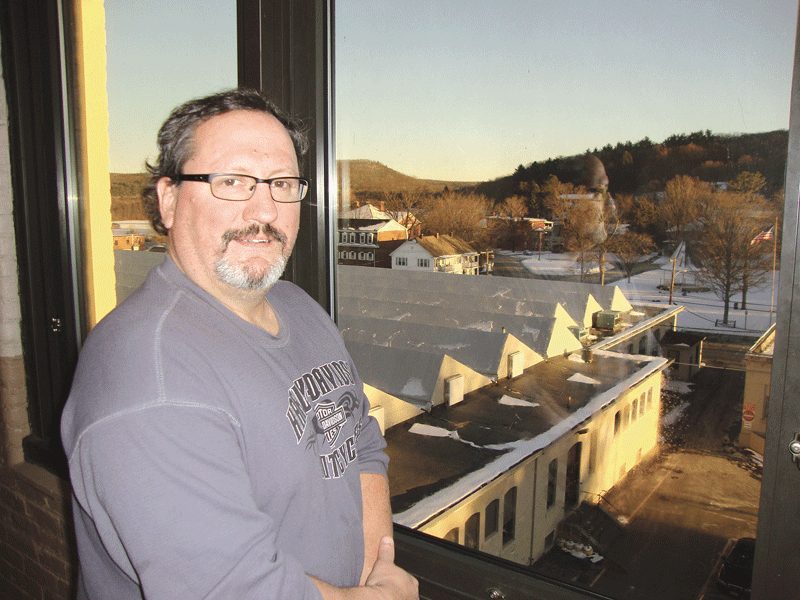
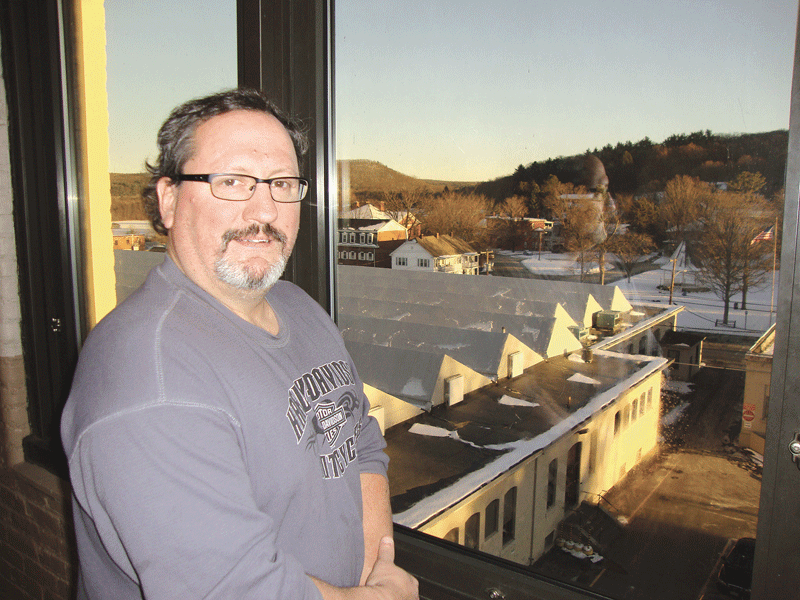
Through hard work and tenacity, John Morrison has occupancy at the Palmer Technology Center at around 90%.

Susan Rutherford said that, when it comes to fostering new business ventures in Palmer, her office isn’t just rolling the dice.
The executive director for the Quaboag Valley Community Development Corp., she told BusinessWest how her office has been helping to nurture an entrepreneurial business climate for the region. And in many ways, what she has found in the 15 years of seeing business in Palmer grow is that this recession hit hard, but there are some success stories.
“Obviously the past few years have been as stressful here as elsewhere,” she said. “But then there are some sectors that are doing okay, and some that are actually doing quite well.”
The town might be making the most headlines these days for that contentious piece of property eyed as a potential home for a resort casino to be developed by Mohegan Sun. But while the fate of gambling is still undecided on Beacon Hill, Palmer is steadily gaining ground for business initiatives to capitalize on the assets that are already in place.
Lucy Carlson

Where some see Palmer as off the beaten track, Lucy Carlson saw it as a place with untapped potential.

Five years after starting her advertising and marketing business just outside of the downtown area of Depot Village, Lucy Carlson said that Palmer presents a unique opportunity due to the very reason some cite as a business obstacle. Others might say that the town’s geographic location outside of the Route 91 corridor places Palmer off the beaten track, but she says otherwise.
“I saw that the Quaboag area in general was untouched and untapped,” she explained. “There are a lot of ad agencies in Greater Springfield, and then in Northampton. But this area didn’t seem to have that. There’s a lot of potential here, and especially Palmer as the largest town in this area.”
Up the street at the headquarters of the Quaboag Valley Chamber of Commerce, president Len Weake also said that the business climate mirrors that of most everywhere else in Western Mass., and Palmer has been affected by a recession that has cut through to commercial lending.
“In the past, when people were laid off, it pushed them into new ventures,” he said. “This time, we’re not seeing that — those people with entrepreneurial drive are having trouble getting the capital to start up.”
But, not wanting to focus on the negative aspects of the current economy, he quickly pointed out that thanks to the QVCDC, it’s not all doom and gloom within his region. And he pointed out the strong mill origins of the town as a link to Palmer’s full potential. The Garabedian family, owners of Thorndike Mills braided rugs, has been in business since 1925, and Weake cited them as an example of industry that continues to this day.
However, he also told BusinessWest of two properties that had seen the rug pulled from under them when the original owners of their buildings left the area. The Mapletree Industrial Plaza, just outside of downtown, and the Palmer Technology Center (formerly Tambrands), in Three Rivers, are prime examples of adaptive reuse, with both complexes boasting nearly-full occupancy.
“They aren’t retail locations,” he said to describe both properties, “but they have a strong commercial presence here in town.”
In this latest installment of ‘Doing Business In,’ BusinessWest talks to the principals at those industrial properties and finds out how they, and others, took a gamble on Palmer — and why it was a bet that paid off.

Home-field Advantage
Carlson said the business population in the Quaboag Valley is filled with, in her words, “hidden jewels.” As a full-service marketing and advertising agency, she said her office is primed to cater to those businesses, and that is what drew her to open shop in her location on South Main Street.
She acknowledged that one problem facing Palmer, in contrast to some of the other surrounding towns, citing Monson and Belchertown as two examples, is a lack of younger generations moving in — to work or live.
But residents have a strong sense of support for the hometown mom-and-pop shops, she went on to say. And with Palmer at the center of so many different, smaller communities, a good opportunity presents itself for anyone to hang out a shingle for new ventures. “There are so many opportunities for so many types of enterprises,” she explained, “and because we are just far enough from Springfield or Northampton, the local residents would be happy to support that business.”
Located in Ware, but serving Palmer and the other towns of the Quaboag Valley, the QVCDC is the place for local entrepreneurs to start when considering a new business. Stating the goals of her operation simply, Rutherford said, “we work with small businesses, including making loans to those who can’t get them from banks, and providing training, education, and consulting to businesses.”
The QVCDC’s stated mission is to “improve the quality of life in the Quaboag Valley by addressing the economic, environmental, and social needs of its residents while maintaining the integrity and character of each community in the region.”
When speaking of the new ventures that have come through her office in the 15 years of its existence, Rutherford said that this recession has proven more challenging for individuals than any downturn in the past.
“But a lot of it goes back to the ingenuity of the owners, and their adaptability, and ability to go with the flow,” she said. “And a lot has to do with good, tight management. The businesses that are having the most troubles are the ones that were lucky before — they were doing the right thing at the right time. The ones that are doing the best now are good planners, good users of resources.”
Citing some manufacturing concerns in town, she said success stories do exist. “There are imaginative people out there,” she added, “and they are developing interesting businesses. I’d say that it is individuals, more than an entire industry, who show the success of this region.”

Mill Power
An example of that definition of success, John Morrison and his industrial complex known as the Palmer Technology Center, could be exhibit A.
He is the owner of the buildings formerly housing Otis Mills, then Tambrands, maker of Tampax products, and even though he laughed when he said that, in some form or other, “these buildings have always made me money,” there was absolute truth in his statement.
His parents both worked at the plant when it was Tambrands, and as a youth, he had a job there also. He augmented his ‘day job’ with a plowing contract for the premises, and then a scrap-metal contract, and when the building was sold to Procter & Gamble in the 1980s, the new owners liquidated the offices and manufacturing facilities, but kept him on as ’round-the-clock security.
A brokerage firm was engaged to lease the facility, unsuccessfully, and as the site coordinator, Morrison became acquainted with some of the potential players. Eventually partnering with one of those individuals, Sid Kovitch from Boston (and, later, that man’s family after he passed away), Morrison took a gamble and purchased the four-building complex.
Originally there were no tenants on the property, but through hard work and determination, Morrison said that he has secured leases from 27 businesses. Presently, he puts the occupancy at just over 90%. And while he has been an unflagging point person for the property’s management, he credits the former owners for making this a top-notch, marketable facility.
P&G invested $20 million in the buildings in the late ’80s, which means that new tenants have the benefit of weather-tight construction, a T1 connection, and full fiber optics. Mustang Motorcycle Seats uses the original fabrication building, and today is Morrison’s largest tenant. But he also cites small operations, from musical-instrument teachers needing space, to Wing Memorial Hospital’s billing and visiting-nurse departments, who together occupy a full, 18,000-square-foot floor.
And his tenants can grow without leaving the property, he said. “We’ve had a lot of people who started out small, like Halpern Titanium. He came here with a table saw and a couple tools, and now has about 20 big machines. He started out cutting pieces of titanium and selling them, and he’s a full-blown machine shop now.”
But Morrison knows that if he doesn’t have the space for a prospective tenant, he can always refer them to another complex, Mapletree Industrial Park, for example, “so that the business and the jobs still stay here in Palmer.”
John Rottman is the senior property manager at Mapletree, and he shared the sentiment that keeping jobs in Palmer is important, especially when thinking of all the employment that was lost when the Colorado Fuel and Iron Steel Mill wire factory, whose mill his firm now owns, closed shop back in 1971.
“In its heyday, there were three shifts here running around the clock, with more than 1,000 workers; some old-timers here in town say that wire here went into the construction of the Golden Gate Bridge,” he said. “When the plant closed, there were still 700 people working here. It was quite a shock to the town.”
The current owners, Presidential Realty Corp., from White Plains, N.Y., bought the property in 1973. Rottman said there were a handful of small tenants for the next decade. He worked in the management office there for six months, in 1986, and at that time a concerted effort was made to lease out the rest of the property.
“We really pushed to make it a multi-tenant facility; we have 83 tenants, presently,” he said, adding that they come in a range of sizes. “Our biggest user is New England Wood Pallet, with more than 30,000 feet. But they are winding down now, due to transportation costs, and by summer, we’ll need to find another tenant for that spot.”
While that will mean another push to find tenants, Rottman said that, because his buildings have rail access, there is a whole subsidiary of rail marketing that exists to find properties like his. In his time, he has seen adaptively reused properties like Mapletree shift from light manufacturing to high-tech to, in some cases, warehouse space for other businesses off-site.
“But I hope that’s cyclical,” he said of warehousing. “I hope we get to the point where entrepreneurs can do some startups again, do some manufacturing and distribution. But it’s hard to find capital today to make that leap, and to take that chance.
“The last two years have been challenging,” he continued, “but we continue to rent space. It’s still chugging along. There are people with good ideas out there, though; hopefully, as soon as there’s money available, they will be able to make their business work.”
And that’s a sentiment that is echoed and supported across the town line at the QVCDC. Rutherford said that the challenge is not necessarily the funding, because that is what her office works to achieve, but to continue finding the right people to turn ideas into thriving businesses.
“That’s the goal,” she said, “to find those people who have a good work ethic who also have good entrepreneurial ability.”
And, rather than a bet with long odds, so far that has proven to be a sure thing.

Features
A Progress Report from the State’s Economic-development Czar

Greg Bialecki, secretary of Housing & Economic Development

Greg Bialecki, secretary of Housing & Economic Development

As the Patrick administration begins its second term in office, the focus, from an economic-development perspective, will be to continue to use public dollars to leverage private investment, says Greg Bialecki, secretary of Housing & Economic Development. He noted that so-called gateway cities such as Springfield and Holyoke need investments from the state to stimulate private spending and create new sources of jobs and overall economic vitality. In a wide-ranging Q&A touching on everything from corporate incentives to market-rate housing development, Bialecki talks about what’s been accomplished, and the work still to do in such cities.

Greg Bialecki acknowledged that that much of the progress being seen in Springfield and other area communities has been generated by state and/or federal assistance — on one level or another.
Examples abound, from the presence of Liberty Mutual in the Technology Park at Springfield Technical Community College to the high-performance computing center in Holyoke; from the tax incentives recently awarded to Smith & Wesson in exchange for its pledge to create 225 new jobs at its Springfield plant and make significant investments there, to the backup data center soon to be take shape at the former Technical High School on Elliot Street in Springfield.
Bialecki, the state secretary of Housing and Economic Development, prefers to look at the state’s contributions as investments that will help trigger private-sector spending in older, former manufacturing centers, like Springfield, Holyoke, Chicopee, and others, that need a boost in their efforts to reinvent themselves and spur economic growth.
The Deval Patrick administration’s strategic plan has been to make prudent, well-thought-out investments capable of generating significant returns, said Bialecki, adding that this policy will continue in the second term that started this month, and that, given some help in the form of economic recovery, such returns should soon be visible and measurable.

data center

The data center taking shape at the old Tech High building is another example of state investment in a gateway city — Springfield.

In this Q&A, BusinessWest sounded out the state’s economic-development czar on what’s been accomplished to date, and what can be expected in the months and years to come.
BusinessWest: Talk about the state’s investments in economic development and the goals and expectations that come with this assistance.

Bialecki: “Everyone who does investing is always looking for leverage, and the state is no exception. The governor has asked me to look for opportunities where a state investment will be matched, not just one-to-one, but many times over, by private investment. The high-performance computing center is a good example of that; the state has committed $25 million to that effort, which will probably be a $160 million project when all is said and done, and a number of private colleges involved have made sizeable investments as well. Originally, we put out the promise of some public funding to encourage private funding, but at this point, all the money that’s needed to make this go is in hand.
“Smith & Wesson is another example. Our $6 million investment tax credit is probably going to be about 10% of the actual private investment. Smith & Wesson has committed to spend at least $60 million in new plant equipment there over the next several years, so we’re just making a commitment that’s way overmatched by private investment.”

BusinessWest: How do these investments fit into the state’s broad strategic initiative involving the so-called Gateway Cities, such as Springfield and Holyoke, and are there signs that state-assisted projects are, in fact, stimulating private development?

Bialecki: “You can see some examples of the model this administration is advancing taking place in Springfield. Liberty Mutual is one, and the old federal building, 1550 Main St., is another, and so is the data center. These are public/private projects, for the most part, and examples of how state assistance has been provided to help older cities. We do believe that, if you’re really going to be a catalyst for economic development and job creation, we need to be thinking not only about places where we can do public projects — Union Station might be an example — but balancing that out with projects where we are providing an incentive for private investment.
“These projects send a bit of a different message about the way we think of the economic potential of different regions of the state, including our older cities. In other words, this approach is based on the view, the perspective, that good things are happening in all the regions and many of our cities, and if we can address their challenges, but also talk up the good things about them, we can convince private business to locate there.”

BusinessWest: Some people and groups criticize such public assistance to private companies, calling it corporate welfare and a flawed system for spurring economic development and job growth. How do you respond to that, and does the state need to make such incentives available to compete with other regions and cities?

Bialecki: “We believe that some level of assistance is probably required in a number of these places to help people make the decision to locate in a Springfield or locate in Western Mass., in part because of what other regions are offering, but also in part because some companies like it here and want to be able to stay here.
“Frankly, the Smith & Wesson deal, although that was real money, was in a way a blockbuster deal, in terms of the amount of incentives compared to what other states are offering. We have other states offering some of our companies huge deals — they’re saying, ‘if you move here, we’ll build you a factory, and we’ll pay for it.’ And if you talk to Smith & Wesson and ask them if the state’s willingness to commit to incentives was an important part of their decision, they’ll say, ‘yes, absolutely.’ But they’ll also say that they really like being in Springfield, we’ve got a great workforce; it’s not a case where they’re saying, ‘we don’t want to be in Massachusetts, we don’t wan’t to be in Springfield, but if you pay us enough, we’ll stay here.’ They want to be here.”

BusinessWest: How important is balance, in terms of public and private investments, to a city’s long-term success?

Bialecki: “Very important. The ultimate goal, obviously, is to maximize the amount of private-sector job-creation and private-sector investment in the region. We’re glad to continue to make significant public investments as well, but, realistically, and from our point of view, you’re only to going to be able to say we have a healthy economy in Western Mass. if there’s not only public dollars going into employment and investment, but also private dollars, and more private dollars than public.”

BusinessWest: Talk about the plight of the gateway cities and what the state is doing to assist them.

Bialecki: “Our approach is very consistent in that we don’t look down condescendingly on these cities — we view them as being able to participate in and contribute to the economic health of the state. We want them to be in the mainstream of the business mix in the state. What are the big industries in Massachusetts? Health care, higher ed, financial services, high tech … a measure of our success should be that those industries are in our gateway cities. In Springfield, MassMutual was already there, but getting Liberty Mutual was big — these are Fortune 100 companies, and they both have a presence there.
“There are also many colleges and universities in Springfield, and that’s important, as well as Baystate Medical center and other health care providers. We want to add the tech sector to that mix, and the high-performance computing center will help. We want the gateway cities to be in the mainstream of the state’s economy, especially the innovation economy.”

BusinessWest: What role does housing, specifically market-rate housing that will, theoretically, attract young people and professionals, play in economic development, and what is the state doing to stimulate such developments?

Bialecki: “Housing is a critical component, and we want to make sure that cities have a good mix of all kinds of people living within their boundaries. We want there to be enough affordable housing for those at that end of the spectrum, but also enough places for people who are middle-class and above and have choices about where they want to live. How can we create an environment where people will want to live in our gateway cities?
“We started a new program where, for the first time, we have money available to provide tax-incentive support for people to create market-rate housing in gateway cities. It’s a pilot program with $5 million available initially, and it’s something [Springfield] Mayor [Domenic] Sarno has expressed great interest in. Officials in Springfield have done an inventory of what market-rate housing is available today, and identified potential pipeline opportunities where such housing can be created; developers will probably need some help, and we’re willing to do that.”

BusinessWest: Is there a policy or strategic plan for helping these cities, and if so, what are the main elements?

Bialecki: “Some of the strategies that people have talked about in the past for helping gateway cities have been to mitigate the challenges and the problems facing these cities, such as public safety, and those are important things to do. But we are actually aiming higher. We’re not just trying to mitigate the problems; our vision focuses on determining what these cities, like Springfield, would look like if they were functioning at a high level and were contributing to the economic life of the region.
“And if you look back, all of these played that role at one time, some more recently than others. Holyoke was the first planned industrial city in the country, New Bedford was the whaling capital of the world, and Lowell and Lawrence were main textile centers. Most all of these cities were, at some point in time, not just keeping up with the economic prosperity of their neighbors, they were driving the economic prosperity of their respective region.
“We understand the challenges, but we think that that is the right aspiration to have for these cities: what would it look like and feel like for Springfield to be that driving force again?”

BusinessWest: What are the immediate hurdles to achieving that goal, and what has to be done for the city to achieve this vision?

Bialecki: “There are a lot of good building blocks in Springfield, like its colleges, universities, and fine health care facilities. We would like to see other aspects of the innovation economy; we’d like to see more tech companies. There are some initiatives with incubator space [at STCC], and there is the Pioneer Valley Life Sciences Initiative to get some other life sciences and biotech. There is plenty to build on.
“And development of these sectors goes back to my earlier comments about how many projects require some measure of state assistance. While it’s true that, to jump-start some of these things, assistance is needed, our goal is to move off that.
“In other words, let’s talk about the things we have to do in Springfield and the other gateway cities so that the businesses will say, ‘you don’t need to persuade me to open a new business unit in Springfield — that’s where things are happening; that’s where I want to be.’

BusinessWest: Is there a model to be followed in terms of such a recovery?

Bialecki: “Lowell is the classic; that’s the one everyone points to, and they have had a good deal of success over a prolonged period of time, going back to the ’80s. But I’ve seen some very impressive changes and improvements more recently, over the past four years, for example. In Haverhill, the mayor has made a big focus on market-rate housing in the downtown, mostly in old mills and even to the point where people said, ‘what are you doing?’ But it’s worked out very well; he’s got a lot of telecommuters there and people who can work anywhere, and it’s a short commute to Boston. And he’s generated a lot of street life, a lot of new restaurants.
“And New Bedford’s done very nicely. We’ve helped them with some things, and they’ve used those projects to trigger some private investments; there is a nice creative-economy element to what they’ve done, with a lot of artists moving in.
“The thing about gateway cities is that there’s no silver-bullet project that’s going to put you over the top; it’s an accumulation of things that are going to make a difference, including that all-important private investment.”

George O’Brien can be reached at [email protected]

Sections Supplements
Stock Market Expected to Grow Along with Economy in 2011

Paul Valickus calls it “the Christmas-tree analogy.”
“Christmas tree sales over this past Thanksgiving weekend were up 12% year over year,” he said — and then wove that fact into his stock-market outlook for 2011. “That may sound a little silly, but it tells me that people were more confident and wanted to start celebrating a little earlier, to spend a little more money. It was an indicator of hope, if you will.”

President Michael Matty,

Paul Valickus (left), with St. Germain Investment Management President Michael Matty, says all signs point to a strong year on Wall Street.

It may be a small point, said Valickus, chief investment strategist at St. Germain Investment Management in Springfield, but it’s one of many larger trends — a decline in business vacancy rates and an uptick in employment among them — that point to rising confidence in a slowly improving economy, and that bodes well for the stock market in the coming year.
“I normally don’t make market forecasts, but I think this is an easy one,” Valickus said. “I think the economy and the stock market are going to do much better than most pundits are expecting.”
He cited last month’s Barron’s magazine forecast, which gathers the projections of 10 market experts, most of whom expect stock-market growth around 10%. “For me, that’s kind of a chicken forecast. A rise of 10% is what the market averages, trendwise, going way back. I think they’re just afraid to stick their necks out.”
Coming off the strong market surge late in 2010, George Keady hears the positive drumbeats, too, but has a different take. “That concerns me,” said the senior vice president and branch manager of UBS Financial Services in Springfield. “Don’t forget that what went on in November and December may have been an early 2011 gift. A lot of the movement in equity prices was a little premature.
“We’re expecting a moderate recovery in the economy — not a strong recovery, and not a double-dip,” Keady added. But because the market is all about expectations, he explained, that optimism has already been factored in. “When you see stocks move to the degree they moved in one month, that’s pretty optimistic. We have a positive outlook for next year, but part of next year happened in December.”
Boston Globe columnist Steven Syre agrees, noting that “a good deal of economic enthusiasm is already baked into the market. The S&P 500 index has climbed 21% in just the past four months.”

Changing of the Guard
Valickus, however, believes the upward movement is far from over, and he traces that belief back to the midterm elections two months ago, arguing that businesses spent the past two years in limbo in terms of their expectations about taxes, regulations, and other issues affected by the goings-on in Washington.
“Where I differ from a lot of people is, I think the economy will do a lot better than people expect, and I think the biggest catalyst is the November elections; people have a little more confidence in the business outlook now that Democrats lost their majority in the House.
“There’s a lot of pent-up demand out there,” Valickus added. “People were just afraid to do anything with certainty; they’re most comfortable having a Republican Congress going forward. Whether the Republicans are successful or not, there is that hope out there that maybe we’ll see a little more discipline in Washington. What the market abhors is uncertainty, and things now look a little more certain. Nothing is written in stone, but people are a little more comfortable.”
Writing in Barron’s, Kopin Tan sums up the view of the analysts who spoke with the magazine, noting that their modest projections about market performance bely a much more positive long-term outlook on the economy.
“A majority see 2011 as the year when a sustainable economic recovery takes root, winning over skeptics and persuading both companies and consumers to relax their stranglehold on squirreled-away cash,” Tan writes. “Improving confidence and low interest rates bode well for corporate profits. Meanwhile, the Federal Reserve remains hell-bent on propping up asset prices, and wages and prices of goods aren’t rising enough to sound an inflation alarm that would lead the central bank to alter its course of aggressive benevolence.”
Specifically, the strategists projected stock-market gains ranging from 7% to 17%. And while progress could be set back by global flareups such as trade tensions and conflicts in places like Iran and the Korean peninsula, Tan notes, “the market has started to flinch less at each flare-up of risk.”

Mixed Signals
At a time when rising interest rates are expected to weaken the bond market in 2 011, stocks are justifiably generating enthusiasm, but Keady pointed out that the picture is not rosy across the board.
For instance, he explained, while technology and consumer staples remain strong, health care and energy are charting a flatter course, and more than 30% of the companies in the S&P 500 overall were actually down in 2010.
Analysts note that prolonged cost-cutting and increasing consumer confidence, among other factors, point to long-term economic growth, but Keady said these market fundamentals still have to catch up with equity prices.
But in the short term, much of the market’s performance will depend on increasing confidence, and how long it can be maintained.
“What most people don’t understand is that the market can go up without the economy doing anything,” Valickus said. “People say, ‘wait, unemployment is 10%; how could the market go up?’ But it’s not what happened today; it’s what will happen tomorrow. That’s where a lot of people get confused.”
Still, judging by those Christmas trees in November — as well as plenty of other positive signs — confusion is giving way to confidence, and investors are putting more stock in the market.

Joseph Bednar can be reached at [email protected]

Opinion
America’s Revival Begins in Its Cities

During economic downturns, we begin to fear that we are entering a permanent period of decline. But we can avoid that depressing prospect if we recognize that a revival will not come from federal spending or another building boom. Reinvention requires a new wave of innovation and entrepreneurship, which can emerge from our dense metropolitan areas and their skilled residents. America must stop treating its cities as ugly stepchildren, and should instead cherish them as the engines that power our economy.
America’s 12 largest metropolitan areas collectively produced 37% of the country’s output in 2008, the last year with available data. Per-capita productivity was particularly high in large, skilled areas such as Boston, where output per person was 39% higher than the nation’s metropolitan average. Boston also seems to be moving past the current recession, with an unemployment rate well below the national average of 9.8%.
Since 1948, the national unemployment rate has exceeded 9% only one other time: the grave 1982 recession. During the 1980s, we looked at Japan and saw an economy that seemed to be surpassing our own. Today, we watch with unease as China surges.
Yet American decline is not inevitable. During the 25 years after 1982, our real gross domestic product increased by 3.3% per year, which was also the rate of growth during the quarter-century before 1982. Our post-1982 growth involved massive economic restructuring. Manufacturing employment fell by 39% from its peak of 19.4 million jobs in 1979. The 1979-2009 manufacturing decline was more than offset by the 126% employment jump in professional and business services and the 184% increase in education and health jobs.
Boston offers a model of how cities can foster such transformations. In the 1970s, Boston seemed headed for the trash-heap of history. Manufacturing jobs had vanished, and social chaos ensued. But Greater Boston experienced three great decades, as a former industrial hub became a capital of the information age.
To succeed in the future, the country needs to produce a stream of new ideas, like personal computers, Facebook, and steerable catheters. We must produce goods and services innovative enough to command the high prices needed to cover high labor costs.
Such breakthroughs rarely come from solitary geniuses. The movie The Social Network hints at the messy, interactive process that created Facebook, which now has over 500 million users and is valued at about $40 billion. Mark Zuckerberg benefited from being surrounded by smart peers, whose ideas about social networking helped his company get started.
The roots of Boston Scientific reveal a similarly collaborative process that started in the basement of a Belmont church. The brilliant inventor (and spiritualist) Itzhak Bentov created a steerable catheter, catering to the demands of Boston’s medical community. Boston connected Bentov with John Abele, who brought his business vision and later connected Abele with other partners, who helped him create a medical-innovation behemoth.
Cities have long enabled economic creativity. Detroit in 1900 looked a lot like Silicon Valley in the 1960s, with an entrepreneur on every street corner. In that urban hotbed, innovators like Ford, Buick, and the Fisher Brothers supplied and financed each other — and borrowed ideas freely. The urban edge in engendering innovation explains why globalization and technology have made cities more, not less, important. While all workers in the Boston area benefit from the region’s human capital, the flow of knowledge seems strongest in the dense clusters of Boston and Cambridge.
For decades, the American dream has meant white picket fences and endless suburbs. But the ideas created in dense metropolitan areas power American productivity. We should reduce the pro-home-ownership bias of housing policies, such as the home-mortgage-interest deduction, which subsidize suburban sprawl and penalize cities. We should rethink infrastructure policies that encourage Americans to move to lower-density environments. Most importantly, we should invest and innovate more in education, because human capital is the ultimate source of both urban and national strength.
As we grope toward a brighter future, we must embrace our cities, and invest in the skills that are central to their success.

Edward L. Glaeser, a professor of economics at Harvard, is the author of the forthcoming book The Triumph of the City.

Opinion
Incentives — They’re a Necessary Evil

‘Corporate welfare.’
That’s the term used in some circles to describe the incentives — mostly in the form of state and local tax breaks, but they come in other forms as well — given to companies to locate in a community or remain there and expand their operations. It has a very negative connotation, and, in the eyes of many, it’s warranted.
Welfare, a term that’s being removed from the lexicon, at least in this state, and replaced with ‘transitional assistance,’ implies help to those who outwardly need it. Some would say that businesses, or at least the vast majority of them, don’t need and don’t deserve tax breaks and other assistance when very few companies, and no residents, get such help.
But this view does not reflect the current world in which we live and try to do business. Indeed, jobs are the lifeblood of every community, every region, every state, and, yes, every country, and the competition for jobs has never been more intense. Thus, incentives like those recently awarded by the state and the city of Springfield to Smith & Wesson and Titeflex (see story, page 6), and by the state to Qteros (now doing business in Chicopee), are certainly warranted, if not exactly popular.
States and economic-development regions are being quite imaginative, and generous, with incentives, especially in this economy and when so many former manufacturing centers are struggling. If these companies and others, such as Performance Food Group in Springfield when it was looking to expand in the city, did not get the tax breaks they requested, they would, in all likelihood, have gone elsewhere.
All this said, communities and states have a responsibility to award incentives wisely and fairly, with an eye toward helping a region, not an individual business. Most people remember when Springfield was handing out grants and attractive loans willy-nilly, to seemingly anyone who wanted to open a restaurant and had a business plan in hand — and they remember the consequences: unpaid loans and vacant storefronts.
Which is why we’re pleased to see that the state’s Economic Assistance Coordinating Council has changed the rules when it comes to how it awards tax subsidies. These changes, which came in the wake of criticism that the state had squandered millions of dollars over the years on dubious projects, such as fast-food restaurants and retailers who probably would have opened in the Bay State anyway, were certainly overdue.
The new regulations, adopted early in 2010, limit which companies are eligible for subsidies, and give state economic-development officials more discretion over the awards. In short, priority is now given to manufacturers and companies at the cutting edge of new technology and processes (such as Qteros) and to opportunities for job growth in the so-called Gateway Cities, which include Springfield, Holyoke, Chicopee, and others in this region.
And these awards come with some heavy strings, such as the promise of new jobs and investments in these companies’ operations. So while time will ultimately tell what happens at Smith & Wesson, Titeflex, Qteros, and other companies in this region, the money spent by the state and the communities involved appears for now to be well-spent.
As we said at the top, business incentives — or that much-less-flattering term for them, corporate welfare — seem inherently unfair when residential taxpayers don’t receive breaks and many business owners stay in a region for decades, and sometimes expand several times, without asking for or receiving financial assistance.
But the reality is that these incentives are, indeed, necessary, and you might as well drop the word ‘evil’ that usually follows that term.
When you do the math, and divide the state tax subsidies awarded to Smith & Wesson ($6 million) by the number of jobs created (225), it’s about $26,000. That’s a lot of money for a job, but for a region that’s screaming for new employment opportunities, especially good-paying jobs in manufacturing, that price sounds like a bargain.
And a price well-worth paying — if, and only if, the conditions are right.

Briefcase Departments

Denver Stepping Down as Chamber President
SPRINGFIELD — After 14 years as president of the Affiliated Chambers of Commerce of Greater Springfield, Russell F. Denver recently announced he is leaving that post in the coming weeks to pursue other professional opportunities. Denver, an attorney, noted that he feels now is the opportune time to step down and bring in someone else with a fresh perspective. Citing his accomplishments, Denver noted in particular the Urban Land Institute’s work that has been done in the city. Before leaving his post, Denver plans to complete work on zoning revisions for the city, as well as the new “Make It Happen” marketing campaign for Springfield. Jeffrey S. Ciuffreda, vice president of government affairs for the Affiliated Chambers, will serve as interim president. Currently, the Affiliated Chambers of Commerce have approximately 1,200 members and an annual budget of $300,000. The Affiliated Chambers include the Springfield Chamber of Commerce, the West of the River Chamber of Commerce, the East of the River Chamber of Commerce, and the Professional Women’s Chamber of Commerce.

Springfield Leadership Institute Registration Underway
SPRINGFIELD — Registration is underway for this year’s Springfield Leadership Institute (SLI), which represents a 37-plus-year collaboration between the Affiliated Chambers of Commerce of Greater Springfield and the Western New England College School of Business. Institute alumni represent many accomplished and distinguished leaders in business, education, government, and nonprofit communities. The 2011 Springfield Leadership Institute, which begins on Feb. 17, will challenge participants to think in new ways and to analyze their own strengths and organizational challenges within a dynamic economy. SLI is taught by Western New England College faculty, who will introduce participants to emerging leadership theory and best practices. A segment on ‘Leadership Presence’ is being added this year along with the institute’s continued emphasis on problem-solving at the executive level. Case studies have also been updated for the 2011 program. The program meets every Thursday from 1 to 4:30 p.m. in the TD Bank Conference Center, 1441 Main St. Participants in SLI learn how to be more effective leaders and how to have the power to make an important difference both in the workplace and in the community. Contact Lynn Johnson at (413) 755-1310 or at [email protected] for more information.

2011 Woman of the Year Nominations Sought
SPRINGFIELD — The Professional Women’s Chamber of Commerce, a division of the Affiliated Chambers of Commerce of Greater Springfield, is seeking nominations for the 2011 Woman of the Year Award. The award has been presented annually since 1954 to a woman in the Western Mass. area who exemplifies outstanding leadership, professional accomplishment, and service to the community. The nominee’s achievements can be representative of a lifetime’s work or for more recent successes. Any woman in the Pioneer Valley is eligible for nomination, and a chamber affiliation is not required. To obtain a nomination form, visit www.professionalwomenschamber.com or e-mail committee chair Michelle Cayo at [email protected]. The deadline for nominations is Feb. 11.

Call for ADDY Award Submissions
SPRINGFIELD — The Advertising Club of Western Massachusetts (ACWM) welcomes submissions for its 2011 ADDY Awards from individuals and organizations throughout Hampden, Hampshire, Franklin, and Berkshire counties. The annual competition recognizes creative excellence in all media, including print, broadcast, interactive, out-of-home, and public-service advertising. The ADDY Awards competition is a three-tier (local, regional, and national) competition conducted annually by the American Advertising Federation (AAF). ACWM is the only AAF-member club in the New England district. A panel of advertising experts will select winners in Springfield on Feb. 11. All entries must be registered online. For information on submission guidelines and a direct link to commence the submission process, visit www.submitandrepresent.com. The deadline for mail submission is Jan. 31. In-person submissions will be accepted on Feb. 4 from 9 a.m. to 5 p.m. in the Berkshire Bank community room, 1259 East Columbus Ave., Springfield. For more information, call the Ad Club at (413) 736-2582.

Unemployment Hits 20.7% in Construction Sector
WASHINGTON — Despite a slight drop in the nation’s unemployment rate, the construction industry ended 2010 with a jobless rate of 20.7%, according to the Jan. 7 report by the U.S. Labor Department. The construction industry lost 16,000 jobs last month and 93,000 jobs, or 1.6%, compared to December 2009. While the unemployment rate was up from 18.8% last November, it is down from 22.7% in December 2009. The average annual unemployment rate for the construction industry in 2010 was 20.6%, compared to 19.0% in 2009 and 10.6% in 2008. The non-residential building construction sector lost 400 jobs in December, but was up by 5,700 jobs, or 0.8%, from the same time one year ago — the first year-over-year growth since August 2008. Employment in that sector was 688,300 in December on a seasonally adjusted basis. Employment in heavy and civil engineering construction decreased for the second straight month, down 12,700 in December. However, employment in that sector was up by 18,100 jobs, or 2.3%, from December 2009. Specialty trade contractors gained 3,300 jobs last month, but the segment is down 79,000 jobs, or 2.2%, from the same time last year. The residential-building construction sector shed 5,900 jobs for the month and 37,000, or 6.2%, for the year. The nation gained 103,000 jobs in all industries in December, with the bulk of job growth in leisure and hospitality, up 47,000 jobs; education and health services, up 44,000 jobs; and trade, transportation, and utilities, up 31,000 jobs. Year-over-year, the nation has gained 1,124,000 jobs, or 0.9%. The nation’s unemployment rate dropped to 9.4% in December from 9.8% the previous month. “The nation’s construction industry should be glad to see 2010 in the rearview mirror, as the sector ended the year on a dismal note,” said Associated Builders and Contractors Chief Economist Anirban Basu in a prepared statement. “It is noteworthy that heavy and civil engineering has lost jobs for two consecutive months, which may be a reflection of the steadily slowing impact of federal stimulus spending. For much of the past year, that segment had been adding jobs. The expectation is that the nation will continue to add jobs. However, the construction sector is poised to underperform in the year ahead due to a number of factors, including dwindling direct impact from stimulus spending and the ongoing malaise in commercial real estate. With a national unemployment rate now at 9.4% — the lowest rate since May 2009 — this is an indication that the labor market is improving reasonably quickly. However, this does not seem to be the case with the construction industry, as today’s numbers may be a reflection of numerous factors in the economy, including still-subdued confidence among business owners and decision-makers.”

Uptick in Car Sales Sends Optimistic Sign
DETROIT — U.S. automakers will take a victory lap at the Detroit auto show this month after a measurable recovery from years of losses, a shrinking of market share to Asian rivals, and the bankruptcy troubles of Chrysler and General Motors (GM), according to Edmunds.com. GM posted a $2 billion third-quarter profit and then launched a public stock offering in November, while Chrysler increased its market share in 2010 and will introduce two new models this month at the auto show. Also, Ford was able to regain the number-two spot in the U.S. market from Toyota in 2010 when it saw its share grow for the second consecutive year. Overall, U.S. auto sales rose 11% last year to 11.6 million vehicles. Sales forecasts predict sales of 12.5 to 13.5 million units in 2011, and Toyota hopes its prospects are good for big gains despite its recent recalls. “If [the Detroit Three] can make money at depression-level sales, it tells you something dramatic has changed,” said David Cole, chairman of the Center for Automotive Research in Ann Arbor, Mich., in a prepared statement. “If we get back to 13, 14, 15 million units, this is going to be an astonishingly profitable business.” In the coming months, automakers are also expected to revamp their lineups with ‘green’ cars that will meet new emissions standards. Toyota will be expanding its Prius hybrid with the introduction of a new wagon, Tesla will be showing a luxury electric sedan, and GM launches its subcompact, the Chevy Sonic, as well as a compact Buick and the plug-in hybrid Chevy Volt. However, “the risk to the marketplace is that consumers aren’t asking for these,” said Rebecca Lindland, an analyst with IHS Automotive. Hybrid auto sales fell last year to 2.4% of the U.S. market from 2.8% in 2009, according to Autodata. The North American International Auto Show is open to the public Jan. 15-23.

Link to Libraries Receives Grant
EAST LONGMEADOW — The Service League of Springfield (Philanthropic Management–Bank of America) has made a $1,000 grant to Link to Libraries Inc. The organization will use the grant to offer Senior Connections, a Link to Libraries read-aloud program for children in the Holyoke and Springfield areas who are enrolled in preschool programs. The program is conducted in collaboration with Loomis Communities and Reeds Landing residents. The residents will team up with Link to Libraries educators and volunteers to offer preschool-age children reading programs locally during the spring and fall. Susan Jaye-Kaplan, co-founder of Link to Libraries, noted in a statement, “this collaboration is yet another partnership with local residents and agencies to enhance the reading skills of children of all ages and to make a connection with talented adults who reside in our community and want to remain active.” The Link to Libraries Senior Connection will be managed by Roberta Hillenberg-Gang of Longmeadow, who serves on the organization’s advisory committee. For more information, visit www.linktolibraries.org or call (413) 224-1031.

Departments People on the Move

People on the Move

van Schouwen Associates, LLC, of Longmeadow announced the following:

Shannon Filipelli

Shannon Filipelli

• Shannon Filippelli has been promoted to Director of Strategic Communications; and
Staasi Heropoulos

Staasi Heropoulos

• Staasi Heropoulos has been hired as Manager of Strategic Communications.
The expanded staffing and organizational changes come as the firm inks several contracts for new business with a regional bank, national retailer, international component R&D test firm, health care services organization, and other companies.
•••••
Dr. Michael Coppola has been elected President of the Washington, D.C.-based American Sleep Apnea Assoc. for 2011. Coppola, who specializes in pulmonary and sleep medicine, has served on the association’s Board of Directors since 2004. He is President and CEO of Springfield Medical Associates. He also serves as an Associate Clinical Professor of Medicine at Tufts University School of Medicine.
•••••
Jeffrey Corrigan has been named Vice President of Human Resources at the Brattleboro Retreat, Brattleboro, Vt. Corrigan has close to 30 years of experience in leading human resources in health care settings.
•••••
Marta Nichols has been appointed CitiStat Director for the City of Springfield. Nichols will be responsible for managing the development and implementation of CitiStat, Performance Management and ACE/LEAN, including the development of all policies, processes, and communication programs. Nichols will also serve as a member of the steering committees that drive Continuous Improvement Springfield, as well as identify, analyze, prioritize, and make recommendations to the committee. Additionally, she will advise Mayor Domenic J. Sarno and Chief Administrative and Financial Officer Lee C. Erdmann on department activities, problems, and performance.
•••••
Christina M. Sousa

Christina M. Sousa

TD Bank has named Christina M. Sousa the Store Manager of the Ludlow Center store at 549 Center St. An Assistant Vice President, she is responsible for new-business development, consumer and business lending, and managing personnel and day-to-day operations at the store.
•••••
Attorney Rosemary J. Nevins has been named Senior Counsel at Royal LLP, 270 Pleasant St., Northampton. Nevins has more than 25 years of experience in labor and employment law.
•••••
John Kennedy has been named Vice Chancellor for University Relations at UMass Amherst. He will direct the campus’ marketing, branding, and communication efforts. He will also oversee units responsible for communications and marketing, news and media relations, and external relations and university events.
•••••
The Central Massachusetts South Chamber of Commerce in Sturbridge announced the following:
• Michael Detarando, of Incom, has been named to the Board of Directors;
• Jonathan Kelley, of Savers Bank, has been named to the Board of Directors;
• James Leaming, of Yogi Bear’s Jellystone Park, has been named to the Board of Directors; and
• Thea Marcoux, of SCHOTT North America, has been named to the Board of Directors.
•••••
Denise McCarthy

Denise McCarthy

Denise McCarthy has joined Marcotte Ford in Holyoke as Business Development Manager. She is responsible for generating new business for the dealership by cultivating Internet inquiries as well as communicating with existing prospects and customers. She also promotes the dealership through participation in the Holyoke and Chicopee Chambers of Commerce and off-site marketing and community events.
•••••
Alfredo Batista has joined Keller Williams Realty in its Longmeadow office.
•••••
David Barclay has been appointed as Director of Development at Historic Deerfield.
•••••
Psychologist L. Saxon Elliott has joined James Levine Associates in Westfield and South Hadley.
•••••
Jeremy M. Leblond, a Certified Public Accountant, has joined the firm of Aaron Smith, Certified Public Accountants and Business Consultants, of East Longmeadow, as a Manager.
•••••
Attorney Carol Cioe Klyman, of the firm Shatz, Schwartz and Fentin, of Springfield and Northampton, has been elected as a Fellow of the Board of Regents of the American College of Trust and Estate Counsel.
•••••
Bradley Newell has joined Consolidated Health Plans in Springfield as Chief Financial Officer.
•••••
Northampton Planning Director Wayne Feiden has been nominated as an honorary member of the American Institute for Architects. His nomination states that Northampton has received the highest score in Massachusetts for sustainability in five of the past six years.
•••••
Tom O’Regan has been hired at UMass Amherst as the Manager who oversees emergency preparedness planning and response activities for the campus.
•••••
Frank DeCaro was recently honored as one of PepsiCo’s top performers worldwide with induction into the inaugural group of Chairman’s Circle of Champion winners. He was among 216 Associates from PepsiCo’s more than 250,000-person global operations team to win the honor.
•••••
Henry J. Drapalski Jr. has been named the Center for Human Development’s Vice President of Business Planning & Analysis. He will be responsible for analyzing business operations and fiscal performance and planning future growth for the $58 million, nonprofit agency.

Company Notebook Departments

Law Firm Named to ‘Top Tier’ List
SPRINGFIELD — Sullivan Hayes & Quinn was recently named a Top Tier Employment Management Firm by Best Lawyers and U.S. News and World Report. Managing partner Meghan Sullivan noted that the law firm was among 8,782 firms from across the country to be recognized. The local law firm specializes in employment-management issues, including labor relations, risk avoidance, workplace regulation, and employment litigation.

Appledore Engineering Joins Tighe & Bond
WESTFIELD — A New Hampshire civil-engineering firm has joined forces with Tighe & Bond, a engineering and environmental consulting service in the city. The move will enable Appledore Engineering to expand its service offerings and will also provide Tighe & Bond more opportunities for expansion into the New Hampshire and Maine markets. Appledore Engineering will remain at its Portsmouth location and do business as Appledore Engineering, a division of Tighe & Bond.

CHD, Cancer House of Hope Announce Merger
SPRINGFIELD — The Center for Human Development (CHD) and Cancer House of Hope recently announced a merger between the two nonprofit agencies. The CHD Board of Directors and Cancer House of Hope Board of Trustees both approved the merger late last year. It became effective Jan. 1. Cancer House of Hope operates two houses, one in Westfield and one in Springfield, that offer free support groups, workshops, and classes to adults with cancer and their family members and friends. Cancer House of Hope is now a program of CHD in its Community Resources division. Cancer House of Hope’s events, activities, and services will continue without interruption, and the agency’s two full-time and one part-time employee are now employees of CHD. Cheryl Gorski, executive director of Cancer House of Hope, noted in a statement that, “given the economy, it was getting more and more difficult to keep things running.” Gorski will continue to manage the program as its director. Gorski added that “merging with CHD will give us access to more resources for development, marketing, and support.” Founded in 1997, Cancer House of Hope has an annual operating budget of about $235,000, all of it coming from donations, grants, and fund-raising events, such as its upcoming, third annual Cheeseburger in Paradise Bar-B-Que at the Cedars in Springfield Feb. 19. Cancer House of Hope serves approximately 260 people a month at its two locations: 86 Court St., Westfield, and 946 Plumtree Road, Springfield. In addition to its three staff, Cancer House of Hope also contracts for services with 12 per-diem counselors and depends on about 50 volunteers, who help run the homes and activities. Gorski said she reached out to CHD President and CEO Jim Goodwin last August about the possibility of a merger. Gorski noted, “It made sense to help us get to the next level of what we can offer our members. I’m very enthusiastic about it. I think it’s a great thing for us.” Goodwin said that merging with a high-quality agency like Cancer House of Hope furthers CHD’s mission of offering community-oriented services in a way that helps protect people’s dignity. Goodwin noted that everyone knows someone who has been touched by cancer. He added that the programs and services Cancer House of Hope offers “are just too important to risk losing.” Those programs and services include yoga, Reiki, wig fittings, and bereavement-support groups, among many others. While the two homes are open to anyone regardless of residency and need, they mostly serve people who live in Hampden County and Northern Conn. For a list of Cancer House of Hope programs and services, visit www.cancerhouseofhope.org. Founded in 1972, CHD is a family of more than 40 programs that deliver a wide range of social services in communities throughout Western Mass. and Northwestern Conn. in areas such as mental health, youth mentoring, family stabilization, foster care, early intervention, elder care, occupational therapy, intellectual and physical disabilities, homelessness prevention, substance abuse, and juvenile justice. CHD’s main office is located at 332 Birnie Ave., Springfield. For a list and description of programs and services, visit www.chd.org.

United Bank Supports United Way Campaigns
WEST SPRINGFIELD — United Bank recently announced its annual United Way employee campaign generated more than $52,000 in contributions to United Way organizations located in the bank’s service area. The bank ran campaigns at all 22 branches located throughout Western and Central Mass. The 2010-11 employee campaign surpassed last year’s level of participation and giving to the United Ways of Pioneer Valley, Hampshire County, and Central Massachusetts. In addition, the United Bank Foundation contributed $36,000 to the campaign for a combined gift of $88,118.

MassMutual Explains Roth Retirement Plan Conversions
SPRINGFIELD — As part of its commitment to educate participants, plan sponsors, and advisers, MassMutual’s Retirement Services Division has published a white paper titled “Roth Retirement Plan Conversions — Questions and Answers.” The document answers the most common questions around converting 401(k), 403(b), and, starting this year, 457(b) governmental plans into Roth accounts. Effective last fall, the Small Business Jobs Act of 2010 allows participants who are in a retirement plan that offers Roth accounts the ability to convert or roll over their non-Roth account balances into a Roth source under the same plan, provided the participant has a distributable event (i.e., termination of service or in-service withdrawal provision, excluding hardship). For more information, visit www.massmutual.com.

Agency Offers Mobile Marketing Services
AGAWAM — The Creative Strategy Agency has started offering mobile marketing services including mobile Web sites, short-message service, and tablet and mobile applications for businesses. Alfonso Santaniello, CEO and president, noted in a statement that he wanted to take the agency’s marketing services “to a new and innovative format.” Santaniello added that mobile applications have “grown significantly” in the past year, and that he expects that trend to “continue to grow in the years to come.” For more information, visit www.creativestrategyagency.com.

Big E Plans $2.2M
Equine Arena
WEST SPRINGFIELD — Wayne McCary, president and CEO of the Eastern States Exposition, recently announced that the organization will embark on a $2.2 million construction project to build a covered warm-up arena attached to its C-Barn, the main horse barn used by the ESE Horse Show conducted during the Big E as well as a number of year-round equine events. Exposition officials vowed to continue their commitment to agriculture and the horse show by further developing infrastructure to maintain ESE’s position as New England’s most-sought-after equine destination. McCary noted in a statement, “I am confident that this project will further solidify the exposition’s position as the premier horse show facility in the Northeast. Our commitment to agriculture and our horse show, which began here in 1916, is ongoing.” The Exposition is also home to 12 year-round horse shows as well as a major equine-related trade show, Equine Affaire, held each November. The new arena will match the height of the existing building, and the 66’ x 170’ clear span outdoor roof will be bordered by a four-foot brick perimeter wall with pre-cast concrete upright posts. The exterior of the structure will mirror the north wall of the existing barn, and its walls will consist of a permeable vinyl designed to protect riders and horses from the elements while providing air circulation and ventilation. Each end of the covered arena will feature 20-foot ornamental iron sliding gates. Riders will be cooled by 16’, low-speed, high-volume fans. New lighting will be installed, and the riding arena will have spray irrigation and underground drainage. An existing angled doorway will be enlarged to 12’ x 14’ so riders may enter and exit the ring on horseback, and the immediate exterior area will also be covered. The project is the result of an extensive study of ESE facilities, conducted in 2010 to assess the needs of existing tenants and look toward future year-round growth. The research included a major engineering study of the Coliseum by Populous of Knoxville, Tenn., and a marketing analysis by AECOM of Washington, D.C. The Exposition will assume financial responsibility of the project and will receive no funding from the state. In addition, its 2011 capital budget of more than $1.1 million will include the installation of a new roof and other major improvements to the Coliseum. F-Barn, an auxiliary barn with 100 horse stalls located in the southwest corner of the fairgrounds, will also receive a new, upgraded metal roof. McCary noted, “we are investing in our future to maintain our roots and stay viable in an ever-changing marketplace.” The design architects for the project are Charlie Smith and David Forkner of Populous, in Knoxville. Neffinger Architects, of West Springfield, will serve as the architect of record. This winter, contractors will be selected, and construction will begin at the end of March. The project will be completed in time for the 2011 Big E, planned for Sept. 16 through Oct. 2.

Sections Supplements
Filing Is One Option, But There Are Many Paths to Recovery

If your business is in financial trouble, it may be tempting to consider filing a Chapter 11 bankruptcy petition. There may be many potential benefits: it puts at least a temporary stop to creditor collection efforts, it provides a venue in which to reduce a company’s debts, and it may create the vehicle from which to emerge from bankruptcy as a leaner, stronger company.

Steven Weiss

Steven Weiss

However, Chapter 11 is no automatic panacea for an ailing business.
Chapter 11 proceedings are expensive and a considerable distraction to the regular conduct of business. There will be supervision and reporting requirements with an unsecured-creditors committee and the U.S. trustee. The fees for the company’s bankruptcy attorneys and other professionals are considerable. Also, there will almost certainly be reductions in revenue immediately after customers learn of a Chapter 11 filing. And while it is relatively easy to get into Chapter 11, successfully emerging from bankruptcy is by no means assured. Fortunately, there are simpler, less costly alternatives; indeed, the best reorganizations are usually the ones that never see the inside of the bankruptcy court.
Perhaps the most important part of the reorganization analysis is to take a cold, dispassionate look at a business to see if there is really a core business that can be successful. This can be particularly difficult for owners of small businesses, who may have spent their adult lives developing the operation, or for owners who have taken over operations from the family founders of the business. However, there is little point to incurring the financial — and emotional — efforts of reorganization if there is little chance of success. So business owners need to ask some tough questions.
Are the financial troubles attributable to a one-time event, such as the loss of a major customer? Or are they due to a steady decline in revenue? Are certain parts of the business dragging down the other, more profitable lines? Are there weaknesses with current management that can be resolved? Is the amount of debt that won’t go away easily, e.g., bank debt and tax obligations, too high to be addressed even in a reorganization?
Because it is obviously difficult for a business owner to give these questions a truly unbiased analysis, it is useful, and probably imperative, to involve legal and financial advisors in the process.
If there is a viable business plan, the next step is to determine whether the plan can be accomplished without a Chapter 11 reorganization, and the first part of this process is to determine the primary sources of the financial pressure. For instance, if a secured lender is threatening collection action, then management’s efforts should be focused on reaching some accommodation with the lender. Secured lenders obviously have to be concerned with customers’ performance; however, except in rare instances, lenders would rather have a client continue to operate and make payments than have to liquidate their collateral.
Thus, banks may be willing to enter into forbearance agreements. Typically, these agreements provide for reduced payments and time to restructure a business or seek alternate financing. Lenders may also be willing to allow borrowers to liquidate unnecessary assets or business lines on a going-concern basis, which will usually generate better results than an auction sale.
If, on the other hand, the primary business is suffering pressure from trade creditors, there are other tactics. Fortunately for small businesses, unsecured creditors have limited legal remedies and little leverage in collection efforts, especially if the bank lender has a blanket lien on all of the business assets. And most sophisticated creditors know this. So trade creditors are often willing to take a significant discount on their claims simply because getting something is better than nothing. These discounts can be affected in a number of ways, depending on the circumstances of each business.
In some instances, arrangements can be made with individual creditors. If the creditor pressure is broadly based, making individual settlements may not be practical. Surprisingly, a carefully worded letter from counsel, explaining the circumstances and proposing either a moratorium on debt payments or discounted settlements to all trade creditors, may be accepted by the overwhelming majority. In some circumstances, particularly in larger businesses in which there are concentrated creditor bodies, groups of creditors may combine to form an informal committee to negotiate a settlement with creditors.
Many — indeed, maybe most — Chapter 11s being filed in recent years are not true reorganizations; instead, they result in sales of the company’s business as a going concern. Again, while there may be reasons to sell a business through the bankruptcy process, there are non-bankruptcy alternatives to a court-supervised sale.
Chief among these are assignments for the benefit of creditors. These are non-judicial business liquidations conducted under Massachusetts law. Management can choose the assignee, usually an attorney with bankruptcy and collection expertise. The assignee conducts his or her due diligence to ensure that the sale transaction is a fair disposition of the assets, and that there will be at least some meaningful dividend to unsecured creditors.
The assignee has wide latitude in how the sale will take place; while it can be by auction, he or she can also sell the assets as a going concern, which may contain terms favorable to management, such as employment agreements.
Once the assets are sold, the assignee notifies all creditors and provides them with a form for submitting their claims. If sufficient numbers of creditors accept the assignment, the assignee then makes a distribution to creditors. Again, the benefit to trade creditors is that they receive partial payment on their claims far more quickly than would be the case in liquidation proceedings in bankruptcy court.
Ultimately, Chapter 11 is like any other legal strategy; it may be useful, but only in the right circumstances, and only after other, less costly alternatives are considered.

Attorney Steven Weiss is a partner with Springfield-based Shatz, Schwartz and Fentin. He concentrates his practice in the areas of commercial and consumer bankruptcy, reorganization, and litigation. Weiss supervises the firm’s bankruptcy, reorganization, and workout practice; represents creditors, debtors, and others in both commercial and consumer bankruptcy cases throughout Massachusetts; and has been a member of the private panel of Chapter 7 Trustees for the District of Massachusetts since 1987, and also serves as a Chapter 11 trustee; (413) 737-1131.

Sections Supplements
What the Recently Passed Tax Legislation Means for You

The Tax Relief, Unemployment Insurance Reauthorization and Job Creation Act of 2010 (the 2010 Tax Relief Act) was signed into law Dec. 17, 2010, avoiding what would have been one of the largest tax increases in history if Congress and the president had not compromised.

Terri Judycki, CPA, MST

Terri Judycki, CPA, MST

As background, in 2001 and 2003 Senate Republicans were not certain they could pass permanent tax cuts with the required votes. As a result, both the 2001 and 2003 tax cut acts were passed as reconciliation bills that needed fewer votes. Under the ‘Byrd rule,’ bills passed under reconciliation may not alter federal revenue for more than 10 years. Consequently, the 2001 and 2003 tax cuts were scheduled to sunset after 2010.
The 2010 Tax Relief Act extends the Bush-era individual income tax cuts for all taxpayers and makes many other changes. A brief description of some of the provisions follows.

Individual Income Tax Rates
The sunsetting of the tax cuts would have resulted in tax rates of 15%, 28%, 31%, 36%, and 39.6%. Under the 2010 Tax Relief Act, individual income-tax rates will remain at the current levels for 2010 and 2011: 10%, 15%, 25%, 28%, 33%, and 35%.

Capital Gains/Qualified Dividends
The maximum rate of 15% for long-term capital gains and qualified dividends have also been extended through 2012. Taxpayers in the 10% and 15% tax brackets continue to pay 0% on this income. Had this provision been permitted to expire, the maximum rate of tax would have been 20% on long-term capital gains, 39.6% on qualified dividends.

Itemized Deduction and
Personal Exemption Limitations
Higher-income individuals would again have found their itemized deductions and personal exemptions reduced. Under the 2010 Tax Relief Act, higher-income taxpayers will receive benefit of the full deduction through 2012.

Marriage Penalty Relief
This refers only to the tax penalty. The expiring tax provisions provided that the standard deduction and the 15% tax bracket for married couples filing jointly were double that of a single filer. This is extended through 2012.

Alternative Minimum Tax (AMT)
The 2010 Tax Relief Act includes an AMT patch for 2010 and 2011. The patch provides increased exemption amounts to avoid impacting many middle-class taxpayers.

Charitable Incentives
The Tax Relief Act extends several charitable incentives, including tax-free distributions from IRAs to charitable organizations.

Individual Tax Credits
The act extends various credits through 2012, including the $1,000 child tax credit and the American Opportunity Tax Credit for higher education expenses.

Individual Tax Extenders
Expiring at the end of 2009, the following were extended for 2010 and 2011: state and local sales-tax deduction, higher-education tuition deduction, and teacher’s classroom-expense deduction.

Payroll Tax Cut
For 2011 only, the employee portion of the Social Security tax is reduced from 6.2% to 4.2%. The self-employment tax rate is also reduced by 2%. In 2009 and 2010, the Making Work Pay credit provided a $400 credit to single filers and $800 to taxpayers filing jointly, subject to phaseout for higher-income taxpayers. This new payroll tax ‘holiday’ has no income limitation. Therefore, jointly filing taxpayers who make more than $40,000 will receive more under the new holiday, while those public employees who do not pay into Social Security will not receive any benefit.

Section 179 Expensing
Under Section 179, a business meeting certain limits can currently expense the cost of asset purchases. The 2010 Small Business Jobs Act increased the expense limit to $500,000 for businesses with maximum investment for the year of $2 million for 2010 and 2011. The 2010 Tax Relief Act provides for a 2012 limit of $125,000 for businesses with a maximum investment of $500,000, indexed for inflation. Setting the 2012 limit now may permit businesses to budget capital improvements.

Bonus Depreciation
Under the 2010 Small Business Jobs Act, businesses could claim 50% bonus depreciation on qualified assets. Under the Tax Relief Act, bonus depreciation is increased to 100% for qualifying assets placed in service between Sept. 9, 2010 and Dec. 31, 2011. For assets placed in service during 2012, 50% bonus depreciation will apply. While 100% bonus depreciation sounds like Section 179 expensing, bonus depreciation is not subject to limitations for businesses that make large capital-asset purchases and is not subject to the Section 179 income limitations. Unlike Section 179 expensing, bonus depreciation can create or increase a net operating loss. On the other hand, many states do not allow bonus depreciation, but do allow Section 179 if claimed on the federal return.

Tax Credits
Several credits were extended, including the research credit that had expired at the end of 2009, as well as various energy credits.

Estate and GST Taxes
The 2001 tax cut phased out the estate and generation-skipping transfer (GST) taxes so that they were fully repealed in 2010. In 2009, there was a $3.5 million estate/GST tax exemption and a 45% estate-tax rate. In 2010, in lieu of estate taxes, a modified carryover basis would apply to assets owned by a decedent. In 2011, the estate/GST tax was scheduled to return with a $1 million exemption and estate tax rates up to 60%.
The 2010 Tax Relief Act reinstates the estate tax for decedents dying after Dec. 31, 2009, but with a $5 million exemption and a 35% estate tax rate. Estates of decedents dying in 2010 have the option to elect either the new estate tax or the modified carryover basis. There are also significant opportunities for GST tax planning, but those changes are too technical for this article. Suffice it to say that many wealthy taxpayers should be funding new GST trusts by the end of 2010. The new estate-tax regime is once again temporary and scheduled to sunset at the end of 2012.

Conclusion
The 2010 Tax Relief Act also included temporary extension of unemployment insurance, with the total cost estimated at about $858 billion by the Joint Committee on Taxation.
The new law allows taxpayers to plan through 2012, a presidential election year. One of the bigger battles this year concerned extending the tax cuts for higher-income taxpayers, not just those making less than $200,000 if single ($250,000 if filing jointly) as proposed by the Obama administration. It’s reasonable to expect that debate to resurface in 2012. n

Terri Judycki, CPA, MST, is senior tax manager with the certified public accounting firm Meyers Brothers Kalicka, P.C., based in Holyoke; (413) 536-8510.

Cover Story Sections Top Entrepreneur
Fueling the Imagination: Pride Founder Bob Bolduc Stays Ahead of the Curve
Bob Bolduc, Top Entrepreneur for 2010

Bob Bolduc, Top Entrepreneur for 2010

Bob Bolduc said the concept came to him early last fall as he was pondering ways to say thank you to his ‘friends,’ a word he would use interchangeably with ‘customers’ early and often.

For years, Pride has offered free coffee on Christmas, New Year’s, and Veterans Day (Bolduc was in the Army and has a deep appreciation for all those who have served their country), but he thought it was time to take things up a notch — or several, as the case may be.

“Free coffee for the month of December,” he said slowly, as if to add emphasis and convey the enormity of this executive decision.

“A lot of people here looked at me funny, and some thought I was out of my mind,” he admitted while explaining the promotion that would involve the chain’s 24 stores, scattered across Western Mass. “That’s because we’re in the coffee business; it’s one of the things we do best, and it’s quite profitable.

“I can’t say how much it has cost us, but it’s expensive, very expensive,” he continued. “It’s worth it, though; it’s been fun, and it’s certainly created a buzz. This is a big cup we’re giving away — 16 ounces — not some dinky thing.”

With 10 days left in December, Bolduc could easily do the math concerning his coffee giveaway, and he was already declaring it a good business decision. And he should know, as he’s made quite a number of them in an entrepreneurial career that now spans nearly 40 years.

“There have certainly been some that haven’t worked out well,” he conceded with a hearty laugh, one of many that would punctuate his candid interview with BusinessWest. “But many have gone right for us over the years.”

Indeed, starting with his decision to get into the wholesale tire business in the early ’70s — and then out of it when the radial changed the landscape of that business by adding tens of thousands of miles to a tire’s lifespan — Bolduc has penned a number of success stories. And he’s made several of what he called ‘firsts,’ listing everything from the first fire-suppression system at a self-serve gas station to the first in-house Dunkin’ Donuts in this market; from cash acceptors at the fuel pumps to the first ethanol sold in Western Mass.

This body of work, as well as the indication that there’s plenty more to come, has earned Bolduc BusinessWest’s Top Entrepreneur Award for 2010.

“Bob Bolduc exemplifies what entrepreneurship — and this award — are all about,” said BusinessWest publisher John Gormally. “His career, most notably his work with Pride, has been characterized by risk-taking, having the vision to see the future of his industry, and getting there first in many cases, and simply being innovative; in many ways, he’s redefined the convenience store.

“We created this award to honor people who have those qualities — vision, innovation, and risk-taking,” he continued, “and he’s a very worthy recipient.”

Russell Denver, president of the Affiliated Chambers of Commerce of Greater Springfield, agreed, and praised Bolduc for his career accomplishments, as well as his recent aggressive steps in the face of the worst downturn in nearly 80 years.

“Here is a man who didn’t sit back during the last two or three years of difficult economic times,” he noted. “He charged forward and has dramatically redone most of his properties and built new properties. And he ended up increasing his employment levels in our communities.

store at the North End Bridge

Pride’s ‘free coffee for the month of December’ promotion, prominently displayed on the store at the North End Bridge, is one of many risks Bob Bolduc has taken during his career.

“What he has done to the troubled property that used to be Valley’s Steakhouse, and after that Razzles, has put a whole new face on Springfield as one enters from West Springfield,” Denver continued, referring to the latest Pride store just east of the North End Bridge. “Where there was a vacant building, an eyesore, is now a thriving business that employs about 70 people; it’s a stunning turnaround.”

And like most projects Bolduc has taken on since he first went into business for himself, the North End initiative involved a good deal of risk that he considers part and parcel to being a successful entrepreneur.

“If you don’t take risks … if you just play it safe, you’ll limit what you can do,” he said. “There are lots of risks and gambles in business; it’s not for the faint-hearted, and it never really stops.”

Pedal to the Mettle

BusinessWest sat down with Bolduc near the end of the work day (at least for most other people at Pride), a time he chose because the preceding hours were packed with more pressing matters.

The 90-minute conversation was interrupted, briefly, perhaps a dozen times by employees stopping by Bolduc’s office on the way out the door with questions, answers, updates, and agendas for the following day. When asked about what appeared to be micromanagement, Bolduc smiled and said, “show me a successful entrepreneur who is not involved in every aspect of his business.”

He then proceeded to say he’s better than he used to be when it comes to delegating responsibilities, but that he still considers even the smallest of details paramount to his operation and thus worthy of his time and attention.

“Every decision you make is important when you’re talking about your business,” he continued. “There are no small matters.”

This penchant for micromanagement is one of many aspects of Bolduc’s personality that come across loud and clear after only a few minutes of discussing business and society in general and watching him operate. Others include a real passion for what he does — this is a man who went on for five minutes about the quality of the breakfast sandwiches in his store and how proud he is of them — and both concern for and commitment to the city of Springfield (where he grew up), but also the broader subjects of education and parental involvement.

“Springfield has a serious education problem, there’s no question about that — 60% of kids drop out of high school, that’s a problem, and 60% of the fourth-graders can’t read to fourth-grade level,” he said. “That’s why we’re big supporters of early-childhood education and the early years, because it’s been proven that, if we don’t get kids started on the right track, and early, they will never make it.

“We need to get more people involved, and we need to convince some parents — I said some, not all — to get more involved in their children’s education, and make them do their homework, see that they get to bed on time and have a good breakfast, and inspire them to learn. On a bigger note, the whole country needs to do that; we need longer school days and longer school years, and we need to raise our standards — a lot — if we’re going to compete in the global economy.”

In many ways, the Pride chain and its various causes — from books to pajamas to toys — reflect Bolduc and his priorities, and it’s been that way since the beginning, or when he started down the path to entrepreneurship, which is the road he knew he would eventually take even as a mechanical engineering student at Notre Dame.

“I knew I wanted to be in business for myself some day,” he said. “I thought I had it in me, and my father and grandfather were both entrepreneurs.”

Born in Indian Orchard, Bolduc attended local public and parochial schools. After graduating from Notre Dame he went on to Purdue, where he earned an M.B.A. — and he’s put both degrees to good use. “I always enjoyed the engineering part as well as the business part.”

After graduate school, but before enlisting in the Army and eventually serving in Vietnam, he worked as a quality engineer at American Bosch. Upon returning from Southeast Asia in 1970, he briefly went to work at his father’s gas station in Indian Orchard before buying him out, thus becoming the third generation of the family to run that business.

In addition to running the station, he became a tire and auto-parts wholesaler, specifically a distributor for BF Goodrich and Continental, and became proficient enough at it to be chosen to address a national sales convention of Goodrich retailers at age 30.

As good as he was at tire wholesaling, Bolduc saw the handwriting on the wall with the introduction of the radial — and also foresaw changes that would cut out two layers of ‘middle’ people in this business — and thus sold off the venture. He then moved into an emerging field on the business landscape, one that he would ultimately help shape locally: the self-service gas station.

Priming the Pump

He started with one, again in Indian Orchard, in 1976, and continued to expand over the next 34 years, and counting.

In the process, he would not merely create a chain, but continually break ground when it came to the concept of marrying the self-service station with another emerging phenomenon, the convenience store.

Part of this matrimony was taking what was then a small store that sold bread, cigarettes, and dairy items (many people called them ‘milk stores’) and thinking outside that small box, he explained.

“We were the first chain in Western Mass. to put a Dunkin’ Donuts in our stores,” he went on, “and, later, we were the first to put a Subway in our stores — and then everybody copied both.

“We already had our own little deli shops, but when I saw the Subway concept, I said, ‘let’s give this a try,’” he continued. “And as for coffee and donuts, we were already making our own coffee, and buying a full line of products from the [former] Liberty Bakery. I sold cakes, donuts, everything; you could come in here and order a wedding cake from us, and people did.”

As he expanded the line of products and services inside the stores, Bolduc also expanded geographically, moving beyond his Springfield roots across the Pioneer Valley. “We expanded as we saw opportunities arise,” he explained, adding that many of his locations have been enlarged and renovated over the years to keep pace with his vision of what his stores should be offering.

“We’ve built and rebuilt our stores to keep up with the times and keep up with the changes we’ve made as a company,” he said. “I’ve rebuilt some stores four times as we’ve evolved from a full-service gas station to a gas-only self-service, to small stores, to large stores, and, now, to super-large stores that are able to pump fuel into as many as 20 vehicles at a time — cars and trucks.”

Bolduc said that, when many people think of the Pride name, they associate it with gasoline. He understands this — well, sort of, because this is how and why many trips to his locations begin or end. But he becomes somewhat animated as he stresses that his chain is about so much more than that.

Bob Bolduc, center, with his senior management team

Bob Bolduc, center, with his senior management team

And to get his point across, he proceeded down the roster of what is now in the Pride inventory, for lack of a better term. This would be 24 stores; a commissary that makes baked goods, those aforementioned breakfast sandwiches, and a host of other items for those stores; 10 Subways, making Pride the largest franchisee in the region; six Dunkin’ Donuts locations (those spaces are leased out to the corporation); two truck stops; one package store; two beer-and-wine stores; a trucking company; a construction company; and a commercial fueling station for local fleets.

Today, in addition to Dunkin’ Donuts and Subway locations, the larger Pride stores are, in essence, full markets complete, in some cases, with shopping carts, and, in all locations, prices he says can compete with supermarkets.

Indeed, beyond the sheer volume of locations is what’s in the stores, Bolduc told BusinessWest, that should compel people to think of this as more than just a chain of gas stations.

“We’re in the milk business,” he said, again with a large dose of pride in accomplishment. “We’re a dairy store; we sell milk $1 or $1.50 less per gallon than the supermarkets. And it’s so fresh, because we’re turning it over every day.

“In some of the stores, we changed the name to Pride Market,” he continued, going on, in great detail, as always, about what his locations now offer. “We now have major food areas with all kinds of coffee, hot and iced, and our own brand of sandwiches, subs, and bakery items — fresh-baked cookies and muffins every day.”

This emphasis on price and variety is just one way Bolduc says he’s trying to take the perceptions about convenience stores — especially the one about how people have to trade this convenience for higher prices — and turn them on their ear.

“People from several generations wouldn’t think to buy in a convenience store because the price was too high,” he said. “You buy here, and you can save money.”


What’s in Store?

When asked if he and others at Pride spend much time studying consumers as they go about designing, stocking, and staffing Pride stores, Bolduc shrugged his shoulders slightly as if to indicate ‘not really.’

He said much of the success that he or anyone else enjoys in retail comes from instinctively anticipating what his customers or ‘friends’ want — like free coffee for the month of December — and then providing it in an efficient and cost-effective manner.

This thought process has taken him from simply putting Subway franchises in his stores to adding full delis and his own baked goods, as he described.

It also led him to the cash acceptors, which, it would seem to some, but not Bolduc, would work against the larger overall mission to get people into his stores.

“This saves someone the trouble of coming into the store and standing in a line to pay someone for the gas,” he said. “If someone was going to come in, they would come in anyway; this is a great convenience for people, and it’s worked out very well.”

And it also represents one of the many risks Pride and especially Bolduc have embarked on over the years. He said his goal has always been to make these risks calculated, and to manage the many gambles he’s taken, while also working to continually move his operation forward and to new heights.

And he says this is always a difficult task, no matter how much practice one has at it.

“In this business, you have to be a high-risk taker, and you need to have a very strong stomach at times,” he explained. “You don’t get to build a chain of our size with the real estate we have without taking some gambles and putting serious money on the table.

“And then, of course, you have to make it work,” he continued. “And the same goes for other decisions you make; when you’re an independent operation like ours, there’s no fallback — if you make a mistake, there’s no one to catch you.”

As an example of this risk-taking, Bolduc sited the North End location in Springfield, the biggest in the chain. It’s known to many long-time, or very-long-time, residents as the Valley’s Steakhouse site, even though that restaurant has been closed for decades. Bolduc expressed hope that it will someday be known as the ‘Pride site.’

He said he acquired the property a decade or so ago, sensing there would be an opportunity, but going on with the intent of being patient until he knew the time was right.

“I wanted to be sure I could build and operate the kind of facility the site deserved,” he explained. “So I took my time developing it.”

Eventually, two years ago, just as the Great Recession was getting started, he decided to move ahead. Why then, when most business owners were hunkering down?

“I just decided that it was the right time,” he said. “How did I know … I can’t tell you that.”

Today, Bolduc, along with a young leadership team (comprised mostly of women), is mulling the next gambles and the next steps in the evolutionary process for the chain and the genre. And while Bolduc did indeed use the word ‘I’ quite a bit in his talk with BusinessWest, he stressed repeatedly that what he’s accomplished in 34 years has been a team effort.

“I’ve hired a lot of great people along the way,” he said. “I owe it all to them and couldn’t have accomplished all this without them.”

And, often in concert with that team, he continues to get involved in the Greater Springfield community and especially the City of Homes, with support for everything from Springfield School Volunteers to Square One to the Springfield Falcons.

He said that, like many who grew up in the city and have watched it struggle in recent years, he’s eager for a turnaround and doesn’t believe it’s far off. And, like many, he said part of the problem is a lack of self-confidence and a preoccupation with all things negative.

“Yes, we have problems; all cities do,” he said. “We need to work on those problems, especially those involving our schools, but all we hear, unfortunately, is the negative.”

The Bottom Line

Bolduc was non-committal when asked if he would be repeating his free-coffee promotion through December later this year.

As with many other aspects of his business, he knows, or probably knows, the answer to the question, but isn’t exactly eager to share it.

What he does know, and can share, but in a very vague way, is that he is going to continue to develop ‘firsts,’ and strive to remain at the forefront of the ongoing evolution of the convenience store/self-service gas station.

He’s not sure how many times he’ll have to tear down and rebuild or find new, often-innovative ways to assemble sites and create locations. But he’s quite sure he’s not done taking risks — “because that’s what being an entrepreneur is all about.”


George O’Brien can be reached at [email protected]

Sections Supplements
Willie Ross Continues to Set the Tone in Education for the Deaf

Willie Ross School for the Deaf Executive Director Louis Abbate

Willie Ross School for the Deaf Executive Director Louis Abbate says people from school districts around the world have visited the campus to find out how it has been able to establish and maintain a ‘school within a school’ partnership with the East Longmeadow school system.

The Willie Ross School for the Deaf in Longmeadow has always been ahead of its time.
“The school was founded in 1967 by a group of parents who were pioneers in the field of education,” said Executive Director Louis Abbate, adding that an epidemic of rubella in the early ’60s caused many children to be born deaf. “They were led by Willie’s parents, Barbara and Gene Ross, at a time when all deaf children went to residential schools. It was a very bold step, because a day program for deaf children was something that was unheard of. But these parents wanted their children home so they could be part of the family.”
Since that time, Willie Ross has continued to forge ahead in the field of education for the deaf with a number of innovative programs that have served as a model for other schools of its kind. They include an integrated approach to communication, frequent examination of its instructional approach, and the acknowledgement and understanding that students with hearing loss from different backgrounds and cultures have different needs best met by a multitude of options to ensure that they get the best education possible and become productive members of society.
For this edition, BusinessWest takes an indepth look at what Willie Ross has done to stay at the forefront and inspire other schools for the deaf and hard of hearing, not only in this country, but across the world.

First Steps
In the beginning, the school’s founders rented self-contained space within public-school classrooms.
“The parents of these deaf children wanted them in a hearing setting,” said Abbate. “This was a bold first step because no one in the history of special education thought it was a good idea or even possible. But they wanted to integrate their children.”
The founders faced many challenges, as they had to develop a curriculum and were on uncharted ground. But they were able to pool their resources and, in 1967, purchased the old Norway School in Longmeadow for $27,000. “The school had been built in 1917 and was quite dilapidated. But the lot included three acres and another building,” Abbate said.
These parents were active advocates for their children in the early ’70s, and their program had made such progress that local public schools began sending students with hearing deficiencies to Willie Ross. The state paid their tuition because the school was a nonprofit. In 1974, a shift came due to the adoption of Chapter 776, which shifted the responsibility of educating students with special needs from the state to the local community.
“There was a big push toward mainstreaming in 1974, which really began to give children with disabilities the right to a quality education,” Abbate explained. “And at that point, the school began to roll forward.”
However, since Willie Ross had always rented classroom space in public schools, it had enough experience to recognize that, “although it was our legacy to find opportunities for mainstreaming, it was not what some students needed. So we also offered a center-based model,” Abbate said. They also had rented classroom space for elementary students in East Longmeadow schools, for middle-school students in Longmeadow, and for high-school students in Longmeadow, and at the old William Dean Technical High School in Holyoke.
Abbate was hired in 1985, and he developed a partnership with officials in the East Longmeadow school system that he says was unique in the U.S. at that time.
“It took time, but it is amazing,” he said, noting that all students in public schools were moved to East Longmeadow, giving them the opportunity to make friendships that could continue throughout their schooling.
“It’s very interesting that, over the past 20 years, an entire generation has grown up with deaf students. They have developed wonderful friendships in an extremely welcoming and supportive environment,” Abbate said, adding that many students and East Longmeadow staff members have taken sign-language courses offered by Willie Ross.
The system developed by the partnership offers immersion and inclusion as a service for deaf and hard-of-hearing students when it is appropriate. East Longmeadow agreed that the students could be mainstreamed, with the caveat that Willie Ross would provide interpeters and staff to teach the classes. Willie Ross also does consultations for East Longmeadow students who have hearing loss.
In fact, the system of shared resources works so well that, although Willie Ross has students from 19 school districts, it has never had one from East Longmeadow.
“We were able to keep our corporate soverigenty even though we were in the public schools, as both systems worked cooperatively; everything was worked out legally to make it an optimal experience for all students,” Abbate explanined. “Because we can offer our students two campuses, we can provide them with a wide range of opportunities. It is all about changing our business plan to respond to the changing needs of students, which is what we have always tried to do.”
The system has been so successful that it has become a model that others strive to emulate.
“Within the last three years, we have had visitors from South Africa, China, India, Taiwan, and Trinidad who came to see how it is possible to link public-school opportunties with a private school. People can’t imagine how a program like ours can work,” Abbate said, adding that one obstacle is that private schools are concerned about their institutional identity, while the notion of having a school inside a school seems like an insurmountable challenge to many public schools.
“But I think this is the model of the future and is a very good use of physical resources,” Abbate said, adding that he recently met with officials from the Washington D.C. public school system as part of ongoing efforts at Willie Ross to help other schools across the nation establish satellite programs.
A trustee committee oversees the partnership. “They are committed to children, and the fact that this school was founded by parents gives us a different view,” Abbate said. “The fact that a group of parents were so committed to their children that they built a school for them is a legacy that needs to be rejuvenated and change as kids change. It’s part of the reason why we are one of the only schools in the country for the deaf which has a campus inside a public school. We look at ourselves as heirs of the legacy of our founders, as our philosophy is to educate one child at a time.”
Five years ago, the school revisted its mission and instituted an outreach and early-intervention team. Not only did they realize it was important to serve students as early as possible, children’s needs were changing due to advanced technology, which includes cochlear implants, surgically implanted electronic devices that can provide a sense of sound to people who are profoundly deaf or severely hard of hearing.
In addition, an increasing number of students came from homes where English isn’t the primary language. So administrators assembled a team of three leading educators of the deaf and worked with them to develop a new mission, which reflects the contemporary needs of their students.
“We came to the conclusion that one size doesn’t fit all, which meant more recognition of the value of different approaches,” Abbate said, adding that this is highly ununsual for a school that serves the deaf and hard of hearing. “We started out as an oral school, saw its limitations, introduced sign language in addition to voice, and continue to use both modalities,” he said.
Meeting operational costs is a challenge, however, even though the school’s teachers work at well below the public-school rate. “Our revenue is dependent on tuition from students, and the state has frozen the rate. This year it only went up 0.75%. Plus, we are not eligible for any stimulus money which poured into the state for public schools,” Abbate said.
But administrators continue to forge ahead with programs and modes of learning to best serve their students.
“We have been able to do a lot, but it is primarily due to the generosity of the community. They are very supportive of us, and we rely on their help more and more,” Abbate said. “We have three goals for our students — competitive employment, sheltered employment, or college. Most schools of our size only concentrate on one of these goals, so it is a lot for us to do. But having our East Longmeadow partnership is an enormous opportunity for our students.”

New Opportunities
The school recently completed a campus-enhancement project, which involved purchasing an overgrown acre of land adjacent to the property and developing it to enhance programs for students.
The new West Campus will be used for recreational, instructional, and athletic programs, as well as for school activities. It boasts an outdoor classroom, a walking/fitness track, a nature trail, an honor garden with plaques that celebrate deaf people who have made significant contributions to improve the lives of their peers, a basketball court, and playing fields.
The $500,000 project, funded by a capital campaign, also features a new multi-purpose room which will help the school provide more sophisticated services to students with cochlear implants and expand transition services for students graduating from high school.
Abbate said the school plans to have an after-school and summer program, and he’s happy that the board and staff members had the vision to look at the land “which was completely overgrown and littered with trash” and see its potential for their population of students, who range in age from 3 to 22. They went ahead with their vision when the land became available, and staff and students participated in decisions, such as choosing the deaf individuals who are commemorated on plaques in their Deaf Honor Garden.
“We are a nonprofit school, and it has always been a challenge to operate with limited resources, so I am grateful for the support and proud of what we will be able to offer students,” Abbate said. “The outdoor classroom puts us in the forefront of research-based education, and the property combines instructional and recreational opportunities that weren’t available before. It is a wonderful feeling to know that generations of students will be able to enjoy it.”

Opinion
Continuing a Proud Tradition

In the fall of 1995, BusinessWest created a new recognition program. Called ‘Top Entrepreneur’ (‘Entrepreneur of the Year’ was and still is copyrighted), it was launched to pay homage to the strong tradition of entrepreneurship in Western Mass., recognize its vast importance in the development of this region, and honor those who are continuing that tradition today.
Past winners have included Jeb Balise, president of Balise Motor Sales; Andrew Scibelli, then-president of Springfield Technical Community College and catalyst for the Technology Park on that campus; the Falcone family, founders of the Rocky’s Hardware chain; and the Holyoke Gas & Electric Department, chosen last year for its entrepreneurial exploits in the realm of regional economic development.
This year, the honoree is Robert Bolduc, founder and CEO of Pride, the large chain of stores that has become a significant part of the local business landscape. Bolduc, who started his operation with one small, full-service gas station in Indian Orchard, later to become one of the first self-service facilities in the region, grew it in every way it can be grown — from geography to the products on the shelves — and could have been honored at any time over the past 15 years.
He was our pick this year not merely for his body of work, although that was certainly a big factor — but also for the way in which he pressed on and continued to expand during the past few years, when most business owners in this region were hunkering down and merely trying to survive.
Bolduc’s story, which is chronicled starting on page 24, is an inspiring and effective way for us to re-emphasize the importance of entrepreneurship to the growth and vitality of this region. As we’ve said on many occasions, while it’s possible that one or more very large employers could be attracted to this region, thus spurring employment opportunities, it is far more likely that real and substantial growth will come organically from small ventures growing into larger employers.
History has shown this to be the case, including such stories as those of Horace Smith and Daniel Wesson, who started small in Springfield before becoming one of the largest gunmakers in the world (and a company that, coincidentally, will soon be adding more than 200 new jobs); Milton Bradley, who reinvented toymaking; Michael Kittredge, who started Yankee Candle, and countless others.
These individuals all started with good ideas, but also had the skill, vision, persistence, courage, and, yes, healthy doses of luck to turn them into successful ventures that have contributed to the overall health and vibrancy of our region.
It is this tradition that we’re honoring with our Top Entrepreneur award, but we hope this recognition program does more.
Our other motivation in starting it was to inspire the colleges and business-development groups in the region to continue to find new ways to foster entrepreneurship. This means everything from educating elementary-school students that owning one’s own business is a very reachable, very worthwhile career option, to developing new facilities in which fledgling companies can get started and perhaps, if the individuals behind them have the wherewithal, get to the next level and beyond.
So as we honor Robert Bolduc for all that he and his team at Pride have accomplished, we also pay tribute to all those who carry on the tradition, and hope that these stories continue to fuel both the imagination and the spirit of entrepreneurship so vital to progress in the Pioneer Valley.

10 Points Departments

You generally must include taxable fringe benefits in an employee’s gross income. Most are subject to income-tax withholding and employment taxes. Here are some of these taxable items to include:
1. Personal use of auto. The value of an employee’s personal use of a company-provided auto should be included as income. There are IRS guidelines to determine the amount of this calculation.
2. Value of life insurance if over $50,000. To the extent that the benefit of the life insurance exceeds $50,000, an amount as determined by IRS tables is a taxable fringe benefit.
3. Memberships in country club dues or other social clubs. If these payments are strictly for personal use by the employee, they are a taxable fringe.
4. Tickets to entertainment or sporting events. The value of the tickets for personal use should be included as taxable to the employee.
5. Discounts on property or services. The taxable portion is the extent to which the discount exceeds the cost of the product (or more than 20% of the price for services charged to customers.)
However, some fringe benefits are not taxable (or are minimally taxable) if certain conditions are met. Some of these items are as follows:
6. Services provided to your employees at no additional cost to you.
7. Certain minimal fringes, including an occasional cab ride if an employee must work overtime, or meals that you provide at eating places that you run for your employees if the meals are not furnished at below cost.
8. Qualified transportation fringes. These are subject to special conditions and dollar limitations, including transportation in a commuter highway vehicle.
9. Qualified moving-expense reimbursements. Reimbursed and employer-paid qualified moving expenses paid under an accountable plan are not includible in an employee’s W-2.
10. Use of on-premisis athletic facilities. If substantially all of the use is by employees, their spouses, or their dependents, this is not a taxable fringe benefit.
You should contact your tax advisor to determine the value of the taxable items to include, or to determine whether or not certain items are taxable.

Cheryl Fitzgerald

Cheryl Fitzgerald

Cheryl Fitzgerald is a senior tax manager with the certified public accounting firm of Meyers Brothers Kalicka, P.C., in Holyoke; (413) 536-8510.

Sections Supplements
For Many Locally, There Is Room for Cautious Optimism

Westover Road in Chicopee

Lym Tech Scientific will soon be moving into this building on Westover Road in Chicopee, an acquisition that is one of many positive signs for the local economy.

Kent Pecoy says he can always tell when a recession is coming to an end, not from a technical, economics-textbook definition, but from real-life experience. And he should know; he’s been through enough of them over a 30-year career.
He told BusinessWest that the evidence comes in the form of remarks and unspoken thoughts that come with conversations he has with prospective clients, specifically couples looking at major home-renovation projects or new-home-building initiatives.
“You sit with a couple, and whether it’s a remodeling job — a kitchen, family room, bedroom, whatever — or a new house, she’s saying, ‘we need to get this done,’ and he’s saying, ‘I’m not sure this is the right time to do it,’” said Pecoy, owner of Kent Pecoy & Sons Construction. “And she starts kicking him under the table, saying, ‘we can’t put this off any longer — the kids will be out of the house by the time we get this done.’”
While acknowledging that there is some stereotyping going on with this anecdote, Pecoy said it serves to make his point — that, during recessions, and especially this past one, couples will put off things as long as they can. The fact that the under-the-table kicking is prompting more husbands to say ‘yes’ to such projects means that many people really can’t wait any longer, but they also have the confidence to move ahead.
This is especially true with remodeling, he continued, adding that this segment of his business now accounts for far more than 50% of revenues, not the breakdown he’d like — he’d much prefer to build new, high-end homes — but he’s happy that at least one aspect of his operation is seeing an uptick, and that he’s getting more of his time-honored evidence that times are getting better.
Others involved in business and economic development say they don’t have such a tell-tale sign that a recession is winding down. For them, things are somewhat murkier. Indeed, there is still considerable uncertainty about if, when, and to what extent things will improve. There is, however, general agreement that 2010 was a real struggle, and the year ahead should yield some improvement, but this will be, by and large, a mostly jobless recovery.
“We predicted 2010 to be this kind of year; we were hoping it wouldn’t be, but we predicted it would be, in terms of land sales in our development corporations and general absorption of real estate,” said Allan Blair, president and CEO of the Economic Development Council of Western Mass. “We thought there would be a slowdown in layoffs in 2010 and there was, but we also thought the job growth would be slow, and it was. So as disappointing as all this was, it wasn’t a surprise to us.
“It looks as though the layoff situation has bottomed out, so that jobs appear to be stable, but there are a lot of unemployed people out there who are going to be struggling to find employment equal to what they left,” he continued. “They’re going to have a hard time — it’s going to be a real struggle for a lot of people, which is going to create a lot of problems for our communities and our citizens. The government is spending what it can to retrain and reposition people, but the business environment isn’t responding fast enough to absorb them.”
Russell Denver, president of the Affiliated Chambers of Commerce of Greater Springfield, said some sectors have performed better than others in 2010, and that uneven performance will likely continue in the year ahead as players in different industries respond — or don’t — to the conditions.
“It’s been a mixed bag … there is not general economic growth spread evenly among the business community. It entirely depends on what sector you’re in,” said Denver. “I’ve heard that temporary employment agencies are having a good year, and some advertising agencies are having a good year, and some architectural firms are enjoying better times.”
“Companies are becoming much more efficient, much more productive, and, interestingly, the companies that are hiring are having a difficult time finding the right person,” he continued. “People attribute this to the fact that, even a few years ago, people were willing to leave one company to go to another; now, many of the people are hunkering down, afraid to leave for another position, because the grass is not always greener on the other side, and if there’s a layoff, they may not get employed again very quickly.”

Hire Ground
Looking back on 2010, Blair said that, while it came off as predicted — rather unremarkable in terms of real growth — there were some positive developments.
At the top of that list would be the groundbreaking for the high-performance computing center, a project that has many question marks in terms of overall impact, especially with jobs, but enormous potential to spark other economic development.
“The Holyoke high-performance computing center is something that we’re looking forward to understanding, as far as the economic impact is concerned,” said Blair. “But the fact that this is happening, and with those particular players, is encouraging to say the least, and we’re optimistic that we have something to rally around in terms of that digital technology cluster, and can see what we have here.”
Movement with regard to identifying clusters and facilitating their growth was another of the bright spots in 2010, Blair continued, noting the hiring of the EDC’s first ‘manager of cluster development,’ Michael Wright (see related story, page 6).
Still another was some signs of movement on absorption of some of the vast amounts of commercial and industrial inventory now on the market, a situation that is no doubt contributing to the lack of new building in the EDC industrial parks and similar facilities across the region.
Bill Wright, president of Lym Tech Scientific, a manufacturer of cleanroom wipes, is responsible for some of that absorption. His company, which has been based in several smaller buildings at the Cabotville Industrial Park complex in Chicopee, recently acquired the 78,000-square-foot building at 2245 Westover Road that was most recently home to Engineered Polymers, and is slated to move in next month.
Wright said the move was necessitated by the need for more space and also better space — the multiple floors at Cabotville are not conducive to efficient operations — but also by confidence that the company would continue its recent growth pattern.
“I hope the economy stays on track,” said Wright. “It appears to be a jobless recovery, but we seem to have found some pockets of business that work OK for us. It’s tough to make predictions about the local economy and employment, though.”
Indeed, it is, said Jim Barrett, manager partner for the Holyoke-based accounting firm Meyers Brothers Kalicka, who hears from clients every day about the economy and how it is impacting business.
‘Cautious optimism’ was a phrase Barrett used repeatedly as he talked about 2011 and his clients’ prospects for stability, growth, and additional hiring.
“Some people are up this year, but most all business owners are thinking hard about whether they should bring back people,” he told BusinessWest. “They’re paying people overtime, things are looking up, but credit is still tight, and there are outside factors impacting specific industries, like health care reform and medical practices; there are a lot of question marks.
“With certain sectors, like manufacturers and retailers, things are looking better, but they’re not yet ready to commit a lot of capital to expansion, because they’re just not sure,” he continued, hitting on one of the variables that will certainly define progress in the year ahead: business confidence. “Some of them are, but most people are still very cautious about spending, and that includes hiring.”
Elaborating, he said many of the staffing agencies the firm represents are reporting growth in 2010, which is a good sign for the overall economy. This uptick means that, while companies might be reluctant to bring people on full-time, they are adding temporary help or paying overtime, which are big steps in the right direction (see related story, page 22).
“Some employers have people working overtime, which is always a good sign,” he said. “They’re paying OT and using temps, which is one step before actually hiring someone. Instead of hiring the staff in anticipation of the work coming, people are waiting for the work to come in, and then they’re hiring staff and they’re augmenting with temporary help or overtime.”

Watch Words
Denver said he’s also observed some improvement in various sectors. Like Barrett, he’s buoyed by the improved health of staffing agencies, but also sees rays of optimism in the growth of some marketing agencies and even architectural firms.
The former indicates that companies that have cut back on their marketing — one of the first areas to be trimmed when times are tough — are putting some dollars back in that area. As for the latter, it provides some glimmers of hope for the construction sector, one of the hardest-hit industries in the region.
Overall, Denver said 2010 was not a year of big, positive headlines in the business community, but of many important success stories. He listed the high-performance computing center, construction of Baystate Medical Center’s $251 million Hospital of the Future, more progress on the State Street corridor in Springfield and also in the South End and downtown, and the start of construction of the new data center in the old Technical High School on Elliot Street.
Many of the positive developments in 2010 were funded, or assisted, with federal stimulus money, said Denver, adding that as this pipeline dries up, which it is expected to do in the months ahead, there may be a negative impact on recovery and the rate of same.
“Government propping up the economy was the story of 2010,” he said. “And now those funds are running out. What happens without federal stimulus, or far less stimulus money, may well be the most significant story of 2011.”
Evan Plotkin knows what he would like the biggest story of the year ahead to be — more visible evidence of progress in Springfield’s central business district, a goal that has become somewhat of a passion for the president of NAI Plotkin.
While noting that the commercial real-estate market remains sluggish amid some signs of improvement, Plotkin said 2010 was a year in which downtown revitalization efforts took steps forward, through everything from the retenanting of the old federal building to the popular Art & Soles program that brought dozens of colorful, five-foot-high sneakers — and some additional vibrancy — to the downtown.
And 2011 may yield more positive developments with projects ranging from revitalization of long-dormant Union Station to ongoing efforts to bring more market-rate housing in locations such as Court Square, the Bowles Building, and others.
“I’m excited that developments like Union Station are getting to a point where people are developing those properties,” said Plotkin. “There’s been a lot of talk, and it’s been very frustrating for many years, but we’re at the end of the discussion phase, and I think we’re at the point where we’re ready to pull the trigger and get started on some of these projects.
“If we convert some of the buildings downtown into market-rate housing, and if we start to do some of these other cultural things that people have been talking about for some time,” he continued, “we’re going to start to see a whole new Springfield emerge.”

The Finish Line
If Pecoy is right, and the recession is not just technically over but really behind us, then more wives will be kicking their husbands under the table in the months ahead, urging them to move ahead with major renovation plans.
Area business owners and economic-development leaders will be looking for these and other signs — real and metaphorical — over the course of a year that seems destined to be defined by more uncertainty.
But it will be one that should, by most accounts, anyway, bring some much- anticipated improvement for a region that is still, in many ways, digging out from the Great Recession.

George O’Brien can be reached at
[email protected]

Cover Story
Searching for Answers to an Uncertain Future

Cover Decemebr 20, 2010

Cover Decemebr 20, 2010

While uncertainty is the one word most experts are using to frame their opinions about 2011, something approaching consensus is taking shape. It appears the region and nation are due for more slow, unremarkable growth, and probably insignificant gains in terms of employment. In other words, it looks like more of the same that we saw in 2010.

Andre Mayer had an intriguing way of summing up what happened with the economy in 2010, one that captured the sentiment of most observers.
“It’s been a year in which conditions have certainly improved … but in a rather disappointing way,” said Mayer, vice president of Communications and Research for the Associated Industries of Mass. (AIM). Indeed, after recording fairly significant growth in the first six months of the year, the economy stumbled, and then seemed to take at least one step backward for every step forward.
“In 2010, we had a pretty good first half in terms of working our way out of a recession,” Mayer continued. “The state economy improved, and business confidence increased, right up until June, and fairly steadily. But then, things began to deteriorate, and some of that has to do with the diminishing impact of stimulus actions on the part of the federal government. We had quite a disappointing third quarter, and while the fourth quarter has been a little better than the third, we’re well behind where we thought we’d be in terms of recovery.”
Karl Petrick, an assistant professor of Economics at Western New England College, agreed.

Karl Petrick

Karl Petrick says a “Mexican standoff” between consumers and business owners is one of the many issues limiting recovery from the Great Recession.

“The recovery’s been shaped like a U, a very long U,” he explained, referring specifically to the horizontal line. “There’s only been a little bit of an upward tick. It’s been really frustrating … we’ve just been bouncing along the bottom on this recovery, and that’s been nationwide, not just Western Mass. And every month there’s good news, the next month, there’s bad news. And the nationwide jobs report has done it again.”
That report — which showed that just 38,000 jobs were added for the month of November, after robust growth in October, and an unemployment rate of 9.8% — has many economists scratching their heads and shrugging their shoulders when they talk about 2011 and what can be expected regionally and nationally.
But while there is certainly a large amount of uncertainty, there is something approaching consensus when it comes to the outlook on the months and quarters ahead — growth that will be slow and generally unremarkable, with probably only slight improvement in the jobs situation.
This goes double for Western Mass., said Bob Nakosteen, professor of Economics at UMass Amherst, because this region lacks what he calls a “jobs-creating fuel source” like the technology and biosciences clusters in Central and, especially, Eastern Mass., which greatly outperformed the western counties in 2010.
“The problem, of course, is that we really haven’t replaced our declining manufacturing base with anything that has dynamism into the future,” he said, with ‘we’ referring to the Pioneer Valley as a whole, but especially its largest city. “Springfield has not reinvented itself; it has a lot of potential, but isn’t that the worst curse in life, to have a lot of potential?”
“We’re just in for a period of relative stagnation, if that’s the right word,” he continued. “There will be slow growth; I think this may start to improve, but it probably won’t happen before midyear. And it’s only when the national economy starts to improve that we’re going to feel some of the benefits in this part of the state. And there just isn’t enough of an economic engine here to have traction once the national economy starts to grow.”
But Mayer was much more positive in his outlook. “I think 2011 should be a year in which it becomes clear that the recovery is taking hold. We should see improvement from a very low rate of growth as the year goes on, and we’ll enter 2012 in much better posture than we’ll enter 2011.
“Unless we fall off completely,” he continued with a laugh, noting that there is just too much uncertainty — in this area code and countries like Ireland, Portugal, Greece, and others — to say with any degree of confidence what will happen.
For its Economic Outlook 2011, BusinessWest talks with several economists about the immediate future and what will shape it from a recovery standpoint. Overall, they said there are far more questions than hard answers.

Realistic State of Mind
Amid the prevailing disappointment over how 2010 played itself out, there were some bright spots that could prompt optimism if one were so inclined.
Mayer said the state’s performance, which exceeded the nation’s, was one such positive, in part because it showed some depth and diversity in the Commonwealth’s economy, although the good showing likely had more to do with the fact that the Bay State isn’t dominated by the industries hardest hit by the Great Recession, such as home building and automobile manufacturing.
“The fact that we’ve not only been able to keep pace, but actually outperform the nation so far in this slow and halting recovery is a good thing for us,” he explained, adding that, historically, the state has lagged behind the rest of the country when it comes to bouncing back.
Meanwhile, the Commonwealth’s performance helped it retain some talented young people who might otherwise have left for presumably greener pastures.
“We have not seen the kind of outflow of human capital, mostly young people with marketable skills, that we’ve seen after past recessions,” Mayer explained, “because they would leave to seek better job opportunities elsewhere in the country. Right now, there aren’t those kinds of opportunities.
“In fact, the kinds of places where they used to go, the areas with high population growth, like Arizona, Florida, and Nevada, are suffering very badly in this cycle,” he continued, “because those are places where real estate and home construction are very important parts of the economy, and those sectors have just been hammered.”
Overall, the Massachusetts economy — and individual businesses large and small — have “adjusted,” said Mayer, which, roughly translated, means they’ve become more efficient and able to do the same with fewer people, which is another positive from a competitiveness standpoint, but not from a job-growth perspective.
“On balance, companies have been able to adjust to more-difficult circumstances, to a slow-growth economy,” he told BusinessWest. “They’ve been able to keep afloat and in some cases do pretty well, but they’re doing this, in large part, at the expense of job creation; they’ve slimmed down their staffing, and they’re very reluctant to add on new people, so we haven’t seen a whole lot of job creation.”
And, surprisingly, one of the areas where there’s been recorded growth is manufacturing, noted Mayer, adding that this is probably the last sector most observers thought would expand. “Manufacturers can usually squeeze more productivity out of their existing staff, and they’ll usually do that before they add people, so this has been an odd pattern, but something else that bodes well for the state.”
Despite these positive developments, 2010 has been rather forgettable, said Mayer and other observers, and the sluggishness of the past few months, not to mention the November jobs report, makes it that much more difficult to gauge what the year ahead will be like.
“One month you get 172,000 jobs, and the next, 39,000 new jobs, one-fifth the number that was forecast,” said Petrick. “That just really shows how uncertain the recovery remains in terms of when it’s going to gain steam.
“Most forecasters were almost writing 2010 off, saying, ‘we’re going to see some improvement, but not a lot,’ and those people were right,” he continued. “But then, most people were forecasting that things would pick up in 2011; now, some of the more pessimistic forecasts are for 9.5% unemployment nationwide, and the optimistic ones are for 8%, which is significantly higher than it had been, and that doesn’t bode well for Western Mass.”
Petrick noted that perhaps the biggest stumbling block to economic progress, both regionally and nationally, is confidence, or lack thereof. This fear of what is still very much the unknown has both consumers and business owners frozen in their tracks and either unwilling or unable (or both) to step forward with any conviction.
“Consumers are uncertain — they’re holding back as much as they can,” he explained. “Businesses are uncertain, not because they’re worried about taxes, but because they’re worried about what’s happening with consumption. It’s a Mexican standoff between consumers and businesses, each one saying ‘you first.’ Consumers are saying ‘hire us and we’ll spend,’ and businesses are saying ‘spend and we’ll hire you.’”

Stimulating Conversation
Whether there is any relaxing of this standoff in 2011 depends largely on when and to what degree the national economy improves, said Petrick, adding that there are several factors that will play into this.
These include everything from the fate of the announced compromise tax plan to the impact of whatever stimulus funding is still to be spent, to the Federal Reserve’s attempts to actually spur inflation, or at least ward off the more dangerous deflation.
“They are trying to get a higher rate of inflation than we have now, because there are some things that might spring from this that are healthy,” said Nakosteen. “If businesses can get a bit more of a margin in the prices they charge, if low interest rates in the face of a little more inflation prompt investors to get more into the stock market, these are good things, and two outcomes the Fed is trying to get by doing this.
“The risk is that they’re in a little bit of uncharted territory,” he continued, “and it’s not real clear that those actions are actually going to prompt the economy to begin to recover. There are only so many things they can try, and they seem to have tried one of everything; no one really knows.”
Those four words apply to many of the questions concerning the regional and national economy, including the matter of federal stimulus efforts.
Indeed, while many believe the impact of stimulus programs is now mostly in the past tense, Petrick said there remains a substantial amount of stimulus funding that has been allocated for this region but not spent.
“This is construction money, by and large, and it will be helpful, because that’s the sector that’s been the hardest-hit,” he explained. “There still could be a positive effect in the next year from that money that’s been allocated for different projects but hasn’t been spent.”
Locally, progress for the short and long term may well depend on if and to what degree the region can advance the process of reinventing itself.
Petrick sees some signs of progress in the Valley’s ongoing efforts to build its ‘green’ sector.
“This is a region that could, with a lot of work, start to make a name for itself in terms of green technology,” he said. “We have some green shoots — individually, they’re not much, but collectively, this could be a positive thing that could prompt hiring across a number of skill levels.”
But Nakosteen says the region still has a lot of work to do with regard to the process of reinvention.
“We’ve had this long-term decline in our base,” he explained. “There’s nothing really stopping that, and there’s nothing arising to take its place. There’s nothing taking hold to get these gateway cities going, and Springfield is one of those gateway cities.”
The biggest concerns for the year ahead involve jobs and the likelihood that this state and region won’t be creating many.
“We’ve done all right in Massachusetts relative to the rest of the nation,” said Mayer. “October was a pretty good month, maybe the first we’ve had, and then the November report came out, and we went backwards. So it’s very hard to predict what will happen next year.”

U Guessed It
While the past few months have shown that seemingly anything can happen in 2011, economists are in general agreement that the nation and region will likely continue moving along what is the bottom of the U that several referenced when taking about the shape of the recovery.
There may be more movement back up, Petrick told BusinessWest, predicting what amounts to more of the same for at least the next few quarters.
In other words, when 2011 nears its end, you may be seeing and hearing economists say there was improvement, but in a rather disappointing way.

George O’Brien can be reached at
[email protected]

Departments People on the Move

Henry J. Drapalski Jr. has been named Vice President of Business Planning and Analysis at the Center for Human Development in Springfield. In his new role, Drapalski is responsible for analyzing business operations and fiscal performance and planning future growth for the nonprofit agency.
•••••
Attorney Carol Cioe Klyman of Shatz, Schwartz and Fentin, P.C., of Springfield and Northampton, has been elected as a Fellow of the Board of Regents of the American College of Trust and Estate Counsel (ACTEC). Klyman concentrates her practice in elder law, estate planning and administration, special needs trust planning, estate settlement, guardianships, and probate litigation. ACTEC, based in Washington, D.C., is a nonprofit association of lawyers whose members are elected by demonstrating the highest level of integrity, commitment to the profession, competence, and experience as trust and estate counselors.
•••••
Hatch Mott MacDonald of Holyoke announced the following:
• Holland Shaw has joined the firm as a Senior Project Manager. As a survey manager, he will be responsible for coordinating survey projects in the region. He has more than 36 years of experience in surveying as a party chief, survey manager, and project surveyor.
• Daren Gray has joined the firm as a Senior Project Manager. He is experienced in stormwater and site design, site- and wetlands-related permitting, environmental-issue mitigation, and utilities design, permitting, and coordination.
•••••
Ellen Noonan has been promoted to Associate Vice President for Educational Enterprise and Executive Director for Extended Campus Programs at American International College in Springfield.
•••••
Carla Oleska, Chief Executive Officer of the Women’s Fund of Western Massachusetts, participated in the first “Women Leaders Summit: Global Solidarity for Empowering Women” in October at the United Nations in New York. She was also chosen as a Vision 2020 national delegate and met with the Congress of National Delegates in Philadelphia on Oct. 21.
•••••
Rosemary J. Nevins has joined Royal & Klimczuk, LLC of Springfield and Northampton, as Senior Counsel. She has more than 25 years of experience in labor and employment law.
•••••
Rodney C. Scott has been named Vice President in Commercial Lending for TD Bank in Springfield. He is responsible for providing portfolio management, focused on retaining and growing existing and new clients throughout Western Mass.

•••••
Holly Mott has joined Bidwell ID in Florence as an Account Coordinator. She will support client services and operations.
•••••
Attorney Megan E. Kludt has joined Curran & Berger LLP of Northampton as an Associate. She has been practicing immigration law since 2006, with experience at immigration law firms in New York City, Detroit, and Boston.
•••••

Mitcheline M. Mekal

Mitcheline M. Mekal

Mitcheline M. Mekal has joined the Polish National Credit Union as Senior Vice President of Risk Management.
•••••
Kevin Nestor has joined the Feeding Hills office of Park Square Realty as a Sales Associate.
•••••
Sara E. Campbell was recently presented with the Citizen Engineer of the Year Award at the 162nd annual awards dinner of the Boston Society of Civil Engineers Section of the American Society of Civil Engineers. The award is presented to a society member or registered professional engineer for outstanding public involvement in local or national legislation, education at all levels, nonprofit volunteer organizations, community activities, and similar activities improving the image of civil engineering.
•••••
S. “Thai” Thayumanavan, chemistry professor at UMass Amherst, has been chosen as the school’s first Spotlight Scholar in recognition of his research and innovation in clean-energy science. The Spotlight Scholar program recognizes scholarly achievements and contributions of faculty members. Thayumanavan, who co-directs the Mass. Center for Renewable Energy Science and Technology, was chosen in part for his discovery of a solution to one of the biggest obstacles in the development of hydrogen fuel cells. He and colleagues Ryan Hayward, in polymer science, and Mark Tuominen, in physics, discovered a new material that improves ‘charge transport,’ a key energy-generating process for efficient and affordable hydrogen fuel-cell design.
•••••
Ana Lapinski recently joined Dietz & Co. Architects in Springfield as a licensed Architect.
•••••
Michael R. Fanning, Executive Vice President of the MassMutual Financial Group, was recently among seven life-insurance executives named to LL Global, the international trade group for the life-insurance industry.

Sections Supplements
NLRB: Employees May Complain About Their Employers on Facebook

Kimberly Klimczuk, ESQ.

Kimberly Klimczuk, ESQ.

It’s not surprising, but it’s official. The National Labor Relations Board has taken the position that criticizing one’s employer on Facebook or other social-networking sites constitutes protected concerted activity under the National Labor Relations Act.
Over the past several years, as Facebook and other social-networking sites have increased in popularity, employers have become concerned about the potential implications of their employees’ use of such Web sites. Social-networking sites tend to foster a very casual atmosphere, and such an atmosphere often leads to interactions that employers feel are inappropriate. Facebook status updates like “my job sucks” or “I hate my boss” (or worse) are not uncommon. Understandably, employers want to discourage employees from broadcasting negative comments about them to the Web, and many employers have adopted social-networking policies for employees to follow in their use of these sites.
One such employer is American Medical Response of Connecticut. AMR created a policy prohibiting employees from representing AMR “in any way” on social-networking sites. It also prohibited employees from making disparaging comments about the company or the employees’ superiors or coworkers.
Accordingly, when an employee posted comments on Facebook complaining about her supervisor, AMR fired the employee. The employee had posted the complaint about her supervisor on her Facebook wall, and other co-workers saw the message and posted follow-up comments, creating a situation where employees were having a discussion about the supervisor. The National Labor Relations Board filed a complaint against AMR, alleging that its termination of the employee violated the employee’s right to engage in protected concerted activity.
Section 8 of the National Labor Relations Act provides, among other things, that it is an unfair labor practice for employers to “interfere with, restrain, or coerce employees in the exercise of the rights guaranteed in Section 7.” Among the rights guaranteed in Section 7 is the right for all employees, whether unionized or non-unionized, to engage in concerted activity for the purpose of “collective bargaining or other mutual aid or protection.” This means that employers may not prohibit their employees from discussing with co-workers their wages or other terms and conditions of employment, such as benefits, work hours, or assignments.
The NLRB traditionally has interpreted employees’ Section 7 rights very broadly. For example, under the National Labor Relations Act, employers may not enact confidentiality policies that require employees to keep secret their wages or benefits, and the NLRB has held that even a general confidentiality provision that makes no reference to wages or working conditions constitutes a violation of the National Labor Relations Act if an employee reasonably could interpret the confidentiality provision to include information concerning wages or other working conditions.
Given the NLRB’s broad interpretation of employees’ rights to engage in protected concerted activity, the NLRB’s position regarding employees’ social-networking activity is not surprising. The NLRB has taken the position that AMR’s termination of an employee for complaining about her supervisor on Facebook was a clear case where an employer took action against an employee for discussing the terms and conditions of her employment. According to Lafe Solomon, the NLRB’s acting general counsel, “this is a fairly straightforward case under the National Labor Relations Act — whether it takes place on Facebook or at the water cooler, it was employees talking jointly about working conditions, in this case about their supervisor, and they have a right to do that.”
The NLRB also has suggested that merely having a general policy prohibiting employees from making disparaging comments about the company violates the National Labor Relations Act, because it interferes with the right of employees to discuss their working conditions with each other.
An administrative law judge is scheduled to hear the NLRB’s case on Jan. 25. Although we expect the employee’s conduct in this case to be protected by the NLRA, there may be circumstances in which an employee’s Facebook activity is not protected by the NLRA, such as when the employee’s comments are not shared with any co-workers, or when the employee makes false (i.e., defamatory) statements about his or her employer.
Still, employers should review their social-networking policies to determine whether they could be interpreted to interfere with employees’ rights to discuss wages and working conditions, and, if so, they should revise their policies accordingly. Employers who are uncertain as to whether their social-networking policies would run afoul of the National Labor Relations Act should consult with labor and employment counsel. n

Kimberly A. Klimczuk, Esq. is a partner at Royal LLP, a women-owned law firm that exclusively represents management in all aspects of labor and employment law; (413) 586-2288; [email protected]

Features
He’s Found the Right Ingredients for Career Success

Doug Bowen

Doug Bowen, president and CEO, PeoplesBank


Doug Bowen says cooking is a big part of who he is — in more ways than one.
He and his wife, Anna, have traveled to Europe a few times for culinary tours, or extensive learning experiences (more on those later), and he really enjoys bringing new recipes off the page of a book and onto a plate — although he admits that Anna does most of the cooking at home.
Meanwhile, he jokes that it was someone else’s cooking that just might have enabled him to launch what has become a 35-year career in banking, all with the same institution: PeoplesBank.
“My wife’s mom was a short-order cook at one of the luncheonettes in Holyoke,” he said while explaining how he eventually landed work after a lengthy search in the midst of the recession of the mid-’70s. “It just happened to be where Warren Rhodes, the president of the bank, went for lunch every single day; she just kept plugging me to Warren.”
Whether it was his future mother-in-law’s persistent selling or Bowen’s résumé that landed him in PeoplesBank’s leadership-development program is a matter of speculation. What is known is that Bowen made it all the way from the teller’s window (that’s where all those in the program began, and still start today) to the president’s office, and in so doing, he provided a dramatic illustration of one of the bank’s commonly used tag lines: ‘a passion for what is possible.’
“We make it happen every day for employees and customers,” said Bowen. “When you start as a teller and end up in the corner office, that just shows that anything’s possible.”
These days, Bowen and the extended team are making PeoplesBank known for much more than a catchy marketing slogan. Indeed, it is taking the lead in everything from ecologically minded programs and ‘green lending’ to corporate philanthropy.
Indeed, toward the end of the interview in Bowen’s office at the PeoplesBank Executive Office Park in Holyoke, the bucket of a boom truck suddenly appeared in one of the windows, lifting a worker toward the top of one of the light poles in the parking lot outside the complex.
“We’re replacing the bulbs with more energy-efficient products,” he explained, adding that this exercise is one of many at the bank, which acquired the office tower a decade ago, that fall into the broad category of green initiatives. Others include everything from a LEED-certified branch in Springfield, opened earlier this year, to LED lights on holiday displays, which those in the boom truck were also putting up.
The environmentally friendly steps are like PeoplesBank’s now-regular standing near the top of the Boston Business Journal’s annual list of top corporate givers in the Commonwealth, and its recent listing among “America’s Best Banks to Work For” — just some of the ways the institution reflects the character of its president and CEO, who is quite involved in the community.
But Bowen, whose leadership efforts in all of these areas, as well as his extensive work in the community — he currently sits on six boards — helped make him one of BusinessWest’s first Difference Makers in 2009, is prolific in his use of the words ‘team’ and ‘we.’ And he states repeatedly that leadership in such things as corporate giving and going green reflect the mood and direction of an institution, not one person.
Consider this remark when he was asked about his management style and strategy. “I’m a big fan of ‘good to great,’ and I think it all starts with people, getting the right people on the bus, as they say metaphorically, getting them in the right seats, and then providing the driving and direction for the bus. My philosophy is simple: you get good people, give them some direction, and then get out of the room; they do all the heavy lifting.”
For this, the latest installment of its Profiles in Business series, BusinessWest talks with Bowen about everything from his take on the local banking scene to his fascination with wine and wine-making, to what he called a “holistic approach” to both work and life.

Shedding Some Light
Bowen said the economic conditions that prevailed when he graduated from Salem State College in the spring of 1975 were quite similar to what exists today.
“The unemployment rate was around 9%, about what it is now,” he explained. “I was looking for work — GE was right there in Lynn, and Polaroid was close by as well — but no one was hiring.”
Engaged to be married to Anna, his high-school sweetheart, at that time, Bowen started focusing his employment search in Western Mass., and eventually applied to jobs at PeoplesBank, MassMutual, and the former Third National Bank. With that assist, whatever it was worth, from his future mother-in-law, he landed in downtown Holyoke — and has never left.
He credited the leadership-development program with putting him on the proper path and honing the skills he would need to stay on it. And he now considers such talent development some of the most important and intriguing work he does.
“Our program is a little more accelerated now — we put people through it in about six to 12 months as opposed to two years when I did it,” he said. “And we still start people off as tellers, because that’s great experience. Most banks don’t have programs like this anymore, but we’re at a size where we need to have a constant influx of these management-development candidates, so we hire two to three a year, sometimes out of the Isenberg School of Management at UMass, and sometimes out of other schools in New England.
“Leadership development is probably the most fun part of my job; it’s rewarding to see these young people come on and work their way up,” he continued. “I was given the opportunity so many years ago, and it’s great to see these people at the beginning of their careers and know that there’s no limits for them. People can do what I did.”
Indeed, to say that Bowen made the most of his opportunity would be a huge understatement. Before becoming just the 10th president in the history of the 125-year-old bank in 2007, he held just about every title one could have in such an institution.
He acknowledged that most people don’t stay with one bank for 35 years, but quickly added that PeoplesBank is one of a maybe a handful of institutions in this region that someone could work with for that long, given the large number of banks that have disappeared from the landscape or been absorbed by larger banks.
“I was fortunate to work in pretty much all areas of the bank,” he explained. “I started in retail, moved on to operations, and actually trained to be the new chief financial officer, but the person who was going to retire didn’t, so I moved on, which was a good thing. I moved on to the lending areas — consumer lending, residential mortgages, and then in the early ’80s, started the commercial-loan department — before eventually becoming executive vice president.”
Today, Bowen is driving the bus at PeoplesBank, in that metaphoric sense. He has steered it toward leadership in not only green initiatives such as paper-use reduction and those LED lights on the Christmas decorations, but also in green lending. The bank has funded a number of clean-energy business initiatives, ranging from wind-power projects to a partnership with the Holyoke Gas & Electric Department to develop and expand hydroelectric facilities.
He’s also taking the bank ever higher on the Boston Business Journal’s list of the most charitable companies doing business in Massachusetts. In the most recent ranking, involving 2009 numbers, the bank was at number 35 with $705,000 in corporate giving, behind only MassMutual on the list of companies based in Western Mass. Two years earlier, it was 52nd, at $412,000.
Bowen said the bank has historically been generous in its corporate giving, but management, and the workforce as a whole, have made this even more of a priority in recent years.
As for the local banking scene, Bowen said it is more competitive than ever, and that individual institutions, like businesses in most all sectors, must work harder, and be more diligent and creative, to record the profits they have enjoyed over the years.
As an example, he cited one of the bank’s recent initiatives, a drive to open new checking accounts that included a $125 incentive, to match the bank’s 125th birthday.
“It was hugely successful; we did better than we anticipated,” he said, adding quickly that banks have to keep such creative ideas coming. “You need more programs like that because people will copy your idea or try something similar; you have to keep developing new concepts for generating business.”

Recipe for Success
Bowen says PeoplesBank got what he calls a “two-fer” when it hired him.
By that, he meant that his wife, Anna, while never actually an employee, has nonetheless been a visible and, in some cases, integral part of some of the things Bowen and the bank have been doing within the community.
“The bank got me, and it got her, too … she’s such a huge part of my life,” he said, adding quickly that the two do almost everything together, be it in Western Mass. or the Hawaiian islands, where they vacation for a few weeks every late winter, around the time the whales are migrating.
“Sometimes, we’ll kayak out to see the whales — there are hundreds of them,” he said, adding that Hawaii is the perfect place to leave the often-frenetic pace, and formal wardrobe, of a bank president far behind. “It’s a great place to relax and unwind; it’s all T-shirts, flip-flops, and shorts.”
Things were a little different when the two traveled to France and later Italy with friends to learn from some of the best chefs in the world.
The first culinary tour, to the Bordeaux region of France, was 10 compelling days spent with Jean-Pierre Moulle, long-time head chef at the renowned Chez Panisse restaurant, and his wife, Denise.
“It was an incredible experience,” Bowen recalled. “We’d go to the market every day and pick out what we wanted, we’d cook for a good part of the day, then go do a little sightseeing in the afternoon — maybe see cheesemakers or see where they made wine barrels — and then come back, finish cooking, and eat what we had prepared; we had a blast.”
The second trip was to Tuscany in Italy, “another 10-day adventure,” Bowen called it, at a facility connected with a restaurant. “Some of the things we cooked were actually served to guests that evening, and I guess we did OK — no complaints,” he said. “It’s a great way to learn about food, and for a long time I’ve been fascinated by food and how to properly prepare it.”
Bowen was quick to say that he had nothing entrepreneurial in mind when it comes to his culinary interests, and dispatched the notion that he might spend retirement running a restaurant somewhere.
“No, this is something I like to do on a very small scale; I’d never want to do this on a large scale for other people,” he explained, adding that he rarely cooks at home. “My wife is a great cook; on most days, my job is to pick out the wine for dinner, which I’m fine with. Maybe down the road I’ll do more cooking.”

The Bottom Line
Bowen says he’s not looking too far down the road at this point. He’s only 57 and not even thinking about retirement, except to the extent that, when it does come, he’ll be able to spend more time, perhaps a month or more, in Hawaii each year.
“I do two weeks now; maybe I can get it to three — I’ll have to check with the board,” he joked.
In the meantime, he’s perfectly content to keep driving the bus for the bank, helping to find new ways to be green, giving back to the community, and, perhaps most importantly, helping people unlock their passion for what’s possible.

George O’Brien can be reached at [email protected]

Cover Story
Taking Lessons — and Inspiration — from North Carolina

Cover December 6, 2010

Cover December 6, 2010

A group of 40 business and civic leaders from Greater Springfield were in two North Carolina municipalities — Winston-Salem and Greensboro — last week as part of the City to City program. As the name suggests, participants travel from one city to another, but they also take ideas and, hopefully, inspiration and determination back home. There were myriad thoughts expressed about what Springfield could learn from this excursion, but commentary centered around creating vibrancy downtown, focusing on steps to keep more young people in the 413 area code, crafting a more regional approach to economic development, and, perhaps most importantly, creating more positive energy in the City of Homes.

Allen Joines was explaining — sort of — just how it came to be that 40 business and civic leaders from Greater Springfield were having breakfast at the Marriott in his city, Winston-Salem, N.C., listening to him talk about economic development, downtown revitalization, and generating business diversity.
“The closer you get to the guillotine, the more you start to focus,” joked Joines, now in his ninth year as mayor of this city of 220,000, located about an hour from Charlotte.
‘Focus’ is a very general, perhaps overly simplistic way to describe what the leaders of Winston-Salem, or WS, as it’s called, did when, about 20 years ago, the bottom simply fell out of an economy based on tobacco, textiles, and furniture manufacturing, all industries on the decline. “We lost more than 10,000 jobs in about 18 months,” said Joines, who was then economic development director for the community. “In just a few years, RJ Reynolds [the tobacco giant headquartered in the city] went from 16,000 employees to under 3,000.”

Winston-Salem Mayor Allen Joines

Winston-Salem Mayor Allen Joines says his city has been quite resilient, bouncing back from a series of economic calamities.

In the face of this precipitous decline, the city took dramatic steps to diversify its economy, said Joines, adding that it had no choice but to do so. And it has rebounded on the strength of small businesses — there are only five companies or institutions in the city employing more than 1,000 people.
Today, the manufacturing sector that once accounted for 45% of the jobs in Greater Winston-Salem now provides roughly 14%. Dramatic gains have been made in health care (now the largest employer), the biosciences (much of it happening at the Piedmont Triad Research Park created in the heart of downtown), the broad field of design, logistics and distribution, and others. Meanwhile, the city is making major strides in its efforts to become a center for something called regenerative medicine, or the engineering of tissue and organs (more on that later).
Over the past few years, the city has successfully attracted FedEx, which has built a regional air hub at nearby Piedmont Triad International Airport; prevailed in an intense competition to land a $426 million Caterpillar assembly plant; built a new baseball stadium downtown (not without controversy); opened dozens of new restaurants in the central business district; lowered its high-school dropout rate, and earned status as one of the few cities across the nation to curb, and actually reverse, the so-called brain drain.
All this and more explains why those 40 leaders from Greater Springfield were in the Bethabara Room at the Marriott for the opening act of a program called City to City, where representatives of one (usually distressed) municipality visit another — to see, hear, ask questions, and, hopefully, take back some ideas and inspiration. Winston-Salem was chosen, said Ron Ancrum, president of the Community Foundation of Western New England and organizer of this junket, because it is like Springfield in many ways, including size, demographics, its status as a former manufacturing center, and recent challenges. Greensboro, a slightly smaller city 30 miles to the east, was chosen for the same reason.
A day after hearing about Winston-Salem’s progress, the Western Mass. contingent learned how Greensboro had waged a similar comeback in the face of deep losses in manufacturing jobs.
Reflecting on what they had absorbed in Winston-Salem on day two of the junket, participants had varying thoughts on what could be taken away.
Paul Robbins, president of the Wilbraham-based marketing and public-relations firm that bears his name, said the progress Winston-Salem has made in its downtown — with regard to everything from housing to new restaurants — and the resulting improvement in the retention of young people should prompt Springfield officials to redouble their efforts in that realm.
Meanwhile, Maryann Lombardi, director of Creative Economy for UMass Amherst, came away impressed not only with the large role the arts has played in economic development in Winston-Salem, but also how Wake Forest University, located within the city, has been part of virtually every initiative mentioned by leaders in that community and is a true “economic engine.”
Russ Denver, president of the Affiliated Chambers of Commerce of Greater Springfield, joked that he loved the city’s $11 commercial tax rate, less than one-third Springfield’s levy, and thought officials in the City of Homes might try such a number. Turning serious, he had high praise for the vision and creativity it took to put a 200-acre research park downtown.
Sally Fuller, project director for the Davis Foundation, was among many to observe that the overwhelmingly positive attitude and can-do philosophy in Winston-Salem stood in stark contrast to the negativism that she says prevails in Springfield and stifles progress.
Her remarks prompted many to nod in agreement, and Denver to summon a remark made by one of those carrying out the Urban Land Institute study on the city several years ago. “He said, ‘some people see the glass as half-full, others see it as half-empty; in Springfield, people believe they don’t even have a glass.’”
For this issue, BusinessWest recaps the City to City experience, focusing mostly on Winston-Salem, and on what participants want to take back from Tobacco Road. Their comments speak volumes about just how much work needs to be done in Springfield.

Changing the Landscape
Gayle Anderson says she’s like most chamber of commerce directors. She tracks what people say and write about her community, and takes great pride in placement on those ‘best of’ and ‘top 25’ lists that publications like to put together.
So she has a lot to be proud of these days, because WS is on many such compilations, including:
• ‘One of the Best Places to Live and Launch’ from 2008 in Fortune Small Business;
• The ‘Top 25 Places for Business and Careers’ as compiled by Forbes in 2009;
• The ‘Top 25 Locations for Biotech’ as assembled by Business Facilities magazine in 2009; and
• The ‘Top 7 Intelligent Communities in the World’ as compiled by the Intelligent Community Forum in 2008.
Meanwhile, the New York Times reported earlier this year that WS is one of only 14 cities across the country with more college graduates moving in than moving out, and North Carolina was listed on the most recent ‘Top Destination States for People Relocating’ list put together by United Van Lines.
“We didn’t get all of those people, obviously, but we certainly got our share,” said Lombardi, who like Mayor Joines and others, said Winston-Salem has come a long way over the past 20 years, and even a decade ago, when West Fourth Street, on which the WS chamber is located, was, in her words, “dead as a doorknob.”
How the business district, and the city as a whole, has come back to life, is a compelling story, one that placed WS in a 23-page report authored by Federal Reserve Bank of Boston called “Lessons from Resurgent Cities,” and garnered the attention of Ancrum as he and others considered possible destinations for a City to City tour involving Springfield area leaders.

Ron Ancrum

Ron Ancrum says the City to City tour was a learning expereince, but also a chance for participants to get to know one another so that they might better work together to implement what they've learned.

Ancrum, who came to the Community Foundation late last year, was familiar with City to City through his participation in a visit to Chicago by business and civic leaders in Boston. “That was a tremendous learning experience,” he told BusinessWest, adding that he wanted to create a similar tour for Springfield-area representatives as a way to provide an education in how other communities were getting things done, while also getting the Community Foundation more involved in economic-development matters.
Several destinations were considered for the City to City experience, Ancrum continued, noting that two in New England — Providence and New Haven — while meritorious, were rejected because the committee planning the program thought it would be difficult to get business leaders to commit to a three-day itinerary, which is the preferred length of such visits, in cities so close to home.
After considering Jersey City, N.J., a community in Michigan, and several others, the planning committee chose Winston-Salem and Greensboro because of both geography and their many similarities to Springfield. The tour would ultimately have four learning focal points: education, economic development, arts and culture, and public safety.
Ancrum said he and others had many goals in mind when they put the trip together. First among them was providing a learning laboratory of sorts, but there was also the desire to bring business and civic leaders together so that they may get to know one another, talk about their experiences, and then perhaps ultimately work together to help put some of the concepts they’d seen in North Carolina to work in Greater Springfield.
Participants visited a number of locations over the three days, including the research park; the WS chamber complex; the Milton Rhodes Center for the Arts, a renovated former Hanes underwear plant now home to galleries, meeting and event spaces, the Sawtooth School for Visual Art, and the Hanesbrands Theatre; the Goler Community Development Center in WS; Bennett College in Greensboro; the International Civil Rights Museum, also in Greensboro; and other stops.

Rolling with the Punches
As he recounted Winston-Salem’s near-miss with the guillotine, Joines said the city’s comeback — still very much a work in progress — has been marked by diligence and creativity, but even moreso by resiliency.
“When I look back on all that we went through, I think of that kid’s toy, the one where when you punched it, it would fall over, but then bounce back up again,” he explained during his opening remarks. “We took a lot of punches — and we still get punched today — but we’ve always bounced back up.”
Joines said he was a somewhat reluctant mayoral candidate, but was eventually compelled to run because he didn’t think city government was moving the city in the right direction. Running with the slogan ‘One City Pulling Together,’ Joines took nearly 80% of the vote in his first election.
Since assuming the corner office, Joines says he has focused economic-development activity on job creation in seven identified sectors:
• Financial services, in which the city already had a solid base, with Wachovia, recently acquired by Wells Fargo, headquartered there;
• Health care, a sector dominated by two large medical centers, including one at Wake Forest;
• Biomedical, an emerging sector that the mayor believes may yield more than 30,000 new jobs. This sector has been bolstered by the creation of the PTRP, which is anchored by the Wake Forest University School of Medicine’s Department of Physiology and Pharmacology and now boasts more than 20 companies;
• ‘Design,’ a term that applies to the design of everything from clothing to furniture to medical devices, and has become a steady source of new jobs, said Joines;
• Advanced manufacturing;
• Logistics and distribution, a field bolstered by the arrival of FedEx, which has a history of attracting to its hubs companies that depend on overnight shipping, and the same is expected for Greater Winston-Salem; and
• Travel and tourism, which has historically been a reliable source of jobs.
Growth has come in fits and starts over the past 20 years or so, said Joines, noting that, after a great deal of activity in the mid- and late ’90s, things were slowed by the recession that followed 9/11. Meanwhile, the severe downturn of 2008 and 2009 also took a toll on several sectors, especially travel and tourism.
But there has been growth across those seven sectors, he said, adding that, despite measurable progress, city leaders were not satisfied. They studied 108 other communities, focusing mostly on 17 metropolitan areas that were growing twice as fast as WS.
“We wanted to determine if we were going at things the right way,” said Joines. “We looked at these cities to see what they were doing differently that we might do. We determined that what set them apart was a driver, or magnet, that was ruthless.
“And we set about creating our own driver,” he continued, adding that such an economic force would have to meet several criteria. “We had to ask ourselves, ‘is it feasible, is it unique, and is it impactful?
Eventually city leaders would answer ‘yes’ in each case to the field of regenerative medicine, which, says Joines, could eventually create perhaps 20,000 or 30,000 jobs.
The nucleus for this ‘driver’ is the Wake Forest Institute for Regenerative Medicine, led by Dr. Anthony Atala. The institute is an international leader in the engineering of multiple types of human tissue, allowing for the growth of replacement organs and transplanting them into patients.
“We’re galvanized around regenerative medicine,” said Joines, adding that the city now hosts all major conferences involving this field. “We believe that this is going to be a great source of growth and jobs for us.”

Young Ideas
To keep its many sources of jobs thriving, from a workforce perspective, WS officials realized that they had to do something to retain more young people and attract some from outside the region. “Jobs are the best way to do that,” said Anderson, adding quickly that the city has made major progress in creating well-paying jobs in exciting, potential-laden fields.
But there are other factors involved in attracting young people, she said, especially the need to create the kind of vibrancy that this constituency demands. With that in mind, city officials went to work downtown.
Some market-rate housing was created, and there are plans for more, Anderson continued. Meanwhile, an ambitious restaurant-loan program involving area banks and the Downtown Winston-Salem Partnership was created to help boost the hospitality sector. Despite the volatility and high failure rate in the industry, only a few of the ventures that have received funding have folded, she told BusinessWest, and, at the moment, there are no restaurant-ready sites left downtown.
Beyond new restaurants and clubs, the city has scheduled a number of events downtown, said Jason Theil, president of the downtown partnership, noting that these happenings introduce the central business district to people and reinforce the notion that it is a good place to live, work, and play.
He said that any city looking to thrive must place a heavy emphasis on downtown development because it is the central business district that often defines a community.
“When you think about it, it’s a city’s skyline that you see in many pictures and postcards and marketing materials,” he explained. “The downtown is a reflection of how a community sees itself. Each one is different, each one is unique, each one gives a city its identity.”
To create still more vibrancy downtown, city officials, working with private developers, crafted plans for a baseball stadium. But halfway through construction, amid plans to double the size of the facility, the Great Recession hit and work ground to a halt, and Jones knew he had to get it started again.
“If we didn’t finish it, 60,000 people would be looking at failure, and we didn’t want that,” said the mayor, referring to the number of commuters who pass that site every day.
City officials eventually pumped more than $20 million in public funding into the project, drawing criticism from many quarters as they did so. But today, the public is supporting the park, filling it for most all the games played there to date, said Jones, adding that the ballpark struggle is a prime example of the resiliency he spoke of early and often.
That resilience has been one of the factors that have keyed Winston-Salem’s turnaround, said Bob Leak Jr., president of Winston-Salem Business Inc. (WSBI), an economic-development group focused on attracting and retaining businesses that he described as a “marketing agency.” When asked to list some of the others, he mentioned everything from that low commercial tax rate and comparatively low cost of living to an attractive workforce; from all the improvements made downtown that are attracting young people to the fact that North Carolina has the lowest percentage of union representation among its workforce in the country.
It is a package of benefits more than any single factor that has led to the city’s resurgence, Leak said, adding that financial incentives, in the form of tax breaks and other provisions, are, while important, just part of the equation.
“Right now, labor and facilities are the two most important factors,” he said, listing some others, such as energy costs, transportation, and schools. “Incentives are important, but not at the start, because if you don’t have the labor or the physical location or the other operating advantages, there’s not enough money you can throw at it for a long enough period to make it work.”
Meanwhile, a decidedly regional outlook on economic development has certainly helped as well, he said, adding that, while the WSBI is essentially selling WS, in many instances it first has to sell the Winston-Salem/Greensboro/High Point region, and its salability helps open doors.

Gaining Perspective
As she got up to leave at the conclusion of one of the sessions in Winston-Salem — this one involving the city’s Housing Authority and the Goler Community Center, both of which are involved in outside-the-box housing projects — Joan Kagan, executive director of Square One in Springfield, turned to BusinessWest and said, “this is a city of collaboration and creativity.”
Those were the two words heard most often amid discussion and reflection on the part of those in the Springfield contingent. Others included Joines’ favorite, ‘resilient,’ as well as ‘energetic’ and ‘imaginative.’
Overall, participants were impressed with the level of cooperation among the various players in the public and private sectors, including major corporations like RJ Reynolds and institutions like Wake Forest, and wondered out loud how to bottle it and bring it home.
While most in attendance considered many of the things WS has accomplished, such as the research park and landing Caterpillar, beyond Springfield’s reach, they said the real lessons from the city are to create a working plan, and then summon the wherewithal to carry it out.
“I think that’s the biggest thing I’ll take back from this,” said Ancrum. “I think we’ve seen the importance of having a plan and having everyone on the same page with that plan.”
For Robbins, the work done downtown, and its impact on overall vibrancy and the retention of young people, was perhaps the biggest takeaway. In recent years, he said, there’s been a ‘downtown versus the rest of the world’ mentality that needs to end.
“The neighborhoods don’t think we need a downtown, the suburbs don’t think we need a downtown,” he explained. “What we’ve seen here [in Winston-Salem] is that, to have a vibrant community, you must have a core center city that people want to go to. Cities are hot again, and the proof is right here.”
Bill Ward, executive director of the Regional Employment Board of Hampden County, came away impressed with the candor of Winston-Salem officials, who, he said, weren’t afraid to talk about failures, and there have been many, nor were they taken down by them.
“They never let failure get in the way, and we can learn from that,” he said, while also making note of the many times Joines and others made use of the phrase ‘collaborative leadership.’
“Those words have also been heard in Springfield,” he said, adding that, for the most part, people are talking about it, not doing it. “We have to drill down and figure out exactly what that means.”
For Fuller, the positive energy in WS is palpable, and something Springfield needs to create for itself.
“We have so many of the ingredients in place,” she said, referring to downtown specifically but also the city as a whole. “But what we seem to be lacking is the excitement. Here [in Winston-Salem] people feel they can make things happen. In Springfield, I think we’re down on ourselves; we spend too much time agonizing about what we can’t do.”

On the Cutting Edge
A decade ago, Joines said, Winston-Salem certainly wouldn’t have been a destination for any City to City tours. It had escaped the guillotine he mentioned metaphorically, but most of the major success stories were still to be written.
The fact that the city is now hosting groups like the one from Springfield in its Marriott should provide some additional inspiration to those who took this trip, he said. And, indeed, some of those who listened to the mayor expressed the optimism that someday, probably no time soon, the City of Homes may just be on the other side of the City to City equation.
To get there, though, it appears that the city will first have to find a glass, and then make sure people consider it at least half full.
In other words, and to sum up and paraphrase those who took this excursion, there must be more focus.

George O’Brien can be reached
at [email protected]

Briefcase Departments

Moen Named President and CEO of SPHS
SPRINGFIELD — Daniel P. Moen, president and CEO of Heywood Hospital in Gardner, Mass., has been named the new president and CEO of the Sisters of Providence Health System (SPHS). Moen, who will assume his new position in January 2011, will succeed Dr. William Bithoney, who has been serving in an interim capacity since the prior CEO, Vincent McCorkle, left the organization in June 2010. Moen was selected after a nationwide search by the Sisters of Providence Health System’s board of trustees. “Daniel Moen is a well-respected, pragmatic health care leader with many years of experience managing complex hospital operations,” said Dr. David Chadbourne, board chair of SPHS. “He is an excellent choice to lead the Sisters of Providence Health System. We are confident his talents will not only help sustain our rich legacy of providing high-quality and compassionate care, but will also help us reach new levels of service to our community.” Moen brings more than 28 years of senior leadership experience in health care in the state of Massachusetts; for 23 of these years he has served as a CEO. Since 1990, he has served as president and CEO of Heywood Hospital, a 125-bed, full-service community hospital based in Gardner. Under Moen’s leadership, the hospital has added key inpatient and outpatient services, initiated a major capital-expansion project, and built outstanding relations with its community. Prior to joining Heywood Hospital in 1990, Moen served for 10 years in progressively responsible leadership positions with Holden Hospital in Holden, Mass., including two years as its president and CEO. “We are pleased to have Daniel Moen join the Sisters of Providence Health System,” said Judith M. Persichilli, president and CEO of Catholic Health East, of which SPHS is a member. “He has extensive experience in the Massachusetts health care environment, an impressive track record of high performance in challenging times, and a strong commitment to the mission and core values of the Sisters of Providence Health System and Catholic Health East. We look forward to Dan’s contributions; we are convinced that he will prove to be an important asset to our entire health care ministry.” Moen earned a master’s degree in health administration from Clark University and UMass Medical School, a bachelor’s degree in management from Worcester State College, and an associate’s degree in radiologic technology from Quinsigamond Community College, all in Worcester. He is also a past chair (2006-07) of the Mass. Hospital Assoc., helping to lead that organization in the midst of groundbreaking health care reform legislation. “I am honored to be selected for this important role,” said Moen. “It will be a privilege to serve the Sisters of Providence Health System, Catholic Health East, and the Western Mass. community.”
AIM Business Confidence Index Surges in October
BOSTON — The Associated Industries of Massachusetts Business Confidence Index shot up 7.7 points in October to 55.3, its highest level since August 2008. Raymond G. Torto, Global Chief Economist at CB Richard Ellis Group Inc. and chair of AIM’s Board of Economic Advisors (BEA), noted the monthly gain was “unprecedented” in the 19-year history of the index, adding, however, that “we must regard it cautiously.” Nevertheless, he noted, there are reasons to take the improvement in employer sentiment seriously. Torto said the October result in effect returns the state, after a three-month gap, to the upward trend of the first half of the year, and is based to a considerable extent on a less negative, and probably more realistic, assessment of prevailing conditions in the national economy. He added that Massachusetts employers remain predominantly positive about conditions for their own operations, and they now expect significant improvement in the business climate generally over the next six months. Even in that timeframe, however, Torto foresees conditions approaching neutral, rather than rapid, expansion. The AIM index was up 12 points from its level of October 2009, and 13.9 over two years. It reached its historic low at 33.3 in February 2009, and its all-time high of 68.5 on two occasions in 1997 and ’98. Among the component sub-indices, the U.S. Index of national conditions led October’s rise with a gain of 12.2 points to 48.7, while the Massachusetts Index of conditions within the Commonwealth added 7.7 to 49.4. The Current Index, assessing overall conditions at the time of the survey, was up 7.1 points in October to 53.2, and the Future Index of prospects for six months ahead gained 8.5 to 57.0, while the Future Index edged up three-tenths to 48.4. In the past year, the Current Index has picked up 10.5 points, while the Future Index has gained 2.5. The sub-indices relating to respondents’ own operations all rose in October. The broadest of them, the Company Index, was up 5.8 points, and the Sales Index was up 5.5, both at 58.9, while the Employment Index added 2.3 to 53.7. Confidence levels moved up together among employers in Greater Boston (+7.6 to 54.4) and those elsewhere in the state (+7.6 to 56.7). The monthly Business Confidence Index, initiated by AIM’s Board of Economic Advisors in July 1991, is based on a survey of AIM member-companies across the state, asking questions about current and prospective business conditions in Massachusetts and the nation, as well as for respondents’ own operations. On the Index’s 100-point scale, a reading above 50 indicates that the state’s employer community is predominantly optimistic, while a reading below 50 points to a negative assessment of business conditions. A number of component sub-indices are derived by analyzing responses to selected questions or those of particular groups of respondents.

Pilot Energy-saving Program Underway
SPRINGFIELD — Western Mass Saves, a pilot energy-efficiency program, was recently launched by Western Massachusetts Electric Company (WMECO). The program helps customers manage their electric use and rewards energy savings with points that can be redeemed at national and local merchants. Under Western Mass Saves, selected customers receive printed reports in the mail that provide personalized recommendations to reduce and track their home-energy use. The report also shows customers how their energy use compares to the average use in their community. While selected customers will receive printed reports, all customers are eligible to participate through the Web site, www.westernmasssaves.com. Under the one-year pilot program, customers can log into the Web site for personalized online electric-bill savings advice. Customers can also review more than 250 ways to reduce their energy consumption, design an individualized energy-savings plan, track the results, and earn rewards. The program is a partnership among WMECO, Efficiency 2.0, RecycleBank, and SmartPower.

Art & Soles Gallery Open
to the Public
SPRINGFIELD — The Springfield Business Improvement District announced that the popular six-foot sneaker sculptures known as Art & Soles have moved indoors for the holidays. The 20 painted sneakers will be prominently displayed in the Art & Soles Gallery, located at 1391 Main St., at the corner of Main and Harrison Avenue. The space is being donated by owner Glenn Edwards. The sneakers will be auctioned off at a later date. The gallery will be open to the public Monday through Friday from 10 a.m. to 4 p.m. (Thursdays until 8 p.m.), and also on Saturdays from 10 a.m. to 2 p.m. In addition to the 20 sneakers, artists will have other merchandise available. Art & Soles is a public art project created by a team of volunteers, including the Greater Springfield-UMass Amherst Partnership, TSM Design, and the Springfield Business Improvement District.

Business Hiring Still Lackluster
WASHINGTON — In the week ending Nov. 6, the advance figure for seasonally adjusted initial claims was 435,000, a decrease of 24,000 from the previous week’s revised figure of 459,000. The four-week moving average was 446,500, a decrease of 10,000 from the previous week’s revised average of 456,500. The advance seasonally adjusted insured unemployment rate was 3.4% for the week ending Oct. 30, a decrease of 0.1 percentage point from the prior week’s revised rate of 3.5%. The advance number for seasonally adjusted insured unemployment during the week ending Oct. 30 was 4,301,000, a decrease of 86,000 from the preceding week’s revised level of 4,387,000. The four-week moving average was 4,388,250, a decrease of 35,750 from the preceding week’s revised average of 4,424,000. The advance number of actual initial claims under state programs, unadjusted, totaled 449,905 in the week ending Nov. 6, an increase of 28,808 from the previous week. There were 531,743 initial claims in the comparable week in 2009. The advance unadjusted insured unemployment rate was 3.0% during the week ending Oct. 30, unchanged from the prior week. The advance unadjusted number for persons claiming UI benefits in state programs totaled 3,745,901, a decrease of 13,638 from the preceding week. A year earlier, the rate was 3.8%, and the volume was 4,961,610. The total number of people claiming benefits in all programs for the week ending Oct. 23 was 8,624,679.

Opinion
Putting the Pioneer Valley Back on Track

A $70 million federal grant to rebuild the Pioneer Valley’s main, north-south rail line has generated excitement and anticipation across the region. Another $210 million of committed rail-corridor grants in neighboring Connecticut and Vermont underscores the strategic importance of this critical Northeast rail link connecting New York City with Montreal.
Next year, this $70 million award will begin funding the wholesale rebuilding of the rail line from Springfield north to Vermont — construction work that will take 24 months to complete. Thus, by 2013, we can look forward to rail passenger service being reintroduced and expanded to Holyoke, Northampton, and Greenfield, which all lost service in 1989 due to poor, unsafe track conditions. Rail revitalization constitutes a game changer, enabling the Valley to regain an asset that’s crucial to a prosperous and sustainable future.
The opportunity for the Valley’s 700,000 residents to access metro centers including New Haven, Hartford, and Springfield, plus major Northeast Corridor mega-regions like New York, Philadelphia, and Washington, is a rail benefit most area residents understand and are eager to take advantage of. Less known are the ways new and improved rail service constitutes an economic engine providing a powerful catalyst that spurs development and employment opportunities, especially around the stations that will serve thousands of train riders.
As has been demonstrated in the U.S. and around the globe, the introduction of intercity and/or commuter rail service stimulates new economic-development opportunities, which, locally, are projected to exceed $240 million in value. In the specific case of the Knowledge Corridor, a variety of economic opportunities are anticipated:
• Fostering transit-oriented developments in and around rail stations along the rail corridor that grow residential, commercial, and mixed-use developments by taking advantage of their proximity to rail; think of Springfield’s $70 million redevelopment of Union Station or Greenfield’s new Intermodal Center.
• Connecting rail-passenger services to transportation providers such as PVTA’s regional system and intercity carriers like Peter Pan Bus Lines; think PVTA and Peter Pan bus services feeding Five College students to new rail stations in Northampton and Holyoke.
• Reducing the Pioneer Valley’s overreliance on single-occupant automobile trips at a time of intensifying concerns about the cost and reliability of worldwide energy supplies and stark warnings about the urgent need to reduce greenhouse-gas emissions.
• Linking rail service to Bradley Airport and, by so doing, boosting transit ridership while gaining air travelers from both Connecticut and Massachusetts; think affordable and congestion-free rail access to Bradley.
As we await the start of reconstruction on the region’s north-south rail corridor, no one should overlook the importance of reinvigorating the east-west rail line connecting Springfield to Palmer, Worcester, and Boston. The Mass. Department of Transportation will soon launch a long-awaited, $1.9 million planning study to address this designated high-speed rail corridor.
Passenger trains are capable of moving people quickly, efficiently, comfortably, and safely. In addition, they are environmentally friendly, energy-efficient, and positively contribute to enhanced levels of national security by reducing our reliance on scarce natural resources. These benefits, coupled with the ancillary economic-development and job gains, add up to a significant and impressive return on investment that’s bolstered by a highly favorable 3-to-1 benefit-cost ratio. Given these favorable metrics, we can’t afford to forfeit these benefits nor the increased property-tax revenues generated from transit-oriented developments.
More than a century ago, as railroads emerged as a major force in growing and connecting a young nation, it was a small clique of local, private investors who used their funds to ensure that Springfield would be located adjacent to the rail lines that would connect the Commonwealth to a rapid westward expansion. These investments spurred Springfield’s growth into the region’s largest urban center.
Now, 170 years later, Pioneer Valley residents are once again confronted with the question of whether to invest in rebuilding a rail network capable of transporting the Valley into the 21st century and thereby achieve the sustainable success that will keep the Valley connected, competitive, compact … and special. v

Timothy Brennan is executive director of the Pioneer Valley Planning Commission; (413) 787-1547.

Company Notebook Departments

United Personnel Among Top Women-led Businesses
SPRINGFIELD — Mary Ellen Scott, founder of United Personnel, has been recognized again by the Boston Business Journal and the Commonwealth Institute with a Top 100 Women-Led Business Award for 2010. United Personnel is in its 26th year of operation, offering regional companies staffing support with temporary, temp-to-hire, and direct-hire placements. Scott noted that the past two years have been “very challenging” for most small and large businesses. She added that these 100 women have demonstrated they can navigate “difficult waters” with the economy and still create jobs and maintain their commitments to family, philanthropy, and community activities that benefit all of society. Since 1997, the Commonwealth Institute has assisted more than 1,000 women in growing their businesses. The awards ceremony, planned for Dec. 8 at the Park Plaza Hotel in Boston, will celebrate and honor the region’s top women-led businesses. United Personnel has two offices, at 1331 Main St. in Springfield and 250 Northampton St. in Easthampton.

Royal & Klimzcuk Moves to New Location
NORTHAMPTON — The law firm Royal & Klimczuk is relocating its offices to 270 Pleasant St. in Northampton. The firm will be in its new facilities on Nov. 29. Amy Royal, a principal with the firm, said the company needed space to grow, and the new location provides it. The firm, which has seven lawyers working in two locations, represents businesses exclusively in all aspects of labor and employment law, including wage-and-hour matters, discrimination and harassment, disability and leave, labor relations, affirmative action, and many others. The firm’s phone number, (413) 586-2288, will not change.

MMWEC Wins National Communications Award
LUDLOW — The 2009 annual report of the Massachusetts Municipal Wholesale Electric Company (MMWEC) has earned an award for excellence in communications from the American Public Power Assoc. (APPA), the national organization of consumer-owned utilities. Each year the APPA recognizes “high-quality annual reports that exhibit excellence in writing, design, photography, organization, and creativity” while communicating a utility’s unique message. MMWEC is among 11 utilities nationwide receiving annual-report awards this year from APPA, which serves more than 2,000 public power utilities in the U.S. The theme of MMWEC’s 2009 Annual Report, “Old Fashioned … But Not,” highlights the organization’s commitment to traditional public-power values and its pursuit of innovative solutions to the challenges posed by greener energy policies, wholesale power-market reforms, and increased financial risks. MMWEC is a nonprofit, public corporation and political subdivision of the Commonwealth of Massachusetts that provides a variety of power-supply, financial, risk-management, and other services to the state’s consumer-owned, municipal utilities.

DiGrigoli Salon Honored on Veterans Day
WEST SPRINGFIELD — Professional stylists from the DiGrigoli Salon provided free haircuts to all veterans who attended a veterans’ outreach event in October at the War Memorial building in Holyoke. As a thank-you to the stylists and students, each received certificates of appreciation on Veterans’ Day at the DiGrigoli School of Cosmetology on Riverdale Street from Laurence White, a member of Vietnam Veterans of America, which co-sponsored the outreach event. Six times per year, DiGrigoli School of Cosmetology provides free haircuts to veterans, all under the supervision of licensed instructors. For more information, visit www.digrigoli.com.

Comcast Launches Local Wireless Data Service
SPRINGFIELD — Comcast recently launched its wireless data service in Western Mass., continuing its nationwide rollout of XFINITY Internet 2go. In its initial offering, Comcast’s XFINITY Internet 2go provides nationwide wireless Internet service via a wireless data card, and is being bundled with one or more services including XFINITY TV or XFINITY Voice products. By the end of the year, Comcast will also offer XFINITY Internet 2go as a fourth-generation (or 4G) wireless, high-speed data service via the Clearwire network in Western Mass. Comcast is selling wireless data services following its investment in Clearwire in November 2008. For more information, visit www.comcast.com/2go.

Colebrook Brokers HCPA Lease Expansion
SPRINGFIELD — Colebrook Realty Services Inc. recently brokered the lease expansion of tenant Hampden County Physician Associates, LLC (HCPA) at 354 Birnie Ave. HCPA extended occupancy from 4,400 square feet to more than 15,000 square feet for a term of five years. Colebrook principal Mitch Bolotin represented property owner Klondike Investment Group Inc. The building remains at full occupancy. HCPA, an independent, multi-specialty network of health care professionals, has housed its administrative headquarters at 354 Birnie Ave. since August 2000. The need for a larger space is related to management-team growth and anticipated expansion in directions HCPA believes “will better serve the community,” according to Al Ogoley, director of facilities for HCPA. Ogoley noted that the Birnie Avenue site is “ideally located” to service its 16 locations throughout Western Mass. and beyond. In addition to HCPA, the property’s other occupant is Baystate Medical Center Inc.

Big Y Continues Growth
SPRINGFIELD — Big Y Foods Inc. recently opened the first two of several supermarkets that were acquired from A&P on Nov. 1. The first two Connecticut locations to open are in West Hartford at 772 North Main St. and in Branford at 1060 Main St. All of the former A&P pharmacies have remained open throughout this transition period. The West Hartford and Mystic pharmacies have been converted to Big Y pharmacies, and A&P’s Naugatuck pharmacy has been relocated into the Big Y World Class Market in Naugatuck. Its Middletown pharmacy has been sold to Walgreens there.

Oregon Company Acquired by APT
SPRINGFIELD — Energy Conservation Training Company (ECONTC), a Portland, Ore., startup firm specializing in training contractors and unemployed workers to become home-energy analysts, has been acquired by Applied Proactive Technologies Inc. (APT). Jeff Catlin, ECONTC’s founder and president, will join APT as director of education services. Educating utility customers on how to make their homes more energy-efficient has been a focus of APT’s work from the start, according to Dave Leishman, president of APT. Leishman noted that homeowners are “very motivated” to save money on utility bills, and utility companies are looking for ways to get deeper energy savings through services like duct sealing, insulating, and improving the performance of heating and cooling equipment. Leishman added that acquiring ECONTC and expanding services in the area of whole home performance “was a logical next step.” Leishman predicts that demand for ECONTC’s training services will grow as more consumers and businesses seek to reduce their energy use and realize cost savings.

Springfield Police Select M&P Pistol
SPRINGFIELD — Smith & Wesson Corp. recently announced that the Springfield Police Department has chosen to equip all of its officers with primary-duty sidearms from the Military & Police (M&P) Pistol Series. The M&P40 will be issued to each officer to replace pistols that had previously been in service at the department. The Springfield Police Department has received 580 M&P40 pistols, and is currently in the process of transitioning officers over to the new firearms. The department said that the M&P pistol was well-suited to meet the needs of its diverse officer makeup, noting such features as the firearm’s interchangeable grip sizes and ambidextrous controls. During testing of the new sidearm, the M&P pistol was further recognized for its ease of maintenance, accuracy, and flexibility to adapt to a wide variety of applications in the field. Each pistol will be laser-engraved with ‘Springfield Police Department’ on the side along with a special control number across the top. In addition to the new sidearm, Springfield police are currently using M&P15 tactical rifles as the department’s issued patrol rifles. Throughout their history, Smith & Wesson and the Springfield Police Department have enjoyed a long-standing partnership, according to Leland Nichols, vice president of sales for Smith & Wesson.

MassMutual Adds Lyman Products to Roster
SPRINGFIELD — MassMutual’s Retirement Services Division has been selected by Lyman Products as the new provider for the company’s $6.3 million 401(k) plan. Lyman Products, based in Middletown, Conn., is a manufacturer of products for the shooting and reloading industry with more than 100 employees. Denis LeBlanc, controller at Lyman Products, noted that his firm sought a “financially stable” retirement plan provider that offered high-touch service and strong educational resources for employees. LeBlanc added that MassMutual’s “demonstrated strengths” in these areas were important in its selection as the new retirement plan provider. Smith Brothers Insurance of Glastonbury, Conn. assisted with the search process.

CHD Opens New OT Center
SPRINGFIELD — The Center for Human Development recently opened its new occupational therapy center, the Institute for Dynamic Living, at 342 Birnie Ave. The facility is fully licensed as both an occupational-therapy clinic and behavioral-health clinic, offering a wide range of services for children, adolescents, and adults. Services include individual and group therapy assessments, consultations, educational trainings, and workshops. Tina Champagne is the program director. She holds a doctorate in occupational therapy and is also a registered and licensed occupational therapist. Programs offered include sensory processing, neurofeedback and independent-living skills, free monthly informational sessions for parents, and professional workshops in areas such as clinical aromatherapy, sensory processing, and weighted-blanket training. For more information on the facility, visit www.chd.org/ot.

Fran Johnson’s Adds Golf Simulators
WEST SPRINGFIELD — Fran Johnson’s Golf & Racquet Headquarters has launched a new division of its business called Tee2Green2. It features 3-D, high-definition golf simulators that will enable people to play such classic courses as Pebble Beach, the Blue Monster at Doral, and Casa De Campo without getting on an airplane. The simulators offer a playing experience that includes perfect weather, no lost golf balls, and no slow play. Fran Johnson’s acquired two of the simulators, and is now booking tee times. Golfers of all ages and skill levels can enjoy the simulators, and can book times by calling (413) 734-4444. The average time for a foursome to play 18 holes is 3 to 3 1/2 hours.

Sections Supplements
New Tax Provisions Could Benefit Small-business Owners

Nicholas LaPier, CPA

Nicholas LaPier, CPA

As tax practitioners, we are often asked by our clients during tax time to help them lessen their overall tax burden. So we employ various tax strategies that apply to them and calculate their taxes. We remind our clients that we should talk often during the year so that we can better assist them with their needs.
Our job is to keep up with the ever-changing tax laws, and we can do better tax planning during the year, not after. Almost comically, I tell my clients to “contact your legislator.” Call, write, e-mail, text, blog, Facebook, or Twitter them. Our elected officials are always working on tax legislation at some point during the year, and their votes will have a direct impact on what you pay for taxes.
Both of these recommendations are important, and here is why. As for contacting your legislator, to quote John F. Kennedy, “my fellow Americans, ask not what your country can do for you; ask what you can you do for your country.”
How does this apply to an article on taxation? The answer is simple: service via involvement. In the speech from which the above quote originates, he was encouraging all citizens of our country to become involved.
The economy of our country relies on the success of small business. The Small Business Administration (SBA), in its 2009 report to the president states that “half of all Americans that work in the private sector are employed in a small firm.” There are millions of small firms in America. By getting and staying involved, small businesses can and will have an impact on how they are taxed. When the small business can reduce both its own taxes and its owner’s taxes, it theoretically would have more resources available to grow the business and, ultimately, enhance the overall economy.
In 2010, there were various lobbying efforts led by businesses and business associations (or their lobbying groups). Because of this, many new tax laws were passed this year to help businesses.
However, there is a lot more tax relief needed for individuals. For example, there’s the alternative minimum tax (AMT), which, according to the non-partisan Congressional Budget Office, could affect approximately 28 million taxpayers in 2010 unless Congress acts before the end of the year. The AMT is a second tax calculation that impacts higher-income taxpayers who itemize their deductions on Schedule A.
And let’s not forget about the Bush tax cuts from 2001 that will expire on Dec. 31, 2010, which will affect every business and individual. The 10% personal income tax bracket will go away, the marriage penalty will come back, and capital gains tax rates will increase. Congress, by not acting on this, will raise everyone’s taxes on Jan. 1, 2011. Ouch.

Recently Enacted Tax Changes
The remainder of this article focuses on the recent Small Business Jobs Act of 2010, which was signed into law by President Obama on Sept. 27. These are the highlights of this legislation:
• SBA loan limit increase. It’s no secret that, during a recession, credit for businesses is hard to obtain, if not impossible. With revenues down, many small businesses are becoming undercapitalized, and may also have a lot of cash tied up in receivables or inventories. An option available for credit has always been by way of a Small Business Administration loan, or SBA loan for short, obtainable through most banking institutions.
These loans have federal government backing that makes a favorable credit decision by your bank a lot easier to obtain. In this new legislation, the maximum lending limit for SBA loans was permanently increased to $5 million for two of its largest loan programs, the 504 and 7(a) loan. A manufacturer could qualify for up to $5.5 million in the 504 program. It also temporarily increases the more popular SBA express loans from a maximum of $350,000 to $1 million. Smaller businesses often utilize these fast-track loans with fast approval and lower fees.
• Increase in Section 179 capital acquisitions. This provision gives a company the option to expense up to $500,000 of eligible new capital equipment and furnishings purchased, if the total capital outlays are less than $2 million. This section of the federal tax code, more commonly referred to as the Section 179 deduction, was set to return to a maximum of $25,000 to write off in 2011. Congress, in expanding the total capital purchases limit to $2 million, significantly expands this favorable tax deduction to up to $4.5 million for individuals and businesses to get this benefit, according to the president’s press release on Sept. 27, when he signed this legislation into law.
• New $30 billion lending fund. This new fund was established to provide smaller banks with much-needed capital and incentives to then lend out to small businesses. According to the legislation, eligible institutions “must provide to the government a small-business-lending plan describing how the institution’s business strategy and operating goals will allow it to address the needs of small businesses in the areas it serves, as well as a plan to provide linguistically and culturally appropriate outreach, where appropriate.”
• Health-insurance deduction for the self-employed. This provision now allows a self- employed business owner to deduct the cost of their own health insurance premiums on their Schedule C profit or loss from business. These business owners were previously allowed to take this as a deduction from their adjusted gross income and reduce their taxable income only. The new provision allows for the health-insurance deduction against the self-employment tax, which could amount to a 14.13% tax savings on the premiums paid.
• $10,000 deduction for start-up costs. This provision allows for a new company to expense its startup costs of up to $10,000, if no more than $60,000 is spent. Startup costs, which typically include initial fees for attorneys, consultants, state filing fees, and other one-time setup costs, are normally capitalized and amortized over a number of years. A new company may elect to opt out of the expensing option, especially if it already has a loss for the first year.

Meet with Your Outside Accountant
Chances are you have one. If you don’t, consider getting one. The reason you’re in business is because you have a niche and do it well enough to have your own business. The reason you need an outside accountant is because they too have a niche and do it well enough to help you and your business. In other words, do what you do on a daily basis because it is what put you where you are in the first place, and use the expertise of an independent accountant or CPA to advise you on tax strategies.
Your CPA should be acutely aware of your business and keep you abreast of any new or changing tax initiatives that apply to you and your business. Your CPA should also know your banker and be able to work directly with you and them in designing lending programs that fit. Remain in contact with your CPA frequently during the year, even if it’s a quick phone call or e-mail. Even more importantly, schedule a review of your year-to-date financials well before Dec. 31 so that you will have ample time to implement their suggestions into your own personal scenarios.

Conclusion
One key to success for you and your business is to stay in contact with your accountant. He or she can be an important and reliable asset to you and your business, whether it’s by helping you with financing, business advice, or tax planning. And stay on those legislators; they may even help you with tax relief if enough businesses and individuals get involved.

Nicholas LaPier, CPA, is the principal at Nicholas LaPier CPA, P.C., located in West Springfield; (413) 732-0200; www.lapiercpa.com

Features
As Key Votes Loom, Palmer Casino Backers Put Their Chips on the Table

Casino Rendering

Casino Rendering

For years now, casino backers, including those pushing for a resort operation in Palmer, have said it’s a question of when, not if, such gaming operations are approved. They’re saying it again this year, and with a House vote to support casinos already secured, and confidence that the Senate will follow suit, attention is now focused more than ever on where casinos will be located. Mohegan Sun, which would develop the $1 billion Palmer facility, believes it has a winning hand, because it maintains that the state needs what it calls a “Western Mass. outpost.”

The storefront has been open for just over a year now. In fact, an open house was recently staged to mark the anniversary.
It’s right in the middle of Main Street in Palmer, clearly visible to those approaching downtown from Route 32. The Mohegan Sun sign is large and prominent in the window.Visitors to the former retail space — now decorated in the motif of the casino in Uncasville, Conn. operated by the Mohegan Tribal Gaming Authority, complete with a few seats from the arena where the WNBA’s Connecticut Sun play — have a few primary objectives, said Paul Brody, vice president of development for that organization.
Some want to pose questions about the potential impact on their homes or businesses from a proposed $1 billion casino complex on land just off the exit 8 interchange of the Turnpike. “They want to know about traffic and how that will be and how it will be mitigated,” he said. But most are inquiring about jobs and, more specifically, what kinds of opportunities will be created. Mohegan Sun isn’t taking job applications, but it is signing people up, with the intent of calling them back if the complex becomes reality.
“And some others … they just want to know what’s going on with this thing,” said Brody, one of four Mohegan employees who staff the storefront. “They want to know if this is going to happen, and when — whether it will be one year, two years, or more.”
And Brody says he tells them basically what he also told BusinessWest when it stopped by the office: that these are certainly critical times for those who support — and oppose — organized gaming in Massachusetts, and especially for those who have invested considerable time (several years), energy, and emotion in Mohegan Sun’s proposed complex, which would be built on a hill high above the pike and Route 32 and include a 164,000-square-foot casino, a 600-room hotel, 12 restaurants, and 100,000 square feet of retail space.
The state House of Representatives has passed a bill calling for two casinos and several slot operations at racetracks (called racinos by some), and the Senate is due to vote on its own version later this month. There is strong sentiment that the Senate will also vote to support some kind of gaming package, but the devil is in the details, and Brody acknowledged that, while he is not conceding anything regarding the broad vote to green-light casinos, he said the conversation is, in many ways, shifting to where they’ll be located, not if.
And thus, Brody also tells visitors, as he told BusinessWest, that, in response to a request for data that might help legislators determine where, Mohegan Sun commissioned a study that shows that a casino in Palmer, or “Greater Palmer,” as she called it, would benefit the state more than one built in another proposed location (Milford), assuming that the second casino is built at the Wonderland complex in Boston.
The study, conducted by Morowicz Gaming Advisors, LLC, concludes that a casino in Palmer, instead of Milford in Central Mass., would result in $43.8 million in additional gaming revenue annually to the state, and nearly $100 million more in out-of-state dollars coming to the Commonwealth, primarily because it would lure more New York State residents than one farther east.
The study — which, to no one’s surprise, is being questioned by the backers of a Milford casino, who have a different take — is one of many ways backers of the Palmer resort are trying to build momentum at a time that many consider critical to the town’s future.
They’re presenting the proposal as more than a casino, but also as a way for an economically beleaguered community to replace manufacturing jobs that have left over the past two decades and provide long-term stability, while also bringing other types of development to nearby vacant or underutilized real estate. Meanwhile, they’re presenting it as the state’s best bet for a secondary resort outside Boston.
“This is not just a singular project on the hill, but potentially other kinds of development that will blend with the flow of traffic,” said Leon Dragone, president of the Northeast Resort Group, which owns the proposed casino property and leases it to Mohegan Sun, and now also occupies the space two doors down from Mohegan on Main Street. “There are several other properties we’re looking at.”

The Hand That’s Been Dealt Them
There’s a cluster of signs greeting motorists getting off the exit 8 interchange, most of them directing them to businesses and attractions in Palmer, to the right down Route 32, or in Ware, a few miles to the left.
But there are three relatively new additions that, along with a smattering of lawn signs along Route 32 supporting the casino effort, tell of the sense of urgency in Palmer these days and the importance of the casino to the town’s fortunes.
There’s the ‘Mohegan Sun — A World at Play’ sign in bright yellow, flanked by two signs of support, one for each of two recently formed groups: Palmer Businesses for a Palmer Casino and Citizens for Jobs & Growth in Palmer.
Robert Young is a member of both groups. He owns a landscaping company and has lived in Palmer most of his life, or at least long enough to see most manufacturing jobs leave and nothing of any substance to fill the employment void. Indeed, as he listed the manufacturers that have departed, including Tambrands, Zero Corp., Pearson Industries, and others, he said efforts to attract different kinds of employers, including those in high tech and the biosciences, have not met with success.
He acknowledged that the former Tambrands complex, seeking new tenants for more than a decade now, has attracted some new businesses, but few if any that are large employers.
“Palmer is a town that’s dying, and it’s been dying for a long time,” he said, noting that the ease with which Mohegan Sun and Northeast found vacant storefronts in the middle of downtown says something about the deterioration of the central business district. “We’ve lost tons of manufacturing jobs and support jobs, and nothing has materialized to replace them.
“We have no more jobs for a lifetime,” he continued, noting that, in his view and in the opinion of those who undertook a study on the subject at UMass, casino jobs are the new factory jobs that can support families for decades.
But jobs are not the only component of the argument being proferred by the support groups and other Palmer-site backers, who say a casino could lead to other kinds of economic development in the community and, in the process, fill a number of vacant parcels in and around Palmer with everything from additional hotels and restaurants to golf courses.
“There are a number of sites that could potentially be developed,” said Dragone, citing a 30-acre parcel once proposed for a Lowe’s and a 95-acre parcel in Ware as just two examples.
He said a North Carolina-based firm is being considered to create a master plan for nearby undeveloped parcels. Speaking broadly, he said a casino in Palmer could do for the town and surrounding region what the resort in Uncasville has done for Mystic, Conn., about a half-hour down the road, known for attractions such as its aquarium and Mystic Seaport.
“It’s quite legendary what’s occurred there, which has been a direct result of the blossoming of the gaming industry in the southeastern part of Connecticut,” he said. “It’s become much more of a year-round tourist attraction, where before, it was mostly seasonal.”

Doubling Down
While the Palmer casino support groups present their arguments about the benefits of resort casinos in general and a Palmer facility in particular, Mohegan Sun is devoting most of its efforts now toward pressing the case for a Western Mass. casino, said Brody, who is now splitting his time between Palmer and Boston, where he and lobbyists hired by the firm are trying to gain the ear of lawmakers.
The Morowicz Gaming Advisors’ numbers already have the attention of many legislators. They show that if there was one casino in Boston and a second in Palmer, the total gross slot and table revenues for the state in 2014 would be $1.168 billion, as opposed to $1.124 million for a Boston/Milford mix. Meanwhile, total out-of-state money coming into the Commonwealth would be $216.4 million with a Boston/Palmer scenario, compared to $119.1 million with a Boston/Milford combination.
The former numbers result from a Central Mass. facility essentially “cannibalizing” (the report’s authors’ word) the Eastern Mass. casino and racinos, while the latter is due largely to Palmer’s proximity to New York, resulting in reduced drive time for New York residents traveling to Palmer, as opposed to Central Mass.
Those in the industry say individuals will generally drive no more than two hours to frequent a casino, said Brody, which puts a Palmer resort in reach for people in Albany, Schenectedy, and Troy, and a Milford facility less so.
While Milford-resort backers have questioned the study’s results, Brody said that, objectively speaking, they are hard to argue with.
“There’s no outpost in the western portion of the state to attract the gaming revenue from this area and the New York, Vermont, and New Hampshire area,” he explained, adding that, in addition to that geographical logic, it’s clear, to him at least, that a Central Mass. casino would be far more vulnerable to cannibalism from existing facilities and ones that could come on the drawing board.
“What happens if New Hampshire launches gaming in the next few years at Rockingham and Seabrook?” he asked rhetorically. “That will have a profound impact on that whole Central Mass./ Eastern Mass. area. There’s a huge concentration of either existing or proposed facilities, all in or near Eastern Mass., and that’s why the math from this study is so compelling.”
Time will tell if the numbers and words coming out of the Mohegan camp will sway the decision makers in Boston, but Brody remains cautiously confident, and conveys this to visitors to the company’s storefront.
He said the volume of traffic increases when “something happens” like the House vote or when a key player endorses casinos. And that means the facility is quite busy these days.
“People sense that this is closer to reality than ever before,” he said. “We see it in the community, and we see it right here. There is still a ways to go, but people are excited; they sense that this is real.”

Roll of the Dice
Brody told BusinessWest that Mohegan Sun opened its storefront on Main Street to provide a resource for those with questions, opinions, and desires to land one of the projected 3,000 jobs to be created at the proposed resort. Meanwhile, the company wanted to provide a highly visible way of showing that, in some ways, it was already part of the Palmer community.
Whether Mohegan eventually assumes an exponentially greater presence and occupies a hilltop rather than a 1,000-square-foot storefront remains to be seen. The Legislature still has to decide if it will give the go-ahead for casinos, and then, if it does take that step, where to put them.
The Palmer site’s backers think they have a good hand, but they’re working hard to improve their odds in any way they can.
And in only a few weeks, they should find out if that hand is a winner.

George O’Brien can be reached at [email protected]

Company Notebook Departments

Springfield College President Announces Retirement
SPRINGFIELD — Richard B. Flynn, Springfield College’s 12th president, recently announced plans to retire on Aug. 31, 2011. Flynn has served as president since March 1999. He is credited with developing and implementing a strategic plan for the college which led to transforming the campus through new construction and renovations, increasing enrollment, ensuring financial stability, enhancing academic programming, revitalizing the college’s longstanding partnership with the YMCA, expanding recreational programming, strengthening community and international relationships, and leading the most successful fund-raising campaign in the college’s 125-year history. Flynn called his decision to retire “one of the toughest decisions of my professional life.” He added that he is “deeply grateful” to the students, faculty, staff, members of the leadership team, alumni, trustees, and others who have shared their support, commitment, and dedication to the college over the years. A search firm will be selected soon to replace Flynn, and a presidential search committee will be formed, including representation from the board of trustees, faculty, staff, alumni, and student body. A new president is expected to be identified in the spring of 2011 and to take office at the opening of the 2011 fall semester, according to Sally Griggs, chair of the college’s board of trustees.

Westfield State Expansion Plans Revealed
WESTFIELD — As part of Westfield State University’s 2010 Homecoming Weekend Oktoberfest activities, the dedication of its newest academic space, the Banacos Academic Center, was staged on Oct. 23. The center honors the memory of Westfield State alum Jimmy Banacos, who was an education major and a well-liked, athletically involved student who suffered an injury on the lacrosse field that left him paralyzed from the neck down in 1970. He continued to be active in the college community after his accident and is known for his efforts connecting alumni to the university. In 1982, Banacos was awarded the college’s first honorary bachelor of arts degree. He passed away in 2005. Banacos’ family members and friends are expected to be in attendance for the dedication. The event is open to the community, as are all related Homecoming activities. The center is the home to three academic resource programs, including Westfield State’s Tutoring Center, Disability Services, and the Learning Disabilities Program. In addition to the center opening, college officials also recently announced plans to invest close to $100 million in growth to facilities and services on campus. Growth areas targeted include additional parking, an addition to the dining hall, a new residence hall, and a new classroom building. Trustees will meet in December to discuss the project in more depth. College officials will also present the recommended expansion plans to the Greater Westfield community at a neighborhood meeting as well as with the City Council in the coming weeks.

Firm Establishes Scholarship Fund
SPRINGFIELD — The law firm of Robinson Donovan, P.C. recently made a leadership gift to Massachusetts Continuing Legal Education Inc. (MCLE) in memory of a friend, former partner, and colleague, according to Jeffrey L. McCormick, managing partner of Robinson Donovan. MCLE has established the John C. Sikorski Scholarship Fund in memory of John C. Sikorski, who served Robinson Donovan for 25 years. Sikorski was a senior partner who specialized in labor and employment law. Scholarships from this fund will benefit legal services staff attorneys, private practitioners who accept pro bono cases, and other lawyers who, without financial assistance, would not be able to attend MCLE programs, including those in the areas of labor and employment law and trial advocacy. For more information about MCLE’s scholarships, visit www.mcle.org.

STCC Opens Center
for Veterans and
Service Members
SPRINGFIELD — A new lounge area was recently dedicated at Springfield Technical Community College (STCC) for the approximately 250 students who are veterans or service members. The center is furnished with computers and comfortable furniture for studying or relaxing. The furnishings were donated by area businesses, particularly Balise Motor Sales, Hampden Bank, and NewAlliance Bank, as well as faculty and staff. Also available for veterans’ use is an administrative office with additional computers and adaptive technology for use by the visually impaired or hearing-impaired. A counselor is also available to talk with veterans.

Firm Sells Portion of
Wealth-management Arm
FARMINGTON, CT — Kostin, Ruffkess and Co., LLC recently announced the sale of a portion of its wealth-management business to a group of former employees of KR Wealth Management, LLC. KR Wealth Management, LLC is wholly owned by the partners of Kostin, Ruffkess and Co., LLC. Kostin, Ruffkess continues to operate KR Wealth Management, serving high-net-worth individuals, families, and businesses. KR Wealth Management clients will continue to receive the personal attention they are accustomed to and benefit from the CPA-financial advisor team relationship, which is unique to the marketplace, according to Richard Kretz, managing partner of Kostin, Ruffkess & Co.

MassMutual to Be
Honored by BBA
SPRINGFIELD — Highlighting its ongoing commitment to a diverse and inclusive legal profession, the Boston Bar Assoc. (BBA) will honor the Massachusetts Mutual Life Insurance Co. (MassMutual) with the BBA’s first Beacon Award on Nov. 9 in Boston. The Beacon Award was established to recognize organizations or individuals who have had an exceptional impact in advancing diversity and inclusion in one or more of these areas: legal scholarship, recruitment and retention practices, pro bono representation, community service, legal advocacy, and legislative advocacy. The award recipient must either be located in Massachusetts or have had a significant impact in Massachusetts and/or the Greater Boston community. When the award was established several months ago, an overriding goal was to identify models of excellence to inspire continued innovative programs and initiatives. The award reception is free to members of the legal community.

Berkshire Hills Plans Acquisition
PITTSFIELD — Berkshire Hills Bancorp. Inc. recently announced plans to acquire Rome Bancorp Inc. for approximately $74 million in cash and stock. Rome has five branches and, as of June 30, about $330 million in assets. Berkshire has 46 locations in Massachusetts, Vermont, and New York, and continues to grow its business in the Utica and Syracuse markets, which have a combined population of about 1 million. Acquisition terms include 70% of the stock to be exchanged for Berkshire shares at a rate of 0.5658 share for each Rome share. The other 30% will be bought for $11.25 each.

Normandeau Communications
Moves to New Location
WEST SPRINGFIELD — Normandeau Communications, a telecommunications-solutions provider, has relocated from Florence to larger quarters at 2097 Riverdale St. in West Springfield. Principals Brett Normandeau and Kim Durand said the move was made to give the company needed room to grow and to enable it to better serve customers across Western Mass. and Northern Conn. The company also announced that it will be adding a Technology Training & Demonstration Center to provide informative seminars on ever-evolving telecommunications technology and how to apply it to help businesses operate more efficiently. The company’s phone number, (413) 584-3131, remains the same.

Agenda Departments

NEPM Product Showcase
Oct. 26: NEPM (New England Promotional Marketing) will stage its annual Promotional Product Showcase at Ludlow Country Club. The event will feature products from a number of vendors suitable for holiday gifts, trade-show handouts, or ideas for marketing plans. RSVP is required. For more information or to reserve a seat, call (413) 596-4800.

Developers Conference
Oct. 27: The Naismith Memorial Basketball Hall of Fame in Springfield will be the setting for the 2010 Springfield Developers Conference, sponsored by the City of Springfield. The conference theme is “Innovate, Grow, Create … Make It Happen,” and will feature opportunities for incorporating new technologies and innovative practices in the building, energy, and information-technology industries to improve one’s business. Exhibitor opportunities are still available. For more information, contact Samalid Hogan at (413) 787-6020.

Get on Board!
Oct. 28: OnBoard, a Springfield-based nonprofit, hopes to connect local organizations with individuals looking to increase their involvement in the community, from 5 to 8 p.m. at the Naismith Memorial Basketball Hall of Fame. The event will take place at Center Court, where attendees will meet with as many as eight or more organizations. The meetings will be orchestrated using the ‘speed-dating’ format, with individuals spending a few minutes with an organization of their choice, then, on the sound of the basketball buzzer, moving on to the next. Representatives from each organization will discuss their history, mission, goals, and what it is they are looking for in board members. Interested individuals will have the chance to explain what skills and interests they have to make a potential match. The event is free and open to the public. For more information, call Elizabeth Taras at (413) 687-3144, Brittany Castonguay at (413) 737-1131, or visit www.diversityonboard.org.

EANE Conference
Nov. 4: The Employers Assoc. of the NorthEast will host its annual Employment Law and HR Practices Update Conference from 8:30 a.m. to 4 p.m. at the Publick House in Sturbridge. The conference will be led by professionals in the areas of labor law, safety, employee relations, and unemployment. Conference highlights include up-to-date state and federal employment laws, recent court decisions, agency interpretations and prospective changes, as well as new compensation, safety, and employee-relations practices. For more details, call Karen Cronenberger at (877) 662-6444 or e-mail [email protected].
United in Hope
Nov. 14: New York Times bestselling and two-time Oprah Book Choice author Wally Lamb, will visit Springfield for the second annual United in Hope. He will raise awareness for how reading and writing build voice, and how sharing that voice creates hope for individuals and communities. Lamb will be joined by speakers, performers, and participating organizations and programs that focus on literacy and expression and community engagement. “United in Hope spotlights and models the dedicated efforts of many working together to conquer some of the urban challenges our city faces,” said Springfield Mayor Domenic Sarno. United in Hope will take place from 2 to 4 p.m. at the High School of Commerce at 415 State St. in Springfield. The event will be held in the Auditorium and is sponsored by Hasbro Inc. Immediately following the event, from 4 to 5 p.m., there will be opportunity to meet Lamb, purchase books, and browse community-resource tables. The event is free and open to the public.  For more information, contact Gianna Allentuck at (703) 930-0243 or [email protected].

Advanced Manufacturing Competition & Conference
Nov. 16: The first highly concentrated, cluster-centric, regional manufacturing conference of its kind will be held at the MassMutual Center in Springfield. The event, called the Advanced Manufacturing and Innovation Competition & Conference (AMICCON), is being staged in response to growing recognition among area manufacturers and supply chain members that there is an urgent need to find and meet one another. “AMICCON was formed to identify who’s here in manufacturing, expose them to OEMs (original equipment manufacturers) and procurement, and to make these introductions,” said co-founder Ellen Bemben. “The ultimate goal is to be the advanced manufacturing region in the U.S., where exotic manufacturing, such as micro, nano, and precision, meet higher specifications and tighter tolerances, and short runs are the norm.” Industry sectors to be represented at the event will include plastics and advanced materials, precision machining, paper and packaging, electronics, ‘green’/clean technology, and medical devices. Business opportunities in defense and aerospace will also be highlighted at the event. OEMs and their supply chains are being invited personally to participate. The Mass. Export Center has already produced two programs for AMICCON: an Export Experts Panel, and a seminar, “International Traffic in Arms Regulations for Defense and Aerospace Export.” For more information, visit www.amiccon.com.

Sections Supplements
Region’s Construction Sector Remains Sluggish

David Fontaine

David Fontaine says new schools are being funded, but other construction sectors continue to lag.

The continued weakness of the region’s construction industry has become frustrating and stressful for area builders, who have seen not just a drastic reduction in the pace of available jobs, but a significant influx of bidders on each project, some from far outside the Pioneer Valley. Faint indications point to a recovery starting next year, but right now, contractors are just looking for some good news to build on.

Joseph Marois shakes his head when he sees some of the winning bids in the current, hyper-competitive construction marketplace.
“The bids are normally pretty clustered together, with everything within a few dollars,” said Marois, president of Marois Construction in South Hadley. “You look at it now, and the low bidder is substantially lower than everyone else, sometimes by 20%. It’s incredible. It’s hard to understand how they make a profit on the jobs they’re doing.”
David Fontaine, president of Fontaine Brothers in Springfield, has noticed the same phenomenon.
“The price structure right now is incredible,” he told BusinessWest. “With some of the bids you’re getting beat by, you just shake your head and send the plans back. There seem to be eight to 10 bids on everything, at minimum, and it seems like there’s always one guy with a bid you just can’t understand.”
William Crocker, president of Crocker Building in Springfield, said these days were forecast by the collapse of the housing market a few years ago and the ensuing economic downturn. “The slowdown tends to affect us as general contractors late,” he said.
But while some other industries are reporting cautious optimism, construction work is as scarce right now — and competition as fierce — as Crocker has seen it since the recession began. “You see it in the bidding activity,” he said. “When there’s an open bid, every contractor in Western Mass. shows up.
“The margins are tight, and the numbers are tough,” he continued. “There’s some activity out there, but we’re still holding our breath.”
For this issue, BusinessWest examines why the major trends in building — few of them good — are continuing deep into 2010, and what contractors are saying about the road ahead.

Looking for a Silver Lining
Mark Erlich, executive secretary-treasurer of the New England Regional Council of Carpenters, recently noted in New England Carpenter magazine that hours worked by union carpenters in New England dropped 38% in the last 24 months, and unemployment in that group has hovered around 30% for much of the same period.
However, he writes, “I believe the worst is over. There are no prospects for a quick or extensive recovery, but I think the bleeding has stopped, and we can begin to think more optimistically about what is next. New England is positioned to rebound sooner than other regions because of the heavy presence of health care, higher education, and life sciences, industries that are more likely to witness future growth.”
That seems to be the case in Massachusetts especially, where the eds-and-meds sectors have been traditional drivers of the economy, and are spurring a significant portion of what activity is occurring right now.
“Look who’s building in Springfield. Look at the North End, and even the work we’ve done in the past few years,” said Crocker, citing projects like a new building for Hampshire Orthopedics in Hatfield. Public works and utilities are relatively active, too; “we’ve got several projects for National Grid substations.”
Others have seen similar trends.
“It seems that a lot of the schools are being funded,” said Fontaine, whose business tends to be about 70% public and 30% private — not a bad ratio in these times. “We recently started the new high school in Wilbraham, and we’re halfway into a new dormitory at the College of the Holy Cross. We’re also just getting ready to start a Transit Authority office in a building up in Greenfield.”
On the other hand, Crocker said, some traditional markets for builders — manufacturing foremost among them — seem to be stagnant. But it pays to be diverse. In addition to the health care and utility projects on his recent slate, Crocker also just completed the framework for Springfield’s Macedonian Church of God in Christ, which burned down a couple of years ago.
It’s good to diversify when things get this slow, he admitted, but even so, there are only so many projects. “We’re not seeing much of the small renovations. Everyone seems to be holding their purse strings rather tightly.”
There’s a little more public work available than private work, Marois said, although neither sector is exactly robust, and some industry watchers fret about the slow pace of infrastructure-investment legislation coming from Washington to help stimulate the pace of progress.
“Some people are busier than others. I think we’ve gotten our fair share of work, although the profit margins are minimal,” Marois said. “We’re just trying to keep our core base of employees. They have families, and they’ve been with us for a long time, so we want to make sure we maintain our relationship with them. I think that’s a common goal you’ll find among my peers.”

Better Days
Marois sees the clouds clearing somewhat, but there’s still a long way to go.
“It seems like there are more projects to bid now than in the past, but that hasn’t eliminated the number of people bidding on each one,” he said. “I’m bidding on a project now with 16 contractors on it. That’s getting to be pretty typical.”
Nationwide, construction employment expanded in 56 out of 337 metropolitan areas between August 2009 and August 2010, according to a recent analysis of federal employment data by the Associated General Contractors of America. More cities added construction jobs during the past year than at any point since September 2008, although Western Mass. has yet to see that sort of rebound.
“With construction employment on the mend in an increasing number of areas, it appears that the worst is finally over,” said Ken Simonson, the association’s chief economist, on the national picture. “The fact remains, however, that this industry has a long way to go before we see construction employment back to pre–recession levels.”
That’s especially true in the Pioneer Valley and into Northern Conn. The Springfield market ranked 208th on the list of 337 metro areas with a net construction job loss of 6%. The Pittsfield market held steady, ranking it 57th in the study, while the Hartford market lost 9% of its construction jobs in that time, ranking Connecticut’s capital at 269th. Overall, 11 of 12 Massachusetts metro areas lost jobs.
Fontaine has seen no improvement in the overall picture, but expects things to pick up soon. “We had scaled down a few years ago, and we stayed scaled down,” he said. “But we’ve been talking to some architectural firms, and they’re saying maybe one more year to go. There’s some large work out there — $100 million, $200 million work — but in the marketplace we survive in, not much.”
That’s why he, like so many other contractors, has been forced to look outside the Pioneer Valley for opportunities. “We actually picked up three projects in the last year, but we bid on probably 50 — most in the eastern part of the state,” he said. “Most of the things we’ve chased have been probably 75 to 90 miles from here.”
Marois has been surprised, however, not that builders are roaming outside of their usual geographic territory, but how far afield some are willing to travel to find work.
“I bid a job with contractors from Rhode Island, New York State, New Hampshire, Vermont, and the Boston area,” he said. “That job had 18 bidders on it, and the Rhode Island contractor got the job.
“I don’t understand it — they have to mobilize and set up, and that costs, and they have to know the local economy, the local vendors — it’s not necessarily something I would do to land a job.”
Until the industry picks up significantly, each construction company has to make those decisions to keep their business running.
“This is the time to get ready for the recovery that will come,” Erlich notes. “It may not be coming as fast as we would like, and there will be continued hardships.”
And way too many bidders for too few projects.

Joseph Bednar can be reached
at [email protected]

Cover Story
Human Resources Unlimited Has Been Supplying It for 40 Years
Cover October 25, 2010

Cover October 25, 2010

For four decades, Human Resources Unlimited has been debunking myths about people with disabilities and helping such individuals become part of the local workforce. As the agency marks its milestone, it reflects on a solid track record of success, but, more importantly, looks ahead, toward developing strategies for doing what it does even better.
Like many people across Western Mass., John Gullotti is looking for work — and not having much luck finding it.
But unlike most of those perusing the want ads and sending résumés to companies across the region, Gullotti is confronting much more than a lingering recession and wariness among many employees to make additions to the workforce as he carries out his search.
For starters, he’s hindered by a résumé that shouts that he is overqualified for some of the entry-level, minimum-wage positions he’s seeking; he has a bachelor’s degree and experience, some of it in management, with many national retailers. And then, there’s the 12-year gap on that résumé, which includes a five-year span during which he was simply too afraid to leave the house.
That fear was a byproduct of the deep depression and paranoia that Gullotti was diagnosed with years ago, and has been battling ever since.
And maybe because of his progress in that fight, especially in recent years, Gullotti has something in abundance that many job seekers have all but run out of: hope.
His large supply of that commodity comes mostly through his association with Human Resources Unlimited (HRU) — a private, nonprofit agency — and, more specifically, a program, or facility, called Lighthouse. There, Gullotti and dozens of other developmentally disadvantaged individuals are trying to enter or re-enter the workforce and thus connect with the community around them.
Providing hope and making connections to the community are not the official missions of HRU, but they might as well be, said Don Kozera, its long-time president, noting that, as the agency turns 40, it is not merely celebrating four decades of carrying out those assignments, but also looking ahead, toward creating ways of continuously doing what it does better.
And perhaps what the agency does best, said Kozera, is help debunk many of the myths or misperceptions about people with disabilities, while also helping members like Gullotti realize that they can do things that others say that they can’t, and that they themselves might believe they can’t do.
“It was believed that people with developmental disabilities couldn’t work with equipment or couldn’t work in outside businesses, or could only handle repetitive work, so that became our battle cry,” said Kozera, noting that, over, the years, HRU has accomplished that mission through programs and businesses it has created or acquired, which ranged from a printing shop to a restaurant to a packaging outfit. But it’s also done it by placing members in jobs with area companies.
Created in 1970 to be the vocational training center for Belchertown State School residents and provide employment opportunities for residents of the facility, HRU, known then as the Carval Workshop, has expanded and evolved over the years. It now offers a broad range of services, from assistance for individuals transitioning from public assistance to the workplace to a ‘day habilitation’ program called Pyramid for people with developmental disabilities; from a commercial division known as Custom Packaging to four so-called ‘clubhouses’ (more on that term later) — Lighthouse, Star Light, Forum House, and Trade Winds.
With most all of these programs, there is one common thread that has defined HRU since the beginning — putting people, or members, to work.
Since he first came to Lighthouse, rather reluctantly and with great doubt about whether it would help him in any way, Gullotti has worked in what’s known as a transitional employment (TE) position as a receptionist with the state Department of Mental Health. Later, he worked in a supportive employment position handling calls to First Response from business owners impacted by the massive oil spill in the Gulf of Mexico.
Over the past few months, he has continued his search for independent work, and while he’s had just one actual interview, he remains upbeat and believes that, overall, he’s in a much better place than he was when he first walked in the door at 1401 State St.
“I’m able to deal with different situations that I never could before,” he explained. “Hope … that’s been the strongest piece. I have seen results that, even if they’re small, allow me to push on.”
For this issue, BusinessWest takes an indepth look at HRU as it celebrates its milestone, and, while doing so, weaves in in Gullotti’s thoughts and experiences to show what this agency does and how it does it, and maybe quantify and qualify the sheer power of hope.

Unlimited Potential
Kozera was teaching a little, coaching soccer, and working toward his MBA at American International College when he applied for the job of fiscal director of the Carval Workshop in 1980.
“I saw 120 people sitting around with no work in front of them,” he recalled, “and I thought to myself, ‘I can’t mess this up any more than it already is.’”
So he took the job, while going to school at night — but with the expectation that it would be little more than a line on a resume. Instead, it’s become his life’s work — and very much a work still in progress.
And when one visits ETS Career Services and Custom Packaging, two programs that are essentially the current incarnations of Carval Workshop, there are dozens of people with plenty of work in front of them.
Those initiatives and their growth patterns are emblematic of how HRU has expanded well beyond its humble roots and evolved over 40 years, and especially Kozera’s tenure, which started in 1980.
Today, HRU has several components, including:
• Workforce Alternatives, which helps transition individuals from public assistance to the workplace through job-readiness skills, placement assistance, and ongoing support;
• Pyramid, a ‘day habilitation’ program that provides a caring environment in which individuals with developmental disabilities can enhance their physical, mental, and social competencies;
• ETS (Employment Training Support) Career Services, which provides individuals who are disadvantaged or have developmental or other disabilities with opportunities to increase their vocational skills and find meaningful work. Participants handle work ranging from light assembly to sorting gift cards bound for the Final Markdown;
• Custom Packaging, HRU’s commercial division that provides customers, including Olympic Manufacturing and other area employers, with services including hand assembly, heat sealing, shrinkwrapping, folding, collating, and mailing; and
• The four clubhouses, which help transition members, who join on a volunteer basis, to meaningful employment and, hopefully, independent employment.
Kozera said he doesn’t particularly like the word ‘clubhouse’ — he believes it conjures up images of children in tree forts — but he certainly likes the results these facilities have generated over the past half-century, and especially since they became part of the landscape in Western Mass.
The clubhouse model provides members with a supportive environment where they can get assistance with transitioning into the workplace or back into school as well as increasing their participation in the community.
Members work with staff to operate the clubhouse, said Kozera, adding that activities are designed to help members develop and hone critical vocational skills needed to succeed in the workplace. The facilities then help members transfer the skills and capabilities learned at the clubhouse to real jobs in the community. Over the years and decades, a number of area companies have stepped forward to provide such jobs.
That list of more than 120 business partners includes large regional or national retail chains, such Big Y, Friendly’s, CVS, A.J. Wright, Burger King, and others, but also such wide-ranging local businesses as WGBY and Berkshire Service Experts.
Each member of a clubhouse receives a comprehensive vocational assessment that identifies training and job-placement priorities, as well as preferences. Members are also provided with career counseling, interview-skills training, résumé writing, and job-search assistance, as needed.
Once a member is placed in a transitional or competitive employment job, clubhouse staff members continue to provide ongoing support for work-related and personal issues, said Kozera, adding that the goal with most members is to move them into independent employment after a specified period.
It was into this world that Gullotti walked about 18 months ago.

Seeing the Light
He told BusinessWest that it was his therapist who first suggested that he become a member of Lighthouse, thinking that its group setting would help him gain the needed confidence and inspiration needed to move his life forward and gain meaningful employment.
Gullotti agreed to give it a try, but did not share his therapist’s optimism, to say the least.
“I remember that my first impression of the place was that I couldn’t wait to see my therapist again and tell him that I thought he needed more help than I did,” said Gullotti with a laugh, adding quickly that with each visit he was getting more comfortable, while also learning and gaining inspiration from those around him.
Jeff Trant, program director at Lighthouse and Gullotti’s mentor since the day he walked in the door, said he is representative of the people who come to that facility — but also atypical in at least one respect: he wants to work, to be independent.
“He wants to get off of disability benefits,” Trant explained. “Many people are so polarized, they’re afraid that if they go back to work they’ll lose those benefits. John doesn’t want them; he wants to be independent and self-sufficient, and that’s an anomaly these days, because we have such a disability-entitlement culture.”
But it took Gullotti several weeks to get comfortable at Lighthouse, said Trant, adding that, at the beginning, he was overwhelmed by the situation he found himself in, and, in most all ways, simply not ready to join the workforce.
“It took a while for him to get really get comfortable, but once he got past that threshold and over that barrier of going into this place called Lighthouse, he found it extremely liberating,” said Trant. “You could almost see him relax once he got in and saw what this place was.”
A seminal moment in Gullotti’s progression came roughly a month after he arrived, when he was given a transitional employment assignment with the Department of Mental Health as a administrative assistant and receptionist. This was another transition that had some rough moments, but eventually, as he did with Lighthouse, Gullotti found a comfort zone and made it progressively larger.
“I remember having some impromptu counseling sessions with John in the early days when he would come back in tears,” said Trant. “He was so emotionally overwhelmed, and his confidence and his self-perception were so low that he didn’t think he was worthy and able to work.
“But very slowly, as he found his office colleagues were supportive and receptive, he went from doing the simple nuts and bolts of the job — answering the phone, sorting mail, and greeting people as they came in the door — to doing some very high-end projects that some of their more seasoned staffers would handle; he became a go-to person in that organization.”
The confidence he gained at DMH, coupled with ongoing support from family and both staff and members at Lighthouse, gave Gullotti what Trant called the “gusto” to move on to not only the next step employment-wise — a temporary position arranged through Johnson & Hill Staffing handling with Innovations First Notice — but also other platforms through which he could connect with the community.
“Here’s someone who, a few years earlier, wouldn’t leave his room,” said Trant. “Now, John is out speaking in front of Rotary clubs with me. He shares his story of hope and recovery, and he’s spoken in front of groups of more than 100 people. To me, that is so telling about how far he’s come and how much insight he has.”

Forward Thinking
There have been many success stories scripted by Lighthouse and the other clubhouses within HRU, as the walls within Lighthouse attest. There are pictures of members and former members in work settings and wall charts indicating current assignments and who has them.
Moving forward, Kozera said those at HRU want to make this 40th anniversary a time of celebration, obviously, but also a time for introspection, looking at programs, and developing a strategic initiative that will ultimately yield more pictures for the walls and more stories of individual triumph over adversity.
The company has always been focused on continuous improvement and the ‘good to great’ philosophy, said Kozera, but he wants the current milestone to spark an even deeper commitment to reach higher and, ultimately, put more members in jobs and have them thrive in those positions.
“We have a whole new level to get to,” he explained. “We have every accreditation in the world — national, international, state, and we get the highest ratings in all of those. But we don’t feel that we’re even close to the level we need to be at.”
To get to where it wants to go to go, HRU will continue to observe not only similar programs in other parts of the state and the country, but also businesses across myriad sectors and educational institutions, and “steal shamelessly,” as Kozera put it, when it comes to best practices and concepts it can apply.
In other words, the agency intends to be innovative, in the strictest definition of the word.
“Over the years, innovation has rarely been someone creating something brand-new,” he explained. “What they do is, they take a process, product, or system in one industry, and they tweak it and apply it to another system, and all of a sudden, it’s new.
“If you look at the iPhone and the iPad, these are things that are conglomerations of things that already existed; they’re just packaged in a different way,” he continued, adding that he wants HRU to continue innovating in that same fashion, again with the simple, overarching goal of putting people in the workplace.
And to achieve continuous improvement in that realm, Kozera and his staff will be focusing on the two agency’s two core functions — job preparation and job placement.
With regard to the latter, Kozera recently brought in some sales executives and sales-training professionals to work with and motivate those at HRU who are essentially selling job placements to area companies, thus creating opportunities for members like Gullotti.
“Most sales professionals are motivated by money, but the people who end in our industry are motivated by mission,” he explained. “Someone has to tie what your job is to the mission. So what we were able to do is bring in the sales principles, the sales discipline, and the sales structure, but then have individuals who have passion for what they do — because that’s why they’re in this industry and equate that there’s nothing more critical than them making a phone call and ultimately making a sale.
“It doesn’t matter how much you job train,” he continued, “if you don’t have a job waiting for you at the end of your job training.”
Meanwhile, on the job-preparation side of the ledger, HRU is working to make individuals better able to get and keep the jobs sold by the sales team. And at the heart of these efforts will be an initiative to be launched in January called “Changing Habits and Transforming Lives.”
It will take a number of proven principles not typically applied to job training and put them together for that purpose, said Kozera, noting that, collectively, individuals with disabilities mirror society in general, which means that many are obese and do not have the stamina to be employed, while others may lack the work ethic to obtain or keep a position. So HRU will be focused on those areas and others to help members become more workplace-ready.
As just one example, he cited exercise and its ability to help people focus.
“Exercise is really Miracle-Gro for learning,” he explained. “If you have an exercise routine, for up to four hours after that routine, you have the ability to take in information better, faster, quicker.
“There are schools around the country that are implementing this,” he continued. “I traveled to Naperville, Ill., and visited a school where they’re not cutting gym, like everyone else; they’re looking to expand it. Now, whatever your hardest subject is, you have gym right before that. And the results are amazing.”
The challenge for HRU will be to take some of these proven methods and repackage them to benefit members and meet the agency’s primary mission to get people employed, he told BusinessWest.
“The bottom line is get people to fit in,” he concluded, stating HRU’s reason for being in still another way. “That’s the number-one issue to getting people employed and keeping them employed — they get along with others, and they fit in.”

Getting the Message
As part of its 40th-anniversary celebration, HRU will stage a breakfast at the Sheraton in downtown Springfield on Oct. 26. The keynote speaker will be Troy Brown, former New England Patriots wide receiver and integral part of three Super Bowl-winning teams.
His talk is expected to center around his ability to defy the odds and rise to stardom in the NFL when few thought he would.
That message should resonate with an audience of HRU administrators, staff members, business partners, and business and civic leaders, who have helped enable the agency to permit others to beat long odds against them.
People like John Gullotti, who both understand and help create the power of hope.

George O’Brien can be reached
at [email protected]

Agenda Departments

Talk on Emily Dickinson
Oct. 14: Biographer Lyndall Gordon will discuss her controversial new book, Lives Like Loaded Guns: Emily Dickinson and Her Family’s Feuds, in a talk in Johnson Chapel at Amherst College. Gordon will address the limitations of biography and its risks and gains by focusing on several of the story’s principal players. The 7 p.m. talk is free and open to the public. A book signing and reception will follow Gordon’s lecture. For more details, visit www.emilydickinsonmuseum.org/events.

Witchcraft Lecture
Oct. 25: Witchcraft and its effects on Europe will be the subject of a lecture by Dr. Donald D’Amato, adjunct professor at Springfield Technical Community College, at 6 p.m. at the Wistariahurst Museum, 238 Cabot St., Holyoke. The title of the lecture is “The Unhappy History of Witchcraft.” He’ll discuss how people tend to misinterpret witchcraft by romanticizing its history and making it exciting. Admission is $5 for adults, $3 for students and seniors. For more information, call (413) 322-5660 or visit www.wistariahurst.org.

NEPM Product Showcase
Oct. 26: NEPM (New England Promotional Marketing) will stage its annual Promotional Product Showcase at Ludlow Country Club. The event will feature products from a number of vendors suitable for holiday gifts, trade-show handouts, or ideas for marketing plans. RSVP is required. For more information or to reserve a seat, call (413) 596-4800.

Developers Conference
Oct. 27: The Naismith Memorial Basketball Hall of Fame in Springfield will be the setting for the 2010 Springfield Developers Conference, sponsored by the City of Springfield. The conference theme is “Innovate, Grow, Create … Make It Happen,” and will feature opportunities for incorporating new technologies and innovative practices in the building, energy, and information-technology industries to improve one’s business. Exhibitor opportunities are still available. For more information, contact Samalid Hogan at (413) 787-6020.

Get on Board!
Oct. 28: OnBoard, a Springfield-based nonprofit, hopes to connect local organizations with individuals looking to increase their involvement in the community, from 5 to 8 p.m. at the Naismith Memorial Basketball Hall of Fame. The event will take place at Center Court, where attendees will meet with as many as eight or more organizations. The meetings will be orchestrated using the ‘speed dating’ format, with individuals spending a few minutes with an organization of their choice, and, on the sound of the basketball buzzer, moving on to the next. Representatives from each organization will discuss their history, mission, and goals, and what they are looking for in board members. Interested individuals will have the chance to explain what skills and interests they have to make a potential match. The event is free and open to the public. For more information, call Elizabeth Taras at (413) 687-3144, Brittany Castonguay at (413) 737-1131, or visit www.diversityonboard.org.

EANE Conference
Nov. 4: The Employers Association of the NorthEast will host its annual Employment Law and HR Practices Update Conference from 8:30 a.m. to 4 p.m. at the Publick House in Sturbridge. The conference will be led by professionals in the areas of labor law, safety, employee relations, and unemployment. Conference highlights include up-to-date state and federal employment laws, recent court decisions, agency interpretations, and prospective changes, as well as new compensation, safety, and employee-relations practices. For more details, contact Karen Cronenberger at (877) 662-6444 or [email protected].
Advanced Manufacturing Competition & Conference
Nov. 16: The first highly concentrated, cluster-centric, regional manufacturing conference of its kind will be held at the MassMutual Center in Springfield. The event, called the Advanced Manufacturing and Innovation Competition & Conference (AMICCON), is being staged in response to growing recognition among area manufacturers and supply-chain members that there is an urgent need to find and meet one another. “AMICCON was formed to identify who’s here in manufacturing, expose them to OEMs (original equipment manufacturers) and procurement, and to make these introductions,” said co-founder Ellen Bemben. “The ultimate goal is to be the advanced manufacturing region in the U.S., where exotic manufacturing, such as micro, nano, and precision, meet higher specifications and tighter tolerances, and short runs are the norm.” Industry sectors to be represented at the event will include plastics and advanced materials, precision machining, paper and packaging, electronics, ‘green’/clean technology, and medical devices. Business opportunities in defense and aerospace will also be highlighted at the event. OEMs and their supply chains are being invited personally to participate. “AMICCON is a new consortium on innovation that also delivers manufacturers to innovators and new markets in order to cause new business,” said Gary Gasperack, vice president and general manager (retired) of the Spalding Division of Russell Corp. “We are very excited about introducing it to our region.” The Mass. Export Center has already produced two programs for AMICCON: an Export Experts Panel, and a seminar, “International Traffic in Arms Regulations for Defense and Aerospace Export.” For more information, visit www.amiccon.com.

Sections Supplements
National Labor Relations Board Declares Union ‘Shame’ Banners Lawful

Amy Royal

Amy Royal

In light of the new Democratic majority on the National Labor Relations Board (NLRB), many businesses have braced themselves for the flurry of pro-union decisions likely to come. In fact, in a decision issued in September, the new NLRB confirmed its suspected pro-union stance by significantly expanding a union’s ability to protest against neutral, secondary employers by displaying large stationary banners at their facilities.
In United Brotherhood of Carpenters and Joiners of America, Local Union No. 1506, 355 NLRB No. 159, the union accused several non-unionized construction contractors of paying substandard wages and benefits to their employees. In order to put pressure on the contractors to change their ways, the union began protesting at companies that utilized the services of the contractors (so called neutral businesses). In doing so, the union displayed large banners at the neutral businesses’ worksites that were three to four feet high and 15 to 20 feet long and contained messages, such as “SHAME ON [neutral business]” or “DON’T EAT RA SUSHI” directed at a sushi restaurant that did business with one of the contractors. Each message was flanked on either side with the words “LABOR DISPUTE” and were held as close as 15 feet from the entrance to the neutral company’s worksite.
Benjamin Bristol

Benjamin Bristol

In addition to displaying the banners, union representatives also distributed handbills to the public explaining their underlying labor dispute concerning the contractors who purportedly were not paying their employees enough. The handbills stated that consumers who patronized the neutral customers were “contributing to the undermining of area labor standards.”
The neutral businesses sued the union for unfair labor practices, contending that the union’s conduct by displaying banners at their businesses involved them in the union’s dispute with the contractors and, thus, amounted to a secondary boycott in violation of the National Labor Relations Act (NLRA). Section 8 of the NLRA prohibits secondary boycotts. Indeed, under the NLRA, secondary boycotts are defined as a labor union’s conduct that threatens, coerces, or restrains any person with the intention of forcing that person to cease their business dealings with any other person. The purpose behind the secondary boycott provision is to shield neutral businesses from improper pressure to stop them from doing business with a company with which a union has a dispute.
This issue of whether a stationary banner violated the NLRA had never been addressed before. Picketing at neutral companies, however, had previously been declared unlawful under the NLRA because of the confrontations that could occur between the picketers and other individuals who attempt to cross the picket line.
In a 3-2 decision, the NLRB held that the union’s conduct was not threatening or coercive and, therefore, did not violate the secondary-boycott provisions of the NLRA. In reaching this decision, the NLRB ruled that “the banner displays here did not constitute such proscribed picketing because they did not create a confrontation. Banners are not picketing signs … [and] the banner holders did not move, shout, impede access [to], or otherwise interfere with the [neutral customers’] operations.”
Despite the inherent similarities between picket signs and banners, the NLRB majority reasoned that, even though union representatives held the banners, the banners were not threatening or likely to lead to a confrontation like picketing because the banners were held in a stationary position and placed at a sufficient distance away from the neutral businesses’ entrances, and the individuals passing by could simply ignore the banners.
The NLRB’s decision signifies a considerable expansion of a labor union’s rights under the NLRA. By allowing the display of banners at a neutral party’s place of business, unions have increased their protesting power and access to companies and their employees with which they have no contractual relationship. Beyond these immediate implications, the NLRB’s decision also appears to foreshadow the types of decisions that will come out of the new Obama NLRB. Now that the term of Republican Peter Schaumber has expired, the current NLRB is comprised of only four members, three of which are considered to embrace pro-union views because of their lengthy prior careers as labor-side attorneys.
Pro-union decisions are likely to increase even more due to the U.S. Supreme Court’s ruling earlier this year voiding nearly 600 NLRB decisions from January 2008 to April 2010 when there were only two members sitting on the board. In response, the NLRB has begun to reconsider those cases. 
Because of the new dynamic of the NLRB and because of unions’ increased efforts to organize, non-union businesses should begin assessing their vulnerabilities to any potential organizing efforts and then create strategies, in consult with their labor and employment counsel, for responding to any such organizing efforts.

Amy B. Royal, Esq. and Benjamin A. Bristol, Esq. specialize exclusively in management-side labor and employment law at Royal & Klimczuk, LLC, a women-owned, boutique, management-side labor- and employment-law firm; (413) 586-2288; [email protected]

Opinion
The Income Gap Is Widening

The term ‘middle class’ is more than an economic distinction. It’s also an appreciation for balance and equity and a national yearning for a strong, cohesive society. Yet a polarizing income gap in Massachusetts and elsewhere is threatening both the class and the concept.
Massachusetts is emerging from the recession ahead of other states, with job creation on the rise. However, the state leads the country (it is tied for first place with Arizona) in having the largest gap between the haves and have-nots, according to the Center for Labor Market Studies at Northeastern University; 10% of households in the state earned as much income in 2009 as the bottom 70% combined during that year.
What is driving this widening gap? Economists differ on this, but many point to executive compensation, declines in manufacturing jobs and wages, a corresponding increase in employment in the so-called ‘knowledge economy,’ and changes in household dynamics, such as the rise in single-parent families. Gaining a better understanding of these issues should be a top priority for the next governor and should be at the forefront of the policy debate in the closing weeks of the gubernatorial election.
New data by the MassINC Polling Group suggest an eroding confidence in a cornerstone of the American Dream: the belief that the hard work of one generation opens the door to a better life for the next. Just 22% of Massachusetts parents believe the next generation will do better than they did financially. This pessimism is a new phenomenon. In 2003, when a slightly different question was posed in a MassINC poll, 68% of parents believed their children would be generally better off.
Why the dramatic change in public opinion? Income inequality has been rising for years, but the difference now is that economic growth isn’t lifting all boats. Over the last decade, census figures show median household income fell by between 1% and 8%. Little wonder that the mood of the electorate reflects strong undercurrents of frustration and resentment.
Growing income inequality and its political implications have received increasing attention across the political spectrum since the 1980s. Alan Greenspan had a point when he said in 2005: “a stark bifurcation of wealth and income trends among large segments of the population can fuel resentment and political polarization. These social developments can lead to political clashes and misguided economic policies that work to the detriment of the economy and society.’’
Perhaps we should have listened. The resentment, polarization, and political clashes contemplated by Greenspan have already materialized. The resulting anger is fueling a push for simplistic solutions to such complex problems as deficit reduction, immigration, and a host of other issues. In essence, the middle ground on policy issues is rapidly disappearing, just like the middle class itself.

Greg Torres is president of MassINC and publisher of CommonWealth magazine. Andrew Sum is director of the Center for Labor Market Studies at Northeastern University.