Home Posts tagged Employment (Page 9)
Daily News

BOSTON — Business confidence broke a three-month slide during September as Massachusetts employers, particularly in the service sector, discovered newfound optimism in their own business operations.

The Associated Industries of Massachusetts (AIM) Business Confidence Index rose 1.8 points to 55.9 last month, the same level recorded 12 months earlier. The increase was driven by a 3.1-point surge in the Company Index, which reflects overall business conditions at employer companies, and similar jumps in readings based on employment and sales.

The uptick came as the Federal Reserve continued to suggest that the economy is strong enough to raise interest rates before the end of the year.

“Employers remain ambivalent about both the U.S. and national economies ahead of the presidential election, but companies clearly have regained a sense of buoyancy about their own futures,” said Michael Tyler, chief investment officer, Eastern Bank Wealth Management and a member of AIM’s Board of Economic Advisors (BEA). “Large increases in the sales and employment indexes bode well for a Massachusetts economy that already enjoys a 3.9% unemployment rate.”

The AIM Index, based on a survey of Massachusetts employers, has appeared monthly since July 1991. It is calculated on a 100-point scale, with 50 as neutral; a reading above 50 is positive, while below 50 is negative. The Index reached its historic high of 68.5 on two occasions in 1997-98, and its all-time low of 33.3 in February 2009. It has remained above 50 since October 2013.

The sub-indices based on selected questions or categories of employer were mixed during September. The Massachusetts Index, assessing business conditions within the Commonwealth, shed 0.3 points during the month, but gained 2.3 points over the year to 57.0. The U.S. Index of national business conditions remained slightly pessimistic, dropping 0.4 points to 49.2, 1.4 points lower than its level of a year ago. Employers have been more optimistic about the Massachusetts economy than about the national economy for 77 consecutive months.

The Current Index, which assesses overall business conditions at the time of the survey, increased 2.3 points to 55.7 while the Future Index, measuring expectations for six months out, rose 1.1 points to 56.0. The future view is a point higher than it was in September 2015.

The 3.1-point increase in the Company Index reflected a surge of 3.8 points in the Sales Index to 58.1 and a 1.9-point jump in the Employment Index to 54.5. The AIM survey found that nearly 39% of respondents reported adding staff during the past six months, while 19% reduced employment. Expectations for the next six months were stable, with 38% expecting to hire and only 10% downsizing.

Non-manufacturing companies maintain a significantly brighter outlook than manufacturers. The overall Business Confidence Index among non-manufacturers was 61.1 compared to 50.9 for manufacturing companies.

“The uptick in employer assessments of their own prospects comes as welcome news following three consecutive months of declines. At the same time, manufacturers continue to struggle with economic weakness in key export markets,” said Paul Bolger, president, Massachusetts Capital Resource Co. and a BEA member.

AIM President and CEO Richard Lord, also a BEA member, said the 2016 presidential election has become a referendum on the degree to which the economic recovery is benefiting middle-income Americans. He noted that Peter Canellos, executive editor of Politico, told the AIM Executive Forum on Sept. 16 that the legacy of the 2016 campaign will be an ongoing debate about the economic future of blue-collar, middle-class workers who have not felt the benefits of the recovery.

“It is incumbent upon all of us to create an economy that encourages the development of jobs across all sectors to train people effectively for those jobs,” Lord said.

Agenda Departments

Northeast Training Institute

Oct. 4-5: The International Business Innovation Assoc. (InBIA), in partnership with the Assoc. of Cleantech Incubators of New England (ACTION), will host a two-day Northeast Training Institute at the Massachusetts Green High Performance Computing Center in Holyoke. Four courses will be offered for the professional development of incubator managers or those exploring the development of an incubator or accelerator program in their community. Those who should consider attending include  business incubation and acceleration professionals, university administrators and faculty in entrepreneurship, community influencers and chamber of commerce of leaders, and economic-development leaders. Join other participants from around the region for these world-recognized training programs and hear about development plans for the Holyoke Innovation District. Learn more at www.actionnewengland.org. E-mail Joan Popolo at [email protected] with any questions.

Pop-up Galleries and Street Art

Oct. 5: The Springfield Central Cultural District (SCCD) announced it is organizing a blowout for downtown Springfield from 4 to 7 p.m. The district has partnered with 1550 Main Street, New England Public Radio (NEPR), and SilverBrick Lofts to open three galleries in unexpected spaces simultaneously, which it is calling Art Stop. Between the galleries, which will have the typical artist talks, drinks, and appetizers, there will be street performances and other surprises. “We are so excited to throw a party in downtown Springfield,” said SCCD Director Morgan Drewniany. “There’s always a demand for more community-based events, and we’ve been working hard to make this something special.” The SCCD, along with organizing the curation of art in all three spaces, has hired unique buskers to encourage attendees to walk from place to place. There will be activities between the 1550 Plaza and SilverBrick Lofts ranging from student films to speed painting to acoustic, indie, and traditional fiddle music. Inside the galleries, visitors can ask the artists questions one on one and key down from their workday. Art Stop will take place on the same night as the Springfield Public Forum featuring Nancy Lublin, a global nonprofit superstar, which will begin at 6 p.m. Attendees of the gallery walk who show proof that they attended one of the Art Stops will receive a special (and artistic) gift if they attend the forum. A call for art was issued in August from the SCCD, asking local artists interested in selling their work downtown to submit proposals. Art Stop was designed to both activate underutilized community spaces with colorful art, but also create economic opportunity for artists. The Springfield Central Cultural District encompasses an area of the metro center of Springfield, and is membership-based, involving many of the downtown arts institutions. Its mission is to create and sustain a vibrant cultural environment in Springfield.

CSO Spaghetti Dinner

Oct. 5: In celebration of Mental Health Awareness Week, Clinical & Support Options (CSO) Green River House and Quabbin House Programs will host a spaghetti dinner from 5 to 7 p.m. at the Moose Lodge on School Street in Greenfield. CSO believes that mental-health issues are important to address year-round, but highlighting them during Mental Health Awareness Week provides a time for people to come together and share stories of recovery and hope and to spread the message that your total health matters. Program Manager Kim Britt knows how important events like these are to reducing mental-health stigma. “The purpose of this event is to bring awareness and educate the community and to change individuals’ perception about mental illness,” she said. “Individuals who experience mental illness are not what the media portrays. The truth is, one in four adults experience mental illness in America each year. People who experience mental-health challenges are just like you and I. They’re able to lead healthy, meaningful, and productive lives. Although the road to recovery is a journey, recovery is possible.” Raffles, entertainment, and mental-health information will be paired with a traditional spaghetti-dinner menu. The cost is $10 for adults, $5 for kids age 3 and up, and free for children under 3. Tickets are available in advance or at the door. For questions or to purchase tickets, call the Green River House at (413) 772-2181 or Quabbin House at (978) 544-1859.

Square One Tea

Oct. 6: Chez Josef in Agawam will be transformed into a One-derland spectacular for the 11th annual Square One Tea, expected to draw 400 supporters who will celebrate the work that the region’s foremost provider of early learning and family services is providing to thousands of families throughout the Greater Springfield region. “From its humble beginnings as a small gathering in the classroom at our Main Street Children’s Center, it is amazing to see how this very special event has evolved over the years,” said Square One President and CEO Joan Kagan. “Year after year, we look forward to this wonderful opportunity to highlight the work we are doing and the impact that our programs and services have had on the thousands of children and parents who have been served by Square One. It is so gratifying to hear from our guests how much they enjoy being a part of this special day, and it’s always fun to see who is going to have the best hat.” The wearing of hats for women and men has become a great tradition, with a Top Hat Award bestowed upon the wearer of the most elaborate or unusual hat. This year’s event is sponsored by Health New England, Smith & Wesson, BusinessWest, USI, MGM Springfield, the Insurance Center of New England, WMAS, MassLive, and others. Tickets cost $60 each, and tables of 10 are available. To sign up, visit startatsquareone.org. For sponsorship or vendor information, call Andrea Bartlett at (413) 858-3111.

Workshop on Conducting a Workplace Investigation

Oct. 13: In your job, are you responsible for conducting investigations into employee conflicts? Allegations of harassment? Employee theft? If so, Royal, P.C.’s workshop on workplace investigations is for you. Recent state and federal court decisions underscore the importance of conducting thorough investigations. In this workshop, attendees will learn about such topics as selecting an investigator, conducting an effective interview, dealing with confidentiality issues, and taking interim actions. Among those who may be interested in attending are HR professionals, CFOs, CEOs, and anyone in a management position who is responsible for handling investigations. This workshop will apply to the first-time ‘investigator’ as well as the most seasoned ones. The workshop will take place from 8 to 9 a.m. at Royal, P.C., 270 Pleasant St., Northampton. The cost is $30 per person. Mail your payment and make your check payable to Royal, P.C., 270 Pleasant St., Northampton, MA 01060. Advance registration is required, and seating is limited. E-mail Ann-Marie Marcil at [email protected] to register or with any questions about this workshop.

Berkshire Healthcare Harvest Run

Oct. 15: The Berkshire Healthcare Harvest Run will be held at 10 a.m. on the scenic cross-country trails at Paterson Field House at Berkshire Community College (BCC). The event begins with a 5K trail run, including a three-person relay race for those interested, followed by a one-mile Kids’ Race at 10:45 a.m. and a free community cookout offered by Berkshire Healthcare affiliates. All proceeds will benefit the Berkshire Community College nursing program. There will be a “Round the World” dish competition among affiliates of Berkshire Healthcare Systems, including Hillcrest Commons, Williamstown Commons, North Adams Commons, Mt. Greylock Extended Care, Kimball Farms, Fairview Commons, and Linda Manor. The public is invited to sample the entries featuring foods from Germany, France, Greece, Brazil, Poland, and Mexico. Cash prizes will be awarded to the overall male and female 5K finishers and to the top three relay teams. The top three male and female finishers in seven age categories will also be recognized. Ribbons and cider doughnuts will be awarded to all one-mile finishers. Runners are encouraged to bring family members to enjoy the free cookout. Online registration is $25 for all adult racers until Friday, Oct. 14, after which it will be $30. Race-day registration begins at 8:30 a.m. at BCC’s Paterson Field House. The first 150 runners to register for the 5K will receive a free long-sleeve technical shirt. Youth T-shirts — a short-sleeve technical shirt — can be purchased for an additional $5. To register online or for further information, visit www.berkshirecc.edu/harvestrun, or call (413) 236-2185. Printable registration forms are also available. Runners may check in on the day of the race beginning at 8:30 a.m. The Harvest Run’s lead sponsor is Berkshire Healthcare Systems Inc., with additional support from Pittsfield Cooperative Bank and Berkshire Gas Co. Other race sponsors include Berkshire Orthopaedic Associates, Crescent Creamery, David H. Dunlap & Associates, Greylock Federal Credit Union, Macfarlane Office Products, MassMutual Financial Group, McKesson, the Petricca Family, Pittsfield Pipers, and the Roche Associates.

‘Not Talkin’ ’bout Your Generation’

Oct. 20: In 2016, Millennials overtook Baby Boomers as America’s largest generation. And by 2020, it’s estimated that 46% of the U.S. workforce will be millennials. With that in mind, Paragus Strategic IT will host a fun, informative breakfast session called “Not Talkin’ ’bout Your Generation,” which will address how to think young, stay relevant, and keep a business looking toward the future. Speakers will include Dr. Michael Klein, an organizational psychologist who helps businesses make effective hiring decisions, develop managerial skills, and grow trusting and collaborative teams, and author of Trapped in the Family Business; and Paragus CEO Delcie Bean, who presides over a mass of productive Millennials every day. And, as a Millennial himself, he brings some first-hand experience to the table. The event is free and will take place from 8 to 10 a.m. at Paragus, 112 Russell St., Hadley. Come by for breakfast, strong coffee, and good advice. To sign up, visit www.eventbrite.com/e/not-talkin-bout-your-generation-tickets-27725222888.

Western Mass. Business Expo

Nov. 3: Comcast Business will present the sixth annual Western Mass. Business Expo at the MassMutual Center in downtown Springfield, produced by BusinessWest and the Healthcare News. The business-to-business show will feature more than 150 exhibitor booths, educational seminars, breakfast hosted by the Springfield Regional Chamber of Commerce, lunch hosted by BusinessWest, and a day-capping Expo Social. Current sponsors include Comcast Business (presenting sponsor), Express Employment Professionals, Health New England, the Isenberg School of Management at UMass Amherst, Johnson & Hill Staffing Services, MGM Springfield, Wild Apple Design, the Western Mass. Economic Development Council, Savage Arms, the Better Business Bureau, and the Regional Employment Board of Hampden County. The event’s media partners are WMAS, WHMP, and Rock 102/Laser 99.3. Additional sponsorship opportunities are available. Exhibitor spaces are also available; booth prices start at $725. For more information on sponsorships or booth purchase, call (413) 781-8600, ext. 100. For more Expo details as they emerge, visit www.wmbexpo.com.

Daily News

SPRINGFIELD — What are the current economic challenges and opportunities confronting former industrial hubs such as Hartford, Chicopee, New Haven, Springfield, and New Britain?

That is exactly what will be discussed in Central Connecticut State University’s Torp Theatre on Wednesday, Oct. 5 at this year’s Mayors’ Fall Economic Forum, hosted by the New England Knowledge Corridor Partnership (NEKC), a consortium of more than 30 diverse organizations all focused on creating a more competitive and prosperous cross-border region stretching from New Haven north through Hartford, Springfield, and beyond.

“While no one denies our region faces its share of economic challenges, it has become increasingly apparent that much of the potential presented by our many institutions of higher learning and healthcare, as well as our advantageous proximity to Boston and New York, has yet to be fully tapped into,” said NEKC chair and Pioneer Valley Planning Commission Executive Director Tim Brennan. “The New England Knowledge Corridor Partnership is all about working across sectors and state borders to ensure our region fully capitalizes on our strengths and addresses our challenges with clear eyes and a willingness to collaborate.”

On stage for a moderated dialogue focusing on key economic and workforce efforts will include the mayors of four of the region’s largest cities, including Domenic Sarno of Springfield, Richard Kos of Chicopee, Toni Harp of New Haven, Conn., and Erin Stewart of New Britain, Conn. Attendees will also have the opportunity to hear from economist Don Klepper-Smith, who will present a Knowledge Corridor economic-assessment report that will give all those present a better sense of the cross-border region’s economic metrics and how collaborative approaches can be implemented.

Additionally, Prabal Chakrabarti, senior vice president of the Federal Reserve Bank of Boston, will present on the Working Cities Challenge initiative that has placed considerable resources into addressing structural and policy issues in many of New England’s post-industrial cities in order to maximize employment of their residents.

The lead sponsor for this interstate forum is Farmington Bank, which has expanded its service area from Connecticut into Western Mass. over the past several years and has increasingly looked for opportunities to highlight and support collaborative interstate ventures such as the Knowledge Corridor Partnership. The event’s other co-sponsors include Central Connecticut State University, UIL Holdings Corporation, the University of Hartford, the Capitol Region Council of Governments, and the Pioneer Valley Planning Commission.

The event will start at 8 a.m. and is scheduled to conclude at 10:45 a.m. The event is free and open to the public. To register, click here.

Features

Moving Forward

wmassbusinesslogo2016

Workforce development and entrepreneurship.

Many issues, developments, trends, and concerns have come to the forefront — and dominated the headlines in BusinessWest — in recent years, but none more than these two.

Virtually every business sector and individual company in the region is faced with the considerable challenges of closing the skills gap, replacing the retiring Baby Boomers, and coping with multiple generations in the same office or manufacturing floor.

Meanwhile, the region is seeing a surge in entrepreneurial energy that is helping startups get off the runway, climb to a cruising altitude, or pick up needed speed on their way to a desired destination.

Thus, the floor of the Western Mass. Business Expo on Nov. 3 will, among other things, put these intriguing developments into sharp focus.

Of course, there will be plenty of other things to occupy the time and imagination of Expo-goers, from breakfast and lunch programs to educational programming on sales and marketing, tech trends, Big Data, and other topics; more than 100 exhibitors; and the day-capping Expo social, one of the best networking events of the year.

“This will be a day packed with activity from start to finish,” said Kate Campiti, associate publisher at BusinessWest, which is now in its sixth year of producing the Expo. “Business owners and managers need to circle Nov. 3 on their calendars and clear whatever was on for the date so they can spend the day at the MassMutual Center.”

But now, back to the future — as in the future of the region’s workforce and the future of the area’s business community and some of the companies that may shape it. These will be two of the main focal points of the Expo.

It’s called the Workforce of Tomorrow Hub, and that name speaks volumes about what will take shape on this large segment of the Expo show floor.

The Hub will be, well, a hub, with activity all morning and afternoon. It will include everything from robotics demonstrations and training initiatives involving area vocational and technical high schools to booths featuring businesses and agencies focused on workforce development, to a seminar series focused on today’s multi-generational workforce.

Individual seminars will focus on the art and science of recruiting, training, and retaining top talent; motivating the Millennial generation; methods for getting the four generations at work today to function cohesively, and much more.

“Every business is struggling to attract and retain top talent; the skills gap is a formidable challenge,” said Campiti. “The Expo will bring together experts on the subject of workforce development to offer timely and invaluable insight into how to build, maintain, and maximize a company’s best asset — its workforce.”

Meanwhile, in other corners of the show floor, the focus will be on entrepreneurship and various initiatives taking place across the region.

Programming includes a panel discussion on ongoing efforts to build and refine an entrepreneurial ecosystem, a ‘where are they now’ panel featuring several high-profile participants in Valley Venture Mentors’ accelerator program, and a pitch contest, conducted by SPARK Holyoke, featuring several area startups.

“The efforts to stimulate entrepreneurship and mentor startups is one of the most important components of the region’s economic-development strategy,” said Campiti. “The Expo will shine a light on these efforts, while also providing attendees an opportunity to meet and hear about some of the entrepreneurs they’ve read and heard so much about.”

The Western Mass. Business Expo will again be presented by Comcast Business. Other sponsors include Express Employment Professionals, Health New England, the Isenberg School of Management at UMass Amherst, Johnson & Hill Staffing Services, MGM Springfield, Wild Apple Design, the Western Mass. Economic Development Council, Savage Arms, the Better Business Bureau, and the Regional Employment Board of Hampden County. The event’s media partners are WMAS, WHMP, and Rock 102/Laser 99.3. Additional sponsorship opportunities are available.

Exhibitor spaces are also available; booth prices start at $725. For more information on sponsorships or booth purchase, call (413) 781-8600, ext. 100. For more details, go HERE

Law Sections

Firm in Its Resolve

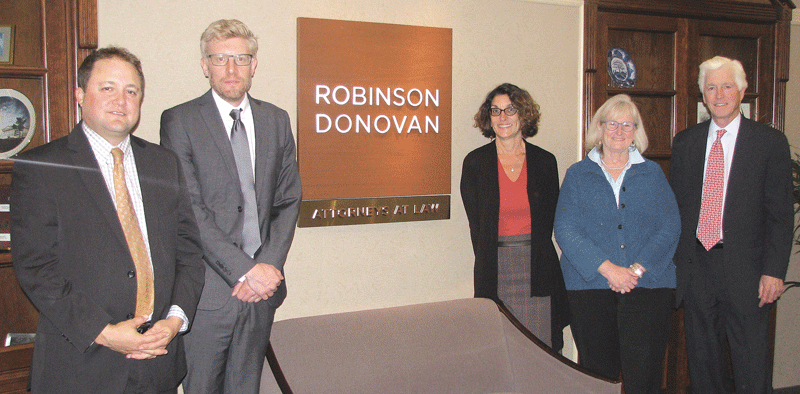
five of Robinson Donovan’s partners

From left, five of Robinson Donovan’s partners: Jeffrey Trapani, Michael Simolo, Nancy Frankel Pelletier, Carla Newton, and Managing Partner Jeffrey Roberts.

Robinson Donovan has experienced plenty of changes in its 150-year history, from shifting economic cycles to constantly evolving laws, to the evolution of its home city of Springfield. But one thing has remained a priority since its founder, George Robinson — who was also a high-school principal, state legislator, and governor — hung out a shingle in 1866. That is a focus on community — not just in a business sense, but through charity and volunteerism. And that’s how the firm is choosing to mark this significant anniversary.

Attorneys who have been with Robinson Donovan for any amount of time are fluent in its history, which stretches back 150 years — an anniversary the firm chose to celebrate by giving back.

Specifically, the firm traces its roots back to former Gov. George Robinson, who began practicing law in the Springfield area prior to serving as a member of the state House of Representatives and then Senate.

His contributions to the Springfield region extended beyond his appointments to public office. He was also the principal of Chicopee High School and a founding member of Chicopee Savings Bank, in addition to his law practice, now known as Robinson Donovan.

As the anniversary approached, said Carla Newton, a partner with the firm, one topic of discussion was the importance of place — how Greater Springfield itself, and its network of residents, businesses, and nonprofits are critical to the Robinson Donovan story.

“George Robinson was a public servant himself, and certainly served the public in a very direct way, so we began thinking about how to give back, rather than just celebrate internally,” she told BusinessWest. “And we began looking around at all the different nonprofits, many of which have board members and volunteers within our office. We thought it was appropriate to go beyond our own personal commitments to the community, and be a little more demonstrative and provide actual contributions.”

We all live here. We all benefit from the nonprofits that operate here, whether it be Providence Ministries or an educational institution like Bay Path University. We’ve raised families in this community and benefit from the fact that these organizations exist and make our community a better place to live.”

In lieu of some grand party or other event, that’s precisely how the firm chose to celebrate its anniversary year — with a sizable donation each month to a local nonprofit.

“We solicited input from everyone at the firm,” said Partner Michael Simolo. “As Carla said, a lot of us are involved in these organizations, and we know very well the people involved in them. It was kind of a collective effort from everyone to choose the organizations we donated to.”

“We all live here,” Newton added. “We all benefit from the nonprofits that operate here, whether it be Providence Ministries or an educational institution like Bay Path University. We’ve raised families in this community and benefit from the fact that these organizations exist and make our community a better place to live.”

Besides those two organizations, the firm has also donated to Friends of the Homeless, the Food Bank of Western Massachusetts, Cutchins Center for Children, Big Brothers Big Sisters, Community Legal Aid, Dakin Humane Society, and the Gray House — with three more to be chosen before the calendar turns.

Looking Back

That calendar has turned 150 times since Robinson first set up shop, and Newton acknowledged that it’s difficult to determine all the reasons it has survived so long. But she had a few theories.

One is simply pride among the attorneys in how the firm does business. She recalled arriving at the firm — at the time much smaller than its roster of 17 lawyers — and getting the sense they cared about leaving the firm in good hands when they were gone — which involved not only treating clients with professionalism, but mentoring the younger lawyers. “There was a culture of continuation, and people like me ended up getting adopted into that culture.”

Nowadays, she added, growth comes from meeting specific needs. “We bring in someone to support a particular area, and we inculcate them into the culture, and it continues on. There’s no reason to believe this isn’t going to keep going, as the younger lawyers coming in here realize, ‘hey, someday this will be our firm.’”

Managing Partner Jeffrey Roberts added that longevity requires a strong reputation in the community as well. “Ultimately, there has to be some recognition of quality. People want service, they want value, and they want to feel they’re getting the best product available.”

That reputation translates into referrals, he added. “They say your clients come from your clients. Other lawyers say, ‘I don’t do that kind of work, but you should go to that lawyer.’ In the end, it’s a small community, and if you don’t carry your practice properly and honestly, word gets around. If people understand who we are, we’ll have no shortage of business.”

That culture, again, extends to its community outreach, Newton said. “We’re not a firm that says to people who come in, ‘you must find a place to volunteer.’ Everyone here, whether it’s administrative assistants, lawyers, paralegals, they all do volunteer work because it’s important to them. That just seems to be the type of individual who comes to work at Robinson Donovan. Our people are really committed to doing volunteer work.”

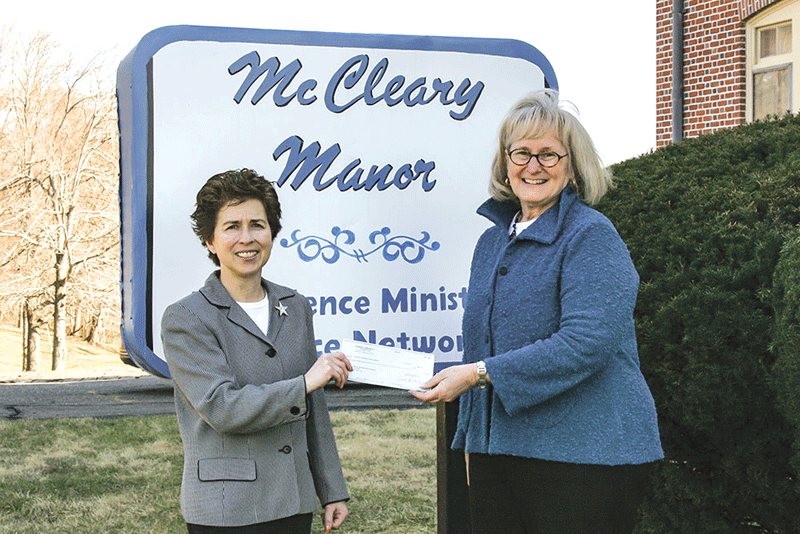
Service Network, receives a check from Carla Newton

Karen Blanchard, left, executive director at Providence Ministries Service Network, receives a check from Carla Newton, partner at Robinson Donovan, earlier this year as part of the law firm’s year-long series of donations to mark its 150th anniversary.

Partner Nancy Frankel Pelletier agreed. “It’s definitely part of the culture of the firm,” she said. “We encourage people to be active in things they have an interest in or a passion for. It’s never imposed on anyone or done out of obligation, but it’s what everyone does.”

Roberts noted that community involvement isn’t a one-way street, and firm members reap benefits beyond feeling good about themselves. “If you contribute to an organization, they benefit; on the other hand, you benefit because you learn about what the organization does, and you meet a lot of different people, and you get invested more in the community, rather than just getting in your car, going to work, taking care of your client matters, and going home. There’s a networking component that can lead you to other organizations.”

New hires, especially those coming from outside the area, are encouraged to find organizations that speak to them, as a way to get a real sense of what’s happening outside the walls and glass windows high above Main Street in Tower Square.

“Then it tends to build,” Roberts said, “because you’re recognized, and then someone else might ask you to help out at a function or support a cause or go to a dinner, and it builds on itself. It’s part of your education in the community.”

Looking Ahead

A general-practice firm, Robinson Donovan specializes in a number of legal niches, including corporate and business law, commercial real estate, estate planning and administration, divorce and family law, employment law, and litigation. After a period of rapid contraction — more than 30 lawyers worked there as recently as 15 years ago, when it was known as Robinson Donovan Madden & Barry — business has been steadily growing in virtually all those specialties, and the practice is on the rise again, hiring eight attorneys over the past several years, bringing the current roster to 16, with plans to possibly expand further.

“The firm is very dynamic and forward-thinking,” Simolo said. “We are celebrating our 150th, but at the same time, the firm is making some big investments in the future.”

Partner Jeffrey Trapani said the fact that economic development has been on the rise in Springfield, and the surrounding region is a quality-of-life draw, are added enticements when hiring.

“People get down on Springfield, but this region, I think, attracts people,” he told BusinessWest. “People enjoy coming to this area. We have city centers, things to do, you can see art, hear music, get outside, and still be close to Boston and New York.”

Trapani and Simolo count themselves among the former newcomers mentored by Roberts and his peers, but are now part of a middle generation rising to leadership and taking on much of that mentoring responsibility for new attorneys. That perpetuates the firm’s constant evolution, with some of the more recent hires chosen to match growth fields, including trusts and estates, corporate transaction law, labor and employment, domestic relations, and subspecialties like green energy.

“There’s such a broad scope of experience in this office,” Newton said. “So I can go to one of the associates and talk to them about something. They’ll learn from me, but I’ll also learn from them. When I sit in Jeff’s office or Nancy’s office, cross-learning takes place. Every single day, there are opportunities to sit down and talk about an issue with someone else. Not a day goes by that I don’t learn some new nuance that’s helpful to something I’m working on.”

It’s an environment some find unusual at first, Frankel Pelletier said, “but it’s the only environment I’ve ever known my entire career. We are just an open-door, collaborative community of lawyers.”

In short, Robinson Donovan has come a long way since its early days, when it was best known for George Robinson’s successful defense of Lizzie Borden on double murder charges in 1892. These days, the firm is recognized in a host of ways, such as the citations many of its attorneys have received from organizations like Best Lawyers, Super Lawyers, and Martindale-Hubbell.

“Unlike some other firms from the area, we really maintain a statewide presence,” said Frankel Pelletier, who was the firm’s first-ever female attorney. “We have always maintained that statewide presence and attained regional and, in some senses, national recognition. Our attorneys are constantly being recognized by organizations they belong to. That is who we are.”

Well, that and a law firm with a strong commitment to the community that has helped it thrive for 150 years.

Joseph Bednar can be reached at [email protected]

Law Sections

2016 or 1984?

By Stefanie M. Renaud


Stefanie Renaud

Stefanie Renaud

Imagine a piece of technology, so small it could be mistaken for a credit card, that tracks every movement an employee makes, analyzes every conversation that employee has, and could tell an employer when that employee was in need of a day off. What if that technology could identify patterns and traits that you could use to increase productivity by 23%? Would employers want to use this technology? Of course!

But what about the employees? Isn’t using technology like this an invasion of their privacy? We were shocked to learn, and we bet you are too, that, because of the way this technology is currently being used, employers actually can monitor every word and movement an employee makes without running afoul of the law.

Boston-based company Humanyze recently made headlines when it announced the success it has had analyzing data collected by employee ID badges, developed at the Massachusetts Institute of Technology, that track employees’ movements and analyze their voices during conversations. Contained within each badge are Bluetooth, radio frequency identification (RFID), and infrared technologies, as well as two microphones.

Each of these particular technologies has a different function and gives Humanyze different information that it can use to identify trends or patterns. Bluetooth and RFID technology are used to monitor the employee’s physical movements and location within the office. The microphones allow Humanyze to conduct real-time analysis of the speaker’s voice, including the frequency of speaking and interrupting, and how the tone and pitch of the voice change, which can be indicator of stress, although the badge does not record the content of the employee’s conversations. Finally, infrared technology monitors the wearer’s physiology for signs of stress.

Humanyze analyzes all of the collected data and identifies patterns or trends common to a specified group, such as top performers. Humanyze then works with companies to explore these trends and use them to the business’ advantage. For example, Humanyze helped Bank of America save millions of dollars by suggesting that they restructure employee breaks, which increased social interaction between employees and led to a 23% increase in employee productivity.

So, given how invasive this level of employee monitoring is, how could it not be an invasion of privacy? First of all, this isn’t an invasion of privacy because Humanyze only gathers data from employees who voluntarily offer to be tracked. Second, the individual’s data is their own; employers cannot see individual data and only receive information about aggregate data trends. According to Massachusetts General Laws, employees are protected by statute from “unreasonable, substantial, or serious interference” with their privacy.

However, in order to prove an invasion-of-privacy claim, the employee must show that the employer gathered and then disclosed information “of a highly personal or intimate nature.” While it is arguable that the data collected by these badges could be deemed highly personal in nature, in this case it’s Humanyze, and not the employee’s employer, who collects and analyzes the information.

For this same reason, Massachusetts employers do not need to worry about personnel-records law violations, because the employer is neither creating the records, nor is it the owner of the data. And, because the badges do not record audio, there is no concern about violating the Massachusetts wiretapping statute.

So are there any legal hurdles stopping an employer from implementing this type of employee monitoring? Only one: a workforce governed by a collective bargaining agreement. Employers with unionized workplaces will almost certainly need to bargain with the union before implementing a new employee tracking system.

Indeed, in another, related circumstance, the Boston Police Department engaged in negotiations with the union representing its police officers over whether or not the officers would be required to wear body cameras, ultimately agreeing with the union that, at least initially, the department would ask for volunteers. When no one volunteered, the BPD was allowed to assign the cameras to police officers, but that was after months of negotiations and subsequent litigation. So, if you have a unionized workforce, you can expect both union negotiations and substantial pushback on any requirement that members of the collective-bargaining unit wear these badges.

Employers in or with locations outside of Massachusetts that are inclined to experiment with this new employee-tracking system should check with labor and employment counsel in those jurisdictions, because state privacy laws can vary widely. Meanwhile, we’ll keep an eye on this new technology and let you know if there are any new developments.

Stefanie M. Renaud is an associate with Skoler, Abbott & Presser; (413) 737-4753; [email protected]

Briefcase Departments

LIPPI Featured in National Storytelling Platform

EASTHAMPTON — The Women’s Fund of Western Massachusetts’ Leadership Institute for Political and Public Impact (LIPPI) was one of several featured programs that launched Tuesday during the rollout of a new national storytelling initiative unveiled by the Women’s Funding Network (WFN) at the Clinton Global Initiative annual meeting. The uniquely interactive digital tool seeks to bring attention to a leading challenge facing women in the U.S. and around the world — economic security — and lift up the vital work of women’s foundations that are addressing this issue. “Telling the story of local women on a national scale is crucial to the work we do. If we want our communities to thrive, we must ensure the economic security of women,” said Elizabeth Barajas-Román, CEO, of the Women’s Fund. This year, Barajas-Román was invited to represent Western Mass. on the national board of the Women’s Funding Network. The launch highlights the story of the Women’s Fund LIPPI program, a unique leadership institute developed in response to a shortage of women in civic leadership positions, in public office, and serving on boards. The coursework equips women with the tools and confidence to become civic and political leaders. More than 250 participants are now leaders in their local communities; 22 have run for elected office, one received a gubernatorial appointment, one graduate is the first female police chief of Northampton, one ran a successful race for mayor of Pittsfield, and two graduates are serving in executive cabinet positions. Many more continue to serve on various boards and commissions, organizing grassroots campaigns, and raising their collective voices on issues that impact women and families. The Economic Security Digital Storytelling Platform is a data-driven, yet narrative, evidence of women’s foundations’ ongoing commitment to ensuring women’s economic prosperity. The platform gives users the opportunity to explore the data alongside the powerful stories of the women, programs, and organizations making an impact on this issue, breathing life into facts and figures. The responsive and flexible format encourages user engagement and learning by featuring links and downloadable files throughout, as well as links to social media to make these important stories easy to share. WFN’s Economic Security Digital Storytelling Platform can be previewed at economicsecurity.womensfundingnetwork.org.

State Nets $2.5M Grant to Help People with Disabilities Find Jobs

BOSTON — Massachusetts was one of only six states awarded $2.5 million this week by the federal government to help people with disabilities find employment. The grant will target youth and young adults, ages 14 to 24, in Hampden County and the Greater Lowell area by expanding access to credential-based education and training. The U.S. Department of Labor yesterday announced $14.9 million in grants to six states as part of the Disability Employment Initiative. “We know that, unfortunately, people with disabilities face much higher rates of unemployment, and we have been developing plans to tackle that problem for over a year now. One of the first executive orders I signed was to create a task force to look at ways to help people with barriers to employment find and keep jobs,” Gov. Charlie Baker said. “This award from the federal government will help us continue that important work, and create more opportunities for young people with disabilities to find fulfilling careers.” According to the U.S. Department of Labor, people with disabilities make up only 19.8% of the nation’s workforce. In Massachusetts, it is estimated that 15% of people with disabilities are unemployed. The grant is expected to serve more than 350 youth and young adults with disabilities. In Massachusetts the funds will also be used to create partnerships with local employers to increase hiring opportunities for young people with disabilities, and expand short-term subsidized work programs. The grant will provide job-retention and placement services to young people who have difficulty finding work due to their disability. “This is the first initiative where we will completely focus on youth and young adults with disabilities in order to help them find and keep employment,” Labor and Workforce Development Secretary Ronald Walker II said. “We are thrilled to be one of only a few states to receive this grant, and it will enable us to continue the work started by the task force for people facing higher employment.” The other states to receive grants were Connecticut, California, Idaho, Minnesota, and Maryland. While Massachusetts’ unemployment rate is lower than the national average, at 3.9% in August, certain populations face chronically higher rates of unemployment, including African-Americans, Hispanics/Latinos, people with disabilities, Native Americans, and recently returned veterans.

Unemployment Rate Drops to 3.9% in August

BOSTON — The state’s total unemployment rate dropped to 3.9% in August from 4.1% in July, and preliminary estimates show the state gained 5,900 jobs over the month, the Executive Office of Labor and Workforce Development reported. The last time the state’s unemployment rate hit 3.9% was in August 2001. At 3.9%, the seasonally adjusted unemployment rate is down 0.9% over the year from 4.8% in August 2015. There were 30,300 fewer unemployed residents and 73,000 more employed residents over the year compared to August 2015. Massachusetts’ unemployment rate remains lower than the national rate of 4.9% reported by the Bureau of Labor Statistics. The state added fewer jobs over the month in July than the Bureau of Labor Statistics originally estimated, gaining 5,800 jobs compared to the previously published 7,300-job-gain estimate. Year to date, December 2015 to August 2016, Massachusetts has added 61,000 jobs. In August, the largest over-the-month job gains occurred in the leisure and hospitality, education and health services, and other services sectors. The state’s labor force participation rate — the total number of residents 16 or older who worked or were unemployed and actively sought work in the last four weeks — is 65.0%. Over the year, the labor-force participation rate has increased 0.2% compared to August 2015.

State Releases Detailed Report on Opioid Epidemic

BOSTON — The Baker-Polito administration released an in-depth analysis of the state’s opioid-related deaths from 2013 to 2014. The findings reveal that opioid-related deaths have increased by 350% in Massachusetts in 15 years and marks the first time data from multiple state agencies has been linked to give a comprehensive overview of deaths associated with the opioid epidemic. “We are pleased to unveil this report to combine state resources and aggregate data in an innovative way to better understand the drivers behind opioid and heroin-related overdoses,” Gov. Charlie Baker said. “We are hopeful that new information will help us better understand the contours of this public-health crisis as we continue to work on prevention, education, and treatment in our communities to combat the opioid crisis in the Commonwealth.” Added Marylou Sudders, secretary of the Executive Office of Health and Human Services, “in 2013 and 2014 alone, opioid-related deaths were recorded for two-thirds of the cities and towns in Massachusetts. In the face of this crisis, we must continue our efforts to battle this epidemic that continues to take a record number of lives.” The analysis, performed by the state Department of Public Health, reviewed opioid-related deaths in 2013 and 2014 by analyzing data from multiple government entities including the Department of Public Health, the Office of the Chief Medical Examiner, the Department of Correction, MassHealth, and the Center for Health Information and Analysis. The Commonwealth’s technology agency, MassIT, facilitated integration work to bring the various streams of data together. The report, which was released at a reconvening of the Governor’s Opioid Working Group, chaired by Sudders, is part of continued efforts to improve the collection and release of data examining the impact that opioids have on Bay State communities. Earlier this year, Baker signed landmark opioid legislation into law to address the deadly opioid and heroin epidemic plaguing the Commonwealth. “Opioid-use disorder is a chronic disease, and this epidemic is a complex and persistent problem that will not be solved through a single solution,” said Department of Public Health Commissioner Dr. Monica Bharel. “This data will be leveraged to allocate resources more efficiently and effectively to help us save lives.” In 2015, the Governor’s Opioid Working Group released recommendations and a comprehensive action plan aimed at curbing the opioid epidemic. These short- and long-term recommendations focus on prevention, intervention, treatment, and recovery support. Approximately 93% of the initiatives in the governor’s action plan are complete or underway.

Five Colleges Inc. Breaks Ground for Library Annex

HATFIELD — At a brief ceremony on Sept. 15 attended by campus officials and developers, Five Colleges Inc. broke ground on for its Library Annex on a site it purchased in Hatfield. When complete, the 35,000-square-foot building will provide shelving for up to 2.5 million items from the libraries of the campuses of the consortium — Amherst, Hampshire, Mount Holyoke, and Smith colleges and UMass Amherst — freeing up space for new materials and other academic needs. In addition, it will serve as a temporary home for much of the collection of Smith College’s Neilson Library while it undergoes a major renovation. “This facility will help Smith greatly in coming years. It’s a great example of how the institutions help each other,” said Susan Fliss, Smith College dean of Libraries. Added Chris Loring, the recently retired director of libraries at Smith College and a driving force behind the development of the annex, “this will become another library for us.” The 12-acre parcel is at the junctions of the Interstate 91 exit 22 ramp, West Street, and Plain Road in Hatfield. Five Colleges paid $925,000 for the property, which had been owned by Lynda, Martin, and Sharyn Holich. Site preparation work began on May 17, and work is expected to be complete in May 2017. With climate-controlled conditions for long-term preservation of print materials, the annex will house a part of the Five College library repository collection, which already preserves nearly 600,000 items for its member campuses.

Company Notebook Departments

HCC Awarded $127,741 for EMT Training Program

HOLYOKE — Holyoke Community College (HCC) has been awarded a $127,741 Workforce Skills Capital Grant to purchase state-of-the-art equipment for its EMT Training Program. The grant, announced this week by the governor’s office, will allow HCC to expand the number of students served in its non-credit EMT classes and offer new training equipment and materials at the college’s new Center for Health Education, adjacent to the main campus on Jarvis Avenue. HCC was one of seven community colleges, vocational high schools, and educational collaboratives chosen to share in a total funding package worth $2.6 million. “This was a great opportunity for us to get some needed funding to replace outdated materials and equipment, which, because of the cost, is difficult to keep up to date,” said Ken White, dean of HCC Community Services. The grant will allow HCC to expand the number of students served in the non-credit certificate EMT classes, which are geared for firefighters and other emergency workers who need certification or continuing education, individuals interested in beginning careers as EMTs, and nurses or other heath professionals. “Students at all levels will have access to state-of-the-art technologies, including simulators that respond to student actions,” White said. Instructors for the enhanced program will be supplied by Springfield Technical Community College (STCC), White said. Together, HCC and STCC, through Training and Workforce Options, their collaborative workforce program, will work with area employers to provide customized EMT training opportunies at HCC’s Center for Health Education. “The goal of these grants is to expand the capacity of programs that build skills for Massachusetts residents,” said Lt. Gov. Karyn Polito. “We already see the impact these grants are having at educational programs around the state, and we know these investments will strengthen the state’s economy for all residents.”

Springfield Museums Named Smithsonian Affiliate

SPRINGFIELD — The Springfield Museums have been formally accepted as an affiliate of the Smithsonian Institution. Smithsonian Affiliations is a national outreach program that develops long-term, high-quality partnerships with museums and educational organizations in order to share collections, exhibitions, learning opportunities, and research expertise. The partnership  has been made possible through the support of the MassMutual Foundation, which is providing a three-year, $145,000-plus grant to bring a wealth of resources and programming to Springfield. “For us to continue to develop a culturally rich community, it is important that all of us — especially our children — have access to some of the world’s most treasured art collections, artifacts, and perspectives of the most renowned experts in the country,” said Roger Crandall, chairman, president, and CEO of MassMutual.  “The MassMutual Foundation’s support of the partnership between the Springfield Museums and the Smithsonian helps strengthen the cultural fabric of our community, and we are proud to do our share to provide opportunities that inspire people to never stop learning and growing.” Joining Crandall at an announcement ceremony hosted by the museums was Harold Closter, director of Smithsonian Affiliations; Springfield Museums President Kay Simpson; Springfield Mayor Domenic Sarno; U.S. Rep. Richard Neal; and state Sen. Eric Lesser. The day also included a presentation titled “Driving Around Mars” by planetary scientist John Grant from the National Air and Space Museum. There are currently more than 200 institutions nationwide that have been selected to be Smithsonian affiliates. In identifying possible candidates for affiliation, the Smithsonian seeks out organizations that share a common mission, a commitment to education and public service, and the capability of bringing Smithsonian artifacts, exhibits, and programs to their venues. Candidates are subject to a rigorous application process involving all aspects of their organization, from their leadership and financial structure to a review of their collections-management and programming protocols. Those selected to be affiliates enjoy a range of benefits, from facilitated object and exhibit loans and discounted Smithsonian memberships for their patrons to custom-developed education, performing-arts, and public programs. Staff at the Smithsonian and the Springfield Museums have already commenced discussions of potential collaborative projects for the first three years of the affiliation, including object loans and additional visits from Smithsonian experts.

Johnson & Hill Launches Accounting, Finance Division

SPRINGFIELD — Johnson & Hill Staffing Services Inc. recently enhanced its service offerings to include a specialized Accounting & Finance Division. While Johnson & Hill has always placed accounting and finance professionals, this move signals an increased commitment to this area of expertise. The agency sees a growing demand for this skill set and an opportunity to assist clients more proactively. Tiffany Appleton has been appointed director, Accounting & Finance Division. Boasting more than a decade of recruiting experience in accounting and finance, she will provide direct-hire, contract-to-hire, and contract staffing, assisting clients in filling critical accounting and finance needs within their organizations. Roles range from clerk level up to CFO with a concentration on middle-management positions, including senior accountant, accounting manager, controller, financial analyst, manager of FP&A, internal audit, and public audit and tax. Her staffing experience crosses many industry sectors, spanning manufacturing, technology, nonprofit, professional service, and life science, with companies ranging from startup to publicly traded. Appleton will focus on developing and nurturing long-term relationships with both clients and job seekers, which are built on mutual trust, sincerity, and confidentiality. She is sought after by clients for her progressive ideas on acquiring talent and consistent ability to deliver quality candidates. Job seekers appreciate her willingness to provide career coaching, interview preparation, and résumé assistance. Prior to Johnson & Hill, her professional career included serving as client relations director for a large, regional CPA firm and principal and talent advisor for a boutique staffing firm specializing in accounting and finance placement. Johnson & Hill is an independent, regional, woman-owned staffing service offering temporary, temp-to-hire, and direct-hire employment opportunities, serving Western Mass. and Northern Conn. Johnson & Hill specializes in administrative, accounting, legal, and professional staffing services.

Springfield College Rises Again in U.S. News Rankings

SPRINGFIELD — Springfield College has again moved up the list of highest-ranked colleges in U.S. News & World Report’s latest edition of “Best Colleges.” In the 2017 report, Springfield College is ranked 27th in the first tier in the category of Best Regional Universities – North. This marks the sixth consecutive year that Springfield College has moved up in the U.S. News rankings. This year’s ranking of the college is up two spots from 2016 and 40 spots from 2011. “I am extremely proud that Springfield College is being recognized for our outstanding academic offerings and a rich co-curricular life outside of the classroom,” said President Mary-Beth Cooper. “The rise in our ranking over the past six years demonstrates that the value proposition for a school like Springfield College, grounded in the Humanics philosophy, is well-regarded.” The college also ranked 12th in Best Value Schools for Regional Universities – North, the first year it has been listed in the Best Values category, which takes into account a college’s academic quality and net cost of attendance. According to U.S. News, the higher the quality of the program and the lower the cost, the better the deal. Springfield College’s rise in the rankings is spurred by improved graduation rates and improved retention of first-year students. The college’s traditional, undergraduate enrollment for the fall of 2016 remained steady, with 550 first-year students enrolling again this year. The ratings are based on such variables as peer assessment, graduation and retention rates, student selectivity, class size, alumni giving, and student-faculty ratio. The college was ranked in a third category by U.S. News for 2017. It is ranked 14th in the North region in Best Colleges for Veterans.

CARF Accredits West Central Family and Counseling

WEST SPRINGFIELD — CARF International announced that West Central Family and Counseling has been accredited for a period of three years for its Outpatient Treatment: Mental Health (Adults) and Outpatient Treatment: Mental Health (Children and Adolescents) programs. This is the first accreditation CARF has awarded to West Central Family and Counseling. This accreditation decision represents the highest level of accreditation that can be awarded to an organization and shows the organization’s substantial conformance to the CARF standards. An organization receiving a three-year accreditation has put itself through a rigorous peer-review process. It has demonstrated to a team of surveyors during an on-site visit its commitment to offering programs and services that are measurable, accountable, and of the highest quality. West Central Family and Counseling has been providing outpatient mental-health programs in the Greater Springfield area since 2008. CARF is an independent, nonprofit accrediting body whose mission is to promote the quality, value, and optimal outcomes of services through a consultative accreditation process that centers on enhancing the lives of the persons served.

Berkshire Bank Named One of  Top Charitable Contributors

PITTSFIELD — Berkshire Bank announced it was named by Boston Business Journal as one of Massachusetts’ Most Charitable Companies at the publication’s annual Corporate Citizenship Summit in Boston on Sept. 8. The Boston Business Journal is one of the leading sources for business news, research, and events in the Greater Boston area. Each year it honors a select list of companies for their charitable work in the community. Berkshire Bank ranked 42nd for total financial contributions, with more than $1.27 million donated in Massachusetts alone and more than $2 million donated overall. Massachusetts-based bank employees also donated more than 27,000 hours of volunteer service. Berkshire Bank joined a select list of statewide, national, and international companies honored at the summit. The award recognized Berkshire Bank and Berkshire Bank Foundation’s philanthropic investments in the community through their charitable grants, corporate giving, scholarships, in-kind donations, and employee volunteerism.

Country Bank Participates in Habitat’s Operation Playhouse

WARE — A group of 14 Country Bank employees recently joined forces with Habitat for Humanity Metro West/Greater Worcester in a team-building exercise that ended with a local veteran family receiving a unique gift: a custom playhouse. Habitat’s Operation Playhouse is a program that brings groups together to create a custom playhouse in one day. The opportunity to work together and collaborate on design and construction of the house is wrapped up with the reward of seeing it turned over to a local veteran and their children. “Working with the Habitat staff was seamless, and the day couldn’t have been more rewarding,” said Deb Gagnon, the bank’s Corporate Relations officer. “Completing the playhouse gave us all a sense of accomplishment, and when the family arrived to receive their gift, there wasn’t a dry eye around.”

Chamber Corners Departments

AMHERST AREA CHAMBER OF COMMERCE

www.amherstarea.com
(413) 253-0700

• Oct. 19: Chamber After 5, 5-7 p.m., at the Hitchcock Center, 845 West St., Amherst. Sponsored by Encharter Insurance and UMassFive College Federal Credit Union. Join the chamber and celebrate the new, 9,000-square-foot Hitchcock Center opening. This will be New England’s first public environmental education center to meet the Living Building Challenge. Cost: $10 for members, $15 for non-members. Register online at www.amherstarea.com.

• Oct. 27: Chamber Legislative Breakfast, 7:15-9 a.m., at the Lord Jeffery Inn, 30 Boltwood Ave., Amherst. Sponsored by Eversource. The annual legislative breakfast brings together legislators, local officials, and business leaders to network and discuss current and upcoming policy issues. Guest speakers: Senate President Stan Rosenberg, Lt. Gov. Karyn Polito, and state Reps. Ellen Story and John Scibak. Cost: $15 for members, $20 for non-members. Register online at www.amherstarea.com.

FRANKLIN COUNTY CHAMBER OF COMMERCE

www.franklincc.org
(413) 773-5463

• Oct. 6: Business Basics Workshop, 9-11 a.m., at the Franklin County Chamber of Commerce, 395 Main St., Greenfield – Masonic Hall Condominium Building. This free workshop, presented by Allen Kronick, senior business advisor, Massachusetts Small Business Development Center Network Western Regional Office, will focus on business fundamentals, from startup considerations to business-plan development and funding sources. It is designed for owners of existing businesses as well as those who are planning to start one. Cost: free. Register online at www.franklincc.org.

• Oct. 7: “Grow Your Business with E-mail & Social Media,” 9:30 a.m. to noon, at the Greenfield Community College Downtown Center, 270 Main St., Greenfield. Join Liz Provo, authorized local expert for Constant Contact, as she helps you learn how to create a marketing strategy that combines e-mail and social media for maximum results. Cost: $5. Register online at www.franklincc.org.

• Oct. 18: Free Legal Clinic, noon to 3:30 p.m., at the Franklin County Chamber of Commerce, 395 Main St., Greenfield – Masonic Hall Condominium Building. The Western Mass Regional office of the MSBDC announced that the law firms of WMassBizLaw have offered to hold a free legal clinic. Individuals, entrepreneurs, and small-business owners will have the opportunity to meet one-on-one for 30 minutes with attorney Sarah Willey to discuss general legal questions such as corporate structure, leases, contracts, insurance, employment, franchising, and various other business-related issues. Cost: free. Register online at www.franklincc.org.

GREATER CHICOPEE CHAMBER OF COMMERCE

www.chicopeechamber.org
(413) 594-2101

• Oct. 4: Table Top Expo & Business Networking Event, 4:30-7 p.m., at the Castle of Knights, 1599 Memorial Dr., Chicopee. Hosted by the Greater Chicopee, Greater Holyoke, Greater Westfield, and Springfield Regional Chambers of Commerce. With approximately 120 businesses represented and 400 visitors, the Table Top Expo and Business Networking Event is an excellent marketing tool for area businesses. Cost: $125 for an exhibitor table (includes two tickets), $5 for pre-registered admission. Register online at www.chicopeechamber.org.

• Oct. 14: Auction/Wine & Beer Tasting, 6-9 p.m., at Hadley Farms Meeting House, 41 Russell St., Hadley. Country chic theme with entertainment by Sarah the Fiddler. Cost: $40, or $35 each for two or more. Register online at www.chicopeechamber.org.

• Oct. 19: October Salute Breakfast, 7:15-9 a.m., at Summit View Banquet & Meeting House, 555 Northampton St., Holyoke. Cost: $23 for members, $28 for non-members. Register online at www.chicopeechamber.org.

• Oct. 26: Business After Hours, 5-7 p.m., at the Arbors at Chicopee, 929 Memorial Dr., Chicopee. Oktoberfest theme with band, food, and cash bar. Cost: $10 for members, $15 for non-members. Register online at www.chicopeechamber.org.

GREATER EASTHAMPTON CHAMBER OF COMMERCE

www.easthamptonchamber.org
(413) 527-9414

• Oct. 13: Networking by Night, 5-7 p.m., at Fort Hill Brewery. Sponsored by Advanced Restoration Group. An evening of connecting and business building. Cost: $10 for members, $15 for non-members. Register online at www.easthamptonchamber.org, or by calling the Chamber of Greater Easthampton at (413) 527-9414.

• Oct. 19: Medallion Speaker Forum Fall, noon to 1:30 p.m. Hosted by Innovative Business Systems, 161 Northampton St., Easthampton. State Rep. John Scibak joins the forum and gives his insight on how you can be most effective when you need to be. Cost includes boxed lunch from Riff’s Joint. Space is limited. For additional information, e-mail [email protected]. Cost: $20. Register online at www.easthamptonchamber.org or by calling the chamber at (413) 527-9414.

• Nov. 9: Hampshire County Business Bash, 5-7 p.m., at the Lord Jeffery Inn, Amherst. A tri-chamber business-expo networking event. Enjoy business building, networking, complementary appetizers, cash bar, and local brewery beer tasting. Cost: $10 for members, $15 for non-members. Register online at www.easthamptonchamber.org or by calling the chamber at (413) 527-9414.

GREATER HOLYOKE CHAMBER OF COMMERCE

www.holyokechamber.com
(413) 534-3376

• Oct. 12: Chamber Business Development / Salute Breakfast, 7:30-9 a.m., hosted by Slainte, 80 Jarvis Ave., Holyoke. Sponsored by PeoplesBank, Holyoke Gas & Electric, and Northeast IT Systems Inc. Join emcees Steven Grande of the Holyoke Mayor’s Industrial Development Association Committee and Dawn Creighton of Associated Industries of Massachusetts as they present area staffing agents and job trainers to discuss means of future workforce education and job readiness. Speakers include David Gadaire of CareerPoint, Tricia Canavan of United Personnel, and Kevin Smith of U.S. Tsubaki. Salutes include Expert Staffing, the Neari School, Skoller, Abbott & Presser, GBS Brows, the 99 Restaurant, the Jamrog Group, Applebee’s, Arte Sana, and KnoxworkX Multimedia. Tickets include a buffet breakfast. Cost: $25 for members with advance reservations and $30 for non-member guests and walk-ins.  Reservations may be made online at holyokechamber.com.

• Oct. 19: Chamber After Hours, 5-7 p.m. Hosted and sponsored by Westfield Bank, 1642 Northampton St., Holyoke. The Greater Holyoke Chamber of Commerce invites you to an evening of casual networking. Cost: $10 for members, $15 for non-members. Register online at www.holyokechamber.com.

•  Oct. 21: Leadership Holyoke, 8 a.m. to 4:30 p.m., presented by the Greater Holyoke Chamber of Commerce, PeoplesBank, and Holyoke Community College. Meet at PeoplesBank corporate offices, 330 Whitney Ave., Holyoke. A leadership series with HCC faculty members participating as instructors and facilitators. Community leaders will participate as speakers.

• Oct. 26: Holyoke Chamber Business Person of the Year/Volunteer of the Year Award Dinner, 6-8 p.m., hosted by Delaney House, 3 Country Club Road, Holyoke. A celebratory dinner honoring the 2016 Business Person of the Year and the Henry A. Fifield Volunteer of the Year. Networking and cocktails at 6 p.m. with full-course dinner and awards to follow. Cost: $60. Register online at holyokechamber.com or call the chamber at (413) 534-3376

GREATER NORTHAMPTON CHAMBER OF COMMERCE

www.explorenorthampton.com
(413) 584-1900

• Oct. 5: Arrive @ 5, 5-7 p.m., sponsored by Innovative Business Systems Inc., Pioneer Training, and Florence Bank. This the networking event you don’t want to miss. More than 300 attendees are expected, with food donated by our member restaurants and cold brews donated by the Northampton Brewery. Call chamber for location. Cost: $10 for members. To register, visit www.explorenorthampton.com, call (413) 584-1900, or e-mail [email protected].

• Oct. 28: 2016 New Member Orientation, 3-4 p.m., at the chamber offices, 99 Pleasant St., Northampton. This is the chance to tell us more about your business and how the chamber can best serve you. Meet other new members and learn how to make the most of your chamber membership. Cost: Free. RSVP to (413) 584-1900 or  [email protected].

GREATER WESTFIELD CHAMBER OF COMMERCE

www.westfieldbiz.org
(413) 568-1618

• Oct. 3: Mayor’s Coffee Hour, 8-9 a.m., at the American Inn, One Sawmill Park, Westfield. Join us for our monthly Mayor’s Coffee Hour with Westfield Mayor Brian Sullivan. This event is free and open to the public. Call Pam at the chamber office at (413) 568-1618 to register for this event so we may give our host a head count.

• Oct. 12: Oktoberfest After 5 Connection, 5-7 p.m., at East Mountain Country Club, 1458 East Mountain Road, Westfield. Bring your business cards for our annual speed connecting. Refreshments will be served. Cost: $10 for members, $15 cash for non-members. To register, call (413) 568-1618. As this event gets closer, an online registration will be made available.

SOUTH HADLEY & GRANBY CHAMBER OF COMMERCE

www.shgchamber.com
(413) 532-6451

• Oct. 19: James E. Hartley, PhD, professor of Economics at Mount Holyoke College, speaks at 7:30 a.m., at the Willits-Hallowell Conference Center at Mount Holyoke. Hartley will speak on the economy. A buffet breakfast will be provided. Cost: $22 for members, $27 for non-members. E-mail [email protected] to RSVP.

WEST OF THE RIVER CHAMBER OF COMMERCE

www.ourwrc.com
413-426-3880

• Oct. 5: Wicked Wednesday, 5:30-7:30 p.m., at Cyber Exchange, West Springfield. Wicked Wednesdays are monthly social events, hosted by various businesses and restaurants, that bring members and non-members together to network in a laid-back atmosphere. For more information about this event, call the chamber office at (413) 426-3880, or register at www.westoftheriverchamber.com.

• Oct. 26: Food Fest West, 5:30-8 p.m., at Crestview Country Club, Agawam. The event will feature the foods of area restaurants including Chez Josef, Crestview Country Club, Partner’s, and many more. Proceeds raised by Food Fest West will go toward the Partnership for Education and the WRC Educational Fund, which provides grants to businesses for on-the-job training and continuing-education needs. Cost: $25 in advance, $35 at the door. Tickets may be purchased at www.westoftheriverchamber.com.

Modern Office Sections

Exercise in Problem Solving

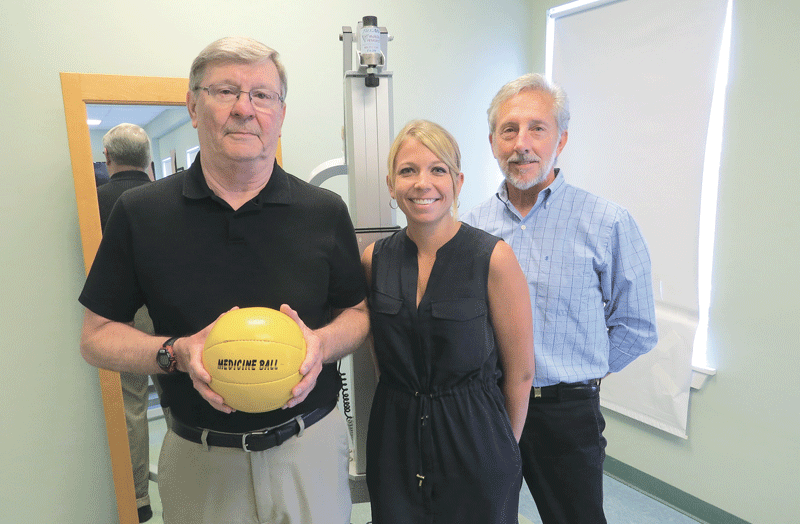
The managing partners at ECG, from left, Joe Kessler, Susan Lachowski, and Patrick Carley.

The managing partners at ECG, from left, Joe Kessler, Susan Lachowski, and Patrick Carley.

A quarter-century ago, Joe Kessler and Patrick Carley were working together to create cutting-edge solutions to problems with workplace injuries at East Longmeadow-based Hasbro (now Cartamundi). Later, after Carley left a position in academia, the two continued to collaborate on projects to identify and resolve issues in a wide array of workplaces. Today, with third managing partner Susan Lachowski, they are taking these efforts to a higher plane with a venture called Ergonomic Collaboration Group, a name that speaks volumes about what this company does — and how it does it.

When Shaun McConkey arrived at South Deerfield-based Pelican Products as director of operations a year ago, he found a company on the move.

As we reported back in May, this enterprise, long known for making hard-plastic cases for commercial, government, and military applications, was successfully diversifying into everything from coolers to suitcases to backpacks.

But amid all these green lights, McConkey saw a red flag. It took the form of a mounting number of soft-tissue injuries resulting from the processes (especially the literal heavy lifting) required to manufacture such products.

Desiring to ward off such injuries, he knew he would need some help, and also knew just who to call — meaning this wasn’t exactly a phone number he had to search to find.

That’s because he’d called it more than a few times before. Indeed, McConkey, Joe Kessler, and Patrick Carley go back a ways. The three were at Hasbro’s (now Cartamundi’s) sprawling manufacturing facility in East Longmeadow in the early ’90s. McConkey was director of manufacturing, Kessler was the in-house ergonomist, and Carley, a practicing physical therapist, joined him when the company decided to establish a physical-therapy clinic inside the plant to respond to the growing number of musculoskeletal-related injuries, now referred to as musculoskeletal disorders, or MSDs.

Shaun McConkey

Shaun McConkey, currently director of operations at Pelican Products, has called on the team at ECG on many occasions during his career in manufacturing.

Fast-forwarding a little, Carley left the clinic at Hasbro in 1996 to take a full-time faculty position at American International College. But the two continued to work together — often with Carley’s students — on projects to improve work processes and reduce the potential risks for MSDs.

One of their collaborative efforts was at the U.S. Tsubaki Automotive, LLC timing-chain-manufacturing facility in Chicopee, where McConkey, who was by then with that company as operations manager, sought their help with reducing and perhaps eliminating the threat of injuries related to the cleaning of a machine known as a ‘nut former.’

Their involvement led to the creation of a chest-resting bench — one we’ll hear much more about later — that speaks volumes about how a venture now known as Ergonomic Collaboration Group (ECG), LLC goes about its work.

It takes a scientific approach, said Dan Oliveira, environmental health and safety specialist at U.S. Tsubaki, one that engages employees in every step of the process and therefore achieves a critical volume of buy-in.

“They involved employees and helped them facilitate this change,” he explained. “That’s better than simply making a change and saying, ‘this is the way we’re doing things now.’ You’re having employees understand why that change is being made.”

The team at ECG, which now includes a third managing partner — Susan Lachowski, one of Carley’s students, who possesses a PhD in exercise physiology — intends to use this approach to extend its business portfolio well beyond Hasbro and Shaun McConkey’s career ladder.

And it is already moving strongly in that direction, adding clients ranging from the postal service to Merrill Lynch; from Hamilton Sundstrand to Riverside Industries.

Such growth is partly explained by the fact that ECG offers the right services at the right time — when employers, faced with ever-advancing technology and the ever-rising cost of doing business, want to fully exploit the former while perhaps reducing the latter, especially workers’ compensation costs.

For this issue and its focus on the modern office, BusinessWest talked with the team at ECG, as well as with some of those they’ve worked with and for, to identify potential problems and orchestrate solutions. You might call their endeavors in the field — as well as current efforts to grow their business — works in progress.

Stretching — the Truth

Kessler calls it simply the ‘blinking program,’ and no, it’s not what you might think.

Just as one’s eyes blink to keep them lubricated, the body’s muscles should blink to keep them from becoming stressed, or injured, he noted. But while eye blinking is mostly a reflex, or semi-automatic action, muscle blinking is not; it must be orchestrated, if you will.

Hence that word ‘program,’ which in this case refers to a regimen of movements designed just over a decade ago for employees at Hasbro while Kessler was still there and collaborating with Carley and some of his students on various projects.

The ‘chest rest’

The ‘chest rest’ at U.S. Tsubaki’s timing chain plant in Chicopee is an example of ECG working with a client to solve a potential problem.

“If you stretch five minutes before your shift starts and then don’t stretch for the rest of the day, how effective can that be?” Kessler asked. “So we instituted a ‘blink’ program; we designed a whole series of stretches that the employees could do discreetly, like when the line came down for a minute or if they were going to their break area.

“These were simple things, like shrugging the shoulders,” he went on, “just to stretch your muscles out and give them a break and let them breathe. The point was to do this several times a day, and we did it for the entire factory.”

Together, Kessler and Carley initiated a number of programs and initiatives for the game maker, many of them worthy of the descriptive phrase ‘state-of-the-art.’ That includes the physical-therapy clinic itself.

“We put it right inside the plant — if people got hurt, they went to medical, they were cleared and sent to physical therapy, which was right on the factory floor,” Carley said of the facility, established in 1991. “It was pretty forward-thinking stuff.”

And there was more of that to come, he went on, adding that he and Kessler were eventually assigned to the same committee at Hasbro that was charged not only with treating people after they were injured, but with developing strategies to keep them from getting injured in the first place.

“The committee tasked us with going out to the different work areas and try to determine what it was about the work process, the machine, or whatever it might be, to reduce exposure to injury,” he explained, adding that most problems were, contrary to popular belief, not with the back, but with upper extremities and arms.

“People were putting those packages of little green houses in boxes something like 4,000 times a day,” he told BusinessWest, before being corrected by Kessler, who said the number was probably closer to 15,000.

To reduce those injuries, the company, working on the advice of Kessler, Carley, and those they were working with, changed work processes (to reduce how far one would have to reach, for example), adjusted machines, instituted work rotations when needed, and, in some cases, changed or instituted policies, such as the limits placed on how many pounds employees would lift at a given time.

The initiatives at Hasbro would eventually yield accolades from OSHA , specifically, its Voluntary Protection Program (the company’s ergonomic program became the best practice in 2005). And in many ways, they laid the groundwork for the business that would become ECG.

“One thing led to another — we took some of the things we learned at Hasbro and applied them at Hamilton Sundstrand or at the post office, for example,” said Carley. “Other companies were calling us, and we started getting into office ergonomics.”

ECG-LogoOne of the companies that called was the Springfield office of Merrill Lynch, which was having some issues with new information technology.

“They changed over to flat screens, and when they put those screens up, they left the keyboards over here,” he said, using his hands to show there was some distance between the two. “And they were wondering why people’s necks were hurting them. They said, ‘you need to help us figure this out.’”

Documented success with helping a host of clients figure things out has been a key ingredient in the company’s efforts to grow its portfolio, he went on, citing U.S. Tsubaki’s chest-resting bench as a perfect example.

Body of Evidence

Bringing this seemingly simple piece of equipment to reality — meaning everything from its design to its implementation — came about through a scientific, or academic (but also collaborative) approach that enabled the employees who would be using it to play a huge role in its development.

Kessler calls it “engineering a problem out.”

It all begins with observation, interviews with employees, and other steps to pinpoint problems and also problems in the making — in every sense of that phrase. Then comes the work to devise a solution. As Oliveira mentioned, employees were front and center during that step as well.

Backing up a bit, he said employees were previously required to bend over these machines, unsupported, for long stretches as they cleaned them, presenting a risk for back injuries. Also, as they bent over, they were supporting themselves by putting one hand on an oily surface, presenting the possibility of acute injury.

“ECG enabled us to be proactive about this, rather than reactive,” he said, “and say, ‘there’s the potential for injury here, and we want to resolve it before anything happens.’”

The chest-resting bench not only reduces the threat to back injury, but it also improves productivity, said Carley, adding that Tsubaki now plans to put it into use worldwide.

But while responding to problems related to workplace injuries with engineering solutions is a big piece of ECG’s workload, keeping employees healthy, limber, and thus more out of harm’s way is also part of the equation, and it will only grow in significance in the future, said Carley.

And the addition of Lachowski, who focuses on using exercise science to improve work efficiency and safety, effectively “closes the circle,” as he put it, and enables ECG to provide a comprehensive roster of services, including prevention.

“My focus is on proper biomechanics and keeping the employee healthy through physical activity,” she explained. “If we can do that, we can reduce the threat of injury.”

As an example, she noted how ECG helped Riverside Industries — which provides services including life-skill development, rehabilitation, and employment options to adults living with developmental disabilities — to attain a grant from the Mass. Department of Industrial Accidents. It is being used for safety training for all employees involved in client handling, transfers, and transportation.

The program includes progressive stretching and exercising, in addition to a ‘train-the-trainer’ program to continue the safety efforts, she went on, adding that such efforts are critical to creating a culture focused on safety.

At Pelican, a train-the-trainer initiative will be part of a comprehensive response that is still in the formative stage, said Kessler, adding that stretching and exercise programs will likely be accompanied by changes in production processes to reduce exposure to injury.

In many ways, work at the Pelican plant illustrates the full range of ECG’s services and its efforts to customize solutions for clients.

“We have an educational approach to every project that we do, and we tailor each project to the company itself, because one size doesn’t fit all,” said Lachowski. “We really want to educate the workers, as well as the companies, and give them the tools to continue on after we’ve left.

“Our approach isn’t to go in and say, ‘this is the way to do it; you should it our way,’” she went on. “Many people don’t respond to that. That’s why we observe and ask questions, and do a comprehensive educational piece, so they’re in the driver’s seat.”

Looking ahead and toward where this company might go — in terms of what he anticipates will be controlled growth, but also specific assignments — Carley said the modern office and modern manufacturing facility are laden with potential ergonomic issues and potential problems.

Indeed, at a time when many professionals work with not one computer screen in front of them, but two or even three, attention must be paid to everything from where they’re positioned to their height off the desk.

And that’s just one small example of the importance of ergonomics today, said Kessler, noting that, as more individuals spend eight, 10, or 12 hours a day at a desk, attention must be paid to how they’re doing all that work and how it might impact everything from their vision to their back — to their productivity.

Which brings him back to that notion of ‘muscle blinking’ he described, a concept that encompasses everything from stretching before and during work to getting up and walking around, to perhaps not sitting at all and instead investing in a standing desk.

“When people are healthier, productivity is better, quality is better — if you’re sitting on a line and not feeling well, how good is the product? — it’s all interwined,” said Kessler in summing things up.

Limber Yard

As he talked about ECG, its reason for being, and its enormous potential as an entrepreneurial venture, Kessler summoned some numbers that put matters in perspective in a manner all business owners and managers could appreciate.

“There’s a rule of thumb out there that we used to use … if you have a $140,000 shoulder operation, and you’re a self-insured company, you have to sell 10 times that amount in product to make that up, because all that comes off your bottom line,” he said. “The most important thing is keeping people healthy, obviously, but by doing so, companies can save themselves a lot of money.”

Those numbers, and that reality, speak to why there is ever-increasing attention being paid to workplace wellness, if you will, and the broad realm of ergonomics.

And they also explain why the future appears extremely bright for a venture that has problem solving in the modern office down to a science — literally.

George O’Brien can be reached at [email protected]

Chamber Corners Departments

AMHERST AREA CHAMBER OF COMMERCE
www.amherstarea.com
(413) 253-0700

• Oct. 19: Chamber After 5, 5-7 p.m., at the Hitchcock Center, 845 West St., Amherst. Sponsored by Encharter Insurance and UMassFive College Federal Credit Union. Join the chamber and celebrate the new, 9,000-square-foot Hitchcock Center opening. This will be New England’s first public environmental education center to meet the Living Building Challenge. Cost: $10 for members, $15 for non-members. Register online at www.amherstarea.com.

• Oct. 27: Chamber Legislative Breakfast, 7:15-9 a.m., at the Lord Jeffery Inn, 30 Boltwood Ave., Amherst. Sponsored by Eversource. The annual legislative breakfast brings together legislators, local officials, and business leaders to network and discuss current and upcoming policy issues. Guest speakers: Senate President Stan Rosenberg, Lt. Gov. Karyn Polito, and state Reps. Ellen Story and John Scibak. Cost: $15 for members, $20 for non-members. Register online at www.amherstarea.com.

FRANKLIN COUNTY CHAMBER OF COMMERCE
www.franklincc.org
(413) 773-5463

• Oct. 6: Business Basics Workshop, 9-11 a.m., at the Franklin County Chamber of Commerce, 395 Main St., Greenfield – Masonic Hall Condominium Building. This free workshop, presented by Allen Kronick, senior business advisor, Massachusetts Small Business Development Center Network Western Regional Office, will focus on business fundamentals, from startup considerations to business-plan development and funding sources. It is designed for owners of existing businesses as well as those who are planning to start one. Cost: free. Register online at www.franklincc.org.

• Oct. 7: “Grow Your Business with E-mail & Social Media,” 9:30 a.m. to noon, at the Greenfield Community College Downtown Center, 270 Main St., Greenfield. Join Liz Provo, authorized local expert for Constant Contact, as she helps you learn how to create a marketing strategy that combines e-mail and social media for maximum results. Cost: $5. Register online at www.franklincc.org.

• Oct. 18: Free Legal Clinic, noon to 3:30 p.m., at the Franklin County Chamber of Commerce, 395 Main St., Greenfield – Masonic Hall Condominium Building. The Western Mass Regional office of the MSBDC announced that the law firms of WMassBizLaw have offered to hold a free legal clinic. Individuals, entrepreneurs, and small-business owners will have the opportunity to meet one-on-one for 30 minutes with attorney Sarah Willey to discuss general legal questions such as corporate structure, leases, contracts, insurance, employment, franchising, and various other business-related issues. Cost: free. Register online at www.franklincc.org.

GREATER CHICOPEE CHAMBER OF COMMERCE
www.chicopeechamber.org
(413) 594-2101

• Oct. 4: Table Top Expo & Business Networking Event, 4:30-7 p.m., at the Castle of Knights, 1599 Memorial Dr., Chicopee. Hosted by the Greater Chicopee, Greater Holyoke, Greater Westfield, and Springfield Regional Chambers of Commerce. With approximately 120 businesses represented and 400 visitors, the Table Top Expo and Business Networking Event is an excellent marketing tool for area businesses. Cost: $125 for an exhibitor table (includes two tickets), $5 for pre-registered admission. Register online at www.chicopeechamber.org.

• Oct. 14: Auction/Wine & Beer Tasting, 6-9 p.m., at Hadley Farms Meeting House, 41 Russell St., Hadley. Country chic theme with entertainment by Sarah the Fiddler. Cost: $40, or $35 each for two or more. Register online at www.chicopeechamber.org.

• Oct. 19: October Salute Breakfast, 7:15-9 a.m., at Summit View Banquet & Meeting House, 555 Northampton St., Holyoke. Cost: $23 for members, $28 for non-members. Register online at www.chicopeechamber.org.

• Oct. 26: Business After Hours, 5-7 p.m., at the Arbors at Chicopee, 929 Memorial Dr., Chicopee. Oktoberfest theme with band, food, and cash bar. Cost: $10 for members, $15 for non-members. Register online at www.chicopeechamber.org.

GREATER EASTHAMPTON CHAMBER OF COMMERCE
www.easthamptonchamber.org
(413) 527-9414

• Oct. 13: Networking by Night, 5-7 p.m., at Fort Hill Brewery. Sponsored by Advanced Restoration Group. An evening of connecting and business building. Cost: $10 for members, $15 for non-members. Register online at www.easthamptonchamber.org, or by calling the Chamber of Greater Easthampton at (413) 527-9414.

• Oct. 19: Medallion Speaker Forum Fall, noon to 1:30 p.m. Hosted by Innovative Business Systems, 161 Northampton St., Easthampton. State Rep. John Scibak joins the forum and gives his insight on how you can be most effective when you need to be. Cost includes boxed lunch from Riff’s Joint. Space is limited. For additional information, e-mail [email protected]. Cost: $20. Register online at www.easthamptonchamber.org or by calling the chamber at (413) 527-9414.

• Nov. 9: Hampshire County Business Bash, 5-7 p.m., at the Lord Jeffery Inn, Amherst. A tri-chamber business-expo networking event. Enjoy business building, networking, complementary appetizers, cash bar, and local brewery beer tasting. Cost: $10 for members, $15 for non-members. Register online at www.easthamptonchamber.org or by calling the chamber at (413) 527-9414.

GREATER HOLYOKE CHAMBER OF COMMERCE
www.holyokechamber.com
(413) 534-3376

• Oct. 19: Chamber After Hours, 5-7 p.m. Hosted and sponsored by Westfield Bank, 1642 Northampton St., Holyoke. The Greater Holyoke Chamber of Commerce invites you to an evening of casual networking. Cost: $10 for members, $15 for non-members. Register online at www.holyokechamber.com.

GREATER NORTHAMPTON CHAMBER OF COMMERCE
www.explorenorthampton.com
(413) 584-1900

• Oct. 5: Arrive @ 5, 5-7 p.m., sponsored by Innovative Business Systems Inc., Pioneer Training, and Florence Bank. This the networking event you don’t want to miss. More than 300 attendees are expected, with food donated by our member restaurants and cold brews donated by the Northampton Brewery. Call chamber for location. Cost: $10 for members. To register, visit www.explorenorthampton.com, call (413) 584-1900, or e-mail [email protected].

• Oct. 28: 2016 New Member Orientation, 3-4 p.m., at the chamber offices, 99 Pleasant St., Northampton. This is the chance to tell us more about your business and how the chamber can best serve you. Meet other new members and learn how to make the most of your chamber membership. Cost: Free. RSVP to (413) 584-1900 or  [email protected].

GREATER WESTFIELD CHAMBER OF COMMERCE
www.westfieldbiz.org
(413) 568-1618

• Oct. 3: Mayor’s Coffee Hour, 8-9 a.m., at the American Inn, One Sawmill Park, Westfield. Join us for our monthly Mayor’s Coffee Hour with Westfield Mayor Brian Sullivan. This event is free and open to the public. Call Pam at the chamber office at (413) 568-1618 to register for this event so we may give our host a head count.

• Oct. 12: Oktoberfest After 5 Connection, 5-7 p.m., at East Mountain Country Club, 1458 East Mountain Road, Westfield. Bring your business cards for our annual speed connecting. Refreshments will be served. Cost: $10 for members, $15 cash for non-members. To register, call (413) 568-1618. As this event gets closer, an online registration will be made available.

SOUTH HADLEY & GRANBY CHAMBER OF COMMERCE
www.shgchamber.com
(413) 532-6451

• Sept. 27: Ribbon cutting for the new South Hadley & Granby Chamber of Commerce Office, 5 p.m. Join the chamber as it cuts the ribbon for its new office location at 2 Lyman St., South Hadley, next to the new Plains Elementary School. The chamber is now co-located with ERA Laplante Real Estate. There will be light food, beverages, a tour of the new office, and prizes. Cost: free. RSVP to Executive Director Dale Johnston at [email protected] so the appropriate amount of food and beverage is available.

• Oct. 19: James E. Hartley, PhD, professor of Economics at Mount Holyoke College, speaks at 7:30 a.m., at the Willits-Hallowell Conference Center at Mount Holyoke. Hartley will speak on the economy. A buffet breakfast will be provided. Cost: $22 for members, $27 for non-members. E-mail [email protected] to RSVP.

PROFESSIONAL WOMEN’S CHAMBER
www.myonlinechamber.com
(413) 787-1555

• Sept. 28: PWC Headline Luncheon, 11:30 a.m. to 1:30 p.m., at the Munich Haus, 13 Center St., Chicopee. Featuring psychic medium Angelina Diana. Cost: $30 for PWC members, $40 for general admission. Reservations may be made online at www.professionalwomenschamber.com. The Professional Women’s Chamber is a division of the Springfield Regional Chamber.

WEST OF THE RIVER CHAMBER OF COMMERCE
www.ourwrc.com
413-426-3880

• Oct. 5: Wicked Wednesday, 5:30-7:30 p.m., at Cyber Exchange, West Springfield. Wicked Wednesdays are monthly social events, hosted by various businesses and restaurants, that bring members and non-members together to network in a laid-back atmosphere. For more information about this event, call the chamber office at (413) 426-3880, or register at www.westoftheriverchamber.com.

• Oct. 26: Food Fest West, 5:30-8 p.m., at Crestview Country Club, Agawam. The event will feature the foods of area restaurants including Chez Josef, Crestview Country Club, Partner’s, and many more. Proceeds raised by Food Fest West will go toward the Partnership for Education and the WRC Educational Fund, which provides grants to businesses for on-the-job training and continuing-education needs. Cost: $25 in advance, $35 at the door. Tickets may be purchased at www.westoftheriverchamber.com.

Agenda Departments

Classes on Elder Law, Estate Planning

Sept. 19, Sept. 26, Oct. 3: Attorney Karen Jackson, owner and senior attorney of Jackson Law, an elder-law and estate-planning firm, will teach a series of three classes highlighting the latest developments in elder law and estate planning at Holyoke Community College on three consecutive Mondays from 6 to 8 p.m.Jackson said each class is a standalone presentation; those who are unable to attend on Sept. 19 are welcome to attend one or both of the subsequent sessions.Through stories and real examples, Jackson will present comprehensive subject matter on these topics: “The Core Estate Plan,” “The Probate Process, Start to Finish,” and “Medicare, Community Care Programs, and MassHealth Planning.”In the first session, Jackson will explain each document in the core estate plan. She will discuss the problems that can occur when proper documents are not prepared before a loss of mental capacity or physical health or before sudden loss of life. She will also provide an overview of the different types of trusts that can be considered in estate planning, including supplemental needs trusts, revocable trusts, and irrevocable trusts.The second session will address the probate-court process. Jackson will discuss the different types of probate, explain how to determine which assets must go through probate after a death, and what estate planning can be done now.In her final session, Jackson will introduce the various Medicaid programs that provide community and long-term skilled nursing care in Massachusetts and the financial assistance associated with each. She will also address hot topics in Medicare law, supplemental-needs trusts, and new developments in significant elder-law issues.The cost is $85 per person and covers all three classes; participants cannot pay for individual sessions. To register, call Holyoke Community College at (413) 552-2500 or visit www.hcc.edu/bce.

Mutts & Mimosas

Sept. 25: Dakin Humane Society will present its fourth annual Mutts & Mimosas fund-raising event from 11 a.m. to 2 p.m. at Quonquont Farm & Orchard in Whately, rain or shine. Guests are encouraged to bring their dogs to the brunch, which will feature a make-your-own-mimosa bar, live music, a raffle and silent auction, apple picking, dog-walking trails, and other fun activities. The food will be catered by Seth Mias, and an optional dog meal is available for $10. Event attendees are asked to bring dry or canned cat food to support Dakin’s pet food-bank program. Tickets are $50 per person and can be ordered online at www.dakinhumane.org or by calling Event Manager Gina Ciprari at (413) 781-4000, ext. 136. “Mutts & Mimosas is such a fun and unusual gathering, and it’s become a tradition among Dakin supporters and dog enthusiasts,” said Dakin Executive Director Carmine DiCenso. “People really embrace this event because it gives them the chance to have fun with their dogs, and Quonquont Farm offers an ideal and relaxing setting. Mutts & Mimosas is a very important benefit for the homeless animals we care for, and each ticket sold helps us extend our services to more animals and their people.” Finck and Perras Insurance Agency Inc. of Florence and Easthampton is the corporate sponsor for Mutts & Mimosas. Media sponsors include 94.7 WMAS, Bear Country 95.3, the Republican, the Daily Hampshire Gazette, and the Recorder.

Spirit of the Written Word

Sept. 29 to Dec. 8: Baystate Franklin Medical Center’s Oncology Department will offer a free writing workshop, Spirit of the Written Word, for Western Mass. residents touched by cancer. The 10-week workshop will take place on Thursdays, Sept. 29 through Dec. 8 (no class on Nov. 24), from 6 to 8 p.m., at Artspace, 15 Mill St., Greenfield. Attendees are encouraged to promote their own healing and experience the therapeutic benefits of group writing. No writing experience is required, and all sharing is voluntary and confidential. Refreshments will be provided. Facilitating the workshop is Pam Roberts, a writer, artist, and certified yoga instructor who is also a breast-cancer survivor of more than 20 years. An ordained graduate of the IM School of Healing Arts in New York City, she has been leading writing workshops for people affected by cancer and loss for more than 11 years. When she was diagnosed with breast cancer, Roberts found writing to be an important part of her healing process. She believes deeply in the transformative and healing power of writing within a safe and supportive workshop environment. The workshop is being sponsored by BFMC Oncology and is grant-funded by Baystate Franklin Medical Center’s Wheeling for Healing Bike/Walk/Run Event supporting cancer services at BFMC. The Spirit of the Written Word writing workshop is limited to 12 participants, and registration is required. To register, or for more information, contact Roberts at (413) 625-2402 or [email protected]. Information is also available in the Oncology Department at Baystate Franklin Medical Center.

‘Holyoke Renaissance: Rising from the Ashes’

Through Oct. 29: During September and October, Wistariahurst is hosting a new exhibit titled “Holyoke Renaissance: Rising from the Ashes.” Three area artists are showcasing architecture as art in a joint exhibition celebrating the renaissance of the city of Holyoke. The exhibit by artists Debra Dunphy, Nancy Howard, and Kristine Villeneuve-Topor features various views of the old industrial city of Holyoke and its architectural designs. Holyoke is currently undergoing a transformation that is renewing much of the downtown after suffering urban blight for decades. Works on display include local landmarks and streetscapes from around the city and are presented to shine a light on the beautiful art and architecture in the city. The exhibit will run through Saturday, Oct. 29. Gallery viewing hours are Tuesdays and Thursdays from 10 a.m. to 2 p.m. and Saturdays from noon to 4 p.m. Admission to the gallery is available for a $3 suggested donation.

Northeast Training Institute

Oct. 4-5: The International Business Innovation Assoc. (InBIA), in partnership with the Assoc. of Cleantech Incubators of New England (ACTION), will host a two-day Northeast Training Institute at the Massachusetts Green High Performance Computing Center in Holyoke. Four courses will be offered for the professional development of incubator managers or those exploring the development of an incubator or accelerator program in their community. Those who should consider attending include  business incubation and acceleration professionals, university administrators and faculty in entrepreneurship, community influencers and chamber of commerce of leaders, and economic-development leaders. Join other participants from around the region for these world-recognized training programs and hear about development plans for the Holyoke Innovation District. Learn more at www.actionnewengland.org. E-mail Joan Popolo at [email protected] with any questions.

CSO Spaghetti Dinner

Oct. 5: In celebration of Mental Health Awareness Week, Clinical & Support Options (CSO) Green River House and Quabbin House Programs will host a spaghetti dinner from 5 to 7 p.m. at the Moose Lodge on School Street in Greenfield. CSO believes that mental-health issues are important to address year-round, but highlighting them during Mental Health Awareness Week provides a time for people to come together and share stories of recovery and hope and to spread the message that your total health matters. Program Manager Kim Britt knows how important events like these are to reducing mental-health stigma. “The purpose of this event is to bring awareness and educate the community and to change individuals’ perception about mental illness,” she said. “Individuals who experience mental illness are not what the media portrays. The truth is, one in four adults experience mental illness in America each year. People who experience mental-health challenges are just like you and I. They’re able to lead healthy, meaningful, and productive lives. Although the road to recovery is a journey, recovery is possible.” Raffles, entertainment, and mental-health information will be paired with a traditional spaghetti-dinner menu. The cost is $10 for adults, $5 for kids age 3 and up, and free for children under 3. Tickets are available in advance or at the door. For questions or to purchase tickets, call the Green River House at (413) 772-2181 or Quabbin House at (978) 544-1859.

Workshop on Conducting a Workplace Investigation

Oct. 13: In your job, are you responsible for conducting investigations into employee conflicts? Allegations of harassment? Employee theft? If so, Royal, P.C.’s workshop on workplace investigations is for you. Recent state and federal court decisions underscore the importance of conducting thorough investigations. In this workshop, attendees will learn about such topics as selecting an investigator, conducting an effective interview, dealing with confidentiality issues, and taking interim actions. Among those who may be interested in attending are HR professionals, CFOs, CEOs, and anyone in a management position who is responsible for handling investigations. This workshop will apply to the first-time ‘investigator’ as well as the most seasoned ones. The workshop will take place from 8 to 9 a.m. at Royal, P.C., 270 Pleasant St., Northampton. The cost is $30 per person. Mail your payment and make your check payable to Royal, P.C., 270 Pleasant St., Northampton, MA 01060. Advance registration is required, and seating is limited. E-mail Ann-Marie Marcil at [email protected] to register or with any questions about this workshop.

Western Mass. Business Expo

Nov. 3: Comcast Business will present the sixth annual Western Mass. Business Expo at the MassMutual Center in downtown Springfield, produced by BusinessWest and the Healthcare News. The business-to-business show will feature more than 150 exhibitor booths, educational seminars, breakfast hosted by the Springfield Regional Chamber of Commerce, lunch hosted by BusinessWest, and a day-capping Expo Social. Current sponsors include Comcast Business (presenting sponsor), Express Employment Professionals, Health New England, the Isenberg School of Management at UMass Amherst, Johnson & Hill Staffing Services, MGM Springfield, and Wild Apple Design. WMAS is the event’s media partner. Additional sponsorship opportunities are available. Exhibitor spaces are also available; booth prices start at $725. For more information on sponsorships or booth purchase, call (413) 781-8600, ext. 100. For more Expo details as they emerge, visit www.wmbexpo.com.

Daily News

BOSTON — Massachusetts was one of only six states awarded $2.5 million this week by the federal government to help people with disabilities find employment.

The grant will target youth and young adults, ages 14 to 24, in Hampden County and the Greater Lowell area by expanding access to credential-based education and training. The U.S. Department of Labor yesterday announced $14.9 million in grants to six states as part of the Disability Employment Initiative.

“We know that, unfortunately, people with disabilities face much higher rates of unemployment, and we have been developing plans to tackle that problem for over a year now. One of the first executive orders I signed was to create a task force to look at ways to help people with barriers to employment find and keep jobs,” Gov. Charlie Baker said. “This award from the federal government will help us continue that important work, and create more opportunities for young people with disabilities to find fulfilling careers.”

According to the U.S. Department of Labor, people with disabilities make up only 19.8% of the nation’s workforce. In Massachusetts, it is estimated that 15% of people with disabilities are unemployed. The grant is expected to serve more than 350 youth and young adults with disabilities.

“We look forward to partnering with employers to create jobs, training, and education opportunities for people with disabilities,” Lt. Governor Karyn Polito said. “The Commonwealth is fortunate to be one of six states to receive this grant, and will use these funds to increase the access to our growing economy for disabled workers in Massachusetts.”

In Massachusetts the funds will also be used to create partnerships with local employers to increase hiring opportunities for young people with disabilities, and expand short-term subsidized work programs. The grant will provide job-retention and placement services to young people who have difficulty finding work due to their disability.

“This is the first initiative where we will completely focus on youth and young adults with disabilities in order to help them find and keep employment,” Labor and Workforce Development Secretary Ronald Walker II said. “We are thrilled to be one of only a few states to receive this grant, and it will enable us to continue the work started by the task force for people facing higher employment.”

The other states to receive grants were Connecticut, California, Idaho, Minnesota, and Maryland.

While Massachusetts’ unemployment rate is lower than the national average, at 3.9% in August, certain populations face chronically higher rates of unemployment, including African-Americans, Hispanics/Latinos, people with disabilities, Native Americans, and recently returned veterans.

Daily News

SPRINGFIELD — Skoler, Abbott & Presser, P.C. announced that Partner Susan Fentin will present a webinar discussing employment documentation, in conjunction with Business and Legal Resources (BLR). The presentation is slated for Thursday, Sept. 22 from 1:30 to 3 p.m.

The program will help employers and human-resource managers understand how to document issues related to their employees, including disciplinary notices and performance-improvement plans. Proper documentation can help protect employers from legal liability in the event an employee claims the employer’s decisions were discriminatory. The webinar will also discuss how to address performance and conduct-based issues with language that focuses on the behavior and not on the person.

“It is important to properly document both conversations with employees and disciplinary situations,” Fentin said. “Including the right amount of detail in describing an employee’s actions and evaluating progress is key to avoiding costly litigation. If an employer has an employee who isn’t improving, it is imperative to document your decisions accurately and effectively. All of this documentation will protect the business from litigation.”

Fentin graduated magna cum laude from Western New England University School of Law in 1996, where she was editor in chief of the Western New England College Law Review. She has been selected to the Super Lawyers list since 2008, and since 2010, she has been named one of the top labor and employment attorneys in Massachusetts by the prestigious Chambers and Partners rating organization. In 2015, she was named one of the Top Women of Law by Massachusetts Lawyers Weekly.

Fentin joined Skoler, Abbott and Presser, P.C. in 1999 after practicing for several years with the labor and employment department of a large Hartford law firm, and was made a partner in 2004.

This presentation has been approved for up to 1.5 recertification credit hours through the HR Certification Institute. For more information about the employee-documentation program, call (800) 274-6774 or click here.

Daily News

SPRINGFIELD — Skoler, Abbott & Presser, P.C. announced the firm will host a Labor and Employment Law Symposium on Tuesday, Sept. 20 from 7:30 a.m. to noon at the Sheraton Springfield. The event will provide attendees with a general overview of developments in both state and federal labor and employment law.

Breakout sessions will cover a variety of topics, including strategies for handling the new Department of Labor overtime regulations, Massachusetts’ new pay-equity law; tips for conducting workplace investigations; managing Family and Medical Leave Act and Americans with Disabilities Act issues for employees with anxiety disorder or other mental disorders; updates on recent National Labor Relation Board rulings; emerging legal issues, including transgender rights and social media; and substance abuse in the workplace, including marijuana and drug-testing concerns.

“Employers need to be updated regularly on changes in the world of labor and employment law,” said attorney Marylou Fabbo. “This past year has seen a number of significant changes in this area. This symposium will help employers and human-resource managers handle tough situations with employees and will also offer other tips to help successfully manage employees in a changing landscape.”

To register, contact Jamie Martin at [email protected] or (413) 737-4753.

Daily News

SPRINGFIELD — State Rep. Joseph Wagner, chair of the Joint Committee on Economic Development and Emerging Technologies, will keynote the Springfield Regional Chamber’s Pastries, Politics and Policy event on Tuesday, Sept. 27. He will discuss the nearly $1 billion in economic-development investments recently signed into law.

In his role as chair, Wagner was instrumental in authoring the final bill that was signed by Gov. Charlie Baker. Among the investments included in the legislation are $500 million over five years in public infrastructure grants to support economic development and job creation, $45 million to support the revitalization of Springfield and other gateway cities, $45 million to support workforce development, training, and the creation of employment pipelines, and $15 million to support regionally significant commercial or industrial development.

The event begins with registration and continental breakfast at 7:30 a.m., with the program following from 8 to 9 a.m. at the TD Bank Conference Center, 1441 Main St., Springfield. The cost is $15 for chamber members, $25 for general admission, which includes continental breakfast. Reservations may be made online at www.springfieldregionalchamber.com or by e-mailing Kara Cavanaugh at [email protected].

Briefcase Departments

Springfield Wins Grant from
U.S. Department of Justice

SPRINGFIELD — U.S. Rep. Richard Neal and Springfield Mayor Domenic Sarno recently announced that the city of Springfield has received a grant from the U.S. Department of Justice (DOJ) in the amount of $147,456 to expand communications and technology at the Springfield Police Department, and to increase officer safety and efficiency. The funds were awarded through the Edward Byrne Memorial Justice Assistance Grant (JAG) Program, the primary provider of federal criminal justice assistance to state and local governments. The JAG funds support for a range of program areas, including law enforcement, drug treatment, victim and witness initiatives, and technology-improvement programs. “This important crime-prevention assistance for the city is timely and needed,” Neal said. “I have always said the men and women of the Springfield Police Department deserve the appropriate amount of local, state, and federal resources they need to do their jobs effectively. Each day, they put their lives at risk to protect families and keep our community safe. With these additional funds, they will be able to continue to do their vital and courageous work on the streets of Springfield. In my opinion, Mayor Sarno and Commissioner Barbieri deserve great credit for their efforts to secure this highly competitive grant.” Added Sarno, “Police Commissioner John Barbieri is always looking to do cutting-edge innovative technology initiatives which in turn will continue to enhance the public safety of each and every one of our residents in the city of Springfield. These funds will assist with improving the technology needed to make the Springfield Police Department more efficient and effective in serving the residents of our fine city.” According to the DOJ, the Edward Byrne Memorial Justice Assistance Grant Program allows states and units of local government to prevent and control crime based on their own state and local needs and conditions. Grant funds can used for state and local initiatives, technical assistance, training, personnel, equipment, supplies, contractual support, and information systems for criminal justice, including for any one or more of the following areas: law-enforcement programs; prosecution and court programs; prevention and education programs; corrections and community-corrections programs; drug-treatment and enforcement programs; planning, evaluation, and technology-improvement programs; and crime victim and witness programs (other than compensation). The Springfield Police Department will use the award funds to support information-technology upgrades and purchase protective equipment. The use of this federal assistance meets unfunded needs and expands communications and technology capacity and increases officer safety and efficiency.

Employer Confidence Falls
for Second Straight Month

BOSTON — A resurgent U.S. stock market, better-than-expected job growth, and growing labor-force participation failed to make believers of Massachusetts employers during July as business confidence fell for a second consecutive month. The Associated Industries of Massachusetts (AIM) Business Confidence Index declined one point to 55.1 last month, leaving it more than four full points lower than in July 2015. The confidence reading remained above the 50 mark that denotes an overall positive economic outlook, but optimism dimmed across the board on employment, the Massachusetts economy, and employers’ outlook on their own companies. The index has now declined in three of the past four months. Economists suggest that employers may be caught between the expectation of an expanding U.S. economy and concern about anemic growth and instability overseas. It’s a paradox that has resulted in the stock and bond markets, which usually move in opposite directions, rising in tandem this year. “We see a familiar pattern in what is now the fourth-longest economic expansion since World War II — employers remain optimistic about the state of the economy, but it is an optimism marked by fits and starts and reactions to all sorts of political and economic events,” said Raymond Torto, chair of AIM’s Board of Economic Advisors (BEA) and lecturer at Harvard Graduate School of Design. The AIM Business Confidence Index, based on a survey of Massachusetts employers, has appeared monthly since July 1991. It is calculated on a 100-point scale, with 50 as neutral; a reading above 50 is positive, while below 50 is negative. The index reached its historic high of 68.5 on two occasions in 1997-98, and its all-time low of 33.3 in February 2009. It has remained above 50 since October 2013. Most of the sub-indices based on selected questions or categories of employer declined during July. The Massachusetts Index, assessing business conditions within the Commonwealth, dropped 1.3 points during July and 0.3 points over the year to 57.2. The U.S. Index of national business conditions, in contrast, bucked the downward trend of the past year (in which it dropped 3.0 points) by gaining 1.5 points. Even so, employers have been more optimistic about the Massachusetts economy than about the national economy for 75 consecutive months. The Current Index, which assesses overall business conditions at the time of the survey, fell 0.2 points to 55.3, while the Future Index, measuring expectations for six months out, slid 1.8 points to 54.8. “July marked the first time since September 2015 that employers were more positive about current conditions than those six months from now. It’s something to watch, since confidence drives employer decisions on hiring and investment moving forward,” said Elliot Winer, chief economist for Northeast Economic Analysis Group LLC. “It’s also worth noting that employer confidence in their own companies has declined by 5.8 points, albeit from a high level, during the past 12 months.” Indeed, the three sub-indices bearing on survey respondents’ own operations all weakened. The Company Index, reflecting overall business conditions, fell 1.8 points to 55.9, while the Sales Index lost 1.4 points to 55.6, and the Employment Index dropped 2.0 points to 52.5. The AIM survey found that nearly 39% of respondents reported adding staff during the past six months, while 19% reduced employment. Expectations for the next six months were stable, with 37% expecting to hire and only 10% downsizing. “A tightening labor market is finally beginning to put upward pressure on wage growth as employers compete for skilled workers,” said Michael Goodman, executive director of the Public Policy Center (PPC) at UMass Dartmouth. “Wages rose 2.6% for the 12 months ended in June, the fastest annual growth rate since 2009. While this is welcome news for the state’s working families, whose wages have been stagnant for an extended period, it represents a challenge for those employers with limited pricing power who can expect it to be increasingly difficult and expensive to obtain the labor they need to support expected growth in coming months.” Confidence levels in July were higher in Greater Boston (56.8) than in the rest of the Commonwealth (52.2). Non-manufacturing companies enjoyed a significantly brighter outlook at 58.0 than manufacturing employers, who posted an overall confidence level of 52.6. AIM President and CEO Richard Lord, a BEA member, said employers should take encouragement from the moderate approach to business issues taken by state lawmakers during the two-year legislative session that ended Sunday night. Beacon Hill balanced a difficult budget with no tax increases, passed economic-development and energy legislation, and developed a consensus pay-equity measure that balances the needs of employers and workers. “The Legislature and the Baker administration again showed an understanding of the factors that contribute to business growth and job creation,” Lord said.

Pioneer Valley Home Sales
Down 11.3% in July

SPRINGFIELD — The Realtor Assoc. of Pioneer Valley reported that single-family home sales in July were down by 11.3% in the Pioneer Valley, compared to the same time last year. The median price was up 8.2% to $224,000. In Franklin County, sales were down 26%, and the median price was up 24.7%. Hampden County saw a 7.5% sales decrease, with the median price rising 0.1%. In Hampshire County, sales were down down 15.6%, while the median price rose 8.1%.

Agenda Departments

‘Big Data: Unlocking the Mysteries’

Sept. 9: The Employers Assoc. of the NorthEast (EANE), in partnership with FIT Staffing, will present a seminar with Dennis Perlot, Microsoft evangelist, from 8:30 to 10 a.m. The topic will be “Big Data – Unlocking the Mysteries.” Perlot will discuss ways to protect data in the cloud, information on unstructured data searches, Microsoft’s Power BI products, and much more. This event is free to regional IT professionals and will be held at the EANE offices in Agawam. Registration is required. To register or for more information, contact Allison Ebner at [email protected] or (413) 355-5125.

STCC Founders Day

Sept. 9: Springfield Technical Community College will kick off its 50th-anniversary celebration with a Founders Day Convocation starting at 2 p.m. The event, which will honor the four founders and briefly trace the history of the college through today, will be held in the Scibelli Hall gymnasium on campus. All alumni of STCC are invited to the event, as well as students, current and former faculty and staff, current and former board members, and friends of the college. The year-long celebration will include a number of festivities and events, culminating in a birthday celebration on Sept. 11, 2017.

RVCC Golf Tournament

Sept. 16: River Valley Counseling Center (RVCC), an affiliate of Holyoke Medical Center and member of Valley Health Systems, will hold its first annual golf tournament fund-raiser starting at 10:30 a.m., scramble format. The event, hosted by East Mountain Country Club in Westfield, is presented by G. Greene Construction Co. Inc., and funds raised will enable RVCC to improve programming through staff education and technology enhancements. The cost per golfer is $100 and includes a golf cart, lunch, and dinner. There will be contests on the course which include prizes donated by Marcotte Ford and Teddy Bear Pools. There will also be a raffle and silent auction. For more information about the event, including registration, visit www.rvcc-inc.org.

Ubora, Ahadi Awards

Sept. 17: The African Hall subcommittee of the Springfield Museums will present the 25th annual Ubora Award and the seventh annual Ahadi Youth Award at a ceremony at 6 p.m. at the Michele & Donald D’Amour Museum of Fine Arts. The Ubora Award, named for the Swahili word for ‘excellence,’ is presented to an African-American who has made a significant contribution to the greater Springfield area. The Ahadi Youth Award is presented to an African-American young person who demonstrates strong character, leadership, academic achievement, and future potential (Ahadi means ‘promise’ in Swahili). Ubora Award winner Helen Caulton-Harris is the currently the commissioner of the Division of Health and Human Services for the City of Springfield. In her many years of public service, she has played a prominent role in developing policy for the health and human-services needs of underserved populations on the local and national level. In recognition of those efforts, she has received numerous awards, including the AIDS Action Award from the Action Committee and the Rebecca Lee Award from the Harvard School of Public Health. Caulton-Harris was named Woman of the Year by the Springfield Postal Service and received the Paul Revere Award from the Massachusetts Public Health Assoc. In 2015, she selected as one of the 100 Outstanding of Women of Color from Western Mass. and Connecticut. Previously, Caulton-Harris was appointed by former Gov. Deval Patrick to both the Public Health and Food Policy Councils for the Commonwealth of Massachusetts, and was also appointed to the Region 1 Health Council by the Secretary of Minority Health in Washington, D.C. She is the immediate past chair of both AAA of Pioneer Valley and Holyoke Community College. She is also a past president of the Greater Springfield Chapter of the Links Inc., a life member of the Carl L. Talbot VFW Ladies Auxiliary, and a member of the Xi Xi Omega chapter of Alpha Kappa Alpha sorority, as well as GirlFriends Inc. Ahadi Award winner David Bass is entering his junior year at Putnam Vocational High School, where he has distinguished himself as an outstanding student in both the classroom and the community. He has held perfect attendance and highest honors in his first two years of high school, and currently has a 3.9 GPA. A founder and active participant in Putnam’s Intellectuals Debate Club, Bass is an outstanding public speaker and communicator, and was elected president by the class of 2018. He assisted the Putnam’s Voice outreach group with its annual clothing, canned food, and toy drives as well as neighborhood cleanups. He is also part of the Project Purple volunteer group that seeks to curtail teen drug and alcohol abuse, and a member of Hampden County District Attorney Anthony Gulluni’s 2016 Youth Advisory Board. Bass is part of Putnam’s Marketing and Real Estate program, and plans to embark on a career in real estate following his graduation. The Ubora and Ahadi Award presentations will be followed by a reception at the Springfield Science Museum, with food and refreshments provided through support from Baystate Health. Admission to the event is $15 for adults and $10 for children under 12. For more information or advance reservations, call (413) 263-6800, ext. 325.

BerkshireSPEAKS

Sept. 18: The third annual BerkshireSPEAKS will take place at 1:30 p.m. at Hevreh of Southern Berkshire in Great Barrington. This year’s event will feature six Berkshire trailblazers and visionaries sharing their inspirational stories. BerkshireSPEAKS was established to create an opportunity for the entire community to hear from local residents who have had a significant impact on the Berkshires and beyond. This year’s speakers include John Downing, CEO of Soldier On, a national organization fighting veteran homelessness; Nancy Kalodner, Berkshire Realtor, teacher, and arts supporter; Gwendolyn Hampton-VanSant, CEO and Founder of Multicultural BRIDGE; Mary Pope Osborne, award-winning author of the Magic Tree House series (130 million copies sold worldwide); John Hockenberry, author, journalist, and award-winning public radio host; and state Rep. William “Smitty” Pignatelli, who represents the 4th Berkshire District. A reception with the speakers will follow the presentations. Registration costs $15 online and $18 at the door. To register online, visit www.hevreh.org/berkshirespeaks.

Northeast Training Institute

Oct. 4-5: The International Business Innovation Assoc. (InBIA), in partnership with the Assoc. of Cleantech Incubators of New England (ACTION), will host a two-day Northeast Training Institute at the Massachusetts Green High Performance Computing Center in Holyoke. Four courses will be offered for the professional development of incubator managers or those exploring the development of an incubator or accelerator program in their community. Those who should consider attending include  business incubation and acceleration professionals, university administrators and faculty in entrepreneurship, community influencers and chamber of commerce of leaders, and economic-development leaders. Join other participants from around the region for these world-recognized training programs and hear about development plans for the Holyoke Innovation District. Learn more at www.actionnewengland.org. E-mail Joan Popolo at [email protected] with any questions.

Western Mass. Business Expo

Nov. 3: Comcast Business will present the sixth annual Western Mass. Business Expo at the MassMutual Center in downtown Springfield, produced by BusinessWest and the Healthcare News. The business-to-business show will feature more than 150 exhibitor booths, educational seminars, breakfast hosted by the Springfield Regional Chamber of Commerce, lunch hosted by BusinessWest, and a day-capping Expo Social. Current sponsors include Comcast Business (presenting sponsor), Express Employment Professionals, Health New England, the Isenberg School of Management at UMass Amherst, Johnson & Hill Staffing Services, MGM Springfield, and Wild Apple Design, and WMAS. Additional sponsorship opportunities are available. Exhibitor spaces are also available; booth prices start at $725. For more information on sponsorships or booth purchase, call (413) 781-8600, ext. 100. For more Expo details as they emerge, visit www.wmbexpo.com.

Community Spotlight Features

Community Spotlight

Lenny Weake

Lenny Weake says the Quaboag Hills Chamber of Commerce has partnered with QVCDC to promote resources available to startups and existing businesses in the region. 

In 2006, Nelson Rivera opened the Sharpest Edge Barber Shop on Main Street in Ware.

A few years later, he wanted to purchase a building on Pulaski Street to house his expanding operation, but didn’t think he could qualify for a commercial bank loan due to his poor credit score.

However, he found help at the Quaboag Valley Community Development Corp. (QVCDC), where he was referred to a bank that granted the loan he needed to buy the property.

“The QVCDC opened the door for me,” Rivera said, adding that he also took a QuickBooks class from the organization and recently got a loan from them that allowed him to make needed building improvements.

“The help they offer is amazing and if you have a good idea for a business, this is definitely a great place to launch it,” Rivera continued, as he told BusinessWest that business owners and residents in the area are very supportive of new and existing enterprises.

Lenny Weake agrees, and says the Quaboag Hills Chamber of Commerce has partnered with QVCDC to promote resources available to startups and existing businesses in the region. The chamber represents 15 towns: Belchertown, Brimfield, Brookfield, East Brookfield, Hardwick, Holland, Monson, New Braintree, North Brookfield, Palmer, Spencer, Wales, Ware, Warren, and West Brookfield.

“We want businesses to come to our area and stay here; we have a lot to offer and have established a cohesive network of resources to help them,” said the president of the chamber. “Anyone can open a new company, but it doesn’t mean they know the best way to market their product or service or have the financial knowledge they need to be successful.”

To that end, the chamber and QVCDC have coordinated their efforts and are working collectively to help new businesses as well as landlords with property to rent in the 400-square-mile rural region. “If a business in Ware does well, Palmer and Brimfield also benefit, and if we all work together, we can bring more businesses to the area, which will lead to more jobs,” Weake said, adding that, although some might question the desirability of setting up shop in this region roughly halfway between Springfield and Worcester, it is not as far away as people think. “Palmer is only 15 minutes from Springfield and has an exit on the Mass Pike,” he noted. “Spencer is 20 minutes from Worcester; Route 9 runs from Ware through West Brookfield, East Brookfield and Spencer; Route 20 runs from Palmer to Brimfield into Sturbridge; and the Quabbin Reservoir attracts hundreds of thousands of visitors each year.”

The area contains many former mill buildings that have been converted into office or light-manufacturing space, including the Palmer Technology Center and the Wrights Mill complex in West Warren, which is in close proximity to highways and freight-rail transportation systems.

“We’re a very vibrant region with beautiful open spaces, a rich history and culture, and wonderful people,” said Sheila Cuddy, executive director of the QVCDC and the Quaboag Valley Business Assistance Corp.

Indeed, Weake says some business owners have found that the Quaboag region is an ideal location. “Mike’s Party Rentals moved into space on Route 32 in Palmer several months ago because of its access to the Mass Pike and main roads,” he noted.

For this edition, BusinessWest takes a look at how organizations are working cooperatively to provide invaluable assistance  to businesses in the Quaboag region, which include a number of new programs, a workforce-training initiative, and education for landlords.

New Programs and Services

The QVCDC was formed in 1995, and it works in partnership with the Quaboag Valley Business Assistance Corp. and numerous community partners to provide a wide range of offerings. They include loans of $500 to $100,000 to businesses that are not bankable, job creation, and services designed to help businesses start, stabilize, and grow.

There is also help for outcome-driven projects, thanks to mini-grants of $300 to $750 and a network of professionals who offer their services at reduced rates to help business owners with legal issues, marketing, and more. For example, someone can get help with a logo or have an attorney review a contract or lease or provide assistance writing a contract for customers.

The QVCDC also offers classes on business topics not duplicated by other organizations, and Cuddy said a survey conducted in the region uncovered problems that the agencies are working collectively to address.

For example, many business owners reported they had trouble finding qualified employees, so a new program was designed to resolve that issue. QVCDC formed a partnership with Holyoke Community College, which led to the creation of the E2E (Education to Employment) program and the Quaboag Region Workforce Training and Community College Center in Ware.

The center contains two classrooms, private study areas, and office space, and has 10 computer workstations for people who want to enroll in HCC’s online credit classes.

Holyoke Community College President William Messner (far right), who recently retired, shakes hands with Tracy Opalinski during the opening ceremony for the new E2E (Education to Employment) program in Ware.

Holyoke Community College President William Messner (far right), who recently retired, shakes hands with Tracy Opalinski during the opening ceremony for the new E2E (Education to Employment) program in Ware.

In addition, there are non-credit classes in hospitality and culinary arts, and plans to expand course offerings in the future. Classroom education will be supplemented by hands-on training at Pathfinder Regional Vocational Technical High School in Palmer, and HCC will offer academic advising and career-counseling services on site beginning this month.

“This is the first installation of any education past high school in the Quaboag region,” Cuddy said, noting that it’s a public-private partnership that will provide critical help to low- to moderate-income residents and local employers.

Tracy Opalinski agrees. “Businesses in this area are starved for qualified employees, so we’re trying to create our own feeder program and build a base so people can live and work locally instead of having to move far away or commute to find employment,” said the trustee of the Edward and Barbara Urban Charitable Foundation, which provided support to the E2E program.

Other E2E community partners and supporters include Country Bank, Monson Savings Bank, the Donovan Foundation, Baystate Mary Lane Hospital, Quabbin Wire, Meredith Management, Otto Florists, and Carol Works for You.

In addition, QVCDC offers free computer-software training to incumbent employees and businesses in Worcester, Franklin, Hampshire, and Hampden counties. The training, which is funded by a state grant, takes place in Ware or at satellite training sites in Palmer or Brimfield. But if it is not feasible for employees to travel to those locations because of time, distance, or expense, the training sessions can be held at the businesses themselves.

“The program began last year and has been very popular; there are still slots available, but they are limited,” Cuddy noted.

She added that QVCDC’s most recent project is the Quaboag Connector, a regional initiative designed to transport people to and from work and the E2E program.

“One of the barriers to employment is the lack of affordable public transportation, and the creation of the E2E accelerated the need for it,” Cuddy told BusinessWest, adding that vans are being donated by the Pioneer Valley Transit Authority, and funding was provided by the Mass Dept. of Transportation and Baystate Wing Hospital in the form a $30,000 grant.

Another local initiative is the TRACK (Three Rivers Art Community Knowledge) program, which is using art as a catalyst to revitalize the downtown area and has been quite successful. Artwork is being displayed in empty and filled storefronts, there have been waiting lists for events for children and adults, and Workshop 13 in Ware held a business-planning session for artists that was attended by 15 aspiring entrepreneurs.

“We’ve recognized that we’re stronger when we form partnerships and work together,” Cuddy said, adding that the Quaboag Hills and Three Rivers chambers of commerce, the Ware Civic and Business Assoc., the Ware and Palmer Community Development Authorities, and the Palmer Historical and Cultural Center are among the groups that have joined forces to promote economic growth.

Their combined efforts have been enhanced by generous support from donors, which increased substantially over the past year after the QVCDC was selected to participate in the state’s Community Investment Tax Credit Program, which provides a 50% tax credit for donations to selected community-development corporations.

“We went from $126,000 in donations in FY 2013 to more than $208,600 in FY 2016,” Cuddy said. “Substantial support from our community partners has funded innovative new programs, sustained vital existing programs, and helped us leverage significant funding from state and federal sources.”

Ongoing Efforts

Weake said the Quaboag Hills Chamber of Commerce is also playing a vital role in economic-development efforts. For the past two years, its economic development committee has worked to match businesses that want to move to the region with available vacant space. It developed a form for them to fill out that provides information about their needs, and identifies suitable sites during monthly meetings.

“We have space available for $4.50 per square foot,” Weake noted, adding that this is very affordable compared to larger cities and towns.

The chamber’s efforts have extended to landlords; there are few commercial realtors in the area, and many property owners lack marketing experience and don’t know what to charge for available properties.

“We have landlords with space for rent who don’t put up signs, and we want to make people aware of what we have to offer,” Weake continued, noting that the chamber is working to become the central point for startups or businesses looking to relocate within the region.

Education is also being provided to landlords on a variety of topics, including the importance of forming and maintaining good relationships with tenants, because there has been a fair amount of turnover in the past.

Weake suggested that some landlords may want to consider measures such as graduated rents based on business profits or a number of other parameters. They are also being advised to provide new tenants with information about things such as rules and regulations regarding signage, and outline exactly what they are responsible for in a lease agreement.

Such education is critical, Weake said, citing the example of a business in Palmer that had to close when a leak in the roof caused damage it wasn’t prepared to fix because the owners hadn’t read the terms in their lease carefully enough.

“We’re doing all we can to work cohesively because we want small businesses to come here,” said Weake, referring to the sum of the many recent initiatives. “They’re the backbone of the community and give so much back to it, while adding life and energy to our towns.”

Sections Women in Businesss

Another Step in the Right Direction

On Aug. 1, Massachusetts Gov. Charlie Baker signed into law something called “An Act to Establish Pay Equity.” And from the minute the ink dried, people have been asking, or trying to answer, the question, ‘just what does this mean?’

It’s an important exercise, because there is not exactly clarity on that matter, regardless of which angle the questioner is coming from.

From a pragmatic point of view, said Chris Geehern, executive vice president for marketing for Associated Industries of Mass., the pay-equity measure means that employers can no longer ask those sitting across the table from them in a job interview about their pay history — and this is not an insignificant development, as we’ll see later.

But beyond that, things are far less cut and dried when it comes to the bill’s impact. At its core, the new law will prevent pay discrimination for comparable work based on gender — and, yes, employment-law specialists are already going into overdrive when it comes to the phrase ‘comparable work,’ what that means, and how a judge might interpret it. In addition to that prohibition on asking job candidates about their salary history, the bill allows employees to freely discuss their salaries with co-workers.

Also, under new law, employers are permitted to take certain attributes of an employee or applicant into account when determining variation in pay, such as their work experience, education, job training, or measurements of production, sales, or revenue.

Again, what does it all mean?

Well, it doesn’t mean that, starting July 1, 2018, when the bill goes effect, the discrepancy between what men and women get paid for doing the same work — the number varies by city, region, and who does the research, but the most commonly cited figure in the Commonwealth is that women get 82 cents on the dollar that men earn — will be magically erased.

What is does mean, said Betsy Larson, vice president for Compensation at MassMutual, is that the state will have taken another step toward closing that gap.

How? By bringing more attention to the matter of equal pay and making employers think more carefully about such matters to avoid intentional and unintentional discrepancies.

Betsy Larson

Betsy Larson

“In the macro sense, the bill is not going to impact MassMutual,” said Larson, noting that the company has long been on the leading edge when it comes to the broad subject of equal pay, because it’s the right thing to do and the necessary thing if a company wants to attract and retain top talent. “This legislation forces the issue for companies that are not as focused on ensuring equal pay.”

Elizabeth Barajas-Román, president of the Women’s Fund of Western Mass., agreed. She noted that the 18-cent gap between what men and women get paid for doing the same work adds up to a whopping $14 billion in annual income.

“That’s pretty dramatic, and it means a lot for women to close that gap — this is a pretty expensive state to live in,” she told BusinessWest.

Elizabeth Barajas-Román

Elizabeth Barajas-Román

Both Larson and Barajas-Román emphasized repeatedly that while the Act to Establish Pay Equity is a big step in the right direction, it is merely one step in broader efforts to close the gap.

Others include ongoing efforts to educate women on how to negotiate effectively, and initiatives to prompt businesses of all sizes to adopt best practices employed by companies like MassMutual and commit to true pay equity.

One such initiative is the so-called Boston’s Women’s Compact, a first-in-the nation, public-private partnership in which businesses pledge to take concrete, measurable steps to eliminate the wage gaps in their company, and to report their progress and employee demographic and salary data anonymously every two years. More than 150 companies have signed on, and MassMutual is one of the lead sponsors.

For this issue and its focus on women in business, we take an in-depth look at the pay-equity bill and attempt to provide some different answers to that question, ‘what does this mean?’

To Wage a Campaign

When asked about the need for the bill signed last month — and then given the specific question ‘just how unequally are women compensated when compared to men?’ — Larson paused for a moment.

She understood that the query required some type of quantitative response, and she did acknowledge that the numbers vary: 83 cents on the dollar is the number used for the Boston market, she explained, but she’s seen it as low in 78 cents in other regions of the country.

But she quickly noted that the size of the discrepancy, whatever it is, isn’t the real issue; it’s the fact that one exists at all.

“Whether it’s 82 cents or 78 cents, or whatever, it’s unequal, and why is it unequal?” she asked. “As a woman myself, I don’t want to be thinking that I’m not going to get paid the same as a man for doing the same job and performing at the same level.”

And the measure signed into law last month is another step toward eliminating the wage gap, said Larson, who told BusinessWest that work in this regard has become a passion for her.

Indeed, she has been part of a number of panels addressing the issue of pay equity, while also preaching best practices and policies.

Larson was thus a strong proponent of the pay-equity act, which went through a few rounds of revisions before eventually gaining the support of business groups like AIM.

Geehern told BusinessWest that earlier iterations were vague and created more questions than they answered.

Overall, members are not certainly not opposed to equal pay, especially at a time when all employers struggle to attract and retain top talent, he stressed repeatedly. But they were concerned about legislation that was in many ways unworkable.

“It contained enough uncertainty that we thought it might potentially cause some real problems for employers,” he said. “The language of the original bill, for example, created the possibility that an employee of a company could go into the human resources office and ask for the compensation of everyone else who worked there.”

There were also issues with the bill’s definition of ‘comparable work,’ as well as real concerns that employers would no longer be able to reward star performers, he went on, adding that legislative leaders reached out to the businesses community, and parties then rolled up their sleeves and fashioned a bill that did work.

Overall, said Larson, the measure as passed will likely help close the pay gap by simply prompting business owners and managers to pay more attention to the matter and thus avoid what she believes are mostly unintentional discrepancies in compensation along gender lines.

“I’m not saying that companies would intentionally pay women or minorities differently,” she explained. “But this measure really focuses on the analysis and the processes that are in place.”

She points to the provision forbidding employers from asking about previous salary history as one example of how the measure will likely prove effective.

For various reasons, such as starting at a lower salary or taking time off to start a family, a woman may arrive at a job interview with a lesser salary history than the next person to sit in that chair, or lower than the employer might be expecting.

“Women are often not very good negotiators, and they come from a different place,” she explained. “Sometimes, if someone’s got a lower salary, the thought process is, ‘I can get them for really cheap,’ when you should be paying them for the job that they’re doing and what you would pay others, even if they’re starting at a different point when they come in the door.

“It’s an unconscious bias,” she went on. “I don’t think you would do that intentionally, but the thought process becomes, ‘if I don’t have to pay ‘x,’ I’ll pay ‘y,’ because I can.”

Elaborating, she said MassMutual goes well beyond the provisions in the new law — and did so long before it was conceptualized — and undertakes extensive reporting and analysis aiming to ensure there are no discrepancies in terms of salary and all other forms of compensation, including bonuses and benefits. She expects the measure to at least move the needle in that direction at many companies, which is the intent of its passage.

Barajas-Roman agreed, and said the legislation is expected to bring a needed measure of transparency to compensation policies and practices and, as a result, a more level playing field.

But as she and Larson noted, the legislation is not, by itself, going to erase pay gaps. Other steps are needed, said Barajas-Roman, including programs to help women develop and sharpen negotiating skills, and also initiatives to provide data to help them understand what they should be paid for the work they’re doing.

“A lot of women might think they’re OK, and they’re getting paid what they should be getting paid — but they’re not sure,” she explained, adding, for example, that the state treasurer’s office has a website — www.equalpayma.com — with a calculator that enables them to become sure. “A lot of women are surprised to find that they’re not getting paid equally.”

As for building negotiation skills, there is currently a pilot program underway in Boston — a five-year partnership between the city and the American Assoc. of University Women — with the goal of training roughly half Boston’s working women (roughly 85,000 people) over the next five years, said Barajas-Román, adding that, if it is successful, there will be efforts to develop similar initiatives statewide.

MassMutual already has such training programs in place, said Larson, adding that the company has a number of resources for women (and all employees), including career-development initiatives, mentorships, and tools that enable them to compare their compensation to what’s happening across the market.

And when it comes to documenting and analyzing compensation practices, the company hires an outside firm to ensure objectivity.

All these steps constitute going well above and beyond what is required, she said, adding, again, that the legislation may prompt more companies to at least move in these directions.

“For those that aren’t as focused … now they have to pay more attention to it,” she said in conclusion. “In and of itself, that’s a good thing.”

The Bottom Line

Speaking from the standpoint of employers and AIM members, Geehern had still another answer to the question, ‘what does all this mean?’

“Keep calm and carry on … that’s what it means,” he said, referring to the attitude that business owners should take, specifically when it comes to whether they need to make changes in policies to become compliant. “There’s a lot of time between now and when this bill takes effect.”

Keeping calm and carrying on may be the short-term response. But the longer-term result should be a sharper focus on the pay gap, with the ultimate aim of making it history, said Larson.

That won’t happen overnight, she stated repeatedly, but it can happen if more people become aware of the issue and become committed to doing something about it.

And that’s the real answer to the question, ‘what does all this mean?’

George O’Brien can be reached at [email protected]

Daily News

SPRINGFIELD — Johnson & Hill Staffing Services Inc. recently enhanced its service offerings to include a specialized Accounting & Finance Division. While Johnson & Hill has always placed accounting and finance professionals, this move signals an increased commitment to this area of expertise. The agency sees a growing demand for this skill set and an opportunity to assist clients more proactively.

Tiffany Appleton has been appointed director, Accounting & Finance Division. Boasting more than a decade of recruiting experience in accounting and finance, she will provide direct-hire, contract-to-hire, and contract staffing, assisting clients in filling critical accounting and finance needs within their organizations. Roles range from clerk level up to CFO with a concentration on middle-management positions, including senior accountant, accounting manager, controller, financial analyst, manager of FP&A, internal audit, and public audit and tax. Her staffing experience crosses many industry sectors, spanning manufacturing, technology, nonprofit, professional service, and life science, with companies ranging from startup to publicly traded.

Appleton will focus on developing and nurturing long-term relationships with both clients and job seekers, which are built on mutual trust, sincerity, and confidentiality. She is sought after by clients for her progressive ideas on acquiring talent and consistent ability to deliver quality candidates. Job seekers appreciate her willingness to provide career coaching, interview preparation, and résumé assistance.

Prior to Johnson & Hill, her professional career included serving as client relations director for a large, regional CPA firm and principal and talent advisor for a boutique staffing firm specializing in accounting and finance placement.

Johnson & Hill is an independent, regional, woman-owned staffing service offering temporary, temp-to-hire, and direct-hire employment opportunities, serving Western Mass. and Northern Conn. Johnson & Hill specializes in administrative, accounting, legal, and professional staffing services.

Employment Sections

Hire Expectations

Employment agencies, by nature of the work they carry out, can take an accurate read of the economy, the confidence exhibited by area employers, and the trends developing within various sectors. Their pulse-taking exercises reveal, among other things, that the economy has been growing steadily since the end of the recession, and that this remains, by and large,  a a job hunter’s market because businesses and start-ups are growing, and the demand for people with specialized skills is currently greater than the supply.

Tricia Canavan

Tricia Canavan says working with an employment agency can be beneficial to job seekers because such firms know what employers want and can help them hone their skills.

A client recently told Tricia Canavan that he didn’t know how she found the right person to fill an executive position in his firm.

“I told him it’s our sole focus, so it’s easier for us than it is for many small and mid-sized companies,” said the president of United Personnel in Springfield.

But it’s still no small feat: The state’s seasonally adjusted unemployment rate was 4.2% in June, for the third month in a row, and fewer people are searching for jobs.

“It is becoming increasingly difficult to find qualified candidates,” Canavan said.  “The economy in Western Mass. is really strong, the job market is very tight, and we’re seeing increased demand for direct hires as well as temp-to-hire positions.”


Chart of Area Employment Agencies


Indeed, although the market was flooded with job hunters during the recession, the pendulum has certainly swung in the opposite direction, creating new challenges for employers — and the staffing agencies trying to serve them.

“The field is rife with opportunity for people with the right skills,” said Jackie Fallon, president of FIT Staffing Solutions LLC in Springfield and Enfield, which specializes in the field of information technology. Historically, about 25% of their job openings have been for temporary positions, and although there was a rise in temp jobs from 2008 to 2010, today only two of 25 openings she is trying to fill fall into that category.

“It’s a job-candidates’ market; there is a gap between supply and demand,” Fallon continued, adding that people with IT skills are not afraid to quit jobs without notice due to the high demand for their skills, and this factor, combined with the fact that many baby boomers are retiring, has increased the number of openings in the industry.

“It is becoming increasingly difficult to find qualified candidates,” Canavan said.  “The economy in Western Mass. is really strong, the job market is very tight, and we’re seeing increased demand for direct hires as well as temp-to-hire positions.”

Ed Piekos notes the same trend in another industry. “Job openings continue to exceed hires for companies looking for financial professionals with well-rounded skill sets and strong soft skills,” said the vice president of Accountemps/Office Team in Springfield. The former specializes in accounting and finance professionals and their temporary jobs can last up to two years, while its sister division specializes in administrative support, where a business might need a receptionist for as little as a day.

Jackie Fallon

Jackie Fallon says there is strong need for employees who are proficient in information technology, and this pattern will continue.

Andrea Hill-Cataldo, president of Johnson & Hill Staffing Services in West Springfield, said the need for people in accounting and finance has grown so much that earlier this year she hired Tiffany Appleton to serve as director of the new Finance and Accounting division her firm created.

“We’re very busy, and there is a growing need for this type of expertise in both temp and temp-to-hire positions, although most of the jobs we’re trying to fill are temp-to-hire,” she told BusinessWest.

Appleton moved from the Boston area to Western Mass. to take the job, and was surprised to find the majority of vacancies in this region are newly created jobs.

“We’re not seeing a need for backfills; all of the positions we have exist because small and mid-size companies are growing and want to add to their teams,” she noted. “They’re creating permanent jobs and are fully committed; they are not testing the waters with a temp.”

Although she noted that larger firms still do employ temps, which some people prefer to call “contractors” due to the negative connotations associated with the term “temporary,” the majority of them keep these hires for a year or longer, which allows them to continuously adjust to economic demands without affecting their permanent staff.

“Temporary hires are a workforce-management tool because they can be used for projects, special needs, or uncertain demands,” Appleton explained.

Overall, who, when, and why companies are hiring are subjects still dominated by a host of questions marks. But many employment issues are coming into focus, and for this issue, BusinessWest talked with many staffing professions about what they’re experiencing, and what that means in terms of the proverbial big picture.

Meeting Diverse Needs

Although the demand for full-time employees is growing, Canavan said many companies have significant seasonal fluctuations and do need temporary workers. Decades ago they hired people to fill these jobs, then laid them off, but today they depend on employment agencies to fill their need for workers whose job duties can range from customer service to processing orders to even project management.

It’s a system that works well because local employment agencies retain pools of qualified candidates they deploy on a frequent basis.

Andrea Hill-Cataldo, left, and Tiffany Appleton

Andrea Hill-Cataldo, left, and Tiffany Appleton say that although large companies can offer rich benefit packages, small to mid-sized companies often can be more flexible or creative with benefits, which appeals to many job seekers.

The length of time they work depends on what they are hired for, but Fallon said her firm provides them with health insurance if they need it and keeps them on staff as W2 employees, because independent-contractor law in Massachusetts is the strictest in the country.

“And in our industry, many software developers want to go from job to job, which they can do in other states, but not in this one,” she explained.

Other agencies also see people who only want to work on a temporary basis. Some are retired, others are simply interested in challenging projects, a number want to gain skills and experience in a new field they are considering, and still others supplement their income by working part-time.

“They may have plans to move in a year, are re-entering the workforce, or are a recent college graduate who just wants to build a resume,” Canavan said.

She told BusinessWest there are also many part-time positions available, which is ideal for job applicants with another job or responsibilities that prevent them from working full time.

The options are unlimited, and the temp-to-hire route often works well for both employers and prospective employees, although people leaving a full-time job to take another usually want the security of knowing they have a job.

“Many companies want to try a candidate out to see if they fit well in their culture, but it’s also an excellent way for a person to see if they want to work for the employers,” Piekos explained, noting that a job placement needs to be a good fit; someone who has worked in corporate America may not be comfortable working in the construction industry.

Ed Piekos

Ed Piekos says companies seeking a highly skilled financial professional with strong soft skills must act quickly when they find one and be willing to negotiate.

That can be difficult to determine if the employer and their workplace constitute an unknown entity, which happens frequently when people search for a job on their own.

“It can be very frustrating for people to apply for jobs via the Internet. It’s like sending your resume into a black hole,” Canavan said, explaining that there is often no response and no feedback, which can be mitigated with an employment agency because they know their clients well.

In fact, Hill-Cataldo believes every job seeker should contact an employment agency.

“We can’t help everyone but we’re really honest about feedback and we offer specialized services. One interview with us can yield a lot of potential options, so it is a good investment of people’s time,” she explained.

Her agency also offers candidates they accept free assistance in polishing their resumes as well as their interviewing skills, and offers honed advice on how to turn a temp position into a permanent one.

Timing Issues

Star performers may be in demand, but Hill-Cataldo said their clients are not compromising their standards.

“They want the right person and are highly selective,” she noted, “But if they do find a top candidate, they act quickly because they know that quality people are being snatched up.”

Piekos has spent 18 years in the industry and been through three economic downturns and recoveries, and says the market right now for skilled employees is especially tight, so it is critical for employers to make offers quickly if they like a candidate.

“Companies need to be willing to negotiate quickly because a person may have a lot of offers on the table. They have to be ready to sell themselves and be willing to entertain things such as higher salaries and flexible scheduling or they could lose top performers,” he said. “We’re in a specialized economy, and skilled talent is becoming harder and harder to find, so candidates with the skill sets companies want often have multiple offers.

“Counter offers are common and hiring has become intensively competitive,” he went on, adding that the national unemployment rate is 1.8% for financial analysts, and 2.6% for bookkeepers, so there may be dozens of local companies trying to hire a senior accountant.

“It’s really a candidate’s market, and people with the right skill sets are so confident they are forcing employers to look at retention strategies and compensation plans,” Piekos continued, explaining that people are more willing to change jobs today than they were during the recession.

He believes the top items companies need to offer in order to acquire and retain top employees include a willingness to invest in their professional development; the ability to provide opportunities for career advancement; good salaries or hourly wages; and programs that reward or recognize employees for excellent work.

Many job seekers in this market, particularly millennials, are also concerned with the flexibility a job offers and want to be able to make their own work schedules.

“Candidates are definitely demanding and want to work for a company that offers them a good work/life balance. Many tell us the company’s mission is important and should allow them to take time off to volunteer, as well as allowing them to work from home as much as possible,” Fallon said, adding that employers who want to hire people competent in information technology need to keep pace with it themselves because college graduates won’t work for a company with old technology.

And since a good fit means understanding the needs of both the employer and the employee, Canavan says her firm interviews employers about what a typical work week is like, and talks to prospective employees about what they find acceptable.

There are other important factors, and one of them is that finding the right candidate for a job doesn’t necessarily mean they need all of the technical skills a company would like.

Job-placement specialists agree that skill sets are transferable, so soft skills are often more important than proficiency in a certain area and finding someone who fits well within an employer’s culture and has good soft skills can be the deciding factors in who they hire.

“Employers are more open to understanding this today than they were in the past,” Appleton said. “Many skill sets are transferable.”

Hill-Cataldo added four new employees to her own staff over the past 18 months, and followed that principle; her new placement coordinator was a legal assistant, and other hires came from the banking and retail industries.

“You can train someone on the technical aspects of the job, but you can’t train them to be passionate about their work,” she said.

Future Outlook

The need for qualified employees continues to grow, and more companies are taking measures to ensure that the people who already work for them are happy, which is critical to retention. They are also focusing on why their firm stands out so they can sell themselves to candidates they like.

Hill-Cataldo and other experts say this is especially important in the current competitive environment.

“It’s not your typical market, and we are so busy we can’t identify enough qualified candidates for the business we have,” she noted, adding that they are placing people in many high- level positions.

“It’s a good time to be looking for a job,” she said in conclusion. “There are lots and lots of opportunities.”

Employment Sections

Defining Issues

By Peter Vickery

Peter Vickery

Peter Vickery

At the end of June, the Mass. Commission Against Discrimination (MCAD) was the subject of a report by the state auditor that criticized the agency’s delays, accounting practices, and security controls. Nevertheless, in July the Legislature decided to entrust the MCAD with the task of drafting rules and regulations around the Act Relative to Transgender Discrimination (commonly, and somewhat disparagingly, known as the Bathroom Bill).

But it chose not to make the MCAD the starting point for complaints under the new Pay Equity Act. Both pieces of legislation will affect employers in Western Mass., as would any changes the MCAD makes to its operating procedures in response to the audit report. But first, an overview of a recent decision from the agency’s Boston office that may influence the way employers across the commonwealth handle temporary disabilities.

MCAD & Carta v. Wingate Healthcare Inc.

The MCAD recently awarded a formerly full-time employee $25,000 for emotional distress in part because her employer had done such a good job of accommodating her need to work part-time. When the employer argued that keeping a part-time employee in a job that needed a full timer was an undue hardship, the hearing officer pointed to the fact that the company had coped well enough for five months and could show no loss of revenue or operational burden. The employer may regret having accommodated the disability so effectively.

One might think that the MCAD would want employers to create financially viable workarounds and reward them — or at least not punish them — for providing reasonable accommodations that do not hurt the bottom line. Instead, if this case is anything to go by, an employer’s success in accommodating a temporary disability can count as a strike against it.

The case, MCAD and Carta v. Wingate Health Care Inc., is the decision of a single hearing officer, not the full commission, but it provides insight into the agency’s thinking.

Cecelia Carta was the admissions coordinator for Wingate Healthcare. During 2010, she was off work for health reasons for one week in August and then from September to December. She returned to work part-time Dec. 6, working four hours a day, initially three days a week and later four days a week. On May 12, 2011, Wingate terminated Carta’s employment, telling her that the company needed a full-time admissions coordinator.

They asked her stay in touch and suggested she apply for her old job if and when she could return to full-time work. But they had not warned her (or, rather, presented no evidence that they had warned her) that unless she returned to full time she would be let go. This was an important omission.

Perhaps the HR people were worried that if they told Carta that the company really needed a full-time admissions coordinator as opposed to a part-time one, their words could be construed as in some way discriminatory. Whatever their reason, the lack of notice carried a price tag of $25,000.

The hearing officer did not order Wingate to pay lost wages because Carta had received $116,000 in workers compensation and $181,000 from two injury-related lawsuits. But Carta was entitled to $25,000 for the emotional distress of being terminated without having been warned that her employer would like her to resume work on a full-time basis some time in the not too distant future.

Why did Wingate terminate Carta? The company’s decision-makers seem to have thought that the medical documentation put them on solid ground. After all, at the end of April, Carta’s primary care physician had cleared her to return to full-time work “from a medical perspective.” The doctor deferred to her orthopedic surgeon for orthopedic clearance, and the May 10 orthopedic opinion stated no date for a return to full-time work.

After accommodating the disability for five months, and with no medical opinion showing that Carta could ever return to full-time work, plus the knowledge that Massachusetts anti-discrimination law does not require an employer to keep a disabled employee’s job open indefinitely, Wingate’s decision seems reasonable. But the hearing officer deemed the termination precipitate.

How long should Wingate have continued to employ Carta part-time? According to the MCAD:

“At the very least, [Carta] should have been permitted to complete her physical therapy over the course of the next month, and if then there was no definitive prognosis for improvement, and no anticipated return to full duty, [Wingate’s] obligation to continue providing an accommodation in the form of a part-time schedule would likely have ceased.”

Terminating Carta in the month of May rather than waiting until June cost Wingate $25,000.

State Auditor’s Report

Just before the Fourth of July holiday, the state auditor published an official report on the MCAD. In addition to noting the commission’s four-year backlog and revealing the usual, garden-variety problems that bedevil state agencies (e.g. mismanagement, inefficiency, and poor book-keeping) it confirms a long-harbored suspicion: The MCAD asserts jurisdiction where it has none.

The statute that governs the MCAD clearly states: “Any complaint filed pursuant to this section must be so filed within 300 days after the alleged act of discrimination.” Nevertheless, the state auditor’s report reveals that in the three-year period of the audit (2012-2015) the MCAD processed more than 100 cases where it lacked subject matter jurisdiction because the applicable statute of limitations had run its course:

“[D]uring our audit period, MCAD accepted 123 complaints beyond the 300-day timeframe for complainants to file their complaints. MCAD regulations allow for this 300-day timeframe to be extended under certain conditions, but there was no documentation in the case files to substantiate that any of these complaints met those conditions.”

Out of curiosity I asked the state auditor’s office how they determined this fact. It turns out they simply had to review the data in the MCAD’s case-management system. Perhaps if the MCAD confined itself to cases over which it does have jurisdiction, it would not have a four-year backlog. In any event, employers charged with discrimination should check the calendar and take steps to preserve their objections on the grounds of late filing. Having the case dismissed on jurisdictional grounds may offer little consolation if the dismissal only occurs after four years of investigation.

Act Relative to Transgender Discrimination

This is the statute that opponents dubbed the Bathroom Bill. After much brouhaha, the Legislature passed it and Gov. Baker signed it into law. It provides:

“An owner, lessee, proprietor, manager, superintendent, agent, or employee of any place of public accommodation, resort, or amusement that lawfully segregates or separates access to such place of public accommodation, or a portion of such place of public accommodation, based on a person’s sex shall grant all persons admission to, and the full enjoyment of, such place of public accommodation or portion thereof consistent with the person’s gender identity” (emphasis added).

So what exactly is gender identity? The statute defines it as follows: “‘Gender identity’ shall mean a person’s gender-related identity, appearance or behavior, whether or not that gender-related identity, appearance or behavior is different from that traditionally associated with the person’s physiology or assigned sex at birth.”

Perhaps aware that the foregoing does little more than restate the term “gender identity” rather than actually defining it, and mindful of the potentially ticklish nature of proving any given individual’s gender identity, the Legislature chose to delegate the task of crafting evidentiary standards to a state agency. It selected one with an imaginative and expansive approach to statutory definitions, namely the MCAD. The report is due Sept. 1.

Pay Equity Act

Together with the Act Relative to Transgender Discrimination, the Legislature enacted the Pay Equity Act, which prohibits employers from discriminating upon the basis of gender. The previous statute declared that “no employer shall discriminate in any way in the payment of wages as between the sexes.” The new version provides: “No employer shall discriminate in any way on the basis of gender in the payment of wages.” So out with ‘sex’ and in with ‘gender.’

But isn’t gender the same as sex? No, not any more (see below).

As well as differing from the old equal-pay statute, the new law also differs from the Fair Employment Practices Act (Chapter 151B). Unlike employees bringing complaints under Chapter 151B, employees who wish to charge their employers with violations of the pay-equity statute will not have to start at the MCAD. They can go straight to court. Another novelty is that the new law encourages employers to conduct regular reviews of their pay practices.

If an employee sues, and the employer can show that it undertook a good faith self-evaluation of pay practices within the preceding three years (and made progress in remedying any discrepancies) it will have an affirmative defense. With an affirmative defense, the burden is on the party raising it, i.e. the employer. So with an eye to future lawsuits, employers may wish to keep in mind the need for persuasive evidence sufficient to prove that the good-faith evaluation took place.

But what exactly does the law prohibit? It forbids pay discrimination on the basis of gender, a word the Legislature chose not to define and whose legal meaning has changed over the past 20 years.

In 1996 the United States Court of Appeals for the Fourth Circuit was saying nothing controversial, let alone heretical, when it held that in Title VII cases the words ‘sex’ and ‘gender’ were interchangeable. Although the court observed that “some academic writers” were asserting “that ‘gender’ connotes cultural or attitudinal characteristics distinctive to the sexes, as opposed to their physical characteristics” and that the distinction might be useful “for some purposes,” it decided to stick with the practice of treating ‘gender’ as a synonym for ‘biological sex.’

A dozen years later, the Court of Appeals for the Third Circuit took a more flexible approach, noting that “gender, to some people, is a fluid concept.” After acknowledging that gender is “rooted in science and means sex — male or female — based on biology (chromosomes, genitalia)” the court noted that “the usage of the word is changing in some circles as a result of social and ideological movements that find the scientific meaning to be unsatisfactory or not sufficiently inclusive.” That usage is catching on.

Last year, Judge Mastroianni of the United States District Court for the District of Massachusetts stated that the statutory prohibition against discrimination “on the basis of sex” prohibits discrimination not only on the basis of “biological sex” but also on the basis of a “gender identity.”

As authority for this proposition he cited a First Circuit Court of Appeals decision from 2002 and a Supreme Court decision from 1989 that used the words ‘sex’ and ‘gender’ as synonyms, concluding that by using the words interchangeably those courts had interpreted ‘sex’ to encompass ‘gender identity.’ Of course, using the words interchangeably had led the Fourth Circuit to precisely the opposite conclusion, i.e. that the word ‘gender’ had its scientific meaning, namely biological sex. But that was way, way back in 1996.

Nowadays law must pay less heed to science, with its pettifogging attention to such trifles as chromosomes and genitalia, and more to the “social and ideological movements” that deem the scientific terminology “not sufficiently inclusive.” Therefore, so far as the judges are concerned, if a statute says that it prohibits discrimination on the basis of sex (a matter of biology) what the statute really prohibits is discrimination on the basis of gender (a matter of identity).

And what of a pay-equity statute prohibiting discrimination on the basis of gender (not sex); what does it forbid? We shall have to wait and see.

Peter Vickery practices employment law in Amherst; (413) 549-9933.

Employment Sections

Sexual Harassment in the Workplace

By Karina L. Schrengohst Esq.

Karina L. Schrengohst

Karina L. Schrengohst

“I think you and I should have had a sexual relationship a long time ago . . . sometimes problems are easier to solve” that way.  This statement is one of several sexually charged statements former Fox News host, Gretchen Carlson alleges were made by former chairman and CEO of Fox News, Roger Ailes.  Carlson claims, among other things, that she was subjected to sex discrimination and sexual harassment in the workplace. In addition, she alleges that her employment with Fox News was terminated after she reported this discrimination and harassment and rejected Ailes’ sexual advances.

Carlson’s lawsuit illustrates the two different ways sexual harassment claims arise. Most commonly, sexual harassment claims are based on hostile-work-environment harassment, which happens when sexual advances, comments, or conduct are severe and pervasive enough to interfere with an employee’s work environment and work performance.

Carlson claims that her co-host created a hostile work environment by treating her in a sexist and condescending way, shushing her, mocking her, shunning her, refusing to engage with her, and belittling her contributions. According to Carlson, after reporting this conduct to Ailes, he called her a “man hater” and “killer” and told her she needed to learn to “get along with the boys.”

Carlson also claims that Ailes ogled her and made comments about her body, including asking her to turn around so he could view her posterior, commented on certain outfits enhancing her figure, and commenting on her legs. In addition, this case illustrates quid pro quo sexual harassment, which occurs when something — a raise or promotion, for example — is promised in exchange for sexual favors or when an employee is fired for saying no to sexual advances.

According to Carlson, Ailes made it clear to her that the problems she was having at work would not have existed and could be solved if she had a sexual relationship with him.

Sex discrimination and sexual harassment is prohibited in the workplace by state and federal law. As such, employers have an obligation to take reasonable steps to prevent sexual harassment before it arises and to create a harassment-free workplace.

The first step employers can take toward prevention is creating and implementing a comprehensive written policy prohibiting sexual harassment, which has a procedure for reporting harassment. The proliferation of electronic devices and social media adds a layer of complication that did not previously exist in the workplace. As employees increasingly communicate electronically and via social media sites, there are even more opportunities for problems to arise — and to arise outside of the line of sight of supervisors.

This means that an employer’s policies should consider how harassment can arise in this context.

The next step employers can take toward eliminating sexual harassment in the workplace is ensuring that their policies are effective in practice. It is critical to communicate with employees about anti-discrimination and anti-harassment policies to ensure employees understand the company’s policies. In addition, employers should regularly train employees with supervisory roles to make certain they understand their obligations and know how to recognize and report sexual harassment when it arises.

This is particularly important because supervisors are a company’s first line of defense. What they do (or do not do) can prevent (or create) a problem. Providing the proper training to supervisors can help shield the company from costly and time-consuming employment litigation claims. Further, employers should establish an investigative process to promptly and consistently handle all complaints of discrimination and harassment. Any allegation of sexual harassment must be treated seriously, documented, and investigated in a timely manner. Finally, employers should take appropriate corrective action, as necessary.

Although in this instance Fox News has lucked out, that is not usually the case and employers typically find themselves named as a party. Employers would be wise to take proactive, preventative steps to eliminate workplace discrimination and harassment, which in turn helps to reduce the risk of liability when faced with a sexual harassment lawsuit.

Karina L. Schrengohst Esq. specializes exclusively in management-side labor and employment law at Royal, P.C., a woman-owned, women-managed, boutique, management-side labor and employment law firm, which is certified as a women’s business enterprise with the Mass. Supplier Diversity Office, the National Assoc. of Minority and Women Owned Law Firms, and the Women’s Business Enterprise National Council; (413) 586-2288; [email protected].

Business Management Sections

Pay Attention to This Measure

By John S. Gannon, Esq.

John S. Gannon

John S. Gannon

Earlier this month, Mass. Gov. Charlie Baker signed a new law aimed at strengthening pay equity for women in the Commonwealth.

The new law amends the state’s Equal Pay Act by imposing stringent equal pay obligations on employers. The purpose of the law is certainly commendable, but the legislation goes beyond pay-equity issues by prohibiting certain pay-related conduct that is routine in some workplaces, including asking job applicants about their wage history and requiring employees not to discuss compensation.

The new law will be enforced by the Mass. Attorney General’s Office, but it also allows employees to sue their employers in court. The law takes effect in 2018, but employers should start planning today for necessary compliance obligations. Employees who successfully sue under the new Equal Pay Act will be entitled to recover all unpaid wages, plus an amount equal to unpaid wages as liquidated damages, as well as attorney’s fees.

Equal Work v. Comparable Work

Under the existing Massachusetts Equal Pay Act, employers are required to pay men and women equally for comparable work. The current version of the law, however, does not define “comparable.” Some judicial decisions interpreting the “comparable” work language have suggested that comparable work is something equivalent to the “equal pay for equal work” standard applied in federal law.

The legislation signed by Gov. Baker — which was also passed unanimously in the state House and Senate — defines comparable work in a much broader fashion. The new law defines “comparable work” as work that requires “substantially similar skill, effort, and responsibility” and is performed under “similar working conditions.”

This “substantially similar” language is likely to open the door to more equal-pay lawsuits in Massachusetts because it is much less demanding than the “equal work” language used under federal law.

Look at it this way, consider how many employees truly perform “equal work?” Regardless of your answer, it’s probably safe to say many more employees perform work that is “substantially similar.” When the law takes effect in 2018, all employees performing “substantially similar” work must be paid the same, unless a permissible variation applies.

Permissible Pay Differences

Some variations in pay will still be permissible, even for employees performing “comparable” work. If the difference is attributable to one (or more) of the following factors, wage differential liability may be avoided:

• A seniority system;
• A merit system;
• A compensation scheme that measures earnings by quantity or quality of sales;
• Geographic location of the job;
• Education, training, and experience; or
• The amount of travel required.

Unfortunately, the new law does not provide any guidance explaining how these exceptions will work in practice, leaving many questions unanswered. For example, is a 15-mile difference in geographic location of the job sufficient to justify pay variances for comparable work? What about a 50-mile difference? Does a bump in pay after an initial 90-day introductory period constitute a legitimate seniority system? The Massachusetts Attorney General’s Office has the power to issue regulations interpreting the new law, so it is likely the agency will put out guidance helping to clarifying these terms.

One thing we do know is that employers may not reduce the salary of an employee in order to comply with the new law. Employers who have unexcused pay differentials will need to “level up” by bringing the pay of lower earners up to the pay of the highest earner doing comparable work.

More than Pay Equity

The new law goes beyond requiring equal pay for comparable work, because it also prohibits employers from engaging in several common wage-related practices. When the new law takes effect, employers will no longer be allowed to require applicants to provide wage and salary history on job applications or at any other time before an offer of employment is extended.

This means job applications and interview practices may need a refresher. The law also penalizes employers who require employees not to discuss compensation with coworkers.

There is one silver lining for employers. The new Equal Pay Act provides an affirmative defense to employers who complete a ‘good faith’ self-evaluation of their pay practices and demonstrate “reasonable progress” toward eliminating any wage differentials. This means that employers who adequately audit their pay practices may avoid liability under the new law. However, the employer’s self-evaluation must be “reasonable in detail and scope in light of the size of the employer.” Again, regulations from the Massachusetts Attorney General’s Office might shed light on what constitutes an appropriate self-evaluation.

Skoler Abbott will be partnering with Employers Assoc. of the NorthEast (EANE) on August 30, to present a webinar on the new pay- equity law. Skoler Abbott will also be hosting a Labor and Employment law symposium the morning of Sept. 20, at which attorneys from the firm will be discussing significant developments in state and federal law, including the Massachusetts pay equity law.

John S. Gannon is an associate at the firm Skoler, Abbott & Presser, P.C.; (413) 737-4753 or [email protected].

Briefcase Departments

Baystate Health Laying Off 300

SPRINGFIELD — In a memo to employees, Baystate Health President and CEO Dr. Mark Keroack announced the elimination of 300 positions from among the system’s 12,500 employees, citing a budget gap of $75 million for the fiscal year beginning Oct. 1, 2016. “Many factors are causing this projected shortfall, most significantly the continuing shortfalls in the reimbursements we receive for providing Medicaid services,” Keroack said. “Other factors are also contributing to this challenge, most prominently the recent decision by the Centers for Medicare and Medicaid Services not to accept corrected wage data resulting in $23 million in reduced Medicare reimbursements next year, as well as increased spending on wages and benefits, pharmaceutical costs, and malpractice insurance.” He explained that Baystate’s leadership team has identified almost $40 million in strategies to mitigate these impacts and reduce the budget gap to about $35 million, but workforce cuts are necessary to further trim the deficit. “We expect that these reductions will affect management as well as front-line team members, prioritizing non-clinical areas for reductions, and most importantly preserving the quality and safety of the care we provide,” he wrote. “We expect the majority of these reductions will take place in Springfield-based operations, but we anticipate some impact throughout many parts of Baystate Health. As we know more specifics about impact on teams and individuals, we will share them.” Employees affected by the cuts will have access to severance pay and Baystate Health’s workforce placement and transition services, and may apply for open positions of critical need in the system. “Even after these painful steps, we expect to face a remaining budget gap of $15 million. We’ll continue our work to address this gap and do all we can to preserve jobs,” Keroack noted. “Our leadership has worked hard, as our financial challenges have mounted in recent months, to minimize the impact of these challenges. We are doing everything we can to help our elected leaders change some of the long-standing disparities in Medicaid reimbursement between different provider organizations in Massachusetts, which have been a major driver of our current difficulties.”

GCC Survey Uncovers What Employers Look for

GREENFIELD — What skills and knowledge do Pioneer Valley employers look for in their recent hires? That was the focus of a spring 2016 survey conducted by Greenfield Community College (GCC). More than 125 businesses, municipalities, nonprofit organizations, and schools weighed in on the college-learning outcomes they value the most. The survey, modeled after a national study conducted by Hart Research Associates on behalf of the Assoc. of American Colleges & Universities (AAC&U), was sent to Pioneer Valley employers on the member lists of the Franklin County, Greater Northampton, and Amherst Area chambers of commerce. It presented 17 distinct skill and knowledge areas and asked respondents to indicate how important it is that the new college graduates they employ exhibit proficiency in each. Among the results, at least four out of five respondents said they want new hires to have the ability to effectively communicate orally, ethical judgment and decision making, the ability to work effectively with others in teams, the ability to apply knowledge and skills to real-world settings, and critical-thinking and analytical-reasoning skills. Employers, both large and small, report placing high value on these skills when hiring recent college graduates. Recently, GCC students participated in the national Community College Survey of Student Engagement and were asked how much their experience at the college has contributed to their knowledge, skills, and personal development in a number of areas similar to those on the employer survey. A majority of respondents indicated that their time at GCC has contributed “quite a bit” or “very much” to their abilities to write and speak clearly and effectively, think critically and analytically, and work effectively with others. Marie Breheny, GCC’s director of Assessment, noted that “the findings from this local survey of Pioneer Valley employers were very similar to those obtained through the AAC&U’s larger effort. The ongoing national debate about the purpose of a college education is often presented in terms of conflicting viewpoints, with some believing that college is primarily for the development of a person and others believing that it is primarily to get a job. Following from that argument are questions about the value of various courses of study. The results from these surveys show no such conflict, as the outcomes from a broad education that that contribute to the development of a well-rounded individual are also highly valued by employers. In short, a liberal-arts education that fosters communication, ethics, critical thinking, teamwork, and the application of knowledge to real-world settings prepares students for success in employment and success in life.” Added GCC President Bob Pura, “Greenfield Community College thanks employers in the Pioneer Valley for their participation in this effort. Input such as this helps the college understand how issues in higher education that garner national attention play out at the local level. GCC will use this information to inform its programming and planning so as to best serve students while being responsive to the needs of area employers and the community.”

Departments People on the Move
Timothy Netkovick

Timothy Netkovick

Attorney Timothy Netkovick has joined Royal, P.C. He has more than 14 years of litigation experience and has tried nearly two dozen cases to verdict. Netkovick’s practice is focused in labor law and complex employment litigation. He also counsels companies on the multitude of state and federal employment laws impacting them, including wage-and-hour issues, disability and leave laws, workplace safety and OSHA compliance, affirmative action, and contract negotiations. His other preventive work includes drafting employee manuals; preparing non-disclosure, non-solicitation, and non-compete agreements; and conducting management training. He is a graduate of American International College and Western New England University School of Law.

•••••

Kimberly Klimczuk

Kimberly Klimczuk

Skoler, Abbott & Presser, P.C. announced that Attorney Kimberly Klimczuk is among only 50 women throughout the Commonwealth named among the 2016 Top Women of Law by Massachusetts Lawyers Weekly. The Top Women of Law program showcases women who are shining stars across numerous legal fields. This list of elite legal female professionals will be honored at a dinner program sponsored by Massachusetts Lawyers Weekly, planned for Oct. 27 at the Marriott Copley Hotel in Boston. “I know that Massachusetts Lawyers Weekly has a long-standing tradition of recognizing pioneers in the legal field,” Klimczuk said. “I am honored to be included in this group of talented women lawyers throughout Massachusetts.” Klimczuk joined Skoler, Abbott & Presser, P.C. in 2004 and concentrates her practice in labor law and employment litigation. She became a partner with the firm in 2011. She graduated from the University of Pennsylvania and received her juris doctor from Duke University School of Law. Her experience includes negotiating collective bargaining agreements and advising on contract interpretation and successfully defending clients in state and federal court and before administrative agencies in a variety of areas of employment law, including wage-and-hour law, discrimination, harassment, wrongful discharge, and breach of contract. In addition, she has assisted employers in compliance matters involving the Office of Federal Contract Compliance Programs, and drafted numerous affirmative-action plans for them. She is a frequent speaker for a wide variety of associations and organizations and, as a resident of Springfield, is an active member of the Western Mass. community.

•••••

Greenfield Community College announced that Catherine Seaver has been named Chief Academic and Student Affairs Officer. “Catherine Seaver is a great fit for GCC,” said college President Bob Pura. “Catherine understands the joy, privilege, and the challenges of teaching and learning at a community college because she attended a community college, she has taught in the classrooms of one, and has worked in leadership positions in a community college. She understands the challenges of working in and running a tech-based business because she has worked in that environment. Catherine fits here because she gets how important relationships and community are to student success, how important the ongoing commitment to betterment and improvement is, and why it is essential that our student outcomes are comprehensive and sustainable. Catherine totally gets the importance of access, excellence, and our mission.” Seaver holds a bachelor’s degree in applied science: manufacturing engineering technology from Miami University, a master’s degree in computer information systems from the University of Phoenix, and a master’s degree in educational technology from Eastern Connecticut State University. She will complete a PhD in leadership from the University of the Cumberlands in December. Seaver worked at Manchester Community College from 2002 until this past spring. Her positions included division director for Business, Engineering & Technology; interim associate dean of Student Affairs; and department chair/professor in Engineering & Technology. While in administrative roles, Seaver taught one online or on-campus course each semester as an adjunct professor, including “Introduction to C++ Programming,” “Introduction to 3D AutoCAD,” “Object-Oriented C++ Programming,” and “Introduction to Engineering Analysis.” Prior to working at Manchester Community College, Seaver held systems-engineering, project-management, and technical-instructor positions with Hallmark IT, General Cigar Co., IKON (formerly HBM Technology Group), KTC Software Services, and Carrier Corp. “GCC’s President Bob Pura and GCC as a whole have a superb reputation throughout Massachusetts, Connecticut, and beyond,” Seaver said. “I’m honored to be able to work here. When I was teaching at Manchester Community College, students would take a few classes at MCC with the intention of transferring to GCC to finish. I am very committed to community colleges. Their smaller classes and teachers focused on teaching instead of research make all the difference in student success. I was a finalist for a position at a selective four-year college that admits only 50% of their applicants. Thinking about what happens to the other 50%, I realized how much open access means to me and that I want to focus my career on community colleges. GCC is a great school doing powerful work in the community, and I look forward to being part of what GCC does so well.”

•••••

Nancy Frankel Pelletier

Nancy Frankel Pelletier

Robinson Donovan, P.C. announced that partner Nancy Frankel Pelletier will be honored among the 2016 Top Women of Law by Massachusetts Lawyers Weekly. This honor is awarded to only 50 women attorneys annually throughout the Commonwealth. It recognizes and celebrates outstanding achievements made by exceptional female lawyers. The 2016 honorees will be recognized at a dinner program on Oct. 27 at the Marriott Copley Place Hotel in Boston. “When I look at the list of honorees this year, I see a group of women who are without-a-doubt trailblazers in the legal field,” Pelletier said. “I am thankful to be included among so many influential legal experts, and I want to extend my congratulations to each of them.” Pelletier exclusively practices litigation. She has no fear of taking a case to trial; however, she recognizes when it is not in the best interest of her clients, and she is equally talented at resolving conflicts outside of the courtroom expeditiously and economically. Her reputation as a litigator reaches well beyond Springfield, with a practice area extending from the Berkshires to Boston in both state and federal courts. She has also been admitted to the Hampden County Bar Assoc., the Women’s Bar Assoc. of Massachusetts, and the Federal Bar Assoc. Pelletier is a fellow at the International Association of Defense Council and a life fellow of the Massachusetts Bar Foundation. Other professional affiliations include membership to the Massachusetts Defense Lawyers Assoc., the Defense Research Institute, and civic involvement at George Washington University and East Longmeadow High School, where she provides mentoring and career job-shadowing opportunities for students. A complete list of 2016 Top Women of Law nominees can be found online at masslawyersweekly.com.

•••••

J. Polep Distribution Services announced the promotion of Brian Neeld to Vice President, in addition to his role as chief financial officer. Neeld has been with J. Polep since 1998. Over the past 18 years, he has played a key role in the Accounting department. When he first started with the company, he held the title of accounting assistant, and worked his way up to corporate controller, a title he held for nine years, supporting the CFO. He was responsible for the production of financial reports, maintenance of accounting records, and a comprehensive set of controls and budgets. In 2014, Neeld was appointed CFO, then was promoted to vice president. Company leaders say his commitment and focus on customers, vendors, and the J. Polep team — as well as his dedication and ability to tackle complex accounting — have positively impacted J. Polep’s growth.

•••••

Jeffrey Trapani

Jeffrey Trapani

Robinson Donovan, P.C. announced that attorney Jeffrey Trapani has been appointed chair of the legislative steering committee for the Springfield Regional Chamber of Commerce. The legislative steering committee identifies issues of major concern to the business community, researches the issues, and recommends positions on them. The committee is also charged with educating members on these issues, soliciting member support, and encouraging elected officials to adopt the chamber’s position. This committee also serves as the legislative arm of the East of the River Five Town Chamber of Commerce. “Jeff is not only an outstanding litigator, but a genuine leader in the community,” said Nancy Frankel Pelletier, head of Robinson Donovan’s litigation department. “We are very proud that he has taken on a leadership role at the Springfield Regional Chamber. He has an unwavering commitment to our business community, and he will be carrying on a decades-old tradition at Robinson Donovan of community service.” Trapani, a partner at Robinson Donovan, concentrates his practice in civil litigation, including insurance defense, employment law, municipal liability, business litigation, and professional malpractice. Additionally, he represents landlords in summary-process actions and housing-discrimination claims and insurance companies in unfair-settlement claims and coverage issues. He graduated, cum laude, from New England Law in Boston, where he was editor in chief of the New England Law Review. He has been recognized by Super Lawyers since 2008.

•••••

Marylou Fabbo

Marylou Fabbo

Skoler, Abbott & Presser, P.C. announced that Attorney Marylou Fabbo has been named one of the 2016 Top Women of Law by Massachusetts Lawyers Weekly. This distinction is presented to only 50 female legal professionals in the Commonwealth each year. The Top Women of Law program highlights women who are trailblazers in their respective fields and role models for future generations of attorneys. This prestigious list of elite female legal professionals will be honored at a dinner program sponsored by Massachusetts Lawyers Weekly, planned for Oct. 27 at the Marriott Copley Hotel in Boston. “I am truly humbled to be recognized among so many talented women,” Fabbo said. “It speaks volumes about our firm to have two attorneys recognized this year. I look forward to celebrating the achievements of all the honorees in October.” Fabbo represents employers in employment litigation before state and federal courts as well as state and federal agencies in Massachusetts and Connecticut. She is a partner at Skoler Abbott and heads the firm’s litigation team. She has extensive experience working with employers to reduce the risk of legal liability they may face as the result of illegal employment practices. She is a frequent speaker on employment-related topics and also conducts extensive management-training and employment-practices audits. She is a published author and volunteers in the local community. Massachusetts Lawyers Weekly was founded in 1972 and reports decisions issued by all state and federal courts in Massachusetts as well as changes to court rules, verdict and settlement reports, bar-discipline notices, and other news vital to attorneys in the Commonwealth. A complete list of the publication’s 2016 Top Women of Law can be found at masslawyersweekly.com.

Daily News

SPRINGFIELD — Two Sullivan Hayes & Quinn, LLC attorneys have been named Lawyer of the Year for 2017 by The Best Lawyers In America. Selection, which is based on professional evaluations by other attorneys, honors only one attorney in each professional practice area and community.

Meghan Sullivan is Lawyer of the Year for Labor Law – Management, the fifth year in the past six years that she has been selected for that honor. Gordon Quinn was honored for Litigation – Labor and Employment.

Additionally, Sullivan’s accomplishments for clients resulted in her being named to The Best Lawyers in America for Employment Law – Management and Labor Law – Management and Litigation – Labor and Employment. Quinn was selected by The Best Lawyers in America for his work in Employment Law – Management and Labor Law – Management, and Litigation – Labor and Employment.

Again named to The Best Lawyers In America was Fred Sullivan, who has now been included for more than 20 consecutive years.  He was named for his work in Employment Law – Management and for Labor Law – Management.

Sullivan Hayes & Quinn represents employers in a variety of Western Mass. industries and throughout the Northeast in employment- and labor-law issues.

Daily News

SPRINGFIELD — Robinson Donovan, P.C., a full-service law firm based in Springfield, announced that seven attorneys were honored by The Best Lawyers in America© for 2017. They are:


  • Attorney Jeffrey Roberts, managing partner at the firm, in the practice area of corporate law and trust and estates. Roberts graduated from Colgate University (Bachelor of Arts, 1968) and Georgetown University (Juris Doctor, 1974).
  • Attorney Jeffrey L. McCormick, a partner at the firm, in the practice areas of personal injury litigation — defendants and personal injury litigation — plaintiffs. He graduated from the University of Massachusetts (Bachelor of Arts, 1970 and Master of Education, 1971) and Seton Hall University (Juris Doctor, 1975).
  • Attorney James F. Martin, a partner at the firm, in the practice areas of franchise law and real estate law. Martin attended Georgetown University (Bachelor of Arts, 1975 and Juris Doctor, 1978).
  • Attorney Nancy Frankel Pelletier, a partner at the firm, in the practice area of personal injury litigation — defendants. Notably, she was named a 2017 Best Lawyers in America© Lawyer of the Year, for her practice of personal injury litigation in Springfield. Pelletier is a graduate of Boston College (Bachelor of Arts, 1981) and George Washington University (Juris Doctor, 1984).
  • Attorney Patricia M. Rapinchuk, a partner at the firm, for her practice in employment law and management in Springfield. She graduated from Mount Holyoke College (Bachelor of Arts, 1979) and the University of Connecticut (Juris Doctor, 1989).
  • Attorney Carla W. Newton, a partner at the firm, in the practice area of family law. Newton is a graduate of Lesley College (Bachelor of Arts, 1972), Suffolk University (Juris Doctor, 1980) and Boston University (Master of Laws, 1990).
  • Attorney Richard M. Gaberman, of Counsel for Robinson Donovan, P.C., in the practice areas of corporate law, real estate law, tax law and trusts and estates. He is a graduate of the University of Massachusetts (Bachelor of Business Administration, 1960), Boston College (Bachelor of Laws, 1963) and Boston University (Master of Laws in Taxation, 1968).


Since it was first published in 1983, Best Lawyers® has become universally regarded as the definitive guide to legal excellence. Best Lawyers is based on an exhaustive peer-review survey. Over 79,000 leading attorneys are eligible to vote and more than 12 million votes have been received to date on the legal abilities of lawyers in their practice areas. Lawyers are not required or allowed to pay a fee to be listed; therefore, inclusion in Best Lawyers is considered a singular honor. Corporate Counsel magazine has called Best Lawyers “the most respected referral list of attorneys in practice.”

Daily News

SPRINGFIELD — Keith Minoff was recently selected by his peers for inclusion in the 2017 Edition of The Best Lawyers in America in the areas of commercial litigation and corporate law.

Minoff represents businesses and individuals throughout Western Massachusetts in the areas of business litigation and employment law.

He received his law degree with honors from George Washington University in 1983 and has been a practicing attorney for more than 30 years.

Minoff maintains a law office in downtown Springfield.

Daily News

SPRINGFIELD Fourteen lawyers from area law firm Bulkley Richardson were recently selected by their peers for inclusion in The Best Lawyers in America® 2017.

Bulkley Richardson had the most honorees of any law firm in Springfield, with 12 of its 14 selected lawyers based in its Springfield office.

Three of the firm’s honorees were also named Springfield “Lawyer of the Year” in specific practice areas:


  • William E. Hart was named the Best Lawyers® 2017 Springfield Trusts and Estates “Lawyer of the Year”;
  • John P. Pucci was named the Best Lawyers® 2017 Springfield Criminal Defense (White-Collar) “Lawyer of the Year.” Pucci was also recognized in the area of Criminal Defense (General Practice); and
  • Ellen M. Randle was named the Best Lawyers® 2017 Springfield Family Law “Lawyer of the Year.”


The following Bulkley Richardson lawyers were also selected for the 2017 edition of Best Lawyers®:

  • Peter H. Barry — Construction Law;
  • Michael H. Burke — Medical Malpractice Law (Defendants); Personal Injury Litigation (Defendants);
  • Mark D. Cress — Bankruptcy and Creditor Debtor Rights/Insolvency and Reorganization Law; Corporate Law;
  • Francis D. Dibble, Jr. — Bet-the-Company Litigation; Commercial Litigation; Criminal Defense (White-Collar); Litigation (Antitrust, Labor and Employment, Securities);
  • Daniel J. Finnegan — Administrative/Regulatory Law; Litigation (Construction);
  • Robert A. Gelinas — Personal Injury Litigation (Defendants);
  • Kevin C. Maynard — Commercial Litigation; Litigation (Banking and Finance, Construction);
  • David A. Parke — Corporate Law;
  • Melinda M. Phelps — Medical Malpractice Law (Defendants); Personal Injury Litigation (Defendants);
  • Donn A. Randall — Commercial Litigation;
  • Ronald P. Weiss — Corporate Law; Mergers and Acquisitions Law; Tax Law

Since it was first published in 1983, Best Lawyers has become universally regarded as the definitive guide to legal excellence. For the 2017 edition of The Best Lawyers in America®, 6.7 million votes were analyzed, which resulted in more than 55,000 leading lawyers being included in the new edition. Lawyers are not required or allowed to pay a fee to be listed; therefore inclusion in Best Lawyers is considered a singular honor.

Daily News

SPRINGFIELD — Skoler, Abbott & Presser, P.C., a labor and employment law firm serving employers in the greater Springfield area, today announced that four attorneys were honored by The Best Lawyers in America© for 2017:

  • Ralph F. Abbott Jr. was listed in Best Lawyers in the categories of arbitration, employment law — management, labor law — management, and mediation. A partner since 1975, Abbott is known throughout the legal community for his work representing management in labor relations and employment-related matters, providing employment-related advice to employers, assisting clients in remaining union-free, and representing employers before the National Labor Relations Board (NLRB). Abbott also has numerous credits as an author, editor, and teacher, and a record of civic and community involvement. He has been selected by his peers for inclusion in Best Lawyers consecutively, since 1989.
  • Jay M. Presser, was listed in Best Lawyers in the categories of employment law — management, labor law — management, and litigation — labor and employment law. Presser has more than 35 years of experience litigating employment cases. He has successfully defended employers in civil actions and jury trials and handled cases in all areas of employment law, including discrimination, sexual harassment, wrongful discharge, wage hour, FMLA, ERISA and defamation. He has won appeals before the Supreme Judicial Court and the First and Second Circuit Courts of Appeals and represented employers in hundreds of arbitration cases arising under collective bargaining agreements. He has been selected by his peers for inclusion in Best Lawyers every year since 1991.
  • John H. Glenn was listed in Best Lawyers in the categories of arbitration, employment law — management, and labor law — management. He has been a partner of the firm since 1979 and spent his career representing management in labor relations and employment-related matters. In addition to providing employment-related advice to employers, he assists clients in remaining union-free and represents employers before the National Labor Relations Board (NLRB). He has extensive experience negotiating collective bargaining agreements, representing employers at arbitration hearings and before state and federal agencies. Prior to joining Skoler, Abbott & Presser, Glenn was employed by the National Labor Relations Board in Cincinnati, Ohio. He has served as an adjunct professor of labor law at Western New England University School of Law and is a member of the American Academy of Hospital Attorneys. He has been selected by his peers for inclusion in Best Lawyers repeatedly, since 1995.
  • Timothy F. Murphy was listed in Best Lawyers in the categories of employment law — management, labor law — management, and litigation — labor and employment. A partner in the firm, Murphy joined Skoler, Abbott & Presser after serving as general counsel to an area labor union and serving as an assistant district attorney for the Hampden County District Attorney’s Office. His practice includes labor relations and employment litigation, as well as employment counseling. A native of the Springfield area, Murphy is a graduate of the Western New England University School of Law. He is a frequent contributor to business and human resource publications and a contributing author to the Massachusetts Employment Law Letter. He has been selected by his peers and listed by Best Lawyers every year since 2013, and was named the Best Lawyers 2015 labor and employment law “Lawyer of the Year” in Springfield.

Since it was first published in 1983, Best Lawyers has become universally regarded as the definitive guide to legal excellence. Best Lawyers is based on an exhaustive peer-review survey. Over 79,000 leading attorneys have cast more than 12 million votes to date on the legal abilities of other lawyers in their practice areas. Lawyers are not required or allowed to pay a fee to be listed; inclusion in Best Lawyers is considered a singular honor. Corporate Counsel magazine has called Best Lawyers “the most respected referral list of attorneys in practice.”

Daily News

GREENFIELD — What skills and knowledge do Pioneer Valley employers look for in their recent hires? That was the focus of a spring 2016 survey conducted by Greenfield Community College (GCC). More than 125 businesses, municipalities, nonprofit organizations, and schools weighed in on the college-learning outcomes they value the most.

The survey, modeled after a national study conducted by Hart Research Associates on behalf of the Assoc. of American Colleges & Universities (AAC&U), was sent to Pioneer Valley employers on the member lists of the Franklin County, Greater Northampton, and Amherst Area chambers of commerce. It presented 17 distinct skill and knowledge areas and asked respondents to indicate how important it is that the new college graduates they employ exhibit proficiency in each.

Among the results, at least four out of five respondents said they want new hires to have the ability to effectively communicate orally, ethical judgment and decision making, the ability to work effectively with others in teams, the ability to apply knowledge and skills to real-world settings, and critical-thinking and analytical-reasoning skills. Employers, both large and small, report placing high value on these skills when hiring recent college graduates.

Recently, GCC students participated in the national Community College Survey of Student Engagement and were asked how much their experience at the college has contributed to their knowledge, skills, and personal development in a number of areas similar to those on the employer survey. A majority of respondents indicated that their time at GCC has contributed “quite a bit” or “very much” to their abilities to write and speak clearly and effectively, think critically and analytically, and work effectively with others.

Marie Breheny, GCC’s director of Assessment, noted that “the findings from this local survey of Pioneer Valley employers were very similar to those obtained through the AAC&U’s larger effort. The ongoing national debate about the purpose of a college education is often presented in terms of conflicting viewpoints, with some believing that college is primarily for the development of a person and others believing that it is primarily to get a job. Following from that argument are questions about the value of various courses of study. The results from these surveys show no such conflict, as the outcomes from a broad education that that contribute to the development of a well-rounded individual are also highly valued by employers. In short, a liberal-arts education that fosters communication, ethics, critical thinking, teamwork, and the application of knowledge to real-world settings prepares students for success in employment and success in life.”

Added GCC President Bob Pura, “Greenfield Community College thanks employers in the Pioneer Valley for their participation in this effort. Input such as this helps the college understand how issues in higher education that garner national attention play out at the local level. GCC will use this information to inform its programming and planning so as to best serve students while being responsive to the needs of area employers and the community.”

Daily News

SPRINGFIELD — Skoler, Abbott & Presser, P.C. announced that attorney Kimberly Klimczuk is among only 50 women throughout the Commonwealth named among the 2016 Top Women of Law by Massachusetts Lawyers Weekly.

The Top Women of Law program showcases women who are shining stars across numerous legal fields. This list of elite legal female professionals will be honored at a dinner program sponsored by Massachusetts Lawyers Weekly, planned for Oct. 27 at the Marriott Copley Hotel in Boston.

“I know that Massachusetts Lawyers Weekly has a long-standing tradition of recognizing pioneers in the legal field,” Klimczuk said. “I am honored to be included in this group of talented women lawyers throughout Massachusetts.”

Klimczuk joined Skoler, Abbott & Presser, P.C. in 2004 and concentrates her practice in labor law and employment litigation. She became a partner with the firm in 2011. She graduated from the University of Pennsylvania and received her juris doctor from Duke University School of Law. Her experience includes negotiating collective bargaining agreements and advising on contract interpretation and successfully defending clients in state and federal court and before administrative agencies in a variety of areas of employment law, including wage-and-hour law, discrimination, harassment, wrongful discharge, and breach of contract.

In addition, she has assisted employers in compliance matters involving the Office of Federal Contract Compliance Programs, and drafted numerous affirmative-action plans for them. She is a frequent speaker for a wide variety of associations and organizations and, as a resident of Springfield, is an active member of the Western Mass. community.

Features

A Job in Sales

Nancy Creed

Nancy Creed

As she takes the helm at the Springfield Regional Chamber of Commerce, Nancy Creed brings to the job a diverse résumé that includes work with nonprofits and in nonprofit management; in small businesses, large businesses, and her own business; and at the chamber itself. She believes these experiences have prepared her for the many challenges facing this organization — and all chambers.

Nancy Creed still remembers her first feature byline — and even the headline that went over the copy.

It was the fall of 1989. Creed was only a few months out of Syracuse University and, after briefly considering and then rejecting thoughts of trying to break into journalism in the Big Apple, had come back to her hometown of East Longmeadow to work for the Reminder as an assistant editor.

Her first feature story took her to Main Street — literally. Actually, it took her to the individual who had kept it clean — since Calvin Coolidge was in the White House — and was finally retiring.

“‘Street sweeper sees the end of the road’ — I was really proud of that headline,” Creed recalled. “He had been doing it for like 65 years or something like that; I interviewed about what he’d seen on the streets of East Longmeadow for six decades. His time had come, and I was there to write about it; that’s how I got started.”

She summoned similar wording — that ‘time has come’ part — to talk about a much different career milestone, specifically her ascendency to the role of president of the Springfield Regional Chamber of Commerce.

“I think it’s … my time,” she said with a solid dose of confidence in her voice, acknowledging that she might sound a bit cocky with that remark, but doesn’t intend to be. She implied that those words are merely what amount to the expression of an opinion — that she spent the 27 or so years since the street-sweeper profile preparing herself for such an assignment, and this one in particular. And now it’s time to put that accumulated experience to work.

“This is the logical next career step for me,” she noted. “Chamber work is in my blood.”

A quick look at her résumé would seem to bear this out. It includes work in journalism, marketing, and public relations; at small businesses, large businesses, and her own business; with nonprofits and as a nonprofit manager; and, perhaps most importantly, during two stints with the Springfield Regional Chamber, including the past three and a half years as vice president of Marketing and Communications.

Her first stint, as Communications director, came in 1999, when the name on the stationery was the Affiliated Chambers of Commerce of Greater Springfield. But so much more has changed over those years besides the name, and the sum of these transformations goes a long way toward explaining why ‘Creed’s time’ is, and will continue to be, an extremely challenging one for this chamber — and all chambers, for that matter.

The big challenge is to continue to provide value to the smaller businesses — they’re the backbone of this region’s economy.”

Indeed, the Affiliated Chambers took up considerably more real estate on the ground floor of what is now the TD Bank building back then, she acknowledged, noting that the staff was at least twice the size it is now. This contraction is a sign of the times, she said, adding that there are fewer members now, partly because there are fewer businesses that can be members due to a wave of consolidation that has enveloped banks, insurance agencies, healthcare providers, and more. But that’s only part of the story.

Another big part is the fact that chamber membership, once almost an automatic reflex action for someone new in business, is now anything but.

“Historically, joining the chamber was just the right thing to do; it’s no longer that way,” she said, adding that this is especially true with the younger generations. “So we have to figure out what people want to get out of the chamber — and provide it.”

Thus, chambers in general, and the Springfield Regional Chamber in particular, have come forth with new initiatives and programming designed to provide more of that all-important commodity — value.

As an example, Creed, who succeeds Jeff Ciuffreda at the chamber’s helm, pointed to new informational programs targeted for specific audiences (especially small businesses), such as the chamber’s Lunch ‘n’ Learn program, which has focused on topics ranging from social-media marketing to the new overtime laws.

“The big challenge is to continue to provide value to the smaller businesses — they’re the backbone of this region’s economy,” she said, referring to companies with 10 or fewer employees. “They make up 75% of our membership, so you really need to understand the issues and challenges they face and provide what they’re missing and need.”

But Creed’s time is challenging, and intriguing, for many other reasons as well, from the need to assemble almost an entirely new staff at the chamber (more on that in a bit) to the advent of what would have to be called the ‘casino era’ in Greater Springfield, to the groundswell of entrepreneurial energy sweeping the city and region.

For this issue, BusinessWest talked at length with Creed about, well, her time and the myriad components to that simple two-word phrase.

The Write Stuff

When asked what brought her to Syracuse, Creed offered a quick, one-word answer — “basketball” — before then elaborating.

“I loved college basketball, and I looked at all the big basketball schools,” she explained. “I didn’t really know what I wanted to do, so I thought, ‘if I’m not quite sure what I want to do, I might as well go to a college where I can enjoy a hobby.’”

And in the mid-’80s, if college basketball was your hobby, there was no better place than Syracuse, then one of the top teams in the soaring Big East Conference. But while attending games at the recently completed Carrier Dome, Creed was also finding a passion — for writing and marketing — and earning a degree from the prestigious S.I. Newhouse School of Public Communications.

The question, upon graduation, was what to do with it. As mentioned earlier, she considered, albeit briefly, trying to make it in the city that never sleeps.

“I thought about going to New York, but that probably meant living with eight other women in a studio apartment and earning $25 a story,” she said, adding that there were several things wrong with this picture, certainly enough to look elsewhere as she sought to follow her dream.

Eventually, home, and the Reminder, became the best option. She stayed with the publication for two years before taking the first of many career turns that would shape her diverse résumé.

She went to work for the Springfield-based law firm Robinson Donovan as assistant marketing director. There, she worked alongside one of the young associate attorneys, Russ Denver, who would later go on to direct the Springfield chamber.

MGM’s casino

Nancy Creed says helping area companies do business with MGM’s casino now taking shape in Springfield’s South End is just one of many challenges on her plate.

That connection would become a key storyline a few years later, when, after getting married, relocating to the Boston area, and serving as Communications and Public Relations coordinator for the nonprofit group Community Care Services Inc., she began searching for what would become the next line on her CV.

Denver was looking for a Communications director, and encouraged Creed to seek the job. She did, and prevailed in the search, eventually serving two years in that role before returning to big business as manager of Corporate Communications for Western Mass. Electric Co., now Eversource.

After more than four years in that role, her career took another sharp turn as she started her own business, N.F. Creed Communications, handling work for a wide range of clients, including two former employers, the chamber and Northeast Utilities, parent company to Western Mass. Electric.

But shifts in the economic winds, coinciding with the Great Recession and its aftermath, prompted many companies to bring marketing and PR work in house, Creed explained, thus prompting another career move — and a return to the chamber.

Over the past several years, she has been involved with a number of initiatives, from helping to coordinate a renaming and restructuring of the chamber to managing a host of events, including the chamber’s annual Outlook lunch, which draws nearly 1,000 people to the MassMutual Center and speakers such as Gov. Charlie Baker and former White House Chief of Staff Andrew Card.

But mostly, she’s been working with Ciuffreda and other team members to do something chambers have always had to do, but not with anything approaching the sense of urgency they face now: sell themselves.

She sees this as both her primary assignment moving forward and the professional strength she will most call upon.

“When you look at my past experience … I’ve led, I’ve been led, I have entrepreneurial spirit, I worked in small business, I worked in big business and for nonprofits, so I understand the various challenges,” she said. “I have a really broad range of experience, and I think that’s important.

“And Jeff built a really strong foundation for the organization,” she went on. “So my marketing skills are probably the most important, because now we’re going to take that, and we’re going to sell it.”

Getting Down to Business

And as she talked about this process of selling the chamber, Creed said the organization has to do what all businesses across every sector must do — provide products and services that people want to buy.

And this brings her back to some of the newer offerings introduced in recent years, and the philosophy that brought them about.

“We used to have programs that were broad-based; there was no specific target market, no niche,” she explained. “We then created events and programs and services for specific markets, specific segments of our membership, and those have really become popular.”

Perhaps the best example is the Lunch ‘n’ Learn series, which focuses primarily on sales and marketing and employment- law issues, and was blueprinted for smaller companies that don’t have large teams, or even dedicated individuals, handling HR and PR.

“We had a session on social-media marketing, and it was designed for a specific segment of our membership that maybe didn’t have a marketing department or where the administrative assistant was handling social media,” she explained. “There are many issues that small businesses are faced with that they don’t necessarily have the internal resources to deal with, so we can provide those resources.”

This will be the mindset moving forward, she went on, as the agency looks for constructive ways to answer the question, ‘why should I join the chamber?’

Even the traditional, time-honored chamber breakfast has to be educational and value-oriented, she explained, noting that members need a reason to take that hour and half out of their day and attend.

“We’ve gotten pretty good at providing what people want to see out of those breakfasts,” Creed explained. “We continue to do our salutes because they want to see the success of other businesses and learn more about them. But with speakers, we’ve learned that people want to learn something, but they also want to be entertained.”

The chamber’s success in listening to members and responding to what they’re saying is verified in attendance figures at events, she went on, adding that they’re up across the board over the past few years.

Beyond the all-important work to sell the chamber and provide more value to members, Creed faces other, even more immediate challenges.

The first will be filling the offices and cubicles in the chamber’s space within what’s still known as the Regional Economic Development Center.

She must replace herself as vice president of Marketing, but also hire a new coordinator of sales and member benefits as well.

“We’re building an almost entirely new team,” she said, adding that the chamber’s former administrative assistant has been placed in a recalibrated position focused on events and program administration.

Assembling a solid team is critical, said Creed, again equating the situation to what faces businesses on a daily basis; there must be quality products and services, as well as people to sell them, market them, and coordinate all of the above.

But there are other pressing issues as well, including the schedule for the coming year, work traditionally done over the summer, and getting out and visiting as many members as possible in the weeks and months ahead as part of that process of listening to their needs.

Then there are the ongoing issues involving MGM’s $950 million casino, now finally starting to take shape in Springfield’s South End, specifically the matter of helping area companies do business with the gaming giant.

“We’ll continue to find ways to work with MGM to benefit our members,” she explained, adding that the process of becoming a vendor is somewhat complicated, but the chamber has resources that can help those interested navigate those waters.

Moving forward, another priority is to build upon existing partnerships with a host of entities — from Associated Industries of Mass. to other area chambers, to various economic-development agencies.

That includes those involved with promoting entrepreneurship and helping startups get to the next level, she said, adding that the rising levels of entrepreneurial energy in the region present a great opportunity for chambers, and hers in particular.

“When you look at the success of a group like Valley Venture Mentors … they’re creating a pipeline of new businesses and startups,” she explained. “The next logical step for those entrepreneurs is the chambers; there’s a huge opportunity for us.”

In Her Blood

Creed told BusinessWest that she will bring to her latest career challenge what she has brought to all the others — energy, imagination, and experience gathered from the stops that came before.

That includes the time spent recently managing a nonprofit organization, in this case, Dakin Humane Society. Creed has long served on the board of that agency, and agreed to step in and serve as interim director last fall.

She described this stint as yet another learning experience, one that was rewarding and enjoyable.

“It was easy, because it’s a passion of mine,” she said of her work with animals, adding that she has many others, including college basketball (still) and writing.

And chambers of commerce. This work is in her blood, as she said. That won’t necessarily make this assignment easy, or even easier, but it will provide her an edge, as will all that accumulated experience since the street-sweeper profile.

As she noted, it’s her time.

George O’Brien can be reached at [email protected]

Features

A Focus on ‘Tomorrow’

WMassBusinessLogo2016

The Western Mass. Business Expo, produced by BusinessWest since 2011, has always put an accent on the future when it comes to programming and exhibits.

But this year, that emphasis will be taken to a still-higher level, said Kate Campiti, the magazine’s associate publisher. And this is out of necessity.

“Anticipating the future and preparing for it have always been stern challenges for all business owners,” she explained. “But now, these assignments take on even more urgency because the business world is changing rapidly and there are many powerful forces that will shape the competitive landscape in the years — and even the weeks — to come.

“These include everything from evolving technology, which presents a host of challenges and opportunities, to the emergence of younger generations, especially the difficult-to-read Millennials, in leadership positions, to a host of new social and employment issues that business owners and managers must face,” she went on.

All these focal points and more will take center stage at the Expo, set for Nov. 3 at the MassMutual Center in downtown Springfield. Details of the day-long event are still being finalized, but the broad themes have been identified, and organizers are now filling in the canvas. Here’s what we know:

• The Expo’s overriding emphasis will be on the future, meaning the short term, long term, and intermediate term, because business owners must keep their focus on all three.
• There will be a special accent on what would have to be called the ‘workforce of tomorrow,’ with emphasis on the issues facing all employers — those of quantity and quality.
• Education will again be one of the main stress points of the Expo, with three stages, or rooms, for informative seminars — one to focus on sales and marketing, another on emerging trends in the workplace, and the third on the younger generation now coming of age in the business community.
• Innovation will also be on display, and in many different forms, from robotics demonstrations to exhibitors on the cutting edge of technology and manufacturing.
• The Expo will again put the region’s business sectors in the spotlight. More than 150 companies of all sizes are expected to exhibit on the show floor, gaining the attention of more than 2,000 visitors.
• Also in the spotlight will be many of the emerging startups across the region — the Expo exhibitors of the future, if you will — that are taking full advantage of the services now available to them through a burgeoning entrepreneurial ecosystem.
• Networking, networking, networking: there will be opportunities for this most important of exercises at the day-opening breakfast, again presented by the Springfield Regional Chamber of Commerce; at a lunch presented by BusinessWest; on the show floor; and at the popular, event-capping Expo Social.

“Since BusinessWest began producing the Expo five years ago, the basic strategy has been the same — to provide a value-laden event that will help business owners and managers gain exposure and also gain insight that will make them ever-more competitive in this increasingly global economy,” said Campiti. “For this year, the mission is the same, and this is shaping up as the biggest, best Expo ever.”

For details on the Expo as they emerge, and for sponsorship and exhibitor opportunities, visit www.wmbexpo.com.

What: The 2016 Western Mass. Business Expo

When: Thursday, Nov. 3

Where: The MassMutual Center, Main Street, Springfield

Features: More than 150 exhibitor booths; educational seminars; breakfast hosted by the Springfield Regional Chamber of Commerce; lunch hosted by BusinessWest; day-capping Expo Social

Sponsors: Comcast Business (presenting sponsor); Express Employment Professionals; Health New England; Isenberg School of Management at UMass Amherst; Johnson & Hill Staffing Services; MGM Springfield; Wild Apple Design


Opinion

Opinion

By Brad MacDougall

The compromise pay-equity bill passed by the Massachusetts Legislature and signed into law by Gov. Charlie Baker will require changes in the way employers do business. The law takes effect July 1, 2018.

The bill bars employers from discriminating based on gender when it comes to wages and other compensation, unless the variation is based upon a mitigating factor like seniority, performance, or skills. Passage of the bill followed weeks of intensive negotiations among House leaders, Attorney General Maura Healey, and the Associated Industries of Massachusetts (AIM), which opposed previous versions of the measure that would have limited the ability of employers to attract and retain skilled employees.

Here is a summary of what employers need to know about the measure:

• The law states that “no employer shall discriminate in any way on the basis of gender in the payment of wages, or pay any person in its employ a salary or wage rate less than the rates paid to its employees of a different gender for comparable work.” Wage differentials are permitted, however, based upon a system that rewards seniority with the employer; a merit system; a system that measures earnings by quantity or quality of production, sales, or revenue; the geographic location in which a job is performed; education, training, or experience to the extent such factors are reasonably related to the particular job in question; or travel, if the travel is a regular and necessary condition of the particular job.
• The law provides a three-year affirmative defense from liability to employers who conduct a self-evaluation of their pay practices in good faith and can demonstrate that reasonable progress has been made toward eliminating wage differentials based on gender for comparable work. The self-evaluation may be of the employer’s own design, so long as it is reasonable in detail and scope in light of the size of the employer, or may be consistent with standard templates or forms issued by the attorney general.
• The law affirms the ability of employers to protect the confidential information about employee wages should another employee seek that information.
• Employers are prohibited from asking job candidates about their salary history, although, if a prospective employee has voluntarily disclosed such information, a prospective employer may confirm prior wages or salary or permit a prospective employee to confirm prior wages or salary. Also, a prospective employer may seek or confirm a prospective employee’s wage or salary history after an offer of employment with compensation has been negotiated and made to the prospective employee.

Employers who currently ask about wage history on their job applications will likely have to update those documents. Lawyers who have reviewed the law suggest that companies might create a checkoff that would allow job seekers to acknowledge their willingness to voluntarily provide wage history.

The attorney general will develop regulations for the law that will answer many of the specific questions that employers are bound to have.

AIM continues to believe that the best long-term strategy to achieve pay equity in the workplace is to ensure that both women and men possess the education and skills that allow our enterprises to succeed an in increasingly complex global economy.

Brad MacDougal is vice president of Government Affairs at AIM. This article first appeared on the AIM blog; blog.aimnet.org

Briefcase Departments

Governor Signs Bipartisan Pay-equity Legislation

BOSTON — Gov. Charlie Baker signed a bipartisan pay equity bill last week, passed unanimously by both legislative branches, to ensure equal pay for comparable work for all Massachusetts workers and equal opportunities to earn competitive salaries in the workplace. The governor was joined by Lt. Gov. Karyn Polito, Senate President Stanley Rosenberg, Speaker of the House Robert DeLeo, Treasurer Deb Goldberg, State Auditor Suzanne Bump, state Sen. Patricia Jehlen, state Rep. Ellen Story, state Rep. Patricia Haddad, and members of the Legislature at a signing ceremony in the State House to enact S.2119, An Act to Establish Pay Equity, which will go into effect on July 1, 2018 for Commonwealth employers and employees. “I am pleased to sign bipartisan legislation to create a more level playing field in the Commonwealth and ensure that everyone has the opportunity to earn a competitive salary for comparable work,” Baker said. “I thank the Legislature for unanimously passing this bill and working closely with the business community to support women and families across the state.” Added Polito, “this legislation is an important step toward advancing more equal, inclusive, and thriving workplaces throughout the Commonwealth for women and families.” The new law will prevent pay discrimination for comparable work based on gender. The bill allows employees to freely discuss their salaries with coworkers, prohibits employers from requiring applicants to provide their salary history before receiving a formal job offer, and authorizes the attorney general to issue regulations interpreting and applying the expanded law. Under the new law, employers are permitted to take certain attributes of an employee or applicant into account when determining variation in pay, including their work experience, education, job training, or measurements of production, sales, or revenue. “This new law is an important step toward ensuring economic security for Massachusetts women and families. It makes vital updates that reflect our modern economy and balance the needs of workers and the business community,” said Attorney General Maura Healey, adding that “pay equity is not only a women’s issue, it’s a family issue, and with this new law on the books, we are closer to closing the pay gap in our state.” The statute of limitations laid out currently under the equal-pay statute will be expanded from one to three years, and employees will no longer be required to pursue a general claim of intentional discrimination at the Massachusetts Commission against Discrimination before filing a separate equal-pay claim in court.

ABA Bringing Franchise to Springfield This Fall

SPRINGFIELD — The Springfield Sting will be the first American Basketball Assoc. (ABA) team to call Springfield, the birthplace of basketball, its home when it commences play in November. The organization will boast top talent from the Greater Springfield area and beyond. The Sting will join the ABA’s Northeast Division for the start of the 2016-17 season, alongside teams in Boston, Providence, New York, Long Island, and New Jersey. The franchise will be owned by Zach Baru of Longmeadow. Baru’s past experience in sports and entertainment includes the Springfield Spirit of the National Women’s Basketball League, the Greater Springfield Pro-Am Basketball League, the Springfield Falcons of the American Hockey League, and the Miami Dolphins of the National Football League. Dr. Steven Sobel has been hired as the team’s first general manager and head coach. Sobel, a former Division II star at the University of Hartford, has spent more than 40 years coaching collegiate and professional basketball teams and players. During the offseason, he helms the Springfield Slamm of the Greater Hartford Pro-Am Basketball League. Sobel is also a nationally recognized motivational speaker and author of The Good Times Handbook: Your Guide to Positive Living and Exciting Life. “We are excited to bring professional basketball back to the city of Springfield. With Dr. Sobel at the helm, and potential supporters already reaching out, the possibilities for success here in the community are endless,” Baru said.

Free Legal Assistance Available to Small Businesses

SPRINGFIELD — The Western New England University Small Business Legal Clinic is now accepting applications from entrepreneurs and small-business owners seeking legal assistance for the fall 2016 semester. Under faculty supervision, law students assist clients with legal issues, including choice of entity, employment policies, contract drafting, regulatory compliance, and intellectual-property issues relating to trademark applications and copyright. This is a free service available to local businesses that would not otherwise have the resources to obtain these types of services. The Small Business Clinic at Western New England School of Law has assisted more than 300 small businesses. By using the clinic’s services, businesses can avoid problems by getting legal issues addressed early and correctly. It also provides students with an opportunity to get real-world experience. The Small Business Legal Clinic asks small-business owners to submit their applications by Monday, Aug. 15. Applications received after that date will be considered if additional resources are available. Students will begin providing services in September. For more information, call the clinic at (413) 782-1469 or e-mail [email protected].

Departments People on the Move

Health New England announced the recent appointment of Michael Marrone as Chief Financial Officer. In this role, he will lead all aspects of financial strategy for the organization. Marrone is also responsible for accounting and financial reporting and also oversees provider operations. He joins Health New England’s executive leadership team and reports directly to president and CEO Maura McCaffrey. Prior to joining Health New England, Marrone was chief financial officer, New England market at Aetna Inc. in Hartford, Conn. In this role, he was responsible for the profit and loss for all commercial and Medicare health, group, and dental businesses across health plans in six states. His career also includes more than nine years at Blue Cross Blue Shield of Massachusetts, where he served in various leadership roles in financial management, including medical economics, trend-management analytics, and informatics. Marrone holds a bachelor’s degree in business management with a concentration in economics from the University of Maine, Farmington, as well as an MBA from the University of Southern Maine Graduate School of Business. Based in Springfield, Health New England is a nonprofit health plan serving members in Massachusetts and Connecticut. A wholly-owned subsidiary of Baystate Health, Health New England offers a range of healthcare plans in the commercial, Medicaid, and Medicare markets.

•••••

Carmine DiCenso

Carmine DiCenso

Dakin Humane Society has named Carmine DiCenso Executive Director of its organization. The appointment comes following a national search after the departure of former Executive Director Leslie Harris. DiCenso has extensive experience in animal-welfare program management and innovative project development, most recently as executive director for the Providence (R.I.) Animal Rescue League. Prior to that, he was a program director at the Mass. Society for the Prevention of Cruelty to Animals and a manager at the Animal Rescue League of Boston. A former board member of the New England Federation of Humane Societies, he previously served as a board member for the Ocean State Animal Coalition, and as the Rhode Island state representative for the Humane Society of the United States Companion Animal Advisory Council. As the executive director at Dakin Humane Society, DiCenso will oversee all aspects of the organization’s work at its two locations in Springfield and Leverett. Dakin has more than 50 employees and nearly 800 volunteers who shelter, treat, and foster more than 20,000 animals annually. Dakin’s adoption centers find homes for more than 4,000 homeless pets each year. In addition, the Dakin Community Spay/Neuter Clinic, located in Springfield, recently conducted its 69,000th surgery since opening in 2009, making it New England’s largest spay/neuter provider. The organization also provides a pet-food bank, dog-training classes and pet-related workshops, plus humane learning programs. According to Nancy Creed, president of Dakin’s board of directors, “Carmine will be a terrific executive director. We’re thrilled to have him here to lead Dakin and inspire this organization’s future growth and achievements. He has significant experience in both human services and animal welfare, and understands the need to serve the human — as well as the animal — population of our community. His career has been devoted to making and keeping that connection.”

•••••

Berkshire Bank announced the expansion of its Wealth Management Group with the appointments of Elizabeth Gore to Senior Vice President, Trust Operations and Compliance, and Janice Ward to Senior Vice President, Wealth Advisor and Senior Fiduciary Officer. Gore is a graduate of New England School of Banking at Williams College with a degree in trust banking. She has more than 35 years of banking experience, 28 at Berkshire Bank. In her new role, she will oversee all aspects of operations and compliance for the Wealth Management team and the department’s trust accounting system. She is also responsible for fiduciary and tax work, preparation of annual probate accountings, implementing disaster-recovery policies, and assisting auditors. She currently manages the Lenox Wealth Management Office, assisting clients on a daily basis. Ward received her juris doctor from Western New England University and is licensed to practice law in both Massachusetts and New York. She also obtained her designation as a certified financial planner in 2011. She began her career with Berkshire Bank in 2012 as a wealth advisor and senior fiduciary officer. In her new role, she will oversee various fiduciary activities, including executor and trustee services and financial-planning activities throughout the Berkshire Bank Wealth Management footprint. She will also continue to serve as wealth advisor to a select group of clients, and now serves as president of the newly formed Berkshire County Estate Planning Council Inc., which took the place of the previous Estate Planning Council.

•••••

Ruth Banta

Ruth Banta

The Association for Community Living, which provides residential and community services for people with intellectual disabilities, has named Ruth Banta the new Executive Director, effective Aug. 22. Banta, who has served as the vice president for administration at the association since 2003, will oversee the $30 million organization, headquartered in Springfield. The association provides a variety of services to people with disabilities through its programs throughout Western Mass., including Community Resources for People with Autism, Specialized Home Care, Whole Children, an extensive residential division, and Valley Tees. Banta has more than 30 years of management, including positions at J.P. Morgan and Aetna. “I’m honored and humbled to be selected as the association’s next executive director,” Banta said. “I’m looking forward to working with all our constituents to meet the challenges we face to ensure that people with intellectual disabilities are able to build the lives they seek and deserve.” Banta has a bachelor’s degree from Smith College and an MBA from Yale University. She became interested in the human-services field when one of her sons was diagnosed with autism. She previously served on the board of Community Resources for People with Autism, a program of the Assoc. for Community Living. The Assoc. for Community Living, which is set to change its name to Pathlight in September, has been providing programs and services to people with developmental disabilities since 1952. Its programs include residential homes, supports for independent living, family-based living, recreation, enrichment, employment supports, family resources, autism supports, and more. Banta is an amateur photographer whose photographs have been exhibited in Western Mass. She has volunteered with the Special Olympics and coached the unified basketball team for five medal-winning seasons.

•••••

American International College (AIC) board of trustees member Peter Vogian made a gift to name a conference room in the new dining commons complex on campus. At a recent ceremony, Vogian was acknowledged for his many years of generous support to the college. AIC President Vincent Maniaci praised Vogian for his leadership as a trustee and for giving the college a space that provides an ideal venue for professional and academic meetings. “We know this room will be used by our students for both social occasions and networking opportunities. In this room, our students will learn leadership and presentation skills, they will collaborate and cooperate,” Maniaci said during the dedication ceremony. “Our students will leave this room better than when they walked in. The Peter J. Vogian Conference Room is but one manifestation of your generous spirit and your belief in our students’ potential.” Vogian has served as a member of the college’s board of trustees since 2001. Graduating from the Wharton School of Finance and Commerce at the University of Pennsylvania, Vogian began his career with Massachusetts Mutual Life Insurance Co. in 1960, retiring in 1993 as senior vice president of Pension Management Sales. In addition to his years of dedicated service to AIC, Vogian has donated his time and talent to serving on numerous boards, including Goodwill Industries of Springfield and Hartford and with professional and social affiliations including Chartered Life Underwriters of Pioneer Valley and the Melha Temple Shrine.

•••••

Christopher Buono has joined Anteris Solutions Inc. as Chief Information Officer. As CIO, he joins the executive team and also helps clients navigate the critical process of aligning technology decisions with organizational goals by identifying current needs while targeting a vision for the future. Buono has worked in the information-technology field for more than 20 years, including 12 years in leadership roles. He holds a bachelor’s degree in management information systems from the University at Albany Business School and attended the MBA program at Rensselaer Polytechnic Institute’s Lally School of Management. He holds numerous legacy technical certifications, including Microsoft Certified Systems Engineer, Certified Novell Engineer, Certified Information Systems Security Professional, and Cisco Certified Network Administration. He serves on the board of directors for WAM Theatre. Anteris Solutions was founded in 2002 to serve a variety of nationwide businesses by providing them complete IT solutions, including strategic planning, proactive management, security and hardware monitoring, and ensuring software and regulation compliance.

•••••

Karla Callahan

Karla Callahan

HUB International New England, a division of HUB International Limited, a global insurance-brokerage, risk-advisory, and employee-benefits firm, announced the hiring of Karla Callahan as an Employee Benefits Client Relationship Manager in the East Longmeadow office. Callahan has an extensive background in employee benefits and was previously employed by Health New England for more than 12 years, specializing in sales, underwriting, and member services. As part of the HUB employee benefits team, she will be responsible for assisting staff with client relations, service, sales, and administrative activities of new and existing group benefit accounts. Working closely with employers to maintain and better understand their employee-benefits packages and staying abreast of compliance restrictions and guidelines will be her other areas of focus.

•••••

Skoler, Abbott & Presser, P.C., a labor and employment law firm serving employers in the Greater Springfield area, announced that attorney Amelia Holstrom earned the Community Service Award presented by the Mass. Bar Assoc. and subsequently through its affiliate association, the Hampden County Bar Assoc. It is awarded to worthy attorneys who are members of both their local and state bar associations, and who have demonstrated excellence in community service. “The Western Massachusetts community has given so much to me throughout the years,” Holstrom said. “That is why I think it is so important to give back to my community. I am honored to have been presented with this Community Service Award. The award truly speaks volumes about the atmosphere that I work in. Everyone at Skoler Abbott is extremely supportive of community-service initiatives and understands the value of extending a helping hand to others.” Holstrom joined Skoler, Abbott, & Presser after serving as a judicial law clerk to the judges of the Connecticut Superior Court, where she assisted with complex matters at all stages of litigation. Her practice is focused in labor law and employment litigation. Since joining the firm in 2012, Holstrom has provided legal advice to employers who want to remain union-free and defended employers against claims of discrimination, retaliation, harassment, wrongful termination, and actions arising under the Family Medical Leave Act and wage-and-hour law. Additionally, she frequently provides counsel to management regarding litigation-avoidance strategies. Holstrom is a 2011 graduate of Western New England University School of Law, where she was the managing editor of the Western New England Law Review. She is a 2015 recipient of the 40 Under Forty award from BusinessWest, which honors individuals under age 40 who have achieved professional success and are active in civic organizations. In addition to her legal résumé, Holstrom is very active in the community. She is an ad hoc member of the personnel committee for the Food Bank of Western Massachusetts, a member of the board and executive committee for Girl Scouts of Central and Western Massachusetts, and board clerk at Friends of the Homeless.

•••••

Attorney Carol Cioe Klyman and Attorney Ann Weber have been recognized for their work on the 2016 Massachusetts Elder Law Sourcebook & Citator. Published by Massachusetts Continuing Legal Education (MCLE), the sourcebook is an important reference source in the growing fields of elder law and special-needs planning in Massachusetts. The sourcebook represents the editors’ selections of key reference materials from state and federal sources. It contains primary sources that are called upon daily in the representation of the Massachusetts elder and disabled populations, including statutes, regulations, case decisions, and community resources. The sourcebook would not have been possible without the editorial leadership of Klyman and Weber, said Maryanne Jensen, MCLE’s director of Publications. “They share MCLE’s goal to educate practitioners and others who advocate for, represent, and advise individuals facing the vicissitudes of aging and incapacity.” Klyman and Weber are shareholders at Shatz, Schwartz and Fentin, P.C., with offices in Springfield, Northampton, and Albany, N.Y. Klyman concentrates her practice in the areas of elder law, estate planning, special-needs-trust planning, estate settlement, guardianships, trust and estates litigation, and MassHealth appeals. Weber concentrates her practice in the areas of estate planning, estate administration, probate, and elder law. She has a particular interest in creative estate planning for authors, artists, farmers, and landowners, as well as federal and Massachusetts estate-tax planning. Attorneys may purchase the 2016 Massachusetts Elder Law Sourcebook & Citator in print version or as an e-book or e-article through the MCLE website, www.mcle.org.

Agenda Departments

Clowning Around for Shriners Hospital

Aug. 13: The Melha Shriners announced that supporter Wendy Hart has once again organized the third annual Clowning Around for Shriners Hospital, a family-friendly event set for 10 a.m. to 5 p.m. at VFW Post 872, 151 Point Grove Road, Southwick. Entertainment will be provided by the Shrine clowns, a traveling arcade, a photo booth, a dunk tank, and a DJ. The event will also feature a vendor fair featuring more than 40 local enterprises. “I am really excited about the opportunity to raise money for Shriners Hospital, and hope to increase the amount we raised over last year’s total,” Hart said. The event raised $2,000 for the hospital in 2015. Food and beverages will be for sale at the event. The Melha Shrine Clowns will present a skit show and spend the day mingling with children of all ages. Chris Howe, Shriner and president of the Melha Clowns, noted that “our clowns love days like this because we can help raise money for our hospital while just having lots of fun with all of the families in attendance.” Shriners Hospitals for Children – Springfield will receive 100% of the proceeds as it attempts to raise $900,000 for state-of-the-art X-ray technology (called EOS) which exposes children to a mere one-ninth of the radiation of traditional X-ray studies. For more information about the event, contact Hart at (413) 875-5743.

Oscar Hammerstein III Lecture

Aug. 17: Kimball Farms Lifecare in Lenox will host a lecture by Oscar Hammerstein III, grandson of famed lyricist Oscar Hammerstein, at 2 p.m. Those wishing to attend are asked to RSVP to (413) 637-7000 by Wednesday, Aug. 10. Hammerstein’s talk, titled “The Hammersteins: A Musical Theatre Family,” covers the century-long story of one of Broadway’s most creative and productive families beginning with Oscar Hammerstein I, described as a successful cigar and real-estate mogul who funded his theatre-building ambitions. The talk follows the family’s accomplishments through to Oscar Hammerstein II, who co-wrote the stories and words to such Broadway shows as Oklahoma!, South Pacific, Carousel, and The Sound of Music. Oscar Hammerstein III is a painter, writer, lecturer, and family historian who has devoted much of his life to studying and preserving his family’s heritage and contribution to American culture. He lectures frequently at universities, institutes, and theatrical and civic organizations on his family’s role in shaping the development of musical theatre and popular entertainment from the 1860s to the present.

Wistariahurst Summer Play Day

Aug. 20: Wistariahurst, Holyoke’s center for history, art, and culture, will host a free community event from 1 to 3 p.m., featuring lawn games, crafts, family-friendly tours, and more. Wistariahurst, the former estate of the Skinner family, includes three acres of formal gardens and grounds, a Holyoke history exhibit, an archival facility, and a preserved historic mansion. The afternoon’s activities will be inspired by the history and features of the site, including the fossilized dinosaur tracks which pave the entryway, the historically inspired rose garden, and turn-of-the-century garden parties. “As the summer season winds down, we want our gardens and grounds to be filled with families exploring and playing,” said Lisa Nicholson, program coordinator. “Dress up and have a cup of lemonade in the garden. Play a game of croquet or badminton like the Skinner family may have done.” For more information or to view a schedule of other upcoming events at Wistariahurst, visit www.wistariahurst.org.

Ice-cream Social, Open House at Linda Manor

Aug. 21: Linda Manor Assisted Living invites the community to an ice-cream social and open house from 11 a.m. to 2 p.m. Linda Manor is located at 345 Haydenville Road in Leeds. The open house will include complimentary ice-cream sundaes and tours of one of the Northampton area’s newest assisted-living communities. Linda Manor offers all-inclusive assisted living and memory care as well as the award-winning Linda Manor Extended Care Facility. For more information, or to RSVP for the event, call (413) 588-3316.

Ad Club Networking on Connecticut River

Aug. 25: The Advertising Club of Western Massachusetts invites guests to network on the Connecticut River on the famous Lady Bea, departing from event sponsor Brunelle’s Marina in South Hadley. Guests are invited to sip on a cocktail from the cash bar, enjoy light appetizers, and take in the scenery while mingling with writers, designers, printers, agency staff, photographers, web designers, marketers, and media from Western Mass. Registration begins at 5:30 p.m., and the Lady Bea will depart at 6 p.m. from Brunelle’s Marina, 1 Alvord St., South Hadley. Guests must purchase tickets in advance by Friday, Aug. 19 by calling (413) 736-2582, visiting www.adclubwm.org/events/calendar, or e-mailing [email protected]. Ticket prices are $20 for Ad Club members, $30 for non-members, and $20 for students with valid ID.

Slide the City

Aug. 27: Celebrate Holyoke welcomes the return of Slide the City to Holyoke on the Saturday of its three-day event, and will once again sell discounted tickets prior to the event. In addition, the Boys and Girls Club of Greater Holyoke is partnering with Slide the City to raise money for its organization and help secure volunteers for the day of the slide. Slide the City will return to the same location along Appleton Street. Tickets are currently available at slidethecity.com, and single tickets can be purchased for $20 on the day of the event. Those looking to purchase tickets in advance at a discounted rate can do so at Stop & Shop on Lincoln Street in Holyoke on Sat., Aug. 13, and Sun., Aug. 14, from noon to 4 p.m.; at the mayor’s office on weekdays; and at the Holyoke Farmers’ Market every Thursday from 10 a.m. to 2 p.m. Discounted tickets can also be found at celebrateholyokemass.com. For the second year, the Boys and Girls Club of Greater Holyoke will partner with Slide the City to recruit volunteers for the day of the event. For every volunteer signed up, Slide the City will make a donation to the Holyoke Boys & Girls Club. “The Holyoke Boys & Girls Club is thrilled to be partnering for the second year with Slide the City and the Celebrate Holyoke committee,” said Eileen Cavanaugh, president and CEO of the Boys and Girls Club. “Last year was a great experience, and we were so pleased with and grateful for the amount of volunteers that came out to support the club. I’m sure this year will be even better. We are looking forward to another fun event that allows our club to be part of Celebrate Holyoke.” Volunteers are still needed for various shifts throughout the day and will be helping with the following tasks: setup, registration tent (check pre-registered customers, take payment for new customers, etc.), slide monitors (check wristbands, help keep people moving along), cleanup, trash pickup, and loading trucks with gear and merchandise. Anyone who is interested in volunteering to raise money for the Boys & Girls Club of Greater Holyoke should e-mail Cavanaugh at [email protected]. Volunteers must be at least 16 years old. In exchange for their participation, volunteers will receive a Slide the City T-shirt and be provided snacks and refreshments during each shift.

Mini-Medical School

Sept. 15 to Nov. 3: Thinking of going back to school? Baystate Medical Center’s Mini-Medical School will give area residents an inside look at the expanding field of medicine — minus the tests, homework, interviews, and admission formalities. The Mini-Medical School program is an eight-week health-education series featuring a different aspect of medicine each week. Classes this fall will include sessions on various medical topics such as surgery, emergency medicine, anesthesiology, pathology, and several others. Many of the ‘students,’ who often range in age from 20 to 70, participate due to a general interest in medicine and later find that many of the things they learned over the semester are relevant to their own lives. The goal of the program — offered in the comfortable environment of the hospital’s Chestnut Conference Center, is to help members of the public make more informed decisions about their healthcare while receiving insight on what it is like to be a medical student. Baystate Medical Center is the region’s only teaching hospital, and each course is taught by medical-center faculty who explain the science of medicine without resorting to complex terms. All classes are held Thursday nights starting at 6 p.m. and run until 8 or 9 p.m., depending on the night’s topic. No basic science knowledge is needed to participate. Each participant is required to attend a minimum of six out of eight classes in order to receive a certificate of completion. The classes run from Sept. 15 through Nov. 3, and a full listing of topics and presenters can be found at www.baystatehealth.org/minimed. Tuition is $95 per person and $80 for Senior Class and Spirit of Women members. While it is not difficult to be accepted into the program, slots are limited, and early registration is recommended by calling (800) 377-4325 or visiting www.baystatehealth.org/minimed.

BerkshireSPEAKS

Sept. 18: The third annual BerkshireSPEAKS will take place at 1:30 p.m. at Hevreh of Southern Berkshire in Great Barrington. This year’s event will feature six Berkshire trailblazers and visionaries sharing their inspirational stories. BerkshireSPEAKS was established to create an opportunity for the entire community to hear from local residents who have had a significant impact on the Berkshires and beyond. “BerkshireSPEAKS continues to grow each year, with speakers whose passion reminds us that anything is possible,” said Toby Levine, event co-chair. “We have a fantastic program planned and look forward to an afternoon that brings the community together to share empowering ideas.” This year’s speakers include John Downing, CEO of Soldier On, a national organization fighting veteran homelessness; Nancy Kalodner, Berkshire Realtor, teacher, and arts supporter; Gwendolyn Hampton-VanSant, CEO and Founder of Multicultural BRIDGE; Mary Pope Osborne, award-winning author of the Magic Tree House series (130 million copies sold worldwide); John Hockenberry, author, journalist, and award-winning public radio host; and state Rep. William “Smitty” Pignatelli, who represents the 4th Berkshire District. A reception with the speakers will follow the presentations. Registration costs $15 online and $18 at the door. To register online, visit www.hevreh.org/berkshirespeaks.

Western Mass. Business Expo

Nov. 3: Comcast Business will present the sixth annual Western Mass. Business Expo at the MassMutual Center in downtown Springfield, produced by BusinessWest and the Healthcare News. The business-to-business show will feature more than 150 exhibitor booths, educational seminars, breakfast hosted by the Springfield Regional Chamber of Commerce, lunch hosted by BusinessWest, and a day-capping Expo Social. Current sponsors include Comcast Business (presenting sponsor), Express Employment Professionals, Health New England, the Isenberg School of Management at UMass Amherst, Johnson & Hill Staffing Services, MGM Springfield, and Wild Apple Design. Additional sponsorship opportunities are available. Exhibitor spaces are also available; booth prices start at $725. For more information on sponsorships or booth purchase, call (413) 781-8600, ext. 100. For more Expo details as they emerge, visit www.wmbexpo.com.