Home Posts tagged Events (Page 17)
Construction Sections

Centuries in the Making

Rendering of the library in the renovated Building 19.

Rendering of the library in the renovated Building 19. (Ann Beha Architects)

As Springfield Technical Community College commences a year-long 50th-anniversary celebration, a landmark historic restoration project is taking shape — with the accent on ‘landmark.’ So-called Building 19, a 700-foot-long warehouse that predates the Civil War, is being converted into a campus center, a project that will enable the past and present to co-exist in a powerful fashion.

Tom Duszlak says he’s heard all the rumors.

Actually, they’re more like legends. And some of them are fact.

Like the story related to him about the construction crews that, while working to set oil tanks at what is known as Building 32 on the campus of the Springfield Armory more than a half-century ago, unearthed bones belonging to soldiers from the War of 1812.

“They were digging out the floors to put in these storage tanks when they came across some skeletons,” said Alex Mac-Kenzie, curator at the Armory, noting that, in the early 19th century, Building 32 was a barracks. An influenza outbreak swept the region, killing several soldiers, and they were buried right on site.

There are many other stories concerning people finding bones, uniform fragments, tools, and other items on the grounds during various building projects, and the validity of some tales is a matter of conjecture. But Duszlak says there is absolutely no debating the underlying (pun intended) sentiment regarding this historic site, chosen more than two centuries ago by George Washington: that one never really knows what might be found in the ground there.

Tom Duszlak

Tom Duszlak says the Building 19 projects comes with a healthy list of challenges, including uncertainty about what crews may unearth at this historic site.

And that’s just one of the many challenges confronting Hartford, Conn.-based Consigli Construction, which Duszlak serves as project superintendent, as it takes the lead role in an ambitious, $50 million project to convert the cavernous structure known as Building 19 (right next door to Building 32) into a new campus center for Springfield Technical Community College.

Actually, crews have already unearthed some “artifacts” (Duszlak’s word) while undertaking some extensive infrastructure work at the site.

“We found some cow bones and a few pieces of metal that might be part of an old piece of manufacturing equipment,” he said, adding that the ‘we,’ in this case, is mostly a reference to the full-time archeologist — hired by the National Park Service, which manages the Armory site — who is on hand whenever crews dig deeper than four inches.

And there’s been a lot of digging to date, with most of it still to come — this building is 700 feet long, said Duszlak, adding quickly that, while a small part of him wants to unearth something intriguing — “I’d love to find an old cannonball or something like that” — the project superintendent in him is more pragmatic and fully understands that finding ordnance, let alone old soldiers’ bones, would mean potentially lengthy delays in an already-demanding project.

As mentioned, the fact that the Armory grounds could be described collectively as an archeological site is just one of the challenges facing Consigli, Ann Beha Architects, the state Division of Capital Asset Management and Maintenance (DCAMM), and STCC administrators as they proceed with this project. Others include the reality that this mammoth initiative must play itself out on a crowded college campus populated by 8,000 students and another 1,000 faculty and staff; that the site’s infrastructure, complete with some brick water lines, is quite old and mostly in need of replacement; that the work is taking place, in part, on a road system designed for horses and buggies; and that, with every bit of digging or restoration work, unforeseen problems may arise.

But the challenges ever-present in this project to convert what amounts to a 19th-century warehouse for walnut gun stocks into a thoroughly wired, 21st-century community-college nerve center, are also what make it so intriguing, and so rewarding.

“There’s history all around you here,” Duszlak noted. “Working in an environment like this — a functioning college campus — is logistically difficult, and this is demanding work. But it’s fun to blend the past with the present.”

Architect George Faber

Architect George Faber stands in the center of historic Building 19 as a multi-faceted restoration effort takes place around him

George Faber, project designer with Boston-based Ann Beha working on the Building 19 project, agreed.

“One of the main design goals here is respecting the building as it is, and as it was, while making it modern for contemporary use,” he said. “We’re obviously not trying to replicate the old; we’re trying to complement it in a way that might even teach someone about the history of this campus.”

For this issue and its focus on construction, BusinessWest talked with Duszlak, Faber, and others involved with this project — which is historic in every sense of that word — to get a sense for all that’s involved with an endeavor that has been centuries in the making — quite literally.

History Lessons

As he and others gave BusinessWest a quick tour of the Building 19 construction site, Faber stopped to point out a few of the original wooden shutters, or louvers, that graced the dozens of arches and curved windows that give the structure its unique identity.

Crews will replicate those features, and be meticulous in their efforts to match the material, look, and original color — something that was difficult to determine, Faber explained, adding that some of the originals that are in good shape will be restored and put back in place.

Thus, there will be an effective blend, or co-existence, if you will, of old and new, which, in a nutshell, is what this project is all about.

In construction circles, this kind work is considered a specialty, both for the architects and the contractors. And both Consigli and Ann Beha Architects have deep portfolios of similar projects.

Consigli, for example, has handled a number of projects in the category it calls ‘landmark restoration,’ including one unfolding just a mile or so, as the crow flies, from the STCC campus. This would be work on the headquarters building of the former Westinghouse complex on Springfield’s east side, now the home of the massive assembly plant being built by Chinese rail car maker CRRC MA.

Other projects in the portfolio include an elaborate restoration of New York’s historic Capitol Building, which dates back to 1867; restoration of the Smithsonian American Art Museum’s 19th-century Renwick Gallery; renovation of three historic buildings on the Trinity College campus in Hartford; and work to restore the exterior envelope of Maine Medical Center in Portland, opened in 1874.

Ann Beha Architects, meanwhile, has undertaken many historic preservation and restoration initiatives on college campuses, including MIT, the University of Chicago, Yale, Bates, and others.

“Ann Beha started her career doing historic-preservation work, so it’s always been a big focus for us,” said Faber, referring to the company’s founder. “We’ve done work in museums, colleges, and other institutions.”

This is the first project for both firms on the STCC campus, which means crews have undoubtedly absorbed a number of history lessons — and heard a number of stories, like the one about soldiers’ skeletons being unearthed — while taking on this ambitious undertaking.

They know, for example, that the buildings they’re using to stage and manage this project (as opposed to the traditional trailers that dot most construction sites) were once officers’ quarters dating back to the Civil War.

By then, of course, the Armory had accumulated almost a century of history, having opened its doors in 1777. Chosen by Washington in part because the site would be safe from naval bombardment — Springfield is located just north of a waterfall in Enfield that cannot be navigated by ocean-going vessels — the Armory did, nonetheless, come under attack. Sort of.

This was Shays’ Rebellion in 1787, a quickly crushed insurrection — one that nonetheless helped inspire the Federal Constitutional Convention — led by Pelham farmer Daniel Shays, a Revolutionary War solider who had gathered a number of rebels who, like him, were upset with their financial plight and thus the state’s government, and decided that seizing the arsenal in Springfield would certainly get someone’s attention.

Since arriving on site several months ago, crews might also have been learned about John Garand, the legendary Canadian-born firearms designer employed by the Armory who created the famous M1 Garand semi-automatic rifle, which Gen. George Patton would call “the greatest battle implement ever devised.”
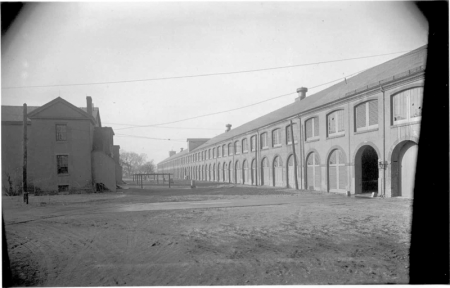
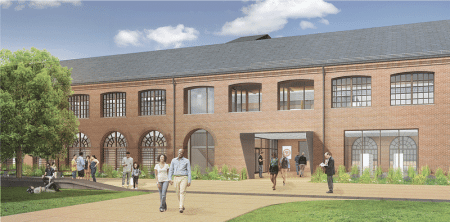
building-19

Building 19,

Above, Building 19, as seen in the early 1930s; below, a rendering of what will be called the Learning Commons. (Ann Beha Architects)

At its height, during World War II, the Armory would employ more than 14,000 people making M1s and a host of other weapons, but two decades after that conflict ended, Defense Secretary Robert McNamara — earning himself an ignominious place in Springfield history — determined that private defense contractors could manufacture the nation’s weapons. He ordered the decommissioning of the Armory, putting more than 2,000 people out of work, a decision that would damage the local economy but also pave the way for the site’s next life.

Indeed, a group of area leaders, including then- (and also future) Springfield Mayor Charlie Ryan; Edmund Garvey, then-director of the Springfield Technical Institute; state Rep. Anthony Scibelli; and Springfield industrialist Joseph Deliso Sr. pushed for legislation that would create a “two-year college of technology.” (Their efforts, and their legacy, will be celebrated at STCC’s Founders Day festivities on Sept. 9, the first in a year-long series of events to mark the college’s 50th anniversary.)

Blueprint for the Future

The Founders Day speeches will be delivered in the gym in Building 2 on the STCC campus (a.k.a. Scibelli Hall). Those taking them in will need to look only a few dozen yards to the north to see the beehive of activity at ‘19,’ as it’s known colloquially.

Unlike other Armory structures, especially its main administration building, now named after Garvey, 19 has not had any significant role with the college since it was formed, other than as a warehouse for equipment that was no longer needed but couldn’t be discarded.

All that is about to change, though, and in a big way.

Indeed, the renovated structure, due to open in the fall of 2018, will be home to a wide array of offices and facilities now scattered across the campus, including the library, admissions, registration, financial aid, the bookstore, the welcome center, student government, the parking office, health services, student activities, a café, the IT help desk, meeting and conference space, and much more.

This collection of facilities will be called the Learning Commons, and if that sounds like a lot to put under one roof, remember that the roof of 19 covers a building longer than two football fields, complete with the end zones, and there are two full floors and a loft third floor.

As noted, converting a structure that large, built a century and a half before the Internet was conceived, 40 years before the lightbulb, 35 years before the telephone, and 80 years before air conditioning (and thus not designed for any of the above) — all while maintaining its original architectural elements and being on the cutting edge of energy efficiency (LEED Silver designation) — will be a stern challenge.

This will require, as Faber noted earlier, coexistence of the old and the new, because they’re both vital, but for different reasons.

“From a design standpoint, it’s really about respecting the tradition of the building,” he explained, adding that this can and will be done, while also making the facility ‘green’ and state-of-the-art with regard to information technology.

Duszlak said there are a number of stages to the project, many of which will be carried out concurrently.

Late this spring, work began in earnest on infrastructure, what he called the “enabling phase,” including water, sewer, and electrical lines. He added that crews made the very most of the three months when the student population is greatly diminished, with the goal of minimizing disruption when they return this week.

Maureen Socha, director of Facilities for STCC, said the project represented an opportunity for the college and DCAMM to greatly improve an aging, and often failing, infrastructure system, one that has been seized.

“A lot of our infrastructure is original to the Armory — we still have brick pipes and clay pipes everywhere,” she explained. “This was a huge opportunity to upgrade that system.”

renovated ‘19

An architect’s rendering of the forum section of the renovated ‘19.’ (Ann Beha Architects)

While infrastructure work continues on a smaller scale, restoration work on both the exterior and interior of the building have commenced, with the goal of preparing the structure for the extensive build-out work that will follow to create offices, a library, a café, and gathering spaces out of what was a cavernous warehouse.

“The roof gets brought up to current code, the second floor gets brought up to code, a lot of the existing joists get reinforced with structural steel,” Duszlak said. “There’s new elevators to be put in, new mechanical shafts to get cut through the building … a lot of it is just upgrading the skeleton of the building to get it ready for the tradespeople to create the spaces.”

There are many elements to this blend of restoration and renovation work, ranging from cleaning and repointing the hundreds of thousands of bricks to matching (after first determining) the original color of those louvers.

And in a way, the louvers are a microcosm of the project’s many challenges and the huge amount of research and even lab work that goes into such preservation and restoration efforts.

“We had a consultant who took paint chips off the building, took them to a lab, and, through use of a high-powered microscope, was able to pick out the different layers that had been painted over time,” he said. “We found four or five different colors layered on top of one another.” (A darker brown has been declared ‘original.’)

Research has involved poring over hundreds of old photos from not only the Armory but the Library of Congress, he went on, adding, again, the goal is a modern, energy-efficient facility that nonetheless pays respect to the building’s historic look and role.

Soon, work will commence on a 3D coordination of the space, said Duszlak, adding that this will enable crews to make sure all the mechanicals — plumbing, electrical, and HVAC services — are properly coordinated and there are no conflicts.

“There are a number of architectural elements that Ann Beha is concerned about,” he explained. “They want to keep a lot of the timbers exposed to give it some of the old-feel look, but keeping that much square footage exposed, and the ceiling, it limits where you can put duct work and electrical, which adds to the challenges and emphasizes the importance of the 3D coordination.”

Past is Prologue

Looking ahead, Duszlak noted that there is considerable digging (maybe 75% of the total for the project) still to be undertaken at 19 and its larger footprint.

“We have new structural upgrades that we have to dig foundations for,” he explained, “and we have electrical utilities that run the complete 715-foot length of the foundation. There’s new under-slab plumbing and drainage that services new bathrooms … we’ll be doing a lot of digging four to seven feet down.

“So there’s the potential for finding a lot of really cool artifacts,” he went on, adding that, while he doesn’t want to encounter anything that might hinder progress, he wouldn’t mind creating some new stories — or legends.

That’s what can happen when the past, present, and future come together in such dramatic, and historic, fashion.

George O’Brien can be reached at  [email protected]

Cover Story Sections Women in Businesss

Bonding Agent

Liz Rappaport

Liz Rappaport says the camaraderie and support she has received from other mothers in the PWC will make leaving her baby daughter Ellie easier when she returns to work.

The Women’s Professional Chamber of Commerce is like most of the organizations with those three words in their title. But it is different in one important respect — the membership shares common challenges, issues, and emotions as they go about trying to balance work and life. This makes the WPC not only unique in character and mission, but also quite effective in providing needed support to members.

Jenny MacKay has not forgotten the first Women’s Professional Chamber (WPC) meeting she attended three years ago in Springfield.

It was a luncheon with a moderator and panel of speakers that included top female executives from Smith & Wesson, Columbia Gas, and Health New England.

An employee-benefits consultant for the Gaudreau Group in Wilbraham, and also a 2016 BusinessWest 40 Under Forty honoree, MacKay had attended events sponsored by many other local chambers, but this one was decidedly different.

“It was interesting and so inspirational to hear how these women talk about how they learned to balance the same life challenges I was facing or will have to face in the future,” MacKay said, adding that today she is a member of the WPC board of directors. “They talked about their biggest issues, which were things other women could relate to, and it was inspiring to hear that having a family won’t hold you back, that you don’t have to choose between a job or children. I’m afraid of what having kids will do to my career, but being part of the group makes me realize I am not alone.”

Liz Rappaport has also found the personal support she needed in the PWC.

The manager of Century Investment Co. in West Springfield and a 2014 BusinessWest 40 Under Forty honoree, she joined the group three years ago and said it has taught her invaluable lessons.

“Other women have told me you can never be perfect in your family life or on the job, but if you do your best; you can balance things out,” she noted, adding that she gave birth three months ago to a daughter named Ellie, and the advice she received helped her understand the challenges that will confront her when she returns to work this month.

“I’m eager to return to the PWC and talk to working moms because I have different questions now for my fellow cohorts,” she said, noting that she is the secretary of the group. “It helps knowing that they are juggling multiple roles, and if they can do it, I can do it, too.”

It was interesting and so inspirational to hear how these women talk about how they learned to balance the same life challenges I was facing or will have to face in the future.”

The PWC is a division of the Springfield Regional Chamber of Commerce, but is its own entity. Its 300 members are at different stages of life and career, and their jobs encompass a variety of professions in diverse fields. But they share a common theme: trying to balance their work with their personal life and obligations, a task most women struggle with on a daily basis.

Membership makes it easy for them to find other female professionals who can share stories and helpful hints about how to maintain a balance as they strive to fulfill their own expectations about being the best business professional, best mother, best wife, and best daughter, while playing an active role in their community and doing volunteer work.

It is this quality that sets it apart from other chambers. Women tend to network very differently when they are alone with their peers than they do in a mixed-gender group, and personal stories and situations are shared as readily as business cards. Although membership in the PWC can help them succeed in business through connections that are made, the ones they form usually result from bonding through intimate discussions.

For this issue and its focus on women in business, we take an inside look at the PWC and the ways in which women benefit from belonging to a group where dealing with personal and professional issues that intertwine is something they all relate to.

Appreciable Differences

The PWC was formed in 1953, and although its name changed from the Women’s Division of the Springfield Regional Chamber to the Women’s Partnership before it was given its current moniker in 2010, the group has always provided services to the community, local businesses, and its members.

Jenny MacKay

Although Jenny MacKay belongs to many local chamber groups, the Professional Women’s Chamber is the place where she gets the most support.

Education has always been paramount, and scholarships have been granted annually to non-traditional women students since 1965. The recipients are often returning to the workforce after years of being at home, and three individuals have each been selected to receive at least $1,000 in recent years.

The calendar runs from September to June, and since the chamber’s officers and members of its board of directors know how difficult it can be for a woman to juggle multiple roles, two meetings feature speakers who share first-hand accounts of the personal struggles and roadblocks they hit along the road to success.

There are also evening events, which are usually held at local retail establishments that allow members to shop while they network in a relaxed setting.

The year begins with a kickoff luncheon in September, which features a compelling speaker, followed by an After Hours Ladies Night in October and a PWC-produced luncheon event at the Western Mass. Business Expo (slated for Nov. 3 this year). A second Ladies Night is held in December.

The new year is heralded with a Tabletop Luncheon; there is a third Ladies Night in February, and the second headline speaker luncheon is held in March. A fourth Ladies Night is scheduled in April, and the year culminates in late May with an event held to honor the Woman of the Year.

“The Ladies Nights are held at local shops; we’ve gone to Cooper’s Gifts in Agawam, Kate Gray in Longmeadow, and Added Attractions in East Longmeadow,” said MacKay, naming a few noteworthy outings and adding that the shops provide wine and hors d’oeurves.

“We try to schedule things that women like to do that can provide them with some stimulus as well a break from the stressors in their lives,” Rappaport said, noting that the evenings help women achieve an effective work/life balance. “Networking can be mundane, but these nights out are a nice distraction, and we realize that if a woman is going to carve out time to attend a meeting, we had better make it worth her while.”

But while networking does occur during the Ladies Nights, business introductions and connections that are formed are secondary to the personal relationships that evolve when women are in an atmosphere they find fun and enjoyable.

“What someone does for business is not as important as the fact that you have made a new friend; we talk to each other and find commonalities,” Rappaport explained.

MacKay concurred. “Our Ladies Nights don’t involve the commitment of a sit-down dinner for two hours every month. We don’t want to add more commitments to a woman’s to-do list because we understand how busy women’s lives are,” she said.

The PWC also has a six-session mentorship program called Reaching Goals, aimed at giving students from Springfield Technical Community College the professional and personal skills they need to succeed in their chosen careers.

Rappaport is a mentor and has worked with women ranging in age from 18 to 38. She has spent time with some outside of the meetings and says that, in some cases, the program has resulted in a student landing a job due to the connections she makes.

Gender Issues

The majority of the group’s members are over the age of 40, so Rappaport and MacKay plan to reach out this year to Millennials who may not know about the PWC and what it has to offer, while continuing to provide programs that interest women of different ages at different stages of their careers.

MacKay says this initiative is important because Millennials are trying to establish themselves in their chosen careers, and many are experiencing conflicting emotions as they struggle to create a healthy work/life balance.

“They’re working hard, planning important events such as weddings, and also trying to figure out if they can handle having a child without fearing that something will suffer,” she said, adding that the benefits of membership are priceless and the relationships women form with each other are much more intimate than those that result from other chamber groups.

MacKay works in a male-dominated occupation, and has gotten valuable advice from PWC members about how to deal with a variety of situations as well as strategies for communicating with male co-workers, since they relate to each other very differently than women.

In addition, the group teaches women that failure isn’t an end and can lead to a new beginning, which became apparent during a luncheon where Tracey Noonan was the keynote speaker.

The founder of Wicked Good Cupcakes, who successfully won her bid for a partnership on the popular TV series Shark Tank, shared her story of how her business evolved after she started baking cupcakes in Mason jars with her daughter Dani in their South Shore kitchen in 2011.

“She was a single mom who took a baking class in order to bond with her daughter,” MacKay said, recounting how Noonan shared the hardships of being a single mom, what is was like to start a business — who she got help from and who refused to help her — and how success has affected her life.

The story resonated with women on a variety of levels, as did the personal tale told by Lisa Ekus of the Lisa Ekus Group LLC. The Hatfield entrepreneur, who represents cookbook authors and food products, spoke to the PWC in March about the struggles of balancing her personal and family life.

Other speakers have addressed issues of equal pay and the lack of qualified candidates to fill jobs in precision manufacturing, and what women can do to help fill the gap, and Rappaport says she has learned many valuable lessons, including the fact that each woman is her own best advocate.

But feeling and projecting confidence is not easily accomplished, because many women are self-deprecating, and even getting a compliment on one’s clothing can lead to an embarrassed answer and insistence that it was purchased on sale.

“Women don’t want to be thought of as pushy or too assertive,” Rappaport noted, adding that, although she has never heard of a man with those traits being referred to in a condescending manner, it’s not uncommon for women to suffer from such labels.

MacKay agreed, and said if she doesn’t smile all the time, people tell her to do so and add, “everything will be all right,” which she finds very frustrating.

Valuable Setting

Rappaport is looking forward to returning to assuming a professional role in the family business when she returns to work following her maternity leave. She knows it won’t be easy and she will worry about her baby daily, but she finds strength in numbers and the knowledge that her peers have learned to effectively juggle responsibilities in different arenas of their life without feeling they have to be perfect in every role.

But women agree that the unrealistic belief is pervasive in society today.

“When did the message, ‘you can have it all’ change to ‘you have to do it all’?” MacKay said. “It used to be inspirational, but it has become exhausting because it’s an unrealistic and impossible goal.”

Which is where the PWC comes in. It helps women understand there are others who share the same feelings and concerns who can provide each other with reassurance that doing their best each day is truly good enough.

Chamber Corners Departments

AMHERST AREA
CHAMBER OF COMMERCE

www.amherstarea.com
(413) 253-0700

• Sept. 14: Chamber After 5, 5-7 p.m. at Applewood Retirement Community, 1 Spencer Dr., Amherst. Sponsored by Hospice of the Fisher Home. Join us for an evening of fun, music, and food surrounded by long stretches of beautiful New England countryside.
Cost: $10 for members, $15 for non-members. Register online at www.amherstarea.com.

• Oct. 6: 2016 Annual A+ Awards Dinner, 5-9 p.m., at the UMass Student Union Ballroom, 280 Hicks Way, Amherst. Sponsored by PeoplesBank. The Amherst Area Chamber of Commerce Annual A+ Awards Dinner is the social event of the year.  This year we will be honoring five awardees for their contributions to life and commerce in the Amherst Area. The MVP Award, Legacy Awards, Lifetime Achievement in Business, Community Service, and Young Professionals will all be given. In addition, we seek to honor our two Cooley Dickinson Scholarship winners. Music sponsored by the Springfield Symphony Orchestra. Register online at www.amherstarea.com. Cost: $80 per ticket, $750 per table of 10.

EAST OF THE RIVER CHAMBER OF COMMERCE

www.erc5.com
(413) 575-7230

• Sept. 8: 2016 Mill Fest, 4-7:30 p.m., at Europa Black Rock Bar & Grill, 782 Center St., Ludlow. With heartfelt respect and honor to the events happening in our country, the ERC5 would like to use this event as a small way to thank law enforcement for its service to our businesses and protecting our communities. Come and thank one of your local men and women in blue, and take advantage of the opportunity to network and experience the economic business development happening in Ludlow. This fun-filled event will feature delicious food, live music, beers to taste from the Mill’s favorite brewery, Iron Dukes, a signature blue drink recognizing law enforcement, and a fun-filled Ludlow Fun Fact Contest. Register online at www.erc5.com. Cost: $25.

• Sept. 30: Annual Golf Tournament, 10 a.m. to 6 p.m., at the Country Club of Wilbraham, 859 Stony Hill Road, Wilbraham. Proceeds will go to the ERC5 Scholarship Fund. The fund to date has raised more than $100,000 for local student scholarships. Registration will begin at 11 a.m., lunch is at 11:30 a.m., and 12:30 p.m. is the shotgun start. Don’t golf? Join us after the tournament for the cocktail party and buffet. The reception will be a great opportunity to network and congratulate the winners. Cost: $125 for an individual golfer, $500 for a foursome. For registration information, contact Nancy Connor at [email protected] or (413) 575-7230.

FRANKLIN COUNTY CHAMBER OF COMMERCE

www.franklincc.org
(413) 773-5463

• Sept. 15: Google Marketing Workshop Series: “Set Goals with Google Analytics,” 11 a.m to 1 p.m., hosted by Franklin County Chamber of Commerce, 395 Main St., Greenfield. Google Analytics is a free, powerful analytics tool that provides reports showing how visitors found your website and what they did when they got there. This workshop will explain how you can use Analytics to improve your marketing. Cost: $5, including lunch. To sign up, call the chamber at (413) 773-5463 or visit franklincc.org/whats-new-at-the-chamber.

• Sept. 29: Google Marketing Workshop Series: “Create Your Free Website with Google,” 11 a.m. to 1 p.m., hosted by Franklin County Chamber of Commerce, 395 Main St., Greenfield. Learn how to create, customize and publish your site. Free hosting and domain name for a year. Cost: $5, including lunch. To sign up, call the chamber at (413) 773-5463 or visit franklincc.org/whats-new-at-the-chamber.

GREATER CHICOPEE CHAMBER OF COMMERCE

www.chicopeechamber.org
(413) 594-2101

• Sept. 9-10: 2016 Chicopee Downtown Getdown. Food, vendors, live entertainment, and more. Free event. For details, visit chicopee.wix.com/downtowngetdown.

• Sept. 14: Business After Hours with the West of the River Chamber, 5-7 p.m., hosted by Cal’s, 1068 Riverdale St. West Springfield. Cost: $10 for members, $15 for non-members.

• Sept. 21: Salute Breakfast, 7:15-9 a.m., hosted by MassMutual Learning & Conference Center, 350 Memorial Dr., Chicopee. Cost: $23 for members, $28 for non-members.

GREATER HOLYOKE CHAMBER OF COMMERCE

www.holyokechamber.com
(413) 534-3376

• Sept. 8: Chamber Coffee Buzz, 7:30-8:30 a.m., hosted by Girl Scouts of Central and Western Massachusetts, 301 Kelly Way, Holyoke. Sponsor is Whittlesey & Hadley, P.C. Coffee sponsored by Spradley Deluxe Coffee. A morning networking program that provides chamber members and guests the opportunity to make new contacts and exchange business information over a lig ht breakfast. Cost: free.

• Sept. 14: Chamber Oktoberfest 2016, 5-7:30 p.m., at Munich Haus Restaurant, 13 Center St., Chicopee. Sponsored by Suez Environment/United Water, Resnic Bearuregard Waite & Driscoll, and Marcotte Ford. Dig out your lederhosen and join your friends and colleagues at the Bier Garten at the Munich Haus for a night of German beer, a buffet of authentic German food, and networking. Each ticket also includes a stein of bier. Door prizes and 50/50 raffle. Cost: $30 for members, $35 for non-member guests and walk-ins. Register online at www.holyokechamber.com.


GREATER NORTHAMPTON CHAMBER OF COMMERCE

www.explorenorthampton.com
(413) 584-1900

• Sept. 7: September Arrive @ 5, 5-7 p.m., hosted by Spoleto Restaurant. Sponsored by Webber & Grinnell Insurance, Applied Mortgage, BusinessWest, and Lia Honda. Cost: $10 for members.


GREATER WESTFIELD CHAMBER OF COMMERCE

www.westfieldbiz.org
(413) 568-1618

• Sept. 12: Mayor’s Coffee Hour with Westfield Mayor Brian Sullivan, 8-9 a.m., at McDonald’s, 182 North Elm St., Westfield. Call Pam at the Chamber office at (413) 568-1618 to register for this event so we may give our host a head count. Cost: free.

• Sept. 14: After 5 Connection, 5-7 p.m., hosted by Westfield YouthWorks East Mountain Transition Program, 128 East Mountain Road, Westfield. Refreshments will be served. Bring your business cards and make connections. Cost: $10 for members, $15 cash for non-members. Register at www.westfieldbiz.org.

• Sept. 23: September Breakfast, 7-9 a.m., hosted by the 104th Fighter Wing ANG, 175 Falcon Dr., Westfield. Sponsored by Baystate Noble Hospital, United Bank, Tighe & Bond, and United Way of Pioneer Valley. 50/50 raffle to support two Citizen’s Scholarships. The 104th Fighter Wing ANG requires registration for this event and also requires a driver’s license number in advance and upon entering the base. You will be required to provide your driver’s license number when registering. For more information or to donate a door prize for the event, call Pam at the chamber at (413) 568-1618. Cost: $25 for members, $30 for non-members. Register online at www.westfieldbiz.org.


SPRINGFIELD REGIONAL CHAMBER

www.myonlinechamber.com
(413) 787-1555

• Sept. 7: Business@Breakfast, 7:15-9 a.m., at the Sheraton Springfield, One Monarch Place, Springfield. Sponsored by Columbia Gas of Massachusetts and United Personnel. Business@Breakfast pays tribute to individuals, business firms, and organizations for major contributions to civic and economic growth and for actions which reflect honor on the region. In September, we will be saluting Nate Costa and the Springfield Thunderbirds and Zach Baru and the Springfield Sting. Cost: $22.50 for members in advance, $25 for members at the door, $30 general admission. Register online at www.springfieldregionalchamber.com.

• Sept. 21-23: 2016 Washington Symposium, hosted by U.S. Rep. Richard Neal. An opportunity to meet with leaders in the Senate, Congress, and the Obama administration in its final months in office, as well as other top policy makers on the federal issues that matter to you. Plane departs Bradley International Airport at 12:35 p.m. on Sept. 21 and returns at 4:35 p.m. on Sept. 23. Contact Nancy Creed for cost and registration information at [email protected] or (413) 755-1309.

• Sept. 27: Pastries, Politics, and Policy, 8-9 a.m., at the TD Bank Conference Center, 1441 Main St., Springfield. Cost: $15 for members; $25 general admission. Register online at www.springfieldregionalchamber.com.


WEST OF THE RIVER CHAMBER OF COMMERCE

www.ourwrc.com
(413) 426-3880

• Sept. 22: Business Breakfast with Howie Carr, 7-9 a.m., hosted by Chez Josef, Agawam. Cost: $35 for chamber members, $40 for non-members. Register online at www.westoftheriverchamber.com.


Daily News

SPRINGFIELD — Inspired Marketing Inc. announced it has been certified as a woman-owned business by the Women’s Business Enterprise National Council (WBENC), and also announced several promotions and hires in the company.

“This designation is something I have longed to receive, and this year was thrilled to have accomplished the goal,” said Jill Monson-Bishop, chief inspiration officer. “I am even prouder of this certification because I have incredible women on my team who celebrate it with me.”

In addition, Heather Ruggeri, the company’s chief events officer, was recently promoted and adds vice president to her business card. She joined Inspired Marketing in 2015 and previously worked as the conference service manager and sales manager at the Springfield Sheraton for nine years. In addition, she was recently named to the board of the Connecticut River Valley Chapter of Meeting Professionals International and is one of only a few certified meeting professionals in the area and one of only about 13,000 worldwide.

Another team member, Kristin Carlson, was recently named senior marketing visionary partner. Kristin started with Inspired Marketing as an apprentice right out of college in 2014. She has continued to evolve into a valued team member, creating innovative, successful media campaigns for several clients with outstanding results.

Meanwhile, Lauren Mendoza, who was with Inspired Marketing in its infancy before leaving for tech startup Waterdog, has rejoined the team and is now the office manager. Her organization keeps the team on track and helps communication, meetings, and schedules to run smoothly.

Cara Cole recently joined Inspired Marketing as a marketing visionary partner, serving on the front line with client creative implementation. She came to Inspired Marketing from the Center for Human Development and previously from Square One.

Finally, Jenifer Esile joined Inspired Marketing as on-staff graphic designer after having been a freelance partner since the company’s inception. In addition to 20 years of diverse design experience, she brings copywriting and social-media skills to the team to provide greater value to clients.

Daily News

HOLYOKE — The Economic Development Business Breakfast of the Greater Holyoke Chamber of Commerce will be held on Wednesday, Sept. 21 at 7:30 a.m. at Wyckoff Country Club.

Attendees will learn about community-development updates and initiatives straight from local economic-development leaders, including Marcos Marrero, director of Holyoke Economic Development; Mike Sullivan, South Hadley town administrator; and Mike Vedovelli, Chicopee Director of Economic Development.

Chamber board chair Margaret Mantoni of Loomis Communities will kick off the breakfast with a welcome and then turn it over to emcee Spiros Hatiras, chamber board member and president and CEO of Holyoke Medical Center. The chamber will roll out the welcome mat to new members Expert Staffing, the United Arc, Score, the Jamrog Group, Skoler, Abbott, & Presser, P.C., the Munich Haus, Neari School, ArteSana Inc., KnoxworX Multimedia, Golden Heart Home Healthcare, LLC; and Applebee’s.

Also recognized at the breakfast will be the new superintendent of the Soldier’s Home of Holyoke, Marine Lt. Col. Bennett Walsh; General Cleaners on its 90th anniversary; the United Way campaign kickoff; McDonald’s on its new business on Whiting Farms Road; Applebee’s on its new restaurant on Whiting Farms Road, and former state Sen. and state Rep. from Westfield, Michael Knapik, the new director of the Western Massachusetts Governor’s Office.

The breakfast is presented by PeoplesBank and sponsored by Holyoke Medical Center, Hadley Printing, and United Bank. Admission is $23 with advance registration for chamber members and $28 for all other guests. Register early at holyokechamber.com/events or by calling (413) 534-3376.

Daily News

SPRINGFIELD — Pioneer Valley Montessori School (PVMS), a not-for-profit organization cultivating children’s natural desire to learn, has received a $10,000 grant from MassMutual Foundation Inc. PVMS is one of only 17 organizations nationally to receive an award as part of a national Community Service Award (CSA) program. The MassMutual Foundation made the grant as a tribute to the volunteer efforts of Erik Skar, financial professional with Charter Oak Insurance and Financial Services Co.

“Our Community Service Awards program aims to encourage and recognize those financial professionals who are active members of their community,” said Alison Mathias, MassMutual’s director of Charitable Giving and vice president of the MassMutual Foundation. “Erik’s volunteer work reflects our steadfast commitment to supporting organizations in the communities where MassMutual financial professionals live and work.”

Skar, who currently serves as president on PVMS’s board of directors, has dedicated countless hours of his time and talent to help the school grow and flourish. His passion and advocacy for the mission of PVMS inspires others to do the same. He has championed the efforts of the staff and volunteers, and has done everything for the organization from strategic planning to maintaining the facility to directing traffic at events.

“I am delighted that my work with PVMS has been recognized by the MassMutual Foundation,” Skar said. “This grant will provide much-needed funding to continue its improvement efforts after the tornado of 2011.”

PVMS provides Montessori early childhood and elementary education to children between the ages of 18 months and 12 years. The school enrolls students from 21 towns in Massachusetts and Connecticut, with approximately half of its students living in the city of Springfield. PVMS will put MassMutual’s grant to work by providing permanent shade structures to replace the trees it lost in the 2011 tornado, and to replace flooring and security doors.

Opinion

By JAMES S. GESSNER, M.D.

A number of mass shootings this summer, including the one at a night club in Orlando in June that left 49 dead and another 50 injured, have stunned the nation.

Such events are becoming all too common. According to Everytown for Gun Safety, 133 mass shootings in 39 states occurred in the U.S. between January 2009 and July 2015 — almost two per month. Yet, as horrible and shocking as they are, mass shootings — defined by the FBI as any incident in which at least four people are murdered with a gun — account for a small share of firearm homicides.

The Centers for Disease Control and Prevention (CDC) estimates that more than 33,000 deaths from firearms — about 91 a day on average — occur each year.

The statistics make it abundantly clear: gun violence is a public-health issue. And the physician’s voice — ever so critical on matters of public health — must become stronger.

The Mass. Medical Society (MMS) stance on this issue has been firm and long-standing. Our medical society’s policy on firearms and gun violence is expansive and dates back to 1995. It is guided by “the principles of reducing the number of deaths, disabilities, and injuries attributable to guns; making gun ownership safer; promoting education relative to guns, ammunition, and violence prevention for physicians and other health professionals, as well as for the public; and encouraging research to understand the risk factors related to gun violence and deaths.”

Our actions have matched our policy. Our Committee on Violence Intervention and Prevention, also established in 1995, has provided a number of resources to help reduce violence in many forms, and gun violence has been prominent among the topics.

From testimony on proposed legislation on Beacon Hill to education for patients; from resources for physicians on talking with patients to our most recent Public Health Leadership Forum on Firearm Violence in April, to then-MMS President Dr. Richard Aghababian’s call to action following the school shootings in Newtown in 2012, gun safety and gun violence have been key issues for our society.

It is heartening to see more physician groups lend their strong support to the effort. The American Medical Assoc. (AMA), with long-standing policies on reducing violence from firearms, stated its position at this year’s annual meeting, adopting a policy calling gun violence in the U.S. “a public-health crisis” that requires a comprehensive public-health response and solution. Perhaps most important, the AMA also resolved to lobby Congress to overturn legislation that for 20 years has banned the CDC from conducting research on gun violence.

Our actions have matched our policy. Our Committee on Violence Intervention and Prevention, also established in 1995, has provided a number of resources to help reduce violence in many forms, and gun violence has been prominent among the topics.

A second resolution by the AMA on firearm availability encourages legislation that would enforce a waiting period and background check for all firearm purchases and urges additional legislation to ban the manufacture, sale, or import of lethal and non-lethal guns of non-metallic materials that can not be identified by weapons-detection devices.

In April 2015, seven physician organizations, along with the American Public Health Assoc. and American Bar Assoc., issued a call to action, declaring that “deaths and injuries related to firearms constitute a major public-health problem in the United States.”

I am proud to say that more efforts at our medical society are underway. Our Leadership Forum provided materials for six continuing-medical-education courses on gun violence that launched at the end of June. Among the topics are the role of the clinician, community-based prevention, and evaluating the risk for gun violence in patients. Additionally, we are participating with Massachusetts Attorney General Maura Healey in developing materials to enhance the provider-patient relationship regarding firearms.

The shock of Orlando and other recent tragedies may fade over time, but physician efforts to reduce gun violence should not. Attorney General Healey, speaking at our Leadership Forum, highlighted the importance of physician participation in curbing gun violence, saying it will require a “partnership” with physicians. Indeed it will.

Dr. James S. Gessner is president of the Mass. Medical Society.

Back to School Sections

Life Lessons

Jean Pao Wilson

Jean Pao Wilson homeschooled her son Dillan for six years until he chose to enter public school, and still homeschools her 13-year-old daughter Amelia.

Jean Pao Wilson will never forget the moment she decided to homeschool her children.

“I can still see the picture in my head; my children were sitting on my husband’s knees on the riding mower as the sun set behind them,” the Easthampton mother said, adding that she had returned home from running errands, and although it was past their bedtime, her son and daughter ran and jumped into their father’s lap as soon as they saw him.

“It was a deciding moment; my son was in kindergarten and I had been thinking about the idea, but that did it,” Pao Wilson said, explaining that her husband worked six days a week, her children were in bed every night when he got home, and she knew homeschooling would allow them to spend more time together.

Other local parents who homeschool may not have experienced a similar epiphany, but those who have chosen this route say the benefits outweigh the challenges, and they and their children have no regrets.

Indeed, 16-year-old Dillan Wilson, who made the decision to switch to a brick-and-mortar school in seventh grade after years of homeschooling, found his experiences with learning very different than many of his peers.

“I saw so many kids who were just trying to get a (grade of) 60 to pass a test, rather than really wanting to understand the material,” he explained. “If I hadn’t been homeschooled for so many years, I might have been one of them.

“Homeschooling was a good experience,” he continued. “It wasn’t over-structured and I always wanted to learn more because there was never any pressure or testing.”

Statistician Sarah Grady from the U.S. Department of Education’s National Center for Education Statistics said the organization’s most recent study on homeschooling has yet to be released. But there was a 74% increase in homeschooling from 1999 to 2003, a 36% increase over the next nine years, and by 2012, 3.4% of students in the U.S. were homeschooled, including 31,000 to 41,000 children in Massachusetts.

Grady said the majority of parents cited concern about the environment in schools as the primary reason they decided to homeschool. However, the numbers reflect a limited population; 83% are white, and the income for most households is $50,000 to $100,000.

But local parents say the benefits are numerous: Homeschooling can be tailored to meet each child’s need; each child has a one-on-one-tutor; they can learn at their own pace without being labeled, which is especially important if they are ahead or behind in a subject area; they learn to think more independently than their peers; they are not bored by subjects they lack interest in or have already mastered; the environment is safe and devoid of bullying; and unusually close family relationships are forged due to a lifestyle that incorporates learning at every level.

Which is not to say that parents never have doubts.

David Iacobucci of East Longmeadow is a middle-school vice principal, and when his wife Adriana told him she wanted to homeschool their children he was apprehensive because he lacked a true understanding of the possibilities.

But over the years, a series of small and consistent successes that began when he watched Adriana teach his children to read built a belief in homeschooling that exceeded anything he could have imagined.

It has involved a lot of lot of hard work; the couple has studied Massachusetts and Connecticut state standards, and David has provided Adriana with many resources gleaned from his own career. But ultimately, he discovered that what was taking place in his home was the ideal set for public schools: Student-centered learning with an unlimited opportunity for socialization through a full schedule of diverse activities.

But he admits he continued to have some reservations, although they diminished over time, until his oldest daughter, Lena, got her first report card in a brick-and-mortar high school.

Today, Lena is a senior and president of the National Honor Society in East Longmeadow High School; her younger sister Sofia, who entered public school in 7th grade, has also earned honors, including the Presidential Award for Academic Excellence in eighth grade; and 11-year-old Eliza and 8-year-old Luca are being homeschooled by Adriana.

For this edition and its focus on education, BusinessWest takes a look at homeschooling through the eyes of several local families who shared their fears, hopes, and dreams, and the challenges and rewards of this form of alternative education.

Unlimited Resources

Miranda Shannon of Amherst started homeschooling 16 years ago. Today, one of her children is in graduate school, two are in college, her 18-year-old just finished his high school homeschooling program, and her 14-year-old son is still being homeschooled.

“Homeschooling is a viable way to educate children that can be done successfully because it allows parents to take their children’s personalities and learning styles into account; the ultimate goal is to produce an educated, self-confident young person,” Shannon told BusinessWest, noting that it’s more accepted today than when she started more than a decade ago.

Shannon is the moderator for the Pioneer Valley Homeschoolers Group, an inclusive, eclectic, online support group started in 2000 by a handful of families in a playgroup who shared the same goals.

It’s a place where people can find resources, ask questions, get advice and support, and post events, classes, and other activities. The group also offers help on tasks that include how to turn in paperwork required by local school departments as well as other practical information.

“There are things that every family must do, but when it comes to actual teaching we all do things very differently,” Shannon said, noting that PVHG provides support at all stages of schooling, from preschool/kindergarten through high school, which is important; veteran homeschoolers, who schooled their teens through high school give advice to families who wish to do the same.

The help ranges from information about existing options to advice on how to create high school transcripts, and personal experiences with the college application process.

Adrianna Iacobucci

Adrianna Iacobucci helps 11-year-old Eliza and 8-year-old Luca with their studies.

Indeed, so many groups exist in which homeschoolers and parents collaborate that it’s not difficult for parents to find one with like-minded people; they include cooperatives where group learning and projects are the primary focus; clubs formed by parents; support groups; and a growing number of field trips, classes, and educational sessions.

Sophia Sayigh is on the board of directors for Advocates for Home Education in Massachusetts; the statewide nonprofit is based in the Boston area and designed to educate and support parents in the Commonwealth who want to homeschool their children.

She says each town or city is responsible for overseeing residents who are homeschooled, and parents must submit an annual plan for each child. However, there is considerable room for flexibility because homeschoolers are not required to take standardized tests, although they can take an exam similar to the GED if they want a traditional diploma.

But experts say that is not necessary for entrance to college, especially at private schools, and an article in the Journal of College Admission notes that homeschoolers’ ACT and SAT scores are higher than those of public school students, and home-educated college students perform as well as or better than traditionally educated students.

Although some parents use curriculums they purchase to help guide their daily lessons, many create their own based on state standards. The Internet also provides an unlimited trove of resources: Lena Iacobucci took a free college course in psychology when she was in 8th grade, and her sister Sofia took a college course in International Law while she in 6th grade, thanks to offerings on the website www.coursera.org.

Sayigh tells parents to consider their child’s interests and how they learn best and include that in their education plan, and notes that being able to cater to their individual needs is one of the benefits of homeschooling.

“Everything is interdisciplinary,” she said, explaining that although schools divide their day into periods with designated times for different subjects, taking a child who is fascinated by marine biology to an aquarium can lead to extensive reading, research, writing, and math exercises that the child finds interesting. And since children learn best when they are enthusiastic about a subject, it can result in advanced learning.

In fact, homeschooling is an experience far removed from what most people imagine.

“You do not have to recreate school at home; there is no school bus to catch, and if something isn’t working, you change it,” Sayigh said. “Plus, your child doesn’t ever have to struggle because their learning is not dictated by an outside institution.

“Although you need to be able show progress, they don’t have to be at grade level in every subject,” she continued, citing the example of learning to read; there is a continuum of normal, and if parents read to their children every day and take other measures that hold their interest, they attain competence in their own timeframe.

Shattering Misconceptions

Homeschooling parents agree that although it can be a lifesaver for some children, it is definitely not for everyone, and is unlikely to be successful if the parent’s and children’s personalities do not mesh well, or for those unwilling to make the effort required to ensure their children have a multitude of opportunities to interact socially with their peers.

“If the parent is on the quiet or shy side, it may be hard to provide enough socialization for their children,” said Pao-Wilson, a licensed clinical psychologist. “It takes energy and time to network and establish and build the relationships and support that you and your children need.”

Local homeschooling parents say they don’t sit at the kitchen table for six hours a day, and their schedules are much different than one would find in a traditional school setting. Most tackle academic subjects such as math and language arts in the morning, because children learn best when they are not tired.

But their afternoons vary; children meet and do projects or learn lessons with co-op groups, take field trips, do volunteer work, research, read, take part in organized sports, and participate in the many programs that have sprung up in recent years at local museums, nature centers, and other facilities offering programs expressly for home-schooled students.

Gary Pao Wilson and his son Dillan

Gary Pao Wilson and his son Dillan share a close relationship and many interests, which was the intent behind Jean Pao Wilson’s decision to homeschool their children.

For example, Springfield College started a free physical education program last year for homeschoolers that divides them by age and meets on Friday mornings.

“All aspects of the program are directly supervised by Springfield College faculty members,” said Springfield College PEHE Chairman Stephen C. Coulon. “The physical education instruction is offered in a supportive environment with the emphasis on achievement and enjoyment.”

Parents also start their own groups. Pao Wilson and another homeschooling mother received a STEM grant from 4-H to start a Science Club, and was helped by two friends; a molecular cellular biologist and a friend with a degree in astrophysics.

“I know it’s incumbent on me to find programs that will interest my children, and if something doesn’t exist, I need to create it or find resources that will help me,” she said.

Most children’s schedules are filled with activities and trips to places that interest them, and they also belong to Girl Scouts, Cub Scouts, local sports teams, and more.

Social skills are formed as they work on projects in homeschool cooperatives and through the many group activities they take part in. In fact, parents and children say that being in a classroom doesn’t mean you will make friends with the people around you, and that it’s easy for them to form friendships in a homeschooling environment.

“You don’t need to be with 30 kids a day to develop as a normal, happy person, and homeschooled children are often more comfortable with adults because they don’t view them as someone who is trying to keep them in order,” Sayigh noted, adding that she successfully homeschooled her two children.

Different Styles

Pao Wilson does not think of homeschooling as simply another way to master academics; instead she views it as a place to learn lessons about life; develop critical thinking skills; and share her personal values.

And since most homeschoolers engage in a wide variety of activities related to their schooling, that’s exactly what has occurred with her children.

Her daughter Amelia, has earned ribbons for science-related projects in 4-H; taken photography classes, and pursued other things that interest her.

And although Dillan chose to leave homeschooling for a traditional education, 13-year-old Amelia tried an English class, then decided she wants to continue learning at home.

“I can do things at my own pace at home. It’s easier than having a schedule,” she said, adding that she likes the flexibility of being able to take a break when she gets tired.

Her outside activities include horseback riding, but she says she is very self-motivated when it comes to schoolwork.

“My mom is always there if I have questions, and I don’t have to wait for an e-mail or a phone call to get the answer,” she continued, citing the benefits. “Some of my friends wish they were homeschooled.”

Pao Wilson and other parents say they were initially apprehensive about their ability to teach their children, but when doubt arises, she recognizes it’s something she has to make peace with.

But it quickly became clear that she had to spend time on her relationship with her children and their relationships with each other; they had to learn to negotiate and resolve conflicts with each other, express their emotions, and get along.

“I had to change my style of parenting, and by the time they were 10 and 8, I was talking to them like they were teenagers,” she said. “But they were able to develop their own thoughts about things without worrying about conforming to the norm or being subjected to the pressure of how others perceive them.”

Adriana Iacobucci, who has homeschooled for 13 years, said she and her husband David gave their children choices from the time they were toddlers, and the decision to homeschool evolved after their oldest daughter Lena returned from preschool and announced she could learn the same things at home.

“We wanted them to be self-directed learners,” she said, adding that homeschooling families learn quickly to respect and support one another even if their teaching styles are very different.

Like other parents, she has moments of doubt, but she also views it as a challenge that must be overcome. But she has been part of many co-op groups, and continues to make a concerted effort to involve her children in as many activities as possible.

“They have been in many situations with diverse families, so they’re open minded about other people and really accept them,” she noted. “Our children are also extremely independent; making decisions about their own academic studies has spilled over into how they spend their time and who they spend it with.”

She has enjoyed watching them learn, and says it’s a luxury to allow them the time and space they need to master subjects they find challenging.

Eliza is still at home, and the 11-year-old enjoys her lifestyle. “I like being homeschooled, although I definitely do want to go to high school,” she said.

Her 8-year-old brother Luca also likes being homeschooled. “You don’t have to be in class as long,” he said, reciting subjects he enjoys, including science and math.

Difficult Lessons

Pao Wilson says homeschooling requires parents to learn how to learn themselves, have a desire to examine their beliefs, and be willing to change.

It also requires personal and financial sacrifices, because one parent is home instead of working. “But whether you’re home or making money in the workforce depends on your values and whether your definition of success is measured in dollars,” she noted.

Her initial goal of giving her children more time to spend with their father has been met, and today they all enjoy close relationships.

“Any endeavor worth pursuing will have its share of challenges, and there will be good days and bad days,” she explained. “But in the end, even with the kids squabbling, the uncertainty and worry about whether I’m doing the right thing or if I’m doing enough; and the sacrifices in health, time, energy, money, and sometimes my sanity … I still believe that homeschooling is worth the sacrifice.”

Teen Sofia Iacobucci agrees. “I left homeschooling because I wanted to try something new, and a lot of homeschool friends were going to public school,” she said. “But it was a big change. I liked the freedom we had at home. We had a say in what we wanted to learn instead of being told what we had to do and it allowed me to take my education into my own hands and become independent.”

Which is indeed the goal of every parent; to raise a well-rounded, happy and independent child.

Chamber Corners Departments

AMHERST AREA CHAMBER OF COMMERCE

www.amherstarea.com
(413) 253-0700

• Sept. 14: Chamber After 5, 5-7. P.m. at Applewood Retirement Community, 1 Spencer Dr., Amherst. Sponsored by Hospice of the Fisher Home. Please join us for an evening of fun, music, and food surrounded by long stretches of beautiful New England countryside.
Register online at www.amherstarea.com/ Cost: $10 for members; $15 for non-members

• Oct. 6: 2016 Annual A+ Awards Dinner, 5-9 p.m., at the UMass Student Union Ballroom, 280 Hicks Way, Amherst. Sponsored by PeoplesBank. The Amherst Area Chamber of Commerce Annual A+ Awards Dinner is the social event of the year.  This year we will be honoring five awardees for their contributions to life and commerce in the Amherst Area. The MVP Award, Legacy Awards, Lifetime Achievement in Business, Community Service, and Young Professionals will all be given. In addition, we seek to honor our two Cooley Dickinson Scholarship winners. Music sponsored by the Springfield Symphony Orchestra. Register online at www.amherstarea.com/ Cost: $80 per ticket, $750 per table of 10.

EAST OF THE RIVER CHAMBER OF COMMERCE/ERC 5

www.erc5.com
(413) 575-7230

• Sept. 8: 2016 Mill Fest, 4-7:30 p.m., at Europa Black Rock Bar & Grill, 782 Center Street, Ludlow. With heartfelt respect and honor to the events happening in our country, the ERC5 would like to use this event as a small way to thank law enforcement for its service to our businesses and protecting our communities. Come and thank one of your local men/women in blue, and take advantage of the opportunity to network and experience the economic business development happening in Ludlow. This fun-filled event will feature delicious food, live music, beers to taste from the Mill’s favorite brewery Iron Dukes, a signature Blue drink recognizing law enforcement and a fun-filled Ludlow Fun Fact Contest. Register online at www.erc5.com. Cost: $25.

• Sept. 30: 2016 Annual Golf Tournament, 10 a.m.-6 p.m., at the Country Club of Wilbraham, 859 Stony Hill Road, Wilbraham. Proceeds will go to the ERC5 Scholarship Fund. The fund to date has raised more than $100,000 for local student scholarships. Registration will begin at 11 a.m., lunch is at 11:30 a.m., and 12:30 p.m. is the shot gun start. Don’t golf? No problem, please join us after the tournament for the cocktail party and buffet. The reception will be a great opportunity to network and congratulate the winners. For registration information contact Nancy Connor [email protected], (413) 575-7230
Cost: Individual golfer, $125; foursome, $500.

FRANKLIN COUNTY CHAMBER OF COMMERCE

www.franklincc.org
(413) 773-5463

• Aug. 25: Google Marketing Workshop Series: “Grow Your Business Online with Google Tools,” 11 a.m. to 1 p.m., hosted by Franklin County Chamber of Commerce, 395 Main St., Greenfield. Can people find your business on computers and mobile devices? Free tools show you how people search on Google and how they use your website. Google’s suite of online business-productivity tools makes collaboration a breeze. Cost: $5, including lunch. To sign up, call the chamber at (413) 773-5463 or visit franklincc.org/whats-new-at-the-chamber.

• Sept. 1: Google Marketing Workshop Series: “Advertise Online Using Google AdWords,” 11 a.m. to 1 p.m., hosted by Franklin County Chamber of Commerce, 395 Main St., Greenfield. An introduction to advertising and how it can benefit a business. Learn how Keywords work, how to find them, and how to evaluate their performance. Learn how to write great ads for your business. Cost: $5, including lunch. To sign up, call the chamber at (413) 773-5463 or visit franklincc.org/whats-new-at-the-chamber.

• Sept. 15: Google Marketing Workshop Series: “Set Goals with Google Analytics,” 11 a.m to 1 p.m., hosted by Franklin County Chamber of Commerce, 395 Main St., Greenfield. Google Analytics is a free, powerful analytics tool that provides reports showing how visitors found your website and what they did when they got there. Google Analytics measures the effectiveness of your online and offline marketing campaigns. This workshop will explain how you can use Analytics to improve your marketing. Cost: $5, including lunch. To sign up, call the chamber at (413) 773-5463 or visit franklincc.org/whats-new-at-the-chamber.

• Sept. 29: Google Marketing Workshop Series: “Create Your Free Website with Google,” 11 a.m. to 1 p.m., hosted by Franklin County Chamber of Commerce, 395 Main St., Greenfield. Learn how to create, customize and publish your site. Get a free domain name or use one you already own. Access and edit your site any time. Use your own photos and text, or the website generator can create the text for you. Free hosting and domain name for a year. Cost: $5, including lunch. To sign up, call the chamber at (413) 773-5463 or visit franklincc.org/whats-new-at-the-chamber.

GREATER CHICOPEE CHAMBER OF COMMERCE

www.chicopeechamber.org
(413) 594-2101

• Sept. 9-10: 2016 Chicopee Downtown Getdown. Food, vendors, live entertainment, and more. Free event. For details, visit chicopee.wix.com/downtowngetdown.

• Sept. 14: Business After Hours with the West of the River Chamber, 5-7 p.m., hosted by Cal’s, 1068 Riverdale St. West Springfield. Cost: $10 for members, $15 for non-members.

• Sept. 21: Salute Breakfast, 7:15-9 a.m., hosted by MassMutual Learning & Conference Center, 350 Memorial Dr., Chicopee. Cost: $23 for members, $28 for non-members.

GREATER HOLYOKE CHAMBER OF COMMERCE

www.holyokechamber.com
(413) 534-3376

• Sept. 8: Chamber Coffee Buzz, 7:30-8:30 a.m. Hosted by Girl Scouts of Central and Western Massachusetts, 301 Kelly Way, Holyoke, MA. Sponsor is Whittlesey & Hadley, P.C. Coffee sponsored by Spradley Deluxe Coffee. A morning networking program that provides chamber members and guests the opportunity to make new contacts and exchange business information over a light breakfast. Cost: Free

• Sept. 14: Chamber Oktoberfest 2016, 5-7:30 p.m., at Munich Haus Restaurant, 13 Center St., Chicopee. Sponsored by Suez Environment/United Water, Resnic Bearuregard Waite & Driscoll, and Marcotte Ford. Dig out your lederhosen and join your friends and colleagues at the Bier Garten at the Munich Haus for a night of German beer, a buffet of authentic German food, and a ton of fun networking. Each ticket also includes a stein of bier. Door prizes and a 50/50 raffle will add to the fun. Register online at www.holyokechamber.com. Cost: $30 for members; $35 for non-member guests and walk-ins.

GREATER NORTHAMPTON CHAMBER OF COMMERCE

www.explorenorthampton.com
(413) 584-1900

• Sept. 7: September Arrive @ 5, 5-7 p.m., hosted by Spoleto Restaurant. Sponsored by Webber & Grinnell Insurance, Applied Mortgage, BusinessWest, and Lia Honda. Cost: $10 for members.

GREATER WESTFIELD CHAMBER OF COMMERCE

www.westfieldbiz.org
(413) 568-1618

• August 22: After 5 Connection, 5 p.m., at Papps, 110 Airport Road, Westfield. Sponsored by: Air1 Flight Training and A Slight Edge Salon. Join us for a unique networking event. There will be a cash bar, eggplant tower bites, renowned tomato bruschetta, and a chef’s choice selection.  Enter a drawing to win a $25 gift certificate to Papps Bar & Grill. We will also have a raffle to support our scholarship fund, where you can win an aerial scenic view of Westfield in a 1942 Aeronca L3 plane — weather permitting. Register online at www.westfieldbiz.org/ Cost: Free

• Sept. 12: Mayor’s Coffee Hour, 8-9 a.m., at McDonad’s, 182 North Elm St., Westfield. Please join us for our monthly Mayor’s Coffee Hour with Westfield Mayor Brian Sullivan. Please call Pam at the Chamber office at (413) 568-1618 to register for this event so we may give our host a head count. Cost: Free

• Sept. 14: After 5 Connection, 5-7 p.m. Hosted by Westfield YouthWorks East Mountain Transition Program, 128 East Mountain Road, Westfield. Refreshments will be served. Bring your business cards and make connections. Register online at www.westfieldbiz.org/ Cost: $10 for members, $15 for non-members (cash).

• Sept. 23: September Breakfast, 7-9 a.m. Hosted by The 104th Fighter Wing ANG, 175 Falcon Dr., Westfield. Sponsored by:  Baystate Noble Hospital,  United Bank, Tighe & Bond and United Way of Pioneer Valley. Join us for our annual September Chamber Breakfast. 50/50 Raffle to support two Citizen’s Scholarships. Please note, the 104th Fighter Wing ANG requires registration for this event and also requires your driver’s license number in advance and upon entering the base. You will be required to provide your driver’s license number when registering. For more information or to donate a door prize for the event, please call Pam at the chamber at (413) 568-1618. Register online at www.westfieldbiz.org/ Cost: $25 for members, $30 for non-members.

SPRINGFIELD REGIONAL CHAMBER

www.myonlinechamber.com
(413) 787-1555

• Sept. 7: Business@Breakfast, 7:15-9 a.m., at the Sheraton Springfield, One Monarch Place, Springfield. Sponsored by: Columbia Gas of Massachusetts and United Personnel. Business@Breakfast pays tribute to individuals, business firms and organizations for major contributions to civic and economic growth and for actions which reflect honor on the region. In September, we will be saluting Nate Costa and the Springfield Thunderbirds and Zach Baru and the Springfield Sting. Register online: www.springfieldregionalchamber.com. Cost: $22.50 for members, in advance; $25 members at the door; $30 general admission.

• Sept. 21-23: 2016 Washington Symposium, hosted by Congressman Richard E. Neal. A “don’t miss” opportunity to meet with leaders in the Senate, Congress, and the Obama Administration in its final months in office, as well as other top policy makers on the federal issues that matter to you. Plane departs Bradley International Airport at 12:35 p.m. on Sept. 21 and returns at 4:35 p.m. on Sept. 23. Contact Nancy Creed for cost and registration information at [email protected]; (413) 755-1309.

• Sept. 27: Pastries, Politics, and Policy, 8-9 a.m., at the TD Bank Conference Center, 1441 Main St., Springfield. Register online: www.springfieldregionalchamber.com. Cost: $15 for members; $25 general admission.

WEST OF THE RIVER CHAMBER OF COMMERCE

www.ourwrc.com
(413) 426-3880

• Sept. 22: Business Breakfast with Howie Carr, 7-9 a.m., hosted by Chez Josef, Agawam. Cost: $35 for chamber members, $40 for non-members. Register online at www.westoftheriverchamber.com.

Departments Picture This

A photo essay of recent business events in Western Massachusetts August 23, 2016

Email ‘Picture This’ photos with a caption and contact information to [email protected]


First Impressions

PicThisFirst2


PicThisFirst1

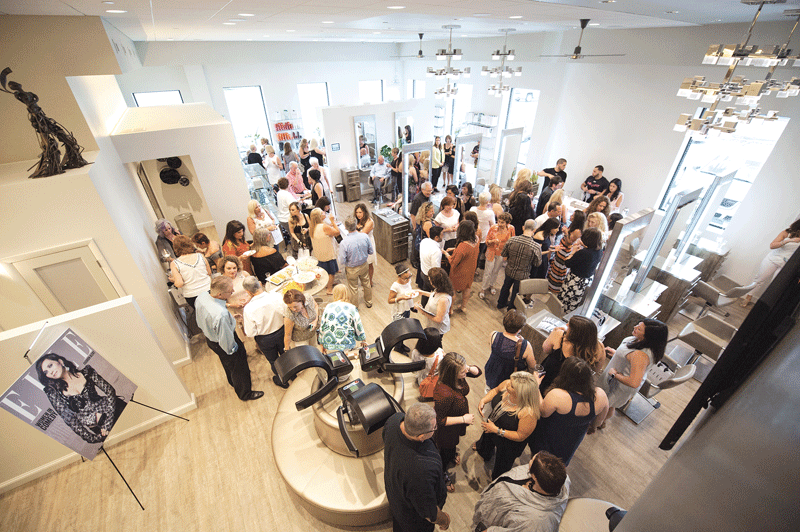
New York-based Elle Magazine sponsored an opening reception at Visual Changes Salon and Spa, a high-end, contemporary facility at 100 Shaker Road, East Longmeadow. WHERE: Visual Changes owner Mark Maruka (right) with Craig Sweitzer, owner of Craig Sweitzer & Co., the general contractor for the new facility.

(Photos by Robert Charles Photography

Daily News

GRANBY — Red Fire Farm will host its 16th annual Tomato Festival on Saturday, Aug. 27 — a celebration of the end of summer, peak harvest, and the sweetheart of the summer crops: the tomato.

This year’s celebration will include a big brass band and more music, local food and craft vendors, games, kids’ activities, wagon rides, and a tomato tasting, featuring more than 75 varieties of tomatoes. The festival runs from noon to 6 p.m. at 7 Carver St. in Granby.

Among the many types of tomatoes to taste this year will be classics like Brandywine, Cherokee Purple, and Paul Robeson, as well as more exotic offerings such as Arkansas Marvel, Gold Dust, Chocolate Stripes, Sunsets Red Horizon, and Moonglow.

The collection of cherry tomatoes is a popular stop each year as well, with great varieties such as Matt’s Wild and Red Pearl, along with the more unusual Indigo Cherry Drop, Egg Yolk, Lemon Drop, and Pink Bumble Bee.

In addition to tasting tomatoes, the farm creates a day filled with tomato-themed events geared toward families. This year there will be a Great Tomato Toss, with prizes available for those who can catch the longest throws without getting sauced. Attendees will also enjoy tomato spoon races, vegetable sculpture, vegetable stamp painting, face painting, and more.

For cooking and homesteading enthusiasts, the festival features cooking demos with “Shakshuka: An Israeli Stewed Tomato Dish” by Mary Reilly from Edible Pioneer Valley, “How to Make Fresh Ricotta” by Mary Nelen from the Valley Locavore, and more. A Wild Edibles Walk with Jean Bergstrom, an experienced outdoor guide, will be another fun, family-friendly learning opportunity, as well as a yo-yo demo from some of the best players in the Northeast with the A2Z Modern Yo-Yo Team.

Under the music tent, the Party Band, a wild many-piece brass band from Lowell, will bring booty-shaking music to this year’s Tomato Festival. Other bands performing include Violet Maeve, Larry Dulong & Random Sighting, and Will Kindler.

Local vendors will provide tasty treats to snack on throughout the day, such as Barnlight, serving rustic fare including local tacos and other treats from the grill. Tom’s Kettle Corn all natural popcorn, Beets & Barley vegetarian creations, and grilled, farm-fresh corn from Red Fire Farm are among the many other food options.

Day-of admission is $14 for adults, $7 for kids, and free for children under 8. Advance tickets at discounts are available online. Parking is free. This year’s Tomato Festival is sponsored by PV Squared.

Daily News

Link to Libraries Inc. announced the addition of new members to its executive board:

  • Gail Baquis is a graduate of the University of Maine with a degree in journalism. She has been a volunteer with Link to Libraries since its inception in 2008 and has been the project director for the LTL Read Aloud programs and the RAP – Reading Any Place for Homeless Youth program.
  • Tammy Trudeau is a graduate of University of Massachusetts. She has been involved with numerous fund raising events for Link to Libraries and other local organizations.
  • Kelly Dawson, CPA, Audit Manager for Meyers Brothers Kalicka, P. C. She received her Bachelor of Science in Biology from Massachusetts Institute of Technology. She also holds a Master of Business Administration from the University of Massachusetts. Her professional affiliations include the American Institute of Certified Public Accountants and Massachusetts Society of Certified Public Accountants.
  • Amy Scott is the founder of the marketing firm Wild Apple Design Group in Wilbraham and is best know for website design success in non-profit, education and for profit sectors. She is a BusinessWest Forty Under 40 Alum.
  • Laura McCarthy, Attorney is an associate at Bacon Wilson, P. C. where she practices bankruptcy, corporate law, commercial and residential real estate and other transactional matters. She is a graduate of Boston University School of Law.
  • Dr. Jennifer Stratton has been teaching students from the kindergarten to graduate level for more than 15 years. She is certified as a reading specialist and holds a doctoral degree from AIC in education. In addition to teaching, Jen hosts a blog (JenStratton.com) where she shares the sports stories of athletes who play adaptive sports and authors children’s books about Paralympians.
Features

A Job in Sales

Nancy Creed

Nancy Creed

As she takes the helm at the Springfield Regional Chamber of Commerce, Nancy Creed brings to the job a diverse résumé that includes work with nonprofits and in nonprofit management; in small businesses, large businesses, and her own business; and at the chamber itself. She believes these experiences have prepared her for the many challenges facing this organization — and all chambers.

Nancy Creed still remembers her first feature byline — and even the headline that went over the copy.

It was the fall of 1989. Creed was only a few months out of Syracuse University and, after briefly considering and then rejecting thoughts of trying to break into journalism in the Big Apple, had come back to her hometown of East Longmeadow to work for the Reminder as an assistant editor.

Her first feature story took her to Main Street — literally. Actually, it took her to the individual who had kept it clean — since Calvin Coolidge was in the White House — and was finally retiring.

“‘Street sweeper sees the end of the road’ — I was really proud of that headline,” Creed recalled. “He had been doing it for like 65 years or something like that; I interviewed about what he’d seen on the streets of East Longmeadow for six decades. His time had come, and I was there to write about it; that’s how I got started.”

She summoned similar wording — that ‘time has come’ part — to talk about a much different career milestone, specifically her ascendency to the role of president of the Springfield Regional Chamber of Commerce.

“I think it’s … my time,” she said with a solid dose of confidence in her voice, acknowledging that she might sound a bit cocky with that remark, but doesn’t intend to be. She implied that those words are merely what amount to the expression of an opinion — that she spent the 27 or so years since the street-sweeper profile preparing herself for such an assignment, and this one in particular. And now it’s time to put that accumulated experience to work.

“This is the logical next career step for me,” she noted. “Chamber work is in my blood.”

A quick look at her résumé would seem to bear this out. It includes work in journalism, marketing, and public relations; at small businesses, large businesses, and her own business; with nonprofits and as a nonprofit manager; and, perhaps most importantly, during two stints with the Springfield Regional Chamber, including the past three and a half years as vice president of Marketing and Communications.

Her first stint, as Communications director, came in 1999, when the name on the stationery was the Affiliated Chambers of Commerce of Greater Springfield. But so much more has changed over those years besides the name, and the sum of these transformations goes a long way toward explaining why ‘Creed’s time’ is, and will continue to be, an extremely challenging one for this chamber — and all chambers, for that matter.

The big challenge is to continue to provide value to the smaller businesses — they’re the backbone of this region’s economy.”

Indeed, the Affiliated Chambers took up considerably more real estate on the ground floor of what is now the TD Bank building back then, she acknowledged, noting that the staff was at least twice the size it is now. This contraction is a sign of the times, she said, adding that there are fewer members now, partly because there are fewer businesses that can be members due to a wave of consolidation that has enveloped banks, insurance agencies, healthcare providers, and more. But that’s only part of the story.

Another big part is the fact that chamber membership, once almost an automatic reflex action for someone new in business, is now anything but.

“Historically, joining the chamber was just the right thing to do; it’s no longer that way,” she said, adding that this is especially true with the younger generations. “So we have to figure out what people want to get out of the chamber — and provide it.”

Thus, chambers in general, and the Springfield Regional Chamber in particular, have come forth with new initiatives and programming designed to provide more of that all-important commodity — value.

As an example, Creed, who succeeds Jeff Ciuffreda at the chamber’s helm, pointed to new informational programs targeted for specific audiences (especially small businesses), such as the chamber’s Lunch ‘n’ Learn program, which has focused on topics ranging from social-media marketing to the new overtime laws.

“The big challenge is to continue to provide value to the smaller businesses — they’re the backbone of this region’s economy,” she said, referring to companies with 10 or fewer employees. “They make up 75% of our membership, so you really need to understand the issues and challenges they face and provide what they’re missing and need.”

But Creed’s time is challenging, and intriguing, for many other reasons as well, from the need to assemble almost an entirely new staff at the chamber (more on that in a bit) to the advent of what would have to be called the ‘casino era’ in Greater Springfield, to the groundswell of entrepreneurial energy sweeping the city and region.

For this issue, BusinessWest talked at length with Creed about, well, her time and the myriad components to that simple two-word phrase.

The Write Stuff

When asked what brought her to Syracuse, Creed offered a quick, one-word answer — “basketball” — before then elaborating.

“I loved college basketball, and I looked at all the big basketball schools,” she explained. “I didn’t really know what I wanted to do, so I thought, ‘if I’m not quite sure what I want to do, I might as well go to a college where I can enjoy a hobby.’”

And in the mid-’80s, if college basketball was your hobby, there was no better place than Syracuse, then one of the top teams in the soaring Big East Conference. But while attending games at the recently completed Carrier Dome, Creed was also finding a passion — for writing and marketing — and earning a degree from the prestigious S.I. Newhouse School of Public Communications.

The question, upon graduation, was what to do with it. As mentioned earlier, she considered, albeit briefly, trying to make it in the city that never sleeps.

“I thought about going to New York, but that probably meant living with eight other women in a studio apartment and earning $25 a story,” she said, adding that there were several things wrong with this picture, certainly enough to look elsewhere as she sought to follow her dream.

Eventually, home, and the Reminder, became the best option. She stayed with the publication for two years before taking the first of many career turns that would shape her diverse résumé.

She went to work for the Springfield-based law firm Robinson Donovan as assistant marketing director. There, she worked alongside one of the young associate attorneys, Russ Denver, who would later go on to direct the Springfield chamber.

MGM’s casino

Nancy Creed says helping area companies do business with MGM’s casino now taking shape in Springfield’s South End is just one of many challenges on her plate.

That connection would become a key storyline a few years later, when, after getting married, relocating to the Boston area, and serving as Communications and Public Relations coordinator for the nonprofit group Community Care Services Inc., she began searching for what would become the next line on her CV.

Denver was looking for a Communications director, and encouraged Creed to seek the job. She did, and prevailed in the search, eventually serving two years in that role before returning to big business as manager of Corporate Communications for Western Mass. Electric Co., now Eversource.

After more than four years in that role, her career took another sharp turn as she started her own business, N.F. Creed Communications, handling work for a wide range of clients, including two former employers, the chamber and Northeast Utilities, parent company to Western Mass. Electric.

But shifts in the economic winds, coinciding with the Great Recession and its aftermath, prompted many companies to bring marketing and PR work in house, Creed explained, thus prompting another career move — and a return to the chamber.

Over the past several years, she has been involved with a number of initiatives, from helping to coordinate a renaming and restructuring of the chamber to managing a host of events, including the chamber’s annual Outlook lunch, which draws nearly 1,000 people to the MassMutual Center and speakers such as Gov. Charlie Baker and former White House Chief of Staff Andrew Card.

But mostly, she’s been working with Ciuffreda and other team members to do something chambers have always had to do, but not with anything approaching the sense of urgency they face now: sell themselves.

She sees this as both her primary assignment moving forward and the professional strength she will most call upon.

“When you look at my past experience … I’ve led, I’ve been led, I have entrepreneurial spirit, I worked in small business, I worked in big business and for nonprofits, so I understand the various challenges,” she said. “I have a really broad range of experience, and I think that’s important.

“And Jeff built a really strong foundation for the organization,” she went on. “So my marketing skills are probably the most important, because now we’re going to take that, and we’re going to sell it.”

Getting Down to Business

And as she talked about this process of selling the chamber, Creed said the organization has to do what all businesses across every sector must do — provide products and services that people want to buy.

And this brings her back to some of the newer offerings introduced in recent years, and the philosophy that brought them about.

“We used to have programs that were broad-based; there was no specific target market, no niche,” she explained. “We then created events and programs and services for specific markets, specific segments of our membership, and those have really become popular.”

Perhaps the best example is the Lunch ‘n’ Learn series, which focuses primarily on sales and marketing and employment- law issues, and was blueprinted for smaller companies that don’t have large teams, or even dedicated individuals, handling HR and PR.

“We had a session on social-media marketing, and it was designed for a specific segment of our membership that maybe didn’t have a marketing department or where the administrative assistant was handling social media,” she explained. “There are many issues that small businesses are faced with that they don’t necessarily have the internal resources to deal with, so we can provide those resources.”

This will be the mindset moving forward, she went on, as the agency looks for constructive ways to answer the question, ‘why should I join the chamber?’

Even the traditional, time-honored chamber breakfast has to be educational and value-oriented, she explained, noting that members need a reason to take that hour and half out of their day and attend.

“We’ve gotten pretty good at providing what people want to see out of those breakfasts,” Creed explained. “We continue to do our salutes because they want to see the success of other businesses and learn more about them. But with speakers, we’ve learned that people want to learn something, but they also want to be entertained.”

The chamber’s success in listening to members and responding to what they’re saying is verified in attendance figures at events, she went on, adding that they’re up across the board over the past few years.

Beyond the all-important work to sell the chamber and provide more value to members, Creed faces other, even more immediate challenges.

The first will be filling the offices and cubicles in the chamber’s space within what’s still known as the Regional Economic Development Center.

She must replace herself as vice president of Marketing, but also hire a new coordinator of sales and member benefits as well.

“We’re building an almost entirely new team,” she said, adding that the chamber’s former administrative assistant has been placed in a recalibrated position focused on events and program administration.

Assembling a solid team is critical, said Creed, again equating the situation to what faces businesses on a daily basis; there must be quality products and services, as well as people to sell them, market them, and coordinate all of the above.

But there are other pressing issues as well, including the schedule for the coming year, work traditionally done over the summer, and getting out and visiting as many members as possible in the weeks and months ahead as part of that process of listening to their needs.

Then there are the ongoing issues involving MGM’s $950 million casino, now finally starting to take shape in Springfield’s South End, specifically the matter of helping area companies do business with the gaming giant.

“We’ll continue to find ways to work with MGM to benefit our members,” she explained, adding that the process of becoming a vendor is somewhat complicated, but the chamber has resources that can help those interested navigate those waters.

Moving forward, another priority is to build upon existing partnerships with a host of entities — from Associated Industries of Mass. to other area chambers, to various economic-development agencies.

That includes those involved with promoting entrepreneurship and helping startups get to the next level, she said, adding that the rising levels of entrepreneurial energy in the region present a great opportunity for chambers, and hers in particular.

“When you look at the success of a group like Valley Venture Mentors … they’re creating a pipeline of new businesses and startups,” she explained. “The next logical step for those entrepreneurs is the chambers; there’s a huge opportunity for us.”

In Her Blood

Creed told BusinessWest that she will bring to her latest career challenge what she has brought to all the others — energy, imagination, and experience gathered from the stops that came before.

That includes the time spent recently managing a nonprofit organization, in this case, Dakin Humane Society. Creed has long served on the board of that agency, and agreed to step in and serve as interim director last fall.

She described this stint as yet another learning experience, one that was rewarding and enjoyable.

“It was easy, because it’s a passion of mine,” she said of her work with animals, adding that she has many others, including college basketball (still) and writing.

And chambers of commerce. This work is in her blood, as she said. That won’t necessarily make this assignment easy, or even easier, but it will provide her an edge, as will all that accumulated experience since the street-sweeper profile.

As she noted, it’s her time.

George O’Brien can be reached at [email protected]

Cover Story Sections Travel and Tourism

Instruments of Progress

Peter Salerno

Executive Director Peter Salerno on the steps of Symphony Hall

As it enters its 73rd year, the Springfield Symphony Orchestra does so knowing that, to remain relevant, it must be creative and willing to assume risks as it strives to cultivate new audiences, especially the younger generations. Peter Salerno, who has twice served as interim director of the SSO and took the helm on a permanent basis earlier this year, says the institution is more than up for that challenge.

Peter Salerno said the phone call seemed to come out of left field … or from the 20-yard line, as the case may be.

On the other end was someone from the New England Patriots’ marketing department. She wanted to know if the Springfield Symphony Orchestra, which Salerno was serving then as interim executive director, could have 50 or 60 of its musicians at Gillette Stadium in 24 days for a performance that would celebrate the team’s fourth Super Bowl victory, earned six months earlier, and usher in the 2015 season.

It was an extraordinary request on many levels, and Salerno, who has since dropped the word ‘interim’ from his title, knew he couldn’t say ‘yes’ at that moment, as much as he wanted to, knowing what this opportunity would mean for the venerable institution in terms of invaluable and incalculable exposure. Indeed, he would have to consult with Maestro Kevin Rhodes and other members of the team to see if this was even logistically feasible, and then get approval from the SSO board, because this was a venture far outside the orchestra’s traditional mission — and comfort zone, for that matter.

He got the nod from both parties and promptly called the Patriots back, thus setting the wheels in motion for perhaps the most memorable night in the orchestra’s 73-year history.

It was certainly the biggest stage, at least in a figurative sense. Indeed, while the actual performing area was a trifle snug, more than 70,000 people at the stadium and another 35 million watching NBC’s broadcast of the Thursday-night game against the Pittsburgh Steelers saw and heard the orchestra perform “O Fortuna,” the Patriots’ so-called tunnel song, and eventually shared the stage with the rapper T-Pain.


Go HERE for a list of Tourist Attractions in Western Mass.


“It was quite an upbeat moment for us,” said Salerno, using both wordplay and understatement to get his point across. “I recognized this is an opportunity for us to perform, and be relevant, in an area that we never thought we could before.”

In many respects, that performance at Gillette almost a year ago effectively speaks to the aspirations, goals, and challenges that define the SSO moving forward. It was a dramatic attempt to move beyond what would be considered traditional (in terms of both the venue and performing with a rapper), attract new and larger audiences, and greatly improve visibility beyond the confines of Symphony Hall.

There will be a lot more of that — although certainly on a smaller scale — in the months and years to come, as a look at the 2016-17 calendar reveals.

One of things I’m teaching, but also learning at the same time, is that our orchestra must respond to different genres of music to remain in the forefront of the people’s minds.”

In addition to the classical offerings — a Tchaikovsky Gala on opening night (Sept. 24), Brahms’ “Double Concerto” on Nov. 19, and Beethoven’s “Emperor Concerto” on Jan. 21 — the SSO will share the stage with the Irish Tenors two weeks before St. Patrick’s Day, and will wrap up the season on May 13 with something called Video Games Live!

As that name suggests, this will be an immersive concert that features the musical scores from the greatest video games of all time — as those games appear on large screens around the hall, with synchronized lighting and other special effects.

Those unique events, and especially the final one, are designed to draw more diverse audiences, particularly young people, a stern challenge now facing all arts institutions.

SSO and its conductor, Kevin Rhodes

Peter Salerno says the main challenge for SSO and its conductor, Kevin Rhodes (pictured), is audience development.

To meet this challenge head-on, the SSO must do something not exactly within its character, historically, and that is to be far more willing to take risks, said Salerno, adding quickly that the board has essentially greenlighted such an approach to business, and so has long-time conductor Rhodes and the rest of the orchestra’s team.

“One of the things I’m teaching, but also learning at the same time, is that our orchestra must respond to different genres of music to remain in the forefront of the people’s minds,” he explained, adding that this is the mindset driving the SSO and forging its schedule for the coming year.

For this issue and its focus on travel and tourism, BusinessWest takes an in-depth look at how the SSO is looking to expand its playing field, in all kinds of ways, and put every definition of the term ‘score’ into play.

Developments of Note

Looking back on the 24 days after that fortuitous phone call came in from Foxborough, Salerno used all kinds of descriptive phases to characterize them — from ‘long’ to ‘exhilarating.’

“Those were 60-hour weeks,” he said, smiling as he did so because, while the work was sometimes tedious — involving everything from drafting contracts with the Patriots and NBC to insurance matters and a mountain of logistics — it was also very exciting.

This was, after all, the proverbial opportunity of a lifetime, and the SSO was going to do everything in its power to seize the moment.

“This was a surreal moment for our orchestra, and it showed the versatility of our people,” said Salerno as he showed a video of the performance, with the SSO clearly visible to fans amid fireworks and low-lying fog, adding that perhaps the biggest obstacle was creating a sheltered performing area for the orchestra, something the Patriots organization pulled together. And demand for it was warranted because it rained in the hours leading up to the performance and stopped only moments before it was set to begin.

In many respects, dealing with cloudy forecasts and unsettled skies — in a figurative sense — has been a part of doing business for the SSO in recent years. Like all arts venues, it has seen its traditional audiences age, and with that demographic shift a need has emerged to embrace change and, as mentioned earlier, risk.

The Patriots performance was, again, a significant manifestation of this trend — this was believed to be the first time a full symphony orchestra had performed at such an NFL ceremony and perhaps the first time an orchestra of this type had appeared with a rapper — but there have been others, with more planned for the year ahead.

“We’re participating in the creation of new horizons for symphonic sound,” he said, adding that orchestras across the country are facing the same challenges. “And we’re going to keep pushing, and bringing world-class talent to the Springfield arena.”

Leading the orchestra through this intriguing period is Salerno, now 75 years old, who brings a wealth of experience in business, work with nonprofit institutions, and the SSO itself, having been a trustee for many years and serving not one, but two stints as interim executive director.

Described by many as a stabilizing influence to the operation, he succeeds Audrey Szychulski, who left the SSO in the spring of 2015 after less than two years at the helm.

Salerno brings a diverse résumé to the post, including everything from stints as COO of Providence Hospital and president and CEO of Brightside to work coordinating new retail stores for Taylor Rental Corp.; from a short stint running an operation that managed college bookstores to his own business, PTS Consulting, launched nearly a decade ago.

Over the years, he’s taught several graduate-level business courses at Bay Path University and Clark University in Worcester, with a focus on business strategies for nonprofit organizations, marketing, and finance.

In his latest role with the SSO, he’ll be applying the lessons that he teaches, especially as they apply to the most pressing challenge facing the institution — audience development.

Drumming up Interest

There are many components to this assignment, he said, listing everything from imaginative artistic events to new and different types of talent that will share the stage with the SSO, to a variety of touches that will make SSO performances true happenings.

With that, he took out a copy of the schedule for the coming year and started running his finger down the listings.

His first stop was the holiday concert, set for Dec. 3, although Salerno said ‘concert’ doesn’t go far enough, so the actual wording on the schedule is Holiday Extravaganza.

It was chosen to encapsulate the theme — “It’s a Wonderful Life” — and describe the sum of the activities and events, including a Christmas tree outside Symphony Hall, a visit from Santa, perhaps a reindeer if one can be secured, and more.

“We want to make coming to the symphony not just an event, but an entire presentation,” he explained. “We don’t want it to just be sitting in the audience for two hours.”

Elaborating, he said the SSO will again coordinate visits whereby ticketholders gather at spots in area communities, are then bused downtown for dinner at various downtown restaurants, and then taken to Symphony Hall.

“We’re trying to make it convenient for people to come to us,” he explained. “And we view this as an opportunity to attract more people to Symphony Hall.”

Kevin Rhodes is seen here with rapper T-Pain

SSO conductor Kevin Rhodes is seen here with rapper T-Pain at the performance last fall at Gillette Stadium to usher in the Patriots’ new season.

His next stop, schedule-wise, was several months later, in early March, when the Irish Tenors, well-known to PBS audiences, will take the stage.

Similar to the holiday performance, this will be more than a concert, said Salerno, adding that it will be more like a celebration of Irish heritage, one featuring many moving parts.

The full itinerary is still a work in progress, he said, but in the days leading up to the performance, there will likely be an Irish-style dinner featuring luminaries and elected officials of Irish descent, and other touches, such as a possible discussion of the 1916 uprising.

“We’re trying to build the activities and the service level to a higher plane than we have in the past,” he explained, adding, again, that the goal is to move beyond the music and create experiences.

That will certainly be the goal for the season finale, Video Games Live!, which is the most dramatic example to date of the orchestra’s efforts to attract young people.

“Some of our donors have expressed interest in efforts to create continuity with younger audiences and thus lower the demographic age of our attendees,” he noted. “And we determined that one of the areas where we could start making an impact was with junior-high and high-school students.”

To that end, the SSO will contract with a California-based organization to bring the music from video games, orchestral sound, and a host of special effects together in the same venue on May 13.

“There are so many opportunities to show off our talents, and this might be a good one,” he said, adding that the show, similar to others staged in other cities in recent years, should prove to be an impactful vehicle for introducing young people to the orchestra and beginning the process of turning them into life-long audience members.

The other performances on the schedule will bring some of these elements to the table, said Salerno, adding, again, that developing new audiences and remaining relevant in the years and decades to come will require the SSO to continue to push the envelope.

“The board has allowed us to take more risk in terms of encouraging us to look at new genres and new methodologies,” he said. “I think it’s essential that we take advantage of the strengths that we have and marry them to the interests of our population, while at the same time preserving the outstanding classical performances that attract people from all over.”

Reaching a Crescendo

Returning to that now-famous phone call one more time, Salerno acknowledged that he allowed himself to think about why the Patriots were calling the SSO, and whether this was the team’s first call.

But only for a brief moment, and not in a deep manner, he told BusinessWest, noting that doing so would be counterproductive at a time when the sentiment should be, ‘why not call the SSO first?’

“One of the things I’ve learned over the years is that you don’t look a gift horse in the mouth,” he joked, before taking the discussion to a much higher plane.

“If we ask that question — ‘why us?’ — we’re probably not thinking of ourselves as being as good as we really are, so I didn’t ask that question,” he explained. “Instead, I said, ‘let’s just make this happen.’ When they called us, I just assumed they wanted us number one; I believe in this orchestra.”

These sentiments — not to mention the ‘let’s just make this happen’ remark, which refers to far more than a performance at a football game — could only be described as a winning attitude, one where the orchestra is, quite literally, taking the ball and running with it.

George O’Brien can be reached at [email protected]
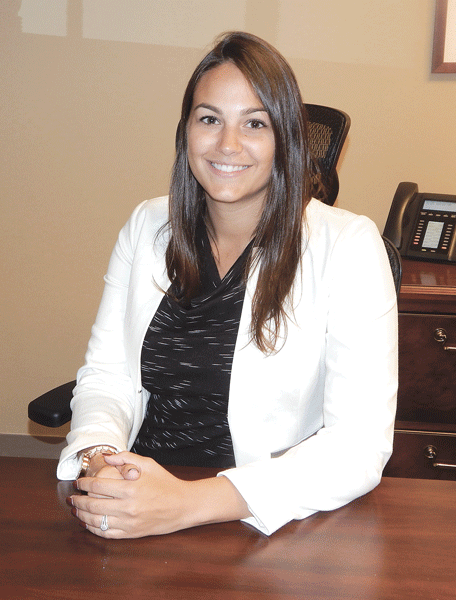
DBA Certificates Departments

The following Business Certificates and Trade Names were issued or renewed during the month of July 2016.

Agawam

Gallagher Academy of Real Estate
351 Walnut Street Ext
J. Cullen P. Gallagher

Gallagher Real Estate
350 Walnut St.
Paul Gallagher

My Sister’s Scrapbook
26 Hunter’s Greene
Susan Tapply

The Magic Blend
1325 Springfield St. #8
Adam Kaplan

Amherst

Hampshire Mindfulness
409 Main St., Suite 252
Jessica Murphy

M.G.L Industries
48 Curtis Place
Matthew G. Leclair

MOMO
23 North Pleasant St.
Jamyang Wangchuk and Rabga Ngawang

New Bridge Software Consulting
65 Stagecoach Road
Daniel Thibodeau

Pita Pockets/Fibi and Fadi LLC
103 North Pleasant St.
Nahla Ejja

Star Nails & Spa
316 College St.
Mung Thi Pham

Chicopee

D & B Auto Sales Service LLC
395 Broadway St.
Donny Aderno & Rebecca L. Aderno

Family Barbers & Beauty Supplies
212 Exchange St.
Alex A. Nieves

Healing Touch
24 White Birch Ave.
Cindy Roux

KS Services
35 Casino Ave.
Kelly A. Surprise

Temp Solutions LLC
259 Arcade St.
William Frank Renaud

Northampton

Audubon Arts
341 Audubon Road
Elizabeth E. Vizentin

Bamboo (Asian Cuisine)
311 Riverside Dr.
Manelas T. Marroquin & Javier E. Marroquin

Health Care Resources Centers
297 Pleasant St.
Community Health Care Inc

Najame & Kling Law Offices
90 Conz St., Suite 208
Mark A. NeJame & Julie G. Kling

Thrive: Growing Wellness
166 Grove St.
Jessica Gifford

Springfield

Acres Dental Care
1954 Wilbraham Road
James E. Maslowski

ATI Physical Therapy
1160 Dickinson St.
Performance

Carte 24. COM
27 Highland St.
Sa Nguyen

Cumberland Farms #0211
514 Belmont Ave.
John Daly

Deniliva Inc., D/B/A Liberty
977 Boston Road
Steven Kowalski

Deniliva Inc., D/B/A Liberty
1334 Liberty St.
Steven Kowalski

Done Rite Overhead Doors
24 Gardens Dr.
Kevin Chiasson

Educating Youth
87 Sunapee St.
Simone Phillips

Guardian Soldiers Law Enforcement
18 Champlain St.
David A. Dimiero

Lucky Traders Inc.
389 Belmont Ave.
Wahab Bari

Puerto Rico Candy Store
2756 Main St.
Ady Nelson Rosario

Rick’s Home Improvement
49 Silver St.
Jasmine Owen

Solivan Landscaping
80 Castle St.
Reinaldo Solivan Jr.

Springfield Central Downtown
1477 Main St.
Glenroy Beresford

Thomas’ Cleaning Company
450 Hancock St.
Thomas M. Peralta

West Springfield

Balise Nissan of West Springfield
500 Riverdale St.
Balise JRN, Inc

Chapin Baby
1680 Riverdale St.
Tatyana Gut

Early Bloomers Family Child Daycare
76 Blossom Road
Jocelyn Donohue

Elite Interior Designs
499 Elm St.
Aslan Viysalov

Powers & Liquori
84 Park St.
Gary B Liquori

Quick Stop Food
20 River Street
Amanullah Khan

Westfield

Community Church of Westfield
11 Washington St.
Advent Christian Church of Westfield

EZ Mart
82 Franklin St.
82 Franklin St. Inc.

For K-9s & Felines, LLC
45 Southwick Road
For K-9s & Felines, LLC

Lularoe Kimberly Curran
84 Tannery Road
Kimberly Jensen-Curran

North American Restoration
40 Franklin St. Rear
Harland C. Avezzie

Northside Creamery
519 Southampton Road
Mancino Farms Inc.

Pro-Cutters Environmental Timbering
135 Susan Dr.
Brian R. D’Agostino

Romans Mowing
152A Miller St.
Roman Mikhalinchik

Tanya Costigan Events
1029 North Road
Tanya Costigan

Chamber Corners Departments

FRANKLIN COUNTY CHAMBER OF COMMERCE

www.franklincc.org
(413) 773-5463

• Aug. 18: Google Marketing Workshop Series: “Get Found on Google Search and Maps,” 11 a.m. to 1 p.m., hosted by Franklin County Chamber of Commerce, 395 Main St., Greenfield. People are searching online for businesses like yours every day. Make sure they can find and connect with you by adding your business information to Google Search and Maps. Cost: $5, including lunch. To sign up, call the chamber at (413) 773-5463 or visit franklincc.org/whats-new-at-the-chamber.

• Aug. 25: Google Marketing Workshop Series: “Grow Your Business Online with Google Tools,” 11 a.m. to 1 p.m., hosted by Franklin County Chamber of Commerce, 395 Main St., Greenfield. Can people find your business on computers and mobile devices? Free tools show you how people search on Google and how they use your website. Google’s suite of online business-productivity tools makes collaboration a breeze. Cost: $5, including lunch. To sign up, call the chamber at (413) 773-5463 or visit franklincc.org/whats-new-at-the-chamber.

• Sept. 1: Google Marketing Workshop Series: “Advertise Online Using Google AdWords,” 11 a.m. to 1 p.m., hosted by Franklin County Chamber of Commerce, 395 Main St., Greenfield. An introduction to advertising and how it can benefit a business. Learn how Keywords work, how to find them, and how to evaluate their performance. Learn how to write great ads for your business. Cost: $5, including lunch. To sign up, call the chamber at (413) 773-5463 or visit franklincc.org/whats-new-at-the-chamber.

• Sept. 15: Google Marketing Workshop Series: “Set Goals with Google Analytics,” 11 a.m to 1 p.m., hosted by Franklin County Chamber of Commerce, 395 Main St., Greenfield. Google Analytics is a free, powerful analytics tool that provides reports showing how visitors found your website and what they did when they got there. Google Analytics measures the effectiveness of your online and offline marketing campaigns. This workshop will explain how you can use Analytics to improve your marketing. Cost: $5, including lunch. To sign up, call the chamber at (413) 773-5463 or visit franklincc.org/whats-new-at-the-chamber.

• Sept. 29: Google Marketing Workshop Series: “Create Your Free Website with Google,” 11 a.m. to 1 p.m., hosted by Franklin County Chamber of Commerce, 395 Main St., Greenfield. Learn how to create, customize and publish your site. Get a free domain name or use one you already own. Access and edit your site any time. Use your own photos and text, or the website generator can create the text for you. Free hosting and domain name for a year. Cost: $5, including lunch. To sign up, call the chamber at (413) 773-5463 or visit franklincc.org/whats-new-at-the-chamber.

GREATER CHICOPEE CHAMBER OF COMMERCE

www.chicopeechamber.org
(413) 594-2101

• Aug. 17: Summer Sizzle, 4:30-7 p.m., hosted by Elms College, 291 Springfield St., Chicopee. Sponsored by Elms College, Hampton Inn Chicopee, and United Personnel. Enjoy dinner (strawberry salad, BBQ baked beans, steakhouse potatoes, coleslaw, biscuits with honey butter, BBQ chicken breast, pulled pork, corn on the cob, cookies, assorted soft drinks), drink ticket for beer or wine, listen to music by Rum & Steel, dunk tank (proceeds to go to Voices From Inside), sangria contest, and lawn games. Cost: $35.

• Sept. 9-10: 2016 Chicopee Downtown Getdown. Food, vendors, live entertainment, and more. Free event. For details, visit chicopee.wix.com/downtowngetdown.

• Sept. 14: Business After Hours with the West of the River Chamber, 5-7 p.m., hosted by Cal’s, 1068 Riverdale St. West Springfield. Cost: $10 for members, $15 for non-members.

• Sept. 21: Salute Breakfast, 7:15-9 a.m., hosted by MassMutual Learning & Conference Center, 350 Memorial Dr., Chicopee. Cost: $23 for members, $28 for non-members.


GREATER EASTHAMPTON CHAMBER OF COMMERCE

www.easthamptonchamber.org
(413) 527-9414

• Aug. 13: Second Annual Beach Ball, 5-10 p.m., Oxbow Marina. Dance and dine under the stars with a beach party and gala. Barbecue feasting by Outlook Farm, music by DJ Jay Pacluiga, full cash bar by Meyers Catering, bonfire on the beach, and a performance by the Oxbow Waterski Show Team. Register online at business.easthamptonchamber.org/events, or call the chamber office at (413) 527-9414.


GREATER HOLYOKE CHAMBER OF COMMERCE

www.holyokechamber.com
(413) 534-3376

• Aug. 17: Chamber After Hours, 5-7 p.m., hosted by Fiesta Café, 305 Main St., Holyoke. Sponsored by Easthampton Savings Bank. Business networking event on the new patio. Enjoy great food, networking, and 50/50 raffle. Cost: $10 for members, $15 for the public. To sign up, call the chamber at (413) 534-3376 or visit holyokechamber.com.


GREATER NORTHAMPTON CHAMBER OF COMMERCE

www.explorenorthampton.com
(413) 584-1900

• Sept. 7: September Arrive @ 5, 5-7 p.m., hosted by Spoleto Restaurant. Sponsored by Webber & Grinnell Insurance, Applied Mortgage, BusinessWest, and Lia Honda. Cost: $10 for members.


WEST OF THE RIVER CHAMBER OF COMMERCE

www.ourwrc.com
(413) 426-3880

• Aug. 15: Annual Golf Tournament at the Ranch Golf Course, Southwick, 11:30 a.m. registration, 12 noon lunch, 1 p.m. shotgun start/scramble format. Cost: $125 for golf and dinner. Register online at www.westoftheriverchamber.com. For more information and tickets to this event, contact the chamber office at (413) 426-3880 or [email protected].

• Sept. 14: Multi-chamber Night of Networking, 5-7 p.m., hosted by Cal’s, 1068 Riverdale St. West Springfield. Cost: $10 for members. For more information and tickets to this event, contact the chamber office at (413) 426-3880 or [email protected].

• Sept. 22: Business Breakfast with Howie Carr, 7-9 a.m., hosted by Chez Josef, Agawam. Cost: $35 for chamber members, $40 for non-members. Register online at www.westoftheriverchamber.com.

Agenda Departments

Clowning Around for Shriners Hospital

Aug. 13: The Melha Shriners announced that supporter Wendy Hart has once again organized the third annual Clowning Around for Shriners Hospital, a family-friendly event set for 10 a.m. to 5 p.m. at VFW Post 872, 151 Point Grove Road, Southwick. Entertainment will be provided by the Shrine clowns, a traveling arcade, a photo booth, a dunk tank, and a DJ. The event will also feature a vendor fair featuring more than 40 local enterprises. “I am really excited about the opportunity to raise money for Shriners Hospital, and hope to increase the amount we raised over last year’s total,” Hart said. The event raised $2,000 for the hospital in 2015. Food and beverages will be for sale at the event. The Melha Shrine Clowns will present a skit show and spend the day mingling with children of all ages. Chris Howe, Shriner and president of the Melha Clowns, noted that “our clowns love days like this because we can help raise money for our hospital while just having lots of fun with all of the families in attendance.” Shriners Hospitals for Children – Springfield will receive 100% of the proceeds as it attempts to raise $900,000 for state-of-the-art X-ray technology (called EOS) which exposes children to a mere one-ninth of the radiation of traditional X-ray studies. For more information about the event, contact Hart at (413) 875-5743.

Oscar Hammerstein III Lecture

Aug. 17: Kimball Farms Lifecare in Lenox will host a lecture by Oscar Hammerstein III, grandson of famed lyricist Oscar Hammerstein, at 2 p.m. Those wishing to attend are asked to RSVP to (413) 637-7000 by Wednesday, Aug. 10. Hammerstein’s talk, titled “The Hammersteins: A Musical Theatre Family,” covers the century-long story of one of Broadway’s most creative and productive families beginning with Oscar Hammerstein I, described as a successful cigar and real-estate mogul who funded his theatre-building ambitions. The talk follows the family’s accomplishments through to Oscar Hammerstein II, who co-wrote the stories and words to such Broadway shows as Oklahoma!, South Pacific, Carousel, and The Sound of Music. Oscar Hammerstein III is a painter, writer, lecturer, and family historian who has devoted much of his life to studying and preserving his family’s heritage and contribution to American culture. He lectures frequently at universities, institutes, and theatrical and civic organizations on his family’s role in shaping the development of musical theatre and popular entertainment from the 1860s to the present.

Wistariahurst Summer Play Day

Aug. 20: Wistariahurst, Holyoke’s center for history, art, and culture, will host a free community event from 1 to 3 p.m., featuring lawn games, crafts, family-friendly tours, and more. Wistariahurst, the former estate of the Skinner family, includes three acres of formal gardens and grounds, a Holyoke history exhibit, an archival facility, and a preserved historic mansion. The afternoon’s activities will be inspired by the history and features of the site, including the fossilized dinosaur tracks which pave the entryway, the historically inspired rose garden, and turn-of-the-century garden parties. “As the summer season winds down, we want our gardens and grounds to be filled with families exploring and playing,” said Lisa Nicholson, program coordinator. “Dress up and have a cup of lemonade in the garden. Play a game of croquet or badminton like the Skinner family may have done.” For more information or to view a schedule of other upcoming events at Wistariahurst, visit www.wistariahurst.org.

Ice-cream Social, Open House at Linda Manor

Aug. 21: Linda Manor Assisted Living invites the community to an ice-cream social and open house from 11 a.m. to 2 p.m. Linda Manor is located at 345 Haydenville Road in Leeds. The open house will include complimentary ice-cream sundaes and tours of one of the Northampton area’s newest assisted-living communities. Linda Manor offers all-inclusive assisted living and memory care as well as the award-winning Linda Manor Extended Care Facility. For more information, or to RSVP for the event, call (413) 588-3316.

Ad Club Networking on Connecticut River

Aug. 25: The Advertising Club of Western Massachusetts invites guests to network on the Connecticut River on the famous Lady Bea, departing from event sponsor Brunelle’s Marina in South Hadley. Guests are invited to sip on a cocktail from the cash bar, enjoy light appetizers, and take in the scenery while mingling with writers, designers, printers, agency staff, photographers, web designers, marketers, and media from Western Mass. Registration begins at 5:30 p.m., and the Lady Bea will depart at 6 p.m. from Brunelle’s Marina, 1 Alvord St., South Hadley. Guests must purchase tickets in advance by Friday, Aug. 19 by calling (413) 736-2582, visiting www.adclubwm.org/events/calendar, or e-mailing [email protected]. Ticket prices are $20 for Ad Club members, $30 for non-members, and $20 for students with valid ID.

Slide the City

Aug. 27: Celebrate Holyoke welcomes the return of Slide the City to Holyoke on the Saturday of its three-day event, and will once again sell discounted tickets prior to the event. In addition, the Boys and Girls Club of Greater Holyoke is partnering with Slide the City to raise money for its organization and help secure volunteers for the day of the slide. Slide the City will return to the same location along Appleton Street. Tickets are currently available at slidethecity.com, and single tickets can be purchased for $20 on the day of the event. Those looking to purchase tickets in advance at a discounted rate can do so at Stop & Shop on Lincoln Street in Holyoke on Sat., Aug. 13, and Sun., Aug. 14, from noon to 4 p.m.; at the mayor’s office on weekdays; and at the Holyoke Farmers’ Market every Thursday from 10 a.m. to 2 p.m. Discounted tickets can also be found at celebrateholyokemass.com. For the second year, the Boys and Girls Club of Greater Holyoke will partner with Slide the City to recruit volunteers for the day of the event. For every volunteer signed up, Slide the City will make a donation to the Holyoke Boys & Girls Club. “The Holyoke Boys & Girls Club is thrilled to be partnering for the second year with Slide the City and the Celebrate Holyoke committee,” said Eileen Cavanaugh, president and CEO of the Boys and Girls Club. “Last year was a great experience, and we were so pleased with and grateful for the amount of volunteers that came out to support the club. I’m sure this year will be even better. We are looking forward to another fun event that allows our club to be part of Celebrate Holyoke.” Volunteers are still needed for various shifts throughout the day and will be helping with the following tasks: setup, registration tent (check pre-registered customers, take payment for new customers, etc.), slide monitors (check wristbands, help keep people moving along), cleanup, trash pickup, and loading trucks with gear and merchandise. Anyone who is interested in volunteering to raise money for the Boys & Girls Club of Greater Holyoke should e-mail Cavanaugh at [email protected]. Volunteers must be at least 16 years old. In exchange for their participation, volunteers will receive a Slide the City T-shirt and be provided snacks and refreshments during each shift.

Mini-Medical School

Sept. 15 to Nov. 3: Thinking of going back to school? Baystate Medical Center’s Mini-Medical School will give area residents an inside look at the expanding field of medicine — minus the tests, homework, interviews, and admission formalities. The Mini-Medical School program is an eight-week health-education series featuring a different aspect of medicine each week. Classes this fall will include sessions on various medical topics such as surgery, emergency medicine, anesthesiology, pathology, and several others. Many of the ‘students,’ who often range in age from 20 to 70, participate due to a general interest in medicine and later find that many of the things they learned over the semester are relevant to their own lives. The goal of the program — offered in the comfortable environment of the hospital’s Chestnut Conference Center, is to help members of the public make more informed decisions about their healthcare while receiving insight on what it is like to be a medical student. Baystate Medical Center is the region’s only teaching hospital, and each course is taught by medical-center faculty who explain the science of medicine without resorting to complex terms. All classes are held Thursday nights starting at 6 p.m. and run until 8 or 9 p.m., depending on the night’s topic. No basic science knowledge is needed to participate. Each participant is required to attend a minimum of six out of eight classes in order to receive a certificate of completion. The classes run from Sept. 15 through Nov. 3, and a full listing of topics and presenters can be found at www.baystatehealth.org/minimed. Tuition is $95 per person and $80 for Senior Class and Spirit of Women members. While it is not difficult to be accepted into the program, slots are limited, and early registration is recommended by calling (800) 377-4325 or visiting www.baystatehealth.org/minimed.

BerkshireSPEAKS

Sept. 18: The third annual BerkshireSPEAKS will take place at 1:30 p.m. at Hevreh of Southern Berkshire in Great Barrington. This year’s event will feature six Berkshire trailblazers and visionaries sharing their inspirational stories. BerkshireSPEAKS was established to create an opportunity for the entire community to hear from local residents who have had a significant impact on the Berkshires and beyond. “BerkshireSPEAKS continues to grow each year, with speakers whose passion reminds us that anything is possible,” said Toby Levine, event co-chair. “We have a fantastic program planned and look forward to an afternoon that brings the community together to share empowering ideas.” This year’s speakers include John Downing, CEO of Soldier On, a national organization fighting veteran homelessness; Nancy Kalodner, Berkshire Realtor, teacher, and arts supporter; Gwendolyn Hampton-VanSant, CEO and Founder of Multicultural BRIDGE; Mary Pope Osborne, award-winning author of the Magic Tree House series (130 million copies sold worldwide); John Hockenberry, author, journalist, and award-winning public radio host; and state Rep. William “Smitty” Pignatelli, who represents the 4th Berkshire District. A reception with the speakers will follow the presentations. Registration costs $15 online and $18 at the door. To register online, visit www.hevreh.org/berkshirespeaks.

Western Mass. Business Expo

Nov. 3: Comcast Business will present the sixth annual Western Mass. Business Expo at the MassMutual Center in downtown Springfield, produced by BusinessWest and the Healthcare News. The business-to-business show will feature more than 150 exhibitor booths, educational seminars, breakfast hosted by the Springfield Regional Chamber of Commerce, lunch hosted by BusinessWest, and a day-capping Expo Social. Current sponsors include Comcast Business (presenting sponsor), Express Employment Professionals, Health New England, the Isenberg School of Management at UMass Amherst, Johnson & Hill Staffing Services, MGM Springfield, and Wild Apple Design. Additional sponsorship opportunities are available. Exhibitor spaces are also available; booth prices start at $725. For more information on sponsorships or booth purchase, call (413) 781-8600, ext. 100. For more Expo details as they emerge, visit www.wmbexpo.com.

Departments Picture This

A photo essay of recent business events in Western Massachusetts August 8, 2016. Email ‘Picture This’ photos with a caption and contact information to
[email protected]

Income Statements

Junior Achievement of Western Massachusetts

Junior Achievement of Western Massachusetts (JA) and Moriarty & Primack teamed up to bring JA’s Economics for Success program to all the eighth-graders at M. Marcus Kiley Middle School in Springfield in June. “To be able to teach students how to budget their income, and what getting an education after your high-school diploma can mean for your income, is a valuable lesson for everyone,” said Dahimeli Mercado, Moriarty & Primack staff accountant. Mark Laurenzano, guidance counselor at Kiley Middle School, added that “the students are eager to learn more about JA and business. Many of our students have participated in JA job-shadow experience. They are excited to work with the JA volunteers in the classroom today and learn about creating a budget.” Pictured, from left, are Moriarty & Primack’s Christopher Walker, Rebecca Connolly, Phillip Giguere, Jessica Putnam, Dahimeli Mercado, Jonathan Normand, Isaiah Odunlami, Roger Conklin, and Puja Karki.


Breaking Barriers

Berkshire Bank representatives

Berkshire Bank representatives recently visited the Center for Human Development’s (CHD) Disability Resources program to present a donation of $2,500. The bank’s gift supports CHD’s efforts to provide barrier-free recreational and competitive adaptive sports opportunities, as well as social gatherings and educational events for youth and adults with disabilities. Pictured, from left, are Luke Kettles, senior vice president of Commercial Lending for the Pioneer Valley, Berkshire Bank; Jennifer Bogin, vice president, Developmental Services, CHD; Rachel Keyworth, director, Disability Resources, CHD; Jim Goodwin, president and CEO, CHD; and Tim Hussey, assistant vice president of Commercial Lending, Berkshire Bank.


Global Lessons

Springfield College Professor of Management and U.S. Fulbright grant recipient Robert Fiore

Springfield College Professor of Management and U.S. Fulbright grant recipient Robert Fiore recently traveled to China to collaborate with faculty and students at Hong Kong Baptist University in the academic area of entrepreneurship. Fiore assisted in the development of research and curriculum in China’s new initiative mandating the development of entrepreneurial courses to be offered at all universities. “The collaboration was exciting because it allowed us to exchange ideas on modes of entrepreneurial company formulation specifically dedicated to elevate geographically focused poverty and enhance economic growth within low-income regions by the use of micro-financing and village-based cooperative entrepreneurship,” said Fiore. As part of the program, Fiore presented biographical material of notable entrepreneurs to highlight their use in teaching and fostering entrepreneurship among students by analysis of the successful entrepreneur’s attitudes and behavior. He discussed lean entrepreneurial start-up procedures and methods as taught in the U.S., the U.S. perspective on crowd-funding financing sources, and legal issues of intellectual-property development.

Daily News

SPRINGFIELD — Skoler, Abbott & Presser, P.C. will host a series of webinar sessions to help employers navigate new U.S. Equal Employment Opportunity Commission (EEOC) filing deadline.

The EEOC is responsible for enforcing federal laws that make it illegal to discriminate against a job applicant or an employee because of the person’s race, color, religion, sex, national origin, age disability, or genetic information. Most employers with at least 15 employees are covered by EEOC laws, along with many labor unions and employment agencies.

Earlier this year, the EEOC published a Notice of Proposed Rulemaking that would require employers to report pay data and hours worked under strict guidelines. Every employer with 100 or more employees and employers who are federal contractors will be required to submit these reports. It is important that employers file reports correctly to avoid legal liability and discrimination claims from regulators and private parties.

Attorneys John Gannon and Stefanie Renaud will present an in-depth webinar on the ins and outs of EEOC filing to properly meet the Sept. 30 filing deadline. They will walk employers through evaluating filing requirements, the time periods for reporting employment data, and how to best categorize job titles and pay data to avoid EEOC scrutiny.

The webinars are slated for Thursday, Aug. 11, Tuesday, Aug. 30, Wednesday, Sept. 7, and Tuesday, Sept. 20, all from 1:30 to 3 p.m. To register an upcoming webinar, visit store.hrhero.com/events.

Gannon has defended employers against claims of discrimination, retaliation, harassment, wrongful termination, as well as actions arising under the Family Medical Leave Act and wage-and-hour law. He also has experience with lawsuits seeking to enforce restrictive covenants and protect trade secrets. He frequently assists employers in litigation-avoidance strategies. He regularly counsels employers on compliance with state and federal laws, including the Americans with Disabilities Act, Fair Labor Standards Act, and Occupational Health and Safety Act.

Renaud focuses on labor law and employment litigation. Prior to joining Skoler, Abbott & Presser, she interned with the Enforcement Division of the Massachusetts Commission Against Discrimination, where she investigated employment-discrimination claims and drafted decisions on behalf of the commission.

Daily News

WESTFIELD — The Rotary Club of Westfield announced the second annual Westfield Food Fest will take place Friday, Aug. 26 through Sunday, Aug. 28. This three-day event will feature vendors from local restaurants and food trucks, as well as entertainment from local musicians.

The Rotary Club hopes this free event will draw people to the downtown area. The event will be held on Elm Street between Franklin Street and Main Street on Aug. 26 from 5 to 9 p.m., Aug. 27 from noon to 9 p.m., and Aug. 28 from noon to 6 p.m. The festival will also be broadcast live on location on WSKB 89.5 FM.

Participating local restaurants include Pasquale’s, Two River Burritos, and Janik’s Pierogis. Food trucks will include Ed & Angies, Sun Kim Bop Korean, Silver Platter Gourmet, Bistro Bus, Moolicious Ice Cream, Angelo’s Fried Dough, and Ed’s Fries. A variety of local artists and craftspeople will be doing interactive, family-friendly demonstrations. The Rotary Club will sell beer and wine. For information on how to become a vendor, e-mail Jennifer Gruszka at [email protected].

Event sponsors include Westfield Bank, Westfield Gas & Electric, Forish Construction, Elm Electrical, Commercial Distributing, Mestek, Sarat Ford, Roger Butler Insurance Agency, Jerome’s Party Plus, and John S. Lane & Son Inc. This event would not be possible without the support of the city of Westfield, the Westfield Police Department, and all other city departments that help make events safe and enjoyable.

For more information, visit facebook.com/westfieldrotaryclub. A complete schedule and listing of vendors, participants, and musicians will be posted soon.

Daily News

BOSTON — A resurgent U.S. stock market, better-than-expected job growth, and growing labor-force participation failed to make believers of Massachusetts employers during July as business confidence fell for a second consecutive month.

The Associated Industries of Massachusetts (AIM) Business Confidence Index declined one point to 55.1 last month, leaving it more than four full points lower than in July 2015. The confidence reading remained above the 50 mark that denotes an overall positive economic outlook, but optimism dimmed across the board on employment, the Massachusetts economy, and employers’ outlook on their own companies. The index has now declined in three of the past four months.

Economists suggest that employers may be caught between the expectation of an expanding U.S. economy and concern about anemic growth and instability overseas. It’s a paradox that has resulted in the stock and bond markets, which usually move in opposite directions, rising in tandem this year.

“We see a familiar pattern in what is now the fourth-longest economic expansion since World War II — employers remain optimistic about the state of the economy, but it is an optimism marked by fits and starts and reactions to all sorts of political and economic events,” said Raymond Torto, chair of AIM’s Board of Economic Advisors (BEA) and lecturer at Harvard Graduate School of Design.

The AIM Business Confidence Index, based on a survey of Massachusetts employers, has appeared monthly since July 1991. It is calculated on a 100-point scale, with 50 as neutral; a reading above 50 is positive, while below 50 is negative. The index reached its historic high of 68.5 on two occasions in 1997-98, and its all-time low of 33.3 in February 2009. It has remained above 50 since October 2013.

Most of the sub-indices based on selected questions or categories of employer declined during July. The Massachusetts Index, assessing business conditions within the Commonwealth, dropped 1.3 points during July and 0.3 points over the year to 57.2. The U.S. Index of national business conditions, in contrast, bucked the downward trend of the past year (in which it dropped 3.0 points) by gaining 1.5 points. Even so, employers have been more optimistic about the Massachusetts economy than about the national economy for 75 consecutive months.
The Current Index, which assesses overall business conditions at the time of the survey, fell 0.2 points to 55.3, while the Future Index, measuring expectations for six months out, slid 1.8 points to 54.8.

“July marked the first time since September 2015 that employers were more positive about current conditions than those six months from now. It’s something to watch, since confidence drives employer decisions on hiring and investment moving forward,” said Elliot Winer, chief economist for Northeast Economic Analysis Group LLC. “It’s also worth noting that employer confidence in their own companies has declined by 5.8 points, albeit from a high level, during the past 12 months.”

Indeed, the three sub-indices bearing on survey respondents’ own operations all weakened. The Company Index, reflecting overall business conditions, fell 1.8 points to 55.9, while the Sales Index lost 1.4 points to 55.6, and the Employment Index dropped 2.0 points to 52.5.
The AIM survey found that nearly 39% of respondents reported adding staff during the past six months, while 19% reduced employment. Expectations for the next six months were stable, with 37% expecting to hire and only 10% downsizing.

“A tightening labor market is finally beginning to put upward pressure on wage growth as employers compete for skilled workers,” said Michael Goodman, executive director of the Public Policy Center (PPC) at UMass Dartmouth. “Wages rose 2.6% for the 12 months ended in June, the fastest annual growth rate since 2009. While this is welcome news for the state’s working families, whose wages have been stagnant for an extended period, it represents a challenge for those employers with limited pricing power who can expect it to be increasingly difficult and expensive to obtain the labor they need to support expected growth in coming months.”

Confidence levels in July were higher in Greater Boston (56.8) than in the rest of the Commonwealth (52.2). Non-manufacturing companies enjoyed a significantly brighter outlook at 58.0 than manufacturing employers, who posted an overall confidence level of 52.6.

AIM President and CEO Richard Lord, a BEA member, said employers should take encouragement from the moderate approach to business issues taken by state lawmakers during the two-year legislative session that ended Sunday night. Beacon Hill balanced a difficult budget with no tax increases, passed economic-development and energy legislation, and developed a consensus pay-equity measure that balances the needs of employers and workers.

“The Legislature and the Baker administration again showed an understanding of the factors that contribute to business growth and job creation,” Lord said. “We give particular credit to House Speaker Robert DeLeo, who forged meaningful compromises on pay equity, non-compete agreements, and other key issues.”

Daily News

HOLYOKE — On Saturday, Aug. 20 from 1 to 3 p.m., Wistariahurst, Holyoke’s center for history, art, and culture, will host a free community event featuring lawn games, crafts, family-friendly tours, and more.

Wistariahurst, the former estate of the Skinner family, includes three acres of formal gardens and grounds, a Holyoke history exhibit, an archival facility, and a preserved historic mansion. The afternoon’s activities will be inspired by the history and features of the site, including the fossilized dinosaur tracks which pave the entryway, the historically inspired rose garden, and turn-of-the-century garden parties.

“As the summer season winds down, we want our gardens and grounds to be filled with families exploring and playing,” said Lisa Nicholson, program coordinator. “Dress up and have a cup of lemonade in the garden. Play a game of croquet or badminton like the Skinner family may have done.”

For more information or to view a schedule of other upcoming events at Wistariahurst, visit www.wistariahurst.org.

Daily News

AMHERST — In celebration of the upcoming 50th anniversary of the book that launched Eric Carle’s career — Brown Bear, Brown Bear, What Do You See? by Bill Martin Jr. —the Eric Carle Museum of Picture Book Art is sending the book’s famous characters to the main streets and outdoor spaces of its hometown.

This special pop-up exhibition, “Brown Bear Everywhere,” on view from Aug. 8 through Oct. 10, will bring 14 high-quality reproductions of Carle’s original collage illustrations to some of Amherst’s popular restaurants, schools, and recreational sites. The exhibition helps kick off a year of special events to honor the children’s classic, which is one of the best-selling picture books of all time.

Framed reproductions from Brown Bear, Brown Bear, What Do You See? will be located at Amherst Commons (White Dog), Bangs Community Center (Purple Cat), Bare Mountain (Brown Bear), Black Sheep Deli (Black Sheep), Fort River Elementary School (Teacher), Hampshire College (Red Bird), High Horse Restaurant (Blue Horse), Hitchcock Center for the Environment (Green Frog), Jones Library (Final Page), Amherst College Mead Art Museum (Endpapers), the Mill District in North Amherst (Original Brown Bear, 1967 edition), Mill River Recreation Area (Goldfish), the Norwottuck Rail Trail (Children), and the UMass Amherst campus pond (Yellow Duck). Labels at each location will provide information about the works of art, the book, and Carle’s artistic process.

“We enjoyed matching each picture in the book to a specific location in Amherst,” said Ellen Keiter, the Carle’s chief curator. “Placing Eric Carle’s Black Sheep at the Black Sheep Deli was an obvious fit, as was displaying his image of a teacher at Fort River Elementary School. Perhaps my favorite is Brown Bear atop Bare Mountain, the highest elevation in Amherst. It seems appropriate that Brown Bear look out over the Valley from this majestic perch.”

Keiter also lauded the town’s enthusiasm for the project. “We’ve spent the last eight months working with the host sites, and the response has been overwhelming. Not a single business or organization turned us down. In fact, each location enthusiastically embraced the project. It’s difficult to find someone who doesn’t know and love the book.”

“Brown Bear Everywhere” kicks off a year-long, nationwide celebration, including “Brown Bear Turns 50!” opening at the Carle on Sept. 13. Support for both exhibitions has been provided by Macmillan Children’s Publishing Group.

Published in 1967, Brown Bear, Brown Bear, What Do You See? had an immediate appeal to children and adults alike. Martin’s rhythmic call-and-response text builds anticipation at each turn of the page, while Carle’s bold graphics and parade of animals encourage learning and imagination. The book has been translated into 31 languages — from Arabic to Vietnamese — and has sold more than 16 million copies. In addition to the original 1967 book, Carle re-illustrated editions in 1970, 1984, and 1992.

In support of both exhibitions, the Carle will launch a special page on its website with Brown Bear teacher activities, photographs, fun facts, and a video of Carle reading the book. An accompanying social-media campaign asks friends to tag the Carle @carlemuseum and submit selfies taken in town with their favorite character using the hashtag #brownbeareverywhere. Selfies will be entered in a weekly drawing to win a Brown Bear anniversary tote bag.

Cover Story

An Appetite for Entrepreneurship

Peter Rosskothen

Peter Rosskothen

Peter Rosskothen has compiled a quarter-century-long track record of entrepreneurial energy and daring — all of it in the broad realms of food and hospitality. He says it exists partly out of necessity in this highly competitive market, but also because he’s always looking for ways to do things differently — and better. His latest venture, which he describes as the cutting edge of food retail, is no exception.

Peter Rosskothen was at a loss for words. Well, sort of, and not for very long, actually.

He was asked to explain, if he could, the origins of, and inspiration for, his very healthy appetite for entrepreneurial ventures — all of them in the broad realms of food and hospitality, ranging from several franchises of a national chain of eateries, to a banquet facility; from coffee shops to an ambitious catering operation.

And, like many who have made the choice to work for themselves instead of someone else, he struggled with that question.

“I’m not really sure how to explain it; it’s always been there, though,” he said of his entrepreneurial drive after pausing for a few moments of reflection, adding that, in many respects, it exists out of necessity in a highly competitive and always-changing marketplace.

“I think we share this belief that you have to always do something a little different, or find a way to do something a little better, to stay in business today, and I’d like to think that this is what drives us,” he said, referring specifically to business partner Michael Corduff and other members of the team that operates his businesses.

He did much better when it came to putting into plain words why he and his partners over the years have been not only so prolific, but so successful.

“Lots of people have ideas,” he explained. “And they’ll talk about these ideas, and talk about them some more. Taking the idea and doing something about it is what makes us entrepreneurs, and that’s what happened last September, when we decided to stop talking about this and do it.”

It’s a scenario that has played itself out several times over the past quarter-century or so, as Rosskothen — by himself or with different partners — has launched Boston Chicken (later Boston Market) franchises; undertaken a massive renovation of the landmark Log Cabin restaurant in Holyoke into a banquet facility; completed several subsequent expansions of that facility, purchased the Delaney House restaurant in Holyoke and, later, the hotel erected adjacent to it; created a catering operation known as Log Rolling; and opened two coffee-and-sandwich shops called Mt. Joe to Go.

And it is playing itself out again with yet another new venture, this one called Delaney’s Market, which is set to open its doors in the Longmeadow Shops in early August. Rosskothen described this as a “retail store for food,” where patrons can grab a container of chicken marsala and accompanying veggies, a fresh loaf of bread, a bottle of wine or a few microbrews, and dessert, and take it all home to enjoy there.

Which means that, like many of the ventures Rosskothen has launched over the years, this one is somewhat unique and cutting-edge when it comes to understanding what the dining public wants and needs.

“There is nothing else like this in our market — nothing,” he explained, adding that various types of operations offer some of the above, to one extent or another, but certainly not all of the above.

BusinessWest as the magazine’s Top Entrepreneurs

Peter Rosskothen and former business partner Larry Perreault were honored by BusinessWest as the magazine’s Top Entrepreneurs for 1997 for their efforts at the Log Cabin.

He said the concept was born from acknowledgment that today’s consumers — and especially the younger generations — want, by and large, food that is fresh, local, healthy, and of high quality. Meanwhile, they also want convenience and help with cramming all that life throws at them into the 24 hours in a day.

Various business operations address some or many of those needs in various ways, said Rosskothen, noting that supermarkets now offer many prepared foods, some ventures will deliver meals to your door (while others will drop off the ingredients and let you cook them), and restaurants, most of which offer takeout, have put a heavy focus on local and healthy.

But extensive research — another common denominator with all of his previous ventures — told Rosskothen there was a desire for, and room for, another — and, in many ways, better — alternative.

“This concept allows people to take it easy and spend more time with their family,” he explained, adding that it represents the best of many worlds — convenience, affordability, variety, and quality.

For this issue, BusinessWest talked with Rosskothen about his latest venture, but also about entrepreneurship in general and his desire to remain on the cutting edge of innovation within the world of hospitality.

Another Bite at the Apple

As he talked with BusinessWest at a small table outside the Starbucks just a few doors down from his new storefront, Rosskothen gestured with his hand toward the scene in front and on both sides of him.

“This if the perfect location for this — if we don’t make it here, we’re not going to make it anywhere,” he said. He was referring, in large part, to the packed parking lot at the Longmeadow Shops, a heavily trafficked lifestyle center (now being expanded) featuring an eclectic mix of high-end tenants including Ann Taylor and Chico’s, but also several popular anchors such as a CVS and a few bank branches. But he was also referencing the facility’s spot on the map, in Longmeadow, but only a half-mile or so from East Longmeadow and the Connecticut border and the affluent communities there.

Rosskothen said his research told him that, while there are many attractive geographic options for launching this kind of venture — the Amherst-Northampton area, Westfield, and East Longmeadow itself were also considered — his instincts told him that this was the place to start.

And his instincts have rarely, if ever, been wrong.

They weren’t when he opened a few Boston Chicken franchises in the region in the early ’90s, deciding that area residents had, or would develop, an appetite for the emerging product known as ‘fast casual.’

They were on target again when, in 1996, he and partner Larry Perreault decided to resurrect the Log Cabin as a banquet facility, guessing that, despite a market flooded with competitors, there was room for, well, a room with a view. And they were right; ‘the Cabin,’ as it’s known colloquially, at least in some circles, remains one of the region’s most popular venues for events, because of those views, as well as a location roughly halfway between Springfield and Northampton.

Those instincts were on the money — in all kinds of ways — with subsequent ventures such as the Delaney House restaurant and its more casual, on-site counterpart, the Mick; the D. Hotel on the Delaney House property; Mt. Joe; and Log Rolling.

That last venture is the catering arm that brings ‘rolling kitchens,’ as Rosskothen calls them (hence the name), to venues across Western Mass. and Northern Conn. The venture has done well during the 17-day Big E, for example, as groups look to stage their own functions in a large tent on the grounds, and he’s anticipating big things this fall as the institution celebrates its 100th birthday.

“Log Rolling has become a nice business division for us — it’s for people who are looking for our services, but at a unique site,” he said, adding that these have ranged from Wickham Park in Manchester, Conn. (which also has a log cabin) to Black Birch Vineyard in Southampton, and a wide array of spots in between and beyond.

Mt. Joe to Go

Mt. Joe to Go, with locations at the Log Cabin and downtown Holyoke, is one of a series of entrepreneurial endeavors launched by Peter Rosskothen and various partners.

And Rosskothen believes his instincts (and those of his team) are again sound with a venture that in some ways encapsulates all the ventures that came before it, to one degree or another. In a nutshell, it brings food to customers in a convenient manner and creates another, and potentially solid, revenue stream.

“This is really exciting because it’s a way to utilize a lot of our brainpower and ability and apply it to a new business,” he explained. “And it’s not conflicting with what we do on weekends.”

That last remark was a reference mostly to the events, and especially weddings, at the Log Cabin and also the Delaney House. Not all events come on weekends, but most of them do, he explained, adding quickly that while this business is quite solid, there is a time of the year — January through March — that is sometimes problematically slow.

Some of the other recent entrepreneurial undertakings have been launched in an effort to overcome those slow months — Log Rolling was also created to counter a marked slowdown that followed the onset of the Greater Recession in 2008 — and Delaney’s Market is no exception.

Full Menu of Options

As he offered BusinessWest a quick tour of the storefront in progress, Rosskothen explained the concept in more detail.

He started by pointing to a long row of coolers along one wall, and then grabbing a sturdy, microwavable plastic container, one of several sizes that would be available. The former would be filled with the latter, he said, adding that food prepared at the Log Cabin would be trucked to the Longmeadow Shops in refrigerated trucks daily.

To fully explain the concept, though, he referred back to still another of his team’s entrepreneurial undertakings — the Mt. Joe facilities, located in the lower parking lot of the Log Cabin and at the transit facility in downtown Holyoke.

It specializes in coffee — hence the name — but also sells meals to go, enough of them to prompt thoughts, talk, and then action to take that business to a different, much higher level.

“We’ve always had this dream about what we could do with meals to go,” he told BusinessWest. “For a while, we studied the home-delivery-of-meals (or ingredients) concept, but the problem with them is you have to be disciplined — the food shows up, and you have to cook it, or you waste it. And it’s not cheap.

“It’s a good concept, but I really like what we’re doing here,” he went on. “I’m on my way home … I don’t really know what I want for dinner … I do know that I really don’t want to prep my meal … I stop in Delaney’s Market, I walk around, see what I feel like, pick it up, grab a bottle of wine or a beer, and take it home.”

TV celebrity Ed McMahon

Peter Rosskothen, then operator of Boston Chicken franchises, is seen with TV celebrity Ed McMahon at a promotion at one of the stores.

Rosskothen and his team are betting that this thought process is common enough to create enormous business potential, and he believes it’s a pretty safe bet.

As for what will be in those plastic containers on the store shelves, Rosskothen said there would be a host of entrees, but also salads, desserts, breads, and beverage options made possible by a surprisingly available liquor license.

The menu is still somewhat of a work in progress, he went on, and would always be something flexible and a reflection of what customers wanted. But when pressed for examples of what patrons might expect, he listed items like chicken francaise, beef bourguignon, salmon salad, and stuffed mushroom caps. This will be a restaurant, but in a retail format.

In keeping with current dietary trends and a broader focus on health, each container will let the customer know how many calories they’ll consume per serving, said Rosskothen, adding that there will be low-calorie, vegetarian, and gluten-free offerings, among other things.

“Everyone I’ve talked to about this — and that’s a lot of people — says, ‘I hope you’re going to have healthy items; I’m trying to lose some weight,’ or ‘I’m trying to be good,’” he noted. “I tell them, ‘absolutely — that’s a big part of our thinking.’

“We have a good idea of what we want to bring here, but we’ll adapt to what our guests want,” he explained. “The best way to explain it is that we’ll have the variety of a restaurant, but with a focus that will make us a regular stop for people.”

Salad Days

As he talked about the timing of his latest venture, Rosskothen believes it’s ideal given the way societal trends are changing and the retail sector is trending.

As for the Aug. 3 scheduled soft opening, he said this date is ideal as well. Not because business will be brisk, but because it will likely be rather slow — although there’s a good deal of buzz about this operation — given the large number of families that will be on vacation.

“We’re opening in August on purpose — I like to start in a slow month,” he said, adding that this strategic decision was made with an eye toward getting whatever kinks there might be out, a staff up to speed, and perhaps an even better feeling for what the buying public wants — and doesn’t want.

This thinking is not exactly straight out of most business-success textbooks, but it’s yet another example of how Rosskothen and his team are thinking outside the box, or food container, as the case may be, and expressing their appetite for entrepreneurship in a way that is both scientific and, as history shows, successful.

George O’Brien can be reached at [email protected]

Community Spotlight Features

Community Spotlight

John Flynn

John Flynn says Hampden’s new, $3 million police station will be finished next month.

John Flynn is extremely proud of Hampden — so proud he can’t help talking at length about the close-knit atmosphere he claims pervades every section of town.

“The word that best describes Hampden is ‘community’; it’s a place where people care about their neighbors,” said the chair of the Board of Selectmen. “I talk to people all the time who tell me they were surprised to find their neighbors went out of their way to meet them and bring them food when they moved to our town. It still happens here because we are all about community.”

Flynn added that the selectmen feel the same way about Hampden. “We can’t solve everyone’s problems, but each person is treated with respect,” he told BusinessWest.

Doug Boyd agrees. “Hampden is a great community with a lot of small businesses and self-employed people. The governance is very responsive to issues, and since everyone knows everyone else, communication is very easy,” said the co-chair of the Advisory Committee and member of the Community Preservation Committee.

“It’s what makes Hampden different from other cities and towns,” he continued, explaining that, although there has been a fair amount of development and a significant increase in the number of new homes in Hampden over the past 40 years, the town’s population has increased only slightly, and everyone has an equal voice in determining how tax dollars are spent.

But change has occurred, and the biggest project has been the $45 million conversion of the former Hampden Country Club into what the owners call a ‘lifestyle club’ called GreatHorse that features not only a championship golf course, but a plethora of offerings designed to appeal to families.

“The club was built in the early ’70s and has had four owners,” Flynn noted, explaining that it went up for auction in 2011 and was purchased for $1.4 million by the Antonacci family, which owns USA Hauling and a number of other business ventures.

Their original plan was simply to make improvements to the golf-course bunkers, but one improvement led to another, and it soon morphed into a major undertaking.

Today, the only thing that remains of the former course is the routing of its holes: everything else is new, including the irrigation system, tee boxes, fairways, greens, bunkers, and cart paths.

The old clubhouse was knocked down in 2013, and a new, state-of-the-art, 25,000-square-foot facility took its place. Amenities include two semi-surround simulators for indoor teaching, a fitness center, a salon, massage rooms, a barber’s chair, and an 185-seat dining area that has individual wine lockers and an adjacent horseshoe bar with seven TVs.

There is also an outdoor patio that boasts five TVs and a large, circular firepit; and family fun can be found in the 75- by 30-foot outdoor swimming pool, sprinkler play area, and bocce courts.

“The property was closed for almost three years while it was being rehabilitated, but today it is truly a showpiece,” Flynn said.

Boyd agreed and said the transformation represents a significant investment, one that benefits the entire community.

Public Projects

Residents recently voted to build the town’s third solar farm on two parcels of land that contain a capped landfill. Two other solar-photovoltaic, electricity-generating facilities were built on private property in recent years, and Hampden is waiting for permitting from the state for its newest farm, which will be built and operated by Amaresco Inc.

“It represents a substantial investment that will increase tax revenue without a corresponding increase in services,” Boyd noted, adding that, because Hampden has a unified tax rate, residents and businesses benefit equally when new sources of revenue are developed.

Flynn said the solar farm could generate $200 to $300 a year in taxes, and although that amount of money might seem negligible to some cities and towns, the majority of Hampden’s budget is paid for by property taxes, and small amounts add up, so officials are always looking for new ways to generate income.

“Money from the solar farm could be put toward a new dumptruck or another capital expenditure,” Flynn noted.

National Grid also made an $11 million investment in Hampden last year when it built a new substation that connects 6,500 customers in East Longmeadow, Wilbraham, Hampden, Monson, and Palmer to the larger Massachusetts power grid. The company says the new infrastructure increases its ability to supply backup power to the area, and not only will decrease the number of electric outages but will also improve restoration times when they occur.

“Hampden is where National Grid’s main trunk is located,” Flynn noted. “The new substation will generate $250,000 in tax revenue, and the company told us they plan to add to it every year.”

Hampden is also building a new, $3 million police station on Allen Street. The 5,000-square-foot building will be paid for with a 20-year bond, and is expected to be completed next month. It will replace the current, 900-square-foot station in Town Hall which is sorely inadequate and doesn’t allow for any privacy because other town offices share the same hallway.

Flynn said town officials explored the possibility of building a new station for more than a decade before voters finally cast ballots in favor of the project, but every effort was made to explore costs and viability before the concept was presented to residents at a town meeting.

“We assembled a building committee that went over every detail very carefully. The committee was made up of residents as it’s their money,” Flynn said, referring again to Hampden’s close-knit community and the way information is shared and decisions are made.

Continued Progress

Flynn said the town’s current focus is a half-mile strip on Main Street that needs revitalization. Opportunities for businesses exist there: Hampden Hardware is for sale, and a nearby Cumberland Farms property has been vacant for at least 15 years.

“Both properties overlook the Scantic River,” Flynn said, explaining that the Board of Selectmen recently sought help from state Sen. Eric Lesser to apply for a business-development grant to help bring new life to the area.

“But we take a team approach to everything we do; we hold frequent public meetings, and if we all don’t agree, a project doesn’t happen,” he noted.

In addition, the Community Preservation Committee has consistently spent money to acquire and preserve land, which is something town residents support.

The majority of properties Hampden has acquired were brought to the town’s attention by the Minnechaug Land Trust, a non-profit agency run entirely by volunteers who administer and maintain Minnechaug Mountain and Goat Rock Trail in Hampden, as well as two properties in Wilbraham.

Flynn told BusinessWest that the group coordinates with the state to put together packages that allow the town to acquire land for preservation and conservation.

“Although we don’t gain any tax revenue from these properties, they help to maintain the intangible character of the town,” he said.

Boyd noted that Memorial Park sits directly across from the vacant Cumberland Farms property, and the Parks and Recreation Department has spruced up the playing fields, built a new pavilion, replaced an old playscape, and built a thriving summer program around the spray park on the property.

“Usage is up, and a group of people would like to see the town improve that area of Main Street to keep the good things going that are happening at the park,” he said, adding that, thanks to the Minnechaug Land Trust, the town acquired two parcels of land adjacent to the park, and resident Charles Thompson has volunteered his time to blaze new trails, improve rudimentary ones that existed, and maintain them on a continuing basis.

Laughing Brook is also in conversation with the town to launch a capital campaign to build a new pavilion, and Flynn said the nature preserve continually expands its menu of programs and events.

Hampden is also making a significant investment in its infrastructure. Three years ago residents voted to spend $2 million over a five-year period to rebuild their roads; and Hampden and East Longmeadow recently joined together to submit a grant application to the state through the Pioneer Valley Planning Commission.

Any money gained will be divided between the towns, but Flynn said Hampden could use its share to install sidewalks, because there is only one existing sidewalk in the town.

Another development kicked off in 2014 when Bethlehem Baptist Church on 216 Allen St. acquired a parcel of land directly across from it. It built a new, $6 million, 35,000-square-foot church on the site that opened last fall; it seats 625 people and houses a café, activity center, children’s wing, adult-education wing, and section dedicated to middle- and high-school age youth.

Life Church purchased Bethlehem’s former building, and although it won’t bring in any new tax revenue, said Boyd, “it’s a productive use of the property.”

The key to Hampden is balanced growth, which officials and residents strive to achieve while maintaining the character of the town and strong sense of community that has been its trademark for generations.

“Our town is well-governed, efficient, and responsive, and if someone has a problem, it’s not difficult to find the right person to address it. And many, many residents, including myself, volunteer to help,” Boyd said. “It’s not always easy in today’s busy world to make the effort, but we have a lot of people willing to do it.”

Hampden at a glance

Year Incorporated: 1878
Population: 5,139 (2010)
Area: 19.7 square miles
County: Hampden
Residential Tax Rate: $19.36
Commercial Tax Rate: $19.36
Median Household Income: $80,751 (2013)
Family Household Income: $90,688 (2013)
Type of government: Board of Selectmen
Largest Employers: Hampden-Wilbraham Regional School District, Rediker Software Inc., Hampden Police Department
Latest information available

Education Sections

Study in Strategic Thinking

Ramon Torrecilha

Ramon Torrecilha

Ramon Torrecilha took the helm at Westfield State University in late January. Well before he arrived, he understood that the school and its many constituencies were poised to move forward and get to the next level. Since arriving, he’s only become more convinced that the institution is ready to make a positive leap. The challenge ahead is taking the ambitious goals that the school has put down on paper and making them reality.

Ramon Torrecilha recalls that, maybe 15 months or so ago, he was a candidate for a number of advertised college presidents’ positions in several states.

But upon visiting the Westfield State University campus and talking with members of several constituencies there, he decided to drop out of several of those other searches, including the one taking place at another school in the Bay State. When asked why, he started with a quick answer that required a lengthy explanation.

“It was that kind of institution,” he told BusinessWest, using that phrase to describe what he encountered as a student at Portland (Oregon) State University in the early ’80s. Like other schools at the time, it was suffering budget difficulties and undergoing staff reductions. The faculty that remained were dedicated and singularly focused on student success, he recalled.

“The relationship I was able to develop with faculty allowed me to have a transformative experience at Portland State,” he recalled. “And when I looked around here, I felt that Westfield State was very similar in that regard. You get a strong sense of community here.

“We’re student-centered; our faculty members are committed teachers, stellar researchers, and faculty that cares about student engagement,” he went on, clearly proud to shift the tense of his remarks to the present, and thus use terms like ‘we’ and ‘our.’ “So there was an alignment between myself and the kind of institution I was looking for, and Westfield State University.”

Beyond these characteristics, though, Torrecilha, who knew very little about the school before his first visit and was diligent in his “discovery process,” noted that there was something else about the institution that became apparent — and appealing — to him.


 Go HERE for a list of Colleges in Western Mass.


“The sense I got was that the institution was really ready to move forward — it was ready for the next stage,” he said, using a phrase with many applications.

For starters, it meant moving on from the controversy, and statewide negative press, that accompanied the ouster of his predecessor, Evan Dobelle, amid reports of extravagant and reckless spending practices — although Torrecilha believes the school has, by and large, already done that.

“There was an interim president in place [Elizabeth Preston] for two full years, and she did a tremendous job of stabilizing the institution,” he explained. “Westfield State is a very resilient institution; it has what we call good institutional bones. It showed to the higher-education community that it was much, much stronger than a hiccup in leadership.”

But that next stage also refers to a host of other initiatives at this school of roughly 6,000 students, from expanding programs, especially in healthcare, to broadening graduate programs and generating more momentum in regional and statewide efforts to get more people into college and then successfully on to completion of a degree program.

the state university

Ramon Torrecilha says he wants to make Westfield and the state university within it true destinations.

A sociologist by trade, Torrecilha will bring to his new position a deep understanding of multiculturalism and the issues confronting different demographic groups, but also his own opinions on how college presidents should approach their work, one forged through roughly a quarter-century in academia.

“When you think about it, presidents don’t run anything — presidents provide a sense of direction, identify priorities for the institution, and provide a vision and a map for how we’re going to get there,” he explained. “But it’s really the faculty and staff that run the place, so understanding how to do this and understanding the organizational psychology of the institution becomes really important in the presidency.”

For this issue and its focus on education, BusinessWest talked at length with Torrecilha about his decision to take his career 3,000 miles to the north and east, and how he intends to lead efforts to draft that road map for taking this 178-year-old institution to the proverbial next stage.

Course of Action

Visitors to the president’s office at WSU — and a host of other spots on campus, for that matter — can pick up some intriguing reading material if they are so inclined.

Indeed, in an effort to fully communicate what he has seen, heard, and learned since arriving on campus in January — and also to set a tone for what he wants to happen next — Torrecilha has printed a compendium that details it all.

It’s called the “President’s First 100 Days Report,” with the working subtitle “Vision for a Model, Comprehensive Public Institution.” And it includes everything from a detailed accounting of the new president’s meetings since he took the helm — 102 with direct reports, 84 with campus constituents, 11 with the Westfield State Foundation, and five at alumni events, for example — to the results of an extensive survey of students, faculty, and staff.

Torrecilha said the purpose of the report was to put down in black and white (and a host of colors as well) the sentiments he expressed about where the school is and where he and those various constituents want it to go, and also state the basic tenets of a new strategic plan for the school.

That plan will have a number of key bullet points, including stated goals common to all of the Commonwealth’s public schools — increasing retention, improving graduation rates, and decreasing the so-called ‘achievement gap’ among state residents of different demographic groups. But there will be some more specific planks as well.

Ramon Torrecilha

Ramon Torrecilha has been meeting with a host of constituencies since his arrival in January.

These include a broad push to strategically grow graduate programs, which will in turn provide financial and other sources of support for undergraduate programs; better engage alumni, many of whom go on to live and work in the Bay State upon graduation; and strengthening ties to the community, meaning both the host city and the region as a whole.

“Achieving student success does not come from just one mind,” Torrecilha writes in the report. “Currently, we possess the brushstrokes of a vision. But decisions about how we are going to achieve our goals is ongoing. The process is fluid and organic, and relies on collaboration from students, faculty, staff, and other partners.”

Roughly translating this passage, Torrecilha acknowledged that it’s one thing to put goals, aspirations, and visions down on paper. Making them reality is quite another.

“The next fiscal year will bring the hard work of taking ideas on paper and making them happen,” he explained, adding that the overarching goal, or assignment, is to make Westfield and the university there a true destination.

He believes the university’s ready — and he’s ready — to do just that.

And he’ll bring to the task a broad résumé of experience, one that includes everything from experience in the classroom to a host of administrative positions.

Our story starts at Portland State, where Torrecilha majored in sociology and became inspired by a faculty member to get the graduate degrees needed to teach that subject, which he did, with first a master’s at Portland State and then at the University of Wisconsin at Madison, which had one of the nation’s top programs in that field.

Achieving student success does not come from just one mind. Currently, we possess the brushstrokes of a vision. But decisions about how we are going to achieve our goals is ongoing. The process is fluid and organic, and relies on collaboration from students, faculty, staff, and other partners.”

His specific fields of study were demography, poverty, and socioeconomic developments, and this would shape his teaching, starting at Berkeley College in New York, where he taught, among other things, a course titled “Minority Groups.”

In the course of doing so, he essentially refocused it — on sociological concepts, rather than specific demographic groups. He eventually wrote a paper with a graduate student on how to redesign such courses nationally, and it caught the attention of the American Sociological Assoc.

“The next thing I knew, they called me and said, ‘come to Washington and help us think about how to fuse multiculturalism into the curriculum,” he told BusinessWest, adding that this began a stint as director of something called the Minority Fellowship Program and Minority Opportunities Through School Transformation.

From there, he went to the Social Science Research Council in New York, working specifically as director of the Public Policy Research Program on Contemporary Hispanic Issues, before shifting back to higher education and a stint first as director of Multicultural Programs at Mills College and then executive vice president of the Oakland, Calif. School.

He then served as provost and executive vice president at Berkeley College, before returning to Mills College and service in a variety of roles, including interim president. His most recent stop was as provost at California State University, Dominguez Hills.

By 1993, he said, he had made becoming a college president his stated goal, and he spent his career preparing himself for that eventuality.

“In academia, you have to sort of expose yourself to different things and have jobs in the many divisions that form a university,” he explained, “in order for you to harness the know-how and understanding of the different parts of the institution, and the sector.”

Which brings us back to last spring, and his decision to pull out of several presidential searches and focus on WSU.

Degrees of Momentum

Torrecilha said this choice came down to a word many use upon making a career decision of this kind: fit.

“In higher education, the question of fit, both from the standpoint of the candidate and the standpoint of the institution, becomes an important consideration,” he explained, adding that, in all matters that mattered to him, the fit was ideal.

He was looking for a school with a student-centered focus, and the school was looking for someone willing to make a substantial commitment to the school and the host city — and spent a year considering more than 400 candidates to find such an individual.

By commitment, Torrecilha said a stay that would be at least seven or eight years, out of necessity. “It takes that long for someone to really put some strategic initiatives down and then make them happen.”

As he talked about how he intends to go about meeting the goals set down in his first major communiqué to the WSU campus, Torrecilha said he will bring to the task an attitude, or mindset, far different than that of his controversial predecessor.

Summing it up, he said it comes down to putting the school, and especially its students, first — always. This sounds simple and quite obvious, he said, but some college and university presidents tend to forget this basic premise and make it about them.

“I want to serve as the president, but not be the presidency,” he said, choosing those words carefully. “It’s not about me, and as a sociologist I understand the differentiation.

“You bring to the job qualities that allow you to create that road map and enable you to work with members of the community,” he went on. “But you have to be able to put yourself on the side and think institutionally: ‘what’s the best thing for the institution?’ You have to remove personalities from that process.”

This is the approach Torrecilha says he will take to the various initiatives outlined in his “First 100 Days” report. These include efforts to expand and enhance graduate programs, thus making the school more of that destination he described, and for more types of students.

Ramon Torrecilha with the WSU soccer team

Ramon Torrecilha with the WSU soccer team

This strategic step will also help not only with broadening the school’s reputation — it has been known throughout its history as a teachers’ college, and more recently for criminal justice — but also in withstanding certain demographic shifts (something Torrecilha obviously understands) and especially smaller high-school graduating classes for the foreseeable future.

“Birth rates are declining, and the numbers of traditional college students are going down, and for this reason, most of our growth is going to come at the graduate level,” he said, citing, as one example, a new physician assistant master’s-degree program, the first of its kind for a public school in the state.

But those smaller high-school graduation classes means WSU, like all the other public schools in the Bay State, will have to become more diligent about helping students — traditional and non-traditional alike — enter college and then leave it with a degree.

This challenge explains many of the affiliation agreements between WSU and the area’s community colleges — programs that facilitate moving on to the four-year institution — and also why Torrecilha is a strong supporter of the state’s Commonwealth Commitment program, which incentivizes individuals (through rebates on tuition and fees) to enter a community college, graduate in two and a half years or less, move on to one of the state universities or UMass campuses, and wrap up a baccalaureate degree in no more than four and a half years.

When asked about the challenges WSU would face if a large number of students took the state up on its offer, Torrecilha replied simply, “that would be a really good problem to have.”

Applying Lessons

He was speaking about the state, the business community, and area cities and towns that would benefit from having a better-trained workforce. But he was also speaking about the state’s public schools and especially WSU, which embraces its role in training individuals for a global, technology-driven economy.

This is part of that ‘moving forward’ and ‘moving to the next stage’ vibe, for lack of a better word, that Torrecilha experienced when he first visited the campus on Western Avenue.

That vibe was a big factor in prompting him to take his name out of consideration for other presidents’ jobs and focus his sights on WSU. And it’s one he believes will take the school to the various destinations on the road map he’s helping to create.

George O’Brien can be reached at [email protected]
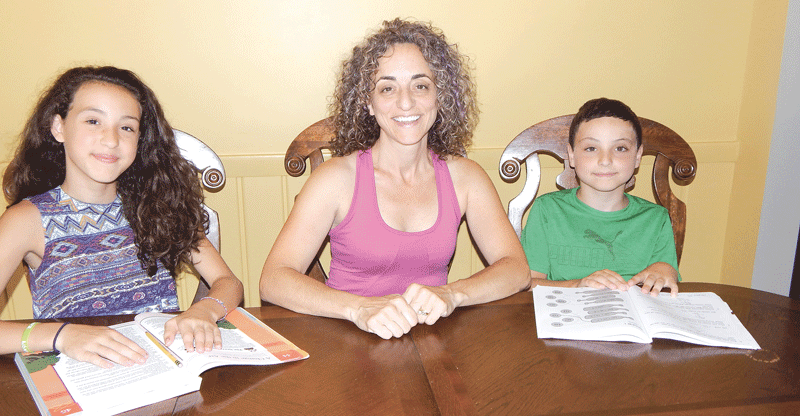
Sections Sports & Leisure

Strike Force

Jeff Bennett, general manager of AMF Chicopee Lanes

Jeff Bennett, general manager of AMF Chicopee Lanes, says there has been a seismic shift in the bowling industry in recent years.

Those who haven’t been in a bowling alley in decades probably wouldn’t recognize today’s centers. There are strobe lights and black lights, disc jockeys, and fine food. These are just some of the adjustments center owners have made to bring people to their doors and, more importantly, bring them back.

It is late Friday night at Shaker Bowl in East Longmeadow — or ‘Galactic Bowl’ time, as it has come to be called.

The lanes are lined with tiny rope lights, and bouncing colored-light orbs dance on the walls and floor as a disc jockey plays tunes and bowlers enjoy drinks from the bar or food from the recently expanded menu. There are also prizes awarded each night in the form of discount coupons for return visits.

“The people who are here come to hear the music and have a good time. It’s a different atmosphere – more of a nightclub feel,” said Justin Godfrey, general manager of the operation.

This scene, and Godfrey’s words, speak to just how much the business of bowling — not the game, really — has changed over the decades and especially the past several years.

Indeed, where once people came to bowl, and the only thing those who owned such establishments had to do to bring in business was unlock the front door, now there’s … Galactic Bowl and a whole host of initiatives like it. And they are the new reality.

Today, there are fewer bowling lanes in operation than even a decade ago, and those still in business would be somewhat unrecognizable to those who grew up on the game in the ’50s, ’60s, and ’70s. Now, the lanes have black lights and strobe lights. There are music videos or disc jockeys on weekend nights to appeal to young people looking for a place to socialize with their friends. Arcade games have become a staple, and food and beverage sales figure prominently as a source of income.

Bowling, it seems, is not the thing people come to do — it’s something else they come to do.

“There has been a huge shift in the bowling business,” said Jeff Bennett, general manager at AMF Chicopee Lanes, who has been involved with the industry since the ’80s.

He noted that AMF bowling centers represent the largest operation of its type in the world, and today, some are set up more like lounges and don’t cater to leagues, which were once the backbone of the business. “They’re designed for folks who want to make food and drink as much a part of their experience as bowling.

“Centers used to have double shifts on weeknights for league play; one would start at 6 p.m., and another would begin when the first league finished at 8:30,” he went on. “Years ago, many people bowled three to four times a week; they belonged to a men’s or ladies’ league as well as a couple’s league, and food and drink only accounted for 10 to 15% of a center’s revenue.”

Jon Roberts, left, and Jim Feeley

Jon Roberts, left, and Jim Feeley are committed to making needed adjustments at Agawam Bowl, one of the few remaining candlepin facilities.

Jim Feeley, who grew up bowling and watched it every Saturday on TV, made similar observations. “When I was a youngster and young adult, I was glued to the TV set when candlepin bowling was on,” said the manager of Agawam Bowl, a candlepin operation.

He bowled on a sanctioned team at Springfield Technical High School, and today he enjoys the sport with his son. But Feeley and others who have spent years in the business say people today are too busy to make long-term commitments to league bowling, and there are so many sports and activities for young and old alike that can be done year-round, that bowling no longer takes the lead when it comes to recreational pursuits.

“Owners have had to make big investments to improve conditions and the attractions they offer at bowling centers to stay in business,” Feeley said. “It’s not easy to do well today.”

But some operations are. These are the ones who have made the necessary adjustments — and the requisite investments.

For this issue and its focus on sports and leisure, BusinessWest looks at how the game — and the business — have changed, and the types of programs bowling centers have developed to attract patrons.

No Time to Spare

Erik Semb remembers when people used to line up at the door of French King Bowling Center in Erving, just east of Greenfield, in hopes of joining a bowling league.

Some of its busiest years were from 1987 to 1991, when 300 people bowled in leagues Monday through Friday. At that time, 80% of the business consisted of league play, and 20% was open play.

But today, those numbers have become reversed, not only at French King, but at all bowling operations, and Semb cites changing demographics, attitudes, and priorities as the main reasons why.

Three decades ago, all of the area factories, including Erving Paper Mills and Strathmore Paper Co., had leagues, he noted, but when those industries left town, went to swing shifts, or downsized, business began to plummet.

Meanwhile, today’s young professionals don’t have as much time for recreation as previous generations, or so the theory goes, and there is considerably more competition for what time they do have, he went on, listing everything from the Internet to ziplines.

“It’s a commitment, and people today are so busy today,” he said of bowling and especially league play. “The average person works longer and more hours than they did 20 years ago, and there are more women in the workforce.”

So, like most all bowling facilities, French King has made necessary changes, many of which have been successful.

These include everything from a focus on corporate outings — Dylan Chevrolet in Greenfield has hosted several there, for example — to leagues that play only every other week.

“We also have black-light bowling on Friday nights and all day Saturday and Sunday,” said Semb, adding that these steps are typical of what’s taking place across the industry.

“The industry is at a crossroads,” said Shaker Bowl’s Godfrey, noting that everything about the business is different, from how the game is presented to how it’s marketed to how operations are staffed.

Indeed, most bowling centers now have an event planner on staff, he said, adding that one is necessary to make sure that the many different types of gatherings that now take place are well-planned and well-executed.

“Marketing used to be mainly done for leagues, but now you need to invest in advertising just to get people in the door,” he told BusinessWest, citing another key change. “Arcade games are huge, and many centers are going after birthday parties or offering laser tag.”

“For most people, bowling is simply a night out and a social experience,” he went on, adding that only 5% to 10% of people who bowl do so competitively. “Our goal is to elevate the guest experience; we want to create memorable experiences for every guest on every visit; it’s become our mission.”

And it’s the mission for every bowling facility, because the game itself is not enough to bring people in.

Making the needed adjustments is difficult — and costly — and many operations simply haven’t been able to keep up, said those we spoke with.

There used to be about eight 10-pin bowling lanes locally, Bennette noted, but now there are only a handful, including AMF Chicopee Lanes. “There are none in Greenfield, one in Pittsfield and one in Great Barrington,” he said, adding that few candlepin bowling lanes exist in the area, and the ones that are still open are often small operations. “Their struggle is more mighty than the 10-pin centers.”

Candlepin bowling is almost strictly a New England and Canadian sport. The main difference between 10-pin and candlepin is that, in the latter form, each player uses three balls per frame rather than two; the balls are smaller, weigh less, and don’t have finger holes; the pins are thinner; and when they are downed they not cleared away between balls during a player’s turn.

Justin Godfrey

Justin Godfrey says aggressive marketing is necessary today to get people in the doors and attract new bowlers.

The average age of bowlers at AMF Chicopee Lanes is 25 to 45, and they usually bowl at least once a week. Many are there on weekend nights, when the average age is 25 to 35.

“We have music videos playing on screens over the lanes and black lighting. It’s a very upbeat atmosphere, and people are here for two to three hours, eating and drinking while they bowl,” Bennett said, adding that, generations ago, bowling centers were often empty on weekend nights.

AMF Chicopee has two men’s leagues on Friday nights that are very competitive and a few competitive women’s leagues, but they are the exception.

In general, there are very few men-only leagues, and the remaining women’s leagues are typically made up of senior citizens, although the number of mixed leagues has grown.

AMF Chicopee’s leagues have remained at the same levels they were at 15 years ago, but Bennett says that may be true because there are fewer centers today, and whenever one closes, many of its bowlers move to the remaining centers.

Knowing the Score

Jon Roberts purchased the building Agawam Bowl is housed in on April 1, and had no plans to continue the bowling operation, but decided to do so when he found how important it was to the community.

“There aren’t many candlepin lanes left, and one woman in the senior league has bowled here for more than 50 years,” he said, noting that candlepin centers in Westfield, Holyoke, and Springfield closed over the past several years; there were at least a dozen candlepin centers in Springfield alone decades ago.

His decision to keep the business going and make needed adjustments are steps reflective of those trying to make what amounts to a 7-10 split in this business.

He reconditioned the lanes and recently hired a marketing manager, he said, citing a few examples.

Agawam Bowl offers a number of summer programs, including a Friday Night Pizza League that people can join with no commitment — each person is assigned a handicap score, and each week teams are composed of bowlers who show up. At the end of the night, the top-scoring team gets free pizza courtesy of the other bowlers.

It also started a Summer Fun Bowling program; children have to rent shoes, but if they register, they can play two free games each week.

The program has been very successful: 1,400 young people are registered, and an additional 100 family passes have been sold.

Feeley said there has been a revival of interest in candlepin bowling in Eastern Mass., but owners everywhere have had to improve conditions and add attractions.

For example, the center in Wilmington, Vt., which that was rebuilt after it was devastated by Hurricane Irene, has added a restaurant and mini-golf course.

“We have had a pretty good summer and are trying to reestablish a youth group here, but have problems because so many kids have schedule conflicts,” he said, adding that they tried adding special effects such as lights and music, but it didn’t prove popular.

However, Agawam Bowl does host its share of corporate events and birthday parties.

“The game is not out of the woods, but I have hope for the future. There are people who want to continue to go bowling at a competitive level, but we need more families to start bowling,” Feeley said.

Bennett agreed. “The game’s inexpensive, and something people can do from age 2 to 102,” he said, adding that AMF Chicopee Lanes has an e-mail club that offers discounts several times a month and other special offers for people who sign up when they bowl.

“It’s a benefit for our loyal customers,” he went on. “Marketing has had to change to keep up with time and the demographics; today people can text and get coupons, so we run contests on Instagram, Twitter, and Facebook to keep in touch with young people. But our customer base is so broad that it takes a lot to keep in contact with people of all ages.”

Although the center used to target 25- to 40-year-olds, today, every age group has become a focus. There are ramps so people with handicaps can bowl, six-pound balls that can be pushed down the ramps by 3- and 4-year-olds (bumpers are put in the gutters to increase their chances of knocking down pins), and senior leagues with members in their 80s. “Millenials have fun here on Saturday nights, and we have programs that cater to all abilities and interest levels,” Bennett said.

AMF Chicopee is also the setting for many corporate outings and fund-raisers; it caters to eight to 10 groups a month and works with corporate planners to build special menus.

Semb says French King Bowling Center holds about two corporate events a month as well as a lot of Christmas and birthday parties. “When companies go out to dinner around the holidays, people usually only socialize with co-workers who sit next to them. But when they have a party here, everyone socializes with each other when they are not bowling,” he said.

Since it’s a candlepin center and the balls weigh only two pounds, six ounces, small children can enjoy it, and even preschool groups have gone to French King.

Next Generation

Although the scope of bowling has changed, many adults are introducing their children to the sport. Theresa Sherman was at Agawam Bowl with her two children, their friend, and her own friend Alicia Richter, who brought her 5-year-old daughter and 4-month-old to the lanes on a recent stifling hot day.

“My high school had a bowling program, and I came from a generation that bowled a lot and enjoyed it. My daughter is at a good age to start, so I definitely plan to bring her here more often,” Richter said.

Sherman recalled bowling lock-ins in high school, when students would spend the entire night in a center, bowling and eating pizza. “I bowl occasionally and came here when my son’s school sponsored a bowling night. We loved it and hadn’t known that there were candlepin bowling centers around here. But we discovered their summer program; the children love it, and it’s definitely a good family activity.”

Five-year-old Logan agreed. “It’s better than anything. The pins are like bad guys, and the balls are like power balls,” he said.

Indeed, although the reasons people bowl have changed, it’s still a sport and an activity which current and future generations can enjoy in a world where superstars and special effects reign.

Environment and Engineering Sections

Sustaining Success

CET

From its inception in 1976, the Center for EcoTechnology has always responded to the needs of businesses when it comes to being more energy-efficient and reducing waste. But in many ways, the nonprofit has also been an innovator, introducing green-business concepts years before they would be considered mainstream. At a time when energy supply and climate change remain serious concerns, CET’s leaders believe the pace of change in this field will be even more intense over the next 40 years — and they’re helping to raise the next generation to meet those challenges.

In many ways, the 1970s was the birth of the modern environmental movement. The decade saw the first Earth Day, the creation of the Environmental Protection Agency, and legislation in the form of the Clean Air Act, the Clean Water Act, and the National Energy Act.

And, of course, it was the decade when Americans wondered when they would run out of gas.

“We were a reaction to the oil crisis of the ’70s,” said John Majercak, president of the Center for Ecotechnology (CET), the Northampton-based nonprofit celebrating its 40th anniversary this year. “Everyone was worried about energy security.”

Instead of just fretting over this new normal, CET’s founders had an idea: to examine technologies and practices that could improve energy efficiency for businesses and reduce their environmental impact, all while increasing profits and raising quality of life.

John Majercak

John Majercak

“We started in the time of the oil embargo, and dependence on foreign oil was a major concern,” said Associate Director Nancy Nylen, who has been with CET since 1982. “There were environmental concerns as well, but this was before the conversation about climate change. Yet, the solutions were very similar. From the start, we were finding an intersection between what’s helpful for the environment and what’s practical and affordable so it can be adopted.”

At first, CET focused on energy conservation, in particular partnering with utility companies on the relatively new concept of ‘energy audits,’ whereby a consultant visits a home or business to talk about ways in which their building or operation could be revamped to save on energy costs.

“We were right on the cusp of that happening across the country,” Nylen said. “In Massachusetts, CET was really the one that got that started, the concept of going through a building and assessing opportunities for reducing energy and identifying waste. That was a new concept, and it was educational for the people; they really appreciated it. I run into people who remember us coming into their building 30 years ago.”

Other early initiatives included the development of a passive solar greenhouse at Berkshire Botanical Garden and Project SUEDE, a program that taught solar energy, energy-conservation theory, and carpentry to unemployed people, who then installed 31 solar space-heating systems in low-income households.

“We were looking to help people and businesses reduce their reliance on fossil fuels, and right from the start we were providing this information in a technical-assistance role and through one-on-one workshops and information sessions,” Nylen told BusinessWest. “We were much smaller then — four people, just a tiny organization working on a couple of programs.”


Go HERE for a chart of Environmental Services in the region


CET still conducts energy audits, helping homeowners and businesses understand the value of sustainable systems and educating them on the incentives available to make changes. But the organization, which now employs some 75 people, has become much more, expanding its mission into a host of new opportunities, from composting and food-waste reduction to recycling building materials through its EcoBuilding Bargains store in Springfield, just to name a few.

“If you look at what’s happened over the past 40 years, the pace of change has really accelerated; the whole environmental space has blown up,” Majercak said. “It’s really exciting and creates a ton of opportunities. It also means we have to keep on our toes to make sure we’re working in areas of the most need. Looking at the next 40 years, the pace of change will be even faster.”

For this issue’s focus on environment and engineering, BusinessWest visits with the leaders of a nonprofit that has been a leader, innovator, and model for the growing green-business industry, and how they expect their work to continue to evolve.

CET’s fellowship program,

From left, Claire Cuozzo, Brittney Topel, Kelsey Colpitts, Coryanne Mansell, and Diana Vazquez, the 2015-16 cohort of CET’s fellowship program, spent 10 months gaining experience to help them prepare for a career in the environmental field.

Dollars and Sense

CET has long used the slogan “we make green make sense,” stressing the intersections between environmental awareness, good business sense, and positive community impact. That goal has always been shaped in part by events outside the Commonwealth.

Take the ‘garbage barge’ of 1987, the vessel that carried 3,168 tons of New York trash — originally headed for a methane-production project in North Carolina but then rejected by that state’s officials — along the Atlantic coast and Gulf of Mexico, with no place to land.

“With the garbage barge, waste management and recycling became a huge issue,” Majercak said. “It galvanized the media and policy makers and organizations like CET, who started saying, ‘let’s do something about it.’ We worked to get the first recycling bylaws in the city of Springfield, and we helped towns and residents set up their first recycling programs. We also started working with businesses around recycling.”

Those efforts have grown significantly over the years, including a program — funded by the state Department of Environmental Protection — called RecyclingWorks in Massachusetts, through which CET offers technical advice and assistance to companies regarding recycling and composting waste.

“We’ve worked with hundreds and hundreds of businesses across Massachusetts,” he said. “We help them set up or improve their recycling or composting programs.”

That work is more important after the state passed a law in 2014 limiting the amount of food waste businesses may dispose of. “We’ve done some award-winning work in Massachusetts in places like Big Y, Whole Foods, and Stop & Shop, as well as lots and lots of restaurants and food manufacturers,” Majercak said. “We’re now doing similar work in Connecticut and looking to take it across New England.”

Nylen referred to such efforts as “innovating and mainstreaming,” the effort to identify the next big need or trend in green business and help popularize it. For Lorenzo Macaluso, it’s more about showing companies how such practices benefit them and their customers.

“For businesses, we’re really adept at understanding their needs and adapting opportunities for them, and then being a neutral solutions finder for them, whether we’re talking about recycling, composting, or energy-efficiency work,” said Macaluso, CET’s director of Green Business Services. “We’re not there to sell them on a product — we’re not going to install a specific type of boiler; we’re not going to compost the food waste ourselves. What we will do is say, ‘here are your options, here are the business implications, the costs, and the incentives.’”

In doing so, CET has worked with companies ranging from small shops to large entities like Big Y and Titeflex.

Nancy Nylen

Nancy Nylen says CET was born from a desire to help people reduce their reliance on fossil fuels, and that goal is still a driving force today.

“We’ve been working with Big Y for over 20 years, way before it was cool,” Macaluso said. “They’re now recycling and composting at all their stores in Massachusetts and Connecticut, and when you factor in the avoided costs of trash disposal and a little bit of revenue from the materials they’re recycling, it’s like a $3 million annual boost to the bottom line. For them, that’s a big deal. They’re also able to take that information about their savings — how they’re not throwing things into the trash, how much greenhouse gas they’re saving  — and share it with their customers.”

That public-information aspect is important for many CET clients, who recognize the popularity of green practices in what has long been a very progressive region. “They want to share the good work of what they’re doing. They can use that to market themselves, or just market internally, sharing the information with their employees.”

The bottom line benefits in other ways as well, Macaluso added. Insulation upgrades, air-quality improvements, and other efforts can also improve employee comfort, which in turn helps with productivity.

“Green business is now half of what we do. There’s so much potential in the commercial space,” Majercak said. “It’s a benefit to their business, and something their customers and shareholders expect. This whole world of greening your business has become pretty much mainstream. Not every business is going green, but the idea that it should happen is pretty well accepted.”

Second Life

Another success story at CET has been EcoBuilding Bargains, which began life as the ReStore in 2001 before undergoing a move and rebranding five years ago.

In its first incarnation on Albany Street in Springfield, the ReStore dealt in recycled building materials, aiming to save builders and do-it-yourselfers money while reducing the burden on landfills. A move to Warwick Street in 2011 involved a $900,000 energy retrofit on the existing building on that site — an example of CET practicing what it preached.

Those improvements began on the exterior of the building, including a white roof to deflect heat, and insulated panels lining the building that interlock in a way that seals out all air leakage. EcoBuilding Bargains also ‘superinsulated’ its roof, using insulation donated from MassMutual when that company installed a solar array on its roof.

In addition, the 3 million-BTU, oil-fired boiler in the basement was replaced with a 500,000-BTU gas unit, while infrared tube heaters located throughout the structure heat building occupants but not the air. The efficiency extends to lighting as well; much of the store features sensor-controlled lights that maintain a low level when no one is around them, but become brighter when someone walks in.

CET4RestoreMost importantly, though, EcoBuilding Bargains has met an ambitious goal set when it moved, doubling the amount of materials it recycles (and keeps out of landfills). Over the next couple of years, it will seek to increase that figure by another 50%.

“There’s a lot of opportunity — lots of stuff being thrown away, a lot of people on a budget who want to fix their homes affordably,” Majercak said. “What’s different now is that reuse is becoming trendy. This new generation of homeowners in their 20s and 30s really like this style of ‘upcycling’ and believe in the mission of upcycling. So we’re getting the bargain-hunting, weekend-warrior type of shopper, but also the mission-style shopper, too.”

CET has also found success in its Go Green Campaign, a three-year effort (2014-16) to help 80,000 people take green actions, reduce energy usage equivalent to taking 40,000 homes off the grid, lowering carbon emissions equivalent to taking 100,000 cars off the road, and creating $100 million in lifetime energy and waste savings for residents and business owners.

“A number of years ago, we decided to focus on measurable impact, to see if we’re doing a good job or not, and also to get people excited about working with us,” Majercak told BusinessWest. “We’ll meet or exceed all these goals by the end of the year. People say, ‘does it really make a difference if I start up a recycling program or change the lights in my house?’ Yes, it adds up over time; it makes a huge difference. And we’ll have new goals at the end of the year.”

These numbers are important because demonstrating impact is the most effective way to build public support for CET’s work, he went on. “They want to know we’re making good investments, and this is one way we can make the case to the community that supports us.”

The center is also making an effort to raise up the next generation of green innovators, through a fellowship program it launched five years ago. Five fellows per year — recent college graduates from across the U.S. — are chosen to work with CET for one year and receive training in environmental science, energy efficiency, waste reduction, and other aspects of green business. They’ve gone on to work at similarly minded nonprofits, and also corporations looking to go green.

“We see it as a way to develop tomorrow’s leaders. This generation is actually going to be responsible for how we deal with climate change,” Majercak said. “They’re super-bright, super-motivated, and when you interact with them, it gives you hope for the future. It’s a very exciting program.”

Nylen agreed. “We started with them doing primarily education and outreach. But it became clear they were really interested in different aspects of what we were doing at CET, helping with green businesses, helping with EcoBuildingBargains,” she said. “We saw it as a way to bring a new set of eyes to our work and be a training ground for new leaders. It’s been quite rewarding.”

Greener Landscape

Majercak is gratified when he surveys the business landscape in Massachusetts and recognizes how ingrained environmental concerns and energy efficiency have become in the Bay State, in industries ranging from architecture and construction to healthcare and food service.

“We love working here. We’re very fortunate to be where we are, with the amount of community support we get and the participation in the things we offer,” he said. “It’s a really phenomenal business community here in the Valley and Western Mass., and Massachusetts and New England in general — very forward-thinking and supportive of our work and very actively engaged, and that’s important because organizations like us need to show it’s possible so our work can be replicated elsewhere. And that’s certainly happening; people call from all over the country.”

Nylen agreed. “We’ve been in an environment in Massachusetts where policy has been beneficial to promoting energy efficiency, and we help bring that to different target audiences, whether homeowners or businesses.”

Majercak knows there’s plenty left to do. For one thing, the next 20 to 30 years will likely see more building retrofitting than new construction. Then there’s the looming threat of climate change, which, if the direst models come to pass, will force everyone to move more quickly toward more sustainable practices.

“If we want to be in a place where we have a low-carbon or no-carbon economy, that’s going to take a lot of work, a lot of innovation,” he said. “It’s going to take not just technology or policy, but getting it to work in the marketplace, getting people to actually practice the behavior, get businesses to make the change.

“It doesn’t matter whether you believe in climate change, or care,” he added. “Everyone knows that wasting energy is not a good thing. Businesses care about the bottom line. Homeowners don’t want to spend too much money. We do a lot of work educating the public on what the benefits are.”

The changing needs of businesses when it comes to green practices lends Nylen’s work a certain freshness, even after 34 years with CET.

“I feel fortunate to do this work as my profession, and to work on each of our new initiatives as they come along. That’s kept me really interested,” she said.

“I’ve always felt we were relevant, but it seems the work we do now is more urgent than ever before,” she added. “Whether we’re reducing costs, reducing waste, or reducing impact on the environment, we can usually find something that addresses what people are interested in. We meet people where they are.”

Joseph Bednar can be reached at [email protected]

Company Notebook Departments

AIC to Make SAT, ACT Scores Optional Next Spring

SPRINGFIELD — American International College (AIC) will become one of the first local institutions of higher education to become SAT- and ACT-optional beginning in the spring semester of 2017. This will include all applicants for all majors. A growing trend nationally, more than 850 schools, including big names such as George Washington, Wesleyan, and Fairfield universities, are now test-optional. Thirty-five schools in Massachusetts are on board. In a study conducted by the National Assoc. for College Admission Counseling, college performance was evaluated for more than 100,000 students at 33 test-optional colleges. It was determined that the differences in college performance of those students who submitted SAT scores and those who did not were negligent in terms of grade point averages and graduation rates. The study also found that those students who did not submit SAT scores were more likely to be first-generation-to-college applicants, minority students, women, Pell grant recipients, and students with learning differences. “Moving to test-optional admissions is core to our mission of educational access for first-generation students and students from underserved backgrounds,” said Dean of Undergraduate Admission Jonathan Scully. “We’re invested in our students’ success and recognize that standardized tests don’t typically serve those populations well. There is a direct correlation between test scores and economic resources. Students who have the financial means to afford test preparation will do better than those who don’t. We shouldn’t be basing our admission decisions on test scores. It’s important to look at the whole student.” A multi-year study at AIC determined that high-school success — good grades in rigorous courses — is two to three times more predictive of retention and college success than standardized test scores.

Zweig Group Names Tighe & Bond a ‘Best Firm to Work For’

WESTFIELD — Based on the survey results of its 2016 “Best Firms to Work For” ranking, Zweig Group recently named Tighe & Bond one of the best civil-engineering firms to work for in the nation. This annual awards competition is based on business-practice data collected from numerous participating firms across the country, including feedback solicited through an employee survey. Zweig Group — a provider of management information and expertise to engineering, architecture, and environmental-consulting firms worldwide — sponsors the program that recognizes the top firms leading the way in creating a work place that inspires, motivates, and rewards employees. The competitive ranking that results is based on comprehensive evaluations of factors such as firm culture and workplace practices, employee benefits, career development and growth opportunities, compensation, performance and recognition, as well as recruiting and retention rates. All firms that apply for this prestigious ranking and recognition are evaluated against each other, not a set standard. “Zweig Group has recognized Tighe & Bond several times as one of the best engineering firms to work for in the nation, and it is always a significant honor. It also exemplifies our ongoing commitment to create a working environment where all of our employees feel valued, and where they can see their contribution to the overall mission and success of the firm and our clients,” said Tighe & Bond President and CEO David Pinsky. “Our ability to recruit, develop, and retain the most talented staff is crucial to providing the high-quality, responsive services that our clients have come to expect and deserve.” Zweig Group will recognize Tighe & Bond, along with the other winners, during the 2016 Zweig Group Hot Firm + A/E Industry Awards Conference in September. This is the industry’s largest and most comprehensive business conference for leaders and aspiring leaders of architectural, engineering, and construction firms in the U.S.

Berkshire Bank Foundation Giving Tops $1.1M in 2016

PITTSFIELD — Berkshire Bank announced that its charitable foundation awarded $1,120,862 in grants from Jan. 1 through June 30 to nonprofit organizations across Massachusetts, New York, Connecticut, and Vermont. In addition to supporting organizations within the foundation’s funding focus areas of education, community, and economic-development projects, it also donated to youth, cultural, and human-service organizations that provide vital services to the community. Berkshire Bank Foundation Inc. plans to award more than $1.8 million this year to nonprofit organizations across the bank’s service area. In total, 365 nonprofits received grants from the foundation during the first half of 2016, including Berkshire County organizations 1Berkshire Strategic Alliance Foundation, Berkshire Community Action Council, Berkshire Family YMCA, and Central Berkshire Habitat for Humanity; and Pioneer Valley organizations Baystate Health Foundation, Brightside for Families & Children, Chicopee Neighborhood Development Corp., and ReGreen Springfield.

MARX Events Announces Second Annual Dream Wedding Giveaway

EAST LONGMEADOW — For the second straight year, MARX Events, along with dozens of participating vendors, will award a U.S. veteran or active service member a free wedding. The giveaway aims to honor the service and sacrifice of the military and create a special atmosphere for a military couple as they embark on the next chapter of their lives together. The nomination process is now open. Community members may nominate themselves or someone they know by submitting either a written or video story to www.marxdreamwedding.com. This second annual MARX dream wedding includes a free wedding-venue space with food and beverage for 50 participants, complimentary flowers and photography, wedding dress, rehearsal dinner, and full entertainment services provided by MARX alongside many other services and providers. Participating vendors and sponsors include Chez Josef, the Delaney House, Operation: Love My Dress, Formal Affair, Pete’s Sweets, Pop’s Biscotti, Durocher Florist, Deluxe Limo, Mikkie Viereck, CJC Lighting & Events, Tanya Constigan Wedding Planning, Robert Charles Photography, Wedding Day Sourcebook, WMAS, Western Mass News, Smith & Wesson, and With Love Jacquelyn. The wedding ceremony will take place at Chez Josef in Agawam, and the rehearsal dinner will be held at the Log Cabin in Holyoke in April 2017. The top three finalists will be announced on Veterans Day, and the winner will be announced on Dec. 20. “This is our way, each year, to give back to the men and women of our military who give so much for us,” said Mark Ashe, managing partner of MARX Events.

AIC Awarded Nursing Workforce Diversity Grant

SPRINGFIELD — American International College (AIC) has received a one-time $347,000 Nursing Workforce Diversity Grant from the Health Services and Resources Administration (HRSA) in support of the college’s Nursing Education Achievement Program (NEAP). HRSA is the primary federal agency for improving access to healthcare for people who are uninsured, isolated, or medically vulnerable. HRSA programs span across America, providing direct healthcare to 23 million people, particularly those who live in underserved inner cities and rural communities. In addition, HRSA provides scholarships and programs to encourage greater minority participation in the healthcare professions. In partnership with Baystate Medical Center, the Western Mass. chapter of the National Assoc. of Hispanic Nurses, and the Western Mass. Black Nurses Assoc., NEAP will provide professional nurses to mentor participating students along with implementing multiple evidence-based supports that will strengthen the ability of economically and educationally disadvantaged students to pass their courses, graduate, and move into the workforce. “It is an honor for American International College and the Division of Nursing to be awarded this grant, which recognizes AIC’s dedication and success in diversifying our community’s nursing workforce,” said Dean of Health Sciences Cesarina Thompson.

3D Printer Makes Orthopedic Boot for African Penguin

CROMWELL, Conn. — Local organizations banded together to support STEM education in Connecticut while making a positive difference in the community. The ACT Group, Mystic Aquarium, and Mystic Middle School, with assistance from 3D Systems, designed and produced an orthopedic boot for Purps, an African penguin and life-long resident of the aquarium. In 2011, Purps was left with a non-functional flexor tendon following an altercation with another penguin on exhibit. Since then, she has been wearing a traditional hand-casted boot to support her injury. While the traditional boot adequately immobilized, supported, and protected her injury, it posed some concerns for the veterinarian staff at the aquarium. The moldable plastic material it was made of deteriorated quickly, forcing the veterinarian staff to reproduce the boot frequently, a very time-intensive process. The collaboration between local organizations began when Sue Prince, library media specialist at Mystic Middle School, started an innovation lab with the goal of introducing students to 3D technology. She applied for and won a grant from the Stonington Education Fund and used the funds to purchase a 3D printer for the lab. Prince worked in conjunction with Kelly Matis, a member of Stonington Education Fund’s community board and director of Education and Conservation at Mystic Aquarium. Matis, aware of the diverse applications of 3D technology, shared the need for a new orthopedic boot for Purps with Prince. Eager to help and put the 3D printer to use for a great cause, Prince contacted the ACT Group to inquire about assistance with computer-aided design (CAD) and 3D scanning. Nick Gondek, ACT Group’s director of Additive Manufacturing, led his team in demonstrating state-of-the-art 3D technology to Prince and her students. These demonstrations gave the students of Mystic Middle School invaluable hands-on experience using technology from 3D Systems and allowed the ACT Group to provide technical expertise through the course of the project. The ACT Group’s assistance was a crucial part of the successful design of Purps’s boot, ultimately completed by the students of Mystic Middle School.

Chamber Corners Departments

GREATER EASTHAMPTON CHAMBER OF COMMERCE

www.easthamptonchamber.org
(413) 527-9414

• July 29: 32nd annual Golf Tournament, 9 a.m. shotgun start, at Southampton Country Club, 329 College Highway. Cost: $125 per person, includes cart, gift, lunch, dinner. Register online at business.easthamptonchamber.org/events/details/32-annual-golf-tournament-july-2016-195 or call the chamber office at (413) 527-9414.

• August 13: 2nd annual Beach Ball, 5-10 p.m. Dance and dine under the stars at chamber’s annual Beach Ball, where a beach party and gala collide. Barbecue feasting by Outlook Farm, music by DJ Jay Pacluiga, full cash bar by Meyers Catering, bonfire on the beach, performance by the Oxbow waterski show team. Register online at business.easthamptonchamber.org/events/details/2nd-annual-easthampton-chamber-beach-ball-august-2016-196, or call the chamber office at (413) 527-9414.

GREATER NORTHAMPTON CHAMBER OF COMMERCE

www.explorenorthampton.com

• Sept. 7: September Arrive @ 5, 5-7 p.m., at Spoleto Restaurant. Sponsors: Webber & Grinnell Insurance, Applied Mortgage, BusinessWest, and Lia Honda. Cost: $10 for members.

GREATER WESTFIELD CHAMBER OF COMMERCE

www.westfieldbiz.org
(413) 568-1618

• August 22: After 5 Connection, 5-7 p.m., hosted by Papps Bar & Grill, 110 Airport Road, Westfield. Join us for a unique networking opportunity on the observation deck. If it rains, we move inside. Cash bar and refreshments available. Don’t forget to bring your business cards. We’ll have a Scholarship Fund raffle to win an aerial scenic view of  Westfield. Cost: $5 for chamber members, $10 for general admission.

SPRINGFIELD REGIONAL CHAMBER

www.myonlinechamber.com

• July 28: Chamber Golf Tournament at the Ranch Golf Club, 65 Sunnyside Road, Southwick. Schedule: 11 a.m. to noon: registration/courseside lunch; 12:30 p.m.: shotgun start; dinner immediately following. Sponsored by MassMutual Center, VHB, Columbia Gas of Massachusetts, Florence Bank, and Chicopee Savings Bank. Cost: $600 per foursome, $160 per individual golfer. Reservations may be made online at www.springfieldregionalchamber.com.

WEST OF THE RIVER CHAMBER OF COMMERCE

www.ourwrc.com
(413) 426-3880

• August 15: Annual Golf Tournament at the Ranch Golf Club, Southwick. Schedule: 11:30 a.m. registration; noon: lunch; 1 p.m.: shotgun start/scramble format. Cost: $125 for golf and dinner. Register online at www.westoftheriverchamber.com. For more information or for tickets to this event, contact the chamber office at (413) 426-3880, or e-mail [email protected].

• Sept. 14: Multi-chamber Night of Networking, 5-7 p.m., at Cal’s Wood Fired Grill, Riverdale St., West Springfield. Cost: $10. Register online at www.westoftheriverchamber.com. For more information or for tickets to this event, contact the chamber office at (413) 426-3880 or e-mail [email protected].

• Sept. 22: Business Breakfast with Howie Carr, 7-9 a.m., Chez Josef, Agawam. Cost: $35 for chamber members, $40 for non-members. Register online at www.westoftheriverchamber.com.

Agenda Departments

‘Protecting Your Retirement Income for Life’ Workshop

July 27: Monson Savings Bank will host a complimentary SunAmerica workshop titled “Protecting Your Retirement Income for Life.” It will be presented by Mack Mikaelian, divisional vice president, SunAmerica Retirement Markets. The annuity presentation will offer strategies to help provide income for life and also help attendees determine retirement-income options they should explore. It will be held from 5:30 to 7 p.m. at the Ware Fire Department at 200 West St. in Ware. It is free and open to the public. Refreshments will be served. Mikaelian works with financial advisors throughout New England and Eastern New York. He has many years of experience in the financial-services industry and is very familiar with the topic of retirement-income planning. He is a graduate of UMass and Babson College’s MBA program. Seating is limited, and reservations are required. To RSVP, call Anna Calvanese at (413) 267-1221 or e-mail [email protected].

Lean LaunchPad Weekend

July 29-31: In today’s competitive market, startups and small businesses need all the help they can get. The Center for Entrepreneurial Leadership at Elms College will hold a Lean LaunchPad weekend to help startups identify the specific problems their products or services can solve for customers. The weekend-long workshop, titled “Creating Customers and Value,” will help businesses fail less, save money, and discover target customers and ideal business models. The Lean LaunchPad weekend course combines hands-on experience, customer interaction, and business fundamentals to entrepreneurship. Participants will dive deep into the ‘value-proposition canvas’ to understand product market fit; they will also learn how to turn ideas into statements that convince customers to buy. The events will begin with a 5:30 to 9:30 p.m. session on Friday, July 29, and run from 9 a.m. to 4:30 p.m. on Saturday and Sunday, July 30 and 31. The workshop will include an “Idea Jam,” a look at business pitch concepts, team formation, networking, in-depth exploration of the value-proposition canvas, hands-on development of customer-value creation, an overview of market size and customer segments, and a business-pitch competition. The facilitators for the Startup Lean Weekend will be Jeremy Casey and Rick Plaut. Casey started Name Net Worth, a software startup company, in Springfield in 2014. His background as a serial networker, commercial lender, and communicator was the springboard to his transition from corporate America to entrepreneurship. He was president of the Young Professional Society of Greater Springfield (YPS), which was in its infancy when he joined. Over five years, he grew the board of directors and the membership, and has helped make YPS the top membership organization for young professionals in the region. He has conducted workshops with many high schools and colleges in the Northeast, and has mentored many startup organizations through Valley Venture Mentors, helping them get their businesses started and providing ongoing feedback as they grow. Plaut became an entrepreneur in 2009 after 30 years as a corporate ‘intrapreneur,’ developing new products, customers, markets, and businesses. Currently founding his third enterprise, he is a partner in InCommN and was a partner at Universal Quality Machine. He and his partners at InCommN teach the principles of Lean LaunchPad to entrepreneurs, nonprofits, and businesses with a need for quick growth in new markets. He also shares the tools of Lean LaunchPad and the Business Model Canvas with students at a number of local colleges, including Smith, Elms, and UMass. He is also a mentor and facilitator for early-stage startups at Valley Venture Mentors, and is a board member and mentor for a variety of early-stage enterprises. All events will take place on the Elms College campus. The cost is $250 per person or $150 for Elms alumni.

Holyoke Soup

Aug. 3: SPARK Holyoke, a program of the Greater Holyoke Chamber of Commerce Centennial Foundation, announced its third community-based crowd-funding event, Holyoke Soup, scheduled to take place from 5 to 8:30 p.m. at the Waterfront Tavern, 920 Main Street, Holyoke. Holyoke Soup is a dinner celebrating and supporting creative projects in Holyoke. For $5, attendees receive soup, salad, and bread while listening to presentations ranging from business ideas, art, urban agriculture, social justice, social entrepreneurs, education, technology, and much more. A new element has been added to this Holyoke Soup. Several local entrepreneurs who have completed the SPARK Holyoke entrepreneurship program will be showcasing their businesses beginning at 5 p.m. Each presenter has four minutes to share their idea and answer four questions from the audience. At the end of the night, the ballots are counted, and the winner goes home with all the money raised to help fund their project. Winners come back to a future Holyoke Soup dinner to report on their project’s progress. There is no admission charge to the event, but a minimum $5 donation is requested. All proceeds go to the presenter who receives the most votes. Anyone interested in presenting an idea at Holyoke Soup may apply at www.holyokesoup.com. Call Jona Ruiz at SPARK Holyoke at (413) 534-3376 with any questions.

Celebrate Holyoke 2016

Aug. 26-28: The planning committee for Celebrate Holyoke 2016 announced the musical lineup for this year’s three-day summer festival, highlighting a diverse range of musical favorites from around the region. “We’re really excited about this year’s lineup of musical acts and are looking forward to welcoming an even bigger crowd to downtown Holyoke,” said Jenna Weingarten, Celebrate Holyoke’s executive director. “It was important to us that our lineup reflected Holyoke’s diverse community, and we’ve worked hard to make sure there’s something here for everyone to enjoy.” Music will begin on Friday night at 5 p.m. and last throughout the weekend until Sunday at 7:30 p.m. and includes the following bands and artists: Friday, Aug. 26, 5-11 p.m.: Basement Cats, Sweet Daddy Cool Breeze, Jesus Pagan y Conjunto Barrio, and Joe Velez Creacion Latin Big Band; Saturday, Aug. 27, 12:30-11 p.m.: From the Woods, Skarroñeros, Paper City Exiles, Franny O Show, Trailer Park, Pabon Salsa, Eleven, and Brass Attack; Sunday, Aug. 28., 12:30-7:30 p.m.: Dennis Polisky & the Maestro’s Men, Union Jack, Los Sugar Kings, Dee Reilly, and Ray Mason Band. Celebrate Holyoke is a weekend-long festival featuring live music, entertainment, and vendors. Last year, the festival drew approximately 15,000 people into the heart of downtown Holyoke over the course of three days. Slide the City, an internationally known, 1,000-foot slip and slide, will return to Celebrate Holyoke on Saturday, Aug. 27. Volunteers and sponsors are still needed and are critical in ensuring the success of Celebrate Holyoke. Anyone interested in being a part of this community event should call (413) 570-0389 or e-mail [email protected].

Women’s Way Backpack and School-supply Drive

Aug. 4: The 11th annual “It’s Blooming Backpacks” backpack and school-supply drive is underway by the Women’s Way, a program of United Way of Franklin County. Every August, Women’s Way and community supporters of the popular event come together at Historic Deerfield to socialize, while supporting the needs of local school-age youth. This year’s main event is Thursday, Aug. 4 from 5:30 to 7 p.m., and costs $5 to attend, in addition to bringing one or more backpacks filled with school supplies (the address location will be given at the time of RSVP). To RSVP, call (413) 772-2168 or email [email protected]. Backpacks filled with essential school supplies are distributed to children and youth throughout Franklin County via the United Way of Franklin County’s 27 partner agencies. Backpacks come to the United Way in different ways. Traditionally, an individual donor will take on the task of buying and filling a backpack. Other ways include groups of co-workers or friends collaborating on filling a few bags; companies donating supplies or empty backpacks; businesses and organizations holding school-supply drives in the workplace; asking employees, customers, and clients to donate supplies and/or backpacks (sometimes the company will buy the backpacks) and having a ‘stuffing party’; and collecting monetary donations and letting the United Way purchase backpacks and/or supplies. No matter how you participate, you will make a difference in the life of a young person. Since the first annual “It’s Blooming Backpacks” in 2005, more than 2,500 backpacks with a value of nearly $200,000 have been donated and distributed. In 2015, nearly 500 backpacks were collected. For more information, visit uw-fc.org/its-blooming-backpacks, call (413) 772-2168, or e-mail [email protected].

Mini-Medical School

Sept. 15 to Nov. 3: Thinking of going back to school? Baystate Medical Center’s Mini-Medical School will give area residents an inside look at the expanding field of medicine — minus the tests, homework, interviews, and admission formalities. The Mini-Medical School program is an eight-week health-education series featuring a different aspect of medicine each week. Classes this fall will include sessions on various medical topics such as surgery, emergency medicine, anesthesiology, pathology, and several others. Many of the ‘students,’ who often range in age from 20 to 70, participate due to a general interest in medicine and later find that many of the things they learned over the semester are relevant to their own lives. The goal of the program — offered in the comfortable environment of the hospital’s Chestnut Conference Center, is to help members of the public make more informed decisions about their healthcare while receiving insight on what it is like to be a medical student. All classes are held Thursday nights starting at 6 p.m. and run until 8 or 9 p.m., depending on the night’s topic. Each participant is required to attend a minimum of six out of eight classes in order to receive a certificate of completion. The classes run from Sept. 15 through Nov. 3, and a full listing of topics and presenters can be found at www.baystatehealth.org/minimed. Tuition is $95 per person and $80 for Senior Class and Spirit of Women members. Slots are limited, and early registration is recommended by calling (800) 377-4325 or visiting www.baystatehealth.org/minimed.

Departments Picture This

Email ‘Picture This’ photos with a caption and contact information to [email protected]
Banking on Cancer Care

Medical Center

Calling it an “important project for the local community,” bankESB recently donated $75,000 to Transforming Cancer Care – the Capital Campaign for the Sister Caritas Cancer Center. The gift will support the recently completed $15 million dollar expansion of the Cancer Center that added 26,000 square feet of clinical space on two floors. “The Sister Caritas Cancer Center has a strong reputation for providing high-quality cancer care with a compassionate touch,” said Matthew Sosik, president and CEO of bankESB. The recent expansion of the center brings radiation-oncology and medical-oncology services together under one roof, creates the ability to conduct 30,000 treatments per year, increases patient privacy, and provides added convenience for patients undergoing treatment. Dr. Scott Wolf, president of Mercy Medical Center and the Sisters of Providence Health System, called bankESB “a longtime supporter of Mercy Medical Center and our efforts to meet the healthcare needs of the local community. We are grateful for this generous contribution that underscores the vital role of the cancer center as one element of our mission to serve as a transforming, healing presence.” Pictured, from left, are Sr. Mary Caritas; Thomas Brown, executive vice president, Retail Banking, bankESB; Sosik; and Dr. Philip Glynn, director of Oncology, Sister Caritas Cancer Center.

Teeing Up for Kids

Shriners Hospitals for Children

Shriners Hospitals for Children – Springfield was recently honored by Big Y Foods Inc. as a beneficiary of the 35th annual Paul & Gerald D’Amour Memorial Charity Golf Outing. Over the past 35 years, this event has raised more than $2 million for local charities. Wayne Walsilefsky (right), store director, and Barbara Lavoine (left), employee services representative of the St. James Avenue Big Y store, presented Lee Kirk (center), hospital administrator, with a check for $10,000, to be directed to the hospital’s EOS imaging campaign. EOS imaging is a safer alternative to traditional X-ray technology, using 91% less radiation. “Congratulations on the great work of your organization in meeting the needs of our community,” said Clare D’Amour-Daley, vice president of Corporate Communications at Big Y. “We look forward to supporting your efforts.”

Star-spangled Summer

Spirit of Springfield

New Jersey native Jeremy Antivo barely had his diploma in hand from American International College (AIC) when he began an internship with Spirit of Springfield. Producing numerous major events throughout the year with a full-time staff of only four people, President Judy Matt believes in giving interns significant responsibility and a lot of opportunity. Matt tapped Antivo to work closely with Social Media Coordinator Bridget Delaney to broaden Spirit of Springfield’s social-media presence in an effort to reach younger audiences. Immediately after graduation, Antivo was thrown right in to the Spirit of Springfield Golf Classic held at Franconia Golf Course followed by the Star Spangled Springfield event at Riverfront Park on July 4. “He’s learned by osmosis what it takes to put on these events,” Matt said. She also asked Antivo to share his social-media expertise and ideas for event marketing with the organization’s board members at a recent meeting. “Jeremy was able to explain social-media strategy exceptionally well. His knowledge of the product and confidence in his presentation gave him the ability to impart information in an understandable manner to our board members.” Antivo added, “I’m learning about how great these opportunities are as well as learning how social media impacts marketing and advertising.”

Daily News

SPRINGFIELD — The Advertising Club of Western Massachusetts invites guests to network on the Connecticut River on the famous Lady Bea on Thursday, August 25, departing from event sponsor Brunelle’s Marina in South Hadley.

Guests are invited to sip on a cocktail from the cash bar, enjoy light appetizers, and take in the scenery while mingling with writers, designers, printers, agency staff, photographers, web designers, marketers, and media from Western Mass.

Registration begins at 5:30 p.m., and the Lady Bea will depart at 6 p.m. from Brunelle’s Marina, 1 Alvord St., South Hadley. Guests must purchase tickets in advance by Friday, Aug. 19 by calling (413) 736-2582, visiting www.adclubwm.org/events/calendar, or e-mailing [email protected]. Ticket prices are $20 for Ad Club members, $30 for non-members, and $20 for students with valid ID.

Daily News

SPRINGFIELD — White Lion Brewing Co., in alliance with MGM Springfield, announced it will allocate partnered resources to expand and introduce new programming to the Springfield Jazz & Roots Festival on Saturday, Aug. 6.

Over the past few years, MGM has supported several events that attract hundreds of people to the downtown area, including last year’s Valley Fest. The alliance with White Lion to co-sponsor the 2016 Jazz & Roots Festival will help to further the collective mission of revitalizing Springfield through fun and diverse programming.

“MGM Springfield is proud to co-sponsor this year’s Jazz & Roots Festival, and watch it grow to be bigger and better than ever,” said Mike Mathis, president and COO of MGM Springfield. “Ray Berry and his team at White Lion Brewing Company share our values and passion for creating a sense of community and pride in the city of Springfield. We look forward to coming together with all of the participating organizations to deliver a great summer event for all to enjoy.”

White Lion Brewing Co., which launched in late 2014, is Springfield’s first craft-beer brand. White Lion introduced its signature event, Valley Fest, in 2015, with 51 participating craft brands, live entertainment, vendors, a home-brewing competition, and food-pairing demonstrations catering to 1,400 festival goers.

The Springfield Jazz & Roots Festival was developed by Blues to Green Inc. in partnership with business, civic, and nonprofit leaders in Springfield, with the hope that people of many different communities could unite in the urban center of Western Mass. to share their love for music and art.


“Springfield is on the rebound, and its renaissance will have many contributors,” said event coordinator Evan Plotkin. “The Springfield Jazz & Roots Festival is one very prominent example of one. Its primary contribution is to help change the psychology of the city and remind people of our incredible musical heritage and promote interest of its unique culture and diversity of people. Because of this alliance, the festival will be able to offer additional programming.”
Specifically, it aims to:

• Expand free jazz and roots music-education programs, presenting music labs and master classes allowing students from Springfield schools to receive advanced instruction or learn about the history of the music from legendary musicians;

• Develop a new indoor venue with activities that provide greater interaction with artists, explore the roots of jazz and American music, and spotlight the voices of Springfield; and

• Further develop participatory arts, allowing festival attendees of all ages to participate in hands-on creative activities.

In addition to expanded programming, there will be other attractions to enrich the overall experience. White Lion will coordinate two on-site beer gardens, and a food-truck area will be dedicated to the event.

 Visit www.springfieldjazzfest.com for event details, ongoing updates, and sponsorship opportunities.

Daily News

SPRINGFIELD — In 2015, the National Center for Missing & Exploited Children (NCMEC) assisted law enforcement with more than 13,700 cases of missing children. Seeing the worth of increased awareness of the importance of safety for children, businesses throughout the Pioneer Valley have teamed up to produce an educational event.

The eighth annual Kids Safety Expo, slated for Saturday, July 30, will be free and open to the public. Event organizers include Market Mentors, LLC; 94.7 WMAS; Sports Radio 1450 the Hall; and the Masonic Youth Child Identification Program. Additionally, the event will feature complimentary bicycle helmets for the first 500 children attending, thanks to the generosity of AAA.

“We are grateful to partner with local businesses throughout Western Massachusetts. Initiatives like the Kids Safety Expo aid parents and give them valuable resources to keep their children safe,” said Michelle Abdow, president of Market Mentors, the full-service advertising agency and producer of the event. “We want children from our region to become the thought leaders of our next generation. The first step in making this happen is teaching kids the importance of safety education. The next step is to show kids the value of giving back to the community. This is something that is near and dear to our hearts at Market Mentors.”

For more information and pictures from past years’ events, visit kidssafetyexpo.com.

Chamber Corners Departments

AMHERST AREA CHAMBER OF COMMERCE

www.amherstarea.com

• July 18: 13th annual Golf Tournament at Hickory Ridge Golf Course, Pomeroy Lane, Amherst. Schedule: 10 a.m.: full-swing pro clinic; 10:30: registration, putting contest, light lunch; noon: shotgun start, scramble format; 5 p.m.: social hour, cash bar; 
6 p.m.: dinner, awards ceremony, live auction. Cost: $135 per player; $540 per foursome. Hole-in-one, longest drive, closest-to-the-pin contests.

GREATER EASTHAMPTON CHAMBER OF COMMERCE

www.easthamptonchamber.org
(413) 527-9414

• July 14: Networking By Night, 5-7 p.m., at the Oxbow Marina Sports Center, Old Springfield Road, Northampton. Cost: $10 for chamber members, $15 for non-members. Register online at easthamptonchamber.org or call the chamber at (413) 572-9414.

• July 29: 32nd annual Golf Tournament, 9 a.m. shotgun start, at Southampton Country Club, 329 College Highway. Cost: $125 per person, includes cart, gift, lunch, dinner. Register online at business.easthamptonchamber.org/events/details/32-annual-golf-tournament-july-2016-195 or call the chamber office at (413) 527-9414.

• August 13: 2nd annual Beach Ball, 5-10 p.m. Dance and dine under the stars at chamber’s annual Beach Ball, where a beach party and gala collide. Barbecue feasting by Outlook Farm, music by DJ Jay Pacluiga, full cash bar by Meyers Catering, bonfire on the beach, performance by the Oxbow waterski show team. Register online at business.easthamptonchamber.org/events/details/2nd-annual-easthampton-chamber-beach-ball-august-2016-196, or call the chamber office at (413) 527-9414.

GREATER HOLYOKE CHAMBER OF COMMERCE

• July 13: Chamber Coffee Buzz Morning Networking, 7:30-8:30 a.m., at Ruwac Inc., 54 Winter St., Holyoke. Jump-start the day with this opportunity to meet business and community leaders while enjoying coffee and a light breakfast at this world leader in industrial vacuum systems. If your schedule demands morning meetings or if you’re interested in maximizing your exposure, the Coffee Buzz is for you. This event is free to members of the business community and is sponsored by Lyon & Fitzpatrick, LLP.

GREATER NORTHAMPTON CHAMBER OF COMMERCE

www.explorenorthampton.com

• July 13: July Arrive @ 5 with NAYP, 5-7 p.m., at Cooley Dickinson Hospital. Sponsors: Brain Analysis & Neurodevelopment Center, Highview of Northampton, and the Healing ZONE Therapeutic Massage. Cost: $10 for members.

• July 14: Google Workshop: “Set Goals with Google Analytics,” 9-11 a.m., at the chamber office, 99 Pleasant St., Northampton. Presented by SCORE. No cost. What is Google Analytics? A free powerful analytics tool provides reports showing how visitors found your website and what they did when they got there. Measure the effectiveness of your online and offline marketing campaigns. To register, visit [email protected].

• July 21: Google Workshop: “Build Your Free Website with Google,” 9-11 a.m., at the chamber office, 99 Pleasant St., Northampton. Presented by SCORE. Learn how to create, customize, and publish your site, get a free domain name or use one you already own, and access and edit your site anytime. No cost, but pre-registration is required, and space is limited.
To register, visit [email protected].

• Sept. 7: September Arrive @ 5, 5-7 p.m., at Spoleto Restaurant. Sponsors: Webber & Grinnell Insurance, Applied Mortgage, BusinessWest, and Lia Honda. Cost: $10 for members.

GREATER WESTFIELD CHAMBER OF COMMERCE

www.westfieldbiz.org
(413) 568-1618

• July 14: Pancake Breakfast, 7-11a.m., at South Middle School, Westfield. Cost: $6 for adults, $5 for seniors, $3 for children under 12. Vendor tables available: $75 for members, $100 for non-members. You must bring your own table and chairs. For more information, to volunteer, or reserve a table top and/or sponsorship, call the chamber office at (413) 568-1618.

• July 18: After 5 Connection, 5-7 p.m., at Papps Bar & Grill, 110 Airport Road, Westfield. Network with the chamber this summer. Scholarship fund raffle: win an aerial, scenic view of Westfield. Cost: $5 for chamber members, $10 general admission. Includes refreshments and cash bar.

SPRINGFIELD REGIONAL CHAMBER

www.myonlinechamber.com

• July 28: Chamber Golf Tournament at the Ranch Golf Club, 65 Sunnyside Road, Southwick. Schedule: 11 a.m. to noon: registration/courseside lunch; 12:30 p.m.: shotgun start; dinner immediately following. Sponsored by MassMutual Center, VHB, Columbia Gas of Massachusetts, Florence Bank, and Chicopee Savings Bank. Cost: $600 per foursome, $160 per individual golfer. Reservations may be made online at www.springfieldregionalchamber.com.

WEST OF THE RIVER CHAMBER OF COMMERCE

www.ourwrc.com
(413) 426-3880

• August 15: Annual Golf Tournament at the Ranch Golf Club, Southwick. Schedule: 11:30 a.m. registration; noon: lunch; 1 p.m.: shotgun start/scramble format. Cost: $125 for golf and dinner. Register online at www.westoftheriverchamber.com. For more information or for tickets to this event, contact the chamber office at (413) 426-3880, or e-mail [email protected].

• Sept. 14: Multi-chamber Night of Networking, 5-7 p.m., at Cal’s Wood Fired Grill, Riverdale St., West Springfield. Cost: $10. Register online at www.westoftheriverchamber.com. For more information or for tickets to this event, contact the chamber office at (413) 426-3880 or e-mail [email protected].

• Sept. 22: Business Breakfast with Howie Carr, 7-9 a.m., Chez Josef, Agawam. Cost: $35 for chamber members, $40 for non-members. Register online at www.westoftheriverchamber.com.

Agenda Departments

Wine and Canvas Event

July 21: Charlene Manor Extended Care Facility in Greenfield will host a Wine and Canvas event from 6 to 9 p.m. During the event, an artist will guide participants through the re-creation of a selected work of art. Canvas, paint, brushes, and other supplies are provided. Registration is $20, discounted from the normal price, and includes two glasses of wine. Participants must be 21 or older. Those interested may RSVP to (413) 774-3724, ext. 248 by Thursday, July 14. Charlene Manor, located at 130 Colrain Road in Greenfield, is a nonprofit organization that provides short-term rehabilitation, long-term skilled nursing care, respite care, specialized Alzheimer’s and dementia care, and hospice services. For more information, visit www.charlenemanor.org.

Indian Motocycle Day

July 24: The Springfield Museums will present its seventh annual Indian Motocycle Day from 9 a.m. to 3 p.m., the continuation of a long-standing tradition honoring the classic motorcycles that were manufactured in the city from 1901 to 1953. Last year, more than 1,000 people attended the event, which featured more than 60 classic Springfield-built Indians owned by local collectors. The event is sponsored by Sampson Funeral Home and AAA Pioneer Valley; the media sponsor is Rock 102 WAQY. MassMutual is the 2016 season supporter of the Springfield Museums. The museums re-established the Indian Day tradition in 2010 after a five-year hiatus. From 1970 until 2005, the event was held at the now-closed Indian Motocycle Museum on Hendee Street in Springfield, which was owned by Esta Manthos and her late husband, Charlie. In 2007, Esta Manthos donated their extensive collection of Indian motocycles, artifacts, and memorabilia to the Springfield Museums, where they are now on view in the Lyman & Merrie Wood Museum of Springfield History. This year’s Indian Day will pay tribute to Augusta and Adeline Van Buren in honor of the 100th anniversary of their historic cross-country ride. In 1916, the sisters became the first women to cross the continental U.S., each on their own Indian Powerplus motorcycle built in Springfield. Along their eventful 60-day, 5,500-mile journey from Brooklyn to San Francisco, they became the first women to reach the 14,115-foot summit of Pike’s Peak. The two were inducted into the American Motorcyclist Assoc. Hall of Fame in 2002, as well as the Sturgis Motorcycle Museum & Hall of Fame in 2003. Springfield Museums is also celebrating the centennial of this groundbreaking event in its exhibit “Crossing the Country to Cross Barriers: The Van Buren Sisters Ride into History,” which will feature photographs, news articles, and rare memorabilia detailing the sisters’ courageous trip. In addition to the motorcycles on display, there will be a variety of vendors, food, and beverages, music provided by Rock 102 and a local DJ, and the awarding of trophies for the best Indians in a variety of categories. Commemorative T-shirts will be available for purchase. Anyone bringing a pre-1953 Indian will receive a free admission pass plus a commemorative Indian Day button. Exhibitors, and especially vendors, are encouraged to pre-register by calling (413) 263-6800, ext. 304. Admission to the event is $10 for adults, $5 for children ages 3-17, and includes access to the Wood Museum of Springfield History and the Indian Motocycle Collection. The event is free for members or with paid museum admission.

Lean LaunchPad Weekend

July 29-31: In today’s competitive market, startups and small businesses need all the help they can get. The Center for Entrepreneurial Leadership at Elms College will hold a Lean LaunchPad weekend to help startups identify the specific problems their products or services can solve for customers. The weekend-long workshop, titled “Creating Customers and Value,” will help businesses fail less, save money, and discover target customers and ideal business models. The Lean LaunchPad weekend course combines hands-on experience, customer interaction, and business fundamentals to entrepreneurship. Participants will dive deep into the ‘value-proposition canvas’ to understand product market fit; they will also learn how to turn ideas into statements that convince customers to buy. The events will begin with a 5:30 to 9:30 p.m. session on Friday, July 29, and run from 9 a.m. to 4:30 p.m. on Saturday and Sunday, July 30 and 31. The workshop will include an “Idea Jam,” a look at business pitch concepts, team formation, networking, in-depth exploration of the value-proposition canvas, hands-on development of customer-value creation, an overview of market size and customer segments, and a business-pitch competition. The facilitators for the Startup Lean Weekend will be Jeremy Casey and Rick Plaut. Casey started Name Net Worth, a software startup company, in Springfield in 2014. His background as a serial networker, commercial lender, and communicator was the springboard to his transition from corporate America to entrepreneurship. He was president of the Young Professional Society of Greater Springfield (YPS), which was in its infancy when he joined. Over five years, he grew the board of directors and the membership, and has helped make YPS the top membership organization for young professionals in the region. He has conducted workshops with many high schools and colleges in the Northeast, and has mentored many startup organizations through Valley Venture Mentors, helping them get their businesses started and providing ongoing feedback as they grow. Plaut became an entrepreneur in 2009 after 30 years as a corporate ‘intrapreneur,’ developing new products, customers, markets, and businesses. Currently founding his third enterprise, he is a partner in InCommN and was a partner at Universal Quality Machine. He and his partners at InCommN teach the principles of Lean LaunchPad to entrepreneurs, nonprofits, and businesses with a need for quick growth in new markets. He also shares the tools of Lean LaunchPad and the Business Model Canvas with students at a number of local colleges, including Smith, Elms, and UMass. He is also a mentor and facilitator for early-stage startups at Valley Venture Mentors, and is a board member and mentor for a variety of early-stage enterprises. The cost is $250 per person or $150 for Elms alumni.

Departments Picture This

A photo essay of recent business events in Western Massachusetts July 11, 2016

Developers Conference

The Western Mass. Developers Conference, sponsored by the Economic Development Council of Western Mass., was staged on June 23 at the MassMutual Center. The event featured an address from Gov. Charlie Baker (top photo); an announcement from Lawrence Curtis (middle), president and managing partner of WinnDevelopment, that his firm intends to build market-rate housing, retail, and office space at the iconic clock tower building at Ludlow Mills; and a host of programs and seminars. The event drew hundreds of area developers and business leaders, including (bottom, from left) Maura McCaffrey, president and CEO of Health New England; Ashley Allen, vice president of Sales and Marketing at Health New England; Carol Campbell, president of Chicopee Industrial Contractors; Carol Leary, president of Bay Path University; and Dianne Fuller Doherty, director of the Mass. Small Business Development Center Network.
Photos by Ed Cohen

AM7J4747-6x4

AM7J4703-6x4

AM7J4640-6x4

Daily News

EAST LONGMEADOW — For the second straight year, MARX Events, along with dozens of participating vendors, will award a U.S. veteran or active service member a free wedding. The giveaway aims to honor the service and sacrifice of the military and create a special atmosphere for a military couple as they embark on the next chapter of their lives together.

The nomination process is now open. Community members may nominate themselves or someone they know by submitting either a written or video story to www.marxdreamwedding.com.

This second annual MARX dream wedding includes a free wedding-venue space with food and beverage for 50 participants, complimentary flowers and photography, wedding dress, rehearsal dinner, and full entertainment services provided by MARX alongside many other services and providers.

Participating vendors and sponsors include Chez Josef, the Delaney House, Operation: Love My Dress, Formal Affair, Pete’s Sweets, Pop’s Biscotti, Deluxe Limo, Mikkie Viereck, CJC Lighting & Events, Tanya Constigan Wedding Planning, Robert Charles Photography, Wedding Day Sourcebook, WMAS, Western Mass News, Smith & Wesson, and With Love Jacquelyn.

The wedding ceremony will take place at Chez Josef in Agawam, and the rehearsal dinner will be held at the Log Cabin in Holyoke in April 2017. The top three finalists will be announced on Veterans Day, and the winner will be announced on Dec. 20.

“This is our way, each year, to give back to the men and women of our military who give so much for us,” said Mark Ashe, managing partner of MARX Events.

Cover Story

Marking a Milestone

Eugene Cassidy, president and CEO of the Big E

Eugene Cassidy, president and CEO of the Big E, with one of the many pieces of memorabilia collected from patrons of the fair.

The Eastern States Exposition turns 100 this year. For organizers of the 17-day fair every fall and a host of other events during the year, planning such a celebration comes easily. But the centennial is in many ways more than a party — it’s an opportunity to reflect on the Big E’s history, its place in the region, and the many challenges that stand in the way of continuing this tradition for the generations to come.

The request went out on various forms of social media a few years ago.

The Eastern States Exposition, long on history but admittedly somewhat short on older archival material and memorabilia concerning its century-long existence, was looking for the public’s help in rectifying that problem — and in telling an important story.

“When we moved here [the Big E fairgrounds] from our offices at 31 Elm St. in Springfield in 1950, we jettisoned a lot of our archives; we have our business records and our meeting notes, but we don’t really have a good archive,” explained Eugene Cassidy, the institution’s president and CEO. “So we spent the past several years collecting Eastern States memorabilia, mostly from people who are fond patrons of the fairgrounds. And a lot of fascinating stuff poured in.”

The donations include dozens of photographs, some of them going as far back as the 1920s, and many chronicling the horrific floods of 1936 and 1955; promotional posters, including one from 1925 that was found behind a wall by two sisters from Ludlow as they were relocating to Alaska; a framed copy of some of the early attempts to answer a request from some journalists to shorten the exposition’s lengthy name (yes, this was the origin of the term ‘Big E’); and a metal sheet detailing the dates of the 1950 exposition that was designed to wrap neatly around street signs.

“People couldn’t tell what street they were on, but they knew the dates for the exposition,” said Cassidy as he held up the well-preserved artifact, marveling at its purpose.

Construction of the coliseum commences in 1916

Construction of the coliseum commences in 1916, just months before the National Dairy Show was to come to West Springfield.

These items and countless others will be put on display during this year’s Big E, the 100th birthday celebration, which will commence Sept. 16. Collectively, they speak to the institution’s place — not only in the region, but in the hearts, and memory banks, of the millions who have visited the fairgrounds over the years.

In many ways, this is what will be celebrated during this milestone year, said Cassidy, adding that Big E administrators want to use the occasion to bring awareness to the institution’s long history, the manner in which it has become part of the social fabric of the region (in a figurative, but also quite literal, sense, as we’ll see) — and the fact that help, in many forms, will certainly be needed to preserve this tradition for future generations.

Indeed, the Big E is facing a number of formidable challenges as it stares down its second century, said Cassidy, now in his fifth year at the helm, listing everything from an ever-growing number of forces competing for the time and energy of families to the inexorable decline of agriculture in Massachusetts and the Northeast (the bedrock on which the exposition was built), and an aging exposition infrastructure that includes several buildings that date to the beginning in 1916, including the venerable coliseum.

“My goal is to raise awareness so that people in the greater community might take a step back and think about what Eastern States means to the region,” he explained. “This is an opportunity for people to refamiliarize themselves with Eastern States at hopefully a different level, and to take note of our resilient ability to remain successful in an environment that becomes increasingly more difficult to survive in.”

Elaborating, he said fairs of this type across the country are struggling mightily, but many have the support of their various states to fall back on.

“Gov. [Andrew] Cuomo recently gave the New York State Fair $55 million to rehabilitate a few buildings on their fairgrounds, and the Indiana State Fair gets 6% of the revenues from gaming in that state,” said Cassidy, adding that the Big E is certainly not likely to receive similar forms of support.

To fund needed capital projects and relieve the exposition of growing amounts of debt, other measures will be required, said Cassidy, noting that a capital campaign for the nonprofit organization is a distinct possibility.

For now, he wants to grow awareness and gain a full appreciation for the institution.

“My personal goal is for as many as possible in our Greater New England region to have a connection to, and a fondness for, the future of this organization, some respect for its history, and a desire to be a part of it moving forward,” he explained. “It’s going to take all of that in order to assure that this organization continues to have its incredible importance on the stage of national agriculture and food production, and to continue to have the economic impact it has.”

For this issue, BusinessWest takes a look at the Big E’s centennial, what is planned from a celebratory standpoint, and especially at what this institution must do after it blows out the candles for its 100th birthday.

Party Animals

Cassidy told BusinessWest that the Big E is used to throwing big parties — in most respects, that’s what it does for 17 days each fall — so a 100th-birthday celebration is, in many respects, no big deal.

Well, at least from a planning and execution perspective; again, this is what they do. From a historical and, yes, public-relations perspective, though, this is a very big deal, an opportunity that exposition officials intend to fully maximize.

the Big E in the 1920s

This panoramic photo shows the Big E in the 1920s, when it was fast becoming a tradition in the region.

There will be a number of special touches, he went on, pointing to everything from the birthday-cake-like signage now adorning the administration building to the flagpoles now affixed to the coliseum (an attempt to recapture the look from 1916 and the ensuing decades); from the display of artifacts collected from the public to a spirited effort to bring back performers from the exposition’s heyday in the ’50s, ’60s, and early ’70s (the return of the Cowsills falls into that category); from a new/old logo, as well as coasters, buttons, and magnets with the number ‘100’ on them, to a special Big E tartan, a pattern bearing a mix of the primary colors of the Big E, the town of West Springfield, and the six New England states already woven into ties and scarves — the fabric of the community in a literal sense.

There will also be a commemorative book on the centennial, due to be released just before this year’s fair begins (one can already be ordered online).

Wayne Phaneuf, executive editor of the Republican, was the main editor for the book and one of those contributing content and selecting photos, the latter of which essentially tell the story of the past half-century.

Phaneuf told BusinessWest that he did some extensive research for the project and learned a number of things while doing so.

That list includes everything from the full roster of entertainers who appeared over the years — “I never knew Bob Hope came here,” he said — to insight into how the federal government essentially commandeered the fairgrounds during both World War I and World War II for use as a staging area and supply depot.

But mostly, that research merely reinforced what he already knew.

“As a kid growing up in this area, there were only two things kids really looked forward to,” he said while summing things up — “Christmas and the Big E.”

And that sentiment basically applies to people of all ages, he went on, adding that the book — and the 100th anniversary, really — is all about memories.

People from across this area and soon well beyond started collecting them in 1916, when Joshua Brooks, a prominent area businessman and lithographer by trade (his company printed bank notes, among other things), pulled off an unlikely coup and brought the prominent National Dairy Show to a once-muddy flood plain beside the Westfield River.

Actually, when he sold this region to the highly skeptical fair organizers during intense meetings in Chicago, that area was still mostly a swamp — but one for which Brooks had big plans.

Growing Concern

Two years earlier, he and 62 others listed as original incorporators launched the Eastern States Agricultural and Industrial Exposition. Its lengthy purpose was to “to hold agricultural and industrial expositions, and fairs within the county of Hampden, to engage in agricultural and industrial products and in livestock, to conduct races, sports, and general amusements, and to promote the agricultural and industrial development of the eastern states.” (No, there’s nothing in there about cream puffs or deep-fried … anything.)

Brooks’ ambitious plan was to launch the first exposition by bringing the National Dairy Show to the site. And to do that — again, against seemingly all odds — he essentially sold a promise: to build the roads, buildings, facilities, and amenities needed to stage that event, because none existed at the time.

To make a rather long story short, he delivered on that promise, raising more than $500,000 to get it all done.

A year after the successful staging of that event, the Eastern States Exposition and Dairy Show began, only a few months before the U.S. officially entered World War I. The first fair drew 138,000 people, roughly one-tenth what it does today.

BigE-BobHope

the Big E was the undisputed entertainment hub

Until the mid-’70s, the Big E was the undisputed entertainment hub in the region, hosting entertainers such as Bob Hope (top) and sporting events like auto racing.

After the war, the Big E initiated a pattern of continued growth and expansion that would continue for decades — not simply in terms of infrastructure, but also in prestige, attendance, and prominence within the region and also well beyond it.

The Big E, and especially the fair each fall, would find a unique place in the region’s consciousness, while drawing celebrities and politicians, including a sitting president, Dwight Eisenhower, and his sitting vice president, Richard Nixon.

By the middle of the 20th century, the Big E — as it came to be known in 1967 amid complaints from the press that there were just too many syllables in Eastern States Exposition — became the undisputed center of entertainment in Western Mass. and Northern Conn., as well as a place for events of all types, because the coliseum was the largest venue of its kind in the region.

Indeed, the exposition was, for many years, home to professional hockey (the American Hockey League in the form of Springfield’s franchise, but also the parent National Hockey League when the Hartford Civic Center’s roof collapsed in January 1978, leaving the Whalers temporarily homeless). But it was also home to what is now CityStage (then StageWest) starting in 1967, as well as other entertainment facilities, including the Storrowton Dinner Theatre.

The list of those who have appeared in West Springfield is long and prestigious, and includes the likes of Fred Astaire and Ginger Rogers, Lionel Barrymore, Jackie Gleason, Bob Hope, Liberace, Arthur Godfrey, and countless others.

“We have a great, storied history for entertainment — we had the biggest names going back to the 1920s,” Cassidy said. “Anybody who was anybody played at the Eastern States. Buddy Hackett played here so many times that, in the late ’60s, the police chief gave him a key to the town of West Springfield. He loved the fair, and he loved his connection to us.”

The exposition also hosted all manner of events, including college and high-school graduations, a wide array of sporting events, and many political gatherings, including the 1964 state Democratic convention. (The state’s junior senator, Edward Kennedy, then campaigning for re-election, was injured and nearly killed as the plane taking him to that convention crashed in Southampton).

Survivor’s Story

But while the exposition’s history is replete with big names, big events, and big crowds, it is, in many respects, a story of survival, of overcoming challenge.

Those challenges have come in a number of forms — from two world wars to the Great Depression, which took a heavy toll in a number of ways, to the building in the early ’70s of the Springfield Civic Center, which took hockey, many school graduations, and scores of other events across the Connecticut River and actually prompted Big E officials to briefly consider a move to the Nutmeg State as a way to counter that threat.

Then there were the natural disasters, the floods, and especially the hurricane that visited Western Mass. in September 1938, just a few days after that year’s fair had begun.

Photos taken in the aftermath of the disaster told a story of complete devastation, with rides, tents, and structures crumpled, a situation compounded by a forced early closing and resulting loss of revenue as well as the lingering effects of the depression, which cast a large shadow over the prospects for recovery.

The situation was summed up poignantly in remarks, included in the centennial book, from Republican reporter Frank Bauer, who attended a meeting convened by Brooks that featured a host of area business leaders curious about what could, and would, happen next for the fair.

“The Eastern States Exposition, even then a venerable 22-year-old institution, was in danger of extinction, down and out from the big blow,” he wrote. “There was no treasury, no funds, and no insurance to begin to cover the damage and loss of revenue.”

Before that meeting ended, Bauer went on, Brooks and ally Harry Fisk asked for and received commitments from those in the room for funds to restore the fair.

While the situation nearly eight decades later is not as dire in most respects, there are some similarities, said Cassidy, noting that the Big E is facing a host of challenges — if it not to its survival, then certainly to its bottom line and many of its traditions, especially its agricultural roots.

Chief among them, perhaps, is the aging infrastructure at the fairgrounds and the ever-rising cost of restoring and modernizing buildings built decades ago.

President Dwight Eisenhower

President Dwight Eisenhower, left, visits the Big E in 1953.

Fair officials have received some estimates, for example, that it would cost at least $40 million, and probably more, to completely restore the coliseum to its former glory and original look and make it suitable for many of the events it can no longer stage, said Cassidy.

“The coliseum is obsolete today — professional hockey moved out in the ’70s, and they stopped playing high-school hockey there in 1991,” he explained, adding that the facility is now used mostly for horse shows and the Shrine Circus. “The building is in need of a $50 million to $60 million investment to make it contemporary in this day and age.”

There are other facilities that need work as well, he said, pegging the total amount of deferred maintenance at more than $140 million.

To capitalize the needed work, the Big E, despite several very successful years recently, would have to revert to its old methods for raising money, he explained. Well, sort of.

“In the old days, when we had a rainy fair and lost money, Mr. Brooks would get on the phone and call everybody up and say, ‘I need you to write me a check for $16,000,’” Cassidy said, adding that those calls went to corporators, board members, and other prominent supporters of the exposition.  “And the money came in; it paid the bills, and it got us through difficult times.”

That model was actually still in place in 1978, when the Big E used it to finance the Young Building, Cassidy said, adding that, when Brooks’ son, J. Loring Brooks, died in 1980, that development strategy was essentially retired.

As a result, to fund its operation, the Big E has taken on increasingly larger amounts of debt, he explained, noting that the number has risen exponentially over the past few decades.

Thus, when the centennial celebration is over, the focus will shift entirely to the next 100 years, said Cassidy, adding that this includes development of a new strategic plan that will specifically address challenges and how to fund them.

“It will have a meaningful and robust development and fund-raising piece to it,” he said, adding that a likely step is a capital campaign, something the fair hasn’t done — at least in the modern sense of that term.

With those thoughts as a backdrop, Cassidy noted, again, that this Big E will, from a production standpoint, be business as usual, but it will also comprise a sincere effort to show just how important that business is for the region, and how challenging it will be to continue it into the future.

Fair Game

As he posed for a few photos with some of the memorabilia collected from area residents, Cassidy stopped at the large conference room in the administration building.

He wanted to show off the renovations to that facility, but also, and more importantly, make a point.

To do so, he started by gesturing to the photos of Joshua and J. Loring Brooks (they were both known as J.L.) at the far end of the room.

“Those used to be out in the hallway, where no one really saw them,” he explained, adding that, now, they’re almost impossible to miss.

In fact, the horseshoe-shaped conference table is set up so that each member of the board of directors will face those pictures, of the founder and the man who continued his work for several decades.

“So, in a way, while addressing the present and the future, we’re always reminded of the past and the need to preserve that history and those traditions,” Cassidy explained.

In many respects, that’s exactly what the 100th-birthday celebration is all about.

George O’Brien can be reached at [email protected]