Cover Story
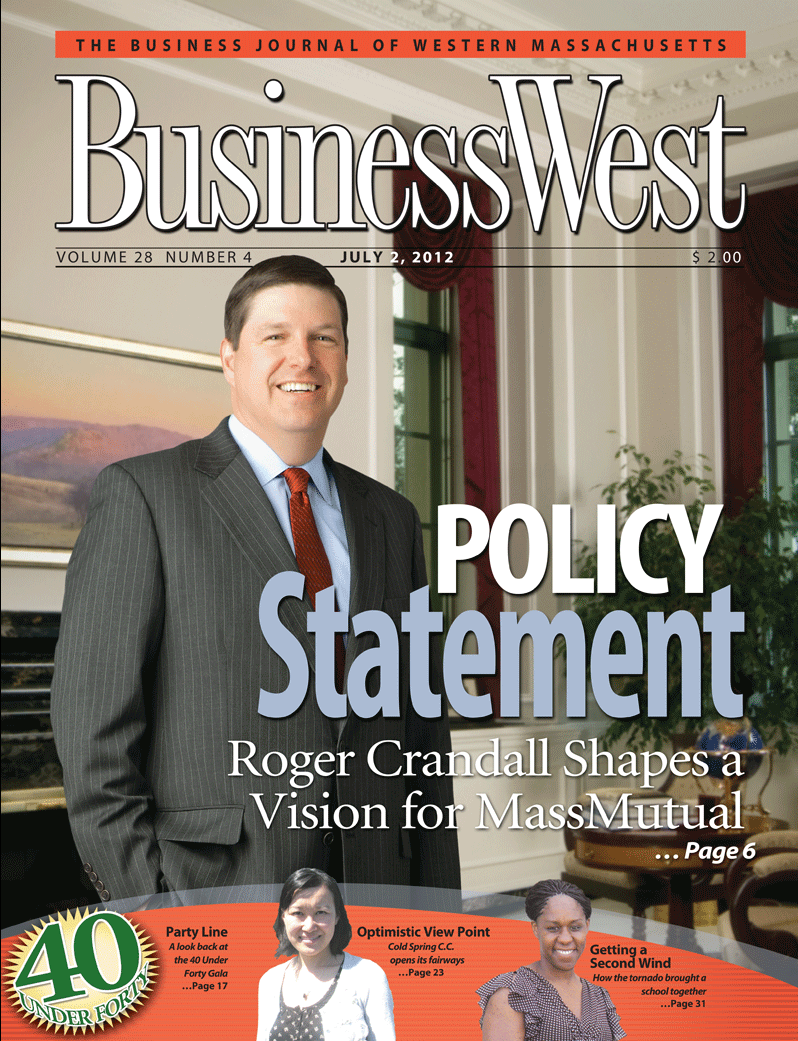
Roger Crandall Shapes a Vision for MassMutual
The six-foot-long fish mounted over Roger Crandall’s desk certainly looks real.
But in fact, this work of art, as he calls it, is a wood carving fashioned with the help of several dozen photographs of the 140-pound tarpon that Crandall hooked, battled for more than an hour and a half, landed, and then released off the Florida keys in 2006.
“I was looking through a fishing magazine, and found this woman in New Hampshire who does wood carvings of what are usually trout or salmon,” Crandall, the chairman, president, and CEO of MassMutual explained. “I sent her 50 pictures, she did some research on tarpon to get the dimensions right, and it took her three years to do it.”
Like just about everything else assuming floor, wall, and shelf space in Crandall’s large office at MassMutual, which he jokingly refers to as the hall of dinosaurs, the wood carving has meaning and tells a story — or several of them. In this case, the fish, which he admits probably wouldn’t fit anywhere else, relates his passion for the sport, which he enjoys for the challenge of fights like he had with the tarpon, but more for the relaxation it provides as well as the opportunity to get away from the numbers that have dominated his life and career.
“In a world, and a job in particular, where information is constantly coming at you, getting out onto a river or a flat is great,” he explained. “For that two, three, of four hours, there’s no Blackberry, there’s no crisis in Greece, there’s no low interest rates, no unclear regulatory policy, none of the things I deal with on a day-to-day basis; it’s a great way for me to de-stress and relax.”
Moving around the room, one will find dozens of objects that speak volumes about Crandall’s work and the mindset he brings to it. For example, there’s the 107-year-old grandfather clock, presented as a gift to a former president of MassMutual by the general agents association. Still keeping good time, the clock is there as a reminder of the importance of the relationship between the company and its agents and general agents, he said.
Hanging on a wall a few feet away, meanwhile, is a framed copy of an insurance policy sold in 1894. “We literally sell the same type of policy today,” said Crandall, adding that the document is a reminder that the foundations on which the company was built haven’t really changed — and won’t. “One of our best-selling products in the 1890s was also one of the best-selling products in 2011.”
And then, there are the model planes, or what Crandall referred to as “deal toys.” There are more than a dozen of them in total, and they represent individual aircraft or airlines that MassMutual has owned or invested in over the decades, he explained, noting a few that he’s particularly proud of. One would be a model of a jet owned by Morris Air, a small outfit started by David Neeleman in Salt Lake City that caught Crandall’s attention when he was an analyst for MassMutual in the early ’90s.
The company tripled its investment in Morris Air in just over 18 months when that venture was sold to Southwest Airlines, Crandall recalled, adding that the story got better — and the deal-toy collection grew significantly — when, after his non-compete agreement with Southwest expired, Neeleman started another airline that MassMutual became an original private equity investor in — JetBlue. “I think we made $80 million on a $15 million investment,” he said.
Although it would outwardly appear that Crandall’s office is outfitted as a way to salute past achievements, he described it collectively as an inspiration for the future — the tense that certainly occupies most of his time and attention.
He told BusinessWest that he’s focused on the year 2040, for example. That’s the year the U.S. is expected to be a nonwhite majority, and while that’s 28 years away, he’s already taking steps to position the company for that time, with steps ranging from a comprehensive effort to change the demographic mix of the company’s roster of agents to the introduction of many new products, to aggressive marketing to target groups ranging from African Americans to gays and lesbians.
A big part of getting the company positioned for the future is to remind customers and potential customers of the need to secure their futures — and then provide the products and services to help them do it, Crandall said, summing up matters by first borrowing an old Mandarin proverb — “when you’re safe, think about danger” — and then a quote attributed to Albert Einstein: “the most powerful force in the universe is compound interest.”
For this issue, BusinessWest talked at length with Crandall about tarpon, investments in airlines, and company history — but mostly about the future and how he intends to position the 161-year-old company to be fully ready for it.

On a Grand Scale
Crandall remembers that while he was in grade school, he would often go to the office on Saturdays with his father, a group life and health salesperson for MassMutual.
“I would stuff envelopes for him so he could do mailings, and got a penny an envelope,” he said, adding that he eventually took on more far-reaching duties. Indeed, when personal computing came into prominence, he would use an early spreadsheet program called VisiCalc (which predated Lotus and Excel) to help his father show prospective clients how much the premiums would be for group life insurance.
“Later, during summers when I was in college, I would go out on sales calls with him and sit in on meetings with MassMutual pension customers … that’s how I got a serious introduction to MassMutual,” he said, adding that while his father spent 34 years with the company, he didn’t picture himself following in those footsteps, let alone becoming CEO.
However, a series of circumstances, starting with the economic landscape he encountered upon graduating from the University of Vermont with a bachelor’s degree in 1988, put him on course that eventually led to that office on the second floor of the company’s State Street headquarters.
“I started in the real estate investment department, and it was the perfect time to get into that sector,” he recalled, “because we were about to have the biggest commercial real estate collapse since the Great Depression; it was actually a wonderful learning experience.”
MassMutual gave him the opportunity to take the charter financial analysts exam, and he eventually moved from real estate to the investment division to the securities investment division, where, fortuitously for him, the analyst assigned to watch the airline industry had just retired.
“At that time, my uncle, Bob Crandall, was president of American Airlines,” he explained. “So the guy I worked for said, ‘at least you’ll have one person to call,’ and told me to watch the airline industry.”
With a little guidance from his uncle, but mostly a keen eye for potential-laden ventures, Crandall steered MassMutual toward the Morris Air, JetBlue, and other deals now commemorated in his office. In 2000, he joined Babson Capital Management, LLCV, a MassMutual subsidiary, and in 2002 was named managing director of that company and head of its Corporate Bond Management, Public Bond Trading, and Institutional Fixed Income units.
In 2005, he was appointed chairman of Babson Capital and executive vice president of chief investment officer of MassMutual, eventually becoming president and CEO in January of 2010, and later named chairman as well.
He took those final steps to his current post at the height of the Great Recession, a downturn that severely tested all financial services institutions, but also brought a number of opportunities for MassMutual.
“The company is much stronger today than it was at the end of 2007,” he explained. “Our sales are higher, our earnings are higher, and our capital is higher. It was Rahm Emanuel (President Obama’s former chief of staff) who said, ‘don’t let a good crisis go to waste,’ and from our perspective, it became a great opportunity to remind people about the strength of a mutual company and how we differ from a stock company.
“It was also a time to remind people of the inherent strength that the mutual life insurance company products have,” he continued. “So we’ve actually been able to take market share as well as grow over the past three or four years.”

Dollars and Sense
Elaborating, he said MassMutual has done so essentially by focusing on what he called the “basics.”
And by this he means the three main pillars of the company’s operations — providing customers with financial security, paying the best dividends, and providing exceptional customer service.
For example, the company has “doubled down” on its roster of agents, going from 3,700 a few years ago to more than 5,000 today, he said, while also investing in new products, including a number of creative life insurance options, designed to meet the various needs of customers.
Such steps are part of those aforementioned efforts to position MassMutual for both today (and those opportunities from the fiscal crisis Crandall described) and the much different look and feel that this country — and the world — will have two, three, and four decades from now.
And with that, he turned to another item in his office, a framed commemorative photo, a gift from a Chinese entity that MassMutual has partnered with on a utility venture.
“My guess is that 20 or 30 years from now, someone’s going to look at that and say, ‘wow, MassMutual was thinking not five years ahead, but 10 and 20 years ahead in dealing with China. So I put that there to remind whoever’s sitting here in the future of that.”
To further explain his mindset, he referenced that acquired skill attributed to hockey legend Wayne Gretzky. “He said he would skate not to where the puck was, but to where he thought he would be,” said Crandall. “That’s what we’re trying to do.”
And in a figurative sense, the puck is going to a place and time, not far off, and in some cases, already here, where the demographic picture will be much different. The company has responded in a number of ways, he said.
“One of the big things we did was realize that the face of America is changing, and we needed a much more aggressive diversity strategy,” he explained. “So we’ve gone from having maybe 100 of our agents being multicultural to perhaps 1,000 over the past four years.
“Meanwhile, we’ve gone from having no dedicated multicultural marketing campaigns,” he continued, “to having dedicated campaigns for Hispanics, African Americans, Asian Americans, the gay and lesbian markets … we’ve really embraced diversity in a big way, and it’s making a huge difference for us. And we’ve only scratched the surface of the opportunities there.”

It’s not Foreign Policy
Another component of the company’s ‘getting back to basics’ strategic initiative is using marketing and other vehicles to emphasize the inherent advantages from doing business with a mutual company, Crandall continued.
“We’re owned by our policy holders, so we don’t get torn between two opposing views,” he explained. “Shareholders, we believe, are inherently, and rightly, more willing to take more risk than the policy holder is. Since we have just one constituency, we think that’s a huge advantage over having two, and you have to look no further than to a few public companies that are undergoing very sigfificant changes because their shareholders are pushing them to do that — their policy holders are not a big part of that public discussion.
“We’ve spent a lot of time redoing our advertising and marketing to remind people about mutuality,” he went on, pointing to a recent ad now framed and on his wall as one example. “We’re reminding people that we’re 160 years old (now 161) and we’ve been focused on policy holders since we were founded.”
These various pieces, from investment in new products to bolstering and greatly diversifying the roster of agents, to more aggressive marketing have all helped the company, said Crandall, noting that in 2011, MassMutual set records for sales of whole life insurance products and retirement products, and ended the year with record capital. And those trends have continued into the first half of 2012.
Looking ahead, he said there are tremendous opportunities to build on that recent progress, as evidenced by what many would describe as alarming statistics regarding Americans and how little they’ve done to secure a solid financial future.
“There are 50 million Americans who don’t have any life insurance, and that’s a huge opportunity for us,” he explained, adding that this is one of the reasons why, in addition to taking market share from competitors, the company can grow simply from what will, or should be, a much larger pie. “The other huge opportunity stems from the fact that Americans simply haven’t been saving enough money for probably the past 25 years.
“They’ve suddenly realized that they haven’t saved enough, and also realized that their house isn’t worth what they thought it was,” he continued. “So savings rates have tipped up, and we’ve done what I think is a very good job in our 401(k) business of reminding people how effective it is to save for retirement in that way, how steps taken in your 30s and 40s can make a difference when you’re in your 60s.”
Which brings him back to Albert Einstein and his comment on compound interest.
“Fundamentally, if you start saving early enough, you can solve all these problems,” he said, referring to the possibility of not having enough money for retirement, health care, or long-term care. “It’s very hard to take care of those things if you wait until you’re 60, and we want to help people understand that and start saving early.”

The Bottom Line
Among the myriad artifacts in Crandall’s office is a photograph of himself with David Neeleman in front of a JetBlue plane at New York’s JFK Airport.
Like the grandfather clock, framed insurance policy, and assorted deal toys, it is, as he said, a celebration of a past achievement, but also serves as inspiration for future success.
And it’s yet another example, said MassMutual’s top executive, of how even a company with 160 years of history to look back on, can only succeed if both eyes are on the future — and especially the distant future.

George O’Brien can be reached at [email protected]
Departments Picture This

Send photos with a caption and contact information to: ‘Picture This’ c/o BusinessWest Magazine, 1441 Main Street, Springfield, MA 01103 or to [email protected]

NCCJ Awards

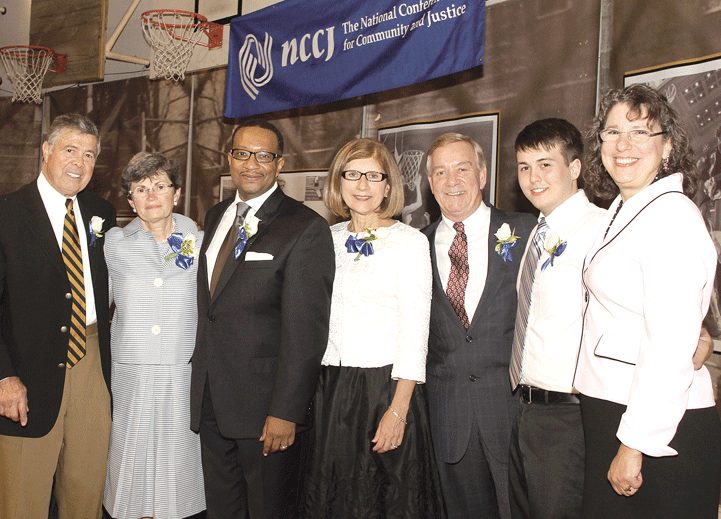
The National Conference for Community and Justice (NCCJ), founded in 1927 as the National Conference of Christians and Jews, recently presented its Annual Human Relations Awards at the Naismith Memorial Basketball Hall of Fame. Six area residents were honored for their dedication to fighting bias, bigotry, and racism and promoting understanding and respect for all. Far left, from left: honoree Michael Sobon, president of O’Connell Oil, and his wife, Joan; honoree Ronn Johnson, principal, R.D.J. Associates; honoree Carol Leary, president, Bay Bath College; honoree Brian Tuohey, president, Collins Pipe; honoree Caleb Wilkie, a Westfield High School junior and youth community organizer, Andrea Kandel, executive director of the NCCJ. Left, Wilkie addresses the audience as he accepts the 2012 Youth Award.


WBOA Gala

The Women Business Owners Alliance of the Pioneer Valley Inc. (WBOA) recently celebrated its 2012 Woman of the Year Event and 30th Anniversary Gala at Chez Josef in Agawam. The mission of the non-profit organization is to build confidence and success, and empower women entrepreneurs. At left, Freda Brown (left), treasurer of WBOA and owner of Divorce Financial Services, who was honored as the 2012 Woman of the Year, stands with Susan Kelley, center, owner of Kelley Tax Service and vice president of WBOA, and Monique Leyda, senior account manager with Bishop Technologies.


YMCA Dinner

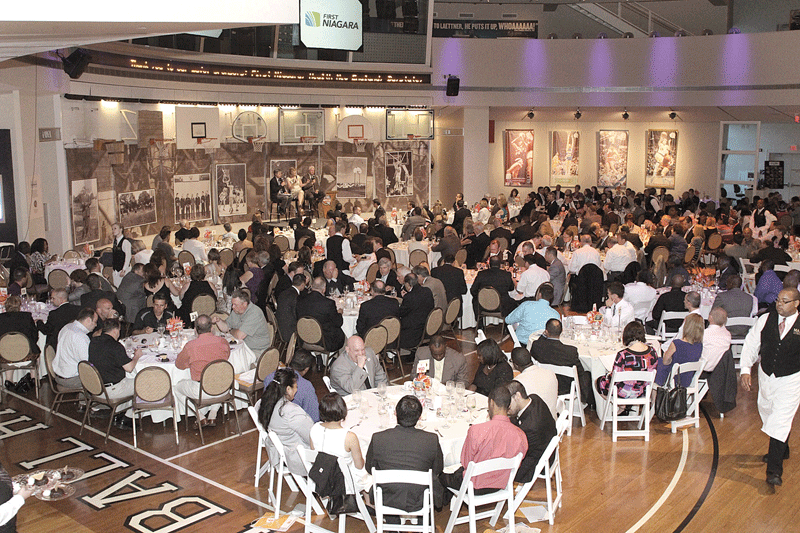
More than 350 guests filled the Naismith Memorial Basketball Hall of Fame for the recent YMCA of Greater Springfield’s 160th anniversary celebration. The event featured a keynote address by successful sports and business leader Mannie Jackson, and entertaining insight on Boston sports from Boston Globe sportswriters and ESPN commentators Jackie MacMullan and Bob Ryan. Left, the scene at Center Court as the crowd salutes Springfield College President Richard Flynn.


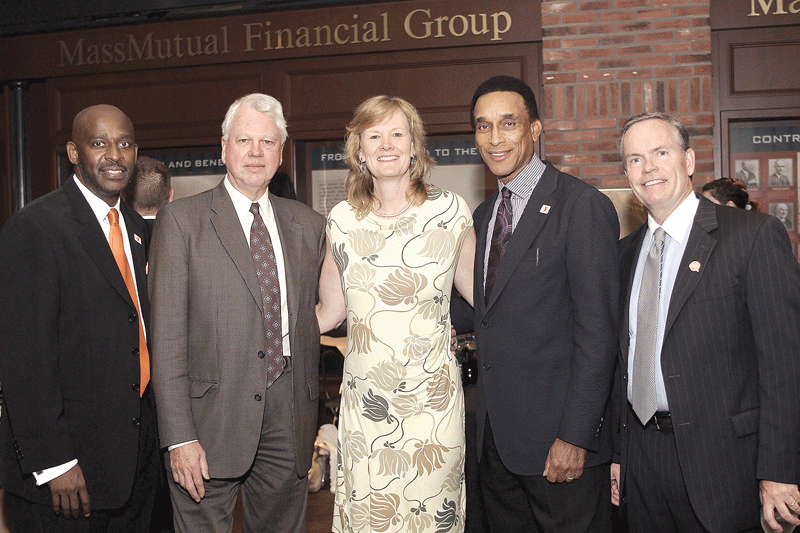
From left, Kirk Smith, president and CEO of the YMCA of Greater Springfield; Bob Ryan, Jackie MacMullan, Mannie Jackson; and John Doleva, CEO of the Naismith Memorial Basketball Hall of Fame


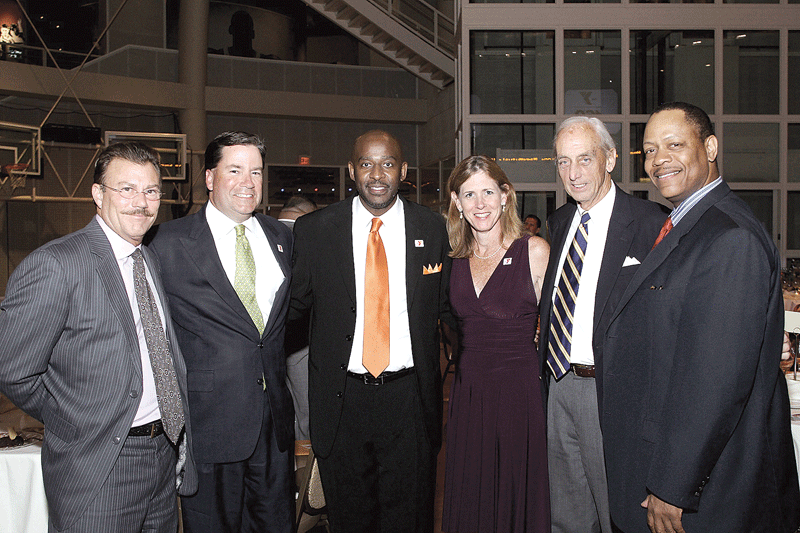
From left, Steve Bradley, vice president of Government & Community Relations and Public Affairs, Baystate Health; Tom Creed, senior vice president and Market Commercial Credit Manager in the new credit management division of TD Bank; Kirk Smith; Kathy Treglia, vice president of Education & Government Relations at the YMCA; David Woods, principal of Woods Financial Group; and Victor Woolridge, vice president of Cornerstone Real Estate Advisers


Dancers from the Dunbar YMCA Family & Community Center, who performed a tap dance number directed by Shirley Similari.

Agenda Departments

Massachusetts Chamber Business Summit
Sept. 9-11: The Massachusetts Chamber board of directors will conduct its annual Business Summit and Awards Ceremony at the Resort and Conference Center at Hyannis. The two-day meeting allows participants to meet with business professionals from across the state, as well as listen to state and local elected officials who will discuss the future of business in Massachusetts. Additionally, representatives from the Mass. Office of Economic Development will discuss loans, grants, and tax incentives available to business owners. Industry experts will also be on hand to discuss topics such as leveraging social media, search-engine optimization, and health care cost containment. The winners of the Business of the Year Award and the Employer of Choice Award will also be announced during the summit. For more information, call (617) 512-9667 or visit www.masscbi.com.
World Affairs Council Annual Meeting
Oct. 10: Hampshire College President Jonathan Lash will speak at the World Affairs Council of Western Mass. Annual Meeting & Dinner in the Mahogany Room of the Springfield Sheraton Hotel in downtown Springfield. More details will be forthcoming. Lash is an internationally recognized expert on practical solutions to global sustainability and development challenges. Before he became president of Hampshire College in 2011, he served as president of World Resources Institute (WRI), an environmental think tank with offices in eight countries and partners in more than 50 countries. WRI is an international leader on issues ranging from low-carbon development to sustainable transportation. From 1993 to 1999, Lash was co-chair of the President’s Council on Sustainable Development, a group of government, business, labor, civil rights, and environmental leaders appointed by President Clinton that developed visionary recommendations for strategies to promote sustainable development. He played a key role in the creation and success of the U.S. Climate Action Partnership, which in 2007 issued the highly influential “Call to Action” on global warming. Prior to WRI, Lash held posts as director of Vermont Law School’s Environmental Law Center, Vermont secretary of Natural Resources, and Vermont commissioner of Environmental Conservation, and as a federal prosecutor. For more information on the event, call (413) 733-0110.
Western Mass. Business Expo
Oct. 11: BusinessWest will again present the Western Mass. Business Expo. The event, which made its debut last fall at the MassMutual Center in downtown Springfield, will feature more than 180 exhibitors, seminars, special presentations, breakfast and lunch programs, and the year’s most extensive networking opportunity. Comcast Business Class will again be the presenting sponsor of the event. Details, including breakfast and lunch agendas, seminar topics, and featured speakers, will be printed in the pages of BusinessWest over the coming months. For more information or to purchase a booth, call (413) 781-8600, e-mail [email protected] or visit www.wmbexpo.com.

Chamber Corners Departments

ACCGS
www.myonlinechamber.com
(413) 787-1555

• July 9: ACCGS Annual Golf Tournament, at the Ranch in Southwick. Registration starts at 10:30 a.m., with a 12:30 shotgun start. Sponsors to date include: Lunch Sponsor: MassMutual Center; Reception Sponsor: Blue Cross Blue Shield; Photography Sponsor: NUVO Bank; Putting Contest Sponsor: H.L. Dempsey Co.; Hole in One Sponsors: Rocky’s Ace Hardware, Hampden Bank, and Teddy Bear Pools & Spas. The chamber is still looking for sponsors at all levels. New this year is the Flag Sponsor for $250. Costs: foursomes, $600; individual golfers, $150; reception only, $30. Interested parties may register online for any of the sponsorships as well as for golf and dinner, or by e-mailing Cecile Larose at [email protected], or by faxing a registration form to (413) 755-1322. For more information, call (413) 755-1313.

GREATER EASTHAMPTON CHAMBER OF COMMERCE
www.easthamptonchamber.org
(413) 527-9414

• July 12: Networking By Night Business Card Exchange, 5-7 p.m., featuring a gala waterski show. Hosted by the Oxbow Water Ski Show Team, 100 Old Springfield Road, Northampton. Door prizes, hors d’ouevres, host beer and wine. Tickets: $5 for members, $15 for non-members.
• July 27: 28th Annual Greater Easthampton Chamber of Commerce Golf Tourney, 9 a.m. shotgun start for the Scramble event. Hosted by Southampton Country Club, College Highway, Southampton. Major sponsors: Easthampton Savings Bank and 5 Star Building Corp. Cost for the outing, which includes golf with cart, lunch, dinner, and a gift, is $100 per person and $400 per foursome. “Win a Buick Hole in One” sponsored by Cernak Buick. A $10,000 hole in one sponsored by Finck & Perras Insurance. Register at www.easthamptonchamber.org.

WEST OF THE RIVER
CHAMBER OF COMMERCE
www.ourwrc.com
413-426-3880

• July 11: Wicked Wednesday, 5-7 p.m., EB’s Restaurant, 385 Walnut St. Ext., Agawam. Cost: free for members, $10 for non-members.

Court Dockets Departments

The following is a compilation of recent lawsuits involving area businesses and organizations. These are strictly allegations that have yet to be proven in a court of law. Readers are advised to contact the parties listed, or the court, for more information concerning the individual claims.

CHICOPEE
DISTRICT COURT
Arclincia Cooke v. Holyoke Mall Co., L.P. and UGL Services UNICCO Operations Company
Allegation: Negligent maintenance of premises, causing personal injury: $9,493.99
Filed: 5/23/12

FRANKLIN
SUPERIOR COURT
Roberts Brothers Lumber Co., LLC v. Commerce Insurance Co.
Allegation: Breach of insurance contract and unfair insurance practices: $36,667
Filed: 5/7/12

Stanley Zielonka v. Cumberland Farms Inc.
Allegation: Negligent maintenance of premises, causing injury: $44,172
Filed: 4/23/12

HOLYOKE
DISTRICT COURT
Michelle Grout v. ES Realty Corp.
Allegation: Negligent parking-lot maintenance causing trip and fall: $3,233.48
Filed: 4/25/12

SPRINGFIELD DISTRICT COURT
Cecilio v. Rivera v. North End Oil Service Co. Inc. And Julio C. Feliciano
Allegation: Breach of contract: $19,534
Filed: 5/12/12

NES Rentals v. Capco Steel Corp. and Cityview Commons II, LP
Allegation: Non-payment on construction equipment provided under a rental agreement: $12,608.04
Filed: 5/04/12

Servisair Fuel Services, LLC v. East Coast Airport Services Inc.
Allegation: Non-payment of goods sold and delivered: $33,977.34
Filed: 5/11/12

WESTFIELD
DISTRICT COURT
Gary Woods v. Homeplate Sports Bar, LLC and Daniel J. Asselin
Allegation: Negligence in security, allowing for repeated batteries of plaintiff by Daniel J. Asselin: $14,000
Filed: 5/30/12

Renaissance Manor of Westfield v. J. Newsome & Sons Construction Inc.
Allegation: Breach of contract for construction services: $9,465
Filed: 5/18/12v

Company Notebook Departments

Normandeau Communications Changes Name to Normandeau Technologies
WEST SPRINGFIELD — In a strategic move designed to better convey the company’s full range of products and services, Normandeau Communications recently changed its name to Normandeau Technologies Inc. “It is our goal to have our name reflect more than just communications, but the entire breadth of solutions provided — telephone systems, structured cabling, networking, carrier and Internet services, mobility solutions, surveillance, call accounting, overhead paging, and messaging on hold,” said Kim Durand, director of sales for the company. “Our dedication toward building relationships with our customers and technical expertise has led us to become valued partners in decision-making processes for all their technology needs.” As part of its efforts to educate business owners and managers on the latest technology and how to take full advantage of it, Normandeau will offer ‘Lunch & Learn’ meetings at its new technology and training facility, located at the company’s office at 2097 Riverdale St., West Springfield. “We look forward to serving our community and providing educational opportunities to learn more about how new technology can benefit our customers,” said Durand.

Ludlow Mills Awarded $200,0050 EPA Cleanup Grant
LUDLOW — The U.S. Department of Environmental Protection has awarded WestMass Area Development Corp., owner and developer of the Ludlow Mills project, a $200,000 brownfields cleanup grant, another sign of progress in the continuing redevelopment of the 1.4 million-square-foot redevelopment project. The grant was part of a competitive process, and Ludlow Mills is one of 18 projects in Massachusetts to receive EPA Region One grants in this round. Westmass will use the funding to immediately begin removing asbestos from old mill buildings on the site. Westmass President Kenn Delude said the funds will augment state funding from the Office of Energy and Environmental Affairs for environmental remediation work that did not cover the removal of asbestos. “This is another significant step forward in the redevelopment of the largest brownfield mill-redevelopment project in New England,” said Delude. Westmass recently announced two projects for the site — a $27 million initiative launched by HealthSouth to build a new rehabilitation hospital, and a $22 million, 83-unit senior independent-housing project.

WEEI Radio Awarded UMass Athletic Broadcast Rights
SPRINGFIELD — Sports Radio 105.5 WEEI-FM recently announced an exclusive partnership with UMass that makes it the official home of UMass football and basketball. The five-year agreement kicks off with the 2012 football season, which begins on Aug. 30 at the University of Connecticut. In addition to comprehensive game coverage, WEEI Springfield will host the UMass coaches shows, featuring The Charlie Molnar Show and The Derrick Kellogg Show. The agreement was brokered by Nelligan Sports marketing, the multi-media rights holder for UMass Athletics.

Columbia Gas Donates Blankets to Friends of the Homeless
SPRINGFIELD — Employees of Columbia Gas of Massachusetts visited the Friends of the Homeless shelter on Worthington Street in Springfield recently to donate 150 heavy-duty blankets to the shelter. Columbia Gas employees have adopted Friends of the Homeless as one of the local charitable organizations they will be supporting in 2012, said Andrea Luppi, manager of Communications and Community Relations. “In addition to the donation of blankets, once a month, a group of employees from all departments has volunteered to serve lunch at the shelter and spend some time getting to know the people there,” she said. “It gives everyone a good feeling to be able to do something for a group that needs and deserves some help.” Last year, Columbia Gas signed on as one of the primary sponsors of “Journey in My Shoes,” which was the first fund-raising event for Friends of the Homeless.

Briefcase Departments

UMass President Awards $750,000 for Innovative Faculty Research
BOSTON — UMass President Robert Caret recently announced nearly $750,000 in grants to faculty members from the President’s Science and Technology Initiatives Fund to support six promising research projects, which range from creating standards for testing robotic systems to detecting financial fraud in large-scale securities data to developing new skin-cancer imaging technologies. The initiatives showcase a range of innovative research being undertaken by UMass faculty members that contribute to the growth of the Commonwealth’s economy, especially in the science and technology sectors, and extend the boundaries of human knowledge. The grants provide seed funding to accelerate research activity across all five campuses and position researchers to attract larger investments from external sources to expand the scope of their projects. “The Science & Technology fund advances the work of producing the discoveries and technological breakthroughs that will improve lives, create jobs, and preserve our planet,” said Caret. “It supports the ideas and inventiveness of our faculty and fosters a culture of collaboration across all five campuses that attracts investments and underscores our role as an innovation engine for the Commonwealth.” This marks the ninth year the President’s Science and Technology Initiatives Fund awards have been handed out. It’s one of three funds that President Caret taps to help advance the work of UMass faculty members: the other two are the Commercial Ventures and Intellectual Property Technology Development Fund and the Creative Economy Initiatives Fund. Since 2004, the Science & Technology Fund has provided $7.5 million to UMass researchers, which, in turn, has generated $207 million in funding from outside sources for vital research efforts and led to the creation of nearly 20 research centers on the five campuses. UMass’s annual research expenditures climbed to $587 million in fiscal year 2011; that same year the university generated income of $36.5 million from faculty discovery and innovation. To date, the President’s Science & Technology Fund has financed more than 60 projects representing the breadth of academic inquiry at UMass. Locally, a grant project at UMass Amherst called ‘Big Data Informatics Initiative (BDI2)’ focuses on areas such as detecting financial fraud in large-scale securities data, correlating video/audio surveillance data to spot trends or anomalies in real time, and smart-meter data processing by energy utilities. Collaborators include the Massachusetts Green High Performance Computing Center, Holyoke Gas & Electric, MIT, and commercial partners such as EMC, Nokia, GE Global Research, and Yahoo Research. The total awarded was $136,250.

MCDI Transitions to Family Self-sufficiency Focus
SPRINGFIELD — The Massachusetts Career Development Institute Inc. recently announced a transition in its core services that will increasingly revolve the agency around family self-sufficiency initiatives and de-emphasize some workplace-training programs, many of which are now being undertaken at the community-college and vocational-secondary-school level. The move will have the immediate impact of downsizing the organization by 15% of its current workforce. The agency will also plan to relocate to a smaller, more efficient training and educational facility within Springfield as it transitions to a more appropriate operating model, according to Timothy Sneed, executive director of MCDI. The new emphasis at MCDI will be on career counseling and training tracks that are in high demand, eliminating those that are being shifted to other training sources. However, MCDI will continue its vocational training programs that address the growing employer demand in health care through its Certified Nurse Aide/Home Health Aide and Medical Office Professional training programs. Sneed said he anticipates an opportunity for MCDI to grow into other health-related training programs based on employers’ needs. Sneed indicated that, in an effort to focus on program strengths, MCDI is evolving into an agency that supports “family self-sufficiency” and will provide a host of direct and indirect resources in support of the family. “There has been a shift in the funding landscape with respect to vocational training, and most federal and state dollars are targeted at funding community colleges and technical-high-school programs,” said Sneed. “So, in many areas MCDI has been duplicating services with more training funding going to the community colleges and vocational programs at the secondary-school level. We will continue to provide multiple levels of adult basic education and English for speakers of other languages (ESOL) together with career and academic advising. Our support-services strategy will include job-readiness and life-skills training, which is so critical in today’s job market. We will temporarily discontinue our trade programs in culinary arts, precision-manufacturing technology, and sheet-metal welding and fabrication.” He continued, “while this reorganization is difficult, we see this as an opportunity to strengthen our core training programs with a vision of future expansion opportunities. The impact upon a portion of our workforce is truly unfortunate. At the same time, our management and board of directors see this as a positive step in the long-term viability of MCDI and, most importantly, those we serve in our community.”

GSCVB Unveils 2012-13 Pioneer Valley Visitor Guide
SPRINGFIELD — The Greater Springfield Convention and Visitors Bureau (GSCVB) has unveiled the new 2012-2013 Guide to Masachusetts’ Pioneer Valley, which is now available by ordering online at www.valleyvisitor.com. The guide is free of charge and is a collaboration between the GSCVB and the Franklin and Hampshire County Regional Tourist Councils. The guide, a 112-page publication, contains information about some of the region’s top attractions, accommodations, and restaurants. The book offers new features, including a listing of farmers’ markets and expanded listings of attractions, accommodations, restaurants, shopping, transportation, recreational sites, colleges, and prep schools.

DBA Certificates Departments

The following Business Certificates and Trade Names were issued or renewed during the month of June 2012.

AGAWAM

4U Siding and Roofing
605 Southwick St.
Dmitry Bruskiy

Agawam Wellness
430 Main St.
Nichole Hines

Christo’s & Sons Landscaping
129 South St.
Mark Christodlous

Custom Cabinet and Millwork Inc.
62 Suffield St.
Garrett Kimball

Wargamers’ Terrain
73 Tobacco Farm Road
Joe Linares

Tucano Applications
14 Mansion Woods
Leonardo D. Mascarenhas

AMHERST

Deepening Roots Farm
793 Bay Road
Andrew Korza

Ganna Designs
2 Morgan Place
Crystal Nielsen

Hess Express
468 West St.
R.J. Lawlor

Majik Management Consulting
279 West St.
David Majka

Renew Vitality
324 Middle St.
Rosamond Wulsin

CHICOPEE

Abundant Wellness Center
94 Chicopee St.
Deborah Boulanger

D & D Sales
815 McKinstry Ave.
Donald Perusse

Dave & Lisa’s Artful Furnishings
165 Front St.
David Murphy

DES Auto Technologies
439 Chicopee St.
David Stearns

Eris Construction
26 Casino Ave.
Erisnaldo Santos

Pioneer Valley Landscaping
45 Dresser Ave.
James Hebert

West Side Home Improvement
429 Front St.
Viktor Lapik

GREENFIELD

Driscoll’s Company
45 High St.
John J. Driscoll

Lipton Mart
100 Mohawk Trail
Michael Lipton

SMD Contracting
278 Main St.
Stephanie M. Dudos

Zemi
176 Main St.
Maya Meyers

HADLEY

Crystal Gardens Unlimited
140 Mount Warner
Crystal Boucher

Hadley Dry Cleaners
206 Russell St.
Hwa J. Han

Interskate 91 North
367 Russell St.
William Hoeffer

Riverside
373 River Dr.
John Kershlis

Shaolin Kung Fu Center
231 Russell St.
Ryan Budny

Z Auto
105 East St.
Michael Zera

HOLYOKE

Emmanuel Jewelry Store
311 High St.
Tai W. Kang

Luigi’s Christian Book & Music Store
103 High St.
Eddie Rivera

M & M Mini Mart
46 Franklin St.
Naz B. Naji

Real China Restaurant
1529 Northampton St.
Shi Z. Liu

Stop N’ Go
915 Main St.
Sagheer Nawaz

Valley Hall
26 Hadley Mills Road
Gabriel Reyes

Who’s Next Barber Shop
241 Main St.
Omar Peralta

PALMER

Crimmins and Graveline Insurance Agency
1382 Main St.
Thomas Graveline

N.M. Construction
11 Conant St.
Nathaniel Messier

Reskewed Things
1444 North Main St.
Charles L. Hood III

Trackside Tire Service LLC
1237 Park St.
Norman J. Ashline

Track Side Trains
1294 South Main St.
Greg Flamand

SOUTHWICK

R.B. Distributors
375 North Loomis St.
Russell Jones

Shawn Rutola Electrician
25 Eagle St.
Shawn Rutola

SPRINGFIELD

L & G Signs & Designs
120 Kimberly Ave.
Leroy A. Davidson

L & Q Game Shop
182 Oakland St.
Luis Lopez

L & S Transportation
118 Cardinal St.
Liliya Dudrova

La Garita Convenience
1212 Main St.
Betsy Lozada

La Zona Supermarket Corporation
24 Fort Pleasant Ave.
Hector Merejo

Lazy Valley Winery Inc.
34 Front St.
Scott Santaniello

Lil Divas Boutique Salon
65 Sycamore St.
Elizabeth Matos

MJA Construction
11 Gold St.
Nelson Menjivar

One Stop Cuts
494 Central St.
Charlette Gentry

Pink Peace
5 Danaher St.
Michelle LaPorte

R. Rocca Construction
169 Carver St.
Roger H. Rocca

Richard R. Rulnick
79 Embassy Road
Richard R. Rulnick

Simply Divine Beauty Lounge
607 Dickinson St.
Kelly Rochelle

So Fresh, So Clean
94 Wilbraham Road
Michael R. Marshall

Spring Street Super Grocery
121 Spring St.
Jose M. Rijo

T-Shirt Time
427 State St.
Hernesto Olmo

The Vela-Villalobos Corporation
1350 Main St.
Eduardo H. Vela

The Brothers Grocery
314 Bay St.
Virginia Leonor

Top Performance Heating
58 Davenport St.
Dorsey Cupe Jr.

Tsvor Construction Company
113 Michon St.
Aleksandr Tsvor

Ummi’s Haven Daycare
16 Glendell Terrace
Saliyhah A. Wadud

Valley Inn Boston Road
339 Boston Road
Bryan L. Townsend

Vigo Remittance
432 Belmont St.
Western Union

WM Development Company
1 Monarch Place
Joseph A. Lashinger

West Indian Taste Inc.
320 Wilbraham Road
Cornel Forbes

WESTFIELD

Boise Cascade LLC
33 Fowler St.
Jim Wickham

Bshara Catering
110 Airport Road
Paul Bshara

Cherished Loved Ones Home Care
244 Birch Bluffs Dr.
Carolyn Giordano

Lucky Spa & Nails LLC
303 East Main St.
Huan V. Huynh

Marek Jewelers
7 Day Ave.
Scott Marek

The Country Clipper
9 Russell Road
Sara Noska

The Sharing Tree
27 King St.
Karen E. Eaton

WEST SPRINGFIELD

98 Front Street
98 Front St.
Suzanne Halpin

A and N Transport
33 Craig Dr.
Andrew Ngure

Acumen Data Systems Inc.
2223 Westfield St.
Edward W. Squires

Aquatique Pools
730 Union St.
Robert E. Genereux

Beautiful Rooms
42 Myron St.
Gary R. Okun

Dream Events
43 Belle Ave.
Daria Krasnov

E-Zee Mart
83 River St.
Arshad Iman

First Niagara Benefits Consulting
225 Park Ave.
First Niagara Risk Management Inc.

Galaxy 900
32 Pine St.
Ralph T. Dalise

Gamelli Vending
203 Circuit Ave.
Justin P. Gamelli

Odd Jobbers
67 Armstrong St.
Jared Hamre

Subway
1329 Riverdale St.
Steven Petow

Bankruptcies Departments

The following bankruptcy petitions were recently filed in U.S. Bankruptcy Court. Readers should confirm all information with the court.

Arroyo, Braulio
57 Bevier St.
Springfield, MA 01107
Chapter: 7
Filing Date: 05/30/12

Ayala, Sebastian
557 Berkshire Ave.
Springfield, MA 01109
Chapter: 7
Filing Date: 05/29/12

Basile, Christopher J.
47 Cass Ave.
West Springfield, MA 01089
Chapter: 13
Filing Date: 05/16/12

Batchelor-Morehouse, Lori A.
199 Batchelor St.
Granby, MA 01033
Chapter: 7
Filing Date: 05/23/12

Beech, Thomas D.
PO Box 199
Oakham, MA 01068
Chapter: 7
Filing Date: 05/21/12

Bellefleur, Guy Donald
2020 Calkins Road
Palmer, MA 01069
Chapter: 7
Filing Date: 05/24/12

Blackburn, Barak S.
60 Riverboat Village
South Hadley, MA 01075
Chapter: 7
Filing Date: 05/25/12

Bothwell, Patricia A.
126 Sears Road
Goshen, MA 01032
Chapter: 7
Filing Date: 05/31/12

Boucher, Jr., Daniel B.
21 Revelle Ave.
Northampton, MA 01060
Chapter: 7
Filing Date: 05/29/12

Boze, Roy D.
Boze, Kathyleen F.
37 Hummingbird Dr.
Chicopee, MA 01020
Chapter: 7
Filing Date: 05/30/12

Bradley, Edwin D.
Bradley, Susan M.
20 River Road
Ware, MA 01082
Chapter: 13
Filing Date: 05/23/12

Brown, Jeanette E.
1259 Plumtree Road
Springfield, MA 01119
Chapter: 7
Filing Date: 05/23/12

Brown, Peter K.
Brown, Michelle L.
126 Elmore Ave.
Springfield, MA 01119
Chapter: 7
Filing Date: 05/23/12

Burke, Kellie Anne
48 Dunstable St.
Boston, MA 02129
Chapter: 7
Filing Date: 05/23/12

Capponcelli, Scott B.
Capponcelli, Dana J.
114 Franklin St.
Feeding Hills, MA 01030
Chapter: 7
Filing Date: 05/29/12

Carpenter, Kenneth J.
341 Montcalm First
Chicopee, MA 01020
Chapter: 7
Filing Date: 05/24/12

Chmura, Elizabeth A.
11 Hunting Lane
Wilbraham, MA 01095
Chapter: 7
Filing Date: 05/30/12

Chrusciel, Lorrie A.
59 Rising St.
Feeding Hills, MA 01030
Chapter: 13
Filing Date: 05/24/12

Clinton, Deborah
103 El Paso
Springfield, MA 01104
Chapter: 7
Filing Date: 05/17/12

Corbett, Stephen H.
129 Spruce Hill Ave.
Florence, MA 01062
Chapter: 13
Filing Date: 05/30/12

Couture, Scott A.
53 Independence Road
Feeding Hills, MA 01030
Chapter: 13
Filing Date: 05/30/12

Daniele, Antonio E.
49 Dayton St.
Chicopee, MA 01013
Chapter: 7
Filing Date: 05/18/12

Deuso, Randall J.
94 Duryea St.
Springfield, MA 01104
Chapter: 7
Filing Date: 05/25/12

Erlanger, Richard Martin
176 Columbus Ave.
Pittsfield, MA 01201
Chapter: 7
Filing Date: 05/21/12

Etter, Arthur A.
P.O.Box 4422
Springfield, MA 01101
Chapter: 7
Filing Date: 05/29/12

Feinberg, Lynne Amy
121 Willow St.
Florence, MA 01062
Chapter: 7
Filing Date: 05/24/12

Fusco, Susan D.
41 Rogers Ave.
Ludlow, MA 01056
Chapter: 7
Filing Date: 05/24/12

Galipeau, Denise A.
55 Arnold Place Apt. 2
North Adams, MA 01247
Chapter: 7
Filing Date: 05/30/12

Garnier, Albert N.
Garnier, Donna M.
194 Parkerview St.
Springfield, MA 01129
Chapter: 7
Filing Date: 05/21/12

Gibson, Michael J.
Gibson, Tammy F.
95 Ward St.
Chicopee, MA 01020
Chapter: 13
Filing Date: 05/30/12

Greenleaf, Paul R.
21 Hazelwood Terrace
Pittsfield, MA 01201
Chapter: 7
Filing Date: 05/16/12

Grubert, Susan E.
6 Furrow St.
Westfield, MA 01085
Chapter: 7
Filing Date: 05/30/12

Hamilton, Elizabeth Martha
73 Barrett St. #3104
Northampton, MA 01060
Chapter: 7
Filing Date: 05/23/12

Hayden, Mary E.
a/k/a Wheeler, Mary E.
a/k/a Maloney, Mary E.
598 Southwick Road
Westfield, MA 01085
Chapter: 7
Filing Date: 05/31/12

Hayward, Patrick D.
124 Birchgrove Dr.
Pittsfield, MA 01201
Chapter: 7
Filing Date: 05/16/12

Helfont, Jeffrey A.
44 Shawmut St.
Springfield, MA 01108
Chapter: 7
Filing Date: 05/25/12

Hroncich, John M.
6 Morgan Mannor
Lenox, MA 01240
Chapter: 7
Filing Date: 05/24/12

Kizershot, Julie Michelle
16 Market St. Apt. 3B
Northampton, MA 01060
Chapter: 7
Filing Date: 05/23/12

Koske, Robert M.
Koske, Christine A.
62 South Meadow Road
Westfield, MA 01085
Chapter: 13
Filing Date: 05/29/12

Kremensky, Robert E.
128 College Highway
Southampton, MA 01073
Chapter: 7
Filing Date: 05/31/12

Lachowicz, Kim M.
a/k/a Cannon, Kim
45 Hancock Road
Pittsfield, MA 01201
Chapter: 7
Filing Date: 05/29/12

Lambert, Joseph
88 Watson St.
Chicopee, MA 01020
Chapter: 13
Filing Date: 05/30/12

L’Ecuyer, Peter
L’Ecuyer, Cheryl
12 Highland St.
Athol, MA 01331
Chapter: 7
Filing Date: 05/25/12

Lee, James W.
291 Morgan Road
West Springfield, MA 01089
Chapter: 7
Filing Date: 05/17/12

Leighton, Christine
a/k/a Hoggard, Christine
177 Jasper St
Springfield, MA 01109
Chapter: 13
Filing Date: 05/22/12

Lepper, Thomas A.
Lepper, Margaret R.
756 Shaker Road
Longmeadow, MA 01106
Chapter: 7
Filing Date: 05/21/12

Lyons, Lori L.
22 Puffin Dr.
Chicopee, MA 01020
Chapter: 7
Filing Date: 05/30/12

Malo, Aubrey Mae
a/k/a Cayo, Aubrey
P.O. Box 110
Williamsburg, MA 01096
Chapter: 7
Filing Date: 05/31/12

Mandella, Michael A.
P.O. Box 122
Palmer, MA 01069
Chapter: 7
Filing Date: 05/16/12

Marion, April L.
1 Upper River Road
South Hadley, MA 01075
Chapter: 7
Filing Date: 05/28/12

Marshall, Shelley Lynn
a/k/a Stewart, Shelley Lynn
50 Coolidge St.
Athol, MA 01331
Chapter: 7
Filing Date: 05/29/12

Martinez, Hector N.
Martinez, Otilia
15 Woodlawn St.
Springfield, MA 01108
Chapter: 13
Filing Date: 05/30/12

McCarthy, Mary
a/k/a Schulz, Mary
42 Franklin St., #7
Greenfield, MA 01301
Chapter: 7
Filing Date: 05/30/12

Michael Epaul Photography
Michaels Woodworking
Epaul, Michael V.
259 Harkness Ave.
Springfield, MA 01118
Chapter: 7
Filing Date: 05/23/12

Michael R. Labbe Plumbing
Labbe, Michael Rene
18 North Farms Road
Haydenville, MA 01039
Chapter: 7
Filing Date: 05/23/12

Mooney, Bruce Arthur
23 Linden Ave.
Greenfield, MA 01301
Chapter: 7
Filing Date: 05/24/12

Morehouse, Todd M.
P.O. Box 1132
Granby, MA 01033
Chapter: 7
Filing Date: 05/23/12

Mullaney, Matthew J.
Mullaney, Katherine J.
34 Pine Hill Road
South Hadley, MA 01075
Chapter: 7
Filing Date: 05/28/12

Mushenko, Laura A.
88 Birch Ave.
East Longmeadow, MA 01028
Chapter: 7
Filing Date: 05/30/12

Nartowicz, Alan L.
74 East Colrain Road
Colrain, MA 01340
Chapter: 7
Filing Date: 05/30/12

Nicotera, Andrew D.
Nicotera, Lisa B.
3 Emily Lane
Easthampton, MA 01027
Chapter: 7
Filing Date: 05/29/12

Niemczyk, Bruce John
56 Liberty St.
Florence, MA 01062
Chapter: 7
Filing Date: 05/17/12

O’Brien, Michael E.
O’Brien, Joanne M.
15 Fuller St.
Lee, MA 01238
Chapter: 7
Filing Date: 05/16/12

Ollivierra, Rosalyn F.
254 Hillsdale Road
Great Barrington, MA 01230
Chapter: 7
Filing Date: 05/22/12

Oquendo, Epifanio
Marquez, Maria
21 Bowers St.
Holyoke, MA 01040
Chapter: 7
Filing Date: 05/24/12

Ott, David E.
Ott, Norma J.
14 Granville Road
Westfield, MA 01085
Chapter: 13
Filing Date: 05/30/12

Packard, Albert
Packard, Mary
a/k/a Smith, Mary
126 Feltham Road
Springfield, MA 01118
Chapter: 7
Filing Date: 05/29/12

Pecor, Denise Alice
a/k/a Callander, Denise A.
755 Curran Highway
North Adams, MA 01247
Chapter: 7
Filing Date: 05/30/12

Penna, Kathleen M.
6 Robbins Ave.
Pittsfield, MA 01201
Chapter: 7
Filing Date: 05/16/12

Philpott, James M.
154 Glenwood St.
Springfield, MA 01119
Chapter: 7
Filing Date: 05/24/12

Pike, Catherine M.
61 William St.
Chicopee, MA 01020
Chapter: 7
Filing Date: 05/29/12

Potter, Jeffery C.
Potter, Krystyna J.
9 Gates St.
Holyoke, MA 01040
Chapter: 7
Filing Date: 05/23/12

Pretlow, Juan P.
22 Knollwood Cir.
Holyoke, MA 01040
Chapter: 7
Filing Date: 05/24/12

Price, Sarah Elizabeth
a/k/a Turati, Sara E.
319 West St.
Amherst, MA 01002
Chapter: 7
Filing Date: 05/25/12

Quenneville, Kevin B.
Quenneville, Tina M.
81 William St.
Westfield, MA 01085
Chapter: 13
Filing Date: 05/22/12

Regan, Denis C.
94 Fuller St.
Ludlow, MA 01056
Chapter: 7
Filing Date: 05/17/12

Reynolds, Sarah A.
4 Locust St.
Greenfield, MA 01301
Chapter: 7
Filing Date: 05/30/12

Rivera, Ramon
103 El Paso St.
Springfield, MA 01104
Chapter: 7
Filing Date: 05/17/12

Robinson, Billy J.
779 Old Keene Road
Athol, MA 01331
Chapter: 7
Filing Date: 05/25/12

Sanders, Dreana Chevon
17 Brunswick St.
Springfield, MA 01108
Chapter: 13
Filing Date: 05/23/12

Segundo, Eric
Segundo, Melanie
28 Lamont St.
Springfield, MA 01119
Chapter: 7
Filing Date: 05/29/12

Sheehan, Kathleen Marie
58 Russellville Road
Southampton, MA 01073
Chapter: 7
Filing Date: 05/24/12

Shields, Caroline A.
a/k/a Boland, Caroline A.
14 Brainard Road
Wilbraham, MA 01095
Chapter: 7
Filing Date: 05/23/12

Shumate, Ryan
2205 Boston Road, Apt. 01
Wilbraham, MA 01095
Chapter: 7
Filing Date: 05/18/12

Simurda, Stephen John
50 Middle St., Apt 2
Florence, MA 01062
Chapter: 7
Filing Date: 05/18/12

Smith, David Cloutier
33 Fountain St.
Orange, MA 01364
Chapter: 7
Filing Date: 05/30/12

Sprague, Donna M.
25 North Wake Ave.
Southwick, MA 01077
Chapter: 7
Filing Date: 05/17/12

St. Marie, Diane
30 Holiday Circle
Chicopee, MA 01020
Chapter: 7
Filing Date: 05/30/12

Torcia, Francis C.
Torcia, Mary
7 Oxford Lane
East Longmeadow, MA 01028
Chapter: 13
Filing Date: 05/17/12

Tougas, Angelica Storm
a/k/a Chrabascz, Angelica Storm
83 Highland St.
Ware, MA 01082
Chapter: 7
Filing Date: 05/28/12

Unforgettable Cuts
Maxwell, Tonia L.
102 Brooklyn St.
North Adams, MA 01247
Chapter: 13
Filing Date: 05/29/12

Urban, Wendy L.
186 Pine St.
Holyoke, MA 01040
Chapter: 7
Filing Date: 05/25/12

Vazquez, Luis A.
283 Walnut St.
Holyoke, MA 01040
Chapter: 7
Filing Date: 05/24/12

Vazquez, Rolando
33 Flower Ave.
Westfield, MA 01085
Chapter: 7
Filing Date: 05/24/12

Wehr Constructions
Wehr, Mark C.
122 Manning St.
Chicopee, MA 01020
Chapter: 7
Filing Date: 05/23/12

Witter, Beverly H.
47 Forge Pond Road
Granby, MA 01033
Chapter: 7
Filing Date: 05/28/12

Word, Phillip P.
19 Beechwood Ave.
Springfield, MA 01108
Chapter: 7
Filing Date: 05/17/12

Law Sections
10 Things to Know About ‘Scary’ Retirement-plan Beneficiaries

Ann I. Weber, Esq.

Ann I. Weber, Esq.

The terrific thing about retirement plans (including individual retirement accounts) is that they grow income-tax free within the plan. The price of this benefit is that, upon distribution, income tax is assessed on the entire amount distributed. At the death of the plan participant, individual plan beneficiaries can stretch out the distributions over their life expectancy and defer income taxes until a distribution is actually received.
Minimum distributions (MRDs) are required over this period, and spouses have special rules applying to them, which allows them to add 10 years to the payout period. This works wonderfully for most beneficiaries because it allows income taxes to be paid over time with all taxes on the amount not distributed deferred.
However, this may not be such a great benefit if a minor, disabled individual, or otherwise scary person is named as a beneficiary of the plan, because the plan participant may not want such an individual to receive their distributions outright. Here are 10 things to think about if you have potential plan beneficiaries in this situation.

Minors. Many parents do not want their children to receive a large sum of money outright. In Massachusetts, the age of majority is 18, but many parents would tell you that maturity arrives much later.

Disabled Persons. For persons under a legal disability who are receiving public benefits such as Medicaid or Supplemental Security Income (SSI), any mandatory income payment will be considered countable income for purposes of any benefits to which they might otherwise have been entitled. The value of the entire plan will be considered a countable asset if the disabled person can access the plan proceeds on his or her own. As a result, an individual on Medicaid or SSI who is the named as a beneficiary of the plan could very likely lose his or her medical or supplemental assistance as a result. The retirement benefits would then be spent down to pay medical and other expenses until the disabled individual was impoverished and could reapply for benefits.

Otherwise scary persons. These may include, among others:

• Business owners. Many business owners have personally guaranteed business debts and do not want any retirement benefits they receive from their parents (or any other plan participant) to be subject to claims of their creditors.
• People who are or may be going through a divorce. Most plan participants do not want their retirement funds going to an ex-spouse.
• Technical adults. Many people do not mature at 18, and parents may be concerned that a child might not have the skills to handle a significant sum of money, leading to some unwise decisions.
• Individuals in risky occupations. Doctors, lawyers, and maybe even Indian chiefs may be concerned about possible malpractice or other claims of unknown amounts and, consequently, do not want to have the outright ownership as a plan beneficiary.
• Temporary situations. An individual may be in a precarious situation at the present time, but is likely to resolve it sometime in the future.

Conventional Trusts. Most conventional trusts are tricky to use as retirement-plan beneficiaries because retirement-plan benefits paid to a trust are subject to income tax in full upon receipt. Thus, if such a trust is named as a beneficiary of the plan, the plan benefits would ordinarily be distributed to the trust in full, and would be subject to income tax in the year of receipt.
When a Conventional Trust Is a Good Idea. Where the plan beneficiary is very young or under a legal disability and receiving needs-based public benefits such as Medicaid or SSI, the payment of tax might be an acceptable price to pay for the security of having the asset managed by a trustee and distributed to the beneficiary only at the trustee’s discretion.
When a Non-conventional Trust is Better. Special trusts blessed by the IRS can protect the undistributed portion of the plan benefits while allowing a trust beneficiary to receive minimum required distributions (MRDs) annually. They work well when the plan participant is concerned about naming the beneficiary outright.
‘See-through Trusts’ Great for Scary Beneficiaries. A see-through trust can be created by the plan participant and named as the beneficiary of the plan. At the death of the plan participant, the trustee receives from the plan and distributes to the trust beneficiary only the mandatory annual MRD. For scary beneficiaries, these trusts can be a home run, and the trustee can be empowered to reach the rest of the plan asset in its discretion.
Discretionary Trusts. Though not as clearly blessed by the IRS, it is also possible to name a trust with multiple beneficiaries as the named beneficiary of a retirement plan. The advantage here is that the trustee can decide how to apportion the MRD (and additional principal payments, if desired) among trust beneficiaries. The measuring life for the MRDs is the life expectancy of the oldest beneficiary. Note, however, that these trusts are more technical, and stricter rules apply regarding remainder beneficiaries.
Trustee Must Be an Independent Third Party. The beneficiary may not be named as a trustee because the discretionary ability to reach the principal of the trust may render all the plan assets subject to the claims of creditors, divorcing spouses, etc.
Trustee May Name the Beneficiary Trustee at a Later Date. In circumstances where the plan participant wishes to limit access to the plan for a limited period only, the trustee may be given the authority to name the plan beneficiary as successor trustee at a certain point or at the trustee’s discretion. This works well for individuals whose financial situation or level of maturity is likely to change for the better — for example, when an individual undergoing a divorce is no longer subject to claims of the spouse, or when a child reaches a certain age.
Although there are no perfect solutions in this situation, with a little pre-planning, retirement plans can be transferred to these special beneficiaries in an optimal fashion.

Attorney Ann I. Weber is an attorney with the Springfield-based firm Shatz, Schwartz and Fentin, P.C., and concentrates her practice in the areas of estate-tax planning, estate administration, probate, and elder law, and has a particular interest in creative estate planning for authors and artists, farmers, and landowners. She is a board member and past president of the Estate Planning Council of Hampden County Inc., and is a former (and founding) board member and current member of the Massachusetts chapter of the National Academy of Elder Law Attorneys. She is also a frequent author and speaker on issues regarding estate planning; (413) 737-1131.

Law Sections
NLRB Rules Most Proposed Provisions Are Too Broad in Nature

ROSEMARY J. NEVINS

Rosemary J. Nevins

In their quest to protect company interests and private information, many employers have developed social media policies restricting the use of such media by their employees with regard to workplace matters.
Responding to the increasing number of challenges to such policies, the National Labor Relations Board (NLRB) has recently issued its third report involving its review of the social media policies of seven different companies. Upon completing its review, the board determined that several of the policy provisions involved in six of the seven cases were overbroad and therefore, unlawful under the National Labor Relations Act (NLRA). The seventh case involved a revision of that company’s social media policy, which the board deemed to be lawful under the act.
In its two earlier reports the board’s focus was on notifying employers that their social media policies should not be so all encompassing as to ban employee activity protected under federal labor law. The board cautioned that an overly broad policy could potentially violate Section 7 of the NLRA, which protects an employee’s Section 8(1)(1) right to engage in concerted activities for the purpose of mutual aid and protection. Interestingly enough, the board determined that this caveat applies to both union and non-union employers alike.
In determining the lawfulness of each policy’s provisions, the board first analyzed whether the policy, as written, would “reasonably tend to chill employees” in the exercise of their rights under the NLRA by specifically restricting those rights. Absent such an explicit restriction, the board then focused on the following considerations:
• Whether an employee would reasonably conclude that the policy does prohibit protected activities;
• Whether the employer adopted the policy in response to union activity; and
• Whether the employer has applied the policy in such a manner as to restrict protected activity.
Examples of Unlawful Provisions
Among the many provisions deemed to be unlawful as written in the policies reviewed are the following:
• A provision including a general condemnation of posting “offensive, demeaning, abusive or inappropriate remarks on-line.”
Reason: Such a provision is overly broad and might potentially restrict an employee’s protected right to criticize its employer’s treatment of employees.
• A provision requiring the employee to ensure that information shared about the company is completely accurate, not misleading, and non-public.
Reason: Such a provision would be reasonably interpreted to apply to discussions about a criticism of the employer’s treatment of its employees.
• A provision preventing an employee from commenting on any legal matters, including pending litigation or disputes.
Reason: Such a provision restricts employees from discussing the protected subject of potential claims against the employer.
• A provision instructing employees not to share confidential information with co-workers — for example, their rate of pay, work schedules, etc., among other topics unless those co-workers need the information to do their jobs.
Reason: Employees would construe such a provision as prohibiting them from discussing information regarding the terms and conditions of their employment.
• A provision to prohibit employee’s release of confidential guest, team member, or company information.
Reason: This provision would reasonably be interpreted as prohibiting employees from discussing and disclosing information regarding their own conditions of employment, as well as the conditions of employment of other employees.
• A provision threatening legal action, including criminal prosecution, in addition to corrective action up to and including termination, where an employee violates any portion of the employer’s policies regarding confidential information.
Reason: Since the rules were found to be unlawful, the reporting requirement was also unlawful.
• A provision that cautions employees not to post information about which they are uncertain and to resolve any doubts as to whether they should post that information by checking the designated personnel.
Reason: Any rule that requires employees to secure permission from an employer as a pre-condition to engaging in Section 7 activities violates the Act.
• A provision that cautions employees to treat everyone with respect by refraining from posting offensive, demeaning, abusive, or inappropriate remarks on-line and reminding them that they are expected to abide by the same standards of behavior in the workplace as well as in their social media communications.
Reason: The first part of this provision proscribes a broad spectrum of communications that would include protected criticism of the employer’s labor policies of treatment of employees. The remaining portion is ambiguous as to its application to Section 7.
Among other findings, the board posited that even a “savings clause” stating that the policy would not be construed and applied in a manner that improperly interferes with employees’ rights under the act will not pass muster.
Lawful provisions include those that are clearly written and limit their application to examples of specific illegal or unprotected conduct that would not reasonably be construed to be protected activity.
One example of such a provision is one proscribing “harassment, bullying, discrimination, or retaliation that is impermissible in the workplace, and to be impermissible between co-workers online, even if it is done after hours, from home or on home computers.”
Similarly, it would be lawful for an employer to proscribe employees from posting information online in the employer’s name or in a manner that could reasonably be attributed to the employer without written authorization from the designated company agent.
Err on the side of caution and carefully review your social media policies.

Rosemary J. Nevins, Esq. specializes exclusively in management-side labor and employment law at Royal LLP, a woman-owned, boutique, management-side labor and employment law firm; (413) 586-2288; [email protected].

Opinion
Springfield Is Now Casino Central

Seemingly overnight — although it has actually been this way for months — Springfield has become ground zero in the ongoing and increasingly bizarre efforts to usher in the casino era in Massachusetts.
Indeed, while many of the initiatives are in their infancy stages — meaning there are no casino developers attached to them — there are now apparently at least three casino projects in the making in Springfield, and perhaps many more that are soon to be on the drawing board. Compare this to other regions of the state, specifically the eastern and southeastern areas, where there is little if any competition for casino licenses at this stage, and it’s clear that Springfield may well become the main battleground in perhaps the most important new business development in the Commonwealth in a generation — or two, or three.
And because the stakes are so enormous, there is, or should be, tremendous pressure on the city and its officials to get this right. And already there are signs that this is going to get very, very ugly, and potentially bad for the City of Homes.
But let’s back up a minute. Recent headlines have revealed the existence of what have become known in some circles as the “north” and “south” casino plans, reportedly being pieced together by brothers Peter (the north) and Paul Picknelly. The latter apparently involves aggregation of several parcels in the tornado-ravaged South End of the city, while the former involves property just off I-91 in the North End, including the sprawling Springfield Newspapers building. That’s an intriguing development that leaves the region’s largest media outlet unable to comment on perhaps the most important aspect of the casino issue (where to put one) and with a serious credibility issue when it comes to coverage of all aspects of this saga.
But that’s another story.
The real story in our view, is that because of the strong political support for casinos in Springfield, fueled in large part by the city’s continuing fiscal struggles and urgent need for jobs, and corresponding strong interest from developers, there is an apparently bitter battle brewing that has the potential to divide the community (people are already settling into various camps) and turn what could be a great opportunity into a situation where it might be difficult to tell who, if anyone, actually wins.
There is already speculation among some city leaders, including Chief Development Officer Kevin Kennedy, that intense competition for a casino license in Springfield will wind up benefiting the community. The theory goes that with so many suitors, the city can likely broker a better deal from any and all of the players. We hope they’re right, but so many rival plans may wind up creating a situation where people are working against one another to get what’s best for them, instead of working together, as they should be, to get what’s best for the community.
And in the meantime, all this focus on casinos is very likely to divert needed attention from the many other issues facing this city — from schools to poverty.
We’re not sure it’s possible — in fact, we’re quite sure it’s not possible — to get the city and its officials behind one casino plan and make a concerted effort to create a proposal that works for the community and could gain the favor of the Gaming Commission that will ultimately decide which projects earn licenses.
But that would be our hope, because despite projections to the contrary, we believe a long, protracted casino battle will likely hurt Springfield in the long run.

Opinion
Fueling the Next Wave of Biotech Growth

The staggering impact of the nationwide economic malaise has caused every state to examine what it can do to attract the industries that will drive sustainable growth over the long term. We were reminded once again of why the life-sciences industry in Massachusetts is the envy of states across the country — and why we can’t become complacent about it — when 15,000 biotech professionals from 65 countries descended on Boston for the BIO Convention last week.
The local economy has undergone a remarkable transformation in the past two decades, as industries that once dominated the local landscape have been reduced to a shell of what they once were, and newer, technology-driven industries have grown to fill the void. The life-sciences industry has experienced unprecedented growth during that time, buoyed by a unique combination of local assets, including world-class universities and hospitals; substantial federal funding for research; a strong, local venture-capital community that understands the vagaries of our industry; and, more recently, the active involvement and support of the Commonwealth.
Employment at Massachusetts biotechnology companies has grown more than 50 percent over the past decade, to nearly 50,000, and even managed to grow during the depths of recession from 2007 to 2010. The average salary of a biotech worker is more than $95,000, substantially higher than the estimated state average salary of approximately $54,000. And with construction cranes looming not just over Cambridge and the Boston waterfront, but also reaching well out into the suburbs, Central Mass., and the South Coast, it is clear that investment and optimism in the future of the industry in Massachusetts remain strong.
But it was evident at the convention how dangerous it would be to become complacent. Other states and countries were there competing to lure away our state’s biotech companies and talent. They have many tactics at their disposal, including strong financial incentives, tax breaks, lower labor costs, and, in some cases, a fairly convincing argument about quality-of-life benefits outside of our state.
I experienced this first-hand as CEO of Organogenesis Inc., a biotechnology company based in Canton that has successfully developed two regenerative medicine products that use human cells to stimulate the body’s natural ability to repair and regenerate itself.
When we began planning five years ago to expand our operations, our top choice was Massachusetts. But when other states offered us incentive packages that topped what was initially offered here, we couldn’t help but listen. When we were offered a package of incentives that would potentially make us more competitive and more sustainable, we were set to leave the state and expand elsewhere.
A lot has changed since that time, for Organogenesis and for Massachusetts. We are now in the midst of a major, multi-year expansion that will more than triple the size of our presence in Canton, to more than 300,000 square feet. Our global headquarters, R&D, and manufacturing facilities will remain in Massachusetts. The decision to remain and grow here was driven primarily by incentives provided by the state under its 10-year, $1 billion Life Sciences Initiative, signed into law in 2008. Massachusetts has provided us with grants, low-interest loans, and a competitive tax rate, and we in turn have invested five times that amount to build our new facilities. We are delivering on the pledge to create hundreds of new jobs in the years ahead.
The state’s investment in the future of Organogenesis made a critical difference at a crucial time in our history. Dozens of Massachusetts companies are wrestling with the same questions about long-term growth and sustainability. The competitive race for growing industries like ours will only get tougher.
With all that has been done to make Massachusetts a more attractive magnet for biotechnology, we will constantly be challenged to stay one step ahead of the competition.

Geoff MacKay is president and CEO of Organogenesis Inc., and chairman of the MassBio board of directors.

Features
BusinessWest Slates a 40 Under Forty Reunion for November

The 40 Under Forty class of 2012 has been saluted — see a photo montage of the June 21 gala at the Log Cabin starting on the facing page — bringing to 240 the number of people who are now in a rather exclusive club in Western Mass.
And with that critical mass, BusinessWest has decided that it’s time to bring the band back together, to steal a line from The Blues Brothers, with a reunion, slated for November 8, that will likely be the first of many, said Kate Campiti, the magazine’s associate publisher.
“Several people have suggested some type of reunion, and we were already thinking about how it would be great to bring the first classes of winners back together,” said Campiti, adding that the event will be a celebration of what is still very young talent in the four western counties of Western Mass., as well as a very unique networking experience, and perhaps a learning opportunity — organizers, including several past winners, are considering high-profile speakers from the world of business to address the group.
Details of the event will be forthcoming in the weeks and months ahead, said Campiti, adding that some things are known. The date is Nov. 8, the venue will be the Log Cabin Banquet and Meeting House, chosen for both its fine service and central location in Western Mass., and the guest list will be limited to the 240 winners, event sponsors, and program’s judges.
“‘Forty Under 40’ has become a symbol of excellence in this region, something people strive to achieve,” said Campiti. “And with six classes of winners, there is now a large, somewhat exclusive fraternity, if you will, that is quite diverse. But the members share one important quality — they’re all leaders — and it’s exciting to think about what can happen when you bring that many leaders together in one room.
“There is already a sense of camaraderie and mutual respect among the winners,” Campiti continued. “You can see this at the gala each year; people will note that someone is a previous winner and usually strike up a conversation.”
And more importantly, she went on, winners have done business with one another, sought out each other’s advice on matters, and, in general, shared opinions on the challenges and opportunities our region is facing.
“And bringing that much talent, that much insight, together can only be good for this area,” she continued, noting that the 40 Under Forty constituency now includes everything from partners in major law firms to a state senator; from thriving entrepreneurs to a high school senior — Stephen Freyman, class of 2011; from a host of non-profit managers to a police sergeant.
“The diversity and collective brain power present at a 40 Under Forty gala is amazing,” said Campiti. “Imagine what bringing six classes of winners together will be like.”
On Nov. 8, no one will have to imagine.

— George O’Brien

Golf Preview Sections
15 Years in the Making, Cold Spring C.C. Opens for Business

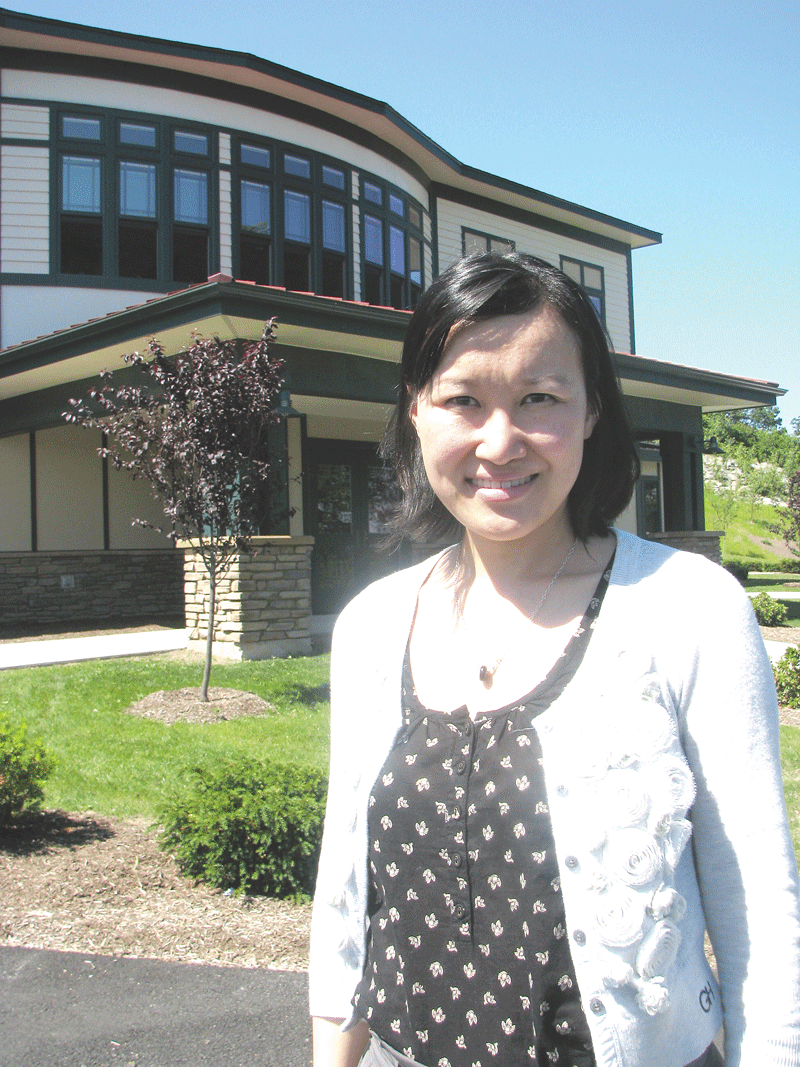
Fan Du

Fan Du says its was views from the top of the hill, like this one, that helped inspire her father to make the long-stalled Cold Spring Country Club a reality.

After a number of false starts and mis-steps, the long-awaited Cold Spring Country Club in Belchertown opened its fairways this spring. There has been the expected curiosity factor among regional players, getting the operation off to a solid start, but management understands that the key to success isn’t getting the attention of the golfing community — it’s holding it.

Fan Du says there was a great deal of buzz, or anticipation, that accompanied the recent opening of Cold Spring Country Club in Belchertown — and with good reason.
After all, this track, located just over the Ludlow line in a former apple orchard, has been more than 15 years in the making. Over that time, there have been several ownership groups involved, a well-chronicled foreclosure, and enough fits and starts to prompt the residents of that area to wonder if the vision would ever become reality.
“People have been waiting a long time for this course to open — there has been a lot of curiosity,” said Du, whose father, Sheng Du, a successful businessman in China and avid golfer, is the man responsible for resurrecting the project. He was able to look past the problems, she said, and focus on both the incredible views from the hilltop where the clubhouse was eventually constructed — and also the vast potential of the property to become home to a golf course and much more.
The challenge moving forward, said Bill Tragakis, head golf professional and club manager, is to maintain and build upon that buzz, and channel it into what will become a multi-faceted business venture, launched during a difficult time for the golf business in general and the economy as a whole.
But the requisite pieces are in place or on the drawing board, said Tragakis, adding that the highly anticipated golf course is merely the first one to fall into place. Others include the club’s 19th hole, a restaurant now open to the public that was launched with expectations that it could become a popular destination for residents of Belchertown and surrounding communities, as well as a large banquet facility to be located further up the hill and a housing component that has no timetable as of yet but will likely be commenced when that sector improves.

Bill Tragakis

Bill Tragakis says Cold Spring is off to a solid start with both memberships and public play, and it will need continued support for those constituencies to be successful.

The success of each of these specific ventures, as well as the larger development, will depend on management’s ability to capture and keep the public’s attention, said Tragakis, adding that the golf course itself is off to a solid start with membership (more on that later), as well as public play, despite a rainy spring, and the restaurant is drawing positive reviews from those who have discovered it.
In both cases, the goal is to bring people back repeatedly, he explained, noting that every course in the region is confronting the same basic challenge, and must respond accordingly.
“The keys are impeccable conditions for the golf course and superb customer service, and that’s where our focus has been,” he said. “This club has a resort appearance, and that’s by design.”
For this issue and its focus on the region’s golf industry, BusinessWest takes an in-depth look at the Cold Spring development, and why its managers look to the future with optimism and confidence born from a combination of persistence and imagination.

Designs on Success
Du, who has assumed a leadership role at the club with her husband, Willie Guo, told BusinessWest that one of the many assignments that had to be carried out over the past several months was selecting a logo for the venture, a branding mechanism now affixed to everything from ball markers to shirts; from golf-bag towels to a wide variety of head gear.
“There’s a lot that goes into this, and it took a while to create this look,” she said with a laugh, while displaying the eventual winner — the words Cold Spring juxtaposed against a leaf. The image contains several colors, including red, orange, gold, and a few shades of green, and it was chosen, said Du, to spotlight what is perhaps the club’s best selling point — the scenery, especially at fall foliage season.
It was the views at that time of year that captivated her father, said Du, adding quickly that the scenes from the top of the hill, which he discovered while looking for business opportunities in Massachusetts, were certainly not enough to prompt the requisite sizable investment in the project. Indeed, the initiative had to make good fiscal sense, she went on, something that outwardly appeared unlikely given the challenged state of the local golf industry and the prevailing opinion that this region was already saturated, if not oversaturated, with places to play.
But market analysis, not to mention instinct, indicated that there was room in the market for a higher-end, semi-private course that offered something distinctive, said Tragakis, formerly the pro at Hampden Country Club, adding that he believes that Cold Spring delivers those qualities.
The elder Du acquired the property in 2009, said his daughter, adding that preliminary construction on the course resumed soon thereafter, with grass put down early in 2010. Construction of the ornate clubhouse and a maintenance building commenced in 2011, and the course was open for business on May 1 for members and June 1 for the general public.
What the golfers have found is a test that is both stern and somewhat unique, said Tragakis, who points to the scorecard for some evidence. It has yardages for five tees, including championship markers that stretch the track to 6,521 yards. “And that’s the longest 6,521 yards you’ll ever play, because the actual yardage is somewhat hidden,” he said, noting that there are some uphill stretches, particularly the rugged par 4 18th, to go with some downhill holes, and a rare route to a par of 71.
Indeed, there are six par 3s (three on each side), and five par 5s, he said, noting that a typical par 71 would have four of the former and three of the latter.
The course architects, Armstrong Associates, located in New Mexico, essentially took what the land offered, and designed an intriguing test for players of all abilities, said Tragakis, adding that this is one of the many ingredients necessary to attract a large and diverse audience.
Overall, he describes Cold Spring as a mix of Crumpin Fox (in Bernardston) and the Ranch (Southwick), meaning the former’s tight, tree-lined fairways — which dominate the front side — and the latter’s open, sweeping fairways, prevalent on the back nine.
Thus far, the course has been successful in attracting both members and public play, said Tragakis, and it must continue to do both if it is to be profitable. “My goal is to make this golf course a fun, enjoyable experience for everyone,” he explained, “but especially for the members. We need them to come back, and we need to keep growing those numbers; that’s our rainy day money.”
The membership count now exceeds 200, and continues to climb each week, something unusual at this time of year, months after most area players have settled on a club to join for the year, he said, adding that many former members of nearby Hampden Country Club (now under new ownership) have joined Cold Spring. An attractive senior membership rate ($750) has attracted more than 70 people from that demographic group.
Meanwhile, there has been a steady stream of public play, with visitors from across Western Mass. and even Northern Conn., which Tragakis attributes to that aforementioned buzz factor, as well as some aggressive, targeted marketing.
The club has focused mostly on radio, including the expensive option of taking slots during Red Sox games and related programming, he noted, adding that the pitch line used at the end of each spot — “it’s the reason you play golf” — sums up how the club intends to differentiate itself.
The specific marketing message has varied through the first several months, he went on, adding that in the late winter and early spring, before the season started, the club was focused on memberships. Later, the emphasis was on the fact that the club had opened for play, and most recently, the accent has been on stressing that, despite its appearance (including the elaborate stone entranceway now under construction), Cold Spring is in fact open to the public, as is its restaurant.

Aggressive Course
And that’s important, because attracting golfers is just part of the success quotient, said Du, adding that there will eventually be several components to this venture.
For starters, there’s the club’s restaurant, called simply the 19th Hole Bar and Grille, which, like a growing number of facilities at public and semi-private courses (including The Ranch and Crumpin Fox), is open to the public and will be in operation year-round.
Ron Riopel, food and beverage manager for Cold Spring, said the restaurant is relatively small (just over 70 seats inside), but can accommodate more than 120 on a large patio that boasts sweeping views of the course and the hills beyond, and will likely stay open until at least mid-fall.
Beyond the scenery, the outdoor area will feature live music on many evenings (a ‘Caribbean Night’ was staged recently), and a menu Riopel described as “simplified but elegant.”
Elaborating, he noted that the fare extends well beyond traditional post-round food (most of it fried), and includes such options as pan-seared Pacific Ponga, a Vietnamese white fish.
The 19th Hole opened to members and the public on June 1, and like all new eateries, went through a breaking-in period, during which kinks were worked out and staff members came fully up to speed, said Riopel, adding that, as with the golf course, there has been a curiosity factor surrounding the restaurant that has prompted many area residents to take the drive up the hill.
And, also like the course, repeat business will be a function of delivering a quality experience, he continued, noting that he believes the facility should fare well in a region that doesn’t have a deep roster of competing restaurants.
Tragakis said some of the recent marketing has made reference to the dining element, underscoring its importance to the overall operation. “We have focused on food and beverage in these spots,” he explained. “We’re not going to forget about golf — we’re still a golf course — but public dining is a big part of what we’re doing, and I think the restaurant will do very well.”
Other components of the Cold Spring business plan are on the drawing board, to one degree or another, said Du, who told BusinessWest that plans are being developed for a banquet hall that will sit above the clubhouse.
The facility will be large in scale, and meet what she considers a recognized need in the Quaboag Valley region, she went on, adding that there is no immediate timeline for construction.
The same can be said for a housing component that most experts say is a key to the success of any large golf operation. There is considerable land on which to build houses or condos, she noted, adding that market analysis is currently ongoing, and it is likely that work will begin over the next five years.

Successful Roll Out
If all the pieces fall into place as expected, Cold Spring will become a formidable player in the large and seemingly ever-changing local golf market, said Tragakis.
He acknowledged that the industry is faced with many challenges — from the still-sluggish economy and its broad impact on discretionary spending, to stagnancy and even retreat in the number of people taking up the game, to the vagaries of the weather.
But venues that succeed in creating enjoyable and memorable experiences can overcome those issues, he continued, adding that Cold Spring has enormous potential to do just that.
“The view from up here is good,” he said, using that term in both a literal and figurative sense, “and we think it’s only going to get better.”

George O’Brien can be reached at [email protected]
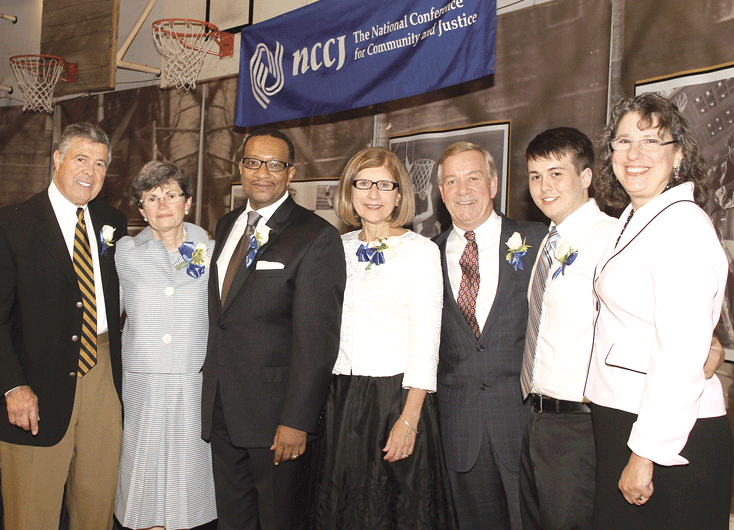
Education Sections
How the Tornado Helped Bring a School — and a Community — Together

Terry Powe

Terry Powe says the tornado that struck the Brookings School a year ago has helped provide a new sense of perspective for all those involved with the institution.

On the first day of school last August, a young girl pulled a broken chunk of slate from her pocket and showed it to Terry Powe.
“She told me it was a piece of our old school that she had found on the ground after the tornado and she kept it with her everywhere she went,” said the principal of Elias Brookings Elementary School in the Six Corners neighborhood of Springfield. “Her family had lost their home and was living in a shelter.”
The child was one of many Brookings families affected by June 1 tornado, which unleashed its fury on the neighborhood, destroying homes and businesses as well as the nearly century-old school.
Powe says it’s a miracle no one was hurt, as school was dismissed less than an hour before the twister hit the ground. “If it had been an hour later, there would have been deaths, and we would have needed grief counselors and still been in mourning,” she said, explaining that windows were blown out, walls collapsed, desks and furniture were strewn everywhere, and tree limbs and construction debris from nearby structures made the interior look like a war zone.
The girl with the slate is one of myriad anecdotes from the past 13 months that show, in rather dramatic fashion, how the school and the surrounding community has picked up the pieces — figuratively but also quite literally — and moved on, and with a renewed sense of commitment.
Indeed, while the tornado turned hundreds of lives upside down in that neighborhood, it has in many ways been a catalyst for the school’s rebound from poor performance ratings from the state and a feeling of being overwhelmed by the challenges being faced.
“People here see things differently now; everything has been put into perspective,” said Powe. “The tornado allowed everyone to take an inventory on life, realize the strengths we had, and put them into action. Since that day, everyone – including the children – has been working really hard and bringing their best efforts to school every day.”
Meanwhile, in the shadow of the boarded up school a modular facility has risen — a compelling story of triumph over adversity in its own right — and a new, $28 million school is being planned for a site at the corner of Hickory and Walnut Streets.
“The future is bright — so bright I might need sunglasses,” Powe said. “This really has been a blessing in disguise and allowed us to see how much care and thoughtfulness exists within different groups in the community.”
For this issue and its focus on education, BusinessWest visited Powe and others at the school to see and learn how a disaster gave all those involved with this institution a much-needed second wind.

Clouding the Issue
Powe has faced significant challenges since she was hired to run the Brookings school four years ago.
When she accepted the position, the school, named for a Civil War veteran and educator and opened in 1926, housed students in kindergarten through grade 8. However, officials decided to do away with the middle school classes and students in grade six, then seven and eight, began to be phased out.
The staff was still adjusting to the change when the Mass. Department of Elementary and Secondary Education named Brookings as one of the underperforming “Level 4” schools in the state. That’s the lowest level the state system has, and the designation required changes that included replacing 50% of the staff over a specific time line. In addition, the school day had to be lengthened by 45 minutes to give teachers more time to focus on areas where students had scored poorly on state tests.
“The designation gave us an opportunity to look at the root causes for performance and create a redesign plan to get back on track,” Powe said. “We implemented a plan without funding before the tornado hit and although we had some challenges, we did as much as we could to put it into action.”
It worked well, and prior to the tornado, the school had made significant gains; 25% of the staff members had been replaced, and although Brookings was still deemed underperforming, it had made double-digit gains in math and gained almost eight points in English Language Arts.
This year, thanks to additional funding, the school gained a new assistant principal and two additional coaches to help teachers hone their skills. “We have established a culture that we call the Brookings Way,” Powe said, adding quickly that change takes time.
However, she told BusinessWest that studies show that high-performing schools share three common traits — adaptability, cohesiveness, and a focus on goals, and all three are present, to one extent or another, at Brookings.
“Adaptation had been our lowest category,” said Powe. “In education, you have to look at the cards you are dealt and then play them, and our staff had had a really hard time playing those cards.”
And the tornado only shuffled the deck even further, she said, noting, however, that in many ways it has brought people closer together, provided fresh perspective on what’s important in life, and fostered a commitment to excellence that, in many respects, wasn’t there before the sky turned dark.

Winds of Change

Elias Brookings School Senior Custodian George Rollins

Elias Brookings School Senior Custodian George Rollins and adjustment counselor Gianna Allentuck say the tornado brought the school community together in a way that couldn’t have been imagined.

The day after the tornado, staff members assembled at two places: the school, where they worked to clear a path on the sidewalk, and at the Longmeadow home of adjustment counselor Gianna Allentuck.
Their first priority was to call every student to make sure they were safe. They then created a plan and took steps to kick off what would become a monumental collection effort for the 57 Brookings families that had lost their homes or been displaced.
The outpouring of support and donations was so substantial that Allentuck’s garage soon filled, so organizers staged a distribution program on July 1 in the J.C. Williams Community Center on Florence Street. They also held frequent distribution efforts outside the school, and students witnessed caring in action as their teachers stood outside throughout the summer, ready to share an encouraging word and a smile while handing out supplies that ranged from diapers to shampoo and underwear.
The staff members shifted their focus to collecting school supplies as the months went on and were astonished again by the outpouring of backpacks, crayons, and items students would need to return to classes. “My garage got so full, we had to rent storage space in Enfield,” said Allentuck, adding that the barrage of donations included stuffed animals, sleeping bags and towels, which necessitated a second major distribution effort.
Throughout the summer, staff members also visited families in shelters, hotels, and their homes to see how they were faring, and gave them donated items, while school nurse Pam Maynard did a tremendous amount of outreach.
The staff had also united to help the students finish the year in the days following the tornado. The children arrived at Brookings in the morning, then had to be bussed to two different schools depending on their grade, which meant many family members were split up.
“There were a lot of logistics involved and some of the younger kids were frightened,” said Allentuck. “It could have been chaotic, but the staff stepped up and made sure the children felt safe and loved. It was our finest hour.”

Moving Experience
In the meantime, school officials were working hard behind the scences to insure the children had classrooms to return to at summer’s end.
David Meehan, director of operations for Facilities Management in Springfield, said finding modular units, getting permits and assembling them in less than two months was a daunting challenge. “We did it in approximately 45 days; a project of this scope would normally take 90 days or more to complete,” he explained.
Rita Coppola-Wallace agreed. “A lot of people don’t realize the effort that goes into a project like this,” said the director of the Department of Capital Asset Construction in Springfield. “It took an extreme amount of coordination, but the vendors and city departments all rose to the challenge and did more than they needed. We literally pulled permits within hours, and everyone I called was phenomenal, from the contractor to the funding agencies.”
Thirty portable classroom structures, including 20 two-story units and 10 one-story units, were installed behind the old school on Hancock Street.
But there were unexpected setbacks. For example, right before the Fourth of July, water began gushing from the ground as workers set footings 30 feet into the ground. “They pumped water 24-7 for a week,” Coppola-Wallace said, explaining that the site is close to the Mill River. “It was a tough experience, but we had fun along the way. When people get hit by tragedies, their best side comes out.”
Meehan said Brookings senior custodian George Rollins played a major role in getting the job done on time. He worked close to 90 hours each week from the day following the tornado until school opened.
Rollins cares deeply about the school. It’s his alma mater, and he was determined to salvage everything possible from the old building, then do whatever it took to have the modular units ready for the children.
“At one point, we had 25 people cleaning furniture from the old building. We also had to coordinate getting teachers in and out of the building in the days following the tornado,” Rollins said, explaining they needed to salvage what they could from their classrooms, but could not stay inside long due to air- quality issues caused by the devastation.
“We put our heart and soul into this,” he continued. “It brought us together because we had to depend on one another. Everyone had to be cooperative and understanding, and even the kids had to give. They had to adapt to difficult circumstances, which for some included losing their homes.”
But stability seemed hard to come by, as the day Brookings was set to open, all Springfield Public Schools were closed due to an approaching hurricane, which downed trees, caused power outages, and wreaked its own devastation. And in the weeks that followed, there were myriad new adjustments as 25% of the staff was new hires and the modular units lacked a cafeteria, gym, and storage space.
But the community continued to step forward, and the spirit of cooperation and changes that took place within the school were remarkable.
Teachers held a book drive throughout the school year that proved so successful that each child was allowed to choose four books to keep at the end of the year. The school also staged a “Perfect Attendance Day” and due to community support, each student being honored received a $10 gift certificate. Allentuck said the numbers jumped from less than five with perfect attendance in February of 2010-2011 to 55 this year.
Staff members also began to pursue grant money that resulted in positive outcomes.
“This has been a year of celebration; even though I am a hopeful person, I never imagined we would be sharing the celebratory attitude that has been prevalent all year,” Allentuck said, adding that she doesn’t believe the transformation would have taken place without the tornado.

New School of Thought
Initially, the city hoped to save the 87-year-old school building, but a feasibility study determined that was not feasible. When the need for a new building became apparent, city officials approached Springfield College, because it owned a sizeable piece of vacant piece of land across Walnut street.
“It was not for sale, but they quickly jumped on board and were willing to become a partner,” Coppola-Wallace said. City officials are in the process of acquiring the land and plan to build a $28 million state-of-the-art school on it to replace the old building.
“I am very hopeful that we can finally get ahead of the game, because in the past the constants were always changing,” said Powe “We have stability now and I am looking forward to next year and the future in a new building.”
The day when that new school opens its doors is still a long way off, and there will no doubt be many challenges to overcome along the way.
But the tornado has fostered a new sense of resiliency at the Brookings School. All those involved, including the young girl with the slate, have picked up the pieces and shown that a disaster of this magnitude can destroy a building — but not dreams.

Sections Workforce Development
One-stop Career Centers Rely on Partnerships to Fulfill Their Missions

Executive director Rexene Picard

Executive director Rexene Picard says FutureWorks has made changes in the way the agency serves customers due to shifts in the economy and advances in technology.

When one-stop career centers began opening across the state 16 years ago, David Gadaire said, the mantra connected to them was “no wrong door.”
“The concept was one of universal access,” said the executive director of CareerPoint in Holyoke. “If someone needed to brush up on their skills, get help with writing a résumé, learn to network, or get more training, they could find it under one roof, whether they were a school-age person or an older worker.”
The concept was forward-thinking, but the funding was never in line with the complexity of need that job seekers brought to the table. Still, the problem wasn’t nearly as evident in the early years when the economy was flush.
“For the first few years we were open, 50% of the people we saw were employed,” said FutureWorks Executive Director Rexene Picard, explaining that many came to the center to brush up on skills or take a Saturday class.
Gadaire agreed. “In the beginning, we had enough resources. It was a different game then, and the funding we had supported people who needed to harness their skills,” he said.
FutureWorks and CareerPoint achieved national recognition in 1998 when they were selected as Career Centers of the Year by the National Alliance of Business.
“It was a tremendous honor, but the funding kept dissipating as the numbers grew,” Gadaire said. “We were originally chartered to serve 7,000 people a year, and last year we served between 14,000 and 18,000. The numbers have gone up steadily, and although they have plateaued in the last few years, it is only because our capacity is so overstretched.”
The unemployment office has a representative at both centers, and many people confuse the entities. But the former is run by the state, while the one-stops were established through competitive charters.
CareerPoint was chartered as a nonprofit and opened 16 years ago via a partnership that included the Greater Holyoke Chamber of Commerce, Holyoke Community College, the Department of Transitional Assistance, and the UMass Donahue Institute. “They joined together because there was a disconnect between the jobs that were available and the skills of the people available to fill them,” Gadaire said.
The story of FutureWorks is quite different. It was opened in 1996 as the first one-stop in the state by the Employment Training Institute in Ringwood, N.J., owned by Ken Ryan. Granting a charter to a private, for-profit corporation was controversial, but “it gave us a chance to think outside the box,” Picard said. “In the beginning, we said that what we did was not going to be about numbers, it was going to be about customer service. We had welcome centers and made people lifetime members. We could have fallen under the realm of social services, but we felt we were role models for job seekers and wanted to reinforce soft skills, so the center had the atmosphere of a business,” she told BusinessWest.
Although their evolution has been different, it soon became apparent that the needs of the people who came through the doors of both centers were complex, and the funding to help them was far from adequate. “In 1998 when the Workforce Investment Act was passed, the intent was that community partners would support the one-stops. But it never happened,” Picard said.
Still, they have found a way to meet a myriad of complex challenges. “We don’t tell our story well, and it’s a very impressive story,” said Gadaire. “But if 10,000 more people came to our door, I don’t know what we would do.”

Complex Situation
After CareerPoint received its award, it became even more committed to its mission, said Gadaire.
“Universal access meant we had to serve the older worker, the school-age person, professionals, and mid-level executives who found themselves out of work and needed to grow their skills, as well as people with a disability, those who had been incarcerated, homeless people, and individuals who didn’t have an education or didn’t speak English,” he explained. “All of those things required a more significant amount of time than the one-stops were prepared to address. But we realized that we were part of the answer for every one of those populations.”
Since the state did not have money to serve these subgroups, CareerPoint began writing grant proposals, seeking help from corporations and forming alliances with a wide variety of venues, such as the Hampden County Sheriff’s Office.
Today, it operates via seven or eight funding streams and grants that are continually changing. “We have a youth center due to six or seven grants, but we had to carve out a funding strategy,” Gadaire noted.
Finding sources of revenue is a constant struggle because the number of organizations looking to them for help continues to rise. “We’ve tried to create a marketing budget, but it keeps dwindling away. If the choice is marketing or helping a homeless person, the answer is obvious,” he said.
Although the agency initially provided free in-house training for businesses, it began to charge for those services. “We conduct sessions for businesses to help them manage their workforce. We’re giving a series of workshops right now to teach mid- to upper-level managers leadership skills — how to resolve problems, make their workers more productive, and avoid turnover,” Gadaire explained, adding that his organization is also set to launch a videoconference-training program to teach businesses how to conduct remote, face-to-face interviews, which he says will save them time and money.
Since the way people find jobs has changed, CareerPoint has two computer labs where people can become versed in new software and learn how to apply for jobs online. It also stages classes in networking, résumé writing, and a host of other topics related to finding employment.
When the one-stop center opened, it had 36 staff members, but that number has been reduced to around 30. However, it has compensated by forming alliances with many agencies and organizations. It has nine people from different agencies stationed within its office, and makes use of interns.
CareerPoint has also benefitted from countless hours of volunteer help from the Americorps Volunteers in Service to America program. VISTA volunteers have worked with youths involved with gangs as well as seniors, and include one volunteer who is the center’s information-technology manager. “We’ve also tried to build bridges with Westover Job Corps and agencies that offer veterans’ services,” Gadaire explained.
The agency’s staff members are so dedicated that, when they were told recently that two positions had to be eliminated, they offered to save them by taking a 10% pay cut for six months. Gadaire was against the idea, but finally agreed that everyone (including himself) would do it, and much to his surprise, it worked.
“These people are extraordinary; they believe in the community and want to make a difference,” he said. “But they are always exhausted, and I forever worry about burnout.”
Many sit on local nonprofit boards where they build partnerships. “Our partnerships are absolutely critical,” he said. “We are not experts in everything, but hopefully, if we do it right, we can expand our capacity. The community is better-served by our willingness to partner on just about every issue.”

Radical Changes
When FutureWorks opened, it was the only one-stop center in the state operated by a private company. Although profits were capped, Picard said many grassroots organizations and labor groups were upset that a private firm was operating with funds from the state and federal government.
So, in January 2002, after a series of meetings with then Springfield Mayor Michael Albano and Bill Ward, director of the Regional Employment Board of Hampden County, the owner agreed to turn over FutureWorks, with the caveat that it become a nonprofit agency. “The decision meant a lot in terms of restructuring,” Picard said, noting that the corporate headquarters of the Employment Training Institute handled the agency’s finances and human-resource issues.
“It was like starting a new company,” she said. “But having our own board of directors turned out to be one of the best things that happened; we had a very business- oriented team, and the community began viewing us differently.”
The change in status also allowed FutureWorks to pursue grants and funding unavailable to it as a private company. “We also began partnering with staff from other agencies,” Picard said.
One of its most profitable ventures was a shared contract that allowed the agency to work with welfare recipients in Hampden County. “We put more welfare recipients to work than in any other part of the state,” she said.
But despite such gains, the customer base continues to mushroom. “When we started, we saw between 3,000 and 5,000 people a year; last year, we served more than 16,000 individuals,” she noted, adding that FutureWorks consistently leads the state and serves more minorities, youths, and individuals with disabilities than any of the other career centers. “But in order to do so, we have had to look outward to other opportunities.”
These include a unique partnership with the Department of Revenue. The joint effort allows FutureWorks to work with non-custodial parents to help them get jobs so they can pay child support.
The program began as a pilot and expanded to include the family court system. In time, FutureWorks received a performance-based contract to extend the initiative. “It’s been a great program, and we have been told there is only one other place in the nation doing this. It’s in Tennessee, but we are unsure if we will be able to continue it,” Picard said, adding that they have not heard if their latest grant proposal will be extended.
Since Springfield is four times the size of Holyoke in terms of population, FutureWorks receives more funding than CareerPoint. But agency partners are equally critical to its ability to serve people and their on-site representatives. Those partners include Westover Job Corps, the Mass. Rehabilitation Commission, the Department of Education, the Resource Partnership, Hampden County Jail, the Mass. Commission for the Blind, the Commonwealth Corp., and state agencies such as the Department of Social Services and the Division of Employment and Training.
As the labor market has undergone change, FutureWorks has focused on health care and precision manufacturing, since those industries continue to experience growth.
The agency takes advantage of every opportunity, and was the second one-stop in the state to receive a national emergency grant related to a weather disaster. Picard said the Regional Employment Board received $3 million after the tornado on June 1, 2011 that allowed FutureWorks to hire people to do humanitarian work as well as clean-up, which in some instances led to full-time employment.
“We hired four staff people to administer the grant money; two focused on Springfield, and the other two focused on Monson and Brimfield,” Picard explained, adding that the agency has also deepened its link with Springfield Technical Community College.
“There is work taking place on both sides of the fence,” she said, adding that the agency has an STCC staff member on site.

Changing Tide
Gadaire said the one-stop career centers are opportunistic.
“Sometimes a program starts because we can easily fill a need, and sometimes the need has been there, and we finally find a way to fill it. But we don’t ever give up trying,” he said.
Picard agreed. “The one-stops have achieved a 50% rate of employment for the people they serve,” she said. “We’re here to give people hope.”

Law Sections
Crear, Chadwell & Dos Santos Charts an Ambitious Course

From left, Tony Dos Santos, Kimberly Davis Crear, and Jim Chadwell.

From left, Tony Dos Santos, Kimberly Davis Crear, and Jim Chadwell.

Tony Dos Santos remembers thinking — actually, the word he used was knowing — that it was definitely time for a career course change.
And as he talked about the thought process that led him to that conclusion that he needed to leave the larger-law-firm environment — in this case the Springfield-based firm Robinson Donovan — and find an opportunity to put his name over the door, he struggled somewhat in his efforts to describe it before eventually finding the terminology he was looking for.
“I just wanted to be in much greater control of my destiny,” he told BusinessWest. “I realized that being more of my own boss, being in a smaller place where there’s more flexibility and less structure, was what I was looking for at this stage in my career.”
Kimberly Davis Crear and Jim Chadwell could certainly relate.
They had come to the same basic conclusion about their careers several years earlier, and decided, separately, to leave Robinson Donovan and start their own firm. Crear did so in 2003, when she partnered with two former Robinson Donovan partners, and Chadwell joined that firm a few years later. He and Crear have remained together (the two other partners left to start their own venture), and built a solid reputation — and sizable portfolio of clients — in the realm of workers compensation defense work.
Late last year, the partners began talking with Dos Santos about broadening the base of their firm by adding his name to the letterhead and his expertise — commercial real estate and general business law — to the resume.
Those talks, which coincided with Crear and Chadwell’s need to find new quarters — their lease was up in space within the Fuller Block that will become the new home to WFCR — concluded that this was a good fit on many levels.
“We all knew each other, we’ve all worked together … we had a lot of history together,” said Dos Santos. “It’s helpful when you’re making a move to know the people you’re going to be working with and respect them.”
Chadwell agreed, and noted that the three lawyers, who have been referring clients to each other steadily for years, complement one another, and together offer a base of specialties that provides strong growth potential.
On April 1, the three partners and seven additional staff members settled into 3,500 square feet on the third floor of Monarch Place. And with the settling in period behind them, they’re focused on continued growth of their own practices and, in Dos Santos’ making that transition from lawyer to business co-owner.
For this issue and its focus on business law, BusinessWest talks with the three partners about where they eventually want to take this firm, but mostly about that notion of controlling not only their destiny — but that of their business venture.

Making Their Case
As she talked with BusinessWest about the feel of a small boutique firm and what she likes most about it, Crear pointed to the logo on her new business card.
The square image featuring three initials (‘C,’ ‘C,’ and ‘D’) as well as the ampersand, was selected after input from all three partners, who had an active role in the design process, which went fairly smoothly, she said, adding that such democracy — not to mention quick decision-making — doesn’t generally prevail at most large firms.
“I have a comfort level with this setting that I just didn’t have in a larger firm,” she explained, noting that over the past decade or so, she and Chadwell have become well versed in what both described as the “business side” of law — meaning everything from hiring personnel to handling a payroll to leasing a copier — and out of necessity.
Dos Santos, meanwhile, is still negotiating a learning curve.
“When you’re in a large firm, you don’t deal with any of the real day-to-day issues,” he said, referring to everything from IT matters to lease agreements, which he handled in this case. “You have either an executive committee or a professional executive who’s making all those decisions, and you’re just focused on practicing law; now, you’re more of a business person practicing law.”
While that transition process continues, the three partners are working to build the business they’ve formed. And for Crear and Chadwell, that means efforts to grow their already substantial portfolio in workers compensation defense work.
Both benefited substantially from the tutelage of former Robinson Donovan partner Jim Turtollotte, said Chadwell, describing him as the dean of the local workers comp defense bar, and have steadily expanded their client base over the years.
It now includes most all of the major workers comp providers, as well as self insured companies and groups, not only in Western Mass. but across the state as well.
And while such defense work generally involves the carriers, there is considerable employer involvement in such matters, said Crear, and thus the opportunity for referrals and a chance to do more and different types of work for those on the client list.
“I often have someone from the corporate piece of the company with me watching the workers comp claim,” she explained, “and as a result, we’ve been able to establish a number of relationships.”
And this is why Dos Santos is an important addition for the firm.
A partner at Robinson Donovan when he left that firm, Dos Santos specializes in all facets of commercial real estate, commercial finance, and general business law. He has significant experience representing developers, investors, and lenders regarding complex commercial real estate transactions, including acquisitions, dispositions, leasing, financing, zoning, and permitting, and recently has cultivated a niche involving affordable housing initiatives for formerly homeless veterans, including work with the nonprofit work Soldier On.
“They’re expanding exponentially, and I’ve done a lot for them,” he said of Soldier On, adding that one current project involves the former police training facility in Agawam, while another involves Veterans Administration property in Leeds.
When asked if there was anything approaching a five-year plan for the firm, Chadwell laughed and said, “we signed a five-year lease here — that’s our strategic plan.”
Elaborating, and turning more serious, he said the new venture, with its broader range of specialties, has solid growth potential. Where, when, and how that growth takes place is a function of how the three partners are able to expand their portfolios — possibly necessitating the need for more help — and whether there are logical additions to the roster of specialties that would bring more lawyers to the firm.
One possible avenue for growth is the broad realm of employment law, said Chadwell, adding that it would be a natural fit given the general business law work handled by Dos Santos and the workers comp defense services that he and Crear provide.
“I could see employment law being a tremendous fit going into the future with the nature our practices,” said Chadwell, noting that all three partners already refer out a considerable amount of work in that area. “And it’s an ever-growing practice area.”
The firm has the right of first refusal on some additional space on the third floor, said Chadwell, adding that it is hope — and expectation — that there will be need to exercise that right in the near future.

Final Arguments
As she gave a quick tour of the firm’s new offices, Crear noted that she swung a swift, mutually beneficial deal with Chadwell to take what would be considered the corner office. Dos Santos, meanwhile, got a consolation prize of sorts — the office closest to the conference room.
Such quick, easy decisions usually don’t happen at larger firms, where bureaucracy and rules often dictate such matters.
But they are part and parcel to life in a small boutique firm, where the principals are firmly in control of their destiny — and determined to make the most of that opportunity.

George O’Brien can be reached at [email protected]

Departments People on the Move

Wolf & Company, P.C. recently announced the promotion of Mark O’Connell, CPA, to the position of President and CEO of the firm, effective July 1. O’Connell has been a member of the 100-year-old company since 1997, and spearheaded the development of its Springfield office, which he most recently served as dirctor. O’Connell will continue to work out of the Springfield office. He is a member of Wolf & Company’s financial-institutions group, and formerly held a seat on the firm’s executive committee, which establishes the firm’s policies and strategic direction.
•••••

Thomas R. Creed

Thomas R. Creed

TD Bank has named Thomas R. Creed Senior Vice President and Market Commercial Credit Manager in the new Credit Management Division in Springfield. Creed will direct approval, underwriting, and portfolio-management, staff, and procedures supporting TD Bank’s commercial-banking business in Western Mass. Creed has 27 years in banking and related fields and serves as chairman of the Holyoke Redevelopment Authority and on the board of the Economic Development Council of Western Mass.
•••••
United Bank announced the following:
• Amy Bilodeau has been promoted to the position of Personal Banking Officer at the West Springfield branch. She joined United Bank in 2008 with nearly 25 years of banking experience gained at the former Westbank, now New Alliance Bank, in West Springfield; and
Ronald A. Gannett

Ronald A. Gannett

• Ronald A. Gannett has joined the bank’s Beverly loan production office as a Senior Vice President in Commercial Baking, focusing on commercial real-estate opportunities in the Greater Boston area. He will assist in building the bank’s brand and commercial real-estate business in that area, while complementing the current activity in the Greater Worcester and Springfield areas.
•••••
American International College announced the following:
Linda Dagradi

Linda Dagradi

• Linda Dagradi, a 1971 AIC graduate, has been promoted to Vice President for Enrollment Management. Dagradi has most recently incorporated Admissions, Marketing, and Financial Aid into the umbrella of Enrollment Management to aid AIC in growing its student population both at the undergraduate and graduate levels; and
Nicolle Cestero

Nicolle Cestero

• Nicolle Cestero has been promoted to Vice President for Human Resources. In that position, she will supervise and direct the human-resources activities of the college.
•••••
Business Network International (BNI) Western Mass. recently appointed Jason Turcotte as Managing Director for the region. Turcotte will be responsible for overseeing and providing continued structure, training, and support to the chapters and members of BNI Western Mass. He will ensure that every chapter is following the BNI system and is on pace to achieve goals, as well as supporting the leadership teams within the region.
•••••
Elizabeth B. Rairigh

Elizabeth B. Rairigh

Elizabeth B. Rairigh, AICP, recently joined the Pioneer Valley Planning Commission as a Historic Preservation Planner. She holds a master’s degree in Historic Preservation and a master’s in City Planning from the University of Pennsylvania.
•••••
Thomas A. Miranda, an attorney with Springfield-based firm Cooley, Shrair, P.C., recently presented the seminar “Using Mediation to Settle Property Disputes” at the 2012 spring session of the CPE Forum at Holyoke Community College Kittredge Center. The forum provides educational programs to business professionals, including CPAs and CMAs. Miranda also recently presented a session on “Business Entity Organization and Structure to Limit Liability” at a Hampshire County Bar Assoc.-sponsored small-business-entity seminar.
•••••
Richard J. Kos

Richard J. Kos

The Board of Directors of Hampden Bancorp Inc., which is the holding company for Hampden Bank has named Richard J. Kos, Esq. to Chairman of the Board of the company and the bank, effective immediately. Kos has been an attorney at the firm of Egan, Flanagan & Cohen, P.C. since 2004 and is a partner of the firm. Prior to that, he had been in private practice since 1978, and was mayor of Chicopee from 1997 to 2004. Kos has a bachelor of science degree in Economics from Amherst College, and a law degree from Suffolk University Law School. He currently serves as a trustee of Our Lady of the Elms College, chairman of the Chicopee Chamber of Commerce, a member of the Board of Incorporators of the Mason Wright Foundation of Springfield, and a member of the Board of Directors of the Regional Employment Board of Hampden County. He has held prior directorships with the Pioneer Valley Red Cross, the Polish National Credit Union, Providence Place, the Economic Development Council of Western Mass., and the Westover Metropolitan Development Corporation. He had been
an incorporator of Chicopee Savings Bank.
•••••
The YMCA of Greater Springfield announced that four area leaders from the business and non-profit communities recently joined its Corporate Board of Directors. They are:
John Doleva

John Doleva

• John Doleva, President of the Naismith Memorial Basketball Hall of Fame;
Lorenzo Gaines

Lorenzo Gaines

• Lorenzo Gaines; Program Director for ACCESS Springfield;
Paul DiGrigoli

Paul DiGrigoli

• Paul DiGrigoli, Owner/CEO of DiGrigoli Salon and DiGrigoli School of Cosmetology; and
Jeffrey Poindexter

Jeffrey Poindexter

• Jeffrey Poindexter, an attorney with Bulkely, Richardson and Gelinas, LLP.
•••••
Friendly Ice Cream in Wilbraham recently announced the following appointments and promotions:
• Walter Kwiecien has been promoted to Director of Information Technology;
• Lionel Bisson is now Director of Training and Quality Assurance and will direct all training and development function and the quality assurance inspection process;
• Ana Alves, with the company since 1977, has been named Manager of Restaurant Technology and will be responsible for managing and developing point-of-sale systems;
• Valerie Doggett has been named Audit Service and Quality Service Assurance Manager, where she will be responsible for conducting quality service audits in both company as well as franchise-owned restaurants;
• Joseph Stiefel, a member of the IT Department since 2006, has been named Project Manager, and will be responsible for leading program development projects as well as supporting current systems from a programming and database perspective;
• Melany Howe has been appointed Senior Manager for financial planning and analysis, providing financial support and analysis for restaurant operations and all marketing and promotion activities;
• Matt Vitorino has been named Senior Financial Analyst, and will provide financial support and analysis for retail, co-pack and franchise operations;
• Christine Klingaman has been named the Franchise Business Consultant supporting several of Friendly’s franchise organizations as a liaison between the franchises and Friendly’s Support Center;
• Lynne Geiger, a 25-year employee, was named Point-of-Sale Systems Administrator, where she will be responsible for developing and maintaining Friendly’s POS systems as well as maintaining various software platforms;
• Richard Del Valle has been appointed Vice President of Restaurant Operations Support, where he is responsible for all restaurant operations support and quality assurance and training.