
Home 2015 (Page 15)
Sections Sports & Leisure

A Nation of GMs

fantasySportsDPart

Fantasy sports — born decades ago as a niche pastime for baseball überfans who tracked statistics by hand with calculators — has since exploded into an instant-data industry that claims more than 56 million participants. Most of those drafted their football teams last week in anticipation of the season, while others will put up money to redraft each week on sites like FanDuel and DraftKings. One thing is for sure: whether for fun or profit, the fantasy world has changed the way people watch sports — and the leagues, networks, and advertisers couldn’t be happier.

Before Mark McDonald jumped into fantasy football, he’d watch the Patriots on Sunday, and not much else. But now?

“It has dramatically changed my viewing habits,” said McDonald, a professor of Sport Management at UMass Amherst. “Games between horrible teams, games that once meant nothing to me, now I want to watch to see how my fantasy team is doing. I like that sense of control — I’m the general manager, controlling my own team, and watching other players to see who I might pick up. It changes your view of football. Even Thursday nights are must-watch.”

McDonald started playing GM four years ago when fellow faculty members at the Isenberg School of Management invited him into their league. He’s been hooked ever since, and was preparing for drafts in two different leagues the week he spoke with BusinessWest.

He’s not alone. The number of people participating in fantasy sports — football, baseball, basketball, hockey, even golf and auto racing — is expected to reach 56.8 million this year, a staggering increase of 37% from 2013, according to the Fantasy Sports Trade Assoc. (FSTA).

The vast majority play in season-long leagues, going head to head with a different team’s owner each week. But, increasingly, ‘daily’ fantasy sports, played for real money — FanDuel and DraftKings are the two giants of this industry — are becoming more popular. At the end of 2014, the two online services posted a combined $920 million in entry fees from 1.3 million paying users — numbers this year’s participation is expected to far surpass.

“It gives fans another connection point,” said Janet Fink, another UMass professor and chair of the Department of Sport Management. “Fantasy football is much more widely popular than any other fantasy sport, but they’re all growing. And now you have these day-to-day, week-to-week leagues getting more popular as well.”

Indeed, fantasy sports has come a long way from its 1970s origins, when hardcore baseball players played something called Rotisserie, drafting players at the start of the season, then tracking their statistics, by hand and with calculators, and translating those stats into a scoring system. Today, the data is instantaneous, meaning owners can sit on the couch with a smartphone and watch the points roll in.

And, by the tens of millions, that’s exactly what they do.

Fan Fare

Andrew Zimbalist, a professor of Economics at Smith College and one of the world’s foremost sports economists, has observed the impact of fantasy sports on American life, which goes well beyond that annoying guy in the lunchroom on Tuesday complaining about losing by a point because Julio Jones dropped an easy touchdown Monday night.

“It’s something that increases the avidity of fandom and, in some cases, extends fandom,” he explained. “People who are involved in fantasy sports are paying much more attention to the game. They subscribe to more online services and satellite services.

“The other effect they have, to some degree — and it differs by sport — is more generalized fandom,” he went on. “If I’m a Red Sox fan living in Massachusetts, without the fantasy-sports component, I’m following the 25 people on the active Red Sox roster. But if I have Mike Trout in my fantasy-baseball league, if I’ve got Joe Mauer on my team, I’m not only into the Red Sox games, but Angels games and Twins games, etc.”

That sort of changed behavior is something sought after and prized by professional sports leagues, Zimbalist added.

“Football, for a variety of reasons, has long been a national sport; even though fans have a team they follow and support, true football fans will watch two games, and might stay around for Sunday evening,” he explained. “But in the other leagues, like baseball — say you’re a Padres fan living in San Diego. You’re going to watch the Padres games; you’re not going to watch the Giants or Diamondbacks. But some of the fandom becomes nationalized when you have fantasy sports leagues. That is a very valuable component — and it’s a growing fandom.”

No wonder, then, that ESPN hosts the most popular fantasy platform (Yahoo! is the second-largest), while DraftKings recently secured $300 million in funding from Fox Sports, Major League Baseball, the National Hockey League, and Major League Soccer. In return, the company plans to give away $1 billion in prizes this year, more than triple the $300 million it awarded in 2014.

Meanwhile, the larger play-for-cash entity, FanDuel, which pays out more than $10 million in prizes every week, recently raised $275 million from investors, including affiliates of Google, Comcast, and Time Warner.

Janet Fink

Janet Fink

“Research has been done asking whether, if people got too much into fantasy sports, it might decrease their interest in their own team,” Fink said. “In fact, they found quite the opposite. People around here still root for the Patriots, but they flip to the Red Zone to check out their fantasy team. That way, the viewership of games league-wide increases. There’s extra incentive to watch the Chargers versus the Raiders when you wouldn’t do that normally.”

McDonald is familiar with DirecTV’s Red Zone channel, which jumps, all Sunday long, between teams on the cusp of scoring — a fantasy maven’s dream. He noted that his league’s owners get together twice a year for Sunday viewing parties, but they don’t watch the Patriots; they watch Red Zone. “One aspect to fantasy that’s a bit negative is how it impacts viewing your favorite team.”

Fink has read studies showing that, while some fantasy hobbyists remain more interested in their home-state team, others come to identify more with their fantasy players and seek them out on TV instead. “But in most cases,” she added, “it’s probably a very complementary relationship.”

Speaking of relationships, McDonald believes fantasy football has strengthened connections between the people he works with at Isenberg.

Mark McDonald

Mark McDonald

“As with any business school, we have a bunch of different departments — accounting, finance, management, marketing … seven or eight in all. There are faculty members I might not otherwise interact with, and now, if I run into the owner I’m playing against that week, we’ll get some friendly trash talking going on in the hallway. You get to know each other. We find ways to get together now.”

Real Money

Advertisers covet the fantasy-sports market, according to the FSTA, which reports that team owners are mostly college-educated with an average household income topping $75,000. At last measure, 66% of participants were male, and 34% female, but those figures have been steadily moving toward each other in recent years.

However, the daily and weekly games at FanDuel and DraftKings remain almost exclusively the domain of men. Meanwhile, a survey of more than 1,400 players by Eilers Research found that more than 40% of these players have reduced the amount of time they devoted to traditional fantasy leagues.

“Everyone I know is pretty much in it for season-long fun, low-stakes games. But I am concerned that our students are increasingly drawn to that world,” McDonald said of the high-risk sites, saying they’re occupying a role that online poker recently dominated.

But — because of the obvious risk involved — is it legal? The Unlawful Internet Gambling Enforcement Act (UIGEA) of 2006, intended to regulate the financial institutions that act as the monetary link between gamblers and Internet casinos, seems to say yes.

While some states — Arizona, Iowa, Louisiana, Maryland, Montana, and Vermont — have enacted their own laws muddying the waters around this issue, the vast majority of states, including Massachusetts, have not.

That leaves the UIGEA as the go-to authority, and the federal law specifically does not regulate games in which “all winning outcomes reflect the relative knowledge and skill of the participants and are determined predominantly by accumulated statistical results of the performance of individuals (athletes, in the case of sports events) in multiple real-world sporting or other events.”

In other words, in the eyes of the law, fantasy sports are considered games of skill, not luck.

McDonald, again noting the excitement of a weekly draft, worries about their appeal and the potential for addiction and financial trouble, no matter how shrilly FanDuel and DraftKings shout about millions in winnings on their ubiquitous radio ads.

“It’s so exciting to redraft and select your team every week,” he told BusinessWest. “They may think the way we old guys play is slow and boring. If you have injuries early in the season, it can kill you. But with the weekly games at DraftKings and FanDuel, you get away from that, and every week is a new opportunity to make choices.

“But,” he went on, “people do put a lot of money at risk, and I think it’s addicting. It’s like crack to fantasy sports players. It’s a weekly high, and in a sport like baseball, it could be a daily high.”

For now, McDonald considers himself firmly in the camp of more than 55 million people who have become amateur GMs not for big payouts, but for the fun, the challenge, and the camaraderie.

“It’s a social thing that enhances the viewing experience,” he said. “For me, personally, putting money at risk would take some of the fun out of it; I think it would be very stressful.”

After all, trash talk is stressful enough.


Joseph Bednar can be reached at [email protected]
Sections Sports & Leisure

Pioneer Volley

George Mulry

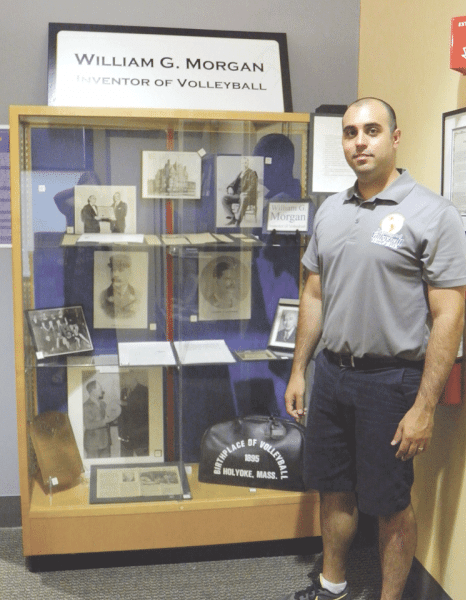
George Mulry stands in front of one of the many displays at the Volleyball Hall of Fame, which is seeing a rise in visitorship.

In 1895, William Morgan invented a game he called ‘mintonette’ for adult males at the Holyoke YMCA in hopes of retaining members who were leaving because they found another recently invented game, basketball, to be too violent.

“He was the Y’s physical-education director, and he created the sport so middle-aged businessmen would have something to do on their lunch break,” said George Mulry, executive director of the International Volleyball Hall of Fame in Holyoke. “The name of the game was changed to volleyball a year later by a professor at Springfield College, and today, it’s played by more than 880 million people. It is an international powerhouse sport, the second-most-popular game in the world, and one of the most popular at the Summer Olympics.”

Indeed, the game has come a long way since it began in a small gymnasium in Holyoke. It ranks as one of the top sports in nine countries, and the Fédération Internationale de Volleyball (FIVB) boasts 220 members, making it the largest sports federation in the world.

“I see more people smiling when they are playing volleyball than I do in any other sport; it’s a great game, and people at any level not only enjoy it, but appreciate the camaraderie it promotes,” said Charlie Diner, a member of the Hall’s board of directors. “Volleyball is a game that is fun.”

In many ways, the Hall of Fame created to honor the games, founder, legacy, and greatest players, coaches, and contributors has followed a somewhat similar path.

It started in a closet in Wistariahurst Museum, with some additional space in Holyoke City Hall for storage. It has moved a few times over the years, but has generally struggled to find adequate space and resources to properly tell the game’s intriguing story.

But the Hall has gained some much-needed momentum in recent years, building awareness, gaining visitorship, hosting more events, and adding new displays to capture the game’s progression and impact on society.

Visits to the museum are on the rise, and today, 4,000 to 5,000 guests embark on the self-guided tour inside the space each year. One thing they particularly enjoy is trying on the Gold Medal won by Maurico Lima at the 1992 Summer Olympics. The athlete was inducted in 2012 and donated the medal to the museum, along with other memorabilia.

“Many people pose for photos wearing it around their necks. It’s a popular thing to do,” Mulry said. “Donating items is a way for Hall of Famers to keep their legacy going.”

The nonprofit changed its name from the Holyoke Volleyball Hall of Fame to the International Volleyball Hall of Fame last year to reflect the fact that it has been inducting international players for some time. This will be the Hall’s 30th year holding the ceremonies, and so far, 125 inductees from 21 countries have been honored.

But the museum operates on a tight annual budget of $215,000. Mulry is the only full-time employee, and the museum relies heavily on fund-raisers, donations, and sponsors to keep it operational.

For this issue and its focus on sports and leisure, BusinessWest offers some quick history lessons on the sport of valleyball and a detailed look at how its shrine is scoring points as it strives to gain relevance and increase visitorship.

Spike in Interest

A display of large, colorful panels

A display of large, colorful panels with photos documents volleyball’s historical timeline.

Mulry told BusinessWest the Hall of Fame has always had close ties to Springfield College, a relationship that began when Morgan met James Naismith, who founded the game of basketball in 1891 while teaching at the International YMCA Training School (now Springfield College).

Morgan was on Northfield Mount Hermon’s football team, and after watching him play during a game at the college, Naismith successfully recruited the young athlete and brought him to Springfield College. “He had wanted to become an engineer, but abandoned those plans to teach physical education,” said Mulry.

After graduating, Morgan became director of physical education at the Holyoke YMCA and gave birth to his own game. “He borrowed from a lot of different sports to create it. He took the net from tennis, the ball from basketball, and the innings from baseball, which were used when the game was first played,” Mulry explained.

The game of mintonette received its new name after it was introduced to the public at a tournament at Springfield College that was held during a national conference for YMCA directors. “Professor Alfred Halsted decided volleyball was a more appropriate name because the players were volleying the ball across the net,” Mulry said. “After the demonstration, the game spread through the nation’s YMCAs, then was adopted by the military because the troops were looking for something to do that was not physically taxing.

“The YMCAs took the game to the Philippines and a few other countries, but the military introduced it to Europe and the rest of the world during World War I,” he went on, “and the level of play increased dramatically.”

The first national championship was held in 1922 at the Brooklyn YMCA, but the game was played on an almost a purely recreational basis through the early 1930s. However, a dramatic change occurred in April 1947, when representatives from 14 nations formed the FIVB and began recruiting teams from across the world to play in tournaments.

The first world championship for men was held in 1949, followed by the first world championship for women in 1952, and the game reached an even broader audience a dozen years later when it was introduced and played at the Tokyo Olympics by both men’s and women’s teams. Beach volleyball wasn’t added for another 32 years, however, and that inaugural Olympic competition took place in Atlanta.

Despite the game’s popularity, it wasn’t until the early ’70s that anyone proposed creating a museum to house memorabilia and recount the game’s history and the success of its players.

“At that time, the Greater Holyoke Chamber of Commerce was looking for ways to position the city and make it interesting to tourists,” Mulry noted, adding that, even though it established an ad hoc committee to promote the idea of Holyoke becoming home to a Volleyball Hall of Fame, the only thing it did was host an tournament for YMCA teams.

However, in 1978, the Holyoke Volleyball Hall of Fame was officially incorporated, and the first induction ceremony was held in 1985. But the organization still didn’t really have a home.

Points of Interest

“All it consisted of was a closet in Wistariahurst Museum and space in City Hall that was used to hold memorabilia,” Mulry said, adding that things changed in 1987, when the city of Holyoke gave the Hall an area in a building on Dwight Street to use free of charge. “The space was small, and the only things put on display were a few jerseys, nets, and uniforms,” Mulry said.

However, when the building was renovated a year later, the museum was given an area three times larger, which encompassed 4,500 square feet.

Mulry told BusinessWest it was only supposed to be a temporary home, and a capital campaign was launched with the goal of raising $27 million for a new building. “An architect was hired, and 15 possible sites were looked at before it became clear that it wasn’t feasible to raise that amount. So, the temporary space became our permanent home.”

Although a few exhibits were added at that time, the majority of displays, as well as the annual events the organization stages, have been developed over the last four years as officials take a proactive stance to attract new visitors and increase interest in the sport.

Their efforts were helped two years ago, when the museum received additional space in the building, which allowed them to move their archives there.

“We’re categorizing them, and we created a special exhibit titled ‘Volleyball in the Military,’ a 1964 Olympic exhibit, and we continue to put single artifacts on display,” Mulry said. “We also set an area aside for local events, and have hosted a lot of receptions over the past two years.”

Glass display cases

Glass display cases for current inductees house donated memorabilia, including photos, uniforms, medals, and other significant keepsakes.

Popular tournaments include the annual Police and Fire Challenge, which pits members of the New York City fire and police departments against teams composed up of emergency personnel from across New England. “There is a great rivalry between the Holyoke and Springfield teams,” Mulry said, adding that they are among many groups that participate.

During last year’s tournament, state Sen. Don Humason and state Rep. Aaron Vega unveiled a new exhibit titled “Humanity and Sports,” which was dedicated to two members of the New York City team who lost their lives in 9/11. “It has been one of our most well-received displays,” Mulry said.

In addition, the Hall of Fame began holding the Spalding Western Mass. Boys & Girls High School All-Star Games and the Massachusetts Boys & Girls High School All-State Games in Holyoke high schools four years ago, which include free clinics for players ages 10 to 12 throughout Western Mass.

To carry out these various programs, the Hall relies heavily on support from the community and, especially, Holyoke-based businesses and institutions.

“What we do would not be possible without the business community; they help offset our expenses, and we are certainly grateful for their help,” Mulry said, adding that the city of Holyoke, Holyoke Medical Center, and Holyoke Gas and Electric are major sponsors, while Dinn Brothers and the Dowd Agencies have been sponsors for more than a decade.

“They continue to make significant contributions and fund our induction ceremonies and events. PSI 91 is our newest sponsor, and we have many other local firms that support us,” he noted.

The organization also relies on an annual appeal, and donations are collected from 40 participating regions under the umbrella of USA Volleyball, which provides a dollar-for-dollar match, resulting in about $30,000 each year.

“They certainly see the value in having the museum on U.S. soil,” Mulry said, as he discussed how he and the 15 members of the board of directors are doing all they can to promote interest in the museum. “We’re working with the governing body of the Fédération Internationale de Volleyball to finalize an agreement that would make us the official repository for artifacts in the world. We expect make an announcement about it in October during the induction ceremony.”

That will allow the Hall to open its fund-raising to the 220 federations associated with the FIDV, and additional funds raised will be used to make improvements and update the displays.

Net Gains

“We’re the one true Volleyball Hall of Fame for the world, and anyone who is at all interested in the history of any sport should come here,” said Mulry. “We offer people a chance to see artifacts and learn about a sport that started out in Holyoke.”

Diner agreed. “We’re trying to expand awareness of the sport and its history to help grow the game, and this is a good place for community organizations to hold events. It’s steeped in Holyoke’s history,” he said.

It’s an intriguing history indeed, and it’s likely that Morgan could never have imagined that the simple game he created for aging businessmen would become a hugely popular sport played in nations throughout the world.

Meanwhile, the sport’s Hall of Fame still has considerable work to do to build its profile and visitorship, but it is making net gains — in many different respects.

Banking and Financial Services Sections

Advice — on the House

By CAROLYN BOURGOIN, CPA

Carolyn Bourgoin

Carolyn Bourgoin

Many of us find ourselves working from home, either out of necessity or by choice. Both self-employed taxpayers and employees can qualify for a home office deduction for the business use of their residence as long as they have met a set of strict conditions.

Employees in particular will have a more difficult time passing all the tests necessary to qualify, because they have the additional requirement of proving that the home office is for the convenience of their employer.

In order to qualify, a taxpayer must use the home office space on a regular and exclusive basis as one of the following:

• A principal place of business;
• A place for meeting or dealing with clients, patients, or customers in the normal course of business; or
• In connection with the taxpayer’s trade or business, if the home office space is a separate structure from the residence, such as a detached garage.

Regular and Exclusive Use

The regular-use and exclusive-use requirements of a home office are separately examined to determine if the conditions are satisfied.

An IRS publication states that regular use is satisfied when a specific area is used for business on a continuing basis. Though a space may be used exclusively for home office use, the occasional or incidental use of the space is not sufficient to qualify.

In Christensen v. Comr, an international marketing manager was not allowed to deduct his home office expenses because he could not substantiate the frequency of meetings with clients. It is therefore important that a taxpayer be able to show continuity of use of the home office space through some credible means, such as a written log.

In order to meet the exclusive-use requirement, the home office space must be a portion of a dwelling unit that is used solely for carrying on the taxpayer’s trade or business. There is no requirement that the identifiable space be a separate room or a permanently partitioned area of a room.

However, where only a portion of a room is used and there is personal-use furniture in the room, the taxpayer will have a more difficult time establishing exclusive use. Even minimal personal use of the business portion of a residence may result in the home office failing to meet the exclusive-use test.

There are two exceptions to the exclusive-use rules, one of which relates to the storage of inventory if the home is the sole location of the trade or business, and the other to certain daycare facilities.

Where a taxpayer uses a home office for two different business uses, each business must qualify under the home office rules, or the related deductions will be disallowed.

Principal-place-of-business Test

As mentioned earlier, the regular and exclusive use of the space must be in connection with one of three categories of business use, the first of which is the principal-place-of-business standard.

When the home office is used on a regular and exclusive basis as the principal place of business of the taxpayer, then the related home office expenses will be deductible (subject to a gross income limitation). The principal-place-of-business test mainly benefits self-employed individuals who work out of their homes as well as employees whose employers do not provide them with office space.

Determining the principal place of business is often a highly contested matter when a business is conducted at more than one location. With the exception of administrative or managerial duties performed at a home office (discussed below), a home office found to be a secondary place of business will not afford the taxpayer a home office deduction.

The courts have taken into account two main considerations in determining the primary location of a business when a taxpayer works both at home and at another location. One consideration is the relative importance of the business activities of the taxpayer at each location, and the second is the time spent at each location.

For instance, an insurance salesman uses a home office to prepare for meetings with potential clients.  He meets with clients at their locations and closes his deals there. In this situation, the more important business activities of the taxpayer take place in the meetings at the client’s place of business. The home office is not the principal place of business.

A home office may also qualify as a principal place of business if it is used exclusively and regularly for administrative or managerial activities of a taxpayer’s trade or business where the taxpayer has no other fixed location of conducting substantial administrative activities. Legislative history shows that, when a self-employed taxpayer has an option to use an administrative office away from home but chooses to use office space at home to perform the administrative duties, the taxpayer can still qualify for the home office deduction.

In contrast, if the taxpayer is an employee as opposed to self-employed, failure to use available office space offered by his or her employer will be factored into whether an employee’s home office meets the convenience of the employer requirement. It is therefore more difficult for an employee to get a home office deduction where it is used for administrative activities.

Separate-structure Test and Separate-meeting-place Test

If a taxpayer’s home office use does not meet the principal-place-of-business test, the space can still qualify for the home office deduction where it is used regularly and exclusively to meet and deal with clients or patients or if it is a separate structure from the residence and used regularly and exclusively in the taxpayer’s trade or business.

In order to use the meeting-place test, the office space must be used to physically meet with clients, and the use of the space has to be integral to the employer’s business. With respect to the separate-structure test, there is no requirement that the taxpayer meet with patients or clients. An artist’s studio, greenhouse, or carpenter’s workshop could qualify. As with the principal-business test, an employee must show the use is for the convenience of his employer to meet either the separate-structure test or the client-meeting-place test.

Other Considerations

Anyone who is considering the home office deduction needs to assess whether the potential deduction is worth the record keeping (i.e. regular and exclusive use support) and the risk of an audit. An employee who qualifies will not receive a tax benefit unless the home office deduction, along with other miscellaneous itemized deductions, exceed the 2% floor of the employee’s adjusted gross income.

The amount of the home office deduction is also subject to limitations that are based on the income attributable to the taxpayer’s use of the home office. Additionally, if the residence holding the home office is later sold at a gain that would otherwise have been excluded from income tax under the principal residence exclusion ($250,000/$500,000), a portion of the profit equal to the amount of depreciation claimed on the home office will be taxable.

There are benefits to having a home office, but be sure to evaluate its use carefully when considering claiming this deduction. As always, be sure to speak with your tax professional if you have any questions.


Carolyn Bourgoin, CPA is a senior manager with Holyoke-based public accounting firm Meyers Brothers Kalicka, P.C.; (413) 322-3483; [email protected]

Cover Story

By Any Measure

Bill Bither, co-founder of MachineMetrics

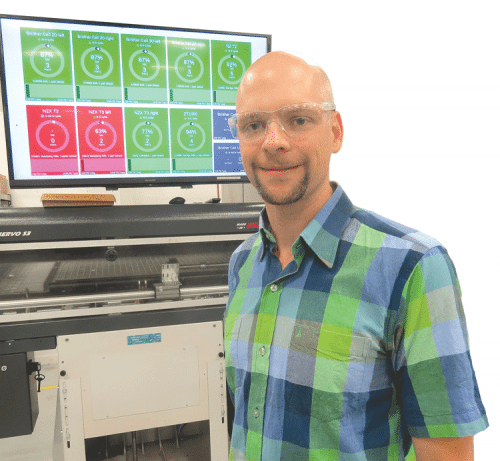
Bill Bither, co-founder of Machine Metrics, on the shop floor at Valley Steel Stamp in Greenfield.

Western Massachusetts has a rich history of entrepreneurship that dates back more than 300 years. Springfield, but also the entire region surrounding it, has been home to a number of innovations — and also companies that manufactured those products. Now, a new and very strong wave of entrepreneurial energy is sweeping across the region, and it is taking many forms, especially a slew of startups and next-stage companies trying to develop the proverbial next big thing. Over the next several months, BusinessWest will profile some of these emerging companies to provide its readership with deep insight into some of many positive developments taking shape here. We start with a Northampton-based venture that has brought to the market a software system that measures manufacturing productivity. The president of a Greenfield-based company now using it was direct in his assessment: “It’s a game-changer.”

They call it “being in the green.”

And that short, simple phrase has become a huge part of the lexicon at Valley Steel Stamp (VSS) in Greenfield — and with good reason.

To explain why, Rico Traversa, the company’s operating manager and a manufacturing engineer, took BusinessWest to the so-called war room, what those at this rapidly growing precision manufacturer of parts for the aerospace industry, major arms makers, and other customer groups call the operations center, located just off the shop floor.

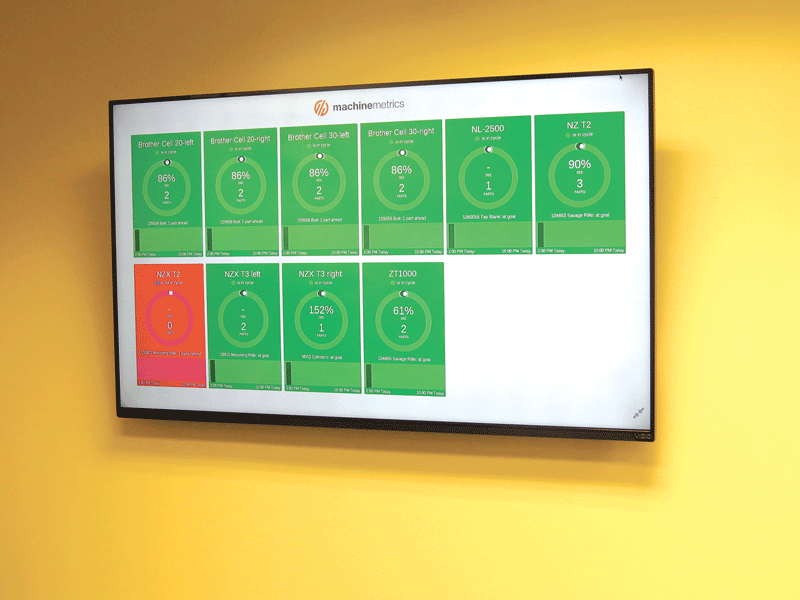
There, on one wall, are two large, digital display boards, or dashboards, as they’re called, an integral part of a performance-monitoring system created and installed by Northampton-based MachineMetrics. One dashboard shows 11 circular graphs, or rings, that essentially chart the execution of each machine tied into the system and each production shift — in real time.

It is 2:05 p.m., so the second shift has just started, and therefore all but one of the rings are green, meaning the machines are operating at or above the desired performance levels. One is orange, which means it is operating slightly below that level. If one should happen to turn red, it means what that color usually means — trouble.

But because of the dashboards and other elements of this system, that trouble can be identified, and dealt with, much sooner and more effectively than previously possible, said Steve Capshaw, president of VSS, who spoke about Machine Metrics with an enthusiasm that was clearly evident.

“This is an absolute game changer for us,” he said, adding quickly that it could also be considered one for the precision-manufacturing industry as well, a sector that has for years been starving not only for big data, but, more importantly, a way to effectively digest it.

Capshaw said the MachineMetrics system has yielded a roughly 20% increase in efficiency since it was implemented about a year ago, a huge number in this industry. When asked to qualify and quantify what that meant, he said this improvement will not only accelerate the company’s already-ambitious growth projections — Capshaw said VSS has tripled in size, from $3 million to $10 million over the past five years, and expects to reach $20 million in another five years — but enable it to navigate this industry’s most pressing, and perplexing, problem, a deep talent shortage, far more effectively.

“If you can put out 20% more parts per year, that directly lands on your bottom line,” he explained. “MachineMetrics will allow us to negate roughly $2 million in capital expenditures in the next five years as we double the size of the business. If you’re less efficient, you have to buy more machines.”

This simple arithmetic means that Bill Bither, Eric Fogg, and others involved with MachineMetrics seemingly have the right product at absolutely the right time.

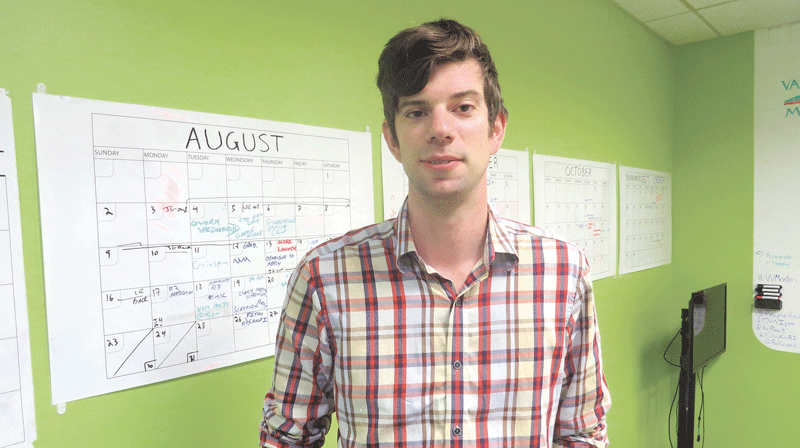
Eric Fogg

Eric Fogg says the MachineMetrics system analyzes performance in real time and sends alerts to clients when production falls behind.

A trio of partners — Bither, Fogg, and Jacob Lauzier — came together on the concept roughly two years ago in an effort to capitalize on emerging technology that has essentially created a language that allows shop operators to read how their machines are functioning. And they have brought that concept to a critical stage in its development.

Indeed, with successful stories being scripted at VSS and a handful of other clients, the company is poised to greatly expand its customer base and geographic reach. Fogg, whose business card declares that he is vice president and “chief evangelist” of this venture, was readying for a trip to Colorado when he spoke with BusinessWest, and was expecting to advance and perhaps close a significant deal.

Bither said the company recently closed on a round of venture-capital funding that exceeded $1 million. That infusion will be used to help scale up the venture and “prove out the sales model,” thus broadening the company’s customer portfolio to manufacturers of all sizes.

“Right now, it’s about product development and making sure we have the capability of selling this to many types of manufacturers that have different types of needs,” he said, adding that, while the company has shown it can serve a relatively small shop like VSS, it must shape the model to accommodate corporations with billions in sales and thousands of machines.

Parts of the Whole

As he talked about the MachineMetrics product, Capshaw noted that the precision-machining industry generally runs at least five years behind other sectors when it comes to advances in IT and, especially, the interpretation of big data.

That’s primarily because the equipment being used on shop floors today is quite complex, and IT is generally applied to those machines long after they are up and running.

“We can generate and consolidate vast sums of data,” he explained. “That’s great, unless you can’t do anything with it, which is where this industry was until only a few years ago.”

What was needed, he went on, was a standard language by which the controls of machine tools could export common information for which applications could be written.

The machine-tool industry eventually came together to create that language, called MTConnect, said Capshaw, adding that what has followed could best be described as attempts to harness that language. Overall, advances have come slowly and marginally — until MachineMetrics.

“Five years ago, we went to the International Machine Tool Show in Chicago, a huge show that comes every two years, and looked at machine-monitoring software,” he explained. “There was basically one company there that did it; they didn’t use the MTConnect standard, and the system was clunky. It’s like, if you were looking for a computer today, you knew what you wanted, you went to a store, and all they had was a Commodore 64 or Apple IIe.

“So we decided to wait a few years,” he said, adding that the next Machine Tool Show featured perhaps 20 vendors with monitoring software, with most of the products still lacking in one or more ways.

Machine Metrics wasn’t one of those companies, because it hadn’t yet been incorporated, but the seeds were being sown for a system that could potentially change the landscape.

The principals would bring to the table experience in entrepreneurship, software development, problem solving, and precision machining. Indeed, by that time, both Bither and Fogg could already be considered serial entrepreneurs.

Bither, a member of BusinessWest’s first 40 Under 40 class in 2007, founded the enterprise software company Atalasoft, which he later sold to Kofax, now Lexmark. Prior to that entrepreneurial episode, he worked in aerospace engineering — he was a design engineer at Hamilton Sundstrand for several years — and knew Capshaw from his work in that field.

Fogg, meanwhile, began his career in a machine shop in his hometown of Brattleboro, Vt. He started out packing boxes and washing parts, and eventually worked his way up to programmer.

He later started his own machine shop, Greentech Engineering, in Holyoke, which, as that name suggests, specialized in the engineering and prototyping of green-technology products, including mounts for solar panels and prototype wind turbines.

To make ends meet, he took on some aerospace work at night, he said, adding that the recession that started in 2008 put a rather large dent in both aspects of his business, prompting a shift into consulting work that focused on his strengths in precision manufacturing and ‘green’ product development.

Fogg said he met Bither at a Valley Venture Mentors meeting soon after he sold Altalasoft, and the two began looking at challenges they could undertake together. Their knowledge of the precision-machining field made them keenly aware that there would be a huge opportunity awaiting those who could develop software that could effectively monitor and record the performance of machines and people, and they set out to create it.

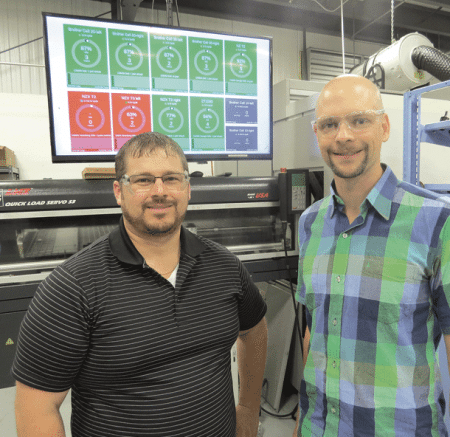
Rico Traversa, operating manager at Valley Steel Stamp (left), and MachineMetrics co-founder Bill Bither

Rico Traversa, operating manager at Valley Steel Stamp (left), and MachineMetrics co-founder Bill Bither stand near one of the dashboards on the VSS shop floor.

Soon after founding MachineMetrics, they brought on a third partner, Jacob Lauzier, the company’s chief technology officer, who brings to that post a background as a user-interface designer and web-application developer.

Together, they brought MachineMetrics to the market using VSS as a pilot company — one that has seen results far exceed expectations.

Form and Function

As he discussed what the MachineMetrics product means to manufacturers, Fogg related what sounded like a not-so-hypothetical situation involving that machine shop he worked for years ago.

“My boss would come down and say, ‘I need to ship 300 of these parts, and we’re already a week late,’” he recalled. “I would say, ‘well, there’s only 60 of them complete.’ He would get angry and say, ‘what went wrong?’

“The thing about manufacturing, and probably a lot of other industries, is that I could have given him the top 10 reasons why that job was behind, and it wouldn’t have constituted 5% about why it was actually behind,” Fogg went on. “There’s so much stuff that can happen, so many discrete things that can go on, that there’s really no way you can sit down with your boss and explain why a job is behind. So I would come up with some cop-out answers like ‘we’re having some trouble with second shift’ or ‘maybe there’s trouble with materials,’ and he would nod his head and go upstairs to call a soon-to-be-angry customer and eat crow.”

Machine Metrics was designed to make such discussions a thing of the past, said Fogg, adding that the software can not only pinpoint what what wrong, when, and where, but it can alert supervisors to potential problems before they happen and keep shop owners from having to make phone calls like the one mentioned above.

“There are thousands of pieces of data that can be pulled from any discrete machine tool every minute, and all that data has value,” Fogg explained. “That data can tell you about loads on tools or about problems with any part of the manufacturing process.”

Effective retrieval and analysis of that data has enabled VSS to improve what’s known as OEE (overall equipment effectiveness) from around 70% to roughly 90%.

While visiting the war room at VSS, Bither explained just how the software works.

“Each ring represents a shift,” he explained while motioning toward the dashboard. “As the ring fills in, that’s indicative of how many parts are created; when the ring is completely closed, the goal is met for the shift. There’s a white dot that moves around the ring, and it’s essentially a rabbit that you’re chasing. If you’re ahead of the white dot or on it, it’s green; if you’re behind, then it’s orange or red.”

The system tracks performance in real time, said Traversa, adding that this represents a vast improvement over the conditions that existed before the software was installed.

The MachineMetrics system

The MachineMetrics system has made the phrase ‘being in the green’ — as most all of the machines at the company are at this moment in time — part of the lexicon at VSS.

“You get text alerts and e-mail alerts as soon as a machine starts falling behind,” he explained. “In real time, we know that production is going down and we can try to solve it; we’re not waiting until 6 a.m. the next day to find out that a machine shut down at 8 the night before. You see it, you get alerted, and there’s no operator input — you’re not waiting for them to call you or e-mail you; it does it on its own.”

Making Progress

Capshaw, who spoke with BusinessWest by phone while vacationing on the Cape, said the system allows him to see what’s happening at the shop on a host of devices. He noted that productivity at VSS has increased 10% not from really doing anything with the data specifically, but simply from having it and making sure employees know they have it.

Employees simply have to look up at the dashboards on the shop floor to track how the machines they’re assigned to are performing, he went on, adding that no one wants to see the color red appear, and everyone wants to stay firmly in the green.

Roughly another 10% improvement has come from going back over data, identifying issues, streamlining production, and improving maintenance, he went on.

“We look at how efficient we are shift by shift and product by product, and see where we need to improve,” he explained. “The result is that we can more finely tune our training programs for employees, which is typically the reason for downtime, or improve our maintenance system so we have more uptime on our machines.”

Thus, benefits come in a number of forms, he said, listing everything from enhanced productivity to improved morale, especially among third-shifters, who seemingly toiled in anonymity.

“We had employees come up to us after we put up the boards,” said Capshaw. “They worked third shift, and they said to us that, if they did a great job, they never got a pat on the back. But they said having this is like getting a pat on the back — they work to get back in the green, and we see that, and we e-mail them and congratulate them.”

Perhaps the biggest benefit, though, is some reduction in stress when it comes to the nagging issue of finding enough talent as a result of that improved efficiency.

“Instead of having to recruit and hire 40 employees, we’ll have to hire 30,” he said. “We’ll still have to hire a lot of people, but it will relieve that bottleneck, which allows us to expand quicker.”

Moving forward, the obvious goal for the principals at MachineMetrics is to scale up their venture, and the recent infusion of capital will be used for the many aspects of that assignment.

Fogg said one of the company’s major challenges, not unlike the one confronting its customers, is finding talent.

“We have a lot of customers who are interested in this product, but one of the difficulties is integrating it into the machines,” he explained. “That’s something I know how to do, but it’s very difficult to find people who know machine integration; we’re actively trying to hire people like that, but we can’t even find them, let alone give them offers for jobs.”

Overall, the potential for growth is immense, said Bither, adding that the market for performance-monitoring software in the precision-manufacturing sector will reach into the billions of dollars.

Just how big that number will get, he doesn’t know, but he does know Machine Metrics should be well-positioned to seize considerable market share.

“There are a few competitors, but this is fairly new technology, so there isn’t one company that’s out there dominating,” he explained, adding that a company in Germany and another based in Silicon Valley are gaining some traction in the industry, while others are struggling in their attempts to do so.

“Production-monitoring technology is still in its early stage,” he went on. “But there is a lot of opportunity, because these companies are recognizing that measuring data is critical to staying competitive; they have to be efficient to win these deals.”

It’s Not Easy Being Green

Throughout business history, company owners have made it their mission to both keep out of the red and be in the black. For precision manufacturers, there is now a third mantra — ‘being in the green.’

As mentioned earlier, this is now an informal mission statement and both a spoken and unspoken rallying cry at Valley Steel Stamp.

Just how prevalent that phraseology becomes in this industry remains to be seen, but from all accounts, MachineMetrics seems poised to turn out some solid growth patterns of its own.

And it also appears destined to be part of the wave of entrepreneurial energy sweeping over the region.


George O’Brien can be reached at [email protected]

Opinion

Editorial

It is September, and by now, thousands of college students have returned to campuses across the region.

Thus, this is a good time to re-emphasize the importance of higher education to this region and its economy. The colleges and universities that call Western Mass. home generate thousands of jobs, purchase products and services from a number of locally based companies, and spur research that can be generated into companies that employ area residents.

But these schools provide another important resource for this region — the students themselves.

They also purchase goods and services, and therefore make an important contribution to the economy, but they play a potentially larger role by taking internships, co-ops, and part-time jobs with companies large and small across the four counties. In doing so, they provide skills, energy, ideas, and the perspective of a generation that will soon dominate the workforce and the consuming public.

It is important for area businesses to take full advantage of this resource — in a careful and thoughtful manner.

Indeed, interns and part-term employees can make valuable contributions to a company — while also positioning themselves for full-time employment later — if they are brought into situations that could be described with the phrase ‘win-win.’

And we encourage both area schools and the business community as a whole to generate more of these situations by creating opportunities for students and employers to meet one another.

Doing so will only benefit all the parties in this equation. But, as we said, it needs to be done properly.

Companies create problems for themselves when they look upon interns as a solution to workforce problems, budget concerns, or both. Too many companies have looked at pressing problems and loaded calendars and responded with the well-worn phrase, ‘let’s get some interns.’

These young people can’t, and should not, be expected to do the work of seasoned employees. Nor should they be thrust into situations where the demands exceed their skill levels.

But, as we said, when interns are placed in proper positions — ones where they contribute and learn — they can be invaluable assets and become future members of a workforce.

Young people can bring energy to a staff, but they can also bring a fresh perspective. Baby Boomers and those who came just behind them can’t look at the world from the perspective of a 21-year-old, but a college junior or senior can, and that kind of insight can be critical, especially in an age when rapidly advancing technology is changing the way people communicate, shop, get their news, market their companies, and gain the public’s attention.

Today’s young people are in many ways driving this change, and they understand it at least as well as those of us born decades before them.

Area colleges are back in session. That’s good for this region in a number of ways. One of the most important is the sum of the contributions students can make to area businesses, nonprofits, and governmental agencies.

This is a tremendous resource, one that should be recognized and capitalized upon.

Departments Picture This

Send photos with a caption and contact information to:  ‘Picture This’ c/o BusinessWest Magazine, 1441 Main Street, Springfield, MA 01103 or to [email protected]


Drink Up

Beer enthusiasts packed Court Square in Springfield on Aug. 29 for the first annual Valley Fest, which featured offerings from more than 50 breweries, plus food and live music. The event also featured a home-brewing competition; the winners were Black & Blue Brews (judges’ choice) and Footbridge Brew (people’s choice). Also paying a visit (below left, center of photo) was celebrity chef Marc Stroobandt, Stella Artois’ master beer sommelier.

Stella-Celebrity-Chef-and-Crew-DARKPatiently-WaitingDaytime-Crowd

Daily News

SPRINGFIELD — Gov. Charlie Baker and Springfield Mayor Domenic Sarno joined a host of local and state officials and representatives of CRRC USA Rail Corp. yesterday for a groundbreaking ceremony at the city’s former Westinghouse site on Page Boulevard, where the company will build its first North American plant.

CRRC, a Chinese-based manufacturer of urban mass-transit vehicles, won a $565 million contract with the state last year to build nearly 300 subway cars for the MBTA’s aging Red and Orange lines — a project that promises 100-plus construction jobs from the building of a 220,000-square-foot plant, and more than 150 new manufacturing positions. CRRC visited about 50 North American sites before settling on Springfield.

CRRCGroundbreaking“Today is a great day in Springfield, and in Massachusetts, with CRRC, the largest railway company in the world, coming to Springfield,” Sarno said, noting that, while manufacturing was the city’s strong industrial base for generations, it started to erode in the 1970s, but has never gone away, and CRRC could be a catalyst to further shift the needle in a positive direction.

“We now have a $95 million project here at the old Westinghouse site. This will be CRRC’s North American hub. It’s important that we use this as leverage and momentum,” the mayor said — not just for further manufacturing in Springfield, but a for a boost in regional rail service. “I’d love to see that east-west rail connecting Boston to Springfield to Washington, D.C.”

While calling the groundbreaking “an exciting day for Springfield, an exciting day for the Commonwealth, and an exciting day for Western Mass.,” Baker said the MBTA is in dire need of new cars on its Red and Orange lines. During Boston’s crippling winter earlier this year, he said, it was pointed out to him that the rail cars pressing through the storms were the same ones that endured the Blizzard of ’78.

“Think about that — that was a really long time ago, folks,” he told hundreds of people in attendance at yesterday’s ceremony, calling CRRC’s arrival a piece of the state’s “strategy to bring jobs, economic development, and transit improvements for the benefit of all people in the Commonwealth of Massachusetts.”

Weiping Yu, vice president of CRRC Corp. Limited in Beijing, said he was “honored” to partner with officials in Massachusetts and Springfield on the $95 million construction project and the economic benefits it will generate.

“We have an exciting road ahead as we embrace this unique opportunity to partner with Massachusetts on our first transportation project in the United States,” he said, adding that the company sees potential for significant growth in the U.S., and has increased overseas investments by 61% over the past year. “We have a focused vision and a strong commitment not only to being the best, but understanding the infrastructure needs of our global partners and working together to achieve them.”

Yi Lu, general commercial counselor for the New York Chinese Consulate, added that he’s confident the new Springfield plant will be a strong engine for the local economy, generating hundreds of new jobs and perhaps spurring further Chinese investment in the region.

“Looking back on our initial discussions when we first visited Massachusetts,” added Chuanhe Zhou, president of CRRC USA Rail Corp., “I’m proud of the strides we’ve made, the relationships we’ve built, and the partnerships we’ve formed — from meetings with city officials to tours of local manufacturers to visits to local educational institutions. We couldn’t have found a better partner than you.”

Jay Ash, the state’s secretary of Housing and Economic Development, said CRRC wants to be a good neighbor by hiring local people, taking advantage of local supply chains, and engaging with companies around Western Mass. as it expands in the future.

And expand it should, added Stephanie Pollack, the Commonwealth’s Transportation secretary, if only because much of the country is dealing with the same issues as Massachusetts when it comes to aging rail cars.

“We know what CRRC knows, which is that the MBTA is hardly the only transit system in the United States with 1970s-era cars,” she noted. “In fact, a lot of cars in this country were bought in the 1970s with what was then a relatively young federal program for producing them.”

Baker credited his predecessor, former Gov. Deval Patrick, and his team with much of the legwork to bring CRRC to Massachusetts. “They did make this day possible. Sometimes you get credit for stuff that happens on your watch, whether you had anything to do with it or not.”

That said, the governor went on, “our administration is thrilled to be here today. We consider this project to be not just an important part of the economic-development story in Springfield, but an important part of the future of the MBTA and transit in Massachusetts.”

Daily News

FARMINGTON, Conn. — Farmington Bank announced that former Major League Baseball knuckleball pitcher Tim Wakefield is its new celebrity spokesperson.

“Tim Wakefield is an admired and dedicated professional both on and off the field. As a well-respected athlete and a committed partner with various community organizations, Tim embodies the values and traditions of Farmington Bank. We are thrilled to have him as a member of our team,” said John Patrick Jr., chairman, president, and CEO of Farmington Bank.

Added Wakefield, who spent much of his career with the Boston Red Sox, “I admire Farmington Bank’s commitment to excellence, performance, and community engagement. I look forward to sharing those commitments, as well as news of their expansion into Western Massachusetts, in the coming months.”

As Farmington Bank’s celebrity spokesperson, Wakefield’s initial role will include appearances at two Farmington Bank branch office grand opening celebrations in West Springfield and East Longmeadow, which will be open to the public. Dates will be announced soon. In addition, he will star in a series of new television, radio, and print advertisements. The campaign will launch in both Connecticut and Massachusetts this fall.

In addition to professional baseball, Wakefield is known for his charity efforts. Since 1998, he has partnered with the Franciscan Hospital for Children in Boston to bring patients to Fenway Park to share time with him on and off the field. In addition, he serves as the Red Sox Foundation’s honorary chairman and is actively involved in the Jimmy Fund and the Space Coast Early Intervention Center in Florida.

Farmington Bank is a full-service community bank with 22 branch locations throughout Central Conn., with two branches scheduled to open in Massachusetts in the fall of 2015, as well as two more Connecticut locations opening in 2016. For more information, visit farmingtonbankct.com.

Daily News

BOSTON — In an effort to arm the next generation of doctors with the tools to curb the opioid epidemic, Gov. Charlie Baker recently met with the Mass. Medical Society (MMS) and deans from four medical schools to discuss opportunities for enhancing curriculum and establishing cross-institutional best practices in pain management and safe prescribing of opioids.

“The avenue prescription pain pills can provide to addiction and heroin use further stresses the need for advancing safe and responsible prescribing methods in the medical community,” Baker said. “I am proud that the leaders of the major medical schools here today are committed to working collaboratively with us and each other to review the existing curricula for medical students around safe prescribing and proper use in order to begin curbing this public-health epidemic.”

Providing doctors additional training on opioids was part of the comprehensive set of 65 recommendations released in June by the Governor’s Opioid Working Group.

“Massachusetts is home to the best medical care in the world. We are a national leader of cutting-edge diagnostics and innovative technologies to treat complex conditions,” said MMS President Dr. Dennis Dimitri. “With this collaboration by four major medical schools, we are again setting a new standard — this time for giving our young medical students and residents enhanced education to manage pain properly, while identifying addictive behaviors and getting patients into treatment when needed.”

The four medical institutions — UMass Medical School, Harvard Medical School, Boston University School of Medicine, and Tufts School of Medicine — instruct about 3,000 medical students per year. In the first meeting, attendees agreed to continue toward making recommendations regarding best practices, curricula enhancements, and opportunities for public/private, cross-institutional collaboration.

“Whether they aspire to be a primary-care doctor, emergency physician or a surgeon, participating in this type of training early on gets them thinking about the importance of pain management for their patients as well as the importance of choosing the right pain-management tool,” said Dr. Monica Bharel, commissioner of the state Department of Public Health.

Daily News

LONGMEADOW — A recent report published by the Chronicle of Higher Education recognizes Bay Path University as one of the fastest-growing colleges in the U.S.

The university ranked 17th on the Chronicle’s “Almanac of Higher Education 2015,” a top-20 list of the fastest-growing private baccalaureate institutions nationwide, with enrollment growth of nearly 80% over a 10-year span.

“This is the second year in a row that Bay Path has been recognized as one of the fastest-growing baccalaureate institutions in the country,” President Carol Leary said. “As the only women’s college on the top-20 list and one of only three New England colleges listed, it affirms our mission in providing academically relevant programs and the unique learning experience for undergraduate women of all ages.”

Data contained in the report are based on fall enrollment of full- and part-time graduate and undergraduate students from 2003 to 2013. The report included all U.S. degree-granting institutions with at least 500 students in 2003.

Daily News

SPRINGFIELD — The Realtor Assoc. of Pioneer Valley and the Home Builders Assoc. of Western Mass. will host an economic-forecast event on Wednesday, Oct. 7 from 8 to 11:30 a.m. at Western New England University.

Dr. Elliot Eisenberg, a nationally noted economist, will explain why government intervention in the housing market or other markets is generally bad. He will also speak to the current and future housing market. Eisenberg is well-known for making economics fun, relevant, and educational.

Breakfast and registration will be from 8 to 9 a.m., with the presentation beginning at 9 a.m. The cost to attend is $22. For more information, contact Laura Herring at the Realtor Assoc. of Pioneer Valley at (413) 785-1328 or [email protected].

Daily News

HADLEY — Arrha Credit Union has opened a new branch at 140 Russell St. in Hadley.

“To augment the banking services we provide to our members in Hampden and Hampshire counties, we are pleased to announce the opening of our Hadley branch office. The branch has been designed and staffed to foster an efficient, professional member experience,” said President and CEO Michael Ostrowski.

“Also essential to the service we provide is attracting talented bankers to our organization as we expand,” he added. “To this end, we are pleased to welcome William Toth in the position of branch manager for our new branch. Bill brings more than 20 years of branch-management experience to Arrha Credit Union. We look forward to his success as he and his staff work with our lending team in building our member relationships.”

Arrha, meaning ‘a pledge in earnest,’ is one of the oldest words in the English language and reflects the bank’s pledge to assist members in reaching their financial goals by providing superior products and services in a personal manner, Ostrowski said.

Daily News

AGAWAM — Six Flags New England announced plans to add a giant looping roller coaster, called Fireball, to its roster of thrill rides.

“We take great pride in creating incredible, one-of-a-kind ride experiences for our guests here at Six Flags New England,” said John Winkler, park president. “Every year, we are excited to offer something new for our guests, and this year is no exception. Our team is beyond thrilled to introduce our 12th coaster, Fireball, opening in spring 2016.”

Fireball, seven-story-high, looping coaster seating 24 passengers in face-to-face positions, features a pendulum-style takeoff with multiple 360-degree revolutions, an additional full revolution when the train reverses mid-course, and a two-minute ride time. Riders must be at least 48 inches tall.

The park also announced a change to the steel coaster Bizarro. The ride will be relaunched as Superman the Ride, its original theme, at the start of the 2016 season. The iconic coaster was named 2015’s Best Roller Coaster by readers of USA Today and 10Best and is the winner of five Golden Ticket Awards since its opening. The coaster will offer superhero-themed music and theming throughout, as riders climb more than 20 stories into the air and hit speeds of 77 mph.

For more information about upcoming 2016 Six Flags rides and attractions, including a video highlighting the new rides, visit www.sixflags.com/2016news.

Daily News

STOCKBRIDGE — Sarah Eustis, CEO of Main Street Hospitality Group, a Berkshires-based hotel-management company, announced the appointment of Janet Eason as vice president of marketing.

In this position, Eason is responsible for providing leadership, strategic direction, and vision to all marketing efforts for the properties in the company’s portfolio. Main Street Hospitality Group manages the new boutique Hotel on North in Pittsfield, the Porches Inn at MASS MoCA in North Adams, and the Williams Inn in Williamstown, and owns and operates the Red Lion Inn in Stockbridge.

Eason brings more than 15 years of hospitality experience to Main Street Hospitality Group, including her most recent leadership role as director of marketing communications at the Colonial Williamsburg Hospitality Co. in Virginia, where she oversaw all aspects of marketing for six unique hotel properties, 12 restaurants, three golf courses, a full-service spa, and 20 retail outlets.

“This is an exciting time for Main Street Hospitality Group as we deepen our position as a regional management company with a focus on preservation, innovation, and the communities we serve,” said CEO Sarah Eustis. “Janet’s extensive knowledge of integrated brand positioning across multiple properties will be instrumental in guiding the company’s continued success. We welcome her to the Main Street family.”

Prior to the Colonial Williamsburg Hospitality Co., Eason served as president at Eason Partners, a Boston-based marketing firm specializing in the travel and hospitality industries, working with clients such as the Barbados Tourism Authority and Elegant Hotels. She was also vice president of strategic planning at Boston-based ISM, where she provided marketing solutions for travel companies such as the Sagamore Resort and Four Seasons Hotels and Resorts.

For more information on the Main Street Hospitality Group, visit www.mainstreethospitalitygroup.com or call (413) 298-1610.

Daily News

BOSTON — The New England Information Office of the U.S. Bureau of Labor Statistics (BLS) has released New England and state unemployment numbers for July. These data are supplied by the Local Area Unemployment Statistics program, which produces monthly and annual employment, unemployment, and labor-force data for Census regions and divisions, states, counties, metropolitan areas, and many cities. Among the highlights of the release:

• The New England unemployment rate was essentially unchanged at 4.7% in July. One year ago, the New England jobless rate was higher, at 5.8%. The New England unemployment rate was lower than the national rate of 5.3%.

• Three New England states posted jobless rates that were significantly different from the U.S. rate of 5.3%: Vermont (3.6%), New Hampshire (3.7%), and Maine (4.6%).

• Over the last year, five New England states recorded statistically significant unemployment-rate decreases, with declines ranging from 1.8% in Rhode Island to 0.5% in Vermont. In fact, Rhode Island had the largest jobless rate decline nationwide.

Daily News

EAST LONGMEADOW — Holiday Retirement recently hired Stephanie Zelazo to lead sales and marketing for Bluebird Estates in East Longmeadow.

Zelazo is a graduate of UMass Amherst with more than six years of sales and marketing experience for apartment communities throughout Massachusetts, Connecticut, South Carolina, Florida, and Texas. In her role at Bluebird Estates, she will coordinate marketing activities, opportunities for community involvement, business outreach, and sales.

“Being able to help families find an affordable, safe, and fulfilling lifestyle option for their loved ones is very rewarding,” she said. “I am excited to be the newest member of the Bluebird family.”

Daily News

EAST LONGMEADOW — Aaron Smith, P.C., a certified public accounting firm serving individuals and businesses in the Pioneer Valley, announced that Managing Director David Padegimas has joined the March of Dimes board of directors for a two-year term.

Originally established by President Franklin Roosevelt as a polio patient-aid program that funded research for vaccines, the March of Dimes is a collaboration of scientists, clinicians, parents, members of the business community, and other volunteers in every state. The vaccines effectively ended the polio epidemic in the U.S., and in 1958, the March of Dimes’ focus shifted to babies born premature and with birth defects.

For 77 years, the March of Dimes has worked to improve maternal and child health through activities that include funding research and field trials for the eradication of polio, promoting newborn screening, and educating medical professionals and the public about best practices for healthy pregnancy.

“The March of Dimes is an outstanding organization dedicated to giving babies a healthy start in life,” said Padegimas. In his role, Padegimas will oversee the business of the chapter and implement the March of Dimes strategic plan along with his fellow board members.

Padegimas has more than 30 years of experience in the areas of corporate, estate, and individual tax; business planning; and business-advisory services. He has been a member of Aaron Smith, P.C., since 1981. He is licensed as a certified public accountant in Connecticut, Massachusetts, and New York, and is a member of the American Institute of Certified Public Accountants and the Connecticut Society of Certified Public Accountants.

“The March of Dimes would not survive without the support and leadership of our volunteers,” said Stephen Sycks, division director at the March of Dimes. “There is a lot of work to be done in Massachusetts, and David will help us achieve our goals through a generous donation of his time and business acumen.”

The goals Sycks referred to are mostly focused on reducing preterm birth. Last year, Massachusetts was awarded the Virginia Apgar Prematurity Campaign Leadership Award for reducing preterm births by 8%. However, Massachusetts earned a ‘B’ on the 2014 March of Dimes Preterm Birth Report Card, as 10% of births were preterm, falling short of the March of Dimes’ 2020 goal of 9.6%.

Daily News

SPRINGFIELD — Springfield Technical Community College (STCC) will kick off its 2015-16 Diversity Series with an appearance from bestselling author and youth advocate Wes Moore on Wednesday, Sept. 30 at 11 a.m. in the Scibelli Hall gymnasium.

Moore — a veteran, Rhodes scholar, and founder of BridgeEDU — has authored several successful books, including The Work: My Search for a Life That Matters; The Other Wes Moore: One Name, Two Fates; Discovering Wes Moore; and Forcefully Advancing.

Moore has been featured by USA Today, Time, People, Meet the Press, The Colbert Report, MSNBC, and NPR. He is the host of Beyond Belief on the Oprah Winfrey Network and is the executive producer and host of PBS’s Coming Back with Wes Moore, which focuses on the reintegration of Iraq and Afghanistan veterans and their return home.

As the founder and CEO of BridgeEDU, an innovative college platform that addresses the college-completion and job-placement crisis, Moore created the program to reinvent freshman year in a way that gives students real-world internship and service-learning opportunities as well as core academic classes.

Moore’s appearance is made possible through the support of Baystate Health, MassMutual, PeoplesBank, An African-American Point of View, the city of Springfield Department of Health and Human Services, the STCC Black Professionals Group, and the STCC Diversity Council.

The event is free and open to the public. An author signing will be held at 9:30 a.m., and copies of Moore’s books will be available for purchase. For additional information, call Myra Smith at (413) 755-4414. If you require accommodations to fully participate in this event, call the STCC Office of Disability Services at (413) 755-4474 at least two weeks in advance. For a complete listing of STCC Diversity Series events, visit www.stcc.edu/diversity.

Daily News

EAST LONGMEADOW — Facial Cosmetic & Maxillofacial Surgery, P.C. announced the hiring of surgeon Justin Clemow.

Clemow earned his bachelor’s degree from the University of Pennsylvania, then attended the UConn School of Dental Medicine from 2003 to 2007, where he was awarded the Student Oral Surgery Award.

In 2007, Clemow was accepted into the oral and maxillofacial surgery (OMFS) residency at the University of Florida Jacksonville. He obtained his medical degree from the University of Florida College of Medicine in 2011, completed an internship in general surgery at Shands Jacksonville Medical Center, and completed his OMFS training as the administrative chief resident in 2013. He was decorated with multiple awards during residency, including the Resident Advocate Award, Best Teaching Resident Award, and SICU Resident Award.

After residency, Clemow worked for two years in private practice with Oral & Maxillofacial Surgery in Cleveland. He served as assistant clinical professor for the Case Western Reserve OMFS residency, provided level-1 trauma coverage at MetroHealth Medical Center, and also provided trauma and OMFS call coverage at Fairview Hospital, part of the Cleveland Clinic system.

Clemow’s specific surgical interests include facial trauma and reconstruction, general anesthesia, corrective jaw surgery, obstructive sleep apnea surgery, and complex dental implant procedures, including bone grafting. He is a fellow of the American Assoc. of Oral & Maxillofacial Surgery and a diplomate of the American Board of Oral & Maxillofacial Surgeons (board-certified). He maintains certification in BLS, ACLS, PALS, and ATLS.

Daily News

SPRINGFIELD — Springfield Museums are in the final stages of purchasing the childhood home of Theodor Geisel (a.k.a. Dr. Seuss), located at 74 Fairfield St. in Springfield, through support provided by the Dr. Seuss Foundation.

Geisel was born in 1902 on Howard Street in Springfield’s downtown, and moved at age 4 to the Fairfield Street home in the city’s Forest Park neighborhood, where he lived with his parents and sister Margaretha. It was during this time that Geisel first developed his love for drawing and storytelling, skills he honed while serving on the staff of Springfield’s Central High School newspaper. Later in life, Geisel drew heavily from his formative years spent in Springfield to create books like And to Think That I Saw it on Mulberry Street, his first published work of children’s literature. The 74 Fairfield St. home was sold following the death of Geisel’s father in 1968.

“The Springfield Museums are very excited to secure 74 Fairfield St., the childhood home of Dr. Seuss,” said Samuel Hanmer, Springfield Museums board of trustees chairman. “We are just beginning to explore possible next steps, but we’re very pleased to be able to act in this manner to help honor and preserve Theodor Geisel’s legacy here in Springfield. We plan to take time to fully consider the various possible uses for the house, while taking the necessary steps to properly secure the property in the short term. The views of all concerned parties and stakeholders will be paramount, welcomed, and encouraged during those discussions.”

Added Susan Brandt, president of Licensing and Marketing for Dr. Seuss Enterprises, “we are delighted that the Dr. Seuss Foundation is able to underwrite the purchase of Theodor Geisel’s childhood home on behalf of the Springfield Museums and for the benefit of Dr. Seuss fans everywhere. We see the purchase by the Museums as an essential part of their ongoing effort to properly honor and preserve Ted Geisel’s Springfield heritage for generations to come.”

Daily News

AMHERST — Atkins Farms will host a grand-opening celebration at its satellite store at 113 Cowls Road, North Amherst, in the Mill District, on Saturday, Sept. 12 from noon to 3 p.m.

A ribbon-cutting ceremony will take place at 1 p.m. with the Atkins owners and members of the Amherst Area Chamber of Commerce. Food and beverage tastings will be provided by Atkins Farms, Maple Valley Ice Cream, Mapleline Farm, Ooma Tesoro’s Marinara, Stonewall Kitchen, Blue Seal Kielbasa, Tea Guys, and Rao’s Coffee.

There will be free apples and Atkins spring water (while supplies last), a raffle to benefit the Amherst Survival Center, a local balloon-animal artist, hula-hooping fun with Hoop Joy, and Joan Holliday from WRSI the River 93.9, who will have games, prizes, and giveaways from the radio station. Anyone who comes dressed up as their favorite farm animal, fruit, or vegetable will receive a free Atkins cider donut (while supplies last). In addition, the Mill District will host a touch-a-truck event for families and horse-drawn wagon rides by Muddy Brook Farm. The event is free and open to the public.

Daily News

HOLYOKE — Teenagers in Western Mass. now have another educational option. LightHouse Personalized Education for Teens opens its doors on Tuesday, Sept. 8 with an initial cohort of 30 students.

“We serve the most interesting teens in Hampden County — teens who have vision and goals for their futures, and are inspired to learn outside the box and spend their energies on projects they find engaging and meaningful,” said Co-director Catherine Gobron.

LightHouse is holding several open houses in September, including Friday, Sept. 4, 3-4 p.m.; and Thursday, Sept. 10, 3-4 p.m. See the whole list at lighthouseteens.org/open-houses.

Gobron was Program Director for North Star: Self-Directed Learning for Teens in Hadley for more than a decade, and has now opened LightHouse, an independent affiliate program to North Star, with Co-director Josiah Litant, who left his position as senior associate dean of Students at Hampshire College to launch LightHouse with Gobron.

“This last year has been a whirlwind, but it’s all come together,” said Litant. “Our brand-new facility in the STEAM building of Holyoke’s Innovation District is gorgeous, and we are especially excited about our Maker Space and Music Studio. It’s been very exciting to begin to get to know our new students. Our incoming teens and families understand that learning is something you do, and they are excited to start now.”

LightHouse is open to teens ages 13 to 18, focusing on optional pathways of entrepreneurship, arts, tech, and college prep.
To learn more, visit lighthouseteens.org.

Daily News

HOLYOKE — The Greater Holyoke Chamber of Commerce announced the return of the popular ACE (Ask a Chamber Expert) business workshop series. Sponsored by PeoplesBank and the Republican/MassLive, the series is member-taught by successful, knowledgeable community business owners and professionals who are eager to pass on their knowledge to business people and entrepreneurs in Greater Holyoke communities.

The next installment in the series will be a panel discussion, with experts from digital, television, radio, and print media, on Wednesday, Sept. 9 at 8:30 a.m. at the Massachusetts Green High Performance Computing Center located at 100 Bigelow St. in Holyoke. Topics ranging from how to plan a press conference to learning the difference between a press release and a press advisory will be discussed.

Admission is $15 for Holyoke Chamber members with advance registration and $20 for all others, and includes a continental breakfast. Reservations may be made online at holyokechamber.com/events.

Daily News

EAST LONGMEADOW — HUB International New England, formerly FieldEddy Insurance, a division of insurance-brokerage firm HUB International Limited, announced that employees recently held a food drive to benefit the East Longmeadow Council on Aging.

The drive was staged in response to published reports that the local Council on Aging is in dire need of food and personal items this time of year. HUB International employees immediately reached out and pulled together in an effort to personally donate whatever they could.

“I always knew our employees were great, but seeing them come together to help others leaves a lasting impression,” said Timm Marini, president of HUB International New England. “The employees saw a problem in their own backyard and reached into their own pockets in order to help those less fortunate. They worked together as a team in order to do something that will have a long-term effect on others.”

The total amount of donations is not known at this time, and the agency itself will make a contribution in addition to the employee donations. These items were delivered to the East Longmeadow Council on Aging on Aug. 26.

Daily News

HOLYOKE — University Products Inc. (UPI), manufacturer and distributor of archival-quality storage products for museums, libraries and archives worldwide, announced the realignment of its management team.

Chief Financial Officer John Adamson, who joined UPI in 1995 and has worked in sales and marketing, human resources, and accounting, has been appointed president and will be charged with coordinating and implementing the future direction of the company.

Company founder David Magoon, will continue as chairman of the board, and Scott Magoon will continue as CEO. Bob Boydston, who joined the company in 1976, will remain as senior vice president and is also chief operating officer of the corporation.

Museums, libraries, historical societies, archives and similar institutions are among UPI’s worldwide clients. The company offers products for conservation, restoration, and preservation of books, photos, documents, collectibles, textiles, artwork, artifacts, and natural-history specimens. University Products is also the manufacturer of Lineco brands, sold and distributed worldwide by art and framing retailers.

Daily News

SPRINGFIELD — Fourteen lawyers from Bulkley Richardson were recently selected by their peers for inclusion in The Best Lawyers in America 2015. Bulkley Richardson had the most honorees of any law firm in Springfield, with 12 of its 14 selected lawyers based in its Springfield office.

Three of the firm’s honorees were also named Springfield Lawyer of the Year in specific practice areas:

• Michael Burke was named Lawyer of the Year in Springfield for personal-injury litigation (defendants);

• David Parke was named Lawyer of the Year in Springfield for corporate law; and

• John Pucci was named Lawyer of the Year in Springfield for criminal defense (non-white-collar). Pucci was also recognized by Best Lawyers in the area of criminal defense (white-collar).

Attorneys from all of Bulkley Richardson’s offices were represented in the selection for Best Lawyers 2015, including the following nine based in 
Springfield:

• Peter Barry, construction law;

• Mark Cress, bankruptcy and creditor-debtor rights, insolvency and reorganization law, and corporate law;

• Francis Dibble Jr., bet-the-company litigation, commercial litigation, and litigation 
(anti-trust, labor and employment, securities);

• Daniel Finnegan, administrative/regulatory law and litigation (construction);

• Robert Gelinas, personal-injury litigation (defendants);

• Kevin Maynard, commercial litigation, litigation (banking and finance, construction);

• Melinda Phelps, medical-malpractice law (defendants), personal-injury litigation 
(defendants);

• Ellen Randle, family law; and

• Ronald Weiss, corporate law, mergers-and-acquisitions law; tax law.

Daily News

NORTHAMPTON — The 2015 Northampton Jazz Festival will begin Tuesday, Sept. 8 with a performance at the Northampton Jazz Workshop and various other performances during that week, culminating with the main-stage, all-day event on Saturday, Sept. 12.

The main concert event will take place from 11 a.m. to 10 p.m. in downtown Northampton on Hampton Avenue, behind Thornes Marketplace.

At Saturday’s signature performance, which is free and open to the public, featured performers will include the Gretchen Parlato & Lionel Loueke Duo, the Zaccai Curtis Latin Jazz Quartet featuring Ray Vega, the Edmar Casteneda Trio, Pete McGuinness, the Jeff Holmes Quartet, and the Franz Robert/Benny Woodard Trio featuring Conner Duke.

Paul Arslanian, co-creative director of the Northampton Jazz Festival, said the lineup for this year’s main event is unique from that of previous years. “We’re featuring young, unique voices and artists who are exploring different avenues of jazz. We’re hoping to showcase a wide variety of jazz genres.”

The week’s events begin Tuesday, Sept. 8 with a performance by tenor saxophonist Felipe Salles at the Northampton Jazz Workshop at the Loft at the Clarion Hotel, starting at 7:30 p.m. Saxophone students from UMass Amherst will be performing with Salles, along with the Green Street Trio.

From Wednesday, Sept. 9 to Friday, Sept. 11, Downtown Struts are planned in Amherst, Easthampton, and Northampton, respectively. The struts will give music lovers a chance to explore many different venues in each town and hear local and regional jazz musicians perform.

David Picchi, co-creative director of the Northampton Jazz Festival alongside Arslanian, said performers for the Amherst Downtown Strut on Wednesday, Sept. 9 are still being finalized. However, Free Range Cats will be one of the bands featured.

On Thursday, Sept. 10, the Easthampton Downtown Strut, which will commence at 5:30 p.m., will feature the Pangeans in front of the Old Town Hall, the Nancy Janoson Trio at Galaxy, and the Carol Smith Trio at Nini’s Ristorante.

The Northampton Downtown Strut on Friday, Sept. 11 will include seven additional bands, starting at 6 p.m.: Mtali Banda Oneness Project on the Northampton Court House lawn, the O-Tones at McLadden’s, the Claire Arenius Trio at One Bar & Grill, the Scott Mullett Trio at the Deck Bar, the Jeremy Turgeon Quartet at Ibiza Tapas Wine Bar, FlavaEvolution at Sierra Grille, and Mammal Dap at Bishop’s Lounge.

The main performances on Saturday, Sept. 12 will kick off with the Jazz Futures Stage on the Hampshire Courthouse Lawn with student bands from six local schools: UMass Amherst, Amherst College, Holyoke Community College, Greenfield Community College, Pioneer Valley Performing Arts High School, and Northampton Community Music Center.

The Saturday main-stage concert will be hosted by two notable emcees from New England Public Radio. Tom Reney, host of the radio show Jazz à la Mode, will announce the performers in the first half of the festival, followed by Kari Njiiri, host of Jazz Safari and a senior news reporter for NEPR.

In addition, at least 10 food trucks will be on site to offer such fare as pizza, sausage, organic burgers, and ice cream throughout the day. The second annual Northampton Jazz Festival Home Brew Challenge will take place from 3 to 5 p.m.; regional home brewers will have an opportunity to put their brews to the test with guest tasters.

For more information or to help sponsor the event, contact Yvonne Mendez at [email protected]. Jazz fans can get more information at www.njfest.org. Contributions may be sent to Northampton Jazz Festival, P.O. Box 641, Northampton, MA 01061.

Major sponsors include Baystate Urgent Care, TD Bank, North Coast Brewing Co., Thelonius Monk Institute of Jazz, UMass Fine Arts Center, Northampton Arts Council, MassLive, McLadden’s, Northampton Jazz Workshop, Silverscape Designs, Florence Bank, the Artisan Gallery, Hampshire Hospitality Group, the Clarion Hotel, 90+ Cellars, Delap Real Estate, Lia Auto Group, Log Cabin/Delaney, Thornes Marketplace, and Daury Wealth Management.

Daily News

PITTSFIELD — Berkshire Community College’s (BCC) Office of Community Education & Workforce Development, in collaboration with Greylock Insurance Agency, will offer a new workshop, “Introduction to Insurance” (INS 21), starting in September.

The workshop, which will run on Tuesdays from 6 to 9 p.m. from Sept. 22 through Nov. 10, will explore the many diverse careers in the insurance industry, from IT to marketing.

Students will identify and describe the basic principles of insurance as well as how insurance jobs relate to one another, and will become familiar with the principles that underlie property and liability insurance. The course will also introduce students to insurance contracts, marketing, underwriting, claims adjustment, risk management, and general policy provisions.

The course, which will be taught by Sharon MacEachern, assistant vice president of Operations at Greylock Insurance, is made possible through Greylock Insurance Agency and its matching grant donation from Arbella Insurance Foundation. The cost per participant is $240 and includes all materials. Classes will be held in Melville Hall (Room 201) on BCC’s main campus in Pittsfield.

“Introduction to Insurance” is the first of three eight-week courses required to earn an AINS (associate in general insurance) designation. Participants who complete all three courses will also receive a certificate of completion from Berkshire Community College. To register, visit www.berkshirecc.edu/workshops or call (413) 236-2127.

Daily News

PITTSFIELD — Berkshire Hills Bancorp Inc. has appointed Ron MacDonald to the position of senior vice president, corporate auto sales leader.

MacDonald joins Berkshire from First Niagara Bank, where he served as first vice president, national sales manager, focused on expanding the indirect auto finance business across the Northeast. He has more than 30 years of experience in the automotive business, including previous roles at TD Bank as the national sales manager for auto finance and various positions within the auto-dealer community. He received his bachelor’s degree from the University of New Hampshire.

“I am excited to have Ron join the bank and take on a leadership role in expanding our prime indirect auto unit,” said Sean Gray, executive vice president and head of Retail Banking. “With his extensive auto-lending relationships and experience across New England, he is the right person to expand on the successful platform Berkshire has established in New York. Ron will be leading Berkshire’s indirect team, providing strategic direction to develop and expand relationships throughout our footprint, with a focus on building long-term partnerships and managing the secondary marketing of this product. This is another example of our commitment to ongoing leadership recruitment and revenue diversification, and we look forward to profitable growth from this business line.”

Daily News

SPRINGFIELD — The Greater Springfield Convention and Visitors Bureau (GSCVB) announced that Thomas Burke will serve as the new chairman of the Western Mass. Sports Commission (WMSC), a division of the GSCVB. Burke replaces John Heaps Jr., president and CEO of Florence Bank, who served a two-year term as chairman.

Burke was the co-owner of Burke Beverage in Chicopee for 28 years before selling the company in 2004. Since 2005, he has served as a coach at Granby High School for varsity golf and girls basketball. Burke has been, or is currently, involved in a variety of civic organizations, including the Jimmy Fund Council of Western Mass., Spirit of Springfield, the Springfield Parking Authority, the Greater Springfield Convention & Visitors Bureau, and the Springfield Youth Commission.

“There is so much excitement surrounding Springfield and Western Mass., and I am absolutely thrilled to be a part of it,” Burke said. “Hosting upcoming events like the MIAA boys and girls basketball state championships in March 2016 and the UMass Holiday Showcase in December will prove to be great events for the area in the immediate future, only followed by bigger events like the International Jugglers Association Festival in 2018.”

The Western Mass. Sports Commission is a division of the GSCVB that seeks to increase the economic impact of sporting events in the area by coordinating regional sporting event bids, hosting and marketing the events, and raising the stature and awareness of the region as a sports and tourism destination.

Daily News

HOLYOKE — Gov. Charlie Baker announced this week that two local community colleges will receive $5.5 million for capital projects: $2.5 million for Holyoke Community College, and $3 million for Springfield Technical Community College.

He said the funds are part of the administration’s capital-investment plan, with an eye on closing a persistent ‘skills gap’ in the Commonwealth, between the skills employers require and those of currently available workers. Closing that gap, he said at a press conference announcing the grants, is “critically important to us and critically important to the success of the Commonwealth.”

HCC will build a new, more energy-efficient campus center. The current facility houses several classrooms, the campus bookstore, dining services, and a media center. STCC plans to renovate Building 19 into a new student-learning commons.

Daily News

HOLYOKE — Holyoke Medical Center will open a satellite location for physical-therapy and rehabilitation services at Healthtrax Fitness & Wellness, 155 Ashley Ave., West Springfield, on Monday, Aug. 31. The location is part of HMC’s newly named Centers of Rehabilitation Excellence (CORE).

The satellite location is part of HMC’s ongoing commitment to physical therapy and rehabilitation services, which includes a full renovation and expansion of its in-house physical and occupational therapy and pulmonary and cardiac rehabilitation services. The West Springfield CORE location reflects a key strategic priority of HMC in offering community-based services at locations throughout the Pioneer Valley.

“The CORE satellite location speaks to our continued efforts to provide patients with medical care and treatment that is more accessible, convenient, and personalized,” said Spiros Hatiras, president and CEO of Holyoke Medical Center. “Our partnership with Healthtrax, a respected leader in preventive health, will help ensure that the physical-therapy and rehabilitation programs go the extra mile in supporting our patients in their recovery.”

Added Marina Lebo, executive director at Healthtrax, “the Healthtrax Fitness Center offers a wide variety of fitness options for the Holyoke Medical Center and CORE patients as they progress in their health goals and recovery. We have amenities for all ages and fitness levels, including a new functional-fitness training area, personal and group training programs, over 60 motivating group classes weekly, from gentle yoga to cycling, and more.”

Daily News

SPRINGFIELD — The Naismith Memorial Basketball Hall of Fame announced that John Ritenour, chairman of Insurance Office of America (IOA), has been unanimously elected to the Hall’s board of trustees. He will serve as one of 33 members, beginning a three-year term immediately.

“It is an honor to be named to the board of trustees and to represent the Naismith Memorial Basketball Hall of Fame,” Ritenour said. “I look forward to working with the highly talented and prestigious group that guides the Hall, including many legends of the sport and the outstanding roster of civic and business leaders, such as Chairman Jerry Colangelo and President and CEO John Doleva and his accomplished staff.”

Ritenour and his wife, Valli, founded Insurance Office of America in Florida in 1988 with a vision to have an organization that gave ownership to its sales associates. The company now boasts more than 225 sales partners and more than 600 employees who claim ownership. IOA has grown from $188,000 in revenue the first year to more than $120 million today.

“The Basketball Hall of Fame has had a tremendous relationship with IOA for a number of years,” said Doleva. “As a well-respected businessman, philanthropist, and fan of the game, John Ritenour will be an excellent addition to our board of trustees.”

The trustees are responsible for preserving the fundamental mission and financial well-being of the Basketball Hall of Fame. They serve as ambassadors for the Hall, promoting its core mission, which is to celebrate the greatest moments and people in basketball. Made up of individuals that work in or have worked in the game, as well as business leaders that have supported the game, the board also elects all governors of the Hall.

Daily News

FARMINGTON, Conn. — First Connecticut Bancorp Inc., the publicly owned holding company of Farmington Bank, announced the election of John Green to the respective boards of directors of the corporation and the bank.

“John’s extensive experience as both a leader of a successful, multi-generational family business and a tireless volunteer for many nonprofit organizations makes him a wonderful addition to our boards of directors,” said John Patrick Jr., chairman of the board of directors of First Connecticut Bancorp and chairman, president, and CEO of Farmington Bank. “In addition, John’s leadership of a successful retail business in today’s changing retail climate will be a valuable asset in the boardroom as we continue Farmington Bank’s organic growth strategy.”

Green graduated from Boston College in 1978 and from the Gemological Institute of America in 1979. He earned the titles of registered jeweler and certified gemologist appraiser with the American Gem Society in 1981. In 1992, he was elected president and CEO of Lux Bond & Green. Today, Lux Bond & Green, established in 1898 by Green’s great-grandfather, has grown to seven locations in Connecticut and Massachusetts with more than 100 employees.

Green has served on many nonprofit organizations and leadership positions within the Hartford community, including the Connecticut Historical Society, Old State House, Greater Hartford Convention and Visitors Bureau, Connecticut Science Center, Bushnell Park Foundation, TheaterWorks, Hartford Ballet, Hartford Downtown Council, Young Presidents Organization, Connecticut Business and Industry Assoc., and Connecticut Bank & Trust Co. Currently, he serves as treasurer on the Saint Francis Hospital Foundation and a member of the economic-development committee of the West Hartford Chamber of Commerce.

Daily News

SPRINGFIELD — CHD, the region’s largest social service organization, has been awarded a three-year Accreditation from CARF (the Commission on Accreditation of Rehabilitation Facilities) for the following programs and services:
• Adult Mental Health (AMH) programs in Springfield, Holyoke, Hartford and Waterbury;
• Department of Disability Services (DDS) programs (Meadows Home and Outreach Team); and
• All Outpatient Behavioral Health Services (OBHS) clinics

Other CHD programs will be surveyed for CARF accreditation in time.

CARF is an independent, international, nonprofit accrediting body whose mission is to promote the quality, value, and optimal outcomes of services through a consultative accreditation process that centers on enhancing the lives of the persons served. An organization receiving a CARF three-year accreditation, such as CHD was awarded, has put itself through a rigorous peer review process and demonstrated to a team of surveyors during an on-site visit that its programs and services are of the highest quality, measurable, and accountable.

“We are proud that, in addition to our own high internal standards, CHD has been recognized by an esteemed, independent organization. CHD earned the highest level of CARF accreditation that can be awarded to an organization like ours,” said Jim Goodwin, president & CEO of CHD. “Attaining and maintaining CARF-accredited status requires a significant effort, strong teamwork, and a commitment at all levels of our organization to providing quality services and enhancing the lives of the people we serve. CHD is very proud to have earned this accreditation, especially since this happened during our first application.”

Said Jennifer Higgins, Ph.D., Director, Strategic Planning and Business Development for CHD, “by achieving CARF accreditation, CHD has demonstrated that it meets high, independent standards for quality and is committed to pursuing excellence.

“One component of the CARF accreditation process involves producing a quality improvement plan. As part of that process, CHD plans to further entrench the concept of cultural competency throughout our organization,” she went on. “As one example, we presently have at least one bilingual Spanish-English interpreter at each CHD location and we will evaluate opportunities to expand that capability to include interpreters who speak other languages, such as Russian and Vietnamese. CHD feels strongly about this commitment to cultural competency and looks forward to achieving it.”

Daily News

HOLYOKE — Holyoke Medical Center has appointed Michael Ipekdjian R.N., BSN as the hospital’s director of Transitional Care/Case Management.

With vast experience in nursing and case management in the community hospital setting, Ipekdjian will lead HMC’s transitional care and case management programs. In this role, he will oversee the hospital’s registered nurses and social workers, and communicate with internal and external partners to improve case management and care coordination.

“Mike brings the leadership and vision necessary to help HMC achieve the highest levels of patient care,” said Spiros Hatiras, president and CEO of Holyoke Medical Center and Valley Health Systems Inc. “We are confident in his ability to leverage his case management experience to ensure that patients can access a full scope of community services across the continuum.”

Said Ipekdjian, “Joining HMC is a tremendous professional opportunity. I look forward to working with a highly committed team of colleagues to ensure that patients can access complete, comprehensive healthcare, and the important community resources that contribute to quality healthcare.”

Most recently, Ipekdjian served as case-management supervisor at Mount Nittany Medical Center in State College, Pa, where he coordinated the day-to-day operations of the Case Management Department. He managed 21 full-time employees, including case managers, and RN nurse navigators/transitional care nurses. He coordinated with community agencies to facilitate communication and assure continuity of care, reviewed and developed readmission programs and chronic disease management metrics. As that medical center’s MSICU case manager, he planned, coordinated, and facilitated the care and transition of patients through two intensive care units.

Ipekdjian is a graduate of Pennsylvania State University, earning both his associate and bachelor of Science degrees in Nursing. He is pursuing an MBA in Healthcare Management at Western Governors University and is expected to graduate in 2016.

Daily News

HADLEY — Valley Vodka Inc. the owner of luxury brand, V-One Vodka, will celebrate the 10-year anniversary of its first sale on Sept. 1.
“Over the past 10 years V-One sales have consistently grown, with 2014 being the company’s best financial year,” said founder Paul Kozub, adding that this year, Valley Vodka is poised to significantly improve on last year’s tremendous performance.

Since its inception, V-One Vodka has won numerous international awards, said Kozub, including nine medals at the World Spirit Competition, including its highest honor, the unanimous ‘Double Gold.’ V-One Vodka has also expanded is distribution from just 50 locations in the first year to now well over 1,400, in both Massachusetts and Connecticut.

For the first time, this year, he noted, V-One will enter the European vodka market with sales in both Denmark and Poland. V-One has successfully launched four successful flavors over the past few years, including its two most recent — V-One Triple Berry and V-One Grapefruit. The company is also in discussions with several companies about expanding its distribution in 2016 to additional New England states with eventual distribution to all 50 states.

Daily News

AGAWAM — Insurance Center of New England (ICNE), one of the largest privately owned independent insurance agencies in the Northeast, has announced the appointment of four new staff members:
• Marie Rosema has been named marketing coordinator. She earned her master’s degree in marketing management and holds a bachelor’s degree in graphic design and marketing;
• David Farwell has been named account manager in ICNE’s Small Business Unit. He is a certified commercial lines coverage specialist and holds a bachelor’s degree in criminal justice;
• Mary Leveille has been named benefits administrator. She holds a bachelor’s degree in health science; and
• Colleen Caban has been named personal lines account manager. She is a licensed insurance broker for personal lines.

“As an independent insurance agency, we put the needs of individuals, families and businesses first,” said William Trudeau, President and CEO of Insurance Center of New England. “We are independent agents for more than two dozen insurance carriers, but we represent our customers, working as their advocate and advisor in the often complex world of insurance. We are proud to add Marie, Dave, Mary and Colleen to our staff to continue our commitment to putting customer needs first.”

ICNE is headquartered in Agawam, and has six other locations throughout the state.

Daily News

FARMINGTON, Conn., — First Connecticut Bancorp Inc. today announced that its board of directors has voted to increase its quarterly dividend to $0.06 per share, an increase of $0.01.

In making this announcement, John J. Patrick Jr., chairman, president and CEO said, “We are pleased to increase our dividend and reward our shareholders due to our continued positive earnings trend.” Dividends will be payable on September 14, 2015 to all shareholders of record as of Sept. 4.

First Connecticut Bancorp Inc. is the holding company for Farmington Bank, a full-service community bank with 22 branch locations throughout central Connecticut, offering commercial and residential lending as well as wealth management services in Connecticut and Western Mass.

Daily News

AMHERST — Amherst Copy and Designworks (ACDW), announced that it has acquired Ferguson Signs of Hadley.

Sean Cleary, owner of Amherst Copy & Designworks said the addition of Ferguson Signs — which will now be known as Ferguson Signworks, a division of Amherst Copy & Designworks — enables his company to better serve customer needs.

AC&DW can now offer all manner of banners and signs — from business, yard, parking and directional signs, to wall treatments, floor decals, magnetic signs, stickers and vehicle lettering — to specialty items such as printing on granite, ceiling tiles, cell phones, and more.

“Our customers benefit because now they have a new source for quality signs from a local store they already know and trust,” said Cleary. “Amherst Copy & Designworks is part of the fabric of the community — supporting local organizations and giving our customers the best possible service and quality.” Additionally, Duncan Ferguson will continue to manage Ferguson Signworks, bringing his more than 30 years of sign expertise to the new shop.

“Technology has driven a convergence of the sign making and copy/printing industries,” he continued. “Signs that used to be hand painted are now designed on computers and printed with digital equipment. AC&DW has been providing design services and using digital technologies for years — making the acquisition of Ferguson Signworks a logical next step.”

Cleary purchased the former CopyCat Print Shop in Amherst approximately four years ago. In March of 2014 he changed the name to Amherst Copy & Designworks to better reflect the services the store provides. Since buying the business it has enjoyed tremendous growth — averaging 20% over the past year.