Home Articles posted by George O'Brien (Page 6)
Community Spotlight Special Coverage

Community Spotlight

Betsy Andrus says Great Barrington attracts many types of visitors

Betsy Andrus says Great Barrington attracts many types of visitors, including those seeking a respite as they hike the Appalachian Trail.

“Small-town living with an extra dose of culture and sophistication.”

That’s how Brook Redpath chose to describe the Southern Berkshires community of Great Barrington, and she’s well-qualified for that assignment.

Indeed, she grew up in town and moved back after living in the D.C. area for some time to raise her family there (and be near her own family) because of that rare blend of small-town feel with culture — and much more. And, for the past 17 years, she’s owned Matruska Toys and Gifts, a downtown staple in the process of relocating from Main Street to Railroad Street.

“This community has something that appeals to just about everyone,” said Redpath, listing stores and restaurants, theater and art, craft beer, hiking, skiing, biking, and more, adding that this blend makes it a great place to live, but also visit. And many do, from across this state and New England, but especially New York, which is just a few miles away.

Indeed, while the community is home to just over 7,000, it is a destination for exponentially more, who come here for everything from leaf peeping to a brief respite while hiking the Appalachian Trail — there’s an access point to the trail off Monterey Road — to something relatively new and completely different. It’s called Berkshire Busk!

“We live in a world where people are on the screens all day long, and there’s a lack of social cohesion; there’s a real need in this world for people to come together.”

Call it organized street entertainment — everything from singers and flamenco dancers to poets and aerialists — which runs on Railroad Street and other parts of the downtown on Friday and Saturday nights from early July to Labor Day weekend.

Gene Carr, the cellist and arts executive (he was director of the American Symphony Orchestra) turned tech entrepreneur who conceived the program, said it brings people, vibrancy, and “community” to Great Barrington.

“We’re creating economic impact, and we’re also creating community, and that’s something that’s hard to quantify,” he told BusinessWest. “We live in a world where people are on the screens all day long, and there’s a lack of social cohesion; there’s a real need in this world for people to come together. And when you come downtown and you experience what we’re putting together, you’ll see people having an experience together in a community, and it’s rare.”

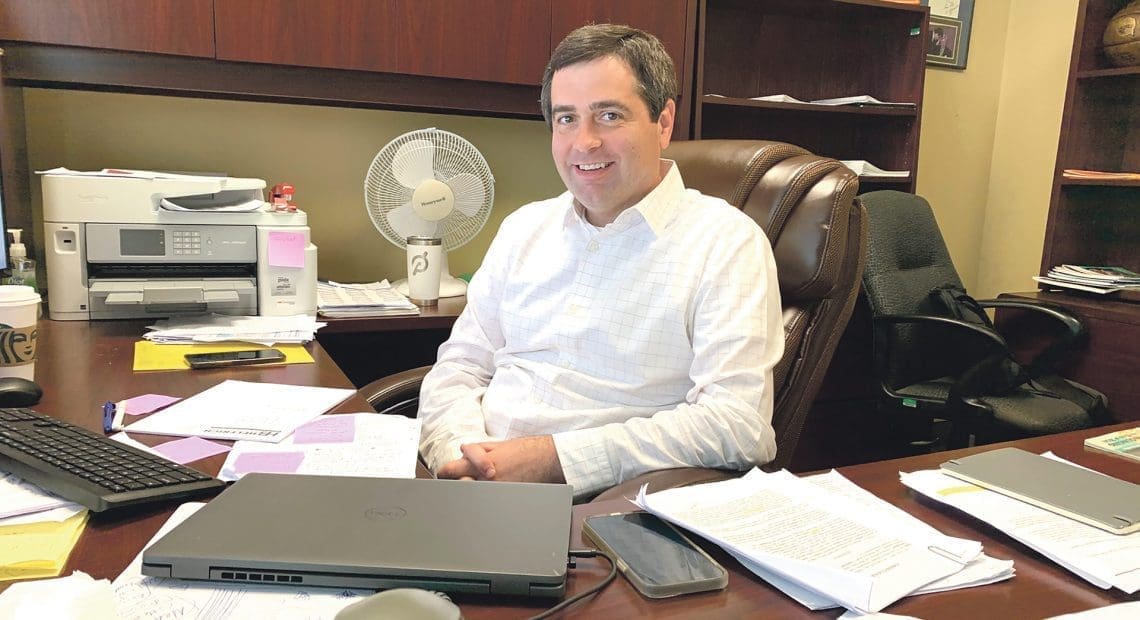
Betsy Andrus, executive director of the Southern Berkshires Chamber of Commerce, said Berkshire Busk! is one of the many positive notes being hit in Great Barrington these days. Others include its bustling, ever-changing downtown, a farmers market combining with an arts market that is drawing diverse audiences, and its many outdoor activities.

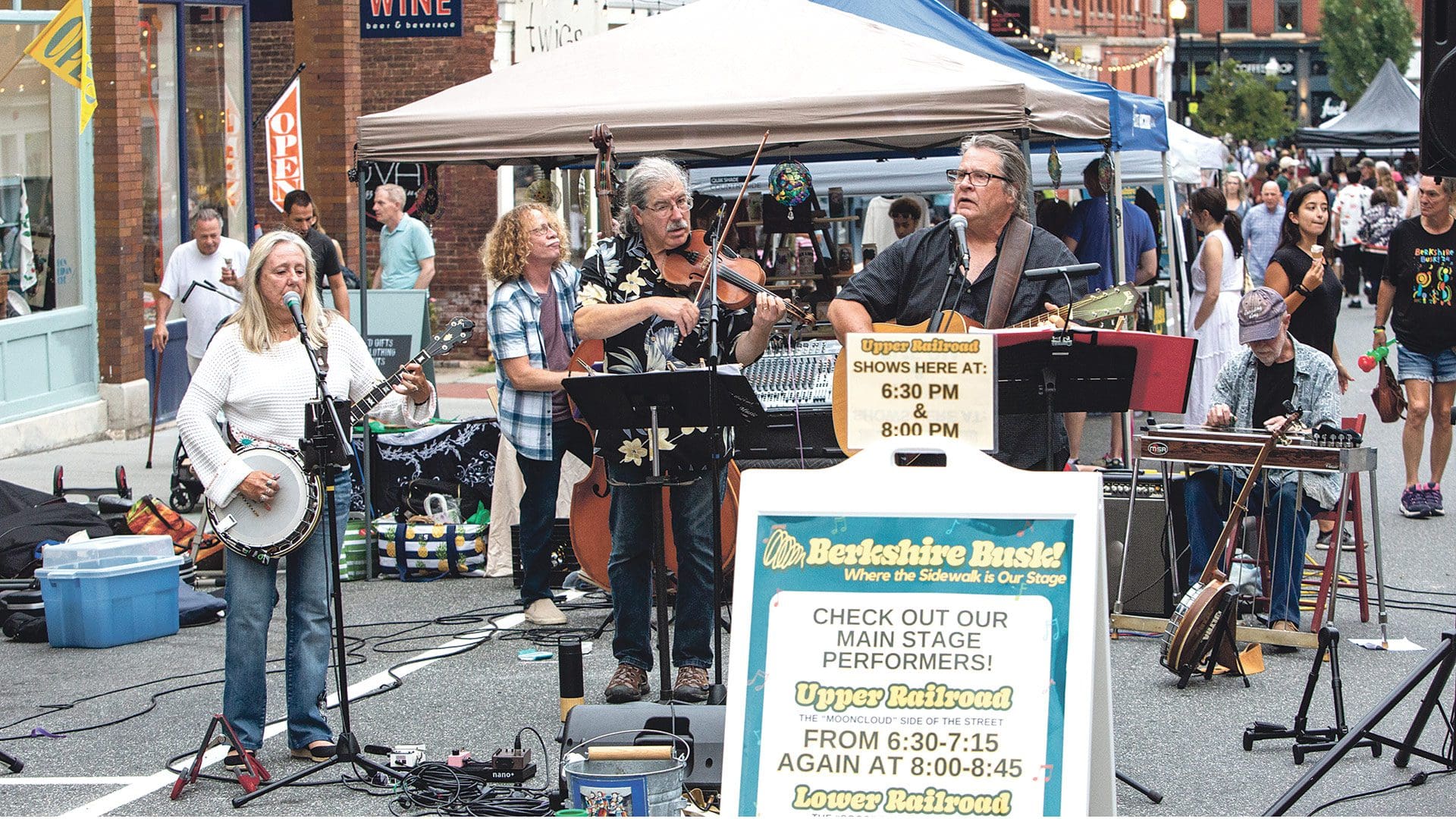
Gene Carr says Berkshire Busk! Is creating economic impact

Gene Carr says Berkshire Busk! Is creating economic impact — and also cultivating community.

While enjoying this vibrancy and progress, the town is experiencing what Gary Happ, co-owner of Barrington Brewery and Restaurant, nearing its 30th anniversary in business, called “growing pains.”

Specifically, he talked about a shortage of workers for the many hospitality-related businesses in town, a shortage of affordable housing, and how the two trends are certainly related.

To make his point, he flashed back nearly a half-century to when he first came to town and worked at a local school. He recalls making $7,000 a year back then, but he could still easily afford to live in the community. That is not the case with the current generation of workers in entry-level jobs and even those a few rungs higher on the ladder.

“People who work here can’t afford to live here,” Happ said, adding that, while this problem is not unique to Great Barrington, it is certainly acute here, where home prices have skyrocketed since the pandemic as rural living has become more popular, and rents have risen accordingly, pricing many people out.

Meanwhile, there are some serious infrastructure issues — the Brookside Road bridge over the Housatonic River was closed down by the state after a routine inspection revealed it was unsafe for vehicular traffic, and there have been two other bridge shutdowns since 2019 — creating some real inconvenience for residents and visitors alike, he noted.

But despite all this, Great Barrington is a picture of vibrancy and energy. For the latest installment of its Community Spotlight series, BusinessWest looks at how this picture is ever-changing and always intriguing.


Taking It to the Streets

As he talked with BusinessWest, Carr was gearing up for Labor Day, the last weekend of Berkshire Busk! The lineup was set to include the Cate Great! Show, an act that combines high-end circus with comedy, at Lower Railroad Street; singer/songwriter Garrin Benfield on Upper Railroad Sreet; Rick and Marilyn, who perform “guitar-centric, edgy, acoustic rock music,” at Carr Hardware; poet Kevin Devaney at TP Saddleblanket, and much more.

That lineup typifies what the program has been about since it was conceived during COVID and launched in 2021 with the support of town officials and several corporate sponsors, including Big Y, Adams Community Bank, and the Geoffrey C. Hughes Foundation, among others.

“Many of our employees have to live in larger groups or further out — maybe in Pittsfield or in New York State. In Great Barrington, the demand for workers is high, and that puts a lot of stress on many businesses.”

As Carr explained, outdoor dining was exploding onto the scene in the summer and fall of 2020, and Berkshire Busk! — busk is a verb referring to street performing — was created to bring that street dining experience to a new and much higher level.

“I went to the town and said, ‘you have such a wonderful outdoor opportunity … why don’t we add some buskers, some street performers, who can perform all over town in Great Barrington, and we can bring people downtown who can dine and shop and be with each other — why don’t we create a real festival?’” he recalled, adding that is exactly what has materialized.

Each weekend, there are between five and seven buskers at different locations in the downtown, he went on, adding that the lineup varies each week and includes local performers and professional buskers.

Carr said about 25,000 people turned out during the 10 Friday and Saturday night weekends of the festival, with two rain days.

“About half the attendees said they specifically came because of Berkshire Busk!, and the vast majority said they came to also to dine and shop … which means that we generated more than $1 million of incremental economic impact,” he noted.

“We reached all ages, particularly families with kids, and the audience was about 50% local Berkshire county and surrounding areas and 50% tourists, with the majority of the tourists coming from the New York metro area. Also, 97% of respondents said that Berkshire Busk! improved their perception of the town of Great Barrington.”

Great Barrington at a glance

Year Incorporated: 1761
Population: 7,172
Area: 45.8 square miles
County: Berkshire
Residential Tax Rate: $13.89
Commercial Tax Rate: $13.89
Median Household Income: $95,490
Median Family Income: $103,135
Type of Government: Open Town Meeting
Largest Employers: Fairview Hospital; Iredale Mineral Cosmetics; Kutscher’s Sports Academy; Prairie Whale
* Latest information available

As noted earlier, Berkshire Busk! is one of many draws in Great Barrington. Another is its array of arts and cultural attractions, including the historic Mahaiwe Performing Arts Center, in continuous operation since 1905, and also an eclectic mix of shops along Main and Railroad streets.

This collection of shops is in an almost-constant state of change, said Andrus, noting that, in addition to new shops opening on a fairly regular basis, existing businesses will often move to different storefronts. All this keeps the downtown fresh, she said, adding that it attracts a mix of locals, many from neighboring New York, and tourists from across New England.

They come … not quite year-round, but for at least three seasons, she said, noting that, while spring is relatively slow, summer and fall are very busy, and winter can be, especially if the conditions are good for skiing.

Happ agreed, but noted that winters, especially lately, have been more hit or miss, with generally less snow and even fewer opportunities to make it.


Lager Than Life

Fall is perhaps the busiest season, here and across the Berkshires, and this year, there will be an additional draw.

Indeed, 15 years after the last one, Barrington Brewery is staging Octoberfest, Happ said. When a wedding slated for Oct. 20 at Crissy Farm, the brewery’s events venue, was canceled and he couldn’t fill the date, he decided to turn back the clock.

“It will be a celebration of beer and food, with entertainment,” he said. “It will be a nice late-fall event.”

In general, business is good, but these are certainly changing times for the craft-beer industry, said Happ, who was one of the local pioneers, if you will. He told BusinessWest that those who just brew beer are struggling — he knows this from all the brewing equipment for sale online from operations that have gone out of business — and that a taproom, and, preferably a full restaurant, is now needed to be profitable.

“To be in the microbrew business without a restaurant attached like we do … it’s hard,” he said. “A lot of those little breweries are struggling because it’s hard to find that space; it’s hard to get taps in bars, and it’s hard to find shelf space in package stores.”

Barrington Brewery & Restaurant not only fits that bill, it’s one of the only businesses of its kind that is solar-powered, and it has Crissy Farm nearby, which hosts a wide array of events, including weddings, rehearsal dinners, anniversary parties, and more.

And while the business has had fewer workforce issues than many other hospitality-related businesses in town, Happ noted that his employees increasingly struggle to both work and live in Great Barrington, and this represents a problem for the town.

“Many of our employees have to live in larger groups or further out — maybe in Pittsfield or in New York State,” he noted. “In Great Barrington, the demand for workers is high, and that puts a lot of stress on many businesses.

“You talk to guys in construction, they can’t find anybody to work — masons, plumbers, electricians, they’re all busy as can be, but there’s no workers,” he went on. “And that does create some problems.”

Still, by and large, most businesses are getting by and having a good summer and good year, said Andrus, even if many shops are seeing an overall drop in consumer spending due to a combination of COVID, the economy, and maybe even the election.

The community remains a popular destination, she said, adding that visitors are drawn to the downtown, the hiking and biking trails the ski resorts, and myriad other events and attractions in and around town.

“There’s so many different reasons why people come,” she said. “Sometimes they come for one specific reason, and then they get here and they say, ‘I want to do that, too. There’s just a lot going on all at once, and there really is something for everyone.”

Visitors come from all over, and many will stay a day or two, but some are simply passing through — quite literally, in the case of those hiking the Appalachian Trail.

The trail, which stretches more than 2,000 miles from Georgia to Maine and passes through 14 states, draws more than 3 million people to hike segments of it each year.

A very small percentage of those hikers will step off the trial in Great Barrington for a break to eat, rest, resupply, or all of the above, but those who do certainly contribute to the local economy and individual businesses, Andrus said.

“It’s amazing the volume of hikers that go through here, and Great Barrington absolutely has become a stopping point for them,” she noted. “A friend of mine who’s retired calls himself a trail angel; he will shuttle people around from one location to the next — to town, to get groceries at the Big Y, etc.

“And he keeps statistics on everyone who gets in his car,” she went on. “He said that 99% of the time he’s driving them into town to eat a meal, go grocery shopping, or stay overnight, usually at the Travelodge, because they accommodate for the hikers, or even to a camping facility. People are in town, and they’re purchasing things — there’s a big impact.”

As Redpath noted, this community has something that appeals to just about everyone — especially that small-town feel with an extra dose of culture and sophistication.


Healthcare Heroes

Lifetime Achievement

Past President, NAMI Western Massachusetts

Her Work on Behalf of the Mentally Ill Became a Lifelong Mission


Bernice Drumheller

Bernice Drumheller

When Bernice Drumheller’s son, Mark, was in grade school, she noticed he was having some issues.

“He showed symptoms of some kind of illness early in life,” she recalled. “I noticed some peculiarities; he was my youngest son of four, and I didn’t see any of those signs in my other three children, so I knew that there was something going on with my youngest son.”

That something was mental illness, she said, noting that, as early as age 4, Mark seemed to be depressed and didn’t talk much.

Drumheller’s concern led her to become a school aide so she could keep an eye on him — and also on how the school was “going to deal with his situation.”

You might say that was the very beginning of what would become deep involvement in efforts to help those with mental illness and their families — work that would move beyond Mark’s school and into several different settings, as we’ll see.

“When Mark became a teenager, at 14 and 15, that’s when real problems started to develop,” she went on, noting that he was skipping school, having trouble making his grades, and resisting calls to attend a resource center because he was embarrassed to do so.

Fast-forwarding a little, she said Mark did graduate from high school, but his problems mounted, and his illness took new turns. He would eventually be hospitalized and later sent to Brattleboro Retreat in Vermont. It was there that Drumheller met a social worker who introduced her to an organization called NAMI, the National Alliance on Mental Illness, and that’s where our story begins an exciting new chapter.

Indeed, she would receive some help from the organization, which now boasts 600 local affiliates — and then spend the next 30 years helping it provide assistance to others.

“I noticed some peculiarities; he was my youngest son of four, and I didn’t see any of those signs in my other three children, so I knew that there was something going on with my youngest son.”

She started as a Family-to-Family Education teacher, with that program’s name effectively explaining what it is — individuals in families experiencing mental illness educating others going through the same things (much more on this program later).

But over the years, she would go on to serve on NAMI’s board and as the president of its Western Mass. chapter, now headquartered in Holyoke, for 12 years. For more than three decades, she has been a tireless advocate for those with mental illness and their families — a commitment that has made her a Healthcare Hero in the Lifetime Achievement category.

This award — one of many Drumheller has received over the years, including another lifetime achievement award from NAMI Massachusetts — speaks to the passion she has brought to her work — and the fact that she’s never considered it work.

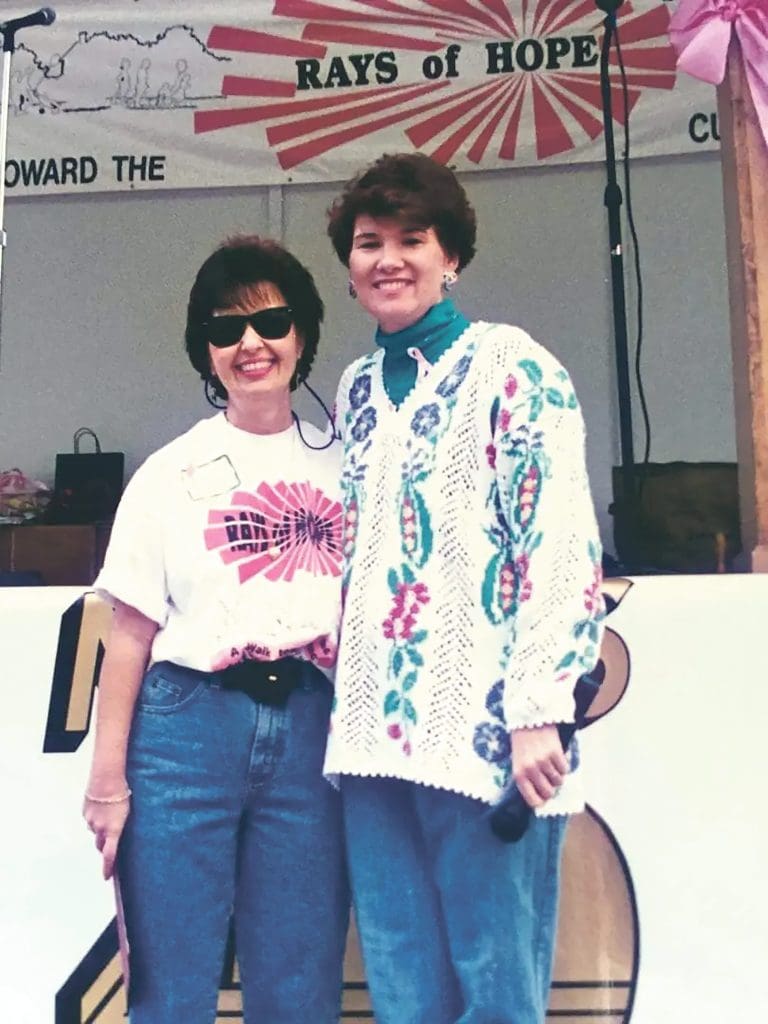
Bernice Drumheller, right, volunteers at a walkathon to benefit NAMI along with Ruth Stein

Bernice Drumheller, right, volunteers at a walkathon to benefit NAMI along with Ruth Stein, who, with her husband, Harold, founded the local chapter.

Instead, it’s a fulfillment of a commitment she made a long time ago to Mark and countless others like him to be their advocate, their champion, and to speak and work on their behalf.

“I swore, when I got involved in this, that it would be a mission for my life,” she told BusinessWest, adding that this mission doesn’t actually get accomplished; the work is ongoing, and it takes many forms.

Over the years, she has testified at the State House as part of an effort to have the Department of Mental Health budget increased to ensure that beds are still available in hospitals and proper care is provided to those receiving services.

She has spoken at National Gun Violence Awareness Day, specifically addressing the public’s misperception that those with a mental-health diagnosis are responsible for gun violence; her message is that they are far more likely to be the victims of violence than the perpetrators of violence.

She appeared with then-Hampden County Sheriff Michael Ashe to promote the “CEOs Against Stigma” campaign as part of what has become an ongoing fight to battle stigma surrounding those with mental illness, and she has shared her story in crisis-intervention trainings for first responders to mental-health emergencies so they would have a better understanding of these crises.

“Most of her time has been spent giving countless hours serving an organization she believes in and is dedicated to, promoting mental health and well-being throughout the community,” said Tamari Cole, the current president of NAMI Western Massachusetts, who nominated Drumheller for the Healthcare Heroes award, noting that she continues to be a force in this realm.

And at NAMI, she continues to serve on the board and also as a family support-group facilitator, while also raising money for the agency and volunteering several hours monthly.

Her tireless work has served to inspire others, while it is also giving a louder voice to those battling illness, as well as their loved ones.

All this makes her more than worthy of the title Healthcare Hero.


Someone Who ‘Gets It’

Drumheller said her son Mark’s story is typical of many of those with mental illness. And her efforts to understand that illness and help him are typical as well.

In short, families need support, direction, and someone who can relate and understand what they are going through. Someone who, for can lack of a better phrase, can speak that language.

“COVID caused a lot of isolation, and that leads to depression. We’re social beings, and we couldn’t really socialize like we did, and this led to a lot of problems. And now, we have to fix this; we have to fix all these kids who are suffering from anxiety.”

And for many, Drumheller has been, and still is, that someone. But her work has gone much further, as noted earlier, into the realm of advocacy and education — at the local, state, regional, and national levels.

As for Mark, his case exemplifies how the road is hard, but it can take people to a good place, like the one he’s in now — his own apartment where he lives independently.

But, as noted, the road has been a hard one.

After graduating from high school, he struggled, usually without success, to hold onto a job, Drumheller recalled, adding that symptoms of schizophrenia continued to mount.

“When I would send him into a store, he would say, ‘someone’s following me’ — he was paranoid,” she recalled. “He was acting very strangely.”

To understand his illness and help him, she continued to seek the services of a family therapist, who informed her that Mark needed to be hospitalized because he was having a mental breakdown.

“He was sent to Brattleboro Retreat and ran away from there — he was quite a problem there,” she said. “He would hear things, and he would see things that aren’t there. He would think that the radio was talking to him, and the TV was talking to him; he would hear voices.

“He was on a lot of medication, and he got to a point where he couldn’t move,” she went on. “He would lie down, he wouldn’t talk, he wouldn’t move, he wouldn’t do anything.”

Mark would eventually come out of this catatonic state and get better, she recalled, adding that it was about this time that a social worker introduced her to NAMI.

“As soon as I got him home, I called our NAMI affiliate here, and they helped me a lot,” she said. “They were very supportive, and that’s when I got involved.”

That’s an understatement. She joined the organization’s board and soon became a family-to-family teacher.

“We teach families how to cope with people who are living with mental illness,” said Drumheller, who was named by NAMI Massachusetts as a charter member of its Family-to-Family Hall of Fame, adding this is a simple job description, but the work is often difficult, made easier by shared emotions and experiences.

“These families form camaraderie,” she explained. “Someone called me the other day and said, ‘Bernice, I love to talk to you because you understand. Even my immediate family members … they just don’t get it. But you get it.’

“Unless you’re dealing directly with someone who is mentally ill, people just don’t get it,” she went on. “They don’t understand mental illness, and there is such a stigma; I wanted to fight against stigma, I wanted to help educate families of people with mental illness, and I wanted to advocate for people with mental illness.”

She has, and she still does.


Giving Voice

Drumheller recalls being reluctant to take on the role of president of NAMI back in 2007, when she was first asked. There was a lot to the position, and she was working full-time in insurance.

But she eventually acquiesced and would then stay 12 years in that role, the longest tenure of any president. She said she was helped by a strong board and her years of experience as a family-to family teacher, which provided her real insight into the problems being experienced by families — problems she could articulate to constituencies ranging from elected officials who set budgets to the many agencies in this region and beyond that serve the mentally ill and their families.

But it was her drive to fulfill her mission that drove her as she helped carry out NAMI’s broad mission, focused on advocacy, raising awareness about mental illness, education, listening, and leading.

During her tenure, she did a lot of speaking to many different groups, from first responders to student nurses; from senior citizens (about seasonal affective disorder, among other things) to elected leaders in Boston.

“Every year, we had an advocacy day at the state level, and I would go and talk with members of the Legislature about mental illness and the bills that were pending,” she explained. “And I spoke at schools about the importance of trying to spot symptoms in children.”

She also spoke at Smith & Wesson about gun violence and how those with mental illness are far more likely to be the victims of shootings than the perpetrators of gun violence.

And while she doesn’t speak as much as she used to, she continues to volunteer, raise money for NAMI, serve as a family support-group facilitator, and, in general, stress that this work is ongoing.

Indeed, while progress has been made on some fronts, many needs are not being met.

“Even today, there’s still problems with families getting the help they need to cope, and also for the person with the illness,” she explained. “It’s very, very difficult to get resources for them; there are not enough clinicians, and the ones we have don’t get paid enough.”

Meanwhile, the pandemic has exacerbated what already was a mental-health crisis in this country.

“COVID caused a lot of isolation, and that leads to depression,” she said. “We’re social beings, and we couldn’t really socialize like we did, and this led to a lot of problems. And now, we have to fix this; we have to fix all these kids who are suffering from anxiety.”

As for her own son, Drumheller said Mark is doing well these days.

He’s not able to work, because he has a hard time focusing, she noted, but he lives independently, loves music, and takes part in several programs aimed at helping him contribute to the community.

His story is not unique except that it helped to inspire what his mother called a mission, one that she would carry out for the rest of her life.

Not only has she done that, she has inspired others to join her in that mission, while also making continuous strides in combating stigma and improving quality of life for those with mental illness and their families.

In short, Mark helped give the region a Healthcare Hero. And everyone should be thankful.


Healthcare Heroes

Lifetime Achievement

Attending Physician, Baystate Mason Square Neighborhood Health Center

He’s Spent His Career Serving the Underserved

Dr. Andrew Balder

Dr. Andrew Balder

“As a person, he’s authentic in his desire to truly make things better for people. He is the first to show up whenever and wherever issues of equity and social justice are to be addressed. And he brings something extra to the table in his role as a knowledgeable physician.”

“What is really important for everyone to know about him is his compassion and patience for those he serves. He truly cares about unhoused individuals. This is not a job for him, but a calling. He gravitates toward helping underserved, marginal, and vulnerable individuals.”

Those two separate testimonials come from previous winners of the Healthcare Hero award in the Lifetime Achievement category — the former from Frank Robinson, the recently retired vice president of Public Health for Baystate Health, and the latter courtesy of Helen Caulton-Harris, commissioner of Health for the city of Springfield.

And they sum up, effectively and concisely, the work of the latest recipient of that award, Dr. Andrew Balder, attending physician at the Baystate Mason Square Neighborhood Health Center, and why he is worthy of that honor.

Indeed, when it comes to not only his commitment to help the homeless, but also his efforts in the realm of maternal-fetal health — and his tireless efforts to serve patients living in some in some of the poorest neighborhoods in the state — his work certainly isn’t just work. It is, indeed, a calling. And he is authentic in his desire to make things truly better for people.

You might say he gets some of that from his mother.

She was a psychiatrist who also served as a general practitioner in West Philadelphia, and during World War II, when many of the male physicians were called to serve, was a general practitioner for a large population.

“She realized that 75% of the patients that needed to see her just wanted to talk,” Balder said, adding that she went on to be a child psychologist as well as a GP, often relating stories about her work and bringing her young son to her offices, where he would hang out in the waiting room while she saw patients.

During a med-school interview, when someone asked him what he wanted to do for a career, he repied, “anything except what my mother does,” he recalled.

“And here I am in primary care. And what’s primary care? She said it’s 75% psychiatry,” he went on, adding that he has some patients who mostly just want to talk — about life and the challenges they’re confronting — and he engages them. Most importantly, he listens.

Beyond the day-to-day work with his patients, Balder has indeed become deeply involved with broader programs to serve the underserved, including as one-time chair of (and still an active participant in) the Springfield Department of Health and Human Services’ Project Baby Springfield. This is an initiative that addresses issues related to infant mortality, child mortality health, and birth outcomes, especially for disproportionately represented women of color, by bringing education and awareness to families and caregivers about healthy pregnancies and safe infant sleep, and ensuring that all mothers, regardless of race, ethnicity, age, or income level, can access excellent pre- and post-natal care.

He has also become involved with programs to assist homeless individuals in Springfield, serving as chief medical officer of the city’s Health Services for the Homeless since 2015.

These and other efforts to serve the underserved not only improve quality of life for many people in Springfield and beyond, they inspire others to want to give back as well.

“He is the first to show up whenever and wherever issues of equity and social justice are to be addressed.”

“Dr. Balder is present, dedicated, and passionate for the care of those who are traditionally underserved in Springfield,” said Paul Pirraglia, division chief of General Medicine and Community Health at Baystate Health, and a previous Healthcare Hero himself. “He is tireless in this work and sets an impeccable example for service, not just for those in healthcare, but for all.”

For these and many other reasons, Balder is worthy of the title Healthcare Hero.


His Life’s Work

When he was called by BusinessWest and informed that he was being honored as a Healthcare Hero in the Lifetime Achievement category, Balder, after first saying “thank you,” joked, “I guess I can retire now.”

He admits to thinking about that day, but he’s not there yet, which is good for the city of Springfield and especially for those underserved populations that he has committed himself to serving pretty much since he started his career.

Indeed, after a short stint as a staff physician with Philadelphia Health Associates/John Hancock Health Plan of Philadelphia in King of Prussia, Penn., he came to Springfield, Baystate Health, and, soon thereafter, the Mason Square Neighborhood Health Center.

There, he has found that, by and large, his mother was right; psychiatry is a big part of primary care.

Dr. Andrew Balder, seen here talking with a patient at the Baystate Mason Square Neighborhood Health Center

Dr. Andrew Balder, seen here talking with a patient at the Baystate Mason Square Neighborhood Health Center, counts listening among his strongest skills.

“Whatever you’re doing in primary medicine, part of the guts of it is understanding behavior and behavior change, and also self-efficacy and self-image, all of those things,” he explained. “And that’s basically talk; it may be structured, it may be unstructured, it all starts with listening, but it really is the human interaction and exchange of things, much more than pulling out the electronic prescription pad.

“Most of what you’re doing is understanding people and dealing with their goals, their dreams, their desires, their perception of health, and their behaviors,” he went on, adding that he’s learned, and really always knew, that it’s more important to listen than to talk.

And that pretty much sums up what Balder has been doing for the past 35 years. But what’s more noteworthy is the fact that he’s spent almost all his career working with underserved populations, which he described as his life’s goal.

When asked why, he said he came out of a family that was attuned to issues of equity and civil rights back in the ’30s and ’40s, and “this sort of gets baked in — what you hear, what you think, and partially what you feel.”

These sentiments explain, at least in part, why he left Pennsylvania, where he was caring for “General Electric space engineers,” as he put it, and came to Springfield. He first worked in the North End in a job that involved far more work in the hospital setting before eventually coming to Mason Square, with the attitude that he wasn’t coming to save the people there, but listen to them and serve them.

“You’re not playing the role of savior. You’re not riding into a community to save it — the community will save itself.”

“You’re not playing the role of savior. You’re not riding into a community to save it — the community will save itself,” he explained. “They will empower themselves … but the tools that are necessary are not always obvious or easily available, so you get to speak up with individuals for themselves and speak up with communities for themselves. But you’re not there to save the world; that’s not going to happen.”

When asked what he likes most about his work in this setting, Balder said, “you get to meet a whole lot of people you would never have met otherwise, and this deepens your understanding of human beings and how, yes, we’re all different, but we have many commonalities and differences that we don’t always appreciate.”


Birth of a Notion

Elaborating, he said he also gets a chance to generate change “on an individual or larger level,” and that no two days are the same.

And he attributes both to the fact that, in his role, he has been able to “build my own life and my own job,” one that has him seeing patients at the health center some days, training residents, leading a diabetes clinic, continuing his work in the broad realm of maternal-fetal health, providing care to the homeless at facilities in Springfield and Northampton, and much more.

He enjoys this variety, which enables him to extend his leadership, and overall impact, well beyond the Mason Square center.

That’s certainly true of his work with the homeless population, which he described as challenging, but rewarding — challenging because many of these individuals have been removed from the healthcare system for many years, most have substance-abuse and mental-health issues, and almost all of them have multiple health problems.

Meanwhile, most don’t have the resources to follow through on what he might recommend, Balder said, adding that this includes financial issues, lack of transportation, lack of housing, lack of a phone, or all of the above.

“All that makes it hard to follow up, and it makes it hard to continue consistent motivation, consistent sensitive messaging, and dialogue,” he said, adding that overall efforts to serve this population are limited by a shortage of providers, nurses, and resources to go where the homeless are.

But there are certainly some qualitative indicators that these efforts are making a difference.

“You don’t get the immediate reward of ‘oh my goodness, my glucose is doing better,’ or ‘my blood pressure is better; let’s focus on that today,’ because you’re always dealing with the other issues first and the difficulties of achieving certain things,” he explained. “But when they do, they’re happy; the patients are thrilled with the changes they’ve made. But they’re always getting beaten by something.”

As for Project Baby Springfield, that’s another initiative, started more than 20 years ago, that is trying to move the needle on a persistent problem for the City of Homes.

“We’re a small band of warriors,” Balder said of those who have led initiatives over the years that eventually came to be branded as Project Baby, adding that those involved have worked to identify the causes behind infant mortality and the reasons for the inequity in the numbers involving certain populations.

“In our country, as well as in our city, Black infants die before their first birthday at two to three times the rate of white infants,” he said. “The numbers go up, the numbers go down, they gradually improve, they occasionally get worse … but the disparity and inequity continues to exist in the same proportions.”

As an example of the work undertaken, he cited efforts to curb what are known as ‘unsafe-sleep-related deaths.’

“We managed to get to some money together and did a four-month campaign on safe sleep,” he noted. “We had things on the sides of buses, in the buses, videos, all sorts of stuff. We took it on as Project Baby to push that message; we did talks in public, we did talks with small groups, we sponsored the development of the new maternal-child healthline in Springfield.”

Other initiatives have included pregnancy, delivery, and post-partum support, especially in communities of color, where such efforts have proven to improve birth outcomes, with fewer cesarian sections, Balder explained, adding that one of the latest initiatives has involved breastfeeding.

“We’ve taken on small things over the years to try to stir the drink and help bring the message to the public,” he explained. “I wish we were bigger and we were doing more, but we are a band of happy warriors.”


Bottom Line

Few people in this region know more about the underserved populations in Springfield than Frank Robinson and Helen Caulton-Harris. They’ve both been on the front lines of efforts to improve the lives of those constituencies.

And Balder has been right there with them. He knows he can’t save the world, or even his small piece of it. But he can make a difference, and he has, in a great many ways.

And this helps explain why he’s a Healthcare Hero.

Healthcare Heroes

Healthcare Administration

Director of School-Based Clinical Services, River Valley Counseling Center

As a Leader, She Makes Sure Team Members Are Heard — and Valued

Alexa Mignano

Alexa Mignano

Like many in healthcare who have traded direct interaction with patients for roles in which they manage others who provide that care, Alexa Mignano found the transition somewhat challenging; stepping away from direct care is never easy.

But to say she has managed and is flourishing in her current role would be a real understatement.

As the director of School-Based Clinical Services (SBS) for River Valley Counseling Center, she now leads a team of more than 85 people. Since taking the helm in 2019, she has expanded the SBS program in dramatic fashion, taking it from two school districts to 11, providing behavioral healthcare to more than 1,600 students in more than 70 schools.

And this growth comes at a critical time.

Indeed, COVID-19 had a significant impact on the behavioral health of society as a whole, and especially young people. It also comes at a time when many young people are experiencing trauma and its many side effects, and when there are simply not enough clinicians, especially in non-school settings, to meet this need.

But behind the numbers, and these sentiments on growing need for behavioral-health services among young people, are the traits that Mignano brings to her role — traits that make her a Healthcare Hero in the Administration category.

“There are really difficult things that we hear about in this work that happen to children. And to be able to create some change and help them heal, and help families heal, is a way to give back to my community.”

These include passion for her work, strong leadership skills, an ability to build teamwork and camaraderie, a willingness to listen and maintain an open mind, and the ability to inspire others to reach higher and deeper as they go about their work and serve this important constituency.

These are traits that come clearly into focus in the thoughts of team members and others who came together to nominate her for the Healthcare Heroes award.

“The SBS is a connected, warm, passionate, and energetic team, which has accomplished amazing things in our school system,” said Elaine Campbell, assistant executive director and clinical director at River Valley. “This team is spread out across Hampden, Hampshire, and Franklin counties, and Alexa brings them together and unifies them as a collaborative unit. Alexa engages the team and brings them together for various events and trainings throughout the year to build support and community amongst the team.”

Alexa Mignano says trained clinicians offering care right in the schools

Alexa Mignano says trained clinicians offering care right in the schools provides consistency for the kids, which translates into better care.

Emma Cohen, an SBS clinician, added that “Alexa is — and consistently has been — an amazing leader. She always manages to support our whole team, work hard to help each and every one of us, and make sure we’re providing the best care we can to our clients.

“Alexa truly makes our program great — she is always open to new ideas, makes sure everyone has space to feel heard, and helps us make a large and complex program run smoothly,” she went on. “Alexa is an incredible example of a leader, an advocate for both her employees and the people we serve, and an overall wonderful person to work for.”

If one looks up the definition of ‘leader,’ especially in a healthcare sector, these are the words and phrases that will come up. And that’s what Mignano has become — a true leader.

And while she misses providing direct care to clients, she said that, as a manager, she can actually have a bigger impact and touch the lives of more young people in need of critical help.

“What’s so cool about what we do, the schools that we’re in … the kids know us, therapy’s cool, and more kids want to come see us. They’re not afraid to get help.”

“This is the classic very rewarding job,” she told BusinessWest. “There are really difficult things that we hear about in this work that happen to children. And to be able to create some change and help them heal, and help families heal, is a way to give back to my community.”

Such sentiments explain not only why she loves what she does, but why she’s a Healthcare Hero.


Taking the Lead

Since the Healthcare Heroes recognition program was created in 2017, its Administration category has been perhaps the most competitive.

There are several nominations each year, and to stand out in these crowded fields, one must be more than a manager. He or she must also be a leader, someone who displays those skills and traits mentioned above.

In short, those that prevail in this category, often providers of care themselves at various points in their careers, are able to motivate and, for lack of a better phrase, get all the members of a team to row in the same direction. And their strongest trait might be an ability to not only listen, but make team members understand that they are being heard.

Mignano brings all this and more to a role she’s grown into after taking a somewhat winding road into healthcare and, more specifically, behavioral healthcare.

Indeed, this is a second career for her. She was working at UMass Amherst, doing academic advising and first-year-experience work. She enjoyed that role, but with a young daughter, she needed something that provided more flexibility.

“So I decided to go with what my degree was originally in, which was mental-health counseling,” she said. “And then I fell in love with it.”

That’s another understatement.

Eventually, she started providing therapy to children in schools, was hired by Holyoke-based River Valley Counseling Center, and worked at Holyoke High School and Kelly Elementary School. She ended up going back to school so she could get licensed.

“It was a perfect match for what I wanted,” she went on. “And I felt like I was good at it; I was very interested in how children’s brains change over time, especially when they’ve been exposed to trauma, and how you can heal that and shift that.”

Mignano worked as a counselor for eight years before transitioning into administration, first in a few school districts and, eventually, as director of School-Based Clinical Services.

This is a position with a broad job description that includes everything from overseeing partnerships with school districts and charter schools in the area to hiring, training, and, most importantly, supporting the clinicians that go into schools and provide outpatient therapy to young people coping with a wide array of issues and conditions.

“There’s a lot of trauma,” she noted. “I’d say about 25 to 30% of our cases are focused on trauma. There’s depression, anxiety, ADHD … there’s really a wide range.”

As they help students deal with these issues, the counselors become trusted and accepted, and at a time when students need help, they seem increasingly willing to embrace it.

“I have been in the field for more than 20 years, and Alexa is the most caring, supportive supervisor I have ever had.”

“What’s so cool about what we do, the schools that we’re in … the kids know us, therapy’s cool, and more kids want to come see us,” she told BusinessWest. “They’re not afraid to get help. The stigma is removed quite a bit, especially in the younger grades. When they get to high school, they want to feel a little bit more private, but even there, we’ve become part of the school, and part of what happens at school is that you also get help for your mental-health problems.”

And dissipation of this stigma is an important step forward, she went on.

“Kids are not afraid to say they need support,” she noted. “I mean, I think there’s a lot of emphasis on that in social media — that it’s OK to speak out and say what’s going on and ask for help. But they also get to see it in their school environment, and it gets normalized. It’s not some random place they go to get services and to get support. They do it in a place they’re really familiar with, and I think that helps with breaking down some of the shame or embarrassment that they might feel about getting support; their friends are getting help.”


School of Thought

In short, school-based services are enjoying large levels of success. And thanks to Mignano’s leadership and drive, they are enjoying success in many more ZIP codes.

“I wanted more people to focus in on treating children, so I started supervising and providing support to other clinicians doing the work,” she said, adding that she initiated efforts to coordinate a contract with the Easthampton School District and oversaw the program there before becoming director of all school-based services, with a commitment to continue adding more districts.

“We started with a few, and then I was like … no, we can do more,” she went on. “And the word started to spread, so I started meeting with different superintendents and principals and talking about what we do. And then, a real focus of mine became cultivating a group of therapists that really wanted to be child-focused or adolescent-focused, supporting them in that work. And it’s just a win-win for everybody in terms of how it’s set up.”

As noted earlier, there are now 11 districts in the fold, and Mignano believes there is room for more expansion, especially since the hiring challenges brought on the pandemic are mostly in the rearview mirror.

“I always say we’re done, and then a principal calls,” she said. “I’ve always wanted to expand responsibly; whenever we add a new school district, we add the infrastructure to support the consistency, the supervision, the communication … that’s critical in making these programs work.”

Beyond these expansion efforts, her leadership has brought consistency and steady improvement to existing programs, with the school setting becoming an increasingly effective place for young people to receive therapy because it removes barriers to care.

“I know I’m biased, but I’ve seen it work,” she said. “As a clinician, I’ve seen it work incredibly well, and now I see it at this end. It works for the kids, it works for the schools because they have some added support, and it works for the clinicians who want to focus on kids, but they don’t want to necessarily work every single evening to do that. They get to have a normal schedule too, so it works for everybody.”

And Mignano is committed to making sure it works for everybody.

“As an administrator, I’ve really been focused on how to create a work environment for mental-health professionals that feels really supportive, so they feel challenged, they feel valued, because ultimately that is the foundation of retaining clinicians,” she explained. “Because we get to train them, they get to grow clinically with us, and that translates into consistency for the kids, which translates into better care for the kids. As an administrator, I focus a lot on that — what type of environment are we creating? And people stay with us.”

Which brings us back to some of the team members who nominated her — and why.

“Alexa is an incredible leader, clinician, advocate, and supervisor,” said Catherine Vaughan, assistant director of School-Based Services. “She is truly passionate about the work we do and gives her all in everything that she does. She also encourages her co-workers to go outside their comfort zones with their work, and she is always there supporting and guiding them along the way. I am so grateful to be a part of her team.”

Lisa Smith O’Connor, an SBS clinician, agreed. “I have been in the field for more than 20 years, and Alexa is the most caring, supportive supervisor I have ever had,” she said. “She is an expert in our field, but also an amazing supervisor. I agreed to become a supervisor and commit to this agency long-term due to her caring and thoughtful support and guidance.”

All that certainly helps explain why Mignano has earned another title: Healthcare Hero.

Healthcare Heroes

Healthcare Provider

Occupational Therapist, Baystate Medical Center

She Brings Passion, Compassion to Her Work in the NICU

Margaret King

Margaret King

As she talked about her work as an occupational therapist in the Neonatal Intensive Care Unit (NICU) at Baystate Medical Center, and why she believes she was “born” to be in this setting, no pun intended, Margaret King flashed back almost 40 years.

As King tells the story, she and her mother were visiting her father, then a patient in a hospital in Texas, when her mother suggested they swing by the maternity unit and look at the newborns. And they did.

“I lit up, and I clearly remember my mother saying, ‘you should work with babies someday — I think you’d be really good at it,’” she recalled. “I have carried that with me, and I truly feel like this is what I was put on this Earth to do.

“I feel like I have the best job in the world,” she went on. “It’s a privilege to be able to do this work; these babies … they just melt your heart.”

King, a Healthcare Hero in the Provider category, has worked as an OT in pediatrics, and mostly in the NICU, for most of her career, and at Baystate for the past 16 years. And while this unit — for babies born prematurely (as many as 10-12 weeks prematurely) and babies with serious medical conditions — is not what most people think of when they hear the words ‘occupational therapist,’ there are many aspects to this assignment, she told BusinessWest.

“Occupational therapy, by definition, is about improving someone’s ability to participate in life skills,” she said. “Those are the jobs of living that we refer to, and a baby has jobs of living, too. They need to be able to grow correctly; they need to be able to sleep and rest because that’s also how they grow; they need to be able to eat, whether that’s bottle or breastfeeding; and they need to be able to bond with their parents.”

As she helps newborns with these jobs, King works in concert with other professionals in the NICU to essentially bring light to a unit kept dark to replicate conditions in the womb.

And, according to those King works beside, she is the consummate team player — supportive, always positive, and often serving as a mentor to younger OTs and other professionals.

“Maggie is known for her smile, kindness, patience, and resilience,” said Erin Jarosz, Rehabilitation manager for Baystate Health, who nominated her for this honor. “She is passionate about her care for babies, and she works closely with families to be able to best support the physiological needs of their babies and improve the babies’ abilities to participate in daily life activities.”

Olivia Fernandes, a Baystate Rehabilitation speech pathologist, agreed.

“Not only is Maggie a phenomenal clinician, she truly is a wonderful person,” Fernandes said. “She is a leader within our department and treats everyone with respect and kindness. I have looked up to her throughout my time at Baystate as I always value her guidance and advice.”

These qualities resonate not only with co-workers, but also with the parents and other family members of NICU patients, none of whom expected their child to be in this unit and all of whom agonize over each day spent there.

“This is not where they wanted to be — they didn’t want to meet me or anyone else in the NICU, so you have to start from there,” said King, adding that the unique setting, coupled with the emotional nature of the work, leads to relationships that last for years after the baby has gone home.

“I run into so many parents at the grocery stores, Target, places like that,” she went on. “That’s always sweet; that was such a unique, difficult time for them, and that’s why we become family to them during that stressful time, so it’s exciting to see them.”

King was — and still is — a part of hundreds of families across the region, families touched by her passion, warmth, and competence. Families who would say she is more than worthy of being called a Healthcare Hero.


Baby Steps

Whenever a baby goes home from the NICU, it’s an event, a celebration, King said. “It’s always a big thing, especially for the parents. And for me, if I’ve worked with them a lot, it’s just a very exciting day.”

And when a baby who has been there several months leaves those confines, there’s an even bigger sendoff, with pom-poms and the theme from Rocky playing in the background, a nod to the perseverance and fighting spirit of that child — and his or her family.

“She is passionate about her care for babies, and she works closely with families to be able to best support the physiological needs of their babies and improve the babies’ abilities to participate in daily life activities.”

King said it happens regularly, sometimes a few times a day. But it never, ever gets old.

“There’s lot of tears and hugs,” she noted. “Every situation in the NICU is meaningful and challenging, but some of those babies have been here for months, and it’s a big feat to get out of here.”

Helping babies ‘get out of here’ might be King’s unofficial job description — and, as she noted earlier, work she was born to do, even if it took a while to realize that.

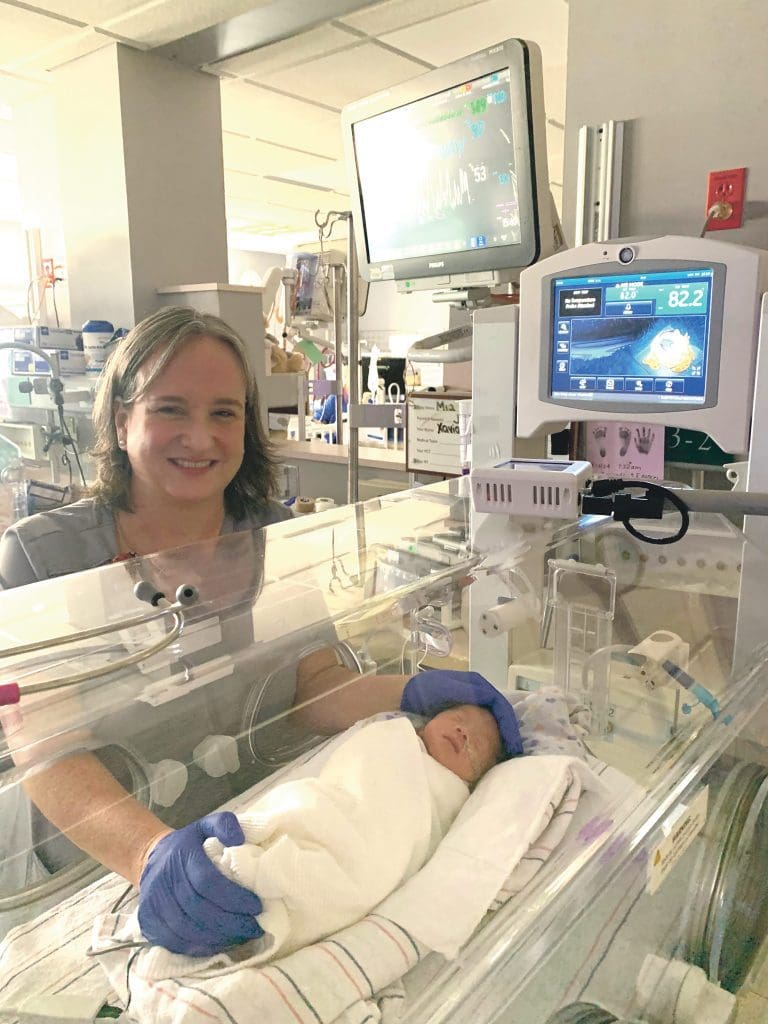
Maggie King, center, with Rebecca Hillenbrand, left, and NICU Manager Stephanie Adam

Maggie King, center, with Rebecca Hillenbrand, left, and NICU Manager Stephanie Adam, has been called the consummate team player.

Indeed, she did a music-therapy internship while in high school, and during that time, she pulled an occupational-therapy journal out of the trash and remembers saying, “what’s this?”

“I starting learning about occupational therapy and really never looked back,” she said, adding that she focused on that specialty while studying at Texas Tech. She started in Texas, first in adult rehab and then pediatrics, but eventually relocated to New England (and Baystate) to be closer to family.

And for most of her career, the NICU has been … well, home.

It’s a unique setting, obviously, one where the patients are small, cannot talk — although they can certainly communicate — and, in many cases, their eyes are not yet open.

But they still need occupational therapy, and King loves to talk about that subject.

“Even when babies that are tiny — the 23-weekers — one of my jobs is to help with the positioning of that baby so their arms, legs, and bodies grow properly, but also in a way that keeps them calm so they can sleep and keep their vital signs stable so they can be medically well,” she explained.

“I love working with adults, and the main difference with them is that you can communicate with them and have a give and take, and they can work on following directions. With babies, you have to be really good at following their cues to know what they like and what they don’t like.”

With premature babies, she noted — and, really, all babies in the NICU — she and other team members work to keep those babies in the same position they would be in if they were still in the womb.

“As an occupational therapist, I provide positioning aids that we put the babies in to provide support and containment — we try to recreate the womb,” she explained, adding that this is why it’s kept dark in the unit. “For babies, looking at the light is very stressful; it can actually raise their blood pressure and elevate their heart rate, just because it’s too light. And it’s my job to protect babies from those stressors.”

There are many other aspects to this work beyond positioning, she said, listing everything from supporting the baby during painful procedures, such as putting in an IV, to help with feeding, which is obviously a large part of her work.

When asked what she likes about OT, King said it’s the ability to “work on a little bit of everything with a person, things that are meaningful to them, things that are necessary for life, and you get to establish relationships with people. It’s very unique, and it’s special, and you get to give a lot of yourself to make things happen.”

She stressed that all that is true even if the patient is a few days old and/or several weeks premature.

“I love working with adults, and the main difference with them is that you can communicate with them and have a give and take, and they can work on following directions,” she explained. “With babies, you have to be really good at following their cues to know what they like and what they don’t like.”

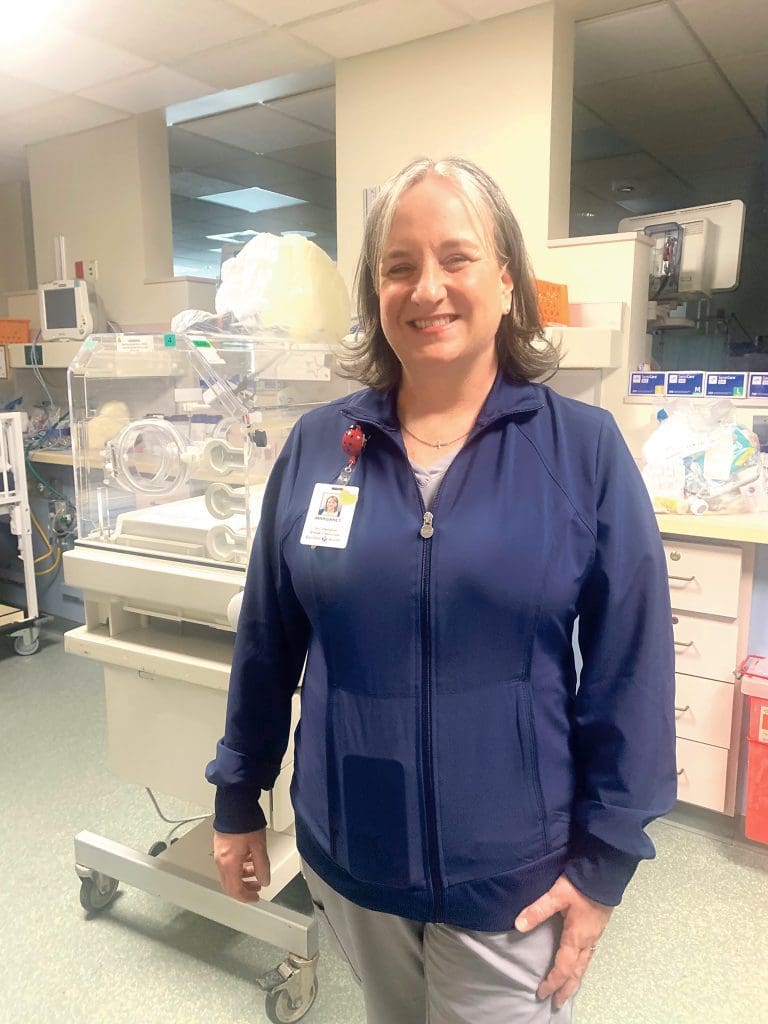
Maggie King says there are anywhere from 30 to 50 babies in the NICU at any given time

Maggie King says there are anywhere from 30 to 50 babies in the NICU at any given time.

They don’t like light, and they’re also put off by sounds, everything from phones ringing to isolette doors closing, she said. “Just small sounds to us can be painful to these babies, and we know that because of their vital signs.”

And while her primary work is with patients, King is also there for parents and other family members, who are obviously under a good deal of stress.

Parents of NICU babies are not ‘visitors,’ per se, as in a traditional hospital setting; they can come whenever they want and stay as long as they want.

“We do encourage parents to have rest breaks, take a walk, go get some lunch, maybe go home,” she said, adding that helping parents through this extremely difficult time is just one of myriad rewards that come with this job.


Born Leader

King told BusinessWest that the tiny patients in the NICU — there are between 30 and 50 at any given time — stay in that unit anywhere from a few weeks to several months, depending on how prematurely they were born or the severity of their condition. But the relationships forged with those patients and their parents last for years, if not decades.

Indeed, in addition to the yearly holiday cards she receives from the families she’s worked with, there are pictures sent as those former patients grow older, as well as invitations to their birthday parties — a steady stream of them, actually.

So many that King “sets boundaries,” as she put it. “I’ll go to a few of them. If I went to all of them, I’d be going to about 50 birthday parties a month.”

King is on those birthday-party invite lists because parents remember her, and they remember all that she brought to the NICU every day, from her competence to her passion to the smile that seems permanently etched on her face.

Those she works with see these same things every day, and they consider her the consummate team player: supportive, encouraging, and, in many ways, a mentor.

“Maggie has been consistently supportive and proactive in helping me work in this challenging, rewarding setting,” said Dan Lemaire, another Baystate Rehabilitation OT. “The NICU is, after all, an intensive-care unit; the patients are very involved medically, and Maggie’s experience and guidance has been essential to me in navigating this practice area. She has helped me understand an OT’s role amidst highly trained nurses, neonatologists, and other specialists. She has shown sensitivity and awareness regarding my skill level and readiness to approach different patients, and has guided me to appropriate training resources. Not least of all, Maggie is simply fun to work with.”

Upon reading or hearing such comments, one thing becomes abundantly clear: Maggie King’s mother, who died just a few years after that visit to the maternity ward in that Texas hospital, was right. Her daughter is really, really good at this, meaning work not just with babies, but babies in an intensive-care unit — and with parents who are under more stress than perhaps at any other time in their lives.

In such a setting, someone must bring to their job passion and compassion, and they need to bring it every day.

Maggie King does, and that’s why she’s a Healthcare Hero.

Healthcare Heroes

Collaboration in Health and Wellness

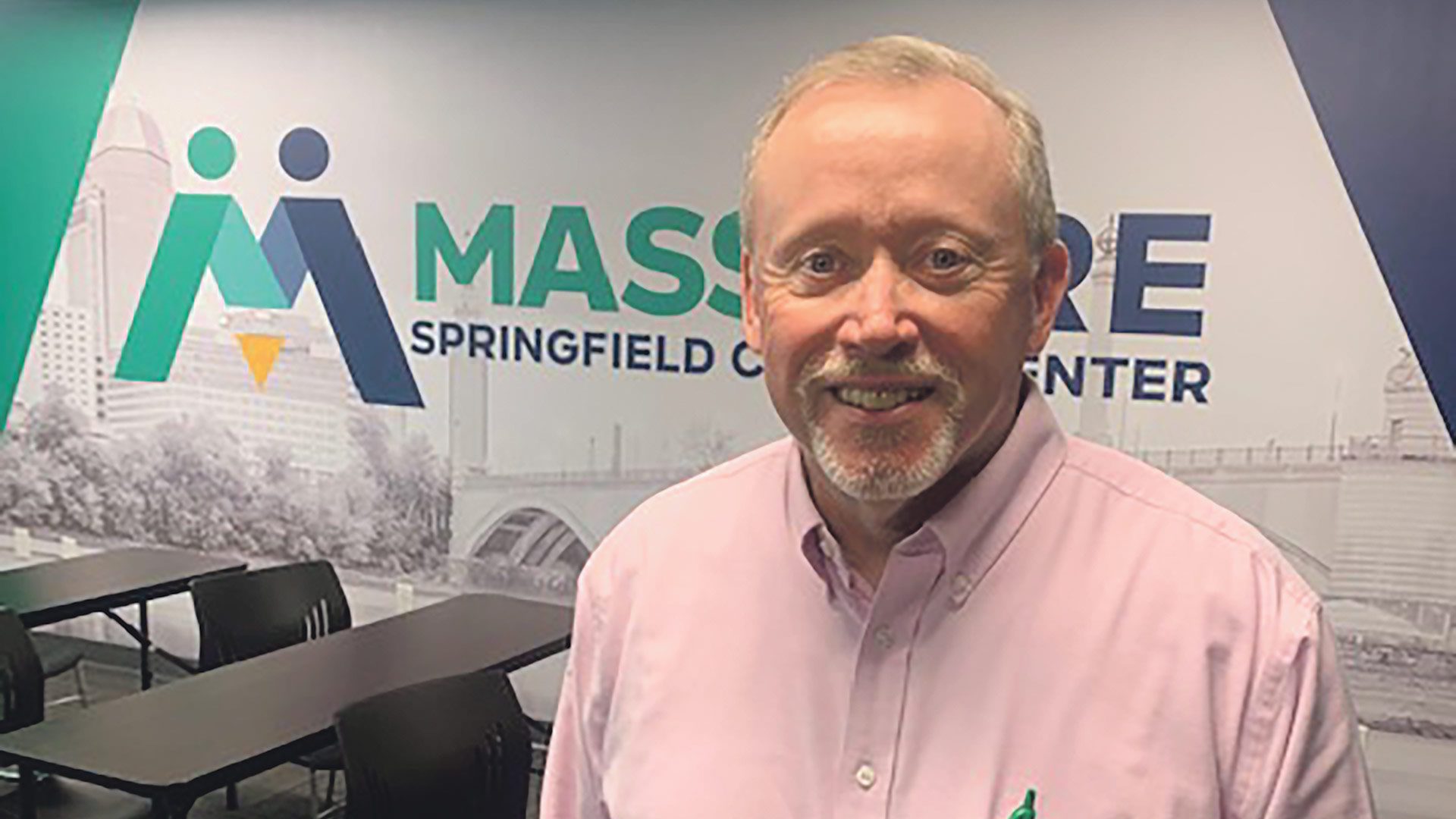
Director of Healthcare Workforce Initiatives, MassHire Hampden County Workforce Board

She Helps Put Future Healthcare Heroes into the Pipeline

Peta-Gaye Johnson

Peta-Gaye Johnson

Peta-Gaye Johnson is not your typical Healthcare Hero.

Indeed, in the eight-year history of this recognition program, there hasn’t been an honoree quite like her.

She’s not a provider of care, like a doctor, nurse, or occupational therapist, and she’s not an administrator in a healthcare facility; in fact, she’s never worked in the healthcare sector. Nor does she teach those who want to enter this profession, as several honorees, including two in the class of 2024, do.

But as the director of Healthcare Workforce Initiatives for the Hampden County Workforce Board, she works with administrators, educators, and others to help ensure that there is a reliable pipeline of workers — and, yes, potential Healthcare Heroes — for this sector.

Thus, “she has been the cornerstone for driving successful workforce-development programming to strengthen the region’s workforce and enhance the quality of patient care,” said Peter Farkas, who became president and CEO of the MassHire Hampden County Workforce Board earlier this year and nominated Johnson for this award.

Johnson is the winner in the Collaboration category, specifically for her efforts to foster collaboration — between the region’s larger healthcare providers, its colleges and universities, community-based organizations, and philanthropic agencies — and, in many respects, to lead these collaborative efforts.

They include:

• The Healthcare Workforce Partnership of Western Massachusetts, a MassHire inititive that, through Johnson’s leadership, responds to the workforce needs of employers and ensures that workers have access to the education and training needed to prepare them for lifelong careers in a changing industry;

• The Western Massachusetts Nursing Collaborative (WMNC), one of three working groups within the partnership — the others are the Allied Health Working Group and the Pioneer Valley Interprofessional Practice and Education Collaborative — and one that has made great strides to ensure that the region has an adequate supply of nurses;

• A website called westernmasshealthcareers.org, which Johnson developed to provide area residents with relevant information on occupations and career pathways in the healthcare industry;

• The Pioneer Valley Healthcare Center Pathway Forum, an annual event that brings together high-school guidance counselors from across the region to provide them with information to assist and direct students to enroll in and successfully complete health science programs; and

• Her work to oversee and drive a three-year grant to train 174 unemployed and underemployed individuals in the Pioneer Valley for careers as medical assistants, EMTs, recovery coaches, and behavioral resource technicians.

Summing up all these initiatives and Johnson’s involvement with them, Farkas said it’s not necessarily what she does for this sector — the largest employer in the Pioneer Valley, with roughly 73,000 jobs — that makes her a Healthcare Hero, although that’s certainly part of it. It’s how she goes about this work.

“She’s very passionate about the industry, and she’s a leader when it comes to driving the agenda,” he said, adding that it is her job to not just convene the partners working with the workforce board, but to help them set goals and objectives and then create strategies to meet and, hopefully, exceed them. “She’s a good listener and helps build consensus.”

Using these skills, she’s helped area providers address recognized shortages when it comes to many occupations within this broad sector, including nurses, CNAs (certified nurse aides), home health aides, medical assistants, emergency medical technicians (EMTs), and others.

“Before, it was mostly about numbers. Now, it’s beyond numbers — it’s about how people feel about their work, the appreciation they feel for the work they’re providing for the community.”

Beyond that, the collaboratives she leads address myriad other workforce-related issues, from retention of valued workers, to the different generations working together in healthcare and how the wants and needs of each one is different, to the seismic changes that came about during, and because of, the pandemic.

She said the region, and its healthcare sector are still experiencing a workforce crisis, but one where the parameters — and priorities — are shifting.

“Before, it was mostly about numbers,” she said. “Now, it’s beyond numbers — it’s about how people feel about their work, the appreciation they feel for the work they’re providing for the community.”

Johnson said her work is rewarding on many levels, and when asked what she likes most about, she said simply “the collaboration piece.”

“That’s the one thing I’m really excited about,” she told BusinessWest. “The people who are part of our collaboratives are leaders of our collaboratives, so when anything comes up I can reach out to these people, and I always get a ‘yes’ — no matter what it, no matter what I ask them to do, I always get a ‘yes.’

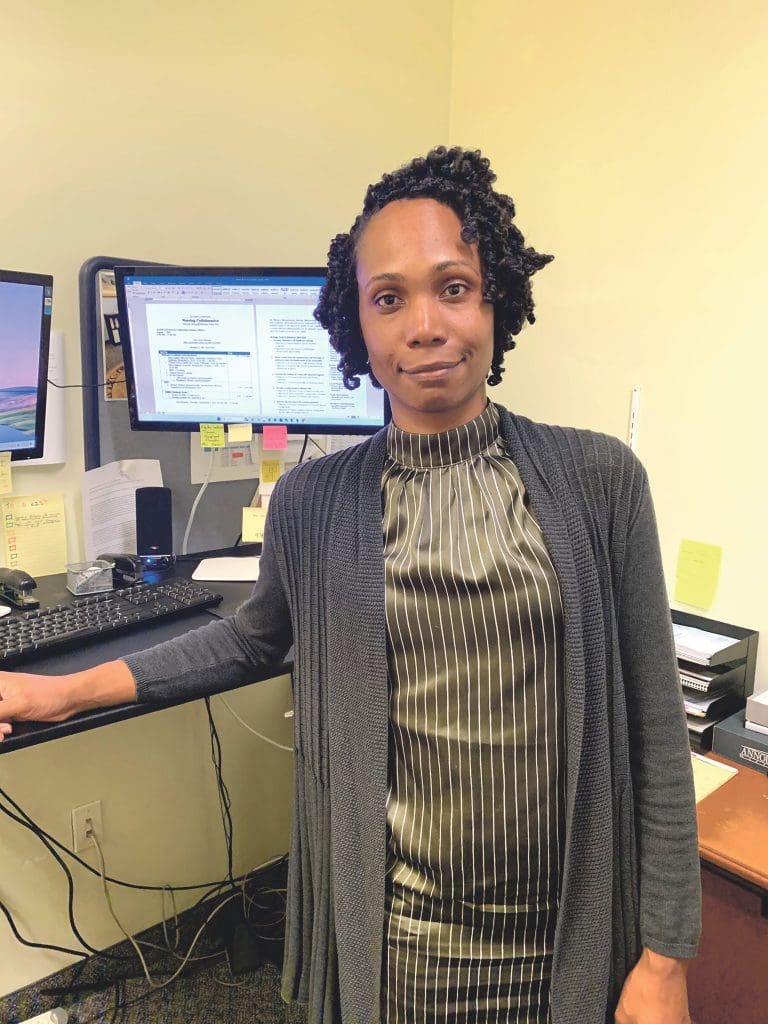
Peta-Gaye Johnson (first row, center) with the other members of the Western Massachusetts Nursing Collaborative.

Peta-Gaye Johnson (first row, center) with the other members of the Western Massachusetts Nursing Collaborative.

Elaborating, she said the stern workforce challenges facing this sector require collaborative efforts — individuals sharing information and experiences and working together to meet agreed upon goals — and she is inspired by the way these groups go about their work.

Meanwhile, others are inspired by her efforts to lead these collaboratives and address challenges old and new. And this is why she is a different kind of Healthcare Hero.


Hire Education

1. Increase retention in all healthcare settings;

2. Ensure nurses have comptetencies and full scope of practice to meet the healthcare needs of the community;

3. Increase the number of nurses with advanced degrees;

4. Increase nursing faculty in Western Mass.;

5. Increase the diversity of the nursing workforce; and

6. Sustain the partnership.

These are the stated strategic goals and objectives of the WMNC, and they, and the progress made toward achieving them, are reviewed at each monthly meeting, said Johnson, adding that this is just one of many meetings, most of them now by Zoom, that she attends on a regular basis.

Meetings are just a small but important part of her job description, she said, adding that such sessions help keep the many agencies and institutions partnering with the workforce board focused on goals like those stated above.

And these goals provide some real insight into how Johnson and all those she works with keep one eye on the present when it comes to the workforce needs of the region and the healthcare providers that call it home, and the other eye on the future.

“We try to project what our future needs will be and address those needs before they come,” she said, adding that this proactive approach helps ensure an adequate pipeline of workers across the broad spectrum of healthcare and social services.

Peta-Gaye Johnson and members of the Western Massachusetts Nursing Collaborative

Peta-Gaye Johnson and members of the Western Massachusetts Nursing Collaborative celebrate the WMNC’s 16th-year celebration lunch.

Filling this proverbial pipeline is just part of the job description for Johnson, who came to the workforce board 13 years ago. She started as an intern while working toward a master’s degree in social work at UConn, and took part in the Hasbro Summer Learning Initiative. She was hired by then-President and CEO Bill Ward, working part-time on the summer learning initiative and part-time with Kelly Aiken, then-director of Healthcare Workforce Initiatives.

When Aiken left for another opportunity in 2016, Johnson was encouraged to apply for her position. She did, won the job, and has flourished in it ever since.

Over the past nine years, she has certainly learned a lot about the healthcare sector and its challenges, but she’s learned much more, she said, about workforce development and all that goes into it, especially partnerships and efforts to work collaboratively.

The WMNC is a good example. It’s a large board — 17 people — representing the nine colleges and universities in the region with nursing programs, as well as five service partners (Baystate Health, Caring Health Center, Cooley Dickinson Hospital, Holyoke Medical Center, and Trinity Health Of New England/Mercy Medical Center) and the Western Massachusetts Black Nurses Assoc., the Massachusetts Senior Care Assoc., and MassHire.

It met three or four times a month during COVID to address the myriad challenges it created and exacerbated, but has settled back to once a month.

By convening these partners, Johnson is able to help gauge their needs, understand their challenges, and lead the group to finding solutions together, said Farkas, using the WMNC as an example.

“Bringing together that group monthly … I would say that’s helpful just for them to hear from each other in terms of their struggles and successes,” he noted. “It’s not different than most people’s jobs — you can get in silos. Just to talk as a group helps; people say, ‘this is what’s working for us.’ Hearing from your peers is invaluable. Peta-Gaye’s ability to drive collaboration and consensus amongst diverse stakeholders has positively impacted the region’s healthcare workforce.”


Work in Progress

As noted earlier, Johnson’s work, and that of the partnership, involves meeting the healthcare sector’s needs today — and tomorrow.

When it comes to today, as she mentioned earlier, the challenges of the workforce crisis extend beyond sheer numbers. There are also issues with retention and adjusting to changing dynamics in the workplace, and especially in healthcare settings.

“For every person, COVID helped them to reassess the work they were doing,” she explained. “And one of the things we talk about in our groups now is the fact that the people coming into the workplace today are much different from those who entered previously; the generational shift is real, and it’s happening.

“Before, people committed a lot more of their time to work — that’s not the case anymore,” Johnson went on. “Conversations that we’re having most recently in our groups center on the fact that people want work to match their lifestyle, and hospitals have to deal with that; they have to deal with people who want to work as little as possible and receive as many benefits as possible. And on the other end, they have to deal with that increase in violence toward healthcare workers.”

As for the future, efforts include everything from introducing young people to the many career opportunities in healthcare early — as in middle school — to the website westernmasshealthcareers.org, which helps visitors gain an understanding of the many careers in this sector, how to pursue them, and the degree offerings at area colleges and universities.

“One of the things that our leaders have identified is the fact that recruitment doesn’t start with people entering high school — we go all the way back to middle school,” she explained. “We run programs with middle-school-aged students to talk with them about to expect and what the journey is like so they’re prepared academically.”

Elaborating, Johnson said young people have, historically, heard about the benefits and rewards of a career in healthcare; what they need is the full picture.

“One of the biggest obstacles that we identified years ago is that students are not necessarily prepared academically, whether it’s math or science,” she noted. “But on the other side of it, what many people do not consider is what healthcare looks like, the fact that it is very demanding. It doesn’t just mean providing care to people who are ill or wounded; it means making them feel comfortable.”

As she talks about these issues and challenges and how they are being addressed, Johnson will always use the collective ‘we’ or ‘our groups.’

She does so to stress that these are complicated issues that must be addressed collectively. For that to happen, the region needs a leader and a convener, someone to bring people together and, as Farkas noted, “drive the agenda.”

That someone is Johnson, whose tireless work to forge partnerships and address matters through collaboration makes her a Healthcare Hero.

Community Spotlight

Community Spotlight

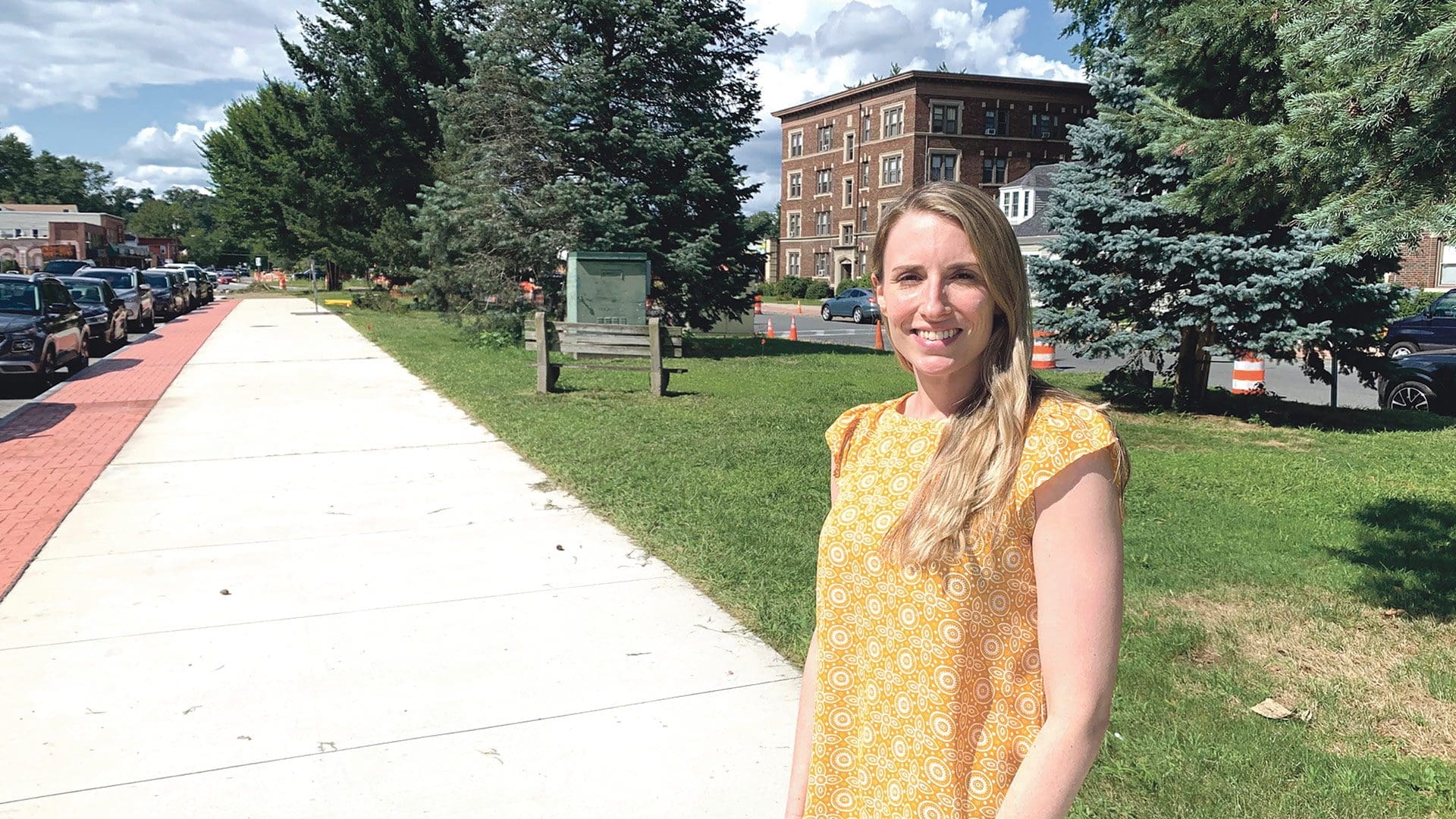
Allyson Manuel

Allyson Manuel, seen here at one of the new sidewalks at the common on Elm Street, says there is renewed vibrancy in the downtown area.

Tyler Saremi calls it “cross-pollination.”

That’s how he chose to describe how the various businesses, government offices, and cultural institutions, especially the Majestic Theater, clustered in the downtown are supporting one another in a way that is bringing new vibrancy to the area and effectively turning back the clock in West Springfield’s central business district.

“It’s nice to see the downtown become a downtown again,” said Saremi, vice president of Saremi LLP, a multi-faceted company that redeveloped the former headquarters for United Bank at 95 Elm St. into Town Commons, a mixed-use facility that includes, on its ground floor, Tandem Bagel and West Side Bar & Grill, two eateries that are drawing more people into the downtown area and effectively extending their stays.

Indeed, more people are now arriving an hour or two before the shows at the Majestic for dinner at some of the eateries in that area, such as the Italian restaurant bNapoli — and, on some nights, especially when there is live entertainment at West Side Bar & Grill, sticking around after the shows.

“It’s fantastic cross-pollination in the downtown right now, and it’s beautiful to see; it’s all working,” he said. “You have people coming to West Side Bar & Grill before a show at the Majestic, and then there are people walking over when we have live music on weekends — they’re walking to their cars from bNapoli, and they’re saying, ‘I saw the music; I just wanted to come in and have a drink.’ Everything is complementing other businesses, and it’s exciting to watch the downtown grow.”

Julie Quink, managing principal with the accounting firm Burkhart Pizzanelli, which has been based in a former elementary school on Park Street for more than 25 years now, has also noticed more energy — and widespread general improvement — in the community’s downtown.

She referenced everything from new businesses like Tandem Bagel and West Side Bar & Grill, as well as comprehensive infrastructure improvements to the roads in the downtown and the signature town common as reasons why the downtown is staging what would be considered a comeback.

“There is a strong need, but there is just not much land that can be developed, and when we do propose something, it’s not welcomed.”

“There are a lot of new businesses, which is good for everyone,” she said. “And there is more vibrancy in the downtown area.”

Mayor Will Reichelt, now in his ninth year in the corner office, said this downtown transformation is just one development the community is celebrating as it also marks its 250th birthday — an ongoing party that has included fireworks, a revitalized Taste of West Springfield, and a 5K, and culminated with a parade on Aug. 24.

Indeed, the town that calls itself a city is also celebrating (if that’s the right word) some important infrastructure projects — on Elm Street, Memorial Avenue, and (soon) on Riverdale Street — that are bringing some inconvenience now but substantial benefits … well, down the road.

Also in the infrastructure category is a long-sought and highly anticipated solution to the rail crossing at Front Street near the border with Agawam — a flyover that will alleviate traffic backups in that area and make it more attractive for economic development (more on that later).

And while there is progress on many fronts, there is less of it in one identified area of need — housing, said Reichelt, noting that, while this community has many assets, an abundance of developable land is not one of them.

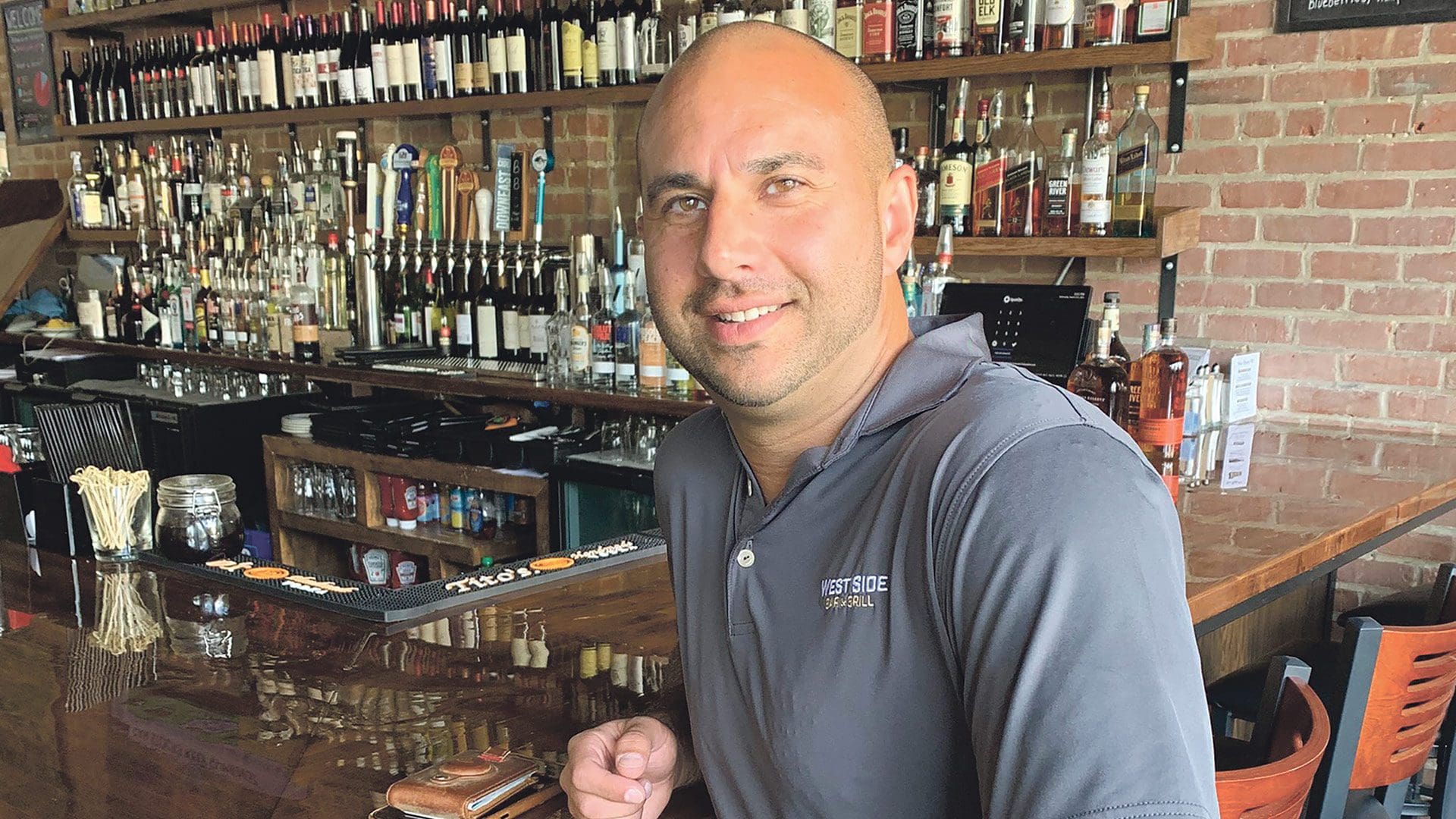
Tyler Saremi

Tyler Saremi sits at the bar at West Side Bar & Grill, one of the many new businesses creating what he calls “cross-pollination” in the downtown.

“There is a strong need, but there is just not much land that can be developed, and when we do propose something, it’s not welcomed,” he said, adding that options are being considered, including very preliminary talks with the owners of the Cinemark theaters on Riverdale about the massive back parking lot, which might be ideal for a public-safety complex and some mixed-use housing.

Still, there are a few housing projects in various stages of development, including a condominium development at the site of a nursery on Piper Cross Road, as well as another project being undertaken by Saremi LLP — redevelopment of a former nursing home on Westfield Street into multi-family housing, most likely of the over-55 variety.


When a Plan Comes Together

As plans for redevelopment of 95 Elm St. were being drawn up, Saremi said, it was viewed as a three-year project.

Instead, it took maybe 18 months to secure tenants to fill the property’s three floors, he explained, adding that the property is now home to a variety of tenants, including the Saremi company, which has several components, including a real-estate arm and a student health-insurance venture; Tandem Bagel and West Side Bar & Grill; Kindred at Home; the Worcester-based Seven Hills Foundation and Affiliates, which has made Westside its Western Mass. hub; and an engineering company.

These businesses are bringing people back to that property to work years after United Bank left, he said, adding that these workers, coupled with those already downtown — there are dozens of businesses along Park and Elm streets, as well as West Springfield’s town offices — have created a critical mass of people that not only support other businesses, but generate more overall vibrancy.

“When the bank took off and left all those offices vacant, it was very quiet in the downtown,” he noted. “Now, I can look out my office window at any time, and there’s people walking around; there’s foot traffic. People are going into Celery Stalk, walking out and eating on the picnic tables he has outside, or they’re going back to the town offices — it’s great to see.”

Quink agreed, and, like Saremi, she said the infrastructure work taking place downtown, which includes a roundabout at the former intersection of Elm and Westfield streets, new sidewalks, new lighting, and considerable work to make the town common more accessible and walkable, have helped make the area more of a destination.

“The mill buildings are sandwiched between the Westfield River and the train tracks, and you have to get over the train tracks to access them right now. So having that alternative access opens them up to a lot of different uses they’re not suitable for now.”

“The city is doing a good job of making the town common more appealing,” she noted. “They have events there, like the Taste of West Springfield and events for veterans; it’s a great asset for the community.

“The construction has been really challenging for some small businesses on Elm Street,” she went on. “But the end result is going to be good; we just have to get through this period.”

As noted earlier, this renewed vibrancy downtown is one of the many emerging storylines in West Springfield. Others include the year-long 250th celebration, which has brought residents and businesses together to mark the past and contemplate the future; a new Chick-fil-A going into the site of the former Friendly’s on Riverdale Street; and, of course, the upcoming 17-day Big E, which will bring more than 1.5 million people to the community, clogging many of its roads, but also providing a huge boost to its many hotels and other hospitality-related businesses (see story on page 15).

There’s also ongoing infrastructure work along the two main commercial arteries — Riverdale Street and Memorial Avenue. With the latter, a project due to be finished in 2026, crews are undertaking underground utility work, said Reichelt, adding that, in the next construction season, concrete work from the Memorial Bridge to the border with Agawam will be completed, along with new curbing and lane reconfigurations.

On Riverdale Street, utility work is also being undertaken, with repaving coming over the next few years, he said, adding that, while it is inconvenient to have both major arteries torn up at the same time, the town will benefit when the projects are completed.


Train of Thought

Then there’s the planned flyover at the rail crossing at Front Street, which will alleviate traffic backups that have been a problem for decades, the mayor said. Announced late last month, the project, which is expected to cost at least $20 million, came about after extensive and sometimes contentious talks between representatives of Agawam and West Springfield, CSX, state transportation officials, and U.S. Rep. Richard Neal.

The fix will not only alleviate traffic tie-ups, but eliminate a public-safety concern, said Reichelt, noting that ambulances now take alternate routes, not knowing if they will be delayed by a parked train.

Allyson Manuel, West Springfield’s town planner, agreed, noting that the flyover will also facilitate economic development in the area, especially with an old mill complex that has sat mostly vacant in part because of accessibility issues created by moving or parked trains.

“The mill buildings are sandwiched between the Westfield River and the train tracks, and you have to get over the train tracks to access them right now,” she said. “So having that alternative access opens them up to a lot of different uses they’re not suitable for now.”

West Springfield at a glance

Year Incorporated: 1774
Population: 28,835
Area: 17.5 square miles
County: Hampden
Residential Tax Rate: $14.81
Commercial Tax Rate: $29.80
Median Household Income: $40,266
Median Family Income: $50,282
Type of Government: Mayor, City Council
Largest Employers: Eversource Energy, Harris Corp., Home Depot, Interim Health Care, Mercy Home Care
* Latest information available

Like almost all communities in the region, West Springfield is in need of more housing, said Manuel, adding that, unlike most of those cities and towns, it does not have much open land on which to build.

Which is why a provision within the $5.16 billion Affordable Homes Act recently signed into law by Gov. Maura Healey, which will allow in-law apartments in all communities, could have a substantial impact in Westside, where they are currently prohibited.

“We’ll be looking at how to regulate that, and we obviously have some work to do on that because they are currently not allowed; it’s a pretty big change,” Manuel said, adding that, in the few weeks since the housing bill was signed, there have been numerous inquiries.

Meanwhile, there are some projects in various stages of development. These include the condo project on Piper Crossing Road; Heartstone Village, a 55+ project off Birnie Avenue, a project that has been years in the making; and preliminary talks concerning repurposing the former Cowing School at the corner of Park and Elm streets for housing, especially senior housing.

There’s also the former nursing home on Westfield Street, which has been vacant for more than 20 years and in recent years had become an eyesore, Saremi said.

“There was an opportunity to acquire it, and we decided to take it on,” he told BusinessWest, using those words to help explain the size and scope of the challenge and the fact that few, if any, were willing to take on this property.

“It was a nightmare cleaning that place out; it was very labor-intensive — crews had to wear full-body suits with respirators,” he said while detailing the level of deterioration of the building. “There were trees growing on the roof. Now, the interior is completely clean, and we’ve had a zone change go through.”

The most common-sense reuse is housing, either affordable or 55+, Saremi said, adding quickly that, while architectural plans are being developed, funding help will be needed from the state or federal government to take what is likely to be a $7 million project off the drawing board and make it reality.

“The cost to build has just skyrocketed,” he said, adding that he is hoping that the housing bill will include funds for projects like this one.

“We’re ready to go,” he said of the project, which would include 51 mostly efficiency and one-bedroom apartments. “We just need some sort of government assistance on the cost to build.”

Features

Ride of Passage

Gene Cassidy

Gene Cassidy is hoping for less rain in 2024 — and the continuation of a trend whereby presidential election years have been good for large fairs.

Gene Cassidy says presidential election years are generally good ones, attendance-wise, for large fairs like the Big E.

As he explains it, the general population, bombarded with information about candidates, issues, and polls, is looking for a break from all that.

“They want to get out and get away from the news,” said Cassidy, president and CEO of the Big E, adding that this year, people may really want to get away from the news, considering the seemingly heightened tensions around this year’s race.

If they do, that would certainly help the Big E — which will take place Sept. 13-29 — bounce back from a somewhat down year in 2023 when it comes to attendance, due to seemingly relentless rain that started early in the fair, almost wiped out the middle weekend, continued through the 17-day stretch, and led to something Cassidy had never seen in his more than 30 years of involvement with the fair.

“It rained so hard one day, the midway never opened, and that had never, ever happened before,” he told BusinessWest as he quickly did some math in his head. “Let’s see, that’s 30 fairs times 17 days … that’s 510 days; one day out of 510, the midway was closed.”

Pulling out a white book in which he keeps detailed information about the weather, attendance, and other matters, Cassidy noted that the fairgrounds received 1.7 inches of rain the first Monday of the Big E’s 2023 run, and then on the middle weekend (Friday, Saturday, and Sunday) it received 5.1 inches of rain, a half-inch more than the region typically receives, on average, for the entire month of September.

“It rained so hard one day, the midway never opened, and that had never, ever happened before.”

Overall attendance was down about 11% from the year prior, he said, noting that it would have been a sharper decline had there not been a rise in attendance at night, generally after the rains had subsided. And had it not been for a 33% increase in the price of general admission — from $15 to $20, the first such increase in 13 years — 2023 would have been much worse for the Big E.

But enough about last year’s fair.

Fair food

Fair food is one of the perennial draws of the Big E.
Photo courtesy of the Big E

The Big E has certainly turned the page, and Cassidy and others charged with presenting the event are buoyed by everything from those election-year stats to early results from other fairs around the country, to the sense that the weather can’t be as bad this year as it was last.

It can’t, right?

Cassidy said he can’t concern himself with the extended forecasts, or even what the three weather apps on his phone are telling him. He focuses on what he can control, specifically the product he presents those 17 days. And by product, he means everything from the music to the rides on the midway to, of course, the food.

He believes there’s a solid lineup — some new food offerings as always, and a mix of music that ranges from Ludacris to America; Chubby Checker (back by popular demand) to Average White Band — and that 2024 will be a year to maybe, just maybe, meet his long-set goal of topping the attendance of the Minnesota State Fair (more on that later).

For this issue, we look at the 2024 fair and how things are looking up — hopefully, not at more clouds and raindrops.


Fair Game

Speaking of presidential elections … each year Cassidy has been at the helm of the Big E, he has sent a handwritten letter to the sitting president inviting him to attend that year’s fair.

The letter generally goes out in late winter, he said, adding that the only president who has even responded to the missives — and he sent his regrets that he could not attend — is Donald Trump. (The only president to attend the Big E, and this was well before Cassidy’s time, was Dwight Eisenhower in 1953, who wanted to see how one of the cows he bred fared in competition.)

In keeping with tradition, Cassidy sent a letter to President Biden. He hasn’t heard back and doesn’t expect to, especially with recent events. Gov. Maura Healey is expected to make an appearance, though, as she did last year, Cassidy said, adding quickly that he is more focused on the general population than elected officials.

And he expects this year will be a solid one for the fair, despite widespread concerns about the economy and inflation, some rising COVID numbers, and ever-increasing competition for the family’s leisure and entertainment dollar.

“I won’t say the Big E, and fairs in general, are recession-proof. I don’t want to jinx myself; I know people are feeling the pinch,” Cassidy said, while hinting strongly that the fair can withstand economic headwinds, and has historically. “People may postpone a vacation, but they won’t postpone attendance at the fair.”

That track record includes the ticket-price increase, which, he noted, was met with little pushback.

“If you plug the $15 admission ticket in 2010 into an inflation calculator, it actually translated to $20.65 in 2023. We loathe raising our ticket prices, which is why we waited so long to do it, but it saved us; had we not had the increase in the ticket price, we would have had red ink last year.”

“If you plug the $15 admission ticket in 2010 into an inflation calculator, it actually translated to $20.65 in 2023,” he told BusinessWest. “We loathe raising our ticket prices, which is why we waited so long to do it, but it saved us; had we not had the increase in the ticket price, we would have had red ink last year.”

What the fair can’t withstand is rain like last year, which pushed attendance down to 1,427,234, off considerably from the 1,603,000 in 2022, the second-highest attendance on record, behind only 2019 at 1,629,000, Cassidy noted, adding, again, that the weather cannot be controlled.

The music lineup can be, but putting together a slate of performers is becoming increasingly difficult, due primarily to mounting competition for acts from casinos and other venues, and the subsequent rising demands from in-demand performers.

“Buying entertainment gets more difficult annually,” he said. “When I say difficult … prices are off the charts. And the type of talent that we foster today in the entertainment business is not unlike hiring people for entry-level jobs.

rides to enjoy

Kids of all ages will find rides to enjoy at the Big E midway.
Photo courtesy of the Big E

“Everyone wants a corner office coming out of college, and they want to work at home in their pajamas,” he explained, adding that, in the entertainment world, performers want what amounts to the equivalent. “They want gobs and gobs of money, and, because of the ubiquity of casinos everywhere, they’re used to having beautiful green rooms, lots of air conditioning, climate-controlled arenas, and more.”

The fair cannot provide those things, but it has still managed to put together a strong slate. The lineup for the Big E Arena includes Ludacris, Dustin Lynch with special guest Dylan Scott, Phil Wickham, America with special guest Jim Messina, the Brothers Osbourne, Public Enemy, and Big Time Rush. The Court of Honor Stage, meanwhile, will feature Asia, Debby Boone, Herman’s Hermits, and Wang Chung, among many others.

“We originally booked Ludacris back in 2008, but he was viewed at the time by the police chief as being so controversial that we can to cancel him,” Cassidy recalled. “There’s a new police chief, and time has softened Ludacris.”

As for food … Big E officials will keep the public in suspense a little longer, but there will be several new vendors and 44 new food offerings, with vendors featuring $3 items on Mondays, to be called ‘3-buck bites.’

Overall, with its lineup of entertainment, food, some new rides, new float animals, and more, the Big E is expected to follow the lead set by fairs that have already had their 2024 runs, said Cassidy, who closely monitors what’s happening elsewhere.

“Wisconsin closed recently; they had a bang-up fair and set a record at the same time as they were dealing with extraordinary heat — over 100 degrees for four days of the fair,” he noted. “Iowa opened strong … these numbers bode well.”

The Minnesota State Fair comes later, and, as noted, Cassidy has long made it a goal to top that fair in attendance.

“They always beat us — they’re number 4, we’re number 5,” he said in reference to the country’s largest fairs. “We’ve been chasing Minnesota going way back to the very first fair in 1916. I want to challenge people to come to the fair so we can displace them.”


Meet Me Midway

Returning to his thoughts about election years and the attendance bump they generally provide, Cassidy acknowledged that, in this day and age, it’s very difficult to actually escape the news.

But people are likely to try, and the fair can provide that needed respite, he said, adding that this quality is one of many that can, and hopefully will, add up to a year where attendance records are approached and even threatened, and Minnesota’s numbers might even be eclipsed.

That’s if Mother Nature cooperates more than she did last year.

Business Management

They Need to Be Current, and Employers Need to Abide by Them

“Less is more.”

Those three words comprise one of the many forms of advice that Elaine Reall has for business owners and managers when it comes to what’s written in employee handbooks.

She says it should apply to most all content, but especially references to laws and regulations regarding the workplace, including the state’s Paid Family and Medical Leave Act.

“Employers go on, page after page, explaining a very intricate statute,” said Reall, chief legal officer for the Springfield-based Royal Law Firm. “They don’t need to do that; they need to say, ‘you’re eligible under Massachusetts law for the Paid Family and Medical Leave Act, and here’s the hyperlink to the government’s site, which will take you through the entire process.’”

Reall has lots of other advice on handbooks, regarding everything from how they should be updated regularly — especially when there are important changes in laws or seismic shifts in the workplace — to how managers shouldn’t borrow a template off the internet, to … well, whether a small business even needs a handbook.

Elaine Reall

Elaine Reall

“A lot of employers don’t realize that the first or second document that a plaintiff’s attorney in the employment area looks for is the guidebook, handbook, or whatever is being put out there by the employer.”

Indeed, she noted, handbooks are increasingly being viewed as contracts.

“A lot of employers don’t realize that the first or second document that a plaintiff’s attorney in the employment area looks for is the guidebook, handbook, or whatever is being put out there by the employer,” she said. “And they’re looking to see if there are implied contractual commitments that they can use, because Massachusetts does recognize that you can create an implied contract not just with the whole handbook, but with portions of the handbook.”

For this reason, if a business is going to have a handbook, and if it is going to have content on certain subjects, its managers need to be sure they get it right, she said.

John Gannon, an employment-law specialist and partner at Springfield-based Skoler Abbott, agreed. He noted that handbook policies come in two categories — those for which employers are legally obligated to have a policy, such as the Bay State’s earned sick time law, and those that are recommended.

“You don’t have to have them, but you should have them,” he said, adding that policies in this category include everything from remote work (more on that later) to dress codes.

Overall, a handbook should help get everyone on the same page — figuratively, but also literally — and also protect the employer, said Gannon, adding that handbooks are not contracts, but they are, or should be, written in such a way to help protect the employer if there are complaints or legal actions taken by employees.

“One of the reasons you have a handbook — not the principal reason, but one of the reasons — is if there is some kind of litigation and someone is challenging the reasons they are separated from employment,” he explained. “They might say they were fired because of their age, for example; the employer says, ‘no, you violated this policy.’ It’s helpful to have a policy in writing, so you can say, ‘this is the policy, and this is how you violated it.’

John Gannon

John Gannon

“If you have it in writing, that’s good. If you don’t have it in writing, that’s bad. And what’s worse is to have the wrong policy in place, something that’s old and outdated.”

“If you have it in writing, that’s good. If you don’t have it in writing, that’s bad,” he went on. “And what’s worse is to have the wrong policy in place, something that’s old and outdated.”

But — and this is a big but — if an employer is going to put something in the handbook, then it must abide by it, or the company could open itself up to trouble, said Gannon, who has seen this happen on many occasions.

“The best advice I can give is to put it in writing — and follow it,” he said, adding that this is one of the key reasons why training of managers is so important. With training, they’re better able to know the policies and abide by them.

Reall agreed. “There’s a lot of litigation where handbooks show up and are used against employers,” she explained. “You don’t want to require your employees, in the context of your handbook, to do X or Y without recognizing that the courts will recognize that and say, ‘reciprocity — you’re binding their hands here. What about you, employer? If you’re going to make these requirements, then it’s up to you to uphold them.’”

For this issue and its focus on business management, we take an in-depth look at handbooks and how to make sure they do what they are created to do.


The Write Stuff

“Telecommuting is not designed to be a replacement for appropriate childcare. Although an individual employee’s schedule may be modified to accommodate occasional childcare needs, the focus of the arrangement must remain on job performance and meeting business demands. Prospective telecommuters are encouraged to discuss expectations of telecommuting with family members before entering a trial period as the employee should not undertake to provide primary care for a young child during at-home working hours. If a young child will be home during the employee’s at-home working hours, some other individual should be present to provide primary care.”

That’s a passage from a handbook that Gannon, who recommends handbooks for companies with six or more employees, helped craft for a client. It’s an example of being both current — remote work, while not necessarily new, has certainly become much more prevalent since the pandemic — and thorough, leaving little ambiguity when it comes to the employers’ wishes, policies, and expectations.

Indeed, the section on telecommuting in this particular handbook covers everything from eligibility to equipment; from safety to time worked, specifically with regard to overtime and those not exempt from the requirements set in the Fair Labor Standards Act. “Hours worked over those scheduled require the advance approval of the telecommuter’s supervisor,” it reads. “Failure to comply with this requirement may result in the immediate termination of the telecommuting agreement and other disciplinary action.”

The rise of remote work and the many issues associated with it provides a reminder that handbooks need to be updated regularly, said Gannon, suggesting every two years. And if that yardstick is used, the updates should be relatively minor in nature. If they aren’t, well, the opposite is true.

“If I reviewed someone’s handbook in 2002 and they bring it to me in 2024, there may be one or two new policies to add and a few things we need to tweak,” he said. “But it’s quick if you stay on top of it. I had someone who just sent me their handbook, which hadn’t been looked at since 2017, which means it’s missing quite a few things and may have policies that don’t even apply anymore.”

He said there are many topics, as well as changes in the social and workplace landscape, that should be addressed in handbooks — everything from the Bay State’s Crown Act, which expands the definition of discrimination based on race to prohibit discrimination based on natural and protective hairstyles, to social media and the need to use gender-neutral pronouns with all policies.

Overall, there are many topics an effective handbook should cover, Gannon said, listing anti-harassment policies, the state’s sick-time and family-leave laws, meal breaks, what he calls a ‘code of conduct’ outlining proper behavior, and a workplace-violence policy, preferably one stating that the employer has zero tolerance for such violence “because that’s a scary thing these days.”

Reall agreed, but noted, again, that companies, and especially smaller ones, should think at least twice about whether they need a handbook and, if they determine they do, what goes in it.

“I tend to see more problems created by handbooks with smaller companies than positive outcomes,” she told BusinessWest. “It’s a tool, but it’s a tool that, if you don’t use it right, can burn you.”

She added that many of these smaller companies look for a template — a free handbook that shows up on Google — or copy another company’s handbook.

“Years ago, maybe not so much now, everyone used to steal MassMutual’s,” she recalled. “It was about 300 pages long and incredibly detailed; it read like an insurance contract, and it was absolutely what you didn’t want if you had 25 employees.”


Bottom Line

What employers do want is something that suits their sector and their specific business, Reall went on, adding that, if a company if going to have a handbook, it should enlist the help of an expert. And that employer should make it clear that the handbook is just a guide and that the employer reserves the right, unilaterally, to change anything in the handbook at any time.

“It’s got to look like an employer document and not an agreement between the employer and the employee,” she went on, adding that a handbook can, indeed, be a valuable tool — but only if it’s done right.

“You need to make sure that whoever crafts it knows what they’re doing. If you’re a small employer and you have no HR department, and you’re going to look at your handbook about once every 10 years, that’s very dangerous, and you would be best off not putting things in writing that will come back to haunt you.”

In short, when it comes to handbooks, employers should remember that less can certainly be more.

Cover Story

By All Indications

Bob Nakosteen calls it a ‘calm slowdown.’

That phrase is synonymous with ‘soft landing,’ and that’s what he’s projecting for the last quarter and change in 2024 at a time when there are mounting questions about the economy, what’s happening — or not happening — and whether we might actually be hearing and using the dreaded ‘R’ word either later this year or early next.

Nakosteen, the semi-retired professor of Economics at the Isenberg School of Management at UMass Amherst (he’s still teaching several courses a semester), said the country isn’t really close to being in a recession when it comes to the technical definition of the term — two consecutive quarters of negative GDP — but people like to toss out that word whenever things start to slow down. And in many ways, they have.

Indeed, the most recent jobs reports have not been as robust as in previous months; the housing market remains … not at a standstill, but in a real slump induced by higher interest rates; the stock market took a sharp nosedive at the start of August (but has recovered nicely); and, while inflation has trended downward, the cost of food, energy, and other items remains high enough to make it a top issue in the presidential election.

All this has led many economists (Nakosteen is one of them), politicians, and, yes, area business owners to speculate that the Fed has, indeed, waited too long to lower interest rates, and thus, in its efforts to tame inflation by cooling the economy, it has cooled it too much.

That ‘too much’ part is certainly a matter of opinion, said Nakosteen, who told BusinessWest that, while things have slowed somewhat since earlier this year, the economy remains robust by many yardsticks.

“This is not breaking news, but the economy has held up really well in spite of a lot of pressure, especially from a rapidly rising interest-rate environment. The consumer has really rolled with the punches.”

“The economic numbers don’t look bad at all,” he said. “The labor market has weakened a little bit, but it’s not weak; it’s just not as strong as it had been. And most of the other indicators are strong, including GNP. It’s about where it had been, and in some ways, it’s above trendline. The last report was about 2.3% annualized growth; when you put all the pieces together, that’s above trendline. It doesn’t sound all that strong, but 2.3% is not bad in the current environment.”

Matt Sosik, president and CEO of bankESB, was in general agreement on those points, noting that, given the sharp rise in interest rates, consumers — and the economy in general — have performed better than might be expected.

Matt Sosik

Matt Sosik wonders about the impact of mounting pressure on consumers, as evidenced by rising credit-card balances and loan delinquencies.

“This is not breaking news, but the economy has held up really well in spite of a lot of pressure, especially from a rapidly rising interest-rate environment,” he said, adding quickly that huge federal deficits are essentially “subsidizing GDP,” as he put it, thanks to stimulus money that is still being spent. “The consumer has really rolled with the punches.”

That said, he wonders for how much longer this will be true, noting mounting pressure on consumers, as evidenced by rising credit-card balances and delinquencies in paying those balances, mortgages, and car loans (more on that later).

Overall, many business owners have been in somewhat of a holding pattern, said Ken Vincunas, president of Agawam-based Development Associates, noting this sentiment refers to decisions about investments in real estate — either building something new or simply buying something — but also business decisions in general.

Many are waiting to see what happens with interest rates, but some are also waiting for the November election, the outcome of which may impact what happens with those rates and the economy in general.

“Everyone is holding their breath and waiting to see what will happen in November,” Vincunas said. “That’s the big wild card right now.”

For this issue, BusinessWest takes an in-depth look at the economy as the three-quarter pole approaches, what might happen the rest of this year and beyond, and the factors that will likely determine which way the arrows will be pointing as we move into 2025.


On-the-money Analysis

Nakosteen said the market’s pronounced dip early last month — there was a drop of nearly 10% — was interpreted widely as commentary on a weakening economy.

He didn’t see it that way — “I just interpreted it as people sold stocks because people were selling stocks” — and the market’s rebound (it had recovered most all of what was lost by press time with this issue) would seem to validate that opinion.

Bob Nakosteen

Bob Nakosteen

“For at least seven or eight months, I’ve heard that the Fed should be lowering interest rates right now because higher interest rates are really going to drag down the economy. They haven’t. They may still, but they haven’t yet.”

He acknowledged that the economy has slowed somewhat, but, again, most indicators would show that it is still strong, especially when one considers the many factors impacting it, most notably interest rates.

Indeed, while he thinks the Fed should have lowered interest rates months ago — because it takes months for a rate drop to trickle down, if you will — he believes the Fed “got away with it,” as he put it.

“For at least seven or eight months, I’ve heard that the Fed should be lowering interest rates right now because higher interest rates are really going to drag down the economy,” Nakosteen said. “They haven’t. They may still, but they haven’t yet.”

Sosik didn’t use those words, but he was in general agreement that, despite some strong headwinds, the economy remains solid mostly because consumers, by and large, have continued to spend.

However, there are signs that spending is slowing and that consumers are now increasingly burdened by their previous spending.

“When you look at the number of people who are maxed out on their credit cards, for example, credit-card delinquency rates, student-loan delinquency rates … these are all examples of metrics that are not trending in the right direction,” he said. “And they imply that consumers are pretty stretched.

“Whether they’re at the end of their ropes as a group is not clear,” Sosik went on. “I’m not saying that a consumer-driven recession is around the corner, but there are a lot of factors indicating that the consumer is stretched out pretty far.”

Overall, though, that same consumer is still hanging in, he continued, adding that, historically, this is the case until there are cracks in the labor market, which have not appeared yet.

Ken Vincunas

Ken Vincunas says many business owners are hitting pause until they see what happens with interest rates — and the November election.

“If we see those, and you have unemployment rising with an already stretched-out consumer, then that would be a perfect storm,” he said, adding that he’s not predicting that such a storm will develop.

Vincunas is among those who believes the Fed hasn’t gotten away with it, and that higher interest rates are taking their toll on business overall, but especially in commercial real estate. He noted that higher rates are leaving those facing loan-rate renewals with potentially huge bumps in operating costs.

“The window for their renewals could be five years, and five years ago, people might have thought they were in good shape,” he explained. “But now, they have to face that eventuality, and everyone is holding their breath to see if Trump can get elected and if he can bring interest rates down.”

Meanwhile, these higher rates are prompting more to lease rather than buy and for those thinking about buying or perhaps building new to hit pause and see what happens — in November and with interest rates.


Points of Interest

One of the key indicators of a slowing economy is the housing market, which has slowed considerably in 2024 — from a sales-volume perspective because of interest rates, which are keeping many people in their current homes, and overall due to a persistent lack of inventory that has kept prices high and the homes that do come on the market moving quickly.

“People are not buying new homes, so that slows down the demand for new construction,” Nakosteen said. “And they’re not selling their homes, which diminishes supply, so it’s a really interesting phenomenon we’re seeing right now in housing.”

Peter Ruffin, current president of the Realtor Assoc. of Pioneer Valley, acknowledged that this has been a slower year, sales-wise, than previous years, although he views steady (if not rising) values, especially in communities like Springfield, as an overall sign of strength within the market.

And also a reason why homeowners should maybe rethink that strategy of staying put until interest rates come down.

“When you look at the number of people who are maxed out on their credit cards, for example, credit-card delinquency rates, student-loan delinquency rates … these are all examples of metrics that are not trending in the right direction. And they imply that consumers are pretty stretched.”

“You can refinance your interest rate down the road, but you’re never going to get a second chance at price,” he said. “And prices are going to continue to go up.”

And while higher interest rates are keeping some in their homes when they might be trading up or down, and thus putting more homes on the market, he blames the overall lack of inventory on a lack of building, a problem he hopes can be addressed by the Affordable Homes Act recently signed into law by Gov. Maura Healey.

“We haven’t built enough houses in Massachusetts, period,” Ruffin told BusinessWest. “And it’s housing of all sorts, and that’s what we need to fix for the long term.”

Meanwhile, some homeowners, like business owners, are somewhat reluctant to move forward in an election year like this one, he said, not knowing who will be in the White House and what will happen next.

Which brings us back to the phrases ‘soft landing’ and ‘calm slowdown,’ and whether this is where the economy is headed.

They both indicate a slowing of the economy but not a dip into negative GDP territory, said Nakosteen, who said he dislikes making projections, but, when pressed, made one when it comes to the balance of 2024 and likely beyond.

“Maybe we see a 1% or 1.5% rise in GDP, and maybe unemployment rises a few more tenths,” he said, adding that at least one economist was projecting that, to fully tame inflation down to 2% or 3%, the Fed would have to take steps that would take unemployment rates into the 6% to 7% range.

Instead, it’s just over 4%, a rise, and a number, that Nakosteen said is “the very definition of a soft landing.”

The questions to be answered concern just how soft and whether it stays soft, said those we spoke with, noting that consumer spending will be the key factor, as it usually is.

“When you read anecdotes from corporate offices, especially consumer product companies, they say there’s a real weakening in consumer demand,” Nakosteen noted. “You don’t see it in the numbers — you don’t see it in retail sales or other measures of consumption — but there are a lot of companies that feel a weaking of demand for their products at the retail level.”

These include McDonald’s (which reported its first worldwide sales drop in four years in late July) and other fast-food providers, which have hinted strongly that the increases in prices they’ve instituted, forced by the higher costs of labor, food, and energy, have taken their toll. They’re responding with value meals and specials, but overall, the restaurant sector, one of the bellwethers of consumer sentiment and the economy on the whole, is seeing a decline in business.

Sosik acknowledged that this sector and other pockets of the economy may be experiencing some slowing, but, overall, what he senses is that consumers are still spending — if not on Quarter Pounders or Frosties, then on something else.

And as long as that continues, he and others said, the economy should continue to hang in, and the ‘R’ word can be avoided.

Community Spotlight

Community Spotlight


Stacey Blanco and her husband, who opened Hide’n’ Sneakz, are among a growing number of small-business owners in Easthampton.

Stacey Blanco and her husband, who opened Hide’n’ Sneakz, are among a growing number of small-business owners in Easthampton.


Stacey Blanco says she’s always been entrepreneurial.

Although she’s worked in office settings — and those experiences have helped inspire her current venture — she has preferred working for herself and has had side hustles, if you will, like teaching Zumba classes.

During the pandemic, she and her husband, Israel, began thinking about new business opportunities and needs they could meet. And they settled on footwear and related items and ultimately opened Hide’n’Sneakz in a storefront on Cottage Street. There, as the name suggests, they sell sneakers, but also apparel (such as T-shirts) and skateboards.

The store opened roughly 15 months ago, and not long thereafter, Stacey, seeking to learn more about the ins and outs of running a business — and improve her odds of success — became part of the first cohort for a new program created by the Greater Easthampton Chamber of Commerce called CO.STARTERS.

The 10-week entrepreneurial training program, lauched with $50,000 in ARPA funding, is designed for those who have started a venture, said Moe Belliveau, executive director of the chamber, but especially for those who are exploring a new idea or getting close to starting up. And it was conceived to complement, not compete with, other programs within the entreprenerial ecosystem, such as EforAll.

“It’s like a menu — we have a lot of different flavors. And that’s what we want to see in Easthampton; it’s what has made us so attractive to the people who want to come live here; it’s not one size fits all.”

“We cover everything from assumptions going in to your work style, knowing your customers to brand identity,” said Belliveau, adding that the first cohort drew some established business owners as well as those thinking about starting ventures ranging from a vegan restaurant to an outlet providing chef’s chothes for women.

“I wanted someone to check and see what I’ve been doing thus far and help me make wiser decisions about what directions to take next,” Blanco said, “and that’s what I found at CO.STARTERS.”

The iniative, soon to launch its second chort, is just one of the intriguing new programs at the chamber — another is its WorkHub on Union, a co-working space several years in the making that is set to open its doors next month — and one of many interesting storylines in this former mill city that has, over the past 30 years or so, reinvented itself as a home for the arts, hospitality businesses, and, well, entrepreneurs of all kinds.

It has become an increasingly popular place to live, work, and operate a business, said Dave DelVecchio, vice president of Marketing for Sourcepass, a national managed-IT services provider, who has lived in the city for 20 years now.

He praised a succession of municipal leaders with continually building on the progress made in various realms to create a very livable city that is continously raising the bar higher — and then clearing that bar.

“Easthampton has continually invested in ways that have been built upon itself,” he explained. “First it was a bike path by Millside Park, then it was ‘let’s clean up the back side of the mills on Pleasant Street to make them more accessible along the bike path and Millside Park.’ Then, it was ‘let’s do the pond project,’ then Union Street. Everything we’re doing is smaller-scale projects, but when you take the aggregate of everything that’s happened over 20 years, one plus one has equaled three, and it’s brought an uplift to Easthampton in general.”

Mayor Nicole LaChapelle agreed, noting that, in addition to new initiatives to support entrepreneurs and would-be entrepreneurs, the city is making strides in several other areas as well, including infrastructure and an issue impacting seemingly every community in the region — housing.

Indeed, there are several intriguing projects in the pipeline — and in a variety of different settings, from former mill buildings to decommissioned schools to wide-open space, as we’ll see — although most are at least a few years away.

“It’s like … hang on tight, housing units are coming, but they’re getting closer every day,” the mayor said, adding that there are a few hundred units of various types in the mix, additions that will certainly provide some intriguing options for the growing numbers of people who want to call Easthampton home.

Moe Belliveau stands in the soon-to-open WorkHub on Union at the chamber offices in Easthampton.

Moe Belliveau stands in the soon-to-open WorkHub on Union at the chamber offices in Easthampton.

“It’s like a menu — we have a lot of different flavors,” LaChapelle said. “And that’s what we want to see in Easthampton; it’s what has made us so attractive to the people who want to come live here; it’s not one size fits all. You can live in a mill district and get that flavor or live in the middle of a pasture.”

For this, the latest installment of its Community Spotlight series, BusinessWest takes a hard look at Easthampton and the many forms of progress taking place in this community at the foot of Mount Tom.


Getting Down to Business

As Belliveau talked with BusinessWest at WorkHub on Union earlier this month, all was quiet.

Indeed, the rows of desks and half-desks (there are 18 in all), the conference room available for rent to tenants, and the common kitchen area were empty.

She expects things will be much different in a few weeks, when the facility officially opens its doors. She’s spent several years bringing her vision for the hub to fruition because she believes there’s a strong need for such a facility in Easthampton, and she expects its vast potential to be realized.

“We’ve had a lot of inquiries,” she said, adding that the $450,000 facilty was inspired by anecdotal but also statistical information indicating that there are large numbers of entrepreneurs working from their homes who would prefer to be in a co-working space if one became available to them. Also, there are professionals working remotely, fully or partially, who would likewise prefer not to be home on occasion.

“There’s a whole shadow economy in Greater Easthampton,” Belliveau explained. “And we’re trying to help those who are part of that informal, shadow economy into a more formal space and give them the opportunity to have professional space when they need it. And some people are finding that, since they’re working remotely, every now and then it’s just nice to be with others and get that creative-energy collaborative and their innovative juices flowing.”

WorkHub provides such opportunities, she said, adding that talk about creating such a facility began well before the pandemic, and the need has only increased since then.

DelVecchio, who has long been involved with the chamber, agreed, noting that iniatives like WorkHub on Union and CO.STARTERS represent a shift of sorts when it comes to the overall mission of the chamber.

“Traditionally, when people think about a chamber, the first thing that comes to mind is business-to-business networking — After-5 events — and that is a component to the overall chamber value proposition,” he explained. “But the chamber has other value propositions, one of which is economic development, particularly for budding entrepreneurs. So we see as part of our mission helping build the next generation of Greater Easthampton-based businesses and giving them an opportunity to build their organizations.”

Businesses like Hide’n’Sneakz, and entrepreneurs like Stacey Blanco.

She said she and Israel were attracted to Easthampton because of both the high energy there and the many forms of support for small businesses, especially at the chamber.

They took their concept to Cottage Street, and thus far they’re off to a solid start, said Stacey, adding that they spent much of their first year building visibility, setting goals, and developing a game plan for continued growth.

CO.STARTERS has played a big role in all that, she told BusinessWest, adding that she found, through the program, a solid support network providing both feedback and mentorship.

Easthampton at a glance

Year Incorporated: 1785
Population: 16,211
Area: 13.6 square miles
County: Hampshire
Residential Tax Rate: $13.56
Commercial Tax Rate: $13.56
Median Household Income: $45,185
Median Family Income: $54,312
Type of Government: Mayor, City Council
Largest Employers: Berry Plastics Corp., INSA, Williston Northampton School, National Nonwovens Co.
* Latest information available

Overall, their venture looks to meet what they consider a need — there isn’t a store like this in Easthampton, and its prices are lower than what can be found at the mall — while also promoting sneakers as, among other things, wellness.

“I think a great pair of sneakers will change your attitude for the day,” she explained. “I’ve worked in the office, in the corporate world, and you always had to wear uncomfortable shoes; I’m trying to promote how you can wear a nice pair of sneakers with casual work pants, and you’re going to have a really comfortable day at work.”


Building Momentum

It’s called the Growing Green project.

This is one of several housing initiatives unfolding in the community, each one different, and each one with a story behind it.

Growing Green is a rural project planned for 56 acres just off Main Street near the border with Southampton. It’s a partnership between the Kestrel Land Trust and the Community Builders Inc. said LaChapelle, adding that 22 of those acres will be set aside for housing — 87 units in the affordable category — and the rest will be preserved as open space, with Kestrel and the Massachusetts Audubon Society overseeing the conservation.

“It’s a very interesting project — it’s really cutting-edge,” said the mayor, adding that the initiative will soon be the focus of an upcoming article in Sierra, the magazine of the Sierra Club, because of the way it demonstrates that new housing (a regional and national issue) and land preservation can be undertaken in the same project.

The new units of housing are expected to come online in 2028 or 2029, with the ultimate timing to be influenced by when the developers can secure low-income-housing tax credits, said LaChapelle, adding that other housing initiatives in the community are decidedly more urban in nature.

They include redevelopment of one of the two remaining former mill buildings in the Ferry Street complex — Building 11 to be specific (leaving the largest of the mills, Building 7 still to be developed), said the mayor, adding that this project, being undertaken by Springfield-based Home City Development Corp., will create 96 units of housing — 90 in the ‘affordable’ category, with the other six being market rate. Low-income tax credits will be needed for this project as well, she said, adding that the hope is that these units can come on line at the end of 2026.

Meanwhile, more housing is planned for three recently decommissioned schools — Maple, Center, and Pepin — into 69 units for those of mixed incomes, said the mayor, ading that the buildings “triangulate” the downtown district.

Also, what’s known as the original Town Lodging House on Oliver Street, known to many as the ‘Poor House,’ is being renovated into housing (perhaps 30 units in the affordable category) by the city in partnership with Valley CDC in an initiative with another long time horizon — 2029 at the earliest.

“That’s a building with a lot of restrictions — there’s a historical restriction on it, an affordable-housing restriction on it, there’s an agricultural restriction on it … it’s very complex to develop,” LaChapelle said. “But historically, it’s a very cool project, and Valley CDC has been working with the city to keep those aspects — some of the history of the building, some of the architecture — while putting together modern housing units.”

These projects comprise several hundred units that are needed, not just because of overall demand for housing, she said, but due to a need, in these changing times, of housing of a somewhat non-traditional sense.

“There’s just a conundrum around housing these days,” she told BusinessWest. “When you close you eyes and dream the American dream in New England, it’s literally a white house with black shutters and a picket fence. There simply isn’t enough land for that, and it doesn’t fit the lifestyle like it did 25 or 30 years ago. With the housing units we have planned, there’s a big cross-selection; with those three schools in the downtown, there’s high walkability — you can park your car and forget about it for a week.”

Like the mayor said, there’s a full menu of options — and a wide range of growth opportunities — in a community that has come a long way in 30 years and continues the process of reinventing itself into a dynamic, in-demand community.

Tourism & Hospitality

Final Approach

Kevin Dillon says Bradley has made great strides over the past decade

Kevin Dillon says Bradley has made great strides over the past decade and has the potential to eventually welcome 10 million passengers per year.

Kevin Dillon will be retiring from his position as executive director of the Connecticut Airport Authority (CAA) in January, after 12 years in that job and a half-century in the aviation industry.

As he talked with BusinessWest late last month for what will likely be the last time in his tenure, he listed a number of accomplishments and milestones during his stint — everything from sharp increases in the number of carriers and non-stop flights at Bradley International Airport (12 and 47 are the current numbers) to the addition of trans-continental and trans-Atlantic flights; from the completion of the airport’s $210 million ground transportation center to the recent kickoff of $250 million worth of additional improvements to BDL.

“We’ve accomplished most of the goals we set down when we established the airport authority,” Dillon said. “Certainly the re-establishment of trans-Atlantic and trans-continental service was a very high priority for us, and we’ve been able to accomplish that with our Aer Lingus service and our LAX and other California service that we’ve had over the years.”

But he spent far more time with what has become his favorite subject — where this airport, the second-largest in New England, can go from here, building on the momentum gained over the past dozen years and the solid foundation that’s been built.

Indeed, Dillon has talked often over the years about Bradley reaching 10 million passengers per year (the current number is about 7 million) and what it will take to get there.

Specifically, it will take more of what the roughly 2.8 million people living and working in Bradley’s catchment area (mostly those within an hour’s drive from Windsor Locks) are looking for — more carriers, more flights, and especially more non-stop flights to more places, in this country and beyond.

Kevin Dillon

Kevin Dillon

“Business travel hasn’t come back to the level it was pre-pandemic. And that’s a question mark across the country; will the business ever get back to that level?”

Bradley was making considerable progress in these efforts, increasing passenger volume from just under 6 million to 7 million, before significant headwinds, in the form of the pandemic and its after-effects, set things back, as they did at airports across the country.

But slowly but surely, as air travel has recovered in dramatic fashion and Bradley has added more non-stops via carriers such as Breeze and, most recently, Avelo, the airport is back to roughly where it was before the pandemic, Dillon told BusinessWest.

“We’re turning over an airport that still has tremendous opportunity and potential in front of it,” he said. “Right now, we’re back to where we were before the pandemic, and we’re back on that growth mode. I certainly believe that the next person coming in has a real opportunity to bring that airport passenger count to that 10 million level.”

As it looks to make continued progress, the airport, as it eyes nonstops to London and other popular destinations, is facing enormous competition from every other airport looking to grow its numbers, he went on. Meanwhile, the carriers have only so many planes.

“We’re in competition with every other airport in the country for the airline assets,” he said. “Every airport is trying to convince airlines to put flights into their airport; we compete with every airport in the region for passengers, but we compete with every airport in the country for airline assets.”

Then there’s the still-sluggish business-travel market, which is an important part of the equation at Bradley, where, before the pandemic, roughly half the passenger volume was business-oriented — a high percentage for an airport of this size — and now, it’s closer to 40%.

“Business travel hasn’t come back to the level it was pre-pandemic,” he said. “And that’s a question mark across the country; will the business ever get back to that level?”

Overall, Dillon is bullish on Bradley and believes it has all the ingredients to become an even more popular alternative to Logan in Boston and the airports in and around New York. For this issue’s focus on travel and tourism, he talked about how to, well, get there from here.


Plane Speaking

Dillon became the first executive director of the CAA after its formation by state officials more than a dozen years ago in an effort to help Connecticut’s airports, and especially Bradley, reach their full potential.

“We’ve demonstrated time and time again that, if we have non-stop service to a location, we will capture at least 80% of everyone in our core area that’s looking to travel to that location.”

Prior to that, he had worked at several different airports and in various capacities, starting with more than 20 years with the Port Authority of New York and New Jersey, with his last assignment as acting general manager of LaGuardia Airport. Later, he served the Massachusetts Port Authority as director of Aviation Operations before working in Manchester, N.H. as director of its airport, in Orlando, and then as president and CEO of the Rhode Island Airport Corp., before taking the helm at the CAA in 2012.

As noted earlier, his time at Bradley has been marked by a number of accomplishments, including a doubling of non-stop flight destinations, the addition of several new carriers, an economic impact to the region of just under $4 billion, and several capital improvements.

These include upgrades to the terminal building, including $250 million in ongoing work, including an in-line baggage-check system that will also bring two additional gates to the airport, which are sorely needed as it continues to grow.

There’s also a vertical-circulation project that will change the way travelers move through the building, allowing the airport to expand its security checkpoint, Dillon explained, adding that these improvements will effectively extend the useful life of the terminal building.

Some of the biggest steps forward, though, have come with the adding of new carriers, especially those in the “ultra-low-cost” category, as he called it, which are in demand among consumers.

Such carriers include Breeze (which has made Bradley a hub), Frontier, Spirit, and, most recently, Houston-based Avelo, which will start service from Bradley to Cancun; Montego Bay; Jamaica; Charlotte/Concord, N.C.; Daytona Beach and Orlando, Fla.; Houston; and other destinations starting in November.

“That’s a level of carrier that didn’t really exist when the CAA was first created,” he noted, adding that, at the time, Bradley had most of the mainstream carriers — Delta, United, Southwest, and others — and has since has put a hard focus on the lower-cost carriers, “because we saw that’s what the marketplace was looking for, and it has really fueled a lot of the growth here at Bradley as well.”

Another key is the addition of more non-stop flights, which are also in demand among consumers, Dillon said, adding that the total is now at 47 and certain to climb higher. Many of them are to Florida, courtesy of Breeze, JetBlue, Southwest, and Spirit, he said, adding that such flights are popular and integral to the overall success of any airport in the Northeast.

“We know where people in our catchment area are flying to and what airport they’re using to do that — so it’s a matter of aggregating that data and then presenting it to an airline and making the business case for why an airline should start that level of service at Bradley.”

“We’re thrilled to see this level of coverage down into the Florida market,” he said. “It’s what allows us to continue to keep people in our market home instead of seeing them travel to a New York airport or Boston.”


Non-stop Action

These initiatives and others have positioned Bradley for continued growth, Dillon believes, adding that the priorities moving forward are to stress Bradley’s many assets while continuing to add more services to the mix.

Doing so will enable the airport to draw more customers from within that 60-minute-drive circle, while also perhaps expanding that radius, making Bradley an attractive alternative for people in various regions.

That includes Western Mass., the source of perhaps 20% of Bradley’s overall passenger volume, he said, adding that the 413 is definitely a potential source of additional growth, as is the area just east and south of Worcester — and Connecticut, for that matter, he said.

One of the priorities — and opportunities — moving forward is adding non-stop service to London, a key destination and part of the success quotient for any large airport.

“Far and away, I think London would be the most successful trans-Atlantic service for us, simply because of the high level of demand into London itself, but also all of the connectivity opportunities that exist,” he said, adding that Bradley has been in discussions with British Airways and other carriers about such service.

It would come with a certain amount of risk at mid-size airports such as Bradley, he went on, adding that, because of this, airlines look for revenue guarantees and/or business-community commitments that will guarantee a certain amount of revenue on the flight.

“There’s always risk when you start a service like that,” Dillon said. “But I do believe, based on the numbers we’re generating every day in the market area that we serve, of people who are traveling to London, that it would be a very successful service.”

Other priorities include additional non-stop flights to spots in the Caribbean and this country, including Seattle, an increasingly popular destination.

With more non-stops, the airport can, as he noted earlier, attract more people in its main catchment area.

“We’ve demonstrated time and time again that, if we have non-stop service to a location, we will capture at least 80% of everyone in our core area that’s looking to travel to that location,” Dillon said, adding that this bodes well for carriers looking to accept the risk of bringing more of these flights to Bradley.

“If we can bring Seattle service to Bradley, people are going to stay home and utilize Bradley for that service,” he went on. “Today, if you want a non-stop service into Seattle, you have to go to either Boston or New York. We have a lot of data available to us; we know where people in our catchment area are flying to and what airport they’re using to do that — so it’s a matter of aggregating that data and then presenting it to an airline and making the business case for why an airline should start that level of service at Bradley.”

Strong levels of business travel always help an airport make its case, he continued, adding that Bradley has historically been blessed with that quality. Thus, the future of business travel will be one of the factors determining the overall trajectory of its growth pattern.

Overall, many factors will ultimately decide where Bradley goes from here. And as Dillon prepares to step into retirement, he believes he’s helped put the airport on the proper flight path.

Special Coverage Tourism & Hospitality

The Seuss Effect

Kay Simpson, left, and Cynthia Campbell

Kay Simpson, left, and Cynthia Campbell at the soon-to-open Chestnut Street Café and Bakery.


‘Bold.’

That’s the word Kay Simpson used as she talked about the Springfield Museums’ decision back in 2018 to acquire what she called a “somewhat blighted” property on Chestnut Street, adjacent to its Wood Museum of Springfield History, with the intention of repurposing it into something else.

The property wasn’t actually for sale, she said, but the Museums essentially made it for sale with an offer that ultimately wasn’t refused, with the intention of improving the landscape and creating a far more positive impression of the Quadrangle. And six years later — a timespan lengthened by COVID, rising construction prices, and other factors — that something else is turning into a nod to Dr. Seuss, or his grandparents, to be more precise.

Indeed, Ted Geisel’s grandparents operated a bakery on Howard Street, a site now part of the MGM Springfield footprint. The two former storefronts on Chestnut Street, a liquor store and convenience store, will become a bakery and café, with the latter featuring plant-based foods (more on that later). The venue has been outfitted with a replica of the kind of delivery truck the children’s author’s grandparents might have used.

This latest initiative at the Museums is innovative, entrepreneurial, and, yes, bold, operating traits that have been inspired by, or amplified by, the runaway success that is the Amazing World of Dr. Seuss Museum, the importance of which to the Springfield Museums, from the bottom line to exposure nationally and globally, simply cannot be overstated, Simpson said.

“We’ve been using the experience of opening the Dr. Seuss museum and the kind of family engagement that it engendered, and spreading it out all over the Quadrangle.”

“It’s been … monumental,” she told BusinessWest, noting that, before the facility opened in 2017, the Museums had logged operating deficits for several years running. In the one month it was open before the end of FY 2017, it helped balance that year’s budget, she went on, adding that there have been balanced budgets and even surpluses since, at a time when many museums have struggled to come back from COVID.

As for exposure, stories about the RMV offering a new license plate honoring Dr. Seuss and featuring the Cat in the Hat have appeared in news outlets across the country.

But the Seuss museum has done more than enhance visitorship, revenues, and the profile of the Springfield Museums, she went on. It has also helped to inspire a number of new programs to make the Museums more interactive, immersive, accessible, and family-friendly.

“We’ve been using the experience of opening the Dr. Seuss museum and the kind of family engagement that it engendered, and spreading it out all over the Quadrangle,” Simpson said, adding that this has always been the case with the Springfield Science Museum (for which there are some intriguing new initiatives in various stages of development), but now extends to all corners of the museum complex.

“When we look at any of our museums, the work that we’re trying to do now is really about making them interactive, making them more participatory, and using the points of accessibility,” she went on, adding that Dr. Seuss has helped make the museums more accessible because he is a worldwide brand associated with fun. “People feel like there’s something to see and do when they’re here at the Museums.”

The Grinch’s Grotto

The Grinch’s Grotto is just one example of how leadership at the Museums is bringing more family-oriented, immersive experiences to its spaces.

Cynthia Campbell, chair of the Museums’ board of directors and a 10-year member, agreed.

“The impact of opening the Amazing World of Dr. Seuss Museum really marked a transformative point for the Museums,” she explained, noting that it has not only doubled overall attendance and led to other Seuss-related opportunities, from the license plate to to a growing Grinchmas celebration, but it has inspired efforts for more innovative and immersive exhibits and programs, including the ambitious upgrades to Dinosaur Hall, including an animatronic T-rex.

Dr. Mark Keroack, the recently retired president and CEO of Baystate Health and longtime Museums board member, concurred.

“The board embarked on the first strategic plan in recent memory about three years ago, and one of the key things we did was to pivot the mission of the Museums and pivot it away from being just a sanctuary for beautiful things to defining its success by the experience of the people who come there,” he said. “There’s an interest in making sure we’re contemporary and relevant, and that we’re appealing to more diverse audiences, particularly in the city of Springfield but also beyond.”

For this issue and its focus on tourism, we take an in-depth look at how the Springfield Museums have caught a Seuss-inspired wave of momentum, innovation, and entrepreneurship, and how those traits are taking the complex to new places — and new heights.


Entrepreneurship on Display

They’re called Free First Wednesdays, or FFWs for short. The name tells you all you need to know.

Admission to the Museums is free the first Wednesday of every month, said Simpson, noting that the FFW on Aug. 7, which drew 1,723 visitors, was the best-attended since the program was launched in January with the help of a three-year, $800,000 grant from the Art Bridges Foundation, founded by Alice Walton, an heiress to the Walmart fortune.

“There’s an interest in making sure we’re contemporary and relevant, and that we’re appealing to more diverse audiences, particularly in the city of Springfield but also beyond.”

Those visitors were treated to Olympics-themed activities, as well as exhibitions and permanent displays, Simpson explained, adding that the Zip code capture in the Welcome Center confirmed that, in addition to strong participation from Connecticut and Massachusetts, visitors also came California, Texas, Oklahoma, Colorado, and other states.

The Free First Wednesdays are just one example of how the Museums have become … let’s say even more innovative and entrepreneurial. Others include initiatives like the Grinch’s Grotto in the SIS Hall of the Lyman and Merrie Wood Museum of Springfield History for the months of November, December, and early January. Featuring an array of thematic, interactive displays, it “adds another layer to the Seuss experience at the Museums,” Simpson noted.

SIS Hall

SIS Hall has become site for many family-friendly exhibitions, like Big Games Big Fun.

“After opening the Amazing World of Dr. Seuss Museum we started thinking of ways to use some of the other spaces in our buildings for large, immersive exhibitions that have broad appeal,” she said, adding that a good example of this is the SIS Hall in the history museum, which has played host to not only Grinch’s Grotto, but other programs and family-friendly exhibitions as well, including a Big Games Big Fun event and a Barbie Day, which capitalized on the excitement of the 2023 movie.

Currently, the space is hosting “Xavier Riddle and the Secret Museum,” an exhibit that brings to life the acclaimed PBS KIDS TV series, which follows the adventures of Xavier and his little sister Yadina and best friend Brad as they tackle everyday problems by traveling back in time to learn from real-life inspirational figures.

“We’ve witnessed many museums struggling and, in fact, closing their doors. Thankfully, we were able to survive that and not only survive — we’re thriving.”

There’s also the Live Animal Center in the Science Museum. With more than $500,000 in funding from a federal earmark and other sources, the tanks in the center have been completely renovated, and new interactive displays are being installed.

Then there’s the new Chestnut Street Café and Bakery, to be operated by the owners of Pulse Café, the 100% plant-based eatery in Hadley, with a soft opening planned for early September.

Funded in part by Leagrey Dimond, Geisel’s stepdaughter, the bakery and café, created at a cost of more than $1 million, will reactivate that space in a way that will bring another dining option to not only Museum visitors, but those who work downtown and the growing numbers of people living there as well.

“I think it’s really exciting that we’re bringing this to downtown Springfield,” she said, adding that the café will be a solid addition to the menu of downtown dining options — and something decidedly different.

It’s also just another example of the Museums being entrepreneurial, innovative, inclusive, and willing to take on new initiatives (and the accompanying risks) at a time when many museums are still struggling in the wake of COVID and doing more hanging on than being bold.

Supporters gather for a celebration in March for meeting the goal for the Dr. Seuss license plate program

Supporters gather for a celebration in March for meeting the goal for the Dr. Seuss license plate program, which is expected to bring more exposure to the Museums and the city.

Campbell agreed. She said the Quadrangle’s deep portfolio of museums — it’s been called a mini-Smithsonian because of the variety — not to mention the huge boost from the Seuss museum, provide it with advantages that most museums simply don’t have.

“We’ve witnessed many museums struggling and, in fact, closing their doors,” she told BusinessWest. “Thankfully, we were able to survive that and not only survive — we’re thriving.”


Exhibiting Boldness

There are many other examples of innovation, interactivity, and inclusion, said those we spoke with, including efforts in the history museum to move beyond the displays of cars, motorcycles, and firearms manufactured in Springfield and use the facility not only for more family-friendly exhibits and programs like Grinch’s Grotto and Hasbro Game Land, but also telling the stories of the people who have lived here and do now.

“We want to do more to tell the story of Springfield and its people,” Simpson said, adding that these efforts are very much a work in process, with grants to be pursued for various initiatives. “Previously, we focused on industry and objects, but I think it’s really important, especially as the city changes, and as part of the work we’re doing with inclusion, to tell all of the stories, starting with Indigenous people, but also historic Black Springfield, the Latino population and the growth of that community, as well as other communities.

“It’s a reinterpretation of the history that is told in the Wood museum,” she went on. “People relate to people, so we need to integrate that into what is being presented in that museum.”

Meanwhile, and as noted earlier, one of the key focal points of the current strategic plan is the Science Museum, said Keroack, noting there have been many improvements and more on the way.

Keroack grew up in Springfield, and in his youth, he was a frequent visitor to the Museums and especially the Science Museum.

“I was a bit of a nerd,” he recalled, adding that he was drawn to the fish tanks, dioramas, and physical exhibits. That museum remains a real draw for young people, he said, but it has been in need of a refresh, as he called it, and it is getting one.

The planetarium has been completely renovated, noted Simpson, adding that while the Korkosz projector — the oldest operating American-made projector in the world — is still used in the planetarium presentation, the facility now boasts a full-dome video system, creating immersive experiences in astronomy and earth science.

Meanwhile, the Museums were recently granted the long-term loan of a large, touch-screen, interactive virtual tour of the International Space Station.

“The second floor of the Science Museum has been progressively transformed,” said Simpson, adding that there are plans for a reimagined dinosaur experience that has many moving parts, literally and figuratively.

The experience will start before visitors enter the front door of the Welcome Center, she noted, adding that a large T-rex will appear to burst out of the exterior wall of the building, setting the tone for play and learning. Two smaller juveniles will appear to congregate near the doors, inviting visitor engagement.

Once inside the Welcome Center, visitors will hear the dinosaurs even as they get their admission tickets, she went on, adding that visitors will enter a completely renovated Dinosaur Hall, which will feature a new, animatronic T-rex that moves and roars. It will be surrounded by hatching baby dinosaurs hidden behind simulated reeds, which visitors can discover as they move through the hall.

Meanwhile, important fossils will be showcased in the renovated space to help tell stories of local paleontology. An elevated observation deck will enable visitors to walk around the T-rex as well as to look down on the exhibitions, allowing for a high level of interactivity.

From Dinosaur Hall, visitors will enter an immersive display that explores archosaurs, the animal group from which dinosaurs evolved. The exhibit will feature flying dinosaurs, erupting volcanoes, and interactive games that connect dinosaurs to current life on earth.

“The overarching goal of the new, reimagined dinosaur experience is to establish the Science Museum as home to the flagship dinosaur destination in New England, as well as the regional center for STEM education,” Simpson explained. “We anticipate that we will increase our annual attendance by 25% with our enhanced dinosaur experience.”

Campbell agreed, noting that the Science Museum is the second-most popular attraction at the Quadrangle behind the Seuss museum, and the planned improvements could generate another significant boost in visitorship.

And another way to tell prospective visitors, “oh, the places you’ll go.”


Commercial Real Estate Special Coverage

Of Paramount Importance

Paramount Theater

Paramount Theater


Over the past year or so, while the historic Paramount Theater property in Springfield has somewhat quietly been on the market, Bill Low has taken more than a dozen interested parties through the landmark.

Slicing through the comments made by those taking the tour, he said he’s counted quite a few people saying “what a shame,” or “it’s really sad,” as they view the theater portion of the property — which has hosted shows by the likes of Jerry Seinfeld, the Three Stooges, and Bob Dylan over the years — and the many visible forms of deterioration there.

He’s also heard several of these visitors talk about how, while renovation of the former Massasoit House Hotel portion of the property is likely doable, the theater is … well, another story.

“Over the past year, I probably had 12 to 15 physical tours,” said Low, president of Springfield-based L&P Commercial, which has been handling the sale of this and most other properties within a large portfolio of real estate once owned by the New England Farmworkers Council. “There was lots of interest, which I would expect because it’s a grand property. But when you think about the theater … what do you do with it? It’s beautiful, but what can you do with it?”

Such comments are in many ways helping to set the stage, figuratively but also literally, for what will be a closely watched auction of the Paramount property that was originally slated for mid-August and is now set for Sept. 23.

“There was lots of interest, which I would expect because it’s a grand property. But when you think about the theater … what do you do with it? It’s beautiful, but what can you do with it?”

Low, like Tim Sheehan, Springfield’s chief Development officer, says he doesn’t know exactly what to expect at the auction, to be conducted online by the national real-estate agency Crexi.

According to Crexi’s web page for the Paramount property, the starting bid will be $250,000. That’s roughly one-tenth of what it is assessed at and about one-seventh what the New England Farmworkers Council paid for it in 2011, with plans to author the next chapter in its history — plans that never materialized, due in part to COVID, but also to market conditions and the high degree of difficulty associated with the project.

Theater

The low initial bid price might be another indicator of just how complex and difficult a project this is, but Low also suspects it was set to “generate some action.”

And he believes there will be a good amount of action, but just what it will translate into remains to be seen. The theater portion of the property remains an extreme challenge, he said, not merely because of the high price tag (which has been prohibitive for many of the arts-related groups that have toured the property), but because of the need within the marketplace for another performance venue — or lack thereof.

Sheehan agreed.

“Everyone keeps talking about performance space, but how much performance space is a city the size of Springfield going to be able to support?” he asked rhetorically. “You have Symphony Hall, you have the MassMutual Center. You have MGM, with smaller venues … I’m just not certain you can get positive cash flow out of performance space of that size.”

But he noted that there are other projects in various stages of development in that area, including recently announced plans to convert the floors above the Student Prince Café and the Fort into condominiums (see related story on page 35), and the Paramount could be another building block on that section of Main Street and possible catalyst for still more development.

For this issue and its focus on commercial real estate, we look at how the upcoming auction has cast the Paramount property back into the spotlight, and also why this property with a rich past has so many question marks about its future.


Back in the Spotlight

The marketing language created by L&P Commercial for the Paramount property when it was on the market speaks to everything from its history and architectural significance to the challenges that await those who might want to take this on.

“This endeavor calls for dreamers, history enthusiasts, and architects of the future,” it reads. “Whether you envision a cultural center, boutique hotel, great thriving entertainment hub, this restoration project awaits your touch. Embrace your opportunity to make your mark on history while preserving the city’s rich history. Take the first step toward creating a lasting legacy.”

There has been little if any interest among those who have toured the property to take that first step, said Low, adding that this reality helps explains why the property is now going to auction.

“We just got to the point where we couldn’t find the right buyer,” he told BusinessWest. “It’s a massive undertaking; most of the interest was in the hotel, with people then saying, ‘now what do we do with the theater?’”

By now, most know at least some of the Paramount’s history. Opened in 1926, it was, for decades, all those things listed in the L&P description — a cultural center, thriving hotel, and entertainment hub. Four presidents are said to have stayed in the Massasoit House Hotel. As for the Paramount, formerly named the Julia Sanderson Theater, it has hosted movies and all kinds of live performances, from music to comedy to theater.

Bill Low

Bill Low expects the auction for the Paramount property to draw a good amount of interest.

Renovated in 1999 and renamed the Hippodrome, the property was purchased by the New England Farmworkers Council in 2011 with the intention of restoring it to its former glory. As a casino proposal came together involving real estate just north of the Arch, the Hippodrome was viewed as being a potential key component of such plans.

But the casino was ultimately built in the South End, less than a mile down Main Street, and plans to renovate the Paramount/Massasoit property — with a price tag around $40 million — were never realized.

COVID played a factor, but so did the inability to secure the private funding needed to advance the project to the construction phase, said Sheehan, adding that the Farmworkers Council, burdened with the various costs associated with the real estate, needed to relieve itself of that burden.

Which brings us to next month’s auction. Both Low and Sheehan said it will be “interesting.” Beyond that, they’re not entirely sure what to expect from whomever prevails in that event.


Show of Interest?

They do know that the new owner, whoever that might be, will face the same challenges that the New England Farmworkers Council had in renovating the theater portion of the property and making it viable from a business standpoint.

As Sheehan pointed out, there are several other performance venues in Springfield and elsewhere in the region. Meanwhile, those involved with plans to renovate another historic old movie house — the Victory Theater in Holyoke — are trying to close a funding gap and move forward with 45-year-old efforts to restore that landmark.

That said, he noted that some developers have reached out to him to have discussions about the property and float potential development concepts.

“Hopefully, they’ll show up at the auction and at least gauge a level of interest associated with the properties,” he went on, noting that the decision to take the property to auction has come about rather quickly, so potentially interested parties have not had much time to do their due diligence.

Sheehan said that, if he has a suggestion, or cautionary note, for potential developers of the property, it would be to take on this project in stages.

“I think they should work with scalable pieces of the overall development and begin in the easiest spot that you possibly can,” he said, adding that this spot would likely be the ground-floor retail spaces on the property.

Meanwhile, redevelopment of the Massasoit House Hotel might be the next spot.

“The office component in the former hotel … that won’t be as difficult an undertaking,” he noted. “The really hard part is the Paramount itself; what are you envisioning for the redevelopment of that space that will actually bring positive economics to the overall equation?”

Both the theater and hotel are listed on the National Register of Historic Places, Sheehan noted, adding that the site is significant from both a historic and architectural standpoint, and this needs to factor into happens next, whatever it is.

“Both of those properties have significant historical importance and architectural significance,” he said. “And the city has an interest in making sure that those properties are reactivated and preserved in an appropriate way.”

Low acknowledged the historic nature of the property and the architectural significance, but wondered out loud if something might have to give from a preservation standpoint if something is to happen at this property.

Meanwhile, his only predictions for the auction, based on the interest shown since Crexi started marketing it, are a sale price above (probably well above) $250,000, and “lots of action.”

And maybe, just maybe, from that action, progress will be made in securing a future for this big slice of the city’s past.


Fort Building’s New Owners Plan Condo Development


Peter Picknelly says he and other members of an investment group that recently acquired the property on Main Street in Springfield that is home to the Student Prince Café and the Fort did so to essentially control their own destiny.

Indeed, this same group, which includes Picknelly, chairman of Peter Pan Bus Lines and a principal with OPAL Real Estate Group; the Yee family; and Michael and Kevin Vann, acquired the restaurant in 2014 with the intention of preserving it for future generations of area residents. And as they embark on a series of renovations to the famous restaurant, they understood that their overall path would be easier to negotiate if they owned the property.

But their motivations certainly don’t end there. The new owners have ambitious plans to renovate the long-vacant upper floors of the property into 50 or more condominiums, which Picknelly anticipates will fall into the ‘affordable’ category.

As he talked about these plans, he drew a number of similarities between the Fort building, as it’s known to many, and another project he recently led — conversion of 31 Elm St., the former Court Square Hotel, into mostly market-rate housing units.

Both buildings are historic, to one degree or another (31 Elm St. is on the National Register of Historic places, while the Fort building is not), both have been vacant or mostly vacant for decades, and both are “bears,” as Picknelly put it, when it comes to the many challenges associated with reimagining them as housing.

“But 31 Elm was more of a bear,” he said with a laugh, adding that, while the upper floors of the Fort building do, indeed, present a number of construction and financing challenges — he expects this project will cost $25 million to $30 million — he described it as certainly doable.

“This building is a lot like 31 Elm — it has great bones, but it’s been left to decay for decades,” he explained, noting that the ownership group will work with Winn Development, another partner on 31 Elm, on the Fort Building initiative. “It certainly comes with a challenge, but we’ve teamed up with Winn, who I think are masters at renovating old structures like that and modernizing them and making them great places to live and work.”

Meanwhile, the runaway success of 31 Elm — the building was fully leased when it opened, and there is already a lengthy waiting list — provides both inspiration for the Fort building endeavor and proof of need for this kind of development.

“I think the success of 31 Elm has certainly demonstrated that people want to live in downtown Springfield,” said Picknelly, adding that, just as the Court Square project has injected vibrancy into downtown, the Fort building project can do the same, especially for that section of Main Street.

“I hoping that this serves as a catalyst for further development toward the North End,” he said. “I think that’s the natural course of progress for our city.”

The new ownership group, known as Fort Street Realty Assoc., acquired the property from the New England Farmworkers Council, which has been selling off its portfolio of real estate over the past year or so. The Farmworkers Council acquired the Fort building in 2011 with the intention of renovating the vacant upper floors, but those plans never materialized.

The property, which has been on the market for some time and listed for $2 million, sold for $700,000, an indication of the Farmworkers Council’s willingness to shed properties and get out from under heavy tax and property-maintenance burdens.

Picknelly said the new ownership group has several priorities for the property, including improvements to the restaurant (work in the kitchen, bathrooms, and other areas), efforts to clean up and shore up the “streetscape,” as he called the storefronts along Main Street, and conversion of the upper floors into condos.

—George O’Brien


Community Spotlight

Community Spotlight

Joesiah Gonzales, left, with Home City Development Executive Director Thomas Kegelmen

Joesiah Gonzales, left, with Home City Development Executive Director Thomas Kegelmen at the Gemini Townhomes project in Springfield’s South End.


Joesiah Gonzalez calls it a “game changer.”

He was referring to the Gemini Townhomes project in Springfield’s South End, an initiative that will create 40 single-family homes, specifically for first-time homebuyers, on the site of a long-dormant parcel that was once home to the Gemini clothing manufacturing facility, which was destroyed by fire in 2003.

“This project will expand homeownership in the South End by more than 150%,” said Gonzalez, chief Philanthropy and Communications officer for Home City Development Inc., a nonprofit focused on housing, noting that this is the agency’s first foray into homeownership initiatives.

“This will greatly improve that Central Street corridor,” he went on. “For the families, it’s a great opportunity to build equity and generational wealth. And, most importantly, it will bring vested families that want to be near the downtown district; that’s why this is a game changer.”

The $20 million Gemini project is one of many housing initiatives in various stages of development in Springfield, and just one of many intriguing storylines in the City of Homes.

“Springfield was once the place that was incredibly affordable. Now, it’s not as affordable; if you compare our home values today to our suburban counterparts and smaller urban counterparts, like Chicopee and Holyoke, we’re right on par with a lot of these places.”

Others include the upcoming sixth anniversary of the opening of MGM Springfield and the lingering questions about whether the facility is being sold and what they will mean for the city and the region, the opening (probably early next year) of the new parking garage downtown, the state’s ongoing but slow-moving search for a site for a new courthouse, the next stages in the much-anticipated development of the former Eastfield Mall, Chicago-based McCaffery Interests’ redevelopment of the Clocktower Building and Colonial Block downtown, and the planned $31 million expansion of Performance Food Group in the Smith & Wesson Industrial Park, an initiative that will bring 350 new jobs to the city, just to name a few.

Quickly updating some of these initiatives, Tim Sheehan, the city’s chief Economic Development officer, said the McCaffery project, facing challenges such as rising construction costs and interest rates, may benefit from creating a mix of market-rate and workforce housing, the latter of which would enable the project to access state support. Meanwhile, the state has identified five potential sites for a new courthouse, all in the downtown area, but hasn’t said what they are. The likely plan is to build new and not rehabilitate the existing courthouse, giving the city two intriguing development opportunites.

As for the Eastfield Mall, city officials will soon be considering a TIF (tax increment financing) agreement needed to proceed with the construction phase of a mixed-use development now that demolition of the massive parcel has been completed. And the parking garage should bring much-needed relief after what will be more than two and a half years of being without such a facility.

As for other housing issues, while there are several projects in the pipeline, there is still a housing crisis due to a lack of inventory, said City Council President Michael Fenton, adding that there is another potential crisis emerging — one of affordability.

Michael Fenton

Michael Fenton says there is considerably more vibrancy in Springfield’s downtown than when he was first elected to the City Council more than 14 years ago.

Indeed, Springfield’s home prices have risen at one of the sharpest rates in not only the region, but the state, a development that brings benefits for existing homebuyers, but also hurdles to those looking to buy into the community nicknamed the City of Homes.

“Springfield was once the place that was incredibly affordable,” Fenton said. “Now, it’s not as affordable; if you compare our home values today to our suburban counterparts and smaller urban counterparts, like Chicopee and Holyoke, we’re right on par with a lot of these places.”

For this, the latest installment of its Community Spotlight series, BusinessWest turns its lens on the region’s largest community and its many converging storylines.


Living Proof

For roughly four decades now, Evan Plotkin has been working in downtown Springfield — and working to bring about the vibrancy he remembered when he would come into town as a kid.

That work has come in myriad forms, from organizing the Jazz and Roots Festival (the latest edition of which was staged last month) to commissioning artists for mural projects to spearheading efforts to revitalize parks and other public areas, such as Stearns Square.

That work goes on today, but now, Plotkin brings a different perspective to it — sort of.

Indeed, he now not only works in downtown Springfield (and co-owns the office tower at 1350 Main St.), he lives there as well.

He’s a tenant at 31 Elm St., the mostly market-rate apartment complex created in the former Court Square Hotel, and has one of the sought-after units that looks out on the park. He could walk to his office in a minute, but because Court Square is under reconstruction, it takes two or three.

“It’s a blast living downtown,” he said simply, noting the sum of all there is to do in the city’s central business and entertainment district, almost all of it within easy walking distance of his new address.

Still, while he’s bullish on Springfield and its downtown, Plotkin noted there is considerable work to do to bring more tenants (of all kinds) and vibrancy to the many vacant, or mostly vacant, properties on Main Street and adjoining streets.

“We need to bring back Main Street — that’s what’s weak right now,” he said, referring to the broad stretch between the casino and the Arch. “We need to have more activity; we need to activate vacant spaces and attract more new businesses.

Evan Plotkin in the lobby of his new residence, 31 Elm St. in Springfield.

Evan Plotkin in the lobby of his new residence, 31 Elm St. in Springfield.

“The investment has not been made to change Main Street,” he went on, citing everything from long-stalled plans to redevelop the Hippodrome and adjacent hotel to the many decades that the floors above the Student Prince restaurant have been dormant. “And Main Street will drive everything in the city, as far as I’m concerned.”

Fenton agreed there is still work to be done, but took a moment, or two, to reflect on the progress he’s seen in the 14 years that he’s been on the City Council.

And it’s come in many forms, he said, starting with the $1 billion MGM Springfield development — how it has transformed that part of the downtown and how it has facilitated other developments, including 31 Elm, for which it served as one of many funding partners.

“It’s a delicate balance. For years, the city wanted to create safe neighborhoods, generate economic development, and promote safe schools. Why? So we could increase property values and attract more middle-class residents. But if property values go up too much, too quick, now you have an affordability crisis.”

“If you look back 15, 20 years ago, the downtown Springfield core was largely hollowed out,” he said. “We had an unimproved riverfront, no downtown grocer, a very dormant Worthington Street, and a South End that was dangerous to walk around in, especially in the areas where the casino is now — Union and Howard streets.

“When you think about the things we’ve done since … for a lot of it, we’ve been able to capitalize on the billion-dollar MGM investment,” he went on. “But a lot of it is also a lot of hard work and good economic-development practices.”

Elaborating, he noted everything from an AHL franchise — the city was without one for a short time — to some new restaurants and clubs on Worthington Street and beyond; from new hotels and the return of the Marriott flag to what was known for a time as the Tower Square Hotel to strong movement on market-rate housing.

Indeed, while Stockbridge Court, the massive complex just off Main Street near the South End, was an outlier for many years, Fenton noted, now there are several other projects open or in various phases of development.

“Stockbridge Court used to be an island of market-rate housing; it was an example of what could be done, but no one could seem to replicate it,” he said. “Now, we’ve got 31 Elm, which is full, has a waiting list, and is a really impressive property bringing people with spending power into the area.

“You also have the Willys Overland property, which is also at capacity, and interest in continuing to pursue this across the metro center, most recently with the McCaffery proposal and the city’s investment in the Masonic Block and our foresight in taking that property and conveying it to a developer that’s going to put more than 100 market-rate units there,” he went on. “Add all this stuff up, and it’s really made a difference down here.”

An architect’s rendering of the Clocktower Building

An architect’s rendering of the Clocktower Building, one of many housing and mixed-use projects in various stages of development in the City of Homes.

Discussions about planned and potential new housing (more on that in a bit) and the still-vacant properties downtown and what can be done with them lead Plotkin back to the long-held chicken-or-egg discussions about what Springfield needs most in his downtown — housing to bring residents with spending power to spur new developments, or new retail businesses and hospitality venues that will attract new residents and enable the region to retain more of the students who graduate from its many colleges and universities, strengthening its workforce.


More Living Proof

The reality is that both must happen concurrently, said Plotkin, adding that housing of all kinds, including market-rate and affordable, are needed to create a critical mass of people all hours of the day, every day.

“You don’t want to be a 9-to-5 city,” he explained. “Restaurants shouldn’t be closed on Saturday in a city like Springfield, but many of them are. We need to be a destination.”

As noted, there is considerable progress being made on the housing front, with initiatives ranging from 31 Elm to the Gemini Townhomes to the more than 100 units planned for the Clocktower Building and nearby Colonial Block.

In all, there are more than 850 units of housing in various stages of development, said Sheehan, listing everything from redevelopment of the former Federal Land Bank at 300-310 State St. (60 units), a project known as Residences at the Vault, to the reimagining of the former Kavanagh Furniture store (35 units) further down State Street; from work at the former Brightwood Elementary School (57 units) to an additional 29 units at the former site of the YMCA of Greater Springfield on Chestnut Street.

The last of those projects is another Home City initiative, said Gonzalez, noting that the agency has 130 units in the residential portion (floors 2-6) of the structure, and will redevelop the remaining space on the ground floor of the building, formerly used for offices and programming, to create an additional 29 efficiency units. The remaining back portion of the building will eventually be demolished.

The agency is also working on another homeownership initiative, this one involving the redevelopment of 10 vacant lots in the Old Hill neighborhood into single-family homes. The lots have been identified, he said, and the project is still in the planning phases.

Meanwhile, work proceeds at the Gemini project, which has several funding partners, including the state and the city, which has directed ARPA money toward the initiative. The first 20 of the units are expected to be completed by this fall, with the remaining 20 to come online next spring.

Home City prevailed in a request for proposals for the Gemini site, which, as noted, has been dormant for two decades, said Gonzalez, adding that the agency has been trying to develop a first-time-homebuyers initiative somewhere in the city, and most recently had targeted the site of the former Chestnut Middle School in the North End before refocusing on the Gemini site.

While the additional housing coming onto the market is a huge storyline, so too is what is happening with the values of existing property and what this trend means for the city, those who live there, and those who may want to live here in the future.

Indeed, according to the Warren Group, a real-estate information firm, the median sale price of a home in Springfield rose 68% in Springfield between 2018 and 2023, the highest rate in Hampden County and the highest in Western Mass., outside of a cluster in the Berkshires, a region that greatly benefited from the trend toward remote work.

Fenton told BusinessWest that this dramatic rise brings with it both benefits and potential drawbacks, especially when it comes to affordability, something Springfield has long been able to hype as one its strongest assets.

“It’s created increases in taxes and valuations and demand on services, and it’s also affected affordability — what’s affordable for a renting market or first-time homebuyers,” he asked. “It’s also a huge wealth generator for residents and homeowners who have historically had undervalued properties.

“It’s a delicate balance,” he went on. “For years, the city wanted to create safe neighborhoods, generate economic development, and promote safe schools. Why? So we could increase property values and attract more middle-class residents. But if property values go up too much, too quick, now you have an affordability crisis.”


Betting Lines

While housing is perhaps the biggest issue confronting the city, the casino, and its future, are others.

It was roughly five months ago that Bloomberg reported that MGM had expressed interest in selling one or more of its casinos, including the Springfield facility. That report spurred a good deal of conjecture about a new owner for the existing facility or even a different use for the property, said Fenton, who tried to put some of the chatter into perspective.

He said the property is strictly zoned for a casino and thus cannot be used for other purposes. Meanwhile, any new operator must adhere to the same host-community agreement signed by MGM Springfield, one that requires $25 million in annual payments to city entities, 12 entertainment acts in various downtown venues, and other provisions.

As for the current operation, as the six-year anniversary of its opening approaches, Louie Theros, who took the helm as president in January, said the facility has put the headwinds from COVID in its rear view, is now “fully operational,” and has seen the surge in gross gaming revenues experienced in the second half of 2023 continue into this year.

Springfield at a glance

Year Incorporated: 1852
Population: 155,929
Area: 33.1 square miles
County: Hampden
Residential tax rate: $16.14
Commercial tax rate: $35.49
Median Household Income: $35,236
Median Family Income: $51,110
Type of government: Mayor, City Council
Largest Employers: Baystate Health, MassMutual Financial Group, Mercy Medical Center, Big Y Foods, Center for Human Development, MGM Springfield
* Latest information available

He said the goals moving forward are to focus on what the casino does well and do more of it — he put the ROAR Comedy Club shows and the Free Music Fridays in that category, for example — while also integrating more events at the MassMutual Center (which MGM Springfield manages) into the casino.

“We’ve got AEW Wrestling coming there in the next few months, an event that will be broadcast live on TNT — we’re hoping to do something with that event, obviously — and we have a boxing event coming up where we’ll bring the weigh-in to the casino, so we can bring people into the casino before and after the fight.”

Theros said MGM Springfield has hired Springfield native Andres Gomez, who was part of the initial team that helped launch the MGM Springfield brand in 2018 when he served as director of Restaurants and Nightlife Operations, as executive director of Hospitality.

“He’s really excited about activating the property; he has some great ideas and really wants to liven up the restaurant spaces and common areas,” Theros said. “I’m really excited about what we have coming up in the next year.”

Overall, he’s encouraged by what he’s seeing downtown, especially at 31 Elm, and is looking forward to the completion of the parking garage and the adjoining parking lot as well as Court Square. And, like others we spoke with, he said additional residential units — in the properties across Main Street from the casino and other locations — will bring additional vibrancy to the downtown area.

“To get more people living in the core city center brings more vibrancy to it,” he explained. “And the more people we have walking around, hanging out, and participating in economic redevelopment in the city … it really helps springboard other activity.

“I’m really excited about McCaffery putting hammer to nail and starting to redevelop those properties,” Theros went on, adding that, while the residential component of that project is important, so too is the retail component slated for the ground floors of those properties and the need for a broader retail plan for those buildings, MGM, and other properties in that area.

Sheehan agreed.

“McCaffery has brought back to us that there should be a district-wide, ground-floor commercial plan as to what kinds of businesses can function in this marketplace,” he said. “And all property owners in that district should be sharing in that plan so there’s continuity around what that ground-floor retail experience is, not just from MGM’s perspective, but for the whole district.”

He went on to say that development of such a comprehensive plan is one of many initiatives that fall into the category of long-term planning. He would also like to create a plan for redevelopment of the current Roderick Ireland Courthouse, property that will likely be demolished as the state pursues construction of a new facility elsewhere in the downtown area.

“I think that we should begin master planning now for what that site could ultimately be,” Sheehan told BusinessWest, adding that the city should also start planning now to assist businesses, like Performance Food Group, with expansion plans in various stages of development.

“We only have a limited amount of land in this city,” he said, “and we really need to be looking at ways in which we can be encouraging more existing business expansion in Springfield and creatively work to advance plans companies have for expansion — sooner rather than later.”


Women in Businesss

Agents of Change

Change.

In most respects, it’s right there with death and taxes when it comes to constants in life. And in business as well.

“We process change, but since COVID, change has just accelerated, and it’s going to continue to accelerate exponentially. And how do we manage through that in both our businesses and our professional careers?” asked Moe Belliveau, executive director of the Greater Easthampton Chamber of Commerce, noting that change — and coping with the many aspects of it — will be the broad theme running through the third annual SheLeads women’s conference series this fall in the PeoplesBank Conference Room at the Kittredge Center of Holyoke Community College.

Change applies to the conference as well, she told BusinessWest, noting that, in a departure from years past, when the conference was a day-long event, it will now be a series running over four days, starting Sept. 13.

“We process change, but since COVID, change has just accelerated, and it’s going to continue to accelerate exponentially. And how do we manage through that in both our businesses and our professional careers?”

“We think this might fit people’s schedules better; it might be a little easier to manage,” she said, adding that a full day is a rather difficult commitment for many to make.

Programs will begin at 7:30 a.m. with breakfast; proceed with a ‘world café,’ an informal setting whereby participants can explore issues by discussing them in small table groups; then feature a guest speaker, followed by a guest panelist one-on-one interview and discussion facilitated by Belliveau.

Programs will be wrapped up by 10 a.m., and they will be taped as part of the chamber’s Mind Your Own Business podcast.

Again, the common thread running through each program will be change, she said, adding that there are myriad subtopics, including managing conflict during change, leading staff through change, managing burnout through change, vulnerability during change, and authenticity during change.

“We look forward to change, but there’s also some fear that gets generated around that,” she said. “How does it affect your business? How does your own fear affect your business? How do you lead people through change? How do you avoid burnout?”

Answers to these and other questions will be sought at the SheLeads conference, she went on, adding that, over the years, the sessions have drawn women from all sectors and at all stages of their careers.

Belliveau said each of the four speakers has dealt with change on many levels and has gained insight and lessons to share with participants.

“Each one of our guests has a different perspective coming from a different business sector and from a different life-experience perspective,” she went on. “Each one will have their own offerings on different stages of their lives and careers.”

The four sessions are:

Marissa Kulig Crow

Marissa Kulig Crow

• Sept. 13: The series will kick off with a program led by Class A LPGA professional Marissa Kulig Crow, owner of Marissa Golf Movement and creator of the Golf Fore Women program. Kulig Crow had to reinvent her business and career in some respects due to COVID.

Burns Maxey

Burns Maxey

• Sept. 19: The featured speaker is Burns Maxey, who, in addition to owning and operating a small business, BurnsMax Creative, is also an artist, illustrator, designer, and social entrepreneur. Named a Difference Maker by BusinessWest in 2023, she also serves as president of CitySpace, a nonprofit located in Easthampton that restores and manages the historic Old Town Hall as a vital and affordable center for the arts.

Gen Brough

Gen Brough

• Sept. 26: The featured speaker is Gen Brough, president of Finck & Perras Insurance Agency in Easthampton and Florence. Brough began her career in the insurance industry in 1994 as a customer-service representative for Gifford & Perras Insurance Agency. In 2004, after working in various capacities within the industry, she became a partner with Finck & Perras, and in 2015, she purchased the agency from the three other partners to become the sole owner.

Mary Hamel

Mary Hamel

• Sept. 27: The featured speaker is Mary Hamel, owner of Glendale Ridge Vineyard in Southampton. Hamel and her husband, Ed, who manages the vineyard, started the business in 1992 after purchasing Sankey Farm. In 2017, the Glendale Ridge Vineyard brand was born, featuring a variety of estate wines including Cabernet Franc, Vidal, Traminette, and Corot Noir, as well as producing unique wines using grapes carefully sourced from vineyards on Long Island and in the Finger Lakes region.

“We’re thrilled to evolve our women’s professional-development conference into a series, amplifying opportunities for our female leaders to forge connections and glean insights from the tapestry of successful women within our region,” Belliveau said. “With each installment, the series becomes a roadmap for professional advancement, empowering them to thrive in every facet of their careers.”

Attendees can purchase a package of all four sessions in the conference series or customize their professional development and purchase sessions individually. The series package is offered at $119 for members of the chamber ($199 for non-members), and individual sessions are $35 for members ($55 for non-members).

A business showcase sponsorship opportunity is also available at $350 for members ($600 for non-members), affording participants the opportunity to showcase their products and services to attendees. The sponsorship is available per session and includes three complimentary tickets to that session.

For more information, visit www.easthamptonchamber.org or email [email protected].

—George O’Brien

Breweries & Wineries

True Entrepreneurial Spirit

Echo Hill Orchards & Winery is a family business

Echo Hill Orchards & Winery is a family business that includes younger-generation members (from left) Chris, Mia, and Ashley.


When Ashley Krupczak says Echo Hill Orchards and Winery is a family business … she means it.

Indeed, while there are other team members at this Monson institution, the driving forces — figuratively but also literally when it comes to the tractors — comprise two generations of this entrepreneurial family.

There’s Rich and Terry Krupczak, who purchased this orchard more than 25 years ago, and three of their children, Ashley, Chris, and Mia. There’s also, Greg, their oldest child, who passed away in 2022, but remains a huge presence in this multi-faceted operation.

“He was a big part of Echo Hill, and he’s what keeps us going together,” said Ashley, who handles most of the marketing and public relations and acts as official spokesperson, adding that he is remembered with one of the many signature drinks created by the team at Echo Hill.

It’s called Farmer Greg, and it’s a mix of raspberry moonshine and iced tea. It’s part of a growing roster of specialty drinks that also includes Beach Cowboy, made with Jamaican apple rum mixed with orange juice and pineapple juice, with a sugar cinnamon rim and a grenadine floater; Painkiller, made with Jamaican apple rum, cream of coconut, pineapple juice, orange juice, and shaved nutmeg on top; Hoochie Coochie, which features spicy Monson apple vodka, margarita mix, fresh jalapenos, a Tajin rim, and fresh lime; and the OG Mule, made with Monson apple vodka, Goslings ginger beer, and fresh lime.

The offerings are always changing, said Ashley, noting that the depth of this drink list provides just some evidence of how much this family business has evolved over the years — and continues to evolve.

“My brother handles all the farm work, but during the winter, we’re closed down, so I’ll help him trim the apple trees and get the orchards ready.”

Indeed, when the family acquired the orchards 26 years ago, it was a pick-your-own-apples operation, with peaches and pears added to the mix over the years. The ‘you-pick’ offerings have since expanded to now include pumpkins and sunflowers, and blueberries should be added to the portfolio over the next few years.

“People come in, buy their bag, walk out into the orchard, and pick their own,” she explained, adding that this remains a large and important part of the overall operation, especially in the fall months to come.

But the biggest change has come over the past decade or so, when the Krupczak family started making wines from their various fruits, she said, adding that it soon added vodkas, whiskeys, and moonshines to the mix.

These are acquired tastes — and acquired talents, she went on, noting that, like everything else, this is a family affair; Rich handles most of the wine making and distilling, while Ashley is in charge of coming up with the various drink options.

And with these new offerings, Echo Hill has added tastings and winery and distillery flights, whereby consumers can sample five selections, she said, adding that there is a now a full bar and winery where there are tastings, wine by the glass, alcoholic slushies, and those aforementioned signature drinks, which vary with the season and even the week.

For the last weekend in July, after which the winery shut down for a month so the staff could prepare for the busy pick-your-own season, several fall favorites were offered, including a cotton candy slushie, Blue Collared Boys (made with Monson bourbon whiskey, ginger ale, and a splash of apple cider and lime), and the Sugar Daddy, made with Echo Hill’s cider donut whisky, apple cider, and a sugar and cinnamon rim — as well as the a caramel apple sangria and pumpkin pie sangria.

As for wines, Echo Hill now has more than a dozen offerings, including the hugely popular Goblin Grog, a pumpkin chardonnay that goes very quickly in the fall, as well as a sour wine made with apples and blueberries and a blue sangria offered around Halloween called Spooky Sangria.

Meanwhile, Echo Hill books a full schedule of local food trucks — everything from Cousins Maine Lobster to Tony’s Happy Valley Pizza to Rooster’s Roaming Cantina — making the orchard a true destination throughout the year, like many area wineries and breweries.

With its Monson location, Ashley explained, Echo Hill draws visitors from not only Western Mass., but also Connecticut (with easy access off I-84) and, during the fall season, “from all over, really — New Hampshire, Vermont, Florida, you name it.”

As for the pick-your-own aspect of the business, it remains a huge part of the operation, she said, noting that the season officially begins Aug. 30 with apples (more than a dozen varieties) and sunflowers, with pears, peaches, and pumpkins added to the mix by the end of September, with the weather determining exactly when.

Last year was a difficult one, she went on, adding that heavy and persistent rains washed out the peaches and pears, as well as many of the pumpkins. This year — and she acknowledged that it’s still quite early in the game — the outlook is much brighter, in every respect.

As she noted, this is truly a family-owned and operated business, where everyone works together, but each member has a realm that is largely their own.

“My brother handles all the farm work, but during the winter, we’re closed down, so I’ll help him trim the apple trees and get the orchards ready,” said Ashley, noting that her younger sister, Mia, will soon be coming on full-time and will help both in the orchards and in the winery.

Meanwhile, they all work together to develop new offerings and keep the operation on the cutting edge, if you will, when it comes to bringing various audiences to the farm — and then bringing them back.

The Krupczaks have enjoyed great success doing just that over the past quarter-century, and they are on a trajectory for continued growth and ongoing evolution of its varied offerings.

In short, their hard work and entrepreneurial spirit is bearing fruit — in all kinds of ways.

—George O’Brien

Cover Story Features

A Bumper Crop of Perseverance

Farm co-owner Ryan Voiland

Farm co-owner Ryan Voiland


Ryan Voiland doesn’t mince words when he talks about farming and whether it makes good economic sense to be in this sector.

“If I was a smart businessperson, I’d be out of this business,” he said, referring to agriculture in general but especially community-supported agriculture, which isn’t seeing as much support as it once was. “Most other people you talk to would not put up with the type of financial risk and lack of financial rewards that seem to be opening.”

But he kept going, and in poignant fashion.

“It’s a labor of love. We do it because it’s something that’s really important for the world — having food that’s grown nearby, especially fruits and vegetables. We do it because we want to be part of that solution.”

“If I was a smart businessperson, I’d be out of this business.”

He was saying this a few weeks back, but he’s been talking this way for some time now — and certainly long before the historic barn that served as home to the farm store for the Red Fire Farm’s operation in Granby — there is also a farm in Montague — burned to the ground in February.

The fire, which destroyed much more than the barn and farm store itself (more on that later), was only the latest in a series of challenges that have hit this operation hard. Last summer’s torrential rains, other forms of extreme weather, and the decline in interest in CSA co-ops are also on the list.

The fire was an especially devastating setback, one that prompted some deep introspection and hard talk about actually getting out of this business. But Voiland and his wife, Sarah, decided to stay in because this is, as he said, a labor of love.

Nothing since the fire has been easy — nothing before the fire was easy, either, but there are now new layers of challenge — but the Voilands, with some support from the community, have persevered, and, well … made do, as they say.

The fire that broke out in the morning of Feb. 17

The fire that broke out in the morning of Feb. 17 destroyed much more than the Red Fire Farm store.

They have created what they call a temporary farm store comprised of an old farmstand from Montague (the one with which Voiland got his start more than 25 years ago), which was transported to Granby; a new, smaller shed donated by the Massachusetts Federation of Farmers Markets, with two more still to be constructed; and a large tent. And they are making progress with efforts to create something suitable for the fall and winter in a portion of the space under a large solar installation that sits in front of a structure, still under construction, that was designed for the washing and packing of produce and will eventually assume that use.

But the long-term plan calls for building a new, modern farm store just a few hundred yards down Carver Street at the site of a vacant, dilapidated home in a corner of one of the Red Farm fields.

“It’s a labor of love. We do it because it’s something that’s really important for the world — having food that’s grown nearby, especially fruits and vegetables. We do it because we want to be part of that solution.”

Efforts to make these plans reality are complicated by soaring construction costs and insurance settlements that don’t come close to the actual cost of replacing not only the structure that was lost but all that was in it, Voiland said.

So the hopes for reconstruction are contingent upon receiving grants from various sources, he went on, adding that applications have been filed, and the Voilands are now awaiting word.

In what appears to be the best-case scenario, work on a new facility could begin this fall, he said, noting that the farm is dependent on those grants to move ahead and will essentially have to wait for some form of assistance.

Plans to replace the barn

Plans to replace the barn (pictured) lost to fire in February has been complicated by rising construction costs and insurance issues.

For this issue, BusinessWest talked at length with Voiland about the fire, the ongoing efforts to recover, the plans for the future, and how this experience has only hardened the resolve of all those at the farm.


Sudden Destruction

Voiland was working at the Montague facility when he got that dreaded phone call mid-morning on Feb. 17.

A staffer in Granby, one of the few working during the slow time of the year, was telling him that the 100-year-old barn that had come to symbolize the property, and the Red Farm operation, was on fire.

It’s a 45-minute ride from Montague to Granby, and by the time Ryan and Sarah arrived, Carver Street, where the farm is located, was blocked off for a third of a mile in both directions.

“By the time we managed to walk to the property, the barn was 75% gone,” said Ryan, adding that there was little they could do but stand, watch fire crews from Granby and several nearby communities fight the blaze, and start to think about the complex process of carrying on and then rebuilding.

And both have been even more complex than they probably could have imagined.

Indeed, as mentioned earlier, the barn was home to much more than the farm store, and its loss impacted every aspect of the operation.

“Most of the building was devoted to retail sales and to our CSA distribution space, but there were also wings in that barn,” he explained. “We had a wing where we cured and stored garlic. We had several spots where we parked tractors, so now all our tractors are homeless. The basement of that barn was used for storing irrigation equipment; we had tools in there, supplies, and machinery, such as a drop spreader for spreading fertilizer and an orchard sprayer.”

Matters have been further complicated by insurance issues, he added.

Slicing through them, and simplifying them as well, Voiland said his carrier has essentially indicated that the property was insured for $300,000, a number he said doesn’t cover the replacement cost of the various forms of equipment and supplies — including hand-painted signs providing directions to those looking to pick their own produce — that were stored in the barn and its cellar, let alone the cost of rebuilding.

Indeed, he said estimates he’s received from several builders have put the cost of building a new, 6,000-square-foot barn and farm store at $1.5 million on the low end, and $3 million on the high end.

“The price of construction has gone up, even since we updated the insurance policy,” he said, noting that this was maybe five or six years ago. “And in that time, COVID happened, and we’ve had all those supply shortages, some of the many reasons why construction costs have gone through the roof.”

Which explains the reliance on grants to rebuild, he said, adding that a GoFundMe campaign started soon after the fire raised more than $200,000, some of which had to be used to immediately replace supplies and equipment so business could be conducted this season.

Red Fire staff members

Red Fire staff members pose in front of the historic barn around Halloween, during decidedly better days.

The rest went into savings, he said, adding that this money, and whatever can be garnered from insurance, will be used to match outside grants needed to fund new construction.

“We hope to be able to put all that together and get a budget for building something new that’s at least $1 million to a million and a half,” he said, adding that he hopes to avoid having to finance a portion of the project.

An application has been filed with the state’s Food Security Infrastructure Grant program, said Voiland, adding that Red Fire has previously received a grant from the program to help fund construction of its packing facility.

Red Fire is also applying to a federal Rural Energy for America program for a grant that would fund construction of a solar-array-topped carport on the site of the destroyed barn, a facility that would provide not only more solar power for various farm operations, but a space under which to park tractors and other equipment.


Lettuce Rebuild

The cellar hole is all that remains of the 6,000-square-foot barn, made of chestnut, and a replacement for a barn that stood on that same site and was destroyed by fire started by a lightning strike in 1922.

Voiland acknowledged that the operation’s name is a double entrende of sorts, a nod to both the 1922 fire and the red fire variety of lettuce he cultivates, one of myriad vegetables and fruits grown in Granby and Montague.

But history will not repeat itself here, he said, adding that, for several reasons, it makes more sense to rebuild down the road, in the corner of a 25-acre field, then it does on the original site.

Doing so would relieve congestion on that site, provide more parking, and separate the farm activity from the farm store, he explained, adding, again, that if all goes well, ground could be broken before the ground freezes.

Plans are being drawn up for a facility that won’t have any of the history or “majesty” of the destroyed structutre, he noted, but will be more practical in many ways, and more efficient.

“It was designed as a hay-storage barn and livestock barn,” he explained. “And we had made a lot of changes and improvements to that barn to make it more suitable as a farm store, but it still had limitations. And if we rebuild, obviously, we want to rebuild for what we do, not what they did 100 years ago.”

In the meantime, the Voilands, Ryan’s father, Paul, and the team of roughly 75 (during the peak summer months) at Red Fire have been carrying on. It’s not business as usual, by any means, but business — in this case, a wide-ranging farm operation — is getting done.

The weather has been, for the most part (and unlike some recent years), cooperative, with generous amounts of rain — “borderline excessive,” as Voiland put it. “It’s been hot, but not excessively so.”

But there have been challenges, such as piecing together the temporary farm store and maintaining it. For example, strong winds toppled the large tent recently, and it took some time to raise it again.

Then there’s the challenge of doing the day-to-day — and there’s obviously a lot of that — while also handling everything that goes into the process of rebuilding, from talks with the insurance company to conceptualizing a new facility to applying for grants.

Finding the requisite hours in the day hasn’t been easy, but Voiland and others have somehow managed.

Yet, there are other, ongoing challenges, including a general decline in support for CSAs over perhaps the past decade or said, he said.

“There’s still an interest in local and organic and CSAs, but, unfortunately, the supermarkets have figured out how to brand things locally in a way that is sort of detrimental to the CSA farms,” he explained. “People think they can just go to the big-box store and get something that’s local, which is not necessarily true. It’s been a harder marketplace, especially the past five to 10 years, putting natural disasters and unexpected barn burnings aside.”

As Voiland said at the top, if he was a smart businessperson, he would probably be out of this business. But overriding his business sense is his passion for agriculture and giving area residents the opportunity to buy local.

Special Coverage Women in Businesss

Forging Her Own Path

Val Francis

Val Francis


For a long time, Valerie Francis said, she was rather shy about telling her backstory, especially the part about how she didn’t go to college.

When asked why, she said she was concerned about how elements of that story — the lack of a college education and 10 years spent working on the floor at a distribution center — might reflect negatively upon her and perhaps sow doubt about whether she was really qualified for some of the jobs that have appeared on her business card over the years, including her current one — vice president of Employee Benefits for HUB International New England.

Meanwhile, she was concerned that, with her lack of a college degree, she wouldn’t be a good mentor to young people.

“Everyone goes through a little bit of impostor syndrome or not wanting anyone to question your capabilities, especially in my field,” she explained. “I’m in insurance — this had been a male-dominated industry for a very long time, with women kind of breaking through; you don’t want your ability to be questioned. But I see the bigger picture now.”

Indeed, these days, she’s far less shy about sharing that story. She’s done so in many ways and with different audiences, especially women facing the myriad challenges she did growing up and as a young adult (more on that later).

As for how that story is received, Francis believes the confidence she’s always exuded, coupled with her proven aptitude, strong work history, and track record of strong customer service, should override any doubts. And they have.

“Everyone goes through a little bit of impostor syndrome or not wanting anyone to question your capabilities, especially in my field.”

So much so, she said, that when she was being considered for her current job, the latest of many roles she’s filled with various organizations, no one asked her about whether she went to college.

In fact, after she gave a presentation recently, a colleague remarked that she read the audience so well, she must have excelled in a psychology course while in college.

“I said, ‘you, know, Bill, I probably would have, but I never had the opportunity to go to college,’” she recalled, adding that this revelation blew his mind.

To be clear, Francis is a strong advocate of higher education and understands its importance to entering and then advancing within many sectors. But she also acknowledges that a college education is just one of many ingredients to career success, and if one possesses those other ingredients, as she does, then one can advance while also finding work that is fulfilling and promotes work/life balance.

“I’ve been very fortunate throughout my career, especially as a female, a woman of color,” she explained, “in that people have recognized my skill set, my experience, and my capabilities without questioning my background and my education.”

As for that backstory … where to start? Maybe when she was 19, when, after the unexpected death of her mother, a nurse, she was on her own, working in the Springfield Public Library, living with a friend, getting by without a car, and … well, managing. Later, she would work for a decade as an order selector at a Hallmark Cards distribution facility in Enfield, Conn., before deciding she needed to make a change.

Fast-forwarding a little (we’ll go back and fill in the details later), she would take a long, winding road to her current station, starting at a call center, then advancing in the ranks in the broad insurance sector, working for Aetna, Health New England, the Insurance Center of New England (ICNE), and now HUB (which acquired ICNE), and taking titles raging from member service representative to sales executive to vice president.

“I’ve been very fortunate throughout my career, especially as a female, a woman of color, in that people have recognized my skill set, my experience, and my capabilities without questioning my background and my education.”

Today, Francis manages a staff of nine, with another addition expected soon.

She said her work in employee benefits is important, and also rewarding on many levels, especially when it comes to making benefits, and especially healthcare, affordable for employers and employees alike.

“There are new strategies to truly help lower the cost; it’s all about education and comfort because change is not easy,” she said, adding that she works tirelessly with employers and employees alike at renewal time to find something that works.

For this issue and its focus on women in business, we tell a somewhat different story, one of hard work, perseverance, raising the career bar ever higher, and then clearing that bar.


Hard Work Pays Dividends

Francis said she would walk six to 10 miles a day at that job at Hallmark, where she would push a large cart and load it with the items — cards and other products made by the company — sought by individual stores.

“It was lifting, pulling, walking a lot … I was in great shape, but it was killing me; it was beating my body up,” she recalled, adding that the repetitive nature of the work led to various ailments, including carpal tunnel syndrome.

What she wanted was a one-way ticket out of manufacturing and distribution and to “a corporate job where I could dress nice to go to work and have office hours so that, when my kids got out of school, I could go pick them up.”

Problem was, in the 10 years she was at Hallmark (1997 to 2007), most office duties were handled via computer, and she had few, if any, computer skills.

Val Francis says she’s no longer shy about telling her backstory.

Val Francis says she’s no longer shy about telling her backstory.

She discussed this problem with her friend Nicole Polite, who would later launch the recruiting and staffing firm ManeHire (now the MH Group), and confided to her that it would likely be hard for her to pivot at this point, and she would probably have to go back to school to make it happen.

“Nicole said, ‘I don’t know about that,’” Francis recalled, adding that she advised her to sharpen what computer skills she had by taking classes at the workforce agency known then as FutureWorks (now MassHire Springfield). And she did, while also pulling a résumé together and sharpening the focus on what she wanted to do next.

Within a few months, she had an interview at Aetna.

“Even then, I didn’t think I was going to get the job because it was a completely different role from what I was doing,” she recalled, adding that, with some coaching from Polite, she made sure those interviewing her understood that she was reliable and had great work habits, a strong attention to detail, and a keen focus on customer service.

“She said, ‘focus on the skills they need,’” said Francis, adding that she not only got the job, one at a call center, but, before she was even out of training, was named a growth and development coach for other call-center workers.

She would spend several years at Aetna, learning the insurance business, acquiring new skills, and laying the groundwork for what would become a career in that sector.

But first, she would take “three steps backward,” as she put it, for reasons that had much more do with family than her career.

“By that time, my kids were a little older, and they needed me home earlier,” she explained. “I had a daughter who was just shy of six feet tall in middle school, and she did not feel good about her height at all. I said to my husband, ‘we have got to get her into basketball.’ And he said, ‘but Val, you don’t get home until after 7 — you would need a different job and a different role closer to home.’”

She applied to Health New England in 2010, taking a job on the phones as a member service representative. But over the next seven years, she would assume eight different titles and progress through the ranks to senior member service representative to supervisor of member services and provider claims; from sales account representative (after she made the switch from member services to sales) to senior sales account representative to sales executive, gaining experience working not only with employer groups but also brokers.

She joined ICNE in 2017 as an account executive and eventually advanced to sales manager and then vice president of Employee Benefits, a role she maintained after the firm was acquired by HUB in 2019.


Making Policy

As mentioned earlier, Francis’ mother died when she was young. She recalls that her mother, who passed at 52, had several chronic conditions and was often reluctant to seek out the care she knew she needed.

Francis suspects this is because she was unsure of — and apprehensive about — how much that care would ultimately cost her.

“She was in the medical field, and she was knowledgeable about things going on with her body, but at the same time, she didn’t truly understand what her cost was,” she recalled. “I can remember when I was younger, her saying, ‘I don’t how much this is going to cost me.’”

And this is one of many reasons why Francis is so diligent — and compassionate — about her work, especially when it comes to health insurance.

“That’s what rings in the back of my mind with my clients,” she went on. “Once I’m done sitting with the key decision makers, that’s when my fun begins; that’s when I get in front of employees, and I make sure that they’re the smartest consumers of their health plan, their dental plan, vision, disability … you name it.

“And I go into great detail,” she went on, “because, when you’re fully educated and understand your plan, you’re going to get more out of it.”

Francis’s current work involves not only maintaining existing client relationships, but bringing in new clients as well, she said, adding that, overall, she makes sure clients understand and maximize benefits and that they work for employers and employers alike.

That’s especially true when it comes to health insurance, a large expense for both constituencies.

“The cost of health insurance is huge right now, and we want to make sure that it’s affordable in both ways — affordable as far as the rates are concerned for the employer and the employees, because they’re both sharing the cost.

“And from there, we have to make sure that the benefits are equitable,” she went on. “We have to make sure that people can afford to use their plan.”

She counts a number of nonprofits in her client portfolio and admits to having leaned on several of those organizations when she was younger and in need of help. So she finds it rewarding to be able to help them now.

“I relied on them, and now they rely on me,” she went on. “It’s incredibly rewarding, and humbling, for me to be able to help businesses in Western Mass. and outside of Western Mass., but especially our nonprofits because of what they do for our communities and because this is a vulnerable time for all our nonprofits. They have employees at all pay grades, and we have to make sure that each employee will find the benefits equitable and affordable for them to utilize.”

As mentioned earlier, Francis is no longer shy about sharing her backstory. In fact, she’s rather proud to tell it.

“It’s a true testament to who you are as a person and having people recognize your capabilities,” she said, adding that hers has been a long and different journey compared to others with similar titles on their business cards, but she’s looking forward to writing some new chapters.

Indeed, in keeping with her track record for moving ever higher, she’s intent on adding new lines to the CV. What they might be, she’s not sure, but she is sure that her résumé and the confidence gained at each stop will speak volumes about what she can do.

More, perhaps, than a college education could.


Community Spotlight

Community Spotlight

Mikki Lessard

Mikki Lessard says Monson’s Main Street has been reinvented through small businesses new and old, many of them owned by women.

Mikki Lessard calls it “Main Street USA reinvented.”

She was referring to her business, oHHo, a cannabis and botanical wellness company “dedicated to bringing you plants with benefits,” which recently opened on Monson’s Main Street, but also to a growing collection of new businesses in the town’s center and beyond, including the Better Bean coffee shop, the Happy Hen farmstand, a gourmet cookie venture operated out of a Main Street home, and much more.

“We have some great little businesses that have been there forever and some new businesses, like mine, the Better Bean, and many others,” Lessard said. “It’s proof that the American dream is still alive.”

These businesses, many of them women-owned, are, indeed, part of a growing small-business infrastructure in this rural community of just over 8,000 people — a community that is, in a word, supportive of its local businesses, said Rachel Zundell, owner of Cookies by Ray.

“It’s super-community-oriented, the quintessential small town. It’s great to be here; I Iove this town,” said Zundell, who started this venture as a way to supplement her income and has made it a full-time pursuit, one that continues to grow on the back of both old favorites like chocolate chip, but also a continuous flow of new offerings, including something called the ‘Pub,’ featuring pretzels, potato chips, caramel, and chocolate chips, and a fried dill-pickle cookie created for the Fourth of July.

Lessard agreed. “It’s a gorgeous community; it’s a little hilltown with a great sense of community, especially after the tornado,” she explained, referencing the June 2011 twister that hit Monson hard. “People care about other people here, and they support small business.”

An evolving Main Street and a surge in entrepreneurship are just two of the storylines unfolding in this community. There is also some movement in ongoing efforts to find new uses for the former Monson Developmental Center (MDC). The sprawling, 675-acre campus of nearly 30 buildings was closed by the state Department of Developmental Services in 2012, with the property turned over to the Commonwealth’s Division of Capital Asset Management and Maintenance (DCAMM).

Town Administrator Jennifer Wolowicz told BusinessWest that town officials are currently working with Westmass Area Development Corp. to develop strategies for development of the property.

She noted that, while some of the acreage at the MDC is being transferred to the Massachusetts Department of Fish and Game and the Massachusetts Department of Agricultural Resources, there are plenty of redevelopment opportunities, including new housing, which is certainly needed, as it is in most other cities and towns in the 413 — and across the state, for that matter.

“We have a lot of seniors in town who would like to move out of the larger homes they have — their children are grown and out of the house — but there is no place to downsize to in Monson,” she said, adding that housing for seniors and perhaps younger families is among the preferred new uses for the property.

“We have a lot of seniors in town who would like to move out of the larger homes they have — their children are grown and out of the house — but there is no place to downsize to in Monson.”

She said the town’s population has been decreasing in recent years, and the only real way to achieve growth is to be proactive and create new housing opportunities, especially at the MDC site.

Other storylines on the municipal side, Wolowicz noted, include renovation and modernization of the town’s 1960s-era fire station — a new design should come before town residents this fall; a previous iteration was deemed too expensive — as well as a new, ARPA-funded meter-reading system for water and sewer services and a much-needed communications-tower rebuild.

But perhaps the best story is the continued growth and diversification of the business community, which still boasts a number of farming-related ventures, but now also includes new restaurants and coffee shops, CBD, cookies, and more.

For this, the latest installment of its Community Spotlight series, BusinessWest turns its lens on Monson, a small town with some developing stories — both figuratively and literally.


Down on Main Street

Lessard, who moved to Monson 35 years ago, said it has long been her dream to have a shop on Main Street because of its “quintessential New England Main Street vibe.”

She’s taken a winding road to realizing that dream, but she likes where she is now — in every context, from her own mental and physical health and well-being to her place in Monson’s evolving commercial center.

Monson Redevelopment Center

Jennifer Wolowicz says the Monson Redevelopment Center — one of its roughly 30 remaining buildings is seen here — has vast potential for reuse, especially as housing.

Before we go there, we first need to visit another Main Street: Springfield’s. Actually, the alley just behind it called Marketplace, where Lessard and partner Nancy Feth tried to create (or recreate) that small-town vibe she spoke of, through something called Simply Grace, a portfolio of businesses including a yoga studio, nail salon, ‘serendipity boutique,’ and more that they collectively referred to as a ‘retail-tainment district,’ blending retail and entertainment.

The two were, by most measures, successful with their concept until COVID knocked the foundation from under their feet.

“We were shut down at first, obviously, and it was very difficult to do business downtown because all the businesses were closed and there was very little if any foot traffic,” she recalled. “A lot of business was service, such as yoga and nails, and the retail was really soft.”

The two eventually walked away from their venture, and, when asked what she did in the years that followed, Lessard said simply, “I did a lot of cathartic healing.” That included the use of some CBD products, which kept her “calm, centered, grounded, and hopeful.”

It also became her next career opportunity.

Monson at a glance

Year Incorporated: 1775
Population: 8,150
Area: 44.8 square miles
County: Hampden
Residential Tax Rate: $15.50
Commercial Tax Rate: $15.50
Median Household Income: $52,030
Median Family Income: $58,607
Type of Government: Select Board, Open Town Meeting
Latest information available

Indeed, she interviewed for a corporate position with Bedford, N.Y.-based oHHo and became an independent contractor for the company, supporting its growth and development in the Northeast. And she determined that one of the vehicles for growth in the company’s omni-channel business model should be shops.

“Because the product needs explanation, it needs an education; it almost needs consultation, much like people are doing in dispensaries,” she explained. “This is a newer concept for wellness; it’s botanical wellness.”

Her shop, at 180 Main St., is part of a pilot project for oHHo, one that could eventually lead to franchising opportunities. She describes it as spa experience of sorts, one that caters especially to women.

“It feels like a sanctuary where you can come in from the negative, narrative noise of the world and find a peaceful, quiet space to consider our wellness collection,” she said, adding that she’s been open only a few weeks, but can see the potential of this venture.

Lessard considers herself part of a changing Main Street and just one of several entrepreneurs, many of them women, who are reshaping the business community in Monson.

Zundell is another member of this group. She was working as a third-shift baker at Randall’s Farm in Ludlow when she became pregnant with her third child, a development that helped fuel some entrepreneurial passion.

“I decided to start this business to increase my income because daycare is expensive,” she recalled, adding that her continued success with her cookies enabled her to quit her day (actually, night) job and make this a full-time venture.

A large sign on her front lawn alerts passersby that this is Cookies by Ray ‘world headquarters.’ A solid stream of visitors to the property pick up orders placed online, and they are greeted with a growing portfolio of offerings, baked in small, limited batches, prompting Zundell to inform patrons that “if ya snooze, ya lose.”

“I change my flavors every week, but I have some classic and unique flavors,” she said, noting that chocolate chip, oatmeal raisin, and sugar cookies are among her best sellers. But there are those new offerings as well, including the fried dill-pickle cookie, featuring kettle-cooked potato chips and dill pickle.

“It’s sweet, it’s savory — I tell people it reminds me of cornbread,” she told BusinessWest. “It just works.”


Developing Story

The MDC traces its roots back to 1854, when the state acquired 175 acres in Northern Monson, near the border with Palmer, on which it created an almshouse to provide facilities for poor immigrants fleeing the great famine in Ireland.

Over the years, the property took on different names — the State Farm School, the State Primary School, and the Hospital for Epileptics, among them, before becoming the Monson Developmental Center — and continued to grow, eventually reaching more than 72 buildings.

“It was a little city itself,” said Wolowicz, now in her fourth year as town administrator. “It had a laundry, it had a powerhouse … it had everything needed to run that large operation.”

As its population of residents continued to decline, the state announced plans to close the facility in 2008, and in 2012, it relocated the last residents to other facilities. Since then, its future has been a question mark and a huge issue in this community, with the boarded-up buildings along State Avenue providing both a constant reminder of the past and hints of enormous opportunity for the future.

But like Belchertown State School and Northampton State Hospital before it, the MDC is a state-owned facility; thus, redevelopment is a slow, challenge-filled process, said Wolowicz, while noting that there are signs of progress.

Specifically, the state has set aside $14 million for remediation of those buildings that can be repurposed — and there are some — and demolition of those that cannot be salvaged. Perhaps 200 of more than 600 total acres are suitable for redevelopment, and for several reasons, she noted, ranging from the likelihood of a Palmer stop on the planned east-west rail line — which is expected to make it easier for people to live in the 413 and work elsewhere — and housing, especially the affordable variety.

Wolowicz said the state has issued some requests for proposals in the past regarding the MDC property and not garnered much by way of responses. She noted that there have been discussions about DCAMM supporting legislation that would transfer part of the property to Westmass, which would then partner with the town to advance redevelopment strategies.

Town officials are already working with the agency on another project — redevelopment of the former Omega manufacturing facility, which has been abandoned, is in tax title, and will soon be officially owned by the town. Wolowicz said there are ongoing discussions about what can be done at that two-acre site, including more housing.

Whatever happens at the Omega site and the MDC, it will be part of continuing evolution in Monson, where the overall character of this small town hasn’t changed, but where a good place to live and work gets even better.

Where Are They Now?

Where Are They Now?

Danielle Williams

Danielle Williams has made a smooth transition from practicing law to the bench.

Danielle Williams seen as a 40 Under Forty winner

Danielle Williams seen as a 40 Under Forty winner in 2015.

“When last we left our heroes…”

That’s a line Baby Boomers will remember from the start of each Rocky & Bullwinkle episode. Danielle Williams might have written it a few times a decade or so back, when she was co-creator of comic-book heroes known as the Mighty Magical Majestics, “keepers of ancient mysteries and defenders of civilization.”

Williams’ creative exploits were a major storyline as she was named to BusinessWest’s Forty Under 40 class of 2015; by day, she was an attorney with the Northampton-based firm Fierst Kane & Bloomberg LLP.

Today, she’s still writing, but it takes a much different form, such as motion decisions, which comprise one of the myriad aspects of her work as associate justice of the Westfield District Court, a role she assumed almost five years ago.

This isn’t the job she’d always dreamed of. It’s the position she was told she should apply for after serving just a few years in the job she did always dream of — assistant court magistrate.

“I wanted to do that way back when I was a victim witness advocate in 1999; I had my eye on that job for a long time,” Williams said, noting that it comes with a number of responsibilities. “When I finally got the job, in 2016, I thought I had reached the height of where I wanted to go.”

But after being told by more of the few of the judges she worked with that she should consider joining them behind the bench, she did just that. She wasn’t sure she was ready the first time she applied, and didn’t get an appointment, but felt far more ready the second time, which turned out to be the charm.

Today, she splits her time among courts scattered across the 413, or what’s known as District 6, from Westfield (although she’s not there much, even though that’s her court of appointment) to North Adams; from Chicopee to Orange. On the day she spoke with BusinessWest for the second installment of its Where Are They Now? series, she was in the Palmer court, a shorter drive from her home in Wilbraham than to most of the other courts.

Still, she puts a considerable number of miles on the car, maybe the thing she likes the least about this job, which also provides her with daily opportunities to learn and grow as a jurist and, more importantly, chances to make a difference.

“Our job is to give people access to justice and an opportunity to be heard,” she said. “I’m glad to be part of a system where I hope I’m helping people do that.”

As noted earlier, while Williams enjoyed practicing law — she focused on litigation, housing, and intellectual-property law — she always wanted to be a clerk magistrate. And it wasn’t really long after that goal was realized in 2017 that Judge Willam Boyle, one of many she worked with, suggested she consider applying for a judgeship.

“It’s difficult to make those decisions, and, in my opinion, it should be difficult to make those decisions. Because when you make those decisions, you’re not just affecting that person in front of you; you’re affecting that person’s family and their community. So those shouldn’t be easy decisions to make.”

Williams admitted she needed some convincing, but eventually did apply, unsuccessfully at first, before breaking through at the height of COVID, when she was appointed by Gov. Charlie Baker to the Westfield District Court, and started on Black Friday.

She traditionally gets word a week or two in advance of what court she will be sitting in, but things happen, as she noted, so she must be prepared for anything — and to travel anywhere.

District courts handle both criminal and civil matters, Williams explained, adding that, while there are many aspects to this work, perhaps the most difficult is sentencing. And for some crimes, including firearms violations, there are mandatory minimums, which takes some of the decision making from her, but doesn’t make sentencing anyone any easier.

“Some of our defendants are so very young — their early 20s, and sometimes 18 or 19,” she said. “And there is a proliferation of firearms in our cities. It’s sad — sometimes you don’t have a choice. They don’t give you much of a choice, but it’s still sad to have to sentence someone so young.

“It’s difficult to make those decisions, and, in my opinion, it should be difficult to make those decisions,” she went on. “Because when you make those decisions, you’re not just affecting that person in front of you; you’re affecting that person’s family and their community. So those shouldn’t be easy decisions to make.”

As for what she likes most about her work, Williams said it’s the ability to make a difference in the lives of others — and, for her personally, the opportunity to continue learning.

“We get some really interesting issues, particularly with motions to suppress,” she noted. “It makes me learn, it makes me do research, so you feel like you’re always learning.”

She noted that this has been an intriguing year for the courts, with high-profile cases in Massachusetts (the Karen Read murder trial, for example) and nationally — such as many lawsuits involving Donald Trump.

Overall, and in Massachusetts especially, she believes the judicial system has … well, acquitted itself well.

“I’m very proud of our judicial system in Massachusetts; I’m proud of my colleagues,” she told BusinessWest. “I’m proud of the work that they do every day, both at the District Court level and the Superior Court and up. I read the decisions that come out of the SJC, and I speak with my colleagues, and the ones that I speak with are making considered decisions and doing their best to make decisions in line with the law.”


Banking and Financial Services

Coming Together


Brian Canina

Brian Canina says the merger with Cornerstone Bank’s holding company will provide both institutions with opportunities to become more efficient — and more competitive.

Brian Canina says that, while it’s being called a merger, in reality, it’s more of a partnership.

He was referring to the recent announcement that Holyoke-based PeoplesBank, which he serves as president, and Worcester-based Cornerstone Bank will combine their holding companies — PeoplesBancorp, MHC and SSB Community Bancorp, MHC, respectively — into one entity, which will take the former’s name.

This transaction, the latest to merge multi-bank holding companies, will create an entity with approximately $6 billion in assets, said Canina, a number that brings with it certain competitive advantages and a stronger ability to withstand increasingly thin margins in this sector.

“What we’re trying to do is create some scalability,” he explained. “Through the holding company, we can look for ways we can work together and share the back-office services to become more efficient through size.”

Overall, and outwardly at least, not much will change with this partnership, said Canina, noting that both banks will continue to operate under separate names and brands for the foreseeable future. All account information, branch banking, and digital access will remain the same for both banks throughout the transaction.

It will be, as he put it succinctly, “business as usual.”

Behind the scenes, though, the merger will provide both institutions with opportunities to become more efficient and, in many ways, leverage each other’s markets.

“The banking industry is pretty transparent in terms of being able to see the cost of goods sold,” he explained. “If you look at what the current market interest rates are for deposits, and what people are looking to get for a savings account or CD, and then you compare that to what the market prices are for a 30-year mortgage or a commercial loan … you can see the spread between the two and also see how thin that is.

“As a mutual bank, we can’t raise capital from stock issuances; we earn our capital through hard work and bottom-line earnings. As a result, it can be more challenging for a mutual bank to stay up to speed with inflation, the cost of wages, and competing with stock banks that have more access to capital.”

“The only way to continue to manage like any other business that has shrinking profit margins is to become more efficient in your operations,” he went on. “And that’s where this opportunity is important; you need size in order to become more efficient, and that’s the same in any business.”


Strength in Scale

Canina said this transaction reflects a trend in the industry: a growing number of mergers, or partnerships, among mutual banks and their holding companies, something that wasn’t seen as much years ago, when more mergers involved publicly traded institutions.

And they’re coming about out of necessity, he went on, adding that the size and scale they generate amount to better opportunities to compete with those larger stock banks.

“As a mutual bank, we can’t raise capital from stock issuances; we earn our capital through hard work and bottom-line earnings,” he explained. “As a result, it can be more challenging for a mutual bank to stay up to speed with inflation, the cost of wages, and competing with stock banks that have more access to capital. But we do it because we want a mission that’s focused on our communities, our customers, our employees, and giving back — and not about shareholders.

“So I think you’re going to see more of these mutual-to-mutual mergers,” he went on. “We’re starting to see them already, but I’ll think you’ll see more of them because they need to partner with each other to maintain that mutual status — and to remain relevant.”

Elaborating, he said that, when it comes to such transactions, with no stock to acquire, it’s not as much about dollars as it is about culture. And these two institutions are very similar in that regard.

“We provide the same services and technology as the larger regional and national banks, but we’re also giving back to the community, which a lot of those banks don’t do,” he went on. “That’s what we do, and when we partner with other like-minded mutual banks, we can start really competing — and giving back more to the community.”

Indeed, as noted earlier, bringing these holding companies together creates a $6 billion entity — PeoplesBank has roughly $4.4 billion in assets, and Cornerstone is a $1.6 billion institution — which creates more economies of scale and, thus, opportunities to increase overall profits, Canina explained.

And while it will be business as usual for the time being, the two banks will, over time, seek out ways to share best-in-class technologies as well as resources to become more efficient.

“Over time, we’ll look for opportunities to share employees and to share technologies to be more efficient, as a larger organization would,” he told BusinessWest, emphasizing, again, the importance of scale in banking today.


Promising Partnership

This quest for size helps explain other mergers of holding companies, Canina said, adding that there have been several over the past few years, including a few involving bankESB and its holding company, Hometown Financial Group Inc.

Such mergers enable institutions, often on the other end of this state or in other states, to build on each other’s success in their respective markets. It’s the same with PeoplesBank and Cornerstone.

“We can’t build 11 banking centers in the Worcester County area, and Cornerstone can’t build 21 banking centers in the Western Mass. and Northern Connecticut markets,” he explained. “But by partnering, we’re able to leverage each other’s markets and find ways to enhance each other’s franchise values in those markets by partnering together.

“We don’t necessarily need to merge with Cornerstone — we’re financially strong, and we’re doing great,” he added. “It’s more of the opportunity and what we can do better with a partner.”


Features Special Coverage

Goal to Go

Peter Banko

Peter Banko

Peter Banko earned a bachelor’s degree at Notre Dame in the late ’80s.

And as with most people who attend that university, his connection to it — and its football team — remains quite strong, manifesting itself in many ways.

Indeed, his office on the sixth floor at 280 Chestnut St. boasts everything from signed photos of players from his era — including one of Pat Terrell, who famously broke up that two-point conversion in the so-called ‘Catholics vs. Convicts’ game against the University of Miami in 1988, Banko’s senior year — to a replica of the famous ‘Play Like a Champion Today’ sign that players smack as they exit the locker room. Meanwhile, he has season tickets and goes to most games in South Bend each fall.

But the connections to Notre Dame don’t end there, and they extend, coincidentally, to his eventual arrival at Baystate Health, where he took the helm as president and CEO on June 3.

As Banko tells the story, he was standing in line at the men’s room at Notre Dame Stadium during the game against USC last October when the person two ahead of him in that line, someone who places executives in healthcare systems, started talking about the top position being open at Baystate, and how he might want to think about pursuing it.

“In meeting with the board and others, what came across was a commitment to mission and community. The academic nature, but also the community nature of the system was very attractive.”

“He turned around and said, ‘hey … are you open to looking at something?’ I said ‘yes,’ and he said, ‘Baystate,’” Banko recalled. “I said, ‘in Springfield?’ and he said, ‘yeah.’” (More on this later.)

And then … well, there’s his commitment to taking the Notre Dame family’s philosophy, if you will, about taking care of one another — long after they’ve graduated or stopped playing football — to healthcare in general, and now to Baystate Health.

Baystate Medical Center

Peter Banko says these have been difficult times for Baystate Health and its flagship hospital, Baystate Medical Center, but the system’s goals are “within reach.”

“There’s a way that you’re indoctrinated, that you take care of each other,” he said, referring those who are called ‘Domers,’ a reference to the campus’s famous golden dome. “From a healthcare perspective, this is a people business, and we have to take care of the people who provide the care. That’s the business lesson learned — you take care of the people; the rest works itself out.”

Putting aside all the Notre Dame memories and connections for a moment, Banko said he came to Baystate because he was well aware of its strong reputation within the industry and wanted to be part of it.

“I’m also having fun again. Sometimes big is not great,” he said, adding that he wasn’t having much fun — or, at least, not as much as he used to — at Centura Health in Centennial, Colo. (which he served as president and CEO), which is part of the massive, $4 billion CommonSpirit Health system.

How much fun he has at Baystate will likely be a function of how well the system, which consists of four hospitals — Baystate Medical Center, Baystate Noble Hospital, Baystate Wing Hospital, and Baystate Franklin Medical Center — as well as several neighborhood clinics and other community-based services, fares with the many challenges facing all healthcare systems today.

“I heard someone say I’ve got the toughest job in town, and I said, ‘no, I’ve got the easiest job in town; I’ve got a great group of people.’”

These include workforce issues, which started before COVID and were amplified by the pandemic; inadequate reimbursements from public payers; and, in general, maintaining a healthy bottom line.

Perhaps the biggest of those challenges is building and maintaining a workforce, he said, adding that a number of factors, from retiring Baby Boomers to COVID-induced burnout that prompted many to leave the industry, are conspiring against healthcare providers on this front.

“We’re facing all the demographics — people are retiring, and there aren’t people replacing them,” he said, adding that Baystate’s status as a teaching hospital will likely be an advantage as it confronts these workforce issues moving forward.

As for financial challenges, he takes over a health system that experienced an operating loss of $178 million in FY 2022, lost $63 million on operations in FY 23, and saw operating losses carry over into FY 24. Nonetheless, Banko sees light at the end of this tunnel.

Peter Banko says workforce issues are the biggest challenge

Peter Banko says workforce issues are the biggest challenge facing Baystate Health, and all healthcare providers, today.

“We’re poised and in a good situation, even though we’ve had a couple of rough years,” he went on. “Folks have said, ‘yeah, it’s been really rough here. I said, ‘well, if it was too rough, I wouldn’t have come.’ We’re poised to do some really good stuff.”

Overall, he said his primary goal is to build on the solid foundation put down his predecessor, Dr. Mark Keroack, and take full advantage of the system’s many assets, especially its core of physicians and clinicians.

“As I told the board then and I keep telling people now, I can move mountains with the group of physicians we have here,” he told BusinessWest. “We can do anything.”

For this issue, we talked at length with Banko about healthcare, the challenges facing the industry, his plans for meeting them head on, and, yes, Notre Dame football and all those connections to his alma mater.


His Chosen Field

Banko calls it his “week of fame.”

It came in 2006, when he was serving as administrator of the CHRISTUS Spohn Health System in Corpus Christi, Texas, and it started when he got a phone call alerting him that Vice President Dick Cheney had been shot while quail hunting and had been taken to what was known then as Corpus Christi Memorial Hospital, part of the system. Upon arrival, Banko found out that wasn’t the case, and also that, while no one was saying it out loud, let alone officially, it seemed that Cheney had likely shot the person who was in his hospital.

“I did a few interviews with national news outlets that evening on the phone, and I came in the next day at 6:30, and every news outlet on the planet was parked outside the hospital,” he recalled. “I did all the press conferences every day; I had a direct line to the White House.”

And what he remembers as much as those press briefings and his hotline to 1600 Pennsylvania Ave. is how his doctors eventually solved the mystery surrounding the victim’s heart-attack-like reaction to the shooting.

“We couldn’t figure out what it was,” he recalled. “We had doctors in from three major teaching hospitals and the White House. I was in the cath lab with seven cardiologists and three heart surgeons on our side, and one of our docs found an obscure article about a Vietnam vet who had shrapnel in his heart, and years later he had the same symptoms. So they treated him based on that one article.”

The rest of Banko’s career has brought considerably less fame, if you will, but myriad rewards and rich learning experiences. And except for one very brief stint in the private sector, as he called it, he’s spent that career in healthcare administration.

He actually got his start in healthcare as a junior volunteer in his home state of New Jersey while attending Notre Dame. His specific assignment was patient transport, which enabled him to meet hundreds of people and compile a large portfolio of stories.

“I had a lot of great conversations, and I learned a lot,” he said, adding that the administrator of the hospital — a Notre Dame football fan — told him he a knack for health leadership.

“Being an academic center has put us in a better position. We can more easily work with the universities and colleges, we can partner more, and we have that academic setting where we can train and keep our own, which puts us in a unique position.”

“I said, ‘I don’t even know what you do,’” he recalled. “She spent a few hours with me and encouraged me down a path. So, other than one week working in a supermarket as a porter, I’ve never worked anywhere other than a hospital or physician group or health plan.”

After earning his bachelor of business administration degree at Notre Dame and his master of health administration degree from the Sloan Program in Health Services Administration at Cornell, where they take their football far less seriously, he worked in a succession of jobs in healthcare administration, starting at Saint Clare’s Health Services in Denville, N.J. Later, there were stints as president and CEO of CHI St. Vincent in Little Rock, Ark.; and at CHRISTUS Spohn in Texas.

With CommonSpirit Health, he spent nearly two decades in various capacities, including vice president of Southeast Operations and national chief integration officer, before becoming president and CEO of Centura Health, with facilities, including 20 hospitals, across Colorado, Kansas, and Utah.

“I was at CommonSpirit for 17 years, and I was ready for a refresh and a chance to do something different,” he said.

Which brings us to that encounter with the executive recruiter in the men’s room at Notre Dame Stadium.


New Team Leader

Banko said he was late, as in very late, to the game when it came to Baystate’s search for a successor for Keroack, but, with some additional encouragement from his executive coach, who once worked in the Baystate system and told him he needed to look into this opportunity, he hustled and became part of a large field of candidates. As noted earlier, he said he was familiar with the organization and its strong reputation within the industry.

“And in meeting with the board and others, what came across was a commitment to mission and community,” he told BusinessWest. “The academic nature, but also the community nature of the system was very attractive.”

He persevered through several rounds of interviews, including a lengthy discussion with the board about his vision for the system, and was chosen by the search committee in March.

Summarizing that vision, he said there are several components to it, everything from honoring a mission and legacy that dates back to 1883 to having a “more physician- and clinical-centered system”; from achieving growth and operating at scale to having a healthy balance sheet.

“We want to use our physicians and other clinicians to drive our strategy and what we do going forward,” he explained. “One of the things that impressed me being here and interviewing is that our cadre of physicians is one of the best I’ve seen in the country in terms of training, expertise, skills, and leadership.”

As for the bottom line, that balance sheet, he said COVID and its after-effects have obviously taken a toll on this and every other healthcare system across the country.

“But it’s all within reach,” Banko added. “Financially, our future is easily within our reach; it’s nothing that’s not attainable. I heard someone say I’ve got the toughest job in town, and I said, ‘no, I’ve got the easiest job in town; I’ve got a great group of people.’

“COVID wasn’t great, and the recovery afterwards has been worse, almost,” he went on. “We’re not facing any problems anybody else isn’t dealing with nationally — some more, some less — but I feel our future is attainable and within our grasp; we just have to go for it.”

Elaborating, he noted that, while all healthcare systems are facing the same issues and challenges, the solutions are local.

“The problems are generally the same … the solutions and how you work at them are very locally contextual,” he elaborated. “Workforce challenges in Boston are different than the ones we face here, but we both have them, and our solutions are not the same as what our colleagues in Boston are doing.”

As for those workforce issues he mentioned earlier, he said Baystate Health does have some advantages as it works to attract and retain talent, including its status as a teaching hospital, but also its location and comparatively lower cost of living.

“Being an academic center has put us in a better position,” he explained. “We can more easily work with the universities and colleges, we can partner more, and we have that academic setting where we can train and keep our own, which puts us in a unique position.

“Plus, this is a great area,” he went on. “It’s affordable, you can raise a family here, and that’s not true of a lot of places around the country.”

One of the keys to success with workforce moving forward is taking care of people, which includes the wages paid, but certainly doesn’t end there, he told BusinessWest.

“My view is that, if you take care of people and help them produce a good product, then growth and profitability will take care of themselves,” he said. “That’s where we have to start; we need to make sure that people want to work here and that we’re a workplace of choice and that we’re delivering a quality product for our community.”

Since arriving at Baystate, Banko says he’s been on a listening tour, one involving both internal and external constituencies, which will continue for the next several months.

What he hears, what he learns, and what he shares will all be part of a report to the board on his first 100 days at the helm, one that will update and likely add new layers of specificity to that vision he has for where this system can go in the years and decades to come — and how to get there.


Passing Thoughts

Getting back to those season tickets Banko has had since 2017 … there are four of them for each game, and he likes to share the wealth. And that includes work colleagues.

Which means some of his new team members will be journeying to South Bend in the autumns to come as the Irish pursue their first national championship since … well, Banko’s senior year.

They’ll also be contributing to another journey, one in which they’ll help write the next chapters in the history of this institution — a game with much higher stakes, and one for which he believes the winning formula is already in place.

As they say in football, it’s a matter of execution — and that will be a big part of Banko’s new job.

Commercial Real Estate Special Coverage

A Matter of Speculation

‘What happens now?’

That’s the question that was on the minds of many as Hampshire Mall was sold at a foreclosure auction last month — to the company that holds the mortgage on the property, and for far less than half its assessed value.

Actually, people have been asking that question for a while now, as the fate of the mall becomes less clear after years of struggle, even after its former owner, Pyramid Management Group (which also owns Holyoke Mall), started doing the things malls are supposed to do in these changing times, especially shifting gears and devoting far more square footage to entertainment-related venues — everything from a large gym to escape rooms to taekwondo.

Apparently, all that simply wasn’t enough, said John Benoit, a principal (with his two brothers) of Vantage Point Retail in Longmeadow, which leases and sells retail properties and finds locations for a few national chains, such as Five Guys, Advance Auto Parts, and 99 Restaurant.

“Zoning is complicated, to say the least, and sometimes, when people hear about an effort and there’s a lack of specificity surrounding it, they can draw conclusions that are not appropriate.”

He noted that Hampshire Mall, located near the Amherst line in Hadley on busy Route 9, is just one of many malls across the U.S. that are suffering and destined for new life; others in this region include Eastfield Mall, which has already been demolished, to be replaced by a large power center, and Enfield Square, which is also awaiting its fate. Meanwhile, the retail sector itself is a state of flux.

John Benoit

John Benoit says Route 9 is a retail destination, but he wonders how much more retail can come to that busy thoroughfare.

“Retail has been undergoing change for a long time, and I don’t know if it’s settled,” Benoit told BusinessWest. “There was a time when online was a new world in retail and the discussion in the trade journals and at the trade association meetings going back 10 to 15 years was about whether brick-and-mortar locations would go away — would people just do business online?”

What has emerged, he went on, is the concept of multi-channel retail that includes online as well as bricks-and-mortar elements, with some consumers using one or the other for research, buying, returns, or some combination of the above.

“It changes every year,” he added. “Some of the statements I just made … I don’t even know if they’re current.”

Nothing is expected to happen at Hampshire Mall for a while, as the new owner, Deutsche Bank Trust Co. Americas and Wells Fargo Commercial Mortgage Securities Inc., which, as noted, held the mortgage on the property, figures out what it wants to do. The bank foreclosed on the mall after Pyramid defaulted on its mortgage.

Shardool Parmar, a more-than-interested observer at the auction — that’s because the Pioneer Valley Hotel Group, which he serves as president, owns three hotels on Route 9 in Hadley and is building a fourth — said it will likely be years before the fate of the property is known.

“It’s a big unknown what will happen to the mall property,” he said. “That’s because it’s difficult to say what the future market will be when it comes to whether this will remain retail or become residential. There are a lot of unknowns.”

The most obvious future uses are more (and perhaps different) retail — because of the emergence of the Route 9 retail corridor as one of the strongest, if not the strongest, in the region, rivaled perhaps only by Memorial Drive in Chicopee, said Benoit — and housing, mostly because of the size of the parcel and the huge need for more housing in that region.

But both of those options come with question marks. Indeed, while Route 9 is a retail hub, there are vacancies — actually, several of them — along that corridor, Parmar said. Meanwhile, Benoit added, while successful retail and especially grocery stores (and there are lot of them on this corridor) attract more retail, most of the major players, from Walmart to Home Depot, are already there.

“They did what people said what malls could do and should do, and they did it early — and that’s entertainment, as compared to shopping. They had the shopping, but they also had an entertainment component.”

As for housing, a zone change would be required, said Hadley Select Board member Molly Keegan, noting that the town will likely pursue creation of what’s known as a 40R, otherwise known as a smart growth zoning overlay district, which, according to the state’s website, “seeks to substantially increase the supply of housing, and decrease its cost, by increasing the amount of land zoned for dense housing.”

“The Planning Board has been working with the Pioneer Valley Planning Commission on researching and potentially bringing a zoning change to town meeting in either the spring or fall of 2025 that would allow for additional types of development, specifically using Chapter 40R,” Keegan explained, noting that the intent of 40R is to encourage municipalities to create dense housing or mixed-use zoning districts.

Such a proposal would require educating town residents about just what such a zone is for and what could happen if one becomes reality on that corridor, she noted, adding that, if a vote comes to fruition, it will Hadley’s first attempt at creating a 40R.

Molly Keegan

Molly Keegan says information and education will be the keys to passing a needed zone change to permit dense housing at the Hampshire Mall site.

“There’s an awful lot of education that needs to go along with this,” Keegan said. “Zoning is complicated, to say the least, and sometimes, when people hear about an effort and there’s a lack of specificity surrounding it, they can draw conclusions that are not appropriate. So the most important thing the town can do right now is educate.”

For this issue and its focus on commercial real estate, we take an in-depth look at Hampshire Mall and what might come next for this retail and cultural landmark.


Landmark Decisions

Hampshire Mall is one of the several area spots that gets some exposure in the recently released Janet Planet, a coming-of-age movie set in Western Mass. in the early ’90s.

In a recent Boston Globe article intended to help readers understand just what ‘Western Mass.’ is — and how the movie helps explain that geography — it is noted that the mall became a solid locale for the movie because … well, with a JCPenney and a rollerskating rink, it looks the part of an early-’90s mall.

In the larger scheme of things, that’s probably not a good look, even though, as noted earlier, the mall has made some significant changes in recent years to make it more viable, especially that shift to more entertainment-related venues. Indeed, in most respects, it doesn’t look like an early-’90s mall, with tenants that include FunHub Action Park, All In Adventures, LaserBlast Ancient Adventure, Planet Fitness, and PiNZ, a bowling alley.

“They did what people said what malls could do and should do, and they did it early — and that’s entertainment, as compared to shopping,” he explained. “They had the shopping, but they also had an entertainment component.”

This shift helped, but it certainly hasn’t stemmed the mall’s decline, said Benoit, theorizing that habits changed during the pandemic — people didn’t want to be indoors around a lot of other people — and they haven’t really changed back.

This reality, coupled with the many changes in retail — and the proliferation of other retail on Route 9 — conspired to all but seal the fate of Hampshire Mall, he noted, adding that similar stories have been written at malls around the country. The ones changing the narrative for the better have embraced reinvention.

“Malls are really struggling, and that struggle didn’t just start — it’s been going on a long time,” Benoit said, emphasizing that word ‘long.’ “Malls are big, complicated financial and physical arrangements.”

Using Eastfield as an example, he said talks about converting it to a large power center with a housing component have been going on for at least 15 years, by his count. Advancing those plans have been complicated by everything from the Great Recession to the pandemic; from ownership of some footprints by the anchors themselves, which slows and adds more layers of complexity to the equation, to the fate of existing tenants.

“The more information people have, and the earlier they have it and have time to ask questions and digest it, the better they’ll understand what they’re voting on what they get to town meeting.”

That question of what might come next at Hampshire became an assignment — “Reimagining the Hampshire Mall: Exploring Opportunities for Intergenerational Housing and Community Development” — for 40 juniors in the architecture and landscape architecture programs at UMass Amherst.

Teams of five students presented different concepts for the mall property. Each one included 350 to 700 new housing units, designed for young professionals, working families, and seniors; site amenities for residents and visitors; parking for tenants and shoppers alike; and some portions of the existing mall. Many of those elements are likely to be included in whatever the mall becomes next, said those we spoke with.

Getting back to a possible 40R zone at the Hampshire Mall site, Keegan said the Planning Board has formed a smart-growth subcommitee that is specifically working on the next steps in the process of creating such a zone. Informational sessions will be scheduled to help inform the public of what is involved and what it means for the community moving forward.

“The more information people have, and the earlier they have it and have time to ask questions and digest it, the better they’ll understand what they’re voting on what they get to town meeting,” she added, noting that, while there is a recognized need for more housing in the community, 40R and its emphasis on dense housing is a new concept for Hadley.

What certainly isn’t a new concept is retail on Route 9. With five colleges only a few miles away and several smaller communities without their own retail centers, the stretch between the Coolidge Bridge and the center of Amherst has been a retail destination for more than 50 years now, one that has consistently added new regional and national brands to the portfolio, becoming what Benoit called a ‘super-regional trade area.’

As a measuring stick, he pointed to all those aforementioned supermarkets. As he commenced counting them, he started with Big Y and Stop & Shop and ended with Maple Farms, a smaller, independent outlet, and listed eight in all. And he was quite sure there was a ninth that he couldn’t recall.

In any case, all those supermarkets attract other retail, he said, adding that there may still be room for more on Route 9, including at a reshaped Hampshire Mall property, where a power center, at which “every store has a front door,” as he put it, could — that’s could — be part of the equation.


History Repeats?

That’s what happened at Mountain Farms Mall, which opened in 1973 and, ironically enough, became known as the ‘dead mall’ after its precipitous decline and the closing of all but a few of its 35 stores.

Converted to an open-air mall and anchored by Whole Foods Market and Walmart, it is now thriving — so much so that Benoit wondered out loud if there is, in fact, room for more retail on that stretch.

“I’m not sure retail is that strong anymore,” he said. “And with the Mountain Farms Mall thriving, a lot of tenants that are in business are already in that market. Between there and the Stop & Shop center, there’s already a lot of retail. The anchors are there — Home Depot, Lowe’s … there’s no one left.”

Parmar concurred, noting that, whatever comes of the site, it will be costly and probably complex.

“There are a lot of variables, including the cost of construction,” he told BusinessWest. “To bring something to light there is not going to be cheap, and will there be a return on investment? There is a lot to investigate before someone can say ‘this will work’ or ‘that will work.’”

Community Spotlight

Community Spotlight

Mayor Mike McCabe, left, presents Westfield G&E General Manager Tom Flaherty

Mayor Mike McCabe, left, presents Westfield G&E General Manager Tom Flaherty with a proclamation marking the utility’s 125th anniversary.


Mike McCabe isn’t sure how or why Westfield hasn’t really been part of the discussion when it comes to stops on the planned — most believe we’ve moved past using the word proposed — east-west rail line.

But the city’s mayor is intent on changing that.

He’s been talking with the Massachusetts Department of Transportation and stating the city’s case for being a stop on the line, which is being touted as a way to level the playing field between the eastern and western portions of the state. And he believes it’s a strong case that involves everything from geography and the city’s size (roughly 40,000 people) to the fact that it already has a historic station that could turn back the clock and serve in that role again.

“We have an existing train station that Amtrak goes past every day, so I’m trying to encourage some real talk about getting Westfield on the east-west rail plan,” he said, adding that it’s been probably a half-century since a passenger train stopped in the city. “I don’t know why we weren’t in the game in the first place, but I don’t think it’s too late to get in the game.”

McCabe, re-elected to a second two-year term last November, believes a rail stop would bring more people, and more vibrancy, to a city that has been seeing progress on many fronts.

That includes its long-suffering downtown, which is seeing new life, as other area urban centers have, through a wave of entrepreneurship that has brought new businesses and especially restaurants specializing in everything from burritos to coffee to crepes, with more on the way.

“We’re not the old drive-through that we once were,” said Peter Miller, the city’s director of Community Development, noting that, in addition to new businesses, the downtown now has a new gathering place, or plaza, in the heart of downtown.

Located on the site of the former Newberry’s department store, which was destroyed by fire nearly 40 years ago and never replaced, the venue, named Elm Street Plaza, complete with a stage, will host concerts, food trucks, and other programs and happenings, making the downtown more of a destination while also going a long way toward solving that area’s biggest problem — a lack of parking, Miller noted.

Amanda Waterfield, who recently marked a year as executive director of the Greater Westfield Chamber of Commerce, agreed.

“One of the problems we’ve had in town has been parking,” she said. “And this park has added a lot of convenient parking in the downtown. And I know many of the merchants and businesses downtown struggled with that a little bit because the on-street parking is limited.”

Meanwhile, there is progress on many other fronts as well, from efforts to build a new police station to the highly anticipated arrival of the F-35 fighter jets, the next generation of planes to be flown and maintained by the Air National Guard’s 104th Tactical Fighter Group, based at Barnes Municipal Airport. Other developments include early-stage talks about replacement of the now 50-year-old Westfield High School; emerging plans for revitalizing the area just off Turnpike exit 41 (formerly exit 3); new, affordable housing in the old City Hall; and creation of new athletic fields and a track-and-field stadium at the high school, a $11 million project that will be funded essentially through larger in-lieu-of-tax payments by the city’s municipal utility, Westfield Gas & Electric.

Amanda Waterfield

Amanda Waterfield

“This park has added a lot of convenient parking in the downtown. And I know many of the merchants and businesses downtown struggled with that a little bit because the on-street parking is limited.”

The G&E, as it’s known, is marking its 125th anniversary this year, a milestone it is celebrating in many ways, from a fireworks celebration at a recent Westfield Starfires baseball game to an event with retirees in May to a blood drive in cooperation with Baystate Noble Hospital, something that will become a monthly happening.

It’s also marking the occasion with continued growth of what has become an intriguing business success story — Whip City Fiber.

The high-speed internet division of the G&E, which was formed 10 years ago, now boasts more than 17,000 customers in more than 20 communities across Western Mass., with more being added to the portfolio, said Tom Flaherty, general manager of the G&E.

Indeed, West Springfield, East Longmeadow, and Southwick are in the later stages of development of their networks, which will be built out by the G&E, which serves as their internet service provider, he said, adding that the G&E’s track record for success has led to communities from the other end of the state, such as Falmouth and Bourne on Cape Cod, reaching out to tap into that expertise.

For this latest installment of our Community Spotlight series, we turn the lens on Westfield, where progress is taking center stage downtown and elsewhere — figuratively, but also quite literally.


A New Flavor to Downtown

McCabe, as most locals know, served in the Westfield Police Department for 36 years, rising to the rank of captain, before deciding to change gears and seek the corner office in 2021.

He told BusinessWest he enjoys being the city’s CEO and most aspects of the job, especially work to conceive projects and bring them to fruition.

The new Elm Street Plaza

The new Elm Street Plaza, which will host concerts and other events, is one of many new additions to the downtown Westfield landscape.

There have been several such projects in recent years, including the creation of Elm Street Plaza, which, as noted, brought a successful end to talk that began in 1985 about what to do with the rather large hole in the downtown created by the loss of Newberry’s.

Funded with ARPA money, created at a cost of $1.2 million, and officially opened last fall, the plaza is already paying dividends, said the mayor, noting that, in addition to bringing people downtown for various gatherings, the space has created much-needed off-street parking in an area that has seen several new businesses open over the past few years — businesses that need parking.

“Downtown seems to be coming back together again — it seems more vibrant than in the past,” said McCabe, noting the addition of several restaurants that have brought a new flavor to the area — actually, several of them.

“There’s a lot of young entrepreneurs, a lot of new-American entrepreneurs, a lot of women entrepreneurs who are really taking a chance to pursue their passions and their businesses downtown, and it’s been inspiring.”

“We have an incredible variety of international flavors, whether it’s Polish pierogies or Ukrainian crepes or kabobs,” he said. “You can get any flavor you want downtown.”

The growing list of eateries includes everything from Ray Ray’s Café on Main Street to Two Rivers Burrito on Elm Street; from Crave Café, specializing in crepes, which recently opened at the corner of Elm and School streets, to Circuit Coffee, on the other corner of Elm and School.

Another important addition to that portfolio, Tribeca Gastro Bar & Grill, an upscale tapas bar, is set to open soon (a specific date has not been set) on the ground floor of the historic Lambson’s Furniture building on Elm Street, directly across from the plaza.

“They’re crediting the plaza project with their decision to locate downtown,” said Miller, adding that entrepreneurial gambits like Tribeca are fueling a resurgence downtown, one that has been decades in the making.

“It’s been a slog, certainly, and we can’t take credit for what’s been happening,” he said of efforts to breathe new life into a downtown that, like most others in the region, has been forced to reinvent itself over the past few decades amid dramatic changes in the retail landscape.

Crave Café

Crave Café is one of many new restaurants that are, collectively, making downtown Westfield more of a destination.

“The small-business community has been much more creative over the course of the past six to eight years,” he went on. “There’s a lot of young entrepreneurs, a lot of new-American entrepreneurs, a lot of women entrepreneurs who are really taking a chance to pursue their passions and their businesses downtown, and it’s been inspiring.”

Miller said he expects the downtown to benefit greatly from another ongoing initiative — a bid to create a cultural district in that area.

“We’ve applied to the Mass. Cultural Council for the designation of a cultural district on Elm Street, which we hope will provide us with a collaborative that will help to better market the downtown,” he explained, noting that the city had a business-improvement district doing some of this work, but it disbanded several years ago.

“We’ve seen these districts be successful in places like Easthampton, Great Barrington, and communities as small as Cummington, and we’re hopeful that putting together a group that’s focused exclusively on the downtown will help us to better market what we have here.”

Elaborating, Miller said this was the first time the city and its leadership have felt comfortable applying for creation of a cultural district, and the decision was sparked by the work of several nonprofit groups, including ArtWorks Westfield, formed five years ago, which has committed to an eight-week, Friday-night concert series in the new plaza, among other initiatives, including several art-walk events.


A New Gig

It was a desire to be part of this resurgence that prompted Waterfield to put aside work in print journalism — she was the owner and publisher of West Springfield Lifestyle magazine — and pursue the job as director of the Greater Westfield Chamber, which also represents Southwick and the hilltowns to the west of the city.

“It was a position that checked a lot of boxes for me,” she explained. “I’ve been a long-time Westfield resident, I love communications, I love community development, I’ve been an engaged member of the Kiwanis Club here, so I have a lot of interests here and decided to make the switch. And I’m very happy that I did.”

Westfield at a glance

Year Incorporated: 1669
Population: 40,834
Area: 47.4 square miles
County: Hampden
Residential Tax Rate: $15.97
Commercial Tax Rate: $31.39
Median Household Income: $45,240
Median Family Income: $55,327
Type of Government: Mayor, City Council
Largest Employers: Westfield State University, Baystate Noble Hospital, Mestek Inc., Savage Arms Inc., Advance Manufacturing Co.
* Latest information available

Since arriving, she’s been focused on building membership (she’s increased that number to roughly 235), meeting each member (she figures she’s about halfway there), developing a new strategic plan, and putting in place an ambassador program to help members, especially the newer ones, make the most of their membership.

Overall, she sees renewed vibrancy downtown, momentum that’s measured in various ways — from the steady number of ribbon cuttings for new businesses to the growing roster of events in the new plaza downtown.

“I love those ribbon cuttings because, to me, that shows an investment in our community,” she said, adding that the growing number of such ceremonies shows that more are willing to make that investment and thus become part of an ongoing story of revitalization.

The G&E has long been part of that story, providing comparatively lower-cost energy and, more recently, reliable, gigabit internet service to a growing mix of residential and commercial customers.

“We’ve seen these districts be successful in places like Easthampton, Great Barrington, and communities as small as Cummington, and we’re hopeful that putting together a group that’s focused exclusively on the downtown will help us to better market what we have here.”

As the utility marks 125 years, the emergence of Whip City Fiber has become one of the utility’s better success stories. As noted, it began 10 years ago with service to the Route 20 corridor in Westfield. Today, the business has expanded to communities near the Quabbin to the east and to the hilltowns and well beyond to the north and west.

“Whip City Fiber has diversified the Gas & Electric to not just be focused on natural gas and electricity with essentially zero growth other than potentially a handful of residential customers each year and a few new commercial customers,” Flaherty explained, adding that it has become a solid business that continues to grow each year.

The success of the venture can be attributed to manner in which the G&E becomes full partners with the communities it serves, he added, providing turnkey operations.

“We’re the network operator, which means we handle soup to nuts, everything involved with their network, from billing customer service to tech customer service,” he said. “We don’t touch their money; it goes right into the town’s account, but we physically do all of the management of their department for them.”

He noted that there is considerable competition, not just from the major players such as Comcast and Verizon Fios, but also from other municipal utilities, including those in Chicopee and South Hadley. The G&E’s main competitive advantages are size and proven capabilities, he went on.

“We’ve built out 20 communities outside of Westfield, so we know the process; we know what that takes,” he told BusinessWest, adding that this track record for success has helped bring on new partnering communities, including Southwick and East Longmeadow.


Bottom Line

Getting back to east-west rail, McCabe acknowledged that the city is somewhat late to this party, but hopefully not too late.

If he can manage to gain the ear of the state and make Westfield a stop on that line, that would bring another dose of momentum to a community that is seeing large amounts of it — on many different fronts.


Employment Special Coverage

Hire Expectations

Kevin Lynn

Kevin Lynn, executive director of the MassHire Springfield Career Center.


It was the spring of 2022, and Kevin Lynn was starting to think the job fairs conducted three times a year at the Basketball Hall of Fame by MassHire Springfield Career Center — which he serves as executive director — had run their course.

Attendance among job seekers, which had been running at roughly 300 pre-pandemic, had dropped to maybe 100, even though employers across the region and in virtually all sectors of the economy were seeking help — many of them desperately.

As for the job seekers themselves … the very generous unemployment benefits awarded at the height of the pandemic, when millions of jobs disappeared almost overnight, were all but gone. Yet, many people were still sitting on the sidelines, not at all anxious to enter the workforce.
“I didn’t know what was going on — nothing made any sense, really,” said Lynn, who has spent more than 20 years with the entity now known as MassHire Springfield Career Center, 10 as its director. People were still hunkered down, and people like me were asking, ‘how can these individuals not afford to work?’”

While waiting for an answer to that question — one that never really came — two things happened. The first is that the picture started righting itself with regard to people getting back to work. The second is that MassHire Springfield, in Lynn’s words, “started acting more like a business.”

By that, he meant the agency started to more aggressively market itself and its services, especially through digital platforms.

“We had to get our name in front of people and remind them of exactly what we do and how we do it,” he recalled. “Also, we had to pull in what I’ll call a new generation because we’d been on pause for the better part of four years. That natural flow that we had established since 1997 had been disrupted, so we needed to prime that pump again with our core constituency.”

Those efforts have succeeded in bringing the customer base back to pre-pandemic levels, as we’ll see. And roughly two years after he was thinking about retiring the job fairs, attendance is pretty much back to where it was pre-pandemic, said Lynn, adding that the program will actually be expanded this year from three fairs to four, with the fourth likely to take place at the agency’s facility on Liberty Street in Springfield.

“We had to pull in what I’ll call a new generation because we’d been on pause for the better part of four years. That natural flow that we had established since 1997 had been disrupted, so we needed to prime that pump again with our core constituency.”

“We think we need a fourth because of the demand,” he said. “We’ll see how it goes.”

As for the job market itself … Lynn said things have not exactly returned to normal — whatever that is — although he is seeing an overall softening of the job market, with many challenges remaining for those needing skills, older workers (over age 55), and other constituencies.

Most employers are still struggling to find good help, he said, adding quickly that, while some are willing to train and shape candidates who may not have the full package, others are holding out for the “fully formed” applicant, and sometimes losing out in the process.

Meanwhile, on the wage front, many employers are still not fully embracing the need to move the needle higher. Instead, they’re focusing on what they think they can afford, and not the proverbial big picture — meaning what they spend to hire, and then to hire again when someone brought in at a comparatively lower wage leaves after a few months, or a few weeks, because he or she can secure a dollar or two more an hour elsewhere (more on this later).

These are just some of the observations made by Lynn as he talked about his agency, the job market, and what could, and likely will, come next.


The Job at Hand

“Blocking and tackling.”

That’s what Lynn said MassHire Springfield is back to focusing on these days after what can only be called a turbulent period that includes the pandemic and its aftermath.

By blocking and tackling, he means work with both employers and job seekers to put people in jobs. Such work with job seekers includes training available through the agency’s upskilling program, workshops on everything from handling tough interview questions to helping mature workers prepare for today’s job-search process, job fairs, connecting individuals with resources, and much more.

job fairs

Kevin Lynn says the job fairs conducted in partnership with Audacy Springfield and the Basketball Hall of Fame are back to pre-pandemic numbers.

As for the pandemic and its aftermath, this was a difficult, stressful time, when the agency’s mission — connecting job seekers with employers and helping those job seekers garner the skills needed to not only land jobs, but secure careers — didn’t really change. But the overall need for it did — sort of.

“COVID killed our customer base,” he said matter-of-factly. “Customers weren’t coming in, and they weren’t even using us virtually.”

Quantifying the matter, he noted that, in fiscal 2019, prior to COVID, the agency served roughly 11,500 people over the course of the year. For fiscal 2020, which included the first several months of the pandemic, the number fell to 8,500. And for fiscal 2021, a full and very traumatic year of COVID, the number of customers tumbled to 4,300, roughly a third of the pre-pandemic total.

Why? There were several reasons, Lynn recalled. First, many were content to collect those generous unemployment benefits and not enter, or re-enter, the workforce, he said, adding that, during those times, people not actively seeking employment could receive unemployment benefits, something that wouldn’t happen in more ‘normal’ times. Meanwhile, many of those who had jobs were content to stay put given the large amounts of uncertainty that accompanied that environment — and a desire to work remotely.

“It was the devil you knew versus the one that you didn’t know,” he recalled. “Also, people were desperate to get working-at-home arrangements set up; everyone wanted to be remote. And if you were in a remote situation, and it was solid, you weren’t going to risk that by going to a new employer.”

Meanwhile, with the pandemic came the loss of day-care services for many, he went on, adding that some people had no choice but to quit their jobs — or not seek a job or a better job — so they could be home with their children. It was the same for many of those caring for elderly parents.

“A large section of the labor market just literally pulled back and chose not to work,” he said. “And that impacted us greatly.”

Indeed, the phone started ringing at a much slower pace, and there was a considerably quieter atmosphere at the career center, Lynn recalled, adding that, by the end of 2022, as the number of customers served rose slightly to more than 5,000 (still less than half the pre-pandemic totals), the agency responded by being proactive.

It launched a six-month advertising campaign, much of it digitally with Audacy Springfield (the agency’s partner on the job fairs), designed to raise awareness of the agency, its services, and those fairs.

“A large section of the labor market just literally pulled back and chose not to work. And that impacted us greatly.”

And for fiscal year 2023, the customer base jumped to more than 9,300, a 56% increase, he went on, adding that this was a byproduct of both those aggressive efforts to prime the pump and what he considers a softening of what had been a very attractive market for job seekers, with employers struggling to replace retiring Baby Boomers and simply handle the turnover that was impacting almost every sector.


Searching … for Answers

As Lynn explained, “if you have skills, you’re in a good spot in terms of being able to find job opportunities and get offers. But the job market has softened over the past few months; it’s not as strong as it was prior to this.”

Elaborating, he said the market remains challenging for many subgroups within the workforce and those looking to join it, including older workers, many of whom have skills but struggle to find employers willing to recognize and pay for them.

“They continue to have problems breaking through and getting jobs simply because of their age,” he told BusinessWest. “We see it all the time; you look at people, and they have a solid résumé, and you think, ‘this person is at least worth a conversation.’”

But often, they aren’t part of the conversation.

“Maybe the person isn’t right for the organization; I get all that,” Lynn went on. “But when you have people who have come to us, and they’re working very diligently and a lot of times working with our job developers even, and they’re trying to find work … it can be a tremendous struggle to come out on the other end.”

For those older workers who do come out on the other end with a job, their search will have been much longer than for those who are younger, as many employers are hesitant to look past someone’s date of birth and instead focus on what they might be able to bring to an organization.

Overall, and as noted earlier, Lynn said many employers are still looking for the full package, the “fully formed” applicant, as he called it, when hiring.

“They’ll vocalize that they’re not,” he said, noting that many will say or hint that they are willing to train. “But that’s not the case. They’re holding out for the fully formed applicant, and that’s a problem for the job seekers.”

Another problem is what he referred to as “ghost postings,” which are, well … what that phrase indicates they are: postings that aren’t exactly real.

“They may not have the opening, but they’re posting the job on the anticipation that they may have an opening,” he explained, adding that such phantom postings are prompting him to question the actual level of demand in certain fields and for certain jobs. Meanwhile, they are bringing new forms of stress to job seekers, who are investing time, energy, and emotion in pursuit of a job that may or may not exist.

Meanwhile, for those pursuing work, or a better job, the bigger challenge may not be finding a job, but finding one they can live on.

“It takes more diligence to find the right job,” he said. “Anyone can find a job; the issue is finding a job with a living wage — pay and benefits that you can live on. We see companies that post jobs that do not pay a living wage.

“My staff has conversations with employers on this topic; they’ll say, ‘we can post this job for you, but at the wage you are offering, you are not going to get any applicants,’” he noted. “If you’re at $17 or below, you’re going to have a tough time — a very tough time.”

He said most employers fully understand that a lower wage number shrinks the applicant pool. What they may not fully appreciate is that, even if they do hire someone, that lower wage serves to further increase turnover, bringing costs that will likely exceed a higher wage.

As for those job fairs, they certainly provide a window into what’s happening with the job market, he said, noting that the one in May drew more than 300 job seekers and 54 companies, a growing number of which were represented not by recruiters, but by decision makers — even the CEO.

Such was the case with Conval Inc., a Connecticut-based valve manufacturer. The president of the company was behind the table at the job fair and managed to not only talk with an applicant for a machinist’s position, but hire him on the spot.

“That made his night because he can’t find machinists anywhere,” said Lynn, adding that, while such on-the-spot hirings are quite rare, the goal of these fairs is for employers and job seekers alike to make connections, and these are, indeed, happening.

In short, the clock hasn’t been turned all the way back to 2019, but it’s looking and feeling more like those times.

Healthcare News Special Coverage

Achieving the Dream

Clockwise from top left: Kristen Racine Melendez, Faith Ackerman, Roxana Toledo, and Abby Candee.

Clockwise from top left: Kristen Racine Melendez, Faith Ackerman, Roxana Toledo, and Abby Candee.

For every individual who enters the nursing field, there’s a story. Sometimes, several stories.

They involve everything from the people and circumstances that inspired them to choose this profession to the challenges that had to be overcome on the way to earning their degree and then starting their first shift; from how the dream of becoming a nurse is often deferred, for any of myriad reasons, to how those dreams were kept alive and eventually fulfilled.

These storylines, and many others, are captured in the profiles of four recent nursing graduates presented in what is now our annual salute to nurses.

The profiles below, both intriguing and inspirational, involve women who got into nursing somewhat later in life, after experiencing other professions — everything from the military to paramedic work — and raising children.

Their stories are all different, but there are some common denominators, especially the ability to overcome challenges and make the dream of becoming a nurse reality — at a time when an influx of young nursing talent is more needed than ever.

Read Their Stories:

Kristen Racine-Melendez

Faith Ackerman

Abby Candee

Roxana Toledo


Healthcare News

Her Son’s Strength in Battling Cancer Has Helped Her Persevere

Kristen Racine-Melendez

Kristen Racine-Melendez


As she talked with BusinessWest on a Tuesday morning late last month, Kristen Racine-Melendez was on the road, heading to the Dana-Farber Cancer Institute in Boston.

She had her GPS on because she was taking a different route this time, hoping to cut the travel time by a few minutes. She knows the regular route by heart, having made it dozens of times since her son, Chase, was diagnosed with leukemia on Aug. 12 last year.

That’s a date, and a discussion, that Racine-Melendez won’t ever forget. And it came just a few weeks before she was due to start her second year in the nursing program at Springfield Technical Community College (STCC). She thought about putting her studies on hold and devoting all of her time, energy, and emotion to Chase, but with some words of encouragement from her husband, Carlos Melendez, she decided to press on.

“Once we got of the ICU and started to get more answers about what was going on with Chase, my husband and I sat down and talked about it,” she recalled. “I said, ‘I don’t know if I should take this year off.’ And he told me, ‘no … you need to stay in now, more than ever. This is for our son now.’”

It goes without saying that her second year of nursing school — a challenge under any circumstances — become exponentially more difficult as she confronted a situation that no parent wants to face.

“Once we got of the ICU and started to get more answers about what was going on with Chase, my husband and I sat down and talked about it. I said, ‘I don’t know if I should take this year off.’ And he told me, ‘no … you need to stay in now, more than ever. This is for our son now.”

But she persevered, graduated in May, and is preparing to start work in the emergency room at Mercy Medical Center, a setting she knows well because she spent seven years as a tech there before deciding to fulfill a long-held dream and follow her grandmother and aunt into the nursing field.

She told BusinessWest that she was able to make it to the commencement ceremonies because of the support she received from Carlos, but also from faculty and other students at STCC. But mostly, she persevered because of the inspiration provided by Chase as he battled leukemia with strength that astounded all those involved in his care and treatment.

“He amazes me every single day,” she said. “He always has a smile on his face; he’ll throw up one second, and the next second, he’ll say, ‘mom, I want to do this, I want to eat this.’ He gives me my strength.”

And while the past 10 months have been extraordinarily difficult, they have also provided learning experiences on many different levels, said Racine-Melendez, adding that these have made her stronger and, by her calculations, better able to handle all that will confront her as an emergency-room nurse.

Kristen Racine-Melendez holds her son, Chase

Kristen Racine-Melendez holds her son, Chase, in a family photo with her husband, Carlos Melendez, and daughter, Kira.

Flashing back to last summer, Racine-Melendez said Chase, 4 at the time, started experiencing some problems. She eventually took him the ER, where a series of tests were undertaken to determine just what was wrong.

“They told me his bone narrow wasn’t working properly, and right from there I knew, and my heart just sank,” she recalled. ‘It was a very unexpected outcome; I didn’t really expect them to come out and say he had cancer.”

Chase’s diagnosis and subsequent treatment added several layers of challenge to her plans to enter the nursing field, the latest chapter in a career that saw her go from a seven-year stint with the National Guard to an equally lengthy run as a tech at Mercy.

Looking back on this past year, she said she powered through, caring not only for Chase but his twin sister, Kira, and persevered with the support of many others, starting with her husband. But the faculty and fellow students were also very supportive, she said.

“I decided to stay in and give it a try, and we made it work,” she said, adding that, following classes on Wednesday, Thursday, and Friday, she would travel to Boston Children’s Hospital, where Chase was admitted for two months, to relieve Carlos, who was with him the other days of the week.

“I feel like I was just in survival mode; I had my moments where I was knocked down, but I’d just get up and keep going,” she said of her last two semesters at STCC. “I got through it … somehow.”

She said Chase, who is in remission and receives evaluations and treatment at Dana-Farber three Tuesdays a month, is doing well.

“This week was a really good week,” she said. “His numbers were up; he was able to run and around and be a kid. It was nice to see him actually enjoy a little bit of childhood.”

As for Racine-Melendez, she said she’s doing well, too, looking forward to starting at Mercy, and also looking forward to putting the learning experiences of the past two years — all of them — to work.

“I feel like I was just in survival mode; I had my moments where I was knocked down, but I’d just get up and keep going.”

Indeed, she said caring for Chase gave her experience that went beyond what she encountered in the classroom and even her clinical rotations. Meanwhile, she learned first-hand what it’s like to be a parent getting devastating news about a child’s cancer diagnosis — and then experienced everything that comes after that diagnosis.

“I think this will help me; I can empathize with my patients and understand the aspect of the other side — what the parents are going through,” she explained. “I definitely would have preferred not to go through this, but I believe that everything happens for a reason. Everything I’m going through is just making me a stronger mother, a stronger person, and a stronger nurse.”


Healthcare News

Faith Ackerman

Faith Ackerman

Faith Ackerman


Faith Ackerman says her grandmother, Jean Ackerman, who worked as a psychiatric nurse well into her 70s and only stopped because she fell and broke her wrist, long encouraged her to enter that rewarding profession.

But until recently, she “just wasn’t ready” to start down that path, she told BusinessWest, noting that, instead, she first went into the military (more on that eye-opening experience later) and then worked as a technician in a few area veterinary hospitals in efforts to perhaps find what she wanted to do with her life.

Ackerman was helped in that decision, and ultimately became ready to follow her grandmother into nursing, when she became involved in her grandmother’s care as she battled everything from diabetes to an attack of shingles, with Ackerman becoming somewhat frustrated by the decisions made by some of the doctors.

“I stepped in and helped my grandmother as much as humanly possible and took care of her,” she recalled, noting that she became sick during COVID, needed home care, and died in the fall of 2020.

Inspired by these experiences, and also by her grandmother’s career, Ackerman enrolled in Holyoke Community College’s LPN (licensed practical nurse) program, worked as an LPN in hospice care, and recently completed her RN program at HCC.

“There was something that bothered me about having guns and being in dangerous areas and being sort of locked and loaded all the time. I was very sensitive to that, and I felt that my calling was elsewhere.”

In her last clinical rotation, she worked in a surgical trauma unit at Baystate Medical Center and “fell in love” with that type of nursing.

“It’s so hands-on, and these people are so beyond ill that they can’t even life-function,” she explained, noting that patients in this unit are the victims of car crashes, shootings, stabbings, and other traumatic incidents. “They’re very, very, very sick people.”

In many respects, Ackerman’s story reflects those of many people getting into nursing today.

Indeed, some are finding the profession after careers, or at least jobs, in other fields. And many have found inspiration from others in their lives — and from a genuine desire to help those in need.

Meanwhile, her story is indicative of how, sometimes, it takes years, maybe a decade or two, to find one’s true calling.

Ackerman wasn’t exactly expecting the military to be her calling, but her father and grandfather served, and there was a desire to follow suit. Meanwhile, in high school, she suffered from a lack of direction in her life, a rather large chip on her shoulder, and a shortage of money for college.

“I decided to join the military and thought that maybe I could straighten my life out a little bit,” she recalled, adding that she enlisted in the Army and served for 10 years in the Military Police.

Faith Ackerman says her experiences caring for her grandmother

Faith Ackerman says her experiences caring for her grandmother, who died in 2020, helped make her ready to pursue a career in nursing.

This was a learning experience on many levels.

“It wasn’t what I thought, and policing has changed. It was a difficult job, and I went to a couple of countries that were very poor, and it was very depressing and devastating,” she said, adding that a tour of duty in Panama was particularly disheartening.

“It was more that I didn’t like guns anymore,” she went on. “There was something that bothered me about having guns and being in dangerous areas and being sort of locked and loaded all the time. I was very sensitive to that, and I felt that my calling was elsewhere, especially when I was in Panama, where the children were sick, very poor, and there was no healthcare.”

After leaving the military, she found work as a tech in a few different veterinary clinics. She enjoyed that work and thought it might become a career. But then, as noted earlier, her grandmother became sick. And as Ackerman stepped in to help, her career aspirations changed again.

She thought she would make home care the focus of her career in nursing, until that last clinical rotation while completing the RN program at HCC, which opened her eyes to a different kind of care.

“I felt that this was my calling,” she told BusinessWest. “I loved home care, but I really loved taking care of very sick people, just like I loved taking care of very sick animals in the veterinary field.

“I like people and animals to feel safe, and I want them to feel cared for,” she went on. “I have a very genuinely caring heart, so I’m able to keep people calm and feeling that they can trust me. And I know how vulnerable the patients are, so it’s really important for me to build trust with them so I can care for them.

Elaborating, she said many of the patients in the surgical trauma unit, an ICU step-down unit, are on ventilators. Many have had major surgery or have multiple broken bones.

“They’re very task-oriented patients, and there’s a staffing ratio — one nurse to three patients — that I feel very comfortable with,” she noted. “And I’m also able to work with the families of the patients; a lot of them are very involved in the patient care because these patients are so sick, and I like that aspect of this work as well.”

She’s expecting to start at Baystate in July and is very anxious to launch this next chapter in a career that has taken her to many different work environments.

If there is a common denominator to her work to date, it is compassion and a desire to help those in need.

That’s especially true of that time during COVID when she was providing home care to her grandmother.

It was a time of challenge, but also a time of learning, as much as any she spent in the classroom or clinic. And a time to become ready to follow her grandmother into the nursing field.


Healthcare News

She’s Taken a Winding Road to the Nursing Profession

Abby Candee

Abby Candee

“Heavy.”

That was the one-word answer provided by Abby Candee when she was asked to describe her work as a paramedic in Springfield and also with the Longmeadow Fire Department.

“Really, really heavy,” she went on, adding the twin adverbs for emphasis before elaborating.

“It was too heavy — it was starting to affect me personally,” she told BusinessWest, noting that she handled more than her fair share of shootings, stabbings, cases of abuse, and more. “I had a lot of calls that have personally affected me and deeply affected my colleagues as well. Some of them are things that I still have to work through.”

These experiences riding the ambulance helped influence Candee’s decision to make a career change and get into nursing, by enrolling in the accelerated BS nursing program at UMass Amherst. She graduated in December and started a much different chapter, in the Cardiac Intensive Care Unit at Baystate Health, in March.

“Prior to going into nursing, I was both a paramedic and a firefighter,” she said. “While I loved what I did, I wanted the opportunity to practice more medicine and have more than a transient connection with my patients. In EMS, I saw people at their worst, never knew what happened to them after I dropped them off at the ED, and never had the power to advocate for them to get preventive care so that they wouldn’t end up in those situations in the first place. As a nurse, I can advocate for the gaps in care that I see.

“I also really like the complexity of my patient population,” she continued. “Pretty much every patient I work with … they’re all puzzles. Everyone has some pretty complex medical needs, and my brain is always working.”

Candee has taken a winding road to the nursing profession. She started her career in healthcare as an EMT, which was a means to pay her way through college.

“I was pre-med, and I needed a way to get patient-care experience,” she noted, adding that she took the EMT licensure course the summer after her freshman year in college and found a job working overnights in downtown Springfield.

“I also really like the complexity of my patient population. Pretty much every patient I work with … they’re all puzzles. Everyone has some pretty complex medical needs, and my brain is always working.”

Much of her early work in EMS fell into the ‘transit’ category, she explained, adding that she would discharge patients back home or take psychiatric patients from the ER to other treatment settings, for example. Overall, it was far less stressful than the paramedic work that would come later.

“I got to meet people from every walk of life, people I would never have interacted with previously,” she said. “And I also met a lot of nurses; I interfaced with them a lot because they were the ones I was getting reports from.”

Through this interfacing, she started thinking about joining the nursing ranks.

“From spending that time on EMS, I thought, ‘you know, I kind of like what nurses do more than what doctors do,’” she recalled. “My initial vision of what healthcare was leaned more toward the nurse’s role — I just hadn’t realized it. I wanted to be more bedside than I did making the decisions and supervising. I liked being the boots on the ground.”

But as she was acknowledging this, she was also of the opinion that she needed more “life experience and maturity” before embarking on nursing school. So she enrolled in paramedics training and then commenced that phase of her career.

Abby Candee with her good friend, Jamie Allen

Abby Candee with her good friend, Jamie Allen, one of the people who inspired her to go into nursing.

As she noted earlier, some of the calls she handled as a paramedic affected her personally — and they’re still affecting her years later.

“There are places in various towns that I avoid driving by, and there are people who I still think about and wonder what happened to them because … you don’t know,” she explained. “Maybe you find out by word of mouth, and sometimes you get a good follow-up from the hospital, but most of the times you don’t know. And it’s a very difficult thing not to have closure.”

In the Cardiac ICU, closure is much easier to come by. “Especially when we’re dealing with something like death, we’re usually the last stop for someone — so we’re the ones who get closure,” she said, and this is just one of many things she likes about the unit.

She arrived there quickly; the accelerated BS in nursing program at UMass Amherst takes the traditional four-year nursing program and allows students to earn their degree in just 16 months.

The Cardiac ICU was the setting Candee desired as she worked her way through the program, and she has been rewarded with not just a job, but the day shift — although she’s worked nights most of her career and would have been fine with that, too.

“I lucked out,” she said, referring not just to the hours, but to the broad scope of the work.

Those assigned to the Cardiac ICU handle both medical and surgical patients, she said, meaning those who have suffered heart attacks or end-stage heart failure, and also those recovering from bypass surgery, heart-valve procedures, or any other kind of open-heart surgery.

And there are many rewards from working in this setting.

“I like seeing people’s successes — that’s something I get to see a lot of, especially on the surgical side,” Candee explained. “These people come in for their surgery, they come out of the OR, we get them extubated, we get them up in a chair, and we are their cheerleaders through being able to get up and walk, through learning what meds they have to take, being able to get them home and through recovery. I love being that cheerleader, being that educator — it’s a role I haven’t been able to take on before in the past, but it’s a role I really like.”

She also loves being part of the team in the Cardiac ICU.

“I work with incredible, wonderful people,” she said. “And I would not be the nurse that I am right now without the nurses and techs I work with here.”

Healthcare News

She Never Let Go of Her Nursing Dream

Roxana Toledo

Roxana Toledo

Roxana Toledo says she always wanted to be a nurse.

But when she became a mother at 19, she knew she had to put that dream on hold for a while.

She probably wasn’t thinking that a while would turn out to be 20 years, but that became the reality. Over those two decades, she raised a family, found a career in healthcare — including the past several years as an emergency room tech at Mercy Medical Center — and, most importantly, she never, ever let go of the nursing dream.

Indeed, she enrolled in the nursing program at Elms College in Chicopee and graduated in May. She is still in Mercy’s ER, but now as a nurse, a job with different responsibilities — and somewhat different rewards.

And one that … well, was worth that 20-year wait.

“I love it … it’s what I always wanted to do,” Toledo said, referring not only to the role of a nurse, but the ER setting itself. “I like helping people; this work gives you a sense that you’re doing something good.”

As for that setting, it is one that she has always found intriguing, one with many different kinds of challenges and opportunities to provide both care and comfort.

“You see different things every day, you learn new things every day, and that’s what I like about it,” she said. “I could be a pedi nurse one day and an OB nurse another day; it’s all different kinds of nursing in one place.”

Toledo joked that she wasn’t the oldest nursing graduate in the Elms College class of 2024. In fact, a few were her senior.

“We try to take away that sense of panic so that they can hear what we’re saying.”

Those stats help show that nursing is a field that some are finding later in life, after trying some other professions. Or after finding some inspiration from somewhere or someone or some experience. Or after life, as it usually does, has offered up some challenges and obstacles.

In most cases, the aspiration, the dream, to be a nurse was always there. But pursuit of that dream couldn’t happen until the time was right.

So it was with Toledo, who told BusinessWest that the rigors, and expense, of nursing school were not something she could take on while raising three young children.

But she was always passionate about healthcare and serving others, and has worked in the field since she was 19, mostly as a medical assistant, including lengthy stints at clinics within the Baystate Health umbrella.

“I had all three of my kids by the time I was 24, and I wanted to focus on them first,” she told BusinessWest. “And then, I decided that, when I got older, I would realize my goal, which was to be a nurse, and go back to school.”

Roxana Toledo says the team at the Mercy Emergency Department is like a family.

Roxana Toledo says the team at the Mercy Emergency Department is like a family.

Nursing school was certainly a balancing act involving her studies, her night-shift work at Mercy, and being there for children, who were now in high school and college.

“There was a lot of running around, to be sure,” she recalled. “My youngest played volleyball, and my oldest was in college.”

Toledo persevered and started as a grad nurse in the Mercy ER in January, continuing her training since then and taking on a new role and new responsibilities in a setting she knows well.

As she talked about it, she said the ER is like most settings in healthcare — where teamwork is critical and members of the team have each others’ backs. But it is somewhat unique in that every day really is different, and those providing care to patients and their families are caring for them in a setting that can be intimidating — even, to use her word, “scary.”

“We try to take away that sense of panic so that they can hear what we’re saying,” she explained, referring to both patients and their families, who are coping with perhaps the worst day of their lives, or at least one of them.

As for the families of patients, they are certainly a critical part of the equation, she added.

“You’re there to care for their loved ones and provide them with that sense of safety,” she explained. “You’re there to help them also, not just the patient; you’re there to help them understand what’s going on with their loved one and give them that sense that we’re doing everything we can.”

Speaking of family, that’s a word Toledo used in a different context — to describe the large team that works there, how they work together, and, most importantly, how they support one another to provide high-quality care.

“In the ER, we’re kind of like a family — we’re always helping each other out,” she explained. “Without each other, it doesn’t work. I’ve been there for a long time, so they know me, and they always have my back. And it’s very helpful, as a new nurse, for them to have my back.

“I can ask them anything — I feel comfortable going to anyone,” she went on, “because they’re like family.”

Community Spotlight

Community Spotlight

The new ownership group at Shaker Bowl

The new ownership group at Shaker Bowl (from left, Paul Thompson, Brendan Greeley, Amy Greeley, Marc Murphy, General Manager Justin Godfrey, Adam Oliveri, Kim Oliveri, Jordan Healy, and Andrew Robb) is making changes to make the facility even more family-friendly.

Gordon Smith became superintendent of schools in East Longmeadow in 2010.

Not long after, the ‘journey,’ as he called it, to build a replacement for the high school built in 1960 began.

It’s a been a long, difficult, often frustrating road, said Smith, who summed up the early years of the long fight and approval process by saying, “we would get close, but we were never invited in.”

Finally, the last of myriad hurdles — a vote of town residents to approve the $180 million school project and another $19 million for the accompanying natatorium — was cleared last November, and Smith’s already busy schedule became even more so, but in a fulfilling, even exhilarating way.

Indeed, he’s part of the building committee that has been finalizing plans for the school, and as he talked with BusinessWest, he was working with the construction company Fontaine Bros. and other parties on plans for the ceremonial start of preparation of the ground for construction of the new high school (that took place on June 17).

While doing all that, Smith has been reflecting on how the project will impact this town of roughly 16,500, starting with a likely rise in that number because of what a new high school means to a community that has all the other ingredients for growth — land; a strong, diverse business community; vibrant neighborhoods; and high quality of life.

“It’s exciting to really shape the future for a number of years,” he said. “This moves the community as a whole forward, and we’ll have a building that’s current in terms of how it not only engages students, but how it engages the community.”

The long-awaited start of work on the new high school is one of many developing stories in East Longmeadow. Plans to construct a large warehouse on the former Package Machinery complex on Shaker Road have been turned down by the Planning Board and are now in litigation. Meanwhile, town leaders are in early-stage work to address concerns about affordable housing stock in the community.

Town Manager Tom Christensen said town leaders are exploring creation of a Center Town District featuring mixed-use development including housing options, such as apartments or townhouses, that would enable more people to come to East Longmeadow, or continue living there, at a time when most new homes being built there come with price tags approaching $1 million.

“This is a desirable community, but most of the housing stock is detached single-family,” Christensen explained. “With the new high school, and thinking about the cost of living, we’re trying to see if an affordable-housing component makes sense in the downtown area, with some kind of density housing.”

Timm Marini, seen here with staff members

Timm Marini, seen here with staff members during a recent employee-appreciation day at HUB, says East Longmeadow has always been desirable, and a new high school will make it even more so.

Several new businesses have opened in the community as well, including a Chase Bank branch in the center of town; a lingerie, bra-fitting, and swimsuit store called Gazebo Too; and Raspberry Records.

There are also new owners (a large group, in fact) of one the town’s older and perhaps better- known institutions, Shaker Bowl, located, as that name suggests, on Shaker Road.

Brendan Greeley, one of those new owners, said the group saw an opportunity to not only continue a more than 60-year-old tradition, but make some needed improvements and additions to make the facility even more family-friendly and more of a destination.

“We came at it like entrepreneurs; we wanted to make the facility better and more accommodating for families and more accommodating for businesses to come in and have their corporate events.”

“We came at it like entrepreneurs; we wanted to make the facility better and more accommodating for families and more accommodating for businesses to come in and have their corporate events,” he said, adding that improvements have included renovations to the party room, new lighting, new bowling software that allows young people to knock down a castle instead of pins, and more. “For kids coming in for a party, there are a lot more options now.”

For this, the latest installment of its Community Spotlight series, BusinessWest turns its lens on East Longmeadow, where many forms of progress and momentum are evident.


Classroom for Improvement

As he talked about the high-school project and all that goes into it, Smith said this is more than a generational undertaking. We’re talking about several generations.

“The goal is for this building to last equally as long as the last one,” he said, adding that the facility will be state-of-the-art in every way, especially with regard to technology.

“We think it’s going to be a building that firmly puts East Longmeadow into the 21st century,” he told BusinessWest. “This will be a building that students can come into and use the most current technology available — classrooms designed for how the 21st century student learns, a setting that’s much more interactive. It’s not about a teacher standing in the front of the room and presenting all day; it’s a setting that’s much more conducive to hands-on learning, no matter what the subject matter might be.

“And from a safety standpoint, we won’t have to worry about leaking roofs and power outages and things of that nature,” he went on, adding that there have been many of both during this long fight for a new school.

Plans call for the new school to open its doors for the start of the 2026-27 school year, said Smith, who, like others we spoke with, said the impact of the new facility should be felt long before that.

Indeed, in many respects, a modern high school has been the one ingredient missing from a community that has a lot of other things going for it, including land on which to build new homes and businesses and a large commercial base that has helped keep residential tax rates lower than in surrounding communities like Longmeadow and Wilbraham.

“With that investment in a new high school, I think you’re going to see more families moving into town,” said Timm Marini, president of Personal Lines Insurance at HUB International New England, which has an office on Shaker Road near the center of town. “The new schools really draw people — young people — which is what we need.

“We’ve seen several other area communities make investments in new high schools,” he said, listing Longmeadow, Wilbraham, West Springfield, and others. “East Longmeadow is a little behind the times in that respect, but now, town residents are putting their money where their mouth is, and it will benefit the community.”

Christensen, who grew up in town, returned to it several years ago, and then took an intriguing route to his current post — moving from deputy director of the Department of Public Works to deputy town manager to town manager — noted that the strong vote in favor of the debt exclusion (nearly 70%) spoke volumes about the need for the project and its importance to the community.

“The ‘yes’ votes were an indication that this could really jump-start our community,” he said, adding that while the town has recorded both residential and commercial growth over the past few decades, there is certainly room for more.

Indeed, there are two subdivisions (one with 23 lots, the other with 15) now in development, and there is ample land for more, he said.

But there are other needs in the community, he went on, noting that, like many communities in this region, there is a growing need for housing options, especially inventory that would fall into the ‘affordable’ category.

This need has led to ongoing efforts to create that aforementioned Center Town District, a mixed-use development with an affordable-housing component.

Christensen said the goal will be to create this district in the downtown area — not the surrounding residential neighborhoods — on commercially zoned property and parcels in need of redevelopment.

“We have some people in town who may not be able to afford to stay in their home, but want to stay in town, so it’s incumbent on us to provide an option,” he explained, adding that town leaders have engaged the public in the process, asking them what they want and don’t want from such an initiative.


Enthusiasm to Spare

Greeley told BusinessWest that, while he didn’t grow up in East Longmeadow, he spent plenty of time at the bowling alley on Shaker Road.

“I remember Thanksgiving and Easter … my family would get together, and we would always go bowling,” he said, adding that he has many fond memories from what can only be called a landmark.

And it is a desire to create memories for some new generations of area residents that prompted a group of investors (including Greeley’s wife, Amy) to acquire the bowling alley when it came on the market roughly a year ago.

Tom Christensen

Tom Christensen says a desire for housing options in the community has inspired efforts to create a Town Center District with an affordable-housing option.

Retelling the story, Greeley said he and Adam Oliveri, a close friend and over-30 hockey teammate, were looking for businesses to buy and, while driving by Shaker Bowl one day, brought it to the top of their list of prospectives. The owner wasn’t interested in selling, however, so they started looking in other directions, only to return to their original target when it eventually came on the market in early 2023.

They added partners to the group and closed that summer. Since then, they’ve been making improvements aimed at taking advantage of steady — and, by most estimates, growing — interest in bowling, while also making the facility a destination for all kinds of functions.

From September through April, leagues bowl there every day of the week, he explained, adding that league bowlers don’t take all 28 lanes, but they do provide a strong, steady source of revenue. Meanwhile, beyond the leagues, interest is strong among all age groups.

Shaker Bowl is part of a business community that is, as noted earlier, large and diverse, featuring everything from a solid mix of restaurants to a full roster of banks, with Chase being only the latest; from service businesses like HUB to a large number of distribution and manufacturing facilities in the town’s large industrial park.

There are many intriguing stories of entrepreneurship, including the Coating House, a 44-year-old business owned in recent years by Kim Casineau, who has written an inspiring story of growth, diversification, and giving back.

The company manufactures specialized coated and uncoated fasteners and fittings for several sectors, including industrial, medical devices, aerospace, automotive, and the military. But that’s just part of the story.

Indeed, Casineau, who benefited from services provided by the YWCA of Western Massachusetts earlier in her life, has committed herself to giving back not only to that agency (she currently serves as its board president), but also the young women it serves.

Working with board member Dawn Rodgers and YWCA staff, Casineau is part of an effort to implement a new educational program with high-school students called Healthy Empowering Relationships and Education. She’s also working to provide women served by the YWCA with mentoring and, eventually, job opportunities.

“I purchased this company with the intention of growing it and offering job opportunities to the women who are residents at, and receive services from, the YWCA, because I thought I could offer them entry-level jobs and mentorship at a safe place that is welcoming,” she said, adding that the mentoring initiatives and job opportunities remain a work in progress. “I want to offer them a place to learn and grow and feel safe.”

Overall, East Longmeadow is business-friendly, said Grace Barone, executive director of the East of the River Five Town Chamber of Commerce, which counts East Longmeadow among the five communities it represents.

She noted that, with the arrival of Christensen and Rebecca Lisi, deputy town manager, there are now stronger lines of communication between Town Hall and the business community, which brings benefits for both sides.

“They’re fantastic, they’re out in the community, they’re listening to what the members need, and they’re engaging with them,” she told BusinessWest. “It’s very refreshing, and it’s great to work with them.”

Like Marini and others we spoke with, Barone said East Longmeadow boasts a strong location, near Springfield, but also Connecticut, Longmeadow, Wilbraham, and other vibrant communities, making it an attractive address for restaurants and certainly banks, but also retail outlets.

“We’ve had several ribbon cuttings,” she said, listing Gazebo Too, on North Main Street, and Raspberry Records, on Shaker Road, among them. “A business might go out, but you see new businesses coming in right away to fill those spots, and that’s very exciting.”

Features Special Coverage

At a Tipping Point

Paul Kozub with his children

Paul Kozub with his children, from left, Weston, Ela, Augustin, and Vincent, at the distillery in Kamien, Poland, that he acquired in 2019.

When asked about all that has changed since he first started finalizing plans for creating his own vodka label 20 years ago, Paul Kozub chose to start with the personal side of his life.

“Back then, I was a single guy living alone with not many cares in the world; now, I’m married with four kids under the age of 10,” he said, adding that this reality explains why he only visits the distillery he owns in Poland maybe once a year instead of three or four times, as he did earlier, and why he presides over maybe 20 in-store tastings a year instead of the 50 or 60 he was averaging a few years ago.

As for the business side of the equation, there have been equally significant changes. He started with one flavor in one region of the Bay State, the 413. Now, there are 10 flavors, including a lemon that changes colors and a hugely popular double espresso. And they are now available in eight states — the six New England states as well as New Jersey and Texas — although they can be shipped almost anywhere, as we’ll see.

And there’s that distillery in Poland, which Kozub now owns a 51% share in. He made that investment in 2019 in a critical step that saw him move from outsourcing production to overseeing (officially if not literally) every step in the process.

And while there have been huge leaps in overall growth — from 700 to 1,000 cases produced and sold per year early on to more than 20,000 today — there have been myriad challenges as well, everything from a global pandemic to the war in Ukraine (the distillery is only a few miles from the border); from huge swings in the cost of getting containers from Poland to the U.S. ($4,200 per shipment to $16,000 back down to $4,200) to the burgeoning cannabis industry (in states where cannabis is legalized, there is an accompanying decline in alcohol sales, Kozub reported).

But while looking back — and then ahead — Kozub chose to focus mostly on what hasn’t changed. The goal, then and now, has been to become a national and then international vodka label, and in some respects, that’s already been accomplished; he does sell some vodka in Poland, but not much, as V-One’s prices are higher than other brands because of how it’s made.

And while the original goal was to make a living selling vodka, something he could do when he was selling 1,000 cases a year, the overriding ambition has been to continually grow the label by taking it to more markets in more states and, eventually, more countries.

While that hasn’t changed either, this desire to grow has morphed into a critical need — because of that distillery and the importance of keeping it busy.

Kozub summed it all up directly, and poignantly.

“For me, V-One is at a crucial tipping point,” he explained. “We’re either going to stay small — a Massachusetts, Connecticut, Rhode Island business — or we’re going to get bigger, and a lot bigger, as a national brand or even an international brand.

“For me, V-One is at a crucial tipping point. We’re either going to stay small — a Massachusetts, Connecticut, Rhode Island business — or we’re going to get bigger, and a lot bigger, as a national brand or even an international brand.”

“And the decision has kind of been made for me because of the distillery purchase — the capacity that facility has and the need to keep it busy on a daily basis, which it is not right now,” he went on, adding that, with this decision — and a subsequent capital raise involving local investors — Kozub is moving forward aggressively with plans to more than double his current sales force and move into more states, starting with Florida, then New York, then other states on the East Coast.

It’s an intriguing next chapter in a story that has featured a number of plot twists and turns but a continued focus on the proverbial big picture and how to make it become reality.

V-One now boasts 10 flavors

V-One now boasts 10 flavors, and Paul Kozub hints that more additions to the lineup may be coming soon.
(Photo courtesy of Chris Marion)

For this issue, BusinessWest talked at length with Kozub about the latest, quite significant adjustments to the V-One business plan and how they provide more proof — yes, that’s an industry term — of how those original plans haven’t exactly changed. They’ve just been supersized.


Proof Positive

By now, most people around here know at least the basics of the V-One story.

With a small, $6,000 inheritance from an uncle and some entrepreneurial vigor that ran in the family (his father started Janlynn Corp.), Kozub put aside a career in banking — he was a commercial lender with TD Bank — to fulfill a long-held dream to launch his own vodka label.

That was in 2005. He started with a small still in his basement and soon made his way to Poland to meet with a world-renowned vodka expert for advice, but also inspiration. He made the critical decision to become the first producer of vodka made exclusively from organic spelt wheat (most other vodkas are made from corn).

Over the next 19 years, V-One has grown and evolved, adding new flavors, winning several awards, expanding its reach across New England and beyond, and increasing the number of cases sold each year. Along the way, there have been several milestones — from the opening of V-One’s world headquarters in the former St. John’s Church on Route 9 in Hadley to a rebranding that saw a new look to the bottles, to the acquisition and subsequent expansion of the distillery in Kamien, Poland, a multi-million-dollar investment fueled by a desire to take more control of the process.

“I’ll make this analogy … instead of buying milk from the store, we now own the cow. We need to keep the distillery busier, and we need to essentially double the business that we’re doing now.”

BusinessWest has chronicled the story, and along the way, Kozub has earned two of the magazine’s awards — inclusion in the inaugural 40 Under Forty class of 2007, then being named the magazine’s Top Entrepreneur for 2016.

As he noted at the top, he now has four young children — “life has gotten a little more complicated” — so that means fewer trips to Poland, although he was recently there for some end-of-fiscal-year matters, and more Zoom calls with his master distiller there.

“He has things handled pretty well as far as production goes, so I don’t need to go as much as I used to,” Kozub said, noting, again, that the critical to keep that distillery busy — at optimum output, the facility could increase production 10-fold — has prompted the latest adjustments to the business plan, capital raise, and plans to aggressively move into other states.

Paul Kozub says the need to keep the distillery in Poland busy

Paul Kozub says the need to keep the distillery in Poland busy — busier than it is now — is fueling the company’s aggressive plans for continued growth.

“Before, it was a case of wanting to grow; now, it’s kind of like we have to grow,” he told BusinessWest. “I’ll make this analogy … instead of buying milk from the store, we now own the cow. We need to keep the distillery busier, and we need to essentially double the business that we’re doing now.”

Elaborating, he said he has no real desire to produce other vodka labels in Kamien, only V-One. Which means producing more of it.

“And to do that, we need to put more people, more salespeople, on the street, and tell the V-One story,” he said, adding that this need to hire and ratchet up marketing efforts — although the company still relies heavily on social media — was the impetus for the recent capital raise.

“My next goal is to get V-One in at least five more states in the next 12 to 24 months,” he said, adding that Florida will be the next target.


Entrepreneurial Spirit

The Sunshine State should be a natural next step, Kozub went on, noting that, while consumption of vodka in Poland is higher during the colder months of the year — primarily because people there drink it straight — in the U.S., vodka is generally mixed with other ingredients that are put over ice, making it a warmer-weather choice.

“A place like Florida has great, year-round weather for vodka drinking,” he said. “And there’s obviously a lot of vacationing, a lot of people by the pool. You really don’t want to drink heavy drinks when you’re by the pool; you want lighter drinks like a vodka soda or mojito.”

As he noted earlier, entering new states and new markets is difficult — and expensive. With immense competition in the vodka aisle, there is a strong need to build brand awareness and gain a foothold. And this requires boots on the ground, he said, adding that, while V-One works with distributors, those large companies represent literally thousands of different labels.

“You have distributors in each market, but you also want to have someone talking to those bars and restaurants and liquor stores,” he told BusinessWest. “You need to have someone else telling the story because these distributors are selling 3,000, 4,000, maybe 5,000 other items, and they’re pushing the big brands, so the smaller brands just get left by the wayside.

“So you have to put someone in each market to tell your story,” he went on, adding that he is looking to bring on several additional salespeople in the coming months to do this storytelling.

While Florida is the next primary target, the goal, as he mentioned, is to be in a handful of other states within the next year or two.

New York is another primary target, he said, adding that the plan after making some headway in that all-important state is to move down the East Coast, perhaps into Virginia, Delaware, and North and South Carolina.

“We want to keep things on this side of the country for now,” he said, adding that the ability to ship products to different states (35 of them at present) enables V-One to expand its presence in that fashion. It’s a small but nonetheless meaningful arrow in the quiver, but one that is growing steadily and has potential to continue the growth trajectory.

Overall, expansion into a new state comes with a price tag of $100,000 to $250,000 for marketing, additional salespeople, and other expenses, he said, adding that this is just part of the cost of doing business.

And it’s a critical aspect of being at this important tipping point for V-One, as Kozub called it. As he noted, the company has progressed from wanting to grow to needing to grow.

“For me, it’s time to take that next big step,” he said, adding that he’s approaching this next phase for his company the way he has all those that have come before it — with a focus on that original dream of creating a vodka label and then taking it around the world.

Commercial Real Estate Special Coverage

‘We Love Real Estate’

Architect’s renderings of the Clocktower Building and the Colonial Block (below).

Architect’s renderings of the Clocktower Building and the Colonial Block (below).
(Images courtesy of Pickard Chilton)

Colonial Block

Colonial Block

When Ed Woodbury was encouraged by close friend Tim Brangle, president of Chicago Consultants Studio, to closely consider the Clocktower Building project in Springfield, he immediately challenged him to back up that request.

“He said, ‘Ed … you should take a look at this,’” recalled Woodbury, president of Chicago-based McCaffery Interests, which has a wide and deep portfolio of urban development and redevelopment projects, many of them clustered in Pittsburgh, Washington, D.C. and Northern Virginia, and the Windy City, and considers hundreds, if not thousands, of requests for proposals each year. “And I said, ‘why? Why do you think this is for us?’

“He spoke very highly of the city and its leadership, pointed out the inherent attributes of the Basketball Hall of Fame and the casino, and then gave a brief history of how Springfield had turned the corner from previous down times, if you will,” Woodbury said of Brangle, who has consulted with Springfield officials on the design of the casino and economic development surrounding it. “Naturally, none of that was familiar to us, so we looked at it, and the story happened to be true. And we liked that story.”

That’s a brief synopsis of how the Clocktower initiative, which involves three properties owned by the Springfield Redevelopment Authority — the Clocktower Building (113-117 State St.), the Colonial Block (1139-1155 Main St.), and a smaller building on Stockbridge Street — came to be part of that impressive portfolio.

On the McCaffery website, the project is listed among others like in size and character, including 1600 Smallman, the historic renovation of a 1921 structure in the Strip District of Pittsburgh into office spaces with views of the downtown skyline and the Allegheny River, and the Cork Factory project, an award-winning restoration and redevelopment of the Armstrong Cork Factory, also in Pittsburgh (more on that later).

In many ways, the Springfield project, which will add more than 90 units of market-rate housing to the mix, fits right in with these others, said Woodbury, adding that it involves redevelopment of historic properties, but also represents economic development and efforts to revitalize that area of the city.

“This will require multiple sources — you don’t just make one or two phone calls and someone says, ‘yeah, I like that project; I’ll fund it with you. It’s going to take more than a village — it’s going to take a little city.’”

“It’s a neat little project — it’s not big in our world,” Woodbury said of the Springfield initiative. “But I think we’re adding something to the downtown, both by the restoration but also through our development approach and how we look at projects and think about them.

“We don’t look at the buildings themselves,” he went on. “We look at the context of the buildings and where they sit — in this case, across from the casino and across from the MassMutual Center.”

From what he’s heard and seen himself — he’s now visited Springfield a few times — the city is in what he called the early stages of a rebirth, and this project could help bring it to the next stage.

“One of the things that adds to a rebirth is, in some cases, retail, but in a lot of cases, it’s getting people to live back downtown,” he said, “rather than working there, leaving there, and going back to their home in another part of town or one of the suburbs.”

While there are opportunities with this project, with a projected price tag of $55 million to $60 million, there are challenges as well, especially when it comes to funding, said Woodbury, listing the current economy and rising interest rates among those challenges, factors that will require more creativity when it comes to what he called the ‘capital stack,’ or the blend of resources that will be needed to make this project reality.

“This will require multiple sources — you don’t just make one or two phone calls and someone says, ‘yeah, I like that project; I’ll fund it with you,’” he said. “It’s going to take more than a village — it’s going to take a little city.”

Armstrong Cork Factory in Pittsburgh

Ed Woodbury says restoration of the Armstrong Cork Factory in Pittsburgh is one of several projects in the McCaffery Interests portfolio similar to the Springfield undertaking.
(Photo courtesy of Ed Massery)

The company has vast experience assembling needed funding, he went on, adding that he’s confident that the ‘little city’ he mentioned can come together, and that this project will play a significant role in Springfield reaching the next stages of a rebirth.

For this issue and its focus on commercial real estate, BusinessWest talked at length with Woodbury about McCaffery Interests, the Clocktower building project, and how this Springfield initiative fits the company’s mission — “to transform underutilized urban assets into dynamic destinations that serve modern lives as they intersect at work, home, and play.”


Landmark Decisions

Woodbury said McCaffery handles a broad range of work, from development to property management. And in that first category, it focuses on both redevelopment of existing (again, usually underutilized) properties to new construction.

But the common denominator, if you will, is that essentially all this work is carried out in cities.

“The focus has always been in urban areas,” he told BusinessWest. “We like the life, the vitality, and even the grit of cities.”

Most projects are in larger cities, including Pittsburgh, Chicago, D.C. and the surrounding area, and, most recently, Denver, where the company has several projects in various stages, including T3 RiNo, a mixed-use, 250,000-square-foot office project in that city’s burgeoning River North (RiNo) District.

“The focus has always been in urban areas. We like the life, the vitality, and even the grit of cities.”

Formed in 1991 by Dan McCaffery (Woodbury said he joined him “almost immediately”), the company’s first signature project was the revitalization of a former Saks Fifth Avenue store on Michigan Avenue in Chicago.

“We renovated it, leased it out, and put in Nike, Sony, and Cole Hahn; it was the height of what we call Main Street retail,” he recalled, adding that the project set the tone for other initiatives to come.

These include restoration of another historic property, 400 Post St. in San Francisco’s Union Square, that was destined to be torn down. “It was a great piece of real estate that had been overlooked for years,” Woodbury recalled. “We said, ‘heck, this is a cool, old building; let’s restore it.’ We put in a Disney store and a Borders Books.”

Reliance Building in Chicago

Restoration and redevelopment of the Reliance Building in Chicago, now home to the Hotel Burnham, is another project in the McCaffery portfolio similar to the one in Springfield.

As he cited those names, he noted that retail has certainly changed over the past few decades and especially the past several years; thus, the company now focuses mostly on mixed-use projects, be they new construction or renovation of existing structures, with retail on the ground floor and residential in the floors above — which is what is proposed for the Springfield project, as we’ll see.

And while McCaffery does most of its work in larger metropolitan areas, the company considers projects in communities across the country.

“We’re opportunity-focused — we search for unique opportunities and chase them,” Woodbury said. “The other thing is, we love real estate — old buildings, new buildings, it doesn’t matter; we love real estate.

“For us, it’s about finding high-quality real estate and exploring and seeing what we can do — with the land or existing properties,” he went on, adding that, with Springfield and its Clocktower Building initiative, what it can do — what it wants to do — is bring that aforementioned mix of uses, specifically retail on the ground floors and residential on the upper floors.


Lofty Expectations

Indeed, architect’s renderings of both the Clocktower Building and the Colonial Block portray well-lit shops with sidewalks crowded with passersby, elements certainly missing from the current picture — and missing for the past several years, in fact.

To make those colorful images become reality, McCaffery Interests will call on 34 years of experience with dozens of projects in several different cities and high levels of creativity with putting together a needed funding stack.

As he talked about the Springfield initiative, Woodbury said there are several projects in the portfolio that are somewhat similar — maybe not in terms of overall size and scope, but certainly in terms of restoring landmark properties, using historic tax credits to finance the work, and creating higher levels of vibrancy in downtowns or other key districts.

These include restoration and redevelopment of the Reliance Building in Chicago, now home to the Hotel Burnham, which was built in 1895 and is listed among the 100 most historically significant skyscrapers in the world.

“It’s one of the original high-rises in Chicago and one of the first places where an elevator was utilized in high-rise construction,” he explained. “We renovated it, but didn’t return it to an office building; we converted it to a hotel with restaurants on the ground floor.”

His short list also includes restoration of the Armstrong Cork Factory in Pittsburgh, originally constructed in 1901, and converted into 297 loft apartments, a project that earned several awards, including an Award for Excellence in 2009 from the Urban Land Institute and a Western Pennsylvania Golden Trowel Award in 2007.

“We took a building that was old and abandoned and invested side by side with a great partner in Pittsburgh and put the property on the historic register,” he said, adding that the project is one of the key contributors to growing vibrancy in the Strip District.

Springfield’s Clocktower Building and Colonial Block are similar in that they both boast considerable amounts of history — and have been largely vacant for several years now.

And, in Woodbury’s estimation, they have a future that can be as significant as their past.

“The Clocktower Building has great bones to it, and it’s the same with the Colonial Block,” he said. “The Clocktower Building is older, and some of the renovations over the years have unfortunately disrupted its historic character, but it adds a nice scale to the street — State and Main — which is fun to say, because it’s literally State and Main.

“And the Colonial Block was originally residential on the upper floors, which lends itself nicely to converting it back to that,” he went on, adding that, overall, Springfield is “looking forward being optimistic about what a city can and should be — and those are the kinds of places where we like to work.”

As for the challenges ahead, especially funding, Woodbury returned to that notion of this project needing not a village, but a small city of resources contributing to the capital stack.

“Federal and state tax credits are going to be a big source — they will be the lead bell cow in our funding stack,” he explained. “But there will be some funding needed from the State House, there might be some funding needed from the city, and then there’s obviously some private monies to be put in place as well; all of those food groups will come into play.”

The overall goal is to start construction late this year or early next year, he said, adding that it will be 24 months from when the company submits final drawings until the first tenants — residential and commercial — can move in.

Woodbury is confident this goal can be met, and equally confident that this initiative can do what so many other projects in the McCaffery portfolio have: revitalize not only real estate, but entire neighborhoods and cities.

Alumni Achievement Award

President and Owner, Chikmedia

Meghan Rothschild today (above) and as a 40 Under Forty winner in 2011.

Meghan Rothschild today (above) and as a 40 Under Forty winner in 2011.

Meghan Rothschild started speaking in public when she was just 20 years old.

She had become a survivor of melanoma, a common and deadly form of skin cancer, and she began speaking out about her diagnosis as an advocate for sun safety and cancer prevention, turning a negative into a positive.

Over the ensuing two decades or so, she would become a natural behind the microphone, addressing subjects ranging from skin cancer to social media to leadership skills and how to build them. She would also become a sought-after presenter and media host, including red-carpet coverage on behalf of Explore Western Mass. (the Greater Springfield Convention & Visitors Bureau) for Basketball Hall of Fame enshrinement, as a panelist for the RISE Women’s Leadership Conference, and regular media-outlet contributions including The Rhode Show, Mass Appeal on WWLP, iHeart Radio, and more.

It wasn’t until recently, though, that she delivered what she called her first ‘keynote address.’ It came at the Pioneer Valley Women’s Conference staged last month at the Marriott in downtown Springfield. The conference’s theme was Unleashed, and the unofficial title of her address was “Living Authentically Unleashed.”

“These were my tips for how to live an authentically unleashed life,” she told BusinessWest. “Being authentic, unleashing your emotions, unleashing your power, bringing empathy back into the workplace and acknowledging that people are human beings and not machine — things like that.”

When asked if she lived her own life authentically unleashed, she said, “I would certainly say that, yes. It means being free of of concern over how others view you, finding your true authentic mission and purpose, not being afraid to speak your mind, using your voice to set boundaries, knowing your own self-worth, all of those things,” she added.

Building an impressive portfolio of public speaking engagements and living her own life authentically unleashed — in all those ways she described — are just two of the many ways Rothschild has grown and evolved, personally and professionally, since she became a 40 Under Forty honoree in 2011 while serving as Development and Marketing manager for the Food Bank of Western Massachusetts.

The most obvious is the creation and continued growth of the marketing and public-relations business she founded called Chikmedia, a full-service, boutique firm that provides clients nationwide with graphic design, social-media management, public relations, expert positioning, event management, and more.

But there is more to this story, including involvement within the community that takes many forms, from a Girls & Racism town hall created in collaboration with Girls Inc. to a Campaign for Healthy Kids PSA designed to help raise funds for the children and families that rely on Square One and were severely impacted by COVID, to her creation of the Chik of the Future Scholarship, designated for a young woman of color pursuing a degree in a marketing-related field.

The sum of these accomplishments has made Rothschild a repeat finalist for the Alumni Achievement Award. In fact, this is the fourth time that panels of judges have made her one of the top scorers.

It’s easy to see why, starting with her success in business.

She told BusinessWest that, while she considers herself an entrepreneur at heart, she never anticipated growing an agency to where it would have several team members and more than 40 clients at any given point.

“I started this to really take a calmer approach to my career, and it’s been the exact opposite,” she said. “Entrepreneurship is not for the faint of heart, but the business has just blossomed.”

Indeed, it now boasts clients ranging from TIZO, a national skin-care line, to local businesses and nonprofits ranging from the Log Cabin to Girls Inc. to the recently opened event venue 52 Sumner.

But she is perhaps more proud of the work that she and the agency are doing in the community. She is involved with the Advertising Club of Western Massachusetts as a board member, for example; runs in several 5Ks, like the one staged recently to support Dakin Humane Society; and brings added value to the many nonprofits within the client portfolio as another way to give back.

“I do influencer marketing myself, so on social media, I’m constantly talking up my clients and sharing their events and throwing myself in the hat as a marketing tool for them — because I find that’s sort of a seamless way for me to give back,” she said.

And then, there are initiatives like the Chik of the Future Scholarship, which has grown in scope and monetary value over its five-year history thanks to the support of several local businesses, as well as the She Votes campaign spearheaded by the team at Chikmedia in collaboration with Girls Inc. The goal of the campaign was to pre-register as many teen girls to vote as possible and to raise $21,000 for the She Votes curriculum. Voting pre-registrations were outstanding, Rothschild said, and the fundraising campaign concluded 3% above goal.

“I started this to really take a calmer approach to my career, and it’s been the exact opposite. Entrepreneurship is not for the faint of heart, but the business has just blossomed.”

Maybe the best indication of how far she has come, and how her impact has grown, is her increasingly crowded schedule, filled with various speaking engagements that reflect her many areas of expertise.

Last year, for example, she was in Dallas to appear at a major beauty conference to share her personal experience with skin cancer and talk about TIZO. She also addressed the Bradley Chamber of Commerce this month and hosts a series of workshops for Head Start programs across New England.

Overall, she’s speaking four to six times a month on average, with the subject matter ranging from skin-cancer prevention to entreprenership; from social-media training to talks that would be considered motivational in nature.

She said it’s taken her the better part of a decade to “get into a really good groove,” as she called it, developing a style that makes heavy use of humor and that engages the audience in whatever it is she’s talking about.

“When the topic is something outside my comfort zone, like a motivational speech, that fuels me,” she said. “It makes me take a moment and really think about what I’m going to say. I can stand up and talk about social media for six hours and not even bat an eye, but motivational-style speaking is completely different.”

There are many things that fuel Rothschild today, everything from working with her team to grow Chikmedia to providing scholarships to girls of color looking to enter the marketing field, to … well, living life unleashed.

All that explains why she is an Alumni Achievement Award finalist. Again.

—George O’Brien

Community Spotlight

Community Spotlight

Shakespeare & Company’s 33-acre campus in Lenox is open to the public for picnics and exploration of its grounds.

Shakespeare & Company’s 33-acre campus in Lenox is open to the public for picnics and exploration of its grounds.

Becky Piccolo says the Olde Heritage Tavern is the ‘Cheers’ of Lenox.

It’s a place where … well, most everyone knows your name. Indeed, while it’s a popular hangout for locals, those in town for a concert at Tanglewood, a play at Shakespeare & Company, or a massage at one of the spas might well stop in for a burger and a brew as well.

“It’s a gathering place for all the locals,” she said of the tavern, which has been called both a second home for area residents and a home away from home. “It’s really a big family and a big part of the community; it’s way more than just a bar.”

Piccolo and her sister, Rachel, have been managing the tavern for more than 20 years now, but through a series of transactions and changes in ownership, including a time when the U.S. government took possession (we’ll get into all that later), they can now call the establishment theirs.

“The Airbnb phenomenon has certainly impacted us, as it has almost every community in the States and overseas as well. A lot of the modest homes have been purchased by owner/investors that have crowded out the younger families and empty-nest households perhaps looking to downsize to more modest homes.”

And when asked what might change with this latest change in ownership, Piccolo was proud to say, “nothing, really — we’re just going to keep doing what we’ve always done.”

This is certainly good news for the town and its business community, and this change of ownership at the tavern is just one of many developing stories in this community of 5,000 people that is perhaps the tourist mecca in a region built largely on tourism.

Other stories include, on the municipal side, movement toward a new public-safety facility and new wastewater treatment plant, and, perhaps most importantly, steps forward in the development of two new housing projects, which will, according to Select Board member Marybeth Mitts, make a meaningful dent in what has become a serious shortage of affordable housing.

That’s a problem common to communities of all sizes and across Western Mass., said Mitts, adding that it is perhaps even more acute in Lenox because of its wealth of tourism and wellness facilities and an accompanying trend that has seen many properties in — or close to — the ‘affordable’ category converted to Airbnbs.

“The Airbnb phenomenon has certainly impacted us, as it has almost every community in the States and overseas as well,” she noted. “A lot of the modest homes have been purchased by owner/investors that have crowded out the younger families and empty-nest households perhaps looking to downsize to more modest homes.”

Lenox at a glance

Year Incorporated: 1767
Population: 5,095
Area: 21.7 square miles
County: Berkshire
Residential Tax Rate: $9.07
Commercial Tax Rate: $12.85
Median Household Income: $85,581
Median Family Income: $111,413
Type of Government: Select Board, Open Town Meeting
Largest Employers: Canyon Ranch, Boston Symphony Orchestra, Kimball Farms
* Latest information available

This development, and the overall lack of affordable housing, has many side effects and has made it even more difficult for the town’s rich stock of restaurants and tourist attractions to find enough help, said Mitts, adding that many restaurants are able to open maybe five days a week instead or six or seven because of staffing issues.

“It has impacted the ability of our village shops and eateries to have the summer staffs that they’ve enjoyed the past several decades,” Mitts explained. “Kids grow up, and they start busing in the restaurants and working in the local retail establishments in the summertime to help with seasonal employment needs. And now, those kids are becoming fewer and far between, and it’s harder for those restaurants to be open seven days a week in the summer because they just don’t have the staff.”

The two new housing projects — a 65-unit, mixed-income development that should break ground in the next 90 days, and a 68-unit project in the earlier stages of development — should bring some relief, but more new housing is needed.

Meanwhile, on the business side, Lenox continues the process of making a full recovery from COVID. The pandemic obviously hit this community hard, and in the years immediately after the height of COVID, when people could go back out and do things, many took their time getting back into that rhythm.

But Piccolo said the town is primed for a big year in 2024.

“Lenox has been hopping; last year was a great year, and Tanglewood’s lineup for this year looks even better,” she said. “I think this summer is going to be a record-breaking summer.”

Jaclyn Stevenson, director of Marketing & Communications for Shakespeare & Company, was similarly optimistic.

A member of the Lenox Cultural District, she said the community’s many attractions are working together — perhaps more than ever before — to promote the sum of all that’s going on (the busy season started Memorial Day weekend, builds through the summer, and peaks in August) and generate some intrigue.

“The cultural organizations in Lenox, including some of the retail spaces, have been working together more than they have in previous years,” she said, citing as reasons everything from the pandemic to turnover, both in Town Hall and in those retail spaces. “That spirit of collaboration is starting to come back.”

For this, the latest installment of its Community Spotlight series, BusinessWest turns its lens on Lenox, a community that continues to build on its long legacy of being a true destination community.


At Home with the Idea

Mitts isn’t from Lenox — she was born in Hartford, Conn. and subsequently lived in many different places, from Washington, D.C. to Detroit to Manchester, Conn., and then back to West Hartford — but came to this picturesque community just south of Pittsfield in 2001 and has raised a family here.

While doing so, she’s made a point of getting involved. Indeed, in addition to serving on the Select Board, she’s been involved with the Cultural Council and was, until recently, chair of the Affordable Housing Trust, and is currently running for state representative as an independent.

Marybeth Mitts

Marybeth Mitts

“We have a pretty robust rooms and meals tax here in town that keeps us very well-situated so that we can maintain a consistently conservative tax rate.”

She said the town’s business community is top-heavy with tourism and wellness institutions, including anchors such as Canyon Ranch; the Miraval Berkshires Resort & Spa (formerly Cranwell Resort); the Mount (Edith Wharton’s home); Tanglewood, the summer home of the Boston Symphony Orchestra; the Mass Audubon Pleasant Valley Wildlife Sanctuary; Shakespeare & Company; and many others.

“We have a pretty robust rooms and meals tax here in town that keeps us very well-situated so that we can maintain a consistently conservative tax rate,” Mitts noted. “We’re able to stick to the Proposition 2½ restrictions, and we’ve never had to go for an override; we’re not anywhere near our tax limit.”

This strong fiscal balance sheet will be a real asset as the town faces some needed infrastructure projects, she said, starting with a new, $25 million public-safety facility she described as “hugely necessary.”

“That’s because our Police Department is located in the basement of our town hall, and our fire trucks constantly have to be modified to fit our inadequate and tiny fire station,” she said, adding that a new facility that will bring both departments together will be built at the corner of Housatonic Street and Route 7, a somewhat central location outside the village center.

Also planned is a new wastewater-treatment plant, she said, adding that this project, with a projected $40 million price tag, is due to commence over the next 12 to 18 months.

Another huge issue for the community is housing, Mitts said, adding that there was already a shortage before the Airbnb crush made things considerably worse.

Indeed, she said many modestly priced smaller homes and also several multi-family homes have been converted into Airbnbs.

“Some of the two- and four-unit homes that had either smaller families in them or people who want to stay in town but don’t have large families anymore have been converted to Airbnbs,” she said. “I know specifically of the case of a fourplex that was purchased; there were two small families and two individuals who were living in apartments in this fourplex, and they were essentially evicted so that this person could rehab it and turn it four Airbnbs and charge $3,000 a month for those units.

“One of those individuals was someone who worked in the arts in town and was able to affordably live in town and maintain their livelihood,” she went on. “But now, the need to pay an additional amount of rent and try to find an affordable rental unit … it’s become difficult to impossible, and other people who were essentially evicted and had children in the school district were now looking for places to live so their children could stay in the school district, and I believe one of them wound up living with their mother in another town because they couldn’t find a place to live.”

There are many similar stories, Mitts said, adding that the planned new housing developments — that 65-unit project, to be called Brushwood Farms, and the 68-unit complex currently working its way through the funding and approval processes — may enable more young families to come to Lenox and more empty nesters to stay.

“If that project gets approved, we’ll be adding 133 units to our affordable rental housing stock,” she said, adding that eight of the Brushwood Farms units will be for families, with three bedrooms, in addition to 28 two-bedroom units and the rest with one bedroom.


Bar None

Tracing her long history at the Olde Heritage Tavern, Becky Piccolo said she has managed it for several different owners.

That includes John McNinch, who acquired it in 2000 and later sold it to FTX digital bitcoin magnate Ryan Salame, who would eventually enter guilty pleas on two criminal counts — making an estimated $24 million in unlawful political contributions and conspiring to operate an unlicensed money-transmitting business.

As fallout from those charges, the U.S. Marshals Service took possession of the 12 Housatonic St. property, as well as some other properties Salame owned in Lenox, and Piccolo essentially managed the tavern for the federal government while it arranged an auction.

“We’re operating normally; it’s business as usual, the staff is happy, so it’s ‘keep on trucking’ here,” she told the Berkshire Eagle the day after the U.S. Marshals Service took possession.

And those same sentiments apply today, after Annie Selke, serial entrepreneur and founder of the Annie Selke Companies, prevailed at that aforementioned auction in April and in turn sold the tavern to the Piccolo sisters.

Indeed, when asked what it felt like to own the landmark instead of managing it for someone else, including the government, Piccolo said, “I run it the same. It’s just kind of like who I am; I’ve been here for so long.

“It’s a huge part of my life, and it continues,” she went on. “It’s like nothing changes; it’s like I never skipped a beat.”

Elaborating on what she said earlier, Piccolo said she is planning just a few small changes, but is largely invoking the ‘if it ain’t broke, don’t fix it’ philosophy, and in most all respects, the tavern isn’t broken.

Instead, it has grown from being purely a place for locals — a dive bar, by many accounts — to a destination for those coming to Lenox to take in its many attractions.

That list includes Shakespeare & Company, which has an intriguing season planned for 2024. It includes a few traditional Shakespeare plays — The Comedy of Errors and The Winter’s Tale (in this case, an ‘enhanced reading.’ But it also features other offerings, including a world premiere of The Islanders, starting July 25; a regional premiere of Flight of the Monarch, described as a “darkly comic play that explores how siblings’ lives are intertwined”; the world premiere of Three Tall Persian Women, a “comedic and touching play about generational differences, grief, control, and learning to let go, but more than anything it’s a love story to immigrant mothers”; and Shake It Up: A Shakespeare Cabaret.

That eclectic lineup is part of what should be another summer and early fall of building more momentum in Lenox, said Stevenson, who returned to that notion of collaboration among the tourism institutions at this pivotal time for the community.

“We do a lot of art walks, art weeks, and music; Lenox loves music. These are things that happen year-round and are held at different locations, different venues, year to year,” she said, adding that Shakespeare & Company recently staged a Community Day (an open house of sorts with events that also showcased area nonprofits), and other venues have staged similar gatherings.

Collectively, they build not only awareness, but a sense of community, hence the name, said Stevenson, adding that the cultural district works to call attention to all different kinds of artists, promote diversity in the arts, and, in general, celebrate and promote the community’s rich inventory of restaurants and things to do.

Healthcare News Special Coverage

Progress Report

Jason Pacheco doesn’t like using that phrase ‘new normal’ any more than anyone else these days.

It’s more than a little tired, and in most settings, it’s been retired.

But when it comes to the workforce issues facing healthcare providers these days, it ultimately works. Four full years after the height of the pandemic and maybe a decade after some not-so-subtle shifts in the workforce landscape, especially the retirement of Baby Boomers, there is what appears to a new normal, and one that will continue for the foreseeable future.

It’s no longer a crisis, in the true sense of that word, although there are certainly many challenges, said Pacheco, director of Workforce Planning, Analytics, and Compensation for Baystate Health.

He noted that Baystate and other providers are no longer using large numbers of very expensive travel nurses, and there is no longer a sense of desperation over if and how vacancies will be filled. But in this new normal, there are still many open positions at any given time — more than before the pendulum started to swing.

“Baystate has implemented several key training programs … for example, we’ll go out and recruit a cohort of medical assistants. Instead of people having to go to school to become a medical assistant, we’ll hire them, and we’ll pay them to train to become a medical assistant.”

There is also a greater need to be competitive with compensation, benefits, and other perks; added emphasis on retention and the many elements of that equation; many more pay-to-train programs, education-assistance efforts, and other inititiatives to get individuals into healthcare and then provide them with the skills to succeed at one job and then advance to others; greater collaboration with area colleges to train existing employees and help them advance; and an ever-growing need to listen to employees and create an environment they want to be part of.

Dr. Robert Roose says a focus on culture has helped to “reset” the workforce crisis.

Dr. Robert Roose says a focus on culture has helped to “reset” the workforce crisis.

“Baystate has implemented several key training programs … for example, we’ll go out and recruit a cohort of medical assistants. Instead of people having to go to school to become a medical assistant, we’ll hire them, and we’ll pay them to train to become a medical assistant,” said Pacheco, adding that the system is partnering with Holyoke Community College to deliver a medical assistant training course, just one of myriad examples of how providers and systems are being proactive, and getting creative, when it comes to recruiting talent and retaining it.

Dr. Robert Roose, chief administrative officer for the Springfield market of Trinity Health Of New England, overseeing Mercy Medical Center, Johnson Memorial Hospital, and the affiliates of both, said both elements of the equation are equally important.

And as he acknowledged that the workforce crisis in healthcare has eased — or “reset,” he said — there are many reasons for this, including, at Mercy and elsewhere, a healthy emphasis on culture.

“Our colleagues have found that culture is what has ultimately compelled people to come to a system and stay within a system and continue to engage in the wellness professions,” he told BusinessWest. “We’re looking at how we better redesign work to attend to the ways that healthcare delivery has changed and will continue to be changing, and looking at ways to reinforce what matters to people to retain them in our hospitals and healthcare systems, while recruiting more individuals.”

Emily Davis, senior director of Human Resources at Cooley Dickinson Hospital, concurred.

“From a retention standpoint, it comes down to … how do we provide an environment where employees feel not only appreciated, but where, in every position, they can understand and feel the impact they’re having on patient care?

Emily Davis says it’s important for employees to feel they are appreciated — and to feel the impact they have on patient care.

Emily Davis says it’s important for employees to feel they are appreciated — and to feel the impact they have on patient care.

“Also, how does the environment they work in every day contribute positively to not just their livelihood, but their lives?” she went on, adding that providers’ ability to answer those questions in a positive fashion will go a long way toward determining their ability to retain the employees they have worked so hard to attract and invested so much in terms of onboarding and continued training and professional development.

For this issue and its forcus on the healthcare workforce, we’ll get back to those questions, how systems and individual providers are answering them, and how they are looking to make additional progress in living with this new normal.


Hire Power

As he talked about the workforce issues still confronting healthcare providers — but also about the progress made on some levels — Pacheco used numbers to help get his points across.

He said the system has been averaging 1,600 to 1,650 job vacancies at any given time, a number that is more than double what the system was averaging (maybe 700 to 800 vacancies) before the pandemic, but a significant improvement over the more than 2,000 vacancies at the height of COVID.

Meanwhile, more than 600 individuals are currently in the onboarding process at Baystate, including more than 200 nurses, many of them recent graduates of area colleges, he said, adding that these numbers are one indication of the system’s ability to bring more individuals into postitions, an improvement over a few years ago.

“We’re looking at how we better redesign work to attend to the ways that healthcare delivery has changed and will continue to be changing, and looking at ways to reinforce what matters to people to retain them in our hospitals and healthcare systems, while recruiting more individuals.”

“We are making significant progress in terms of bringing people in,” he said. “For example, we’ve implemented a number of new training programs — we’re training medical assistants, patient care technicians, and our newest one is a sterile process technician; we’re teaching folks how to clean and work with surgical instrumentation. However, all of that requires a significant investment in orienting people.”

Meanwhile, when it comes to retention, while there has been some progress in bringing those vacancy numbers down, “we have not yet returned to a normal place, like what we experiencing pre-pandemic, for turnover levels,” said Pacheco, adding that the system is averaging roughly 19% turnover, with much of it coming in the first year of employment.

Michele Anstett

Michele Anstett says competition for workers in the home-care arena is fierce, and there is little loyalty to employers.

“So, are we making headway in terms of bringing people into healthcare? Absolutely,” he went on. “Do we still have a long way to go? You bet.”

Roose agreed, adding that, at both Mercy and Johnson Memorial, there has been recorded progress in both hiring and retention, with a roughly 40% reduction in turnover the past two years — 50% at Johnson Memorial and 35% at Mercy.

“Reducing those that are leaving the organization to levels that are under 20% has been very stabilizing,” he said. “And while reducing turnover, we’ve also, over the past several months, seen that the number of people coming into Mercy and Johnson Memorial has outpaced the number of those leaving, so the balance has shifted.”

This is true across many professions, especially nursing, where there has been reduced turnover and improved recruitment, he said, adding that other realms, such as transport, food and nutrition, and others, have recorded less progress.

Indeed, while things have stabilized somewhat, building and maintaining a workforce remains quite challenging for most healthcare providers.

Michele Anstett, president of the West Springfield-based home-care provider Visiting Angels, said conditions have improved somewhat since the height of COVID, when people were afraid to enter others’ homes. But competition for workers is intense, and the biggest problem is retention.

Indeed, there is comparatively little loyalty to employers, she said, adding that workers will often chase an additional dollar an hour in wages or some other benefit. She stays ahead of the game, if can be called that, first by “hiring, hiring, hiring,” as she put it, and then taking steps to try to hang on to some of those she brings in.

“People tend to fly more; because of the economy, because of society and everything being on the move, and people being really strapped, they go where they can best provide for their family,” she said. “So I’m going to hire faster than they go; I’m hiring about five a week. How many go a week? Maybe two. That’s how we’re adjusting to this new reality.”

“For a mom in the workforce, the most important thing is her family and making sure she can get them to doctors’ appointments, she can get to school functions, she can make sure that if they’re sick, they’re taken care of without repurcussions from the employer. And those are things that we find are intangible and so important to our workforce, so we do our best to make sure that their family needs are met.”

When it comes to retention, Anstett says she has what she calls a magic formula — a focus on the work-culture factor.

“It’s about how they’re treated, how we respect them, how all those different qualities that they find in an employer make them want to say,” she said, adding that working in such an environment often weighs more heavily with employees than an additional dollar an hour.

“About 95% of our employees are women, and I would say 80% of those women are moms with dependent children,” she went on. “For a mom in the workforce, the most important thing is her family and making sure she can get them to doctors’ appointments, she can get to school functions, she can make sure that if they’re sick, they’re taken care of without repurcussions from the employer. And those are things that we find are intangible and so important to our workforce, so we do our best to make sure that their family needs are met.”


Staying Power

Addressing the broad subject of retention, those we spoke with said there is strong need for being creative and showing employees at all levels that they are valued and part of something larger than their own job.

And it all starts with listening, Davis said. “A lot of it is really paying attention to our workforce — what they’re telling us, but also what we’re learning from paying attention to them, not only in their words, but what we see them struggle with and what we see them strive in doing.”

Another key to retention is effective recruitment, she said, attracting people who understand — and value — the environment they’ll be working in and the team they will be joining, and want to be part of all that.

“The key to successful recruiting is agility,” Davis said. “It’s changing our strategies as we see what’s happening outside our walls, what’s happening in our area from the standpoint of where we have people that we can attract, and how we attract them.

“What we’ve been doing recently is getting back into what I call the ‘milk and cookies’ of in-person recruitment,” she went on. “We’ll have a team of talent-acquisition partners, along with leaders, and have a day when people can come in for a given position. They can fill out the application, they can interview with the talent-acquisition partner, interview with the manager, and have a decision about their hiring right on the spot. And then they can meet with the onboarding coordinator. So before they even leave the building, they have an answer, and they’ve started on their journey.”

Elaborating, she said this strategy was recently deployed for the successful hiring of several environmental-services personnel, but it can be used — and has been — for other positions as well, including nurses.

Another key element in the equation is compensation, said all those we spoke with, adding that systems and individual providers must continue making the investments needed to remain competitive — to the extent they can, given the hard reality that reimbursement rates for care provided by those facilities continue to lag far behind the cost of providing that care.

Davis agreed, but said providers who want to retain talent have to go beyond compensation. And this brings her back to that notion of making employees at all levels feel valued.

“Compensation matters,” she said. “But what matters when you get your foot in the door is … how do I feel about the place that I work at? Am I valued? Am I making a difference? Am I treated well? Do I feel like I belong?”

There are many factors that go into how employees will answer those questions, she went on, listing everything from wages and benefits to flexibility in schedules to the willingness of leadership to listen to employees and repond to what they are hearing.

At Cooley Dickinson, there are surveys, said Davis, but the more important strategy is the rounding conducted by members of the leadership team and the visbility of those leaders.

“The staff needs to understand that there is someone there that they can check in with, someone that will get back to me, whether it’s an answer I want or an answer that I wish was different,” she said, adding that rounding, an ever-evolving practice that takes place on many different levels, is key to all-important visbility as well as the listening process.

Roose agreed, noting that Mercy and Johnson Memorial have placed additional emphasis on listening and responding to what is heard through initiatives such as a ‘new-colleague culture experience,’ to start later this month.

“We’ll provide every new colleague that enters our organization with an opportunity to really focus on what about the culture they do identify with and how we can best attend to that during the early period of their orientation and work with us,” he explained. “We find that most people who are going to leave the organization leave within the first year, and a lot of that has to do with expectations around work and whether they’re able to connect with what brought them there.”


Bottom Line

But there are other strategies as well, including educational assistance that will help existing employees seize other career opportunities.

At Baystate, the system has essentially doubled the amount allowable per year for tuition assistance, said Pacheco, adding that the new ceilings went into effect in January, and the investment (probably an additional $300,000 to $400,000) is already showing signs of paying off.

“We have people studying to become nurses, we have folks working on various lab occupations … it varies,” he said. “As long as there is a connection to the healthcare system, we’ll support them with educational assistance.”

Returning to the subject of pay-to-train initiatives, Pacheco said that, in addition to the program for medical assistants, there are others for patient-care technicians (another partnership with Holyoke Community College) and other positions, as well as apprenticeship programs, including one that trains individuals to read heart monitors.

All these initiatives are part of a broad response to a new reality — yes, a new normal — one that should prevail, and test healthcare providers across the board, for the foreseeable future.

Alumni Achievement Award

Senior Vice President, Audacy Springfield

Craig Swimm today (above) and as a 40 Under Forty winner in 2007.

Craig Swimm today (above) and as a 40 Under Forty winner in 2007.

Craig Swimm was in the very first class of 40 Under Forty honorees.

That’s was 2007, for those who don’t know the history. And for Swimm, who would turn 40 just a few months later, he acknowledged that this would be his only shot at attaining that honor.

As he reflected on all that has changed since he received his plaque on the stage at the Log Cabin that spring, Craig paused a second, said “wow,” and then paused again as if deciding where and how to start.

Indeed, there have been momentous changes, in his own life and career obviously, and in radio and with his broadcast group, which now includes 94.7 WMAS, sports station 105.5 WEEI, and a new Spanish station, Nueva 98.1 WHLL. And in general, with the Great Recession, other economic ups and downs, a pandemic and its aftermath, the emergence of social media, and so much more.

As for radio and the changes that have come to the industry and his group in particular, Swimm had to do some counting.

“Let’s see — there’s been one, two, three mergers, two bankruptcies, and a lot of other changes,” he said while giving the Readers Digest version of the progression from Citadel Broadcasting, which he served as sales manager when named a Forty Under 40 honoree, to the entity known as Audacy, a huge group with a presence in more than 100 markets, including Greater Springfied.

But what he chose to focus on more is what hasn’t changed over all that time — the team at Audacy Springfield, which has remained largely intact over those years, even through mergers and downturns in the economy; the fact that station WMAS remains live and local, at a time when far fewer stations can make those claims; and especially the stations’ commitment to the community.

That commitment, through Swimm’s direction, now includes everything from book drives to job fairs to the hugely successful radiothon to benefit Baystate Children’s Hospital, which, in many ways, eptoimizes the station’s commitment to the community and Swimm’s own desire to use its impresssive reach to make an impact.

“Success to Craig is watching his team become better versions of themselves.”

“We’ve raised more than $4 million since we started this,” he said, adding quickly that the station’s efforts have also yielded books, winter coats, bike helmets, and much more.

Those who nominated Swimm for the Alumni Achievement Award — and there were several from Audacy Springfield that did so — described him as a caring and effective manager, but also a mentor.

Craig Swimm (center) with Dina McMahon and Chris Kellogg from the WMAS Kellogg Krew.

Craig Swimm (center) with Dina McMahon and Chris Kellogg from the WMAS Kellogg Krew.

“Success to Craig is watching his team become better versions of themselves,” wrote Chris Duggan, an account executive. “That can be said for current employees, but also past employees who have gone on to new careers. They all will say that they owe their success to Craig for the type of manager and mentor he was.”

Dina McMahon, an on-air personality and member of the Kellogg Krew, agreed, and talked about something she called Swimm’s ‘1% philosophy.’

“Craig has strongly supported many local organizations, but he is always looking to make something bigger, better, stronger,” she wrote. “His philosophy is always do 1% better today than the day before, and he lives by that motto.

“One of our biggest community efforts is the 94.7 WMAS Children’s Miracle Network (CMN) Radiothon for Baystate Children’s Hospital,” McMahon added. “Each year, Craig spearheads the station’s effort, encouraging more sponsors to support the cause, coming up with new and innovative ideas to encourage donations and volunteers. And he is the first to say after the event, ‘OK, let’s meet and come up with new ideas for next year.’”

Lucie Rubba, sales planner and administrator at Audacy Springfield, had this to say: “Craig possesses an exceptional resourcefulness, consistently navigating through challenges with adeptness and resilience. His ability to improvise effectively when faced with obstacles underscores his leadership prowess, demonstrating fairness and astuteness in all his endeavors. He embraces every challenge with open arms, whether it’s a 3K run/walk, a food drive, or particularly an event for children. He is invariably present, ready to lend his support in any capacity needed.”

For his part, Swimm said his job comes down to leading Audacy Springfield through the myriad challenges now facing all radio stations and groups — and all media outlets, for that matter — and also making sure that Greater Springfield, one of the smaller markets in the huge Audacy portfolio, is heard loud and clear. And while doing that, he’s always looking for new ways to make an impact within the community.

“Every day is a little different,” he acknowledged. “But I’m always focused on our two clients — the listeners and our advertisers. Every one of my decisions involves making sure we’re putting out a good product and that we’re connecting to the community.”

He points to numerous success stories, but especially the CMN radiothon and the job fairs, conducted in conjunction with MassHire Springfield, that are staged at the Basketball Hall of Fame.

The job fairs have changed and evolved as the economy has, he told BusinessWest, noting that, most recently, they’ve become a way for employers struggling to fill openings to become visible and tell their stories to those looking to enter the job market or take their next career step.

“We started during the Great Recession, and I think we’ve found jobs for 10,000 people since we started this,” he explained. “Back then, we had three companies and 5,000 people show up; now we have 40 companies and 300 people show up. I’m super proud of it because we’ve found so many people jobs; people have walked out of these expos who were hired on the spot. They’re walking through the Hall of Fame, and they’re saying, ‘I got hired.’ They’re happy, there’s tears, and … you’re part of that.”

He’s been part of a great many things since he joined the 40 Under Forty club 17 years ago, and he’s continously looking for ways to add to that list, while continuing to be an effective manager and mentor. This is the very definition of the Alumni Achievement Award and the reason why Swimm is now a finalist for that honor.

—George O’Brien

Alumni Achievement Award

Founder and CEO, 6 Brick’s LLC

Payton Shubrick today (above) and as a 40 Under Forty winner in 2019.

Payton Shubrick today (above) and as a 40 Under Forty winner in 2019.

Payton Shubrick joined the region’s 40 Under Forty club in 2019, when she was serving as ‘Innovation and Design Thinking manager’ for MassMutual.

That was one of the years when the honoree profiles consisted of answers to questions designed to provide some real insight into whom these individuals were and, well … what made them tick.

In Shubrick’s case, they certainly did.

Indeed, when asked how she defines success, she said, “living a life of intentionality — one that allows you to smile unwittingly with excitement because of what you do, understand that hard times are a necessary evil to get to good times, and live a life that the ones you love are proud of.”

When asked what three words best describe her, she replied, “innovative, tenacious, visionary.”

And when asked what she’s passionate about, she wrote, “I am passionate about challenging the status quo. It is not easy, nor it is ever comfortable, but one fearless choice at a time, one brave decison at a time, one courageous action at a time … you can change the world. In the end, some of life’s best moments are on the other side of fear.”

These answers explain the motivations for Shubrick’s subsequent career move — a bold entrepreneurial venture, a cannabis dispensary she would call Six Brick’s, a nod to the six people in her immediate family, many of whom are involved in this operation. And the words and phrases she used in those answers almost eerily portend what an extreme challenge this venture would become. Indeed, the cannabis industry has changed profoundly over the past few years as prices have fallen and the herd of players has been subsequently thinned; nearly 40 dispensaries in the Commonwealth have gone out of business over the past few years.

“The days of ‘if you build it, they will come’ are long gone,” Shubrick said simply when asked to describe the current state of the industry, casting new light and reflection on the answers to those questions five years ago and references to being innovative and visionary, and also hard times, brave decisions, courageous actions, and, yes, challenging the status quo.

“The business is definitely competitive, and prices continue to compress, but I’m extremely grateful for the team that I lead and the customer base we’ve been able to grow, and hopefully will continue to grow.”

In many ways, that’s what she was doing when she desired to take a leap, leave the relative comfort of corporate America and Mother Mutual, and not just start a business, but a cannabis dispensary — becoming a “legal drug dealer,” as she put it — at a time when many large multi-state operators, or MSOs, as they’re called, were eyeing Springfield, in a way that Shubrick, who had seen them come to the City Council first-hand while she was interning for that body, found more than a little disturbing.

“Hearing these multi-state operators talk about Springfield more as a profit center rather than as a place with people really became a catalyst for me wanting to get involved in this industry, especially acknowledging that I was a political science major and African studies major, so I understood and knew first-hand the horror that cannabis had done prior to its legalization in communities like Springfield,” she told BusinessWest. “And I really didn’t like the idea of having dispensaries owned and controlled only by wealthy white men who had no real community ties to Springfield or any real desire to see Springfield be able to leverage this industry and do better and provide not just jobs, but career paths for people.”

Inspired by this desire to challenge what could be considered the status quo, and further inspired by entrepreneurial family members — and especially her grandfather, Hercules Shubrick, who got into the recycling business long before that became meanstream and also owned two convenience stores — she launched Six Brick’s in some of the underused space in the Springfield Republican building nearly two years ago.

“Perhaps it was through complaints and the support of my family or a combination of the two, but I found myself in the process of starting up an adult-use dispensary,” she went on, “wanting to set the tone that those in the community could participate in the legal cannabis community and have authentic representation from the community, as opposed to some performative notion of hiring someone who is a person of color, but isn’t actually an owner/operator.”

Since opening, there has been success and recognition, for both Shubrick and her venture. She has been named to another 40 Under Forty list, this one compiled by Marijuana Venture, and was also named Young Entrepreneur of the Year by the New England Cannabis Assoc. Six Brick’s, meanwhile, was named Best Adult Use Dispensary in the state by that same agency.

But there have been challenges as well as the industry has retreated from its strong start of a few years ago.

“Ignorance is definitely bliss; I did not know nor fully understand all that I was getting myself into,” she said. “The business is definitely competitive, and prices continue to compress, but I’m extremely grateful for the team that I lead and the customer base we’ve been able to grow, and hopefully will continue to grow.”

In other words, and to recall those answers from her questionnaire five years ago, nothing is easy, nor is life in this industry anything approaching comfortable. But she is determined and, yes, tenacious, in her quest for both continued success in this business and opportunities to help people victimized by old cannabis laws and non-violent convictions — crimes that are no longer crimes under current state law. Indeed, she has helped many get professional legal guidance to expunge their records and clean their CORI records so they can move on in life.

To sum up her accomplishments to date and her outlook on the future, we return to that questionnaire one more time, and Shubrick’s answer to the question ‘what goal do you set for yourself at the start of each day?’

“I remind myself of the words of Maya Angelou,” she replied. “If you don’t like something, change it. If you can’t change it, change your attitude.”

She has certainly done all that, and this helps explain why she is not only a success in an extremely challenging business, but why she is a finalist for another honor — the Alumni Achievement Award.

—George O’Brien

Alumni Achievement Award

Founder, Latino Economic Development Corp.

Andrew Melendez

Andrew Melendez today (above) and as a 40 Under Forty winner in 2015 .

“How has the candidate been able to inspire others through his or her work?”

That’s a question that was added to the nomination form for the Alumni Achievement Award a few years back, with the goal of gaining some additional insight into why a certain candidate is worthy of the prestigious award — beyond the positions and titles on a résumé or a list of contributions when it comes to community involvement.

And in many cases, that question has provided some keen insight into not just what someone does for a living, but the impact of what they do.

Such is the case with Andrew Melendez, founder of the Latino Economic Development Corp. and a driving force in helping aspiring business owners get a venture off the ground or to the next level.

“He serves as an inspiration by demonstrating that, with access to the right resources and support, individuals from any background can achieve prosperity and success,” wrote Edna Rodriguez, director of Behavioral Health for Trinity Health Of New England. “His work highlights the transformative power of empowerment, education, and community support in overcoming barriers and realizing one’s full potential.”

And she had more to say on that subject.

“By championing inclusivity and providing opportunities for all, Andrew exemplifies the belief that everyone deserves a chance to thrive and contribute meaningfully to society,” Rodriguez went on. “His story serves as a beacon of hope and encouragement for those striving to build a brighter future for themselves and their communities, regardless of their starting point.”

Melendez’s story is, indeed, an intriguing and inspiring one, with several interesting chapters. These include everything from a short stint as coordinator of an early-literacy initiative led by the mayor of Holyoke to work managing and supervising about 500 substitute teachers for Springfield Public Schools; from a stint as executive director of the short-lived Agawam YMCA Family Center (he was in that role when he joined the 40 Under Forty class of 2015) to a turn in the private sector as operations director for CVS Health, where he was responsible for the efficient operation of multiple locations. There was also a stint as Western Mass. director for Associated Industries of Massachusetts.

“He serves as an inspiration by demonstrating that, with access to the right resources and support, individuals from any background can achieve prosperity and success.”

During that time with AIM, the pandemic hit, providing Melendez with some real insight into the reach and power of business assocations.

“They had an HR hotline; you could call and ask questions of a lawyer,” he recalled. “I said to myself, ‘this is amazing — all these multi-million-dollar companies are getting all this support.’ And I was thinking that, if all these large companies are getting support, we need to be giving support to our minority micro-businesses.”

This led to brainstorming, conducted with other leaders from the Latino community, such as state Sen. Adam Gomez, Springfield City Councilor Orlando Ramos (himself a past AAA finalist), and others to create the Latino Economic Development Corp.

The agency is unique in that it is not a chamber of commerce, nor a business incubator, although it serves as both in many ways. The LEDC provides support to entrepreneurs for all demographic groups (despite its name) in many ways and on many levels. That list includes everything from direct financial support through grants to a pool of coaches — experts who can assist entrepreneurs with everything from writing a business plan to marketing and public relations to support with coping with the huge amounts of stress that come with having one’s name on the business.

And over the past 30 months or so, the agency has made some real strides.

“We’ve brought close to 15 new businesses to downtown Springfield, we’ve given out $200,000 in mini-grants, and we’ve started a new cohort called the Latino Economic Development Institute, and we’ve just graduated 40 people in that cohort, and we have another 15 graduating this week … I could go on and on,” he said. “We have 12 different coaches doing one-on-one coaching; we’re leading the charge in micro-business support.”

Melendez, who was has been instrumental in getting the LEDC off the ground, shaping its unique mission, and running its operation, told BusinessWest that the work is impactful — and inspirational on many levels — although nothing about entrepreneurship is easy, so some of the conversations are difficult.
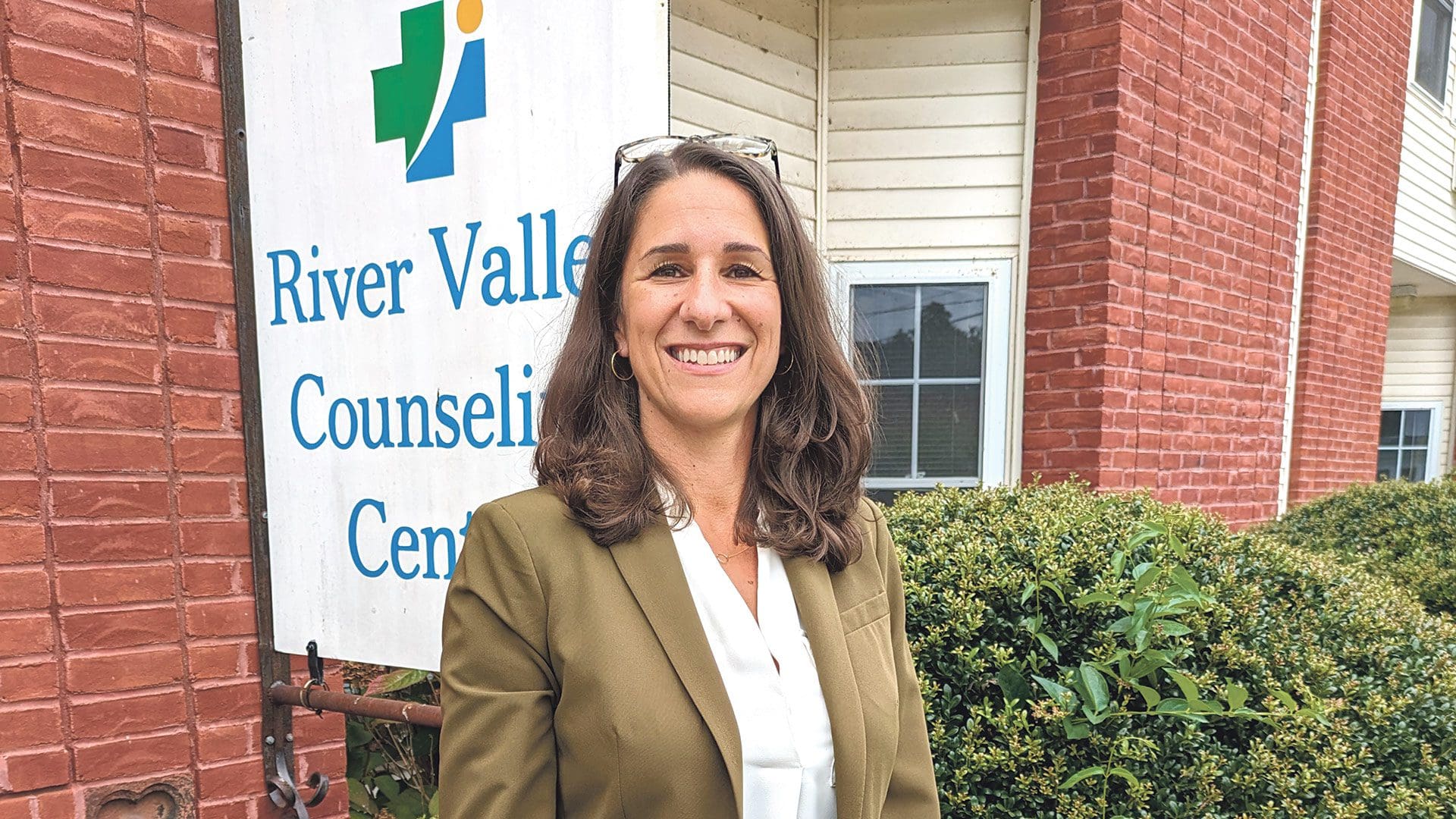
“Almost every day, I’m talking with someone who has this great idea that they want to bring to the table; they want to talk about creating a business plan, and I walk them through the process,” he said. “But small businesses and micro-businesses do fail; just this morning, I was talking with someone … they’re having a hard time, they’re not sure what to do, and don’t know whether to close their doors or not.

Whether it’s those first conversations — the ones about taking a bright idea to market and developing a business plan — or the harder ones, about whether to keep the doors open, the goal is the same, he said: to provide the business owner with support and a plan for moving forward.

“There are exciting conversations, and there are hard conversations,” he went on. “And I love the environment we’ve created, which is in many ways the first of its kind in the Bay State.”

For Melendez, this latest work is the culmination of everything that came before it career-wise, steps where he developed a passion for others and cultivated myriad skills, especially when it comes to organization, building teams, developing relationships, making connections, and getting things done.

All of this has come together at the LEDC, where not all dreams come true, but all dreams are given their best chance to come true.

And Melendez, through his work and the example he has set, is a huge part of the agency’s success.

As Rodriguez noted, he serves as an inspiration “by demonstrating that, with access to the right resources and support, individuals from any background can achieve prosperity and success.”

This has made Melendez a leader, a 40 Under Forty honoree, and now, an Alumni Achievement Award finalist.

—George O’Brien