A list of the region’s largest credit unions
Click here to download the PDF




Charlie Epstein
For the majority of people, saving in their 401(k) over the last few years may have felt like putting their chips down on red number 7 at the roulette table and praying for the ball to fall on that number.
If you had invested in the S&P 500 index for 10 years ending Dec. 31 2008, your average annualized return would have been -1.38% At that time, financial magazines were hyping the “new normal” and the “death of equities.” Fast-forward four years, and the 10-year return was +7.10%. Investing, in any asset class, is a long-term proposition. Just ask Warren Buffett.
So what’s the real message, for both 401(k) participants and their employers who create plans? That we need to begin to focus more on the most important part of the retirement equation. This is ascertaining the income placement for retirement, or what I like to call ‘paychecks for life.’ By receiving education through the advisory firm on their 401(k) plan, participants can use this benefit prudently and not haphazardly from trending financial propaganda.
Here are some steps that should be taken right now:
• Education sessions: Make sure your current advisor and 401(k) carrier provide regular education meetings that not just focus on investment performance, but teach your employees how to calculate exactly what they need to save every month, at a reasonable rate of return, to accumulate enough money at retirement to pay for all the things they desire to do. I call this ‘desirement’ planning.Why? Because Webster’s definition of retirement is to “put out of use.” I don’t know anyone working today who wants to be out out of use when they retire.
Working today should allow you to retire successfully and do all the things you desire to do tomorrow.
• Annual gap statement: Your current 401(k) record keeper can now provide each employee a gap report to show them, based on their current savings rate and a reasonable interest assumption, how much money they will have at retirement. Many of the providers will convert this lump-sum number into a monthly benefit — or paycheck for life. Your employees can see how much money they would actually have every month coming to them from their future 401(k) value. For many employees, this benefit is an eye-opening number and something they can easily relate to their current paycheck. It will indicate to them if they are on track or how far they are from replacing their present-day income.
• Plan level employee success: Ask your current record keeper if he or she can provide you with an overall plan-level participant report. This will allow you to analyze plan level demographics and how efficient your employees’ savings behaviors are. The data will allow you and your advisor to customize education meetings for employees who potentially have a major shortfall in obtaining a successful retirement. These outcomes are very effective in getting employees to increase their savings rate or adjust their investment allocations, and even with getting non-participants to start taking advantage of the benefit.
• Bold plan design: National 401(k) studies have proven that employers that implement automatic features encouraging their employees to save and progressively save more will improve the plan’s performance, resulting in healthier 401(k) balances for participants.
Here are the best automated features you should consider adding to your 401(k) plan:
— Automatic enrollment: All employees, once eligible, are automatically enrolled in the plan. They always have the option to opt out. The more successful plans automatically enroll their employees, not at the minimum 3% savings rate, but at the employer matching rate, which could be 6%. To be eligible to participate in the Exxon Mobil 401(k) plan, an employee must save a minimum of 10%. That’s bold plan design, but it works. The truth is, employees must be saving at least 10% of their pay to achieve a paycheck for life. For older employees, the rate may be higher.
— Automatic increase: One way to get employees to the magic 10% savings rate is to automatically increase their contributions by 1% per year. This is incremental success, and it works. If your employees are at 6% today, you will do them a great service by automatically increasing their contribution by 1% a year until they get to 10%. Again, employees always have the option to opt out of this feature.
These simple steps — customized education, income-gap statements for all your employees, along with two automatic plan-design features — will go a long way toward helping your employees view their 401(k) as a personal paycheck-manufacturing company. Leave the gambling to the casinos.
The Department of Labor greatly encourages you to use these automatic features, to such a degree that, if you follow the proper steps in communicating these automatic features to your employees, they will be granted fiduciary protection.
Charlie Epstein is the author of Paychecks for Life. His book teaches nine principles to help employees turn their 401(k) plans into paycheck-manufacturing companies; [email protected]. His book is available at www.paychecksforlife.org and at amazon.com.

Dan Eger
Congress is continually adjusting, changing, and, quite frankly, confusing us with continual depreciation-rule amendments. Lawmakers say this is all intended to stimulate the spending habits of companies. However, at the end of the day, it causes confusion to the business owners, internal accountants, public accountants, salesmen, and anyone else who tries to remember the actual deprecation rules from year to year.
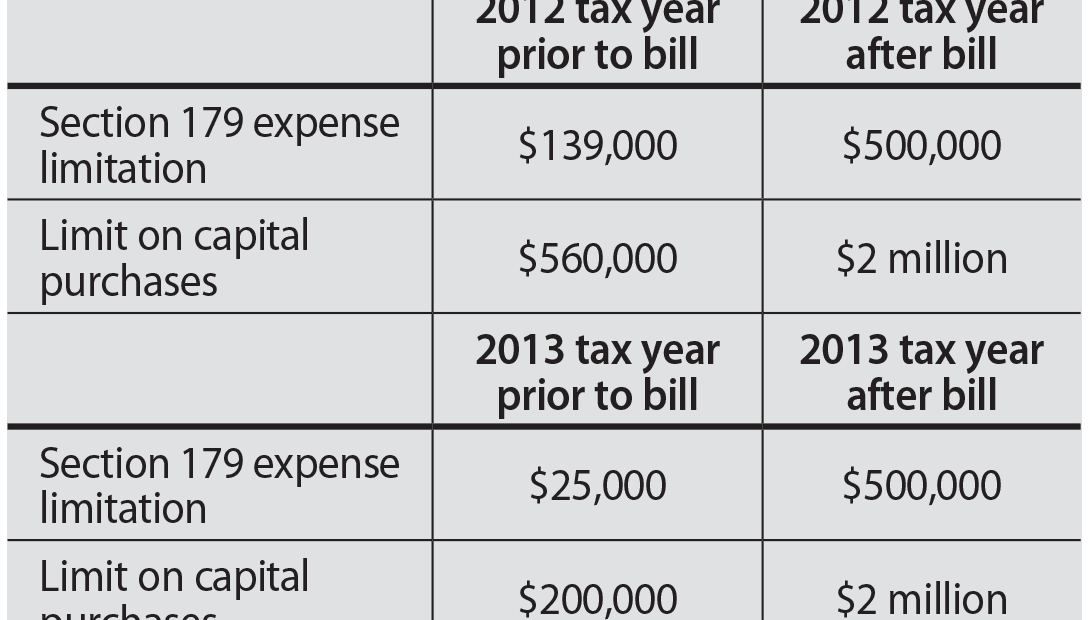
To help you transition from prior rules to the current rules under the new American Taxpayer Relief Act of 2012, a comparative summary has been provided below. Understand that the new rules listed are as of the date of this publication and, as always, are subject to change.
• Section 179. The deduction limit was increased with the Small Business Act of 2010 and extended thereafter with the addition of the American Taxpayer Relief Act of 2012. This deduction applied to both new and used capital equipment and ‘off-the-shelf’ software. You generally need taxable income in order to take this deduction, unlike bonus depreciation, which can be taken regardless of taxable income (i.e., you can generate a taxable loss with bonus deprecation).
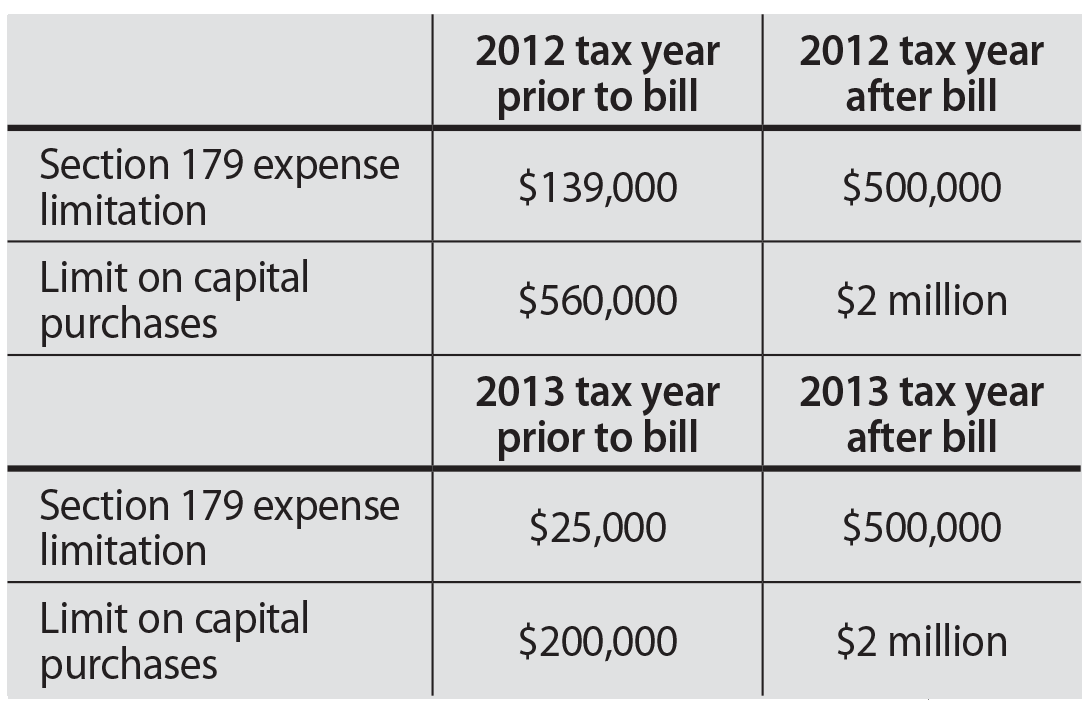
Be aware that Section 179 limitation rules state that, for every dollar spent over the capital purchase limit, there is a dollar-for-dollar reduction in the deduction. That means, in 2012 and 2013, if you spend more than $2.5 million on qualified items, your Section 179 deductions have been completely phased out.
• Bonus depreciation. The 2012 American Taxpayer Relief Act has extended the 50% first-year depreciation under Code Sec. 168K. The qualified assets need to be acquired and placed into service before Jan. 1, 2014. It is available only on new equipment — meaning its first use by anyone (qualified leasehold rules are discussed later). In addition, there is no capital purchase limit on spending like in Section 179 rules. In 2012 you can deduct the first 50% of the asset cost as bonus depreciation; the remaining basis is then depreciated under normal rules. In 2011, the bonus depreciation was 100% of the asset cost, effectively allowing a full and immediate deduction.
One drawback is that most states do not recognize bonus depreciation, and you cannot take the additional expenditure. You may need to weigh this against the fact that, for state purposes, most states allow Section 179 deductions to the extent of the federal limit.
In 2011, qualified leasehold improvements, qualified restaurant property, and retail improvements were allowed to use a reduced depreciable life of 15 years. With the new 2012 relief bill, this is extended to anything placed into service after Jan. 1, 2012 and prior to Jan. 1, 2014; the extension allows for the 50% bonus depreciation and 15-year depreciable life.
• Auto and truck depreciation. Various rules dictate what you can deduct:
• Passenger autos: the maximum deduction 2012 is $11,060.
• Trucks and vans: the maximum deduction in 2012 is $11,160.
• Heavy SUVs used 100% for business: uses are eligible for 50% bonus. A SUV is considered heavy if it has a gross vehicle weight rating of more than 6,000 pounds but less than 14,000 pounds.
Additionally, a heavy SUV qualifies for Section 179 expensing of up to $25,000. (As a planning tool, you would be able to take bonus of 50% of the cost first, and then take the Section 179 of $25,000).
• Many vehicles, which by their nature are not likely to be used for personal purposes, qualify for a full Section 179 reduction in cost. They include the following:
— Heavy non-SUV vehicles with an open cargo area of at least six feet in interior length (like a full-size pickup truck);
— Vehicles that seat nine-plus behind the driver’s seat (like shuttle vans); and
— Vehicles with a fully enclosed driver’s compartment/cargo area, with no seating available behind the driver (basically a classic cargo van).
As stated previously, these favorable bonus depreciation provisions are scheduled to expire on Dec. 31, 2013. If you wish to take advantage of these provisions, you should plan to have the qualifying items acquired and placed in service by then. After that date (unless the laws are changed), there will be no more bonus depreciation. In addition, after 2013 the Section 179 deduction rules are scheduled to revert to the 2003 limit of $25,000 total deduction on $200,000 of qualified additions.
If you have any questions regarding depreciating assets, be sure to consult your tax advisor.
Dan Eger is a tax associate for the Holyoke-based public accounting firm Meyers Brothers Kalicka, P.C.; (413) 322-3555; [email protected]


Mary Meehan says women are becoming more prominent in many fields, from medicine to management to law, and her loan portfolio reflects that.
But he can’t. As the bank’s senior vice president and director of government-guaranteed lending, he more accurately characterizes his role as embracing already-existing trends, from the ever-increasing number of female business owners to the evolving priorities of the U.S. Small Business Administration.
The SBA — which guarantees loans by commercial banks and other lenders and provides capital to small businesses that are often unable to qualify for conventional credit — has, in fact, recognized Webster as Connecticut’s top lender to women-owned and minority-owned businesses.
“I would love to say it was my strategy to focus on minority- and women-owned businesses, but, honestly, it has been a policy of the SBA to really focus on four main areas: minorities, women, veterans, and rural businesses. We’ve done tremendously well with the first three,” Polito said, noting that Webster’s geographic footprint, in largely urban areas, doesn’t facilitate very much lending in rural markets.
“We have a lot of women, veterans, and minority businesses. And it’s something I really do want to focus on,” he continued. “One-third of my portfolio at Webster Bank is women owners — and that includes women only, not husband-and-wife teams. When I speak to my branch managers — who are mostly women — I’m really proud of that. I think it’s putting your money where your mouth is — not just saying it, but doing it.”
United Bank is doing it as well, having been named Massachusetts’ top lender to women-owned businesses for the past two years. Barbara-Jean Deloria, the bank’s senior vice president of commercial and retail lending credits two factors for that success.
“First, having commercial lenders who are women has been an influence on our ability to market to other women,” she told BusinessWest. “Obviously, in the past, the commercial-lending world has been dominated by male lenders, and by having more women in the marketplace attracts that business niche. Also, there are definitely more women-owned businesses that have surfaced in the past 10 years.”
Lenders both regional and national have noticed. In 1995, Wells Fargo made a commitment to lend $1 billion to women who owned businesses. Earlier this month, the financial-services giant said it would lend $55 billion to such companies by 2020.
Lisa Stevens, Wells Fargo’s lead executive for small business, issued a statement that “women-owned businesses are among America’s fastest growing segments, and we are honored to support their role in shaping the future of small business.” In fact, some 30% of U.S. businesses are owned by women — a number that continues to grow.
For this issue’s focus on banking and finance, BusinessWest sits down with several of the region’s commercial-lending players to talk about that trend, and what it means for lenders, borrowers, and the economy as a whole.
Growing Clout
Mary Meehan, first vice president of Commercial Loans at PeoplesBank, has experienced similar success lending to women.
“Roughly 40% of my portfolio is women business owners,” Meehan said, a number that includes manufacturing companies, commercial enterprises, and a range of other types of businesses. “We also have women who own investment and real-estate properties, and female doctors in medical offices; that whole area continues to grow as more women go to medical school. In fact, lending to women has also grown as more women get their MBAs or go to law school.”
Clearly, she said, this trend in commercial lending is being driven by larger economic and demographic shifts, from more women entrepreneurs to more daughters stepping into the CEO role in family enterprises, when sons used to dominate succession. “That’s a natural progression in terms of family-run businesses in general.”
The role of women in the region’s business landscape is even more impressive, Meehan said, considering that the 40% figure she cited doesn’t include nonprofits — which form a considerable niche in Western Mass. and at PeoplesBank; many such organizations are run by women.
The increasing profile of women’s business, in fact, is one reason why the SBA and other agencies have chosen to recognize entities that lend to women, said Dena Hall, senior vice president of Marketing and Community Relations at United Bank. “That they’ve designated an award for lending to women is significant.”
Richard Collins, United Bank’s president and CEO, welcomes the opportunity. “We are always eager to help women in business achieve their goals,” he said. “Their success is always significant to the growth of the economy, and their contributions are more vital than ever in today’s economic environment.”
Statistics from the federal government’s National Women’s Business Council (NWBC) back up that perception with hard numbers. Women-owned firms make up 28.7% of all non-farm businesses across the country and generate $1.2 trillion in total receipts. A full 88.3% of these firms are non-employer firms, while the remaining 11.7% have paid employees, employing a total of 7.6 million people.
In addition, women-owned businesses make up 52% of all businesses in health care and social assistance while other top industries for women include educational services (46% are women-owned), waste management and remediation services (37%), retail trade (34%), and arts, entertainment, and recreation (30%).
However, bank and government lending remains a largely untapped resource, according to the NWBC, as 56% of women-owned businesses used personal or family savings to start or acquire their business, compared to fewer than 1% who used a business loan from the federal, state, or local government or a government-guaranteed business loan from a bank.
However, for those who pursue SBA and other types of loans, Deloria said women are more educated than ever about the resources available to them. “I think women-owned businesses are very proactive on doing the research; even before they come in to see me, they recognize that the SBA is a really good resource for them. Most of the time, they’ve already researched that aspect of it.”
Polito agreed, and added that women tend to carefully consider the perspective the prospective lender brings to the table. “I don’t want to generalize, but it has been my experience, when I do meet with women-owned businesses, I find they’re more willing [than men] to listen to recommendations and guidance about what I’ve seen with other businesses of a similar size or a similar business model. They’re more willing to listen and take guidance from the bank.”
Forging Ties
That sort of openness and teamwork lends itself to a successful loan, Meehan said, especially when it comes to solo or small businesses. “We have a focus especially on the small-business side, a focus on our branches and lending to someone who comes into the branch. The manager is focused on developing that small-business relationship.
“We go through the same due diligence process, male or female, of getting to know the customer’s business and everything that entails.”
And there’s no shortage of resources available to educate borrowers on what the process entails. Deloria said she’s been active with the Women’s Chamber and other business-networking groups and found them to be effective ways to meet business owners and share information.
“We’re trying to offer more education, identify women’s organizations in the communities we serve to do more outreach,” Polito added. “Frankly, its intimidating for pretty much everyone, and often very intimidating for women- and minority-owned businesses, to walk into a bank and apply for a loan. But I don’t want people to feel that way.”
He said loan officers at Webster “put their noses to the grindstone” for every application that comes in, rather than turning down a potentially promising loan after a cursory look at a credit score. “Two people have to decline a loan. What we’ve instituted for many years is a second-look process. When a deal is declined, we have a second reviewer look at it to make sure we can’t do it.
“Even an SBA guarantee can never make a good loan out of a bad loan,” he added. “But if we can get the loan over the hump for approval, we’ll do it; we’ll take that chance.”
That’s because a successful loan benefits everyone: the bank, the borrower, and, in theory, the customers and employees of the company — which is increasingly likely to be run by a woman.
“The business works or it doesn’t — male or female, and no matter what the color of their skin is,” Polito concluded. “So, the more outreach we can do, the better. Everyone wins when you get capital into the market.”
Joseph Bednar can be reached at [email protected]


Paul Scully says Country Bank’s community involvement extends beyond philanthropy to financial-education programs for young and old.
Specifically, Kolb — the bank’s senior vice president and chief commercial banking officer, who came on board six months ago — said he wants to take a “barbell approach” to growing its loan portfolio. Picture Country’s reach geographically, he said, with Springfield and Worcester representing the weights and all the smaller towns in between, where Country has a branch presence, as the bar.
“If we want to continue to grow the portfolio, we have to put our toe in the waters of other areas,” Kolb said, noting that the bank does not have physical branches in those two larger cities, but sees opportunities there. “We’re looking to do more in the Worcester market and the Springfield market … we want to expand our presence in those markets.”
As a mutual savings bank with $1.4 billion in assets, and boasting 14 branches and 245 employees — Country has the reach to grow, said its president, Paul Scully, but continues to maintain an emphasis on small communities.
“We’re still focused on providing a full range of consumer and business products and services within our marketplace, and we view our marketplace as the geography between the Worcester and Springfield areas,” he noted. “Our branching strategy is the same: smaller towns.”
However, he noted, “branch locations don’t matter as much anymore; between mobile banking, remote capture, and other services, customers have really caught on to the fact that they can do all their banking and really never go into a branch. Technology has allowed us to expand our product offerings within more urban marketplaces without having a physical presence there.”
And growth is what Scully has in mind.
“Last year we originated about $105 million in commercial loans — pretty respectable, considering what the market was and what the competition is,” he said, noting that the bank boasts a loan portfolio of $838 million. “A lot of banks are looking for the same opportunities as we are, but there aren’t as many opportunities to go around. What every bank tries to do is differentiate themselves from the crowd.”
One of the ways Country has always tried to do so is through an emphasis on service.
“We look at ourselves as a small business,” Scully said. “We’re a good-sized bank, but we’re still a small business able to offer personalized service. We don’t have a high level of turnover; people who come into the branches see the same people who have been working with them for a long time. Customers are recognized and feel comfortable with the people they’re doing business with. They’re not calling an 800 number where someone across the country is answering. The service element is really a key factor in our success and has set us apart since 1850.”
Added Kolb, “on the commercial side, as an organization, we provide a nice match for what the market demands. We’re not too big and not too small.” But he also echoed Scully’s sentiments about service.
“The money’s still green at the bank across the street. It’s a pretty homogenous product. We all make mortgages and commercial loans; we all do deposits,” he said. “But what really differentiates us is service. It’s not just a tagline; it’s something that’s ingrained and apparent.
“When you walk around the teller line, the average tenure there is 20 years. In the business lines, it’s 10 to 15 years. They don’t stay here because it’s a local, sleepy bank in Massachusetts; they take a lot of pride in the relationships they’ve forged. It is the difference between us and the bank across the street.”
Wiring of the Green

Bob Kolb says Internet and mobile banking are key to a bank’s success today, but so is the personal service available at a branch.
“There are still customers out there that like to see the branch bank on the corner,” he explained. “Having that visibility is important, and it’s never going away; it’s the doorstep to us being active in the community. And giving back to the community is really part of the culture at Country Bank.”
But technology has certainly changed the way customers interact with banks, Scully told BusinessWest.
“We’re pretty much able to have a full range of products to meet everyone’s expectations, from savings accounts straight through to mobile banking and e-bill payment,” he said. “Last year, we converted our ATMs to digital ATMs, so there are no more envelopes; you put the check right into it. That’s the convenience factor; it expedites the transaction for a person sitting in their car with a couple kids or a dog who wants to be somewhere else.”
Those high-tech advances extend to remote capture for businesses that can conduct transactions without going to a branch, and retail online banking has come into its own as well, but there’s no longer as dramatic a split in the ages of people who use it.
“We used to think of it as a generational thing, with the older client base wanting to come into the branch,” Scully said. “People still want to know the branch is on the corner, but we’ve learned that age doesn’t matter. Almost everyone uses a computer, and we have a lot more seniors using e-billing and other technology, and we have people feeling more and more comfortable with security.”
For that reason, the bank’s educational outreach spans generations as well. Country conducts a banking program in area elementary schools, building early financial literacy by teaching students about savings and investment and providing them with passbooks to open their own in-school accounts. It has since expanded that to a ‘credit for life’ program for high-school seniors, teaching them about credit scores and smart handling of paychecks and expenses.
“But the other thing we’re focused on is the senior piece,” Scully noted. “We do a lot with senior centers, talking about banking technology and security, so they don’t feel intimidated using a computer for their banking.”
When Social Security switched over to electronic payments, “we did a lot with senior centers about what that change means and why e-banking is very secure,” he added. “Once seniors feel more comfortable with the technology and understand that their money is not at risk, they want to use e-banking; they want to use mobile banking.”
“The key,” added Kolb, “is to make those channels available, whether through the computer, at a branch, or on the phone, whether someone is 18 or 88 years old.”
In fact, Scully said, there’s no reason why remote banking shouldn’t be embraced by seniors. “Once people realize, ‘OK, I don’t have to go out in the snow and possibly fall down,’ suddenly they feel really good about it.”
For younger customers, he added, “it’s all about smartphones. They’re not looking to have a passbook; they don’t want to bring in some clunky old thing.”
Hometown Appeals
The Country Bank name is only 32 years old, but the institution has been around since 1850, when it was known as Ware Savings Bank. It took on its current name after a 1981 merger with Palmer Savings Bank; another merger with Leicester Savings Bank 17 years ago further increased the bank’s holdings.
From the time of the name change, Scully said, it has been important to communicate a sense of community ties. That’s why the name of each branch reflects its hometown: Country Bank of Ludlow, Country Bank of Palmer, etc. “We like to think of ourselves as that town’s small-town bank, their community bank,” he said — despite the occasional confusion of a customer who goes into a branch in a different town and wonders whether he can bank there because of the different name.
The small-town focus is a positive when it comes to lending, Kolb said.
“Small business is really the backbone of America, and it’s certainly the backbone of the small areas we operate in,” he told BusinessWest. “In Central and Western Mass., it’s about small business; it’s about Main Street. With our branch network and experienced lenders on the commercial side and on the mortgage-origination side, that puts us in a great spot to serve the community with the resources of a big bank, yet we’re small enough to be able to jump in the car and see someone at 7 at night, or be reminded when walking down the aisle of the grocery store that you need to see somebody.”
The hometown emphasis is also at the heart of Country’s philanthropic efforts. In 2012, Scully noted, the bank donated more than $600,000 to community organizations.
“They’re causes that people don’t think about because they don’t necessarily apply to their life, but there are so many people whose lives are affected,” he said, citing the bank’s support of domestic-violence task forces, food pantries, and other organizations. “Unless you need that service, you might not pay attention to the fact that their funding sources have been reduced, or that their needs have grown.”
But the bank offers more than money, he was quick to add, noting that management staff alone volunteered more than 1,400 hours last year at community events — “that’s personal time, nights and weekends” — and the bank has been expanding volunteer opportunities for all employees as well. “Now we have more than 100 volunteers giving back to the community.”
All the bank’s efforts — from its lending business to its charitable work — boil down to an effort to improve people’s quality of life,” Scully said. “Maybe we lend to a business that puts up a building and hires more people. Or we could be giving a scholarship to a kid who then graduates from college. Or we could be supporting social services. It’s all full circle, quality of life.”
Kolb was quick to note that “philanthropy is not something that drives revenue; it’s not a profit center. What it is, really, is part of the culture; it’s consistent with the mutuality of the company. What we’re trying to do for the communities we serve is not a revenue driver; it’s really part of who we are.”
Specifically, Scully added, “the profit is in the long-term impact in the community. Everyone benefits from it. And we didn’t start those things; it’s the legacy of the bank as it relates to every aspect of community life.”
Bottom Line
In many ways, despite its asset growth, some things have remained the same at Country Bank, Scully said. “Community banking is consistent banking. We’re taking what we believe we’ve done well and expanding it.”
And that requires constant reconsideration of business strategies. For example, “the [loan] portfolio is very heavy in real estate, so one of my objectives in coming here is to diversify the portfolio,” Kolb said, a process that will take some time considering an economy that is improving, but still far from thriving. “The idea is to start with small businesses and identify opportunities in that space where we can exploit our leverage with our infrastructure and the experience of our lenders and our service.”
Scully called today’s banking environment “an exciting time, but a challenging one,” but he noted that, particularly since the financial collapse in 2008 that was brought on partly by the misdeeds of the largest banks, there’s something appealing to many customers about a community bank’s consistency.
“That’s not to disparage super-regionals, but those organizations use their customer base as a means to produce revenue and income, which increase shareholder value,” Kolb noted. “What sets us apart, as a mutual bank, is that our depositors are in essence the drivers, and our mission is to service those individuals.”
“We have sort of a split personality,” Scully added. “Are we a big little bank or a little big bank? We’re sort of both; we can do almost any type of transaction a big bank can do, and by any standard we’re considered large, but by having a focus on the customer, the community perceives it as a little bank.”
But one that, barbells or not, is growing stronger.
Joseph Bednar can be reached at [email protected]
Jennifer Reynolds
In fact, in today’s business environment, very few companies do business in only one state. Further, it is not unusual to find that small to medium-sized closely held companies are doing business in several states — or even all 50. And it’s no secret that states are struggling financially. As such, they are all competing for your tax dollars.
A review of your company’s interstate activities can help comply with the various tax laws and identify valuable tax-saving opportunities.
So, how do you know if your business should be filing in other states?
A state’s power to tax your business depends on its connection (or nexus, as it is referred to in the world of accountants and attorneys) with the state. The level of nexus required, however, may vary depending on the tax involved. The four most prevalent state taxes are:
• Sales and use taxes;
• Corporate income taxes;
• Franchise taxes; and
• Payroll taxes.
Many early nexus cases involved sales and use taxes. Technically, the consumer is responsible for those taxes, but because of the impracticality of collecting them from individuals, states have placed this burden on the seller.
Do you have an economic presence?
Going back to the founding fathers, the Commerce Clause prohibited states from imposing tax on out-of-state businesses unless that business had a ‘substantial nexus’ with the taxing state. Substantial nexus, as you can imagine, can be interpreted differently by each person. So how do we know what constitutes substantial nexus?
Well, as with all interpretations of the Constitution, the courts interpret the meaning. Here, U.S. Supreme Court decisions have determined that, for purposes of applying the commerce clause, ‘substantial nexus’ means physical presence. Thus, states cannot constitutionally tax an out-of-state business unless that business has some form of physical presence in that state.
In its landmark 1992 decision in Quill v. North Dakota, the U.S. Supreme Court ruled that a state cannot require an out-of-state seller to collect sales or use taxes unless it has a substantial physical presence in the state. Again, the meaning of ‘physical presence’ depends on the facts and circumstances. But, in general, you have a physical presence if you maintain offices, stores, manufacturing or distribution facilities, property, or employees in the state.
In the age of e-commerce, it’s extremely easy for companies to do business remotely with customers in states or countries where they have no physical presence. Many courts and state legislatures believe that economic presence is a more relevant indicator of a business’s connection with a state.
Over the last few years, there has been a trend in the courts toward eliminating the physical-presence requirement, at least for purposes of income and franchise taxes. But for now, physical presence is still required today to trigger sales and use tax-collection obligations, but many states require only a very minimal presence to establish nexus, and the courts are agreeing.
However, under Federal Public Law 86-272, states are prohibited from taxing a company’s income if its only activity in that state consists of the solicitation of orders or the sale of tangible personal property that is approved and shipped from outside of that state.
One caveat, though: this law does not apply to intangible property. Hence, several recent cases have allowed states to tax an out-of-state firm’s income on intangibles such as credit cards or trademark licenses, even though the firm had no physical presence in that state. A substantial ‘economic’ presence was sufficient.
For example, Connecticut has now instituted a ‘bright-line’ economic nexus test. A taxpayer is deemed to have substantial economic presence if it generates receipts of $500,000 or more attributable to the purposeful direction of business activities toward the state, examined in light of the frequency, quantity, and systematic nature of a company’s economic contacts with this state, without regard to physical presence, to the extent permitted by the U.S. Constitution.
However, Public Law 86-272 will continue to restrict Connecticut’s ability to impose a tax on income derived within its borders from interstate commerce if that activity was only the solicitation of orders of tangible personal property, and where those orders are sent from outside of Connecticut for acceptance and subsequently shipped from outside of Connecticut. And Connecticut is not alone. More states are pushing for economic presence in lieu of a required physical presence.
Am I doubling my tax obligations by crossing state lines?
You might think that establishing nexus with a state increases your tax exposure, but in some cases it does the opposite.
Consider corporate income taxes. Many states determine the portion of your income subject to their tax using a three-factor formula based on the percentage of your sales, property, and payroll attributable to the state. (In some states, the sales factor is double-weighted.) Others use a single-factor formula based on sales. If you’re able to apportion some of your income to a state with a lower tax rate, it can actually reduce your company’s tax bill.
Taking the ‘I’ll take my chances and let them find me’ approach can be a gamble.
Revenue-hungry states will continue to extend the geographical reach of their tax laws, and state agencies will continue to communicate with each other about state taxes. Along with companies, state revenue departments are also becoming more sophisticated.
For example, many states are starting to query vendor files of customers within the state. In-state auditors are looking at invoices to ensure that proper sales and use taxes are being paid for the out-of-state businesses with potential nexus in their state. From there, the states are generating nexus questionnaires to businesses that appear in their audits but are not showing as being registered in their state.
States are not only going after current taxes, but targeting businesses and individuals for back taxes from the date they first started doing business in that state. In addition to the tax, states are imposing penalties for not registering to do business in the state (which itself requires a fee and generally requires the company to file annual reports). The penalties for not registering, and penalties and interest for late filing and payment of taxes, can be substantial.
How can I be proactive to determine my company’s exposure to other states?
To ensure compliance with all applicable laws, be sure to periodically review your business’s interstate activities either internally with your accounting staff or with a qualified tax or legal advisor.
A nexus study may help you to understand your company’s obligations in the various states. It helps to identify your company’s normal business activities in relation to the various nexus standards, based on the type of tax (i.e. income, franchise, payroll, sales and use, or even a ‘privilege tax’ imposed by some states) and the states with which you may have connections.
Having the information up front before you begin a job or do business in another state can help you manage your company’s bottom line. Managing and planning for potential filing and tax obligations in advance can mean the difference between a profitable job and an unprofitable job.
This article is intended to provide a general overview of the multi-state tax environment. As always, you should consult your tax and/or legal advisor regarding the applicability of this general information to your business’s specific situations.
Jennifer Reynolds is a tax manager with the Holyoke-based certified public accounting firm Meyers Brothers Kalicka, P.C.; (413) 322-3542; [email protected]


Sheryl McQuade calls Berkshire Bank’s blend of financial clout and personal service “thinking big and acting small.”
The Wall Street development is the bank’s recent move from NASDAQ to the New York Stock Exchange, which became official in November, around the same time that eight former Connecticut Bank and Trust (CBT) branches — which Berkshire acquired earlier in 2012 — officially converted to their new name, Berkshire Bank — CBT Region.
“Connecticut is a new market for us. We made an investment in Connecticut by way of our acquisition of CBT, and we did so because the Connecticut market offers significant opportunities for commercial and retail banking,” said Sheryl McQuade, senior vice president and regional commercial leader for the Greater Hartford market.
“We believe Berkshire Bank has a unique value proposition,” said McQuade, who admitted that any expansion into Connecticut is fraught with challenge, because the region is arguably as overbanked as Western Mass. “It’s not like we’re the first game in town there, but we believe, because of our size — which is about $5.5 billion now — matched with our product capabilities and diverse business lines, we can offer everything a large, regional bank can, but so do in a more nimble fashion.”
The Connecticut acquisition ostensibly benefits former CBT customers due to the banks’ comparative size; CBT had assets of about $280 million, and commercial loan limits of around $3 million, while Berkshire Bank can conduct deals in the $15 million range. McQuade also touted the bank’s growing suite of products in retail and business banking, insurance, and wealth management.
None of which, she said, will matter if Berkshire Bank doesn’t effectively integrate itself into the culture of its new communities, and that takes more than size. It’s a strategy that McQuade calls “thinking big and acting small,” and for this month’s focus on banking and finance, she and other bank leaders explained to BusinessWest exactly what that entails.
Growing Footprint
Berkshire Bank is no stranger to growth, having taken an aggressive approach to geographic expansion in recent years.
In the summer of 2011, the bank acquired Legacy Bancorp of Pittsfield, bringing 15 branches under its umbrella in Western Mass. and New York. That move came on the heels of other, smaller acquisitions, including New York-based Rome Bancorp earlier in 2011 — a series of moves that, including the CBT merger, has seen Berkshire expand its footprint from 43 to 75 branches in less than 20 months.
Last year, Sean Gray, executive vice president of Retail Banking, told BusinessWest that Berkshire Bank looks to organic growth first — as he put it, “getting the most out of our existing footprint.”
But the past decade has seen this Pittsfield-based institution make headway in New York, Vermont, Central Mass., and now Connecticut. Gray said Berkshire looks for banks that share a similar culture when seeking consolidation opportunities, but the leaders of its Springfield and Hartford markets say they’ve launched an ambitious strategy to introduce a unique, customer-focused culture in new branches.
For example, “we’re launching a new program called MyBanker,” said Lori Gazzillo, assistant vice president of Community Relations. “When we talk about relationship banking, we’re talking about personal bankers who work with individuals who have various financial needs, whether it’s loans or insurance or deposits. They can go to this one person for all their banking needs — somebody they can call about anything, who can connect them with the services they need.”
Branch design is also being overhauled to reflect a more personal, less institutional touch, McQuade said. The bank’s Springfield headquarters, where she and Chamberlain sat down with BusinessWest, is a good example, with its coffee station at the entrance, and where customers are invited to sit down with tellers, no longer separated by an impersonal counter.
“This will be the design going forward in our new branches,” Gazzillo said, adding that older branches will be renovated to match. “This new design enhances teller technology, and it’s a more personalized situation; it’s also more efficient as transactions go, and it’s more inviting, with a café and comfortable chairs and a common room.”
That common room is another way Berkshire is trying to connect with its communities. Each branch will offer local nonprofits and other organizations a space, equipped with multi-media, wi-fi, and videoconferencing equipment, to hold meetings. “It’s a way to offer something back to the communities we’re operating in,” McQuade said, “versus a lot of banks pushing people away from bricks and mortar and toward online banking.”
That’s a constant concern for banks these days, which are trying to serve two distinct constituencies — the traditional, older-skewing customer who prefers face-to-face transactions, and the younger, more mobile crowd that has embraced banking on computers, smartphones, and tablets.
“Berkshire Bank has really invested in a lot of products and technological capabilities,” McQuade said. “On the commercial side, we’re not dependent on branches to serve our customers; we have remote deposit and other tools that a large, regional bank would have.”
However, Gazzillo said, “we think it needs to be both. People are becoming more high-tech, relying on their phones and iPads, and we’re working on rolling out a mobile-banking platform. But customers still want to see someone on a personal level. It’s important to keep up with both, and we’re large enough to do that.”

Sue Chamberlain says it’s important to cater effectively to both the high-tech, mobile crowd and those who want face-to-face interaction.
Culture Change
Gazzillo knows that Berkshire — which dubs itself “America’s most exciting bank” in its marketing materials — has bitten off quite a bit with its recent acquisitions, but she feels the institution has the right strategy to thrive in a highly competitive financial-services landscape.
“We’re succeeding at a time, and in a banking environment, where it’s difficult for banks to succeed,” she said. “We have been expanding, and we’ve acquired a number of banks, but it’s a careful process of looking at the culture and philosophy of a bank and making sure it fits within our own banking culture.
“We’re doing it the right way,” she said, “by providing customers with the tools and resources they need, and a level of personal service that they want. I’m proud of that, and happy with what we’re doing.”
Reflecting that emphasis, Berkshire Bank delayed the changeover of CBT branches by about six months because the company was going through a major upgrade to its operating system across all branches, and didn’t want to put the new, Connecticut-based customers through two separate conversions.
Meanwhile, Berkshire is trying to ease the transition for Nutmeg Staters in other ways. “Part of that is by hiring capable, talented people who are seasoned and experienced in their own communities,” McQuade said. “I’ve hired several people in Connecticut who have a history and relationships in their markets.”
The bank remains committed, Gazzillo said, to meeting community needs as well, across its entire four-state footprint.
“We have a foundation, and as far as financial contributions go, we give $1.5 million,” she said, but added that money is just one element of community involvement; others include a volunteer culture and a benefit that offers employees paid time off to volunteer at nonprofits in their communities. “That’s a big component of who we are, of being a community partner.”
McQuade credited bank President and CEO Michael Daly, who recently added chairman of the board to his business card, for setting the institution — which originally focused mostly on commercial banking — on a path to strong growth across many niches.
“He had the vision to grow the bank’s commercial business, but in a relationship-banking fashion, principally because, in addition to all our capabilities in commercial banking, we have wealth management, an insurance group — a lot of things that can be leveraged as part of a deliberate, relationship-banking strategy,” she explained — one that attempts to draw in young customers and meet their needs for life.
And, now, aims to bring a little excitement to Connecticut, too.
Joseph Bednar can be reached at [email protected]

Charlie Epstein
• Create or review the investment policy statement (IPS). If your 401(k) plan was audited by the U.S. Department of Labor (DOL), which is a greater possibility now that the DOL has hired an additional 300 auditors, one of the first documents they will ask for is your plan’s IPS. The ideal IPS gives clear guidelines, creates a reasonable process, provides a roadmap for making sound, long-term-oriented investment decisions, and even outlines criteria for keeping the investment committee, or a solo-business-owner plan sponsor, on track.
• Benchmark plan fees and services. You should review your plan fees and services on an annual basis and, at least every three to five years, perform a full RFP (request for proposal) and benchmark your plan’s fees and services to determine the ‘reasonableness’ of the fees you are paying and the level and quality of the services you receive from all your service providers.
The onus is on you, the plan fiduciary, to benchmark the fee and service data you now possess. This can be a detailed and lengthy process, requiring considerable expertise. This is where the services of an advisor with the knowledge and expertise of the retirement-plan industry can be an invaluable asset.
• Perform investment due diligence. You should review your plan’s investment options and benchmark the performance and fees on a regular basis — either quarterly, semiannually, or annually — to insure your participants are receiving ‘best in class.’
• Assess the plan’s investment menu. In the current, dynamic investment environment, you should perform investment-structure evaluation as part of your regular due-diligence process. Some things to consider:
— Is your money market the most appropriate ‘cash’ account for your plan? Most are paying 0% after expenses today.
— Should you streamline the investment-fund lineup? Less is more. As a rule of thumb, 16 to 18 fund choices should be enough.
— Are diversification funds, such as real estate, natural resources, emerging markets, and inflation-protected bond funds appropriate options to add?
— Should you add low-cost index or ETF fund options to mitigate costs?
— If your qualified deferred investment account is a money-market or guaranteed account, you should consider changing to a target date, lifestyle, or age-based managed account for greater fiduciary protection.
• Examine your plan’s target-date fund. After the passage of the Pension Protection Act in 2006, plan sponsors rushed to add target-date funds as their qualified default investment alternative (QDIA), and many settled on their record keeper’s target-date fund. At least 50 to 60 new target-date fund options have been launched since 2006.
What seemed like a good fit six years ago might not be so today. You should consider re-evaluating your target-date fund for a number of reasons: performance, fees, and glide path — is your QDIA a glide-to or glide-through retirement glide path, and which do you deem appropriate for your employees? Actively managed target-date funds and funds with tactical and asset-protection strategies have entered the market. You should evaluate your target-date fund’s appropriateness at least once a year.
• Revisit auto features. I wrote an article titled “Bold and Scold” some time back. In it, I encouraged you and your plan advisor to consider adding auto features to increase the chances of your employees achieving greater success at retirement. You should add all auto features that the Pension Protection Act offers, not only because you are protected as a plan fiduciary, but because these feature automatic enrollment, automatic increase of employee contribution by at least 1% a year, and auto-default into your plan’s target-date fund; all have been proven to increase an employee’s chances of retiring with more money in their plan and thus more income at retirement.
• Increase employee education and communication. Your employees need help and encouragement to save an ever-increasing amount throughout their working years. Your 401(k) plan is the single greatest mechanism they have to achieve a successful retirement with what I call a ‘paycheck for life.’ In addition, the two largest assets your employees will own in their lifetime are their home and their 401(k) account balances.
They treat their home with respect. By this I mean they would never go to Foxwoods or Mohegan Sun and bet their home on ‘red 7.’ Yet, every day, they treat the 401(k) like a casino, because the average employee does not have the time, tenacity, or expertise to pick investments. They need help, and they need it on an ongoing basis. At a minimum, you should have your plan’s advisor available twice a year to provide group education and meet once a year, one-on-one, with all employees to assist them in making more informed and more appropriate saving and investment decisions designed specifically for their personal financial situation.
• Document, document, document. The DOL has essentially stated in numerous retirement-plan litigation cases that, if it wasn’t documented, it never happened. Make sure you document everything you do related to your company’s 401(k) plan. Record all investment due-diligence meetings and fee-benchmarking and RFP analysis. Record all education meetings and plan communications. Keep a plan file with all plan documents and reports. Be prepared for a DOL audit in advance.
I hope you will unwrap all eight of these plan recommendations and put them into action in 2013 and beyond. You will sleep easier, and your employees will be more successful in creating paychecks for life.
Charles D. Epstein is the author of Paychecks for Life: How to Turn Your 401(k) into a Paycheck Manufacturing Company. As the 401(k) Coach, he has been nominated one of the top 100 most influential individuals in the 401(k) industry by 401kWire; (413) 478-8580; www.paychecksforlife.org


Jeff Sattler says NUVO is on target with its goals for assets, revenue, and gaining respectability in the local banking market.
That’s because he’s been in their shoes.
Indeed, five years ago, he was one of the principals trying to lure investors and amass the capital needed to launch the venture that would become NUVO Bank, which he now serves as president.
“When you’re dealing with a banker, most of them haven’t owned a business — they have to critique the business owner,” he told BusinessWest. “I started this thing with the same mentality as other entrepreneurs — ‘I’m going to do this; there’s a market, and I’m going to make this work.’ And I had the same growth pains, issues, challenges, and fears that any entrepreneur has. I can talk the same language as that business owner.”
This linguistic ability is one of the factors that Sattler and NUVO’s CEO, Dale Janes, believe have contributed to the bank’s steady growth and recent momentum. Like most of its commercial clients, NUVO’s primary objective has been to gain a strong measure of respectability and build a solid foundation for growth, said Janes, adding that, despite being launched just as the worst downturn since the Great Recession was taking hold, the bank has, in his opinion, achieved that goal.

While other banks rush to add branches, Dale Janes says NUVO will stay with its business model and maintain one location.
Sattler agreed. “We’re profitable right on plan,” he said. “I don’t want to be the biggest in this market; I want to be the most profitable, and that’s return on assets, return on equity, efficiency ratios … key bank ratios that we want to be leaders in eventually, and we’re getting there now.”
Janes told BusinessWest that the institution’s first four-plus years in business have proven that its basic model — operating through one location with a reliance on technology that would ensure that most clients would rarely see that facility on the ground floor of Tower Square — works, and there is no need to change it.
“Our overhead is so low, we can afford to be aggressive on retail CD rates, savings rates, and the costs of accounts,” he said while citing the main advantages to being small and efficient. “The core of our model is small business, small business, small business — and it’s worked; about a year ago, it really started to kick in.
“With longevity comes credibility,” he continued. “So, more and more now, customers who used to do business with Jeff or with me are saying, ‘these guys are around, and they’re going to be here; let’s go check them out.”
Doing some quick math, Sattler noted that NUVO, which just passed the $100 million mark in assets, has something approaching 1% of the regional market, and is by far the smallest bank in the region. While that number may not sound impressive, he said — while noting that doubling or tripling it would still give the bank only 2% or 3% of a market dominated by huge national and regional players — it is a solid base on which to build.
And as he surveyed the local banking market, especially the smaller, community institutions, Janes, who has been in the business for more than 30 years, sees ample opportunity to grow.
“There is going to be more consolidation within this market; it’s inevitable,” he said with a large dose of certainty in his voice. “And with that consolidation, there will be opportunities for banks with the right products and the right approach to customer service. We’ve positioned ourselves to be one of those banks.”
For this issue and its focus on banking and financial services, BusinessWest looks at how far NUVO has managed to come in four challenging years, and what the future could hold for the institution.
By All Accounts
As he prepared to talk with BusinessWest, Sattler was closing on another small-business loan, giving NUVO just over 80 such clients in its portfolio.
That’s another comparatively small number, especially when put alongside the other institutions with downtown Springfield mailing addresses, but Janes and Sattler both take a ‘glass is much more than half-full’ mentality.
“Every new customer is another dot on the map,” said Sattler, adding that the bank’s approach from the day it opened has been to achieve to measured, smart growth, while also carving out a specific niche in the market — in this case, what would be considered small, or even very small, loans.
And both officers believe the institution has achieved those missions, while also establishing the NUVO brand across Greater Springfield and into Northern Connecticut.
“This is the reason why we knew we were going to be successful — we have a niche,” said Sattler, referring to the small-business loans like the one he closed on that afternoon late last month. “Everyone thought we were going to fail, but we succeeded, because we created that niche.”
Both men said that virtually every bank in the region can write the kinds of small loans that NUVO has made its specialty, but most don’t have the need or desire to do so, and can’t do it as well.
“We’ll look at every single deal, no matter what the industry,” he explained. “I won’t say ‘yes’ to every deal, but if we can’t do it, then nobody can do it.”
Meanwhile, another advantage is the aforementioned ability to “speak the language,” as Sattler described it.
“I appreciate their passion,” he said of entrepreneurs. “They have a vision of where they want to take their company, and I can relate to that. I try to get under the tent with them and say, ‘how are we going to make this loan?’
“They say, ‘Sattler, I’m not talking to you like a banker,’” he continued. “And I’m not; I’m a business owner, not just a banker, who started the same way most of these businesses started.”
Overall, the bank has been “on target” with everything from asset growth to profitability to brand recognition, said Janes, adding that the current momentum has manifested itself in a number of ways.
For starters, there have been roughly 18 months of continued monthly profits, he said, adding that another commercial-lending officer, the bank’s third, was recently hired, and another addition is planned for the first quarter of next year. Meanwhile, the bank is planning another capital raise — the prospectus is currently being finalized — to provide the wherewithal to continue growing.
“We’re doing well against our original plan, and super well against our model,” Janes explained. “We have a lot of focus and a lot of discipline around the business model; we can’t be everything to everyone, and we’re honest about that.”
Balance Statement
Moving forward, Janes and Sattler said NUVO is in the process of scripting a new three-year strategic plan.
When asked what it will likely include, they said, in essence, there would be more of the same that has marked the bank’s four-plus years of existence — with the emphasis on more.
The planned additions to the commercial lending staff — “we’re now building a lending team,” said Sattler — and the capital raise are part of this strategic initiative, noted Janes. Overall, he believes that, given the bank’s steady growth and the current landscape in financial services, NUVO is well-positioned to add market share for the short and long term.
Elaborating, he said there are two trends in the marketplace that are working in NUVO’s favor. The first is a significant shift among consumers, business owners, and investors away from large regional and national banks and toward community banks.
“And why not? They’re just smaller, and they have more flexibility and more options for the small-business customer,” he told BusinessWest. “And we plan to take advantage of that, especially on the investor side, because as we grow, we’re going to need to raise more capital.”
The second trend, although it has slowed in recent years, is a movement toward greater consolidation, said Janes, adding that the many publicly owned regional and community banks serving Western Mass. are both candidates for additional expansion themselves or targets for acquisition. And both scenarios, which will be driven by shareholders and their desire for better returns, bode well for banks like NUVO that can take on customers left wary by such transactions.
“This is a very challenging time to provide a return to your shareholders,” he said of the situation facing the public banks. “Everyone’s had what amounts to a free pass because of the recession, because everyone made bad loans and business slowed down, but that free pass is going to get called in, and banks are going to have to start producing, either a dividend or growth in the market price of the stock.
“People are going to instigate,” he continued, “and get these banks to either perform better on an earnings-per-share basis through the organic nature of their business, or by selling.”
And while NUVO has plans for more lending officers, employees, loans, and assets, one thing there won’t be more of is branches.
“People keep asking me, ‘why don’t you open a branch here?’” said Janes, adding that there have been many suggestions when it comes to ‘here.’
“That’s not who we are or ever intend to be,” he continued. “We will never have a huge branch network, and probably will not have a traditional branch. We will expand our footprint; we will take our model and replicate it somewhere else, in a market where there are a lot of small businesses. That was our intent, and it’s still our intent. We’re not ready for it yet, but our three-year plan contemplates something like that.
“Right now, we just want to dominate where we are,” Janes went on, “and earn our keep in this region.”
Despite its lone location, NUVO has been able to grow its presence and build its brand through track record and word-of-mouth referrals. And with presence and referrals, the bank has opportunities to show what it can do, said Janes, which is an important component in the growth equation.
“Once we get in front of people,” he said, “we’re pretty good at bringing in some business.”
Brand Equity
Looking at the numbers compiled by area banks for assets, deposits, and loans (see pages 38 and 39), Janes and Sattler know they will be looking up at the rest of the region’s banking community for quite some time.
But after four recession-riddled years, the bank is starting to see some real momentum. As Janes said, there is enough statistical and anecdotal evidence to show that the bank is indeed a proven commodity — and that things are truly looking up.
George O’Brien can be reached at [email protected]


Gary G. Breton
But wait. There may be some additional factors that you may not have considered.
First, ask yourself, what is the primary reason that you have made your decision? If it is a matter of you not being comfortable with your current account officer or what you feel are not competitive financing terms on your credit facilities, it might be better to have a frank discussion with the head of your commercial lender’s loan department in the first instance and with your account officer in the second instance. Many times, both of these concerns can be addressed in house in a timely fashion, and you could avoid the time and cost of taking your business elsewhere.
However, if you have taken these matters into account, and the basis for your decision involves other factors that you feel are not capable of being addressed by your current lender, understand that there are a number of potential benefits and costs associated with making such a move.
On the potential benefit side of the ledger, your new lender may be in a position to provide you with a new account officer who may be more in tune with your current and anticipated business needs. This officer should be someone with whom you are comfortable and share an open and honest mutual respect. He or she must have the ability to understand (as well as the desire to care about) your business to allow your company to be successful, and the lines of communication must be strong between the two of you.
Additionally, you may find that your new lender possesses the ability to respond to your financing needs in a timelier manner and with the requirement of less paperwork to support your request than your current lender. Another consideration is being sure that your prospective lender possesses the necessary financing products that may be specific to your business needs, such as letter-of-credit availability or asset-based financing.
You might also be pleasantly surprised by some of the terms of the financing commitment that is ultimately made by your new lender, which can include a more competitive interest rate as well as more palatable collateral and financial-covenant requirements than those that are currently in place with your existing financing. One key factor to keep in mind is that many of the terms and conditions of a financing commitment may be negotiable, including the size of any required loan-commitment fee.
While some of the possible benefits of such a move are highlighted above, there are also considerations that need to be given to the possible costs and disadvantages that may be associated with making such a transition. There is, of course, the amount of time you and your professional advisors will need to devote to produce the required paperwork to accompany your application for new financing, which will traditionally include your company’s history, prospective budget and business plan, current financial statements, and recent tax returns.
Additionally, if such financing will involve the pledging of real-estate collateral, the new lender will require a current appraisal to ascertain the fair market value of such property, as well as an environmental site assessment to determine the absence of any hazardous materials that might impact the value of such real estate prior to completing their financing. Also, if any asset-based financing will be part of your financing package, the new lender may also require a field audit/appraisal of your company’s raw material, work in process, and finished inventory. The costs of completing any such required reports generally are the responsibility of your company and can quickly add up to what may be considered a prohibitive figure.
Another major cost that may discourage your contemplated move is whether or not your current financing terms include a prepayment penalty that will be imposed if you elect to refinance with another lender. In many instances, these prepayment penalty formulas, when applied, can, in and of themselves, give a business owner pause on whether the contemplated move will be worth paying what may translate into a substantial sum of money. While many times, such prepayment penalties have been the primary factor in deciding to remain with one’s current lender, there are a number of instances where the cumulative weight of all the components considered by the business owner have outweighed the cost of incurring such a penalty.
So, you can see that the decision as to whether or not it may be in your company’s best interest to move to a new lender requires both a thoughtful and extensive evaluation of many important issues, including those identified above, so that the ultimate decision is grounded on a solid factual footing.
Gary G. Breton, Esq. is a partner with Bacon Wilson, P.C. and a member of its banking and finance department. His major emphasis of practice includes representation of financial-lending institutions, as well as both individual and business borrowers. He also represents numerous business clients in startup and ongoing business operations as well as the purchase and sale of businesses; (413) 781-0560; [email protected]

Charlotte Cathro
With a few changes to how data is accumulated and processed, this can be accomplished.
Managers need to frequently monitor the financial statements of a business. Management oversight is an important component of internal control to ensure that processes are running smoothly. Typically this includes a review of the actual results of the period in comparison to the previous period or an established budget. Reviewing this comparison highlights unexpected activity and may indicate errors or fraud. It may also alter the outlook for future periods, and budgets are most effective when they are flexible and adjust for business changes.
In these economic times, companies need to be able to react quickly to indications of a poor outlook. The business may have bank restrictions for its debt, and will want to monitor the status of these ratios to prevent noncompliance. Cutting costs and scaling back budgets might be necessary to stay afloat. On the other hand, if business results are better than expected, management can use this information to increase investment or expansion. When the review of the financial performance is done well after the period ends, management has less time to make such decisions.
Up-to-date cash-flow information indicates what money is available for use in operations and what excess can be invested or distributed to the owners. Some investment opportunities, such as acquisitions of brands or other companies, may present themselves suddenly and require a quick turnaround. Available cash may also allow the company to pay invoices before they are due in order to take advantage of vendor discounts. However, many companies don’t reconcile their cash to the bank until month’s end, and may not even be entering transactions on a daily basis.
Automation can speed up the financial-reporting process. Transactions that are recurring in the same amount, such as rent, depreciation, and amortization, can be entered in advance. Reversing entries can be set up within the system to reverse the following month. Many organizations are moving from batch-processed systems, which update the financial software on a periodic basis from subsidiary ledgers such as accounts payable and inventory, to real-time systems. These real-time systems process transactions to all related modules immediately. Without the need to post batches and check that they were properly transferred, month-end closing is therefore expedited. Ideally, with these systems, reports can be run daily showing the current financial standing of the business.
Use of the Internet allows for much more up-to-date information. Electronic fund transfers are fixed to be paid on a specific date, unlike checks, which are delayed by receipt and time to clear. Online billing and bank statements allow businesses to keep track of transactions long before they receive statements in the mail. Bank accounts can be reconciled on a daily or weekly basis. Expenses can be entered as soon as the desired period of activity is complete. Businesses should sign up to view activity online for banks and vendors that provide this service.
Some information might not be available within the time frame. For example, bills for less-organized vendors can be received well after the expense was incurred. In order to make sure that the financial statements are as reliable as possible, estimates should be recorded for income and expenses expected to apply to the period. Estimates are acceptable as long as they are reasonably developed and would not change the outcome of any decision-making. A review of the records from the last few periods can be undertaken to indicate what items might be currently missing. Once the documents actually come in, the estimates can be reversed and the actual amounts recorded.
Timely financial information does come with a cost. The reliability of the data should not be sacrificed for speed. In some cases, investment in more advanced accounting software may be required, as well as additional staff or overtime hours for existing employees. However, the increased time in the interim could offset the time required at month-end and year-end close. Both the financial cost and additional stress of providing more timely financial information should be determined and weighed against the benefit it provides.
Charlotte Cathro is a tax manager with the Holyoke-based CPA firm Meyers Brothers Kalicka, P.C.; (413) 536-8510; [email protected]
One of the great scams being perpetrated today is what’s known as tax-return identity theft. Unscrupulous thieves are using stolen identities to prepare tax returns on behalf of unsuspecting individuals, and reaping thousands of dollars per false return filed.
How big of a problem is it? Treasury Inspector General Russell George said back in May that criminals who file fraudulent tax returns by stealing people’s identities could rake in an estimated $26 billion over the next five years because the IRS cannot keep up with the volume of the fraud. That’s a sobering figure.
How do you know if you have been subject to tax-return identity theft? Basically, after you file your actual tax return, you will get a letter from the IRS that says something like, “thank you for filing your tax return. However, we already received your tax return back in February.” That should trigger a big alert that something is seriously wrong. Residents of Puerto Rico have it even worse, since they don’t need to file a U.S. tax return unless they have U.S. activity. As such, when their identities are stolen for tax-return purposes, they don’t even get a warning letter, because they may not have had to file a U.S. tax return. Thus they don’t even know their identities were stolen in the first place. As a result, Puerto Rico has become a priority for the IRS.
The identity thieves basically make up everything on the tax return and prepare the return in such a way that a huge refund is expected. The refund is sent electronically, and the thieves now have loaded-up debit cards. The average theft appears to be in area of $5,000, and the aggregate problem is in the billions of dollars.
It is absolutely imperative that people be more diligent with respect to whom they provide their private and financial information. Further, it is more important than ever for businesses to be extra diligent in the safeguarding of that information. Massachusetts General Law CMR 17 mandates that organizations maintaining private information do so with strict accordance to the law. Therefore, ask how your lawyer, accountant, tax preparer, medical center, new or used car dealer, mortgage lender, bank, etc., safeguards your personal information.
I don’t believe it is unreasonable to predict that random, educational ‘spot testing’ by taxing authorities, in the form of actual physical visits, is in the future to help alleviate the hemorrhaging of personal information. As such, the best advice I can offer to everyone is to prepare to be able to explain to clients, customers, and the IRS, for that matter, exactly how you safeguard private information.
Here’s an example. Our office is on the top floor of our building, and there is no elevator access after working hours or weekends and holidays without an access key. Besides the small fortune we invested in electronic security, our office is equipped with motion alarms and continuously recording cameras. We have a camera in our file room. With the permission of our building owner, we even have cameras outside of our leased office space. That’s how serious we have become with security.
Although this whole issue is due to unscrupulous individuals, I believe both the IRS and the Commonwealth of Massachusetts bear some responsibility here. The rush to mandate e-filing for everyone obviously happened faster than the IRS and the Commonwealth’s ability to monitor it, as we can see from the epidemic of tax-return identity theft. At least with paper returns, W-2s were attached, and the returns were signed by taxpayers and preparers. Presently, none of these safeguards are required by thieves, and the proverbial rooster is in the electronic hen house.
Tax returns can be filed electronically from anywhere; interestingly, one of the great tax-return identity-theft operations originated out of the Dominican Republic. The only reason this operation was discovered was because several New York City postal employees were contracted by the thieves to deliver tax refunds to certain P.O. boxes. The only ones captured were the postal employees, because the organizers of the fraud were never caught.
Even the IRS inadvertently discloses personal information. I am personally aware of a very recent situation where an IRS letter was inadvertently sent to the wrong address. As a safeguard, the IRS letter indicated only the last four digits of the taxpayer’s Social Security number. The recipient wanted to do the right thing and wrote a letter to the IRS with a copy of the original letter, in the hopes that the IRS would understand that they had the wrong address. The IRS responded with a “thank you, we’ll get back to you” and, as an added bonus, provided the entire Social Security number of the taxpayer to this complete stranger. Now that is a very serious breach of security. We have notified the IRS Commissioner in Washington of this particular situation, and we hope we are able to help prevent an unfortunate security breach from occurring again.
Exempt organizations need to be more careful also. Lois Lerner, the IRS director of Exempt Organizations (and a Western New England University graduate), in a speech this past April at Georgetown University, warned about “an important issue of the day.” Between 2001 and 2006, more than 132,000 charities included at least one Social Security number on their tax returns. Those were the Social Security numbers of donors, trustees, employees, directors, scholarship winners, and the tax preparers themselves (the last of which is inexcusable, given the availability of preparer tax-identification numbers). Thus, make sure that any not-for-profit organizations that you are involved with aren’t revealing anyone’s private information, because once it’s on Guidestar, it’s public.
In summary, tax-return identity theft is real, and it’s going to be with us for a while. In the interim, it is imperative to be more diligent with your private information than ever before, ask more questions of those who maintain your private information, file your tax returns as early as possible (thus circumventing a theft), and, for business owners and professionals, treat your customers’ and clients’ private information as though it were currency, because, frankly, it now is.
Paul L. Mancinone is a principal with Paul Mancinone Co., P.C. in Springfield. His practice is primarily focused on taxpayer representation before federal and state agencies, and also has a recurring client base of individuals and business entities; [email protected]
Charlie Epstein
Let’s get to the real facts: some fees will continue to stay hidden. Many carriers are already rushing to circumvent the DOL’s disclosure requirement for participants’ 401(k) plans by continuing to bury them in the plan’s mutual-funds expense ratio. They will do this by creating new mutual fund share classes.
There are three levels of potential fees that participants may pay when they are enrolled in 401(k) plans:
• Fund-expense ratios. This is the amount deducted on a daily basis from each mutual fund to pay for the 12b-1 fees, commissions, advertising, and the money manager. (Note: not all funds pay 12b-1 funds, such as index of ETFs.) There is a real misnomer here regarding disclosure and transparency to participants. The truth is that the majority of participants will still not know or understand what they are paying for with this expense because it will not appear on their quarterly statements.
The expense ratio, which is declared in basis points as a percentage (such as three-fourths of a percent), will remain buried in the fund. On top of this, it will now be hidden in a pile of disclosure papers, which 401(k) record keepers must provide on an annual basis to each participant. The expense ratio for each fund will appear in this disclosure report with a per-$1,000 conversion rate per $10.
Confused yet? Of course you are, and participants will be, too. Most 401(k) plan participants (85%) don’t know and don’t want to know about any of this, and these 16- to 25-page annual reports will end up in file 13.
Have you refinanced your home mortgage lately? Thanks to Dodd/Frank, consumers receive 10 times the amount of ‘disclosure information’ they did prior to the 2008 credit crisis. Who do you think is really reading any of that information? Once again, big-government and bigger-bureaucracy do-good thinkers failed to understand a basic principle of investing: the majority of 401(k) participants don’t read the information they have now. The real proof: the majority of this information has been readily available on participant websites for years, and employees still don’t read it.
• Asset charges and wrap fees. Some 401(k) plans may charge an additional asset fee or wrap fee to cover the record-keeping expenses or fees and commissions to the plan’s advisor. If your 401(k) plan has this expense, you have not been aware of it, and it will appear for the first time starting this month. The 401(k) record keepers must convert this expense into a dollar amount and show it subtracted from the participant’s account each quarter.
Many in the press have stated that millions of participants will take to the streets when they see this hidden cost suddenly appear on their statements for the first time. I say it will be much ado about nothing. Yes, some (the minority) will read it and respond, ‘what is this?’ and go racing to their HR departments, in revolutionary mode, demanding answers. They will be told, ‘there is no free lunch, and you have been paying this; you just didn’t know!’ The vast majority will either not even notice it, notice it and not care, or notice it and realize, ‘wow, just as I thought. I have been paying something for my 401(k). I just didn’t know what, and now I do.’
I have been managing 401(k) plans for three decades. Years ago, a handful of the carriers we worked with started disclosing fees. Of all the plans we managed that began disclosing fees on their quarterly statement — did the employees react negatively? Once we met with them and showed them they had always been paying fees and that they just didn’t see the fee on their statements, the majority smiled and joined the ‘yes, Toto, we are not in Kansas anymore, and there is no free lunch’ club. That was six years ago, and no one has complained since.
Just last week, I had a meeting with the CFO of a company whose plan we had changed to a new 401(k) provider a year ago. The new provider has been reporting all fees as a dollar amount deducted from participant accounts on a quarterly basis for four quarters. When I asked the CFO if anyone has questioned this amount, he responded (rather embarrassed), “no one has said a peep, and, to tell you the truth, I didn’t even notice it on my statement.” This is the company CFO. He’s the guy responsible for watching every penny the company spends, and he didn’t even notice what he was spending on his own retirement account.
• Participant fees. These fees are usually charged directly to a plan participant to cover the cost of receiving a ‘paper’ quarterly statement, perhaps $1.25 per quarter, or to take out a loan, maybe a $100 flat fee.
The bottom line here is everyone knows there is no free lunch, even in a 401(k) plan. What matters most is what participants do with this information and what advisors can do to support greater participant success.
The 401(k) represents one of the best mechanisms for the average working American to save and invest for a secure future. The fact that some participants may be surprised that this system has a cost pales when compared to the surprise these same individuals will have if their future living expenses cost more than their ‘paychecks for life’ can handle.
Charlie Epstein, CLU, ChFC, AIF is the founder of the 401k Coach Program, which offers expert training for financial professionals to develop the skills, systems, and processes necessary to excel in the 401(k) industry and facilitate successful retirement outcomes for plan sponsors and participants. He is the author of the book Paychecks for Life, which offers nine principles for participants to turn their 401(k) plans into a secure retirement income. He has frequently been named to 401kWire’s Top 100 Most Influential People in the 401(k) Industry List and Top 300 Most Influential DC Advisor List. He is a member of the Legg Mason Retirement Advisory Council; (413) 478-8580; [email protected]


Mark O’Connell now oversees Wolf & Co. from his office in Tower Square in Springfield.
By the Numbers
O’Connell told BusinessWest that, while most of Wolf’s 175 employees work in the Boston office, the company is officially headquartered there, and the president and CEO traditionally works out of that facility, he has no plans to relocate to that part of the state or put his office there.
As he said, he can get to the High Street office quicker than most who live in the Hub and its immediate suburbs, and besides, he grew up in Springfield and enjoys the quality of life in this region.
A graduate of Classical High School and Western New England University, where he majored in accounting, he started at a small firm and eventually moved on to KPMG, which was then one of the so-called Big 6 national accounting firms, and had an office in downtown Springfield.
As the spate of mergers and consolidations that reduced the number of ‘big’ firms continued, KPMG closed its Springfield office in the mid-’90s, and O’Connell went to the company’s Hartford office. He said it soon became clear that, if he wanted to ascend within that firm, he would have to go to New York or another major urban center to do it, and this was not his preferred career course.
“By that time, Wolf had been making some inroads into the financial-services marketplace in Western Mass.,” said O’Connell, “so I reached out to them with the idea of starting an office here.”
Company officials in Boston were intrigued, and a Springfield office became reality in 1997, starting in what is now the TD Bank building. Wolf quickly gained some traction in this region, and the office was eventually moved into larger quarters — ironically, space that KPMG was subleasing out in Tower Square.
Over the years, the Springfield office has achieved substantial growth — it has done particularly well in the nonprofit and higher-education sectors — and the company has made some further inroads in Northern Conn., said O’Connell, adding that, while overseeing the progression of that office, he became part of Wolf’s executive committee.
And when DeVasto announced his intention to retire early this year, O’Connell became one of the candidates to succeed him, and eventually prevailed in what became an extensive search.
The transition process, O’Connell said, will come in many forms. Elaborating, he noted that he will be assuming new responsibilities and direction of the company’s three offices, which will require an inevitable reduction in direct accounting work for clients in his own portfolio.
“I will be keeping some of my clients,” he explained, “but my goal is to reach a balance in the size of my practice that will enable me to keep a good-sized practice but also handle the responsibilities I have as CEO. We have a very professional organization, so the ability to delegate responsibilites to other shareholders in the firm or to our administrative infrastructure should enable me to do that.”
Beyond that, though, he is expecting a very smooth transition at the top, mostly because of the systems and philosophies that DeVasto put into place, the experience he gained while serving on the executive committee, and the simple fact that very little, if anything, is broken and in need of fixing.
Bean Aggressive
And that includes the overall long-term strategic plan, which calls for growth both organically and through expansion into new geographic markets.
“Our firm takes on a niche structure,” O’Connell told BusinessWest. “We have individual niches that are focused on specific industries; some of those niches are going to be able to expand within our existing geographic footprint, and others, especially our financial-services niche, we’ll look to grow through geographic expansion.
“There’s been a lot of consolidation in the banking industry,” he continued. “And as that consolidation continues, we have to go further afield to get the work.”
And while much of the growth strategy involves expansion into new regions — the company recently gained its first audit client in New Jersey, for example — or gaining market share in existing service areas, another component involves providing a wider range of services to existing clients.
And this brings him back to the WolfPAC software.
“This product is sold throughout the country — we have clients using it in Califiornia,” he explained, noting that many banks now use the software. “It has allowed us to gain name recognition in other parts of the country. In New Jersey, for example, we’ve sold several WolfPAC modules, and people would seek us out and ask, ‘can you provide other professional services to us?’
“That’s an exciting way of breaking into the marketplace,” he explained. “From an audit, tax, and risk-management perspective, this business is built on trust, and it takes a long time to build those relationships and gain the work, and this is one way to facilitate that process.”
Looking at the current picture, O’Connell said that, in many ways, the state and this region are still recovering from the recession and its many aftereffects, and this means the accounting profession as well.
Firms had to adjust to a changing climate in which there was little if any new growth, and many ventures went out of business, downsized their operations, or had trouble paying their bills — all key contributors to that “new normal” he described. In this environment, many firms, including Wolf on a small scale, took the opportunity to “rightsize,” as he called it, and many have stayed at the new, smaller size.
Conditions are improving somewhat, he continued, and many accounting firms, Wolf included, are hiring again.
“We hired four people last year, and we will be hiring three more in September,” he explained, adding that another of the company’s challenges moving forward, especially with its intention to grow and expand geographically, is to find and cultivate new talent. “We’re continuing to build a pipeline.”
And as it does so, it faces heavy competition from what are now the Big 4 firms — PwC (PricewaterhouseCoopers), Deloitte Touche Tohmatsu, Ernst & Young, and KPMG.
“We have to sell people on a way of life and a well-defined career path,” O’Connell explained. “But it’s hard to talk a young, aggressive accountant out of wanting to get Big-4 credentials under their belt.”
Firm Commitment
O’Connell told BusinessWest that, for the foreseeable future, meaning until the formal transition process is over, he expects to be in Boston perhaps two or three days a week.
After that, he anticipates being able to reduce his time on the Turnpike, especially with the help of technology, specifically in the form of a new conferencing system.
And beyond putting a lot more miles on the car, he is projecting only a smooth transition and further momentum as the company continues its second century in business.
George O’Brien can be reached at [email protected]


Richard Collins says the acquisition of New England Bancshares promises to give United Bank entry into a new and potential-laden market — Connecticut.
Branching Out
Collins said informal talks between United and New England Bancshares started a few years ago.
He told BusinessWest that, again, like most banks in the region with capital at their disposal and strategic plans in place, United, which converted from a mutual bank to stock ownership over two stages in 2005 and 2007, has been looking at a number of opportunities for expansion.
“Our board saw opportunities to grow our franchise and expand our brand of banking into other markets,” said Collins, noting quickly that there has been organic growth over the past several years as well. “In going public, we raised a lot of capital, and the idea of having all that capital as a bank is that you grow into it over time.
“And, in essence, that’s what we’ve been doing — growing into our capital,” he continued. “The Worcester acquisition helped us in that regard, and it’s worked out very well for us, but we still have a lot of capital — 17% tangible common-equity ratio, which is a lot more than you need, really — and so we’ve been looking for opportunities.”
And, like the acquisition of Commonwealth National, the New England Bancshares gambit, a $91 million transaction in cash and stock, makes sense on a number of levels, Collins continued, adding that it was consummated after considerable due diligence that determined that United was receiving value for what it was offering, but was not overpaying.
“What I do in these situations is put myself in the shoes of our shareholders — “if I’ve got $91 million to spend, how much should I be earning on that $91 million?” he explained, adding that a detailed assessment concluded that the bank could certainly earn enough to justify that cost.
When asked to quantify why this deal makes sense for United, Collins said a quick look at a map would be a good place to start. It would show that the best opportunities for widening the footprint lay to the east and the south, with the latter being the most attractive.
“We have a branch in Northboro, and if you go north of that, it gets rural very quickly. If you look at Southern Vermont, there’s not much there in terms of real opportunity to grow,” he said. “And we’re probably not going to expand to our west; first, you have to cross the mountains, and then you get to the Pittsfield area, which is pretty heavily banked.
“So looking south made a lot of sense to us,” he continued. “If you look at the demographics of the Greater Hartford area, you see a lot of people there, and many of the communities are growing and fairly wealthy; there are probably four times as many deposits in the Greater Hartford area as there are in the Greater Springfield market. You have people, demographics, and favorable bank deposits — it looks like a place where our kind of banking can take root and flourish.”
Elaborating, he said New England Bancshares offered access to Connecticut markets with more-promising growth potential, meaning areas where large regional institutions, which have taken the brunt of public criticism over excessive fees, hold a good deal of market share.
Specifically, the institution has 15 branches — assembled through some previous mergers and organic growth —that are positioned mostly north and east of Hartford or west and south of the capital city. There are six branches in what Collins calls the southern tier, which stretches into New Haven County, and eight more in the northern tier, which progresses almost to the Massachusetts line and east to Tolland County. The resulting gap is similar to the one United has between Springfield and Worcester.
Beyond geography and specific branch locations, though, New England Bancshares made sense as an acquisition target on several other levels, said Collins, adding that the two banks are similar in many ways, from operating philosophy to loan-portfolio mix.
“They’re a smaller version of us,” he explained. “When it comes to deposits and loan percentages, the two banks are a lot a alike and take the same approach to doing business.”
These similarities should help facilitate the assimilation process, said Collins, who noted that, while there is some degree of apprehension associated with most bank mergers (especially for customers of the acquired institution), this absorption process should go smoothly.
“It’s a matter of making the right introduction,” he explained, adding that the bank will borrow many lessons from its experience in Worcester. “That’s marketing; that’s letters to the customers introducing ourselves and explaining how we do business.”
This communication process will begin several months before the closing and continue right up to that date of conversion and beyond, he continued, adding that the banks share a common data system, which should facilitate the process.
Looking ahead, Collins said that, after the merger has been completed, United will still have “comfortable levels” of capital with which to possibly add branch locations across its now-broader coverage region, perhaps closing those gaps, or pursue other possible acquisitions.
“We should be able to find branch-location opportunities in parts of that territory that are not saturated,” he explained, adding that New England Bancshares has not penetrated Hartford itself or many surrounding communities. “And, conceivably, there could be another acquisition — but right now, we’re focused on New England Bancshares and making this work.”
Interest Bearing
If the planned merger goes through as expected, United will have some impressive numbers to put behind its name.
These include those $2.4 billion in combined assets, $1.7 billion in combined loans, $1.8 billion in combined deposits, and 37 branches in seven counties across Massachusetts and Connecticut.
More important than the numbers, though, will be the capacity they provide for continued growth and a better ability to serve existing customers.
In short, this acquisition provides even more opportunity for the bank to grow into its capital.
George O’Brien can be reached at [email protected]


Karen Buell says younger customers are particularly open to mobile banking.
Addressing Concerns
Buell said she recently attended a conference in San Francisco on mobile banking and e-commerce. There, the American Bankers Assoc. presented poll results showing that increasing numbers of people plan to adopt mobile banking if they haven’t done so already; the biggest percentage increase is in the 18-34 age group, followed by the 35-49 crowd.
“We know that Generation Y and Generation X are searching for this technology, and they want to do things on the go,” she told BusinessWest. “That’s being confirmed nationally.”
Some potential users might be put off at first by wireless transactions, worried about the security of their data, but Mark said those anxieties are baseless.
“Financial institutions, just because of how highly regulated they are, tend to be very security-conscious, and so are we,” she said. “We have the same parameters, and we take a lot of time educating our client base about security from hackers. We do what we can to allay those fears.”
Breaking down that trust barrier is key, Buell added.
“When they trust it, they embrace it,” she said. “Out of all our online customers, 25% to 30% are using mobile banking. I think, if you’re already comfortable doing something online or electronically, mobile banking becomes just another way to do transactions electronically.”
She conceded that many customers, particularly of the older generations, prefer to bank only in physical branches, “but if you’ve already embraced the technology, mobile is just another step. There don’t seem to be any barriers.”
Mark said the numbers of users across all platforms — browser, app, and text — continue to grow. “On our side, the smartphone usage is where we’ve seen the growth,” she noted. “Today, 6% of all Internet banking activity comes from mobile devices, and it’s increasing on a daily basis, with the vast majority of that usage coming from iPhones and Androids.”
Buell said PeoplesBank, where the mobile-user percentage is even higher, markets its high-tech banking options through its Web site — a logical place to attract customers who are already comfortable online, many of whom are happy not using brick-and-mortar branches at all.
“We’ve also done a lot of online advertising, Facebook and Twitter posts — and we had a billboard recently, just trying to spread the word that, if you’re looking for technology, PeoplesBank has it.”
The numbers back up the demand, as total mobile visits at PeoplesBank in the second quarter of 2012 were up 178% over the same period last year.
“We know customers are using smartphones, which are changing their lives in meaningful ways,” Buell told BusinessWest. “Our commitment is to answer that desire for convenience.”
Joseph Bednar can be reached at [email protected]

Jim Barrett
By JAMES W. BARRETT, CPA/PFS, MST
Once tax filings are taken care of for the prior year, there is always the temptation to tuck current taxes away until the end of the year, when the tendency is to focus on tax strategies that can be executed quickly because of the short period of time remaining.
It would be prudent to take a moment before summer gets into full swing to focus on strategies that may take a little more time to implement but have the potential to reap significant tax savings.
Tax circumstances can change with a single event. Life events, such as marriage or divorce, the birth or death of a family member, retirement, relocation, or a job change, will generally alter your tax position, often dramatically.
Conventional wisdom is to avoid paying taxes for as long as possible by accelerating deductions and/or deferring income. But conventional wisdom may not apply in 2012. Two ominous tax clouds loom on the horizon for 2013, adding a significant level of uncertainty and reducing the value of traditional planning techniques.
The most broadly applicable change is the imminent expiration of the so-called Bush-era tax cuts. The scheduled arrival of the new 0.9% tax on earned income and 3.8% tax on investment income, enacted to pay for the 2010 health care legislation, also should not be overlooked.
We recognize that tax planning requires you to consider a series of unknown future events. Educated guesses and reasonable assumptions go a long way, but keep in mind that no tax strategy is final until the time for changing course has passed.
Planning in Times of
Tax-rate Change
Intentionally raising taxable income in the current year is contrary to the long-standing general guidelines to tax planning. Historically, tax planning has focused on accelerating deductions into the current year and deferring income into future years. But, with rates scheduled to increase, what has worked in years past may not produce the best tax outcome for the future.
The basic framework to help shape your overall income-tax planning in 2012 is as follows:
• If you expect to be in a higher income-tax bracket in 2013, consider accelerating income into 2012 and deferring deductions to 2013.
• If you are forecasting a lower income-tax rate in 2013, reverse the strategy: consider deferring income and accelerating deductions.
This year and going forward, keep in mind that the focus should always be on your marginal tax rate, the highest rate at which your last, or marginal, dollar of income will be taxed. Even though overall tax rates may rise in the future, if your income will be substantially lower in 2013 than in 2012, your marginal tax rate may decrease under the graduated-tax-bracket system.
It’s also important to keep in mind a couple of additional key income-tax concepts while mapping out tax techniques for 2012:
Alternative Minimum Tax:
In years you are subject to the alternative minimum tax (AMT), your deductions may be limited. If you anticipate being subject to AMT in either 2012 or 2013, consider timing those deductible expenditures limited under the AMT regime to maximize deductibility.
Standard Deduction:
If you expect to claim the standard deduction in either 2012 or 2013, shift itemized deductions into the year in which you will not claim the standard deduction to take full advantage of the deductions.
Rising Tax Rates
Individual income-tax rates are set to rise on Jan. 1 of next year to a top rate of 39.6%, a 13% increase over the customary rates in recent years. In addition, limitations on both itemized deductions and personal/dependency exemptions are scheduled to return for 2013, potentially raising the income-tax rate another three to four percentage points for taxpayers subject to these limitations.
Further still, dividends are set to once again be taxed as ordinary income in 2013. The 15% rate enjoyed on qualified dividends for a number of years could potentially become a 39.6% rate. The top tax rate on long-term capital gains is also set to increase by roughly one-third to 20%.
| Provision | 2011 | 2012 | 2013 |
| Ordinary Income Rates | 10.0% | No Change | 15.0% |
| 15.0% | No Change | 15.0% | |
| 25.0% | No Change | 28.0% | |
| 28.0% | No Change | 31.0% | |
| 33.0% | No Change | 36.0% | |
| 35.0% | No Change | 39.6% | |
| Long Term Capital Gains | 15.0% | No Change | 20.0% |
| Qualified Dividends | 15.0% | No Change | 39.6% |
| AMT Exemption – Single | 48,450 | 33,750 | No Change |
| AMT Exemption – Married | 74,450 | 45,000 | No Change |
Unfortunately, the increasing rate news does not end here; since the Supreme Court did not overturn the health care legislation, the tax impact of the legislation begins in 2013.
Taxpayers with modified adjusted gross income above $200,000 ($250,000 on a joint return) will be subject to two additional taxes:
Hospital Insurance:
A 0.9% hospital insurance (HI) tax will apply to earned income, such as wages.
Unearned Income Medicare Contribution:
A 3.8% unearned income Medicare contribution (UIMC) tax will apply to investment income, including interest, dividends, and capital gains.
For taxpayers above the threshold, the impact of these two new taxes will be broad-reaching. With the addition of the UIMC, the top rate for long-term capital gains will rise by more than 50% to 23.8%, while the top ordinary income rate will rise by more than 15% to 40.5%.
Planning now may reduce the tax burden in years to come, and the timing and composition of earnings become critical. Potentially, a bonus from your company during 2012 instead of 2013 or a 2013 capital transaction accelerated into 2012 could save significant tax dollars. With uncertainty in these rates — and all tax rates this year — midyear may not be the time to initiate the transaction, but it is an ideal time to lay the foundation.
Although the new health care taxes apply to most types of earned (HI tax) and unearned (UIMC tax) income, the new taxes will not apply to retirement-plan distributions, IRA payouts, or tax-exempt income, such as interest from state and local government bonds.
Increases in tax rates are generally adverse for most taxpayers, but with increased rates comes increased value in your deductions, making this a great year to strategize with your tax adviser about the best timing for your deductions.
Here are some 2012 and 2013 planning points to consider if the new health care taxes go into effect Jan. 1, 2013:
Mind the Income Threshold: If you expect that your 2013 modified adjusted gross income (MAGI) will be close to, or just above, the $200,000 (single filer) or $250,000 (joint filers) threshold, you may be able to avoid the HI and UIMC taxes by accelerating income into 2012. The UIMC tax applies only to taxpayers who have both net investment income and MAGI above the threshold amounts.
Adjust Your Investment Portfolio: Seek out investments that produce tax-exempt or tax-deferred income, such as non-dividend growth stocks, tax-deferred annuities, and state or local government bonds. Since it may take time to realign your portfolio, you may want to start well in advance of Jan. 1, 2013.
Spread the Gain:
Installment reporting spreads the investment income from the gain on a sale over a period of years, reducing MAGI and deferring recognition of the investment income. However, electing out of installment reporting in 2012 results in gain recognition before the higher tax rates go into effect.
Transfer Investments to Family Members: Although your children’s investment income may be taxed at your marginal tax rate under the ‘kiddie-tax’ rules, an unmarried child is subject to the UIMC tax only if the child’s MAGI exceeds $200,000. You may be able to use a family limited partnership or other technique to spread some of your investment income among your children prior to Jan. 1, 2013.
Planning Your Estate and Gifts
Absent congressional action, the $5.12 million estate-tax exemption and current top tax rate of 35%, in place for 2012, will revert to a $1 million exemption with a top tax rate of 55% beginning Jan. 1, 2013. Moreover, the estate-tax exemption will no longer be portable between spouses.
With the lifetime gift exclusion also at $5.12 million for the rest of 2012, there exists what could be a once-in-a-lifetime opportunity to transfer significant assets to the younger generation without incurring any wealth transfer taxes. On Jan. 1, 2013, the lifetime gift-tax exclusion is scheduled to revert to $1 million.
Along with the high gift-tax exemption, the generation-skipping transfer-tax exemption is also $5.12 million during 2012. So the door is open to bypass children and defer the impact of estate taxes for many years into the future.
It’s uncertain where the estate-tax exemption and tax rates will end up in future years. And with the expiring provisions, it’s a good idea to review your plan to ensure that it is up to date.
Legislation proposed in Congress limiting valuation discounts attributable to minority interests or lack of marketability also potentially affects wealth transfer. The tax cost of gifts could increase should the changes be enacted.
Since these rules have not yet gone into effect, planning potential remains. Before transferring interests in family businesses or family limited partnerships, consult with your tax adviser to discuss potential tax and valuation pitfalls.
The gift-tax annual exclusion remains at $13,000 per donee, or recipient, for 2012. With gift splitting, spouses can transfer up to $26,000 to each person before the lifetime gift-tax exclusion comes into play.
Gifting techniques you may want to consider this year include:
• Outright gifts to family members;
• Transfers to family members through a family limited partnership; and
• Transfers in trust, including irrevocable life-insurance trusts, defective grantor trusts, and charitable trusts.
Following are a series of other tax-planning opportunities to consider:
Timing of Payments
Reviewing your withholding and planned quarterly estimated tax payments now provides the flexibility to adjust payments to limit or prevent penalties and manage cash flow.
Underpaying your taxes over the course of the year will subject you to underpayment penalties, which can be reduced or eliminated by increasing your withholding or quarterly estimated tax payments. A quirk in the penalty rules treats withholding, even if it occurs late in the year, as if it had been taken evenly throughout the year, making it a powerful planning tool for individuals.
On the flip side, why remit payment too soon when you can invest those funds until April 15, 2013? As long as you will not be subject to an underpayment penalty, consider holding on to your cash as long as possible by cutting back on your withholding or lowering your remaining quarterly estimated tax payments.
Retirement Funding
You can reduce your current tax obligations and help save for your retirement in a tax-efficient manner by contributing to a tax-qualified retirement plan. Qualified plans provide tax deferral — or tax avoidance, in the case of Roth accounts — on earnings until you receive distributions.
The earlier you make the contribution, the sooner your tax-deferred or tax-free earnings begin. If you already have a retirement plan in place, consider funding it as soon as possible to allow funds to start growing now.
To qualify for a tax deduction in 2012, your retirement plan generally must be in place before the end of the year. Exceptions are IRA and SEP (simplified employee pension) plans, which can be set up and funded through April 15, 2013.
Establishing a new retirement plan requires thoughtful decision-making. Small employers (generally those with 100 or fewer employees) that set up a qualified retirement plan may be eligible for a tax credit of up to $500 per year for three years. The credit is limited to 50% of the qualified startup costs.
The following contribution limits, along with the catch-up contribution limits for those 50 and older, apply for the 2012 tax year:
| Limit | Limit w/Catch Up | |
| 401(k) | 17,000 | 22,500 |
| IRA | 5,000 | 6,000 |
| Simple IRA | 11,500 | 14,000 |
| Self-Employed | 50,000 | 55,500 |
Individuals with earned income, including alimony, are generally eligible to contribute to traditional IRAs. Claiming a deduction for your contribution is another matter. It depends on your income and whether you or your spouse is covered by an employer-sponsored retirement plan.
If neither you nor your spouse are covered by an employer’s plan, you may deduct your contribution to your traditional IRA. If you or your spouse are an active participant in an employer-sponsored plan, the deduction for your IRA is phased out at adjusted gross income (AGI) levels:
| Filing Status | AGI Phase-out Range |
| Single | 58,000 – 68,000 |
| Married filing jointly | 92,000 – 112,000 |
| Married filing separately | 0 – 10,000 |
| Spousal IRA | 173,000 – 183,000 |
Many taxpayers find the long-term benefits of contributing to a Roth IRA or a Roth 401(k) outweigh the short-term financial benefits of tax-deductible contributions. While Roth contributions are not tax-deductible, none of the income earned in the Roth account will have tax consequences unless there are early distributions, in which case penalties may apply. In addition, the Roth account is not subject to the required minimum distribution rules that apply when you reach age 70.
Eligibility to contribute to a Roth IRA depends on the amount of your income level. Contributions are allowed if your modified adjusted gross income for 2012 is between $110,000 and $125,000 for singles or between $173,000 and $183,000 for joint filers.
You can still roll your retirement savings from your traditional IRA or other qualified retirement plan into a Roth IRA. However, you must pay tax on the rollover amount. Unlike in past years, income limits no longer apply to Roth rollovers.
You might want to consider a Roth rollover in 2012 if you expect to be subject to the unearned income Medicare contribution tax in future years. Although distributions from a traditional IRA are not subject to the UIMC tax, taxable IRA distributions increase your modified adjusted gross income. If your MAGI exceeds the $200,000/$250,000 threshold, your investment income will be subject to the UIMC tax.
By rolling over your traditional IRA to a Roth IRA in 2012, you will recognize the additional income before the UIMC tax goes into effect. Once you have had a Roth IRA account in place for five years, future distributions from the Roth IRA will be non-taxable and will not increase your modified adjusted gross income.
If you own a business, you may be able to avail yourself of a defined-benefit type of retirement plan. These plans often allow higher retirement contributions than other types of plans. The higher retirement benefit must be weighed against the additional cost of providing comparable retirement benefits for your employees.
Charitable Contributions from IRAs
The tax rule allowing those over age 70 to make charitable contributions from their IRA without the need to include the distribution in income expired at the end of 2011. Making these contributions directly was generally advantageous because it didn’t raise the contributor’s income for limits on itemized deductions and certain phaseouts.
Although Congress has a track record of reinstituting expired tax provisions and applying them retroactively, it is certainly not guaranteed. If you are confident that you want to make the donation regardless of the tax treatment, you can still transfer the contribution directly from your IRA to the qualified charity. If Congress decides to retroactively reinstate the donation rule, the transfer will be excluded from income just as under the pre-2012 rule.
If Congress does not reinstate the rule, any charitable donation made from your IRA will be treated in the same manner as a donation made from any other source. The distribution from the IRA will be recognized as income, and the contribution will be included on your return as an itemized deduction. While the deduction should offset the income, the benefit will not be as great as it would have been if the income had not been recognized in the first place.
Employee Health Plans
If you are not currently providing health coverage for your employees, a tax credit for small businesses may make the cost of purchasing this coverage more affordable. The maximum credit is 35% of the premiums paid by the employer.
To be eligible for the credit, the employer generally must contribute at least 50% of the total premium. The full credit is available for employers with 10 or fewer full-time equivalent employees (FTEs) and average annual wages of less than $25,000. Partial credits are available on a sliding scale to businesses with fewer than 25 FTEs and average annual wages of less than $50,000.
New Employees
Congress extended the Work Opportunity Tax Credit for employers that hire eligible unemployed veterans after Nov. 22, 2011 and before Jan. 1, 2013. The credit can be as high as $9,600 per veteran for for-profit employers or up to $6,240 for tax-exempt organizations.
The amount of the credit depends on a number of factors, including the length of the veteran’s unemployment before hire, the hours a veteran works, and the amount of first-year wages paid. Employers who hire veterans with service-related disabilities may be eligible for the maximum credit.
If you own a business and have children, consider putting them to work during summer vacation or after school. You will be able to deduct their wages as long as you make their pay commensurate with what you would pay a non-family employee for the same services. For 2012, they can earn as much as $5,950 and pay zero income tax. If they earn $10,950 and contribute $5,000 to a traditional IRA, they will also pay zero income tax.
Capital Expensing
Generous expensing rules apply to most non-real-estate assets acquired and placed in service during 2012. The expensing election limit under Section 179 is set at $139,000 if the total amount of qualified asset purchases does not exceed $560,000. The deduction is available for most business equipment, furniture, and off-the-shelf computer software.
There are limits to the Section 179 deduction, including a requirement that the deduction not cause or increase a taxable loss. But the 50% bonus depreciation election, also available through the end of 2012, can cause or increase a taxable loss.
The key to qualifying for these enhanced deductions is that the asset must be placed in service by Dec. 31, 2012. Just ordering or paying for the asset is not enough. Considering the time it may take to identify the appropriate equipment, obtain competitive bids, order the product, have it assembled and shipped, and then get it installed and operational, now may be the time to begin the acquisition process.
With tax rates on personal income scheduled to rise in 2013, those who operate businesses as S corporations, partnerships, LLCs, and sole proprietorships will have to consider carefully whether to take advantage of the enhanced business deductions available for assets placed in service during 2012. Particularly for assets with shorter depreciable lives, forgoing the enhanced deductions for 2012 may result in more tax savings in 2013 and later years.
No one can predict the future, and predicting future actions of Congress is particularly hazardous. Congress can — and all too often does — change the tax law at a moment’s notice.
Tax planning is an ongoing process. Saving taxes is generally a good strategy, but making a bad business, investment, or personal decision just to save some tax dollars is never a good strategy.
James Barrett is managing partner of Meyers Brothers Kalicka in Holyoke; (413) 536-8510; [email protected]
Charlie Epstein
Charlie Epstein is the author of Paychecks for Life — How to Turn Your 401(k) into a Paycheck Manufacturing Company (www.paychecksforlife.org). As America’s 401(k) Coach, he has been nominated one of the top 100 Most Influential Individuals in the 401(k) Industry by 401k Wire Magazine. He has trained more than 2,000 advisors across the country on how to create greater success for plan sponsors and plan participants; (413) 478-8580; [email protected]
Charlie Epstein
Creating Success for Plan Participants
The ultimate measure of the success of a plan is in providing paychecks for life, an adequate amount of money throughout retirement. However, many participants do not have the time, energy, or knowledge to ensure that their retirement years will be their desirement years — the time in which they enjoy everything they desire. Employers can help employees by using what I call the ‘401(k) on autopilot’ system:
• Automatic enrollment: Enrolling in a plan is the first step in creating a successful retirement. However, many employees do not enroll in their companies’ 401(k) plans. Each year, employers can notify employees that, if they do not opt out of the companies’ 401(k) plans, they will be automatically enrolled. More often than not, the employee’s inactivity will work in their favor, and they will begin saving for their future automatically. Not only does increased enrollment help the employees with their future retirement savings, but it provides additional tax benefits for the employer and, in certain instances, helps to boost the employer’s tax-deferred contributions as well.
• Automatic increase: This is another feature that employers can take advantage of in creating successful retirements for employees. It is commonly said that contributing 10% of one’s income will be enough for a successful retirement. However, most participants will start contributing at a level well below 10% (sometimes only 2% or 3%). By automatically increasing contributions by 1% each year until they reach 10%, employees can painlessly move toward the target percentage. By explaining automatic increases to employees, as well as other elementary financial concepts, employers help their participants become more financially savvy in understanding retirement benefits.
• Automatic default into a qualified default investment account (QDIA): Today, most 401(k) plans allow participants to choose their contribution allocations. However, many participants don’t have the time or knowledge to understand which investments will give them the greatest returns at an appropriate risk. Contributions without a predetermined destination default into QDIAs, which provide participants with greater returns on their money at appropriate risk, based on their target years to retirement. As long as plan sponsors conducts due diligence when selecting QDIAs, they receive fiduciary protection through ERISA.
• Automatic open re-enrollment: This auto feature not only keeps participants enrolled in the plan, but it also nudges them into QDIAs. Once a year, plan sponsors can inform their participants that they have 30 days to review their investment choices and that, if they do not make a selection, their contributions will go into QDIAs. This further enhances the fiduciary protection of the plan sponsor and ensures that participants’ contributions will be invested in appropriate funds.
If left to their own devices, most participants would not be able to create paychecks for life; however, employers can help by putting their 401(k) plans on the autopilot system and educating employees about fundamental retirement-plan concepts. For more information on how to use these auto-features for your plan, contact your financial advisor.
Creating Success for Plan Sponsors
Retirement plans don’t just help participants achieve paychecks for life. Employers receive a number of benefits from retirement plans as well, and should measure their plans’ success based on the following metrics.
Tax deductions: Employers are able to deduct the amounts that they match in employee contributions.
Tax deferrals: Success for employers, like success for employees, often comes down to how much money they can save. This money grows even more productively if contributed on a pretax basis. Employers have a number of plans that they can take advantage of, including 401(k), profit sharing, and cash-balance plans. If you are able to contribute up to $250,000 per year to retirement plans but are not doing so, you should consult an advisor. You will not only benefit from more tax deductions, but you will also have tax deferrals, which will allow your money to grow more rapidly than after-tax contributions.
Success in retirement ultimately depends on one thing: providing paychecks for life. As Social Security funds dwindle, employers must look for an alternative way to provide adequate retirement funds for themselves as well as their employees. By taking some of the steps listed above, plan sponsors can ensure adequate funds for participants in addition to receiving fiduciary protection and taking advantage of tax deductions and deferrals for their own retirement savings.
Charlie Epstein, CLU, ChFC, AIF is the president of Holyoke-based Epstein Financial. He is the author of the book Paychecks for Life, which offers nine principles for participants to turn their 401(k) plans into a secure retirement income. Epstein has frequently been named to 401(k) Wire’s Top 100 Most Influential People in the 401(k) Industry List and Top 300 Most Influential DC Advisor List. He is a member of the Legg Mason Retirement Advisory Council; (413) 932-6236; [email protected]

Kristi Reale
Can You Negotiate Covenants with
Your Lender?
If your company is strong financially, you are in a better position to negotiate loan covenants with your lender when you are applying for a new loan. Lenders utilize covenants to minimize their risk and protect their interests; however, a lender would not be making a loan to your business if it did not want your business to succeed. Have a clear idea of where your strengths lie, and negotiate your covenants accordingly.
By submitting a well-developed business plan and having an honest discussion with them about your business, you might be surprised by how willing a lender will be to work with you.
Know What You Are Signing
Ignorance is not bliss when signing a loan agreement, so make sure you carefully read your loan document and understand what you are agreeing to. If you do not understand a covenant or how it is calculated, you should seek out professional guidance, as once you sign that document, you are bound by the terms and conditions of the loan agreement regardless of your understanding.
Monitor and Communicate
Do not wait until the end of the year to look at your covenants. Create a proactive system to monitor progress on all financial loan covenants. Covenants should be reviewed at least quarterly. Update your internal projections through the end of the year and calculate whether you will be in compliance.
If you determine that a covenant breach is apparent, you should contact your lender as soon as possible. Be open and forthright with your lender, as they do not like surprises. Set a meeting; bring your calculations, projections for the remainder of the year, and a realistic recovery plan for the future. The lender is now aware of a possible breach that could occur, and the conversation will be calmer than one conducted at the last minute. A well-informed lender may be willing to change the terms of your loan to your benefit.
What If I Do Not Pass?
Once you realize that you will not be in compliance with the covenants, you will need to notify your lender in writing and request a covenant-waiver letter. This letter basically acknowledges the non-compliance, and the bank then waives the company’s compliance for the period in question.
A covenant breach is a technical violation of the loan document, and allows the lender to take any action legally available under the terms of the loan agreement. One of the most severe actions is to call the loan and terminate the relationship; though not the most common action, it is a possibility.
More often than not, the lender will charge you a penalty for a covenant breach. These penalties can be an increase in the interest rate paid or a one-time monitory penalty. You can attempt to negotiate the penalty with your lender; however, once the covenant is breached the power shifts to the lender.
In Conclusion
It is very important for business owners to fully understand loan-covenant issues in today’s tight credit environment. Failure to do so can place your organization at significant risk. Maintain a healthy and open communication with your lender.
Remember, they would not be willing to loan you money if they did not want your business to succeed. Be prepared to negotiate with a detailed plan of action, and utilize outside professionals such as independent certified public accountants to ensure that covenants are fair, achievable, and address your company’s needs. Your CPA and your banker can be valuable resources in structuring your loan to be the most advantageous to all parties.
Kristi Reale, CPA, CVA is a senior manager with Meyers Brothers Kalicka, P.C. in Holyoke. In addition to the tax, accounting, and consulting services she provides clients, she is also a certified valuation analyst; (413) 536-8510.


Tom Senecal visits with students at Square One in Springfield. PeoplesBank donated $25,000 to the organization to help it recover from the June 2011 tornado.

Susan Wilson, vice president of Marketing at PeoplesBank, tours the new Leverett Elementary School greenhouse that was funded by a donation from the bank.
— George O’Brien

 Charlie Epstein says that, as he was pondering a title for his recently released book, he was, for a very short time by his estimation, thinking about something Steven Covey-like — “maybe ‘Nine Habits of Highly Successful Savers.’”
But while those habits, or principles, as he calls them, are, indeed, the foundation of the book, and he has a patent pending on them, he opted instead for a phrase he started putting to use several years ago — ‘paychecks for life’ — because he believes it’s far more forceful, attention-grabbing, and to the point.
And it also helps him in his quest to entertain as well as educate, a quality he maintains is missing from most everything else that has been written on the subject.
“When I was starting in the retirement industry and reading through what was available for educational material … it was absolutely atrocious,” Epstein, president of Epstein Financial Services and the 401(k) Coach, told BusinessWest. “The average person comes into a 401(k) meeting with the expectation that they’ll be asleep in 10 minutes. You have to create a Disney-like experience for people today; you have to entertain them.
“That’s hard to do, but the principles are engaging — and they’re simple,” he went on, while explaining his approach taken with Paychecks for Life: How to Turn Your 401(k) into a Paycheck Manufacturing Company, a detailed look at effective retirement saving — although Epstein doesn’t use the word retirement any more.
Well, he does, but only in an exercise he’s probably repeated several hundred times, in which he asks the person he’s sitting across from (be it a reporter, client, or potential client) to give Webster’s definition of the term. Usually he doesn’t wait long before giving the answer himself — ‘to be put out of use’ — and then asking, “do you know anyone who’s working to be out of use?”
So he’s created the phrases ‘desirement,’ ‘desirement plan,’ ‘desirement mortgage,’ ‘desirement years,’ and others, which are at the heart of his motivation to pen and then self-publish Paychecks for Life.
“My book is not about how to invest your money better,” he explained. “It’s about the nine principles to get you to save smarter, and then how to maximize this mechanism that the government calls the 401(k).”
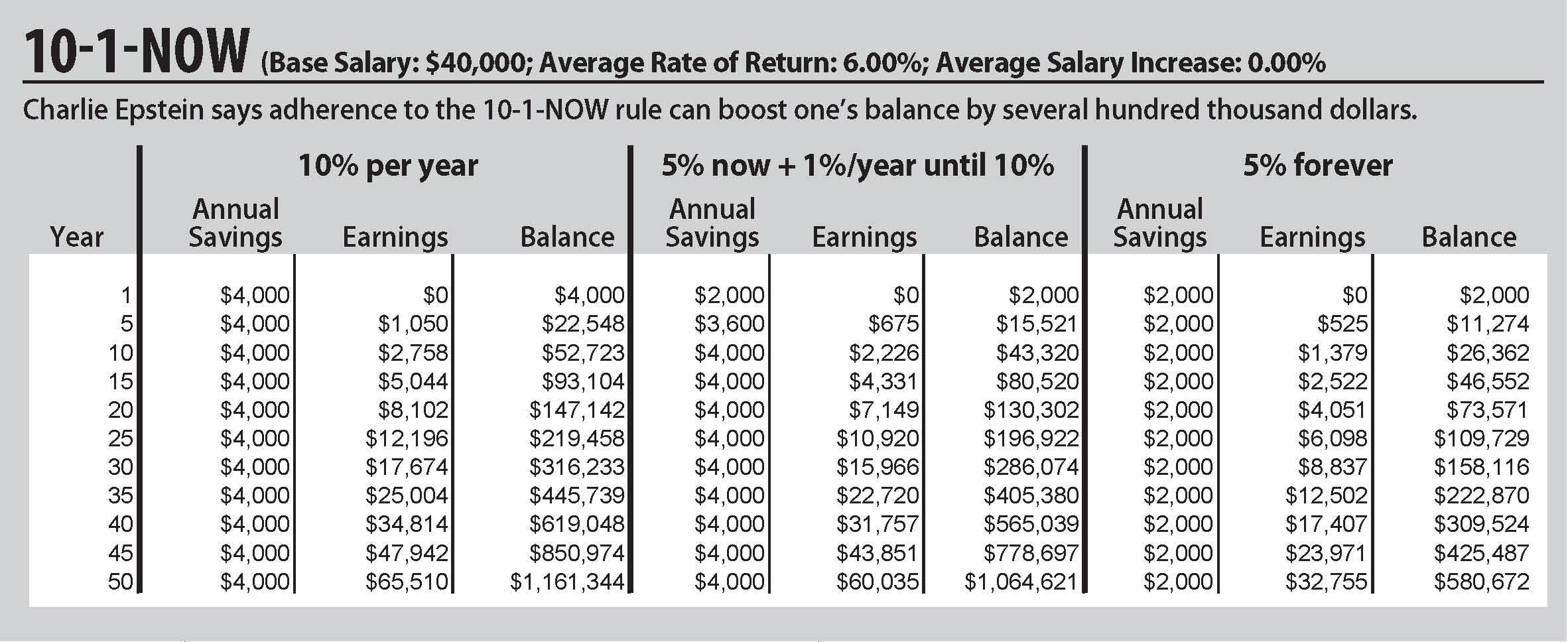 Elaborating, Epstein said he wrote the book ($22.99 hardcover, available through Amazon and paychecksforlife.com) to change people’s attitudes about saving for the years after they’re done working. When asked what needs to be changed, he said many things, but especially the still-wildly held opinion that Social Security or a company pension will be there and be an adequate source of income, and also the sentiment among many people that they simply cannot afford to save for retirement — or save enough to create what Epstein calls a paycheck-manufacturing company.
Which brings Epstein to one of those nine principles, the ‘desirement mortgage’ (which he calls the centerpiece of the book), and the many parallels he makes between this and a traditional mortgage.
Indeed, Epstein advises individuals to follow what he terms the “home-ownership formula for success” when they craft a retirement-savings strategy, with the following thought processes:
• You identified your dream house and what it would cost;
• You committed to paying for your dream house within a certain period of time;
• You calculated what it would cost, i.e. what you could afford to finance each month as a mortgage payment;
• You saved for your down payment;
• You adjusted your plan and budget to overcome unforeseen financial obstacles that might prevent you from achieving your dream of home ownership;
• You never stopped believing you could save for and finace your goal of home ownership; and
• You achieved your dream (desirement) and purchased your first home.
For this issue, BusinessWest turns some of the pages in Epstein’s book, in a figurative sense, while talking with the author to gain some perspective about how he came to write Paychecks for Life, and why he firmly believes it will successfully change some mindsets.
Past Is Prologue
“Your Annual Eviction Notices.”
That’s the title Epstein put on one of the earlier, introductory chapters of his book, and it’s a phrase designed to grab some attention, but also to drive home his points about Social Security and company pensions.
He notes that, when most people get their annual Social Security statements in the mail, they immediately turn to the page that breaks down what they’ll receiving in benefits if they retire at 62, 65, and 67, respectively. What just about everyone neglects to do, Epstein goes on, is look at the first page, where the following notice is printed:
“Social Security is a compact between generations. Since 1935, America has kept the promise of security for its workers and their families. Now, however, the Social Security system is facing serious financial problems, and action is needed soon to make sure the system will be sound when today’s younger workers are ready for retirement. In 2015, we will begin paying more in benefits than we collect in taxes. Without changes, by 2037 the Social Security Trust Fund will be able to pay only about 76 cents for each dollar of scheduled benefits.”
While discussing this fine print, as he called it, Epstein digressed to talk about why he and many others believe the Social Security system must be changed — with wealthy Americans removed from it, among other adjustments — but quickly returned to the matter at hand, which was getting readers to think well beyond checks issued by the U.S. Treasury when they consider their desirement years.
And the same goes for pension plans, he writes. “In 2007, of all the Fortune 500 pension plans that existed in 1996, 25% had been terminated, closed, or frozen. Between 1996 and 2007, Fortune 500 plans were closed or frozen at the average rate of 3% per year. In 2006, Verizon and IBM shocked the corporate world by freezing their pension plans (managers only in the case of Verizon), which created a standard that others soon followed.”
Which brings Epstein back to the 401(k) — the vehicle that enables employees to put a portion of their current income (a contribution) into several investments on a pre-tax basis — which has been the victim of some negative PR in recent years. Examples include the term ‘201(k),’ used often during the height of the Great Recession, when participants were seeing their balances take hits of 30% or more, and also a Time magazine cover which came out in October 2009 with the headline, “Why It’s Time to Retire the 401(k) (and What You Can Do Instead).”
“That was the worst journalism I think I’ve ever seen in my life,” he said of the Time article, adding that such bad press helped inspire Paychecks for Life. But the seed had actually been planted well before, when the idea of the 401(k) as a paycheck-manufacturing plant started gelling in his imagination.
But merely having such a plan isn’t enough to meet that mission of providing paychecks for life, Epstein told BusinessWest, noting that this simple fact is what compelled him to draft his nine principles for carrying out that task — and then writing about them. They are, in order:
• Act like an entrepreneur;
• Determine your desirement mortgage;
• Use other people’s money to capitalize your business;
• Harness the power of compound interest;
• Use technology to save automatically;
• Manage risk by outsourcing;
• Control fees and expenses;
• Guarantee your paychecks for life with annuities; and
• Take advantage of tax benefits with a Roth.
All the principles are important, said Epstein, noting that, together, they send a clear message — that, for a 401(k) to work as designed, the participant must take full ownership of it. His book, in essence, explains how to do that.
The Plot Thickens
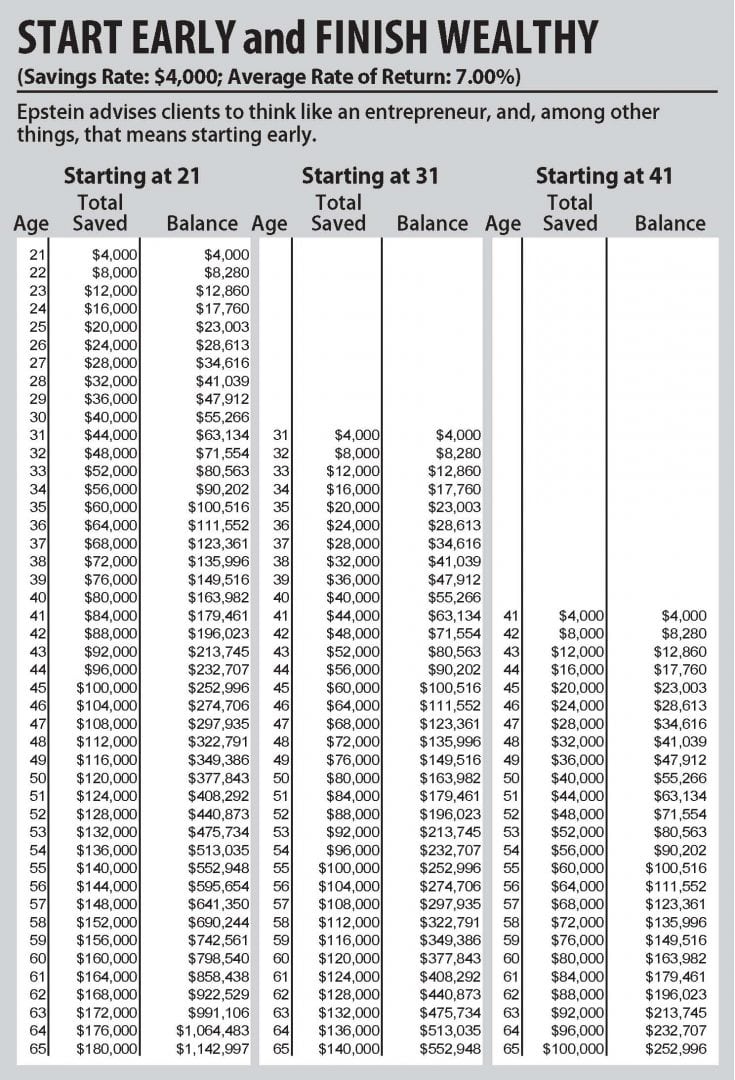 It all starts, literally and figuratively, with that part about thinking like an entrepreneur, writes Epstein, who adds to the generally used definitions of that term his own spin: “one who figures out what products and services are needed and then finds the people (talent) who can make the idea become reality, all the while spending less money than will be received. In other words, one who recognizes opportunities and seizes them.”
Elaborating, Epstein notes that, when he asks many business owners to identify their retirement plan, they almost always answer, ‘you’re sitting in it.’ The bottom line is that entrepreneurs work hard to create value in their business so they can later transform it into paychecks for life. Employees need to do the same thing, he writes, through a 401(k).
“Your employer is saying, in essence, ‘I’m going to give you an opportunity to build a business inside my business that you can sell someday,’” he explained. “The government calls it the 401(k); I call it your own personal paycheck-manufacturing company, the single greatest mechanism you have to accumulate wealth in the most tax-advantaged way — but you have to act like an entrepreneur.”
There are similar calls to action, supporting charts and graphs, acronyms (such as YEM, your employer’s money; and USM, Uncle Sam’s money), and what Epstein calls ‘paychecks-for-life action steps’ for each of the principles. Consider these as typical:
• “The dollars you invest in your PCM Co. are like the employees your boss hires to work in his or her company, only better. Your employees work 24/7/365 and never complain. Hire as many as you can as fast as you can.”
• “To act like an entrepreneur, you must practice marginal thinking. Always think and act in small increments. The results will be exponential.”
• “Uncle Sam’s money (USM) is offered to you interest-free. You can either take it now and invest in your PCM Co. or let Uncle Sam keep it, never to be seen again.”
• “Think of your desirement mortgage the same way you do your home mortgage. Use the lowest interest rate possible and sleep at night. Treat it with respect. Never gamble with it.”
• “Slow and steady wins the race. Compounding takes a while to get started, but once it does, the process accelerates, and your savings grow more substantially every year.”
Epstein also uses a number of catchphrases and mantras he hopes will become part of the reader’s vocabulary, such as the ‘10-1-NOW’ rule.
The ‘10’ stands for 10% of the participant’s pay — the number Epstein and other experts say is needed to generate those paychecks for life. As for the ‘1,’ if you can’t save 10% now, increase the contribution by 1% of your earnings until you get to 10%.
“If you can get a participant to increase their contribution by just 1% to 2% a year, the impact is hundreds of thousands of dollars,” he said, making use of the chart that appears on page 36 to drive home his point.
Overall, Epstein said he tried to make the book entertaining — and he believes he’s done that — “but you can’t get away from the numbers — although I made the numbers simple.”
As for his own numbers, Epstein said the initial printing of the book was for 5,000 copies, which are selling well thus far. There are two main audiences, he continued, listing the “advisor world” and individuals, with the former being the primary target at present.
More than 1,000 copies have been sold to date, with Legg Mason putting in an order for 500, he told BusinessWest, adding that Epstein Financial and the 401(k) Coach is in the process of packaging the nine principles so that advisers can effectively purchase material to teach them to clients and potential clients.
“There will be a video for each principle, and instructions on how to teach them,” he explained, “because advisors need to know how to teach these principles and educate and entertain people.”
As he talked about Paychecks for Life, Epstein — recently named one of the Top 100 Most Influential People by 401(k) Wire — repeatedly referred to it as his first book, with the clear implication that there would be more.
He gave no specifics on potential subject matter for future works, but hinted strongly that they will be similar in their intent to inform, educate, and help people enjoy a long, comfortable desirement.
And they will undoubtedly entertain as well, as Epstein strives to not only keep people awake through an intense discussion of effective 401(k) management, but firmly focused on his now-copyrighted and registered phrase ‘desirement planning.’
George O’Brien can be reached at [email protected]
Get ready, payers and recipients — a new statute is in town, and after so many years, it’s finally about alimony.
In an historic move, Gov. Deval Patrick signed into law “An Act Reforming Alimony in the Commonwealth,” which went into effect March 1. This Massachusetts statutory law, known as M.G.L. c. 208, §§ 48-55 inclusive, defines alimony, classifies it prospectively into four categories, and applies retroactively to existing orders. Gone are the days of unjustified lifetime alimony awards, the extension of alimony past the payer’s retirement age, and the ability of a recipient spouse to receive alimony during their cohabitation with another.
Understandably, judges and lawyers alike are both excited and nervous with such a tremendous new practice tool. From the court’s perspective, the apprehension stems from both its ability to handle the imminent floodgate of litigation and the amount of judicial discretion inherent in the wording of the statute itself. From the lawyers’ perspective, it’s the unknown judicial interpretation of the law to each specific fact pattern, coupled with the technical skill it will take to make effective arguments about how the law applies to each case.
In an attempt to preserve judicial discretion, balance consistency with flexibility, encourage settlement, provide finality, and for the comingled effect of situations where there is child support, this law has potential loopholes and room for creative arguments, much to the dismay of those who seek determinative rules for dealing with the one issue that arguably creates the largest amount of contested divorce litigation.
Specifically, the act is designed to accomplish the following:
• Articulate and define alimony into four separate categories: general-term alimony, rehabilitative alimony, reimbursement alimony, and transitional alimony;
• Set durational time limits that mandate termination of alimony awards no later than a certain date, determined by the length of the marriage;
• Provide parameters for setting the form, amount, and duration of alimony, including the definition of income;
• Suspend, reduce, or terminate alimony upon the cohabitation of the recipient spouse; and
• Terminate alimony upon the payer attaining retirement age, as defined by Social Security.
Retroactively, all existing alimony awards are considered general-term alimony. These awards can now be modified by termination or reduction, should a change in circumstances occur whereby the payer no longer has the ability to pay and/or the recipient’s need is reduced.
In addition, the act provides per-se (meaning that no other circumstance is required) grounds for termination of alimony upon any of the following circumstances:
• Remarriage of the recipient spouse;
• Death of either spouse;
• No later than a certain date pursuant to the act’s articulated durational limits;
• The payer attaining the full retirement age; or, most anticipated,
• The cohabitation of the recipient spouse.
The act also establishes a schedule setting forth when modifications can be filed, seemingly designed to allow both payer and recipient the opportunity for future financial planning, as well as decreasing the immediate judicial burden relative to the opened floodgates of litigation. Specifically, the schedules are for reaching the age of retirement and exceeding durational limits for payment. Notably, however, if there is a basis for modification in addition to an award exceeding durational limits or the payor reaching the full retirement age, the filing schedule is inapplicable, and March 1, 2012 is the magic date.
Testing the statute in Massachusetts courts will help clarify one of the main questions domestic lawyers receive from clients who are paying alimony: whether a recipient’s cohabitation with another person post-divorce, in and of itself, is sufficient to warrant termination. Currently, Massachusetts case law allows for alteration or termination of alimony on the basis of cohabitation only when myriad other factors exist, including the economic benefit and change in circumstance received from the non-spouse co-habitator.
Pursuant to the act, however, general-term alimony will now statutorily be suspended, reduced, or terminated upon the cohabitation of the recipient spouse when the payor shows that the recipient spouse has maintained a common household for a continuous period of at least three months. Evidence of maintaining a common household will surely be a great source of litigation, and includes sharing a primary residence, economic interdependence of the couple, economic dependence of one person on the other, oral or written statements or representations made to third parties regarding the relationship of the persons, engaging in conduct and collaborative roles in furtherance of their life together, and the benefit in the life of the recipient, both from the new relationship and their community reputation as a couple.
Overall, the time is ripe for alimony payers to pull out their old agreements and consult with a creative attorney who is knowledgeable about this substantive change in Massachusetts law. Before each payer goes through this process, however, it is important to note that, if the effect of the existing agreement provides that it “survives as an independent contract” and is “incorporated but not merged” into the actual divorce judgment, the act specifically states that no modification is allowed. If, however, your agreement “merges and incorporates” into the judgment of divorce, a consult will determine if and when the opportunity is ripe to file a modification action, seeking either a reduction or termination.
To those people who have been paying alimony longer than they were married, or who are paying alimony to an ex-spouse who has been living with someone else for years, this measure represents true relief. The light at the end of the tunnel is now in sight and burning bright. Although lawyers cannot yet predict how individual judges will interpret the specific language of the act, the message is clear: alimony in marriages fewer than 20 years in duration is no longer forever.
Melissa R. Gillis, Esq. is an attorney with Bacon Wilson, P.C. in the domestic, special education, and real estate departments; (413) 781-0560; baconwilson.com/attorneys/gillis. Thomas R. Reidy, Esq. is a member of the domestic relations team; (413) 781-0560; baconwilson.com/attorneys/reidy


Thomas J. Fox
Thomas J. Fox is the community outreach director at Cambridge Credit Counseling, an Agawam-based professional housing and debt-counseling agency. He is an AFCPE-accredited credit counselor and an NCHEC-certified housing counselor; (413) 241-2362; [email protected]; twitter.com/thomasjfox


Kristina Drzal-Houghton
What Is an IC-DISC?
An IC-DISC is a ‘paper’ entity used as a tax-savings vehicle. It is a domestic C corporation, but must request and receive IRS approval to be treated as an IC-DISC for federal tax purposes. It also must maintain its own bank account, keep separate accounting records, and file U.S. tax returns. It does not require corporate substance or form, office space, employees, or tangible assets. It simply serves as a conduit for export tax savings. An important feature of the IC-DISC is that shareholders can be corporations, individuals, or a combination of these. The IC-DISC can be incorporated in one of the 50 states or in the District of Columbia.
How Does It Work?
The owner-managed exporting company forms a special U.S. corporation that elects to be an IC-DISC. The election is made on IRS Form 4876-A, which must be filed within 90 days after the beginning of the tax year. Here are more specifications:
• The exporting company pays the IC-DISC a commission;
• The exporting company deducts the commission from ordinary income taxed at up to 35%;
• The IC-DISC pays no tax on the commission as long it passes two main tests known as the qualified export receipts test and the qualified export assets test. The qualified export receipts test requires that 95% of the gross receipts of the IC-DISC constitute qualified export receipts. The qualified export assets test requires that 95% of the assets of the IC-DISC be qualified export assets. Qualified export assets include accounts receivable, temporary investments, export property, and loans to producers.
• Shareholders of an IC-DISC are not taxed until the earnings are distributed as dividends. However, the shareholders must pay annual interest on the tax deferred. Shareholders that are individuals pay income tax on qualified dividends at the capital-gains rate of 15%. The result may be a 20% or more tax savings on the commission.
The following calculation shows how the owners can save a combined $500,000 in federal income taxes. Let’s assume an S corporation has $20 million in qualifying export sales and $5 million in net export income on those sales. If the company has an IC-DISC subsidiary, it can pay the IC-DISC commissions up to the greater of 50% of its export net income or 4% of its export gross receipts. In this case, the maximum commission is 50% of net income, or $2.5 million. The S corporation shareholder has reduced pass-through income by the $2.5 million commissions expense. At 35%, this is a reduction of $875,000.
Assuming the IC-DISC fully distributes the commission as a dividend, the shareholder will have $2.5 million of qualifying dividend income taxed at 15% or $375,000. The net of these two items is the $500,000 tax savings.
For U.S. exporters, the IC-DISC is the only remaining tax-saving opportunity. If you are unsure about whether or not an IC-DISC will work, ask the following questions:
• Do you have any transactions outside of the U.S.?
• Do you use overseas distribution?
• Does your product cross any borders?
• Are you generating operating income?
If the answer to any of these questions is yes, an IC-DISC could be a valuable tax-savings vehicle for your business.
On the surface, the rules covering the IC-DISC may seem simple. However, to maximize the tax benefit, a qualified IC-DISC advisor should be engaged. Many times an IC-DISC expert can double if not triple the tax benefit the IC-DISC provides by applying their indepth understanding of how to structure the IC-DISC and using the complex advance pricing rules that the Internal Revenue Code allows for determining the tax benefit. A firm that has proven IC-DISC expertise, offers fixed fees, and optimizes the IC-DISC on a transactional basis (which almost always provides the best result) should be chosen.
Kristina Drzal-Houghton, CPA, MST, is the partner in charge of Taxation at Holyoke-based Meyers Brothers Kalicka, P.C.; (413) 536-8510.

By DAVID MOTOSKY, CRM

David Matosky
David Matosky is operations director for First American Insurance Agency in Chicopee, and has earned the designation of certified risk manager;
[email protected]


Tony Gabinetti
Measuring Assets and Liabilities
The proposal utilizes a ‘right-of-use’ model that would apply to all leases, including those currently classified as operating leases. This model is similar to the current model for capital leases. Both lessees and lessors would be required to record an asset and corresponding liability on their balance sheets.
The lessee would record an asset representing the present value of its right to use the leased asset during the lease term, and record a liability representing the present value of its lease payments. Subsequently, the lessee would measure the asset at amortized cost, and record amortization expense using the ‘effective interest rate method,’ under which lease payments are allocated between principal and interest over the lease term.
A lessor would initially record an asset representing the present value of its right to receive lease payments and recognize revenue over the lease term. Under the initial-exposure draft, the lessor also would select one of two accounting models:
1. Performance obligation. A lessor that continues to be exposed to ‘significant risks or benefits’ associated with the leased asset would use this model. It would recognize a liability (its obligation to allow the lessee to continue using the lease asset) as well as the underlying asset; or
2. Derecognition. A lessor that doesn’t retain such exposure would use this model. It would derecognize its rights to the leased asset as the asset is transferred to the lessee. And the lessor would continue to recognize a residual asset (its rights to the leased asset at the end of the term).
According to recent news, the board appears to have settled on one accounting approach for lessors: the lessors would derecognize the leased asset and record both a lease receivable and a residual asset for the portion retained by the lessor.
The proposal prescribes simplified accounting methods for certain short-term leases and also provides an exception for ‘simple capital leases’ — those entered into before the ‘transition date’ that are classified as capital leases under existing standards but include no options, contingent rents, termination penalties, or residual-value guarantees. Leases that fall within this exception can be accounted for under existing standards for capital leases.
Determining the Lease Term
One challenge for both lessors and lessees under the proposed standards will be determining the lease term. The original proposal called for measurement of assets and liabilities based on the longest lease term that’s ‘more likely than not’ to occur, taking into account all options to renew or terminate.
However, the FASB and IASB tentatively decided to adjust this threshold. Under the boards’ revised definition, the lease term would include the non-cancellable term, plus any extension options if there’s a significant economic incentive for the lessee to extend the lease. The boards also determined that the parties should reassess the lease term only if a significant change alters the lessee’s incentives to extend or terminate the lease.
Assessing the Impact
If your company has a significant number of operating leases, assess the proposed standards’ potential impact as soon as possible. The need to value, track, and report lease-related assets and liabilities may require you to modify or upgrade certain systems, procedures, and controls.
Also, because the new standards would rely heavily on estimates and judgments, they significantly expand financial statement disclosure requirements for leasing activities. The proposal also may have an impact on key measures of financial performance, such as EBITDA, and on financial ratios and other benchmarks used in loan covenants, compensation agreements, and certain contracts. The reason for this is that, under current standards, rent payments under an operating lease are treated as ordinary operating expenses. Under the proposed standards, rent would be replaced with a combination of interest and amortization expense.
Accounting for Services
One difficulty under the new standards being proposed is the need to account separately for distinct service components of a lease.
This isn’t an issue under current standards for operating leases because the lease and service components (such as agreements to provide maintenance or repairs) are treated in basically the same way. But under the proposal, the lease component would be recorded on the balance sheet while the service component would not. Allocating between payments for use of the leased asset and payments for services can be challenging. In future leases, your company may want to ensure that any services to be provided are charged separately.
The FASB and IASB are revising their original proposal and are expected to re-expose the standards for additional comment in the first quarter of 2012. Many believe that the new standards will take effect in 2015.
Tony Gabinetti, CPA, is a senior audit manager at Meyers Brothers Kalicka, P.C. in Holyoke; (413) 536-8510; [email protected]
Charlie Epstein
Why is it important for plan sponsors to know about QDIAs?
ERISA section 404(c) and the corresponding DOL regulations define how a plan sponsor can establish protective relief as a fiduciary for investment decisions made by employees in participant-directed 401(k) plans. As introduced in the Pension Protection Act of 2006 and effective Dec. 24, 2007, plan sponsors have the option to designate a default fund, qualifying as a QDIA. If the plan complies with the requirements of the regulation, the fiduciary will not be liable for losses that result from investments in the QDIA (your fiduciary ‘get out of liability free’ card).
What is a default investment?
When participants fail to make investment elections and a decision must be made to invest their participant-directed contributions (either employer profit sharing or employee deferrals), plan fiduciaries must step into the decision-making role and invest their contributions in a default investment.
What is an approved QDIA?
The DOL has approved these types of QDIAs:
• Lifestyle or target-date fund: Creates an investment model based on a participant’s age, retirement date, and life expectancy. Is not professionally managed for individual investors.
• Professionally managed account: Is actively managed by investment managers. Provides an appropriate asset mix of equities and fixed income for each individual participant. Takes into account the primary decision factors of age, retirement date, and life expectancy.
• Balanced fund: Offers a mix of equity and fixed-income investments. Is based on group demographics of the plan as a whole. May not consider risk tolerances of individual participants.
A stable value fund, or money market, by definition is not a QDIA because it does not provide investments in equities and fixed income. The DOL was specific in its definition of a QDIA, noting that it is a long-term investment and therefore must have a percentage of its assets invested in equities and fixed-income securities to qualify for protection. A stable value fund product may be used for the first 120 days of a participant’s participation in the plan, but no longer to qualify for relief.
What happens if a plan sponsor doesn’t designate an approved QDIA?
Without an approved QDIA, plan fiduciaries remain potentially liable for losses when a participant fails to actively direct investments.
When is a QDIA appropriate for a plan?
A QDIA is appropriate for any plan with participant assets that lacks participant-investment direction. Plans with automatic enrollment features, obviously, have default investments, but situations frequently occur in the life of a 401(k) that may result in the need for a QDIA, including:
• Incomplete enrollment forms;
• Beneficiary/alternative payee balance;
• Qualified domestic relations order (QDRO);
• Removal of investment options;
• Rollovers;
• Missing persons; or
• Disputes.
What role do plan sponsors play in selecting QDIAS?
Plan sponsors are responsible for prudent selection of appropriate QDIAs for their plan, as well as for monitoring QDIAs. The plan sponsor should also be able to demonstrate the due-diligence process followed when selecting QDIAs. While QDIAs offer a ‘set it and forget it’ investment option for participants, this is not the case for plan sponsors.
How do plan sponsors determine what type of QDIA is appropriate?
Plan sponsors should consider either the age of individual participants or the average age of the group of participants. Participant investment knowledge and education, or lack thereof, is appropriate to consider as well. Today, target-date funds make up the largest percentage of QDIAs in 401(k) plans.
Are cost and fees, as well as performance, important QDIA selection criteria?
DOL regulations specify that cost and fees should be an important consideration in the selection of QDIAs. It is also important that the plan sponsor fiduciaries have an ongoing due-diligence process for selecting and monitoring their QDIA and documenting that process.
How can plan sponsors receive safe harbor relief from QDIAS?
Merely selecting a QDIA alternative alone does not give fiduciary relief to a plan sponsor. Plan sponsors can receive safe-harbor relief from fiduciary liability for default outcomes when default investments are of the three QDIA types discussed above and meet the following criteria:
• Participants and beneficiaries must have been given an opportunity to provide investment direction, but failed to do so;
• A notice must be furnished to participants and beneficiaries 30 days in advance of the first investment in the QDIA and 30 days prior to every plan year thereafter;
• All material — such as investment prospectus and other notices — provided to the plan for the QDIA must be provided to participants and beneficiaries;
• Participants and beneficiaries must have the opportunity to direct investments out of the QDIA as frequently as from other plan investments, but at least quarterly;
• The plan may not impose financial penalties or otherwise restrict the ability of a participant or beneficiary to transfer the investments from the QDIA to any other investment alternative available under the plan; and
• The plan must offer a broad range of investment alternatives as defined in the DOL’s regulation under section 404(c) of ERISA.
When it comes to managing your qualified retirement plan, no plan sponsor fiduciary should leave their fiduciary processes to chance. The QDIA option provides one of the few protective reliefs from liability-free cards under ERISA. Every plan sponsor should take advantage of a QDIA.
Charles D. Epstein, CLU, ChFC, AIF is the founder of the 401k Coach Program, which offers expert training to financial professionals to develop the skills, systems, and processes necessary to excel in the 401(k) industry and facilitate successful retirement outcomes for plan sponsors and participants. He is the author of the book Paychecks for Life, which offers nine principles for participants to turn their 401(k) plans into their paycheck-manufacturing company; [email protected]


Glenn Welch, president, COO, Hampden Bank
Glenn Welch is one of many area bankers who had his or her name on many different business cards in the late ’80s and ’90s — and usually not by choice.
“I had a lot of them, and I think I still have them … they’re in my desk somewhere,” said Welch, referring to a collection that resulted from a spate of mergers, failures, and downsizings involving names that have long since disappeared from the business landscape — like Third National, Bank of New England West, Shawmut, BayBank, Comfed Savings, and Fleet.
Soon, Welch can add another card to the pile, if he ever finds it. Indeed, the new card identifying him as president and COO of Hampden Bank will be arriving shortly, meaning he won’t need the one he’s still using announcing him as “executive vice president and division executive of the Business Banking Group.”
On Nov. 30, Welch was named successor to Tom Burton, long-time president and CEO at Hampden, who is retiring but taking the title chairman and CEO during a transition period.
Welch believes that, if all goes as planned, this could very well be his last business card. In fact, it’s an unofficial goal to make sure it is. He plans on being here a while, and he believes the Hampden name will endure as well, even as he acknowledged that the institution is certainly the subject of rumors regarding the next local target for merger or acquisition.
“The board of directors, by deciding to go with an in-house candidate, shows that it’s comfortable with the plan we have in place to bring it forward and grow the bank to the level that we need to to satisfy our investors,” he said. “But it’s a crowded market, and there is a lot of capital in this market.”
For now, Welch is focused on continuing a strong pattern of growth knitted by Burton during his 17-year tenure as president, during which the bank doubled in size, from $250 million to more than $500 million, and went public in 2007.
The pace of growth slowed over the past few years, as it did at most all area banks, as the Great Recession took its toll on everything from mortgage volume to commercial lending. Still, Hampden has been on a pace to add roughly a branch a year, with the latest additions coming in Longmeadow (the second office there) and Boston Road in Springfield, and it is has been holding its own in a highly competitive commercial-lending arena.
“The difficulty was, we just weren’t seeing any loan growth — businesses just weren’t able or willing to borrow,” he explained. “We were sitting on a ton of capital, like a lot of other banks in this area, and really found it difficult to put it to good use.”
But as the economy improves, slowly but surely, Welch says he’s seeing signs of progress, especially on the commercial side of the ledger. It comes in many forms, from what he can see — more applications for loans to expand or build new — and what he can sense, namely greater confidence on the part of business owners.
“We’re seeing a lot of loan demand on the commercial side — there’s a huge backlog,” he said, adding that he expects many deals to close over the next several months. “Some of this demand is new business, which is exciting, such as an assisted-living facility that will generate about 100 jobs. There’s an addition to another assisted-living facility, a few precision-machining companies that are looking at new buildings and equipment … things are happening.”
Summing up what he believes his ascension to the presidency at Hampden means, Welch said it represents both continuity and change.
The former comes mostly in a continuation of growth strategies, internal programs — such as ‘Hampden College,’ aimed at building team and leadership skills (more on that later), and philanthropic initiatives within the community that were laid out by Burton and the leadership team, said Welch. Meanwhile, with change comes opportunities, fueled by an improving economy and frustration with regional institutions, to move those strategic initiatives forward.
“There is a sense of urgency,” he told BusinessWest in a wide-ranging interview a month after he took his new office. “We do need to grow and become more profitable; the pressure is there to perform.”
Interest Bearing
Welch arrived at what was then Hampden Savings Bank in 1998, after accumulating more than a dozen of those aforementioned business cards.
When asked what brought him to the Harrison Avenue institution, he paused for a minute, noting that there was a funny story behind it and he wasn’t sure if he should tell it. (He eventually decided he could, because the party in question was no longer working in the area).
Attempting to make a long story short, he said he was working at what was then Fleet National Bank (now Bank of America) and, following the departure of a colleague, was in line for one of the small corner offices within the Monarch tower, a step up from the high cubicle he was occupying. The last office to be apportioned was awarded based on tenure, but Welch, who led the field in that category, was told that this time, things would be different.
“First, he said, ‘maybe we’ll go by goals,’ which was fine with me because because I hit my goals that year. But then, he said, ‘I was thinking we’d draw cards,’” said Welch, working hard to keep a straight face. “We sat in his office, and three of us drew for high card; I went first and got a 3, the next guy drew a 6, and the winner of the office drew a 9. That was one of the final straws; right around that time I saw an ad — Hampden Bank was looking for an ‘eclectic’ commercial lender.’”
Welch said he had no idea what ‘eclectic’ meant in this context, but he applied anyway, and soon thereafter joined a small but growing commercial-lending department that would play a key role in the bank’s steady growth and the expansion of its footprint in Western Mass.
Backing up a bit, actually nearly 20 years, Welch said he entered Western New England College with the goal of becoming an engineer. “ I think that lasted a semester,” he recalled. “I took a few labs and knew it wasn’t for me. I just happened to be pretty good with numbers and liked the accounting and finance courses I took, and that’s how I ended up with a finance degree.”
Upon graduation from Western New England, he took a job with Household Finance, which, among other things, provided high-interest, real-estate-backed loans to struggling families — “that was a depressing place to start a career” — before joining Bank of New England West as a field examiner in the Commercial Finance Department. In that role, he conducted on-site field examinations of books and records for customers and prospects.
From there, he moved on to to BayBank Valley Trust Co., where he served as a credit officer in the Commercial Loan Department, and then as a secured lending auditing officer. Next came an ill-fated decision to follow a supervisor to ComFed Savings Bank, which had acquired the old Northeast Savings, where he served, briefly, as a commercial loan officer.
“That was my opportunity to get into commercial lending, because he asked me to go with him,” Welch explained. “And six months later, he had to ask me to look for a job, because ComFed was failing and they were eliminating the commercial-lending group.”
He then moved back to Bank of New England, later to fail and be rescued by Fleet, and rose to the title of vice president and ‘relationship manager’ in the Middle Market Banking Group, where he managed an $80 million commercial-loan portfolio consisting of 37 account relationships. During his tenure there, he completed his quest for an MBA at UMass Amherst through its evening program, focusing his capstone course on the demise of Bank of New England and the lessons to be learned from it.
Living through that tumultuous period in local banking history was difficult, especially at BNE/Fleet. “It was tough over there — I survived a lot of different downsizing,” he said of his time in the Monarch tower, which eventually ended not long after he drew that 3.
As for what’s in the cards for Hampden Bank, Welch said he expects a continuation of the programs that have helped fuel recent growth for the institution, especially a hard focus on growth in commercial lending.
By All Accounts
Returning to the subject of continuity, Welch said he plans to carry on with a number of programs initiated during Burton’s tenure to not only grow the bank, but strengthen the team running it.
In that latter category, he mentioned everything from quarterly meetings with the staffs handling the branches to keep them informed and connected — “they tend to feel alienated from the main office” — to Hampden College.
Staged in the spring and summer, this initiative involves after-hours courses (always well-attended) on leadership, diversity, and other timely and relevant issues.
“We had four members of the board of directors speak to employees last year as part of the program,” said Welch, adding that the broad objective of Hampden College is to “build better bankers.”
At the same time, the bank has staged a number of external forums — open to area business owners and managers — on subjects ranging from health care reform to taking a small business to the next level. “There’s an educational component to these, obviously,” he explained, “but these are also great networking opportunities, and for the bank, we are developing relationships with people we may not have relationships with.”
Overall, Welch said his primary goal moving forward is to continue and in many ways accelerate the bank’s ongoing evolution from a true savings bank to a multi-faceted institution with a strong mix of consumer and commercial products.
“We used to be for your home mortgage and grandma’s CD,” he said of the bank’s basic mission until only a few decades ago. “We’re trying to change that.”
He said the timing is good for growth in commercial lending, and for several reasons. The improving economy and pent-up demand he mentioned are big parts of it, but so is the growing sense of frustration many business owners and managers have with regional and super-regional banks, a phenomenon that has led to opportunities for many area banks.
“I think 2012 looks promising for the community banks,” he said. “The reason is we’ve turned the corner, in my opinion — people are starting to get more comfortable and are borrowing for projects. But the other side of it is the fact that community banks have real opportunity, especially in this area, a smaller city like ours — we’re here, and the decisions are made here, and there are a lot of people who are concerned with their larger-bank relationship and where it’s headed.
“There were a lot of people who were waiting to make sure that the light at the end of the tunnel, as they say, wasn’t an oncoming train,” he continued, while noting the recent uptick in business on the commercial side of the ledger. “We’re seeing pretty healthy demand in a lot of different areas.”
In many ways, Welch said, Hampden’s goal is to borrow, in some ways, from the model forged by Bank of Western Mass. (now People’s United), meaning the establishment of broad customer relationships propelled by the business side of such associations.
“What we really want to do is grow the commercial portfolio, along with all the other things we’re doing strategically,” he explained, “and allow the commercial portfolio to drive the growth in residential and commercial deposits, because we’re trying to become the bank for those businesses.”
Meanwhile, the bank intends to continue its strong record of philanthropy, punctuated by a recent $150,000 donation to cover operating expenses incurred by those leading the Rebuild Springfield efforts in the wake of the June 1 tornadoes.
Welch, the current chairman of the board of the Affiliated Chambers of Commerce of Greater Springfield, chair of the Springfield Enterprise Center, and board member of DevelopSpringfield, said he plans to continue these and other endeavors in the realm of community service. But most of his energies will be on the bank and the strategic initiatives he described.
“We have plans in place,” he said, “and we’re comfortable we can carry them out and that they’ll lead to significant growth.”
Making a Statement
Welch noted that Hampden Bank will turn 160 years old in April, joining MassMutual in that milestone of longevity, and reaching rarified air among companies based in this region.
He expects the bank to celebrate many more anniversaries and continue to grow its footprint regionally.
As for his career, well, he doesn’t think he’ll be adding to his business-card portfolio any time soon. He believes he and his bank are in the right place at the right time — and will be for the foreseeable future.
George O’Brien can be reached at [email protected]


Bob Annon says Webster makes an effort to become partners with their customers, offering financial counsel and services for all stages of life.
When Webster Bank opened branches in West Springfield and Westfield five years ago, it made a bold move into a region which many consider overbanked.
But this longtime major player on the Connecticut scene — it celebrated its 75th birthday last year and boasts 176 locations, most in the Nutmeg State — felt it could keep pace in the Western Mass. region. And, indeed, it has since expanded to locations in Springfield, Longmeadow, and East Longmeadow, with further growth expected down the line.
“When we decided to go in there, we felt that our approach to banking would serve us well competing in a highly competitive environment,” said Bob Annon, Webster’s regional president for Northern Conn. and Greater Springfield.
“We still find it competitive, but we’re pleased with the progress we’ve made,” he told BusinessWest. “We have, as clients, one of the largest and oldest manufacturers in the market, and also some fairly new companies, so we’re pleased with the penetration we’ve made. A lot of credit goes to our people in our branches who deal with people in our communities on a daily basis; they represent us extremely well.”
Annon knows a relatively new player on the region’s banking landscape, even one with the cachet of Webster — an $18 billion commercial bank with extensive retail and wealth-management services — needs to make a positive splash in any way it can.
“We offer a full range of services for individuals, families, and businesses,” he said. “We think that, at our size, we have the capacity to deliver the types of services — and quality of services — that national and even multinational banks offer, but still retain a strong commitment to valuing each customer, from individuals to larger businesses. We think we’re good at that, at staying close to them and treating them well in good times and in bad.”
And there’s been plenty of the latter during the past few years of economic hardship — which, to Annon, presents not just challenges for customers, but opportunities for the bank to help them overcome hardships.
For example, Webster earned national publicity earlier this fall in a Wall Street Journal article headlined “For Lender, Foreclosure Is a Dirty Word.” The article details the bank’s mortgage-modification efforts, citing examples like a couple, struggling with reduced employment hours, who were able to shrink their monthly payments by 17%, lower their interest rate, and shorten their term.
In fact, despite rampant consumer complaints about loan workouts and foreclosures nationally, Webster has been the subject of just 16 such complaints since 2006, which the Connecticut Department of Banking calls “a very small number.”
“We recognized that’s the best way we can serve our customers,” Annon said, “and that it’s in the best interest of the bank to work with customers and keep them in their homes, rather than having more adversarial relationships with them.
“And we’re not just working with residential mortgage modification; it’s what we’ve done with our business customers for awhile,” he continued. “There have been some big bumps in the road during this Great Recession, and we’ve had to amend or modify some relationships and agreements.
“It’s part of the culture of the company when someone does business with us,” he went on — a culture that is gradually drawing new adherents in a region that offers plenty of competition as well as opportunity.
Five Alive
Annon said Webster likely won’t stop at five branches in Greater Springfield.
“I think we’re where we want to be for the time being,” he said, “but we’re always looking. We know five branches isn’t the market density we’d like to have, so we’re always looking for opportunities to find new locations and opportunities to expand in a desirable market like Greater Springfield. It’s been five years now, and so far we’re pleased.”
Founded in 1935 in Waterbury, Conn. as First Federal Savings Bank, Webster Bank has been on an aggressive expansion path in recent years, opening almost 40 branches in four states — it also has a presence in Rhode Island and New York — since 2002 alone.
At a time when many large, national banks are trying to recoup lost profits through more aggressive fee policies (see story, page 39), Webster’s revenue model has long been based on the concept of a lifetime customer, from the initial, basic checking account to a suite of wealth-management services fully customized according to assets and need.
“Our chairman has gone on record saying we have no interest in charging for debit cards,” Annon said. “Having said that, when someone does business with us, it’s important to do as much business as we can with those customers on a personal and business basis. We’re not only selling credit products, but state-of-the-art cash-management products and investment products as well. Rather than have someone just have a checking account with us, we want to deepen that relationship with them, so that they’re a Webster customer for a long time.”
Through those services, and others, such as online bill pay, “we can really establish many different venues for customers,” he said. “Our commitment has always been to be, not a transactional company, but a relationship-oriented company; customers can look to us for advice, and we can counsel them as well as provide them with banking services.”
To that end, Webster boasts certain specialties in its lending and cash-management programs, including health care, not-for-profits, professional firms (such as lawyers and CPAs), and condo and homeowners’ associations.
“For example, in health care, we have people with intimate knowledge of third-party payers — Medicare, Medicaid, and insurance companies — who are critical if the goal is to become involved with hospitals, nursing homes, and people who rely on those third-party payers,” Annon said.
That expertise was recognized by the Massachusetts e-Health Institute, which named Webster its preferred provider of financing for electronic health records. “This is the program to get medical and health care providers using electronic health records,” he said — a major issue facing health providers over the next several years. “We have programs that can provide 100% financing for that hardware and software.”
Webster also has an asset-based lending specialty, as well as a program that specializes in equipment financing. “Our people really come to understand equipment values and, in many cases, are able to lend 100% of the purchase price of equipment,” he explained. “It’s delivered by people who have been in the market for a long time and who have done this a lot.”
Other specialties are in Small Business Administration loans — Webster is the number-one SBA lender in Connecticut — and check fraud and electronic fraud, “which is becoming more and more pervasive,” Annon explained. “We’ve been conducting seminars on what companies can do to protect themselves from this fraud.”
It’s another way to provide value to a community, he said, and to market the bank to people who might eventually be Webster customers.
Community Focus
It’s all part of an overall strategy to make Webster part of the community fabric. That includes philanthropic efforts, such as the bank’s support of organizations like the Food Bank of Western Mass., Open Pantry, the Urban League, and the capital campaign at Baystate Medical Center. “We’re determined to give back to the community wherever we can,” Annon said.
And, by all accounts, the communities of the Pioneer Valley are starting to see some economic growth, albeit slowly, and that improvement is starting to register in increased business lending at Webster.
“I think it’s starting to loosen up,” he told BusinessWest. “The results we’re seeing, with some third-quarter financial statements starting to dribble in, are generally fairly good, and the market might be starting to turn in confidence, which is where we really need to change. Banks are ready and willing to lend money, but there’s been reluctance by companies to borrow.”
As that confidence begins to take hold, he said, Webster will be ready to become not just a lender to growing businesses, but a partner.
“We are committed to to our customers’ success,” he said. “If they come to Webster, they’re going to find a bank that can fulfill all their banking and investment needs. They’re going to find a banker who is going to be candid and forthright from the first meeting on, and a banker who will deliver what they say they can deliver.”
Perhaps more importantly, during an era of such turmoil in financial services, Annon added, “they can expect a bank that’s going to stay around — that wants to stay part of their banking picture for a long time.”
For life, actually.
Joseph Bednar can be reached at [email protected]


Westfield Bank President and CEO James Hagan
Early in the year — well before the unexpected summer of storms in Massachusetts — the American Red Cross was soliciting donations for an emergency-response vehicle to serve communities in and around the Pioneer Valley.
“They came to us and talked about a particular need in Western Mass. — a medical facility on wheels,” said James Hagan, president of Westfield Bank.
It’s not an ambulance, he noted. Red Cross volunteers man this vehicle and use it to support disaster victims in several ways — for example, providing them with credit cards to help purchase food, clothing, shelter, and bedding, as well as temporarily housing and feeding disaster victims and volunteer responders alike.
“Volunteers go out, often in the middle of winter, with different provisions to help folks who may have suffered a fire or flooding from ice melting, that kind of thing, when they were out of their house and out in the cold,” Hagan said. “The Red Cross came up with a traveling medical facility which people could utilize to come out of the cold, have a warm meal, do paperwork, deal with their emotions, and have some immediate counseling, if you will — to let them know somebody cares about them.”
It was precisely the type of community need that appealed to Hagan and bank employees who make decisions about charitable giving.
“With the economic climate, the Red Cross was falling short with what they needed to secure the vehicle,” he explained. “We thought we should support them in this endeavor. They asked us to fund a certain dollar amount, and we said, ‘what if we just give you the rest of the money you need?’
“That’s just being part of the community,” he continued. “And we can make those decisions independently; we don’t have to go a board. We just said, ‘this is a great cause; let’s support it and get the vehicle on the road for them.’”
Obviously, the rest of the weather year — which saw everything from persistent ice damage in the winter to tornadoes and tropical-storm flooding in the spring and summer — demonstrated the need for what the Red Cross does, and Westfield Bank, like most of the area’s financial institutions, poured plenty of money into its disaster-relief work. In the case of the tornado, again, “we were able to act quickly,” he said. “Being a community bank, we can make those decisions right here in the office.”
It’s all part of being a true community institution, Hagan said, but that ethic goes beyond donating money to worthy causes. In this issue, we’ll examine how WB has strived to weave itself into the fabric of the cities and towns it serves, and how it’s marketing some innovative products to attract more business and remain a significant entity on the regional financial scene.
Stepping Up
According to Cathy Jocelyn, Westfield Bank’s marketing manager, being a community bank means actively working to improve the environment, economic and otherwise, in the towns under the bank’s umbrella.
To that end, she said, Hagan recorded a commercial with Westfield’s mayor promoting the massive town green project and other improvements that will benefit the city, targeted at residents who right now see only construction and traffic when they drive through downtown.
“And we put our money where our mouth is, too, when we opened our consumer loan center right here,” Jocelyn added. “We took a vacant building directly across the street from the bank and redeveloped the property. That helps with economic development in the business corridor. So, yes, we did the ad, but we also took a building; it wasn’t just lip service.”
The bank itself, while it hasn’t added any new branches in the past three years, is clearly riding high, with developments such as a $56 million increase in loans from August 2010 to August 2011, an 11.5% increase.
“That’s tremendous growth,” Hagan said. “We’ve seen growth in commercial real-estate loans and residential loans, and we’re still lending. We have a lot of capital — we’re extremely strong in terms of our capital base — and we’re looking for ways to deploy that in the community.”
While he credits the bank’s well-capitalized status, he says that success also reflects its simple position as a high-profile community lender.
“I think it reflects the fact that people are coming back to community banks,” he told BusinessWest, and moving away from the national institutions that were pummeled by the toxic-loan crisis of 2008 and 2009.
“People want to work with someone they trust in the local community,” he continued. “And we’ve worked really hard from a marketing and advertising perspective, and also created seminars for people to attend. We’ve gotten the word out that we’re ready and able to lend — it’s a combination of our strength and being in the local communities and having the positive reputation we have.”
Deposits tell a similar story, with volume up by $40 million over that same August-to-August period.
“One of the things we’ve done over the past year is, we’ve taken a look at all our products and services and repackaged them, and added some free products, so we can meet the needs of all customers,” Jocelyn said.
The bank has aimed many of its services at specific demographics; for instance, a product called WB 18-25 Checking is targeted to that age group and features free checking and savings accounts and rebated ATM fees. There’s also a basic free checking account, as well as the interest-bearing WB Investment Checking and WB Performance Checking, which adds a few extra services for customers who can keep a higher balance.
Mobile banking, accessible on smartphones and other devices, has taken off as well, Hagan said.
“I think mobile banking is great for the 18-to-25 generation, and we’re seeing a lot of activity from them,” added Jocelyn. “It can give them balance alerts; if their checking or savings account gets down to a certain amount, they get a text on their mobile device.
“It’s the wave of the future,” she continued. “People want to be able to see information very quickly. Instead of calling a number, they can check a mobile device to check their balance, or do account transfers if they’re signed up for that. We’re told that most banks have been slow to do this, but we’re putting so much energy into establishing relationships with people that age, and the results are starting to show.”
This emphasis on youth — from continued support of bank-at-school programs to teach financial literacy to kids to more ATMs at Westfield State College and American International College to make the bank’s services more accessible there — is part of an overall effort to attract and cater to younger customers and strengthen WB’s future.
“A lot of wealth is going to be transferred from the aging Baby Boomer population to the up-and-coming generations,” Hagan said, “and we want to make sure Westfield Bank has products and services to meet their needs as they continue to evolve.”
Hitting Their Targets
The bank’s specialized services continue on the commercial side, with accounts targeted specifically for municipalities and nonprofits, among other customers with specific needs. And the targeted products have paid off.
“There’s a comfort level in having their accounts here; it’s much easier to work with us than a large institution,” Hagan said. “Our commercial checking and consumer checking are up 18% combined; we’ve been able to grow in the categories we wanted to grow in.”
Meanwhile, the bank will continue its emphasis on community involvement, particularly focusing on education and youth development through its nine-year-old Future Fund. WB has supported organizations such as the Westfield High School band, the West Springfield Boys and Girls Club, East Longmeadow libraries, and other youth-oriented endeavors, as well as launching a scholarship program two years ago. This year, the bank gave out 10 such scholarships, covering all the communities where it has a presence.
As for its own future, branch expansion is always a possibility. “We’re looking at a number of sites as we speak, and we’re certainly looking to grow our branch network. There are a number of communities we’re looking at and evaluating,” Hagan said.
“The good news,” he added, “is that all community banks in our region continue to thrive and do well, and we’re proud to be a part of that.”
Joseph Bednar can be reached at [email protected]


Gary G. Breton
Gary G. Breton, Esq. is a partner with Bacon Wilson, P.C. and a member of its banking and finance department. His major emphasis of practice includes representation of financial lending institutions, as well as both individual and business borrowers. He also represents numerous business clients in startup and ongoing business operations as well as the purchase and sale of businesses; (413) 781-0560; [email protected]


Corey Murphy
Corey Murphy is a certified insurance counselor and president of First American Insurance Agency in Chicopee; (413) 594-8118; [email protected]
Sean Gray says Berkshire Bank has become adept at mergers in recent years — not only executing them, but choosing the right ones.
“Acquisition is one of our core competencies. We’re very focused on growth,” said Gray, executive vice president of retail banking for the Pittsfield-based institution.
Indeed, late last month, Berkshire Hills Bancorp Inc., the bank’s parent company, completed the acquisition of Legacy Bancorp Inc., also based in Pittsfield, and merged the two banks under the Berkshire Bank banner. The deal leaves Berkshire Hills with more than $4 billion in assets and a branch network of 63 locations in Western Mass., New York, and Vermont. With the Legacy additions, the institution now employs about 845 people.
As part of its overall expansion strategy, Gray said, Berkshire Bank looks to organic growth first — as he put it, “getting the most out of our existing footprint.”
Still, with numerous acquisitions in the past several years — including Woronoco Bancorp of Westfield in 2005 and New York-based Rome Bancorp earlier this year — “we’re very much seen as a consolidator in our market,” Gray said. “And Legacy was just what we look for in a partner. We always ask, do we share a similar culture? Legacy is a very community-based institution, very customer-centric. And because of their proximity to us, we’re very familiar with them and the talent there.”
Michael Daly, president and CEO of Berkshire Hills, said the merger will benefit not only the bank’s bottom line, but customers, through strengthened retail and business services.
“This acquisition results in improved market share and an expanded footprint in our attractive northeastern markets,” he said. “It contributes to our strong momentum in revenue and earnings growth. This partnership enhances our resources to support the needs of our regions and to provide exceptional, locally based service.”
Growing Footprint
Berkshire Bank had been in a strong position in its market well before acquiring Legacy, boasting $3.2 billion in assets and 48 branches in Massachusetts, New York, and Vermont before adding 15 of Legacy’s 19 branches in the Bay State and Eastern N.Y.
As part of federal approval of the merger, the two banks agreed to sell four Legacy branches — in Pittsfield, Great Barrington, Lee, and North Adams — to a third institution, NBT Bank, to resolve anticompetitive concerns in those markets. Those four branches, with deposits totaling $158 million, will operate as usual under the merger until being transferred to NBT by the end of October.

Sean Gray
Loan Stars
Like many locally based banks in Western Mass., Berkshire touts its strong bottom line and healthy lending capabilities, even as demand for new loans remains suppressed by a lingering economic downturn — one that might be further roiled by the recent debt crisis in Washington and the downgrade in the country’s credit rating.
“Demand has definitely slowed for much of commercial real estate, and we have seen a slowdown in the market,” Gray said. “But we’re proud that we’ve organically grown our commercial loans by double digits for the last three years,” through acquisitions and by attracting customers from other banks.
“That’s a tribute to the people we have and our value proposition, that we’re seeing good assets come from larger institutions to a bank where they’re going to have more of a relationship,” Gray said. “We’ve been able to to steal our share of business and grow and expand the portfolio by double digits although we’ve seen a slowdown.
National analysts sound a similar chord. “Revenue growth really is a challenge if you are not growing your loan portfolio organically,” Bob Ramsey, an analyst at FBR Capital Markets, told BankDirector.com. “If you don’t grow your assets, it’s difficult to grow your earnings unless you are able to do acquisitions.”
Berkshire Bank has managed to both successfully, and Gray said that all comes back to a strategy of finding partners that mesh with the institution’s culture.
“We bring an organizational foundation [to acquisitions] and base them on similar cultures and local decision-making,” he reiterated. “We’re very much community-oriented, and from a financial perspective, we look for partners believe in the Berkshire Bank story and understand the value of our currency and their future value as a part of it.”
And that’s a legacy that only continues to grow.
Joseph Bednar can be reached at [email protected]