Home Posts tagged Education (Page 21)
Briefcase Departments

PVPC Releases Economic-development Strategy

SPRINGFIELD — The Pioneer Valley Planning Commission (PVPC) recently released its 2016 Comprehensive Economic Development Strategy (CEDS) annual update, as part of its larger Plan for Progress, a 10-year blueprint for economic development in the region. The CEDS features a description of regional economic-development conditions and sets forth goals and objectives for the future, as well as a list of projects seeking the U.S. Department of Commerce’s Economic Development Administration (EDA) public-works funding in the next year. The report highlights the region’s continued decrease in unemployment, an improved workforce-talent pipeline, and increased early-education enrollment and high-school and community-college graduation rates, among others, as metrics illustrating the overall progress being made. The CEDS also lists many major committed projects of regional significance, such as the Center for Hospitality and Culinary Excellence at Holyoke Community College, the Springfield Innovation Center, the CRRC MA subway-car manufacturing plant, and the Aviation Research and Training Center, a collaboration between UMass Amherst and Westover Air Reserve Base. A full digital copy of the 2016 CEDS is available on the PVPC website, www.pvpc.org. Hard copies are also available upon request. The PVPC, which administers this process, has been the EDA-designated regional planning agency for the Pioneer Valley region since 1999, which includes 43 cities and towns in Hampshire and Hampden counties.

Home Sales Rise in Pioneer Valley

SPRINGFIELD — The REALTOR Association of Pioneer Valley reported that single-family home sales in May were up 19.4% compared to the same time last year. The median price was up 2.0% to $205,000. County reports vary. In Franklin County, sales were up 90.3% and prices up 5.6%; in Hampden County, sales were up 16.8% and prices up 1.5%; in Hampshire County, sales were up 10.6% and prices down 3.7%.

Passenger Rail Platform Delayed at Union Station

SPRINGFIELD — Springfield Redevelopment Authority (SRA) Director Christopher Moskal announced recently that required design modifications will delay the opening of a new boarding platform at Springfield Union Station. He said progress at the Union Station Regional Intermodal Transportation Center project continues to advance, and he “expects that the Union Station terminal project itself will open on schedule in January 2017, albeit without the new boarding platform in operation.” He said this “includes the terminal building, the bus terminal, the parking garage, and the passenger tunnel up to the current Amtrak lobby on Lyman Street.” As a separate component of the overall project, MassDOT is committed to delivering a new boarding platform for Amtrak trains. This high-level platform, which will provide ‘level-entry boarding’ for Amtrak passengers, was scheduled to be in operation when Union Station opened. However, in reviewing the new platform’s design, Amtrak indicated that a waiver of two Federal Railroad Administration (FRA) design requirements would be needed. This waiver relating to the width of the new platform was necessitated by the unique configuration of the existing Union Station tracks. The SRA submitted the waiver request on March 10. After discussions between FRA and MassDOT, FRA issued a letter on May 23 requiring full compliance with its design regulations. This FRA decision requires major modifications to the initial design of both the platform and the underground passenger tunnel. Accordingly, the project’s architect has been directed to prepare necessary changes to the project’s plans and specifications. The project team is currently working to finalize a revised schedule and budget. Moskal indicated that MassDOT remains committed to funding related design and construction costs. In the interim, he indicated that Amtrak passengers will access trains from the new terminal by passing through the renovated portion of the tunnel into the current Amtrak lobby and using the existing boarding platform on the Lyman Street side as they do today. After the new boarding platform is completed, the Lyman Street end of the tunnel — the current Amtrak lobby — will be renovated and will reopen. This will result in a fully renovated passenger tunnel between the terminal and Lyman Street.

Ashe Explores Starting Foundation

Hampden County Sheriff Michael J. Ashe Jr., honored by BusinessWest as one of its Difference Makers for 2016, issued a statement to the press recently announcing that he is exploring the possibility of staring a foundation to continue his life’s work. “Like most anyone else facing retirement, I find myself contemplating what I want to do with the rest of my life,” he said. “I know that, despite being in my mid-70s, I still have great intensity and energy. The fire still burns in me for my life’s work of 42 years — assuring that offenders have the best possible likelihood of re-entering the community as law-abiding, productive, positive citizens, giving to, rather than taking from, the lives of others. That life’s work would be hard for me to completely walk away from when I still feel vital and useful and passionate about its value to others. One of the scenarios that I’ve contemplated is to continue that life’s calling in a new framework, to create a local foundation, with myself as its unpaid chief administrator, to enhance our community’s effort to successfully re-enter offenders.” Ashe said he’s far from having an exact blueprint regarding specific ways that such a nonprofit might help, and he’s not yet completely certain that starting and heading up such a philanthropic foundation is where he can be of best service in retirement. But he did say it’s an idea worth exploring. “Although I am not far enough along to have detailed the specifics of the structures of such a possible foundation, I would want any such foundation to be marked by simplicity and integrity,” he explained. “One model that I would use is the local charity Griffin’s Friends, which was founded to bring moments of joy to courageous kids at Baystate Medical Center, and which minimizes administrative costs and maximizes direct service to those it seeks to help.” Ashe said one reason he’s thinking aloud and publicly about this is to put the word out to others who might be likewise interested in founding such a new nonprofit, to let him know of their interest in helping to build what could be “an inspired addition to the edifice that we’ve labored so tirelessly to build during these last 42 years — a community corrections system driven by a vision of social justice, integrity, and public safety.”

Employer Confidence Weakens in June

BOSTON — A month of economic uncertainty punctuated by weak U.S. job growth and the United Kingdom’s impending exit from the European Union drove Massachusetts employer confidence lower during June. The Associated Industries of Massachusetts (AIM) Business Confidence Index fell 1.6 points to 56.1 as employers took an increasingly bearish view of the U.S. economy. At the same time, the confidence reading remained comfortably above the 50 mark that denotes an overall positive economic outlook. Taken quarterly, confidence rose from 55.8 during the first three months of the year to 56.7 during April, May, and June. The June survey of employers overlapped by a few days the landmark vote in Great Britain to leave the European Union, an outcome that caused financial gyrations and concern about U.S. exports in the face of a rising dollar. The confidence readings also came in the wake of the slowest pace of job creation in the U.S. since 2010. “Massachusetts employers are trying to balance a range of economic and political distractions that pull them in different directions month to month,” said Raymond Torto, Chair of AIM’s Board of Economic Advisors (BEA) and lecturer at Harvard Graduate School of Design. “The good news is that employers remain highly confident in the Massachusetts economy and in the prospects for their own companies.” Added AIM President and CEO Richard Lord, a BEA member, “the sustained optimism that Massachusetts employers have shown toward the state economy reflects the ability of the Legislature and several administrations to maintain disciplined fiscal policy while creating an environment that allows employers to grow. We look forward to working with policymakers to continue that record as the two-year legislative session ends next month.” The index reached its historic high of 68.5 on two occasions in 1997-98, and its all-time low of 33.3 in February 2009. It has remained above 50 since October 2013.


Company Notebook Departments

Newman’s Own Foundation Donates to Link to Libraries

EAST LONGMEADOW — Link to Libraries Inc., which has donated a half-million new books to children in New England, just booked a donation of its own — a $15,000 grant from Newman’s Own Foundation. The grant was initiated through Big Y  World Class Markets. “For all of us at Big Y, we are proud to continue to link the Newman’s Own Foundation with Link to Libraries in order to further the language and literacy skills of students within our marketing area,” said Claire D’Amour-Daley, Big Y’s vice president of Corporate Communications. “Our customers have also enjoyed being part of this yearly initiative.” An all-volunteer nonprofit with no paid staff, Link to Libraries serves 25,000 children in 400 sites in Connecticut and Massachusetts. The Newman’s Own Foundation grant will fund the purchase and distribution of thousands of books in the coming months. “Over 92 cents per dollar is used to buy books,” said Susan Jaye-Kaplan, president and co-founder of  Link to Libraries, which is based in East Longmeadow. “Thanks to this generous grant from Newman’s Own Foundation and our network of 209 volunteers, ranging in age from 5 to 81 years old, we’re well-positioned to deliver on our mission to to enhance the language and literacy skills of children of all cultural backgrounds.” Newman’s Own Foundation turns all net profits and royalties from the sale of Newman’s Own food and beverage products into charitable donations. To date, Paul Newman and Newman’s Own Foundation have given more than $470 million to thousands of charities around the world. Since its inception in 2008, Link to Libraries has donated nearly 500,000 new books, including more than 75,000 this fiscal year, said Jaye-Kaplan.

Berkshire Hills to Acquire First Choice Bank

PITTSFIELD — Berkshire Hills Bancorp Inc. and First Choice Bank announced that they have signed a definitive merger agreement under which First Choice Bank will merge into Berkshire Bank, and its subsidiary, First Choice Loan Services Inc., will become a subsidiary of Berkshire Bank in an all-stock transaction valued at approximately $111.7 million.
Berkshire’s total assets will increase to $8.9 billion, including the $1.1 billion in acquired First Choice assets.  This market-expanding merger provides entry into attractive markets with strong demographics, and includes six branches near Princeton, N.J., and two in the greater Philadelphia area. First Choice reported $436 million in net loans (excluding loans held for sale) and $906 million in deposits as of March 31, 2016. First Choice Bank is the second-largest community bank by deposit market share in Mercer County, N.J., an area with per-capita income well above national and regional averages. First Choice Loan Services is a leading residential retail and consumer direct mortgage originator serving borrowers across the U.S. Total mortgage production in 2015 was $2.5 billion. Berkshire will have a pro forma market cap of approximately $905 million and 101 branches, serving customers and communities across the Northeast. “We’re pleased to welcome First Choice customers and employees to America’s most exciting bank,” said Michael Daly, CEO of Berkshire Bank. “This partnership builds on Berkshire’s commitment to create a strong regional platform for serving our customers, while diversifying our revenue streams, improving profitability, and increasing shareholder value.  The First Choice franchise builds on markets where we presently manage commercial relationships, and adds a well-positioned deposit base, a best-in-class home-lending operation, and enthusiastic new teams that complement our current culture. After integration, the transaction is expected to be accretive to Berkshire’s earnings per share, return on equity and return on assets, liquidity, and capital. We have a strong track record of execution, and our collective teams are positioned to complete this integration flawlessly.”
Martin Tuchman, First Choice’s chairman of the board, commented, “we’re pleased to announce this combination with Berkshire and believe our customers, community, and employees will benefit greatly from this transaction. We believe Berkshire fits both the culture of our bank and our expanding mortgage operation. Their product suite and commitment to service will enable the combined company to better compete in this growing marketplace. With Berkshire’s attractive stock, I’m pleased to be a shareholder going forward, and our bank employees and mortgage-lending group look forward to joining the Berkshire team.”

OMG Hosts Students for Junior Achievement Job Shadow Program

AGAWAM — OMG Inc. hosted students from three Springfield Middle Schools recently as part of the Junior Achievement Job Shadow Program. OMG has served as a host for the job-shadow program for the past 10 years, and this year’s visits included 48 students from Balliet Middle School, Springfield Public Day Middle School, and M. Marcus Kiley Middle School. The premise behind JA Job Shadow is that, while in school, students don’t often have the opportunity to develop realistic expectations of their future career and lifestyle options. The job-shadow experience lets them see what professionals do in on a daily basis, and is meant to give the students perspectives on a professional and diverse work environment. “During their time at OMG, we introduce them to a few senior managers, take them on a tour, and let them know about our basic hiring requirements, such as the need for a high-school diploma or GED, and characteristics we look for, such as strong communications and time-management skills, and the ability to work well on a team,” said Sarah Corrigan, director of Human Resources at OMG. “We also make it fun and engaging by having the students complete a scavenger hunt of fun facts about OMG during their visit.” Hubert McGovern, president and CEO of OMG, agreed. “The most recent group from Kiley asked great questions,” he said. “They asked about the company’s success record, whether OMG offered benefits like life and health insurance, what percentage of the work force was represented by women, and what we do to help make our employees better. We were really impressed by their level of interest and the way they conducted themselves during the visit.” Headquartered in Agawam, OMG Inc. is North America’s largest supplier of specialty fasteners and products for commercial and residential construction applications. The company operates two business units: OMG Roofing Products and FastenMaster.

Academy of Music Installs New Audio System

NORTHAMPTON — The Academy of Music Theatre in Northampton recently acquired a new, state-of-the-art audio system, designed and installed by Jason Raboin. The hall had become increasingly busy with a variety of programming, from rock concerts to theatrical productions, literary arts to dance, youth programs to indie music, which would all benefit from an enhanced system, said a spokesperson for the Academy. Two challenges were identified for the project. First, the speakers needed to provide consistent coverage throughout the entire theater without interfering with sightlines to the stage opening or distracting from the architectural beauty of the 125-year old opera house, and second, the limited rigging options within the historic performing-arts center demanded compact, lightweight loudspeakers as part of a visually unobtrusive sound system. The installation centered around four Fulcrum Acoustic CX1595 speakers powered by Ashly nXp amplifiers. The speaker’s lightweight, compact, visually unobtrusive design provides consistent coverage throughout the entire theater without interfering with sightlines to the stage opening or distracting from the architectural beauty of the 125-year old opera house. Two compact, portable Fulcrum Acoustic Sub215 subwoofers provide concert-level low frequency for the historic theater while minimizing visual intrusion. Raboin, as a touring sound engineer (Joan Baez, Modest Mouse, Lake Street Dive) who had worked on a variety of audio systems in the field, said, “I have not heard anything that sounds better than Fulcrum Acoustics speakers. When you combine their fidelity with their lightweight and compact size, they really were the only choice for this installation. It was hard to believe that such a compact system would be able to cover the venue at the desired SPL, but the system exceeded our expectations and the theater’s design goals.” At mix position, a Yamaha Ql1 mixing console was chosen for its compact footprint as well as its ability to handle the wide variety of programming offered year-round in the theater.

Florence Bank Donates $25,000 to Cancer Center

FLORENCE — Florence Bank recently contributed $25,000 for use over a five-year period to the Sisters of Providence Health System (SPHS)to assist in the expansion of the Sister Caritas Cancer Center at Mercy Medical Center.
Springfield-based SPHS is a not-for-profit entity providing a range of special benefits to the community, such as programs to manage care for people with chronic diseases, health-education and disease-prevention initiatives, outreach for the elderly, and care for the poor and uninsured. Mercy Medical Center is conducting a capital campaign to support the $15 million expansion of the Sister Caritas Cancer Center at the hospital. Specifically, the funds will be used to consolidate all cancer services into a single unified space and meet the increased demand for outpatient cancer services. In the past two years, the number of patients receiving chemotherapy at the Sister Caritas Cancer Center has increased by more than 200%. By 2022, the need for outpatient cancer services is expected to grow by 26%. Gifts to the capital campaign will support the addition of new treatment spaces, including 32 new infusion bays, whose design will increase privacy for patients, as well as for family members and friends. The campaign will also support the consolidation of all cancer services, enhancing communications between oncology staff and facilitating ease of access to existing services for patients. “Florence Bank has steadily supported our programs for years,” said Diane Dukette, vice president, Fund Development, Sisters of Providence Health System. “We are grateful for their ongoing generosity and commitment to the people we serve. This significant pledge to the capital campaign will help further our efforts to create a unified area for patients to receive their cancer treatment in a truly collaborative clinical environment.” Florence Bank, a longtime supporter of Sisters of Providence Health System, is known for its many charitable contributions, including its annual $100,000 Customer’s Choice Community Grants program.

Daily News

SHEFFIELD — The board of directors of Berkshire Taconic Community Foundation announced the recipients of the second round of grantmaking for 2016. The foundation distributed a total of $430,378 in grants to individuals and nonprofits in the four-county region it serves, $496,786 in scholarships to graduating high-school seniors, and grants totaling over $1.1 million from donors with charitable funds at the foundation.

In Berkshire County, the foundation awarded grants from Fund for Williamstown, James and Robert Hardman Fund, New World Fund, Simple Gifts Fund, five education-enrichment funds, and 41 scholarship funds.

Education and enrichment grants to regional schools, school districts, and education programs in Berkshire County totaled $45,247. Select grant recipients include Berkshire County Head Start ($7,000) for a “Lunch and Learn” summer program for students in the Pittsfield Public School District, Flying Cloud Institute ($3,000) to enhance STEM programming at Undermountain School and Mount Everett High School in Sheffield, and Williamstown Elementary School ($4,000) for its math club.

A total of $303,986 in scholarships was awarded to Berkshire County students. Of that total, $86,750 was awarded by the Zenas and Winthrop Crane Scholarship Funds, which support graduates of Wahconah Regional High School, $72,500 by the McLaughlin-Wilson Scholarship Fund for residents of Monterey, and $17,000 by the Hon. James P. Dohoney Scholarship Fund for high-school seniors in southern Berkshire County. To view a full list of 2016 scholarship recipients, visit www.berkshiretaconic.org/scholarships.

Grants to arts organizations and programs in Berkshire County totaled $45,610. Select grant recipients include Berkshire Pulse Inc. ($1,000) for an after-school dance program at Undermountain Elementary School, Community Access to the Arts ($2,000) to exhibit paintings and artwork by artists with disabilities at the Clark Art Institute, and WilliNet ($2,500) for a website project.

Nonprofits and individuals providing social and human services across the county received $45,706 in grants. Select grant recipients include Volunteers in Medicine ($5,000) to provide care and interpretation services to immigrant patients; Berkshire Food Project ($3,000) to serve free, hot meals during the week and provide emergency food assistance on weekends; and yoga instructor Connie Wilson ($400) to teach basic skills to elementary-school students at New Marlborough Central School.

Finally, grants to environmental organizations and programs totaled $20,855. Select grant recipients include Hoosac Harvest ($2,500) for its Subsidized Shares program, which connects lower-income community members with farms, farmers, and locally grown food; Mass Audubon ($1,200) to offer an earth-science program at Morris Elementary School; Williamstown Rural Lands Foundation ($800) to provide transportation to its Sheep Hill conservation property; and Greenagers ($3,000) for its environmental-education projects.

A full list of regional grants can be found at www.berkshiretaconic.org/summergrants.

Daily News

SOUTHWICK — The West of the River Chamber of Commerce will host its 13th annual golf tournament at the Ranch in Southwick on Monday, Aug. 15. The cost to golf is $125 per player. Fees include 18 holes with cart, lunch, and dinner. The cost to attend dinner only is $35.

Tournament Sponsors include OMG Inc., United Bank, Hampton Inn of West Springfield, Harvard Pilgrim Health Care, Spherion Staffing Services, and Doctors Express. Sponsorship opportunities are still available for the tournament. For details on sponsorship packages, visit www.westoftheriverchamber.com.

During the tournament’s reception and dinner, the West of the River Chamber of Commerce will award scholarships to one student each from Agawam High School, West Springfield High School, and Lower Pioneer Valley Education Collaborative.

To register, visit www.westoftheriverchamber.com. For more information, call the chamber office at (413) 426-3880 or e-mail [email protected].

Daily News

­WARE — On June 27, more than 80 people turned out for the Quaboag Hills Community Coalition (QHCC) Substance Use Task Force community dinner held at United Church in Ware. The event provided a forum to discuss the opioid epidemic with treatment providers, a member of the clergy, public health professionals, and Northwestern District Attorney David Sullivan. The open discussion covered substance use, harm reduction, treatment options, barriers to care, recovery, and prevention.

Sullivan handed over a donation of $1,500 to Michelle Holmgren, Public Affairs and Community Relations manager for Baystate Health Eastern Region, Baystate Mary Lane Hospital, and Baystate Wing Hospital, and also a member of the board of directors for the QHCC and its Substance Use Task Force. The funding supports the ongoing efforts by the task force to combat the epidemic.

Sullivan also detailed an educational collaboration between his office and Baystate Health to teach student athletes, coaches, parents, athletic directors, and school officials about the interplay between sports injuries, dental work, and pathways to addiction.

Dr. Zachary Marowitz from the Baystate Health Behavioral Health Neuropsychology Department and Dr. Darius Greenbacher, medical director of BMP Sports and Exercise Medicine, will present at mandatory preseason sports meetings for parents and athletes about the impact of concussion and how to deal with it within sports contexts.

In addition, Sullivan’s office commissioned production of a video titled “Athletes, Opioids, and Addiction,” featuring local physician and addiction specialist Dr. Ruth Potee. The 17-minute film aims to educate student athletes, their parents, and coaches about issues of concern when opioids are prescribed for things like sports injuries or dental surgery. The video will be available for screening at the mandatory preseason meetings. Greenbacher and Marowitz will provide education on concussion and answer questions that might arise.

The community forum was sponsored by the Quaboag Hills Community Coalition, Hampshire HOPE, Baystate Health, Behavioral Health Network and the Carson Center at Valley Human Services in Ware, and the Northwestern District Attorney’s office. United Church of Ware provided the venue for the event, and Baystate Health provided the food.

The Quaboag Hills Substance Use Task Force is a diverse group of representatives from public safety, law enforcement, schools, early-childhood programs, businesses, healthcare, clergy, treatment providers, town officials, civic leaders, youth organizations, and families affected by addiction. With funding from Baystate Mary Lane Hospital, the group meets monthly in Ware and welcomes community participation. For more information, visit www.qhcc.weebly.com or e-mail [email protected].

Daily News

PITTSFIELD — Berkshire Bank recently selected 30 high-school seniors to receive a total of $45,000 in scholarships through its Berkshire Bank Foundation Scholarship Awards program. Each of the recipients will receive $1,500.

A team of 200 Berkshire Bank employee volunteers reviewed nearly 300 applications to select the winners. The winners all reside in the regions served by Berkshire Bank, including communities in Massachusetts, New York, Connecticut, and Vermont.

This year’s Pioneer Valley recipients include Stephanie Garner, Cathedral High School; Joseph Gardner, Chicopee High School; Joanna Arkoette, Gateway Regional High School; Rachel Pierce, Hampshire Regional High School; Aleeza Suarez Amador, High School of Commerce; Isaais Bermudez, Putnam Vocational Technical Academy; Kamal Watt, Springfield Central High School; and Tymra Garcia, Springfield High School of Science and Technology.

The scholarship awards recognize students who have exemplified community service through their volunteer efforts, been successful academically, and have a financial need. The program highlights the foundation’s support for education and the bank’s commitment to promote volunteerism in the community.

“We are proud to grant these scholarships to so many high-school seniors that share in our passion and commitment to give back to the community,” said Lori Gazzillo, vice president and director of Berkshire Bank Foundation. “With the increasing cost and importance of a college education, we want to do our part to help deserving students achieve their dreams.”

Daily News

WEST SPRINGFIELD — Brian Risler, Farmington Bank’s assistant vice president and mortgage sales manager for the Western Mass. region, has been named 2016 Affiliate of the Year by the Realtor Association of Pioneer Valley (RAPV).

The announcement was made during the association’s recent annual awards banquet on June 8. The affiliate of the year is the highest form of recognition given by the RAPV to an affiliate member who has shown outstanding service and devotion to the organization during the past 17 months in the areas of affiliate-related association activity, community service and business activity.

Risler has served in many capacities for the RAPV, including co-chair of its Education Fair & Trade Show, which was the association’s largest and most heavily attended event of the year. Risler also served on the Government Affairs Committee of the Massachusetts Association of Realtors (MAR), advocating for private property rights and promoting MAR’s legislative agenda and positions on key issues.

As affiliate of the year, Risler was also recognized for his involvement in the community. For instance, he has been a guest speaker for HAP Housing, the largest nonprofit developer of affordable housing in Western Massachusetts, educating first-time homebuyers on the fundamentals of residential financing and how best to advocate for themselves as consumers.

At Farmington Bank, Risler has more than 16 years of experience in residential mortgage banking in Massachusetts. Risler received a Bachelor of Science degree in Business Administration/Finance from Stonehill College in Massachusetts.

Daily News

SPRINGFIELD — The Pioneer Valley Planning Commission (PVPC) recently released its 2016 Comprehensive Economic Development Strategy (CEDS) annual update, as part of its larger Plan for Progress, a 10-year blueprint for economic development in the region.

The CEDS features a description of regional economic development conditions and sets forth goals and objectives for the future, as well as a list of projects seeking the U.S. Department of Commerce’s Economic Development Administration (EDA) Public Works funding in the next year.

The report highlights the region’s continued decrease in unemployment, an improved workforce talent pipeline, and increased early education enrollment and high school and community college graduation rates, among others, as metrics illustrating the overall progress being made.

The CEDS also lists many major committed projects of regional significance such as the Center for Hospitality and Culinary Excellence at Holyoke Community College, the Springfield Innovation Center, CRRC Subway Car Manufacturing Plant, and the Aviation Research and Training Center – a collaboration between UMass Amherst and Westover Air Reserve Base.

A full digital copy of the 2016 CEDS is available on the PVPC website: www.pvpc.org. Hard copies are also available upon request.

The PVPC, which administers this process, has been the EDA-designated regional planning agency for the Pioneer Valley region since 1999, which includes 43 cities and towns comprising the Hampshire and Hampden county areas in western Massachusetts.

Briefcase Departments

New AHL Franchise Named Springfield Thunderbirds

SPRINGFIELD — Springfield’s new American Hockey League (AHL) franchise will take the ice for the upcoming 2016-17 season as the Springfield Thunderbirds. With hockey fans and local dignitaries looking on from center-ice seats at the MassMutual Center Arena, team officials announced the new name through a pulsating two-minute video on the arena’s state-of-the-art LED scoreboard. “The Springfield Thunderbirds’ name represents the strength and pride of Western Massachusetts. It is a nod to our hockey past, a tribute to the men and woman of the Air Force who are so vital to this region, and a symbol of the new energy and spirit that is palpable in Springfield,” said Nathan Costa, Thunderbirds executive vice president. Thunderbirds is an allusion to two previous Springfield AHL hockey team names, the Indians and the Falcons. The name refers to the animal of Native American legend that creates thunder and lightning by flapping its massive wings. Like the Falcon, it is also a fierce bird of prey. The name also refers to the famous demonstration planes of the U.S. Air Force and serves as an homage to Barnes Air National Guard Base and Westover Air Reserve Base, in Westfield and Chicopee, respectively. The announcement follows a name-the-team campaign that solicited suggestions from the public in a survey coordinated in partnership with MassLive and the Republican. The survey received more than 2,600 responses. “We would like to thank the thousands of fans who participated in this survey,” Costa said. “We were overwhelmed by the creativity and enthusiasm of those who submitted suggestions. Our fans wanted a name that honored the proud history of AHL hockey in Springfield while at the same time reflecting the new energy and excitement of this franchise. We believe the Thunderbirds captures this spirit.” The logo features a bird’s head in bright blue with a curved beak against a background of red and yellow. The team’s name is picked out in yellow and white. “The City of Springfield has a long and storied relationship with the American Hockey League going back to the days of Eddie Shore,” said U.S. Rep. Richard Neal. “For 80 years, professional hockey has been played in our community, and many fans could not imagine a season without a local franchise playing home games at the MassMutual Center. Next season, the Springfield Thunderbirds will take the ice in pursuit of their first Calder Cup. And we have the ownership group to thank for the efforts to keep a charter member of the AHL in downtown Springfield. I am certain that local fans will welcome this exciting new team to ‘the Nest,’ and that the 2016-17 season will be a successful partnership between the Thunderbirds and the Florida Panthers of the NHL.” In coordination with the announcement, the franchise also launched its new website, www.springfieldthunderbirds.com, where fans can now place deposits for season-ticket memberships. The team’s social-media handles are Springfield Thunderbirds on Facebook, @thunderbirdsahl on Twitter, and thunderbirdsahl on Instagram. “Again, so thankful, but not surprised that these outstanding corporate citizens continue to step up for our city of Springfield,” Mayor Domenic Sarno said. “Their continued belief and investment in our Springfield is deeply appreciated. Now we need to pack the house to help assure that professional hockey is here to stay for many years to come. Drop the puck!” Added Florida Panthers Executive Chairman Peter Luukko, “we are excited to have our AHL players take the ice next season with the Springfield Thunderbirds name and logo on their jerseys. This is the start of a new era for AHL hockey in Western Massachusetts, and we look forward to being a part of it.” Founded in 1936 and now with franchises in 30 cities across North America, the American Hockey League serves as the top development league for the players, coaches, managers, executives, and broadcasters of all 30 National Hockey League teams. More than 88% of today’s NHL players are AHL graduates, and for the 15th year in a row, more than 6 million fans attended AHL games in 2015-16. For more information on the Thunderbirds, go HERE.

Employer Confidence Surges in May

BOSTON — Confidence among Massachusetts employers rose to a 10-month high during May as the state approached full employment and the national economy continued to throw off mixed signals. The Associated Industries of Massachusetts (AIM) Business Confidence Index rose 1.5 points during May to 57.7, the highest level since July 2015. The reading was slightly higher than the 57.3 level posted a year ago and comfortably above the 50 mark that denotes an overall positive economic outlook. The brightening outlook came amid growing evidence that the U.S. economy is regaining its footing after posting a 0.8% growth rate during the first quarter. Recent reports on retail sales, housing starts, and industrial production paint an upbeat picture of the economy in the second quarter. At the same time, the government reported that the U.S. economy created just 38,000 jobs during May, the slowest pace since 2010. “Massachusetts employers appear to have shaken off the uncertainty of the fall and winter and are now feeling optimistic about the remainder of 2016,” said Raymond Torto, chair of AIM’s board of economic advisors and lecturer at Harvard Graduate School of Design. “The most encouraging news is that every constituent measure contained in the Business Confidence Index rose during May, and most were higher than they were a year ago.” The AIM Index, based on a survey of Massachusetts employers, has appeared monthly since July 1991. It is calculated on a 100-point scale, with 50 as neutral; a reading above 50 is positive, while below 50 is negative. The index reached its historic high of 68.5 on two occasions in 1997-98, and its all-time low of 33.3 in February 2009. It has remained above 50 since October 2013.

UMass Generates $6.2B in Economic Impact

BOSTON — The University of Massachusetts was responsible for $6.2 billion in economic activity in Massachusetts last year — a record high — and helped to support more than 43,000 jobs statewide, President Marty Meehan announced Tuesday. “UMass educates more students than any college or university in the Commonwealth and is one of the state’s three largest research universities, but it also has a profound impact on the Massachusetts economy based on the scope and reach of its operations,” Meehan said. “UMass is a vital economic engine for the Commonwealth, and its impact is felt in every community and by virtually every family across Massachusetts.” Victor Woolridge, chairman of the UMass board of trustees, said the report illustrates that “UMass truly is here for a reason, and that reason is to serve the entire Commonwealth. The importance of generating an economic impact on the scale that we do — and having it distributed in every corner of the state — cannot be overstated.” The economic impact generated by the five-campus UMass system translates to a 10-to-1 return on investment for state government when total state funding for the university is considered, according to a FY 2015 analysis performed by the UMass Donahue Institute, which conducts economic and public-policy research. The major drivers of economic impact are student, faculty, and staff spending; construction projects; and the university’s purchasing the goods and services required for its activities. The study measured that spending and its ripple effect in determining the $6.2 billion impact estimate. According to the Donahue Institute report, each of the five university campuses generated a substantial economic impact for its region and the state. By campus or unit, the figures were: Amherst, $2.069 billion; Boston, $1.085 billion; Dartmouth, $466.1 million; Lowell, $921.9 million; Medical School, $1.584 billion; and Central Administration, $198.4 million.

Board of Higher Education Amends Leave Policies

BOSTON — A committee of the state Board of Higher Education voted Tuesday to amend the leave policies for non-unit professionals (NUPs) at the state’s 15 community colleges and nine state universities in an effort to better align such policies with those governing UMass employees, public higher-education systems in other New England states, and Massachusetts state employees. The vote is subject to a final vote by the full Board of Higher Education on June 14. If approved, the changes would impact approximately 1650 employees. The board’s Fiscal Affairs and Administrative Policy (FAAP) Committee voted to eliminate the current policy allowing employees to convert unused vacation days into sick time. Going forward under the new policy, any vacation days that remain over a 64-day balance would be forfeited by the employee if not used. The 64-day vacation balance would be reduced over the next two and a half years to a maximum of 50 days that can be ‘carried’ by an employee. Additionally, the committee voted to reduce the number of vacation days allotted to higher-education employees to a maximum of 25, a reduction from a previous allocation of 30 days per year for the longest-serving employees; and to standardize the number of personal days allotted to employees across all three segments of the higher-education system. All non-unit professionals employed at the state’s community colleges and state universities will receive a total of five annual personal days, effective Jan. 1, 2017. “These changes will bring our employment policies for non-unit professionals at community colleges and state universities into alignment with those in place at the University of Massachusetts, at public colleges and universities across New England, and for state employees,” said Higher Education Commissioner Carlos Santiago, who ordered an expedited review of the policies in March. “They will allow us to remain competitive with other institutions in our bid to attract top talent, while also making good on our commitment to be effective stewards of state resources.”

State Unemployment Rate Remains at 4.2% in May

BOSTON — The state’s total unemployment rate remained at 4.2% in May, the Executive Office of Labor and Workforce Development announced Thursday. The preliminary May job estimates from the Bureau of Labor Statistics (BLS) indicate that Massachusetts lost 6,400 jobs. Job losses were impacted by a temporary labor dispute in the information sector. In May, leisure and hospitality was the only sector to experience over-the-month job gains. BLS also revised upward the state’s over-the-month job gains in April, reporting that 15,200 jobs were added compared to the 13,900-job gain originally reported. From December 2015 to May 2016, Massachusetts has added 30,500 jobs. At 4.2%, the unemployment rate is down 0.7% over the year, with the state’s seasonally adjusted unemployment rate dropping from 4.9% in May 2015. There were 26,600 fewer unemployed persons and 49,000 more employed persons over the year compared to May 2015. The Commonwealth’s May unemployment rate remains lower than the national rate of 4.7% reported by the Bureau of Labor Statistics. “The labor force continues to grow, with 7,000 more employed residents and 2,000 fewer unemployed residents in May,” Labor and Workforce Development Secretary Ronald Walker II said, adding that the education and healthcare sector and the professional, scientific, and business-services sector continue to generate the most jobs in Massachusetts. The state’s labor-force participation rate — the total number of residents 16 or older who worked or were unemployed and actively sought work in the last four weeks — remained at 65.0%. The labor-force participation rate over the year has decreased 0.2% compared to May 2015. Over the year, the largest private-sector percentage job gains by sector were in construction; professional, scientific, and business services; other services; and leisure and hospitality.

Online Resource Aims to Keep River Users Healthy

GREENFIELD — In time for the summer recreation season, the Connecticut River Watershed Council (CRWC) and 16 partners have launched the 2016 Connecticut River water-sampling program. Water samples are tested for E. coli bacteria as an indicator for all types of other pathogens that could potentially make one sick. River users can visit the “Is It Clean” web page at www.connecticutriver.us to find bacteria test results at more than 147 river-access and recreation sites in Massachusetts, Northern Conn., Vermont, and New Hampshire. Samples are typically collected at each site weekly or bi-weekly, and test results are posted online 24 hours later, through early October. “When weather gets warm, people head to our rivers to cool off and have fun, and they want to know if our rivers are clean. The data tells us that it is a good idea to stay out of the water for 24 to 48 hours after a heavy rain because bacteria levels could be high,” said CRWC Lower River Steward Alicea Charamut. “Heavy rain is often the cause of high bacteria levels. Bacteria can spike after a storm due to combined sewer overflows and polluted stormwater runoff from urban, suburban, and agricultural areas.” Added CRWC Massachusetts River Steward Andrea Donlon, “cities and towns along the river are making significant investments to reduce pollution to our rivers, and this has made a tremendous difference. We want people to be able to explore and enjoy this wonderful resource. Our rivers are certainly much cleaner than they used to be, but it makes sense for river users to pay attention to this information so they know when it’s clean for swimming or boating.” Water sample results are color-coded and map-based to offer guidance about whether the water is clean enough for swimming and boating. Results are a snapshot of river conditions at the moment the sample was taken, but give river users information they can use to make informed decisions and prevent potential illness. The website provides bacteria data for the Connecticut River and more than 20 tributaries, including the Chicopee River, Mill River in Northampton, Mill River/Lake Warner in Hadley, Farmington River in Connecticut, Ottauquechee and Black Rivers in Vermont, and many more.

Company Notebook Departments

Delcie Bean Turns Over 40% of Paragus Stock to Employees

HADLEY — After more than two years of strategic planning, in a deal valued at approximately $1.6 million, Paragus IT announced that its employee stock-ownership plan (ESOP), which distributes ownership of 40% of the company to its 40-plus employees, is officially a go. “There has been a lot of celebration around here,” said Paragus CEO Delcie Bean. “While this is an announcement we have all been anticipating for over two years, the time seems to have only contributed to the excitement.” While there have been a few recent high-profile ESOPs, including Harpoon Brewery and Chobani Yogurt, they are still fairly uncommon. What makes the Paragus ESOP especially unique are the reasons behind it. ESOPs are traditionally formed after the company has fully matured and when a major shareholder is looking to exit. For Paragus, it’s about fueling future growth by giving everyone a direct stake and a personal investment in the future of the company. “I knew this was the right decision for myself and for Paragus because Paragus is a company that owes 100% of its success to the hard work of its incredible employees, or partners, as I like to call them,” Bean said. “As the only shareholder, I knew that anything I could do to further that spirit and attract new talent would be a sound investment. That’s why it made sense to give everybody some skin in the game. Now they aren’t just growing a company, they’re growing their company. Which means Paragus is here to stay, and we’re only getting bigger.” Added Dennis Schilling, quality assurance officer, “it’s always been about us at Paragus. It’s never been one person pointing and the rest following. With the ESOP, Delcie has made official what has always been true. It’s a beautiful thing that he has taken his company, his dream, and carved off such a sizable piece of it for all of us.” While Bean has no plans to step down, he has shaken up the management structure a bit. Just before the ESOP became a reality, he appointed former Paragus Operations Manager Jim Young to be president of the company. In his new role, Young is responsible for overseeing all day-to-day operations and making sure everyone on the leadership team and across the company is working together to realize Paragus’ vision. This allows Bean to focus exclusively on growth, acquisitions, and moving into new markets. “It’s a brand-new set of responsibilities and challenges for me,” Young said. “But these changes will enable each of us to contribute to the greatest extent possible while ensuring decisions are being made quickly by the people best positioned to do so.” Added Bean, “we don’t believe in growth for growth’s sake. Our growth is fueled by one singular objective that is bordering on an obsession — we are all completely committed to being the absolute best at what we do while simultaneously being the best place to work. Ask anyone here, and they will all tell you that nothing is going to stand in our way when it comes to our relentless pursuit of being the best.”

Elms, WNEU Establish Law School Agreement

CHICOPEE — Elms College and Western New England University School of Law executed a ‘3+3’ agreement this month that allows students to apply for admission to the law school and begin their legal education during their senior year at Elms College. This could shorten the time for students to earn both their bachelor’s and juris doctor degrees from seven years to six years. This agreement is not limited to criminal justice or legal studies majors — any undergraduate student, regardless of major, can earn credits toward law school under this program. “This is a significant opportunity for students in all majors who are interested in attending law school,” said Assistant Professor Kurt Ward, director of Criminal Justice and Legal Studies and director of ABA Paralegal Education at Elms College.

HCC Gateway to College Program Earns Award

HOLYOKE — Holyoke Community College’s (HCC) Gateway to College program, which in 2014 was ranked number one among all the Gateway programs in the U.S., is the recipient of the first-ever Gateway Program Excellence Award. The inaugural award from the Gateway to College National Network recognizes HCC’s program for exceeding all four of the network’s benchmarks for success in 2014-15: GPA, one-year persistence, two-year persistence, and graduation rate. “Recognitions like this make us feel more important and shiny,” said coordinator Vivian Ostrowski said at Gateway’s June 1 graduation ceremony in the Leslie Phillips Theater, “but we know, we so know, that these numbers really mean that some kids with complicated and messy lives decided time and time again to show up and do their work.” Gateway to College is a dual-enrollment program for students who have either left high school or are at risk for dropping out. Gateway students take classes at HCC, collecting transferable college credits while also earning their high-school diplomas. Since 2008, 204 Gateway students at HCC have graduated from high school, and more than half have continued on to college. Twenty-nine were enrolled at HCC this spring and HCC’s Gateway graduates have so far earned 19 associate degrees and three bachelor’s degrees. Twenty students from six school districts earned their high-school diplomas through HCC’s Gateway program his spring: from Springfield, Korcan Atmaca, Amena Cooke, Melinda Diaz, Deikwon Duke, Ciara Garcia, Jamilee Gomez, Denisse Rivera, Mercedes Robare, Elmer Rodriguez and Jonte Toro; from Belchertown, Casey Beaudry, Christopher Chaffee, Shauna Driscoll, and Summer McLauglin; from Westfield, Emma Cowhey and Jacob Hartley; from Holyoke, Alexander Escalante; from Palmer, Bailey McDowell and Dylan Tallman; and from Agawam, Sarah Wyckoff. Gateway to College was founded in Portland, Ore. in 2000. There are now 41 Gateway programs in 21 states. The spring 2014 report from the national Gateway network listed HCC’s Gateway program number one in both persistence, or fall-to-fall retention (87% compared to a network average of 53%); and graduation rate (80% compared to a 27% network average). “Holyoke’s program is poised to build on its successes and can serve as an example for the rest of our network,” Emily Froimson, president of the Gateway national network, wrote in a congratulatory letter to Ostrowski. “You have not simply made a difference for students in Holyoke, Massachusetts; the work that your school district and college partnership has accomplished is a model for how we solve these persistent problems as a nation.” Ostrowski will collect the award on behalf of HCC at the Gateway to College National Network Peer Learning Conference in Minneapolis on June 28.

Berkshire Bank Employees Volunteer More Than 4,500 Hours on June 7

PITTSFIELD — Berkshire Bank completed its Xtraordinary Day on June 7. This event marked the first year the entire bank participated in community-service events concurrently from 1 to 4 p.m., closing the entire financial institution as a united effort for community involvement. During Xtraordinary Day, 95% of the Berkshire Bank team, 1,161 employees, completed 56 projects. From painting of elementary schools and cleanups of local parks to financial-literacy lessons, they contributed more than 4,500 hours of service, a value of $128,000. The projects helped 54 different nonprofit organizations and directly impacted more than 100,000 individuals across the bank’s footprint. Berkshire Bank’s goal with Xtraordinary Day was to affect the communities that support it every day in a significant way, by being active and immersed in projects that would have a meaningful and lasting impact on these communities. “Berkshire Bank’s Xtraordinary Day was intended to create a sense of unity through all of our employees and within our communities,” said Tami Gunsch, the bank’s executive vice president, noting that the day’s projects benefited nonprofit organizations and communities in Massachusetts, New York, Connecticut, and Vermont. In Berkshire County, projects included painting at Stearns Elementary School, Egremont Elementary School, and Boys & Girls Club Camp Russell; downtown guide assembly at Downtown Pittsfield; cleanup of Pittsfield parks, Greenagers Housatonic River Walk, and Berkshire Athenaeum; a home build with Northern Berkshire Habitat For Humanity; tree measuring with Trustees of Reservations at Bartholomew’s Cobble; and fourth- to sixth-grade literacy at Farmington River Regional School. In the Pioneer Valley, projects included cleanup of Stanley Park, YMCA of Westfield, Southwick Rail Trail, West Springfield YMCA, Amelia Park Children’s Museum, Birthday Wishes, and Girls Inc. of Greenfield; a house build and restore for Greater Springfield Habitat for Humanity; a bike build at YMCA of Greater Springfield; administrative duties at Children’s Study Home; tree planting at ReGreen Springfield; and truck unloading at Community Survival Center.

GoodWorks Insurance Profiled in National Magazine

GREAT BARRINGTON — GoodWorks Insurance is booming while giving half of its growing profits to charities in Connecticut and Massachusetts, according to a profile in the May issue of Independent Agent, the national magazine for independent insurance agents. When Chad Yonker, a former minority investor, took over GoodWorks as CEO in 2011, it was struggling financially despite growing sales. He recapitalized the firm. “Since then, the agency has more than tripled in size,” the magazine notes. Based in Glastonbury, Conn., GoodWorks Insurance is an independent agency with additional Connecticut offices in Avon, Columbia, and New Milford, and Massachusetts offices in Great Barrington and Worcester. It’s marking its 10th anniversary this year. GoodWorks’ corporate charter requires that a minimum of 50% of operating earnings be distributed to nonprofits. Its community grants support local nonprofits that work in education, healthcare, public safety, and community development. They include medical clinics, fuel-assistance programs, visiting-nurse associations, special education, the YMCA, and more. GoodWorks’ 2015 sales were about $6 million, and the agency expects up to 50% growth for 2016. Yonker and the other agency owners decline compensation in order to boost the profit pool available for giving, according to the magazine. Its commitment to nonprofits has resulted in many growth opportunities. Besides insuring families and small businesses in general, GoodWorks has special expertise in nonprofits, fuel dealers, aerospace, manufacturers, and surety bonds. The full article can be read online at tinyurl.com/j9hua44.

HCC Expands Presence in Hampshire County

WARE — Calling it a great day for Ware and a great day for the region, business leaders, elected officials, and representatives from Holyoke Community College recently celebrated the opening of a new education and workforce-training center in downtown Ware. The center, called E2E, short for Education to Employment: Quaboag Region Workforce Training and Community College Center, is a collaboration between HCC and the Quaboag Valley Community Development Corp. “We are so thrilled to welcome Holyoke Community College to our community,” said Sheila Cuddy, executive director of the Quaboag CDC. “As a CDC, we are here with a focus on business development and to better our economic community. What better way to make that happen than to focus on giving the folks who live here the skills they need to become good employees for our local businesses?” More than 60 people attended the grand opening, ribbon-cutting and reception. HCC president Bill Messner told the crowd he was impressed by the persistence with which representatives from Ware courted the college to establish a presence there. “We’re delighted,” Messner said. “We’re Holyoke Community College, and we take the community very seriously, and you are part of our community, so we’re here. We’re here because of the efforts of a lot of people in this room.” Also speaking at the opening were John Carroll, chairman of the Ware Board of Selectmen; state Sen. Anne Gobi; state Rep. Todd Smola of Warren, a 2005 graduate of HCC; Vincent McCaughey, board chairman of the Quaboag Valley CDC; Paul Scully, president of Country Bank, who donated the space for the E2E center; Tracy Opalinksi of the Ware Business and Civic Assoc.; and Steve Lowell, president of Monson Savings Bank. The roughly 3,000-square-foot center located at 79 Main St. includes two classrooms, as well as private study areas and office space. Ten computer workstations will be available for community members interested in enrolling in credit classes at HCC as online students. The center is already offering non-credit classes in hospitality and culinary arts. The expectation is that course offerings will expand to include manufacturing and health careers. For some courses, classroom education will be supplemented by hands-on training at Pathfinder Vocational High School in Palmer. HCC will also offer academic-advising and career-counseling services. “This is a great day for Ware and a great day for our region, which has been lacking in sources of education beyond high school for so long,” Cuddy said, “so we could not be more pleased that HCC has shown the willingness to be our partner in this endeavor and to move the project forward.”

Departments People on the Move
Colin Leduc

Colin Leduc

Webber & Grinnell announced that Colin Leduc has joined the agency as an account executive. He brings insurance-agency experience to the firm, as well as knowledge gained during his many years as a recruiter for ADP. Leduc was raised in Longmeadow and grew up working in his father’s sheet-metal shop in Holyoke. This experience greatly contributed to his passion for protecting the assets of local, family-owned businesses — and his decision to move to Webber & Grinnell. “I spent my life watching my father work hard to provide for our family,” he said. “I was drawn to Webber & Grinnell because of their commitment to local businesses, as well as the work environment they provide for their staff.” Bill Grinnell, president of Webber & Grinnell, noted that “Colin has a very dynamic personality and is a very strong addition to the Webber & Grinnell family. He’s very dedicated to helping the firm grow, especially in the field of family business.”

•••••

Gary Schiff

Gary Schiff

October Mountain Financial Advisors announced it has appointed Gary Schiff as managing director of the firm, which provides client-centered investment-management, financial-planning, and trust-administration services to clients in Berkshire County and throughout New England. Formed earlier this year, October Mountain Financial Advisors is an alliance of Lee Bank and St. Germain Investment Management, based in Springfield. “We’re excited to welcome Gary to October Mountain Financial Advisors. As managing director, he will be leading our efforts in the Berkshires and our alliance with Lee Bank,” said Tim Suffish, senior vice president and head of equities at St. Germain Investment Management. “Gary joins us with over 30 years in the business of investments and banking, and a passion for delivering professional and accountable service to clients at the local level. It’s this consistency with our core beliefs, along with Gary’s experience in the industry, that will benefit all of our clients in the Berkshires and the region.” Schiff most recently served as vice president, senior investment advisor with the Private Client Group at TD Wealth in Pittsfield from 2001 to 2016. Prior to his position with TD Wealth, he joined Bank of Boston’s Berkshire Region senior management team in 1995, and through successive mergers leading to TD’s current ownership, held senior positions at the bank in marketing, communications, government, and public relations. Schiff is a graduate of Middlebury College, received his master’s degree from Harvard University, and has attended the Cannon Financial Institute Trust School. He holds FINRA Series 7 and 66 registrations. Schiff is presently a member of the Berkshire Funders’ Roundtable and serves as a corporator of the Massachusetts College of Liberal Arts Foundation, a member of the Congregation Knesset Israel Investment Committee, a member of the Berkshire County Estate Planning Council, and chair of the Jewish Federation of the Berkshires Investment Committee. He is a past director and president of the Berkshire Chamber of Commerce, past director of the Berkshire Economic Development Corp. and the Colonial Theatre, and a former member of the Lenox Planning Board, Berkshire County Regional Employment Board, and Berkshire Community College Business Advisory Committee. Along with Schiff and Suffish, October Mountain Financial Advisors’ principal team includes St. Germain Investment Management’s Michael Matty, president and director; Richard Bleser, vice president, portfolio manager; Matthew Farkas, vice president, portfolio manager; and Thaddeus Welch, portfolio manager. “I worked closely with Gary and Tim as portfolio managers with Banknorth Wealth Management. Together we served a significant number of individual, family, and institutional clients throughout Berkshire County and nationally,” said Chuck Leach, president and CEO of Lee Bank. “We’re all Berkshire residents, and October Mountain’s base in Lee enables us to again collaborate closely as a team that places the highest value on client relationships and locally made investment decisions.”

•••••

Marianne Fresia

Marianne Fresia

Chuck Leach, president and CEO of Lee Bank, announced that Marianne Fresia was named assistant vice president, private banking and trust services. She will focus on attracting, growing, and retaining Lee Bank’s trust clients, and will serve as liaison to October Mountain Financial Advisors’ team for clients interested in wealth management. October Mountain Financial Advisors, an alliance of Lee Bank and St. Germain Investment Management, was formed earlier this year. In her new role, Fresia will act as a conduit between retail banking, commercial banking, and October Mountain Financial Advisors to ensure that customers are aware of and have access to products and services from all areas. Fresia joins Lee Bank after serving for six years as a financial trust administrator at Berkshire Bank Wealth Management in Lenox. Prior to her position in wealth management, she held various roles at Berkshire Bank in Pittsfield. Fresia has completed coursework toward achieving the Certified Trust and Financial Advisor (CTFA) designation and will sit for the exam in August.

•••••

M. Susan Guyer

M. Susan Guyer

Springfield College Exercise Science and Sport Studies Chair M. Susan Guyer will be awarded both the Most Distinguished Athletic Trainer Award and the Gail Weldon Award of Excellence during the National Athletic Trainers’ Assoc. (NATA) annual conference in Baltimore on June 22-25. The Most Distinguished Athletic Trainer award recognizes NATA members who have demonstrated exceptional commitment to leadership, volunteer service, advocacy, and distinguished professional activities as an athletic trainer. Currently, Guyer serves as the NATA District 1 secretary and the vice president for governance for the NATA Research and Education Foundation. She also has held positions of public relations chair and president of the Athletic Training Assoc. of Massachusetts. “Dr. Sue Guyer is truly a gifted and talented teacher, mentor, leader, and serves as an amazing role model to women who would like to enter the profession of athletic training,” said Tracey Matthews, dean of the Springfield College School of Health, Physical Education, and Recreation. “Her passion and deep commitment for her discipline is unprecedented.” The Gail Weldon Award of Excellence recognizes one athletic trainer each year who has displayed an exceptional commitment to mentoring, professional development, and a balanced life for female athletic trainers or offered significant contributions to improve the healthcare of women. “We are very lucky to have such an amazing role model, faculty, and leader in athletic training at Springfield College,” Matthews added. “She continues to elevate the profession everyday. I can’t think of another person who is so deserving of these awards from the NATA.” Since arriving at Springfield College in 2001, Guyer has taught courses in prevention of athletic injuries, research methods and education, athletic-injury rehabilitation and therapeutic exercise, and human anatomy. She has been invited to speak internationally on the prevention of athletic injuries and concussions in China and at the European Society of Athletic Training and Therapy Conference in Jerzmanowice, Poland. In addition, Guyer has also presented at the Eastern Athletic Trainers’ Assoc. and the National Athletic Trainers’ Assoc. annual meetings and the NATA Educators’ Conference on issues relating to teaching and learning. She is also a manuscript reviewer for the Athletic Therapy Today Journal and the Journal of Athletic Training.

•••••

Bryn Nowell has been named a finalist in the BlogPaws 2016 Nose-to-Nose Pet Blogging and Social Media Awards. Her blog, A Dog Walks into a Bar (www.adogwalksintoabar.com), was selected by judges to compete in the Best New Pet Blog category at the BlogPaws Annual Conference in Phoenix on June 23-25. The first social-media network for pet bloggers, BlogPaws (www.blogpaws.com) hosted its first pet-friendly social-media and marketing conference in 2010, and has grown annually into the biggest social-media event and conference of its kind, drawing attendees from all over the world. Nowell was one of 48 finalists in 12 categories chosen by a panel of industry professionals. From these 48, 12 winners will be selected by judges based on creativity, expertise, and performance in their respective categories. “Our bloggers strive to be something at BlogPaws, not just to write something or create something,” said BlogPaws co-founder Yvonne DiVita. “It’s about learning, growing, and striving for excellence. BlogPaws rewards them with our Annual Nose-to-Nose Awards, sharing the 48 finalists leading up to our conference, then awarding the winners at a red-carpet ceremony at the close of our conference.” A Dog Walks into a Bar is a site that focuses on “paws, pints, and prose — all things dogs and drinking.” Nowell, the author and site designer, decided to focus on the two things she loves, dogs and adult beverages. As such, the page includes product reviews, DIY ideas, giveaways, and insights on both industries.

Law Sections

By Jennifer Butler

Jennifer Butler

Jennifer Butler

Nonprofit organizations face a multitude of compliance issues every day, and keeping up with them can be a challenge. Because compliance failures may result in the loss of funding, organizations need to know what the current applicable regulations are and make sure their programs conform to them.

For providers of home and community-based services, that means understanding the Centers for Medicare and Medicaid Services’ (CMS) updated regulations and ensuring their programs comply with them. Referred to collectively as the ‘community rule,’ the CMS regulations are intended to provide individuals receiving long-term services and supports with full access to the benefits of community living and the opportunity to receive services in the most integrated settings possible.

All providers who operate home and community-based services (HCBS) programs under sections 1915(c), 1915(i), and 1915(k) of the Medicaid statute, in both residential and non-residential settings, are subject to the rule.

While much of the community rule focuses on states’ responsibilities, providers are responsible for bringing their programs into compliance with the regulations in two key areas: settings requirements and person-centered planning. Providers who operate residential programs must also ensure that their programs satisfy the additional requirements specific to provider-owned or -controlled residential settings.

Home and Community-based Settings Requirements

All HCBS providers must ensure their programs meet certain settings requirements outlined in the community rule. The goal of the rule’s settings requirements is to maximize participants’ access to the benefits of community living and enable them to receive services in the most integrated setting. Per the rule, HCBS settings must:

• Be integrated in and support full access to the greater community;
• Allow the individual to select the setting from among setting options, including non-disability specific settings and an option for a private unit in a residential setting;
• Provide individuals with opportunities to seek employment and work in competitive integrated settings, engage in community life, and control personal resources;
• Ensure the individual receives services in the community to the same degree of access as individuals not receiving Medicaid home and community-based services;
• Ensure the individual’s rights of privacy, dignity, respect, and freedom from coercion and restraint;
• Optimize individual initiative, autonomy, and independence in making life choices; and
• Facilitate individual choices regarding services and supports, and who provides them.

Additional Requirements for Provider-owned Residential Settings

In addition to the general settings requirements, the community rule imposes further requirements on providers operating programs in provider-owned or -controlled residential settings. Per the rule, residential settings must:

• Provide the individual with a lease or other legally enforceable agreement providing similar protections;
• Ensure the individual has privacy in their unit, including lockable doors, choice of roommates, and freedom to furnish or decorate the unit;
• Allow the individual to control his or her own schedule, including access to food at any time;
• Provide that the individual can have visitors at any time; and
• Be physically accessible.

Any modification of the additional requirements for residential settings must be supported by a specific assessed need and justified in a person-centered service plan. For example, if the provider determines that it would be unsafe for a particular individual in its care to have lockable doors, the provider must document that need in the service plan.

Person-centered Planning

Finally, the community rule requires that service plans be developed for all program participants through a person-centered planning process which results in a plan that reflects his or her unique goals and preferences.  The person-centered planning process must:

• Be driven by the individual;
• Include people chosen by the individual;
• Reflect cultural considerations and use plain language;
• Offer choices to the individual regarding services and supports the individual receives and from whom;
• Include strategies for solving disagreement;
• Provide a method to request updates;
• Identify the strengths, preferences, needs (clinical and support), and desired outcomes of the individual; and
• Include individually identified goals and preferences related to relationships, community participation, employment, income and savings, healthcare and wellness, and education.

Additional planning-process requirements, as well as specific requirements for person-centered service plans, are also outlined in the rule.

All providers of community-based programs should carefully review them to make certain they fully comply with the community rule. Some requirements of the rule, such as the provision regarding leases, may raise complex legal issues that are best addressed by an attorney. Providers are encouraged to consult with counsel if they have any questions about bringing their HCBS programs into compliance with the community rule.

Jennifer Butler, Esq. specializes exclusively in management-side labor and employment law at Royal, P.C., a woman-owned, boutique, management-side labor and employment law firm, which is certified as a women’s business enterprise with the Massachusetts Supplier Diversity Office, the National Assoc. of Minority and Women Owned Law Firms, and the Women’s Business Enterprise National Council; (413) 586-2288; [email protected]

Opinion

Opinion

By James S. Gessner, M.D.

Yet another mass shooting has stunned the nation, this time in Orlando, Fla., leaving 49 people dead and another 50 injured. The home of Walt Disney World and the destination of thousands of tourists each year is now the site of the largest mass shooting in the history of America, joining such names as Columbine, Virginia Tech, and Sandy Hook, along with more than a hundred other places.

Such events are becoming all too common. According to Everytown for Gun Safety, 133 mass shootings in 39 states occurred in the U.S. between January 2009 and July 2015 — almost two per month. Yet, as horrible and shocking as they are, mass shootings — defined by the FBI as any incident in which at least four people are murdered with a gun — account for a small share of firearm homicides.

The Centers for Disease Control and Prevention (CDC) estimates that more than 33,000 deaths from firearms — about 91 a day on average — occur each year.

The statistics make it abundantly clear: gun violence is a public-health issue. And the physician’s voice — ever so critical on matters of public health — must become stronger.

The Mass. Medical Society (MMS) stance on this issue has been firm and long-standing. Our medical society’s policy on firearms and gun violence is expansive and dates back to 1995. It is guided by “the principles of reducing the number of deaths, disabilities, and injuries attributable to guns; making gun ownership safer; promoting education relative to guns, ammunition, and violence prevention for physicians and other health professionals, as well as for the public; and encouraging research to understand the risk factors related to gun violence and deaths.”

Our actions have matched our policy. Our Committee on Violence Intervention and Prevention, also established in 1995, has provided a number of resources to help reduce violence in many forms, and gun violence has been prominent among the topics.

From testimony on proposed legislation on Beacon Hill to education for patients; from resources for physicians on talking with patients to our Public Health Leadership Forum on Firearm Violence in April, to then-MMS President Dr. Richard Aghababian’s call to action following the school shootings in Newtown in 2012, gun safety and gun violence have been key issues for our society.

It is heartening to see more physician groups lend their strong support to the effort. The American Medical Assoc. (AMA), with long-standing policies on reducing violence from firearms, stated its position at this year’s annual meeting, adopting a policy calling gun violence in the U.S. “a public health crisis” that requires a comprehensive public-health response and solution. The AMA also resolved to lobby Congress to overturn legislation that for 20 years has banned the CDC from conducting research on gun violence.

A second resolution by the AMA on firearm availability encourages legislation that would enforce a waiting period and background check for all firearm purchases and urges additional legislation to ban the manufacture, sale, or import of lethal and non-lethal guns of non-metallic materials that can not be identified by weapons-detection devices.

More efforts at our medical society are underway. Our Leadership Forum will provide materials for six continuing-medical-education courses on gun violence to launch at the end of June. Among the topics will be the role of the clinician, community-based prevention, and evaluating the risk for gun violence in patients. Additionally, we are participating with Massachusetts Attorney General Maura Healey in developing materials to enhance the provider-patient relationship regarding firearms.

The shock of Orlando may fade over time, but physician efforts to reduce gun violence should not. Attorney General Healey, speaking at our Leadership Forum, highlighted the importance of physician participation in curbing gun violence, saying it will require a “partnership” with physicians. Indeed it will.

Dr. James S. Gessner is president of the Mass. Medical Society.

Community Spotlight Features

Community Spotlight

Mayor Richard Cohen and Marc Strange

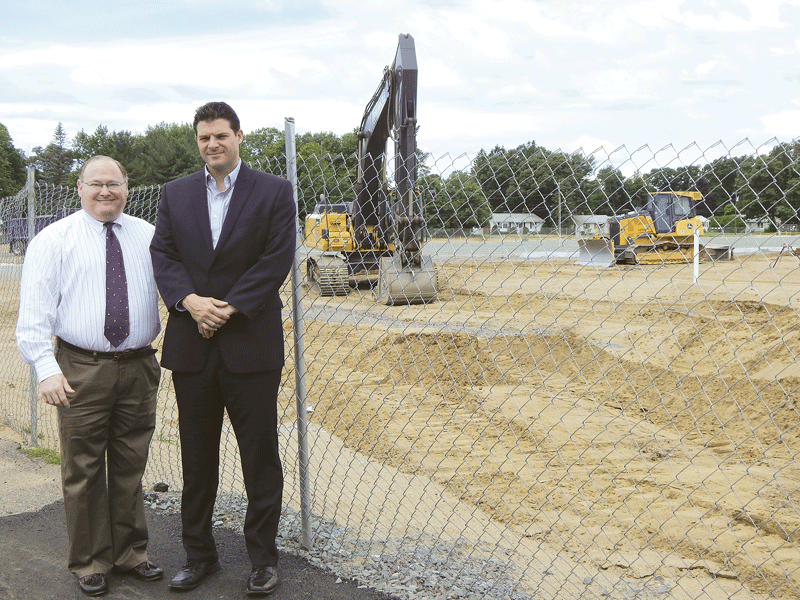
Mayor Richard Cohen and Marc Strange say the new, $8 million Agawam High School sports complex will be completed in the fall.

Mayor Richard Cohen recently unearthed a 30-year-old newspaper article that said Agawam’s Walnut Street Extension area needed to be revitalized.

The story reveals just how long that area has been a target for redevelopment, and also how current efforts may finally produce headlines of a different nature.

Indeed, the mayor said it has long been his plan to transform the area into a walkable downtown where people want to live, work, and play — and that dream may be approaching reality.

“It will take time, effort, and money to achieve, but we are moving in the right direction,” said Cohen, adding that the area has been a primary focus since 2010.

The town’s efforts received a tangible boost on April 1 when David Peters of Site Redevelopment Technologies purchased the former Games and Lanes bowling-alley property at 346-350 Walnut St. Extension. It has been a highly visible eyesore since it closed in 2001 after a fire caused extensive damage to the 30,000-square-foot building, which sits on a 2.3-acre lot.

The property was owned by Standard Uniform Corp. from 1969 through the ’80s, and in 1989, widespread groundwater contamination was discovered that spread off-site in a northeasterly direction.

The former owner worked in partnership with the Mass. Department of Environmental Protection to clean up the brownfields and spent $1.5 million on the effort, but eventually gave up; the property has been vacant for 15 years.

In the past, developers shied away from purchasing it due to the unknown amount of environmental remediation that still needs to be done. But Peters didn’t view that as an impediment.

“I’m a purchaser of last resorts; I look for environmental disasters, and although they can be costly and time-consuming to clean up, this gave me an opportunity to rehabilitate the property and the neighborhood,” he said, explaining that his work as a chemical engineer led him to create Site Redevelopment Technologies, which specializes in purchasing, cleaning, and redeveloping environmentally impaired properties.

However, before making the purchase, he did want to know how far the pollution had spread. The town had received a $50,000 grant to study the property and completed the first phase of that investigation in 2014, and after Peters sent a letter of intent stating he was interested in purchasing it, the City Council approved an additional $12,000 for the study.

Peters spent a year working closely with town and state officials to get the results, and estimates it will take another year and cost about $300,000 to complete the cleanup. But the property is already on the market, and a developer has approached him about using it as an indoor recreation area that would feature go-karts.

“This project is like a pebble thrown in a pond,” noted Marc Strange, the town’s Planning and Community Development director. “It will have a ripple affect on the entire Walnut Street Extension area. It could become an anchor development that will drive traffic and new customers to the neighborhood, especially if it is coupled with new programs like a Taste of Agawam or a block party.”

Plans Unfold

The Walnut Street Extension area is home to about 30 service-oriented businesses, retail shops, and restaurants, with a loyal customer base.

But it was clear that improvements needed to be made to transform it into a town center, and last October, the town hired the engineering firm Tighe & Bond to create a design plan that would be inviting and attractive.

The company worked with landscape architect Andrew Leonard to create several conceptual designs, and Strange said two public meetings were held with property owners in the Walnut Street Extension area to gather input on their preferences.

The majority chose an outdoor market concept, which will be reflected in the final design that is anticipated in about a month. It will include the outdoor market area, a 12-foot-wide sidewalk and 12-foot-wide island with new trees and sidewalk furniture on one side of the street, a roundabout at the end of the road, and a 10-foot-wide bicycle and pedestrian lane. Parking will be maintained on the side of the street with the narrower sidewalk, and new spaces will be added on an adjacent street.

The town was also recently awarded a $10,000 Massachusetts Downtown Initiative grant from the Department of Housing and Community Development to provide support for businesses on Walnut Street Extension.

A portion of the money was used for a June 14 workshop conducted by Christine Moynihan of Retail Visioning titled “Best Retail Practices.” It was open to the public, and six Walnut Street Extension area business owners were selected for free follow-up, one-on-one sessions, along with $350 worth of improvements made on their behalf.

In addition, the reconstruction of the Morgan Sullivan Bridge, which spans the Westfield River and runs from West Springfield into Agawam, serving as a gateway to the nearby Walnut Street Extension, will also help to revitalize the area. The $13.3 million rehabilitation project will add new traffic signals to relieve congestion and prevent the traffic jams that occur daily during rush hour.

In addition, the former Food Mart store on 63 Springfield St., which was most recently home to the Agawam YMCA, has been put to new use.

Cohen said the nonprofit vacated the structure May 31, and the next day it reopened as the West of the River Family Community Center.

“The Y’s misfortune was our good fortune,” he told BusinessWest, explaining that the community center will offer an expanded menu of more than 100 programs and will help draw more people to the area.

“We’re moving in the right direction with our dream,” he reiterated, adding that the Valley Opportunity Council plans to open an office in the building and was very helpful with the transition.

Cohen said the town will continue to seek funding to help with revitalization efforts, and will apply for a $1 million MassWorks grant to help pay for the new streetscape project that is being designed in conjunction with the Complete Streets plan, which encourages the development of safe and accessible bicycle and pedestrian traffic lanes.

Ongoing Development

Efforts are underway to make Agawam into a ‘dementia-friendly community’ in conjunction with an initiative created by Dementia Friendly America to increase awareness about the disease.

Cohen said the idea of providing ongoing education was proposed by Melinda Monasterski, and he believes it is important.

She told BusinessWest that she put together a meeting with the mayor, Strange, and officials from the senior center, library, and home-health agencies with the idea of providing the public with more education and information about dementia.

“It can be difficult to know how to interact with people who have dementia. It’s also hard for families to understand and cope with the changes that occur in their loved ones, and it can be challenging for first responders to help people with the condition during a crisis,” said the director of Heritage Hall’s dementia program, citing studies estimating that 10 million Americans will be affected by the disease over the next decade.

As a result of Monasterski’s efforts, educational sessions and support-group meetings will be held in the senior center, library, and new family center, and informational videos will be shown on the town’s website and broadcast on the public-access TV channel.

Progress is also occurring at another gateway in town; last month, the Colvest Group purchased and razed the former Agawam Motor Lodge on the corner of Suffield and Main streets. Cohen said the company has plans to redevelop the entire corner, which will make a decided difference, as the motor lodge had become a public nuisance.

Another significant project kicked off in March at Agawam High School, where construction began on a new track and sports complex. The $8.1 million project is expected to be completed in September and will include a new synthetic track and multi-purpose artificial turf field, new bleachers and electronic signage, new lighting, eight lighted tennis courts, a new baseball field, a new basketball court, upgrades to the softball fields and added dugouts, a new concession stand with room for an athletic trainer, and handicapped-accessible bathrooms. Work will also be done inside the school and will include new locker rooms and state-of-the-art bathrooms. In addition, the grounds around the complex will contain bicycle and pedestrian walkways so people can easily access different areas.

The designs were created by Milone and Macbroom of Springfield and Caolo & Bieniek Associates of Chicopee, and the construction is being undertaken by Lupachino and Salvatore of Bloomfield, Conn.

“We haven’t had a track in well over a decade and were in desperate need of new tennis courts,” Cohen said. “When the work is finished, it will be a very impressive sports campus.”

A $2.2 million upgrade to School Street Park was also completed last year. The project was done in two phases and encompasses 50 acres.

Cohen said it was the largest park project undertaken in the state in the past 25 years and offers something for everyone of any age: it boasts a water-spray park, a band shell and stage, volleyball courts, a small playground, and an additional 200 parking spots, which were all paid for with Community Preservation funds and a $1 million PARC grant.

A new dog park, built on Armory Drive with a $250,000 grant, was also finished last year and has proved to be very popular.

Infrastructure improvements are also on the agenda, and this year’s budget contains money to hire a four-person crew to maintain and repair the town’s sidewalks, which went by the wayside for a few years due to a lack of funding. In addition, the town is working with SCORE to start programs for people who want to open businesses.

But even though development is taking place in many areas, Cohen noted the town has worked to maintain open space by putting restrictions in place to preserve farmland and prevent it from ever being developed.

Solid Framework

On June 3, the mayor received notification that Standard and Poor reaffirmed the town’s AA+ bond rating, and an accompanying report states Agawam has a strong economy and strong management team, and employs good financial policies and practices.

“I’m extremely proud of what we have done, what we are doing, where we are going, and our AA+ bond rating,” Cohen said, adding that, whenever a new project is planned, the impact on taxpayers is taken into careful consideration.

“We still maintain the lowest split tax rate in the area, offer full services including free trash pickup, and are committed to elevating the quality of life,” he continued. “I want Agawam to be a place that has a lot to offer where people can afford to live.”

Revitalizing the Walnut Street Extension area will go a long way toward realizing that goal, but the mayor noted that all of the projects that were recently completed, are underway, or are in the planning stages have a synergistic element.

“The pieces dance around each other, and we are trying to put them all together,” Cohen said. “There is a lot of positive change taking place in Agawam.”

Agawam at a glance

Year Incorporated: 1761
Population: 28,976 (2016)
Area: 24.2 square miles

County: Hampden
Residential Tax Rate: $16.18
Commercial Tax Rate: $29.98
Median Household Income: $63,682
Family Household Income: $72,258
Type of government: Mayor; City Council
Largest Employers: OMG Inc., Agawam Public Schools, Six Flags New England
* Latest information available

Sections Travel and Tourism

What Summertime Blues?

SummerHappeningsDPart

In the mood for some live music or theater? Or are art shows and antiques more your style? How about clambering through the trees or soaring on roller-coaster tracks? Whatever your taste, Western Mass. boasts plenty of ways to enjoy the summer months, making any day potentially a vacation day. Here are 25 ideas to get you started, in a region that’s home to many, many more.

July

> Berkshires Arts Festival
Ski Butternut, 380 State Road, Great Barrington
(845) 355-2400; www.berkshiresartsfestival.com
Admission: $7-$14; free for children under 10

July 1-3: Ski Butternut may be best-known for … well, skiing, of course. But the property also plays host to the Berkshires Arts Festival, a regional tradition now in its 15th year. Thousands of art lovers and collectors are expected to stop by to check out and purchase the creations of more than 175 artists and designers, as well as experiencing theater and music from local and national acts. Founded by Richard and Joanna Rothbard, owners of An American Craftsman Galleries, the festival attracts top artists from across the U.S. and Canada.

1Fireworks>Fireworks Shows Various Locations

July 1-4: Independence Day weekend is brimming with nighttime pageantry throughout the Pioneer Valley. The Valley Blue Sox in Holyoke kick things off with fireworks following its July 1 game. July 2 brings displays at Beacon Field in Greenfield, while on June 3, Michael Smith Middle School in South Hadley and East Longmeadow High School get into the act. July 4 will bring the spectacle to Riverfront Park in Springfield and McGuirk Stadium at UMass Amherst. And Six Flags in Agawam will light up the night on July 2, 3, and 4.

> Brimfield Antique Show
Route 20, Brimfield
(413) 283-6149; www.brimfieldshow.com
Admission: Free

July 12-17, Sept. 6-11: After expanding steadily through the decades, the Brimfield Antique Show now encompasses six miles of Route 20 and has become a nationally known destination for people to value antiques, collectibles, and flea-market finds. Some 6,000 dealers and close to 1 million total visitors show up at the three annual, week-long events; the first was in May. The Brimfield Antique Show labels itself the “Antiques and Collectibles Capital of the United States,” and — judging by its scope and number of visitors — it’s hard to disagree.

2GlasgowLands-2> Glasgow Lands Scottish  Festival
Look Park, 300 North Main St., Florence
(413) 862-8095; www.glasgowlands.org
Admission: $16; $5 for children 6-12; free for kids under 6

July 16: This 23nd annual festival celebrating all things Scottish features Highland dancers, pipe bands, a pipe and drum competition, animals, spinners, weavers, harpists, Celtic music, athletic contests, activities for children, and the authentically dressed Historic Highlanders recreating everyday life in that society from the 14th through 18th centuries. Inside the huge ‘pub’ tent, musical acts Enter the Haggis, Soulsha, Albannach, Screaming Orphans, and Charlie Zahm will keep toes tapping in the shade. Event proceeds benefit programs at Human Resources Unlimited and River Valley Counseling Center.

> Pioneer Valley Beer & Wine Festival
Look Park, 300 North Main St., Florence
(413) 584-5457; www.lookpark.org
Admission: $35 in advance, $40 at the door

July 30: Hungry — or thirsty — for something to do as the dog days of summer take hold? Look Park presents its first annual Beer & Wine Festival at the Pines Theater from noon to 4 p.m. Attendees (over age 21 with ID) will get to sample local beer and wine from the Pioneer Valley, live music, and food vendors including Local Burger, La Veracruzana, and Sierra Grille.

August

> Pocumtuck Homelands Festival
Unity Park, 1st Street, Turners Falls
(413) 498-4318; www.nolumbekaproject.org
Admission: Free

Aug. 6: This annual celebration of the parks, people, history, and culture of Turners Falls is a coordinated effort of the Nolumbeka Project and RiverCulture. The event features outstanding Native American crafts, food, and live music by Theresa ‘Bear’ Fox, Mohawk (Wolf Clan), ‘wave artist’ Mixashawn, the Medicine Mammals Singers, and Kontiwennenhawi, the Akwasasne Women Singers. Also featured will be the Black Hawk Singers, the Visioning B.E.A.R. Circle Intertribal Coalition Singers, a Penobscot hoop dancer, round dancing, elder teachings, craft activities, storytelling, and traditional dances. The Nolumbeka Project aims to preserve regional Native American history through educational programs, art, history, music, heritage seed preservation, and cultural events.

3SpringfieldJazz

> Springfield Jazz & Roots Festival
Court Square, Springfield
(413) 303-0101; springfieldjazzfest.com
Admission: Free

Aug. 6: The third annual Springfield Jazz & Roots Festival will offer a festive atmosphere featuring locally and internationally acclaimed musical artists, dance and theater workshops, local arts and crafts, and plenty of food. More than 5,000 people are expected to attend and enjoy the sounds of jazz, Latin jazz, gospel, blues, funk, and more. Featured performers include Taj Mahal, Eric Krasno Band, Joey DeFrancesco Trio, Terri Lyne Carrington Group, Samirah Evans and Her Handsome Devils, Rayvon Owen, Heshima Moja and Ofrecimiento, and Jose Gonzalez and Banda Criolla. The festival is produced by Blues to Green, which uses music to bring people together, uplift and inspire, and help build a more equitable and sustainable world.

> Agricultural Fairs
Various locations and admission costs; see websites
www.thewestfieldfair.com; www.theblandfordfair.com; www.3countyfair.com; www.fcas.com; www.belchertownfair.com

Starting in late August and extending through September, the region’s community agricultural fairs are a much-loved tradition, promoting agriculture education in Western Mass. and supporting the efforts of local growers and craftspeople. The annual fairs also promise plenty of family-oriented fun, from carnival rides to animal demonstrations to food, food, and more food. The Westfield fair kicks things off Aug. 19-21, followed by the Blandford Fair and the Three County Fair in Northampton on Sept. 2-5, the Franklin County Fair in Greenfield on Sept. 8-11, and the Belchertown Fair on Sept. 23-25.

September

> Stone Soul Festival
Blunt Park, 1780 Roosevelt Ave., Springfield
(413) 636-3881; www.ssfestival.weebly.com
Admission: Free

Sept. 2-4: Stone Soul began in 1989 as a community reunion picnic aimed at gathering together the Mason Square Community. It has since evolved into a three-day event, and New England’s largest African-American festival. Stone Soul aims to provide family-oriented activities, entertainment, and cultural enrichment, and is a vehicle for minority-owned businesses to display their wares and crafts. Entertainment includes gospel, jazz, R&B, and dance. Sunday’s free picnic includes ribs and chicken cooked by talented pitmasters, as well as barbecued beans, cole slaw, and more, with the backdrop of an afternoon of live gospel music performed by local and regional choirs.

4MattoonStreet> Mattoon Street Arts Festival
Mattoon St., Springfield
(413) 736-0629
www.mattoonfestival.org
Admission: Free

Sept. 10-11: Now in its 44th year, the Mattoon Street Arts Festival is the longest-running arts festival in the Pioneer Valley, featuring about 100 exhibitors, including artists that work in ceramics, fibers, glass, jewelry, painting and printmaking, photography, wood, metal, and mixed media. Food vendors and strolling musicians help to make the event a true late-summer destination.

> Glendi
22 St. George Road, Springfield
(413) 737-1496
www.stgeorgecath.org/glendi
Admission: Free

Sept. 9-11: Every year, St. George Cathedral offers thousands of visitors the best in traditional Greek foods, pastries, music, dancing, and old-fashioned Greek hospitality. In addition, the festival offers activities for children, tours of the historic St. George Cathedral and Byzantine Chapel, various vendors from across the East Coast, icon workshops, movies in the Glendi Theatre, cooking demonstrations, and a joyful atmosphere the whole family will enjoy.

> Fresh Grass
1040 MASS MoCA Way, North Adams
(413) 662-2111; www.freshgrass.com
3-day pass: $99 for adults, $89 for students, $46 for ages 7-16

Sept. 16-18: The Massachusetts Museum of Contemporary Art is known for its musical events, and the Fresh Grass festival is among the highlights, showcasing more than 50 bluegrass artists and bands over three days. This year, the lineup includes Old Crow Medicine Show, Glen Hansard, Ricky Skaggs & Kentucky Thunder, The Devil Makes Three, Rosanne Cash, the Infamous Stringdusters, and many, many more. Also on tap are new-artist competitions (with prizes totaling $25,000) and bluegrass workshops open to festival attendees.

All Summer Long

> Berkshire
Botanical Garden
5 West Stockbridge Road, Stockbridge
(413) 298-3926
www.berkshirebotanical.org
Admission: $15; free for kids under 12

Through Oct. 10: If the flora indigenous to, or thriving in, the Berkshires of Western Mass. is your cup of tea, try 15 acres of stunning public gardens at the Berkshire Botanical Garden in Stockbridge. Originally established as the Berkshire Garden Center in 1934, today’s not-for-profit, educational organization is both functional and ornamental, with a mission to fulfill the community’s need for information, education, and inspiration concerning the art and science of gardening and the preservation of the environment. In addition to the garden’s collections, among the oldest in the U.S., visitors can enjoy workshops, special events, and guided tours.

> CityBlock Concert Series
Worthington and Bridge streets, Springfield
(413) 781-1591
www.springfielddowntown.com/cityblock
Admission: Free

Through Aug. 25: Downtown Springfield’s annual Thursday-evening summer music series is again studded with a mix of national touring acts and local lights, starting with FAT on June 30 in Court Square. The shows then move to Stearns Square for the rest of the summer, and include Ricky Nelson Remembered (July 7), Forever Motown (July 14), the Machine (July 21), Natalie Stovall and the Drive (July 28), Terry Sylvester (Aug. 4), Max Creek (Aug. 11), Blessid Union of Souls (Aug. 18), and the Shadowboxers (Aug. 25). The presenting sponsor for the shows is MassMutual, and the series is presented by the Springfield Business Improvement District. See article on page 27 for more information.

> Crab Apple
Whitewater Rafting
2056 Mohawk Trail, Charlemont
(413) 625-2288; www.crabapplewhitewater.com
Admission: $110-$116 through Sept. 11; $99 after Sept. 11

Through Oct. 9: Wanna get wet? Crab Apple is a third-generation, multi-state family business that operates locally on the Deerfield River in the northern Berkshire Mountains of Western Mass. Its five separate rafting excursions range from mild to wild, full- or half-day runs, in rafts and inflatable kayaks. In short, Crab Apple offers something for everyone, from beginners to more experienced rafters.

> Hancock Shaker Village
1843 West Housatonic St., Pittsfield
(413) 443-0188; www.hancockshakervillage.org
Admission: $8-20; free for children 12 and under

Through October: In 1774, a small group of persecuted English men and women known as the Shakers — the name is derived from the way their bodies convulsed during prayer — landed in New York Harbor in the hopes of securing religious freedom in America. Nearly 250 years later, their utopian experiment remains available to the public in the restored 19th-century village of Hancock. Through 20 refurbished buildings and surrounding gardens, Shaker Village illuminates the daily lives of its highly productive inhabitants. After spending a day in the recreated town, visitors will surely gain a greater appreciation of the Shakers’ oft-forgotten legacy in the region.

JacobsPillowSuchuDance-BRuddick-2008> Jacob’s Pillow Dance Festival
358 George Carter Road, Becket
(413) 243-0745; www.jacobspillow.org
Admission: $25 and up

Through Aug. 30: Now in its 84rd season, Jacob’s Pillow has become one of the country’s premier showcases for dance, featuring more than 50 dance companies from the U.S. and around the world. Participants can take in scores of free performances, talks, and events; train at one of the nation’s most prestigious dance-training centers; and take part in community programs designed to educate and engage audiences of all ages. This year’s events introduce a quirky, charming company from Germany, the explosive footwork of South American gauchos, inspiring ballet companies from across the U.S., astounding flex dancers from the streets of Brooklyn, and 12 high-flying men from Algeria — plus, more live music than ever before. See article on page 25 for more information.

> Lady Bea Cruise Boat
1 Alvord St., South Hadley
(413) 315-6342; www.brunelles.com
Admission: $10-$15; free for kids 3 and under

Through Labor Day: If you’re in the mood for a scenic meander up and down the Connecticut River, consider the Lady Bea, a 53-foot, 49-passenger, climate-controlled boat operated by Brunelle’s Marina, which typically runs Thursday through Sunday between South Hadley and Northampton. If you don’t feel like sharing the 75-minute narrated voyage with others, rent the boat out for a private excursion. Amenties include a PA system, video monitors, a full bar, and seating indoors and on the sun deck — but the main attraction is the pristine water, sandy beaches, and unspoiled views along the river.

6Mahaiwe> Mahaiwe Performing
Arts Center
14 Castle St., Great Barrington
(413) 528-0100; www.mahaiwe.org
Admission: Varies by event

Year-round: The beloved Mahaiwe Theatre dates back to 1905 — continuously running programs since its opening — and underwent an extensive, $9 million renovation starting in 2003. Today, the theater seats just under 700 and hosts year-round arts programming, including music, dance, theatre, opera, talks, and movie classics. It’s leaders say Mahaiwe is a staple and a resource: its live performances inspire tens of thousands of audience members each year, its family and educational events are vital to the region, its embrace of modern technology supplements programming with live, high-definition satellite broadcasts from around the world, and its year-round schedule enhances the quality of life for those who reside in and visit the Berkshires.

> Nash Dinosaur
Track Site and
Rock Shop
594 Amherst Road, South Hadley
(413) 467-9566; www.nashdinosaurtracks.com
Admission: $3 for adults; $2 for children

Year-round: Walk where the dinosaurs walked, literally. It’s hard to believe that the first documented dinosaur tracks found in North America were on the shores of the Connecticut River, in 1802, near today’s site of Nash Dinosaur Track Site and Rock Shop in South Hadley. Over the years, thousands of dinosaur tracks have been discovered; many were sold to museums and private individuals all over the world, but many more can be seen due to the extensive work of Carlton S. Nash. Visit the site and learn about some of this region’s earliest inhabitants, and also about the geology of the area.

7PeacePagoda> New England Peace Pagoda
100 Cave Hill Road, Leverett
(413) 367-2202
www.newenglandpeacepagoda.com
Admission: Free

Year-round: A Peace Pagoda is a Buddhist stupa, a monument to inspire peace, designed to provide a focus for people of all races and creeds, and to help unite them in their search for world peace. Most peace pagodas built since World War II have been built under the guidance of Nichidatsu Fujii, a Japanese Buddhist monk. Fujii was greatly inspired by his meeting with Mahatma Gandhi in 1931 and decided to devote his life to promoting non-violence. In 1947, he began constructing peace pagodas as shrines to world peace.

> Ramblewild
110 Brodie Mountain Road, Lanesborough
(844) 472-6253; www.ramblewild.com
Admission: $69 for adults, $59 for youth

Year-round: Aerial parks are an outdoor activity in and among the trees that offer excitement, challenge, and personal growth for families and adventurists of all kinds. At Ramblewild, the focal point is a central wooden platform about 10 feet above the ground from which eight aerial obstacle courses originate, meandering from tree to tree at various heights through the forest. Each course consists of 15 to 17 elements (high wires, ziplines, balancing logs, rope ladders, cargo nets, suspended bridges, etc.) that meander through a pristine hemlock forest. These tree-to-tree challenge courses are designed to have a profound impact on visitors’ self-confidence — while having lots of fun, of course.

8SixFlags> Six Flags New England

1623 Main St., Agawam
(413) 786-9300
www.sixflags.com/newengland
Admission: $61.99; season passes $91.99

Through oct. 31: Continuing an annual tradition of adding a new major attraction each spring, Six Flags New England recently unveiled Fireball, a looping coaster, and rethemed Bizarro to its original Superman motif, adding a virtual-reality component (via goggles) to boot. Other recent additions include the Wicked Cyclone, the 420-foot-tall New England Sky Screamer swings, the 250-foot Bonzai Pipeline enclosed waterslides, and the massive switchback coaster Goliath — in addition to a raft of other thrill rides. But fear not: the park has attractions for everyone along the stomach-queasiness spectrum, from the classic carousel and bumper cars to the wave pools and lazy river in the Hurricane Harbor water park, free with admission.

> Valley Blue Sox
Mackenzie Stadium
500 Beech St., Holyoke
(413) 533-1100
www.valleybluesox/pointstreaksites.com
Admission: $4-$6; season tickets $79

Through Aug. 1: Western Mass. residents don’t have to trek to Boston to catch quality baseball. The Valley Blue Sox, members of the New England Collegiate Baseball League, play close to home at MacKenzie Stadium in Holyoke. These Sox feature a roster of elite collegiate baseball players from around the country, including some who have already been drafted into the major leagues. Frequent promotional events like postgame fireworks and numerous giveaways help make every game at MacKenzie Stadium a fun, affordable event for the whole family.

> Williamstown Theatre Festival
1000 Main St., Williamstown
(413) 597-3400; www.wtfestival.org
Admission: $40 and up

Through Aug. 21: Six decades ago, the leaders of Williams College’s drama department and news office conceived of an idea: using the campus’ theater for a summer performance program with a resident company. Since then, the festival has attracted a raft of notable guest performers. This season will spotlight a range of both original productions and plays by well-known lights such as Tennessee Williams (The Rose Tattoo) and Wendy Wasserstein (An American Daughter), as well as a number of other programs, such as post-show Tuesday Talkbacks with company members.

Joseph Bednar can be reached a  [email protected]

Sections Travel and Tourism

Choreographing a Game Plan

Jacob’s Pillow

Pamela Tatge says an invite to Jacob’s Pillow is a goal set by choreographers across the country and around the world.

There are 10 weeks to the season at the Jacob’s Pillow Dance Festival each summer, and two main theaters hosting productions. That means 20 dance groups get to appear during those extended weekends between late June and the end of August.

But that’s a tiny fraction of the number that would like to book a trip to the picturesque campus in the Berkshire County hamlet of Becket, noted Pamela Tatge, who said that to be chosen for one of those 20 spots represents what she called a serious “vote of confidence” for the troupe in question.

“This is a very powerful brand — to get to Jacob’s Pillow is a goal that choreographers across the country and around the world share,” said Tatge, who recently took over as director of ‘the Pillow,’ as it’s known, succeeding Ella Baff. “It is a gold standard.”

Choosing which groups get this vote of confidence is a team effort, but something at or near the top of a lengthy list of her job responsibilities, said Tatge, who arrived in April.

Others include everything from fund-raising to marketing; from preservation (this is a National Historic Landmark) to overseeing acclaimed education and residency programs; from so-called audience engagement (welcoming attendees to those aforementioned performances, for example) to working with the institution’s large board of directors to create a vision and set a tone, artistically and otherwise, for the Pillow moving forward.

And recently, there have been some additions to that list, or at least matters that have taken on a new sense of urgency.

These include efforts to work in greater collaboration with other Berkshire-area attractions and institutions to make the region an even greater destination, and work to develop new and different ways to diversify the audiences at those performances and, especially, engage more young people in dance, the Pillow, and the arts in general.

Tatge, who comes to the Becket campus from a lengthy stint as director of the Center for the Arts at Wesleyan University, embraces every line on that job description and the broad, overarching challenge of continuing a proud, 84-year-old tradition.

“I knew how precious this institution was,” she said while explaining this career move, “and what an incredible opportunity it would be to be invited to lead it.”

For this issue and its special Summer Happenings section, BusinessWest talked at length with Tatge about the Pillow, her vision for its future, and how she intends to carefully choreograph a game plan for this venerable institution for the decades to come.

The Next Steps

Tatge said she couldn’t recall how many times she had taken in performances at Jacob’s Pillow over the years, but made it clear she didn’t need directions to the Becket campus, located just off Route 20.

Created by Ted Shawn, one of the first notable male pioneers of American modern dance, in 1933, the Pillow has been not only a place to take in fine dance, she explained, but also a scholarly retreat, both literally and figuratively, in many respects, providing a window into the past, present, and, in some ways, the future of contemporary dance.

“Jacob’s Pillow has been in my consciousness ever since I was a dance presenter,” she said, adding that she considers her work with dance to be perhaps her signature accomplishment at Wesleyan. “It’s the place I looked to discover emerging artists, to see international work that I wouldn’t otherwise be able to see because I didn’t have the travel resources at my institution, and for its resources — the archives are so extensive and so important for dance curators like me to access.”

So when a headhunter called last fall inquiring about whether she would be interested in succeeding Baff, Tatge offered an enthusiastic ‘yes,’ thus setting the wheels in motion for what would become a much different kind of visit to the Becket campus.

Fast-forwarding to this past April, Tatge said that, upon arriving on campus, she set out to immediately fill the calendar with meetings involving a variety of stakeholders, from the staff to board members to the managers of other arts institutions in the Berkshires with which the Pillow collaborates.

She described them all as learning experiences that will be of great benefit as she goes about tackling all the responsibilities within that description.

She said her meetings with board members have been especially enlightening and eye-opening.

“They are palpably passionate about this dance form, and they are here all the time,” she explained, adding that she’s met with 21 of the 23 members. “I wanted to understand their connection, hopes, and dreams for the Pillow individually.”

Looking forward, she said she has a number of goals for the institution, and generally, they can be described as efforts to continue and strengthen traditions that have been in place for decades.

“I want to continue and deepen our investment in choreographers and the development of new work, using the campus at Jacob’s Pillow as a research site for artists,” she explained. “And think of the many ways we can leverage the assets we have at our magnificent site and our archives for the benefit of artists. I also want to continue our commitment to international work, making sure our audiences witness the world here, as they always have.”

Getting into greater detail, she said one of her goals is to continue work she described as cross-disciplinary.

Indeed, at Wesleyan, Tatge became known for work that brought different arts forms together in unique ways. In one, she brought a Japanese artist and a Wesleyan history professor together for a course on the history of the atomic bomb — the former through the work of artists in postwar Japan, and the latter handling the science and history.

Such work dovetails with initiatives already in place at Jacob’s Pillow, she said, listing, as just one example, a partnership with MASS MoCA in North Adams that brings dance and modern visual arts together.

“I’m fascinated by the intersection of art forms,” she explained. “And a lot of the work we will do at MASS MoCA will involve artists who are working at the crossroads of visual arts and dance, and I’m delighted to have that platform for that kind of work.”

Rallying the

Pamela Tatge

Pamela Tatge says she embraces all of the many lines on her very lengthy job description as director at Jacob’s Pillow.

Meanwhile, another priority will be work to broaden audiences — and the Pillow’s membership base — and draw more young people into the arts at all levels. This is not a challenge unique to the Pillow, she said, noting that arts institutions across the country face the same hurdle, nor is it a recent phenomenon.

Indeed, the Pillow has been engaged in a number of initiatives in this realm, everything from incorporating more live music into performances to taking its act (and acts) off site and into area communities.

As an example, she said the group scheduled to perform in mid-August, Brooklyn-based FLEXN, will conduct an advance visit to the Berkshire Museum in Pittsfield. It will include a dance-off (practitioners from across the region will be invited to participate), with members of the group taking part. The young dancers will be invited to take in one of the group’s performances in Becket.

“To engage new audiences, we need to leave our site and take dance into many different parts of our county,” Tatge explained, “as a way to expose audiences, on their turf, to what it is we do, and then invite them to come to our house after we’ve gone to their house.”

There are many other initiatives in this realm, she said, listing everything from visits to area schools to more intense use of social media to market the Pillow and its performances, to free admission to the so-called Inside/Out Stage, where groups beyond those chosen 20 perform each week.

As for that aforementioned work to decide which 20 groups get to come to Becket for a given season, Tatge said this is a challenging assignment as well, given the number of groups, or projects, wanting to get that vote of confidence she described, as well as the need to satisfy many different tastes for dance and its various genres, all while maintaining an international flavor.

She described the process of meeting that challenge with a single word — balance — and a commitment to creating it.

“I want to make sure that all of the appetites of our audience have to be taken care of,” she explained, adding that she is in the thick of creating the schedule for 2017 and is already thinking about 2018.

Elaborating, she said this assignment involves a mix of proactively seeking out choreographers and companies whose work represents “the intention and aesthetic I’m excited about for our audiences” as well as fielding entreaties from agents and groups about existing projects they would love to bring to Becket.

“What’s wonderful about the current Pillow program is how broad it is in terms of genre and geography, and I want to maintain that,” she told BusinessWest. “We’re a national center for dance, so we need to make sure that we’re being geographically represented when we’re considering U.S. artists, while continuing our commitment to international work.”

A look at the 2016 schedule, which includes groups from Stuttgart, Germany; Chicago; New York; Santa Fe; Seattle; and a host of other cities, reveals this geographic diversity, said Tatge, adding that this is certainly a tradition that will continue.

Beyond the Routine

When asked how she intended to make her mark, or put her stamp, on Jacob’s Pillow during her tenure, Tatge said one obvious answer would be the manner in which the schedule for those 10 weeks each summer is filled.

But from a larger-picture perspective, the answer lies in how, and how successfully, she addresses each of the many lines in her job description — from broadening the audience to creating those collaborations with other arts institutions, to securing a solid future for this eight-decade-old tradition.

When it comes to that assignment, Tatge has been given her own vote of confidence, and she intends to make the very most of that opportunity.

George O’Brien can be reached at [email protected]

Employment Sections

Careful Culling

John McGlew

John McGlew says the best predictor of future success on the job is past behavior, which can be gleaned during the interview process and by checking references.

Interviewing job candidates is an art and a science that many small and mid-size employers don’t have the time to perfect. But knowing what to ask job candidates and how to interpret their answers is important, because hiring the wrong person is a waste of time and money and can lead to difficulties later on.

John McGlew says it’s critical for employers to do their homework before they sit down and begin interviewing job candidates.

The director of Employment and Employee Relations for the Sisters of Providence Health System noted that he was interviewed by 21 people before he was hired, and he has developed a program for his managers that teaches them how to use behavioral questions to find the person most suited for a particular job.

“Good interviewing practices and thorough vetting of candidates is critical to any business trying to hire the right person,” he explained. “It includes getting proper references and employment information, but you need to do a lot to get prepared for the actual interview.”

Michele Cabral, who hired many employees in her former position as CFO and COO of Farm Credit Financial Partners in Agawam and now helps employers with the process through her company, CFO On the Go, agrees that the work should begin long before applicants are actually interviewed.

“Most companies have a culture, but they fail to take it into account when they write a job description,” said the Holyoke Community College professor of Business, explaining that it is important for new hires to be invested in a company’s success as well as its mission.

McGlew agrees, and considers this so important that he tells managers to convey the Sisters of Providence mission to candidates and explain how the job advertised will relate to it, and says every business should have a clearly articulated mission statement that it shares.

Shannon Levesque concurs, but adds that interviewers also need to have a list of clear and measurable goals that get conveyed to everyone they interview.

“The person not only needs to be a good cultural fit, but you need to be realistic, honest, and up front about what will be expected to eliminate any surprises for the candidate,” the director of talent acquisition for Baystate Health told BusinessWest. “A small or mid-sized business also needs to know what makes the company attractive; an interview is a two-way street, and if you want to hire talent, it’s important to sell your company.

“Good people always have options, and even more so if they are already working, so there has to be an incentive,” she continued, noting that this may mean taking on a new challenge or having the ability to use newly acquired education. In any case, the interviewer needs to understand what is driving the candidate to apply for the position.

Experts say it’s not difficult to assess someone’s technical skills, but knowing how well they work in a team environment and how they will handle difficult customers, people, or situations can be equally or even more important.

“The best predictor of future success is past behavior. But in order to get this information, you need to be able to elicit responses about how the person has behaved in workplace situations in the past,” McGlew said.

For this edition and its focus on employment, BusinessWest looks at methods that seasoned interviewers use in their own hiring, so business owners can employ them and assess a candidate’s ability to do a job.

Essential Measures

Although there are many ways to conduct an interview, Cabral says most people fail to ask the right questions.

“The wrong candidates are often hired because the interviewer didn’t dig deep enough during the interview,” she noted.

Michelle Cabral

Michelle Cabral says people applying for managerial positions should to be able to inspire others and have standards in place, while employees at lower levels need to be able to manage their workload.

She measures five core competencies: leadership, management, communication, technical skills, and analytical skills, or the ability to solve problems, and says interviewers need to assess each of these areas while the candidate is in front of them.

“At the highest level, you need someone who can create a vision, understand the environment they are working in, and navigate their way through it. The person needs to be articulate verbally and in writing,” she said. “At the lowest level, the new employee needs to understand the vision, but interpret it for themselves as it relates to their job. They also need to know when to use different communication skills, such as e-mailing versus speaking to someone.”

She added that people applying for managerial positions should be able to inspire others and have standards in place, while people at lower levels need to be able to manage their workload. They should also be able to identify problems, come up with ways to solve them, and be able to discuss these options with their manager.

She suggests conducting a 15-minute phone interview with candidates whose résumés align with job requirements, and recommends getting people out of their comfort zone right away.

For example, if someone says they answer the phone frequently at their current job, the interviewer should ask them to cite an example of how they handled a customer who was rude to them.

“The phone interview helps you determine how articulate the person is and also assess their listening skills and whether they answer questions appropriately,” she said.

McGlew agrees that asking a person how he or she dealt with a challenging customer or phone call, as well as what steps they took toward service recovery, can reveal how they will handle stressful situations in the future.

“You want someone who takes steps to effectively resolve a difficult situation and restore the relationship for the company,” he noted.

Indeed, experts say the ability to communicate can be more important than technical skills, because most people can be taught to do new things. “But they need to be able to communicate when they are struggling and not be too embarrassed to ask for help,” he said.

Levesque told BusinessWest that problems sometimes arise because interviewers fail to differentiate between what is needed and what is preferable, which should be clearly defined in the job description. And if no one in the company has time to spend to help a new hire become proficient in a new skill, it may be a moot point.

“If you are taking a chance on someone’s potential to learn something, you need to structure training in a way that gets them up to speed quickly,” she said.

McGlew says interviewers should write down the qualifications the applicant must have before conducting the interview. In addition to technical skills, requirements can range from the ability to complete work within a given time frame to the ability to collaborate well, be knowledgeable about cultural diversity, or anything else that is pertinent to the job.

These things are important because, if soft skills are missing, a new hire’s interactions can become problematic. “It may be important for a security officer to know the law, but if the person has a brusque way of dealing with others, their interactions may become a problem,” Levesque said.

McGlew tells managers to come up with 20 to 25 behavior-based questions and then prioritize them. Although they are unlikely to get through all of them during an interview, asking candidates the same questions evens the playing field and allows interviewers to compare their answers.

But the candidate should do most of the talking. “You need to spend twice as much time listening as you do asking questions,” Levesque said.

Her interviews begin with a welcome, followed by behavioral questions. And there is always a defined closing, with time allotted for the candidate to ask questions and for her to assess their interest.

She said some interviewers aren’t used to using open-ended questions and may need to practice interviewing team members. But it makes a difference because open-ended or behavioral questions require candidates to give examples that include details related to their past performance, which allow the interviewer to understand the situations they have encountered, what their response was, and what they learned.

“You have to probe; it’s absolutely essential, but you also have parrot back what you heard and ask for elaboration,” Levesque said.

However, interviewers should avoid asking candidates to talk about their strengths or weaknesses. “They have already done their bragging on their cover letter and résumé,” Cabral said.

More useful questions can include, “if I called your manager today, what would he or she say about you?”; “tell me about a time when you were communicating a message and you were misunderstood?”; “tell me what gets you out of bed in the morning?”; and “tell me about a time when your employer needed you to stay late at work and you couldn’t?”

“You need to remain quiet after the person’s initial response,” Cabral advised. “And once they start sharing, you need to keep digging. If they couldn’t stay late when their boss needed them to, you want to know what happened and how they handled the situation or got the work done.”

Details That Matter

Although some employers seek well-rounded employees who can bring unique perspectives to problems, lifestyle can play a role in determining whether a candidate is suitable for a job. For instance, if the person says they love to ski and do so every weekend, it is appropriate to ask if it will present a problem if they are occasionally asked to work weekends.

Shannon Levesque

Shannon Levesque says interviewers need to know which technical skills are critical and which ones are preferable and can be learned after the person is hired.

And although young candidates may not have a job history or be able to provide examples of handling difficult workplace situations, they can be asked what led them to believe the job they are applying for is the right career, Cabral said, adding that gauging a candidate’s honesty is important. They can also be asked to supply references that include professors, members of the clergy, or people at places where they have volunteered.

Obtaining proper references and an employment history does play a role in choosing a new hire, but experts say busy interviewers can hire an outside service to do this.

However, McGlew suggests asking the person for past-performance appraisals. They may need to give their supervisor permission to share the information, but it can prove invaluable.

People conducting interviews who are not familiar with employment law also need to brush up on what they can and can’t ask.

“Don’t get into the person’s personal life. If someone starts talking about their family, change the subject,” Cabral advises.

Salary or hourly pay should also be discussed. Although it doesn’t need to be definitive, it’s important to divulge how much the organization or business is willing to pay a new hire.

McGlew told BusinessWest that, if the person won’t or can’t accept the dollar figure, it is a waste of time to continue the interviewing process.

“You also have a duty to give people a clear idea of the benefits you plan to offer,” he went on. “Salary and fringe benefits are definitive economic decisions, and if you don’t meet a person’s requirements, they may choose to keep looking or stay at their present position.”

Levesque agrees, and says there is nothing more disappointing to both parties than to offer someone a job, then find out they can’t afford or are unwilling to accept the pay. And when an interview nears the time allotted for it to end, it’s important to identify and set expectations about what will happen next.

“You should ask about their job search and whether they have any offers pending; an employer needs to know where a candidate is in the process,” Levesque said. “We have an obligation to treat job seekers with respect and understand their goal is to find gainful employment that is rewarding, challenging, and fits their career goals. Nothing is more painful to a candidate than to be in a black hole and not know where they stand or what to expect.”

Cabral understands that employers can get exhausted looking through hundreds of résumés, but warns against taking short cuts simply to fill a vacancy with someone.

“Some rush to get a job filled when they know in their gut they are hiring the wrong person,” she explained. “But if a new hire is not working out, you need to have an honest conversation. It’s OK to provide a soft landing and give them several months notice, but if the job is not getting done, you need to find the right person for it.”

However, experts say that situation can be tempered by hiring a person on a probationary basis. “But the person really needs to understand that there will be a formal assessment period,” McGlew said, adding that, when a person is being interviewed or hired, the words “permanent position” should never be used.

Instead, the interviewer should refer to a job as a “full-time opportunity,” which can prevent legal problems later on, he said, even though the Massachusetts Employment at Will statute allows employers to terminate an employee at any time, barring a contract.

Final Decisions

Cabral says hiring is an art and a science, and employers need to know the art is important in helping them make a decision. “At the end of the day, 80% of a decision is based on gut feel and attitude.”

McGlew agrees. “A lot is subjective and has to do with judging whether the person’s values and priorities are in line with the organization’s values,” he said. “But there is no foolproof methodology to interviewing, and sometimes the person who shows up for work is not the person you interviewed.”

Still, knowing what to ask and being well-prepared goes a long way toward keeping that from happening.

“It can be difficult to separate personality from competency, but if you ask questions in the right way, you will be surprised what people tell you,” Levesque said. “Good interviewers accept what they see, then probe for validation. And it’s a win-win if you get it right.”

Daily News

BOSTON — The Baker-Polito administration awarded 34 Community Development Block Grants, totaling $28 million, to a total of 57 cities and towns across the Commonwealth yesterday. The Community Development Block Grant program provides competitive funding that allows municipalities to pursue economic-development projects and support the needs of low- and moderate-income residents.

“Our assistance to municipalities is most effective when it provides flexibility to directly support their established goals,” said Gov. Charlie Baker. “Community Development Block Grants provide for investment in wide-ranging improvements that will bring long-term, positive impacts in these communities.”

This year’s Community Development Block Grant awards will allow municipalities across Massachusetts to redevelop housing and local infrastructure, and provide for a variety of social services, including child-care assistance, elder services and domestic-violence-prevention programs.

“Residents across the Commonwealth will see marked improvements in the livability of their communities through these Community Development Block Grant awards,” said Lt. Gov. Karyn Polito. “These awards will help further progress at the local level, and allow municipalities to pursue a bright future for their community.”

The grant awards to Western Mass. communities include:

• Amherst, $825,000 for Boltwood Walk accessibility improvements, Health Center HVAC improvements, Housing Authority modernization projects, and to provide services related to homelessness, after-school and literacy programming, youth mentoring, and family stabilization.

• Bernardston, Rowe, and Gill, $1 million to provide housing-rehabilitation assistance for 18 units of housing, and to provide a fuel-assistance program.

• Chesterfield, Cummington, Goshen, Peru, Plainfield, Westhampton, and Worthington, $894,110 to provide housing-rehabilitation assistance for 13 units of housing, and to provide childcare assistance, elder services, and a food pantry.

• Easthampton, $800,000 to provide improvements in the Admiral Street neighborhood, and for housing-rehabilitation assistance for three units of housing.

• Greenfield, $825,000 for housing rehabilitation assistance for nine units of housing, infrastructure improvements to School Street, and to support a food pantry and youth and elder services.

• Huntington, Middlefield, and Chester, $753,226 for infrastructure improvements to Pleasant Street, a senior-center feasibility study, housing-rehabilitation assistance for seven units of housing, and to provide senior services, adult education, a food pantry, and domestic-violence-prevention services.

• Montague, $816,263 for housing-rehabilitation assistance for four units of housing, lighting improvements to Avenue A, and to provide youth-leadership, family-literacy, and elder services.

• North Adams, $825,000 for improvements to a community center, park improvements, a historic-properties inventory, and social services.

• Palmer, $807,862 for infrastructure improvements to Stewart Street, to provide housing-rehabilitation assistance for four units of housing, and to support financial-literacy and domestic-violence-prevention services.

• Sheffield and Great Barrington, $923,983 to provide housing rehabilitation for 14 units of housing, Sheffield Town Hall accessibility improvements, and design for new sidewalks and for circulation, drainage, and parking-capacity improvements at the Housatonic Community Center.

• Shelburne, Buckland, and Colrain, $961,382 for improvements to North Street (Buckland), to provide housing rehabilitation assistance for five units of housing, and to support a food pantry.

• Southwick and Granville, $900,000 to provide housing-rehabilitation assistance for nine units of housing, infrastructure improvements at Veteran Street, and a food pantry.

• Ware, $800,000 for infrastructure improvements to Prospect Street, design services for Bank and Spring Street improvements, and to support for domestic-violence-prevention services.

• Warren, Hardwick, and Ware, $724,000 for School Street neighborhood design, housing rehabilitation assistance for 14 units of housing, and for support services related to adult education, community health, and domestic-violence prevention.

• West Springfield, $825,000 for improvements to Memorial Playground, housing-rehabilitation assistance for 11 units of housing, code enforcement, Boys and Girls Club facility improvements, and support for services related to family self-sufficiency and homebuyer programs, ESOL, camp scholarships, and Head Start.

Daily News

HADLEY — TommyCar Auto Group awarded two students with $1,000 scholarships to attend college this fall. Jennifer Moss of Hopkins Academy will be attending the University of Massachusetts. Olivia Kiritsis of Shepard Hill Regional High School will be attending Worcester Polytechnic Institute. Both students demonstrated excellence in the classroom and in the community. They were chosen from among more than 100 applicants.

The Tom Cosenzi Scholarship was established to honor the memory of Thomas E. Cosenzi. When he passed away in 2009, it was not only ownership of the TommyCar Auto Group that passed to his children Carla and Thomas, but his legacy of giving back to the community.

“The Tom Cosenzi Scholarship is dedicated to assisting high-school graduates in furthering their education,” said Carla Cosenzi, president of TommyCar Auto Group. “The combination of academic achievement and community leadership exhibited by these students underscores the core values of this scholarship.”

Daily News

SPRINGFIELD — On May 18, the U.S. Department of Labor released its new rule regarding overtime exempt status, which raises the salary threshold and could extend overtime pay to more than 4 million workers who are currently ineligible.

The rule doubles the salary level at which full-time salaried workers are eligible for overtime and increases the salary level for ‘highly compensated employees,’ which could impact more than 83,000 workers in Massachusetts alone.

Timothy Murphy, partner with Skoler, Abbott & Presser, P.C. and member and former chair of the Springfield Regional Chamber’s legislative steering committee, will explore the impact of the rule at the Springfield Regional Chamber Lunch ‘n’ Learn on Tuesday, June 28 from 11:30 a.m. to 1 p.m. at Lattitude, 1388 Memorial Ave., West Springfield.

Murphy will break down the new rule, explain the impact on the region’s employers, provide guidance for nonprofits and higher-education institutions, outline what area businesses need to know to be compliant, and discuss strategies to lessen the impact to the bottom line.

Murphy joined Skoler, Abbott & Presser in 2001 after serving as general counsel to an area labor union. He represents and advises both union and non-union employers in a wide range of labor and employment matters. He regularly represents employers in matters before state and administrative agencies and courts. His work includes assisting employers to remain union-free, defending unfair labor practices, negotiating collective-bargaining agreements, and handling grievance arbitrations.

He is a graduate of Western New England Law School, where he has subsequently taught courses in employment law. He is a frequent contributor to business and human-resource publications and a contributing author to the Massachusetts Employment Law Letter. He is a past Super Lawyers Rising Star and was named among the Best Lawyers in America.

Reservations for the June Lunch ‘n’ Learn cost $25 for Springfield Regional Chamber members and $35 for general admission. Registration includes lunch and one-on-one discussions with Murphy. Reservations may be made online at www.springfieldregionalchamber.com.

Daily News

BOSTON — The state’s total unemployment rate remained at 4.2% in May, the Executive Office of Labor and Workforce Development announced Thursday.

The preliminary May job estimates from the Bureau of Labor Statistics (BLS) indicate that Massachusetts lost 6,400 jobs. Job losses were impacted by a temporary labor dispute in the information sector. In May, leisure and hospitality was the only sector to experience over-the-month job gains.

BLS also revised upward the state’s over-the-month job gains in April, reporting that 15,200 jobs were added compared to the 13,900-job gain originally reported. From December 2015 to May 2016, Massachusetts has added 30,500 jobs.

At 4.2%, the unemployment rate is down 0.7% over the year, with the state’s seasonally adjusted unemployment rate dropping from 4.9% in May 2015. There were 26,600 fewer unemployed persons and 49,000 more employed persons over the year compared to May 2015. The Commonwealth’s May unemployment rate remains lower than the national rate of 4.7% reported by the Bureau of Labor Statistics.

“The labor force continues to grow, with 7,000 more employed residents and 2,000 fewer unemployed residents in May,” Labor and Workforce Development Secretary Ronald Walker II said, adding that the education and healthcare sector and the professional, scientific, and business-services sector continue to generate the most jobs in Massachusetts.

The state’s labor-force participation rate — the total number of residents 16 or older who worked or were unemployed and actively sought work in the last four weeks — remained at 65.0%. The labor-force participation rate over the year has decreased 0.2% compared to May 2015.

Over the year, the largest private-sector percentage job gains by sector were in construction; professional, scientific, and business services; other services; and leisure and hospitality.

Daily News

CHICOPEE — Elms College and Western New England University School of Law will execute a ‘3+3’ agreement this month that allows students to apply for admission to the law school and begin their legal education during their senior year at Elms College. This could shorten the time for students to earn both their bachelor’s and juris doctor degrees from seven years to six years.

This agreement is not limited to criminal justice or legal studies majors — any undergraduate student, regardless of major, can earn credits toward law school under this program.

“This is a significant opportunity for students in all majors who are interested in attending law school,” said Assistant Professor Kurt Ward, director of Criminal Justice and Legal Studies and director of ABA Paralegal Education at Elms College.

The 3+3 program agreement signing will be held on Wednesday, June 22 at the WNEU School of Law. Representatives of both WNEU and Elms College will be in attendance.

Briefcase Departments

FutureCity 2026 Presents Development Strategy

SPRINGFIELD — An executive summary of the FutureCity 2026 economic-development strategy was presented to about 120 business and community leaders and stakeholders at CityStage last week. FutureCity is a joint initiative by DevelopSpringfield, the Springfield Regional Chamber of Commerce, and the city of Springfield’s Office of Planning and Economic Development. Its purpose is to build on the strategies identified in earlier studies such at the Urban Land Institute study of 2006 and the Rebuild Springfield Plan of 2012 — both of which identified tangible goals that continue to be the focus of public and private economic-development strategy in Springfield. Both plans recommended the importance of developing a long-term strategy for economic growth in the city that would ultimately benefit the entire region. “The goal of this project was to pinpoint and leverage the city’s attributes, including geographic location, infrastructure, workforce, and industries, and align these existing characteristics, assets, and conditions with pillars of realistic current and prospective market opportunities,” said Jeff Fialky, an attorney with Bacon Wilson and co-chair of the FutureCity initiative. “The objective was to develop an approach based upon realistic market opportunities that is obtainable rather than merely aspirational.” The FutureCity strategy was prepared by the nationally recognized real-estate and economic-development consulting firm Newmark Grubb Knight Frank, guided by a steering committee representing a broad spectrum of businesses and organizations over the course of a nine-month period. The consultants were charged with an ambitious scope of work which took place over nine months to include the following: assess existing conditions, analyze target industries, assess logistics and supply-chain capabilities, assess talent-development strategies, develop a list of recruitment opportunities for target industries, and identify strategic initiatives and an implementation plan with measurable deliverables. Newmark conducted over 100 interviews, which included city and state leaders, economic-development agencies, large employers, young professionals, elected officials, nonprofits, workforce-development organizations, real-estate and creative-economy experts, and more, in addition to deep dives into relevant data, peer-city comparisons, and several site visits to Springfield. Major themes emerging from the study include site and space readiness, centralization of small-business resources, development of a multi-generational workforce plan, development of a unified marketing and messaging plan, fostering collaboration and connectivity, strategically unifying economic-development efforts, collaboration, and a focus on Springfield’s unique strengths. “This was a very pragmatic exercise that shows there are many more pros than cons as we continue to market Springfield,” said Mayor Domenic Sarno. “As we have done with the Urban Land Institute and our Rebuild Springfield plans, we will follow through with this one, too. Now is our time. We will continue to capitalize on the synergy of our public and private collaborations and keep the momentum going as the ‘can-do city.’” Added Jay Minkarah, DevelopSpringfield president and CEO and co-chair of the FutureCity initiative, “the FutureCity economic-development strategy is designed to be a guide to action, not simply a plan to sit on a shelf. The plan includes over 170 specific recommendations along with metrics for measuring success, estimated costs, potential impact, and priorities, and identifies the parties responsible for implementation.” Funding was provided by the Irene E. and George A. Davis Foundation, the Community Foundation of Western Massachusetts, the U.S. Economic Development Agency, the Springfield Regional Chamber, Smith and Wesson, and DevelopSpringfield. A link to the presentation can be found at www.developspringfield.com. Over the next few weeks, an executive summary and detailed report will be made available through DevelopSpringfield, the Springfield Regional Chamber, and the city of Springfield’s Office of Planning and Economic Development.

Springfield, Pittsfield Each Given $475,000 in Working Cities Challenge

BOSTON — The Federal Reserve Bank of Boston announced that Springfield, Pittsfield, Haverhill, Lowell, and Worcester will each receive $475,000 in the second round of the Working Cities Challenge, a competition for smaller cities in New England focused on building collaborative leadership, which is shown to be a critical element in economic growth for struggling post-industrial cities. The five communities put forward initiatives focused on neighborhood revitalization, workforce development, and improving access to economic opportunity. The cities will work on these initiatives over a three-year period, accompanied by technical assistance and a learning community for best-practice sharing. “I want to congratulate the winners of the Working Cities Challenge. Collaborative leadership is at the heart of this competition, and these five cities demonstrated significant capacity to reach across sectors and advance efforts on behalf of low-income residents in their communities,” said Boston Fed President Eric Rosengren. “I look forward to following the progress in the communities in the coming months and years.” Added Gov. Charlie Baker, “together with our partners in the private, philanthropic, and nonprofit sectors, we are proud to leverage greater resources to support and prepare communities for success. The Working Cities Challenge elevates local leadership, amplifying solutions from the community level to increase cross-sector collaboration and improve economic outcomes for low-income residents.” Last fall, 10 Massachusetts communities were each awarded $15,000 design grants through the Working Cities Challenge to strengthen their bids to the competition. The five winning cities were selected after a six-month design-grant period, which saw the cities refining proposals and adding partners from across their community. The Springfield Works Initiative will advance the city’s economy by enhancing and strengthening the connectivity between employers who need qualified workers and low- income Springfield residents who need meaningful employment. It aims to achieve this goal through an innovative collaboration between employers, educational institutions, service providers, community leaders, community-based organizations, government, and residents. The Springfield Works Initiative core team includes the Western Mass. Economic Development Council, the Springfield Office of Planning and Economic Development, the Regional Employment Board of Hampden County, MGM Springfield, Partners for Community Action, HAPHousing, Springfield Technical Community College, Western MA National Machine and Tooling Assoc., the Community Foundation of Western Mass., Tech Foundry, United Personnel Services, United Way of Pioneer Valley, and DevelopSpringfield. The Pittsfield Bridges: Transformative Movement (PBTM) initiative will support the journey from poverty to sustainability by collaboratively building community resources and removing barriers. The effort’s vision is for all people in Pittsfield to experience a just, thriving, and safe community. The PBTM’s goal is to improve individual, institutional, and social fairness and respect in the community and thus support individuals moving out of poverty. The PBTM’s core team includes Central Berkshire Habitat for Humanity, the city of Pittsfield, the Berkshire Regional Planning Commission, Berkshire Community College, BerkshireWorks Career Center, Berkshire United Way, Goodwill Industries, Berkshire Children and Families, Berkshire Health Systems, Berkshire Community Action Council, Downtown Pittsfield Inc., Pittsfield public schools, the local NAACP chapter, Pittsfield Community Connection, West Side Neighborhood Initiative, First United Methodist Church, Heart 2 Heart Ministry, Manos Unidas, Brien Center for Mental Health, Multi-Cultural Bridge, and Girls Inc. For more information on the Working Cities Challenge, visit www.bostonfed.org/workingcities.

Celia Grace Wins $50,000 at VVM Accelerator Awards

SPRINGFIELD — Twelve area startups won a total of $252,000 at the Valley Venture Mentors (VVM) Accelerator Awards on May 26, led by Celia Grace, whose founder, Marcelia Muehlke, calls her company a fair-trade, ethical wedding-dress seller that gives back and empowers women around the world. Muehlke, who won $50,000 at the ceremony at the MassMutual Center, launched the company several years ago after searching, fruitlessly, for a maker of fair-trade wedding dresses. Sensing both a need and an opportunity, she set about creating such a company. She traveled to Asia and set up a supply chain that could create high-quality garments that she and her clients could feel good about. She then began working with a group of women in a sewing group in Cambodia, contracted with a designer in New York, and got her business — and her dream — up and running. Today, Celia Grace sells dresses across the country and in Europe. The VVM award is just one in a long line of accolades, including a Grinspoon Entrepreneurial Success Spirit Award in 2011, a finish in the money at the UMass Pitch Competition in 2012, and a second-place finish at Valley Venture Mentors’ pitch contest during the Western Mass. Business Expo in 2012. About 500 people attended the May 26 ceremony. The other 11 winners of VVM Accelerator Awards, and their prize money, include:
• Homebody Holistics ($45,000), a maker of all-natural, hand-crafted, herbal cleaning solutions using no harsh chemicals or additives;
• Scout Curated Wears ($32,000), a designer, curator, and producer of thoughtful women’s accessories;
• DaVinci Arms ($21,000), a designer and manufacturer of firearms suppressors and accessories for mission-critical applications;
• Treaty ($21,000), a nanotechnology company whose flagship product is FogKicker, a biodegradable anti-fog solution made from nanocellulose;
• Prophit Insight ($19,000), a software company that helps healthcare providers identify and acquire unique sources of physician referrals;
• Livingua ($18,000), an app that connects travelers to locals who know the language and culture wherever and whenever they want;
• Name Net Worth ($15,000), a connective platform that leverages trusted relationships to measure and strengthen a user’s personal and professional networks;
• iRollie ($9,000), a niche-market phone-case manufacturer and online retailer featuring the rolling tray phone case;
• Need/Done Inc. ($9,000), instant help for kids at home from people their parents trust;
• Sumu ($7,000), which works with property managers and landlords to post fee-free apartments to help users find their next home; and
• AnyCafé ($6,000), a developer of hot beverage solutions for the future, including the Travel Brewer.

Legislation Filed to Cap Sick-time Accrual

BOSTON — Gov. Charlie Baker and Lt. Gov. Karyn Polito recently introduced “An Act to Reform Sick Time,” aimed at limiting sick-time accruals that have led to exorbitant payouts upon retirement from state government. The legislation would cap accrual of sick time for state employees in the Executive Department at no more than 1,000 hours, equivalent to six months of work. The bill grandfathers in approximately 5,800 current state employees who already have more than 1,000 hours accrued. Those employees would be capped at their current earned amount as of the date of enactment. Once the legislation is passed, the policy will take effect immediately. “Sick leave is a benefit designed to offer employees a way to deal with health and family issues, not a retirement bonus,” Baker said. “Bringing the Commonwealth’s sick-leave-accrual policy in line with other private- and public-sector employers just makes sense and is the fiscally responsible thing to do.” Added Polito, “this legislation ensures the use of sick time remains consistent with its intended purpose. Benefits for Executive Department employees will remain competitive while we implement an accrual policy that is fair to Massachusetts taxpayers.” Under current law, employees can accrue a maximum of 15 sick days per year, and those employees who retire are permitted to cash out 20% of unused sick time. In FY 2015, 378 employees had an accrual of more than 1,000 hours upon retirement. While this represents only about one-third the number of retiring employees, the cashouts for these employees accounted for nearly 80% of the total cashout cost. Based on the last three fiscal years, if fully implemented, a 1,000-hour cap on accruals would have saved an average of $3.5 million in cashouts per year. “Sick days serve an important purpose, but they must be used in an appropriate and accountable way for our compensation system to have the integrity and transparency taxpayers deserve,” said Senate Minority Leader Bruce Tarr. Added House Minority Leader Bradley Jones Jr., “recent media reports highlighting excessive sick-leave payouts in the public higher-education system clearly demonstrate the need to crack down on these types of abuses. The reforms proposed by the Baker-Polito administration will help to provide greater transparency and accountability to the state’s taxpayers.”

Habitat for Humanity Partners with Faith Organizations

SPRINGFIELD — Greater Springfield Habitat for Humanity (GSHFH) announced an upcoming Circle of Faith build on 479 Allen St. in Springfield. This project is a partnership between GSHFH and 11 local faith communities who have come together to raise the funds for a Habitat home, and who will also contribute volunteers, in-kind materials, and amenities for the project. As an intentionally interfaith project, this build incorporates Christian, Islamic, and Jewish communities. These 11 faith communities include First Church of Christ in Longmeadow, Sinai Temple in Springfield, St. Mark’s Episcopal Church in East Longmeadow, St. Andrews Episcopal Church in Longmeadow, the Islamic Society of Western Mass. in West Springfield, Christ the King Lutheran Church in Wilbraham, East Longmeadow United Methodist Church, Mercy Medical Center and the Sisters of Providence Health System in Springfield, St. Cecilia’s Parish in Wilbraham, and Foster Memorial Church in Springfield. Ellen Tougias, the point person for First Church of Christ in Longmeadow, says her church is “proud to be a part of the Circle of Faith Build for Habitat. We have committed to this project as part of our 30th-year celebration. It is one way that we have chosen to give back to our community in honor of this special year.” Mohammad Bajwa of the Islamic Society of Western Mass. referenced a piece of Scripture in relation to the project: “cooperate with one another, for doing good deeds and righteousness … surely God’s mercy is upon the good doers.” To kick off this partnership, the Circle of Faith communities and GSHFH hosted a “House Wrapped in Love” event at the Islamic Society of Western Mass. on June 1. The family-friendly event invited kids to paint what home, family, and love means to them on sheets of plywood that will then be used to build the walls of the new habitat house at 479 Allen St. Following this event will be several days of building on the job site, where the exterior walls of the home will start to take shape.

Unemployment Drops Across State in April

BOSTON — Local unemployment rates dropped in all labor market areas in the state during the month of April, the Executive Office of Labor and Workforce Development reported. All 15 areas added jobs over the month, with the largest gains in the Springfield, Boston-Cambridge-Newton, Barnstable, Worcester, and Lowell-Billerica-Chelmsford areas. From April 2015 to April 2016, 14 areas added jobs, with the largest percentage gains in the Haverhill-Newburyport-Amesbury, Brockton-Bridgewater-Easton, Taunton-Middleborough-Norton, and Barnstable areas. In order to compare the statewide rate to local unemployment rates, the Bureau of Labor Statistics estimates the statewide unadjusted unemployment rate for April is 3.9%, down 0.7% from the March rate. Last week, the Executive Office of Labor and Workforce Development reported the statewide seasonally adjusted unemployment rate dropped to 4.2% for the month of April. The unemployment rate is down 0.8% over the year. The statewide seasonally adjusted jobs estimate showed a 13,900-job gain in April and an over-the-year gain of 73,500 jobs. The unadjusted unemployment rates and job estimates for the labor market areas reflect seasonal fluctuations and therefore may show different levels and trends than the statewide seasonally adjusted estimates. The estimates for labor force, unemployment rates, and jobs for Massachusetts are based on different statistical methodology specified by the U.S. Department of Labor’s Bureau of Labor Statistics.

Leadership Pioneer Valley, Women’s Fund Partner on Alumni Discount

SPRINGFIELD — Effective immediately, Leadership Pioneer Valley (LPV) and the Women’s Fund of Western Massachusetts will begin offering alumni of their programs a mutual 20% discount — just one part of a new effort between these organizations to strengthen and coordinate learning opportunities for emerging leaders in the region. Both LPV’s core program and the Women’s Fund’s Leadership Institute for Political and Public Impact (LIPPI) program seek to empower up-and-coming leaders and, ultimately, strengthen the region as a whole. However, each program has unique content and perspectives that, if taken subsequently, provide a comprehensive leadership experience. Graduates of the LPV program can apply for LIPPI at womensfund.net; graduates of LIPPI can apply for LPV at leadershippv.org. “The Women’s Fund is thrilled to participate in this collaborative effort with Leadership Pioneer Valley,” said Elizabeth Barajas-Román, CEO of the Women’s Fund. “We think this is a natural partnership for our organizations, as we both invest in creating strong communities through leadership development. Together, our participants will become the civic and business leaders of tomorrow who will help the region thrive.” Added Lora Wondolowski, executive director of Leadership Pioneer Valley, “this partnership makes so much sense as we feel our curriculums are complementary. Together, we are building a cadre of leaders who are making a difference in their careers and communities.” LPV is a nonprofit that works to identify, develop, and connect diverse leaders to strengthen the region. LPV’s core program challenges and engages emerging leaders from all sectors of the community from throughout the region. The curriculum consists of both classroom and hands-on, experiential learning that builds leadership skills, enhances regional understanding, and creates broader networks. The Women’s Fund is a public foundation that connects donors with the lives of local women and girls through strategic grant making and leadership development. Its signature, non-partisan program, LIPPI, is designed to address the need to provide women with the tools, mentors, and confidence they need to become powerful and effective civic leaders and elected officials. Further information on each program can be found at leadershippv.org and womensfund.net.

Local Farmers Receive Awards Totaling $117,500

AGAWAM — Recognizing that farming is essential to the region, the Harold Grinspoon Charitable Foundation and Big Y awarded 47 local farmers from the Berkshires to the Pioneer Valley $2,500 each to make physical infrastructure improvements to their farms. Along with the support of sponsors Harvard Pilgrim Health Care Foundation and MGM Springfield, farmers have already put to use the awards for farm-improvement projects. This represents a 42% increase in awards from the 2015 inaugural year. With the collaboration of local agriculture advocacy organizations Berkshire Grown and CISA (Community Involved in Sustaining Agriculture), the applications selected for the Local Farmer Awards were announced in December. More than 120 farmers submitted applications describing their improvement projects. The award recipients are diverse: 32% have been farming for more than 20 years, and 23% for five years or fewer; and more than 40% of the farms have sales of more than $100,000, while another 30% recorded sales of less than $49,000. A winner from 2015 and 2016, Julia Coffey of Mycoterra Farm in Westhampton said, “we are thrilled to be a Local Farmer Award recipient. The projects that these awards have helped fund are making our farm more viable.” This year, Coffey is purchasing equipment required for outfitting a commercial kitchen that will allow the farm to begin manufacturing value-added food products with unsold fresh mushrooms. Jennifer Salinetti, owner of Woven Roots Farm in Tyringham, will install a permanent vegetable wash station which will directly impact the farm’s productivity. Gideon Porth of Atlas Farm in Deerfield will install a pump system for a new well to increase the supply of potable water for the farm’s packing house and greenhouses, which will double its current watering abilities. Harold Grinspoon, founder of the Harold Grinspoon Charitable Foundation, who launched the Local Farmer Awards in 2015, noted that “farmers don’t typically ask for help. They are genuinely appreciative of these awards and use the money in creative ways for projects to help their businesses.” Charlie D’Amour, president & COO of Big Y, added, “through our partnership with the Grinspoon Foundation, we are providing one more way to help local growers thrive in our community.” The goal of the Local Farmer Awards is to strengthen farmers’ ability to compete in the marketplace so the region benefits from the environmental, health, and economic advantages of local farming. A farmer appreciation event is held yearly for all applicants and awardees to honor and recognize farmers and promote the importance of local farming.

Company Notebook Departments

Steel Partners Recognizes OMG Inc. for Excellence

AGAWAM — Three kaizen teams from OMG Inc. have been recognized as 2016 Steel Partners Business System Hall of Fame winners. The announcement was made by Jeff Svoboda, president and CEO of Handy & Harman, a Steel Partners subsidiary. The Steel Partners Business System uses lean principles and tools, including kaizens, to increase sales, improve business processes, and reduce and eliminate waste and variation. Kaizen is a strategic activity where employees at every level of a company get together to work on a targeted improvement project. In manufacturing in particular, kaizens often demonstrate that big changes come from many small changes made over time. Kaizens are focused three- to five-day events that generally include defining a problem or goal, documenting the current state, brainstorming and developing a future state, implementing change, developing a follow-up plan and measurement metrics, presenting results, and celebrating success. “We complete over 40 kaizens a year, each involving on average a team of five, so for these three teams to be recognized by our parent companies is certainly a high honor for which we are very proud,” said Hubert McGovern, president and CEO of OMG Inc. A total of 19 employees participated in the three winning kaizens. Two of the kaizens were held at OMG’s headquarters location in Agawam, and one was held in the company’s Asheville, N.C. facility. “OMG is committed to lean manufacturing, and kaizens are just one of the tools we use to drive significant improvement to our overall effectiveness as a company,” said McGovern. “As a result of our lean initiatives, we’ve seen great progress throughout the company, including gains in reducing waste, improving product quality, and bringing value to our customers.” Some of the more significant results for these winning kaizens include a 66% increase in drain-assembly output; a 250% reduction in the need for overtime; a $10,000-per-day increase in sellable units assembled by a packaging team and a related $36,000 annual labor savings; and a $100,000 annual cost reduction related to quality improvement. Headquartered in Agawam, OMG Inc. is North America’s largest supplier of specialty fasteners and products for commercial and residential construction applications. The company operates two business units: OMG Roofing Products (www.omgroofing.com) and FastenMaster (www.fastenmaster.com). OMG is a subsidiary of Handy & Harman Group Ltd., a wholly-owned subsidiary of Handy & Harman Ltd.

Massachusetts Green High Performance Computing Center to Expand

HOLYOKE — The Massachusetts Green High Performance Computing Center (MGHPCC) announced a $1.6 million expansion of its state-of-the-art facility on June 1. The center is located in downtown Holyoke, at 100 Bigelow St. Holyoke Mayor Alex Morse; Rick McCullough, vice provost for Research at Harvard University; and MGHPCC Executive Director John Goodhue will be on hand. The Massachusetts Green High Performance Computing Center provides state-of-the-art infrastructure for computationally intensive research in the increasingly sensor- and data-rich environments of modern science and engineering. Computers at the MGHPCC run millions of virtual experiments every month, supporting thousands of researchers in Massachusetts and around the world. The MGHPCC was developed through an unprecedented collaboration among the state’s most research-intensive universities, including Boston University, Harvard University, Massachusetts Institute of Technology, Northeastern University, and UMass; the Commonwealth of Massachusetts; and private industry (Cisco and EMC). The member universities fund the ongoing operation of the data center, which is open for use by any research organization. For more information, visit www.mghpcc.org.

The Creative Opens Office in Thornes Marketplace

NORTHAMPTON — The Creative, a collaboration of three local businesswomen, has opened an office in Thornes Office Suites. The collaboration, which launched in April 2013, is made up of Janice Beetle, principal of Beetle Press; Ruth Griggs, principal of RC Communications; and Maureen Scanlon, principal of Murre Creative. Together, they provide strategic marketing, messaging, and design services. The trio provide flexible services to clients, combining forces to match clients’ needs and offering a full complement of agency services where necessary. The Creative provides its clients with the opportunity for comprehensive marketing and communications services, including assistance with advertising campaigns, branding, public relations, print collateral, strategic marketing planning, and fund-raising campaigns. For more information, call (413) 727-3354 or visit thecreativemarketing.net.

Country Bank Awards Scholarships to Students

WARE — Officials at Country Bank announced the presentation of 15 scholarships in the amount of $2,000 each to area high-school seniors. The newly formed Country Bank for Higher Education Scholarship was offered to graduating students within the region. The recipients needed to demonstrate a commitment to their communities through volunteerism and leadership by submitting an essay outlining their experiences. “We are so pleased with the response we received for our new scholarship format,” said Shelley Regin, senior vice president, marketing at Country Bank. “Each applicant had a unique perspective on their involvement in helping others, from taking the lead on building a playground to feeding the homeless on Christmas Eve and developing a summer STEM program for underprivileged kids. We were so inspired by the great work these students are doing in their communities and how they are making a difference in the lives of others.” The recipients include Lily White, Auburn High School; Patrick O’Brien, Queen of Heaven Academy; Dong Liang Dzindolet, Leicester High School; Caleb Carr, MA Academy of Math & Science; Sarah Springer, Minnechaug Regional High School; Alexander Reed, Olivia Murray, and Serena Sandoval, Palmer High School; Alexis Nason and Riley Mucha, Quaboag Regional High School; Brittany Como, Emily Rusack, and Olivia Kiritsis, Shepherd Hill Regional High School; Kyle Hill and Sadie Simons, Ware High School.

Departments People on the Move
John Hunt

John Hunt

John Hunt has been named chief executive officer of Healthsouth Rehabilitation Hospital of Western Massachusetts in Ludlow. A speech-language pathologist by trade, he received both his bachelor’s and master’s degrees from UMass Amherst. Hunt’s career in rehabilitation has spanned almost 30 years as a clinician, director, administrator, private practicioner, consultant, and educator, both regionally and nationally. He has served as a guest speaker and lecturer on the topics of motor speech and swallowing disorders in the neurologically impaired population. His focus has been the improvement of patient care and superior clinical outcomes in the post-acute continuum.

•••••

Matthew Sosik, president and CEO of bankESB, announced the following:

Timothy Czerniejewski

Timothy Czerniejewski

Timothy Czerniejewski, has joined the bank as Assistant Vice President and Credit Analyst. He served as a credit analyst for the last seven years at TD Bank, where he had been working since 2007. He is also a self-employed tax preparer and financial advisor with his mother under the name H&T Tax Services in Westfield. He obtained his bachelor’s degree from Western New England University. He is a Six Sigma White Belt, a certified tax preparer, and a Springfield Leadership Institute graduate, as well as a program committee member for the Springfield Boys and Girls Club, a volunteer at the Westfield YMCA, and a volunteer with Revitalize Springfield;

Lori Ingraham

Lori Ingraham

Lori Ingraham has been promoted to Vice President and Controller. She joined the bank as a teller/encoder in 1988 and was promoted to operations assistant in 1989. She became operations/audit assistant in 1991 and compliance/CRA manager in 1997. She was promoted to auditor in 1998, to assistant treasurer in 2006, and to assistant vice president controller in 2013. Ingraham graduated from Holyoke Community College and has a bachelor’s degree in business administration from Westfield State University. She is a member of the Easthampton School Committee, Easthampton Dollars for Scholars, and the Easthampton Parent Council. She is the management committee chairperson and vice president of Friends of Hampshire County Homeless Individuals. She is also on the Westhampton Congregational UCC property committee and Christian education committee; and

Meagan Barrett

Meagan Barrett

Meagan Barrett has been promoted to Human Resources Officer. She joined bankESB in 2008 as a human resources assistant. She obtained her professional in human resources (PHR) certification in 2012 and was promoted to benefits specialist. Prior to working at the bank, she was a human resources generalist for Clarity Imaging and worked at CompUSA for 10 years, including as a human resources and operation manager. In her new role, she is responsible for employee relations, benefits, wellness, employee event coordination, and recruiting. Barrett has an associate’s degree from Holyoke Community College and was working towards a bachelor’s degree in psychology from Rhode Island College. She is involved with the Easter Seals 5K planning committee and Easthampton’s All-4-Kids event.

•••••

Greenfield Cooperative Bank (GCB) recently announced six promotions. The new assignments are:

Mary Rawls

Mary Rawls

Mary Rawls, Vice President, Compliance. Rawls has more than 22 years of experience in banking, and is responsible for ensuring bank compliance with the numerous banking and consumer laws and regulations. She also coordinates various regulatory and compliance examinations for the bank;

Adam Baker

Adam Baker

Adam Baker, Commercial Loan Officer. Baker has more than eight years of experience in banking, primarily in commercial lending. He is based in the King Street, Northampton Cooperative division of the bank, and is responsible for developing new commercial-loan business in the bank’s market area, with a focus in Hampshire County;

Chelsea Depault

Chelsea Depault

Chelsea Depault, Commercial Loan Officer. Depault is based at the 62 Federal St. location of Greenfield Cooperative Bank, and is responsible for developing new commercial business in the bank’s market area, with a focus in Franklin County. She has more than seven years banking experience with GCB, most recently as a senior credit analyst;

Christine Gagnon

Christine Gagnon

Christine Gagnon, Residential Mortgage Originator for the Hampshire County marketplace. Gagnon’s new duties will complement in her current position of assistant vice president at the Northampton Cooperative division of GSB. She will be responsible for assisting consumers looking to buy or refinance their home and to develop mortgage business through ongoing relationships with local realtors. She has more than 18 years of experience in banking with Northampton Cooperative Bank;

Janet Rosenkranz

Janet Rosenkranz

Janet Rosenkranz, Loan Analyst. Rosenkranz has been in banking for the past 20 years, starting with Vanguard Bank and the former Springfield Institution for Savings. She will be based in the King Street, Northampton office and is responsible for monitoring commercial credits and will assist in managing the overall bank-loan portfolio; and

Kari Welch

Kari Welch

Kari Welch, branch Manager at the 67 King St. location of the bank’s Northampton Cooperative division. Welch has been with the bank for more than five years. She will be responsible for overall management of the King Street branch and its staff and operations.

•••••


F. Adam Yanulis

F. Adam Yanulis

Following the firm’s recent stockholder’s meeting, Tighe & Bond announced the promotion of F. Adam Yanulis to Vice President of Business Development. Since joining the firm two and a half years ago, he has strengthened the delivery of the firm’s engineering services throughout New England. With more than 30 years providing leadership to the public-sector engineering community, many in the region know Yanulis well. Over the years, he has worked closely with numerous municipalities to facilitate engineering and environmental solutions for water-resource, stormwater, environmental, and other infrastructure challenges. Although he works primarily out of Tighe & Bond’s Westwood office, his involvement is region-wide. Yanulis serves as a commissioner for the New England Interstate Water Pollution Control Commission, and sits on the board of directors of the Waterworks Museum in Chestnut Hill and the New England Water Works Assoc. He also is on the New England Water Innovation Network’s advisory committee, and a member of the Massachusetts Water Infrastructure Finance Commission steering committee. In addition, he is finishing his term on the board of directors of the American Water Works Assoc.

•••••

Tyler Leahy

Tyler Leahy

van Schouwen Associates, LLC (vSA) announced the addition of Tyler Leahy to its business-to-business marketing team. In his new role as strategic communications manager, Leahy’s work will involve account management, writing, social media and content development, public relations, and business development. Leahy arrives at vSA with unique experience as a communications professional in the Pioneer Valley, working in the media as well as the nonprofit sector. He most recently served as staff writer for two local newspapers, the Chicopee Register and the Ludlow Register. “Tyler has a knack for tailoring communications to the demands of individual projects. His strategic and tactical marketing aptitude will be invaluable to our clients,” said Michelle van Schouwen, vSA president. Leahy graduated from Springfield College with a bachelor’s degree in 2015, majoring in communications and English.

•••••
Bay Path University announced that Melissa Morriss-Olson, Provost and Vice President for Academic Affairs, is one of 23 senior-level administrators in higher education nationwide selected by the Council of Independent Colleges (CIC) to participate in the 2016-17 Executive Leadership Academy. Morriss-Olson will participate in two seminars in Washington, D.C. on July 11-13, 2016 and June 19-21, 2017. She will also engage in readings, webinars, and a mentoring program. In addition, she will develop a professional experiential learning plan focused on specific areas of presidential responsibility. The academy is intended to help prepare provosts and vice presidents to serve as effective college presidents. Morriss-Olson joined Bay Path University in 2006 as a faculty member and founding director of the graduate programs in Nonprofit Management and Strategic Fundraising. In 2009, she became the university’s first Graduate School dean, during which time she was integral in establishing the Center for Distributed Learning and several new graduate degrees, and strengthening the graduate student-support infrastructure. She obtained a Ph.D. in educational leadership and policy studies from Loyola University of Chicago in 1995. Developing the talents of women and girls is a personal passion of hers, and she volunteers on behalf of a number of organizations that share this concern. “Melissa Morriss-Olson has taken Bay Path to new heights,” University President Carol Leary said. “As provost, she has spearheaded initiatives that have increased undergraduate enrollment and overseen the development of the university’s thumbprint — Bay Path’s distinguishing educational aspirations — and our Women Empowered as Learners and Leaders (WELL) program. She is an effective and natural leader, and her participation in the CIC Executive Leadership Academy will be an incredible milestone both for her and for Bay Path.”

Agenda Departments

‘Leverage Technology to Do More with Less’

June 15: Comcast Business will present “How to Leverage Technology to Do More With Less,” part of the BusinessWest/HCN Lecture Series, at the Lyman & Merrie Wood Museum of Springfield History, 21 Edward St., Springfield. Registration will begin at 7:15 a.m., followed by breakfast and a panel discussion from 7:30 to 9 a.m. The panelists — influential minds in the IT field — will discuss issues that every business IT department is being forced to deal with, including rising demands to make changes to existing systems, increasing efficiency and improving security, and how budget restrictions impact IT. Panelists include Michael Feld, CEO, VertitechIT, and interim CTO, Baystate Health and Lancaster General Hospital; Frank Vincentelli, chief technology officer, Integrated IT Solutions; and Patrick Streck, director, IT Services, Baystate Health / Information & Technology. Admission is free. To register, visit HERE  or call (413) 781-8600 for more information.

Summertime Pops Concert

June 15: Shriners Hospitals for Children – Springfield will welcome the Old Post Road Orchestra for a free summertime pops performance on the hospital lawn from 7 to 9 p.m. The Old Post Road Orchestra (OPRO) is enjoying its 30th concert season as a volunteer community orchestra based in Wilbraham. OPRO’s mission is to provide quality symphonic music at convenient locations in and around Western Mass., and to offer people of all ages the opportunity to play their instruments in a friendly, community-based orchestra. This summertime pops performance will feature a guest vocalist, Anita Anderson Cooper. Trained at Westminster College and Boston University, she has worked as a professional musician, conductor, and teacher. Career highlights include solo performances at Carnegie Hall; leading roles with various opera, Broadway, and regional theater companies, and solo appearances through the Hampshire Choral Society. Recent conducting roles were with the Green Mountain District in Vermont and the Quabbin Valley Music Festival. Cooper has been a recipient of a National Endowment for the Humanities grant and studied Mozart’s music in Vienna, Austria. She currently teaches three choirs, music theory, and jazz at Amherst Regional High School; conducts the New Valley Singers in Holyoke; and is the soprano soloist for South Church, Springfield. Her Chorale recently won the WGBY television series Together in Song, and WGBY produced a special about the group. Light refreshments will be available at the concert. Lawn chairs are permitted, but alcohol, smoking, and pets are not. For more information, contact Lee Roberts at (413) 755-2307 or [email protected]. For more information about OPRO, visit www.opro.org/content/about-us.

Estate-planning Conference

June 16: Shatz, Schwartz and Fentin, P.C. announced that attorney Michele Feinstein will lead a full-day Massachusetts Continuing Legal Education (MCLE) symposium at the Hotel Northampton. With game-changing case decisions and new emerging regional trends, this day-long conference will provide attorneys with an in-depth update on Massachusetts estate planning. The event, running from 9 a.m. to 4 p.m., will explore how the governor’s budget has potential to influence elder-law planning in conjunction with Medicaid. MCLE is a nonprofit corporation that provides hands-on educational programs and reference materials for attorneys. This continuing-education program arranges more than 250 presentations annually in a variety of in-person and online formats. Feinstein concentrates her practice in the areas of estate planning and administration, elder law, probate litigation, health law, and corporate and business planning, including all aspects of planning for the succession of business interests, representation of closely held businesses and their owners, and representation of physicians in their individual and group practices. She is a cum laude graduate of the Western New England University School of Law, and earned her bachelor’s degree and master of laws in taxation at Boston University. To register for the conference, visit mcle.org/store/cart. MCLE will offer a new-lawyers discount for attorneys who were admitted after 2013 and law students.

40 Under Forty

June 16: The 10th annual 40 Under Forty award program, staged by BusinessWest, will be held at the Log Cabin Banquet & Meeting House in Holyoke, honoring 40 of the region’s rising stars under 40 years old. An independent panel of judges chose the winners, and their stories were told in the pages of the April 18 issue. The event is sponsored by Northwestern Mutual and Paragus Strategic IT (presenting sponsors), EMA Dental, Health New England, Isenberg School of Management at UMass Amherst, Moriarty & Primack, United Bank, and the Young Professional Society of Greater Springfield. This event is sold out.

Oral Health Drive

June 18: The Women’s Way, a program of United Way of Franklin County, is holding a community Oral Health Drive from 8 a.m. to 12:30 p.m. at the Greenfield Town Common. The Women’s Way volunteer group will be collecting items related to oral health, including toothbrushes, toothpaste, dental floss, and travel-size mouthwash, to help address the lack of access to oral-health screenings and services. Collection of items will also be accepted at various local businesses and at the United Way office, 51 Davis St., Suite 2, Greenfield, from June 1 to June 20. Some 48 million children and adults in the U.S. live in areas without enough dentists to provide routine oral healthcare. Millions more can get to a dentist but cannot afford to pay for dental care. Children without access to dental care use emergency-room services more often and face worsened job prospects as adults compared to their peers who do receive care. In Franklin County, access is even more limited for those who are low-income and receiving MassHealth dental benefits. Many dentists in the area do not accept MassHealth, and the dental benefits have been recently cut back. Just as the mouth is part of the body, oral health is a part of overall health. People cannot be healthy unless they have access to the dental services they need. Utilizing United Way’s Day of Action, the Women’s Way, working with the Health Care for All Oral Health Advocacy Task Force, is expecting to make a bigger impact in 2017 with an Oral Health Fair, in collaboration with service providers, providing services to area residents for free. “We’re very excited to be working with Health Care for All, Women’s Way, and area providers in anticipation of next year’s Day of Service. It is important to our mission and the community to ensure people have adequate access to basic dental services,” said Sandy Sayers, executive director of the United Way of Franklin County. “This year’s Oral Health Drive by the Women’s Way is just the beginning of addressing the community’s need and access to quality oral health care, as well as building awareness for next year’s Dental Fair.”

Sunbeam Social Club

June 20: Sunshine Village is introducing its Sunbeam Social Club, designed for people with memory loss and their family members. Sunshine Village has a long history of providing innovative programming for people with cognitive disabilities. Sunbeam Social Club will provide a safe, supportive, and engaging environment for people who often have fewer opportunities for socializing and fun. The debut of Sunbeam Social Club coincides with Alzheimer’s Awareness Day on Monday, June 20, the longest day of the year. The day is designed to shine a light on the millions of people living with memory disorders. The gathering will be held from 10 to 11:30 a.m. in the Community Room at the Emily Partyka Central Library at 449 Front St. in Chicopee. Group and individualized activities are planned, and refreshments will be served. Volunteers from Sunshine Village’s Community Based Day Program will be on hand, as well as local professional resources. “We are thrilled to introduce the Sunbeam Social Club,” said Sunshine Village Executive Director Gina Kos. “This program is intended to provide joy to both people with memory disorders and their care partners. People with vascular dementia, Alzheimer’s disease, and other memory disorders are all invited to attend with their family members.” For more information or to register for the June gathering of the Sunbeam Social Club, call Sunshine Village at (413) 592-6142.

Frankel-Kinsler Classic Golf Tournament

June 20: JGS Lifecare will host its 36th annual fund-raising golf tournament, the Frankel-Kinsler Classic, at Twin Hills Country Club in Longmeadow to raise money for the purchase of a new wheelchair-accessible van and to fund employee scholarships. The Frankel-Kinsler Classic is named in memory of the late Michael Frankel, former chairman of the JGS Lifecare board of directors, and the families of Raymond and Herman Kinsler, longtime leaders and supporters, for their exemplary commitment to those served by JGS Lifecare. The Frankel-Kinsler Classic will include a barbeque luncheon at 11 a.m.; an 18-hole bramble; a pickle ball tournament; bridge, canasta or mah jongg tournaments; poolside fun; and an awards dinner ceremony. The pickle ball tournament, held at the Enfield Tennis Club, begins at 10 a.m.; poolside fun begins at noon; the shotgun start tee-off is at 12:30 p.m.; and the bridge, canasta, or mah jongg begins at 1 p.m. A cocktail reception begins at 5:45 p.m. with awards and dinner following at 6:30 p.m., with music provided by the Blood Brothers. Event sponsors include Harry Grodsky and Co. Inc., Astro Chemicals Inc., Berkshire Bank, Bolduc’s Apparel, Chicopee Savings Bank, Daniel Goodman, D.A. Sullivan & Sons Inc., Epstein Financial, Kaste Industrial Machine Sales Inc., Meyers Brothers Kalicka P.C., Michael and Martha Kinsler and family and Sue Ann (Kinsler) and David Spahr and family (in honor of Richard Kinsler), NEFCO, Simione Consultants LLC, and TD Bank. Additional sponsorships and raffle opportunities are still available. Members of the community are also invited to attend dinner at $60 per guest. For more information on the Frankel-Kinsler Classic, call Kimberley Grandfield at (413) 567-3949, ext. 1610, or e-mail [email protected].

‘Building Your Exit’

June 22, 23: The Vann Group will present “Building Your Exit: The Owner Succession Planning Process Defined,” part of the BusinessWest/HCN Lecture Series, on Wednesday, June 22 at the Student Prince/the Fort in Springfield, and Thursday, June 23 at Hadley Farms Meeting House in Hadley. Registration both days will begin at 7:15 a.m., followed by breakfast and a panel discussion from 7:30 to 9 a.m. One of the largest challenges facing business owners today is the question of how to get out of their business. These seminars will present a step-by-step breakdown of the succession-planning process and what to expect along the way, including the many benefits to transitioning business ownership. Panelists include Kevin Vann and Michael Vann of the Vann Group and Charlie Epstein of Epstein Financial Services and Epstein Financial Group. Admission is free, but RSVP is requested by June 14 for the first seminar and by June 15 for the second. To register, go HERE or call (413) 781-8600 for more information.

Daily News

GREAT BARRINGTON — GoodWorks Insurance is booming while giving half of its growing profits to charities in Connecticut and Massachusetts, according to a profile in the May issue of Independent Agent, the national magazine for independent insurance agents.

When Chad Yonker, a former minority investor, took over GoodWorks as CEO in 2011, it was struggling financially despite growing sales. He recapitalized the firm. “Since then, the agency has more than tripled in size,” the magazine notes.

Based in Glastonbury, Conn., GoodWorks Insurance is an independent agency with additional Connecticut offices in Avon, Columbia, and New Milford, and Massachusetts offices in Great Barrington and Worcester. It’s marking its 10th anniversary this year.

GoodWorks’ corporate charter requires that a minimum of 50% of operating earnings be distributed to nonprofits. Its community grants support local nonprofits that work in education, healthcare, public safety, and community development. They include medical clinics, fuel-assistance programs, visiting-nurse associations, special education, the YMCA, and more.

GoodWorks’ 2015 sales were about $6 million, and the agency expects up to 50% growth for 2016. Yonker and the other agency owners decline compensation in order to boost the profit pool available for giving, according to the magazine. Its commitment to nonprofits has resulted in many growth opportunities.

Besides insuring families and small businesses in general, GoodWorks has special expertise in nonprofits, fuel dealers, aerospace, manufacturers, and surety bonds.

“We’re large enough to provide expertise and market access on par or even in excess of the large national brokers in our key areas of focus,” Yonker said. “We’re also small enough to provide the local, personalized service our customers expect.”

Besides the charitable mission, joint ventures and strategic partnerships with other service providers have spurred GoodWorks’ growth. “We also have won endorsements and endorsement expansions by trade associations in key areas of expertise,” Yonker said.

The most recent GoodWorks Insurance acquisition, Metayer Bonding Associates in Avon, is the largest surety-bond-only agency in the Northeast.

“It adds another critical tool to our specialized growth arsenal,” said GoodWorks Chief Operating Officer Paul Brian. “We’re making a big push to expand our contractor business in Connecticut, Massachusetts, New York, and nearby states.”

The full article can be read online at tinyurl.com/j9hua44. The agency’s website is www.goodworksinsurance.com.

Community Spotlight Features
From left, Mary Yung, Erika Zekos, and Mayor David Narkewicz

From left, Mary Yung, Erika Zekos, and Mayor David Narkewicz say Click Workspace’s new downtown location will allow them to offer professional development and cultural events, as well as shared workspace.

Northampton Mayor David Narkewicz says the scope of new construction and renovation projects that were recently completed, are underway, or are in the planning stages total $36 million, and attest to the city’s strong financial position and vibrant downtown.

“We’ve seen high levels of residential and commercial construction over the past few years, and Standard & Poor’s recently upgraded our bond rating to AAA,” he said, adding that only 65 out of 351 cities and towns in the Commonwealth have attained that status.

Meanwhile, downtown Northampton has long been the envy of nearby cities as a center for arts and culture, renowned for live music, and has a plethora of restaurants in every price range.

It is also home to many retail shops, and Thornes Marketplace on 150 Main St. is fully rented for the first time in 40 years.

However, reports surfaced in January that the city’s downtown was suffering a setback, with 14 of its 251 storefronts vacant.

Narkewicz doesn’t discount the concerns and discussion that occurred when the information was publicized, but says people have been writing the city’s obituary for the past decade, and the majority of closings can be attributed to cyclical turnovers that occur whenever long-term owners retire, which is the case for many businesses that closed their doors.

The vacant storefronts are filling back up, and the city has taken a proactive stance to ensure that the public gets accurate information. To that end, data has been collected that provides an accurate analysis of existing properties. It has been published in a new ‘Downtown Indicator’ on the city’s website that will be updated in July.

Architect Mary Yung is a well-known resident who is enthusiastic about the city’s downtown. She lives in the neighborhood, and created Market9.5 LLC 18 months ago so she could purchase and develop a 9,000-square-foot building at 9 1/2 Market St. It was chosen with the intention of using it to expand Click Workspace, which offers shared space to entrepreneurs, techies, and professionals who work remotely.

“After I was contacted by Click and asked to help them grow, I made it my mission to find a space within walking distance of the restaurants and shops that could also offer cultural events and professional development,” said the manager, member, and president of the Click Workspace board, adding that she had another client looking for a downtown location whose search also proved successful.

Click offers memberships on a variety of levels, and reflects the growing popularity of shared workspace among young professionals, who find that the concept promotes collaboration and networking. And since its Market Street location opened, it has grown from 27 to 41 members.

“The neighborhood is thriving, and a new Edward Jones office and juice bar also opened on the street,” said manager and member Erika Zekos.

The mayor added that new bike racks have been installed in the area because some Click members want to bike to work, which aligns nicely with the Sustainable Northampton Comprehensive Plan and Complete Streets ordinance.

In addition to the $1.6 million conversion of the Market Street building occupied by Click Workspace, two other projects are taking place in the eastern section of downtown, and another four are underway that will allow more people to live in the neighborhood and increase foot traffic for existing businesses and potential new ones, making the city even more of a destination.

Major Investments

Housing options are increasing, and Christopher Heights of Northampton opened earlier this year at Village Hill on the grounds of the former Northampton State Hospital. The 126-acre, mixed-use, assisted living complex is within walking distance of downtown, and its 83 units, half of which are affordable, are slowly being occupied.

“Christopher Heights increases people’s options because they can enter at the market-rate price and transition to the affordable rate as they deplete their resources,” Narkewicz said, noting many people find Northampton an attractive place to retire due to its walkability.

The new development is one of three assisted-living projects in the city, including Linda Manor and Violette’s Crossing at Rockridge, which is under construction and expected to open late this summer. It will offer 25 one- and two-bedroom apartments for seniors with annual incomes of less than $40,000 and assets of less than $200,000.

New England Urban Senior Living is another important project focused on an $18 million re-conversion of the historic former St. John’s Cantius Church into a three story, 61-unit independent-living facility with a restaurant that faces Hawley Street. The property was purchased from the Roman Catholic Diocese of Springfield. and the project is in the permitting stage.

The third project in the eastern section of downtown was initiated by Northampton Arts Trust. It purchased 33 Hawley St., across from the church, and plans a $5 million to $6 million renovation that will transform the building into a multi-dimensional, energy-efficient arts, cultural, and education center with a black-box theater.

The Mass. Cultural Council awarded the trust a $300,000 grant, but the rest of the money for the project will be raised through private donations and by leveraging state art grants.

“This is really, really important in terms of sustaining this part of our economy,” Narkewicz said, explaining that Northampton’s reputation as a center for the arts makes it difficult for new artists to find affordable exhibit space, and this project is aimed at filling that need.

The city is also in the middle of a $3.4 million renovation and expansion of the one-acre Pulaski Park, located between the Academy of Music and Memorial Hall. Phase 1 of the project is coming to an end, and the renovated, improved park is scheduled to open later this summer. It will feature a vibrant plaza, a performance stage, a sloping green lawn, new nature play area for children, and a garden watered by stormwater channeled from Main Street.

Phase 2, which will begin sometime in the near future, will expand the park by providing a better connection with the Roundhouse parking lot below, which is now accessible only via steps that lead to South Street behind the Academy of Music.

Construction is also taking place on Pleasant Street, which is an area the city hopes will become an extension of downtown. In addition to the city’s Union (Amtrak) Station, Valley Community Development Corp. plans to transform the former Northampton Lumber Co. Inc. property at 256 Pleasant St. into housing, retail, and office space.

Narkewicz told BusinessWest that these investments are being supported by infrastructure improvements. “The city is working to increase economic activity and extend sidewalks and bike lanes throughout the Pleasant Street area, and the state is redesigning the intersection at Conz and Pleasant streets,” he said, explaining that a roundabout is being created that will provide a beautiful gateway to that section of downtown.

Change is also occurring on the campus of the Clarke School for Hearing and Speech, which sold two former dormitories to a group led by developer Peter Picknelly.

A $10 million luxury apartment complex is being created in Hubbard Hall and Rogers Hall, which are listed on the National Register of Historic Places and offer stunning views of mountains and the city’s eclectic downtown, which is a 10-minute walk away.

Narkewicz said everything possible has been done to preserve the historic character of the buildings, and some apartments feature relics such as old classroom chalkboards.

The property is significant because the century-old structures were once home to Calvin Coolidge, the nation’s 30th president, and before that, the governor of Massachusetts, and before that, the mayor of Paradise City.

Economic Development Director Terence Masterson said Gawith Hall on the Clarke School campus is also being repurposed by CheckWriters HQ, a regional human-resources service firm in Holyoke. “Fifty employees will be moved to the building when the $1.8 million renovation is complete,” he noted.

Positive Outlook

Two years ago, when the city’s business-improvement district was declared null and void due to a lawsuit that involved a technicality, Narkewicz convened a stakeholders meeting of business and property owners. It resulted in the creation of a new entity called the Downtown Northampton Assoc., better known as the DNA, that launched in April and recently hired a new director.

“We took a proactive role in the DNA’s creation and are supporting it because we view it as an important investment in the future health and growth of downtown and the entire city. It represents a new chapter,” the mayor said, explaining that the city and chamber of commerce are key partners in the DNA, and the city created a new position for a maintenance staff person whose job will involve cleaning and beautification efforts downtown.

A number of other projects are also underway or have been recently completed. Last October, Smith College finished a $1.5 million project. Major renovations were made to the historic Grecourt Gates as well as to the front entrance of the campus that enters the downtown area.

In addition, Narcewicz said, the state recently approved a major funding award to HAP Inc. to help it raze Northampton Lodging on Pleasant Street and build a new facility that will contain a office space and both market-rate and affordable housing.

Development is also continuing at Village Hill, and VCA Inc., which was one of the first business tenants on the property, is purchasing an adjoining parcel of land from MassDevelopment.

“They’re planning a $1 million, 13,000-square-foot addition that will include a 3,000-square-foot metal shop,” Masterson said. “VCA currently has 30 employees, and they plan to add six new positions when the expansion is complete.”

Efforts are also underway to convert the long-dormant Male Attendants Building on the Village Hill campus into upscale condominiums, and plans have been approved for Transformations Inc. to build Summit Oaks at Village Hill, a net-zero-energy housing complex on 35 acres that will include duplex town houses, single-family homes, and co-housing. Another project that has been completed is the new $6 million Fairfield Inn, which opened last fall. It’s a short distance from downtown and is expected to lodge at least 20,000 people each year.

The combination of new construction and redevelopment bodes well for the city, and Narkewicz says the outlook is positive.

“I’m bullish on the city,” he said, “and we consistently see people interested in moving their businesses here.”


Northampton at a glance

Year Incorporated: 1884
Population: 28,592 (2012)
Area: 35.8 square miles
County: Hampshire
Residential Tax Rate: $16.16
Commercial Tax Rate: $16.16
Median Household Income: $61,745 (2013)
Family Household Income: $87,315 (2013)
Type of government: Mayor, City Council
Largest employers: Cooley Dickinson Hospital, ServiceNet, Smith College, City of Northampton
* Latest information available

Cover Story Sections Women in Businesss

Body of Work

Dani Klein-Williams

Dani Klein-Williams says her soon-to-be released book (inset) will bring more exposure for her company and its unique niche.

When Dani Klein-Williams started her own photo studio, she had only enough confidence to seek a month-to-month lease. Fast-forward nearly 20 years, and she’s occupying 1,300 square feet on the second floor of Thornes Marketplace in Northampton. This sea change has come about through an abundance of confidence forged through a blend of sound business practices, cutting-edge work in the field, and development of intriguing niches, such as the genre known as boudoir.

Dani Klein-Williams was only half-kidding when she joked that photographers don’t even like to look back at work they did a few months or even a few days earlier because of how much they feel their talents have grown since and how they could have done things better.

And that explains why she offered a wry smile and gazed skyward as she thought back to the time she took what would be considered her first boudoir photograph.

That was roughly 12 years ago, she recalled, noting that it came about because a client, a soon-to-be bride, wanted a different kind of wedding present for her fiancé — “beautiful, tasteful, but sexy” photographs.

“She felt that she had been working out harder than at any time in her life, she looked the best she ever had, she’d been getting facials … she felt really beautiful, and said, ‘30 years from now or 50 years from now, I want to have these pictures,’” said Klein-Williams, adding that those last few sentiments comprise a form of common denominator for those who hire her for such work.

Looking back, she said the subject of that first boudoir photo shoot was in some ways more comfortable with what was going on than she was, and that she was certainly learning by doing.

“Photographers don’t even like the work they did the day before,” she said while explaining that sentiment noted above. “Usually, you’re critical, and you improve … thinking about a boudoir session I shot 10 years ago is, well, kind of scary.”

Fast-forward to today, and Klein-Williams has certainly retired ‘scary’ while fashioning boudoir photography into one of the cornerstones of a business she has taken from the ground up.

boudoir photography

Dani Klein-Williams says boudoir photography, misunderstood by many, is now a huge part of her business.

Indeed, her large studio in Northampton’s Thornes Marketplace is outfitted with, yes, a queen-sized bed, among other things, for such photographs. Only it doesn’t get used as much as it used to, because she’s doing much more of this work on location, as they say in this business — at clients’ homes, in hotels in various cities, and even on a farm just outside Boston.

Klein-Williams now shoots several hundred such photos a year, and that number is perhaps not the most surprising thing about this niche. She points out that the average age of the subjects is roughly 45 by her estimate (one of them was 69), and many, if not most, would fit that diplomatic description ‘plus-sized.’

Klein-Williams has become so adept at this art that she’s written the book on it — quite literally. It’s called Real. Sexy. Photography: The Art and Business of Boudoir. This is, as she described it, a cross between a coffee-table book and how-to manual (there are specific instructions on how to replicate each shot). It will be out in August, and she expects it will sell reasonably well, but also, and perhaps more importantly, raise awareness of her business and the niche she has developed.

Just as a recent article about her career in the online version of Forbes has. It came out about a month ago and has already generated some business, as well as a new way to reference her venture.

“It has really helped us secure some jobs,” she said of that exposure. “We had sent a proposal for a big job — shooting 40 attorneys for a Manhattan law firm — and hadn’t heard back. I forwarded them a link and said, ‘you want to go with the Forbes photographer, right?’ And they said ‘yes’ — they called back and booked.”

Between the book, the Forbes piece, and a growing portfolio of clients and assignments, Klein-Williams, who started this business just a year out of high school, feels she’s ready to take the next step (if she hasn’t already taken it) and move into high-end, even very high-end, wedding, corporate, and boudoir photography.

And she feels ready not simply as a photographer, but as a business person, because she works equally hard at both facets of this enterprise.

“I feel like I’m a business owner, and I’m in the business of photography,” she said while noting that most in this profession don’t have quite the same take. “I love photography; it’s a passion of mine. But I’m a business person first and a photographer a close second.”

For this issue and its focus (that’s an industry term) on women in business, we zoom in (there’s another one) on an intriguing business and its body, or bodies, of work.

Learning Curves

As mentioned earlier, Klein-Williams put her name on a business card when she was 19, when most of her peers were deciding which college courses to add or drop or trying to land a summer job.

So one might assume she’s always possessed an abundance of confidence — and assume incorrectly.

“When I rented my first space in the Eastworks building [in Easthampton], I went month-to month,” she said in an effort to make a point. “I said, ‘I think I can make the rent … I’m pretty sure. But I don’t really want to sign anything because I don’t know for real.’”

Dani Klein-Williams

Dani Klein-Williams says one of the goals in her business plan is to add more high-end destination weddings to the portfolio.

But like expertise in boudoir photography, confidence has come with experience, and today, Klein-Williams doesn’t lack for either, especially confidence.

Indeed, consider this comment when she was asked about the competition for boudoir work — she doesn’t believe there is much — and the other types of work she does.

“I think the biggest mistake you can make is caring what someone else does,” she explained, adding that she believes this applies to not only her business, but all others as well. “I think that it’s a waste of energy; if you spend any time thinking about what the competition’s doing, you’re not focused on what you’re doing.

“And I always think that I want to be one step ahead of everyone else, doing the latest, greatest thing,” she went on. “And I want to be constantly reinventing myself and constantly honing my craft. The second I stopped caring about what anyone else was doing … that’s when my business improved.”

Reaching this state hasn’t come easily, though, and it’s been achieved though large amounts of perseverance, entrepreneurial guile, and, yes, some luck, as we’ll see.

Our story begins, more or less, with her decision (made just before the semester was to begin) not to go to college, but instead attend the Hallmark School of Photography in Turners Falls.

That decision didn’t exactly sit well with her parents, but it did with her; she had been intrigued by photography since her youth, and, despite her parents’ reservations, she decided to follow her passion.

The 10-month program offered a quality education, she recalled, adding that it provided her with technical skills and the requisite amount of confidence needed to pursue photography as a career.

She started out working with and for two different — and much older — photographers, one of whom was in his early ’70s and essentially easing his way into retirement. And here’s some of that luck that was mentioned earlier.

“He was just feeling really done, ready to retire,” she recalled. “And he offered me an opportunity. He said, ‘I don’t really feel like being in my studio; do you want to sit here and answer phones? Anyone who calls, and I’m not here, you can take the work.’

“And he went one better — he said I could use his studio,” she went on, adding that she took full advantage of this opportunity to essentially launch her own business. “It was the best-case scenario; I had nothing to lose, I was still working for him photographing weddings, and he would let me take any spillover.”

Eventually, Klein-Williams had enough of her own clients to start her own studio, and set up shop in Eastworks in 2001 — paying month to month, as she noted, while also holding down a few retail jobs and handling jobs for other photographers.

“There was a lot of luck involved, as well as hard work and some really generous people,” she said of her start in business, adding that, in 2003, she and her husband, Keith, got engaged and together decided to devote all their energies to making the photography business work.

“We lived off his salary for a while, and I threw every dollar I made back into the business,” she explained. “It didn’t take long, and once I went full-time, I said, ‘why didn’t I do this years ago?’ Soon after, I hired my first employee and just went for it.”

As with all entrepreneurs, she had to take her talent and meld it with business acumen, something that happened over time and through the requisite trial and error.

“I tried everything, and when it worked, I stuck with it, and when it didn’t work, I moved on, and it worked out,” she said, adding that one of her forays that fell into that first category was boudoir.

Developing Interest

But as she thought back on her first session in that genre, Klein-Williams noted there was really nothing about it that even hinted of everything that was to come over the ensuing dozen years.

“I started to do this this very quietly,” she noted, putting heavy emphasis on the adjective in that sentence. “I was strictly a wedding photographer, a portrait photographer, and here and there I would do a boudoir session or two.”

Things changed, though, when the subject of one of those shoots invited Klein-Williams — or almost dared her — to put one of the shots out in her studio as a way to perhaps intrigue other brides and prompt them to pose.

She did — and, to make a long story short, many brides did as well, and a lucrative niche was born.

“I put out one or two pictures sort of in the background, not the forefront of the studio,” she explained. “People started to notice and ask about it; things started off slowly, to be sure.

“Then, we had a client come in who said, ‘if you’re using her pictures, I want you to use my pictures — you can put them on your website,’” she went on. “Then Facebook came out, and people started to say, ‘put my photos there if you want — I feel good about them, I feel beautiful, I feel powerful.’”

represent more than a third of her annual workload

Dani Klein-Williams says boudoir photographs, like this one, now represent more than a third of her annual workload — and revenues.

It got to the point where some women would call and ask why one of their photos wasn’t displayed on the website.

And those sentiments, not to mention that desire among many women to put their photos out where the public, not merely their fiancé, can see them, helps explain why this niche has grown so much over the years, said Klein-Williams, from 30 sittings a year to more than 300. The women are proud of what the camera has captured, and, in some ways, they find the experience empowering.

As she talked about her niche, Klein-Williams said this is serious business, one many people don’t fully understand, or want to.

“I think people have misconceptions about what boudoir is,” she told BusinessWest. “It’s very beautiful, very tasteful — people are generally more covered than you would see at the beach. Also, many think this is just for the size-2 supermodel, and it’s not.”

While many don’t understand this photograph genre, it’s clear that a growing number do, she went on, adding that, while she still markets herself and this specific niche at trade shows and other venues, many of those whose pictures wind up on her website and her walls find her. Many of them are from well outside the 413 area code, and, in another surprising statistic, some are repeat customers.

“When we started doing this, we thought these would be one-and-dones; we’re not going to do repeat business for boudoir,” she explained. “But people have so much fun that they end up coming back, sometimes by themselves, but often with their sister or their best friend to keep them company, so we see a lot of clients repeatedly.”

But boudoir photography, as healthy and intriguing a niche as it is, is just one component of Klein-Williams’ growing portfolio — and business.

Indeed, she now has eight employees and several photographers on her staff and, as mentioned earlier, appears poised to take that leap to the next level in terms of prominence, the size and price tag of assignments, and sales revenue (she’s looking to crash through the $1 million mark this year).

Weddings comprise a large portion of the business, and Klein-Williams is devoting much of her time and energy to building this segment of the portfolio. Much goes into this, and the actual photos that wind up in an album or on one’s walls are only part of the equation.

Indeed, there is a huge amount of customer service involved with this work, she explained, adding that it involves getting to know the bride and groom (but especially the former), what’s important to them, and what they want captured not only on their wedding day, but the day or two before, in many cases.

“People hire me because they trust I’ll do right by them,” she explained. “I will create beautiful images that will bring back the emotions of their day. It’s not just a recording of what they did — now they cut the cake, now they do the first dance.

“I really get to know my clients; I meet with them a lot,” she went on. “When they choose a florist or someone like that, this vendor is not going to be with them all day. But I’m with them throughout the day, for all their important moments. So when they make the decision to hire us, that has to be something that they’ve really thought through and that they’re comfortable with.”

These sentiments reflect what she said earlier about competition and how she doesn’t dwell on it.

“I don’t think of other photographers as competition at all,” she explained. “I feel that what I offer is unique and what they offer is unique, and when you’re hiring someone for boudoir, a wedding, or anything else, you’re hiring them based on making sure that you have the same artistic vision, but even more than that, that you have the same personality.

“You’re hiring someone for your wedding day that you really get along with and that has the same vision that you do,” she went on. “And it’s the same for boudoir.”

A Shooting Star

As she talked about her soon-to-be released book (one can pre-order it on Amazon), Klein-Williams acknowledged that this how-to could, in some ways, create competition for her down the road within that boudoir niche.

But she shrugged off that potential threat in a manner that shows how far she’s come since those days of not making sure she could make the rent.

“Before we release our secrets, we’re always on to the next thing,” she said. “That’s what a successful business person does; I’m not worried about competition.”

Such confidence shows why she’s moved to the top of the profession locally, and why this business she started when she was only 19 continues to develop and gain an ever sharper focus on growth.

George O’Brien can be reached at [email protected]

Departments Incorporations

The following business incorporations were recorded in Hampden, Hampshire, and Franklin counties and are the latest available. They are listed by community.

AGAWAM

Survivor Journeys Inc., 2 South Bridge Dr., Agawam, MA 01001. Dr. Ajay Burton, 396 Inverness Lane, Longmeadow, MA 01106. Survivor Journeys is to provide social and emotional support services to cancer survivors, their families, and caregivers. Our services are built on collaboration with local providers and cancer survivors, along with regional and nationally recognized cancer organizations. We believe no patient, caregiver, or loved one should travel this journey alone. 

AMHERST

Tedx Amherst, 47 Fearing St., Amherst, MA 01002. Stephen Chan, 430 Essex St., #4, Salem, MA 01970. Provides free multimedia education, introduces new discussions and ideas to build community, event, and conference planning.

BELCHERTOWN

TDS Social Inc., 841 Federal St., Belchertown, MA 01007. Teresa Dooley-Smith, same. Provides materials and training to professionals.

CHICOPEE

Torres Soto Consulting Corp., 257 Hampden St., Chicopee, MA 01013. Daniel Torres, 20 Lafayette St., Springfield, MA 01109. Business consulting services.

CONWAY

Public Emily Inc., 1101 South Deerfield Road, Conway, MA 01341. Emily Lichter, same.  Artist management services.
 
CUMMINGTON

Pipe Line Awareness Network for the Northeast Inc., 17 Packard Road, Cummington, MA 01026. Kathryn Eiseman, same. To educate the public about fossil-fuel infrastructure and the alternatives; to protect the environment, the climate, health, safety and consumer interests from proposed and existing fossil fuel infrastructure; to study and promote efficiency measures, expansion of programs that manage “peak use” and other, lower impact energy solutions; to engage in legal and regulatory advocacy in connection with fossil fuel infrastructure and alternatives; and to promote, coordinate and assist the activities of other organizations and groups whose purposes are similar.

LONGMEADOW

Pro-Life of Pioneer Valley Inc., 180 Kenmore Dr. Longmeadow, MA 01106.  Charles F. Glidden, 278 Whitney Ave, Holyoke, MA 01040. Organization set to educate and promote respect for life from conception to natural death and to defend the right to life for all human beings.

NORTHAMPTON

Sem Jewelry Corp., One Chapin Way, Apt. 7302, Northampton, MA 01063. Susan Mishiye, same.  Online jewelry sales.
 
PALMER

Sousa Fine Floors Inc., 64 East Palmer Park Dr., Palmer, MA 01069. Steven Sousa, same. Installation, sales and maintenance of flooring.

PITTSFIELD

Ragam Inc., 120 Ontario St., Pittsfield, MA 012001. Varghese Athimoottil, 2 Vics Ct., Albany, NY 12205. Restaurant.

RTS95 Inc., 27 East Housatonic St., Pittsfield, MA 01201-6401. Akiva Talmi, same. Corporation service company.

Taconic Transport Inc., 1644 East St., Pittsfield, MA 01201.  Jeffrey Eaton, 500 W. Main St., Johnstown, NY 12095. Business of trucking, transportation, and truck repair, in all aspects.

SPRINGFIELD

Springfield Community Land Trust Inc., 467 State St., Springfield, MA 01105. Thomas Taafee, 17 Walnut St., Northampton, MA 0060. Charitable purposes of: (1) to aid in the acquisition, improvement (through rehabilitation, new construction or otherwise) and making available (through ownership, acquisition, development or otherwise) at the lowest possible cost to persons and families of low income of every race, religion and nationality, of decent, safe and sanitary housing in the Springfield, Massachusetts metropolitan area (the “area”) and to stimulate, by example or otherwise, the construction, renovation or improvement of properties in the area and generally promote neighborhood improvement for the benefit of persons of limited means who desire to live and raise their families and to enjoy safe, sanitary and attractive homes in the area; it is the purpose of the corporation thereby to provide services to relieve the poor, distressed, underprivileged and indigent of every race, religion and nationality by enabling them to secure the basic human rights to a decent living environment and secure opportunity and thus to lessen the burdens of government. (2) promoting the social welfare by providing such housing through construction of new facilities in the place of blighted vacant, substandard or decadent sites, including those programs, projects, collaborations, and activities that address local needs, improve quality of life, or generate equitable economic development.

Springfield Family Support Programs Inc.,18 Gaucher St., Room 1-B, Springfield, MA 01109. Sharon Ann Jewell, 328 East Main St., Chicopee, MA 01020.

University of Thought Inc., 17 Windsor St., Springfield, MA 01105. Lawrence Kirkland, same. Sales of t-shirts, clothing, and apparel.

Waterdog Technologies Inc., 1391 Main St., Springfield, MA 01103. Delcie D. Bean IV, 112 Russell St., South Hadley, MA 01035. Buying, selling, marketing, and distributing software.

Daily News

SPRINGFIELD — Last month, the U.S. Department of Labor released its much-anticipated rule regarding overtime exempt status which raises the salary threshold and could extend overtime pay to more than 4 million workers who are currently ineligible.

The rule doubles the salary level at which full-time salaried workers are eligible for overtime and increases the salary level for ‘highly compensated employees,’ which could impact more than 83,000 workers in Massachusetts alone.

Attorney Timothy Murphy, partner with Skoler, Abbott & Presser, P.C. and member and former chair of the Springfield Regional Chamber’s legislative steering committee, will explore the impact of the rule at the Springfield Regional Chamber Lunch ‘n’ Learn on Tuesday, June 28 from 11:30 a.m. to 1 p.m. at Lattitude, 1388 Memorial Ave., West Springfield.

Murphy will break down the new rule, explain the impact on the region’s employers, provide guidance for nonprofits and higher-education institutions, outline what area businesses need to know to be compliant, and discuss strategies to lessen the impact to the bottom line.

Murphy joined Skoler, Abbott & Presser in 2001 after serving as general counsel to an area labor union. He represents and advises both union and non-union employers in a wide range of labor and employment matters. He regularly represents employers in matters before state and administrative agencies and courts. His work includes assisting employers to remain union-free, defending unfair labor practices, negotiating collective bargaining agreements, and handling grievance arbitrations.

Murphy is a graduate of Western New England Law School, where he has subsequently taught courses in employment law. He is a frequent contributor to business and human-resource publications and a contributing author to the Massachusetts Employment Law Letter. He is a past Super Lawyers Rising Star and was named to Best Lawyers in America.

Reservations for the June Lunch ‘n’ Learn cost $25 for Springfield Regional Chamber members and $35 for general admission. Registration includes lunch and one-on-one discussions with Murphy. Reservations may be made online at www.springfieldregionalchamber.com.

Daily News

WARE — Calling it a great day for Ware and a great day for the region, business leaders, elected officials, and representatives from Holyoke Community College recently celebrated the opening of a new education and workforce-training center in downtown Ware.

The center, called E2E, short for Education to Employment: Quaboag Region Workforce Training and Community College Center, is a collaboration between HCC and the Quaboag Valley Community Development Corp.

“We are so thrilled to welcome Holyoke Community College to our community,” said Sheila Cuddy, executive director of the Quaboag CDC. “As a CDC, we are here with a focus on business development and to better our economic community. What better way to make that happen than to focus on giving the folks who live here the skills they need to become good employees for our local businesses?”

More than 60 people attended the grand opening, ribbon-cutting and reception.

HCC president Bill Messner told the crowd he was impressed by the persistence with which representatives from Ware courted the college to establish a presence there.

“We’re delighted,” Messner said. “We’re Holyoke Community College, and we take the community very seriously, and you are part of our community, so we’re here. We’re here because of the efforts of a lot of people in this room.”

Also speaking at the opening were John Carroll, chairman of the Ware Board of Selectmen; state Sen. Anne Gobi; state Rep. Todd Smola of Warren, a 2005 graduate of HCC; Vincent McCaughey, board chairman of the Quaboag Valley CDC; Paul Scully, president of Country Bank, who donated the space for the E2E center; Tracy Opalinksi of the Ware Business and Civic Assoc.; and Steve Lowell, president of Monson Savings Bank.

The roughly 3,000-square-foot center located at 79 Main St. includes two classrooms, as well as private study areas and office space. Ten computer workstations will be available for community members interested in enrolling in credit classes at HCC as online students.

The center is already offering non-credit classes in hospitality and culinary arts. The expectation is that course offerings will expand to include manufacturing and health careers. For some courses, classroom education will be supplemented by hands-on training at Pathfinder Vocational High School in Palmer. HCC will also offer academic-advising and career-counseling services.

“This is a great day for Ware and a great day for our region, which has been lacking in sources of education beyond high school for so long,” Cuddy said, “so we could not be more pleased that HCC has shown the willingness to be our partner in this endeavor and to move the project forward.”

Daily News

BOSTON — A committee of the state Board of Higher Education voted Tuesday to amend the leave policies for non-unit professionals (NUPs) at the state’s 15 community colleges and nine state universities in an effort to better align such policies with those governing UMass employees, public higher-education systems in other New England states, and Massachusetts state employees.

The vote is subject to a final vote by the full Board of Higher Education on June 14. If approved, the changes would impact approximately 1650 employees.

The board’s Fiscal Affairs and Administrative Policy (FAAP) Committee voted to eliminate the current policy allowing employees to convert unused vacation days into sick time. Going forward under the new policy, any vacation days that remain over a 64-day balance would be forfeited by the employee if not used. The 64-day vacation balance would be reduced over the next two and a half years to a maximum of 50 days that can be ‘carried’ by an employee.

Additionally, the committee voted to reduce the number of vacation days allotted to higher-education employees to a maximum of 25, a reduction from a previous allocation of 30 days per year for the longest-serving employees; and to standardize the number of personal days allotted to employees across all three segments of the higher-education system. All non-unit professionals employed at the state’s community colleges and state universities will receive a total of five annual personal days, effective Jan. 1, 2017.

“These changes will bring our employment policies for non-unit professionals at community colleges and state universities into alignment with those in place at the University of Massachusetts, at public colleges and universities across New England, and for state employees,” said Higher Education Commissioner Carlos Santiago, who ordered an expedited review of the policies in March. “They will allow us to remain competitive with other institutions in our bid to attract top talent, while also making good on our commitment to be effective stewards of state resources.”

Daily News

SPRINGFIELD — Chase, Clarke, Stewart & Fontana Insurance in Springfield launched an annual scholarship fund for local high-school graduates to recognize academic achievement and volunteerism. The winner of the 2016 CCSF Scholarship is Jenna Mazza of East Longmeadow, who will major in early-childhood education.

“We would like to thank all of the students who applied for the 2016 CCSF Scholarship. You all are to be commended for your achievements at school and in the community,” said Lisa Clewes of Chase, Clarke, Stewart & Fontana Insurance.

To be eligible, students submitted essays introducing themselves and describing how extracurricular or volunteer activities helped them grow. For more details about the scholarship, visit chaseins.com/contact-us/ccsf-scholarship.

Daily News

PITTSFIELD — SABIC will give more than $60,000 in science and math supplies, including gift cards to purchase additional math and science equipment, to each of the public high schools in Berkshire County at a special teacher-appreciation event on Wednesday, June 15 at 1 p.m. at Berkshire Museum. Refreshments will be served.

Thanks to those in the education community who responded to the Berkshire Museum’s STEM science-needs survey, a number of requests were brought to the attention of SABIC. As a result, SABIC will distribute important tools and equipment needed for the upcoming school year. Math teachers will receive TI84C color graphing calculators. Science teachers will receive Fisher Scientific gift cards that will be used to purchase additional math and science equipment. The gifts will be allocated based on student-body population of each Berkshire County high school.

Science and math teachers from each high school will be in attendance, and other educators are invited to attend as well. Superintendents and principals will recognize the excellent efforts of their staff at the event.

“From their annual support of the Science and Innovation Fair to participation in Science Night and Third Thursday, SABIC and their employees have been extremely generous with volunteer time and financial support, for the wider community and for the many students we serve here at the Berkshire Museum,” said Van Shields, Berkshire Museum’s executive director. “Expertise in scientific research as well as skills in technology and engineering are essential for success in the 21st-century economic environment. SABIC’s generous gift of tools and equipment to our high schools will go a long way in helping our area educators create world-ready students.”

Daily News

LONGMEADOW — Bay Path University announced that Melissa Morriss-Olson, provost and vice president for Academic Affairs, is one of 23 senior-level administrators in higher education nationwide selected by the Council of Independent Colleges (CIC) to participate in the 2016-17 Executive Leadership Academy.

Individuals chosen for the year-long program are vice presidents or cabinet officers in higher education who may wish to consider a presidency of an independent college or university. Morriss-Olson will participate in two seminars in Washington, D.C.; the opening seminar will take place July 11-13, 2016, and the closing seminar will be held June 19-21, 2017. She will also engage in readings, webinars, and a mentoring program. In addition, she will develop a professional experiential learning plan focused on specific areas of presidential responsibility.

The academy is intended to help prepare provosts and vice presidents to serve as effective college presidents. “Competition for the available places in the program was intense,” said CIC President Richard Ekman. “The review committee found the nomination materials to be most impressive. They (and I) believe that Morriss-Olson has the potential for highly effective leadership as a college or university president.”

Morriss-Olson joined Bay Path University in 2006 as a faculty member and founding director of the graduate programs in Nonprofit Management and Strategic Fundraising. In 2009, she became the university’s first Graduate School dean, during which time she was integral in establishing the Center for Distributed Learning and several new graduate degrees, and strengthening the graduate student-support infrastructure. A first-generation college student, Morriss-Olson obtained a Ph.D. in educational leadership and policy studies from Loyola University of Chicago in 1995. Developing the talents of women and girls is a personal passion of hers, and she volunteers on behalf of a number of organizations that share this concern.

“Melissa Morriss-Olson has taken Bay Path to new heights,” University President Carol Leary said. “As provost, she has spearheaded initiatives that have increased undergraduate enrollment and overseen the development of the university’s thumbprint — Bay Path’s distinguishing educational aspirations — and our Women Empowered as Learners and Leaders (WELL) program. She is an effective and natural leader, and her participation in the CIC Executive Leadership Academy will be an incredible milestone both for her and for Bay Path.”

Fifty-nine percent of participants in the first Executive Leadership Academy cohort (2009-10) have since advanced in the higher-education ranks, and 34% of participants in a recent cohort (2014-15) have already moved up in the ranks.

“These indicators suggest that CIC is helping to meet the leadership needs of higher education by offering highly effective leadership-development programs for modest fees to member institutions,” Ekman said.

The academy is co-sponsored by CIC, the American Academic Leadership Institute (AALI), and the American Assoc. of State Colleges and Universities. Tom Kepple, president of AALI and president emeritus of Juniata College in Pennsylvania, is the program director. For more information, visit www.cic.edu/executiveleadershipacademy.

Daily News

WARE — Officials at Country Bank announced the presentation of 15 scholarships in the amount of $2,000 each to area high-school seniors. The newly formed Country Bank for Higher Education Scholarship was offered to graduating students within the region. The recipients needed to demonstrate a commitment to their communities through volunteerism and leadership by submitting an essay outlining their experiences.

“We are so pleased with the response we received for our new scholarship format,” said Shelley Regin, senior vice president, marketing at Country Bank. “Each applicant had a unique perspective on their involvement in helping others, from taking the lead on building a playground to feeding the homeless on Christmas Eve and developing a summer STEM program for underprivileged kids. We were so inspired by the great work these students are doing in their communities and how they are making a difference in the lives of others.”

The recipients include Lily White, Auburn High School; Patrick O’Brien, Queen of Heaven Academy; Dong Liang Dzindolet, Leicester High School; Caleb Carr, MA Academy of Math & Science; Sarah Springer, Minnechaug Regional High School; Alexander Reed, Olivia Murray, and Serena Sandoval, Palmer High School; Alexis Nason and Riley Mucha, Quaboag Regional High School; Brittany Como, Emily Rusack, and Olivia Kiritsis, Shepherd Hill Regional High School; Kyle Hill and Sadie Simons, Ware High School.

Daily News

EASTHAMPTON — Matthew Sosik, president and CEO of bankESB, announced that Timothy Czerniejewski, has joined the bank as assistant vice president, credit analyst. In addition, Lori Ingraham has been promoted to vice president and controller, and Meagan Barrett has been promoted to human resources officer.

Czerniejewski served as a credit analyst for the last seven years at TD Bank, where he had been working since 2007. He is also a self-employed tax preparer and financial advisor with his mother under the name H&T Tax Services in Westfield.

He obtained his bachelor’s degree from Western New England University. He is a Six Sigma White Belt, a certified tax preparer, and a Springfield Leadership Institute graduate, as well as a program committee member for the Springfield Boys and Girls Club, a volunteer at the Westfield YMCA, and a volunteer with Revitalize Springfield.

Ingraham joined the bank as a teller/encoder in 1988 and was promoted to operations assistant in 1989. She became operations/audit assistant in 1991 and compliance/CRA manager in 1997. She was promoted to auditor in 1998, to assistant treasurer in 2006, and to assistant vice president controller in 2013.

Ingraham graduated from Holyoke Community College and has a bachelor’s degree in business administration from Westfield State University. She is a member of the Easthampton School Committee, Easthampton Dollars for Scholars, and the Easthampton Parent Council. She is the management committee chairperson and vice president of Friends of Hampshire County Homeless Individuals. She is also on the Westhampton Congregational UCC property committee and Christian education committee.

Barrett joined bankESB in 2008 as a human resources assistant. She obtained her professional in human resources (PHR) certification in 2012 and was promoted to benefits specialist. Prior to working at the bank, she was a human resources generalist for Clarity Imaging and worked at CompUSA for 10 years, including as a human resources and operation manager. In her new role, she is responsible for employee relations, benefits, wellness, employee event coordination, and recruiting.

Barrett has an associate’s degree from Holyoke Community College and was working towards a bachelor’s degree in psychology from Rhode Island College. She is involved with the Easter Seals 5K planning committee and Easthampton’s All-4-Kids event.

Opinion

Opinion

By Nancy Urbschat

Several weeks ago, I received notification that my agency had not been selected for final consideration for a rebranding project for this region. I knew that all of the area’s agencies had been invited to participate, and therefore I assumed one of my fine competitors would eventually win the business.

Not so. And that is not only disappointing, but also quite puzzling.

The organization heading the project, the Economic Development Council of Western Mass. (EDC), chose Cubit, an agency from Tulsa, Okla. Naturally, the EDC had no obligation to choose a local agency. Or did it?

I don’t think I am alone in believing that an agency that puts the phrases ‘economic development’ and ‘Western Massachusetts’ on its letterhead has, or should have, as the case may be, an obligation to try and keep the branding of the region in the region.

My intention in writing this piece is to drive home the strength of the region’s creative community and implore the EDC and other companies to think about the message the EDC’s action reinforces. And that is, if you want something great, you have to look somewhere else; you won’t find it here. Coincidentally, some of the EDC’s members — including those in healthcare, higher education, and manufacturing, among other sectors — fight this same battle.

Since it was created roughly 20 years ago, the EDC’s mission has been to essentially sell to others this region’s strengths, abilities, and potential. Shouldn’t the EDC make a point of trying to buy locally?

Let’s start with the strength of the region’s creative community. On May 19, the Ad Club of Western Mass. held its Creative Awards show. The region’s creative community submitted its work for judging by two award-winning creatives from New York City. They were impressed with the region’s talent.

The judging was tough but fair. Receiving an award — any award — felt like a significant accomplishment. But we went home feeling satisfied knowing the region’s creative community is alive and well.

On May 20, the EDC’s director, Rick Sullivan, and 50 business leaders met with Massachusetts House Speaker Robert DeLeo regarding how to grow the region’s economy and finally put an end to the economic disparity between Boston and the western part of the state. Speaker DeLeo wants the Bay State’s businesses that are searching for products and services to look in Massachusetts first. This is not a new concept. Just take a look at what’s happening in Northeastern Ohio. Major employers in Cleveland are building a robust regional economy, in large part, by doing business regionally.

The EDC has indicated that a local agency will be selected to partner with Cubit. But given the scope of the work outlined in the request for proposal and the announced budget of $80,000, I question just how much of a role the local agency will have.

In the RFP, The EDC mentions Michigan’s “Pure Michigan” campaign as a model. This is a robust, overarching brand for the entire state. The EDC’s objective is limited to branding the region.

To the EDC’s credit, it is thinking big. That said, I don’t believe they had to go outside Western Mass. to hire talented branding resources. Local talent would have brought a little extra: a willingness to go to the mat to make sure this brand gets done right.

After all, this is where we all live and work. As the region goes, so go our businesses. It’s critically important this brand truly captures the region’s essence and its impressive features that go beyond the usual talking points.

There are a number of local firms that could have gotten the job done.

Nancy Urbschat is president of Springfield-based TSM Design.

Business of Aging Sections

Into the Light


Dr. Katherine White

Dr. Katherine White says tanning can be a difficult habit to break, due to the way it makes people look and feel.

In recent years, many teens have turned to tanning beds to enhance their looks on prom night and graduation day. But that practice is no longer possible, due to a new state law that Gov. Charlie Baker signed in February that bans anyone under the age of 18 from using a tanning bed.

Prior to passage of this measure, Massachusetts allowed teenagers between the ages of 14 and 17 to visit tanning salons with consent from a parent or legal guardian, and those under age 14 to tan if a parent or guardian was present.

However, research by the American Academy of Dermatology, the Melanoma Research Foundation, the American Assoc. for Cancer Research, and other prestigious groups have led to legislation in 42 states prohibiting young people from using tanning beds due to studies that prove exposure to artificial ultraviolet light before the age of 35 increases the risk of melanoma by up to 75%.

Melanoma is not only the deadliest form of skin cancer, it is the most common form of cancer in young adults 25 to 29 years old, and the second-most common form in young people 15 to 29 years old. It is also the leading cause of cancer death in women aged 25 to 30 and the second-leading cause of death in women between the ages of 30 and 35. In addition, ultraviolet radiation emitted by tanning beds can lead to basal-cell and squamous-cell cancer and cause wrinkles, lax skin, brown spots, and other signs of premature aging.

Dr. Catherine White, a dermatologist and founder of Hampshire Dermatology and Skin Health Center in Northampton, said dermatologists have been advocating for changes in the law for years, and herald the newly passed legislation, as well as the fact that the U.S. Food and Drug Administration proposed two new rules last year regarding tanning beds. The first would not only restrict use of sunlamps in salons to individuals 18 and older, but also mandate that users sign a certificate before their first tanning session and every six months thereafter acknowledging they have been informed of the risks to their health.

The second proposal would require sunlamp manufacturers and tanning facilities to take additional measures to improve the overall safety of their devices. Suggestions include improving eye safety by limiting the amount of visible light allowed through protective eyewear; improving labeling on replacement bulbs to ensure tanning facility operators are using the correct bulbs, which would reduce the risk of accidental burns; preventing the installation of stronger bulbs without recertifying and re-identifying a device with the FDA; and requiring all sunlamp products to have an emergency shut-off switch that users can easily find and identify by touch or sight.

Artificial tanning has become a $2.5 billion industry, so these measures are deemed critical to people’s safety. Approximately 7.8 million adult women and 1.9 million adult men in the U.S. tan indoors, and reports show that 35% of American adults, 59% of college students, and 17% of teens have used a tanning bed.

White acknowledges that most tanning salons are small businesses that are often owned by women and add vibrancy to local communities, and says it’s important to recognize that fact, but agrees with other experts that medical information regarding tanning beds must be transmitted to clients in a clear way that outlines the risks.

“The World Health Organization has said that ultraviolet light is a known human carcinogen,” she told BusinessWest. “Using a tanning bed is a dangerous activity and increases the risk of developing basal-cell cancer, squamous-cell cancer, and potentially life-threatening melanoma.”

Overcoming Obstacles

Dr. Richard Arenas, chief of Surgical Oncology at Baystate Medical Center, has seen patients in their early 20s with melanoma, and says researchers believe the intensity and type of ultraviolet radiation emitted by tanning beds may be forcing changes at an accumulated rate in cells. Environmental factors may also be at play, and some people may be more sensitive to UV light than others and have family histories that could predispose them to getting skin cancer.

Dr. Richard Arenas

Dr. Richard Arenas says the incidence of melanoma, which is a life-threatening cancer, is on the rise in young people.

“But the biggest challenge is determining at what age a person is capable of making a decision to acknowledge the potential risk of using a tanning bed,” he explained, adding that there has not been enough publicity about the dangers and the fact that the rate of melanoma is on the rise, especially in young Caucasian women.

White concurs, and says education needs to be ongoing, especially since tanning is part of youth culture; college students often rent limos and go tanning as a group, and she has heard of cheerleading coaches who bring their teams to a tanning salon prior to a meet.

“The light and warmth may feel good, and there may be social benefits, but the fact is, when ultraviolet light hits the skin, it damages genetic material,” she noted. “A tan is an emblem of injury, and is the body’s last-ditch effort to prevent DNA damage and protect against damage to the cells. Sometimes the body can repair the damage, but it’s not always possible.”

Still, most human beings love the sun, and the reasons for visiting tanning salons are complex and include societal reinforcements — people often tell others with a tan they look great — and many women consider going to a tanning salon a way to pamper themselves.

But the dangers that have come to light are clear, and the Commonwealth’s new legislation mirrors similar laws in California, Delaware, the District of Columbia, Hawaii, Illinois, Louisiana, Minnesota, Nevada, New Hampshire, North Carolina, Oregon, Texas, and Vermont that ban the use of tanning beds for all minors under 18.

However, experts say tanning not only is it a difficult habit to break, it can be addictive, which was documented in studies released in 2013 that show ultraviolet light increases the release of endorphins or feel-good chemicals that relieve pain and generate feelings of well-being.

“People like to tan. It’s calming, relaxing, and something that they may regard almost like a treat. And although most adults know it’s not a good thing to do, they have the right to visit a tanning salon. But they need information about the risks spelled out clearly,” White said, adding that dermatologists hope the FDA’s proposal to have adults sign consent forms acknowledging the risks of tanning beds will be adopted nationwide.

As for the addictive nature of the habit, researchers often compare tanning to cigarette smoking. “Both industries can injure customers, and it is to their benefit to start people young before they are able to make informed decisions. And both have an addictive quality which make them difficult to break,” White told BusinessWest.

Misconceptions also exist that range from benefits associated with ultraviolet light and vitamin D — experts say taking supplements is safer — to the fact that some people believe it’s a good idea to get a base tan in the winter before going to a sunny locale such as Florida or the Caribbean.

But that is indeed a myth. “There is nothing protective in going to a tanning salon before a trip, because each exposure increases the risk of developing skin cancer, especially in young people,” White said. “We know that intense ultraviolet exposure is more dangerous early in life than it is later on, and people with a history of childhood sunburns are at greater risk for cancer.”

Prevention is Key

Ultraviolet radiation is made of UVA and UVB wavelengths, or rays. UVA rays cause aging of the skin, while UVB rays are short, more powerful, and can lead to cancer.

The sun delivers both, but Arenas says tanning beds deliver a more significant dose of both UVA and UVB.

“The damage caused at a young age can carry forward for the rest of a person’s life. Tanning beds are an unnatural source of UV radiation and are dangerous,” he noted, adding that the propensity for problems may be exacerbated if people are fair-skinned, sport red hair, or have a lot of moles. In addition, the fact that people are living longer means they will have more exposure to the sun, so putting oneself in harm’s way at a young age is even more dangerous than it may have been generations ago.

Arenas urges people to be their own advocates when it comes to skin cancer, and said everyone should get a full skin checkup each year.

“Insist that your doctor examine your entire body, including the cracks and crevices,” he told BusinessWest, explaining that skin cancer can occur on the palms of the hands and bottoms of the feet, as well as in the genital and anal areas. “You really need to have respect for your skin. We can’t avoid the sun, but people need to appreciate the fact that it causes changes that could lead to skin cancer.”

White says people who love the look of a tan can achieve the same result with spray tans, bronzers, and gradual self-tanners, and since many salons offer spray tans, clients who have purchased tanning packages should ask to have their sessions converted to spray tans. She also advises people using tanning as a means of pampering themselves to think of other ways to reward themselves that they find equally relaxing.

“The bottom line is that skin cancer can be prevented, and the new laws will help,” Arenas said. “All it takes is good judgment.”