Home Posts tagged Education (Page 20)
Opinion

Opinion

By Brad MacDougall

The compromise pay-equity bill passed by the Massachusetts Legislature and signed into law by Gov. Charlie Baker will require changes in the way employers do business. The law takes effect July 1, 2018.

The bill bars employers from discriminating based on gender when it comes to wages and other compensation, unless the variation is based upon a mitigating factor like seniority, performance, or skills. Passage of the bill followed weeks of intensive negotiations among House leaders, Attorney General Maura Healey, and the Associated Industries of Massachusetts (AIM), which opposed previous versions of the measure that would have limited the ability of employers to attract and retain skilled employees.

Here is a summary of what employers need to know about the measure:

• The law states that “no employer shall discriminate in any way on the basis of gender in the payment of wages, or pay any person in its employ a salary or wage rate less than the rates paid to its employees of a different gender for comparable work.” Wage differentials are permitted, however, based upon a system that rewards seniority with the employer; a merit system; a system that measures earnings by quantity or quality of production, sales, or revenue; the geographic location in which a job is performed; education, training, or experience to the extent such factors are reasonably related to the particular job in question; or travel, if the travel is a regular and necessary condition of the particular job.
• The law provides a three-year affirmative defense from liability to employers who conduct a self-evaluation of their pay practices in good faith and can demonstrate that reasonable progress has been made toward eliminating wage differentials based on gender for comparable work. The self-evaluation may be of the employer’s own design, so long as it is reasonable in detail and scope in light of the size of the employer, or may be consistent with standard templates or forms issued by the attorney general.
• The law affirms the ability of employers to protect the confidential information about employee wages should another employee seek that information.
• Employers are prohibited from asking job candidates about their salary history, although, if a prospective employee has voluntarily disclosed such information, a prospective employer may confirm prior wages or salary or permit a prospective employee to confirm prior wages or salary. Also, a prospective employer may seek or confirm a prospective employee’s wage or salary history after an offer of employment with compensation has been negotiated and made to the prospective employee.

Employers who currently ask about wage history on their job applications will likely have to update those documents. Lawyers who have reviewed the law suggest that companies might create a checkoff that would allow job seekers to acknowledge their willingness to voluntarily provide wage history.

The attorney general will develop regulations for the law that will answer many of the specific questions that employers are bound to have.

AIM continues to believe that the best long-term strategy to achieve pay equity in the workplace is to ensure that both women and men possess the education and skills that allow our enterprises to succeed an in increasingly complex global economy.

Brad MacDougal is vice president of Government Affairs at AIM. This article first appeared on the AIM blog; blog.aimnet.org

Law Sections

The ‘Tuition Claw Back’

By L. Alexandra Hogan, Esq.

L. Alexandra Hogan

L. Alexandra Hogan

If you find yourself financially struggling while you are paying for your child’s college education, filing for bankruptcy protection may have a greater impact than you might expect. The concern is a newer trend that may be employed by bankruptcy trustees called the ‘tuition claw back.’

The tuition-claw-back scenario looks something like this: you have an adult child in college, and you have paid some or all of your child’s tuition and other costs and expenses for a few years.  As time passes, you find yourself struggling financially because you have accrued a great deal of unsecured credit-card debt trying to make ends meet. You file for Chapter 7 bankruptcy protection to discharge your credit-card debt. As a bankruptcy debtor, your financial transactions within the recent years become a matter of public record, and the bankruptcy trustee appointed to administer your case learns that you have been paying tuition and related college costs, but not other creditors.

The trustee files a lawsuit against your child’s college demanding that the payments made over the last few years be returned to the bankruptcy estate to be distributed to creditors of the bankruptcy estate in accordance with the priority prescribed by the Bankruptcy Code. Your child still has one year of college left.

Concerns immediately come to your mind as a parent. Will the college allow your child to finish college if the college must pay the bankruptcy estate the tuition and cost payments it previously received? Will the college sue your child for the tuition and costs?

The concept of a tuition claw back is quite alarming and worthy of serious consideration if you are contemplating bankruptcy and have paid college tuition for a child in the past few years. This certainly does not seem fair to the innocent child or college.

While some commentators are critical of the seemingly unsavory actions of the bankruptcy trustee, the reality is that the bankruptcy trustee is required by law to pursue transfers that may result in recovery of assets for the benefit creditors of the bankruptcy estate. The public-policy argument in support of the tuition claw back is that it would be unfair for the adult child’s college to receive the parent’s payments to the detriment of the parent’s creditors, given that the parent is not legally obligated to pay for the child’s college and the parent does not receive any benefit from the child’s education.

The next logical question is, what is the legal basis of the tuition claw back? The theory is based upon a state’s ‘fraudulent transfer’ laws, utilized in conjunction with the Bankruptcy Code to avoid the monetary transfers and recover them for the bankruptcy estate.

The word ‘fraudulent’ can be a bit of a misnomer. Clearly, the parent in this scenario is simply attempting to act in the best interest of the child and not to defraud anyone. Nevertheless, when a debtor has transferred money at a time when the debtor is financially insolvent, or rendered insolvent as a result of the transfer, and the debtor has not received consideration for the transfer — as an example, reasonably equivalent value in the form of a personal benefit — the transfer falls under the scope of the statute and has been called ‘constructive fraud.’

Under the Massachusetts fraudulent-transfer laws, the trustee may avoid and recover transfers going back four years from the date of the bankruptcy filing. This could amount to significant recovery for the bankruptcy estate’s creditors.

Currently, the issues presented here have not been reported in any published decisions in Massachusetts. However, there is at least one case pending in Massachusetts against Sacred Heart University, and several other claims have been made by trustees but ended in a settlement prior to trial. There are numerous reported decisions from other states’ bankruptcy courts. However, there is a split in authority as to whether tuition payments may be avoided and recovered on the basis of non-economic consideration. For example, might love and affection or family obligation satisfy the consideration issue?

The question as to what constitutes ‘reasonable equivalent value’ has been the focus of these cases. In Pennsylvania, two bankruptcy courts have ruled that non-economic benefits are satisfactory consideration, and therefore the trustees could not recover the payments. In one case, the court held that payments were “reasonable and necessary for the maintenance of the debtor’s family.”

In the other case, the court held that the “payments were made out of a reasonable sense of parental obligation,” noting that “there is something of a societal expectation that parents will assist with such expense if they are able to do so.” Conversely, in Michigan, a court noted that the parents had no legal obligation to provide their adult child with a college education and allowed the trustee to recover the college payments because any value received by the parents must be a concrete and quantifiable economic benefit.

Many trustees, lawyers, debtors, and colleges are eagerly awaiting a Massachusetts bankruptcy-court decision to settle the law in Massachusetts and provide guidance. Until then, suffice it to say, those who find themselves in a similar situation should discuss the matter with qualified bankruptcy counsel, as strategic options or defenses may be available. u

Attorney L. Alexandra (Alex) Hogan is an associate with the Springfield-based firm Shatz, Schwartz and Fentin, P.C., and concentrates her practice primarily in business, litigation, and bankruptcy law;  (413) 737-1131; [email protected]

Business of Aging Sections

Parental Guidance Suggested

Natalie, a Springfield mother

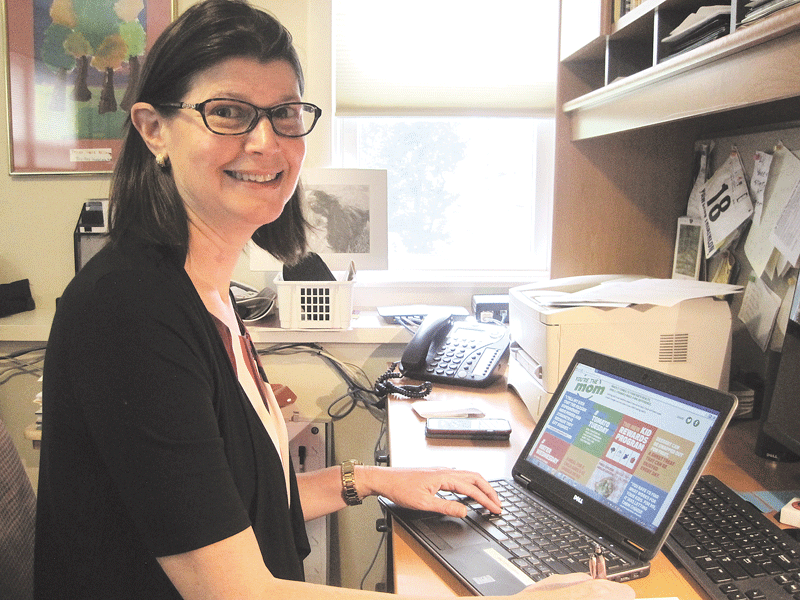
Natalie, a Springfield mother, is one of two women featured on murals for the “You’re the Mom” campaign.

Here’s a whopper of a statistic: according to the Centers for Disease Control and Prevention, about one-third of U.S. kids eat fast food every day.

But they’re not, for the most part, buying it for themselves; parents are making those choices.

That’s the issue that “You’re the Mom,” a new public-health campaign launched by ChildObesity180 at Tufts University, seeks to address. The campaign offers an array of messaging through various media, with one goal: get mothers thinking about the nutritional choices they’re making for their kids, and hopefully make better ones.

“We’re looking to increase the supply of healthier menu options for kids and create more consumer demand for those options,” said Linda Harelick, director of operations and communications at ChildObesity180. “We have engaged the restaurant industry and restaurant brands, and we’ve learned that there have been changes to menu options. Things have gotten healthier in the fast-food setting.”

However, she went on, “parents aren’t always aware of it. They get into the habit of ordering the number 7, or have their kids order a couple items off the dollar menu. Nobody’s studying the menu. We want to make them aware there are healthier options to choose from.”

In short, she explained, “we want to celebrate moms for the people they are and the role they play in families and communities — and give them simple tips.”

Harelick knows the issue is a complicated one, especially in a city with many low-income families living in neighborhoods underserved by stores selling fresh produce and other healthy options — a problem echoed by Kristine Allard, vice president of development for Springfield-based early-education provider Square One.

We want to celebrate moms for the people they are and the role they play in families and communities — and give them simple tips.”

“Particularly here in Springfield, where so many neighborhoods struggle with being part of a food desert, we know it’s not always easy to access good, healthy choices, and some families make fast foods their only option,” Allard told BusinessWest.

For families on a budget — often living near the poverty line — a visit to a fast-food drive-thru is often an exercise in filling up their children quickly at little expense, she went on. “But if we can make changes to what they order — swapping water for soda, ordering apple slices instead of fries, downsizing, not supersizing — that can make a big difference.”

She’s under no illusion that fast food is the best option for kids, “but if we can make small changes — and, in the long term, they make smarter choices — we can help reduce childhood obesity. It just makes sense.”

Square One is among a number of local organizations, including Partners for a Healthier Community and Springfield Food Policy Council, that are partnering with ChildObesity180 on the campaign, which is being piloted in the City of Homes, with plans to roll it out nationally in 2017.

Harelick recognizes that too few parents are immune to the combined pressures of packed schedules and picky kids bombarded with marketing for less-healthy options. But she believes the “You’re the Mom” campaign can make a difference, one choice at a time.

The campaign includes billboards, radio spots, bus advertisements, a heavy social-media presence (its hub is yourethemom.org), and murals by artist Marka27 — at 1072 State St. and 461 Main St. — featuring real Springfield mothers and promoting the message, “you’re the mom; you make decisions about what your kids eat,” Harelick explained.

The issue is nothing new to Partners for a Healthier Community (PHC), which joined several other community organizations eight years ago to launch Live Well Springfield, a movement to promote physical activity in area youth and increase access to healthy foods, a two-pronged approach to slowing a trend that has seen childhood-obesity rates triple nationwide and locally over the past few decades.

“What Tufts is doing is implementing a communications campaign that is very specific to low-income families with children who frequently eat at fast-food restaurants,” said Jessica Collins, PHC president. “If you have to eat at McDonald’s, make a healthier choice for your kid. Don’t buy soda; get water or milk. Give up the fries and choose apple slices. It’s another strategy to educate parents.”

Menu of Programs

Since its inception, Harelick explained, Child Obesity180 has brought in public-health advocates, industry and government leaders, and other nonprofits to design, pilot, evaluate, and scale initiatives intended to reverse the trend of childhood obesity — a full 180 degrees, in other words — within one generation’s time.

“We have very aggressive goals,” she admitted.

To get there, the organization has taken a multi-pronged approach. Among its initiatives:

• Its Active Schools Acceleration Project aims to increase physical activity in U.S. schools by identifying innovative solutions and giving schools the tools and resources needed to replicate proven models. For example, the New Balance Foundation Billion Mile Race has challenged students to walk and run 1 billion miles. “Five thousand-plus schools are participating in the campaign, driving excitement and interest in walking and running programs,” Harelick said.

• The Healthy Kids Out of School initiative works with afterschool enrichment organizations, like Boy Scouts, Girl Scouts, 4H, and youth sports leagues, to promote three principles: drink right, move more, and snack smart.

“Kids are eating more junk food than they need and not moving as much as they should, even in youth sports,” she noted. “We found if we communicated these three simple principles, we could have an impact. It’s been very well-received by the CEOs of these organizations.

“What we have learned is, we have to tie into the organizations’ values and practices,” she went on. “Scouts are looking to develop future leaders, and to be a future leader, you have to develop a healthy lifestyle. We developed a special healthy-habits patch for Boy Scouts and Girl Scouts, and developed a short online training for sports coaches.”

• The Restaurant Initiative, which is where “You’re the Mom” fits in, takes a three-pronged approach to reduce excess calorie consumption when children eat at restaurants: Increase consumer demand for healthier children’s meals, inform restaurant-industry leaders of the positive outcomes of increasing healthy menu offerings, and continue to conduct and disseminate original research.

• Another effort, the Breakfast Initiative — which promoted a healthy school breakfast and evaluated its impact on several key measures for children, including obesity prevention — completed its work in 2014.

That’s an area Square One knows something about, said Allard, who noted that many of ChildObesity180’s programs fit well into Square One’s mission of promoting well-being in children — not just academically, but physically and emotionally as well.

Linda Harelick

Linda Harelick says restaurant menus have gotten healthier and nutrition labeling has improved, but parents aren’t always aware of these changes.

“We know that kids who are well-nourished do well in school, so helping in a campaign like this, helping moms make healthy choices for their kids, is very much in alignment with our mission,” she explained. “Teaching kids to read, write, and be ready for kindergarten and academic success are very important, but we know there are so many more pieces than simply handing them a book.

“For many kids in our program,” she went on, “we provide two meals a day — breakfast, lunch, and two snacks — so we know they’re getting those meals with us, and we make sure they’re balanced and nutritious. But when they go home, they don’t always have those types of options. Access is the issue here, and budget is a challenge.”

Likewise, Partners for a Healthier Community, through the Live Well Springfield collective, has been trying to enhance school nutrition, from the preschool sector on up; make higher-quality foods, especially fruits and vegetables, more available in the city’s neighborhoods; and enhance urban agriculture and community gardens.

Live Well Springfield has also partnered with the city and the Pioneer Valley Planning Commission on improving area riverwalks, and has a hand in the city’s Complete Streets program, which is putting more sidewalks and bike lanes on streets. “People have to move around, basically,” Collins said. “That’s a national best practice cities are trying to do.”

Food for Thought

Harelick welcomes the partnerships with organizations like PHC and Square One. “We call ourselves a multi-sector organization,” she told BusinessWest. “We believe childhood obesity is an issue that can only be solved if everyone participates.”

In the case of “You’re the Mom,” which admittedly takes a narrow focus, “we saw an opportunity to address the issue of kids consuming excess calories in restaurants and at the same time improve the nutritional quality of selected meals,” said Christina Economos, director of ChildObesity180. “Moms have an enormous amount of influence on their kids, but sometimes they don’t feel that way. We want to support them and remind them that making small changes can add up to a meaningful difference in their children’s health.”

Harelick has significant experience in several sectors that are part of ChildObesity180. After an early career as a registered dietitian, practicing in clinical and research settings at Massachusetts General Hospital and Brigham & Women’s Hospital, she spent 17 years at Kraft Foods, overseeing strategic planning and marketing for iconic brands such as Maxwell House coffee and Post cereal. Upon leaving Kraft in 2008, she returned to academia to earn a doctorate in public health policy and management.

Having taken so many different views of the nutrition issue, Harelick is optimistic that her current organization’s goal — a full ‘180’ on childhood obesity — is within reach.

“We really believe that,” she said. “When we look at the problem of obesity, it seems very complex, but very interconnected. If you can influence one aspect of a child’s life, it has a wave effect on other aspects. And the more kids hear these messages, the greater the influence — it’s an echo effect.”

Beyond that, she said, “if we can impact culture in terms of the restaurant industry, convince them to offer lower-calorie foods, more nutritional quality, they’ll become societal norms for kids. It will become the norm to drink water on the basketball court, baseball field, or restaurant.”

Leaders at Square One — which, beyond its emphasis on healthy meals, offers an after-school physical fitness program called LAUNCH — say the work of ChildObesity180, and its new campaign, are effective complements to what’s already happening locally. “Our LAUNCH program is a health and wellness program for kids,” Allard said, “teaching them that fitness is fun, and that healthy eating can be fun and delicious.”

Just as Square One moves beyond talking about nutrition and fitness and actually provides opportunities for both, so Partners for a Healthier Community continues working toward greater access to healthy foods in the so-called ‘food deserts’ that tend to plague cities.

“The campaign bolsters work we’ve been doing locally, which is create access for families,” Collins said. “We have to start somewhere. It has to be both educating families to make the right decisions and also providing them access; if you just educate people, they’ll turn around and say, ‘but there’s no place to buy something healthy.’ That’s why the other strategies are so critical.”

Still, Harelick said, change begins with education, and she’s confident “You’re the Mom” will prove impactful enough to become a nationwide call.

“By delivering these messages and then reinforcing these practices at home,” she said, “we can really have a snowball effect.”

Joseph Bednar can be reached at [email protected]

Departments Incorporations

The following business incorporations were recorded in Hampden, Hampshire, and Franklin counties and are the latest available. They are listed by community.

ADAMS

Mount Royal II Inc., 99 Howland Ave., Adams, MA 0122. Themina Imran, 314 Old Farms Road West, Middletown, CT 06457. Real estate ownership and operation.

AGAWAM

Modern Olympic Inc., 470 School St., Agawam, MA 01001. John Krause, same. Internet sales.

BRIMFIELD

MA Trailriders, Inc., 125A Haynes Hill Road, Brimfield, MA 01010. John Blouin, 35A 3rd St., Webster, MA 01570. To raise awareness and support for the ATV community.

EAST LONGMEADOW

Loon Hill Management Co. Inc., 200 North Main St., Suite 204, East Longmeadow, MA 01028. Ernest A. Gralia, III, same. Management services.

GREAT BARRINGTON

Nonprofit Center Of The Berkshires Inc., 40 Railroad St., Suite 10, Great Barrington, MA 01230. Ronald M. Bernard, 182 Cold Spring Road, Sandisfield, MA 01255. A nonprofit, member-based organization providing education, information, products and services to nonprofits and civic groups in the Berkshire region.

LONGMEADOW

Longmeadow Police Benefit Association Inc., 34 Williams St., Longmeadow, MA 01106. Ewen MacEachern, 203 South Monson Road, Hampden, MA 01036. Providing benefits to its members upon sickness, injury and/or death and to engage in other civic, educational, charitable, and benevolent purposes.

McChen Restaurant Inc., 813 Williams St., Longmeadow, MA 01106. Michael Chen, same. Restaurant.

PITTSFIELD

Master Han’s US Taekwondo Inc, 141 Tyler St., Pittsfield, MA 01201. Yunhee Han, same. Taekwondo martial art center.

New Asain Garden Inc., 3 Newell St., Pittsfield, MA 01201. Limin Liu, same. Restaurant serves Asian foods.

SPRINGFIELD

Lucy’s Family Market Corp., 935 Worthington St., Springfield, MA 01105. Luz M. Lazala, 88 Surrey Road, Springfield, MA 01104. Grocery store.

WEST SPRINGFIELD

NV Concepts Unlimited Inc., 95 Apple Ridge Road, West Springfield, MA 01089. Timothy Bonito, same. Event production, talent management, and event promotion.

Briefcase Departments

Governor Signs Bipartisan Pay-equity Legislation

BOSTON — Gov. Charlie Baker signed a bipartisan pay equity bill last week, passed unanimously by both legislative branches, to ensure equal pay for comparable work for all Massachusetts workers and equal opportunities to earn competitive salaries in the workplace. The governor was joined by Lt. Gov. Karyn Polito, Senate President Stanley Rosenberg, Speaker of the House Robert DeLeo, Treasurer Deb Goldberg, State Auditor Suzanne Bump, state Sen. Patricia Jehlen, state Rep. Ellen Story, state Rep. Patricia Haddad, and members of the Legislature at a signing ceremony in the State House to enact S.2119, An Act to Establish Pay Equity, which will go into effect on July 1, 2018 for Commonwealth employers and employees. “I am pleased to sign bipartisan legislation to create a more level playing field in the Commonwealth and ensure that everyone has the opportunity to earn a competitive salary for comparable work,” Baker said. “I thank the Legislature for unanimously passing this bill and working closely with the business community to support women and families across the state.” Added Polito, “this legislation is an important step toward advancing more equal, inclusive, and thriving workplaces throughout the Commonwealth for women and families.” The new law will prevent pay discrimination for comparable work based on gender. The bill allows employees to freely discuss their salaries with coworkers, prohibits employers from requiring applicants to provide their salary history before receiving a formal job offer, and authorizes the attorney general to issue regulations interpreting and applying the expanded law. Under the new law, employers are permitted to take certain attributes of an employee or applicant into account when determining variation in pay, including their work experience, education, job training, or measurements of production, sales, or revenue. “This new law is an important step toward ensuring economic security for Massachusetts women and families. It makes vital updates that reflect our modern economy and balance the needs of workers and the business community,” said Attorney General Maura Healey, adding that “pay equity is not only a women’s issue, it’s a family issue, and with this new law on the books, we are closer to closing the pay gap in our state.” The statute of limitations laid out currently under the equal-pay statute will be expanded from one to three years, and employees will no longer be required to pursue a general claim of intentional discrimination at the Massachusetts Commission against Discrimination before filing a separate equal-pay claim in court.

ABA Bringing Franchise to Springfield This Fall

SPRINGFIELD — The Springfield Sting will be the first American Basketball Assoc. (ABA) team to call Springfield, the birthplace of basketball, its home when it commences play in November. The organization will boast top talent from the Greater Springfield area and beyond. The Sting will join the ABA’s Northeast Division for the start of the 2016-17 season, alongside teams in Boston, Providence, New York, Long Island, and New Jersey. The franchise will be owned by Zach Baru of Longmeadow. Baru’s past experience in sports and entertainment includes the Springfield Spirit of the National Women’s Basketball League, the Greater Springfield Pro-Am Basketball League, the Springfield Falcons of the American Hockey League, and the Miami Dolphins of the National Football League. Dr. Steven Sobel has been hired as the team’s first general manager and head coach. Sobel, a former Division II star at the University of Hartford, has spent more than 40 years coaching collegiate and professional basketball teams and players. During the offseason, he helms the Springfield Slamm of the Greater Hartford Pro-Am Basketball League. Sobel is also a nationally recognized motivational speaker and author of The Good Times Handbook: Your Guide to Positive Living and Exciting Life. “We are excited to bring professional basketball back to the city of Springfield. With Dr. Sobel at the helm, and potential supporters already reaching out, the possibilities for success here in the community are endless,” Baru said.

Free Legal Assistance Available to Small Businesses

SPRINGFIELD — The Western New England University Small Business Legal Clinic is now accepting applications from entrepreneurs and small-business owners seeking legal assistance for the fall 2016 semester. Under faculty supervision, law students assist clients with legal issues, including choice of entity, employment policies, contract drafting, regulatory compliance, and intellectual-property issues relating to trademark applications and copyright. This is a free service available to local businesses that would not otherwise have the resources to obtain these types of services. The Small Business Clinic at Western New England School of Law has assisted more than 300 small businesses. By using the clinic’s services, businesses can avoid problems by getting legal issues addressed early and correctly. It also provides students with an opportunity to get real-world experience. The Small Business Legal Clinic asks small-business owners to submit their applications by Monday, Aug. 15. Applications received after that date will be considered if additional resources are available. Students will begin providing services in September. For more information, call the clinic at (413) 782-1469 or e-mail [email protected].

Departments People on the Move

Health New England announced the recent appointment of Michael Marrone as Chief Financial Officer. In this role, he will lead all aspects of financial strategy for the organization. Marrone is also responsible for accounting and financial reporting and also oversees provider operations. He joins Health New England’s executive leadership team and reports directly to president and CEO Maura McCaffrey. Prior to joining Health New England, Marrone was chief financial officer, New England market at Aetna Inc. in Hartford, Conn. In this role, he was responsible for the profit and loss for all commercial and Medicare health, group, and dental businesses across health plans in six states. His career also includes more than nine years at Blue Cross Blue Shield of Massachusetts, where he served in various leadership roles in financial management, including medical economics, trend-management analytics, and informatics. Marrone holds a bachelor’s degree in business management with a concentration in economics from the University of Maine, Farmington, as well as an MBA from the University of Southern Maine Graduate School of Business. Based in Springfield, Health New England is a nonprofit health plan serving members in Massachusetts and Connecticut. A wholly-owned subsidiary of Baystate Health, Health New England offers a range of healthcare plans in the commercial, Medicaid, and Medicare markets.

•••••

Carmine DiCenso

Carmine DiCenso

Dakin Humane Society has named Carmine DiCenso Executive Director of its organization. The appointment comes following a national search after the departure of former Executive Director Leslie Harris. DiCenso has extensive experience in animal-welfare program management and innovative project development, most recently as executive director for the Providence (R.I.) Animal Rescue League. Prior to that, he was a program director at the Mass. Society for the Prevention of Cruelty to Animals and a manager at the Animal Rescue League of Boston. A former board member of the New England Federation of Humane Societies, he previously served as a board member for the Ocean State Animal Coalition, and as the Rhode Island state representative for the Humane Society of the United States Companion Animal Advisory Council. As the executive director at Dakin Humane Society, DiCenso will oversee all aspects of the organization’s work at its two locations in Springfield and Leverett. Dakin has more than 50 employees and nearly 800 volunteers who shelter, treat, and foster more than 20,000 animals annually. Dakin’s adoption centers find homes for more than 4,000 homeless pets each year. In addition, the Dakin Community Spay/Neuter Clinic, located in Springfield, recently conducted its 69,000th surgery since opening in 2009, making it New England’s largest spay/neuter provider. The organization also provides a pet-food bank, dog-training classes and pet-related workshops, plus humane learning programs. According to Nancy Creed, president of Dakin’s board of directors, “Carmine will be a terrific executive director. We’re thrilled to have him here to lead Dakin and inspire this organization’s future growth and achievements. He has significant experience in both human services and animal welfare, and understands the need to serve the human — as well as the animal — population of our community. His career has been devoted to making and keeping that connection.”

•••••

Berkshire Bank announced the expansion of its Wealth Management Group with the appointments of Elizabeth Gore to Senior Vice President, Trust Operations and Compliance, and Janice Ward to Senior Vice President, Wealth Advisor and Senior Fiduciary Officer. Gore is a graduate of New England School of Banking at Williams College with a degree in trust banking. She has more than 35 years of banking experience, 28 at Berkshire Bank. In her new role, she will oversee all aspects of operations and compliance for the Wealth Management team and the department’s trust accounting system. She is also responsible for fiduciary and tax work, preparation of annual probate accountings, implementing disaster-recovery policies, and assisting auditors. She currently manages the Lenox Wealth Management Office, assisting clients on a daily basis. Ward received her juris doctor from Western New England University and is licensed to practice law in both Massachusetts and New York. She also obtained her designation as a certified financial planner in 2011. She began her career with Berkshire Bank in 2012 as a wealth advisor and senior fiduciary officer. In her new role, she will oversee various fiduciary activities, including executor and trustee services and financial-planning activities throughout the Berkshire Bank Wealth Management footprint. She will also continue to serve as wealth advisor to a select group of clients, and now serves as president of the newly formed Berkshire County Estate Planning Council Inc., which took the place of the previous Estate Planning Council.

•••••

Ruth Banta

Ruth Banta

The Association for Community Living, which provides residential and community services for people with intellectual disabilities, has named Ruth Banta the new Executive Director, effective Aug. 22. Banta, who has served as the vice president for administration at the association since 2003, will oversee the $30 million organization, headquartered in Springfield. The association provides a variety of services to people with disabilities through its programs throughout Western Mass., including Community Resources for People with Autism, Specialized Home Care, Whole Children, an extensive residential division, and Valley Tees. Banta has more than 30 years of management, including positions at J.P. Morgan and Aetna. “I’m honored and humbled to be selected as the association’s next executive director,” Banta said. “I’m looking forward to working with all our constituents to meet the challenges we face to ensure that people with intellectual disabilities are able to build the lives they seek and deserve.” Banta has a bachelor’s degree from Smith College and an MBA from Yale University. She became interested in the human-services field when one of her sons was diagnosed with autism. She previously served on the board of Community Resources for People with Autism, a program of the Assoc. for Community Living. The Assoc. for Community Living, which is set to change its name to Pathlight in September, has been providing programs and services to people with developmental disabilities since 1952. Its programs include residential homes, supports for independent living, family-based living, recreation, enrichment, employment supports, family resources, autism supports, and more. Banta is an amateur photographer whose photographs have been exhibited in Western Mass. She has volunteered with the Special Olympics and coached the unified basketball team for five medal-winning seasons.

•••••

American International College (AIC) board of trustees member Peter Vogian made a gift to name a conference room in the new dining commons complex on campus. At a recent ceremony, Vogian was acknowledged for his many years of generous support to the college. AIC President Vincent Maniaci praised Vogian for his leadership as a trustee and for giving the college a space that provides an ideal venue for professional and academic meetings. “We know this room will be used by our students for both social occasions and networking opportunities. In this room, our students will learn leadership and presentation skills, they will collaborate and cooperate,” Maniaci said during the dedication ceremony. “Our students will leave this room better than when they walked in. The Peter J. Vogian Conference Room is but one manifestation of your generous spirit and your belief in our students’ potential.” Vogian has served as a member of the college’s board of trustees since 2001. Graduating from the Wharton School of Finance and Commerce at the University of Pennsylvania, Vogian began his career with Massachusetts Mutual Life Insurance Co. in 1960, retiring in 1993 as senior vice president of Pension Management Sales. In addition to his years of dedicated service to AIC, Vogian has donated his time and talent to serving on numerous boards, including Goodwill Industries of Springfield and Hartford and with professional and social affiliations including Chartered Life Underwriters of Pioneer Valley and the Melha Temple Shrine.

•••••

Christopher Buono has joined Anteris Solutions Inc. as Chief Information Officer. As CIO, he joins the executive team and also helps clients navigate the critical process of aligning technology decisions with organizational goals by identifying current needs while targeting a vision for the future. Buono has worked in the information-technology field for more than 20 years, including 12 years in leadership roles. He holds a bachelor’s degree in management information systems from the University at Albany Business School and attended the MBA program at Rensselaer Polytechnic Institute’s Lally School of Management. He holds numerous legacy technical certifications, including Microsoft Certified Systems Engineer, Certified Novell Engineer, Certified Information Systems Security Professional, and Cisco Certified Network Administration. He serves on the board of directors for WAM Theatre. Anteris Solutions was founded in 2002 to serve a variety of nationwide businesses by providing them complete IT solutions, including strategic planning, proactive management, security and hardware monitoring, and ensuring software and regulation compliance.

•••••

Karla Callahan

Karla Callahan

HUB International New England, a division of HUB International Limited, a global insurance-brokerage, risk-advisory, and employee-benefits firm, announced the hiring of Karla Callahan as an Employee Benefits Client Relationship Manager in the East Longmeadow office. Callahan has an extensive background in employee benefits and was previously employed by Health New England for more than 12 years, specializing in sales, underwriting, and member services. As part of the HUB employee benefits team, she will be responsible for assisting staff with client relations, service, sales, and administrative activities of new and existing group benefit accounts. Working closely with employers to maintain and better understand their employee-benefits packages and staying abreast of compliance restrictions and guidelines will be her other areas of focus.

•••••

Skoler, Abbott & Presser, P.C., a labor and employment law firm serving employers in the Greater Springfield area, announced that attorney Amelia Holstrom earned the Community Service Award presented by the Mass. Bar Assoc. and subsequently through its affiliate association, the Hampden County Bar Assoc. It is awarded to worthy attorneys who are members of both their local and state bar associations, and who have demonstrated excellence in community service. “The Western Massachusetts community has given so much to me throughout the years,” Holstrom said. “That is why I think it is so important to give back to my community. I am honored to have been presented with this Community Service Award. The award truly speaks volumes about the atmosphere that I work in. Everyone at Skoler Abbott is extremely supportive of community-service initiatives and understands the value of extending a helping hand to others.” Holstrom joined Skoler, Abbott, & Presser after serving as a judicial law clerk to the judges of the Connecticut Superior Court, where she assisted with complex matters at all stages of litigation. Her practice is focused in labor law and employment litigation. Since joining the firm in 2012, Holstrom has provided legal advice to employers who want to remain union-free and defended employers against claims of discrimination, retaliation, harassment, wrongful termination, and actions arising under the Family Medical Leave Act and wage-and-hour law. Additionally, she frequently provides counsel to management regarding litigation-avoidance strategies. Holstrom is a 2011 graduate of Western New England University School of Law, where she was the managing editor of the Western New England Law Review. She is a 2015 recipient of the 40 Under Forty award from BusinessWest, which honors individuals under age 40 who have achieved professional success and are active in civic organizations. In addition to her legal résumé, Holstrom is very active in the community. She is an ad hoc member of the personnel committee for the Food Bank of Western Massachusetts, a member of the board and executive committee for Girl Scouts of Central and Western Massachusetts, and board clerk at Friends of the Homeless.

•••••

Attorney Carol Cioe Klyman and Attorney Ann Weber have been recognized for their work on the 2016 Massachusetts Elder Law Sourcebook & Citator. Published by Massachusetts Continuing Legal Education (MCLE), the sourcebook is an important reference source in the growing fields of elder law and special-needs planning in Massachusetts. The sourcebook represents the editors’ selections of key reference materials from state and federal sources. It contains primary sources that are called upon daily in the representation of the Massachusetts elder and disabled populations, including statutes, regulations, case decisions, and community resources. The sourcebook would not have been possible without the editorial leadership of Klyman and Weber, said Maryanne Jensen, MCLE’s director of Publications. “They share MCLE’s goal to educate practitioners and others who advocate for, represent, and advise individuals facing the vicissitudes of aging and incapacity.” Klyman and Weber are shareholders at Shatz, Schwartz and Fentin, P.C., with offices in Springfield, Northampton, and Albany, N.Y. Klyman concentrates her practice in the areas of elder law, estate planning, special-needs-trust planning, estate settlement, guardianships, trust and estates litigation, and MassHealth appeals. Weber concentrates her practice in the areas of estate planning, estate administration, probate, and elder law. She has a particular interest in creative estate planning for authors, artists, farmers, and landowners, as well as federal and Massachusetts estate-tax planning. Attorneys may purchase the 2016 Massachusetts Elder Law Sourcebook & Citator in print version or as an e-book or e-article through the MCLE website, www.mcle.org.

Agenda Departments

Clowning Around for Shriners Hospital

Aug. 13: The Melha Shriners announced that supporter Wendy Hart has once again organized the third annual Clowning Around for Shriners Hospital, a family-friendly event set for 10 a.m. to 5 p.m. at VFW Post 872, 151 Point Grove Road, Southwick. Entertainment will be provided by the Shrine clowns, a traveling arcade, a photo booth, a dunk tank, and a DJ. The event will also feature a vendor fair featuring more than 40 local enterprises. “I am really excited about the opportunity to raise money for Shriners Hospital, and hope to increase the amount we raised over last year’s total,” Hart said. The event raised $2,000 for the hospital in 2015. Food and beverages will be for sale at the event. The Melha Shrine Clowns will present a skit show and spend the day mingling with children of all ages. Chris Howe, Shriner and president of the Melha Clowns, noted that “our clowns love days like this because we can help raise money for our hospital while just having lots of fun with all of the families in attendance.” Shriners Hospitals for Children – Springfield will receive 100% of the proceeds as it attempts to raise $900,000 for state-of-the-art X-ray technology (called EOS) which exposes children to a mere one-ninth of the radiation of traditional X-ray studies. For more information about the event, contact Hart at (413) 875-5743.

Oscar Hammerstein III Lecture

Aug. 17: Kimball Farms Lifecare in Lenox will host a lecture by Oscar Hammerstein III, grandson of famed lyricist Oscar Hammerstein, at 2 p.m. Those wishing to attend are asked to RSVP to (413) 637-7000 by Wednesday, Aug. 10. Hammerstein’s talk, titled “The Hammersteins: A Musical Theatre Family,” covers the century-long story of one of Broadway’s most creative and productive families beginning with Oscar Hammerstein I, described as a successful cigar and real-estate mogul who funded his theatre-building ambitions. The talk follows the family’s accomplishments through to Oscar Hammerstein II, who co-wrote the stories and words to such Broadway shows as Oklahoma!, South Pacific, Carousel, and The Sound of Music. Oscar Hammerstein III is a painter, writer, lecturer, and family historian who has devoted much of his life to studying and preserving his family’s heritage and contribution to American culture. He lectures frequently at universities, institutes, and theatrical and civic organizations on his family’s role in shaping the development of musical theatre and popular entertainment from the 1860s to the present.

Wistariahurst Summer Play Day

Aug. 20: Wistariahurst, Holyoke’s center for history, art, and culture, will host a free community event from 1 to 3 p.m., featuring lawn games, crafts, family-friendly tours, and more. Wistariahurst, the former estate of the Skinner family, includes three acres of formal gardens and grounds, a Holyoke history exhibit, an archival facility, and a preserved historic mansion. The afternoon’s activities will be inspired by the history and features of the site, including the fossilized dinosaur tracks which pave the entryway, the historically inspired rose garden, and turn-of-the-century garden parties. “As the summer season winds down, we want our gardens and grounds to be filled with families exploring and playing,” said Lisa Nicholson, program coordinator. “Dress up and have a cup of lemonade in the garden. Play a game of croquet or badminton like the Skinner family may have done.” For more information or to view a schedule of other upcoming events at Wistariahurst, visit www.wistariahurst.org.

Ice-cream Social, Open House at Linda Manor

Aug. 21: Linda Manor Assisted Living invites the community to an ice-cream social and open house from 11 a.m. to 2 p.m. Linda Manor is located at 345 Haydenville Road in Leeds. The open house will include complimentary ice-cream sundaes and tours of one of the Northampton area’s newest assisted-living communities. Linda Manor offers all-inclusive assisted living and memory care as well as the award-winning Linda Manor Extended Care Facility. For more information, or to RSVP for the event, call (413) 588-3316.

Ad Club Networking on Connecticut River

Aug. 25: The Advertising Club of Western Massachusetts invites guests to network on the Connecticut River on the famous Lady Bea, departing from event sponsor Brunelle’s Marina in South Hadley. Guests are invited to sip on a cocktail from the cash bar, enjoy light appetizers, and take in the scenery while mingling with writers, designers, printers, agency staff, photographers, web designers, marketers, and media from Western Mass. Registration begins at 5:30 p.m., and the Lady Bea will depart at 6 p.m. from Brunelle’s Marina, 1 Alvord St., South Hadley. Guests must purchase tickets in advance by Friday, Aug. 19 by calling (413) 736-2582, visiting www.adclubwm.org/events/calendar, or e-mailing [email protected]. Ticket prices are $20 for Ad Club members, $30 for non-members, and $20 for students with valid ID.

Slide the City

Aug. 27: Celebrate Holyoke welcomes the return of Slide the City to Holyoke on the Saturday of its three-day event, and will once again sell discounted tickets prior to the event. In addition, the Boys and Girls Club of Greater Holyoke is partnering with Slide the City to raise money for its organization and help secure volunteers for the day of the slide. Slide the City will return to the same location along Appleton Street. Tickets are currently available at slidethecity.com, and single tickets can be purchased for $20 on the day of the event. Those looking to purchase tickets in advance at a discounted rate can do so at Stop & Shop on Lincoln Street in Holyoke on Sat., Aug. 13, and Sun., Aug. 14, from noon to 4 p.m.; at the mayor’s office on weekdays; and at the Holyoke Farmers’ Market every Thursday from 10 a.m. to 2 p.m. Discounted tickets can also be found at celebrateholyokemass.com. For the second year, the Boys and Girls Club of Greater Holyoke will partner with Slide the City to recruit volunteers for the day of the event. For every volunteer signed up, Slide the City will make a donation to the Holyoke Boys & Girls Club. “The Holyoke Boys & Girls Club is thrilled to be partnering for the second year with Slide the City and the Celebrate Holyoke committee,” said Eileen Cavanaugh, president and CEO of the Boys and Girls Club. “Last year was a great experience, and we were so pleased with and grateful for the amount of volunteers that came out to support the club. I’m sure this year will be even better. We are looking forward to another fun event that allows our club to be part of Celebrate Holyoke.” Volunteers are still needed for various shifts throughout the day and will be helping with the following tasks: setup, registration tent (check pre-registered customers, take payment for new customers, etc.), slide monitors (check wristbands, help keep people moving along), cleanup, trash pickup, and loading trucks with gear and merchandise. Anyone who is interested in volunteering to raise money for the Boys & Girls Club of Greater Holyoke should e-mail Cavanaugh at [email protected]. Volunteers must be at least 16 years old. In exchange for their participation, volunteers will receive a Slide the City T-shirt and be provided snacks and refreshments during each shift.

Mini-Medical School

Sept. 15 to Nov. 3: Thinking of going back to school? Baystate Medical Center’s Mini-Medical School will give area residents an inside look at the expanding field of medicine — minus the tests, homework, interviews, and admission formalities. The Mini-Medical School program is an eight-week health-education series featuring a different aspect of medicine each week. Classes this fall will include sessions on various medical topics such as surgery, emergency medicine, anesthesiology, pathology, and several others. Many of the ‘students,’ who often range in age from 20 to 70, participate due to a general interest in medicine and later find that many of the things they learned over the semester are relevant to their own lives. The goal of the program — offered in the comfortable environment of the hospital’s Chestnut Conference Center, is to help members of the public make more informed decisions about their healthcare while receiving insight on what it is like to be a medical student. Baystate Medical Center is the region’s only teaching hospital, and each course is taught by medical-center faculty who explain the science of medicine without resorting to complex terms. All classes are held Thursday nights starting at 6 p.m. and run until 8 or 9 p.m., depending on the night’s topic. No basic science knowledge is needed to participate. Each participant is required to attend a minimum of six out of eight classes in order to receive a certificate of completion. The classes run from Sept. 15 through Nov. 3, and a full listing of topics and presenters can be found at www.baystatehealth.org/minimed. Tuition is $95 per person and $80 for Senior Class and Spirit of Women members. While it is not difficult to be accepted into the program, slots are limited, and early registration is recommended by calling (800) 377-4325 or visiting www.baystatehealth.org/minimed.

BerkshireSPEAKS

Sept. 18: The third annual BerkshireSPEAKS will take place at 1:30 p.m. at Hevreh of Southern Berkshire in Great Barrington. This year’s event will feature six Berkshire trailblazers and visionaries sharing their inspirational stories. BerkshireSPEAKS was established to create an opportunity for the entire community to hear from local residents who have had a significant impact on the Berkshires and beyond. “BerkshireSPEAKS continues to grow each year, with speakers whose passion reminds us that anything is possible,” said Toby Levine, event co-chair. “We have a fantastic program planned and look forward to an afternoon that brings the community together to share empowering ideas.” This year’s speakers include John Downing, CEO of Soldier On, a national organization fighting veteran homelessness; Nancy Kalodner, Berkshire Realtor, teacher, and arts supporter; Gwendolyn Hampton-VanSant, CEO and Founder of Multicultural BRIDGE; Mary Pope Osborne, award-winning author of the Magic Tree House series (130 million copies sold worldwide); John Hockenberry, author, journalist, and award-winning public radio host; and state Rep. William “Smitty” Pignatelli, who represents the 4th Berkshire District. A reception with the speakers will follow the presentations. Registration costs $15 online and $18 at the door. To register online, visit www.hevreh.org/berkshirespeaks.

Western Mass. Business Expo

Nov. 3: Comcast Business will present the sixth annual Western Mass. Business Expo at the MassMutual Center in downtown Springfield, produced by BusinessWest and the Healthcare News. The business-to-business show will feature more than 150 exhibitor booths, educational seminars, breakfast hosted by the Springfield Regional Chamber of Commerce, lunch hosted by BusinessWest, and a day-capping Expo Social. Current sponsors include Comcast Business (presenting sponsor), Express Employment Professionals, Health New England, the Isenberg School of Management at UMass Amherst, Johnson & Hill Staffing Services, MGM Springfield, and Wild Apple Design. Additional sponsorship opportunities are available. Exhibitor spaces are also available; booth prices start at $725. For more information on sponsorships or booth purchase, call (413) 781-8600, ext. 100. For more Expo details as they emerge, visit www.wmbexpo.com.

Departments Picture This

A photo essay of recent business events in Western Massachusetts August 8, 2016. Email ‘Picture This’ photos with a caption and contact information to
[email protected]

Income Statements

Junior Achievement of Western Massachusetts

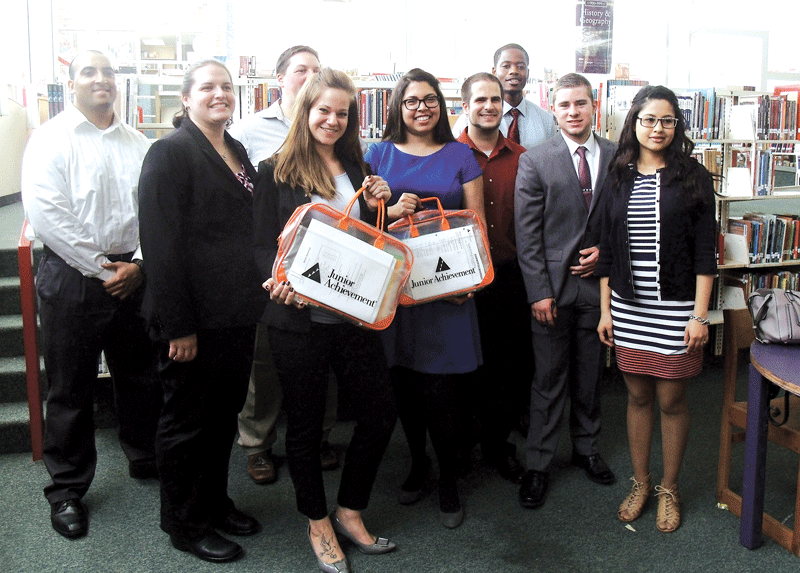
Junior Achievement of Western Massachusetts (JA) and Moriarty & Primack teamed up to bring JA’s Economics for Success program to all the eighth-graders at M. Marcus Kiley Middle School in Springfield in June. “To be able to teach students how to budget their income, and what getting an education after your high-school diploma can mean for your income, is a valuable lesson for everyone,” said Dahimeli Mercado, Moriarty & Primack staff accountant. Mark Laurenzano, guidance counselor at Kiley Middle School, added that “the students are eager to learn more about JA and business. Many of our students have participated in JA job-shadow experience. They are excited to work with the JA volunteers in the classroom today and learn about creating a budget.” Pictured, from left, are Moriarty & Primack’s Christopher Walker, Rebecca Connolly, Phillip Giguere, Jessica Putnam, Dahimeli Mercado, Jonathan Normand, Isaiah Odunlami, Roger Conklin, and Puja Karki.


Breaking Barriers

Berkshire Bank representatives

Berkshire Bank representatives recently visited the Center for Human Development’s (CHD) Disability Resources program to present a donation of $2,500. The bank’s gift supports CHD’s efforts to provide barrier-free recreational and competitive adaptive sports opportunities, as well as social gatherings and educational events for youth and adults with disabilities. Pictured, from left, are Luke Kettles, senior vice president of Commercial Lending for the Pioneer Valley, Berkshire Bank; Jennifer Bogin, vice president, Developmental Services, CHD; Rachel Keyworth, director, Disability Resources, CHD; Jim Goodwin, president and CEO, CHD; and Tim Hussey, assistant vice president of Commercial Lending, Berkshire Bank.


Global Lessons

Springfield College Professor of Management and U.S. Fulbright grant recipient Robert Fiore

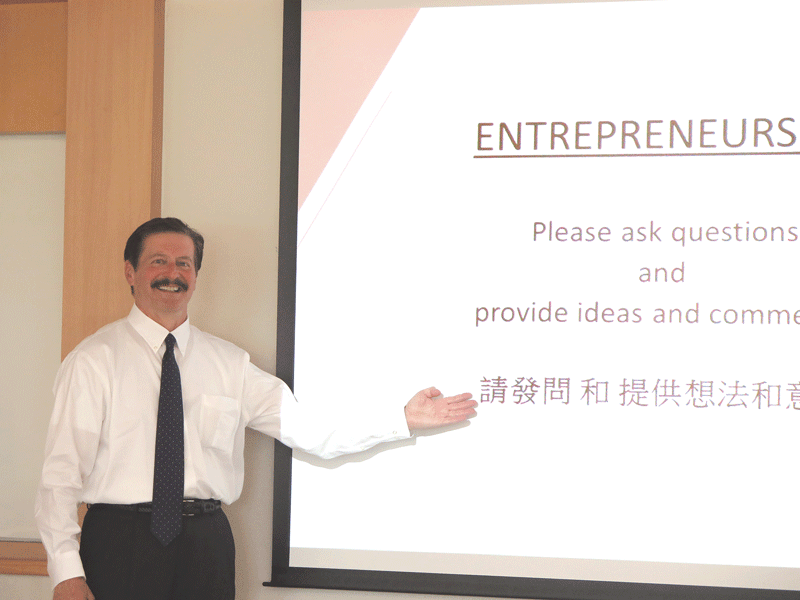
Springfield College Professor of Management and U.S. Fulbright grant recipient Robert Fiore recently traveled to China to collaborate with faculty and students at Hong Kong Baptist University in the academic area of entrepreneurship. Fiore assisted in the development of research and curriculum in China’s new initiative mandating the development of entrepreneurial courses to be offered at all universities. “The collaboration was exciting because it allowed us to exchange ideas on modes of entrepreneurial company formulation specifically dedicated to elevate geographically focused poverty and enhance economic growth within low-income regions by the use of micro-financing and village-based cooperative entrepreneurship,” said Fiore. As part of the program, Fiore presented biographical material of notable entrepreneurs to highlight their use in teaching and fostering entrepreneurship among students by analysis of the successful entrepreneur’s attitudes and behavior. He discussed lean entrepreneurial start-up procedures and methods as taught in the U.S., the U.S. perspective on crowd-funding financing sources, and legal issues of intellectual-property development.

Features

A Focus on ‘Tomorrow’

WMassBusinessLogo2016

The Western Mass. Business Expo, produced by BusinessWest since 2011, has always put an accent on the future when it comes to programming and exhibits.

But this year, that emphasis will be taken to a still-higher level, said Kate Campiti, the magazine’s associate publisher. And this is out of necessity.

“Anticipating the future and preparing for it have always been stern challenges for all business owners,” she explained. “But now, these assignments take on even more urgency because the business world is changing rapidly and there are many powerful forces that will shape the competitive landscape in the years — and even the weeks — to come.

“These include everything from evolving technology, which presents a host of challenges and opportunities, to the emergence of younger generations, especially the difficult-to-read Millennials, in leadership positions, to a host of new social and employment issues that business owners and managers must face,” she went on.

All these focal points and more will take center stage at the Expo, set for Nov. 3 at the MassMutual Center in downtown Springfield. Details of the day-long event are still being finalized, but the broad themes have been identified, and organizers are now filling in the canvas. Here’s what we know:

• The Expo’s overriding emphasis will be on the future, meaning the short term, long term, and intermediate term, because business owners must keep their focus on all three.
• There will be a special accent on what would have to be called the ‘workforce of tomorrow,’ with emphasis on the issues facing all employers — those of quantity and quality.
• Education will again be one of the main stress points of the Expo, with three stages, or rooms, for informative seminars — one to focus on sales and marketing, another on emerging trends in the workplace, and the third on the younger generation now coming of age in the business community.
• Innovation will also be on display, and in many different forms, from robotics demonstrations to exhibitors on the cutting edge of technology and manufacturing.
• The Expo will again put the region’s business sectors in the spotlight. More than 150 companies of all sizes are expected to exhibit on the show floor, gaining the attention of more than 2,000 visitors.
• Also in the spotlight will be many of the emerging startups across the region — the Expo exhibitors of the future, if you will — that are taking full advantage of the services now available to them through a burgeoning entrepreneurial ecosystem.
• Networking, networking, networking: there will be opportunities for this most important of exercises at the day-opening breakfast, again presented by the Springfield Regional Chamber of Commerce; at a lunch presented by BusinessWest; on the show floor; and at the popular, event-capping Expo Social.

“Since BusinessWest began producing the Expo five years ago, the basic strategy has been the same — to provide a value-laden event that will help business owners and managers gain exposure and also gain insight that will make them ever-more competitive in this increasingly global economy,” said Campiti. “For this year, the mission is the same, and this is shaping up as the biggest, best Expo ever.”

For details on the Expo as they emerge, and for sponsorship and exhibitor opportunities, visit www.wmbexpo.com.

What: The 2016 Western Mass. Business Expo

When: Thursday, Nov. 3

Where: The MassMutual Center, Main Street, Springfield

Features: More than 150 exhibitor booths; educational seminars; breakfast hosted by the Springfield Regional Chamber of Commerce; lunch hosted by BusinessWest; day-capping Expo Social

Sponsors: Comcast Business (presenting sponsor); Express Employment Professionals; Health New England; Isenberg School of Management at UMass Amherst; Johnson & Hill Staffing Services; MGM Springfield; Wild Apple Design


Daily News

AMHERST — Hampshire College has begun installing 15,000 solar panels on approximately 19 acres of its 840-acre campus, with an eye toward producing 100% of campus electricity from on-site renewable energy on an annualized basis. By its research, Hampshire is the first U.S. residential college to go 100% solar.

Hampshire’s two solar-power systems together will have a generation capacity of 4.7 DC/3.5 AC megawatts, enough to power about 500 American homes. They are expected to avoid the emission of approximately 3,000 metric tons of carbon dioxide annually, equivalent to taking almost 650 cars off the road. Construction of the arrays, representing the largest-known on-campus system among colleges and universities in New England and one of the largest in the Eastern U.S., is estimated to be completed by the end of this year.

Project partner SolarCity will construct the two photovoltaic (PV) solar arrays, each coupled with a 250-kilowatt (500-kilowatt-hour) battery-storage system. Under the project’s power-purchase agreement, the solar arrays and battery system will be built and operated by SolarCity, and Hampshire will purchase the electricity from SolarCity at a fixed rate that is lower than what the college now pays for electricity. Hampshire estimates it will save up to $400,000 per year for 20 years, up to $8 million total in electricity costs.

Hampshire is part of the American College and University Presidents’ Climate Commitment, under which the college has committed to implementing a comprehensive plan to achieve a carbon-neutral campus. In implementing its Climate Action Plan, Hampshire is also practicing its mission in the areas of innovative research, experiential education, social justice, forward-thinking operations, and environmental action.

“We’re extremely proud of this commitment to renewable energy, and of the social and environmental benefits it provides to our community,” said President Jonathan Lash. “Despite being a modestly resourced institution, in snow country, we’re going all the way with solar for our electricity.”

Daily News

BOSTON — Gov. Charlie Baker signed a bipartisan pay equity bill yesterday, passed unanimously by both legislative branches, to ensure equal pay for comparable work for all Massachusetts workers and equal opportunities to earn competitive salaries in the workplace.

The governor was joined by Lt. Gov. Karyn Polito, Senate President Stanley Rosenberg, Speaker of the House Robert DeLeo, Treasurer Deb Goldberg, State Auditor Suzanne Bump, state Sen. Patricia Jehlen, state Rep. Ellen Story, state Rep. Patricia Haddad, and members of the Legislature at a signing ceremony in the State House to enact S.2119, An Act to Establish Pay Equity, which will go into effect on July 1, 2018 for Commonwealth employers and employees.

“I am pleased to sign bipartisan legislation to create a more level playing field in the Commonwealth and ensure that everyone has the opportunity to earn a competitive salary for comparable work,” Baker said. “I thank the Legislature for unanimously passing this bill and working closely with the business community to support women and families across the state.”

Added Polito, “this legislation is an important step toward advancing more equal, inclusive, and thriving workplaces throughout the Commonwealth for women and families. We thank the Legislature for their collaboration with the Commonwealth’s employers and their commitment to creating more opportunities for Massachusetts skilled workforce.”

The new law will prevent pay discrimination for comparable work based on gender. The bill allows employees to freely discuss their salaries with coworkers, prohibits employers from requiring applicants to provide their salary history before receiving a formal job offer, and authorizes the attorney general to issue regulations interpreting and applying the expanded law.

Under the new law, employers are permitted to take certain attributes of an employee or applicant into account when determining variation in pay, including their work experience, education, job training, or measurements of production, sales, or revenue.

“This new law is an important step toward ensuring economic security for Massachusetts women and families. It makes vital updates that reflect our modern economy and balance the needs of workers and the business community,” said Attorney General Maura Healey, adding that “pay equity is not only a women’s issue, it’s a family issue, and with this new law on the books, we are closer to closing the pay gap in our state.”

The statute of limitations laid out currently under the equal-pay statute will be expanded from one to three years, and employees will no longer be required to pursue a general claim of intentional discrimination at the Massachusetts Commission against Discrimination before filing a separate equal-pay claim in court.

Daily News

GREAT BARRINGTON — Members of the Home Builders & Remodelers Assoc. of Western Massachusetts (HBRAWM) can now automatically support their own educational foundation under a new agreement with GoodWorks Insurance. The insurance agency will donate 20% of its commissions to the Home Builders Foundation of Western Massachusetts on all business and personal insurance policies members buy from it.

The Springfield-based contractors’ association has nearly 500 members in Hampden, Hampshire, Franklin, and Berkshire counties. GoodWorks Insurance is an independent insurance agency with offices in Great Barrington and Worcester.

“It’s a creative arrangement. Our members will be able to support our foundation without spending an extra cent,” said Brad Campbell, executive director of the Home Builders & Remodelers Association of Western Massachusetts. “GoodWorks has shown professionalism and commitment to work with our members.”

Just as important are the variety of services and solutions GoodWorks Insurance can offer to association members, he added. “It gives us more top-notch products and services in our holster to offer our members.”

Over the years, HBRAWM has provided $500,000 in scholarships and other grants to support the building trades. Besides college scholarships, the foundation offers $500 tool scholarships to vocational-school graduates to help them get started in their careers.

GoodWorks Insurance donates half its operating profits to local nonprofits that support education, healthcare, and public safety. Besides its Massachusetts offices, it has Connecticut offices in Avon, Columbia, Glastonbury, and New Milford. Serving more than 10,000 clients, GoodWorks has special expertise serving building contractors, nonprofits, fuel dealers, aerospace firms, and manufacturers, providing both insurance and surety bonds.

Daily News

SPRINGFIELD — Western New England University is welcoming 25 Mexican students through Aug. 20 under the support of the U.S. Department of State’s 100,000 Strong in the Americas initiative, and the complementary Mexican Ministry of Education Proyecta 100,000 initiative.

Western New England University was selected as a host location for the joint U.S./Mexican higher-education programs with the assistance of Bridge Pathways, the university’s international ESL partner. Over the next four weeks, the Mexican students will be living in Commonwealth Hall, dining in the St. Germain Campus Center, and receiving instruction in Herman Hall by ESL faculty and guest speakers. They will also be touring the region, including Boston and other locations.

For more information on the U.S. and Mexican international higher-education programs, click here.

Daily News

PITTSFIELD — This summer, the Berkshire Museum is partnering with the Lemelson-MIT Program in mentoring a JV InvenTeam at Monument Valley Regional Middle School in Great Barrington. Lemelson-MIT JV InvenTeams are comprised of students who hone their hands-on skills and enrich their STEM education through invention-based design activities.

Berkshire Museum educators are leading the classes based on materials and coursework provided by the Lemelson-MIT Program. Thirty-two fifth- and sixth-grade students are participating three days a week, July 5 through Aug. 3. The middle-schoolers at Monument Valley have completed a unit on designing and prototyping shoe soles, creating soles for a range of different activities. The students came up with ideas for their shoe soles, modeled them in clay, and cast them in urethane to complete their prototypes. They are now working on sound; they have dissected earbuds to learn about speakers, created their own electromagnets from common household objects, and built speakers out of paper plates.

The Lemelson-MIT Program continues to celebrate outstanding inventors and inspires young people to pursue creative lives and careers through invention. JV InvenTeams are currently located in four states: Massachusetts, Texas, Oregon, and California.

Students participating in JV InvenTeams learn how to safely use tools and explore new materials to use in hands-on projects. Teams of students practice invention-based design activities and apply their learned skills to create useful and unique projects. They build confidence and curiosity around STEM areas including structures, electricity, materials, and robotics.

Community Spotlight Features

Community Spotlight

John Flynn

John Flynn says Hampden’s new, $3 million police station will be finished next month.

John Flynn is extremely proud of Hampden — so proud he can’t help talking at length about the close-knit atmosphere he claims pervades every section of town.

“The word that best describes Hampden is ‘community’; it’s a place where people care about their neighbors,” said the chair of the Board of Selectmen. “I talk to people all the time who tell me they were surprised to find their neighbors went out of their way to meet them and bring them food when they moved to our town. It still happens here because we are all about community.”

Flynn added that the selectmen feel the same way about Hampden. “We can’t solve everyone’s problems, but each person is treated with respect,” he told BusinessWest.

Doug Boyd agrees. “Hampden is a great community with a lot of small businesses and self-employed people. The governance is very responsive to issues, and since everyone knows everyone else, communication is very easy,” said the co-chair of the Advisory Committee and member of the Community Preservation Committee.

“It’s what makes Hampden different from other cities and towns,” he continued, explaining that, although there has been a fair amount of development and a significant increase in the number of new homes in Hampden over the past 40 years, the town’s population has increased only slightly, and everyone has an equal voice in determining how tax dollars are spent.

But change has occurred, and the biggest project has been the $45 million conversion of the former Hampden Country Club into what the owners call a ‘lifestyle club’ called GreatHorse that features not only a championship golf course, but a plethora of offerings designed to appeal to families.

“The club was built in the early ’70s and has had four owners,” Flynn noted, explaining that it went up for auction in 2011 and was purchased for $1.4 million by the Antonacci family, which owns USA Hauling and a number of other business ventures.

Their original plan was simply to make improvements to the golf-course bunkers, but one improvement led to another, and it soon morphed into a major undertaking.

Today, the only thing that remains of the former course is the routing of its holes: everything else is new, including the irrigation system, tee boxes, fairways, greens, bunkers, and cart paths.

The old clubhouse was knocked down in 2013, and a new, state-of-the-art, 25,000-square-foot facility took its place. Amenities include two semi-surround simulators for indoor teaching, a fitness center, a salon, massage rooms, a barber’s chair, and an 185-seat dining area that has individual wine lockers and an adjacent horseshoe bar with seven TVs.

There is also an outdoor patio that boasts five TVs and a large, circular firepit; and family fun can be found in the 75- by 30-foot outdoor swimming pool, sprinkler play area, and bocce courts.

“The property was closed for almost three years while it was being rehabilitated, but today it is truly a showpiece,” Flynn said.

Boyd agreed and said the transformation represents a significant investment, one that benefits the entire community.

Public Projects

Residents recently voted to build the town’s third solar farm on two parcels of land that contain a capped landfill. Two other solar-photovoltaic, electricity-generating facilities were built on private property in recent years, and Hampden is waiting for permitting from the state for its newest farm, which will be built and operated by Amaresco Inc.

“It represents a substantial investment that will increase tax revenue without a corresponding increase in services,” Boyd noted, adding that, because Hampden has a unified tax rate, residents and businesses benefit equally when new sources of revenue are developed.

Flynn said the solar farm could generate $200 to $300 a year in taxes, and although that amount of money might seem negligible to some cities and towns, the majority of Hampden’s budget is paid for by property taxes, and small amounts add up, so officials are always looking for new ways to generate income.

“Money from the solar farm could be put toward a new dumptruck or another capital expenditure,” Flynn noted.

National Grid also made an $11 million investment in Hampden last year when it built a new substation that connects 6,500 customers in East Longmeadow, Wilbraham, Hampden, Monson, and Palmer to the larger Massachusetts power grid. The company says the new infrastructure increases its ability to supply backup power to the area, and not only will decrease the number of electric outages but will also improve restoration times when they occur.

“Hampden is where National Grid’s main trunk is located,” Flynn noted. “The new substation will generate $250,000 in tax revenue, and the company told us they plan to add to it every year.”

Hampden is also building a new, $3 million police station on Allen Street. The 5,000-square-foot building will be paid for with a 20-year bond, and is expected to be completed next month. It will replace the current, 900-square-foot station in Town Hall which is sorely inadequate and doesn’t allow for any privacy because other town offices share the same hallway.

Flynn said town officials explored the possibility of building a new station for more than a decade before voters finally cast ballots in favor of the project, but every effort was made to explore costs and viability before the concept was presented to residents at a town meeting.

“We assembled a building committee that went over every detail very carefully. The committee was made up of residents as it’s their money,” Flynn said, referring again to Hampden’s close-knit community and the way information is shared and decisions are made.

Continued Progress

Flynn said the town’s current focus is a half-mile strip on Main Street that needs revitalization. Opportunities for businesses exist there: Hampden Hardware is for sale, and a nearby Cumberland Farms property has been vacant for at least 15 years.

“Both properties overlook the Scantic River,” Flynn said, explaining that the Board of Selectmen recently sought help from state Sen. Eric Lesser to apply for a business-development grant to help bring new life to the area.

“But we take a team approach to everything we do; we hold frequent public meetings, and if we all don’t agree, a project doesn’t happen,” he noted.

In addition, the Community Preservation Committee has consistently spent money to acquire and preserve land, which is something town residents support.

The majority of properties Hampden has acquired were brought to the town’s attention by the Minnechaug Land Trust, a non-profit agency run entirely by volunteers who administer and maintain Minnechaug Mountain and Goat Rock Trail in Hampden, as well as two properties in Wilbraham.

Flynn told BusinessWest that the group coordinates with the state to put together packages that allow the town to acquire land for preservation and conservation.

“Although we don’t gain any tax revenue from these properties, they help to maintain the intangible character of the town,” he said.

Boyd noted that Memorial Park sits directly across from the vacant Cumberland Farms property, and the Parks and Recreation Department has spruced up the playing fields, built a new pavilion, replaced an old playscape, and built a thriving summer program around the spray park on the property.

“Usage is up, and a group of people would like to see the town improve that area of Main Street to keep the good things going that are happening at the park,” he said, adding that, thanks to the Minnechaug Land Trust, the town acquired two parcels of land adjacent to the park, and resident Charles Thompson has volunteered his time to blaze new trails, improve rudimentary ones that existed, and maintain them on a continuing basis.

Laughing Brook is also in conversation with the town to launch a capital campaign to build a new pavilion, and Flynn said the nature preserve continually expands its menu of programs and events.

Hampden is also making a significant investment in its infrastructure. Three years ago residents voted to spend $2 million over a five-year period to rebuild their roads; and Hampden and East Longmeadow recently joined together to submit a grant application to the state through the Pioneer Valley Planning Commission.

Any money gained will be divided between the towns, but Flynn said Hampden could use its share to install sidewalks, because there is only one existing sidewalk in the town.

Another development kicked off in 2014 when Bethlehem Baptist Church on 216 Allen St. acquired a parcel of land directly across from it. It built a new, $6 million, 35,000-square-foot church on the site that opened last fall; it seats 625 people and houses a café, activity center, children’s wing, adult-education wing, and section dedicated to middle- and high-school age youth.

Life Church purchased Bethlehem’s former building, and although it won’t bring in any new tax revenue, said Boyd, “it’s a productive use of the property.”

The key to Hampden is balanced growth, which officials and residents strive to achieve while maintaining the character of the town and strong sense of community that has been its trademark for generations.

“Our town is well-governed, efficient, and responsive, and if someone has a problem, it’s not difficult to find the right person to address it. And many, many residents, including myself, volunteer to help,” Boyd said. “It’s not always easy in today’s busy world to make the effort, but we have a lot of people willing to do it.”

Hampden at a glance

Year Incorporated: 1878
Population: 5,139 (2010)
Area: 19.7 square miles
County: Hampden
Residential Tax Rate: $19.36
Commercial Tax Rate: $19.36
Median Household Income: $80,751 (2013)
Family Household Income: $90,688 (2013)
Type of government: Board of Selectmen
Largest Employers: Hampden-Wilbraham Regional School District, Rediker Software Inc., Hampden Police Department
Latest information available

Education Sections

Study in Strategic Thinking

Ramon Torrecilha

Ramon Torrecilha

Ramon Torrecilha took the helm at Westfield State University in late January. Well before he arrived, he understood that the school and its many constituencies were poised to move forward and get to the next level. Since arriving, he’s only become more convinced that the institution is ready to make a positive leap. The challenge ahead is taking the ambitious goals that the school has put down on paper and making them reality.

Ramon Torrecilha recalls that, maybe 15 months or so ago, he was a candidate for a number of advertised college presidents’ positions in several states.

But upon visiting the Westfield State University campus and talking with members of several constituencies there, he decided to drop out of several of those other searches, including the one taking place at another school in the Bay State. When asked why, he started with a quick answer that required a lengthy explanation.

“It was that kind of institution,” he told BusinessWest, using that phrase to describe what he encountered as a student at Portland (Oregon) State University in the early ’80s. Like other schools at the time, it was suffering budget difficulties and undergoing staff reductions. The faculty that remained were dedicated and singularly focused on student success, he recalled.

“The relationship I was able to develop with faculty allowed me to have a transformative experience at Portland State,” he recalled. “And when I looked around here, I felt that Westfield State was very similar in that regard. You get a strong sense of community here.

“We’re student-centered; our faculty members are committed teachers, stellar researchers, and faculty that cares about student engagement,” he went on, clearly proud to shift the tense of his remarks to the present, and thus use terms like ‘we’ and ‘our.’ “So there was an alignment between myself and the kind of institution I was looking for, and Westfield State University.”

Beyond these characteristics, though, Torrecilha, who knew very little about the school before his first visit and was diligent in his “discovery process,” noted that there was something else about the institution that became apparent — and appealing — to him.


 Go HERE for a list of Colleges in Western Mass.


“The sense I got was that the institution was really ready to move forward — it was ready for the next stage,” he said, using a phrase with many applications.

For starters, it meant moving on from the controversy, and statewide negative press, that accompanied the ouster of his predecessor, Evan Dobelle, amid reports of extravagant and reckless spending practices — although Torrecilha believes the school has, by and large, already done that.

“There was an interim president in place [Elizabeth Preston] for two full years, and she did a tremendous job of stabilizing the institution,” he explained. “Westfield State is a very resilient institution; it has what we call good institutional bones. It showed to the higher-education community that it was much, much stronger than a hiccup in leadership.”

But that next stage also refers to a host of other initiatives at this school of roughly 6,000 students, from expanding programs, especially in healthcare, to broadening graduate programs and generating more momentum in regional and statewide efforts to get more people into college and then successfully on to completion of a degree program.

the state university

Ramon Torrecilha says he wants to make Westfield and the state university within it true destinations.

A sociologist by trade, Torrecilha will bring to his new position a deep understanding of multiculturalism and the issues confronting different demographic groups, but also his own opinions on how college presidents should approach their work, one forged through roughly a quarter-century in academia.

“When you think about it, presidents don’t run anything — presidents provide a sense of direction, identify priorities for the institution, and provide a vision and a map for how we’re going to get there,” he explained. “But it’s really the faculty and staff that run the place, so understanding how to do this and understanding the organizational psychology of the institution becomes really important in the presidency.”

For this issue and its focus on education, BusinessWest talked at length with Torrecilha about his decision to take his career 3,000 miles to the north and east, and how he intends to lead efforts to draft that road map for taking this 178-year-old institution to the proverbial next stage.

Course of Action

Visitors to the president’s office at WSU — and a host of other spots on campus, for that matter — can pick up some intriguing reading material if they are so inclined.

Indeed, in an effort to fully communicate what he has seen, heard, and learned since arriving on campus in January — and also to set a tone for what he wants to happen next — Torrecilha has printed a compendium that details it all.

It’s called the “President’s First 100 Days Report,” with the working subtitle “Vision for a Model, Comprehensive Public Institution.” And it includes everything from a detailed accounting of the new president’s meetings since he took the helm — 102 with direct reports, 84 with campus constituents, 11 with the Westfield State Foundation, and five at alumni events, for example — to the results of an extensive survey of students, faculty, and staff.

Torrecilha said the purpose of the report was to put down in black and white (and a host of colors as well) the sentiments he expressed about where the school is and where he and those various constituents want it to go, and also state the basic tenets of a new strategic plan for the school.

That plan will have a number of key bullet points, including stated goals common to all of the Commonwealth’s public schools — increasing retention, improving graduation rates, and decreasing the so-called ‘achievement gap’ among state residents of different demographic groups. But there will be some more specific planks as well.
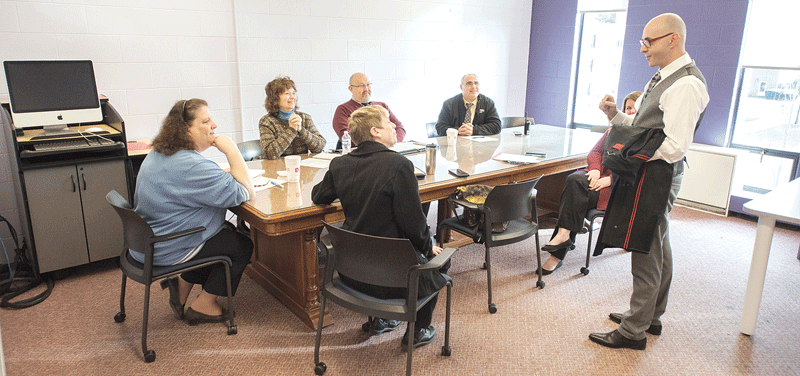
Ramon Torrecilha

Ramon Torrecilha has been meeting with a host of constituencies since his arrival in January.

These include a broad push to strategically grow graduate programs, which will in turn provide financial and other sources of support for undergraduate programs; better engage alumni, many of whom go on to live and work in the Bay State upon graduation; and strengthening ties to the community, meaning both the host city and the region as a whole.

“Achieving student success does not come from just one mind,” Torrecilha writes in the report. “Currently, we possess the brushstrokes of a vision. But decisions about how we are going to achieve our goals is ongoing. The process is fluid and organic, and relies on collaboration from students, faculty, staff, and other partners.”

Roughly translating this passage, Torrecilha acknowledged that it’s one thing to put goals, aspirations, and visions down on paper. Making them reality is quite another.

“The next fiscal year will bring the hard work of taking ideas on paper and making them happen,” he explained, adding that the overarching goal, or assignment, is to make Westfield and the university there a true destination.

He believes the university’s ready — and he’s ready — to do just that.

And he’ll bring to the task a broad résumé of experience, one that includes everything from experience in the classroom to a host of administrative positions.

Our story starts at Portland State, where Torrecilha majored in sociology and became inspired by a faculty member to get the graduate degrees needed to teach that subject, which he did, with first a master’s at Portland State and then at the University of Wisconsin at Madison, which had one of the nation’s top programs in that field.

Achieving student success does not come from just one mind. Currently, we possess the brushstrokes of a vision. But decisions about how we are going to achieve our goals is ongoing. The process is fluid and organic, and relies on collaboration from students, faculty, staff, and other partners.”

His specific fields of study were demography, poverty, and socioeconomic developments, and this would shape his teaching, starting at Berkeley College in New York, where he taught, among other things, a course titled “Minority Groups.”

In the course of doing so, he essentially refocused it — on sociological concepts, rather than specific demographic groups. He eventually wrote a paper with a graduate student on how to redesign such courses nationally, and it caught the attention of the American Sociological Assoc.

“The next thing I knew, they called me and said, ‘come to Washington and help us think about how to fuse multiculturalism into the curriculum,” he told BusinessWest, adding that this began a stint as director of something called the Minority Fellowship Program and Minority Opportunities Through School Transformation.

From there, he went to the Social Science Research Council in New York, working specifically as director of the Public Policy Research Program on Contemporary Hispanic Issues, before shifting back to higher education and a stint first as director of Multicultural Programs at Mills College and then executive vice president of the Oakland, Calif. School.

He then served as provost and executive vice president at Berkeley College, before returning to Mills College and service in a variety of roles, including interim president. His most recent stop was as provost at California State University, Dominguez Hills.

By 1993, he said, he had made becoming a college president his stated goal, and he spent his career preparing himself for that eventuality.

“In academia, you have to sort of expose yourself to different things and have jobs in the many divisions that form a university,” he explained, “in order for you to harness the know-how and understanding of the different parts of the institution, and the sector.”

Which brings us back to last spring, and his decision to pull out of several presidential searches and focus on WSU.

Degrees of Momentum

Torrecilha said this choice came down to a word many use upon making a career decision of this kind: fit.

“In higher education, the question of fit, both from the standpoint of the candidate and the standpoint of the institution, becomes an important consideration,” he explained, adding that, in all matters that mattered to him, the fit was ideal.

He was looking for a school with a student-centered focus, and the school was looking for someone willing to make a substantial commitment to the school and the host city — and spent a year considering more than 400 candidates to find such an individual.

By commitment, Torrecilha said a stay that would be at least seven or eight years, out of necessity. “It takes that long for someone to really put some strategic initiatives down and then make them happen.”

As he talked about how he intends to go about meeting the goals set down in his first major communiqué to the WSU campus, Torrecilha said he will bring to the task an attitude, or mindset, far different than that of his controversial predecessor.

Summing it up, he said it comes down to putting the school, and especially its students, first — always. This sounds simple and quite obvious, he said, but some college and university presidents tend to forget this basic premise and make it about them.

“I want to serve as the president, but not be the presidency,” he said, choosing those words carefully. “It’s not about me, and as a sociologist I understand the differentiation.

“You bring to the job qualities that allow you to create that road map and enable you to work with members of the community,” he went on. “But you have to be able to put yourself on the side and think institutionally: ‘what’s the best thing for the institution?’ You have to remove personalities from that process.”

This is the approach Torrecilha says he will take to the various initiatives outlined in his “First 100 Days” report. These include efforts to expand and enhance graduate programs, thus making the school more of that destination he described, and for more types of students.
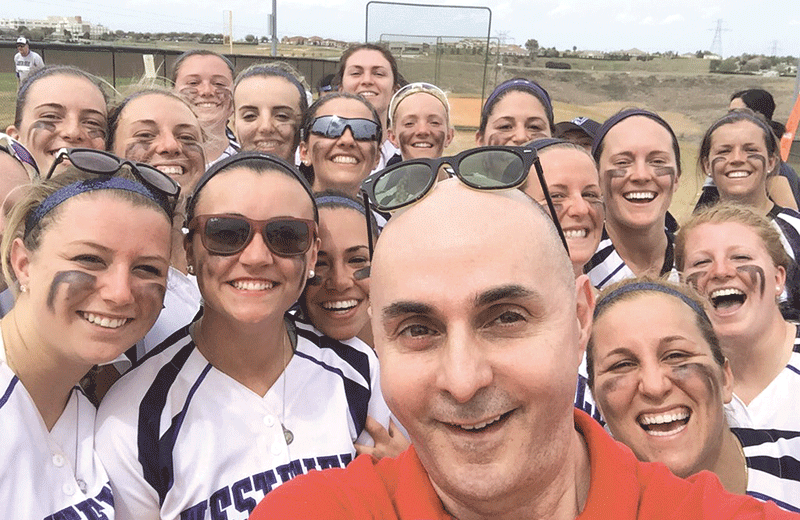
Ramon Torrecilha with the WSU soccer team

Ramon Torrecilha with the WSU soccer team

This strategic step will also help not only with broadening the school’s reputation — it has been known throughout its history as a teachers’ college, and more recently for criminal justice — but also in withstanding certain demographic shifts (something Torrecilha obviously understands) and especially smaller high-school graduating classes for the foreseeable future.

“Birth rates are declining, and the numbers of traditional college students are going down, and for this reason, most of our growth is going to come at the graduate level,” he said, citing, as one example, a new physician assistant master’s-degree program, the first of its kind for a public school in the state.

But those smaller high-school graduation classes means WSU, like all the other public schools in the Bay State, will have to become more diligent about helping students — traditional and non-traditional alike — enter college and then leave it with a degree.

This challenge explains many of the affiliation agreements between WSU and the area’s community colleges — programs that facilitate moving on to the four-year institution — and also why Torrecilha is a strong supporter of the state’s Commonwealth Commitment program, which incentivizes individuals (through rebates on tuition and fees) to enter a community college, graduate in two and a half years or less, move on to one of the state universities or UMass campuses, and wrap up a baccalaureate degree in no more than four and a half years.

When asked about the challenges WSU would face if a large number of students took the state up on its offer, Torrecilha replied simply, “that would be a really good problem to have.”

Applying Lessons

He was speaking about the state, the business community, and area cities and towns that would benefit from having a better-trained workforce. But he was also speaking about the state’s public schools and especially WSU, which embraces its role in training individuals for a global, technology-driven economy.

This is part of that ‘moving forward’ and ‘moving to the next stage’ vibe, for lack of a better word, that Torrecilha experienced when he first visited the campus on Western Avenue.

That vibe was a big factor in prompting him to take his name out of consideration for other presidents’ jobs and focus his sights on WSU. And it’s one he believes will take the school to the various destinations on the road map he’s helping to create.

George O’Brien can be reached at [email protected]

Education Sections

Building a Launchpad

Isiah Odunlami

Isiah Odunlami will be among the attendees at the first Startup Lean Weekend, staged by Elms College’s Center for Entrepreneurial Leadership.

Isiah Odunlami is an accountant by trade, currently handling audit and tax work for Springfield-based Moriarty & Primack. He enjoys the work, and, like most in this field, finds the ability to help clients grasp issues and solve specific problems quite rewarding.

But while he’s obviously an accomplished ‘numbers guy,’ ‘bean counter,’ or whatever else one chooses to call those in this field, he believes he has other talents — as a leader, role model, and motivator.

He’s done a few motivational talks, including some before young people in his hometown of Providence, R.I., and recently pieced together a video that enables him to put some of his thoughts, or messages, as he prefers to call them, before potentially much larger audiences.

“It still needs some work, to be sure,” he said of that video, adding quickly that many have already seen it and been moved by it — so much so that he is advancing and escalating thoughts of turning these talents into a business venture. And to do that, he knows he needs contacts, support, advice, direction, and some kind of affirmation that this is something he can sell.

His quest for all the above will bring him to the Elms College campus in Chicopee on July 29 for something called the Startup Lean Weekend (subtitled “Creating Customers and Value”), which is aptly named.

Indeed, this is a full weekend of programs, designed for people who are just getting started, and focused on the Lean Launchpad concept, which involves accelerating the traditional startup method of creating a business plan and then launching a venture from it.


 Click HERE for a list of area Colleges with MBA Programs


It is the first initiative of the Elms College Center for Entrepreneurial Leadership (CEL), which was created for … well, people like Odunlami. These are individuals and teams who are not quite ready for prime time as entrepreneurs and, therefore, a group like Valley Venture Mentors (VVM) and its accelerator program, designed for companies with developed concepts and, in most cases, already-established businesses.

But they do have ideas, said Amanda Garcia, CPA, director of the CEL and an associate professor of accounting at Elms, adding quickly that many don’t know whether that idea will sell, how it can be sold, and to whom. And they need to find these things out before they invest significant amounts of time, money, and sweat in that concept.

“Research shows that 42% of startups fail because of a lack of product-market fit,” she explained. “What the Startup Lean Weekend will help people do is flush out an idea and determine if there’s a market for it before they spend a lot of money.”

Amanda Garcia

Amanda Garcia says the basic mission behind the CEL is to help those with entrepreneurial energy “fail less.”

The program will feature a host of specific programs, which all take the form of learning opportunities, networking platforms, or both, said Garcia, listing everything from an “idea jam” to a business pitch competition to a networking dinner. By the time it’s over, participants — and the college is expecting about 30 of them — will have a much better idea of whether there is a market for their concept and how to take that idea forward.

Over the course of the next year, there will be other forms of programming, including a Lean Launchpad course, which will take participants down the pathway of building an idea into a venture, as well as other classes on subjects ranging from marketing to financial planning (more on all this later).

Both Garcia and Nancy Davis, business development specialist for the CEL and Elms’ MBA program, acknowledged that there is a great deal of energy in the region concerning entrepreneurship and educational programs focused on this subject. The emerging goal at Elms was to be part of this movement, while not duplicating any of the efforts taking place at other colleges and universities, or within organizations such as VVM and the Grinspoon Foundation’s Entrepreneurship Initiative.

With that goal in mind, school officials met with these various players, asking questions and listening very carefully to the answers. What emerged was a desire to meet noted gaps in programming, and, eventually, a vehicle for doing so — the CEL.

For this issue and its focus on education, BusinessWest takes an in-depth look at this initiative and how those at Elms believe it will be a valuable addition to what is becoming a bourgeoning entrepreneurial ecosystem in the region.

The Idea Is Ideas

As she talked about the CEL, Davis said the name was chosen carefully. It reflects a desire for this new program to focus on entrepreneurship, leadership, and how these skills are intertwined in many ways.

And this brings her back to those many discussions that were had, not only with other colleges and agencies like VVM, but also with those administering the region’s many leadership programs. What came out of those talks was a need for something that wasn’t a four-year degree program, but could help individuals (again, like Odunlami) who have some entrepreneurial energy and could use some help with tapping it.

Putting things another, more colorful way, Garcia said the CEL, and especially its Lean Launchpad weekend and course, will help individuals “fail less,” and save money in the process.

Elaborating, she reiterated that the Elms initiative is, as the name implies, a center for entrepreneurship. It features a full portfolio of programs, from degrees and certificates in entrepreneurship to workshops, to the Startup Lean Weekend (there will be four of them over the next year).

They are designed, said Garcia, for people who have an idea but not a business, or those who have a business and may want to expand it or take it in new directions and need to know if these plans have merit.

Nancy Davis

Nancy Davis says Elms created the CEL with the broad goal of bringing still another dimension to the region’s entrepreneurial ecosystem.

In addition to the Startup Lean Weekend, there will be a CEL Lean Program, an eight-week course focused on subjects ranging from keeping and growing a customer base to creating a revenue model, to defining one’s value proposition. There are also several CEL graduate-program tracks involving accounting and financial planning.

While Elms doesn’t want to duplicate the efforts of other groups involved with entrepreneurship, it does want to partner with them, and there should be plenty of opportunities to do just that, said Garcia.

“Some people aren’t ready for VVM and its accelerator, and this program would be great for them,” she said. “And there’s an opportunity for them to work through their idea and apply to the accelerator for further experience or launch. There are many opportunities for partnership — with us sending people to them, and them sending people to us.”

The solid response to the first Startup Lean Weekend is encouraging, said Davis, adding that it verifies the need for such programming. She said she doesn’t have a firm profile of those who have signed up yet, but knows there is strong interest among Elms alums (Odunlami is one of them) who have an entrepreneurial bent.

This includes many graduates of the school’s health programs, said Garcia, noting that many are looking to open or expand practices in various fields and could look to the CEL and its various forms of programming for help.

“I think that area will grow quickly for us,” she explained. “We have a master’s in nursing and a master’s in business, and there are a lot of entrepreneurial minds there.”

As for Odunlami, he knows there is a need for his motivational speaking and writings, especially when it comes to young people. “We need to nourish our youth — they’re the ones who are going to be running the world,” he explained. “And if we can give positive messages to these people, who’s to say how great our country, and this world, can be? It starts with one young person and continues from there.”

What he doesn’t know if he can convert his desire to meet this need into a successful venture. But he intends to find out.

Venturing Out

There’s a new billboard greeting motorists heading south on I-91, one with a simple message that sums up the CEL.

“Starting a Business? Start at Elms” is the headline in bold type, and it speaks volumes about how the school intends to become an important player in efforts to harness the entrepreneurial energy in the region and help those with ideas, well, fail less.

Elms has practiced what it now preaches; it did exhaustive research and determined that there was a need within the market and a desire for it to be filled, and it has launched what can only be called a business venture itself with great optimism.

That’s because there are many people like Isiah Odunlami, who need a better idea about whether — and how — their idea will fly.

George O’Brien can be reached at [email protected]

Sections Sports & Leisure

Return to Nature

Ramblewild’s aerial adventure park

There are eight courses in Ramblewild’s aerial adventure park for people to choose from, accommodating beginners to experts.

Few people ever get the opportunity to play high in the treetops.

But at Ramblewild LLC in Lanesborough, children and adults of all ages and abilities can swing through the forest like Tarzan, climb rope ladders, and encounter a series of challenging obstacles as they make their way through a series of 15 platforms connected by bridge elements set 15 to 50 feet high in the treetops.

Program Director and Operations Manager Luke Bloom says Ramblewild’s aerial adventure park is the largest of its kind in North America.
“When we built this, our goal was to reintroduce kids to nature in an exciting way,” he told BusinessWest. “Technology has become an appendage that consumes so much of everyone’s life, and this is the first generation of children who will have to seek out the solitude of nature on their own. We want to get them excited about being stewards of the forest, and they can see the beauty and relaxation it can provide while they’re here; there is so much that can be learned from the forest.”

The focal point of the park is a central platform rising 15 feet from the ground called the Hub, which is the starting point for eight different adventure courses or trails that meander from tree to tree at various heights throughout the forest.

“We have something for everyone,” said Bloom, noting, however, that children must be at least 7 years old and 55 inches tall to enter the park. “We’re set up like a ski area and have two courses for beginners, two for intermediates, two advanced trails, and two for experts.”

They include elements that range from high wires to ziplines, balancing logs, rope ladders, cargo nets, suspended bridges, and more; four of the courses cross a ravine via ziplines that swing people 100 feet above its bottom.

Although the aerial park is decidedly the crown jewel of Ramblewild, it is far more than a place to have fun. Feronia Forests owns the 1,450-acre property, and the company has chosen not to follow the typical approach taken by most foresting companies, which involves evaluating the trees as a commodity and selling their wood for profit.

Bloom says there are no plans to harvest the trees at Ramblewild for the next 30 to 50 years, although some may be taken down to maintain the overall health of the forest. Instead, four avenues are being used to make the land profitable while sustaining its natural beauty.

platforms

Some platforms in the treetops are joined together by suspended bridges.

The first avenue is recreation, which is provided at the aerial adventure park and through an extensive network of hiking and snowshoeing nature trails that begin at the lodge and wind their way over Brodie Mountain, showcasing a wide variety of flora and fauna.

The second is education; many schools bring classes to Ramblewild to get hands-on lessons about science and history. Their programs are aligned with national STEM (science, technology, engineering and math) applications as well as the Massachusetts Common Core state standards for grades 3 to 12.

“We like to look at this as one of the largest living laboratories in the Northeast. Most classes are already studying what they come here for, and our programs are custom-designed for each teacher,” Bloom said. A 120-acre sugar forest with 6,000 taps provides the raw material for a commercial maple-syrup business, which is the third avenue of business and economic development, while the fourth is providing jobs and vocational opportunities for people in the area.

“These programs all support each other and make Ramblewild a workable, functional place where we can turn a profit without cutting down trees,” Bloom told BusinessWest, adding that wind turbines at the top of Brodie Mountain are a visible display of the power that can be generated from natural resources and also provide lessons in renewable energy.

Sustainable Projects

The philosophy and concepts employed at Ramblewild were the brainchild of Paolo Cugnasca and his daughter, Valentina Cugnasca, who are the principal investors.

“When Valentina was a student at the University of San Francisco she wrote a doctoral thesis titled ‘Tree Hugging Capitalism,’” Bloom said, explaining that the ideas that make Ramblewild successful stem from her work.

Education is a critical component, and it’s based on silviculture, defined as the art and science of controlling the establishment, growth, composition, health, and quality of forests and woodlands to meet the diverse needs and values of landowners and society on a sustainable basis.

“When school and camp groups come here, we explain how we manage our open space compared to other foresting companies, how we get the most of the forest with the least amount of damage,” Bloom noted.

Classroom lessons typically last six hours. A physics class could study the idea of bodies in motion by using the ziplines, and a fifth-grade teacher could use the course for a geology lesson because glacial scarring can be seen from the top of the mountain. There are also opportunities for natural-history lessons, and Bloom said a high-school English teacher brought a class to Ramblewild to inspire students to write poetry.

“We have a stage in the adventure park and had a high school collaborate with area jazz musicians to conduct free concerts in the forest,” Bloom noted. “The potential here is literally unlimited in terms of applicable lessons, and we make things as easy as possible for teachers.”

ropeFor example, a third-grade class might visit Ramblewild during maple-sugaring season and learn how much science is involved in tapping a maple tree, as well as how to care for it and what takes place from the root structure up to the cellular level.

“The students feel the tree, put a tap in it, and are able to taste the sap, which is the tree’s lifeblood,” Bloom said. “It’s like clear water, and we talk about the evaporation process needed to turn it into maple syrup, which many people don’t know about; they think it comes out of the tree as sweetened syrup.

“When we say we’re the largest living laboratory, what we mean is that the forest is a place to hammer home lessons taught inside the classroom,” he continued. “It is infinitely more powerful when you can see something, touch it, smell it, and taste it. Studies have shown that people only retain 10% of what they hear, 50% of what they see, and 90% of what they do, and we operate under that onus: we want people outside seeing, tasting, smelling, and feeling the forest.”

Ramblewild sells light, medium, and dark maple syrup, and this year it began working with Hillrock Distillery in New York to produce maple-bourbon syrup.

Bloom explained that Hillrock is one of few in the country that produces whiskey from farm to bottle on the premises. It ages its whiskey in white oak barrels to turn it into bourbon, and Ramblewild purchases the used barrels, fills them with maple syrup, and ages it for 14 weeks before filtering it into bottles.

A group of campers from Smith College recently visited Ramblewild, and after learning about its full forestry program, they went for a hike in the sugar bush and were taught about that operation.

Berkshire Wind Co-op’s wind power project on top of Brodie Mountain, which consists of 13 wind turbines located on Ramblewild propery, is another place where students of all ages can experience nature in a unique way.

“We take them to a place where they can stand underneath a 320-foot tall wind turbine and talk about how it works and how kinetic energy is turned into electric energy, which is then returned to the grid for use by the consumer,” Bloom said. “It’s one thing to learn about it from a book and another to stand beneath one of these giants and see it firsthand. It’s pretty incredible.”

Classes have lunch at Ramblewild, and afternoons are spent at the aerial adventure park, playing in the treetops.

There is also a nonprofit division of the corporation called Feronia Forward whose sole purpose is to provide funding to allow more schools and students to participate in Ramblewild’s programs.

“A percentage of the price of every bottle of maple syrup we sell goes into the fund. The proceeds are often matched by investors, and over the last two years we have given more than $100,000 to school groups,” Bloom noted.

Dedicated Mission

It took four years for Ramblewild to become operational: three to procure the land and obtain the necessary permits, and a year to build the aerial adventure park.

“We’re in our third season and expect to make a profit this year. We stay very busy from June until after Columbus Day and expect to get about 20,000 visitors this year,” Bloom said.

The operation has five full-time employees but adds up to 40 additional staff during their busy season, which fulfills the goal of providing vocational opportunities for people living within a 100-mile radius.

In addition, every product used at Ramblewild comes from local businesses, including the raw materials needed to create the buildings and the aerial adventure park.

Ramblewild has been named a ‘B corporation’ for the past four years, which is an elite recognition given to companies that use business for the higher purpose of solving society’s most challenging problems. Only a handful of firms have earned the environmental distinction, as the standards are very stringent.

“Our ultimate goal is to be a place where families, teachers, and anyone interested in the forest can come, a place where they can disconnect from technology and reconnect with family and friends in an effort to educate the next generation about stewardship of the forest,” Bloom said. “We want them to claim responsibility for the environment, as if they don’t, no one else will. It’s our sole purpose, and we are proud of what we have created.”

That would be another world, high in the treetops and on top of Brodie Mountain, where it’s easy to forget the pressures of the modern world and find the extraordinary peace that nature can provide.

Environment and Engineering Sections

Sustaining Success

CET

From its inception in 1976, the Center for EcoTechnology has always responded to the needs of businesses when it comes to being more energy-efficient and reducing waste. But in many ways, the nonprofit has also been an innovator, introducing green-business concepts years before they would be considered mainstream. At a time when energy supply and climate change remain serious concerns, CET’s leaders believe the pace of change in this field will be even more intense over the next 40 years — and they’re helping to raise the next generation to meet those challenges.

In many ways, the 1970s was the birth of the modern environmental movement. The decade saw the first Earth Day, the creation of the Environmental Protection Agency, and legislation in the form of the Clean Air Act, the Clean Water Act, and the National Energy Act.

And, of course, it was the decade when Americans wondered when they would run out of gas.

“We were a reaction to the oil crisis of the ’70s,” said John Majercak, president of the Center for Ecotechnology (CET), the Northampton-based nonprofit celebrating its 40th anniversary this year. “Everyone was worried about energy security.”

Instead of just fretting over this new normal, CET’s founders had an idea: to examine technologies and practices that could improve energy efficiency for businesses and reduce their environmental impact, all while increasing profits and raising quality of life.

John Majercak

John Majercak

“We started in the time of the oil embargo, and dependence on foreign oil was a major concern,” said Associate Director Nancy Nylen, who has been with CET since 1982. “There were environmental concerns as well, but this was before the conversation about climate change. Yet, the solutions were very similar. From the start, we were finding an intersection between what’s helpful for the environment and what’s practical and affordable so it can be adopted.”

At first, CET focused on energy conservation, in particular partnering with utility companies on the relatively new concept of ‘energy audits,’ whereby a consultant visits a home or business to talk about ways in which their building or operation could be revamped to save on energy costs.

“We were right on the cusp of that happening across the country,” Nylen said. “In Massachusetts, CET was really the one that got that started, the concept of going through a building and assessing opportunities for reducing energy and identifying waste. That was a new concept, and it was educational for the people; they really appreciated it. I run into people who remember us coming into their building 30 years ago.”

Other early initiatives included the development of a passive solar greenhouse at Berkshire Botanical Garden and Project SUEDE, a program that taught solar energy, energy-conservation theory, and carpentry to unemployed people, who then installed 31 solar space-heating systems in low-income households.

“We were looking to help people and businesses reduce their reliance on fossil fuels, and right from the start we were providing this information in a technical-assistance role and through one-on-one workshops and information sessions,” Nylen told BusinessWest. “We were much smaller then — four people, just a tiny organization working on a couple of programs.”


Go HERE for a chart of Environmental Services in the region


CET still conducts energy audits, helping homeowners and businesses understand the value of sustainable systems and educating them on the incentives available to make changes. But the organization, which now employs some 75 people, has become much more, expanding its mission into a host of new opportunities, from composting and food-waste reduction to recycling building materials through its EcoBuilding Bargains store in Springfield, just to name a few.

“If you look at what’s happened over the past 40 years, the pace of change has really accelerated; the whole environmental space has blown up,” Majercak said. “It’s really exciting and creates a ton of opportunities. It also means we have to keep on our toes to make sure we’re working in areas of the most need. Looking at the next 40 years, the pace of change will be even faster.”

For this issue’s focus on environment and engineering, BusinessWest visits with the leaders of a nonprofit that has been a leader, innovator, and model for the growing green-business industry, and how they expect their work to continue to evolve.

CET’s fellowship program,

From left, Claire Cuozzo, Brittney Topel, Kelsey Colpitts, Coryanne Mansell, and Diana Vazquez, the 2015-16 cohort of CET’s fellowship program, spent 10 months gaining experience to help them prepare for a career in the environmental field.

Dollars and Sense

CET has long used the slogan “we make green make sense,” stressing the intersections between environmental awareness, good business sense, and positive community impact. That goal has always been shaped in part by events outside the Commonwealth.

Take the ‘garbage barge’ of 1987, the vessel that carried 3,168 tons of New York trash — originally headed for a methane-production project in North Carolina but then rejected by that state’s officials — along the Atlantic coast and Gulf of Mexico, with no place to land.

“With the garbage barge, waste management and recycling became a huge issue,” Majercak said. “It galvanized the media and policy makers and organizations like CET, who started saying, ‘let’s do something about it.’ We worked to get the first recycling bylaws in the city of Springfield, and we helped towns and residents set up their first recycling programs. We also started working with businesses around recycling.”

Those efforts have grown significantly over the years, including a program — funded by the state Department of Environmental Protection — called RecyclingWorks in Massachusetts, through which CET offers technical advice and assistance to companies regarding recycling and composting waste.

“We’ve worked with hundreds and hundreds of businesses across Massachusetts,” he said. “We help them set up or improve their recycling or composting programs.”

That work is more important after the state passed a law in 2014 limiting the amount of food waste businesses may dispose of. “We’ve done some award-winning work in Massachusetts in places like Big Y, Whole Foods, and Stop & Shop, as well as lots and lots of restaurants and food manufacturers,” Majercak said. “We’re now doing similar work in Connecticut and looking to take it across New England.”

Nylen referred to such efforts as “innovating and mainstreaming,” the effort to identify the next big need or trend in green business and help popularize it. For Lorenzo Macaluso, it’s more about showing companies how such practices benefit them and their customers.

“For businesses, we’re really adept at understanding their needs and adapting opportunities for them, and then being a neutral solutions finder for them, whether we’re talking about recycling, composting, or energy-efficiency work,” said Macaluso, CET’s director of Green Business Services. “We’re not there to sell them on a product — we’re not going to install a specific type of boiler; we’re not going to compost the food waste ourselves. What we will do is say, ‘here are your options, here are the business implications, the costs, and the incentives.’”

In doing so, CET has worked with companies ranging from small shops to large entities like Big Y and Titeflex.

Nancy Nylen

Nancy Nylen says CET was born from a desire to help people reduce their reliance on fossil fuels, and that goal is still a driving force today.

“We’ve been working with Big Y for over 20 years, way before it was cool,” Macaluso said. “They’re now recycling and composting at all their stores in Massachusetts and Connecticut, and when you factor in the avoided costs of trash disposal and a little bit of revenue from the materials they’re recycling, it’s like a $3 million annual boost to the bottom line. For them, that’s a big deal. They’re also able to take that information about their savings — how they’re not throwing things into the trash, how much greenhouse gas they’re saving  — and share it with their customers.”

That public-information aspect is important for many CET clients, who recognize the popularity of green practices in what has long been a very progressive region. “They want to share the good work of what they’re doing. They can use that to market themselves, or just market internally, sharing the information with their employees.”

The bottom line benefits in other ways as well, Macaluso added. Insulation upgrades, air-quality improvements, and other efforts can also improve employee comfort, which in turn helps with productivity.

“Green business is now half of what we do. There’s so much potential in the commercial space,” Majercak said. “It’s a benefit to their business, and something their customers and shareholders expect. This whole world of greening your business has become pretty much mainstream. Not every business is going green, but the idea that it should happen is pretty well accepted.”

Second Life

Another success story at CET has been EcoBuilding Bargains, which began life as the ReStore in 2001 before undergoing a move and rebranding five years ago.

In its first incarnation on Albany Street in Springfield, the ReStore dealt in recycled building materials, aiming to save builders and do-it-yourselfers money while reducing the burden on landfills. A move to Warwick Street in 2011 involved a $900,000 energy retrofit on the existing building on that site — an example of CET practicing what it preached.

Those improvements began on the exterior of the building, including a white roof to deflect heat, and insulated panels lining the building that interlock in a way that seals out all air leakage. EcoBuilding Bargains also ‘superinsulated’ its roof, using insulation donated from MassMutual when that company installed a solar array on its roof.

In addition, the 3 million-BTU, oil-fired boiler in the basement was replaced with a 500,000-BTU gas unit, while infrared tube heaters located throughout the structure heat building occupants but not the air. The efficiency extends to lighting as well; much of the store features sensor-controlled lights that maintain a low level when no one is around them, but become brighter when someone walks in.

CET4RestoreMost importantly, though, EcoBuilding Bargains has met an ambitious goal set when it moved, doubling the amount of materials it recycles (and keeps out of landfills). Over the next couple of years, it will seek to increase that figure by another 50%.

“There’s a lot of opportunity — lots of stuff being thrown away, a lot of people on a budget who want to fix their homes affordably,” Majercak said. “What’s different now is that reuse is becoming trendy. This new generation of homeowners in their 20s and 30s really like this style of ‘upcycling’ and believe in the mission of upcycling. So we’re getting the bargain-hunting, weekend-warrior type of shopper, but also the mission-style shopper, too.”

CET has also found success in its Go Green Campaign, a three-year effort (2014-16) to help 80,000 people take green actions, reduce energy usage equivalent to taking 40,000 homes off the grid, lowering carbon emissions equivalent to taking 100,000 cars off the road, and creating $100 million in lifetime energy and waste savings for residents and business owners.

“A number of years ago, we decided to focus on measurable impact, to see if we’re doing a good job or not, and also to get people excited about working with us,” Majercak told BusinessWest. “We’ll meet or exceed all these goals by the end of the year. People say, ‘does it really make a difference if I start up a recycling program or change the lights in my house?’ Yes, it adds up over time; it makes a huge difference. And we’ll have new goals at the end of the year.”

These numbers are important because demonstrating impact is the most effective way to build public support for CET’s work, he went on. “They want to know we’re making good investments, and this is one way we can make the case to the community that supports us.”

The center is also making an effort to raise up the next generation of green innovators, through a fellowship program it launched five years ago. Five fellows per year — recent college graduates from across the U.S. — are chosen to work with CET for one year and receive training in environmental science, energy efficiency, waste reduction, and other aspects of green business. They’ve gone on to work at similarly minded nonprofits, and also corporations looking to go green.

“We see it as a way to develop tomorrow’s leaders. This generation is actually going to be responsible for how we deal with climate change,” Majercak said. “They’re super-bright, super-motivated, and when you interact with them, it gives you hope for the future. It’s a very exciting program.”

Nylen agreed. “We started with them doing primarily education and outreach. But it became clear they were really interested in different aspects of what we were doing at CET, helping with green businesses, helping with EcoBuildingBargains,” she said. “We saw it as a way to bring a new set of eyes to our work and be a training ground for new leaders. It’s been quite rewarding.”

Greener Landscape

Majercak is gratified when he surveys the business landscape in Massachusetts and recognizes how ingrained environmental concerns and energy efficiency have become in the Bay State, in industries ranging from architecture and construction to healthcare and food service.

“We love working here. We’re very fortunate to be where we are, with the amount of community support we get and the participation in the things we offer,” he said. “It’s a really phenomenal business community here in the Valley and Western Mass., and Massachusetts and New England in general — very forward-thinking and supportive of our work and very actively engaged, and that’s important because organizations like us need to show it’s possible so our work can be replicated elsewhere. And that’s certainly happening; people call from all over the country.”

Nylen agreed. “We’ve been in an environment in Massachusetts where policy has been beneficial to promoting energy efficiency, and we help bring that to different target audiences, whether homeowners or businesses.”

Majercak knows there’s plenty left to do. For one thing, the next 20 to 30 years will likely see more building retrofitting than new construction. Then there’s the looming threat of climate change, which, if the direst models come to pass, will force everyone to move more quickly toward more sustainable practices.

“If we want to be in a place where we have a low-carbon or no-carbon economy, that’s going to take a lot of work, a lot of innovation,” he said. “It’s going to take not just technology or policy, but getting it to work in the marketplace, getting people to actually practice the behavior, get businesses to make the change.

“It doesn’t matter whether you believe in climate change, or care,” he added. “Everyone knows that wasting energy is not a good thing. Businesses care about the bottom line. Homeowners don’t want to spend too much money. We do a lot of work educating the public on what the benefits are.”

The changing needs of businesses when it comes to green practices lends Nylen’s work a certain freshness, even after 34 years with CET.

“I feel fortunate to do this work as my profession, and to work on each of our new initiatives as they come along. That’s kept me really interested,” she said.

“I’ve always felt we were relevant, but it seems the work we do now is more urgent than ever before,” she added. “Whether we’re reducing costs, reducing waste, or reducing impact on the environment, we can usually find something that addresses what people are interested in. We meet people where they are.”

Joseph Bednar can be reached at [email protected]

Commercial Real Estate Sections

Developing Interest

Eric Nelson

Eric Nelson

As Eric Nelson takes the reins at Westmass Area Development Corp., the agency’s ambitious Ludlow Mills project, which features economic-development opportunities on several levels, is entering an intriguing new stage. Meanwhile, Westmass is moving aggressively to answer the question ‘what’s next?’ — meaning everything from development of new sites to creation of a development-services arm to provide technical assistance to area cities and towns.

While he was pursuing his master’s degree in landscape architecture at UMass Amherst, Eric Nelson developed a keen interest in land planning and economic development, and eventually wrote his thesis on the adaptive reuse of historic mills.

Specifically, his work concentrated on the town of Uxbridge in the Blackstone River Valley south and east of Worcester, and several mills that had drawn the attention of the National Park Service, which would eventually create a national heritage corridor in the area marketed under the slogan “Birthplace of the American Industrial Revolution.”

One of Nelson’s focal points was the famed Stanley Woolen Mill in Uxbridge, which had a long history of manufacturing military uniforms, including those worn by Union soldiers during the Civil War. His work involved making recommendations to the park service on where and how to invest resources for this heritage corridor. It was rather involved work with many key considerations.

“You were looking at factors such as access, transportation, recreation, the integrity of the buildings, the opportunity for tourism, the opportunity for economic development, and much more,” he explained.

Fast-forward 25 years, and Nelson is tackling these very same issues again — this time on a much different stage and with much different stakes.

Indeed, as the recently named president and CEO of Westmass Area Development Corp., Nelson is overseeing a project with striking similarities to what he encountered in Uxbridge — the ongoing efforts to revitalize the Ludlow Mills, which Westmass acquired in 2011.

This initiative blends elements of economic development, which comes in many possible forms, as we’ll see, as well as access and recreation (a riverwalk is being created), and repurposing of a wide array of different buildings on the property.

“There are many similarities between the Blackstone Valley and Ludlow Mills — and a host of other mills in this region,” he explained. “In many instances, they’re on a river, and in a lot of cases, they’re brownfield sites; there are a great many challenges to reuse of these properties.”

But Ludlow Mills is only one piece of the Westmass portfolio, and one aspect of Nelson’s work to increase the agency’s presence in the region and its impact on overall economic development.

There are other properties to be developed, he told BusinessWest, including the Chicopee River Business Park, which has been a lingering source of frustration for Westmass and remains mostly vacant two decades after it opened. But Nelson sees reason for optimism.

“It’s a great location — it’s only two minutes from the Mass Pike, and it’s right off Route 291,” he said, adding that Westmass is considering a change to its strategic focus on the property, with a shift toward attracting potential suppliers to CRRC MA’s subway-car-manufacturing facility, now taking shape less than mile down the road.

aerial shot of Ludlow Mills

This aerial shot of Ludlow Mills shows the many different elements to this project — from mill redevelopment to river access to green acreage.

Beyond development of its properties, though, Westmass has become more aggressive, if that’s the right word, in efforts to become a resource for other agencies and entities involved in economic development, he noted.

As an example, Nelson cited the ongoing efforts to revitalize the property on Race Street in Holyoke known as the Cubit, because it takes that shape. This project has a number of players, he went on, including the state, the city, Holyoke Community College (which is relocating its culinary arts program there), and private developers. Westmass, and specifically now-former President and CEO Kenn Delude, has been lending technical assistance to bring the initiative together.

“We’re putting together what we call a development-services side of the house,” he explained. “A lot of area towns have resources, but they don’t have the staff; we can be of assistance to them with various development projects.”

For this issue and its focus on commercial real estate, BusinessWest talked at length with Nelson about his vision — for Westmass, Ludlow Mills, the Chicopee River park, and much more, and how he intends to bring it all into focus.

View to the Future

As he talked with BusinessWest in the conference room at the facilities housing Westmass at Westover Metropolitan Airport, Nelson paused to reference a stunning aerial photo of the Ludlow Mills project on one wall.

As he talked, his hand moved over various components of the project — from the land where the new HealthSouth Rehabilitation Hospital of Western Massachusetts now sits (the photo is several years old) to the mill that Winn Development will soon be converting into senior housing; from the so-called Clock Tower building, for which Winn recently announced an ambitious mixed-used project, to the dozens of small block houses, some of which have since been razed; from the intended path of the riverwalk to 47 acres of undeveloped land on the property that constitutes still another key component of the initiative.

The exercise was effective in communicating everything from the importance of the project to the region to what it represents as a career opportunity.

“This is an extremely interesting project with lots of elements and moving parts,” he said. “And it’s significant on many levels — for the town, for the region, for job creation … it’s great to be part of this.”

Nelson, who came to Westmass in 2011 specifically to move the Ludlow Mills project off the drawing board, brings to his new assignment a broad résumé of job experience, with stints in everything from education to landscaping.

He started as a public-school teacher in Amherst, a job he eventually lost to budget cutbacks, and then went into business for himself in landscape construction, specifically the installation of patios, walkways, decks, and other features.

It was that work that eventually took him to UMass and pursuit of his master’s degree. After earning it, he went to work for SVE (Southern Vermont Engineering) Associates, a professional consulting firm specializing in engineering, surveying, and landscape architecture, rising in the ranks to senior project manager and director of the Greenfield office.

He was attracted to Westmass, and a vice president’s position there, specifically by the Ludlow Mills project, which appealed to him on a number of levels, but especially the promise to exercise many of his passions — from landscape architecture to economic development — in one project.

“Westmass was looking for someone to carry the vision out,” he explained. “And the job requirements meshed well with my background, talents, and interests.”

As president and CEO of Westmass, Nelson will see his time and energy parceled in several different directions — geographically and otherwise.

Indeed, the agency owns industrial parks in Agawam, East Longmeadow, and Hadley that are full or mostly full, and Chicopee River, which remains a mostly blank canvas, but one Nelson believes could finally become filled in.

One area has already become home to a solar farm, he explained, and efforts to make a parcel near Route 291 more visible from the highway should generate some momentum.

“I think that will generate a lot of interest because people driving by there don’t realize they can site their building there,” he said of that site work. “And I think that if we can get one company in there, others will follow.”

But Ludlow Mills is getting most of the headlines — and the bulk of Nelson’s attention at the moment.

Winn’s Clock Tower building project comprised the main announcement at the recent Developers Conference staged by the Economic Development Council of Western Mass., and many other components of the project are coming together.

Mill-10-Interior-Before

These before-and-after photos show progress being made in the work to convert one of the Ludlow Mills structures into senior housing.

These before-and-after photos show progress being made in the work to convert one of the Ludlow Mills structures into senior housing.

The property is no longer a brownfields site from a technical standpoint — most all contaminants have been remediated — and extensive infrastructure work, including new water and sewer connections, have made the complex far more appealing to developers.

Overall, the site has enormous potential for many different kinds of development, from the senior housing already taking shape to manufacturing, office, and even retail, he explained, adding that, with its various structures and green spaces, it can handle the needs of growing enterprises.

“We have small spaces that startups can rent,” he explained, “and when they get to the point where they need a manufacturing facility, we have the opportunity to offer them a piece of property they can build on.”

Ludlow Mills is roughly five years into a 20-year redevelopment effort, said Nelson, adding that the ongoing challenge is to determine the best uses for various properties moving forward, and facilitating efforts to develop them.

As one example, he returned to the aerial photo and pointed to one of the mills, this one with low (seven-foot) ceilings, which will ultimately make redevelopment quite challenging. Perhaps the best course for that structure is to raze it and create parking for other projects, he explained, adding that this is one of many decisions that will have to be made in the years to come.

Building Blocks

As he talked about Ludlow Mills, Nelson said this project wasn’t yet on ‘auto pilot,’ a phrase he used to describe a point where most pressing issues have been resolved and matters come down to attracting the development community to the property.

But it’s getting close.

And that means more of the agency’s time and energy can be put toward the intriguing question of what comes next.

There are many components to that answer, said Nelson, who started by saying that this region will soon have more inventory of land and properties to develop.

That’s because absorption of existing buildings, a trend (one less expensive than building new) that emerged and then accelerated in the years following the Great Recession, has continued unabated. And that inventory is dwindling.

“The economics of building new were not going to pencil out, because people were able to go buy an existing building at a big discount,” he explained, adding that this fundamental shift in many ways inspired a change in strategies at Westmass, one that prompted a unique project like Ludlow Mills rather than additional industrial-park development.


Go HERE for a listing of available Commercial Real Estate properties for sale and lease in Western Mass.


But if the pendulum isn’t already swinging back, it’s apparent that it soon will, to one extent or another, he went on, adding that, while the green space at Ludlow Mills can address some of the additional demand that will emerge, more land will be needed, for projects of all sizes.

“We’re at a curve in the road,” Nelson explained. “We need to plan ahead, and we need to start aggregating sites and getting sites ready, knowing that it takes three years to get them ready for building.”

He didn’t give any specifics about where the agency is currently looking for land that could be aggregated, but did say the search is on, and, as in years past, it will be undertaken with diligence and imagination.

Meanwhile, another answer to what comes next is that aforementioned development-services arm, which Nelson believes holds vast potential — for Westmass, but especially the region and individual communities.

He circled back to the Cubit project, and Holyoke Community College’s request for Westmass’ support, as an example of what’s possible.

“The leaders at HCC do what they do well — they run a college,” he explained. “But this is not their area of expertise, so they turned to us for help in deciding which building to go into, finding an architect, negotiating a lease, and, more importantly, going for grant funding.

“This meshed well with our skills and talents, and it’s job creation,” he went on, referring to the opportunities awaiting graduates of the culinary arts program. “I see this as a model that Westmass can develop for towns that don’t have staff.”

Milling About

Nelson admits that he pretty much lost track of his master’s thesis subject, the Stanley Woolen Mills. He did some research, though, and reported that progress was being made in redevelopment of those landmarks for new uses.

He has his own project to keep tabs on now, one that is in many ways similar to those Blackstone Valley initiatives, and in all ways important to the future of this region.

What was once a project undertaken in pursuit of a degree is now essentially his life’s work, a project that is well, a textbook example of generating economic-development activity.

George O’Brien can be reached at [email protected]

Departments Incorporations

The following business incorporations were recorded in Hampden, Hampshire, and Franklin counties and are the latest available. They are listed by community.

AMHERST

Futures of Promise Inc., 990 North Pleasant Street, Apt. H10, Amherst, MA 01002. Reda A. Othman, same. To help Arab immigrants make effective use of resources that are already available to them in their community.

CHICOPEE

Infinity Trucking of New England Corp., 337 Hampden St., Chicopee, MA 01020. Kyle Rosa, same. Trucking.

HADLEY

Hadley Education Association Inc., 131 Russell St., Hadley, MA 01035. Jason Burns, 8 Hall Ave., Greenfield, MA 01301. To provide education of the highest quality for the children of the town of Hadley, Mass.

MONSON

Hampden County Construction Services Inc., 56 Munn Road, Monson, MA 01057. Brandy Fagan, same. Construction.

WORTHINGTON

High Pro Inc., 545 Oldpost Road, Worthington, MA 01098. John H. Richiedei Jr., same. Marketing of unique products.

HOLYOKE

Holyoke Chicks with Sticks Inc., 18 Carter St., Holyoke, MA 01040. Eleanor Wilson, same. To promote the development and growth of the sport of lacrosse through the formation of a youth lacrosse league comprised of active youth lacrosse program in Holyoke, MA.

SPRINGFIELD

Iglesia La Ultima Cosecha, 172 Eastern Ave., Springfield, MA 01107. Jose Negron, same. The purpose of the church is to preach the gospel of God, bring families together, and keep the youth out of the street by providing them with the spiritual help they need.

Intituto Biblico Internacional Cristo Sana Y Salva Inc., 300 Hancock St., Springfield, MA 01105. Juan Ocasio, 579 Bay Street, Springfield, MA 01105. The purpose of organization is to preach the gospel and the Bible study of Jesus Christ and to teach our members and each individual with the word of God.

KG Holdings Inc., 94 Monmouth St., Springfield, MA 01109. Gregory Germeil, same. Real estate.

Kingdom Minded International Ministries, 33 Haskin St., Springfield, MA 01109. Annette Simmons Jackson, same. To establish and oversee a place of worship and nontraditional ministries.

WEST SPRINGFIELD

Iglesia Pentecostal Jehova Es Mi Luz, 2070 Riverdale St., Apt. 16, West Springfield, MA 01089. Manuel Jesus Hernandez, same. Organized exclusively for charitable, religious and religious-educational for in-kind purposes, the making of distributions to organizations that qualify as an exempt organizations under section 501(c)(3) of the internal revenue code which governs non-profit organizations.

Ion Lighting Group Inc., 900 Riverdale St., No. 270, West Springfield, MA 01089. Sean M. Callahan, 39 Alquat St., Westfield, MA 01085. Retail sale of energy-saving light bulbs.

Company Notebook Departments

AIC to Make SAT, ACT Scores Optional Next Spring

SPRINGFIELD — American International College (AIC) will become one of the first local institutions of higher education to become SAT- and ACT-optional beginning in the spring semester of 2017. This will include all applicants for all majors. A growing trend nationally, more than 850 schools, including big names such as George Washington, Wesleyan, and Fairfield universities, are now test-optional. Thirty-five schools in Massachusetts are on board. In a study conducted by the National Assoc. for College Admission Counseling, college performance was evaluated for more than 100,000 students at 33 test-optional colleges. It was determined that the differences in college performance of those students who submitted SAT scores and those who did not were negligent in terms of grade point averages and graduation rates. The study also found that those students who did not submit SAT scores were more likely to be first-generation-to-college applicants, minority students, women, Pell grant recipients, and students with learning differences. “Moving to test-optional admissions is core to our mission of educational access for first-generation students and students from underserved backgrounds,” said Dean of Undergraduate Admission Jonathan Scully. “We’re invested in our students’ success and recognize that standardized tests don’t typically serve those populations well. There is a direct correlation between test scores and economic resources. Students who have the financial means to afford test preparation will do better than those who don’t. We shouldn’t be basing our admission decisions on test scores. It’s important to look at the whole student.” A multi-year study at AIC determined that high-school success — good grades in rigorous courses — is two to three times more predictive of retention and college success than standardized test scores.

Zweig Group Names Tighe & Bond a ‘Best Firm to Work For’

WESTFIELD — Based on the survey results of its 2016 “Best Firms to Work For” ranking, Zweig Group recently named Tighe & Bond one of the best civil-engineering firms to work for in the nation. This annual awards competition is based on business-practice data collected from numerous participating firms across the country, including feedback solicited through an employee survey. Zweig Group — a provider of management information and expertise to engineering, architecture, and environmental-consulting firms worldwide — sponsors the program that recognizes the top firms leading the way in creating a work place that inspires, motivates, and rewards employees. The competitive ranking that results is based on comprehensive evaluations of factors such as firm culture and workplace practices, employee benefits, career development and growth opportunities, compensation, performance and recognition, as well as recruiting and retention rates. All firms that apply for this prestigious ranking and recognition are evaluated against each other, not a set standard. “Zweig Group has recognized Tighe & Bond several times as one of the best engineering firms to work for in the nation, and it is always a significant honor. It also exemplifies our ongoing commitment to create a working environment where all of our employees feel valued, and where they can see their contribution to the overall mission and success of the firm and our clients,” said Tighe & Bond President and CEO David Pinsky. “Our ability to recruit, develop, and retain the most talented staff is crucial to providing the high-quality, responsive services that our clients have come to expect and deserve.” Zweig Group will recognize Tighe & Bond, along with the other winners, during the 2016 Zweig Group Hot Firm + A/E Industry Awards Conference in September. This is the industry’s largest and most comprehensive business conference for leaders and aspiring leaders of architectural, engineering, and construction firms in the U.S.

Berkshire Bank Foundation Giving Tops $1.1M in 2016

PITTSFIELD — Berkshire Bank announced that its charitable foundation awarded $1,120,862 in grants from Jan. 1 through June 30 to nonprofit organizations across Massachusetts, New York, Connecticut, and Vermont. In addition to supporting organizations within the foundation’s funding focus areas of education, community, and economic-development projects, it also donated to youth, cultural, and human-service organizations that provide vital services to the community. Berkshire Bank Foundation Inc. plans to award more than $1.8 million this year to nonprofit organizations across the bank’s service area. In total, 365 nonprofits received grants from the foundation during the first half of 2016, including Berkshire County organizations 1Berkshire Strategic Alliance Foundation, Berkshire Community Action Council, Berkshire Family YMCA, and Central Berkshire Habitat for Humanity; and Pioneer Valley organizations Baystate Health Foundation, Brightside for Families & Children, Chicopee Neighborhood Development Corp., and ReGreen Springfield.

MARX Events Announces Second Annual Dream Wedding Giveaway

EAST LONGMEADOW — For the second straight year, MARX Events, along with dozens of participating vendors, will award a U.S. veteran or active service member a free wedding. The giveaway aims to honor the service and sacrifice of the military and create a special atmosphere for a military couple as they embark on the next chapter of their lives together. The nomination process is now open. Community members may nominate themselves or someone they know by submitting either a written or video story to www.marxdreamwedding.com. This second annual MARX dream wedding includes a free wedding-venue space with food and beverage for 50 participants, complimentary flowers and photography, wedding dress, rehearsal dinner, and full entertainment services provided by MARX alongside many other services and providers. Participating vendors and sponsors include Chez Josef, the Delaney House, Operation: Love My Dress, Formal Affair, Pete’s Sweets, Pop’s Biscotti, Durocher Florist, Deluxe Limo, Mikkie Viereck, CJC Lighting & Events, Tanya Constigan Wedding Planning, Robert Charles Photography, Wedding Day Sourcebook, WMAS, Western Mass News, Smith & Wesson, and With Love Jacquelyn. The wedding ceremony will take place at Chez Josef in Agawam, and the rehearsal dinner will be held at the Log Cabin in Holyoke in April 2017. The top three finalists will be announced on Veterans Day, and the winner will be announced on Dec. 20. “This is our way, each year, to give back to the men and women of our military who give so much for us,” said Mark Ashe, managing partner of MARX Events.

AIC Awarded Nursing Workforce Diversity Grant

SPRINGFIELD — American International College (AIC) has received a one-time $347,000 Nursing Workforce Diversity Grant from the Health Services and Resources Administration (HRSA) in support of the college’s Nursing Education Achievement Program (NEAP). HRSA is the primary federal agency for improving access to healthcare for people who are uninsured, isolated, or medically vulnerable. HRSA programs span across America, providing direct healthcare to 23 million people, particularly those who live in underserved inner cities and rural communities. In addition, HRSA provides scholarships and programs to encourage greater minority participation in the healthcare professions. In partnership with Baystate Medical Center, the Western Mass. chapter of the National Assoc. of Hispanic Nurses, and the Western Mass. Black Nurses Assoc., NEAP will provide professional nurses to mentor participating students along with implementing multiple evidence-based supports that will strengthen the ability of economically and educationally disadvantaged students to pass their courses, graduate, and move into the workforce. “It is an honor for American International College and the Division of Nursing to be awarded this grant, which recognizes AIC’s dedication and success in diversifying our community’s nursing workforce,” said Dean of Health Sciences Cesarina Thompson.

3D Printer Makes Orthopedic Boot for African Penguin

CROMWELL, Conn. — Local organizations banded together to support STEM education in Connecticut while making a positive difference in the community. The ACT Group, Mystic Aquarium, and Mystic Middle School, with assistance from 3D Systems, designed and produced an orthopedic boot for Purps, an African penguin and life-long resident of the aquarium. In 2011, Purps was left with a non-functional flexor tendon following an altercation with another penguin on exhibit. Since then, she has been wearing a traditional hand-casted boot to support her injury. While the traditional boot adequately immobilized, supported, and protected her injury, it posed some concerns for the veterinarian staff at the aquarium. The moldable plastic material it was made of deteriorated quickly, forcing the veterinarian staff to reproduce the boot frequently, a very time-intensive process. The collaboration between local organizations began when Sue Prince, library media specialist at Mystic Middle School, started an innovation lab with the goal of introducing students to 3D technology. She applied for and won a grant from the Stonington Education Fund and used the funds to purchase a 3D printer for the lab. Prince worked in conjunction with Kelly Matis, a member of Stonington Education Fund’s community board and director of Education and Conservation at Mystic Aquarium. Matis, aware of the diverse applications of 3D technology, shared the need for a new orthopedic boot for Purps with Prince. Eager to help and put the 3D printer to use for a great cause, Prince contacted the ACT Group to inquire about assistance with computer-aided design (CAD) and 3D scanning. Nick Gondek, ACT Group’s director of Additive Manufacturing, led his team in demonstrating state-of-the-art 3D technology to Prince and her students. These demonstrations gave the students of Mystic Middle School invaluable hands-on experience using technology from 3D Systems and allowed the ACT Group to provide technical expertise through the course of the project. The ACT Group’s assistance was a crucial part of the successful design of Purps’s boot, ultimately completed by the students of Mystic Middle School.

Agenda Departments

‘Protecting Your Retirement Income for Life’ Workshop

July 27: Monson Savings Bank will host a complimentary SunAmerica workshop titled “Protecting Your Retirement Income for Life.” It will be presented by Mack Mikaelian, divisional vice president, SunAmerica Retirement Markets. The annuity presentation will offer strategies to help provide income for life and also help attendees determine retirement-income options they should explore. It will be held from 5:30 to 7 p.m. at the Ware Fire Department at 200 West St. in Ware. It is free and open to the public. Refreshments will be served. Mikaelian works with financial advisors throughout New England and Eastern New York. He has many years of experience in the financial-services industry and is very familiar with the topic of retirement-income planning. He is a graduate of UMass and Babson College’s MBA program. Seating is limited, and reservations are required. To RSVP, call Anna Calvanese at (413) 267-1221 or e-mail [email protected].

Lean LaunchPad Weekend

July 29-31: In today’s competitive market, startups and small businesses need all the help they can get. The Center for Entrepreneurial Leadership at Elms College will hold a Lean LaunchPad weekend to help startups identify the specific problems their products or services can solve for customers. The weekend-long workshop, titled “Creating Customers and Value,” will help businesses fail less, save money, and discover target customers and ideal business models. The Lean LaunchPad weekend course combines hands-on experience, customer interaction, and business fundamentals to entrepreneurship. Participants will dive deep into the ‘value-proposition canvas’ to understand product market fit; they will also learn how to turn ideas into statements that convince customers to buy. The events will begin with a 5:30 to 9:30 p.m. session on Friday, July 29, and run from 9 a.m. to 4:30 p.m. on Saturday and Sunday, July 30 and 31. The workshop will include an “Idea Jam,” a look at business pitch concepts, team formation, networking, in-depth exploration of the value-proposition canvas, hands-on development of customer-value creation, an overview of market size and customer segments, and a business-pitch competition. The facilitators for the Startup Lean Weekend will be Jeremy Casey and Rick Plaut. Casey started Name Net Worth, a software startup company, in Springfield in 2014. His background as a serial networker, commercial lender, and communicator was the springboard to his transition from corporate America to entrepreneurship. He was president of the Young Professional Society of Greater Springfield (YPS), which was in its infancy when he joined. Over five years, he grew the board of directors and the membership, and has helped make YPS the top membership organization for young professionals in the region. He has conducted workshops with many high schools and colleges in the Northeast, and has mentored many startup organizations through Valley Venture Mentors, helping them get their businesses started and providing ongoing feedback as they grow. Plaut became an entrepreneur in 2009 after 30 years as a corporate ‘intrapreneur,’ developing new products, customers, markets, and businesses. Currently founding his third enterprise, he is a partner in InCommN and was a partner at Universal Quality Machine. He and his partners at InCommN teach the principles of Lean LaunchPad to entrepreneurs, nonprofits, and businesses with a need for quick growth in new markets. He also shares the tools of Lean LaunchPad and the Business Model Canvas with students at a number of local colleges, including Smith, Elms, and UMass. He is also a mentor and facilitator for early-stage startups at Valley Venture Mentors, and is a board member and mentor for a variety of early-stage enterprises. All events will take place on the Elms College campus. The cost is $250 per person or $150 for Elms alumni.

Holyoke Soup

Aug. 3: SPARK Holyoke, a program of the Greater Holyoke Chamber of Commerce Centennial Foundation, announced its third community-based crowd-funding event, Holyoke Soup, scheduled to take place from 5 to 8:30 p.m. at the Waterfront Tavern, 920 Main Street, Holyoke. Holyoke Soup is a dinner celebrating and supporting creative projects in Holyoke. For $5, attendees receive soup, salad, and bread while listening to presentations ranging from business ideas, art, urban agriculture, social justice, social entrepreneurs, education, technology, and much more. A new element has been added to this Holyoke Soup. Several local entrepreneurs who have completed the SPARK Holyoke entrepreneurship program will be showcasing their businesses beginning at 5 p.m. Each presenter has four minutes to share their idea and answer four questions from the audience. At the end of the night, the ballots are counted, and the winner goes home with all the money raised to help fund their project. Winners come back to a future Holyoke Soup dinner to report on their project’s progress. There is no admission charge to the event, but a minimum $5 donation is requested. All proceeds go to the presenter who receives the most votes. Anyone interested in presenting an idea at Holyoke Soup may apply at www.holyokesoup.com. Call Jona Ruiz at SPARK Holyoke at (413) 534-3376 with any questions.

Celebrate Holyoke 2016

Aug. 26-28: The planning committee for Celebrate Holyoke 2016 announced the musical lineup for this year’s three-day summer festival, highlighting a diverse range of musical favorites from around the region. “We’re really excited about this year’s lineup of musical acts and are looking forward to welcoming an even bigger crowd to downtown Holyoke,” said Jenna Weingarten, Celebrate Holyoke’s executive director. “It was important to us that our lineup reflected Holyoke’s diverse community, and we’ve worked hard to make sure there’s something here for everyone to enjoy.” Music will begin on Friday night at 5 p.m. and last throughout the weekend until Sunday at 7:30 p.m. and includes the following bands and artists: Friday, Aug. 26, 5-11 p.m.: Basement Cats, Sweet Daddy Cool Breeze, Jesus Pagan y Conjunto Barrio, and Joe Velez Creacion Latin Big Band; Saturday, Aug. 27, 12:30-11 p.m.: From the Woods, Skarroñeros, Paper City Exiles, Franny O Show, Trailer Park, Pabon Salsa, Eleven, and Brass Attack; Sunday, Aug. 28., 12:30-7:30 p.m.: Dennis Polisky & the Maestro’s Men, Union Jack, Los Sugar Kings, Dee Reilly, and Ray Mason Band. Celebrate Holyoke is a weekend-long festival featuring live music, entertainment, and vendors. Last year, the festival drew approximately 15,000 people into the heart of downtown Holyoke over the course of three days. Slide the City, an internationally known, 1,000-foot slip and slide, will return to Celebrate Holyoke on Saturday, Aug. 27. Volunteers and sponsors are still needed and are critical in ensuring the success of Celebrate Holyoke. Anyone interested in being a part of this community event should call (413) 570-0389 or e-mail [email protected].

Women’s Way Backpack and School-supply Drive

Aug. 4: The 11th annual “It’s Blooming Backpacks” backpack and school-supply drive is underway by the Women’s Way, a program of United Way of Franklin County. Every August, Women’s Way and community supporters of the popular event come together at Historic Deerfield to socialize, while supporting the needs of local school-age youth. This year’s main event is Thursday, Aug. 4 from 5:30 to 7 p.m., and costs $5 to attend, in addition to bringing one or more backpacks filled with school supplies (the address location will be given at the time of RSVP). To RSVP, call (413) 772-2168 or email [email protected]. Backpacks filled with essential school supplies are distributed to children and youth throughout Franklin County via the United Way of Franklin County’s 27 partner agencies. Backpacks come to the United Way in different ways. Traditionally, an individual donor will take on the task of buying and filling a backpack. Other ways include groups of co-workers or friends collaborating on filling a few bags; companies donating supplies or empty backpacks; businesses and organizations holding school-supply drives in the workplace; asking employees, customers, and clients to donate supplies and/or backpacks (sometimes the company will buy the backpacks) and having a ‘stuffing party’; and collecting monetary donations and letting the United Way purchase backpacks and/or supplies. No matter how you participate, you will make a difference in the life of a young person. Since the first annual “It’s Blooming Backpacks” in 2005, more than 2,500 backpacks with a value of nearly $200,000 have been donated and distributed. In 2015, nearly 500 backpacks were collected. For more information, visit uw-fc.org/its-blooming-backpacks, call (413) 772-2168, or e-mail [email protected].

Mini-Medical School

Sept. 15 to Nov. 3: Thinking of going back to school? Baystate Medical Center’s Mini-Medical School will give area residents an inside look at the expanding field of medicine — minus the tests, homework, interviews, and admission formalities. The Mini-Medical School program is an eight-week health-education series featuring a different aspect of medicine each week. Classes this fall will include sessions on various medical topics such as surgery, emergency medicine, anesthesiology, pathology, and several others. Many of the ‘students,’ who often range in age from 20 to 70, participate due to a general interest in medicine and later find that many of the things they learned over the semester are relevant to their own lives. The goal of the program — offered in the comfortable environment of the hospital’s Chestnut Conference Center, is to help members of the public make more informed decisions about their healthcare while receiving insight on what it is like to be a medical student. All classes are held Thursday nights starting at 6 p.m. and run until 8 or 9 p.m., depending on the night’s topic. Each participant is required to attend a minimum of six out of eight classes in order to receive a certificate of completion. The classes run from Sept. 15 through Nov. 3, and a full listing of topics and presenters can be found at www.baystatehealth.org/minimed. Tuition is $95 per person and $80 for Senior Class and Spirit of Women members. Slots are limited, and early registration is recommended by calling (800) 377-4325 or visiting www.baystatehealth.org/minimed.

Daily News

SPRINGFIELD — Junior Achievement of Western Massachusetts (JA) and Moriarty & Primack teamed up to bring JA’s Economics for Success program to all the eighth-graders at M. Marcus Kiley Middle School in Springfield last month.

Moriarty & Primack Partner Douglas Theobald, CPA, noted that, “as a firm, we believe that giving back to the community is important, and we instill that in our employees. As a firm, we would like to thank Junior Achievement and Kiley Middle School for opening their doors to us and allowing the pleasure of meeting and teaching their students.”

Added Jennifer Connolly, Junior Achievement of Western Massachusetts president, “JA has a long-standing partnership with Moriarty & Primack. We are very fortunate to have their employees share their knowledge, time, and talents with our young people. Moriarty & Primack’s commitment to Junior Achievement is an investment that will help us all build a better tomorrow.”

Dahimeli Mercado, Moriarty & Primack staff accountant, noted that “to be able to teach students how to budget their income, and what getting an education after your high-school diploma can mean for your income, is a valuable lesson for everyone. Due to Moriarty & Primack’s foundation and support for volunteering, it allowed myself and my co-workers to share our experiences, education, and time to make even the smallest impact on the students.”

Mark Laurenzano, guidance counselor at Kiley Middle School, said school officials appreciated Moriarty & Primack stepping forward to volunteer for so JA classes. “The students are eager to learn more about JA and business. Many of our students have participated in JA job-shadow experience. They are excited to work with the JA volunteers in the classroom today and learn about creating a budget.”

JA programs empower students to make a connection between what they learn in school and how it can be applied in the real world, enhancing the relevance of their classroom learning and increasing their understanding of the value of staying in school. Each year JA reaches more than 10 million students worldwide and helps to develop successful financial-management habits, empowering them to explore the potential of becoming an entrepreneur and providing them with the skills necessary to succeed in a global workforce. Locally, Junior Achievement of Western Massachusetts reaches more than 11,000 students.

Daily News

BOSTON — The state’s seasonally adjusted unemployment rate remained at 4.2% in June for the third consecutive month, the Executive Office of Labor and Workforce Development reported Thursday.

The preliminary job estimates from the Bureau of Labor Statistics indicate Massachusetts added 16,400 jobs in June. Some of the job gains reflect the resolution of a temporary labor dispute in the information sector.

Over-the-month job gains occurred in the education and health services; information; professional, scientific, and business services; financial activities; construction; and manufacturing sectors.

Year to date, from December 2015 to June 2016, Massachusetts added 48,100 jobs, and over the year, from June 2015 to June 2016, the state added 67,300 jobs.

The Bureau of Labor Statistics also revised over-the-month job losses initially released for May, reporting job losses totaled 5,200 as opposed to the 6,400 originally estimated.

At 4.2%, the unemployment rate is down 0.7% over the year, with the state’s seasonally adjusted unemployment rate dropping from 4.9% in June 2015. There were 25,000 fewer unemployed people and 49,600 more employed people over the year compared to June 2015. The Commonwealth’s unemployment rate remains lower than the national rate of 4.9% reported by the Bureau of Labor Statistics.

“The good news here is all private sectors show over-the-year job gains with the exception of manufacturing, and private-sector job gains are up 2.2% over the year,” Labor and Workforce Development Secretary Ronald Walker II said.

The state’s labor-orce participation rate — the total number of residents 16 or older who worked or were unemployed and actively sought work in the last four weeks — decreased slightly to 64.9%. The labor-force participation rate over the year has decreased 0.1% compared to June 2015.

Over the year, the private sectors with the largest percentage job gains were construction; education and health services; professional, scientific, and business services; information; and financial activities.

Daily News

SPRINGFIELD — The Cambridge College Springfield Regional Center announced a new Alcohol and Drug Counseling Certificate Program for individuals seeking professional training in substance-abuse and addiction treatment, education, and prevention, leading to certification or licensure.

The one-year, 19-credit certificate program comes at a critical time as the region battles the opioid epidemic and other increasing substance-abuse issues.

“The need for credentialed individuals in this field is at a crisis level,” said Teresa Forte, director of the Springfield Regional Center. “By offering this certificate program, Cambridge College will help provide a direct response to that need while supporting our community.”

An open house for individuals interested in the program will be held on Wednesday, July 27 at 6 p.m. at the college’s Tower Square location, 1500 Main St. in downtown Springfield.

The Springfield campus offers undergraduate- and graduate-degree programs in education, human services, counseling psychology, and business management to a diverse population of adult learners from Western Mass. and Connecticut. Its students are adults in career transition, busy parents who require flexible schedules, community leaders, and others seeking professional development.

For more information about Cambridge College Springfield or to RSVP for the open house, visit www.cambridgecollege.edu.

Daily News

SPRINGFIELD — Attorney Carol Cioe Klyman and Attorney Ann Weber have been recognized for their work on the 2016 Massachusetts Elder Law Sourcebook & Citator. Published by Massachusetts Continuing Legal Education (MCLE), the sourcebook is an important reference source in the growing fields of elder law and special-needs planning in Massachusetts.

The sourcebook represents the editors’ selections of key reference materials from state and federal sources. It contains primary sources that are called upon daily in the representation of the Massachusetts elder and disabled populations, including statutes, regulations, case decisions, and community resources.

The sourcebook would not have been possible without the editorial leadership of Klyman and Weber, said Maryanne Jensen, MCLE’s director of Publications. “They share MCLE’s goal to educate practitioners and others who advocate for, represent, and advise individuals facing the vicissitudes of aging and incapacity.”

Klyman and Weber are shareholders at Shatz, Schwartz and Fentin, P.C., with offices in Springfield, Northampton, and Albany, N.Y. Klyman concentrates her practice in the areas of elder law, estate planning, special-needs-trust planning, estate settlement, guardianships, trust and estates litigation, and MassHealth appeals. Weber concentrates her practice in the areas of estate planning, estate administration, probate, and elder law. She has a particular interest in creative estate planning for authors, artists, farmers, and landowners, as well as federal and Massachusetts estate-tax planning.

Attorneys may purchase the 2016 Massachusetts Elder Law Sourcebook & Citator in print version or as an e-book or e-article through the MCLE website, www.mcle.org.

Daily News

SPRINGFIELD — White Lion Brewing Co., in alliance with MGM Springfield, announced it will allocate partnered resources to expand and introduce new programming to the Springfield Jazz & Roots Festival on Saturday, Aug. 6.

Over the past few years, MGM has supported several events that attract hundreds of people to the downtown area, including last year’s Valley Fest. The alliance with White Lion to co-sponsor the 2016 Jazz & Roots Festival will help to further the collective mission of revitalizing Springfield through fun and diverse programming.

“MGM Springfield is proud to co-sponsor this year’s Jazz & Roots Festival, and watch it grow to be bigger and better than ever,” said Mike Mathis, president and COO of MGM Springfield. “Ray Berry and his team at White Lion Brewing Company share our values and passion for creating a sense of community and pride in the city of Springfield. We look forward to coming together with all of the participating organizations to deliver a great summer event for all to enjoy.”

White Lion Brewing Co., which launched in late 2014, is Springfield’s first craft-beer brand. White Lion introduced its signature event, Valley Fest, in 2015, with 51 participating craft brands, live entertainment, vendors, a home-brewing competition, and food-pairing demonstrations catering to 1,400 festival goers.

The Springfield Jazz & Roots Festival was developed by Blues to Green Inc. in partnership with business, civic, and nonprofit leaders in Springfield, with the hope that people of many different communities could unite in the urban center of Western Mass. to share their love for music and art.


“Springfield is on the rebound, and its renaissance will have many contributors,” said event coordinator Evan Plotkin. “The Springfield Jazz & Roots Festival is one very prominent example of one. Its primary contribution is to help change the psychology of the city and remind people of our incredible musical heritage and promote interest of its unique culture and diversity of people. Because of this alliance, the festival will be able to offer additional programming.”
Specifically, it aims to:

• Expand free jazz and roots music-education programs, presenting music labs and master classes allowing students from Springfield schools to receive advanced instruction or learn about the history of the music from legendary musicians;

• Develop a new indoor venue with activities that provide greater interaction with artists, explore the roots of jazz and American music, and spotlight the voices of Springfield; and

• Further develop participatory arts, allowing festival attendees of all ages to participate in hands-on creative activities.

In addition to expanded programming, there will be other attractions to enrich the overall experience. White Lion will coordinate two on-site beer gardens, and a food-truck area will be dedicated to the event.

 Visit www.springfieldjazzfest.com for event details, ongoing updates, and sponsorship opportunities.

Daily News

PITTSFIELD — Community Health Programs (CHP) will assume sponsorship and operation of Berkshire Medical Center’s (BMC) Dental Clinic, following the awarding of a $350,000 federal grant to CHP. This collaboration between CHP and Berkshire Health Systems (BHS) will help provide improved access to essential healthcare services in the Berkshire community. CHP will assume the operation of the clinic, located at 510 North St. in Pittsfield, by Oct. 14.

The CHP Dental Clinic will provide expanded dental-care services to more patients in the community; currently, the clinic provides care for nearly 5,000 patients per year. CHP will work to recruit new dentists, and the clinic will continue to utilize the expertise of the BMC Dental Residency program, which helps to staff the clinic. The residency is accredited by the American Dental Assoc. and provides advanced education in oral healthcare.

Community Health Programs will upgrade and expand the dental clinic to meet requirements of the grant, and will integrate dental operations with the existing CHP primary-care practice there, CHP – Neighborhood Health Center.

This is the latest collaboration between CHP and BHS, all with the goal of providing expanded access to healthcare services. In December, CHP assumed operation of the former Adams Internists and Northern Berkshire Family Medicine, giving the federally qualified health center’s network a presence in northern Berkshire County. Previously, the former BMC Neighborhood Health Center in Pittsfield was transitioned to a CHP federally qualified health center. The latest federal grant was awarded by the Health Resources Services Administration, which provides about 20% of CHP’s funding.

“Berkshire Health Systems is pleased to continue our collaborative relationship with Community Health Programs as we work together to provide enhanced care services to all who live and work in the Berkshires,” said David Phelps, president and CEO of Berkshire Health Systems. “CHP and BHS continue to invest in these essential health services to provide greater access to care right here in the Berkshires.”

Lia Spiliotes, interim CEO of Community Health Programs, said CHP will carry on the BMC practice with few changes, aside from a facility expansion and certain federally mandated improvements. The affiliation makes good sense for the organization, which already operates a Great Barrington-based dental practice, she said.

“CHP has made some excellent strategic collaborations to strengthen its health network throughout Berkshire County and to improve residents’ access to healthcare, with support from BHS,” said Spiliotes. “With this new dental clinic under our umbrella, CHP is now in a position to focus strongly on existing practices and services, and to make improvements wherever possible to enhance patient care and improve access.

In addition, the affiliation will expand CHP’s participation in medical-education and residency programs.

The clinic is staffed by resident dentists from the BMC program, three dental assistants, and a receptionist who is also certified as a dental assistant. There will be no changes in employment when CHP assumes the operation of the clinic.

Patients with urgent dental needs may be seen on a walk-in basis. Patients seeking comprehensive, preventive care should call the dental clinic for an initial-visit appointment. At this first visit, patients will have a full-mouth series of radiographs taken, and a comprehensive exam will be completed. An individual care plan will be developed by the resident dentist with patient involvement. Patients will be seen by appointment for all routine dental needs. For more information and appointments, call (413) 447-2781.

Daily News

SPRINGFIELD — In 2015, the National Center for Missing & Exploited Children (NCMEC) assisted law enforcement with more than 13,700 cases of missing children. Seeing the worth of increased awareness of the importance of safety for children, businesses throughout the Pioneer Valley have teamed up to produce an educational event.

The eighth annual Kids Safety Expo, slated for Saturday, July 30, will be free and open to the public. Event organizers include Market Mentors, LLC; 94.7 WMAS; Sports Radio 1450 the Hall; and the Masonic Youth Child Identification Program. Additionally, the event will feature complimentary bicycle helmets for the first 500 children attending, thanks to the generosity of AAA.

“We are grateful to partner with local businesses throughout Western Massachusetts. Initiatives like the Kids Safety Expo aid parents and give them valuable resources to keep their children safe,” said Michelle Abdow, president of Market Mentors, the full-service advertising agency and producer of the event. “We want children from our region to become the thought leaders of our next generation. The first step in making this happen is teaching kids the importance of safety education. The next step is to show kids the value of giving back to the community. This is something that is near and dear to our hearts at Market Mentors.”

For more information and pictures from past years’ events, visit kidssafetyexpo.com.

Daily News

HOLYOKE — SPARK Holyoke, a program of the Greater Holyoke Chamber of Commerce Centennial Foundation, announced its third community-based crowd-funding event, Holyoke Soup, scheduled to take place on Wednesday, Aug. 3 from 5 to 8:30 p.m. at the Waterfront Tavern, 920 Main Street, Holyoke.

Holyoke Soup is a dinner celebrating and supporting creative projects in Holyoke. For $5, attendees receive soup, salad, and bread while listening to presentations ranging from business ideas, art, urban agriculture, social justice, social entrepreneurs, education, technology, and much more. A new element has been added to this Holyoke Soup. Several local entrepreneurs who have completed the SPARK Holyoke entrepreneurship program will be showcasing their businesses beginning at 5 p.m.

Immediately following the SPARK Holyoke presentations, the Holyoke Soup presentations will begin. Each presenter has four minutes to share their idea and answer four questions from the audience. This is a great opportunity to meet local entrepreneurs, have a bite to eat, network, and vote on the project that would be most beneficial to the city of Holyoke. At the end of the night, the ballots are counted, and the winner goes home with all the money raised to help fund their project. Winners come back to a future Holyoke Soup dinner to report on their project’s progress.

There is no admission charge to the event, but a minimum $5 donation is requested. All proceeds go to the presenter who receives the most votes. Anyone interested in presenting an idea at Holyoke Soup may apply at www.holyokesoup.com. Call Jona Ruiz at SPARK Holyoke at (413) 534-3376 with any questions.

Daily News

CROMWELL, Conn. — Local organizations banded together to support STEM education in Connecticut while making a positive difference in the community. The ACT Group, Mystic Aquarium, and Mystic Middle School, with assistance from 3D Systems, designed and produced an orthopedic boot for Purps, an African penguin and life-long resident of the aquarium.

In 2011, Purps was left with a non-functional flexor tendon following an altercation with another penguin on exhibit. Since then, she has been wearing a traditional hand-casted boot to support her injury. While the traditional boot adequately immobilized, supported, and protected her injury, it posed some concerns for the veterinarian staff at the aquarium. The moldable plastic material it was made of deteriorated quickly, forcing the veterinarian staff to reproduce the boot frequently, a very time-intensive process.

The collaboration between local organizations began when Sue Prince, library media specialist at Mystic Middle School, started an innovation lab with the goal of introducing students to 3D technology. She applied for and won a grant from the Stonington Education Fund and used the funds to purchase a 3D printer for the lab.

Prince worked in conjunction with Kelly Matis, a member of Stonington Education Fund’s community board and director of Education and Conservation at Mystic Aquarium. Matis, aware of the diverse applications of 3D technology, shared the need for a new orthopedic boot for Purps with Prince. Eager to help and put the 3D printer to use for a great cause, Prince contacted the ACT Group to inquire about assistance with computer-aided design (CAD) and 3D scanning.

Nick Gondek, ACT Group’s director of Additive Manufacturing, led his team in demonstrating state-of-the-art 3D technology to Prince and her students. These demonstrations gave the students of Mystic Middle School invaluable hands-on experience using technology from 3D Systems and allowed the ACT Group to provide technical expertise through the course of the project. The ACT Group’s assistance was a crucial part of the successful design of Purps’s boot, ultimately completed by the students of Mystic Middle School.


“It was so rewarding to teach the students how end-to-end manufacturing solutions by 3D Systems work,” noted Gondek. “Helping to stimulate creative thinking through the use of 3D technology is a way for us to pay it forward at the ACT Group,” he concluded.

“It’s been truly amazing to be able to work with the middle-school students, the ACT Group, and their 3D technology, as well as veterinarian staff here at the aquarium,” Matis said, “and to use this 3D technology to benefit the health of one of our endangered species.”

Impressed by the dedication and eagerness of the students, the ACT Group hopes this project inspires other educators to infuse 3D-printing technology within their STEM curricula to inspire future innovators.

Daily News

PITTSFIELD — Berkshire Bank announced that its charitable foundation awarded $1,120,862 in grants from Jan. 1 through June 30 to nonprofit organizations across Massachusetts, New York, Connecticut, and Vermont.

In addition to supporting organizations within the foundation’s funding focus areas of education, community, and economic-development projects, it also donated to youth, cultural, and human-service organizations that provide vital services to the community. Berkshire Bank Foundation Inc. plans to award more than $1.8 million this year to nonprofit organizations across the bank’s service area.

In total, 365 nonprofits received grants from the foundation during the first half of 2016, including Berkshire County organizations 1Berkshire Strategic Alliance Foundation, Berkshire Community Action Council, Berkshire Family YMCA, and Central Berkshire Habitat for Humanity; and Pioneer Valley organizations Baystate Health Foundation, Brightside for Families & Children, Chicopee Neighborhood Development Corp., and ReGreen Springfield.

Daily News

SPRINGFIELD — American International College (AIC) will become one of the first local institutions of higher education to become SAT- and ACT-optional beginning in the spring semester of 2017. This will include all applicants for all majors.

A growing trend nationally, more than 850 schools, including big names such as George Washington, Wesleyan, and Fairfield universities, are now test-optional. Thirty-five schools in Massachusetts are on board.

In a study conducted by the National Assoc. for College Admission Counseling, college performance was evaluated for more than 100,000 students at 33 test-optional colleges. It was determined that the differences in college performance of those students who submitted SAT scores and those who did not were negligent in terms of grade point averages and graduation rates. The study also found that those students who did not submit SAT scores were more likely to be first-generation-to-college applicants, minority students, women, Pell grant recipients, and students with learning differences.

“Moving to test-optional admissions is core to our mission of educational access for first-generation students and students from underserved backgrounds,” said Dean of Undergraduate Admission Jonathan Scully. “We’re invested in our students’ success and recognize that standardized tests don’t typically serve those populations well. There is a direct correlation between test scores and economic resources. Students who have the financial means to afford test preparation will do better than those who don’t. We shouldn’t be basing our admission decisions on test scores. It’s important to look at the whole student.”

A multi-year study at AIC determined that high-school success is two to three times more predictive of retention and college success than standardized test scores. High-school success includes rigorous courses and good grades, meaning a heavy academic course load at the highest level in which the student will excel. In addition, AIC looks for well-rounded students, excelling outside of the classroom as well — in other words, an individual who will be an outstanding member of not only the AIC community, but also the community at large.

For more information about American International College, visit www.aic.edu or call (413) 205-3201.

Health Care Sections

Out of the Darkness

HCNcoverART0616

For a decision of such finality, the choice to end one’s life has come easier over the past 15 years, according to both national and statewide statistics. The reasons for the increase in suicide rates are myriad — economic stresses, mental illness, social isolation, substance abuse, and too many others to mention — and the outward signs are often unclear. But resources are available across the region to stem the tide, if only at-risk individuals can be identified in time and steered toward the help they need.

It’s alarming enough, Melissa Perry says, that overall suicide rates, both nationally and in Massachusetts, are on the rise. But she is struck by some of the details that comprise the larger trend.

For example, suicides among girls ages 10 to 14 tripled over 15 years, from about 50 in 1999 to 150 in 2014 — a relatively small number compared to the general population, but a distressing statistic nonetheless. Perry, director of Behavioral Health Nursing at Holyoke Medical Center (HMC), suggests one factor behind this increase: the pervasiveness and incessance of bullying in the social-media age.

“When we were young, we were able to get away from the name calling and getting picked on in school, just by going home,” she told BusinessWest. “Social media has kicked it up a notch. Girls are picked on at school and then continue to get picked on every time they’re on social-media sites; it continues and never ends. I really think that plays a huge role in girls struggling. Even switching schools doesn’t solve the problem.”


 Click HERE to view a chart of Behavioral Health Centers in the area


According to a study released earlier this spring by the National Center for Health Statistics, it’s not just teen and tween girls at risk. After a period of consistent decline in suicide rates in the U.S. from 1986 through 1999, rates for the overall population have increased steadily from 1999 through 2014, the last year for which data is available. In fact, 42,773 people died from suicide in 2014, compared with 29,199 in 1999.

“That’s a significant jump,” said Nina Slovik, a social worker and clinic director at the Center for Human Development, before detailing some possible drivers behind the surge. “The economic climate is a very significant factor — job loss and financial insecurity. Social isolation is a factor, which can be seen in the rate of divorce and the increase in the number of people who are not getting married and might not be socially connected. And you certainly cannot discount the enormous increase in drug addiction and substance abuse.”

Nina Slovik

Nina Slovik says suicide triggers range from economic insecurity and social isolation to substance abuse and mental illness.

The bottom line is that suicide is now the 10th-leading cause of death in the U.S., and number two among the 15-24 age group. Slovik noted that African-American men are the only demographic group whose suicide rate is down, and the only age group to decline is men and women over 75.

“The problem is widespread across all the other age ranges,” she said, adding that people who feel disenfranchised, such as LGBT individuals, are at higher risk, while those who have made suicide attempts in the past are much more likely to try again in the future — about 40 times more likely, in fact, than those who have never done so.

“The causes can be complicated,” said John Kovalchik, HMC’s Outpatient Behavioral Health manager. “There’s a family history of violence, sexual molestation and abuse, a history of substance abuse or mental illness, being incarcerated, having access to firearms, things of that nature.”

Access to tools of violence don’t tell the whole story, however. While the share of suicides involving guns has declined since 1999 — from 37% to 31% — suffocation deaths, including strangulation and hanging, are up from less than 20% to about 25%, perhaps reflecting the fact that everyone has access to such means, while gun-ownership rates are down in some states.

The larger question, of course, is what to do about what Slovik characterizes as not just a psychiatric problem, but a full-blown public-health issue. The professionals who spoke with BusinessWest agree that suicide prevention and intervention resources abound in Western Mass., but identifying at-risk individuals and connecting them to help isn’t always easy. But through education and greater public awareness, they say they’re making strides.

No Boundaries

While financial struggles are rampant at a time when Americans hear the recession is over, yet many are still unemployed or underemployed; and while substance abuse is a growing issue in many states, including Massachusetts, the risk factors for suicide extend far beyond those timely factors, ranging from mental illness and a history of abuse to lack of an emotional support system to family disruptions like divorce and lawsuits, according to the Mass. Coalition for Suicide Prevention.

“Suicide doesn’t really have any boundaries; it’s one of those things that can occur in any population,” said Robert Reardon, who chairs the Pioneer Valley Coalition for Suicide Prevention, the statewide organization’s regional chapter. “We want to make sure the message we’re sending out about suicide prevention is as diverse as our communities in the Pioneer Valley.”

Reardon is also director of Outreach and Community Services for Tapestry Health, a regional network of public-health services that, as one part of its mission, links people to suicide-prevention services and offers workshops and educational programming aimed at making people more aware of the outward signs of potential suicide.

Those signs vary widely, but can include feelings of hopelessness; preoccupation with death; withdrawal from family, friends, sports, and social activities; drastic behavioral changes; depression, anxiety, and eating disorders; giving away possessions; taking unnecessary risks; lack of energy; inability to think clearly or make decisions; loss of interest in work or school; changes in appetite, sleeping habits, or personal appearance; and financial worries — just to name a few.

However, the Mass. Coalition notes, individuals also possess ‘protective factors’ — personal, familial, and interpersonal factors that help one cope with life. These range from a sense of humor to good problem-solving skills; from strong faith to good nutrition and regular exercise; from connectedness to family or church to a sense of purpose.

“Nobody is just one thing — a big mass of depression or mental illness or alcoholism,” Slovik said. “Everyone has particular strengths and skills. We have to look at the larger picture.”

Kovalchik said it’s important that people are able to recognize not only the warning signs of a potential suicide, but these resiliency factors, so they can help their loved one focus on them instead of their stressors.

Which means talking and asking questions when warning flags emerge. The coalition emphasizes that talking about suicide will not put the idea into someone’s mind; rather, most people will be relieved that someone has noticed their pain and are willing to help.

After all, the organization notes, people who die by suicide generally do warn others, and may be trying to get attention in order to get help — and they should be taken seriously.

“It never hurts to ask someone questions,” Slovik said. “Whether it’s a family member, friend, co-worker, whomever, if for any reason you think a person is at some risk, you won’t create a suicidal person by asking direct questions; that’s a myth, and it’s not borne out by clinical experience or data.

“Asking people about suicide does not increase the risk,” she went on. “In fact, it may decrease their sense of isolation, the feeling that nobody knows what they’re going through, that nobody has ever felt like they do. There’s a lot of shame and embarrassment associated with feeling suicidal, and if you can overcome that sense of isolation, that’s a good first step that can lead to a larger discussion.”

She doesn’t recommend giving clinical advice to someone who is suicidal, but it’s important to listen closely, express understanding, and suggest resources that might be able to help.

“There are often shame-based associations with being depressed, being anxious, being frightened, being bullied,” she told BusinessWest. “But if you can break down the barrier by getting them to talk about it, that can be very meaningful. Getting in the door is a big deal.”

Medical professionals are increasingly doing their part, Kovalchik said, by screening patients who arrive in emergency rooms for behavioral-health issues, substance abuse, and past trauma, to name a few signs. “It’s important that we don’t separate the body from the mind, as we have historically.”

Melissa Perry

Melissa Perry

The importance of speaking directly to someone suspected to be a suicide risk is often magnified when dealing with a teenager, Perry said, because this group tends to be more impulsive and often responds to a stressor more quickly than someone a bit older.

“If someone might be thinking about suicide, having that conversation — and then supporting them and offering them hope — is a big step,” Reardon said. “Then you can help that person seek help through other resources; there are a lot of mental-health services and organizations in the region that can provide support.”

Healthy Choices

For its part, Tapestry works with recovery learning communities, or RCLs, a program of the state Department of Mental Health to offer information and support to people struggling with mental illness, and that initiative’s Alternatives to Suicide peer-support groups.

“Those have been well-received by folks because they’re run by people who have attempted suicide or had long-standing thoughts of suicide,” Kovalchik said. “But you have to get someone to buy in and seek help. That is the tricky piece, I think.”

Meanwhile, the Mass. Coalition for Suicide Prevention, since its founding 17 years ago, has worked with the state Legislature to get more than $28 million allocated for suicide-prevention services targeting veterans, older adults, college and university students, youth and young adults, mid-life adults, and LGBT youth.

The coalition’s training efforts have reached nearly 31,000 advocates, teachers, clinicians, substance-abuse staff, elder advocates, and youth service organizations, among others, and the organization co-sponsors 14 Massachusetts Suicide Prevention Conferences, attracting hundreds of participants each year.

Efforts like these, and the programs operated by agencies like the Center for Human Development, are making a difference in the lives of those they reach, Slovik said, even though too many are still succumbing to suicide.

“The most significant approach to preventing suicide is getting people to find a place where they can talk about whatever is going on in their lives — that therapeutic relationship with somebody that can help engender a sense of hope,” she said. “Hope is really the most critical factor in preventing suicide. How do you instill hope in people? It’s relationship-based: talk to people, find out what their risk factors are, and focus on their protective factors.

“It’s a complex problem, and there are no guarantees,” she concluded. “We don’t kill anyone, and we don’t save anyone. If we’re lucky, we help people save themselves.”

Joseph Bednar can be reached at [email protected]

Health Care Sections

Thinking Outside the Pillbox

Dr. Christopher Keroack

Dr. Christopher Keroack

Dr. Christopher Keroack, like so many who grew up in the Northeast, recalls a childhood visit to Riverside Park in Agawam, now known as Six Flags New England. Back then, at the center of the grounds was a crowded area known as the International Plaza, connecting the north and south sides of the amusement park.

He was 7 years old on this particular visit, and his mother told him to hold her hand while crossing the plaza, so he did — he thought. “The density of the crowd resembled a New York nightclub, but I struggled through it and emerged holding my mother’s hand — only, when I looked up, I was shocked to find the hand wasn’t hers.”

He describes the feeling — still resonant decades later — of being lost and frightened, and his decision to go to the park’s magic show, a location he and his mother both knew well. He sat down in the front row and cried as the show began, but the plan worked — his mother intuitively found him there a short time later, and all was right with the world again.

Keroack, director of Pioneer Valley Weight and Wellness Center in Springfield, tells this story at the start of his new book, Changing Directions: Navigating the Path to Optimal Health and Balanced Living, and retold it recently while sitting down with BusinessWest. The point is that being lost as a child is an alarming experience, and returning to a place of safety and familiarity is a hallmark of finding one’s way again.

“Part of me believes this is what has happened in the medical field,” he told BusinessWest. “Once compassionate healers, our field has transitioned into protocols, ICD-10 code diagnoses, prior-approval paperwork, and endless uses of drugs.”

As a result, Keroack — and many of his colleagues, he believes — long for a return to the “golden years” of medicine, when one-to-one relationships with patients were richer, and when doctors were committed to healing and compassionate caring, not a sea of protocols and quick-fix prescriptions. “I believe,” he said, “that we can return to those days.”

His book, published earlier this year, is a primer on the philosophy of ‘functional medicine,’ which is, at its core, a blending of the ancient arts of medicine, including Eastern medicine, and the modern approaches of scientific, Western medicine. Having studied both, Keroack has crafted a practice in the Valley that incorporates elements of these two worlds and demonstrates to patients why they should — and do — work in tandem.

“It just fits into everything all physicians originally wanted to believe in,” he said. “We went into medicine for the purpose of helping and healing people.” The book — which he calls “a field guide to navigate the confusion of healthy living” — is an effort to help people understand these concepts and put them into practice.

He likens functional medicine to a tree. The roots of the tree — unseen but taking up as much space underground as the branches do above — are what nourish the tree, not the leaves. The leaves may show the outward signs of disease,  but the deeper problems originate in the roots. “Functional medicine,” he notes, “sees the roots and knows that, by nourishing the roots, the leaves will grow.”

Another metaphor, he said, sees the body’s systems as a flowing stream, one in which pollutants and chemicals from a factory upstream are contaminating the water, creating imbalance and toxicity. The ‘downstream’ approach of Western medicine is to put a water filter on the kitchen faucet — but what about the water in the dishwasher, shower, and washing machine? Ideally, the correct approach would be to remove or divert the pollutants and chemicals at the source. That, in a nutshell, is functional medicine.

At the Core

The core of this philosophy revolves around what Keroack calls the “fab five” — food, movement, stress, sleep, and relationships — and the way they intertwine to impact one’s overall wellness.

“If we ate the correct food, stayed up on hydration, went to bed on time, had our debts paid, had harmony in our marriages, and got out of the chair and moved around, we would be radically healthier. But we don’t do these things, because we rely on pills, potions, and lotions.”

One barrier, he said, is that Western physicians are trained in pharmacology and diagnosis codes, so they get locked into that pathway. “But I get to have real conversations with people about these foundational factors, and then they get better.”

KeroackCoverKeroack is board-certified in internal medicine and bariatric (weight-management) medicine, and originally built his practice around weight loss, moving gradually into a broader wellness focus, where patients lose weight as just one benefit of a total lifestyle shift. But in addition to his formal training, he has certifications from the Institute of Functional Medicine and the Cenegenics Education and Research Foundation for Age Management Medicine.

Beyond the ‘fab five,’ each personalized health and wellness plan takes into account five foundational imbalances: nutrition, metabolism, inflammation, detoxification, and oxidation. Together, he calls them the ‘star of wellness,’ noting that “all five aspects of your health are equally important. A problem in any one leads to imbalance with the others.”

According to the Institute of Functional Medicine, “functional medicine addresses the underlying causes of disease, using a systems-oriented approach and engaging both person and practitioner in a therapeutic partnership. … By shifting the traditional disease-centered focus of medical practice to a more person-centered approach, functional medicine addresses the whole person, not just an isolated set of symptoms.”

That’s why it’s important to spend time with patients, he explained, understanding their histories and considering the interactions of their genetic, environmental, and lifestyle factors that can influence chronic disease — in a way that goes far beyond mere diagnostic codes.

At the root of functional medicine, the book notes, is the idea that the body, given the right balance of food, movement, stress, sleep, and relationships, will take care of itself.

“It’s not that complicated, but it does require discipline and planning,” he told BusinessWest. “At the same time, you can find the necessary components at the supermarket, in the backyard, and in the bedroom.”

That’s not to say medications and technology don’t play a role in modern healthcare; they certainly do. The key word is balance — and it’s safe to say many doctors lean much further in the opposite direction, putting far less emphasis on elements like food, stress, and positive relationships than they do on a prescription.

“The Western-medicine approach to illness looks at things from the bottom up — once we get sick, we can do something about it,” he went on. “Functional medicine looks at things from the top down — what can we do not only to avoid getting sick, but to optimize your health? I’d like to think most people want that. Rather than just not having diabetes, they want to be in the best health of their lives.”

Keroack claims that most people eating correctly — say, a Mediterranean diet with plenty of fruits and vegetables from all the color groups — are getting the vitamins and minerals they need from their food, but dietary supplements are often helpful. But the average consumer gets overwhelmed going into stores that sell supplements because no one has explained what will work best for them.

“I had an elite hockey player in the other day. He wanted to take some performance-enhancing supplements, but the ones he was using were all turmeric and ginger, which are anti-inflammatories, which are fine afterward, but they don’t enhance performance; he needed carnitine and taurine. Somebody sold him the wrong thing, based on the chemistry of these botanicals. Just like I can’t play hockey at his level, he’s trusting people to give him the right stuff.”

Another patient, diagnosed with yeast overgrowth, was taking a supplement better suited for liver cleansing before Keroack steered her differently.

“She had spent her hard-earned money on something intended for something else,” he said. “If you pick the wrong things, spend your money, and get frustrated, you think, ‘that’s one more provider that has not helped me.’”

Guiding Hand

Keroack, on the other hand, wants to teach patients how to maintain their own health so they’re not as reliant on medications and other trappings of modern medicine.

“In Western medicine, we talk about diet and exercise, but we don’t explain how,” he told BusinessWest. “Studies show they have more impact on diabetes than medicine, but we don’t educate people — really educate them — in diet and exercise at all.”

The bottom line, he went on, is that the simple tenets of functional medicine can seem, frankly, too good to be true to a generation raised on pharmaceutical marketing. “But if you change your food, change your movement patterns, change your stress levels, you’ll get better. And it’s logical and intuitive that you would.”

Keroack’s father was an emergency-room physician decades ago, using much more primitive technology than doctors have available to them today — and he wouldn’t recommend a return to that. But why, he asks, not marry today’s capabilities with the sensibilities of yesteryear, a practice of medicine based on communication, understanding, and the doctor-patient relationship?

“I’m shooting to return to the golden age of medicine, just not using old-school technologies,” he explained. “I understand that technology has changed, but I’d like to see our policies and protocols match the information that’s available. There is legitimacy to the colors in fruits and vegetables, the inflammatory effects of gluten and dairy, the chemical effects of pesticides and herbicides and pollutants. There’s real science behind that. We don’t have to stop at lowering calories and walking 10,000 steps.”

In the end, when he thinks of how Western medicine has evolved, he returns to that story of a 7-year-old at Riverside losing — and then finding — his way.

“We think we’re holding on to a hand we trust, only to go through the journey and find it’s not what it was,” he said. “We’ve been disheartened, disillusioned. Patients are constantly telling me, ‘doctors have no time to spend with me and listen; all they have is pills.’”

Through his practice — and, now, his book — Keroack is doing his part to change that paradigm.

Joseph Bednar can be reached at [email protected]

Health Care Sections

Merciful Mission

Steven Marcus

Steven Marcus says many elders in nursing homes suffer from undiagnosed depression that can lead to death.

Steven Marcus folds his hands and leans forward as he talks about his mission in life.

It is profound, and centered on an issue few would attempt to tackle: finding people in nursing homes in Massachusetts who suffer from depression or mental illness and getting them the help they need.

It’s a subject close to Marcus’ heart, and an area in which he and his wife Renee have been highly successful. More than 15,000 people receive services every month from New England Geriatrics and its parent company, West Central Family Counseling in West Springfield, which they founded 22 years ago to realize his goal.

“We need to put the words ‘geriatric depression’ into people’s vocabulary. It’s not a dirty little secret; it’s a disease that kills,” he told BusinessWest.

Dr. Ricardo Mujica, a geriatric psychiatrist, addiction psychiatrist, and medical director of New England Geriatrics, says 20% of the elderly population have symptoms of mental illness that are not part of normal aging, but often go unaddressed due to medical or emotional biases.

For example, irritability is a sign of depression in elders, but many families wrongly attribute it to the aging process and think “grandpa is just a grumpy old man.” The problem is compounded by the fact that many physicians don’t have specialized training in geriatrics, so they are apt to miss or misdiagnose an elder’s depression or mental illness.

“Part of the definition of growing older is being a survivor,” Mujica said. “But the combination of multiple medical problems, frequent admissions to a hospital, and moves from one place to another can alter moods and coping skills and make it difficult for older people to stave off depression and anxiety. It’s very important to bring support to these people, especially if they are in nursing homes.”

He added that they are difficult places for anyone to adapt to, and this factor, combined with the fact that the person’s health is not optimal and they often need 24/7 care, put them at risk for anxiety and depression.

“But if their mood is stabilized and they begin to feel better, it becomes easier for them to cope with their situations,” Mujica said, noting that medication and psychotherapy can make a real difference, although antidepressants and related medications can affect elders differently than young people.

In addition, many elders have substance-abuse issues caused by loneliness and depression that their families don’t know about or don’t imagine possible. Mujica said women tend to turn to alcohol, while men take prescription drugs.

Jan Mitchell agrees that elders face a unique set of challenges. “As people age, they go through many transitions; their children leave home and move away, they develop medical problems, their friends pass, and their spouses die,” said the director of West Central Family Counseling, adding that any or all of these issues can lead to anxiety and depression. “Our goal is to assist them so what they are facing doesn’t become an all-encompassing issue which they feel they are powerless to change.”

Marcus became aware of the depression that troubles so many elders two decades ago. At the time, he was a seminarian, and although he loved bringing religious services to people in nursing homes, he noticed three things: the majority didn’t want to be there, they were rooming with someone they didn’t want to be with, and they disliked the food they were served.

The same complaints were voiced by prisoners he visited during a clinical rotation connected to earning his master’s degree in social work. The rotation took place at the former York Street Jail in Springfield after he left the seminary and took the advice of mentors Sheriff Michael Ashe and Springfield Technical Community College’s then-President Andrew Scibelli to continue his education in that field of study.

“People in both places were suffering horribly from loneliness and depression,” Marcus said, explaining that depression was not something people talked about at the time.

After he finished his degree program, he decided to turn his passion for helping elders into a business.

He and his wife Renee bought West Central Family Counseling from a psychiatrist and psychologist in Franklin and gave birth to New England Geriatrics, which operates under West Central at the same time.

Expanding Horizons

Marcus says it wasn’t until the Affordable Care Act took effect that Medicare and Medicaid were willing to pay to treat clinical depression at the same rate they did for other diseases.

“We worked tirelessly with young Congressman Patrick Kennedy of Rhode Island, who was the chief sponsor of mental-health parity,” he said, noting that the combination of medication and talk therapy results in a 95% cure rate.

The typical patient that New England Geriatrics treats today is an 85-year-old, white, widowed woman on 12 medications with a high co-morbidity rate.

“They are the sickest and frailest souls in the Commonwealth,” Marcus noted.

Referrals often come from nursing homes and prompt a comprehensive team response; a psychiatrist, psychiatric nurse, and psychiatric social worker are assigned to each patient. The nurse ensures that the patient receives the optimal level of care and there are no adverse drug reactions or interactions with their current medications or anything new prescribed by the psychiatrist, but Marcus says the practice is to “start low and go slow with medications because you have to be very, very careful with this population.”

The social worker works with the patient’s family, which is important since the majority of the company’s clients in 150 nursing homes across the state have dementia. A neuropsychologist also becomes part of the team if the person’s competency or ability to live independently is in question, and that determination is often critically important to families who struggle with the decision of whether a parent or loved one needs to be moved from their home into an assisted-living facility or nursing home.

“It’s not uncommon for a person to have a fall at home, break a hip, and be sent to a nursing home, which will call us,” Marcus said. Another instance is when a senior’s behavior undergoes a sudden, radical change, which can cause them to become violent and be admitted to a hospital.

Marcus told BusinessWest the reason for a pronounced change in behavior can include medical problems, such as a painless urinary tract infection. But many elders suffer from problematic drug interactions, are overmedicated, and need a psychopharmacological review.

“It’s important to figure out what is wrong with the patient,” he said, adding that an in-depth review of medications can result in reducing antipsychotic medications prescribed to curtail troubling behavior.

But this revelation wasn’t arrived at suddenly, and when Marcus realized patients in nursing homes were becoming combative for no apparent reason, he reached out to Dr. Mark Folstein at Tufts Medical Center, who was classified as ‘the father of geriatrics’ after he created the Mini-Mental State Exam, which takes less than 10 minutes to administer and assesses the degree of a person’s dementia.

For the next two years, Marcus sent 40 patients a month with sudden behavioral changes, from all over the state, to Tufts Medical Center, where they were kept for 10 days. Each patient met daily with a psychiatrist, geriatrician, social worker, nurse, and psychologist who came up with a diagnosis and created a simple plan for their release.

“It was literally life-changing for the patients and their families,” Marcus said, adding that, in many instances, changes were made to the medications people were taking.

Since that time, New England Geriatrics has opened four similar programs at Holy Family Hospital at Merrimack Valley in Haverhill, Baystate Wing Hospital in Palmer, Nashoba Valley Medical Center in Ayer, and St. Anne’s Hospital in Stoughton. They provide a total of 68 geriatric psychiatric beds to care for elders who have dementia and a psychiatric illness, such as depression. They are kept for seven to 19 days, and educating families is a vital part of the program, especially since Marcus said many don’t know that Alzheimer’s is a terminal disease.

“Our whole world consists of educating and journeying with our patients and their families,” he said, explaining that they give families information about how the disease progresses and what to expect.

Tireless Efforts

In addition to their business, Marcus and his wife have owned and operated three nursing homes and a hospice program. And although they have gone above and beyond achieving his initial vision, his focus is on the future.

He is concerned about the Baby Boomers who will retire in record numbers over the next decade, and wants to provide clinical services for them as he says depression and dementia go “hand in hand,” and white, widowed men have one of the highest suicide rates in the nation.

To that end, he plans to launch a new outpatient program in West Springfield focused on mental healthcare for elders, and a team of geriatric specialists has been hired to cater to their special needs.

“We want to identify problems before they become catastrophic and help any elder who is depressed, lonely, or withdrawn,” he said.

Mujica told BusinessWest there are three main predictors of healthy aging: being physically active, having a good social network, and having a sense of spirituality, which gives people hope and something to believe in.

But even if all of these factors are in place, aging can be difficult due to ongoing losses that people often need help coping with.

“When the life someone knew begins to slip away, it is our job to help them transition through their loss and develop a life worth living,” Mitchell said.

The new clinical services will make a difference, but it’s not enough for Marcus. He is on the board of directors at Westfield State University and has been instrumental in having courses in geriatrics added to the curriculum in the master of social work degree and new physician’s assistant program, which will start next fall.

“Roughly 10,000 people in this country will retire every day for the next 13 years, and geriatrics will become the next huge business,” he said. “But we need to address their issues early in the game. Families need to have a good, solid education about the problems their loved ones will face so we can stop their loneliness and depression.”

That’s both his passion and his quest: to bring hope, peace, and healing to a population whose suffering is sometimes overlooked — and often forgotten.

Briefcase Departments

PVPC Releases Economic-development Strategy

SPRINGFIELD — The Pioneer Valley Planning Commission (PVPC) recently released its 2016 Comprehensive Economic Development Strategy (CEDS) annual update, as part of its larger Plan for Progress, a 10-year blueprint for economic development in the region. The CEDS features a description of regional economic-development conditions and sets forth goals and objectives for the future, as well as a list of projects seeking the U.S. Department of Commerce’s Economic Development Administration (EDA) public-works funding in the next year. The report highlights the region’s continued decrease in unemployment, an improved workforce-talent pipeline, and increased early-education enrollment and high-school and community-college graduation rates, among others, as metrics illustrating the overall progress being made. The CEDS also lists many major committed projects of regional significance, such as the Center for Hospitality and Culinary Excellence at Holyoke Community College, the Springfield Innovation Center, the CRRC MA subway-car manufacturing plant, and the Aviation Research and Training Center, a collaboration between UMass Amherst and Westover Air Reserve Base. A full digital copy of the 2016 CEDS is available on the PVPC website, www.pvpc.org. Hard copies are also available upon request. The PVPC, which administers this process, has been the EDA-designated regional planning agency for the Pioneer Valley region since 1999, which includes 43 cities and towns in Hampshire and Hampden counties.

Home Sales Rise in Pioneer Valley

SPRINGFIELD — The REALTOR Association of Pioneer Valley reported that single-family home sales in May were up 19.4% compared to the same time last year. The median price was up 2.0% to $205,000. County reports vary. In Franklin County, sales were up 90.3% and prices up 5.6%; in Hampden County, sales were up 16.8% and prices up 1.5%; in Hampshire County, sales were up 10.6% and prices down 3.7%.

Passenger Rail Platform Delayed at Union Station

SPRINGFIELD — Springfield Redevelopment Authority (SRA) Director Christopher Moskal announced recently that required design modifications will delay the opening of a new boarding platform at Springfield Union Station. He said progress at the Union Station Regional Intermodal Transportation Center project continues to advance, and he “expects that the Union Station terminal project itself will open on schedule in January 2017, albeit without the new boarding platform in operation.” He said this “includes the terminal building, the bus terminal, the parking garage, and the passenger tunnel up to the current Amtrak lobby on Lyman Street.” As a separate component of the overall project, MassDOT is committed to delivering a new boarding platform for Amtrak trains. This high-level platform, which will provide ‘level-entry boarding’ for Amtrak passengers, was scheduled to be in operation when Union Station opened. However, in reviewing the new platform’s design, Amtrak indicated that a waiver of two Federal Railroad Administration (FRA) design requirements would be needed. This waiver relating to the width of the new platform was necessitated by the unique configuration of the existing Union Station tracks. The SRA submitted the waiver request on March 10. After discussions between FRA and MassDOT, FRA issued a letter on May 23 requiring full compliance with its design regulations. This FRA decision requires major modifications to the initial design of both the platform and the underground passenger tunnel. Accordingly, the project’s architect has been directed to prepare necessary changes to the project’s plans and specifications. The project team is currently working to finalize a revised schedule and budget. Moskal indicated that MassDOT remains committed to funding related design and construction costs. In the interim, he indicated that Amtrak passengers will access trains from the new terminal by passing through the renovated portion of the tunnel into the current Amtrak lobby and using the existing boarding platform on the Lyman Street side as they do today. After the new boarding platform is completed, the Lyman Street end of the tunnel — the current Amtrak lobby — will be renovated and will reopen. This will result in a fully renovated passenger tunnel between the terminal and Lyman Street.

Ashe Explores Starting Foundation

Hampden County Sheriff Michael J. Ashe Jr., honored by BusinessWest as one of its Difference Makers for 2016, issued a statement to the press recently announcing that he is exploring the possibility of staring a foundation to continue his life’s work. “Like most anyone else facing retirement, I find myself contemplating what I want to do with the rest of my life,” he said. “I know that, despite being in my mid-70s, I still have great intensity and energy. The fire still burns in me for my life’s work of 42 years — assuring that offenders have the best possible likelihood of re-entering the community as law-abiding, productive, positive citizens, giving to, rather than taking from, the lives of others. That life’s work would be hard for me to completely walk away from when I still feel vital and useful and passionate about its value to others. One of the scenarios that I’ve contemplated is to continue that life’s calling in a new framework, to create a local foundation, with myself as its unpaid chief administrator, to enhance our community’s effort to successfully re-enter offenders.” Ashe said he’s far from having an exact blueprint regarding specific ways that such a nonprofit might help, and he’s not yet completely certain that starting and heading up such a philanthropic foundation is where he can be of best service in retirement. But he did say it’s an idea worth exploring. “Although I am not far enough along to have detailed the specifics of the structures of such a possible foundation, I would want any such foundation to be marked by simplicity and integrity,” he explained. “One model that I would use is the local charity Griffin’s Friends, which was founded to bring moments of joy to courageous kids at Baystate Medical Center, and which minimizes administrative costs and maximizes direct service to those it seeks to help.” Ashe said one reason he’s thinking aloud and publicly about this is to put the word out to others who might be likewise interested in founding such a new nonprofit, to let him know of their interest in helping to build what could be “an inspired addition to the edifice that we’ve labored so tirelessly to build during these last 42 years — a community corrections system driven by a vision of social justice, integrity, and public safety.”

Employer Confidence Weakens in June

BOSTON — A month of economic uncertainty punctuated by weak U.S. job growth and the United Kingdom’s impending exit from the European Union drove Massachusetts employer confidence lower during June. The Associated Industries of Massachusetts (AIM) Business Confidence Index fell 1.6 points to 56.1 as employers took an increasingly bearish view of the U.S. economy. At the same time, the confidence reading remained comfortably above the 50 mark that denotes an overall positive economic outlook. Taken quarterly, confidence rose from 55.8 during the first three months of the year to 56.7 during April, May, and June. The June survey of employers overlapped by a few days the landmark vote in Great Britain to leave the European Union, an outcome that caused financial gyrations and concern about U.S. exports in the face of a rising dollar. The confidence readings also came in the wake of the slowest pace of job creation in the U.S. since 2010. “Massachusetts employers are trying to balance a range of economic and political distractions that pull them in different directions month to month,” said Raymond Torto, Chair of AIM’s Board of Economic Advisors (BEA) and lecturer at Harvard Graduate School of Design. “The good news is that employers remain highly confident in the Massachusetts economy and in the prospects for their own companies.” Added AIM President and CEO Richard Lord, a BEA member, “the sustained optimism that Massachusetts employers have shown toward the state economy reflects the ability of the Legislature and several administrations to maintain disciplined fiscal policy while creating an environment that allows employers to grow. We look forward to working with policymakers to continue that record as the two-year legislative session ends next month.” The index reached its historic high of 68.5 on two occasions in 1997-98, and its all-time low of 33.3 in February 2009. It has remained above 50 since October 2013.

Company Notebook Departments

Newman’s Own Foundation Donates to Link to Libraries

EAST LONGMEADOW — Link to Libraries Inc., which has donated a half-million new books to children in New England, just booked a donation of its own — a $15,000 grant from Newman’s Own Foundation. The grant was initiated through Big Y  World Class Markets. “For all of us at Big Y, we are proud to continue to link the Newman’s Own Foundation with Link to Libraries in order to further the language and literacy skills of students within our marketing area,” said Claire D’Amour-Daley, Big Y’s vice president of Corporate Communications. “Our customers have also enjoyed being part of this yearly initiative.” An all-volunteer nonprofit with no paid staff, Link to Libraries serves 25,000 children in 400 sites in Connecticut and Massachusetts. The Newman’s Own Foundation grant will fund the purchase and distribution of thousands of books in the coming months. “Over 92 cents per dollar is used to buy books,” said Susan Jaye-Kaplan, president and co-founder of  Link to Libraries, which is based in East Longmeadow. “Thanks to this generous grant from Newman’s Own Foundation and our network of 209 volunteers, ranging in age from 5 to 81 years old, we’re well-positioned to deliver on our mission to to enhance the language and literacy skills of children of all cultural backgrounds.” Newman’s Own Foundation turns all net profits and royalties from the sale of Newman’s Own food and beverage products into charitable donations. To date, Paul Newman and Newman’s Own Foundation have given more than $470 million to thousands of charities around the world. Since its inception in 2008, Link to Libraries has donated nearly 500,000 new books, including more than 75,000 this fiscal year, said Jaye-Kaplan.

Berkshire Hills to Acquire First Choice Bank

PITTSFIELD — Berkshire Hills Bancorp Inc. and First Choice Bank announced that they have signed a definitive merger agreement under which First Choice Bank will merge into Berkshire Bank, and its subsidiary, First Choice Loan Services Inc., will become a subsidiary of Berkshire Bank in an all-stock transaction valued at approximately $111.7 million.
Berkshire’s total assets will increase to $8.9 billion, including the $1.1 billion in acquired First Choice assets.  This market-expanding merger provides entry into attractive markets with strong demographics, and includes six branches near Princeton, N.J., and two in the greater Philadelphia area. First Choice reported $436 million in net loans (excluding loans held for sale) and $906 million in deposits as of March 31, 2016. First Choice Bank is the second-largest community bank by deposit market share in Mercer County, N.J., an area with per-capita income well above national and regional averages. First Choice Loan Services is a leading residential retail and consumer direct mortgage originator serving borrowers across the U.S. Total mortgage production in 2015 was $2.5 billion. Berkshire will have a pro forma market cap of approximately $905 million and 101 branches, serving customers and communities across the Northeast. “We’re pleased to welcome First Choice customers and employees to America’s most exciting bank,” said Michael Daly, CEO of Berkshire Bank. “This partnership builds on Berkshire’s commitment to create a strong regional platform for serving our customers, while diversifying our revenue streams, improving profitability, and increasing shareholder value.  The First Choice franchise builds on markets where we presently manage commercial relationships, and adds a well-positioned deposit base, a best-in-class home-lending operation, and enthusiastic new teams that complement our current culture. After integration, the transaction is expected to be accretive to Berkshire’s earnings per share, return on equity and return on assets, liquidity, and capital. We have a strong track record of execution, and our collective teams are positioned to complete this integration flawlessly.”
Martin Tuchman, First Choice’s chairman of the board, commented, “we’re pleased to announce this combination with Berkshire and believe our customers, community, and employees will benefit greatly from this transaction. We believe Berkshire fits both the culture of our bank and our expanding mortgage operation. Their product suite and commitment to service will enable the combined company to better compete in this growing marketplace. With Berkshire’s attractive stock, I’m pleased to be a shareholder going forward, and our bank employees and mortgage-lending group look forward to joining the Berkshire team.”

OMG Hosts Students for Junior Achievement Job Shadow Program

AGAWAM — OMG Inc. hosted students from three Springfield Middle Schools recently as part of the Junior Achievement Job Shadow Program. OMG has served as a host for the job-shadow program for the past 10 years, and this year’s visits included 48 students from Balliet Middle School, Springfield Public Day Middle School, and M. Marcus Kiley Middle School. The premise behind JA Job Shadow is that, while in school, students don’t often have the opportunity to develop realistic expectations of their future career and lifestyle options. The job-shadow experience lets them see what professionals do in on a daily basis, and is meant to give the students perspectives on a professional and diverse work environment. “During their time at OMG, we introduce them to a few senior managers, take them on a tour, and let them know about our basic hiring requirements, such as the need for a high-school diploma or GED, and characteristics we look for, such as strong communications and time-management skills, and the ability to work well on a team,” said Sarah Corrigan, director of Human Resources at OMG. “We also make it fun and engaging by having the students complete a scavenger hunt of fun facts about OMG during their visit.” Hubert McGovern, president and CEO of OMG, agreed. “The most recent group from Kiley asked great questions,” he said. “They asked about the company’s success record, whether OMG offered benefits like life and health insurance, what percentage of the work force was represented by women, and what we do to help make our employees better. We were really impressed by their level of interest and the way they conducted themselves during the visit.” Headquartered in Agawam, OMG Inc. is North America’s largest supplier of specialty fasteners and products for commercial and residential construction applications. The company operates two business units: OMG Roofing Products and FastenMaster.

Academy of Music Installs New Audio System

NORTHAMPTON — The Academy of Music Theatre in Northampton recently acquired a new, state-of-the-art audio system, designed and installed by Jason Raboin. The hall had become increasingly busy with a variety of programming, from rock concerts to theatrical productions, literary arts to dance, youth programs to indie music, which would all benefit from an enhanced system, said a spokesperson for the Academy. Two challenges were identified for the project. First, the speakers needed to provide consistent coverage throughout the entire theater without interfering with sightlines to the stage opening or distracting from the architectural beauty of the 125-year old opera house, and second, the limited rigging options within the historic performing-arts center demanded compact, lightweight loudspeakers as part of a visually unobtrusive sound system. The installation centered around four Fulcrum Acoustic CX1595 speakers powered by Ashly nXp amplifiers. The speaker’s lightweight, compact, visually unobtrusive design provides consistent coverage throughout the entire theater without interfering with sightlines to the stage opening or distracting from the architectural beauty of the 125-year old opera house. Two compact, portable Fulcrum Acoustic Sub215 subwoofers provide concert-level low frequency for the historic theater while minimizing visual intrusion. Raboin, as a touring sound engineer (Joan Baez, Modest Mouse, Lake Street Dive) who had worked on a variety of audio systems in the field, said, “I have not heard anything that sounds better than Fulcrum Acoustics speakers. When you combine their fidelity with their lightweight and compact size, they really were the only choice for this installation. It was hard to believe that such a compact system would be able to cover the venue at the desired SPL, but the system exceeded our expectations and the theater’s design goals.” At mix position, a Yamaha Ql1 mixing console was chosen for its compact footprint as well as its ability to handle the wide variety of programming offered year-round in the theater.

Florence Bank Donates $25,000 to Cancer Center

FLORENCE — Florence Bank recently contributed $25,000 for use over a five-year period to the Sisters of Providence Health System (SPHS)to assist in the expansion of the Sister Caritas Cancer Center at Mercy Medical Center.
Springfield-based SPHS is a not-for-profit entity providing a range of special benefits to the community, such as programs to manage care for people with chronic diseases, health-education and disease-prevention initiatives, outreach for the elderly, and care for the poor and uninsured. Mercy Medical Center is conducting a capital campaign to support the $15 million expansion of the Sister Caritas Cancer Center at the hospital. Specifically, the funds will be used to consolidate all cancer services into a single unified space and meet the increased demand for outpatient cancer services. In the past two years, the number of patients receiving chemotherapy at the Sister Caritas Cancer Center has increased by more than 200%. By 2022, the need for outpatient cancer services is expected to grow by 26%. Gifts to the capital campaign will support the addition of new treatment spaces, including 32 new infusion bays, whose design will increase privacy for patients, as well as for family members and friends. The campaign will also support the consolidation of all cancer services, enhancing communications between oncology staff and facilitating ease of access to existing services for patients. “Florence Bank has steadily supported our programs for years,” said Diane Dukette, vice president, Fund Development, Sisters of Providence Health System. “We are grateful for their ongoing generosity and commitment to the people we serve. This significant pledge to the capital campaign will help further our efforts to create a unified area for patients to receive their cancer treatment in a truly collaborative clinical environment.” Florence Bank, a longtime supporter of Sisters of Providence Health System, is known for its many charitable contributions, including its annual $100,000 Customer’s Choice Community Grants program.

Departments People on the Move
Tejas Gandhi

Tejas Gandhi

Tejas Gandhi, the former chief administrative officer at Navicent Health in Macon, Ga. — where he led the organization through an era of positive change and restructuring, contributing greatly to its financial recovery — has been named chief operating officer at Baystate Medical Center. His appointment became effective June 13. Gandhi fills a position left vacant by Nancy Shendell-Falik, who for two years served in the dual position at Baystate Health as chief operating officer and senior vice president/chief nursing officer for Baystate Medical Center, prior to being named president of Baystate Medical Center and senior vice president of Hospital Operations for Baystate Health in October 2015. “Dr. Gandhi is a true change agent, whose culture-building skills and talents in the area of continuous process improvements will be an asset in leading Baystate Medical Center and supporting Baystate 2020, our health system’s strategic plan,” said Shendell-Falik. “His adherence to core values and accountability in all actions, as well as his advocacy of transparency, especially in his own interactions, will make him a key member of the Baystate Health family.” Gandhi, with 15 years of professional experience in healthcare administration, comes to his new position from a hospital similar to Baystate Medical Center — a 637-bed teaching hospital affiliated with Mercer University School of Medicine, a Level I trauma center and three-time Magnet designated hospital for nursing excellence nationwide. Prior to joining Navicent Health in 2013, Gandhi was employed by Virtua Health in Marlton, N.J., the largest comprehensive healthcare system in Southern New Jersey, where he helped change the overall culture to one of continuous process improvement, resulting in cost savings and key improvements for the organization. During his 10 years there, Gandhi oversaw the process-driven planning process for a new $618 million replacement hospital and regional ambulatory center, also leading successful initiatives to improve clinical safety and quality outcomes, as well as patient satisfaction and employee engagement. Gandhi attended the University of Bombay, India, where he received his bachelor’s degree in chemical engineering. He later received a master’s degree in industrial engineering from the State University of New York at Binghamton and a doctorate in health administration and leadership from Medical University of South Carolina.

•••••

In a visit to the governor’s Western Mass. office in Springfield recently, Gov. Charlie Baker introduced Michael Knapik, a former state senator and state representative from Westfield, as the office’s new director. Knapik will be a primary liaison between the administration and constituents and communities in Western Mass. “With more than two decades of experience representing Western Mass. constituents, Mike is exceptionally qualified to lead our Springfield office,” Baker said. “Operating the office is one of the many essential tools we use to maintain an important relationship with the people, local leaders, and municipalities of Berkshire, Franklin, Hampshire, and Hampden counties.” Added Lt. Gov. Karyn Polito, “Mike will be an asset to both the administration and those serviced by the Springfield office. I look forward to working closely with him in his new role to continue building upon the strong relationships our administration has cultivated in the western part of the state.” Knapik said he is “excited to join the Baker-Polito administration and begin working with people across Western Massachusetts again. Western Massachusetts has a lot to offer, and I look forward to playing an active role in our communities and the overall conversation with the rest of Massachusetts on behalf of the administration.” Knapik served Westfield and 11 surrounding communities in the state Legislature for 22 years, first as a representative from 1991 to 1994 and then as a senator from 1995 to 2013.

•••••

Kevin Maltby

Kevin Maltby

Bacon Wilson announced that attorney Kevin Maltby is now president of the Hampden County Bar Assoc. (HCBA) after taking the oath of office Wednesday in front of his partners and peers at the association’s annual meeting and membership dinner at the Springfield Sheraton. “I am enormously grateful to the members of the bar association for their confidence in me, and gratified to follow in the footsteps of my partners at Bacon Wilson, including past presidents Paul Rothschild, Hyman Darling, and Michael Ratner,” Maltby said. “I consider it an honor to be counted among their ranks. So many Bacon Wilson attorneys have, over their lengthy careers, given their time and legal skills to serve the Hampden County Bar.”

Michael Katz

Michael Katz

Michael Ratner

Michael Ratner

Paul Salvage

Paul Salvage

Also in attendance was attorney Michael Katz, who took office as chair of the bar’s Bankruptcy Section, while attorneys Michael Ratner and Paul Salvage were each honored for their 50 years of membership. Maltby has a long history of service and involvement with the Hampden County Bar Assoc. He has served on the bar’s board of directors each year since 2012. He was honored with the HCBA’s Access to Justice Pro Bono Publico Award for 2012 for his vision and implementation of the Springfield District Court Lawyer for the Day program. Additionally, in 2013, he received the Community Service Award from the Mass. Bar Assoc. Maltby is a member of the Massachusetts Supreme Judicial Court’s Standing Advisory Committee on Professionalism. He has extensive jury-trial and courtroom experience, and is a former prosecutor for the Northwestern District Attorney’s Office. He is also an adjunct professor of Legal Studies at Bay Path University in Longmeadow, where he teaches litigation, advanced litigation, criminal law, and evidence. He earned his law degree from Suffolk University Law School in 2001, and his undergraduate degree, cum laude, from UMass in 1998. In 2014, he was a recipient of BusinessWest’s 40 Under Forty distinction, and has been a named a Super Lawyers Rising Star for seven years, since 2009.

•••••

The Westmass Area Development Corp. board named Eric Nelson the new president and CEO of the private, nonprofit, industrial- and business-development corporation that offers master-planned land resources at Chicopee River Business Park, Hadley University Business Park, Deer Park in East Longmeadow, and the historic Ludlow Mills. Nelson succeeds Kenn Delude, who is retiring after 10 years as president and CEO of the organization. Nelson has more than 30 years of experience in site development and design and has consulted on numerous industrial and commercial site-development projects. His background also encompasses financing development and creating public-private partnership agreements. Having served as senior vice president of Westmass for the past two and a half years and with Westmass since 2011, Nelson has conducted regular meetings with industrial and business prospects interested in Westmass properties, conducted pre-development site analysis and research, headed the process of zoning and building permits, and was responsible for project budgets and grant applications. According to John Maybury, Westmass board chair, “Westmass has been fortunate to have someone of Kenn Delude’s unique skills at the helm of the organization. We are equally fortunate to have Eric Nelson, who worked alongside Kenn for the past five years, making for a smooth transition. Eric has worked closely with Kenn and is intimately involved with all of Westmass’ industrial land resources in the region and in particular the Ludlow Mills preservation and redevelopment, an exciting project which is quickly approaching $100 million in investment and represents significant economic development for the region.” Maybury said Delude would continue to provide support to Westmass and the Ludlow Mills project through the transition in a consulting role as needed. Nelson is a registered professional landscape architect and holds U.S. Green Building Council LEED AP certification. He earned his master’s degree in landscape architecture from UMass Amherst.

•••••


Madeline Presz

Madeline Presz

JGS Lifecare has named Madeline Presz executive director of Spectrum Home Health & Hospice Care. Presz is responsible for overseeing the daily operation of the home health and hospice program, including supervision of the team, financial performance, and delivery of quality care, as well as providing direct care. Presz brings 22 years of clinical experience in healthcare to this position. She is a registered nurse, certified in hospice and palliative care, gerontological nursing; and IV therapy, central line and TPN therapy. Before joining Spectrum, Presz served as executive director of the Loving Care Agency in Springfield. In this role, she was responsible for the clinical and operational programming for two pediatric and three adult home-care offices/teams.  Prior to that, she served as regional director of Clinical Operations for Life Choice Hospice in Auburn. She was also a clinical director/administrator at Solamor Hospice in Auburn and a clinical director of Allegiance Hospice in Shrewsbury. Presz has also served as director of Nursing at Wingate in East Longmeadow, and she started her career as assistant director of Nursing at Chestnut Hill Rehab in East Longmeadow. Presz has a bachelor’s degree in nursing from Elms College, graduating summa cum laude, and an associate degree in nursing from Springfield Technical Community College. She is also a member of the Sigma Theta Tau National Honor Society for nurses.

•••••


Mary-Beth Cooper

Mary-Beth Cooper

Springfield College President Mary-Beth Cooper has been appointed by Gov. Charlie Baker to serve on one of three special commissions created under the landmark opioid legislation signed into law earlier this year. Cooper and the other appointees to the commission were sworn in by the governor recently at the State House. Cooper will serve on the special commission to study the incorporation of safe and effective pain treatment and prescribing practices into the professional training of students that may prescribe controlled substances. This special commission is tasked with developing recommendations to ensure future prescribers have an understanding of certain fundamental issues relative to the opioid epidemic, including pain treatment, pain-treatment planning, safe prescribing practices, and prescription monitoring. The appointed commission will submit recommendations on or before Dec. 1. “I’m honored to serve on this commission, representing our outstanding healthcare-preparation programs at Springfield College,” said Cooper. “I’m excited about the diversity of the commission, which includes family members of those who have struggled with opioid use, current healthcare providers, other educators, and committed community members all wanting to be a part of solutions to the opioid crisis.” Joining Cooper as appointees to the special commission are Todd Brown, vice chairman of the School of Pharmacy at Northeastern University; Dr. Nitigna Desai, director of Addiction Psychiatry at Bedford Veteran Affairs Medical Center and director of the Substance Abuse Service Line at New England Healthcare; Dr. Myechia Minter-Jordan, president and CEO of the Dimock Community Health Center; Brad Ulrich, regional vice president for Walgreens; and Joan Vitello-Cicciu, dean of the UMass Graduate School of Nursing.

•••••

Brian Risler, Farmington Bank’s assistant vice president and mortgage sales manager for the Western Mass. region, has been named 2016 Affiliate of the Year by the Realtor Assoc. of Pioneer Valley (RAPV). The announcement was made during the association’s recent annual awards banquet on June 8. The award is the highest form of recognition given by the RAPV to an affiliate member who has shown outstanding service and devotion to the organization during the past 17 months in the areas of affiliate-related association activity, community service, and business activity. Risler has served in many capacities for the RAPV, including co-chair of its Education Fair & Trade Show, which was the association’s largest and most heavily attended event of the year. Risler also served on the Government Affairs Committee of the Mass. Assoc. of Realtors (MAR), advocating for private property rights and promoting MAR’s legislative agenda and positions on key issues. As affiliate of the year, Risler was also recognized for his involvement in the community. For instance, he has been a guest speaker for HAPHousing, the largest nonprofit developer of affordable housing in Western Mass., educating first-time homebuyers on the fundamentals of residential financing and how best to advocate for themselves as consumers. At Farmington Bank, Risler has more than 16 years of experience in residential mortgage banking in Massachusetts. Risler received a bachelor’s degree in business administration and finance from Stonehill College in Massachusetts.

•••••

Elias Acuna, a real estate agent with Maria Acuna Real Estate in Springfield, has been named the 2016 Realtor of the Year by the Realtor Assoc. of Pioneer Valley (RAPV). The announcement was made during the association’s annual awards banquet held recently at the Log Cabin in Holyoke. As the highest honor given to a member, the Realtor of the Year award is bestowed upon one person who has shown outstanding service and devotion to the 1,650-member organization during the past 17 months in the areas of Realtor activity, community service, and business activity. A Realtor since 2004, Acuna serves on the association’s board of directors, finance committee, strategic planning committee, and young professional’s network committee, where he was chairman in 2015. He is a co-presenter at the bimonthly new-member orientation promoting involvement and member benefits. Acuna is a frequent technology instructor, teaching topics such as real-estate apps and social-media practices. At the state level, he is a member of the board of directors of the Massachusetts Assoc. of Realtors (MAR). He is the chairman of the Mass. Assoc. of Realtors young professional’s network committee and a member the MAR diversity committee. He participated along with 400 Massachusetts Realtors in the 2015 and 2016 Realtors Day on Beacon Hill to lobby on behalf of home ownership and private property rights. He attended the 2015 Massachusetts Assoc. of Realtors Convention and Trade Show.

•••••
Berkshire Bank announced that Kathryn Dube, first vice president, wealth business development leader, was honored by the United Way of Pioneer Valley as Volunteer of the Year for the 2015-16 season. Dube joined the United Way of Pioneer Valley board of directors in 2007 and committed to this position until 2017. As an affiliate of the United Way, she has also held other titles, such as chairperson of the allocations and impact committee, chairman of the board, and founding member of the Women’s Leadership Council in Western Mass. in 2013. The award is based upon leadership, community engagement, and core values, among other essential qualities. The United Way of Pioneer Valley granted the award to Dube on June 22 at the Log Cabin in Holyoke.

•••••

Greenfield Cooperative Bank and its parent company, Greenfield Bancorp, announced that the following seven directors were re-elected to three-year terms as directors of the bank and Greenfield Bancorp, MHC:
•Attorney Robert Carey, a principal in the Greenfield law firm of Curtiss, Carey, Gates & 
Goodridge, LLP, re-elected as clerk of the bank;
Kevin O’Neil, president of Wilson’s Department Store in Greenfield, re- elected chairman of the board;
Keith Finan, chief financial officer of Deerfield Academy;
• Attorney Daniel Graves, owner of the Law Offices of Daniel Graves in Greenfield;
• Attorney Peter MacConnell, principal in the law firm of Bacon Wilson, P.C., re-elected as a corporator for a 10-year term;
John Kuhn, principal in the firm of Kuhn-Riddle Architects in Amherst, re-elected as a corporator for a 10-year term; and
Robb Morton, CPA, principal in the accounting firm of Boisselle, Morton & Associates, LLP located in Hadley, also re-elected as a 
corporator for a 10-year term. Re-elected to 10-year terms as corporators of Greenfield Bancorp, MHC were Barry Roberts, president of Roberts Builders Inc.; Margarita O’Byrne Curtis, head of school at Deerfield Academy; and Douglas Clarke, retired after many years with Western Massachusetts Electric Co., now Eversource.